








































Iran ‘catastrophically’ miscalculated in striking Arab countries, experts say
JINSA’s Hussein Mansour: ‘During the 12-day war, Qatar called Iran the sisterly Islamic Republic. Nine months later, Qatar is shooting down Iranian jets’
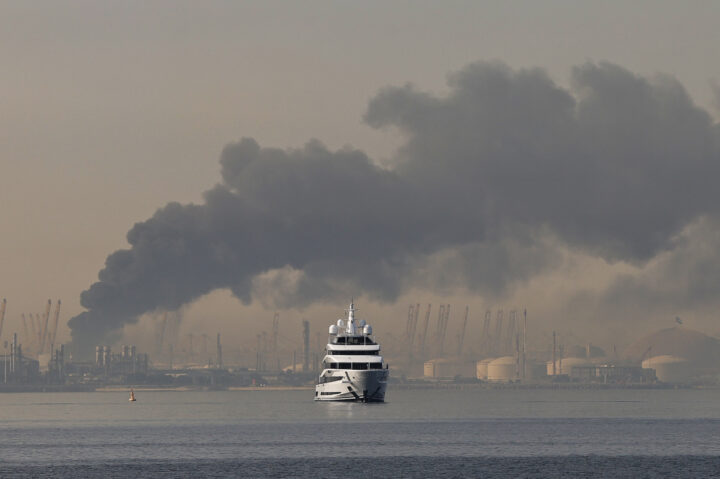
Fadel SENNA / AFP via Getty Images
A yacht sails past a plume of smoke rising from the port of Jebel Ali following a reported Iranian strike in Dubai on March 1, 2026.


 Add JewishInsider on Google
Leading Middle East foreign policy experts warned that Iran’s decision to expand its response to the U.S.-Israeli bombing campaign by striking neighboring Arab states could prove to be a major strategic miscalculation — one that risks isolating Tehran further and potentially drawing Gulf countries to take action.
In the days following the launch of the campaign, Iran carried out widespread drone and missile strikes at multiple Arab nations, striking all members of the Gulf Cooperation Council — Bahrain, Kuwait, Oman, Qatar, Saudi Arabia and the UAE — as well as Jordan, Syria, Iraq and Oman.
Some Iranian strikes hit U.S. military installations in those countries, as well as the U.S. consulate in Dubai and the U.S. Embassy in Saudi Arabia, in what analysts said was an apparent attempt to raise the costs for Washington and lead allies to pressure it to halt the campaign.
But Iran also indiscriminately struck civilian targets — including airports, hotels and major oil and gas infrastructure — causing damage that is sending oil prices soaring and could have lasting economic consequences for the region. Prior to the attacks, several of the affected Arab governments had publicly stated they would not allow their territory to be used to launch strikes on Iran.
On Sunday, the U.S. issued a joint statement along with Saudi Arabia, Qatar, the UAE, Jordan, Bahrain and Kuwait, strongly condemning Iran’s “indiscriminate and reckless missile and drone attacks against sovereign territories across the region.”
The attacks have only continued and expanded since then: On Wednesday, Turkey’s Defense Ministry said that Iran had launched a ballistic missile towards its airspace that was intercepted by NATO defense systems. NATO spokeswoman Allison Hart condemned the incident, adding that NATO “stands firmly with all allies.”
While Arab officials have sought to distance their countries from the conflict and have largely remained silent as they weigh their options, experts said Iranian attacks are a significant error from Tehran that risks pushing Arab states toward direct involvement.
Alexander Gray, a former National Security Council chief of staff under President Donald Trump and a senior fellow at the Atlantic Council, told Jewish Insider that Iran’s decision to attack Arab countries was an “extraordinary strategic miscalculation.”
“Not only has Iran forced the region’s Arab states to openly support the U.S. and Israeli operation, but it has encircled itself far more effectively than any American diplomacy could have accomplished,” Gray said. “Over the long term, this unifying force may offer the U.S. a unique opportunity to return to the economic and diplomatic track of the Abraham Accords on a broader, regional basis after the conclusion of the military operation.”
Michael Koplow, chief policy officer at Israel Policy Forum, echoed those sentiments, calling the action a “risky move at best.”
“Iran’s decision to attack neighboring Arab states was intended to impose escalating costs that would theoretically put pressure on the U.S. to bring the war to a halt,” Koplow said. “So far it has backfired as the U.S. and Israel show no signs of backing down, while there are reports that the UAE, Saudi Arabia and Qatar are contemplating taking their own action against Iranian missiles and launchers.”
He added that the latest missile fired toward Turkey is “a sign of Iranian regime desperation,” and follows a similar pattern. Koplow also noted that Gulf states are likely to have a “much lower tolerance threshold for Iranian attacks and provocations” going forward, warning that the result could be “an even more isolated Iran facing a regional coalition that takes a more aggressive posture toward its own defense.”
Hussein Mansour, a fellow at the Jewish Institute for National Security of America, also said that Iran “catastrophically” miscalculated. “Iran created the conditions for the Gulf states to join the operation,” said Mansour. He added that Tehran’s decision to strike Arab neighbors destroyed “every diplomatic off-ramp it [Iranian leadership] had spent years cultivating.”
Dana Stroul, director of research at the Washington Institute for Near East Policy, said “there is no question that Iran’s strategy of punishing U.S. allies and partners backfired.”
“Gulf leaders are also making clear they maintain the right to defend themselves and are likely considering the proposition that, given Iran’s willingness to unleash its missile and drone arsenal, the best defense is a strong offense,” Stroul said. “It should not be a surprise if in the coming hours or days we see an expanded role for Gulf countries under attack.”
Amb. Dan Shapiro, a former official in both the Obama and Biden administrations, also told JI that the recent Iranian attacks increases the potential for Arab partners to get involved, noting that the situation underscores the value for Arab countries in “being part of a regional air defense network that includes the United States, but also includes Israel.”
“The Gulf states mostly wanted to stay out of this conflict,” Shapiro said. Now, ”there’s at least some possibility you see the UAE and possibly other Gulf states participate in some measure in operations against Iran.”
Mansour said the strikes have pushed the Gulf states further away from Iran and towards the West.
“Last June, during the 12-day war, Qatar called Iran ‘the sisterly Islamic Republic,’ Kuwait accused the U.S. of violating international law, and Saudi Arabia called for ‘restraint,’” said Mansour. “Nine months later, Qatar is shooting down Iranian jets. Saudi Arabia has authorized retaliation and offered to place ‘all its capabilities’ at the region’s disposal. The UAE has shuttered its embassy in Tehran.”
Richard Goldberg, a senior advisor at the Foundation for Defense of Democracies and former Trump administration official, told JI that he views Iran’s decision to attack Arab neighbors as more of a “reality of who the regime is” rather than a miscalculation.
“The regime is fighting for its survival, it sees all of these countries hosting U.S. bases or otherwise aligning with the U.S. in strategic ways. It knows one of their only cards to play is both to drain air defense assets and spike energy prices, so it wildly attacks civilian and critical infrastructure across the region,” said Goldberg. “The regime sees most of these countries as complicit in the attack simply by enabling the U.S. to operate in the Middle East, and it knows that if it can hit enough energy targets hard enough it can increase the pain point for the West.”
Kristin Diwan, a senior resident scholar at the Arab Gulf States Institute, said that while Arab Gulf states are “furious with Iran,” there are reasons for them to refrain from entering direct conflict.
“I suspect that [Arab states] not becoming a party to the war will be essential to negotiating workarounds with the Iranians,” said Diwan. “These will be necessary to get the breathing space in shipping and transport necessary to endure a long war.”
“This same logic will apply if Iran emerges from the war depleted but still dangerous,” Diwan added. “While America may depart the region, Iran will remain, and its Arab neighbors must find a way to live with it.”
Goldberg said that while there is “political benefit” for the U.S. in having Arab governments “endorse offensive military action against the regime,” he noted that “absent a major offensive military contribution to the war [from Arab states], the regime inflicts more costs on the region than it endures for doing so.”
“The GCC states are now on an escalation ladder they did not choose and cannot easily descend,” said Mansour. “If Iran continues to target energy infrastructure, I imagine the Gulf will retaliate severely. The bigger question is what happens after the war stops, and this will largely depend on how the war stops.”
More Stories
supper club
AI, tech execs to attend White House state dinner for Xi Jinping
MONEY MATTERS
Treasury moves to terminate tax-exempt status for some universities, private schools
CANDIDATE CALCULATIONS
Vulnerable Republican candidates urge end to Iran war

QUESTIONABLE COMPANY
Democratic nominee Chris Rabb photographed with Code Pink leader

CROSSING THE AISLE
Biden envoy Amos Hochstein defends Trump admin’s nuclear deal with Saudi Arabia
ENVOY DEBATE
Congressional Jewish Caucus opposes proposal to combine State Dept. Holocaust, antisemitism offices
Please log in if you already have a subscription, or subscribe to access the latest updates.
 Continue with Google
 Continue with Apple