


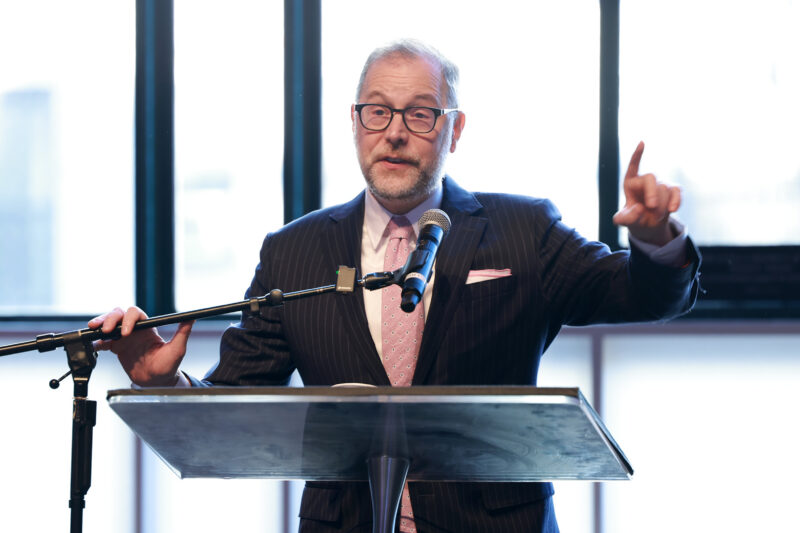




















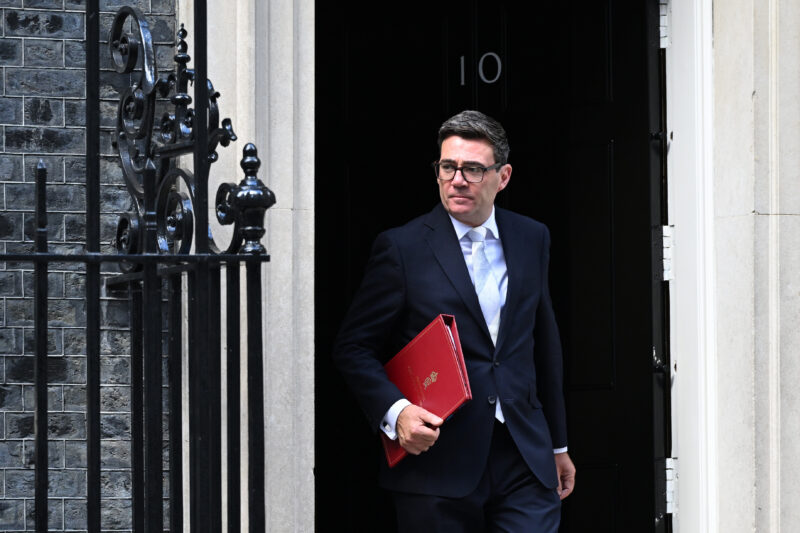










Former Israeli Ambassador to the U.S. Michael Herzog told JI, 'President Trump, who has been a hero to many Israelis, is now openly criticized from within the Israeli government, including Netanyahu's close circle.'

Jack GUEZ / AFP via Getty Images
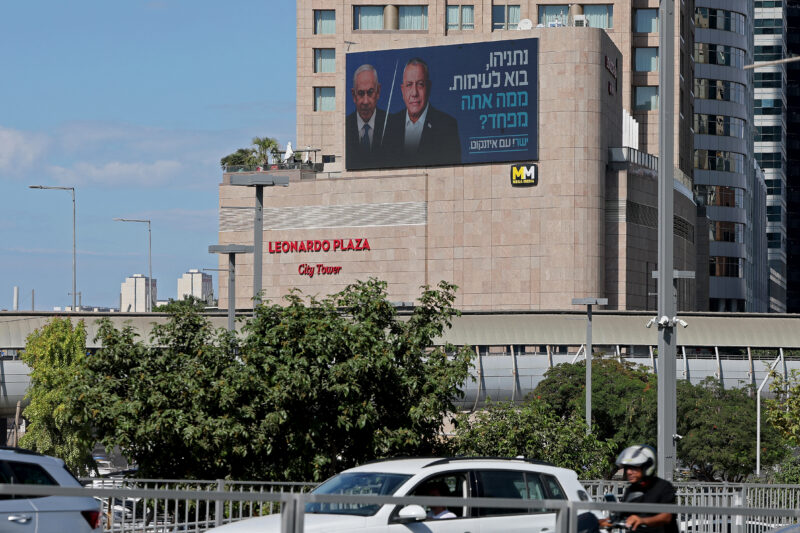
A billboard depicting an image of President Donald Trump with a message thanking him, is displayed on the side of a building in the Israeli coastal city of Tel Aviv on March 12, 2026.


 Add JewishInsider on Google
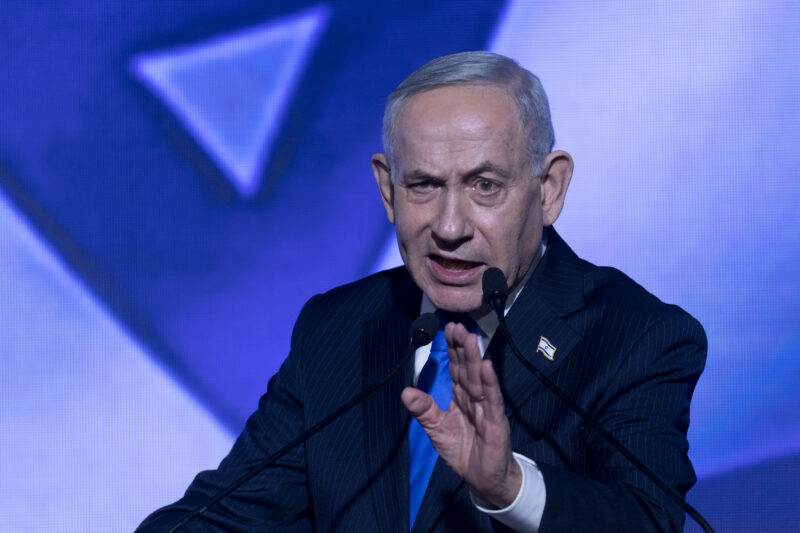
The long love affair between Israelis and President Donald Trump, on the rocks over the last few weeks as the U.S. and Iran hammered out an end to the war, appears to be over, with humiliations mounting for Jerusalem. “I call all the shots,” not Israeli Prime Minister Benjamin Netanyahu, Trump said earlier this month. More recently, the Israeli leader’s bombing campaign in Beirut was “vicious,” Trump said. And perhaps most humiliating of all, Trump suggested that Syrian President Ahmad al-Sharaa could better take care of Hezbollah than the IDF.
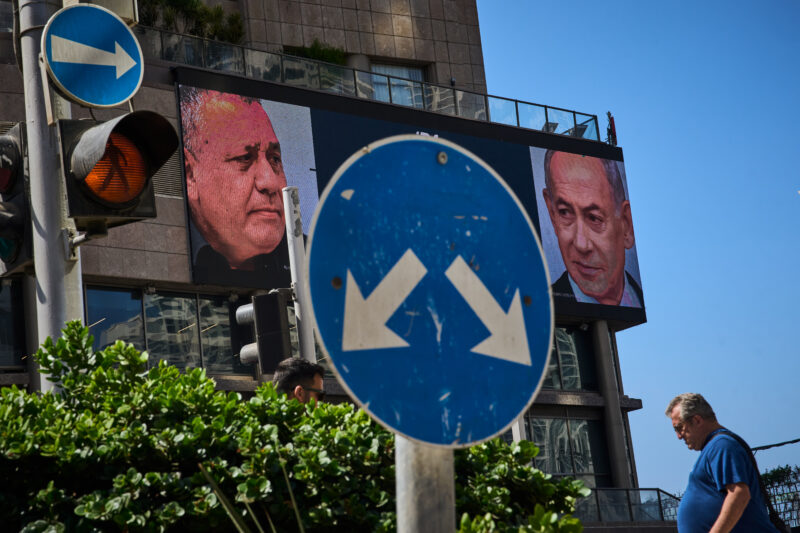
The Israeli public — the spurned lover who once hailed the U.S. president with billboards hung in the center of Tel Aviv reading “Thank you God & Donald Trump” — is not taking it well. Former Israeli Ambassador to the U.S. Michael Herzog told JI, “President Trump, who has been a hero to many Israelis, is now openly criticized from within the Israeli government, including Netanyahu’s close circle.”
And this criticism is not only expressed behind closed doors. Channel 14, the popular right-wing outlet that promotes Netanyahu, has been criticizing Trump resolutely, with some of its anchors publicly cursing Vice President JD Vance and the president’s close advisors, White House Special Envoy Steve Witkoff and Jared Kushner.
It was not always this way. For most of the time since Trump reentered the White House in January 2025, he has been popular in Israel, with polls consistently showing high ratings for the American president.
For Israelis, Trump is the one who brokered the hostage-release agreement with Hamas; Trump is the one who made the strikes in Iran and the bombing of the nuclear enrichment facilities in Fordow and Natanz a reality; and Trump is the one who established the Abraham Accords and is willing to expand them, giving Israelis the chance to sunbathe in the UAE, and perhaps in other countries in the Gulf in the near future. And although some won’t admit it, many Israelis also like his tendency to speak very bluntly, and crudely: a president born in Queens, full of Israeli chutzpah.
In recent weeks, the attitude toward Trump among the Israeli public, and the Israeli leadership, has radically and rapidly changed. But this process began even before the signing of the memorandum of understanding with Iran. Over the past few months, time and again, Netanyahu has tried to convince Trump to resume strikes on Iran, only to be rejected. A source familiar with the discourse between the two leaders described to JI a situation that has played out repeatedly since April: the Israeli prime minister explains why only the military option is the correct approach to Iran, while Trump listens but prefers the diplomatic path.
And then Trump, in his typical fashion, says that Netanyahu will do whatever the U.S. president tells him to do — which has some degree of truth — but is not a good look for a prime minister seeking reelection. Trump has repeatedly criticized Israeli policy in Lebanon and publicly reprimanded Netanyahu for not being responsible enough. When the U.S. president once again floated the possibility that al-Sharaa should handle Hezbollah, which has fired thousands of rockets and drones toward Israel and most recently killed four Israeli soldiers overnight Thursday, the criticism in Israel escalated.
Trump had previously suggested that the Syrians take on Hezbollah, as reported by Kann earlier this week, during an official meeting between the Israeli and Lebanese ambassadors in April, though those in attendance were unenthusiastic about the idea. To understand the Israeli approach toward Trump’s suggestion, one can look at what the chairman of the Knesset Foreign Affairs and Defense Committee, Likud MK Boaz Bismuth, posted on X: “President Trump, we don’t trust the terrorist Jolani, we have Golani,” referencing a well-known IDF combat infantry brigade.
The opinion within the Trump administration has been made clear. “Trump is the only head of state in the entire world who is sympathetic to the nation of Israel at this moment and time,” Vance told reporters on Thursday. “If I was in the Cabinet of the Israeli government, I might not be attacking the only powerful ally that I have left in the entire world,” he said. “The problem for Israel is not Donald J. Trump. And anybody in Israel who thinks their biggest problem is the president of the U.S. needs to wake up and smell the reality of the situation that country is in.”
Yet now, after the agreement has been published, the criticism remains unchanged. An Israeli official told JI that the agreement raises several troubling signs, among them: the uncertainty over whether all enriched uranium will be removed from Iran, or only the high-level uranium; under the terms of the agreement, Iran, it appears, will be allowed to enrich uranium at a low level on its soil, meaning it can continue to operate centrifuges; and the issue of oversight is not explained.
“The second shocking thing here is the betrayal of the Iranian people. The second clause in the MOU agreement states that neither country will interfere in the internal affairs of the other. This means the Iranians can execute protesters, and nothing will be done to them,” the Israeli official said. “This entire war started because Trump said that ‘help is on the way,’ and that we would not allow tens of thousands of protesters to be shot and slaughtered. Beyond the concern that Iran will remain a nuclear threshold state, there is also a moral problem here.”
Avner Vilan, a former senior security official and Iran expert, also raised concerns about the agreement. “Iran is receiving a great deal of relief right now, but there is still a long way to go to reach an agreement in the nuclear field. This is an agreement that gives the murderous terror regime in Iran infinite immunity and incentives, allowing it to survive almost indefinitely, while recognizing the strategic significance of Hormuz,” he told JI.
Vilan also referred to the statements made by Trump in recent days that sparked concern within the Israeli defense establishment. Trump has legitimized Iran’s ballistic missile arsenal, and this, as Vilan points out, despite the fact that Israel defined this threat as an existential threat almost on par with the nuclear one. “This is more disturbing than the state of relations between Trump and Netanyahu, and of course, it doesn’t help that the president calls the State of Israel a ‘very small partner.’ At the beginning of the war, we were a ‘Model Ally.’ Not a small partner,” Vilan notes. “Israel’s point of strength for years was that the way to D.C. goes through Jerusalem. Today, that is no longer the case at all.”
“Israelis expected that the amazing military achievements the U.S. and Israel scored together would be translated into a strong, enduring diplomatic outcome focused on the nuclear issue,” says former Ambassador Herzog. “Instead, the U.S. opted out of the war with a general MOU that focuses on the Strait of Hormuz and the global economy, in return for releasing generous funds to Iran and postponing the core nuclear negotiations. There is little reason to believe that the Iranian regime will now agree to give up the nuclear option or change its orientation, especially as the U.S. military option is taken off the table.”
What looked like a year of celebrating blue, white and red cooperation has been fading more and more in recent weeks. The disappointment among senior Israeli officials is likely intensifying, due in part to the widespread praise that Trump has long received in Israel. It wasn’t for nothing that Trump said last month that he could run in the upcoming elections for prime minister in Israel and win. Even if he were on the ballot, with the thrill now gone, he wouldn’t stand a chance.
Armed Services Committee chair Roger Wicker broke his silence on Thursday, warning the deal would make Iran’s Obama-era payoff ‘look like a pittance’

Tom Williams/CQ-Roll Call, Inc via Getty Images
Senate Armed Services Committee Chairman Roger Wicker (R-MS) arrives for a confirmation hearing in Dirksen building on Tuesday, May 13, 2025.
Senate Republicans continued on Thursday to air concerns about the U.S. memorandum of understanding with Iran, in some cases fueled further by Vice President JD Vance’s comments dismissing the effectiveness of U.S. sanctions and lambasting Israeli government officials who have objected to the deal.
Sen. Roger Wicker (R-MS) — the chairman of the Senate Committee on Armed Services — issued a statement ripping into the agreement, saying he’s “concerned [it] negotiates away the victories of Operation Epic Fury in ways that are completely out of step with the president’s goals.” Wicker had for days told reporters he was “withholding comment” on the MOU.
He said that, even though the $300 billion reconstruction fund outlined in the deal is not coming from U.S. taxpayer money, it “would make Iran’s payoff under President [Barack] Obama’s 2015 deal look like a pittance by comparison” and that it “would be an error to force Israel to stand down against Hezbollah.”
He said he also opposes any sanctions relief or unfreezing of funds for Iran “in exchange for Iran’s mere agreement to negotiate for another 60 days. The Iranian regime has not renounced its ultimate goal — ‘Death to America, Death to Israel.’ The regime will invest every penny it receives to further that aim.”
But Wicker pointed ultimate blame for the final shape of the deal at the “intermediaries,” rather than Trump himself.
Wicker told reporters he expects to hear from Vance about the deal but that no briefings have yet been arranged or scheduled.
Reiterating a stance he expressed a day prior, Sen. Ted Cruz (R-TX) said, “History demonstrates giving billions of dollars to theocratic lunatics who want to kill you is an exceptionally bad idea. So I hope we don’t do that.”
Asked about the comments by Vance — a potential candidate in the 2028 GOP presidential primary — Cruz, who mounted his own presidential bid a decade ago and is rumored to be considering a 2028 run, said, “I think the vice president can speak for himself.”
Sen. Thom Tillis (R-NC) said that he plans to go through the agreement in detail to compare it to the 2015 Joint Comprehensive Plan of Action because “what we don’t want to do is repeat that mistake.”
Tillis rejected Vance’s comments that sanctions have not been effective. “You’ve seen all kinds of their behavior changes in reaction to sanctions,” Tillis told Jewish Insider. “To suggest it’s not working would suggest that broadly sanctions don’t work, and we all know that that’s just factually incorrect.”
He told JI that “clearly any sanctions that are subject to congressional approval, he needs to come to Congress. Pretty straightforward. They covered that on ‘Schoolhouse Rock.’”
Tillis, who is retiring, also called the deal a “very important moment” for Vance. “It’s definitely a two-edged sword. Coming up short’s probably not good for him, but it could be a great achievement for him.”
Sen. Mike Rounds (R-SD) told JI he hadn’t heard Vance’s comments on sanctions, but he said that “it seems to me that there are billions of dollars that have been held from Iran, which has not gone to terrorist activities, and I think that is a good thing. So, with regard to that, it clearly had an effect. Whether or not it was completely effective is debatable.”
Rounds said he was concerned that Israel was not a party to the negotiations but “there’s an expectation somehow that there would be a limitation on activity going on in Lebanon that we’re not involved with at all, but that Israel is.”
He emphasized that “the Israeli government has a right to defend its people” from the yearslong ongoing attacks from Hezbollah, “and I don’t see that necessarily correctly addressed within this original memorandum. Perhaps there’ll be more meat on it in an actual agreement.”
The senator said he’s unsure whether the Iran Nuclear Agreement Review Act, which blocks the lifting of sanctions or unfreezing of funds for a congressional review period on any deal pertaining to Iran’s nuclear program, would be applicable, or what legislative steps would be involved if it were.
“We need to learn more about what [Trump’s] intent is and how permanent the two parties expect this to be,” Rounds said. “There’s a lot of questions we don’t have answers to yet, but it’s early in the process.”
He raised concerns about how the agreement would be enforced “particularly if you release all of their funds immediately, they’re allowed to do with it whatever they want. In the past, they’ve used that to fund terrorist activities. The first one that comes to mind is Hezbollah, which sits in Lebanon right now and has been attacking Israel relentlessly for years.”
Sen. John Cornyn (R-TX) said that “everything I’ve heard about it causes me concern” and he believes the president agreed to the deal because he was “concerned about the midterm elections and gas prices and blockage of the Strait of Hormuz.”
“This gets that open, but I think he’s had to pay a very deal price to get that done, and I think we should be clear-eyed and realistic that this isn’t going to persuade the Iranian regime to go in peace,” Cornyn, who is retiring after being defeated by a Trump-backed primary challenger, said.
He said that the steps taken by U.S. military operations to degrade Iran’s ballistic missile program and military-industrial base and delay its nuclear program were positive, but “I think we ought to be realistic about where we are. It’s temporary. It’s certainly not a permanent solution.”
Cornyn said he does not believe that Trump was joking when he said on Wednesday that he would blame Vance if the deal goes awry, and that the outcome of the deal might affect Vance’s prospects in the 2028 presidential race.
Cornyn said he expects that Congress, in its oversight role, will be examining the release of sanctions and whether the administration has the ability to lift those sanctions unilaterally.
Sen. Tom Cotton (R-AR), the Senate Intelligence Committee chair who also had not yet commented on the deal, said on Thursday that he has “concerns” over the MOU, warning that “certain aspects of this deal are a step in the wrong direction.”
The Arkansas senator told Fox News’ “The Story with Martha MacCallum” that Trump “deserves enormous credit for making Iran weaker than it’s been in decades, and we need to make sure that we don’t squander the leverage that we’ve built.” Cotton said he wished that the president “had continued with Project Freedom when it was announced a couple months ago.”
He also called on Trump to “use our military to force the Strait open and to keep it open, in addition to reimposing the blockade in the event that “Iran doesn’t keep its end of the bargain.”
Cotton pointed to the immediate lifting of sanctions on Iran’s oil exports, suggesting the funding would go toward malign activities, and raised concerns about the long-term control of the Strait of Hormuz.
“There’s certain parts of this memorandum that are a bit vaguer about Iran’s ability to access up to $100 billion of frozen funds or whether Iran can impose tolls on the Strait of Hormuz after two months,” Cotton said. “We’ll need more explanation there. I hope President Trump won’t allow those things to happen.”
Sen. Joni Ernst (R-IA) said that lawmakers had “very serious problems” with the JCPOA and the administration will need to come explain the deal because “I don’t want to see JCPOA 2.0.”
Sen. Lisa Murkowski (R-AK) told JI that she expects to find out “a lot more about the real details and particulars in these next 30 days.”
The Alaska senator said Congress needs “to make sure that the way that the president and the United States are interpreting this is in sync with how Iran is interpreting this, and I’m not certain yet that we’re at that place.”
Murkowski said “they can’t tell me” how the sanctions relief and reconstruction funding will work “so I certainly have a lot of questions that have yet to be resolved, but I also appreciate that the agreement allows for this next 30 days to work through reaching it.”
Asked about Trump’s suggestion on Wednesday that he wasn’t opposed to Iran possessing ballistic missiles, Murkowski replied, “That wasn’t helpful.”
Murkowski responded affirmatively when pressed on if those types of comments from the president and senior administration officials gave her pause about what the final agreement could look like.
Sen. Jim Justice (R-WV) said that “if we don’t have absolute assurances” that Iran can never obtain a nuclear weapon “then we lose,” though he said that “there’s still work to be done” in further negotiations.
“If it were to come to pass that we still have all kinds of concerns and no assurances and everything else, then it’s not good at all,” Justice said. “We have to have control one way or another” of Iran’s nuclear materials.
He said he couldn’t address disputes with Israel about the deal directly but said “the Israelis have been wonderful allies, and we’re going to stay arm-in-arm with them, period.”
Democrats, meanwhile, continued to lambast the agreement.
Sen. Richard Blumenthal (D-CT) told JI the administration is “desperate” and “flailing” and criticized the exclusion of Israel from the negotiations given that it continues to face attacks from Hezbollah, from which he said it must defend itself.
He said the agreement’s reliance on the U.N. as an enforcement and verification mechanism also hurts Israel.
“How can Israel trust the U.N.? Working with Israel is simply not in their toolkit. With the hundreds of billions of dollars provided, the unfreezing of sanctions immediately, the lifting of the freeze on assets, I don’t know how Republicans who attacked us with the JCPOA are going to handle that,” Blumenthal said. “This is a regime that continues to call the United States ‘the Great Satan.’ I don’t know what they’re thinking.”
And, he argued, the agreement effectively requires nothing of Iran: “I know the vice president’s line has been, ‘They only get the benefit of the bargain if they keep their side of it,’ but there is no side of it for them. They’re under no obligations here. It keeps the status quo for nuclear arms, lifting sanctions, lifting the freeze on assets, the $300 billion dollars.”
Sen. Chris Coons (D-DE) called the deal “appalling, flawed, pathetic failure” but “the inevitable conclusion of a combination of never making the case to the American people, flawed strategic provision, lack of grasp of the regional dynamics. How many ways can I say bad, bad, bad.”
On the issue of sanctions, Coons told JI, “President Trump cut a horrible deal where he is giving to Iran an enormous amount of released assets that have been frozen, sanctions relief that will generate tens of billions, if not hundreds of billions, and this reconstruction fund In combination, this is a massive infusion of cash to the mullahs and the IRGC. History shows the mullahs will not primarily use this money to build health clinics and schools.”
He said that Vance’s criticisms of Israeli officials are part and parcel of his efforts to sell an unsatisfactory agreement.
“I think JD Vance has been tasked with trying to sell a really bad deal and he is being as aggressive as he possibly can in knocking down one of the more obvious critics — a country that has a lot to lose,” he added. “If their opposition to the JCPOA was in any way principled, then they have to criticize a deal that’s worse than the JCPOA.”
Coons pointed responsibility for countering the deal toward Republicans, emphasizing that Iran will use the funding it receives under the deal for malign purposes. The Delaware senator said that there are “some things” Congress can do including conduct oversight of the congressional sanctions that the deal seeks to lift.
Sen. Cory Booker (D-NJ) echoed colleagues in describing the agreement as an “unconditional surrender” by the U.S. ‘because we get nothing from this deal.”
“All the specific benefits go to Iran. We get vague promises for potentially in the future hundreds of billions of dollars,” Booker said. “We’re allowing an extreme, terrorist supporting regime, that’s more extreme than when we began this, that chant ‘Death to America,’ to have more resources to do more things. So this is perhaps one of the biggest presidential blunders and failures in the last 20 years.”
He said that whether Senate Republicans stand firm and refuse to allow the administration to lift sanctions requiring congressional approval “is going to be the big test.”
“Will they just roll over and lay down for him, or will they stand up and provide the kind of checks, balances, oversight, and accountability when it comes to Iran, that they should be doing?” Booker asked. “They have a lot of levers to pull on the Republican side, where they right now control the Senate and control the House.”
He did not address what Democrats plans’ or role might be.
In the House, pro-Israel Democrats are also outraged by the deal and vowed not to support when it comes before Congress, which they said it must under INARA.
Rep. Josh Gottheimer said he is “totally dumbfounded by this agreement, and, like many, in a state of disbelief,” adding that the U.S. “got nothing” and “not one core objective was meaningfully met.”
He predicted that the next phase of the deal will never come about, and said the U.S. is “selling out Israel” and “kowtowing to Hezbollah terrorists, by tying Israel’s hands in Lebanon.”
Rep. Brad Schneider (D-IL) called it a “surrender agreement” and an “unacceptable capitulation without achieving any of our objectives” that will “facilitate the rebuilding” of Iran’s military and support for proxy groups.
“Unless the agreement is changed to actually close and permanently block Iran’s path to nuclear weapons, I will vote against it,” Schneider said.
Plus, Albania blames Iran for stoking Kushner-unrest
Roy Rochlin/Getty Images
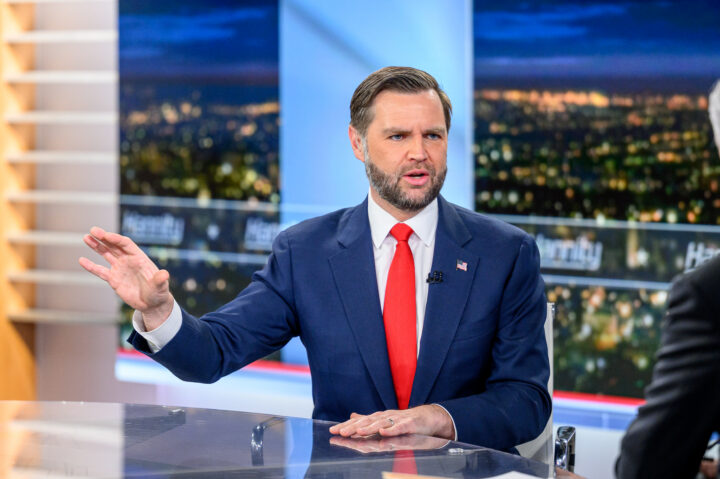
Vice President JD Vance
Good Thursday afternoon.
This P.M. briefing is reserved for our premium subscribers like you — offering a forward-focused read on what we’re tracking now and what’s coming next.
Today’s Daily Overtime was curated by Senior National Correspondent Gabby Deutch.
📡On Our Radar
Notable developments and interesting tidbits we’re tracking
As the White House continues to promote the memorandum of understanding that will end the war with Iran and start negotiations between Washington and Tehran, Vice President JD Vance is out with a message that sounds strikingly familiar — at least to anyone who followed former President Barack Obama’s pitch on the 2015 nuclear deal with Iran, Jewish Insider’s Gabby Deutch reports.
“If you think this is a bad deal, what is your alternative?” Vance said in an interview this week with New York Times columnist Ross Douthat.
Obama used nearly identical phrasing at a 2015 White House press conference: “I’m hearing a lot of talking points being repeated about ‘this is a bad deal,’” he said. “What I haven’t heard is, what is your preferred alternative?”
Watch a side-by-side look at Vance and Obama here…
Vance also delivered a tough message to Israeli officials who have criticized the MOU, telling reporters on Thursday that Israel’s government should be careful not to alienate the only friend it has left: President Donald Trump, JI’s Emily Jacobs reports.
“Donald J. Trump is the only head of state in the entire world who is sympathetic to the nation of Israel at this moment in time and he happens to be the head of state of the world’s superpower. If I was in the Cabinet of the Israeli government, I might not be attacking the only powerful ally that I have anywhere left in the entire world,” said Vance…
Trump also had a word of caution for Israeli Prime Minister Benjamin Netanyahu, two days after he said Netanyahu was too “vicious” in his approach to fighting Hezbollah in Lebanon. Asked by a reporter for Israel’s Kan News if he will support Netanyahu in this year’s Israeli elections, Trump said he most likely would, but did not commit.
“I’ll have to look at who’s running, but I like Bibi very much. I would be most likely to endorse him,” said Trump. “He’s doing a very good job, he’s got to be a little bit more rational”…
United Against Nuclear Iran, an advocacy group that rallied opposition to the 2015 Joint Comprehensive Plan of Action, said on Thursday that it “cannot endorse the MoU in its current form”…
AIPAC released a policy memo on Thursday that said the MOU “raises significant questions,” and called on Congress to “play a critical role in ensuring a final deal meets President Trump’s stated objectives for the war”…
In a Thursday speech at the FII Priority summit in Rome, Albanian Prime Minister Edi Rama blamed Iran for “ruthless” cyberattacks against the country, claiming that Tehran has sought to sow unrest about a preliminarily approved luxury development project in the country from Ivanka Trump and Jared Kushner, Trump’s daughter and son-in-law, JI’s Matthew Shea reports…
Janeese Lewis George defeated Kenyan McDuffie in the Democratic primary for mayor of Washington, D.C., with the Associated Press calling the race on Thursday afternoon. Democratic socialist Lewis George leads McDuffie 53% to 36%…
American Priorities, a super PAC created as a progressive counterweight to AIPAC, has received $250,000 from a tech executive whose firm is developing AI data centers in New York State — while boosting two democratic socialist House candidates who oppose efforts to expand data centers, JI’s Matthew Kassel reports…
Rep. Tom Kean Jr. (R-NJ), who has been absent from Congress since March due to an unexplained personal health issue, plans to return to Washington on June 30…
Israel and Syria are expected to resume direct talks soon due to pressure from the U.S., the Israeli network Kan reports…
The FBI announced that it charged San Diego resident Reda Mazen Rida Sabassi with conspiring to provide material support to Hamas after he allegedly raised approximately $600,000 through fraudulent charitable campaigns and funneled a portion to the terrorist organization…
Former Presidents Joe Biden, George W. Bush and Bill Clinton attended the grand opening of the Obama Presidential Center in Chicago on Thursday afternoon.
Guests included a litany of ex-Obama administration staffers, including former White House liaison to the Jewish community Matt Nosanchuk and former U.S. Ambassador to Israel Dan Shapiro, who was spotted chatting with Obama…
⏩ Tomorrow’s Agenda, Today
An early look at tomorrow’s storylines and schedule to keep you a step ahead
Keep an eye on Jewish Insider for a look at how Jewish Republicans are feeling about the U.S.-Iran memorandum of understanding that was signed this week.
Vice President JD Vance plans to travel to Switzerland this weekend for talks with Iran, though the plans are not yet finalized, he told reporters on Thursday.
Bill Pulte, the director of the Federal Housing Finance Agency, will become the acting director of national intelligence on Friday after the confirmation of DNI nominee Jay Clayton was delayed this week at President Donald Trump’s request.
We’ll be monitoring the final days of the heated congressional primary campaigns in New York, where Israel and Gaza remain hot topics for progressive candidates.
We’ll be back in your inbox with the Daily Overtime on Monday. Shabbat Shalom!
Stories You May Have Missed
Transferring responsibilities
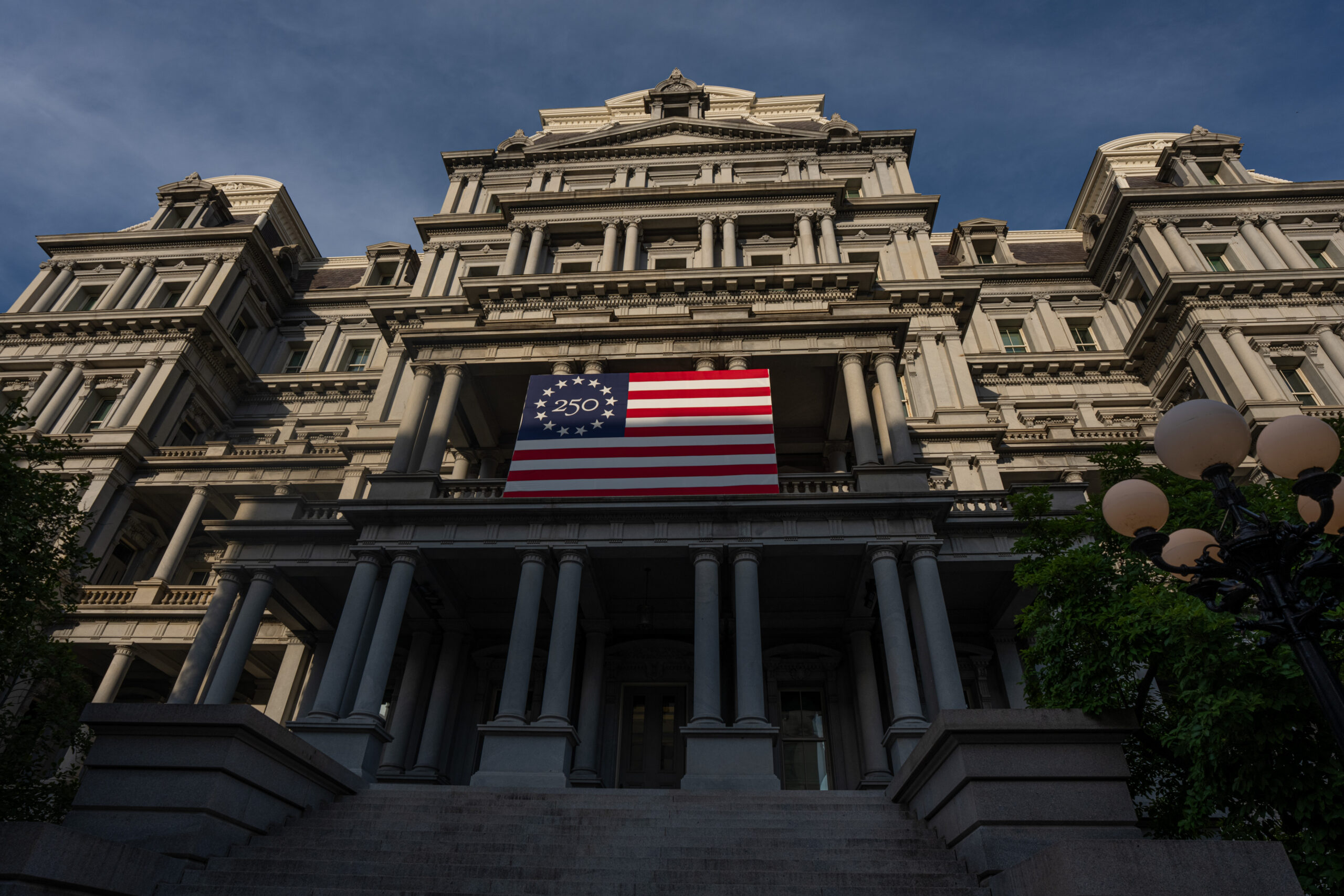
The letter urges American Jews to ‘double down’ on civic values as the country marks its 250th
BEHIND THE CURTAIN

Multiple sources identified Scott Stringer as a driving force behind two PACs spending to beat Mayor Zohran Mamdani’s House candidates
The prime minister accused Tehran of amplifying fake videos and false information to inflame opposition to a Kushner-linked coastal project
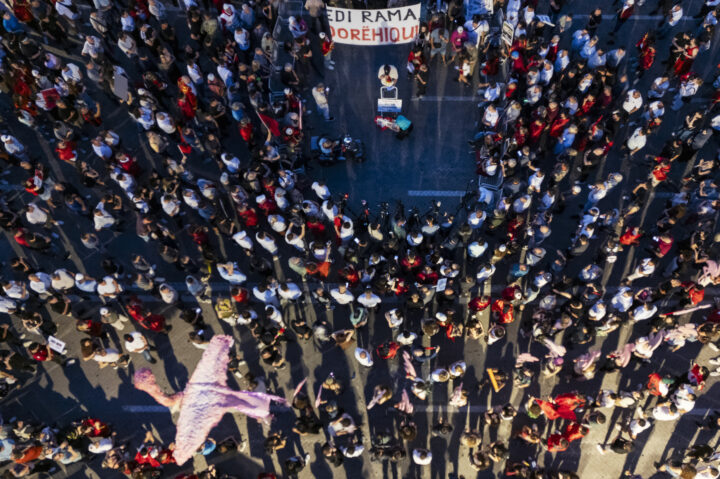
Photo by Vlasov Sulaj/NurPhoto via Getty Images
An aerial view shows protesters gathered outside the Prime Minister's Office in Tirana, Albania, on June 17, 2026, during the eighteenth consecutive day of demonstrations against a proposed luxury tourism development project linked to Jared Kushner.
Albanian Prime Minister Edi Rama on Thursday blamed Iran for what he described as “ruthless” cyberattacks, warning that Tehran has sowed unrest and amplified false information about environmental protests over a new luxury development project in the country from President Donald Trump’s daughter Ivanka Trump and son-in-law Jared Kushner.
Kushner’s investment firm has moved forward with a luxury project in Albania that includes a coastal development in the Narta Lagoon area — a wildlife reserve — and a smaller resort on the nearby uninhabited island of Sazan. The project has yet to be approved and has not obtained building permits, but has drawn fierce backlash and sparked daily protests from thousands of demonstrators outside Rama’s office due to environmental concerns.
Speaking at the FII Priority summit in Rome, Rama confirmed that the land has been “bought by investors” and is undergoing an “environmental impact assessment.” However, he claimed that the uproar is not what it seems and is being fueled by misinformation and cyberattacks from Iran, which he described as Albania’s “enemy” in the Middle East.
“The amount of posts that have been entering there from our enemy, we have only one enemy, which is the [Islamic] Republic of Iran, and they are engaged in three years in a ruthless cyber-attack against Albania,” Rama said. “They [Iran] entered also in this game…freedom of reach is what every regime, through every propaganda, has done to go in every brain and to put the lie in the brain.”
In 2022, Albania was the subject of an Iranian cyberattack after the country hosted members of the Mojahedin-e-Khalq (MEK), an Iranian opposition group. The disruptive attack compromised Albanian government systems and forced the country to temporarily sever digital services. The attacks also led Albania to break diplomatic relations with Iran.
The issue remains a sore point between the countries, with Rama saying earlier this month that the Albanian people were “the target of a cyberterror campaign that aimed to cripple an entire country.” Tehran has denied the allegations.
Rama has also claimed that antisemitic narratives, as well as resentment over the project’s ties to Kushner and Trump, are behind the opposition.
“The digital outrage, of course, has been provoked, mostly because Kushner and Trump’s shadow are behind it, enough to bring a lot of people from a lot of ways of like from a lot of continents jumping,” Rama said. “The amount of falsehoods, the amount of fake videos that were taken from protests in different countries that were pushed as protests in Albania.”
Speaking on a podcast hosted by David Senra earlier this month, Ivanka Trump said, “there’s nothing uglier than a beautiful nonfunctional space,” describing the project as “architecturally incredibly meaningful and beautiful and intentional with a highly functional space.”
Rama argued that the project would be transformational for Albania’s tourism industry and GDP. A BBC report indicated that the project could bring in up to €4 billion of investment, a major mark for a country that consistently ranks among the poorest in Europe. Rama said that the “big business and investment” can offer the country a “bigger vision than the usual small investments.”
The Albanian leader has also dismissed environmental concerns, arguing that the project would show that “nature and people can coexist.”
“There is nothing that has to worry any environmentalists,” Rama said. “And, yes, Albania will go forward. The majority of the Albanian people want the project.”
As Albania seeks European Union membership, EU officials have reportedly urged Albanian authorities to ensure that the project aligns with the bloc’s environmental regulations, warning that failing to do so could jeopardize the country’s accession bid.
Vance borrows from the Obama playbook to argue there is no viable alternative to agreement with Iran
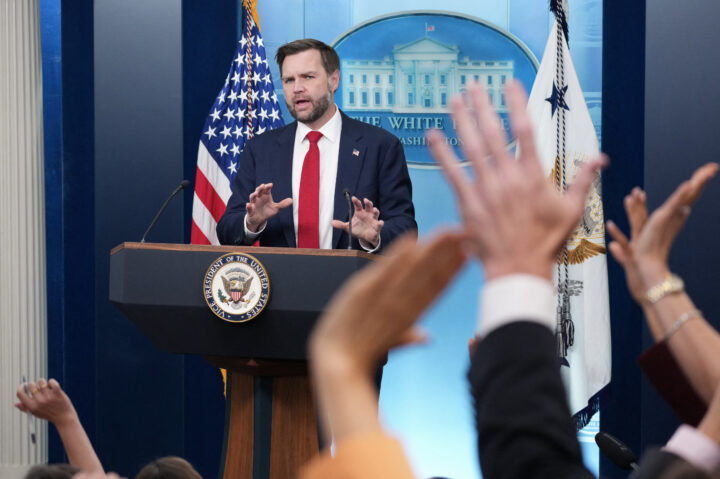
Photo by Ken Cedeno / AFP via Getty Images
Vice President JD Vance takes questions from reporters during a press briefing in the Brady Briefing Room of the White House in Washington, DC, on June 18, 2026.
As Vice President JD Vance takes on the role of chief defender of the U.S.-Iran memorandum of understanding and forthcoming talks, he has begun to sound a lot like someone whom the Trump administration has lately spent a lot of time attacking: former President Barack Obama.
Vance and President Donald Trump have both, in recent days, made clear that they view the MOU — which is set to deliver sanctions relief to Iran as nuclear negotiations get underway — as fundamentally different from, and better than, the 2015 Joint Comprehensive Plan of Action, the nuclear deal signed by Obama. But as the White House faces criticism from hawkish members of the Republican Party, the language Vance is using to defend the burgeoning deal closely resembles the arguments made by Obama 11 years ago.
“If you think this is a bad deal, what is your alternative?” Vance said in an interview this week with New York Times columnist Ross Douthat.
Flashback to a 2015 press conference at the White House soon after the JCPOA was announced.
“I’m hearing a lot of talking points being repeated about ‘this is a bad deal,’” Obama said. “What I haven’t heard is, what is your preferred alternative?”
Both Vance in 2026 and Obama in 2015 argued that the deals negotiated by their respective administrations were better than using military force — or in the case of the Trump deal, continuing to use military force — and that they would lead to a safer world.
“We could drop more bombs. We could destroy more of their country. We could kill the current iteration of their leadership. We know where all of them are. All of those things could happen,” Vance said. “But does that make the American people safer or more prosperous? The president of the United States and I think: No.”
Obama frequently argued similarly.
“If the alternative is that we should bring Iran to heel through military force, then those critics should say so,” he said at the 2015 press conference. “We’ve got a historic chance to pursue a safer and more secure world, an opportunity that may not come again in our lifetimes.”
“None of them have presented to me, or the American people, a better alternative.” -Obama, 2015
— Jewish Insider (@jewishinsider) June 18, 2026
“It’s not just whether this is good or bad, it’s what is the alternative.” -Vance, 2026
As Vice President JD Vance takes on the role of chief defender of the U.S.-Iran MOU and the… pic.twitter.com/TB5bvxINM5
There are substantive differences between the agreements notched by the Obama and Trump administrations, though both share the core assertion that they will not allow Iran to obtain a nuclear weapon.
“The Obama-Iran deal allowed them to generate a stockpile of enriched uranium,” Vance claimed, although the JCPOA required Iran to limit the level to which it enriched uranium, cut its stockpile by 98% and ship the rest of its enriched uranium out of the country. “Our deal ensures that stockpile is destroyed and eliminated, so that’s a very, very big difference, a very important difference for the American people,” Vance said this week. (The text of the 14-point MOU says only that the uranium will be discussed during the forthcoming negotiations.)
But both Vance and Obama, in their roles as salesmen of their administrations’ respective deals, argued that critics simply misunderstand the agreements.
“I just don’t think that people who are criticizing this, one, they’re not actually dealing with the reality of what’s in it, and No. 2, they don’t have an alternative,” Vance said in a podcast interview with Megyn Kelly this week.
Obama told NPR’s Steve Inskeep in 2015 that critics of his deal get the facts wrong.
“I’ve listened to the critics, some of them who announced their opposition before they had even read the bill, or read the agreement. And that is that they will put forward arguments that after a few minutes can be shown as illogical or based on the wrong facts,” said Obama.
Vance challenged critics to come up with a better alternative beyond more fighting.
“What is it that they wanted us to do besides put 300,000 ground troops in Iranian soil, which we were never going to do?” he said to Kelly. “If your alternative is just to drop bombs without any clear goal or any clear American interest implicated, then you’re not making wise decisions on behalf of the American people.”
Former Secretary of State John Kerry argued something similar before Congress in 2015.
“So what’s your plan?” he asked. “Totally go to war?”
The vice president said Trump is "the only head of state in the entire world who is sympathetic to the nation of Israel at this moment in time" and warned Israeli officials not to take that for granted
Ken Cedeno / AFP via Getty Images
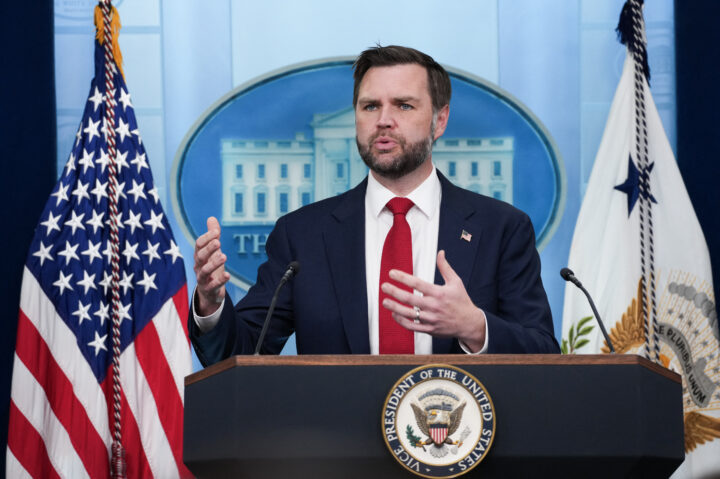
US Vice President JD Vance speaks during a press briefing in the Brady Briefing Room of the White House in Washington, DC, on June 18, 2026.
Vice President JD Vance on Thursday issued a scathing public rebuke of Israeli officials who have criticized President Donald Trump for approving the memorandum of understanding between the U.S. and Iran, cautioning Israeli skeptics of the deal against “attacking the only powerful ally” it has left and urging them to “wake up and smell the reality of the situation that country is in.”
Vance made the comments as part of his final answer at a White House press briefing regarding the MOU, directing his ire at members of Israeli Prime Minister Benjamin Netanyahu’s Cabinet who have criticized the deal or the president himself. The vice president said he was angered by the harsh commentary, which he credited Netanyahu for not participating in.
“What I will say, and it does bother me, is that you have seen people within Bibi’s Cabinet who have come out and attacked the deal, and in some ways very personally attacked the president of the United States, and I guess my message to them would be twofold,” Vance said. “Number one, Donald J. Trump is the only head of state in the entire world who is sympathetic to the nation of Israel at this moment in time and he happens to be the head of state of the world’s superpower. If I was in the Cabinet of the Israeli government, I might not be attacking the only powerful ally that I have anywhere left in the entire world.”
“The second message I would give to some of those Cabinet members — Bibi, to his credit, has not gone down this path,” Vance continued. “But to some of these Cabinet members in Israel who are attacking the president of the United States, the other thing that I would say is that over the last three months, two-thirds of the defensive weapons that have protected your homeland have been built by American hands and paid for by American tax dollars,” he added.
Vance then said, “The problem for Israel is not Donald J. Trump, and anybody in Israel who thinks their biggest problem is the president of the United States needs to wake up and smell the reality of the situation that country is in.”
The vice president pushed back on comparisons between the MOU and the Joint Comprehensive Plan of Action that the Obama administration signed in 2015, arguing that the Arab world’s reaction to this current effort has been far more positive than its response to former President Barack Obama’s Iran deal.
“There are going to be any number of opinions about the negotiations, about where it’s ultimately going to go, but I tend to think that you should trust the people who know the Iranians the best and who have the most to lose,” Vance said. “What are the Gulf Arab states saying about this deal? What are they saying about this deal compared to the JCPOA in 2015? This is the Obama nuclear deal. Well, back then they hated that deal. They felt like it empowered the Iranians to be bad actors across the region, and of course that’s exactly what happened.”
“What are they saying about the president’s peace deal? They’re saying this is an amazingly transformative thing for the region, because either way we and the broader region win,” he continued. “Iran is weakened, their nuclear program destroyed, their economy in desperate straits, and if they change their behavior, big things are going to happen for Iran and for the world.”
Vance doubled down when asked about Trump’s comments on Wednesday that the U.S. would not forbid Iran from possessing ballistic missiles and downplaying the threat of the regime continuing to have those weapons — despite it being a key goal of the negotiations.
“All the president said yesterday is that of course, countries don’t give up the right of self-defense. Israel doesn’t give up the right of self-defense if Hezbollah fires rockets or drones at Israel,” Vance said.
“The Iranians don’t give up the right of self-defense in their country,” he added. “But we do expect that as part of the final deal, they are not going to be able to build the kind of missiles that can broadly threaten the entire world, and that’s what the president of the United States said yesterday. It’s very simple. You can’t tell a country whether Israel, Iran, they are not allowed to have any self-defense.”
Vance criticized U.S. sanctions against Iran, arguing that the effort to isolate Iran economically has been “fundamentally ineffective” despite it being a core part of Trump’s longstanding maximum-pressure campaign. The vice president said that the sanctions had forced Iran to “move the Iranian financial system to the shadow-banking system” where it was no longer subject to those penalties.
“We didn’t see that as a major concession to the Iranians, frankly,” Vance told reporters, adding that Iran “didn’t see that as a concession to them, because what prevented them from selling oil was not the sanctions.”
He argued that the lifting of sanctions would allow the U.S. to have greater oversight of Iran’s financial activities while defending the Trump administration’s decision to allow Iran to immediately resume selling oil.
“The number one thing is that we actually see where the money moves now because of what we’ve done with the financial sanctions. We actually know where the money is going to move,” he explained. “So we have great confidence that we’re going to be able to see if they try to fund terrorist organizations.”
Still, he reiterated his claim that the MOU does not involve millions in payouts to Iran despite the agreement text stating that the U.S. “undertakes to develop a definitive, mutually agreed reconstruction and economic development plan for the Islamic Republic of Iran valued at a minimum of $300 billion (USD).”
“The United States isn’t giving up a cent of money to Iran, and even the economic benefits, the sanctions relief and so forth that comes along with this bargain, only happens if the Iranians perform,” Vance said. “We have them in an economic chokehold right now that we’re not going to release until they fundamentally change their behavior.”
“I’ve seen skeptics of the deal. People say the Iranians will never change their behavior. Well, maybe that’s true, and if so, they don’t get any of the benefits of the bargain. But isn’t it worth trying?” he continued. “Isn’t it worth seeing whether this incredibly weakened position that the president of the United States has put the Iranians under, whether that motivates them to change their behavior, not just vis-à-vis the West but vis-à-vis the Middle East.”
The vice president also expressed confidence that the Trump administration would be able to lift the sanctions without congressional approval, though he said that White House Legislative Affairs Director James Braid planned “to brief Congress very soon” on the broader terms of the deal.
“There are certain things that require congressional approval. There are certain things that don’t require congressional approval,” he said. “We feel quite confident that we can temporarily lift those sanctions without going to Congress and seeking their approval on that.”
Plus, Vance takes center stage

Wisam Hashlamoun/Anadolu via Getty Images
Streaks of light from Iranian ballistic missiles are seen in the night sky above Hebron, West Bank, as Iran resumes its retaliatory strikes against Israel.
Good Thursday morning.
In today’s Daily Kickoff, we report on Sen. Roger Marshall’s insistence that Iran “be able to defend themselves,” and look at former NYC Comptroller Scott Stringer’s effort to team up with teachers’ unions to counter Democratic Socialists of America-backed candidates in the city’s congressional races. We report on an open letter from American Jewish leaders commemorating America 250, and talk to lawmakers frustrated with President Donald Trump’s last-minute decision to pause Jay Clayton’s nomination to be director of national intelligence. Also in today’s Daily Kickoff: Ron Arad, Stephen Schwarzman and Jamie Dimon.
Today’s Daily Kickoff was curated by JI Executive Editor Melissa Weiss and Israel Editor Tamara Zieve, with an assist from Marc Rod. Have a tip? Email us here.
What We’re Watching
- President Donald Trump is back in Washington today after three days in France for the G7, where the U.S.‘ memorandum of understanding with Iran was a major topic of conversation both on the summit’s sidelines and in the president’s public comments. Last night, Trump, sitting alongside French President Emmanuel Macron, signed the MOU in Versailles, though a formal ceremony in Switzerland, with Vice President JD Vance in attendance, had initially been planned for Friday. More below.
- In Washington, Sen. Joni Ernst (R-IA) is slated to speak this morning at the Hudson Institute about defense spending, debt and diplomacy.
- Elsewhere in Washington, votes are still being counted in the district’s mayoral and City Council races. Mayoral candidate Janeese Lewis George, currently a member of the City Council, continues to maintain a sizable lead over former D.C. Councilmember Kenyan McDuffie.
- In New York, thousands of people are expected to visit the Ohel in Queens today to mark the yahrtzeit of the Lubavitcher Rebbe, Menachem Mendel Schneerson, at his burial site.
What You Should Know
A QUICK WORD WITH JI’S MELISSA WEISS
Vice President JD Vance is increasingly becoming the face of Washington’s negotiations with Iran — setting him up to claim victory if the agreement is successful, or to take the fall if talks with the historically intransigent adversary collapse.
President Donald Trump said as much yesterday in France: “If it works out, I’m going to take the credit. If it doesn’t work out, I’m blaming JD,” Trump quipped on the sidelines of the G7 summit, hours before signing the agreement alongside French President Emmanuel Macron in Versailles.
Trump is far from the only Republican in Washington to tie Vance to the deal. Some GOP legislators swiftly moved to tie Vance to the MOU — hours after it was announced. Sen. Lindsey Graham (R-SC), who has long advocated for military pressure against Iran, was one of the first, saying Sunday that it was “imperative that the architect of the deal, Vice President Vance and his negotiating partners, be part of the process in presenting the final deal to Congress.”
But the pressure on Vance quickly has spread through the party. On Wednesday, Sen. Josh Hawley (R-MO), a longtime backer of the president who is largely aligned with the GOP’s isolationist wing (where Vance has also found his political home), told reporters, “I wish the VP all the best of luck.” Sen. Ted Cruz (R-TX), without mentioning Vance by name, said that in moving forward with the MOU, “the president, unfortunately, is receiving bad advice once again.”
The criticism of Vance over the agreement with Iran extends beyond the capital. Conservative commentator Ben Shapiro said on Fox News on Wednesday that the MOU “appears to be, just from the text, a disaster that does not achieve any of the actual signal goals that were set by the administration at the beginning.” Directly addressing Vance’s role, Shapiro said, “The vice president of the United States, the chief negotiator on this particular project, has not well served the president.” Read more here on Shapiro’s comments.
Vance’s high-profile presence around the Iran negotiations draws attention to other senior members of the Trump administration — including Secretary of State Marco Rubio and Defense Secretary Pete Hegseth — who have been notably absent from the White House’s public efforts to talk up the MOU.
MARSHALL PLAN
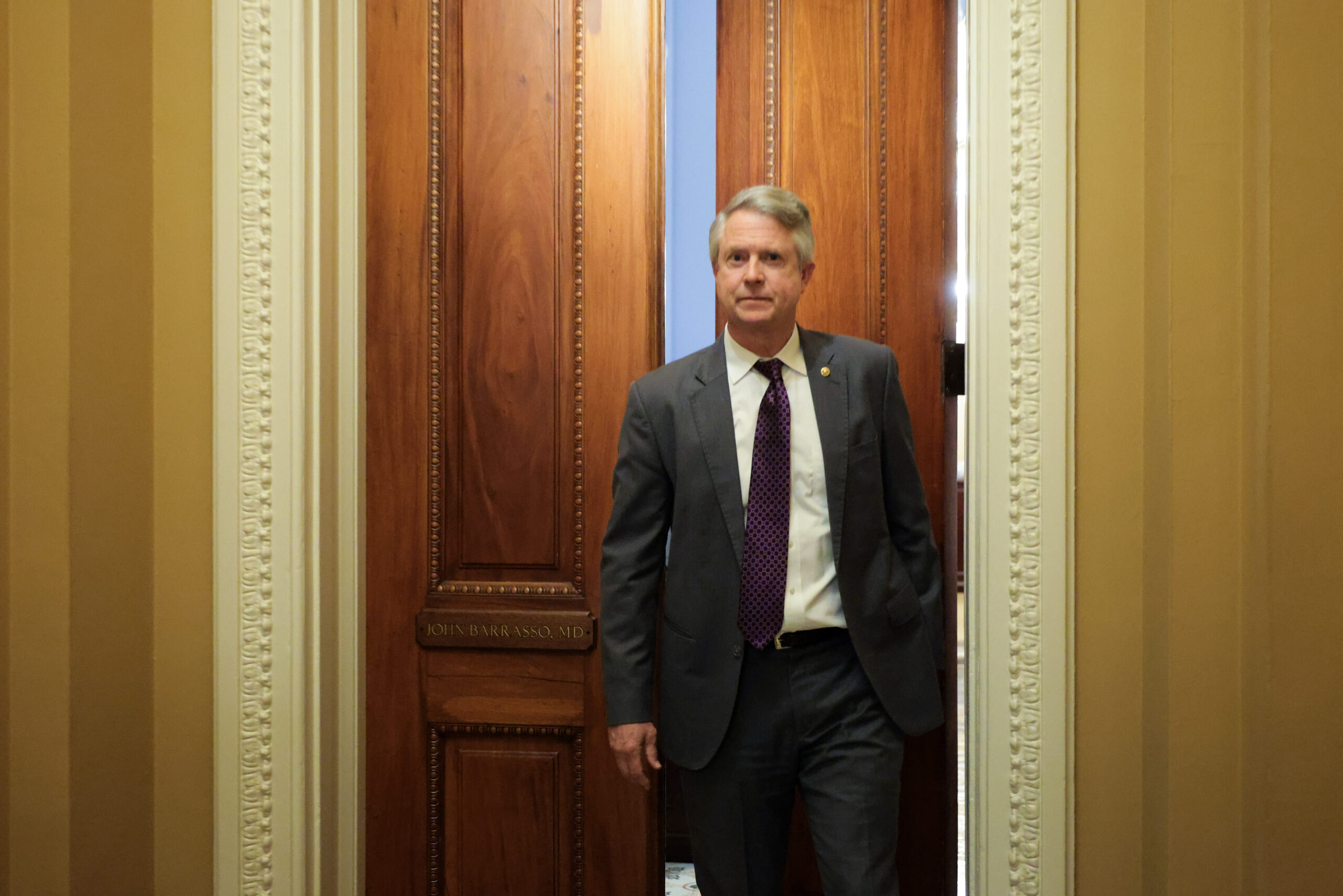
Sen. Roger Marshall (R-KS) said on Wednesday that Iran has to be “able to defend themselves,” suggesting the U.S. would “never” get a full surrender from Tehran, Jewish Insider’s Melissa Weiss reports. The Kansas Republican was responding to a question from CNN’s Kaitlan Collins, who asked Marshall if he was OK with Tehran having missiles.
In defense of defense: “I’m hesitating. I’d prefer that they not,” Marshall replied. “I certainly don’t want them to have long-distance missiles. I don’t want them to have nuclear-armed missiles. I would prefer they didn’t. But I don’t think that’s the key issue here. I think that they have to be able to defend themselves.” Collins interjected, asking, “You think Iran needs to be able to defend itself?” Marshall replied: “I do. I think they have to be able to defend themselves … Otherwise we turn this into a forever war. You’re never going to get them — short of boots on the ground — of surrendering everything, an unconditional agreement, if you will.”
BREAKING RANKS
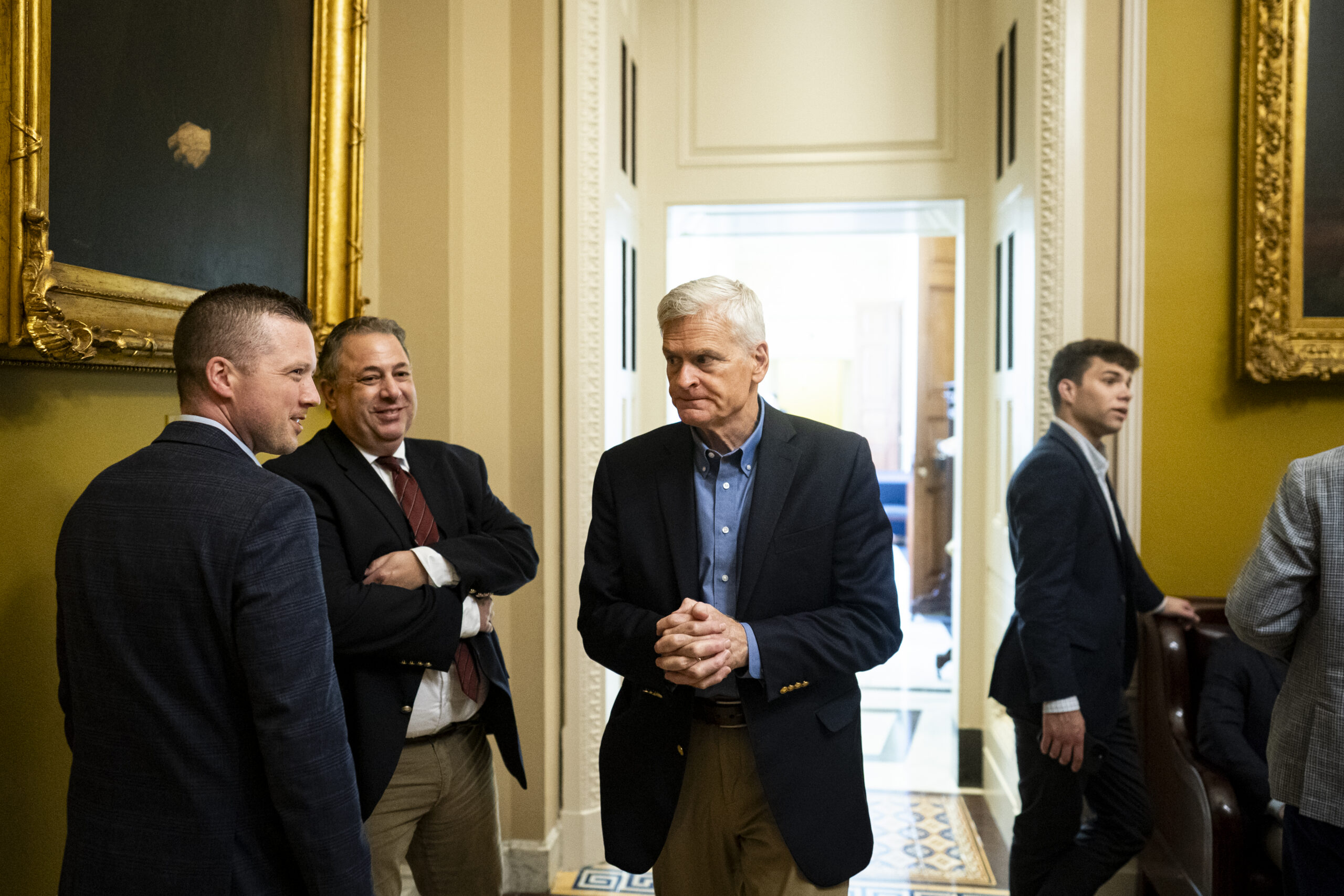
Some Senate Republicans are breaking with President Donald Trump over his handling of Iran, pushing back on the memorandum of understanding’s significant financial relief to the regime and Trump’s comments on Wednesday that he is willing to accept an Iranian ballistic missile program and some level of nuclear enrichment, Jewish Insider’s Marc Rod reports.
Notable quotable: “Reagan is rolling over in his grave,” retiring Sen. Bill Cassidy (R-LA) said on X. “This is the worst foreign policy blunder in decades.” Given that eliminating Iran’s nuclear enrichment and ballistic missile capacity were stated objectives of the war, “$100 billion and 13 lives later, I’ll need to understand that rationalization,” Sen. Thom Tillis (R-NC) told JI of Trump’s comments. Sen. Ted Cruz (R-TX) warned against giving Iran a financial windfall. “History teaches that giving billions of dollars to theocratic lunatics who want to murder us is not a good idea,” Cruz said. “I think the president is receiving some very poor advice on this deal.”
Read the full story here with additional comments from Sens. Rick Scott (R-FL), Pete Ricketts (R-NE), Mike Rounds (R-SD), Lindsey Graham (R-SC), Josh Hawley (R-MO), Roger Wicker (R-MS) and Richard Blumenthal (D-CT).
heat from haifa

Israeli national security expert Dan Schueftan said on Monday that President Donald Trump’s memorandum of understanding with Iran “proves nobody in the Western world is willing to fight. If we need to get permission from countries like Iran in order to use international waterways then we are in very deep trouble,” Jewish Insider’s Haley Cohen reports.
Standing solo: The one exception, according to Schueftan, is Israel, which he called the “only one power in the Middle East that can contain the radicals … the only real power in this region that is committed to fighting the radicals and will fight the radicals.” Schueftan, the chairman of the National Security Studies Center at the University of Haifa, made the comments while appearing on British journalist Jonathan Sacerdoti’s YouTube show.
WE THE PEOPLE?
As the U.S. approaches its 250th anniversary, American Jewish leaders have signed an open letter expressing gratitude to a nation “unlike so many others through Jewish history [that] did not merely tolerate Jewish life, but made possible its flourishing,” while also highlighting Jewish contributions to the country’s founding, Jewish Insider’s Haley Cohen reports.
What it says: “From the earliest days of the American experiment, Jews were drawn to the promise of a nation founded not on bloodline, monarchy, or established religion, but on liberty, covenant, and the dignity of the individual,” the letter reads. “Having known the weight of persecution and exclusion, Jews recognized in America’s founding ideals something rare in human history: the possibility of belonging without surrendering our identity.”
CLAYTON CONUNDRUM
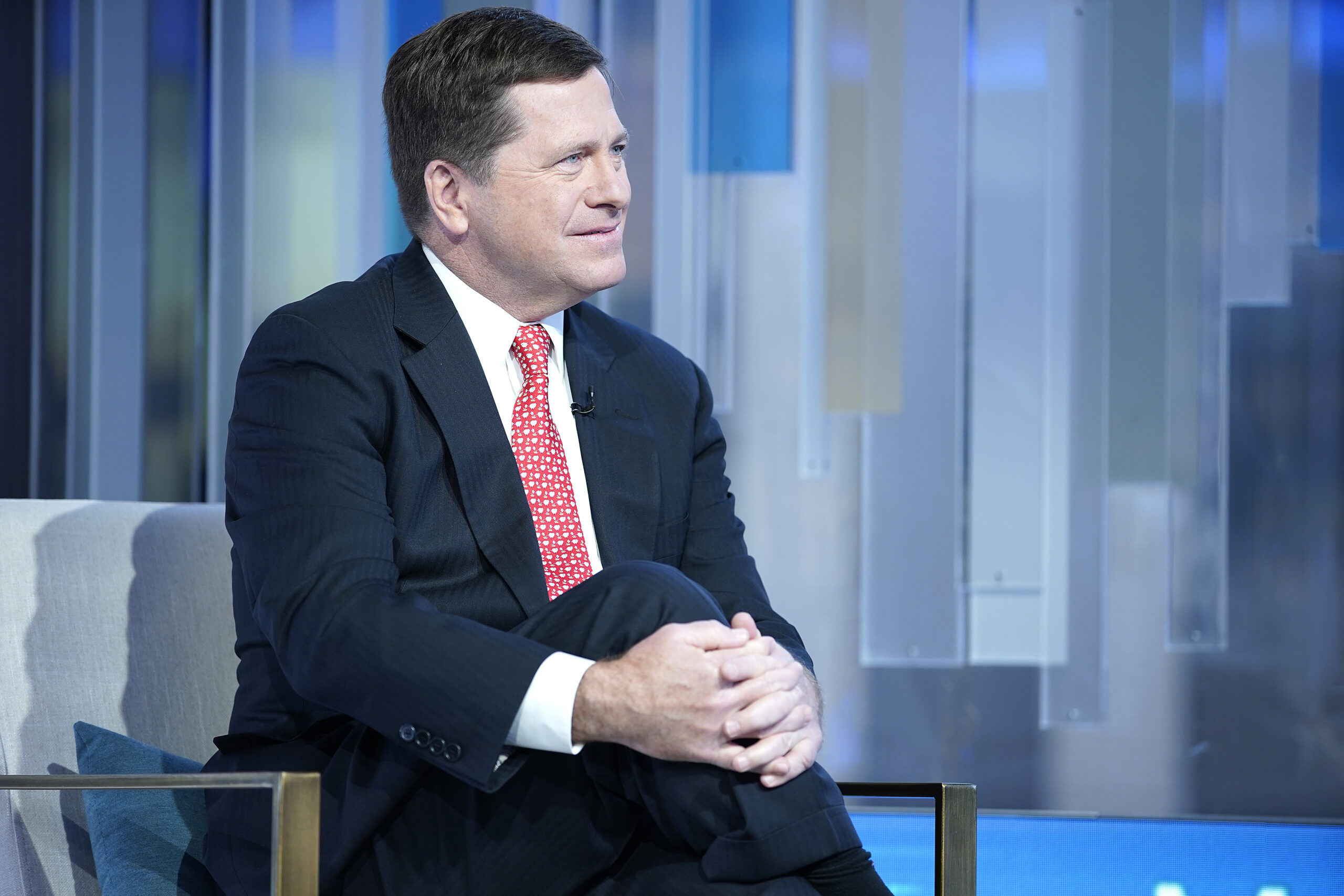
Lawmakers on both sides of the aisle are expressing frustration that President Donald Trump directed Jay Clayton, his nominee to be director of national intelligence, not to appear at a scheduled confirmation hearing on Wednesday afternoon, upending plans for the Senate to quickly confirm Clayton and renew lapsed federal surveillance authorities, Jewish Insider’s Marc Rod reports.
Chair’s concern: “It’s regrettable that the president has directed Jay Clayton not to appear at his confirmation hearing today,” Sen. Tom Cotton (R-AR), the chair of the Senate Intelligence Committee, said on X, announcing the hearing was postponed after initially indicating he planned for it to continue despite Trump’s objections. “Mr. Clayton is a patriot and a highly qualified nominee, as the president has said repeatedly. While today’s hearing is now unfortunately postponed, I look forward to proceeding with his confirmation in the near future.”
Read the full story here with additional comments from Sens. John Barrasso (R-WY), Thom Tillis (R-NC), Susan Collins (R-ME), Todd Young (R-IN), Mike Rounds (R-SD), Mark Warner (D-VA) and Senate Minority Leader Chuck Schumer (D-NY).
BEHIND THE CURTAIN
Abetting two recently established PACs spending millions to defeat two of New York City Mayor Zohran Mamdani’s candidates for Congress is a veteran politician who sought Gracie Mansion last year — former City Comptroller Scott Stringer, according to multiple sources with knowledge of the committees and their activities, Jewish Insider’s Will Bredderman reports.
Key force: Stringer declined to comment on the record for this story. But JI first reported in March that the Upper West Side Democrat was a key force behind a political committee, Next NYC PAC, committed to defeating the Democratic Socialists of America’s candidates for Assembly and state Senate. According to several individuals who spoke on the condition of anonymity to protect their relationships, the team behind the Progressive Unity Fund and Real Fight NYC PACs — which have released a wave of ads attacking activist Darializa Avila Chevalier and Assemblymember Claire Valdez, Mamdani’s candidates to defeat Rep. Adriano Espaillat (D-NY) and replace retiring Rep. Nydia Velazquez (D-NY), respectively — overlaps considerably with the personnel behind Next NYC PAC.
Worthy Reads
The Name of the Game: The Atlantic’s Shane Harris looks at the outsized role Qatar has played in the war with Iran and other conflicts, as it seeks to portray itself as a neutral interlocutor despite its stakes in regional conflicts. “Qatar’s regional rivals have long seen Doha as a political and financial enabler of Iran-backed extremism throughout the Middle East. Qatar characterizes its ties to Tehran as a relationship of necessity, based on geography and shared economic interests, but its neighbors see something far more cynical and sinister. What Doha calls neutrality in its foreign policy, they call hedging bets and buying influence, particularly through lobbying spending in Washington that is out of proportion for a country of only about 300,000 citizens.” [TheAtlantic]
Slipping Through My Fingers: The New York Times’ David French considers the missteps made by President Donald Trump and Israeli Prime Minister Benjamin Netanyahu in their handling of the war with Iran. “Prime Minister Benjamin Netanyahu of Israel had too much confidence in his ability to persuade Trump. For his part, Trump had too much confidence in his ability to bully Iran. And so it turned out that the ‘dumb presidents’ understood reality far better than Trump. There are no shortcuts. If you’re going to destroy your opponent, you’re going to have to use immense force. If you’re going to compromise with your opponent, it’s best not to lose a war (or blink in the face of adversity) as a prelude.” [NYTimes]
He Is Your Brother: The Financial Times’ Michael Stott, Andres Schipani and James Shotter look at the deepening relationship between Israel and India. “Once a leading light in the Non-Aligned Movement of developing nations, which resisted cold war superpower alliances, embraced the Palestinian cause and criticised Israel, India now leans much more closely towards the Jewish state. … Israel’s closeness to India is also viewed in the Middle East as part of a deepening alignment between both countries and the United Arab Emirates. Abu Dhabi is doubling down on its relations with Israel and India, while Saudi Arabia has become more closely aligned with Pakistan, signing a defence pact with Islamabad last year.” [FT]
When All Is Said and Done: The Wall Street Journal’s Sadanand Dhume posits that Pakistan, which served as a mediator between Washington and Tehran, has emerged from the U.S.-Iran talks with greater global standing. “Other countries may end up studying Pakistan’s playbook to understand how to cozy up to the White House. For Islamabad, the benefits are obvious. Mr. Trump has repeatedly praised Pakistan’s leaders in public — he refers to the country’s de facto ruler, army chief Asim Munir, as his “favorite field marshal.” And the U.S.-Iran talks held in Islamabad in April gave Pakistan a rare opportunity to bask in favorable international media coverage.” [WSJ]
Word on the Street
Blackstone CEO Stephen Schwarzman and JPMorgan Chase CEO Jamie Dimon were among the high-profile invitees at a dinner in France on Wednesday during which President Donald Trump signed the memorandum of understanding between the U.S. and Iran…
At a markup on Wednesday, the Senate Foreign Relations Committee approved the Eastern Mediterranean Gateway Act, to promote the IMEC corridor and other security and economic partnerships in the Eastern Mediterranean; a bill repealing additional sanctions on Syria; a bill to promote Iranian internet access and address human rights abuses; and legislation requiring the administration to assess whether both sides of the Sudanese civil war meet the conditions for designation as terrorist groups…
The Department of Health and Human Services’ Office for Civil Rights is investigating the American Psychological Association following complaints from Jewish and Israeli members over the association’s handling — and in some cases promotion — of anti-Israel activism by some members in its affinity groups; read JI’s deep dive into the APA’s challenges to confront antisemitism in its ranks here…
A new bill introduced by the House Abraham Accords Caucus instructs the administration to work to expand the Abraham Accords to include nations in Central Asia and the South Caucasus, Jewish Insider’s Marc Rod reports…
Sen. Ruben Gallego (D-AZ) grilled a Trump administration nominee on Wednesday at a Senate Homeland Security and Governmental Affairs Committee about a seemingly antisemitic cover and article published by a student newspaper under his leadership in college. Also during the hearing, Cameron Hamilton, the nominee to be the FEMA administrator, said he plans to offer recommendations on reforms and additional funding for the NSGP in his first 30 days in office, Jewish Insider’s Marc Rod reports…
Sen. Rick Scott (R-FL) wrote a letter to IRS CEO Frank Bisignano calling on the Trump administration to rescind CodePink’s 501(c)(3) status over the far-left activist group’s connections to China…
Sen. Chris Van Hollen (D-MD), said in a NOTUS podcast released on Thursday that he was “kicking the tires” on a possible 2028 presidential run…
The New York Times looks at the degree to which the Israeli-Palestinian conflict has become an “inescapable issue” in the Democratic primary between Rep. Dan Goldman (D-NY) and former New York City Comptroller Brad Lander in New York’s 10th Congressional District…
The Wall Street Journal spotlights the Democratic primary in Florida’s redrawn 20th District, a majority-minority district that favors the Democrats, where longtime Rep. Debbie Wasserman Schultz (D-FL) is mounting a bid amid opposition from local Black leaders who have thus far failed to coalesce around a single candidate that could win a primary against the former DNC chair…
A former chair of Michigan’s Democratic Party said that five of the eight individuals indicted by federal prosecutors last week on charges of intimidating University of Michigan officials seen as being pro-Israel were members of the party, and called for the party’s leadership to investigate their actions…
Israeli-British designer Ron Arad was appointed a Commander of the Order of the British Empire, an honor given in recognition of contributions to British society and culture…
Qatar’s sovereign wealth fund, a major shareholder in Volkswagen, is complicating talks between the German automaker and the Israeli state-owned defense company Rafael over Rafael’s intention to buy a plant from Volkswagen to manufacture components for Israel’s Iron Dome missile-defense systems…
A new report from Germany’s Federal Association of Departments for Research and Information on Antisemitism found more than 8,700 reported cases of antisemitism in the country in 2025, roughly equivalent to the number of reported instances the prior year…
Thani Al Zeyoudi, the United Arab Emirates’ minister of foreign trade, said that the Gulf state was “moving toward having zero Hormuz dependency” even after the waterway is fully reopened, as it plans to expand its existing ports, build at least one new one and further develop its rail and road networks…
Israeli Foreign Minister Gideon Sa’ar said he was severing “all contact” with the E.U.’s Kaja Kallas over her recent comments comparing the situation in the West Bank to apartheid South Africa…
Somaliland Defense Minister Mohamed Yusuf Ali, who traveled to Israel this week with the African nation’s president, dismissed reports that Israel has a base in Somaliland, but said that Israel was training the country’s police and military forces…
Austin-based tech entrepreneur Joshua Baer, 50, was killed in a plane crash near Laredo, Texas…
Italian author Carlo Ginzburg died at 87…
Pic of the Day
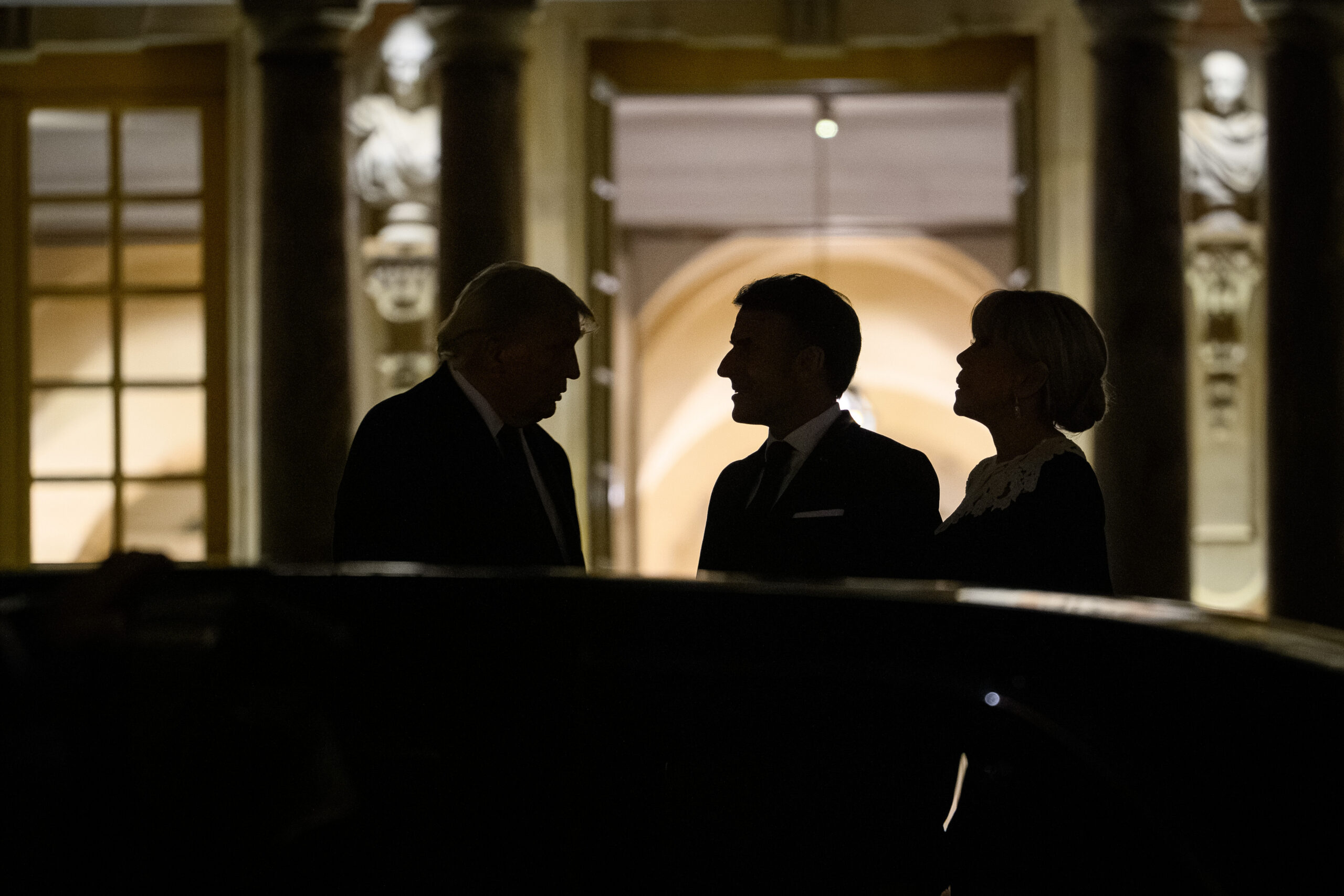
French President Emmanuel Macron and his wife, Brigitte, accompanied President Donald Trump as he departed following a dinner held at the Château de Versailles on Wednesday, where Trump signed the memorandum of understanding with Iran.
Birthdays

Former music business mogul, he previously owned multiple record labels and represented musical artists including Justin Bieber and Ariana Grande, Scott Samuel “Scooter” Braun turns 45…
Chicago-based attorney, he is the first ordained rabbi to have served as an alderman on the Chicago City Council, Solomon Gutstein turns 92… Former Washington Post editor, reporter and London bureau chief, Fred Barbash turns 81… Retired IT management advisor at Next Stage, Steven Shlomo Nezer… Croatian entrepreneur, he was previously the minister of economy, labour and entrepreneurship in the Croatian government, Davor Stern turns 79… Rebecca Diamond… Best-selling author and journalist, she was editor-in-chief of USA Today, Joanne Lipman turns 65… Retired professor of English at Southwestern University in Georgetown, Texas, she was on the editorial board of Shofar, a peer-reviewed academic journal of Jewish studies, Helene Meyers… Executive of the William Pears Group, a large U.K. real estate firm founded by his father and grandfather, Sir Trevor Steven Pears (family name was Schleicher) turns 62… White House senior aide during the first Trump administration, he is a principal of Cordish Companies, a real estate and gaming empire, Reed Saunders Cordish turns 52… Film director and screenwriter, Jonathan A. Levine turns 50… Actor, comedian, satirist and writer, known professionally as Ben Gleib, Ben Nathan Gleiberman turns 48… Television producer and writer, Jeremy Bronson turns 46… Baseball pitcher for Team Israel at the 2020 Summer Olympics, he is now assistant general manager of the Arizona Diamondbacks, Jeremy Bleich turns 39… Of counsel at Gibson, Dunn & Crutcher, Esther Lifshitz… Israeli musician, producer, singer, songwriter and multi-instrumentalist, known by his stage name Dennis Lloyd, Nir Tibor turns 33… Director at Silver Point Capital, Jacob E. Best… Rachel Hazan…
Some GOP legislators swiftly moved to tie Vance to the MOU — hours after it was announced
Roy Rochlin/Getty Images
Vice President JD Vance
Vice President JD Vance is increasingly becoming the face of Washington’s negotiations with Iran — setting him up to claim victory if the agreement is successful, or to take the fall if talks with the historically intransigent adversary collapse.
President Donald Trump said as much yesterday in France: “If it works out, I’m going to take the credit. If it doesn’t work out, I’m blaming JD,” Trump quipped on the sidelines of the G7 summit, hours before signing the agreement alongside French President Emmanuel Macron in Versailles.
Trump is far from the only Republican in Washington to tie Vance to the deal. Some GOP legislators swiftly moved to tie Vance to the MOU — hours after it was announced. Sen. Lindsey Graham (R-SC), who has long advocated for military pressure against Iran, was one of the first, saying Sunday that it was “imperative that the architect of the deal, Vice President Vance and his negotiating partners, be part of the process in presenting the final deal to Congress.”
But the pressure on Vance quickly has spread through the party. On Wednesday, Sen. Josh Hawley (R-MO), a longtime backer of the president who is largely aligned with the GOP’s isolationist wing (where Vance has also found his political home), told reporters, “I wish the VP all the best of luck.” Sen. Ted Cruz (R-TX), without mentioning Vance by name, said that in moving forward with the MOU, “the president, unfortunately, is receiving bad advice once again.”
The criticism of Vance over the agreement with Iran extends beyond the capital. Conservative commentator Ben Shapiro said on Fox News on Wednesday that the MOU “appears to be, just from the text, a disaster that does not achieve any of the actual signal goals that were set by the administration at the beginning.” Directly addressing Vance’s role, Shapiro said, “The vice president of the United States, the chief negotiator on this particular project, has not well served the president.” Read more here on Shapiro’s comments.
Vance’s high-profile presence around the Iran negotiations draws attention to other senior members of the Trump administration — including Secretary of State Marco Rubio and Defense Secretary Pete Hegseth — who have been notably absent from the White House’s public efforts to talk up the MOU.
Axios reported earlier this week that Rubio and Hegseth — who during the course of the war with Iran had often been front and center explaining the administration’s policies and actions — had opposed the MOU, while Vance, White House Special Envoy Steve Witkoff and Jared Kushner backed the agreement.
Rubio, who has long taken a more hawkish approach to foreign policy — not just on Iran, but also on China, Russia, Cuba and other U.S. adversaries — was on hand this week at the G7. Rubio has been in France this week with Trump and was at his side when the president signed the agreement, but has largely avoided publicly commenting on the deal and its contours.
Iran has long boasted of its ability to drag out negotiations, betting (usually correctly) that it can take the economic hits and outlast the West. It may well be that Vance, who worked in venture capital and had not yet entered politics during the Obama administration’s yearslong talks that led to the 2015 Joint Comprehensive Plan of Action, is less familiar with Iran’s intransigence and ability to slow-walk diplomacy.
After the midterms — now less than five months away — attention will shift to 2028. By then, if the administration’s timeline holds, a deal with Iran will either have been struck or will have collapsed. For Vance, who along with Rubio is expected to make a White House bid in two years’ time, the failure to bring about a resolution with Iran could become a major liability in the 2028 GOP primary.
The Kansas Republican made the comments after President Donald Trump said it would be ‘a little bit unfair’ for Iran not to have ballistic missiles

Kayla Bartkowski/Getty Images
Sen. Roger Marshall (R-KS) leaves the Senate Majority Whip John Barrasso's (R-WY) office during a Senate "vote-a-rama" on February 20, 2025 in Washington, DC.
Sen. Roger Marshall (R-KS) said on Wednesday that Iran has to be “able to defend themselves,” suggesting the U.S. would “never” get a full surrender from Tehran.
The Kansas Republican was responding to a question from CNN’s Kaitlan Collins, who asked Marshall if he was OK with Tehran having missiles.
“I’m hesitating. I’d prefer that they not,” Marshall replied. “I certainly don’t want them to have long-distance missiles. I don’t want them to have nuclear-armed missiles. I would prefer they didn’t. But I don’t think that’s the key issue here. I think that they have to be able to defend themselves.”
Collins interjected, asking, “You think Iran needs to be able to defend itself?”
“I do. I think they have to be able to defend themselves,” Marshall replied. “Otherwise we turn this into a forever war. You’re never going to get them — short of boots on the ground — of surrendering everything, an unconditional agreement, if you will.”
The comments from the senator, who has in recent years been an outlier in his party over his defense of Qatar, came shortly after President Donald Trump said in France that it would be “OK” for Iran to retain some of its ballistic missile capabilities. “If other countries have them, it’s a little bit unfair for them not to have some,” the president said on the sidelines of the G7 summit.
Dan Schueftan said that the agreement has surpassed Obama’s ‘high bar’ for bad diplomatic deals with Iran — undermining Israel and emboldening its enemies in the process

ATTA KENARE / AFP via Getty Images
Explosions erupt following strikes at Tehran Oil Refinery in Tehran on March 7, 2026.
Israeli national security expert Dan Schueftan said on Monday that President Donald Trump’s memorandum of understanding with Iran “proves nobody in the Western world is willing to fight. If we need to get permission from countries like Iran in order to use international waterways then we are in very deep trouble.”
The one exception, according to Schueftan, is Israel, which he called the “only one power in the Middle East that can contain the radicals … the only real power in this region that is committed to fighting the radicals and will fight the radicals.”
Schueftan, the chairman of the National Security Studies Center at the University of Haifa, made the comments while appearing on British journalist Jonathan Sacerdoti’s YouTube show.
Trump “built up the spirit of Hamas, Hezbollah, the Iranians, the Houthis,” Schueftan asserted. The president’s proposal that the terrorist groups disarm was “ridiculous,” continued Schueftan, who said the agreement with Iran has surpassed former President Barack Obama’s “high bar” for bad diplomatic deals with Iran — undermining Israel and emboldening its enemies in the process.
Schueftan’s comments came shortly after the U.S. and Iran reached a tentative agreement to end the recent fighting and enter into talks. The White House shared in a call with reporters on Wednesday the official text of the memorandum of understanding, to establish a ceasefire with Iran, permanently end Israel’s war against Hezbollah in Lebanon, reopen the Strait of Hormuz while ending the U.S. naval blockade and kickstart a 60-day negotiation period on the future of Iran’s nuclear program and the possibility of lifting U.S. sanctions on Tehran.
On Wednesday morning, Trump said that the U.S. would resume military activity against Iran if he did not like the MOU.
The deal could lead to confrontation between Israel and the U.S., Schueftan said. “If Israel responds in Lebanon, we have a major problem with the president of the United States,” he said.
“I don’t believe this will remain because Israel cannot afford tension with the only friend it has on the international arena … this is the worst that can happen from an Israeli point of view,” he continued. “But it will not stop Israel from doing what is vital for the existence of Israel.”
Schueftan further asserted that Trump betrayed and “abandoned” the Iranian people by failing to deliver on his promise that “help is on the way.”
“Israel will survive it, but they were reduced,” Schueftan said. He noted achievements in destroying Iran’s nuclear capabilities over the past year and policies adopted after Hamas’ Oct. 7, 2023, terrorist attacks.
At the same time, he said, “the challenge now is more serious, therefore Israeli actions will have to be more serious, and I don’t believe Trump will go as far as trying to break Israel.”
From an American perspective, Schueftan continued, such a move would be a strategic error; the U.S., he said, needs to shift its focus away from the Middle East and toward countering China. “Israel should be in a position where it can substitute the United States. When the U.S. leaves the Middle East, you can’t leave the Middle East alone,” said Schueftan.
The conservative commentator said Vance has not served the president well in his most direct criticism of the VP’s job performance
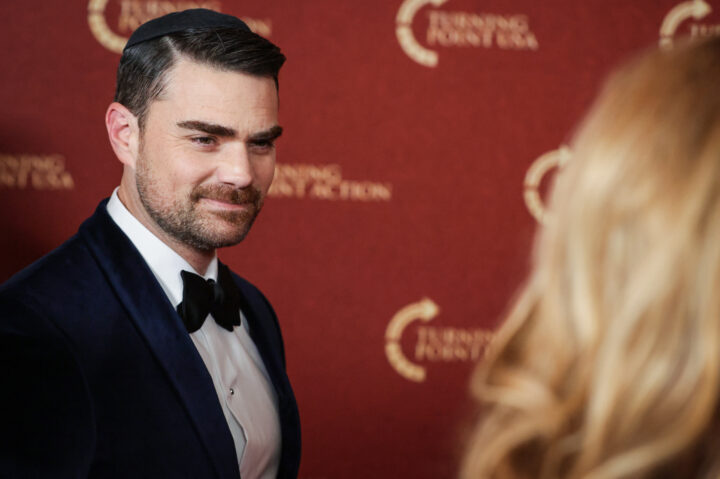
Samuel Corum/Getty Images
Ben Shapiro walks the red carpet at the Turning Point USA Inaugural-Eve Ball at the Salamander Hotel on January 19, 2025 in Washington, DC.
Conservative commentator Ben Shapiro criticized Vice President JD Vance on Wednesday, arguing that Vance’s support for the memorandum of understanding between the U.S. and Iran suggested that he was not serving President Donald Trump well.
Shapiro made the comments, which mark his most direct criticism to date of Vance’s approach to Iran, to Fox News’ “The Story with Martha MacCallum”while offering a harsh assessment of the MOU in the hours after the Trump administration released the text of the agreement. He described the deal as “a disaster” and called out the vice president for his role in leading this particular diplomatic effort.
“The president deciding to go into Iran and to hit nuclear facilities in Operation Midnight Hammer and then to go after Iran’s ballistic missile facilities and nuclear facilities, army, navy and air force in this current operation was the signal act of political bravery perhaps of my lifetime,” Shapiro said.
“With that said, this MOU appears to be, just from the text, a disaster that does not achieve any of the actual signal goals that were set by the administration at the beginning,” he continued. “In my opinion, the vice president of the United States, the chief negotiator on this particular project, has not well served the president.”
On his latest podcast episode on Wednesday, Shapiro praised Vance for his appearance on ABC’s “The View” and described him as an “undeniably talented politician,” though he questioned Vance’s decision to appear on Megyn Kelly’s show “to make overtures to Tucker Carlson.”
“Megyn Kelly is a person who has said that the Israelis manipulated the administration into war, who has laughed along to the proposition that the Republican Party is a bunch of Israel-loving pedophiles,” Shapiro said. “This is where the vice president chose to retail the argument.”
Shapiro also disputed Vance’s assertion to Kelly that opponents of the MOU were “promoting endless conflict” in the region. “They don’t have an alternative. If your alternative is just to drop bombs without any clear goal or any clear American interest implicated, then you’re not making wise decisions on behalf of the American people,” Vance said.
“An entire field of strawmen is now burning because this is what we colloquially call a lie. This is a lie,” Shapiro said. “An endless conflict would be, say, a 47-year conflict with an intransigent radical Islamist enemy that wants to destroy America.”
“Some of us have been calling for the president to end this war quickly, like from the beginning,” he continued. “I’ve been saying for literally months that instead of signing onto a useless ceasefire, that we ought to take or bomb Kharg Island, open the Straits with operations like Project Freedom, which the president announced and then unannounced, and then leave overwatch to our allies like Israel and the UAE. That is not an endless war.”
Shapiro went on to detail his objections to the MOU itself in his Fox appearance, arguing that the text of the deal did not address several major sticking points that led to the U.S. launching the war in the first place.
“There were effectively five goals that were set by the administration at the beginning. One was ending the nuclear program, not just nuclear weapons, no nuclear enrichment, zero enrichment. That is not in the deal. Ballistic missiles ended, that is not in the deal,” Shapiro said. “Then you have the support of terrorism, that is not part of the deal, anything that looks like an attempt to end terrorism.”
“A permanent opening of the Strait of Hormuz toll free, not only is that not in the deal, the deal appears to have a provision allowing Iran and Oman to attempt to toll the Straits after 60 days,” he added. “Then finally, the idea that Iran would receive some sort of sanctions relief after all of those things happened. We are already seeing, from day one, relief in their ability to ship oil out of Iran.”
Shapiro expressed bewilderment at Trump’s comments earlier Wednesday suggesting that the U.S. would not forbid Iran from possessing ballistic missiles and downplaying the threat of the regime continuing to have those weapons — despite it being a key goal in entering the conflict. He also responded to Trump’s criticism of Israel’s conduct in its war against Hezbollah, defending the Israelis and pointing to previous statements by the president in support of Israel’s war aims.
“The president today suggested that ballistic missiles should actually continue to be held by the Iranians because the Saudis, our allies, also hold ballistic missiles,” Shapiro said. “The fact is that the president himself has suggested that Israel has a right to defend itself. Ambassador [Mike] Huckabee, our ambassador to Israel, has said that Israel has a right to defend itself. Hezbollah is a terrorist group. It’s not the government of Lebanon, and in fact is opposed to the government of Lebanon. They’ve been firing ordnance over the border at Israel for literally years at this point.”
“The idea that Israel should be held back from defending itself against a terror group that is a proxy army of Iran, because we have some sort of deal over the Strait of Hormuz, is a massive tactical blunder that gives Iran one of the things that Iran actually wants, which is to reconstitute its forward operating base in Lebanon,” he continued. “Anything that allows them to reconstitute their terror army would be a huge regional mistake.”
Sen. Ted Cruz (R-TX) offered a similar take on Wednesday, arguing that Trump was given “some very poor advice on this deal” while declining to go after the vice president by name.
“Giving billions of dollars to theocratic lunatics who want to murder us is not a good idea. Setting up Iran to be in charge of the Strait of Hormuz in perpetuity, and to charge tolls is not in America’s interest, in my view. The Ayatollah should not reap a single penny from the free transit of the seas,” Cruz told reporters. “I think the president, unfortunately, is receiving bad advice once again.”
Asked if he believes the president should not sign the MOU and abandon peace talks, the Texas senator replied: “That’s a decision he’s going to have to make.”
Donald Trump Jr., the president’s son and one of Vance’s closest allies outside the White House, went on to attack Cruz on social media for his criticisms of the agreement.
Trump Jr. accused Cruz of “lying thru [sic] his teeth about the deal,” claiming in a post on X that the U.S. is “not giving them [Iran] a cent and he [Cruz] knows that.” He then alleged Cruz was “using fake news about the peace deal to undermine” the president, which he described as “the opposite of MAGA.”
According to the text of the MOU released on Wednesday, however, the U.S. “undertakes to develop a definitive, mutually agreed reconstruction and economic development plan for the Islamic Republic of Iran valued at a minimum of $300 billion (USD).”
The deal also includes language terminating “all sanctions against the Islamic Republic of Iran — including UN Security Council resolutions, IAEA Board of Governors resolutions, and all unilateral U.S. primary and secondary sanctions.”
Plus, Qatar complicates Israel-VW deal
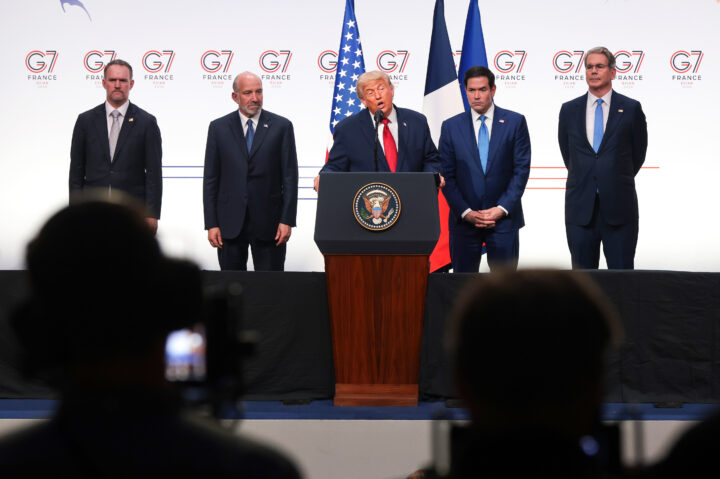
Photo by Anna Moneymaker/Getty Images
U.S. President Donald Trump is joined by (L-R) U.S. Trade Representative Jamieson Greer, U.S. Commerce Secretary Howard Lutnick, U.S. Secretary of State Marco Rubio and U.S. Treasury Secretary Scott Bessent as he speaks at a press conference during the G7 Leaders' Summit on June 17, 2026 in Evian-les-Bains, France.
Good Wednesday afternoon.
This P.M. briefing is reserved for our premium subscribers like you — offering a forward-focused read on what we’re tracking now and what’s coming next.
Today’s Daily Overtime was curated by Senior National Correspondent Gabby Deutch.
📡On Our Radar
Notable developments and interesting tidbits we’re tracking
After days in which President Donald Trump, Vice President JD Vance and other senior officials boosted the U.S.-Iran memorandum of understanding — and amid calls from Capitol Hill and beyond to make public the agreement’s details — the White House on Wednesday shared the text of the document that the Trump administration said will end the war against Tehran. Jewish Insider’s Emily Jacobs obtained the text of the MOU, which was read aloud to reporters during a call with a senior administration official.
The MOU states that the two nations “and their respective allies in the current war” will permanently end military operations — including against Lebanon, a stipulation that suggests the deal is meant to suspend Israel’s retaliatory strikes against Hezbollah, a provision for which Israel has not yet expressed approval. Iran “reaffirms” in the MOU that it will not “procure or develop nuclear weapons”…
The MOU text also reveals that the U.S. plans to issue a sanctions waiver to Iran so that it can sell oil, a major policy shift away from Trump’s use of sanctions against Iran. If a final deal is reached, the U.S. committed to ending all sanctions on Iran. Trump said earlier in the day at the G7 summit in France that the U.S. will not invest in Iran but would not stop other countries from doing so, JI’s Matthew Shea reports.
One new piece of information Trump shared on Wednesday that was not directly addressed in the MOU: a nuclear deal between Washington and Tehran would not prohibit the Iranians from possessing ballistic missiles, JI’s Matthew Shea reports. “I mean, they have to have some, because other people have some … It doesn’t work that way. And missiles aren’t the problem,” Trump said at the G7.
The agreement does not address Iran’s ballistic missiles or support for terrorist proxies. At the beginning of the war, the Trump administration said eliminating the ballistic missile threat from Iran was a key war aim…
The MOU asserts that a final deal will be negotiated within 60 days, unless both countries agree to extend the deadline. Iran’s naval blockade on the Strait of Hormuz must be lifted within 30 days.
When talking to reporters after landing in Paris this afternoon, Trump said he does not view the 60-day deadline as a hard deadline. “Just as long as they’re behaving, I really don’t care that much,” Trump said.
Vance, not Trump, will be signing the MOU in Switzerland on Friday. “This way if it works out, I’m going to take the credit. If it doesn’t work out, I’m blaming JD,” Trump said during the G7…
Some Republican senators criticized the MOU, with retiring Sen. Bill Cassidy (R-LA) calling it “the worst foreign policy blunder in decades,” JI’s Marc Rod reports…
Dario Amodei and Sam Altman, the CEOs, respectively, of Anthropic and OpenAI, joined Trump and the other G7 leaders for lunch on Wednesday, along with Salesforce CEO Marc Benioff and Google DeepMind CEO Demis Hassabis…
The planned Senate confirmation hearing for Jay Clayton, Trump’s nominee to serve as director of national intelligence, was scuttled on Wednesday morning after a last-minute Truth Social post from the president saying that the hearing would be canceled, prompting frustration from both Republican and Democratic lawmakers, JI’s Marc Rod reports…
As a major shareholder in Volkswagen, Qatar’s sovereign wealth fund is complicating talks between the German automaker and the Israeli state-owned defense company Rafael over Rafael’s intention to buy a plant from Volkswagen to manufacture components for Israel’s Iron Dome missile-defense systems…
The anti-Israel advocacy group TrackAIPAC, which attacks lawmakers who have received support from pro-Israel groups and donors who have supported Israel-related causes, endorsed Rep. Ro Khanna (D-CA), who once was targeted by TrackAIPAC before moving sharply to the left on Israel in recent months…
After eight people were indicted last week for allegedly threatening University of Michigan leaders and their families as part of an anti-Israel pressure campaign, former Michigan Democratic Party Chair Lon Johnson called on the party’s current leadership to review the actions of five of the suspects who were members of the Michigan Democratic Party…
The Department of Health and Human Services’ Office for Civil Rights announced on Wednesday that it is opening an antisemitism investigation into the American Psychological Association, the nation’s largest professional organization for mental health professionals. JI’s Gabby Deutch reported on the APA’s handling of antisemitism last summer…
⏩ Tomorrow’s Agenda, Today
An early look at tomorrow’s storylines and schedule to keep you a step ahead
Keep an eye out in Jewish Insider for a look at how some of the country’s most prominent Jewish communal leaders are marking America’s 250th birthday this July Fourth.
Sen. Joni Ernst (R-IA) will be speaking in the morning at a fireside chat at the Hudson Institute focused on “diplomacy, defense and debt.”
We’ll be monitoring the results of Tuesday’s mayoral primary election in Washington, D.C., which still has not been called, even as Janeese Lewis George leads Kenyan McDuffie 53% to 37%, with 68% of the vote counted.
Stories You May Have Missed
Transferring responsibilities
The move marks a major step in the White House’s efforts to dismantle the Education Department and significantly reduce or distribute its work
TRUST ISSUES

Senators on both sides of the aisle say they’re eager to see the text of the agreement, but the administration has not yet made plans to brief Congress
Cassidy said the deal leaves Iran stronger and sanctions-free, while senators including Tillis, Cruz and Scott pushed back on Trump's acceptance of Iranian ballistic missiles
Photo by Al Drago/Getty Images)
Sen. Bill Cassidy (R-LA) departs a meeting with Senate Republicans in the U.S. Capitol on June 28, 2025 in Washington, DC.
Some Senate Republicans are breaking with President Donald Trump over his handling of Iran, pushing back on the memorandum of understanding’s significant financial relief to the regime and Trump’s comments on Wednesday that he is willing to accept an Iranian ballistic missile program and some level of nuclear enrichment.
“Reagan is rolling over in his grave,” retiring Sen. Bill Cassidy (R-LA) said on X. “Iran’s nuclear ambitions were not curbed, and they have learned that threatening the Strait of Hormuz works and will undoubtedly leverage it in the future. Now, Iran gets to build brand-new infrastructure under this deal.”
Cassidy recently voted in favor of war powers resolutions that aimed to prevent further combat operations in Iran. He’s retiring after being defeated by a Trump-backed primary challenger.
“Before the war, the Strait [of Hormuz] was open, Iran was being crushed by sanctions and 13 service members were still alive,” Cassidy said. “Now, 13 Americans are dead, families have paid billions at the pump, sanctions will be lifted, and the bombing has stopped. This is the worst foreign policy blunder in decades.”
He subsequently explained to reporters: “Iran went from having sanctions and now is having no sanctions. Hundreds of billions of dollars [are] being paid to it. Our allies are weaker. Our opponent is stronger. You say the strait’s open — the strait was open four months ago.”
Asked whether he thought the deal was worse than the Obama-era Joint Comprehensive Plan of Action, Cassidy responded, “I didn’t like the JCPOA the first time. I don’t like it the second time.”
While Cassidy was perhaps the most strident critic, numerous Republican senators also expressed their disagreement with Trump’s comments, the deal, or both.
Given that eliminating Iran’s nuclear enrichment and ballistic missile capacity were stated objectives of the war, “$100 billion and 13 lives later, I’ll need to understand that rationalization,” Sen. Thom Tillis (R-NC) told Jewish Insider of Trump’s comments.
He added later that the $300 billion reconstruction fund laid out in the MOU is “concerning,” though he called the deal preliminary and said he needed to see more details.
“I need to see it taken as a whole. I can’t be against it because I need to see the net. I need to see, have we accomplished what the president set out to accomplish?” Tillis continued. “If you remember, we were going to obliterate their military, we were going to take all of the uranium or any weapons grade uranium out of the country — we’re equivocating on that now. I just need to see what the new deal is now.”
He said that, given the costs of the war, “there needs to be some accountability for Iran. We can’t just walk out because we’re getting a bit skittish over the economic consequences of going to war to begin with.”
While Trump argued that Iran should be able to have ballistic missiles because others in the region do as well, Sen. Rick Scott (R-FL) said that the difference is that other countries in the region aren’t American adversaries.
“I would be fine [with them having missiles] if they didn’t want to kill Americans. I don’t care if Saudi Arabia has them, or if Israel has them because they don’t want to kill us,” Scott told JI. “But if somebody wants to kill me, I don’t want them to have a ballistic missile.”
Asked about the financial benefits Iran is set to receive under the deal, Scott said that he does not want any U.S. funding to support Iran, and that Iran should be paying the U.S. reparations instead.
“I’m not spending a dime for Iran. I want them to pay us for what we had to do,” Scott continued.
Sen. Ted Cruz (R-TX) warned against giving Iran a financial windfall, though he placed blame for the situation on those around the president, rather than Trump himself.
“History teaches that giving billions of dollars to theocratic lunatics who want to murder us is not a good idea,” Cruz said. “I think the President is receiving some very poor advice on this deal.”
Cruz said on his podcast that “if this deal is giving them $300 billion, that’s a mistake. I hope that is not the case.” But he also said that it is “absurd” to compare it to the JCPOA in light of the U.S. military action against Iran’s nuclear program.
“What I’m urging the president, what I’m saying to him, is don’t give away the victory. I don’t believe he’s doing so, I hope he’s not doing so, I hope his administration is not doing so,” Cruz said. “We have defeated their military, don’t suddenly come in with massive buckets of cash to let them rebuild and become a threat to America again.”
He added on X that the fact that Biden Iran Envoy Rob Malley supported the deal “may be the most serious criticism that can possibly be leveled against it.”
Sen. Pete Ricketts (R-NE) said that “it’s a bad idea to allow Iran to have a ballistic missile program,” though he said he was waiting to see what the text of the deal says on the issue of enrichment. Sen. Mike Rounds (R-SD) told JI, “I don’t feel the same way” as Trump on the missile and enrichment issues.
Sen. Lindsey Graham (R-SC), one of the most vocal supporters of the Iran war on Capitol Hill, offered his support for the MOU in a lengthy X post following a conversation with special envoy Steve Witkoff.
“It is my opinion that signing the MOU will be beneficial to the United States, in as much as the Strait of Hormuz will begin to open, and the hostilities with Iran will stop,” Graham said. “Whether or not the United States can reach an acceptable, verifiable deal with Iran regarding its nuclear program and other issues is yet to be determined, but I see little downside to trying.”
He added that the MOU would also be worthwhile as an “essential step” toward enabling the normalization of relations between Saudi Arabia and Israel, restoring economic stability and ending the war.
Despite that, Graham still broke with Trump on his comments on Iranian nuclear enrichment.
“I’m not OK with nuclear enrichment at all,” Graham said.
Sen. Josh Hawley (R-MO), who has been one of the most vocal GOP advocates for bringing the war to a close, said that he’s “glad the strait is reopening” and “glad that their nuclear program is under rubble and presumably will stay that way.”
“I don’t really want to give them any money,” Hawley continued. “I discourage that. I would not want to do that. But, let’s see what happens and I wish the VP all the best of luck.”
Sen. Roger Wicker (R-MS), the chairman of the Senate Armed Services Committee, told JI he would continue to withhold comment on Iran, the same response he’s been offering to reporters on the deal throughout the week.
On the Democratic side, Sen. Richard Blumenthal (D-CT) said that the deal constituted “unconditional surrender … by us, not by Iran,” referencing Trump’s demands earlier in the war.
“There seems to be no objective of this war that has been accomplished and in fact has emboldened Iran internally and strengthened their standing in the world community,” Blumenthal continued. “They’ve taken the best punch we could give them and they seem bolder than ever.”
He said that the financial benefits Iran is set to receive under the MOU “will enable them to support their malign proxies in the region, causing more instability and bloodshed.”
Blumenthal said that Iran’s objectives of “death to America and death to Israel … will only be advanced by this huge amount of money and additional freedom they have to sell their oil with lifting sanctions.”
Text of the 14-point MOU was read aloud to reporters on a phone call with a senior administration official
Daniel SLIM / AFP via Getty Images
The White House is seen in Washington, DC, on December 17, 2025.
The Trump administration on Wednesday shared with journalists the official text of the memorandum of understanding between the U.S. and Iran to establish a ceasefire with Iran, permanently end Israel’s war against Hezbollah in Lebanon, reopen the Strait of Hormuz while ending the U.S. naval blockade and kickstart a 60-day negotiation period on the future of Iran’s nuclear program and the possibility of lifting U.S. sanctions on Tehran.
The 14-point agreement was read aloud by a senior administration official on a call with reporters. The White House did not provide a written copy of the agreement after the readout.
Below is the agreement as delivered on the call:
The United States of America and the Islamic Republic of Iran, hereinafter referred to as the “Parties,” have jointly agreed in good faith on [Date] to the following:
Paragraph 1 – Cessation of Hostilities
The Parties and their respective allies in the current war, by signing this MOU, declare the immediate and permanent termination of all military operations on every front, including in Lebanon. The Parties undertake not to initiate any war or military operation against each other, to refrain from the threat or use of force against one another, and to respect the territorial integrity and sovereignty of Lebanon. The final deal will confirm the permanent termination of the war on all fronts, including Lebanon, and will incorporate the other provisions of this paragraph.
Paragraph 2 – Sovereignty and Non-Interference
The Parties undertake to respect each other’s sovereignty and territorial integrity and to refrain from interfering in each other’s internal affairs.
Paragraph 3 – Timeline for Final Deal
The Parties commit to negotiating and concluding the final deal within a maximum of 60 days, extendable only by mutual consent.
Paragraph 4 – Naval Blockade and Force Posture
Immediately upon signing this MOU, the United States shall begin removing its naval blockade and any other impediments or disturbances imposed on the Islamic Republic of Iran, and shall fully lift the naval blockade within 30 days. During this period, vessel traffic shall be progressively restored toward pre-war levels. The United States further undertakes to withdraw its forces from the proximity of the Islamic Republic of Iran within 30 days after the conclusion of the final deal.
Paragraph 5 – Strait of Hormuz and Maritime Security
Upon signing this MOU, the Islamic Republic of Iran shall, using its best efforts, arrange for the safe and free passage of commercial vessels through the Strait of Hormuz with no charge for a period of 60 days, in both directions (Persian Gulf to Sea of Oman and vice versa). Commercial vessel traffic shall resume immediately. Iran shall complete the necessary technical and military measures, including demining, within 30 days. The Islamic Republic of Iran will engage in dialogue with the Sultanate of Oman and other Persian Gulf littoral states to define future administration and maritime services in the Strait of Hormuz, in accordance with applicable international law and the sovereign rights of coastal states.
Paragraph 6 – Reconstruction and Economic Development
The United States, in coordination with regional partners, undertakes to develop a definitive, mutually agreed reconstruction and economic development plan for the Islamic Republic of Iran valued at a minimum of $300 billion (USD). The implementation mechanism for this plan shall be finalized as part of the final deal within 60 days. The United States shall grant all required licenses, waivers, and permissions necessary for the relevant financial transactions.
Paragraph 7 – Sanctions Termination
The United States undertakes to terminate all sanctions against the Islamic Republic of Iran — including UN Security Council resolutions, IAEA Board of Governors resolutions, and all unilateral U.S. primary and secondary sanctions — according to an agreed schedule to be included in the final deal. The Parties acknowledge the critical importance of the sanctions issue and express their intention to address it immediately in negotiations to reach mutual agreement.
Paragraph 8 – Nuclear Issues
The Islamic Republic of Iran reaffirms that it shall not procure or develop nuclear weapons. The Parties agree to resolve the disposition of Iran’s stockpiled enriched material through a mutually agreed mechanism, with the baseline method being on-site down-blending under IAEA supervision, in accordance with the sanctions-termination schedule in Paragraph 7. The Parties will also discuss Iran’s enrichment activities and other nuclear-related matters within a satisfactory framework to be agreed in the final deal. The final deal will confirm the provisions of this paragraph. The Parties acknowledge the critical importance of these nuclear issues and intend to address them immediately in negotiations.
Paragraph 9 – Status Quo Pending Final Deal
Pending the final deal, the Parties agree to maintain the status quo: the Islamic Republic of Iran will maintain the current status of its nuclear program, and the United States will not impose any new sanctions or deploy additional forces in the region.
Paragraph 10 – Oil Export Waivers
Immediately upon signing this MOU and until the termination of sanctions, the U.S. Department of the Treasury shall issue waivers authorizing the export of Iranian crude oil, petroleum products, derivatives, and all associated services (including banking, insurance, and transportation).
Paragraph 11 – Access to Frozen Funds and Assets
The United States shall make fully available all frozen or restricted Iranian funds and assets. Upon implementation of this MOU, the Parties will mutually agree on procedures for the release and use of these funds during negotiations. Such funds shall be usable for payments to any ultimate beneficiary designated by the Central Bank of the Islamic Republic of Iran. The United States shall issue all necessary licenses and authorizations to this end.
Paragraph 12 – Monitoring Mechanism
The Parties agree to establish an executive mechanism to monitor the implementation of this MOU and future compliance with the final deal.
Paragraph 13 – Sequencing of Negotiations
After signing this MOU, and subject to the commencement and continued implementation of Paragraphs 1, 4, 5, 10, and 11, the Parties shall begin negotiations on the remaining elements of the final deal.
Paragraph 14 – UN Security Council Endorsement
The final deal shall be endorsed by a binding United Nations Security Council resolution.
Speaking at the G7 summit in France, the president said he could not enforce the provision since other countries also ‘have some.’
Photo by Anna Moneymaker/Getty Images
U.S. President Donald Trump is joined by (L-R) U.S. Trade Representative Jamieson Greer, U.S. Commerce Secretary Howard Lutnick, U.S. Secretary of State Marco Rubio and U.S. Treasury Secretary Scott Bessent as he speaks at a press conference during the G7 Leaders' Summit on June 17, 2026 in Evian-les-Bains, France.
President Donald Trump on Wednesday said that the U.S. would not forbid Iran from possessing ballistic missiles, downplaying the threat despite it being a key war aim in the onset of the conflict. Speaking at the G7 summit in France, the president asserted that the majority of Iran’s missile capabilities have been destroyed and that he could not enforce the provision since other countries also “have some.”
Secretary of State Marco Rubio asserted in March that a key U.S. aim in the war would be “the destruction of Iran’s ballistic missile capabilities and their ability to manufacture them.”
“I mean, they have to have some, because other people have some … It doesn’t work that way. And missiles aren’t the problem,” Trump explained. “Missiles are, they hurt a little location, but they don’t blow up the planet.”
When asked whether it would be acceptable for the administration to allow Iran to keep its ballistic missiles, Trump argued that Tehran’s capacity has been significantly depleted over the course of the conflict.
“What are they keeping?” Trump responded. “We knocked out probably 84%-85% of their missiles. The rest are underground, they can’t even get them out. On the first night we knocked out hundreds of their missiles.”
Trump also asserted that Iran does not “want to be firing missiles right now,” noting that instead Tehran is likely focused on rebuilding what has been damaged during the war.
WATCH: When asked whether it would be acceptable for the administration to allow Iran to keep its ballistic missiles, Trump argued that their capacity has been significantly depleted over the course of the conflict.
— Jewish Insider (@jewishinsider) June 17, 2026
“What are they keeping?” Trump responded. “We knocked out… pic.twitter.com/Ysu5MfiZjt
The president also praised Israel as a “good partner” in the conflict and argued that the nuclear restrictions laid out in the U.S.’ agreement with Tehran are the ultimate victory for Jerusalem. According to Trump, if Iran were to acquire a nuclear weapon, “Israel would have been blown away.”
“Look, think of what Israel’s getting, they’re not going to be nuked, very simple,” Trump said. “I told [Israeli Prime Minister Benjamin Netanyahu], ‘Your biggest risk was that they [Iran] drop a nuclear weapon into the middle of Israel. They’d only need one, and there would be no more Israel. Think of it, Bibi, you got the best, the most important thing that you were asking for is that. So, I think they’re happy.”
Regarding the technical specifics of the deal, Trump stated that Iran has agreed to work with the U.S. to “turn over” its enriched material. He noted that while the material is secured “deep in the bowels of the earth” and monitored by cameras, technical discussions to remove the stockpiles would begin immediately. He insisted that, unlike the Obama administration’s implementation of the JCPOA, any relief Iran receives under this framework would be strictly “based on merit.”
Additionally, while Trump maintained that the U.S. did not enter the conflict seeking “regime change,” he argued that the war’s casualties effectively accomplished that by wiping out multiple tiers of Iranian leadership.
“They have a new group of leaders that I think is actually very smart, I think they’re far less radicalized, and I think they’re really good. They love their country,” Trump said. “You talk about regime change, nobody will say that, but … one set of leaders is all gone, the second set of leaders is all gone, their third set of leaders a little bit gone, but for the most part, I think that’s regime change.”
Trump also returned to vocalizing his frustrations with Israel’s military approach against Hezbollah in Lebanon.
“Israel, by the way, they’ve been a good partner again. I love them as a partner. They were terrific, but they could do a much better job with Hezbollah. On that, I don’t think they’re doing well, and I feel very bad for Lebanon,” Trump said. “I’m not saying they shouldn’t protect themselves. I’m saying, when two drones are shot into the desert and drop harmlessly, you don’t have to knock down buildings in Beirut. [Israel] could behave better, and frankly, they could do a better job.”
Trump characterized the ongoing conflict between Israel and Hezbollah as a “very small piece of the puzzle” compared to the agreement with Iran, though he said it “makes a lot of noise,” adding that he has urged Netanyahu to use a “softer touch” when conducting strikes.
“He happens to be a very good man. We’ve had an amazing partnership,” Trump said of Netanyahu. “We have a little dispute over Lebanon. I say you can do a little softer touch, maybe you don’t have to knock down a building every time somebody walks into it that’s from Hezbollah … but he will say we’re the big partner, he’s the very small partner, that’s true.”
The president contrasted the situation in Lebanon with what he described as major progress in the Gaza Strip, claiming that “Hamas has been very silent” as the U.S. attempts to disarm the group.
“Look at the job we’ve done in Gaza. Look at Hamas. Hamas has been very silent. You haven’t read anything about Hamas. We’re trying to get them unarmed,” Trump remarked. “They grew up with a machine gun in their hand … but they’ve actually behaved pretty well, considering this was not the lifestyle that they were taught to have.”
The president warned that the U.S. would resume military operations if Iran fails to ‘behave,’ and denied that the deal would automatically release billions in frozen Iranian assets
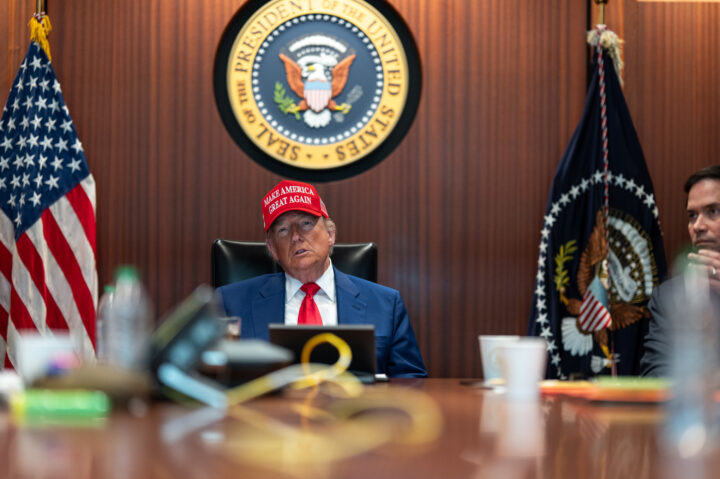
Daniel Torok/The White House via Getty Images
President Donald Trump and Secretary of State Marco Rubio (R) sit in the Situation Room as they monitor the mission that took out three Iranian nuclear enrichment sites, at the White House on June 21, 2025 in Washington, DC.
President Donald Trump said on Wednesday that the agreement reached between the U.S. and Iran earlier this week to end the conflict has not been finalized, warning that the U.S. would “go right back to dropping bombs” if he is dissatisfied with the final deal or if Iran fails to “behave.”
“No, it’s not final. It’s a memorandum of understanding, and if I don’t like it, we’ll go back to shooting at them, dropping bombs on their head,” Trump said during a bilateral meeting with Egyptian President Abdel Fattah el-Sissi on the sidelines of the G7 summit in Évian-les-Bains, France. “If I don’t like it, if they don’t behave, we’ll go right back to dropping bombs right smack in the middle of their head, because they have misbehaved for 47 years.”
Reports indicate that the memorandum of understanding announced this week could release $24 billion in Iranian frozen assets and provide $300 billion in reconstruction relief. Senior administration officials have stated that while the U.S. is open to these terms, they have denied reports that the funds would automatically be released, instead arguing that it would remain strictly conditioned on Iran fulfilling its obligations within the agreement.
WATCH: Trump warns he’ll go back to military operations if the Iran deal falls apart.
— Jewish Insider (@jewishinsider) June 17, 2026
“If I don’t like it, if they don’t behave, we’ll go right back to dropping bombs right smack in the middle of their head.”
Read the full story from @MatthewShea__: https://t.co/JXdeZk63DY pic.twitter.com/QRQCU3UQZe
When asked whether the money would be released, Trump stated: “That’s false.”
“That’s a false story that got picked up incorrectly,” he said.
The president also said that while the U.S. would not invest in Iran, Washington will not stop other countries from doing so.
“People can decide to do that, but that’s up to them. I would say they won’t be doing it for a while until they find out [whether Iran has changed] the behavior. It’s a behavior thing,” Trump said. “Do you want me to say that nobody’s ever allowed to invest in a country? We are not investing in it [Iran], we do not have a fund.”
Trump also touted U.S. military accomplishments, saying that Iran’s navy, military and air force have been “wiped out.” He argued that operations to guide and protect ships through the Strait of Hormuz have been successful and are keeping oil prices down.
“They have no anti-aircraft, they have no radar,” Trump said. “The reason oil stayed low is because we were taking ships out every night…We averaged 15 to 25 ships a night. Nobody knew that our navy did a great job, nobody knew that was happening. That’s why oil didn’t go to $300 million a barrel, it went to $125, $115, now it’s at $72-$73.”
The president also renewed his sharp criticism of the Joint Comprehensive Plan of Action, the nuclear deal signed with Iran in 2015 under former President Barack Obama. Trump argued that the fundamental flaw of that agreement was the transfer of cash to “bribe” the Iranian government.
“Nobody could have made this deal. The JCPOA done by Obama… he gave them $1.7 billion in green cash from banks into a Boeing 757 and flew it into Iran,” Trump said. “They [the Iranians] stood at the plane, I have pictures of it, like, ‘Oh my, look at this money he’s giving us.’ He [Obama] tried to bribe his way out. I didn’t do that… and you know what the Iranians did, they laughed at Obama and they said he’s a stupid son of a b****.”
Senators on both sides of the aisle say they’re eager to see the text of the agreement, but the administration has not yet made plans to brief Congress
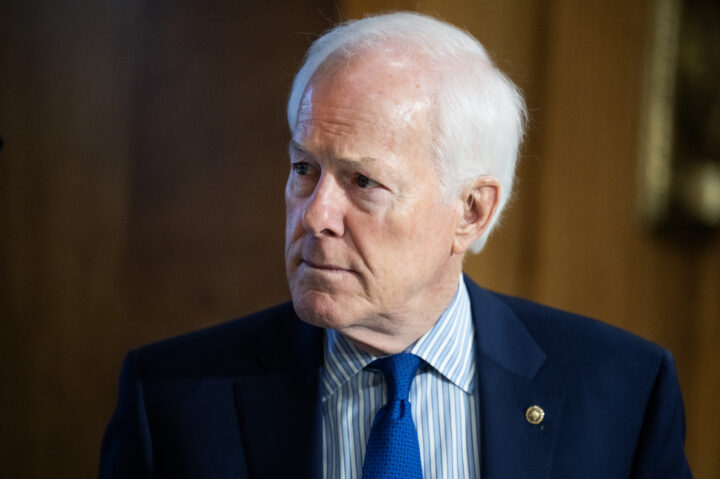
Tom Williams/CQ-Roll Call, Inc via Getty Images
Sen. John Cornyn (R-TX) attends the Senate Foreign Relations Committee hearing titled "Arms Control and Transforming International Security Functions at the State Department," in Dirksen building on Tuesday, March 24, 2026.
Republican senators said on Tuesday that they’re skeptical that Iran will hold to any commitments it has made or may make in negotiations with the U.S., and urged the administration to release the terms of the memorandum of understanding announced on Sunday.
The administration has not yet communicated any specific plans to brief Congress on the deal.
“Rather than an end to the activities in Iran, I think it’s more of an intermission,” Sen. John Cornyn (R-TX) told reporters. “We still haven’t seen what the documents look like, and regardless of what they look like, I don’t think you can trust the Iranian regime.”
Cornyn added, “I need to see the writing — I need to see the print. But I don’t believe that the regime will abide by it.”
Sen. Thom Tillis (R-NC) emphasized that the U.S. has been in similar positions with Iran before, and that they have not resulted in a viable long-term agreement. He told Jewish Insider that he thinks it’s “generous to call it a deal, it sounds like it’s a deal in progress … and if we’re making progress, that’s good.”
But he said that it’s hard for him to assess an agreement “that we only get described in broad strokes.”
He said he would also be uncomfortable with any arrangement that provided Iran with a financial windfall. Multiple outlets reported Tuesday afternoon that the MOU includes financial incentives for Iran, including lifting various sanctions.
“I’m worried only because at least some of our decisions seem to be affected by the short-term economic impact [of the war], and that’s not a good decision,” Tillis said. “Talking about some of the money that Iran’s going to start receiving. … If all of the sudden we’re pulling back some of the things that were in place even before the operation, I’ve got a real concern because they’re a totalitarian regime.”
He told JI that the U.S.’s current posture and negotiations with Iran make it appear that “we’re willing to accept a totalitarian regime, and so the question is, how does this agreement match up against the original objectives of this initiative” as laid out by the administration at the beginning of the war.
Tillis added that Trump should explain to the country the national security interests and necessities of the U.S. operations against Iran, and that some short-term economic harm might be a consequence of that.
“That should be the case to the American people, and then you stay strong, versus have a sub-optimal or bad deal that actually enriches the very people that you were focused on trying to take out,” Tillis said. “Now that we’re here, you can’t all of a sudden say that because people are really frustrated with gas prices, that the nuclear threat in Iran is a manageable risk, because that is 180 degrees away from the predicate for going in there to begin with.”
Tillis said that the final deal should be made public, or at least shown to members in a classified setting — though he said he was skeptical there was much substance in the page-and-a-half document described by Vice President JD Vance, given its length.
He also reiterated comments from Monday that any final agreement should be subject to ratification by Congress, as the only way to ensure that such a deal would last.
“Trump could have a real foreign policy legacy but he’s been poorly influenced because he’s just so insecure. I’ve never seen anything like it. His conviction is his own popularity, his own attention, his own credit. It hurts my heart a little,” another Republican senator told JI. “I just was hoping that the second term he wouldn’t do what he’s done, and that is to make it all about himself like his first term.”
“I don’t know what’s in [the MOU],” the senator added. “Don’t trust any senator who says they know what’s in the deal. They don’t know. I mean, none of us know, not really.”
Sen. John Kennedy (R-LA) told JI the agreement “looks to me like it’s a deal to make a deal.”
“The only facts I know today are that the blockades on both sides have been lifted. We’re supposed to negotiate more over [60] days,” Kennedy continued. “The Iranian government Iran lies like fish swim. I have no idea, and neither does anyone else, whether they will make concessions. The other thing I know is that Iran is immeasurably weaker today than it was a year ago.”
He added that he does not expect that the “religious zealots” in Iran have “had an epiphany” and will give up their nuclear program.
Kennedy said he’s “sure” the text of the deal will be released this week. In the interim, “If you don’t know [what’s in it], you should shut up, and none of us … know what’s in it. I think we ought to wait and see what’s in it first,” Kennedy continued.
Asked about reports that Iran would be receiving up-front sanctions relief as part of the MOU, Sen. Rick Scott (R-FL) said, “I’d be surprised, I haven’t seen that. I think we’re all in the position we’d like to see the MOU. Unless there’s something in there that they’ve already changed their ways, I don’t know how you’d be entitled to sanctions relief.”
“I think we’d all like to see it,” Scott reiterated, when asked whether he was concerned the administration hasn’t released the text yet. “Then we’d be able to answer questions on specifics.”
Though some Senate Republicans are eager to see the agreement, there do not yet appear to be any specific plans to brief them on it. Senate Majority Leader John Thune (R-SD) told JI on Tuesday that he was not yet aware of any plans for the administration to brief Congress on the contents of the MOU between the U.S. and Iran, as lawmakers continue to call for transparency on the agreement.
“Not that I’m aware of yet. [I’m] going to find that out,” Thune told JI, when asked whether the administration had notified him of plans to brief lawmakers.
On the other hand, Sen. Pete Ricketts (R-NE), said, “The administration probably has a reason for doing what they’re doing. I don’t know what it is, have not been briefed. We’ll all find out on Friday, and then I expect a briefing after that.”
Sen. Eric Schmitt (R-MO) likewise said his understanding is that the text of the agreement will be released after the formal signing ceremony on Friday.
Democrats have also been critical of the administration for failing to release the text of the MOU, and described it as a bad deal — though many say they support an end to the conflict anyway.
“He has not released text, but we know one thing about this president: if he had a great deal, he’d be jumping up and down, and doing a press event with the text. The fact that he announced the deal, got on a plane, left the country, and is now letting JD Vance explain it tells you everything you need to know,” Sen. Chris Coons (D-DE) told JI.
He said he doesn’t expect the administration to come to “consult, brief or include us” in any capacity, including under the Iran Nuclear Agreement Review Act.
“They should have come to us, consulted us, briefed us and explained to the American people what their objectives were at the outset, but I don’t expect their conduct to be any different at the conclusion, if there is one. This is such an internally flawed arrangement that it seems to be inevitable that it will fall apart in a matter of weeks,” Coons continued.
“Trump must hold a classified meeting on his so-called ‘understanding’ with Iran. He must brief all of Congress,” Senate Minority Leader Chuck Schumer (D-NY) said. “He must inform the American people and make the ‘understanding’ public. … Americans need to know how and when this war will truly end.”
Sen. Tim Kaine (D-VA) said that if the deal touches on Iran’s nuclear program, the administration legally has to submit the agreement to Congress, but if the current deal does not include specific commitments on the nuclear program, it may not need to be submitted.
“We’ll know on Friday, and at that point, when it’s all out on the table, I probably have more to say,” Kaine said, declining to comment on potential concessions in the deal until it has been publicized.
The president said he would send the agreement to Congress and suggested it could lead more Arab countries to join the Abraham Accords
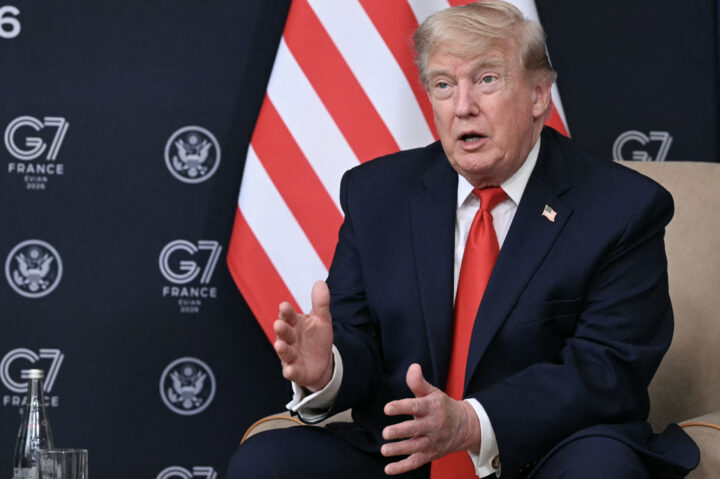
Photo by Mandel NGAN / AFP via Getty Images
U.S. President Donald Trump delivers remarks as he attends a bilateral meeting with UAE's President during the G7 summit, in Evian, eastern France, on June 16, 2026.
As the U.S. and Iran prepare to formally sign an agreement ending the recent fighting between the two countries, President Donald Trump on Tuesday said he was hopeful that a full deal would come soon because, he asserted, U.S.-Iranian ties had improved.
“Iran wants to get it done. They have to get back to business, and the relationship is now normalized,” Trump said during a meeting with United Arab Emirates President Sheikh Mohamed bin Zayed Al Nahyan on the sidelines of the G7 Summit in France.
Trump said he expects a final deal to be negotiated in the 60-day period that is reportedly outlined in the memorandum of understanding that both countries signed, even as he added that the timing may change.
“I think it’s going to go pretty quickly. It could go faster. It could take longer, too,” he said.
Without offering specifics, Trump pledged to release the text of the MOU after the formal signing ceremony on Friday in Switzerland, which will be attended by Vice President JD Vance.
“I’d like to get a formal setting first before we do that, but I have no problem with that. It’s a great document. Here’s what it says: Iran will never have a nuclear weapon,” Trump said. “It won’t have one to buy, to develop. They will not have a nuclear weapon, and I would say that’s about 99.9% of what I wanted, because we couldn’t let that happen.”
He drew a comparison between the U.S.-Iran MOU his administration negotiated and the 2015 Joint Comprehensive Plan of Action.
“It’s a very important document, and unlike Obama, who could have destroyed the Middle East with the horrible JCPOA — it is the worst agreement that was a road to a nuclear weapon,” said Trump. “Mine is a wall against a nuclear weapon.” Trump withdrew from the JCPOA in 2018 and relied heavily on a new “maximum pressure” sanctions policy. In the years that followed, Iran began to stockpile enriched uranium.
Responding to a question about how to keep the Strait of Hormuz open, Trump said, “Have a United States with a strong president. Thats the only way you could do it, I guess … We have all the agreements we want. The agreements for bad people don’t mean anything.”
Trump speculated that the deal with Iran would lead additional Arab nations to join the Abraham Accords.
“I think they’re all going to come into the Abraham Accords. The only conflict was a place called Iran,” Trump said. “I understand that. It’s a little bit tough when people were afraid of Iran, but I think they’re going to all start coming in.” Trump has been saying for weeks that he wants Arab states to join the Abraham Accords after the Iran war ends, but several — Saudi Arabia in particular — have said that they will not do so until Israel commits to make progress toward the creation of a Palestinian state.
Asked whether an agreement should be approved by Congress, Trump said he is open to doing so.
“I never thought about sending, never even thought about it, but I will. I will send it to Congress. I like the idea,” he said.
Four Republicans again broke with their party, but absences handed the GOP a narrow 48-47 win
UNITED STATES - APRIL 30: From left, Sen. Susan Collins, R-Maine, and Sen. Lisa Murkowski, R-Alaska, talk as they arrive for a vote in the U.S. Capitol on Wednesday, April 30, 2025. (Bill Clark/CQ-Roll Call, Inc via Getty Images)
Despite having previously approved a similar motion, the Senate on Tuesday narrowly defeated a procedural vote on a war powers resolution to prevent further military action against Iran, as the administration moves forward in negotiations with Tehran.
The same four Senate Republicans — Sens. Susan Collins (R-ME), Lisa Murkowski (R-AK), Rand Paul (R-KY) and Bill Cassidy (R-LA) — voted to advance the resolution, but absences favored Republicans this time, defeating the resolution 48-47.
Sen. John Fetterman (D-PA) was again the sole Democrat who voted against the effort.
Sen. Tim Kaine (D-VA), who led the previous war powers resolution that successfully advanced, explained to reporters that he hasn’t yet called up that resolution for further votes because he needs to secure one more vote in support to ensure passage.
“I would like to call up mine when I know I’ve got a win,” Kaine said. “I don’t yet have a fifth. I need a fifth vote. … I’ve been working some people to try to get that, but I haven’t gotten any solid commitments.”
He said that he’s still trying to persuade colleagues that, even if the war is paused now, it should not restart without congressional approval, and that Democrats still want to have weekly votes on the war. He said he’s hopeful that the current ceasefire could give some additional Republicans the leeway to vote for the effort.
Sen. Thom Tillis (R-NC), seen as a potential GOP swing vote, ultimately voted against the motion after telling reporters that the current uncertainty could warrant some involvement by Congress.
“I don’t even know what we’re doing right now. … Are we in a ceasefire, are we in an agreement that is basically a new agreement on a ceasefire? Are we working towards a real lasting agreement that may be subject to ratification of Congress?” Tillis said before the vote.
The North Carolina Republican said he would decline to take a firm position before hearing arguments on both sides of the issue.
“[If y]ou’ve got all that uncertainty, then maybe, if we do still think that the U.S. forces need to be put at risk and be kept there, then we should probably be talking about an authorization for the use of military force,” Tillis continued.
Plus, primary day in Washington, D.C.
Aaron Schwartz/Sipa/Bloomberg via Getty Images
President Donald Trump speaks during a maternal healthcare event in the Oval Office of the White House in Washington, DC, US, on Monday, May 11, 2026.
Good Tuesday morning.
In today’s Daily Kickoff, we look at how legislators and Jewish groups are responding to details surrounding the memorandum of understanding between the U.S. and Iran, and cover last night’s NY-10 debate between Rep. Dan Goldman and Brad Lander, where Israel and AIPAC again took center stage. We report on the influx of suspected GOP spending in the NY-17 Democratic primary as Cait Conley and Beth Davidson jockey for the chance to challenge Rep. Mike Lawler, and spotlight a new Meta initiative, announced by Ivanka Trump, to supply AI glasses to visually impaired veterans. Also in today’s Daily Kickoff: Eric Goldstein, Boris Epshteyn and Joel Scanlon.
Today’s Daily Kickoff was curated by JI Executive Editor Melissa Weiss and Israel Editor Tamara Zieve, with an assist from Marc Rod. Have a tip? Email us here.
What We’re Watching
- Members of the G7, including President Donald Trump, are in Évian-les-Bains, France, for a multiday summit. Trump is scheduled to meet today with United Arab Emirates President Mohamed bin Zayed Al Nahyan, and met earlier today with Qatari Emir Sheikh Tamim bin Hamad Al Thani on the sidelines of the summit.
- Speaking to media alongside the Qatari emir after their meeting, Trump said about the war with Iran, “Working with Qatar and the people of Qatar was really a pleasure — they were tough, they were strong, they are closest to Iran physically so … you were in a more dangerous position but I do have to say you fought and you helped us and with great bravery so I just want to compliment you on that and you will always be my friend.” Trump also noted that Qatar would be investing “much more than a trillion dollars” in the U.S.
- Vice President JD Vance, whose newest book, Communion: Finding My Way Back to Faith, comes out today, is slated to be interviewed this afternoon by Megyn Kelly.
- Vance’s appearance on “The Megyn Kelly Show” comes amid growing calls from Capitol Hill and beyond for the U.S. to make public the text of the memorandum of understanding with Iran, after Vance and Trump gave conflicting timelines for its release — and as Iranian-affiliated media outlets publish details they claim are part of the agreement. Trump said yesterday in Paris that the text would be released after a signing ceremony on Friday in Switzerland, while a senior U.S. official told journalists on Monday that the text would be released within 24-48 hours.
- Voters in Washington, D.C., head to the polls today to cast ballots in the city’s mayoral primary, where D.C. Councilmember Janeese Lewis George, who repeatedly clashed with the city’s Jewish community over her ties to the Democratic Socialists of America and comments about Israel, faces former D.C. Councilmember Kenyan McDuffie. More below.
- In Georgia, Republicans will vote today in the runoff to select the party’s candidate to challenge Sen. Jon Ossoff (D-GA) in November. The race will pit Rep. Mike Collins (R-GA), who is endorsed by Trump and has faced a series of controversies related to antisemitism and conspiracy theorists while in office, against Derek Dooley, the favored candidate of the state’s GOP governor, Brian Kemp. Read more about the race here.
- The Senate Select Committee on Intelligence is holding a closed briefing this afternoon.
- The Sami Rohr Jewish Literary Institute will announce the winner of the annual Sami Rohr Prize today. This year’s finalists are Laura Hobson Faure, Shaul Kelner, Jordan Salama and Amir Tibon.
What You Should Know
A QUICK WORD WITH JI’S GABBY DEUTCH
Today’s mayoral primary in Washington, D.C., has not gotten the same kind of frenzied national attention that accompanied recent mayoral contests in New York City, which pitted Zohran Mamdani, a democratic socialist, against a centrist Democrat, and in Los Angeles, where Republican Spencer Pratt made an insurgent bid against Mayor Karen Bass and Nithya Raman, a Democrat Socialists of America-affiliated councilmember.
Still, there are dynamics with some similarities to the race in Washington, where DSA member Janeese Lewis George, a District councilmember, faces Kenyan McDuffie, a former councilmember running a more moderate campaign. And, like in New York, divisions over the Israeli-Palestinian conflict have surfaced in a way that would once have been unexpected in a municipal election, at least before the Oct. 7, 2023, Hamas attacks in Israel and the ensuing war in Gaza.
Early this year, Lewis George sparked concern among some Jewish Washingtonians when she said in a DSA questionnaire that she would not attend events that “promot[e] Zionism” and that she would avoid engaging with “the Israeli government or Zionist lobby groups.”
She has since done a degree of damage control — meeting privately with rabbis and pledging at a Jewish candidate forum last month not to exclude people “based on your opinions or feelings on matters here and across the world,” even as she avoided answering a question asking her to clarify her views on Zionism. In March, she said it is not a conflict to support “Palestinian human rights” and to “stand firm in my commitment against antisemitism.”
McDuffie saw an opening with the DSA endorsement kerfuffle, particularly when talking to Jewish voters, a constituency he has sought to engage. He told Jewish Insider in April that he would not seek the endorsement of DSA or any organization “that requires some sort of divisive pledge to exclude people that are a part of the fabric of the community.” And he has opted not to weigh in on questions about Israel at all, saying it is not the role of a mayor to conduct foreign policy.
But zoom out, and the candidates’ approaches to Israel and Jewish communal issues were not front and center in the closing days of this race. The campaign has otherwise zeroed in on cost-of-living concerns and a dispute over who will better be able to counter President Donald Trump.
SCOOP
Top Trump administration officials shared new details on Monday about the memorandum of understanding reached by the U.S. and Iran over the weekend, arguing that the new agreement is substantially better than the 2015 Iran nuclear deal and could pave the way for a new relationship between Washington and Tehran, Jewish Insider’s Matthew Shea reports.
VP remarks: During an interview with CNBC, Vice President JD Vance said, “What this agreement does is say to the Iranians that ‘You don’t have access to the money to rebuild that nuclear program, but if you’re willing to give up that program long-term, if you’re willing to accept the inspections and verification regime that’s necessary to give us the confidence you’re never going to have a nuclear weapon, then we want you to be a prosperous country, and we will re-invite you into the community of nations.’”
Congressional review: Several Republican senators said that the administration does not need to submit the recently signed 60-day memorandum of understanding with Iran to Congress for review and a potential vote under the Iran Nuclear Agreement Review Act, potentially sidestepping the first major opportunity for Congress to weigh in on the agreement, JI’s Marc Rod and Emily Jacobs report.
WAIT AND SEE
With scant details provided by the Trump administration about the contours of the peace deal with Iran, Senate Majority Leader John Thune (R-SD) said on Monday afternoon that he doesn’t yet know enough about the administration’s deal with Iran to determine whether it is a good deal that will prevent Iran from acquiring a nuclear weapon, Jewish Insider’s Marc Rod reports.
Leadership lowdown: “I don’t know enough about it to say,” Thune told reporters. “I think the issues are going to be compliance, and how you can enforce that, and what are the financial incentives that the Iranians have from our country, and what are they conditioned upon.” Thune also indicated that he believes the deal should be submitted to Congress for review under the Iran Nuclear Agreement Review Act. Thune said that “somebody” from the administration, whether that be Vice President JD Vance or other officials, “will need to” come to the Hill to brief members.
Deal divide: Some mainstream Jewish organizations are treating the deal as a preliminary step — focusing on the 60-day negotiating period ahead, while others are expressing skepticism about the contours of the agreement.
PRIMARY PLAY

With the Democratic primary in New York’s 17th Congressional District coming down to a two-person race between veteran and former national security official Cait Conley and Rockland County Legislator Beth Davidson, an alleged Republican-linked group is spending big in an effort to block Conley from the nomination, Jewish Insider’s Marc Rod reports.
Last-minute money: A shadowy group that has been tenuously linked to GOP operatives recently announced plans to spend at least $1.5 million in the race against Conley, running ads echoing Davidson’s own messaging against Conley. The campaign suggests Republicans see Conley as the more competitive general election candidate.
DEBATE NIGHT
Israel again took center stage on Monday night in a debate between former New York City Comptroller Brad Lander and Rep. Dan Goldman (D-NY) — with the incumbent congressman trying to prove his progressive bona fides by criticizing AIPAC, despite the group’s support for his campaigns, Jewish Insider’s Will Bredderman reports.
Israel and AIPAC: Both candidates, each a self-identified “progressive Zionist,” inveighed in the televised face-off on PIX11 against Israel’s conduct of the war in Gaza, although Goldman declined to join Lander in calling the military actions a “genocide.” But the embattled Goldman, trailing in all available polls in the NY-10 race, also criticized AIPAC, despite acknowledging he has received the group’s endorsement.
EYE ON THE PRIZE
Ivanka Trump on Friday announced a collaboration between Meta and the Blinded Veterans Association that aims to donate Ray-Ban Meta AI glasses to all legally blind American veterans, which the U.S. Department of Veterans Affairs estimates number roughly 130,000. The event was co-hosted by Meta and UFC, Jewish Insider’s Christina Sher reports.
Launch event: Speaking at a Freedom 250 reception at Ned’s Club Washington, Trump said Meta will “give every blind veteran in America a free pair of glasses as just a small way to say thank you for your service.” The initiative was spearheaded by Trump alongside Meta President Dina Powell McCormick, who served as deputy national security advisor for strategy in the first Trump administration. Also speaking at the reception, Powell McCormick said that Meta believes “superintelligence is going to help people find their purpose in life.”
Worthy Reads
Islamist Wave Crashing: The New York Times’ Ben Hubbard does a deep dive into the history of political Islam amid questions over whether the movement is in decline. “The map of the Middle East is dotted with examples of idealistic Islamist visions that failed to manifest into real-world successes. Their proponents may have marshaled popular support, for a time. They may have held the levers of power. They may have governed, or tried, in line with their views of Islamic law. But today, in most cases, they did not last. … Iran’s current travails have intensified discussion among experts about whether political Islam has crested and what that means for the Middle East and the broader Muslim world.” [NYTimes]
Trump’s Blind Spot: The Wall Street Journal’s Walter Russell Mead considers how President Donald Trump has miscalculated in his approach to Iran. “Mr. Trump’s disregard for ideas, ideals and people who claim to believe in them leads him to underestimate the strength and determination of people who mean what they say. … However perverse and depraved the ideas that animate the Islamic Republic and Hezbollah, they inspire the kind of conviction that motivates people to fight grimly on against the odds. In the end, Mr. Trump underestimated Iran’s determination and resilience and launched a war that is proving much costlier and harder to end than he’d expected.” [WSJ]
Word on the Street
Axios reports that CIA Director John Ratcliffe warned President Donald Trump and other senior administration officials in the lead-up to the announcement of an MOU with Iran that U.S. intelligence indicated that Tehran was unlikely to make Washington’s desired nuclear concessions; Secretary of State Marco Rubio and Defense Secretary Pete Hegseth reportedly raised concerns about the agreement, while Vice President JD Vance, White House Special Envoy Steve Witkoff and Jared Kushner backed the deal…
The Wall Street Journal reports that Boris Epshteyn, Trump’s personal attorney, joined the legal team of Indian billionaire Gautam Adani, who in 2024 was facing accusations of fraud by the Justice Department…
Axios spotlights the outsized role that Epshteyn plays in the White House, noting that Trump jokingly calls the lawyer “my psychiatrist” because of how often they speak…
Sen. Amy Klobuchar (D-MN) is backing Lt. Gov. Peggy Flanagan over Rep. Angie Craig (D-MN) in the state’s open Senate race; Klobuchar said that though she was “friends with both,” she was backing Flanagan because the two appear together on the state’ Democratic-Farmer-Labor Party ticket…
The Washington Post quietly removed two recently republished op-eds authored by a former Daily Caller staffer who had published racist and antisemitic writings under a pseudonym on a white supremacist website…
The New York Times is reviewing pieces by Nicholas Kristof, after Semafor discovered that on at least a dozen occasions, the columnist had quoted and reported on individuals who had contributed to his 2021 Oregon gubernatorial campaign without disclosing the relationship…
Former George W. Bush administration official Joel Scanlon was announced on Monday as the new president and CEO of the Hudson Institute, a conservative think tank in Washington, Jewish Insider’s Gabby Deutch reports…
The Hollywood Reporter spotlights Los Angeles chef Eric Greenspan’s new restaurant Mish, which gives an updated take on classic Jewish deli fare…
A U.K. appeals court ruled that the government’s banning of the Palestine Action was lawful, calling London’s proscription of the activist group “justified and proportionate”…
Qatar plans to scale up its production of liquified natural gas after the Strait of Hormuz reopens, with a goal of restoring some 80% of its export capacity within two months; the moves comes after the Gulf nation’s Ras Laffan facility was damaged in an Iranian missile attack early in the war…
El Al inked a deal with Elon Musk’s Starlink to provide free high-speed internet to passengers traveling with the airline, beginning in 2027…
Far-right Israeli National Security Minister Itamar Ben-Gvir canceled a planned family trip to the U.S. amid challenges in obtaining a visa; Ben-Gvir, who has a history of criminal convictions in Israeli courts that could render him ineligible for a common ESTA visa, chose to forgo the trip after he was summoned to the U.S. Embassy to be fingerprinted…
Israel’s Defense Ministry accused organizers of the Eurosatory defense show in Paris of building walls around the booths of some Israeli defense technology firms, claiming that the companies had abided by a request from organizers to only display defensive weapons systems…
Pic of the Day
Pope Leo XIV met on Monday with a delegation from UJA-Federation of New York at the Vatican. Outgoing UJA CEO Eric Goldstein presented the pontiff with a menorah with an inscription expressing hope that the pope’s leadership “shine a bright light on unity, peace, tolerance, and human dignity for all.”
Birthdays

Singer-songwriter, Benjamin Lev Kweller turns 45…
Professor of theoretical physics at Stanford University, Leonard Susskind turns 86… Brigadier-general (ret.) in the IDF, then a member of Knesset, then chairman of Ha’aguda Lema’an Hachayal, a nonprofit IDF veterans group, Avigdor Kahalani turns 82… Former dean of Yeshiva College, U.S. ambassador to Egypt for President Bill Clinton, and U.S. ambassador to Israel for President George W Bush, Daniel C. Kurtzer turns 77… Professor at Nanjing University and China’s leading professor of Jewish studies, Xu Xin turns 77… Rickey Wolosky Palkovitz turns 77… Investigative reporter who worked for Newsweek, NBC News and then Yahoo News, Michael Isikoff turns 74… Principal executive at Kohn & Associates and chairman of the board of directors at ARMR Sciences Inc., he was the volunteer varsity and junior varsity boys and girls basketball coach at Farber Hebrew Day School in Southfield, Mich., for more than three decades, Kenneth I. Kohn turns 73… UC Berkeley professor, Alison Gopnik turns 71… Professor of Jewish studies at the University of Freiburg (Germany), Gabrielle Oberhänsli-Widmer turns 69… Distinguished fellow in Jewish studies at Dartmouth College and visiting professor of modern Jewish studies at Harvard Divinity School, Shaul Magid turns 68… Southern California resident, Roberta Trachten-Zeve… Senior project executive at Kansas-based Stuart & Associates Commercial Flooring, Matthew Rafael Elyachar… Pulitzer Prize-winning business reporter and bestselling author, he is a past president of Washington Hebrew Congregation, David A. Vise turns 66… Former chair of the Broward County, Fla., JCRC, he is the co-founder of The Alliance of Blacks & Jews, Keith Wasserstrom… Actor, screenwriter, producer and director, Daniel Zelman turns 59… Senior correspondent for military and intelligence affairs for Yedioth Ahronoth, Ronen Bergman, Ph.D., turns 54… Judge of the U.S. Court of Appeals for the 1st Circuit, Julie Rikelman turns 54… CEO and founder of NYC-based Marathon Strategies, Philip Keith (“Phil”) Singer… Israeli photographer, digital artist and artificial intelligence researcher, Dina Bova turns 49… Geographer and writer, Joshua Jelly-Schapiro turns 47… Comedian, actor and YouTuber with almost 100 million views, Adam Ray turns 44… Senior portfolio manager on the Jewish life and Israel grantmaking team at One8 Foundation, Alyssa Bogdanow Arens… Pitcher for Team Israel in the 2023 and 2026 World Baseball Classic tournaments, he has been a free agent since November 2025, Zachary D. “Zack” Weiss turns 34… Head video producer at Ocean One Media, Perry Chencin… Former catcher on Israel’s National Baseball Team at the 2020 Tokyo Olympics, now a senior consultant for EY, Tal Erel turns 30… Israeli artistic gymnast who won a gold medal at the 2020 Tokyo Olympics and a silver medal at the 2024 Paris Olympics, Artem Dolgopyat turns 29…
A source told JI that Republican leadership and the administration may seek to sidestep INARA review, at least for the current 60-day agreement with Iran
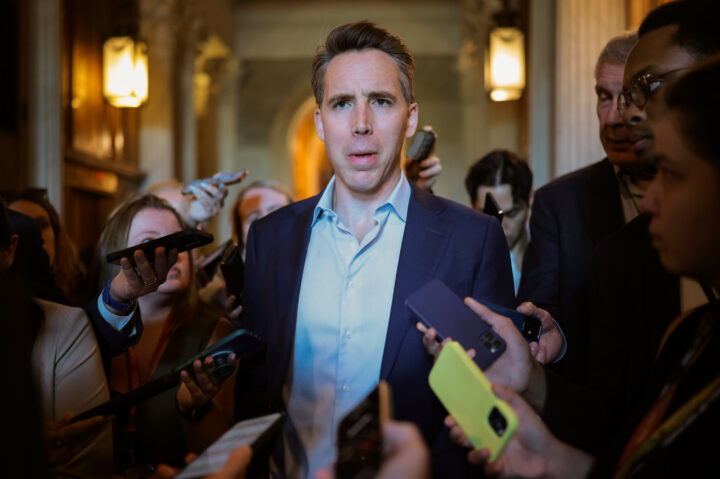
Kayla Bartkowski/Getty Images
Sen. Josh Hawley (R-MO) speaks to the press on June 2, 2025 in Washington.
Some Republican senators said that the administration does not need to submit the recently signed 60-day memorandum of understanding with Iran to Congress for review and a potential vote under the Iran Nuclear Agreement Review Act, potentially sidestepping the first major opportunity for Congress to weigh in on the agreement.
Under INARA, the administration is required to promptly submit any deal with Iran relating to its nuclear program to Congress for review, with an opportunity for Congress to vote to reject the deal. But the administration may attempt to avoid that step, at least until a broader agreement is reached during the 60-day negotiating period — if one comes about.
A source familiar with the situation said Republican leadership is in discussions with the administration about what is included in the MOU — senior Republicans have said publicly they have not yet been informed — but they are collectively moving toward a view that the MOU is an agreement for further negotiations, not a deal on Iran’s nuclear program in itself, thereby sidestepping INARA for the time being.
The White House did not immediately respond to a request for comment.
Some senators offered a similar view on Monday evening.
Sen. Josh Hawley (R-MO) said that he’s “not aware of any precedent” for Congress to vote on an MOU.
“This is like a template for further negotiations,” Hawley said. “I don’t even know constitutionally if we have a role on that.”
Sen. Eric Schmitt (R-MO) said that he does not believe that a congressional vote on the MOU is necessary. He also went further, emphasizing that even under INARA, there is no requirement for Congress to vote on any Iran agreement.
“People may have different points of view of whether or not we should or we shouldn’t, but there’s certainly nothing required,” Schmitt said.
Pressed on why lawmakers wouldn’t want an opportunity to vote on the deal, Schmitt responded, “on whether or not a president can cease conflict in that way?”
“I don’t think it’s necessary,” he continued. “I’m just stating the law. … I will say that I do think that there are certain people in this building that want to undermine this, there’s no doubt about that. … You have the camp that wants us to lose, and then you have a camp that wants a forever war. President Trump’s not in either one of those camps.”
Sen. John Kennedy (R-LA) said that “if there’s a final” deal with Iran, he believes Congress should have the opportunity to review and vote on it, but that he does not believe that such a vote is necessary for the current MOU.
“When there’s a final agreement — if there’s a final agreement — just like the JCPOA Congress should be able to weigh in,” Kennedy said.
Sen. Tim Kaine (D-VA), who said he was involved in crafting INARA during the Obama administration, said that whether the MOU needs to be submitted is a question of what it includes.
“If the details are opening the ports, opening the straits and ceasefire, but let’s talk about the nuclear program — I don’t know that that would have to be submitted,” Kaine said. “If the details that we hear Friday include some nuclear elements, and maybe we’ll talk about some other ones down the road — well then it might have to come to us. You just have to see whether the deal that is announced Friday includes an agreement on any of the elements of [their nuclear program].”
He emphasized, however, that meeting the 60-vote threshold in the Senate to pass a joint resolution of disapproval under INARA to block a deal would be difficult given current political dynamics around the war.
Others, however, are more eager for congressional scrutiny and even Senate ratification of the deal as a treaty.
Sen. Thom Tillis (R-NC) said that he hopes the U.S. doesn’t “make the mistake Obama made [with the original nuclear deal]. We had an agreement that never really got ratified by Congress, didn’t have a lot of visibility, and I think that’s a mistake.”
Sen. James Lankford (R-OK) emphasized that any lasting agreement would need to be submitted to Congress.
“If it’s going to be long lasting, you’ve got to pass law, and that was what President Obama figured out: he could make an executive agreement, but the next president just turns it off,” Lankford said. “The president has the power to be able to negotiate foreign policy. He is the person who speaks for the country on foreign policy issues, but lasting agreements that last beyond that president have to be put in statute.”
Sen. Mike Rounds (R-SD) also said that if the deal is strong, it should be submitted to Congress for ratification as a treaty. “The JCPOA was torn apart, taken apart, because it could not meet that standard,” Rounds said.
Sen. Lindsey Graham (R-SC), asked if the Senate should vote on the MOU or only the subsequent negotiated agreement said, “It’s the law. Any nuclear deal with Iran has to be voted on. There is no way that we will not review a deal.”
The Senate majority leader also said the deal triggers requirements for the administration to provide Congress with the opportunity to review the agreement under INARA

Kayla Bartkowski/Getty Images
Sen. Majority Leader John Thune (R-SD) calls on reporters following the weekly Senate Republican caucus policy luncheon at the U.S. Capitol on January 14, 2025 in Washington, DC. Senators spoke about the Laken Riley Act which was named after a nursing student who was murdered in February 2024 by Jose Ibarra, a migrant from Venezuela who crossed the border in September 2022, that could give state attorney generals far-reaching veto power over federal immigration policy.
With scant details provided by the Trump administration about the contours of the peace deal with Iran, Senate Majority Leader John Thune (R-SD) said on Monday afternoon that he doesn’t yet know enough about the administration’s deal with Iran to determine whether it is a good deal that will prevent Iran from acquiring a nuclear weapon.
“I don’t know enough about it to say,” Thune told reporters. “I think the issues are going to be compliance, and how you can enforce that, and what are the financial incentives that the Iranians have from our country, and what are they conditioned upon.”
The South Dakota Republican said that a positive deal would include financial incentives that are conditioned upon Iran winding down its nuclear program, the disposal of Iran’s enriched uranium and Tehran giving up its capacity to have a nuclear program in the future.
Thune also indicated that he believes the deal should be submitted to Congress for review under the Iran Nuclear Agreement Review Act.
“There are some requirements that are triggered because of the nuclear components of the deal, in terms of notification or informing Congress,” Thune said. “I know there is probably some expectation that there may be a vote at some point, whether that’s on a resolution of disapproval or something. We’ll see. I just don’t know enough about it yet. And I don’t think even the people who follow this stuff closely up here know that much.”
The administration hasn’t publicly commented on the issue of INARA yet, and has offered varying timelines for when it might release the text of the agreement. In media appearances, Vice President JD Vance has been framing specific nuclear issues as part of the next round of talks, rather than the current MOU, which could give the administration an avenue to attempt to dodge INARA review.
Thune said that “somebody” from the administration, whether that be Vance or other officials, “will need to” come to the Hill to brief members.
“For sure, our members are going to have a lot of questions about it,” Thune said.
Sen. John Barrasso (R-WY), the No. 2 Senate Republican, indicated he was similarly in the dark about the agreement.
“I haven’t seen anything from the president in terms of what’s in it. I’ve seen some press reports,” Barrasso told reporters. “I want to see what’s actually in it and I congratulate the president for his continued efforts.”
But asked whether he was concerned that the deal would be an effective surrender to Iran in providing sanctions relief, Barrasso rejected the idea out of hand.
“President Trump is never, ever going to do what you just suggested,” Barrasso said. “He’s not going to accept a deal that doesn’t eliminate nuclear weapons, isn’t enforceable, isn’t verifiable and doesn’t take Iran completely out of what they’ve been doing to try to undermine and attack us for the last 47 years.”
U.S. officials said that the Strait of Hormuz will remain toll-free and Lebanon is not part of the agreement

Michael M. Santiago/Getty Images
Vice President J.D. Vance and President Donald Trump
Top Trump administration officials shared new details on Monday about the memorandum of understanding reached by the U.S. and Iran over the weekend, arguing that the new agreement is substantially better than the 2015 Iran nuclear deal and could pave the way for a new relationship between Washington and Tehran.
During an interview with CNBC, Vice President JD Vance said he expects the Strait of Hormuz to be opened immediately “in a toll-free way for the long term.” Vance indicated that he has observed more traffic flow in the strait following the announcement of the deal, but that the way in which the strait fully opens will be determined in technical negotiations.
“What this agreement does is say to the Iranians that ‘You don’t have access to the money to rebuild that nuclear program, but if you’re willing to give up that program long-term, if you’re willing to accept the inspections and verification regime that’s necessary to give us the confidence you’re never going to have a nuclear weapon, then we want you to be a prosperous country, and we will re-invite you into the community of nations,’” Vance said.
Vance said that Iran has agreed to never develop or procure a nuclear weapon and that the U.S. will ensure its stockpile of enriched material is destroyed, adding that technical talks will determine if U.S. ground troops will observe or play an active role in destroying it. He also argued that the latest MOU differs from the Joint Comprehensive Plan of Action signed under former President Barack Obama in 2015.
The vice president has stated that Iran’s nuclear program and capacity to enrich uranium have both been devastated by the U.S. and Israeli military campaign.
“We have comprehensively destroyed their nuclear program, and this agreement is about ensuring that they don’t rebuild it,” Vance said. “The JCPOA was mainly about bribing them to stop the construction or to cease a nuclear program that was already in progress. It’s a very different background, a very different sort of leverage, and I think really a different outcome for the American people.”
Vance also dismissed reports that Iran would receive billions of dollars without the funding being conditioned on the completion of certain steps, a clarification he made during an interview with CBS.
“When people say that billions of dollars of assets will be released, that’s not true,” Vance said. “What is true is that [there will be] a much better and much more prosperous future if they [Iran] meet the obligations they make in this agreement … that’s one of the things we’re going to work out in the technical talks that will follow the official signing on Friday.”
Vance stressed that the Iranians would attain frozen or other monetary assets only upon meeting verifiable benchmarks. He confirmed that Iran could receive $300 billion in reconstruction funding, as well as $24 billion in frozen assets, but emphasized that the funding would be conditioned on Tehran meeting its obligations.
“It’s set up in such a way where we’re going to have to attach their commitments to deliverables that then are met with economic benefits for the Iranian people,” Vance said on CNN. “On the other hand, if they [Iran] try to rebuild it [their nuclear program] they’re never going to get the financial resources that they would need to rebuild.”
The vice president said that the U.S. has not expended “a single dollar of sanctions relief or unfrozen assets,” stating that reports otherwise are likely from hardliners “within the Iranian system…in an effort to sell it to certain domestic populations.”
However, Vance said the U.S. is “open to a lot of things that are on the table.”
“That $24 billion just doesn’t appear anywhere in any of the texts that we’ve talked about with the Iranians,” Vance said. “What we have said is that we’re willing to talk about unfreezing assets, but a much, much bigger deal is un-sanctioning their economy, so long as they make the long-term commitments on the nuclear program.”
When asked whether the agreement would require Iran to halt support for U.S.-designated terrorist groups such as Hamas, Hezbollah and the Houthis, Vance indicated that it would, although the specific wording in the agreement appeared to be vague.
“What paragraph one of the agreement says is effectively that Iran commits itself, just as the United States commits itself, to regional peace and stability and part of that is that the Iranians have to stop funding violent terrorist organizations,” Vance said. “They know that we don’t want them to fund terrorist organizations..and be a source of instability in the region.”
The vice president touted the “level of direct connection” established through the latest negotiations, noting that “the people at the highest levels of the United States government are talking to the people at the highest levels of the Iranian government.”
“This is a very interesting thing about these negotiations, is you see people, both the hardliners, but also the more political people, saying, ‘Our relationship with the United States over the past 47 years has been a mistake. Let’s turn over a new leaf,’” he added.
A senior administration official told reporters on Monday that an Israeli withdrawal from Lebanon would not be part of the deal, despite Iranian officials’ insistence that it would be included.
The senior administration official confirmed that nuclear discussions would likely occur first and said the agreement “contemplates” the reduction of U.S. military forces in the region “upon the agreement of a final deal.” However, the official noted that Iran will need to “make some concessions and give up some of their activities and some of their nuclear program.”
A senior U.S. official called out “hardliners on both sides,” saying that they are rooting against “compromise” and “making a lot of noise.”
“There’s a lot of misinformation out there,” the official said. “I think that in any field that I’ve been involved in, I would say nobody roots for the referee. There’s not really a constituency for compromise. So what you’re seeing now is that the hardliners on both sides…we have certain people in the American system who say there’s no deal you could ever do with Iran ever, are obviously making a lot of noise.”
While the full details of the MOU have yet to be released, President Donald Trump indicated on Monday that he expects the document to be made public “sometime after Friday.”
“I want it to be released because it is a really powerful document,” Trump told reporters during a bilateral meeting with French President Emmanuel Macron on the sidelines of the G7 summit in France. “It is not like the Obama documents.”
However, Trump warned that should the deal fall apart, tensions between the U.S. and Iran could return to “where we started.”
“We have done a great job and hopefully it is going to be a good relationship, and we are going to get along,” Trump said. “If we don’t, we go back to where we started, but I don’t think that is necessary.”
Jewish organizations across the political spectrum question whether the deal will curb Iran’s nuclear program or its support for regional proxies
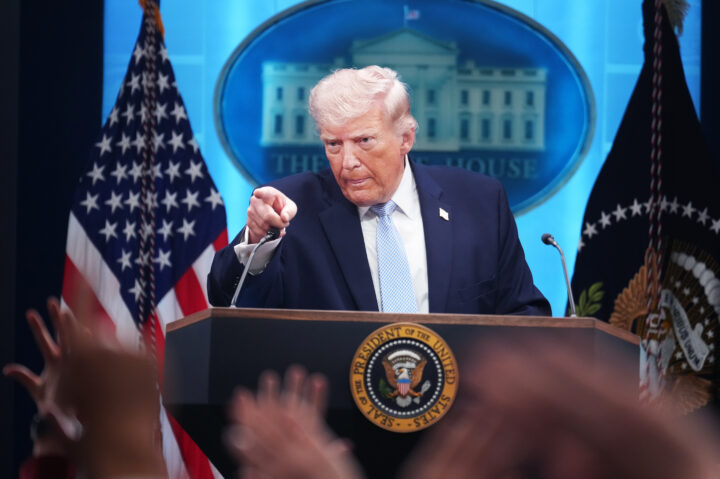
Tom Williams/CQ-Roll Call, Inc via Getty Images
President Donald Trump conducts a news conference in the White House briefing room about the war in Iran on Monday, April 6, 2026.
As details begin to emerge about the Trump administration’s agreement with Iran to end the war and lift the U.S. blockade of the Strait of Hormuz, some mainstream Jewish organizations are treating the deal as a preliminary step — focusing on the 60-day negotiating period ahead, while others are expressing skepticism about the contours of the agreement.
AIPAC, in a statement that came late Monday afternoon after many other organizations had already spoken out, framed the current MOU as a preliminary step, focusing more on the upcoming negotiations, while emphasizing the need for more details about how the current deal affects Israel.
“The announced MOU kicks off a new 60-day window for talks. We look forward to learning the full details of the framework for these negotiations, including whether the deal preserves the sovereign right of our democratic ally Israel to respond to the security threats it confronts,” AIPAC said in a statement.
The group also emphasized that “Congress will play a critical role in working with the administration throughout these negotiations and in reviewing the ultimate agreement.”
It said any deal should require the removal of all enriched uranium from Iran, the dismantling of its enrichment capacity and should address Iran’s missile and drone programs and end its support for terrorist proxies.
The American Jewish Committee also did not take a definitive position on the current agreement, saying on X that the organization “await[s] developments about the reported 60-day ceasefire agreement” but emphasized the need to continue to focus on Iran’s long-running threats.
The AJC said that any ultimate deal with Iran at the conclusion of the upcoming 60-day negotiating period should ensure Iran cannot obtain a nuclear weapon, rebuild its ballistic missile program, continue to support terror proxies, threaten U.S. allies and partners or hold the Strait of Hormuz hostage.
“AJC also strongly supports the legitimate aspirations of the Iranian people for greater freedom, opportunity and dignity, and hopes that those aspirations are eventually realized,” the statement continued. “As the contours of this and future agreements become more clear, we will continue to engage with our partners in the U.S., the Middle East, and around the world to make this vision a reality.”
Other groups offered a more directly negative reaction to the emerging details of the MOU.
The Zionist Organization of America, which has been strongly supportive of Trump administration policies and President Donald Trump himself, praised the president for carrying out military operations against Iran but said that “the pending deal with Iran is concerning.”
“The deal appears to be an ‘agreement to negotiate’ — which enables the Iranian regime to obtain massive oil revenue and time to build up its military and terror arsenals, while leaving the genocidal Iranian regime and its nuclear and missile stockpiles in place, and positioning the Iranian regime to continue and strengthen its 47-year war to destroy the U.S., Israel, and the West,” ZOA National President Mort Klein said. “[T]he little that we know is deeply problematic.”
Klein said it “makes no sense” for the U.S. to let up on its blockade of Iran unless Iran fully gives up its nuclear program and missile stockpile. He also expressed concerns that the deal will allow Hezbollah to regroup and rearm, and that Trump demanded that Israel stand down against Hezbollah.
“Pressuring Israel to not respond to threats of annihilation and attacks on her people is not, as the president called it, a ‘Great Deal [that] will bring Peace and Security to the whole Region,’” Klein said.
“Disturbingly, the interim Iran deal does not appear to be even close to the U.S.-Israel war goals of eliminating the existential dangers of Iran’s nuclear program and ballistic missiles, ending the Iranian regime’s support for its terror proxies, and helping the Iranian people overturn the brutal, genocidal Iranian regime,” he continued.
Democratic groups are also skeptical.
Democratic Majority for Israel CEO Brian Romick criticized the administration’s “incoherent and erratic strategy” and said that “there are concerning details about what is and isn’t in this deal.” Romick called on the administration to lean on “experienced negotiators and technical experts” in the next phases of talks, “rather than relying on friends, family, and donors.”
He said that any deal must permanently end Iran’s nuclear program, constrain its ballistic missiles, address Iran’s support for terrorism and ensure that the Islamic Revolutionary Guard Corps and Iran’s terrorist proxies do not receive additional support as a result of sanctions relief or the unfreezing of assets, and that it must be thoroughly vetted by Congress.
“Despite this tentative deal, the reality is Israel still faces constant threats from Iranian-backed terrorist groups like Hamas and Hezbollah. President Trump must not limit or interfere with our ally’s ability to defend itself from very real threats along its border,” Romick continued.
The Jewish Democratic Council of America’s CEO Halie Soifer took an even more strident tone.
“Donald Trump’s deal with Iran isn’t a deal at all. At best, it’s a statement of intention — a ‘concept of a plan’ — lacking details. At worst, it’s an admission of defeat by the United States,” Soifer said, describing it as a weaker deal than the 2015 Joint Comprehensive Plan of Action.
She argued that the “reckless war” gave Iran a “chokehold” on the U.S. and global economy that it will continue to exercise in the future, gave Iran a stronger hand in nuclear negotiations, solidified the current regime, harmed the Iranian people and gained the U.S. nothing.
“Today, Iran is unquestionably further from regime change — and this Iranian regime is stronger — than before the war,” Soifer said. “Trump repeatedly berated the Obama administration for offering sanctions relief and unfreezing Iranian assets as part of the JCPOA. The amount of financial benefit Iran received from the JCPOA will be dwarfed by the amount of money going to Iran following Trump’s defeat.”
Soifer also criticized Trump for sidelining and ignoring Israel throughout the talks.
J Street has thus far been an outlier in expressing support for the deal.
The group’s president, Jeremy Ben-Ami, said J Street “welcomes” the announcement, while also criticizing the war effort as a whole.
“The lesson is the same one many experts and former security officials have warned about for years: There is no sustainable military solution to the challenge posed by Iran’s nuclear diplomacy,” Ben-Ami said. “Durable constraints on Iran’s nuclear activities can only be achieved through pragmatic and sustained diplomacy.”
Ben-Ami argued that the deal would be largely similar to the JCPOA, adding, “We urge lawmakers to support this agreement to end the fighting and push to ensure future diplomatic efforts address the security threats presented by Iran.”
The Republican Jewish Coalition has not issued a full statement of its own on the deal, but has indicated support thus far, sharing on its X account two Truth Social posts from Trump about the Strait of Hormuz being reopened and the lifting of the U.S. blockade. RJC did not immediately respond to a request for comment.
Plus, the Lebanese-American Zionist building bridges in Washington
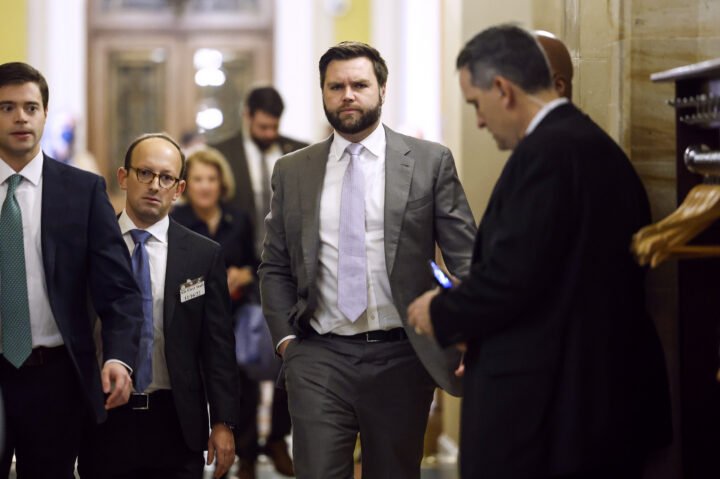
Anna Moneymaker/Getty Images
JD Vance, with advisor Jacob Reses (second from left), arrives to a meeting with Senate Republicans at the U.S. Capitol on November 16, 2022 in Washington, D.C.
Good Monday morning.
In today’s Daily Kickoff, we look at how the ceasefire agreement between the U.S. and Iran announced yesterday is playing in Washington and Jerusalem, and report on how officials in World Cup host cities are addressing security concerns around the Iranian national team’s U.S. matches. We profile former White House official Hagar Hajjar Chemali as she launches the Lebanon-Israel Peace Alliance, and spotlight the GOP Senate runoff taking place tomorrow in Georgia. Also in today’s Daily Kickoff: Tony Blair, Sen. Mitch McConnell and Brig. Gen. Hisam Ibrahim.
Today’s Daily Kickoff was curated by JI Executive Editor Melissa Weiss and Israel Editor Tamara Zieve, with an assist from Marc Rod. Have a tip? Email us here.
What We’re Watching
- President Donald Trump is traveling to France today for the G7 after attending last night’s UFC fights at the White House as part of the U.S.’ America 250 celebrations. On the South Lawn last night, the president was seen kibbitzing with a number of high-profile names in business and entertainment, including David Ellison and Mark Zuckerberg. Read more here.
- Former Vice President Mike Pence will speak at a members-only event at the National Press Club tonight as part of the NPC Headliners series.
- In Israel, Somaliland President Abdirahman Mohamed Abdullahi is meeting with senior Israeli officials today. Abdullahi arrived in Israel yesterday after several days in the United Arab Emirates.
- Sens. Rick Scott (R-FL) and Ashley Moody (R-FL) are slated to host a press conference in St. Petersburg, Fla., alongside the Justice Department’s Leo Terrell opposing the use of taxpayer dollars for two upcoming Kanye West concerts slated to take place in Tampa later this month.
- In New York, Rep. Dan Goldman (D-NY) and former New York City Comptroller Brad Lander will face off tonight in a PIX11 televised debate.
- The Jewish Council on Public Affairs’ two-day national summit concludes today in New York.
- Elsewhere in New York, Join Israel is hosting a fundraiser at Midtown Manhattan’s Jerry Orbach theater featuring a bevy of Broadway stars, including a performance by Tovah Feldshuh. Proceeds from the event will benefit at-risk children in Israel.
What You Should Know
A QUICK WORD WITH JI’S s
A year and a day after Israeli fighter jets first opened fire above Iran, setting off a year of intermittent fighting and numerous failed negotiations, President Donald Trump announced on Sunday that an agreement with Iran to end the war had been reached. A signing ceremony set for later this week in Switzerland — which is expected to be attended by Vice President JD Vance — will kick off a 60-day negotiation period to address Iran’s nuclear program and U.S. sanctions on the Islamic Republic.
For Americans, the deal closes a chapter that saw high gas and food prices as well as schisms in the GOP as the party’s wings fought over how the war should be fought and ended. Among Democrats, legislators and activists from the party’s progressive wing — from Rep. Ro Khanna (D-CA) to the National Iranian American Council’s Trita Parsi (who additionally gloated, “Netanyahu failed!”) — praised the deal.
But Israel was not part of the negotiations, nor did it have final say in what was in the agreement inked between Washington and Tehran. As the Is were dotted and Ts were crossed on the agreement, tensions between Trump and Israeli Prime Minister Benjamin Netanyahu — already on display following Israel’s threatened escalation last week in Beirut, followed by an actual escalation on Sunday when Israel struck Beirut’s Dahiyeh neighborhood — deepened.
Sen. Lindsey Graham (R-SC) said on X on Sunday that he was “somewhat concerned” that Iran’s account of the U.S.-Iran ceasefire deal diverges sharply from what the U.S. negotiators are claiming, and demanded Vice President JD Vance personally present the deal to Congress. More below.
The vice president, who two months ago traveled to Pakistan for high-level negotiations with Iranian officials, has increasingly become the public face of the Iran talks. In an interview last week that aired yesterday on “CBS Sunday Morning,” Vance said he believed “that we are in a position to get a deal that is good for the United States economically and that really does deal with the Iranian nuclear program” in the long term.
For Vance, the success or failure of the deal, and of the negotiations to follow, could become one of the defining political issues of his rumored 2028 presidential bid — one in which he will likely find himself up against Secretary of State Marco Rubio in what could be a bruising primary.
FINE PRINT
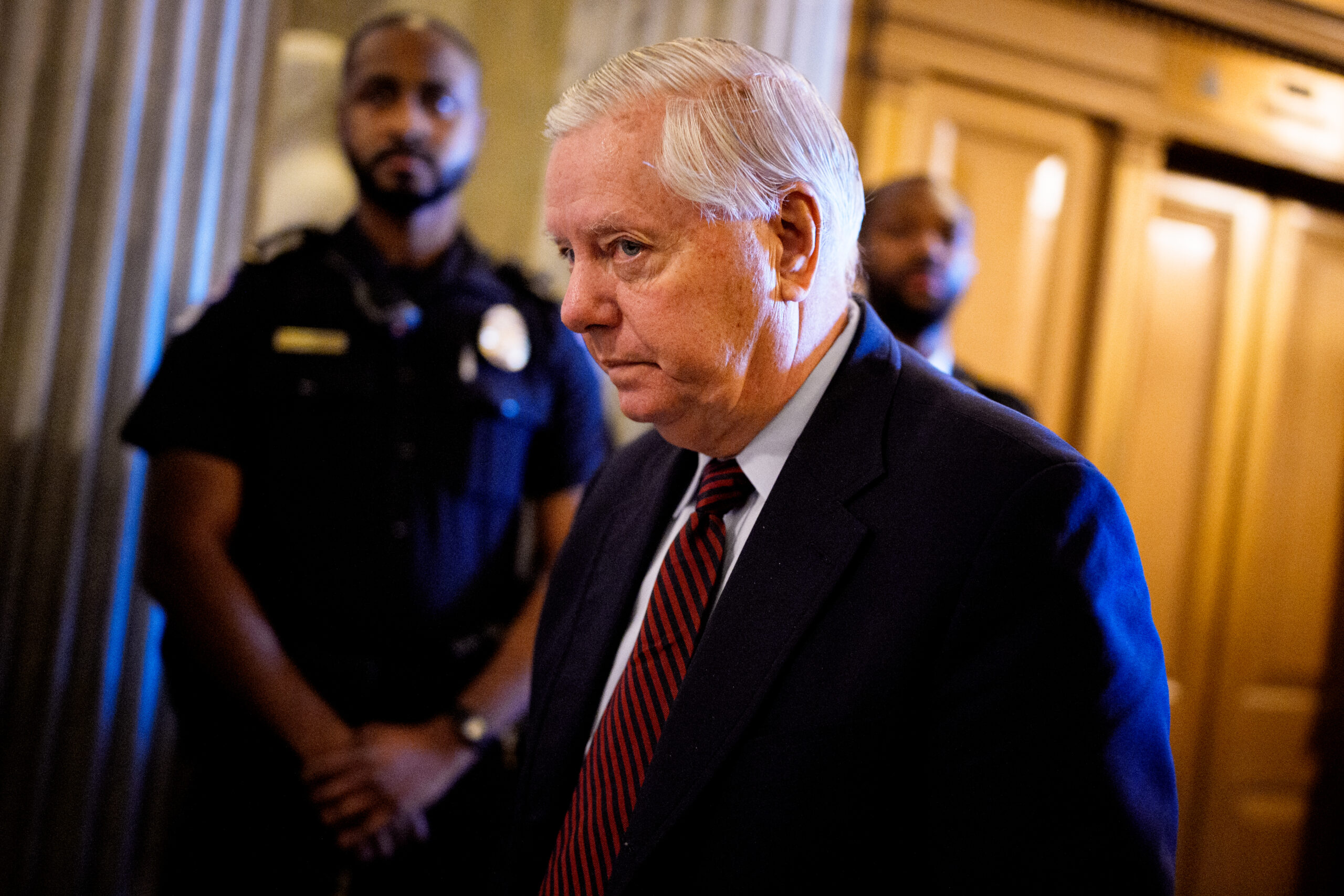
Sen. Lindsey Graham (R-SC) said on Sunday he is “somewhat concerned” that Iran’s account of the U.S.-Iran ceasefire deal diverges sharply from what the U.S. negotiators are claiming, and demanded Vice President JD Vance personally present the deal to Congress, Jewish Insider’s Marc Rod reports.
Notable quotable: “I am somewhat concerned that Iran’s view of the agreement seems different than what the American negotiating team is claiming,” Graham said on X. “I look forward to reviewing the final product and I believe it is imperative that the architect of the deal, Vice President Vance and his negotiating partners, be part of the process in presenting the final deal to Congress.”
EYE ON THE BALL

As the Iranian national soccer team begins the 2026 World Cup amid high-level diplomatic negotiations to end the war between the U.S. and Iran, American security officials — and American Jewish communities already operating under elevated threat conditions — are facing challenges beyond soccer, Jewish Insider’s Danielle Cohen-Kanik reports.
Measures taken: The team is not allowed to stay on U.S. soil overnight; it relocated its training camp from Tucson, Ariz., to Tijuana, Mexico, and will return to Mexico after the final whistle of each of its matches. The host cities are already on alert: Seattle Mayor Katie Wilson, a Democrat, said she was briefed on a “credible threat” to the city during the World Cup, which so alarmed her that she decided to turn on CCTV cameras around the soccer stadium for the duration of the games, counter to her longstanding opposition to the surveillance system.
PITCH PERFECT

Hagar Hajjar Chemali, a self-described “Lebanese Zionist” who is half Jewish and half Christian, is betting that a historic opening can help break through the distrust that has long defined relations between Lebanon and Israel. The former Bush and Obama administration official recently launched the Lebanon-Israel Peace Alliance, an unofficial effort to support the first direct talks between Lebanese and Israeli officials since 1983, Jewish Insider’s Gabby Deutch reports.
Unique ability: “It’s about the art of the possible. Lebanese-Israeli peace is not particularly easy to achieve,” said Daniel Glaser, a former assistant Treasury secretary for terrorist financing and financial crimes. He hired Chemali for her first job at the Treasury Department. “What’s going to get it done is the ability to understand what’s possible, and how to get to that possible within the U.S. system, within Israel and the Israeli system, within Lebanon and the infinitely complicated Lebanese system. There’s not a lot of people that have the ability to do that more than Hagar.”
PEACH STATE RACE
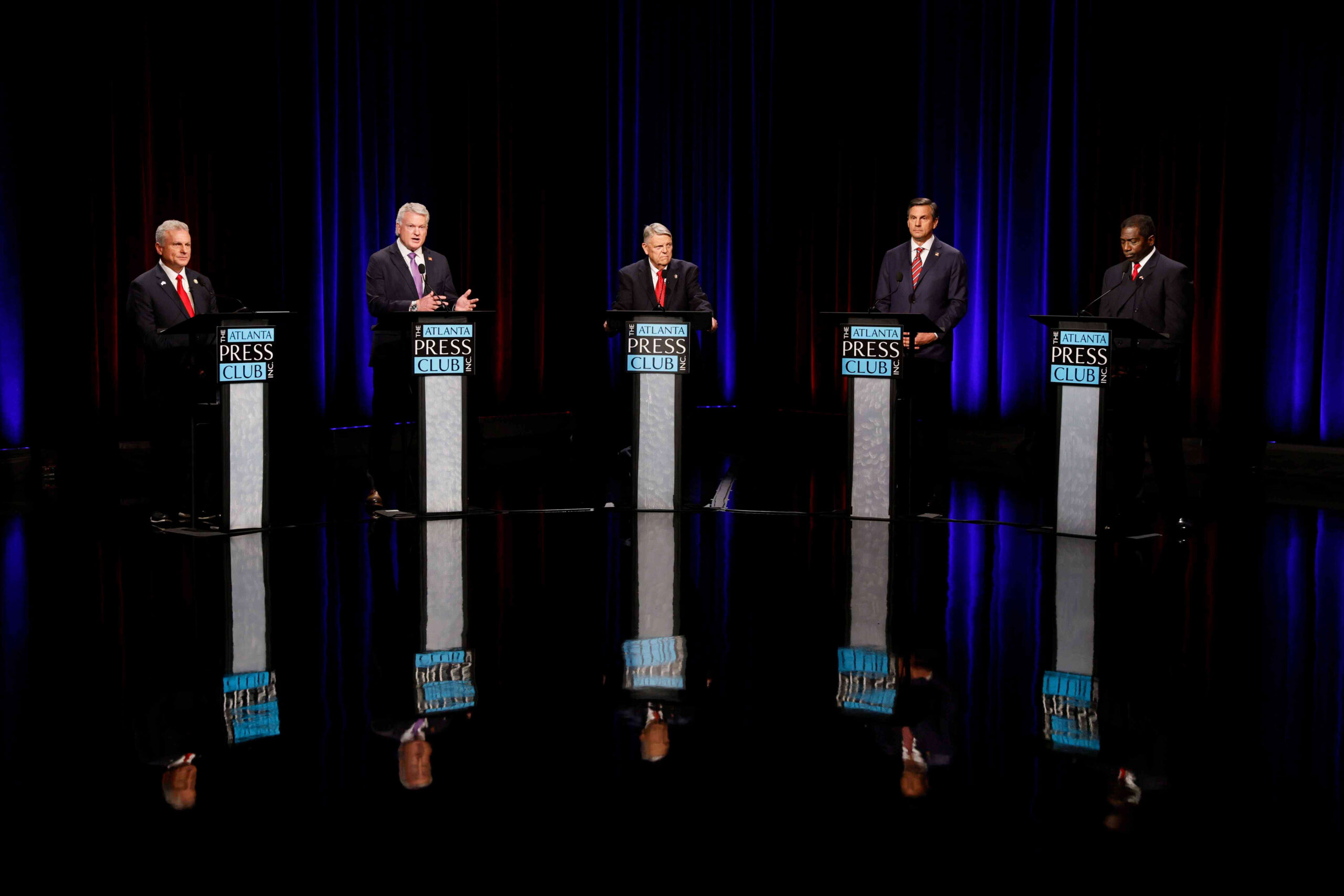
Rep. Mike Collins (R-GA), who has repeatedly faced controversy during his time in the House, appears favored to win the Republican Senate primary runoff in Georgia against Derek Dooley, a former college football coach backed by popular moderate GOP Gov. Brian Kemp, Jewish Insider’s Marc Rod reports.
State of play: Collins led Dooley 41-30% in the May 19 Republican primary, with Rep. Buddy Carter (R-GA) coming in at 25%. The runoff is Tuesday, with the winner to face Sen. Jon Ossoff (D-GA) in November. President Donald Trump endorsed Collins — generally seen as the more MAGA-aligned candidate — late on Saturday, while Kemp — who national Republicans initially sought to recruit for the race — has been aggressively campaigning around the Peach State in support of Dooley.
SHOW OF SUPPORT
Sen. Bernie Sanders (I-VT) is set to join a rally in New York City on Thursday with Mayor Zohran Mamdani and a trio of candidates he is backing in closely watched New York City House races, The New York Times reports. The event, which will be held five days before the June 23 primary at the Kings Theatre in Brooklyn, will lend a jolt of momentum to Mamdani’s preferred slate of far-left congressional candidates — including democratic socialists Claire Valdez and Darializa Avila Chevalier, and Brad Lander, a former New York City comptroller who also ran for mayor last election cycle, Jewish Insider’s Matthew Kassel reports.
Zoom out: The senator’s decision to appear at the rally next week is notable in part because he will be aiding Mamdani in his efforts to unseat two Democratic incumbents, Reps. Dan Goldman (D-NY) and Adriano Espaillat (D-NY), who have drawn backlash from the left over their support for Israel and ties to the pro-Israel group AIPAC, a chief source of criticism in the races.
TAX CONSEQUENCES
Jewish advocacy groups are celebrating a new set of wonky tax guidelines released last week by the Treasury Department that offer clarity into a new federal education tax credit that they hope will help more Jewish families access day school education, Jewish Insider’s Gabby Deutch reports.
Sneak peek: Education-focused nonprofits have been awaiting guidance from the federal government about the program, which provides a dollar-for-dollar federal tax credit for people who donate up to $1,700 to organizations that fund certain approved education expenses, like private school tuition and tutoring costs. Last week, Kevin Salinger, the Treasury Department’s deputy assistant secretary for tax policy, did a whirlwind tour of virtual briefings with nonprofits to preview the forthcoming new guidance.
Worthy Reads
Losing Battle: The Atlantic’s Tom Nichols posits that the U.S. has lost the war with Iran following President Donald Trump’s announcement that an agreement between the countries had been reached. “But even before we have the details, it is clear that Trump has failed to achieve every one of the goals he put forward for this war of choice, and now he is determined to sign, seal, and deliver America’s capitulation as quickly as possible. … Indeed, the United States has perhaps done worse than gaining nothing. Iran, while temporarily weakened, is now an even more powerful political actor: The regime in Tehran stood up to a massive U.S. onslaught, survived, and then inflicted pain on various states in the Gulf as punishment for going along with Trump’s war.” [TheAtlantic]
Power Broker: The Wall Street Journal’s Benoit Faucon and Summer Said spotlight Ahmad Vahidi, the commander in chief of Iran’s Islamic Revolutionary Guard Corps, who has played a key role in U.S.-Iran talks. “For months, Vahidi, an enigmatic commander whose predecessor was killed on the first day of the war, has tussled with more public-facing, political figures in the Iranian leadership. Each time, he has come out on top. Vahidi’s position at the top of the regime’s most powerful armed force means his perspective is now shaping Iran’s stance in negotiations to end the war, say mediators involved in the talks. His forces are in charge of imposing Iran’s stranglehold on the Strait of Hormuz, the regime’s strongest card in negotiations.” [WSJ]
Life of Service: In Sapir, Anne Neuberger, who served as deputy national security advisor for cyber in the Biden administration, calls for the Jewish community to prioritize public service, calling it a “religious imperative” in addition to a civic necessity. “My commitment — and that of many of my colleagues — to public service was rooted in the spiritual idea that each person has a divine mission that requires channeling her personal gifts toward the public good. For me, that was in the realm of security, but there are so many aspects of public service that have nothing to do with security: law, accounting, engineering, economics, you name it. … The American Jewish community should encourage our children to see a badge, a security clearance, or a civil service ID as a form of kiddush Hashem, a sanctification of God’s name.” [Sapir]
The Art of Erasure: The New York Times’ Sharon Waxman interviews Israeli artists about the challenges they face as anti-Israel sentiment balloons across the arts, largely sidelining Israeli creatives regardless of their political beliefs. “The five I met at the hotel have concluded they can no longer have a good-faith discussion with the outside world since they believe their own survival is at stake. Their reactions struck me as a kind of emotional armor against the judgment of the West. ‘After Oct. 7, you realize you have no one else to trust. We are on our own,’ said the songwriter Aya Korem. … Ms. Korem noted how nearly everyone in Israeli society has been affected by the war. ‘You become humble in front of that and you remember what is important. Your art is the continuation of that. And our moral obligation is to that humility, and to the stories of people who paid actual prices.’” [NYTimes]
Word on the Street
Former U.K. Prime Minister Tony Blair, who sits on the Board of Peace‘s executive board, is set to take on a larger role in the organization, overseeing postwar management in the Gaza Strip…
A spokesperson for Sen. Mitch McConnell (R-KY) said the Kentucky senator was hospitalized on Sunday and is receiving “excellent care”…
The head of the Florida Republican Party said it had rescinded an invitation to far-right gubernatorial candidate James Fishback for the party’s upcoming Sunshine State Showdown as well as “all other official gubernatorial primary activities,” adding, “Racism and antisemitism have no place in our Party”…
Abdul El-Sayed, the far-left Democratic Senate candidate in Michigan, suggested at an event on Friday that the Trump administration had indicted a group of anti-Israel demonstrators at the University of Michigan for their beliefs, rather than their actions, Jewish Insider’s Marc Rod reports…
The heir to the Lion Raisins brand was arrested by police in Pacific Palisades, Calif., and charged with making criminal threats to a neighbor who is a rabbi; video shared by the New York Post and its local affiliate appear to show Bruce Lion shouting antisemitic slurs from a balcony that overlooked the rabbi’s property, interrupting gatherings…
Four British activists associated with the Palestine Action group were sentenced to prison terms between four and eight years for their participation in a 2024 raid at an Elbit Systems compound in Bristol that caused more than £1 million in damage at the Israeli defense firm’s facility…
Fifteen people were arrested amid protests outside a synagogue in the Edgware neighborhood of London that was hosting an Israeli real estate event; more than 1,000 people were estimated to have taken part in the protest and counter-demonstration…
In The Wall Street Journal, Phelim McAleer, who with his wife Ann wrote a play about the survivors of Hamas’ Oct. 7, 2023, terror attacks, reflects on antisemitism in his native Ireland ahead of “Bloomsday,” an unofficial holiday celebrating author James Joyce’s Ulysses and its main character, a Jewish man named Leopold Bloom…
Israeli Defense Minister Israel Katz named Brig. Gen. Hisam Ibrahim to serve as the next IDF military secretary; Ibrahim, currently the head of the IDF’s Civil Administration, is one of the most senior Druze officers in the army…
Film critic Gene Shalit, a fixture on NBC’s “Today” show for more than 40 years, died at 100…
Pic of the Day
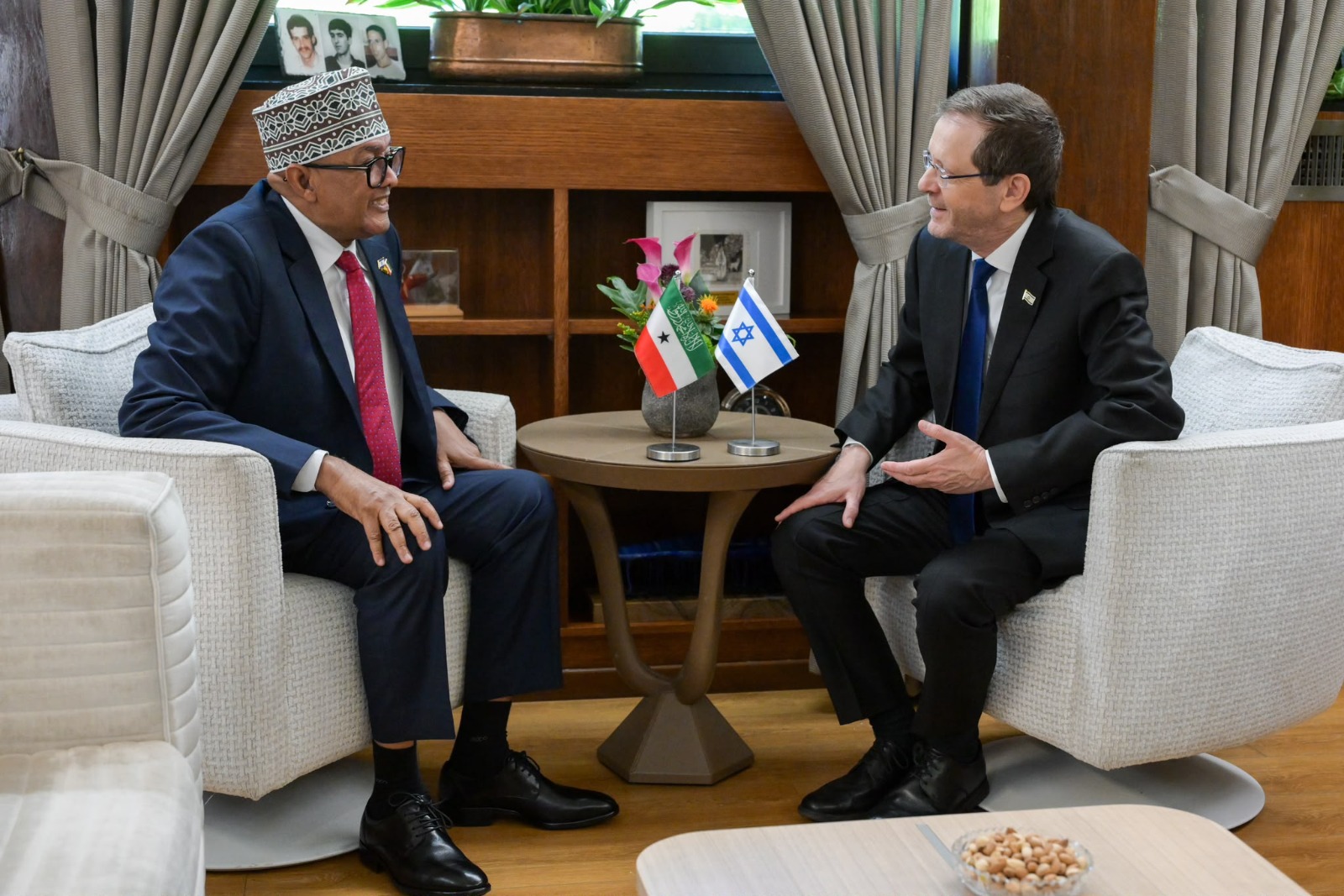
Birthdays
Chief political correspondent for CNN, born Dana Ruth Schwartz, Dana Bash turns 55…
Former president of the Jewish Community Foundation of Greater Phoenix, Stuart C. Turgel… Former president of the National Rifle Association, Sandra S. (Sandy) Froman turns 77… Ethicist and professor at the University of Chicago Divinity School, Laurie Zoloth turns 76… Internationally recognized authority on Yiddish folk and theater music, Zalmen Mlotek turns 75… Entrepreneur, currently living in Estonia, he rebuilt a synagogue and a community center in Estonia, Alexander Bronstein turns 72… President and CEO of the PR firm Edelman, founded by his father Daniel Edelman in 1952, Richard Winston Edelman turns 72… Chief rabbi of Poland, Rabbi Michael Schudrich turns 71… Israeli Druze politician who served as a member of the Knesset for Likud, Fateen Mulla turns 66… Novelist, screenwriter, teacher and freelance journalist, Jill Eisenstadt turns 63… First woman certified by the NFLPA as a player agent, she is now general counsel for USA Football, Ellen Marsha Zavian turns 63… Director at Citrin Cooperman Advisors, Reuben Rutman… Los Angeles-based attorney, Daniel Brett Lacesa… Former regional director of the ADL based in Los Angeles, now managing member of Abrams Advisors, Jeffrey I. Abrams… Pulitzer Prize-winning reporter, now deputy publisher of The Athletic and Wirecutter at The New York Times Company, Clifford J. Levy turns 59… Retired news anchor for Israel Public Broadcasting, she is married to Israeli Foreign Minister Gideon Sa’ar, Geula Even Sa’ar turns 54… Former head speechwriter for First Lady Michelle Obama, she is the author of 2025’s As A Jew: Reclaiming Our Story From Those Who Blame, Shame, and Try to Erase Us, Sarah Hurwitz… Ethiopian-born Israeli marathoner, he represented Israel at the 2012 Summer Olympics, Zohar Zimro turns 49… Co-anchor of a CNN global news show, Bianna Golodryga turns 48… Former chief of staff to Sen. John Fetterman (D-PA), Adam Jentleson turns 45… Co-founder of Evergreen Strategy Group, he is a former director of speechwriting for Hillary Clinton and was also the principal collaborator on memoirs published by HRC, Daniel Baum Schwerin… Director of corporate communications and public affairs at Google, Rebecca Michelle Ginsberg Rutkoff… Chief advancement officer at Birthright Israel Foundation, Jaclyn “Jackie” Saxe Soleimani… Senior recruiter at The Carlyle Group, Victoria Edelman Klapper … PBS News correspondent Ali S. Weinberg Rogin… Associate at Affinity Partners, Elli Sweet… Jimmy Ritter… Joel Winton…
In Israel, the deal is being met with dismay across the board
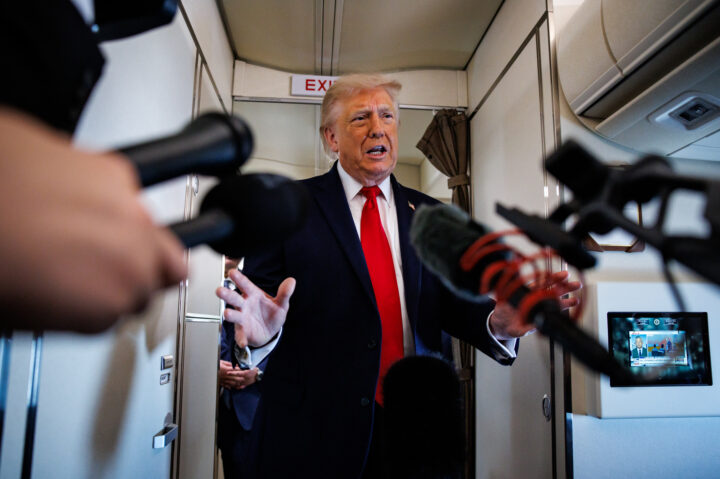
Samuel Corum/Getty Images
President Donald Trump speaks with reporters while aboard Air Force One on June 5, 2026 en route to Chippewa Falls, Wisconsin.
A year and a day after Israeli fighter jets first opened fire above Iran, setting off a year of intermittent fighting and numerous failed negotiations, President Donald Trump announced on Sunday that an agreement with Iran to end the war had been reached. A signing ceremony set for later this week in Switzerland — which is expected to be attended by Vice President JD Vance — will kick off a 60-negotiation period to address Iran’s nuclear program and U.S. sanctions on the Islamic Republic.
For Americans, the deal closes a chapter that saw high gas and food prices as well as schisms in the GOP as the party’s wings fought over how the war should be fought and ended. Among Democrats, legislators and activists from the party’s progressive wing — from Rep. Ro Khanna (D-CA) to the National Iranian American Council’s Trita Parsi (who additionally gloated, “Netanyahu failed!”) — praised the deal.
But Israel was not part of the negotiations, nor did it have final say in what was in the agreement inked between Washington and Tehran. As the Is were dotted and Ts were crossed on the agreement, tensions between Trump and Israeli Prime Minister Benjamin Netanyahu — already on display following Israel’s threatened escalation last week in Beirut, followed by an actual escalation on Sunday when Israel struck Beirut’s Dahiyeh neighborhood — deepened. In a call on Sunday after Israel conducted the strike — later claiming to have killed a senior Hezbollah commander — Trump told Axios he had conveyed to Netanyahu that he “was so pissed off.” Netanyahu, Trump said, “has no f***ing judgement. I let him know that.”
In Israel, the deal is being met with dismay across the board, as neither of the war goals laid out by Netanyahu last June — removing Iran’s “existential threats” to Israel and ending Tehran’s support for its terror proxies across the region — have been met, even after a year of fighting.
With elections in the country fast approaching, Netanyahu, who has long billed himself as “Mr. Security,” is already finding himself on the receiving end of criticism from across the political spectrum. Former Israeli Defense Minister Avigdor Liberman blasted the deal as “catastrophe from Israel’s perspective,” while prominent right-wing Israeli journalist Amit Segal posted an ominous quote from former U.S. Secretary of State Henry Kissinger: “It may be dangerous to be America’s enemy, but to be America’s friend is fatal.”
The question now is what, exactly, is in the agreement. Iran’s state-linked Mehr agency reported that under the terms of the agreement, the U.S. will release $12 billion in frozen assets to Iran before talks begin.
Fox News reported that the $12 billion figure, as well as other reports of the deal’s stipulations, are incorrect, and that officials within the Trump administration are growing frustrated over rumors about the contours of the agreement.
Calls for the deal’s text to be made public have come from even Trump’s staunchest supporters. Commentator Mark Levin said he has “asked for days, why can’t we, the people, see the damn MOU?” Levin added that he had “never seen anything like this. If it is a great outcome for peace, then release it.”
Sen. Lindsey Graham (R-SC) said on X on Sunday that he was “somewhat concerned” that Iran’s account of the U.S.-Iran ceasefire deal diverges sharply from what the U.S. negotiators are claiming, and demanded Vice President JD Vance personally present the deal to Congress.
The vice president, who two months ago traveled to Pakistan for high-level negotiations with Iranian officials, has increasingly become the public face of the Iran talks. In an interview last week that aired yesterday on “CBS Sunday Morning,” Vance said he believed “that we are in a position to get a deal that is good for the United States economically and that really does deal with the Iranian nuclear program” in the long term.
For Vance, the success or failure of the deal, and of the negotiations to follow, could become one of the defining political issues of his rumored 2028 presidential bid — one in which he will likely find himself up against Secretary of State Marco Rubio in what could be a bruising primary.
With the deal’s signing later this week, the military phase of the war — begun just over a year ago — will conclude. But what comes next is the political phase, which will determine Iran’s nuclear future, Israeli security policy and the direction of U.S. foreign policy in the region for decades to come.
Seattle Mayor Katie Wilson said she was briefed on a 'credible threat' to the city and decided to turn on CCTV cameras around the soccer stadium for the games

Harry How/Getty Images
Alireza Jahanbakhsh Iran trains with teammates one day ahead of the FIFA World Cup 2026 Group G match between IR Iran and New Zealand at Centro Xoloitzcuintle on June 14, 2026 in Tijuana, Mexico.
As the Iranian national soccer team begins the 2026 World Cup amid high-level diplomatic negotiations to end the war between the U.S. and Iran, American security officials — and American Jewish communities already operating under elevated threat conditions — are facing challenges beyond soccer,
The first security and political consideration concerns the Iranian delegation itself: The United States has occasionally restricted entry for sports officials and delegations from adversarial countries — from Soviet Olympic officials during the Cold War to Cuban baseball and Iranian karate representatives in recent years.
The Trump administration, facing pressure from FIFA, did eventually issue visas several weeks ago — after months of uncertainty — to the 26 members of Iran’s national team, though more than a dozen staff members and officials associated with the team were not granted visas due to security concerns. The team is set to play on Monday and next week in Los Angeles, against New Zealand and Belgium, respectively, and against Egypt in Seattle on June 26.
“The visas necessary for Iran to compete in the World Cup, including for athletes and necessary support staff, have been issued,” the State Department told ESPN. “We will not allow the Iranian team to abuse this system to sneak terrorists into the United States under false pretenses.”
One of the people rejected is reportedly Mehdi Taj, head of the Iranian soccer federation, who was previously a commander in Iran’s Islamic Revolutionary Guard Corps. The team is also not allowed to stay on U.S. soil overnight; it relocated its training camp from Tucson, Ariz., to Tijuana, Mexico, and will return to Mexico after the final whistle of each of its matches.
The host cities are already on alert: Seattle Mayor Katie Wilson, a Democrat, said she was briefed on a “credible threat” to the city during the World Cup, which so alarmed her that she decided to turn on CCTV cameras around the soccer stadium for the duration of the games, counter to her longstanding opposition to the surveillance system.
Amid an already heightened threat environment for Jewish communities in the aftermath of the Oct. 7 attacks and amid the Iran war, thousands of fans from around the world flocking to the U.S. to cheer on their favorite teams presents an additional security challenge.
Secure Community Network, a Jewish communal security organization, told Jewish Insider that “there are no known specific threats to the Jewish community directly related to the World Cup,” though the group “has been proactively engaged with the Jewish Federation of Greater Seattle and other World Cup host cities well in advance of the tournament.”
SCN cited the 2006 shooting attack on the Seattle Jewish Federation that killed one and wounded five others, perpetrated by a Pakistani national who said he was “angry at Israel,” as “continu[ing] to inform the local community’s commitment to security and preparedness.” The Seattle and Los Angeles Jewish federations declined to comment.
Oren Segal, the Anti-Defamation League’s senior vice president of counter-extremism and intelligence, called Iran’s participation in the World Cup “a moment for vigilance, not alarm.” He predicted that the event “will likely attract some protest activity from groups seeking to leverage the global attention surrounding the tournament to advance their causes,” and said “the appropriate response is proactive coordination with local law enforcement and ensuring that community members are informed, prepared, and supported.”
Hagar Hajjar Chemali, who is half Jewish and half Christian, thinks she has a shot at helping break through the deep sectarianism that has led to distrust both within Lebanon and towards Israel

Courtesy
Hagar Hajjar Chemali
Hagar Hajjar Chemali is an American by accident — quite literally — of birth.
Her parents left their native Lebanon in 1981 as a civil war raged in the country. Chemali’s father, Hadi, had been kidnapped by a political group, and the young couple quickly left the country once he was released, with plans to move to Milan. While visiting friends in Greenwich, Conn., Chemali’s mother, Mirella, began experiencing pregnancy complications and chose to wait out the final months of her pregnancy there. Soon after, Chemali was born, followed quickly by a son. The family never left.
So began Chemali’s American story, the result of a potent combination of determination and coincidence. That’s the story of Chemali’s professional journey, too: a mix of persistence and being in the right place at the right time. She spent the first decade of her career helping steer U.S. foreign policy on the Middle East in the Bush and Obama administrations, ultimately becoming the spokesperson for former U.S. Ambassador to the United Nations Samantha Power. She spent the next decade as a consultant and communications expert, appearing regularly on cable news and a YouTube channel where she produces an occasionally satirical show explaining American foreign policy.
Now Chemali, 44, faces her biggest and most personal assignment yet: creating an unofficial backchannel to boost the ongoing peace talks between Lebanon and Israel, the first time that officials from the two countries have sat for direct talks since 1983. And Chemali, who is half Jewish and half Christian, thinks she has a shot at helping break through the deep sectarianism that has led to distrust both within Lebanon and towards Israel.
The deal between the U.S. and Iran that was announced on Sunday may complicate Chemali’s efforts. Iran’s attempt to link its own negotiations with the U.S. to developments in Lebanon could potentially complicate efforts to advance Israeli-Lebanese peace, and Iranian state media said on Sunday that Lebanon would be part of the new deal. Details remain scarce.
“It’s about the art of the possible. Lebanese-Israeli peace is not particularly easy to achieve,” said Daniel Glaser, a former assistant Treasury secretary for terrorist financing and financial crimes. He hired Chemali for her first job at the Treasury Department. “What’s going to get it done is the ability to understand what’s possible, and how to get to that possible within the U.S. system, within Israel and the Israeli system, within Lebanon and the infinitely complicated Lebanese system. There’s not a lot of people that have the ability to do that more than Hagar.”
In April, she announced the creation of an organization called LIPA, the Lebanon-Israel Peace Alliance. It’s a vessel for advocacy by Chemali and a cadre of Israeli, Lebanese and American foreign policy experts she colloquially describes as the “peace crew” — many do not yet want to publicize their involvement with the effort — who are working to keep the pressure on the U.S. government to help broker a deal between Lebanon and Israel.
The group has been collaborating since early last year, soon after Israel and Lebanon reached a ceasefire in late 2024 that ended the fighting between Israel and Hezbollah that began when the Iranian-backed group launched missiles at Israel on Oct. 8, 2023. The effort gained traction amid a broader shift in Lebanon: Hezbollah was weakened by the death of its longtime leader, Secretary-General Hassan Nasrallah, and newly elected Lebanese President Joseph Aoun moved to reassert state authority over Hezbollah’s power and influence.
“She was one of the very first people that said to me that I should go for peace,” said Morgan Ortagus, who served as deputy Middle East special envoy at the beginning of the Trump administration. Ortagus and Chemali have been friends since they worked in the Treasury Department together nearly 20 years ago. “I said, ‘Really, do you think they’re ready?’ And she was emphatic that she thought that it was the time to go for peace.”
The work of Chemali’s burgeoning “peace crew” solidified in March, at a dinner soon after the Iran war started. The geopolitical time crunch of a fast-moving war spurred the group to come up with a name to formalize the informal diplomacy they had been pursuing for more than a year.
“All this work actually helped bring the Israelis and the Lebanese governments to hold direct talks in Washington,” said Hanin Ghaddar, a senior fellow studying Lebanon at The Washington Institute for Near East Policy. “I don’t think this would have been possible without the whole year of work on the narrative and the policy and the recommendations and the shift on the ground, that this is where Lebanon and Israel finally decided, ‘Let’s do this.’”
After the U.S. and Iran agreed to a ceasefire in early April, Israeli Prime Minister Benjamin Netanyahu announced that Israel would open direct negotiations with Lebanon. It was the moment for which Chemali had yearned for over 18 months — or, perhaps, a whole lifetime. In the aftermath of the first round of talks, LIPA was launched in the way so many projects are: via a somewhat haphazard post on X. Chemali did not want to lose her chance at creating momentum for a window for peace that might soon close. She has not returned to Lebanon in 15 years due to security risks.
“As a comms person, I would never advise a rollout this way. This is like the opposite of what you do before a rollout. You have all your ducks in a row when you roll anything out,” Chemali told Jewish Insider in a recent interview at a Washington cafe. “We wanted to come out there and be like, we have an organization that exists that is there to support this process.”
For Chemali, the effort is a culmination of her own professional arc, as well as the choices her parents made in building a life here. Her family might be Lebanese, but this effort is all-American — something she can do because of where she was born and the circumstances that allowed her to rise to a public, senior government role without having to worry about the strict sectarian divisions that govern Lebanese society and the country’s government.
But there was a piece of Chemali’s story that was missing, something that now makes her uniquely positioned to serve as a convener of Lebanese and Israelis here in the U.S.
“She’s half-Jewish and half-Christian,” said Hussain Abdul-Hussain, a Lebanese-Iraqi researcher at the Foundation for Defense of Democracies. “She has the highest pedigree for someone to be working on this issue.”
Chemali did not know about her Jewish roots when she was growing up. Her father is a Maronite Christian, a Catholic sect with deep roots in the Levant. The family attended a nondenominational church in Connecticut. When Chemali was 11 or 12, her mother revealed a secret she had kept since her children were born: She was Jewish.
“I think she just couldn’t take it anymore. She was just like, ‘Actually, I’m Jewish,’” Chemali recalled. “My brother and me, being raised in the United States, we were like, ‘That is so cool. Does that mean we get Hanukkah gifts?’”
Her mother, Mirella, grew up in Wadi Abu Jamil, Beirut’s Jewish neighborhood. She attended a Catholic school at the urging of the family of her late father. The nuns at her school would tell Mirella that “she had evil in her blood because she was Jewish,” according to Chemali. “So [her family] practiced Judaism in secret at home.”
The revelation from her mother intrigued Chemali. Why didn’t she tell them sooner? Mostly Chemali ignored it, until she came to Washington during the George W. Bush administration. She joined the Treasury Department in 2006, in the newly created Office of Terrorist Financing and Financial Crimes, where many of her colleagues were Jewish. They started inviting her to Shabbat dinners and Jewish holidays. Chemali learned more about Judaism, and began to feel proud of that part of her identity. When she moved back to Greenwich, she asked her mom to teach her more about her family’s traditions.
“I told my mom, ‘These traditions die with you. You didn’t raise me with these traditions. I only know what I know from books and from going with friends to their houses for events,’” Chemali said. So her mom bought a menorah, and they lit candles together for Hanukkah.
“She starts singing in Hebrew, and I was like, ‘Who is this woman who sings in Hebrew?’ As far as I knew, she speaks a lot of languages — actually, she speaks five languages — but Hebrew was not one of them,” said Chemali.
Chemali has not abandoned the Christian faith she was raised with, even as she grapples with her identity.
“What I tell people of where I am at the moment, but it is always an evolution, is that I am of Christian faith and feel very much a Jew,” said Chemali. “I always tell people I’m a member of every tribe.”
Lebanon is so beset by tribal division that different government positions are reserved for people from different religious sects: the president is required to be a Maronite Christian, the prime minister is a Sunni Muslim and the speaker of parliament is a Shia Muslim. Chemali has refused to diminish any part of her identity, even as her home country all but demands she pick a side.
“She’s someone who can actually speak to everyone. She’s not there to take sides,” said Ghaddar. “She really sees the whole picture, and I think that’s what this kind of initiative really needs. It’s someone who has a stake in everyone and everything.”
Chemali retains the idealism that so many lose after decades in Washington. She described herself as a “Lebanese Zionist,” a position she said she has stuck by even amid the polarization that crept into her family after Oct. 7.
“This is the thing that sets me apart from the rest of my family. There’s a chunk of my family that unfriended me on social media after Oct. 7 because of my statements — and by the way, my statements are not like, ‘Yeah, go into Gaza and get ‘em.’ That’s not what I’m saying. My statements were more posting about the hostages,” said Chemali. “There’s one chunk of my family from Syria on my dad’s side that, straight up, they will lecture me at any opportunity they have. I view them as brainwashed, to be perfectly honest, and they probably view me as brainwashed.”
Chemali recalled a trip to Lebanon during her time as the National Security Council’s director for Lebanon and Syria in the Obama administration. A Lebanese friend advised her not to share that she’s Jewish.
“I was like, ‘Look, that’s not how I operate,’” said Chemali. “First, I really make sure religion doesn’t come up in my government work, because I don’t want anyone ever accusing me of seeing something through a religious lens. But secondly, if it comes up, I don’t hide. That’s not how I roll, ever.”
Still, she understands that not everyone can be as visible as she is. Chemali gave up her Lebanese citizenship before entering the U.S. government, but ordinary Lebanese people face steep prison sentences simply for talking to Israelis because of the country’s anti-normalization laws. Free from these restrictions, Chemali has recently taken to setting up discreet dinners between Lebanese and Israelis in Washington.
“We are trying to come up with creative ways to work around these laws,” she said. “We have to pick locations where nobody will see them or recognize them, so it makes it much more difficult.”
One of LIPA’s priorities is urging the U.S. to pressure Lebanon to repeal those laws. Chemali holds meetings with members of Congress on both the left and right. She talks to contacts at the State and Treasury Departments regularly, advocating for new sanctions on Hezbollah. She’s a fixture in Foggy Bottom and at wonky Middle East conferences, on cable news and in cafes, all from her home base in Connecticut.
“The ideal is a warm peace where you have thriving business relations, and that’s how our efforts are geared, toward that vision,” said Chemali. “That will hopefully undermine Hezbollah’s presence.”
After a new round of talks early this month, the governments of Lebanon, Israel and the U.S. released a joint statement in which Lebanon’s army agreed to create “pilot zones” where it will exert control and ban Hezbollah, the Iran-backed militia that uses southern Lebanon as a base to attack Israel. The diplomats will meet again later this month, and military representatives from each country will hold their own parallel track. The talks are testing the Lebanese government’s appetite for taking a stand against the militia. Meanwhile, Israel and Hezbollah continue to trade blows even as the talks proceed.
That negotiations are happening at all reflects unprecedented discontent within Lebanon toward Hezbollah. Until now, Lebanon’s leaders have been unable or unwilling to exert the strength needed to push back on Hezbollah’s grip over the country’s politics. Earlier this month, Aoun, the country’s president, took the unusual step of criticizing Iran, Hezbollah’s primary backer: “It’s not your country, it’s our country,” he told CNN.
Former U.S. Ambassador to Israel Dan Shapiro called the peace talks a “tremendous opportunity” for both countries.
“Maybe more for Lebanon than for Israel, because it really would mean breaking free from the handcuffs of Hezbollah and Iran,” said Shapiro. He hired Chemali for her job at the Obama White House and said he is encouraged by her efforts with LIPA.
“Having a strong advocacy body in the United States perhaps buttressed by those in Europe and elsewhere in the region is important fuel to that process,” said Shapiro. “She’s got just endless energy and creativity and a real commitment.”
The biggest challenge is that Lebanon’s leadership does not control Hezbollah. Peace between Israel and Lebanon would still be momentous even without dealing with Hezbollah, but it would leave the most intractable issue unresolved.
“It’s not the elephant in the room, because they all talk about it. But the crux of this is Hezbollah and Hezbollah’s weapons, and it’s not just the disarmament of them, it’s ensuring that they’re never able to rearm again,” said Chemali.
Washington is easily distracted; Trump is no exception. For Chemali, who is not directly involved in the talks, perhaps the most urgent task is to make sure the people in the room do not move on. She needs to remind them that the Lebanon-Israel file remains important, and worth pursuing — and that it should not be subsumed up by negotiations between the U.S. and Iran.
“We keep our fingers crossed, we advocate, we speak up, publish op-eds, you name it. Go on interviews, whatever it takes, just to make sure that things keep on going in the peace direction,” said FDD’s Abdul-Hussain, who is friends with Chemali but is not formally collaborating with her. “People like us, who are not governments, who are just regular people, we have a bigger margin. We have a lot of freedom to move. We have a lot of freedom to explain things, or to oppose things.”
But even in the perpetually explosive Middle East, where the talks could easily fall apart, Chemali believes something fundamental has changed.
“No matter what happens with the talks, there’s a reason I have hope,” she said. “Because you see this taboo in Lebanon has broken.”
The senator said Iran’s interpretation of the deal ‘seems different’ from what U.S. negotiators are claiming
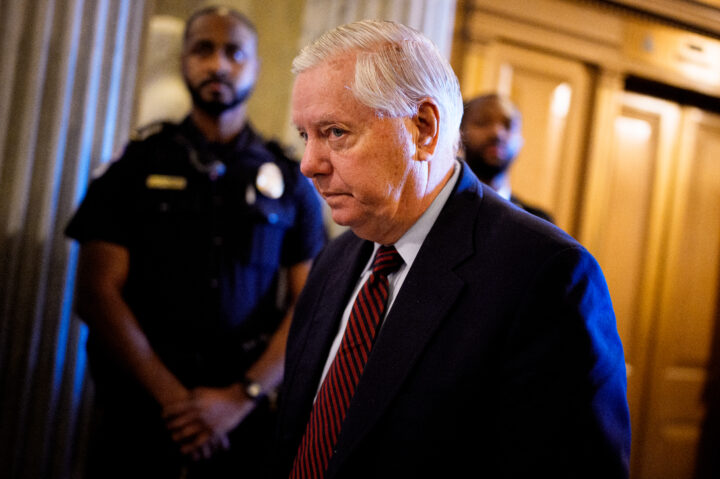
Andrew Harnik/Getty Images
Sen. Lindsey Graham (R-SC) walks into the Senate Chamber on December 11, 2025 in Washington, DC.
Sen. Lindsey Graham (R-SC) said on Sunday he is “somewhat concerned” that Iran’s account of the U.S.-Iran ceasefire deal diverges sharply from what the U.S. negotiators are claiming, and demanded Vice President JD Vance personally present the deal to Congress.
Iranian state media has claimed that the memorandum of understanding with the United States requires the release of all sanctions on Iran, a $300 billion reconstruction plan financed by the United States and its allies and the release of nearly $30 billion in blocked Iranian funds, and excludes any negotiation of Iran’s missile program or support for terrorism.
“I am pleased to hear the memorandum of understanding with Iran to allow the Strait of Hormuz to open has been agreed to. I will be watching closely the ensuing negotiations regarding Iran’s nuclear program and other matters,” Graham said on X. “I am somewhat concerned that Iran’s view of the agreement seems different than what the American negotiating team is claiming.”
He emphasized that the Iran Nuclear Agreement Review Act (INARA) requires the administration to send any nuclear deal with Iran to Congress for review and a vote.
“I look forward to reviewing the final product and I believe it is imperative that the architect of the deal, Vice President Vance and his negotiating partners, be part of the process in presenting the final deal to Congress,” Graham said. “Congratulations to all in getting us to this point. Time will tell.”
Earlier in the day, Graham also diverged from President Donald Trump on Israel’s strike on Hezbollah in Beirut, which Trump sharply criticized. Graham emphasized that “we must understand who we are dealing with” and that Hezbollah’s strikes on Israel have continued in spite of the ceasefire deal.
“It is clear to me that no matter what deal we sign with Iran, Hezbollah’s stated ambitions of destroying Israel and making Lebanon a caliphate have not fundamentally changed,” Graham said.
He also reposted an X post by Israeli Ambassador to the U.S. Yechiel Leiter, praising Israel for eliminating the Hezbollah commander targeted in the attack.
“To the IDF and all involved in taking out this terrorist with American blood on his hands and a bounty on his head for attacking US troops – thank you. America has no better friend than Israel,” Graham said. “We have common values and common enemies. Israel is a blessing to America’s national security.”
Other Republicans offered more unqualified support for the deal — indicating that Republicans are likely to line up behind the administration when the deal comes before Congress.
While not outright praising the deal itself, Sen. James Lankford (R-OK) said that “President Trump is the first to use both diplomacy and force to bring the terrorist regime to the table,” while emphasizing Iran’s long-running attacks against the United States and against the Iranian people.
“Let’s pray for peace and an end to the nuclear threat from the world’s largest state sponsor of terrorism,” Lankford continued.
Rep. Rudy Yakym (R-IN) praised Trump, saying “President Trump had the courage to act where presidents of both parties only made promises. He has been unequivocal for decades: Iran will never obtain a nuclear weapon. Today, he kept that promise.”
Rep. Mariannette Miller-Meeks (R-IA), who represents a hotly contested swing district, said “Today is a good day for America and for the world.”
“I am glad to see this conflict come to an end,” Miller-Meeks continued. “My hope is that lasting peace is restored in the region, that energy prices continue to fall for American families, and that Iran is never again a nuclear threat to the United States or our allies.”
Rep. Greg Meeks (D-NY), the ranking member of the House Foreign Affairs Committee, hailed diplomacy with Iran in general, asserting that it is the only way to restrain Iran, but said he wants to see the details of the agreement.
“As to this current negotiation, the terms, not the press release, will determine whether this serves American interests. Any final agreement must be durable, enforceable, transparent, and subject to rigorous oversight by Congress,” Meeks said in a statement. “The American people deserve more than vague announcements or political spin. They deserve security, clear answers and the confidence that this administration will not repeat the failures that led us into this unauthorized and costly war.”
Sen. Chris Coons (D-DE), said the announcement “if true… is a step in the right direction to end the reckless war he started,” but questioned the veracity of the administration’s announcement and the details of the agreement.
“While a ceasefire and negotiations are a positive development, so far this war of choice has only made American service members and civilians less safe and left many key questions unanswered or unaddressed,” Coons said.
Rep. Laura Gillen (D-NY), a moderate pro-Israel Democrat, expressed some reservations about the deal.
“Thankfully the ceasefire with Iran may now alleviate the pain being felt at the pump. There should have been a clear plan from the administration at the outset of this war,” Gillen said on X. “I fear that the leading state sponsor of terrorism will emerge stronger than before as a result. That cannot happen.”
Rep. Ro Khanna (D-CA), a potential 2028 presidential contender who led early efforts to end the war in the House, said “Democrats should support” the agreement and that he’s “glad it includes a provision for mutual respect of the US & Iran’s sovereignty so we do not launch a dumb war of choice again.”
Khanna also said the terms of the deal “seem no better” than the 2016 Joint Comprehensive Plan of Action.
Sen. Chris Murphy (D-CT), another potential 2028 contender, said that it remains uncertain whether there will be a deal, but if there is “it’s essentially a surrender to Iran” but that the U.S. should nonetheless “be glad about it, because every day this insane, illegal war continues, we get weaker.”
Signing ceremony set for Friday in Switzerland; Israeli security officials express concern

Christopher Furlong/Getty Images
President Donald Trump holds up an executive order after signing it during an indoor inauguration parade at Capital One Arena on January 20, 2025 in Washington, DC.
The United States and Iran have secured a ceasefire agreement, President Donald Trump announced on Sunday. The deal is slated to immediately freeze regional military actions, and will lift the U.S. naval blockade and restore commercial shipping through the critical Strait of Hormuz after a formal signing ceremony set for Friday in Switzerland.
“The Deal with the Islamic Republic of Iran is now complete,” Trump posted on Truth Social on Sunday. “I hereby fully authorize the toll free opening of the Strait of Hormuz, and, simultaneously herewith, authorize the immediate removal of the United States Naval blockade.” He later clarified the Strait would open after the deal was officially signed on Friday.
Iran’s deputy foreign minister, Kazem Gharibabadi, also told Iranian media that the agreement had been finalized and stressed that Iran’s “commitments will take effect starting Friday.”
The agreement establishes a 60-day ceasefire extension, during which Washington and Tehran are expected to enter technical negotiations on the scope of Iran’s nuclear enrichment program and the dismantling of its highly enriched uranium stockpiles. The cessation of hostilities extends across the entire region, including in Lebanon, according to Pakistani Prime Minister Shehbaz Sharif, who helped mediate the agreement.
“Following intensive talks, we are pleased to announce that the Peace Deal between the United States of America and Islamic Republic of Iran has been REACHED,” Sharif posted on X. He noted that international mediators will facilitate a “series of meetings” and “technical talks” ahead of the signing ceremony.
Sharif’s statement thanked Qatar, Saudi Arabia and Turkey for their roles in the negotiations, but made no mention of Israel, which had fought alongside the U.S. in the conflict with Iran.
The diplomatic breakthrough followed a tense escalation earlier on Sunday that threatened to derail the negotiations. Israeli forces struck Hezbollah targets in Beirut in response to a Hezbollah drone strike on northern Israel, prompting Tehran to warn it would abandon talks and strike against Israel.
Vice President JD Vance said the U.S. was able to deter an Iranian attack on Israel prior to the deal being reached. “After the Israelis struck Beirut, we saw a lot of evidence the Iranians were going to launch a large number of missiles at…them,” Vance said on Fox News. “[Iran] assured us they were not going to respond to the Israelis. They were going to sign the agreement, and get to peace.”
Writing on Truth Social, Trump criticized the Israeli response as an unnecessary escalation against a “meaningless” initial drone strike, and demanded an immediate halt to all military activity in Lebanon. “There should be no more attacks by Israel anywhere in Lebanon, but there should also be no more attacks by any other party, including Hezbollah, against Israel,” he wrote.
Gharibabadi said the Iranian threats against Israel “helped facilitate progress in the negotiations.” Iranian state media reported that Iran called off the attack on Israel because of “last-minute concessions” offered by Trump, including “preserving Lebanon’s territorial integrity” and Israel’s withdrawal from the Lebanese border. The U.S. did not confirm the reported concessions on Lebanon.
Israeli Prime Minister Benjamin Netanyahu has said that the IDF would not follow such a request and that Israel does not consider itself bound to the Lebanon ceasefire under the agreement. It is unclear whether the Trump administration will pressure Jerusalem to comply.
Israeli security officials have reportedly expressed concern with the deal, warning that it could harm Israeli security interests and leave Iran stronger.
Trump reposted a statement by Iran’s foreign minister saying a deal has ‘never been closer’ while urging the media to refrain from speculation about its terms
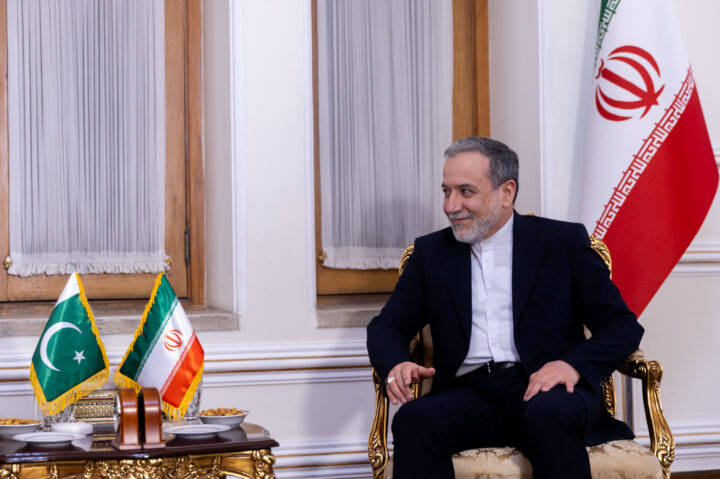
Foad Ashtari/SOPA Images/LightRocket via Getty Images
Iranian Foreign Minister Abbas Araghchi
Despite initially conflicting claims emerging from the White House and Iranian state media about the contents and timing of a memorandum of understanding between the parties, there were indications on Friday that the gaps between the two sides could be closing.
Prime Minister of Pakistan Shehbaz Sharif confirmed that a “final and agreed version of the peace agreement has been achieved,” while Iranian Foreign Minister Abbas Araghchi said on X that the memorandum of understanding “has never been closer,” a screenshot of which President Donald Trump reposted directly onto Truth Social.
Terms of the deal, first reported by Axios, include that the Strait of Hormuz would be reopened immediately without tolls and that the ceasefire would be extended for 60 days, including halting Israel’s military action in Lebanon. While the current text includes a framework for addressing Iran’s enriched uranium stockpile, any binding restrictions on its nuclear development would depend on a second, more detailed accord, according to the outlet.
A White House official indicated on Friday that under the broader terms being discussed, Iran’s nuclear material would eventually be destroyed and removed from the country, its nuclear program dismantled and its funding of regional militant groups halted. Frozen Iranian assets would be released upon verified performance of those key metrics.
Iranian state media, however, had reported a vastly different version of the deal, in which Iran would retain control over the strait and receive $300 million from the U.S. for reconstruction, as well as the suspension of sanctions and withdrawal of U.S. forces from the region — among other U.S. concessions.
Trump rebuffed news of the deal’s provisions on Truth Social, writing that “the terms that Iran leaked out to the Fake News have NOTHING to do with the terms that were agreed to, in writing.” Trump reportedly had asked the Iranians to issue public clarification over the Iranian state media reports.
“Very dishonorable people to deal with,” Trump said of the Iranians. “With them, there is no such thing as dealing in good faith.”
Vice President JD Vance also rejected what he called “fake information,” and reiterated that “the president is going to get us a good outcome, one way or the other.”
“First, the Iranians are not receiving any cash, and no funds are being released for simply signing a deal or attending a meeting,” Vance posted on X. “The deal is structured to ensure that the U.S. and its allies’ concerns are prioritized, and that if the Islamic Republic of Iran meets its obligations, then economic benefits will flow to them and to the entire region.”
Araghchi said that pending the finalization of an agreement, “the media should refrain from entering speculation about its content.”
Reports indicate that while the deal has been approved at high levels of Iranian leadership, it has not yet received official clearance from Supreme Leader Mojtaba Khamenei, despite Trump asserting he believes Khamenei had given the nod.
The sudden diplomatic momentum dramatically reshaped military operations on Thursday, when Trump ordered the Pentagon to call off scheduled airstrikes and a mission to capture Iran’s vital oil infrastructure on Kharg Island after announcing a deal was close at hand. The president hinted that a formal signing ceremony could take place over the weekend at a neutral venue in Europe, with Vance and White House Special Envoy Steve Witkoff expected to attend.
“It seems that after repeated signs of an imminent deal for weeks now, a deal will be clear once U.S. and Iranian officials actually publicly agree to the same agreement,” Ari Cicurel, associate director of foreign policy at the Jewish Institute for National Security of America, told Jewish Insider. “Until then, it’s not clear that they actually have a deal yet.”
Cicurel noted, however, that the latest reports of an accord appear different from previous iterations throughout the conflict. He said he has seen “reports of [U.S. Air Force] aircraft heading to Europe,” which “could be a sign this is further down the road than previous efforts might have been.”
Foreign policy experts have expressed deep concern about the reported framework floated by the Iranian side, with several backing the Trump administration’s claims that it does not reflect the actual state of negotiations.
“I have been calling for Trump to accept the inevitable bad deal to get us out of this bad war. But even I think the absurd terms laid out here [in Iranian media reports] must represent Iranian spin and cannot possibly be the shape of the actual deal,” Dan Shapiro, former U.S. ambassador to Israel under the Biden administration, posted on X.
Richard Goldberg, a former Trump administration official, also expressed skepticism about the initial reporting coming out of Tehran.
“The reported MOU reads like an extortion racket guaranteed to preclude any nuclear concessions and instead lock the U.S. into paying the racket indefinitely for fear of the strait closing,” Goldberg posted on X. “It falls well below anything POTUS would consider a good deal so I question its veracity.”
“The claims that Iran made, if they’re anywhere near true, would be a disastrous agreement that would be rewarding Iranian aggression, providing it funds to further enable its aggression and rebuild its arsenal,” Cicurel said similarly. “The same leadership, the same regime that has been in charge of the proxy agents and conducted aggression against the United States and its partners remains in power.”
However, Cicurel noted that he also holds major concerns regarding the framework being presented by the White House — most notably, that negotiators have failed to address Iran’s missile capabilities.
“My main concern with the White House agreement is that with this proposal, and over the last few weeks, the discussion of Iran’s missile capabilities has disappeared from the conversation, which was a major mistake of the JCPOA and a major mistake of previous agreements,” Cicurel said. “Any agreement that doesn’t include that would enable Iran to take the lessons it’s learned from the current war — that it doesn’t need a lot of missiles, it doesn’t need a lot of drones to exert aggression on the Gulf — and leave a potentially dangerous situation over the long term, in the future.”
Cicurel also took issue with the White House’s indication that the MOU would launch another 60-day ceasefire, warning that the time would allow Iran to delay a durable, long-term settlement and gain leverage. He also argued that the U.S. should not release Iranian assets.
“I don’t think the United States should be unfreezing assets rewarding Iran for for its aggression and allow Iran to leverage its power projection over the Strait of Hormuz to extract financial gains that would enable it to rebuild itself to reassert more of that power projection over the Strait of Hormuz and further attack targets throughout the Middle East,” he said.
At an Iran International panel, Washington Institute for Near East Policy’s Rob Satloff outlined ways the U.S. could better engage with the Iranian public
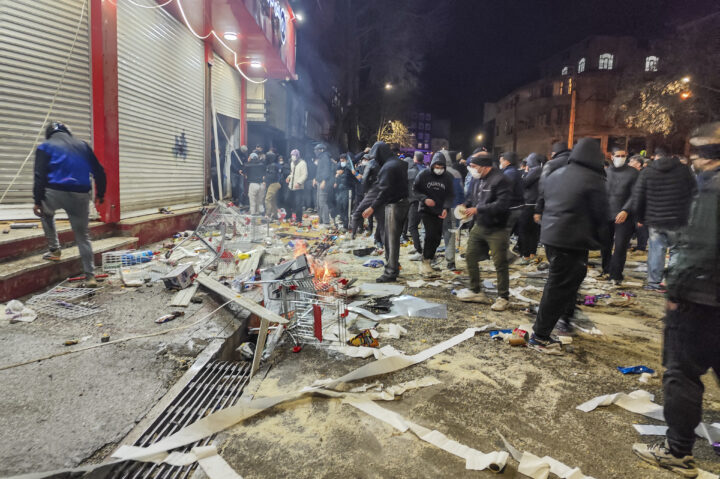
(Photo by Kamran / Middle East Images / AFP via Getty Images)
Iranians gather while blocking a street during a protest in Kermanshah, Iran on January 8, 2026.
Experts said on Wednesday that the Trump administration has failed to adequately tap into pro-Western sentiment among the Iranian public following the regime’s violent crackdown on nationwide protests earlier this year, arguing that the White House is missing a key opportunity to cultivate internal pressure within Iran.
Robert Satloff, executive director of The Washington Institute for Near East Policy, argued that the Trump administration should expand U.S. broadcasting into Iran, improve internet access for Iranians and ease pathways for dissidents seeking refuge in the U.S. to “lay the groundwork for the day when it becomes a much more real possibility to have this sort of regime change.” Satloff outlined his proposals during a Wednesday town hall hosted by Iran International, a U.K.-based Persian-language news network. “None of [the Iranian people] are being invested in in any significant way by the Trump administration,” he said.
In February, PBS reported that over 7,000 Iranians were killed during the regime’s violent crackdowns on nationwide protests that began in December. President Donald Trump at the time urged Iranians to keep protesting, declaring that “help is on the way.” Recent surveys inside Iran have shown that roughly 89% of Iranians support a “democratic political system.”
However, with Trump rarely bringing up the human rights abuses of the Iranian government as he seeks a diplomatic deal with the Islamic Republic, the protesters who Trump initially promised to help have been deterred by the Iran’s intensive crackdowns and the lack of a response to counter them.
That vacuum, Satloff argued, is what Washington should be working to fill. He elaborated on the three proposals, each aimed at strengthening the U.S. relationship with the Iranian public.
First, Satloff said the U.S. would benefit from providing “better and more American broadcasting” to Iranians and ensuring that they “have internet access and that they cannot be denied this by their capricious government.”
To accomplish this, the Trump administration should “work with private companies,” Satloff told Jewish Insider.
“Much of this requires a shift of policy, not an allocation of money,” Satloff pointed out. “That is, to embrace U.S. international broadcasting as an important asset, not to try to run it out of business, as has been the case in this administration.” Following Trump’s 2025 attempts to dismantle Voice of America, including its Persian broadcasts, a federal judge ordered more than 1,000 laid-off staff reinstated this past March.
Satloff also argued that the U.S. should “change our visa and asylum regulations” to provide Iranians fleeing the regime with “a welcoming home” and a “base” to continue organizing against the regime.
Alex Vatanka, senior fellow at the Middle East Institute in Washington, reaffirmed that the “Iranian public sentiment is anti-regime by and large,” during the panel, elaborating on the importance of the U.S. screening visa applicants carefully and avoiding becoming the “bad guys.”
He called it “fair game” to deny a visa to someone with a background in the Islamic Revolutionary Guard Corps, but stressed the need for accuracy, warning that overbroad denials risk alienating the population the White House needs on its side.
Panelists acknowledged that these measures won’t dislodge the Islamic Republic on their own. Satloff said that under the current state of affairs, “none of this is going to bring down the government.”
“I think the important thing for us is to change behavior,” Satloff continued, arguing that “as the Iranian people see the weaknesses of their own regime then maybe you will find more organized elements that come forward in leadership that challenges” its leadership.
“I don’t even see that foundation yet for us to work with,” he added.
Rachel Brandenburg, Washington managing director and senior policy analyst at the Israel Policy Forum, told JI that “among the reasons the U.S. would provide the Iranians with ways to circumvent an internet blackout” is to support their ability to “communicate with each other and with the world.” Brandenburg explained this is “among [the] tools that could help the Iranian people organize protests and other opposition to the regime, whether openly or privately.”
Satloff tied his proposals back to potentially dismantling the IRGC — a goal the administration has stated but, in his telling, done little to pursue. Without sustained engagement with ordinary Iranians, he argued, there may be no constituency for Washington to work with when the moment for a regime change comes.
“All of this would expand U.S. engagement with ordinary Iranians,” Satloff told JI, “which is a necessary prerequisite for any serious effort at empowering Iranians to do what President Trump said he hoped they would do — take back their country.”
Iranian state media and Iran’s foreign ministry have said that Trump’s claims that Iranian leadership had approved the deal are ‘speculative’
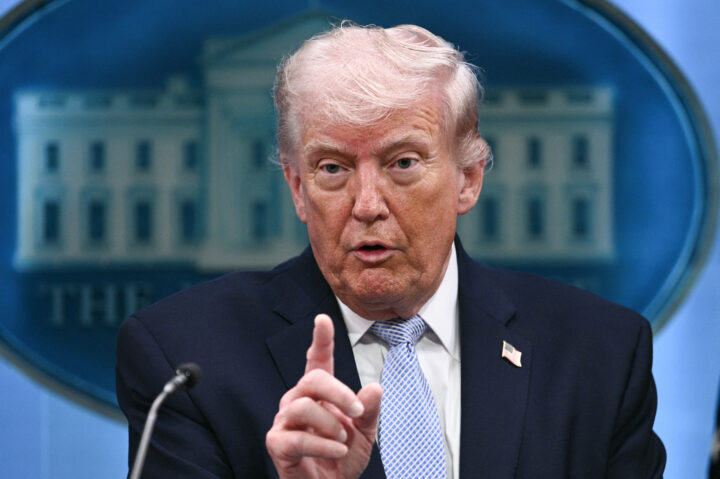
Brendan SMIALOWSKI / AFP via Getty Images
US President Donald Trump speaks about the conflict in Iran in the James S. Brady Press Briefing Room of the White House on April 6, 2026, in Washington, DC.
President Donald Trump said on Thursday that negotiations with Iran had reached a breakthrough and that he expected there to be a signing, possibly in Europe, in the coming days. With the diplomatic developments, Trump said he would cancel planned strikes against Iran, and call off an operation to take control of Kharg Island.
“Based on the fact that discussions with the Islamic Republic of Iran have been brought to the highest level of Iranian leadership and approved, I have, as President of the United States of America, cancelled the scheduled strikes and bombings against Iran this evening,” Trump posted on Truth Social.
In the Oval Office, the president said the deal was “in pretty final shape” and predicted that it would “get done over the next few days.” He also claimed that the agreement would ultimately deliver on his assurance that Iran would be prevented from having nuclear weapons and open up the Strait of Hormuz.
“The signing of the agreement will be in Europe, perhaps during the weekend,” Trump told reporters in the Oval Office on Thursday afternoon. “I won’t be able to be there, but Vice President [JD] Vance and the [White House special] envoy [Steve] Witkoff will.”
Trump also said that Iran’s supreme leader had approved the deal. However, Iranian state media and a spokesperson for Iran’s foreign ministry have reportedly asserted that Trump’s claims that Iranian leadership had provided approval are “speculative” and that “nothing has been finalized.”
The president spoke with the Emir of Qatar following the announcement and also with Israeli Prime Minister Benjamin Netanyahu. Reports indicated that Netanyahu was initially surprised by the statement. However, after the conversation between the two leaders, the Prime Minister’s Office said that Netanyahu “expressed his appreciation” for the framework and the inclusion of key objectives related to Iran’s nuclear program and support for terrorism.
The U.S. and Iran have reportedly closed vital gaps on three main issues that have prolonged diplomatic efforts, including the protocol for releasing Iranian frozen assets, reopening the Strait of Hormuz, and negotiations over Iran’s nuclear program.
The announcement came after two days of tit-for-tat strikes between the U.S. and Iran. Earlier on Thursday, Trump warned that the U.S. would hit Iran “VERY HARD TONIGHT” and threatened to seize Kharg Island, which handles roughly 90% of Iran’s oil exports.
The strikes reportedly targeted air-defense systems, radars and drone command-and-control units in southern Iran
ATTA KENARE / AFP via Getty Images
Explosions erupt following strikes at Tehran Oil Refinery in Tehran on March 7, 2026.
CENTCOM announced on Wednesday evening that it had begun launching additional “self-defense” strikes against multiple targets in Iran, after initially renewing its attacks on Tuesday. A U.S. official told Axios the latest targets included air-defense systems, radars and drone command-and-control units in southern Iran.
The strikes came hours after President Donald Trump met with his national security team to discuss military options, and as Defense Secretary Pete Hegseth told reporters that CENTCOM would be “busy tonight” with “bombs dropping on key facilities in Iran.”
The military action came as Qatari mediators were reportedly meeting with officials in Tehran in an effort to revive negotiations and close remaining gaps between the U.S. and Iran.
Earlier in the day, Trump raised the possibility of targeting Iranian power plants and bridges, expressing frustration that Tehran is, in his view, stringing the U.S. along in diplomatic discussions. The strikes ultimately focused on military targets, according to a U.S. official.
Plus, Ron Klain goes to bat for Platner
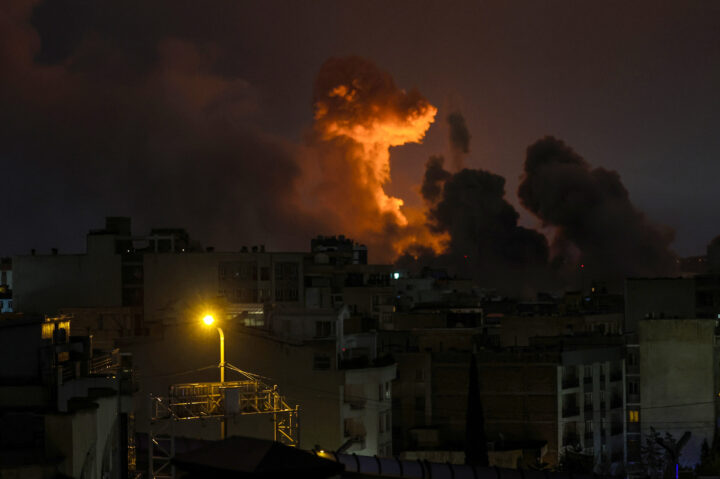
Getty Images
A large plume of smoke rises over Tehran after explosions were reported in the city during the night on March 28, 2026 in Tehran, Iran.
This P.M. edition is reserved for our premium subscribers like you — offering a forward-focused read on what we’re tracking now and what’s coming next.
Today’s Daily Overtime was curated by JI U.S. Editor Danielle Cohen-Kanik.
📡On Our Radar
Notable developments and interesting tidbits we’re tracking
After the U.S. conducted strikes yesterday in Iran, President Donald Trump said from the Oval Office this morning that the U.S. would “hit them hard again today” and told Fox News that he may target Iranian power plants and bridges because Tehran is “tapping the United States along” in negotiations.
As Trump convened his national security team in Washington this afternoon to discuss military options, Defense Secretary Pete Hegseth told reporters CENTCOM will be “busy tonight” with “bombs dropping on key facilities in Iran”…
Trump also revealed today that he directed the U.S. military last month to “execute a secret mission” to assist oil tankers and other commercial vessels in transiting the Strait of Hormuz, an effort that “has resulted in more than 100 MILLION Barrels of Oil” and over 200 commercial ships moving through the waterway. His Truth Social post was a clarification of earlier comments that seemed to suggest the U.S. was stealing this oil directly out of Iran; U.S. operations to facilitate passage in the strait have been previously reported…
Trump provided Fox News with new details of the downing of the U.S. Army helicopter earlier this week, describing how an Iranian drone became lodged between the two pilots in the cockpit who guided the helicopter into the sea, where they were rescued “for the first time in U.S. military history” by an unmanned sea drone…
Qatari mediators visited Tehran today in the hopes of pushing Iranian officials to engage more effectively in negotiations with the U.S., Axios reports, after Trump had grown increasingly frustrated with their intransigence over the last two weeks, even as he continued to signal the two sides were approaching a deal…
U.S. Ambassador to the U.N. Mike Waltz met with UAE Foreign Minister Abdullah bin Zayed Al Nahyan in Abu Dhabi, the highest-level U.S. official to publicly visit the Gulf since the Iran war began…
Israeli Prime Minister Benjamin Netanyahu blasted Turkish President Recep Tayyip Erdoğan as an “antisemitic dictator” today after Erdoğan condemned Israel’s “network of murder” in Syria and Lebanon and threatened a “very clear and strong response” if Turkish interests in the region were jeopardized. Netanyahu said Erdoğan, whom he accused of supporting Hamas, lacks the moral authority to criticize Israel.
Trump, when asked in the Oval Office about the potential for war between Israel and Turkey, described Erdoğan as a “hell of a leader” and said, “I don’t think that will happen as long as I’m president”…
More than 20 countries, including the U.S., issued a joint statement condemning “lethal plotting and malign actions” by Iran’s security forces working with international and local criminal groups in Europe, North America and Australia, including their efforts to target “Iranian dissidents, journalists and Jewish and Israeli communities and interests”…
The Department of Justice indicted eight individuals associated with the University of Michigan for allegedly threatening university leaders, law enforcement, businesses and the Jewish Federation of Metropolitan Detroit over the conspirators’ perception of their “purported financial support of Israel.”
The individuals “discussed methods by which to harm the targets and their families, including poison, bombs, and psychological torture,” engaged in extensive vandalism and threw jars filled with noxious chemicals into homes, according to the department…
An immigration judge ordered earlier this month that Columbia University anti-Israel protest leader Mohsen Mahdawi be deported to Jordan, after a lengthy legal battle in which the Trump administration claimed Mahdawi has been involved in and supported terrorist violence. Mahdawi, who has not been charged with a crime, is still seeking review of his removal proceedings in federal court…
The Senate Education and Natural Resources Committee advanced the Holocaust Education and Antisemitism Lessons (HEAL) Act by a voice vote…
The National Republican Senatorial Committee, in a memo to donors, acknowledged that the “political fundamentals in Maine remain challenging” for Sen. Susan Collins (R-ME) to retain her seat against scandal-plagued challenger Graham Platnerand called it a “fatal mistake to assume Platner is too damaged to win”…
Trump offered Collins his backing today after having long been at odds with the senator: Asked if she has his full endorsement, Trump said, “She does, because she’s a sane woman. She’s not my best friend at all … but she’s a sane person and she’s a respected person.” He called Platner a “thug,” a “phony” and a “bad person”…
Ron Klain, the former chief of staff to President Joe Biden, defended Platner’s tattoo of a Nazi symbol in a comment responding to the Republican Jewish Coalition on Instagram, Jewish Insider’s Marc Rod reports: Klain claimed the Totenkopf “was a skull and crossbones to remember [Platner’s] fallen comrades from his service in Afghanistan,” an explanation Platner’s campaign has not previously offered…
Former New York City Comptroller Brad Lander, running against Rep. Dan Goldman (D-NY) in the 10th Congressional District, denied to JI’s Will Bredderman that he’s backing Darializa Avila Chevalier in her race against Rep. Adriano Espaillat (D-NY) — even as the two appeared together in an ad paid for jointly by both of their campaigns…
Kennedy scion Jack Schlossberg, running in the Democratic primary for New York’s 12th District, came out yesterday in support of the Block the Bombs Act, JI’s Matthew Kassel reports, despite having previously expressed skepticism about the bill seeking to broadly restrict weapons sales to Israel…
Meanwhile, Public First Action, the PAC linked to AI giant Anthropic, is spending $1.2 million on a Knicks-themed ad in support of Schlossberg’s opponent, Alex Bores, who has become a leading advocate for AI regulation on the campaign trail. The ad is set to air tonight during Game 4 of the NBA Finals, Politico reports…
⏩ Tomorrow’s Agenda, Today
An early look at tomorrow’s storylines and schedule to keep you a step ahead
Keep an eye out in Jewish Insider for a look at the state of play in Israel’s elections, taking place this fall.
The House Appropriations Defense Subcommittee will hold a closed-door markup of the 2027 defense spending bill.
Reps. Don Beyer (D-VA) and Ritchie Torres (D-NY) will speak at a Progressive Policy Institute event on “Working Toward a New Era of Patriotism and Democratic Renewal” at the National Press Club in Washington.
Stories You May Have Missed
SIDESTEPPING QUESTIONS
House Foreign Affairs Committee ranking member Greg Meeks said of the Democratic N.J. congressional nominee, ‘I don’t like to talk about somebody I don’t know’
LASHING OUT

The Democratic congressional hopeful aired his frustration when asked about his stance regarding U.S. aid to the Jewish state at a candidate forum
The president told Fox News that Washington is nearing a decision on additional strikes against Iran, arguing that Tehran has dragged out negotiations and must now ‘pay the price’
Getty Images
A large plume of smoke rises over Tehran after explosions were reported in the city during the night on March 28, 2026 in Tehran, Iran.
President Donald Trump said on Wednesday morning that the U.S. could soon launch additional strikes against Iranian power plants and bridges, raising the prospect of a broader military campaign against Tehran as he accused Iran of dragging the U.S. along in diplomatic negotiations.
The president’s comments to Fox News’ Trey Yingst came hours after the U.S. military announced it had targeted Iranian air defense, ground control and surveillance radar sites in response to Iran downing a U.S. Army helicopter on Monday. Iranian state media, meanwhile, claimed attacks on U.S. military facilities in Bahrain, Kuwait and Jordan.
Trump said in a post on Truth Social on Wednesday morning that Iran had “taken too long to negotiate a deal that would have been great for them” and warned that Tehran would now “have to pay the price.”
Trump made similar threats regarding targeting Iranian power plants and bridges as a way to escalate hostilities when he was unsatisfied with negotiations in April, though such strikes were not carried out.
Trump also disclosed new details about the incident that precipitated the latest U.S. action: According to the president, an Iranian drone became lodged between the two pilots of a U.S. Apache helicopter who guided the helicopter into the sea, where they were rescued “for the first time in U.S. military history” by an unmanned sea drone.
Iranian FM Abbas Araghchi indicated Tehran is prepared to respond with further strikes
CENTCOM/X
Sailors aboard USS George H.W. Bush conduct night flight operations in the Arabian Sea.
The U.S. military launched what it called “self-defense strikes” in Iran on Tuesday evening in retaliation for the downing of a U.S. Army Apache helicopter by an Iranian drone in the Strait of Hormuz on Monday.
A U.S. official told Politico and Axios that the strikes targeted Iranian radar and air-defense sites.
In announcing the start of the operation at 5 p.m. ET on Tuesday, CENTCOM called the mission “ a proportional response to unjustified Iranian aggression.”
The military action was widely anticipated after President Donald Trump declared earlier on Tuesday that the U.S. military “must, of necessity, respond” to Iran’s attack on the American asset. Prior to Tuesday’s exchange, Trump had indicated that a comprehensive diplomatic agreement between Washington and Tehran to end the war was in its “final throes” and could potentially be finalized in “two or three days.”
Regional experts had speculated that any U.S. military response would likely be limited in scope and unlikely to derail negotiations or trigger a return to fully fledged conflict, but Iranian leadership indicated it is prepared to launch further attacks.
“Our Powerful Armed Forces will leave no attack or threat unanswered,” Iranian Foreign Minister Abbas Araghchi stated on X following the U.S. airstrikes. “Despite its defeats on the battlefield, the U.S. opted to test our determination. Leave our region if you want to be safe. History of the Persian Gulf has many chapters on dire fates of intruding outsiders.”
Plus, Israeli confidence in Trump hits new low

U.S. Navy via Getty Images
A U.S. Sailor signals the launch of an MH-60R Sea Hawk helicopter, attached to Helicopter Maritime Strike Squadron 70, on the flight deck of the world's largest aircraft carrier, USS Gerald R. Ford (CVN 78), while supporting Operation Epic Fury on February 28, 2026.
This P.M. edition is reserved for our premium subscribers like you — offering a forward-focused read on what we’re tracking now and what’s coming next.
Today’s Daily Overtime was curated by JI U.S. Editor Danielle Cohen-Kanik.
📡On Our Radar
Notable developments and interesting tidbits we’re tracking
President Donald Trump announced today that Iran was responsible for downing a U.S. Apache helicopter over the Strait of Hormuz last night, and vowed to respond out “of necessity.” Trump had reportedly told aides his “red line” for resuming military action would be if Iran killed any more Americans, though he confirmed in his post on Truth Social that both American pilots involved were “safe and uninjured.”
Later, however, in a call with The Wall Street Journal, Trump appeared to downplay the incident, saying it “wasn’t a big deal” and that “the pilot is fine”…
Top GOP lawmakers echoed Trump’s initial assessment that the U.S. must respond: Sen. Ted Cruz (R-TX) told Jewish Insider’s Matthew Shea that Iran should face “significant consequences.” Rep. Mike Rogers (R-AL), chairman of the House Armed Services Committee, similarly said the U.S. must “vigorously respond,” and Sen. Ted Budd (R-NC) pushed for “decisive action”…
Iranian Foreign Minister Abbas Araghchi signaled that Tehran is distancing itself from the episodeand not claiming it as a direct attack on the U.S. He said in a statement, “Foreign forces in proximity to our territory are at constant risk on account of their own human errors, plain accidents, or potentially being caught in crossfire. To reduce risk, best solution is for them to leave”…
Trump, speaking to ABC News, openly mused about whether Israeli Prime Minister Benjamin Netanyahu “even wants to continue” and run in Israel’s upcoming elections, slated to take place this fall. “He’s a wartime prime minister. We will very shortly win the war one way or the other, and you know he’s a wartime prime minister,” Trump said…
A gunman from Lebanon entered Israeli territory and fired on IDF troops, who killed him before he crossed the border fence, the IDF said. The infiltration set off a widespread search for potential accomplices, though none were found…
Before the latest round of missile fire between Israel and Iran, U.S. and Iranian negotiators had focused their discussions on four major elements of a nuclear deal, officials told The New York Times, even as the Trump administration has said nuclear issues will be discussed in a subsequent round of negotiations.
The key points reportedly include how long Iran will suspend uranium enrichment, diluting the country’s stockpile of already enriched uranium, dismantling three of its major nuclear facilities and “snap” inspections of all relevant sites inside the country…
A new survey from the Israel Democracy Institute found the share of Israelis who believe the country’s security is a primary consideration for Trump has plummeted to 44%, down from 60% who said the same in March at the beginning of the Iran war, JI’s Matthew Shea reports.
It’s the lowest level of Israeli trust in Trump since the institute began tracking the metric when he was elected to a second term in November 2024, coming as Washington and Jerusalem seemingly diverge on their strategies and ultimate goals of the war with Iran…
Twenty-one countries issued a joint statement urging Israel not to implement a new law requiring international NGOs wanting to operate in the West Bank and Gaza to register with and be vetted by the Israeli government, calling the law “part of a broader pattern of restrictive measures” that “constrain the urgently needed humanitarian response.”
Israel’s Foreign Ministry dismissed the concerns and claims of the countries as “completely unfounded and detached from reality” as it said there are “immense amounts of humanitarian aid entering the Gaza Strip”…
Randy Villegas, a left-wing Democrat running to unseat Rep. David Valadao (R-CA) in California, claimed victory today in the jungle primary over Jasmeet Bains, a moderate Democrat who had been favored by pro-Israel leaders as well as the party’s national leadership, JI’s Matthew Kassel reports. Democratic Majority for Israel’s super PAC had spent heavily to help Bains with a $500,000 TV ad buy opposing Villegas…
United Democracy Project, the AIPAC-affiliated super PAC, is spending $2 million on an initial ad buy this week to boost Rep. Haley Stevens (D-MI) in the Democratic primary for Michigan’s open Senate seat, a UDP spokesperson confirmed to JI’s Matthew Kassel. The ad touts Stevens’ record fighting for the auto industry, opposing Medicare cuts and working to cap insulin prices in Congress…
⏩ Tomorrow’s Agenda, Today
An early look at tomorrow’s storylines and schedule to keep you a step ahead
Keep an eye out for timely analysis of today’s primary election results in Maine, Nevada and South Carolina from Jewish Insider Editor-in-Chief Josh Kraushaar — premium JI subscribers like you will receive it first.
The Senate Energy & Natural Resources Committee will hold a markup of the HEAL Act, a bipartisan bill examining Holocaust education efforts across the country.
The Culture for Peace Institute will hold a conference in Washington with speakers including State Department antisemitism envoy Rabbi Yehuda Kaploun; Sens. John Fetterman (D-PA) and Dan Sullivan (R-AK); and Reps. Nick LaLota (R-NY), Randy Fine (R-FL), Andy Barr (R-KY), Mike Lawler (R-NY), Max Miller (R-OH), Tom Suozzi (D-NY), Elise Stefanik (R-NY) and Derrick Van Orden (R-WI).
Elsewhere in Washington, Iran International will hold a town hall focused on the conflicts in Lebanon and Iran, featuring the Middle East Institute’s David Hale and Alex Vatanka as well as Dan Diker, president of the Jerusalem Center for Security and Foreign Affairs.
In the evening, lawmakers will take the field for the annual Congressional Baseball Game at Nationals Park.
In New York, the Conference of Presidents of Major American Jewish Organizations will hold its annual antisemitism convening, bringing together communal professionals, experts and others to discuss efforts to combat antisemitism.
New York state Assemblymember Claire Valdez, Brooklyn Borough President Antonio Reynoso and City Councilmember Julie Won — the top Democratic candidates for New York’s 7th Congressional District to replace retiring Rep. Nydia Velázquez (D-NY) — will face off for a debate on local news channel PIX11.
The Auschwitz Jewish Center Foundation will honor New York City Council Speaker Julie Menin, former Israeli hostage Elkana Bohbot and Gazan human rights lawyer Moumen Al-Natour at its gala in Manhattan.
Stories You May Have Missed
MOUNTING SCRUTINY
Will Avila Chevalier’s ‘beyond the pale’ views sink the DSA challenger’s campaign against Espaillat?
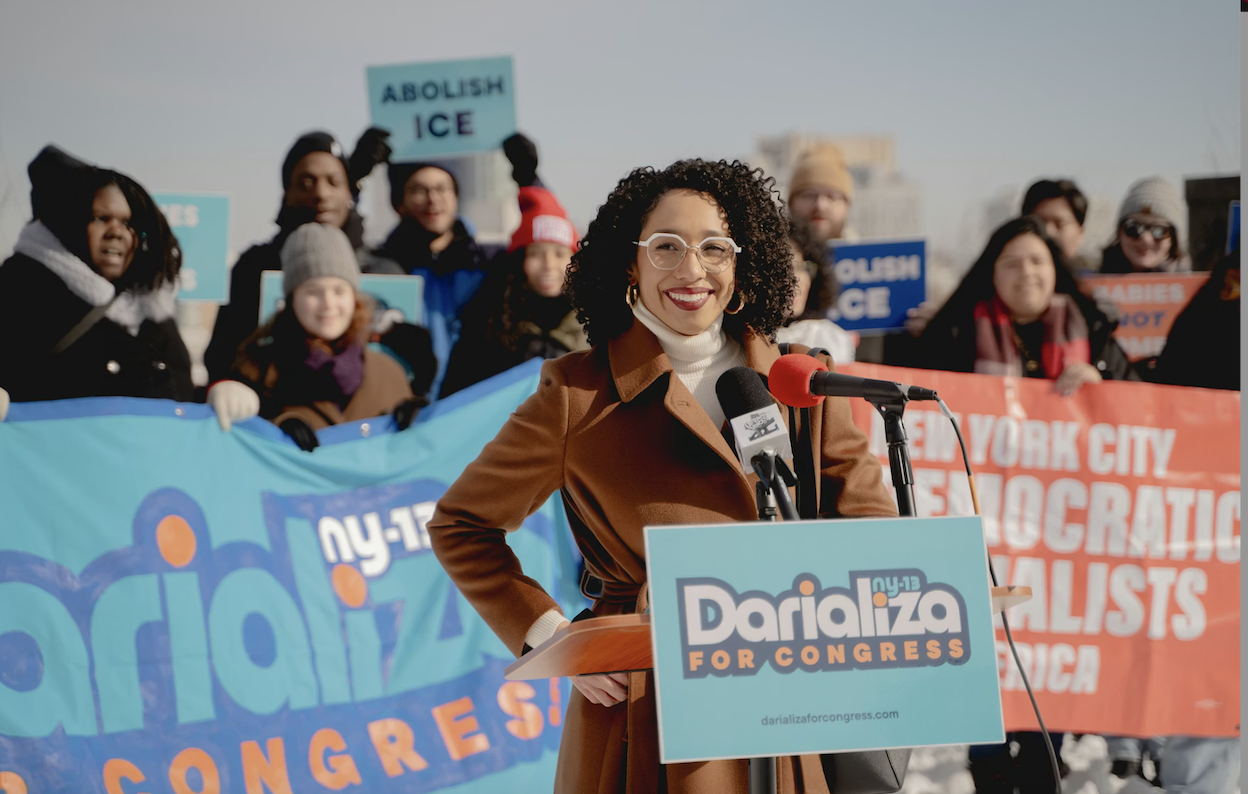
Avila Chevalier has a long record of extreme views, including calling for the abolition of police, voicing pro-Russia sentiment and rejecting Israel’s existence
SPECTATOR SPECTACLE
Trump, Mamdani, Witkoff, Kraft, Lutnick and more watched the game
Trump said that the U.S. must respond to the military provocation
U.S. Navy via Getty Images
A U.S. Sailor signals the launch of an MH-60R Sea Hawk helicopter, attached to Helicopter Maritime Strike Squadron 70, on the flight deck of the world's largest aircraft carrier, USS Gerald R. Ford (CVN 78), while supporting Operation Epic Fury on February 28, 2026.
President Donald Trump’s declaration that the U.S. “must, of necessity, respond” to Iran’s downing of a U.S. Army Apache helicopter off the coast of Oman on Monday evening received support from GOP lawmakers on Capitol Hill, several of whom called for a powerful military retaliation.
U.S. officials confirmed to CNN that the attack helicopter — whose pilots Trump said were successfully rescued — was brought down by an Iranian one-way attack drone. The high-stakes incident marks the most serious uptick in direct hostilities between Washington and Tehran in weeks, occurring amid diplomatic efforts to end the regional war and begin negotiations to curb Tehran’s nuclear program.
“I agree with the president, there should be significant consequences,” Sen. Ted Cruz (R-TX) told Jewish Insider.
“Enough is enough,” Cruz later wrote on X. “President Trump and our Armed Forces decimated Iran militarily, but the Iranian regime has been trying to rebuild and now they’ve taken down an American Apache. President Trump is absolutely right. There is a pressing necessity for the U.S. to respond to this attack.”
Rep. Mike Rogers (R-AL), who chairs the House Armed Services Committee, also called for a powerful response, urging Trump to look at “meaningful options.”
“We need to vigorously respond,” Rogers said. “We can’t let anybody shoot down one of our helicopters and it not be responded to.”
Sen. Ted Budd (R-NC) similarly pushed for “decisive action” in order to put the looming Iranian threat “behind us.”
“I think America would be in a better place if we had this behind us and clear, decisive action that would bring an absolute end to this so we don’t have to do it again,” Budd told JI. “They [Iran] cannot persist to threaten us and then develop nuclear weapons. … They should never ever have a nuclear weapon.”
While some regional experts agreed that the Iranian attack necessitates a firm U.S. military reaction, they argued that any such response is likely to be limited in scope and is not anticipated to trigger a return to full combat operations, nor is it expected to derail ongoing negotiations given the president’s focus on a diplomatic exit.
“If information is correct, that Iran shot down a U.S. helicopter, then the president is correct, the United States does need to respond,” said former U.S. Ambassador to Israel Dan Shapiro, who later served as deputy assistant secretary of defense in the Biden administration. “That’s a very serious attack, which thankfully did not seem to take the lives of the two aviators, but it needs a response.”
Shapiro noted that while U.S. action is necessary, the retaliation will likely be calibrated to avoid escalation, as Trump remains intensely “motivated” to secure a broader deal that would reopen the Strait of Hormuz.
“U.S. Central Command will be able to give [Trump] options that will include a meaningful response against an Iranian military target, but one that does not necessarily produce a strong Iranian response that leads to an escalatory cycle,” Shapiro explained. “If he wants to succeed in negotiations, say, on the war, he needs to respond, but do it in a way that leads to a de-escalation.”
Alexander Gray, who served as chief of staff on the National Security Council during Trump’s first administration, also anticipates a precise, “proportional blow against key Iranian targets.”
“The president has responsibly maintained considerable American military power in the vicinity of Iran, both conducting the U.S. Navy’s successful blockade, but also being held in reserve should the need arise to continue kinetic military operations,” Gray said. “The president will likely strike a proportional blow against key Iranian targets, while keeping in mind the broader American strategic imperative of concluding this conflict with a diplomatic solution that advances American interests in the region.”
Steven Cook, a senior fellow for Middle East studies at the Council on Foreign Relations, agreed that failing to respond would be a political and strategic impossibility for the White House.
“It would be hard for the president not to respond, though I suspect that this is not a return to combat,” Cook observed. “Trump will likely direct CENTCOM to take out one or several high-value targets.”
Analysts noted that the exchange is unlikely to impact the high-level talks or alter the calculations of either side, as negotiators continue to work out an agreement.
“It doesn’t necessarily push a deal further off the table,” Shapiro said. “It sounds like negotiators are close to a deal. Until there is a deal, though, exchanges in a ceasefire that has seen numerous violations of it are not surprising, but if both sides are motivated to get a deal, this will not prevent it from happening.”
Cook said that a minor strike could solidify Tehran’s perception of American vulnerability.
“I don’t believe that a tit-for-tat exchange will significantly alter Iran’s view that it has time on its hands and that the president is desperate for a deal,” Cook said. “It seems clear that the president does not want anything to upset negotiations and the chances of a negotiated way out of the conflict. The Iranians do not seem willing to give him anything that he could call a victory, however. The result is likely to be a continued stalemate.”
Iran has similarly appeared to prefer a diplomatic exit over renewed escalation. Iranian Foreign Minister Abbas Araghchi on Tuesday said that Iranian leaders “prefer language of diplomacy but speak other languages too.”
“Foreign forces in proximity to our territory are at constant risk on account of their own human errors, plain accidents, or potentially being caught in crossfire,” Araghchi posted on X following the incident. “To reduce risk, best solution is for them to leave.”
Aaron David Miller, a senior fellow at the Carnegie Endowment for International Peace and a former State Department negotiator, said the incident reflects a “manifestation of how emboldened [the Iranians] are and how willing they are to take risks.”
While Miller warned against a heightened response, he noted that even restrained exchanges could lead to eventual escalation if a final diplomatic breakthrough is not reached soon.
“If [Trump] doesn’t [limit the response], then what he’s going to trip into is a very hard response if he goes after directly Iranian targets on the mainland,” Miller warned. “The longer this goes on without having an agreement, it’s inevitable that this is going to escalate.”
The core parameters of a potential deal have been “evident for quite some time,” Miller added, but concluded it will ultimately require a painful political calculation from both Washington and Tehran.
“Both sides must be prepared to accept a situation in which they’re going to perceive to have given something up,” Miller said.
Senior congressional correspondent Marc Rod contributed reporting
A new poll from the Israel Democracy Institute found that less than half of Israelis believe Trump puts a premium on Jerusalem’s security, the lowest figure since he was reelected in 2024

JACK GUEZ/AFP via Getty Images
Commuters drive along a road in front of a billboard bearing the flags of the U.S. and Israel with a message in support of then-presidential candidate Donald Trump in Tel Aviv on October 30, 2024.
The share of Israelis who believe the country’s security is a primary consideration for President Donald Trump has plummeted to a new low, according to a new poll, revealing a sharp shift in public attitudes as the U.S. and Israel diverge on their strategies and ultimate goals of the war with Iran.
The survey, conducted by the Viterbi Family Center for Public Opinion and Policy Research at the Israel Democracy Institute from May 31 to June 5, found that 44% of Israelis believe Israel’s security is a central consideration for the Trump administration, a decline from the 60% recorded in March at the beginning of the Iran war.
The drop was even more pronounced among Jewish Israelis, where confidence fell 23 points over the same period, from 64% to 41%.
The findings mark the lowest levels of Israeli trust in Trump since the center began tracking the metric when he was elected to a second term in November 2024, highlighting a rapid erosion of Israeli public confidence as the White House intensifies its pursuit of a deal with Iran.
The polling also reveals a stark collapse in public optimism regarding Israel’s ability to achieve its key objectives in the conflict. Roughly one-third — 32% — of respondents now believe the war’s outcome will include the elimination of Iran’s ballistic missile arsenal — down sharply from the 65% who held that view in March. Similarly, the share of Israelis who believe the conflict will weaken the Iranian regime has also been cut by nearly half, falling to 28% (from 55%) over the same period.
This pervasive skepticism aligns with deep public resistance to Washington’s current diplomatic track. Even as the Trump administration continues to seek an immediate cessation of hostilities and a negotiated settlement with Tehran, a majority of Jewish Israelis (58%) maintain that ending the war under its current conditions is fundamentally incompatible with Israel’s long-term security needs.
Plus, Ms. Rachel’s Capitol cameo
(L/R) US producer DJ Khaled, US rapper Fat Joe, US Secretary of Commerce Howard Lutnick and his wife Allison Lutnick watch Knicks guard Jalen Brunson during Game Three of the NBA Finals between the San Antonio Spurs and the New York Knicks at Madison Square Garden in New York on June 8, 2026. (Photo by SAUL LOEB / AFP via Getty Images)
PRESENTED BY

Good Tuesday morning.
In today’s Daily Kickoff, we talk to Middle East experts about the dynamic between the U.S. and Israel on strategy in the region as President Donald Trump and Prime Minister Benjamin Netanyahu diverge on how to address Iran and its proxies, and have the scoop on the newest additions to the House Foreign Affairs Committee. We report on the who’s who of notables at last night’s NBA Finals game in New York, and talk to friends and colleagues of Tisch family matriarch Billie Tisch, who died on Sunday. Also in today’s Daily Kickoff: Sam Bankman-Fried, Ms. Rachel and Dan Loeb.
Today’s Daily Kickoff was curated by JI Executive Editor Melissa Weiss and Israel Editor Tamara Zieve, with assists from Danielle Cohen-Kanik and Marc Rod. Have a tip? Email us here.

What We’re Watching
- Voters in Maine head to the polls today to cast their ballots in the state’s primary races, including the Democratic primary for Senate, where embattled oyster farmer Graham Platner is expected to win the nomination following Gov. Janet Mills’ suspension of her campaign earlier this spring. We’ll be watching the margin by which Platner, who has been dogged by a series of scandals ranging from a Nazi tattoo to comments supporting Hamas tactics to past volatile romantic relationships, wins tonight — which will indicate his strength going into the general election against one of the Senate’s most moderate Republicans, Sen. Susan Collins (R-ME).
- We’ll also be keeping an eye on primaries in Nevada, North Dakota and South Carolina.
- In the Middle East, Lebanese media reported Israeli airstrikes near Tyre in southern Lebanon on Tuesday morning after the IDF issued an evacuation order to residents of the city. On Monday, Israeli Prime Minister Benjamin Netanyahu said that, though Israel is “holding its fire” against Iran, Jerusalem has “a full right to self-defense” and is “exercising it to the extent necessary.” Two Israeli sources told CNN that Jerusalem planned to continue its operations against Hezbollah targets in southern Lebanon.
- The House Judiciary Committee is holding a hearing on the Southern Poverty Law Center. The hearing comes two months after the Department of Justice charged the group with fraud in connection with now-defunct efforts to spend upwards of $3 million to pay informants at extremist groups.
- The House Appropriations Committee is holding markups this morning on the 2027 budgets for the Department of Homeland Security and the Department of Labor.
- Elsewhere in Washington, Chabad-Lubavitch’s Living Legacy International Conference, which kicked off last night, resumes this morning with a congressional leadership breakfast followed by events at the Library of Congress, a luncheon at the State Department, a roundtable with Jewish leaders from around the world this afternoon and a gala dinner in the evening.
- Agudath Israel of America is holding a dinner to dedicate its new Washington office and pay tribute to Rabbi Abba Cohen, the longtime head of the group’s DC operations.
- The Atlantic Council’s Global Energy Forum kicks off today in Washington. Energy Secretary Chris Wright, Sens. Bill Cassidy (R-LA), Chris Coons (D-DE), Martin Heinrich (D-NM), Alan Armstrong (R-OK); Reps. Ami Bera (D-CA), Young Kim (R-CA); Alaska Gov. Mike Dunleavy, Development Finance Corporation CEO Ben Black and TWG Global’s Amos Hochstein are slated to speak at the two-day gathering.
What You Should Know
A QUICK WORD WITH JI’S JOSH KRAUSHAAR
Domestic politics isn’t always the best lens through which to evaluate foreign policy decisions.
But in assessing why President Donald Trump has gone to significant lengths to prevent Israeli Prime Minister Benjamin Netanyahu from striking back against Iran’s attacks, and why Netanyahu went ahead with the first wave of military strikes before standing down, it’s instructive to understand how the domestic politics in the U.S. and Israel are diverging.
The joint U.S.-Israel military operation against Iran, which began on Feb. 28 and has evolved into a very tenuous ceasefire since April 8, has not achieved many of the military goals outlined by both sides. Iran’s extremist leadership is still in place, it still maintains its nuclear ambitions and retains its nuclear material, and its ballistic missile stockpiles, while damaged, still remain.
On the Lebanese front, Hezbollah continues to threaten Israel’s north and not abide by any of the diplomatic agreements recently negotiated between Israel and the Lebanese government.
As a result of the limited achievements so far, public support for renewing military action against Iran has been low among the American public, and the overall operation is receiving lukewarm backing from Republicans.
Over two-thirds of voters in a recent Economist/YouGov poll said the U.S. “should make a deal to end the war in Iran as quickly as possible,” with just 11% disagreeing. Over half of Republicans shared the same sentiment of ending the war, with just 21% opposing.
Support for the war itself was much higher among Republicans than Democrats or independents, but still less than typical partisan support for Trump’s actions, with 67% of GOP voters backing the war in Iran and 20% opposing. (Among all voters, just 28% said they supported the war against Iran, with 60% opposing.)
These polling numbers explain why Trump, ever cognizant of public opinion especially in the run-up to a consequential midterm election, is trying to avoid reengaging with Iran militarily — even as he desperately seeks for some diplomatic off-ramp that Iran isn’t giving him.
In fact, it’s Trump’s very transparent desperation for a deal with Iran — and apparent unwillingness to go back to war —that’s emboldening Iran to continue its rejectionism to the point where it launched ballistic missiles at Israel over the weekend, feeling confident Trump would constrain Israel from any sustained response (which he did).
WAR AND PEACE
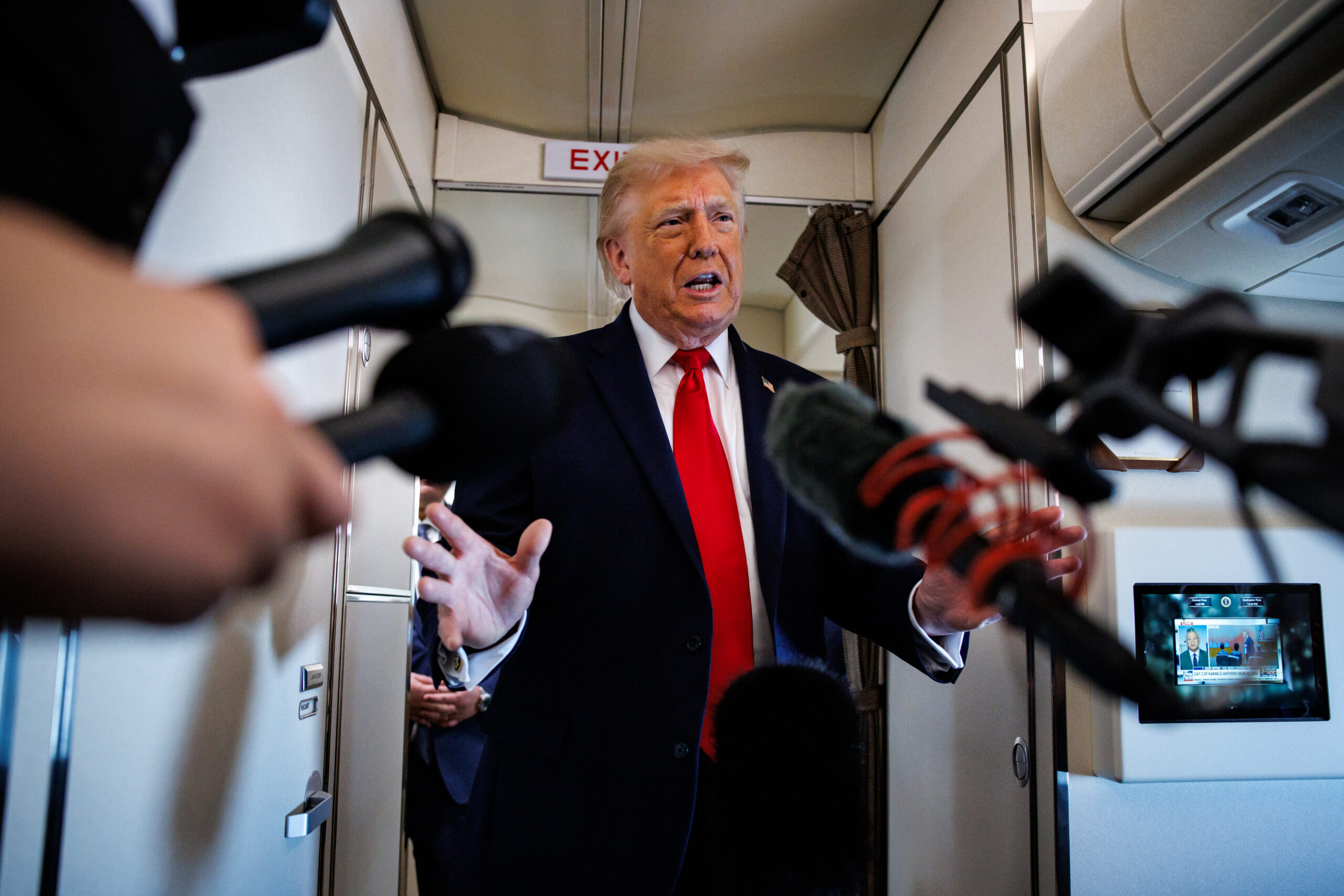
Middle East experts warned on Monday that the Trump administration’s attempts to prevent Israel’s military retaliation against Iran and its pursuit of a swift diplomatic breakthrough with Tehran are exposing a fundamental breakdown in strategic alignment between Washington and Jerusalem. This dynamic is actively undermining American leverage and hardening Tehran’s resolve both at the negotiating table and on the battlefield, the analysts argued, Jewish Insider’s Matthew Shea reports.
Trump and Tehran: Speaking at a webinar hosted by the Jewish Institute for National Security of America, Amb. Eric Edelman, a distinguished fellow at JINSA and former White House official, said that the president’s behavior makes the U.S. appear “desperate for a deal.” Ari Cicurel, an assistant director of foreign policy at JINSA, agreed that the administration’s apparent urgency to reach a deal removes vital military deterrence to back up U.S. diplomacy. “The president has signaled that he is highly prioritizing reaching some deal, and is willing to restrain Israel in order to do that,” Cicurel told JI.
On the Hill: Sen. Roger Wicker (R-MS), the chairman of the Senate Armed Services Committee, said on Monday that he would support President Donald Trump abandoning diplomatic talks with Iran and resuming military operations, JI’s Marc Rod and Emily Jacobs report.
MOUNTING SCRUTINY
Will Avila Chevalier’s ‘beyond the pale’ views sink the DSA challenger’s campaign against Espaillat?
As Darializa Avila Chevalier mounts an insurgent campaign against Rep. Adriano Espaillat (D-NY) in Upper Manhattan, the democratic socialist has faced mounting scrutiny over past controversial posts that have surfaced in recent days, raising questions about whether the negative publicity will blunt her chances in the June 23 primary election. Some strategists suggested that her incendiary views could get overlooked amid a national political landscape favoring extreme, anti-establishment sentiments now fueling the rise of several far-left candidates in Democratic primaries around the country, Jewish Insider’s Matthew Kassel reports.
Sign of the times: “It seems to not matter in a way that it would have been a deal-breaker 15 or 20 years ago,” Chris Coffey, a Democratic strategist in New York City who is not involved in the primary, told JI on Monday. “This race feels like our new outlier, where some of the things she’s said are so far beyond the pale.”
SCOOP

The Congressional Dads Caucus is hosting children’s influencer Rachel Griffin-Accurso, better known as Ms. Rachel, as a featured guest at a reception in Washington on Tuesday, according to an invitation obtained by Jewish Insider’s Marc Rod. Griffin-Accurso has faced scrutiny and criticism over antisemitic activity and for hosting a pro-Hamas Palestinian journalist on her social media accounts.
Background: Griffin-Accurso is one of 10 “special guests,” including “leaders, advocates, creators, entertainers, and changemakers who are helping redefine fatherhood and caregiving in America,” at the Tuesday reception. The reception is co-hosted by the Dads Caucus, founded by Rep. Jimmy Gomez (D-CA), to advocate for policies including childcare affordability and accessibility, paid family leave and the child tax credit, ahead of the group’s Dad Ambassador Awards. The event is co-hosted by Equimundo, which describes itself as a nonprofit focused on promoting gender equality and preventing violence.
SCOOP
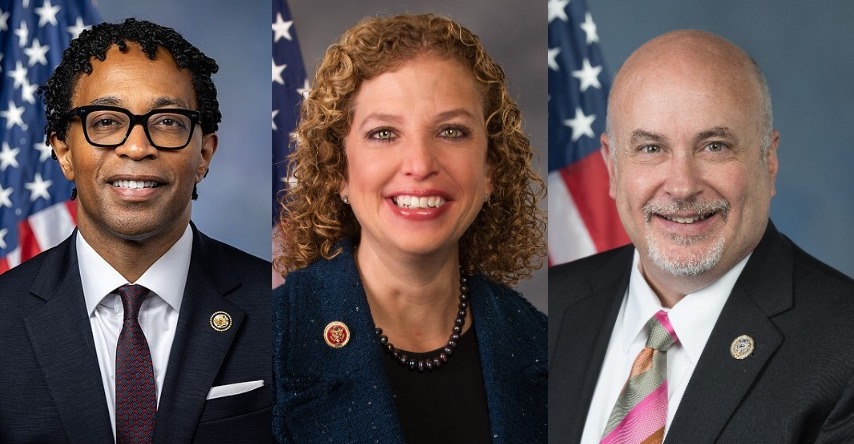
House Democrats are set to name Reps. Wesley Bell (D-MO), Debbie Wasserman Schultz (D-FL) and Mark Pocan (D-WI) to the House Foreign Affairs Committee, Jewish Insider’s Marc Rod has learned.
Lineup changes: Bell and Wasserman Schultz are both strong supporters of Israel, while Pocan is an outspoken critic, joining a panel that features outspoken voices on both sides of the Israel policy debate. None of the three offices responded to requests for comment. Rep. Max Miller (R-OH), a Jewish Republican and strong supporter of Israel, also recently joined the panel.
SPECTATOR SPECTACLE
White House Special Envoy Steve Witkoff, EPA Administrator Lee Zeldin and Boris Epshteyn, the personal attorney to President Donald Trump, joined the president in a luxury suite at Madison Square Garden on Monday night for Game 3 of the NBA Finals, where the Knicks lost to the San Antonio Spurs on home turf, 115-111, Jewish Insider’s Melissa Weiss reports.
Spotted: Courtside, Commerce Secretary Howard Lutnick sat with his wife, Allison, across the aisle from rappers Fat Joe and DJ Khaled. Elsewhere at MSG, former U.S. Ambassador to Japan Rahm Emanuel, TKO Group CEO Ari Emanuel, Mark Shapiro, Larry David, David Zaslav and Robert Kraft were seated courtside for the game. Former New York City Mayor Michael Bloomberg also sat courtside — and found himself face-to-face with Jose Alvarado as the Knicks guard crashed into spectators while trying to save the ball from going out of bounds.
‘SMARTEST, NICEST PERSON IN THE ROOM’

When Louise Greilsheimer thinks about Billie Tisch, she thinks about the way a room felt after she left it. “When you walked in a room, she didn’t strike you,” Greilsheimer told eJewishPhilanthropy’s Nira Dayanim, “but when you left, you knew that she was probably the smartest and nicest person in the room.” Tisch — a billionaire philanthropist, matriarch of one of New York’s most prominent Jewish families and the first woman ever elected president of the Federation of Jewish Philanthropies of New York — died on Sunday at her home in Manhattan. She was 98.
Legacy: Tisch was the last surviving member of her family’s original quartet of philanthropists, whose combined legacy is reflected in a wide range of educational, cultural and medical institutions carrying the Tisch name, and in decades of sustained support for Jewish organizations throughout New York City.
Read the full obituary here and sign up for eJewishPhilanthropy’s Your Daily Phil newsletter here.
Worthy Reads
High Seas Hostage Diplomacy: For CNN, Brett McGurk, who served as the White House’s coordinator for the Middle East in the Biden administration, posits that Iran is applying the same tactics to negotiations over reopening the Strait of Hormuz as it did to talks over hostages held in the Islamic Republic. “For Iran, [holding the Strait] is possession. It now has something the US (and for that matter, the rest of the world) wants. And it will not give it up unless and until America pays an exorbitant price. In Tehran’s eyes, the strait has now become the most valuable hostage it has ever possessed. … The question in Washington is when a deal might be concluded following exchanges of texts through mediators. The question in Tehran is simply whether Trump will pay the price they are demanding. It’s the classic dynamic of a hostage negotiation.” [CNN]
Broad Daylight: The Financial Times explores the divide between President Donald Trump and Israeli Prime Minister Benjamin Netanyahu. “Dahlia Scheindlin, a Tel Aviv-based pollster and political analyst, said there was also an element of ‘political theatre’ to the public disagreements. ‘Trump is basically trying to show the American public that he’s trying to keep the war from re-escalating and he’s trying to keep America from getting involved again,’ she said. ‘And Netanyahu looks good to his domestic audience because he’s defying Trump.’” [FT]
Boycotts and Battlefields: In The Washington Post, Aaron Kaplowitz, president of the United States-Israel Business Alliance, argues that efforts to boycott Israeli defense technology, as some European countries have done on the basis of “moral leadership,” risks forgoing technology that is effective on the battlefield. “According to defense officials, governments that have announced boycotts on Israeli weapons makers are placing orders anyway. That is what governing by perception looks like: Speeches for the activist base. Procurement contracts in the back office. European defense ministries understand what they cannot say in public. Israeli systems are battle-tested in real time against adaptive enemies, and there are not many alternatives that perform as well. The defense systems a nation procures depends on what has the best capabilities.” [WashPost]
Word on the Street
Vice President JD Vance was asked by Fox News host Jesse Watters about reports that Israel was spying on the U.S. and engaging in military operations in Lebanon, responding that “The Israelis and I, the Israelis and the United States, we have a lot of shared interests, but we also have some situations where our interests diverge. While Israel obviously has objectives it has, the U.S. main objective in Iran is that Iran doesn’t have a nuclear weapon… We’ve created this space necessary where the president believes, and I think he’s right, that we can get the long-term settlement to an Iran nuclear deal. Israel may like that, they may not like that… this is in the best interest of the United States of America”…
President Donald Trump nominated Todd Blanche to be attorney general; Blanche has been serving in the role in an acting capacity since former AG Pam Bondi departed the position in April…
A State Department report submitted to Congress last month accuses Russia, Iran and China of weaponizing antisemitic imagery and rhetoric “across physical and cyber domains”…
Two crew members of a U.S. Army Apache helicopter were rescued after it went down in the Strait of Hormuz; the cause of the helicopter’s downing remains under investigation…
Thirty-eight Senate Democrats, led by Sens. Adam Schiff (D-CA), Tim Kaine (D-VA) and Senate Minority Leader Chuck Schumer (D-NY), demanded the administration provide Congress with the legal opinion backing its determination that U.S. hostilities against Iran have ended, given the ongoing strikes and U.S. presence in the region…
By voice votes, the House passed legislation requiring the Trump administration to determine whether various Iranian clerics, and other Iranian entities meet the standards to face U.S. sanctions, and requiring the State Department to brief Congress on antisemitism in Europe…
Eighty-five House Democrats led by Reps. Mark Pocan (D-WI) and Jan Schakowsky (D-IL) urged the administration to act to halt construction of the E1 settlement project in the West Bank…
Third Point founder Dan Loeb hosted Treasury Secretary Scott Bessent on Monday at his hedge fund’s Manhattan office, according to a photo posted on Loeb’s Instagram account…
Axios reports that Paramount executives have engaged in preliminary conversations for a business-side counterpart to CBS News Editor-in-Chief Bari Weiss…
Federal officials arrested a New Jersey man on charges of attempting to provide support to the Islamic State; authorities said that Mohamed Sagha had displayed an interest in attacking a Jewish site or National Guard station in the state…
Under the headline “The New York Primary That Is All About Israel,” The Wall Street Journal looks at the degree to which debate over Israel and U.S. policy in the Middle East is “dividing neighbors and consuming” New York’s 10th Congressional District, where Rep. Dan Goldman (D-NY) is facing a tough primary challenge from former New York City Comptroller Brad Lander…
Los Angeles City Councilmember Nithya Raman, a far-left Democrat, edged out Republican Spencer Pratt for the second runoff spot in the race for Los Angeles mayor; Raman will face incumbent Mayor Karen Bass, also a Democrat, in November…
In a Wall Street Journal opinion piece, Meta President Dina Powell McCormick and Mike Rowe, the CEO of the mikeroweWORKS Foundation, announce the launch of America’s Workforce Academy, a partnership between Meta and a number of partner groups to train would-be workers on AI technology…
Meta accused NSO Group of attempting to hack its WhatsApp messaging service in violation of a court order prohibiting the Israeli spyware firm from doing so…
FTX co-founder Sam Bankman-Fried submitted a formal request to the Justice Department’s Pardon Attorney Office seeking a presidential pardon after serving more than two years of a 25-year term for overseeing a fraudulent cryptocurrency empire…
Richmond, Calif., Mayor Eduardo Martinez is expected to lose his bid for reelection after coming under fire for sharing antisemitic conspiracy theories, including a post that the terror attack at a Sydney, Australia, Hanukkah celebration was an Israeli false flag operation; Martinez trails at least two other candidates in the race, leaving him short of the runoff…
In a letter to Canadian Prime Minister Mark Carney, members of the J7 — leading Jewish groups from Argentina, Australia, Canada, France, Germany, the U.K. and the U.S. — raise concerns about rising antisemitism in Canada and call on Ottawa to take a “whole-of-government effort” and address what the body sees as Canada’s “lack of urgency, coordination, and enforcement” as well as “of real action” to address antisemitism…
Karim Khan, the chief prosecutor of the International Criminal Court, was suspended on Monday over allegations of sexual misconduct with a female aide; the ICC’s Assembly of States Parties will hold a special session to determine the future of Khan’s employment by the court…
The Wall Street Journal looks at the precarious situation in Lebanon as Beirut, backed by Washington and amid talks with Israel, seeks to degrade Hezbollah as the Iranian-backed group maintains its deep entrenchment in the country’s military and politics…
Pic of the Day
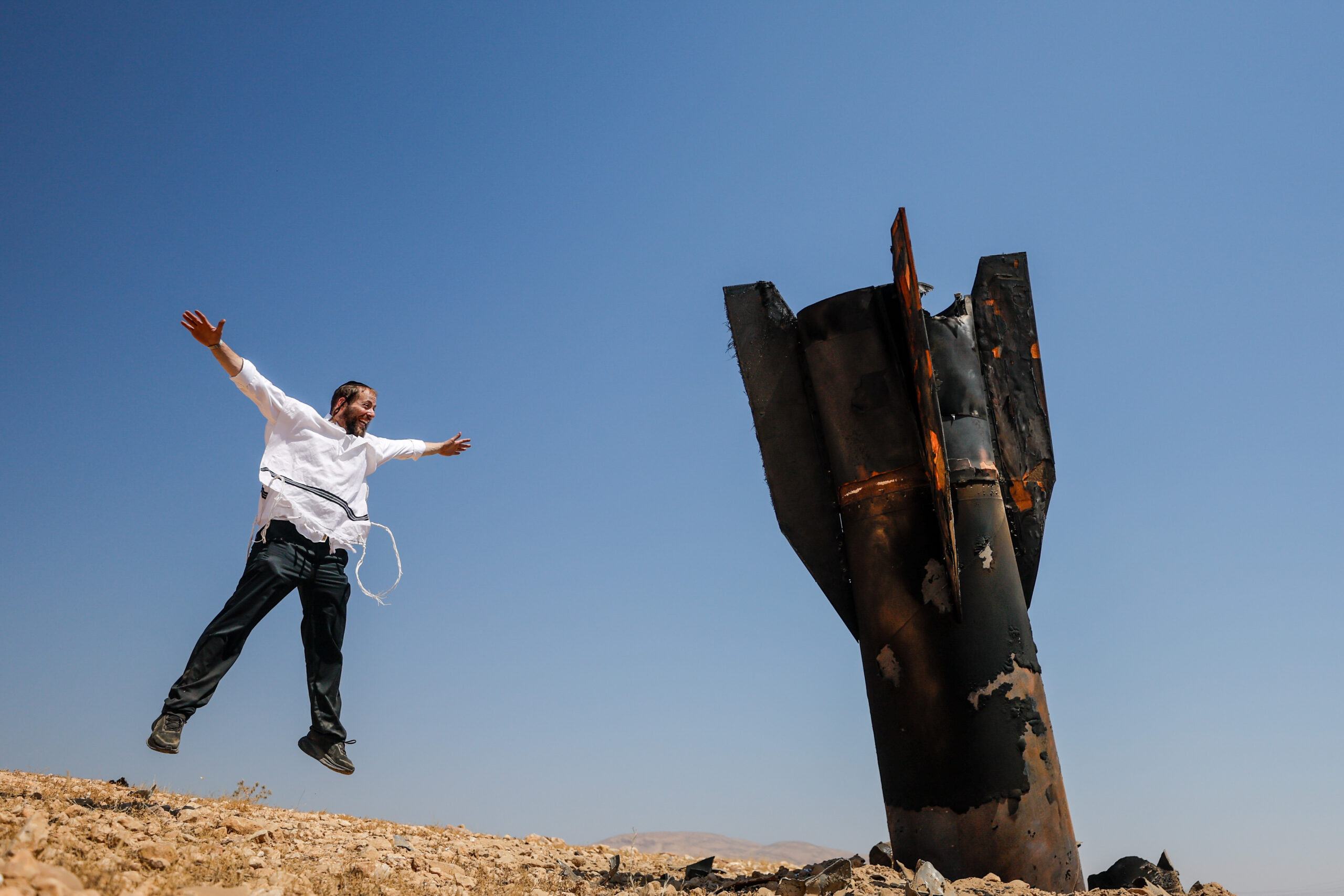
Birthdays

Producer, director, playwright and screenwriter, he has won an Academy Award, five Primetime Emmy Awards and three Golden Globes, Aaron Benjamin Sorkin turns 65…
Former executive director of the Jewish Federation of Greater Dallas, Walter Julius Levy turns 104… Journalist for 30 years at CBS and NBC who then became the founding director of Harvard’s Shorenstein Center, then a fellow at GWU, Marvin Kalb turns 96… Retired Israeli diplomat who served as ambassador to Italy and France and world chairman of Keren Hayesod – United Israel Appeal, Aviezer “Avi” Pazner turns 89… Author of 12 books, journalist, lecturer and social activist, founding editor of Ms. Magazine, Letty Cottin Pogrebin turns 87… British businessman, co-founder with his brother Maurice of advertising agency Saatchi & Saatchi which became the largest in the world, noted for his art collection and for founding Saatchi Gallery, Charles Saatchi turns 83… Diplomat and Shakespeare historian, he was the longtime national editor of Washingtonian magazine, Kenneth Adelman turns 80… Founder of Commonwealth Financial Network (a broker/dealer network) and former chairman of Southworth Development (a golf and leisure business), Joseph Deitch turns 76… Professional mediator, for years she was a syndicated advice columnist in Jewish newspapers, Wendy J. Belzberg… Israel’s former minister of defense and deputy prime minister, Benny Gantz turns 67… Canadian journalist, author, documentary film producer and television personality, Steven Hillel Paikin turns 66… Former lead singer of the Israeli pop rock band Mashina, Yuval Banay turns 64… CEO of Jewish Women’s International, Meredith Jacobs… Managing director at Major, Lindsey & Africa, Craig Appelbaum… EVP of Jewish Funders Network, Rabbi Rebecca Sirbu… Screenwriter, director and producer, Hayden Schlossberg turns 48… Founder and CEO of Delve, an AI platform for public affairs, he was previously a Bush 43 White House Jewish liaison, Jeff Berkowitz… NYC-based writer, actor and entrepreneur, he is a co-founder of Swish Beverages, David Oliver Cohen turns 46… Jerusalem-born Academy Award-winning actor, producer and director, Natalie Portman turns 45… Online producer, writer and director, who together with his brother Benny founded the “React” video series, Rafi Fine turns 43… Multimedia artist known for her work in photography, makeup, hairstyling and textile crafts, Anna Marie Tendler turns 41… Composer and lyricist, in 2024 he became the 20th person to complete the EGOT, an acronym for the Emmy, Grammy, Oscar and Tony Awards, Benj Pasek turns 41… Israeli tech entrepreneur, he is the founder and CEO of A.Team, Raphael Ouzan turns 39… Director of the Yale Journalism Initiative, her book, A Flower Traveled In My Blood, was published last year, Haley Cohen Gilliland… Deputy assistant secretary for strategic communications at the Department of Homeland Security during the Biden administration, Jeff Solnet… Ice hockey player for the NHL’s Edmonton Oilers and best-selling author of children’s books, Zachary Martin Hyman turns 34… Serial entrepreneur, founder and CEO of Setscale, Daniel Fine…
Roger Wicker, the Senate Armed Services Committee chair, told Jewish Insider that Iran has ‘been stringing us along’ and ‘had no intention of negotiating in good faith’
Tom Williams/CQ-Roll Call, Inc via Getty Images
Senate Armed Services Committee Chairman Roger Wicker (R-MS) arrives for a confirmation hearing in Dirksen building on Tuesday, May 13, 2025.
Sen. Roger Wicker (R-MS), the chairman of the Senate Armed Services Committee, said on Monday that he would support President Donald Trump abandoning diplomatic talks with Iran and resuming military operations.
“It’s becoming clearer and clearer that they’ve been stringing us along and that they had no intention of negotiating in good faith,” Wicker told Jewish Insider of Iran. “I wouldn’t blame the president at all if we resume full-scale war. I don’t think the American people would blame him at all.”
The senator’s remarks follow a sharp weekend escalation, which saw Iran launch a barrage of ballistic missiles at Israel in response to IDF operations in Beirut. Asked at the Capitol on Monday about Trump’s subsequent pressure on Israeli Prime Minister Benjamin Netanyahu to hold back retaliatory strikes, Wicker encouraged a tougher stance on Iran.
Wicker has been skeptical for weeks of U.S. negotiations with Iran, urging a return to combat operations.
While Netanyahu reportedly called off broader strikes on Iran on Monday, he suggested he had pushed back on Trump’s request for Israel not to respond to an Iranian missile attack on Sunday. Netanyahu said he had relayed to the White House that Israel retains its right to self-defense “with appreciation and respect in my good conversations with my friend President Trump.”
Wicker dismissed concerns that Trump and Netanyahu’s relationship had deteriorated over the war in Iran, and emphasized his support for Israel’s actions against Hezbollah in Lebanon.
“I think the president would tell you that our relationship with Israel is as strong as it’s ever been, and that he’s doing well with Netanyahu,” Wicker said. “On the issue of Israel and Hezbollah, Hezbollah exists for no reason other than to destroy Israel and kill Americans. That’s the only reason they exist. They’re not a religion, they’re not a region, they’re not an ethnic group.”
“I absolutely believe that Israel has every right to respond forcefully when attacked by Hezbollah,” he added.
Sen. Ted Budd (R-NC) said that Israel and the U.S. are responsible for making their own decisions, but said that shouldn’t damage the core alliance.
“Israel is a sovereign country. They can make their own decisions. We’re a sovereign country, we can make ours,” Budd said. “We can make recommendations to either, and they’re a great ally. We need to make sure we maintain the status of them being a great ally.”
Sen. Richard Blumenthal (D-CT) argued that what he characterized as the administration’s failures are producing friction with Israel.
Blumenthal said that “Israel has a right to defend itself” from both Iran and Hezbollah and “has a right to strike back at Hezbollah, in Lebanon, where it is strongest, maybe outside Beirut.”
“The fundamental problem here is that Trump is caught in a quagmire of his own making with unrealistic and, in fact, confused goals that have not been achieved,” Blumenthal continued, “He’s struggling for negotiations, while Israel wants to achieve some goals, including securing the enriched uranium, and so there’s bound to be some tension.”
“But at the end of the day, they’ll have to continue working in concert, because that’s the only path toward peace,” Blumenthal said.
‘Without the credible threat of a military option, Iran is unlikely to make any concessions that would lead to any semblance of a good deal,’ JINSA’s Ari Cicurel told JI
Samuel Corum/Getty Images
President Donald Trump speaks with reporters while aboard Air Force One on June 5, 2026 en route to Chippewa Falls, Wisconsin.
Middle East experts warned on Monday that the Trump administration’s attempts to prevent Israel’s military retaliation against Iran and its pursuit of a swift diplomatic breakthrough with Tehran are exposing a fundamental breakdown in strategic alignment between Washington and Jerusalem. This dynamic is actively undermining American leverage and hardening Tehran’s resolve both at the negotiating table and on the battlefield, the analysts argued.
Following an exchange of airstrikes on Sunday and Monday between Israel and Iran, Israeli Prime Minister Benjamin Netanyahu abided by a request from President Donald Trump to pause further strikes on Iranian territory. Jerusalem made clear, however, that it will proceed with operations against Hezbollah targets in southern Lebanon.
Analysts argued that Trump’s recent moves to restrain Israel are backfiring by degrading U.S. deterrence, emboldening Iran and showcasing the fundamentally diverging interests between Washington and Jerusalem regarding the ultimate outcome of the war.
Speaking at a webinar hosted by the hawkish Jewish Institute for National Security of America, Amb. Eric Edelman, a distinguished fellow at JINSA and former White House official, said that the president’s behavior makes the U.S. appear “desperate for a deal.”
“The president has, over the course of several weeks, basically signaled to the Iranians in multiple ways that he is very reluctant to return to kinetic military activity,” Edelman said. “I think that just continues this pattern of suggesting to the Iranians that he really is very anxious for a deal, and I think that’s actually undercutting his leverage with them because it only leads them [Iran] to harden their positions and makes it harder, not easier, to get a deal.”
Edelman added that Iran has actively sought to “take advantage” of this perceived diplomatic anxiety, taking a “much more forward position defending their proxies in Lebanon than they did earlier when Israel was reducing Hezbollah very significantly.”
Ari Cicurel, an assistant director of foreign policy at JINSA, agreed that the administration’s apparent urgency to reach a deal removes vital military deterrence to back up U.S. diplomacy.
“The president has signaled that he is highly prioritizing reaching some deal, and is willing to restrain Israel in order to do that,” Cicurel told Jewish Insider. “That’s a dangerous scenario, in terms of Iran’s potential for aggression, as well as undermines his own ability to reach that deal, because without the credible threat of a military option, Iran is unlikely to make any concessions that would lead to any semblance of a good deal.”
Cicurel noted that restraining Israel at this juncture is particularly “dangerous” given what is at stake regarding the “potential for resumption of major combat operations.” He cautioned that the moves by the Trump administration represent “another example of tensions between U.S. and Israeli leaders undermining deterrence,” giving Tehran a distinct operational gap to exploit.
Robert Satloff, executive director of The Washington Institute for Near East Policy, said the recent escalation was similar to April 2024, during which former President Joe Biden “urged Israel to ‘take the win’ of defending against Iranian missiles and not to retaliate.”
“In this instance, as then, Israel politely declined U.S. preferences and responded to the Iranian attack with a carefully calibrated retaliatory strike that quickly led to de-escalation,” he said.
The friction underscores a broadening rift in the wartime goals of the two close partners, experts said. While the White House remains intensely focused on domestic economic issues and regional stability, Jerusalem views the conflict as a historic window to permanently dismantle Iran’s ballistic missile capabilities and regional proxy architecture.
“At this point in the war, Trump and Netanyahu have different interests at play,” Rachel Brandenburg, a senior policy analyst at Israel Policy Forum, told JI. “Trump’s priority is to re-open the Strait of Hormuz to stabilize global energy markets and bring down the price of fuel, and Netanyahu wants to continue degrading Iran’s ballistic missile arsenal and nuclear program.”
Trump, she said, “promised Israel a level of victory over Iran that is far from what has transpired. Trump seems to want the war to end so he can move on, and Netanyahu would prefer the opportunity to finish the job Israel and the U.S. started on Feb. 28.” She added, “Both have election politics in mind, with Israeli elections on the horizon for [the fall] and U.S. midterm elections in November. At the moment the war isn’t helping either of them.”
Brandenburg noted that Trump has aimed to restrain Netanyahu “for some time” across both the Iran and Lebanon fronts, but emphasized that an independent Israeli strike after Iran’s ballistic missile attacks on Israel on Sunday remained necessary, despite Washington’s public calls for a pause. “It would have been too much for Israel to sit tight without responding after Iran targeted Israel directly. Whether Iran continues to strike Israel in retaliation for Israeli strikes against Hezbollah in Lebanon may have more bearing on what the next phase of the war looks like than Trump,” she said.
A central point of contention has emerged over the linkage of fighting with Hezbollah in Lebanon to the broader ceasefire with Iran. Experts warn that Washington has mistakenly tolerated an Iranian strategy designed to shield its primary proxy by tying the fighting in Lebanon directly to the broader U.S.-Iran diplomatic track, even as Trump told NBC’s “Meet the Press” on Sunday that he is “not demanding” Lebanon be part of a deal with Iran despite saying Tehran “would like to see it.”
“Clearly before the attacks, Iran had been seeking to tie the Israel-Hezbollah exchange of fire against one another, as well as the diplomacy between them, with the diplomacy and ceasefire in Iran,” Cicurel noted. “In President Trump seeking to restrain Israel after Iran has attacked it, it unfortunately encourages Iran to continue that linkage and further encourages Iranian aggression.”
Satloff said that the latest round of fighting “was won by those who oppose Iran’s protection-racket scheme to bring Lebanon into its security orbit and under the umbrella of broader U.S.-Iran negotiations.”
“What is different between this round and April 2024 is that Iran has no conceivable legitimate justification to take any action against Israel,” Satloff said. “Iran is trying to claim that Israel’s action against other nationals in another country — Hezbollah in Lebanon — legitimizes its action. This is totally unacceptable and cannot be tolerated.”
Edelman similarly noted that despite Israel’s extensive work to combat the network of Iranian-backed proxies surrounding the country, the administration’s pursuit of a swift ceasefire risks breathing new life into a severely weakened Iranian strategy.
“The Iranian strategy of creating a ring of fire around Israel is in shards,” Edelman said. “And I think as the ceasefire went on, as the Iranians perceived the president’s desire for an agreement, they came to believe that they might be able to rescue something.”
However, Edelman noted that the recent spike in violence does not signal that diplomacy is collapsing, explaining that all sides maintain incentives to pursue a deal.
“I don’t think it’s a signal that negotiations are over,” Edelman observed. He pointed out that “the Iranians actually kind of called a halt to this” round of exchanges to limit the blowback.
Edelman said that with the interior minister of Pakistan currently in Tehran, backchannel diplomatic contacts are actively continuing. He also said that “the Iranians are particularly anxious to get access to frozen funds,” but added that it is “a particular sore point” for Trump.
“I believe he [Trump] wants to try to persuade the American public that whatever deal this ends up being is going to be measurably better than the Joint Comprehensive Plan of Action that President Obama agreed to in 2015,” Edelman said. “In my view that’s going to be a pretty tall order, but not giving the Iranians access to money before they perform whatever obligations they undertake as part of this deal will be a key part of that.”
Plus, AIPAC wades into Mich. Senate race

SAUL LOEB/AFP via Getty Images
President Donald Trump shakes hands with Israeli Prime Minister Benjamin Netanyahu during a meeting in the Oval Office of the White House in Washington, DC, on April 7, 2025.
This P.M. edition is reserved for our premium subscribers like you — offering a forward-focused read on what we’re tracking now and what’s coming next.
Today’s Daily Overtime was curated by JI U.S. Editor Danielle Cohen-Kanik.
📡On Our Radar
Notable developments and interesting tidbits we’re tracking
President Donald Trump cautioned Israeli Prime Minister Benjamin Netanyahu that if Israel went forward with a plan to escalate its strikes on Iran today, “you will be on your own very soon,” the president recalled in an interview with Axios, after which the Israeli leader reportedly called off the attack. Trump also claimed the U.S. and Iran are nearing a “phenomenal deal. We are getting everything we wanted”…
Netanyahu subsequently said in a video statement that, while Israel is “holding its fire” against Iran, Jerusalem has “a full right to self-defense” and is “exercising it to the extent necessary” — a message he said he relayed “with appreciation and respect in my good conversations with my friend President Trump.” But Netanyahu warned that if Iran resumes its attacks on Israel, the IDF would respond with “overwhelming force”…
Mohammad Bagher Ghalibaf, the speaker of the Iranian parliament, said in an address today that Iran’s simultaneous military strikes and diplomacy are part of an intentional strategy and that, though Tehran is seeking to end the war, it does not want to normalize relations with Washington…
U.S. forces disabled another empty oil tanker attempting to sail to Iranian ports today after it failed to disobey orders to stop by firing a precision munition into the ship’s engineering and steering spaces, CENTCOM announced. It’s the seventh such vessel U.S. forces have disabled since the blockade began…
Thirty-eight Senate Democrats, led by Sens. Adam Schiff (D-CA), Tim Kaine (D-VA) and Minority Leader Chuck Schumer (D-NY), demanded in a letter to Trump that the administration provide Congress with the legal opinion backing its determination that U.S. hostilities against Iran have ended, given the ongoing strikes and U.S. presence in the region…
At next week’s G7 summit in France, which Trump will be attending, European leaders will attempt to secure the president’s support for a U.K. and France-led effort to de-mine the Strait of Hormuz, Bloomberg reports…
The J7, a coalition of Jewish communal organizations representing the seven largest Jewish Diaspora populations, urged Canadian Prime Minister Mark Carney to prioritize action over further study after he announced Ottawa’s new Ministerial Advisory Council on Rights, Equality and Inclusion would examine rising antisemitism in the country.
Arguing that the problem has already been well documented, the groups called for a “whole-of-government” response focused on enforcement and countering extremist ideologies and terror movements…
United Democracy Project, the AIPAC-aligned super PAC, began buying ad time in Michigan today, in what appears to be the pro-Israel group’s first foray into the state’s heated Democratic Senate primary…
The Wall Street Journal interviews activists Daniel Moraff and Leanne Fan, who, along with consultant Morris Katz, recruited Graham Platner to run for Senate in Maine. The two said that their own vetting process of Platner did not turn up the Nazi tattoo he had on his chest, nor the full extent of his controversial Reddit posts, but they believed none of what they had seen at the time “will or should stop him from becoming a U.S. senator”…
The two factions of Williamsburg, Brooklyn’s Satmar community united behind Brooklyn Borough President Antonio Reynoso in the race to succeed retiring Rep. Nydia Velazquez (D-NY). Reynoso, a native of the district, clashed with some of the Hasidic sect’s leaders as a city councilmember but rebuilt relationships in subsequent years. New York City Mayor Zohran Mamdani, who has found allies in the Satmar sect while in office, is backing Reynoso’s opponent, Assemblymember Claire Valdez…
Ahead of tonight’s Knicks NBA Finals game against the San Antonio Spurs at Madison Square Garden, The Forward examines the chant sweeping New York City — “My mayor Muslim, my bagel Jewish, my Christian Dior, Knicks in four!” — and what it says about the city’s identity…
⏩ Tomorrow’s Agenda, Today
An early look at tomorrow’s storylines and schedule to keep you a step ahead
Keep an eye out in Jewish Insider for a look at the view from Washington on Trump’s attempt to pressure Netanyahu not to retaliate to Iran’s recent ballistic missile attacks.
Maine, Nevada, North Dakota and South Carolina will hold their primary elections tomorrow.
The House Foreign Affairs Committee will hold a markup of various bills, including one to direct the State Department to impose sanctions on the leaders and family members of the Rapid Support Forces (RSF) and the Sudanese Armed Forces (SAF) responsible for genocide, war crimes and crimes against humanity in the Sudanese civil war.
The House Appropriations Committee will mark up the FY 2027 spending bills for Labor, Health and Human Services and Homeland Security.
The Atlantic Council will kick off its two-day Global Energy Forum with remarks from Energy Secretary Chris Wright; Ben Black, CEO of the U.S. International Development Finance Corporation; Alaska Gov. Mike Dunleavy; and representatives from Kuwait, Egypt, Syria and more.
Agudath Israel of America will celebrate the opening of its new office on Capitol Hill with a tribute to its longtime vice president for government affairs, Rabbi Abba Cohen, who is set to step down after 37 years at the organization.
Stories You May Have Missed
PROMISES AND PERILS

Rabbi Mordechai Lightstone: ‘When we ascribe human attributes — emotions, consciousness and soul — to AI, we risk transforming a sophisticated instrument into an idol’
GOLDEN MEMORIES

A new exhibition at the Upper East Side synagogue uses paintings of everyday Jewish life to explore nostalgia and identity as Jewish artists increasingly feel unwelcome in cultural spaces
The Israeli prime minister said that Israel had finished retaliating against Iran, but would defend itself against further attacks

Kevin Dietsch/Getty Images
Israeli Prime Minister Benjamin Netanyahu speaks during a meeting with U.S. President Donald Trump in the Oval Office of the White House on April 7, 2025 in Washington, DC.
Israeli Prime Minister Benjamin Netanyahu said on Monday that, though Israel is “holding its fire” against Iran, Jerusalem has “a full right to self-defense” and is “exercising it to the extent necessary.”
The prime minister warned that if Iran resumes its attacks on Israel, the IDF would respond with “overwhelming force.”
Netanyahu’s statement follows a series of tit-for-tat exchanges between Israel and Iran and its proxies that began with Hezbollah’s fire on northern Israel on Sunday. After Israel struck Hezbollah targets in Beirut, Iran fired a wave of ballistic missiles at Israel, prompting the IDF to strike military targets, as well as a petrochemical facility, in Iran.
Netanyahu also suggested he had pushed back on President Donald Trump’s request for Israel to not respond to Iranian strikes on Sunday. He said he had relayed to the White House the message about Israel’s right to self-defense “with appreciation and respect in my good conversations with my friend President Trump.”
Trump asked Netanyahu on Sunday to keep Israel’s strikes against Iran limited to prevent escalation, once it became clear that Israel would not stand down, according to a report from The Wall Street Journal. On Monday, Netanyahu agreed to a second request from Trump to halt Israel’s attacks, sources told the outlet.
Iran had said it would not continue striking Israel as long as the IDF ceased its campaign against Hezbollah

Wisam Hashlamoun/Anadolu via Getty Images
Missiles launched from Iran toward Israel are seen in the sky over Hebron on June 7, 2026
Israel will abide by a request from the Trump administration to pause its strikes on Iran, two Israeli sources told CNN, though Jerusalem plans to continue its operations against Hezbollah targets in southern Lebanon.
The halt comes after Iran announced earlier Monday that it would suspend its military operations against Israel, after having launched a number of missile barrages at the Jewish state since Sunday evening. However, Tehran has threatened to resume strikes should Israel continue its campaign in Lebanon, which the IDF did on Monday after Hezbollah fired rockets at Israeli troops in southern Lebanon.
Israeli Defense Minister Israel Katz said in a statement on Monday that “any attack on [northern Israel] will lead to a strike on Dahiyeh,” referring to the Beirut suburb and Hezbollah stronghold that the IDF struck on Sunday in response to Hezbollah attacks targeting northern Israel earlier in the day. “We completely reject Iran’s threat,” Katz added. “Any Iranian attempt to link Lebanon and Iran and attack Israel will be met with great force, as happened yesterday.”
Israel had fired on Iranian strategic air defense systems and an Iranian petrochemical plant earlier on Monday after Tehran launched waves of ballistic missiles at northern and central Israel, the first such attacks since the U.S. and Iran reached a ceasefire in early April. Iran said it was retaliating for IDF strikes in Dahiyeh, which came after Hezbollah fired on northern Israeli towns.
After Israel’s strikes on Iran, the Houthis, an Iran-backed proxy group in Yemen, launched a ballistic missile at Israel and declared a ban on Israeli shipping in the Red Sea.
The exchange marked the most significant military hostilities between the two sides in months and prompted immediate diplomatic intervention from President Donald Trump, who called on both sides on Monday to “stop shooting.”
He had also reportedly urged Israeli Prime Minister Benjamin Netanyahu in a phone call to hold off on retaliatory strikes against Iran, though Israel fired on Iran afterwards. Trump also said that “Israel and Iran must immediately stop ‘shooting,’” in a post on Truth Social early Monday morning.
Although a U.S. official initially told CNN that American forces played no role in intercepting the Iranian missiles, officials later confirmed that Washington did fire interceptors at the incoming projectiles. The success of those intercept attempts remains unclear. The U.S. military stated it did not conduct any joint strikes in Iran alongside Israel.
Trump also said he was “not happy” about the Israeli strikes in Beirut on Sunday, after he attempted to broker a ceasefire between Israel and Hezbollah last week, which the terror group quickly rejected.
Netanyahu will reportedly convene a full Security Cabinet meeting Monday evening local time.
The diplomatic scramble unfolds as the U.S. and Iran attempt to maintain a fragile truce while negotiators seek to hammer out a comprehensive end to the conflict. Iranian President Masoud Pezeshkian stated that his nation has “abandoned neither the battlefield nor the negotiating table.”
“Our priority is national security and the peace of our people. We will firmly defend the rights of the nation and will not back down in the face of any threat,” Pezeshkian wrote on X on Monday, describing diplomacy and defense as the “two wings of national power.”
This story was updated on June 8 to reflect an updated CNN report that U.S. forces did attempt to assist Israel in intercepting Iranian missiles.
Trump issued his first comments of the day shortly before 6 a.m. ET, posting on his Truth Social site that “Israel and Iran must immediately stop ‘shooting.’”

Wisam Hashlamoun/Anadolu via Getty Images
A missile leaves a fiery trail across the sky over the West Bank city of Hebron on June 8, 2026, amid missile launches from Iran toward Israel.
Millions of people across northern Israel heard a familiar sound from their phones late Sunday night: an alert from Israel’s Homefront Command, notifying them for the first time in two months, of an incoming ballistic missile attack from Iran.
Just after sunrise, residents of Israel’s center — from Tel Aviv to Jerusalem — received the same notification, and groggily huddled in shelters as Iran, joined by its Houthi proxy in Yemen, launched fresh salvos at Israel. Shortly after, Israel struck a petrochemical plant in southwest Iran.
Last night’s initial Iranian attack came in response to Israeli strikes in the Beirut suburb of Dahiyeh, a Hezbollah stronghold that had in recent weeks been off-limits to the IDF in accordance with a U.S.-brokered ceasefire with Lebanon that limited Israeli action to southern Lebanon, another Hezbollah stronghold.
What matters more than how the latest round of fighting started is what will happen next. The escalating tit-for-tat strikes have again brought the region to the brink of another all-out war that could return the U.S. to active fighting, despite two months of efforts by the White House to reach a deal with Tehran.
Israeli media reported that its overnight strikes on Iran had been coordinated with the U.S., even as President Donald Trump spent Sunday afternoon on the phone with reporters trying to publicly de-escalate the situation.
Shortly after Iran’s initial missile attack on Sunday, Trump told Fox News that the incident was “certainly not going to help” the ongoing negotiations between the U.S. and Iran. He continued, “What I would suggest to Iran: You’ve shot your missiles, that’s enough, get back to the table and make a deal.”
Speaking to Axios, Trump said, “I am going to call [Israeli Prime Minister Benjamin] Netanyahu right now and tell him not to strike back. … Each of them had their fun. Israel had its strike and Iran had its strike. We don’t need another one.”
In the hours that followed, both Israel and Iran disregarded the president’s comments and continued their strikes.
Trump’s comments could be taken at face value — or viewed with some skepticism in light of the Israeli media reports that the strikes were coordinated with Washington. It would not, after all, be the first time in which the U.S. and Israel publicly emphasized their differences while privately remaining aligned — even amid alleged fissures in the relationship. That includes leaks to NBC News and The New York Times over the weekend that the Defense Department’s Defense Intelligence Agency had raised its counterintelligence threat level for Israel to the highest level. The Times named three U.S. officials that were allegedly being tracked for information on the Iran negotiations: White House Special Envoy Steve Witkoff, the Pentagon’s Elbridge Colby and Colby’s deputy, Michael DiMino.
But things move fast in the Middle East. Recall that last June, after 12 days of intensive strikes between Israel and Iran, joined by the U.S., a ceasefire was announced mere hours after Iran launched missiles at a U.S. airbase in Qatar. Addressing the overnight escalation between Israel and Iran — and Iran’s continued intransigence in the region — is likely to be the White House’s top order of business today. Indeed, Trump issued his first comments of the day shortly before 6 a.m. ET, posting on his Truth Social site that “Israel and Iran must immediately stop ‘shooting.’”
Negotiations between the Trump administration and Iran thus far have yielded little concrete success. The Strait of Hormuz remains closed. Iran has continued to attack ships transiting through the waterway, as well as other Gulf countries — such as Kuwait, whose major airport suffered significant damage after an Iranian drone struck the passenger terminal, killing one and injuring dozens. Gulf states have increasingly had to find alternative export routes. The region exists in a state of paralysis, unsure if or when a new round of fighting will again disrupt everyday life, work and travel.
Yesterday morning, the president told NBC’s “Meet the Press” that his red line for resuming military action in Iran would be if he didn’t believe the parties could reach a deal in a timely manner. The latest escalation has the potential to bring the U.S. and Iran to an accord — and the war to a more finite end — regardless of what Israel wants. (Trump told the Financial Times that Netanyahu would have to accept a U.S. agreement with Tehran because Washington “calls the shots.”)
But the latest exchanges could also trigger a new round of active warfare, nearly a year to the date that the 12-day war began. All eyes will be on Washington today to see what will play out.
Trump told Axios that he would be pressuring Israeli Prime Minister Benjamin Netanyahu not to strike back

Mostafa Alkharouf/Anadolu via Getty Images
Missiles fired by Iran to Israel are seen in the skies over Jerusalem on June 07, 2026.
Iran launched a number of ballistic missiles at Israel on Sunday night for the first time since the U.S. and Iran reached a tenuous ceasefire in early April.
The IDF said it had intercepted all of the missiles “thus far,” and no injuries were reported. Israel’s Home Front Command canceled schools nationwide on Monday.
Ebrahim Rezaei, spokesperson for the Iranian parliament’s foreign policy and national security committee, had warned several hours prior to the attacks that Iran would deliver “a decisive and painful response” to the IDF’s strikes in the suburbs of Beirut earlier in the day. “These rabid dogs must be disciplined and put back in their place. Watch the sky over [Israel] tonight,” he wrote on X.
Earlier Sunday, the IDF struck the Beirut suburb of Dahiyeh, where it said it was targeting a Hezbollah headquarters, in response to the terror group’s missile attacks on northern Israel on Sunday morning.
President Donald Trump announced he had brokered a ceasefire between Israel and Hezbollah last week, though the terror group quickly rejected the deal.
Shortly after Iran’s attacks, Trump told Fox News that the incident was “certainly not going to help” the ongoing negotiations between the U.S. and Iran. He continued, “What I would suggest to Iran: You’ve shot your missiles, that’s enough, get back to the table and make a deal.”
About Israel’s strikes in Beirut, Trump said, “I’m not happy about it.”
Trump also told Axios, “I am going to call [Israeli Prime Minister Benjamin] Netanyahu right now and tell him not to strike back. … Each of them had their fun. Israel had its strike and Iran had its strike. We don’t need another one.” Israeli sources, however, told several news outlets that the IDF planned to deliver a “powerful” response to Iran.
Trump also said Netanyahu “won’t have any choice” but to accept any deal the U.S. reaches with Iran, in an interview with the Financial Times shortly after the Iranian attacks. “I call the shots. I call all the shots. He [Netanyahu] doesn’t call the shots,” the president said.
The president also said on ‘Meet the Press’ that U.S. forces could be deployed into Iran to retrieve and destroy the regime's stockpile of enriched uranium
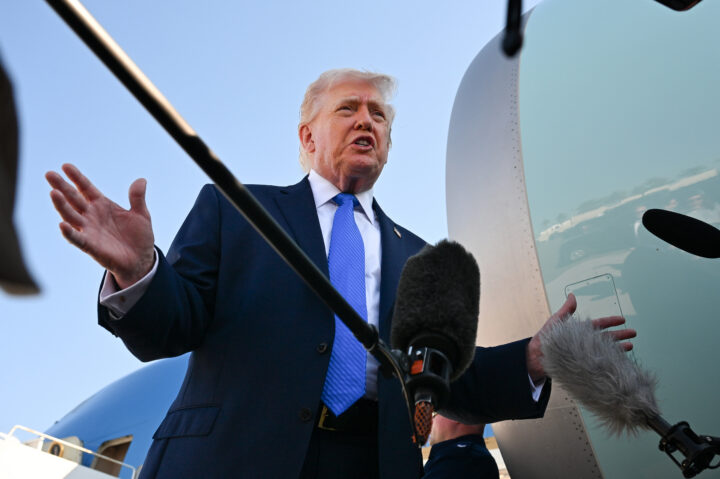
Roberto Schmidt/Getty Images
President Donald Trump speaks to reporters before boarding Air Force One at Palm Beach International Airport on March 23, 2026 in West Palm Beach, Florida.
Appearing on NBC’s “Meet the Press” on Sunday, President Donald Trump said his red line for resuming military action in Iran would be if he didn’t believe the parties could reach a deal in a timely manner, and said U.S. forces could be deployed into Iran to retrieve and destroy the regime’s stockpile of enriched uranium.
Trump continued to assert that Iran is desperate for a deal, even as negotiations appear largely deadlocked and as Esmaeil Baghaei, Iran’s Foreign Ministry spokesperson, told CNN in Tehran on Sunday that the primary obstacle to an agreement is Washington’s changing and “contradictory” positions. Meanwhile, U.S. and Iranian forces continue to exchange strikes nearly daily around the Strait of Hormuz.
Trump ruled out the prospect of unfreezing any Iranian assets or offering upfront sanctions relief to secure a breakthrough, maintaining that compliance must precede concessions.
“If they behave, if they do a good job, we start talking,” Trump said. But should Iran walk away from the table or drag out the timeline, the president emphasized he would not rule out a return to hostilities.
“My red line would be if I think I wasn’t going to make a deal, or if I wasn’t going to make a deal fast enough,” Trump said of resuming military action, noting that if Iran were to kill additional Americans — more than a dozen U.S. troops have already been killed in the current conflict — that would be “something that I would think about very seriously.”
“We’re having very good negotiations with the people that are leading the country now. It’s the third group that we’ve been dealing with. And they are different. And you could say it’s regime change actually because these are very different people. I find them to be more rational, very smart,” he added.
Trump specifically noted that he considers Supreme Leader Mojtaba Khamenei — the son of the late Supreme Leader Ayatollah Ali Khamenei — a more “rational” negotiating partner.
“I think [he is] more rational. He’s pretty badly injured. So there’s a certain bravery there,” Trump said. “A lot of people, if they were injured that badly, they wouldn’t be talking about, you know, ‘How are we doing with the United States?’ They’d have other things on their mind. So there’s a certain bravery there. But he is very seriously injured.”
The president further said U.S. forces could be sent into Iranian territory to secure the regime’s nuclear stockpiles, claiming that Washington knows exactly where the material is stored.
“The way you do it is if we make a deal now, we’re friendly, we’ll all go together. It’ll be our equipment. We’ll take it out and destroy it, whether it’s onsite or whether we take it offsite,” Trump explained. “We will be at peace. And we will go with them, or without them. But we won’t have people shooting at us, okay?”
He added: “Now, if we don’t make a deal, then we’re going to take them out militarily very harshly. And we’ll wait until we do that before we go, in which case we’ll have safety either way.”
Trump further claimed that the U.S. possesses highly specific data on Iran’s remaining military capabilities, including the locations of its drones, manufacturing plants, remaining missiles and launch sites. While the president stated that the majority of Iran’s production facilities “have been knocked out,” he acknowledged that Tehran still maintains some of its arsenal.
“I know almost the number, and we know where they are too, and we know where their drones are, and we know where their drone factories are,” Trump said. “Most of the drone factories have been knocked out, most of the launching pads have been knocked out and most of the missile manufacturing areas have been knocked out. But they still have capacity. They have some missiles, they have some drones. I would say percentage wise, maybe 21-22% of their missiles. It’s a lot of missiles, but it’s not what it was when we first attacked.”
Turning to the broader regional landscape, Trump clarified that he is “not demanding” that Lebanon be included in a peace deal with Iran, as Tehran has requested, though he expressed a desire to see “a more surgical” approach to combating Hezbollah
“I’d like to see Lebanon have a better life,” Trump said. “I’d like to see a more surgical attack on Hezbollah. I think it should be more surgical,” he added, but did not reference Israel or its recent military actions against the terror group.
Plus, John's bolting to a guilty plea
Daryn Slover/Portland Press Herald via AP
Senate candidate Graham Platner acknowledges the large crowd that attended Platner's town hall, Sept. 25, 2025, at Bunker Brewing in Portland, Maine.
This P.M. edition is reserved for our premium subscribers like you — offering a forward-focused read on what we’re tracking now and what’s coming next.
Today’s Daily Overtime was curated by JI U.S. Editor Danielle Cohen-Kanik.
📡On Our Radar
Notable developments and interesting tidbits we’re tracking
Three women who were romantically involved with Maine Senate candidate Graham Platner told The New York Times in a detailed exposé that the presumptive Democratic nominee had been “toxic,” physically threatening, misogynistic and unfaithful during their yearslong relationships.
One former partner, Lyndsey Fifield, confirmed Jewish Insider’s reporting from October that Platner had known what the Nazi symbol tattooed on his chest represented and had taught her the word for it, calling it “my Totenkopf”…
John Bolton, President Donald Trump’s national security advisor during his first term, intends to plead guilty to illegally retaining sensitive national security information, CNN reports, a charge that could carry up to five years in prison…
Trump told aides he would only consider resuming military action against Iran — besides the skirmishes in the Strait of Hormuz, which the administration has insisted do not qualify as warfare — if Iran were to kill American troops, U.S. officials told The Wall Street Journal…
Trump lambasted the House’s “meaningless vote” yesterday passing an Iran war powers resolution “right in the middle of my final negotiations to end the War with the Islamic Republic of Iran. Who would do such an unpatriotic thing,” he mused…
Lebanese President Joseph Aoun told reporters today that the ceasefire announced yesterday with Israel would take effect only after Hezbollah approved of the proposal, given that it’s contingent on the terror group’s disarmament and withdrawal from southern Lebanon; Hezbollah leader Naim Qassem then rejected the agreement, calling the negotiations “absurd, humiliating and insulting,” and claiming Hezbollah’s withdrawal at this time would mean “surrender, defeat and achieving the enemy’s goals”…
Israel and Hezbollah then continued to exchange fire in southern Lebanon, where a UNIFIL peacekeeper was killed today after a mortar shell struck a U.N. position in the area. The IDF said the launch trajectory of the mortar “clearly indicates” it was launched by Hezbollah…
The House rejected a war powers resolution by Rep. Rashida Tlaib (D-MI) that aimed to block U.S. support for the Israeli operations in Lebanon, after House Democratic leaders publicly came out against the effort. But the Democratic leaders said they would support a future effort by Tlaib along similar lines that will include carveouts for other U.S. operations inside Lebanon, indicating that Tlaib’s next effort is likely to pick up greater Democratic support…
Iran and Russia signed a $25 billion memorandum of understanding on nuclear cooperation, Iranian state media reported…
The Times takes a look at how Qatar and the U.S. came to dominate the global liquefied natural gas market and how disruptions to Qatari exports amid the Iran war are exposing the risks of that concentration while potentially increasing America’s energy and geopolitical leverage…
In its markup of the 2027 National Defense Authorization Act, the House Armed Services Committee blocked by a voice vote an effort to strip out a relatively routine provision on cooperation with Israel, which has become the subject of criticism and misinformation online. Both the chairman and ranking member of the committee said that critics were misrepresenting the provision and what it entails…
Republicans on the House Appropriations Committee proposed providing $315 million for the Nonprofit Security Grant Program in 2027, a slight increase from 2026 funding levels but far below the $1 billion that supporters of the program in the House and Jewish and other faith communities have advocated for, JI’s Marc Rod reports. Jewish groups called the proposal appreciated, but vastly inadequate, given the current threat level…
Sen. Chris Van Hollen (D-MD) called out recent AIPAC and crypto-linked spending in the crowded Democratic primary to replace retiring Rep. Steny Hoyer (D-MD), where AIPAC’s super PAC has invested heavily in support of Hoyer-endorsed Adrian Boafo, JI’s Matthew Kassel reports. Van Hollen accused the “outside groups” of “trying to buy this congressional seat,” and said the groups “do not have the voters’ interests at heart”…
A week after winning his primary runoff against anti-Israel Rep. Al Green (D-TX), Rep. Christian Menefee (D-TX) co-sponsored the Block the Bombs Act. Menefee was seen as the more pro-Israel choice in the race, who Jewish community leaders hoped would provide a fresh start after their relationship with Green collapsed…
Israeli Prime Minister Benjamin Netanyahu appointed Brig. Gen. Guy Markizeno as his military secretary, after his previous military secretary, Maj. Gen. Roman Gofman, became director of the Mossad earlier this week. Markizeno, who currently serves as military secretary to Defense Minister Israel Katz, has “extensive experience in coordinating between the political echelon and the military echelon,” Netanyahu said in a statement…
Israeli Foreign Minister Gideon Sa’ar announced Israel will open its first embassy in the Slovenian capital of Ljubljana, calling the rise of center-right Prime Minister Janez Janša, whose government was approved by the country’s parliament today, a “new chapter” in Israel-Slovenia relations after “years of the hostility of the previous government”…
The Times interviews Iranian soccer federation head Mehdi Taj, who said the Iranian national team’s U.S. visas have still not been approved less than two weeks before the team is set to play its first World Cup match in the country, while the team trains in Mexico rather than its planned home base in Arizona. Taj was formerly a commander in Iran’s Islamic Revolutionary Guard Corps…
⏩ Tomorrow’s Agenda, Today
An early look at tomorrow’s storylines and schedule to keep you a step ahead
Keep an eye out in Jewish Insider for a look at the new art exhibit at Manhattan’s Altneu synagogue grappling with the end of American Jewry’s “golden age.”
We’ll be watching to see how the latest revelations about Platner‘s past play out on the campaign trail ahead of Tuesday’s primary election, where Democratic Gov. Janet Mills is still on the ballot. Rep. Ro Khanna (D-CA) is expected to join Platner at his Get Out the Vote rally in Bar Harbor, Maine, tomorrow evening.
We’ll be back with the Daily Overtime on Monday. Shabbat Shalom!
Stories You May Have Missed
SITTING IT OUT

Hamawy, despite his past ties to a convicted terrorist, faced minimal scrutiny from outside groups — including many of his primary rivals
CAPITOL CONCERNS
‘Anybody that’s tied to that should never be elected to Congress, and if he is, I think should never serve on a national security committee,’ Rep. Michael McCaul told JI
The resolution passed 215-208, with four Republicans breaking ranks to vote for the resolution, and all present Democrats remaining united on the issue for the first time since the war began

Kevin Carter/Getty Images
U.S. Capitol Building on January 18, 2025 in Washington, DC.
The House passed a war powers resolution on Wednesday that would halt U.S. military operations against Iran, after House Republicans postponed an expected vote on the resolution for more than a week, in an ultimately futile effort to stave off defeat.
The resolution passed 215-208, with four Republicans breaking ranks to vote for the resolution, and all present Democrats remaining united on the issue for the first time since the war began. Six Republicans and one Democrat were absent for the vote — so the resolution likely still would have passed even with full attendance.
The vote comes after the Senate advanced a procedural vote on a similar resolution, and is a notable signal of opposition from Congress to the war in Iran, even if President Donald Trump can veto such a resolution if it passes the Senate. Some Republicans have suggested that the underlying 1973 War Powers Act is unconstitutional or invalid, and should be challenged in court or ignored by the administration.
A final Senate vote on the war powers resolution that advanced last month is still pending.
Republican Reps. Warren Davidson (R-OH), Thomas Massie (R-KY), Tom Barrett (R-MI) and Brian Fitzpatrick (R-PA) broke ranks to support the resolution. Davidson and Massie are libertarian-leaning isolationists, while Barrett and Fitzpatrick represent hotly contested swing districts.
Davidson voted for a war powers resolution at the outset of the conflict, but voted present and then against subsequent resolutions, before flipping his vote back to yes on the latest vote.
Fitzpatrick told reporters his vote was an issue of the law. The War Powers Act gives the administration 60 days to conduct military operations without congressional approval.
“We’re past the 60 days, so you have two choices: you either follow the law or you change the law,” Fitzpatrick said. “You can’t violate the law, that’s not an option. … I don’t see what’s complicated about it. Bring it to Congress, debate it on the merits and have us vote. That’s the way the system’s supposed to work.”
The administration has claimed that its military operations against Iran that began in February have concluded, and that its continued limited strikes against Iranian targets do not qualify as warfare.
Barrett, who introduced a limited Authorization for Use of Military Force in Iran, offered a similar stance in a statement.
“Congress has the exclusive authority under the Constitution to declare war and authorize the use of force,” Barrett said. “The War Powers Act of 1973 delegates some of that authority to the president for a limited period of time. That authority has expired, so my consistent belief is that it is time for Congress to decide the scope of the mission and the appropriate limits on the use of force in Iran.”
Other Republicans argue the legislation sends a message of weakness and division and strips the U.S. of leverage in the midst of negotiations.
“I think what it signals to Iran is that, especially from the Democratic standpoint, it gives them confidence to try and drag these negotiations out. So I think it undermines the position of the United States of America,” Rep. Mike Lawler (R-NY), who chairs the Foreign Affairs Committee’s Middle East subcommittee, told reporters. “They’re actively undermining the United States position in these negotiations, so, from my standpoint, I think it’s foolish, and that’s why I voted no.”
Rep. Jared Golden (D-ME), the sole Democratic holdout on previous votes, also flipped his vote to support the resolution in Wednesday’s vote.
Golden said that, after the 60-day mark of the Iran war passed, the statutory cutoff for military operations undertaken without congressional authorization, he believed the war could not continue without such approval. But he described a war powers resolution the House voted on last month as textually flawed and outdated.
“The passage of my War Powers Resolution is a significant bipartisan rebuke of President Trump’s illegal and costly war in Iran, and the first step toward ending it once and for all,” House Foreign Affairs Committee Ranking Member Greg Meeks (D-NY) said in a statement. “The passage of this WPR today signals a significant turning point: more and more Republicans are listening to their constituents who do not want another open-ended war in the Middle East. Now the Senate must take up this measure and make clear to the President that enough is enough.”
Plus, Rubio defends Israel's Lebanon strikes
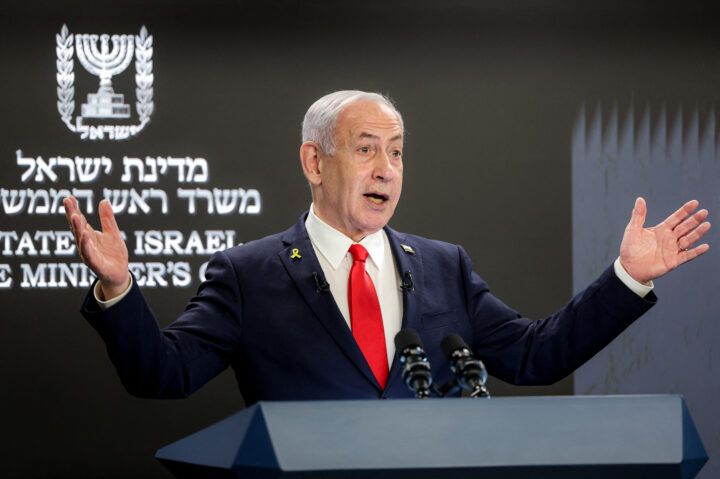
ABIR SULTAN/POOL/AFP via Getty Images
Israel's Prime Minister Benjamin Netanyahu gives a press conference at the Prime minister's office in Jerusalem on August 10, 2025.
This P.M. edition is reserved for our premium subscribers like you — offering a forward-focused read on what we’re tracking now and what’s coming next.
Today’s Daily Overtime was curated by JI U.S. Editor Danielle Cohen-Kanik.
📡On Our Radar
Notable developments and interesting tidbits we’re tracking
Israeli Prime Minister Benjamin Netanyahu told CNBC’s Sara Eisen today that he wants to start the process of winding down U.S. aid to Israel in the final two years of the Trump administration, as both countries work toward reaching a new memorandum of understanding, Jewish Insider’s Emily Jacobs reports.
“We’re now working on a memorandum of understanding which will bring down the aid,” Netanyahu said. “I want it to start in the last two years of the Trump administration and I want it to keep going down, coming to zero.” His comments suggest he’s looking to begin phasing out aid even while the current MOU is set to provide Israel with $3.8 billion in U.S. military assistance annually through FY 2028…
Despite President Donald Trump’s public acknowledgement of a confrontational phone call with Netanyahu regarding Israeli operations in Lebanon, Secretary of State Marco Rubio largely defended Israel’s attacks against the Lebanese terrorist group, JI’s Marc Rod reports.
Rubio said at a House Foreign Affairs Committee hearing today that Hezbollah reached out to the U.S. government through Lebanese authorities and said that it would stop launching missiles into Israeli territory if Israel did not attack Beirut, but Hezbollah went back on that agreement and launched rockets at Israel within hours…
Trump avoided directly answering a question from reporters this afternoon if the U.S. ceasefire with Iran still stands, after Iran launched several ballistic missile attacks around the region last night.
“There is a reason for certain things, and there’s usually a reason that sometimes makes sense. We got it, we nipped it in the bud very quickly … but some people would say they were slightly provoked because we took a strong action for a different reason. So they were reciprocating,” the president said…
Sens. John Fetterman (D-PA) and Dave McCormick (R-PA) told JI’s Emily Jacobs on Tuesday that they both believe antisemitism is worse on the left than on the right, arguing that the electoral success of far-left candidates with antisemitic records in Democratic primaries distinguishes the left from the right, as similarly controversial candidates have struggled in GOP primary contests…
The anti-Israel American Priorities super PAC pledged to spend $2 million backing New York City Mayor Zohran Mamdani’s chosen congressional candidates: former City Comptroller Brad Lander, running to unseat Rep. Dan Goldman (D-NY); Darializa Avila Chevalier, challenging Rep. Adriano Espaillat (D-NY); and Claire Valdez, running to succeed Rep. Nydia Velazquez (D-NY). All three candidates have denounced super PAC spending in the past…
Maine Senate candidate and presumptive Democratic nominee Graham Platner released an internal poll showing he still leads his general election opponent, Sen. Susan Collins (R-ME), by a margin of four points after potential voters are told about his most recent scandals. The latest figures from Platner’s camp mark a drop from the roughly eight-point advantage the Democratic candidate has held in previous polls…
In the race to succeed retiring Rep. Nancy Pelosi (D-CA), state Sen. Scott Wiener and Connie Chan, a member of the San Francisco Board of Supervisors who was endorsed by Pelosi, will advance to the general election. With half of votes counted so far in the jungle primary, Wiener won 41% and Chan received 28%, while Saikat Chakrabarti, a wealthy tech entrepreneur aligned with the anti-Israel left, came in third with 15%…
In Montana’s 1st Congressional District, where Rep. Ryan Zinke (R-MT) is retiring, smokejumper Sam Forstag prevailed in the Democratic primary, where several of the candidates, including Forstag, had expressed views critical of Israel. Forstag now faces an uphill battle against Trump-endorsed Republican military veteran Aaron Flint in the general election, given the district’s GOP leanings…
The NYPD arrested an NYU student today for raising a flag that displayed swastikas and a Star of David atop a university building last month. The perpetrator was a fourth-year NYU student at the time of the incident and has not yet received a diploma, a university spokesperson told JI’s Haley Cohen. The New York Times reported that the man is named Alexander Stepnowsky, a music technology student who was charged with a hate crime and trespassing…
⏩ Tomorrow’s Agenda, Today
An early look at tomorrow’s storylines and schedule to keep you a step ahead
Keep an eye out in Jewish Insider for a look at why pro-Israel groups chose not to engage in New Jersey’s 12th Congressional District to oppose anti-Israel Democratic nominee Adam Hamawy in yesterday’s primary election.
The House Armed Services Committee will hold a markup of the 2027 National Defense Authorization Act, where Rep. Ro Khanna (D-CA) said he will attempt to strip out a routine provision facilitating expanded U.S.-Israel cooperation.
Treasury Secretary Scott Bessent will testify before the House Ways & Means Committee.
New York City Council Speaker Julie Menin and City Councilmember Virginia Maloney will meet with Manhattan Holocaust survivors at UJA-Federation of New York headquarters to mark Holocaust Survivor Day.
Brandeis University’s Jonathan Sarna will sit in conversation with Princeton’s Laura Arnold Leibman at Temple Emanu-El in New York City to discuss the Jewish experience of the American Revolution, a month ahead of the U.S. Semiquincentennial.
UN Watch will hold its annual gala in Geneva, where the group will honor free speech and women’s rights activists Abnousse Shalmani and Ayaan Hirsi Ali.
Stories You May Have Missed
PAC PLAY
State Del. Adrian Boafo is Steny Hoyer’s favored candidate, and is getting support from Democratic leaders across the state
PLATNER POSITIONS
Most aren’t calling for him to leave the race, or throwing their support behind Gov. Janet Mills, who still remains on the primary ballot even after suspending her campaign
In an interview on CNBC, the Israeli premier said ending U.S. aid to Israel will ‘take away the myth that Israel is depleting America's coffers’
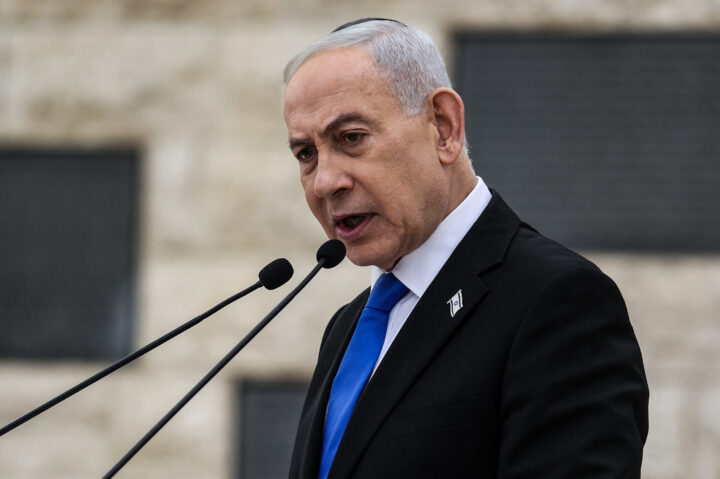
Ilia YEFIMOVICH / POOL / AFP via Getty Images
Israeli Prime Minister Benjamin Netanyahu speaks during a ceremony commemorating Israel's Remembrance Day on Mount Herzl in Jerusalem on April 21, 2026.
Israeli Prime Minister Benjamin Netanyahu said on Wednesday that he wants to start the process of winding down U.S. aid to Israel in the final two years of the Trump administration, as both countries work on a new memorandum of understanding.
Netanyahu made the comments in an interview with CNBC’s Sara Eisen after being asked about his political future and when Israel would be ready for new leadership. The prime minister responded by noting that while the Israeli people could decide at “any time” to remove him from power, he is currently focused on achieving four objectives: “finish[ing] the security envelope that we have to make vis-à-vis Iran and its proxies”; securing more investments globally to expand Israel’s AI and tech sectors; normalizing relations with several countries in the Middle East; and ending Israel’s reliance on U.S. aid.
“The other thing I want to do is move away, in America, from aid to partnership. We’re now working on a memorandum of understanding, which will bring down the aid,” Netanyahu said. “I want it to start now, I want it to start in the last two years of the Trump administration and I want it to keep going down, coming to zero, because I think we’ve come of age.”
The current MOU, which provides Israel with $3.8 billion in U.S. military aid annually, runs through FY 2028. Netanyahu did not clarify whether he would like to see aid begin to wind down through changes to the current agreement, or whether he is focused on ongoing negotiations for the next one.
“Israel has a robust economy, and I want us to go from aid to a partnership where we both invest equal amounts and both share equally in the fruits of our innovators and technologies,” he continued. “I think that’s very, very important. It will also take away the myth that Israel is depleting America’s coffers.”
Netanyahu has said on multiple occasions since January that he hopes to wean Israel off of U.S. aid, initially suggesting in January that Israel would work to end U.S. aid within the next ten years. He pitched the aid drawdown to President Donald Trump in late December, an idea the president was initially bewildered by and not supportive of.
Netanyahu also downplayed reports that Trump told him he is “f***ing crazy” in a phone call on Monday about Israel’s military escalation in Lebanon and rejected the notion that his relationship with the president had shifted, noting that the two speak as frequently as “every two days.”
Still, he did not deny that the conversation occurred as reported.
“Sometimes we have, as in the best of families, you have these tactical disagreements. We always find a way to work them out and we do so as great friends,” Netanyahu said. “We can disagree in the morning, and by the afternoon we have common action.”
The Pennsylvania Democrat, the most hawkish member of his party on Iran, told JI that failing to eliminate Tehran's nuclear threat would undermine the president's legacy

Andrew Harnik/Getty Images
Sen. John Fetterman (D-PA) speaks at a rally for Democratic vice presidential nominee Minnesota Gov. Tim Walz at York Exposition Center UPMC Arena on October 2, 2024 in York, Pennsylvania.
Sen. John Fetterman (D-PA) said on Tuesday that he is growing increasingly concerned that President Donald Trump may agree to a deal with Iran that does not ensure the retrieval of Tehran’s stockpile of enriched uranium or that the regime will never acquire a nuclear weapon.
Fetterman, who has become the most hawkish Democrat in Congress on Iran and the sole member of his party to vote against every Iran war powers resolution in recent months, spoke with Jewish Insider in Washington about the possible outcomes of the ongoing peace talks. The Pennsylvania senator acknowledged that he and Trump had taken political heat from their respective parties over their stances on the conflict, but argued that solving the Iranian nuclear issue would be legacy-defining for the president.
“Nuclear dust, that’s the reason why we’re here. This is why I was reasoned and OK with setting myself politically on fire to be the only Democrat for the last 90 days voting against these war powers acts,” Fetterman told JI. “Presidents always talk about their legacy. At this point, if you cave just for political convenience, what kind of legacy is that?”
“I appreciate every now and then when Trump will say, ‘Well, it [the war in Iran] is only going to be about that nuclear dust,’ but Israel is never allowed to fully pulverize their enemies,” he continued. “They’re fighting a nation where they like martyrdom and that’s what they celebrate. It’s so dumb.”
The Pennsylvania senator addressed the negative U.S. public perception of the war, arguing that the president was acting in a “Churchillian” manner by taking on the Iranian regime, and expressing concern that reversing course in Iran could indicate the Trump administration’s lack of commitment to Taiwan, in the event of a Chinese invasion.
“I hope after that silly visit to China that they [the Trump administration] aren’t now like, ‘Well, we’re going to turn our back to Taiwan,’” he added, referencing the president’s summit in Beijing last month with Chinese President Xi Jinping. “These are all fights for civilization and democracy. I don’t care if it’s in Gaza or Iran, Taiwan against Chinese communism or Russia and Ukraine, it’s the same fight, and that’s why it’s our special responsibility, it’s America’s, to stand with these allies.”
Fetterman pointed to the pressure Democrats faced during the 2024 election to take a firmer stance in opposition to Israel’s war in Gaza due to the high death toll of Palestinians. He argued that those of his Democratic colleagues who had worked to restrain Israel since Hamas’ Oct. 7, 2023, attacks on the Jewish state had damaged their credibility.
“How can you trust these people?” he asked of those Democrats. “Two years ago they were all demanding and pushing for a ceasefire. Can you believe where we would be now if we had a ceasefire? Can you imagine if Israel had to grovel to get their people back? Can you imagine if Iran could be a nuclear power by now?”
“If [there was] a ceasefire in July [2024] based on the pressures from the election in ‘24, [former Hamas chief Yahya] Sinwar would be alive. Hezbollah would be intact. They could launch thousands of rockets at will — and think of the capabilities that Iran could be at now,” he added. “Where’s the outrage? They pretended to be so worried about it. It was politically convenient to try to push Israel into a position that would put Iran on the path to nuclear power, and [leave] their proxies fully intact.”
Plus, Trump's unconventional pick for intel chief
Brooks Kraft LLC/Corbis via Getty Images
International flags at the State Department in Washington.
This P.M. edition is reserved for our premium subscribers like you — offering a forward-focused read on what we’re tracking now and what’s coming next.
Today’s Daily Overtime was curated by JI U.S. Editor Danielle Cohen-Kanik.
📡On Our Radar
Notable developments and interesting tidbits we’re tracking
President Donald Trump again dismissed reports that Iranian negotiators have cut off dialogue with the U.S. as “false and erroneous,” writing in a post on Truth Social that discussions have continued “four days ago, three days ago, two days ago, one day ago, and today”…
About the current talks, Secretary of State Marco Rubio told the Senate Foreign Relations Committee today that the U.S. is not offering Iran any sanctions relief in exchange for reopening the Strait of Hormuz, and that sanctions relief would only be on the table if Tehran makes concessions related to its nuclear program in the next phase of negotiations, Jewish Insider’s Marc Rod reports…
The Trump administration sent a fresh slate of diplomatic nominations to the Senate for approval today, but noticeably absent was a full-throated push to fill critical ambassadorial vacancies across the Middle East and North Africa, even as the Iran conflict has increased the need for coordination and dialogue in the region, JI’s Matthew Shea reports.
The newest list of nominees included only two names for the MENA area: Donald Blome, tapped to serve as assistant secretary of state for Near Eastern affairs — a role that acts as the principal advisor on U.S. foreign policy across the region — and Nick Oberheiden, nominated to be U.S. ambassador to Egypt…
In a highly unusual move, Trump appointed Bill Pulte, the director of the Federal Housing Finance Agency and chairman of Fannie Mae and Freddie Mac, as acting director of national intelligence, after DNI Tulsi Gabbard announced she will resign effective June 30. Pulte, who has no prior experience in an intelligence role, has been a staunch Trump loyalist and led some of the president’s retribution efforts against his political adversaries…
The fourth round of Israel-Lebanon diplomatic talks began at the State Department today, and is expected to last through tomorrow…
At an emergency meeting of the U.N. Security Council yesterday requested by France, every country except for the U.S. called for Israel to immediately withdraw from southern Lebanon and deescalate military hostilities in the country…
The heads of the Conference of Presidents of Major American Jewish Organizations met today with Egyptian President Abdel Fattah El-Sisi and Maj. Gen. Hassan Rashad, head of the country’s General Intelligence Service, in Cairo, where they discussed U.S.-Egypt relations and Middle East security…
A new poll of 600 likely voters in the Michigan Senate Democratic primary conducted for the campaign of physician Abdul El-Sayed found him leading the pack with 34% of the vote, two months ahead of Election Day. Rep. Haley Stevens (D-MI) came in second with 31% and state Sen. Mallory McMorrow trailed at 19%…
Harmeet Dhillon, the assistant attorney general for civil rights, appearing at the American Jewish Committee’s Global Forum in Washington, condemned the “egregious examples of antisemitism that have transpired here at home on American soil” since the Oct. 7, 2023, attacks on Israel as “devastating and antithetical to our values as a nation,” JI’s Emily Jacobs reports…
The backlash to the participation of Israeli Finance Minister Bezalel Smotrich and other far-right Israeli politicians in the Israel Day on Fifth parade in New York City over the weekend continues: Mark Treyger, the head of the Jewish Community Relations Council of New York, which organizes the parade, told The New York Times that he had been blindsided by their attendance.
“There was a complete lack of transparency here,” Treyger said, adding that the Israeli consulate in New York had declined to share with him who would be attending. Dan Rosenthal, a top official at the UJA-Federation of New York, wrote on X that both New York City Mayor Zohran Mamdani and Smotrich “believe in a one-state solution”…
White House Correspondents’ Association President Weijia Jiang announced that the Correspondents’ Dinner will be rescheduled for July 24, after April’s event was cut short by a shooting attack. Trump said he will once again give remarks at the gathering, which will take place at the Waldorf Astoria hotel in Washington…
⏩ Tomorrow’s Agenda, Today
An early look at tomorrow’s storylines and schedule to keep you a step ahead
Keep an eye out in Jewish Insider for the results of today’s high-stakes Democratic primary in New Jersey’s 12th Congressional District, where plastic surgeon Adam Hamawy, whose past terror ties have raised red flags about his candidacy, is the favorite to win.
Secretary of State Marco Rubio will be back on the Hill testifying before the House Foreign Affairs Committee and a Senate Appropriations subcommittee, while Homeland Security Secretary Markwayne Mullin will appear before the House Homeland Security Committee.
State Department antisemitism envoy Yehuda Kaploun and the Argentine Embassy in Washington will co-host a commemoration ceremony at the U.S. Institute of Peace marking the 32nd anniversary of the bombing of the Argentine Israelite Mutual Association (AMIA), with remarks from House Foreign Affairs Committee Chairman Brian Mast (R-FL) and AMIA President Osvaldo Armoza.
The Jewish Democratic Council of America will host a candidate forum for the New York 12th Congressional District Democratic primary at the Streicker Center in New York City.
Stories You May Have Missed
Hard Ro To Hoe

His critics once saw him as an ally, but fear he’s pandered to extremists as he raises his national profile ahead of the 2028 presidential election
GROWING THREAT

‘You just have Israeli soldiers completely unaware. If you can’t hear the drone, if you don’t know that it’s there until it’s too late, it’s too late,’ said FDD’s David Daoud
The secretary of state acknowledged that granting Iran access to additional funds would risk Tehran using the money for malign activity in the region
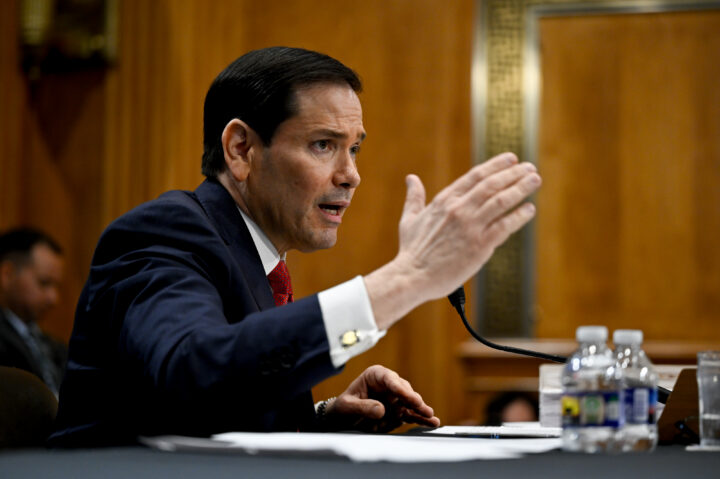
Daniel Heuer/Bloomberg via Getty Images
Secretary of State Marco Rubio during a Senate Foreign Relations Committee hearing in Washington, DC, on Tuesday, June 2, 2026.
Secretary of State Marco Rubio said in testimony to the Senate Foreign Relations Committee on Tuesday that the U.S. is not offering Iran any sanctions relief in exchange for reopening the Strait of Hormuz, and that sanctions relief would only be on the table if the Islamic Republic made concessions related to its nuclear program.
The secretary of state described the diplomatic talks as two-phased: The current phase is focused on getting Iran to agree to reopen the strait and to commit to enter further negotiations on disposing its highly enriched uranium and on “severe and long-term limitations and/or cancelation of enrichment.” In exchange, the U.S. would lift its blockade of Iranian ports.
“For example, they have to commit to say, ‘We will dispose of the enriched uranium.’ And the question now is what are the mechanisms by which we can dispose of it,” Rubio said.
The second phase would entail technical discussions on Iran’s nuclear program and fissile material, in exchange for potential U.S. sanctions relief, and could take months to work through.
“Any sanctions relief is condition-based, which means it has to be in return for the reason why the sanctions are put in place in the first place, which is their nuclear program,” Rubio said. “If they agree to give up [nuclear activities], there will be sanctions relief associated with their commitment and their compliance.”
He said that if Iran complies with U.S. demands including giving up nuclear enrichment and disposing of its enriched uranium, “that’s the place where the frozen assets could be discussed. The more they give, the more they would get.”
But he acknowledged that granting Iran access to additional funds would raise other challenges, including using such funding to support terrorist activities.
Rubio said later during a Tuesday afternoon hearing with the House Appropriations Committee that “if money is going to fund the proxies, it won’t be returned to them,” emphasizing that “there are specific sanctions that are in place related directly to the nuclear program” that could be removed as part of talks.
Republicans cried foul when the Biden administration made similar arguments during its own negotiations with Iran, arguing that any sanctions relief for Iran — even if funds were limited to certain specific humanitarian purposes — would ultimately allow the regime more room in its budget to fund proxy terrorism and other malign activities.
Rep. Lois Frankel (D-FL), who questioned Rubio on the issue, urged him “not to give money to Iran to continue the work of their proxies.”
Sen. Lindsey Graham (R-SC) urged the administration in a Tuesday morning X post to ensure that any deal with Iran forecloses support for terrorism going forward.
“ANY DEAL WITH IRAN MUST CLEARLY STATE THAT IF IRAN PROVIDES FUTURE SUPPORT TO TERRORIST ORGANIZATIONS LIKE HEZBOLLAH, IT WILL RESULT IN CRIPPLING SANCTIONS AND OTHER PUNITIVE MEASURES,” Graham wrote.
Rubio said during the Senate hearing that if Iran refuses to reopen the Strait of Hormuz voluntarily, “then we have other options available to us.”
He added that if the U.S. had refrained from action against Iran because of fears it could close the strait, it would have given Iran effective veto power over U.S. action and acceded to Iran the ability to develop nuclear weapons. “That’s an untenable situation.”
Rubio argued that the U.S. is in the strongest position diplomatically in his memory.
“They have agreed to negotiate aspects of the nuclear program that just a month ago, just a year ago, they were refusing to even mention, much less enter into discussion about,” he said. “That is not a guarantee that it will lead to a deal that is acceptable to the Senate or acceptable to the American people, but we were able to engage them in a process that truly tests the proposition of how far they’re willing to go.”
He insisted that any deal would be stronger than the 2015 Joint Comprehensive Plan of Action agreed to by the Obama administration.
Sen. John Cornyn (R-TX) — who recently lost his primary election to a Trump-backed challenger and may now have more leeway to oppose President Donald Trump’s initiatives for the remainder of his term — suggested he was skeptical of any diplomatic agreement with Iran. Under the Iran Nuclear Agreement Review Act, the administration would be obligated to submit any nuclear deal with Iran for congressional review.
“I do applaud the president’s attempt to try to use some diplomacy here in order to deny them access to the enriched uranium and other weapons that they use against Israel and the West, but tell me, why do you think anything that the Iranian regime agrees to that they will comply with?” Cornyn asked. “What evidence is there that they will agree to anything that they ultimately will stick with?”
Rubio said that any deal will require verifiable steps, and that sanctions relief would come after “they actually do certain things,” not simply in exchange for Iran’s agreement in principle.
He also repeatedly said that issues inside Iran that predate the war, such as the growing economic crisis, have only further accelerated during the war.
He added that diplomatic talks have been slowed by Iran’s internal system and by communications issues inside the country, including divisions between elements of Iran’s government and leadership structure.
The “political class,” Rubio said, would “probably make a deal tomorrow,” but Supreme Leader Mojtaba Khamenei — who was believed to have been injured in the Feb. 28 Israeli strike that killed his father and predecessor, Ayatollah Ali Khamenei — and the Islamic Revolutionary Guard Corps are more insulated from economic and political pressure.
Rubio said that the U.S. has not seen or heard directly from Khamenei, but that there are indications that he is alive and increasingly engaging in governing matters.
Despite urging from Sen. Ted Cruz (R-TX), Rubio said that he is not aware of any U.S. program or plans to arm Iranian protesters against the government.
Rubio also described Operation Epic Fury as “highly successful” in shutting down Iran’s defense industrial base and navy, though he acknowledged that “they still have a lot of drones,” framing that as a challenge that is not unique to Iran.
“There is no Iranian navy. … There’s a bunch of Boston whalers with machine guns on them, but there is no navy,” he said.
Cornyn said that it would be “ludicrous” to suggest that, before the war, Iran’s nuclear program did not pose an imminent threat to the United States. Rubio agreed, adding that if Iran were to develop a nuclear weapon, it “could very well use it,” and even if it did not, having such capability would allow it to hold the world hostage and “hyper-scale” its support for terrorism.
Rubio said that Iran is attempting to drag out the conflict in Lebanon between Israel and Hezbollah by continuing to prop up the terror group. He said the U.S. aims to keep talks over Lebanon separate from negotiations with Iran, while Iran is attempting to merge the two issues.
“The Lebanese government and the Israeli government, they could do a peace deal tomorrow. Israel has no territorial claims in Lebanon, and Hezbollah … has called for the overthrow of the current Lebanese government. The impediment in Lebanon is the fact that Hezbollah has embedded itself in that country and is the reason for all the suffering that’s happening there right now.”
Lebanese and Israeli officials are meeting at the State Department for negotiations on Tuesday.
He said that there are continued difficulties in demilitarizing and defanging Hezbollah, explaining that the Lebanese Armed Forces’ capabilities “are not where they need to be” and that certain elements of the LAF have cooperated with Hezbollah, though he said that there has been progress by the Lebanese government.
Rubio praised the United Arab Emirates as having been “very aggressively cooperative” in the U.S. campaign against Iran and said Kuwait has been “fantastic.” He added that while other U.S. partners have been displeased with Iranian strikes on their energy infrastructure, he called those strikes a “reminder” of the threat they all face from Iran.
Asked about the Board of Peace, Rubio said that the group, which he said is now being structured as an international nongovernmental organization, has just begun to hire staff in the past few weeks. He said the organization aims to remain lean, with just five full-time staff now and a goal of growing to 15 to 20.
He also said that the U.S. has not provided any of the funding it pledged to the Board of Peace and has, for now, walked back the commitment of $50 million that Trump initially offered for the body.
Rubio also flatly denied reports that the U.S. was coordinating with Israel to remove Jordanian custodianship of the Al-Aqsa Mosque complex on the Temple Mount.
‘You just have Israeli soldiers completely unaware. If you can’t hear the drone, if you don’t know that it’s there until it’s too late, it’s too late,’ said FDD’s David Daoud

Ayal Margolin/Flash90
An explosive drone launched by Hezbollah is seen near the Israeli border with Lebanon during a Hezbollah attack in northern Israel, May 19, 2026.
One of Israel’s most urgent emerging security threats is not a sophisticated missile or advanced weapons system, but a small, cheap drone that can be bought online and easily assembled.
Hezbollah’s use of first-person view drones (FPVs) — a battlefield tactic widely utilized in the Russia-Ukraine war and now adopted by the Iran-backed terror group — has caused Israeli casualties, threatens civilians and exposed vulnerabilities in Israel’s air-defense systems, including the Iron Dome.
The drones are small and inexpensive, but difficult to detect, experts say. The growing threat has caught the IDF off guard and is forcing Israeli officials to rethink how they protect soldiers, border communities and critical defense infrastructure during the fragile partial ceasefire between Israel and Hezbollah.
Last Wednesday, a drone attack near the Israeli border community of Shomera killed one soldier and wounded two others. Since the ceasefire between Israel and Lebanon began in April, experts have recorded more than 100 drone attacks on communities inside Israel. On Monday, an IDF soldier was killed in southern Lebanon after being struck by an explosive drone sent by Hezbollah.
“These are very simple, unsophisticated drones,” Yaakov Katz, a senior fellow at the Jewish People Policy Institute, told Jewish Insider. “Imagine a person can watch with goggles almost and be the eyes of the drone, see what the drone sees and literally fly it to wherever it wants its target to be.”
Experts said that Hezbollah can purchase commercial drones, or assemble them inside Lebanon using imported parts. But despite their low cost and relative simplicity, the drones are proving difficult for Israel to defend against.
“These are small, they fly very low, so they’re not seen or detected mostly by radar,” Katz said. “Even if you saw them, you can’t necessarily intercept them or destroy them with traditional means of scrambling their radar signal or other electronic warfare capabilities. That is what’s making this so complicated for Israel.”
The drones have been particularly effective against Israeli soldiers operating in the open, Katz said, turning what was once a secondary concern into “one of the most pressing issues for Israel.” He noted that the drones come in various sizes and carry explosives, including grenades, that are flown directly into Israeli soldiers or other targets.
David Daoud, a senior fellow at the Foundation for Defense of Democracies, said this appears to be the “first real conflict” in which Hezbollah has employed these kinds of drones at scale.
“These drones are basically loitering around for a while,” Daoud said. “They’re not moving at particularly high speeds and you just have Israeli soldiers completely unaware. If you can’t hear the drone, if you don’t know that it’s there until it’s too late, it’s too late.”
Daoud said he has seen footage of drones flying within “a foot or two” of Israeli soldiers who appeared unaware of their presence. That low detectability, he said, can increase the danger not only to soldiers but also to civilians and infrastructure.
“This kind of feeds into the idea that their detectability is very low by design,” Daoud said. “Hezbollah has also talked about disabling some of the early warning systems. If Israel’s Red Alert is knocked out in a certain area and then Hezbollah fires a barrage of 100 rockets, suddenly people don’t have the ability to know that the attack is incoming. You increase the possibility of Israeli casualties.”
Katz said the threat has also taken on a deeply personal dimension for many Israelis. “I have two nephews who are in Lebanon right now,” he said. “Everyone knows someone in Lebanon and you’re concerned, and that creates a level of anxiety.”
“Unfortunately, it’s almost every day that we wake up, or in the middle of the day, get reports of another soldier who’s been killed by one of these drones,” he added. “It just wasn’t as important, but now it is, because it’s killing people. That now made it one of the most pressing issues for Israel.”
Ari Cicurel, associate director of foreign policy at the Jewish Institute for National Security of America, said the drones are also effective because they allow operators to strike with “greater precision and accuracy.” He said that Hezbollah has deployed FPV drones similar to those used by Russia against Ukraine, adding that the group has adopted fiber‑optic control cables to mimic Russian tactics and evade electronic countermeasures.
“Even if they are smaller, the operator can focus in on sites, loiter, wait for an individual or a site to be a desirable target, and then hit them,” Cicurel said. “What we’re seeing in particular recently is adding fiber optic cables to them. That is another clear lesson that both Iran and Hezbollah have learned from Russia’s use of these drones against Ukraine.”
He said the cables help prevent electronic countermeasures from disrupting the drone’s communications, creating “a greater challenge” for Israeli forces trying to intercept them.
Daoud said another factor complicating the issue for Israel is that Hezbollah’s drones are relatively easy to import from abroad or produce domestically, which makes it easier to conceal them.
“These things can probably be produced [regularly] given how cheap they are, how easy they are to manufacture, given how unsophisticated they are,” Daoud said. “When we talk about these factories, we’re not talking about something that requires a high level of sophistication. I could sit at my desk and make 30 of these a day.”
One of the most concerning targets is the Iron Dome, Israel’s primary air-defense system. Footage released by Hezbollah earlier this month appeared to show a drone striking an Israeli Iron Dome launcher, though experts said the extent of the damage remains unclear.
“In Hezbollah’s propaganda they talked about having drones that would be able to disarm the Iron Dome and that’s obviously an issue,” Daoud said. “The Iron Dome operates off of a radar. If you’ve made these drones able to go undetected by radar, then a few well-placed drones could either throw off Iron Dome or disable an Iron Dome battery or disable the radar.”
“The more these drones are developed by Hezbollah to become more able to evade radar, the more of a problem you’re going to have when it comes to Iron Dome,” he added. “Israel doesn’t have thousands of Iron Dome batteries. Most of them have been deployed to the north. If Hezbollah is able to knock them out, then that’s a massive security risk for Israel.”
Still, Daoud noted that the Iron Dome remains the “most effective” counter to FPVs despite the liability.
Experts also said Israel was not fully prepared for the scope of the FPV drone threat and is now trying to adapt quickly. But they cautioned that there is unlikely to be a single solution.
“I think they were underprepared,” Katz said. “What Israel underestimated was the extent, the numbers, the ranges and its inability to defend itself from them. And that is how we found ourselves in this current situation.”
Israel has already adopted some defensive measures used by Ukraine, including establishing protective netting around military vehicles. However, Daoud said there is a trade-off.
“If the IDF decides to put all of its Humvees in Lebanon in protective netting, that means they’re going to move slower, and when they move slower they’re open to different threats from Hezbollah,” Daoud said. “So the question is what tactic do you adopt that plugs up one problem and doesn’t open you up to another problem.”
Other options could include targeting Hezbollah launch areas and strongholds in Lebanon, Daoud said, though he cautioned that Israel’s room to maneuver could be limited by diplomatic considerations, including pressure from Washington to halt hostilities in Lebanon amid negotiations with Iran.
“I think it goes back to the defensive adaptations in terms of needing to prepare for a variety of defenses against the kind of projectiles that our adversaries could be launching,” Cicurel said, noting that he believed “putting netting around air defenses” would “prevent drones from reaching them.”
Experts said it remains unclear whether Hamas, Palestinian Islamic Jihad or other Iranian-backed groups will adopt the same tactics in future conflicts. But Katz said Israel cannot assume the threat will remain limited to Hezbollah.
“It would be negligent to think that they [other Iranian-backed groups] do not have it,” Katz said. “It is easy. It can be bought off of Amazon or at a drone store. You can buy parts and smuggle them in and assemble them on your own without anyone even knowing.”
That leaves Israel facing a difficult question: how to defend against a threat that is cheap, widely available and hard to detect, but potentially devastating when used effectively.
“This has to be something that needs to be thought about very seriously,” Katz added, “… and I would even say with urgency.”
Plus, Huckabee says next MOU will end Israel aid
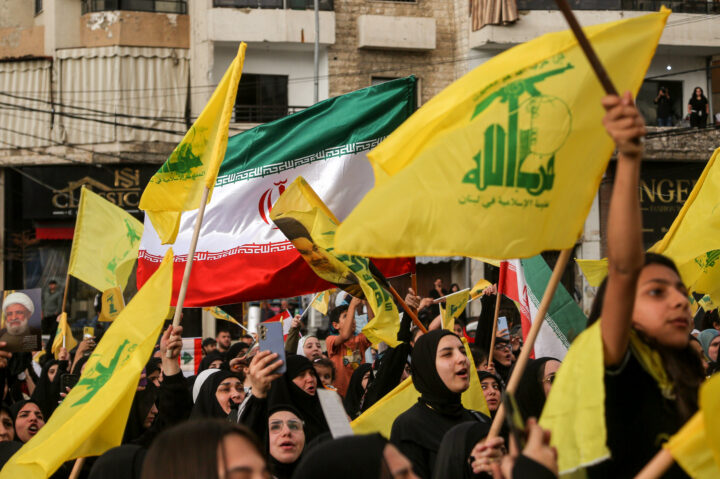
Marwan Naamani/picture alliance via Getty Images
Pro-Iranian Hezbollah supporters wave the party flags during a ceremony in a southern Beirut suburb on May 5, 2026.
This P.M. edition is reserved for our premium subscribers like you — offering a forward-focused read on what we’re tracking now and what’s coming next.
Today’s Daily Overtime was curated by JI U.S. Editor Danielle Cohen-Kanik.
📡On Our Radar
Notable developments and interesting tidbits we’re tracking
President Donald Trump announced that Israel would not carry out strikes against Hezbollah in Beirut in exchange for the terror group halting its attacks on northern Israel, hours after Israeli Prime Minister Benjamin Netanyahu made a statement instructing the IDF to strike Hezbollah targets in the Lebanese capital.
While Trump said he had a “very good call with Hezbollah” as part of the negotiations, the Lebanese Embassy in Washington later clarified that the message was relayed through Lebanese officials rather than communicated directly from the president to the terror group.
Netanyahu said after the announcement that he had informed Trump that “if Hezbollah does not stop attacking our cities and civilians, Israel will strike terrorist targets in Beirut,” while the IDF will continue hitting targets in southern Lebanon as planned…
The news came hours after Iranian state-linked media reported that Tehran had suspended negotiations with the United States and warned it could direct its proxies, including the Houthis in Yemen, to target shipping through the Bab el-Mandeb Strait — another critical global trade route — in response to Israel‘s continued military operations against Hezbollah…
Trump disputed the reporting, writing on Truth Social this afternoon that “talks are continuing, at a rapid pace, with the Islamic Republic of Iran,” despite having told NBC News earlier in the day that he would welcome a pause in talks if the reports were accurate. “I think we’ve been talking too much, if you want to know the truth,” Trump told the outlet. “I think going silent would be very good, and that could be for a long time”…
Amid the diplomatic dance, military operations have escalated: The U.S. struck several sites in Iran over the weekend after Iran downed an American MQ-1 drone. U.S. forces also intercepted two Iranian ballistic missiles targeting American forces based in Kuwait last night, CENTCOM said…
Michael Makovsky, the president and CEO of the Jewish Institute for National Security of America, criticized the Trump administration’s recent handling of the U.S. war in Iran, telling Jewish Insider’s Emily Jacobs on Friday, before the events of this weekend, that the “U.S. has lost the plot on Iran” and that a deal with the regime now “wouldn’t be worth the paper it’s written on”…
Responding to claims from former National Counterterrorism Center head Joe Kent that U.S. aid to Israel does not confer benefits to America, U.S. Ambassador to Israel Mike Huckabee defended the relationship and said the next U.S.-Israel memorandum of understanding, after the current one expires in 2028, will end aid to Israel and “be based on trade”…
Republican Jewish Coalition CEO Matt Brooks celebrated his group’s role in ousting Rep. Thomas Massie (R-KY) in his primary election earlier this month at the organization’s “America 250”-themed gala held last night in Manhattan, JI’s Haley Cohen reports.
“Being anti-Israel in today’s Republican Party is not — unlike the Democratic Party — a path to success,” said Brooks, who called defeating Massie a “critical victory” for the direction of the GOP and conservative movement…
Pennsylvania Gov. Josh Shapiro told CNN that he believes Israel is being unfairly singled out for criticism as a Jewish state: “For those who do not want there to be a Jewish state, oftentimes they will predicate their views on this notion that being grounded in a religion and being a democracy can’t coexist,” he said.
“I think it’s important to point out the hypocrisy of that view when there are 46 majority Muslim nations, 23 of which have Islam as their official religion … and only one has Judaism as their official religion, and yet we’re focused on just the Jewish state,” Shapiro continued. (Important to note: While Israel has a Basic Law declaring it the nation-state of the Jewish people, the country does not have an official state religion)…
El Al announced it will restart nonstop flights between Israel and San Francisco on Oct. 25, citing high demand for the route between the tech hubs, which was paused in 2020 at the beginning of the COVID-19 pandemic. The three weekly flights will be numbered LY49, in a nod to the San Francisco 49ers NFL team…
The Israeli Ministry of Defense said France has barred Israeli officials from participating in the Eurosatory defense show in Paris later this month. Israeli defense firms, which can participate but will not have a dedicated Israeli national pavilion, can only showcase air-defense systems and are prohibited from displaying offensive weapons systems…
⏩ Tomorrow’s Agenda, Today
An early look at tomorrow’s storylines and schedule to keep you a step ahead
Keep an eye out in Jewish Insider for coverage of tomorrow’s key primary elections across the country — including House races in New Jersey, California, Montana, Iowa, New Mexico and South Dakota, California’s gubernatorial race and Montana’s open-seat Senate race — several of which will serve as a referendum on the Democratic Party’s progressive versus establishment divide.
On the Hill, Secretary of State Marco Rubio will appear before the Senate Foreign Relations Committee and the House Appropriations Committee. Homeland Security Secretary Markwayne Mullin will testify at a Senate Appropriations Committee hearing, and acting Attorney General Todd Blanche will speak at a House Appropriations Committee hearing. The Senate Select Committee on Intelligence will also hold a closed intel hearing.
Israeli Prime Minister Benjamin Netanyahu and President Isaac Herzog will attend a command change ceremony at Mossad headquarters to inaugurate Maj. Gen. Roman Gofman as the new head of the agency, after the Israeli High Court rejected petitions today calling for Gofman’s appointment to be annulled on ethical and procedural grounds.
The Israel Democracy Institute will kick off its two-day Eli Hurvitz Conference on Economy and Society in Jerusalem.
Stories You May Have Missed
ANGELENO AFFAIRS
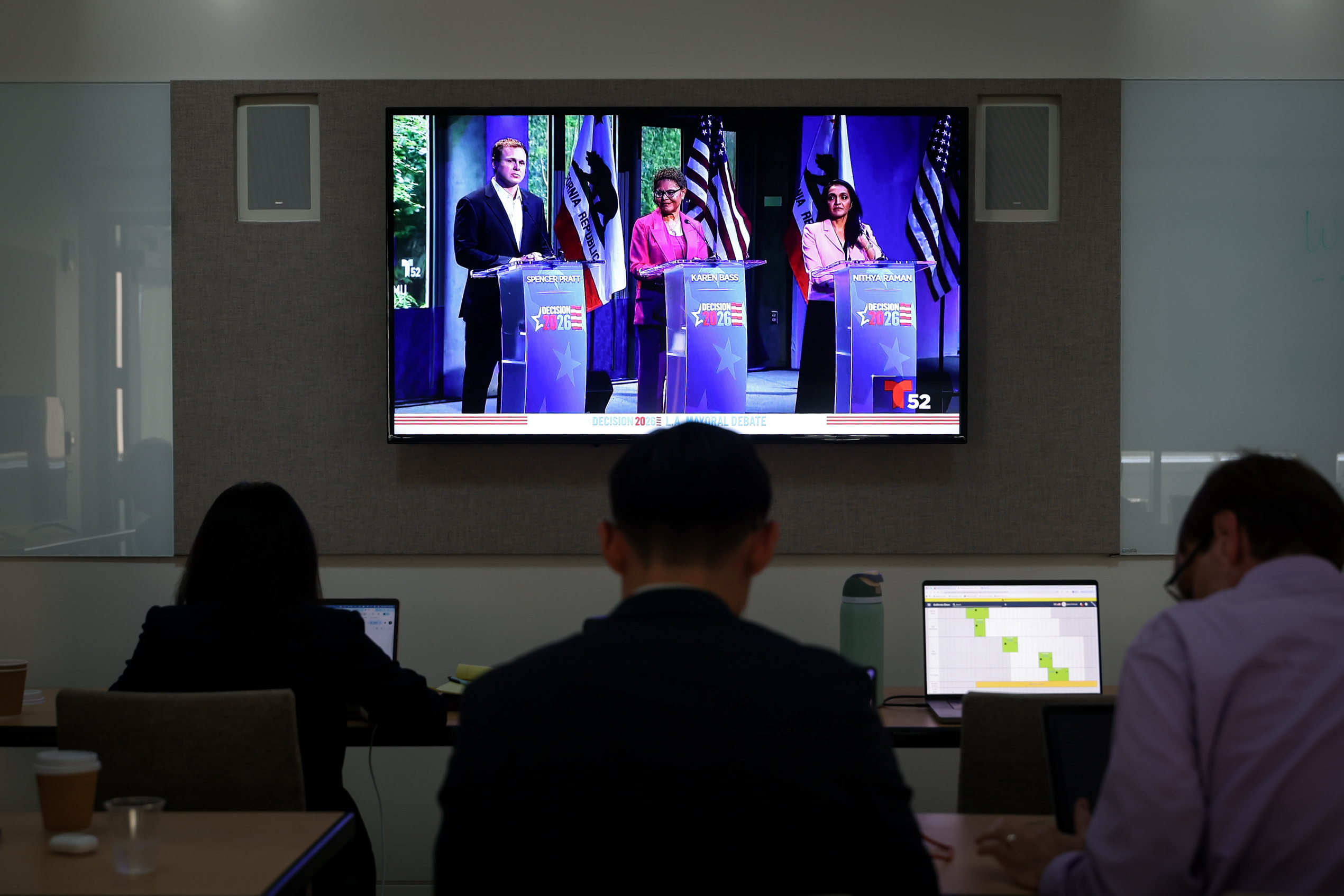
The race features an embattled Mayor Karen Bass facing a spirited challenge from her right in reality TV star Spencer Pratt, and from her left in City Councilmember Nithya Raman
BIG SKY BATTLE
Two of the four Democrats in the race have also faced scrutiny over antisemitic activity online
Makovsky said Trump’s reported deal with Tehran ‘wouldn’t be worth the paper it’s written on’
Aaron Schwartz/Sipa/Bloomberg via Getty Images
President Donald Trump speaks during a maternal healthcare event in the Oval Office of the White House in Washington, DC, US, on Monday, May 11, 2026.
Michael Makovsky, the president and CEO of the hawkish Jewish Institute for National Security of America, criticized the Trump administration’s recent handling of the U.S. war in Iran, expressing concern about the possibility of a broader peace deal that does not address key issues.
“The U.S. has lost the plot on Iran,” Makovsky told Jewish Insider on Friday. “After significant military achievements, declaring the ceasefire was a huge mistake, and there was too much hype about what pressure a blockade alone would achieve. The net result has reduced U.S. leverage, and the perception that America is vulnerable if gasoline nears $5 per gallon.”
Makovsky said that the U.S. “should not pursue a deal” with Iran, arguing that such an agreement “wouldn’t be worth the paper it’s written on.” He said that a deal “will only enrich and strengthen the regime and demoralize the Iranian people.”
“Instead, the U.S. should resume military operations for a couple weeks, weaken the regime and its nuclear and conventional capabilities further, cease the military campaign while maintaining the blockade and support the Iranian people in every way possible,” he said.
Makovsky spoke to JI in response after President Donald Trump’s announcement on Friday that he was nearing a decision on the agreement reportedly reached by U.S. and Iranian negotiators to extend the ongoing ceasefire by 60 days, reopen the Strait of Hormuz and continue nuclear talks. Makovsky made the comments prior to this weekend’s fighting between the two countries, with the U.S. striking Iranian air defenses and drone sites after Iran downed an American MQ-1 drone and shot missiles at U.S. forces based in Kuwait.
“Based on what appears to being negotiated, the Strait of Hormuz will be opened in return for certain Iranian pledges about what will be worked out in further negotiations,” Makovsky said. “There are even reports about a possible international investment fund in Iran, which would be preposterous with this regime.”
After holding a Situation Room meeting on Friday, Trump reportedly requested several amendments to the negotiated deal, including firmer commitments around Iran’s stockpile of enriched uranium, leading to another round of negotiations. Iranian state media reported on Monday that its delegation was suspending talks with the U.S. over Israel’s continued strikes against Hezbollah in Lebanon.
Plus, Jill Biden's advice to Joe on Bibi
Tasos Katopodis/Getty Images
Israeli Ambassador to the United States Yechiel Leiter
This P.M. edition is reserved for our premium subscribers like you — offering a forward-focused read on what we’re tracking now and what’s coming next.
Today’s Daily Overtime was curated by JI U.S. Editor Danielle Cohen-Kanik.
📡On Our Radar
Notable developments and interesting tidbits we’re tracking
Despite recent clashes between the U.S. and Iran — including Iranian missile and drone attacks around the region last night — negotiators from both countries have reportedly agreed to terms for a 60-day ceasefire with continued negotiations on Iran’s nuclear program, U.S. sources confirmed to the White House press pool.
President Donald Trump has not yet given his stamp of approval to the deal, Axios reports, and has told mediators he wants a couple of days to consider it…
In the meantime, Iranian state media reported a renewed exchange of fire in the Strait of Hormuz this afternoon, as Iranian forces were said to have fired “warning shots” at four vessels and engaged air defenses against a “hostile aircraft”…
Treasury Secretary Scott Bessent warned that the U.S. “will not tolerate any effort to impose a tolling system in the Strait of Hormuz,” specifically cautioning Oman that the Treasury Department will “aggressively target” any actors involved in facilitating such tolls. Bessent said during a press conference this afternoon that he spoke with the Omani ambassador to the U.S. this morning who assured him Muscat has no plans to do so…
In an excerpt of her forthcoming memoir, View From the East Wing, shared with The Atlantic, former First Lady Jill Biden recalls leaving her husband notes on the bathroom mirror during his time as president, including her views on Israel’s war in Gaza. “Net has to stop,” she once wrote, in a reference to Israeli Prime Minister Benjamin Netanyahu. Before a phone call between him and President Joe Biden, she advised, “Be strong. Don’t let BN use your goodness”…
A week after describing J Street as “a cancer within the Jewish community,” Israeli Ambassador to the U.S. Yechiel Leiter doubled down on his critique of the organization, stating that the liberal advocacy group’s recent actions are “decidedly not pro-Israel,” Nira Dayanim reports for Jewish Insider.
Speaking today at the Re-Charging Reform Judaism summit at the Stephen Wise Free Synagogue in Manhattan, Leiter was resolute, but more measured in his criticism: “I believe the tent, as we call it, should be wide and as inclusive as possible. But it cannot be inclusive to those who are contributing to the efforts of those seeking the collapse of the tent,” he said…
Rep. Jared Moskowitz (D-FL) announced today that he would seek reelection in a new South Florida House district recently drawn to favor Republicans, after his own was largely erased, JI’s Matthew Kassel reports, setting the stage for what is expected to be a costly and competitive race…
Rep. Josh Gottheimer (D-NJ) met with UAE National Security Advisor Tahnoon bin Zayed Al Nahyan in Abu Dhabi today, where the two “reviewed the distinguished strategic relations” between the UAE and U.S…
Kip Talley, the chief of staff to Rep. Mike Collins (R-GA) — who is currently the front-runner for the GOP runoff in Georgia to take on Sen. Jon Ossoff (D-GA) — used his position to push to free Charles Johnson, a notorious Holocaust denier who was jailed for contempt of court, according to text messages reviewed by Slate. Talley sent the messages in a group chat that also included neo-Nazis Nick Fuentes and Richard Spencer…
A new Democratic super PAC called Project 218 dropped nearly $400,000 in support of progressive organizer Sue Altman in New Jersey’s 12th Congressional District Democratic primary, just days ahead of the election next week. The paid ads are intended to counter the nearly $1.5 million spent by the anti-Israel American Priorities super PAC in support of Altman’s opponent, Adam Hamawy, who has faced scrutiny over his work with a group tied to Al-Qaida…
New York City Mayor Zohran Mamdani is considering endorsing democratic socialist Darializa Avila Chevalier in her insurgent bid to unseat Rep. Adriano Espaillat (D-NY), according to The New York Times, changing course from his pledge to back Espaillat, which came after the congressman endorsed Mamdani in the mayoral general election…
UJA-Federation of New York purchased 20,000 bags of Bamba peanut snacks in response to the Park Slope Food Coop’s decision to boycott Israeli-made products, which the federation intends to distribute at the Israel Day parade in the city on Sunday…
Democratic Michigan Gov. Gretchen Whitmer, seen as a potential presidential contender, ruled out a run for the White House in the next election, telling a local Fox outlet, “I think there will be a robust group of people running for president. I will not be one of them in 2028”…
CBS Editor-in-Chief Bari Weiss tapped former New York Times and Vanity Fair contributor and documentarian Nick Bilton as executive producer of “60 Minutes,” after the former head of the program, Tanya Simon, was fired today amid disagreements over issues including editorial independence of the top-rated weekly news program…
Mutra, a high-end kosher restaurant in North Miami run by Israeli chef Raz Shabtai, received a Michelin star today, which the restaurant said makes it the first fully kosher establishment to do so…
⏩ Tomorrow’s Agenda, Today
An early look at tomorrow’s storylines and schedule to keep you a step ahead
Keep an eye out in Jewish Insider for a look at how Israel and antisemitism have become a flashpoint in the Democratic primary for Montana’s 1st Congressional District. A sneak peek:
“Though the district leans Republican, that hasn’t stopped a majority of Democrats in the field from racing to the left on Israel policy, a dynamic that was on clear display at a recent debate.”
Rep. Jim Clyburn (D-SC) will host his annual Famous Fish Fry tomorrow in Columbia, S.C., an event that has evolved into a key stop for Democratic presidential hopefuls. Among those with an eye on 2028, Rep. Ro Khanna (D-CA) and Kentucky Gov. Andy Beshear are expected to attend the gathering.
Israeli and Lebanese military representatives are expected to hold discussions at the Pentagon tomorrow, Israeli media reports, without diplomatic representation.
Defense Secretary Pete Hegseth is in Singapore, where he will deliver remarks at the Shangri-La Dialogue, a high-level defense summit, on Saturday.
The annual “Israel Day on Fifth” parade will take place in New York City on Sunday, with organizers predicting “one of the biggest turnouts ever” as well as the largest-ever Knesset delegation, JI’s Will Bredderman reports. Breaking with 61 years of tradition, Mayor Zohran Mamdani will skip the festivities, while NYPD Commissioner Jessica Tisch will serve as grand marshal.
Elsewhere in the city on Sunday, the Republican Jewish Coalition will hold its gala celebrating the forthcoming 250th anniversary of the United States with speakers including U.S. Ambassador to the U.N. Mike Waltz, Israeli Ambassador to the U.N. Danny Danon, Knesset Speaker Amir Ohana, Rep. Randy Fine (R-FL) and Republican Nassau County Executive Bruce Blakeman, who is running for New York governor.
In Washington, the American Jewish Committee’s Global Forum kicks off on Sunday with a plenary featuring former Israeli hostages Keith and Aviva Siegel, Vanderbilt University Chancellor Daniel Diermeier and AJC CEO Ted Deutch.
We’ll be back with the Daily Overtime on Monday. Shabbat Shalom!
Stories You May Have Missed
SCOOP
Two DSA-backed challengers have a credible shot at winning seats, while Rep. Dan Goldman is down in polls against Brad Lander
Q&A
‘The Nazis may have the right to post, but also the Nazis are bad and sick and stupid,’ Rogers told JI
Plus, Lasher sits out buffer bill victory lap

GPO
Bahrain Foreign Minister Khalid bin Ahmed Al Khalifa, Israeli Prime Minister Benjamin Netanyahu, President Donald Trump, and United Arab Emirates Foreign Minister Abdullah bin Zayed al-Nahyan during the Abraham Accords signing ceremony at the White House on Sept. 15, 2020.
This P.M. edition is reserved for our premium subscribers like you — offering a forward-focused read on what we’re tracking now and what’s coming next.
Today’s Daily Overtime was curated by JI U.S. Editor Danielle Cohen-Kanik.
📡On Our Radar
Notable developments and interesting tidbits we’re tracking
Speaking at a Cabinet meeting today at the White House, President Donald Trump signaled that he may not agree to a deal to end the war with Iran if Middle East countries including Saudi Arabia and Qatar do not join the Abraham Accords. “I think those countries owe it to us,” he said, adding, “I’m not sure we should make a deal if they don’t sign.”
Secretary of State Marco Rubio was vague about the prospects and timeline for such an agreement with Iran, saying, “I think there’s been some progress and some interest, and we’ll see over the next few hours and days whether progress could be made”…
The White House also denied reports from Iranian state media about the contents of an apparent draft agreement, calling it a “complete fabrication.” Among other details, the deal would have seen Iran maintain some control over the Strait of Hormuz in conjunction with Oman; at the Cabinet meeting, Trump said about the prospect, “Oman will behave just like everybody else or we’ll have to blow them up”…
Sarah Rogers, the under secretary of state for public diplomacy, maintained in an interview with Jewish Insider’s Emily Jacobs that the Trump administration’s commitment to free speech, including for extreme views, does not take away from its opposition to antisemitism, claiming that “the Nazis may have the right to post, but also the Nazis are bad and sick and stupid”…
Reps. Marlin Stutzman (R-IN) and Abe Hamadeh (R-AZ) met today in Israel with Prime Minister Benjamin Netanyahu and Foreign Minister Gideon Sa’ar, where they discussed regional issues including Lebanon and Syria. Both lawmakers are active on issues of Middle East policy in Congress and were some of the first members to visit Syria, where Hamadeh’s family is from, after the fall of dictator Bashar al-Assad…
Despite publicly billing himself as the candidate most critical of Israel in the race for New York’s 12th Congressional District, Kennedy scion Jack Schlossberg told a group of supporters at Manhattan’s exclusive Harmonie Club earlier this month that he has “been a stronger supporter of Israel than I ever thought I would be standing here today with you, because of educating myself on the issue,” according to a recording obtained by Politico. “I probably would have continued funding Israel’s offensive weaponry within the years following Oct. 7,” he told the group.
Schlossberg denied that the comments mark a change from his previous stances, and said that he has consistently opposed all weapons sales to Israel while supporting funding for the Iron Dome…
Several Jewish New York state legislators, including Assemblymembers Sam Berger, Simcha Eichenstein, Nily Rozic, Kalman Yeger and Aron Wieder and Sen. Sam Sutton, released a statement applauding the Legislature’s passage yesterday of a bill establishing a 50-foot buffer zone around religious institutions, calling it a “strong message to the Mayor that the Jewish community is not afraid to stand up.”
Assemblymember Micah Lasher, who was a sponsor of the bill and is running for Congress in the 12th District, did not sign on…
The Museum of Jewish Heritage in Manhattan announced the appointment of former federal prosecutor Tali Farhadian as its new CEO, with her term set to begin on Sept. 8. A Persian Jew born in Tehran, Farhadian has had a storied legal career including clerking for the late Supreme Court Justice Sandra Day O’Connor, serving as counsel to former Attorney General Eric Holder and teaching at NYU and Columbia law schools…
Far-right activist Bo French won the Republican nomination for a spot on Texas’ powerful oil and gas regulatory commission in yesterday’s primary runoff, heading to a general election against Democratic state Rep. Jon Rosenthal, the only Jewish member of the Texas state Legislature (who also identifies as agnostic and “multireligious”)…
Harvard has selected four new Radcliffe Fellows for the 2026-2027 academic year who have histories of anti-Israel activism, The Washington Free Beacon reports, including an English professor from Gaza’s Al-Aqsa University, which has ties to Hamas…
The Heritage Foundation added four new members to its board, including Israeli American conservative political theorist Yoram Hazony, after several members resigned in the aftermath of Heritage President Kevin Roberts’ defense of Tucker Carlson over his interview with neo-Nazi Nick Fuentes…
⏩ Tomorrow’s Agenda, Today
An early look at tomorrow’s storylines and schedule to keep you a step ahead
Keep an eye out in Jewish Insider for a look at the Trump administration’s decision to keep many ambassador positions vacant, as the clock ticks down for any potential nominations before the end of the current Congress.
U.S. Ambassador to Israel Mike Huckabee will deliver the commencement address at Yeshiva University’s graduation ceremony at Louis Armstrong Stadium in Queens, N.Y.
Stories You May Have Missed
SCOOP
After traveling with the ‘Blind Sheikh,’ Hamawy worked with Benevolence International Foundation, later shuttered as an Al-Qaida front
EXCLUSIVE
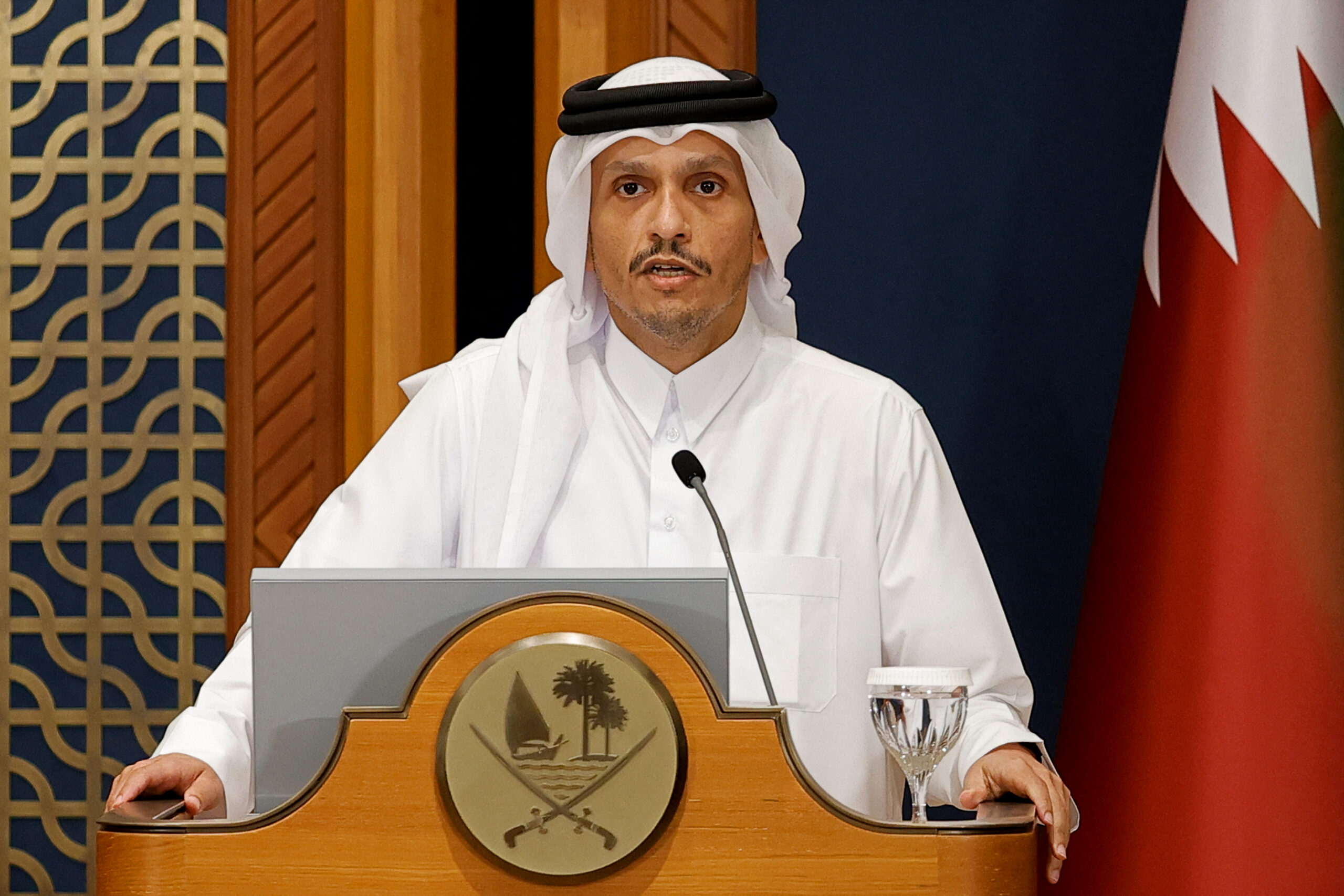
The Institute for the Study of Global Antisemitism and Policy in its report, called for a federal investigation of Qatar’s influence efforts targeting American education
‘I'm not sure we should make the deal if they don't sign,’ the president said at a Cabinet meeting
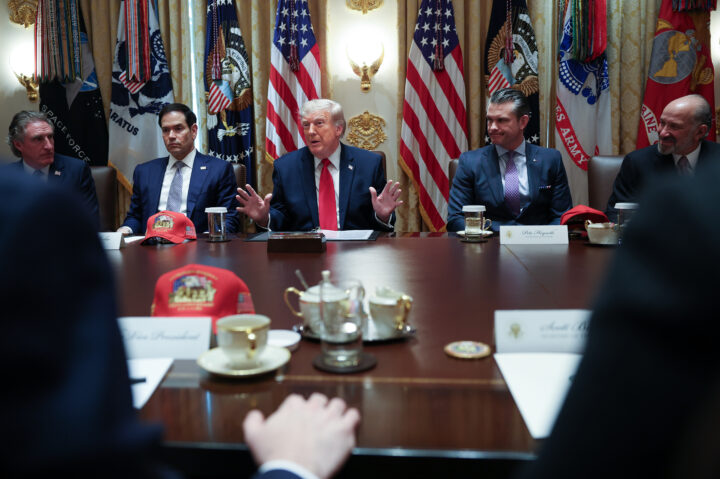
Win McNamee/Getty Images
President Donald Trump speaks during a Cabinet Meeting in the Cabinet Room of the White House on May 27, 2026 in Washington, DC.
President Donald Trump signaled on Wednesday that he may not agree to a deal to end the war with Iran if Saudi Arabia, Qatar and other countries in the region do not join the Abraham Accords, arguing that the Gulf nations “owe that to us.”
The president made the comments while taking questions from reporters during a Cabinet meeting at the White House, where he was asked if he would accept a peace agreement with Iran that did not address uranium enrichment. Trump responded that he would agree to a deal that allows for continued negotiations on some issues, though he repeatedly said he would not allow for “a crummy agreement.”
He expressed hesitation about moving forward with any peace deal with Iran that did not include commitments from Saudi Arabia, Qatar, Kuwait and others to normalize relations with Israel.
“I would like to have the countries we were talking about — Saudi Arabia, UAE, Qatar and the others — we’d like to have them immediately join, and [White House Special Envoy] Steve Witkoff is working on that with Jared [Kushner] and some others, but I would like to have them join the Abraham Accords,” Trump said. “It would be historic if they do it. I think they owe that to us, to be honest, because that really would be a tremendous sign. I think those countries owe it to us.”
Addressing Witkoff, the president said, “I’m not sure we should make the deal if they don’t sign, if you want to know the truth. If they don’t sign to join the Abraham Accords, I don’t know.”
When pressed if that meant he viewed an Iran deal as contingent on those countries joining the Abraham Accords, Trump responded: “I don’t know. I don’t want to say that. I’m not going to give you what’s contingent, what’s not. I can say that we can make a good deal right now, but maybe not a great deal, and if it’s not a great deal, we’re not making it.”
“We can make a great deal with this guy right here,” he continued, pointing to Defense Secretary Pete Hegseth. “But that’s a lot nastier, probably wouldn’t go as quickly … but it would be foolproof.”
Addressing reports from Iranian state media that Oman may assist Iran in overseeing the Strait of Hormuz once the war is over, Trump later said, “Oman will behave just like everybody else or we’ll have to blow them up.”
Plus, the IDF targets Hamas' succession plans
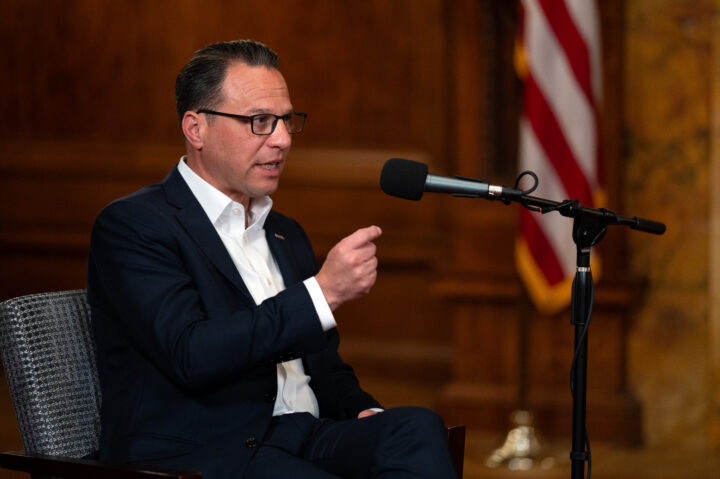
Peter W. Stevenson/The Washington Post via Getty Images
Pennsylvania Gov. Josh Shapiro sits for an interview at the Pennsylvania State Capitol on June 11, 2025.
This P.M. edition is reserved for our premium subscribers like you — offering a forward-focused read on what we’re tracking now and what’s coming next.
Today’s Daily Overtime was curated by JI U.S. Editor Danielle Cohen-Kanik.
📡On Our Radar
Notable developments and interesting tidbits we’re tracking
No agreement has materialized between the U.S. and Iran today, as the Iranian Foreign Ministry denounced U.S. strikes in the country last night as a sign of “bad faith and unreliability” and warned Tehran “will leave no act of aggression unanswered”…
The IDF carried out a strike against Mohammed Odeh, Hamas’ new military commander in Gaza and one of the “architects” of the Oct. 7 attacks, Israeli Prime Minister Benjamin Netanyahu and Defense Minister Israel Katz said in a joint statement, days after Israel killed his predecessor, Izz al-Din al-Haddad…
The IDF has also expanded its military campaign against Hezbollah beyond the security zone established in the ongoing Israel-Lebanon ceasefire, in an effort to combat drone attacks by the terror group on Israel’s northern communities. Netanyahu said at the start of a Security Cabinet meeting today that Israel is “operating with significant forces on the ground and taking control of strategically dominant positions” in Lebanon.
U.S. officials reportedly approved of the plan but warned Israel “not to bring down buildings in Beirut,” for fear of impacting talks with Iran…
Iran has begun restoring some internet access for its citizens, an Iranian official and watchdog groups said today, curbing what is reportedly the longest nationwide internet shutdown in history at nearly three months long…
Mike Needham, a close advisor to Secretary of State Marco Rubio, will transition from the State Department, where he serves as counselor and head of policy planning, to deputy national security advisor and assistant to the president at the White House…
Netanyahu is considering appointing his advisor Caroline Glick to the position of Israeli consul in New York, according to Israel’s Channel 12. Glick has drawn scrutiny for her repeated criticisms of the Reform and Conservative movements as well as liberal Israel advocacy groups…
CENTCOM denied reporting by The Wall Street Journal that it has restarted “Project Freedom” and said U.S. forces are “not currently escorting commercial vessels through the Strait of Hormuz.”
And the State Department called reports that the U.S. and Israel are working to strip Jordan of its custodianship of the Al-Aqsa Mosque in Jerusalem “categorically false”…
Pennsylvania Gov. Josh Shapiro warned in an interview with Politico that efforts within the Democratic Party to single out AIPAC as “toxic” could be seen as silencing Jewish voices in the American political system.
“Do I agree with every political decision they’ve made, every endorsement they made? Of course not,” Shapiro said of the pro-Israel group. “I think what we have seen is a weaponization of that. … When you have people who are advocating for issues that they feel strongly about and they are having their voices silenced, I think that’s a problem in our system”…
In a letter sent to Trump today, more than 90 House Republicans, led by Rep. Mike Lawler (R-NY), called for the administration to “fully dismantle” the United Nations Relief and Works Agency and to rethink its operations “not only in Gaza, but across the West Bank, Jordan, Lebanon, and Syria,” Jewish Insider’s Marc Rod reports.
UNRWA has “perpetuated the refugee crisis and reinforced the conditions that have allowed terrorism to persist,” the lawmakers wrote, arguing that in serving as the primary provider of public services in several countries, the agency “has reduced incentives for host governments to pursue long-term solutions”…
The Justice Department sued UCLA today for allegedly violating Title VI of the Civil Rights Act due to its “deliberate indifference to race and national origin discrimination against Jewish and Israeli students”; it’s the Trump administration’s latest move in its legal campaign against the school, as it also pursues a Title VII lawsuit alleging UCLA discriminated against its Jewish and Israeli employees…
The final version of a New York state “buffer zone” law will make it a Class B misdemeanor — one of the lowest levels of criminal offenses — to “knowingly” infringe on the right of access or egress to a religious institution, or to cause those entering or exiting to fear for their safety from a distance of less than 50 feet, JI’s Will Bredderman reports.
The bill, which is expected to pass as part of a package around the state budget, is less punitive than the original legislation endorsed by Gov. Kathy Hochul, which would have charged such obstruction as a felony, but doubles the buffer zone from its original distance of 25 feet…
The Park Slope Food Coop, a high-profile progressive Brooklyn institution with around 17,000 members, is set to vote this evening whether to enact a BDS policy against selling Israeli-made products, an issue that has ignited a political flashpoint among New York Democrats and caused the vote to go virtual, with organizers citing security concerns.
Rep. Dan Goldman (D-NY) has encouraged members to oppose the measure, while his congressional primary opponent, former New York City Comptroller Brad Lander, said he would vote against it if he was a member but would not tell others to do so. City Council Speaker Julie Menin said in a statement today that the “proposed boycott serves to further divide New Yorkers” and that she hopes the co-op will reject the effort…
New York City Mayor Zohran Mamdani declined, in an interview with a local news outlet, to endorse a candidate in New York’s 12th Congressional District — where he noted he is a constituent — calling it a “pleasure” to serve with both Micah Lasher and Alex Bores in the state Assembly…
After doubling down on his claim that presumptive Maine Senate Democratic nominee Graham Platner’s tattoo of a Nazi Totenkopf is “disqualifying,” Rep. Jake Auchincloss (D-MA) reiterated today that he still will not endorse Platner’s opponent, Sen. Susan Collins (R-ME): “Susan Collins is a rubber stamp for the worst admin in history. Claims that I would endorse her, implicitly or otherwise, ignore my track record supporting Democrats to take back both chambers. … Regardless of what happens in Maine, Democrats need to take back the Senate and I’ll keep working hard to make it happen”…
Jeremy Burton, CEO of the Jewish Community Relations Council of Greater Boston, condemned as “crazy and disgusting” a video of a man in the city dressed as Adolf Hitler stomping on an Israeli flag…
⏩ Tomorrow’s Agenda, Today
An early look at tomorrow’s storylines and schedule to keep you a step ahead
Keep an eye out in Jewish Insider for results from today’s primary runoff elections in Texas, where we’re tracking the races between Sen. John Cornyn (R-TX) and Trump-endorsed Attorney General Ken Paxton for U.S. Senate; antisemitic conspiracy theorist Maureen Galindo and establishment-backed sheriff’s deputy Johnny Garcia for the Democratic nomination in the 35th District; and Reps. Al Green (D-TX) and Christian Menefee (D-TX) in the member-on-member primary for the newly redrawn 18th District.
Trump will convene a Cabinet meeting tomorrow at the White House — relocated from the historic Camp David in Maryland due to weather — where the issue of negotiations with Iran is expected to feature prominently on the agenda.
Stories You May Have Missed
PLANNING AHEAD
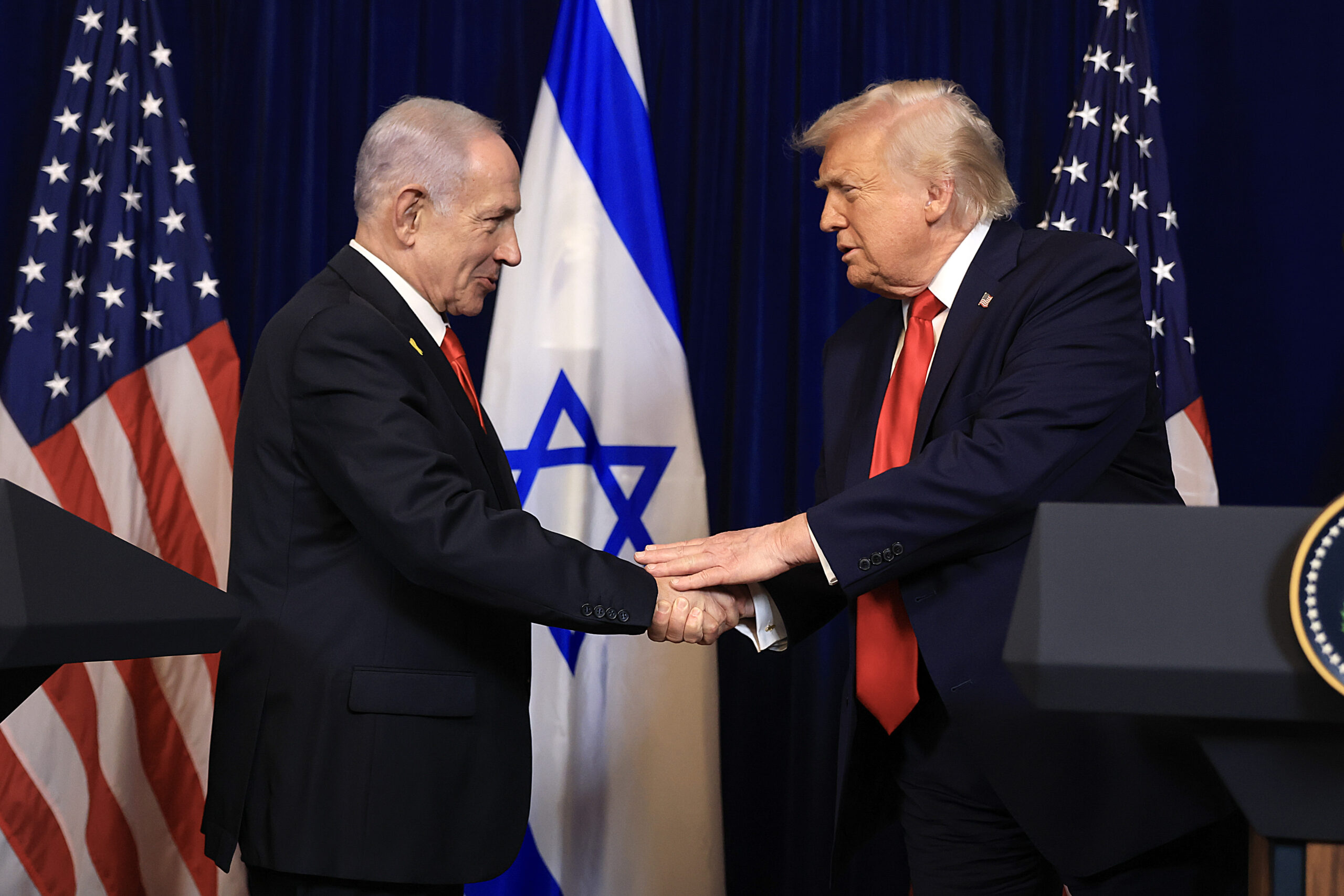
Jewish and pro-Israel groups seem at pains to clarify how they are now assessing an issue that has long been key to their advocacy — particularly as the conversation around funding and the possibility for a new MOU has rapidly evolved in recent months
CALLING OUT HATE
The $34,000 ad is in response to a GOP-linked outside spending campaign boosting the extremist candidate
Details of the arrangement remain unclear, but reports indicate the U.S. would end military action, lift its blockade and release $25 billion in frozen Iranian funds
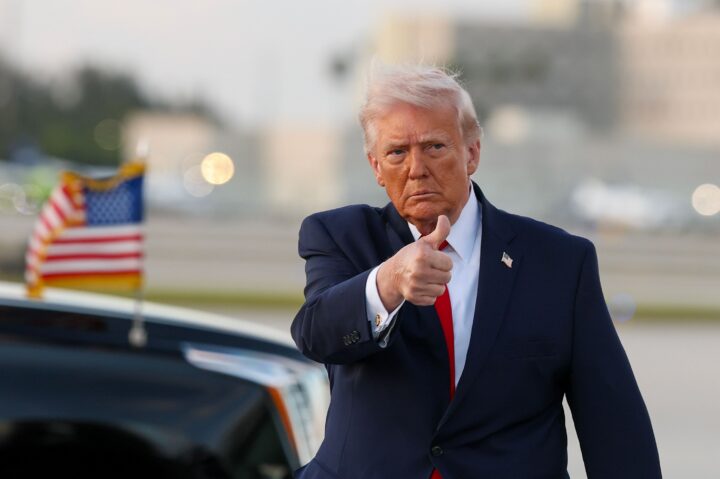
Tasos Katopodis/Getty Images
U.S. President Donald Trump waves to the media after walking off of Air Force One at Miami International Airport on April 11, 2026 in Miami, Florida.
The U.S. is nearing a deal with Iran to end the war, President Donald Trump announced on Saturday, though the precise parameters of the agreement remained unclear.
After holding a call with officials from the United Arab Emirates, Saudi Arabia, Qatar, Turkey, Pakistan, Jordan, Bahrain and Egypt, as well as a separate discussion with Israeli Prime Minister Benjamin Netanyahu, Trump said on Truth Social on Saturday afternoon that an agreement has “been largely negotiated” with “final aspects and details … currently being discussed.”
“In addition to many other elements of the Agreement, the Strait of Hormuz will be opened,” the president said.
While Trump did not offer any further details, Iranian officials had told The New York Times that a memorandum of understanding under discussion with the U.S. would end fighting on all fronts, including between Israel and Lebanon; lift the U.S. blockade of Iranian ports and allow for free movement of commercial traffic without any tolls; leave nuclear issues to be negotiated within 30 to 60 days; and see the release of $25 billion in frozen Iranian funds.
U.S. officials told the Times that, under the current agreement, Tehran has committed to giving up its stockpile of already enriched uranium, an issue that Trump has frequently stated is a U.S. priority, but the specifics as to how that transfer will occur are set to be worked out in subsequent negotiations.
A senior Iranian official denied to Reuters on Sunday that Iran’s nuclear program was a part of the initial agreement, and said that Tehran had not agreed to hand over its enriched uranium. “The nuclear issue will be addressed in negotiations for a final agreement and are therefore not part of the current deal,” the official told Reuters.
A U.S. official told Axios’ Barak Ravid that the agreement involves a 60-day ceasefire extension during which the Strait of Hormuz would be reopened and Iran would be able to sell oil freely. The draft MOU, according to Axios, includes commitments from Iran that it will never pursue nuclear weapons and to negotiate a suspension of its uranium enrichment program and the removal of its stockpile of highly enriched uranium. The draft also includes an end to the war between Israel and Hezbollah in Lebanon.
Netanyahu said in a statement on Sunday regarding his conversation with Trump the day prior that the two leaders “agreed that any final agreement with Iran must eliminate the nuclear danger,” including dismantling Tehran’s nuclear program and removing enriched uranium from the country. Trump also “reaffirmed Israel’s right to defend itself against threats on every front, including Lebanon,” Netanyahu said.
Some hawkish Senate Republicans expressed outrage on Saturday over the reported terms of the deal, calling it a defeat for the United States filled with major concessions to the Iranian regime.
‘The rumored 60-day ceasefire — with the belief that Iran will ever engage in good faith — would be a disaster,’ said Senate Armed Services Committee Chairman Roger Wicker

Drew Angerer/Getty Images
Sen. Ted Cruz (R-TX)
Hawkish Senate Republicans expressed outrage on Saturday over the reported terms of a U.S. ceasefire deal with Iran, calling the agreement a defeat for the U.S. filled with major concessions to the Iranian regime.
“I am deeply concerned about what we are hearing about an Iran ‘deal,’ being pushed by some voices in the administration,” Sen. Ted Cruz (R-TX) said on Saturday.
Cruz said that Trump’s decision to strike Iran was correct and “the most consequential decision of his second term, but said that ending the war on the reported terms would be a failure.
“If the result of all that is to be an Iranian regime — still run by Islamists who chant ‘death to America’ — now receiving billions of dollars, being able to enrich uranium & develop nuclear weapons, and having effective control over the Strait of Hormuz, then that outcome would be a disastrous mistake,” Cruz continued.
He said that he is “pray[ing] the early reports are wrong” but said the fact that former Biden administration Iran envoy Rob Malley praised the reports is “not encouraging.”
“President Trump believes in peace through strength, and his strong leadership has already made America much safer,” Cruz said. “He should continue to hold the line, defend America & enforce the red lines he has repeatedly drawn.”
Sen. Lindsey Graham (R-SC) said that ending the war along the proposed terms would be conceding that there is no military solution to defeating Iran.
“If a deal is struck to end the Iranian conflict because it is believed that the Strait of Hormuz cannot be protected from Iranian terrorism and Iran still possesses the capability to destroy major Gulf oil infrastructure, then Iran will be perceived as being a dominate force requiring a diplomatic solution,” Graham said.
He said that such an outcome would shift the balance of power in the region and “be a nightmare for Israel.”
“Also, it makes one wonder why the war started to begin with if these perceptions are accurate. I personally am a skeptic of the idea that Iran cannot be denied the ability to terrorize the Strait and the region cannot protect itself against Iranian military capability,” Graham continued. “It is important we get this right.”
Sen. Tom Cotton (R-AR), who chairs the Senate Intelligence Committee, shared Graham’s post.
Sen. Roger Wicker (R-MS), the chairman of the Senate Armed Services Committee, had urged Trump on Friday to ignore advisors urging an agreement with Iran, and encouraged the administration to return to war so as not to leave behind a legacy of weakness.
“The rumored 60-day ceasefire — with the belief that Iran will ever engage in good faith — would be a disaster,” Wicker said Saturday. “Everything accomplished by Operation Epic Fury would be for naught!”
Meanwhile, other congressional Republicans are expressing support for the administration’s approach.
“President Trump is the ONLY one who could have gotten Iran — the world’s largest state sponsor of terrorism — to the negotiating table,” House Speaker Mike Johnson (R-LA) said. “We are greatly encouraged to learn a PEACE DEAL in Iran is underway — and look forward to learning more about the specifics. Under President Trump’s leadership, our nation is stronger, more respected on the global stage, and safer than ever before.”
Rep. Randy Fine (R-FL) said he’d spoken to the White House about the proposed deal and expressed support for it.
“President Trump will land this deal and end the conflict on his terms,” Fine said. “The Mullahs will never have a nuclear weapon.”
Former Secretary of State Mike Pompeo also lambasted the reported deal’s terms, calling it “straight out of the Wendy Sherman-Robert Malley-Ben Rhodes playbook: Pay the IRGC to build a WMD program and terrorize the world,” referring to the 2015 Iran nuclear deal struck by the Obama administration. He also called for a return to war.
Pompeo’s post faced furious backlash from White House Communications Director Steven Cheung, Trump advisor Alex Brusewitz and Rep. Anna Paulina Luna (R-FL).
The vote is postponed until June, after the Memorial Day holiday
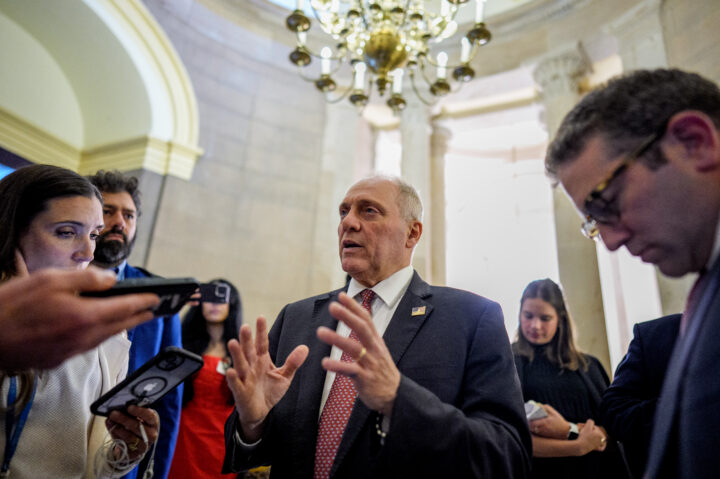
Andrew Harnik/Getty Images
House Majority Leader Steve Scalise (R-LA) speaks to members of the media at the U.S. Capitol Building on May 21, 2026 in Washington, DC.

