






































































Senate Dems introduce series of new war powers resolutions on Iran
The resolutions are similar to that which failed in the Senate last week, but some narrow the scope of permitted intelligence sharing and military cooperation
Tom Williams/CQ Roll Call
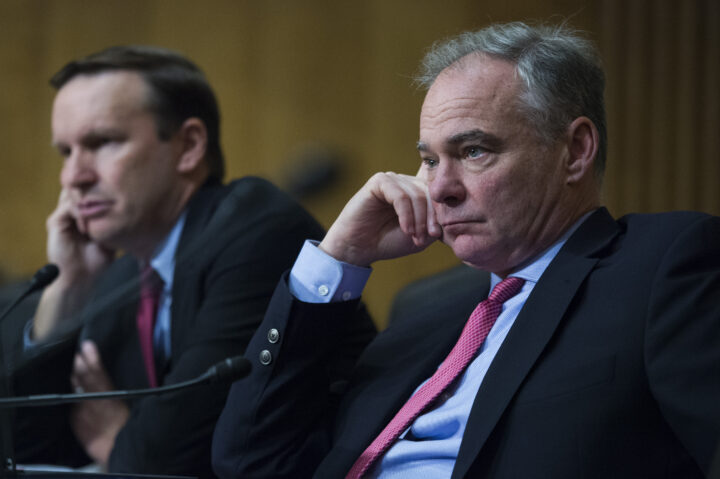
Sens. Chris Murphy (D-CT), left, and Tim Kaine (D-VA) attend a Senate Foreign Relations Committee nominations hearing in Dirksen Building on August 1, 2018.


 Add JewishInsider on Google
Senate Democrats introduced five new war powers resolutions seeking to block military action in Iran on Thursday, a day after the Senate voted along mostly partisan lines to block an effort to immediately halt the operation.
One of the resolutions was introduced by Sen. Tammy Baldwin (D-WI), with the other four being introduced by the same group of senators: Sens. Tim Kaine (D-VA), Chris Murphy (D-CT), Cory Booker (D-NJ) and Adam Schiff (D-CA). Murphy, who has also been pushing for the Senate to vote on an authorization for use of military force in Iran, is leading two of the resolutions, and Schiff and Booker are leading the other two, respectively.
Having a series of war powers resolutions already introduced could allow Democrats to continue teeing up votes on the war, or allow them to have several resolutions in reserve to vote on as the situation in Iran evolves.
War powers resolutions are subject to a 10-day waiting period between their introduction and when senators can force votes on them.
Kaine suggested last week after the initial war powers resolution failed that he would plan to force further war powers votes, as well as look for opportunities in other legislation to tee up votes on the war effort, which Democrats see as politically unpopular for the administration and for Republicans.
Kaine, Murphy, Booker and Schiff did not provide comment.
The text of one of the five resolutions was not yet available as of Sunday evening, but the other four are largely similar. As compared to the resolution led by Kaine, Schiff and Sen. Rand Paul (R-KY) that the Senate voted on last week, each includes updated details about the U.S. campaign in Iran, which had not yet begun when the previous resolution was introduced.
Several of the resolutions also appear to narrow the scope of U.S. intelligence sharing and military cooperation with Israel and other allies that would remain explicitly exempt from the legislation’s mandate for an immediate end to military operations against Iran.
One of the Murphy-led resolutions allows for intelligence sharing with allies attacked by Iran “related to defense from threats from Iran or its proxies,” whereas the Kaine-Paul resolution did not include that specific reference to defense.
It also allows for the U.S. to assist partners in “intercepting retaliatory attacks upon their territory,” where the previous version allowed for assisting with “defensive measures to protect their territory from retaliatory attacks by Iran or its proxies” more broadly — without the reference to interception of active attacks alone.
The Baldwin-led resolution includes the same language as the Murphy-led resolution on interceptions of retaliatory attacks, but does not include the new language on intelligence sharing.
The Schiff-led resolution includes similar specifications around intelligence sharing as the Murphy resolution, but does not impose the same limitations allowing the U.S. to only intercept attacks on allies. It includes additional language allowing for continued evacuations of U.S. citizens.
The Booker-led resolution does not include any additional restrictions on intelligence sharing, but it restricts assistance to Israel and other allies to “directly defending against retaliatory attacks upon their territories by Iran or its proxies.” It also includes the carveout regarding evacuations of U.S. citizens.
Separately, in the House, Rep. Josh Gottheimer (D-NJ) said Thursday that he plans to force a vote later this month on his war powers resolution that offers a 30-day wind-down period for the war effort in Iran, which Gottheimer is leading with several other moderate Democrats.
More Stories

FAMILY TRAGEDY
Israeli ambassador’s son seriously wounded in West Bank car-ramming attack

supper club
AI, tech execs to attend White House state dinner for Xi Jinping

DIPLOMACY DIARIES
AJC plans ‘diplomatic marathon’ amid U.N. General Assembly in New York

WAR POWERS WOES
Senate narrowly rejects Iran war powers resolution, as Tillis joins Democrats to oppose war

POLICY PIPELINE
Deborah Lipstadt launches Emory institute to train the next generation of policymakers fighting antisemitism
ALTERNATE REALITY
Pezeshkian denies Iran seeks nuclear weapons at UNGA
Please log in if you already have a subscription, or subscribe to access the latest updates.
 Continue with Google
 Continue with Apple