



























































Will Iranian attacks push Qatar to expel Hamas leaders?
Experts were divided if Hamas’ alignment with Iran as it attacks Qatar will cause Doha to reassess the value of hosting the terror group
Ali Altunkaya/Anadolu via Getty Images
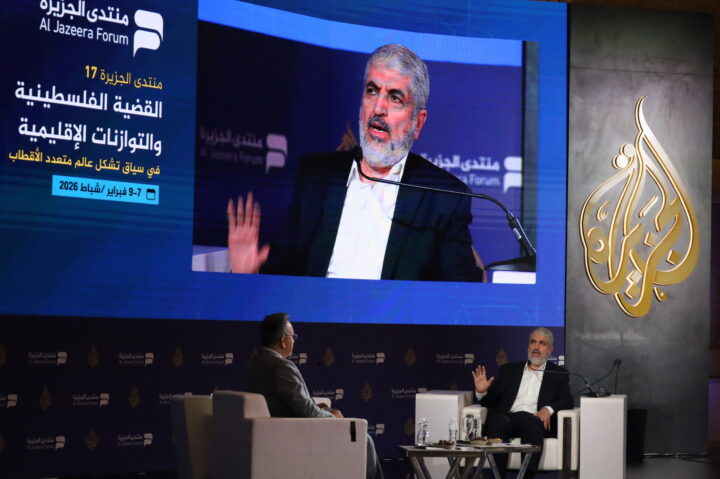
Hamas leader Khaled Mashaal speaks on the second day of the 17th Al Jazeera Forum held in Doha, Qatar on February 8, 2026.


 Add JewishInsider on Google
Despite Qatar’s anger with Iran over the regime’s continued attacks on its territory and civilian infrastructure, experts are divided over whether the conflict will ultimately force Doha to reconsider its long-standing policy of hosting Iranian-backed Hamas officials.
Qatar has hosted Hamas’ political office and leadership, who have been reported to live lavishly and amass significant wealth, since 2012. Doha previously agreed to expel Hamas officials during hostage negotiations with Israel, but ultimately did not follow through.
Some experts told Jewish Insider that shifting regional dynamics amid the U.S. and Israeli conflict with Iran could be sufficient to change Qatar’s calculus. In the days following the launch of the joint U.S. and Israeli military operation against Iran, Tehran has launched widespread drone and missile strikes at multiple Arab nations, including Qatar.
Qatari Prime Minister Mohammed bin Abdulrahman bin Jassim Al Thani condemned the Iranian strikes last week as a “flagrant violation” of Doha’s sovereignty in a phone call with Iranian Foreign Minister Abbas Araghchi and “categorically rejected” Tehran’s claims that the strikes were directed only at American interests and not intended to target the Gulf state.
Hamas — which has received significant funding, training, arms and intelligence from Tehran for decades — has not denounced the Iranian strikes, instead placing the blame on the U.S. and Israel.
Anne Dreazen, vice president of the American Jewish Committee’s Center for a New Middle East, told JI that while Doha has raised the possibility of expelling Hamas leadership in the past, the recent attacks and the group’s lack of condemnation of the Iranian strikes signals that “the situation is a little bit different now.”
“These Iranian attacks across the Gulf have really forced many regional governments to reassess how much space they want to give the Iranian regime-aligned groups,” Dreazen said. “I think Qatar probably perceives that Hamas is siding with the Iranian regime, and so that could create some additional pressure on Qatar to act.”
Edmond Fitton-Brown, a former British diplomat and senior fellow at the Foundation for Defense of Democracies, echoed those sentiments, telling JI that the current conflict between the U.S. and Israel and Iran could challenge Qatar’s long-standing balancing act between Islamist movements and Western allies.
“Before the current Iran war, it [Qatar] was pursuing a business model that had it as international mediator, media superpower, host of a U.S. military base and sponsor of the Muslim Brotherhood’s global ambitions,” Fitton-Brown told JI. “It was a tightrope act, reliant on neither Iran objecting to the U.S. military base nor the U.S. objecting to the Muslim Brotherhood angle.”
However, Fitton-Brown said “the extent of the betrayal in the face of Iranian military aggression is on a different level from previous issues. “The comment made by Qatar about ‘everything being ruined’ strikes me as an acknowledgement that a return to the status quo ante is unlikely,” he added.
Fitton-Brown said that Qatar “looks unlikely to offer a stable haven” for Hamas leadership, adding that the group could find itself “sandwiched between U.S. allies on both sides of the Gulf.”
Meanwhile, other experts and former White House officials remained more skeptical that current hostilities would push Qatar to finally expel Hamas.
“I will believe it when I see it,” Steven Cook, a senior fellow at the Council on Foreign Relations, told JI. Cook noted that while the “Qataris are angry about Iranian strikes on their territory,” it would likely not change the dynamics of their relationship with Hamas. He added that “hosting Hamas has become an instrument of Qatar’s regional power and global influence.
“Qatar has been playing both sides for decades — supporting Islamist groups including terrorist groups like Hamas, while housing the Al-Udeid base and spending billions in the U.S. to buy political protection,” Elliott Abrams, the former U.S. special representative for Iran during the first Trump administration, said.
Abrams said it is “possible that this war has awakened them to the inherent contradictions in this game, where they protect Hamas — but Hamas doesn’t side with them,” however, he also expressed skepticism that such a move would ultimately be carried out.
Abrams said Qatar is “too used” to their current posture of playing both sides, adding that Doha receives “too many benefits from it.”
Richard Goldberg, a former Trump administration official, also said he will “believe it when I see it.” He noted that Qatar “appears to have intentionally shut down their liquified natural gas exports and hyped the market … as a favor to Tehran and an attempt to pressure President Trump into backing down.”
Earlier this month, Qatar halted liquefied natural gas production — which accounts for roughly 20% of global supply — after Iranian drone attacks targeted key operating facilities and infrastructure.
If the conflict does push Qatar to expel Hamas leaders, experts said Turkey could serve as a potential refuge.
“Turkey is the obvious refuge for Hamas: a powerful and self-confident Sunni Islamist state that also functions as the headquarters in the region for the International Organization of the Muslim Brotherhood,” Fitton-Brown added. “The Hamas leaders may move there soon, or may wait until the U.S.-Israel-Iran outcome is clear.”
“It would not be the end of Hamas” if they were expelled from Doha, Dreazen said. “Hamas has extensive operational infrastructure still in Gaza, and it has networks throughout several countries, Turkey being one of them. In terms of Hamas’ ability to carry out operations in Gaza, I think the impact would actually probably be limited.”
More Stories

Daily Overtime
Syria’s new textbooks demonize Jews, report finds

UNSPORTSMANLIKE CONDUCT
St. Louis Blues condemn antisemitic banners at home game

STARS, STRIPES AND SEATS
Meet the Americans hoping to secure a seat in the next Knesset
DEBATE DIGS
Rogers describes El-Sayed as a national security threat in final Michigan Senate debate

TIES THAT BIND
Jewish Federations survey finds deepening ties between U.S., Israeli Jewish communities
WAR WORRIES
Could another war with Iran be the October surprise of the Israeli election?
Please log in if you already have a subscription, or subscribe to access the latest updates.
 Continue with Google
 Continue with Apple