


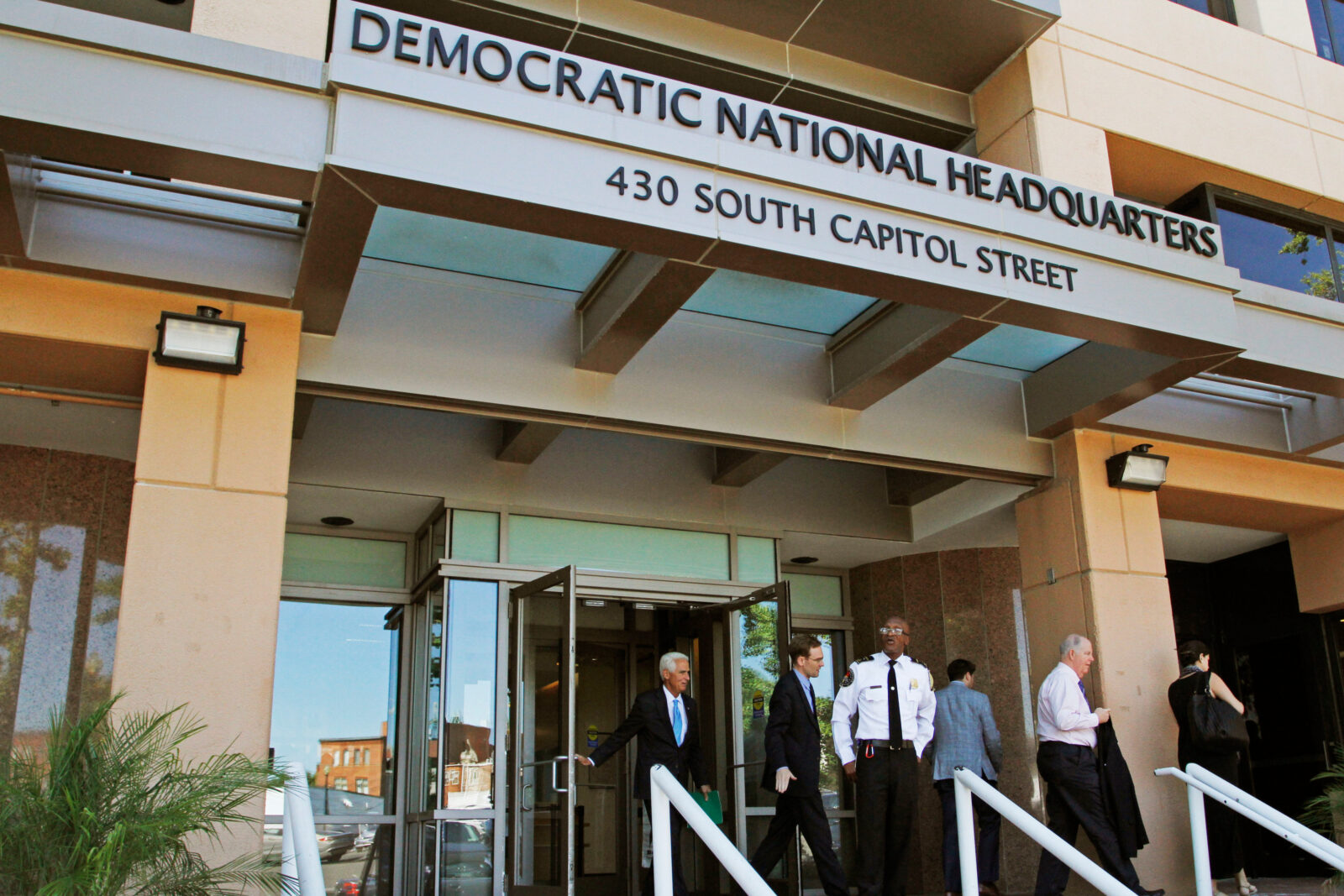
Paul Holston/AP
Inside the DNC working group at the center of Democrats’ Israel fight
The question facing the Middle East working group’s members is whether they will actually be able to agree on anything — or if the group is simply a way to push the issue off until 2028


 Add JewishInsider on Google
At last week’s Democratic National Committee meeting in New Orleans, two resolutions concerning Israel — including one that referred to Israel’s actions as a genocide — were tabled, and punted to a working group tasked with building consensus among Democrats on Middle East-related issues.
At a time when Democrats appear deeply divided about how to address the U.S.-Israel relationship and Middle East policy more broadly, that’s a tall order. Never mind that the members of the working group include both strongly pro-Israel and staunchly anti-Israel voices, all tasked with working to further a message that will resonate with as many party members as possible.
“As much as this issue is potentially divisive, I think it’s actually really the purview of a smaller group of activists who want something really radical. I think most Democrats are within what the Democratic platform of 2024 is, and that’s two peoples living in two states, side-by-side in peace,” Adam Goldwyn, a working group member who serves as chair of the North Dakota Democratic Party, told Jewish Insider.
The Democratic Party’s 2024 platform, authored in the midst of Israel’s war in Gaza and the simultaneous hostage crisis, reflected former President Joe Biden’s support for Israel. But rank-and-file Democrats have shifted away from Israel since then. A recent Pew Research Center poll showed that 80% of Democrats and Democratic-leaning independents have an unfavorable view of Israel, an increase from 69% one year ago, and a growing cadre of Democratic candidates and activists have targeted the pro-Israel group AIPAC as a toxic brand that is not welcome in Democratic politics.
Even though the DNC is not tasked with rewriting the party platform until 2028, the party’s biannual meetings present opportunities for activists to submit resolutions on any number of topics. Following Democrats’ 2024 defeat, anti-Israel activists — including two who sit on the working group — have put forward resolutions that would attempt to dramatically move the party’s public positioning to the left.
One, which called for an arms embargo on Israel, was voted down at the party’s summer meeting in August 2025. Another, which criticized AIPAC’s involvement in Democratic primaries, failed to advance at the meeting in New Orleans last week. Allison Minnerly, a DNC member from Florida who authored both of those resolutions, sits on the working group. Another resolution considered last week, which referred to Israel’s actions as a genocide and was written by working group member Joseph Salas, was sent back to the working group for consideration.
The question facing the group’s members is whether they will actually be able to agree on anything — or if the group is simply a way to push the issue off until 2028, when the party platform is again up for debate. It would not be the first bureaucratic Band-Aid applied to paper over an increasingly fraught political debate.
“Both young voters who consider themselves vigorously pro-Palestinian, and Jewish voters, who are one of the most loyal groups in the Democratic Party, are not going anywhere,” said Andrew Lachman, a member of the working group who was previously the president of California Jewish Democrats. “Anyone who wants to take an approach of trying to shout one or the other out of the room, I think it’s bad politics. It’s bad for the party, and it’s an unrealistic expectation.”
“We are working within the framework of the Democratic platform as it is now, so anything which attempts to radically rewrite where the party has been is not something that I personally feel is appropriate,” said Andrew Lachman, a member of the working group who was previously the president of California Jewish Democrats.
Lachman said he recognized “that the conversation has shifted a little bit in the last couple of years.” But, he added, the party must still be able to find common ground among party members who hold different views on the issue.
“Both young voters who consider themselves vigorously pro-Palestinian, and Jewish voters, who are one of the most loyal groups in the Democratic Party, are not going anywhere,” said Lachman. “Anyone who wants to take an approach of trying to shout one or the other out of the room, I think it’s bad politics. It’s bad for the party, and it’s an unrealistic expectation.”
DNC Chair Ken Martin created the working group last August, amid controversy surrounding the failed arms embargo resolution. He had put forth his own resolution, which was more balanced, but withdrew it and opted instead to task a group of party activists with litigating the issue.
“I feel like we’ve been a little rudderless,” Steph Newton, an Oregon Democrat who was appointed co-chair of the group, told JI on Friday after the group met in New Orleans. “I’m taking it seriously. I want my kids to be Democrats. I want this party to be safe for my kids in the future.”
“There is a divide in our party on this issue. This is a moment that calls for shared dialogue and calls for shared advocacy,” Martin said in August. He called on the task force “of stakeholders on all sides of this to continue to have the conversation, to work through this, and bring solutions back to our party.”
Steph Newton, an Oregon Democrat who was appointed co-chair of the group, drafted a charter for the working group that the body is now editing ahead of its next planned meeting later this month. The group was “convened to support the Democratic Party in advancing a just, secure, and lasting peace in the Middle East, while strengthening internal cohesion across perspectives within the Democratic coalition,” the draft charter states, according to a copy shared with JI.
“I feel like we’ve been a little rudderless,” Newton told JI on Friday after the group met in New Orleans. “I’m taking it seriously. I want my kids to be Democrats. I want this party to be safe for my kids in the future.”
She expressed frustration at working group members who had submitted their own resolutions ahead of last week’s meeting. Newton’s goal is for the group to be able to come up with some kind of compromise language that they can all get behind.
“We got agreement from folks. We said, ‘Hey, it wasn’t cool that you guys went off and did something like this and just submitted something. You should have come to the group,’” said Newton, who also leads the Oregon Democratic Party’s Jewish caucus. “The next thing that’s going to be coming out of this is going to be coming from the working group.”
Her co-chair on the working group is Shad Murib, the chair of the Colorado Democratic Party. Other members include longtime pro-Palestinian activist James Zogby and Deborah Cunningham-Skurnik, a regional director in the California Democratic Party.
What the working group members can agree on is the shared goal of electing Democrats. A DNC spokesperson told JI that this is the lens through which the working group views its mandate: winning elections.
“I think certainly there are some people for whom the message is more important than the election,” said Goldwyn, the North Dakota Democrat. “But I think that’s not where most Americans and most DNC members and most voters are.”


Please log in if you already have a subscription, or subscribe to access the latest updates.
 Continue with Google
 Continue with Apple