



















































Analysts say close military coordination masks growing differences in domestic support and strategic priorities that could shape how long Washington and Jerusalem sustain the campaign
FADEL itani/AFP via Getty Images
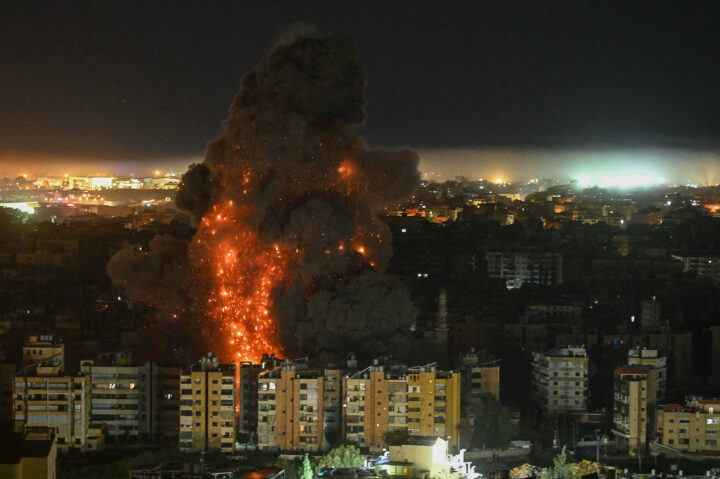
A fireball rises from the site of an Israeli airstrike that targeted an area in Beirut's southern suburbs overnight March 10 to 11, 2026.


 Add JewishInsider on Google
Over two weeks into the war with Iran, American and Israeli leaders’ public statements about the effort and their goals remain largely in sync, with President Donald Trump praising Israel on Sunday for helping secure the Strait of Hormuz, while other countries with greater oil interests in the region have yet to offer to help.
However, the populations of the two countries have markedly different views of the war, which is popular in Israel while most Americans oppose it, which likely puts Trump and Israeli Prime Minister Benjamin Netanyahu on different timelines. That, in turn, could impact the level of cooperation moving forward.
Assaf Orion, a senior researcher at the Institute for National Security Studies at Tel Aviv University, said that “it’s clear that even though this is a joint operation embarked on together, there are significant differences. In the end, it depends on Trump.”
Dan Diker, president of the Jerusalem Center for Security and Foreign Affairs, said that “it is our sense [in Israel] that Trump is on the same page about staying the course” with goals including “the complete neutering and elimination of the ballistic and nuclear programs as we’ve known them, but also to locate and get rid of the 440 kilograms of highly enriched uranium,” as well as to “assist the regime to collapse and change.”
”Without regime change, this is all for naught,” Diker added. “[Israel] simply can’t live with this messianic, jihadist regime. This is our opportunity.”
The U.S. and Israel are cooperating more closely than ever before, Diker noted. “It’s a real partnership,” he explained. “We haven’t had that since the founding of the State [of Israel]. It had been a client, an ally, the little brother, not a full-fledged partner. [Secretary of Defense Pete] Hegseth said the only amazing air forces in the world are the U.S. and Israel — that’s quite a statement.”
“American and Israeli leaders are on the phone every single day — the president and prime minister, joint chiefs of staff, the defense ministers — it’s incredibly tightly coordinated, because we can’t afford surprises,” he added.
That close coordination has “a great deterrent effect … it scares the living daylights out of the Iranian regime. It encourages the [Iranian] people who are still at home in Iran” to rise up against the regime, Diker posited.
Orion noted that different goals between the U.S. and Israel may include the U.S.’ aim to destroy Iran’s navy, something Israel has not mentioned, and the types of missiles they are most concerned about. Israel seeks to destroy long-range missiles that can reach its shores, while U.S. forces in the Gulf are threatened by short-range missiles.
“Within those goals, there can be differences in the level of achievement, the understanding of how much is enough,” he said. “Iran is Israel’s number one priority. For the U.S., the number one priority is China. Iran is an existential threat to Israel, but is far from it for the U.S.”
“Israel is willing to take greater risks because of that threat assessment, while the U.S. has to explain why it’s taking this risk,” Orion added.
While one may think the U.S. could endure a longer war because of its larger size and economy, and because Israelis are the ones running for shelter multiple times a day, while Americans are not, Orion said that does not appear to be the case.
“In Israel, [leaders are] saying it will take as long as it takes, expressing a kind of patience, while the U.S. government speaks out against ‘forever wars.’ They can continue, but they are less forgiving of long wars than Israel at this time. … Though the Israeli population is under fire and U.S. troops are under fire, Israel is more willing to absorb losses because of the sense that it is being threatened,” he said.
Diker said the differences between the U.S. and Israel are mostly in their political timelines: “President Trump has midterms [in November] and Israel has national elections,” set for the end of October, but may be held earlier. “Both men understand the existential nature of the moment. … Both men know their legacies can be built on destroying the world’s most dangerous regime.”
Still, Diker said, “public opinion in Israel backs the prime minister on this war and public opinion in the U.S. is deeply divided on the war … and have over 50% of the public saying they don’t know what this war is about. … That gives Netanyahu more breathing room to finish what needs to be finished even if it takes more time. … [Israel] wants to make sure this regime is destroyed however long it takes.”
Trump, however, has to “withstand political pressure from home with regard to the more isolationist wing of the MAGA movement and the Republican Party as a whole. He has to tie things up in the coming few weeks,” Diker said.
In addition, the “real challenge” in the U.S. is “the economic war, a soft spot in American political culture. People are nervous about the stock market, the price of oil and have become very impatient.”
Looking at how the war may continue, Orion said that while the public does not know what targets remain in Iran, the IDF has said there are enough targets left to require three additional weeks — or more — of warfare.
At the same time, Israel and the U.S. have to “manage their inventory of bombs and interceptors,” Orion said. “Israel also has the Lebanese arena. [Americans] talk about how whatever they use in the Middle East can’t be used in [East] Asia.”
Diker noted that the U.S. started striking Kharg Island over the weekend, which has the potential to cut off 90% of Iran’s oil revenue. After that, he posited, there will need to be some boots on the ground, likely from the U.S., to locate and destroy Iran’s enriched uranium. If that is achieved, he said, the American role in the war will likely end.
Israel, in the meantime, will “help topple this regime in Iran. What we’ve accomplished is severe unprecedented degradation of the regime’s capabilities.” In addition, Israel will likely continue fighting Hezbollah in Lebanon.
Orion posited that it is unlikely that Israel would continue the war in Iran after the U.S. pulls out.
”The reason the U.S. would stop would be to open the Strait of Hormuz and attacks on oil interests. If Israel continues [bombing Iran], Iran will continue [to attack oil interests],” he said. “However, if the U.S. stops in Iran, Israel may continue in Lebanon with American approval.”
Diker said he thinks it is unlikely that the U.S. would “just pack up and go home.”
”They have to get this uranium out,” he said. “Trump has to be convinced that [Iran] cannot build a nuclear weapon, and he is not convinced of that yet. They still have the uranium and the regime is still operating, somehow.”
Tech entrepreneur Ethan Agarwal: ‘He thinks being racist against Jewish people is going to help him win the American left. I don’t care if he’s right. I just think it’s unethical and immoral’
Courtesy
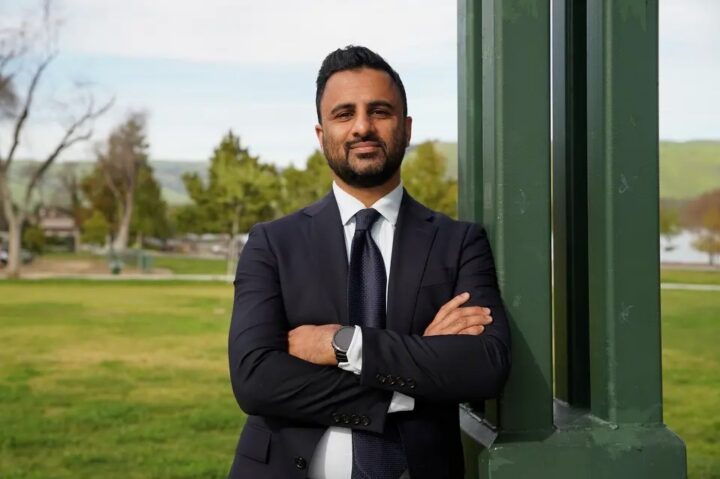
Ethan Agarwal
Rep. Ro Khanna (D-CA) has become one of the harshest critics of Israel in the House, in recent months associating with some of the leading anti-Israel figures within the Democratic Party — at one point proudly declaring his ties to a far-left antisemitic podcaster.
In his pushback to the U.S. war against Iran, he has caricatured those supportive of taking military action against the Islamic Republic as part the “Epstein class” — which critics have accused of being an antisemitic trope — while defending right-wing commentator Pat Buchanan from past charges of antisemitism.
As a result, he is facing a primary challenge from tech entrepreneur Ethan Agarwal, who is accusing the congressman of embracing far-left views to seek national attention for a potential presidential campaign — at the expense of focusing on constituents back home in the Silicon Valley-based district.
“The district is being represented by a guy who could not care less about the people in the district, and that’s frustrating because I supported Ro when he first ran back in 2012,” Agarwal told Jewish Insider on Friday. “He’s completely [turned around] on basically everything that he said to his supporters.”
Agarwal said he sees Khanna’s activities, including his opposition to the Iran war and outspokenness against Israel, as plays for national attention, rather than representing the district that elected him.
Khanna “just totally does not give a s*** about the district. He’s running for president, and he wants to run to the left on every issue,” Agarwal alleged. “The district needs a representative that’s focused on the district itself, and that’s why I’m running for Congress.”
Those allegations of political opportunism were echoed in a recent Washington Post column by writer James Kirchick, who reported that Khanna professed to being a strong ally of Israel and the Jewish community earlier in his career when he was seeking a role in the Obama administration. The op-ed framed Khanna as a relentless self-promoter willing to change his views for attention and career advancement.
Khanna, in response to the allegations that he’s lost focus on his district back home, told JI he was “proud of my record representing California’s 17th district,” pointing to his work to secure $13.5 million in funding this year for projects including affordable housing, veteran housing, safe routes for children to get to school, clean water and transportation. He added that he has held nearly 80 town halls, is regularly meeting with local community leaders and is in touch with anti-ICE activists, and touted his constituent services and endorsements from local leaders and groups.
“And I’m willing to take on powerful people when accountability is needed. When I called for the release of the Epstein files, many dismissed it and said no one in the district would care. They were wrong. Constituents raise it with me regularly because they want transparency and justice for survivors,” Khanna added.
Agarwal’s criticisms go beyond hitting Khanna for putting national issues ahead of local ones. He accused the congressman of engaging in shoot-from-the-hip social media commentary that has inflamed antisemitism at a time of heightened fears within the Jewish community.
“Even if you weren’t running for Congress or trying to run for president — what is wrong with you?” Agarwal said. “If the congressperson of the district is advocating these kinds of things publicly, it stokes and it inflames the culture on the ground.”
“He thinks being racist against Jewish people is going to help him win the American left,” Agarwal added. “I don’t care if he’s right. I just think it’s unethical and immoral.”
Khanna responded that he has “consistently condemned antisemitism in all forms,” including speaking out specifically against various recent incidents, that he has been “been clear in my support for Israel as a Jewish and democratic state,” that he has worked with Jewish leaders and visited synagogues within the district.
“This issue is personal for me. My nieces and nephews are Jewish through my brother’s marriage, which has deepened my understanding of why it is so important to speak out against antisemitism in any form,” Khanna continued.
Defending his affiliation with New York City Mayor Zohran Mamdani, Maine Senate candidate Graham Platner and far-left influencer Hasan Piker, Khanna said, “I do believe like Franklin Roosevelt and President Obama that we need to build a big tent, and Mayor Mamdani and Graham Platner are part of that. I also engage with media across the political spectrum, from Hasan Piker to Shawn Ryan to Theo Von to Sean Hannity, because we shouldn’t shy away from debates or discussions with people with different ideologies. We must engage.”
Agarwal has publicly linked Khanna’s rhetoric to an assault on two people speaking Hebrew in a San Jose restaurant earlier this week. The attack took place within Khanna’s district.
“It doesn’t take a genius to draw a line between those two things,” Agarwal said.
“We MUST capture and punish the perpetrators. Beyond that, we HAVE to turn down the dial of anti-Israeli rhetoric. [Khanna] acknowledge your role in this, and apologize for inflaming tensions,” he urged the congressman on X last week. “Take responsibility for creating the environment that enables these lunatics.”
In response, Khanna called the assault “horrific” and said it has “no place in our community,” adding that he had “unequivocally condemned” the attack and pushed for the attackers to be prosecuted.
“I’ve taken concrete steps to confront antisemitism locally. I’ve held multiple town halls and meetings with members of the Jewish community across the district to hear directly about their concerns and make sure they feel safe,” Khanna said.
He also highlighted his move two years ago to appoint a staffer in his office to serve as a point of contact for community members on antisemitism and a recent town hall he held with a local Jewish Democratic group.
“My focus has been making sure that when antisemitism occurs, our community knows it will be taken seriously and addressed immediately,” Khanna continued.
While he didn’t weigh in on the broader strategic goals of the U.S. operation in Iran, Agarwal has argued that it’s an unequivocal good for the Iranian people and the world that Iranian Supreme Leader Ayatollah Ali Khamenei, who was killed on the first day of the joint U.S.-Israel operation, is dead, and criticized Khanna for trying to prevent or stop the U.S. operation against Iran.
“I am in support of the murder of Ali Khamenei because he was a brutal dictator and 20,000 Iranian Americans in [this] district — I spoke to many of them — agree with that,” Agarwal said. “I don’t know what happens from here. I think there’s open questions. I think there’s a good path, and there’s mistakes that can be made, but what I do know is that Iran is better off without him, and I think America is better off without him being alive.”
Khanna stood behind his advocacy for the war powers resolution, emphasizing the support it received among House Democrats, including Minority Leader Hakeem Jeffries (D-NY) and two moderate Jewish Democrats who initially opposed it. He said that the issue is a matter of constitutional authority.
“I have been clear that the Iranian regime is brutal and destabilizing, as we have seen in its repression of its own people and the killing of thousands of protestors. But launching a war of choice in the Middle East without fully understanding the risks to our servicemembers or the potential for wider escalation has been reckless,” Khanna said. “People in my district understand the cost of these endless wars and oppose them. They expect their representative to stand up for the Constitution and to ensure that decisions are made carefully and with accountability.”
Agarwal has also blasted Khanna for his comments linking the Iran war to the Epstein case.
“What does [Jeffrey] Epstein have to do with the war in Iran? … aside from these being two topics he thinks are going to help him get elected president,” Agarwal said, adding that he believes that Khanna is using “Epstein class” as a broad pejorative to smear his political enemies, Israelis and the Jewish people.
Khanna told JI, “The ‘Epstein class’ refers to a group of wealthy and powerful elites who use their wealth and connections to operate as if they are above the law and not subject to the same accountability as everyone else. The phrase reflects the reality that Jeffrey Epstein and the people around him were able to operate for years without consequences,” and said “many prominent Jewish Americans” including Sen. Jon Ossoff (D-GA) and columnist Bill Kristol “have used the phrase after I coined it.”
“Attempts to twist the meaning of that phrase into something else is an empty political attack to distract from the real issue, which is accountability for powerful people who believe the rules do not apply to them, including rules of war,” Khanna said.
Agarwal also didn’t expound at length on Israel policy — emphasizing that his first responsibility in Congress would be on local issues in his district. He did say, however, that he believes that Israel is “our strongest ally in the Middle East” and that a stronger relationship between the two countries is good for the U.S., the U.S. economy and the district.
With a nearly decade-long record in Congress, a prominent profile and $15.5 million in donations on hand as of the end of the year, Khanna is strongly favored to win re-election. In the previous election, Khanna picked up 63% of the vote in the all-party primary, rising to 68% in the general election against a Republican challenger.
But with some prominent figures in Silicon Valley’s tech scene getting behind Agarwal, he might have a chance at making Khanna work harder for his re-election.
Agarwal argues that Khanna is also taking the election for granted, and that his alleged lack of attention to local issues will backfire on him, as well as his support for a wealth tax and his breaks with the local Israeli, Jewish, Iranian and other immigrant communities.
“I’m going to win this election by listening to the people in the district and being their advocate, as opposed to focusing on my national profile,” he said, pointing to Khanna’s national travel to 2028 presidential primary states.
Soon after the attack, Trump warned Iran, ‘Watch what happens to these deranged scumbags today’

Magen David Adom
Magen David Adom EMTs and paramedics provide medical treatment and evacuate local residents to hospitals in northern Israel, March 12th, 2026
An Iranian missile struck northern Israel early Friday, injuring 58 residents and damaging 300 homes in Zarzir, a Bedouin town near Nazareth.
A woman in her 30s was moderately injured by shrapnel in her back, and the rest of the injuries were minor, according to Magen David Adom emergency services.
Zarzir Mayor Ataf Grifat described to Israeli media at the site “great destruction. … I heard the explosion from my house and I thought it was flying, even though I live hundreds of [yards] from the scene.”
“One house was totally destroyed. About 300 homes were damaged from the blast that hit windows, doors and roofs. Whoever was in a safe room was saved, and those who were outside were injured,” Grifat added.
Many of the missiles Iran has lobbed at Israel had cluster munitions attached to them, which break into pieces when they explode, such that there are more impact sites.
Soon after the attack, President Donald Trump issued a threat to Iran: “Watch what happens to these deranged scumbags today.”
“They’ve been killing innocent people all over the world for 47 years, and now I, as the 47th president of the United States of America, am killing them. What a great honor it is to do so!” the president wrote on Truth Social.
Iranian state TV said that new Supreme Leader Mojtaba Khamenei released his first statement since being named to the position earlier this week, after his father, Ayatollah Ali Khamenei, was killed in the initial strikes of the ongoing war with Iran, which began on Feb. 28. In the statement, Khamenei vowed that Iran “will not neglect avenging the blood of [the] martyrs.”
The remarks were read by a TV presenter. Khamenei has yet to appear in public since ascending to the leadership, and was reportedly injured in airstrikes.
”The popular demand is to continue our effective defense and make the enemy regret,” the statement attributed to Khamenei said. “The lever of blocking the Strait of Hormuz must continue to be used.”
The Strait of Hormuz is the sole maritime artery through which oil can be exported from the Gulf to the open sea. While the U.S. has destroyed large Iranian vessels that could block the strait, smaller Iranian boats were laced with explosives and others are thought to have set mines in the area.
Israeli Prime Minister Benjamin Netanyahu said in a press conference on Thursday that “the new tyrant, Mojtaba, the puppet of the Revolutionary Guards, cannot show his face in public.”
Israel and the U.S. “have achieved enormous accomplishments that are changing the balance of power in the Middle East and beyond … establishing Israel’s status as a power that is stronger than ever,” Netanyahu stated. “We are crushing the nuclear infrastructure, the missile and launcher array, the headquarters of oppression, the regime’s power centers, and many more targets.”
Netanyahu said that the timing of the war was important because Iran was taking “accelerated action to restore the nuclear and missile programs … If we had not acted immediately, within a few months Iran’s death industry would have been immune to any strike.”
Netanyahu also called again for the Iranian people to rise up against their leaders: “The moment when you can embark on a new path of freedom … is approaching. We stand by you, we are helping you. But at the end of the day, it depends on you. It is in your hands.”
The Israeli prime minister also hinted at budding relations with other countries in the Middle East, “alliances that until a few weeks ago would have seemed unimaginable,” he said.
The press conference was Netanyahu’s first since the war with Iran began, with reporters asking questions via video link, amid restrictions on gatherings due to the security situation.
Since the beginning of Operation Lion’s Roar, Magen David Adom has treated 854 people with physical injuries resulting from missile fire, including 12 fatalities and 628 who were injured en route to shelter.
Turkish political leaders are circulating propaganda that Israel wants to turn its military attention to Ankara

Burak Kara/Getty Images
Turkey's President Recep Tayyip Erdogan speaks to supporters at his party’s Istanbul mayoral candidate Murat Kurum's campaign rally on March 29, 2024 in Istanbul, Turkey.
As the military conflict between the U.S., Israel and Iran continues, Turkish elites have reportedly begun circulating claims that Israel could turn its military attention toward Ankara should Iran emerge from the war depleted — a belief analysts say reflects growing mistrust and conspiratorial thinking in Turkey rather than any actual Israeli intent.
“I have started hearing from inside of Turkey suggesting that there’s a not unsizable position of governing elite circles which do believe that Israel will turn its attention next onto Turkey, militarily or some derivative thereof, after its finished with Iran,” Sinan Ciddi, director of the Turkey program at the Foundation for Defense of Democracies, said during a livestreamed webinar on Thursday.
Steven Cook, a senior fellow at the Council on Foreign Relations, called Turkey’s perception of Israel’s intentions as “ridiculous.”
“I’m surprised that even the sophisticated are deep in this idea that the Israelis are going to take on Turkey next,” said Cook. “All I’m getting from Israeli professional security and diplomatic channels is that ‘we want to find a way to de-conflict with Turkey.’ The fact that the Turkish political elite and government think that this is what the Israelis are going to do is a fundamental misreading.”
Cook suggested that Turkish officials and elites could be spreading those claims for “political purposes,” arguing that Ankara could be “whipping up anti-Zionist, antisemitic fury.”
“It is very easy for people in Turkey to make up all these conspiracy theories,” Henri Barkey, a senior adjunct fellow at the Council on Foreign Relations, said. He noted that while there is a “great deal of dislike” between Ankara and Jerusalem, there would be “positive aspects” should the two work together for the betterment of the region following the conflict with Iran.
“Turkey and Israel actually have a great deal of trade, over $5 billion a year, and it would make much more sense for Israel to work with Turkey and maybe invest in Iran together,” Barkey said.
But, he said, Jerusalem has instead become a “convenient enemy” for Ankara. “We have an Israel that clearly is much more capable than most people expected and is now willing to take on Iran, not once, but twice, so that is a very useful and convenient enemy [for Turkey].”
At the same time, experts said the two countries appear to have sharply different preferences regarding the outcome of the war with Iran.
“I think Turkey desires for the existence of a weakened Islamic Republic with the Islamic regime in charge,” Ciddi said. “But it really does not seek the emergence of a Democratic or ‘free Iran.’”
“Turkey could potentially continue to cooperate and work with a weakened Iran, because a weakened Iran would essentially be able to continue working with its proxy networks to destabilize what Turkey identifies its adversaries in the region, such as Israel, but it will also allow Turkey to grow into the region as this new hegemonic power,” he added.
Cook echoed those sentiments, calling a “greatly weakened Islamic Republic” the best outcome for Ankara. He said a diminished Iranian regime is more likely to “seek help” from Turkey.
“A weakened Iran will be much more at the beck and call of Turkey on a variety of issues,” Barkey said. “Turkey will be able to exercise much more leverage and get what it wants from Iran.”
Meanwhile, Cook noted that Israel is seeking a much different outcome.
“If something emerges from this conflict that’s called the Islamic Republic of Iran, it is a strategic defeat for Israel,” Cook said. “The Israelis have spent a lot of time and effort trying to create a pathway for the Iranian people to overthrow this regime. It’s a defeat for Israel if that doesn’t happen, and that’s good for Turkey during their current adversarial relationship.”
However, Cook cautioned that such an outcome could also backfire on Turkish ambitions for a more stable region, cautioning to “be careful what you wish for.”
“We’re right that some kind of smaller Islamic Republic that’s IRGC-dominated is the best possible outcome for Turkey, but this is still a potent and dangerous, wounded state,” Cook said. “It’s not great for the region, because if you take the Turks at their word that they want regional stability, they’re not going to get it with some rump version of the Islamic State.”
Tehran is ‘timing their attacks overnight, but fewer missiles per launch,’ JINSA’s Ari Cicurel found

Amjad Kurdo / Middle East Images / AFP via Getty Images
A view of an Iranian missile after it fell near Qamishli International Airport, near the Turkish border in the Qamishli district of Hasakah, Syria, on March 4, 2026, amid the U.S.-Israeli conflict with Iran.
Despite a recent escalation in Iranian missile attacks targeting Israel, experts remain confident that Tehran’s military capabilities have been significantly degraded by the U.S. and Israel.
U.S. and Israeli officials have touted that Iran’s missile capabilities have been severely reduced, with CENTCOM Commander Adm. Brad Cooper saying Wednesday that Iran’s ballistic missile attacks have “dropped drastically.”
That may not feel like the reality for Israelis — after four consecutive days of declining missile fire, Iran briefly increased its launches to 46 missiles on Wednesday, a roughly 70 percent increase from the 27 missiles fired the previous day. That included a seemingly coordinated operation between Iran and Hezbollah, as well as a missile barrage directed toward the Old City of Jerusalem on Thursday that caused prayer at holy sites to be suspended.
But the data shows and analysts remain confident that Iran’s stockpiles are being degraded.
Ari Cicurel, the associate director of foreign policy at the Jewish Institute for National Security of America, told Jewish Insider that the escalated attacks might actually be a “reflection of Iran’s degrading capabilities.”
“[Iran is] launching more attacks throughout the day, but the overall size of the attacks, the number of missiles they’re launching, is substantially down from the first day of the war,” Cicurel said. “What I see them doing is trying to use all of their resources to fight a psychological war against Israel and to keep the Israelis under constant fire for as long as they can without as many missile launchers because the U.S. and Israel have degraded their launcher capabilities.”
Since the beginning of the war, Iran has launched 1,158 ballistic missiles and 28 cruise missiles across the region. As of March 12, at least 80 percent of Iran’s capacity to launch missiles at Israel has been eliminated, a mark officials expect could rise to 95 percent “within a week.”
“Instead [Iran is] firing more frequent attacks. They’re timing their attacks overnight, but fewer missiles per launch, because they have lost those capabilities,” he added.
Cicurel said it “tracks with the U.S. and Israeli claims that their launch capacity is substantially down,” adding that Wednesday night’s supposedly coordinated strikes on Israel from Iran and Hezbollah is also evidence of this, arguing it is a sign that “as Iran continues to lose its own capabilities, it is going to have to increasingly rely on proxies.” Experts stressed that Hezbollah’s arsenal is different from Iran’s and that the terrorist group “has its own supply.”
“Iran loses capacity, Hezbollah is weakened, and so that’s why you see them joining the war,” Cicurel said. “Iran really has a few main proxies left. Hezbollah, despite Israel severely degrading it over the past few years, still remains a threat with rockets and missiles, but [Iran is] relying on Hezbollah to launch the mass amount of fire, and then Iran is sending a handful of missiles alongside that.”
Dan Shapiro, a deputy assistant secretary of defense under the Biden administration, U.S. ambassador to Israel under the Obama administration and senior fellow at the Atlantic Council, told JI that the latest wave of attacks from Iran and Hezbollah was “not unexpected.” He said the attacks, however, could suggest that Hezbollah “has been able to rebuild and recover, maybe more than had been understood,” adding that it is possible that Iran’s remaining capabilities could be slightly underestimated.
“It’s definitely possible,” Shapiro said. “I’m sure there has been success in eliminating and degrading significant portions of the Iranian missile attack capability, both in terms of missiles in storage and launchers, but I would be cautious about triumphal claims that the threat has been nearly eliminated, because it’s very likely Iran retains some capability and will continue to be able to use it if the war continues.”
Shapiro, however, agreed that Iran’s stockpile and launching of missiles has appeared to decline. He suggested Iran will likely conduct reduced attacks moving forward, referencing Israeli claims that 70 to 75 percent of Iranian launchers have been eliminated. “If that’s true, the degradation of the launcher inventory is important, and that reduces the ability of the Iranians to fire as many missiles as they did in the early days of the war.”
“I think the likelihood is that they [Iran] will continue to fire at lower levels than they did in the early days of the war, both because of reduced capacity and in order to preserve their remaining capability, but be able to sustain some attack presence on any given day,” Shapiro added. “That’s the most likely trend, if the war continues — sustained fire at reduced levels from the early days.”
Both experts expressed that, while it is unlikely that the U.S. and Israel will completely deplete Iran’s missile arsenal, Washington and Jerusalem could still maintain a successful operation should Tehran’s capabilities be severely degraded.
“They [the U.S. and Israel] may not fully remove all Iranian capabilities and capacity in this war, but the amount of degradation they’ve done to Iran and the lost capabilities could leave it in a bad enough position that the regime no longer has the capacity to launch a massive effort,” Cicurel said. “It also puts the regime in a place where internal dynamics take over and that leads to internal regime collapse. I think that’s the main effort.”
Cicurel also said that while the U.S. and Israel were initially focusing their attacks on military sites and missile launchers, both partners have “shifted” to going after Iran’s stockpiles of missiles and production capabilities.
“I think part of the objective is to severely degrade their [Iran’s] ability over the long term so you don’t see a situation like after the 12-day war, where Israel severely degraded Iran’s missile stockpile and then it was quickly rebuilt back to pre-war levels when this current war started.”
Cicurel added that Iran has “very little capability to be rebuilding” its stockpiles during the ongoing conflict; however, he cautioned that Iran could be attempting to “seek Russian or Chinese support over the long term.”
“Ultimately, [the U.S. and Israel] have to contain the threat during the war and then reach a stable endpoint to the war … and then, when the fighting stops, you have to have a diplomatic strategy to put guardrails around any rebuild of the program,” Shapiro said. “I don’t think there is such a thing as removing the threat completely, but it has to be reduced and it has to be defeated.”
Sources say that the administration had delayed the bill and watered it down due to a reluctance to impose sanctions on China, the primary importer of Iranian oil

Morteza Nikoubazl/NurPhoto via Getty Images
An oil tanker is being pictured in the Persian Gulf near the seaport city of Bushehr, in Bushehr Province, southern Iran, on April 29, 2024.
The Trump administration intervened to water down a broadly bipartisan sanctions bill targeting Iran’s oil exports to China, sources told Jewish Insider.
The House is set to vote next week on the Enhanced Iran Sanctions Act, led by Reps. Mike Lawler (R-NY) and Sheila Cherfilus McCormick (D-FL), which has nearly 300 cosponsors and advanced out of the House Foreign Affairs Committee in April 2025 by a voice vote, indicating broad bipartisan support. It began moving to the House floor earlier this year using a consensus measure for legislation with at least 290 cosponsors.
But the version of the bill now up for consideration is significantly different from the version that was first introduced and passed out of committee.
A congressional source and another person familiar with the legislation said that the changes, which they said would soften the impact of the bill, had been made at the behest of the Trump administration, which had delayed progress on the bill for months over concerns about placing sanctions on China, which would have been caught up in the expanded sanctions on Iran’s oil trade as the primary importer of Iranian oil.
The administration has been engaging in trade talks with Beijing, which it felt could have been disrupted by the enactment of sanctions, though the Treasury Department has still sanctioned some oil processing facilities in China under other authorities passed by Congress in 2024.
As currently written, the legislation gives the administration the authority to impose sanctions on foreign individuals or businesses that have “knowingly engaged in any significant transaction related or incidental to the processing, refining, export, transfer or sale of oil, condensates, or other petroleum or petrochemical product in whole or part from Iran” or conducted significant transactions with individuals or institutions sanctioned under a previous Iran oil sanctions bill.
The sanctions would also apply to corporate officers of such companies and immediate family members who “demonstrably benefit” from these activities.
The original version of the sanctions legislation, however, mandated the imposition of such sanctions — providing less latitude to the administration in implementing the bill — and specified that banks and financial institutions, insurance providers, ship-flagging registries, pipeline builders and operators of processing facilities would all specifically be subject to sanctions under the legislation.
It applied to successors and aliases of sanctioned companies, as well as to individuals or organizations that directly or indirectly owned or controlled a majority interest in a sanctioned institution or were majority owned or controlled by a sanctioned institution. And the sanctions applied to all immediate family members of those directly sanctioned.
The original bill applied to any transaction related to the Iranian petrochemical trade, rather than only “significant” transactions, and included specific mention of natural gas exports as well.
The updated legislation modifies the presidential waiver provision, which originally applied only if the president determined that waiving the sanctions was “vital to the national interests” of the U.S. The updated version allows a waiver if it is “in the national interests” of the country.
The original bill required the administration to notify Congress 15 days before it planned to renew a waiver, if applicable, whereas the new bill does not include any specific timeline for such notification.
The updated bill also entirely eliminates provisions creating an interagency working group responsible for working with international partners to coordinate sanctions and share intelligence.
The new version of the bill includes a provision that would terminate the sanctions if Iran ceases its malign activities.
The House will also vote next week on the Holocaust Expropriated Art Recovery (HEAR) Act, which aims to help Jewish families recover Nazi-looted artwork by eliminating loopholes used by museums and other stakeholders that have continued to hold such works.
The bill passed the Senate by unanimous consent.
Both bills are being offered under suspension of the rules, a procedure requiring two-thirds support from the chamber.
But with Iran maintaining various capabilities and continuing its attacks, other leading GOP senators say it would be premature to end the war now
Al Drago/Getty Images
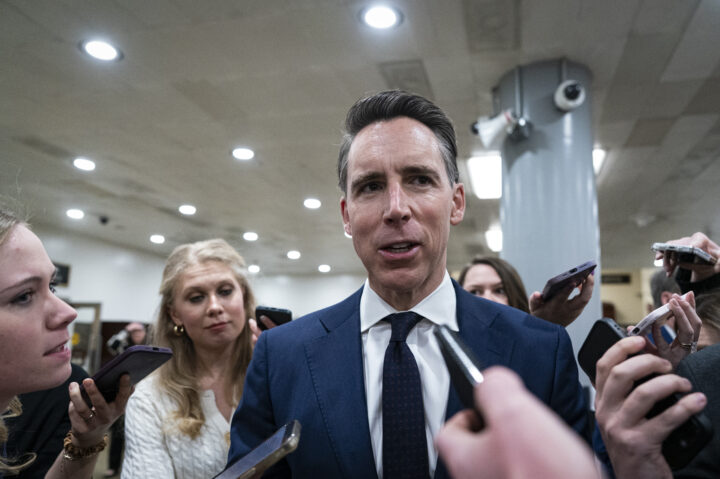
Sen. Josh Hawley (R-MO) speaks to reporters prior to the Senate Republicans weekly policy luncheon, in the US Capitol on March 25, 2025 in Washington, DC.
Both of Missouri’s Republican senators, Josh Hawley and Eric Schmitt, argued that the administration seems to have largely achieved its key objectives for the war in Iran — a posture that distinguishes him from most GOP colleagues and highlights subtle but emerging divisions among Republicans on the proper scope and duration of the war.
Pointing to comments by President Donald Trump saying that the war was substantially complete and that the U.S. had achieved its objectives, Hawley said on Fox News earlier this week, “I agree with what the president said last night. You look at all the success that we’ve had in the last 10 days. I mean, this thing is a victory. I think we should be hailing our military. We ought to be saying we’ve achieved our objectives here. … If this isn’t success, I don’t know what would be. … Now it’s time to declare victory.”
He also posited that Iran has nothing remaining with which to reconstitute its nuclear program — though the regime maintains a stockpile of enriched nuclear material which many experts argue cannot be fully secured without some form of on-the-ground presence.
Continuing a trend of making contradictory comments on the war’s timeline, Trump had said the same day that the U.S. could and would go much further in Iran, and that the U.S.’ aims could expand significantly.
Asked by Jewish Insider on Thursday about the metrics by which he was judging the success of the war, Hawley — who is one of the more prominent senators from the populist wing of the GOP — said he was referring to Trump’s own comments on the subject.
“I assume our overriding national security objective when it comes to Iran is to prevent them from getting nukes. And between our bombing last June and in the last … 12 days, I don’t know how they’re going to reconstitute their nuclear program anytime in, maybe, our lifetimes,” Hawley said.
“Our military has done an amazing job. I think it’s been an overwhelming display of force,” Hawley continued. “I know my Democrat colleagues, a bunch of them are saying, ‘This has accomplished nothing, nothing’s happened.’ It seems to me a lot has happened. And I think we should say that’s a good thing.”
Pressed on whether the war can be ended while Iran continues to fire missiles and drones at countries throughout the Middle East and is dropping mines in the Strait of Hormuz, Hawley said he would defer to Trump’s judgement on when to end the war.
“My point is just that I think the military has achieved a tremendous amount. It has ended [Iran’s] nuclear program for all intents and purposes. It has destroyed their navy. It has eliminated most of their ballistic missiles — those are good things,” he continued. “I’d be glad to take that [win].”
“Seems pretty good to me,” Hawley added.
Schmitt, who is also aligned with the populist wing of the party, likewise emphasized the progress the U.S. has made and pushed for a quick conclusion to the war.
“I know they’re way ahead of schedule. I’d look for a swift end to it,” Schmitt told JI. “I’m not interested in forever war in the Middle East, I don’t think the president is either. And I think that, again, they’ve laid out clear objectives and [are] making a lot of progress.”
Other Republicans are taking a distinctly different approach. Sen. Kevin Cramer (R-ND) told reporters on Thursday that “victory isn’t determined by declaration, it’s determined by the outcome.” He argued that the U.S. can’t and shouldn’t end the war prematurely.
“If you pull 90% of the weeds of our garden and you leave 10%, you’re going to have a weedy garden,” Cramer continued. “The last 10% are the hardest, in many cases.”
The North Dakota senator, who sits on the Senate Armed Services Committee, expressed surprise that the U.S. had not been better prepared to secure the Strait of Hormuz, calling it a potential “miscalculation” and saying that the attacks on ships in the critical waterway “could have been avoided.”
Sen. Lindsey Graham (R-SC), one of the most vocal supporters of the Iran war on Capitol Hill, said that he thinks there are “weeks more of this coming.”
“I don’t see this conflict ending today. I think the mission is to make sure they cannot regenerate, that they’re going to be beyond capable of building missiles to hit us, and they’ll never go back to the nuclear business,” Graham continued.
Also on Thursday, in a rare Senate floor speech, Sen. Mitch McConnell (R-KY), emphasized that the war against Iran cannot be decoupled from the global axis, including Russia and China, with which Iran is aligned.
Russia, McConnell emphasized, has reportedly been providing Iran with targeting intelligence. He criticized Special Envoy Steve Witkoff, who said earlier this week that he takes Russia at its word that it has not been doing that.
“I’ve warned successive presidents to take the Russian-Iranian axis, actually, more seriously,” McConnell said. He emphasized the supportive role that Ukraine has taken in helping to protect the U.S.’ allies in the Gulf, and criticized administration officials for not moving more quickly in pre-war discussions to acquire Ukrainian anti-drone technology.
He also urged lawmakers who oppose the war to nonetheless support an expected request for supplemental military funding as “an overdue opportunity to invest in urgent and strategic defense priorities.”
Plus, Ro Khanna defends Hasan Piker amid Mich. attack

Emily Elconin/Getty Images
Law enforcement respond near Temple Israel following reports of an active shooter on March 12, 2026 in West Bloomfield, Mich.
This P.M. edition is reserved for our premium subscribers — offering a forward-focused read on what we’re tracking now and what’s coming next. Please don’t hesitate to share your thoughts and feedback by replying to this email.
📡On Our Radar
Notable developments and interesting tidbits we’re tracking
A suspect was killed during an active shooter and car ramming incident at Temple Israel in the heavily Jewish Detroit suburb of West Bloomfield Township, Mich., this afternoon, Jewish Insider’s Haley Cohen reports.
Armed synagogue security engaged the suspect with gunfire, and a security guard who was knocked unconscious is expected to recover. A preschool that was in session at the time of the incident was evacuated safely. Authorities are continuing to investigate the suspect’s identity and motive.
“Everyone is safe. All 140 students in our Susan and Harold Loss Early Childhood Center, our amazing staff, our courageous teachers, and our heroic security personnel are all accounted for and safe,” the synagogue wrote on social media. “This note is coming to you before we know anything about our future programming or services, or any investigation. We wanted you to know we are safe, and we love you all”…
Mojtaba Khamenei, Iran’s new supreme leader, issued his first public statement today that indicates he’s as hard-line as his late father: Khamenei demanded the U.S. shut all its military bases in the Gulf immediately and said he’ll continue to target the Strait of Hormuz in order to “pressure the enemy.” His statement was read on state media indirectly by a presenter, as reports indicate the 56-year-old was injured in an Israeli strike and he has not been seen in public since.
President Donald Trump did not seem dissuaded — he posted on Truth Social, “when oil prices go up” the U.S. makes “a lot of money,” but “of far greater importance to me, as President, is stopping an evil Empire, Iran, from having Nuclear Weapons”…
Following a Republican convening this week focused on combating right-wing antisemitism, the center-left think tank Third Way urged fellow Democrats to follow the lead of Sen. Ted Cruz (R-TX) in calling out antisemitism within their own party.
“We certainly believe that Cruz was right and our side has a real antisemitism problem too that too many Democrats are failing to face squarely,” Matt Bennett, the group’s executive vice president for public affairs, told JI’s Gabby Deutch.
Similar comments from Third Way staff sparked a public clash with Rep. Ro Khanna (D-CA), who defended controversial left-wing figures including antisemitic streamer Hasan Piker and said the true issue lies with the “neocons” in the party…
Less than a week until primary election day in Illinois’ 9th Congressional District, outside spending in the race is approaching $9 million, the majority of which is aimed at boosting state Sen. Laura Fine, a pro-Israel Democrat. Nearly half of all outside spending has come from the Elect Chicago Women super PAC, widely rumored to be connected to pro-Israel groups.
Another PAC rumored to be connected to AIPAC, Chicago Progressive Partnership, has spent over $1 million attacking anti-Israel social media influencer Kat Abughazaleh, including a new ad that spotlights her support from James “Fergie” Cox Chambers Jr., a communist political activist and scion of the billionaire Cox family often involved in radical-left causes…
A new poll commissioned by the far-left advocacy group Justice Democrats finds Rep. Steve Cohen (D-TN) in a competitive race for his seat — he’s now neck-and-neck with his primary opponent, state Rep. Justin Pearson. Pearson, a progressive legislator, gained public attention for being expelled from the Statehouse in 2023 for participating in a gun control protest on the floor…
Former New York City Mayor Michael Bloomberg endorsed Assemblyman Micah Lasher, his former staffer, in the hotly contested primary race for New York’s 12th Congressional District today, calling him “a key part of our team in City Hall.” Bloomberg plans to spend “millions of dollars” on a super PAC and ad campaign to boost Lasher, The New York Times reports, a notable effort by the popular former mayor to elevate Lasher among the pack…
Trump has delayed endorsing Sen. John Cornyn (R-TX) in the Texas Senate runoff against Attorney General Ken Paxton, which Trump implied last week he would do imminently, instead using the potential endorsement to pressure Senate Republicans to change filibuster rules and pass his voter-ID bill. Paxton raised the stakes by saying he might drop out if the bill passes, a move that forced Cornyn to shift his stance on the filibuster…
The Boston Globe looks at Rep. Seth Moulton’s (D-MA) efforts to get on the Democratic primary ballot in his race against Sen. Ed Markey (D-MA), which will require him to receive support from 15% of delegates at the state Democratic Party’s upcoming convention. Moulton is attempting to recruit unregistered voters to become delegates in order to boost his chances, which observers are split on…
Politico uncovers the past political stances and writings of Morris Katz, the Democratic operative and anti-Israel whisperer now behind several high-profile progressive campaigns, when he lauded former New York Gov. Andrew Cuomo and derided progressive icon Sen. Bernie Sanders (I-VT)…
Shortly after the organization elevated a new political director who is closely tied to neo-Nazi Nick Fuentes, College Republicans of America’s chapter at Georgetown University came under investigation by the school for a social media post in which it claimed “Muslims have no place in American society”…
The Wall Street Journal spotlights Adm. Brad Cooper, commander of CENTCOM, as he “stay[s] out of the politics of the war” in Iran “and remains focused on waging it”…
The Treasury Department issued sanctions against four “sham charity” groups in Turkey and Indonesia that it said are funneling money and resources to Hamas’ military wing, JI’s Marc Rod reports…
⏩ Tomorrow’s Agenda, Today
An early look at tomorrow’s storylines and schedule to keep you a step ahead
Keep an eye out in Jewish Insider for reaction to today’s attack on Michigan’s Temple Israel from Jewish leaders and leading lawmakers.
The South by Southwest festival will hold its annual #openShabbat experience for Jews in tech, film and music tomorrow in Austin, Texas.
A Saturday fundraiser for Rep. Zach Nunn (R-IA) with an appearance by Defense Secretary Pete Hegseth in Nunn’s home district in Iowa has been canceled; the event, called “Top Nunn” in reference to the “Top Gun” movies, had drawn scrutiny after several soldiers who had been stationed in Nunn’s district were killed in the course of the war with Iran.
The Jewish Funders Network international conference starts Sunday in San Diego.
HaZamir: The International Jewish Teen Choir performs at Lincoln Center in New York City on Sunday evening.
The Zionist Organization of America will host its Florida Superstar Gala Sunday evening, where it will honor Pastor John Hagee, founder of Christians United for Israel; Justice Department official Leo Terrell; and Rep. Randy Fine (R-FL), among others.
We’ll be back in your inbox with the Daily Overtime on Monday. Shabbat Shalom!
Stories You May Have Missed
POLITICAL TIGHTROPE
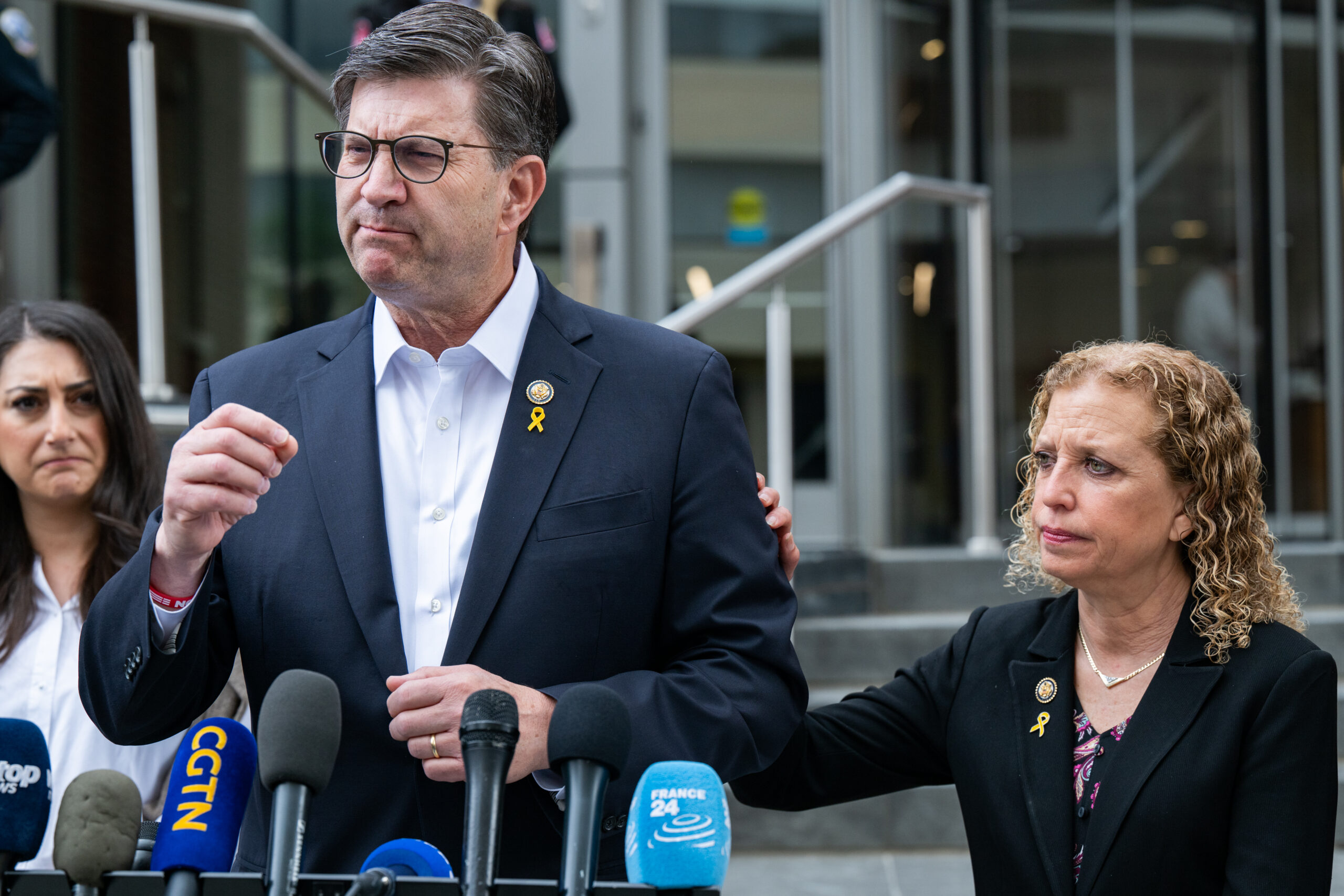
Rep. Debbie Wasserman Schultz said she would likely have voted to authorize force against Iran if the administration had approached Congress properly before launching the war
FEELING THE HEAT
Republican senators argued to JI that the war will ultimately be to the Gulf’s benefit, even if they’re feeling the pain now
Plus, Israel strikes back after 200-missile Hezbollah barrage

Zach D Roberts/NurPhoto via Getty Images
Nick Fuentes, the leader of a Christian based extremist white nationalist group speaks to his followers in Washington D.C. on November 14, 2020
👋 Good Thursday morning!
In today’s Daily Kickoff, we look at the ties between neo-Nazi influencer Nick Fuentes and Kai Schwemmer, the newly named political director of College Republicans of America, and spotlight the pro-Israel positions taken by Clay Fuller, who is expected to succeed Rep. Marjorie Taylor Greene following next month’s runoff in Georgia. We report on the escalation between Israel and Hezbollah following the terror group’s launching last night of 200 missiles at Israel, and look at the degree to which the United Arab Emirates is absorbing much of Tehran’s missile and drone attacks. Also in today’s Daily Kickoff: Howard Schultz, Adm. Brad Cooper and Dorothy McAuliffe.
Today’s Daily Kickoff was curated by JI Executive Editor Melissa Weiss and Israel Editor Tamara Zieve, with assists from Danielle Cohen-Kanik and Marc Rod. Have a tip? Email us here.
What We’re Watching
- The Senate Health, Education, Labor and Pensions Committee is holding a hearing this morning on the influence of foreign funding in higher education. National Association of Scholars President Peter Wood, Foundation for Defense of Democracies Senior Fellow Craig Singleton and The Asia Society’s Robert Daly are slated to testify.
- The annual weeklong SXSW festival kicks off today in Austin, Texas. Mahmoud Khalil, the controversial former leader of Columbia’s anti-Israel protest movement who is facing possible deportation over his activities, will, according to the festival schedule, participate in a conversation this weekend “on the cost of dissent,” alongside his lawyer and The Guardian’s Betsy Reed. More below.
- First in JI: The Republican Jewish Coalition is set to announce endorsements of 16 House Republicans running for reelection, mostly in swing districts: Reps. Tom Barrett (R-MI), Rob Bresnahan (R-PA), Juan Ciscomani (R-AZ), Gabe Evans (R-CO), Brian Fitzpatrick (R-PA), Tom Kean Jr. (R-NJ), Mike Lawler (R-NY), Ryan Mackenzie (R-PA), Mariannette Miller-Meeks (R-IA), Zach Nunn (R-IA), David Valadao (R-CA) and Derrick Van Orden (R-WI).
- RJC also endorsed the four incumbent Jewish House Republicans: Reps. David Kustoff (R-TN), Max Miller (R-OH), Randy Fine (R-FL) and Craig Goldman (R-TX) — the largest group of Jewish Republicans in the House since the 1980s, Jewish Insider’s Marc Rod reports.
What You Should Know
A QUICK WORD WITH JI’S MATTHEW KASSEL
In a low-profile electoral upset that defied the difficult national political environment facing the GOP, a Republican candidate declared victory this week in a down-ballot race for a seat on the Prince William Board of County Supervisors in Virginia — for the first time in nearly 40 years.
But while Republicans are now rejoicing over their narrow win, it otherwise largely demonstrated how Democratic leaders effectively sacrificed the seat to the GOP rather than elevate an extremist member of their own party who had claimed the nomination.
The result underscored the extent to which local Democrats had swiftly mobilized to oppose their own nominee, Muhammed Casim, who faced backlash over a series of recently uncovered past social media comments in which he used racist, misogynistic and antisemitic language. The posts, written more than a decade ago, used the n-word as well as demeaning rhetoric targeting women. He also accused Israel of genocide and promoted a conspiratorial post about U.S. financial assistance to the Jewish state, among other extreme comments.
More broadly, the outcome is an atypical example of how the Democratic Party worked to meaningfully confront extremism within its own ranks, even if its efforts came at the expense of an easily winnable local seat that instead flipped to Republicans for the first time in decades.
Casim apologized for his comments but refused bipartisan calls to drop out of the race, which had motivated a Democratic challenger to launch a write-in campaign that ultimately helped siphon votes away from his embattled bid. He lost to Republican Jeannie LaCroix by a margin of 258 votes. Write-in candidates pulled in 744 votes — a relatively sizable total that appeared to have made a difference in the closely contested race.
“Opposing antisemitism, racism or misogyny isn’t a partisan position,” Marc Broklawski, a Jewish vice chair of the Virginia Democratic Party, told Jewish Insider on Wednesday. “It’s a floor, not a ceiling, and the least we should expect from any party, official candidate or voter. When Democrats hold that floor even when it’s costly, that’s something to be proud of. When we don’t, voters notice that too.”
NORTHERN FRONT
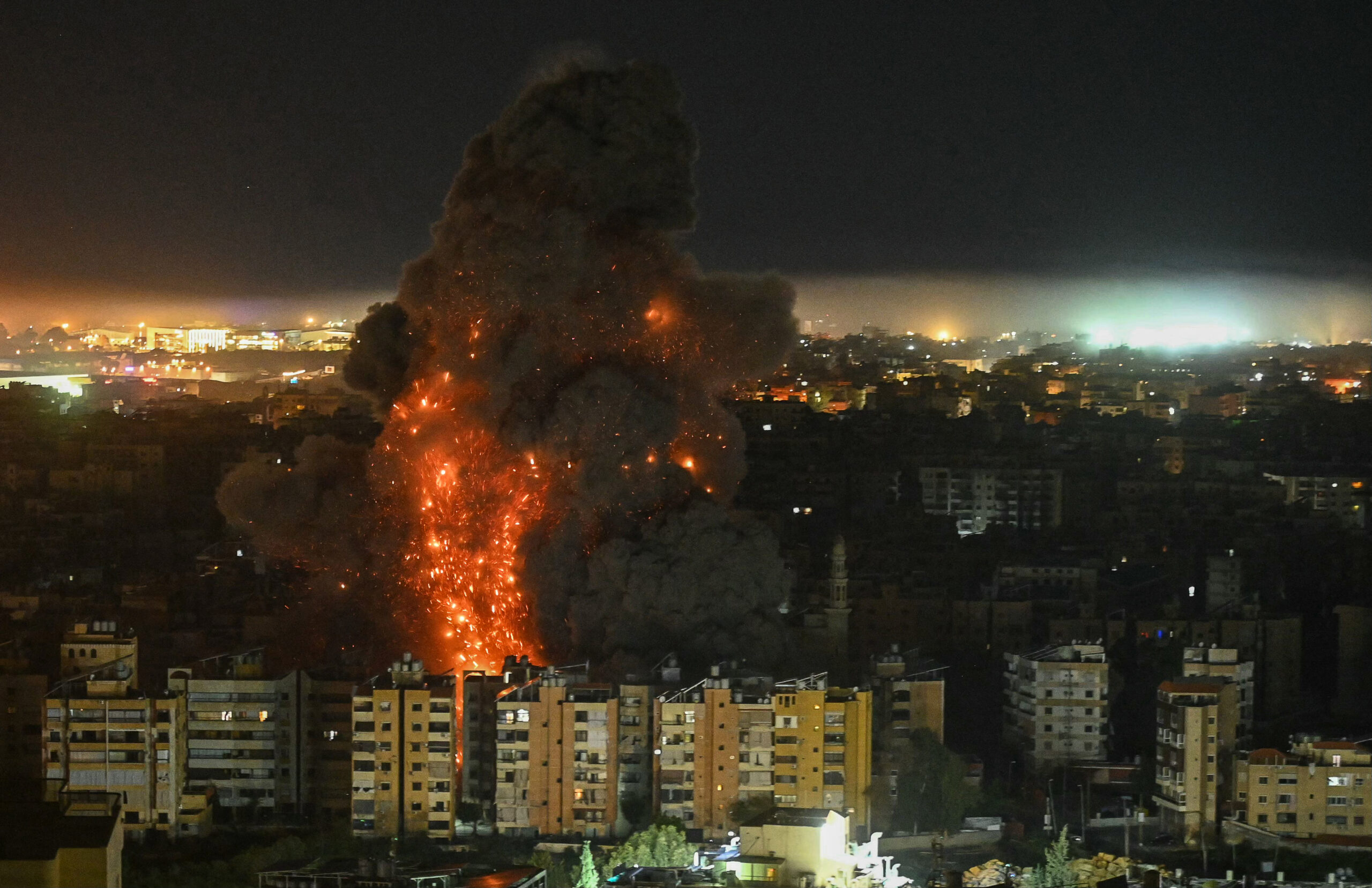
Israel continued extensive strikes on Lebanon on Thursday morning, after Hezbollah shot about 200 projectiles at northern Israel the night before. About 120 of the rockets and missiles crossed from Lebanon into Israel during the Wednesday night barrage, with those not intercepted mostly striking Israel’s north, Jewish Insider’s Lahav Harkov reports.
State of play: The Magen David Adom emergency service treated two individuals with mild injuries following the missile fire from Lebanon. A home, with the exception of its safe room, was destroyed, and two others were damaged in Moshav Haniel in Emek Hefer, a region of Israel 70 miles from the Lebanon border. Soon after, Iran launched missiles at Israel, a move officials said likely indicated that the two Wednesday night barrages were coordinated between Tehran and Beirut. A senior Israeli official briefed the media on Thursday morning that a significant expansion of operations in Lebanon would soon take place, but did not say whether that would include a broad ground invasion.
Bonus: In Al Arabiya, former White House Middle East envoy Jason Greenblatt calls on Beirut to decisively crack down on and disarm Hezbollah, arguing that the Iranian proxy is at a particularly weak moment: “The aura of invincibility that Hezbollah cultivated for decades has faded. The pillars that sustained Hezbollah for years, money from Tehran, military dominance and political intimidation, have dramatically weakened.”
CAMPUS CONTROVERSY

Some pro-Israel conservative students are voicing concern over the College Republicans of America’s new political director, citing his ties to neo-Nazi influencer Nick Fuentes as evidence of the party’s increasingly “alarming” shift towards extremism, Jewish Insider’s Haley Cohen reports. Kai Schwemmer was tapped last week as political director of the campus group, which has grown to more than 200 active chapters across U.S. universities since it was established in 2023 as an offshoot from the College Republican National Committee.
Friend of Fuentes: Schwemmer, known on social media as Kai Klips, has a channel on Fuentes’ invitation-only streaming platform Cozy, which he launched with far-right conspiracy theorist Alex Jones. Schwemmer appeared in a 2021 video promoting Fuentes’ “White Boy Summer” tour and was featured as a “special guest” at Fuentes’ 2022 APFAC III conference, the progressive advocacy organization People for the American Way reported. Schwemmer has also been outspoken about his affiliation with Fuentes’ political movement, “America First.” “It’s alarming but not surprising,” College Republicans of America would select a Fuentes ally as its leader, Felipe Avila, a senior studying nursing at Catholic University of America, who identifies as conservative, told JI.
FRESH PERSPECTIVE
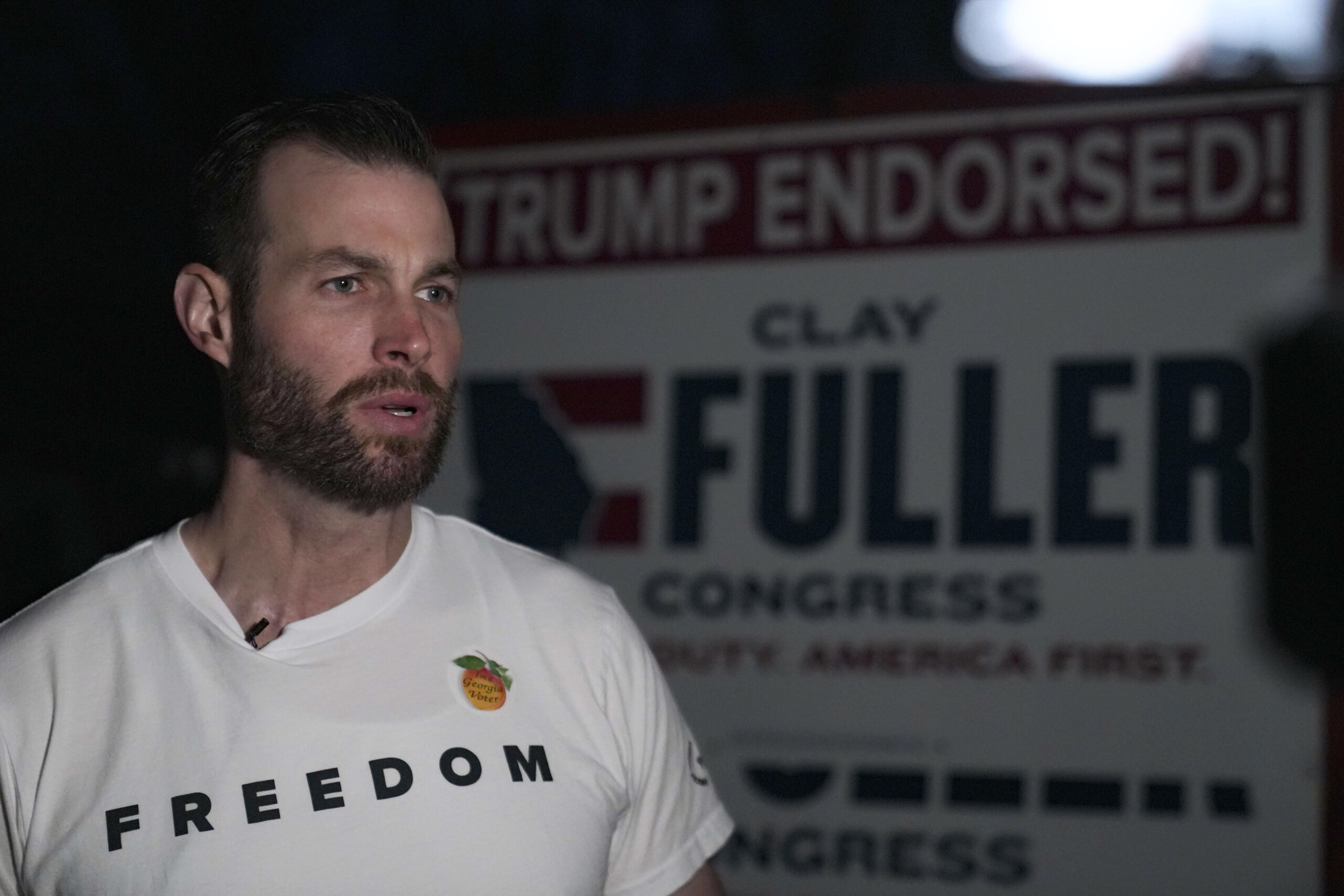
Clay Fuller, a veteran and district attorney, is expected to succeed former Rep. Marjorie Taylor Greene (R-GA) in the House, bringing a pro-Israel voice to replace one of the House’s most anti-Israel Republicans, Jewish Insider’s Marc Rod reports. Fuller led all Republicans on the all-party primary ballot in Georgia’s 14th Congressional District, winning 35% of the vote. Even though he finished narrowly behind Democrat and military veteran Shawn Harris, the Republican vote is likely to consolidate behind Fuller in next month’s runoff election.
Fuller’s positions: Fuller has expressed support for Israel and for the U.S. strikes on Iran. “President Trump tried the peace route with Iran not once, not twice, but THREE separate times — and they refused. He’s the peace President, but you can’t negotiate with a death cult,” Fuller said in a post on X last month, emphasizing he had supported operations against Iran during his time in the military and that the regime and its proxies had killed many Americans. The day after Hamas’ Oct. 7, 2023, attacks on Israel, Fuller blasted the Biden administration for unfreezing $6 billion in Iranian funds as part of an earlier hostage deal, highlighting Iran’s support to Hamas.
President’s pitch: President Donald Trump ripped into Rep. Thomas Massie (R-KY) during a campaign rally in Hebron, Ky., on Wednesday to support Ed Gallrein, his endorsed candidate to take on the incumbent, describing Massie as “disloyal,” a “loser,” the “worst person” and a “disaster as a congressman,” JI’s Emily Jacobs reports.
ON THE TRAIL
Remarks by pro-Israel stalwarts Reps. Debbie Wasserman Schultz (D-FL) and Brad Schneider (D-IL) on a Jewish Democratic Council of America webinar on Wednesday highlighted the delicate line that some pro-Israel Democratic lawmakers are walking on the war in Iran, Jewish Insider’s Marc Rod reports.
Notable quotable: “I can tell you assuredly: had I been presented with an Authorization for Use of Military Force, that made sense, and that we were properly briefed, and there was a demonstrative, imminent threat — which we have really yet to be shown — I am someone on our side of the aisle that likely would have voted for an AUMF if all of those things were in place,” Wasserman Schultz said. “Instead, [President Donald Trump] has blown an opportunity to go in in the most prepared way. … I have been careful about just blanket-ly condemning everything [Trump is] doing here, but most certainly, the way that we got into this was really unacceptable, and my constituents are very concerned.”
Friendly fire: A former top Obama administration foreign policy official said on Wednesday that any Democratic lawmakers who vote to support U.S. strikes on Iran should be primaried. “If you vote for the funding of this war, you should be primaried. I don’t want you in the Democratic Party,” said Ben Rhodes, co-host of the “Pod Save the World” podcast and former deputy national security advisor under President Barack Obama, JI’s Gabby Deutch reports.
CENTER STAGE
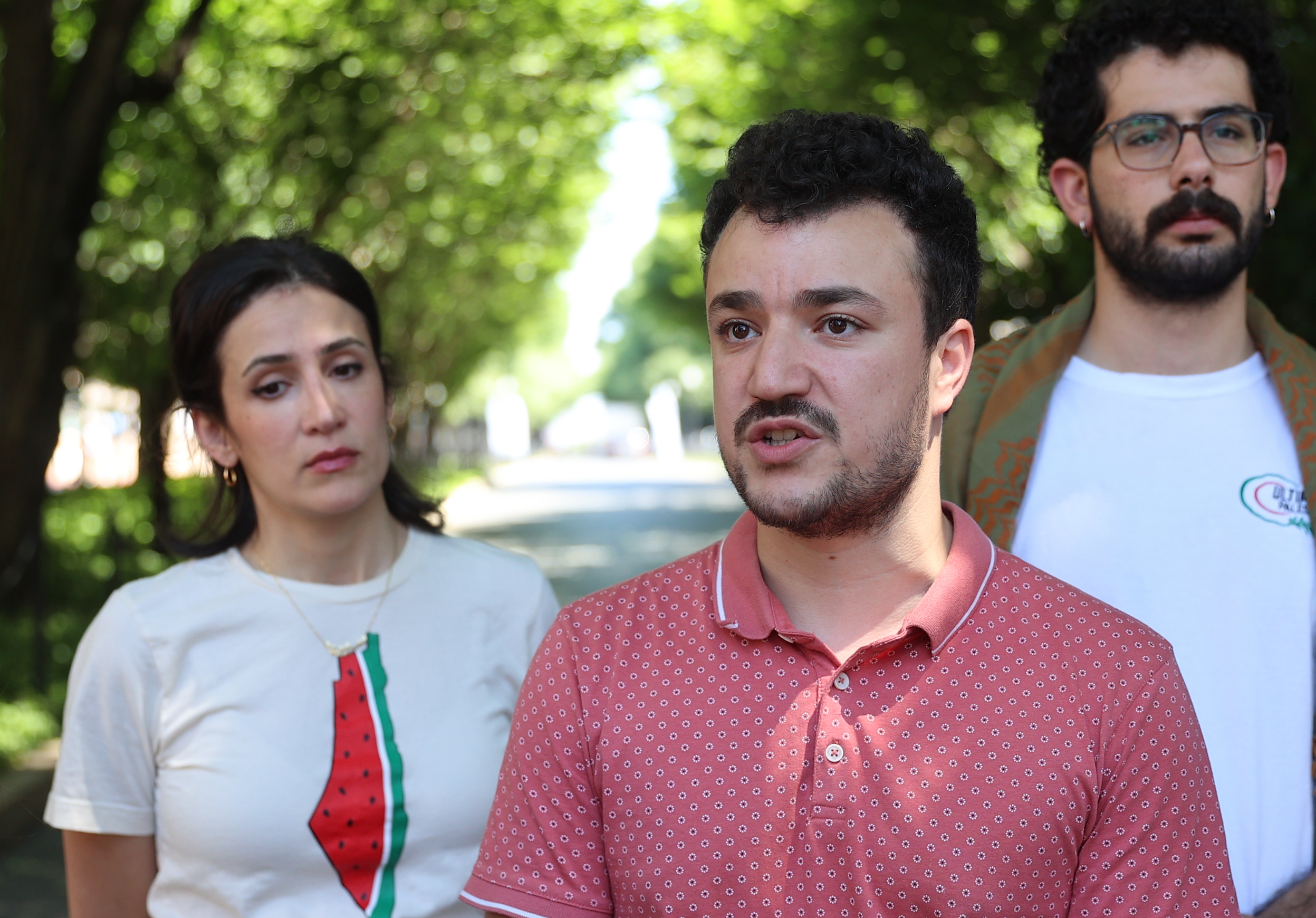
Columbia University anti-Israel protest leader Mahmoud Khalil is scheduled to speak at this week’s annual South by Southwest (SXSW) festival in Austin, Texas, Jewish Insider’s Haley Cohen reports. Khalil will participate on Sunday in a conversation “on the cost of dissent,” with The Guardian Editor Betsy Reed and Baher Azmy, legal director of the Center For Constitutional Rights who was a lawyer for Khalil in his deportation proceedings, according to the SXSW schedule.
Details: The weeklong festival each March convenes around 300,000 guests, including film and media professionals, executives and politicians to discuss culture, technology and innovation. “Khalil joins The Guardian for an unflinching conversation on his ordeal, the system that tried to silence him, and the personal and political stakes of resistance,” SXSW’s website states. At Columbia, Khalil was a key organizer of the anti-Israel encampment in April 2024, a two-week demonstration in the center of campus during Israel’s war in Gaza.
FEELING THE HEAT
As Iran retaliates against the U.S. and Israel’s joint military campaign, findings have revealed that the United Arab Emirates — not Israel — has thus far faced the majority of Tehran’s missile and drone attacks, Jewish Insider’s Matthew Shea and Marc Rod report. As of March 11, the UAE’s Ministry of Defense reported that its air defenses had “engaged” 268 ballistic missiles, 15 cruise missiles and 1,514 UAVs.
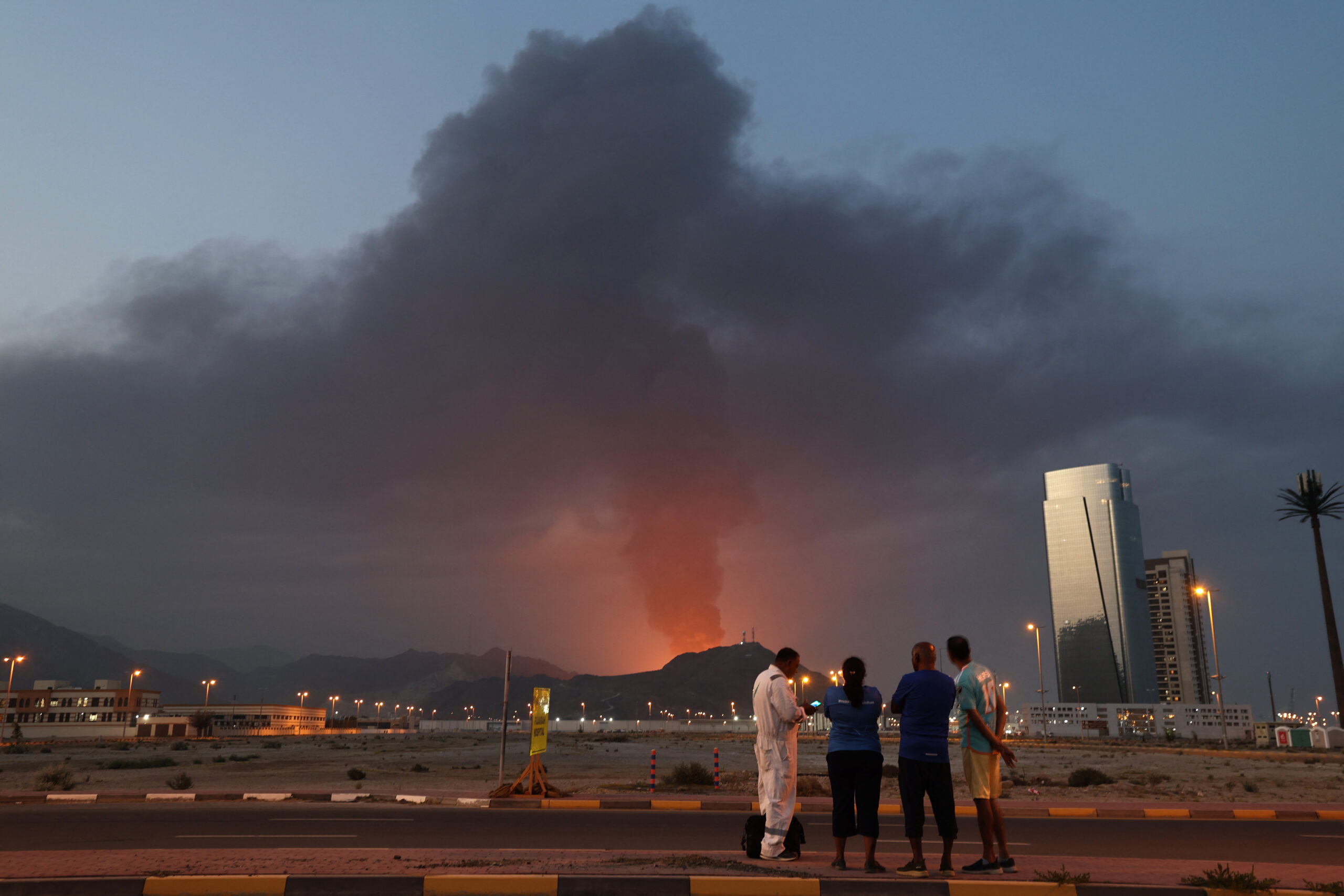
Bearing the brunt: Iranian strikes have targeted American assets in the country, such as the U.S. consulate in Dubai, but also a range of civilian targets, including Dubai International Airport, where a drone attack wounded four people. Reports have indicated that Abu Dhabi has faced more than three times the number of Iranian drones and missiles launched toward Israel. The attacks come as Gulf allies are running short on missile interceptors. Sens. Mike Rounds (R-SD) and Rick Scott (R-FL) argued to JI on Wednesday that, ultimately, the U.S. campaign against Iran will be to the benefit of the UAE and other Gulf allies, even if they’re feeling pain in the short term.
Winds of change: Despite Qatar’s anger with Iran over the regime’s continued attacks on its territory and civilian infrastructure, experts are divided over whether the conflict will ultimately force Doha to reconsider its long-standing policy of hosting Iranian-backed Hamas officials, JI’s Matthew Shea reports.
Worthy Reads
The War on Antisemitism: In Time, State Department antisemitism envoy Rabbi Yehuda Kaploun explains the Trump administration’s approach to fighting antisemitism. “Antisemitism proliferates from an ever-multiplying list of sources: voices from all sides of the political spectrum spew antisemitic rhetoric; foreign terrorist organizations espouse violent antisemitic ideologies; and online radicalization increasingly incites real-world antisemitic attacks against Jewish individuals and institutions globally.” [Time]
This War Has Roots: In The Washington Post, Geoffrey Corn and Orde Kittrie argue that the U.S.-Israeli war against Iran is a continuation of hostilities that have been ongoing for years. “International law does not require a distinct self-defense justification for every attack conducted once the right of self-defense is triggered. Once that right is initiated, military action is justified to achieve the overall self-defense objective, in this case terminating Iran’s capacity to strike the United States and its allies. … These facts justify the conclusion that the U.S. and Iran were already engaged in an armed conflict when the current round began. As a result, international law does not require the U.S. to refrain from further military action against Iran until just before the IRGC launches another assault.” [WashPost]
Risk Assessment: The Wall Street Journal‘s Yaroslav Trofimov looks at the risks Washington and American allies face if the war ends with the Iranian regime intact. “But leaving in place Iran’s theocratic regime — angry, defiant and in possession of its nuclear stockpile and what remains of its arsenal of missiles and drones — would essentially grant Tehran control over the world’s energy markets. It would also sacrifice the security of America’s partners and allies, and possibly make another, more devastating, regional war likely.” [WSJ]
Get Out of Jail Free: The Atlantic’s Graeme Wood considers the utility of former Iranian President Mahmoud Ahmadinejad, who has evolved from being the face of the Islamic Republic to an opponent of the regime and was rumored to have been killed by Israel early in the war. “ Contrary to early reports, Ahmadinejad is alive, his associates say. … The circumstances of his survival may prove significant as the war drags on. Whatever the intent, Ahmadinejad’s associates say the strike was in effect a jailbreak operation that freed the former president from regime control. Their description of the chaotic sequence of events that began before the war suggests that Ahmadinejad has friends on the outside.” [TheAtlantic]
Word on the Street
President Donald Trump announced his endorsement of Brandon Herrera, the far-right social media influencer who is the presumptive Republican nominee in Texas’ 23rd Congressional District, following Rep. Tony Gonzales’ (R-TX) announcement that he was dropping his reelection bid, Jewish Insider’s Marc Rod reports…
The Cook Political Report moved the Pennsylvania governor’s race from “Likely Democrat” to “Solid Democrat,” citing Pennsylvania Gov. Josh Shapiro’s 60% approval rating, cash on hand and significant polling lead over his Republican challenger, state Treasurer Stacy Garrity…
Dorothy McAuliffe, the wife of former Virginia Gov. Terry McAuliffe, announced her bid for Congress in a potential new district that is expected to favor Democrats, the status of which will be determined in a statewide vote next month…
Nearly all Senate Democrats wrote to Secretary of Defense Pete Hegseth on Wednesday to raise “grave concern” about a strike on a girl’s school that killed at least 168 people in the opening phase of the U.S.-Israeli war on Iran, Jewish Insider’s Marc Rod reports…
The letter came amid findings from a preliminary U.S. military investigation indicating that the U.S. was at fault for the bombing, which took place on the same block as a number of buildings used by the Islamic Revolutionary Guard Corps…
Federal and state officials in California sought to assuage concerns after the FBI’s Los Angeles division sent out a bulletin that Iran could conduct retaliatory drone attacks on the West Coast, with a law-enforcement official telling CBS News that there was no credible intelligence that prompted the bulletin, which had predated the Iran war…
The Department of Justice is probing Iran’s use of Binance to evade U.S. and international sanctions after an internal investigation at the cryptocurrency company found that the platform had been used to funnel more than $1 billion to terror proxies…
The New York Times reports on Iran’s use of cluster bombs to strike Israel in violation of international law…
The Swiss Embassy in Tehran, which has historically served as an interlocutor for U.S. interests in the Islamic Republic, announced it is temporarily closing, citing “the war in the Middle East and the increasing security risk,” but “will continue to maintain an open line of communication” between Washington and Tehran…
The Wall Street Journal spotlights CENTCOM head Adm. Brad Cooper, whom associates described as “thoughtful, decisive and cool under pressure” as he leads U.S. operations in the Middle East…
Yeshiva University is establishing the first new dental school in Manhattan in more than a century, with plans to enroll 150 students in an accelerated three-year program on its Midtown Manhattan campus…
Starbucks owner Howard Schultz became the latest executive to relocate to South Florida, purchasing a $44 million penthouse in Surfside, Fla….
The California Department of Education filed a lawsuit against the Oakland Unified School District, alleging that administrators failed to address “pervasive antisemitism” in schools in the Bay Area district following a directive in January to do so…
A judge in the U.K. tossed out the government’s appeal of a court ruling dismissing its case against Irish band Kneecap over a group member’s support for Hezbollah; the lower court had dismissed the case over a governmental procedural error…
Google completed its $32 billion purchase of Israeli cybersecurity startup Wiz, started in 2020 by Unit 8200 veterans Assaf Rappaport, Yinon Costica, Ami Luttwak and Roy Reznik; the deal marks the largest purchase of an Israeli-founded company in nearly a decade…
Iran’s sports minister said that the Islamic Republic’s national soccer team could not play in this summer’s World Cup, a number of games of which are being played in the U.S….
Spain is permanently withdrawing its ambassador from Israel, months after Ambassador Ana Maria Salomon Perez was recalled to Madrid; the country’s embassy in Israel going forward will be led by a charge d’affaires…
Bloomberg looks at Israeli efforts to establish an intelligence base on the coast of Somaliland months after Israel became the first country to formally recognize the African nation, which is separated from the Yemen-based Houthis by the Gulf of Aden…
Axios reports on the role that hackers are increasingly playing in the war between the U.S., Israel and Iran, following a cyberattack on Wednesday targeting the U.S.-based medical device company Stryker that disabled employees’ phones and laptops…
The Qatari-backed Irth Capital Management submitted a bid to take over Papa Johns, in a deal that would give the pizza chain a $1.5 billion valuation…
Bernard Haykel is joining the Foundation for Defense of Democracies as a senior fellow…
Angelika Saleh, the namesake of the Angelika Film Center, which she opened in 1989 with her then-husband, Joseph Saleh, died at 90…
Pic of the Day

UJA-Federation of New York announced last night it was committing $1.3 million to build the Shalva Sharabi Family Center in Ashkelon, Israel, a new center dedicated in memory of the wife and daughters of former hostage Eli Sharabi, who were killed during Hamas’ Oct. 7, 2023, attacks. The pledge for the center, which will support individuals with disabilities and trauma victims, was made at Shalva’s 36th anniversary gala, held at Gotham Hall in Manhattan, Jewish Insider’s Haley Cohen reports for eJewishPhilanthropy.
Birthdays
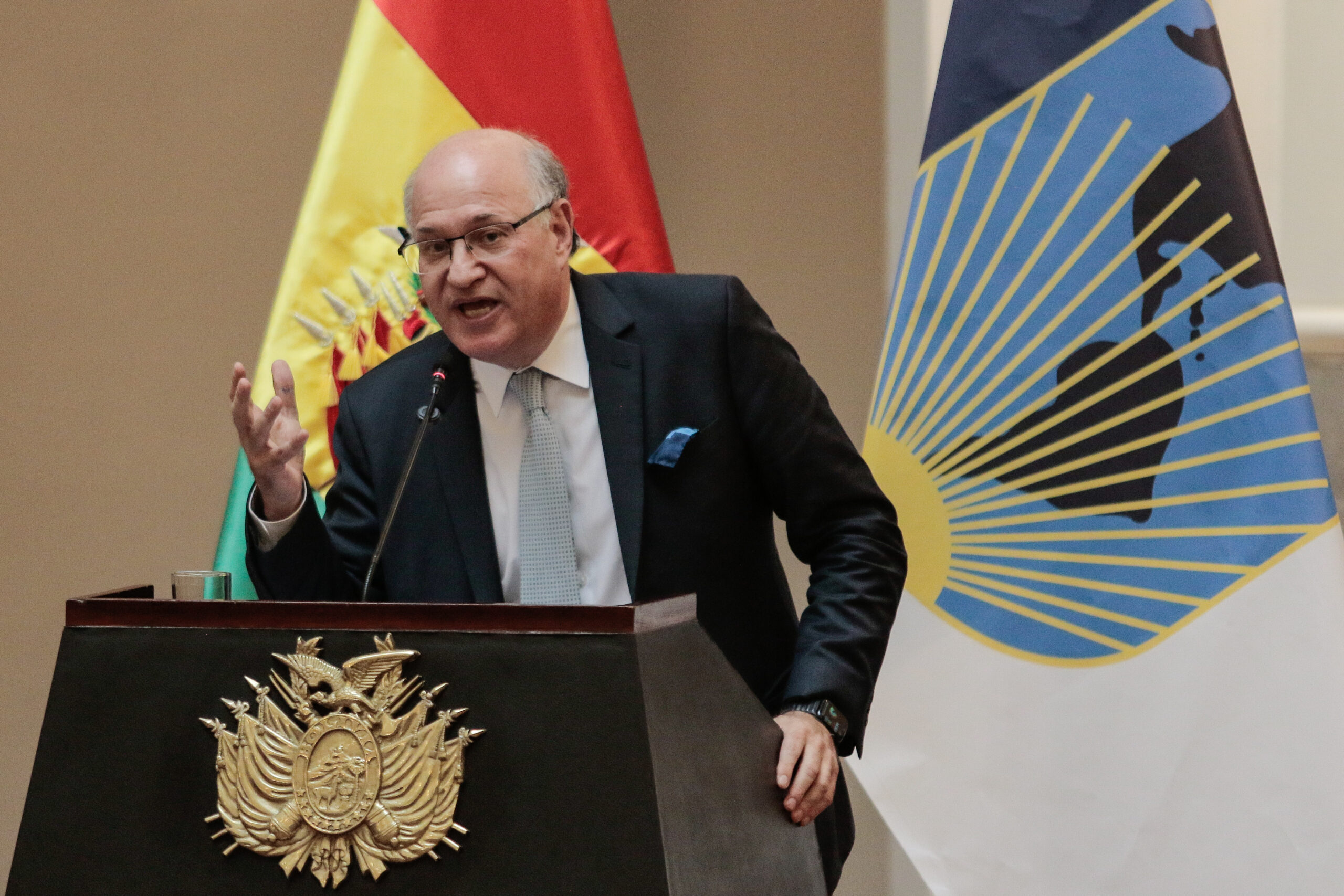
Born in Haifa, he served as president of the Central Bank of Brazil and is now president of the Inter-American Development Bank, Ilan Goldfajn turns 60…
Photographer, musician and author of 15 children’s books, Arlene Weiss Alda turns 93… Carol Margolis… Retired U.S. Sen. Mitt Romney (R-UT) turns 79… Director, producer and screenwriter of movies and television including directing the first of “The Fast and the Furious” film franchise, Rob Cohen turns 77… British sculptor, he won the 2017 $1 million Genesis Prize for “commitment to Jewish values, the Jewish community and the State of Israel,” Sir Anish Kapoor turns 72… Pitching coach who has worked for the Yankees, Reds, Braves, Marlins, Cubs and Padres, Larry Rothschild turns 72… Past president of AIPAC, he is the founder and CEO of R.A. Cohen & Associates, Robert A. Cohen… Former member of the Knesset for the Likud party, he is from the Israeli Druze community, Ayoob Kara turns 71… Founder of hedge fund Lone Pine Capital, Stephen Mandel turns 70… Sales representative at Paychex, Lynne Blumenthal… Director of constituency engagement at the United States Holocaust Memorial Museum, Diane Saltzman… Senior attorney in the D.C. office of Squire Patton Boggs, Stacey Grundman… Sportscaster for ESPN and a host of “SportsCenter,” Steve Levy turns 61… U.S. Sen. Tammy Duckworth (D-IL) turns 58… Chief Washington correspondent for CNN and co-host of the Sunday morning program “State of the Union,” Jacob Paul “Jake” Tapper turns 57… Founder and CEO at Miller Strategies, Jeff Miller… Israeli film and television actor, Tzachi Halevy turns 51… SVP of communications at the Alliance for Automotive Innovation, Brian T. Weiss… Founder and publisher of Fleishigs, a kosher food magazine, Shlomo Klein… Actor and comedian, Samm Levine turns 44… Writer, artist and social media personality, she is best known for her Daf Reactions series of videos explaining passages from the Talmud posted to TikTok, Miriam P. Anzovin… Senior public affairs specialist at the Association of American Medical Colleges, Talia Schmidt… Member of Congress (D-NY-15) since 2021, Ritchie Torres turns 38… Senior Middle East intelligence specialist at Vcheck, Aaron Magid… Founder and CEO of Serotonin and co-founder and president of Mojito, Amanda Gutterman Cassatt turns 35… CEO and co-founder of Wonder Media Network, Jennifer Manning Kaplan… Figure skater who won the 2016 World Junior championship, he competed for Israel at the 2018 Winter Olympics, Daniel Samohin turns 28… Israeli internet personality, model and singer, Anna Zak turns 25…
About 120 of the rockets and missiles crossed from Lebanon into Israel during the Wednesday night barrage, with those not intercepted mostly striking Israel’s north
FADEL itani/AFP via Getty Images
A fireball rises from the site of an Israeli airstrike that targeted an area in Beirut's southern suburbs overnight March 10 to 11, 2026.
Israel continued extensive strikes on Lebanon on Thursday morning, after Hezbollah shot about 200 projectiles at northern Israel the night before.
About 120 of the rockets and missiles crossed from Lebanon into Israel during the Wednesday night barrage, with those not intercepted mostly striking Israel’s north.
The Magen David Adom emergency service treated two individuals with mild injuries following the missile fire from Lebanon.
A home, with the exception of its safe room, was destroyed, and two others were damaged in Moshav Haniel in Emek Hefer, a region of Israel 70 miles from the Lebanon border.
Soon after, Iran launched missiles at Israel, a move officials said likely indicated that the two Wednesday night barrages were coordinated between Tehran and Beirut.
A senior Israeli official briefed the media on Thursday morning that a significant expansion of operations in Lebanon would soon take place, but did not say whether that would include a broad ground invasion.
Shortly after Wednesday night’s barrage began, the IDF announced “a large-scale wave of strikes on Hezbollah infrastructure in the Dahieh area of Beirut” while “interception efforts [were] ongoing.”
As part of that wave, the IDF struck 10 Hezbollah sites within 30 minutes, including an intelligence base and headquarters of the elite Radwan unit. On Thursday morning, the IDF reported launching 200 munitions from air and sea at 70 Hezbollah targets in Beirut.
“The Hezbollah terrorist organization has embedded its terrorist infrastructure in the heart of Beirut under the cover of the civilian population,” the IDF Spokesperson’s Office said.
IDF Spokesperson in Arabic Avichay Adraee posted evacuation warnings on social media throughout the night and morning. Over half a million residents of Lebanon have evacuated since Hezbollah joined the war on Iran’s side last week.
In addition, troops of the IDF’s Mountain Brigade operated in Lebanon near the border with Israel to locate and destroy rocket launchers and weapons storage facilities.
The IDF reported “a wide-scale wave of strikes in Iran” on Thursday. In addition, according to Israeli and other Middle Eastern media, Israeli drones have been striking checkpoints manned by Iranian paramilitary militia Basij. The checkpoints had been set up on central arteries throughout Iran to try to suppress an uprising and limit movement.
The IDF intercepted Iranian missiles headed for Jerusalem on Thursday.
In addition to the two mild injuries from Lebanese missiles, Magen David Adom treated 45 people who were injured on their way to shelters or suffered from anxiety on Wednesday.
Since the start of Operation Lion’s Roar, MDA reported 759 physical casualties, of which 169 were caused by missile fire, including 12 fatalities.
Iran struck an oil tanker off the coast of the United Arab Emirates on Thursday, the sixth such ship targeted in the Gulf over two days, after attacking two vessels in Iraqi waters overnight, killing one. Iranian drones struck an oil facility in Bahrain, an airport in Kuwait, an Italian military base in Iraqi Kurdistan and a tower in Dubai on Thursday morning. The Saudi Defense Ministry said it intercepted a UAV targeting an oil field.
Also Thursday, Israeli Education Minister Yoav Kisch said that schools in northern Israel and the coastal strip, including Tel Aviv, are not expected to reopen in the coming days, while in other areas, school may reopen gradually, starting Monday.
‘We don’t want to leave early. We want to finish the job and not have to return in two years,’ Trump said

Andrew Harnik/Getty Images
President Donald Trump speaks on stage at Verst Logistics on March 11, 2026 in Hebron, Kentucky.
President Donald Trump said on Wednesday that the United States has “won” the war in Iran, while warning that U.S. forces will continue the military operation until they “finish the job.”
Trump made the comments while discussing his administration’s efforts to reduce oil prices amid the war in Iran at a campaign rally in Hebron, Ky., on Wednesday to support Ed Gallrein, his endorsed candidate to take on anti-Israel and isolationist Rep. Thomas Massie (R-KY) in the contentious primary between the two men.
Trump noted that the International Energy Agency had “agreed to coordinate the release of a record 400 billion barrels of oil from various national petroleum reserves around the world, which will substantially reduce the oil prices as we end this threat to America and this threat to the world,” prompting him to then ask the crowd: “We don’t want to leave early, do we? We’ve got to finish the job.”
“After [Operation] Midnight Hammer [in June 2025], we left. We figured that’ll be the end of them for a while. But they started again. That’s why we gotta finish it,” Trump said. “We don’t want to go back every two years, and that’s because there will be some day when you don’t have me as president.”
“We’re not leaving until that job is finished, and it’s going to be very fast, but we’re not going to count on having competent presidents,” he continued.
The president ripped into Massie, who he described as “disloyal,” a “loser,” the “worst person” and a “disaster as a congressman” later on during his speech. Trump also touted Gallrein’s candidacy to represent Kentucky’s 4th Congressional District, describing the farmer and former Navy SEAL officer as “central casting” and a “tremendous war hero.” He also defended Gallrein’s decision to leave the GOP and register as an independent for a time because he returned to the party under the president’s leadership.
“He [Gallrein] said, ‘I came back because of the strength and wisdom that Donald Trump displayed, and I appreciate that,” Trump said. “Many people have joined and rejoined our party, but Massie did not, because he only votes no. He just votes no. Doesn’t matter. I could give him the best things in the history of a Republican voter, and he’d vote no. There’s something wrong with him.”
“We call him Rand Paul, Jr., he votes against everything. At least I like Rand a little bit,” referring to Sen. Rand Paul (R-KY), who frequently opposes the Trump administration on foreign policy.. “Rand votes against us all the time too, but at least he’s okay. I wouldn’t say the greatest.”
Massie broke with Trump throughout his first term, voting against the president’s priorities multiple times in Congress, though the two became serious political foes over the last year — after the Kentucky congressman voted against Trump’s tax cut legislation last year and began leading the charge to force the release of the Department of Justice’s files on the Jeffrey Epstein case. Their relationship deteriorated further as Massie became one of the most vocal GOP critics of Trump’s war in Iran.
Gallrein described Massie’s opposition to Trump’s actions in Iran as “unforgivable” in remarks to attendees at the rally.
“He’s even leading the Democrats to block the president while we are engaged in combat actions to save our nation and the world from the Iranians [getting] a nuclear weapon, while we have troops in harm’s way. Unforgiveable,” Gallrein said of Massie. “You deserve a congressman who stands united with you, the Republican Party and the president.”
Also in attendance were the leading candidates in the competitive GOP primary to replace retiring Sen. Mitch McConnell (R-KY) — former Kentucky Attorney General Daniel Cameron, pro-Trump businessman Nate Morris and Rep. Andy Barr (R-KY) — and boxer and influencer Jake Paul, whom Trump said he would endorse if Paul were to run for office.
Rep. Debbie Wasserman Schultz said she would likely have voted to authorize force against Iran if the administration had approached Congress properly before launching the war
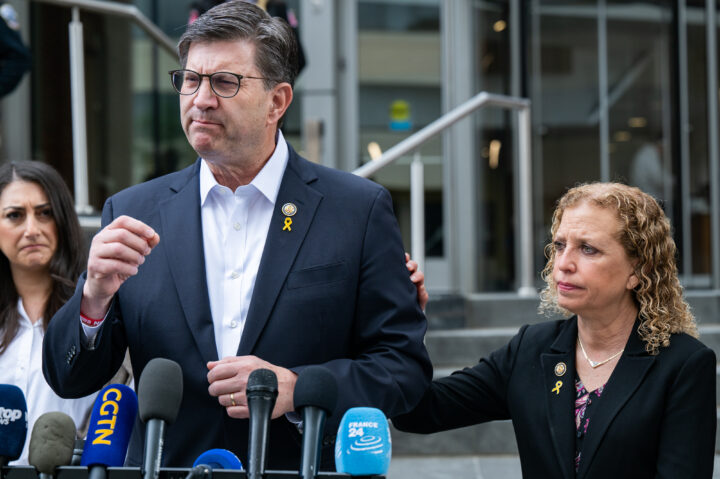
Annabelle Gordon/Bloomberg via Getty Image
Rep. Brad Schneider (D-IL) and Rep. Debbie Wasserman Schultz (D-FL), during a news conference in Washington, DC, US, on Thursday, May 22, 2025.
Remarks by pro-Israel stalwarts Reps. Debbie Wasserman Schultz (D-FL) and Brad Schneider (D-IL) on a Jewish Democratic Council of America webinar on Wednesday highlighted the delicate line that some pro-Israel Democratic lawmakers are walking on the war in Iran.
Wasserman Schultz and Schneider, along with some of their Democratic colleagues, are longtime Iran hawks and have previously supported many of the stated aims of the war, but express deep skepticism of how the Trump administration is handling the operation and its decision not to seek congressional authorization.
Both Democrats voted for a war powers resolution last week that sought to bring an immediate halt to the war.
Wasserman Schultz said that, in addition to legal and constitutional concerns, Trump made a “colossally stupid” decision in not coming to Congress because some lawmakers, including her, might have voted to support an operation against Iran if presented with the proper intelligence and a clear plan.
“I can tell you assuredly: had I been presented with an Authorization for Use of Military Force, that made sense, and that we were properly briefed, and there was a demonstrative, imminent threat — which we have really yet to be shown — I am someone on our side of the aisle that likely would have voted for an AUMF if all of those things were in place,” Wasserman Schultz said. “Instead, [President Donald Trump] has blown an opportunity to go in in the most prepared way.”
By sidestepping Congress, the administration left the U.S. unprepared for the implications and blowback from the war, Wasserman Schultz said, highlighting, among other issues, the administration’s failure to evacuate American citizens from the region before the war started.
“I am so frustrated because I think everyone on this call knows how dangerous, deeply evil Iran is as a regime,” Wasserman Schultz said. “I have been careful about just blanket-ly condemning everything [Trump is] doing here, but most certainly, the way that we got into this was really unacceptable, and my constituents are very concerned.”
While Wasserman Schultz said she supported diplomacy with Iran, she also expressed skepticism about its chances for success, explaining that the Iranian regime would likely have sought to string the U.S. along until Trump left office, buying time to continue building its nuclear and missile programs.
Schneider said he believes strongly that the U.S. needs to address the threat from Iran, as well “help the people of Iran free themselves” from the regime, but added that “the Constitution is clear” that only Congress can declare war, and the administration has still not clearly identified an imminent threat that would have allowed it to legally take action unilaterally. He also said he does not trust the administration to properly carry through the mission without oversight.
“We can agree on the objectives in confronting Iran. We have no idea what the goals of this war are, or the strategy for achieving those goals, or the endgame that is trying to be ultimately accomplished that would bring the war to an end,” Schneider said. “My biggest fear is Trump … declares victory and goes home with Iran’s regime still in place, the nuclear program not completely defeated, [the] ballistic missile program damaged but not eliminated.”
He said that he’s afraid that, if the administration doesn’t set clear objectives, it will stop the war prematurely and ultimately leave the Iranian regime “more entrenched, feeling more powerful.”
The Illinois congressman speculated that Iranian leadership, by gathering in one central location, could have “present[ed] an opportunity that was too good to pass up” in launching the war but said that the administration still hasn’t properly articulated to lawmakers its thinking and strategy, so he does not know if that is the case.
Schneider said that an ideal outcome would require removing Iran’s enriched uranium from the country, which would necessitate international inspectors and a diplomatic settlement.
“There is no military solution to get us where we ultimately need to be. It has to be a political solution,” he said. “The military action always needed to be on the table to help us achieve that political solution. But with this President, I think it’s more ready, fire, aim, as opposed to ready, aim, fire.”
Schneider also called for Secretary of Defense Pete Hegseth to be removed from his job, saying Hegseth has failed to prepare for easily anticipated Iranian responses like mining the Strait of Hormuz, or to ensure proper oversight to prevent civilian casualties.
Wasserman Schultz said that she would consider a supplemental funding request if and when the administration presents one, emphasizing that she wants to ensure U.S. troops have the resources they need because “it’s not their choice to be there,” even if she doesn’t fully agree with the administration’s approach.
Wasserman Schultz added that she’s concerned that the war is “compromising our ability” to protect the U.S. from Russia and China.
Asked about a supplemental request, Schneider emphasized that U.S. servicemembers have his strong support and are “doing their job, they’re succeeding, and we should all pray for the success of their mission and their safe return.”
But he said he’s disappointed with the political leadership in the administration, particularly its distribution of online videos intermixing footage from the war with movie clips and video games, even as U.S. servicemembers have been killed and injured. “No one should take glee in the killing of the enemy. It is a necessary act that is advancing our interests.”
JDCA itself also seems to be striking a delicate balance.
The group’s CEO Halie Soifer said JDCA agrees with the need to stop Iran’s missile and nuclear programs, but emphasized that Trump is going around Congress and that, while some Democrats might “support, perhaps, some of the short-term tactical gains” some also “believe the administration is lacking a long-term strategy for success in Iran.”
Schneider and Wasserman Schultz were also critical of comments by Secretary of State Marco Rubio suggesting that Israel had effectively dragged the U.S. into the war. Rubio has said those comments were mischaracterized. Both criticized that framing of the conflict as incorrect and as potential fodder for increased antisemitism.
“The president said it himself: He was not compelled, he may have compelled Israel,” Schneider said.
But he added, “in the end, it doesn’t really matter,” predicting a similar rise in antisemitism as occurred around the 1973 Yom Kippur War — launched by Egypt — when people in the U.S. blamed Jews and Israel for rising gas prices.
“Because this administration did not have that conversation with Congress and, through Congress, with the American people, people are going to look for scapegoats,” he said. “And when folks are looking for scapegoats, Jews are almost always one of those targets.”
Wasserman Schultz said that Rubio’s comments were “unbelievable” and “dangerous.”
“It is incredibly dangerous for Jews worldwide, and … unacceptable for him to have basically set it up that, ‘Well, we had to do this because it’s the Jews’ fault,’” Wasserman Schultz said. “Once it’s said, the impact — it remains.”
Speaking broadly, she said that the picture presented to lawmakers in a classified setting was “more subtle.”
Republican senators argued to JI that the war will ultimately be to the Gulf’s benefit, even if they’re feeling the pain now
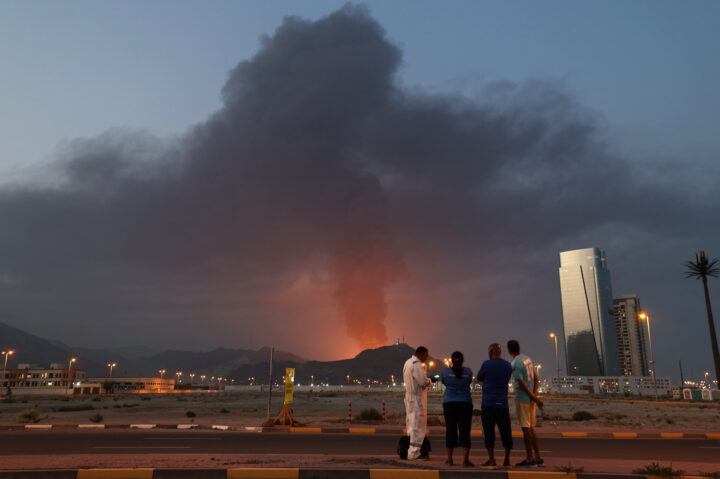
Fadel SENNA/AFP via Getty Images
Foreign workers look at a tall plume of black smoke ascends following an explosion in the Fujairah industrial zone in the UAE on March 3, 2026.
As Iran retaliates against the U.S. and Israel’s joint military campaign, findings have revealed that the United Arab Emirates — not Israel — has thus far faced the majority of Tehran’s missile and drone attacks.
Since the launch of the war on Feb. 28, Tehran has responded with widespread drone and missile attacks across the region, but it has been the UAE that has borne the brunt of the attacks. As of March 11, the UAE’s Ministry of Defense reported that its air defenses had “engaged” 268 ballistic missiles, 15 cruise missiles and 1,514 UAVs.
Iranian strikes have targeted American assets in the country, such as the U.S. consulate in Dubai, but also a range of civilian targets, including Dubai International Airport, where a drone attack wounded four people. Reports have indicated that Abu Dhabi has faced more than three times the number of Iranian drones and missiles launched toward Israel. The attacks come as Gulf allies are running short on missile interceptors.
Two Senate Republicans argued to Jewish Insider on Wednesday that, ultimately, the U.S. campaign against Iran will be to the benefit of the UAE and other Gulf allies, even if they’re feeling pain in the short term.
“It’s always something that we need to be aware of, and it is not an item to be ignored, but at the same time, you have to measure it with what Iran has left, and whether our offensive capabilities will continue to degrade their ability to actually inflict damage in that region,” Sen. Mike Rounds (R-SD) said, referring to the attacks on UAE and other allies and their reportedly dwindling interceptor stocks.
Iran’s offensive weapons “have limits as well,” Rounds continued, “and we’ve just got to do a better job of making sure that we go after their offensive capabilities.”
“Unfortunately we’re in the middle of a battle [that will decide if] the area [is] going to be safe or not,” Sen. Rick Scott (R-FL) said, adding that he believes the U.S.’ allies are supportive of the action the U.S. is taking. “Everybody would like to make sure Iran doesn’t have a nuclear weapon and they’re sick and tired of Iran’s antics. So I think it’s part of what you have to go through.”
Meanwhile, Sen. Chris Murphy (D-CT) pointed to the attacks on Gulf states as an argument against the war in general.
“These countries have limited interceptor stocks. This could get even uglier very quickly. Like everyone (except the White House) knew it would,” Murphy said on X.
Experts told JI that the UAE’s proximity to Iran, combined with its role as a global financial and commercial hub, makes it a particularly attractive target for Tehran. Even limited strikes can rattle international markets, disrupt tourism and investment and raise the economic stakes for countries aligned with Washington and pressure it to end the war.
“Iran is deliberately and disproportionately targeting the UAE partially because it is easy, given the UAE’s proximity to Iran, and more importantly, because it is an easy target that Iran knows will exact a global cost financially, and a military cost for the United States and the region,” Rachel Brandenburg, a senior policy analyst at the Israel Policy Forum, said.
“The UAE is home to significant global financial capital flows, international corporations, and tourists from far and wide,” she said. “Hitting the UAE is a relatively easy way for Iran to show that it can harm not only American and Israeli interests and assets, but also global interests.”
Brandenburg said that the UAE had been “counting on its diplomatic and economic relationship with Iran to insulate it from any retaliation against American or Israeli strikes” but “that, in fact, was not the case.”
Jonathan Ruhe, a fellow at the Jewish Institute for National Security of America, said that Tehran’s strategy is not only to broaden the conflict, but to interfere with the “Emirates’ success as a safe haven for economic activity,” in hopes that the UAE and other Arab countries “will pressure Trump to end the war as soon as possible.”
“Ironically, the UAE did such a good job creating a safe haven that now even the threat of a few drones can shock and scare away tourists, investors and shippers.”
Ruhe also noted that the UAE is an “easier military target” compared to Israel.
“Its [the UAE’s] air defenses are less battle-tested, and have less time to react to incoming projectiles than those in Israel, and, unlike Israel, it’s within reach of Iran’s short-range missiles,” Ruhe said. “Israel has already adapted to two-plus years of grueling conflict, so missiles and drones cause less disruption to normal life.”
However, experts noted that Tehran’s strategy could backfire, exposing the military promise of Gulf allies while potentially pushing them closer to defense cooperation with the U.S. and Israel. David May, a senior research analyst at the Foundation for the Defense of Democracies, said that the missile defense systems of Arab allies have “performed admirably in real-world conditions.”
“While Iran might have hoped that Gulf countries would beg the Americans to end the war, the opposite has happened,” May said. “The Gulf countries have condemned Iran and intercepted most of the drones and missiles, and the shared experience of being subjected to Iranian aggression has reminded them of the need for a regional defense architecture in line with the Abraham Accords.”
Ruhe also argued that Iran’s strategy “has backfired,” and echoed sentiments that it could create the conditions for cooperation that were not present prior to the start of the conflict.
“However and whenever this conflict ends, it’s creating new opportunities that, frankly, didn’t exist until Iran attacked the entire neighborhood,” Ruhe said.
Sen. John Fetterman (D-PA) was the only Democrat not to sign the letter

Andrew Harnik/Getty Images
(L-R) Senate Democratic leadership, Sens. Brian Schatz (D-HI), Bernie Sanders (I-VT), Elizabeth Warren (D-MA), Amy Klobuchar (D-MN), Senate Majority Leader Chuck Schumer (D-NY), Senate Majority Whip Richard Durbin (D-IL), Tammy Baldwin (D-WI), Cory Booker (D-NJ), Mark Warner (D-VA), Catherine Cortez Masto (D-NV), and Chris Murphy (D-CT), pose for a group photo in the U.S. Capitol on December 3, 2024 in Washington, DC.
Nearly all Senate Democrats wrote to Secretary of Defense Pete Hegseth on Wednesday to raise “grave concern” about a strike on a girl’s school that killed at least 168 people in the opening phase of the U.S.-Israeli war on Iran.
Reports indicate that the U.S. is likely responsible for the strike on the school — which was reportedly located adjacent to an Islamic Revolutionary Guard Corps facility — though President Donald Trump has offered varying explanations, including suggesting that Iran could have hit the school itself, potentially using sensitive and highly restricted U.S. munitions.
“The United States and Israel must abide by U.S. and international law, including the law of armed conflict,” the letter, signed by every Senate Democrat except Sen. John Fetterman (D-PA), reads. “There must be a swift investigation into the strikes on this school and any other potential U.S. military actions causing civilian harm, and the findings must be released to the public as soon as possible, along with any measures to pursue accountability.”
The administration has said it is investigating the strike, without commenting further.
The Democratic lawmakers also criticized strikes by the U.S. and Israel on hospitals, cultural sites, civilian infrastructure and Iranian cities including Tehran.
“Massive civilian casualty incidents like the attack in Minab are not only detrimental to the Iranian people, who have already suffered so much at the hands of its own government, but they also undermine U.S. national security interests,” the letter continues. “These concerns are compounded by the reported use of artificial intelligence tools to select and prioritize targets in Iran.”
The Democrats further called out Hegseth for rhetoric emphasizing the “death and destruction” from the operation and saying the military would impose “no stupid rules of engagement.”
The lawmakers said Hegseth’s rhetoric and the conduct it supports “only serves to endanger civilians, including American citizens, in the region and around the globe,” may run afoul of the Geneva Conventions and is part of a “broader pattern of policies abandoning the Defense Department’s commitment to minimizing civilian harm in U.S. military operations.”
The letter poses a series of questions to Hegseth about the strike on the girl’s school and procedures in place to prevent civilian harm and war crimes in the Iran war.
Plus, Israel considers building Somaliland base
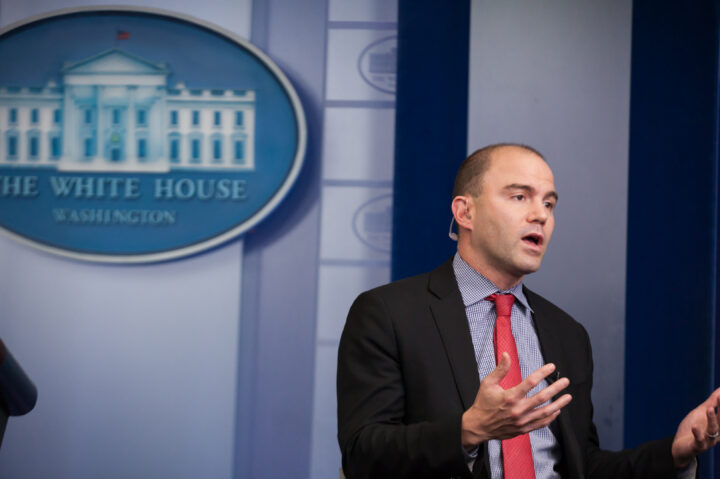
Cheriss May/NurPhoto via Getty Images
Ben Rhodes, then-deputy national security advisor to President Barack Obama, participates in an interview with press at the White House in on Wednesday, December 14, 2016.
This P.M. edition is reserved for our premium subscribers — offering a forward-focused read on what we’re tracking now and what’s coming next. Please don’t hesitate to share your thoughts and feedback by replying to this email.
📡On Our Radar
Notable developments and interesting tidbits we’re tracking
The Strait of Hormuz continues to be a key site of conflict in the U.S. and Israeli war against Iran — a spokesperson for the Iranian Armed Forces said in a video statement that the regime “will never allow even a single liter of oil to pass through the Strait of Hormuz for the benefit of America, the Zionists or their partners,” shortly after several ships were struck by missiles while passing through or near the strait…
The International Energy Agency announced its member countries will release 400 million barrels of oil from their emergency reserves in order to blunt the impacts of the war, the largest emergency release in history…
President Donald Trump told Axios that the war will end “soon” because there’s “practically nothing left to target” in Iran. U.S. and Israeli officials are reportedly preparing for at least two more weeks of hostilities…
Jewish Insider’s Matthew Shea speaks to experts and former Trump administration officials about Qatar’s potentially changing calculus on hosting Iranian-backed Hamas leaders as Tehran continues to attack the Gulf state…
A preliminary U.S. military investigation has found the deadly strike on a school in Iran was caused by the U.S. as it was targeting a nearby Iranian base, sources told The New York Times…
The FBI recently warned California police departments that Iran may launch a drone attack in the state, ABC News reports. As of last month, “Iran allegedly aspired to conduct a surprise attack using unmanned aerial vehicles from an unidentified vessel off the coast of the United State Homeland, specifically against unspecified targets in California, in the event that the U.S. conducted strikes against Iran,” the bureau’s alert read…
Israel is considering building a base in Somaliland, which it recently recognized as an independent country, in order to combat the threat of the Houthis, which are based in Yemen just across the Gulf of Aden…
Iran will not participate in the 2026 World Cup after the U.S. “assassinated our leader,” Iran’s sports minister told state media, shortly after Trump said he would still “welcome” the team’s participation. Iran’s national men’s soccer team was set to compete in June in Los Angeles and Seattle; several athletes from the country’s women’s team recently defected to Australia after playing in a match there…
Spain permanently withdrew its ambassador to Israel, as the countries’ already tense relations worsen over Madrid’s opposition to the war in Iran…
House Republican leadership discussed ways to incorporate an expected emergency supplemental for the U.S. military into the budget reconciliation process, Politico reports, rather than attempting to rally support from Senate Democrats for the 60-vote threshold that would otherwise be required in the Senate on a stand-alone vote. The move would also sidestep a vote that could be politically challenging for some House Republicans…
Former Obama administration official Ben Rhodes, a leading Israel critic on the left, said on an episode of his “Pod Save the World” podcast that Democrats who vote in favor of funding for the war with Iran “should be primaried. I don’t want you in the Democratic Party.”
Rhodes and co-host Tommy Vietor referenced the four Democrats who voted against a war powers resolution in the House as ripe for primary challenges. Left unsaid: Three of the four — Reps. Greg Landsman (D-OH), Henry Cuellar (D-TX) and Jared Golden (D-ME) — represent GOP-leaning seats that would likely flip with a more progressive Democratic candidate…
In a sign of the political gulfs between the Israeli and American left, Yair Zivan, who is an advisor to Israeli Opposition Leader Yair Lapid, pushed back on Sen. Bernie Sanders (I-VT) after the senator criticized Israeli operations in Lebanon.
“Senator, I work for the Leader of the Opposition in Israel and I’m writing this from a bomb shelter with my children. Israel is under attack by fanatical terrorists who want to murder us. It never ceases to amaze that your humanity never seems to extend to Israeli lives,” Zivan wrote on X…
Pennsylvania Gov. Josh Shapiro said he called New York City Mayor Zohran Mamdani to “check in on him and his wife to make sure they’re doing okay” after the attempted terror attack outside Mamdani’s official residence over the weekend. “As someone who’s had to deal with political violence, I know it can take a toll,” Shapiro said. The governor previously spoke with Mamdani after his win in November to express concerns over his rhetoric about Israel…
⏩ Tomorrow’s Agenda, Today
An early look at tomorrow’s storylines and schedule to keep you a step ahead
Keep an eye out in Jewish Insider for a look at the far-right ties of the new political director of College Republicans of America.
The Senate Health, Education, Labor and Pensions Committee will hold a hearing on foreign influence in American higher education, including testimony from the Foundation for Defense of Democracies’ Craig Singleton.
The annual weeklong South by Southwest festival kicks off tomorrow in Austin, Texas. Appearing at the summit, whose 300,000 attendees include many film and media professionals, is anti-Israel protest leader Mahmoud Khalil, who will speak about “the system that tried to silence him, and the personal and political stakes of resistance.”
Stories You May Have Missed
PRIMARY PRESSURE

The pro-Israel Democratic group warns that nominating far-left candidates will cost the party winnable seats against GOP incumbents
DEMOCRATIC DIVIDE

The Pennsylvania senator told JI about the U.S. military operation’s successes: ‘Why can’t a single Democrat agree that this is a good thing for the world and the region?’
‘If you can't stand against that, you don't stand for a f***ing thing,’ the former Obama admin official said
Cheriss May/NurPhoto via Getty Images
Ben Rhodes, then-deputy national security advisor to President Barack Obama, participates in an interview with press at the White House in on Wednesday, December 14, 2016.
A former top Obama administration foreign policy official said on Wednesday that any Democratic lawmakers who vote to support U.S. strikes on Iran should be primaried.
“If you vote for the funding of this war, you should be primaried. I don’t want you in the Democratic Party,” said Ben Rhodes, co-host of the “Pod Save the World” podcast and former deputy national security advisor under President Barack Obama.
He was referring to Reps. Greg Landsman (D-OH), Henry Cuellar (D-TX), Jared Golden (D-ME) and Juan Vargas (D-CA), the only four Democrats to vote against a war powers resolution last week that sought an immediate end to the U.S. military campaign in Iran.
Rhodes, who was one of the biggest boosters of the 2015 Iran nuclear deal and a leading Israel critic on the left, said the Democratic Party should have a big tent — but that support for President Donald Trump’s actions in Iran falls outside of that tent.
“I would like to have a big tent in this party. I think there should be people with different ideas of how to get health care, different ideas of taxation,” Rhodes said to co-host Tommy Vietor. “To me, this is not a left-center issue. This is a right and wrong issue. Morally, what do we stand for as Democrats?”
Rhodes suggested that Democrats who cast a vote in support of the war are doing so because of donor pressure.
“How is anybody going to trust you to fight for their health care if you’re too afraid to cast a vote, that someone might call you weak or some donor might call you and complain?” Rhodes asked. “If you as a Democrat can’t say that I am against a war and I’m not going to fund a war that is being launched by an authoritarian president, illegally, with no rational basis that is explained to the American people, that has already unleashed these consequences, if you can’t stand against that, you don’t stand for a f***ing thing.”
Experts were divided if Hamas’ alignment with Iran as it attacks Qatar will cause Doha to reassess the value of hosting the terror group

Ali Altunkaya/Anadolu via Getty Images
Hamas leader Khaled Mashaal speaks on the second day of the 17th Al Jazeera Forum held in Doha, Qatar on February 8, 2026.
Despite Qatar’s anger with Iran over the regime’s continued attacks on its territory and civilian infrastructure, experts are divided over whether the conflict will ultimately force Doha to reconsider its long-standing policy of hosting Iranian-backed Hamas officials.
Qatar has hosted Hamas’ political office and leadership, who have been reported to live lavishly and amass significant wealth, since 2012. Doha previously agreed to expel Hamas officials during hostage negotiations with Israel, but ultimately did not follow through.
Some experts told Jewish Insider that shifting regional dynamics amid the U.S. and Israeli conflict with Iran could be sufficient to change Qatar’s calculus. In the days following the launch of the joint U.S. and Israeli military operation against Iran, Tehran has launched widespread drone and missile strikes at multiple Arab nations, including Qatar.
Qatari Prime Minister Mohammed bin Abdulrahman bin Jassim Al Thani condemned the Iranian strikes last week as a “flagrant violation” of Doha’s sovereignty in a phone call with Iranian Foreign Minister Abbas Araghchi and “categorically rejected” Tehran’s claims that the strikes were directed only at American interests and not intended to target the Gulf state.
Hamas — which has received significant funding, training, arms and intelligence from Tehran for decades — has not denounced the Iranian strikes, instead placing the blame on the U.S. and Israel.
Anne Dreazen, vice president of the American Jewish Committee’s Center for a New Middle East, told JI that while Doha has raised the possibility of expelling Hamas leadership in the past, the recent attacks and the group’s lack of condemnation of the Iranian strikes signals that “the situation is a little bit different now.”
“These Iranian attacks across the Gulf have really forced many regional governments to reassess how much space they want to give the Iranian regime-aligned groups,” Dreazen said. “I think Qatar probably perceives that Hamas is siding with the Iranian regime, and so that could create some additional pressure on Qatar to act.”
Edmond Fitton-Brown, a former British diplomat and senior fellow at the Foundation for Defense of Democracies, echoed those sentiments, telling JI that the current conflict between the U.S. and Israel and Iran could challenge Qatar’s long-standing balancing act between Islamist movements and Western allies.
“Before the current Iran war, it [Qatar] was pursuing a business model that had it as international mediator, media superpower, host of a U.S. military base and sponsor of the Muslim Brotherhood’s global ambitions,” Fitton-Brown told JI. “It was a tightrope act, reliant on neither Iran objecting to the U.S. military base nor the U.S. objecting to the Muslim Brotherhood angle.”
However, Fitton-Brown said “the extent of the betrayal in the face of Iranian military aggression is on a different level from previous issues. “The comment made by Qatar about ‘everything being ruined’ strikes me as an acknowledgement that a return to the status quo ante is unlikely,” he added.
Fitton-Brown said that Qatar “looks unlikely to offer a stable haven” for Hamas leadership, adding that the group could find itself “sandwiched between U.S. allies on both sides of the Gulf.”
Meanwhile, other experts and former White House officials remained more skeptical that current hostilities would push Qatar to finally expel Hamas.
“I will believe it when I see it,” Steven Cook, a senior fellow at the Council on Foreign Relations, told JI. Cook noted that while the “Qataris are angry about Iranian strikes on their territory,” it would likely not change the dynamics of their relationship with Hamas. He added that “hosting Hamas has become an instrument of Qatar’s regional power and global influence.
“Qatar has been playing both sides for decades — supporting Islamist groups including terrorist groups like Hamas, while housing the Al-Udeid base and spending billions in the U.S. to buy political protection,” Elliott Abrams, the former U.S. special representative for Iran during the first Trump administration, said.
Abrams said it is “possible that this war has awakened them to the inherent contradictions in this game, where they protect Hamas — but Hamas doesn’t side with them,” however, he also expressed skepticism that such a move would ultimately be carried out.
Abrams said Qatar is “too used” to their current posture of playing both sides, adding that Doha receives “too many benefits from it.”
Richard Goldberg, a former Trump administration official, also said he will “believe it when I see it.” He noted that Qatar “appears to have intentionally shut down their liquified natural gas exports and hyped the market … as a favor to Tehran and an attempt to pressure President Trump into backing down.”
Earlier this month, Qatar halted liquefied natural gas production — which accounts for roughly 20% of global supply — after Iranian drone attacks targeted key operating facilities and infrastructure.
If the conflict does push Qatar to expel Hamas leaders, experts said Turkey could serve as a potential refuge.
“Turkey is the obvious refuge for Hamas: a powerful and self-confident Sunni Islamist state that also functions as the headquarters in the region for the International Organization of the Muslim Brotherhood,” Fitton-Brown added. “The Hamas leaders may move there soon, or may wait until the U.S.-Israel-Iran outcome is clear.”
“It would not be the end of Hamas” if they were expelled from Doha, Dreazen said. “Hamas has extensive operational infrastructure still in Gaza, and it has networks throughout several countries, Turkey being one of them. In terms of Hamas’ ability to carry out operations in Gaza, I think the impact would actually probably be limited.”
Dermer may well be the point person tasked to smooth over the differences that are likely to come up between Netanyahu and Trump
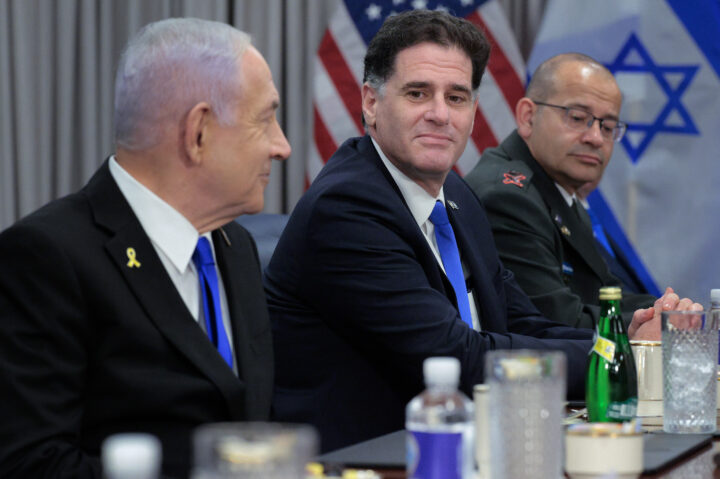
Chip Somodevilla/Getty Images
Israeli Prime Minister Benjamin Netanyahu (L) is joined by Israeli Minister of Strategic Affairs Ron Dermer and other officials for a meeting with U.S. Secretary of Defense Pete Hegseth at the Pentagon on July 09, 2025 in Arlington, Virginia.
When Israel and the U.S. launched their first strikes on Iran, Ron Dermer was in Australia, about as far as one could get from the Israeli Prime Minister’s Office in Jerusalem or the Defense Ministry in Tel Aviv. He soon found himself, like many other Israelis wanting to get home from abroad, on a plane to Taba, Egypt, from which point he would cross back into Israel, where airspace remains restricted.
Since November, when he resigned from his official post as strategic affairs minister, Dermer has spent most of his time traveling for speaking engagements. But now, two sources with knowledge of the matter confirmed to Jewish Insider, Dermer is back again in public service.
He may not have an official title, but he is doing what he has done for the previous three years — serving as Israeli Prime Minister Benjamin Netanyahu’s closest and most trusted advisor. Israel’s Walla News quoted a source in the Prime Minister’s Office who said Dermer was reporting for “reserve duty,” like over 100,000 other Israelis since the outset of the war with Iran.
Netanyahu and Dermer’s relationship has been so close for the past 26 years that Dermer has been called the prime minister’s third son and nicknamed “Bibi’s brain.” With a very small inner circle and few advisors whom he truly trusts, Netanyahu views Dermer as a critical asset to his team at a time when the U.S. and Israel are making decisions that will determine the future of the Middle East for years to come.
Dermer is also known as having a good relationship with the Trump administration, and has reportedly been taking part in Netanyahu’s nightly calls with President Donald Trump.
Those relationships have served Dermer well. When Trump presented his 20-point plan to end the war in Gaza last September, he repeatedly said, “Right, Ron?” addressing his remarks to Dermer, who was sitting in the front row.
Trump and Netanyahu have been remarkably in sync since the war began on Feb. 28. But some cracks are beginning to show: After the IDF bombed an Iranian fuel depot earlier this week, Trump administration sources leaked that they thought Israel went too far.
Trump has sent mixed messages about the expected duration of the war, saying on Monday that it is “very complete,” but also “could go further,” while Netanyahu said on Saturday night, “We are continuing with full force.”
Dermer may well be the point person tasked to smooth over the differences that are likely to come up between the leaders. Netanyahu is counting on it.
Sen. Tommy Tuberville, who also sits on the Armed Services Committee, which was briefed Tuesday morning, strongly denied that ground troops would be necessary

Jemal Countess/Getty Images for Fair Share America
Sen. Richard Blumenthal speaks at a rally at the Capitol on April 10, 2025 in Washington, DC.
Sen. Richard Blumenthal (D-CT), following a classified briefing for the Senate Armed Services Committee on the war in Iran on Tuesday morning, said he’s concerned that the U.S. is headed toward putting troops in Iran — echoing and elevating concerns he voiced following a classified briefing last week.
But other colleagues have, at this point, not affirmed Blumenthal’s view.
“If you look at the administration’s objectives, most especially regime change, there’s no way to accomplish it from 30,000 feet,” Blumenthal told Jewish Insider. “Every military expert seems to agree that it requires troops in Iran, and likely, as well, destruction of the nuclear material that Iran has right now will require some presence of personnel.”
He said that comments by President Donald Trump and administration officials about the future of the campaign and about loosening rules of engagement have further fed into his concerns.
“There is an air of recklessness that leads me to be very fearful — not to mention what I’ve heard in the classified briefings,” Blumenthal said.
Other colleagues on the Armed Services Committee aren’t backing up Blumenthal’s concerns at this point.
“I don’t know,” Sen. Gary Peters (D-MI) said, when asked if he agrees with Blumenthal that ground troops are likely to be deployed.
Sen. Tommy Tuberville (R-AL) forcefully denied to JI the idea that the U.S. would put troops on the ground in Iran.
“That’s interesting,” Sen. Mike Rounds (R-SD) said, when asked about Blumenthal’s comments.
Sen. John Kennedy (R-LA), who is not on the Armed Services Committee, said that Blumenthal “is my friend” but he “needs to back off the crank. That’s not going to happen.”
A ground operation would likely be a red-line for at least some lawmakers — on both sides of the aisle — currently supporting the war effort.
Sen. John Fetterman (D-PA), the most vocal Democratic supporter of the war effort, told JI he would not support a ground operation, a position he said he believes most Americans agree with.
“I’m not supporting a boots on the ground thing — the vast, vast, vast [majority of] Americans are there — but I support what’s happened” so far, Fetterman said. “I’ll be the first guy to say, ‘Look, I’m not aware of any single person that would support boots on the ground.’ I just watched [Defense Secretary Pete] Hegseth’s interview where he says they’re never going to make it about nation-building or anything.”
The Pennsylvania senator also said he plans to support any request from the administration for supplemental funding relating to the ongoing operation, adding that he took umbrage with the notion of lawmakers on either side of the aisle voting down aid for U.S. forces in an ongoing combat mission.
“If it comes up, I will vote for it,” Fetterman told JI of a supplemental package. “And I would dare anyone to vote against providing our military what’s required at this point.”
A growing number of Democrats are coming out against such supplemental funding.
“They’re saying they have more than ample resources and munitions right now. I have no idea why they would need a supplemental, so I’m certainly not writing a blank check, and they’ve given us no specificity as to why a supplemental is required,” Blumenthal told JI.
“What’s more, Trump is saying he’s not going to sign any legislation anyway until there’s the SAVE AMERICA Act, which is a preposterous position, but why should we consider a supplemental when he’s going to veto it anyway?” he continued.
Also on Tuesday, Senate Minority Leader Chuck Schumer (D-NY) and Sens. Jack Reed (D-RI) and Jeanne Shaheen (D-NH) wrote to Trump calling on him to send Secretary of State Marco Rubio and Hegseth to immediately testify publicly on the war effort.
They need to “come and answer for their failures and explain to the American people what the hell is going on,” Schumer said at a press conference. “That’s what people are asking in drug stores and bowling alleys and office buildings: What is going on? No one can understand it from what the Trump administration and Trump himself are saying.”
The Pennsylvania senator told JI about the U.S. military operation’s successes: ‘Why can’t a single Democrat agree that this is a good thing for the world and the region?’

Lev Radin/Pacific Press/LightRocket via Getty Images
Senator John Fetterman speaks during the grand opening of The Altneu synagogue.
Sen. John Fetterman (D-PA) is criticizing his fellow Democrats over their opposition to President Donald Trump’s decision to launch the U.S. war in Iran, arguing that his party should celebrate efforts to bring down the Iranian regime and its military and nuclear capabilities as a “positive development.”
Fetterman, the most vocal pro-Israel Democrat in the Senate, has been one of the leading advocates for striking Iran directly since Hamas’ Oct. 7, 2023, attacks on Israel. He backed Trump’s decision to strike Iran’s nuclear facilities amid the 12-day war with Israel last year, criticizing Democrats at the time for speaking out against the operation, and has since emerged as one of the staunchest Iran hawks in the Democratic Party.
The Pennsylvania senator said, since leading Democrats have long argued that Iran should never have the ability to get a nuclear weapon, criticism from the party of the joint U.S.-Israel efforts to degrade their military capabilities is hypocritical.
“First, let’s get to history. Every single Democratic presidential candidate or Democratic president all agreed, we can never allow Iran to acquire a nuclear bomb. Everyone has run the gamut: sanctions, treaties, proxies, other kinds of negotiations. It never worked,” Fetterman told Jewish Insider in an interview on Tuesday. “But you know what it actually produced? Nine hundred pounds of just pure, weapons-grade uranium.”
“When the country that wants death to America and wants to destroy Israel could have been months away from developing a nuclear weapon, and every single Democratic candidate for president all agreed we can never allow them [to do so], why can’t we just acknowledge what’s happened?” he asked. “It’s a profound development. I don’t get it. I know what the [Democratic] base demands right now: condemn and criticize.”
He said that Democrats should be able and willing to praise the operation for degrading Iran’s regime and its capabilities.
“Why can’t a Democrat call this a positive development given everything that Iran is responsible for and what their ambitions are?” Fetterman said. “This is effectively us destroying the Nazi regime and Hitler before they could’ve even begun. So, to your readers, whether in Israel or here, I ask: Why is that a problem?”
Fetterman also said that the media and fellow Democrats are ignoring what he characterized as the apparent successes and effectiveness of the U.S.-Israel strikes.
“Iran’s capabilities have been effectively ended. Right now, the missile strikes are down by 90 percent. Their Navy is gone. They can’t even project any force at this point,” Fetterman said. “Why do The New York Times and other left-wing media keep making it seem that the region is on fire when this is the breaking free of Iran? Why can’t a single Democrat agree that this is a good thing for the world and the region?”
Fetterman also blasted recent comments from former Vice President Kamala Harris and California Gov. Gavin Newsom, potential 2028 Democratic presidential contenders, criticizing Trump’s decision to launch the U.S. war in Iran and questioning the future of the U.S.-Israel relationship. The Pennsylvania senator said he was not surprised by the mainstreaming of opposition to Israel within the Democratic Party, predicting that the shift away from supporting Israel would continue.
“I expect at the end that our party is going to continue to back away from the moral clarity of Israel. If you are describing Israel as an apartheid state, or you have people in leadership [doing so], that’s profoundly disappointing but unsurprising,” Fetterman said.
Plus, CNN walks back coverage downplaying NYC terror attempt

JULIEN DE ROSA / AFP via Getty Images
A person points at a page on the Marinetraffic website that shows commercial boats traffic on the edge of the Strait of Hormuz near the Iranian coast, in Paris on March 4, 2026.
This P.M. edition is reserved for our premium subscribers — offering a forward-focused read on what we’re tracking now and what’s coming next. Please don’t hesitate to share your thoughts and feedback by replying to this email.
📡On Our Radar
Notable developments and interesting tidbits we’re tracking
President Donald Trump denied reports that U.S. intelligence has found Iran is taking steps to deploy mines in the Strait of Hormuz, but said if it has been done, “we want them removed, IMMEDIATELY!” If not, he warned, “the Military consequences to Iran will be at a level never seen before,” and if they are removed, “it will be a giant step in the right direction.”
Shortly after, Trump confirmed the U.S. has “hit, and completely destroyed, 10 inactive mine laying boats and/or ships.”
Aramco, the world’s top oil exporter out of Saudi Arabia, warned oil markets will face “catastrophic consequences” if the strait continues to be impacted by the war. “While we have faced disruptions in the past, this one by far is the biggest crisis the region’s oil and gas industry has faced,” CEO Amin Nasser told reporters…
The White House asked Israel not to target any more Iranian energy facilities, Axios reports, citing harm to Iranian civilians, the hope to cooperate with the Iranian oil industry after the war and potential for Tehran to retaliate against Gulf states…
Around 140 U.S. servicemembers have been injured in the course of the campaign against Iran, Defense Department spokesperson Sean Parnell said today, the majority of whom have already returned to service…
After receiving a classified briefing in the Senate Armed Services Committee, Sen. Richard Blumenthal (D-CT) told reporters, “I emerged from this briefing as dissatisfied and angry, frankly, as I have from any past briefing in my 15 years in the Senate. … We seem to be on a path toward deploying American troops on the ground in Iran.”
Blumenthal continued, “There is also, as disturbingly as anything else, the specter of active Russian aid to Iran … with intelligence and perhaps with other means, and China also may be assisting”…
The U.S. ordered the departure of its diplomats and their families from southern Turkey after two attempted Iranian missile strikes in the area; it’s the first mandated departure of U.S. officials outside of the Gulf and Lebanon since the start of the war…
Israeli Prime Minister Benjamin Netanyahu issued a statement to the “people of Iran” hinting at a coming opportunity for a popular uprising. He wrote on X, “We are waging a historic war for liberty. This is a once in a lifetime opportunity for you to remove the Ayatollah regime and gain your freedom. … In the coming days we will create the conditions for you to grasp your destiny. … When the time is right, and that time is fast approaching, we will pass the torch to you”…
CNN significantly changed a story and removed a social media post today that downplayed the attempted terror attack outside Gracie Mansion, New York City Mayor Zohran Mamdani’s official residence, over the weekend, initially writing that the suspects traveled from Pennsylvania for “what could’ve been a normal day” during the city’s “abnormally warm weather.”
CNN later deleted its post on X and added an editor’s note to its story, saying that the language “failed to reflect the gravity of the incident thereby breaching the editorial standards we require for all our reporting”…
The NYPD evacuated Carl Schurz Park near the mayor’s mansion today after a suspicious device was found in the vicinity; it was determined to be “non-threatening”…
Secure Community Network said there was no known threat to the Jewish community following an active shooter incident Tuesday afternoon near the Agudath Israel of Baltimore synagogue, during which a Baltimore Police officer and a suspect were shot in what appeared to be a domestic incident…
A week ahead of Illinois’ primary election, a new poll conducted by an outside group backing Rep. Raja Krishnamoorthi (D-IL) shows the congressman with a double-digit lead in the race for Senate, up 11 points over his next closest competitor, Lt. Gov. Juliana Stratton. Over 87,000 early votes have already been cast in the race, 40,000 votes more than had been cast at the same point in early voting during the 2022 primaries…
Morris Katz, the Democratic strategist who has shaped the campaigns of progressive politicians hostile to Israel including Mamdani and Maine Senate candidate Graham Platner, is now behind the campaign of another populist Democrat: Allison Ziogas, a first-time candidate attempting to unseat Rep. Nicole Malliotakis (R-NY). Trump won 61% of the vote in Malliotakis’ Staten Island–based district in 2024, making it difficult for any Democrat to prevail…
The Anti-Defamation League released its 2026 Campus Antisemitism Report Card, which showed a “clear upward trend” in universities taking steps to address antisemitism, the organization said. Almost two dozen schools received A grades.
UCLA Chancellor Julio Frenk celebrated his university’s improvement from a D to a B, but said in a statement, “a grade is a waypoint, not a destination. … While we have made clear progress in addressing antisemitism, we have more to do in our shared goal of eradicating it in its entirety”…
⏩ Tomorrow’s Agenda, Today
An early look at tomorrow’s storylines and schedule to keep you a step ahead
Keep an eye out in Jewish Insider for a look at a late flurry of spending against far-left social media influencer Kat Abughazaleh in Illinois’ 9th Congressional District, as pro-Israel groups indicate concern that the virulently anti-Israel Democrat could win the seat.
President Donald Trump will host an event in Hebron, Ky., tomorrow, with Republican congressional candidate Ed Gallrein in attendance. Gallrein is challenging Rep. Thomas Massie (R-KY) with Trump’s endorsement — Massie will not be attending the event, which is taking place in his district.
Fox News’ Bret Baier will speak in conversation with journalist Gary Rosenblatt at Temple Emanu-El’s Streicker Center in New York City.
Stories You May Have Missed
SCOOP

Local DSA chair Justin Yuan wrote on social media, ‘Love Hamas. Simple as’
BLUEGRASS BATTLE

President Trump is set to rally with Massie’s opponent this week
President threatens further attacks if Iran blocks Strait of Hormuz; teases nation-building effort
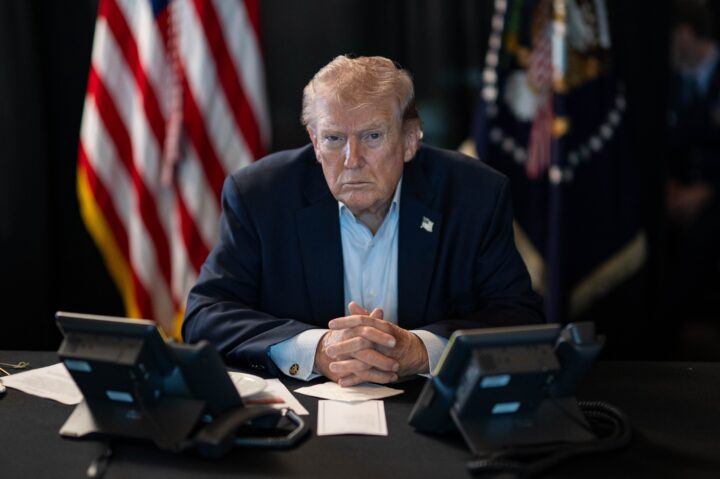
The White House via X Account/Anadolu via Getty Images
U.S. President Donald J. Trump sits at a table monitoring military operations during Operation Epic Fury against Iran, with U.S. flags visible behind him, in Washington, United States, on March 02, 2026.
President Donald Trump drew two contradictory timelines for the ongoing war in Iran in remarks on Monday, saying that the conflict was both drawing to a close and in its early stages.
In a call with CBS News, Trump said, “The war is very complete, pretty much. [Iran has] no navy, no communications; they’ve got no air force. Their missiles are down to a scatter. Their drones are being blown up all over the place, including the manufacturing of drones. … There’s nothing left in a military sense.”
The war has progressed faster than initially expected, the president added: “We’re very far ahead of schedule.”
Also Monday, the Department of Defense posted on X that “we have only just begun to fight, with a graphic of a missile interceptor and the text: “No Mercy.”
At a news conference after his CBS News interview, Trump was asked whether the war is “very complete” or “just beginning.”
“I think you could say both,” the president responded. “It’s the beginning of building a new country. We could call it a tremendous success right now, or we could go further.”
“And we’re going to go further,” Trump added.
In his interview with CBS, Trump considered further steps, saying that he is “thinking about taking … over” the Strait of Hormuz.
The president later posted on Truth Social: “If Iran does anything that stops the flow of Oil within the Strait of Hormuz, they will be hit by the United States of America TWENTY TIMES HARDER than they have been hit thus far.”
The Strait of Hormuz is the only passage by sea from the Gulf to the open ocean and a critical chokepoint in the global energy market.
Israeli Prime Minister Benjamin Netanyahu, meanwhile, said during a visit to Israel’s National Health Command Center on Monday that “our aspiration is to enable the Iranian people to cast off the yoke of tyranny; ultimately, it is up to them.”
“If we succeed together with the Iranian people, we will bring about a permanent end to the extent that such things exist in the lives of nations,” Netanyahu added. “We will bring about change, and we are already bringing about a massive shift in Israel’s international standing.”
The IDF Home Front Command reported only six missile launches from Iran to Israel in the past 24 hours, a significant slowdown from previous days of the war.
The IDF continued to strike targets in Iran, including a missile launcher, 10 minutes after it fired at Israel.
On Monday night, the IAF completed a wave of strikes against six major Iranian military airfields, destroying Islamic Revolutionary Guard Corps aircraft, including combat helicopters.
Lebanese President Joseph Aoun reached out to the U.S. to start direct talks with Israel on “permanent arrangements for security and stability on [its] borders.” He called for a “complete truce” ending Israeli military activity, and lamented that Hezbollah — which Beirut had agreed to disarm as one of the terms of its 2024 ceasefire with Israel — “wanted to achieve the fall of the State of Lebanon, under aggression and chaos.”
Israeli strikes on Hezbollah in Lebanon continued, with overnight attacks on command centers and the facilities of the Al-Quard Al-Hassan Association, which funds the Iran-backed terrorist group and works with cash, as well as a cell of Hezbollah terrorists approaching IDF soldiers and a structure in which commanders of the elite Radwan Force were said to be gathering.
Israeli Foreign Minister Gideon Sa’ar met with U.N. Special Coordinator for Lebanon Jeanine Hennis in Jerusalem on Monday. In his readout of the meeting, he noted that Hezbollah joined the war on Iran’s side “against the interest of Lebanon.”
“Over the past week there have been more attacks against Israel from Lebanese territory than from Iran,” Sa’ar said. “Weakening Hezbollah is a mutual interest of both Israel and Lebanon. I also said that Hezbollah initiated an attack against us and no member of the international community is acting to stop it besides us.”
Sa’ar and Hennis also discussed Israel’s decision not to evacuate residents from its northern border towns, in contrast with October 2023, and said that “the deployment of IDF troops in the border area is critical for preventing an invasion of Hezbollah’s ground forces and attacks against Israeli citizens and communities.”
The IDF estimated in recent days that over half a million Lebanese residents evacuated southern Lebanon.
Magen David Adom emergency services reported treating 76 people as a result of Monday’s missile attacks, two of whom were killed and 18 injured by missile debris.
Since the start of Operation Lion’s Roar, there have been 14 fatalities. MDA reported treating 667 people for injuries resulting from missile attacks, 511 of whom were injured making their way to shelter or in traffic accidents when stopping for a missile alert.
The president also predicted the operation would be a ‘short-term excursion’

Roberto Schmidt/Getty Images
Special Envoy to the Middle East Steve Witkoff listens as U.S. President Donald Trump speaks to reporters during a news conference at Trump National Doral Miami on March 9, 2026 in Doral, Florida.
President Donald Trump said repeatedly on Monday that he believed the Iranian regime was going to “take over the Middle East” and would have obtained a nuclear weapon “within weeks” had he not ordered the U.S. military operation against Iran.
Trump made the comments from his Doral, Fla., golf club at a press conference while defending his decision to have the U.S. launch its military operation in Iran, noting that Iran had a “number of missiles they were able to buy and make over the last six months, and those missiles were aimed at various countries.”
“When you look at over 1,000 missiles shot at, like the UAE, they were looking to take over the Middle East,” Trump said. “We got there first. We’re lucky.”
“If I didn’t hit them first, they were going to hit our allies first,” he continued. Had the U.S. not struck Iranian nuclear sites last June, “that was definite, because they would’ve had a nuclear weapon within a matter of weeks.”
Trump said that negotiations between the U.S. and Iran on the latter’s nuclear ambitions had reached a stalemate last year because the Iranians told Special Envoy Steve Witkoff “essentially, in a real nutshell, we want to continue to build nuclear weapons.”
“The situation was very quickly approaching the point of no return, and the United States found it intolerable. In my opinion, based on what Steve and Jared [Kushner] and [Secretary of Defense] Pete [Hegseth] and others were telling me, [Secretary of State] Marco [Rubio] was so involved, I thought that they were going to attack us,” Trump said. “If we didn’t do this at the time we did it, I think they had a mind to attack us.”
Trump, who is in Doral for the House Republicans’ retreat, made similar comments while discussing the ongoing U.S. military operation in Iran earlier Monday in a speech to Republican lawmakers and donors.
“Within a week, they [Iran] were going to attack us,” he told the crowd at the Republican Members Issues Conference.
In comments at the retreat and the presser, Trump touted the progress made in the nine days since the U.S. first struck Iran as evidence that the operation had been a “tremendous success” thus far.
“We’re achieving major strides toward completing our military objective, and some people could say they’re pretty well complete. We’ve wiped every single force in Iran out very completely,” Trump told reporters, adding that “most of Iran’s naval power has been sunk” and the regime’s “drones are way down.”
“We continue to target Iran’s drone and missile capability,” he continued. “We’ve struck over 5,000 targets to date, some of them very major targets, and we’ve left some of the most important targets for later, in case we need to do it. If we hit them, it’s going to take many years for them to be rebuilt, having to do with electricity production and many other things. So we’re not looking to do that if we don’t have to.””
About the future of Iran’s leadership, Trump said, “We want to be involved. We don’t want another president that maybe wouldn’t be willing to do what I’m willing to do, for the good of the world, for the good of our nation, to be stuck with a situation in five years or 10 years.”
Speaking to attendees at the GOP retreat, the president described the U.S. attacks on Iran as a “little excursion” that he expected would “be a short-term” operation.
“We took a little excursion because we felt we had to do that to get rid of some evil,” Trump said. “And I think it’s going to be a short-term excursion.”
Trump also acknowledged the broader differences between himself and Vice President JD Vance on foreign policy matters at the presser, but said that Vance was supportive of his decision to strike Iran.
“We get along very well on this. He was, I would say, philosophically a little bit different than me. I think he was maybe less enthusiastic about going, but he was quite enthusiastic.”
‘Each individual senator has a tremendous amount of power to disrupt the normal functionings of the Senate,’ Sen. Cory Booker said

Marc Rod
Sens. Cory Booker (D-NJ), Tim Kaine (D-VA), Tammy Duckworth (D-IL), Chris Murphy (D-CT), Tammy Baldwin (D-WI) and Adam Schiff (D-CA) hold a press briefing on Iran war powers resolutions on March 9, 2026.
A group of six Senate Democrats is threatening to immediately begin obstructing proceedings on the Senate floor in order to force public hearings in the Senate Armed Services Committee and Foreign Relations Committee and debate on the chamber floor on the war in Iran.
Jewish Insider first reported that several of those lawmakers — including Sens. Cory Booker (D-NJ), Tim Kaine (D-VA), Tammy Duckworth (D-IL), Chris Murphy (D-CT), Tammy Baldwin (D-WI) and Adam Schiff (D-CA) — introduced a series of five new war powers resolutions late last week.
The senators indicated in a meeting with reporters on Monday that they plan to force votes on those, and possibly additional, war powers resolutions when they become eligible for votes next week, but that those resolutions are just part of a broader strategy to disrupt normal Senate business in an attempt to force greater public discussion about the war in Iran.
“We’ve had no oversight whatsoever over what the executive is doing, as they’re spending a billion dollars a day. And we have failed to have any real substantive debate or discussion,” Booker said. “We are not going to let business as usual go on in the Senate … we are demanding that the Republican leadership of the Senate hold the adequate hearings and oversight, as well as to allow a debate that brings transparency to this onto the Senate floor.”
Booker declined to discuss their specific plans, but said that the senators would “use the levers that we have,” citing efforts over the years by Republican colleagues to block or slow down Senate procedure to compel votes on various issues.
“Each individual senator has a tremendous amount of power to disrupt the normal functionings of the Senate, as well as certain privileges that we can exercise,” Booker said. “And what we have agreed on right now is that we are not going to let the Senate continue its business as usual.”
Though the war powers resolutions won’t be eligible for Senate floor votes until next week, Booker indicated that the senators plan to begin other obstructionist tactics immediately, unless hearings are announced.
Murphy highlighted that the lawmakers have the ability, should they choose to do so, to “force a vote and debate every single day in the Senate” on the war powers resolutions. But Baldwin indicated that the lawmakers might not force the war powers votes if Republicans do schedule the hearings they request.
Booker said that the group is not necessarily speaking for the entire Senate Democratic caucus.
Murphy asserted that public hearings with administration officials, tasked with defending and explaining the war effort to the public, would only make the operation less popular with the American public. The Democrats also highlighted other costs, including increasing gas prices, associated with the war.
Kaine argued that the question for the Senate and the American people is not whether “Iran [is] a bad actor” or whether “in the abstract, [they have] done terrible things,” it is whether the war is worth risking American lives. Seven U.S. servicemembers have died in the course of the campaign so far.
Murphy and other Senate Democrats had also been pushing for a Senate vote on an authorization for use of military force regarding Iran. But on Monday, the six Democrats involved in this effort said they had ruled out the idea of a Democratic-led AUMF, arguing that the burden is on Republicans and the administration to put forward such a proposal and define its scope.
“They have to tell us and bring evidence to us that this war is worth an AUMF,” Duckworth said. “I personally don’t even want to have the discussion about an AUMF, because they haven’t even gone to the first step yet” of proving the need for the war.
Kaine said that the lawmakers, including Murphy, had “explored the procedural option” of an AUMF, but said that the “burden” to write such a bill should not be on the Democrats “who think this war is a bad idea.”
“It would be too unusual for the opponents to file the AUMF,” he continued. “The proponents are the ones that carry the burden of proof with the American public. They need to file it.”
The six Democrats did not appear to be entirely in agreement about how they would handle a potential request by the administration for supplemental funding to support the war effort or replenish U.S. armaments expended in it.
Kaine said he would withhold judgement on the issue until such a request was presented, explaining, “I want to end the war, I want to protect our troops.”
Schiff argued that the military has “plenty of money” from last year’s reconciliation bill, and also said that a congressional appropriation for a military effort could, legally, be considered an authorization for use of military force.
Should they secure the hearings they seek, the senators said they want to press administration officials on the goals and timeline for the war, the rules of engagement and restrictions imposed on U.S. forces, the circumstances that led to a deadly strike — which some have attributed to the U.S., though the administration disputes this — on a girls’ school, potential plans to support separatist movements inside Iran and the administration’s plans to support and protect Iranian demonstrators should another mass uprising occur.
“My goal is to end this war, to stop wasting millions of dollars and to protect further servicemembers from dying, and I think the way that you do that is by exposing to the public the fact that this is a war of choice, the fact that this president has ignored the law and the Constitution and the people through us, hold him to account,” Baldwin said.
Plus, Trump says Iran operation 'very complete'

Sean Gallup/Getty Images
Sen. Lindsey Graham (R-SC) speaks at the 62nd Munich Security Conference on February 13, 2026 in Munich, Germany.
This P.M. edition is reserved for our premium subscribers — offering a forward-focused read on what we’re tracking now and what’s coming next. Please don’t hesitate to share your thoughts and feedback by replying to this email.
📡On Our Radar
Notable developments and interesting tidbits we’re tracking
President Donald Trump praised Australian Prime Minister Anthony Albanese for assisting the members of Iran’s women’s soccer team, who are in Australia competing in the Women’s Asian Cup, amid fears for their persecution should they be forced to return home.
The president had called for Albanese to grant the athletes political asylum, saying they would “most likely be killed” if they were repatriated to Iran, and later commended him for “doing a very good job having to do with this rather delicate situation,” with five athletes “already taken care of, and the rest are on their way”…
Trump disputed reports that the U.S. is preparing to deploy ground troops to secure nuclear material at the Isfahan enrichment site in Iran, telling the New York Post, “We haven’t made any decision on that. We’re nowhere near it.” He also told CBS News that “the war is very complete, pretty much,” and the U.S. is “very far” ahead of his initial four-to-five-week timeline…
Trump has communicated to aides that he would support the assassination of Mojtaba Khamenei, Iran’s new supreme leader, if Khamenei does not acquiesce to U.S. demands, including ending Iran’s nuclear program, U.S. officials told The Wall Street Journal…
The Lebanese government has requested direct negotiations with Israel, sending the message through U.S. Ambassador to Turkey Tom Barrack, Axios reports. Washington and Jerusalem were reportedly skeptical about the idea, with Beirut thus far failing to disarm or rein in Hezbollah activities as the terror group continues to launch missiles into Israel…
NATO missile defense systems intercepted another Iranian missile heading for Turkey, a spokesperson announced today, the second time Iran has attempted to strike the NATO country’s territory…
Sen. Lindsey Graham (R-SC) threatened to impose “consequences” on Saudi Arabia for its unwillingness to join the U.S. campaign against Iran, as the U.S. evacuates its embassy in Riyadh and the kingdom continues to endure Iranian attacks, which have so far resulted in the deaths of two civilians and one U.S. servicemember. “Question — why should America do a defense agreement with a country like the Kingdom of Saudi Arabia that is unwilling to join a fight of mutual interest?” Graham wrote on X…
Talks to advance Trump’s 20-point peace plan in Gaza, including the issue of Hamas’ disarmament, have been at a standstill during the campaign against Iran, Reuters reports, as Gulf countries that pledged funds to help rebuild the enclave have come under fire and flight disruptions have prevented mediators from traveling…
The criminal complaint filed in the Southern District of New York today against the two Pennsylvania men who allegedly hurled improvised explosive devices toward a protest against New York City Mayor Zohran Mamdani on Saturday stated that both men explicitly identified ISIS as their inspiration, Jewish Insider’s Will Bredderman reports.
“This isn’t a religion that just stands when people talk about the blessed name of the Prophet [Muhammad],” Emir Balat, 18, told police, according to the charging documents. He also said he had hoped to pull off something “even bigger” than the 2013 Boston Marathon bombing, which he noted had caused “only three deaths”…
The White House moved today to designate the Sudanese Muslim Brotherhood as a Specially Designated Global Terrorist entity and announced plans to impose a Foreign Terrorist Organization designation on March 16, JI’s Matthew Shea reports, in the Trump administration’s latest crackdown against Muslim Brotherhood affiliates…
A new poll from the campaign of Rushern Baker, former executive of Maryland’s Prince George’s County, found him leading the crowded Democratic field seeking to succeed retiring Rep. Steny Hoyer (D-MD). Though a plurality of likely primary voters (28%) said they’re still undecided, Baker polled at 22% compared to former U.S. Capitol Police officer Harry Dunn’s 15% and Hoyer-endorsed state Del. Adrian Boafo’s 3%…
Rep. Kevin Kiley of California officially switched his party affiliation from Republican to independent — he had filed for reelection as an independent, but said today he would leave the party for the rest of his term as well. The move narrows the GOP majority even further, 217-214, but Kiley said he’ll continue to caucus with Republicans, blunting the impact…
Politico looks at the flurry of independent candidates seeking to unseat congressional Republicans in GOP-leaning districts, clashing with local Democratic establishments in the process…
⏩ Tomorrow’s Agenda, Today
An early look at tomorrow’s storylines and schedule to keep you a step ahead
Keep an eye out in Jewish Insider — we’ll have a profile of Dario Amodei, the Jewish CEO of Anthropic, which sued the Pentagon today over its decision to label the AI company a “supply chain risk.”
The Senate Armed Services Committee is expected to receive a classified briefing on the status of the U.S. and Israeli campaign against Iran.
The Republican Jewish Coalition and conservative magazine National Review will hold a daylong symposium on antisemitism, with remarks from Sens. Jim Banks (R-IN), Tom Cotton (R-AR) and Ted Cruz (R-TX); Noah Pollak, senior advisor at the Department of Education; Kenneth Marcus, founder of the Louis D. Brandeis Center for Human Rights Under Law; Rabbi Yehuda Kaploun, the State Department’s antisemitism envoy; Leo Terrell, senior counsel to the assistant attorney general for civil rights; and Texas Lt. Gov. Dan Patrick.
Georgia’s 14th Congressional District will hold its special election to fill the seat vacated by Rep. Marjorie Taylor Greene (R-GA), with more than a dozen candidates on the all-party ballot. The district leans strongly Republican but the GOP field is split among nine candidates, raising the possibility that the Democratic front-runner — retired Army Brig. Gen. Shawn Harris — could slip into the April runoff.
Stories You May Have Missed
SCOOP

NYC First Lady Rama Duwaji showed support for far-left orgs applauding Hamas rampage
POWER PLAYER

Ad maker Morris Katz has been instrumental in elevating Israel antagonists into office as part of a move to reshape the Democratic Party
Federal charges were filed against Pennsylvania youth who lobbed improvised explosive devices outside Gracie Mansion

Leonardo MUNOZ / AFP via Getty Images
New York City Police Commissioner Jessica Tisch (C) speaks alongside New York City Mayor Zohran Mamdani (L) during a news conference at Gracie Mansion in New York City on March 9, 2026.
The two Pennsylvania men who allegedly hurled improvised explosive devices toward a protest against New York City Mayor Zohran Mamdani will face federal charges for “ISIS-inspired terrorism,” NYPD Commissioner Jessica Tisch revealed Monday.
Mamdani and Tisch addressed the press near the scene of the crime, the mayoral residence of Gracie Mansion, where far-right provocateur Jake Lang held a protest on Saturday to “Stop the Islamic takeover of New York City.” Tisch said Lang and his supporters were the targets of two homemade bombs that Emir Balat, 18, who had traveled from Pennsylvania with his accused accomplice Ibrahim Kayumi, 19, flung from amid the counter-demonstration.
Tisch confirmed earlier reporting that the Islamic State appears to have inspired the alleged perpetrators’ actions — but maintained nothing at present pointed to any link between the attempted attack and the ongoing U.S. and Israeli military campaign against Iran.
“I can confirm this morning that this is being investigated as an act of ISIS-inspired terrorism,” the commissioner said, noting that so far one of the devices had tested positive for triacetone triperoxide, an explosive used in terrorist bombings across the world. “At this time we do not have any information that connects this investigation to what’s going on overseas in Iran.”
Neither bomb ultimately detonated. The criminal complaint filed in the Southern District of New York Monday stated that both men waived their Miranda rights and explicitly identified ISIS as their inspiration.
“This isn’t a religion that just stands when people talk about the blessed name of the Prophet [Muhammad],” Balat told police, according to the charging documents. The complaint continues that Balat requested and received writing materials, and jotted down: “All praise is due to Allah lord of all worlds. I pledge my allegience [sic] to the Islamic State. Die in your rage yu [sic] kuffar!”
The Federal Bureau of Investigation agent deposed for the complaint stated that the written statement reflects common ISIS slogans. Further, the document alleges Balat subsequently told police he had hoped to pull off something “even bigger” than the 2013 Boston Marathon bombing, which he noted had caused “only three deaths.” The indictment also states that Balat was carrying a Turkish government identification card as well as a Pennsylvania driver’s license.
The duo face charges of attempted provision of material support and resources to a designated foreign terrorist organization, use of a weapon of mass destruction, transportation of explosive materials — including over state lines — and unlawful possession of destructive devices.
Tisch said Monday her department remains in “a heightened state of alert” due to the ongoing U.S. war against Iran , and had deployed “heavy weapons, teams, K-9 units, aviation and more” to secure sensitive locations.
Mamdani, who revealed he was not home at the time of the incident, joined his commissioner in praising the police department and the officers who helped secure the location. He opened his remarks with an attack upon Lang, known for throwing up Nazi salutes at his events, including outside AIPAC headquarters — but strongly reaffirmed his support for each side’s right to protest.
“While I found this protest appalling, I will not waiver in my belief that it should be allowed to happen,” he said. “Ours is a free society, where the right to peaceful protest is sacred. It does not belong only to those we agree with. It belongs to everyone.”
Still, Mamdani continued, “This was a vile protest rooted in white supremacy. Many of the counterprotesters met this display of bigotry peacefully, with a vision of a city that is welcoming to all. But a few did not.”
Condemning Talat and Kayumi, Mamdani, whose own Shi’ite faith is anathema to the Sunni extremism of ISIS, continued, “They are suspected of coming here to commit an act of terrorism. New York City will never tolerate violence, whether from protests or counterprotests.”
In Lebanon, two IDF soldiers were killed over the weekend by a missile fired by Hezbollah

Magen David Adom
The site of a missile strike in central Israel, March 9, 2026
One person was killed in an Iranian missile attack that struck a construction site in the city of Yehud in central Israel, volunteer emergency service Magen David Adom reported on Monday.
MDA pronounced the victim, a man who appeared to be about 40 years old, dead at the scene. Another man, believed to be around the same age, was evacuated to the nearest hospital in serious and unstable condition. Both were foreign workers.
“It was a difficult scene,” MDA paramedic Liz Goral said. “The two casualties were lying unconscious and suffering from severe shrapnel injuries to their bodies. After performing resuscitation efforts, we had to pronounce the death of a man, approximately 40 years old, and we evacuated the second casualty in serious condition.”
The Hatzalah volunteer emergency services reported three additional injuries in the area.
Missile strikes on Israel caused significant property damage over the weekend in Tel Aviv and Rishon LeZion, a large city in central Israel. Overnight Sunday, a woman in the Rishon Lezion area was treated for a head injury after being hit by flying rocks.
Since the beginning of Operation Lion’s Roar, there have been 13 fatalities. Emergency service Magen David Adom has treated 622 injured people, the majority of whom were injured making their way to shelter or in traffic accidents related to stopping suddenly for missile sirens.
IDF International Media Spokesperson Nadav Shoshani said in a briefing on Monday that though “the amount [of missiles] in each barrage is going down, they are still dangerous. We have seen what one missile can do … some of them carry warheads that weigh a ton. We have seen Iran use weapons that constitute war crimes – cluster munitions – almost on a daily basis.”
Saudi Arabia had its first two fatalities from the Iranian attacks over the weekend: an Indian national and a Bangladeshi national, both of whom were in residential areas when they were killed. The State Department ordered diplomats at the U.S. Embassy in Riyadh, which faced several attacks by Iran last week, to leave the Gulf state.
In Lebanon, two IDF soldiers were killed over the weekend by a missile fired by Hezbollah. The soldiers were retrieving a vehicle from a position in southern Lebanon at the time they were killed, the IDF Spokesperson’s Office said. One soldier, combat engineer Maher Hatar, 38, was the first Druze soldier killed in the war. The second soldier’s identity has not been cleared for publication.
Shoshani said that in the week since Hezbollah joined Iran’s attacks on Israel, they have launched hundreds of rockets and UAVs at Israel.
“Hezbollah is present in southern Lebanon,” Shoshani said. “The IDF is standing between the terrorists and [Israeli] civilians. … Hezbollah has spent decades amassing weapons, and even though we spent the last 2.5 years degrading those weapons, they still are able to threaten our civilians.”
The IDF conducted a raid in southern Lebanon on Sunday night, Shoshani said, emphasizing that it was limited and “not the beginning of a ground maneuver.”
The IDF also struck Islamic Revolutionary Guard Corps Quds Force commanders based in Beirut over the weekend.
Also over the weekend, IDF soldiers unsuccessfully searched a cemetery in Lebanon for the remains of Ron Arad, an Israeli Air Force navigator who disappeared in 1986. The IDF said that there were no clashes with Hezbollah and that soldiers were not fired upon, while Lebanon’s health ministry reported that dozens of people were killed in the operation.
Israeli Prime Minister Benjamin Netanyahu said that “the operation … did not yield the findings we were looking for, but the commitment of the state of Israel and my own commitment to complete all the missions regarding our captives and missing is absolute and constant. So it has been and so it shall be.”
Arad’s widow, Tami, expressed misgivings about the operation in a Facebook post: “Our desire to know what happened to Ron stops as soon as there is a risk to IDF soldiers. In our view, the sanctity of life comes before the commitment to return the remains of a fighter for burial. This is our worldview regarding our loved one who disappeared some 40 years ago. … We appreciate the state of Israel’s commitment and at the same time we ask … do not instruct [to begin] operations with even a minimal risk to the fighters.”
White House Special Envoy Steve Witkoff and Jared Kushner, President Donald Trump’s informal advisor, are set to visit Israel on Tuesday, a Trump administration source confirmed to Jewish Insider overnight. Later, unconfirmed reports on Monday said that the trip was called off.
The scheduled visit comes after Israel bombed Iranian oil facilities over the weekend. Israel notified the U.S. in advance of the strikes, but Washington reportedly misunderstood the extent of the planned attacks, which went further than the White House expected.
Shoshani said that the fuel depot was connected to the IRGC.
Over the weekend, the IDF also struck an Iranian Internal Security command center in Isfahan, as well as a base used by the IRGC, IRGC police and the Basij paramilitary force. In another wave of strikes, the IDF hit the IRGC Space Agency, which included the command-and-control structure for the Khayyam satellite used to monitor Israel.
“The strikes were completed as part of the phase of deepening the damage to the core arrays and foundations of the Iranian regime,” the IDF Spokesperson’s Office said.
In addition, the IDF struck F14 fighter jets at Isfahan airport, along with detection and air defense systems and two major ballistic and cruise missile production sites in Parchin and Shahrud.
The IDF also killed Abu al-Qassem Baba’iyan, head of the military office of the Iranian supreme leader and the chief of staff of the emergency command, who was responsible for coordinating between the Iranian regime’s military groups to attack Israel. His predecessor, Ali Shadmani, was killed by Israel in last year’s war with Iran.
The Islamic Republic officially confirmed on Sunday that Mojtaba Khamenei, a son of assassinated Supreme Leader Ayatollah Ali Khamenei, would succeed his father. Trump said last week that appointing the younger Khamenei was “unacceptable,” and that he would play a significant role in choosing the country’s next leader. Israeli Defense Minister Israel Katz has said that “any leader appointed by the Iranian terror regime will be a clear target for elimination.”
This post has been edited to correct the number of fatalities that occurred on March 9.
The resolutions are similar to that which failed in the Senate last week, but some narrow the scope of permitted intelligence sharing and military cooperation
Tom Williams/CQ Roll Call
Sens. Chris Murphy (D-CT), left, and Tim Kaine (D-VA) attend a Senate Foreign Relations Committee nominations hearing in Dirksen Building on August 1, 2018.
Senate Democrats introduced five new war powers resolutions seeking to block military action in Iran on Thursday, a day after the Senate voted along mostly partisan lines to block an effort to immediately halt the operation.
One of the resolutions was introduced by Sen. Tammy Baldwin (D-WI), with the other four being introduced by the same group of senators: Sens. Tim Kaine (D-VA), Chris Murphy (D-CT), Cory Booker (D-NJ) and Adam Schiff (D-CA). Murphy, who has also been pushing for the Senate to vote on an authorization for use of military force in Iran, is leading two of the resolutions, and Schiff and Booker are leading the other two, respectively.
Having a series of war powers resolutions already introduced could allow Democrats to continue teeing up votes on the war, or allow them to have several resolutions in reserve to vote on as the situation in Iran evolves.
War powers resolutions are subject to a 10-day waiting period between their introduction and when senators can force votes on them.
Kaine suggested last week after the initial war powers resolution failed that he would plan to force further war powers votes, as well as look for opportunities in other legislation to tee up votes on the war effort, which Democrats see as politically unpopular for the administration and for Republicans.
Kaine, Murphy, Booker and Schiff did not provide comment.
The text of one of the five resolutions was not yet available as of Sunday evening, but the other four are largely similar. As compared to the resolution led by Kaine, Schiff and Sen. Rand Paul (R-KY) that the Senate voted on last week, each includes updated details about the U.S. campaign in Iran, which had not yet begun when the previous resolution was introduced.
Several of the resolutions also appear to narrow the scope of U.S. intelligence sharing and military cooperation with Israel and other allies that would remain explicitly exempt from the legislation’s mandate for an immediate end to military operations against Iran.
One of the Murphy-led resolutions allows for intelligence sharing with allies attacked by Iran “related to defense from threats from Iran or its proxies,” whereas the Kaine-Paul resolution did not include that specific reference to defense.
It also allows for the U.S. to assist partners in “intercepting retaliatory attacks upon their territory,” where the previous version allowed for assisting with “defensive measures to protect their territory from retaliatory attacks by Iran or its proxies” more broadly — without the reference to interception of active attacks alone.
The Baldwin-led resolution includes the same language as the Murphy-led resolution on interceptions of retaliatory attacks, but does not include the new language on intelligence sharing.
The Schiff-led resolution includes similar specifications around intelligence sharing as the Murphy resolution, but does not impose the same limitations allowing the U.S. to only intercept attacks on allies. It includes additional language allowing for continued evacuations of U.S. citizens.
The Booker-led resolution does not include any additional restrictions on intelligence sharing, but it restricts assistance to Israel and other allies to “directly defending against retaliatory attacks upon their territories by Iran or its proxies.” It also includes the carveout regarding evacuations of U.S. citizens.
Separately, in the House, Rep. Josh Gottheimer (D-NJ) said Thursday that he plans to force a vote later this month on his war powers resolution that offers a 30-day wind-down period for the war effort in Iran, which Gottheimer is leading with several other moderate Democrats.
‘Kurds are in a unique position to become the catalyst for broader change across Iran,’ Iranian Kurdish analyst tells JI
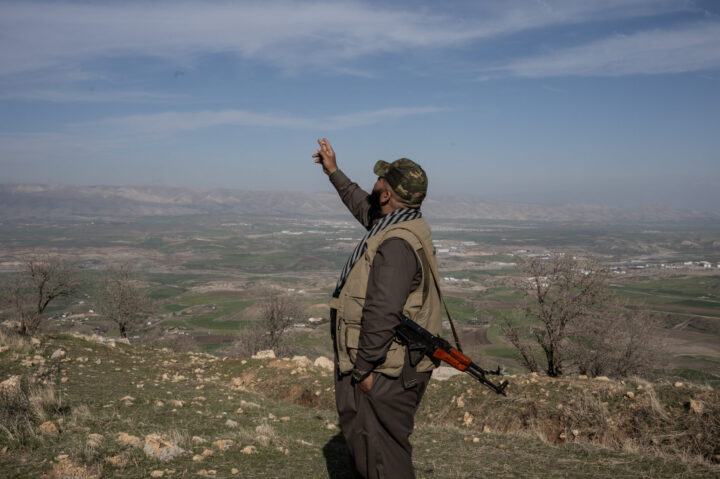
Hawre Khalid/Getty Images
A member of the Komala of the Toilers of Kurdistan, a Kurdish Iranian dissident group, looks toward passing jets on March 6, 2026 in Sulaymaniyah, Iraq.
President Donald Trump and Israeli Prime Minister Benjamin Netanyahu pushed back on Saturday against reports that they were working with Kurdish leaders to launch a ground invasion of Iran.
“We’re not looking for the Kurds going in,” Trump told reporters on Air Force One on Saturday night. “We’re very friendly with the Kurds, as you know, but we don’t want to make the war any more complex than it already is. … I don’t want to see the Kurds going in and getting killed.”
Trump’s remarks came in response to reporters asking the president about his phone calls with Kurdish leaders at the outset of the campaign against Iran, and a subsequent report that U.S. and Israeli officials said Kurdish Iranian factions are preparing for combat against the Iranian regime.
Many Kurdish factions have long sought an independent Kurdistan, and some of Iran’s neighbors, such as Turkey and Iraq, have historically been concerned about Kurdish separatist factions.
In an apparent reference to such concerns, Netanyahu said in a broader video statement about the war in Iran that Israel and the U.S. “do not seek to divide Iran. We seek to liberate Iran and live in peace with it.”
Netanyahu encouraged the people of Iran to once again rise up against their leaders: “At the end of the day, liberation from the yoke of tyranny, this liberation will depend on you, the brave and long-suffering Iranian people.”
In his first public statement about the war, last Saturday night, Netanyahu called for unity among Iran’s ethnic groups against the Islamic Republic: “The time has come for you to unite for a historic mission. Citizens of Iran: Persians, Kurds, Azeris, Abkhazians and Baluchis. This is your time to join forces, topple the regime and secure your future.”
Hejar Berenji, a Kurdish analyst and commentator, told Jewish Insider: “If you are serious about a free and democratic Iran, the door runs through Kurdistan.”
Berenji called on the U.S. to “protect Iraqi Kurdistan and support Iranian Kurds, because they are in a unique position to become the catalyst for broader change across Iran.”
In addition, he said, “it is time for U.S. leadership to [issue] an open call for an uprising to all Iranians.”
Berenji said that “talk about separation is mostly a distraction — something the Islamic Republic has long used, along with some like-minded voices outside Iran, to scare people away from the one force that is already organized, ready and deeply rooted inside the country.”
“This is not about dividing Iran. It is about recognizing where the real capacity, the real will and the real opportunity for democratic change already exist,” he stated.
Harold Rhode, a fellow at the Jerusalem Center for Security and Foreign Affairs and former longtime advisor on the Islamic world in the U.S. Department of Defense, told JI that Kurds “on the one hand, want an independent homeland, but on the other hand, the Kurds in Iran feel very Iranian.”
Invoking a phrase used by Iranian Kurds that loosely means that they are rooted in Iran’s land and culture, Rhode said, “That is the best solution for the Kurds and everybody. [The phrase] evokes something deep in the soul of Iranians.”
With Iran’s many ethnic minorities, “Iranian” is “a political identity and not an ethnic identity,” Rhode said.
Rhode added that one of his contacts among Iranian Kurdish leaders based in Iraq already told him before Trump’s statement that their troops would not be entering Iran.
As to whether Kurdish leadership may be disappointed by Trump’s decision, Rhodes said, “The Kurds are like the Jews. They’re constantly worried that people are going … to say all sorts of positive things and then abandon them. … That’s what really has happened.”
Lt.-Gen. Eyal Zamir said Israel is entering the war’s second phase with ‘additional surprises’ as Trump says he’ll pick Iranian leader – or else
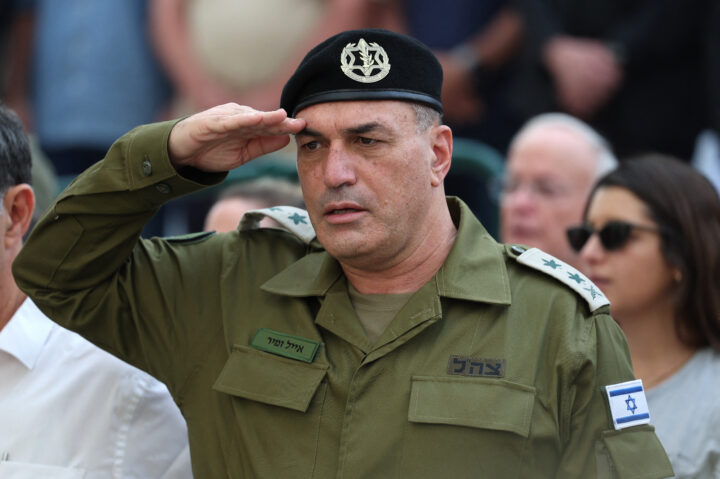
ABIR SULTAN/POOL/AFP via Getty Images
Israel's military chief Lieutenant General Eyal Zamir salutes during the funeral of Lieutenant Hadar Goldin who was killed during the six-week 2014 war in Gaza, at a military cemetery in Kfar Saba on November 11, 2025.
The U.S. and Israel have almost total control of Iranian airspace, IDF Chief of Staff, Lt.-Gen. Eyal Zamir said in a video statement on Thursday.
They “achieved near-complete air superiority over Iranian skies,” and Operation Roaring Lion, as Israel named the war with Iran, is entering its second phase, Zamir said.
The war is moving, he said, from the initial phase — beginning with Saturday’s “surprise strike” and followed by additional sorties to establish air superiority and degrade Iran’s ballistic missile array — to “further dismantle the regime and its military capabilities.”
“We have additional surprises ahead, which I do not intend to disclose. We will pursue our enemies, all of them, and we will overtake them,” Zamir added, paraphrasing Psalms 18:38.
Zamir said he is in “continuous contact with my American counterparts. We are fighting based on shared interests and shared values. We are fighting shoulder to shoulder. Through synchronized action, we are stripping the regime of its military capabilities, strategically isolating them and bringing them to a point of weakness unlike any it has known. This is truly historic cooperation״
The IDF Spokesperson’s Office said on Thursday that the military had struck over 300 of the Islamic Republic’s ballistic missile launchers and advanced defense systems in over 113 waves of strikes in western and central Iran, neutralizing 80% of Iran’s aerial-defense systems and over 60% of its ballistic missile launchers.
CENTCOM chief Adm. Brad Cooper said in a press conference on Thursday that Iranian ballistic missile attacks have decreased by 90% since Operation Epic Fury, the White House’s name for the operation, began on Saturday, with drone attacks declining by 83%.
The U.S. military has bombed nearly 200 targets inside Iran, including dropping 2,000-pound penetrator bombs targeting Iranian ballistic missile launchers stored underground, and sunk over 30 Iranian navy ships.
“We’re not just hitting what they have, we’re destroying their ability to rebuild. And so, as we transition to the next phase of this operation, we will systemically dismantle Iran’s missile production capability for the future, and that’s absolutely in progress,” Cooper said.
President Donald Trump told Politico on Thursday, “We’re taking out a threat to the United States of America, major threat, … and doing it like nobody’s ever seen before.”
Iran has “no navy. They have no air force. They have no detection of air. It’s all wiped out. Their radar is all wiped out. Their military is decimated. All they have is guts,” the president said.
Trump also said he plans to have a decisive influence on the next leader of Iran. “I’m going to have a big impact [on Iran’s future leadership], or they’re not going to have any settlement, because we’re not going to have to do this again,” Trump said. “We’ll work with the people and the regime to make sure that somebody gets there that can nicely build Iran but without nuclear weapons.”
The U.S. plans to “work with them to help make the proper choice,” so that the next Iranian leader will not “lead to having to do this [war] again in another 10 years.”
Trump said that Mojtaba Khamenei, the son of Iranian Supreme Leader Ayatollah Ali Khamenei, who was killed on the first day of the war, was a poor choice: “The reason the father wouldn’t give it to the son is they say he’s incompetent.”
Also on Thursday, the IDF launched its 26th wave of strikes in the Dahieh neighborhood of Beirut —a stronghold of the Hezbollah terrorist militia — hitting over 500 targets, including some in residential buildings in the Lebanese capital that the military said were used for terrorist infrastructure and UAV storage.
“Hezbollah made a strategic error,” Zamir said in his video statement, “[and] despite it directly conflicting with the interests of the Lebanese people, chose to join the campaign. Hezbollah is paying a heavy price.”
Israel killed the head of Hezbollah’s firepower array, known as Fidaa, whom Zamir said was “responsible for the deaths of many Israelis.”
“We will not let up on the objective of disarming Hezbollah,” Zamir added.
Magen David Adom emergency services reported 44 people injured amid attacks from Iran and Lebanon on Thursday through early Friday morning, all while making their way to shelters. MDA treated and evacuated 502 casualties from the start of Operation Lion’s Roar, including 359 injured on their way to shelter and five traffic accidents during sirens; there have been 12 fatalities.
Trump called out the commentator after he characterized the U.S.-Israeli operation in Iran as ‘absolutely disgusting and evil’

Chip Somodevilla/Getty Images
President Donald Trump shakes hands with Tucker Carlson at the conclusion of a conversation during Carlson's Live Tour at the Desert Diamond Arena on October 31, 2024 in Phoenix, Arizona.
President Donald Trump accused Tucker Carlson on Thursday of having “lost his way” following recent criticism from the commentator of the U.S. military operation in Iran, asserting that the former Fox News host was not representing the views of the Make America Great Again movement.
Trump made the comments while speaking to ABC News’ Jonathan Karl on Thursday afternoon after being asked about Carlson’s characterization of the ongoing U.S.-Israeli operation as “absolutely disgusting and evil” and his broader attacks on the Trump administration’s friendly relationship with Israel.
“Tucker has lost his way,” Trump said. “I knew that a long time ago, and he’s not MAGA. MAGA is saving our country. MAGA is making our country great again. MAGA is America first, and Tucker is none of those things. And Tucker is really not smart enough to understand that.”
In response, Carlson told Status News, “There are times I get annoyed with Trump, right now definitely included, but I’ll always love him no matter what he says about me.”
The president told journalist Rachael Bade on Monday that Carlson’s vocal opposition to his strikes on Iran had “no impact” on him, adding that Carlson “can say whatever he wants.”
“MAGA is Trump — MAGA’s not the other two,” he added, referring to Carlson and Megyn Kelly.
The criticism came less than a day after Carlson dropped a new episode of his podcast in which he accused the Chabad Lubavitch movement of seeking to start a “religious war” to facilitate the destruction of al-Aqsa Mosque and the Dome of the Rock in Jerusalem in order to build the Third Temple on top of its ruins.
Carlson claimed in the episode that the goal of the Hasidic sect’s movement is the rebuilding of the Temple, based solely on the fact that Orthodox Jews believe that the Temple will be rebuilt when the Messiah comes, a prophetic vision that has been a part of daily Jewish prayer for two millennia. He failed to mention, however, that no mainstream Jewish denomination, including the Hasidic and the Orthodox, advocates for the destruction of the al-Aqsa Mosque, one of Islam’s holiest sites, in order to build the Temple.
Rabbi Levi Shemtov, executive vice president of American Friends of Lubavitch (Chabad), the D.C.-based Chabad which engages with foreign and domestic political leaders, told Jewish Insider late Thursday that he welcomed Trump’s rejection of Carlson’s embrace of anti-Israel and antisemitic ideas.
“With regard to Tucker Carlson, the president must have come to the conclusion that while difficult and perhaps unpleasant, his own statement earlier today was necessary,” Shemtov told JI. “In a more perfect world, Tucker might recognize that some of his expressed beliefs simply do not coincide with established facts and historic Jewish beliefs. He might also realize that Israel and the Jewish people are merely an appetizer for the voracious hateful appetite of the Iranian regime. America and the West would be the main course.”
Rabbi Shlomo Litvin, a Chabad rabbi in Lexington who leads the Kentucky Jewish Council, told JI that Carlson’s attacks on the Hasidic group had prompted an outpouring of support from Jewish and non-Jewish supporters.
“This is not someone stumbling. These are intentional choices. They are choices that are intended to make Jews around the world feel unsafe, and they had the exact opposite reaction,” Litvin said of Carlson. “There were more positive tweets about Chabad today than there have been since I’ve been on Twitter, which is, I think, 15 years. There has never been as many positive tweets about Chabad in a day as there are right now.”
Some told JI they were concerned that President Trump could use it as legal justification to continue the campaign against Iran
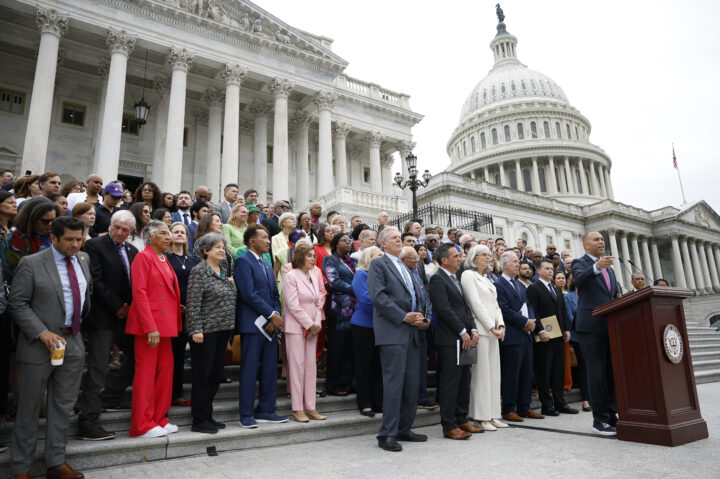
Kevin Dietsch/Getty Images
House Minority Leader Rep. Hakeem Jeffries (D-NY), joined by fellow Democrats outside of the U.S. Capitol on July 02, 2025 in Washington, DC.
In a surprise vote on Thursday afternoon that baffled some observers in Washington, 53 House Democrats voted against a resolution “reaffirming Iran remains the largest state sponsor of terrorism.” For some, their opposition traces to a desire not to give President Donald Trump rhetorical, or potentially legal, justification for continuing the Iran war, lawmakers said.
The resolution passed by a vote of 372-53, with two members voting “present.”
Most of the lawmakers voting against the resolution — like Reps. Rashida Tlaib (D-MI), Joaquin Castro (D-TX), Ilhan Omar (D-MN), Alexandria Ocasio-Cortez (D-NY) and Pramila Jayapal (D-WA) — are progressives, many of them frequent critics of Israel.
But a handful of others who ended up voting against the resolution are relative moderates who have taken more hawkish stances on Iran, such as Reps. Raja Krishnamoorthi (D-IL), Rob Menendez (D-NJ) and Steve Cohen (D-TN), who also voted against the resolution.
Many of the more moderate lawmakers who voted against the resolution are facing either competitive reelection races with challengers from their left or, in Krishnamoorthi’s case, running for higher office.
Newly elected Rep. Christian Menefee (D-TX), who had thus far not encountered any House votes on Middle East policy and faces Rep. Al Green (D-TX) in a member-on-member primary runoff, also voted no, as did Green.
Rep. Robert Garcia (D-CA), a Democratic rising star who is the top Democrat on the House Oversight Committee, told Jewish Insider he felt the legislation was meant to provide additional support for the war.
“Right now there’s an active situation that I oppose,” Garcia said. “That [resolution is] just meant to provide more pressure on that action. I think that right now, it’s a purely political stunt, and something that I won’t agree with.”
Another House Democrat, who asked to remain anonymous, explained that they were concerned about two clauses in the legislation, which they said could provide Trump with legal justifications for continuing the war.
One clause notes that “Tehran continues to harbor a network of senior al-Qaeda leaders, providing them with sanctuary space to fundraise in support of its fighters.” Given that the 2001 Authorization for Use of Military Force that approved the Afghanistan war includes language allowing the use of military power against any nations that harbored the organizations or individuals responsible for planning, carrying or aiding in the 9/11 attacks, the Democrat said that Trump could use the language “as a legal justification” for the war.
The other clause describes Iran as a “direct and persistent threat to the United States,” which the Democrat said could trigger the president’s self-defense authorities under Article II of the Constitution.
“Iran is a leading state sponsor of terrorism led by a regime that represses its own people and poses real dangers we must confront. We must ensure it never obtains a nuclear weapon. I will continue to support targeted efforts to counter the threats posed by Iran, but I voted against a separate resolution on Iran that President Trump may soon use to politically justify this war,” Krishnamoorthi said.
“Iran is obviously a state sponsor of terrorism. There’s no debate on that. The issue is that Republicans are using this to claim that Iran is harboring Al Qaeda (sound familiar?) and is a direct and persistent threat to the U.S. so they can legally justify this reckless war,” Rep. Sara Jacobs (D-CA) said on X.
Rep. Bonnie Watson Coleman (D-NJ), a progressive Israel critic who voted against the resolution, called it a “political messaging bill” designed to take attention away from the war powers resolution that failed in the House shortly after.
Rep. Adam Smith (D-WA), the ranking member of the House Armed Services Committee — who supported the resolution — said in a statement, “I agree with the principal assertion of this resolution that Iran is a bad actor. Iran’s malign and destabilizing actions in the region and treatment of its own citizens should be denounced. I have never contested this. What I do contest is that going to war is the reasonable response to this assertion. I support this resolution. I do not support the president’s war of choice with Iran.”
Four Democrats and two Republicans broke with their parties to oppose and support the resolution, respectively
Anna Moneymaker/Getty Images
U.S. Capitol on March 05, 2026 in Washington, DC.
A day after Republican senators blocked a vote to end the U.S.-Israeli operations in Iran, the House voted 219-212 to defeat a similar war powers resolution, with four Democrats breaking with their party to oppose an immediate end to the war, and two Republicans voting with other Democrats to oppose military action.
Reps. Greg Landsman (D-OH), Jared Golden (D-ME), Henry Cuellar (D-TX) and Juan Vargas (D-CA) were ultimately the only Democrats to vote against the resolution, which was led by Reps. Ro Khanna (D-CA) and Thomas Massie (R-KY). Reps. Josh Gottheimer (D-NJ) and Jared Moskowitz (D-FL), who said they would oppose the resolution before the war began, ultimately voted in favor.
On the Republican side, Massie and Rep. Warren Davidson (R-OH), both of whom have isolationist leanings, were the only members of the GOP to support the resolution.
Moskowitz had argued before the war that voting preemptively on the resolution would remove U.S. leverage in negotiations, but argued that the situation has since changed and that the U.S. is now in a full-scale war.
“I didn’t flip at all,” Moskowitz told Jewish Insider. “Circumstances have changed since my first statement two weeks ago.”
In a statement, he condemned Iran and its regime, saying he is “happy that [Ayatollah Ali Khamenei] is no longer able to reign terror on his country,” but added, “Regardless of how one feels about this war, or this President, Congress’s constitutional role in any declaration of war is a completely separate issue,” expressing concern at the erosion of congressional war powers over the past year.
“We must reestablish our Article I authority which grants Congress all legislative powers,” Moskowitz said, adding that he did not believe the resolution would prevent continued efforts to protect U.S. bases and personnel nor intelligence sharing with allies.
Gottheimer emphasized in a statement that the U.S. “simply can’t afford to get this wrong — we must win and crush” the Iranian regime’s military capabilities, emphasizing that he is not, in principle, opposed to military action against Iran and that the regime “deserves the punishment they’re receiving.
“With the defeat of the War Powers Resolution in the Senate, the vote in the House today shifted from an unacceptable call that could put our troops in harm’s way to a clear call for this Administration to articulate the goals for the mission, the end game, and their plan to avoid a protracted conflict,” Gottheimer continued — suggesting that he voted for the resolution because it was, in essence, symbolic given that it did not pass the Senate.
“Unlike some of my colleagues who are opposed to combatting the Iranian regime, the world’s leading state sponsor of terror, I’m supporting this resolution to send a clear message to the Administration: the American people deserve a coherent explanation of what precipitated this war, what success looks like, and how we will know when the mission has been achieved,” he continued, criticizing “shifting justifications and objectives” from the administration. “I’m not opposed to taking action against Iran. I believe that steps to address the persistent threats are merited and necessary to protect our broader national security interests.”
He pledged to make sure the military has sufficient resources, signaling that he may support supplemental funding for the mission if and when requested.
The beginning of combat operations, the loss of some American soldiers and the administration’s inconsistent messaging and strategy — as well as an aggressive push from Democratic leadership — likely helped Democrats close ranks on the war powers resolution.
After the vote, Rep. Greg Meeks (D-NY), the ranking member of the House Foreign Affairs Committee, said that he would call up another war powers resolution 60 days from the start of the war, the limit under which an administration can conduct military operations without congressional authorization under the War Powers Act.
“Members who voted against today’s WPR on the assumption that Trump’s war will be swift or limited will not have that excuse once we’ve entered the third month of open-ended hostilities,” Meeks said.
Like Moskowitz and Gottheimer, a handful of other Democrats who have offered a degree of support for the U.S. operations in Iran ultimately voted for the resolution. Some have pointed to concerns about constitutional process and the administration’s failure to seek congressional approval for the war, rather than opposition to the war in general.
“I will vote for the war powers resolution because I cannot support unchecked authority for the administration to engage, indefinitely, in an already deadly war with unknown size and scope, especially considering Secretary [of Defense Pete] Hegseth’s suggestion that he is willing to” use ground troops in the operation, Rep. Tom Suozzi (D-NY), a moderate House Democrat, said.
At the same time, Suozzi said that “Iran is weaker and the regime’s leadership has been decimated — those are good things. If these operations make the region more secure and America safer, those would also be good things.” He added that the war powers resolution would not prevent Congress from authorizing the use of force in Iran “if necessary and properly presented to Congress.”
Davidson, one of the two Republicans who voted for the resolution. said on the House floor on Wednesday that operations against Iran were just, and potentially necessary, but unconstitutional.
“For some this debate will be about whether we should even be fighting in Iran. For me, the debate is more fundamental: is the president of the United States, regardless of the person holding the office, empowered to do whatever he wants?” Davidson said. “That’s not what our Constitution says. … I rise in support of this war powers resolution today because the moral hazard posed by a government no longer constrained by our Constitution is a grave threat.”
Davidson argued that his Republican colleagues were ignoring the clear definition of what constitutes a war, and repudiating Trump’s campaign promises.
The House resolution, unlike the Senate version, included no specific protections to allow for continued U.S. intelligence sharing with Israel and other allies, and defensive operations to protect allies like Israel and U.S. forces.
Earlier this week, Gottheimer, Landsman, Suozzi, Cuellar, Golden and Reps. Jimmy Panetta (D-CA), Jim Costa (D-CA), Vicente Gonzalez (D-TX) and Adam Gray (D-CA) had introduced an alternative resolution that would give the administration 30 days from the start of the war to wind down operations in Iran, rather than demanding an immediate halt, while banning any ground operations.
Gottheimer said in his statement he plans to call up his resolution during the week of March 23, but he hopes that, “Between now and then, I hope either the conflict has reached its objectives or the Administration has made a strong case to Congress and the American people for why this mission must continue.”
But most ultimately voted for the Massie-Khanna resolution.
Suozzi said that the Gottheimer resolution “would prevent a reckless and potentially unsafe removal of our forces and allow us to continue to protect American troops and our allies in the region during this perilous time,” a seeming indictment of the war powers resolution he nevertheless supported.
Top lawmakers supporting the war powers resolution have largely failed to articulate what the implications of immediately ending operations would be, with some claiming, in spite of the resolution’s language, that U.S. forces would be allowed to finish their mission and wind down.
Some former Democratic officials argued that Gottheimer’s alternative effort would be a more prudent path, with U.S. forces and embassies under fire from Iran, and that any realistic and safe withdrawal would take time. One also argued that the resolution, if brought to a vote, might pick up enough Republican support to pass.
Daniel Silverberg, a former advisor to Rep. Steny Hoyer (D-MD), emphasized that a similar effort to cut off the U.S.’ Libya operations led by “one of the most ardent anti-war activists in the House,” then-Rep. Dennis Kucinich (D-OH), included a 15-day wind-down provision.
“The Massie-Khanna resolution lacks it. The notion that Democrats would not, at a minimum, support that amendment to allow for a responsible withdrawal of forces is problematic from a national security perspective and from a messaging perspective,” Silverberg said.
Jeremy Bash, a former chief of staff at the Department of Defense and Central Intelligence Agency under the Obama administration, told JI that the Khanna-Massie resolution “requires [a] very strange outcome” that would be “dangerous for our troops” and that it was not “credible” because it lacked any buffer period.
Plus, Kristi Noem gets the boot
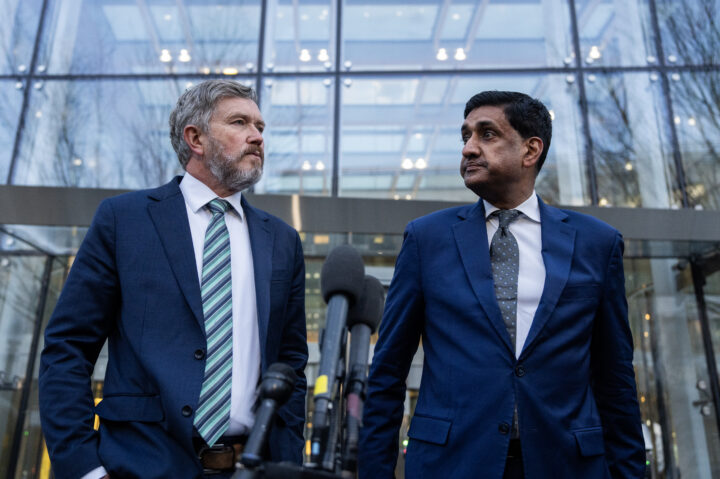
Tom Williams/CQ-Roll Call, Inc via Getty Images
Reps. Thomas Massie, (R-KY), left, and Ro Khanna, (D-CA), conduct a news conference outside a Department of Justice office in NoMa on Monday, February 9, 2026.
Good Thursday afternoon,
This P.M. edition is reserved for our premium subscribers — offering a forward-focused read on what we’re tracking now and what’s coming next.
It’s me again — Danielle Cohen-Kanik, U.S. editor at Jewish Insider and curator, along with assists from my colleagues, of the Daily Overtime. Please don’t hesitate to share your thoughts and feedback by replying to this email.
📡On Our Radar
Notable developments and interesting tidbits we’re tracking
President Donald Trump announced he’s replacing Kristi Noem as homeland security secretary with Sen. Markwayne Mullin (R-OK), after Noem had rankled the president and some Republican members of Congress with her oversight of widespread turmoil at the agency, among other issues. Mullin still needs to be confirmed by the Senate to assume the post.
Mullin, if confirmed, would take the helm of DHS amid its continued partial shutdown, and as it has repeatedly come under fire for its handling of issues related to antisemitism from lawmakers and Jewish community groups. Noem, meanwhile, will become special envoy to a new security initiative for the Western Hemisphere being launched by Trump this weekend…
House Speaker Mike Johnson (R-LA) and other GOP leadership called on Rep. Tony Gonzales (R-TX) to drop out of his reelection race, after the lawmaker admitted yesterday to having an affair with a staffer who later committed suicide. Gonzales is headed to a May runoff with his primary opponent, social media influencer Brandon Herrera; if Gonzales does step aside, Herrera, who has a history of antisemitic posts about the Holocaust, is all but guaranteed the GOP nomination in a solidly Republican district…
Trump said he “[has] to be involved in the appointment” of the next Iranian leader, in an interview with Axios, “like with Delcy [Rodriguez] in Venezuela.” He called Mojtaba Khamenei, son of the late Supreme Leader Ayatollah Ali Khamenei who has emerged as his father’s likely successor, “unacceptable.” The president’s comments seem to widen the administration’s stated war aims, which have thus far focused on eliminating Iran’s naval, air and nuclear assets.
Trump also insisted in the interview that Israeli President Isaac Herzog issue a pardon for Prime Minister Benjamin Netanyahu “today,” as he wants Netanyahu “to focus on the war and not on the f**king court case. I want the only pressure on Bibi to be the fighting against Iran”…
Some Democratic lawmakers — including Sens. Jack Reed (D-RI), Gary Peters (D-MI), Tim Kaine (D-VA) and Elissa Slotkin (D-MI) — told Politico they won’t “rule out” voting in favor of an emergency supplemental funding request to shore up the military should one come from the administration amid the campaign against Iran, despite widespread Democratic condemnation of the White House’s failure to consult Congress beforehand…
A vote on a war powers resolution to stop the military campaign in Iran failed in the House this afternoon 219-212, with two Republicans — Reps. Thomas Massie (R-KY) and Warren Davison (R-OH) — crossing the aisle in support and four Democrats — Reps. Greg Landsman (D-OH), Henry Cuellar (D-TX), Jared Golden (D-ME) and Juan Vargas (D-CA) — breaking with their party to oppose it.
Reps. Josh Gottheimer (D-NJ) and Jared Moskowitz (D-FL) both changed their positions and voted in favor of the resolution, weeks after Moskowitz told Jewish Insider — before the campaign began — that its sponsors “should just rename [the resolution] the Ayatollah Protection Act because that’s what it does.” Asked by JI about the shift in his stance today, Moskowitz answered, “I didn’t flip at all. Circumstances have changed since my first statement”…
Antisemitic podcaster Tucker Carlson’s latest extreme rhetoric took aim at the Chabad Lubavitch movement, with sweeping conspiratorial language accusing the Hasidic sect of seeking to start a “religious war” amid the U.S. and Israeli strikes on Iran, JI’s Gabby Deutch reports.
Carlson argued in an episode of his show that dropped last night that Jews see the war against Iran as an opportunity to feud with Islam and to target Christians. Carlson’s remarks prompted outrage among Chabad’s backers, who pointed out that Chabad emissaries have for decades played a crucial role in connecting American Jews to their faith and to each other…
In a conversation with ABC News, Trump said this afternoon that Tucker “has lost his way. I knew that a long time ago, and he’s not MAGA. MAGA is saving our country. … Tucker is really not smart enough to understand that”…
In a discussion with the New York Post, Trump railed against European countries which have continued to oppose the campaign against Iran, calling Spain “a loser” and the U.K. “very disappointing.” Canadian Prime Minister Mark Carney, meanwhile, said today that the Iran war is a “failure” of the international order, but would not “categorically rule out” Canada’s participation…
Iran’s indiscriminate attacks are bringing allies together worldwide: Ukrainian President Volodymyr Zelensky said he’s deploying specialists to assist the U.S. after Washington requested “specific support in protection” against Iranian Shahed drones, which Ukraine has been battling for several years as Russia has regularly deployed them, and the European Union and Gulf Cooperation Council held a joint meeting to discuss Iran’s “unjustifiable, unprovoked, and unlawful attacks”…
The New York Times profiles Lt.-Gen. Eyal Zamir, the IDF’s chief of staff, as he helps lead Israel’s efforts in the campaign against Iran…
⏩ Tomorrow’s Agenda, Today
An early look at tomorrow’s storylines and schedule to keep you a step ahead
Keep an eye out in Jewish Insider for a look at Jack Cocchiarella, the progressive Gen Z podcaster who has made a name for himself hosting high-profile Democratic candidates — including California Gov. Gavin Newsom in New Hampshire tonight — and who has recently taken a turn towards bashing Israel.
Team Israel will play its first games of the 2026 World Baseball Classic on Saturday against Venezuela and on Sunday against Nicaragua.
Also Sunday, AJ Edelman, the Israeli Olympic bobsled team pilot, will speak in conversation with Neil Goldman at Chabad of West Village in New York.
Birthright Israel’s Excelerate26 summit is also taking place in New York this weekend, with keynote speeches on Sunday from Robert Kraft, owner of the New England Patriots; Anne Neuberger, former deputy national security advisor during the Biden administration; and Sheryl Sandberg, former COO of Meta.
We’ll be back in your inbox with the Daily Overtime on Monday. Shabbat Shalom!
Stories You May Have Missed
MILITARY UPDATE

Tehran also attacked Azerbaijan for the first time, launching drones that injured two at Nakhchivan International Airport
ABOUT-FACE
The Arizona senator’s outspoken commentary has repeatedly placed blame for the military operation on Israel, leading one Jewish Democrat to pull her support
The group’s warning came as Gov. Gavin Newsom said Israel could be considered an apartheid state

Michael Brochstein/SOPA Images/LightRocket via Getty Images
Jonathan Greenblatt, ADL CEO & national director, speaking at the Anti-Defamation League (ADL) National Leadership Summit in Washington, D.C.
The Anti-Defamation League on Thursday urged public figures to refrain from promoting antisemitic rhetoric amid the U.S. and Israel’s operation against Iran, as some leading Democrats have invoked anti-Israel sentiment since the war began last week.
“Since the start of hostilities with the Islamic Republic of Iran last weekend, we are witnessing an alarming pattern of escalating, inflammatory rhetoric from voices across the political and ideological spectrum,” said Jonathan Greenblatt, CEO of the ADL. “This rhetoric distorts reality and fuels dangerous antisemitic narratives.”
The ADL’s statement comes as several Democratic elected officials have condemned the joint U.S.-Israel ongoing strikes in Iran.
Greenblatt expressed concern that “too many voices” have “engaged in this dangerous game,” which he said includes statements calling Israel an “apartheid state” or accusing it of “genocide,” which “inflame hatred.”
California Gov. Gavin Newsom said on Tuesday on the liberal podcast “Pod Save America” that the U.S. should reconsider its military support for Israel. Amid the Iran operation, he told the podcast’s hosts that Israel could “appropriately” be described as an apartheid state.
The comments marked a shift for Newsom — widely considered a 2028 presidential contender — who traveled to Israel less than two weeks after the Oct. 7 terror attacks in 2023 and said in an October 2025 interview that he would not consider eliminating U.S. military aid to Israel.
Additionally, the ADL condemned rhetoric that claims pro-Israel organizations and supporters are “anti-American” for advocating for a U.S.-Israel relationship, as well as rhetoric that blames Israel or frames American policy as manipulated by Jewish influence.
During an address at J Street’s convention in Washington on Sunday, Sen. Chris Van Hollen (D-MD) said the pro-Israel advocacy group “may call itself pro-American. They may call themselves pro-Israel. But they are neither.”
“It is a sad irony that an operation against the world’s largest sponsor of antisemitism has prompted so much antisemitism,” said Greenblatt.
The ADL’s statement, which does not mention Newsom or any other figures by name, is a contrast from one put out by the American Jewish Committee on Wednesday, which directly condemned the governor.
“Governor Newsom’s recent comments about Israel were confusing and problematic at a critical moment, as the United States, Israel, and their regional partners confront significant threats from the Iranian regime,” the AJC said.
“Invoking the term ‘apartheid’ is wrong and inflammatory, does not reflect the complex realities on the ground, and only risks inflaming tensions. Policy disagreements between Israeli and U.S. leaders should not undermine the enduring importance of the U.S.–Israel relationship, grounded in shared values and strategic interests.”
Iranian ayatollahs have issued a fatwa calling on Muslims worldwide to take revenge for the killing of Supreme Leader Khamenei

Tom Brenner For The Washington Post via Getty Images
Metropolitan Police Department and Federal Bureau of Investigation officers stand guard at a perimeter near the Capital Jewish Museum on May 22, 2025 in Washington.
Since the joint U.S.-Israeli operation against Iran began last Saturday, Jewish communities worldwide have seen an increase in threats and harassment — including a 95% rise in violent online posts targeting Jews, according to a new report from a leading American Jewish safety and security organization.
A bulletin distributed by the Secure Community Network to law enforcement on Thursday reports that the ongoing strikes on Iran, which included the killing of former Supreme Leader Ayatollah Ali Khamenei on Saturday, have widespread foreign and domestic security implications.
Iranian ayatollahs Hossein Nouri Hamedani and Naser Makarem Shirazi on Sunday issued a fatwa calling on Muslims worldwide to take revenge for the killing of Khamenei. They told Muslim adherents to “aveng[e] the blood of the martyred leader of the revolution” and added that it “is obligatory for all Muslims.” Additionally, the Islamic Revolutionary Guard Corps issued a public proclamation in Farsi that “the enemy … will no longer have security anywhere in the world, even in their own homes.”
The U.S. Department of Homeland Security responded in a confidential law enforcement report obtained by Jewish Insider that the fatwas, Iranian government rhetoric and online messaging heighten the threat of violent extremism in the U.S.
SCN warned that the heightened risk of lone wolf attacks inspired by the strikes may have already begun to play out. Less than 24 hours after the killing of Khamenei, a gunman killed three people in a mass shooting at an outdoor beer hall in Austin, Texas. While authorities are still investigating a motive for the shooting, they noted that there were indicators on the suspect and in his vehicle that suggest a potential terrorist connection: During the attack, the suspect wore a hoodie with the words “Property of Allah” and a shirt with an Iranian flag design underneath.
Since the airstrikes began in Iran, antisemitic online posts impacting the Jewish community — some of which use explicitly violent rhetoric — have nearly doubled, according to SCN, with 4,322 violent posts tracked in the past six days, compared to 2,211 in the week prior to the strikes. These posts include long-standing “Zionist Occupied Government” conspiracies about Israeli control over governments and influence in the U.S., as well as suggestions that the strikes were intended as blood sacrifices for the Jewish holiday of Purim.
The Secure Community Network said it has not yet identified any specific threats to the Jewish community or U.S. homeland. In a list of precautionary recommendations, it urged law enforcement, security partners and Jewish institutions to remain vigilant, refrain from broadly advertising events and consider adding increased armed security.
Retaliatory calls to harm American Jewish communities and facilities, in addition to general calls for “death to America,” have also proliferated online, including in tweets from Columbia University Apartheid Divest, a coalition of over 80 university student groups.
Plus, Tehran attacks Azerbaijan

Randy Shropshire/Getty Images for Entertainment Industry Foundation
Governor Gavin Newsom attends a pep rally to celebrate the second year of the Roybal Film and Television Production School on October 13, 2023 in Los Angeles, California.
👋 Good Thursday morning!
In today’s Daily Kickoff, we report on yesterday’s failed war powers resolution vote in the Senate and preview a similar vote in the House today. We take a closer look at the leftward shifts on Israel by both California Gov. Gavin Newsom and Sen. Ruben Gallego (D-AZ) as both men gear up for potential 2028 presidential bids, and spotlight a series of recent public opinion polls in Israel and the U.S. about attitudes toward the war in Iran. Also in today’s Daily Kickoff: former Rep. Anthony D’Esposito, Gov. Ron DeSantis and Ahmad Vahidi.
Today’s Daily Kickoff was curated by JI Executive Editor Melissa Weiss and Israel Editor Tamara Zieve, with assists from Danielle Cohen-Kanik and Marc Rod. Have a tip? Email us here.
What We’re Watching
- The House is slated to vote on a war powers resolution today, a day after a similar effort was blocked by Senate Republicans. Rep. Warren Davidson (R-OH), an isolationist-leaning lawmaker, said he plans to vote with most Democrats in support of the resolution, joining Rep. Thomas Massie (R-KY). A few Democrats are expected to oppose the resolution. Rep. Tom Suozzi (D-NY), a moderate House Democrat, said he will also support the resolution. With razor-thin margins in the House, the ultimate outcome could come down to the number of Democratic defections, and potential absences, though Republicans have expressed confidence that the vote will fail.
- The House will separately vote on a Republican-led resolution affirming that Iran remains the leading state sponsor of terrorism.
- Elbridge Colby, the Trump administration’s under secretary of defense for policy, is testifying this morning on the U.S. National Defense Strategy before the House Armed Services Committee.
- The House Foreign Affairs Committee is holding a hearing this morning with Under Secretary of State for Public Diplomacy Sarah Rogers.
- Elsewhere on the Hill, the Muslim World League is hosting an interfaith iftar gathering later today.
- California Gov. Gavin Newsom is slated to be interviewed by anti-Israel podcaster Jack Cocchiarella in New Hampshire today for a conversation that is expected to heavily focus on Israel. More below on Newsom’s sharp left turn on Israel in recent months.
What You Should Know
A QUICK WORD WITH JI’S LAHAV HARKOV AND TAMARA ZIEVE
More than 80% of Israelis support the war against Iran, polls by two major Israeli research institutions found this week, while several U.S. polls found that a majority of Americans oppose it.
The Israel Democracy Institute found that 82% of Israelis — 93% of Jewish Israelis and 26% of Israeli Arabs — support the war with Iran. Among Jewish Israelis, the war has strong support across the political spectrum, with 76% of respondents on the left backing it, 93% of voters from the center and 97% from the right.
Similarly, the Institute for National Security Studies at Tel Aviv University found that 81% of Israelis back the war against Iran, and 63% support continuing military efforts until the Iranian regime falls. Among Jewish Israelis, support for the war was at 92%, while only 38% of Israeli Arabs support it. About half (49%) of Israeli Arabs oppose the war, while the rest said they did not know.
Meanwhile, in the U.S., a CNN poll, conducted by SSRS shortly after the war began on Saturday, found that nearly 41% of Americans approve of the U.S. military action in Iran, with a sharp divide between Republicans, Democrats and independents — 77% of Republicans approve of the launch of the operation, compared to 32% of independents and 18% of Democrats. The poll found that 59% of Americans disapprove of the U.S. decision to strike.
Similarly, an NBC poll found that 41% of American registered voters approve of President Donald Trump’s approach to Iran, while 54% disapprove and 5% aren’t sure. Just 8% of Democrats approve of the president’s handling of the situation, while 79% of Republicans and 28% of independents approve of it. In addition, the poll found that 52% oppose the current U.S. military operation. A sizable majority of Republicans (77%) agree with the U.S. decision to strike Iran, while 89% of Democrats and 58% of independents disagree.
There is a further divide between self-identified MAGA-aligned Republicans and other Republicans, the poll found: 90% of the former back the strikes, while 54% of the latter support them. The CNN poll found that MAGA Republicans are 30 points more likely than non-MAGA Republicans to strongly approve of the decision to take military action.
MILITARY UPDATE
Some of the first repatriation flights carrying Israelis who had been stranded abroad were briefly held mid-flight on Thursday morning as Iranian missiles were fired at central Israel. El Al, Arkia, Israir and Air Haifa repatriation flights began departing for Israel on Wednesday evening from dozens of destinations in Europe, the U.S. and Thailand, and began landing Thursday morning. Several flights needed to briefly detour while en route to Ben Gurion Airport after Iran shot missiles toward central Israel. The flights are expected to continue through the weekend, Jewish Insider’s Lahav Harkov reports.
Developments: Iran also attacked Azerbaijan for the first time Thursday morning, launching drones that injured two at Nakhchivan International Airport. Shortly after, Baku vowed to respond to the attack. Italy, Spain, France and the Netherlands said they would send naval vessels to Cyprus, after an Iranian UAV struck a British base on the island state. The IDF has been preparing for the possibility that the Houthis will begin striking Israel as they have done sporadically since the Oct. 7, 2023, Hamas attacks on Israel, Israeli media reported. The Houthis have threatened to fire at Gulf States if they attack Iran, and Saudi Arabia increased security for Crown Prince Mohammed bin Salman in case of a Houthi attack, according to Israeli public broadcaster KAN.
FINGER IN THE WIND

California Gov. Gavin Newsom said on Tuesday night on a popular liberal podcast that the U.S. should reconsider its military support for Israel, a marked evolution for a politician who traveled to Israel less than two weeks after the Oct. 7 terror attacks in 2023 and who said in an October interview that he would not consider eliminating U.S. military aid to Israel, Jewish Insider’s Gabby Deutch reports. Asked by Jon Favreau, the co-host of “Pod Save America,” if the U.S. should, in the future, rethink its military support for Israel, Newsom responded, “It breaks my heart because the current leadership in Israel is walking us down that path where I don’t think you have a choice.”
Zoom out: Newsom’s move away from military support for Israel is a shift even from his recent positions. In October, during an interview with the “Higher Learning” podcast, Newsom said he would not support ending U.S. military aid to Israel. He touted his decision in December 2023 to send humanitarian aid to Gaza, while also defending Israel’s right to exist. Newsom is widely considered a 2028 presidential contender, and he has been shifting his public stances on Israel to the left in recent months in response to questions from progressive interviewers.
Bonus: The Free Press’ Peter Savodnik writes that Newsom “seems congenitally incapable of rising above his tribe and conceiving of the war [in Iran] as anything other than yet another opportunity for politicking, for taking a few shots, scoring some points.”
ABOUT FACE
With a series of pugnacious tweets and media appearances, Sen. Ruben Gallego (D-AZ) has made himself a face of the Democratic opposition to the war in Iran, issuing one of the first comments from a U.S. lawmaker opposing the effort in the early hours of Saturday morning. Gallego’s outspoken commentary, which has repeatedly pinned blame for the operation on Israel — a notion that colleagues on both sides of the aisle have disputed — also coincide with Gallego’s endorsement of Graham Platner, the progressive Maine Senate candidate who has faced a series of scandals related to antisemitism, Jewish Insider’s Marc Rod reports.
Current messaging: The high-profile moves come as Gallego, who claimed victory in Arizona in 2024 even as President Donald Trump won the state, is seen by political observers as positioning himself for a 2028 presidential campaign — and as anti-Israel policies have become a litmus test for the progressive left. “So Netanyahu now decides when we go to war? So much for America First,” Gallego said earlier this week, in response to comments by Secretary of State Marco Rubio that seemed to suggest that the timing of the war was dictated by Israel. “What the f*** happened to America First?” Gallego wrote in another post, adding that the U.S. should have left Israel to go ahead with the operation alone.
VOTED DOWN
With the U.S.-Israel operation against Iran widening, the Senate voted 53-47 on Wednesday afternoon — largely along party lines — to block a procedural vote on a war powers resolution that would have forced the immediate withdrawal of U.S. forces from combat with Iran, Jewish Insider’s Marc Rod reports.
What happened: Sens. Rand Paul (R-KY) and John Fetterman (D-PA) broke with their respective parties as expected, with Paul voting for and Fetterman voting against the motion, with all other lawmakers voting along party lines. The vote showcased how the Iran war has quickly become a partisan issue, despite lawmakers on both sides of the aisle expressing long-standing concerns about the threat from Iran and its malign activities and some Democrats offering a degree of positive commentary about the U.S. strikes. Though widely expected to fail, Democrats view the resolution, and a similar one up for a vote in the House tomorrow, as a critical avenue to go on record with their opposition to the Trump administration’s military offensive.
STEERING CLEAR
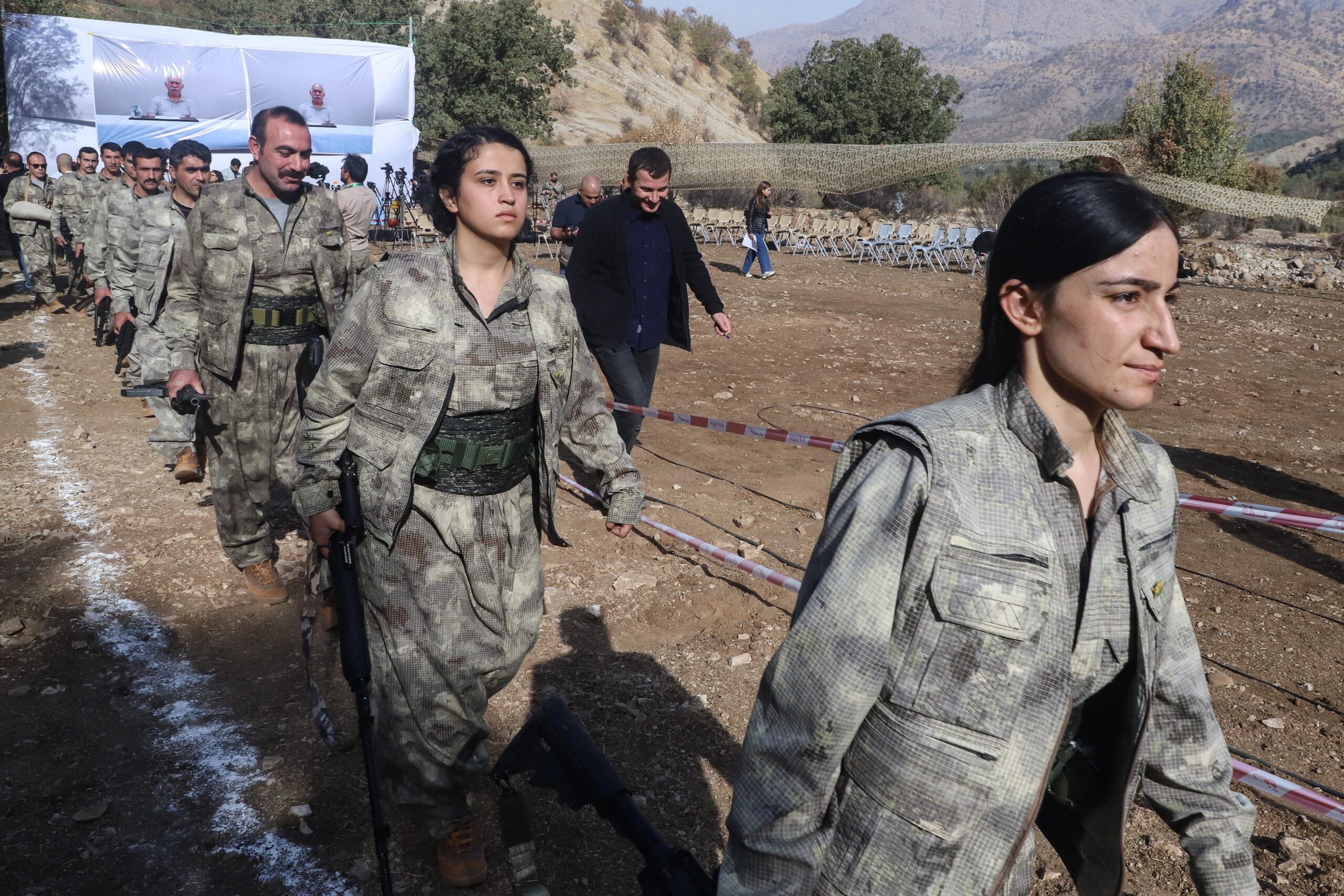
Lawmakers are largely keeping an arm’s length from the administration’s reported discussions with Kurdish leaders in Iraq about supporting an armed offensive against the Iranian regime, as an on-the-ground force aligned with U.S. interests in the ongoing American and Israeli air campaign, Jewish Insider’s Marc Rod reports.
What they’re saying: Many Republican senators indicated Wednesday that they knew little about the effort. Sen. John Kennedy (R-LA) told JI he couldn’t comment on the subject due to classification issues, but said generally that “the Kurds know how to fight — you don’t want to tangle with the Kurds.” Some seemed broadly supportive, while not commenting on the specifics of the reported moves. Democrats are generally skeptical of the reported plan. “I am struck by the hypocrisy of pulling the rug out from under the Kurds in Syria and then asking them to fight again for Iran. Kurds deserve better,” Sen. Richard Blumenthal (D-CT) said.
NOT CONVINCED

Leading Middle East foreign policy experts warned that Iran’s decision to expand its response to the U.S.-Israeli bombing campaign by striking neighboring Arab states could prove to be a major strategic miscalculation — one that risks isolating Tehran further and potentially drawing Gulf countries to take action, Jewish Insider’s Matthew Shea reports. In the days following the launch of the campaign, Iran carried out widespread drone and missile strikes at multiple Arab nations, striking all members of the Gulf Cooperation Council — Bahrain, Kuwait, Oman, Qatar, Saudi Arabia and the UAE — as well as Jordan, Syria, Iraq and Oman.
Tehran ‘encircled’: Alexander Gray, a former National Security Council chief of staff under President Donald Trump and a senior fellow at the Atlantic Council, told JI that Iran’s decision to attack Arab countries was an “extraordinary strategic miscalculation.” Gray said, “Not only has Iran forced the region’s Arab states to openly support the U.S. and Israeli operation, but it has encircled itself far more effectively than any American diplomacy could have accomplished.” Michael Koplow, chief policy officer at Israel Policy Forum, called the action a “risky move at best.”
Ankara angle: Iran and Turkey moved to de-escalate tensions between them in the immediate aftermath of the downing of an Iranian missile over Turkey on Wednesday, but the development signals dangerous potential if the conflict heats up between them, experts told JI’s Lahav Harkov.
Worthy Reads
A New Middle East: In Semafor, Jason Greenblatt, who served as White House Middle East envoy in the first Trump administration, posits that shifting regional dynamics have created an environment for a new power structure in the Middle East. “For the first time in decades, there is a convergence of strength in the Middle East: A US president willing to confront threats directly; an Israel capable of degrading proxy networks and striking hard at Iran’s military infrastructure; and Arab leaders who have built dynamic economies focused on modernization and long-term competitiveness. Working together, they can isolate the Iranian regime diplomatically, dismantle much of its proxy infrastructure, severely degrade its military reach, and strip it of the intimidation it has used to dominate the region.” [Semafor]
Why America Went to War: In The Free Press, Haviv Rettig Gur considers the broader global geopolitics at play amid debates in the U.S. over the main drivers of the war with Iran. “There is a regional chessboard, on which Israel, Iran, Saudi Arabia, Qatar, and the other Gulf states all play. Iran’s proxies, its drones and ballistic missiles, its nuclear ambitions, its funding of Hezbollah and the Houthis: All of that belongs primarily to this smaller game. … But there is a second chessboard, vastly larger, on which the United States and China are the primary players. … America went to war in Iran because Iran made itself a Chinese weapon. It didn’t need to do this, to invest so much of the administration’s political capital and of the military’s firepower, just to shore up a second-run Israeli operation.” [FreePress]
Lonely is the Head…: In The Wall Street Journal, RealEye CEO Kevin Cohen looks at Israel’s strategy of targeting the top echelon of Iranian leadership. “The logic is straightforward. Authoritarian systems recover from shocks by quickly re-establishing hierarchy. If that re-establishment becomes dangerous, decision-makers hesitate. Hesitation spreads uncertainty through the entire structure. A regime can survive sanctions. It can survive airstrikes. It can even survive the death of a supreme leader. What it struggles to survive is doubt about who holds authority next. That doubt ripples outward. Commanders delay orders until legitimacy is confirmed. Rival factions position themselves cautiously. Security services turn inward, searching for infiltration. Decision cycles lengthen. Under pressure, elongated decision cycles become fragility. This strategy depends on intelligence rather than brute force.” [WSJ]
Word on the Street
Speaking at a press conference on Wednesday, Secretary of Defense Pete Hegseth announced the accomplishment of several key objectives, including that “the leader of the unit” responsible for the assassination attempt on President Donald Trump in November 2024 “has been hunted down and killed,” Jewish Insider’s Matthew Shea reports…
Seventy-five retired U.S. generals and military officials signed onto an open letter from the Jewish Institute for National Security of America supporting the U.S. and Israeli strikes in Iran…
Rep. Bennie Thompson (D-MS), the ranking member of the House Homeland Security Committee, and Rep. Seth Magaziner (D-RI), the top Democrat on the Counterterrorism and Intelligence Subcommittee, expressed concerns about reports that the FBI had fired staff involved in countering threats from Iran in retaliation for their involvement in investigating President Donald Trump…
First in JI: Rep. Josh Gottheimer (D-NJ) endorsed James Leuschen, a former staffer for Rep. Steny Hoyer (D-MD) running for Congress in Nebraska’s 2nd Congressional District. “Americans are getting squeezed by high grocery prices, health care, child care, rent, and utility bills,” Gottheimer said in a statement. “They want results, not rhetoric. James Leuschen knows that serving the district where he was born and raised means working with anyone to lower costs and deliver real solutions — and to stop Donald Trump’s chaos”…
Sen. Steve Daines (R-MT) dropped his reelection bid hours before the deadline to file in Montana; Daines endorsed U.S. Attorney for the District of Montana Kurt Alme, who filed to run for the seat shortly after Daines withdrew from the ballot…
Far-left Durham County Commissioner Nida Allam conceded to Rep. Valerie Foushee (D-NC) in the Democratic primary in North Carolina’s 4th Congressional District after falling short in her second bid for the seat…
Former Rep. Anthony D’Esposito (R-NY) is expected to step down as inspector general of the Labor Department as soon as today and announce a comeback bid for the Long Island House seat he lost to Rep. Laura Gillen (D-NY) in 2024…
A federal judge in Florida ruled that Gov. Ron DeSantis’ move to declare the Council on American-Islamic Relations a terrorist group was unconstitutional and violated the group’s First Amendment rights…
A New York State Supreme Court justice who also serves as an adjunct professor at Columbia University’s law school dismissed the punishments — including expulsions, degree revocations and suspensions — of Columbia students who participated in the takeover of the school’s Hamilton Hall in 2024 to protest Israel’s war in Gaza, determining that the school could not use sealed arrest records as evidence in disciplinary proceedings; the ruling came as a result of Manhattan District Attorney Alvin Bragg’s decision to drop criminal charges against the students, thereby sealing their records…
Florida International University is conducting a criminal investigation into a group chat of students associated with Miami-Dade County’s Republican Party in Florida where participants repeatedly used racial slurs, praised Nazi ideology and discussed violent acts against Black people…
Jewish leaders in Chicago are calling on Mayor Brandon Johnson to follow the recommendation of the city’s Commission on Human Relations and create an antisemitism task force…
A local Democratic candidate in Northern Virginia’s Prince William County is under fire for recently unearthed racist and antisemitic social media posts from 2012 and 2015…
The U.K. is undertaking an official review into antisemitism at British schools and universities, following a report from the Community Security Trust that showed that school-related antisemitic incidents had doubled since the Oct. 7, 2023, Hamas terror attacks…
Poland repatriated more than 90 artifacts from Greece’s Jewish community that had been looted by the Nazis’ Rosenberg Taskforce during Germany’s occupation of the country during World War II…
The New York Times reports on how the Australian Jewish community, and specifically the Sydney Jewish Museum, is memorializing the victims of the December terror attack on a Hanukkah celebration at Bondi Beach…
Ahmad Vahidi, a key suspect in the 1994 bombing of the AMIA Jewish community center in Buenos Aires, Argentina, was named the new head of Iran’s Islamic Revolutionary Guard Corps…
The Wall Street Journal looks at how Iran’s decision to build underground “missile cities” to store munitions has backfired, with U.S. and Israeli jets poised to strike missile launchers as they emerge from the underground caverns…
Pic of the Day

Birthdays

Actor and screenwriter, Jason Isaac Fuchs turns 40…
Particle physicist and astrophysicist, he is a professor emeritus at the University of Michigan, Carl William Akerlof turns 88… Retired university counsel for California State University, Donald A. Newman… Pulitzer Prize-winning journalist, he is an associate fellow at the Washington Institute for Near East Policy, Roy Gutman turns 82… Retired partner of Los Angeles law firm, Gordon, Edelstein, Krepack, Grant, Felton & Goldstein, LLP, Mark Edelstein… President of Los Angeles PR firm Robin Gerber & Associates, Robin Gerber Carnesale… Managing partner at Lerer Hippeau, a NYC-based VC firm, he co-founded Huffington Post and was the longtime chair of BuzzFeed, Kenneth B. Lerer turns 74… Political philosopher and professor at Harvard Law School, Michael Joseph Sandel turns 73… Founder and retired CEO of the DC-based News Literacy Project, Alan C. Miller… Author of Judaism: A Way of Being and former professor of computer science at Yale University, David Hillel Gelernter turns 71… Maryland state senator since 2019, Benjamin F. Kramer turns 69… Actor, screenwriter and film producer, he has been a contestant on three seasons of CBS’ “Survivor,” Jonathan Penner turns 64… Retired tennis player, she won 10 doubles tournaments, Elise Burgin turns 64… Former senior associate at the Carnegie Endowment for International Peace and former NPR reporter, Sarah Chayes turns 64… Professor at Université de Montréal, most noted for his work on artificial neural networks and deep learning, Yoshua Bengio turns 62… Chair of the Conference of Presidents of Major American Jewish Organizations, former president and board chair of AIPAC, Betsy Berns Korn turns 58… President and founder of West End Strategy Team, Matt Dorf turns 56… Los Angeles-area builder and developer, Michael Reinis… Renewable energy executive, Michael N. Kruger… Recording music industry executive, best known for his association with the game show “Jeopardy!,” Austin David “Buzzy” Cohen turns 41… Chief communications officer at Jenner & Block, Daniel S. Schwarz… Managing director at Portage Point Partners, Steven Shenker… Disgraced and jailed founder of cryptocurrency exchange FTX, Sam Bankman-Fried turns 34… Manager of operations support at TEKsystems, Andrew Leiferman… Singer and influencer, her career started with a song she performed at her own bat mitzvah, Madison Elle Beer turns 27…
Turkish Foreign Minister Hakan Fidan warns his Iranian counterpart not to allow the conflict to spread across the region
Amjad Kurdo / Middle East Images / AFP via Getty Images
A view of an Iranian missile after it fell near Qamishli International Airport, near the Turkish border in the Qamishli district of Hasakah, Syria, on March 4, 2026, amid the U.S.-Israeli conflict with Iran.
Iran and Turkey moved to de-escalate tensions between them in the immediate aftermath of the downing of an Iranian missile over Turkey on Wednesday, but the development signals dangerous potential if the conflict heats up between them, experts said.
NATO air defense systems shot down an Iranian ballistic missile heading for Turkish airspace on Wednesday. Turkish Foreign Minister Hakan Fidan spoke with his Iranian counterpart, Abbas Araghchi, warning Araghchi not to allow the conflict to spread across the region. Turkey summoned the Iranian ambassador to Ankara for a reprimand.
“All necessary steps to defend our territory and airspace will be taken resolutely and without hesitation,” including consulting with NATO allies to protect the country, Turkey’s Defense Ministry said in a statement.
Officials told The Wall Street Journal the missile was targeting the Incirlik Air Base in Turkey, which hosts American troops. At the same time, a Turkish official told Agence France-Presse that the missile was likely aimed at Cyprus, where Iran has struck British military assets.
Zvi Yehezkeli, an Arab affairs expert for i24 News, interpreted the missile over Turkey as mostly symbolic, meant as an Iranian message to Ankara to stay out of the war.
Though Turkish President Recep Tayyip Erdogan said he was saddened by the killing of Iranian Supreme Leader Ayatollah Ali Khamenei in the war, his response “was viewed in Tehran as hypocrisy,” and they see Erdogan as “playing a double game,” according to Yehezkeli.
“Ankara knows that this symbolic shot was mostly meant for domestic needs in Tehran,” Yehezkeli stated. “For Turkey, silence and containment are the most comfortable way at the moment.”
Gallia Lindenstrauss, a senior research fellow at the Institute for National Security Studies at Tel Aviv University specializing in Turkish foreign relations, told Jewish Insider that there were “efforts on both sides to minimize the significance of the event.”
In Ankara, she said, “some said [the missile] was meant for Cyprus, some said it was shot by independent groups and not under orders from Tehran. The Iranians said there was no attempt to harm Turkey.”
Lindenstrauss said that while Iran’s intentions are hard to confirm, they may have aimed at the Ceyhan port, through which Azerbaijan ships oil to Israel, especially in light of Iran’s strike on Azerbaijan the following day.
“The attempt to strike Turkey is part of an Iranian policy of trying to get everyone involved in the conflict. They are shooting in all directions. I don’t think [targeting Turkey] is a one-time thing,” she said.
Lindenstruass said she sees several possible negative consequences for Turkey from the war.
“Turkish commentators who understand the severity [of the missile attack] say that Iran is suicidal,” she said.
In addition, Ankara is very concerned about the “spillover of destabilization,” including the possibility of the Kurds getting involved in the conflict, of European navies sending ships to the region to defend Cyprus, and a wave of refugees attempting to enter Turkey from Iran.
Turkey has long had a wall on its border with Iran, and hundreds of Iranians have successfully crossed the border since the start of the war on Saturday, according to Reuters.
“For Israelis, what is most concerning is a growing view [in Turkey] of Israel as a threat that has grown too strong,” Lindenstrauss said. “They have the idea that Israel is behind the events. They don’t blame the U.S.; they blame Israel for a provocation and sabotaging the negotiations.”
At the same time, Turkey is making gains from the conflict in its defense industry, she said.
“Turkey is supplying drones to Gulf States, and Saudi Arabia and Egypt are interested in the fighter jet that Turkey is building. The Gulf States are not happy with Turkish behavior, but they will not isolate Ankara because of its defense industry. That is seen [in Turkey] as a game-changer,” Lindenstrauss said.
David Wurmser, former Middle East advisor to Vice President Dick Cheney and a senior fellow at the Jerusalem Center for Security and Foreign Affairs, warned in a message, obtained by JI, that he sent to Israeli and American officials that Turkey may choose to join the war against Iran, expressing a broader concern about the involvement of radical Sunni countries.
After Iranian missiles struck Qatar, the Gulf state’s foreign minister, Sheikh Mohammed bin Abdulrahman Al Thani, rejected Iran’s claim that they were aiming for American assets and said Tehran “was seeking to inflict harm on its neighbors and drag them into a war that is not theirs.”
Pakistan publicly warned that Iran “should keep … in mind” that it signed a mutual defense pact last year with Saudi Arabia, which has been struck repeatedly by Iranian missiles and drones in recent days. Pakistan has nuclear weapons.
“Any intervention by Turkey, Pakistan or Qatar is extremely dangerous,” Wurmser said. “It adds nothing, but transforms the texture of this war in extreme, dangerous ways. Even to the point that it can complicate or potentially even make [Israel and the U.S.] lose this … If a Sunni shark-feeding frenzy emerges, Iranians will hunker down, and become passive in fear, perhaps passive even against this regime.”
Intervention by those countries would “transform the narrative of this war,” Wurmser said. “Right now, the war [is] one of the civilized world defending itself and returning Iran to the Iranian people from a lunatic, evil and sadist regime. It cast the Iranian people as our allies and part of our team in battle.”
“The Sunni threat to Iran, however, is seen by Iranians in their gut and bones as a matter of threatening death,” he added.
Wurmser noted that most Sunni states in the region “opposed this war; they tried to sabotage it.” He accused Turkey, Pakistan and Qatar of now “try[ing] to swoop in on the prey.”
Yehezkeli also wrote about the role of deep-seated divisions between Sunni and Shi’ite states.
The Shi’ite leadership of Iran “has a clear accounting of who supported [them], who was silent and who is the real enemy,” Yehezkeli wrote. “The background goes deeper than recent events. The hatred between the Sunnis and the Shi’ites, which began in Islam’s early days, never disappeared. It was only hidden at times behind political interests and temporary alliances.”
Lindenstrauss, however, said she thinks “the Turkish context is more complex” when it comes to the Sunni-Shi’ite divide.
“The largest minority in Iran is Azeris, and they’re Shi’ite and so is [Turkey ally] Azerbaijan,” she noted. “The Kurds are Sunni and that doesn’t calm the Turks down about them. … I don’t see Sunni cooperation against Iran.”
Lindenstrauss said she thinks “Turkey’s interest is for the Islamic Republic to stay in charge [of Iran] but weaker, yet not so weak that there will be a wave of refugees and a Kurdish uprising.”
The Arizona senator’s outspoken commentary has repeatedly placed blame for the military operation on Israel, leading one Jewish Democrat to pull her support

Tom Williams/CQ-Roll Call, Inc via Getty Images
Then-Rep. Ruben Gallego (D-AZ) in Rayburn Building on Capitol Hill on June 9, 2022.
With a series of pugnacious tweets and media appearances, Sen. Ruben Gallego (D-AZ) has made himself a face of the Democratic opposition to the war in Iran, issuing one of the first comments from a U.S. lawmaker opposing the effort in the early hours of Saturday morning.
Gallego’s outspoken commentary, which has repeatedly pinned blame for the operation on Israel — a notion that colleagues on both sides of the aisle have disputed — also coincide with Gallego’s endorsement of Graham Platner, the progressive Maine Senate candidate who has faced a series of scandals related to antisemitism.
The high-profile moves come as Gallego, who claimed victory in Arizona in 2024 even as President Donald Trump won the state, is seen by political observers as positioning himself for a 2028 presidential campaign — and as anti-Israel policies have become a litmus test for the progressive left.
“So Netanyahu now decides when we go to war? So much for America First,” Gallego said earlier this week, in response to comments by Secretary of State Marco Rubio that seemed to suggest that the timing of the war was dictated by Israel.
“What the f*** happened to America First?” Gallego wrote in another post, adding that the U.S. should have left Israel to go ahead with the operation alone.
Though some lawmakers emerged from a Monday briefing echoing that line, Rubio has since said his comments were misrepresented, and others on both sides of the aisle have denied that Israel forced the U.S. into the conflict.
“They’re following Netanyahu, who has literally told us … that he’s been trying to do this for 47 years. I know — I suffered the first attempt at this in 2005, and now America is suffering again because of it,” Gallego said on MS NOW this week, referencing his service in Iraq. “There’s a lot of ways that we can be supportive of Israel. There’s a lot of ways that we could defend Israel’s existence, its sovereignty. I’m 100% for that. We don’t need to go to war for them, especially when it’s a dumb war.”
He said that the U.S. should have threatened to withhold intelligence, support and munitions from Israel if it went ahead with an attack on Iran.
And he said on “Pod Save America” that the U.S. should have tried “calling Iran, saying ‘This is not us, we’re going to be staying out of this.’ No, we just decided that we’re going to let Netanyahu choose our wars. This is very disturbing to me.”
The Arizona senator also said he would not support funding to replenish U.S. munitions expended in the war, saying that Middle Eastern partners should be responsible.
“When the bill comes to pay for the replenishment of interceptors and munitions, the Middle Eastern countries that we have been protecting need to pay for it,” Gallego said on X. “We aren’t cutting more Medicaid, food stamps for protecting these countries in a war of choice and not in our interest.”
In a podcast appearance on The Bulwark this week, he also urged fellow Democrats to reject the war forcefully and wholeheartedly, without caveats or appeals to constitutional authority as other lawmakers have used to justify their opposition.
“Why are we spending all this money? All these countries in the Middle East have a lot of money. Why are we spending all this money?” Gallego continued, explaining questions he’s hearing from constituents. “These are the things that are very simple for people to understand. I think we should not be afraid to communicate that.”
Endorsing Platner, Gallego called him “the kind of fighter Maine hasn’t seen in a long time, someone who tells you exactly what he thinks, doesn’t owe anything to the special interests, and wakes up every day thinking about working families,” also referencing their shared history as veterans.
Platner most recently faced scrutiny for appearing on a podcast in January with an antisemitic conspiracy theorist of whom Platner said he was a “longtime fan.” Just before that podcast appearance came to light, Platner came under fire for retweeting a prominent neo-Nazi influencer. Platner also, for decades, had a tattoo that closely mirrored a Nazi emblem on his chest.
While Platner has claimed not to have been aware of the significance of the symbol, both Jewish Insider and CNN reported that Platner described the tattoo as a Totenkopf, a symbol used by an SS unit.
Gallego and Platner are both represented by the same consulting firm, Fight Agency, which has signed on a number of far-left candidates who have made opposition to Israel a central focus of their campaigns. Another one of the Fight Agency’s clients is New York City Mayor Zohran Mamdani, who the senator defended during his polarizing mayoral campaign.
Gallego, who has a Jewish child with his ex-wife, has spoken in the past about his concerns about antisemitism and its impacts on his own family. But pressed this week on Platner’s antisemitic ties, a Gallego spokesperson referred JI to an interview Gallego conducted on “Pod Save America” about the endorsement.
Asked about Platner’s appearance on and praise for the antisemitic podcaster, Gallego downplayed the situation, noting that many Democrats have appeared on Joe Rogan’s podcast, which has also spread antisemitic conspiracy theories.
“A working class man goes and has a conversation on a platform that is very similar to what Joe Rogan talks about … but everyone freaks out on this guy,” Gallego said. “Why? Because the establishment doesn’t want him. This is very simple … so they’re going to make sure that he looks bad.”
Gallego also said that Platner was “young and stupid” when he got the tattoo but argued that it was not clearly identifiable as a Nazi symbol, and that subsequent security checks and physicals did not identify the tattoo as a problem.
And he argued that Democrats are too focused on finding “perfect” candidates who are ultimately unable to appeal to voters.
The Arizona senator separately said on a Bulwark podcast this week, “I also endorsed Haley Stevens and Angie Craig, right? And, I was accused by the left of being in the pocket of Israel.” He said that he’s supporting people he believes can win general elections.
Arizona state Rep. Alma Hernandez, a Jewish Democrat and outspoken supporter of Israel, said she was surprised and disappointed by Gallego’s endorsement of Platner.
“It is a really hard one to justify. I, quite frankly, do not care if they are both veterans. There are plenty of veterans who are not complete bigots and jerks who you could endorse,” Hernandez told JI. “There is a woman who’s running, who is the governor, who has not had any history of being a bigot like this individual. I mean, for God’s sake, he has a Nazi tattoo.”
She added, “you can’t excuse and pretend that there is no pattern of bigotry and, quite frankly, just a real disregard for Democratic values” from Platner, pointing to offensive comments about people of color and women that the Maine candidate has made.
“I’m disappointed as an Arizonan, as a woman and as a Jewish woman,” Hernandez continued. “I think it says a lot about a person who’s willing to put their name behind someone like him.”
Hernandez said that, in response to Gallego’s support for Platner and his shifting stance and recent comments on Israel, she’s heard from other Jewish Democrats in Arizona who say they won’t support Gallego going forward.
In the House, Gallego was generally a supporter of Israel — and voted against the 2015 Iran nuclear deal — within what was at the time the mainstream of the Democratic Party, but was not particularly active on the issue.
The then-congressman appeared to take a more hawkish position during and immediately after his Senate race in 2024, leading an effort to expand U.S.-Israel counter-tunneling cooperation, supporting efforts to sanction the International Criminal Court, backing the redesignation of the Houthis as a foreign terrorist organization, strongly condemning Rep. Rashida Tlaib (D-MI) for including the phrase “from the river to the sea” in a video she posted and quickly urging the administration to freeze Iranian assets shortly after the Oct. 7, 2023 attacks, when other Democrats were slower to endorse that position.
He also said, through a spokesperson, that he would have opposed efforts earlier this year to block certain U.S. aid shipments to Israel that were supported by a majority of Senate Democrats. Gallego himself was absent for the vote, citing family duties as a new father.
But Gallego’s recent statements, particularly since the start of the Iran war, indicate a sharp tack in the opposite direction as he eyes a potential national campaign. Other potential 2028 Democratic candidates, like California Gov. Gavin Newsom, appear to be making a similar calculation.
JINSA’s Hussein Mansour: ‘During the 12-day war, Qatar called Iran the sisterly Islamic Republic. Nine months later, Qatar is shooting down Iranian jets’

Fadel SENNA / AFP via Getty Images
A yacht sails past a plume of smoke rising from the port of Jebel Ali following a reported Iranian strike in Dubai on March 1, 2026.
Leading Middle East foreign policy experts warned that Iran’s decision to expand its response to the U.S.-Israeli bombing campaign by striking neighboring Arab states could prove to be a major strategic miscalculation — one that risks isolating Tehran further and potentially drawing Gulf countries to take action.
In the days following the launch of the campaign, Iran carried out widespread drone and missile strikes at multiple Arab nations, striking all members of the Gulf Cooperation Council — Bahrain, Kuwait, Oman, Qatar, Saudi Arabia and the UAE — as well as Jordan, Syria, Iraq and Oman.
Some Iranian strikes hit U.S. military installations in those countries, as well as the U.S. consulate in Dubai and the U.S. Embassy in Saudi Arabia, in what analysts said was an apparent attempt to raise the costs for Washington and lead allies to pressure it to halt the campaign.
But Iran also indiscriminately struck civilian targets — including airports, hotels and major oil and gas infrastructure — causing damage that is sending oil prices soaring and could have lasting economic consequences for the region. Prior to the attacks, several of the affected Arab governments had publicly stated they would not allow their territory to be used to launch strikes on Iran.
On Sunday, the U.S. issued a joint statement along with Saudi Arabia, Qatar, the UAE, Jordan, Bahrain and Kuwait, strongly condemning Iran’s “indiscriminate and reckless missile and drone attacks against sovereign territories across the region.”
The attacks have only continued and expanded since then: On Wednesday, Turkey’s Defense Ministry said that Iran had launched a ballistic missile towards its airspace that was intercepted by NATO defense systems. NATO spokeswoman Allison Hart condemned the incident, adding that NATO “stands firmly with all allies.”
While Arab officials have sought to distance their countries from the conflict and have largely remained silent as they weigh their options, experts said Iranian attacks are a significant error from Tehran that risks pushing Arab states toward direct involvement.
Alexander Gray, a former National Security Council chief of staff under President Donald Trump and a senior fellow at the Atlantic Council, told Jewish Insider that Iran’s decision to attack Arab countries was an “extraordinary strategic miscalculation.”
“Not only has Iran forced the region’s Arab states to openly support the U.S. and Israeli operation, but it has encircled itself far more effectively than any American diplomacy could have accomplished,” Gray said. “Over the long term, this unifying force may offer the U.S. a unique opportunity to return to the economic and diplomatic track of the Abraham Accords on a broader, regional basis after the conclusion of the military operation.”
Michael Koplow, chief policy officer at Israel Policy Forum, echoed those sentiments, calling the action a “risky move at best.”
“Iran’s decision to attack neighboring Arab states was intended to impose escalating costs that would theoretically put pressure on the U.S. to bring the war to a halt,” Koplow said. “So far it has backfired as the U.S. and Israel show no signs of backing down, while there are reports that the UAE, Saudi Arabia and Qatar are contemplating taking their own action against Iranian missiles and launchers.”
He added that the latest missile fired toward Turkey is “a sign of Iranian regime desperation,” and follows a similar pattern. Koplow also noted that Gulf states are likely to have a “much lower tolerance threshold for Iranian attacks and provocations” going forward, warning that the result could be “an even more isolated Iran facing a regional coalition that takes a more aggressive posture toward its own defense.”
Hussein Mansour, a fellow at the Jewish Institute for National Security of America, also said that Iran “catastrophically” miscalculated. “Iran created the conditions for the Gulf states to join the operation,” said Mansour. He added that Tehran’s decision to strike Arab neighbors destroyed “every diplomatic off-ramp it [Iranian leadership] had spent years cultivating.”
Dana Stroul, director of research at the Washington Institute for Near East Policy, said “there is no question that Iran’s strategy of punishing U.S. allies and partners backfired.”
“Gulf leaders are also making clear they maintain the right to defend themselves and are likely considering the proposition that, given Iran’s willingness to unleash its missile and drone arsenal, the best defense is a strong offense,” Stroul said. “It should not be a surprise if in the coming hours or days we see an expanded role for Gulf countries under attack.”
Amb. Dan Shapiro, a former official in both the Obama and Biden administrations, also told JI that the recent Iranian attacks increases the potential for Arab partners to get involved, noting that the situation underscores the value for Arab countries in “being part of a regional air defense network that includes the United States, but also includes Israel.”
“The Gulf states mostly wanted to stay out of this conflict,” Shapiro said. Now, ”there’s at least some possibility you see the UAE and possibly other Gulf states participate in some measure in operations against Iran.”
Mansour said the strikes have pushed the Gulf states further away from Iran and towards the West.
“Last June, during the 12-day war, Qatar called Iran ‘the sisterly Islamic Republic,’ Kuwait accused the U.S. of violating international law, and Saudi Arabia called for ‘restraint,’” said Mansour. “Nine months later, Qatar is shooting down Iranian jets. Saudi Arabia has authorized retaliation and offered to place ‘all its capabilities’ at the region’s disposal. The UAE has shuttered its embassy in Tehran.”
Richard Goldberg, a senior advisor at the Foundation for Defense of Democracies and former Trump administration official, told JI that he views Iran’s decision to attack Arab neighbors as more of a “reality of who the regime is” rather than a miscalculation.
“The regime is fighting for its survival, it sees all of these countries hosting U.S. bases or otherwise aligning with the U.S. in strategic ways. It knows one of their only cards to play is both to drain air defense assets and spike energy prices, so it wildly attacks civilian and critical infrastructure across the region,” said Goldberg. “The regime sees most of these countries as complicit in the attack simply by enabling the U.S. to operate in the Middle East, and it knows that if it can hit enough energy targets hard enough it can increase the pain point for the West.”
Kristin Diwan, a senior resident scholar at the Arab Gulf States Institute, said that while Arab Gulf states are “furious with Iran,” there are reasons for them to refrain from entering direct conflict.
“I suspect that [Arab states] not becoming a party to the war will be essential to negotiating workarounds with the Iranians,” said Diwan. “These will be necessary to get the breathing space in shipping and transport necessary to endure a long war.”
“This same logic will apply if Iran emerges from the war depleted but still dangerous,” Diwan added. “While America may depart the region, Iran will remain, and its Arab neighbors must find a way to live with it.”
Goldberg said that while there is “political benefit” for the U.S. in having Arab governments “endorse offensive military action against the regime,” he noted that “absent a major offensive military contribution to the war [from Arab states], the regime inflicts more costs on the region than it endures for doing so.”
“The GCC states are now on an escalation ladder they did not choose and cannot easily descend,” said Mansour. “If Iran continues to target energy infrastructure, I imagine the Gulf will retaliate severely. The bigger question is what happens after the war stops, and this will largely depend on how the war stops.”
Tehran also attacked Azerbaijan for the first time, launching drones that injured two at Nakhchivan International Airport

JACK GUEZ/AFP via Getty Images
Rocket trails are seen in the sky above the Israeli coastal city of Netanya amid a fresh barrage of Iranian missile attacks on March 5, 2026.
Some of the first repatriation flights carrying Israelis who had been stranded abroad were briefly held mid-flight on Thursday morning as Iranian missiles were fired at central Israel.
El Al, Arkia, Israir and Air Haifa repatriation flights began taking off for Israel on Wednesday evening from dozens of destinations in Europe, the U.S. and Thailand, and began landing Thursday morning.
Several flights needed to briefly detour while en route to Ben Gurion Airport after Iran shot missiles toward central Israel. The flights are expected to continue through the weekend.
The Magen David Adom emergency service said that no casualties from the missile barrage had thus far been reported. Social media footage showed a crater in the ground, believed to be from falling missile fragments, in an open field near houses in central Israel.
As Iran launched missiles at Israel on Thursday morning, it also attacked Azerbaijan for the first time, launching drones that injured two at Nakhchivan International Airport.
Italy, Spain, France and the Netherlands said they would send naval vessels to Cyprus, after an Iranian UAV struck a British base on the island state.
The IDF has been preparing for the possibility that the Houthis will begin striking Israel as they have done sporadically since the Oct. 7, 2023, Hamas attacks on Israel, Israeli media reported. The Houthis have threatened to fire at Gulf States if they attack Iran, and Saudi Arabia increased security for Crown Prince Mohammed bin Salman in case of a Houthi attack, according to Israeli public broadcaster KAN.
Overnight between Wednesday and Thursday, the IDF struck an underground site in Iran used to store missiles. Amid the strike, an IAF jet detected Iranians loading a missile into a launcher and struck it.
The IDF completed a wide-scale attack on an Iranian military compound that featured the headquarters of the Islamic Revolutionary Guard Corps, Basij paramilitary force, Quds Force, cyber warfare, and internal security, including the unit for suppressing protests, the military said on Wednesday.
According to the Institute for National Security Studies in Tel Aviv University, over 1,000 people have been killed in Iran. Israel has struck over 600 targets and the U.S. has struck over 2,000, in addition to over 300 air-defense systems and ballistic-missile assets. The U.S. additionally destroyed 20 Iranian vessels and submarines.
There have been over 120 waves of Iranian attacks on Israel, including 200 missiles and over 120 UAVs, with 10 significant impacts. There have been 941 UAV attacks, 189 ballistic missiles and eight cruise missiles targeting the UAE, 92 UAVs and 74 missiles aimed at Bahrain, 41 UAVs and 112 missiles targeting Qatar, among other attacks, according to the INSS.
In addition, the INSS found that there have been 62 attacks launched from Lebanon toward Israel and six from Lebanon to Cyprus. Israel has struck over 250 targets in Lebanon since Hezbollah joined the war over the weekend.
Israel has eliminated more than 40 senior figures in Iran, 14 of whom the INSS characterizes as very senior, and 16 in Lebanon.
MDA reported 44 people injured as a result of missile strikes on Israel on Wednesday. Most were injured making their way to shelter. Since the start of Operation Lion’s Roar, MDA has treated 458 casualties; there have been 12 fatalities.
Israeli Defense Minister Israel Katz spoke with Defense Secretary Pete Hegseth on Wednesday, thanking the U.S. for its support for Israel and saying the countries’ leaders are “changing regional and global history.”
Hegseth praised the cooperation between the militariess and said “keep going to the end; we are with you,” according to Katz’s office.
Israeli Prime Minister Benjamin Netanyahu’s diplomatic advisor, Ophir Falk, pushed back against the claim that the U.S. or Israel attacked a girls’ school in Iran on Saturday, killing at least 168, according to Iranian reports. Falk said the claim was being investigated, but that it appears that a misfired Iranian missile struck the school.
“From what I understand, that was clearly an Iranian strike; it’s a misfire from the Iranians,” Falk told CNN. “Those are Iranian missiles that misfired. Some 30% of their missiles are misfiring.”
Falk noted that similar incidents took place during the war in Gaza, adding: “For us, every civilian casualty is a tragedy. We do everything to prevent civilian casualties. … For [Iran], it’s a strategy. … I am 100% sure the American military did not intentionally kill civilians.”
The vote showcased how the Iran war has quickly become a partisan issue, despite lawmakers on both sides of the aisle expressing long-standing concerns about the threat from Iran

GETTY IMAGES
A general view of the U.S. Capitol Building from the National Mall, in Washington, D.C., on Thursday, May 29, 2025.
With the U.S.-Israel operation against Iran widening, the Senate voted 53-47 on Wednesday afternoon — largely along party lines — to block a procedural vote on a war powers resolution that would have forced the immediate withdrawal of U.S. forces from combat with Iran.
Sens. Rand Paul (R-KY) and John Fetterman (D-PA) broke with their respective parties as expected, with Paul voting for and Fetterman voting against the motion, with all other lawmakers voting along party lines.
The vote showcased how the Iran war has quickly become a partisan issue, despite lawmakers on both sides of the aisle expressing long-standing concerns about the threat from Iran and its malign activities and some Democrats offering a degree of positive commentary about the U.S. strikes.
Though widely expected to fail, Democrats view the resolution, and a similar one up for a vote in the House tomorrow, as a critical avenue to go on record with their opposition to the Trump administration’s military offensive. Many Democrats believe U.S. military engagement in Iran will be politically unpopular in a midterm election year, and are objecting to the administration’s decision not to seek congressional authorization for the operation.
Pressed by Jewish Insider in the days leading up to the vote, several top Democrats backing the resolution did not offer a clear articulation of the potential implications and impacts the resolution would have when U.S. assets and embassies are actively under fire from Iran.
Two argued, in spite of the directive contained in the legislation for U.S. forces to immediately withdraw, that the resolution would nevertheless allow for an orderly completion of the mission and drawdown of U.S. personnel.
Around 40 Democratic senators — most of the caucus — sat together at their desks on the Senate floor as the vote began, a break with usual Senate practice, which sees senators mingle on the floor and filter in and out of the chamber as votes proceed.
The tactic was likely designed to signal the nearly unified Democratic opposition to and concern about the legislation.
Republican Sens. Jerry Moran (R-KS), Lisa Murkowski (R-AK) and Susan Collins (R-ME) had all declined to tell reporters, in the days before the vote, how they planned to vote, but all three ultimately voted with their party against the motion.
Sen. Todd Young (R-IN), a prominent Republican advocate for reclaiming congressional war powers, said in a statement earlier Wednesday that he believed, based on the information he received, “there was a very real possibility of Iran escalating those threats against us and our service members, so President Trump made the difficult decision to direct strikes.”
He said the danger to U.S. forces and allies “will only grow if we limit the President’s military options at this critical moment. An abrupt disengagement could pose increased risks to American lives and interests.”
At the same time, he also called for hearings and debate about the administration’s aims and strategy, particularly as the war continues.
Collins said in a statement, “Passing this resolution now would send the wrong message to Iran and to our troops. At this juncture, providing unequivocal support to our service members is critically important, as is ongoing consultation by the Administration with Congress.”
Sen. John Curtis (R-UT) said after the vote, “I will say very clearly: Yes, I wish I would have been consulted. I wish my vote would have been asked for before this. But the president did act within his legal bounds to do what he has done.”
Murkowski, Collins, Paul, Young and Sen. Josh Hawley (R-MO) recently voted with Democrats in favor of a procedural vote on a similar resolution to end U.S. operations in Venezuela, but Hawley and Young ultimately flipped on the vote on the resolution itself, leading the Venezuela resolution to fail.
Paul argued that the war in Iran was contrary to Trump’s campaign message of opposing regime change and preemptive wars, which he said had resonated with him and with other Trump voters.
The general GOP unity around the resolution isn’t necessarily a signal that all Republicans are directly in lockstep behind Trump’s efforts, however, or that they would remain so regardless of how the campaign proceeds.
Hawley — who generally favors a more restrictionist foreign policy — for example, told reporters on Tuesday that he believed Trump would need congressional approval to put troops on the ground in Iran. But Sen. Rick Scott (R-FL) offered the opposite view.
Collins said in a statement that “sustained combat operations require full engagement with Congress. The Administration has adhered to the provisions of the War Powers Act that require notification to Congress within 48 hours of hostilities commencing, and it has provided numerous classified briefings to Congress.”
Some former Democratic officials have questioned the wisdom of the approach taken by the war powers resolutions up for debate in the Senate and House, which demand the immediate withdrawal of U.S. forces from combat with Iran.
They’ve argued that it’s unreasonable, unrealistic and dangerous for U.S. forces to be required to pull out immediately, without any drawdown period.
“We have U.S. servicemembers in harm’s way. Some are flying combat sorties as we speak. We can’t call them in the cockpit and say ‘Congress has prohibited you from completing this mission. Please turn around and stop what you’re doing.’ If that sounds a little strange, it is because the Ro Khanna [D-CA] resolution requires that very strange outcome,” Jeremy Bash, a former chief of staff at the Department of Defense and Central Intelligence Agency under the Obama administration, told JI, referring to a similar resolution in the House.
“An immediate withdrawal is dangerous for our troops. Any pullback needs to be orderly and safe. We need to give the combatant commander at least a few weeks to do this safely,” Bash continued. “For a war powers resolution to be credible, it has to build in several days for the commanders to act responsibly to protect their troops. This cannot be done immediately.”
Without congressional authorization, the administration is required under law to end the operation 60 days from its start.
The House is set to vote on similar legislation tomorrow, with most lawmakers again expected to vote along party lines.
The vote was held open for an extended time to allow Sen. John Cornyn (R-TX) to return to the Senate after his Tuesday night primary election.
Washington reporter Matthew Shea contributed reporting.
Plus, Qatar rebuffs Iranian diplomacy

Kayla Bartkowski/Getty Images
Sen. John Cornyn (R-TX) speaks with press in the Hart Senate Office Building on April 07, 2025 in Washington, DC.
Good Wednesday afternoon,
This P.M. edition is reserved for our premium subscribers — offering a forward-focused read on what we’re tracking now and what’s coming next.
It’s me again — Danielle Cohen-Kanik, U.S. editor at Jewish Insider and curator, along with assists from my colleagues, of the Daily Overtime. Please don’t hesitate to share your thoughts and feedback by replying to this email.
📡On Our Radar
Notable developments and interesting tidbits we’re tracking
On the fifth day of the joint U.S.-Israeli military campaign against Iran, Secretary of Defense Pete Hegseth announced the accomplishment of several key objectives, Jewish Insider’s Matthew Shea reports, including that “the leader of the unit” responsible for the assassination attempt on President Donald Trump in November 2024 “has been hunted down and killed.”
Hegseth also revealed that an American submarine sank an Iranian warship by torpedo, the first time such a thing has been accomplished since World War II. Responding to concerns over whether the U.S. will be able to maintain enough munitions throughout the conflict, Hegseth dismissed “stories and speculation,” instead asserting: “Iran cannot outlast us”…
Iranian Foreign Minister Abbas Araghchi called Qatar’s foreign minister, Sheikh Mohammed bin Abdulrahman Al Thani, to insist that Iranian drones and missiles attacking Qatar are really directed at U.S. assets and “not intended to target the Gulf state.”
Al Thani “categorically rejected” that claim, according to Qatar’s foreign ministry, “citing the civilian and residential areas inside the country struck by the attacks.” He told Araghchi that Iran’s actions do not “indicate any genuine desire for de-escalation or resolution” and are trying to drag Qatar into a war “that is not theirs”…
Israeli Prime Minister Benjamin Netanyahu called the White House Monday to ask about intelligence that indicated the U.S. might be communicating with Iran, Axios reports, which administration officials told him was false. A New York Times report found that Iran’s Ministry of Intelligence had indirectly sent a message to the CIA attempting to start negotiations to end hostilities…
NATO air defense systems shot down an Iranian missile that was flying through Iraq and Syria on its way toward Turkey, the Turkish defense ministry said this morning. It’s the first attack by Iran on a NATO country’s territory. The U.K. and France, also NATO countries, are sending additional planes and warships to the region after Iran targeted a British base in Cyprus…
White House Press Secretary Karoline Leavitt, asked about reports of the U.S. arming Kurdish militias to assist in regime change in Iran, told reporters that Trump has spoken to Kurdish leaders in recent days about the U.S. military base in northern Iraq, but “any report suggesting that the president has agreed to any such plan” about arming the Kurds “is completely false and should not be written”…
Leavitt also said that the U.S. is now coordinating with Spain on the military operation in Iran, after Trump threatened yesterday to cut off all trade with Madrid over its refusal to let the U.S. use military bases on its soil and its lack of defense spending. Spain categorically denied that it is cooperating with the U.S. or has changed its position at all…
Secretary of State Marco Rubio held phone calls with Turkish Foreign Minister Hakan Fidan, Cypriot Foreign Minister Constantinos Kombos and Italian Foreign Minister Antonio Tajani about the campaign against Iran. Turkey and Cyprus have both faced attacks by Iranian projectiles, while Italy summoned its Iranian ambassador to protest the attack on Cyprus…
Trump indicated he’s close to offering his endorsement to Sen. John Cornyn (R-TX), who beat expectations by finishing ahead of right-wing Texas Attorney General Ken Paxton in yesterday’s primary. While both Republicans are headed to a May runoff, a Trump endorsement would make Cornyn the clear favorite to win the Republican nomination — and alleviate a lot of GOP anxiety over the possibility that a scandal-plagued Paxton could lose to state Rep. James Talarico, the newly minted Democratic nominee…
In North Carolina, Rep. Valerie Foushee (D-NC) holds a narrow lead over her far-left opponent, Durham County Commissioner Nida Allam, who has indicated she will seek a recount. Foushee said in a statement that she would “welcome the opportunity” for a recount and is “confident that the Democratic voters of North Carolina will have nominated me to serve a third term”…
Hegseth will headline a fundraiser next week for Rep. Zach Nunn (R-IA), after four servicemembers who were previously stationed in his district were killed by an Iranian drone in Kuwait on Sunday. Nunn, who has been a staunch ally of Israel in the House, is facing a competitive reelection race as Democrats target his seat in their attempt to take back the chamber…
⏩ Tomorrow’s Agenda, Today
An early look at tomorrow’s storylines and schedule to keep you a step ahead
Keep an eye out in Jewish Insider for a breakdown of the Senate’s consideration of the Iranian war powers resolution, led by Sens. Tim Kaine (D-VA) and Rand Paul (R-KY), which is currently on track to fail on a procedural vote.
The House Foreign Affairs Committee will hold a hearing on “advancing national security through diplomacy” with Sarah Rogers, the under secretary of state for public diplomacy.
The Muslim World League will host an interfaith iftar gathering on Capitol Hill.
Stories You May Have Missed
IN THE CROSSHAIRS
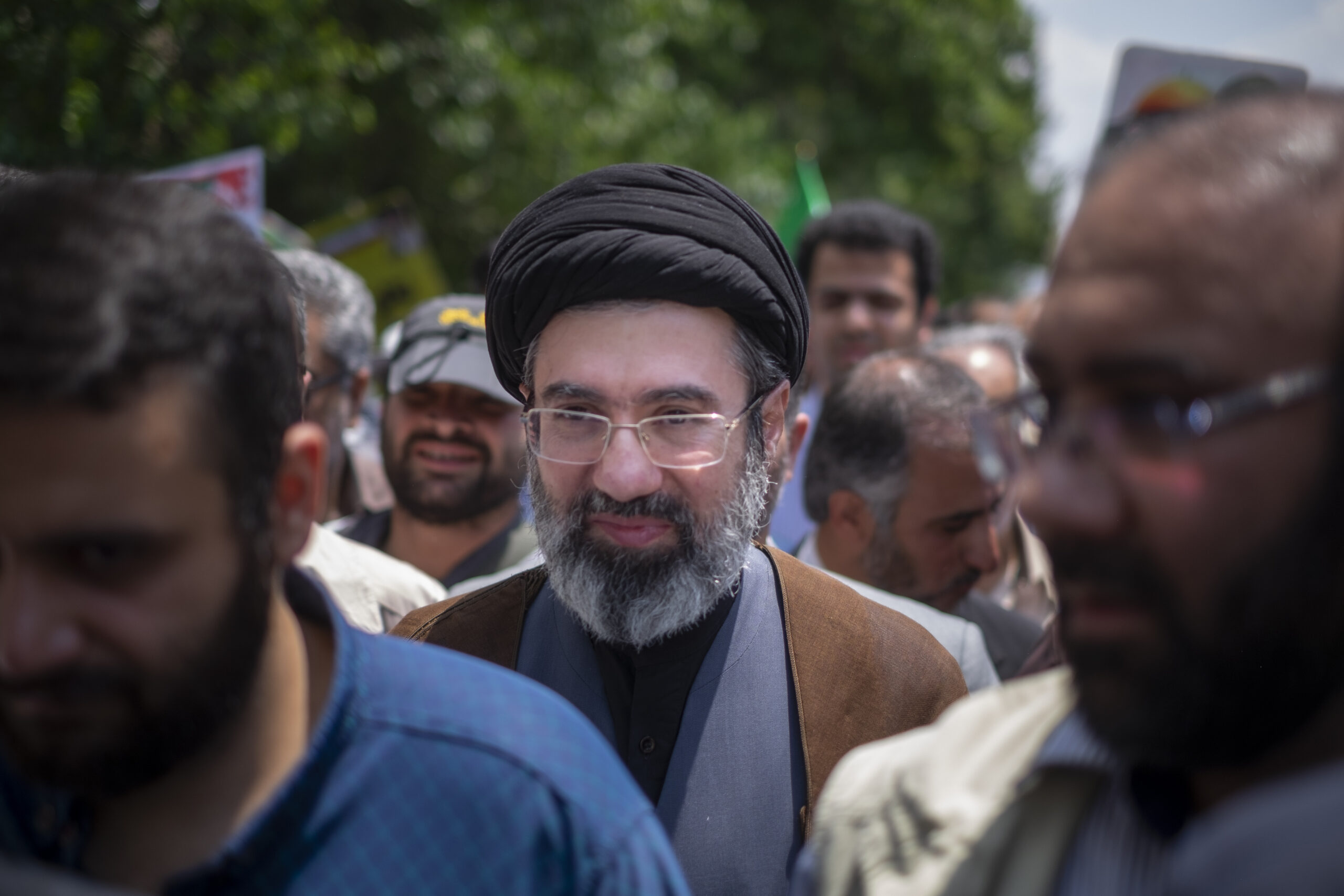
Also Wednesday, an Israeli F-35I fighter jet shot down an Iranian YAK-130 fighter jet over Tehran, marking the first time an F-35 jet shot down a manned fighter aircraft, IDF says
PUSHING BACK
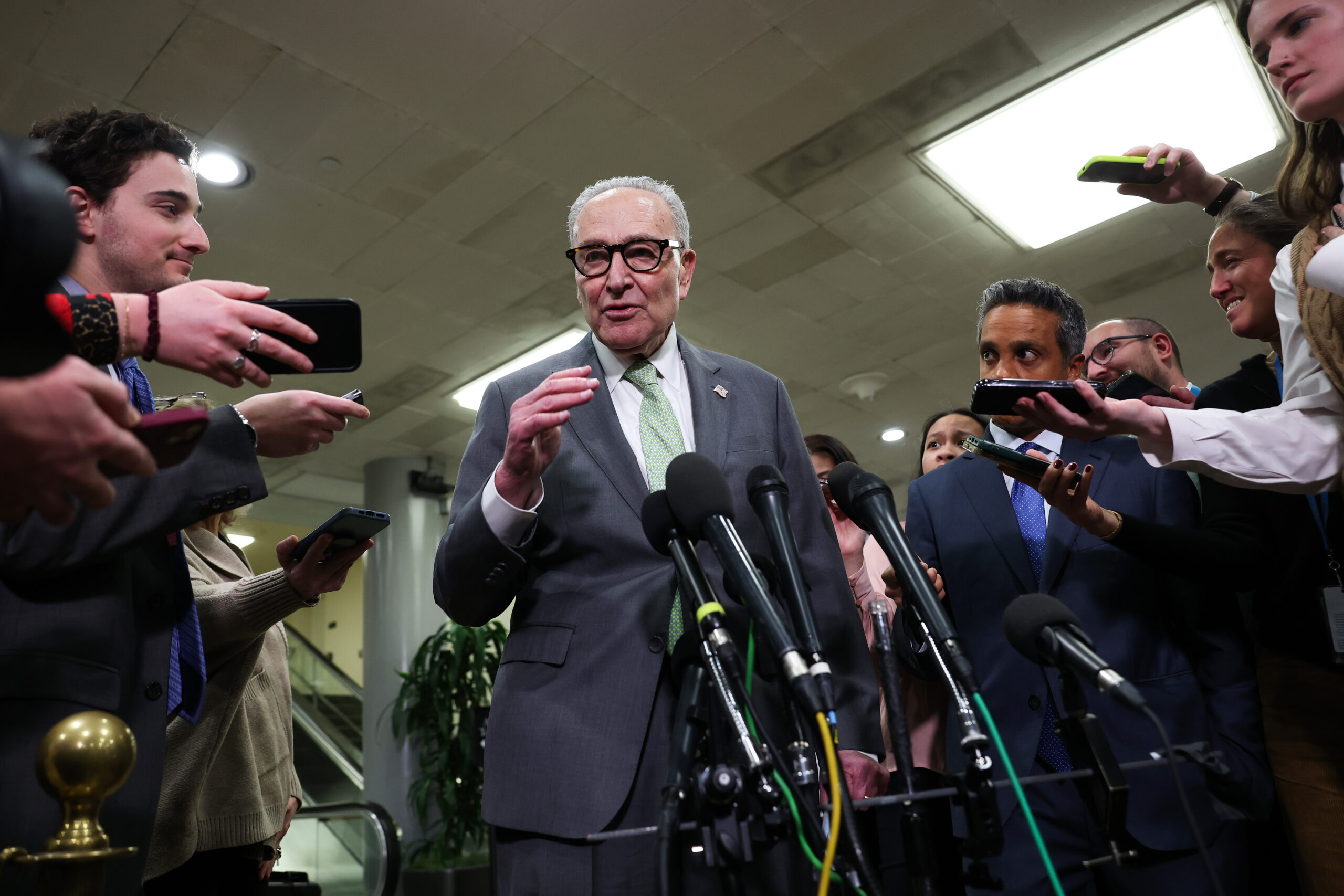
Republicans and some Democrats insisted Trump made the decision, while other Democrats said that the timing of the onset of hostilities was impacted by Israel’s plans
The defense secretary announced the death of the individual responsible for the Trump assassination attempt and said the U.S. sank an Iranian warship with a torpedo
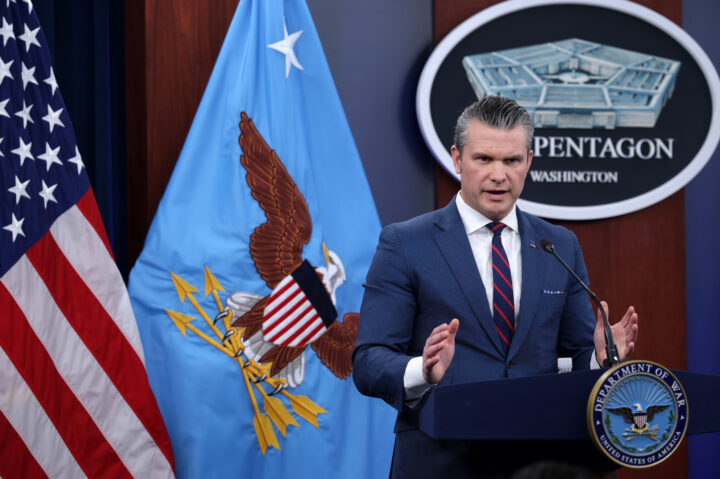
Alex Wong/Getty Images
Secretary of Defense Pete Hegseth speaks during a news conference at the Pentagon on March 2, 2026 in Arlington, Virginia.
On the fifth day of the joint U.S. and Israeli military campaign against Iran, Secretary of Defense Pete Hegseth announced the accomplishment of several key objectives, including that “the leader of the unit” responsible for the assassination attempt on President Donald Trump in November 2024 “has been hunted down and killed.”
Hegseth, speaking alongside Chairman of the Joint Chiefs Gen. Dan Caine, also touted the naval and air superiority achieved by the U.S. and Israel over Iran.
“The Iranian Air Force is no more … their navy is not a factor,” Hegseth said. “In fact, last night, we sunk their prize ship, the Soleimani, and … yesterday in the Indian Ocean an American submarine sank an Iranian warship that thought it was safe in international waters. Instead, it was sunk by a torpedo. Quiet death, the first sinking of an enemy ship by a torpedo since World War Two.”
Caine noted that the U.S. has sunk more than 20 Iranian warships.
Still, Hegseth said, the operation is only in its early days.“We are accelerating, not decelerating,” he claimed, noting that “more bombers and more fighters are arriving today.”
“Starting last night and to be completed in a few days, in under a week, the two most powerful air forces in the world [the U.S. and Israel] will have complete control of Iranian skies, uncontested airspace. Flying over Tehran, flying over Iran, flying over their capital, flying over the IRGC Iranian leaders, looking up and seeing only us and Israeli air power every minute of every day, until we decide it’s over. Iran will be able to do nothing about it.”
“Iran’s senior leaders are dead, the so-called governing council that might have selected a successor are dead, missing or cowering in bunkers too terrified to even occupy the same room, senior generals, mid- level, officers, enlisted ranks, they can’t talk or communicate, let alone mount a coordinated and sustained offensive,” Hegseth added.
Hegseth said the current campaign has wrought “seven times the intensity” than that of the 12-day war in June 2025, noting that the U.S. is “just getting started” and “more and larger waves are coming.”
Hegseth did not comment on whether the U.S. would deploy ground troops, but said that the department is working to move existing personnel around the region out of harm’s way.
“We have, from the start, put the protection of our troops ahead of everything else before we very publicly built up offensive combat power,” Hegseth said. “We moved the vast majority of American troops, over 90% of Americans that were on our bases, out of the range of Iranian fire.”
Hegseth credited Israel for its role in the operation, telling reporters that working with “such a capable ally” is a “force multiplier and breath of fresh air.” In addition to working with Israel, Hegseth said the U.S. is also closely coordinating with Arab partners.
“Whether it’s UAE or Qatar or Bahrain or Kuwait or Saudi on different levels, they’re reaching out to us … they’re giving us additional access basing and overflight … we’re working very closely and collaborating with them also on air defenses,” Hegseth said.
“The air defense capabilities of those countries are significant, and when combined with ours and we coordinate it, it brings simplicity to the shot doctrine,” he added.
Caine laid out the U.S.’ strategy moving forward: “CENTCOM is now shifting from large, deliberate strike packages using standoff munitions … into stand-in precision strikes overhead Iran,” he said. “This will allow the joint force to deliver significantly increased precision effects on the target.”
Caine said that Iran has been “indiscriminate” in its attacks, firing “more than 500 ballistic missiles and more than 2000 drones striking innocent civilian targets throughout the region.”
Responding to concerns over whether the U.S. will be able to maintain enough munitions throughout the conflict, Hegseth dismissed “stories and speculation,” instead asserting: “Iran cannot outlast us.”
“We’re going to ensure through violence of action and our offensive capabilities and our defensive capabilities that we set the tone and the tempo of this fight,” Hegseth said. “The only limits we have in this is President Trump’s desire to achieve specific effects on behalf of the American people … You can say four weeks, but it could be six, it could be eight, it could be three. Ultimately, we set the pace.”
Polls find a sharp divide between Republicans and Democrats and a further split between MAGA-aligned Republicans and other Republicans

Alexi J. Rosenfeld/Getty Images
People take shelter in an underground bomb shelter amid reports of incoming missiles on February 28, 2026 in Tel Aviv, Israel.
More than 80% of Israelis support the war against Iran, polls by two major Israeli research institutions found this week, while several U.S. polls found that a majority of Americans oppose it.
The Israel Democracy Institute found that 82% of Israelis — 93% of Jewish Israelis and 26% of Israeli Arabs — support the war with Iran.
Among Jewish Israelis, the war has strong support across the political spectrum, with 76% of respondents on the left backing it, 93% of voters from the center and 97% from the right.
Similarly, the Institute for National Security Studies at Tel Aviv University found that 81% of Israelis back the war against Iran, and 63% support continuing military efforts until the Iranian regime falls.
Among Jewish Israelis, support for the war was at 92%, while only 38% of Israeli Arabs support it. About half (49%) of Israeli Arabs oppose the war, while the rest said they did not know.
According to the IDI poll, three-fourths (74%) of Jewish Israelis said they supported continuing the war until the Iranian regime is overthrown, while only 18% of Israeli Arabs agreed; 61% of Israeli Arabs called for a ceasefire as soon as possible, while only 3% of Jewish Israelis chose that as their preferred option.
Over a third of respondents (37%) to the INSS poll said that Israelis would be able to live under the current war situation for up to a month, while 29% said they could continue for over a month.
At the start of last year’s Iran war, half of the respondents said it could continue for over a month.
IDI found that most Jewish Israelis (74%) feel protected from Iranian attacks, whereas only 15% Israeli Arabs feel the same. Among Israelis who have a safe room in their homes, 76% feel safe, whereas among those who have to go to a shelter elsewhere, 63% feel safe.
Nearly two-thirds (64%) of Jewish Israelis feel that Israel’s security is a central consideration for President Donald Trump, while only 43% of Israeli Arabs do.
Meanwhile, in the U.S., a CNN poll, conducted by SSRS shortly after the war began on Saturday, found that nearly 41% of Americans approve of the U.S. military action in Iran, with a sharp divide between Republicans, Democrats and independents — 77% of Republicans approve of the launch of the operation, compared to 32% of independents and 18% of Democrats. The poll found that 59% of Americans disapprove of the U.S. decision to strike.
Similarly, an NBC poll found that 41% of American registered voters approve of Trump’s approach to Iran, while 54% disapprove and 5% aren’t sure. Just 8% of Democrats approve of the president’s handling of the situation, while 79% of Republicans and 28% of independents approve of it. In addition, the poll found that 52% oppose the current U.S. military operation. A sizable majority of Republicans (77%) agree with the U.S. decision to strike Iran, while 89% of Democrats and 58% of independents disagree.
There is a further divide between self-identified MAGA-aligned Republicans and other Republicans, the poll found: 90% of the former back the strikes, while 54% of the latter support them. The CNN poll found that MAGA Republicans are 30 points more likely than non-MAGA Republicans to strongly approve of the decision to take military action.
A Reuters/Ipsos poll found that just 27% of Americans approve of U.S. strikes — 55% of Republicans, 7% of Democrats and 19% of others. According to the poll, some 56% see President Donald Trump as too willing to use military force to advance U.S. interests — with 87% of Democrats holding this view, 23% of Republicans and 60% of people who don’t identify with either major party.
A Fox News poll found that Americans were evenly split between support and disapproval of the current U.S. action against Iran with Republicans overwhelmingly supportive and Democrats overwhelmingly against. Most American respondents (61%) saw Iran as a “real national security threat,” and only 38% did not.
Also Wednesday, an Israeli F-35I fighter jet shot down an Iranian YAK-130 fighter jet over Tehran, marking the first time an F-35 jet shot down a manned fighter aircraft, IDF says
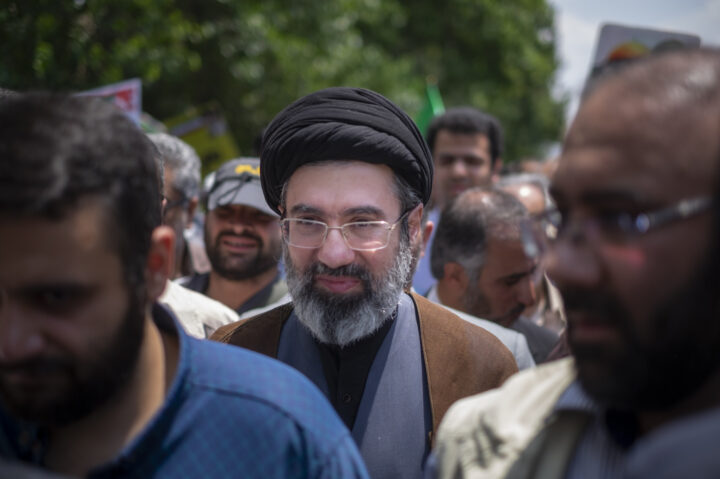
Morteza Nikoubazl/NurPhoto via Getty Images
Son of Iran's Supreme Leader Ayatollah Ali Khamenei, Mojtaba Khamenei, attends a demonstration to mark Jerusalem day in Tehran on May 31, 2019.
Any replacement selected to replace Iranian Supreme Leader Ayatollah Ali Khamenei, who was killed by Israel on the first day of the war with Iran on Saturday, will be in Israel’s crosshairs, Israeli Defense Minister Israel Katz warned on Wednesday.
“Any leader appointed by the Iranian terror regime will be a clear target for elimination,” Katz said. “The prime minister and I instructed the IDF to prepare and act by all means to accomplish the mission … We will continue acting with full force, together with our American partners, crush the regime’s abilities and create the conditions for the Iranian people to topple and replace it.”
Katz’s remarks came after widespread reports that the slain supreme leader’s son, Mojtaba Khamenei, is his likely successor.
Israel struck the building housing the Assembly of Experts, made up of senior clerics who would choose the new supreme leader. Initial reports stated officials counting the votes were killed.
Israel continued to strike the Iranian regime’s centers of power, including command centers of the Basij paramilitary force and internal security “used by the Iranian regime to maintain control throughout Iran and maintain the regime’s situational assessments,” the IDF stated.
The CIA is reportedly acting to destabilize the regime by arming Kurdish forces, according to CNN and Reuters, with the Trump administration said to be in talks with Kurdish leaders in Iraq, in addition to Iranian opposition leaders, to try to foment an armed uprising. The Islamic Revolutionary Guard Corps have repeatedly attacked Kurdish groups since war broke out over the weekend.
Also Wednesday, an Israeli Air Force F-35I fighter jet shot down an Iranian Air Force YAK-130 fighter jet over Tehran, marking the first time an F-35 jet shot down a manned fighter aircraft, the IDF stated.
The IDF also continued to hunt missile launchers to degrade Iran’s ability to shoot large barrages around the region, striking a facility used to launch, produce and store ballistic missiles in Isfahan.
Iranian missile attacks on Israel injured 45 on Tuesday, according to the Magen David Adom emergency service. From the start of the war with Iran, there have been 12 fatalities and 404 additional casualties in Israel, including two severely injured and 288 who were injured making their way to shelters.
The Iranian regime has made increasing use of civilian structures as shields, the Foundation for Defense of Democracies found, noting that Iranian Foreign Ministry spokesperson Ismail Baghaei held a press conference in a school on Tuesday, and police and other security forces used schools as bases of operations.
The IDF sent emergency evacuation warnings to residents of over a dozen villages and towns in Lebanon ahead of continued strikes against Hezbollah terrorists and facilities on Wednesday.
‘If anything, I might have forced Israel's hand,’ Trump said after Rubio’s previous comments were interpreted as placing blame on Israel
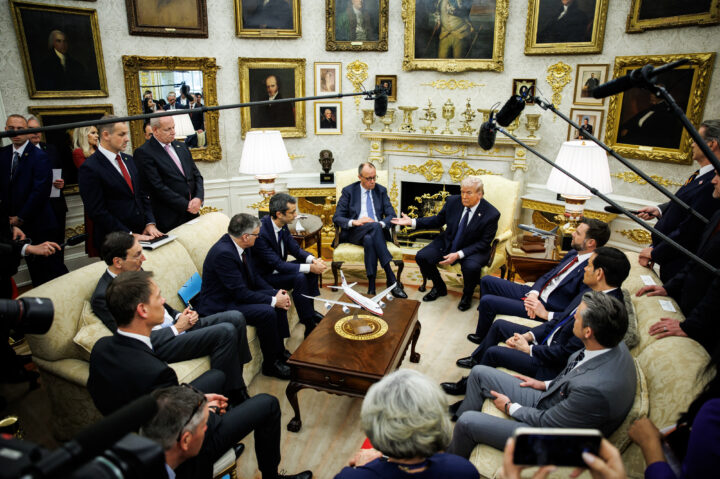
Samuel Corum/Sipa/Bloomberg via Getty Images
Friedrich Merz, Germany's chancellor, center left, and US President Donald Trump during a meeting in the Oval Office of the White House in Washington, DC, US, on Tuesday, March 3, 2026.
A chorus of senior Trump administration officials, including White House Press Secretary Karoline Leavitt, Secretary of State Marco Rubio and Defense Secretary Pete Hegseth sought to offer a decisive rebuttal on Tuesday to what they deemed to be a false narrative, which had spread like wildfire a day before.
They were all responding to the political tumult and online furor that erupted after Rubio briefed congressional leaders about the U.S. military operation in Iran on Monday afternoon.
A narrative quickly formed — based in large part on a viral post on X from the White House clipping an excerpt of Rubio’s comments — that Trump decided to strike Iran because Israel was already planning an attack, which would then prompt Iranian retaliation, thus putting American troops at risk.
“The president made the very wise decision — we knew that there was going to be an Israeli action, we knew that that would precipitate an attack against American forces, and we knew that if we didn’t preemptively go after them before they launched those attacks, we would suffer higher casualties,” Rubio told reporters.
The White House shared that sound bite in a post on X that was viewed more than 13 million times in less than a day. Rubio’s Monday messaging about Israel was echoed by House Speaker Mike Johnson (R-LA) after he and other congressional leaders received Rubio’s briefing.
The question that was then posed dozens of times by reporters to policymakers: Had Israel forced America’s hand and dragged the U.S. into war?
Never mind that Rubio also said in those same remarks the U.S. was not “forced” to strike because of an impending Israeli action. “No matter what, ultimately, this operation needed to happen,” Rubio said. The White House shared that sound bite on X Tuesday morning, drawing 500,000 views, a fraction of the visibility of the earlier post. “No, Marco Rubio Didn’t Claim That Israel Dragged Trump into War with Iran,” was the headline Leavitt posted on X. But the damage had already been done.
Fox News host Sean Hannity asked Israeli Prime Minister Benjamin Netanyahu the same question in a Monday night interview. “You don’t have to drag him into anything,” Netanyahu said of Trump. “He does what he thinks is right for America.”
Another reporter then posed the question to Trump directly on Tuesday during an Oval Office meeting between the president and German Chancellor Friedrich Merz.
“No,” Trump said decisively. “I might have forced their hand.” Hegseth then chimed in on X boosting Trump’s message: “This is 100% correct.”
Rubio similarly refuted a reporter who said the U.S. needed to get involved because Israel was going to strike Iran.
“Your statement is false,” he said Tuesday during another visit to Capitol Hill for all-member briefings in the House and Senate. “Somebody asked me the question yesterday, did we go in because of Israel … I told you this had to happen anyway. The president made a decision, and the decision he made was that Iran was not going to be allowed to hide behind its ballistic missile program, that Iran was not going to be allowed to hide behind its ability to conduct these attacks. That decision had been made.”
The question, he said, was “a question of timing, of why this had to happen as a joint operation. Not the question of the intent.”
Some questions remain unanswered. Trump told reporters alongside Merz that Iran was going to attack first, but it was not clear whom he expected Iran to attack, the Israelis or the Americans. A White House spokesperson did not respond to requests for comment.
“We were having negotiations with these lunatics, and it was my opinion that they were going to attack first,” Trump said. “Based on the way the negotiation was going, I think they were going to attack first, and I didn’t want that to happen. So if anything, I might have forced Israel’s hand, but Israel was ready, and we were ready, and we’ve had a very, very powerful impact.”
Even as the White House refuted the narrative that Israel had pulled the U.S. into war and put American servicemembers at risk, Democratic lawmakers and right-wing podcasters turned it into an online rallying cry.
“So Netanyahu now decides when we go to war? So much for America First,” Sen. Ruben Gallego (D-AZ) said in a post on X on Monday. Ben Rhodes, the deputy national security advisor to President Barack Obama, argued Trump could not bring himself to say no to Netanyahu: “Donald Trump is so weak that he couldn’t tell Bibi Netanyahu no, so now we are at war,” he said in response to the Rubio clip.
Sen. Mark Warner (D-VA), who was in Monday’s briefing by Rubio, afterward described the strikes as “dictated by Israel’s goals and timelines” and said he opposed them.
On the right, Matt Walsh of The Daily Wire sharply criticized Rubio. “So he’s flat out telling us that we’re in a war with Iran because Israel forced our hand. This is basically the worst possible thing he could have said,” Walsh wrote.
The conservative pundit Megyn Kelly said that the American servicemembers who have so far died in the campaign did not give their lives for the United States. “No one should have to die for a foreign country. I don’t think those four service members died for the United States. I think they died for Iran or for Israel,” she said on Monday.
Now progressive Jewish groups are attacking the White House, saying that pinning the war on Israel feeds into antisemitic conspiracy theories.
“Shifting blame for American military decisions to Netanyahu is an abdication of responsibility and comes with the dangerous side effect of fueling antisemitic sentiment in the United States,” J Street President Jeremy Ben-Ami said Tuesday.
The Jewish Democratic Council of America called Rubio’s language “unprecedented, dangerous and deeply irresponsible.”
“As Jewish Americans, we’re deeply concerned about the consequences of the White House effectively blaming Israel for its decision to launch a war against Iran, which has now spread to the entire Middle East,” JDCA said in a Tuesday statement.
The Republican Jewish Coalition, meanwhile, spent Tuesday reposting messages from the White House, the Senate Republican Caucus and the Pentagon that Israel had not, in fact, dragged the U.S. into war.
Rubio attempted to offer a final rebuttal of the narrative about Israel driving the war when he was back on Capitol Hill on Tuesday. He acknowledged how his comments the day before had spread — although he did not mention that the White House played a role in amplifying them.
“If you’re going to play the statements, you need to play the whole statement, and not clip it to reach a narrative,” said Rubio.
The new resolution, put forth by a group of pro-Israel Democrats, gives the administration 30 days to end the campaign or seek congressional approval

Graeme Sloan/Sipa USA
Pedestrians walk near near the U.S. Capitol Building, in Washington, D.C., on Thursday, January 2, 2025.
A group of six moderate House Democrats introduced an alternative war powers resolution on Iran, which — rather than demanding an immediate end to the ongoing U.S. operation — would give the administration 30 days in which to either end the campaign or come to Congress to seek approval for continued strikes.
The resolution is sponsored by Reps. Josh Gottheimer (D-NJ), Jimmy Panetta (D-CA), Henry Cuellar (D-TX), Greg Landsman (D-OH), Jared Golden (D-ME) and Jim Costa (D-CA). It signals concern from the group of hawkish pro-Israel House Democrats about the efforts by their colleagues to demand an immediate end to operations in Iran, though at least some of the sponsors of the resolution still plan to vote for the existing war powers resolution this week as well.
“Iran is actively firing drones and ballistic missiles at U.S. troops, our embassies, allies, and is targeting civilians across the region,” Gottheimer said on X on Tuesday. “This new Democratic War Powers Resolution will uphold Congress’s constitutional authority — while also ensuring the U.S. can defend our troops, embassies, and allies from Iranian aggression.”
Landsman said that the resolution “allows for the short-term, targeted strikes on the regime’s missiles and bombs, requires Trump to come to Congress for a vote, and specifies ‘no ground troops.’ Destroy the [regime’s] ability to destroy more lives or cause any more mayhem or violence. Nothing more.”
In a press release, Gottheimer’s office pointed to concerns that the resolution led by Reps. Ro Khanna (D-CA) and Thomas Massie (R-KY), which is set to receive a House vote this week, would pull out U.S. forces even as Iran is targeting U.S. troops, assets, facilities and allies. “It is vital that we allow for a safe transition, that protects our service members, embassies, and allies, not a potentially precarious withdrawal,” the statement reads.
Lawmakers supporting the war powers resolutions in both chambers have largely not articulated what an immediate end to the war would entail or the potential consequences of abruptly pulling out U.S. forces.
The new resolution includes specific language forbidding the administration from deploying ground troops into Iran “in a combat role, including for regime change, or for occupation unless explicitly authorized by Congress,” but includes an exception for search and rescue and intelligence operations.
Gottheimer’s press release argues that an “open-ended commitment” and a potential commitment of ground troops would both be “unacceptable,” while also warning that “it is equally unwise to act in a precipitous way and endanger America’s security and put our service members in additional harm’s way.”
The Gottheimer-led resolution also contains language that would allow the U.S. to continue to defend its facilities, personnel and allies from “imminent attack;” keep forces in the region “for defensive purposes” and who are engaged in other missions and continue sharing intelligence with partners.
The war powers resolution that is set to receive a House vote later this week does not include similar language to specifically allow for continued intelligence sharing and defensive operations protecting allies, which could raise concerns for pro-Israel Democrats.
The Senate version of the resolution does include such protections.
While Gottheimer and Landsman have said they oppose the Massie-Khanna resolution, Panetta said on Tuesday that he would support it, despite also backing the Gottheimer resolution.
“The President has not abided by our Constitution when it comes to invading foreign sovereign states,” Panetta said in a statement. “That is why Congress must fulfill our obligations under the constitution by supporting this week’s bipartisan War Powers Resolution.”
Asked about the Gottheimer resolution, Rep. Greg Meeks (D-NY), the ranking member of the House Foreign Affairs Committee, emphasized that the Massie-Khanna legislation will be coming to the floor on Wednesday. “That’s the one we have. This is continuing right now. We need to vote on this resolution tomorrow. I’m not considering any other [resolution].”
Jeremy Bash, a former chief of staff at the Department of Defense and Central Intelligence Agency under the Obama administration, told JI that the Khanna-Massie resolution is reckless.
“We have U.S. servicemembers in harm’s way. Some are flying combat sorties as we speak. We can’t call them in the cockpit and say ‘Congress has prohibited you from completing this mission. Please turn around and stop what you’re doing.’ If that sounds a little strange, it is because the Ro Khanna resolution requires that very strange outcome,” Bash said. “An immediate withdrawal is dangerous for our troops. Any pullback needs to be orderly and safe. We need to give the combatant commander at least a few weeks to do this safely.”
He said that Congress can and should be involved in debating the war and providing oversight, but “for a war powers resolution to be credible, it has to build in several days for the commanders to act responsibly to protect their troops. This cannot be done immediately.”
Bash called Gottheimer’s resolution a “very sensible alternative that will protect our troops.”
Daniel Silverberg, a former advisor to Rep. Steny Hoyer (D-MD), emphasized that a similar effort to cut off the U.S.’ Libya operations led by “one of the most ardent anti-war activists in the House,” then-Rep. Dennis Kucinich (D-OH), included a 15-day wind-down provision.
“The Massie-Khanna resolution lacks it. The notion that Democrats would not, at a minimum, support that amendment to allow for a responsible withdrawal of forces is problematic from a national security perspective and from a messaging perspective,” Silverberg said.
Amb. Daniel Shapiro, a former U.S. ambassador to Israel and senior State and Defense Department official, said that the resolution could serve as a “fallback” if the Massie-Khanna resolution fails, one which might have a chance of attracting GOP support.
“The 30 day clock … arguably addresses a concern that some members might have about troops who are actively engaged and in the field, and would need some window of time … to wind down and safely conclude operations,” Shapiro said.
Plus, Alex Soros boosts antisemitic conspiracy theorist
Samuel Corum/Sipa/Bloomberg via Getty Images
Friedrich Merz, Germany's chancellor, center left, and US President Donald Trump during a meeting in the Oval Office of the White House in Washington, DC, US, on Tuesday, March 3, 2026.
Good Tuesday afternoon,
This P.M. edition is reserved for our premium subscribers — offering a forward-focused read on what we’re tracking now and what’s coming next.
It’s me again — Danielle Cohen-Kanik, U.S. editor at Jewish Insider and curator, along with assists from my colleagues, of the Daily Overtime. Please don’t hesitate to share your thoughts and feedback by replying to this email.
📡On Our Radar
Notable developments and interesting tidbits we’re tracking
The Trump administration emphatically denied reports, based on partial comments made by Secretary of State Marco Rubio yesterday, that Israel forced the U.S. to launch the operation against Iran.
“If anything, I might’ve forced Israel’s hand,” President Donald Trump told reporters while meeting with German Chancellor Friedrich Merz in the Oval Office today. “You see, we were having negotiations with these lunatics, and it was my opinion that they [Iran] were going to attack first.”
Defense Secretary Pete Hegseth boosted the president’s comments, saying, “This is 100% correct,” while Rubio insisted his original remarks were misrepresented…
Trump continues to share optimistic assessments of the war’s progress: he told Politico that Iran is running out of missile launchers while claiming the U.S. has “a virtually unlimited supply” of weapons, saying, “wars can be fought ‘forever,’ and very successfully, using just these supplies”…
The Israeli Air Force struck a building where senior clerics had gathered to elect Iran’s next supreme leader, Israeli Ambassador to the U.S. Yechiel Leiter told CNN, “and there’s a very good chance that the electors won’t be readily available for any further meetings”…
Trump is open to backing militias in Iran who will work to mount regime change, U.S. officials told The Wall Street Journal, after he held phone calls with Kurdish leaders who maintain armed groups along the Iran-Iraq border.
Trump has wavered in recent comments on his vision for the future of Iran, saying today that “somebody from within” might be the best option to lead, rather than individuals like exiled former crown prince, Reza Pahlavi. At the same time, Trump told reporters, “Most of the people we had in mind are dead. And now we have another group, they may be dead also. Pretty soon we’re not gonna know anybody”…
Trump ordered the U.S. Development Finance Corporation to provide political risk insurance for all maritime trade traveling through the Gulf, as oil traffic has essentially halted and energy prices have soared. The U.S. Navy will also, if necessary, begin physically escorting tankers through the Strait of Hormuz, Trump said…
Ukrainian President Volodymyr Zelensky offered his country’s assistance to the UAE, as the Gulf country has been targeted by over 1,000 Iranian drones and missiles since the operation began Saturday. Ukraine has become particularly skilled in combating Iranian Shahed drones, something the UAE has little experience with, as Russia has regularly used them in its attacks on Ukraine…
The U.S. Embassy in Saudi Arabia was struck with two Iranian drones, with no casualties reported; the embassy was closed, along with U.S. embassies in Kuwait and Beirut. The State Department ordered the mandatory departure of all non-emergency personnel in several countries and has begun “actively securing military aircraft and charter flights for American citizens who wish to leave” the region…
The International Atomic Energy Agency confirmed that Iran’s underground Natanz nuclear enrichment plant was struck in the course of hostilities in recent days. Trump has claimed the site was rendered inoperable during the U.S.’ June 2025 strikes…
Alex Soros, one of the progressive movement’s most influential donors, boosted a social media post today about U.S. casualties in the war with Iran from Max Blumenthal, a prominent anti-Israel conspiracy theorist, Jewish Insider‘s Matthew Kassel reports.
Soros also praised Spain for its refusal to allow the U.S. to use joint bases on its soil, calling Madrid the “leader of the free world” and reprimanding other European countries for not doing the same…
After issuing a statement solely attacking the U.S. and Israel over the campaign against Iran — which provoked backlash from members of the Iranian dissident and diaspora communities — New York City Mayor Zohran Mamdani acknowledged the “systematic repression” of the Iranian people by the regime, while declining to criticize the late Supreme Leader Ayatollah Ali Khamenei, JI’s Will Bredderman reports.
Even as he acknowledged Tehran’s bloody suppression of protesters, Mamdani did not directly answer a reporter’s question at a press conference today about whether the Middle Eastern nation was better off without the radical cleric who ruled for nearly 37 years…
Amazon Web Services operations are “significantly impaired” after three of its data centers in the Middle East were struck by Iranian drones — two directly hit in the UAE and one sustaining damage in Bahrain. The strikes “caused structural damage, disrupted power delivery to our infrastructure, and in some cases required fire suppression activities that resulted in additional water damage,” AWS said…
⏩ Tomorrow’s Agenda, Today
An early look at tomorrow’s storylines and schedule to keep you a step ahead
Keep an eye out in Jewish Insider for a look at the results of today’s high-stakes primary elections in North Carolina and Texas and their implications for pro-Israel voters.
The Heritage Foundation will hold an event to launch its 2026 “Index of U.S. Military Strength” with remarks from Sen. Jim Banks (R-IN) and Reps. August Pfluger (R-TX), Pat Harrigan (R-TX) and Matt Van Epps (R-TN).
The U.S. Commission on International Religious Freedom will release its annual report tomorrow on Capitol Hill.
Stories You May Have Missed
SQUARING OFF

A trio of Mamdani backers united with tech and real estate investors to boost anti-Israel candidates
PARTY PERSPECTIVE
Speaking at J Street’s national summit, Sen. Tim Kaine also said ‘virtually all’ Democratic senators now seek the group’s endorsement
Following criticism from leading Iranian dissidents, the mayor acknowledged Iran’s ‘brutal government’ without directly commenting on Supreme Leader Khamenei
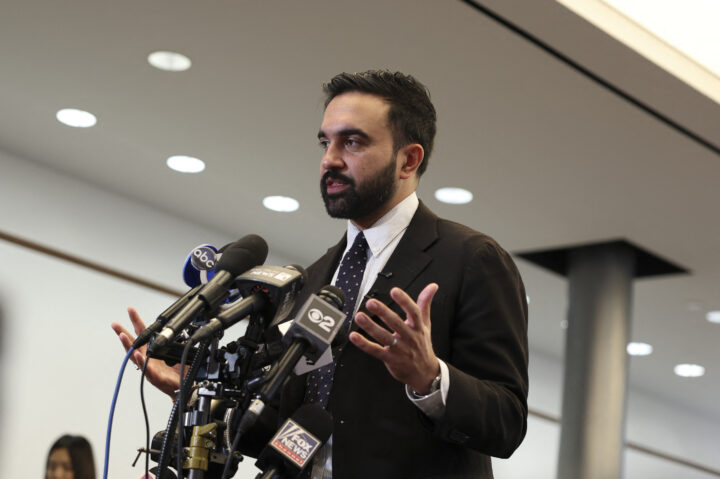
ANGELA WEISS/AFP via Getty Images
New York City Mayor Zohran Mamdani answers questions on October 17, 2025 in New York City.
After issuing a statement solely attacking the U.S. and Israel over Saturday’s strikes on Iran provoked backlash from members of the Iranian dissident and diaspora communities, New York City Mayor Zohran Mamdani acknowledged the “systematic repression” of the Iranian people by the regime — even as he declined to criticize the late Supreme Leader Ayatollah Ali Khamenei.
The mayor’s remarks followed an unrelated press conference on Tuesday, following criticism from Iranian-Americans and regime refugees who accused him of ignoring the Islamic Republic’s abuses of its own citizens and its neighbors. But even as he acknowledged Tehran’s bloody suppression of protesters, Mamdani did not directly answer a reporter’s question about whether the Middle Eastern nation was better off without the radical cleric who ruled for nearly 37 years.
“The Iranian government has engaged in systematic repression of its own people, even killing thousands of Iranians who were seeking to express the most basic forms of dissent earlier this year,” Mamdani said. “It is a brutal government.”
This marks the second time the new mayor has only belatedly condemned the regime’s brutality. His slow response to the authoritarian government’s efforts to crush protests in January contrasted both with other New York officials and with his own rapid declarations of solidarity with demonstrators elsewhere, or his ever-swift condemnation of Israel.
Nonetheless, in his comments Tuesday, Mamdani sought to assure Jewish and Iranian New Yorkers, who he acknowledged might be celebrating Purim or the Muslim holy month of Ramadan, that he was looking out for their security. He reupped pledges from the NYPD to “increase agency coordination” and patrols at religious and consular facilities.
“In as much as I have shared my thoughts when I”ve been asked about the federal government’s actions, as well as the actions of the Israeli military, I’ve also focused my time and efforts in being in constant communication with our police commissioner as well as emergency management officials,” he said. “My primary responsibility is to keep you safe.”
The mayor also directed his criticism at the U.S. government generally, and did not call out the president, with whom he met just days before the strikes and has maintained a warm personal relationship. Rather, he appeared to allude to President George W. Bush’s campaign to oust Iraqi dictator Saddam Hussein.
“While I may be a young mayor, I am old enough to remember the devastating consequences of our country pursuing a war with the intent of regime change in that very same region not many years ago,” Mamdani said.
Noem said the department is ‘revetting’ some immigrations and working ‘to make sure that we’re preventing the next attack’
Graeme Sloan/Bloomberg via Getty Images
Homeland Security Secretary Kristi Noem speaks during a Senate Judiciary Committee hearing in Washington, DC, US, on Tuesday, March 3, 2026.
Facing concerns from Senate Republicans over her agency’s preparedness, Homeland Security Secretary Kristi Noem on Tuesday defended the department’s ability to respond against potential Iranian sleeper-cell threats as the Department of Homeland Security remains unfunded and under a partial shutdown amid an escalating conflict with Tehran.
“We work every single day with our intelligence agencies and law enforcement partners to make sure that we are investigating and finding any threats to the homeland here within our borders,” Noem said at an oversight hearing before the Senate Judiciary Committee. “Not only that — we are revetting some of the individuals and some of the programs that we may have concerns about, looking at social media, also going through those interviews that are necessary for some of our programs that the Biden administration abused and perverted under their time there as well.”
“We don’t necessarily know who all came into our country,” Noem added. “We know that we have many dangerous individuals that came in unvetted, and we are working every single day to find them and to make sure that we’re preventing the next attack and preventing the next crime perpetrated against the American people.”
The hearing unfolded as DHS has continued to operate without full appropriations since Feb. 14, after lawmakers failed to reach a funding deal, largely over disagreements about the Trump administration’s immigration strategy.
Congressional Republicans have warned that the DHS shutdown poses a national security risk and impacts the agency’s ability to conduct counterterrorism and domestic security operations against Iranian-backed threats at a crucial moment of conflict.
Those concerns intensified over the weekend after a shooting in Austin, Texas, left three people dead and 13 wounded. Authorities said a Senegalese man opened fire inside a bar while wearing a hoodie that read “property of Allah.” According to reports, investigators later found photos of Iranian leaders at his residence.
“I wonder how many people are like that here, waiting to pounce, and DHS doesn’t have appropriated funds,” said Sen. Lindsey Graham (R-SC) during the hearing, referring to the incident in Texas. “This is insane. There are more people like this.”
Asked by Graham whether the threat level from “radical Islamist terrorists” is increased amid the ongoing military confrontation with Tehran, Noem responded: “Yep.”
Congressional Democrats said Monday they have no plans to end the funding standoff, but that they are willing to fund DHS agencies that do not handle immigration enforcement. However, Republicans have largely opposed splitting up DHS funding.
“Can we not understand America is under siege, now likely to be attacked because radical Islam is under siege and they’re going to hit back and we’re sitting here looking at each other and not funding DHS?” said Graham.
Speaking at J Street’s national summit, Sen. Tim Kaine also said ‘virtually all’ Democratic senators now seek the group’s endorsement

Drew Angerer/Getty Images
Sen. Tim Kaine (D-VA) speaks to reporters on his way to a classified all-Senate briefing.
Democratic lawmakers speaking at the Monday evening gala of J Street’s Washington conference argued that the joint U.S.-Israel operation that killed many top Iranian leaders, including Supreme Leader Ayatollah Ali Khamenei, would ultimately make Iranians, Israelis and the United States less safe.
“I do not believe that the United States or Israel should be leading a regime change operation in Iran. It will not bring safety or security to the people of Iran, to the region or to the United States, and it’s important that all of us here in this room continue to stand up and say that,” Rep. Sara Jacobs (D-CA) said. “We’ve lived through this before. Regime change often backfires. It creates power vacuums, leads to even harder-line leaders and civil wars and failed states.”
She also argued the U.S. set Iran on the path toward the current regime’s leadership by backing the 1953 overthrow of the Mossadegh government in Iran.
Expressing her support for the war powers resolution vote taking place in the House later this week, Jacobs said, “We can’t be equivocal, that we have to say strongly and clearly that what is happening is not OK, and it is not making Jews in Israel or here in the United States any safer.”
Sen. Adam Schiff (D-CA) said that he does not mourn Khamenei nor the other Iranian leaders who have been killed, “but we have not just cut off the head of the snake. We have almost certainly kicked up a hornet’s nest, one with remaining capabilities and appetite for revenge. Now we ask, what comes next?”
He said that the administration entered into the operation without any clear plan to effect the regime change it appears to desire, nor how to protect and support the Iranian civilians the Trump administration has urged to rise up against the regime.
Sen. Tim Kaine (D-VA), the lead sponsor of the war powers resolution set for a vote this week in the Senate, made the case for his legislation, saying, “That vote in front of the American people is a way of clarifying what’s at stake and deciding if the mission is so important that we should risk our own kids’ lives.”
Former House Speaker Nancy Pelosi (D-CA) said that the “vote is not about whether we should go in or not. The vote is that you cannot go in unless Congress gives you the [authority],” framing the vote as an affirmation of Congress’ constitutional power to declare war.
Kaine emphasized that J Street’s influence within the Democratic Party has grown, saying that “virtually all” Democratic senators now seek the group’s endorsement.
Throughout the Purim-themed evening, speakers repeatedly drew comparisons between Trump, Israeli Prime Minister Benjamin Netanyahu and members of Trump’s administration and Haman, the villain of the Purim story.
“This is a moment not unlike the scenes that gave us the story of Purim: a hedonistic king less interested in justice than in his own pride and pleasure. A ruler flanked by evil advisors, his toxic grip on power unleashing danger and violence,” Schiff said. “It is all too reminiscent of the plots against the Jews driven by him.”
And in an unusual moment, Kaine capped off his remarks with a sing-along rendition of Woody Guthrie’s “This Land is Your Land,” playing his harmonica through the choruses.
Plus, Mamdani allies bankroll a $10M anti-AIPAC effort
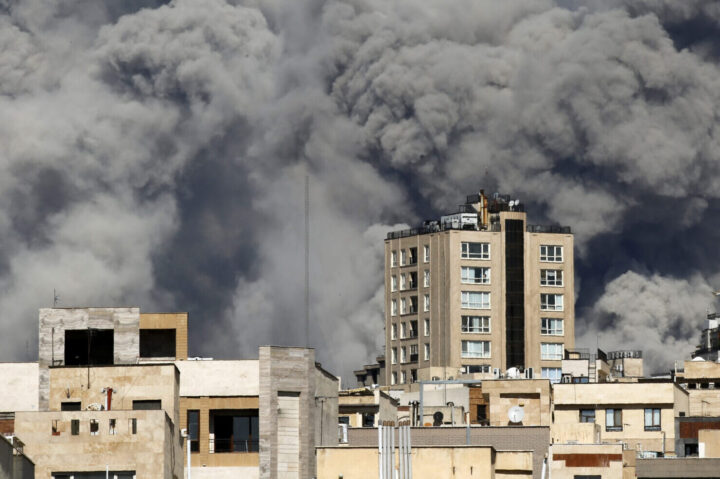
Fatemeh Bahrami/Anadolu via Getty Images
Smoke rises from the area after it was targeted in attacks as a series of explosions are heard in Tehran, Iran on March 01, 2026.
👋 Good Tuesday morning, and happy Purim 🎭
In today’s Daily Kickoff, we report on the latest developments in the Middle East as the conflict with Iran enters its fourth day, and preview the primaries taking place today in Texas and North Carolina. We report on the split on Capitol Hill over the Trump administration’s military moves against Iran, and spotlight the backers of the newly created American Priorities PAC, which has ties to allies of New York City Mayor Zohran Mamdani and is opposing pro-Israel candidates. Also in today’s Daily Kickoff: the Yeshiva University men’s basketball team, Zach Yadegari and Kate Schmier.
Today’s Daily Kickoff was curated by JI Executive Editor Melissa Weiss and Israel Editor Tamara Zieve, with an assist from Danielle Cohen-Kanik. Have a tip? Email us here.
What We’re Watching
- We are monitoring developments across the Middle East as the U.S. and Israel continue to strike Iranian targets, Iran launches attacks against population centers in Israel and Israel strikes Hezbollah targets in Lebanon. Multiple sirens have sounded across central Israel, including Tel Aviv and Jerusalem, throughout the morning as the IDF intercepted the barrages being fired from Iran.
- German Chancellor Friedrich Merz is in Washington today. He’ll meet with President Donald Trump at 11 a.m.
- On Capitol Hill, Secretary of State Marco Rubio, Defense Secretary Pete Hegseth, CIA Director John Ratcliffe, and Gen. Dan Caine, chairman of the Joint Chiefs of Staff, are expected to brief members of the Senate and House on the war in Iran.
- Elsewhere on the Hill, Elbridge Colby, the Pentagon’s under secretary of defense for policy, is testifying before the Senate Armed Services Committee on the Trump administration’s national defense strategy.
- The Capitol Jewish Forum is hosting its annual Purim celebration on the Hill this afternoon, with more than a dozen Jewish legislators, including Senate Minority Leader Chuck Schumer (D-NY), slated to attend.
- The first primaries of the 2026 election cycle are also taking place today. In North Carolina, Rep. Valerie Foushee (D-NC) is facing far-left anti-Israel activist Nida Allam. Read more below.
- In the Texas Senate primary, Rep. Jasmine Crockett (D-TX) faces state Sen. James Talarico; On the Republican side, Sen. John Cornyn (R-TX) faces primary challenges from Rep. Wesley Hunt (R-TX) and scandal-plagued right-wing Texas Attorney General Ken Paxton. Read more here and here.
- In the state’s 23rd Congressional District, Rep. Tony Gonzales (R-TX), also plagued by scandal amid allegations he had an affair with a staffer who later died by suicide, faces his second primary challenge from right-wing social media influencer Brandon Herrera. Read more here.
- Rep. Al Green (D-TX), who has become a consistent detractor of Israel in the House, faces newly elected Rep. Christian Menefee (D-TX), who has built solid relationships with the Houston-area Jewish community. Read more here.
- Rep. Dan Crenshaw (R-TX), a Republican hawk, faces a serious challenge from state Rep. Steve Toth, who is running to his right. Both candidates have been supportive of Israel.
- And Rep. Julie Johnson (D-TX) faces a difficult renomination fight against former Rep. Colin Allred (D-TX), who vacated the seat to run unsuccessfully for the Senate in 2024.
- It’s also primary day in Arkansas and Mississippi — but there are no major congressional primaries of note in either state.
What You Should Know
A QUICK WORD WITH JI’S MARC ROD
In the closing message of her campaign ahead of the North Carolina Democratic primary today, Durham County Commissioner Nida Allam, a far-left antagonist of Israel, is leaning into criticism of the war against Iran.
“President Trump just used our taxpayer dollars to bomb a school in Iran, killing over 100 elementary school children and starting another endless war abroad. This is reprehensible, and I strongly condemn it, as should every elected official,” Allam said in a direct-to-camera video ad posted on social media on Monday — despite no evidence that the U.S. or Israel were responsible for the strike.
Allam, who is Muslim, vowed that she would never accept support from defense contractors or pro-Israel groups, and said she “opposed these ‘forever wars’ my entire career, and I hope to earn your vote to be your proudly uncompromised pro-peace leader in Washington.”
By contrast, Rep. Valerie Foushee (D-NC), aiming to fend off a primary challenge from Allam, offered a condemnation of the “brutal and repressive” Iranian regime in a statement on Monday, while arguing that its “abuses do not give the president the authority to launch military strikes without Congressional approval.” She said Congress must vote to bring the war to an end.
In an initial statement on X over the weekend, Foushee issued an unequivocal condemnation of the operation, calling it “an unconstitutional escalation that risks dragging the United States into another catastrophic and endless war in the Middle East” that “ignores the will of the American people and recklessly puts our servicemembers in harm’s way” — without making mention of the Iranian regime.
Political observers said the Iran conflict could give late momentum to Allam. Given the leftward lean of the 4th Congressional District and Allam’s positioning to the left of Foushee — particularly on Middle East policy — it could very well make a difference,” Chris Cooper, a political scientist at Western Carolina University, told JI’s Matthew Kassel on Monday. “Thousands of votes have already been cast, but for late deciders, this is exactly the kind of issue that could help tilt a voter to one side or the other. It’s hard to get more salient than war.”
In 2022, Foushee won the seat in the 4th Congressional District against Allam with significant backing from the AIPAC-linked United Democracy Project super PAC, but Foushee has taken a more critical posture towards Israel over the last year. This year, significant outside spending has flowed into the race on both sides.
STATE OF PLAY

A notable decrease in the number and frequency of Iranian missile strikes at Israel is the result of a focused strategy of hunting and taking out its launchers, Lt.-Col. Nadav Shoshani, the IDF’s spokesperson for international media, said on Tuesday, Jewish Insider’s Lahav Harkov reports. “The missile and launcher hunt is happening in real time,” Shoshani told reporters. “We have been able to narrow [Iran’s] capability to fire missiles toward us. … We are putting our focus on continuing to do so in the coming days.”
Military update: “We were able to take out dozens of launchers,” since the operation began on Saturday, Shoshani said, adding that Iran currently has “a lack of capability to fire in large amounts” and that there is a diminished rate of fire. At the same time, he noted that part of the reduction in missile launchers may be attributed to Iran trying to ensure it can keep the war going over the coming weeks.
SUSTAINED CAMPAIGN
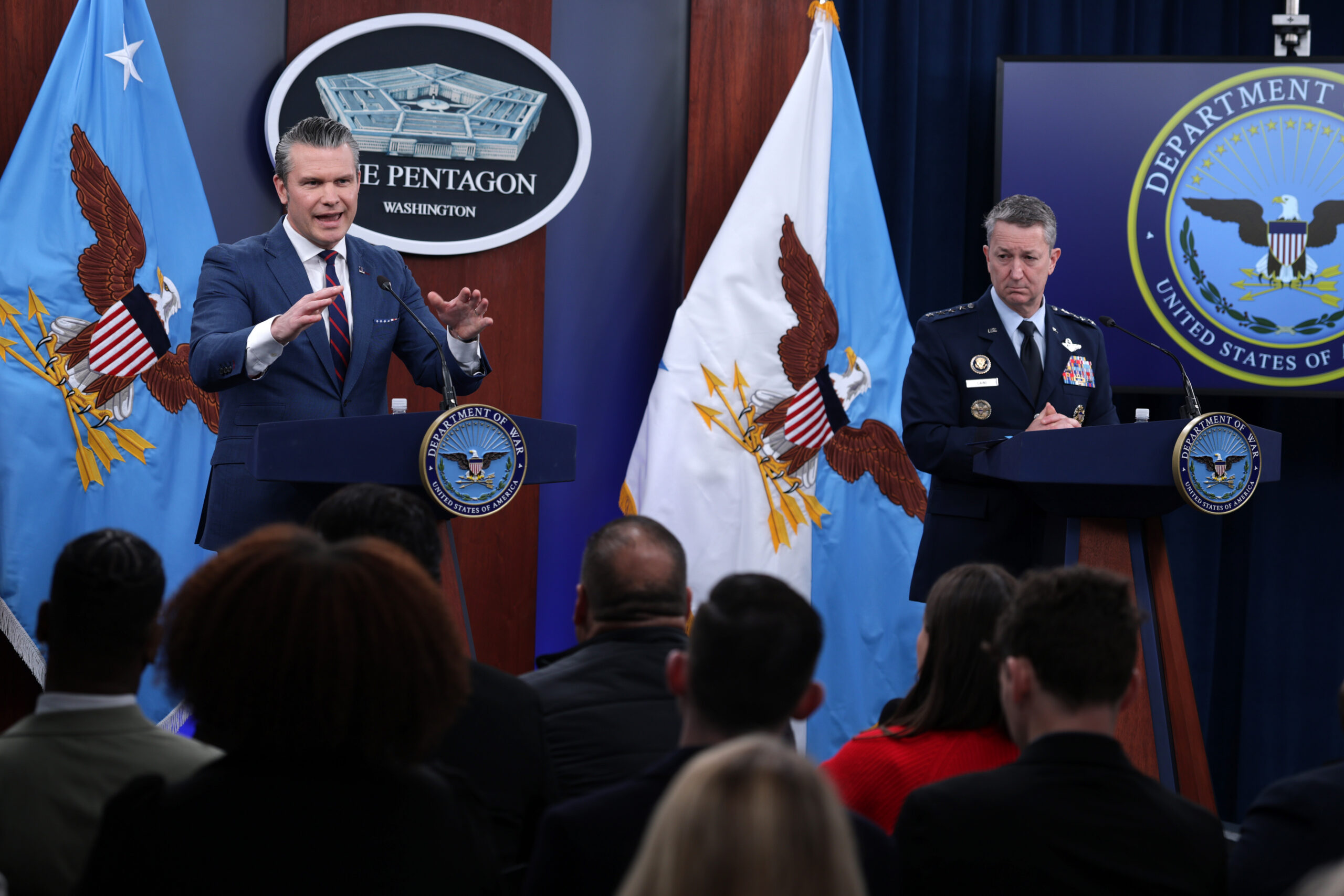
President Donald Trump and senior U.S. defense officials laid out an open-ended timeline for the ongoing operation against Iran on Monday, announcing more U.S. forces are headed to the region to carry out the American and Israeli campaign aimed at dismantling Tehran’s long-range strike capabilities and nuclear ambitions, Jewish Insider’s Matthew Shea and Emily Jacobs report.
Trump talk: Speaking to reporters at the White House on Monday morning, Trump said that U.S. forces were “already substantially ahead of our time projections” with their mission in Iran, but added that the American military was prepared to continue the operation beyond his initial four-to-five week timeline. “Whatever the time is, it’s OK. Whatever it takes,” Trump said at a Medal of Honor ceremony. “Right from the beginning, we projected four to five weeks, but we have capability to go far longer than that. We’ll do it.”
Caine’s comments: Adm. Brad Cooper, head of CENTCOM, “will receive additional forces even today,” said Gen. Dan Caine, chairman of the Joint Chiefs of Staff, during a separate press briefing alongside Defense Secretary Pete Hegseth. “This rapid buildup of forces demonstrated the joint forces ability to adapt and project power at the time and place of our nation’s choosing.” Caine also made clear the weekend barrage was only the beginning.
Team effort: In his first interview since the U.S. and Israel launched their joint military campaign against Iran, Israeli Prime Minister Benjamin Netanyahu defended the timing of the operation’s launch and rebuffed the notion that he decisively pushed Trump to take action, JI’s Matthew Shea reports.
DUELING NARRATIVES
House Speaker Mike Johnson (R-LA) and Senate Intelligence Committee Vice Chairman Sen. Mark Warner (D-VA) emerged from a classified briefing with Cabinet officials on Monday split over whether the U.S. faced an imminent threat from Iran that necessitated and permitted the president to take military action under U.S. statute and the Constitution, Jewish Insider’s Marc Rod reports.
Johnson’s takeaway: “The most critical point is that this was a defensive measure, a defensive operation,” Johnson said. “Israel was determined to act in their own defense here, with or without American support. Why? Because Israel faced what they deemed to be an existential threat. Iran was building missiles at a radical, rapid clip, to the point where our allies in the region do not keep up.”
Warner’s worry: Warner said that the war is “a war of choice that has been acknowledged by others [that] was dictated by Israel’s goals and timelines. Israel is a great ally of America. I stand firmly with Israel, but I believe at the end of the day, when we are talking about putting American soldiers in harm’s way, when we have American casualties and expectations of more, there needs to be the proof of an imminent threat to American interests. I still don’t think that standard has been met.”
SQUARING OFF
Three figures linked to New York City Mayor Zohran Mamdani — two Silicon Valley entrepreneurs and a Brooklyn political operative — have joined forces with a bevy of wealthy business leaders to pump millions into a new political action committee dedicated to battling AIPAC, Jewish Insider’s Will Bredderman reports.
Follow the money: American Priorities PAC has raised $2,050,000 to date and spent a quarter of it so far boosting Democrat Nida Allam, a vocal detractor of Israel, in her bid to oust Rep. Valerie Foushee (D-NC) in North Carolina’s 4th Congressional District. Filings with the Federal Election Commission show another $67,000 has gone toward promoting the candidacy of the Rev. Frederick Haynes III, the pastor of Rep. Jasmine Crockett (D-TX), who is running for her House seat as she seeks the Senate. It’s all part of a plan to spend a minimum of $10 million countering candidates who have received past support from AIPAC, as NBC News previously reported. A spokesperson for the PAC refused to answer questions about its fundraising and decision-making practices, though they denied Mamdani was in any way involved.
Bonus: Politico talks to government watchdogs about Mamdani’s continued use of the messaging app Signal for official business, despite the platform’s encryption protocols and self-deleting capabilities being incompatible with freedom of information laws.
DEMS DEMAND

Democratic members of Congress addressing J Street’s national convention in Washington on Monday used the occasion to rally support for long-shot resolutions coming before the House and Senate this week that will attempt to end U.S. military strikes against Iran, Jewish Insider’s Gabby Deutch reports.
On the record: “The president’s refusal to pursue consent from Congress, as required by the Constitution, is perhaps his most grievous assault on democracy, and we should not let it stand,” Sen. Chris Murphy (D-CT) said to the 1,500 activists gathered at J Street’s morning plenary. Rep. Sean Casten (D-IL) told the crowd that he expects to see “very robust, possibly unanimous support” from congressional Democrats on the measures, which would put an immediate end to U.S. operations against Iran.
Read the full story here with additional comments from Rep. Madeleine Dean (D-PA) and Sen. Brian Schatz (D-HI).
More from Murphy: Addressing the conference, Murphy leaned on Jewish history to tailor his case to fight President Donald Trump specifically to American Jews. “The answer to thousands of years of the Jewish people’s faith being decided by emperors and queens and czars is not and cannot simply be the State of Israel. No, the rest of the answer is simple. It’s democracy,” he said.
Also spotted at the conference: Former New York City Comptroller Brad Lander, who is mounting a primary challenge against Rep. Dan Goldman (D-NY), and leaning into sharp criticism of Israel as part of his campaign.
Worthy Reads
Theory of Regime Change: In The Washington Post, Rob Satloff, the executive director of The Washington Institute for Near East Policy, considers the history of failed regime-change efforts in the Middle East as President Donald Trump calls for Iranians to rise up against their government. “On one end of the spectrum, will he, like [Franklin] Roosevelt, find an Iranian Delcy Rodríguez, leaving the structure of the regime intact under a new, more pliant leader? Or will he, like the first Bush, content himself with inflicting massive damage to Iran’s offensive military capability and choose an expedient path to end the war? Or, on the other end of the spectrum, will he, like the second Bush, get stuck in the muck of Iranian nation-building, triggering problems that we can’t even imagine today?” [WashPost]
The Warrior Prime Minister: The Atlantic’s Yair Rosenberg posits that Israeli Prime Minister Benjamin Netanyahu’s long-standing reluctance to pursue military options against adversaries ended with the Oct. 7, 2023, Hamas terror attacks, as Israel began to more aggressively pursue its enemies. “Before this seismic shift, Netanyahu’s longevity as prime minister was built on a foundation of conflict avoidance. That posture appealed to a risk-averse electorate. Under his premiership, Israeli voters who were comfortable with the status quo could rest easy knowing that their leader would be unlikely to upset it. … With each successful escalation, Netanyahu’s willingness to use force to settle Israel’s scores increased.” [TheAtlantic]
Remembering 1979: The Wall Street Journal’s Matthew Hennessey suggests that support for U.S. military action in Iran is generational, noting that young Americans have little memory of Iran’s years of targeting American interests. “But I was born in the 1970s. I remember the shocking barbarism of the fatwa against Mr. Rushdie. I remember the Iranian-backed Hezbollah terrorism of the 1980s, the 1994 suicide attack on the Jewish community center in Buenos Aires, the 1996 Khobar Towers bombing. … The livestreamers will say this war is about oil. The Substackers will say it started with Mosaddegh. To them, this is an academic debate, something they heard about on a podcast once. Any American over 50 knows who started it.” [WSJ]
Drive for Democracy: In The New York Times, the Hoover Institution’s Abbas Milani considers Iran’s leadership quagmire, arguing that former Iranian Supreme Leader Ayatollah Ruhollah Khomeini’s 1979 takeover of the country was done under a “bait-and-switch” that rallied Iranians around the cause of democracy while establishing a radical theocratic regime. “The right question today is: What are the ideas for democratic governance, for fixing the economy, for keeping centrifugal forces at bay and for maintaining sovereignty and good relations with the world around which Iranians (inside the country and out) can unite, and how can they do so in a way that will deliver Iran out of political paralysis and economic morass?” [NYTimes]
Word on the Street
President Donald Trump slammed commentators Tucker Carlson and Megyn Kelly, who have criticized the administration’s military strikes targeting Iran; Trump told journalist Rachael Bade that Carlson “can say whatever he wants; it has no impact on me” and that “MAGA is Trump — MAGA’s not the other two,” referring to Carlson and Kelly…
The Financial Times does a deep dive into the yearslong effort by Israel to track the movements of Iranian Supreme Leader Ayatollah Ali Khamenei, who was killed on Saturday, and other senior members of the Iranian regime; among the tactics used by Israel was the hacking of traffic cameras around Tehran, which allowed Israeli intelligence officials access to regime movements around the capital…
The Supreme Court blocked an effort to redraw Rep. Nicole Malliotakis’ (R-NY) 11th Congressional District — the sole Republican-leaning district in New York City — that encompasses Staten Island and parts of Brooklyn; the move preserves the existing districts in the city, including NY-10, where Rep. Dan Goldman (D-NY) is facing a primary challenge from former New York City Comptroller Brad Lander…
Federal prosecutors are filing an additional charge of damaging religious property against the man accused of ramming a car into the headquarters of Chabad-Lubavitch in Brooklyn in January…
The FBI is investigating recent antisemitic emails that were sent to members of Stanford University’s Jewish community, including more than half a dozen Jewish student leaders…
The Yeshiva University Maccabees are again heading to the Division III NCAA Men’s Basketball Tournament after the team’s 79-72 win over the Farmingdale State Rams over the weekend secured their position as Skyline Conference champions…
MyFitnessPal acquired calorie-counting app Cal Al, including 19-year-old CEO and co-founder Zach Yadegari and the startup’s six additional employees…
The Wall Street Journal spotlights Blue Owl Capital co-founders Doug Ostrover and Marc Lipschultz as the firm faces financial challenges tied to upheaval in the broader credit market…
Meta’s Mark Zuckerberg and his wife, Priscilla Chan, bought an under-construction mansion in South Florida’s Indian Creek for $170 million, setting a new record in Miami-Dade County…
A new report from the Jewish Representative Council of Ireland found that Irish Jews self-reported 146 incidents involving antisemitism between July 2025 and January 2026…
Kate Schmier is joining the Jewish Book Council as director of publishing relations…
London retailer and fashion designer Bernard Lewis, the founder of Little Island, died at 100…
Pic of the Day
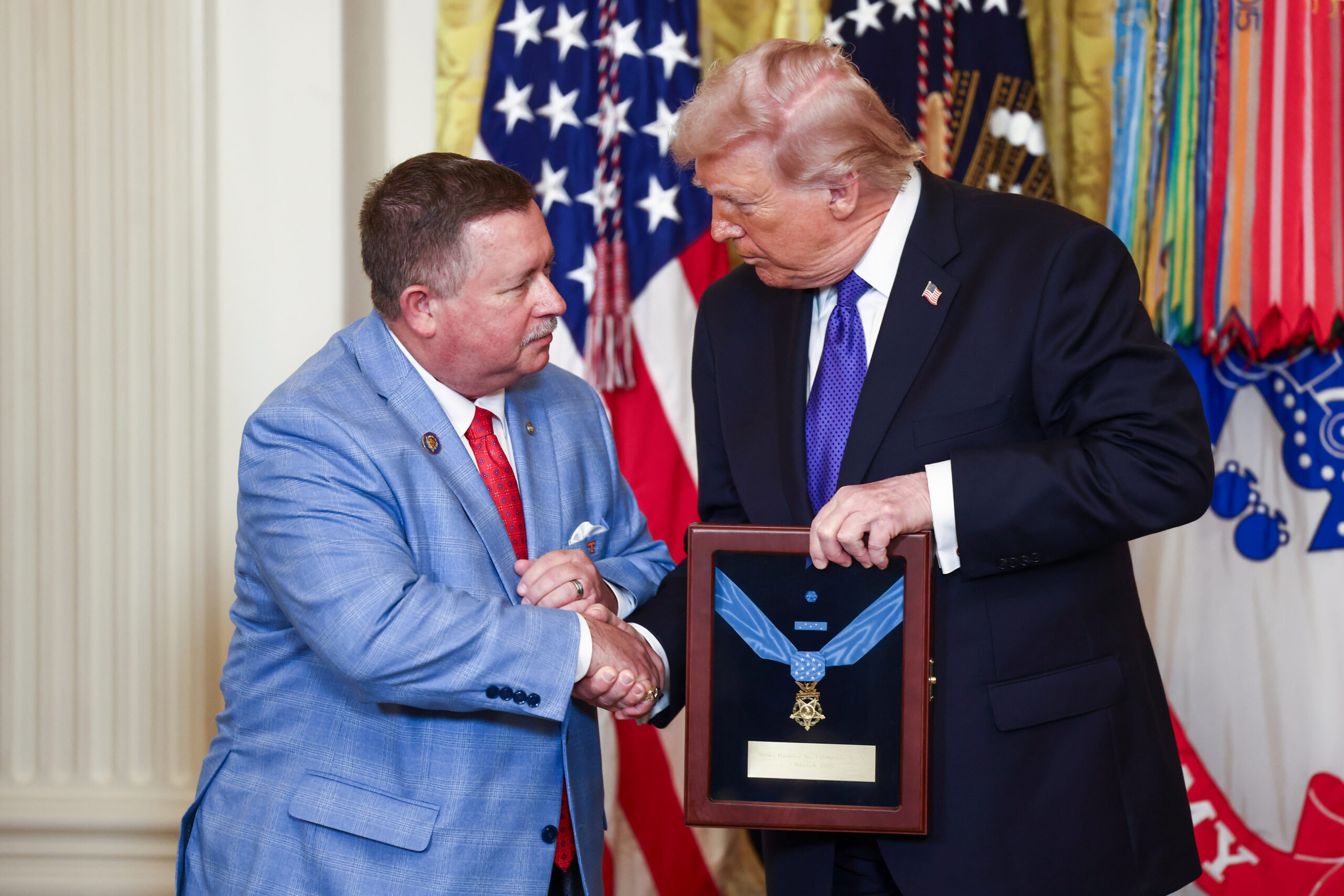
President Donald Trump posthumously awarded the Medal of Honor on Monday to Army Master Sgt. Roderick “Roddie” W. Edmonds, a World War II soldier whose defiance of a Nazi order saved more than 200 Jewish American prisoners of war, Jewish Insider’s Matthew Shea reports. Edmonds’ son, Chris Edmonds, accepted the award on his father’s behalf.
Birthdays

Vocalist for indie-pop band Lucius, Jess Wolfe turns 40…
Australian residential property developer, colloquially known as “High-Rise Harry,” Harry Triguboff turns 93… Former justice of the Supreme Court of Israel, Dalia Dorner turns 92… Author of 32 books and the editor emeritus of Dissent magazine, Michael Laban Walzer turns 91… Researcher in Yiddish language at Sweden’s Lund University’s Centre for Languages and Literature, Henrik Lewis-Guttermann turns 77… Best-selling and Pulitzer Prize-winning biographer of financiers and politicians, Ron Chernow turns 77… President of CBS News until 2021, now president of See It Now Studios, Susan Zirinsky turns 74… Retired chief investment officer of Neuberger Berman, he served as president of AIPAC, Michael Kassen… Fashion designer and businessman, he is the founder and former CEO of an eponymous company, Steve Madden turns 68… NPR personality and the host and producer of the radio and television show “This American Life,” Ira Jeffrey Glass turns 67… Former director of policy for New York state under Gov. Andrew Cuomo, David Yassky turns 62… Israeli economist and diplomat, he served as Israel’s first ambassador to the UAE, Amir Hayek turns 62… MLB pitcher until 2001, his 557 appearances rank second in career games pitched by a Jewish pitcher, Scott David Radinsky turns 58… Co-founder and co-president of Clarity Capital, David Steinhardt turns 57… EVP and general counsel at Eli Lilly and Company, Anat Hakim… Founder of Bunk1, a provider of parent-engagement software for summer camps, he is a co-owner of the Miami Marlins, Ari Jack Ackerman… President and founder of Heppin Biosciences, Brett S. Abrahams, Ph.D. turns 53… Screenwriter and columnist in the Israeli newspaper Globes, Efrat Abramov turns 46… British rabbi who has run for mayor of London and of Manchester, Shneur Zalman Odze turns 45… Acting U.S. attorney for the Southern District of New York for the first 24 days of the Trump 47 administration, Danielle R. Sassoon turns 40… Senior communications manager for Uber, she was the press secretary for former New York City Mayor Bill de Blasio, Freddi Goldstein… Manager of public policy for hate speech at TikTok, Erica H. Mindel… Member of AJR, an indie pop multi-instrumentalist trio, together with his two brothers, Ryan Metzger turns 32…
The race to the left on Israel in the primary underscores the extent to which Middle East politics have shifted and criticism of the Jewish state has become a litmus test in left-wing circles and districts

Cornell Watson/Bloomberg via Getty Images
Campaign signage for Democratic Congressional candidates Valerie Foushee and Nida Allam ahead of the North Carolina primary election in Durham, North Carolina, US, on Sunday, March 1, 2026.
In the closing message of her campaign ahead of the North Carolina Democratic primary today, Durham County Commissioner Nida Allam, a far-left antagonist of Israel, is leaning into criticism of the war against Iran.
“President Trump just used our taxpayer dollars to bomb a school in Iran, killing over 100 elementary school children and starting another endless war abroad. This is reprehensible, and I strongly condemn it, as should every elected official,” Allam said in a direct-to-camera video ad posted on social media on Monday — despite no evidence that the U.S. or Israel were responsible for the strike.
Allam, who is Muslim, vowed that she would never accept support from defense contractors or pro-Israel groups, and said she “opposed these ‘forever wars’ my entire career, and I hope to earn your vote to be your proudly uncompromised pro-peace leader in Washington.”
By contrast, Rep. Valerie Foushee (D-NC), aiming to fend off a primary challenge from Allam, offered a condemnation of the “brutal and repressive” Iranian regime in a statement on Monday, while arguing that its “abuses do not give the president the authority to launch military strikes without Congressional approval.” She said Congress must vote to bring the war to an end.
In an initial statement on X over the weekend, Foushee issued an unequivocal condemnation of the operation, calling it “an unconstitutional escalation that risks dragging the United States into another catastrophic and endless war in the Middle East” that “ignores the will of the American people and recklessly puts our servicemembers in harm’s way” without making mention of the Iranian regime.
In 2022, Foushee won the seat in the 4th Congressional District against Allam with significant backing from the AIPAC-linked United Democracy Project super PAC, but Foushee has taken a more critical posture towards Israel over the last year. This year, significant outside spending has flowed into the race on both sides.
Allam’s allies have claimed that AIPAC is secretly spending to support Foushee, who vowed not to accept funding from the group last year. But AIPAC has strongly denied those claims. “Rep. Foushee rejected AIPAC support and we are not involved in or participating in any way in this race,” the group said Monday.
Foushee has faced a spate of attacks during the primary, including from the groups backing Allam, over her past support for Israel and relationship with AIPAC. She has gone to significant lengths to emphasize that she has cut ties with AIPAC, telling Politico, “My voting record and support for legislation to stop arms sales to Israel speaks for itself.”
The race to the left on Israel in the primary, in a deeply progressive district, underscores the extent to which Middle East politics have shifted and criticism of the Jewish state has become a litmus test in left-wing circles and districts. The shift comes as a new Gallup poll shows, for the first time, that Americans are now more sympathetic to Palestinians than Israelis.
Allam’s comments centering the U.S. as the perpetrator of atrocities in the Iran war also point to how radical she could end up being if elected to Congress.
The race also raises a key questionfor pro-Israel groups and voters going forward: when the two choices are a critic of Israel and an even more extreme critic of Israel, how should they respond? Is it worth backing someone critical of Israel to prevent someone with even stronger views from being elected?
The military engagement could energize the party’s activist base in a number of primaries, with races in North Carolina and Illinois serving as early tests
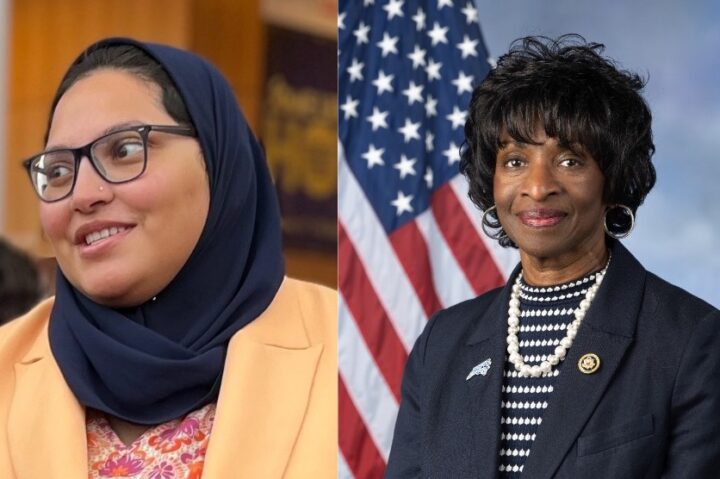
Wikimedia Commons
Nida Allam and Rep. Valerie Foushee (D-NC)
The joint U.S.-Israeli military operation targeting Iran is already changing the dynamics of Democratic congressional primaries in which Middle East policy and the role of pro-Israel spending have featured prominently — as some progressive candidates seek to capitalize on the conflict to bolster their anti-Israel messaging.
In hotly contested House races in North Carolina and Illinois, for instance, the widening war is now emerging as a closing topic of conversation, providing some early signs of how it could reshape the leading issues in the run-up to this year’s midterm elections.
Nida Allam, a far-left Democrat and antagonist of Israel, who is challenging Rep. Valerie Foushee (D-NC), released a closing message focused on her opposition to the Iran war, linking her rival to defense contractors and pro-Israel backers.
In a direct-to-camera message, Allam denounced the strikes for “killing over 100 elementary school children,” a claim yet to be confirmed by the United States or Israel, and accused Foushee’s campaign of accepting contributions from defense contractors and a super PAC linked to the artificial intelligence firm Anthropic, whose technology was reportedly used to aid the attacks.
“I have opposed these ‘forever wars’ my entire career,” Allam said in the ad. “If you believe we need to do things differently, and you, like me, are praying for peace and demanding accountability, please consider voting for me.”
Foushee, who was elected to Congress in 2022 with support from the pro-Israel advocacy group AIPAC — backing she has since walked away from — disputed Allam’s criticism, and echoed other congressional colleagues in casting the strikes as an “illegal” overreach by President Donald Trump.
“I do not support Trump’s illegal war with Iran and will do everything I can in Congress to support War Powers Resolutions to stop it,” she said in an X post Saturday. “The American people are tired of endless wars and we cannot put our servicemembers at risk — period.”
But political observers said the Iran war could give a final jolt of momentum to Allam, who is seeking the nomination in a left-leaning district where her rhetoric might appeal to activist-minded voters who are increasingly wary of new foreign entanglements in the Middle East and beyond.
“Given the leftward lean of the 4th Congressional District and Allam’s positioning to the left of Foushee — particularly on Middle East policy — it could very well make a difference,” Chris Cooper, a political scientist at Western Carolina University, told Jewish Insider on Monday. “Thousands of votes have already been cast, but for late deciders, this is exactly the kind of issue that could help tilt a voter to one side or the other. It’s hard to get more salient than war.”
Meanwhile, in a crowded open-seat primary for a progressive House seat in the Chicago suburbs, one candidate, Kat Abughazaleh, is likewise indicating that she intends to highlight her opposition to the ongoing Iran strikes as the March 17 race enters its final stretch, saying she “will be talking about it very vocally and often because this is very much a topic on people’s minds.”
One of Abughazaleh’s top primary opponents in Illinois’ 9th Congressional District, Laura Fine, a pro-Israel Democrat who voiced support for Israel’s June 2025 bombing of Iran, also came out strongly against the new strikes, but framed her criticism as a response to Trump’s executive overreach and called for his impeachment.
“Donald Trump is leading us into another military conflict to distract from his own failures that puts American lives at risk and threatens to send the Middle East into further chaos,” Fine, a moderate state senator supported by pro-Israel voters, wrote on social media over the weekend. “He simply cannot be trusted and must be impeached. Congress needs to do its job and rein in Trump’s corruption and abuses of power.”
Frank Calabrese, a political strategist in Chicago, questioned the sincerity of Fine’s new rhetoric on Iran. “The reason why she’s doing that is because that’s what the polls are saying,” he told JI Monday.
The conflict “raises Middle East issues much more so than previously” in the race, he said, speculating that it would likely benefit Abughazaleh’s campaign “because she’s staked out a position that makes her different” than Daniel Biss, the mayor of Evanston and another leading primary rival who is sharply critical of Israel.
The Iran war “generally benefits progressives or liberals,” Calabrese said, “because people on the left end of the spectrum don’t like Donald Trump acting aggressively.”
For pro-Israel Democrats who have long criticized Iran, the war poses some unique complications, as the party tries to take advantage of widespread discomfort with Trump’s unilateral decision to pursue the strike without first having sought authorization from Congress. Other top pro-Israel candidates in congressional races in New York and Michigan, where Middle East policy has been a prominent source of debate, have made sure to distance themselves from the conflict, even if they are likely relieved the ayatollah is no longer in power.
For example, Rep. Dan Goldman (D-NY), facing a primary challenge from a progressive Israel critic, former New York City Comptroller Brad Lander, wrote in a statement that Trump “is defying our Constitution to spend billions of dollars overseas while working families struggle to make ends meet at home.”
While he called Iran “a treacherous regime that represents a direct threat to the democratic world order and our own national security,” he said that “recent history has taught us that toppling Middle East dictators in the name of regime change is the beginning — not the end — of a process that too often results in expensive and deadly forever wars.”
Lander, for his part, was more forceful in his own comments, calling the strikes “an illegal war being waged by a sociopathic president whose goal is to distract people from his failing administration.”
Rep. Haley Stevens (D-MI), the pro-Israel moderate in Michigan’s Democratic Senate primary, said that Trump had “once again put Americans in harm’s way without consulting Congress — the latest in a series of grave violations of our Constitution by this administration.”
She acknowledged, however, that “Iran’s state sponsorship of terror across the globe has led to chaos and unchecked violence.”
“We cannot ignore that an armed and nuclear Iran would bring even more violence and chaos to the Middle East and the entire world,” Stevens said in her statement. “We also cannot ignore the imperative to achieve freedom for the people of Iran, who have bravely spoken out through protest in recent weeks.”
Political strategists who spoke with JI said that the war, which early polling has shown is unpopular with voters, could help to broadly elevate progressives in key races — if the conflict remains a salient topic of conversation in the coming weeks and months.
Adrian Hemond, a political consultant in Michigan, said much depends on whether the war ends quickly or grows into a “protracted military effort” involving more American casualties. As of Monday afternoon, the U.S. had lost six servicemembers.
“That’s a horse of a different color,” he told JI. “If we’re still talking about this months from now, then it will have a huge impact on the primary and will probably benefit” Abdul El-Sayed, a far-left Senate candidate in Michigan campaigning on a stridently anti-Israel platform.
In a statement on the strikes, El-Sayed called Trump “a failed president” who is now “committing us to spending billions of our taxpayer dollars in yet another war with no aim.”
Chris Coffey, a Democratic strategist in New York City, cautioned it was too early to predict how the war could shape the primaries or general election.
Still, he suggested that the conflict, which has also faced blowback from influential right-wing figures, “could have negative consequences” for Republicans in the midterms, particularly if it “drags on” and more American servicemembers are killed or oil prices continue to spike before November.
“It’s too soon to tell,” Coffey told JI on Monday. “If you open up a Pandora’s box, you don’t know what’s going to come out of it.”
'We were able to take out dozens of launchers,’ IDF spokesperson says

Jack GUEZ/AFP via Getty Images
Rocket trails from Israel's Iron Dome missile defense system are seen over Tel Aviv on February 28, 2026.
A notable decrease in the number and frequency of Iranian missile strikes at Israel is the result of a focused strategy of hunting and aiming at launchers, Lt.-Col. Nadav Shoshani, the IDF’s spokesperson for international media, said on Tuesday.
“The missile and launcher hunt is happening in real time,” Shoshani told reporters. “We have been able to narrow [Iran’s] capability to fire missiles toward us. … We are putting our focus on continuing to do so in the coming days.”
“We were able to take out dozens of launchers,” since the operation began on Saturday, Shoshani said.
Shoshani said that Iran currently has “a lack of capability to fire in large amounts” and that there is a diminished rate of fire.
“I’m sure all of you in Israel can feel it,” he added. “We have significantly limited their ability to fire toward our civilians and other civilians in the region.”
At the same time, Shoshani said part of the reduction in missile launchers may be attributed to Iran trying to ensure it can keep the war going over the coming weeks.
The IDF is also prepared for the war to continue for weeks, but “it is early to give estimates,” Shoshani said, adding that “we are in a more positive scenario than [what] we looked at in the beginning of the war.”
Israel has also destroyed hundreds of Iranian missiles, but “launchers, that’s the real thing that’s important,” the spokesperson said.
Shoshani did not have readily available information on how many missiles Iran has shot, because the Islamic Republic attacked several countries in the region and not just Israel.
Asked if he expects Israeli boots on the ground in Iran, following President Donald Trump’s remarks about deploying U.S. ground troops “if necessary,” Shoshani said he does not see such a scenario as realistic for Israel.
Most of the targets the IDF struck were found after Operation Rising Lion began on Saturday, including radar and detection arrays, surface-to-air missile launchers, surface-to-surface missile launchers and related infrastructure, command and control centers, strategic military bases in Tehran, and facilities belonging to the regime’s repression and enforcement mechanisms.
Among those targets was the Iranian regime leadership’s compound in Tehran, which includes the presidential office, national security council and a training facility for military officers.
Israel’s “aerial superiority now allows the IDF to continuously strike the Iranian regime’s terror infrastructure — including its command-and-control centers and other high-value assets — not merely through isolated sorties, but through sustained operations, fundamentally shifting the operational reality in Operation Roaring Lion and enabling the IDF and the Israeli Air Force to operate freely in Iranian airspace,” the military spokesperson’s office said.
About 30 female aircrew members, including pilots and navigators, have taken part in the strikes on Iran in recent days.
Combat Navigator Maj. S, whose name was kept anonymous by the IDF Spokesperson’s Unit, said that she and her crew “prepared for this operation for a long time — hours of training and briefings.”
Maj.-Gen. Shlomi Binder, the IDF’s intelligence chief, said on Monday, “In 40 seconds, we eliminated more than 40 of the most important people in Iran … and we are not finished. … We intend to add to the list every day.”
“We are sending a very clear message to our enemies — there is no place where we will not find them,” Binder added. “Anyone who chooses to engage in such actions against the state of Israel, against the residents of the state of Israel, against our future here, we will find them, and we will eliminate them.”
As Israeli strikes in Lebanon continue as far north as Beirut, Israeli Defense Minister Israel Katz said the IDF will move to “take control of additional strategic positions in Lebanon in order to prevent attacks on Israeli border communities.”
The IDF holds five positions in southern Lebanon, as permitted by the U.S.-negotiated late-2024 ceasefire, and Katz said he “authorized the IDF to advance and secure additional strategic areas in Lebanon, and from there to defend the border communities.”
Shoshani said that while Israel’s main goal is to “remove the existential threat” emanating from Iran, it is doing “we are acting defensively on the northern front in order to focus our effort on Iran.”
He also noted that “Hezbollah’s main lifeline is Iran,” and said that in the last year, Iran sent over $1 billion to its proxies, with Hezbollah getting the majority of the money.
Israel does not plan to evacuate civilians from towns on the Lebanon border as it did in October 2023, though they have been dealing with frequent drone and rocket attacks in recent days, Shoshani said.
The IDF struck over 70 weapons storage facilities, launch sites and missile launchers in Lebanon on Monday, the military said.
One target was Hezbollah’s intelligence headquarters. The IDF killed Hussein Makled, Hezbollah’s chief intelligence official, a role he took on after Israel eliminated his predecessor in November 2024.
The IDF also said it eliminated the commander of Palestinian Islamic Jihad in Lebanon, Abu Hamza Rami, who was “responsible for advancing and carrying out hundreds of terrorist attacks against IDF troops and Israeli civilians.”
Another target was the Al-Qard Al-Hassan Association, which Hezbollah has said provides social services to the people of Lebanon. Al-Qard Al-Hassan has been sanctioned by the U.S. and others since 2007, and as such, deals exclusively in cash, which the IDF sought to destroy.
According to the IDF, “the terrorist organization uses these services to create economic dependency on the association and to exploit public funds for the purchase of weapons and the payment of salaries to its operatives.”
Also on Monday, the IDF Home Front Command extended restrictions until Saturday night, including closing schools and nonessential workplaces, and prohibiting large gatherings.
Two major missile barrages hit Israel on Tuesday, with two injured in the first one in Israel’s north, and no casualties in the second. Overnight Monday, Magen David Adom released its final casualty count for an Iranian missile strike on Beersheba, where 21 were injured. Since Operation Roaring Lion was launched on Saturday, there have been at least 371 casualties, including 12 fatalities and two severely injured.
Iran continued its strikes around the Gulf on Monday, with a drone causing minor damage to a U.S. Embassy building in Riyadh. Among the sites damaged by Iranian projectiles were three Amazon facilities in the United Arab Emirates and Bahrain.
Trump briefed leaders of two main Kurdish factions in Iraq on what may come next in the war, a step that Israeli Prime Minister Benjamin Netanyahu had encouraged him to take, Axios reported. Kurdish groups throughout the Middle East have had close security and intelligence ties with Israel for decades. The Kurdistan Freedom Party has also accused Iran of targeting them with missiles and drones.
‘You don’t have to drag him into anything. Donald Trump is the strongest leader in the world. He does what he thinks is right for America,’ Netanyahu said in his first interview since the operation began

SAUL LOEB/AFP via Getty Images
President Donald Trump shakes hands with Israeli Prime Minister Benjamin Netanyahu during a meeting in the Oval Office of the White House in Washington, DC, on April 7, 2025.
In his first interview since the U.S. and Israel launched their joint military campaign against Iran, Israeli Prime Minister Benjamin Netanyahu defended the timing of the operation’s launch and rebuffed the notion that he decisively pushed President Donald Trump to take action.
“The reason that we had to act now is because after we hit [Iran’s] nuclear sites and their ballistic missile program [in June 2025] … they started building new sites, new places, underground bunkers that would make their ballistic missile program and their atomic bomb program immune within months,” Netanyahu told Fox News host Sean Hannity on his show Monday night. “If no action was taken now, no action could be taken in the future.”
Without undertaking military operations, Netanyahu warned that Iran would be able to “target” and “blackmail America” and argued that Tehran could threaten the U.S. and Israel “and everyone in between.” He added that the moment was also opportune due to the Iranian regime being “at the weakest point that it’s been since it hijacked Iran from the brave Iranian people 47 years ago.”
When asked about allegations from critics of the operation that he had “dragged” the U.S. into a wider conflict with Iran, Netanyahu dismissed the notion, calling it “ridiculous.” He said that Trump made the decision on his own because he “understands” the threat Iran poses to the U.S.
“You don’t have to drag him into anything,” said Netanyahu. “Donald Trump is the strongest leader in the world. He does what he thinks is right for America.”
In comments Monday afternoon, both Secretary of State Rubio and House Speaker Mike Johnson (R-LA) suggested it was Israel’s determination to strike Iran, which would have prompted Iranian retaliation against U.S. assets, that necessitated U.S. preemptive action.
Netanyahu did not offer a timeline for how long he expects the joint operation to last; however, he emphasized that it will be “quick and decisive” and not an “endless war” as some critics have alleged.
“You’re not going to have an endless war,” said Netanyahu. “This is going to be a quick and decisive action, and we’re going to create the conditions first for the Iranian people to get control of their destiny, to form their own democratically elected government, which will make Iran different altogether. It may take some time, but it’s not going to take years.”
The prime minister argued that the current military confrontation is intended not only to neutralize an immediate threat but to reshape the region’s long-term trajectory, describing it as a potential “gateway to peace.”
“I think it changes the world,” Netanyahu said, arguing that dismantling Iran’s regime would remove what he called the Middle East’s primary driver of instability. “Iran has been the main engine of war over these years. Ninety-five percent of all the problems you see in the Middle East are generated by Iran and the worldwide terror network that they built.”
“When you take away Iran [Iranian leadership] — let the people of Iran have the opportunity to act and liberate themselves, free themselves from the work of this terror machine — you get a different future,” he added.
Rubio and Defense Secretary Pete Hegseth, however, have insisted that the U.S. objective in Iran is more constrained. The White House has asserted it is not seeking regime change, instead emphasizing that American action is narrowly focused on dismantling Tehran’s nuclear program, ballistic missile capabilities and naval assets.
Still, Netanyahu embraced a broader vision, suggesting that the fall of the Iranian regime would fundamentally reshape the region and open the door to normalization agreements and “many peace treaties” with Arab and Muslim-majority countries. He specifically pointed to Saudi Arabia as a potential partner.
“Saudi Arabia will have a lot to gain,” Netanyahu said. “All these countries around Iran are threatened by Iran. I think they [Arab countries] want to see this regime go down, even if they don’t publicly say that.”
“If Iran [Iranian leadership] is removed, that’s a great boon to Saudi Arabia, a great boon to these other countries, and I think peace between Israel and Saudi Arabia would be really possible — and probably very close — once this thing happens.”
Plus, Tehran takes aim at global energy
Fatemeh Bahrami/Anadolu via Getty Images
Smoke rises from the area after it was targeted in attacks as a series of explosions are heard in Tehran, Iran on March 01, 2026.
Good Monday afternoon,
This P.M. edition is reserved for our premium subscribers — offering a forward-focused read on what we’re tracking now and what’s coming next.
It’s me again — Danielle Cohen-Kanik, U.S. editor at Jewish Insider and curator, along with assists from my colleagues, of the Daily Overtime. Please don’t hesitate to share your thoughts and feedback by replying to this email.
📡On Our Radar
Notable developments and interesting tidbits we’re tracking
President Donald Trump and senior U.S. defense officials laid out an open-ended timeline for the ongoing bombing campaign against Iran in several press briefings and interviews today, Jewish Insider’s Matthew Shea and Emily Jacobs report.
Trump and Defense Secretary Pete Hegseth both declined to rule out a U.S. ground invasion of Iran, while Joint Chiefs Chairman Gen. Dan Caine announced more American troops are en route to the region. “Every president says, ‘There will be no boots on the ground.’ I don’t say it. I say ‘probably don’t need them,’ [or] ‘if they were necessary,’” Trump told the New York Post.
The president repeatedly said the operation is “ahead of schedule,” but added that the U.S. military is prepared to continue the campaign beyond his initial four-to-five-week timeline. Trump also told CNN that the “big wave” of strikes on Iran “hasn’t even happened. The big one is coming soon”…
On the American public’s perception of the strikes, Trump said, “I think that the polling is very good, but I don’t care about polling. I have to do the right thing. This should have been done a long time ago.” A new CNN poll found that 41% of Americans support the strikes against Iran, while 59% disapprove…
After Hezbollah jumped into the conflict by launching strikes on Israel overnight, prompting Israeli fire on Hezbollah targets in Lebanon in return, Lebanese Prime Minister Nawaf Salam banned the terror group’s “military activities,” restricting it “to the political sphere.”
Salam said the group’s actions are now “illegal” and called on the Lebanese Armed Forces to “prevent any attacks originating from Lebanese territory,” a long-awaited show of resolve from Beirut. The LAF has struggled to disarm Hezbollah forces since the signing of a ceasefire agreement with Israel in November 2024…
On a ground invasion of Lebanon, IDF spokesperson Brig. Gen. Effie Defrin said, similarly to the U.S. position on Iran, “all options are on the table”…
U.S. casualties in the course of the operation increased today to six servicemembers…
Qatar’s Ministry of Defense condemned attacks by Iran on a power plant and an oil facility in the country, further indicating Tehran is setting its sights on civilian and energy infrastructure. The targeted energy plant, Ras Laffan, is responsible for around a fifth of all global natural gas production — Qatar halted production after the strike which, along with decreased passage through the vital Strait of Hormuz, sent oil prices soaring…
Iran continues to sustain heavy losses: The U.S. said it has sunk all 11 of Iran’s warships in the Gulf of Oman while Qatar shot down two Iranian SU-24 tactical bombers, which were developed by Russia; the UAE also intercepted around 150 Iranian drones and 15 missiles today in addition to hundreds over the weekend…
U.K. Prime Minister Keir Starmer reiterated in an address to parliament today that Britain will not be joining the strikes on Iran but will allow the U.S. to use its bases for “defensive actions,” noting that Iran has already struck a military base in Bahrain that houses around 300 British troops. “France and Germany are also prepared to enable U.S. action to destroy Iran’s capability to fire missiles and drones from the source,” Starmer added.
Trump said he was “very disappointed” with Starmer in an interview with The Telegraph, saying the prime minister “took far too long” in deciding to allow U.S. forces to utilize its bases…
NATO Secretary-General Mark Rutte praised the campaign, calling it “really important … because it is taking out, degrading the capacity of Iran to get its hands on nuclear capability, the ballistic missile capability.” But, he said, “there are absolutely no plans whatsoever for NATO to get dragged into this”…
GOP lawmakers are pushing Democrats to agree to a funding deal for the still-shuttered Department of Homeland Security, as hostilities with Iran raise concerns about domestic terror threats…
The war is also making its way into some of the most heated primary races unfolding across the country: In North Carolina’s 4th Congressional District, anti-Israel activist Nida Allam, who is challenging Rep. Valerie Foushee (D-NC), put out a new campaign ad just before tomorrow’s primary slamming “Trump and Netanyahu’s reckless war.”
Allam accused the administration of using “our taxpayer dollars to bomb a school in Iran, killing over 100 elementary school children,” even though there has been no proof that the U.S. was responsible for the strike…
Some pro-Israel Democratic candidates in Illinois also took harsh stances against the Iran operation: state Sen. Laura Fine, running in Illinois’ 9th Congressional District, called for Trump’s impeachment, while Cook County Commissioner Donna Miller, running in the 2nd District, and Chicago Treasurer Melissa Conyears-Ervin, running in the 7th District, called the strikes “reckless” and “immoral,” respectively…
⏩ Tomorrow’s Agenda, Today
An early look at tomorrow’s storylines and schedule to keep you a step ahead
Keep an eye out in Jewish Insider for a rundown of the high-profile primaries on the ballot tomorrow in North Carolina and Texas.
German Chancellor Friedrich Merz will meet with President Donald Trump at the White House for a conversation that was set to focus on negotiations between Russia and Ukraine but will likely be overshadowed by the ongoing operation against Iran. Germany joined the U.K. and France over the weekend in offering a supportive but cautious stance on the hostilities.
It will be a busy day on the Hill, where administration officials including Secretary of State Marco Rubio, Defense Secretary Pete Hegseth, CIA Director John Ratcliffe and Joint Chiefs Chairman Gen. Dan Caine will hold all-member briefings on Iran for the House and Senate. Rubio is briefing the Gang of Eight again this afternoon, and national security committees in both chambers were briefed over the weekend.
Elbridge Colby, the under secretary of defense for policy, will brief the Senate Armed Services Committee on the Pentagon’s National Defense Strategy; Colby has previously drawn bipartisan ire from the committee over a lack of consultation by his team and alleged rogue decision-making on a range of issues by his office.
The Senate Judiciary Committee will hold a hearing on oversight of the Department of Homeland Security with testimony from Homeland Security Secretary Kristi Noem.
The Capitol Jewish Forum will host its annual Capitol Hill Purim celebration, attended by a number of Jewish lawmakers.
Stories You May Have Missed
WEIGHING IN

The resolutions are unlikely to pass; if they do, they will need two-thirds support to override an inevitable presidential veto
CLOSING RANKS
UAE and Saudi leaders spoke by phone; the GCC affirmed its ‘right to respond’
Without setting a definitive timeline, officials said more U.S. troops are headed to the region and would not rule out a U.S. ground invasion
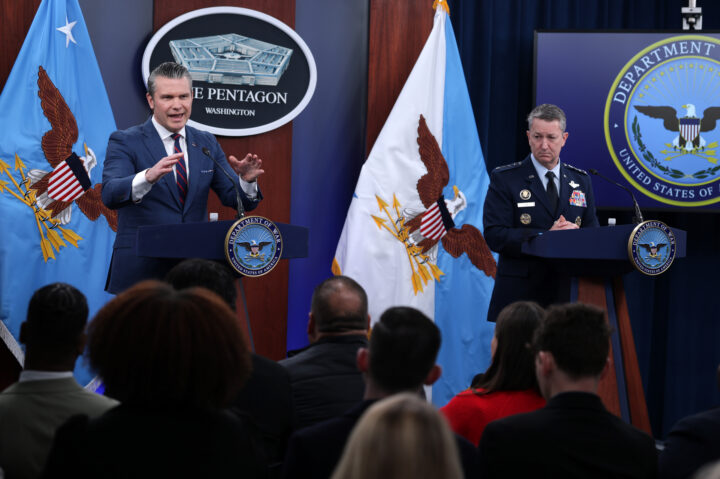
Alex Wong/Getty Images
Secretary of Defense Pete Hegseth (L) speaks with Chairman of the Joint Chiefs of Staff General Dan Caine (R) during a news conference at the Pentagon on March 2, 2026 in Arlington, Virginia.
President Donald Trump and senior U.S. defense officials laid out an open-ended timeline for the ongoing operation against Iran on Monday, announcing more U.S. forces are headed to the region to carry out the American and Israeli campaign aimed at dismantling Tehran’s long-range strike capabilities and nuclear ambitions.
Speaking to reporters at the White House on Monday morning, Trump said that U.S. forces were “already substantially ahead of our time projections” with their mission in Iran, but added that the American military was prepared to continue the operation beyond his initial four-to-five week timeline.
“Whatever the time is, it’s OK. Whatever it takes,” Trump said at a Medal of Honor ceremony. “Right from the beginning, we projected four to five weeks, but we have capability to go far longer than that. We’ll do it.”
The president told CNN Monday morning that the “big wave hasn’t even happened. The big one is coming soon.”
Adm. Brad Cooper, head of CENTCOM, “will receive additional forces even today,” said Gen. Dan Caine, chairman of the Joint Chiefs of Staff, during a separate press briefing alongside Defense Secretary Pete Hegseth. “This rapid buildup of forces demonstrated the joint forces ability to adapt and project power at the time and place of our nation’s choosing.”
Caine also made clear the weekend barrage was only the beginning.
“This is not a single overnight operation,” he said. Caine noted that the operation was the result of “months, and in some cases years,” of planning. “The military objectives that CENTCOM and the Joint Force have been tasked with will take some time to achieve, and in some cases, will be difficult and gritty work. We expect to take additional losses.” Four U.S. servicemembers have already been killed in the course of the operations.
While officials emphasized that there are currently no American boots on the ground in Iran, Hegseth declined to rule out the possibility, saying the United States “will go as far as we need to go to advance American interests.”
Trump similarly kept the door open to a ground invasion in an interview with the New York Post. “Every president says, ‘There will be no boots on the ground.’ I don’t say it,” Trump said. “I say ‘probably don’t need them,’ [or] ‘if they were necessary.’”
Hegseth likewise acknowledged that a military effort “of this scope will include casualties” and declined to provide a timeline for completion. “President Trump has all the latitude in the world to talk about how long it may or may not take, four weeks, two weeks, six weeks, it could move up. It could move back,” Hegseth said.
“The commander in chief sets the tempo in terms of this fight. As I said, it’s on his terms,” said Hegseth. “Why in the world would we tell the enemy exactly how long we’ll go or how far we’ll go?”
“To the media outlets and political left screaming ‘endless wars’ — stop,” Hegseth added. “This is not Iraq. This is not endless.” He argued that the operation is “clear, devastating, decisive” with narrowly defined objectives: “destroy the missile threat, destroy the Navy, no nukes.”
Trump also laid out his four priorities for the campaign: “First, we’re destroying Iran’s missile capabilities … Second, we’re annihilating their navy … Third, we’re ensuring that the world’s number one sponsor of terror can never obtain a nuclear weapon … And finally, we’re ensuring that the Iranian regime cannot continue to arm, fund, and direct terrorist armies outside of their borders,” he said.
Hegseth insisted the campaign is not designed to topple Iran’s government, stressing that “this is not a war of regime change.” However, he noted that “the regime sure did change, and the world is better off for it today.”
Iranian leadership “had every chance to make a peaceful and sensible deal, but Tehran was not negotiating,” said Hegseth. “They were stalling, buying time to reload their missile stockpiles and restart their nuclear ambitions.”
Hegseth framed the military confrontation as the culmination of decades of Iranian aggression against the United States, arguing that Tehran’s missile and proxy network had created a conventional shield for its nuclear ambitions and left American forces and allies in its crosshairs.
“For 47 long years, the expansionist and Islamist regime in Tehran has waged a savage, one-sided war against America,” said Hegseth, calling the moment a “generational turning point.”
“We didn’t start this war, but under President Trump, we are finishing it,” Hegseth said.
Speaking about cooperation with partners, Hegseth noted that Israel “did a great job in the conduct of that operation,” also stating that the U.S.’ integrated air and missile defense network has intercepted “hundreds of ballistic missiles targeting U.S. forces, our partners and regional stability.”
“As the threat grew, our partners surged in beside us,” said Hegseth. “Air defense batteries in Qatar, the UAE, Kuwait, Jordan and Saudi Arabia joined the fight. Proof that years of training, trust and hard-earned integration pay off.”
All parties are planning for what could be a conflict that stretches across weeks, despite the decapitation of nearly all of Iran’s senior-most officials in the opening salvos of the war
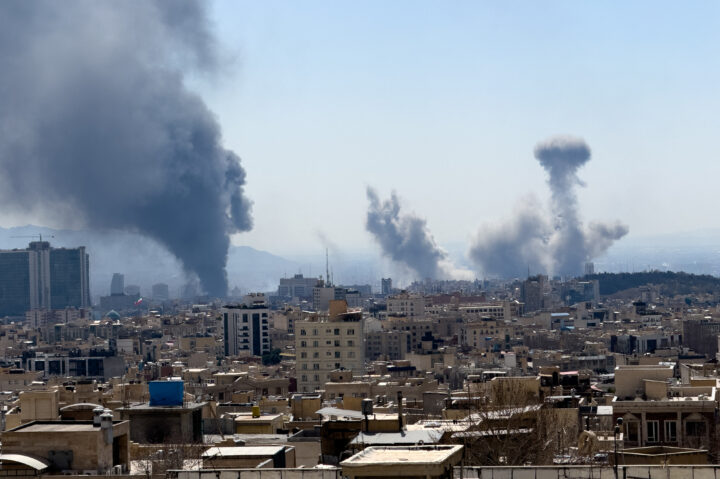
Mahsa / Middle East Images / AFP via Getty Images
Plumes of smoke rise following reported explosions in Tehran on March 1, 2026, after Iran's supreme leader, Ayatollah Ali Khamenei, was killed a day earlier in a large U.S. and Israeli attack, prompting a new wave of retaliatory missile strikes from Iran.
As joint U.S.-Israeli operations against Iran and the Islamic Republic’s ballistic missile and drone attacks continue into a third day, all parties are planning for what could be a conflict that stretches across weeks, despite the decapitation of nearly all of Iran’s senior-most officials in the opening salvos of the war.
On his Truth Social site, Trump doubled down on his push for Iranian protesters to take action, calling on “all Iranian patriots who yearn for freedom to seize this moment, to be brave, be bold, be heroic and take back your country. America is with you. I made a promise to you, and I fulfilled that promise. The rest will be up to you, but we’ll be there to help.”
Trump said on Sunday that the U.S. had sunk nine Iranian warships and destroyed its naval headquarters as it works to dismantle the country’s entire naval fleet.
The president told numerous media outlets over the weekend that the time frame for operations would take four to five weeks, but said that Iranian officials “want to talk, and I have agreed to talk, so I will be talking to them.” Read more here.
Ali Larijani, the head of Iran’s National Security Council, refuted the claim, saying, “We will not negotiate with the United States.”
With the status of talks and any potential off-ramps in question, strikes continue in Israel and Iran, with Iranian proxy Hezbollah entering the hostilities early this morning with missile barrages targeting northern Israel.
The last 48 hours have scrambled and deepened alliances across the Middle East as a number of Arab states coalesced behind the U.S. In a joint statement released Sunday night, the U.S., Bahrain, Jordan, Kuwait, Qatar, Saudi Arabia and the United Arab Emirates slammed Iran’s “indiscriminate and reckless missile and drone attacks against sovereign territories across the region” and said the countries “stand united in defense of our citizens, sovereignty, and territory, and reaffirm our right to self-defense in the face of these attacks.”
Canada and Australia — both led by left-leaning governments that have clashed with the Trump administration — quickly announced their support for the U.S.- and Israel-led operation — though neither country’s official statement mentioned Israel. British, French and German leaders called on Saturday for the resumption of nuclear negotiations, pivoting a day later to calling on Iran to cease its “indiscriminate and disproportionate missile attacks.” Fox News reported that the U.K. is providing air policing and sharing intelligence, and Prime Minister Keir Starmer said Sunday that the U.K. is giving the Pentagon access to British bases in the region.
Israel and the U.S. prepared for the operation over the last two months. The Washington Post reported on Sunday that Trump’s decision to move forward with the operation came amid a “weeks-long lobbying effort” by Israel and Saudi Arabia — which was denied by a Saudi spokesperson in Washington. Israeli officials have for the last several months traveled back and forth between Jerusalem and Washington for White House meetings, while Saudi Defense Minister Prince Khalid bin Salman was in Washington last month for meetings with administration officials as well as Jewish communal leaders.
In Washington, Congress is set to resume later this week and vote on two war powers resolutions being led by Sens. Tim Kaine (D-VA) and Rand Paul (R-KY) and Reps. Ro Khanna (D-CA) and Thomas Massie (R-KY) that, if passed and able to override an inevitable presidential veto, would force the Trump administration to end its operations against Iran.
The assassination of Iran’s supreme leader, Ayatollah Ali Khamenei, has put officials and figures who are critical of the Trump administration in the awkward position of praising the killing of the supreme leader, who has directed attacks that have killed tens of thousands over decades and overseen the expansion of Tehran’s vast proxy network, while continuing to criticize Trump. Rep. Steny Hoyer (D-MD), previously a member of House Democratic leadership, called the strikes “an act of war” and the goal — “to stop Khamenei’s fanatical regime from committing further acts of terror — “defensible,” while blasting what he called Trump’s “unilateral, unconstitutional decision to go to war without congressional approval.”
Sen. Chris Coons (D-DE) called Khamenei a “brutal dictator with the blood of Americans and Iranian civilians on his hands,” before stating that “his death does not mean regime change is imminent, and the potential consequences of these strikes are unpredictable, dangerous, and global.”
IDF chief announces offensive campaign against Hezbollah after overnight attacks against Israeli by the Iranian proxy
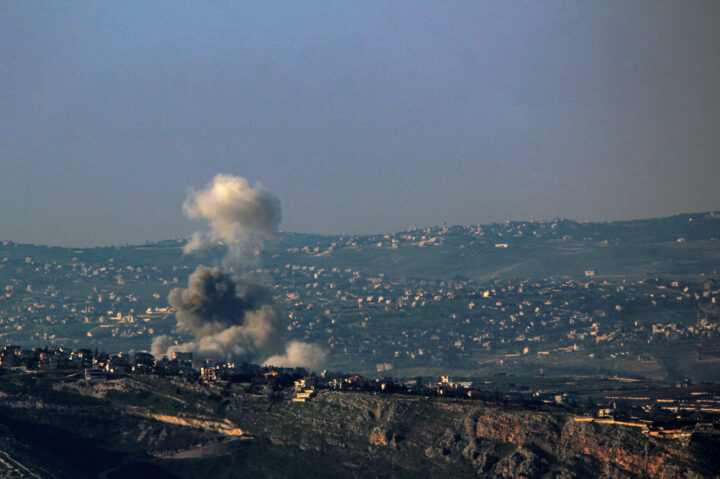
Stringer/picture alliance via Getty Images
Smoke from an Israeli air raid billows from Hezbollah positions in the southern Lebanese village of Dier Siran
Israel expanded its war effort against Iran to southern Lebanon on Monday after Iranian proxy Hezbollah launched rockets and drones at Israel overnight.
“We have launched an offensive campaign against Hezbollah,” Lt.-Gen. Eyal Zamir, the IDF’s chief of staff, said in a situational assessment on Monday. “We are not only operating defensively — we are now going on the offensive as well. We must prepare for many prolonged days of combat ahead.”
The war against Iran and Hezbollah “requires strong defensive readiness and sustained offensive readiness, operating in continuous waves while constantly utilizing opportunities,” Zamir said.
On Sunday, Zamir also spoke of Israel’s “close cooperation with our most important partner — the United States of America. We are working in coordination with CENTCOM, with AFCENT, CENTCOM’s Air Force, and there is undoubtedly tremendous force here.”
Hours after Hezbollah launched rockets and drones at Israel at about 1 a.m. Monday, the IDF carried out strikes against dozens of Hezbollah targets in southern Lebanon and as far north as Beirut that extended into the morning. Targets included senior Hezbollah terrorists, command posts, infrastructure and a vehicle carrying operatives from the Sh’ia militia’s elite Radwan force.
Israeli Defense Minister Israel Katz said on Monday that Hezbollah leader Naim Qassem “decided on the attack under pressure from Iran [and] is from this moment a marked target for elimination.”
The IDF will “act forcefully against Hezbollah,” Katz added, “while continuing to advance the primary objective: crushing and defeating the Iranian terror regime and neutralizing its capabilities in Operation Lion’s Roar in order to remove the threats against the State of Israel and enable the citizens of Iran to rise up against the regime and overthrow it.”
The IDF’s Arabic-language spokesperson issued evacuation notices for 53 villages in southern Lebanon.
“The IDF had previously prepared for the possibility of Hezbollah joining the hostilities,” the military spokesperson’s office stated. “In the Northern Command, combat forces were significantly reinforced along the border with both defensive and offensive capabilities. This preparation enabled a rapid and robust counterattack while maintaining full operational protection across all scenarios.”
The expansion of the war to a second front followed a month of smaller IDF strikes in southern Lebanon, as Hezbollah continued efforts to rebuild after Israel killed Hezbollah leader Hassan Nasrallah and many other leading figures in the Iranian proxy group in late 2024.
As Operation Roaring Lion, as the IDF called its strikes on Iran, was launched on Saturday, the IDF called up 70,000 reservists to bolster its forces in all sectors, including the northern border, as well as Central Command, focusing on counterterrorism activity in the West Bank, and Southern Command, to defend the Yellow Line in Gaza and protect residents of southern Israel.
The IDF continued intercepting Iranian missiles on Monday, including over Jerusalem, where the Iranian Revolutionary Guard Corps said it was targeting the Prime Minister’s Office and the home of Air Force Commander Tomer Bar.
Israel confirmed that on the first day of the war, it eliminated 40 commanders, including the Iranian Armed Forces’ Chief of Staff Abdolrahim Mousavi, whose predecessor was eliminated by the Israeli Air Force last year.
In addition, the IDF targeted the Iranian Intelligence Ministry, killing Sayed Yahya Hamidi, deputy minister of intelligence for ‘Israel affairs,’ who directed attacks on Jews around the world, and Jalal Pour Hossein, head of the espionage division, among others.
The Intelligence Ministry reported directly to Iran’s supreme leader and was also a central tool through which Iran monitored citizens and provided intelligence for the violent suppression of protests. It has long been under U.S. sanctions.
The IDF said that, in addition to missiles, the air force and navy have intercepted dozens of Iranian drones launched toward Israel.
Late Sunday and early Monday, Iranian missiles struck Jerusalem twice, including one that landed right outside the walls of the Old City.
The second strike, in a residential neighborhood, injured five, Magen David Adom reported.
On Sunday, 10 were killed as a result of missile strikes, mostly in a barrage that decimated a residential area in Jerusalem suburb Bet Shemesh.
Since the beginning of Operation Roaring Lion, there have been 12 fatalities in Israel. MDA reported 228 injuries.
Also Monday, Israel’s Energy Ministry instructed a halt on gas production at the Leviathan platform in the Mediterranean Sea.
Parsi has long faced allegations of closeness with the Iranian regime, while Rhodes’ nickname in the Obama WH was ‘Hamas’ in part due to his hostility toward Israel
Tasos Katopodis/Getty Images
Trita Parsi of the Quincy Institute speaks on February 12, 2020 at the U.S. Capitol in Washington, DC.
The Congressional Progressive Caucus organized an “emergency convening” on Saturday evening for members to receive a briefing on Iran from the Quincy Institute’s Trita Parsi and former Obama administration official Ben Rhodes, according to an invitation obtained by Jewish Insider.
CPC members have been largely unified in condemning the U.S. strikes on Iran.
Parsi, a cofounder of the National Iranian American Council, has long faced accusations of being overly cozy with and supportive of the Iranian regime, while Rhodes has come under scrutiny for his hostility toward Israel — a stance that earned him the nickname “Hamas” inside the Obama White House.
Throughout the first day of the war, Parsi was vociferous in condemning the attack, characterizing it as a U.S. operation in service of “Israel’s war” and condemning a variety of international actors, particularly in Europe, that he said have failed to respond forcefully enough and he claimed are acting as “vassals” of the U.S. and Israel.
He has further suggested that the public in Arab states are rallying around Iran, despite the forceful and united condemnation of Iran’s indiscriminate strikes across the region by all Gulf countries.
Parsi also highlighted a strike on a girls’ school in Iran which killed dozens, according to Iranian media, though the source of the missile has not been determined. He claimed such incidents would make a civilian uprising in Iran less likely.
Rhodes has also forcefully condemned the operation. “A war that has no domestic or international legal basis. A war that Americans do not support. A war in response to no imminent threat. A pointless war,” Rhodes said in response to the attack. “Trump and Netanyahu seem to be totally unconcerned about the human beings — on all sides — who will suffer.”
UAE and Saudi leaders spoke by phone; the GCC affirmed its ‘right to respond’
Fadel SENNA / AFP via Getty Images
A yacht sails past a plume of smoke rising from the port of Jebel Ali following a reported Iranian strike in Dubai on March 1, 2026.
Major Gulf powers are coming together in rare lockstep amid Iran’s strikes around the region, with the United Arab Emirates closing its embassy in Iran and the Gulf Cooperation Council declaring it retains the right to respond.
After the U.S. and Israel launched a major operation against Iran on Saturday, the regime struck sites in at least nine countries around the Middle East, including Israel, Jordan, Syria and every member of the Gulf Cooperation Council — Bahrain, Kuwait, Oman, Qatar, Saudi Arabia and the UAE.
Despite claiming it is aiming at U.S. military assets in the region, Iran has struck widely at civilian infrastructure, including hotels, residential neighborhoods and airports in the UAE, Bahrain, Kuwait and Iraq. At least 12 civilians were killed in Israel over the weekend, along with three U.S. servicemembers.
On Saturday, the first day of the operation, UAE President Mohamed bin Zayed spoke by phone with Saudi Arabia’s Crown Prince Mohammed bin Salman to discuss Iran’s aggression and their response, a significant development and sign of the seriousness of the issue amid a regional rift between the two major powers.
The UAE has taken the brunt of much of Iran’s malign activity — its Ministry of Defense said Sunday that the country had been targeted by 165 ballistic missiles, two cruise missiles and 541 drones from Iran. Three civilians were killed and 58 injured in the barrage.
Shortly after, Abu Dhabi announced the closure of its embassy in Tehran and the withdrawal of its entire diplomatic mission, citing Iran’s “hostile attacks against civilian sites … in a serious and irresponsible escalation [that] constitute a flagrant violation of national sovereignty.” The country’s Ministry of Foreign Affairs also summoned the Iranian ambassador to the UAE and “delivered a strongly worded note of protest” about Iran’s “terrorist attacks and assault.”
Also on Sunday, the ministerial council of the GCC held a meeting over video conference and issued a statement strongly condemning Iran’s attacks and affirming the countries’ “legal right to respond.”
“The Council also expressed full solidarity among the GCC countries and their unified stance in confronting these attacks, stressing that the security of GCC member states is indivisible, and that any attack against any member state constitutes a direct attack against all GCC countries,” the statement went on. The countries “will take all necessary measures to defend their security and stability and to protect their territories, citizens, and residents, including the option of responding to the aggression,” they pledged.
The U.S. also joined the GCC in another statement Sunday, saying that Iran’s “targeting of civilians and of countries not engaged in hostilities is reckless and destabilizing behavior.”
The resolutions are unlikely to pass; if they do, they will need two-thirds support to override an inevitable presidential veto

Kevin Carter/Getty Images
The U.S. Capitol Building is seen at sunset on May 31, 2025 in Washington, DC.
As the U.S.-Israel air war against Iran continues, the Senate and House are set to vote this week on war powers resolutions that would aim to cut the U.S. operations short.
The resolutions, led by Sens. Tim Kaine (D-VA) and Rand Paul (R-KY) and Reps. Ro Khanna (D-CA) and Thomas Massie (R-KY), respectively, were originally introduced before the war began, in an effort to block military action and signal dissatisfaction with the then-looming war.
Now, the resolutions, if passed, would force the administration to end the nascent war, withdraw forces and cease operations against the Iranian regime.
It’s almost certain that the resolution will not pass the Senate; the House vote may be closer but it is also not likely to pass. And even if the resolutions were to pass, they would not have the two-thirds support necessary to overcome an inevitable presidential veto.
But the resolution will be an opportunity for Democrats — and a small number of Republicans — to go on record demonstrating their opposition to the war and dissatisfaction with the administration’s approach.
Democrats, even lawmakers like Sen. Jacky Rosen (D-NV) who are relatively hawkish on Iran and have offered some positive feedback about the ongoing operations, are expected to mostly vote for the war powers resolution.
They have cited concerns about the administration’s failure to brief Congress at large about its plans before launching the war, its decision not to seek congressional authorization for the operations and what they say is the administration’s failure to make the case for war to the American public.
Lawmakers are reportedly set to receive classified briefings on the war on Tuesday from Cabinet and other senior administration officials.
A small number of Democrats will likely vote against the resolutions, such as Sen. John Fetterman (D-PA), an outspoken supporter of the war against Iran, and Rep. Greg Landsman (D-OH), who backed limited operations against Iran and said yesterday he would oppose the resolution.
Two other Democrats, Reps. Josh Gottheimer (D-NJ) and Jared Moskowitz (D-FL), had said before the war started that they would oppose the war powers resolutions, but haven’t specified their plans now that active combat operations are underway.
The key difference between the text of the Senate and House resolutions is language in the Senate version specifically permitting the U.S. to continue intelligence sharing with and providing military aid for Israel and other allies. The House bill does not contain any such language, a potential issue for some supporters of Israel.
Most Republicans, with the exception of some isolationist-leaning lawmakers like Paul, Massie and Rep. Warren Davidson (R-OH), have been offering full-throated support for the Trump administration’s actions and are likely to vote against the war powers resolutions.
Kaine said he expects the Senate vote will happen on Tuesday or Wednesday. The House isn’t set to reconvene until Wednesday, with a vote likely set for Wednesday or Thursday.
The president predicted a four to five week timeline for the military campaign against Iran in several interviews over the weekend

Daniel Torok/White House via Getty Images
President Donald Trump oversees "Operation Epic Fury" at Mar-a-Lago on February 28, 2026 in Palm Beach, Florida.
President Donald Trump said over the weekend that Iran’s new leadership has made overtures to restart diplomatic negotiations with the U.S. — which he plans to accept — after Iranian Supreme Leader Ayatollah Ali Khamenei was killed during Israeli and U.S. strikes in the country.
Still, the president warned that strikes would continue until their objectives had been achieved.
Trump made the comments while speaking to The Atlantic on Sunday morning, one of a series of interviews he gave after launching a joint military operation against Iran alongside Israel on Saturday. The president has been touting Operation Epic Fury to journalists as an immediate success, arguing that the removal of Khamenei and 47 others in senior Iranian leadership has provided a window for diplomacy as the U.S. military operation swiftly advances.
“They want to talk, and I have agreed to talk, so I will be talking to them,” Trump told The Atlantic. “They should have done it sooner. They should have given what was very practical and easy to do sooner. They waited too long.”
The commander-in-chief declined to say when he plans to begin engaging with the Iranians, instead noting that most of the Iranians involved in past negotiations with the U.S. are now deceased.
“Most of those people are gone. Some of the people we were dealing with are gone, because that was a big — that was a big hit,” Trump said. “They should have done it sooner. They could have made a deal. They should’ve done it sooner. They played too cute.”
Asked if he was willing to extend the bombing campaign in order to support a popular uprising in Iran, should it unfold, the president was similarly coy, telling the outlet: “I have to look at the situation at the time it happens … You can’t give an answer to that question.”
In a video posted to his Truth Social platform on Sunday afternoon, however, Trump spoke directly to the protesters, calling upon “all Iranian patriots who yearn for freedom to seize this moment, to be brave, be bold, be heroic and take back your country. America is with you. I made a promise to you, and I fulfilled that promise. The rest will be up to you, but we’ll be there to help.”
Further illuminating his thinking, Trump wrote on Truth Social on Saturday shortly after the killing of Khamenei, “We are hearing that many of their IRGC, Military, and other Security and Police Forces, no longer want to fight, and are looking for Immunity from us … Hopefully, the IRGC and Police will peacefully merge with the Iranian Patriots, and work together as a unit to bring back the Country to the Greatness it deserves. That process should soon be starting.”
“The heavy and pinpoint bombing, however, will continue, uninterrupted throughout the week or, as long as necessary to achieve our objective” of world peace, he wrote.
In an interview on Saturday evening with CBS News’ Robert Costa, Trump said he believes that the joint U.S.-Israeli attacks on Iran that killed Khamenei made diplomacy “much easier now than it was a day ago, obviously, because they are getting beat up badly.”
As for the military operation itself, Trump suggested in subsequent conversations on Sunday with The Daily Mail and The New York Times that the U.S. could be involved for another four to five weeks.
“It’s always been a four-week process. We figured it will be four weeks or so,” Trump told the U.K. tabloid. “It’s always been about a four week process so — as strong as it is, it’s a big country, it’ll take four weeks or less.”
He repeated the four to five week timeline in interviews with Axios’ Barak Ravid on Saturday and The New York Times on Sunday.
“I can go long and take over the whole thing,” Trump told Ravid by phone, “or end it in two or three days and tell the Iranians: ‘See you again in a few years if you start rebuilding [your nuclear and missile programs].’”
Trump later predicted to Ravid that, “In any case, it will take them several years to recover from this attack.”
Senate Intelligence Committee Chairman Tom Cotton (R-AR) echoed the president’s predictions, telling CBS’ “Face the Nation” on Sunday that Trump has “no plan for any kind of large-scale ground force inside Iran.”
“The president has been clear that what we should expect to see is an extended air and naval campaign that’s designed not only to continue to set back Iran’s nuclear ambitions, but most importantly, to destroy its vast missile arsenal, many more missiles than the United States and Israel have air defenses combined, as well as the missile launchers and its missile manufacturing capability,” said Cotton, one of the president’s more hawkish GOP allies on Capitol Hill.
“Now obviously one risk of that kind of campaign is that an aircraft could be shot down, and the president would never leave a pilot behind,” he continued. “So no doubt we have combat search and rescue assets in the region that are prepared to go in and extract any downed pilot. But barring that kind of unusual circumstance, the president has no plan for any kind of large-scale ground force inside of Iran.”
URJ’s Rabbi Rick Jacobs: ‘America’s Jewish congregations are diverse, filled with good, moral people who differ on complex issues’

Michael Brochstein/Sipa via AP Images
J Street President Jeremy Ben-Ami speak at the 2022 J Street National Conference held at the Omni Shoreham Hotel in Washington, D.C.
When more than 1,500 people gathered in Washington this weekend for J Street’s national conference, the progressive Israel advocacy group’s first major convening in four years, the gathering was billed as an opportunity to reflect on building regional peace in the Middle East in the aftermath of the Gaza war.
Instead, a major U.S. and Israeli military operation against Iran that began Saturday undercut the group’s pledge to focus on peace between Israelis and Palestinians and came to dominate the discussion. J Street quickly came out against the attacks.
The first speaker on the conference’s main stage on Sunday took an unusual departure from J Street’s dogma on diplomacy by noting that the organization’s positions are not the only ones that should be taken seriously in the Jewish community.
Rabbi Rick Jacobs, the president of the Union for Reform Judaism, kicked off the conference program by noting that J Street’s position, one of stark opposition to the attacks, sits alongside the views of others in the Jewish community who have cheered U.S. and Israeli military strikes seeking to bring about regime change in Iran.
“I’m certain that many in this gathering agree, as a matter of principle and foreign policy, with the J Street statement,” Jacobs said. “Many in our congregations might also agree. But America’s Jewish congregations are diverse, filled with good, moral people who differ on complex issues, as those raised by the Iran attacks.”
J Street’s leaders often make the case that greater nuance and complexity is required within the U.S. Jewish community, particularly making space for left-wing views on Israel within mainstream Jewish groups. Jacobs was making the argument in reverse: that people could also support the attacks in good conscience, and that neither view is superior.
“There are many in our congregations, in the Jewish community at large and in the broader American public who want to seek regime change for the sake of the people of Iran, for eliminating threats to America’s and Israel’s security, and to enhance stability in the region, who may well recognize that war is surely not the remedy for every global conflict, but feel there are times when military force is justified and believe a case can be made,” Jacobs continued.
Later, J Street President Jeremy Ben-Ami clarified where the group stands but said there is room in the organization for people who disagree.
“I made very clear J Street’s adamant and clear opposition to this war. It is a war of choice. It is a war without clear objectives. It is a war without a plan to achieve those unclear objectives. It is a war without constitutionally required congressional approval, and it is a war without public consent,” Ben-Ami said. “It is clear that in this room there is a mix of opinions. Not everyone in J Street would agree with the clear, articulated opposition to the war that I laid out.”
Sen. Chris Van Hollen (D-MD) called the war “dangerous” and said it would make Americans less safe. British human rights lawyer Phillippe Sands compared the attack on Iran to Russia’s invasion of Ukraine. On the other hand, former Israeli Prime Minister Ehud Olmert said Iran “needs to be punished.” In a video message recorded before the attacks began, Yair Golan, the leader of Israel’s liberal Democrats party, said that if war with Iran starts, “let us defeat those who seek our destruction.” Both Olmert and Golan are fierce opponents of Israeli Prime Minister Benjamin Netanyahu.
But while the convention main stage offered some room for nuance on Iran, most speakers were otherwise aligned on J Street’s messaging — that Israel’s government, led by Netanyahu, is not doing enough to make peace with Palestinians or to rein in violent settlers in the West Bank, and that the U.S., meanwhile, is not doing enough to safeguard Palestinians or provide oversight of Israel’s use of its military aid.
“There can’t be a continuing blank check when the Netanyahu government is operating in violation of American law, which they have repeatedly, or in violation of international law,” Van Hollen said.
Later in his speech, Jacobs, the URJ president, said the U.S. Jewish community must also learn to accept diverging opinions on Israel.
“It does not make one love Israel any less to be pained by the loss of life and suffering among innocents, and we must learn how to work amidst difference. Our Jewish community will not be safe only with more cameras and security protocols. Does anti-Zionism spill over into antisemitism? Yes. But not always,” Jacobs said.
J Street also plans to use the conference to spotlight its growing political influence in the Democratic Party, with a fundraiser on Sunday evening for North Carolina Senate candidate Roy Cooper, the former governor. Attendees will also be able to join a phone bank for Evanston, Ill., Mayor Daniel Biss, who is running for Congress in a contentious Democratic primary in Illinois where Israel has become a key issue.
Other congressional speakers slated to address the conference on Monday include Sens. Brian Schatz (D-HI), Chris Murphy (D-CT), Adam Schiff (D-CA) and Tim Kaine (D-VA), as well as Reps. Nancy Pelosi (D-CA), Sean Casten (D-IL), Madeleine Dean (D-PA) and Sara Jacobs (D-CA). The executive director of the House Majority PAC, a Super PAC that supports Democratic congressional candidates, will be at the conference meeting with top J Street donors.
Canada and Australia immediately offered support; European leaders signaled changing views amid Iran’s indiscriminate attacks in the region

Kay Nietfeld/picture alliance via Getty Images
French President Emmanuel Macron (l-r), German Chancellor Friedrich Merz (CDU) and Keir Starmer, Prime Minister of Great Britain, meet in The Hague at the delegation hotel on the sidelines of the NATO summit for trilateral talks in the E3 format.
President Donald Trump’s decision to launch a military campaign against Iran has earned unexpected support from Western leaders who have otherwise sparred with Trump, particularly on trade policy. Canada and Australia, both of which are led by liberal parties, robustly backed the strikes that began on Saturday morning.
“We support the United States acting to prevent Iran from obtaining a nuclear weapon and to prevent Iran continuing to threaten international peace and security,” Australian Prime Minister Anthony Albanese said in a statement on Saturday.
Canadian Prime Minister Mark Carney, speaking to reporters during a trip to India, also threw his support behind the U.S.: “Canada supports the United States acting to prevent Iran from obtaining a nuclear weapon and to prevent its regime from further threatening international peace and security,” he said.
Meanwhile, three powerful European allies known as the E3 — France, Germany and the United Kingdom — were more circumspect after the military campaign began, with British Prime Minister Keir Starmer, French President Emmanuel Macron and German Chancellor Friedrich Merz calling on Saturday for nuclear negotiations to resume.
But by late Sunday, as Iran doubled down on its campaign of retaliation against American and Western assets across the Middle East, the E3 nations inched toward support for Washington with a statement strongly calling on Iran to cease its “indiscriminate and disproportionate missile attacks.”
“We call on Iran to stop these reckless attacks immediately. We will take steps to defend our interests and those of our allies in the region, potentially through enabling necessary and proportionate defensive action to destroy Iran’s capability to fire missiles and drones at their source,” the E3 leaders said. “We have agreed to work together with the U.S. and allies in the region on this matter.”
Columbia University Apartheid Divest, a coalition of over 80 student groups, is ‘illegally using the Columbia name’ on X, the university said

Victor J. Blue for The Washington Post via Getty Images
Students protest against the war in Gaza on the anniversary of the Hamas attack on Israel at Columbia University in New York, New York, on Monday, October 7, 2024.
Columbia University distanced itself from Columbia University Apartheid Divest, a coalition of over 80 university student groups, after it posted “death to America” in Farsi in response to U.S. strikes on Iran, denying that current students are behind the account.
“Marg bar Amrika,” CUAD posted on X on Saturday after U.S. and Israel’s joint strikes killed Ayatollah Ali Khamenei, the country’s supreme leader — using a phrase that was frequently invoked by Khamenei. The post was deleted, but CUAD doubled down, writing in a new post, “X forced us to delete our ‘marg bar amrika’ tweet in order to gain back access to our account but the sentiment still stands.”
Columbia responded that “the group that calls itself ‘CUAD’ is not a recognized student group, or affiliated in any way with the University.”
“There is no evidence that anyone currently in control of their account is a current Columbia student, staff, or faculty member. They are illegally using the Columbia name,” the university said in a statement.
But a source familiar with the university’s actions told Jewish Insider that Columbia does not know who controls the account.
Last year, Columbia served the email associated with CUAD’s social media accounts with a cease and desist letter and sent takedown requests to the social media platforms carrying them, the source said.
CUAD then changed its account name from Columbia University Apartheid Divest to CU Apartheid Divest, stopped using an alma mater logo, changed its status on X to be a “commentary account” and added a statement to its bio about being “proudly unrecognized” by Columbia.
The source said the university is continuing to pursue all available legal action on the matter.
CUAD was formed in 2016 and gained renewed support since Hamas’ attacks on Oct. 7, 2023. It consists of groups run by current Columbia students, including Students for Justice in Palestine, Jewish Voice for Peace, Student Workers of Columbia and Columbia Social Workers for Palestine. In an updated statement on Sunday evening, Columbia said that currently recognized student groups cannot affiliate with CUAD.
Columbia announced last July — about a week before it reached a settlement with the Trump administration to restore federal funding — that it would no longer recognize CUAD, which organized the 2024 campus anti-Israel encampment and several other demonstrations against the war in Gaza, some of which turned violent. At the time, Khamenei praised such protests, telling students they were “on the right side of history.”
CUAD’s Instagram page was disabled last year for promoting violence.
Three servicemembers have been killed and five seriously injured, CENTCOM said
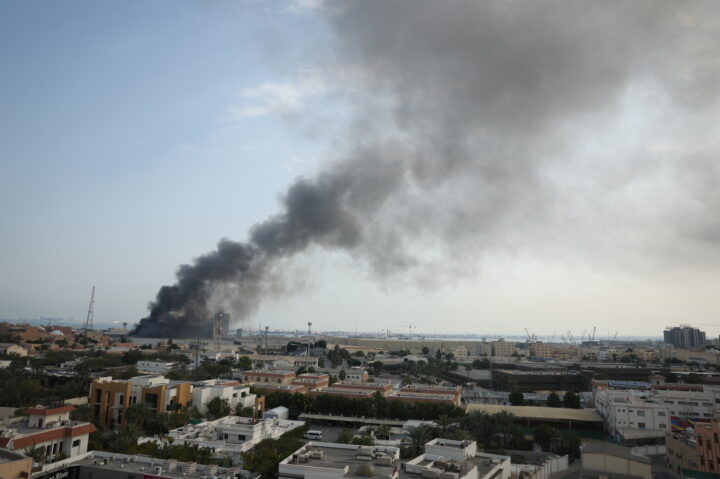
Stringer/Anadolu via Getty Images
Smoke rises after Iran launched a missile attack targeting the headquarters of the U.S. Navy's Fifth Fleet in Manama, Bahrain, on February 28, 2026.
Three U.S. servicemembers have been killed since the start of hostilities with Iran on Saturday, CENTCOM announced on Sunday morning, with five more seriously wounded.
In addition, several others “sustained minor shrapnel injuries and concussions — and are in the process of being returned to duty,” the statement read, without details of where the injured troops were located or when the fatal strikes occurred.
They are the first U.S. casualties in the war, which the U.S. has named Operation Epic Fury and Israel, which is jointly conducting strikes with the Americans, has named Operation Roaring Lion. Eleven people — all civilians — have been killed in Israel.
Three people have also been killed and 58 injured in the United Arab Emirates, its defense ministry said Sunday, amid Iran’s strikes around the Gulf.
CENTCOM also announced Sunday that U.S. forces struck an Iranian warship at the beginning of the operation, which is “currently sinking to the bottom of the Gulf of Oman.”
Please log in if you already have a subscription, or subscribe to access the latest updates.
 Continue with Google
 Continue with Apple