










































At his memoir launch, Evan Gershkovich recalls Moscow’s thriving Jewish life before Ukraine war
The journalist, who spent 491 days in a Russian prison, was ‘astounded’ by Jewish life in Moscow after his parents fled the Soviet Union

Haley Cohen
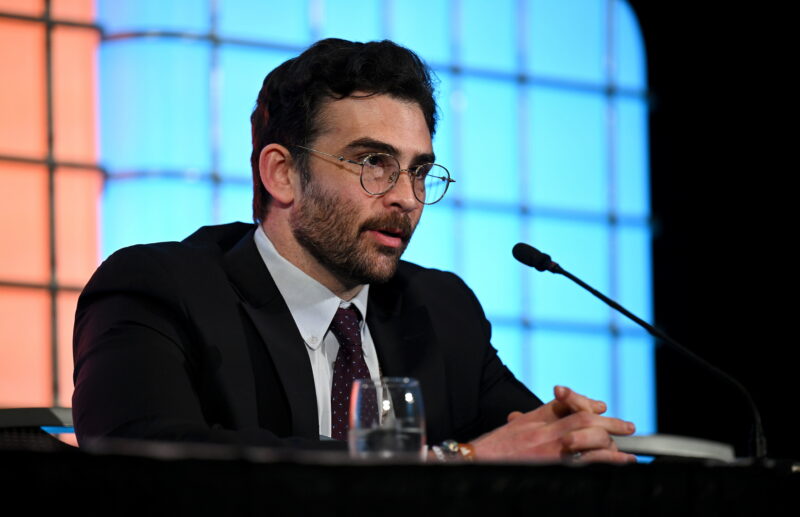
Evan Gershkovich appears onstage at the Streicker Center with David Remnick on Sept. 29, 2026.


 Add JewishInsider on Google
On Tuesday, the day his new memoir about spending 491 days in Russian captivity hit bookshelves, Wall Street Journal reporter Evan Gershkovich reflected on the country he covered for six years — and on how dramatically life there has changed for Russian Jews since the start of the war in Ukraine.
Speaking at the Streicker Center in Manhattan, in conversation with The New Yorker’s David Remnick, Gershkovich recalled being struck by the vibrancy of Jewish life in Moscow when he moved there a decade ago to report on Russia. Gershkovich, the son of Soviet refuseniks, said the war and President Vladimir Putin’s increasingly hostile stance toward Israel changed that.
“Growing up with parents who left the Soviet Union, my mom couldn’t go to certain universities because she was Jewish,” Gershkovich said. “One of the things that astounded me when I moved to Moscow was how Jewish life was thriving.” He added that relations between Russia and Israel, which had been strong for years, “started fading after Oct. 7 because Putin took a stand of supporting Palestine.” Gershkovich said Russian Jews who have left the country appear to have done so for “the same reason a lot of people have left Russia.”
Gershkovich’s comments came at the launch of This Cursed Beautiful Land: A Russian- American Story, his new book detailing his arrest by Russian authorities on charges of espionage while he was covering Russia for The Wall Street Journal in March 2023 and the 16 months in which he was detained before being freed in a prisoner exchange in August 2024. He spoke about the disorientation of returning to ordinary life after months of isolation, describing a period in which he was “relearning how to be an adult again.”
“One of the strange feelings I had was this pull to go back — not to Russia but to prison, because it’s what you know,” he said.
The book also recounts the uncertainty surrounding efforts to secure his release, including the death of Russian opposition leader Alexei Navalny in February 2024, which Gershkovich said underscored the stakes of a potential prisoner swap.
Asked whether he or his family felt the U.S. was moving too slowly to secure his freedom, Gershkovich said, “My family did. I felt like this was a complicated swap and I’m not one to complain — the fact that they were trying to get me out is a great thing. So by the time Navalny dies, I know there is a possible swap coming together.”
As he was freed in a prisoner swap, the Journal reported that Gershkovich requested, in a form he had to complete to finalize his release, a one-on-one interview with Putin.
Gershkovich, who now lives in Berlin, revealed on Tuesday what he would have asked Putin had he been granted that interview — “I’m really curious about his vision for Russia in terms of development 10 years from now, aside from expanding its borders.”
He added, “I’m also curious to ask whether he thought I was a spy. It seems like he did think I was a spy.”
More Stories
SANCTIONS PUSH
Coons, Senate Democrats introduce sanctions bill aiming to block E1 settlement construction
ENVOY DEBATE
Congressional Jewish Caucus opposes proposal to combine State Dept. Holocaust, antisemitism offices
VIRGINIA IN VIEW
DMFI launches $1 million ad campaign supporting Elaine Luria
Schmear campaign
Politico picks Yom Kippur to attack Huckabee’s observant Jewish aide
FRIENDS ON THE TRAIL
Far-left California House challenger Mai Vang to campaign with Piker, insurgent DSA Dems

exclusive
Rosen, Lankford press Zuckerberg over antisemitic bot accounts on Facebook, Instagram
Please log in if you already have a subscription, or subscribe to access the latest updates.
 Continue with Google
 Continue with Apple