


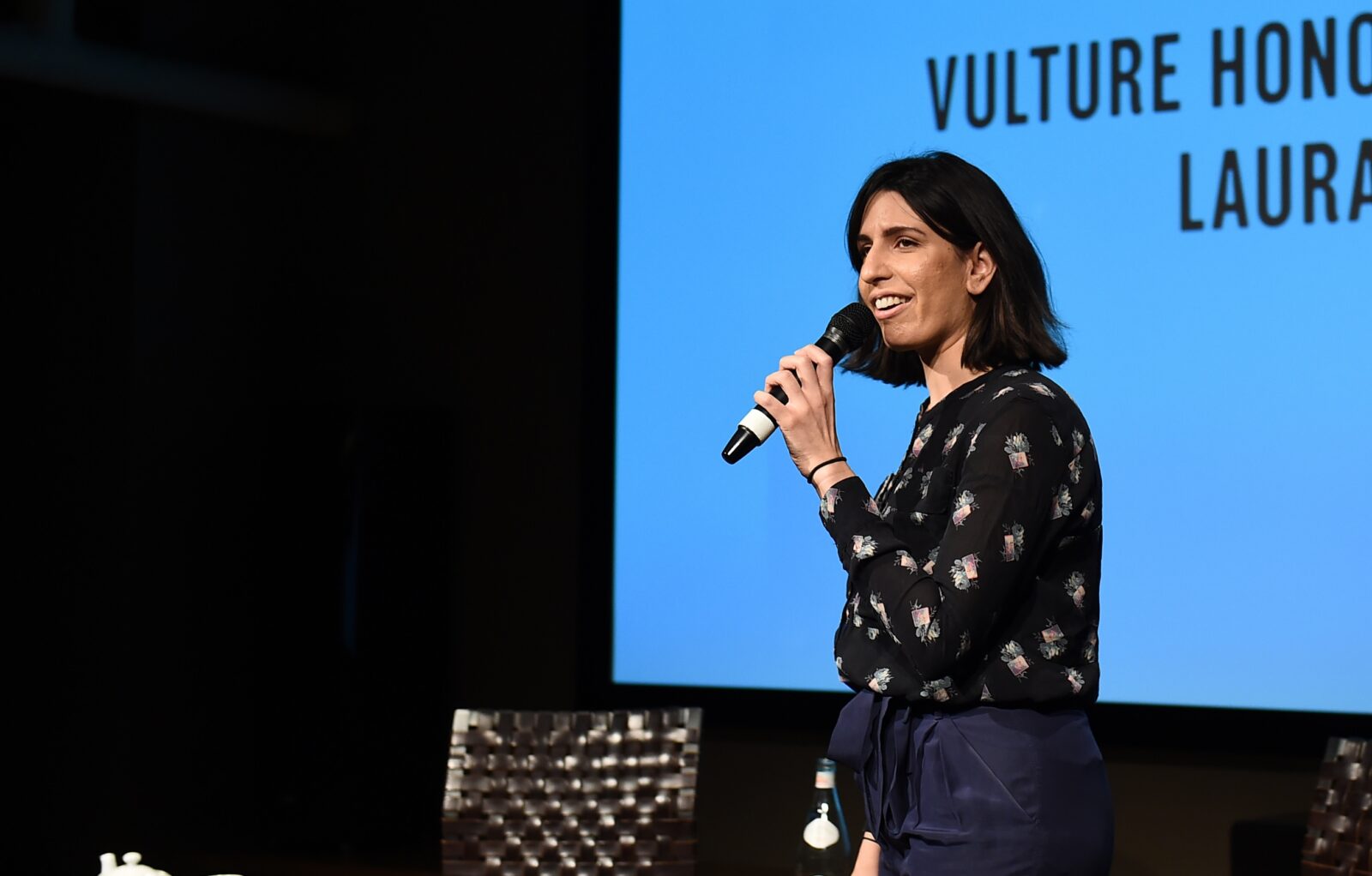
Ilya S. Savenok/Getty Images for New York Magazine
Inside New York magazine’s anti-Israel shift — and the Jewish staffers left behind
From a contested genocide editorial policy to a stifled antisemitism training, former employees say leadership repeatedly failed to address their concerns after Oct. 7


 Add JewishInsider on Google
In the years since Hamas’ Oct. 7, 2023, attacks, New York magazine, once known for embodying the wry sophistication of the urban center left, has emerged as a key platform for anti-Israel content, a uniquely hostile ideological shift that is exposing raw feelings on a topic editorial leaders have struggled to meaningfully address publicly and behind the scenes.
Late last month, for instance, the magazine ran a letter confirming its editors had decided to use the term genocide to describe Israel’s actions in Gaza, citing an “extensive review of genocide scholarship and interviews with multiple experts in the field of genocide studies” this past fall. The letter had come in response to widespread backlash over New York’s recent controversial cover issue celebrating the city’s burgeoning Middle Eastern cultural scene, which had stoked accusations of erasing Jews from its narrative.
Predating the institutional review, however, the magazine’s editorial director, Gazelle Emami, had signed a public statement a few weeks after Hamas’ terror attacks calling Israel’s war in Gaza “an attempt to conduct genocide against the Palestinian people.” Emami had also solicited a polarizing Oct. 16, 2023, essay, “Explanations Are Not Excuses,” by the author and activist Sarah Schulman, who called the violence the “consequence of consistent, unending brutality — paid for by the United States in billions of dollars in aid to Israel per year.”
That story was flagged by members of a Jewish employee resource group at Vox Media, which was the magazine’s parent company until its acquisition last month by the media scion James Murdoch, in an internal memo shared with editorial leaders alleging several instances of bias against Israel in the wake of Oct. 7.
One person familiar with New York’s internal dynamics told Jewish Insider that Emami, who took on her role in October 2023, according to LinkedIn, is among the “key instigators” driving the magazine’s increasingly antagonistic reporting and commentary on Israel. Emami and Mariam Aldahi, the managing editor, wrote an introductory note to the mid-August cover issue saying that the scene “was born out of the pain of the genocide in Gaza.”
The person familiar with the situation, who was granted anonymity to avoid professional reprisal, added that “some Jewish writers were very upset” about the cover issue and “complained internally,” the latest instance in which Jewish employees have aired their objections to the magazine’s coverage.
The scrutiny underscores how New York has been navigating long-simmering internal tensions over its coverage of Israel and handling of concerns raised by some Jewish staffers, according to people familiar with the matter. Former Jewish staffers say they faced an inhospitable work culture after the Oct. 7 attacks and struggled to find support from company leadership — even after an antisemitism training that drew pushback from some employees.
“It was not a healthy work environment,” one former Jewish staffer who left after Oct. 7 told JI recently on condition of anonymity.
The magazine’s top editor, David Haskell, who took the reins in 2019 and whose side vocations include whiskey and ceramic art, has faced skepticism from some observers who question if he is acquiescing to deputies who are aggressively committed to pushing an anti-Israel narrative.
Haskell is “very conflict-averse,” according to a former staffer. “He seems open to conversations on how to improve the coverage,” but it is “unclear if he has the fortitude to go against his staff,” the former staffer told JI.
More than a month after the cover issue was published, the fallout has prompted ongoing damage control within the magazine, which saw some longtime readers cancel their subscriptions “in protest of material they found antisemitic,” the letter from editors acknowledged.
The issue had centered around a tendentious cover story, “Habibi City,” which hailed a so-called “SWANA” renaissance in New York, using a little-known acronym for Southwest Asia and North Africa. While celebrating a vibrant network of Arab and Muslim trendsetters, however, the story suggested Jews and Israelis did not belong in the culture, citing “ethnic background” as complicating their ties to the region. In another passage that stoked backlash, the author, Zaina Arafat, cast Zionism as comparable to xenophobia and Islamophobia.
On Sept. 17, Haskell met privately for a virtual discussion with the leaders of Sephardic and Mizrahi groups that released an open letter calling on New York to issue a public correction acknowledging that the framing of its “SWANA” issue “excludes the Jews of the Middle East and North Africa except on ideological terms,” among other things.
Sarah Levin, the executive director of the nonprofit organization Jews Indigenous to the Middle East and North Africa, which organized the meeting, said in an interview with JI she could not share specific details about the discussion because Haskell, who personally reached out by email to set up the conversation in response to the letter, had asked it stay off the record.
“Our requests remain what they’ve been from the outset,” Levin said, adding that the 17 participants also pressed for “stronger editorial standards” with regard to coverage of “Zionism, Jewish identity and Middle Eastern people.” While the conversation was “respectful and cordial,” she said that she was unsure if Haskell was receptive to their concerns. “I have no idea how it landed,” she told JI.
Shortly after the Oct. 7 attacks, meanwhile, members of the Jewish employee resource group at Vox Media, called the Tribe, had urged colleagues in the memo to avoid “both sides” framing as well as “dangerous and factually inaccurate ‘buzzwords’” including apartheid and genocide, which, the authors asserted, “are often used to evoke a visceral emotional reaction in favor of one group.”
The memo resulted in two separate meetings with leaders at New York and Vox Media, where Jewish staffers’ concerns were met with “a lot of silence and blank stares,” according to a former Jewish employee who had participated in the discussions. “Leadership did not look or feel engaged,” another former Jewish staffer who was present for the conversations told JI.
A week or so later, Tribe members received two emails in which they were told their input had been heard, even as they continued to feel alienated by the company’s ongoing coverage of Israel, former staffers said.
In response to a list of questions from JI, Lauren Starke, a spokesperson for New York, said in a statement on Monday: “David and the magazine’s editorial leadership take feedback from staff seriously; it’s not uncommon for individual staffers to disagree with coverage decisions and share their opinions with leadership. We’re grateful to have a culture that encourages that kind of dialogue.”
While the magazine, founded in 1968, was long viewed as an organ of New York’s socially liberal cognoscenti, its antagonistic approach to Israel has coincided with a broader ideological shift to the left on hot-button issues (such as youth transgender care) since the retirement in 2019 of Adam Moss, who had been the publication’s longest-serving editor-in-chief and is Haskell’s predecessor.
When he stepped down after 15 years atop the New York masthead, Moss, who is Jewish, had attributed his decision to a desire “to do something new,” saying that editors should have “term limits” and it was time for an overdue “blood transfusion” at the publication.
But a person close to Moss, now in his late 60s, said “one of the reasons Adam retired was because he was under assault from the staff over language use” amid rising sensitivities on politically charged social justice issues that have more broadly contributed to tensions along generational lines.
“It was tough for him,” the Moss confidant told JI recently on the condition of anonymity to address private conversations. “The same kind of thing that’s happening in the Democratic Party happened at New York,” he added, alluding to debates around so-called woke culture.
Moss did not respond to a request to speak with JI sent to his agent.
During Moss’ tenure, “he probably looked at woke and was like, ‘This is just ridiculous,’” said a former staffer who had overlapped with him for a couple of years. “He kept an iron fist on making sure that stuff wouldn’t bubble out.”
The magazine’s recent cover issue is among the starkest illustrations of a narrative it had begun to promote in the immediate aftermath of Oct. 7, even though it had faced internal pushback from the start.
The publication has run stories incorporating Israeli and Jewish perspectives since the attacks, but some critics say its focus on Israel’s alleged war crimes has largely overlooked violence perpetrated by Hamas. A former employee at New York, for instance, said he had been particularly disappointed that the magazine’s cultural site, Vulture, did not mention the Nova music festival massacre.
More broadly, New York has adopted a reflexively skeptical approach to Israel, resulting in stories that have taken a suspicious view even of cultural figures with tangential connections to the Jewish state. The outlet has also published several feature stories with a hostile view of Israel’s military conduct against Hamas in Gaza — including one highly scrutinized cover article that appeared to liken the war to the Holocaust and later drew several corrections.
Matthew Pressman, an associate professor of journalism at Seton Hall University and author of a forthcoming book about the New York Daily News, said he did not think it was particularly unusual that New York had decided to allow the term genocide as part of its editorial policy because its “left-wing slant is part of its identity.”
“The fact that the magazine feels comfortable making this its house style suggests two things,” he told JI in a recent interview. “One is that the staff feels strongly about that. Another calculation is it won’t cost them a lot of subscribers.”
Pressman said he had personally found New York’s explanation about how it had arrived at its decision “unsatisfying,” noting that he did not believe there is an “overwhelming scholarly consensus” that Israel is committing genocide, which he called “a word with a pretty clear, straightforward definition.”
“Magazine editors are supposed to be experts on words and their usage,” Pressman told JI, arguing that “they should use their own judgment on which words and phrases are best rather than outsourcing that judgment to academics.”
From a human resources perspective, the former Jewish staffers say they felt a sense of isolation after the Oct. 7 attacks. In the immediate aftermath of the massacre, Jewish employees were surprised that the company’s Diversity, Equity and Inclusion team had not sent a note highlighting support services of the sort Vox had offered following George Floyd’s murder, a local incident of anti-Asian violence and even an uptick of COVID cases in India.
When Jewish staffers posted publicly about the silence on Slack, Vox Media’s DEI lead shared a companywide note three days later acknowledging the attack and pointing staffers to some available resources such as grief counselors. “As a company that manages multiple news organizations, we do not typically send communications company-wide about global conflicts,” the message, which was shared with JI, also clarified.
Meanwhile, the former staffers recalled noticing a contact on Vox’s DEI team had, without explanation, been avoiding interactions with the Tribe — even as the contact had actively supported a Middle East and North Africa employee group. They were later told by other members that the DEI contact, who was new to the workforce, was struggling to deal with the conflict in Israel and Gaza and preferred not to engage on the issue with the Tribe — an explanation former staffers said they found unconvincing.
Prior to its acquisition by Murdoch in May, Vox Media’s DEI team was formally eliminated and its employee resource groups were dissolved, according to a source familiar with the matter. A spokesperson for Murdoch did not return JI’s request for comment.
Even before Oct. 7, Jewish staffers confronted some challenges tied to their identities as well as the crisis in the Middle East, former employees told JI. When Jewish staffers decided to name their resource group the Tribe, for instance, their choice initially garnered pushback because of its ties to Native Americans. The group was otherwise forbidden from using a blue and white logo until employees explained that the color scheme harkened back to the Bible and was not making direct reference to the Israeli flag.
By July 2024, some Tribe members succeeded in presenting a company antisemitism training led by the American Jewish Committee, one of the county’s most prominent pro-Israel groups. Before the event, Tribe members were informed by superiors it would be nonmandatory but open to anyone who wanted to attend, provoking frustrations among Tribe members who asked if a staffer who in a Slack channel had characterized Zionism as “demonic” would be required to join.
Steve Gosset, a spokesperson for the AJC, confirmed the organization conducted an antisemitism training at Vox Media in 2024 that was led by Saba Soomekh, an Iranian American author and professor who is the group’s director of training and education. (Soomekh did not respond to a request for comment from JI.)
The training session, according to organizers, drew close to 200 attendees and touched on such topics as the history of antisemitism, the meaning of Zionism and the fraught connotations of charged slogans like “from the river to the sea,” which some critics regard as a call to eliminate Israel as a Jewish state.
But while the hour-long virtual program garnered some positive reviews on Slack, some supporters felt their efforts were diminished when another Jewish staffer leading a women’s employee resource group said in a Slack message that the event left her “very unsettled and confused,” while accusing the AJC of promoting “misinformation” in a session she claimed “felt like a divestment” from Vox Media’s values.
The employee said that she had “been approached by several staffers who were disappointed and offended by” the event and asked “to be connected with senior leadership at Vox” regarding her concerns, according to screenshots of the public note reviewed by JI.
One staffer in the Jewish employee resource group wrote in a Slack message afterward that the hostile question-and-answer session “really made me think that there were people who joined the training with less than good intentions, and it’s kind of breaking my heart right now.”
Another Tribe member voiced dismay that the event had “ended with people still somehow trying to spin how some things are justified or should be allowed,” adding, “If the editorial teams haven’t discussed how their coverage can contribute to hate speech and hate crimes, then it should be a mandatory conversation.”
Despite some words of encouragement, staffers felt the initial public backlash undermined their hopes to promote a more constructive internal dialogue about the competing sensitivities inherent in covering such a politically divisive issue as Israel, support for which has plummeted among younger demographics in the years after Oct. 7.
“The damage had already been done,” one of the organizers said of the staffer’s Slack message. “We worked so hard to have brought” the AJC program, “and we were so very proud of it. For a lot of people who didn’t feel positively about the training, it gave them a lot of fuel.”
A former staffer said it was “important to speak out” about the company’s recent direction on Israel, even after leaving. “It matters,” the staffer told JI, “how the narrative is shaped on this issue.”
Please log in if you already have a subscription, or subscribe to access the latest updates.
 Continue with Google
 Continue with Apple