










































































Majority Leader Thune said about a congressional vote to extend the war, ‘hopefully that question won't be a necessary one that we’ll have to answer’

Kayla Bartkowski/Getty Images
Sen. Majority Leader John Thune (R-SD) calls on reporters at the U.S. Capitol on January 14, 2025 in Washington, DC.


 Add JewishInsider on Google
Senate Majority Leader John Thune (R-SD) said Tuesday that he’s hopeful that the war in Iran is close to winding down, in advance of a deadline that could require congressional action for the war to continue.
Under the War Powers Act, unilateral military action undertaken by the president without congressional authority is limited to 60 days — with a 30-day extension for draw-down purposes.
Thune emphasized that the administration’s current goal is to reopen the Strait of Hormuz, and that Senate Republicans support efforts to isolate the Iranian regime and their economy.
“We get the strait open again — and that’s sort of their last resort. The military effort here has been extraordinarily successful. This is sort of the last dying gasp of this regime, is to try and shut down the strait,” Thune said in a press conference after a GOP conference meeting. “The administration is making an effort to ensure that it’s open, that there’ll be traffic in and out there. And hopefully that will be successful and we can begin to see this thing wind down.”
Pressed on whether Republicans would be open to voting to continue the war if it extends beyond 90 days, Thune suggested that wouldn’t be necessary.
“At this point, most of us, I believe, feel pretty good about what the American military has achieved there in terms of its objectives,” Thune said. “It’s a hypothetical down the road. … I think the administration has a clear objective, a clear plan, and if they can execute on it, hopefully that question won’t be a necessary one that we’ll have to answer.”
Sen. Mike Rounds (R-SD) said that it’s “not quite time” yet for a full Senate discussion on the war, but said that he does want to see the administration more fully lay out its strategy and plan as the war continues and approaches the 60-day deadline at the end of April.
“We do expect that the administration will be laying out their plan for after the end of seven, eight, nine weeks,” Rounds said. “We have to know what the next steps are, and that’s part of our due diligence that we have to do.”
Sen. Steve Daines (R-MT) said that Republicans did not discuss the possibility of an authorization for the war during their meeting.
Other Republicans have argued that the provision of the War Powers Act that sets out the 60-day deadline, is not enforceable and that Republicans on Capitol Hill are not paying attention to it.
Sen. Lindsey Graham (R-SC) said that the U.S. should “finish the job” rather than extending a ceasefire agreement with Iran if the regime is not willing to agree to U.S. demands, including a permanent end to nuclear enrichment, surrendering all of its already enriched uranium, fully reopening the strait and abandoning its ballistic missile program and support for terrorism.
Senate Minority Leader Chuck Schumer (D-NY) said that Senate Democrats plan to bring forward another war powers resolution to stop the war on Wednesday, and will continue to force votes on similar resolutions weekly until the war ends. For now, most Republicans seem likely to continue to vote against the legislation.
Senate Republicans also indicated that they’re not likely to attempt to include supplemental funding for the Iran war in an upcoming partisan budget reconciliation package, which is focused on border security and immigration funding currently being blocked by Democrats.
Thune, who has said he wants an “anorexic-like” reconciliation package, again indicated on Tuesday at a press conference after a Senate Republican lunch meeting that the package will be tightly “focused” to fund immigration enforcement.
“I think we’re going to do a very skinny reconciliation,” Sen. Roger Wicker (R-MS), the chair of the Senate Armed Services Committee, said when asked about Republicans’ discussions on Iran during the conference meeting.
Sen. John Kennedy (R-LA) said that he has not heard anything about either the timing or the size of the supplemental request the administration plans to submit. Initial reports indicated that the Pentagon wanted to ask for $200 billion, but more recent reports have indicated that the final request will be lower.
Republicans have discussed advancing another reconciliation package before the end of the year, though some members of the conference, like Kennedy, have openly expressed skepticism that such an effort would be possible.
At this point, given the strong and widespread opposition among Democrats to the war in Iran, it’s unclear whether a funding package for the war would be able to clear the 60-vote filibuster threshold necessary for passage in the Senate.
Meeks said he will likely bring up a war powers resolution for a vote this week, and is waiting to see if several of his colleagues will flip their votes in favor

Tom Williams/CQ-Roll Call, Inc via Getty Images
Rep. Gregory Meeks (D-NY)
Rep. Greg Meeks (D-NY) said he’s aiming to call up a war powers resolution this week to force an end to the war in Iran, but that he’s still working to lock down the support of a few wavering Democratic and Republican lawmakers whose support will be necessary to pass the legislation.
Meeks had considered calling up the legislation before Congress’ two-week recess, but ultimately declined to do so, saying he was waiting until the legislation could pass and he didn’t yet have the votes.
“I’m probably going to do war powers this week. I’m still working [on] it. I’m very close,” Meeks told Jewish Insider. “I’ve got just about all of the Democrats — just about — and [some] Republicans. And I have some that are contemplating, but I don’t know what they’re going to do.”
He said that there are a few lawmakers who voted against a previous war powers effort in the House who are talking to him and considering now voting in favor, but haven’t disclosed their final plans to him yet.
Meeks said that he thinks he will get “just about every Democrat … maybe the exception of one.”
Of the four Democrats who voted against a previous war powers effort, two — Reps. Greg Landsman (D-OH) and Henry Cuellar (D-TX) — said that they would vote for the next war powers resolution, and Cuellar affirmed those plans to JI on Tuesday. Reps. Juan Vargas (D-CA) and Jared Golden (D-ME) haven’t announced their plans yet.
Vargas told JI on Tuesday that he has made up his mind, but declined to preview how he plans to vote. Golden, who is not running for reelection, could be the hardest of the four to flip.
On the Republican side, Rep. Lauren Boebert (R-CO), who said she would oppose a supplemental funding request for the war, declined to comment on how she would vote, saying she isn’t currently focused on a potential war powers resolution.
Meeks said that the current ceasefire makes it an important time for Congress to weigh in, and that he may ultimately bring the resolution forward for a vote even if he’s not sure if there are sufficient votes to pass it.
“We don’t know what the president may do or may not do afterwards,” Meeks explained. “I’ve been waiting to get commitments … it may be time for them to get on one side of the fence or the other, as opposed to staying on the fence. I may just do it. I haven’t decided yet, but I may just do it.”
Even if the resolution passes the House, it currently would not pass the Senate and would almost certainly be vetoed by the president. But Meeks argued that passing the resolution in the House would send an important message to the administration anyway.
“I think this is giving a message to the president — and it becomes really important, because the 60 days will be up soon, and they have to come to Congress for the money,” Meeks said, referring to a 60-day deadline for the operation cease or to come to Congress for authorization under the War Powers Act. “And it lets the president know that unless he comes to Congress and lets us know what the plan is, he’s not going to get the money.”
Rep. Don Bacon (R-NE), who has said the administration hasn’t properly articulated its plans and goals for the war to Congress, told reporters he will “support continued operations until we get this job done, or it’s clear to me it’s fruitless.”
“I support the military campaign. I think some of the commentary has not been helpful from the White House, but yes, I think the military has done a great job,” Bacon said, pointing to the destruction of Iran’s leadership and military capabilities.
He said that an Authorization for Use of Military Force would be legally required to continue the war beyond the 60-day deadline — a point that other Republicans have disputed — but said that he would be “inclined to support” such an authorization.
“Maybe not a blanket one, but yes, I think we should finish the job,” Bacon said. “These guys have been our enemy. These guys have been our enemy, they’ve killed young [U.S. troops].”
Jewish Insider’s Washington reporter Matthew Shea contributed reporting.
Plus, positive readouts from Israel-Lebanon talks in D.C.

Stefano Costantino/SOPA Images/LightRocket via Getty Images
Italian Prime Minister Giorgia Meloni addresses the Italian Chamber of Deputies in Rome.
This P.M. edition is reserved for our premium subscribers — offering a forward-focused read on what we’re tracking now and what’s coming next. Please don’t hesitate to share your thoughts and feedback by replying to this email.
📡On Our Radar
Notable developments and interesting tidbits we’re tracking
U.S.-Iran talks could restart in the next two days, President Donald Trump told the New York Post. “[S]omething could be happening over the next two days, and we’re more inclined to go [back to Islamabad, Pakistan]” rather than a different mediating country, he said in an interview today.
Trump also indicated he wasn’t happy with reports that his own negotiating team had offered Iran a 20-year pause on its ability to enrich uranium. “I’ve been saying they can’t have nuclear weapons, so I don’t like the 20 years,” he said…
CENTCOM announced that no ships made it past the U.S. blockade of the Strait of Hormuz in its first 24 hours, and six merchant ships “complied with direction from U.S. forces to turn around”…
Saudi Arabia is reportedly pressuring the U.S. to end the blockade, fearing retaliation and disruption to other trade routes. Iran has threatened to mobilize the Houthis in Yemen to close off the Bab al-Mandeb Strait, which Riyadh utilizes to move its oil exports out of the Red Sea…
European countries are drafting a plan to restore freedom of navigation in the Strait of Hormuz after the war ends, possibly without the participation of the U.S. As part of this effort, French President Emmanuel Macron announced that France and the U.K. will co-host a conference on Friday of “non-belligerent countries ready to contribute” to the “multilateral and purely defensive mission”…
The Treasury Department said it will not renew a waiver set to expire later this week that temporarily lifted sanctions on Iranian oil — the waiver had drawn condemnation from some lawmakers who had worked to institute those sanctions…
Secretary of State Marco Rubio emphasized at the outset of negotiations between Israel and Lebanon in Washington this morning that the talks are a “process” that will “take time,” and that the objective of today’s meeting was to “outline a framework upon which a permanent and lasting peace can be developed” and bring a “permanent end to Hezbollah’s influence” in the region.
The State Department said after the meeting, the highest-level talks between Jerusalem and Beirut in over 30 years, that the sides “agreed to launch direct negotiations at a mutually agreed time and venue,” though it did not indicate when or where further talks may take place. Israeli Ambassador to the U.S. Yechiel Leiter told reporters that the parties “discovered today that we’re on the same side of the equation. That’s the most positive thing we could have come away with”…
Italy is suspending its defense agreement with Israel, Italian Prime Minister Giorgia Meloni said today, declining to renew the agreement “in consideration of the current situation.” Italy had grown critical of Israel’s war in Gaza and has been noncooperative in the war with Iran, reportedly not allowing U.S. aircraft to land at its bases.
Trump railed against Meloni, who has thus far been an ally of his, in an interview with an Italian outlet today, saying he’s “shocked by her. I thought she was brave, but I was wrong,” and claiming she’s “no longer the same person” after she called the president’s attack on Pope Leo XIV yesterday “unacceptable.” “It’s her who’s unacceptable, because she doesn’t care if Iran has a nuclear weapon and would blow up Italy in two minutes if it had the chance,” Trump said…
Hamas has rejected the U.S.-led Board of Peace’s disarmament proposal, according to the BBC. The parties seem to once again be at an impasse, as Hamas tells mediators it will not continue onto the second phase of the ceasefire until it feels Israel has complied completely with the first phase, while Israel says it will not move forward until there is progress on disarming Hamas…
The New York Times details a tense event held by Rep. Mike Lawler (R-NY) in his Hudson Valley-based swing district where the lawmaker was pressed by constituents demanding answers and accountability on the Iran war; it’s seen as a harbinger of the growing discontent some Republicans will have to contend with around the largely unpopular war in the lead-up to the midterms…
The Union for Reform Judaism released a statement yesterday voicing concern about “efforts to single out AIPAC as a particularly malign influence in campaign finance. … [T]he harsh language being used by some to denigrate and vilify AIPAC borders on — and in some cases crosses over into — antisemitism.”
“Until such time as [C]ongress reforms the nation’s broken campaign finance system overall — an effort we would enthusiastically welcome — to single out AIPAC’s activity will continue to raise questions of antisemitic motivation,” the organization wrote, in a sign of how the demonization of pro-Israel donors and groups is raising alarms across the Jewish political and religious spectrum…
California state Sen. Scott Wiener, a progressive Jewish legislator running to fill Rep. Nancy Pelosi’s (D-CA) seat, was accused at a campaign event earlier this week of taking $50,000 from AIPAC by a constituent citing the far-left group TrackAIPAC. “I just want to be clear, I’m not accepting any support from AIPAC,” Wiener responded. “There are people who are gonna list out all my Jewish donors and say that. I’m not taking any support from AIPAC and I support the Block the Bombs Act”…
The Michigan arm of the powerful SEIU labor union announced today that it had rescinded its endorsement of Amir Makled, a candidate for the University of Michigan board of regents, in light of Makled’s deleted social media posts praising the terrorist group Hezbollah, Jewish Insider’s Gabby Deutch reports.
Makled is a Dearborn attorney who represented an anti-Israel protester who was arrested during the 2024 anti-Israel encampments at UM’s flagship Ann Arbor campus. A Detroit News report found that Makled had deleted posts praising Hezbollah’s leaders and retweets of antisemitic messages from the far-right influencer Candace Owens, as he now seeks to unseat Jewish regent Jordan Acker…
The relationship between New York City Mayor Zohran Mamdani and City Council Speaker Julie Menin appears to be growing increasingly acrimonious as Menin publicly distances herself from some of the mayor’s policies, Politico reports, including apparently helping to plan a protest outside Mamdani’s speech marking his first 100 days in office…
France is exploring legal options to bar rapper Kanye West from entering the country to perform at a concert in Marseille in June, after he was similarly banned and prevented from performing in the U.K. earlier this month. “I refuse to let Marseille be a showcase for those who promote hatred and unapologetic Nazism,” the city’s mayor, Benoit Payan, wrote on social media…
⏩ Tomorrow’s Agenda, Today
An early look at tomorrow’s storylines and schedule to keep you a step ahead
Keep an eye out in Jewish Insider for a look into the work of the Democratic National Committee’s Middle East working group, established last summer, including how it’s approaching intraparty divides over Israel policy.
Two of Sen. Bernie Sanders’ (I-VT) three joint resolutions of disapproval seeking to halt $658.8 million in sales of munitions to Israel are expected to receive a vote in the Senate tomorrow. Sanders and other progressive Democrats have forced votes on similar efforts to block arms sales to Israel on three previous occasions since the war in Gaza began, with a majority of the Democratic caucus — 27 lawmakers — voting to block at least one arms sale in July of last year, a significant jump in support from similar efforts in November 2024 and April 2025.
Sen. Tim Kaine (D-VA) told reporters Democrats will likely force a vote tomorrow on another Iran war powers resolution, the third such vote after the previous two failed largely along party lines.
The Senate Foreign Relations Committee will hold a hearing on reforming the U.N. with U.S. Ambassador to the U.N. Mike Waltz and U.S. Representative for U.N. Management and Reform Jeff Bartos.
The Stephen Wise Free Synagogue in Manhattan will host an antisemitism town hall with Senior Rabbi Ammiel Hirsch and Anti-Defamation League CEO Jonathan Greenblatt.
Israel’s Sheba Medical Center will unveil ARC Landing Boston, its first health care accelerator based in the U.S., at an event featuring Democratic Massachusetts Gov. Maura Healey.
MINNESOTA MATTERS
Angie Craig calls on Minnesota Democrats to investigate antisemitism ahead of state party convention
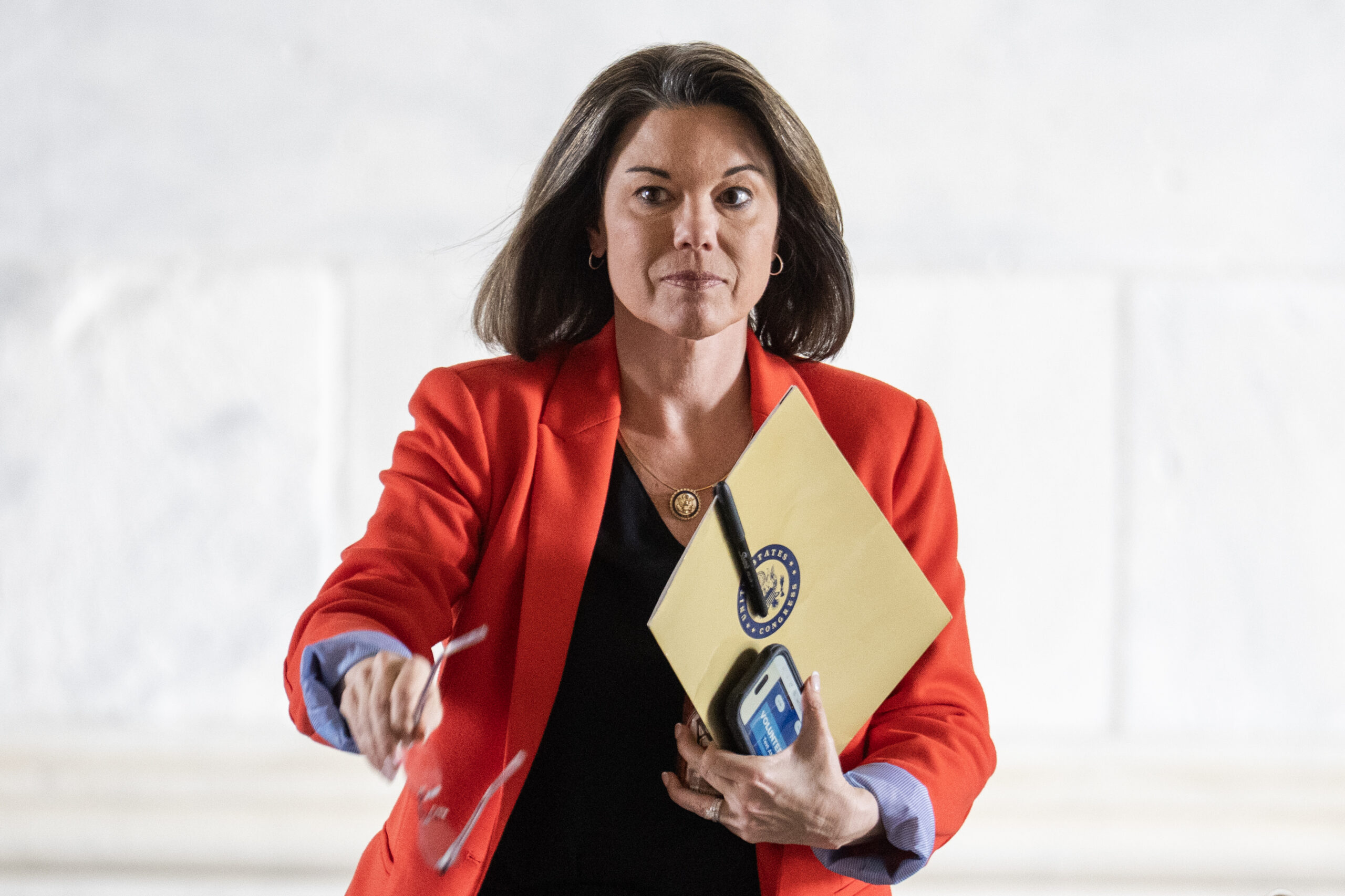
Delegates are expected to take up divisive anti-Israel resolutions at the convention being held next month
HUNGARY FOR MORE

Economic ties and broader European alliances are likely to preserve the bilateral relationship, even as the expected prime minister-elect moves to rejoin the ICC and potentially pivot back towards the EU
Economic ties and broader European alliances are likely to preserve the bilateral relationship, even as the expected prime minister-elect moves to rejoin the ICC and potentially pivot back towards the EU

Min. of Foreign Affairs of Pakistan / Handout /Anadolu via Getty Images
Vice President JD Vance (C) is welcomed by Ishak Dar (R), Pakistan Foreign Minister, and Asim Munir (L), Chief of Army Staff of Pakistan, as the US delegation arrive in Islamabad, capital of Pakistan, for high-stakes talks with Iran to end the Middle East conflict amid the ongoing two-week ceasefire on April 11, 2026.
Senate Republicans maintained the position on Monday that Iran should never be allowed to possess nuclear enrichment capacity, following reports that the administration had proposed a 20-year pause in enrichment — rather than a permanent end to Iran’s enrichment capacity — as part of peace talks in Islamabad over the weekend.
Last year, during diplomatic talks with the regime prior to the U.S. strikes on the Iranian nuclear program, all but one Senate Republican signed a letter arguing that Iran should never have enrichment capacity, a position echoed by a vast majority of House Republicans. The New York Times reported Monday that Iran agreed to halt enrichment for just five years.
Sen. Lindsey Graham (R-SC), who has been a vocal proponent of the war in Iran but has also defended the Trump administration’s diplomatic efforts, said on X that a 20-year pause to Iranian enrichment would not be sufficient.
“If this reporting is accurate, the idea that we would agree to a moratorium on enrichment rather than a ban on enrichment would be a mistake in my view,” Graham said on X. “Would we agree to a moratorium for al Qaeda to enrich? No. The only difference between al Qaeda and the Iranian regime is that one is a Sunni terrorist organization and the other is a Shia terrorist state.”
He said that Iran cannot be trusted and that the U.S. must hold firm to a standard of zero enrichment.
Sen. Pete Ricketts (R-NE), a co-lead of the letter last year, told Jewish Insider that he hadn’t seen the reports about the administration’s negotiating position and declined to comment on it specifically, but said more broadly that he does not believe that Iran has any legitimate need for enrichment.
“There’s no civilian reason for Iran to have an enrichment program,” Ricketts said. “They’re getting their uranium right now for their civilian program from Russia, and the fact that they have admitted they’ve enriched uranium to near bomb-grade potential demonstrates that this is for nuclear weapon production, not civilian use.”
Sen. John Cornyn (R-TX) said that Iran can’t be trusted to “stick with anything they agree to, so you have to understand that going into it.”
“But I agree with the president: no enrichment, no nuclear weapons and open up the Strait of Hormuz.”
Sen. Ted Budd (R-NC) said that “the preference is no enrichment.”
“Iran can never be allowed to have a nuclear weapon. Bottom line, end of story,” Budd said. “The 20-year pause — is that a strategic component to a greater negotiation? I can understand that. … Do they have civilian nuclear power as part of that? Can they be trusted with this current regime? I don’t think so. But again, I’m going to give a lot of leeway to the administration who wants to end nuclear capability for Iran.”
Sen. Rick Scott (R-FL) also said he has not seen the reports, but that “it should be a forever” prohibition on Iranian nuclear enrichment.
Sen. Roger Wicker (R-MS), the chairman of the Senate Armed Services Committee, said that Republicans are set to discuss on Tuesday the best way to approve a supplemental funding request for the war and the proper size of the supplemental package.
Sen. Tommy Tuberville (R-AL) told reporters that he thinks the Iran war funding should be folded into the upcoming reconciliation package — focused on immigration and border security matters — while others maintain it should be a stand-alone bill. Including the Iran funding could make passing the reconciliation package in the House more difficult.
Wicker said, “it’s a matter of vote-counting, largely.”
There are also some apparent disagreements between Republicans about what should happen if the war extends past the 60-day timeline for unilateral executive military action laid out in the War Powers Act.
Sen. John Kennedy (R-LA) said that the War Powers Act deadline may be unconstitutional or unenforceable, but said “there’s nobody walking around here in the Senate going, ‘How many days do we have left?’ Nobody’s paying attention.”
But Sen. James Lankford (R-OK) told reporters, “I’m sure we’ll have some sort of a vote or a statement at that [60-day] point.”
Other Republican senators are taking a firmer stance, rejecting any war operations beyond 60 days without congressional approval.
“Here in America, constitutional limits are in place to temper the president from unilateral authority. I support the president’s actions taken in defense of American lives and interests,” Sen. John Curtis (R-UT) said in a recent op-ed. “However, I will not support ongoing military action beyond a 60-day window without congressional approval.”
And Curtis said he would not support any supplemental funding for the war without congressional authorization.
Plus, Hasan Piker calls Hamas 'orphan children'

Jacquelyn Martin - Pool/Getty Images
Vice President JD Vance arrives for talks with Iranian officials on April 11, 2026 in Islamabad, Pakistan.
This P.M. edition is reserved for our premium subscribers — offering a forward-focused read on what we’re tracking now and what’s coming next. Please don’t hesitate to share your thoughts and feedback by replying to this email.
📡On Our Radar
Notable developments and interesting tidbits we’re tracking
The U.S. blockade of the Strait of Hormuz began this morning, with more than 15 American warships involved in the operation intended to pressure Iran into concessions after this weekend’s failed negotiations.
President Donald Trump said hours later that the U.S. was “called this morning by the right people, the appropriate people, and they want to work a deal.” Mediators including Pakistan, Egypt and Turkey are also reportedly attempting to revive talks between the parties…
One reported sticking point in the negotiations is a U.S. request that Iran agree not to enrich uranium for 20 years. The 2015 Iran nuclear deal was highly criticized for its sunset clauses, which lifted limits on activity including uranium enrichment after 15 years.
Israeli Prime Minister Benjamin Netanyahu invoked a similar timeframe at a Cabinet meeting today, saying he spoke with Vice President JD Vance yesterday who told him that the U.S. aims to ensure “there is no more enrichment in the coming years, and that could be in decades, no enrichment within Iran.”
Sen. Lindsey Graham (R-SC) took issue with the timeline: “If this reporting is accurate, the idea that we would agree to a moratorium on enrichment rather than a ban on enrichment would be a mistake in my view. Would we agree to a moratorium for al Qaeda to enrich? No,” he wrote on X. “No enrichment means no enrichment”.…
Six additional Senate Democrats plan to file new war powers resolutions this week to halt the war in Iran, a move that would allow Democrats to continue forcing votes on the war for the foreseeable future, Jewish Insider’s Marc Rod reports.
Previously, a different group of six Democrats introduced similar resolutions, and Democrats have called up two of them thus far, with plans to call up a third this week. The latest group of lawmakers spans from staunch progressives and critics of Israel to generally more pro-Israel members, including Sens. Jeff Merkley (D-OR), Kirsten Gillibrand (D-NY), Chris Van Hollen (D-MD), Mark Kelly (D-AZ), Raphael Warnock (D-GA) and Andy Kim (D-NJ)…
Citing an “increasingly sour national environment for Republicans,” the Cook Political Report shifted its ratings for four key Senate races in Democrats’ favor: The North Carolina and Georgia races now lean Democratic, the Ohio race is a toss-up and the Nebraska race is likely Republican, rather than solidly. Democrats would need to flip four seats to take back the chamber…
In another heated Senate race where Democrats hope to pick up a seat, former Rep. Mary Peltola (D-AK) raised nearly $9 million in the first quarter of 2026, four times the amount her opponent, Sen. Dan Sullivan (R-AK), pulled in. The GOP super PAC Senate Leadership Fund has pledged to spend $15 million in the race, as polls show Peltola with a slight lead…
In an appearance on the “Pod Save America” podcast released yesterday, antisemitic streamer Hasan Piker said he “stands by” his statement made in January that “Hamas is a thousand times better than a fascist settler-colonial apartheid state,” referring to Israel.
“I would vote for Hamas over Israel every single time,” he said on the podcast, claiming Hamas is “entirely comprised … of orphan children that have had their parents killed by an apartheid state that has been dominating the lives of Palestinians for 80 years at this point. … Hamas’ tactics, which I oppose at times, or its like internal governance issues are secondary to this conversation”…
Sen. Rick Scott (R-FL) called for the federal government to “immediately” pull funding from Yale University over Yale Political Union’s decision to host Piker, who previously suggested that the senator should be killed. Piker is scheduled to speak on campus tomorrow for a debate titled “Resolved: End the American Empire.”
For Scott, Piker’s incendiary language is personal: the streamer was briefly suspended from Twitch last year after urging his followers to “kill Rick Scott.” “An elite private university that hosts an antisemite who says a Senator should be killed, capitalists should be killed, and the U.S. deserved 9/11, shouldn’t get ONE CENT from taxpayers,” Scott wrote on X on Friday…
J Street is seeking to “set the record straight” after the group backed the growing calls among far-left lawmakers to end U.S. support for Israel’s missile-defense systems, including Iron Dome, despite its own criteria for its endorsees stating otherwise.
In a new FAQ, the group called Iron Dome “a critically important defense system” which it “supports and consistently lobbies for.” After the end of the Memorandum of Understanding between the U.S. and Israel, which runs through Fiscal Year 2028, however, “financial subsidies to Israel should be rapidly and responsibly phased out. … Israel should pay for these systems”…
More Jews were killed in antisemitic incidents outside of Israel in 2025 than any year in the past three decades, according to a report from Tel Aviv University. Twenty Jews were killed last year in attacks in countries including Australia, the U.S. and the U.K., while the previous record was set in 1994 with the AMIA bombing, which killed 85 people in Buenos Aires, Argentina…
⏩ Tomorrow’s Agenda, Today
An early look at tomorrow’s storylines and schedule to keep you a step ahead
Keep an eye out in Jewish Insider for a look at a new poll assessing the partisan divide emerging among American Jews over pro-Israel political engagement.
The U.S. Holocaust Memorial Museum will host a Yom HaShoah remembrance event at the Capitol, with a keynote address delivered by Commerce Secretary Howard Lutnick. Other speakers include several Holocaust survivors as well as House Speaker Mike Johnson (R-LA), House Minority Leader Hakeem Jeffries (D-NY), Sen. Kirsten Gillibrand (D-NY) and Reps. Joe Wilson (R-SC) and Lois Frankel (D-FL).
Amid the International Monetary Fund and World Bank Group’s spring meetings being held in Washington this week, Jacob Helberg, under secretary of state for economic affairs, will speak at an event with the Atlantic Council about U.S. economic leadership in the Middle East, including utilization of the India-Middle East-Europe Corridor, which has been floated as an alternative trade route to the volatile Strait of Hormuz.
THE VIEW FROM ISRAEL
Israelis uncertain if Iran war made them safer after ceasefire brings combat to an inconclusive halt

After the ceasefire went into effect, there was a pervading feeling in Israel that the war with Iran was not complete, and the return to routine life may be short-lived
COMFORT FOOD

A traveling program called ‘Soul and Roll’ by singer Hananel Edri and Foodish CEO Merav Oren tells the Jewish story through an immersive culinary and musical experience
The group ranges from pro-Israel Democrats like Sen. Kirsten Gillibrand to anti-Israel members like Sen. Chris Van Hollen
Drew Angerer/Getty Images
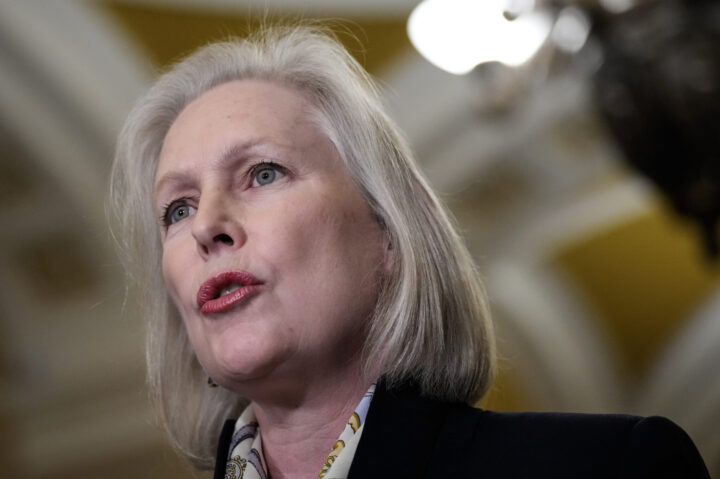
Sen. Kirsten Gillibrand (D-NY) speaks at a news conference following a closed-door lunch meeting with Senate Democrats at the U.S. Capitol on October 31, 2023, in Washington, D.C.
A group of six additional Senate Democrats plan to file new war powers resolutions this week to halt the war in Iran, a move that would allow Democrats to continue forcing votes on the war for the foreseeable future.
Previously, a different group of six Democrats introduced similar resolutions, and Democrats have called up two of them thus far, with plans to call up a third this week. So far, the resolutions have all failed along mostly party lines, with all senators remaining consistent in their votes.
The latest group of lawmakers includes Sens. Jeff Merkley (D-OR), Kirsten Gillibrand (D-NY), Chris Van Hollen (D-MD), Mark Kelly (D-AZ), Raphael Warnock (D-GA) and Andy Kim (D-NJ).
The array of lawmakers involved in the latest effort spans from staunch progressives and critics of Israel to generally more pro-Israel members.
“President Trump chose to start a war knowing it was going to raise gas prices on Americans already struggling to get by,” Gillibrand said in a statement. “The president, and his party, just don’t care about anyone other than themselves. They lie, cheat and steal to enrich themselves and leave regular folks with the bill. It is long past time for Republicans in Congress to stand up and do their job.”
House Democrats also plan to call up a war powers resolution this week, which may pass given that some Democrats who previously opposed a war powers effort and a handful of Republicans have indicated they plan to change their votes.
The latest set of six resolutions will not be eligible for floor votes immediately, but Democrats can call up the other four resolutions introduced previously at will. Senate Democrats are also likely to force votes on matters related to the Iran war during the upcoming reconciliation process, which Republicans aim to use to fund immigration enforcement and other priorities.
With polls showing most Israelis opposing Iran ceasefire, Likud drops in three weekend polls, while two others show the current coalition maintaining power

GIL COHEN-MAGEN/POOL/AFP via Getty Images
Israeli Prime Minister Benjamin Netanyahu (L) and Finance Minister Bezalel Smotrich (2nd R) arrive for a cabinet meeting at the Bible Lands Museum in Jerusalem on June 5, 2024.
Amid the ceasefire with Iran, new Israeli polls were split on the outcome for Israeli Prime Minister Benjamin Netanyahu’s Likud party and coalition. Three television polls showed Netanyahu losing significant support as a result of the unpopularity of the ceasefire, while polls from two right-leaning networks projected he would still have a majority in the Knesset to form a coalition.
The election is currently slated for the end of October. Israeli Channels 12, 13 and Kan 11 projected Netanyahu’s coalition would not receive enough votes to stay in power, but they also found that center-left parties — excluding Arab parties, which most Zionist parties have said would not be invited to join their coalition — would not get the 61-seat majority to form a winning coalition.
Channels 14 and i24NEWS news projected that the coalition would be able to remain in power, but with a smaller majority than it received in 2022, as it has consistently received in polling since then.
Netanyahu appeared defensive in a televised statement on Saturday night, during which he argued that the results of the nearly six-week war against Iran had been positive, and the ceasefire may not be final: “There are people who say ‘we have no achievements.’ There are giant achievements.”
“The campaign is not yet over, but even now it can be clearly stated: We have achieved historic accomplishments,” Netanyahu continued. “Iran tried to squeeze us in a stranglehold; Hamas in Gaza, Hezbollah in Lebanon, the Assad regime in Syria, the militias in Iraq, the Houthis in Yemen, Iran itself. They wanted to choke us, and we are choking them. … Those who threatened to destroy us are now fighting for their own survival.”
Netanyahu went on to list the war’s achievements: “We succeeded in crushing the nuclear program, crushing the missile program,” and brought Iran’s regime “to its lowest, weakest level since the establishment of the regime 47 years ago.” He also listed dozens of senior officials and military commanders who had been killed by Israel and weapons sites that had been destroyed.
Still, the prime minister acknowledged that the enriched uranium in Iran must be removed “either … by agreement, or it will come out in other ways.”
Netanyahu also spoke at length about negotiations with Lebanon as the IDF continued operations against Hezbollah. He said the talks would be about the disarmament of the Iran-backed terrorist group and “a real peace agreement” with Beirut.
In polls released the night before, Israeli channels 12 and 13 and public broadcaster Kan found that a narrow majority of Israelis (from 51% to 56%) said they oppose the two-week ceasefire with Iran. In addition, in a poll published Sunday by the Institute for National Security Studies at Tel Aviv University, 61% of Israelis opposed the ceasefire, and less than a third (31%) said they believed that the Iranian regime was significantly harmed in the war.
Elie Pieprz, an international political consultant who has worked on Likud campaigns, argued that Netanyahu doesn’t need the war to come to a conclusively positive end for Israel for him to use it to his political advantage.
“The prime minister has always thrived when something tantalizing is very close, and [he can say] ‘if you just give me another term, I can bring this home,” Pieprz said. “I think regime change [in Iran] is exactly one of those things.”
Conversely, Nilly Richman, a strategist who has worked with President Isaac Herzog and launched Yair Lapid’s Yesh Atid party, told Jewish Insider that “there is no doubt that Netanyahu is stressed, and he is broadcasting it.”
According to Richman, the stress comes from the fact that “the polls aren’t bringing [Netanyahu] to the point he hoped to be in after this war” and that he will have to testify again in the corruption trials against him this week, now that Israel is no longer in a state of emergency.
According to Kan’s poll, the current coalition parties were projected to receive 51 seats, while Zionist opposition parties got 59. Likud received 25 seats, down from 28 in the previous week’s polls, while former Prime Minister Naftali Bennett’s yet-unnamed party was steady at 19.
On Channel 12, Israel’s most-watched news broadcast, Likud was projected to drop to 25 from 27 last week, and Bennett to rise from 20 to 22 seats. The coalition would get 50 seats, and the Zionist opposition 60, according to the poll.
In Channel 13’s poll, the coalition got 54 seats and the Zionist opposition received 55. Likud received 22 seats, up from 25 last week, and Bennett went from 18 to 21.
Newer, more right-leaning channels 14 and i24 News, however, showed Netanyahu would be able to form a majority coalition with his current partners. They did not ask about support for the ceasefire.
In i24’s poll, Likud received 32 seats and former IDF Chief of Staff Gadi Eisenkot’s Yashar Party led the opposition with 14 seats. The coalition would win 64 seats and the Zionist opposition received 45.
Pro-Netanyahu Channel 14, whose pollster, former Netanyahu aide Shlomo Filber, most accurately predicted the results of the last election, found that the right-wing bloc received 66 seats while the Zionist opposition received 42. The poll also gave Likud 36 seats and Bennett’s party 10, with Yashar leading the Zionist opposition with 11 seats.
Filber’s poll was also the only one asking about the Joint List — a bloc of all four Arab parties, which they have said they plan to form — rather than polling them as the two separate blocs they have in the current Knesset – and found that the singular bloc received 12 seats, more than any Zionist opposition party.
Former Defense Minister Benny Gantz’s party did not pass the electoral threshold in any of the polls, while Finance Minister Bezalel Smotrich’s party passed it in the polls from Channels 13 and 14 and i24.
Pieprz said that “polls taken six months out [to the election] are not super-relevant, [though] there is value to tracking polls.”
Richman argued that “polls taken a moment after something happened are meaningless. It takes a moment for everything to sink in.” She also noted that “people want to see what will happen in two weeks,” when the current ceasefire with Iran is due to expire.
However, she pointed to a poll Channel 12 took of residents of Israel’s north as especially significant. Residents of the north are worth about 35 Knesset seats, and continue to be attacked by Hezbollah multiple times a day. The poll found that 70% of them — including a third of those who voted for the coalition in the last election — give the government a bad grade in dealing with their issues. While in 2022, the number of coalition and Zionist opposition voters in the north were about even, the Zionist opposition is now leading in the north by eight points.
Richman estimated that “three to four seats could move between the blocs.”
Much of that movement is from Likud to former Defense Minister Avigdor Liberman’s Israel Beytenu party, which is “on the right, but against Bibi,” Reichman said. She said that Liberman has kept his distance from the center-left and right-wing blocs, saying that he can be part of a coalition without Haredim or Arabs or the left-wing Democrats Party, a claim that appeals to moderate right-wing voters.
Pieprz said that, in line with Liberman’s more independent messaging, he may be signaling that he would be willing to join a coalition with Netanyahu but without Haredi parties, and that Netanyahu may be willing to do that rather than enter another cycle of multiple consecutive elections. “I don’t think Bibi will feel indebted to the Haredim,” he said.
Richman said moderate right-wing voters who don’t want to vote for Netanyahu are not moving toward Bennett, who is hawkish and holds right-wing positions on settlements, the economy and more. “Bennett will have to betray the left so that the right will forgive him” for forming a coalition with left-wing parties and an Arab party in 2021, she argued.
Pieprz said that Bennett is “moving in a downward trend” in the polls, and that “people in the opposition express frustration that he’s not going after voters on the right, and instead trying to concretize a base on the left, creating a problematic dynamic. I don’t think he can maintain it for six months.”
Pieprz noted that there has been a lot of infighting within the Zionist opposition, especially between Eisenkot and Bennett for dominance in the bloc.While calling the infighting “a bad look, they will never win that way,” he said they “have enough time to reconfigure and get on the same page and act in a way that shows the Israeli public that there is a legitimate alternative to Netanyahu.”
He posited that Netanyahu “is in relatively good shape, primarily because there is not a robust and developed opposition. … People supporting the prime minister are pretty solid. It would take a lot to dislodge [their votes]. In the opposition, there is fluidity.”
Pieprz, however, said that Netanyahu “squeezed out a lot of the political benefit of the war itself” — such as passing a budget that will allow his coalition to survive months longer than it may have — “and now he has to frame [the war] properly over the next six months. … He can make that case ‘allow me and the team that got us to this point to push it over the top.’”
Richman noted that the successful attacks on Iran’s nuclear program during last year’s 12-day war did not impact Netanyahu’s political standing much, but projected that after this war, the prime minister is likely to decline further in the polls.
“Bibi built [a monster] that ate him,” she said. “If Iran is so scary … Well, [Israel] attacked Iran and not much happened to us, Israel wasn’t destroyed, so we don’t need [Netanyahu] anymore. It’s like [former UK Prime Minister] Winston Churchill” — who lost an election right after World War II and Netanyahu is known to admire — “Be careful what you wish for, Bibi.”
Trump said the sticking point in talks that ended early Sunday morning was Iran’s refusal to give up its nuclear program

Win McNamee/Getty Images
President Donald Trump walks toward reporters before answering questions prior to boarding Air Force One on April 10, 2026 at Joint Base Andrews, Maryland.
The U.S. will begin blockading the Strait of Hormuz, President Donald Trump announced on Sunday, hours after negotiations in Islamabad, Pakistan, ended without reaching an agreement.
“Effective immediately, the United States Navy, the Finest in the World, will begin the process of BLOCKADING any and all Ships trying to enter, or leave, the Strait of Hormuz,” Trump wrote on Truth Social, adding that “other countries will be involved with this blockade.”
Trump called Iran’s claim that it had lost track of the mines it dropped in the strait “world extortion.”
In addition, the president said that any vessel that pays Iran a toll to enter the strait will be interdicted and that “Iran will not be allowed to profit off this Illegal Act of EXTORTION.”
As to the negotiations, Trump wrote, “There is only one thing that matters, IRAN IS UNWILLING TO GIVE UP ITS NUCLEAR AMBITIONS! … They were very unyielding as to the single most important issue.”
Nuclear power cannot “be in the hands of such volatile, difficult, unpredictable people… IRAN WILL NEVER HAVE A NUCLEAR WEAPON!” Trump added.
He also indicated military action will resume: “At an appropriate moment, we are fully ‘LOCKED AND LOADED,’ and our Military will finish up the little that is left of Iran,” he wrote.
Soon after, Trump told Fox News that the Iranians “haven’t left the bargaining table. I predict they come back and give us everything we want, and I told my people, ‘I want everything. I don’t want 90%, I don’t 95%.’ I told them, ‘I want everything.’ They have no cards. Their navy is gone, their air force is gone, totally gone.”
Earlier Sunday, Vice President JD Vance departed Islamabad after 20 hours of talks with Iranian negotiators.
“The bad news is that we have not reached an agreement, and I think that’s bad news for Iran much more than it’s bad news for the United States of America,” Vance said at a press conference shortly before his departure. “So we go back to the United States having not come to an agreement. We’ve made very clear what our red lines are.”
Vance said he made “a very simple proposal” that was “our final and best offer.” Under the terms of Vance’s proposal, Iran would have been required to make an “affirmative commitment” not to seek a nuclear weapon or the tools to do so. The vice president said the U.S. was leaving its last proposal on the table as he left for Washington: “We’ll see if the Iranians accept it.”
At the same time, he said the U.S. had been flexible and negotiated in good faith.
The vice president did not mention in his press conference Iran’s promise to reopen the Strait of Hormuz during the ceasefire, nor any demands relating to Iran’s ballistic missiles or funding of proxies, and declined to respond to a question as to the status of the ceasefire.
Mohammad Ghalibaf, Iran’s parliament speaker and negotiator with the U.S., wrote on X that his team had “no trust in the opposing side. My colleagues on the Iranian delegation raised forward-looking initiatives, but the opposing side ultimately failed to gain the trust of the Iranian delegation.”
Pakistani Foreign Minister Ishaq Dar, whose country hosted the talks, said it was “imperative” to continue the ceasefire despite the failure of the first round of negotiations to reach a resolution.
Ahead of the talks, Iran released its own ceasefire proposal that included continued control over the Strait of Hormuz, a ceasefire that would include Lebanon and the cancellation of primary and secondary sanctions. Iran also demanded their “acceptance of enrichment” of uranium.
‘We should never, ever be bullied, as maybe President Trump was, by any other world leader,’ the Pennsylvania governor said on the ‘All-In Podcast’

Peter W. Stevenson/The Washington Post via Getty Images
Pennsylvania Gov. Josh Shapiro sits for an interview at the Pennsylvania State Capitol on June 11, 2025.
Pennsylvania Gov. Josh Shapiro accused President Donald Trump of being “bullied” into starting a war with Iran, suggesting in an interview with the “All-In Podcast” that Israel had pressured the U.S. into joining a military campaign against the Islamic Republic.
“America should never be led around by any other nation. It should always be about America’s interests, our national security interests, the interests of expanding freedom and opportunity for the American people,” said Shapiro, who was responding to a question from tech investor Jason Calacanis about whether the U.S. followed Israel into an unnecessary war. “We should never, ever be bullied, as maybe President Trump was, by any other world leader.”
In the interview, Shapiro continued a line of criticism that he has used regularly against Trump’s handling of the war in Iran: that the president doesn’t know what he’s doing and has failed to offer a sufficient explanation to the American public.
“This was a war of choice. The president never defined the objectives. It is clear he doesn’t know how the hell to get out of this,” Shapiro said.
Shapiro’s allegation that Israeli Prime Minister Benjamin Netanyahu had led the U.S. into war with Iran was a rhetorical escalation for the pro-Israel Democrat. While he reasserted the same pro-Israel, anti-Netanyahu argument that he has been making for years now, Shapiro also made clear that it is America’s goals — and not Israel’s — that he cares about.
“I don’t view this issue as a Jewish American,” Shapiro said. “I view this issue as an American, and I view this issue in a way of trying to understand what is the best thing for America, which to me is having peace and stability in the Middle East.”
Even as Shapiro went after Trump for his handling of the war, he offered a word of praise about a different Republican, Sen. Ted Cruz (R-TX), and his approach to antisemitism within his own party.
“I think on the issue of antisemitism, we have got to be in a place where we universally condemn it. And I think what you’re seeing from some folks on the right and some folks on the left is they’ll only call it out if it’s said by a political opponent or someone they disagree with,” said Shapiro. “I frankly respect people on the right like Ted Cruz, who have pulled it out within the Republican Party. I’ve tried to call it out when it rears its ugly head in my party.”
The “All-In Podcast” is hosted by four Silicon Valley investors, including David Sacks, co-chair of Trump’s Council of Advisors on Science and Technology.
Though much change has occurred in the last six weeks, the decisions made in the next two could determine the future of the region for decades to come
JONATHAN ERNST/ POOL/ AFP via Getty Images
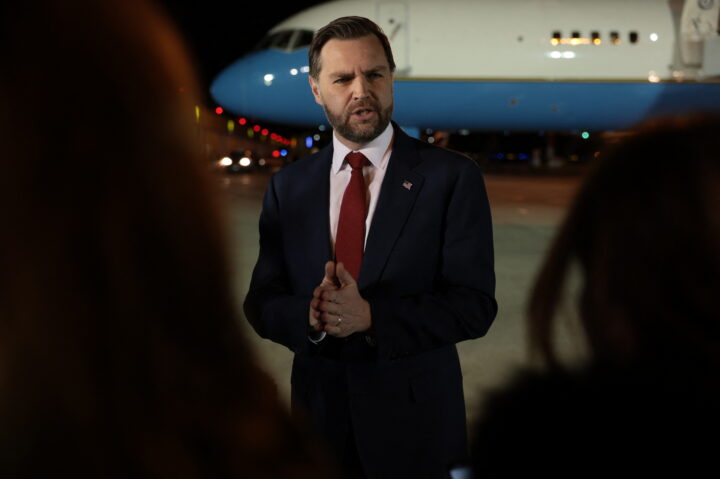
Vice President JD Vance speaks to the media before boarding Air Force Two in Budapest, Hungary, on April 8, 2026.
American and Iranian officials are meeting on Saturday in Islamabad, Pakistan, to begin conversations aimed at ending the conflict that has consumed the Middle East since late February. Though much change has occurred in the last six weeks, the decisions made in the next two could determine the future of the region for decades to come.
The “fog of diplomacy,” as The Washington Post’s David Ignatius put it, has shrouded much of what is known about the talks and their contours. The first 24 hours after the ceasefire was announced saw dueling — and often conflicting — statements, denials and claims about various points, including the inclusion of Lebanon in the agreement, Iran’s “right” to enrich uranium and the status of the Strait of Hormuz, that were proposed and supposedly agreed to by the parties.
Those sticking points deepened in the days between the ceasefire announcement and Saturday’s meeting in Pakistan. On Wednesday, Israel conducted widespread strikes in Lebanon targeting Hezbollah infrastructure and operatives whom the IDF said had embedded in civilian areas, while Hezbollah has launched dozens of missiles into Israel — including one fired at the southern city of Ashdod that also triggered sirens across Tel Aviv and surrounding towns early Friday morning. Meanwhile, Trump on Thursday accused Iran of “doing a very poor job, dishonorable some would say, of allowing Oil to go through the Strait of Hormuz.”
It is against that backdrop that Vice President JD Vance, joined by White House Special Envoy Steve Witkoff and Jared Kushner, will enter into negotiations tomorrow in Islamabad.
In tandem, a separate set of negotiations is slated to take place in Washington early next week, when the U.S. will convene the envoys from Israel and Lebanon for rare direct, public talks aimed at reaching a peace agreement between Beirut and Jerusalem. If reached — and if Lebanon takes meaningful action to demilitarize Hezbollah — Iran could lose its most powerful proxy in the region. Under pressure from Washington, Israel has limited its attacks on Lebanon.
While the inability to agree on the parameters for a ceasefire does not portend well for the ability to secure a more lasting agreement,both sides have a vested interest in reaching an accord that allows both to declare victory. Watching from the sidelines are Israel and the Gulf states, which will not be represented in Islamabad, and will instead have to hope from their respective capitals that the U.S. does not acquiesce to an agreement that emboldens Iran — and leaves the American allies vulnerable.
With the regime still intact — and still pledging destruction — Israel has reason to worry. Iran’s new supreme leader, Ayatollah Mojtaba Khamenei, warned on Thursday night that “we definitely won’t allow the criminal aggressors who attacked our country to go unpunished.”
And even as Pakistan positions itself as a convener, its senior officials make clear it is not hosting talks as an impartial actor. On Thursday morning, Pakistani Defense Minister Khawaja Asif posted on X — and later deleted — that “Israel is evil and a curse for humanity,” adding, “I hope and pray people who created this cancerous state on Palestinian land to get rid of European jews burn in hell.”
With elections in both the U.S. and Israel later this year, both Washington and Jerusalem have a vested interest in U.S. negotiators securing the best possible deal with Tehran. With rising fuel prices, the White House will want to project strength in reopening the Strait of Hormuz, while Israeli Prime Minister Benjamin Netanyahu will need to convince voters that they are safer now than they were a year ago — and that Israel won’t find itself in an ongoing cycle of wars that bring the country to a halt for weeks on end every year.
But the longer-term questions remain. Will Iran, whose nuclear and ballistic missile programs were dealt significant blows, further conceal aspects of both? What degree of threat can Israel live with on its borders? How has the Iranian regime’s survival emboldened its allies in Beijing and Moscow? And what of the Iran-backed Houthis in Yemen, who have largely held their fire over the last six weeks?
Those are questions unlikely to be resolved in Islamabad in the coming days, but they are the ones that Israel and the West will have to grapple with once the dust from this war has settled.
Israelis uncertain if Iran war made them safer after ceasefire brings combat to an inconclusive halt
After the ceasefire went into effect, there was a pervading feeling in Israel that the war with Iran was not complete, and the return to routine life may be short-lived

Alexi Rosenfeld/Getty Images
People run to take shelter as sirens sound during incoming missile fire, without an early warning, from Hezbollah, just after midnight on the third day of the U.S. Israel Iran Ceasefire on April 10, 2026 in Tel Aviv, Israel.
For many Israelis who were awoken by rocket sirens just before 3 a.m. Wednesday, only to see the headline on their phones that a two-week ceasefire between the U.S. and Iran had been reached, the news was met with mixed feelings of relief and concern.
For most Israelis, the ceasefire has brought tangible relief: an end to regular missile alerts, the prospect of uninterrupted sleep (though Hezbollah swiftly shattered that hope for many on Thursday night), and children back in school. Yet for residents of Israel’s north who continue to live under frequent Hezbollah rocket fire, even this fragile respite remains out of reach.
After the ceasefire went into effect, there was a pervading feeling in Israel that the war with Iran was not complete, and the return to routine life may be short-lived. An overwhelming majority of Israelis supported the war a month after its late-February start, and just over half supported its continuation, according to the Israel Democracy Institute. Those views remained relatively steady after Iran stopped shooting missiles: A poll broadcast on Israel’s Channel 13 news on Thursday found that 51% of Israelis opposed President Donald Trump’s agreement to a ceasefire.
Israelis’ support for the war effort despite the challenges on the home front was strong because its aims — eliminating the Iranian nuclear threat and severely degrading the ballistic missile threat — were meant to ultimately make them safer, along with the hope, bolstered by statements from Israeli Prime Minister Benjamin Netanyahu and President Donald Trump, that the mullahs’ regime would be toppled.
Yet, according to the Channel 13 poll, Israelis ranked their sense of security after the war at 5.36 out of 10, and gave Israeli Prime Minister Benjamin Netanyahu a grade of 5.56. Only slightly more Israelis (33%) thought that Israel and the U.S. won the war, as opposed to Iran (28%); a plurality (39%) were not sure.
“Israel did not meet its war aims, and the cost is expected to be high,” Yoav Limor, the main military analyst of Adelson-owned Israel Hayom wrote on Thursday. The Times of Israel’s Lazar Berman lamented that “another war ends without a decisive win.” Even the pro-Netanyahu Channel 14 featured the headline “This is how wars are lost: Stopping a moment before victory” on its homepage, and another, more positive, article about the war’s achievements, still admitted “‘total victory’ was not reached.”
Israeli opposition leader Yair Lapid went as far on Wednesday as to call the ceasefire “a diplomatic disaster at a level that I cannot remember. … Of all possible results, Netanyahu reached the worst.”
Shas leader Aryeh Deri, a Security Cabinet observer and one of Netanyahu’s closest political allies, accused Lapid and others who made similar comments of “acting against the country for narrow, short-term political gain.”
On Wednesday evening, Netanyahu made a live statement to reassure the public.
“Iran is weaker than ever, and Israel is stronger than ever,” the prime minister said. “This is the bottom line … We have set the terrorist regime in Iran back many years. We have shaken its foundations. We have crushed it.”
However, Netanyahu added, “We still have goals to complete, and we will achieve them either by agreement or by the resumption of fighting. We are ready to return to combat at any necessary moment. … This is not the end of the campaign; this is a way station on the way to achieving all of our goals.”
The mixed feelings from the public and the mixed messages from Netanyahu were backed up by experts who spoke to Jewish Insider on Thursday.
Brig.-Gen. (res.) Amir Avivi, chairman of the Israel Defense and Security Forum, told JI that “it’s too early to sum up, because we need to see the results of the negotiations over the next two weeks, and what happens in Iran when the dust settles.”
Brig.-Gen. (res.) Assaf Orion, a senior researcher at the Institute for National Security Studies at Tel Aviv University, said that it is “too early to say” whether Israel is safer now than it was six weeks ago.
“We are at halftime,” Orion said. “The first part was military … but wars are not just a military competition, they are diplomatic and military. …The reality after exhausting the negotiations is how we will judge the war.”
Brig.-Gen. (res.) Amir Avivi, chairman of the Israel Defense and Security Forum, told JI that “it’s too early to sum up, because we need to see the results of the negotiations over the next two weeks, and what happens in Iran when the dust settles.”
That being said, Avivi was confident that Israel is safer than before the war began.
“The last six weeks were a huge drama, a total military defeat of a regional power,” he said. “Iran’s military industry, steel plants, petrochemical plants, navy, were almost entirely eliminated. … Essentially, Israel and the U.S. did whatever they wanted for the past month and a half. They attacked wherever they wanted. If they wanted to turn off the country’s electricity, they could have. … [Iran is] crushed militarily and economically.”
Avivi did not view Israel as having been stopped by the U.S. mid-fight, citing the IDF as saying that they hit all the targets they had defined as important and reached a stage where the remaining targets were energy and economic sites. “That’s why the Iranians broke and wanted a ceasefire,” Avivi said.
“The nuclear project was harmed, but the enriched uranium is still in Iran, and it is unclear if they are closer to giving it up than before,” Brig.-Gen. (res.) Assaf Orion, a senior researcher at the Institute for National Security Studies at Tel Aviv University, said. “That needs either a military solution or a deal, or the situation will get worse. … [Iran] may change its nuclear strategy for the worse, because with fewer capabilities, they are more motivated [to break out to nuclear weapons], and the knowledge and materials remain.”
This was the right time for a ceasefire, Avivi posited, because the fighting had gotten to a point where the remaining targets were Iran’s economic abilities, and the Islamic Republic “basically surrendered,” and decided to agree to the U.S. demand to reopen the Strait of Hormuz without concessions from the U.S.
Orion, however, said that “Israel did very serious damage to Iran [which will last] for many years,” but still viewed the results of that damage as inconclusive.
“The nuclear project was harmed, but the enriched uranium is still in Iran, and it is unclear if they are closer to giving it up than before,” he said. “That needs either a military solution or a deal, or the situation will get worse. … [Iran] may change its nuclear strategy for the worse, because with fewer capabilities, they are more motivated [to break out to nuclear weapons], and the knowledge and materials remain.”
As for Iran’s ballistic missile capabilities, Orion said, “their industry is damaged and unable to produce large quantities … [but] they still retain about half of their capabilities, something like 1,200 missiles and over 200 launchers. It’s clear they can still create the terror effect and harass Israel and neighboring countries. … They can buy [drones] from Russia to threaten the Gulf states.”
A central question pertaining to Iran’s ballistic missiles and other conventional capabilities, Orion said, is what it will rebuild, how quickly and whether China will help Tehran.
Avivi said he views Iran’s ballistic missile strategy as “totally ineffective, influencing nothing … sporadic and not targeted,” and noted that it did not damage Israeli military capabilities, while “every Israeli strike is a death blow to the regime, its industries or senior officials.”
As for regime change, which was not an official war aim, Orion argued that it’s too early to know whether it will happen. “Trump said it already happened, but it’s really just a shift change. The [remaining] people are no less extreme,” he said.
Avivi said that reaching a ceasefire with the regime does not undermine the effort to change it: “The people can still take to the streets, and Israeli and American drones can back them up. This regime will crumble in the end, but it’s a process. It won’t happen in a day.”
One major downside of the war for Israel may be a deterioration in U.S. public opinion towards the Jewish state.
“On the one hand,” Orion said, “Israel proved itself as a military partner with capabilities and prowess to significantly help the U.S. with what it wanted to achieve. Israel was there from day one and took on most of the mission of clearing out Iran’s air defenses … It did a lot of the work when NATO didn’t want to.”
However, Orion pointed to a recent New York Times article that portrayed Israel as “dragging the U.S. into the war, even though it was a presidential decision in the end, contrary to the stances of senior [American] figures and public opinion on the left and right. It will take time to see the aftershocks.”
As to whether the ceasefire will last, Orion said that, while nothing is certain, a ceasefire is generally called when both sides “estimate that conditions would be improved by talking,” and noted that at the outset of the war, the Trump administration said it would likely take four to six weeks.
Avivi said that “Israel and the U.S. now have two weeks to regroup and rearm, which Iran isn’t able to do because it doesn’t have a military industry anymore.”
Iran can spend the ceasefire “taking stock of the disaster that happened to them,” Avivi added.
Sen. Lindsey Graham: ‘I look forward to the architects of this proposal, the Vice President and others, coming forward to Congress and explaining how a negotiated deal meets our national security objectives’

Office of Sen. Lindsey Graham (R-SC)
Sen. Lindsey Graham (R-SC) and Sen. Tom Cotton (R-AR) hold a joint press conference on Iranian nuclear negotiations at the U.S. Capitol on May 8, 2025.
Despite skepticism over the terms and reports of ongoing Iranian strikes, several prominent hawkish Republicans are voicing support for President Donald Trump’s fragile two-week ceasefire agreement with Iran.
Sen. Lindsey Graham (R-SC), among the most prominent backers of the war in the Senate, said in a post on X that a “diplomatic solution to end the reign of terror in Iran is the preferred outcome” but said he has concerns about the supposed 10-point plan presented by Iran, which would require the lifting of all U.S. sanctions on Iran, among other steps.
U.S. officials, including Vice President J.D. Vance, said the U.S. did not agree to that version of the deal, but that at least three versions of the Iranian proposal have circulated. White House press secretary Karoline Leavitt said Wednesday that the original 10-point plan proposed by Iran was “fundamentally unserious” and was “literally thrown into the garbage by President Trump and his team.”
“I look forward to the architects of this proposal, the Vice President and others, coming forward to Congress and explaining how a negotiated deal meets our national security objectives in Iran,” Graham said.
He added that all of Iran’s enriched uranium must be turned over to the United States and that Iran cannot have any enrichment capacity.
“To those who say, Iran needs to save face by having a small enrichment program, I’m not remotely interested in providing face-saving cover to a regime that murders its own people, beats a 16-year-old girl to death for not wearing a headscarf appropriately, and is dripping in American blood,” Graham said.
Sen. Ted Cruz (R-TX) said on his podcast that he believes Trump was prepared to follow through on his threats against Iran, but agreed to hold off in response to Pakistan’s mediation efforts and Iran’s agreement to reopen the Strait of Hormuz as he had demanded.
“Many of the military objectives have been accomplished. The military has been degraded almost out of existence,” Cruz said, though he acknowledged that it doesn’t take much for Iran to disrupt trade in the Strait of Hormuz. “There’s virtually no military left. It’s like four guys with a slingshot sitting on the back of a camel.”
But Cruz said he would be skeptical that the ceasefire would hold if Iran’s attacks on its neighbors continued.
He said his definition of success in Iran would be taking away Iran’s ability to kill Americans and innocent people in the region and its ability to become a nuclear power. He said that full regime change is the responsibility of the Iranian people, not the United States.
Responding to a post by Trump about the agreement and the damage to Iran’s nuclear program, Senate Intelligence Committee Chairman Tom Cotton (R-AR) said, “President Trump has always been crystal clear: there must be no uranium enrichment for Iran. And he’s absolutely right. That was a central flaw in Obama’s disastrous deal. Because the only reason Iran would demand to enrich uranium is to build a nuclear weapon.”
He didn’t address the substance of the ceasefire deal itself.
Sen. Kevin Cramer (R-ND) praised Trump’s execution of the war and the ceasefire, saying that the war had shown that the U.S. is the strongest nation and has the strongest military on the planet.
“He has made it clear – Iran will not get a nuclear weapon. And so, it’s really through his efforts that the U.S. not only secured a temporary ceasefire but more importantly, they obtained a commitment from Iran to reopen the Strait of Hormuz,” Cramer said in a statement. “That has been his short-term goal in recent days, and it’s an important goal that affects a lot of people, not just the United States but our Middle East friends and certainly Europe.”
He called on other allies to step up — and predicted they would following the ceasefire agreement. But he also urged continued caution.
“Now we have to keep our eyes wide open obviously, it’s not like the Iranian regime is good for keeping its word, but in my mind, this is a pretty good breakthrough,” Cramer continued. “I’m grateful for President Trump’s unwavering dedication to defending our country and holding our adversaries accountable, and frankly, holding some allies accountable as well. I certainly hope they learned from this lesson.”
Other senior Republicans haven’t commented on the ceasefire agreement yet.
Off Capitol Hill, some prominent right-wing voices who have had the president’s ear are taking a different view of the deal.
Conservative commentator Mark Levin emphasized that Iran violated the ceasefire deal shortly after it was signed. He accused Iran of trying to use the negotiations to “blackmail us and Israel” to allow Hezbollah to continue its attacks on Israel and divide the U.S. and its allies.
“The 2-week ceasefire is being violated right now by the Iranian-Nazi regime. Missiles are being fired into Israel and perhaps other countries in the region. Are they able to defend themselves?” he said on X. We have the right man as president, and I bet he’s furious about this.”
“But this will be the question throughout — that is, do we expect the Iranian regime to honor a deal, how will we monitor it, and how will we enforce it. These will all be very difficult issues to resolve,” he continued.
Responding to the 10-point Iranian proposal, Levin said simply, “Uh oh.”
Far-right influencer Laura Loomer said on X the deal is “a negative for our country” and “we didn’t really get anything out of it.”
Under the Iran Nuclear Agreement Review Act, passed in response to the Obama administration’s negotiations with Iran in 2015, any agreement pertaining to Iran’s nuclear capabilities must be submitted to Congress for its review, and Congress has the ability to vote to block any such agreement.
In spite of the ceasefire, Democrats are continuing to agitate for Trump’s removal from office and plan to pursue war powers resolutions to force an end to the war.
In a Dear Colleague letter on Wednesday, House Minority Leader Hakeem Jeffries (D-NY) said that Democrats plan to attempt to pass a war powers resolution during a pro-forma session on Thursday by unanimous consent — an effort that is likely to fail.
Jeffries also said that Rep. Jamie Raskin (D-MD), the ranking member of the House Judiciary Committee, and committee Democrats plan to hold a briefing on Friday on “Trump administration accountability and the 25th Amendment” — indicating that the doomed push to remove Trump from office has backing from the top echelons of the Democratic Party.
Senate Minority Leader Chuck Schumer (D-NY) said that Democrats are planning to force a vote on a war powers resolution next week, the fourth since the war began on Feb. 28, when the Senate returns from its own recess.
The new survey, conducted during the Iran war, also found a majority of Republicans under 50 view Israel unfavorably
Jim Lo Scalzo/EPA/Bloomberg via Getty Images
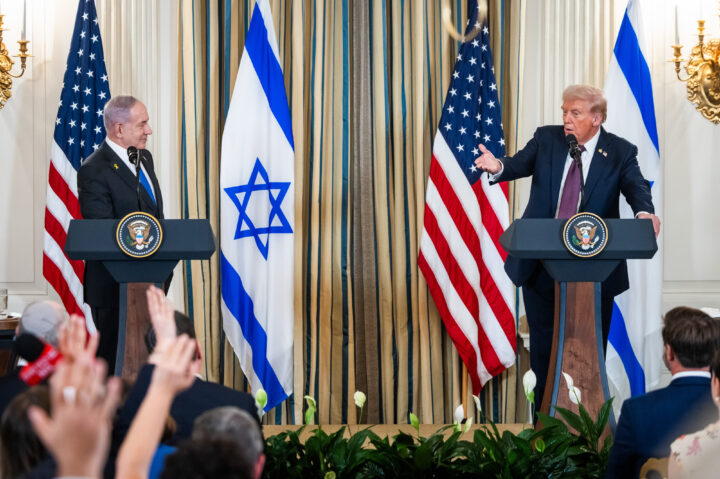
President Donald Trump, right, and Benjamin Netanyahu, Israel's prime minister, during a news conference in the State Dining Room of the White House in Washington, DC, US, on Monday, Sept. 29, 2025.
The war in Iran has cost Israel political support in the United States, according to a new Pew Research Center poll, which shows 60% of Americans now view Israel unfavorably, with 37% viewing the Jewish state favorably.
The results not only reflect an overall decline in public support in recent years, but a significant seven-point drop since the pollster’s last survey in 2025, when it found 42% of respondents viewed Israel favorably and 55% unfavorably. The latest poll surveyed 3,507 U.S. adults between March 23-29, during the height of the joint U.S.-Israel military operations.
Perhaps most concerning for the pro-Israel community, the poll found that 57% of Republican respondents under 50 hold negative views towards Israel. That’s in stark contrast to the strong support it receives from older Republicans, with nearly 3 in 4 viewing the Jewish state favorably.
The survey found that positive views of Israel were concentrated among Jewish Americans (64% said they view Israel favorably) and evangelical Protestants (65% said they hold favorable views).
The least supportive religious groups towards Israel were: American Muslims (4% favorability), the religiously unaffiliated (22% favorability), Black Protestants (33%) and Catholics (35%).
The poll also found that Israeli Prime Minister Benjamin Netanyahu continues to get low marks from the American public, with only 27% saying they trusted him to “do the right thing regarding world affairs.” Nearly the same share of voters who viewed Israel unfavorably also held the Israeli prime minister in a negative light.
Pew also asked how important the conflict between Israel and Hamas was to respondents, and 53% rated it as a “very” or “somewhat” important issue. Nearly all Jewish respondents (91%) and 70% of Muslim respondents said what’s happening in the Middle East is of significant importance.
In an interview with the New York Post, the president called the far-right podcaster ‘a low IQ person that has absolutely no idea what’s going on’

Chip Somodevilla/Getty Images
Tucker Carlson speaks on stage on the fourth day of the Republican National Convention at the Fiserv Forum on July 18, 2024 in Milwaukee, Wisconsin.
President Donald Trump hit back at Tucker Carlson on Tuesday after the far-right podcaster used his most recent show to accuse the president of steering the U.S. toward nuclear war with Iran and to suggest, in apocalyptic terms, that Trump might be waging a stealth attack on Christianity.
In a phone interview with the New York Post, Trump described Carlson as a “low IQ” individual who frequently tries to speak with him by phone, adding that he has stopped responding to his calls.
“Tucker’s a low IQ person that has absolutely no idea what’s going on,” Trump told the outlet of Carlson. “He calls me all the time. I don’t respond to his calls. I don’t deal with him. I like dealing with smart people, not fools.”
The remarks came in response to a lengthy monologue Carlson delivered on his Monday podcast. There, Carlson excoriated Trump for issuing an expletive-filled Truth Social post on Easter, in which the president warned that the U.S. was prepared to bomb Iranian power plants and bridges if Tehran did not open the Strait of Hormuz.
Carlson called the post “vile on every level,” particularly for its language on a major Christian holiday, and framed it as the opening move toward nuclear conflict. He speculated that Trump might be pursuing something far larger than conventional military escalation — an effort to provoke Armageddon and undermine Christian faith.
“Is it possible that what you’re watching is a very stealthy yet incredibly effective attack on what, from a Christian perspective, is the true-faith belief in Jesus?” Carlson asked. “Is it possible the president sees this in bigger terms? Sees this as the fulfillment of something? An elevation to some higher office beyond president of the United States?”
“Is it just a conventional escalation ladder in a badly thought out war?” he continued. “Could it be something bigger? Is it possible what you’re watching is a very stealthy yet incredibly effective attack on what, from a Christian perspective, is the true faith: belief in Jesus?”
The former Fox News host then claimed that the reason the president did not put his hand directly on the Bible when being sworn in for his second term last January was because he “rejects” the “limits on human behavior” in the Bible.
Carlson went on to urge Trump administration officials to resign or refuse to obey orders if the president were to order them to strike Iran with a nuclear weapon.
“Those people who are in direct contact with the president need to say, ‘No, I’ll resign. I’ll do whatever I can do legally to stop this because this is insane, and if you give the order, I’m not carrying it out. Figure out the codes on the football yourself,’ because everything hangs in the balance right now,” he explained.
At least 50 House Democrats are calling for Trump’s immediate removal from office
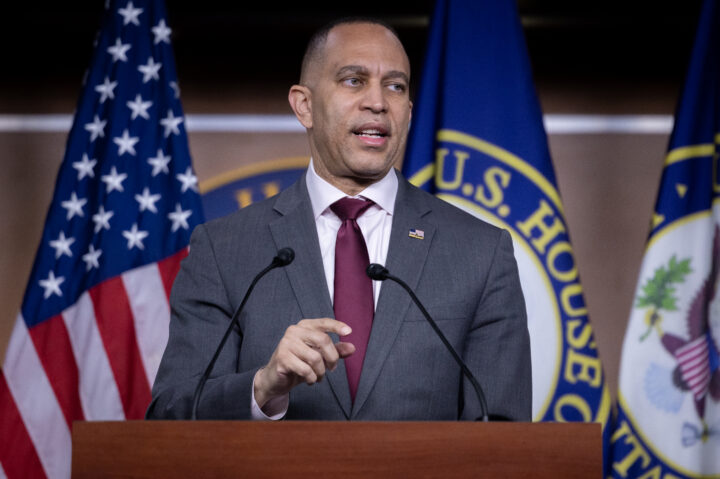
Nathan Posner/Anadolu via Getty Images
House Minority Leader Hakeem Jeffries (D-NY) speaks during his weekly press conference at the U.S. Capitol in Washington, DC on March 19, 2026.
Top Democrats across both chambers condemned President Donald Trump for threatening that “a whole civilization will die tonight” in Iran, with some pushing for Trump’s immediate removal from office over the threat and his conduct of the war.
House Minority Leader Hakeem Jeffries (D-NY) and other members of Democratic leadership including Reps. Katherine Clark (D-MA), Pete Aguilar (D-CA), Ted Lieu (D-CA), Joe Neguse (D-CO) and Suzan DelBene (D-WA), issued a statement calling Trump “unhinged” and saying that he risks bringing the country “into World War III” unless Congress reconvenes to vote to bring the war to an end.
“For years, Republicans have enabled and excused Donald Trump’s deeply dangerous and extreme behavior. Enough is enough,” the leaders said. “Our brave men and women in uniform have been put into harm’s way in the Middle East. Over a dozen have already been killed and hundreds injured. Gas prices are skyrocketing, the cost of living in America is out of control and billions of taxpayer dollars are being wasted on a reckless war of choice.”
In another joint statement, Senate Minority Leader Chuck Schumer (D-NY) and Sens. Chris Coons (D-DE), Jeanne Shaheen (D-NH), Jack Reed (D-RI) and Brian Schatz (D-HI), who are the top Democrats on several relevant committees and subcommittees, similarly condemned Trump’s comments, saying they indicate an intent to commit war crimes.
“This is not strength. Intentionally destroying the power, water, or basic infrastructure upon which tens of millions of civilians depend to punish the very civilians who suffer at the hands of the Iranian regime would constitute a war crime, a betrayal of the values this nation was founded on, and a moral failure,” the lawmakers said. “It’s unconscionable to threaten the lives of so many people — grandparents, children, families — simply because they were born in Iran.”
They said that Trump’s comment “makes Americans less safe, further destabilizes our nation and economy, and puts at greater risk U.S. service members,” as well as makes a diplomatic solution — ”the only viable solution to this war” — harder to achieve.
In a separate statement, Rep. Greg Meeks (D-NY), the ranking member of the House Foreign Affairs Committee, also said that Trump’s threat constitutes a war crime and an illegal action under international law which risks tens of millions of Iranian civilians, and potentially catastrophic after-effects.
“At this critical moment, the United States must pursue immediate de-escalation and a coordinated diplomatic strategy with our allies. We cannot allow Iran to simply reset to a dangerous status quo — but the answer is not to threaten war crimes and isolate us from every partner we need to end this conflict,” Meeks said. Trump’s threat is “recklessness that America and the region will pay for long after this president is gone,” he added.
Rep. Jared Moskowitz (D-FL), who prior to the war was one of the few Democrats who said he would oppose a war powers resolution — though he ultimately voted for it after the war began — demanded that the House immediately reconvene for a war powers vote. Moskowitz’s comments are a sign that Trump’s latest comments have crossed a line even for some of the most hawkish Democrats in the House.
“Speaker Johnson must immediately reconvene the House to vote on a war powers resolution. It’s beyond clear we are at war,” Moskowitz said. “The Speaker’s legacy will be that he made Congress so irrelevant that a president can threaten to wipe out a civilization while Congress is on vacation.”
Jeffries said Democrats plan to bring up another war powers resolution to halt the conflict in Iran, which stands a stronger chance of passing than a previous one, when the House returns from its recess. At least some of the Democrats who voted against the previous resolution are expected to support this one, and a small number of additional Republicans may join them.
Rep. Henry Cuellar (D-TX), one of four House Democrats who voted against the previous war powers resolution on the war in Iran last month, announced he will now support such an effort because the administration has failed to provide adequate answers about its goals and its exit strategy.
“[W]e must be careful with the language we use. Strength and destruction are not the same,” Cuellar added. “When the United States echoes the rhetoric of its adversaries, we risk weakening the values that have long defined our leadership.”
Several Democrats have described Trump’s comments as a threat to commit genocide.
Trump’s threat has also prompted growing calls from at least 70 House Democrats for his removal from office, either through impeachment or the invocation of the 25th Amendment, which allows the involuntary removal of a president from power if he is mentally or physically unfit to govern.
Sens. Ed Markey (D-MA) and Ron Wyden (D-OR) joined those calls.
“Donald Trump is deranged,” Wyden said. “He must be impeached and removed from office. Republicans who don’t stop him will have blood on their hands, and anyone who carries out an order to bomb civilian targets will be complicit in war crimes and will be held accountable.”
Markey called the president “unstable and a clear and present danger, not just to the American people but to the world” and said he “must be removed from office before he causes incalculable and unfathomable harm.” He said that a war powers resolution to stop the war is now insufficient to address the situation.
A small number of Republicans are also airing concerns with Trump’s threat.
Sen. Lisa Murkowski (R-AK), one of the few Republicans who has been openly skeptical of the war effort in Iran, said that Trump’s threat “cannot be excused away as an attempt to gain leverage in negotiations with Iran.”
“This type of rhetoric is an affront to the ideals our nation has sought to uphold and promote around the world for nearly 250 years. It undermines our long-standing role as a global beacon of freedom and directly endangers Americans both abroad and at home,” Murkowski said, calling for deescalation by both Trump and Iran, and insisting that the U.S. must draw a distinction between the Iranian regime and the Iranian people.
Rep. Nathaniel Moran (R-TX) said that, while he has supported the war thus far, “I do not support the destruction of a ‘whole civilization.’ That is not who we are, and it is not consistent with the principles that have long guided America.”
“[W]hat sets America apart is not only our strength, but how we use it. Our nation has always conducted military operations for just causes and through just and moral means. This must continue in the future; otherwise we forfeit our legitimacy to lead the world,” Moran said. “[H]ow we protect the lives of the innocent is just as important as how we engage the enemy.”
Rep. Kevin Kiley (I-CA), who recently left the Republican Party but remains part of the GOP caucus and has generally been hawkish on Iran, said that the U.S. “does not destroy civilizations. Nor do we threaten to do so as some sort of negotiating tactic.”
“Congress has a responsibility to conduct oversight with respect to ongoing military operations and our obligations under both U.S. law and international agreements to which we are a signatory,” Kiley said.
Plus, Sine die dayenu

Mike Stewart/AP
Republican Clay Fuller speaks to supporters after learning he would advance to a runoff election during an election night watch party, Tuesday, March 10, 2026, in Rome, Ga.
👋 Good Tuesday morning!
In today’s Daily Kickoff, we report on President Donald Trump’s doubling down on his threat to strike Iranian power plants if Tehran does not reopen of the Strait of Hormuz by tonight’s 8 p.m. deadline, and look at how Iran’s closure of the key waterway is forcing countries to consider alternatives, such as the proposed India-Middle East-Europe Corridor. We preview today’s special election runoff in Georgia to fill the rest of former Rep. Marjorie Taylor Greene’s term, and report on plans by Texas Democrats to vote on a series of anti-Israel and anti-AIPAC resolutions at their upcoming party convention. Also in today’s Daily Kickoff: Esther Panitch, John Kirby and Bill Ackman.
Ed. note: In observance of Passover, the next Daily Kickoff will arrive on Friday, April 10.
Today’s Daily Kickoff was curated by JI Executive Editor Melissa Weiss and Israel Editor Tamara Zieve, with assists from Danielle Cohen-Kanik and Marc Rod. Have a tip? Email us here.
What We’re Watching
- President Donald Trump’s deadline for Iran to reopen the Strait of Hormuz — or face attacks on its power grids and bridges — expires at 8 p.m. ET. Earlier today, the IDF reportedly warned civilians to stay away from trains, an indication that the Islamic Republic’s infrastructure could be targeted. More below.
- Members of the Democratic National Committee are kicking off a five-day meeting today in New Orleans, where the DNC’s resolutions committee is set to consider resolutions condemning AIPAC and Israel. The resolutions were proposed by a Florida delegate who last year attempted to push through a resolution calling for an arms embargo on Israel. Read more here.
- Voters in Georgia’s 14th Congressional District head to the polls today for the special election runoff to choose a successor to fill out the remainder of Rep. Marjorie Taylor Greene’s (R-GA) term. District Attorney Clay Fuller, a Republican, is the favorite against Democrat Shawn Harris — but will likely need a decisive win today to stave off potential primary challengers in the GOP primary for the regular election later this spring. More below.
- In Michigan, Democratic Senate candidate Abdul El-Sayed and Rep. Summer Lee (D-PA) will hold rallies on the University of Michigan and Michigan State University campuses with far-left streamer Hasan Piker, who is coming under increasing criticism for his antisemitic and anti-American rhetoric.
What You Should Know
A QUICK WORD WITH JI’S JOSH KRAUSHAAR
Today’s special election runoff in Georgia between Republican Clay Fuller and Democrat Shawn Harris to determine the successor to former Rep. Marjorie Taylor Greene (R-GA) isn’t much in doubt. The northwestern Georgia district that Greene represented backed President Donald Trump by 37 points in 2024, one of the largest GOP margins in the country.
What makes the otherwise sleepy contest significant is the potential for the results to indicate if there are any fissures within the MAGA coalition, ones that may represent Republican discontent with Trump’s hawkish turn amid the Iran war. In this race, the margins will be as notable as the winner.
Greene, since leaving Congress, has emerged a loud Republican voice against the Iran war and against Trump’s strong alliance with Israel. Fuller, a military veteran with a background in counterterrorism operations and district attorney for the Lookout Mountain Judicial Circuit, has been a stalwart supporter of Trump’s military operations in the Middle East, and Trump has endorsed him in the race.
Harris, the Democrat, holds foreign policy views closer to the isolationist Greene, attacking the pro-Israel advocacy group AIPAC and describing Israel’s war against Hamas as a “genocide” — views which place him on the left flank of the Democratic Party. This despite Harris’ time serving as defense attache in Israel during his years in the National Guard, work history that he has not publicized during the campaign.
It’s worth noting that Greene, since she was first elected to the seat in 2020, has underperformed Trump’s standing in the district, only winning 64% of the vote against Harris in 2024 — four points below Trump’s 68% showing at the top of the ticket. And since breaking with Trump in his second term, her political standing has taken an even bigger hit.
Greene has not endorsed either candidate in the race.
WAY OF WATER

With Iran’s closure of the Strait of Hormuz roiling energy markets, other countries in the region may begin to pursue alternative routes to transport energy and other goods, but they are far from ready to be put into use, experts told Jewish Insider’s Lahav Harkov this week.
Back in focus: One of the highest-profile routes is the India-Middle East-Europe Corridor (IMEC), proposed by the Biden administration in September 2023 as a route for trade, energy and more; it would go from India, through Saudi Arabia, the UAE, Jordan and Israel, then across the Mediterranean to Europe through Greece. Now that the Iranian threat to block the strait has been realized, IMEC and other alternative routes to ship oil and gas from the Gulf are back in focus. Gabriel Mitchell, an expert on energy security and a visiting fellow at the German Marshall Fund, told JI that “the threat and challenge posed with the Strait of Hormuz has raised questions about East-West shipping, traffic and global energy trade to the maximum.”
TEXAS TURMOIL
Texas Democratic Party activists are set to consider a series of resolutions condemning Israel for alleged genocide and pushing for an arms embargo, as well as criticizing pro-Israel involvement in U.S. politics — characterizing it as foreign influence in American elections — and urging penalties for candidates who accept their support, Jewish Insider’s Marc Rod reports.
What they’re doing: One resolution on AIPAC and Democratic Majority for Israel would set as party policy that Texas Democrats should reject campaign contributions, endorsements and other support from pro-Israel groups. Several of the resolutions accuse Israel of apartheid and genocide, and urge Democratic lawmakers from the state and nationally to support a halt to not only U.S. financial aid to Israel but also any shipments of weapons purchased from the U.S. and logistical support provided to Israel until international human rights groups declare that Israel is no longer engaged in apartheid or genocide.
TOUGH TALK
President Donald Trump doubled down on his threats to escalate the war in Iran on Monday if Iranian leaders do not agree to a broad ceasefire deal that includes reopening the Strait of Hormuz by his Tuesday evening deadline, warning that the U.S. would target every bridge and power plant still standing in the country, Jewish Insider’s Emily Jacobs reports.
What he said: Trump took a hawkish posture while speaking to reporters at the White House alongside senior U.S. defense officials about the ongoing war and diplomatic efforts to bring it to a close, warning that the U.S. has a plan to take out Iran’s entire transportation and energy infrastructure within “four hours” if Iran did not make a deal. “I can tell you they’re negotiating, we think, in good faith. We’re going to find out. … After [8 p.m. ET on Tuesday], they’re going to have no bridges. They’re going to have no power plants. Stone ages,” Trump said, referring to the deadline he set for Iran to agree to his terms, which has now been postponed three times.
FACT CHECK

Joe Kent, the former director of the National Counterterrorism Center who resigned over his opposition to the Iran war, shared a post on social media spreading false claims from Iranian state-linked media and Drop Site News that the U.S. was attempting to kill the servicemember whose fighter jet was shot down over Iran over the weekend prior to him being rescued, Jewish Insider’s Matthew Shea reports.
Propaganda post: The initial statement on Saturday from Drop Site, a far-left news outlet sympathetic to Hamas and totalitarian regimes, cited a report by Tasnim News, which is linked to the Islamic Revolutionary Guard Corps, claiming that the U.S. had “lost hope” of recovering an airman whose jet was downed over Iran on Friday and was instead “attempting to kill him.” The post was then amplified by Kent with the message: “Praying for the rescue of our downed pilot & the safe return of our Special Operators going in to get him back. [U.S. Air Force Pararescuemen and Combat Search and Rescue] Air crews are top notch.”
SEDER AT THE STATEHOUS

On Thursday, a group of Jewish Georgia politicos gathered for a first-of-its-kind-event at the Georgia Statehouse: the “Sine Die Seder,” Jewish Insider’s Marc Rod reports. Organized by state Rep. Esther Panitch, a Democrat and the only Jewish member of the Georgia General Assembly, the event brought together around 30 Jewish staffers, journalists, lobbyists, interns, a former attorney general and more to celebrate Passover on the final night of the legislative session, known as sine die.
In the room: Panitch said that she had asked the House majority leader to cancel the House session on Wednesday, the first night of Passover — and he obliged — but the House was still scheduled to be in session for the second night. “And so I said, ‘Well, we’re going to be at the Capitol on the second night. Why don’t we have a Seder for probably the 10 of us in the building that are Jewish,’” Panitch told JI, referring to herself and a handful of interns, staff and reporters, during the hourlong dinner break during the session. Interest in the event ballooned, with the group ultimately growing to around 30.
NOT CONVINCED

From mass baptisms to packed pews, a new Fox Nation documentary chronicles a profound spiritual awakening it suggests is sweeping America. The five-part series, “Revival with Lawrence Jones,” includes a spotlight on the renewed embrace of religious identity among Jews following the Oct. 7, 2023, terrorist attacks in Israel, Jewish Insider’s Haley Cohen reports.
Embrace of Jewish life: Episode 3 of the new series, “Jewish Identity,” highlights the record-breaking “Big Shabbat” held in New York City last November. It also features a conversation between “Fox and Friends” co-host Lawrence Jones, the series’ host, and Israeli activist Noa Tishby about her own Jewish identity; and an interview with Rabbi Joshua Davidson, who leads Temple Emanu-El, the oldest Reform congregation in New York City, which organized the “Big Shabbat.” “There’s no question that since Oct. 7 there has been a resurgence of interest in Jewish life and commitment to the organized Jewish community,” said Davidson.
Worthy Reads
Groypers Gripes: The New Yorker’s Antonia Hitchens examines the degree to which the far-right fringe is entrenching itself in Republican politics. “I asked a political consultant in Washington to summarize. ‘Groypers are about demographic change,’ the consultant said. ‘It’s a sovereignty issue. It’s literally, like, “Who runs my f***ing country? Why do all these people get access to my birthright — not just before me but that might be denied to me? Do I get a deal better than somebody who runs across a border?”’ [Nick] Fuentes offers a more concise gloss. ‘There are basically two things that are going on,’ he said recently. ‘White genocide and Jewish subversion.’” [NewYorker]
Everyone’s War: In The Wall Street Journal, Walter Russell Mead posits that “every great and near-great power is adjusting its foreign-policy strategies” in response to the Iran war. “The war shows us all that the security of the Gulf matters to everyone. If at the end of the war Iran retains the ability to close the Strait of Hormuz, every country on earth will need Tehran’s blessing to access vital fuel and supplies. Whatever one thinks of Mr. Trump and his decision to initiate hostilities, a quick and comprehensive American victory offers the best hope for a peaceful future in the Gulf and beyond.” [WSJ]
Mind the Gap: In his Substack “Between Us,” Nadav Eyal considers the disconnect between Israeli and Diaspora Jewry as the two become increasingly distant even as both face steep challenges. “But diaspora Jews represent the ability to survive and flourish over thousands of years, sometimes in difficult conditions, and above all with a remarkable preservation of their identity. They have successfully created communities with thriving institutions based on self-generated investment. The call to recognize the deep and independent value of Jewish life in the diaspora is not a rejection or dilution of the Jewish right to Eretz Yisrael. It is simply a correction of an error — one that Israelis cannot afford to make.” [BetweenUs]
Word on the Street
The Trump administration’s Board of Peace has given Hamas until the end of the week to accept a disarmament proposal, with Nickolay Mladenov, the board’s director-general, warning on X, “He who will not cross the river will drown in the sea”…
The Wall Street Journal looks at Israeli and U.S. efforts to target Iran’s economy as Washington and Jerusalem appear poised to strike key Iranian infrastructure…
Politico profiles Harmeet Dhillon as the Justice Department’s assistant attorney general for civil rights is rumored to be under consideration to replace former Attorney General Pam Bondi or to be tapped for another senior Justice Department role…
Rep. Yassamin Ansari (D-AZ), the first Iranian American Democrat to serve in Congress, announced she was introducing articles of impeachment against Defense Secretary Pete Hegseth over the war in Iran, citing his “reckless endangerment of U.S. servicemembers and repeated war crimes”…
An appellate court reinstated a $656 million judgment against the Palestinian Authority and Palestine Liberation Organization following a 2025 Supreme Court ruling allowing American victims of Palestinian terror to sue the groups under the 1992 Anti-Terrorism Act…
The New Yorker does a deep dive into OpenAI CEO Sam Altman’s professional trajectory and leadership of the artificial intelligence company…
Bill Ackman’s Pershing Square Capital made a bid for Universal Music Group, valuing the company at $63.5 billion; if successful, the acquisition would merge Universal with Pershing Square Sparc Holdings and move its stock listing to the New York Stock Exchange…
The head of the University of Washington’s Middle East Center was removed from his leadership position shortly after sending an email through the center’s listserv criticizing the war in Iran; Aria Fani will continue to hold his position as an associate professor at the school…
A private Catholic school in Fairfield, Conn., said it had disciplined students who were involved in a series of antisemitic social media posts targeting a rival school’s hockey team…
U.K. Education Secretary Bridget Phillipson called on organizers of this summer’s Wireless Festival to drop Kanye West as the concert’s headliner over his past “completely unacceptable and absolutely disgusting” antisemitic comments, as U.K. officials reportedly consider revoking permission for West, who offered to meet with the British Jewish community, to enter the country…
Meanwhile, the festival’s promoter defended West’s “legal right to perform” in the U.K., as Diageo and Anheuser-Busch InBev joined PepsiCo in dropping their sponsorships of the summer concert series…
Ret. Rear Adm. John Kirby, who served as White House national security communications advisor in the Biden administration, is joining MS NOW as a national security analyst…
Pic of the Day
Prominent Jewish figures and senior Trump administration officials gathered at the White House on Monday afternoon for an event hosted by President Donald Trump commemorating the Passover holiday, Jewish Insider’s Emily Jacobs reports.
Administration officials in attendance at the event, which was closed to the press and took place in the Indian Treaty Room, included Commerce Secretary Howard Lutnick; White House Staff Secretary Will Scharf; James Blair, the White House deputy chief of staff for legislative, political and public affairs; Jacob Reses, chief of staff to Vice President JD Vance; Environmental Protection Agency Administrator Lee Zeldin; Martin Marks, the White House Jewish liaison; and Rabbi Yehuda Kaploun, the Trump administration’s special envoy to monitor and combat antisemitism.
Others spotted at the event were Rabbi Moshe Margaretten, president of the Tzedek Association; Matt Brooks, CEO of the Republican Jewish Coalition; William Daroff, CEO of the Conference of Presidents of Major American Jewish Organizations; Jeff Miller, chairman of the United States Holocaust Memorial Council; Jonathan Burkan, United States Holocaust Memorial Council member; Rabbi Levi Shemtov, the executive vice president of American Friends of Lubavitch (Chabad); Paul Packer, the former chairman of the U.S. Commission for the Preservation of America’s Heritage Abroad; Rabbi Chaim Dovid Zwiebel, executive vice president of Agudath Israel of America and Rabbi Meir Soloveichik, member of the Religious Liberty Commission and vice chair of the United States Commission on International Religious Freedom. Read more here.
Birthdays

Professional golfer who joined the PGA Tour in 2015 when he won Rookie of the Year, he has since won four tournaments, Daniel Berger turns 33…
Professor emerita of philosophy at Vanderbilt University, Marilyn Ann Friedman turns 81… President of Yale University for 20 years, then CEO of Coursera, an education-focused technology company, Richard Charles “Rick” Levin turns 79… Consultant on aging, longevity, law and policy, Naomi Karp turns 76… Software engineer at FlightView, Jonathan Ruby… Professor at the University of Wisconsin Milwaukee, he was born in Haifa, Israel, Simon J. Bronner turns 72… Los Angeles-based casting director, Jane Sobo… Former director of project staffing at Tower Legal Solutions in Addison, Texas, Ilene Robin Breitbarth… Former member of the House of Commons of Canada from the Winnipeg area, Martin B. Morantz turns 64… Screenwriter, actress and director, Andrea Berloff turns 52… White House and Congress editor for USA Today, Darren Samuelsohn… Chicago-based progressive activist, he is a co-founder of Project Shema, Oren Jacobson… Principal owner of JRL Strategy, helping expats relocate overseas, Justin Ross Lee… Senior director of communications at Leidos, Gregory Hellman… Reporter covering the White House and Washington for Politico, Daniel Lippman… Executive director of Camp Seneca Lake for the JCC of Greater Rochester (N.Y.), she was previously an associate director of communications at AIPAC, Marissa Wizig Klegman… Managing partner of Reno-based Mazal Capital, David Farahi… Pitcher and first baseman for Team Israel at the 2020 Summer Olympics, Ben Wanger turns 29…
The president said at a lengthy press conference: ‘I can tell you they're negotiating, we think, in good faith. We're going to find out’

Tom Williams/CQ-Roll Call, Inc via Getty Images
President Donald Trump conducts a news conference in the White House briefing room about the war in Iran on Monday, April 6, 2026.
President Donald Trump doubled down on his threats to escalate the war in Iran on Monday if Iranian leaders do not agree to a broad ceasefire deal that includes reopening the Strait of Hormuz by his Tuesday evening deadline, threatening that the U.S. would target every bridge and power plant still standing in the country.
Trump took a hawkish posture while speaking to reporters at the White House alongside senior U.S. defense officials about the ongoing war and diplomatic efforts to bring it to a close, warning that the U.S. has a plan to take out Iran’s entire transportation and energy infrastructure within “four hours” if Iran did not make a deal.
“I can tell you they’re negotiating, we think, in good faith. We’re going to find out. … After [8 p.m. ET on Tuesday], they’re going to have no bridges. They’re going to have no power plants. Stone ages,” Trump said, referring to the deadline he set for Iran to agree to his terms, which has now been postponed three times.
The president said he extended the deadline from Monday to Tuesday at 8 p.m. ET because he “thought it was inappropriate” to demand a response “the day after Easter.” The comment came hours after telling reporters at the annual White House Easter Egg Roll that the Tuesday deadline was final and unlikely to have any additional extensions.
“The entire country can be taken out in one night and that night might be tomorrow night,” Trump said from the briefing room. “We have a plan, because of the power of our military, [where] every bridge in Iran will be decimated by 12 o’clock tomorrow night, where every power plant in Iran will be out of business, burning, exploding and never to be used again. I mean complete demolition by 12 o’clock, and it’ll happen over a period of four hours if we want it to.”
“We don’t want that to happen. We may even get involved with helping them rebuild their nation. If that’s the case, the last thing we want to do is start with power plants, which are among the most expensive things, and bridges,” he continued. “So do I want to do that? No. Do I want to destroy their infrastructure? No. It will take them 100 years to rebuild. Right now, if we left today, it would take them 20 years to rebuild their country and it would never be as good as it was. The only way they’re going to be able to rebuild their country is to utilize the genius of the United States of America.”
Defense Secretary Pete Hegseth, who took part in the press conference alongside Trump, told reporters on Monday that, “per the president’s direction, today will be the largest volume which strikes since day one of this operation. Tomorrow, even more than today, and then Iran has a choice. Choose wisely, because this president does not play around.”
Trump repeatedly reiterated his commitment to ensuring that Iran can never obtain a nuclear weapon — after saying the country’s nuclear program was “obliterated” last June — and said that any agreement between Iran and the U.S. would need to adhere to his terms, including the reopening of the Strait of Hormuz. “We have to have a deal that’s acceptable to me, and part of that deal is going to be [that] we want free traffic of oil and everything,” the president said.
“They’re not going to have a nuclear weapon,” Trump said of Iran, arguing that his actions were an insurance policy for the U.S. “if somebody that takes my place someday is weak and ineffective, which possibly that will happen, because we had numerous presidents that were weak, ineffective and afraid of Iran.”
The president described the Iranians as “very good bulls*** artists, that’s why for 47 years they’ve been bulls***ing other presidents,” while defending his decision to take military action against the regime.
“I think that 47 years of this stuff is long enough. They’re at the weakest point they’ve ever been,” Trump said, despite Iran’s continued missile strikes across the Gulf and in Israel. “In fact, the biggest problem we have in our negotiations is that they can’t communicate. … They have no method of communication. So we’re communicating like they used to communicate 2,000 years ago with children bringing a note back and forth.”
Plus, Joe Kent amplifies Iranian propaganda

Tom Williams/CQ-Roll Call, Inc via Getty Images
President Donald Trump conducts a news conference in the White House briefing room about the war in Iran on Monday, April 6, 2026.
This P.M. edition is reserved for our premium subscribers — offering a forward-focused read on what we’re tracking now and what’s coming next. Please don’t hesitate to share your thoughts and feedback by replying to this email.
📡On Our Radar
Notable developments and interesting tidbits we’re tracking
Amid reports that Iran has rejected the U.S.’ ceasefire framework, President Donald Trump told reporters Tehran has made its own “significant” proposal, though it is “not good enough.”
Asked if he may push the deadline again for Iran to reopen the Strait of Hormuz or face increased U.S. military action — as he has already done three times — Trump said, “Highly unlikely. They’ve had plenty of time.”
Trump also claimed the U.S. had “sent guns, lot of guns” into Iran. “They were supposed to go to the people so they could fight back against these thugs. You know what happened? The people that they sent them to kept them, because they said, ‘What a beautiful gun. I think I’ll keep it,’” he said…
At a press conference this afternoon, Defense Secretary Pete Hegseth said today would mark “the largest volume of strikes since Day 1” of the Iran war, with more to come tomorrow.
Trump doubled down on his threats, warning that all of Iran “can be taken out in one night, and that night might be tomorrow night.” If Tehran does not acquiesce by his 8 p.m. ET deadline tomorrow, Trump said, “they’re going to have no bridges. They’re going to have no power plants. Stone ages.”
The president also floated the possibility of charging U.S. tolls to ships transiting the Strait of Hormuz once it is reopened and potentially seizing Iran’s oil. Trump and defense officials further detailed the harrowing rescue of a fighter jet pilot, who reportedly treated his own wounds while scaling mountainous terrain to evade capture after being downed over Iran…
Israeli Prime Minister Benjamin Netanyahu said he spoke yesterday with Trump, who thanked him for Israel’s assistance in rescuing the pilot…
Joe Kent, the former director of the National Counterterrorism Center who resigned over his opposition to the Iran war, shared a post on social media on Saturday spreading false claims from Iranian state-linked media and Drop Site News that the U.S. was attempting to kill the servicemember whose fighter jet was shot down over Iran prior to him being rescued, Jewish Insider’s Matthew Shea reports.
The initial statement from Drop Site, a far-left news outlet sympathetic to Hamas and totalitarian regimes, cited a report by Tasnim News, which is linked to the Islamic Revolutionary Guard Corps, claiming that the U.S. had “lost hope” of recovering the airman and was instead “attempting to kill him”…
Rep. Pat Fallon (R-TX), who previously served in the Air Force, predicted that the U.S. will deploy ground troops into Iran: “I just don’t see any other way,” he said on Fox News. “I personally think it’s going to be boots — at least special ops, American special operators — on the ground, with allies in the region and air cover,” he said…
The U.S.-led Board of Peace is pressing Hamas to finalize a Gaza demilitarization agreement by the end of the week, The New York Times reports, which would require the terror group to give up its weapons and maps of its tunnel network in the enclave. Negotiators from both sides are expected to meet in Cairo, Egypt, tomorrow…
Democratic Michigan state Sen. Mallory McMorrow announced she raised more than $3 million in the first quarter of 2026 in her bid for U.S. Senate. “There was not a dime of corporate PAC donations, not a dime of AIPAC donations,” she said in a video. The pro-Israel group was the only organization she named.
While McMorrow’s opponents have not yet publicized their latest fundraising figures, her haul surpassed those of last quarter, when Rep. Haley Stevens (D-MI) led the pack with $2.1 million raised in the final quarter of 2025…
The Senate Leadership Fund, the Senate GOP’s top super PAC, revealed its $350 million plan to retain control of the upper chamber, focusing on defending incumbents in Ohio, North Carolina, Maine, Iowa and Alaska and seeking to flip seats in Michigan, Georgia and New Hampshire.
The funds will largely be used for ad campaigns, with the most money being spent to defend Sen. Jon Husted (R-OH), who must win his first Senate election for the remainder of his term against the likely Democratic nominee, former Sen. Sherrod Brown (D-OH)…
Ukrainian President Volodymyr Zelensky received a grand welcome upon touching down in Damascus yesterday for his first meeting with Syrian President Ahmad al-Sharaa. The two leaders “explored avenues for strengthening economic cooperation and the exchange of expertise,” al-Sharaa said…
Sovereign wealth funds from Saudi Arabia, Qatar and the UAE have signed equity commitments to the tune of $24 billion to back Paramount’s acquisition of Warner Bros. Discovery, The Wall Street Journal reports…
⏩ Tomorrow’s Agenda, Today
An early look at tomorrow’s storylines and schedule to keep you a step ahead
Keep an eye out in Jewish Insider for a preview of tomorrow’s special election runoff in Georgia’s 14th Congressional District, where Republican military veteran and Israel supporter Clay Fuller is expected to win the ruby-red seat of former Rep. Marjorie Taylor Greene (R-GA).
Defense Secretary Pete Hegseth and Gen. Dan Caine, chairman of the Joint Chiefs of Staff, will hold another press briefing on the Iran war tomorrow morning.
Michigan Senate candidate Abdul El-Sayed will host rallies tomorrow at Michigan State University and the University of Michigan with guests including Rep. Summer Lee (D-PA) and antisemitic streamer Hasan Piker, a move which has drawn condemnation from some Democrats and sparked a broader debate about the mainstreaming of Piker within the party.
The Democratic National Committee will begin its five-day meeting in New Orleans tomorrow, where its resolutions committee will consider several resolutions condemning AIPAC and Israel, including calls for conditions on or a suspension of U.S. military aid to the Jewish state.
NATO Secretary-General Mark Rutte will meet with Trump and administration officials in Washington on Wednesday, as the president continues to slam the organization for its refusal to engage in the Iran war.
In observance of Passover, we’ll be back in your inbox with the Daily Overtime on Monday, April 13. Chag Pesach Sameach!
ALTERED LIVES

The foiled attack at the Michigan synagogue is being called a miracle — but those who were inside now face the lasting impact of trauma and a search for safety
O CANADA

After a series of targeted attacks in Toronto and beyond, Jewish leaders are raising the alarms on Canada’s failure to properly protect its Jews amid ‘systemic’ antisemitism
The India-Middle East-Europe Corridor, originally viewed as an alternative to China’s Belt and Road Initiative, is being considered as another passage for trade

JULIEN DE ROSA / AFP via Getty Images
A person points at a page on the Marinetraffic website that shows commercial boats traffic on the edge of the Strait of Hormuz near the Iranian coast, in Paris on March 4, 2026.
With Iran’s closure of the Strait of Hormuz roiling energy markets, other countries in the region may begin to pursue alternative routes to transport energy and other goods, but they are far from ready to be put into use, experts told Jewish Insider this week.
One of the highest-profile routes is the India-Middle East-Europe Corridor (IMEC), proposed by the Biden administration in September 2023 as a route for trade, energy and more; it would go from India, through Saudi Arabia, the UAE, Jordan and Israel, then across the Mediterranean to Europe through Greece.
While Iran has threatened to block the Strait of Hormuz and obstruct oil shipping for decades, the Islamic Republic was not the main reason for considering another route of transportation — it was initially conceived as an alternative to China’s Belt and Road Initiative.
But now that the Iranian threat has been realized, IMEC and other alternative routes to ship oil and gas from the Gulf are back in focus.
Gabriel Mitchell, an expert on energy security and a visiting fellow at the German Marshall Fund, told JI that “the threat and challenge posed with the Strait of Hormuz has raised questions about East-West shipping, traffic and global energy trade to the maximum.”
”If you look at it from the perspective of India on one end, Europe on the other and anywhere in between, they are thinking they need to create as much redundancy as possible for commercial shipping for their own economic security,” Mitchell said. “It doesn’t make a difference whether you’re Emirati or Qatari or just an international shipping company with a base of operations in [the UAE’s Port of] Fuajirah, you’re asking the same questions.”
Mitchell said the idea of redundant shipping routes initially came from a desire to lower costs and increase speed of delivery, and grew more popular due to challenges with the Suez Canal during the COVID-19 pandemic. Now, in light of Iran’s obstruction of the Strait of Hormuz, “the argument in favor of IMEC [and] creation of redundancy has increased significantly.”
Increased regional connectivity can “take away Iran’s lever of closing the Strait of Hormuz,” Joseph Rozen, a senior fellow at the Misgav Institute for National Security and the former director for Asia-Pacific in Israel’s National Security Council, told JI. (The writer is a senior fellow at the Misgav Institute.)
Rozen said that “IMEC is a buzzword; the focus needs to be on inter-regional connectivity,” and noted that the Trump administration may be hesitant to adopt a Biden-era initiative, though it seemingly supports increasing connectivity more broadly through the Board of Peace.
Regional connectivity can increase stability and growth, Rozen said, and more countries can be brought in than those initially on board, such as Oman, Iraq, Syria, Egypt and even Gaza.
“The Iran war increased American involvement and its push for connectivity initiatives,” Rozen said. “Before the war [President Donald] Trump expressed interest, but now, the U.S. is more invested, and that encourages countries in the region to invest in regional connectivity if they know there’s an American security umbrella … over their investments and development.”
Rozen argued that existing infrastructure should be improved in the short term. The Saudi and Emirati pipelines combined can only transfer about 8.5 million barrels’ worth of oil per day, 42% of what passed through the Strait of Hormuz each day before the current war with Iran, he said. Another short-term move Rozen proposed is to continue to grant countries waivers to buy Russian gas, though this effort has seen resistance from members of Congress.
Mitchell said that IMEC faced a lot of skepticism when it was proposed, and none of its challenges have been resolved.
The commercial viability of alternative pipelines and routes is in question, Mitchell said: “Who is going to pay? Who is going to secure it? Which available ports will be able to manage that intake?”
Companies may prefer to try to find quick fixes rather than make multibillion-dollar investments that take a decade or more to bring returns, Mitchell argued, and the private sector and states will have to work together to make them viable. “I believe that will tip the scales in favor of these kinds of projects, but which end up getting green lit is yet to be determined.”
Some of the geopolitical challenges have grown more difficult since the Oct. 7, 2023, Hamas attacks on Israel, weeks after IMEC was announced. In addition, Mitchell pointed out that Turkey has obstructed joint energy projects between Israel, Greece and Cyprus in the past decade, demanding to be involved, and would likely do the same with IMEC.
”It’s hard to get everyone involved in one project … It’s hard to say how we are going to set aside our differences for these sets of initiatives … [and] what combination of carrots and sticks will convince people to pursue diversification. … I think in the end the answer will be yes, but it will take time to get there,” Mitchell said.
When Indian Prime Minister Narendra Modi visited Israel earlier this year, IMEC was part of the public conversation, but diplomats from both countries told JI on condition of anonymity that Saudi Arabia was hesitant to proceed because of Israel’s involvement — even though both countries were part of the plan from its inception.
Rozen said that Riyadh and Jerusalem can be part of the same project as long as the focus is on practical steps that serve the Saudis’ interests and not summits and bombastic statements that would “do more harm than good.”
”I understand their interest to maintain a certain kind of rhetoric, but there are other interests,” he said. “The more we advance through channels that are not political and are lower profile … I think the Saudis would be willing to do it. It can happen at any level of IMEC or other connectivity plans, in energy, trade and digital services. Cooperation led by the business sector would not carry the same political baggage … and under the current political circumstances it may be better for it not to be government-led.”
Mitchell also said that disputes between Saudi Arabia and the UAE that surfaced late last year could get in the way of developing IMEC, though in “a situation like now, when everyone is economically bleeding, there should be room for creative solutions.”
Israeli officials have made many positive statements about IMEC and Israeli Foreign Minister Gideon Sa’ar took part in a summit last year with his counterparts from involved countries, but no progress has been made on the ground.
Rozen said that Israel will likely wait to develop the necessary infrastructure “as long as there is no commitment from Arab States, such as Jordan, to invest on their side.” However, he added that, in the interim, Israel can “focus on the technological aspects” of regional connectivity at a lower cost.
Mitchell said the big challenge for Israel is that other countries will be competing to be involved in connectivity projects. Egypt, he said, has been pushing to be the gateway to the Mediterranean, with support from France.
”The argument in Israel’s favor is the security-related coordination [with Arab states] that is happening informally in a lot of ways. We need to concretize that,” he said. “One would assume that Israeli companies would have the opportunity to present their offerings for cybersecurity infrastructure.”
”The real thorn in Israel’s side since Oct. 7 is the diplomatic element. Can Israel manifest any kind of diplomatic initiative or momentum to patch together meaningful cooperation?” Mitchell questioned. “It seems that as of right now, nobody is willing to meet in the middle, which is challenging if you’re Israel, but it’s also challenging for the U.S., which is trying to work with everybody in parallel and has struggled to bring them around the table [together].”
Plus, Ottawa's inaction concerns Canada's Jews

Fabrice COFFRINI / AFP via Getty Images
President Donald Trump as he leaves the World Economic Forum (WEF) annual meeting in Davos on January 21, 2026.
Good Monday morning.
In today’s Daily Kickoff, we look at the state of negotiations between the U.S. and Iran as President Donald Trump issues a new deadline for the reopening of the Strait of Hormuz, and talk to Canadian Jewish leaders about rising antisemitism — and government inaction — that is prompting some Canadian Jews to consider relocating. We report on the White House’s requested budget cuts for FEMA and Justice Department programs, and talk to New Jersey Democratic congressional candidate Tina Shah, who is centering her support for Israel as she mounts a bid to take on GOP Rep. Tom Kean Jr. Also in today’s Daily Kickoff: Harmeet Dhillon, Omer Horev and Rabbi David Wolpe.
Today’s Daily Kickoff was curated by JI Executive Editor Melissa Weiss and Israel Editor Tamara Zieve, with assists from Danielle Cohen-Kanik and Marc Rod. Have a tip? Email us here.
What We’re Watching
- President Donald Trump will hold a press conference at 1 p.m. ET from the White House alongside senior military officials to discuss the weekend operation to rescue a U.S. servicemember whose plane was shot down in Iran. Yesterday, Trump warned that Iran’s power plants and bridges would be targeted on Tuesday over Iran’s continued blockage of the Strait of Hormuz. More below.
- Shortly after the press conference, Trump will deliver a Passover greeting toJewish leaders at the White House.
What You Should Know
A QUICK WORD WITH JI’S MELISSA WEISS
As the U.S. and Israeli war with Iran extends into its sixth week, the next 36 hours may be some of the most pivotal, offering clarity as to whether an end is in sight — or whether an escalation is imminent.
On the table now, according to Axios, is a proposed two-phased ceasefire deal, lasting 45 days, that would immediately reopen the Strait of Hormuz and give negotiators two to three weeks to reach a broader agreement to end the war. As a signal that the U.S. is open to the agreement, President Donald Trump extended by 24 hours the deadline for Iran to reopen the Strait, setting a new deadline of Tuesday night ET.
The core issues remain: Tehran’s closure of the key waterway, and the fate of the country’s enriched uranium. But a deal between Washington and Tehran would include broader issues, including potential sanctions relief in exchange for Tehran’s promise that it will not pursue nuclear weapons. Iran has signaled that it will not reopen the Strait for a temporary ceasefire and is seeking a more permanent resolution.
The president paired threats with optimism, leaning into the current debate with a conflicting mix of tough talk — warning yesterday that strikes targeting Iran’s power plants and bridges would take place on Tuesday in the absence of a deal — and hopes of an 11th-hour diplomatic breakthrough.
A diplomatic agreement would see a winding down of the war that would likely allow Iran to retain some of its ballistic missile capabilities — a compromise that is unlikely to sit well in Israel, which continues to face fire from Iranian forces.
On the other hand, Trump’s threatened destruction of key Iranian infrastructure could further deteriorate conditions in the Islamic Republic, where a regime-imposed internet blackout has ensured minimal on-the-ground reporting on weeks of war. And as always, the president has one eye on the markets, which will open today after the holiday weekend.
The U.S. and Israel have already made serious strategic strides by killing dozens of members of Iran’s senior leadership and severely crippling Tehran’s nuclear program. The question now is whether that will be enough for Trump to declare victory in accordance with the rough timeline he’s given for U.S. operations in Iran — or whether the U.S. will double down on its military operations.
oy, canada
As Canadian Jewish families began celebrating the holiday of Passover, many found the ancient narrative colliding with a modern reality of rising fear at home amid a wave of antisemitic attacks, highlighting what Jewish leaders describe as “systemic” Jew-hatred in Canada. And it is even leading some Jewish Canadians to consider their own kind of exodus from their country, with one communal leader telling Jewish Insider’s Haley Cohen that “the promise” that Jews could practice their faith openly in the country “has been broken.”
‘Systemic failure’: Canada has experienced some of the most severe manifestations of the global surge in antisemitism since Oct. 7. — with higher rates of antisemitic incidents than other countries but lower conviction rates. “There has been a systemic failure across jurisdictions to face antisemitism,” said Richard Marceau, senior vice president of strategic initiatives and general counsel at CIJA, an agency of the Jewish Federations of Canada. Marceau asserted that Canadian society has “a complete misunderstanding” of what antisemitism is, whether it stems from “the far left, far right [or] Islamic circles.”
budget talk
The Trump administration’s 2027 top-line budget request to Congress calls for significant funding increases for the Department of Defense, while pushing for cuts to certain programs at the Federal Emergency Management Agency and the Department of Justice, Jewish Insider’s Marc Rod reports.
Ups and downs: The request urges cuts of $1.3 billion to non-disaster grant programs at FEMA, a category which includes the Nonprofit Security Grant Program, which has been critical to protecting Jewish community institutions and for which both lawmakers and Jewish community groups have sought increased funding, without specifying specific impacts on NSGP. The budget document specifically lambasts FEMA’s “Targeted Violence and Terrorism Prevention” program, which has support from some groups in the Jewish community, as having been “weaponized to target Americans exercising their First Amendment rights.” At the DOJ, the administration again aims to eliminate the Community Relations Service, which has received support from some Jewish community groups in the past.
debate over hate

Joe Hathaway, the Republican nominee in the special election in New Jersey’s 11th Congressional District, repeatedly accused Democratic nominee Analilia Mejia, a progressive organizer, of espousing antisemitism and taking stances that would make the district’s sizable Jewish community unsafe, during their sole debate earlier this week, Jewish Insider’s Marc Rod reports.
What they said: Hathaway, in his opening statement, said that Mejia would “demonize thousands of members of our Jewish community.” The Randolph, N.J., city councilman has leaned into outreach to Jewish voters during the campaign. Though she had described the war in Gaza as a genocide less than a month after the Oct. 7, 2023, Hamas attack, Mejia stopped short of using that word during the debate. Instead, she said that “many individuals are feeling conflicted about what we are seeing in Gaza,” while accusing Israel and its prime minister of having committed war crimes.
shah’s strategy

Tina Shah is hoping she might have the cure to Democrats’ struggles in New Jersey’s 7th Congressional District. Shah, an emergency room physician and former government official, is running in the Democratic primary to face off against Rep. Tom Kean Jr. (R-NJ), who has proven resilient against repeated Democratic challenges in the purple district, Jewish Insider’s Marc Rod reports.
Standing together: Shah noted in a recent interview with JI that the district is home to a substantial Jewish community, and said that she’s had many conversations with community members about the situation in the Middle East and the Oct. 7, 2023, Hamas attacks, conversations she said have fostered her support for continued, unconditional aid for the Jewish state. “Where I am right now is unequivocally that Israel is our most important ally in the Middle East,” Shah said. “They had a right to defend themselves then, [and] they continue to. I will be the strongest ally to make sure that we continue to build this relationship and support Israel with aid.”
shifting stance

Sen. Ruben Gallego (D-AZ) said Sunday he now opposes U.S. aid for offensive weaponry for Israel but continued to defend U.S. support for defensive systems like Iron Dome, Jewish Insider’s Marc Rod reports. The new stance from Gallego, who positioned himself as a pro-Israel moderate during his 2024 Senate campaign, highlights the changing currents within the Democratic Party. Gallego also acknowledged in an interview with NBC News that he’s considering a 2028 presidential run.
What he said: Gallego said that he would not support providing Israel with funding for offensive weapons due to disagreements with the country’s military operations in Iran and Lebanon. Gallego, a military veteran, has been among the Senate’s most strident opponents of the war in Iran. But he said he would continue to support aid for missile-defense systems. “Like any other ally in this in this world, I can’t imagine stopping defensive weapons going to any of our friends, because in that situation, if they’re raining down bombs, you’re hitting people that are, especially in Israel, they’re Arabs, Christians, Jews, people that are pro-war, against war. It’s indiscriminatory.”
declined defensive aid
Rep. Ro Khanna (D-CA) said on Wednesday that he would reject further funding for Israel’s Iron Dome missile-defense system, echoing a position taken days earlier by Rep. Alexandria Ocasio-Cortez (D-NY), under pressure from some members of the Democratic Socialists of America, Jewish Insider’s Marc Rod reports.
Footing the bill: “The Iron Dom[e]is important & saves lives. Israel should be able to buy it on their own with a $45 defense billion budget,” Khanna said in a post on X, closely following the stance taken by Ocasio-Cortez. “Israel is a first world country, and it can pay for the defensive systems it needs. We should not be subsidizing them, especially given their egregious violations of human rights law. Even Netanyahu has recognized the inevitability of Israel moving away from US aid.”
Worthy Reads
Well-Oiled Machine: The Wall Street Journal’s Greg Ip looks at the Iran war’s impact on the U.S. economy. “[President Donald Trump’s] strategic motives aren’t that different: to deny a hostile power the means to dominate the region, and to protect Israel. Where Trump differs is in the economics. Past presidents believed that the free flow of oil was one of those global public goods that the U.S. was uniquely equipped, even obliged, to safeguard. … Trump’s revamping of the U.S. role in world security and trade now extends to oil. No longer does the U.S. see itself as the guarantor of international stability and norms, but rather as a self-interested actor using control of oil to enhance its own power.” [WSJ]
The Piker Problem: In MS Now, Michael Cohen cautions that far-left streamer Hasan Piker, who has a history of making antisemitic and anti-American comments, is a “political distraction and potential liability” to Democrats as they seek to win back the Senate and House in the midterms. “Indeed, if the paragon of liberal politics — and the person who can attract young voters — is a guy who regularly makes antisemitic statements, blames America for 9/11 and can’t even endorse a Democratic presidential standard-bearer, perhaps the problem is not Piker’s critics, but rather those who feel they must defend him.” [MSNOW]
Man, Oh Man: In The Conversation, Miriam Eve Mora, managing director of the University of Michigan’s Raoul Wallenberg Institute, does a deep dive into the prevalence of antisemitism in the “manosphere” movement. “Antisemitic rhetoric often portrayed Jewish men as feminine or fragile, and inherently different. Those beliefs extended into the most severe antisemitic tropes and beliefs. … Today’s manosphere not only builds on this legacy but also presents something new. Its embrace of antisemitic conspiracy theories allows men who see themselves as victims to explain multiple grievances at once without confronting their own shortcomings.” [TheConversation]
Word on the Street
President Donald Trump is mulling promoting Harmeet Dhillon, the assistant attorney general for the Civil Rights Division at the Justice Department, to a more senior role following the ouster of Attorney General Pam Bondi last week…
Trump is also considering replacing Director of National Intelligence Tulsi Gabbard over her defense of Joe Kent, who resigned last month as the director of the National Counterterrorism Center…
Immigration authorities in Los Angeles arrested the nieces of former Islamic Revolutionary Guard Corps Major Gen. Qassem Soleimani; Secretary of State Marco Rubio said the women’s legal statuses were revoked and they would be deported to Iran…
The U.S. quietly expelled Iran’s deputy ambassador to the U.N. in December, one of several below-the-radar expulsions of diplomats from the Islamic Republic since the fall…
Argentina declared Mohsen Soltani Tehrani, Iran’s chargé d’affaires in Buenos Aires and the most senior Iranian diplomat in the South American country, persona non grata, giving him 48 hours to leave the country…
The New York Times looks at the strategic importance of the string of islands under Iranian control in and around the Strait of Hormuz, as Trump considers whether or not to seize some of the islands…
Israeli rescue services said the bodies of four people — two octogenarians, a man in his 40s and a woman in her mid-30s — were recovered from the site of an Iranian missile strike in Haifa on Sunday…
A drone factory in Petah Tikva, Israel, was destroyed in an Iranian drone strike over the weekend…
Politico reports on changes made quietly by the U.S. Holocaust Memorial Museum during the first year of Trump’s second term, including the removal of online resources about racism in the U.S. and the renaming of a workshop on the “Fragility of Democracy and the Rise of the Nazis” to “Before the Holocaust: German Society and the Nazi Rise to Power”…
NPR’s public editor addressed concerns that the broadcaster’s coverage of last month’s Michigan synagogue attack gave unfair weight to the Lebanon-based relatives of the synagogue attacker, finding that “voices from Temple Israel are absent. I couldn’t find any stories that quote rabbis, congregation members or the families of the children who had to flee the building … NPR or Michigan Public Radio pulled away from the story at Temple Israel too soon”…
Immigration officials detained Salah Sarsour, the head of Wisconsin’s largest mosque, claiming that the Palestinian man, who moved to the U.S. in 1993, lied on his green card application; Sarsour had been convicted by an Israeli court for throwing Molotov cocktails at the homes of IDF soldiers…
Trump made an appearance at the Passover program at the Trump National Doral Miami…
Citadel’s Ken Griffin, Pura Vida Miami CEO Omer Horev and Florida Gov. Ron DeSantis were in attendance at Inter Miami CF’s Nu Stadium debut in South Florida…
A judge in New York ruled that the holding company owned by David Nahmad must restitute an Amedeo Modigliani painting to the descendants of a French Jewish antiques dealer who owned the work before it was confiscated by the Nazis during World War II…
Pepsi announced it will withdraw its sponsorship of this summer’s Wireless Festival as organizers face backlash over the decision to tap Kanye West to headline the festival’s three nights…
Authorities in London arrested four men in connection with the arson attack last month that destroyed several Hatzola ambulances in the heavily Jewish suburb of Golders Green; three of the arrests were made last week, while a fourth suspect was arrested while attending a court hearing for the first three…
The International Criminal Court is moving forward with disciplinary proceedings against the court’s chief prosecutor, Karim Khan, who is facing multiple allegations of sexual harassment; the first complaints about Khan’s behavior toward subordinates came weeks before he announced his intent to seek arrest warrants for Israeli Prime Minister Benjamin Netanyahu and former Defense Minister Yoav Gallant…
European Parliament Member Rima Hassan, a member of the far-left France Unbowed party, is facing charges in Paris that she glorified terrorism on social media after sharing a post about Kozo Okamoto, a Japanese national who took part in a 1972 terror attack at Israel’s Ben Gurion Airport in which 26 people, mostly Christian pilgrims, were killed…
Authorities in the Netherlands are investigating a small explosion outside a pro-Israel center run by a group called Christians for Israel in the city of Nijkerk…
The Wall Street Journal looks at Saudi Arabia’s efforts to scale down its ambitious Vision 2030 project amid budget shortfalls and ongoing political uncertainty in the region…
Former Washington Post Middle East editor Erin Cunningham was named the news director for the Associated Press’ Jerusalem bureau…
Rabbi David Wolpe is joining The Dispatch as a contributing writer…
Israeli writer and poet Tzruya ‘Suki’ Lahav, who briefly played violin with Bruce Springsteen’s E Street Band, died at 74…
Pic of the Day

People participated in a communal Passover Seder on the first night of the holiday in an underground parking lot in Tel Aviv, Israel, that since the start of the war with Iran has served as a community bomb shelter.
Birthdays

Founder and chairman of Cognex Corporation, a provider of machine vision systems, he is a major donor to Technion, Robert J. Shillman turns 80…
Educator often considered the founder of the modern small schools movement, she was a winner of a MacArthur genius fellowship in 1987, Deborah Meier turns 95… Holocaust survivor, she moved to Israel in 1978, visual artist, textile designer and art teacher, Helen Berman turns 90… Professor emeritus of chemical and biomolecular engineering at NYU’s Tandon School of Engineering, Mark Mordecai Green turns 89… Former head of MTV Documentary Films, she has won 32 individual Primetime Emmy Awards, Sheila Nevins turns 87… Academy Award-winning director of many famous films, Barry Levinson turns 84… Santa Monica, Calif.-based poet, critic and teacher, she earned her Ph.D. studying Jewish American literature, Nancy Shiffrin turns 82… Founder and CEO of Emmis Communications, he was the owner of the Seattle Mariners until 1992, Jeff Smulyan turns 79… Political activist, artist and author, she is best known for her speeches at the Republican National Conventions in 1992 and 1996, Mary Fisher turns 78… Former chair of the Federal Election Commission during the Obama administration, she is a lecturer at UC Berkeley Law School, Ann Ravel turns 77… Los Angeles-based playwright, performer and teacher of autobiographical storytelling, Stacie Chaiken turns 72… Senior advisor of the Nellis Corporation and co-chair of the Washington metropolitan area real estate division of AIPAC, Randall J. Levitt turns 72… Movie director, producer, writer and editor, winner of two Academy Awards for best documentary feature, Rob Epstein turns 71… Scholar of piyyut (ancient and medieval Hebrew poetry), head of the Fleischer Institute for the Study of Hebrew Poetry, Shulamit Elizur turns 71… Philanthropist Jeanie Schottenstein… Professor of constitutional law at the University of North Carolina School of Law, Michael J. Gerhardt turns 70… Senior political analyst for CNN and a former senior editor at The Atlantic, Ronald J. Brownstein turns 68… Director, screenwriter and producer of television comedies, Steven Levitan turns 64… Former teacher for 23 years at Congregation Tikvat Jacob in Manhattan Beach, Calif., Deborah Granow… Chair and CEO of the Motion Picture Association, he was previously the U.S. ambassador to France, Charles Hammerman Rivkin turns 64… Reporter for The New York Times covering the Justice Department, Glenn Thrush turns 59… Screenwriter, producer, actor, director, best known for creating the HBO television series “Entourage,” Douglas Reed “Doug” Ellin turns 58… Serial entrepreneur, he has built, operated and sold over $3.3 billion of internet media companies, Richard Rosenblatt turns 57… Israel’s consul general in New York from 2007-2010, now CEO of Israeli private equity fund Amelia Investments, Asaf Shariv turns 54… Founder and chief investment officer of Hong Kong-based Oasis Management Company, he serves on the board of the Ohel Leah Synagogue in Hong Kong, Seth Hillel Fischer… VP of strategic philanthropy and major gifts at the American Jewish Committee, Jay Haberman turns 52… Actor and filmmaker, he is best known for his role on the television series “Scrubs,” Zachary Israel “Zach” Braff turns 51… Teacher of classical mandolin at Bard College, Joseph Brent turns 50… Resident scholar at the American Enterprise Institute since 2019, he is the founding editor of National Affairs, Yuval Levin turns 49… Co-founder and executive editor of Modern Loss and story editor for Chalkbeat, Gabrielle Birkner… Member of the Knesset for Likud since 2019, now serving as the minister of communications, Shlomo Karhi turns 44… Owner-chef of Ramen Hood in Los Angeles, he was the winner of the second season of “Top Chef,” Ilan Hall turns 44… Executive director of the Jack Miller Family Foundation, Jacob Millner… Head coach of the New York Institute of Technology Division II NCAA men’s basketball team, Evan Conti turns 33… Son of Campbell Brown and Dan Senor, Asher Liam Senor turns 17…
The president paired threats with optimism, leaning into the current debate with a mix of tough talk and hopes of an 11th-hour diplomatic breakthrough.
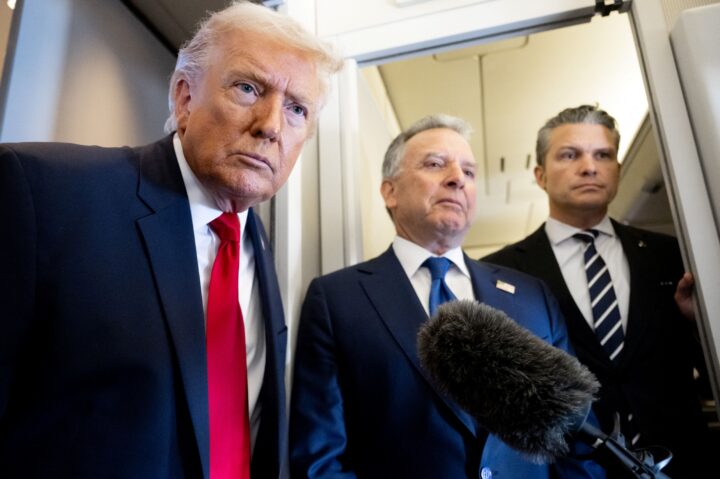
SAUL LOEB/AFP via Getty Images
President Donald Trump speaks with the media as Defense Secretary Pete Hegseth (R) and special envoy Steve Witkoff (C) look on aboard Air Force One during a flight from Dover, Delaware, to Miami, Florida, on March 7, 2026.
As the U.S. and Israeli war with Iran extends into its sixth week, the next 36 hours may be some of the most pivotal, offering clarity as to whether an end is in sight — or whether an escalation is imminent.
On the table now, according to Axios, is a proposed two-phased ceasefire deal, lasting 45 days, that would immediately reopen the Strait of Hormuz and give negotiators two to three weeks to reach a broader agreement to end the war. As a signal that the U.S. is open to the agreement, President Donald Trump extended by 24 hours the deadline for Iran to reopen the Strait, setting a new deadline of Tuesday night ET.
The core issues remain: Tehran’s closure of the key waterway, and the fate of the country’s enriched uranium. But a deal between Washington and Tehran would include broader issues, including potential sanctions relief in exchange for Tehran’s promise that it will not pursue nuclear weapons. Iran has signaled that it will not reopen the Strait for a temporary ceasefire and is seeking a more permanent resolution.
The president paired threats with optimism, leaning into the current debate with a mix of tough talk — warning yesterday that strikes targeting Iran’s power plants and bridges would take place on Tuesday in the absence of a deal — and hopes of an 11th-hour diplomatic breakthrough.
Trump doubled down on both sentiments yesterday in a flurry of interviews with reporters. “If they don’t make a deal, and fast, I am considering blowing everything up and taking over the oil,” Trump told Fox News’ Trey Yingst on Sunday morning. Yet the president said there was a “good chance” that a deal would be reached today — even as he posted “Tuesday, 8:00 P.M. Eastern Time!” on his Truth Social site, a reminder of the new deadline he had set for the Islamic Republic to reopen the Strait of Hormuz.
In comments to The Wall Street Journal, the president said that if the Iranians “don’t come through, if they want to keep it closed, they’re going to lose every power plant and every other plant they have in the whole country.”
Trump made the comments on the heels of the daring weekend rescue of an American weapons system operator who had been shot down inside Iran — the details of which the president is expected to share at an afternoon press conference today alongside senior military officials.
A diplomatic agreement would see a winding down of the war that would likely allow Iran to retain some of its ballistic missile capabilities — a compromise that is unlikely to sit well in Israel, which continues to face fire from Iranian forces.
On the other hand, Trump’s threatened destruction of key Iranian infrastructure could further deteriorate conditions in the Islamic Republic, where a regime-imposed internet blackout has ensured minimal on-the-ground reporting on weeks of war. And as always, the president has one eye on the markets, which will open today after the holiday weekend.
The U.S. and Israel have already made serious strategic strides by killing dozens of members of Iran’s senior leadership and severely crippling Tehran’s nuclear program. The question now is whether that will be enough for Trump to declare victory in accordance with the rough timeline he’s given for U.S. operations in Iran — or whether the U.S. will double down on its military operations.
Plus, judge rules against UPenn in antisemitism investigation
Haidar Mohammed Ali/Anadolu via Getty Images
Mourners carry the coffin of Kata'ib Hezbollah member on March 2, 2026 amid Kata'ib Hezbollah flags.
This P.M. edition is reserved for our premium subscribers — offering a forward-focused read on what we’re tracking now and what’s coming next. Please don’t hesitate to share your thoughts and feedback by replying to this email.
📡On Our Radar
Notable developments and interesting tidbits we’re tracking
President Donald Trump lashed out at European countries this morning for their posture during the war in Iran: He wrote on Truth Social that France is prohibiting planes with military supplies destined for Israel from flying over its territory, calling Paris “VERY UNHELPFUL … The U.S.A. will REMEMBER!”
Trump also named the U.K. among the countries “which refused to get involved in the decapitation of Iran” and are now struggling to acquire fuel due to the effective closure of the Strait of Hormuz. “[G]o to the Strait, and just TAKE IT. You’ll have to start learning how to fight for yourself, the U.S.A. won’t be there to help you anymore, just like you weren’t there for us,” the president warned…
Trump told the New York Post about reports that he’s willing to end the war without reopening the Strait of Hormuz: “I don’t think about it, to be honest. My sole function was to make sure that they don’t have a nuclear weapon. They’re not going to have a nuclear weapon. When we leave the strait will automatically open.”
He similarly said to CBS News about removing Iran’s enriched uranium, “I don’t even think about it. I just know that, you know, that’s so deeply buried it’s gonna be very hard for anybody. … It’s pretty safe. But, you know, we’ll make a determination”…
During a press briefing this morning, Defense Secretary Pete Hegseth revealed that he took a secret trip to the Middle East in recent days to meet with U.S. servicemembers, including Air Force intelligence analysts, Army troops and pilots.
CENTCOM also confirmed that Adm. Brad Cooper visited Israel earlier this week where he met with Defense Minister Israel Katz and Lt. Gen. Eyal Zamir, the IDF’s chief of staff…
Israel is ending all arms purchases from France and “replacing it with domestic Israeli procurement or purchases from allied countries,” the Israeli Ministry of Defense said today, adding that there will be “no new professional engagement with the French military” in the latest rift in the deteriorating relationship between Jerusalem and Paris…
A week after Lebanon declared Iran’s ambassador to Beirut persona non grata and expelled him from the country, the ambassador has still refused to leave the embassy compound, and Iran has stated that the embassy remains open…
China and Pakistan, which has been the intermediary for indirect negotiations between the U.S. and Iran, put forward a ceasefire proposal that would see the immediate cessation of hostilities, the safeguarding of nonmilitary targets and the restoration of transit through global shipping lanes…
American journalist Shelly Kittleson was kidnapped in Baghdad, Iraq, today, according to the Iraqi interior ministry, reportedly by Kataib Hezbollah, the same group that held researcher Elizabeth Tsurkov for over 900 days. Kittleson is a freelance journalist primarily based in Europe who has written for outlets including Al-Monitor and Foreign Policy.
Dylan Johnson, assistant secretary of state for global public affairs, said in a statement that the State Department “is aware of the reported kidnapping” and had “previously fulfilled our duty to warn this individual of threats against them.” Johnson said an “individual with ties” to Kataib Hezbollah “has been taken into custody” in connection with the kidnapping and that the department will coordinate with the FBI to secure Kittleson’s release…
New York City Mayor Zohran Mamdani attended a dinner for Eid last week where he spoke with antisemitic streamer Hasan Piker, a conversation that Piker called “very productive” on a recent Twitch stream.
“No, he did not disavow me,” Piker said in response to a listener’s question. “‘Did you tell him to tune out the bad faith haters?’ I did,” Piker continued. Mamdani appeared on Piker’s Twitch for an interview during the mayoral campaign but has not met with him publicly since…
“Nope,” Rep. Josh Gottheimer (D-NJ) said in response to a video of Sen. Bernie Sanders (I-VT) claiming that, “in many respects,” Piker “is doing a very good job.” “Hasan Piker is a proud antisemite … His voice should have no place in our political discourse and all elected officials should condemn his rhetoric,” Gottheimer wrote…
Michigan Attorney General Dana Nessel, a Jewish Democrat, shared an image of a sign which read, “A Jewish data center has no home here,” displayed outside a town hall she held yesterday urging caution around the approval of data centers. “If you think antisemitism isn’t a problem in Michigan, think again,” Nessel wrote…
A new poll commissioned by former Maine state Sen. Troy Jackson, now a Democratic candidate for governor, found oyster farmer Graham Platner — whom Jackson is backing — nearly 40 points ahead of Gov. Janet Mills in the state’s Senate race (66-28%) among likely Democratic primary voters. The survey was conducted after Mills had started running ads against Platner based on his past controversial statements, a sign that her line of attack may not be persuading voters…
And another poll commissioned by the Senate Majority PAC, a Democratic group, found Texas Attorney General Ken Paxton leading in the heated Republican primary runoff for Senate against incumbent Sen. John Cornyn (R-TX), 47-42%…
A federal judge ruled that the University of Pennsylvania must comply with a subpoena from the Trump administration that seeks information about Jewish university affiliates, which the university had said resembled nefarious efforts by governments over history to gather lists of Jews…
⏩ Tomorrow’s Agenda, Today
An early look at tomorrow’s storylines and schedule to keep you a step ahead
Keep an eye out in Jewish Insider for a report from West Bloomfield, Mich., where JI’s Gabby Deutch sat down with community members still reeling from the attack on Temple Israel earlier this month.
Democrat Analilia Mejia and Republican Joe Hathaway will participate in a debate tomorrow evening ahead of the April 16 special election in New Jersey’s 11th Congressional District, after Mejia eked out a surprise victory in last month’s primary. While this race will decide who serves out the rest of Gov. Mikie Sherrill’s House term, the progressive Mejia is also running essentially unopposed by other Democrats for the full term.
In observance of Passover, we’ll be back in your inbox with the Daily Overtime on Monday, April 6. Chag Pesach Sameach!
COMMUNITY TIGHTROPE
In an interview with JI, the state senator described herself as someone who supports the U.S.-Israel relationship, but not unconditionally
DECISION TIME

As the president touts progress in talks with Tehran while escalating military pressure, analysts say the administration is keeping its options open — but will need to make a move soon
Plus, no Modi-Ani for Mamdani
Alex Wong/Getty Images
A visitor holds an AIPAC folder in an elevator in Rayburn House Office Building on March 12, 2024 on Capitol Hill in Washington, DC.
👋 Good Tuesday morning!
In today’s Daily Kickoff, we break down two new polls on American Jewish support for the war in Iran, and report on the Democratic National Committee’s upcoming vote on a resolution condemning AIPAC and Israel. We talk to Sen. Elissa Slotkin about the role of the government in responding to antisemitic attacks, and talk to experts about the Trump administration’s options vis-a-vis a ground operation in Iran. Also in today’s Daily Kickoff: Amb. Charles Kushner, Betsy Berns Korn and Matthew Bronfman.
Today’s Daily Kickoff was curated by JI Executive Editor Melissa Weiss and Israel Editor Tamara Zieve, with assists from Danielle Cohen-Kanik and Marc Rod. Have a tip? Email us here.
What We’re Watching
- Defense Secretary Pete Hegseth and Chairman of the Joint Chiefs of Staff Gen. Dan Caine are holding a press conference on the war in Iran at 8 a.m. ET.
- New York City Mayor Zohran Mamdani is meeting this morning in New York with U.N. Secretary-General António Guterres.
- Elsewhere in New York, Sen. Cory Booker (D-NJ) — on the one-year anniversary of his 25-hour record-breaking speech on the Senate floor — is speaking at Manhattan’s Temple Emanu-El tonight about his new book, Stand.
What You Should Know
A QUICK WORD WITH JI’S JOSH KRAUSHAAR
Two new polls of Jewish voters released this week show broad opposition to the U.S. military action against Iran, with support for the operation highest among those who are the most connected to Israel and those who are most affiliated with Jewish institutions.
A Mellman Group poll on behalf of the Jewish Electoral Institute (JEI) found that 32% of Jewish voters back the current military action against Iran, while 55% disapprove and 13% remain undecided. Support tracked closely along partisan lines, with 83% of Republicans, 49% of independents and 13% of Democrats approving the war.
Among those who said they were very connected to Israel, the poll found nearly two-thirds of Jewish respondents supportive, with just 27% opposed. But among those only “somewhat” connected to Israel, 58% said they disapprove of the war with just 25% approving. Nearly all of those Jewish respondents unconnected to Israel said they disapprove of the military action against Iran.
SINGLED OUT

The Democratic National Committee’s resolutions committee is set to consider resolutions condemning AIPAC and Israel at its upcoming meeting next week in New Orleans — a sign of the continued and growing discord in the party over Middle East policy. It’s unclear how great of a chance the resolutions stand of passing in their current form, but they are emerging as the AIPAC brand has been tarnished inside the Democratic Party, Jewish Insider’s Marc Rod reports.
What it says: “The use of massive outside spending to support or oppose candidates based on their positions regarding international conflicts or foreign governments raises concerns about undue influence over democratic debate and policymaking, potentially constraining elected officials’ ability to represent the views of their constituents including the American Israel Public Affairs Committee (AIPAC) spending approximately $14 million in a single Illinois Democratic primary,” the resolution, obtained by JI, reads.
COMMUNITY TIGHTROPE
In the Democratic primary for U.S. Senate in Michigan, state Sen. Mallory McMorrow appears to be trying to carve out a lane between her opponents Rep. Haley Stevens (D-MI), a moderate pro-Israel stalwart, and public health official Abdul El-Sayed, a far-left candidate. In an interview with Jewish Insider’s Gabby Deutch in a coffee shop near Detroit last week, McMorrow described herself as someone tuned in to the fears of Jewish Michiganders who is also trying to be a bridge-builder to the state’s large Arab community.
Reaching out: Last week, following the attack on Temple Israel earlier this month, McMorrow said, “I made it a point to reach out and talk to not only members in Temple Israel and leaders in the Jewish community, but also leaders out of the Muslim community, particularly over in Dearborn. What I heard independently from both groups is we need to figure out a way out of this, that there is so much hurt and there is so much pain, and this is not sustainable. There is a desire to bring the heat down, but we have to recognize as leaders, we need to create open doors for people to work through their trauma.”
SECURITY MINDED
Sen. Elissa Slotkin (D-MI) proposed ways for Congress and the federal government to better respond to the threat of violent, antisemitic extremism, during an interview with Jewish Insider’s Gabby Deutch in her Capitol Hill office last week. But even as she discussed ways to take action, she spoke with alarm about the growing prevalence of antisemitism on both sides of the aisle, which she described as out of control. And she was clearly shaken by an attack that was potentially inches away from being much worse.
Soft targets: “I think it could have been one of the worst mass killing events in U.S. history were it not for the private security that happens to be very top-notch there, and everyone doing their jobs almost perfectly,” Slotkin said of the attack on Temple Israel, a Reform synagogue in West Bloomfield Township, Mich. “I think it just has contributed to a feeling for many inside the state that the very things that make Jewish life valuable are becoming the soft targets.”
Terror ties: The FBI determined that the attack on Temple Israel was “a Hezbollah-inspired act of terrorism purposely targeting the Jewish community and the largest Jewish temple in Michigan,” officials said on Monday, JI’s Haley Cohen reports.
decision time

The Trump administration’s conflicting posturing on the war in Iran — insisting on the one hand that a diplomatic deal is within reach while also threatening to escalate strikes and potentially deploy ground troops — has left experts and former administration officials uncertain about President Donald Trump’s next move, Jewish Insider’s Matthew Shea and Emily Jacobs report. In recent days, the U.S. has amassed over 3,500 more troops in the Middle East, including deploying the USS Tripoli aircraft carrier, which hosts around 2,500 Marines.
Options open: Elliott Abrams, who served as Iran envoy under the first Trump administration and is now a senior fellow at the Council on Foreign Relations, told JI that the president’s decision to move more troops to the region and not exclude ground operations from future military plans is an effort to “keep his options open.” Abrams said, “The massing of ground forces near Iran is both preparation for their possible use and a means of pressuring Iran to make concessions in the negotiations. There is no way of knowing what Trump will do if the negotiations fail.”
WHACK-A-MOLE

An AI-generated Instagram account, which featured a fake Orthodox rabbi spreading antisemitic conspiracies to its more than 1.4 million followers, was taken offline over the weekend following major backlash from Jewish groups and one Democratic lawmaker — yet several similar, hate-peddling accounts have emerged with little to no public action from Meta, Jewish Insider’s Haley Cohen reports.
Rabble-rousing ‘rabbis’: An account called “Rabbi Goldman” “uses fake, AI-created authority figures to spread hate” in “a troubling and growing tactic,” according to a report published last week by Combat Antisemitism Movement. Several new Rabbi Goldman accounts started posting similar videos within the past two weeks — two already have followings of 18,500 and 10,000. Both remain active on Instagram and their bios state, “only Backup account for @rabbigoldman” and “old account got banned.” The CAM report identified 12 AI-generated “rabbis” with a combined following of 2.1 million Instagram users, all of which promote classic antisemitic stereotypes.
news to me
Israeli-American comedian Modi Rosenfeld, known simply as “Modi,” pulled out of a Passover-themed benefit last night after his manager revealed that the entertainer had been “blindsided” with the news that New York City Mayor Zohran Mamdani would participate in the Lower Manhattan event, Jewish Insider’s Will Bredderman reports.
Pulling out: Quoting JI’s initial report on the mayor’s scheduled involvement in the 33rd Annual “Downtown Seder” at impresario Michael Dorf’s venue City Winery, Rosenfeld’s official Instagram account announced the Tel Aviv-born, Long Island-reared performer had withdrawn from the event. “We were not told Mamdani was participating in this event until today,” the post read. “Modi will no longer be attending.”
Worthy Reads
Rahm’s Remedy: In The Wall Street Journal, former U.S. Ambassador to Japan Rahm Emanuel, who is mulling a 2028 presidential bid, argues that Democrats should maximize their potential takeovers of the House and Senate in this year’s midterm elections to put forward a positive agenda in an effort to win back the White House in 2028. “Many presume we will use the power from winning the House and possibly the Senate primarily for retribution and vindictiveness. The implication is that we will tie up the White House, and the Trump administration more generally, in an endless series of investigations. Democrats should play against type, defying the expectation that we’ll embrace gotcha politics. No doubt it’s a target-rich environment. But an excessive focus on Trumpian slime will undermine efforts to promote our positive agenda.” [WSJ]
Seeking Scientists: The New Yorker’s David Kirkpatrick spotlights former CIA operative Kevin Chalker, who claims to have played a key role in U.S. efforts to obtain information about Iran’s nuclear program. “Chalker was asked to come up with a plan to recruit other scientists, and began by reading old cable traffic about how the agency had handled Soviet defectors in the John le Carré days. … Cumulatively, Chalker’s defectors contributed to what several former senior officials told me had been a dramatic leap forward in the U.S. government’s understanding of Iran’s nuclear ambitions in those years. The consequences were manifold.” [NewYorker]
Power of Prayer: Bloomberg’s Ethan Bronner looks at the increasing number of young Israelis who have become more religious since the Oct. 7, 2023, Hamas terror attacks and ensuing wars in the region. “The scene of combat soldiers expressing pious fervor, captured on cellphones and shared widely on social media, would have been unimaginable a decade or two ago, when the infantry still leaned heavily toward secular rather than observant conscripts. ‘The real result of October 7 is Jews becoming more Jewish, people reclaiming their identity,’ says Sivan Rahav-Meir, a popular television news personality.” [Bloomberg]
The Politics of Giving: In The New York Times, Craigslist founder Craig Newmark pushes back on recent criticism from Silicon Valley of the Giving Pledge over complaints that some who sign the pledge have committed their money to left-wing groups. “The truth is that pledge signers can give their money to whichever charitable causes they want. I don’t understand the critics’ logic, but politics and that sort of criticism have never really made much sense to me. I really am a nerd. … I don’t get into fights over what’s woke and what’s not. Because I don’t know the answer, nor do I care. I use the money I made to help people who are trying to make life better for all of us humans.” [NYTimes]
Word on the Street
Washington’s Gulf allies, led by Saudi Arabia and the United Arab Emirates, have reportedly been pushing the White House to continue its fight against the regime in Iran; the countries, which also include Bahrain and Kuwait, are lobbying for a change in Iranian leadership before the end of Western military operations in the country, while Oman and Qatar are pushing a quick diplomatic resolution…
The push from the Gulf comes as President Donald Trump has reportedly told staffers that he was willing to end military operations without Iran fully reopening the Strait of Hormuz…
The U.S. used 2,000-pound bunker-buster bombs to strike a weapons depot overnight in the Iranian city of Isfahan…
An Iranian drone struck a Kuwaiti oil tanker off the coast of Dubai early Tuesday morning, starting a fire on board the fully laden vessel…
NYU closed its Abu Dhabi campus until further notice after Iran threatened over the weekend to attack outposts of American universities in the Gulf…
The Financial Times looks at efforts by Iranian and Iran-linked hackers, many of whom are tied to the Islamic Revolutionary Guard Corps and Iran’s Ministry of Intelligence, to break into U.S. and Israeli tech systems…
Twenty-five Senate Democrats, led by Sen. Raphael Warnock (D-GA) urged the Senate Armed Services Committee to investigate the alleged U.S. bombing of an Iranian girls’ school adjacent to an IRGC base…
Jewish Israelis’ support for the war against Iran dropped by 15 points from the first week of the war, according to a poll released by the Israel Democracy Institute on Monday, Jewish Insider’s Lahav Harkov reports…
Politico reports on deepening concerns over social media posts from Rama Duwaji, the wife of New York City Mayor Zohran Mamdani, praising Hamas and using racist language — including from progressive allies of the mayor, who has defended his wife as a “private person” despite her residence in Gracie Mansion and use of taxpayer funds for police detail and government staff…
A federal grand jury indicted six people on hate crime charges in connection with the 2024 assault of a Jewish student at the University of Pittsburgh…
U.S. Ambassador to France Charles Kushner met in Paris with Israeli pastry chef Tal Spiegel, who with his French business partner is offering kosher pastries at their ABRA Patisserie in the city’s 4th arrondissement…
Canada’s New Democrats party elected former journalist Avi Lewis, who is Jewish and anti-Zionist, as its new leader…
Sysco is acquiring 94-year-old Jewish businessman and philanthropist Nathan Kirsh‘s Jetro Restaurant Depot in a $29.1 billion deal…
The Knesset passed a controversial law on Monday allowing — and in some cases requiring — courts to impose the death penalty on terrorists found guilty of murder; opponents swiftly challenged the legislation in court, with appeals arguing that its designations are vague and discriminatory, Jewish Insider‘s Lahav Harkov reports…
Israel’s Shin Bet said it foiled a West Bank terror plot being directed by a Hamas operative in Turkey who was freed in one of last year’s deals that saw the release of Israeli hostages in exchange for Palestinian prisoners…
Former Egyptian Foreign Minister Nabil Fahmy was nominated to be the next secretary-general of the Arab League; Fahmy’s nomination is expected to be endorsed at the next Arab summit meeting and assume the role in July…
Betsy Berns Korn was nominated to serve a second yearlong term as chair of the Conference of Presidents of Major American Jewish Organizations, effective June 1; Matthew Bronfman was nominated to be the Conference’s chair-elect…
Edward Kaplan, the former longtime head of the Maryland Public Broadcasting Commission, died at 87…
Pic of the Day

New York Gov. Kathy Hochul participated in a mock Seder organized by Teach NYC earlier this week at Yeshivah of Flatbush in Brooklyn. Joining Hochul were Teach Coalition CEO Sydney Altfield, Rabbi Yahel Tsaidi and Yeshivah of Flatbush Executive Vice President Rabbi Jeffery Rothman.
Birthdays
Emmy Award-winning writer and producer (“24,” “Homeland” and “Tyrant”), Howard Gordon turns 65…
Music producer, band leader of the Tijuana Brass, Herb Alpert turns 91… New York Times best-selling novelist, poet and social activist, Marge Piercy turns 90… Democratic congressman from Massachusetts for 32 years, named co-sponsor of the 2010 Dodd-Frank Act, Barnett “Barney” Frank turns 86… U.S. senator for 48 years until 2023, Patrick Leahy (D-VT) turns 86… Former syndicated talk radio host on 400+ stations and conservative political commentator under the name Michael Savage, Michael Alan Weiner turns 84… U.S. Sen. Angus King (I-ME) turns 82… Comedian, actor and professional poker player, he played the named teacher in the 1970s sitcom “Welcome Back, Kotter,” Gabe Kaplan turns 81… Retired professor of special education at Long Island University, Joel E. Mittler… Emmy Award-winning movie and television actress, best known for her role in the sitcom “Cheers” for 11 seasons, Rhea Jo Perlman turns 78… Russian ice dancing coach and former competitive ice dancer, now living in Stamford, Conn., Natalia Dubova turns 78… Chairman of Apple, Inc. since 2011 and CEO of Calico (an Alphabet R&D biotech venture), Arthur D. Levinson turns 76… New Jersey attorney, Steven L. Sacks-Wilner… Scottsdale, Ariz., resident, David L. Freedman… Chairman of Danaher Corporation, he owns a 20% stake in the NBA’s Indiana Pacers, Steven M. Rales turns 75… Israeli singer and songwriter, Ehud Banai turns 73… Former deputy chairman at the Jewish Agency for Israel, David Breakstone, Ph.D. turns 73… Author and advertising executive, Joseph Alden Reiman turns 73… President at the Detroit-based Nemer Property Group, Larry Nemer… Rabbi of Kehillas Ohr Somayach and lecturer at Ohr Somayach Yeshiva in Jerusalem, Rabbi Yitzchak Breitowitz turns 72… Equestrian and 10-time American Grand Prix Association Rider of the Year, she is a 2009 inductee into the International Jewish Sports Hall of Fame, Margie Goldstein-Engle turns 68… Founding director of the Illinois Holocaust Museum and national campaign director of the West Coast and Mountain States for the Jewish National Fund, Rick Hirschhaut turns 66… Consultant for synagogues and teacher at Bruriah High School in Elizabeth, N.J., Judah E. Isaacs… Two-term mayor of Chattanooga, Tenn., until 2021, he is now administrator of the Rural Utilities Service at the U.S. Department of Agriculture, Andy Berke turns 58… Former child actor, now an attorney and celebrity brand consultant, Josh Saviano turns 50… Rabbi of the Ashkenazi Jewish community of Turkey, Menachem Mendel Chitrik turns 49… Chief legal correspondent at MS NOW, Ari Naftali Melber turns 46… Former footballer for Beitar Jerusalem, who has also played for Chelsea, Manchester City and West Ham United in the English Premier League, Tal Ben Haim turns 44… Internet entrepreneur who is the co-founder and former CMO of Tinder, Justin Mateen turns 40… British-French journalist and author, he was a political advisor to the U.K. Deputy Prime Minister David Lammy, Ben Judah turns 38… Jerusalem-born, 2010 contestant on “America’s Next Top Model,” she went on to join the IDF, Esther Petrack turns 34… Agency partnerships lead at Samsung, Howie Keenan… Ice hockey defenseman for the Washington Capitals, Jakob Chychrun turns 28… Talmudic scholar, Avigdor Neuberger… John Jacobson…
Support for the operation is highest among those who are the most connected to Israel and those who are most affiliated with Jewish institutions
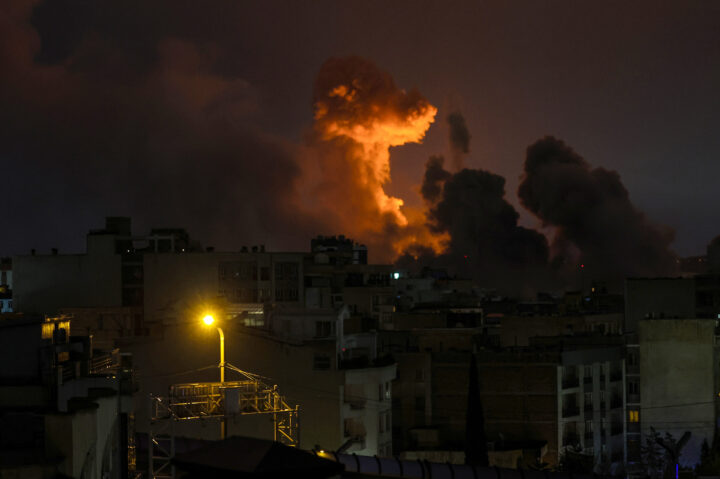
Getty Images
A large plume of smoke rises over Tehran after explosions were reported in the city during the night on March 28, 2026 in Tehran, Iran.
Two new polls of Jewish voters released this week show broad opposition to the U.S. military action against Iran, with support for the operation highest among those who are the most connected to Israel and those who are most affiliated with Jewish institutions.
A Mellman Group poll on behalf of the Jewish Electoral Institute (JEI)found that 32% of Jewish voters back the current military action against Iran, while 55% disapprove and 13% remain undecided. Support tracked closely along partisan lines, with 83% of Republicans, 49% of independents and 13% of Democrats approving the war.
Among those who said they were very connected to Israel, the poll found nearly two-thirds of Jewish respondents supportive, with just 27% opposed. But among those only “somewhat” connected to Israel, 58% said they disapprove of the war with just 25% approving. Nearly all of those Jewish respondents unconnected to Israel said they disapprove of the military action against Iran.
Support also was strongest based on those who are more religiously observant. The vast majority of Orthodox Jews (83%) approve of President Donald Trump’s military action, with just 11% opposing. But among Conservative Jews, opinion is more evenly split, with 40% approving and 48% disapproving. And among Reform Jews, support is the lowest, with just 24% approving and 67% disapproving.
There’s also a pronounced gender divide within the Jewish community: 40% of Jewish men support the military action against Iran, with 49% opposing. But among women, only 26% approve of the war in Iran, with 59% opposing.
The poll also found a significant share of Jewish Democrats (28%) and independents (29%) who said they feel “torn” about the war — agreeing that Iran is a threat to peace but disagreeing with Trump’s handling of the operation.
The “torn” constituency, which makes up 23% of the Jewish vote, generally draws from those who said they were opposed to the war in the end. When the “torn” constituency is broken out, there’s a more even divide between those who support the war (31%) and those who oppose it (41%).
The Mellman Group poll surveyed 800 Jewish voters between March 13-22.
A separate poll of Jewish voters, conducted by GBAO for the progressive Israel advocacy group J Street, found a similar response towards the war in Iran: A 60% majority of Jewish voters disapprove of U.S. military action against Iran, while 40% support the war. Of note: A sizable 20% minority of Jewish Kamala Harris voters expressed support for Trump’s military action.
The J Street poll, notably, found higher support for the war among Conservative Jews, with 62% supporting and 38% opposing. It also found moderate Jews nearly evenly split, with 51% of self-described moderates in support, and 49% opposed.
The survey also asked whether U.S. military action makes Israel more or less secure, and found a 45% plurality agreeing that it helped Israel’s defense, with 36% concluding it made Israel less safe. But a 58% majority also said that the war weakened the United States, with only 30% believing it strengthened American national security.
The J Street poll also found that 77% of Jews don’t think Trump has a clear plan and mission for the war in Iran.
And it found that 70% of Jewish respondents said their sympathies are more with the Israelis, with 30% expressing more sympathy with the Palestinians. Asked about Israeli Prime Minister Benjamin Netanyahu, 28% of Jewish respondents said they viewed him favorably, with 66% viewing him unfavorably.
As the president touts progress in talks with Tehran while escalating military pressure, analysts say the administration is keeping its options open — but will need to make a move soon

U.S. Navy via Getty Images
A U.S. Sailor signals the launch of an MH-60R Sea Hawk helicopter, attached to Helicopter Maritime Strike Squadron 70, on the flight deck of the world's largest aircraft carrier, USS Gerald R. Ford (CVN 78), while supporting Operation Epic Fury on February 28, 2026.
The Trump administration’s conflicting posturing on the war in Iran — insisting on the one hand that a diplomatic deal is within reach while also threatening to escalate strikes and potentially deploy ground troops — has left experts and former administration officials uncertain about President Donald Trump’s next move.
The president threatened in a post on his Truth Social platform on Monday morning to “conclude our lovely ‘stay’ in Iran by blowing up and completely obliterating all of their electric generating plants, oil wells and Kharg Island” if current talks fall apart and “the Hormuz Strait is not immediately ‘Open for Business.’”
But he wrote in the same post that the U.S. is engaging in “serious discussions” with Iran’s current leadership, which he described as a “new” and “more reasonable” regime than its predecessor, and said that “great progress has been made.”
Reached for comment, the White House referred Jewish Insider to Press Secretary Karoline Leavitt’s remarks at Monday’s briefing where she defended the president’s approach and repeatedly stated that Trump and his advisors are merely ensuring he has “maximum optionality” as he considers next steps.
“With respect to forces that are on the ground in the Middle East, it’s the job of the Pentagon to create maximum optionality for the commander-in-chief. It does not mean the president has made any additional decisions,” Leavitt said, adding that Trump has “decline[d] to rule … out” the use of ground troops.
On Capitol Hill, there are increasingly evident divides among Republican lawmakers about the prospect of boots on the ground. Some have argued that a ground operation would require explicit congressional authorization, and a number of otherwise-hawkish Republicans are hesitant about, if not outright opposed to, the idea of a ground operation.
In recent days, the U.S. has amassed over 3,500 more troops in the Middle East, including deploying the USS Tripoli aircraft carrier, which hosts around 2,500 Marines. Trump has also threatened to attack Iran’s oil and energy facilities and potentially escalate the war as a result of Iran’s blockade of the Strait of Hormuz — a vital passageway for the global oil trade.
Elliott Abrams, who served as Iran envoy under the first Trump administration and is now a senior fellow at the Council on Foreign Relations, told JI that the president’s decision to move more troops to the region and not exclude ground operations from future military plans is an effort to “keep his options open.”
“The massing of ground forces near Iran is both preparation for their possible use and a means of pressuring Iran to make concessions in the negotiations,” Abrams said. “There is no way of knowing what Trump will do if the negotiations fail.”
The administration is considering multiple options for the use of ground troops, including the seizure of Kharg Island, a vital economic artery for Tehran that accounts for roughly 90 percent of the country’s crude exports.
Cameron McMillan, a senior research analyst at the Foundation for Defense of Democracies, said that targets could also include the “seizure of key terrain — including relevant islands — in and around the Strait of Hormuz and securing Iranian highly enriched uranium.” However, he remained unsure whether the Trump administration would carry out such operations.
“Seizing or destroying the [highly enriched uranium] is a sensible goal if it is militarily feasible without too much risk,” Abrams said. “Taking the targets associated with the strait is, I think, both for bargaining purposes and perhaps meant to be given up only when traffic has moved through the strait freely for some time.”
Jonathan Ruhe, a fellow at the Jewish Institute for National Security of America, said that there are “real reasons to think ground operations could end up taking place.” He said that Iran “refuses to entertain Trump’s demands,” which could compel the administration to use elevated means of force in order to seize Iran’s highly enriched uranium, reopen the Strait of Hormuz or take Kharg Island “or other assets as bargaining chips.”
“The past month reaffirms that standoff air and naval power are insufficient by themselves to neutralize these targets or convince Iran to give them up,” Ruhe said. “Trump’s tendency is to employ the forces that he deploys overseas, as seen in both the Venezuela operation and the start of the current conflict. And there’s an opportunity cost to letting such well-trained U.S. forces idle indefinitely in the Middle East after pulling them from the Indo-Pacific or the homeland.”
Daniel Shapiro, a former U.S. ambassador to Israel under President Barack Obama and deputy assistant secretary of defense for the Middle East under President Joe Biden, said current talks between Washington and Tehran “look like a negotiation going nowhere.” He argued that Trump’s track record of pivoting to military action when diplomacy stalls, along with pressure to decide whether to use forces that cannot remain in the region indefinitely, suggest that ground operations could be looming.
“There is little chance that Iran, despite all punishment it has taken from U.S. and Israeli airstrikes, will make these concessions … If the [current] negotiations falter, it’s not hard to guess which way [Trump] will go,” Shapiro said.
Shapiro said that the current moment has a “similar feel to the military build-up Trump ordered throughout February” before he launched the war at the end of the month. Shapiro cautioned that any use of ground forces would indicate a “longer war” and signal that the objectives of the war are expanding “far beyond what negotiations in February were seeking to achieve.”
“With the ground forces available, they can’t just park in the region for long. Trump will, sooner than later, need to decide whether to use them or send them home,” Shapiro added.
Meanwhile, McMillan cautioned against ground operations, “especially those designed to secure and hold terrain.”
“I do not see any value in employing these forces to seize Iranian territory and would highly caution against ground operations,” McMillan said. “All of the desired objectives — with the exception of securing highly enriched uranium — can be secured through other means with substantially less risk. Seizing tankers is the most obvious if [the administration] is seeking to cut off Iran’s oil revenue.”
He also warned that the current forces being deployed might “not be enough for any large-scale ground operations for any long duration.”
“Simply deploying these units is unlikely to leverage Iran at the negotiating table, as the regime is fighting a total war that it views as existential,” McMillan continued. “Considering the profound impacts of U.S.-Israeli strikes on Iran’s ballistic missile, drone and naval capabilities, as well as its senior leadership, it is unlikely that a few more American battalions in the region will change that view or their will to continue fighting.”
Ruhe noted that Trump could be overlooking the potential costs of ground operations. He said that the president “has not adequately anticipated Iran’s retaliation” and is “discounting the uncertainties and risks of rolling the iron dice with ground operations.”
“And even if Trump is clear-eyed about the risks, he may accept them because getting the highly enriched uranium [HEU] and reopening the strait are such important goals,” he continued. Ruhe noted that such operations would likely be very complex.
“Seizing Iran’s HEU at Isfahan, Kharg Island or beachheads along the strait would be larger and more open-ended than raids on Maduro, al-Baghdadi or Bin Laden, which were in-and-out and occurred in much more tactically permissive environments,” Ruhe said. “Though Iran is being hit hard, it still has much greater military capabilities than ISIS, Venezuela or the Taliban.”
McMillan said that ground operations could also provide Tehran with leverage and risk further expanding the conflict. He also noted that any ground operation designed to seize and hold terrain in Iran is “more likely to become a liability than an asset and would draw the Trump administration closer to the war of attrition that it is trying to avoid.”
“Instead of the U.S. securing leverage, Iran would likely gain significant leverage against the U.S. by being able to employ a greater part of its arsenal against a vulnerable and isolated U.S. troop presence,” McMillan said. “If those troops were to take consistent casualties against threats that could not be removed from the air alone, expanded ground operations in the name of force protection would not be hard to imagine. That would require more forces, more resources and, in turn, likely more casualties.”
However, Richard Goldberg, a former Trump administration official, said that the use of ground operations does not necessarily signal that there will be an expanded presence and scope of U.S. involvement.
“People hear ‘boots on the ground’ and immediately think of Iraq, but we had boots on the ground in Venezuela as well — just in a very different way,” Goldberg said. “The U.S. would not be invading Iran in the sense of Iraq, but you could see a number of contingencies that might require special forces, airborne or marines for narrowly scoped missions with limited objectives, whether that’s securing nuclear material or neutralizing a threat that you can’t neutralize from the air for a variety of reasons.”
“It’s also important to remember that the military is preparing for contingencies, which may or may not ever be needed,” Goldberg added, noting that the U.S. “had Marines off of Venezuela but we didn’t use them.”
Jewish Insider’s senior congressional correspondent Marc Rod contributed to this report.
Plus, one AI rabbi down but more pop up

Emily Elconin/Getty Images
Caution tape near the front entrance of Temple Israel a day after an active shooter incident on March 13, 2026 in West Bloomfield, Michigan.
This P.M. edition is reserved for our premium subscribers — offering a forward-focused read on what we’re tracking now and what’s coming next. Please don’t hesitate to share your thoughts and feedback by replying to this email.
📡On Our Radar
Notable developments and interesting tidbits we’re tracking
President Donald Trump doubled down on threats to escalate the war in Iran while simultaneously heralding the success of ongoing negotiations: He claimed on Truth Social this morning that the U.S. is in “serious discussions” with a “new” and “more reasonable” Iranian regime and that “great progress has been made.”
“But,” he added, “if for any reason a deal is not shortly reached, which it probably will be, and if the Hormuz Strait is not immediately ‘Open for Business,’ we will conclude our lovely ‘stay’ in Iran by blowing up and completely obliterating all of their Electric Generating Plants, Oil Wells and Kharg Island (and possibly all desalinization plants!)”…
Trump confirmed to the New York Post that the U.S. is engaging with Iranian parliament speaker Mohammad Bagher Ghalibaf and assessing whether he’s a reliable partner: “We’re gonna find out. I’ll let you know that in about a week.” He also said the U.S. believes new Supreme Leader Mojtaba Khamenei is “probably” alive “but in extraordinarily bad shape” after he was injured in an airstrike…
Treasury Secretary Scott Bessent claimed in a Fox News interview that the U.S. is “going to retake control of the straits and there will be freedom of navigation, whether it is through U.S. escorts or a multinational escort”…
A series of surveys released today reveal how Jews and Israelis are perceiving the war in Iran: A poll conducted by the Mellman Group found 55% of American Jews oppose the war while 32% are in favor. Another poll of American Jews, solicited by J Street, found 60% of respondents opposed and 40% in support.
In Israel, meanwhile, a poll released by the Israel Democracy Institute found that the war is losing some support among Israelis, Jewish Insider’s Lahav Harkov reports. In the first week of the war, 93% of Jewish Israelis supported continuing it, while in the latest poll — conducted nearly a month into the war — 78% support it. Nearly three times as many Israeli Jews (12%) now oppose the war as did at the beginning of March (4%)…
The FBI announced findings that the attack on Temple Israel in suburban Detroit earlier this month was “a Hezbollah-inspired act of terrorism purposely targeting the Jewish community and the largest Jewish temple in Michigan.” The brother of the assailant was a Hezbollah commander who had been killed in Lebanon by the IDF the week before the attack…
Michigan Democratic Senate candidate Abdul El-Sayed told campaign staff that he did not want to take any public position on the killing of former Iranian Supreme Leader Ayatollah Ali Khamenei at the beginning of the war because “there are a lot of people in Dearborn who are sad,” according to meeting audio obtained by The Washington Free Beacon.
If asked by reporters, El-Sayed said his strategy would be to “go straight to pedophilia, frankly. I’ll just be like, ‘Pedophile president decides that he doesn’t like the front page news, so he decides to take us into another war’”…
Allies of New York City Mayor Zohran Mamdani told Politico that the mayor’s dismissal of criticisms of his wife, Rama Duwaji, for her past extreme rhetoric and social media posts — calling her “a private person” — doesn’t comport with Duwaji’s very public profile.
“‘She is the first lady of New York City. She has a police detail and a government staff,’ said one of the elected officials, who believes Duwaji should explain herself publicly. ‘She would need to do an interview, better explain herself, and have her do some visits and meetings with key constituencies, like Jewish museums’”…
An AI-generated Instagram account, which featured a fake Orthodox rabbi spreading antisemitic conspiracies to its more than 1.4 million followers, was taken offline over the weekend following major backlash from Jewish groups and one Democratic lawmaker — yet several similar, hate-peddling accounts have emerged with little to no public action from Meta, JI’s Haley Cohen reports.
Several new Rabbi Goldman accounts started posting similar videos within the past two weeks — two of which already have followings of 18,500 and 10,000. Both remain active on Instagram and their bios state, “only Backup account for @rabbigoldman” and “old account got banned”…
The Knesset passed a controversial law today allowing courts to impose the death penalty on convicted terrorists found guilty of murder, JI’s Lahav Harkov reports.
The law, championed by National Security Minister Itamar Ben-Gvir, applies in military courts to non-Israeli residents of the West Bank — meaning, in the vast majority of cases, Palestinians. In civilian courts, the law permits applying the death penalty to those who “intentionally cause the death of a person with the aim of denying the existence of the State of Israel” — language which would also likely exclude Jewish assailants. Critics say it will likely be struck down by the High Court…
The Times of Israel breaks down the legislative maneuver used in Knesset by the coalition that caused opposition members to accidentally vote in favor of allocating 800 million shekels (~$250 million USD) to Haredi schools as they passed the state budget this morning…
In an interview on Israel’s Channel 12, Ukrainian President Volodymyr Zelensky said he has barely spoken to Israeli Prime Minister Benjamin Netanyahu since their last meeting at the United Nations General Assembly in September 2023…
⏩ Tomorrow’s Agenda, Today
An early look at tomorrow’s storylines and schedule to keep you a step ahead
Keep an eye out in Jewish Insider for a look at the resolution coming under consideration by the Democratic National Committee that explicitly criticizes AIPAC’s political spending.
The House and Senate left for recess until mid-April, after failing to come to an agreement to fund the Department of Homeland Security, which has now reached its longest-ever shutdown. Calls have already begun from at least one Republican senator to bring Congress back into session sooner, but prospects for an early return are currently unclear.
Sen. Cory Booker (D-NJ) will speak at Temple Emanu-El in New York City tomorrow about his new book, Stand, on the one-year anniversary of his delivery of the longest-ever speech on the Senate floor.
SEAT SHAKE-UP
The lawmaker, who may soon be expelled from the chamber, is already in a heated primary race with Elijah Manley, a young far-left candidate endorsed by TrackAIPAC
PHONE A FRIEND

The sister, niece and brother-in-law of Maoist magnate Neville ‘Roy’ Singham have gained influence in New York’s ascendant socialist movement
Three out of four Jewish Israelis back the war, down 15 points since the first week of the war

Ori Aviram / Middle East Images / AFP via Getty Images
Israelis take shelter in an underground metro station in Ramat Gan, in Israel's Tel Aviv District, on February 28, 2026.
Jewish Israelis’ support for the war against Iran dropped by 15 points from the first week of the war, according to a poll released by the Israel Democracy Institute on Monday.
In the first week of the war, 93% of Jewish Israelis supported continuing the war, while in the latest IDI poll — conducted nearly a month into the war — 78% support it. More than twice as many Israeli Jews (11.5%) oppose the war as did at the beginning of March (4%).
As at the start of the war, only a minority of Arab Israelis are in favor of it, with their support dropping from 26% to 19%.
Most Israelis said Iran was more resilient than anticipated, with 56% of Jewish Israelis and 51% of Arab Israelis answering in the affirmative.
Most Jewish Israelis (62%) said that Prime Minister Benjamin Netanyahu launched Operation Roaring Lion against Iran for strategic and security-related reasons, while most Arab Israelis (55%) said he was motivated by personal and political considerations.
Over a third (35%) of Jewish Israelis said that the war against Iran would be sustainable in Israeli society for a month, while 28% said Israelis can bear it as long as needed to meet the operation’s goals. Among Arab Israelis, 33% said Israelis could endure the war for a month, while only 5% said the Israeli public can sustain it as long as needed.
At the same time, there was a rise in hope among Israelis: When respondents were asked for their outlooks in four areas, optimism about social cohesion was up eight percentage points from last month, reaching 30%; optimism about the economy rose to 34% from 31%; and optimism and the future of democracy reached 44%, up from 39%. Optimism about national security stayed about the same at 47%.
The vast majority of Arab Israelis reported that their mental health (85%) and financial situation (89%) had deteriorated, a slight increase from the last time IDI asked the poll question in November. Among Jewish Israelis, 43% reported a deterioration in their mental state and 36% in their financial situation, almost identical to the November 2025 findings.
The poll was conducted among a sample of 756 Israeli adults from March 22-26, with a 3.56% margin of error.
The sister, niece and brother-in-law of Maoist magnate Neville ‘Roy’ Singham have gained influence in New York’s ascendant socialist movement

John Lamparski/Getty Images
Then-New York City mayoral candidate Zohran Mamdani speaks during the Jews For Racial And Economic Justice's Mazals Gala on September 10, 2025 in New York City.
Relatives of a Shanghai-based software magnate devoted to promoting Chinese, Iranian and Russian interests are operating inside the New York City chapter of the Democratic Socialists of America, supporting Mayor Zohran Mamdani’s preferred candidates for Congress and playing significant roles in shaping and advancing key elements of his agenda, Jewish Insider has found.
Onstage with Sen. Bernie Sanders (I-VT) last September, Mamdani credited one of his signature campaign promises to the political director of the far-left nonprofit Jews for Racial and Economic Justice.
“The idea of making buses fast and free was not my idea,” the video posted to JFREJ’s Instagram account shows the then-Democratic nominee announcing. “It was an idea I had given to me in a meeting with another New Yorker who was passionate about transit, Alicia Singham Goodwin.”
The name prompted applause from the crowd at Brooklyn College, and the mayor quickly added that he and his team had solicited Singham Goodwin’s input. What he did not mention was that just months earlier, the New York Post had identified Singham Goodwin — who spearheaded “Jews for Zohran,” an independent canvassing initiative targeting Jewish New Yorkers — as the niece of Maoist financier Neville “Roy” Singham, who has poured the fortune from the sale of his software firm, Thoughtworks, into undermining the interests of the U.S., Israel and Ukraine.
Besides running Jews for Zohran, Singham Goodwin bundled thousands of dollars in contributions for Mamdani’s campaign, including $1,000 each from her father, Daniel Goodwin, and from her mother, Shanti Singham, an academic and sister of the far-left financier.
Mamdani’s team did not respond to repeated questions about his relationship with Singham Goodwin and his reasons for consulting her as a candidate. No member of the Singham-Goodwin family replied to JI’s inquiries regarding their personal, political and financial relationships with Roy Singham, their interactions with Mamdani or their status and influence in NYC-DSA.
Business ties further link the New York-based clan to Singham, whose network of propaganda- and protest-spreading nonprofits was the subject of a recent congressional hearing: Records show that Daniel Goodwin served as Thoughtworks’ CFO and general counsel. Meanwhile, the Singham siblings have also long been politically aligned, having joined their names to the same petitions and collaborated with the same “third-worldist” scholars.
They also share a relationship with Chinese government interests. The New York Times found Neville Singham had collaborated with the country’s propaganda apparatus, while Shanti Singham holds a post at the state-controlled East China Normal University — which hails her instruction on “Pan-Africanism, Marxism and Socialism” and its “profound impact on Chinese academia” — and she has advocated for the Beijing-backed Confucius Institutes across Africa.
Singham Goodwin, meanwhile, posed for photos at a 2022 protest with her uncle’s wife, Jodie Evans, co-founder of far-left outfit CODE PINK, which the Times identified as part of her husband’s global influence operation.
Days after Hamas’ Oct. 7, 2023, attacks on Israel, Singham Goodwin and Mamdani, then a member of the state Assembly, were among a raft of activists arrested for protesting outside the Brooklyn home of Senate Minority Leader Chuck Schumer (D-NY) over his support for Israel. A few months later, she took a photo with the future mayor at a 5K fundraiser for the United Nations Relief and Works Agency.
Meanwhile, records show how Singham Goodwin and her parents have worked behind the scenes to advance leftist causes in New York City. Materials from NYC-DSA meetings show the trio, all members, have collaborated on resolutions shaping the group’s practices and policies, including its candidate endorsement process.
Joining the family on this last initiative was Mamdani. Singham Goodwin and Mamdani also collaborated in shaping NYC-DSA’s Socialists in Office Committee, a key instrument of its influence, through which its supported candidates agree to take direction on legislation and votes. The future mayor was an early and abiding participant of the committee during his time as a state lawmaker.
NYC-DSA did not respond to repeated queries about the family’s membership and leadership roles in the organization.
But materials reviewed by JI show that Singham Goodwin and her parents’ efforts on Mamdani’s behalf did not end with his victory last November. One week after the mayor’s January swearing-in, Singham Goodwin helped lead a DSA call with current state legislators in the Socialists in Office program on developing a “pressure campaign” to secure needed approval from the state Senate and Assembly for the mayor’s proposal to raise taxes on high-earners to finance social programs.
“We need to understand how Albany works in order to know how to push the players in Albany to get what we want,” Singham Goodwin says on a recording of the call obtained by JI. “We have to figure out what tactics we believe are going to effectively get them to do what we want.”
More recently, the Singham-Goodwin clan has been involved in the campaign of former city Comptroller Brad Lander, Mamdani’s endorsed candidate against Rep. Dan Goldman (D-NY). Singham Goodwin is featured in multiple photos Lander has shared on social media of his canvassing team, while her parents have both donated to his campaign.
Federal Election Commission filings also show Shanti Singham and her husband have given money to Assemblywoman Claire Valdez, the mayor’s endorsed candidate to succeed Rep. Nydia Velazquez (D-NY) in Congress.
Neither the Valdez nor Lander campaigns responded to questions for this story.
Plus, McMorrow slams politicians palling around with Piker

Screenshot
"Rabbi Goldman" on Instagram
👋 Good Friday morning!
In today’s Daily Kickoff, we report on an AI-generated Instagram account of an Orthodox-looking rabbi that is pushing antisemitic conspiracy theories, and look at the discrepancy between Israeli estimates of Iran’s remaining ballistic missile launchers and ongoing fire from the Islamic Republic. We report on Michigan Senate candidate Mallory McMorrow’s condemnation of rival Abdul El-Sayed for campaigning with far-left activist Hasan Piker, and look at what the diversion of global attention and resources to Iran has meant for Hamas’ control in Gaza. Also in today’s Daily Kickoff: David Sacks, Sheryl Sandberg and Nadav Lapid.
Today’s Daily Kickoff was curated by JI Executive Editor Melissa Weiss and Israel Editor Tamara Zieve, with assists from Danielle Cohen-Kanik and Marc Rod. Have a tip? Email us here.
What We’re Watching
- President Donald Trump will give the closing speech this afternoon at FII PRIORITY in Miami. The president’s address caps off the final day of panels and speakers at the three-day, Saudi-backed confab, and will be preceded by separate sessions with White House Special Envoy Steve Witkoff and Paramount Skydance’s David Ellison, as well as a speech by FIFA head Gianni Infantino.
- Trump’s appearance in Miami comes a day after he announced a 10-day delay in potential plans to strike Iran’s energy infrastructure to allow for continued talks. More below.
- Secretary of State Marco Rubio is heading to France today for a G7 meeting. One person who will be absent from the Paris gathering is South African President Cyril Ramaphosa, who was uninvited from the summit following pressure from the U.S. Speaking to reporters before departing for France, Rubio said that “countries that care about international law … should be doing something about” Iran’s efforts to disrupt shipping routes.
- UJA-Federation of New York and the Jewish Community Relations Council-New York are holding a rally this morning in Manhattan to celebrate the City Council’s passage yesterday of two pieces of legislation establishing buffer zones around schools and places of worship.
- The two bills now head to New York City Mayor Zohran Mamdani for his signature. Mamdani has not indicated if he will sign either bill, one of which — the legislation mandating a perimeter around synagogues — passed with a veto-proof majority. Read more from JI’s Will Bredderman here.
What You Should Know
A QUICK WORD WITH JI’S LAHAV HARKOV
Days after launching the war against Iran last month, Israel and the U.S. began signaling that they were quickly degrading the Iranian ballistic missile threat. Two weeks into the war, the White House posted on X that “Iran’s entire ballistic missile capacity [was] functionally destroyed.”
Israeli Prime Minister Benjamin Netanyahu said in a press conference last week that “Iran’s missile and drone arsenal is being massively degraded and will be destroyed.” The IDF has repeatedly sent updates over the past month about having destroyed the majority of Iran’s ballistic missiles and launchers.
So why are missile barrages and rushing to the bomb shelters still a part of most Israelis’ daily lives?
Sirens sounded 10 times in Israel’s center on Thursday. In the last week, about 1,000 alerts were sent out to different parts of Israel due to Iranian missiles. Israelis from Eilat to the Golan have spent many hours in shelters since the war began. Two fatalities were reported in recent days, but nearly 300 people have been injured since the beginning of this week, according to the spokesperson for Magen David Adom emergency services.
Jonathan Schanzer, executive director at the Foundation for Defense of Democracies, told Jewish Insider that “this is a war, and wars have tides that come in and out … [they] require a certain amount of adjustment and patience. You’re not going to get everything you want in a linear fashion.”
Yaakov Katz, a military expert and author of While Israel Slept: How Hamas Surprised the Most Powerful Military in the Middle East, argued to JI that missile launcher destruction is the wrong way of looking at the war, meant to “create a narrative of accomplishment,” when there is still much work to be done.
While Katz said that he doesn’t “diminish from the value of taking a threat, degrading it and having more time to live in a place of security,” he does not view that as a victory, because the threat will return. He pointed to how rapidly Iran was able to produce new ballistic missiles after last year’s 12-day war: “They’re going to rebuild everything.”
“Just saying they destroyed 70-80% of missile launchers … If that’s your measure of success, you’re basically confirming there will be another war in the future,” he added.
SCOOP
Michigan state Sen. Mallory McMorrow, who is running in a tight three-way Democratic primary for U.S. Senate, slammed one of her opponents, Abdul El-Sayed, for his decision to campaign with the far-left political streamer Hasan Piker, Jewish Insider’s Gabby Deutch reports from Royal Oak, Mich. Piker, who has a history of antisemitic and pro-Hamas remarks, is slated to appear at two campaign rallies with El-Sayed and Rep. Summer Lee (D-PA) in April.
What she said: “It is somebody who says extremely offensive things in order to generate clicks and views and followers, which is not entirely different from somebody like Nick Fuentes,” McMorrow told JI in an interview Thursday, referring to the neo-Nazi podcaster. “[Piker] is a provocateur, to put it lightly, who says things that are misogynistic and antisemitic, and said that the United States deserved 9/11. That is not somebody that you should be campaigning with at a moment when there is clearly a lot of pain and trauma across our state.”
TOXIC TECHNOLOGY

An AI-generated Instagram account portraying an Orthodox-looking rabbi is pushing antisemitic conspiracy theories to its more than 1.4 million followers, and it’s not the only one, a study published this week about antisemitic content on the social media platform has found, Jewish Insider’s Haley Cohen reports.
Findings: An account called “Rabbi Goldman” “uses fake, AI-created authority figures to spread hate” in “a troubling and growing tactic,” according to the report, published on Wednesday by the Combat Antisemitism Movement. The 12-page report documents 100 posts that researchers described as antisemitic, pushed directly to Instagram accounts over a 96-hour period from March 19-22. These posts, actively suggested by the platform’s recommendation systems, generated more than 5.3 million likes and 3.8 million shares, with an estimated reach of 150 to 280 million users, according to the report.
EXCLUSIVE
A new report by the American Jewish Committee, released on Friday, found that 73% of American Jews saw or heard antisemitism online in the last year and 21% said that the antisemitism they witnessed made them feel physically threatened, Jewish Insider’s Marc Rod reports.
Getting to the root: Top officials at the group say that this pervasive antisemitism online is the fundamental root of the current wave of antisemitic sentiment society-wide, including violent extremist attacks on Jewish communities in the U.S. and globally, and that protecting the Jewish community requires making real progress in tackling that problem. The group’s CEO, Ted Deutch, told JI in an interview on Thursday that the report further finds that those pushing antisemitic content have found an “alarming number of ways” to avoid rules on various platforms to safeguard against hate.
Piker problem: Deutch also said that Democratic lawmakers and candidates should not associate with far-left streamer Hasan Piker, who has a record of antisemitism and support for terrorism, drawing parallels between Piker on the far left and white supremacist influencer Nick Fuentes on the far right. “In both cases, each party should make clear that voices that aren’t representative of their parties have no place in an official campaign setting — shouldn’t be welcomed, shouldn’t be welcomed in to share their views,” Deutch said.
RIPPLE EFFECT?
As the conflict between the United States, Israel and Iran nears the one-month mark, experts say the war has diverted diplomatic and military attention away from Gaza, creating a mixed picture: Hamas has used the pause in sustained Israeli military pressure to reassert control in areas it still governs, while the degradation of Iran’s capabilities could ultimately leave the group weaker and more isolated once the conflict subsides, Jewish Insider’s Matthew Shea reports.
State of play: Matthew Levitt, director of The Washington Institute for Near East Policy’s program on counterterrorism and intelligence, said that while Hamas’ retrenchment in the enclave may cause concern, “the reality is [Hamas is] not able to expand beyond the less than half [of the enclave] that it controls.” He also noted that the current conflict in Iran may actually create the conditions to further weaken, pressure and isolate the terrorist group when the war subsides.
Fog of war: President Donald Trump announced on Thursday afternoon that he would extend his pause on plans to strike Iran’s energy infrastructure, “per Iranian government request,” for an additional 10 days amid ongoing diplomatic negotiations to end the war, JI’s Emily Jacobs reports.
GOP GAPS
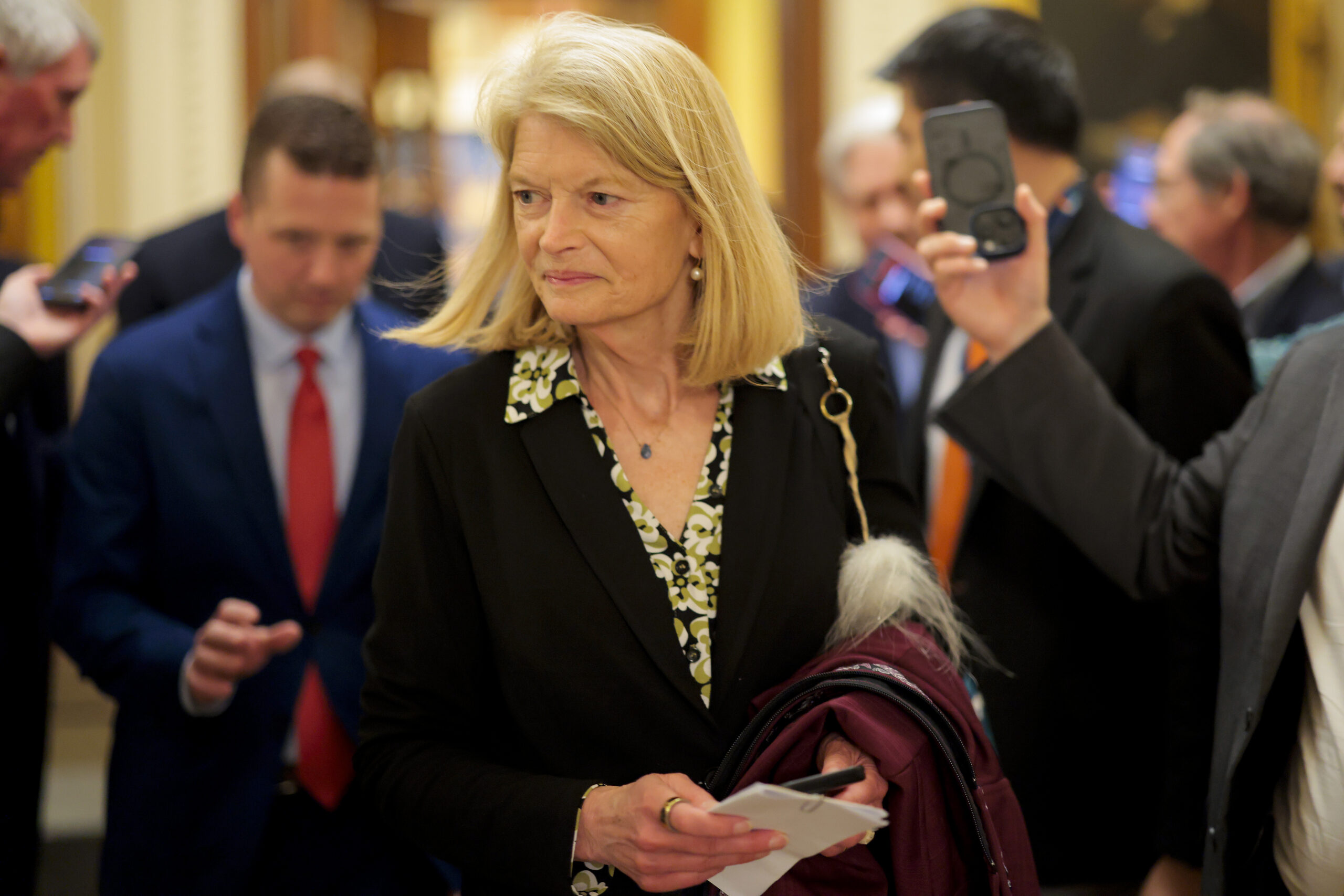
Republican lawmakers are growing frustrated with the war in Iran and with the administration’s frequently shifting rhetoric about it — including from some otherwise-hawkish lawmakers, Jewish Insider’s Marc Rod reports. Sen. Lisa Murkowski (R-AK), who previously called for an end to the war, told Bloomberg on Thursday that she’s working on a potential authorization for use of military force in Iran, to limit the scope of the U.S. operation and prevent the deployment of ground troops.
Cracks showing: “I don’t know what else to do,” Murkowski told the outlet. “I’m worried we get out of town and the president goes in with ground troops aiming for a full takeover.” The Senate is scheduled to be in recess for the next two weeks. Rep. Don Bacon (R-NE), who has generally been supportive of the war effort, told NOTUS on Thursday after a House Armed Services Committee briefing the day prior that he was unclear on the U.S.’ plans and goals in the war. “What is the end-state goal? What is the mission? I think clarity there would be helpful,” Bacon said.
Read the full story here for additional comments from Reps. Rob Wittmann (R-VA), Mike Rogers (R-AL) and Nancy Mace (R-SC).
Tehran talks: Jared Kushner, an informal Middle East envoy to the White House, said Thursday that Iran had not been serious about reaching a nuclear deal with the United States before President Donald Trump, his father-in-law, chose to attack the country in a joint military operation with Israel, JI’s Matthew Kassel reports.
PLAYING DEFENSE
After Janeese Lewis George met last week with Washington rabbis and other local Jewish leaders who were concerned about her views on Israel and antisemitism, the Washington, D.C., mayoral candidate released a statement pledging to stand firm in both her opposition to antisemitism and her support for the Palestinian cause, Jewish Insider’s Gabby Deutch reports.
Statement: “Those two things are not in conflict,” Lewis George, who is endorsed by the Democratic Socialists of America, wrote in a statement that was posted to her campaign website on Wednesday. “To the Jewish community in DC: I will not be a mayor who includes or excludes you based on your opinions or feelings on matters here and across the world. I will always protect your freedom, safety, and sense of belonging,” Lewis George, a D.C. councilmember, wrote in the statement. Lewis George also noted that she was one of the first councilmembers in the District to call for a ceasefire in Gaza and that she met with students at George Washington University who were advocating for a ceasefire.
Worthy Reads
Blind Spot on Hate: In The Free Press, former U.K. Prime Minister Tony Blair examines what he considers to be the unwillingness of Western leaders to fight the ideologies that breed antisemitism. “The problem is that, under pressure from party activists and parts of the Muslim community, many progressive politicians who do sincerely reject antisemitism are not making these arguments, and failing to take head-on this literally ‘unholy alliance’ between parts of the left and Islamists in our own societies whose ideology leads inexorably to antisemitism. Because failure to do so creates the climate in which, even if antisemitism is not explicitly condoned, it flourishes.” [FreePress]
The 1930s Redux: The Wall Street Journal’s Natasha Dangoor looks at Jewish communal concerns about rising antisemitism in the West as “Jews the world over” become targets amid increasingly violent antisemitism tied to Israel’s wars in Gaza and Iran. “While the attacks gain global media attention, it is daily life that has gotten less comfortable for many Jews who participate in communal life. Outside synagogues and Jewish schools, concrete barriers, high walls and security personnel are a constant reminder of the threats they face. … ‘It feels like the 1930s,’ said Ralph Pais, a 45-year-old real-estate investor who splits his time between Antwerp and Brussels.” [WSJ]
The Brotherhood’s New Turf: In The Washington Post, Tareq Alotaiba, a fellow at the Belfer Center at Harvard University, considers why the Muslim Brotherhood has proliferated across Europe. “The modus operandi of the Brotherhood is patience — it waits until it is confident in its strength, then moves against the established state structure. … One challenge in addressing the threat lies in the group’s approach to its Islamist agenda. Although its ideology has inspired much terrorism, its methods have seldom been violent. The Brotherhood’s strategy is to slowly indoctrinate youth until the organization can leverage its societal influence into political control.” [WashPost]
Word on the Street
Vice President JD Vance, who Axios reports is increasingly taking on the Trump administration’s Iran negotiation efforts, met yesterday in Washington with Qatari Prime Minister Mohammed bin Abdulrahman Al Thani…
The Pentagon is mulling sending an additional 10,000 troops to the Middle East, after calling up thousands of paratroopers from the 82nd Airborne Division earlier this week…
The potential move comes as Israel, reportedly concerned that the U.S. could potentially wind down the war against Iran, increasingly targets the Islamic Republic’s military infrastructure in an effort to hobble the regime’s arms-production abilities…
Iran is indicating to the U.N. that it will enforce a kind of “toll” for vessels to access the Strait of Hormuz, as it maintains control of the vital waterway…
The New York Times does a deep dive into Binance’s failure to stop the transmission of $1.7 billion in cryptocurrency to Iran-linked groups in violation of U.S. sanctions…
David Sacks departed his role as the White House’s AI and crypto czar after hitting the 130-day limit as a special government employee; Sacks will continue to serve as co-chair of the President’s Council of Advisors on Science and Technology…
The State Department is sending $1.25 billion to the Board of Peace, the majority of which was taken from funds ear marked for international disaster assistance…
The Senate approved by unanimous consent a proposal to fund most of the programs under the Department of Homeland Security; Immigration and Customs Enforcement and the Border Patrol were omitted from the late-night deal…
Sens. Ted Budd (R-NC) and Joni Ernst (R-IA) introduced the Abraham Accords Defense Cooperation Act, which requires the administration to establish a cooperation initiative with Abraham Accords countries and creates a funding avenue for such cooperative efforts…
The selection committee in Columbia University’s history department recommended the school hire Rosie Bsheer, who was removed from her leadership role at Harvard’s Center for Middle Eastern Studies over the center’s imbalanced programming on the Israeli-Palestinian conflict, for the New York school’s next Edward Said Professorship in Modern Arab Studies and Literature…
The Free Press spotlights the political trajectory of far-left activist Calla Walsh, the former Democratic organizer who interned for Sens. Elizabeth Warren (D-MA) and Ed Markey (D-MA) before becoming more aligned with the Democratic Socialists of America, serving jail time for anti-Israel vandalism and eventually relocating to a Hezbollah stronghold in Lebanon, where the 21-year-old now lives…
The Jewish Federation of Detroit condemned “recent remarks from prominent individuals praising U.S.-designated terrorist organization Hezbollah and downplaying the attack on Temple Israel,” following Detroit News interviews with prominent Arab American activists in the Detroit area, including the publisher of the Arab American News, expressing support for the terror group…
Lean In, the nonprofit founded by Sheryl Sandberg, has lost approximately a quarter of its staff as the Sandberg Goldberg Bernthal Family Foundation scales up its efforts to combat the “manosphere” and “tradwife” movements gaining traction among young people…
The New York Times reviews “Yes,” writer-director Nadav Lapid’s latest satirical film, which takes place in the aftermath of the Oct. 7, 2023, attacks and spotlights a fictional couple who tries to ingratiate themselves with the country’s powerbrokers…
A judge in Montreal dropped charges against a woman who made a Nazi salute at pro-Israel demonstrators and repeatedly threatened that they would be targeted with a “final solution”…
Authorities in London announced charges against a Palestinian British doctor with a history of making antisemitic comments online of having invited support for Hamas on multiple occasions…
Two British men arrested in connection with an arson attack on Hatzola ambulances in London’s Golders Green suburb were released on bail…
Israeli-born professor Edna Foa, who pioneered the use of prolonged exposure therapy to treat PTSD, died at 88…
Pic of the Day

Former Israeli hostage Bar Kupershtein released the music video for his song, “The Last War,” which recounts his time in captivity in Gaza and recovery after his release in October. The music video includes clips of Kupershtein with his father, Tal, who relearned to talk after surviving a stroke in order to advocate for his son’s release.
Birthdays

Hollywood mogul, CEO of Endeavor and CEO and executive chairman of TKO Group Holdings, which owns the UFC and WWE, Ariel Zev “Ari” Emanuel turns 65 on Sunday…
FRIDAY: Composer and violinist, he has been active in the presentation of new music and dance since the early 1960s, Malcolm Goldstein turns 90… President for 28 years at the Jewish United Fund/Jewish Federation of Metropolitan Chicago, he is now its executive vice chairman, Steven B. Nasatir turns 81… Principal technology columnist for The Wall Street Journal until 2013, then the executive editor of The Verge and editor-at-large of Recode, he is now retired, Walter S. Mossberg turns 79… Executive director at Milwaukee’s Grand Avenue Club (a mental health center), Rachel Forman… Chairman and CEO of First International Resources in Fort Lee, N.J., Zev Furst turns 78… Sports agent who has represented the No. 1 overall pick in the NFL draft eight times, he is the real-life inspiration of the sports agent in the film “Jerry Maguire” in 1996, Leigh Steinberg turns 77… Retired host of the “Matty in the Morning Show,” which ran for 41 years in Massachusetts on KISS 108, Matt Siegel turns 76… Deputy director of leadership giving at Baruch College, Linda Altshuler… Former member of the Knesset, he resigned in January 2026 to become deputy communications minister, Yisrael Eichler turns 71… Moral philosopher, she is the director of the Einstein Forum in Potsdam, Germany, Susan Neiman turns 71… Former NFL linebacker, now president of Performance Coaching (training real estate agents), he was a captain of the Miami Dolphins in Super Bowl XVII (1983), Steven Mark Shull turns 68… Economist and banker in Latvia, Valerijs Kargins turns 65… Smooth jazz saxophonist, he has been recognized with a star on the Hollywood Walk of Fame, Dave Koz turns 63… Actress and producer, now serving as senior VP at the Youth Renewal Fund, Sabrina Wachtel Kurzman turns 62… Managing director of Maimonides Fund, he is a 1994 graduate of Columbia Law School, Daniel Gamulka… CEO since 2004 of BBYO, an organization launched almost 100 years ago (formerly B’nai B’rith Youth Organization), Matthew Grossman turns 55… President of NYC’s Tenement Museum, Dr. Annie Polland… Founder and CEO of the Movement Vision Lab, a grassroots think tank, she is a political commentator and community organizer, Sally Kohn turns 49… Associate professor at Columbia University School of the Arts, she is the author of six full-length collections of poetry, Dorothea Lasky turns 48… Human rights attorney and head of the Sydney office of the Australia/Israel & Jewish Affairs Council, Arsen Ostrovsky turns 46… Senior political reporter at MS NOW, Jacob Hirsch Soboroff turns 43… Hitting coach in the Los Angeles Dodgers organization, he played for Team Israel at the 2017 World Baseball Classic and the 2020 Olympics, Blake Shane Gailen turns 41… Former professional ice hockey player, he played on Israel’s national team and in the U.S., Canada and Japan, now a partner at McKinsey & Company, Oren Eizenman turns 41… VP at SignalFlare.ai, he is a former associate director in the NYC area for AIPAC, Adam B. Engel… Assistant principal at Snowden Farm Elementary School in Clarksburg, Md., Kayla Brameyer… Communications and social media specialist, Daniella Greenbaum Davis… Son of Jared and Ivanka, Theodore James Kushner turns 10…
SATURDAY: Professor emeritus of physics at the Massachusetts Institute of Technology, winner of the 1990 Nobel Prize in physics, Jerome Isaac Friedman turns 96… Chairman and CEO of the Hartz Group and Hartz Mountain Corporation, a leading seller of pet supplies, Leonard Norman Stern turns 88… Israeli electrical engineer and business executive, he was the founder and first general manager of Intel Israel and the inventor of the EPROM chip, Dov Frohman turns 87… Expert on the pharmaceutical and healthcare industries, and wife of the late U.S. Sen. and VPOTUS candidate Joe Lieberman, Hadassah Lieberman turns 78… Glenview, Ill., resident, Genie Kutchins… Iranian-born CEO of Los Angeles-based toy company MGA Entertainment (maker of Little Tikes and Bratz and Lalaloopsy dolls), Isaac Larian turns 72… Former member of the Knesset for 13 years, she served as the leader of the Israeli Labor Party, Shelly Yachimovich turns 66… Special envoy and coordinator for the U.S. Department of State’s Global Engagement Center during the Biden administration, James Phillip Rubin turns 66… One of four hostages held at gunpoint for 11 hours at Congregation Beth Israel in Colleyville, Texas, in January 2022, Jeffrey R. Cohen… Former rhythmic gymnast, now teaching yoga in Connecticut, she represented the U.S. at the 1984 Summer Olympics, Valerie Le Zimring-Schneiderman turns 61… “Lexington” columnist at The Economist, he is the younger brother of U.S. Sen. Michael Bennet (D-CO), James Douglas Bennet turns 60… Presidential historian and Jewish liaison in the Bush 43 administration, he is now a senior scholar at Yeshiva University and a senior fellow at the Ronald Reagan Institute, Tevi Troy turns 59… President and CEO of Hillel: The Foundation for Jewish Campus Life, Adam Lehman turns 59… Film producer, entertainment executive and director of movies, music videos and television programs, Brett Ratner turns 57… Journalist, crime writer and blogger who has spent most of his career in Japan, he assisted the U.S. State Department’s investigation into human trafficking in Japan, Jake Adelstein turns 57… Israeli journalist, she is both a television and radio news presenter, Keren Neubach turns 56… Novelist, television producer and journalist, one of her novels was made into a major motion picture, Jennifer Weiner turns 56… U.S. senator (R-FL), she was appointed last year to the seat vacated by Secretary of State Marco Rubio, Ashley Moody turns 51… Author of eight best-selling novels including in 2003 The Devil Wears Prada, based upon the author’s time as an assistant to Vogue Editor-in-Chief Anna Wintour, Lauren Weisberger turns 49… Member of the Knesset since 2015 for the Likud party, now serving as the minister of culture and sports, Makhlouf “Miki” Zohar turns 46… Benjy Spiro… Los Angeles-based, Israeli-born fashion designer, Yotam Solomon turns 39… Retired MLB outfielder for the Boston Red Sox and the Chicago Cubs, now a real estate developer in Bali, Indonesia, Ryan Kalish turns 38… VP at Tradepoint Atlantic, a 3,300-acre global logistics center near Baltimore, Michael Hurwitz… SVP of asset management at Hackman Capital Partners, Zachary David Sokoloff… Quarterback for the Tulane University Green Wave football team, Jake Retzlaff turns 24…
SUNDAY: Israeli chemist, professor emeritus at the Hebrew University of Jerusalem and at UCLA, winner of the 1974 Israel Prize and the 1988 Wolf Prize in Chemistry, Raphael David Levine turns 88… Organizer of the annual morning minyan services since 1983 for runners in the NYC Marathon, Peter Berkowsky turns 84… Attorney, New York Times best-selling author and sports agent for many athletes including Cal Ripken, Jim Palmer, Brooks Robinson, Kirby Puckett and Eddie Murray, Ronald M. Shapiro turns 83… Houston-based labor law, employment law and personal injury attorney, active in Jewish organizations, Carol Cohen Nelkin… University of Chicago professor and winner of the 2007 Nobel Prize in economics, Roger Myerson turns 75… Investor, computer scientist and founder of D. E. Shaw & Co., a hedge fund based upon high-speed quantitative trading, David Elliot Shaw turns 75… Economist, professor emeritus at NYU and chairman and CEO of consulting firm Roubini Macro Associates, Nouriel Roubini turns 68… Miami businesswoman, JoAnne Papir… U.S. Deputy Secretary of Defense, he was the co-founder and co-CEO of Cerberus Capital Management, Stephen Andrew Feinberg turns 66… U.S. senator (D-NV), Catherine Cortez Masto turns 62… Director of the Mossad, Israel’s national intelligence agency, David Barnea turns 61… French film director and writer, best known for his 2011 film “The Artist,” which won five Academy Awards including Best Picture, Michel Hazanavicius turns 59… Budget secretary for the Commonwealth of Pennsylvania, Uri Z. Monson turns 57… Vice president and senior advisor at The Rockefeller Foundation and adjunct fellow at The Washington Institute for Near East Policy, Eric Pelofsky… Founder of Leopard Strategies, Liz Jaff… White House staff secretary in the Trump administration, Will Scharf turns 40… Communications director for Sen. Cory Booker (D-NJ), David A. Bergstein… Associate director at Power Insights, Annie Rosen Pai… Director of business development at Logical Buildings, Alex Zafran…
A JINSA report found that 90% of missiles and drones fired by Iran were intercepted, but U.S., Israeli and Gulf states' air defenses have been degraded by Iran's targeting of radar and communication links

Amir Levy/Getty Images
People seek cover at a bomb shelter as sirens warning for missiles launched from Iran sound on March 25, 2026 in Pardes Hanna, Israel.
Days after launching the war against Iran last month, Israel and the U.S. began signaling that they were quickly degrading the Iranian ballistic missile threat. Two weeks into the war, the White House posted on X that “Iran’s entire ballistic missile capacity [was] functionally destroyed.”
Israeli Prime Minister Benjamin Netanyahu said in a press conference last week that “Iran’s missile and drone arsenal is being massively degraded and will be destroyed.” The IDF has repeatedly sent updates over the past month about having destroyed the majority of Iran’s ballistic missiles and launchers.
So why are missile barrages and rushing to the bomb shelters still a part of most Israelis’ daily lives?
Sirens sounded 10 times in Israel’s center on Thursday. In the last week, about 1,000 alerts were sent out to different parts of Israel due to Iranian missiles. Israelis from Eilat to the Golan have spent many hours in shelters since the war began. Two fatalities were reported in recent days, but nearly 300 people have been injured since the beginning of this week, according to the spokesperson for Magen David Adom emergency services.
Jonathan Schanzer, executive director at the Foundation for Defense of Democracies, told Jewish Insider that “this is a war, and wars have tides that come in and out … [they] require a certain amount of adjustment and patience. You’re not going to get everything you want in a linear fashion.”
The IDF declined to comment on the unusual number of Iranian missiles penetrating Israel this week – in contrast with the war overall, during which only about 40% of the missiles crossed into Israeli skies, according to the INSS, generally resulting in fewer sirens each day.
Schanzer pointed to the weather as one explanation: Clouds, rain and fog in Iran make it difficult for Israeli Air Force drones, which remain in Iran’s skies at all times, to detect and destroy missile launchers before they shoot.
But even if the skies were sunny, “the number of missiles [left in Iran] is likely below 1,000 and could be down to 500; it’s an inexact science,” Schanzer said. “The missile capability is obviously still there and has been throughout, and that doesn’t change. … They still have the ability to fire.”
There’s a term in Hebrew, which translates to “armaments economy,” that explains another aspect of what is happening. The IDF, Schanzer said, is “probably thinking about … how many missile interceptors do you burn when you know there are another two or three weeks left of Iran’s capability to launch, and there’s also [the war in Lebanon]. There is a calculus and there is an uncomfortable one.”
A new report from the Jewish Institute for National Security of America (JINSA) found that 90% of the roughly 4,200 missiles and drones fired by Iran at targets across the region were intercepted, but American, Israeli and Gulf states’ air defenses have been degraded by Iran’s targeting of radar and communication links. “The war has become a stockpile race,” JINSA stated. “U.S. and Israeli offensive fire must exhaust Iran’s missiles and drones before … interceptor stocks run too low.”
Yaakov Katz, a military expert and author of While Israel Slept: How Hamas Surprised the Most Powerful Military in the Middle East, argued to JI that missile launcher destruction is the wrong way of looking at the war, meant to “create a narrative of accomplishment,” when there is still much work to be done.
Ultimately, Katz argued, people don’t care about the number of missiles that were destroyed when they’re “in the bomb shelter five, six times a day. … They’re getting hammered. It’s not a way to measure anything.”
“The IDF knows when they blow up a launcher … They know what they destroyed,” Katz said. “But the number remaining constantly changes, which proves it is BS. … In week one [the IDF] said there were 150 launchers left. In week two they said 150 left. A few days ago, they said 150 again.”
Katz pointed out that the IDF likely does not know how many missiles and launchers Iran has underground. “There is satellite footage showing [the IDF] destroyed entrances to the underground ‘missile cities,’ but they don’t know how long it takes to excavate [new entrances] or what damage there is inside.”
While Katz said that he doesn’t “diminish from the value of taking a threat, degrading it and having more time to live in a place of security,” he does not view that as a victory, because the threat will return. He pointed to how rapidly Iran was able to produce new ballistic missiles after last year’s 12-day war: “They’re going to rebuild everything.”
“Just saying they destroyed 70-80% of missile launchers … If that’s your measure of success, you’re basically confirming there will be another war in the future,” he added.
“This war has three potential victories,” Katz said, listing regime change, removing Iran’s stockpile of highly enriched uranium and, lastly, reaching “a deal that provides for any or all of those, plus restrictions on the development and range of ballistic missiles.”
Katz also noted that the United Arab Emirates is relaying a similar message — that degrading Iranian missiles is not enough. He cited a recent Fox News appearance by Lana Nusseibeh, the UAE’s minister of state at the foreign ministry, and an op-ed by Yousef Al Otaiba, the UAE ambassador to the U.S., who wrote in The Wall Street Journal, “We need a conclusive outcome that addresses Iran’s full range of threats: nuclear capabilities, missiles, drones, terror proxies and blockades of international sea lanes.”
Schanzer agreed that the number of missiles and launchers destroyed is “a tactical measure … you’re attacking the arrow and not the archer.” However, he added: “You can criticize it all you want, but if that’s all you’ve got, then you’re doing all you can.”
“The bigger goal is regime change, but there’s no handbook for that either,” he said. “I still think America and Israel have the advantage. There is zero air defense in Iran, the leadership is absolutely decimated, the arsenal is smaller than it was, and the regime is under enormous strain. That is the most important measure to look at right now. It doesn’t mean there aren’t challenges [such as] the Strait of Hormuz and missile attacks.”
Experts told JI the war in Iran may give Hamas breathing room in Gaza but could also leave it more isolated as Iran weakens
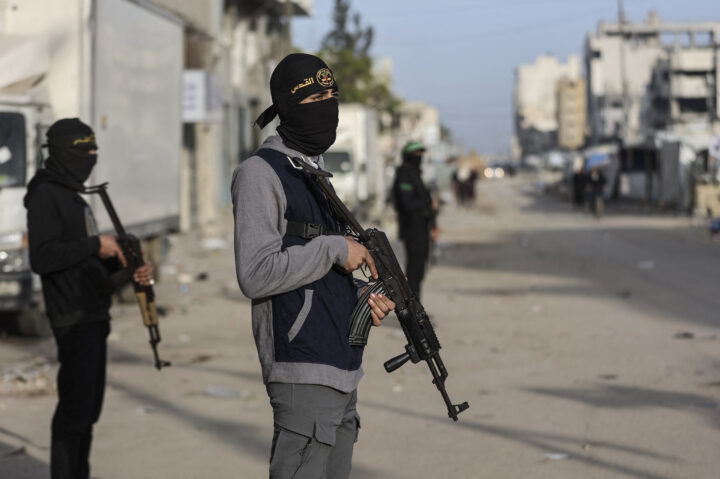
Omar AL-QATTAA / AFP via Getty Images
Members of Palestinian Hamas' Ezzedine Al-Qassam Brigades and Islamic Jihad's Quds Brigades are deployed at intersections in Gaza City on March 20, 2026.
As the conflict between the United States, Israel and Iran nears the one-month mark, experts say the war has diverted diplomatic and military attention away from Gaza, creating a mixed picture: Hamas has used the pause in sustained Israeli military pressure to reassert control in areas it still governs, while the degradation of Iran’s capabilities could ultimately leave the group weaker and more isolated once the conflict subsides.
“I think it’s safe to say that Israeli and American attention has been significantly diverted to the Iran war, and as a corollary to the second front, meaning the war with Hezbollah, at the expense of full time attention to Hamas,” said Matthew Levitt, director of The Washington Institute for Near East Policy’s program on counterterrorism and intelligence. “But it’s not like nothing’s happened in the interim, both for good and for bad.”
Some ceasefire efforts remain ongoing, even as the war continues: Earlier this week, Nickolay Mladenov, the Board of Peace’s high representative for Gaza and a former senior United Nations official, briefed the U.N. Security Council on the board’s progress in implementing elements of President Donald Trump’s 20-point Gaza plan, outlining early reconstruction efforts and a phased proposal for disarmament.
According to experts familiar with the briefing, those efforts have focused in part on areas of Gaza under Israeli control, where work has begun on clearing debris, addressing unexploded ordnance and laying the groundwork for new housing and infrastructure projects.
Gaza currently remains divided among the Hamas-controlled western part of the enclave, referred to by some experts as the “red zone,” while the IDF controls the eastern side, or “yellow zone.” Levitt said that work is being done to “build what is being described as new Rafah, as well as an Emirati-funded city, so that hopefully in the not too distant future, Gazans who are in the area of the enclave controlled by Hamas can be vetted and moved into these new communities.”
The National Committee for the Administration of Gaza — a new technocratic Palestinian governing body launched under the peace plan — has also begun vetting thousands of candidates for a new civilian police force, while several countries, including Indonesia, Morocco, Kazakhstan, Kosovo and Albania, have committed troops to a proposed International Stabilization Force, according to the UN.
However, experts and former White House officials also noted that the diverted attention from Gaza has had negative effects as well, most notably creating conditions for Hamas to “reassert its very physical presence” in the part of the enclave it controls.
Elliott Abrams, Iran envoy under the first Trump Administration and a senior fellow at the Council on Foreign Relations, said the U.S., Israel and Arab states focusing elsewhere “is temporarily an advantage for Hamas. For Gaza, the issue is whether the [Board of Peace] member states, led by the U.S., will insist on Hamas disarmament — without which all the plans for rebuilding Gaza will fail, and no country will send its troops there as a peace force.”
Ghaith al-Omari, a senior fellow at the Washington Institute, also noted that “Hamas has certainly been taking advantage of the shift of attention to the Iran war.”
“Last week, [Mladenov] presented Hamas with a proposal for disarmament. The proposal calls for gradual disarmament but makes it emphatically clear that Hamas needs to fully disarm by the end of the process,” he said.
“Because of lack of international attention, the tools needed to implement this — namely the creation of a new Palestinian police force — have been stalled,” al-Omari continued. “Hamas itself is unlikely to respond to the disarmament proposal until it sees how the Iran war ends. If Iran is not decisively weakened by the end of the war, Hamas will likely adopt a more hardline position when it comes to disarmament.”
Levitt said that while Hamas’ retrenchment in the enclave may cause concern, “the reality is [Hamas is] not able to expand beyond the less than half [of the enclave] that it controls.” He also noted that the current conflict in Iran may actually create the conditions to further weaken, pressure and isolate the terrorist group when the war subsides.
“[Hamas is] not getting the money they once did on a regular basis from Iran or from Qatar,” Levitt said. “It has limited resources, and when the war ends I think that authorities will still have a lot of the same leverage that they did before the war, and in a situation where perhaps Iran’s capabilities to fund and arm its proxies are sufficiently degraded.”
He also noted that there could be more “interest” from other countries in aiding in the Gaza peace process once the Iran war dies down.
“Sure, there’ll be parties who are angry at the United States, who are angry at Israel, and feel this was a war of choice,” Levitt said. “But once the war ends, I think there will be a lot of people who are going to be eager to try and do what they can to try and stabilize the region after these years of severe instability and suffering, and I think there’s going to be a focus on Gaza once the war ends.”
Daniel Shapiro, a former U.S. ambassador to Israel under President Joe Biden, agreed that the war may weaken Iran’s ability to support Hamas and that “some regional players might be newly committed to seizing the opportunity to disarm this branch of the Iranian axis of resistance.”
But the assistance of Gulf countries is not guaranteed, he said. “Others may pause their involvement in post-war Gaza for various reasons, ranging from the need to focus on their own recovery from the war, to unhappiness with Israel’s role in starting a war they hoped to avoid, to continuing opposition to Israel’s policies in the West Bank and opposition to a credible pathway to a Palestinian state,” Shapiro said.
Rachel Brandenburg, a senior policy analyst at Israel Policy Forum, also argued that the war in Iran could impact “regional stakeholders’” involvement in post-war Gaza, “particularly across the Gulf.” She noted that “when the dust settles on this war, it is also likely to detract from the funds and attention Gulf countries had pledged for Gaza and to support the Palestinian Authority.”
“[Gulf countries] will not only have to confront the losses from physical infrastructure destruction but also from a pause on investments, business, tourism, and energy resources,” Brandenburg said. “I expect they will reconsider how much money is left for Gaza and the Palestinian Authority.”
Meanwhile, Jason Greenblatt, former White House envoy to the Middle East under the first Trump administration, argued that the “focus has not shifted” from combating Hamas and has instead “sharpened.”
“Dismantling the Iranian regime’s capacity to arm, fund and direct Hamas is critical for Gaza’s future,” Greenblatt said. “But in my view, there is a difference between temporary humanitarian relief and meaningful rebuilding. The first can and should continue. The second cannot move forward until Hamas disarms and stops threatening Israel.”
Alexander Gray, former chief of staff to the National Security Council during Trump’s first term and now a senior fellow at the Atlantic Council, echoed those sentiments, telling Jewish Insider that the Trump administration is “smartly treating many of the Middle East’s challenges as inherently interconnected.”
“There will never be peace in Gaza without destroying the ability of Iran to fund and deploy proxies like Hamas to destabilize the region,” Gray said. “The president’s focus on dismantlement of the Iranian proxy network is not accidental: without it, peace from Gaza to Lebanon to Syria to Iraq to Yemen will be elusive.”
Sen. Lisa Murkowski said she’s concerned Trump will deploy ground troops while the Senate is on recess
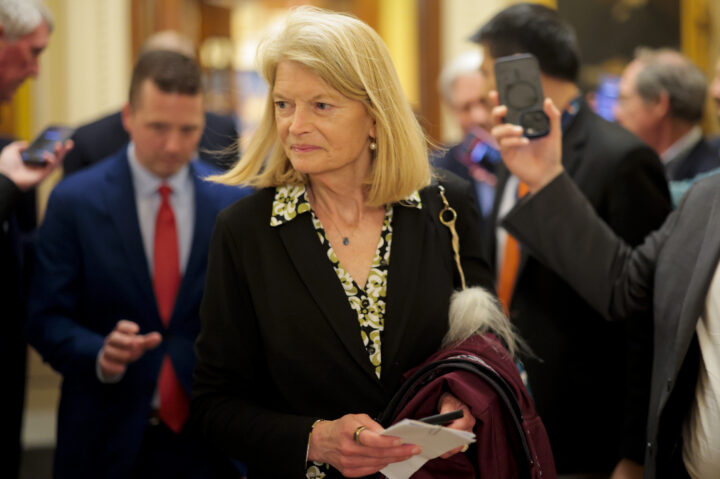
Heather Diehl/Getty Images
Sen. Lisa Murkowski (R-AK) walks through the Capitol on March 23, 2026 in Washington, DC.
Thursday brought a series of new signals that at least a small number of ideologically varied Republican lawmakers are growing frustrated with the war in Iran and with the administration’s frequently shifting rhetoric about it — including from some otherwise-hawkish lawmakers.
Sen. Lisa Murkowski (R-AK), who previously called for an end to the war, told Bloomberg on Thursday that she’s working on a potential authorization for use of military force in Iran, to limit the scope of the U.S. operation and prevent the deployment of ground troops.
“I don’t know what else to do,” Murkowski told the outlet. “I’m worried we get out of town and the president goes in with ground troops aiming for a full takeover.” The Senate is scheduled to be in recess for the next two weeks.
After Murkowski’s comments, The Wall Street Journal reported that President Donald Trump was considering deploying an additional 10,000 troops to the Middle East.
Rep. Don Bacon (R-NE), who has generally been supportive of the war effort, told NOTUS on Thursday after a House Armed Services Committee briefing the day prior that he was unclear on the U.S.’ plans and goals in the war.
“I don’t know the plan,” Bacon said. “What is the end-state goal? What is the mission? I think clarity there would be helpful.”
Rep. Rob Wittmann (R-VA) also told the outlet that he’s seeking “more granularity, more specificity on what specifically is happening on the ground, and then how is that leading to achieving the military objectives.”
Rep. Mike Rogers (R-AL), the Armed Services Committee chairman, emerged from the briefing Wednesday frustrated with what he said was a lack of information from the administration, warning officials that their reticence could have “consequences.”
Meanwhile, Rep. Nancy Mace (R-SC), who’s been more critical of the war in general, indicated to Axios she’s now inclined to vote for an upcoming war powers resolution to end the war, bringing it closer to the threshold for passage. She added, “War with Iran needs to end. President Trump has won the war, time to exit.”
House Democrats were initially expected to call a vote on that legislation this week, but have delayed their plans until after the congressional recess, saying they still don’t think they have the votes to pass it.
Regardless of whether the resolution passes the House, it remains unlikely to pass the Senate and could be vetoed by Trump. But passage of the resolution in the closely divided House would be a rebuke of Trump and his strategy.
Plus, fake AI rabbis peddle antisemitism
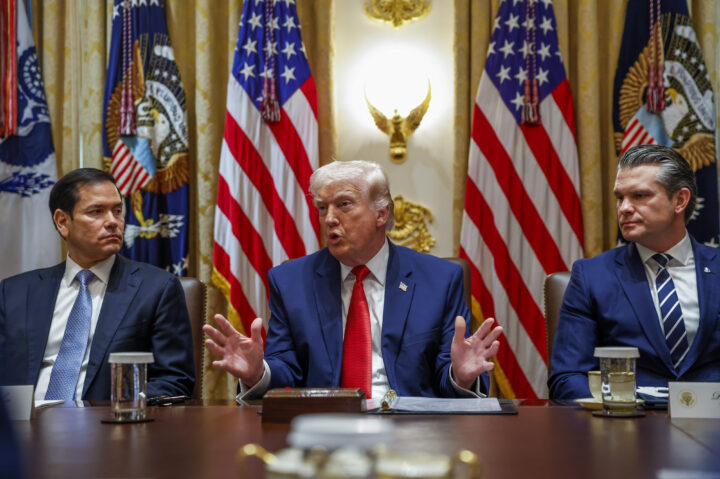
Will Oliver/EPA/Bloomberg via Getty Images
Secretary of State Marco Rubio, President Donald Trump and Defense Secretary Pete Hegseth during a Cabinet meeting at the White House in Washington, DC, US, on Thursday, March 26, 2026.
This P.M. edition is reserved for our premium subscribers — offering a forward-focused read on what we’re tracking now and what’s coming next. Please don’t hesitate to share your thoughts and feedback by replying to this email.
📡On Our Radar
Notable developments and interesting tidbits we’re tracking
President Donald Trump announced this afternoon that he’s extending his original five-day delay on strikes on Iran’s energy sector, which was set to expire tomorrow, by another 10 days. “As per Iranian Government request … I am pausing the period of Energy Plant destruction by 10 Days to Monday, April 6, 2026, at 8 P.M., Eastern Time,” he wrote on Truth Social, adding that negotiations continue and are “going very well”…
At a Cabinet meeting earlier today, Trump revealed that the “present” Iran had provided the U.S. earlier this week was allowing eight Pakistani-flagged oil tankers to pass safely through the Strait of Hormuz, which he said proved the U.S. was speaking with the “right people” in Iran with the authority to make such decisions.
Special Envoy Steve Witkoff, meanwhile, confirmed reports that the U.S. had presented Iran with a “15-point action list” as a starting offer in peace talks between the two countries, and that Pakistan is acting as mediator…
Speaking at the FII Priority summit in Miami, Jared Kushner said that, during his negotiations with Iran prior to the war, “We basically saw that there was no seriousness, and that they were trying to play different games to just get beyond President Trump in order to preserve their capabilities and pathway to get to a nuclear weapon in a way that would have been very, very hard to be stopped in the future”…
CENTCOM applauded an Israeli strike that killed Alireza Tangsiri, the commander of the IRGC Navy, and warned all IRGC Navy members to “immediately abandon their post and return home.” Tangsiri had been named a Specially Designated Global Terrorist by the U.S. in 2019 and was leading Iran’s efforts to shutter the Strait of Hormuz…
Even as U.S.-Iran negotiations continue, the U.S. is considering diverting weapons for Ukraine to the Middle East, The Washington Post reports, including air-defense interceptor missiles.
Ukraine has proved a stalwart ally to the Gulf as it comes under attack from Iran — around 200 Ukrainian military personnel have been deployed around the Middle East to help defend against Iranian drones and President Volodymyr Zelensky arrived in Saudi Arabia today for a surprise visit…
Resources are also being redirected to Gaza — the Trump administration has reportedly pulled $1.25 billion from international peacekeeping and disaster assistance programs for the Board of Peace’s operations, for which Trump had pledged $10 billion in U.S. funding…
An AI-generated Instagram account portraying an Orthodox-looking rabbi is pushing antisemitic conspiracy theories to its more than 1.4 million followers, and it’s not the only one, according to a study published Wednesday by Combat Antisemitism Movement.
Jewish Insider’s Haley Cohen reports: Researchers identified 12 AI-generated “rabbis” with a combined following of 2.1 million Instagram users, all of which promote classic antisemitic stereotypes. The “Rabbi Goldman” account features many of these, including one video in which the “rabbi,” wearing a tuxedo and seemingly seated in a luxury airplane, claims that Jews utilize empty private jets to evade taxes…
A new Emerson College poll of the Maine Senate race found oyster farmer Graham Platner with a nearly 30 point lead over Gov. Janet Mills (55-28%) in the Democratic primary. Both Platner and Mills lead Sen. Susan Collins (R-ME) in the general election matchup, 48-41% and 46-43%, respectively…
California Gov. Gavin Newsom again reaffirmed his support for Israel in an interview with The Bulwark, likening his love for the country but strong disapproval of its current government with how he feels about the U.S…
Democrat Analilia Mejia and Republican Joe Hathaway will participate on April 1 in what is likely to be the only debate of the New Jersey 11th Congressional District’s special election, after the far-left Mejia won the Democratic nomination in a hotly contested primary last month. The New Jersey Globe, which is hosting the debate, acknowledged it had chosen to do so on the first night of Passover, in a district with a sizable Jewish population…
The College Republicans chapter at the University of Florida is suing the school, after a photo of one of its members doing what appeared to be a Nazi salute led to the chapter’s ban from campus.
The chapter argues that the ban violated its First Amendment rights as the member “expressed a viewpoint off-campus that was alleged by some to be anti-Semitic,” and claims it was deactivated in part because it recently hosted James Fishback, a candidate for Florida governor who has expressed antisemitic and anti-Israel views…
⏩ Tomorrow’s Agenda, Today
An early look at tomorrow’s storylines and schedule to keep you a step ahead
Keep an eye out in Jewish Insider for comments from Michigan state Sen. Mallory McMorrow on Israel and antisemitism as she seeks the Democratic nomination for U.S. Senate against Rep. Haley Stevens (D-MI) and Abdul El-Sayed.
President Donald Trump will provide closing remarks at the FII Priority summit in Miami tomorrow afternoon.
Texas Attorney General Ken Paxton will headline CPAC’s Ronald Reagan Dinner. His primary opponent, Sen. John Cornyn (R-TX), will not be making an appearance, despite the confab taking place in his home state and calls from its leadership for him to attend.
Secretary of State Marco Rubio is traveling to France to attend a meeting of G7 foreign ministers where he is expected to press allies on the Iran war — he told reporters as he departed today, echoing a line from Trump, that the countries involved “get far more of their fuel from” the Strait of Hormuz “than we do.”
TROUBLE IN THE NEIGHBORHOOD

Frustrated UAE leaders are questioning the ‘impotence’ of countries like Egypt — and warn that silence on Iranian aggression will push the Gulf closer to U.S., Israel
MICHIGAN MOMENT
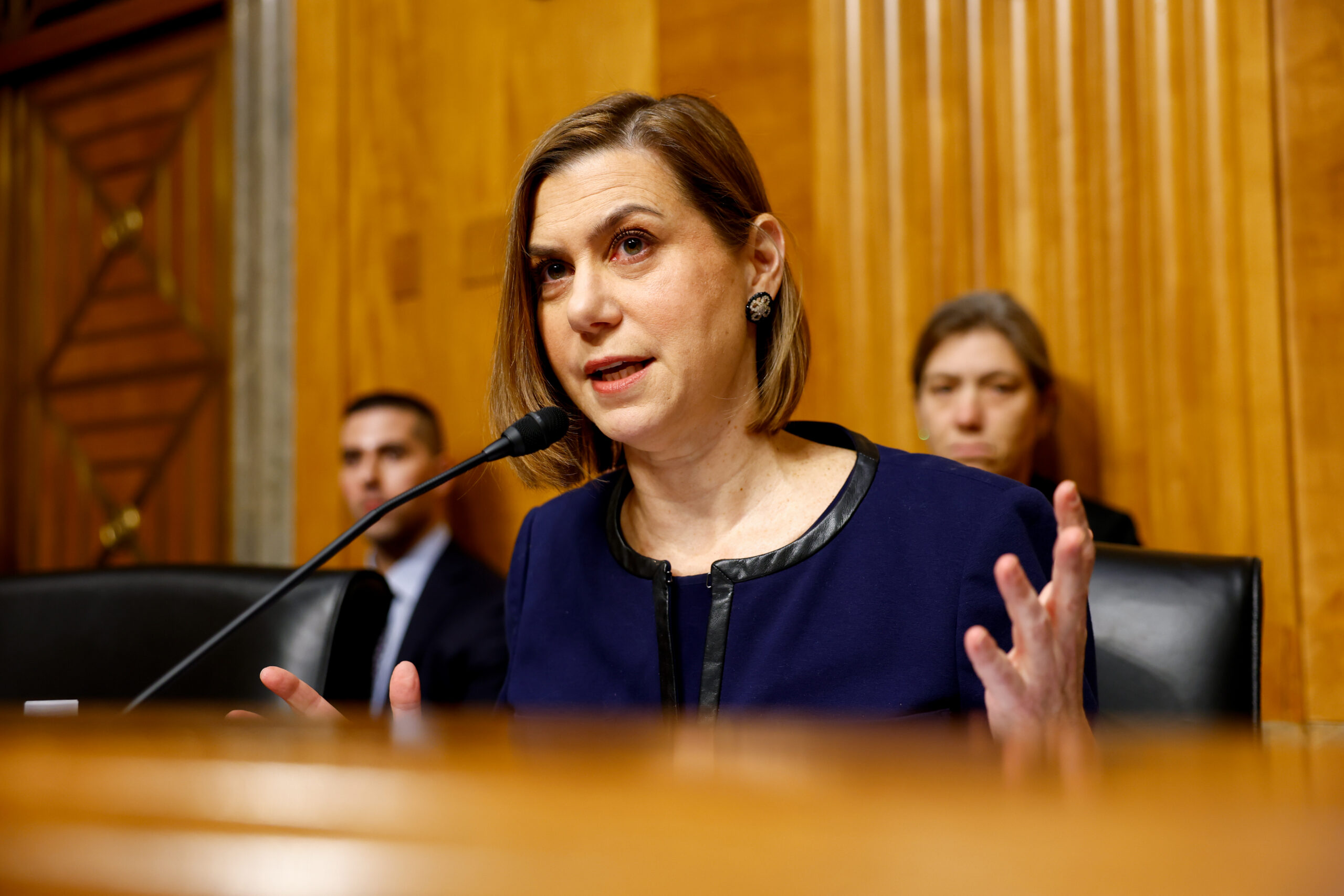
Stevens said that by associating with Piker, El-Sayed is ‘choosing to campaign with someone who has a history of antisemitic rhetoric’
Less than 24 hours before the expiration of his previous delay, Trump said he would pause the strikes ‘per Iranian government request’
Will Oliver/EPA/Bloomberg via Getty Images
Secretary of State Marco Rubio, President Donald Trump and Defense Secretary Pete Hegseth during a Cabinet meeting at the White House in Washington, DC, US, on Thursday, March 26, 2026.
President Donald Trump announced on Thursday afternoon that he would extend his pause on plans to strike Iran’s energy infrastructure, “per Iranian government request,” for an additional 10 days amid ongoing diplomatic negotiations to end the war.
Trump wrote in a post on his Truth Social platform that he is “pausing the period of Energy Plant destruction by 10 Days to Monday, April 6, 2026, at 8 P.M., Eastern Time.”
“Talks are ongoing and, despite erroneous statements to the contrary by the Fake News Media, and others, they are going very well,” Trump added.
The post comes a few hours after the president said that he wasn’t sure if he would follow through with his five-day delay, set to expire Friday, for strikes on Iran’s energy infrastructure, which he had pushed back at the start of diplomatic negotiations on Monday.
“I don’t know yet,” Trump said when asked by reporters if the strikes would still take place Friday. “It’s a day. In Trump time, a day, you know what it is? That’s an eternity.”
Trump made the comments while speaking to reporters at the opening of his first Cabinet meeting since launching the war in Iran.
He alleged that Iranian leaders “are begging to make a deal” to end the war while criticizing press reports alleging that he was looking for a diplomatic off-ramp to the conflict, saying he has not decided whether he’ll agree to a diplomatic settlement if one were reached.
“They are begging to make a deal. Not me,” Trump said of current Iranian leadership. “They’re not fools, they’re very smart actually in a certain way and they’re great negotiators. I say they’re lousy fighters, but they are great negotiators. They are begging to work out a deal. I don’t know if we will be able to do that. I don’t know if we’re willing to do that. They should’ve done that four weeks ago. They should’ve done it two years ago.”
“The reason they want to make a deal is they have been just beat to sh*t,” he said later on, touting the U.S. military operation as a success.
During the meeting, White House Special Envoy Steve Witkoff confirmed reports that the U.S. had presented Iran with a “15-point action list” as a starting offer in peace talks between the two countries. He also confirmed that Pakistan had been acting as a mediator for the U.S. and Iran.
“We will see where things lead, and if we can convince Iran that this is the inflection point with no good alternatives for them other than more death and destruction,” Witkoff said. “We have strong signs that this is a possibility.”
Witkoff said to Trump, “You’ve instructed us that your preference is always peace and that we should make that our priority. We have delivered that message, sir, along with the 15 points for peace. Finally, we have told Iran one last thing: don’t miscalculate again.”
Trump later revealed that the “present” Iran gifted the U.S. was allowing eight oil tankers through the Strait of Hormuz, which he said proved the U.S. was speaking with the “right people” in Iran with the authority to make such decisions.
“They said to show you the fact that we’re real, and solid and we’re there, we’re going to let you have eight boats of oil, eight boats, eight big boats of oil,” Trump said of the Iranians. “And I said, ‘Well, I guess they were right,’ and they were and they were real.”
Trump then said that Iran later allowed two additional vessels to travel through the strait, which he described as an overture from the Iranians to “apologize for something they said.”
Turning to Witkoff, the president then expressed hope that he hadn’t “screwed up” their diplomatic efforts by revealing the “gift.”
Speaking at the FII Priority summit in Miami, Kushner warned not to take public statements out of Tehran at face value

Zak Bennett/Bloomberg via Getty Images
Jared Kushner, founder and chief executive of Affinity Partners LLC, during the Future Investment Initiative (FII) Priority Summit conference in Miami, Florida, US, on Thursday, March 26, 2026.
Jared Kushner, an informal Middle East envoy to the White House, said Thursday that Iran had not been serious about reaching a nuclear deal with the United States before President Donald Trump, his father-in-law, chose to attack the country in a joint military operation with Israel.
“We basically saw that there was no seriousness, and that they were trying to play different games to just get beyond President Trump in order to preserve their capabilities and pathway to get to a nuclear weapon in a way that would have been very, very hard to be stopped in the future,” Kushner said at Saudi Arabia’s exclusive FII Priority summit, held in Miami this week.
Kushner, whom Trump tapped alongside Special Envoy Steve Witkoff to help lead talks with Iran amid the ongoing conflict, told the crowd of political and financial leaders gathered in South Florida that the Iranians’ public statements on the war should not be trusted.
“The one thing with the Iranians, and we’re seeing this even now, is you have to just ignore a lot of what they say publicly, because I think that their statements are usually more for their domestic audiences,” explained Kushner, who had met for indirect negotiations with the Iranians in Geneva two days before the war began in late February.
Likening Iran’s military tactics to a player losing at backgammon, Kushner said the Islamic Republic is now seeking “to create as much chaos as possible” across the region, as it has fired “indiscriminately” at nearby Gulf states and beyond. “That basically describes what they’ve been trying to do there.”
“President Trump’s focus is to try and get to a good outcome with them,” Kushner added. “He wants to just be in a position where they act like a normal country.”
Kushner said that he had expected to “go back” to his private equity firm, Affinity Partners, which has raised funds in the Middle East, after he had helped broker the Israel-Hamas ceasefire in Gaza last year and amid ongoing negotiations between Russia and Ukraine in which he has continued to play a central role.
But he added that he “didn’t anticipate that there’d be a war in Iran,” and chose to put one fundraising effort on hold after Trump asked him to “stay on” in what he called a “volunteer capacity” to work on the negotiations alongside Witkoff.
“Right now, my big focus is going to be on trying to see if we can get this war concluded,” Kushner said.
Sen. James Lankford: ‘I think we’re not done. I don’t like calling it “won” until it’s done’

Andrew Harnik/Getty Images
Sen. James Lankford (R-OK) speaks during a news conference on Capitol Hill on May 1, 2024 in Washington, DC.
Several Senate Republicans this week declined to fully endorse President Donald Trump’s comments that the U.S. had “won” the war in Iran, arguing that there is still more to be done to fully degrade Iran’s capabilities to the extent necessary.
Trump told reporters in the Oval Office Tuesday, “You know, I don’t like to say this — this war has been won. The only one that likes to keep it going is the fake news. … We’ve won this war.” Trump also said Monday he would postpone strikes on Iran’s energy infrastructure to allow for “productive conversations” toward ending the war — an announcement that boosted markets and brought down oil prices.
“I think we’re not done. I don’t like calling it ‘won’ until it’s done,” Sen. James Lankford (R-OK) told Jewish Insider. “You can’t stop a war too soon, once it gets started, because then you’ve got to get right back to it again. You’ve got to finish it.”
Sen. Lindsey Graham (R-SC) said he agreed with the president, but added, “we’ve done a good job of accomplishing our military objectives. We’re not quite there yet.”
Sen. Mike Rounds (R-SD) said, “I think what he means by that — and he happens to be correct — we have basically significantly reduced their ability to wage a lot of the … war. It doesn’t mean they’re not dangerous yet, but we’re getting there.”
Sen. Roger Wicker (R-MS), who chairs the Senate Armed Services Committee, quipped of Trump’s comments, “I think that’s probably hyperbole. It’d be the first time ever, but I think it may be hyperbole.”
House Speaker Mike Johnson (R-LA) hewed more closely to the president’s comments, while stopping short of declaring the war over. “Operation Epic Fury is almost done. I mean, I think the mission that was very clearly defined in the beginning, the objectives have been met,” Johnson told reporters on Wednesday.
Graham, one of the most vocal supporters of the war on Capitol Hill, who has been agitating for the U.S. to pursue full regime change in Iran, said that he would support — and even prefer — a diplomatic outcome.
“Not only do I support @POTUS and his team’s efforts to negotiate with Iran to find a solution to the threats this regime presents to the region and the world, I encourage it,” Graham said on X on Wednesday. “It is the outcome I seek, not the method. I have confidence in President Trump’s negotiating team to make sure that any deal would meet the military objectives laid out early on.”
Those goals, as articulated by Graham, are ending Iran’s ballistic missile program, support for terrorism and nuclear ambitions.
“If diplomacy can achieve these objectives, I would not only support it, but I would also prefer it because war literally is hell,” Graham continued.
Other Republicans are also backing the diplomatic push. Sen. Rick Scott (R-FL) told JI that the president would have better information on the U.S.’ progress toward its goals, but said that from what he has seen, the administration has “made a lot of progress.”
He also expressed support for the administration’s negotiations with Iran about ending the war.
“You always hope war ends,” Scott said. “I hope we’ve fulfilled our mission to destroy their ability to produce nuclear weapons and ballistic missiles.”
“The administration has been very clear that they are about degrading Iran’s missile capabilities, launchers, production facilities, stockpiles, taking out their navy and their nuclear facilities,” Sen. Pete Ricketts (R-NE) told JI. “When they reach a sufficient point, that’s when it’s time to cease the shooting, and hopefully someday the Iranian people will throw off the tyrants that rule them, and we can get a better administration.”
House Armed Services Committee Chairman Mike Rogers said after a classified briefing that lawmakers are ‘just not getting enough answers’
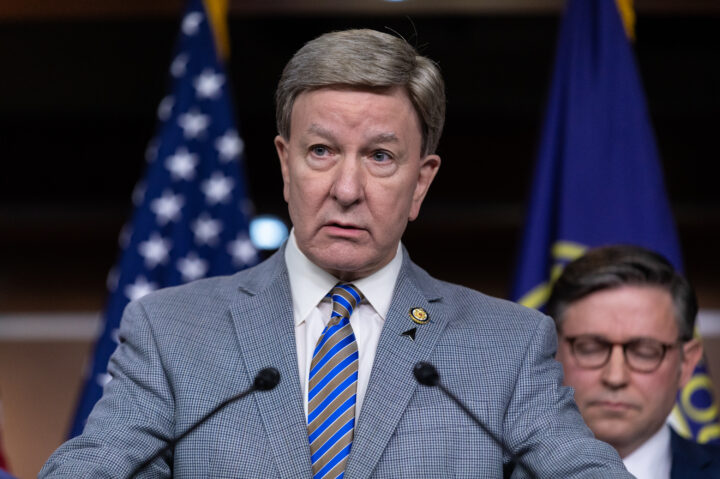
Anna Rose Layden/Getty Images
House Armed Services Committee Chairman Mike Rogers (R-AL) speaks to the press at the U.S. Capitol on October 17, 2025 in Washington, DC.
The top Republican on the House Armed Services Committee told reporters on Wednesday, after a classified briefing, that the administration isn’t giving committee members enough information about its plans in Iran.
The comments by a senior, generally hawkish Republican, Rep. Mike Rogers (R-AL), are a sign of cracks between congressional Republicans and the administration — who have largely remained in lockstep through the first month of the war — over the strategy in Iran.
“We want to know more about what’s going on, what the options are, and why they’re being considered,” Rogers said, according to Politico. “And we’re just not getting enough answers on those questions.”
He said he’d told briefers that “this has consequences if you don’t remedy it” and told administration officials that they should be “thoughtful and deliberate” about the use of ground forces.
Sen. Roger Wicker (R-MS), chair of the Senate Armed Services Committee, told reporters, “I can see why he might have said that” but demurred when asked again about Rogers’ comments later in the afternoon, saying he hadn’t seen the context in which Rogers made the remarks and adding later that he wanted to talk to Rogers before commenting further.
Another House Republican, Rep. Nancy Mace (R-SC), who has some isolationist leanings and is prone to breaks with her party, was even more critical of the administration and suggested that the U.S. was moving toward putting troops on the ground.
“The justifications presented to the American public for the war in Iran were not the same military objectives we were briefed on today in the House Armed Services Committee,” Mace said on X. “This gap is deeply troubling. The longer this war continues, the faster it will lose the support of Congress and the American people.”
She also shared multiple posts expressing her opposition to ground forces in Iran.
“Let me repeat: I will not support troops on the ground in Iran, even more so after this briefing,” Mace said. She added, “Washington’s war machine is hard at work. They are try[ing] to drag us into Iran to make it another Iraq. We can’t let them.”
Other Republicans on the Senate Armed Services Committee, who participated in a separate Wednesday briefing, said they didn’t share Rogers’ concerns.
“I sit on Intel and I sit on Armed Services, so I get the classifieds on both — I think they’ve given us accurate information,” Sen. Mike Rounds (R-SD) told Jewish Insider. “And we always want more — so I understand the desire to get more information — but I’m not going to fault them for being careful on the information they give us because it’s a very fluid situation.”
“I’m satisfied,” Sen. Jim Banks (R-IN) said of the briefing on Wednesday.
The Senate Budget Committee chair said he’d prefer to pass the supplemental through normal legislative procedures, rather than folding it into a reconciliation process

Photo by Kevin Dietsch/Getty Images
Sen. Lindsey Graham (R-SC) speaks during a news conference at the U.S. Capitol on July 30, 2021 in Washington, DC.
Sen. Lindsey Graham (R-SC) said Wednesday that he still hopes to pass supplemental military funding to support the war in Iran through regular legislative procedures, rather than incorporating it into an anticipated party-line budget reconciliation bill.
Graham, who chairs the Senate Budget Committee, which oversees reconciliation, announced on Wednesday that the committee would be pursuing a new reconciliation bill, to include funding for both the military and homeland security.
But asked by Jewish Insider whether he expects Iran war funding — the Pentagon has proposed an ask of more than $200 billion for the war — to be included in the reconciliation bill, as some Republicans have been discussing, Graham said he would still like to pass it through normal procedures.
“That might be difficult — hopefully we can do it through normal order,” Graham said.
Sen. Susan Collins (R-ME), who chairs the Senate Appropriations Committee, also previously expressed a preference for approving the funding through regular order, rather than reconciliation.
Both paths come with significant hurdles: With nearly all Senate Democrats opposed to the war and many opposed to additional funding, trying to pass the Iran war supplemental through normal procedures may run up against a Democratic filibuster.
But the reconciliation process, which only needs a 50-vote majority, would require near-unanimous support from House Republicans, something that may be difficult to rally on any reconciliation bill — regardless of the policy issues — but especially so when a handful of House Republicans have expressed opposition to or skepticism of the war effort.
Graham said Wednesday morning on X that the Budget Committee would “expeditiously move toward creating a second budget reconciliation bill.”
“The purpose of the second reconciliation bill is to make sure there is adequate funding to secure our homeland and to support our men and women in the military who are fighting so bravely,” Graham said. “President Trump and Leader [John] Thune [R-SD] are right to push for a second reconciliation bill to address the threats we face and keep our elections secure and fair.”
Even outside of the war-related funding, President Donald Trump is seeking a $1.5 trillion budget for the Pentagon for 2027, an increase of more than 50%. Some reporting around the ongoing talks to reopen the Department of Homeland Security has suggested that funding for immigration enforcement could be separated from the current funding debate and passed through reconciliation.
Frustrated UAE leaders are questioning the ‘impotence’ of countries like Egypt — and warn that silence on Iranian aggression will push the Gulf closer to U.S., Israel

Gallo Images/"USGS/NASA Landsat data processed by Orbital Horizon"
Satellite view of Dubai International Airport after a drone strike ignited a fuel tank fire. on March 16, 2026.
The United Arab Emirates has been publicly expressing its disappointment in Arab League countries like Egypt for not showing or expressing very little support for Gulf states under attack from Iran, a dynamic playing out more quietly in other Gulf states, as well.
In a post on X on Sunday that received significant attention, Anwar Gargash, an advisor to the UAE President Mohamed bin Zayed, said that “Iran’s brutal aggression against the Arab Gulf carries profound geopolitical repercussions … and the result is to bolster our national capabilities and the joint security, as well as to solidify our security partnerships with Washington.”
When French former diplomat Gérard Araud criticized Gargash’s approach, writing on X that “it means deepening your dependence on a country that has led yours into a disastrous conflict without caring about your interests,” Emirati Foreign Minister Abdullah bin Zayed backed up Gargash, responding: “We will never be blackmailed by terrorists.”
In subsequent posts, Gargash not only said that Iran’s attacks are bringing his country closer to the U.S., but criticized other Arab countries for not aligning themselves with the Gulf.
“Where are the joint Arab and Islamic institutions, chief among them the Arab League and the Organization of Islamic Cooperation, while our countries and peoples are subjected to this treacherous Iranian aggression? And where are the ‘major’ Arab and regional countries? … The Arab Gulf states were a support and partner to all in times of prosperity… So where are you today in times of hardship?” Gargash wrote.
As such, he argued, “in absence and impotence, it is unacceptable later to speak of the decline of the Arab and Islamic role or to criticize the American and Western presence.”
On Wednesday, Gargash followed up by distinguishing “those who offered genuine support” from “those who settled for statements without action.”
“The Emirates has proven its ability to confront and endure, and it does not need equipment and troops as much as it needs clarity of positions and knowledge of who can be relied upon in times of hardship,” he added.
Hussain Abdul-Hussain, a research fellow at the Foundation for Defense of Democracies and author of The Arab Case for Israel, told Jewish Insider that the UAE is not the only Gulf state that is expressing resentment towards Arab League states at this time, saying that similar messages have been published in Qatari newspaper editorials and have come out of Kuwait.
Some of the targets of that anger, he said, are Egypt and the Arab League, whose secretary-general, Ahmed Aboul Gheit, is an Egyptian diplomat.
“Gulf governments expected more denunciations of Iran as an aggressor. It took [Egypt] five days to say a word. The Arab League hasn’t met; they usually hold emergency summits and haven’t called for one. The foreign ministers met over Zoom and issued a statement that was a nothingburger,” Abdul-Hussain said.
While Egyptian President Abdel Fattah El-Sisi denounced the Iranian attacks and visited the Gulf, his remarks came across as weak, while Aboul Gheit called the attacks “audacious,” stopping short of a full denunciation, Abdul-Hussain argued.
“Even the adjectives they’re using are soft” in the eyes of Gulf leaders, Abdul-Hussain said.
The media in Egypt and Algeria, Abdul Hussain said, are showing “happiness … that Israel is being pounded. They’re happy with what Iran is doing and no one really seems to care about the Gulf states. The Gulf took 84% of the [Iranian] missiles, as opposed to Israel, which took 16%, and they still can’t straightforwardly say Iran is a problem?”
While Gargash did not specifically mention Israel, Abdul-Hussain interpreted Gargash’s remarks as meaning, “If we in the Gulf can’t rely on you Arabs and Muslims, we will have to find other allies to defend ourselves. That clearly means the U.S. and Israel.”
“The Emiratis feel vindicated, that they were right to move forward and seek their interests with Israel, because look at [other Arab states] now,” he added.
Prominent Emirati media personality Jamal Al Mulla said in a recent episode of his podcast “Arab Cast” that “the Gulf is hurt and will not forget how fellow Arab countries let it down.”
Al Mulla compared the current conflict to the 1991 Gulf War, when only 12 out of 22 Arab League members voted to condemn Iraq for invading Kuwait — “six Gulf countries and the six others were bought off by wealthy Gulf governments.”
“This round, the line is even clearer since aggression is not by an Arab League member against another, but by a non-Arab foreign country against Arab countries, and yet, the Arab League is shameful and so are countries like Iraq, Algeria, Sudan’s Burhan government and western Libya’s government,” he said.
Al-Mulla said that “when any Arab government wants not to take a position on anything, it inserts the Palestinian cause into its statement.”
Arab countries are “always citing Palestine as a distraction,” he added, and recounted that, in 1991, Palestinian leader Yasser Arafat told the Arab League that “the Kuwaiti problem will be solved only after the Palestinian cause.”
“When the shooting stops, I expect a few Gulf countries to rush to normalization with Israel. My money is on Kuwait, perhaps Saudi Arabia too,” Al Mulla said.
Abdul-Hussain agreed with Al-Mulla that Kuwait would return to its past pro-American stance and normalize relations with Israel.
“People in the Gulf were expected to support the Palestinians at all times during the Gaza war, with money, humanitarian aid, politically and diplomatically, and they get nothing in return,” Abdul-Hussain said. “I think they’re really hurt.”
Abdul-Hussain said that Hamas and the Palestinian Authority have not robustly denounced Iran. After initially only condemning the U.S. and Israel, Hamas released a statement two weeks into the war against attacks on the Gulf by Iran — one of its patrons — under pressure from Qatar, another of its patrons. The Palestinian Authority released a statement on the first day of the war expressing solidarity with the Gulf states and calling for de-escalation.
“The thinking in the Gulf is that this time, it’s our turn. We’re the victims. The Palestinians can wait,” Abdul-Hussain said.
Plus, is Stevens losing steam in Michigan Senate race?
Anna Rose Layden/Getty Images
House Armed Services Committee Chairman Mike Rogers (R-AL) speaks to the press at the U.S. Capitol on October 17, 2025 in Washington, DC.
This P.M. edition is reserved for our premium subscribers — offering a forward-focused read on what we’re tracking now and what’s coming next. Please don’t hesitate to share your thoughts and feedback by replying to this email.
📡On Our Radar
Notable developments and interesting tidbits we’re tracking
White House Press Secretary Karoline Leavitt downplayed reports that Iran has rejected President Donald Trump’s ceasefire proposal, saying in a press briefing today that “talks continue” and “are productive.” She further confirmed, while cautioning against speculation, that there are “elements of truth” to the 15-point plan that has been reported.
About potential face-to-face negotiations, which International Atomic Energy Agency head Rafael Grossi said could take place in Pakistan as soon as this weekend, Leavitt said she “would not get ahead of our skis on reporting about any talks this weekend until you hear directly from us”…
Emerging from a classified House Armed Services Committee briefing on Iran, Chairman Mike Rogers (R-AL) expressed frustration that the administration isn’t forthcoming enough about its war plans. “We want to know more about what’s going on, what the options are and why they’re being considered, and we’re just not getting enough answers on those questions,” Rogers told reporters.
And Senate Armed Services Committee Chairman Roger Wicker (R-MS), asked about his House colleague’s comments, said, “Let me put it this way: I can see why he might have said that.” It’s the latest sign of cracks in the GOP nearly a month into the war effort…
For the first time since the start of the war, the UAE — which has faced the brunt of Iran’s attacks — reported zero Iranian ballistic missile attacks today, raising questions about the Islamic Republic’s potentially dwindling supplies.
Yousef Al Otaiba, the Emirati ambassador to the U.S., called for a “conclusive outcome” to the war, as opposed to a “simple cease-fire.” Writing in The Wall Street Journal, he argued that “building a fence around the problem and wishing it goes away isn’t the answer. It would simply defer the next crisis”…
European authorities are investigating whether a new group that has claimed responsibility for several recent terror attacks on Jewish institutions across Europe, the Islamic Movement of the Righteous Companions, is a front for Iran, which has likely recruited people online to carry out the attacks on its behalf…
The Journal profiles Iranian parliament speaker Mohammad-Bagher Ghalibaf as he emerges as a potential leader and negotiating partner for the U.S., with one expert calling him a “wannabe strongman” who simultaneously has “the necessary credentials to deliver a potential deal with the Trump administration”…
An internal poll from the campaign of Michigan state Sen. Mallory McMorrow shows her leading the pack in the Democratic primary for U.S. Senate, followed by the far-left Abdul El-Sayed with Rep. Haley Stevens (D-MI) trailing in third place, a sign her campaign is struggling to build momentum. A fifth of potential primary voters still identified themselves as undecided.
Stevens’ campaign then released its own internal poll that showed her in first place, followed closely by El-Sayed with McMorrow in third, though the survey was conducted in mid-February…
As the Trump administration sues Harvard — again — over alleged civil rights violations and failure to address campus antisemitism, Rabbi Hirschy Zarchi, president of Harvard Chabad, told The Harvard Crimson that the school is in fact “taking the issue” of antisemitism “very seriously.”
“While there is much more to be done, the only plausible characterization of Harvard’s current leadership is as principled and effective in confronting and removing the intolerance which had taken root on campus over more than a decade,” added Jason Rubenstein, executive director of Harvard Hillel…
Asked at a recent event at Harvard’s Kennedy School whether the Biden administration could have done more to save lives in the war in Gaza, former Secretary of State Tony Blinken said, “Could we, should we have done things differently such that the suffering that people endured, the loss of the children you just listed and so many others could have been averted? The short answer is: Maybe yes.”
Blinken also called on people not to be “binary” in their thinking about the Middle East, Jewish Insider’s Gabby Deutch reports. With the Gaza war, he said, “Where did we start? We started with Oct. 7. We started with the most horrific massacre of Jews since the Holocaust. It’s very easy to say, ‘Oh, yeah, that’s a given.’ Except it wasn’t a given for Israelis and Israeli society”…
⏩ Tomorrow’s Agenda, Today
An early look at tomorrow’s storylines and schedule to keep you a step ahead
Keep an eye out in Jewish Insider for a look at the growing divide in the Democratic Party over engagement with antisemitic streamer Hasan Piker — and the questions it raises about the meaning of progressivism in the current political landscape.
The Atlantic Council and U.S.-Syria Business Council will host a symposium on Syria’s energy sector with keynote remarks from U.S. Special Envoy to Syria Tom Barrack. Also speaking are several oil executives and Jacob McGee, the State Department’s deputy assistant secretary for Israeli-Palestinian affairs.
The FII Priority Summit continues in Miami; among other sessions tomorrow, Jared Kushner will speak on U.S.-Gulf investment and Zach Witkoff, co-founder of World Liberty Financial and son of Special Envoy Steve Witkoff, will discuss crypto.
CPAC, which President Donald Trump is seemingly not attending for the first time in a decade, continues in Dallas. GOP candidates who are in attendance include Brandon Herrera, the far-right influencer running in Texas’ 23rd District; Michael Whatley, the front-runner in North Carolina’s open Senate race; Rep. Mike Collins (R-GA), running in a competitive primary to challenge Sen. Jon Ossoff (D-GA); Rep. Kevin Hern (R-OK), seeking the Senate seat vacated by new Homeland Security Secretary Markwayne Mullin; and Nate Morris, running to succeed retiring Sen. Mitch McConnell (R-KY).
The House Ethics Committee will hold a rare public hearing on Rep. Sheila Cherfilus-McCormick’s (D-FL) alleged ethics violations, including her laundering of funds from a FEMA-backed contract for her family business into her congressional campaign.
STRAIT TALK
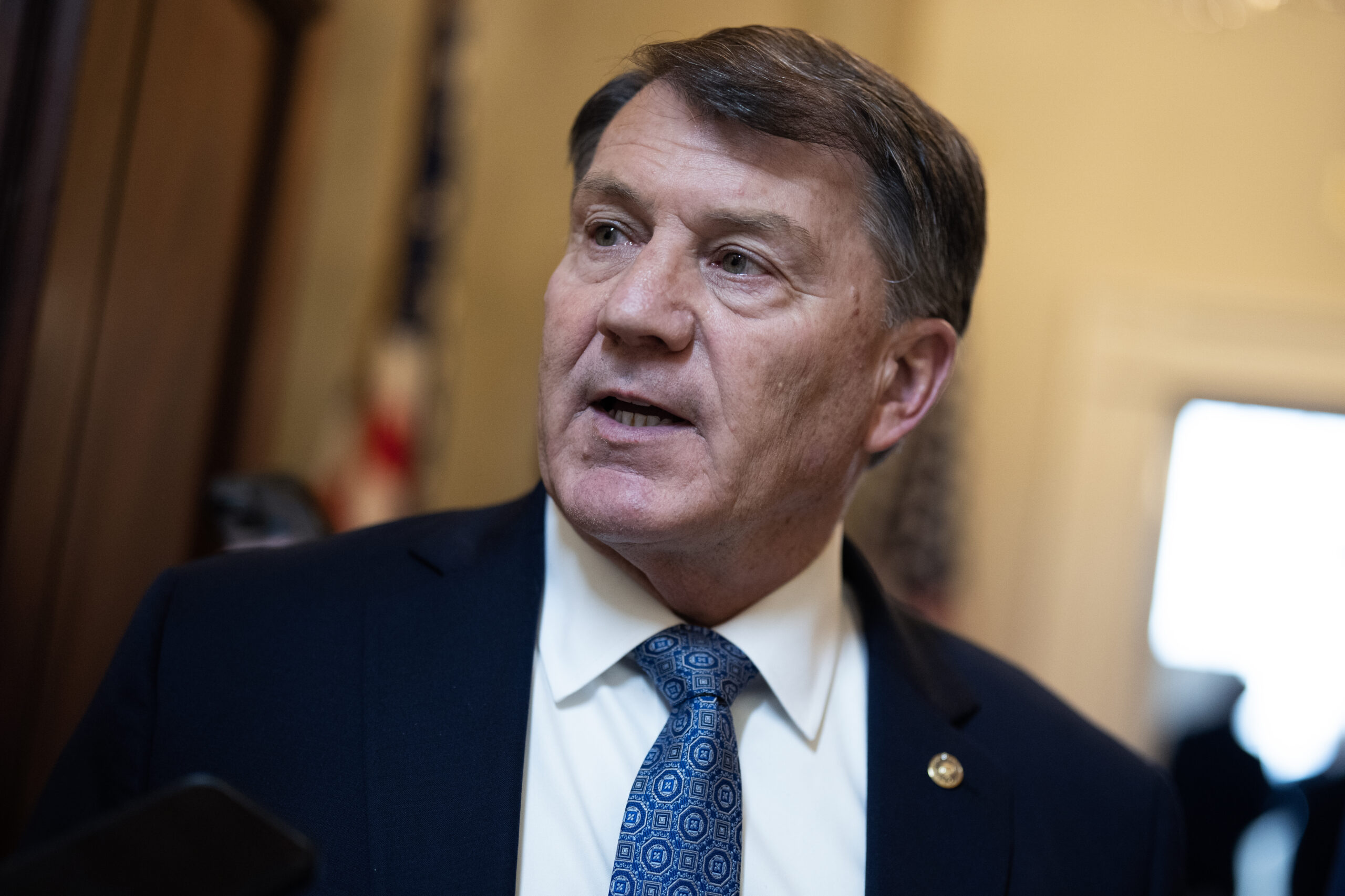
Some disagree on who should claim ultimate responsibility for the strait — the U.S. or other countries in the region
GUARDING THE GATES

Schneider called Piker ‘an unapologetic antisemite’ and warned ‘Democrats risk losing our credibility to condemn those on the right who traffic in bigotry’ if they continue to embrace him
Matthew Kozma, under secretary for intelligence and analysis, spoke at a briefing for the Secure Community Network, a leading Jewish security organization

Emily Elconin/Getty Images
Members of Hatzalah of Michigan, a Jewish volunteer emergency medical service survey the area near Temple Israel following reports of an active shooter on March 12, 2026 in West Bloomfield, Michigan.
Extensive security “preparations, training and practice” that had taken place prior to an attack on a Detroit-area synagogue earlier this month “greatly helped to dramatically mitigate what could have been so much worse in Michigan,” a Trump administration intelligence official said on Tuesday.
During a security briefing webinar hosted by the Secure Community Network, a leading Jewish security organization, ahead of the Passover holiday, Matthew Kozma, under secretary for intelligence and analysis at the Department of Homeland Security, called for continued vigilance “given the threat that’s stemming from Iran, particularly in the Middle East, but also here at home.”
He said that Americans should remain cautious of threats from “malicious actors, particularly ones encouraged by or empathetic to Iran,” as two upcoming events in the country — the 2026 FIFA World Cup and America’s 250th anniversary — bring an influx of visitors into the U.S.
The briefing was held during what Michael Masters, CEO of SCN, described as “an elevated threat environment from Iran and its proxies,” ahead of the start of the Passover holiday next week.
Since the U.S.-Israeli war with Iran started nearly one month ago, Jewish institutions have seen a surge in attacks, including the one targeting Temple Israel in West Bloomfield Township, Mich. — one of the country’s largest Reform congregations — and three shootings outside of Toronto synagogues.
Masters said SCN monitored over 8,000 direct calls for violence against the Jewish community in North America over a six-day period this month, marking a 137% increase over the average tracked and “the highest number we’ve ever tallied in that timeframe.”
Oakland County, Mich., Sheriff Michael Bouchard, who was on the scene following the Temple Israel attack, shared with attendees that he himself has been the target of death threats for supporting the Jewish community.
Still, Bouchard doubled down on his support. “Something that I’ve said before, and I believe, is that if you target our Jewish community, we’re going to stand in front of them to protect them. And we’re coming for you.”
The briefing concluded with Eric Fingerhut, CEO of the Jewish Federations of North America, calling for “more resources at this time.”
“Temple Israel was one of the best, most secured buildings, having spent a significant amount of money of their dues budget and of their donors’ budgets on security, and yet we need additional levels of security,” Fingerhut said. “Our federations are committed to generating those additional resources, bringing those resources to our communities. But in addition, I have to mention that it’s the government’s responsibility, first and foremost, to protect its citizens in their places of worship, in their places of communal gathering.”
Last week, in a letter to the leaders of the House Appropriations Committee, a bipartisan group of 150 House members asked the committee to provide $1 billion in funding for the Nonprofit Security Grant Program in 2027, a massive expansion of the program that marks the first time lawmakers’ request aligns with the $1 billion that some Jewish groups have been advocating for. The program received $274.5 million in funding in 2025, but that funding has still not been distributed, according to the letter, which cited delays at FEMA, and lawmakers have not been provided customary data about supplemental funding rounds awarded last year.
“We need more resources and support from the government,” continued Fingerhut, who announced that JFNA will hold an advocacy fly-in in Washington in mid-May.
“We will be visiting every member of Congress, asking them for their support. We’ll be visiting the members of the administration, as well … to make sure that [they] know that every one of us has the right in this country to practice our faith and to gather together as a community in safety and security.”
The president also claimed ‘we’ve won this war,’ though did not indicate military operations would wind down
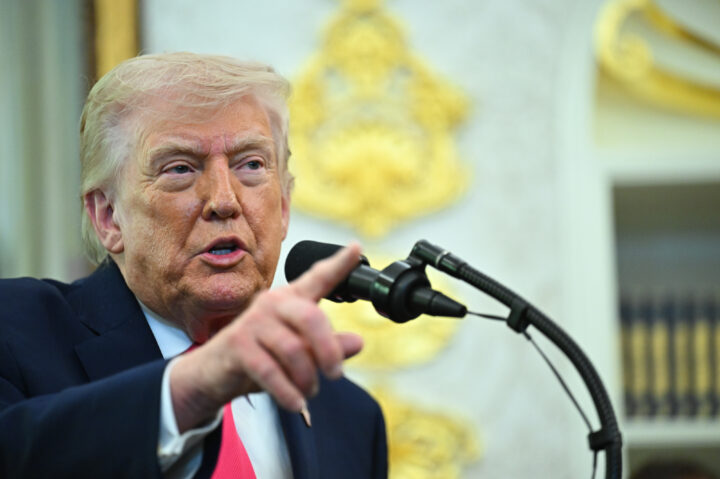
Graeme Sloan/Bloomberg via Getty Images
President Donald Trump speaks during a swearing-in ceremony in the Oval Office of the White House in Washington, DC, US, on Tuesday, March 24, 2026.
President Donald Trump said on Tuesday that the United States had achieved “regime change” in Iran through the killing of Iranian leaders and teased a “very significant prize” provided by Iran to the U.S. in the course of ongoing negotiations.
“We have, really, regime change. This is a change in the regime, because the leaders are all very different than the ones that we started off with that created all those problems,” Trump told reporters in the Oval Office.
Asked if he was hopeful that diplomatic negotiations would achieve a lasting ceasefire, the commander-in-chief replied, “I think we’re going to end it. I can’t tell you for sure. You know, I don’t like to say this — this war has been won. The only one that likes to keep it going is the fake news. … We’ve won this war.”
Trump also acknowledged on Tuesday that Jared Kushner, White House Special Envoy Steve Witkoff, Secretary of State Marco Rubio and Vice President JD Vance are involved in peace talks while expressing optimism that the current leadership in Iran was capable of making a deal.
“We’re talking to the right leaders, and they want to make a deal so badly,” Trump said without specifying which Iranian officials his administration was engaged with.
The president said he reached the conclusion that “we’re dealing with the right people” after receiving a “gift” from Iranian leaders that was “oil and gas related” and “worth a tremendous amount of money.” Trump declined to say what exactly the gift was, but said the offering was “related to the flow, to the Strait [of Hormuz].”
The Iranians “gave us a present, and the present arrived today,” said.. “It was a very significant prize.”
Defense Secretary Pete Hegseth said in remarks following the president’s comments that Pentagon leaders “see ourselves as part of this negotiation as well. We negotiate with bombs.”
Trump then responded by noting that Hegseth and Joint Chiefs of Staff Chairman Gen. Dan Caine were the “only two people” in his administration who “were quite disappointed” when he suggested that the war could be resolved soon.
The president revealed that after telling the two men that he thought “this thing’s going to be settled very soon,” both men replied “Oh, that’s too bad.”
“Pete didn’t want it to be settled. These guys are doing a great job. That’s a good attitude though, right?” Trump said of Hegseth and Caine. “They were not interested in settlement. They were interested in just winning this thing.”
The vote again fell largely along party lines, with only Sens. John Fetterman and Rand Paul defecting from their parties

Kevin Carter/Getty Images
The U.S. Capitol Building is seen at sunset on May 31, 2025 in Washington, DC.
For the third time in a month, Senate Republicans on Tuesday evening blocked an effort by Democrats to halt U.S. operations in Iran.
The war powers resolution, this time led by Sen. Chris Murphy (D-CT), is part of a series of efforts by Senate Democrats to disrupt business on the Senate floor to force a reckoning and public testimony by Cabinet officials about the war in Iran.
Democrats have four other such resolutions filed, which they could call up for votes at a time of their choosing, using special procedures allowing lawmakers to force votes on war powers resolutions.
The Senate again rejected the resolution 53-47, with Sen. John Fetterman (D-PA) once again voting in favor of the war effort and Sen. Rand Paul (R-KY) again voting against it.
The mostly party-line vote comes in spite of recent comments by some Senate Republicans pushing for the war to come to an end.
Sen. Tim Kaine (D-VA), another leader of the Democratic war powers push, said that the group plans to continue to force weekly votes on the issue. He acknowledged before the vote that the results might not change this week, but suggested that some Republican colleagues might be won over if the war continues to drag on, troops are sent to invade Iran or oil prices continue to spike.
Kaine indicated that he was not encouraged by President Donald Trump’s comments that he considered the U.S. to have “won” the war in Iran or his recent claims of engaging in productive talks with the regime.
“If he announces that it’s over, that will be good news,” Kaine told Jewish Insider. “Now, the consequences are not going to be over for a very long time, and Virginians are going to be suffering the consequences of something that lacked a rationale and lacked a plan for a very long time, in all likelihood. But the minute he announces it’s over, that will be positive — if he doesn’t change his mind, but he could change his mind.”
The House is expected to vote this week on a similar measure led by Rep. Greg Meeks (D-NY). A separate House measure led by Rep. Josh Gottheimer (D-NJ) and other pro-Israel moderates which would limit the war effort to 30 days — a period which will expire next week — could also come to a vote soon.
At least one House Democrat who voted previously against a war powers resolution and backed the U.S. operations in Iran has said he plans to vote for the Meeks resolution this week.
Plus, media misdirection over AIPAC money

Shauna Clinton/Sportsfile for Web Summit Qatar via Getty Images
Hasan Piker during day two of Web Summit Qatar 2026 at the Doha Exhibition and Convention Center in Doha, Qatar.
This P.M. edition is reserved for our premium subscribers — offering a forward-focused read on what we’re tracking now and what’s coming next. Please don’t hesitate to share your thoughts and feedback by replying to this email.
📡On Our Radar
Notable developments and interesting tidbits we’re tracking
Rumblings of a potential peace summit between Washington and Tehran have begun — sources told Axios that the U.S. and several mediating countries are waiting for Iran to respond to a proposal for peace talks this Thursday, while President Donald Trump reposted a message from Pakistan offering to “be the host to facilitate meaningful and conclusive talks”…
Trump told reporters in the Oval Office this afternoon that “we’re dealing with the right people” in Iran because they “gave us a present, and the present arrived today. It was a very big present worth a tremendous amount of money,” but would only tease that it was “oil and gas related.” Asked if he is negotiating over who will control the Strait of Hormuz, Trump said, “No … we’ll have control of anything we want”…
Saudi Crown Prince Mohammed bin Salman has encouraged Trump to continue the campaign against Iran and push towards toppling the regime, The New York Times reports, believing that Iran’s threat to the Gulf will only be removed through the transition of its government and not if the war results in a failed state. MBS has reportedly argued in favor of striking Iran’s energy infrastructure and putting U.S. troops on the ground…
The Pentagon is expected to announce the deployment of about 3,000 soldiers from the military’s 82nd Airborne Division to participate in the campaign against Iran, The Wall Street Journal reports, a move that opens the possibilities for boots on the ground, as the division is trained to parachute into hostile territory…
Israeli Defense Minister Israel Katz said today that the IDF will now maintain control over a security zone south of the Litani River in Lebanon and prevent the return of Lebanese residents who have been evacuated from the area “until the security of northern [Israeli] residents is assured”…
Lebanese Minister of Foreign Affairs Youssef Raggi declared Iran’s ambassador to Beirut persona non grata and expelled him from the country, as Iranian proxy Hezbollah continues to fire on Israel against the Lebanese government’s orders.
Shortly after, an Iranian ballistic missile was launched towards Beirut for the first time — it was reportedly intercepted by a “foreign naval vessel,” presumably the U.S., though fragments struck Lebanese towns…
Secretary of State Marco Rubio is being dispatched to France later this week to discuss the Iran war, among other issues, with the U.S.’ G7 allies, including Britain, Canada, France, Germany, Italy and Japan, countries that have all declined to participate in the war effort…
Majed al-Ansari, spokesperson for the Qatari foreign ministry, said today that Qatar is not involved in mediating any U.S.-Iran negotiations, a shift for the country that has traditionally played the part of go-between. Al-Ansari said there has been no communication between Doha and Tehran since a phone call early in the conflict when Qatar made clear its anger with Iranian strikes on its territory…
Politico reports that several 2028 Democratic presidential hopefuls said they wouldn’t or haven’t taken money from AIPAC, including Sen. Cory Booker (D-NJ), California Gov. Gavin Newsom, Sen. Ruben Gallego (D-AZ), Kentucky Gov. Andy Beshear, Illinois Gov. JB Pritzker, Pennsylvania Gov. Josh Shapiro, Sen. Elissa Slotkin (D-MI) and former Chicago Mayor Rahm Emanuel.
But while framing the statements as rejections of AIPAC and Israel, the outlet buried or declined to mention Booker’s rebuke of the Democratic Party’s singling out of the pro-Israel group, several respondents’ inability to accept funds from AIPAC since it only participates in congressional elections and Newsom’s own about-face on Israel, where in the same publication he walked back critical comments he’s made and said he’s “proud to support the state.”
AIPAC said in response that it has “never given to a presidential campaign” and that “singling out and excluding millions of pro-Israel Democrats” who are AIPAC members “is wrong and undemocratic”…
Michael Sacks — a prominent Democratic donor and supporter of former President Barack Obama who chaired the 2024 Democratic National Convention host committee — denounced Democratic criticism of AIPAC as a “thinly disguised effort to make support for Israel politically toxic in the Democratic Party, to chase Jews and their allies out of our big tent coalition.”
Sacks wrote in the Chicago Tribune, “Real leadership recognizes that we can hold complicated views about the Israeli government and still refuse to make Jewish identity and pro-Israel sentiment a political disqualifier in our party. We can defend the big tent when it is inconvenient, not just when it is easy”…
Jonathan Cowan, president of the moderate Democratic think tank Third Way, condemned far-left Michigan Senate candidate Abdul El-Sayed for his upcoming rallies with antisemitic streamer Hasan Piker, Jewish Insider’s Danielle Cohen-Kanik reports.
“It is morally repugnant and strategically self-defeating for Democrats like Abdul El-Sayed and Members of Congress like Summer Lee to cozy up to antisemitic extremists like Hasan Piker,” Cowan said in a statement. “Anyone eager to campaign with Hasan Piker is, at best, comfortable overlooking his antisemitic and anti-American extremism and, at worst, endorsing it”…
El-Sayed stood by his controversial statement about the shooting attack at Temple Israel in suburban Detroit earlier this month, in which he condemned the attack but blamed Israel’s military campaign in Lebanon for the perpetrator’s actions (the attacker’s brother was a Hezbollah commander).
The statement “was a risk,” El-Sayed said on an internal campaign call, per Punchbowl News, “but leadership is being willing to say the thing if you believe it to be true that nobody else is going to say”…
⏩ Tomorrow’s Agenda, Today
An early look at tomorrow’s storylines and schedule to keep you a step ahead
Keep an eye out in Jewish Insider for coverage of another war powers resolution expected to receive a vote this evening in the Senate.
President Donald Trump will give the keynote speech at the National Republican Congressional Committee’s annual President’s Dinner in Washington.
The House Homeland Security Committee will hold a hearing assessing the impact of the Department of Homeland Security shutdown, as lawmakers make progress on negotiations to fund the agency.
D.C. councilmember and mayoral candidate Janeese Lewis George will rally alongside other members of the Democratic Socialists of America including Squad-member Rep. Rashida Tlaib (D-MI), days after Lewis George held a private meeting with Jewish leaders to apologize for saying in a DSA questionnaire she would boycott events “promoting Zionism” and avoid the “Zionist lobby.”
Scholar of Jewish literature Ruth Wisse will deliver the annual Jefferson Lecture in the Humanities, the highest honor the federal government gives for intellectual achievement in the humanities, at the Kennedy Center in Washington.
The FII PRIORITY Summit, a high-profile investment and policy conference, will kick off in Miami, with speakers over the rest of the week including Trump; Donald Trump Jr.; Jared Kushner; White House Special Envoy Steve Witkoff; Dina Powell McCormick, president of Meta; Saudi Ambassador to the U.S. Princess Reema Bandar Al Saud; former Treasury Secretary Steve Mnuchin; Massad Boulos, senior White House advisor on the Middle East; and many more.
The Conservative Political Action Conference, known as CPAC, also begins tomorrow in Dallas.
The Jewish Book Council will hold the 75th National Jewish Book Awards Gala, hosted by entertainer Jonah Platt, at Temple Emanu-El in New York City.
SECOND ACT

PAIN TO POWER

In the wake of Oct. 7, some in the Jewish community turned to faith, philanthropy or federal advocacy. Others set their sights closer to home, organizing to shape school boards and influence city councils
Behind the scenes, the phone call between Trump and Netanyahu was not enough to reassure Jerusalem that Washington had its interests in mind
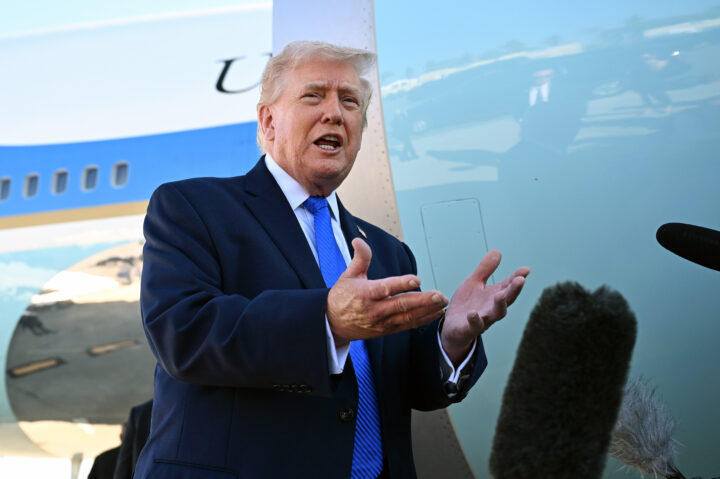
Roberto Schmidt/Getty Images
U.S. President Donald Trump speaks to reporters before boarding Air Force One at Palm Beach International Airport on March 23, 2026 in West Palm Beach, Florida.
“We will safeguard our vital interests under all circumstances,” Israeli Prime Minister Benjamin Netanyahu said on Monday, hours after President Donald Trump announced that the U.S. would suspend strikes on Iranian energy facilities to start negotiations.
In a Hebrew video statement, Netanyahu tried to reassure the Israeli public that the war would end in a way that made the previous three weeks — in which they, not Americans, ran with their children to bomb shelters multiple times a day — worth it. He vowed that Israel would be “continuing to strike in both Iran and Lebanon.”
“Earlier today, I spoke with our friend, President Trump,” Netanyahu said. “President Trump believes there is an opportunity to leverage the tremendous achievements we have reached alongside the U.S. military to realize the goals of the war through an agreement, an agreement that will safeguard our vital interests.”
Behind the scenes, however, the phone call was not enough to reassure Jerusalem that Washington had its interests in mind, and Netanyahu dispatched his closest advisor, Ron Dermer, to deter the Trump administration from reaching a “not good” deal, Israel’s Channel 12 reported.
Note the word choice: “not good.” If negotiations are genuine and this is not another mind game by the Trump administration, Israeli officials were not so optimistic in their briefings to Jewish Insider and other Israeli media as to say there could be a good outcome from a deal that, de facto, would continue to recognize the mullahs’ regime — but perhaps a disaster could be averted.
Netanyahu used the term “vital interests” twice in his statement. The top interest on Dermer’s list is ensuring that the 440 kg of highly enriched uranium, the material that Iran boasted to White House Special Envoy Steve Witkoff was enough for 11 bombs, would be removed from Iran. According to Ynet, Witkoff made this demand clear, raising his voice on the phone to Iranian Foreign Minister Abbas Araghchi before the latter’s first overture last week to return to the negotiating table.
Arguably, this war succeeded in its other aim of significantly diminishing the ballistic missile threat from Iran. The IDF and Netanyahu said last week that the Islamic Republic’s missile production capability has been destroyed. The White House said, “Iran’s ballistic missile capacity is functionally destroyed.” Yet Iran has hundreds of missiles that it continues to shoot, along with drones, at Israel and Gulf states each day. Plus, as IDF international spokesperson Lt. Col. Nadav Shoshani pointed out to JI last week, the Islamic Republic could engage in the “hyper-production” of ballistic missiles after the war, as it did following last year’s 12-day June war.
Neither Trump nor Netanyahu went so far in their statements in the last month to promise regime change; they generally said it was up to the Iranian people to take to the streets. Yet, Trump has claimed that regime change has happened because so many Iranian leaders have been killed. The Israeli position is more like what former Defense Minister Avigdor Liberman described on X: “The murderous Iranian regime does not hide its determination to destroy the State of Israel. We cannot leave an injured enemy that is only looking for revenge. We have a historic opportunity to solve the problem and topple the Ayatollahs’ regime. Otherwise, we’ll be back for another round with a much higher price.”
Which brings us to Netanyahu’s statement that Israel is “continuing to strike in both Iran and Lebanon.” He continued: “We are smashing the missile program and the nuclear program, and we continue to deal severe blows to Hezbollah.”
Israel is not the only country that views the fight as incomplete; Saudi Arabia and the United Arab Emirates in recent days took further steps to support the U.S. in its fight against Iran, The Wall Street Journal reported. Riyadh let the U.S. use one of its air bases and the UAE shut down Iranian assets, warning it could freeze billions more dollars. Bahrain submitted a draft U.N. Security Council resolution calling to use force to keep the Strait of Hormuz open, Reuters reported.
Whether that will continue to be true if Trump makes a deal with the Islamic Republic, and whether the war in Lebanon will be able to go on as long as Israel seeks to push Hezbollah off of Israel’s border for the long term, remains to be seen.
In the past year, there have been instances of dissonance between the U.S. and Israeli timelines and war goals: There was the Witkoff-brokered deal with the Houthis, which surprised Jerusalem and only stopped attacks on U.S. ships, not strikes on Israeli civilian centers; and the end to last June’s 12-day war, when Israel sought to respond to an Iranian breach of the ceasefire, and Trump responded with an f-bomb and public demand that Israel stop.
This could be the third time in the past year that Trump reaches a deal, stymying Israel before its leadership felt the time was ripe to end the fight.
Plus, GOP losing hope in unseating Ossoff
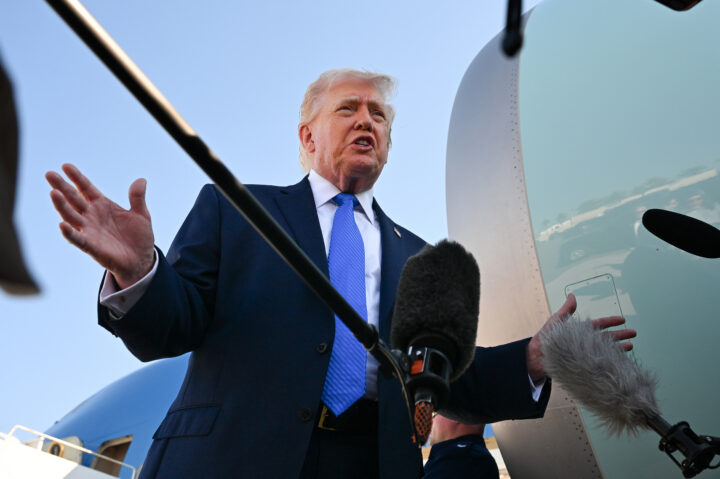
Roberto Schmidt/Getty Images
President Donald Trump speaks to reporters before boarding Air Force One at Palm Beach International Airport on March 23, 2026 in West Palm Beach, Florida.
This P.M. edition is reserved for our premium subscribers — offering a forward-focused read on what we’re tracking now and what’s coming next. Please don’t hesitate to share your thoughts and feedback by replying to this email.
📡On Our Radar
Notable developments and interesting tidbits we’re tracking
President Donald Trump revealed today that White House Special Envoy Steve Witkoff and advisor Jared Kushner have been negotiating with Iran amid the ongoing war, Jewish Insider’s Emily Jacobs reports, which played a role in Trump’s decision to delay by five days potential strikes on Iranian energy infrastructure.
“We have had very strong talks,” Trump told reporters. “Mr. Witkoff and Mr. Kushner had them. They went, I would say, perfectly. If they carry through with that, it’ll end that problem.” But the president kept the option of continued military action open: “If it goes well, we’re going to end up with settling this. Otherwise, we’ll just keep bombing our little hearts out,” he said.
At an event in Tennessee this afternoon, Trump added, “My whole life has been a negotiation, but with Iran we’ve been negotiating for a long time, and this time they mean business” and claimed the U.S. has taken out 90% of Iran’s missile launchers…
Israeli Prime Minister Benjamin Netanyahu said in a video statement that he spoke with Trump today about the negotiations, which the president believes could result in “an agreement that will safeguard our vital interests.”
“At the same time,” Netanyahu said, Israel is continuing to strike targets in Iran and Lebanon; the IDF announced it had struck several “regime headquarters” in Tehran and CENTCOM also said it continues “to aggressively strike Iranian military targets with precision munitions”…
Senate Minority Leader Chuck Schumer (D-NY) declined to directly address whether the degradation of Iran’s military infrastructure should be viewed as a positive outcome, JI’s Matthew Shea reports, instead emphasizing the war’s potential economic and geopolitical consequences.
Asked on MS NOW’s “Morning Joe” if the degradation is a “good thing,” Schumer said it’s a “premature question. What is going to happen in the next several months? Is it worth it? Will the world economy collapse? … If you ask the American people, if you have the choice of degrading the military structure in Iran, but having gasoline be $6 a gallon and our economy falling into a deep recession where millions lose their job, what do you think?”…
The New York Times reports on the apparent failure of a plan by the Mossad to foment internal Iranian rebellion that could lead to the overthrow of the regime amid the ongoing war, as American and Israeli intelligence indicates the regime is weakened but intact…
UAE Foreign Minister Abdullah bin Zayed said Abu Dhabi will “never be blackmailed by terrorists,” in response to a post from French diplomat Gérard Araud who called the UAE’s further embrace of the U.S. amid bombardment from Iran “strange”…
The Associated Press examines Israel’s use of Iran’s network of surveillance cameras to carry out intelligence operations including the assassination of former Supreme Leader Ayatollah Ali Khamenei…
Asked if former intelligence official Joe Kent was leaking classified information, as he is reportedly under investigation by the FBI for doing, Trump said “that’s possible,” and largely derided Kent for his failed congressional campaigns and for remarrying “quickly” after his first wife was killed in 2019 while serving in Syria.
“I felt badly for him, so I told my people, ‘Reach out to him, give him a job at the White House.’ This is the thanks I get,” Trump told reporters. He also dismissed Kent’s opposition to the Iran war as an effort “to get publicity”…
Heritage Foundation President Kevin Roberts said that internal MAGA divisions over the Iran war, like those espoused by Kent, are “good” for the movement. “As it relates to tensions in the movement or disagreements about national security, actually, it’s good that those exist,” he told The Hill. But, Roberts said, he believes Trump “has executed [the war] perfectly, including not involving untrustworthy European, quote, unquote allies in the conversation”…
Politico looks at the decision of pro-Israel groups including AIPAC and the Republican Jewish Coalition not to spend money against Texas congressional candidate Brandon Herrera as they did during his first run for Congress, despite Herrera’s history of extreme views and antisemitic rhetoric. Trump endorsed Herrera last week after Rep. Tony Gonzales (R-TX) withdrew from the race…
New filings from the Federal Election Commission show that two super PACs rumored to be established by pro-Israel groups during the Illinois Democratic primaries were primarily funded by United Democracy Project, the AIPAC-affiliated super PAC, which spent more than $5.3 million through Elect Chicago Women and Affordable Chicago Now.
Among the other major donors who backed the two groups was prominent Democratic philanthropist Michael Sacks, who had lamented the rising “Jew hate” among candidates who refused to take money from donors affiliated with AIPAC earlier in the election…
Republicans are quietly losing hope in their ability to defeat Sen. Jon Ossoff (D-GA), a seat which the GOP had named as one of its main targets to flip, The Washington Post reports. “This guy’s no slouch,” Rep. Buddy Carter (R-GA), running in the GOP primary, told a crowd of Republican voters, calling Ossoff “articulate” and “handsome.”
Jewish leaders in Georgia told JI last year that Ossoff was making amends with their community after he had voted to block some aid to Israel, though the Jewish lawmaker is now drawing fresh controversy by adopting Rep. Ro Khanna’s (D-CA) rhetoric about the “Epstein class,” which some have identified as antisemitic…
⏩ Tomorrow’s Agenda, Today
An early look at tomorrow’s storylines and schedule to keep you a step ahead
Keep an eye out in Jewish Insider for a look at how the aftermath of the Oct. 7 attacks has sparked a wave of grassroots Jewish political activism across the U.S., as community members organize locally — from city councils to school boards — to respond to rising antisemitism and shape down-ballot races.
The Hill & Valley Forum, a summit focused on connecting government and the tech and innovation industries, will hold its annual gathering in Washington tomorrow with opening remarks by its co-founder, Jacob Helberg, now under secretary of state for economic affairs. Ahead of the summit, Helberg announced today that the U.S. will contribute $250 million alongside a consortium of countries involved in the Pax Silica initiative to invest in energy projects and critical minerals.
Also speaking tomorrow are Sens. Mike Rounds (R-SD), Chris Coons (D-DE), Todd Young (R-IN), Maria Cantwell (D-WA), Jim Banks (R-IN), Rick Scott (R-FL) and Mark Warner (D-VA); House Speaker Mike Johnson (R-LA); Reps. Josh Gottheimer (D-NJ) and John Moolenaar (R-MI); OpenAI COO Brad Lightcap; JPMorgan Chase CEO Jamie Dimon; NASA Administrator Jared Isaacman; Palantir CTO Shyam Sankar; Michael Duffey, under secretary of defense for acquisition and sustainment; and Ben Black, CEO of the U.S. International Development Finance Corporation.
PERSIAN COVERAGE PUSH

The international broadcaster, along with Radio Free Europe, has struggled to deploy its Persian-language services to provide coverage amid an internet blackout in Iran
IVY LEAGUE INQUIRY

The report’s author argued Harvard has been ‘ambivalent’ about its decreasing Jewish population, while other Jewish leaders cast doubt on its findings
He also said he was ‘not a fan’ of the former intelligence official and that he offered him the job after Kent’s failed congressional campaigns and the loss of his wife
Mandel NGAN / AFP via Getty Images
President Donald Trump speaks to the press upon returning to Joint Base Andrews in Maryland on January 13, 2026.
President Donald Trump declined to say on Monday if he knew whether Joe Kent, who stepped down last week as director of the National Counterterrorism Center in protest of the war in Iran, was leaking classified information amid reports he is under investigation by the FBI for doing so.
Trump made the comments while speaking to reporters from Palm Beach International Airport before boarding Air Force One, after being asked if he knew whether Kent was leaking classified materials. The president repeatedly derided Kent, a former Green Beret, for remarrying “quickly” after his first wife was killed in 2019 while serving in Syria and for his failed congressional campaigns.
“Now, I hear they’re looking at him for leaking. That’s possible,” Trump said, referencing Kent potentially being under FBI investigation. “But just so you understand, just to put it to rest, he lost twice badly. He also lost his wife. He’s remarried since. He lost his wife. I felt badly for him, so I told my people, ‘Reach out to him, give him a job at the White House.’ This is the thanks I get.”
“I take this guy, Joe Kent, who lost twice for Congress, pretty badly and tough, and he was devastated, and I know that he lost his wife,” he continued. “So instead of letting him live out his life, I brilliantly had my people call him and offer him a job in security, essentially, in the White House. And what does he do? He goes out and he says that Iran is not a threat, to get publicity.”
Trump explained that he is “not a fan” of Kent, criticizing him for what the president described as an ideological pivot on Iran policy. “He was all for everything. All of a sudden, he wasn’t,” Trump said. He also said he did not engage much with Kent and did not follow him on social media.
“I didn’t deal with him for the most part. I saw him a couple of times, but I never dealt with him at all. I had no idea his ideology was left or right, whatever it is,” Trump said. “I can say this: He said very strongly that Iran is not a threat. Iran has been a threat for 47 years and there’s not a country in the world that doesn’t agree with me on that.”
Media reports began circulating last Wednesday that the FBI began investigating Kent weeks ago, prior to his departure from the Trump administration, for allegedly leaking classified information related to Israel and Iran. Following his resignation, administration officials quickly began describing Kent as “a known leaker” who had been kept out of the president’s orbit and excluded from briefings.
The Senate minority leader was pressed by MS NOW’s Joe Scarborough on his view of the U.S. and Israel’s war achievements

Samuel Corum/Getty Images
Senate Minority Leader Chuck Schumer (D-NY) makes a statement alongside House Minority Leader Hakeem Jeffries (D-NY) outside of the West Wing at the White House on January 17, 2024 in Washington, DC.
Senate Minority Leader Chuck Schumer (D-NY) did not directly address whether the degradation of Iran’s military infrastructure should be viewed as a positive outcome, instead emphasizing the war’s potential economic and geopolitical consequences.
Over the course of the past week, U.S. officials have indicated that Iran’s military capabilities have been severely weakened. President Donald Trump has described Iran’s military as “decimated,” and Director of National Intelligence Tulsi Gabbard testified at a congressional hearing this past week that the Iranian regime was “largely degraded.”
When asked by MS NOW’s Joe Scarborough on Monday’s edition of “Morning Joe” whether that degradation was a “good thing,” Schumer called the question “premature.”
“You can’t [answer that question] because it’s a premature question,” Schumer said. “What is going to happen in the next several months? Is it worth it? Will the world economy collapse?”
“I can ask that question,” Scarborough replied. “I’m simply asking on the military side: Is it good — regardless of whether we agree with going in or not — is it good that Iran’s military infrastructure has been seriously degraded?”
Schumer again asserted that it could not be answered without understanding the full implications of the current conflict.
“In all due respect, if you ask the American people, if you have the choice of degrading the military structure in Iran, but having gasoline be $6 a gallon and our economy falling into a deep recession where millions lose their job, what do you think?”
Schumer ultimately signaled agreement with that underlying point, while maintaining his broader concerns.
“The fact that the leader [Ayatollah Ali] Khamenei is gone, no one regrets that. The fact that Iran has less ability to create military trouble [is a good thing], no one disputes that. But you have to look at the consequences.”
Schumer argued that Congress would have had a clearer understanding of the potential economic and geopolitical consequences had lawmakers passed one of several war powers resolutions — an effort that has been voted down by House and Senate Republicans with several Democrats joining them on several instances within the past month.
“If Republicans had voted with us on the War Powers Act, all these questions would have been asked ahead of time instead of Donald Trump’s willy-nilly — one day yes, one day no,” Schumer said.
The backchannel diplomacy led Trump to postpone potential strikes against Iran’s energy infrastructure
Roberto Schmidt/Getty Images
President Donald Trump speaks to reporters before boarding Air Force One at Palm Beach International Airport on March 23, 2026 in West Palm Beach, Florida.
President Donald Trump revealed on Monday that White House Special Envoy Steve Witkoff and advisor Jared Kushner have been negotiating with Iran amid the ongoing war, which played a role in Trump’s decision to delay by five days potential strikes on Iranian energy infrastructure in response to Iran’s threat to fully close the Strait of Hormuz.
“We have had very, very strong talks. We’ll see where they lead. We have major points of agreement, I would say almost all points of agreement. Perhaps that hasn’t been conveyed. The communication, as you know, has been blown to pieces. They were unable to talk to each other,” Trump told reporters from Palm Beach International Airport before boarding Air Force One.
“But we have had very strong talks,” Trump added. “Mr. Witkoff and Mr. Kushner had them. They went, I would say, perfectly. If they carry through with that, it’ll end that problem, that conflict, and I think it’ll end it very, very substantially.”
“We’re going to get together today, by probably phone because it’s very hard to find a country, it’s very hard for them to get out. But we’ll at some point very soon meet. We’re doing a five-day period. We’ll see how that goes,” Trump continued.
But the president kept the option of continued military action open: “If it goes well, we’re going to end up with settling this. Otherwise, we’ll just keep bombing our little hearts out,” he said.
Trump’s comments came hours after he announced that he was delaying his planned attacks on Iranian energy targets by five days based on the parties’ “very good and productive conversations regarding a complete and total resolution of our hostilities in the Middle East,” which he said will continue over the course of the week. The president announced the pivot about 12 hours before his 48-hour deadline to the Islamic Republic was set to expire.
Any future military action, Trump wrote, will be determined “subject to the success of the ongoing meetings and discussions.”
Axios reported on Monday morning that Turkey, Egypt and Pakistan had been “passing messages between the U.S. and Iran over the past two days in an effort to de-escalate” tensions and pause the fighting.
Officials from the three countries had separate conversations over the weekend with Witkoff and with Iranian Foreign Minister Abbas Araghchi, the outlet reported, while sources said Witkoff and Kushner were negotiating directly with Mohammad Bagher Ghalibaf, speaker of the Iranian parliament.
Plus, Trump suspends strikes on Iranian energy targets

(Henry Nicholls / AFP via Getty Images)
Local residents gather next to a firetruck (behind) as firefighters secure an area in the Golders Green neighbourhood of north London on March 23, 2026, after volunteer ambulances run by a Jewish organisation were set on fire overnight.
👋 Good Monday morning!
In today’s Daily Kickoff, we look at the implications of Iran’s ballistic missile strikes targeting the U.S.-U.K. base in Diego Garcia, and break down a new poll of GOP voters that found overwhelming support for military action in Iran. We report on a meeting between the Congressional Progressive Staff Association and Columbia University protest leader Mohsen Mahdawi, and cover the creation of a new PAC created to push back against New York City Mayor Zohran Mamdani and the Democratic Socialists of America. Also in today’s Daily Kickoff: Rep. Elise Stefanik, Michael Kotlikoff and Yossi Cohen.
Today’s Daily Kickoff was curated by JI Executive Editor Melissa Weiss and Israel Editor Tamara Zieve, with assists from Danielle Cohen-Kanik and Marc Rod. Have a tip? Email us here.
What We’re Watching
- President Donald Trump posted on his Truth Social site minutes ago that the U.S. will postpone — for five days — strikes targeting Iranian energy infrastructure over Iran’s closure of the Strait of Hormuz, about 12 hours before his 48-hour deadline to the Islamic Republic was set to expire. The president cited “very good and productive conversations regarding a complete and total resolution of our hostilities in the Middle East,” which he said will continue over the course of the week.
- A final vote on Sen. Markwayne Mullin’s (R-OK) nomination to be secretary of homeland security is likely to take place today or tomorrow. Mullin is expected to be confirmed with support from at least two Democrats: Sens. John Fetterman (D-PA) and Martin Heinrich (D-NM), the latter of whom cited his “very honest and constructive working relationship” with the Oklahoma Republican in explaining his vote.
- The House and Senate are both expected to vote on war powers resolutions this week.
- Sara Netanyahu is slated to travel to Washington this week for a two-day summit being convened by First Lady Melania Trump for women — many who, like Netanyahu, are the spouses of heads of state — and technology companies focused on children’s empowerment. The summit kicks off on Tuesday at the State Department.
- Mrs. Netanyahu will be among a small number of people able to fly out of Israel’s Ben Gurion Airport after Israeli authorities on Sunday cut the maximum number of passengers allowed per flight from 150 to 50, amid ongoing missile fire from Iran.
- Senior Trump administration officials are heading to Houston this week for the annual CERAWeek conference, which kicks off today.
- Conservative radio host Mark Levin, a frequent critic of Tucker Carlson and other far-right figures, is slated to interview Joe Kent, who resigned last week as the head of the National Counterterrorism Center, on his program tonight.
- In New York tonight, author Matti Friedman will sit in conversation with Abigail Pogrebin at 92NY to discuss his new book, Out of the Sky: Heroism and Rebirth in Nazi Europe, a look at the young Jews from then-Mandatory Palestine who parachuted into Nazi Europe in an effort to assist Allied forces and rescue Jews.
- The Leffell Foundation’s fourth annual “Zionism: A New Conversation” conference is taking place in Florida today and tomorrow. Read more here.
What You Should Know
A QUICK WORD WITH JI’S MELISSA WEISS
Iran’s launch over the weekend of two ballistic missiles targeting the joint U.S.-U.K. Diego Garcia base in the Indian Ocean — hours after London said it would allow the U.S. to use the base to launch strikes on Iranian missile sites — deepened concerns that the Islamic Republic had not been forthcoming in the past about its weapons capabilities and set off alarms in Europe that the continent could find itself on the receiving end of Tehran’s long-range missiles.
Iranian Foreign Minister Abbas Araghchi said last month that the Islamic Republic only had ballistic missiles with the capacity to hit targets within a 2,000-km radius (approximately 1,200 miles) with the country’s state-run media quoting the diplomat as saying “We are not developing long-range missiles … we have limited the range below 2,000 kilometers.”
Diego Garcia is some 2,400 miles from Iran, twice as far as the distance Iran’s top diplomat had claimed the country’s missiles could reach. It’s further from Tehran than most major European capitals — meaning that the bulk of the European continent is potentially within striking range of Iran. (And, critically, without the types of air defenses and civilian protective measures that have been deployed multiple times a day in Israel for the last month.)
The discrepancy didn’t go unnoticed by current and former U.S. officials. Brett McGurk, who served as a senior national security official in the Biden administration, noted Araghchi’s February claim alongside a map showing Diego Garcia’s distance from Iran, saying that Araghchi’s blatant falsehood “speaks for itself.” In a rare show of agreement between the Trump administration and its predecessor, Defense Secretary Pete Hegseth and the White House’s rapid-response account shared McGurk’s post.
Though neither missile reached the Chagos Island base — one fell short and one was intercepted — the weekend launches have elevated concerns that Tehran has developed the capacity to strike deep inside Europe — most of which is much closer to the Islamic Republic than the Diego Garcia base in the middle of the Indian Ocean.
POLITICS PULSE

Republican voters expressed strong support for President Donald Trump’s military action against Iran, and would decidedly prefer a GOP congressional candidate who advocates for the war’s aims, according to a new survey from pollster J.L. Partners. The poll, which surveyed 1,018 likely GOP voters between March 17-18, finds that an overwhelming share of Republicans (83%) support Trump’s war against Iran, with just 9% opposing. Nearly two-thirds (63%) of Republicans said they “strongly support” Trump’s war efforts, Jewish Insider’s Josh Kraushaar reports.
Additional findings: The poll also found a sizable share of Republicans holds negative views towards far-right, antisemitic podcaster Tucker Carlson, even as many media outlets claim he speaks for the MAGA movement. Only 40% of Republicans hold a favorable view of Carlson, while nearly one-quarter of respondents view him unfavorably. When GOP voters were asked whether they’d prefer a candidate endorsed by Trump or by Carlson and Megyn Kelly, a whopping 80% preferred a Trump-backed candidate, with just 7% siding with the podcasters. Asked whether voters trust Trump’s position on Iran or Carlson and Kelly’s view, 83% sided with Trump while just 6% sided with the far-right podcasters.
HILL HAPPY HOUR
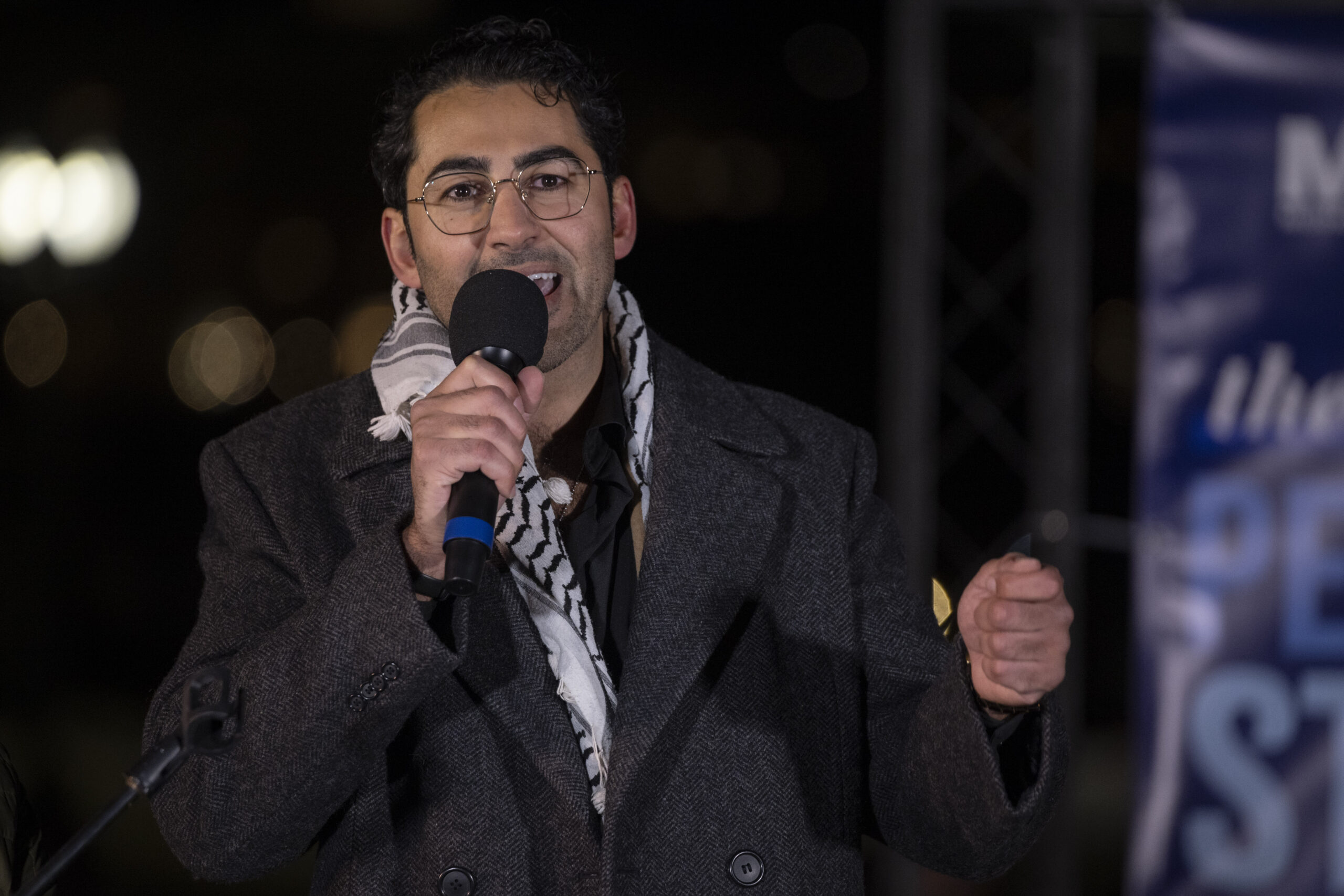
The Congressional Progressive Staff Association, a congressional employee group for progressive staffers and prospective staffers, hosted a happy hour this week with Columbia University protest leader Mohsen Mahdawi, whom the administration has been trying for months to deport, Jewish Insider’s Marc Rod reports.
Background: The Department of Homeland Security has characterized Mahdawi, who has not been charged with a crime, as a “ringleader” in anti-Israel protests at Columbia and accused him of using “threatening rhetoric and intimidation” against Jewish students. The administration has also claimed that Mahdawi admitted to being involved in and supporting terrorist violence, including telling a gun shop owner more than a decade ago that he had “considerable firearm experience” and used guns to “kill Jews while he was in Palestine,” that he attempted to purchase a rifle and a machine gun, that he claimed to have made guns for Hezbollah and that he said that he enjoyed killing Jews.
PAC ATTACK
A veteran operative for former Chicago mayor and congressman Rahm Emanuel has established a new political action committee to fight New York City Mayor Zohran Mamdani and the Democratic Socialists of America in the Big Apple — an effort that sources say could involve former city Comptroller Scott Stringer and aides to former Gov. Andrew Cuomo, Jewish Insider’s Will Bredderman reports.
Joining forces: The Next NYC PAC registered with the New York State Board of Elections on March 11, using the address of Gregory Goldner’s home in the Mid-North District of Chicago. Goldner, who helmed Cuomo’s mayoral campaign in the final weeks of the 2025 cycle and ran a PAC aimed at preventing the election of Chicago Mayor Brandon Johnson two years prior, did not respond to repeated requests for comment. However, sources — who spoke anonymously with JI as Next NYC remains in its formative stages — said that it could fuse the political infrastructure of two candidates who failed to block Mamdani from City Hall last year: Cuomo and Stringer.
DIGGING IN
Graham Platner, the progressive Maine Senate candidate, in a CNN interview that aired Sunday accused Israel of committing genocide and said the U.S. should cut off all aid, as well as dismissed concerns that bringing the Iran war to a halt would endanger U.S. forces in the region, Jewish Insider’s Marc Rod reports.
Notable quotable: “I fundamentally believe that a nation that is committing a genocide should not be a place that we are putting money. We should be leveraging the fact that we have a lot of power in this relationship due to our funding,” Platner said in the interview. “We should be leveraging that to, frankly, get the Israeli government to stop behaving in such an utterly atrocious fashion.”
SHIFTING STANCE
Rep. Greg Landsman (D-OH), one of the few House Democrats who has supported strikes on Iran and opposed a war powers resolution to bring it to an end earlier this month, now says he wants to see the war wrapped up, and will vote for an upcoming resolution to end the conflict, Jewish Insider’s Marc Rod reports.
Time up: “It’s time to finish the operation in Iran. It’s time to be done,” Landsman said in a statement on Friday. “No expansion of the original operation. No ground troops.” Landsman’s statement comes in advance of an anticipated vote on another war powers resolution to end the conflict this week, led by Rep. Greg Meeks (D-NY). Landsman said he plans to vote for the war powers resolution, and urged colleagues to do the same.
War worries: As the U.S. deploys thousands of Marines to the Middle East and President Donald Trump continues to send mixed messages about whether he plans for a ground invasion of Iran, Sen. Josh Hawley (R-MO) told JI he’s hoping the administration does not take that step.
CAMPUS CRACKDOWN

The Trump administration filed a new lawsuit against Harvard University on Friday, claiming that its leadership violated the civil rights of Jewish students by failing to address ongoing antisemitism that has roiled the Ivy League campus since the Oct. 7, 2023, terrorist attacks in Israel, Jewish Insider’s Haley Cohen reports.
What it says: In the 44-page lawsuit, filed in federal court in Boston, the Department of Justice said that Harvard unlawfully discriminated against Jewish students by its “intentional conduct and its deliberate indifference to discriminatory harassment of Jewish and Israeli students and creation of a hostile educational environment” since Oct. 7 and “up to the present day.” Jewish and Israeli students “were repeatedly denied access to educational facilities by antisemitic demonstrators. Fearful for their safety, Jewish students wore baseball caps to conceal their yarmulkes or kept out of sight, effectively denying them access to federally funded educational opportunities,” the lawsuit argues.
Leadership rebuke: Cornell President Michael Kotlikoff rejected a recent Student Assembly resolution calling for the university to boycott its partnership with an Israeli institution, the Technion in Haifa, stating that doing so would “fundamentally conflict with our core commitment to academic freedom” and noting the “political bias” within the resolution “is deeply disturbing.”
Worthy Reads
Aiding the Revolution: The Free Press’ Eli Lake looks at Israel’s efforts to align with Iranian opposition efforts. “The Iranian people have voted against the Islamic Republic with their feet since the first student uprisings at Tehran University in 1999. In 2009, Iranians protested a stolen presidential election. Since 2017, uprisings have sprouted throughout the country every few years, only to be crushed by the Basij and Revolutionary Guards. Israel is evening the odds for a revolution by putting its air force in the service of Iran’s dissidents. At least that’s the dream.” [FreePress]
U.K. Concern: In The Guardian, Jonathan Freedland raises concerns about attacks on Jewish institutions conducted under the guise of criticism of Israel. “Every minority faces discrimination – note Tory frontbencher Nick Timothy’s appalling attack on Muslim prayer this week – but next to no other diaspora community goes through this. People can’t stand Vladimir Putin’s invasion of Ukraine, but Russian Orthodox churches don’t require round-the-clock protection. People loathe Donald Trump and his bombing of Iran, but U.S.-branded stores on UK high streets are not smashed and daubed. As for British businesses with investment links to the U.S., including to U.S. security firms, those remain untouched. Israel and Jews are the exception.” [TheGuardian]
Word on the Street
Police in London are investigating a series of overnight fires that damaged four Hatzola Northwest emergency vehicles in Golders Green, one of the city’s most heavily Jewish suburbs; the U.K.-based Community Security Trust said that the Iran-linked Ashab al-Yamin, which said it was behind recent attacks in the Netherlands and Belgium, claimed responsibility for the string of arsons…
The Treasury Department announced sanctions on 10 individuals in Lebanon, Syria, Poland, Slovenia, Qatar and Canada accused of laundering more than $100 million in money, arms and telecommunications equipment to Hezbollah…
The U.S. reportedly rejected a proposal from Russia in which Moscow would end its intelligence sharing with Iran on the condition that Washington cease giving intelligence to Ukraine regarding Russia…
Axios looks at efforts by the CIA, Mossad and other intelligence agencies to assess the status of Iranian Supreme Leader Mojtaba Khamenei, who has not appeared in public since he was named his father’s successor earlier this month and is believed to have been injured in the strikes last month that killed the elder Khamenei…
One person was killed and another injured in Israel over the weekend, after two cars caught fire in the Upper Galilee from errant IDF shells that fell inside Israel, rather than Lebanon, an investigation by the military found on Monday. Over 100 people were injured in missile strikes from Iran and Hezbollah in Lebanon between Saturday night and Sunday morning, Jewish Insider’s Lahav Harkov reports…
The Wall Street Journal reports on concerns that the Houthis in Yemen could join the conflict, as the Iran-backed terror group, whose previous attacks on naval vessels in the Red Sea, ramps up its threatening rhetoric, including a warning from a senior Houthi official last week that “Yemen joining the conflict is only a matter of time”…
Nine Senate Democrats and more than 30 House Democrats wrote to the administration defending Columbia University protest leader Mahmoud Khalil, describing the protests in which he was involved as “overwhelmingly non-violent expressions of views in opposition to the conduct of the Israeli government in Gaza”…
Rep. Elise Stefanik (R-NY) was honored over the weekend at Chabad of Stamford, Conn., with the group’s inaugural Eishet Chayil Award…
The Wall Street Journal looks at frustrations among some progressive Senate Democrats — a group of eight legislators known as the “Fight Club” over Senate Minority Leader Chuck Schumer’s (D-NY) approach to the midterms as they mull a potential challenge to his leadership…
The Hill explores Pennsylvania Gov. Josh Shapiro’s vocal support for Israel in recent interviews as he mulls a 2028 presidential bid…
President Donald Trump, who spent the weekend in Florida, dropped into the anniversary party being hosted for Gary and Terri Schottenstein over the weekend at Mar-a-Lago…
The New York Times reviews Michael Kimmel’s “Playmakers,” as the distant relative of teddy bear inventors Morris and Rose Michtom looks at the major contributions of Jewish immigrants to the American toy industry…
A Reuters deep dive into decades-old Manhattan police records confirmed the identity of the graffiti artist Banksy…
Former Mossad head Yossi Cohen and Israel Canada controlling shareholders Barak Rosen and Asaf Touchmair are investing in the Israel-based UAV company Aerodrome Group…
Molecular biologist David Botstein, whose research laid the groundwork for the field of gene-mapping, died at 83…
Pic of the Day

Israeli judoka Raz Hershko won the gold medal at the women’s over 78 kg final at the Grand Slam judo tournament on Sunday in Tbilisi, Georgia.
Birthdays

Former NFL referee for 23 seasons, he is the only NFL head referee to officiate four Super Bowl games (1983, 1987, 1992 and 1995), Jerry Markbreit turns 91…
Actor, film director, television director and producer, Mark Rydell turns 97… Together with her husband, Theodore, she pledged $25 million to BBYO in 2019, Harriette Perlman turns 86… Mandolinist and composer of acoustic, instrumental, bluegrass and newgrass music, David Grisman turns 81… Writer and producer of television series, creator of “Deadwood” and co-creator of “NYPD Blue,” David Milch turns 81… Tel Aviv native, she has been a professor of music at the Juilliard School since 1993, Yoheved “Veda” Kaplinsky turns 79… Los Angeles-based psychologist and author, her first book is The Blessings of a Skinned Knee: Using Jewish Teachings to Raise Self-Reliant Children, Wendy Mogel turns 75… Designer of men’s and women’s footwear, clothing and accessories, Kenneth D. Cole turns 72… Former mayor of Austin, Texas, first elected in 2014 and reelected in 2018, Stephen Ira Adler turns 70… Former director of business development at Fannie Mae, she was also the president of the Jewish Federation of Howard County (Md.), Beth Millstein… Investor, author, financial commentator and radio personality, Peter Schiff turns 63… Russian-American businessman with holdings in oil, he is also a winemaker, Eugene Shvidler turns 62… Senior writer for “The Daily Show,” he is also the creator of 2018’s television series “Liberty Crossing,” Daniel Radosh turns 57… Managing partner of D.C.-based Stein Mitchell Beato & Missner, Jonathan Missner turns 57… French actress who has appeared in more than 30 films, her Holocaust survivor grandparents changed their name from Goldreich, Judith Godrèche turns 54… Client partner at Meta/Facebook working with the financial services and real estate industry verticals, Scott Shapiro… Member of the Maryland General Assembly since 2011, initially as a delegate and since 2016 as a state senator, Craig Zucker turns 51… Israeli actress, comedian and television host, Adi Ashkenazi turns 51… Three-time Grammy Award-winning record producer, audio engineer and songwriter, Ariel Rechtshaid turns 47… Writer and teacher in Los Angeles, Yehuda Martin Hausman… Staff reporter for The New York Times, Sarah Maslin Nir… Israeli singer-songwriter, actress and musician, she performs in Hebrew, French and Arabic, Riff Cohen turns 42… Chief of staff for the Commonwealth’s attorney in Fairfax County, Va., Benjamin Shnider… Former tennis coach at Chestnut Hill College in Philadelphia, as a player she won five singles and four doubles titles on the ITF Women’s Circuit, Julia Cohen turns 37… Former member of the National Israeli Rhythmic Gymnastics Team, she competed in the 2012 Olympic Games, Moran Buzovski turns 34… Television and film actress, Victoria Pedretti turns 31…
Though neither missile reached the Chagos Island base — one fell short and one was intercepted — the weekend launches have elevated concerns that Tehran has developed the capacity to strike deep inside Europe

(Christopher Furlong/Getty Images)
In this photo illustration, a phone shows the position of Island of Diego Garcia on Google maps.
Iran’s launch over the weekend of two ballistic missiles targeting the joint U.S.-U.K. Diego Garcia base in the Indian Ocean — hours after London said it would allow the U.S. to use the base to launch strikes on Iranian missile sites — deepened concerns that the Islamic Republic had not been forthcoming in the past about its weapons capabilities and set off alarms in Europe that the continent could find itself on the receiving end of Tehran’s long-range missiles.
Iranian Foreign Minister Abbas Araghchi said last month that the Islamic Republic only had ballistic missiles with the capacity to hit targets within a 2,000-km radius (approximately 1,200 miles), with the country’s state-run media quoting the diplomat as saying “We are not developing long-range missiles … we have limited the range below 2,000 kilometers.”
Diego Garcia is some 4,000 km from Iran, twice as far as the distance Iran’s top diplomat had claimed the country’s missiles could reach. It’s further from Tehran than most major European capitals — meaning that the bulk of the European continent is potentially within striking range of Iran. (And, critically, without the types of air defenses and civilian protective measures that have been deployed multiple times a day in Israel for the last month.)
The discrepancy didn’t go unnoticed by current and former U.S. officials. Brett McGurk, who served as a senior national security official in the Biden administration, noted Araghchi’s February claim alongside a map showing Diego Garcia’s distance from Iran, saying that Araghchi’s blatant falsehood “speaks for itself.” In a rare show of agreement between the Trump administration and its predecessor, Defense Secretary Pete Hegseth and the White House’s rapid-response account shared McGurk’s post.
In a statement over the weekend, IDF Chief of Staff Eyal Zamir warned that Iran had missiles “that can reach London, Paris or Berlin.”
A senior Iranian official denied to the fringe outlet Drop Site News that it was behind the attack.
Though neither missile reached the Chagos Island base — one fell short and one was intercepted — the weekend launches have elevated concerns that Tehran has developed the capacity to strike deep inside Europe — most of which is much closer to the Islamic Republic than the Diego Garcia base in the middle of the Indian Ocean.
Senior British officials largely sidestepped specific concerns about the potential for Tehran to target U.K. soil. The country’s housing minister, Steve Reed, appeared to be the most senior British official to directly take on the implications for the U.K. of the attempted strikes on Diego Garcia, saying that there was “no specific assessment” indicating that Iran was planning to target the U.K. London has so far refrained from direct military engagement with Iran, but that neutrality could be tested if Tehran threatens U.K. interests.
The twin revelations that Iran has the capabilities to strike much further than initially believed, and that Tehran’s top diplomat — who has engaged in direct talks with the White House — has lied about those capabilities, are likely to deepen suspicion of the Islamic Republic among Trump administration officials and could prompt the EU and the U.K. to take a more aggressive posture toward the Islamic Republic.
The move, which Trump has sent mixed signals about, may cause further fractures in the GOP over support for the war
Kayla Bartkowski/Getty Images
Sen. Josh Hawley (R-MO) speaks to the press on June 2, 2025 in Washington.
As the U.S. deploys thousands of Marines to the Middle East and President Donald Trump continues to send mixed messages about whether he plans for a ground invasion of Iran, one GOP senator said he’s hoping the administration does not take that step.
“I would hope it wouldn’t come to that,” Sen. Josh Hawley (R-MO) told Jewish Insider on Friday, when asked about the possibility of a ground operation in Iran.
Hawley has previously argued that the war should wrap up quickly and said that deploying ground troops might require an affirmative congressional war authorization. His comments suggest that a ground invasion could cause further fractures among Republican lawmakers over the war.
Trump gave conflicting answers last week on whether he plans to send U.S. troops to Iran, saying at one point that he was “not afraid” to deploy troops, but saying later in the week that he did not plan to do so.
Already, a small number of other congressional Republicans are growing hesitant about the effort.
“I wish that the president would figure out a way to end the war. I think it’s becoming more challenging every day in terms of how you end it,” Sen. Lisa Murkowski (R-AK) said earlier this week.
Murkowski also said, before reports emerged of a potential $200 billion supplemental funding request for the war, that the funding level requested might “provide its own level of shock.”
And Rep. Lauren Boebert (R-CO) said she would oppose any additional funding request for the conflict.
But other Republicans are standing firmly by the administration.
Sen. Rick Scott (R-FL) said that he’s not concerned about the possibility of placing troops on the ground.
“The president is doing what he needs to do, he’s got to protect American freedom, he’s got to destroy their nuclear weapons, their ability to hit us with ballistic missiles,” Scott said. “He’s doing the right thing.”
A new survey finds likely GOP voters overwhelmingly support the Iran war effort and prefer candidates backed by Trump rather than Tucker Carlson

Daniel Torok/White House via Getty Images
President Donald Trump oversees "Operation Epic Fury" at Mar-a-Lago on February 28, 2026 in Palm Beach, Florida.
Republican voters expressed strong support for President Donald Trump’s military action against Iran, and would decidedly prefer a GOP congressional candidate who advocates for the war’s aims, according to a new survey from pollster J.L. Partners.
The poll, which surveyed 1,018 likely GOP voters between March 17-18, finds that an overwhelming share of Republicans (83%) support Trump’s war against Iran, with just 9% opposing. Nearly two-thirds (63%) of Republicans said they “strongly support” Trump’s war efforts.
Among self-identified MAGA-aligned Republicans, a whopping 92% of respondents support the war in Iran, with 76% strongly supporting it.
In addition, nearly three-quarters of Republicans (74%) said that the U.S. should continue its military campaign and finish destroying Iran’s military capabilities, as opposed to the 16% who preferred the U.S. stop its military campaign and not get involved in any wars in the Middle East.
The poll also found a sizable share of Republicans holds negative views towards far-right, antisemitic podcaster Tucker Carlson, even as many media outlets claim he speaks for the MAGA movement. Only 40% of Republicans hold a favorable view of Carlson, while nearly one-quarter of respondents view him unfavorably.
When GOP voters were asked whether they’d prefer a candidate endorsed by Trump or by Carlson and Megyn Kelly, a whopping 80% preferred a Trump-backed candidate, with just 7% siding with the podcasters.
Asked whether voters trust Trump’s position on Iran or Carlson and Kelly’s view, 83% sided with Trump while just 6% sided with the far-right podcasters.
In addition, when Republican respondents were asked their reaction if a GOP candidate were to share Carlson and Kelly’s positions on Israel and Iran, only 19% said they would be more likely to support such a candidate while 55% said they would be less likely to support such a candidate.
The survey also offers a reminder that podcasts remain a niche form of media among Republican audiences, with only 15% saying they “primarily” get their news from YouTube or podcasts. By contrast, nearly half get their news from Fox News or other cable news outlets, while 19% say their main source of information is from social media platforms like X.
The polling matches the election outcomes in Republican primaries this year. Already, former Rep. Marjorie Taylor Greene (R-GA), a rare anti-Israel voice in the party, resigned from office and is expected to be replaced by a stalwart supporter of the U.S.-Israel relationship.
Meanwhile, Rep. Thomas Massie (R-KY), one of the few anti-Israel Republicans remaining in Congress, is facing the fight of his political career against Trump-endorsed challenger Ed Gallrein.
There also are very few GOP candidates running as critics of Israel or the Iran war, despite the outsized attention Carlson and Kelly receive in the national press.
An Iranian missile struck Dimona, about eight miles from Israel’s Shimon Peres Negev Nuclear Research Center, wounding 31 people
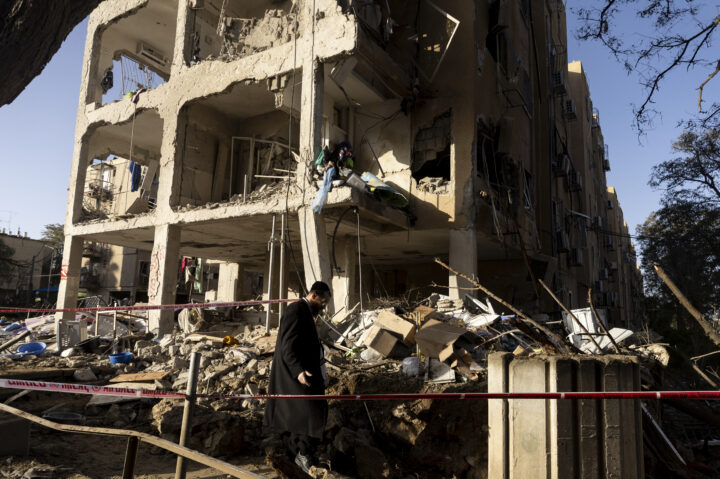
Amir Levy/Getty Images
A man looks at destroyed buildings after an Iranian missile strike on March 22, 2026 in Arad, Israel. Iran has continued firing waves of drones and missiles at Israel after the United States and Israel launched a joint attack on Iran early on February 28th.
Missile strikes from Iran and Hezbollah in Lebanon resulted in over 100 casualties between Saturday night and Sunday morning.
One person was killed and another injured after two cars caught fire in the Upper Galilee from errant IDF shells that fell inside Israel, rather than Lebanon, an investigation by the military found on Monday.
MDA reported 15 wounded from missile fragments landing in numerous sites in Tel Aviv and central Israel on Sunday.
EMTs from the Magen David Adom emergency services, Taysir Subah and Safa Abu Rafea, said they “arrived at the scene and saw two vehicles on fire. During the firefighters’ extinguishing operations, we identified a man in the driver’s seat. We conducted medical assessments, he had no signs of life, and we had to pronounce him dead.”
On Saturday night, an Iranian missile struck the city of Dimona, about eight miles from Israel’s Shimon Peres Negev Nuclear Research Center. The direct hit caused extensive damage to several buildings in the city, injuring 31 people, including one who is in serious condition, according to MDA.
MDA EMTs Shai Binyamin and Gadot Vaknin said they were alerted by civilians on the street to elderly residents trapped in a safe room, whom they helped treat.
Three hours later, an Iranian missile struck Arad, a city near the Dead Sea. Emergency services in the area, which has seen fewer alerts than the rest of the country, evacuated 84 patients to Soroka Medical Center in Beersheba, including 10 in serious condition, among them children as young as four years old.
Yakir Talker, an MDA EMT, described “extensive destruction and chaos” at the scene. Another EMT, Riyad Abu Ajaj, said that “together with security forces, we conducted searches to locate additional patients. We provided medical treatment to many patients, including children.”
At both scenes in southern Israel, the IDF Home Front Command led efforts to free people trapped in the rubble.
Schools in much of the Negev, which had been hit by fewer missiles than Israel’s center and north, were meant to reopen on Sunday. The IDF Home Front Command revised its guidelines to keep schools closed after Saturday night’s strikes. Schools have been closed since the start of the war with Iran late last month, and gatherings have been limited to 50 people near a shelter or safe room.
IDF Chief of Staff Eyal Zamir met with the mayors of Metula and Kiryat Shmona, on the Lebanon border, saying that the IDF is “prepared for the enhancement of the forward defensive posture in the north.” In a later statement on Saturday, he added: “There is no more containment; there is initiative; there is preemptive action.” Last week, the IDF said it would increase ground operations in Lebanon.
“The more we strike and weaken Iran, the more we weaken Hezbollah,” Zamir added.
He also praised the “steadfastness and the resilience” of Israelis in the north, saying that they “enable us to continue striking and degrading the enemy.”
“We will not stop until the threat is pushed away from our border and long-term security is ensured for our residents,” he said.
This story was updated on March 23, 2026, to add the IDF investigation findings.
The Ohio congressman had been one of four Democrats to oppose the previous resolution to halt the war in Iran
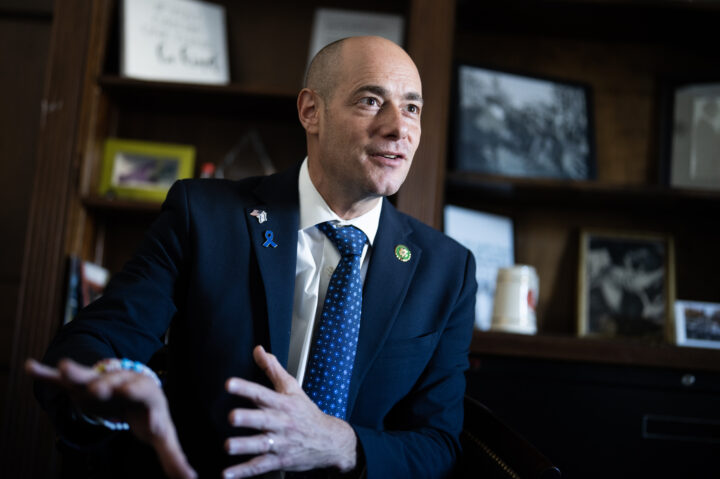
Tom Williams/CQ-Roll Call, Inc via Getty Images
Rep. Greg Landsman (D-OH) is interviewed by CQ-Roll Call, Inc via Getty Images in his Longworth Building office on Friday, November 3, 2023.
Rep. Greg Landsman (D-OH), one of the few House Democrats who has supported strikes on Iran and opposed a war powers resolution to bring it to an end earlier this month, now says he wants to see the war wrapped up, and will vote for an upcoming resolution to end the conflict.
“It’s time to finish the operation in Iran. It’s time to be done,” Landsman said in a statement on Friday. “No expansion of the original operation. No ground troops.”
Landsman’s statement comes in advance of an anticipated vote on another war powers resolution to end the conflict next week, led by Rep. Greg Meeks (D-NY). Landsman said he plans to vote for the war powers resolution, and urged colleagues to do the same.
Reps. Henry Cuellar (D-TX), Jared Golden (D-ME) and Juan Vargas (D-CA) were the only other Democrats to vote against the previous war powers resolution earlier this month.
“The fact is, in three weeks, we have destroyed nearly all of the regime’s missile and drone launch capacity and eliminated their ability, for now, to produce ballistic missiles and drones,” Landsman said. “This means the objective to destroy the weapons shield built to protect their underground nuclear enrichment facilities has been achieved.”
“The cost of inaction was far too high to tolerate. But now it’s time to be done,” he continued, adding that U.S. military officials have successfully executed their mission, so it is “now it is time for the administration to end the operation before we become entangled in a conflict with no strategic logic.”
The Ohio congressman criticized the Trump administration for its communication around the war, while praising military officials for how they have conducted the U.S. operations.
Cuellar, Golden and Vargas did not comment on how they plan to vote on the next war powers resolution. Assuming full attendance, just three other lawmakers who opposed the previous war powers resolution would need to flip to allow the next one to pass.
Landsman, Cuellar, Golden and three other moderate House Democrats are also co-sponsoring an alternative war powers resolution that would limit the duration of the war to 30 days from its inception, which also should be eligible for a vote in the House soon.
That 30-day deadline from the war’s beginning — March 30 — is quickly approaching, raising the likelihood that other Democrats like Cuellar and Golden might support ending the war, based on the timeline they laid out.
The international broadcaster, along with Radio Free Europe, has struggled to deploy its Persian-language services to provide coverage amid an internet blackout in Iran
Kent Nishimura/Bloomberg via Getty Images
The Voice of America headquarters in Washington, DC on Thursday, May 29, 2025.
A federal judge’s ruling this week that voided the Trump administration’s efforts to shutter Voice of America, restoring more than 1,000 journalists and other employees by Monday, is raising some hopes that the embattled international broadcaster funded by the federal government may now be able to ramp up its Persian-language coverage to reach Iranians at a crucial moment amid war with the U.S. and Israel.
While VOA had resumed some of its Persian news broadcasting in recent months, it has been hobbled by a yearlong near shutdown ordered by the Trump administration that had reduced the organization to a skeletal staff — further battered by the tumultuous tenure of Kari Lake, who until recently served as the de facto leader of the U.S. Agency for Global Media, which oversees the network.
In a separate ruling earlier this month, the judge ordered that Lake’s appointment as acting chief had been unlawful and nullified her aggressive moves to gut VOA. President Donald Trump last week nominated Sarah Rogers, a senior State Department official, to take over USAGM — a position that requires Senate confirmation which Lake never received. The Department of Justice has not confirmed if it will seek to appeal the latest ruling.
One USAGM source expressed optimism that the judge’s decisions would result in “more resources,” but cautioned that “there are still leadership issues” in the Persian service — once one of VOA’s largest divisions — stifling its ability to report exhaustively on news developments and offer coverage without the appearance of bias.
The Persian division — whose content had seen a growing audience among Iranian news consumers before the shutdown, according to a VOA fact sheet — is now led by Ali Javanmardi, an Iranian Kurdish journalist who has drawn scrutiny for censoring the outlet’s reporting on Iranian opposition figures such as Reza Pahlavi, the exiled crown prince who gained renewed prominence amid mass protests that swept the country prior to the war. One journalist with the Persian service said this month he was fired because of disagreements with leadership over the network’s direction.
The editorial constraints and massive cuts to VOA’s stable of full-time reporters not only “decimated the Iran division” but also “politicized it at a time when it is more important than ever for the United States to be speaking directly to the Iranians,” the USAGM source told Jewish Insider before the recent rulings, speaking on the condition of anonymity to discuss a sensitive issue. “It’s a shame what has happened.”
Now, as the joint U.S.-Israeli military campaign in Iran continues amid a near-total internet blackout imposed by the country’s regime, the need to reach information-starved Iranians has only grown more urgent, several experts familiar with the matter told JI.
But there are ongoing concerns that VOA as well as a federally funded but independent network, Radio Free Europe/Free Liberty, which operates a Persian service called Radio Farda, will continue to struggle due to government roadblocks that have obstructed their ability to produce meaningful stories and even to transmit broadcasts that Iranians have viewed as trusted sources during previous domestic conflicts.
“By adhering to the truth, U.S. international broadcasting can be a powerful tool in America’s arsenal, particularly in Iran where RFE/RL and VOA have strong brands and audiences,” Jamie Fly, who led RFE/RL from 2019-2020 and now serves as chief executive of Freedom House, a think tank promoting global democracy, told JI on Thursday.
Under current management, however, USAGM “seems to be doing everything possible to ensure that President Trump’s messages to the Iranian people are not heard, and in some cases, directly contradicted,” Fly added.
RFE/RL, which Lake tried but failed to shut down, has faced a litany of obstacles that have particularly diminished Radio Farda’s broadcasting presence in Iran. In addition to withholding funding that forced its Persian service to furlough half of its staff, Lake’s efforts to target the network included cutting access to a key U.S. transmitter in Kuwait that allowed it to disseminate its broadcasts in Iran and inhibiting the use of virtual private networks that help circumvent internet shutdowns, among other hostile moves.
According to an RFE/RL source, USAGM “is still asking that” the network “use its own grant” resources to broadcast via short and medium wave radio from the Kuwait transmitter — which is federally funded. USAGM “resumed transmissions of Radio Farda” on shortwave in early February and medium wave in early March, the source told JI. The network has additionally paid for satellite as well as short and medium wave transmissions using its “own grant funds already through private vendors.”
“As the internet remains unstable” in Iran, the source said, “our journalists have been able to conduct interviews with and receive updates from Iranians on the ground only periodically.”
Despite such issues, Farda “continues to garner a significant audience online,” the source told JI. From Feb. 28 to March 17, for instance, “Farda published 738 posts on Instagram, recording 105.5 million impressions and 28.6 million video views.”
Even as the organization has managed to bypass some impediments to its operations, another RFE/RL source described intense frustration with USAGM, calling its oversight “dysfunctional” as the agency has sought to exert its control over a network that — unlike VOA — is not a government entity.
“They have no plan,” the source said on condition of anonymity to avoid reprisals. “There’s no strategy.”
USAGM “could and should be more cooperative when Iran blocks” internet access, the source told JI this week. “We should all be surging into Iran now,” where RFE/RL has learned that university students in the country have been “sharing shortwave radios to hear” its broadcasts amid the war.
USAGM did not respond to a request for comment. On social media, Lake has otherwise touted VOA’s efforts to reach Iranians, despite criticism that she has hampered its resources and diluted its Persian coverage — which she wrote in one recent post that she had tried to “realign” with “U.S. foreign policy.”
Experts raised doubts about the possibility of an imminent news surge into Iran even if the judge’s recent ruling is expected to soon restore VOA to its pre-shutdown capacity. As USAGM maintained an adversarial posture toward VOA, RFE/FL and other federally funded nonprofit groups, it still remains to be seen if Rogers, the nominee to succeed Lake, will change direction. Lake, meanwhile, has pledged she will appeal the ruling invalidating her role and said that she will continue at USAGM as its deputy CEO.
Amid the changes, Ilan Berman, an Iran expert at the American Foreign Policy Council who serves on the board of RFE/FL, told JI in an interview that he was “cautiously optimistic there is going to be more coherence to administration” inside USAGM, after a year in which he questioned its “strategic mission.”
During Lake’s tenure, “there was no coherence to the informational enterprise” except for a “focus on disruption,” Berman noted. “The people who suffer are the people of Iran.”
Plus, Temple Israel seeks to 'tell its story'

Andrew Harnik/Getty Images
Tulsi Gabbard is sworn in as Director of National Intelligence in the Oval Office at the White House on February 12, 2025 in Washington, DC.
This P.M. edition is reserved for our premium subscribers — offering a forward-focused read on what we’re tracking now and what’s coming next. Please don’t hesitate to share your thoughts and feedback by replying to this email.
📡On Our Radar
Notable developments and interesting tidbits we’re tracking
Director of National Intelligence Tulsi Gabbard distanced herself — to a degree — from two of her isolationist-minded aides, Joe Kent and Dan Caldwell, who have taken a hostile stance to the U.S.’ Middle East policy, Jewish Insider’s Marc Rod reports.
Gabbard affirmed, after being pressed at a House Intelligence Committee hearing today, that the conspiratorial views about Israel espoused by Kent in his resignation letter earlier this week did concern her, and said about Caldwell that he would have no influence over intelligence reports at her agency.
Gabbard, who has previously been a vocal critic of military engagement with Iran, further acknowledged that her current position requires her to “check” her personal views “at the door”…
Reports of a potential $200 billion emergency funding request from the Pentagon for the war in Iran are drawing firm Democratic opposition and hedged responses from Republicans on the Hill: House Speaker Mike Johnson (R-LA) said he’ll “look at” the request “but obviously it’s a dangerous time in the world and we have to adequately fund defense,” while Sen. Lindsey Graham (R-SC) said he’d “hate to be the senator that denied the request if it made sense.” Rep. Pat Ryan (D-NY) responded with a simple “No,” while Sen. Richard Blumenthal (D-CT) called it a “nonstarter”…
The Senate is set to hold another round of votes on blocking U.S. arms transfers to Israel, after Sen. Bernie Sanders (I-VT) filed three new joint resolutions of disapproval against $658.8 million in sales of over 20,000 bombs to Israel, JI’s Marc Rod reports.
A majority of the Democratic caucus — 27 lawmakers — voted to block at least one arms sale in July of last year, a significant jump in support from previous similar efforts; Israel’s standing in the party has largely declined since then amid Democratic criticism of the war with Iran…
During a meeting with Japanese Prime Minister Sanae Takaichi at the White House today, President Donald Trump reiterated that he had told Israeli Prime Minister Benjamin Netanyahu not to attack Iranian oil facilities, after an Israeli strike on the South Pars gas field yesterday: “I told them, don’t do that. We didn’t discuss. … It’s coordinated, but on occasion, he’ll do something.”
Trump also put pressure on Takaichi to help secure the Strait of Hormuz, while European leaders released a joint statement “express[ing] our readiness to contribute to appropriate efforts to ensure safe passage through the Strait,” after repeatedly declining to get involved. A team of British military planners is now consulting with CENTCOM on options to assist short of military action, The New York Times reports…
Asked if he will deploy more U.S. troops in the region, Trump told reporters he’s “not putting troops anywhere. If I were, I certainly wouldn’t tell you — but I’m not putting troops”…
Secretary of Defense Pete Hegseth compared Iran to Hamas in a briefing today, saying that, “just like Hamas and their tunnels,” Iran has “poured any aid, any economic development … into tunnels and rockets”…
A group of congressional Democrats is urging the State Department to restart chartered evacuation flights out of Israel and take additional steps to help U.S. citizens who wish to leave the country amid the ongoing war with Iran, JI’s Marc Rod reports.
The lawmakers described the State Department’s current partnership with El Al, which launched on March 13 with a limited number of special evacuation flights for U.S. citizens, as insufficient. The Israeli airline has currently suspended registration for the flights, and government-imposed security restrictions are limiting passenger capacity on each flight and reducing airport operations…
Treasury Secretary Scott Bessent said that the U.S. may lift sanctions on Iranian oil already at sea in order to blunt rising gas prices. “In essence, we will be using the Iranian barrels against the Iranians to keep the price down for the next 10 or 14 days as we continue this campaign,” he explained on Fox News…
Saudi Foreign Minister Prince Faisal bin Farhan warned the kingdom is reaching a breaking point after continued Iranian attacks, saying “what little trust” Riyadh had with Tehran has “completely been shattered.”
On a potential Saudi military response, Prince Faisal said, “Do they have a day, two, a week? I’m not going to telegraph that.” It’s a notable shift for Riyadh, which had been pivoting away from its traditional allies and towards Iran and other Islamist countries prior to the war…
Illinois Gov. JB Pritzker condemned AIPAC after a primary cycle in which the pro-Israel group spent millions backing — and opposing — candidates across the state, calling it “an organization that was supporting Donald Trump and people who follow Donald Trump.”
Pritzker, a Jewish Democrat who was once an AIPAC donor himself, said it “really is not an organization that I think today I would want any part of.” He further echoed far-left sentiments that Israel dragged the U.S. into conflict with Iran, claiming Trump “simply follow[ed] Netanyahu into that war”…
Rep. Jared Moskowitz (D-FL) details his experience with a would-be assailant, a man described by authorities as a “ticking time bomb,” who was arrested near his home last year after police discovered an arsenal of weapons and a handwritten list of targets that included Jewish sites and Moskowitz.
“Besides the police presence outside his house, Moskowitz himself will not appear in parades and says he won’t speak at outdoor staged events. ‘It’s not worth it. I’d rather lose my election,’” the lawmaker told Roll Call…
Temple Israel in suburban Detroit released photos of the devastation to the building caused by an attacker last week, noting that it had “chosen thus far not to make [the photos] public” but are doing so now “to take back control of our narrative” after several were leaked to the media.
“We share these images because our community deserves to see our building through eyes of love, not through the lens of spectacle. This is our sacred space, and we will be the ones to tell its story,” the synagogue wrote…
The University of California, Berkeley reached a settlement in its lawsuit with the federal government, agreeing to pay $1 million and make changes to its discrimination policy following accusations that the university had failed to properly address campus antisemitism.
Among the policy changes, the school will clarify that the word “Zionist” cannot be used as a proxy for Jew or Israeli. The claims in the lawsuit predate the recent campus unrest over Israel’s war in Gaza, stemming from an incident in 2022 when student groups adopted policies saying they would not host Zionist speakers…
⏩ Tomorrow’s Agenda, Today
An early look at tomorrow’s storylines and schedule to keep you a step ahead
Keep an eye out in Jewish Insider for a look at the struggles facing international broadcasters Voice of America and Radio Free Europe in reaching Iranian citizens during the ongoing war due to budget cuts and roadblocks from the U.S. Agency for Global Media.
The House Appropriations Committee will hold a field hearing at the U.S. Mission to the U.N. in New York City on “accountability and reform” at the U.N.
We’ll be back in your inbox with the Daily Overtime on Monday. Shabbat Shalom!
DEADLINE LOOMING
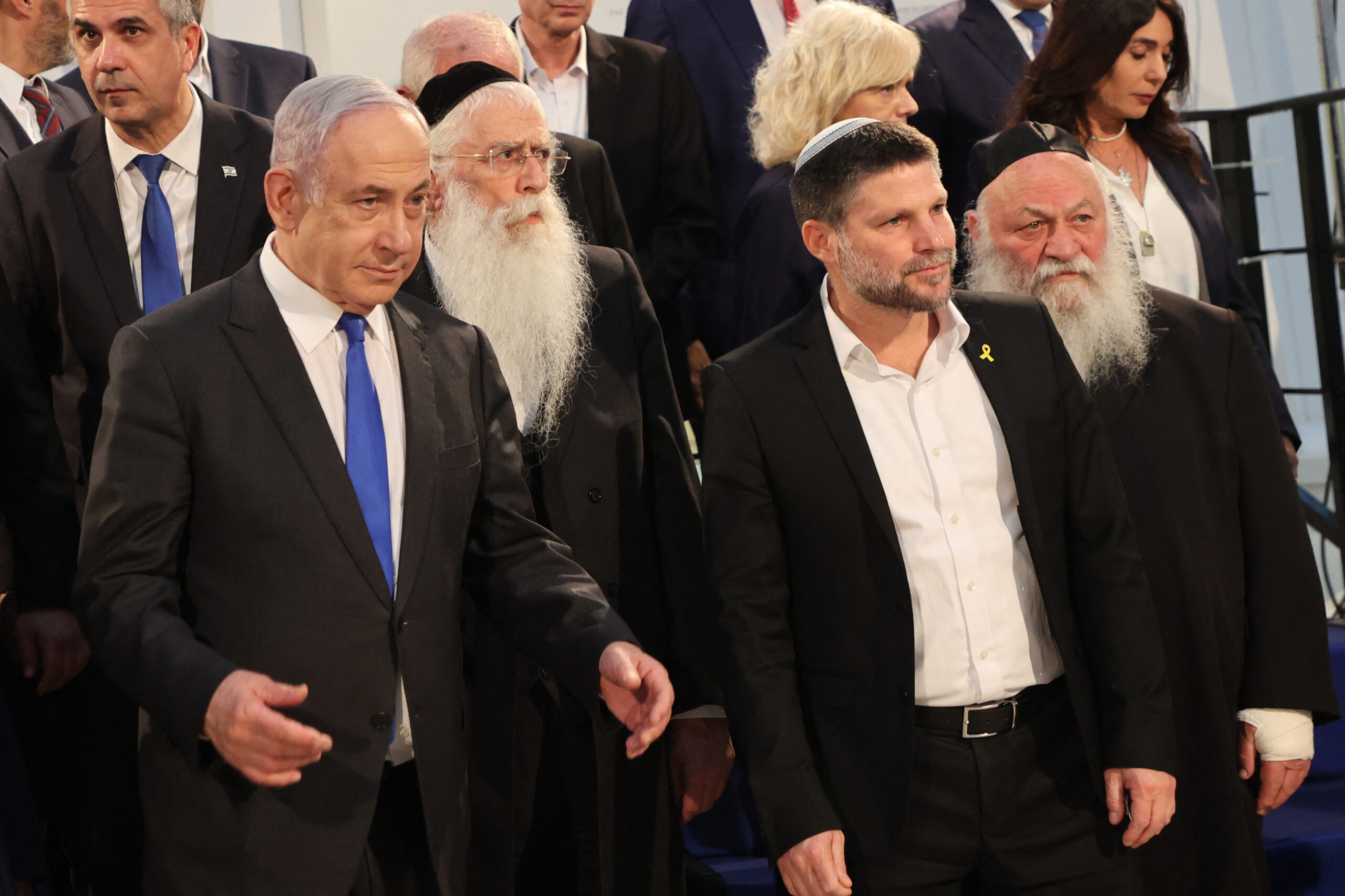
The prime minister’s governing coalition is struggling to stay intact to pass 2026 budget amid shifting political priorities
QUARREL ON THE QUAD

Anti-Israel activists are singling out regent Jordan Acker, hoping to unseat him with attorney Amir Makled, who represented a member of the school’s encampment
‘As Israel continues to face threats from hostilities with Iran, the State Department cannot abandon American citizens abroad,’ the lawmakers wrote

GIL COHEN-MAGEN/AFP via Getty Images
The empty departures hall at Ben Gurion Airport near Tel Aviv on June 13, 2025 after Israel closed its air space to takeoff and landing.
A group of congressional Democrats is urging the State Department to restart chartered evacuation flights and take additional steps to help U.S. citizens who wish to leave Israel amid the ongoing war with Iran.
The lawmakers described the State Department’s current partnership with El Al, which launched on March 13 with a limited number of special evacuation flights for U.S. citizens, as insufficient. The Israeli airline has currently suspended registration for the flights, and government-imposed security restrictions are limiting passenger capacity on each flight and reducing airport operations.
“We were shocked to learn this week that as the military conflict in Iran escalates and continues to threaten the safety of U.S. citizens in the Middle East, the State Department has abruptly and effectively ended emergency evacuations for Americans out of Israel,” the lawmakers said in a letter to Secretary of State Marco Rubio on Thursday. “As Israel continues to face threats from hostilities with Iran, the State Department cannot abandon American citizens abroad. Failing to assist Americans in their time of need is totally unacceptable.”
The letter, led by Rep. Laura Gillen (D-NY), was co-signed by Senate Minority Leader Chuck Schumer (D-NY) and Reps. Yvette Clarke (D-NY), Don Davis (D-NC), Dan Goldman (D-NY), Josh Gottheimer (D-NJ), Julie Johnson (D-TX), Greg Landsman (D-OH), George Latimer (D-NY), Jared Moskowitz (D-FL), Jerry Nadler (D-NY), Pat Ryan (D-NY), Tom Suozzi (D-NY), Ritchie Torres (D-NY), John Mannion (D-NY), Haley Stevens (D-MI), Joe Morelle (D-NY) and Johnny Olszewski (D-MD).
According to the letter, the State Department is urging Americans to rely on commercial transportation or the Israeli Ministry of Tourism, and El Al lacks the capacity to carry all U.S. citizens who wish to depart, leaving Americans “without real options.” The information provided by the State Department, the letter reads, is “causing frustration, anxiety, and fear.”
“In the midst of a conflict, U.S. citizens should not have to wait weeks to be able to board a commercial flight or cross the Israeli border into another country to find their way home. It is unacceptable for the State Department to leave them on their own,” the letter continues.
In a press release Thursday, the State Department heralded its partnership with El Al, which it said has “already allowed more than 2,000 American citizens to return to the United States from Israel.”
The airline “will continue to reserve a percentage of seats on all regular U.S.-bound flights for Americans wishing to depart Israel” and has 28 flights scheduled over the next week “to the extent permitted by the Israeli authorities,” the State Department said. The release did not acknowledge that the registration form for the evacuation flights is currently closed.
Democrats have accused the administration of failing to adequately prepare to evacuate U.S. civilians, or government personnel, from the Middle East before launching the war in Iran.
The lawmakers called on the State Department to restart charter flights from Israel and elsewhere in the region; reopen the State Department’s crisis intake form, which helps citizens receive emergency information; activate a crisis task force to assist Americans attempting to leave Israel; and provide clearer information on commercial air travel options.
Thousands of Americans, currently in Israel, are unable to access flights home and are not being offered alternative travel options or any additional assistance by the State Department,” their letter reads. “Additionally, the Department’s inconsistent guidance and lack of responsiveness have added to uncertainty and fear, making the situation even more dire for impacted families.”
In its press release, the State Department defended its evacuation efforts: “After the launch of Operation Epic Fury, the Department offered charter flight options to thousands of Americans wishing to leave Israel to Athens and destinations in the United States, as well as ground transportation options to Egypt — with supply exceeding demand on nearly every chartered flight and bus.”
The prime minister’s governing coalition is struggling to stay intact to pass 2026 budget amid shifting political priorities
GIL COHEN-MAGEN/POOL/AFP via Getty Images
Israeli Prime Minister Benjamin Netanyahu (L) and Finance Minister Bezalel Smotrich (2nd R) arrive for a cabinet meeting at the Bible Lands Museum in Jerusalem on June 5, 2024.
The war against Iran may have united the vast majority of Israelis who support its aims, but much of the governing coalition’s prewar political obstacles still have to be resolved by the end of the month — including the passing of a state budget for the current year and a Haredi conscription law — or else an early election will automatically be called.
The coalition failed to pass a 2026 budget by Dec. 31, a regular occurrence in Israel, due to several policy disputes. By law, if the Dec. 31 deadline is not met, it may be extended to the end of March. However, if the Knesset does not pass a budget by the end of March, the law states that the body will automatically dissolve, with an election held 90 days later.
The Knesset is slated to go into recess on March 24, but it appears increasingly likely that the legislature will stay in session, with efforts to finalize the budget continuing until hours before Passover, which begins on the evening of April 1.
If Israeli Prime Minister Benjamin Netanyahu and his coalition succeed in approving a budget, the official election date would be set for Oct. 26, though the parties could choose to hold it on an earlier date.
Some Israeli media have reported that Netanyahu would prefer to hold the election before Rosh Hashanah (Sept. 12) and the subsequent three weeks of Jewish holidays; other analysts have said he would not want an election after Oct. 7, because the date will serve as a reminder of his government’s failure to prevent Hamas’ 2023 terror attack.
If the coalition does not succeed in passing a budget, the election will be held at the end of June, and Netanyahu’s Likud party will have to launch a campaign, potentially as the war with Iran is still ongoing.
Before the war, the biggest political challenge for Netanyahu’s government related to issues surrounding Haredi military service.
The Haredi exemption from the mandatory IDF draft was canceled by the High Court of Justice in 2023, just prior to the Hamas attacks — and shortly before Israelis became acutely aware of the IDF’s urgent manpower needs. Since then, the government has been embroiled in legal and legislative disputes over how many young Haredi men to conscript and what penalties should be imposed on those who refuse to serve.
With the issue unresolved, both Haredi parties quit their Cabinet posts last year, though Shas and parts of United Torah Judaism mostly continued voting with the coalition in the Knesset. Still, the parties demanded that a bill reducing penalties for not serving in the IDF be passed before they supported the budget.
While the head of the Knesset Foreign Affairs and Defense Committee, Netanyahu loyalist Boaz Bismuth, led the effort to draft legislation that the Haredi parties would agree to — the proposal would institute relatively low enlistment quotas and lessen and defer most penalties for refusing to serve — enough members of Knesset from other coalition parties opposed it that it was unclear that Bismuth’s bill would get enough votes to pass.
Last week, Netanyahu and Finance Minister Bezalel Smotrich announced that coalition parties agreed to put aside all controversial legislation, including the Haredi draft bill, as well as a reform led by Smotrich to further privatize the dairy sector, which faced significant opposition within Likud. The Haredi parties were reportedly incentivized to drop their insistence on passing the bill when Smotrich and Netanyahu agreed to meet their other budgetary demands.
Dropping the Haredi draft bill means that the status quo remains: The IDF is legally required to send draft notices to all Haredi men aged 18-26, though they do not have to send them all at once, and the government must stop funding yeshivas for young men who are required by law to draft. Yet the government does not plan to enforce the law while the war against Iran is ongoing, Cabinet Secretary Yossi Fuchs told the High Court on Thursday.
Attorney General Gali Baharav-Miara flagged some Haredi budgetary demands as illegal, leading the parties to threaten once again to vote against the state budget unless the same amount of funding is diverted to places that Baharav-Miara would not reject. That dispute delayed a vote on increasing the wartime defense budget that had been set for Monday.
At the same time, National Security Minister Itamar Ben-Gvir and his Otzma Yehudit party have yet to drop their most controversial proposal, the death penalty for terrorists, which they continue to demand be passed before the budget vote. Otzma has followed through on past threats to vote against the coalition or absent themselves from key votes if their demands are not met.
Ben-Gvir posted a video on X on Wednesday, in which an off-camera voice said, “I heard the Iranians say that you’re dead.” Standing in front of a gallows with a plaque with Israel’s anthem, a memorial to Jewish underground fighters who were hanged by the British Mandatory government, Ben-Gvir said: “I am dying to execute terrorists. Death penalty for terrorists.”
Trump made the remarks in a Truth Social post, in which he threatened that the U.S. would bomb the South Pars gas field if Iran does not stop attacking Qatar
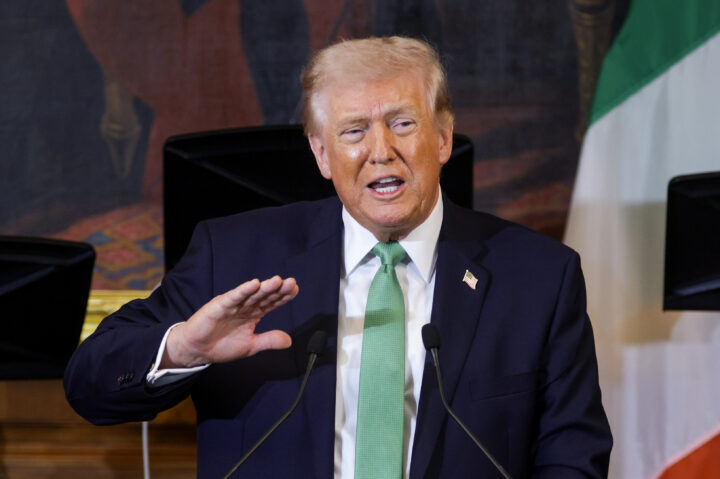
Alex Wong/Getty Images
President Donald Trump speaks during the annual Friends of Ireland Luncheon at the U.S. Capitol on March 17, 2026 in Washington, DC.
Current and former Israeli and U.S. officials suggested that an Israeli strike on an Iranian gas field on Wednesday that prompted the Islamic Republic to strike Qatar was coordinated with the White House, despite President Donald Trump’s claim that the U.S. “knew nothing about this particular attack.”
Trump made the remarks in a Truth Social post, in which he threatened that the U.S. would bomb the South Pars gas field, the Iranian portion of the larger field shared with Qatar, if Iran does not stop attacking Qatar.
“The United States knew nothing about this particular attack, and the country of Qatar was in no way, shape or form involved with it, nor did it have any idea that it was going to happen. Unfortunately, Iran did not know this … and unjustifiably and unfairly attacked a portion of Qatar’s [liquid natural gas] facility,” the president wrote.
If “Iran unwisely decides to attack a very innocent, in this case, Qatar,” he added, the U.S., “with or without the help or consent of Israel, will massively blow up the entirety of the South Pars Gas Field at an amount of strength and power that Iran has never seen or witnessed before.”
An Israeli official told Kan News, Israel’s public broadcaster, that the attack on the South Pars gas field was coordinated with the U.S.
Dan Shapiro, the former U.S. ambassador to Israel and Pentagon official in the Biden administration, wrote on X, “Trump can post whatever he likes. But there is zero, I mean zero, chance the IDF would conduct a strike in that location without giving CENTCOM full visibility.”
“Trump knew (and approved),” Shapiro added. “Now he realizes it caused a major escalation with Iran’s (entirely unjustified) attacks on Gulf energy targets.”
Shapiro later clarified that the Israeli strike “could not have been carried [out] without U.S. knowledge and explicit or implicit approval.”
“It was predictable that strikes on Iranian energy facilities (by US or Israel) would lead to Iranian strikes on Gulf energy facilities,” he wrote. “There is a narrow window following the Israeli and Iranian strikes, and Trump’s Truth Social Post (untrue, but possibly useful in this context), to de-escalate away from further strikes on energy industry targets in either direction. That will still leave a very challenging situation to unwind, but [it] would be the best near-term development.”
Gilad Erdan, a former Israeli ambassador to Washington and a former member of Israel’s Security Cabinet, told Jewish Insider that it was highly likely the U.S. knew about the strike, saying that Trump did not criticize Israel in his post, and “in the same breath” as saying the U.S. was unaware, “[Trump] himself threatened to erase the [gas] field.”
Erdan noted that the South Pars gas field is “used for Iran’s domestic energy needs [and] doesn’t harm the international energy market.”
“Israel took upon itself to be at the front [of the situation] in my estimation because the field is also Qatari,” Erdan, who is also a senior fellow at the Misgav Institute for National Security, said. “Someone had to send the deterrent message about the energy field to the Iranians, that if they continue, then all options are open against them and they will be hurt badly.” (The writer is a senior fellow at the Misgav Institute and cohosts its podcast.)
Yaakov Katz, an Israeli military expert and author of While Israel Slept: How Hamas Surprised the Most Powerful Military in the Middle East, told JI that he agreed with Shapiro’s assessment. “There is no way Israel would attack such a strategic facility [without coordination] because they know it would draw the Iranians to attack the Gulf states,” he said.
Katz pointed to Israeli Prime Minister Benjamin Netanyahu’s behavior since the war with Iran began late last month as further indication that Israel was unlikely to make such a move without coordinating with the U.S.: “Why would Netanyahu who behaved so carefully all throughout the war, coordinating with Trump to not upset him so he keeps the war going … do something that would anger Trump and potentially lead him to do something brash and declare the war is over?”
“It was coordinated, and now Trump is saying what he’s saying to distance himself, but it was done to send a message to the Iranians,” Katz added.
Also Thursday, Saudi Arabia released a statement with the foreign ministers from Azerbaijan, Jordan, the UAE, Bahrain, Pakistan, Turkey, Syria, Qatar, Kuwait, Lebanon and Egypt urging Iran to stop its attacks.
“The participants held Iran fully responsible for the losses and called on Iran to immediately and unconditionally cease its aggression and to comply with UN Security Council resolutions. The meeting also emphasized the dangers of supporting militias and destabilizing security, stressing that Iran must seriously reconsider its miscalculations,” the statement read.
If Iran continues, the foreign ministers stated, there will be “serious consequences for Iran and the security of the region, and will exact a heavy price, casting a shadow over its relations with the countries and peoples of the region, who will not stand idly by in the face of threats to their capabilities.”
After resigning from the National Counterterrorism Center over the Iran conflict, Kent used an appearance on Tucker Carlson’s show to level accusations about Israeli influence on U.S. policy

Screenshot
Joe Kent, who resigned earlier this week from his role as director of the National Counterterrorism Center over his opposition to the war in Iran, offered a litany of baseless accusations about Israel while defending the Iranian regime in an appearance on Tucker Carlson’s program on Wednesday.
Kent doubled down in the interview on an allegation made in his resignation statement that Israel coerced the U.S. into the war for its own benefit. As evidence, Kent and Carlson — a friend of Kent’s and a leading critic of the Trump administration’s approach to Iran in the conservative movement — pointed to Secretary of State Marco Rubio saying earlier this month that the “imminent threat” that prompted the U.S. to take action was the foreknowledge that Israel was going to strike, likely resulting in retaliation against American targets by the Iranian regime.
“So, the imminent threat that the secretary of state is describing is not from Iran,” Carlson mused. “It’s from Israel.”
“Exactly,” Kent replied. “And I think this speaks to the broader issue, who is in charge of our policy in the Middle East? Who’s in charge of when we decide to go to war or not?”
Kent argued that the Israelis “felt emboldened that no matter what they did, no matter what situation they put us in, they could go ahead and take this action and we just have to react.”
He suggested that the U.S. could have threatened to cut off Israel’s military aid, including defensive weapons, in order to prevent them from attacking Iran.
“We could have said to the Israelis: ‘No, you will not and if you do, we will take something away from you,'” Kent told Carlson. “It’s fine that we offer defense to Israel but when we’re providing the means for their defense, we get to dictate the terms of when they go on the offensive.”
Kent also raised questions during the interview about possible foreign ties to the assassination of conservative influencer Charlie Kirk last fall. He told Carlson he tried to investigate Kirk’s killing, at a Turning Point USA event at a Utah college, last fall because of the pressure Kirk was facing over backsliding GOP support for Israel, but was blocked by the Justice Department and FBI. Kent said that the last time he saw Kirk was last summer at the White House, and claimed that the final message Kirk gave him was to “stop us from getting into a war with Iran.”
“One of President [Donald] Trump’s closest advisors was vocally advocating for us to not go to war with Iran and for us to rethink, at least, our relationship with the Israelis. And then he’s suddenly publicly assassinated and we’re not allowed to ask any questions about that?” Kent said. “The investigation that I was a part of [with] the National Counterterrorism Center, we were stopped from continuing to investigate. And the FBI will say that they stopped it because they wanted to have everything turned over to the Utah state authorities. Everything is going to trial, it’s very sensitive. But there was still a lot for us to look into that I can’t really get into. There were still linkages for us to investigate that we needed to run down.”
Kent said that while he was “not making any conclusions … Charlie was under a lot of pressure from a lot of pro-Israel donors. And again, we know, because of the text messages that have been made public, that Charlie was advocating to President Trump against this war with Iran.”
On Iran, Kent alleged that the regime and assassinated Supreme Leader Ayatollah Ali Khamenei were not interested in acquiring a nuclear weapon, while acknowledging that Iran’s strategy had been “to not completely abandon the nuclear program.”
He cited Khamenei’s 2003 fatwa on the production or use of nuclear weapons, arguing that there is “zero U.S. intelligence suggesting it’s been lifted or ignored in a way that changes the posture. Iran knows what happens when you openly pursue or acquire nukes or even give them up.”
Kent went on to claim, despite reports to the contrary, that Khamenei was working to keep the regime from becoming a nuclear power.
“I’m no fan of the former supreme leader, Ali Khamenei, however, he was moderating their nuclear program. He was preventing them from getting a nuclear weapon,” Kent said. “If you take him out, if you kill him aggressively, people are going to rally around that regime.”
The former Trump administration official later told Carlson that “a good deal of key decision-makers were not allowed to come and express their opinion” to Trump prior to the start of joint U.S. and Israeli military operations targeting Iran.
“In the lead-up to this last iteration, a good deal of key decision-makers were not allowed to come and express their opinion to the president,” Kent said, arguing that this was a contrast from the “robust debate” that took place ahead of Trump’s decision to strike Iranian nuclear sites last June.
Kent said that efforts by the intelligence community to offer the president a “sanity check” during briefings “were largely stifled in this second iteration.”
“They had that discussion behind closed doors, and there wasn’t a chance for any dissenting voices to come,” Kent said.
Asked about his resignation, Kent told Carlson that he spoke to Trump prior to announcing his decision publicly and said he believes they “departed personally on good terms.”
“I spoke with him before I departed the administration,” Kent said. “It went great. I mean, not the best conversation ever. I told him why I was leaving. He heard me out.”
Kent’s appearance on Carlson’s show came as sources told Semafor that the FBI began investigating Kent weeks ago for allegedly leaking classified information.
The WH and FBI declined to comment when reached by Jewish Insider. The Office of the Director of National Intelligence did not respond to a request for comment on the matter.
Plus, JD Vance says he likes Joe Kent
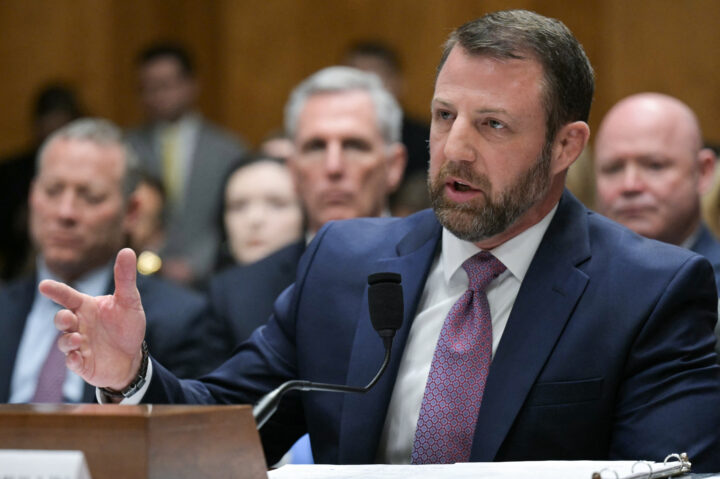
Oliver Contreras/AFP via Getty Images
DHS Secretary Markwayne Mullin testifies during a Senate Committee on Homeland Security and Governmental Affairs confirmation hearing on Capitol Hill in Washington, DC
This P.M. edition is reserved for our premium subscribers — offering a forward-focused read on what we’re tracking now and what’s coming next. Please don’t hesitate to share your thoughts and feedback by replying to this email.
📡On Our Radar
Notable developments and interesting tidbits we’re tracking
Director of National Intelligence Tulsi Gabbard said during a Senate Intelligence Committee hearing today that the Iranian regime “appears to be intact but largely degraded,” Jewish Insider’s Marc Rod reports, as the U.S. and Israel continue to target Iranian leaders and assets. If it survives the war, she said, the regime would “seek to begin a yearslong effort to rebuild its military, missiles and UAV forces.”
Gabbard, a longtime opponent of war with Iran, repeatedly declined to say whether the intelligence community had assessed Iran to be an imminent threat to the United States, after her former deputy, Joe Kent, alleged in his resignation letter yesterday that no such threat existed. CIA Director John Ratcliffe, however, was clear in his view that “Iran has been a constant threat to the United States for an extended period of time, and posed an immediate threat at this time”…
Regarding Kent’s resignation over his opposition to the war in Iran and claims that Israel coerced the U.S. into the war, White House Press Secretary Karoline Leavitt said Kent “was not someone who was involved in … the president’s intelligence briefings over the last several months. Have not seen him here at the White House for quite some time.”
She said President Donald Trump finds it “disappointing” that Kent would “resign with a letter filled with falsehoods, accusing the president of the United States [of] being controlled by a foreign country. That’s both insulting and laughable.”
Vice President JD Vance told reporters, “I know Joe Kent a little bit. I like Joe Kent … It’s fine to disagree, but once the president makes a decision, it’s up to everybody who serves in his administration to make it as successful as possible. That’s how I do my job”…
In his nomination hearing to be secretary of homeland security, Sen. Markwayne Mullin (R-OK) said he will aim to “streamline the process” for grants, including the Nonprofit Security Grant Program, JI’s Matthew Shea reports, vowing to work to “cut out the redundancies.”
“The amount of paperwork once you’re approved to get the funding flowing, and then the paperwork that’s followed up on is way too encompassing,” Mullin said. “Taking years to get reimbursed is not acceptable. Taking months to get reimbursed is not acceptable.” His hearing was otherwise colored by personal hostility with Homeland Security Committee Chair Sen. Rand Paul (R-KY), which could complicate Mullin’s path to nomination…
The Israeli Air Force reportedly struck the South Pars gas field in Iran, the largest in the world; Qatar, which owns half of the field, called it a “dangerous and irresponsible step.” The U.S. reportedly had knowledge of the operation, despite the Trump administration asking Israel earlier this month not to strike energy facilities…
Trump issued a veiled threat to American allies who have declined to assist in securing the Strait of Hormuz, musing on Truth Social, “I wonder what would happen if we ‘finished off’ what’s left of the Iranian Terror State, and let the Countries that use it, we don’t, be responsible for the so called ‘Strait?’ That would get some of our non-responsive ‘Allies’ in gear, and fast!!!”…
Michael Blake, the Democrat challenging Rep. Ritchie Torres (D-NY) whose campaign has focused extensively on criticism of Israel and AIPAC, expressed strong support for Kent’s resignation letter and his baseless claim of Israel’s role in initiating the war. “An absolutely breathtaking, courageous and bold resignation letter stating that Iran posed NO IMMINENT THREAT to us and Trump made this decision due to the Israeli government and its American Lobby,” Blake wrote on X…
Maine Senate candidate Graham Platner released an ad in response to one from his opponent, Gov. Janet Mills, highlighting social media comments he had made about sexual assault. “If I saw these ads, I’d have questions,” Platner says in the spot. “Maine, I’m asking you not to judge me for the worst thing I said on the internet on my worst day 14 years ago, but who I am today.”
Mills replied with another ad featuring an interview clip of Platner in which he said about his posts, “I made a lot of comments that I’m not, like, ashamed of. It’s not as though I have this ream of comments in which I look back and I’m like, oh my god, I was a terrible person back then”…
During an economic-focused visit to Detroit today, Vance remarked about the recent shooting attack at nearby Temple Israel, “When something happens to any member of our American family, and this particular incident happened to Jewish members of our American family, it is something that all of us have to stand up and say, it’s disgusting, it’s unacceptable”…
Also in response to the Temple Israel attack, Montgomery County, Md., a heavily Jewish suburb of Washington, announced it will provide $500,000 in supplemental funding for its Nonprofit Security Grant Program for current recipients over the next 90 days. It’s one of the few localities that provides its own funding in addition to the federal program…
⏩ Tomorrow’s Agenda, Today
An early look at tomorrow’s storylines and schedule to keep you a step ahead
Keep an eye out in Jewish Insider for a look at the far-left candidates running against establishment Democrats in Colorado.
The Senate will vote on another war powers resolution this evening aiming to stop the U.S. operation in Iran. The resolution, sponsored by Sen. Cory Booker (D-NJ), is expected to fail largely along party lines, as the previous one did earlier this month.
Administration intelligence officials including DNI Tulsi Gabbard and CIA Director John Ratcliffe will appear before the House Intelligence Committee tomorrow for its rescheduled worldwide threats hearing.
The Senate’s Homeland Security & Governmental Affairs Committee is set to hold a vote on Sen. Markwayne Mullin’s (R-OK) nomination to be secretary of homeland security, though Sen. Rand Paul (R-KY) threatened to cancel it over personal animosity and outstanding questions about a 2016 overseas trip that Mullin claims was classified. If a vote is held, Mullin will need the support of at least one Democrat on the committee in order to advance without Paul’s support, which Sen. John Fetterman (D-PA) has previously pledged to provide.
After his appearance this evening on far-right commentator Tucker Carlson’s podcast, Joe Kent will be interviewed tomorrow by Candace Owens, who similarly deals in antisemitic conspiracy theories, at the Catholic Prayer for America gala in Washington. Also appearing at the gala is Carrie Prejean Boller, the former beauty pageant queen who was removed from the White House’s Religious Liberty Commission after berating Jewish hearing witnesses over antisemitism.
LONE STAR LIABILITY

Bexar County sheriff’s deputy Johnny Garcia is facing off against Maureen Galindo, who has made antisemitic conspiracy theories a key feature in her campaign
HORSESHOE POLITICS
Democrats previously slammed Kent as an untrustworthy extremist in opposing his nomination. Now, amid his anti-Israel accusations, some argue he has a point
Gabbard also said Tehran has the ‘intention to rebuild’ its nuclear capabilities that were ‘obliterated’ in last summer’s strikes
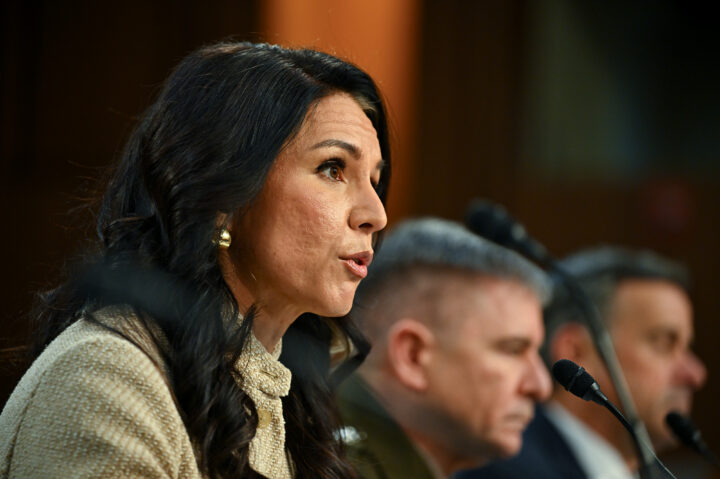
Graeme Sloan/Bloomberg via Getty Images
Tulsi Gabbard, director of National Intelligence, speaks during a Senate Intelligence Committee hearing on worldwide threats in Washington, DC, US, on Wednesday, March 18, 2026.
Director of National Intelligence Tulsi Gabbard said that the U.S. and Israeli operations against Iran have largely destroyed Tehran’s “power projection capabilities” in the region, but that the regime remains standing, if weakened.
“The [intelligence community] assesses that Operation Epic Fury is advancing fundamental change in the region that began with Hamas’ attack on Israel on Oct. 7, 2023, and continued with the 12-day war last year, resulting in weakening Iran and its proxies,” Gabbard said at a hearing of the Senate Intelligence Committee on worldwide threats on Wednesday.
“The IC assesses the regime in Iran appears to be intact but largely degraded due to attacks on its leadership and military capabilities,” she continued. “Its conventional military power projection capabilities have largely been destroyed, leaving limited options. Iran’s strategic position has been significantly degraded.”
If the Iranian regime survives the current war, Gabbard said that it would “seek to begin a yearslong effort to rebuild its military, missiles and UAV forces.”
She further said that, if the regime remains standing, internal tensions and resistance to the regime inside Iran are likely to increase as the country’s economy continues to struggle under U.S. and international sanctions.
Gabbard said in her opening statement that Iran “was trying to recover from the severe damage to its nuclear infrastructure sustained during the 12-day war, and continued to refuse to comply with its nuclear obligations” to the International Atomic Energy Agency.
Democratic senators pressed her throughout the hearing on apparent differences between those comments and her written remarks provided to the committee before the hearing, in which Gabbard said that Iran’s nuclear enrichment program was “obliterated” and that it had made “no efforts since then to try to rebuild” its enrichment capacity.
Under questioning, Gabbard affirmed that stance, but said Iran “maintained the intention to rebuild” its nuclear capabilities. She said she had omitted those remarks from her oral testimony for time reasons.
CIA Director John Ratcliffe throughout the hearing appeared to take a more aggressive and assertive stance on Iran than Gabbard, an isolationist and longtime opponent of war with Iran, offering a clear explanation and justification for the U.S. strikes.
Ratcliffe said that Iran was continuing its nuclear and ballistic missile development, and that he disagreed with an assessment by former National Counterterrorism Center Director Joe Kent that Iran did not pose an imminent threat, which Kent alleged in his resignation letter.
“I think Iran has been a constant threat to the United States for an extended period of time, and posed an immediate threat at this time,” Ratcliffe said.
Ratcliffe said that the U.S. operation was “detailed” and “thoughtful” with specific goals to address a long-running and growing threat.
He said that Iran was continuing to build and develop missiles “at alarming rates” such that its offensive capabilities were on track to outpace and overwhelm the U.S.’ ability to build defensive weaponry.
At the same time, Ratcliffe said the U.S. strikes last summer were a “wild success” and that Iran was “unwillinging and incapable” of enriching uranium to 60% purity since those strikes.
Gabbard, meanwhile, repeatedly declined to say whether the intelligence community had assessed Iran to be an imminent threat to the United States, asserting that only the president has the ability to determine whether any threat is imminent, to the frustration of committee Democrats.
In her opening statement, Gabbard also said that Iran’s space launch capabilities would allow it to develop an intercontinental ballistic missile by 2035, if Iran decided to pursue that, though that assessment is pending updates after U.S. military operations.
Sen. Tom Cotton (R-AR), the chair of the Intelligence Committee, suggested in his question that the timeline was much shorter, and that Iran actually could have had an ICBM that could threaten the homeland in six months.
Ratcliffe did not explicitly confirm that timeline, but emphasized that Iran’s missile program was a present and growing threat, which “if left unimpeded … would have the ability to range missiles to the continental U.S.”
“It’s one of the reasons why degrading Iran’s missile production capabilities that is taking place right now in Operation Epic Fury is so important to our national security,” Ratcliffe continued.
Pressed repeatedly by Democrats on whether the intelligence community had warned the President Donald Trump of the likelihood — as previously assessed by intelligence officials — that Iran would attack Gulf states and close the Strait of Hormuz in the event of a war, Gabbard and Ratcliffe both emphasized that the administration was aware of and had taken steps to prepare for those threats, despite comments by Trump that such moves by Iran were unanticipated.
Gabbard also described “the spread of Islamist ideology, in some cases, led by individuals and organizations associated with the Muslim Brotherhood” as “a fundamental threat to freedom and the foundational principles that underpin Western civilization.”
She said that Islamists are using such ideologies to recruit and solicit financial support for terrorism globally, and that such activity has been increasing in Europe.
Gabbard called the Trump administration’s designation of certain Muslim Brotherhood branches as terrorist organizations, “a mechanism to secure Americans.”
Ratcliffe said the CIA is “very focused” on counterterrorism, including the Muslim Brotherhood, and that the administration has had significant success, which he could share further in a classified setting.
Iran launched several missile barrages overnight, killing two people in a cluster-bomb attack in central Israel
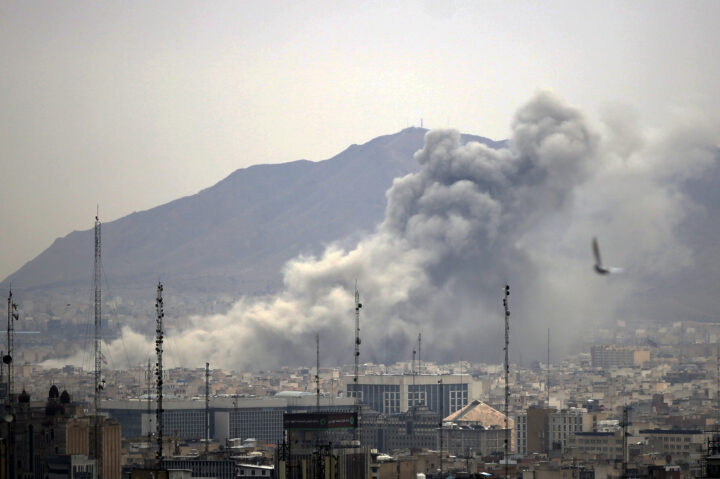
Fatemeh Bahrami/Anadolu via Getty Images
Smoke rises after airstrikes in Tehran, Iran on March 13, 2026.
U.S. and Israeli strikes on Iranian production sites during the ongoing war have destroyed the Islamic Republic’s ballistic missile production capabilities, the IDF told Jewish Insider on Wednesday.
”Right now, they are unable, during this war, to produce ballistic missiles … due to steps we and the Americans took,” IDF Lt.-Col. Nadav Shoshani, the IDF’s international spokesperson, said in response to a query from JI.
The elimination of production facilities and stores of material for manufacturing the missiles means that Iran has a finite number of ballistic missiles that they produce domestically. The Islamic Republic has been burning through its ballistic missile stockpile daily, shooting at Israel and others in the region.
Shoshani noted that ahead of the war, Iran engaged in the “hyper-production” of ballistic missiles, and suggested that the Islamic Republic could restart production after the war, as it did after last year’s 12-day June war.
”But right now, as they’re fighting and desperate, they are unable to produce more missiles,” he added.
The White House said in an X post on Saturday that “Iran’s ballistic missile capacity is functionally destroyed.”
Jonathan Schanzer, executive director of the Foundation for Defense of Democracies, told JI that stopping Iran’s ballistic missile production “is a major achievement for both Israel and the United States. It’s a both a sign of tremendous intelligence collection and the ability to act on that intelligence.”
“The regime now has roughly 500 to 1,000 ballistic missiles,” Schanzer added. “Every time they fire one, their arsenal thins out. This is good news for Israelis who are tired of running to shelter.”
Overnight, an Iranian missile strike killed a husband and wife in their 70s in their home in Ramat Gan, a city adjacent to Tel Aviv. Israel’s Home Front Command confirmed that the missile carried cluster munitions; the strike also caused damage in the nearby city of Bnei Brak.
Naftali Halberstadt, an EMT with emergency service Magen David Adam, said that in Ramat Gan he “saw heavy smoke and destruction in a residential building. There was shattered glass and scattered items. During searches inside the apartment, two casualties were found unconscious, without a pulse and not breathing, with severe injuries … They showed no signs of life and we had to pronounce them dead.”
An eyewitness told Kann, Israel’s public broadcaster, that there was a direct hit on the top floor of the building where the couple lived, and their balcony fell to the ground. A neighbor told ynet that the man used a walker.
On Wednesday morning, a 71-year-old man who lost consciousness on his way to a shelter in Rishon Lezion was taken to a hospital in critical condition. People at the scene attempted to resuscitate him with a defibrillator before MDA reached the site.
Since the start of hostilities last month, MDA has reported 263 casualties from missile fire, including 14 fatalities. In addition, nearly 800 people were injured while making their way to shelter.
A day after announcing the elimination of the Iranian regime’s most senior security official, Supreme National Security Council Secretary Ali Larijani, and commander of the Basij paramilitary force Gholamreza Soleimani, the IDF continued to strike sites in Iran.
A day after announcing the elimination of the Iranian regime’s most senior security official, Supreme National Security Council Secretary Ali Larijani, and commander of the Basij paramilitary force Gholamreza Soleimani, Israeli Defense Minister Israel Katz announced that Israel killed Iranian Intelligence Minister Esmail Khatib.
Khatib “was responsible for the Iranian regime’s internal system of murder and oppression and on advancing external threats,” Katz said. “Prime Minister [Benjamin] Netanyahu and I authorized the IDF to eliminate any senior Iranian figure … without additional authorization. We will continue to eliminate and hunt down all of them.”
The IDF said it eliminated over 10 Basij posts in Tehran on Tuesday. The Basij had begun operations “from posts embedded within public areas in the heart of Tehran,” the IDF stated. One of the sites was previously used as a soccer club.
The IDF also continued its strikes and “forward defensive operations” by ground troops on Lebanon, the military spokesperson’s office said.
”The IDF will not allow any harm to the residents of Israel,” IDF Spokesperson Brig.-Gen. Effie Defrin said. “We are striking Hezbollah with determination at this very moment and will continue to target anyone who threatens our security.”
The Israeli Air Force struck dozens of Hezbollah infrastructure sites in three areas of Lebanon — Beirut, the Beqaa Valley and southern Lebanon — on Tuesday. Among the targets was an underground site used to store weapons, including cruise missiles and rockets, and Hezbollah’s stores of cash.
Israeli troops on the ground in southern Lebanon targeted 80 Hezbollah infrastructure sites, the IDF said Wednesday morning.
The IDF warned on Tuesday that Hezbollah was preparing to shoot a large barrage of rockets at Israel’s north, and later said that its efforts “reduced the scope of fire towards Israel.” While the Lebanese terrorist group did launch rockets into Israel, no casualties were reported.
The New York Democrat also said that he is ‘emotionally invested’ in stopping the Iranian regime and opposes an abrupt and immediate U.S. drawback, but questioned the Trump administration’s planning

Craig Ruttle-Pool/Getty Images
Rep. Tom Suozzi (D-NY) debates in the race for governor at the studios of WNBC4-TV June 16, 2022 in New York City.
Rep. Tom Suozzi (D-NY) on Tuesday urged the administration to work to free one of his constituents, Kamran Hekmati, from prison in Iran. Hekmati, who is Jewish and a U.S. citizen, has been held by the regime for nearly a year for visiting Israel for his son’s bar mitzvah more than a dozen years ago.
This week, the administration formally designated Hekmati as “wrongfully detained,” following an appeal from Suozzi and other lawmakers, a move the congressman praised.
“This is a positive step forward in what has been a very painful case,” Suozzi told Jewish Insider. “It’s really important that we keep on pushing that in any negotiations the administration has with Iran, that Mr. Hekmati be part of those negotiations.”
Suozzi said that being caught in the middle of the war “must be terrifying for him and for his family,” and that he’s concerned the Iranian regime may seek to use Hekmati as a “negotiating chip” in the ongoing conflict.
“We have to recognize that this is a very serious issue that he’s being punished for being an American and for being a Jewish American,” Suozzi said. “We just need more Americans to know that this is going on.”
He said that the administration’s designation of Hekmati as wrongfully detained is an “important step forward,” adding that he hoped it would deliver “a very clear message” that Hekmati’s freedom must be a U.S. priority.
On the conflict in Iran more broadly, Suozzi is walking a delicate line as one of the most moderate and hawkish Democrats in the House. He voted for a war powers resolution earlier this month that would have cut short U.S. operations in Iran.
He said he has long felt that Iran is a bad actor and must be stopped. But he said that the briefing he received from the administration prior to the vote gave him pause.
“I was like, ‘OK, what’s the plan? What’s phase two?’ And then the whole thing with the Strait of Hormuz — it seems like it’s a pretty obvious issue,” Souzzi said, referring to the critical waterway that has been largely impassable and greatly impacted global oil shipping. “If you were thinking of this in any detail you would have known that this was going to be a major issue, and there’s a reason that we haven’t attacked for 47 years.”
“I’m emotionally very invested in the idea of stopping the bad guys in Iran, I want the administration to work with Congress to give us a plan,” Suozzi continued.
Despite his vote for the war powers resolution, Suozzi said that an immediate withdrawal would leave “everybody vulnerable and exposed.”
“We obviously can’t do that. … There has to be a plan, with the help of all the great minds that do exist, not only in the administration, but in the Congress and the larger community,” Suozzi said. “That’s why we have debate. That’s why we have democracy. That’s why we have the system we have.”
Suozzi is a sponsor of an alternative war powers resolution likely to come up for a vote this month that would set a 30-day time limit on the war, with the goal of providing sufficient time to responsibly and carefully wind down U.S. operations against Iran.
The Long Island congressman also said that “one of the most frustrating things” about the current U.S. effort is the lack of involvement from Gulf and European allies. arguing that the administration should have done outreach to those partners before attacking to bring them into the campaign.
Sen. Mike Rounds: ‘We just want to make sure that this regime is weakened enough to where, when the people of Iran decide that they want a change in leadership, that it is a possibility of success for them’
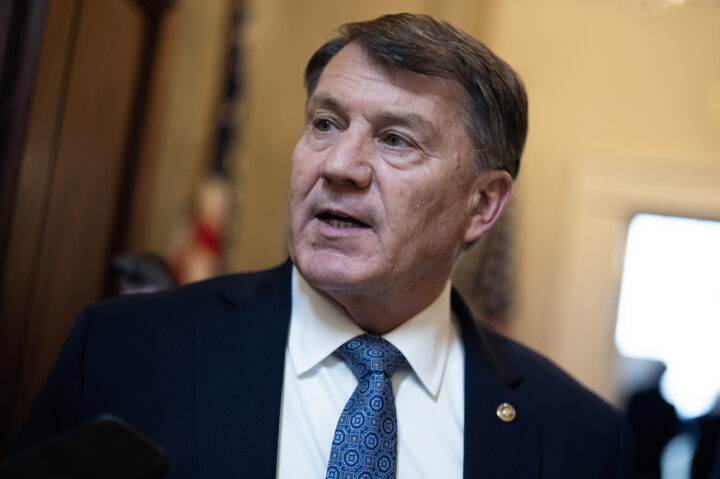
Tom Williams/CQ-Roll Call, Inc via Getty Images
Sen. Mike Rounds (R-SD) talks with reporters in the U.S. Capitol on Tuesday, March 3, 2026.
Some Senate Republicans suggested on Tuesday that Israel’s killing of senior Iranian regime official Ali Larijani could help pave the way toward resistance and uprising by the Iranian people.
“They’re part of a terror state, and whatever they’re doing internally to go after their own people is something that none of us should simply stand by,” Sen. Mike Rounds (R-SD) told Jewish Insider. “They’ve been a part of it for a long time. At some stage of the game, the people there will have had enough. We just want to make sure that this regime is weakened enough to where, when the people of Iran decide that they want a change in leadership, that it is a possibility of success for them.”
Sen. Lindsey Graham (R-SC), who has been a vocal advocate for regime change in Iran, said that Larijani’s death will further weaken the Islamic Republic.
“The killing of notorious security chief, Ali Larijani, is the biggest blow to the regime since the death of the ayatollah,” Graham said on X. “Larijani was truly one of the key leaders of the regime’s security apparatus that is being used to terrorize the people of Iran and the region. His demise puts further pressure on the regime as they continue to lose their first and second layer of leadership. This was an amazing military operation by all those involved. Well done.”
Sen. Rick Scott (R-FL) described Larijani’s death as a necessary action to protect Americans.
“As much as you hate to see death, in this case, these are individuals trying to kill Americans. So unfortunately it’s what has to be done,” Scott told JI.
On the Democratic side, two pro-Israel Democrats said that while they’re critical of the Trump administration’s decision to enter the war without congressional authority, they’re not shedding tears for Larijani.
“Iran’s number one export is terror, whether it’s ISIS, Hamas, the Houthis — go ahead and name them all,” Sen. Jacky Rosen (D-NV) told JI. “No one is sad because what they’ve done — not only to their own people but to people in the region and around the world — is unconscionable. So I’m not sad about that.”
“But,” she continued, “before we put any more Americans in harm’s way, it is the president’s constitutional duty to come to Congress.”
Sen. Richard Blumenthal (D-CT) said that Larijani “had a lot of blood on his hands, and he was a highly appropriate target for Israel,” though he criticized the U.S.’ decision-making in entering the war.
Plus, airlines push back direct flights to TLV

TIMOTHY A. CLARY / AFP via Getty Images
New York City Mayor Zohran Mamdani (2L), New York City Police Commissioner Jessica Tisch (2R) and Cardinal Timothy Dolan (R) participate in annual St. Patrick's Day Parade in New York on March 17, 2026.
This P.M. edition is reserved for our premium subscribers — offering a forward-focused read on what we’re tracking now and what’s coming next. Please don’t hesitate to share your thoughts and feedback by replying to this email.
📡On Our Radar
Notable developments and interesting tidbits we’re tracking
Joe Kent, director of the National Counterterrorism Center, resigned from his role today over opposition to the war in Iran, baselessly alleging that Israel had coerced the United States into what he characterized as a misguided military conflict, Jewish Insider’s Matthew Kassel reports.
In a letter to President Donald Trump, Kent, a former Green Beret who had reported to Director of National Intelligence Tulsi Gabbard, wrote that he “cannot in good conscience support the ongoing war in Iran,” claiming that the Islamic Republic “posed no imminent threat to our nation, and it is clear that we started this war due to pressure from Israel and its powerful American lobby.”
Kent, a hard-right former congressional candidate with isolationist foreign policy leanings, has previously promoted conspiracy theories, echoed pro-Russia messaging and associated with white supremacists and neo-Nazis, among other controversies. He’s now expected to appear on the podcast of his ally and friend Tucker Carlson…
After being largely rejected by foreign leaders on his repeated calls to assist in the war with Iran, Trump claimed in a post on Truth Social that, “Because of the fact that we have had such Military Success, we no longer ‘need,’ or desire, the NATO Countries’ assistance — WE NEVER DID! … WE DO NOT NEED THE HELP OF ANYONE!”
Asked about the timeline of the war by reporters in the Oval Office this afternoon, Trump said, “We’re not ready to leave yet, but we will be leaving in the … very near future”…
Reports indicate Iran’s security forces, despite being badly battered by the U.S. and Israel, are conducting renewed crackdowns on the Iranian public and potential dissenters. At least 500 people have been arrested since the start of the war, and new security checkpoints are being deployed for regime oversight…
Major U.S. airlines have extended their suspensions of direct flights to Tel Aviv as the war continues, JI’s Haley Cohen reports, with both United and Delta airlines not offering any direct flights until June.
The first direct flight on United Airlines between Newark Liberty International Airport and Ben Gurion Airport is available on June 16, while the first direct New York to Tel Aviv flight on Delta Airlines is available June 1. United’s direct flights from Israel to Chicago O’Hare and Washington Dulles International Airport are also suspended…
U.S. Special Envoy to Syria Tom Barrack denied reports that the U.S. is encouraging Syria to deploy forces into eastern Lebanon to help disarm Hezbollah, as the IDF begins to carry out ground incursions in the south of the country…
Israeli Prime Minister Benjamin Netanyahu continues to post “proof of life” videos on social media amid internet conspiracy theories that he has been killed and replaced by a look-alike…
Trump’s decision to withhold his endorsement in the Texas Senate GOP runoff all but guarantees that Sen. John Cornyn (R-TX) and Texas Attorney General Ken Paxton will both appear on the May 26 runoff ballot, as neither have dropped out of the race ahead of this evening’s deadline…
Maine Gov. Janet Mills released her first attack ad against her Democratic primary rival in the race for U.S. Senate, oyster farmer Graham Platner, highlighting social media comments he made about sexual assault that have marred his campaign. In the ad, several women read disparaging comments made by Platner on Reddit over a decade ago relating to rape, and a picture of Platner’s Nazi tattoo — which he has since had covered — is displayed under a magnifying glass. “The closer you look, the worse it gets,” the ad’s narrator says…
The Wall Street Journal spotlights the gamble being made by Illinois Gov. JB Pritzker as he expends political capital (and actual capital) backing his lieutenant governor, Juliana Stratton, in the state’s Democratic primary for U.S. Senate taking place today. Pritzker’s involvement has drawn the ire of the Congressional Black Caucus, which is backing Rep. Robin Kelly (D-IL), even though both Stratton and Kelly are Black. The race is seen as a test of Pritzker’s political clout in his home state…
New York City Mayor Zohran Mamdani took the occasion of St. Patrick’s Day and the presence of former Irish President Mary Robinson in New York to accuse Israel of committing genocide and to praise Robinson’s controversial tenure as the United Nations’ high commissioner for human rights, JI’s Will Bredderman reports.
“I think also of how she stood steadfast alongside the people of Palestine,” the mayor said in listing Robinson’s accomplishments. “I say this as over the past few years as we’ve witnessed a genocide unfold before our eyes, there has been deafening silence from so many. For those who have long cared about universal human rights and the extension of them to Palestinians, silence, however, is nothing new. For Palestinians are so often left to weep alone. Yet former President Robinson has never been silent”…
⏩ Tomorrow’s Agenda, Today
An early look at tomorrow’s storylines and schedule to keep you a step ahead
Keep an eye out in Jewish Insider for a rundown of the results of Illinois’ Democratic primaries, where polls close at 8 p.m. ET.
Director of National Intelligence Tulsi Gabbard is expected to face questions over the departure of her deputy, Joe Kent, at the Senate Intelligence Committee’s hearing on worldwide threats, where she will testify alongside other intelligence agency heads. Gabbard said today after Kent’s resignation that, as commander-in-chief, Trump “concluded that … Iran posed an imminent threat and he took action based on that conclusion,” but did not say whether she agrees herself in that assessment, something she is likely to be pressed on tomorrow.
The Senate Foreign Relations Committee will receive a classified briefing on the war in Iran from State Department intelligence officials.
The Senate Homeland Security & Governmental Affairs Committee will hold a nomination hearing for Sen. Markwayne Mullin (R-OK) to be secretary of homeland security after Trump’s ouster of Secretary Kristi Noem.
The U.S. Commission on International Religious Freedom will hold a hearing on rising antisemitism abroad.
DOMESTIC FRONT

Eighteen-year legal fight over the Iran-tied Alavi Foundation ends with a new group with similar leadership taking over its assets — and NYC skyscraper
NAMING NAMES
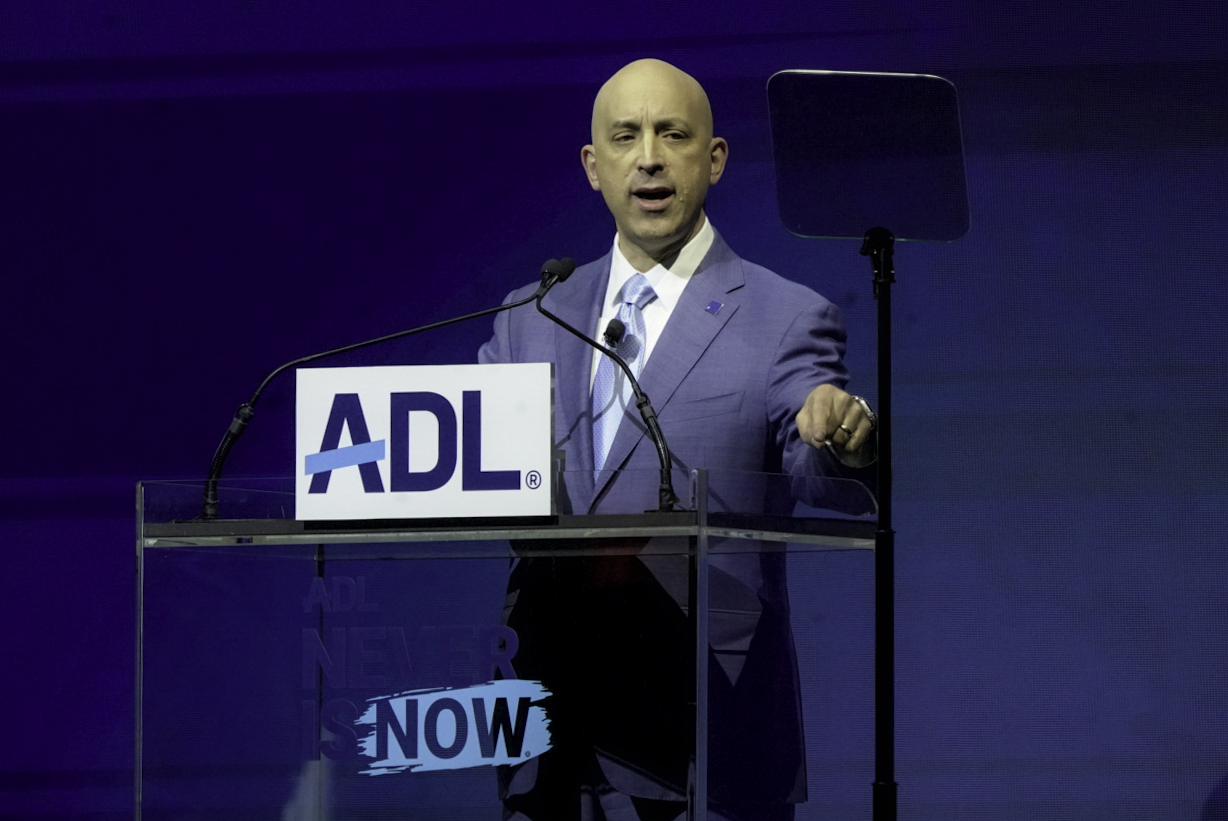
The ADL’s annual summit comes amid high-profile antisemitic attacks during the Iran war
In his resignation letter, Kent baselessly claimed Israel tricked President Trump into war with Iran and said U.S. operations in Syria were also 'manufactured by Israel'

AP Photo/Jenny Kane
Former congressional candidate and counterterrorism official Joe Kent speaks during a debate at KATU studios on Monday, Oct. 7, 2024, in Portland, Ore.
Joe Kent, director of the National Counterterrorism Center, resigned from his role on Tuesday over opposition to the war in Iran, baselessly alleging that Israel had coerced the United States into what he characterized as a misguided military conflict.
In a letter to President Donald Trump shared on social media, Kent, a former Green Beret who had reported to Director of National Intelligence Tulsi Gabbard, wrote that he “cannot in good conscience support the ongoing war in Iran,” claiming that the Islamic Republic “posed no imminent threat to our nation, and it is clear that we started this war due to pressure from Israel and its powerful American lobby.”
Kent, a hard-right former congressional candidate in Washington State who has pushed an isolationist foreign policy vision, has previously drawn scrutiny for promoting conspiracy theories, echoing pro-Russia messaging and associating with white supremacists and neo-Nazis, among other controversies.
During a failed House bid in 2022, Kent also said that accepting donations from pro-Israel lobbying groups like AIPAC puts Israel’s “interests ahead of ours” — invoking an antisemitic trope about foreign influence over American politics that is increasingly common on the far right.
Kent’s wife, Heather Kaiser, is a military veteran who has written for The Grayzone, an extremist outlet, authoring articles with its founder Max Blumenthal, a prominent conspiracy theorist who has published sympathetic coverage of Iran and spread misinformation about the Hamas terror attacks of Oct. 7, 2023.
In his letter, Kent claimed that Trump had been tricked into striking Iran by “high-ranking Israeli officials and influential members of the American media” who “deployed a misinformation campaign that wholly undermined” the president’s “America First platform and sowed pro-war sentiments to encourage war with Iran.”
“This echo chamber was used to deceive you into believing that Iran posed an imminent threat to the United States, and that should you strike now, there was a clear path to a swift victory,” Kent wrote to the president. “This was a lie and is the same tactic the Israelis used to draw us into the disastrous Iraq war that cost our nation the lives of thousands of our best men and women. We cannot make this mistake again.”
Kent, who served in Iraq, also claimed his first wife, Shannon Kent, a military cryptologist who died in an ISIS suicide bombing in Syria in 2019, had been killed “in a war manufactured by Israel.” Israel was not a member of the U.S.-led coalition combating ISIS at the time.
“I pray that you will reflect upon what we are doing in Iran, and who we are doing it for,” he concluded, telling the president that he can “reverse course and chart a new path for our nation” or “allow us to slip further toward decline and chaos.”
Karoline Leavitt, the White House press secretary, rejected Kent’s account. “As President Trump has clearly and explicitly stated, he had strong and compelling evidence that Iran was going to attack the United States first,” she wrote in a lengthy social media post.
She called Kent’s claim that Israel had duped Trump into joining the war “an absurd allegation” that “is both insulting and laughable,” arguing that “Trump has been remarkably consistent and has said for DECADES that Iran can NEVER possess a nuclear weapon.”
Speaking to reporters from the Oval Office on Tuesday, Trump said it was a “good thing” that Kent had resigned, calling him “very weak on security.”
“He said that Iran was not a threat. Iran was a threat. Every country realized what a threat Iran was. The question is whether or not they wanted to do something about it,” Trump added. “So when somebody is working with us that says they didn’t think Iran was the threat, we don’t want those people.”
Kent’s comments, which underscored deepening divisions in Trump’s MAGA coalition over the war, also drew criticism from Republican lawmakers.
Rep. Don Bacon (R-NE), a leading moderate voice in the House, accused Kent of fueling antisemitism. “Good riddance,” he said of Kent’s departure on social media. “Iran has murdered more than a thousand Americans. Their EFP land mines were the deadliest in Iraq. Anti-Semitism is an evil I detest, and we surely don’t want it in our government.”
House Speaker Mike Johnson (R-LA) said Kent’s claims about Israeli influence were “clearly wrong” and that “there was clearly an imminent threat” to the United States.
Sen. Lindsey Graham (R-SC) and Rep. Mike Lawler (R-NY) also criticized Kent’s letter and said they were glad to see him leave the administration — Lawler called him “a leaker who spent more time undermining our foreign policy than doing his job,” while Graham said, based on his claims, Kent “clearly … did not go to work enough.”
On the other side of the aisle, Sen. Mark Warner (D-VA), vice chairman of the Senate Intelligence Committee, said in a statement that Kent had been “right” to point out “there was no credible evidence of an imminent threat from Iran that would justify” an attack — even as he called Kent’s “record deeply troubling” and believed he “never should have been confirmed” to lead the counterterrorism office.
Meanwhile, Tucker Carlson, a close ally of Kent, praised his decision to resign. “Joe is the bravest man I know, and he can’t be dismissed as a nut,” Carlson told The New York Times on Tuesday.
Plus, Caldwell returns from the cold

Bilal Hussein/AP
Iranian Secretary of Supreme National Security Council Ali Larijani, speaks during a press conference after his meeting with the Lebanese parliament speaker Nabih Berri, in Beirut, Lebanon, Aug. 13, 2025.
👋 Good Tuesday morning!
In today’s Daily Kickoff, we report on the breaking news that Ali Larijani, the head of Iran’s National Security Council, was killed in an overnight Israeli strike, and cover the IDF’s plans for a limited ground operation in Lebanon. We look at how Pennsylvania Gov. Josh Shapiro is navigating conversations about Israel in recent podcast interviews, and report on a settlement between the Justice Department and the Iran-linked Alavi Foundation that will allow a successor to the New York-based group to continue to recoup control of its assets. Also in today’s Daily Kickoff: Kamran Hekmati, Emmanuel Navon and Jon Hornstein.
Today’s Daily Kickoff was curated by JI Executive Editor Melissa Weiss, with assists from Danielle Cohen-Kanik and Marc Rod. Have a tip? Email us here.
What We’re Watching
- Israeli Defense Minister Israel Katz confirmed this morning that Israel had killed Ali Larijani, the head of Iran’s National Security Council, in overnight strikes. Larijani had been designated in January by since-assassinated Iranian Supreme Leader Ayatollah Ali Khamenei to ensure the regime’s survival. Also killed in the overnight strikes was Basij paramilitary force commander Gholamreza Soleimani. Read more here.
- In Washington, White House Special Envoy Steve Witkoff is slated to brief a small bipartisan group of senators on the status of the Iran war in a meeting organized by Sen. Joni Ernst (R-IA), the chair of the Senate Armed Services Subcommittee on Emerging Threats and Capabilities.
- The meeting comes after a report that Witkoff and Iranian Foreign Minister Abbas Araghchi had engaged in direct communication in recent days. On Monday night, Araghchi denied the back channel, saying that their last communication took place prior to the onset of the war late last month.
- On Capitol Hill, the House Foreign Affairs Committee is holding a hearing on reforming U.S. defense sales with officials from the State and Defense Departments as well as the Defense Security Cooperation Agency.
- In the wake of last week’s attack on Temple Israel in West Bloomfield Township, Mich., a delegation of Jewish officials from the Detroit area, including Jewish Federations of North America Chair (and Michigan native) Gary Torgow, Jewish Federation of Detroit CEO Steve Ingber, Temple Israel Rabbi Jennifer Lader and Gary Sikorski, the Detroit federation’s security director, will be meeting with legislators.
- It’s primary day in Illinois. We’ll be closely watching the results of a handful of high-profile Democratic congressional primaries in the Chicagoland area that will offer an early test of pro-Israel groups’ clout.
- The Jewish Funders Network convening wraps up today in San Diego.
- The Anti-Defamation League’s Never is Now conference also concludes today. At this morning’s plenary, New England Patriots owner Bob Kraft will be awarded with the group’s Changemaker Award. The Carlyle Group’s David Rubenstein and author and former NFL player Emmanuel Acho are also slated to speak. At this afternoon’s closing session, Scott Galloway, Dan Senor, Pamela Nadell and Nancy and Bob Milgrim, the parents of slain Israeli Embassy staffer Sarah Milgrim, will speak. More below.
What You Should Know
A QUICK WORD WITH JI’S LAHAV HARKOV
Israel has a long history of conflict and military operations in Lebanon, and the IDF is now preparing for a broader ground incursion against Hezbollah.
After Hezbollah joined Hamas in attacking Israel a day after the Oct. 7, 2023, attacks, Israel launched a ground invasion into southern Lebanon and airstrikes against Hezbollah targets throughout the country, most famously killing the terrorist organization’s then-leader Hassan Nasrallah, and conducting its exploding pager operation in the fall of 2024.
But a few months after taking out the group’s entire leadership, leaving in place an uncharismatic and apparently flailing Naim Qassem in charge, Israel, at the behest of the Biden administration, reached a ceasefire with Lebanon in November 2024.
According to that ceasefire, the Lebanese government and military were meant to disarm Hezbollah and ensure it stays out of the area south of the Litani River, some 17 miles north of the border with Israel. Late last year, Israel started to voice concerns that Beirut was not keeping its commitments and that Hezbollah was regrouping.
Now, Israelis are experiencing deja vu: Once again, Hezbollah joined an attack on Israel a day later — this time, from its main patron, Iran — and has frequently launched rockets and missiles at Israel’s north. Israel started out with airstrikes in response, then, over a week later, began limited ground incursions into southern Lebanon.
The Lebanese government said a million residents — 20% of the country’s population — have been evacuated; the IDF has acknowledged about half that number. Israelis have not been evacuated from Israel’s north — the 2023-2024 policy was unpopular and many residents have not returned — but they are living under constant attack.
ON PRINCIPLE

As Pennsylvania Gov. Josh Shapiro eyes a 2028 presidential run, he is using a series of big-name podcast interviews to refine and test out his messaging on Israel — and taking aim at California Gov. Gavin Newsom, a potential rival, in the process. In interviews with the “Pod Save America” and “Higher Learning” podcasts that dropped in recent days, Shapiro put himself in the line of fire from interviewers with more left-wing views on the Israeli-Palestinian conflict than he holds. In response, he made the case that, as the starting point for any public political conversation about Israel, the fact of Israel’s right to exist as a Jewish state must be respected, Jewish Insider’s Gabby Deutch reports.
Podcast playback: “I think what is dangerous here, and I’m not accusing you of this by any stretch, is for those who think Israel doesn’t have a right to exist in [the] conversation. That to me is a recipe for permanent war,” Shapiro told “Higher Learning” host Van Lathan, who said a national conversation about Israel is needed. At an event earlier this month, Newsom said that Israel could “appropriately” be described as an apartheid state. In response to a question about Newsom’s comment from “Pod Save America” co-host Jon Lovett, Shapiro castigated the California governor — without invoking his name — for using inflammatory language. “If we really want peace, and I believe you want that, then we’ve also got to be acknowledging that language matters here, that words matter.”
NAMING NAMES
Jonathan Greenblatt, CEO of the Anti-Defamation League, called out two Democratic lawmakers from the main stage of the organization’s Never is Now conference in Manhattan on Monday, accusing them of perpetuating antisemitism, Jewish Insider’s Haley Cohen reports.
What he said: “For the senior senator from Maryland — a state with one of the largest, most active and most observant Jewish populations in the country — he blamed AIPAC, which he slandered as ‘un-American,’” Greenblatt said during his State of Hate address, referring to Sen. Chris Van Hollen’s (D-MD) address at the J Street convention where he attacked the pro-Israel advocacy group earlier this month. “Then, there is the U.S. congressman who stated that he stands against the ‘neoconservatives’ who led the U.S. into the current war [with Iran] and instead is ‘proud to stand’ with Hasan Piker, one of the most outspoken, virulent antisemitic influencers in the world … who the congressman described as one of the representatives of the ‘new moral order,’” continued Greenblatt, a reference to Rep. Ro Khanna (D-CA).
CALDWELL’S CALLBACK

Dan Caldwell, a vocal GOP critic of the administration’s Middle East strategy from the isolationist wing of the party, has been hired for a job at the Office of the Director of National Intelligence under DNI Tulsi Gabbard, Jewish Insider’s Marc Rod reports. Caldwell, once a top advisor and ally to Secretary of Defense Pete Hegseth, was dismissed last spring, accused of leaking to the press, and publicly criticized by Hegseth. Caldwell blamed his firing on opposition from the “foreign policy establishment.”
Big picture: Caldwell’s hiring comes as isolationist wing of the party has established an apparent power base inside ODNI under officials including Gabbard, National Counterterrorism Center Director Joe Kent and Deputy Director of National Intelligence for Mission Integration Will Ruger, who like Caldwell worked for the isolationist Koch-backed Defense Priorities think tank before joining the Trump administration.
COMMUNAL PRIORITY

Following an attack last Thursday on Temple Israel and its early learning facility in West Bloomfield Township, Mich., the Jewish Federations of North America is making a renewed push for expanded security funding and resources to protect the Jewish community, Jewish Insider’s Marc Rod reports.
What they said: In a letter sent to every member of Congress on Friday, JFNA Chair Gary Torgow and President Eric Fingerhut highlighted the significant degree of security support that Temple Israel received from its own membership, from the Jewish Federation of Metropolitan Detroit and JFNA. “We are grateful that philanthropic funding and security planning played a decisive role in ensuring no harm came to any of the children or staff at Temple Israel,” the letter reads. “However, safeguarding communities at risk of violence is not the responsibility of philanthropic organizations. Rather, it is the government’s responsibility to protect its citizens in their places of worship and communal gathering.”
DOMESTIC FRONT
As tensions intensified between the U.S. and Iran amid the regime’s violent repression of protesters in January, and as Tehran vowed itself “prepared for war,” a long-running battle with the Islamic Republic’s forces in Manhattan came to an end. The final stages of the conflict between the Justice Department and the New York-based Alavi Foundation, which since 2008 has faced allegations of acting under Iranian direction, took place in secrecy — with scores of legal documents sealed and even vaulted away, Jewish Insider’s Will Bredderman reports.
Settlement: But materials filed on Jan. 12 with the New York State Charities Bureau revealed its ultimate outcome: a settlement that will provide compensation for numerous American and Israeli victims of Tehran-backed terror, but also enable a successor organization to recoup control of the foundation’s vast assets, including its 36-story crown jewel skyscraper on Fifth Avenue. The final deal — which a filing this month shows came together confidentially in the last days of the Biden administration, and has just begun to go into effect — will officially dismantle the Alavi Foundation and strip it of hundreds of millions of dollars.
CHARGES FILED
Three men accused of assaulting two Israeli American men outside a restaurant in a Silicon Valley shopping mall last week were arrested on Monday, the Santa Clara County District Attorney’s Office announced. The alleged assailants were charged with both misdemeanor and felony offenses, but they were not charged with hate crime-related offenses, Jewish Insider’s Gabby Deutch reports.
Details: On Sunday, March 8, videos show the two men being assaulted in the middle of the day as other diners and shoppers looked on. The victims, Lior Zeevi, 47, and Daniel Levy, 48, told J., The Jewish News of Northern California that the attack began after they were overheard speaking Hebrew, and that one of the assailants yelled “f***ing Jew.” According to a police report, a witness heard one of the perpetrators shout “Don’t f*** with Iran” as he ran away. The charges filed “do not reflect allegations of a hate crime at this time. However, this remains an active investigation,” according to a statement from the Santa Clara DA. A spokesperson for the DA’s office declined to comment when asked why hate crimes charges were not filed.
Worthy Reads
Threat Assessment: In Al Jazeera, Qatar-based author and academic Muhanad Seloom posits that the U.S. and Israel’s military strategy in Iran is working. “When you look at what has actually happened to Iran’s principal instruments of power – its ballistic missile arsenal, its nuclear infrastructure, its air defences, its navy and its proxy command architecture – the picture is not one of US failure. It is one of systematic, phased degradation of a threat that previous administrations allowed to grow for four decades. …. What the critics described as an expanding regional war is better understood as the death spasm of a proxy architecture whose authorising centre has been shattered.” [AlJazeera]
Lasting Legacy: In The Wall Street Journal, Walter Russell Mead suggests that the outcome of the Iran war will cement President Donald Trump’s legacy. “For the president, the question is whether he pulls back or dives deeper in. The answer will define his place in history. If the U.S. pulls back from the new Gulf war without reopening the Strait of Hormuz and achieving goals like securing Iran’s nuclear materials, the consequences for Mr. Trump’s power and prestige, at home and abroad, will be profound. ‘Trump always chickens out’ won’t merely be an insult his enemies hurl at him. It will be carved on his tombstone.” [WSJ]
Off Message: In The Argument, Jerusalem Demsas observes the outsized role the homogenous “messenger class” — whom she describes as “the tech industry, academics, nonprofit leaders, influencers, and those who work in politics” — plays in modern society. “But if our mediating institutions are all staffed by people drawn from the same narrow demographic band, then the picture they produce will be skewed in ways nobody intends and few notice. This isn’t about whether the messenger class is full of bad people — it’s largely not — it’s about whether it’s even possible to know when you’re acting as a mirror to society, or a spotlight on what you personally happen to care about.” [TheArgument]
Explaining Away Hate: On Substack, Jewish Democratic Council of America CEO Halie Soifer raises concerns about efforts to rationalize attacks on Jewish targets, citing Jewish institutional support for Israel. “If we go down the road of allowing blame of Israel to serve as excuses for antisemitic violence, then we are saying that some forms of violence and hate, in some political contexts or conflicts, are more justified or understandable than others. Is violence targeting Americans, either abroad or at home, acceptable because the U.S. military is engaged in war in Iran? Is targeting Russian Americans because of the war in Ukraine acceptable? Of course not, and we’re all more vulnerable to such violence if we try to explain away antisemitic violence related to Israel.” [Substack]
Word on the Street
Senior members of President Donald Trump‘s Board of Peace, including administration official Aryeh Lightstone, reportedly met with Hamas officials in Cairo over the weekend, with further meetings expected to take place this week…
Secretary of State Marco Rubio reportedly recently sent a cable encouraging American diplomats to work with local Israeli embassies on messaging efforts to encourage foreign governments to collaborate with the U.S. in its war against Iran, ABC News reported on Monday…
The State Department officially designated Kamran Hekmati, an Iranian American Jewish man who was arrested while visiting Iran last year and sentenced to two years in prison for having attended his son’s bar mitzvah in Israel more than a decade ago, as “wrongfully detained”…
The United Arab Emirates briefly closed its airspace overnight amid drone attacks from Iran, including one that ignited a fire at the airport in Dubai, while a tanker anchored off the coast of the Gulf nation, near the Strait of Hormuz, suffered minor damage after being hit by a projectile…
Online betting site Polymarket said it had banned a number of users who had harassed and threatened Times of Israel reporter Emanuel Fabian in an effort to get him to change his reporting on Iranian ballistic missile strikes…
Iran is in talks with FIFA about moving its World Cup matches, which had been slated to be played in the U.S., to Mexico…
U.S. Border Patrol head Greg Bovino will retire in the coming weeks, amid an internal investigation over Bovino’s alleged disparagement of the Jewish faith of federal prosecutor Daniel Rosen…
Immigration officials released from custody Leqaa Kordani, a Palestinian woman who had been detained for more than a year for overstaying her visa after being arrested during an anti-Israel protest at Columbia University, where she was not a student…
The House of Representatives passed a bill extending the decade-old Holocaust Expropriated Art Recovery Act, which will make it easier for the descendants of Holocaust survivors and victims whose art was looted by the Nazis to recover the works; the legislation passed the Senate in December and will head to the president’s desk…
A Maryland man was sentenced to more than three years in federal prison for sending threatening letters and postcards to more than two dozen Jewish institutions around the country from March 2024-June 2025…
The New York Times looks at efforts by Turning Point USA, whose founder, Charlie Kirk, was killed at a campus event in September, to expand to high schools…
Former Apollo Global Management CEO Leon Black is selling his Beverly Hills property, which he purchased a decade ago from Tom Cruise, for $47 million…
A Sydney, Australia-based soccer team apologized for editing a speech to remove a reference to the Jewish community during a ceremony honoring the victims of the Hanukkah terror attack at the city’s Bondi Beach; the apology from the Sydney Swans came after the league was referred to Canberra’s antisemitism commission over the script switch…
Former Rolling Stone Editor-in-Chief Noah Shachtman is joining The New York Times’ opinion section as a contributing writer…
Former ELNET-Israel CEO Emmanuel Navon was tapped as Israel’s next ambassador to Japan…
Pic of the Day

The Harry and Jeanette Weinberg Foundation’s Jon Hornstein (right, with Jewish Funders Network board member Jeffrey Schoenfeld) was awarded the J.J. Greenberg Memorial Award on Monday during JFN’s annual conference in San Diego. Read more here from eJewishPhilanthropy’s Jay Deitcher.
Birthdays

Television writer and producer, he co-created the Netflix animated series “Big Mouth,” Andrew Goldberg turns 48…
Washington columnist for The Dallas Morning News, Carl Philipp Leubsdorf turns 88… Retail and real estate executive, CEO of Wilherst Developers and trustee of publicly traded Ramco-Gershenson Properties Trust, Mark K. Rosenfeld… Oral and maxillofacial surgeon in Fort Wayne, Ind., Michael Iczkovitz… Susan Schwartz Sklarin… DOJ official for 20 years, he has also served as a defense attorney, author of a NYT bestseller about his time working on the Mueller Investigation, Andrew Weissmann turns 68… Founder, president and CEO of Laurel Strategies, Alan H. H. Fleischmann turns 61… Director of legislative affairs at B’nai B’rith International since 2003, Rabbi Eric A. Fusfield… Member of the San Francisco Board of Supervisors, she served on the board of the San Francisco JCRC, Myrna Elizabeth Melgar turns 58… Lead field/floor/sideline reporter for CBS Sports football and basketball broadcasts, Tracy Wolfson turns 51… CEO and president at Las Vegas-based Gold Coast Promotions, assisting nonprofits in fundraising, Richard Metzler… Hasidic singer, entertainer and composer, Lipa Schmeltzer turns 48… Actor, music producer and stand-up comedian, best known as Gustavo Rocque on the Nickelodeon television series “Big Time Rush,” Stephen Kramer Glickman turns 48… Musician and digital strategy executive, Rick Sorkin turns 47… Judge on the U.S. Court of Appeals for the 11th Circuit since 2019, Judge Robert Joshua Luck turns 47… Digital reporter and producer for ABC News including “World News Tonight With David Muir,” Emily Claire Friedman Cohen… Associate professor at GW University in the School of Media and Public Affairs, Ethan Porter turns 41… Senior grants officer at the Open Society Foundations, Jackie Fishman… Senior director and general manager at Uber Eats, Annaliese Rosenthal… Los Angeles-based tech journalist and founder of the TechSesh blog, Jessica Elizabeth Naziri… Associate VP of business development at ContinuServe, Zachary Silver… Director of e-commerce strategy at TAGeX Brands, Zach Sherman…
Please log in if you already have a subscription, or subscribe to access the latest updates.
 Continue with Google

 Continue with Apple