

















































‘Un-American’: Ohio man who tried to host home minyan tells of harassment ahead of Supreme Court case
Daniel Grand says University Heights officials surveilled and harassed him, and he hopes the high court's ruling in his case opens the courthouse doors for others

Getty Images
United States Supreme Court


 Add JewishInsider on Google
When Daniel Grand emailed friends and neighbors to invite them to a minyan at his home in 2021, he never imagined that email would set off a series of events that would trigger surveillance, harassment, antisemitism and ultimately a Supreme Court case.
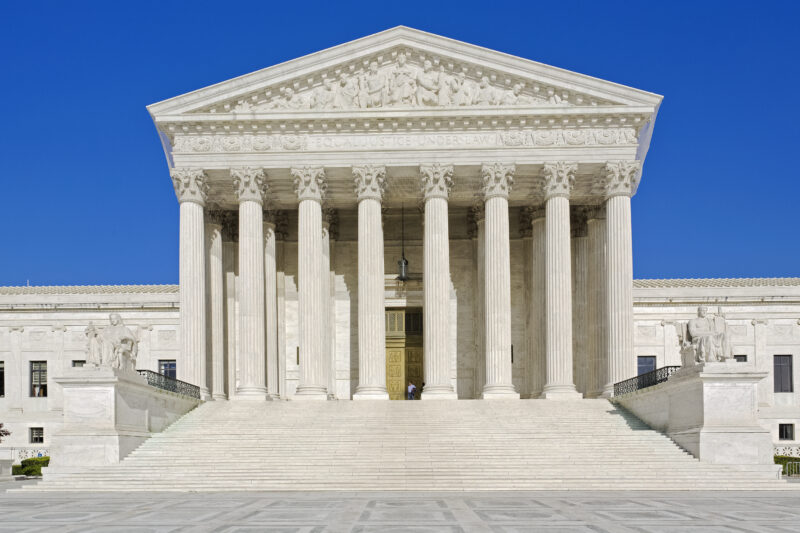
But five years later, Grand, an Orthodox Jew from University Heights, Ohio, is now the petitioner in a Supreme Court case against his hometown, which he says employed aggressive tactics to block the minyan from taking place. The high court is set to rule on whether Grand has standing to sue or whether he will be required to wait until the city fully adjudicates his zoning petition before engaging in litigation.
Grand said that the situation is still bewildering to him.
“It’s an unbelievable idea that I can’t, to this day, fully get. Why would somebody be so interested in stopping me and just a handful of friends from planning a constitutionally protected class of gathering and assembly and religious prayer?” Grand asked in a recent interview with Jewish Insider. “Why would they want to stop that? What does it do for them?”
He described the campaign against him as “un-American” and attributed it to both a lack of understanding about Orthodox Judaism and to bigotry.
The city’s former mayor, whom Grand said led the campaign against the minyan, has “not been willing to understand. The differences in his mind, seemingly, just make it that it’s intolerable to him to have people who are different than he is in outlook and worldview and maybe religious expression.”
“I absolutely think that it’s a bunch of bigots that did this thing to me,” Grand continued. “Whether they hate Jews in their heart? God knows into the hearts of men. I can’t profess to know that, but I don’t think he was very kind to me.”
Both the city and its former mayor previously declined to comment on the case given the pending litigation.
Grand said that, when he first sent out the invitation, he did not give it much thought. Then, he said, the campaign began: an “urgent” voicemail from the mayor, as well as a cease-and-desist that was both hand-delivered and emailed. Grand said he initially sought to explain to the then-mayor that the gathering would have no more impact than inviting some friends over to watch a game.
But he said he was told by the mayor that he needed to apply for a permit to designate his home as a house of prayer, which the mayor and other city officials led him to believe would be a quick and simple process, not a drawn-out public spectacle.
“I went through their process. I was deceived by him. … The city lied to me, the mayor and the city were dishonest with me,” he said. “They knew I never needed a permit to pray, they conceded that much later after litigation began,” and never made clear to Grand that he would no longer be able to live in his home if the permit was approved. “They knew that. I didn’t.”
He said that he faced hypocrisy from city officials and other residents, who claimed they objected to any religious institution in their neighborhood — despite there being another religious institution with 700 member families a block away from his house.
“We tried … for almost 16 months,” he said, but faced escalating harassment from the mayor and other city officials, whom he said dispatched police, private investigators and his neighbors to surveil him; stopped picking up his trash; issued illegal citations against him; accused him of nonexistent zoning infractions and more over the course of more than a year.
“I tried to negotiate and work with them while I’m dealing with all this harassment and these violations and all these pursuits,” he said. “We wound up filing a lawsuit because this was really relentless and misguided and really evil behavior on part of that administration. And lo and behold, the lawsuit sort of started to make them take a step back because they felt that perhaps they were being observed a little bit more.”
Though he filed his petition to the Supreme Court as a pro se defendant, meaning without a lawyer, Grand downplayed his own role, emphasizing that it was a “group effort” built upon “people, concepts, ideas” and other past briefs that he was able to model.
Jonathan Gross, Grand’s attorney who has been with him from the start of the case, said, “It was so obvious as we now see that the city was wrong … and yet the district court got it wrong and the appellate court got it wrong. We’re one in 10,000 cases that makes it to the Supreme Court, but if Daniel didn’t get accepted by the Supreme Court, then that’s it.”
Grand offered vociferous thanks to his lawyers at every level who have “all been really instrumental” as well as all of the different groups, members of Congress, states and the solicitor general who filed briefs with the Supreme Court in support of Grand.
“I’m very, very touched and appreciative,” he said.
He said he’s “encouraged” and “proud” that the Supreme Court felt the petition merited a response and national attention, and hopes that it can “potentially serve as a roadmap for other individuals who’ve experienced similar traumatic episodes, such as I, and had their rights paused at the courtroom gate,” opening up legal avenues for redress for others who have not been able to bring suit for procedural reasons.
If the court rules his way, “a law director in a little town is going to say, ‘Well you better let them do what they’re doing because now they could probably just go and sue right away,’” Grand predicted. “I think it could be cited a lot, and that, really, to me, is the ultimate outcome that I would love to see happen with the Supreme Court.”
Gross, his attorney, said that there are likely similar cases happening across the country on a daily basis with plaintiffs who don’t have the resources or knowledge to file suit and who never receive any national media or advocacy attention. He said that even a victory for Grand at the Supreme Court won’t fully rectify that issue.
“We hope [the case] highlights that we have a serious problem that’s going on all over the country and there’s really no efforts to reform this,” he said.
More Stories
analysis
Capitol Hill Democrats expected to crack down on Israel in next Congress
ENVOY DEBATE
Congressional Jewish Caucus opposes proposal to combine State Dept. Holocaust, antisemitism offices

supper club
AI, tech execs to attend White House state dinner for Xi Jinping
REGIME RECKONING
El-Sayed avoids acknowledging Iranian protester deaths, condemns Iran war instead

APA Fray
Federal panel recommends suspending American Psychological Association’s accreditation authority

CANARY CALL
Two Seattle Jewish leaders warn of Jewish complacency in face of rising antisemitism
Please log in if you already have a subscription, or subscribe to access the latest updates.
 Continue with Google
 Continue with Apple