



Elisha Wiesel: U.S. Holocaust Museum has ‘unique responsibility’ to counter genocide claims against Israel
Wiesel, the son of Holocaust survivor and Nobel laureate Elie Wiesel, pointed to the museum’s past work documenting atrocities in Sudan and against the Yazidis and Rohingya
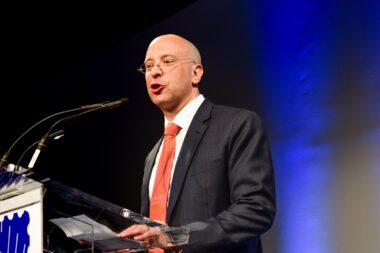
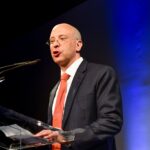
Aurora Rose/Patrick McMullan via Getty Images
Elisha Wiesel Attends The Blue Card Annual Benefit Dinner 2019 on April 8, 2019 in New York City.


 Add JewishInsider on Google
Elisha Wiesel urged the U.S. Holocaust Memorial Museum on Wednesday to speak up against what he called the false accusation that Israel is committing genocide in Gaza, arguing that the institution his father helped create has a “unique responsibility” to address the issue.
Wiesel, the son of Holocaust survivor and Nobel Peace Prize laureate Elie Wiesel, made the appeal while delivering special remarks at “Honoring the Life, Lessons and Legacy of Elie Wiesel.” The event, held on what would have been his father’s 98th birthday, marked a decade since the elder Wiesel’s death. It was organized with the U.S. Holocaust Memorial Museum, the State Department’s Office of the Special Envoy to Monitor and Combat Antisemitism, the Embassy of Romania and Moment magazine.
The U.S. Holocaust Memorial Museum has not endorsed accusations of “genocide” regarding Israel’s military actions in Gaza, but neither has the organization issued formal institutional statements to address or quell the label. Instead, the museum has maintained its core organizational focus: educating the public about the Holocaust, condemning the Oct. 7, 2023, Hamas terrorist attacks and raising awareness about the subsequent rise in global antisemitism.
This neutral stance has not shielded the museum from intense political crossfire. Pro-Israel advocates and some Jewish community leaders argue that Holocaust institutions have a moral obligation to explicitly reject the “genocide” accusation, calling it a form of Holocaust inversion and a weaponization of Jewish history against Jewish people. Some have pointed to the Illinois Holocaust Museum, which distributed internal guides clarifying that the Gaza conflict lacks genocidal intent, as a model the national museum should follow.
“But on one question, this museum has a unique responsibility, and it is one we must face together,” Wiesel said. “Since October 7, the word genocide has been used as a weapon against Israel on campuses, at the United Nations, and even by a member of your own governing council. The charge is false.”
Wiesel pointed to the museum’s past work documenting atrocities in Darfur and against the Yazidis and Rohingya, arguing that the institution has the expertise and authority to properly address genocide accusations against Israel in a credible format.
“You made your own findings for Darfur, the Yazidis, Rohingya,” he said. “You have the scholars, the credibility and the mandate to do the same hearing to explain with the rigor you applied to Burma why the genocide label does not fit Gaza and what the misuse of Holocaust language does to Jews around the world.”
“Declining to join the accusation is not the same as dismantling it. You can do that. You have that power,” Wiesel added. “All of these other Holocaust and genocide museums around the country, I think, would respond to that leadership…That was my father’s vision: a place that remembers and then acts.”
Wiesel also referenced several voices within the museum’s broader community who have spoken out on the issue.
“Stu Eisenstadt, a dear friend of my parents, who helped birth this museum, has written about how the terms “genocide,” “Holocaust,” and “Nazi” are being weaponized to attack the legitimacy of the Jewish state,” Wiesel said. “In July, Chairman [Jeff] Miller invited [New York City] Mayor [Zohran] Mamdani here to learn what genocide actually looks like. These are brave voices, and they speak from within your family. I am grateful to them both. What I am asking for you to consider is that the institution itself find its voice alongside theirs.”
Wiesel also placed his appeal in the context of what he sees as a broader misuse of Holocaust terminology against Israel and Jews, something he says is fomenting global antisemitism.
“The genocide charge turns the Jewish state into the new Nazis. It turns the Jewish people back into a threat to be removed from the family of nations. It inverts the Holocaust,” he said. “Those who start the accusation know exactly what they are doing. They know that the uninformed will spread hatred like wildfire.”
Wiesel acknowledged that the museum faces constraints as a federal institution that private citizens do not, and expressed a deep admiration for its work and efforts in honoring his father’s legacy. He said his appeal was rooted in his deep connection to the institution through his father.
The elder Wiesel was appointed by President Jimmy Carter in 1978 to chair the President’s Commission on the Holocaust, and later served as founding chairman of the U.S. Holocaust Memorial Council, helping drive the museum’s creation. The museum opened in Washington in 1993 after years of work by Wiesel and others.
“The [U.S. Holocaust Memorial Museum] is an actual child of my father,” Wiesel said. “He had it in his mind before anybody else did. He convinced a president. He convinced a country. He fought through the bureaucracy, which is something he hated to do.”
Wiesel described the museum as a “little sibling” his father left him, and said he remains “grateful to everyone who works here and to everyone who walks through these doors.for carrying on this vision, for showing the truth every day.”
In an interview with Jewish Insider following the event, Wiesel said that special relationship made the appeal particularly difficult.
“It wasn’t easy to tell the [U.S. Holocaust Memorial Museum] tonight that I think they’re missing an opportunity,” Wiesel told JI. “I had to really think hard on how do you do that diplomatically and with love, and with all of the good intentions, and make people feel it?”
“It’s not a criticism, it’s not an attack, it’s how can you have a Holocaust museum that bears my father’s etchings all over its place, all over its soul, and Israel is under attack?” he continued. “And one of the biggest lies affecting the Jewish people is that Israel is committing genocide. [The U.S. Holocaust Memorial Museum] has the expertise and the power and the standing to weigh in, and what a difference it would make!”
In making the case, Wiesel said he was inspired by what he learned from his father about speaking truthfully even when doing so could come at the expense of political access or personal relationships.
The younger Wiesel pointed to footage of his father urging President Ronald Reagan, as a friend, not to visit the Bitburg cemetery in 1985. The visit, planned during Reagan’s trip to West Germany with Chancellor Helmut Kohl, drew criticism because members of the Waffen-SS were buried there. Wiesel recalled his father sweating as he made his case.
He also referenced his father turning to President Bill Clinton at the museum’s 1993 dedication to plead for an end to the bloodshed in Bosnia. In both instances, Wiesel presented remembrance not as a reason to stay silent, but as an obligation to speak
“My father stood always with truth and the concept that you have to fight lies,” Wiesel said. “We have to fight the lies wherever we are, and with whatever platform we have. We can’t wait for somebody else to do it. We can’t hope some other leader is going to do it for us. Whatever our circle is, whatever our platform is, we have to use it.”
Still, Wiesel made clear that his remarks came from his own convictions.
“I felt the need that if I’m going to come here, I want to come and not say what my father would have said, but speak the words that I’m inspired by my father to say,” Wiesel said. “And tonight, that message was about what I think the museum can really do to make a difference in antisemitism: by being clear that Israel is not committing genocide.”
Please log in if you already have a subscription, or subscribe to access the latest updates.
 Continue with Google
 Continue with Apple