


































A missile hit in Beit Shemesh killed at least nine people on Sunday; two died in Tel Aviv late Saturday
Amir Levy/Getty Images
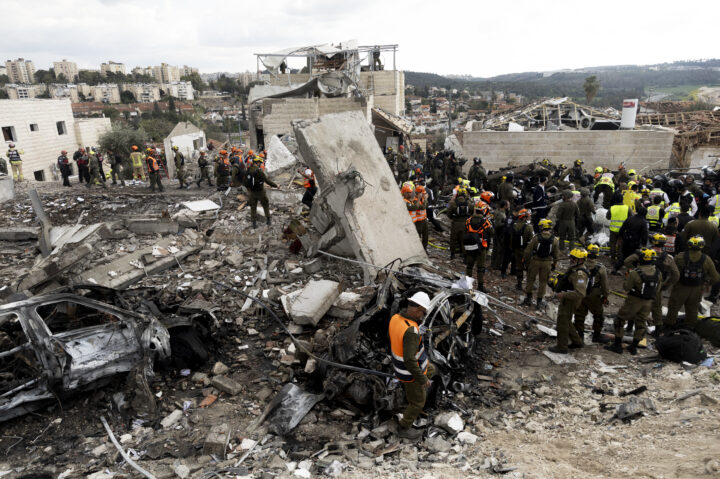
Israeli emergency and rescue personnel recover casualties from an Iranian missile site on March 1, 2026 in Beit Shemesh, Israel.


 Add JewishInsider on Google
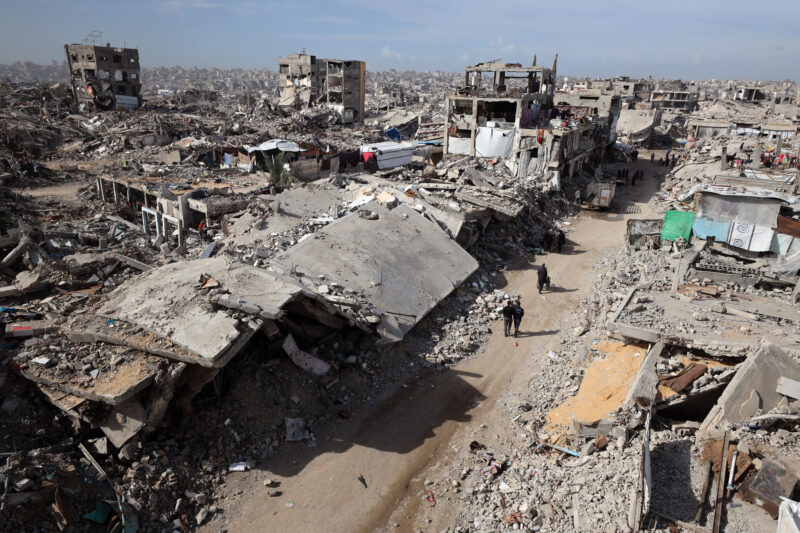
At least nine people were killed in an Iranian missile strike on a residential neighborhood in Beit Shemesh, about 35 miles west of Jerusalem, the Israeli emergency medical service, Magen David Adom, reported on Sunday, bringing the Israeli death toll from the war with Iran launched a day earlier to 12.
Another 28 people, including young children, were injured, with two in serious condition.
The missile barrage on the mostly Orthodox Jerusalem suburb directly struck a public bomb shelter under a synagogue, among other sites.
Yehuda Shlomo, an MDA EMT, said that when he arrived on the scene, he saw “heavy structural damage, smoke in the air and a great deal of chaos with dozens of frightened casualties emerging from the damaged buildings.”
Another EMT, Tzvi David, said that he rescued a woman in her 60s trapped under a slab of concrete and that firefighters extricated three children from a locked room.
Photos and videos taken by MDA show buildings destroyed to their foundations, others heavily damaged, and burned-out cars.
IDF International Media Spokesperson Lt.-Col. Nadav Shoshani posted on X that “since the beginning of Operation ‘Roaring Lion’ the Iranian regime has been targeting civilians, we know that this is their strategy. In their recent attack they killed many civilians in the community of Beit Shemesh. The Iranian regime is a terror regime.”
“I send my deepest condolences to the families. We will continue to do everything we can to remove these capabilities from this bloodthirsty terror regime,” Shoshani stated.
Late Saturday night, a missile strike in the Tel Aviv area killed two women, one a Filipina caregiver aged 32 and the other aged 68 who died of respiratory issues while moving to a shelter, and injured 121 people.
A 102-year-old man in Ramat Gan, east of Tel Aviv, also died after falling down the stairs on his way to a protected space during an incoming missile siren, Ichilov Hospital announced Sunday.
About 40 buildings in Tel Aviv sustained damage from the missile strikes, with one deemed uninhabitable, the municipality stated. Over 200 residents were evacuated to hotels in the city.
The most heavily damaged building did not have its own safe room and most residents had evacuated to a public bomb shelter, Israel’s Home Front Command said.
Israeli President Isaac Herzog visited the impact site in Tel Aviv and called on the people of Israel and the region to “stay strong.”
“This is a historic effort to change the trajectory in the Middle East to a different future — a future of peace,” Herzog said. “We’ve been confronted by an empire of evil for a generation.”
Iranian Supreme Leader Ayatollah Ali Khamenei, whom Israel killed on Saturday, “spent a whole generation taking his people’s resources and directing them towards terror, bloodshed, pain and horror. And what we are doing here, together, all the allies, the United States, leading this effort … towards a vision of peace in the region,” Herzog said.
Meanwhile, security tightens in NYC as NYPD and Gov. Hochul boost presence around Jewish and Iranian institutions
Kyle Mazza/Anadolu via Getty Images
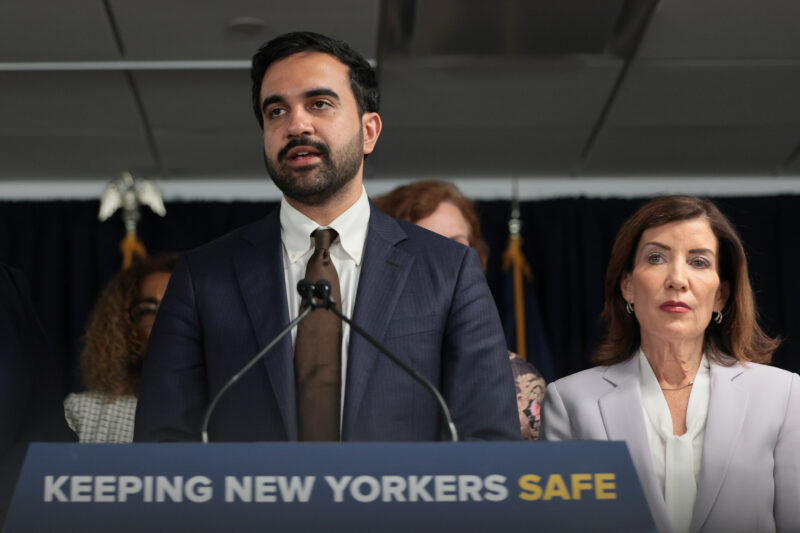
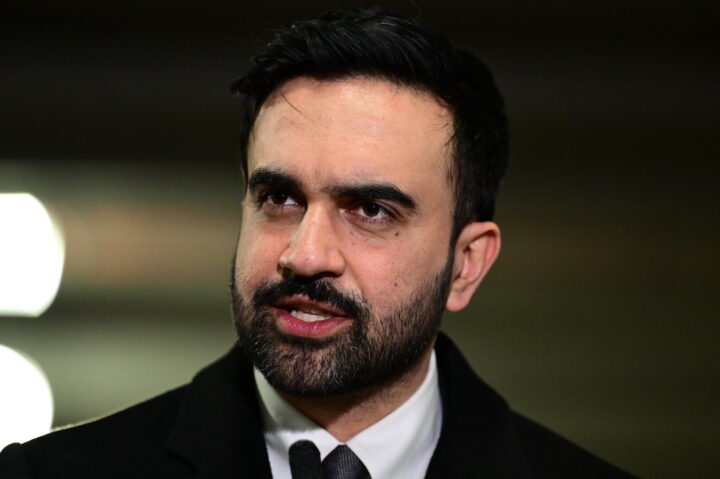
New York City Mayor Zohran Mamdani
New York City Mayor Zohran Mamdani slammed joint U.S.-Israeli airstrikes on Iran in a statement Saturday — without placing fault with Tehran in his reaction.
Mamdani released a statement that reiterated his police department’s earlier pledge to boost local security, and also attacked Israel and the United States for “an illegal war of aggression.” But unlike other Democrats who have spoken out against the air campaign, he mentioned neither the atrocities committed by the Iranian regime against its own citizens, nor President Donald Trump, with whom he met just days ago.
“Today’s military strikes on Iran — carried out by the United States and Israel — mark a catastrophic escalation in an illegal war of aggression. Bombing cities. Killing civilians. Opening a new theater of war,” he wrote. “Americans do not want this. They do not want another war in pursuit of regime change. They want relief from the affordability crisis. They want peace.”
The NYPD declared Saturday morning it was “closely monitoring” the situation in the Middle East and working with federal and international law enforcement. It further promised pre-emptive steps to increase security at potential targets, though it did not indicate whether it was aware of any specific threat.
“As is our protocol and out of an abundance of caution, we will be enhancing patrols to sensitive locations throughout the city, including diplomatic, cultural, religious, and other relevant sites,” the department tweeted.
The NYPD did not respond to queries about specific actions, but videos on social media showed members of the department’s Counter-Terrorism Task Force at Manhattan’s iconic Temple Emanu-El as well as outside the Iranian consulate.
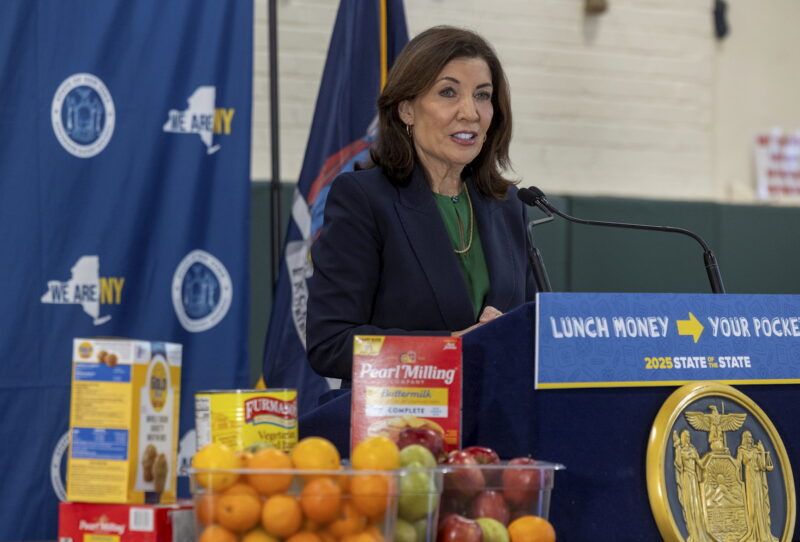
Gov. Kathy Hochul similarly vowed that she would deploy state troopers to guard vulnerable sites, even as she said “there were no specific, credible threats to New York.” She noted the impending start of Purim Monday night as cause to coordinate with the leaders of the Jewish community.
“State Police are increasing their presence at religious, diplomatic, and cultural sites statewide in coordination with federal, state, and local law enforcement partners,” the Democrat wrote in a statement. “Additionally, in advance of the Jewish holiday of Purim, State Police remain alert and have already begun outreach to religious organizations to offer support.”
Meanwhile, organizations affiliated with China-based left-wing tech tycoon Neville Roy Singham — known for promoting geopolitical narratives favorable to Beijing and its allies in Moscow and Tehran — including the People’s Forum and CODE PINK kicked off a protest against the strikes in Times Square on Saturday afternoon.
Joining them, according to promotional materials, are the Democratic Socialists of America, the Palestinian Youth Movement, and the National Iranian American Council, known as the country’s de facto lobbying group in the United States.
Netanyahu: Attacks were Israeli Air Force’s largest flyover in history
Mahsa / Middle East Images / AFP via Getty Images
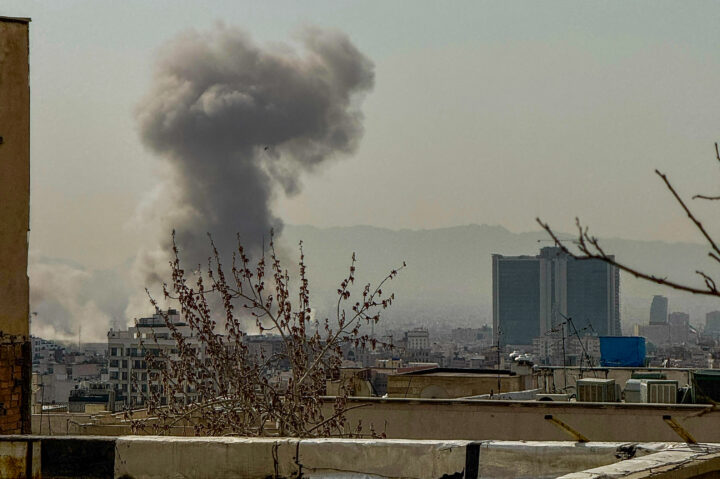
A plume of smoke rises over Tehran after a reported explosion on February 28, 2026.
The U.S. and Israeli militaries planned attacks on Iran for months, marking “unprecedented cooperation,” Lt.-Gen. Eyal Zamir, the IDF’s chief of staff, said on Saturday, hours after the launch of what Israel has called Operation Roaring Lion and the U.S. has called Operation Epic Fury.
“In recent months, under the direction of the political leadership, I have led — in coordination with my counterparts, the chairman of the Joint Chiefs of Staff and the commander of CENTCOM — a deep and comprehensive joint operational planning process. This reflects unprecedented cooperation between the IDF and the United States military,” Zamir said.
An IDF official speaking on condition of anonymity said that the two militaries “worked for thousands of hours” to increase its target bank “by hundreds of percent.”
The plan centered on “an intelligence effort … to identify an operational opportunity at the moment when senior regime officials would convene,” the official said. The IDF struck three such gatherings simultaneously and killed “several senior figures.”
Israeli Prime Minister Benjamin Netanyahu confirmed in a video statement that one of those targets was Ayatollah Ali Khamenei, Iran’s supreme leader, saying that the IDF likely killed him.
“Today, in a surprise attack, we destroyed Iranian Supreme Leader Ali Khamenei’s compound in the heart of Tehran,” he said. “For three and a half decades, this tyrant sent terror throughout the world, immiserated his nation and worked all the time on his plan to destroy Israel.”
“That plan is gone and there are many signs that the tyrant is gone,” Netanyahu said. President Donald Trump later confirmed the news.
Netanyahu said that Israel plans to hit “1,000 terror sites” in the coming days.
Directing his remarks at the people of Iran, Netanyahu said, “Soon your moment will come in which you must go out on the streets … Help has arrived and now the time has come for you to unite for a historic mission … to bring down the regime and ensure your future.”
The strikes on Iran’s missile array and air-defense systems by 200 fighter jets were the Israeli Air Force’s largest-ever flyover, the IDF Spokesperson’s office said.
The IAF fighter jets struck 500 targets throughout western and central Iran, such as one in Tabriz, which was used for Iran’s surface-to-surface missiles. Another strike targeted an advanced SA-65 aerial-defense system near Kermanshah in western Iran, the IDF said.
The IDF sent warnings via social media to Iranian civilians living near weapons production and military infrastructure facilities: “Dear citizens, for your safety and well-being, we urge you to immediately evacuate these areas and remain outside of them until further notice. Your presence in these locations puts your lives at risk.”
Iran launched missiles and attack drones at Israeli population centers throughout the day, including ones that include cluster munitions, the IDF said.
“Cluster weapons are designed to disperse over a large area and maximize the chances of a harmful strike. Iran goes to great lengths in trying to maximize harm to Israeli civilians,” Nadav Shoshani, the IDF international media spokesperson, stated.
Zamir said that Operation Roaring Lion is “a significant, decisive, and unprecedented operation, to dismantle the capabilities of the Iranian terrorist regime — capabilities that constitute an ongoing existential threat to the security of the State of Israel. This is an operation to secure our existence and our future here, in the land of our forefathers, for generations to come.”
Since last year’s Operation Rising Lion, as the IDF called the 12-day war with Iran, “the radical Iranian terrorist regime has not abandoned its vision or its hostile intentions to advance its plan to destroy Israel. It has continued to promote its nuclear project, restore and accelerate ballistic missile production, and destabilize the region through the funding and arming of terrorist proxies,” Zamir said.
The IDF chief of staff also tied the operation to the holiday of Purim, which begins on Monday night, and celebrates the Jews of the Persian empire overcoming an attempted genocide.
“The Book of Esther teaches us that responsibility for our destiny rests first and foremost in our own hands — in courage, initiative, unity and the willingness to fight for our right to live here in freedom and in peace,” Zamir said. “Soldiers and commanders of the IDF… carry with you the vision of our forefathers.”
Shoshani wrote in a blog post that the timing of the operation was due to “a dangerous acceleration in [Iran’s] capabilities,” including long-range missile production and continued proxy funding.
“Israel reached a point where the threat was no longer ‘developing,’” Shoshani wrote. “The threat was direct and imminent.”
The objective of the strike, Shoshani said, was to “fundamentally reduce and degrade Iranian terrorist regime capabilities, eliminating long-term existential threats to the state of Israel.”
The IDF also called up 70,000 reservists to serve on Israel’s borders, the West Bank and Gaza to stop any infiltration attempts, as well as search and rescue forces prepared to go to the site of any Iranian missile strikes.
Israelis throughout the country spent the day going in and out of safe rooms and bomb shelters at the sound of air raid sirens, which blared more frequently in Israel’s densely populated center, reflecting the area Iran targeted.
IDF Home Front Commander Maj.-Gen. Shay Kleper said that “past experiences prove that the public’s strict following of protocol has saved many lives. The grit and responsibility of everyone is a key element in countering the threat.”
Israeli Foreign Minister Gideon Sa’ar spoke about Israel’s decision to strike Iran and the operation’s objectives with 17 of his counterparts, in phone calls to Argentina, Austria, Germany, India, Italy, Hungary, the Czech Republic, Latvia, the European Union, France, Canada, Australia, Ecuador, Greece, Ethiopia, Singapore and North Macedonia.
President Donald Trump confirmed the news, calling Khamenei ‘one of the most evil people in history’

Iranian Leader Press Office / Handout/Anadolu via Getty Images
Iranian Supreme Leader Ayatollah Ali Khamenei makes remarks in Tehran, Iran, on May 20, 2025.
President Donald Trump confirmed on Saturday that Ayatollah Ali Khamenei, the supreme leader of Iran and the country’s highest political and religious authority, was killed during Israeli and U.S. strikes in the country.
“Khamenei, one of the most evil people in History, is dead. This is not only Justice for the people of Iran, but for all Great Americans, and those people from many Countries throughout the World, that have been killed or mutilated by Khamenei and his gang of bloodthirsty THUGS,” Trump wrote.
Israeli media reported he was killed in an Israeli strike on his compound in Tehran. He was 86.
Khamenei had led Iran since 1989, succeeding Ayatollah Ruhollah Khomeini, who took over the country as part of his Islamic Revolution in 1979. Over more than three decades in power, he oversaw major shifts in Iran’s domestic politics, military posture and regional strategy, moves that resulted in the Islamic Republic becoming the world’s leading exporter of terrorism through proxies such as Hamas and Hezbollah.
As supreme leader, Khamenei exercised ultimate authority over the armed forces, judiciary, state broadcasting and key political appointments. He maintained final say over defense and foreign policy, including Iran’s nuclear program, and appointed top commanders of the Islamic Revolutionary Guard Corps.
The IRGC became the primary instrument of Khamenei’s rule. He cultivated and empowered it for decades, and the IRGC in turn underwrote his domestic authority and Iran’s regional ambitions across Iraq, Syria, Lebanon, Yemen and Gaza through what he called the “Axis of Resistance.”
His foreign policy was defined by two poles of opposition: the United States, which he called Iran’s “No. 1 enemy,” and Israel, whose destruction he repeatedly called for in rhetoric that mixed geopolitical calculation with antisemitic tropes. Under his leadership, Iran became what the U.S. State Department designated the world’s foremost state sponsor of terrorism.
No successor has been publicly named, and with much of the IRGC’s senior leadership also reported killed in Saturday’s strikes, the question of who fills the vacuum left by Khamenei will mark a pivotal moment in Iran’s history.
Most Democrats are pushing for a war powers resolution next week, amid ongoing military operations
Win McNamee/Getty Images
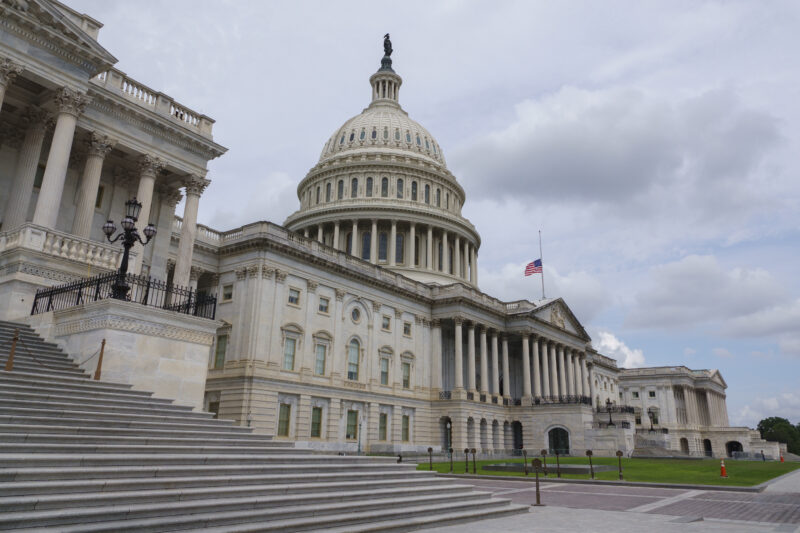
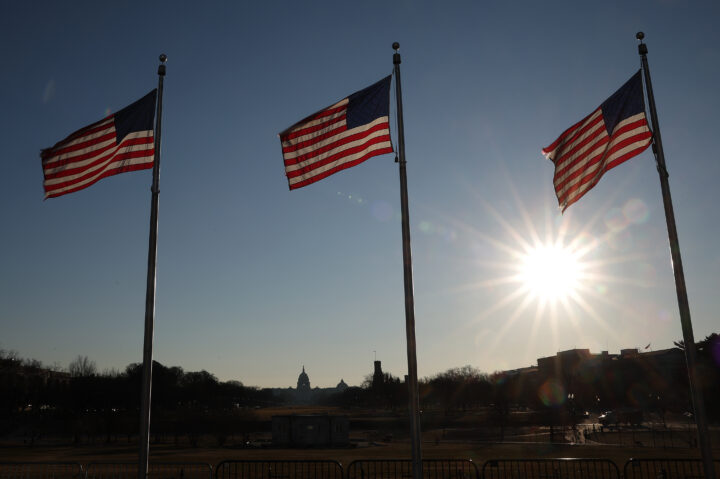
The American flag flies in front of the U.S. Capitol on February 28, 2026 in Washington, DC. U.S.
A number of Republican lawmakers rallied behind President Donald Trump’s military strikes against Iran on Saturday, while leading Democrats expressed quick and strident opposition to the administration’s decision to attack Iran.
Democrats are also demanding Congress reconvene promptly next week to vote on war powers resolutions to block further military operations in Iran without congressional approval. The resolutions were already expected to come up for votes in the coming week.
A few Democratic lawmakers sounded more open-minded about the attack against Tehran. Sen. John Fetterman (D-PA), one of the few foreign policy hawks in his party, said the president “was absolutely” correct to attack Iran in an appearance on Fox News. “God bless the United States, our great military, and Israel,” Fetterman said.
Rep. Greg Landsman (D-OH), who told Jewish Insider earlier this week that limited strikes on Iran could be necessary and productive, echoed that stance on Saturday. He said that he would oppose the war powers resolution.
“I hope these targeted strikes on the Iranian regime’s military assets end the regime’s mayhem and bloodshed and makes way for this lasting peace in the region,” Landsman said. “Thank you to our brave service members who are leading this effort, and I pray their work will finally free the people of Iran and those in the region from more violence or war. May peace emerge from all of this.”
Rep. Josh Gottheimer (D-NJ), who had been planning to oppose the war powers resolution, praised the attack while highlighting the administration’s obligations under the War Powers Act, which limits the duration for which the president can unilaterally commit forces to armed conflict without congressional approval.
“Today, the United States, with our key democratic ally Israel, took decisive action to defend our national security, fight terror, protect our allies and stand with the Iranian people who have been massacred in the streets for demanding freedom from the murderous Iranian regime,” Gottheimer said. “I applaud the extraordinary bravery and professionalism of our servicemembers and pray for their safety as Iran and its terrorist proxies retaliate against American bases and our partners in the region.”
“Confronting the Iranian threat is essential to America’s national security and to global stability. The world is safer because of the courage and skill of our service members. I am praying for their safety and the safety of all of our allies who have been targeted by Iranian retaliation,” he continued.
Sen. Jacky Rosen (D-NV) offered more muted support for the operation, praising U.S. servicemembers while saying she “stand[s] with the Iranian people in their hope for a better future and will continue to work in a bipartisan way in Congress to provide them the support they need.” She called for an immediate and detailed briefing on the administration’s plans, and highlighted Iran’s long record of malign activity and attacks on its own citizens.
But Rosen also warned against a protracted conflict and criticized the lack of congressional authorization.
Rep. Tom Suozzi (D-NY), among the most moderate Democrats in the House and a potential swing vote on the war powers resolution, said Trump needs to seek congressional authorization for the operation, while offering support for the administration’s goals.
“I agree with the President’s objectives that Iran can never be allowed to obtain nuclear capabilities. The President must now clearly define the national security objective and articulate his plan to avoid another costly, prolonged war in the Middle East,” Suozzi said. “Iran remains the leading state sponsor of terrorism in the region and must never be allowed to obtain a nuclear weapon. Preventing that outcome is vital to our national security, the safety of our allies, and the stability of the Middle East.”
Most of the leading voices in the Democratic Party, however, are rallying against the Iran attack.
Sen. Tim Kaine (D-VA), who is leading a war powers resolution in the Senate that he planned to call up for a vote next week, said in a statement, “Every single Senator needs to go on the record about this dangerous, unnecessary, and idiotic action,” calling the strikes a “colossal mistake,” accusing the president of having “learned nothing from decades of U.S. meddling in Iran and forever wars in the Middle East” and of being “mentally incapacitated.”
Rep. Ro Khanna (D-CA), who is leading similar legislation in the House, said that “the American people are tired of regime change wars that cost us billions of dollars and risk our lives. We don’t want to be at war with a country of 90 million people in the Middle East.”
Rep. Thomas Massie (R-KY), one of the few GOP isolationists in Congress and Khanna’s cosponsor on that resolution, also said he opposes the operation.
“This is not ‘America First,’” Massie said. “When Congress reconvenes, I will work with @RepRoKhanna to force a Congressional vote on war with Iran. The Constitution requires a vote, and your Representative needs to be on record as opposing or supporting this war.”
Rep. Warren Davidson (R-OH), another isolationist-minded Republican who indicated this week that he was leaning toward voting for the war powers resolution, sent similar signals on Saturday.
“We need a government small enough to fit within the Constitution. We need a government effective enough to solve problems and serve its own people. Or, we need a new Constitution,” Davidson said.
The House is not scheduled to reconvene until Wednesday.
Rep. Jim Himes (D-CT), the top Democrat on the House Intelligence Committee, who was one of the handful of congressional leaders briefed on the administration’s plans earlier this week, said that “everything I have heard from the administration before and after these strikes on Iran confirms this is a war of choice with no strategic endgame.”
He said he expressed his concerns to Secretary of State Marco Rubio during the briefing this week.
Republicans are largely lining up behind the administration, with the exception of Massie.
Sen. Lindsey Graham (R-SC), who had urged Trump to take action, praised the administration, saying Trump had “met the moment.”
“My mind is racing with the thought that the murderous ayatollah’s regime in Iran will soon be no more. The biggest change in the Middle East in a thousand years is upon us,” Graham said. “The likelihood of normalization between Saudi Arabia and Israel getting back on track is exceedingly high – a subject I brought up last week to the key players in the region who concurred if the ayatollah goes down, historic peace advances.”
Graham met with leaders in Israel, Saudi Arabia and the United Arab Emirates this month and said on Fox News on Saturday morning that he plans to return soon. Following retaliatory strikes by Iran on U.S. military facilities in several Arab states, Saudi Arabia issued a statement condemning Iran and offering its support for measures the Arab states may take in response.
“This operation has been well-planned,” Graham continued. “It will be violent, extensive and I believe, at the end of the day, successful. Again the demise of the ayatollah’s regime with American blood on its hands is necessary and more than justified.”
He later urged Arab and other allies to “get behind President Trump and go all in to ensure the ayatollah’s Iran, which has become the largest state sponsor of terrorism in the world is no more.”
Sen. Tom Cotton (R-AR), the chairman of the Senate Intelligence Committee, who was also briefed, said, “The butcher’s bill has finally come due for the ayatollahs. May God bless and protect our troops on this vital mission of vengeance, and justice, and safety,” highlighting the regime’s long record of attacks against Americans.
House Speaker Mike Johnson (R-LA) said Iran is “facing the severe consequences of its evil actions,” and said Trump had “made every effort” at diplomacy. “For decades, Iran has defiantly maintained its nuclear program while arming and funding Hamas, Hezbollah, and other internationally recognized terrorist organizations. Iran and its proxies have menaced America and American lives, undermined our core national interests, systematically destabilized the Middle East, and threatened the security of the entire West.”
“The Gang of 8 was briefed in detail earlier this week that military action may become necessary to protect American troops and American citizens in Iran. I received updates from Secretary Rubio thereafter, and I will remain in close contact with the President and the Department of War as this operation proceeds,” Johnson continued.
Other rank-and-file Democrats, including some moderates, drew parallels with the Bush administration’s war against Iraq in their criticism.
Sen. Mark Warner (D-VA), the top Democrat on the Senate Intelligence Committee, said that the strikes raise “serious legal and constitutional concerns.”
“The American people have seen this playbook before — claims of urgency, misrepresented intelligence, and military action that pulls the United States into regime change and prolonged, costly nation-building,” Warner continued. “We owe it to our service members, and to every American family, to ensure that we are not repeating the mistakes of the past. The president owes the country clear answers: What is the objective? What is the strategy to prevent escalation? And how does this make Americans safer?”
Sen. Ruben Gallego (D-AZ), an Iraq war veteran representing a GOP-leaning state, expressed concern for U.S. forces, who Trump acknowledged could be lost in the ensuing war.
“I lost friends in Iraq to an illegal war. Young working-class kids should not pay the ultimate price for regime change and a war that hasn’t been explained or justified to the American people,” Gallego said. “We can support the democracy movement and the Iranian people without sending our troops to die.”
Rep. Brad Schneider (D-IL), a co-chair of the House Jewish caucus and a key pro-Israel leader, criticized the administration’s move and said he would support the war powers resolution. “The President of the United States is not allowed to take our nation to war without authorization from Congress.”
“This is a moment of peril and opportunity,” Schneider said. “Congress must step up to meet the moment, fulfill its constitutional duties, and ensure American action — with our allies in the region and around the world — leads to a more stable and peaceful Middle East, not another generational entanglement ending in failure.”
Former Rep. Elaine Luria (D-VA), among the House’s most vocal Democratic Iran hawks while she was in office and who is now running to reclaim her former seat, also said Congress should “immediately return to Washington” to vote on Kaine’s war powers resolution.
Rep. Jake Auchincloss (D-MA) said that Trump has “no credibility on either the strategy or law guiding foreign policy” — pointing to the president’s delayed promise to Iranian protesters earlier this year that help would be coming — and said he plans to support the war powers resolution.
“I am ready to work across the aisle to craft congressionally directed strategy on Iran, especially for securing American air supremacy in the region and supporting the Iranian people’s right to self determination,” Auchincloss said. “But first congressional Republicans must call the question on this fundamental issue of war powers by voting against a reckless commander-in-chief and for the Constitution.”
President Donald Trump called on Iranians to ‘take over your government’ when ‘we are finished’

Mandel NGAN / AFP via Getty Images
President Donald Trump steps off Air Force One at Palm Beach International Airport in West Palm Beach, Florida, on February 27, 2026.
The U.S. and Israel launched a joint military operation targeting Iran on Saturday morning, the culmination of months of tensions and, more recently, negotiations aimed at reaching a diplomatic resolution to concerns over Iran’s nuclear program.
In an address on Saturday shortly after the first strikes were reported, President Donald Trump announced that “the United States military is undertaking a massive and ongoing operation to prevent this very wicked, radical dictatorship from threatening America and our core national security interests.”
Trump said that the goal of the operation “is to defend the American people by eliminating imminent threats from the Iranian regime, a vicious group of very hard, terrible people.”
“For 47 years, the Iranian regime has chanted ‘Death to America’ and waged an unending campaign of bloodshed and mass murder targeting the United States, our troops and the innocent people in many, many countries,” Trump said, noting that “it was Iran’s proxy Hamas that launched the monstrous October 7 attacks on Israel, slaughtering more than 1,000 innocent people, including 46 Americans, while taking 12 of our citizens hostage.”
The strikes came a day after Omani Foreign Minister Bdar Al Busaidi traveled to Washington to meet with Vice President JD Vance after mediating a round of talks in Geneva between senior Iranian officials and a U.S. delegation led by White House Special Envoy Steve Witkoff and Jared Kushner.
The military confrontation came eight months after Israel’s 12-day war with Iran, which the U.S. joined, which significantly degraded Iran’s aerial defenses and nuclear program.
The White House had faced questions in recent weeks about the scale of a potential operation in Iran as it amassed the largest U.S. military presence in the Middle East in more than two decades.
In his most direct remarks targeting Iranian Supreme Leader Ayatollah Ali Khamenei, Trump addressed “the great proud people of Iran,” saying, “The hour of your freedom is at hand. Stay sheltered. Don’t leave your home. It’s very dangerous outside. Bombs will be dropping everywhere. When we are finished, take over your government.”
Trump slammed the efforts by Iran and its proxies to disrupt commercial waterways and target U.S. interests and positions across the region. “It’s been mass terror, and we’re not going to put up with it any longer. From Lebanon to Yemen and Syria to Iraq, the regime is armed, trained and funded terrorist militias that have soaked the earth with blood and guts,” Trump said.
Two hours after the start of the strikes, Iran launched its first barrages of ballistic missiles at Israeli population centers. No injuries were reported.
Israeli Prime Minister Benjamin Netanyahu said in a statement, “My brothers and sisters, citizens of Israel, a short while ago, Israel and the United States embarked on an operation to remove the existential threat posed by the terrorist regime in Iran. I thank our great friend, President Donald Trump, for his historic leadership.”
“For 47 years, the Ayatollah regime has called for ‘Death to Israel’ and ‘Death to America.’ It has spilled our blood, murdered many Americans, and massacred its own people. This murderous terrorist regime must not be allowed to arm itself with nuclear weapons that would enable it to threaten all of humanity,” Netanyahu continued.
“Our joint action will create the conditions for the brave Iranian people to take their destiny into their own hands” Netanyahu said. “The time has come for all segments of the people in Iran – the Persians, the Kurds, the Azeris, the Balochis, and the Ahwazis – to rid themselves of the yoke of tyranny and bring about a free and peace-seeking Iran.”
“The coming days of Operation Roaring Lion will demand patience and fortitude from all of us. We shall stand together, fight together, and ensure the eternity of Israel together,” he concluded.
Jewish Insider’s Israel Editor Tamara Zieve contributed reporting.
Plus, Mamdani makes surprise WH visit

Umman Foreign Ministry/Handout/Anadolu via Getty Images
Special Envoy Steve Witkoff (C) advisor Jared Kushner (L) meet with Omani Foreign Minister Badr bin Hamad Al Busaidi (R), who is mediating between the parties in the third round of Iran-U.S. negotiations held in Geneva, Switzerland, on February 26, 2026.
Good Thursday afternoon!
This P.M. edition is reserved for our premium subscribers — offering a forward-focused read on what we’re tracking now and what’s coming next.
It’s me again — Danielle Cohen-Kanik, U.S. editor at Jewish Insider and curator, along with assists from my colleagues, of the Daily Overtime. Please don’t hesitate to share your thoughts and feedback by replying to this email.
📡On Our Radar
Notable developments and interesting tidbits we’re tracking
U.S.-Iran negotiations wrapped up for the day in Geneva without a decisive result: Omani Foreign Minister Badr Albusaidi said the sides had made “significant progress” while Iranian Foreign Minister Abbas Araghchi told state media they negotiated “very seriously,” but no agreement was reached.
Araghchi said technical experts will meet on Monday in Vienna at the International Atomic Energy Agency and fourth round negotiations will take place later next week, after consultations in both capitals…
Secretary of State Marco Rubio told reporters yesterday that Iran “poses a very grave threat to the United States” and is trying to reconstitute its nuclear program. “After their nuclear program was obliterated, they were told not to try to restart it, and here they are. You can see them always trying to rebuild elements of it. They’re not enriching right now, but they’re trying to get to the point where they ultimately can.”
Beyond the nuclear issue, Rubio said, Iran also has “conventional weapons that are solely designed to attack America and attack Americans. … These things have to be addressed.” While the current talks are focused solely on Tehran’s nuclear program, “it’s also important to remember that Iran refuses to talk about ballistic missiles to us or to anyone, and that’s a big problem”…
House Democratic leaders said in a joint statement today that they plan to force a vote “as soon as Congress reconvenes next week” on a resolution blocking military action against Iran without congressional authorization, Jewish Insider’s Marc Rod reports. Three Democrats have already indicated they will oppose the resolution, with other defections likely to follow…
U.S. forces raided a ship last month and seized cargo heading from China to Iran, officials told The Wall Street Journal, part of a broader effort to head off Iran’s covert arms purchases after the 12-day war last June. The cargo was reportedly intended for Iranian companies that procure weapons for the regime’s missile program…
The Journal interviews fighter pilots involved in the U.S. bombing campaign against the Houthis last spring, as military assets are once again amassing in the Middle East for a potential operation against Iran…
Maine Senate candidate Graham Platner amplified a social media post today from a far-right conspiracy theorist well-known for viciously antisemitic commentary — before quickly deleting the statement, JI’s Matthew Kassel reports. In a comment on X, Platner approvingly boosted a remark opposing war with Iran from Stew Peters, who has said Judaism is “satanic” and a “death cult,” promoted blood libels and called for a “final solution” to mass-deport American Jews…
The issue is particularly sensitive for Platner, who earlier in his campaign faced scrutiny over a Nazi tattoo on his chest, which he has since had covered. He was pressed today on a YouTube call-in show about his knowledge of the tattoo’s symbolism because of his self-identification as a WWII history enthusiast.
“I was well aware that they [Nazis] used a similar-looking thing,” Platner said. “You have to admit it’s not a ‘similar-looking thing,’ it’s the same thing. … Anyone who’s remotely a WWII buff knows what that is,” the caller replied. Platner answered, “I’m not going to apologize for something that I didn’t know about or do”…
New York City Mayor Zohran Mamdani made an unannounced visit to the White House to meet with President Donald Trump today. Among other issues, the two discussed housing and immigration activities…
The family of Francesca Albanese, the U.N. special rapporteur for Israel and the Palestinian territories, sued Trump and other administration officials yesterday in district court, alleging that the sanctions imposed on Albanese by the U.S. violate her First, Fourth and Fifth Amendment rights…
Israeli President Isaac Herzog and Foreign Minister Gideon Sa’ar attended an iftar meal to break the Ramadan fast hosted by UAE Ambassador to Israel Mohamed Al Khaja in Tel Aviv, where Herzog said that the “members of the Abraham Accords should be treated in an upgraded manner as they pursue the noble cause of peace.”
“And this I say especially,” Herzog continued, “when there are nations who are spreading hate, spreading blasphemy against nations who seek peace — against the Emiratis, against the Israelis,” ostensibly referring to Saudi Arabia…
As Indian Prime Minister Narendra Modi wrapped up his trip to Israel today, the two countries signed 16 memorandums of understanding to expand cooperation in fields including agriculture and AI. Modi also met with the cast of “Fauda”…
⏩ Tomorrow’s Agenda, Today
An early look at tomorrow’s storylines and schedule to keep you a step ahead
Keep an eye out in Jewish Insider for a profile of Sam Bregman, the Jewish cowboy-hat wearing former district attorney running for governor of New Mexico.
ADL’s Desert Region will hold its annual conference at Arizona State University, with speakers including ADL CEO Jonathan Greenblatt, Arizona Gov. Katie Hobbs, Phoenix Mayor Kate Gallego and state Rep. Alma Hernandez.
J Street’s annual conference will kick off Saturday in Washington. Speakers will include former Israeli Prime Minister Ehud Olmert, Sens. Chris Van Hollen (D-MD), Brian Schatz (D-HI), Adam Schiff (D-CA), Tim Kaine (D-VA) and Chris Murphy (D-CT) and Reps. Nancy Pelosi (D-CA), Sara Jacobs (D-CA), Sean Casten (D-IL) and Madeleine Dean (D-PA). J Street’s PAC will hold an event with Roy Cooper, the former governor of North Carolina now running for Senate, and phone banking sessions for Evanston, Ill., Mayor Daniel Biss, running for the House.
We’ll be back in your inbox with the Daily Overtime on Monday. Shabbat Shalom!
Stories You May Have Missed
EDUCATION CONSTERNATION
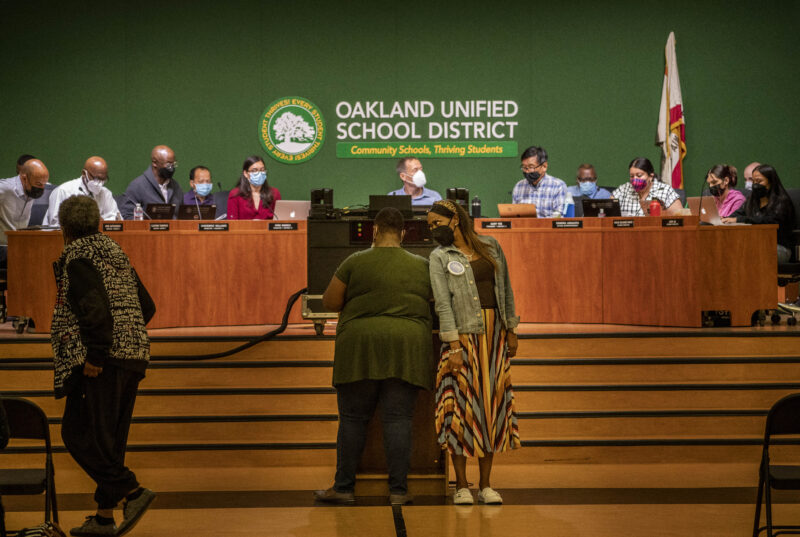
The suit highlights several complaints from Jewish parents and children statewide, in school districts including Berkeley, Los Angeles, Santa Clara, San Francisco, Campbell Union, Fremont, Etiwanda and Oakland
PRAIRIE STATE DEBATE

The far-left influencer, running competitively in a Chicago-area district with a sizable Jewish constituency, debated primary rivals Laura Fine and Daniel Biss on Wednesday
Three Democrats have indicated they will oppose the resolution, with some other defections likely
Anna Moneymaker/Getty Images
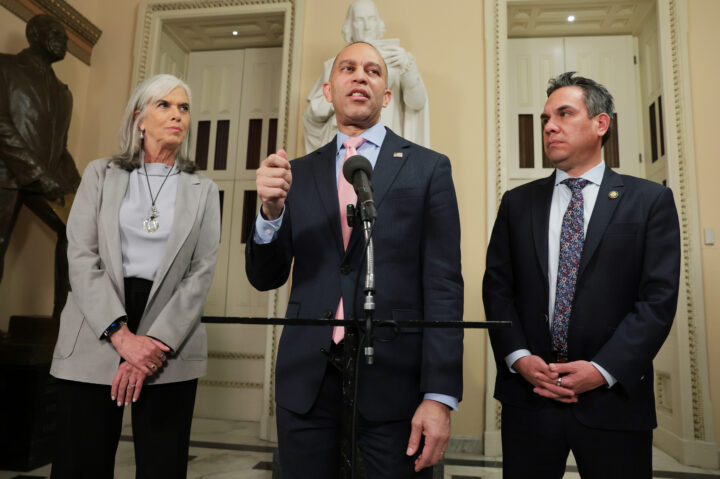
House Minority Leader Hakeem Jeffries (D-NY) (C) speaks alongside Rep. Pete Aguilar (D-CA) (R) and Rep. Katherine Clark (D-MA) (L) during a news conference after a vote on healthcare subsidies at the U.S. Capitol on January 8, 2026, in Washington, D.C.
House Democratic leaders said in a joint statement on Thursday that they plan to force a vote “as soon as Congress reconvenes next week” on a resolution blocking military action against Iran without congressional authorization.
The statement, signed by House Minority Leader Hakeem Jeffries (D-NY), Minority Whip Katherine Clark (D-MA) and Caucus Chair Pete Aguilar (D-CA), as well as Reps. Greg Meeks (D-NY), Jim Himes (D-CT), Adam Smith (D-WA) and Ro Khanna (D-CA), all of whom hold committee leadership roles, argues that military action against Iran without authorization would be unconstitutional. The statement also serves as an apparent repudiation of claims by some progressives that Democratic leaders were privately maneuvering to block a vote on the resolution, fearing a significant number of party defections.
“The Iranian regime is brutal and destabilizing, seen most recently in the killing of thousands of protestors,” the Democratic officials said. “However, undertaking a war of choice in the Middle East, without a full understanding of all the attendant risks to our servicemembers and to escalation, is reckless.”
“We maintain that any such action would be unconstitutional without consultation with and authorization from Congress,” they continued.
At least one Republican, other than the resolution’s cosponsor Rep. Thomas Massie (R-KY), appears likely to support the war powers resolution. Rep. Warren Davidson (R-OH), a Republican with isolationist foreign policy leanings, said he would vote in favor of the resolution unless he receives a classified briefing on the “mission” in Iran next week that provides “new information.”
“War requires congressional authorization. There are actions short of war, but no case has been made,” Davidson said.
Three Democrats — Reps. Josh Gottheimer (D-NJ), Jared Moskowitz (D-FL) and Greg Landsman (D-OH) — have indicated they will oppose the resolution. Some other defections are likely.
One issue that could drive particular concern for pro-Israel Democrats is that the legislation does not include specific language allowing for continued intelligence-sharing and defensive operations and aid to protect Israel from Iranian attack, which is included in similar Senate legislation.
Senate Minority Leader Chuck Schumer (D-NY) said in a Senate floor speech on Thursday, two days after receiving a classified briefing from Cabinet officials — that the administration still has yet to lay out its goals and plans for Iran.
“The issues we discussed in our classified briefing were very serious and the American people deserve to hear it directly from the president and his administration,” Schumer said.
Schumer has signed on as a cosponsor of the Senate war powers legislation.
Senate Majority Leader John Thune (R-SD), who was also briefed, said Thursday that any action against Iran should be decisive enough to bring down the regime.
“In my view, if you’re going to do something there, you better well make it about getting new leadership and regime change,” Thune said.
‘The president has a number of other tools at his disposal to ensure’ Iran does not get a nuclear weapon, the VP said on Fox News
Jim Watson - Pool/Getty Images
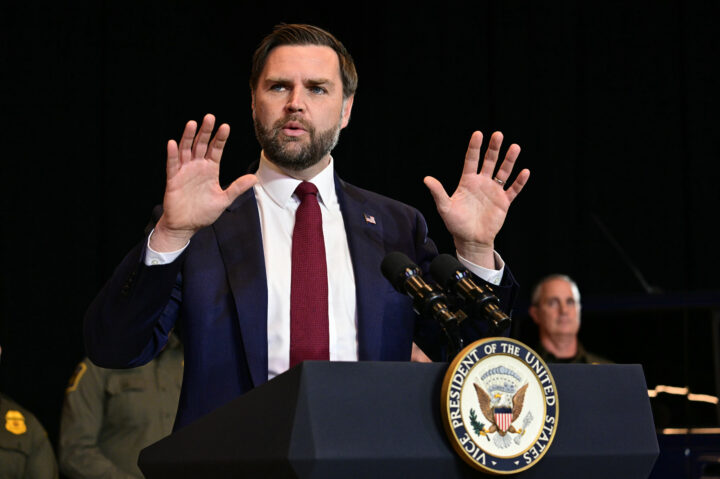
U.S. Vice President JD Vance gives remarks following a roundtable discussion with local leaders and community members amid a surge of federal immigration authorities in the area, at Royalston Square on January 22, 2026 in Minneapolis, Minnesota.
A day before U.S.-Iran nuclear talks, Vice President JD Vance urged the Iranian regime on Wednesday to take President Donald Trump’s diplomatic overtures “seriously,” cautioning that the president has “a number of tools at his disposal” to keep the “craziest and worst regime in the world” from acquiring nuclear weapons.
Vance made the comments while appearing on Fox News’ “America’s Newsroom” after being asked about Trump’s comments at the State of the Union on Tuesday night, during which the president underscored his willingness to use force while acknowledging his preference for a diplomatic solution.
“The president has been as crystal clear as he could be: Iran can’t have a nuclear weapon. That would be the ultimate military objective if that’s the route that he chose,” Vance said. “That is what we’re trying to accomplish, as the president said, through the preferred route of diplomacy, but it’s very simple: We have to get to a position where Iran, the largest state sponsor of terrorism in the world, cannot threaten the world with nuclear terrorism.”
“I think most Americans understand that you can’t let the craziest and worst regime in the world have nuclear weapons. That’s what the president is accomplishing, that’s what the president has set as our goal,” he continued. “He’s going to try to accomplish it diplomatically, but as we all know, the president has a number of other tools at his disposal to ensure this doesn’t happen. He’s shown a willingness to use them, and I hope the Iranians take it seriously in their negotiations tomorrow because that’s certainly what the president prefers.”
Asked if that meant the president’s position is that Iranian Supreme Leader Ayatollah Ali Khamenei must be removed, Vance reiterated that the administration is “hopeful that we’re able to come to a good resolution without the military, but if we have to use the military, the president, of course, has that right as well.”
“I think the president ultimately will make the decision about how to ensure Iran does not have a nuclear weapon, but we’re sitting down having another round of diplomatic talks with the Iranians, trying to reach a reasonable settlement, but a reasonable settlement towards what end?” Vance asked. “Iran can’t have a nuclear weapon. It’s very simple. I think the supreme leader and everybody in their system should understand it. We’ve been crystal clear.”
Sen. Lindsey Graham (R-SC), meanwhile, warned on Wednesday that he would not support a Trump administration-brokered deal with Iran that would allow the regime to continue enriching some uranium as part of its nuclear program.
“If media reports are true that there is a consideration of allowing Iran to have very small enrichment of uranium for face-saving purposes: screw that,” Graham wrote on X. “This regime is made up of religious Nazis that are the largest state sponsor of terrorism. The regime has American blood on its hands and they have killed over 30,000 of their citizens simply because they demand the end to their oppression.”
Graham added that he “could care less about efforts to save face for this regime. I would like to see the people of Iran change the regime – it’s long overdue. I hope help is on the way.”
The Virginia senator said Trump has failed to make a ‘real case … as to why we should be in a war with Iran’

Drew Angerer/Getty Images
Sen. Tim Kaine (D-VA) speaks to reporters on his way to a classified all-Senate briefing.
Sen. Tim Kaine (D-VA) told reporters on Wednesday that a Senate resolution blocking the use of military force against Iran without congressional authorization is likely to come up for a vote next week, though it could come as early as Thursday.
“The president made no real case last night as to why we should be in a war with Iran,” Kaine said, referring to Trump’s State of the Union address on Tuesday evening, where some Democrats hoped he would lay out a clear approach and strategy to his engagement with Tehran.
Kaine said that the timing of the vote may be affected by both the negotiations between the U.S. and Iran in Geneva on Thursday, as well as some Senate absences this week.
“We want [the diplomacy] to work. Would the vote help it, would it hurt it?” Kaine said. “[Senate Minority Leader Chuck] Schumer knows I’m full-speed ahead.”
Asked whether he thinks Democrats will unite behind the resolution, Kaine noted that only Sen. John Fetterman (D-PA) opposed a separate resolution after the U.S. strikes on Iran’s nuclear facilities last summer.
“We should not send our sons and daughters into another war in the Middle East. [Trump] declared the nuclear program was obliterated just a few months ago. So, what — now we’re going to go to war to stop a nuclear program?” Kaine said, accusing Trump of “stumbl[ing] us toward” a potential war by leaving the Joint Comprehensive Plan of Action, the 2015 Iran nuclear deal, in his first term.
Kaine emphasized that the current deployment of the aircraft carrier USS Gerald Ford to the Middle East is significantly longer than normal, with the extended mission pushing the ship and its sailors beyond normal limits.
The Virginia senator pointed out the carrier — already at sea for about eight months — is now facing maintenance issues. Normally, such issues would be addressed during scheduled repairs following a six-month deployment. Instead, those repairs are being deferred because of the ship’s extended time away.
A vote on similar legislation in the House was originally expected this week, but has now been pushed until at least next week. A handful of House Democrats have voiced opposition to that resolution, and some others have declined to say how they plan to vote.
The Democratic lawmaker’s comments suggest he’s leaning towards voting against a war powers resolution on Iran
Tom Williams/CQ-Roll Call, Inc via Getty Images
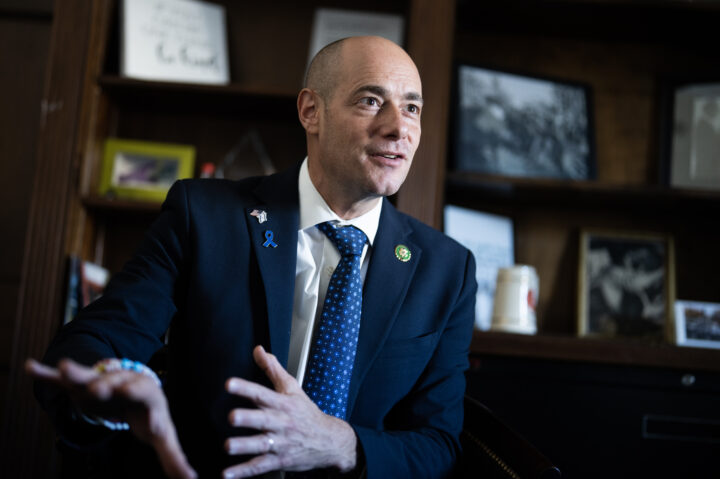
Rep. Greg Landsman (D-OH) is interviewed by CQ-Roll Call, Inc via Getty Images in his Longworth Building office on Friday, November 3, 2023.
Rep. Greg Landsman (D-OH) said that the U.S. and its allies “may very well need to take defensive action, targeting military assets in Iran,” in a statement shared with Jewish Insider on Wednesday.
While Landsman didn’t explicitly say in the statement that he intends to oppose the war powers resolution on Iran that may come to a vote before the House next week, his position suggests that he’s skeptical of that effort. Two House Democrats — Reps. Josh Gottheimer (D-NJ) and Jared Moskowitz (D-FL) — have already expressed outright opposition to the war powers resolution.
“Targeted strikes on known ballistic missiles and rocket infrastructure and other weapons depots, including nuclear assets, may very well save lives,” Landsman said. “The region and world would be a much safer place if the regime’s military capacity was leveled. These targeted strikes could prevent war, which should be the goal of any effort.”
“If targeted, defensive strikes are necessary, and these strikes are successful, the prospect of war and further violence is diminished. That’s what we should all want: an end to decades of bloodshed and mayhem by this regime. We should continue to work to weaken the regime’s ability to do harm,” Landsman added.
Emphasizing Iran’s long-standing pattern of terror throughout the region, including killing more than 30,000 demonstrators in two days last month, in addition to hundreds of Americans and fueling violence throughout the region, Landsman said that the U.S. has an opportunity to “end the bloodshed and mayhem.”
“For most of my life, the regime in Iran has caused bloodshed and mayhem. At some point, we have to say enough is enough, and begin to destroy its ability to kill innocent people, including its own citizens,” Landsman said. “If it weren’t for the regime, Yemenis, Iraqis, Lebanese, Palestinians, and Persians might all be free.”
Though the administration continues efforts to negotiate with Iran, Landsman said that the regime has “yet to show any interest in disarming or pulling back from funding violence and terror in the region. Instead, the regime is threatening further attacks on Americans and our allies.”
Landsman said that, in the case of any military action, the administration has an obligation to remain in close touch with senior congressional leaders and make its case to the American public. “This is true for targeted strikes on military assets, even if the purpose is to prevent war and further violence,” Landsman said.
“Going to war, which would be boots on the ground and an extended or ongoing military engagement, does require congressional approval,” he continued.
Plus, Witkoff calls for indefinite Iran nuclear deal

Mario Tama/Getty Images
An attendee wears a jacket at an Iowa caucus watch party organized by Metro D.C. Democratic Socialists of America, on February 3, 2020 in Washington, DC.
Good Wednesday afternoon!
This P.M. edition is reserved for our premium subscribers — offering a forward-focused read on what we’re tracking now and what’s coming next.
It’s me again — Danielle Cohen-Kanik, U.S. editor at Jewish Insider and curator, along with assists from my colleagues, of the Daily Overtime. Please don’t hesitate to share your thoughts and feedback by replying to this email.
📡On Our Radar
Notable developments and interesting tidbits we’re tracking
Ahead of the third round of U.S.-Iran negotiations taking place in Geneva tomorrow, Vice President JD Vance told Fox News that President Donald Trump “has a number of other tools at his disposal” besides diplomacy to ensure “the craziest and worst regime in the world” does not obtain nuclear weapons, following on the president’s remarks during last night’s State of the Union calling Iran “the world’s No. 1 sponsor of terror”…
In response to Trump’s comments, where he also said Iran was developing advanced ballistic missiles and had killed 32,000 protesters, Iranian Foreign Ministry spokesperson Esmail Baghaei tied Trump to the “law of propaganda coined by Nazi [chief propagandist] Joseph Goebbels.”
“This is now systematically used by the U.S. administration and the war profiteers encircling it, particularly the genocidal Israeli regime … Whatever they’re alleging in regards to Iran’s nuclear program, Iran’s ballistic missiles, and the number of casualties during January’s unrest is simply the repetition of ‘big lies,’” Baghaei wrote on X…
White House Special Envoy Steve Witkoff, who is leading Iran negotiations alongside Jared Kushner, reportedly told AIPAC members at the group’s summit in Washington yesterday that any deal reached with Iran should not have a “sunset clause,” as the 2015 Joint Comprehensive Plan of Action was criticized for.
“We start with the Iranians with the premise that there is no sunset provision. Whether we get a deal or not, our premise is: you have to behave for the rest of your lives,” Witkoff told the group, according to Axios. He said talks are currently focused only on the nuclear issue, but if they are successful, the administration would look to hold additional talks on Tehran’s missile program and support for terror proxies…
Satellite photos analyzed by the Associated Press appear to show U.S. ships that typically dock in Bahrain as part of the U.S. Navy’s 5th Fleet have moved out to sea. The 5th Fleet similarly scattered its ships during the U.S. strikes in Iran last June…
Dutch airline KLM announced a suspension of flights between its hub in Amsterdam and Israel’s Ben Gurion Airport starting March 1 until further notice, saying in a statement that it is currently “not commercially or operationally feasible for KLM to operate flights to Tel Aviv.” It’s the first airline to pause flights amid the current unrest with Iran…
On the campaign trail, Washington, D.C., mayoral candidate Janeese Lewis George vowed to reject the “Zionist lobby” in a questionnaire seeking the endorsement of the Metro D.C. chapter of the Democratic Socialists of America, Jewish Insider’s Gabby Deutch reports, a category that the DSA said includes AIPAC, Democratic Majority for Israel, Christians United for Israel and J Street.
Referencing her appearance at an event with the Jewish Community Relations Council of Greater Washington in December, Lewis George assured the DSA she “disagree[s] with the JCRC on a number of issues,” including its opposition to describing Israel’s actions in Gaza as a genocide and its “definition of antisemitism that criminalizes dissent, and their attacks on activists.”
Ron Halber, CEO of the JCRC, told JI, “As far as I’m concerned, [the DSA’s questionnaire] is an antisemitic manifesto. They are making the price of their endorsement the social exclusion of Jews”…
Illinois state Sen. Laura Fine, a Democrat running for an open Illinois House seat, unapologetically championed her backing for Israel in a position paper obtained by JI’s Marc Rod, amid attacks from anti-Israel activists and groups over her support for the Jewish state and backing from pro-Israel supporters.
Fine described Israel in the paper as “more than just a strategic ally, it is a beacon of democracy in one of the world’s most volatile regions,” as she and some of her primary opponents, including Evanston Mayor Daniel Biss and far-left activist Kat Abughazaleh, are set to participate in a televised debate tonight…
The U.S.-led Board of Peace released a video today laying out its vision for Gaza. The board’s goal by Year 3 is to fully rebuild the southern Gazan city of Rafah and have Gaza “connected to the world through an Abrahamic gateway, linking it with Egypt, Israel, Jordan, Saudi Arabia, the UAE and extending to India and Europe.” By the board’s 10th year, it said, Gaza will be “self-governed,” without specifying who will oversee the enclave and how Hamas will be removed from power…
Knesset Speaker Amir Ohana awarded Indian Prime Minister Narendra Modi the newly established Medal of the Knesset, the highest honor of the body, after Modi’s address there today. His remarks were warmly received by members of Knesset and Israeli Prime Minister Benjamin Netanyahu, who was also in the chamber…
Following Israel’s recognition of Somaliland’s independence in December, Jerusalem accepted the appointment of Mohamed Hagi as the first Somaliland ambassador to the Jewish state (and its first fully accredited ambassador anywhere in the world). Hagi “was a member of the inner circle of officials who promoted the establishment of relations between Israel and Somaliland,” the Israeli Foreign Ministry said, and vowed that a reciprocal Israeli ambassador “will soon be appointed”…
Former Harvard President Larry Summers will remain on leave from his teaching position at the Ivy League school for the duration of the academic year, at which point he will retire, Harvard announced today, after files released by the Department of Justice showed Summers maintained a relationship with sex trafficker Jeffrey Epstein after the financier had been convicted of prostitution involving a minor…
⏩ Tomorrow’s Agenda, Today
An early look at tomorrow’s storylines and schedule to keep you a step ahead
Keep an eye out in Jewish Insider for a preview of Fox Nation’s new docudrama on King David, offering a dramatic reenactment of the biblical coming-of-age story of the Jewish leader.
White House Special Envoy Steve Witkoff and Jared Kushner will hold discussions with Iranian Foreign Minister Abbas Araghchi in Geneva, mediated by Omani Foreign Minister Badr Albusaidi.
California Jewish groups including the JCRC Bay Area, the Jewish Federation of Los Angeles and Jewish California, which rebranded today from its previous name of JPAC, are hosting a forum for candidates running for governor, as Gov. Gavin Newsom reaches his term limit. Participating candidates include former presidential contender Tom Steyer, Rep. Eric Swalwell (D-CA), San Jose Mayor Matt Mahan and former Los Angeles Mayor Antonio Villaraigosa, all of whom are Democrats, as well as Republican commentator Steve Hilton.
Stories You May Have Missed
PUSHING BACK
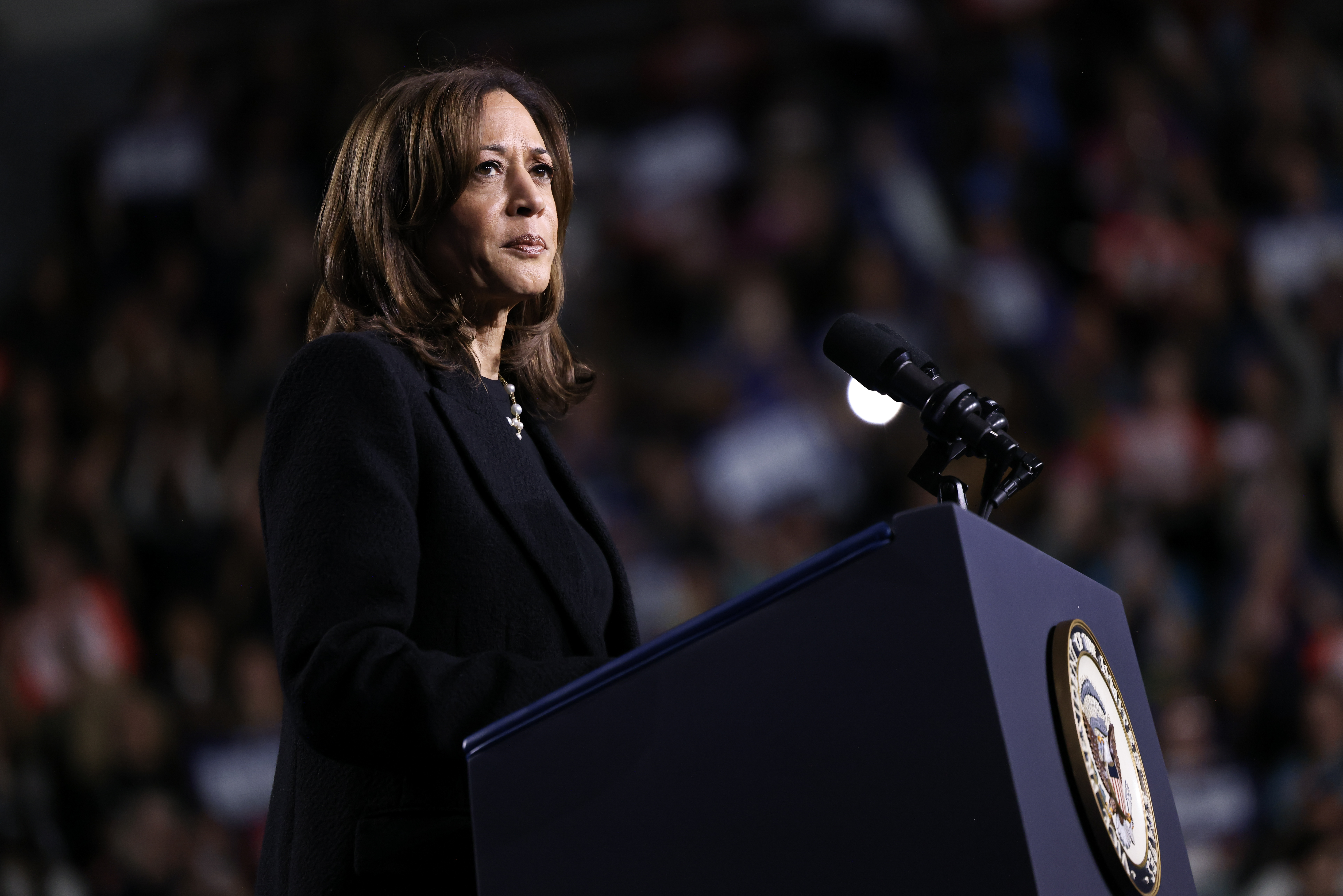
Rep. Jared Moskowitz, representing a swing district: ‘The idea that the vice president lost every swing state because she wasn’t more extreme on this issue is laughable’
CAPPELLO’S CAMPAIGN
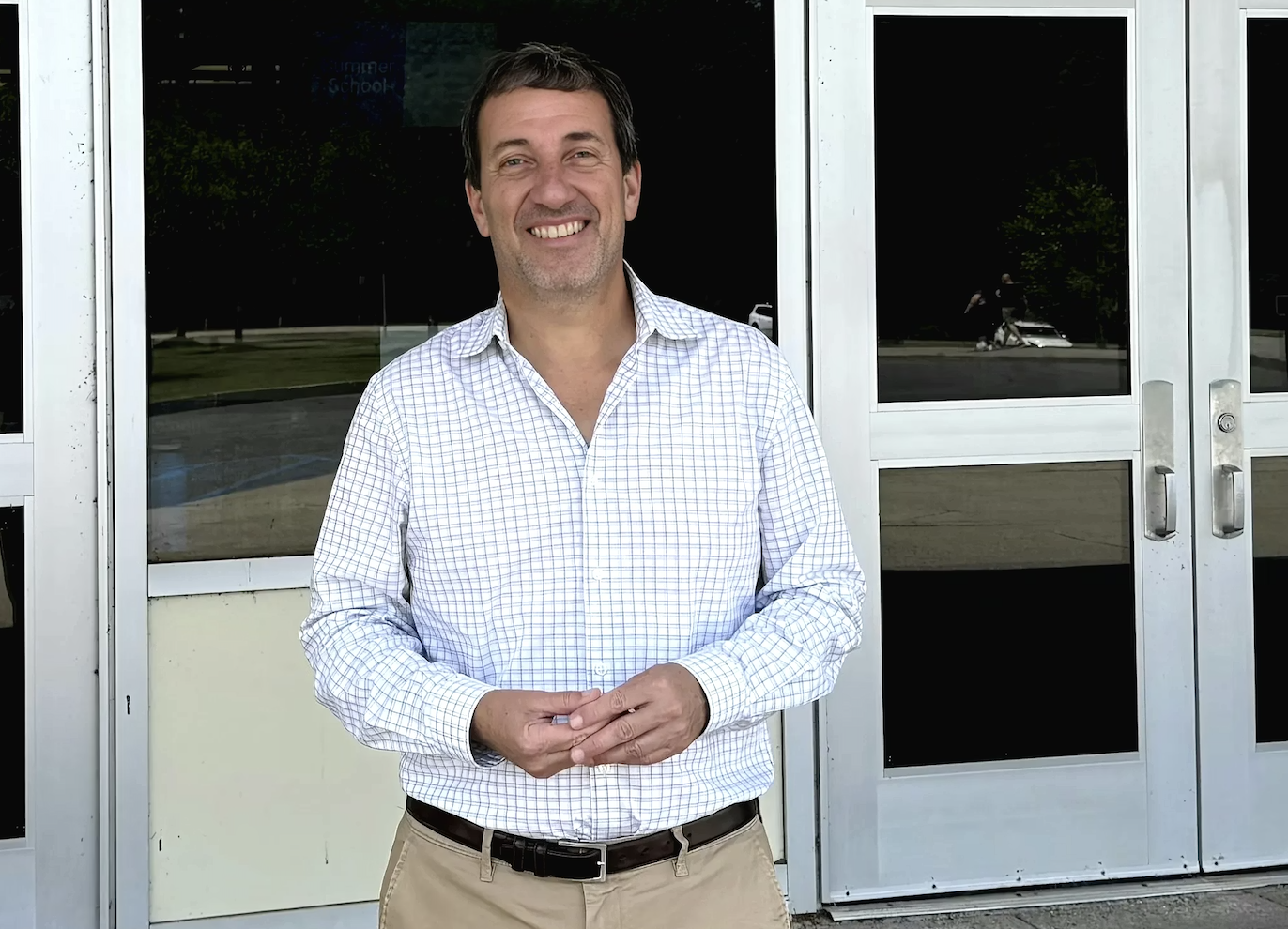
The Air Force veteran, who served for six years at the U.S. Embassy in Israel, said Israel should continue to make efforts toward peace
"They want to make a deal, but we haven't heard those secret words, ‘We will never have a nuclear weapon,’” Trump said about Iran
Andrew Harnik/Getty Images
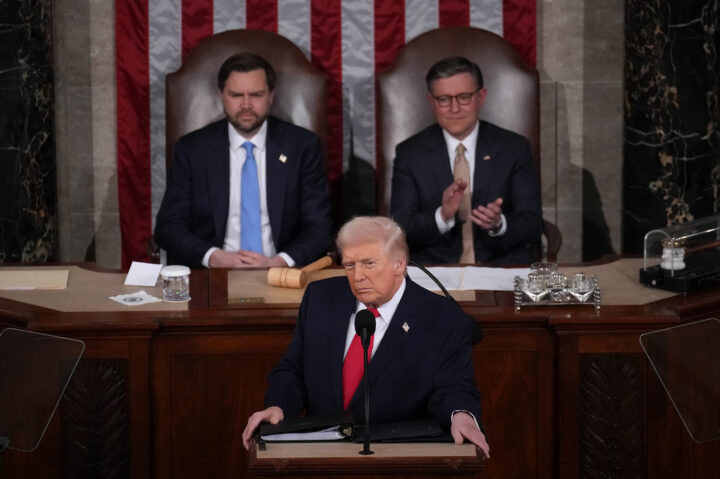
U.S. President Donald Trump, with Vice President JD Vance and Speaker of the House Mike Johnson (R-LA) looking on, delivers his State of the Union address during a Joint Session of Congress at the U.S. Capitol on February 24, 2026, in Washington, DC.
In his State of the Union address Tuesday night, President Donald Trump maintained his tough talk against Iran, reiterating that he will use force to prevent Iran from getting a nuclear weapon, even though he’s willing to explore diplomatic options to resolve the standoff.
Trump did not — as some online had predicted — make a grand televised announcement of United States strikes on Iran during the speech. Nor did he elaborate further on his plans for the growing U.S. military might in the region, or what specifically would trigger the U.S. to utilize that military power.
”They want to make a deal, but we haven’t heard those secret words, ‘We will never have a nuclear weapon,’” Trump said about Iran. “My preference is to solve this problem through diplomacy. But one thing is certain, I will never allow the world’s No. 1 sponsor of terror — which they are by far — to have a nuclear weapon. Can’t let that happen.”
A number of moderate House Democrats — around a third of the Democrats in the chamber — as well as the majority of Republicans stood to applaud those comments from the president. Democrats remained largely passive through much of the rest of Trump’s speech.
Negotiations are set to resume between the U.S. and Iran in Geneva later this week.
Trump also insisted again that the U.S. had “obliterated” Iran’s nuclear program in its strikes last June, and had warned the regime in Tehran not to attempt to rebuild its weapons programs, including its nuclear program, but it has continued those efforts anyway.
“As president, I will make peace wherever I can, but I will never hesitate to confront threats to America wherever we must,” Trump said. “And no nation should ever doubt America’s resolve. We have the most powerful military on earth. … It’s really called ‘peace through strength’ and it’s been very, very effective.”
In addition to Iran’s nuclear ambitions, Trump highlighted the Islamic Republic’s manufacture of ballistic missiles, threatening U.S. allies, troops and potentially the U.S. homeland, and its sponsorship of terrorism.
“Since they seized control of that proud nation 47 years ago, the regime and its murderous proxies have spread nothing but terrorism and death and hate,” Trump said. “They’ve killed and maimed thousands of American service members and hundreds of thousands and even millions of people.”
And he again said the regime had killed 32,000 protesters during a recent wave of demonstrations, though he asserted that the U.S. had prevented the regime, through threats of retaliation, from executing “a lot of” dissidents.
Trump boasted of having ended the war between Iran and Israel last year, as well as the war in Gaza, which he said “is proceeding at a very low level — it’s just about there.” Trump offered praise to White House Special Envoy Steve Witkoff and Jared Kushner for their involvement in those negotiations, as well as Secretary of State Marco Rubio.
Rep. Rashida Tlaib (D-MI), who wore a scarf in the pattern of a keffiyeh with a Palestinian flag at its ends, shouted, “It’s a genocide” during those remarks.
Trump also highlighted the successful return of the Israeli hostages: “Believe it or not, Hamas worked along with Israel and they dug and they dug and they dug. It’s tough — it’s a tough thing to do, going through bodies all over, passing up 100 bodies sometimes for each one they found,” the president said.
Trump added that “nobody thought that was possible” to find the remains of the final hostage, Ran Gvili, but Witkoff and Kushner were able to accomplish it.
“I remember the family of the 28th [hostage of the final group that had remained in Gaza]. They were so — grieved, but they were so happy, as happy as it’s possible to be. They had their boy back,” Trump said. He emphasized that the hostage families all wanted to see the remains of deceased hostages come home “as much as though [they] were living.”
Earlier in the day, top congressional leaders received a classified briefing from the administration on Iran, and Democrats emerged urging the administration to explain its position and plans to the American people.
“It’s very serious and the president has an obligation to make his goals public,” Schumer told Jewish Insider after the briefing.
The minority leader said after receiving the classified briefing that ‘the president has an obligation to make his goals public’
Nathan Posner/Anadolu via Getty Images
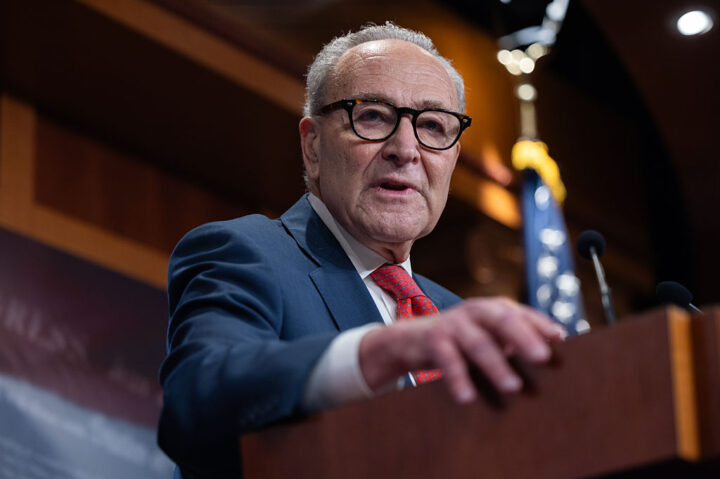
Senate Minority Leader Chuck Schumer (D-NY) speaks at a press conference following recent elections as the government shutdown continues in Washington, DC on November 5, 2025.
Senate Minority Leader Chuck Schumer (D-NY) urged President Donald Trump on Tuesday to explain to the public his goals in the accelerating pressure campaign and military buildup targeting Iran, following a classified briefing earlier in the day for senior congressional leaders by Cabinet officials on the developing situation in Iran.
Several other lawmakers offered similarly sober responses to the briefing.
“It’s very serious and the president has an obligation to make his goals public,” Schumer told Jewish Insider after the briefing.
Sen. Mark Warner (D-VA), the top Democrat on the Senate Intelligence Committee, similarly called on the administration to lay out “what our country’s goals are, what our country’s interests are and how we’re going to protect American interests in the region.”
Rep. Jim Himes (D-CT), the top Democrat on the House Intelligence Committee, said he was “very concerned” and warned that “wars in the Middle East don’t go well for presidents, for the country, and we have not heard articulated a single good reason for why now is the moment to launch yet another war in the Middle East.”
Senate Majority Leader John Thune (R-SD) said the administration is “giving a lot of thought to the situation. And I appreciate where they’re coming from.”
Plus, Trump says Iran won't rule out nuclear weapons
Mario Tama/Getty Images
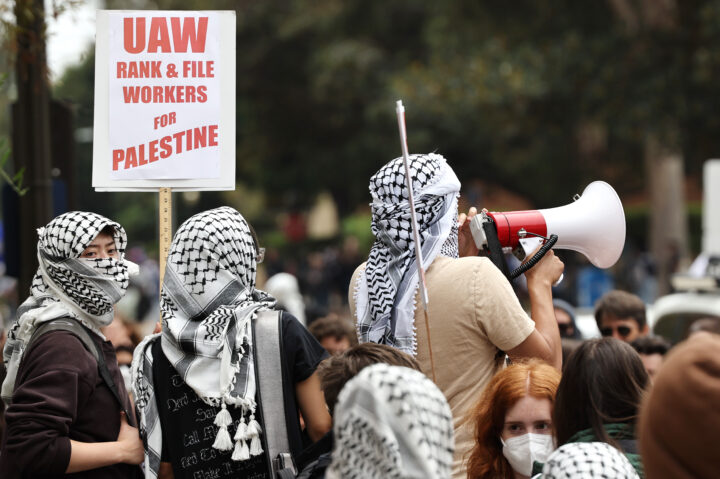
Protestors gather after police cleared a new encampment on the UCLA campus on May 23, 2024 in Los Angeles, California.
Good Tuesday afternoon!
This P.M. edition is reserved for our premium subscribers — offering a forward-focused read on what we’re tracking now and what’s coming next.
It’s me again — Danielle Cohen-Kanik, U.S. editor at Jewish Insider and curator, along with assists from my colleagues, of the Daily Overtime. Please don’t hesitate to share your thoughts and feedback by replying to this email.
📡On Our Radar
Notable developments and interesting tidbits we’re tracking
Previewing his State of the Union address tonight, where it remains to be seen if he will make any announcements on Iran, President Donald Trump told reporters, “Iran wants to make a deal more than I do, but they just won’t say the sacred phrase: ‘We won’t build nuclear weapons,’” signaling that the two sides are still at an impasse ahead of the third round of negotiations scheduled for Thursday…
Secretary of State Marco Rubio briefed the congressional Gang of Eight, the bipartisan set of leaders advised on classified matters by the executive branch, this afternoon to provide an update on Iran, with CIA Director John Ratcliffe reportedly joining the discussion. The White House did not brief the group before striking Iran last June, drawing ire from Democrats…
Ahead of the meeting, Senate Minority Leader Chuck Schumer (D-NY) told C-SPAN about potential Iran strikes, “Closed-door briefings are fine, but the administration has to make its case to the American people on something as important as this”…
Around a dozen U.S. F-22 stealth fighter jets departed from the U.K. today to be deployed at an Israeli Air Force base in the south of the country, as over 150 aircraft are being moved to the region. Military experts told The Washington Post that the “assets being assembled are indicative of a multiday campaign without a ground invasion”…
The Coast Guard is investigating a swastika drawn at its primary recruit training center in New Jersey, where Coast Guard commandant Adm. Kevin Lunday quickly flew to address recruits and staff about the incident. Lunday recently came under fire from Congress, and had his confirmation delayed, over a change in Coast Guard policy that downgraded the swastika from a prohibited hate symbol to “potentially divisive,” which was eventually walked back.
Regarding the recent incident, Lunday said in a statement to The Washington Post, “Anyone who adheres to or advances hate or extremist ideology — get out. Leave. You don’t belong in the United States Coast Guard and we reject you”…
Rep. Brad Sherman (D-CA) is pushing for legislation to require an affirmative congressional vote prior to the U.S. reaching any nuclear deal with Saudi Arabia, Jewish Insider’s Marc Rod reports, following a notification from the administration to Congress indicating that it is moving toward a deal that could allow Riyadh to enrich uranium for civilian purposes.
The notification procedures, which do not include specific terms of a potential deal, suggest that Saudi Arabia will not be required to agree to more intrusive International Atomic Energy Agency inspections or “gold standard” safeguards — which would require Saudi Arabia to agree not to enrich or reprocess nuclear material — used for the U.S. nuclear cooperation agreement with the United Arab Emirates…
The Justice Department sued the University of California today under Title VII of the Civil Rights Act, which prohibits employment discrimination, alleging that the UCLA campus created a “hostile work environment against Jewish and Israeli faculty and staff.”
During campus anti-Israel protests in 2024, the DOJ said, “the University allowed antisemitic harassment to continue unabated for days” and “has ignored, and continues to ignore, gross and repeated violations” of time, place and manner restrictions on student protest. The department further claimed Jewish and Israeli faculty at the school have been physically threatened, ostracized, harassed, forced to take leave and assaulted…
The New York Times details efforts by New York’s business community and Democratic establishment to organize and promote the moderate wing of the party in response to New York City Mayor Zohran Mamdani’s rise to power. Some of the individuals involved, including former Gov. Andrew Cuomo allies Phil Singer and Steven Cohen, are considering forming PACs, watchdog groups, lobbying campaigns and more…
New York’s Working Families Party endorsed Brooklyn Borough President Antonio Reynoso to replace retiring Rep. Nydia Velázquez (D-NY) yesterday over Mamdani’s objections. The mayor has been backing Assemblymember Claire Valdez, who, like Mamdani, is a member of the Democratic Socialists of America and a vocal critic of Israel, and he had lobbied the WFP to endorse her or to stay out of the race. WFP’s director, Jasmine Gripper, told the Times, “At the end of the day, Zohran is an individual who gets to weigh in as an individual”…
A new poll from the University of New Hampshire found oyster farmer Graham Platner with a commanding lead among likely Senate Democratic primary voters, outdistancing Gov. Janet Mills by 34 points, with the primary less than four months away. In a general election matchup with incumbent Sen. Susan Collins (R-ME), Platner leads Collins by 11 points, while Mills and Collins are neck-and-neck…
Khalid Turaani, executive director of the Ohio branch of the Council on American-Islamic Relations (CAIR), testified at the Ohio Senate Judiciary Committee last week against a bill to codify the International Holocaust Remembrance Alliance’s working definition of antisemitism, where he claimed that Israel operates the world’s largest human skin bank and harvests the skin from deceased Palestinians. “And if I call them Nazis,” Turaani continued, “your law is going to punish me.”
The Anti-Defamation League’s Ohio River Valley office condemned Turaani’s speech, saying that the “antisemitic organ harvesting myth plays on the blood libel trope, which has spurred the torture, murder, and expulsion of Jews for centuries”…
The U.S. Embassy in Israel announced that, as part of the government’s “efforts to reach all Americans,” the embassy will be providing consular services for one day only at several locations across Israel and the West Bank, including Ramallah and the Jewish settlement of Efrat…
⏩ Tomorrow’s Agenda, Today
An early look at tomorrow’s storylines and schedule to keep you a step ahead
Keep an eye out in Jewish Insider for the highlights from President Donald Trump’s State of the Union address, taking place at 9 p.m. ET tonight, as all eyes are on possible U.S. military action against Iran.
Indian Prime Minister Narendra Modi arrives in Israel tomorrow, where he will be greeted by Prime Minister Benjamin Netanyahu before addressing the Knesset. In the evening, the two leaders will have dinner at Jerusalem’s King David Hotel. Read JI’s interview on Modi’s visit with Israeli Ambassador to India Reuven Azar.
The New York City Council will hold its first hearing on Council Speaker Julie Menin’s bill aiming to create “buffer zones” around houses of worship to protect from disruptive protests. The bill’s language was updated last night to remove the original 100-foot figure, which had reportedly emerged as a point of concern for the NYPD.
Congressional candidates from Illinois’ 9th District, where pro-Israel spending is boosting state Sen. Laura Fine and attacking Evanston Mayor Daniel Biss, will hold a debate on local news.
Stories You May Have Missed
SHIFTING STANCE

The progressive activist ran as a pro-Israel candidate in a neighboring swing district, but is now walking back her support as she runs to succeed Rep. Bonnie Watson Coleman
PRAIRIE STATE OF PLAY
Lt. Gov. Juliana Stratton seems to be running to the congressman’s left on Israel, even as Rep. Robin Kelly is the most outspoken critic of Israel in the race
Plus, major Dem donor calls out 'Jew hate' in party
Andrew Harnik/Getty Images
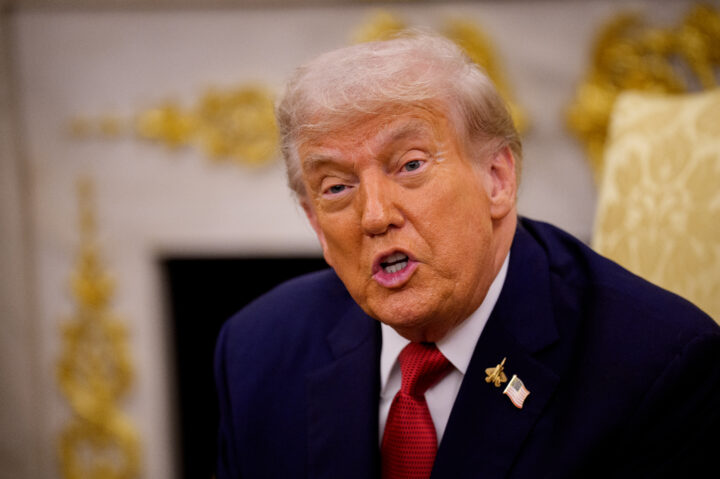
President Donald Trump in the Oval Office at the White House on September 25, 2025 in Washington, DC.
Good Monday afternoon!
This P.M. edition is reserved for our premium subscribers — offering a forward-focused read on what we’re tracking now and what’s coming next.
It’s me again — Danielle Cohen-Kanik, U.S. editor at Jewish Insider and curator, along with assists from my colleagues, of the Daily Overtime. Please don’t hesitate to share your thoughts and feedback by replying to this email.
📡On Our Radar
Notable developments and interesting tidbits we’re tracking
As rumors abound about the possibility and timing of U.S. strikes on Iran, the State Department ordered the evacuation of non-essential personnel and their families from the U.S. Embassy in Beirut. “Based on our latest review, we determined it prudent to reduce our footprint,” a State official told Fox News…
Nearby, amid the buildup of U.S. military assets in the region, American refueling and cargo planes were spotted at Ben Gurion Airport…
President Donald Trump denied reports that Pentagon officials, namely Joint Chiefs of Staff Chairman Gen. Dan Caine, are raising concerns about striking Iran, writing on Truth Social this afternoon, “General Caine, like all of us, would like not to see War but, if a decision is made on going against Iran at a Military level, it is his opinion that it will be something easily won.”
“He has not spoken of not doing Iran, or even the fake limited strikes that I have been reading about, he only knows one thing, how to WIN and, if he is told to do so, he will be leading the pack,” Trump said of Caine, while alluding to the potential breadth of military action against Iran…
Secretary of State Marco Rubio pushed back his visit to Israel, originally scheduled for this weekend, to March 2, The Jerusalem Post reports, days after the next round of U.S.-Iran negotiations in Geneva on Thursday…
Sen. Chris Coons (D-DE), a leader on foreign policy among Democrats in Congress, told Jewish Insider’s Emily Jacobs that he heard “pretty stark early warning signs of some challenges where core allies do not share our priorities” on a potential Iran strike during his recent trip t0 Europe, which included stops at the Munich Security Conference, along with meetings in Ukraine and Moldova with top European diplomats.
Coons laid out what he hopes to see from the president: “A) Consult Congress. B) Make a case to the American people about why this is in our national security interest. C) Clarify what on earth he’s planning with this Board of Peace … And D) If he’s going to work with close allies to ramp up pressure to try and achieve something at the negotiating table, he should work with close allies”…
Anthony Driver Jr., a union organizer and candidate in Illinois’ 7th Congressional District, doubled down on his recent repudiation of AIPAC, despite previously having little public record on Israel policy issues. Following a press conference last week where Driver, who is running against AIPAC-backed Chicago Treasurer Melissa Conyears-Ervin, denounced the pro-Israel group, he returned donations from major Democratic Party donor Michael Sacks over the finance executive’s ties to AIPAC.
Sacks, who was a major backer of former President Barack Obama and former Chicago Mayor Rahm Emanuel, said in his reply, “It is truly sad there is so much anti Israel sentiment and outright Jew hate that Anthony found himself in this position. I can only hope that the electorate rejects hate in all forms”…
As more details emerge about Rep. Tony Gonzales’ (R-TX) alleged affair with a staffer who later committed suicide, a poll commissioned by the campaign of Brandon Herrera, Gonzales’ opponent, shows the congressman trailing Herrera by a whopping 24 points among likely GOP primary voters. The story, which entered the news cycle right as early voting kicked off, could catapult Herrera, a social media influencer with a history of antisemitism, to the Republican nomination and on to Congress…
Investigators at the cryptocurrency giant Binance found last year that about $1.7 billion had been sent from two accounts to Iranian entities with links to terror groups, The New York Times reports, even after Binance pleaded guilty to violating anti-money laundering laws in 2023 and vowed to prevent sanctioned actors from accessing its platform. Trump pardoned Binance founder Changpeng Zhao, who was jailed for his role in the saga, in October 2025…
The Atlanta Jewish Film Festival backtracked in its defense of a juror selected for a judging panel who had posted antisemitic and anti-Israel content online, whom it had stood behind even after the Israeli Consulate in Atlanta announced it was withdrawing its funding and support of the event over the pick.
The festival changed its tune yesterday, saying it is “first and foremost, a Jewish institution” and has “a responsibility, particularly at this fraught time, to stand firmly against antisemitism and to affirm the Jewish people’s right to self-determination.” It said it would review its “organizational processes and policies, including those related to antisemitism, BDS, and cultural boycotts”…
The French Foreign Ministry has moved to block U.S. Ambassador to France Charles Kushner’s access to government officials after he declined to appear for a summons by Foreign Minister Jean-Noël Barrot today, which was issued after the U.S. Embassy reposted comments by Trump about a far-right French activist who was killed in a clash with far-left protesters. It was Kushner’s second summons, after his first last year when he accused the French government of not adequately combating antisemitism…
⏩ Tomorrow’s Agenda, Today
An early look at tomorrow’s storylines and schedule to keep you a step ahead
Keep an eye out in Jewish Insider for a look at Sue Altman’s shifting views on Israel as the formerly pro-Israel congressional candidate is now running in New Jersey’s more heavily Democratic 12th Congressional District.
We’ll be watching for mention of President Donald Trump’s thinking on Iran as he delivers the annual State of the Union address tomorrow night. Virginia Gov. Abigail Spanberger will deliver the Democratic response.
The House Foreign Affairs Committee will hold a hearing on “advancing national security through commercial diplomacy” with Jacob Helberg, under secretary of state for economic affairs, who recently told JI that he hopes the Pax Silica initiative, which he leads, “will pave the way for peace and economic integration” in the Middle East.
Australia’s royal commission on antisemitism, formed after the Hanukkah terror attack at Sydney’s Bondi Beach, will hold its first public hearing, though no testimony or evidence will be heard.
Stories You May Have Missed
OVERTON WINDOW
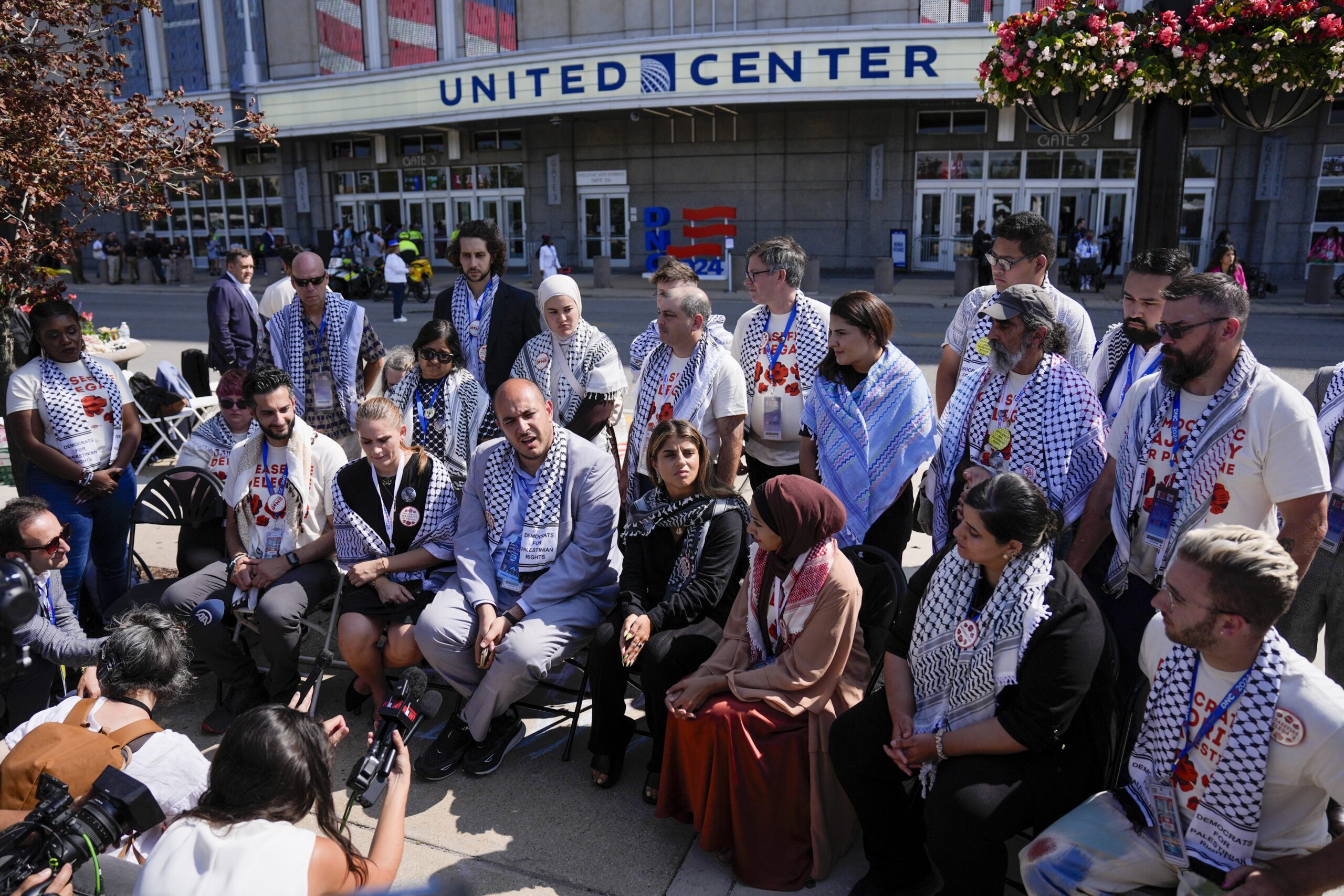
Former Democratic Rep. Kathy Manning: ‘There is no doubt that we are living through very difficult times for American Jews’
BIG TENT SHABBAT
The dinner was hosted by Rabbi Yehuda Kaploun, the U.S. antisemitism special envoy
The Delaware senator holds a unique place in the Democratic Party, rising to leadership roles while continuing to champion Biden-era foreign policy
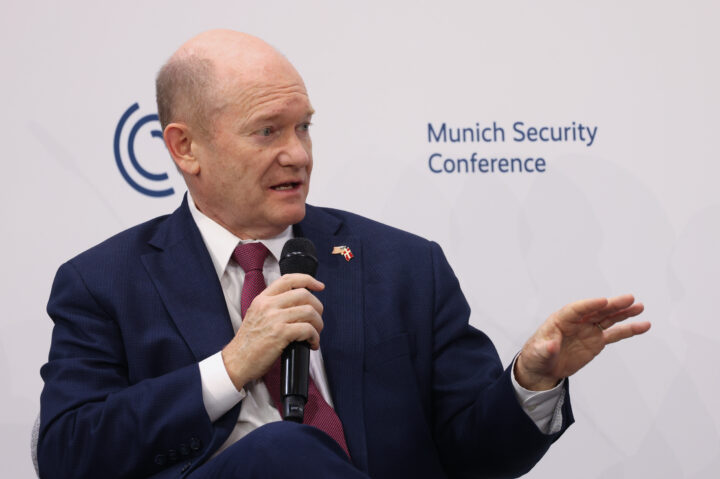
Alex Kraus/Bloomberg via Getty Images
Senator Chris Coons, a Democrat from Delaware, at the Munich Security Conference in Munich, Germany, on Saturday, Feb. 14, 2026.
Sen. Chris Coons (D-DE), one of the leading foreign policy voices in the Democratic Party’s moderate wing, expressed concern over the weekend that any White House decision to move ahead with military action against Iran would deeply alienate leading European allies of the United States.
“There are pretty stark early warning signs of some challenges where core allies do not share our priorities,” Coons told Jewish Insider following a weeklong trip to Europe, which included stops at the Munich Security Conference, along with meetings in Ukraine and Moldova with top European diplomats.
“It leaves me genuinely concerned that if Trump goes ahead with a strike against Iran, it is not going to enjoy support from any of our core allies,” he continued. “That will make it harder, and it may deepen this growing challenge for us.”
Asked how he would like to see the Trump administration address the Iranian regime’s violent crackdown on protesters and its nuclear program, Coons urged the president to work with close allies to “ramp up pressure” on Tehran and explain his approach to the public. The Delaware senator also encouraged Trump to include Congress in his deliberations.
“A) Consult Congress. B) Make a case to the American people about why this is in our national security interest,” Coons said. “C) Clarify what on earth he’s planning with this Board of Peace, which just launched with a massive pledge from the United States that none of us had heard of before he announced it,” he said, ostensibly referring to the $10 billion financial commitment Trump made to Gaza’s reconstruction. “And D) If he’s going to work with close allies to ramp up pressure to try and achieve something at the negotiating table, he should work with close allies.”
“He shouldn’t just fire off a bunch of missiles and assume that that’s going to be enough to achieve the result he wants,” he added.
Coons also highlighted growing transatlantic tensions over potential U.S. military action against Iran during discussions with European officials, who expressed worries about a brewing U.S.-U.K. dispute tied to the Chagos Islands.
The remote British Indian Ocean Territory is at the center of a 2025 agreement in which the U.K. agreed to transfer sovereignty of the island chain to Mauritius while securing a 99- or 100-year lease for the strategic Diego Garcia military base, a joint U.S.-U.K. facility long used by American forces.
The Trump administration initially signaled support for the deal, with the State Department affirming it last Tuesday. But one day later, President Donald Trump publicly urged Prime Minister Keir Starmer to scrap the arrangement and retain full control of the “strategically located” base, warning it could be needed if diplomacy with Iran fails.
The Times of London reported Thursday that the British government had informed Washington that week it would not permit U.S. strikes on Iran from Diego Garcia or the Royal Air Force’s Fairford station, which houses U.S. Air Force troops, in England.
Coons called the U.K.’s stance “striking.”
Coons plays a unique role in today’s Democratic Party. He sits in the Senate seat held by former President Joe Biden for 36 years, and the two Delaware Democrats have a relationship that dates back four decades.
In addition to being the ranking member on Defense Appropriations, the panel responsible for Pentagon funding, Coons is next in line to succeed retiring Sen. Jeanne Shaheen (D-NH) as the top Democrat on the Senate Foreign Relations Committee, a role Biden held in the early 2000s. The Delaware senator remains Biden’s most ardent defender in politics following his exit from public life, and continues to advocate in his role as a senior Democrat in Congress for the traditional foreign policy views the two men have long shared.
He does so against the backdrop of the ongoing debate among Democrats about the future direction of the party, on foreign policy and otherwise, in the post-Biden era.
Alongside Coons in Munich were a handful of prominent Democrats believed to be considering presidential runs in 2028, including Rep. Alexandria Ocasio-Cortez (D-NY), Sens. Chris Murphy (D-CT), Ruben Gallego (D-AZ), Mark Kelly (D-AZ) and Elissa Slotkin (D-MI). Govs. Gretchen Whitmer of Michigan and Gavin Newsom of California and former Commerce Secretary Gina Raimondo.
Among the possible presidential hopefuls, Ocasio-Cortez and Whitmer were criticized for being unprepared for the conference after struggling to answer questions on U.S. policy toward China and Ukraine. Meanwhile, Murphy and Ocasio-Cortez separately accused Israel of committing genocide in Gaza — appealing to a left-wing base that has made criticism of the Jewish state central to its foreign policy.
Ocasio-Cortez later griped to The New York Times that her gaffes and perceived presidential ambitions overshadowed the message she was attempting to deliver on a major foreign policy stage.
Asked about the large presence of potential Democratic presidential candidates in Munich, Coons joked that he was “announcing my 2028 candidacy” before crediting his fellow Democrats for engaging closely on foreign policy issues.
“The reality is that over the last several cycles, I’ve been very encouraged to see governors, senators, former cabinet officials who are likely future presidential candidates invest the time in coming to Munich, coming to Davos, going to Halifax, going to Australia, because the threat environment for all of our countries has become more serious and more real,” Coons said.
Coons also expressed concern about the hefty $850 billion budget for the Pentagon in the upcoming fiscal year, noting the significantly increased funding is “a breathtaking amount of money, and there is a lot of skepticism on the part of Americans that it’s being well spent.”
“The average American needs to see good jobs and innovation coming out of this massive defense investment. If we focus only on buying American and only on American jobs, we will lose tactically, we will lose strategically, we will lose politically. To the extent we align together, there is a strong future for all of our countries as democracies to meet this moment and to deliver the innovation that this threat environment absolutely demands,” Coons said.
‘They should just rename it the Ayatollah Protection Act because that’s what it does,’ Rep. Jared Moskowitz said

U.S. House of Representatives
Reps. Josh Gottheimer (D-NJ) and Jared Moskowitz (D-FL)
Rep. Jared Moskowitz (D-FL) told Jewish Insider on Friday afternoon that he’ll vote against a resolution blocking military action against Iran, expected to come to a vote on the House floor next week.
Moskowitz joins Rep. Josh Gottheimer (D-NJ), who issued a joint statement with Rep. Mike Lawler (R-NY) earlier in the day, as the only Democrats who are thus far publicly opposing the war powers resolution, which Reps. Ro Khanna (D-CA) and Thomas Massie (R-KY) plan to introduce.
Gottheimer and Moskowitz are among the strongest Democratic Iran hawks in the House, but others could join the two.
“I am a no [vote]. I am not willing to preemptively tell the supreme leader that he has nothing to worry about, no reason to negotiate because you are totally safe, and that the people of Iran can’t depend on us. They should just rename it the Ayatollah Protection Act because that’s what it does,” Moskowitz told JI.
In their joint statement, Gottheimer and Lawler emphasized that Iran poses a threat to the United States and to global stability through its pursuit of a nuclear weapon, efforts to “aggressively” reconstitute its ballistic missile arsenal and sponsorship of global terrorism, and said the regime is “waging war on its own people.”
“This record represents only a fraction of Iran’s long pattern of aggression, and it makes clear why we must preserve the ability to defend our troops and our homeland,” Gottheimer and Lawler said. “We stand with the Iranian people who are demanding basic rights and dignity, and we are committed to protecting them from the regime’s savagery.”
“That is why we oppose the Massie-Khanna War Powers Resolution to prohibit the use of force against Iran,” They continued. “We respect and defend Congress’s constitutional role in matters of war. Oversight and debate are absolutely vital. However, this resolution would restrict the flexibility needed to respond to real and evolving threats and risks signaling weakness at a dangerous moment.”
The lawmakers called for the administration to brief Congress on any planned military action in compliance with the law, but said that “Congress must not limit our ability to protect Americans and our allies.”
Most House Democrats have been vigorously urging the Trump administration against military action against Iran, and are expected to support the resolution. It’s unclear whether any other House Republicans will support the resolution.
Rep. Don Bacon (R-NE), who broke with most Republicans to support a similar resolution blocking further military action in Venezuela, signaled last week he is likely to oppose the Iran war powers resolution and expressed outright support for military action.
“I’ll study the bill before committing on how I’ll vote. But I do think the President must take military action. He promised the Iranians that we would support them if they stood up against the regime,” Bacon said in a statement. “The Iranians did and now an estimated 50,000 people have been executed. There cannot be empty promises.”
Several other House Democrats who have records of breaking with their party on Middle East issues or who supported last summer’s U.S. strikes on Iran’s nuclear facilities did not preview how they plan to vote when asked by JI on Friday.
Rep. Laura Gillen (D-NY), a hawkish moderate Democrat from Long Island, didn’t offer a definitive stance on the vote.
“The Iranian regime is the world’s leading state sponsor of terrorism, brutally oppresses its own people, and can never be allowed to acquire nuclear weapons to threaten the U.S. and our ally Israel,” Gillen told JI. “Only Congress has the responsibility to decide whether to declare war, and given the risks to American troops in the region, the Administration should immediately brief Congress on its strategy on Iran.”
Reps. Greg Meeks (D-NY), Adam Smith (D-WA) and Jim Himes (D-CT), the top Democrats on the House Foreign Affairs, Armed Services and Intelligence Committees issued a joint statement Friday “strongly oppos[ing] preemptive military action against Iran, which endangers U.S. personnel and risks drawing Israel and Gulf partners into a wider conflict.”
They called for continued diplomacy and said that the U.S. should not walk away from the talks for “a short-term, unauthorized show of military force that leaves Americans less secure,” adding that any decision to take military action must be approved by Congress.
Plus, Trump's kind words for Qatari PM
Alex Wong/Getty Images
A visitor holds an AIPAC folder in an elevator in Rayburn House Office Building on March 12, 2024 on Capitol Hill in Washington, DC.
Good Thursday afternoon!
This P.M. edition is reserved for our premium subscribers — offering a forward-focused read on what we’re tracking now and what’s coming next.
It’s me again — Danielle Cohen-Kanik, U.S. editor at Jewish Insider and curator, along with assists from my colleagues, of the Daily Overtime. Please don’t hesitate to share your thoughts and feedback by replying to this email.
📡On Our Radar
Notable developments and interesting tidbits we’re tracking
President Donald Trump used the occasion of the first meeting of the Board of Peace in Washington today to announce significant monetary and troop commitments from the U.S. and other countries to stabilize Gaza, as well as lay out a timeline for military action against Iran, Jewish Insider’s Matthew Shea reports.
The pledges included $10 billion from the U.S. and $7 billion from several Middle Eastern countries for Gaza’s reconstruction, as well as commitments to provide troops and police to the U.S.-led International Stabilization Force. (The Guardian reports the White House is currently exploring plans to build a 5,000-person military base to house the ISF in southern Gaza.)
On Iran negotiations, Trump said in his remarks, “Now we may have to take it a step further or we may not. Maybe we are going to make a deal [with Iran]. You are going to be finding out over the next probably 10 days.”
He later told reporters on Air Force One, “Ten, 15 days, pretty much maximum.” Remember: Last June, Trump said he would decide whether to take action against Iran within two weeks, and carried out strikes on Iranian nuclear facilities two days later…
U.K. Prime Minister Keir Starmer has reportedly not given approval to Washington to use the joint U.S.-U.K. base on Diego Garcia island for a strike on Iran, as Trump said yesterday he is considering. London is concerned that a U.S. strike from the shared base, which the U.K. must grant permission to use, could implicate it in violating international law…
Trump also offered praise for Qatar’s prime minister, Sheikh Mohammed bin Abdulrahman Al Thani, during his Board of Peace remarks, despite widespread criticism of Doha’s backing of Hamas and platforming of anti-Israel actors.
“His excellency, Prime Minister Al Thani of Qatar, just a great and highly respected man,” Trump said. “I always say he needs a public relations agency because you do so much good, and they have you down as evil, and you’re not evil. You help us so much and you’re such a good ally”…
Meanwhile, Hamas is entrenching itself further in Gaza, repositioning its loyalists in government and paying salaries across the enclave, according to Reuters. Hamas has said it is willing to hand power over to the Palestinian technocratic committee established by the U.S. and led by former Palestinian Authority official Ali Shaath, but as one Palestinian source told the outlet, “Shaath may have the key to the car, and he may even be allowed to drive, but it is a Hamas car”…
Former Rep. Tom Malinowski (D-NJ), who recently lost the Democratic primary for New Jersey’s 11th Congressional District, called AIPAC’s attacks against him in the race “bizarre in several ways,” writing in an op-ed today that he has “no problem identifying as a Zionist” and calling on Democratic leaders to collectively “refuse [AIPAC’s] support, instead of letting it pick off candidates one by one”…
Rep. Jan Schakowsky (D-IL) withdrew her endorsement of Cook County Commissioner Donna Miller, the front-runner in Illinois’ 2nd District Democratic primary, over Miller’s backing by groups that are reported to be affiliated with AIPAC, though the pro-Israel group hasn’t endorsed her and neither AIPAC nor its super PAC are publicly spending any money in the district.
“Illinois deserves leaders who put voters first, not AIPAC or out-of-state Trump donors,” Schakowsky told the Chicago Sun-Times. “I cannot support any candidate running for Congress who is funded by these outside interests”…
Ahead of a hearing next week on New York City Council Speaker Julie Menin’s proposed 100-foot ban on protests around houses of worship, Mayor Zohran Mamdani said today that he had the NYPD review the legality of the measure, “and I can tell you, my police commissioner has expressed concerns about that proposal”…
Three officials appointed by Mamdani to administration posts are co-founders of a group that blamed Israel for the Oct. 7 Hamas attacks two days after they took place, the Washington Free Beacon reports.
The group, the Muslim Democratic Club of New York (MDCNY), was founded by Faiza Ali, now commissioner of the Mayor’s Office of Immigrant Affairs; Aliya Latif, now executive director of the mayor’s Office of Faith-Based Partnerships; Ali Najmi, tapped as chair of the mayor’s Advisory Committee on the Judiciary; and anti-Israel activist Linda Sarsour.
On Oct. 9, 2023, the MDCNY posted on X, “Many NYers are feeling pain, fear, and anger after the horrific events in the Holy Land this weekend. Especially as the Israeli apartheid regime have forced millions of Palestinians in Gaza to live under occupation for decades and an open air prison since 2007.” The group went on to condemn “elected officials offering support for Israeli occupation’s rampant violence as it openly declares & enacts its intent to engage in mass violence and genocide against Palestinians,” well before Israel’s ground invasion of Gaza had begun…
The Forward profiles Los Angeles City Councilmember Nithya Raman as she runs for mayor with a unique ideology: Raman is a member of the Democratic Socialists of America, but has also been vocally supportive of Israel. She called DSA’s statement blaming Israel for the Oct. 7 attacks “unacceptably devoid of sympathy” and rejects the BDS movement, but was also condemned by the local Jewish community for introducing a ceasefire resolution in June 2023…
⏩ Tomorrow’s Agenda, Today
An early look at tomorrow’s storylines and schedule to keep you a step ahead
Keep an eye out in Jewish Insider for a preview of the AIPAC Congressional Summit, which is kicking off Sunday amid the group’s increasing involvement in midterm election races.
President Donald Trump is expected to meet with governors at the White House tomorrow, though the meeting will no longer be held under the auspices of the National Governors Association, as is done annually, after the White House declined to invite Democratic Govs. Jared Polis of Colorado and Wes Moore of Maryland to a black-tie dinner on Saturday.
We’ll be back in your inbox with the Daily Overtime on Monday. Shabbat Shalom!
Stories You May Have Missed
FULOP’S FIGHT
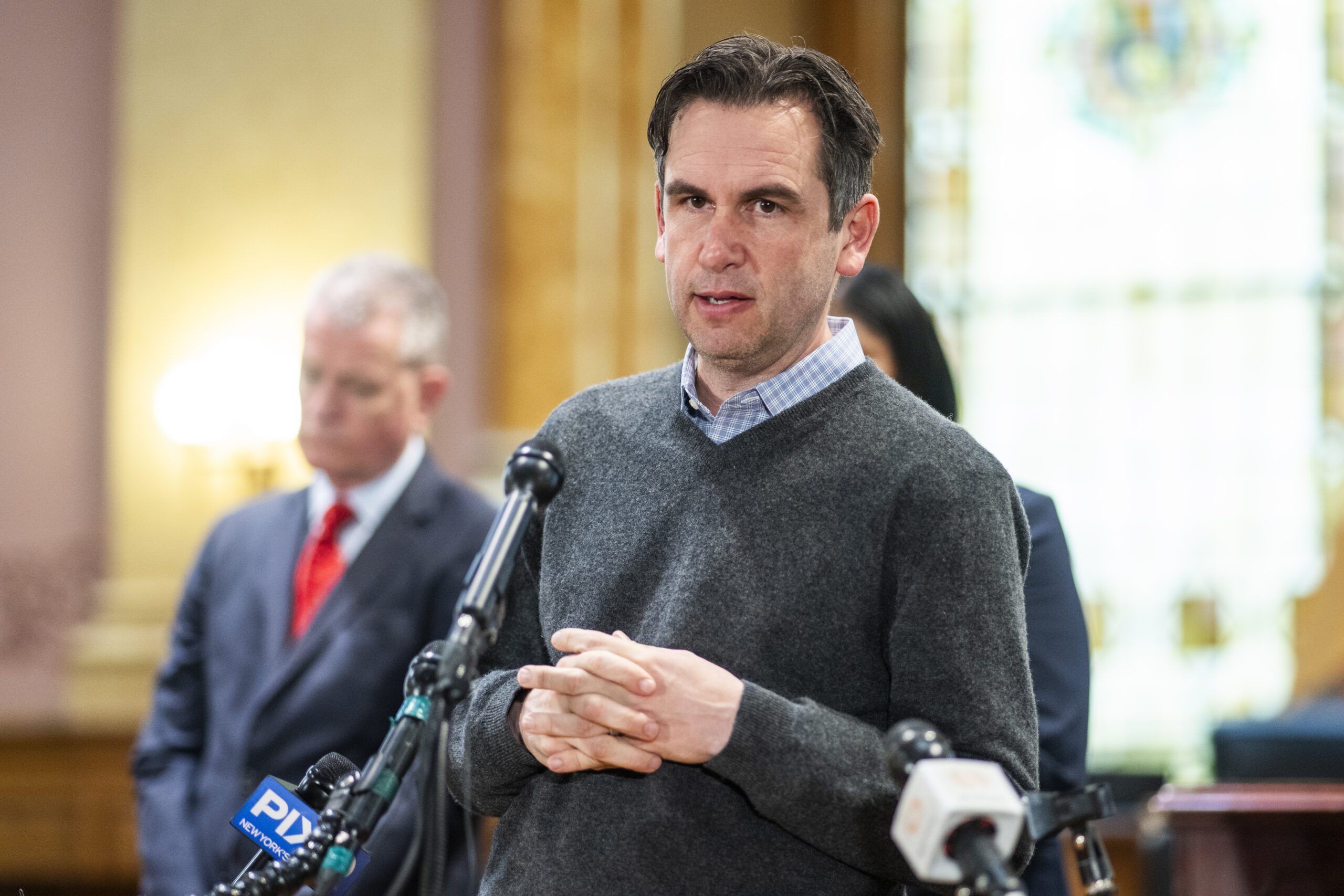
As the new head of NYC’s leading business advocacy group, Fulop said he’s preparing for ‘this experiment of what it means to be an executive in a DSA world’
TEXAS TROUBLE

An unfolding scandal involving Rep. Tony Gonzales could cost him his seat at the hands of a far-right social media influencer
At the inaugural meeting of the Board of Peace, the president also announced monetary and troop commitments from several foreign nations
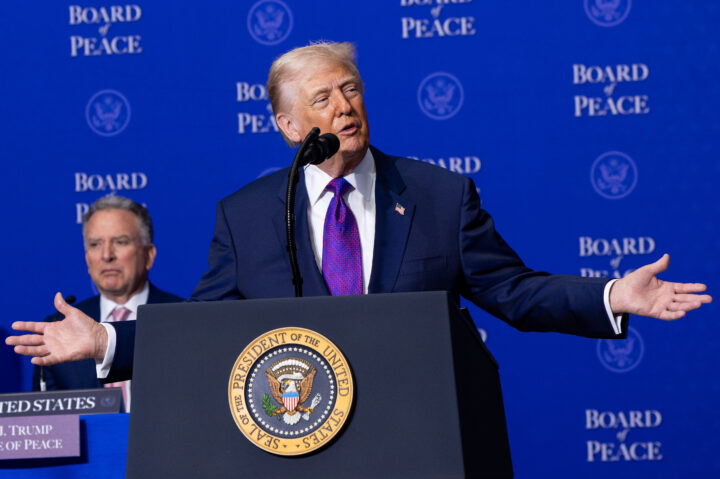
Murat Gok/Anadolu via Getty Images
President Donald Trump makes a speech during the inaugural meeting of the 'Board of Peace' at the US Institute of Peace in Washington, DC, United States on February 19, 2026.
President Donald Trump used the occasion of the first meeting of the Board of Peace in Washington on Thursday to announce significant monetary and troop commitments from the U.S. and other countries to stabilize Gaza, as well as lay out a timeline for military action against Iran.
“I want to let you know that the United States is going to make a contribution of $10 billion to the Board of Peace,” Trump said at the United States Institute of Peace, where several foreign leaders gathered for the meeting.
The president also named, for the first time, which countries have agreed to make additional financial contributions to the reconstruction of Gaza: Kazakhstan, Azerbaijan, the United Arab Emirates, Morocco, Bahrain, Qatar, Saudi Arabia, Uzbekistan and Kuwait “have all contributed more than $7 billion toward the relief package,” Trump said.
The meeting comes as the administration works to address several issues in the Middle East, including rising tensions with Iran. The U.S. has amassed a large collection of military assets in the region in preparation for a potential strike, as the two sides attempt to negotiate a nuclear deal.
Trump said in his remarks, “Now we may have to take it a step further or we may not. Maybe we are going to make a deal [with Iran]. You are going to be finding out over the next probably 10 days.”
Speaking to reporters on Air Force One later in the day, Trump said, “I would think that would be enough time — 10, 15 days, pretty much maximum.” Last June, Trump said he would decide whether to take action against Iran within two weeks, and carried out strikes on Iranian nuclear facilities two days later.
During the meeting, Trump also called on Iran to “join” the board “on a path that will complete what we’re doing.”
“If they [Iran] join us, that will be great. If they don’t join us, that will be great too, but it will be a very different path,” the president said. “They cannot continue to threaten the stability of the entire region, and they must make a deal. Or if that doesn’t happen, I maybe can understand if it doesn’t happen, but bad things will happen.”
Trump also announced that several countries would contribute personnel to an International Stabilization Force tasked broadly with securing Gaza and upholding the ceasefire between Hamas and Israel. Morocco, Albania, Kosovo and Kazakhstan “have all committed troops and police to stabilize Gaza,” he said. Indonesia vowed prior to the meeting to also contribute personnel to the body’s mission.
The president added that “Egypt and Jordan are likewise providing very, very substantial help, troops, training and support for a very trustworthy Palestinian police force. We think we’re getting some very good people on that police force.”
However, despite the announcements, questions remain over how effective the pledges will be. Hamas continues to maintain a presence in Gaza and has thus far refused to disarm or relinquish governing authority — a dynamic that could complicate reconstruction and stability efforts. Trump has not clearly defined the operational scope of the International Stabilization Force, including whether its members would be expected to confront Hamas directly or focus on traditional peacekeeping functions.
Despite those uncertainties, Trump still expressed confidence that Hamas would comply with disarmament commitments.
“[Hamas] made a promise, and they promised me they would get rid of their weapons. Looks like they’re going to be doing that,” Trump said, adding that if they do not, “they’ll be very harshly met.” Since announcing the Board of Peace, Trump has made similar threats to Hamas numerous times.
He also said there are “two countries that want to go in and do a number on Hamas,” without specifying which countries, but added, “I really don’t think that’s going to be necessary, because [Hamas] they made a promise.” The ISF is not expected to play a role in countering Hamas.
During his address, the president also took a moment to acknowledge the foreign leaders of member countries that had shown up to back the announcement, including offering praise for Sheikh Mohammed bin Abdulrahman Al Thani, Qatar’s prime minister. Despite widespread criticism of Doha’s ties to Hamas officials and support for the terrorist organization, Trump strongly defended the leader against accusations that he and his country are “evil.”
“His excellency, Prime Minister Al Thani of Qatar, just a great and highly respected man,” said Trump. “I always say he needs a public relations agency because you do so much good, and they have you down as evil, and you’re not evil. You help us so much and you’re such a good ally.”
Meanwhile, Trump signaled that he hopes to broaden the Board of Peace’s membership, though several leaders of major U.S. allies — including the United Kingdom, Germany and France — have indicated they do not plan to take part.
Trump also withdrew an invitation previously extended to Canadian Prime Minister Mark Carney after the leader delivered remarks critical of the initiative at last month’s World Economic Forum in Davos.
“So many of our friends in Europe are attending today, and we’re eager to have them become full members,” said Trump. “And we’ve had a great response from Europe. I’m excited to announce that Norway has agreed to host an event bringing together the board of peace.”
Trump also addressed the board’s relationship with the United Nations, amid questions about whether the new body is intended to complement or rival existing international institutions. He positioned the board as senior to the U.N., and that the two bodies would work “very closely.”
“We’re going to bring them back. I think the United Nations has great potential, really great potential. It has not lived up to potential,” said Trump. “The United Nations will be much stronger, and the Board of Peace is going to almost be looking over the United Nations and making sure it runs properly. But we’re going to strengthen the United Nations. We’re going to make sure its facilities are good. They need help, and they need help money wise. We’re going to help them money wise, and we’re going to make sure the United Nations is viable.”
Experts tell JI that despite the constant flow of reports that Trump favors a military response as talks with Iran falter, an American strike and Iranian retaliation against Israel are likely not imminent

Tomer Neuberg/AP
Israeli Iron Dome air defense system launches to intercept missiles fired from Iran, in central Israel, Sunday, April 14, 2024.
Tensions in Israel continued to rise over possible missile strikes from Iran, as signals increased that President Donald Trump is ready to order a strike on the Islamic Republic, possibly within days.
Yet experts told Jewish Insider on Thursday that, despite the constant flow of reports that Trump favors a military response as negotiations with Iran falter, an American strike and Iranian retaliation against Israel are likely not imminent.
Nearly every major Israeli news website and broadcast led with Iran news on Wednesday evening and Thursday morning, referencing reports in CBS News that the U.S. military could be prepared to strike in the coming days and and the Wall Street Journal headline that the U.S. has amassed the greatest air power in the Middle East since the Iraq war in 2003.
In a moment that went viral in Israel and sparked hundreds of phone calls to the IDF Home Front Command, former IDF intelligence chief Amos Yadlin told Israel’s Channel 12 on Wednesday that while he went to the Munich Security Conference last week, “I would think twice about flying [abroad] on the coming weekend.”
Every Israeli “asks himself several times a day when there will be a campaign against Iran,” Knesset Foreign Affairs and Defense Committee chairman Boaz Bismuth (Likud) said on Wednesday. “The entire population and homefront are preparing.”
However, IDF Spokesperson Effie Defrin said that “there is no change in the situational assessment, and if there will be, we will update [the public]. There is no need to panic.”
Defrin also noted that “there are negotiations, and the IDF has long been prepared for maximum defense. If we are attacked, we will respond forcefully.”
However, while Israel’s leadership and the IDF’s assessment is that the U.S. will warn them before a strike, they plan to prepare quietly and not alert the public in advance, in order to increase the chances of success, Israel’s Kann News reported on Wednesday.
Raz Zimmt, director of the Iran Program at Tel Aviv University’s Institute for National Security Studies, quipped to JI in reference to Yadlin’s remarks: “Don’t change your weekend plans.”
Zimmt noted that the USS Gerald Ford aircraft carrier is still on the way to the region, and argued that “the Americans will want to be maximally prepared when they make their decision” whether to strike Iran.
“I think it’s a matter of days, not weeks, but it could also be 14 days,” he said.
Oded Ailam, former head of the Mossad Counterterrorism Division and a researcher at the Jerusalem Center for Security and Foreign Affairs, said that he “doesn’t see a scenario of an immediate strike in the coming days or the coming week, despite the fearmongering in the media.”
Ailam argued that Trump will try to exhaust the current negotiations to be certain if Iran will accept a deal.
“He won’t attack until it is totally clear that this is a dead end, but he will gather forces” in the region, Ailam said. “It won’t happen for the next week or two, and after that, it depends mostly on the Iranians and the extent of their concessions.”
In Zimmt’s assessment, an Iranian surprise attack, rather than a retaliation following an American strike, is unlikely.
“Iran understands the chance of an American attack is higher than the chance of an agreement, but why should they drag themselves into a war that they have a chance of avoiding?” he said.
In addition, he said, the Iranian leadership “knows very well that Israel is ready and won’t be surprised, so it’s not worth it.”
Still, Zimmt said, Iran’s likely first reaction to an American strike will likely be to attack U.S. bases in the Gulf and Israeli targets: “For them, the U.S. and Israel are the same thing.”
Ailam said that Israel has greatly improved its air defenses since the 12-day war with Iran last June. At the time, Israel intercepted 85% of the missiles coming from Iran, and Ailam said the interception rate would likely be higher next time. Israel’s Iron Beam laser-defense system has also become operative in the interim, adding a new element of defense against drones.
In addition, he noted that the amassing of American naval vessels in the region means that the U.S. will likely contribute more to Israel’s defense than during the last war.
At the same time, Ailam said, “the Iranians have not managed to rebuild their ballistic missile systems. They only have 240 launchers, which is not much. When you strike launchers, you neutralize their ability to shoot many missiles simultaneously and disrupt Israel’s defense systems.”
As such, Ailam’s assessment was that “Iran is on the defensive and Israel has a clear advantage.”
“If two ballistic missiles penetrate Israel’s defensive envelope, it can cause great damage — as it did at Soroka [Medical Center in Beersheba] and Weizmann [Institute of Science] last year — but it is not a threat that Israel can’t handle. I don’t see it as an existential or very significant threat,” he said.
‘Congress must do its job and stop this march to war,’ Khanna said
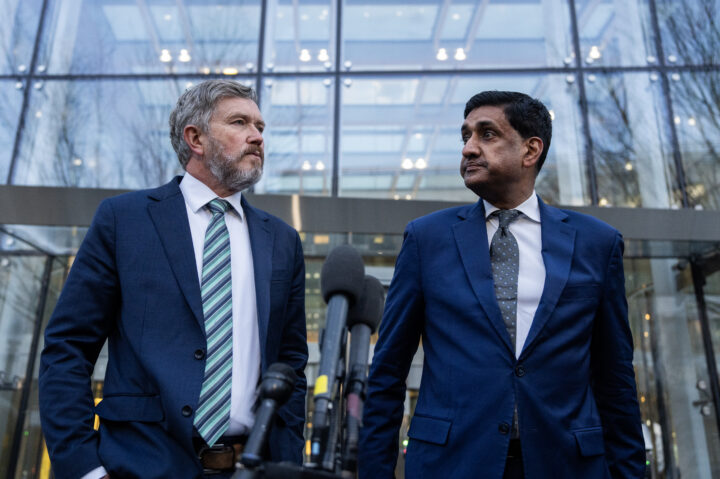
Tom Williams/CQ-Roll Call, Inc via Getty Images
Reps. Thomas Massie, (R-KY), left, and Ro Khanna, (D-CA), conduct a news conference outside a Department of Justice office in NoMa on Monday, February 9, 2026.
Reps. Ro Khanna (D-CA) and Thomas Massie (R-KY) plan to introduce and attempt to force a vote on a war powers resolution blocking military action against Iran without congressional authorization, as the Trump administration appears to be moving closer to military action against the Islamic Republic.
“[Massie] & I have a War Powers Resolution to debate & vote on war before putting U.S. troops in harm’s way. I will make a motion to discharge to force a vote on it next week,” Khanna wrote on X on Wednesday.
He framed the legislation as an attempt to block a “disastrous war” with Iran that “would be catastrophic.”
“Like the votes before the Iraq war, this could be one of the most consequential votes in the history of Congress,” Khanna said. “Are we going to stop another endless dumb foreign war? Or will the neoconservatives mislead us once again?”
He said that lawmakers must go on the record about where they stand on a potential conflict.
“A war with Iran would be catastrophic. Iran is a complex society of 90 million people with significant air defenses and military capabilities. We also have 30-40k U.S. troops in the region who could be at risk of retaliation. Congress must do its job and stop this march to war,” Khanna said.
Once introduced, there will be a waiting period of 15 House session days before the lawmakers can force a vote on the resolution.
Similar legislation is pending in the Senate, introduced by Sens. Tim Kaine (D-VA) and Rand Paul (R-KY), but the two have not yet called it up for a vote. Kaine said last week he was waiting to see the trajectory of the negotiations between the U.S. and Iran.
Several similar resolutions were introduced by House lawmakers after the Operation Midnight Hammer strikes last June, but never came to votes.
Plus, Sen. Graham reports MBZ is alive and well

Mass Communication Specialist 3rd Class Amber Smalley/U.S. Navy via Getty Images
Flight deck of the Nimitz-class aircraft carrier USS Abraham Lincoln (CVN 72) May 10, 2019 in the Red Sea.
Good Wednesday afternoon!
This P.M. edition is reserved for our premium subscribers — offering a forward-focused read on what we’re tracking now and what’s coming next.
It’s me again — Danielle Cohen-Kanik, U.S. editor at Jewish Insider and curator, along with assists from my colleagues, of the Daily Overtime. Please don’t hesitate to share your thoughts and feedback by replying to this email.
📡On Our Radar
Notable developments and interesting tidbits we’re tracking
President Donald Trump warned U.K. Prime Minister Keir Starmer not to relinquish control over Diego Garcia — an island in the Indian Ocean that hosts a joint U.S.-U.K. base, as the U.K. plans to transfer sovereignty of the larger island chain to Mauritius, while maintaining a 99-year lease on the base — because it may act as the launching pad for a U.S. strike on Iran.
“Should Iran decide not to make a Deal, it may be necessary for the United States to use Diego Garcia, and the Airfield located in Fairford, in order to eradicate a potential attack by a highly unstable and dangerous Regime — An attack that would potentially be made on the United Kingdom, as well as other friendly countries,” Trump wrote on Truth Social…
Iran is also signaling its readiness for military conflict, The Wall Street Journal reports, including deploying Islamic Revolutionary Guard Corps naval units to the Strait of Hormuz, launching cruise missiles along the coast, conducting a military exercise with a Russian warship near the USS Abraham Lincoln, testing air defense systems, hardening nuclear sites and cracking down once more on dissidents…
Israel, meanwhile, is preparing for its civilian infrastructure to be “a central arena” in a potential U.S.-Iran conflict, Jewish Insider’s Lahav Harkov reports, as Home Front Command chief Maj.-Gen. Shay Klapper told the Knesset Foreign Affairs and Defense Committee today. Committee Chairman Boaz Bismuth said, “There is not one [Israeli] who doesn’t ask himself several times a day when there will be a campaign against Iran. The entire population and home front are preparing”…
Sen. Lindsey Graham (R-SC) dispelled rumors, seemingly spread by Saudi media, that UAE President Sheikh Mohamed bin Zayed was ill or even dying after meeting with him in Abu Dhabi today: “Not only is he alive, but he is also well and as sharp as I’ve ever seen him. To those powers that feel the need to attack MbZ and the UAE for doing the right thing — you do so at your own peril,” Graham said on X.
He also called MBZ’s decision to join the Abraham Accords and “to try to integrate the region with the whole world … one of the most consequential decisions any Middle Eastern leader has made.” Graham is now headed to Saudi Arabia where he will meet with Crown Prince Mohammed bin Salman, whom he recently told publicly to “knock it off” regarding the kingdom’s destabilizing activities in the region…
Democratic Texas state Rep. James Talarico raised $2.5 million in donations for his Senate campaign in the 24 hours after his interview on Stephen Colbert’s late-night show was reportedly quashed by CBS, Politico reports, as early voting in Texas kicked off yesterday ahead of the March 3 primary.
CBS denied it had banned the interview, saying Colbert’s show “was provided legal guidance that the broadcast could trigger the FCC equal-time rule for two other candidates, including Rep. Jasmine Crockett, and presented options for how the equal time for other candidates could be fulfilled,” which Colbert derided as a statement “written by — and I’m guessing for — lawyers”…
On the GOP side of the Texas Senate ballot, Attorney General Ken Paxton looks like the front-runner in his hotly contested primary against incumbent Sen. John Cornyn (R-TX) and Rep. Wesley Hunt (R-TX), despite the GOP establishment spending more than $60 million in attack ads against Paxton, Punchbowl News reports. (And the infighting goes further: Hunt said yesterday he filed criminal charges against a senior member of Cornyn’s campaign team for allegedly doxxing a member of his family.)
Trump told reporters last night that he still hadn’t decided which of the GOP candidates, if any, to endorse, saying, “I like all three of them actually. Those are the toughest races. They’ve all supported me. They’re all good. You’re supposed to pick one, so we’ll see what happens. But I support all three”…
Democratic Virginia state Del. Dan Helmer, a key architect of the state’s current redistricting effort, plans to enter the race for the 7th Congressional District that will be created if state voters approve a constitutional amendment to allow redistricting to proceed.
Helmer, who is Jewish and the son of an Israeli immigrant, ran for the state’s 10th District in 2024 on a staunchly pro-Israel platform, telling JI at the time that calls for conditions on U.S. aid to Israel are “incredibly frustrating.” He became the target of late-stage ad campaigns, which their backers insisted to JI were unrelated to his support for Israel, and ultimately came in second in the Democratic primary…
Humain, Saudi Arabia’s state-sponsored AI company, invested $3 billion in Elon Musk’s xAI, the company announced today. The investment came just before Musk combined xAI with his SpaceX aerospace company, giving the Saudi firm a significant stake in the major U.S. government contractor…
⏩ Tomorrow’s Agenda, Today
An early look at tomorrow’s storylines and schedule to keep you a step ahead
Keep an eye out in Jewish Insider for a look at how the emerging scandal involving Rep. Tony Gonzales (R-TX) — whom the San Antonio Express News confirmed yesterday was engaged in an extramarital affair with a staffer who committed suicide — could catapult an anti-Israel Republican, who has posted videos featuring Nazi imagery, to Congress.
Our focus tomorrow will be the first meeting of the Board of Peace, which will bring several heads of state and senior ministers, including Israeli Foreign Minister Gideon Sa’ar, to Washington. Read JI’s preview of the meeting.
Jewish Federations of North America CEO Eric Fingerhut will deliver what JFNA is calling the first “State of the Jewish Union Address,” ahead of the president’s State of the Union next week, from the organization’s Washington headquarters.
The U.S. Commission on Civil Rights will hold a daylong hearing on antisemitism on college campuses, featuring legal experts, former administration officials, students and Jewish communal leaders, which include Amy Spitalnick, CEO of the Jewish Council for Public Affairs; Kenneth Marcus, founder and CEO of the Louis D. Brandeis Center; Erin Beiner, J Street U director; and Kevin Rachlin, Washington director of The Nexus Project.
Stories You May Have Missed
MONIKER MEANING

Follow the language to its most extreme end, and what emerges is undiluted antisemitism
ROCK AND A HARD PLACE
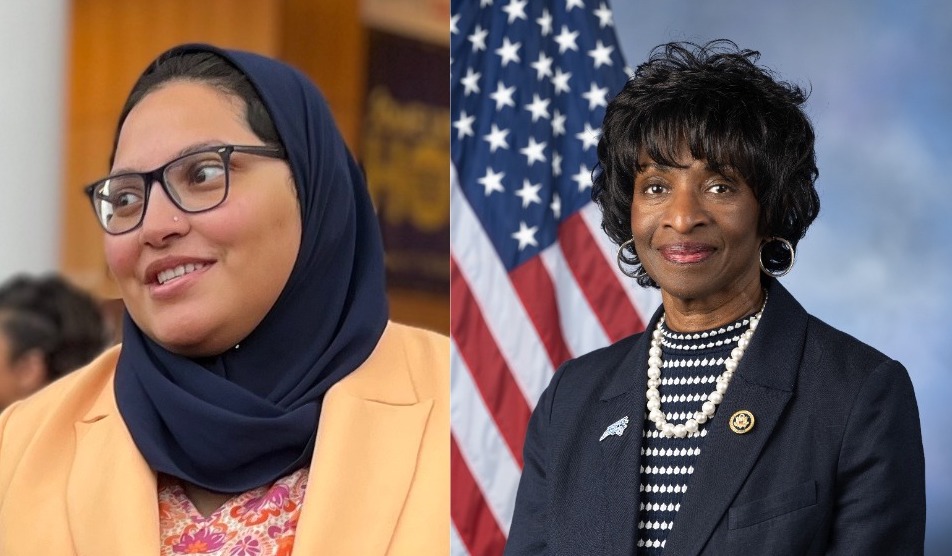
Rep. Valerie Foushee was backed by AIPAC, but has since turned against supporting Israel. Her Democratic opponent is a virulently anti-Israel activist
The U.S. is moving additional military assets to the region while Israeli Home Front Command is preparing civilian infrastructure

IDF
The site of an Iranian ballistic missile strike in Beersheba, Israel, June 20th, 2025.
Amid signals and reports that the U.S. is preparing for military action against Iran in the coming days, the IDF has been preparing Israeli civilian infrastructure to be a central target of the Islamic Republic’s retaliation.
Home Front Command chief Maj.-Gen. Shay Klapper told the Knesset Foreign Affairs and Defense Committee on Wednesday that “the Home Front Command will be a central arena in relevant operational scenarios and is a significant component of Israeli society’s resilience and ability to save lives.”
Klapper said that the Home Front Command has been working to improve preparedness since Operation Rising Lion, the 12-day war between Israel and Iran last June, adding that “the IDF is prepared for every scenario.”
Committee Chairman Boaz Bismuth (Likud) said that in Israel, “the homefront is the front, and the front is the homefront. Wars are won on the homefront, too.”
“These are challenging days,” Bismuth added. “There is not one [Israeli] who doesn’t ask himself several times a day when there will be a campaign against Iran. The entire population and homefront are preparing.”
The Knesset committee meeting was scheduled in advance of Tuesday’s meeting in Geneva between Iranian and American negotiators. Iranian Foreign Minister Abbas Araghchi told state TV after the meeting that the sides agreed to exchange draft agreements at the next round of talks. American officials told Axios that Iran must submit its detailed draft in two weeks; in 2025, amid the war between Israel and Iran, Trump gave Tehran two weeks to enter talks, and when rebuffed, launched strikes targeting the Islamic Republic’s nuclear facilities three days later.
Meanwhile, the U.S. and Israel appear to be preparing to launch a campaign against Iran, with the USS Abraham Lincoln aircraft carrier and a strike group in the region, and the USS Gerald R. Ford, another aircraft carrier, on the way. The USS Pinckney, a guided-missile destroyer, was also sent to CENTCOM’s area of responsibility, bringing the number of U.S. Navy vessels in the region to 12. In recent days, 50 American fighter jets have flown toward the Middle East, and over 150 military cargo flights have moved ammunition to the region. Earlier this week, Sen. Lindsey Graham (R-SC) said the U.S. is “on the verge of eliminating” the Iranian regime, within “weeks, not months.”
Homefront Preparedness Subcommittee Chairman Michel Buskila said that homefront preparedness “is the line of defense for Israeli civilians.”
“In a multi-front scenario, civilian resilience is an essential part of national resilience. Our responsibility is to ensure that the systems are prepared, that the alerts are precise, that local government are part of the coordination and the citizens of Israel know they have someone to count on.”
The committee meeting was closed to the media, but the committee released selected quotes and information from Klapper’s briefing.
A significant portion of the meeting was dedicated to talk of building protective rooms for Israelis who do not have them, such as those who live in homes built over 30 years ago, and much of Israel’s Bedouin population. Klapper said the goal is for there to be protective spaces for 100% of the population within a decade.
Klapper also reviewed the different kinds of alerts the Home Front Command uses, including outdoor sirens and an app.
Goldberg, a senior advisor at the Foundation for Defense of Democracies: ‘We remain headed toward the president enforcing his red line’
Screenshot
Foundation for Defense of Democracies senior advisor Richard Goldberg on the Misgav Institute for National Security and Zionist Strategy’s Mideast Horizons podcast, Sept. 2025
Readouts from Iran on progress made in the latest round of negotiations with the U.S. are evidence of the regime “simply buying for time” and evidence that Tehran isn’t willing to make the concessions demanded by the Trump administration, Richard Goldberg, a former Trump administration official and senior advisor at the Foundation for Defense of Democracies, told Jewish Insider in an interview Tuesday.
Following the second round of nuclear negotiations, which Iranian Foreign Minister Abbas Araghchi called “serious, constructive and positive,” Goldberg made the case for why he thinks there’s a high likelihood of future U.S. military action against Iran, and why he sees the negotiations as diplomatic theater.
This interview has been condensed and edited for clarity.
Jewish Insider: What is your initial takeaway from the second round of discussions and the Iranian foreign minister’s comments that the parties reached agreements on “guiding principles” for a potential deal?
Richard Goldberg: If this was operating in a vacuum, and I saw that readout from the Iranian foreign minister, I would tell you that I thought this was a readout of one of the many rounds the regime held with [Special Envoy for Iran under President Joe Biden] Rob Malley or other diplomats from past administrations, Obama or Biden, with the sort of silliness of the readout of “We’ve agreed to terms in principle of what we might talk about.”
It is one of the clearest signs of a regime that’s not willing to make the tough concessions that the president has demanded, and instead is simply buying for time. I think that in their mind, so long as they appear to be the party that wants to talk, that is willing to keep talking, it somehow boxes in the president, politically, from being able to use force. Obviously it does not, but from their perspective, it also is a lifeline to talk like that, because it’s probably the only thing that separates them from financial collapse at this point.
Remember, at the beginning of the year, we saw a bank collapse in Iran, with reports that five other banks were to shortly follow. One of the narrative economic strategies of the regime when they see economic peril is to hold diplomatic talks and to speak positively about those talks and to create a pathway for those talks to extend themselves, because it creates confusion in the market and puts a bottom on the deterioration of the financial system for those who believe that there might be a deal at the end of the rainbow.
If you were to remove that false optimism, then the bottom drops out. There is no pot of gold waiting at the end of the rainbow. So politically, they think that they’re boxing in the president and delaying military action. Economically, they think they’re staving off financial collapse, but there’s nothing to demonstrate any credible willingness to dismantle all of their threats to the United States and the rest of the world, be that their nuclear program, their missile program, their sponsorship of terrorism and the repression apparatus that we just saw demonstrated at maximum violence.
In fact, we have seen just [yesterday], while they were talking, reports coming out of a round of more protesters being gunned down the streets at the end of the mourning period for the first slaughter. So I think the president is pretty clear-eyed on all of this. I think he can tell the difference between rope-a-dope and credible concessions. I think he knows when a red line has been obliterated and we should be focused on the fact that force posture continues to build up in the region, and the president has indicated his continued willingness to use force. So all things being equal, it would appear that we remain headed towards the president enforcing his red line.
JI: If these negotiations should fail, what would the military option look like?
RG: Well, no one knows. Obviously, there’s a range of targets that you would be thinking about in Iran. You would start with the greatest threats to the United States, those being nuclear and missile threats, and then you would move into the potential to degrade the regime’s command-and-control communications, the repression apparatus and, of course, the potential for a decapitation strike at the highest level of of the escalation ladder.
We could also see a quarantine of Iranian oil exports the way that the president had conducted against Venezuela. Again, the regime is trying to project threats right now to deter that specific plan of action. I think that’s why you see [yesterday’s] news of them conducting some sort of military drills around the Strait of Hormuz, threatening to sink U.S. naval vessels, showcasing their missile threat, not just to the United States, but to energy infrastructure in the region. I think they are saber rattling for the oil market and to deter the president from taking action to strangle their financial lifeline.
So where do you go back to at the beginning? You go back to their missile threat, their drone threat, their naval threat and, if they’re able to already, attempt to blackmail the international community with those threats. Those are threats that are long term and systemic, and we do the United States, our national security, our economic security, a great service by degrading those threats.
Many of the target sets come back to the same top-tier ones. That which poses the greatest threat to the United States needs to be at the top of the target list. But if you can mitigate those threats and degrade them, then you open up more options to strangle the regime economically by cutting off the oil flow, and you also open up more opportunity to degrade the regime’s control and power via precision strikes, not just by the United States, but potentially by Israel as well.
JI: If the U.S. takes military action, do you think there’s any concern from the American side about the potential fallout in the region?
RG: The United States has defensive measures to slow an attack and mitigate an attack, and it has a range of offensive capabilities to remove the threat once it has attacked. We have seen the Iranians, both from their territory and via proxies, most specifically the Houthis, launch many of the capabilities that they’re threatening today. We saw a short-range ballistic missile attack against our base in Qatar at the end of the 12-day war [in June]. We have seen other ballistic missile strikes in the past against Iraq after killing [Iranian Gen. Qassem] Soleimani. We have seen the Houthis using anti-ship ballistic missiles, anti-ship cruise missiles and drones to attack the U.S. Navy in the Red Sea over many months — notably, our defenses destroyed all those threats. In the case of the ballistic missile attack on Qatar, I think the public reporting is that we were able to destroy most of the missiles, and those that got through did minor damage – and that’s on the defensive measure side.
Then comes the offense. If the regime wants to open up that can of worms, attack the United States in that respect, and the attack is mitigated, the next strike will not be one that they come back from. Their goal right now in Tehran is to scare the president, scare the American people, and scare the oil market.
The objective from military planners inside the Pentagon, for the chair of the Joint Chiefs [of Staff] and for the president should be to stick to reality — What can they do? What do we need to defend against it? What are we going to do to remove those threats from any second or third third wave? What are the clear objectives that we want to have with the outcomes of our strikes that we want to achieve? How are we going to reassure the oil market that energy continues to flow, even if the regime attempts to disrupt flows through the Strait of Hormuz or attacks energy infrastructure? What are the relief valves we have at our disposal throughout the world? – and move in in the best interest of the United States, and I think that’s what the president has shown he’s willing to do.
JI: Iran has indicated that they would retaliate against U.S. military bases in the region in the event of any military intervention. Many Arab allies host American troops and have expressed concern about tensions turning into a wider conflict. What is your read on how Arab countries might be feeling?
RG: If you are a neighboring state that is an ally or partner of the United States, and your neighbor has a large missile and drone force like Iran, and you have critical infrastructure that could be hit by those missiles and drones, you would likely, whether true or untrue, distance yourself from any plans to attack. You’d want to be able to say to your diplomatic counterparts: “We were against this. We cautioned against it. We urged dialogue. We didn’t want to see this happen. Don’t attack us.”
At a very basic level, that seems obviously what is happening and understandably so, and then there’s also the potential that, in fact, some of these Arab dictatorships don’t mind a weak dictatorship in Tehran that they know rather than having that dictatorship actually fall.
JI: Which path do you think the administration is ultimately going to take?
RG: My suspicion is that the president has already made up his mind. He’s moving in a very specific direction. Everything we see is quite calculated and with specific reason. The regime will not give him a deal that would be viewed as credible and history achieving, and the president, someone who has achieved history in his own action, multiple times by use of limited, but precise military action, will be called to repeat history and create even greater chapters for the history books.
Plus, Belgium's mohel madness
Jim Watson - Pool/Getty Images
U.S. Vice President JD Vance gives remarks following a roundtable discussion with local leaders and community members amid a surge of federal immigration authorities in the area, at Royalston Square on January 22, 2026 in Minneapolis, Minnesota.
Good Tuesday afternoon!
This P.M. edition is reserved for our premium subscribers — offering a forward-focused read on what we’re tracking now and what’s coming next.
It’s me again — Danielle Cohen-Kanik, U.S. editor at Jewish Insider and curator, along with assists from my colleagues, of the Daily Overtime. Please don’t hesitate to share your thoughts and feedback by replying to this email.
📡On Our Radar
Notable developments and interesting tidbits we’re tracking
As the second round of U.S.-Iran negotiations wrapped up in Geneva this morning, Iranian Foreign Minister Abbas Araghchi told state media that the parties reached a “general understanding on a set of guiding principles” and will “begin working on the text of a potential agreement.”
A U.S. official sounded a more reserved note, telling Axios the talks “made progress” but “there are still a lot of details to discuss.” Iranian officials are expected to present proposals in the next two weeks “to address some of the open gaps in our positions,” the official said.
Vice President JD Vance said on Fox News this afternoon that “the United States has certain red lines. Our primary interest here is we don’t want Iran to get a nuclear weapon. We don’t want nuclear proliferation.”
On today’s negotiations, Vance explained, “in some ways it went well — they agreed to meet afterwards — but in some ways it was very clear that the president has set some red lines that the Iranians are not yet willing to actually acknowledge and work through.”
Ayatollah Ali Khamenei, Iran’s supreme leader, demonstrated that unwillingness, posting on X as talks were underway that if the U.S. insists on prohibiting Iran from enriching uranium “there is no room for negotiation.” As the U.S. sends more military assets to the region, he also threatened to “send that [U.S.] warship to the bottom of the sea”…
New York City Mayor Zohran Mamdani tapped Faiza Ali as commissioner of the Mayor’s Office of Immigrant Affairs today, elevating the longtime activist with ties to the Council on American-Islamic Relations and anti-Israel activist Linda Sarsour. Ali previously served as the community affairs director for CAIR’s New York chapter, and she and Sarsour have co-led Muslim advocacy efforts, including being arrested together in 2017…
Several Chicago-era endorsees of the Congressional Progressive Caucus PAC — Evanston Mayor Daniel Biss, union organizer Anthony Driver Jr., state Sen. Robert Peters and activist Junaid Ahmed — held a joint press conference today slamming AIPAC as a “pro-Trump, right-wing aligned organization” that “is rooted and based in lobbying for this right-wing Israeli government.”
Driver, a candidate in the 7th District who was just endorsed by the CPC PAC today and has not previously spoken at length about his position on Israel, said, “AIPAC is not your friend. … They are in the business of buying elections”…
U.S. Ambassador to Belgium Bill White was summoned to a meeting with Belgian Foreign Minister Maxime Prévot today after White accused the country in a series of heated social media posts of a “RIDICULOUS AND ANTI SEMITIC ‘PROSECUTION’” of three mohels who are being charged with practicing medicine without a license.
Prévot said White’s posts “and interference in judicial matters violate basic diplomatic norms” and denied accusations of antisemitism, while Ambassador Yehuda Kaploun, the State Department’s antisemitism envoy, concurred with White…
Sen. Mark Kelly (D-AZ) told BBC “Newsnight” yesterday that he will “seriously consider” a presidential run in 2028 “because we’re in some seriously challenging times.” The former astronaut, who has recently been the target of the White House’s ire over a video in which he and fellow veterans urged servicemembers to refuse illegal orders, touted his military experience and engineering certifications as part of his pitch…
Texas state Rep. James Talarico, running in a competitive primary for U.S. Senate against Rep. Jasmine Crockett (D-TX), shared an interview he conducted with late-night host Stephen Colbert that CBS declined to run.
Colbert said in his show’s opening remarks last night that the clip would not be broadcast because “we were told in no uncertain terms by our network’s lawyers, who called us directly, that we could not have [Talarico] on the broadcast,” claiming the network was threatened by the Federal Communications Commission…
Eric Trump has invested in Israeli drone maker Xtend as part of a $1.5 billion deal in which the company, which already has a multimillion-dollar contract with the Pentagon, is merging with a Florida construction firm. Xtend was also selected this month by the Department of Defense as one of 25 companies participating in its “Drone Dominance Program”…
Tricia McLaughlin, Homeland Security Secretary Kristi Noem’s spokesperson, is leaving her post next week, Politico reports, after becoming one of the most vocal defenders of the Trump administration’s deportation efforts…
Warner Bros. Discovery announced today it will restart talks with Paramount after initially rejecting the company’s hostile takeover bid in favor of its current agreement with Netflix. Paramount has since increased its nearly $78 billion all-cash offer, including paying the $2.8 billion termination fee Warner will owe Netflix if their deal falls through…
⏩ Tomorrow’s Agenda, Today
An early look at tomorrow’s storylines and schedule to keep you a step ahead
Keep an eye out in Jewish Insider for an interview with Steven Fulop, the former Jersey City mayor who is making a priority of countering antisemitism in his new role as the head of New York City’s business advocacy group.
The International Federation of Social Workers will hold a vote on a contentious effort to expel the Israeli Union of Social Workers, after some European members complained that Israeli social workers had served in combat roles during Israel’s war against Hamas in Gaza — a move that the U.S.-based National Association of Social Workers unexpectedly said today it resoundingly opposes.
U.S. Ambassador to Israel Mike Huckabee will sit down with Tucker Carlson in Jerusalem for an episode of the commentator’s podcast, as the two have been at loggerheads over Carlson’s repeated criticisms of Israel.
The Kigali Forum, a conference bringing together policy leaders and think tanks from the United States, Africa and Israel to discuss “the new Middle East,” will take place in Kigali, Rwanda.
The trial of the man accused of killing Paul Kessler, a Jewish man who was beaten and died during rival pro- and anti-Israel protests in the Los Angeles area in November 2023, is set to begin in Ventura County Superior Court.
Stories You May Have Missed
ENVOY ISSUES
Barrack, the U.S. ambassador to Turkey, plays an outsized role in setting foreign policy in the region, lawmakers and experts say
SENATOR SAYS
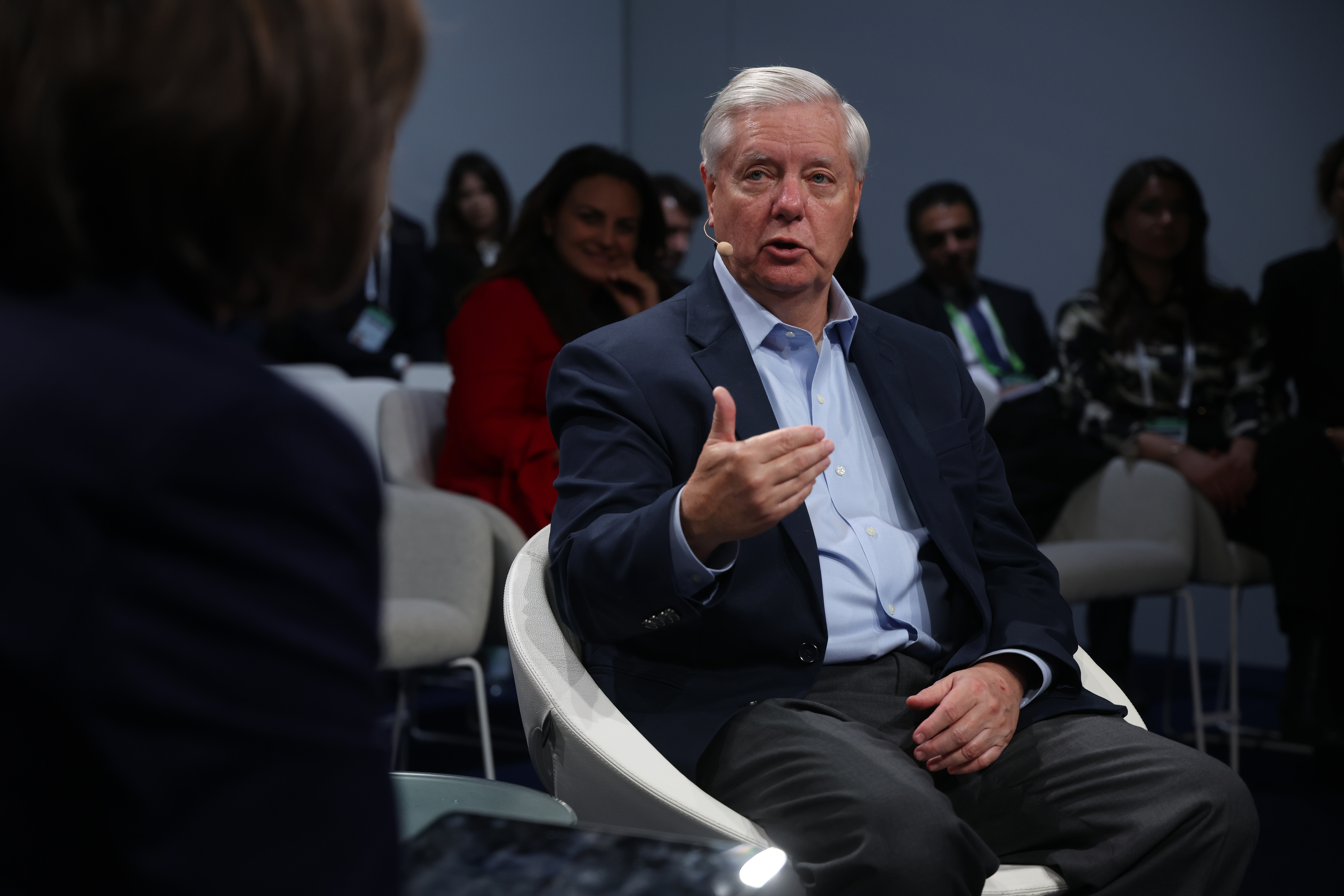
The senator addressed Saudi and Emirati leadership directly about escalating tensions in the region in his remarks at the Munich Security Conference
The parties concluded a second round of talks with the Iranians expected to produce 'detailed proposals' in the next two weeks

EVELYN HOCKSTEINAMER HILABI/POOL/AFP/AFP via Getty Images
US Middle East envoy Steve Witkoff after a meeting with Russian officials at Diriyah Palace, in Riyadh, Saudi Arabia, on February 18, 2025 (L)/ Iran's Foreign Minister Abbas Araghchi speaking to AFP during an interview at the Iranian consulate in Jeddah on March 7, 2025.
Iranian Foreign Minister Abbas Araghchi indicated that the second round of negotiations between Tehran and Washington produced agreements on several “guiding principles” for a potential deal on Tuesday, though U.S. officials took a more muted position, with one describing the talks as proceeding “as expected.”
Araghchi told Iranian state media that talks with White House Special Envoy Steve Witkoff and Jared Kushner, which took place in Geneva and was mediated by Omani Foreign Minister Badr Albusaidi, were more “serious, constructive and positive” than previous discussions, but he acknowledged that major gaps remain and that an agreement will not be reached quickly.
“Progress was made in the talks with Iran, but there are still a lot of details to discuss,” the U.S. official told Axios. “The Iranians said they would come back in the next two weeks with detailed proposals to address some of the open gaps in our positions.”
Albusaidi said that the parties “left with clear next steps before the next meeting,” though no date had been set for a third round of talks. Araghchi said both sides agreed to work on draft language, exchange texts and then determine the timing of a date for the next round of negotiations.
“Today’s negotiations between Iran and the U.S. in Geneva have concluded with good progress towards identifying common goals and relevant technical issues,” Albusaidi said in a post on X on Tuesday. “The spirit of our meetings was constructive. Together we made serious efforts to define a number of guiding principles for a final deal.”
Those principles and the parameters of a potential deal remain unclear — as the talks were underway, Iranian Supreme Leader Ayatollah Ali Khamenei wrote on X, “The Americans say, ‘Let’s negotiate over your nuclear energy, and the result of the negotiation is supposed to be that you do not have this energy!’ If that’s the case, there is no room for negotiation; but if negotiations are truly to take place, determining the outcome of the negotiations in advance is a wrong and foolish act.”
Parallel to the diplomatic track, both sides are indicating that military options remain on the table: The U.S. has dispatched a second aircraft carrier strike group to the region in recent days as well as additional F-35, F-22 and F-16 fighter jets.
“The Americans constantly say that they’ve sent a warship toward Iran,” Khamenei said on Tuesday in response to the deployment. “Of course, a warship is a dangerous piece of military hardware. However, more dangerous than that warship is the weapon that can send that warship to the bottom of the sea.”
At the start of discussions Tuesday, Iran said it would close the Strait of Hormuz to conduct live-fire military exercises, and had previously threatened to retaliate against U.S. bases in the region should Washington carry out an attack.
The senator addressed Saudi and Emirati leadership directly about escalating tensions in the region in his remarks at the Munich Security Conference
Sean Gallup/Getty Images
Sen. Lindsey Graham (R-SC) speaks at the 62nd Munich Security Conference on February 13, 2026 in Munich, Germany.
Sen. Lindsey Graham (R-SC) warned Saudi Arabia that the escalating tensions with the United Arab Emirates risk benefiting Iran at a critical moment in the Middle East, addressing the nations’ leaders directly in remarks at the Munich Security Conference on Saturday.
“As to MBS [Saudi Crown Prince Mohammed bin Salman] and MBZ [UAE President Sheikh Mohamed bin Zayed al-Nahyan] — knock it off, Saudi Arabia, knock it off,” Graham said from the stage. “I’m tired of this crap.”
Graham also urged “anybody who will listen in the Middle East — don’t let this moment pass,” and warned that the rift between the UAE and Saudi Arabia is “emboldening Iran.” He added that “MBZ is not a Zionist,” pushing back against criticism in Saudi Arabia of the Emirati leader’s ties to Israel. Among other escalatory rhetoric out of the kingdom, a prominent Saudi academic publicly accused Abu Dhabi last month of aligning itself too closely with Jerusalem and acting as “Israel’s Trojan horse in the Arab world.”
Saudi Arabia and the UAE have increasingly been at odds in recent months as the two U.S. allies have backed different sides in several regional conflicts and Riyadh continues to pivot away from its role as a moderating force in the region.
“Be smart, but don’t be locked down with fear,” said Graham. “I know they [the UAE and Saudi Arabia] got differences in Yemen and they got differences in Sudan, but we got to think big picture,” he said. “To any leader in the region that doesn’t understand you’re on the verge of history, history would judge you poorly.”
In Yemen, Saudi Arabia conducted an airstrike in late December 2025 against what Riyadh said was an Emirati arms shipment linked to the UAE-backed Southern Transitional Council (STC). Hours after the strike, the Emirati government announced it would withdraw its remaining troops from the country.
The two countries have also diverged in Sudan, where Riyadh has embraced Islamist-aligned factions while the UAE has aligned with rival forces. The Gulf states have also taken opposite sides in Somalia, with the UAE quietly supportive of Somaliland, while Saudi Arabia condemned Israel for recognizing the region’s independence.
Graham’s remarks in Munich come as the South Carolina senator remains an outspoken advocate of expanded cooperation between Israel and Arab states and has repeatedly emphasized countering Iran as a central U.S. objective in the region. On Monday, Graham met with Israeli Prime Minister Benjamin Netanyahu in his Jerusalem office during a trip to Israel.
Graham said Trump told him there’s ‘no light’ between Trump and Netanyahu
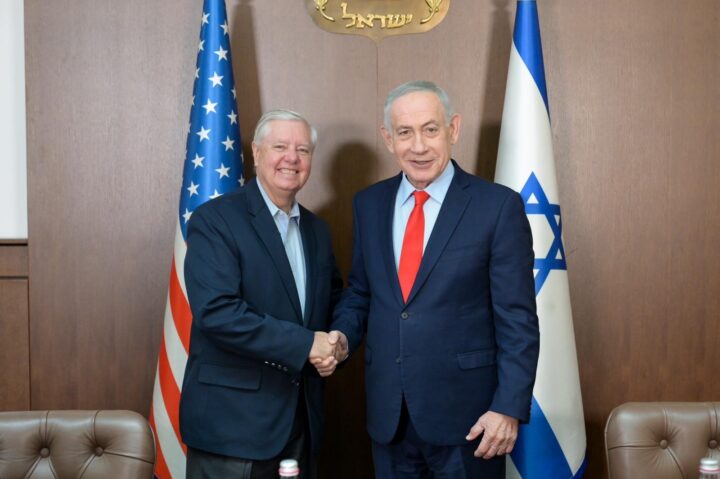
Maayan Toaff/GPO
Sen. Lindsey Graham (R-SC) meets Israeli Prime Minister Benjamin Netanyahu in Jerusalem.
The Iranian regime may fall within weeks, Sen. Lindsey Graham (R-SC) said during a press conference in Tel Aviv on Monday.
“We’re on the verge of eliminating the greatest state sponsor of terrorism in the region,” Graham said. “We’re in for weeks, not months.”
“President Trump is very good at making sure people don’t play him by giving them deadlines. I think you may see that now with Iran,” he added.
Graham said that President Donald Trump is pursuing diplomacy “to find a way to end this regime diplomatically that will advance our national security interests,” while leaving the military option open.
“I think President Trump is looking to see which line will catch the biggest fish,” he added.
Trump and Israeli Prime Minister Benjamin Netanyahu are in total agreement about how to proceed to weaken the Iranian regime, Graham said.
“There is no light between President Trump and Bibi about what to do and how to do it,” Graham said, later adding: “That’s what the president told me.”
After their meeting at the White House last week, Netanyahu characterized Trump’s assessment of Iran negotiations as overly optimistic of the regime’s intentions, saying, “The president thinks the Iranians understand who they’re dealing with. He thinks the conditions he is setting, combined with their understanding that they made a mistake last time not reaching a deal, could bring them to agree to conditions that will allow a good deal to be reached.”
But Netanyahu’s own view was more reserved: “I do not hide my general skepticism about the possibility of any deal with Iran.”
Graham called on the U.S. to “meet the moment” to topple the regime in Tehran.
The senator said both that he is “hopeful that diplomacy may prevail yet,” but when asked if he thinks a diplomatic solution is possible, he noted that Iran is “prone to cheat,” and that “based on the past, no,” but he is willing to give it a chance.
He pointed out that the military option is still on the table and that “the [USS] Gerald Ford [aircraft carrier] is steaming this way. I don’t think they’re just going for better weather.”
“In the coming weeks, if we can’t find a diplomatic solution, we will engage in the great endeavor of supporting the Iranian people, demanding their freedom and the end of their oppression,” he stated.
To reach that goal, Graham said, “we have military capability second to none. There’s no more clever nation than Israel and no more powerful nation than the United States.”
Asked if he thinks a military solution could actually bring about the end of the regime, Graham said that the Iranian regime is “weak” and “will collapse with sustained pressure,” and noted that their Air Force flies planes “from the 80s.”
“To anybody who believes the ayatollah can withstand all of this — you’re wrong,” he said.
Graham said the way to topple the regime militarily is to “kill the people who do the killing and see if the next guy wants to volunteer. … To those who want to appease: It never works. How many times could we have stopped Hitler? A bunch … The ayatollah represents evil incarnate to me.”
Graham acknowledged that military action in Iran could endanger American troops and result in the regime shooting ballistic missiles at Israel, but said “the risk associated with that is far less than the risk associated with blinking and pulling the plug and not helping the [Iranian] people as we promised. … We have to be good to our word.”
Should the mullahs’ regime fall, Graham said, it will be the result of Israel’s “determination to … go on the offensive” in response to the Oct. 7, 2023 attacks by Hamas, sponsored in part by Iran, and the “bravery of the people of Iran, who said ‘we’ve had it; we want change.’”
“I look forward to the day that Israel no longer has to fear a nuclear weapon developed by the Iranian regime,” he said.
Graham also recalled attending a demonstration against the Iranian regime in Munich over the weekend, and displayed a “Make Iran Great Again” hat, the idea for which, he said, came from diplomat Morgan Ortagus.
“The best way to make Iran great again is through the people, not the ayatollah,” Graham said.
In Gaza, Graham said that Hamas is “playing a game,” and Trump should set a time limit for disarmament.
“I think it’s either going to take pressure from the region to get a monster to disarm, or Israel is going to have to go back in and wipe them out. The sooner we get an answer to those questions the better,” he said.
Graham also expressed doubts that Gaza can be rebuilt “if right down the road there’s a neighborhood controlled by Hamas.”
Graham’s remarks came following meetings with Netanyahu, Israeli Defense Minister Israel Katz, Foreign Minister Gideon Sa’ar and former Prime Minister Naftali Bennett, and he plans to visit the United Arab Emirates and Saudi Arabia in the coming weeks.
The senator said one recurring theme in his meetings in Israel was expressions of appreciation for UAE leadership, specifically President Mohammed bin Zayed, as “a stalwart, reliable partner under difficult circumstances.”
As for concerns about antisemitic and anti-Israel messages coming out of Saudi Arabia, Graham said that he knows Saudi Crown Prince Mohammed bin Salman well, and that he “believe[s] he still has the same vision for the region as he did before Oct. 7, but Oct. 7 took its toll.”
Graham expressed support for Netanyahu’s plan to taper off U.S. military aid over the next decade, saying that “rather than writing a check, he wants to create a partnership. … I like that idea. The wars of the future are being planned here in Israel, because if you’re not one step ahead of the enemy, you suffer. … We’re looking at Israel advancing down the road of new weaponry far beyond us. It would be nice to be part of that process.”
As to Trump calling Israeli President Isaac Herzog a “disgrace” for not yet deciding whether to pardon Netanyahu of his various corruption charges, Graham said: “I’ll leave that to President Herzog.”
Dan Goldman’s left-wing primary challenger refuses to answer how he came to work with the ‘Hot Girls for Zohran’ founder
Ryan Murphy/Getty Images
Former New York City Comptroller Brad Lander speaks to members of the media, alongside supporters, before appearing in court on February 12, 2026 in New York City.
Congressional candidate and former New York City Comptroller Brad Lander condemned social media posts from a former top campaign consultant that promoted Hamas, Iran and anti-Israel conspiracy theories — but refused to explain how he came to hire him in the first place.
Lander, challenging Rep. Dan Goldman (D-NY) with Mayor Zohran Mamdani’s backing, stressed that he had cut ties with ‘Hot Girls for Zohran’ co-founder Kaif Gilani after Jewish Insider presented him with a raft of the activist’s posts to X. These included retweets of a Holocaust revisionist suggesting Israeli involvement in 9/11 and the assassination of John F. Kennedy, a video of Oct. 7 mastermind Yahya Sinwar and numerous pro-Hamas and pro-Iran statements, as well as original posts attacking Democratic figures and law enforcement.
Gilani’s firm, Brain Child LLC, had been the highest-paid consultant to Lander’s House campaign, according to Federal Election Commission records.
“As soon as I became aware of those tweets — which I really did find extremely offensive — I ended the contract with Brain Child immediately,” Lander told JI, a self-described progressive Zionist and outspoken Israel critic, at a press availability on Thursday.
But Lander repeatedly refused to say how he came to hire Gilani, whose background is in finance, to handle his “Website and social media,” as his campaign disclosures show.
“I’m not interested in extending your story,” said Lander, when pressed.
But he did maintain that he never received any referral for Gilani from Mamdani, his staff or his campaign. “Hot Girls for Zohran” was a social media, merchandising and volunteer canvassing operation run independently of the now-mayor’s official election effort, although Mamdani did pose for photos with Gilani and his co-founder, and appeared alongside other people — including model Emily Ratajkowski — wearing the group’s signature T-shirts.
“Did anyone from the mayor’s team refer them? The answer is no,” Lander said.
Earlier in the day, Mamdani himself refused to condemn the content of Gilani’s social media output, which also included attacks against Sen. Kirsten Gillibrand (D-NY), House Minority Leader Hakeem Jeffries (D-NY) and Sen. Bernie Sanders (I-VT).
Plus, Trump sets monthlong timeline for Iran deal
DOMINIC GWINN/Middle East Images/AFP via Getty Images
Jeremy Carl speaks at the National Conservatism Conference in Washington D.C., Sept. 3, 2025.
Good Thursday afternoon!
This P.M. edition is reserved for our premium subscribers — offering a forward-focused read on what we’re tracking now and what’s coming next.
It’s me again — Danielle Cohen-Kanik, U.S. editor at Jewish Insider and curator, along with assists from my colleagues, of the Daily Overtime. Please don’t hesitate to share your thoughts and feedback by replying to this email.
📡On Our Radar
Notable developments and interesting tidbits we’re tracking
Israeli Prime Minister Benjamin Netanyahu again voiced skepticism about the U.S.’ ability to reach an agreement with Iran as he departed Joint Base Andrews today, reports Jewish Insider’s Lahav Harkov, who is traveling with the prime minister’s delegation.
A day after his White House meeting with President Donald Trump, Netanyahu told reporters, “The president thinks the Iranians understand who they’re dealing with. He thinks the conditions he is setting, combined with their understanding that they made a mistake last time not reaching a deal, could bring them to agree to conditions that will allow a good deal to be reached.”
The prime minister’s view was more reserved: “I do not hide my general skepticism about the possibility of any deal with Iran.” Netanyahu said he told Trump that if a deal is indeed reached, “it must include the components that are important to us, the State of Israel, and, I think, the entire international community: not just the nuclear matter, but also ballistic missiles and Iranian proxies in the region.”
The Prime Minister’s Office also said Netanyahu will not be returning to Washington next week as scheduled, in order to speak at an AIPAC conference, and will instead appear virtually…
At a press conference this afternoon, Trump said the timeline for a potential deal with Iran is “over the next month … should happen quickly.” Asked why Netanyahu wants him to stop negotiating, Trump said, “He didn’t say that, we didn’t discuss that. I’ll talk to [Iran] as long as I like.” Trump additionally said Israeli President Isaac Herzog “should be ashamed of himself” and called him “disgraceful” for not issuing a pardon to Netanyahu…
The Trump administration smuggled around 6,000 Starlink terminals, used to establish internet connection, to activists in Iran during the regime’s violent suppression of nationwide protests, which included internet blackouts, U.S. officials told The Wall Street Journal…
New York City Mayor Zohran Mamdani and his team refused to condemn antisemitic and pro-Hamas social media posts from the co-founder of the group ‘Hot Girls for Zohran’ when pressed by JI’s Will Bredderman and other reporters today.
Speaking from City Hall, Mamdani would only stress that Gilani’s organization operated independently of his official election effort: “This was an individual leading an outside group and was never paid for by our campaign,” said Mamdani. “If New Yorkers want to know my views then they can hear it directly from me.
But when JI pressed the mayor directly whether he condemned the content of Gilani’s posts, he refused to respond and left the room, similar to how he fled questions on the matter from Politico on Wednesday…
Rep. Elise Stefanik (R-NY) urged the Trump administration today to investigate reports that a clique of radical staffers at the New York City Department of Health and Mental Hygiene had launched an anti-Israel “working group” inside the agency, JI’s Will Bredderman reports.
In a letter addressed to Health and Human Services Secretary Robert F. Kennedy Jr., Stefanik decried reports that employees had met during work hours at the city bureaucracy’s Queens headquarters. She raised the possibility that the department’s federal funding might have gone toward a prohibited political purpose — or that the gathering may have violated civil rights protections by creating a discriminatory environment for Jewish New Yorkers…
The nomination of Jeremy Carl, tapped to be the assistant secretary of state for international organizations, appears bound to fail after Sen. John Curtis (R-UT) announced his opposition to Carl’s confirmation following his contentious hearing in the Senate Foreign Relations Committee this morning, JI’s Marc Rod reports.
Curtis and a series of Democrats questioned Carl over past antisemitic, anti-Israel and otherwise inflammatory comments that the nominee had made online and in a series of podcast appearances, including his assertion that the U.S. spends too much time and energy on Israel “often to the detriment of our own national interest” and that “the Jews love to see themselves as oppressed”…
CENTCOM announced today it had completed a “deliberate and conditions-based” withdrawal of U.S. forces from al-Tanf Garrison in Syria, handing control of the site on the country’s border with Iraq and Jordan to forces aligned with the Syrian government. The U.S. has had a presence at the base since 2016 as part of its fight against ISIS; over 7,000 ISIS detainees are also being transitioned out of Syria into Iraq, while the U.S. troops were relocated to Jordan…
Germany joined the growing calls today for U.N. Special Rapporteur Francesca Albanese to resign, after France did the same yesterday, over her recent speech at the Al Jazeera Forum where she called Israel humanity’s “common enemy.” German Foreign Minister Johann Wadephul wrote on X, “I respect the system of independent rapporteurs of the UN. However, Ms. Albanese has already repeatedly failed in the past. I condemn her recent statements about Israel. She is untenable in her position”…
Israeli authorities arrested several people, and indicted one army reservist and one civilian, for allegedly using classified information to place bets on the popular prediction market Polymarket around the timing of Israel’s war with Iran last June, the Shin Bet announced today. The bets all correctly predicted the timeline of the strikes, raking in more than $150,000, Israeli media reported…
⏩ Tomorrow’s Agenda, Today
An early look at tomorrow’s storylines and schedule to keep you a step ahead
Keep an eye out in Jewish Insider for reporting on the race to succeed Rep. Bonnie Watson Coleman (D-NJ) in New Jersey’s 12th Congressional District, where the congresswoman is coming out forcefully against the lone Jewish candidate in the race — for being too supportive of Netanyahu.
The Munich Security Conference kicks off tomorrow, with Secretary of State Marco Rubio leading the U.S. delegation and speaking from the main stage on Saturday. Dozens of members of Congress were also expected to attend — official travel was canceled due to the impending shutdown of the Department of Homeland Security tomorrow, but members still may attend on their own. One member making a foray into foreign policy is Rep. Alexandria Ocasio-Cortez (D-NY), who will be speaking on two panels at the high-level summit. Other Democrats in attendance will be California Gov. Gavin Newsom, Michigan Gov. Gretchen Whitmer and Boston Mayor Michelle Wu.
In observance of President’s Day, we’ll be back in your inbox with the Daily Overtime on Tuesday. Shabbat Shalom!
Stories You May Have Missed
DOUBLING DOWN
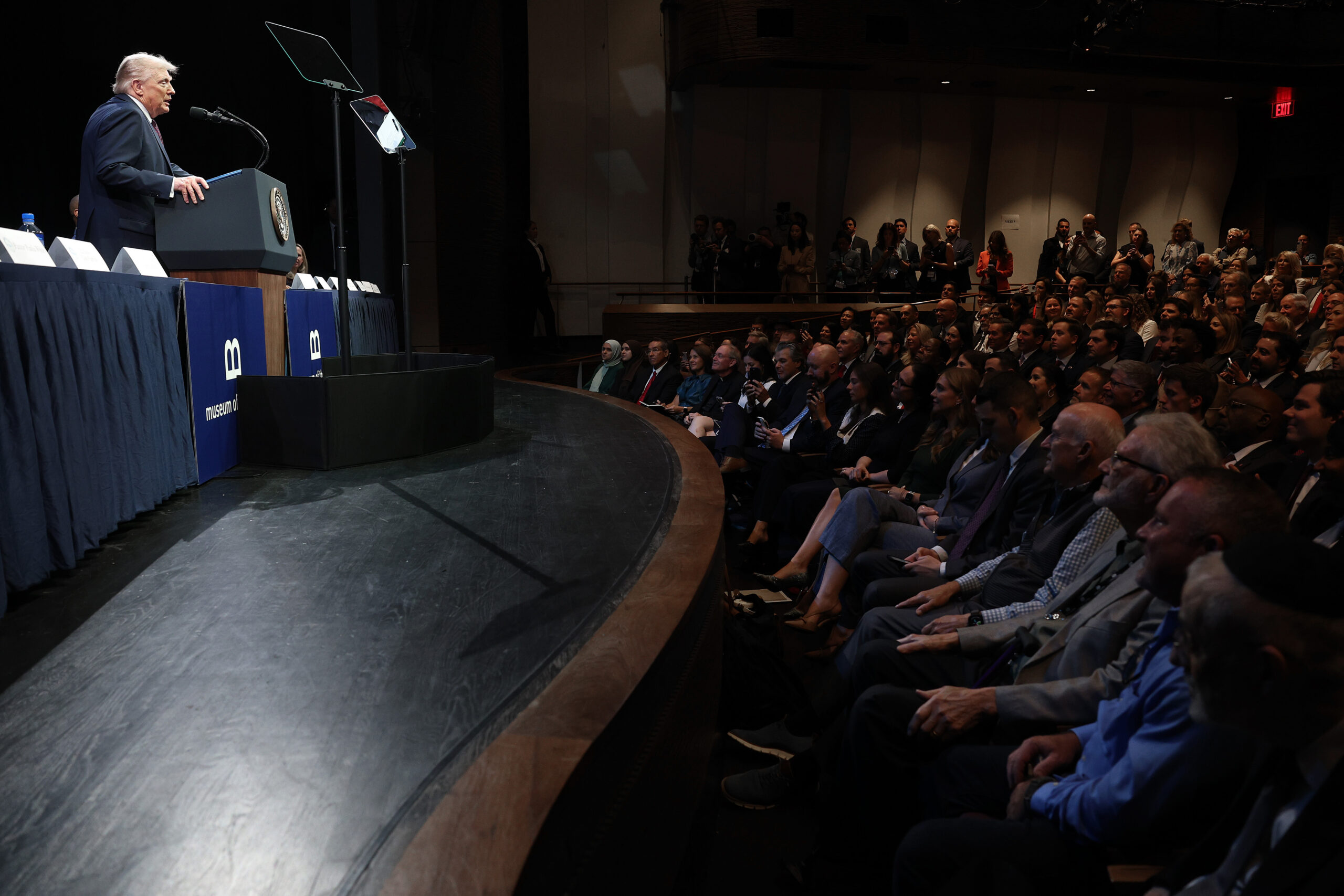
Activist Sameerah Munshi was appointed by the White House to the commission’s advisory board; the two women have jointly posted antisemitic content online
DOHA DEALINGS

Budd says Qatar should hand over Khaled Mashaal because he has the ‘blood of Americans on his hands’
Departing from Washington, the Israeli PM said he stressed to Trump that if any deal is reached, it must go beyond the nuclear issue
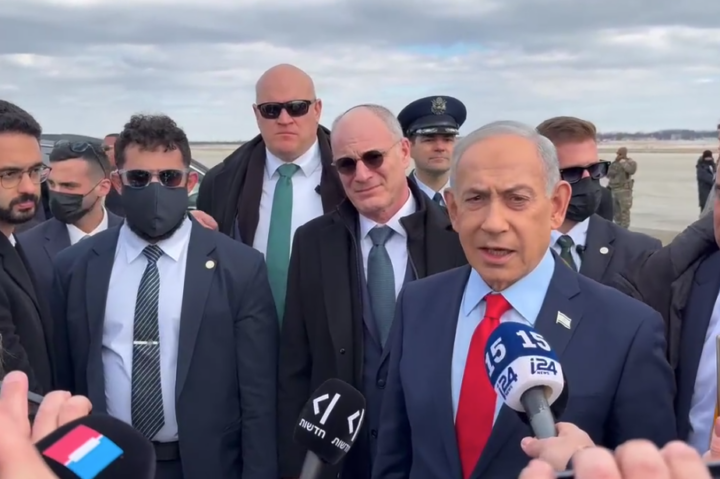
Lahav Harkov
Israeli Prime Minister Benjamin Netanyahu departs Joint Base Andrews on Feb. 12, 2026.
Israeli Prime Minister Benjamin Netanyahu again voiced skepticism about the U.S.’ ability to reach an agreement with Iran as he departed Joint Base Andrews on Thursday, a day after his White House meeting with President Donald Trump.
Netanyahu said that his nearly three-hour meeting with Trump “mostly focused on the negotiations with Iran.”
“The president thinks the Iranians understand who they’re dealing with,” Netanyahu said. “He thinks the conditions he is setting, combined with their understanding that they made a mistake last time not reaching a deal, could bring them to agree to conditions that will allow a good deal to be reached.”
The prime minister’s view was more reserved: “I do not hide my general skepticism about the possibility of any deal with Iran.”
Netanyahu said he told Trump that if a deal is indeed reached, “it must include the components that are important to us, the State of Israel, and, I think, the entire international community: not just the nuclear matter, but also ballistic missiles and Iranian proxies in the region.”
After Wednesday’s White House meeting, the Prime Minister’s Office stated that the leaders discussed Iran and Gaza, and that Netanyahu “emphasized the security needs of the State of Israel in the context of the negotiations, and the two leaders agreed on continued coordination and the close contact between them.”
Trump posted on Truth Social that he “insisted that negotiations with Iran continue to see whether or not a Deal can be consummated. If it can, I let the Prime Minister know that will be a preference. If it cannot, we will just have to see what the outcome will be.”
The president warned that last time Tehran did not make a deal, the U.S. launched Operation Midnight Hammer, striking Iran’s nuclear sites.
The Prime Minister’s Office said Netanyahu will not be returning to Washington next week as he had been scheduled to, in order to speak at an AIPAC conference, and will instead appear virtually.
As he departed Washington a day after his meeting with Trump, Netanyahu voiced skepticism about the U.S.’ ability to reach an agreement with Iran.
— Jewish Insider (@J_Insider) February 12, 2026
“The president thinks the Iranians understand who they’re dealing with,” Netanyahu said from Joint Base Andrews. “He thinks the… pic.twitter.com/A1AsiDYZCe
Behind the scenes, the main topic of conversation between the two leaders yesterday appeared to focus on options for action if Iran does not agree to a deal
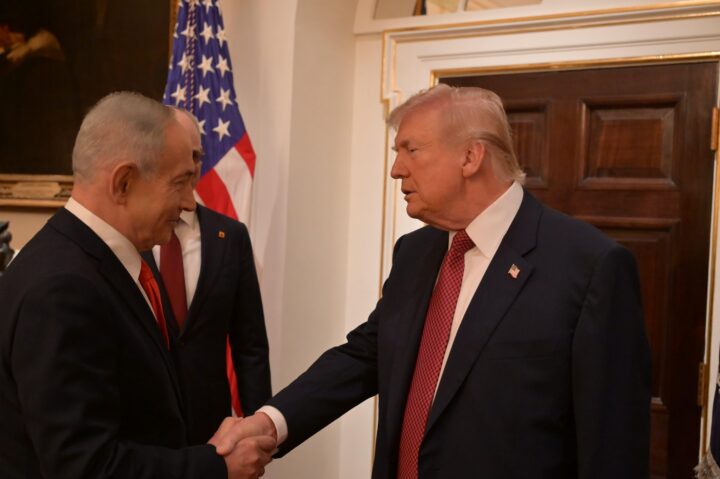
GPO
President Donald Trump greets Israeli Prime Minister Benjamin Netanyahu at the White House on Feb. 11, 2026.
At first glance, President Donald Trump and Israeli Prime Minister Benjamin Netanyahu’s nearly three-hour meeting at the White House on Wednesday appeared to end without any clear accomplishments.
Instead of the freewheeling question-and-answer sessions with media in the Oval Office and formal press conferences that followed most of Trump and Netanyahu’s previous six meetings since Trump returned to the White House, came a laconic statement from Netanyahu’s office about Israel’s security needs and a Truth Social post from Trump that was staid by the president’s standards.
Trump wrote that he “insisted that negotiations with Iran continue to see whether or not a deal can be consummated. If I can, I let the Prime Minister know that will be a preference.” However, the president warned that last time Iran decided against making a deal, “that did not work out well for them,” and the U.S. struck the country’s nuclear sites.
However, Trump and Netanyahu were similarly silent about their meeting in April 2025 — their last in-person meeting before the joint strike in Iran two months later.
Behind the scenes, the main topic of conversation between the two leaders yesterday appeared to focus on options for action if Iran does not agree to a deal.
The lack of press around the meeting was because Netanyahu wanted to keep a relatively low profile and show deference to Trump, since a strike on Iran — should one occur — would be led by the U.S., an Israeli source said.
The Israeli side is very skeptical that any deal can be reached between the U.S. and Iran, with Trump saying publicly that a good deal would mean “no nuclear weapons, no ballistic missiles,” and Iranian Foreign Minister Abbas Araghchi saying the ballistic missile issue is a nonstarter for Tehran.
According to a report by Barak Ravid for Israel’s Channel 12, the Trump administration’s views are very close to those on Netanyahu’s team, with a senior American official also believing the Iranians are unlikely to compromise.
The meeting between the two leaders was “critical,” Ravid quoted the official as saying, because they “need to decide whether to conduct a joint strike if a deal is not reached.” Such a strike would be more likely to succeed if the militaries work together.
One indication of the Trump administration’s pessimism about the talks is the Pentagon’s order, as reported by The Wall Street Journal, for a second aircraft carrier strike group to deploy to the Middle East if negotiations fail, which came after Trump teased the idea earlier this week.
A source in Netanyahu’s delegation said that the prime minister also arrived in Washington with evidence, which he presented to Special Envoy Steve Witkoff and Jared Kushner on Tuesday and Trump on Wednesday, that the Iranians lied to the Americans about their intentions in the talks, which they never planned to include ballistic missiles, as well as about stopping the slaughter of anti-regime protesters.
Meanwhile, the U.S. and Iran have yet to set a date for a second round of talks, and the first was under 90 minutes long — with some of that time dedicated to their Omani hosts passing messages back and forth in the indirect talks.
The two leaders avoided the cameras during Israeli PM’s White House visit
GPO
President Donald Trump greets Israeli Prime Minister Benjamin Netanyahu at the White House on Feb. 11, 2026.
The U.S. will continue pursuing diplomacy with Iran, President Donald Trump said following his White House meeting with Israeli Prime Minister Benjamin Netanyahu on Wednesday.
“There was nothing definitive reached other than I insisted that negotiations with Iran continue, to see whether or not a deal can be consummated,” Trump wrote on Truth Social. “If it can, I let the Prime Minister know that will be a preference.”
If negotiations do not lead to a deal, the president added, “we will just have to see what the outcome will be. Last time, Iran decided they were better off not making a deal, and they were hit with Midnight Hammer. That did not work out well for them. Hopefully, this time, they will be more reasonable and responsible.”
In addition, Trump wrote, he and Netanyahu discussed “the tremendous progress being made in Gaza.”
Trump characterized the summit as “a very good meeting, the tremendous relationship between our two countries continues.”
Netanyahu’s office said he and Trump discussed Iran, Gaza and regional developments.
“The prime minister stood up for the State of Israel’s security needs in the context of the negotiations, and the two agreed to continue to coordinate closely,” the Prime Minister’s Office statement read.
Netanyahu made a quiet entrance to the White House, and Trump was uncharacteristically camera-shy.
Trump and Netanyahu’s meetings — this was their seventh in the past year — have usually been accompanied by freewheeling press huddles, either in the Oval Office or East Room, in which Trump answered dozens of questions. On Wednesday, however, reporters were not allowed in the room before or after the meeting, which continued longer than scheduled and included lunch.
At the top of the meeting’s agenda were the details of the ongoing negotiations with Iran. The American team is led by White House Special Envoy Steve Witkoff and Jared Kushner, both of whom met with Netanyahu at Blair House on Tuesday.
On Tuesday, Trump said on Fox Business that the Iranians “want to make a deal. I think they’d be foolish if they didn’t. We took out their nuclear power last time, and we’ll have to see if we take out more this time.”
Trump added that a “good deal” would mean “no nuclear weapons, no ballistic missiles, no this or that.”
That statement checks off the most important items on Netanyahu’s priority list for an Iran deal, while leaving out the Islamic Republic’s sponsorship of terrorist proxies like Hezbollah and Hamas. It also does not include any aid to the Iranian protesters against the regime, whom Trump said late last year that he would help.
A source on Netanyahu’s delegation said that the prime minister is aware of the American political sensitivities around their meeting and was cautious to show deference to Trump, lest Netanyahu be seen as trying to push for war.
Iranian Foreign Minister Abbas Araghchi, however, said in an interview that his country’s ballistic missile program is “never negotiable.”
Qatari Emir Sheikh Tamim bin Hamad Al Thani called Trump ahead of his meeting with Netanyahu to encourage him to reach a deal, according to Qatari media.
Netanyahu met with Secretary of State Marco Rubio ahead of the Trump meeting, for discussions focused on the administration’s plans for Gaza.
Netanyahu presented Rubio with signed letters certifying his membership in the Board of Peace, which Trump founded to oversee reconstruction and demilitarization in Gaza and attempt to resolve other conflicts.
The Board of Peace’s first meeting is next week, and Netanyahu’s office has yet to say whether he will attend. The prime minister was expected to come back to Washington from Feb. 18-22 for an AIPAC conference beginning that Sunday, and his office said the trip is still on schedule.
The ayatollah is ‘never going to stop killing his people and drinking their blood out of a boot, and he’s never going to stop funding Hamas and Hezbollah,’ Sen. John Kennedy said
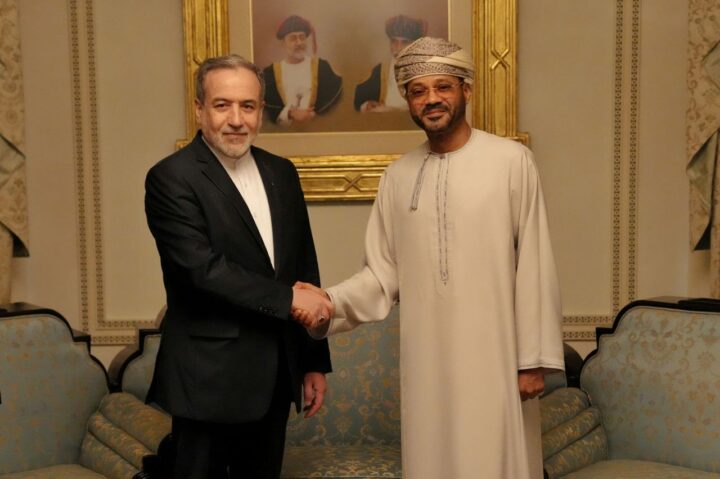
Iranian Foreign Ministry / Handout /Anadolu via Getty Images
Iranian Foreign Minister Abbas Araghchi (L) meets with Omani Foreign Minister Sayyid Badr Hamad Al Busaidi (R) to exchange views on how to advance US-Iran talks scheduled to be held later in the day, in Muscat, the capital of Oman, on February 06, 2026.
Republicans lawmakers continued to dismiss this week the idea that a nuclear deal with Iran is achievable, despite comments by President Donald Trump over the weekend.
Trump said that the talks with Iran, held in Oman last Friday, had been “very good,” that Tehran “wants to make a deal very badly” and that he is in “no rush” to move ahead. He also said that the Iranian demand that the talks be only focused on nuclear weapons “would be acceptable” — an apparent softening of the U.S. position that any potential agreement should also address Iran’s ballistic missile stockpiles and its support for regional terror proxies. The talks did not appear to touch on the Islamic Republic’s recent violent crackdown on nationwide protests.
Asked about Trump’s comments about a nuclear-only deal, Republicans largely dismissed the idea that any deal would actually be forthcoming.
“Iran’s not going to make a deal with us. They’re going to stall and re-stall to buy time, but they’re not going to make a deal,” Sen. John Kennedy (R-LA) told Jewish Insider. “The ayatollah is [as] crazy as a bed bug. And he’s never going to give up any hope that he has of nuclear weapons. He’s never going to stop killing his people and drinking their blood out of a boot, and he’s never going to stop funding Hamas and Hezbollah.”
Kennedy predicted that military action is both necessary and forthcoming.
“You’re going to have to give them a curbstomping, but you don’t want to start a regional war doing it,” Kennedy continued. “My guess is that’s what the president is talking to [Secretary of State Marco] Rubio and the military guys with a bunch of their flags in their office [about] right now.”
Sen. Rick Scott (R-FL) agreed that the Iranian regime is not genuinely interested in making an agreement with the United States.
“There won’t be a deal,” Scott told JI. “They’re not going to do a deal.”
Sen. James Lankford (R-OK) said he hadn’t seen Trump’s comments but he does not “trust the word of the regime, at all.”
“They have not proven trustworthy with their word in the past, and so you have to have a way to be able to verify everything,” Lankford continued.
Sen. Tim Kaine (D-VA), meanwhile, told JI on Monday that he would delay a vote on a war powers resolution he introduced with Sen. Rand Paul (R-KY) blocking military action against Iran pending the ongoing talks with the regime.
The resolution would theoretically be eligible for votes by the full Senate later this week, should Kaine and Paul wish to call it up.
The Virginia senator told JI that he and Paul are in discussions about timing for votes, and that he hasn’t yet made a decision on when to call the bill up.
“We have to check each day to see where [the talks] are. I don’t think calling it up in the middle of discussions that have some chance to it — that’s not the right time — but we’ll just see where we are,” Kaine said.
Plus, the stakes of Bibi's upcoming White House visit

Rob Kim/Getty Images for Fanatics
Michael Rubin and Nasser Al-Khelaifi attend Fanatics Fest NYC 2025 at Javits Center on June 22, 2025 in New York City.
👋 Good Monday morning!
In today’s Daily Kickoff, we preview Israeli Prime Minister Benjamin Netanyahu’s trip to Washington this week following the White House’s talks with Iran on Friday, and have the exclusive on a new report from the North American Values Institute on antisemitism in K-12 schools. We report on Hamas leader Khaled Mashaal’s praise for the Oct. 7 attacks at the Al Jazeera Forum in Doha, Qatar, over the weekend, as Fanatics CEO Michael Rubin hosted his annual Super Bowl lunch that was attended by a senior Qatari official. Also in today’s Daily Kickoff: Rep. Alexandria Ocasio-Cortez, Yakir Gabay and Narges Mohammadi.
Today’s Daily Kickoff was curated by JI Executive Editor Melissa Weiss and Israel Editor Tamara Zieve, with assists from Danielle Cohen-Kanik and Marc Rod. Have a tip? Email us here.
What We’re Watching
- Vice President JD Vance is traveling to Armenia today as part of a two-country trip that will also include a stop in Azerbaijan later this week, in a last-minute trip first reported yesterday. Vance will not be in Washington during Israeli Prime Minister Benjamin Netanyahu’s visit to the White House, slated for Wednesday.
- Former Israeli hostage and musician Alon Ohel will play a one-night concert in Tel Aviv this evening. In videos shared by his loved ones during his more than two years in captivity, Ohel deftly played the piano, drawing widespread praise for his talent. He’ll be performing alongside a number of high-profile Israeli musicians, including Idan Amedi and Eviatar Banai for the performance, titled “Alon Ohel, Playing for Life.”
- The Religious Liberty Commission is holding its fifth hearing on issues related to antisemitism today at the Museum of the Bible. Speakers at the gathering, which begins this morning and runs through the mid-afternoon, include the Justice Department’s Leo Terrell, former Auburn men’s basketball coach Bruce Pearl and former U.S. Ambassador for Religious Freedom Sam Brownback.
Prince William is making his first official visit to Saudi Arabia this week. The trip comes as Riyadh hosts the World Defense Show, and as the U.K. works to establish Saudi Arabia as a partner in its next-generation Tempest fighter aircraft program. - Somali Defense Minister Ahmed Moallim Fiqi is also in Riyadh, where earlier in the day he inked a new defense cooperation agreement with Saudi Defense Minister Prince Khalid bin Salman. The Saudi official had met with Jewish leaders in Washington last month, during which he reiterated Riyadh’s opposition to Israel’s recent recognition of Somaliland.
What You Should Know
A QUICK WORD WITH JI’S LAHAV HARKOV
Israeli Prime Minister Benjamin Netanyahu plans to fly to Washington for a Wednesday White House meeting amid increasing concern in Jerusalem that the U.S. and Iran are headed towards a nuclear deal that does not meet Israel’s immediate security need — to drastically limit Iran’s ballistic missile program.
After the first round of indirect negotiations in Oman on Friday, President Donald Trump told reporters on Air Force One that talks had been “very good” and that “Iran looks like it wants to make a deal very badly.”
Asked about Iran’s demand that the talks only be about nuclear weapons, Trump said, “That would be acceptable. One thing, right up front, no nuclear weapons. … They weren’t willing to do that [last year]; now they are willing to do much more.” That message contrasted with Secretary of State Marco Rubio’s remarks from last week, that “in order for talks to actually lead to something meaningful, they will have to include certain things, and that includes the range of their ballistic missiles, that includes the sponsorship of terrorist organizations across the region, that includes the nuclear program and that includes the treatment of their own people.”
Netanyahu announced the urgent meeting with Trump, less than two months after they last met at Mar-a-Lago, with a statement that said: “The Prime Minister believes any negotiations must include limitations on ballistic missiles and a halting of the support for the Iranian axis.”
For Israel, while the Iranian nuclear program may be the biggest threat, Operation Midnight Hammer did enough damage that the ballistic missiles are the more urgent concern, one that Iran has been threatening to use against Israel if the U.S. launches an attack.
Though Israel destroyed hundreds of missiles, launchers and production sites during the 12-Day war last June, most of Iran’s missiles remained intact. The prime minister presented the president with evidence during their December meeting that Iran has been working to rebuild its ballistic missile program and air defenses with help from China and Russia.
Any deal that does not include significant limitations on the range of Iran’s ballistic missiles will be woefully inadequate from Israel’s perspective. Plus, as Netanyahu’s office said on Saturday, Israel wants a deal that addresses Iran’s sponsorship of terrorist proxies like Hamas and Hezbollah.
Sen. Lindsey Graham (R-SC) expressed skepticism that the negotiations would bring about an acceptable agreement and noted the legal requirement to bring any such deal before Congress, writing on X: “I hope it can meet our national security objectives and the needs of the people of Iran through diplomacy. Given Iran’s behavior regarding deals, it could be a tough sell. However, I am open-minded, understanding [that] any agreement with the Islamic Republic and the United States must come to Congress for review and a vote.”
FROM CENTER STAGE
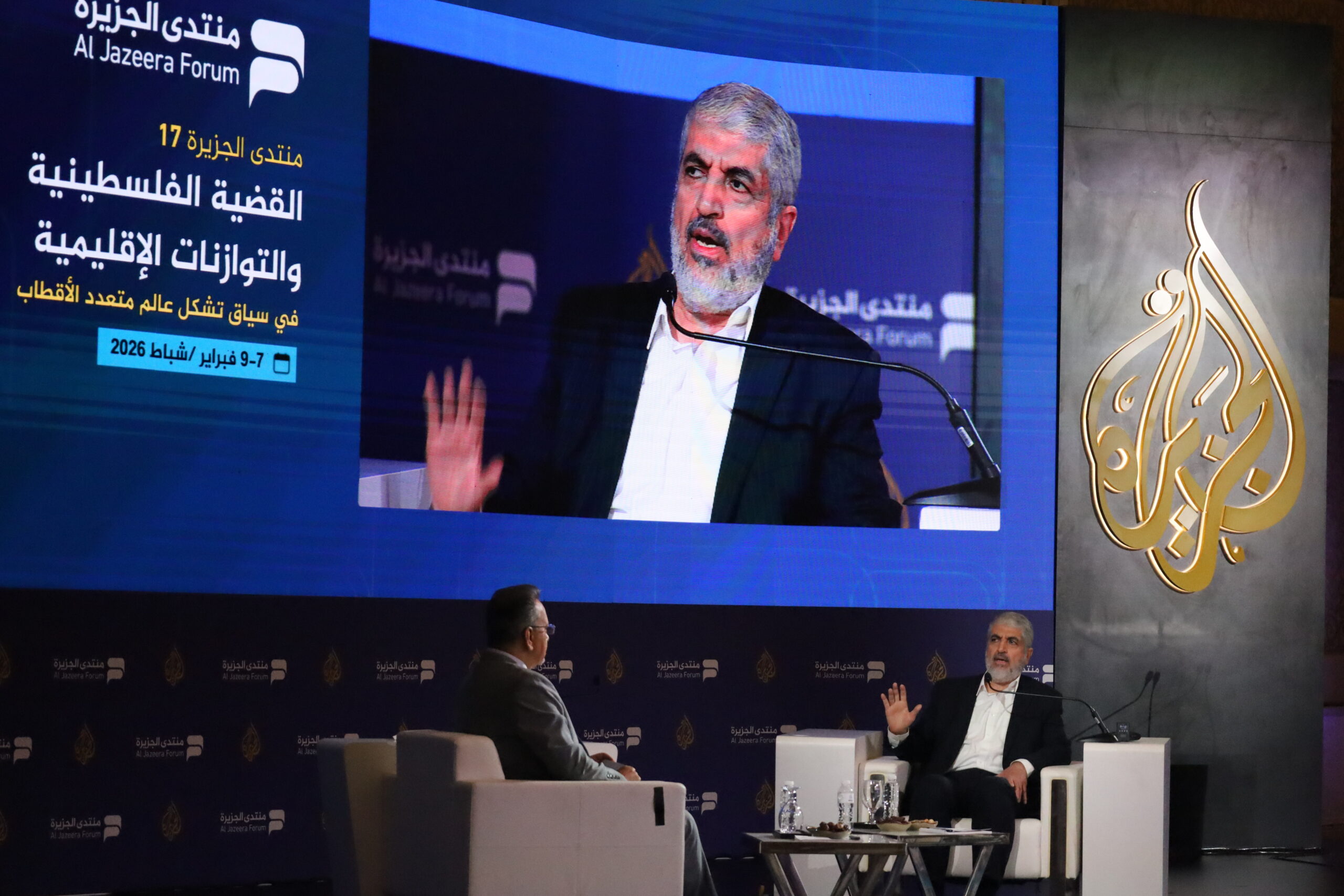
Hamas leader Khaled Mashaal addressed Qatar’s 17th Al Jazeera Forum on Sunday in Doha, at a conference that focused heavily on denigrating Israel, while featuring senior officials from Iran and Somalia. Mashaal applauded the group’s Oct. 7, 2023, attacks on Israel as having “brought the Palestinian cause back to the forefront of the world” and said that Palestinians “take pride” in “resistance,” a euphemism for violence against Israelis. He called to “pursue Israel and establish that it is a pariah entity that is losing its international legitimacy,” noting the “changes in the elites, universities and social networks” against Israel, Jewish Insider’s Lahav Harkov reports.
Peak promotion: The Hamas leader, who resides in Doha, also hailed Qatar’s “honorable role in the [Palestinian] cause.” Hamas is designated by the U.S., European Union and other countries as a terrorist organization, and Mashaal is wanted in the U.S. for terrorism, murder conspiracy and sanctions evasion relating to his role in planning the Oct. 7 attacks. Mashaal was listed on the conference’s program and list of speakers in versions of the Al Jazeera Forum website archived by independent researcher Eitan Fischberger, but as of Sunday, Mashaal was no longer listed. At the same time, the Al Jazeera Forum X account extensively promoted Mashaal, with 19 posts about the terror leader’s remarks. The account featured two posts about conference keynote speaker Abbas Araghchi, the foreign minister of Iran.
Elsewhere at the Forum: Another speaker was Francesca Albanese, the U.N. special rapporteur who has been sanctioned by the U.S. for “infringement on the sovereignty” of Israel and the U.S. by pursuing International Criminal Court prosecutions of citizens of both countries, as Secretary of State Marco Rubio described her actions last year. Albanese claimed in her remarks, delivered via video, that Israel had committed a premeditated genocide of Palestinians in Gaza, and that all of humanity “now has a common enemy” in Israel.
DOHA DISSONANCE

As the Al Jazeera Forum took place in Doha, Qatari minister Nasser Al-Khelaifi was being feted by Fanatics CEO Michael Rubin at another high-profile convening — Super Bowl weekend, taking place in Santa Clara, Calif. Al-Khelaifi is the chairman of Qatar Sports Investments (QSI), one of the Qatari sovereign wealth funds that invests heavily in international sports and entertainment. Among his other titles, Al-Khelaifi is also a board member of the Qatar Investment Authority, a minister of state and the president of the Paris Saint-Germain Football Club in France and the Qatar Tennis Foundation.
Flourishing friendship: Rubin posted a picture with Al-Khelaifi from his annual Super Bowl luncheon on Instagram with the caption, “Incredible lunch with amazing people across sports, business, and culture.” Rubin and Al-Khelaifi have developed a friendship in recent years, including a long-term partnership between Fanatics and Paris Saint-Germain. Rubin posted a photo with Al-Khelaifi at the F1 Qatar Grand Prix last November, where he called the Qatari minister his “brother” and said, “What you did for both the city of Paris and country of Qatar is truly amazing.”
STICKING BY THE STICKY NOTE

The Blue Square Alliance Against Hate’s widely watched Super Bowl ad last night designed to combat antisemitism instead sparked a heated divide within the Jewish community over the effectiveness of its message, Jewish Insider’s Haley Cohen reports. Titled “Sticky Note,” the ad from New England Patriots owner Robert Kraft’s group featured a Jewish student being harassed by his high school classmates because of his religion, with bullies placing a “dirty Jew” sticker on his backpack. In a show of allyship, a Black classmate puts a blue square over the note. “Do not listen to that,” he tells his Jewish classmate. “I know how it feels.”
Target audience: A chorus of commentators criticized the advertisement, which is part of a $15 million media campaign that will also include ad spots during the Winter Olympics, for depicting Jews as victims in need of protection from non-Jews and for avoiding the reality that the source of many antisemitic incidents in schools stem from hostility toward or hatred of Israel. But the leader of Kraft’s group told JI that the ad wasn’t trying to appeal to a Jewish audience. Instead, Blue Square Alliance President Adam Katz told JI that with more than 100 million viewers, the Super Bowl provides an opportunity to reach an audience that is “unengaged — and in many cases uninformed — about antisemitism … We’re very focused on this audience that’s lacking awareness, empathy and motivation to act,” he said.
MEJIA MOMENTUM
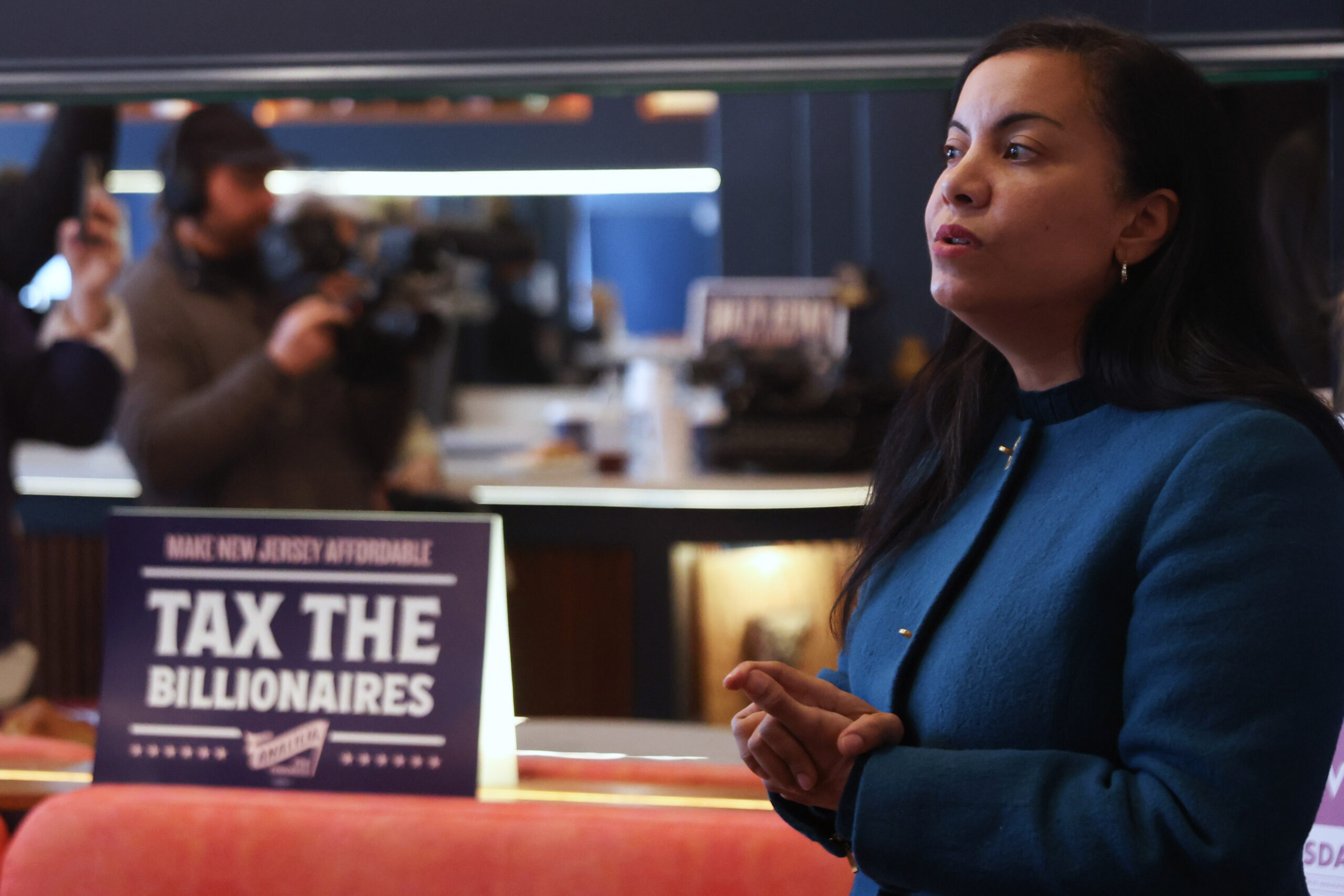
With progressive activist Analilia Mejia’s expected victory in the special election Democratic primary in New Jersey’s 11th Congressional District, attention is now turning to the upcoming April special election and the June regular election primary as the last chances for moderates and pro-Israel groups to defeat her, Jewish Insider’s Marc Rod reports.
Looking ahead: “June is potentially irresistible for the other candidates who ran … if any of these candidates could get a one-on-one shot at making it in June,” Micah Rasmussen, the director of the Rebovich Institute for New Jersey Politics at Rider University, said. But unless the field can consolidate, Rasmussen said, it’s hard to see how the result would be any different in June. He said former Rep. Tom Malinowski (D-NJ), who closely trails Mejia, would have the strongest shot at defeating her head-to-head, while former Lt. Gov. Tahesha Way might have a tougher battle.
UDP’s outlook: “The outcome in NJ-11 was an anticipated possibility, and our focus remains on who will serve the next full term in Congress,” UDP spokesperson Patrick Dorton said in a statement on Friday. “UDP will be closely monitoring dozens of primary races, including the June NJ-11 primary, to help ensure pro-Israel candidates are elected to Congress.”
EXCLUSIVE

Political activists seeking to push extremist perspectives into the classroom are behind a nationwide acceleration of antisemitic content in K-12 classrooms, with increasingly active movements targeting school boards, district leadership and teacher organizations, according to a report published Monday by the North American Values Institute, Jewish Insider’s Haley Cohen reports.
Findings: The group’s 58-page report, “When the Classroom Turns Hostile: A Strategic Response to Extremism and Antisemitism in K-12 Education,” shared exclusively with JI, found that in the aftermath of the Oct. 7, 2023, Hamas terrorist attacks in Israel, what it described as radical ideological frameworks have dominated key education institutions across the country. Ideologies such as “oppressor-oppressed” are common in schools of education, accreditation bodies, teacher unions and district bureaucracies, all of which shape classroom materials.
MENTORSHIP MOVES

Rep. Alexandria Ocasio-Cortez (D-NY) has been receiving briefings from Matt Duss, an outspoken critic of the U.S.-Israel alliance and former foreign policy advisor to Sen. Bernie Sanders (I-VT), as she prepares for a high-profile appearance at the Munich Security Conference this week, The New York Times reported on Friday. Duss, who is now executive vice president at the Center for International Policy, a left-wing think tank, has long been a prominent detractor of U.S. relations with Israel, Jewish Insider’s Matthew Kassel reports.
Duss’ record: He has called for blocking aid to Israel and has expressed opposition to renewing the 10-year memorandum of understanding, which is set to expire in 2028 and currently provides $3.8 billion in military funding to Israel annually. He has also cast doubt on the Abraham Accords, accusing the normalization agreements between Israel and several Arab countries of using “racist logic” that is “premised on the perpetual repression of Palestinians” and helping to fuel Hamas’ Oct. 7, 2023, terror attacks. Duss has frequently called Israel’s resulting war in Gaza a genocide. “I don’t think a Democrat can be nominated in ‘28 without acknowledging that it is a genocide,” Duss suggested in an interview with The Financial Times last September.
Worthy Reads
Baker’s Recipe: Politico’s Diana Nerozzi and Ian Ward profile the Trump administration’s Andy Baker, whose “fingerprints are evident on some of the Trump administration’s most norm-shattering postures,” including Vice President JD Vance’s address at last year’s Munich Security Conference and the White House’s National Security Strategy. “Behind the scenes, the seldom-pictured and extremely private deputy national security adviser has emerged as a key figure in Vance’s orbit, shaping both the vice president’s foreign policy thinking and some of the White House’s most consequential national security decisions — especially its increasingly confrontational stance toward America’s allies in Europe. … With Vance emerging as a leading candidate to secure the 2028 Republican nomination, Baker, a self-described ‘realist’ who is skeptical of traditional American alliances and U.S. military intervention abroad, is expected to play an even more important role in shaping the future of the GOP’s foreign policy.” [Politico]
Harassed at Haverford: In The Free Press, Haviv Rettig Gur recounts his recent experience as a guest speaker at Haverford College, where his talk was disrupted by anti-Israel student protesters. “It was the strangest thing: The more I treated them like neglected children hungry for knowledge, the more likely they were to respond in healthy and productive ways. I didn’t meet violent illiberal radicals that evening at Haverford; I met children playing at violent illiberal radicalism. I met young people starved for wisdom and authority who had been told that their every emotional kink and outburst was valid and unassailable truth. … In the end, we managed to have an honest exchange of ideas, but it felt as though we had to buck everything their campus culture had taught them in order to reach that point. I met a real hunger for depth and understanding among young people who’d been told in a hundred different ways that their unexamined emotions were wisdom enough.” [FreePress]
The Two Elites: The Financial Times’ Janan Ganesh observes the “fatally interlocking” relationship between the private and public elite, against the backdrop of the resignation of former U.K. Ambassador to the U.S. Peter Mandelson over his ties to Jeffrey Epstein. “Most people do not find money — or the main ways of making money, such as banking — intrinsically interesting. This might be less true in societies that are new to wealth. But it holds in the established western cities. There, the self-made often discover too late that all their work and risk-taking has brought them less social status than expected. A minor magazine editor outranks them at a party. A hand-to-mouth actor is more welcome at Soho House. A bureaucrat can affect their business. Most rich people don’t mind. Even those who do tend to react maturely, perhaps sponsoring the arts for some reflected glory or buying a media outlet. But some will cross the line in seeking to be near the beau monde. Which consists of whom? Artists, intellectuals, politicians, even the occasional journalist: the public rather than private 1 per cent. Their value in social settings is high. Their income might not be.” [FT]
Word on the Street
The Pentagon is cutting its graduate-level programmatic and fellowship partnerships with Harvard, alleging that the school is imparting “globalist and radical ideologies” amid ongoing tensions between the school and the Trump administration…
NYPD Commissioner Jessica Tisch named Cardinal Timothy Dolan and the Rev. A.R. Bernard co-heads of the department’s chaplaincy unit, where they will jointly oversee a team of 10 chaplains; Dolan and Bernard, who respectively represent Catholic and Black churches, succeed Rabbi Alvin Kass, who died last year after six decades with the NYPD…
The New York Times looks at how conspiracy theories about the U.S.S. Liberty incident, in which Israel mistakenly fired on a U.S. naval ship during the Six-Day War, are spreading in far-right circles and are being promoted by Tucker Carlson and Candace Owens…
The Washington Post profiles American Conservative editor Curt Mills as the “avatar of a new right” works to shape the future of a post-Trump Republican Party; the “the No. 1 item on Mills’s agenda,” the Post reports, “is pushing back against Trump on U.S. support for Israel’s retaliation against Hamas after the attacks on Oct. 7, 2023, and agitating for a hard turn away from America’s 80-year bond with the Jewish state”…
The New York Times reviews Allegra Goodman’s This Is Not About Us, a collection of short but intertwined stories about generations of a fictional large Jewish family…
Israeli Olympic bobsled captain AJ Edelman said the apartment where the Israeli team had been staying in Milan ahead of the Olympic Games had been robbed; among the items taken, Edelman said, were thousands of dollars in cash as well as some of the team’s passports…
The Australian state of Queensland introduced a series of hate speech reforms that include the banning of the public use of such slogans as “globalize the intifada” and “from the river to the sea”; the move was undertaken in response to the December terror attack on a Hanukkah celebration at Sydney’s Bondi Beach…
Israeli President Isaac Herzog and First Lady Michal Herzog visited the site of the Bondi attack earlier today as part of a four-day visit to the country that will also include stops in Melbourne and Canberra…
Israeli carrier El Al was fined $39 million by the country’s Competition Authority over its price-gauging of tickets after the Oct. 7, 2023, Hamas terror attacks and through May 2024, finding that El Al raised prices on routes — a majority of which were only being served by the airline due to security concerns that resulted in widespread route suspensions — by between 16-31%…
Ynet profiles Israeli real estate investor Yakir Gabay, who was named to the executive board of the Trump administration’s Board of Peace…
The families of Druze children killed in a Hezbollah strike on a soccer field in the Israeli town of Majdal Shams in July 2024 are suing the terror organization for 80 million shekels ($25 million); 12 children were killed and dozens injured in the attack…
Israel’s Security Cabinet approved a series of measures that will allow Israeli authorities to exert more control in the West Bank, with far-right Finance Minister Bezalel Smotrich, who backed the expansion, saying, “we will continue to bury the idea of a Palestinian state”…
Iran sentenced activist Narges Mohammadi, who had been imprisoned since her arrest in December and had begun a hunger strike, to seven years in prison…
The new sentence against Mohammadi comes as Iranian security forces arrested four senior politicians affiliated with the country’s reformist parties…
Israeli music icon Matti Caspi died at 76…
Pic of the Day

Attendees of the International Conference of Shluchot in Brooklyn, N.Y., posed for the annual “class photo” outside the Chabad-Lubavitch world headquarters over the weekend. Some 4,500 women representing more than 100 countries traveled to New York for the annual gathering.
Birthdays
Sports announcer for NBA, NFL and college basketball games on CBS, TNT and TBS, as well as Brooklyn Nets games on the YES Network, Ian Eagle turns 57…
Grammy Award-winning songwriter of over 150 hits including “Somewhere Out There” from the movie “An American Tail,” in partnership with his late wife Cynthia Weil, Barry Mann (born Barry Imberman) turns 87… Singer-songwriter, she wrote 118 songs that made it to the Top 100 between 1955 and 1999 and was inducted into the Songwriters Hall of Fame and the Rock & Roll Hall of Fame, Carole King (born Carol Klein) turns 84… Professor of economics at Columbia University, Nobel laureate in 2001, former SVP and chief economist of the World Bank, Joseph Stiglitz turns 83… Three-time Tony Award and three-time Emmy Award-winning actress, Judith Light turns 77… Professor of history and modern Jewish studies at UCSD, Deborah Hertz turns 77… Israeli singer mostly in the Mizrahi music tradition, he has released over 30 albums, Shimi Tavori (born Shimshon Tawili) turns 73… Former governor of Virginia, chair of the DNC, chair of two Clinton presidential campaigns (Bill’s in 1996, Hillary’s in 2008), Terry McAuliffe, a/k/a “the Macker,” turns 69… Creator of the HBO series “The Wire” (2002-2008) and NBC’s series “Homicide: Life on the Street” (1993-1999), winner of a 2010 MacArthur genius fellowship, David Simon turns 66… Theoretical physics professor at Columbia University since 1996, author of multiple books written for the general public such as Icarus at the Edge of Time, Brian Greene turns 63… Isaac Lieberman… Managing director with the Draper Richards Kaplan Foundation, he was the lieutenant governor and then attorney general of Delaware, Matthew P. Denn turns 60… Play-by-play announcer for ESPN’s men’s college basketball and for the Toronto Blue Jays, Dan Shulman turns 59… British broadcasting executive who is currently chief content officer at the U.K.’s Channel 4, Ian Katz turns 58… President of the K-12 education portfolio at the Charles and Lynn Schusterman Family Philanthropies, Julie Mikuta… Assistant adjunct professor of journalism at UCLA, she was a Pulitzer Prize-winning reporter for the Los Angeles Times for 16 years, Abigail Helaine “Abbe” Goldman turns 56… Managing director of AlTi Tiedemann Global, Jeffrey L. Zlot… Charleston, S.C., resident, Ellen Miriam Brandwein… Television and film actress, Margarita Levieva turns 46… Member of the Minnesota state Senate since 2011, Jeremy R. Miller turns 43… Senior director of public policy and strategy for Christians United for Israel Action Fund, Boris Zilberman… Director of development for Ben-Gurion University, Jason Pressberg… Member of the Pennsylvania House of Representatives (D-182) since 2023, Benjamin R. Waxman turns 41… Managing partner of Precision Infrastructure Management, Thomas Szold… Brazilian chess grandmaster, André Diamant turns 36… Associate director at Merck Research Laboratories, Carly Abenstein Myar… Israeli judoka, he competed for Israel at the 2020 and 2024 Summer Olympics, Baruch Shmailov turns 32… Offensive tackle for the NFL’s Carolina Panthers, Jake Curhan turns 28…
Mashaal, who resides in Doha, hailed Qatar's ‘honorable role’ in the Palestinian cause
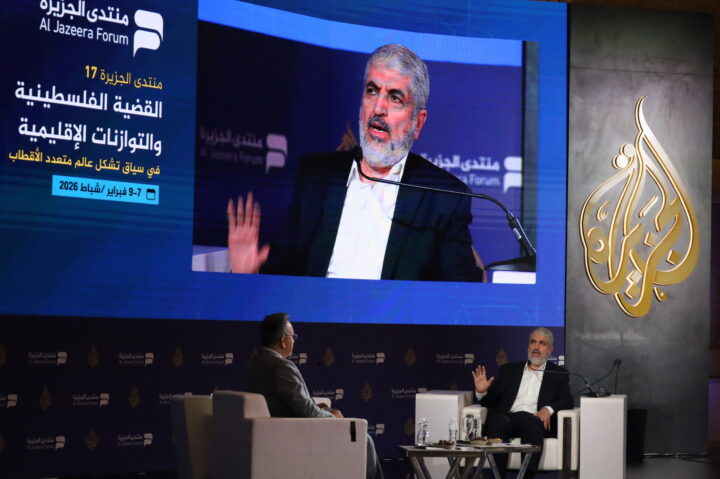
Ali Altunkaya/Anadolu via Getty Images
Hamas leader Khaled Mashaal speaks on the second day of the 17th Al Jazeera Forum held in Doha, Qatar on February 8, 2026.
Hamas leader Khaled Mashaal addressed Qatar’s 17th Al Jazeera Forum on Sunday, at a conference that focused heavily on denigrating Israel, while featuring senior officials from Iran and Somalia.
Mashaal applauded the group’s Oct. 7, 2023, attacks on Israel as having “brought the Palestinian cause back to the forefront of the world” and said that Palestinians “take pride” in “resistance,” a euphemism for violence against Israelis. He called to “pursue Israel and establish that it is a pariah entity that is losing its international legitimacy,” noting the “changes in the elites, universities and social networks” against Israel.
The Hamas leader, who resides in Doha, also hailed Qatar’s “honorable role in the [Palestinian] cause.”
Hamas is designated by the U.S., European Union and other countries as a terrorist organization, and Mashaal is wanted in the U.S. for terrorism, murder conspiracy and sanctions evasion relating to his role in planning the Oct. 7 attacks.
Mashaal was listed on the conference’s program and list of speakers in versions of the Al Jazeera Forum website archived by independent researcher Eitan Fischberger, but as of Sunday Mashaal was no longer listed. At the same time, the Al Jazeera Forum X account extensively promoted Mashaal, with 19 posts about the terror leader’s remarks. The account featured two posts about conference keynote speaker Abbas Araghchi, the foreign minister of Iran.
This year’s Al Jazeera Forum theme is “the Palestinian cause and the regional balance of power in the context of an emerging multipolar world.” The conference website suggests that Israel committed a “genocide in Gaza,” and that Israel “has sought to reoccupy Gaza … or establish settlements in it.” It also argues that Israel faces strategic setbacks as a result.
The speakers’ remarks reflected the forum’s hostile position on Israel.
Araghchi lamented a double standard toward “Israeli expansionism,” arguing that “other countries are demanded to disarm, pressured to reduce defensive capacity, punished for scientific advancement … This is not arms control, not non-proliferation, not security. It is enforcement of permanent inequality. Israel must have a military and strategic edge and others must remain vulnerable.”
Araghchi, speaking a day after he led his country’s negotiations with the U.S. in Oman on dismantling its nuclear program, said that it has an “inalienable right to enrich uranium.”
The Iranian foreign minister also said that “Palestine is the defining question of justice … The strategic and moral compass of our region.”
Somali President Hassan Sheikh Mohamud floated the possibility of war with Israel in a pre-conference interview aired on Al Jazeera. He questioned why Israel would want to build a military base “in Somalia,” referring to reports of activity in Somaliland, whose sovereignty Israel recognized in December. He argued a base could only be offensive, ignoring repeated attacks by the Iran-backed Houthis, from nearby Yemen, on Israel.
“Israel is preparing or positioning itself to attack someone else,” he said. “We will fight in our capacity; we will defend ourselves, and that means that we will confront any Israeli forces coming in, because we are against that and we will never allow that.”
Another speaker was Francesca Albanese, the U.N. special rapporteur who has been sanctioned by the U.S. for “infringement on the sovereignty” of Israel and the U.S. by pursuing International Criminal Court prosecutions of citizens of both countries, as Secretary of State Marco Rubio described her actions last year.
Albanese claimed in her remarks, delivered via video, that Israel had committed a premeditated genocide of Palestinians in Gaza, and that all of humanity “now has a common enemy” in Israel.
‘The Prime Minister believes any negotiations must include limitations on ballistic missiles and a halting of the support for the Iranian axis,’ Netanyahu’s office says

Avi Ohayon (GPO) / Handout/Anadolu via Getty Images
Israeli Prime Minister Benjamin Netanyahu makes statements at Ben Gurion Airport ahead of his visit to Washington DC, where he will meet with US President Donald Trump in Tel Aviv, Israel on February 02, 2025.
Israeli Prime Minister Benjamin Netanyahu’s office announced a last-minute trip to Washington on Wednesday to discuss talks between the U.S. and Iran, a day after President Donald Trump praised the negotiations with Tehran.
“The Prime Minister believes any negotiations must include limitations on ballistic missiles and a halting of the support for the Iranian axis,” the statement, sent Saturday night, read.
White House Special Envoy Steve Witkoff and Jared Kushner met with Iranian Foreign Minister Abbas Araghchi in Oman on Friday.
Later Friday, Trump told reporters on Air Force One that the talks had been “very good.”
“Iran looks like it wants to make a deal very badly,” he said. “We have to see what that deal is, but I think Iran wants to make a deal very badly, like they should. Last time, they didn’t want to make a deal, but I think this time they feel differently.”
Asked about Iran’s demand that the talks only be about nuclear weapons, Trump said, “That would be acceptable. One thing, right up front, no nuclear weapons. … They weren’t willing to do that [last year]; now they are willing to do much more.”
The president also said that he is in “no rush” in the negotiations, adding, “If you remember in Venezuela, we waited around for a while.”
Trump indicated that the military threat to Iran still stands: “We have a big armada, a big fleet heading in that direction that will be there soon, so we’ll see how that works out. … If they don’t make a deal, the consequences are very steep.”
Sen. Lindsey Graham (R-SC) expressed skepticism that the negotiations would bring about an acceptable agreement, and called for Congressional review and approval, which the 2015 Iran nuclear deal lacked.
“I hope it can meet our national security objectives and the needs of the people of Iran through diplomacy,” Graham wrote on X. “Given Iran’s behavior regarding deals, it could be a tough sell. However, I am open-minded, understanding [that] any agreement with the Islamic Republic and the United States must come to Congress for review and a vote.”
Meanwhile, in Iran, videos and photos were posted online of Iranians once again protesting the regime using methods other than mass demonstrations, The Wall Street Journal reported, including shouting slogans at funerals, doctors condemning the arrest of colleagues for treating wounded protesters, hosting memorials for wounded protesters and more.
Plus, Massie challenger gets strong GOP backing

Julie Menin, speaker of the New York City Council and Zohran Mamdani, mayor of New York, arrive for an announcement in the Brooklyn borough of New York, US, on Monday, Jan. 12, 2026 (Photographer: John Lamparski/Bloomberg via Getty Images)
Good Thursday afternoon!
This P.M. edition is reserved for our premium subscribers — offering a forward-focused read on what we’re tracking now and what’s coming next.
It’s me again — Danielle Cohen-Kanik, U.S. editor at Jewish Insider and curator, along with assists from my colleagues, of the Daily Overtime. Please don’t hesitate to share your thoughts and feedback by replying to this email.
📡On Our Radar
Notable developments and interesting tidbits we’re tracking
Sen. Bill Cassidy (R-LA), the chairman of the Senate Health, Education, Labor and Pensions Committee, wrote to New York Mayor Zohran Mamdani today voicing “serious concerns” about Mamdani’s “rescission of executive orders related to antisemitism and boycotts of Israel.”
Cassidy said the New York City Department of Education’s $2.2 billion in federal funding could be rescinded “contingent on compliance with federal civil rights laws and applicable executive orders designed to protect students”…
New York City councilmembers on both sides of the aisle denounced a new working group established by employees of the city’s Department of Health on “global oppression,” Jewish Insider’s Will Bredderman reports, which a presenter at its first meeting on Tuesday acknowledged was “really developed in response to the ongoing genocide in Palestine.”
City Council Speaker Julie Menin called for a probe into the working group at DOH, which operates under Mamdani’s administration, telling the New York Post, “Our health care officials should be fighting infectious diseases and addressing skyrocketing health care costs instead of spending public time debating geopolitics”…
Moshe Davis, the former executive director of the Mayor’s Office to Combat Antisemitism in New York City, told The Free Press upon being ousted from the role by Mamdani, “I don’t think the priority of the administration has been to combat antisemitism.”
Davis, who was a political appointee of former Mayor Eric Adams, said a Mamdani staffer told him they were “looking to go in a different direction” in replacing him with Phylisa Wisdom, a progressive Jewish activist. “Look, I’m a loud, proud Jewish person with a kippah on my head, a proud Zionist. This administration maybe felt that was too much for them,” Davis said. He noted that his requests to meet with the mayor and the memos he produced on rising antisemitism in the city had gone ignored…
Mamdani officially endorsed New York Gov. Kathy Hochul in an anticipated move, boosting her reelection prospects while also dealing a blow to her lieutenant governor, Antonio Delgado, who is running to oust Hochul from her left…
Rep. Andy Barr (R-KY) and businessman Nate Morris, two of the leading Republican candidates for Kentucky’s Senate seat, today endorsed Ed Gallrein, the GOP challenger to Rep. Thomas Massie (R-KY), one of the leading Republican critics of Israel in Congress, JI’s Marc Rod reports.
“Ed will never side with AOC or the radical-left against President Trump. He is exactly the kind of conservative warrior we need in Congress, and I’m proud to endorse him,” Barr said in a statement, referencing Massie’s pattern of breaking with various elements of Trump’s agenda, which has included voting against support for Israel.
The endorsements came amid an ongoing series of attacks by Trump on Massie, which included calling Massie a “moron” in remarks at the National Prayer Breakfast this morning, as well as attacks on Truth Social this week targeting Massie’s wife…
Daniel Flesch, a senior policy analyst at the Heritage Foundation who led the drafting of the organization’s Project Esther report on combating left-wing antisemitism, has parted ways with the conservative think tank, according to Heritage’s website.
Flesch had raised the alarm on right-wing antisemitism after Heritage President Kevin Roberts released a video defending Tucker Carlson for hosting neo-Nazi Nick Fuentes on his podcast, telling the Young Jewish Conservatives in December that, “Now, in some ways, the call is coming from inside the house.” Flesch had also been Heritage’s point person for the National Task Force to Combat Antisemitism, a coalition of conservative groups that disaffiliated from the think tank after the incident…
White House Press Secretary Karoline Leavitt confirmed today that Special Envoy Steve Witkoff and Jared Kushner will be traveling to Oman for negotiations with Iran tomorrow, saying at a press conference this afternoon that the president is “standing by for an update from them.”
“The president has obviously been quite clear in his demands of the Iranian regime — zero nuclear capability is something he’s been very explicit about and he wants to see if a deal can be struck. And while these negotiations are taking place, I would remind the Iranian regime that the president has many options at his disposal aside from diplomacy as the commander-in-chief of the most powerful military in the history of the world,” Leavitt added…
Israeli Prime Minister Benjamin Netanyahu told lawmakers at a closed-door meeting of the Knesset Foreign Affairs and Defense Committee that U.S.-Israel coordination is “as high and as close as possible” ahead of the nuclear talks tomorrow, Israeli media reports, but that he still doesn’t know if President Donald Trump will choose to take military action…
Middle East countries that were originally meant to participate in the talks, including Saudi Arabia, Qatar, Egypt, Oman, the UAE and Pakistan, drafted a potential agreement for the U.S. and Iran, including a nonaggression pact, diplomats told The Times of Israel…
Iran’s Islamic Revolutionary Guard Corps seized two foreign oil tankers in the Persian Gulf today, Iranian state media reported, days after attempting to stop and board a U.S.-flagged oil tanker. Reports did not provide the country of origin of the tankers seized today…
Sen. Lindsey Graham (R-SC) expressed frustration with the Lebanese government’s stance toward Hezbollah amid struggling disarmament efforts, describing on X a meeting he’d had with Gen. Rodolphe Haykal, the commander of the Lebanese Armed Forces. “I asked him point blank if he believes Hezbollah is a terrorist organization. He said, ‘No, not in the context of Lebanon.’ With that, I ended the meeting.”
“They have been designated as a foreign terrorist organization by both Republican and Democrat administrations since 1997 — for good reason. As long as this attitude exists from the Lebanese Armed Forces, I don’t think we have a reliable partner in them,” Graham continued. The U.S. has provided over $3 billion to shore up the LAF in the last 20 years, including $230 million approved by the Trump administration as recently as October…
⏩ Tomorrow’s Agenda, Today
An early look at tomorrow’s storylines and schedule to keep you a step ahead
Keep an eye out in Jewish Insider for whether AIPAC’s active role in the New Jersey 11th Congressional District Democratic primary — opposing former Rep. Tom Malinowski (D-NJ) — paid off. Polls in the district close at 8 p.m.
We’ll be watching for readouts from the meeting between White House Special Envoy Steve Witkoff, advisor Jared Kushner and Iranian Foreign Minister Abbas Araghchi in Oman at 10 a.m. local time tomorrow, including whether issues beyond Tehran’s nuclear program are discussed.
We’ll be back in your inbox with the Daily Overtime on Monday. Shabbat Shalom!
Stories You May Have Missed
AI AMBITION
The Israeli-American CFO first fueled Eli Lilly’s success, and is now turning her attention to the tech sector
SURVEY SAYS
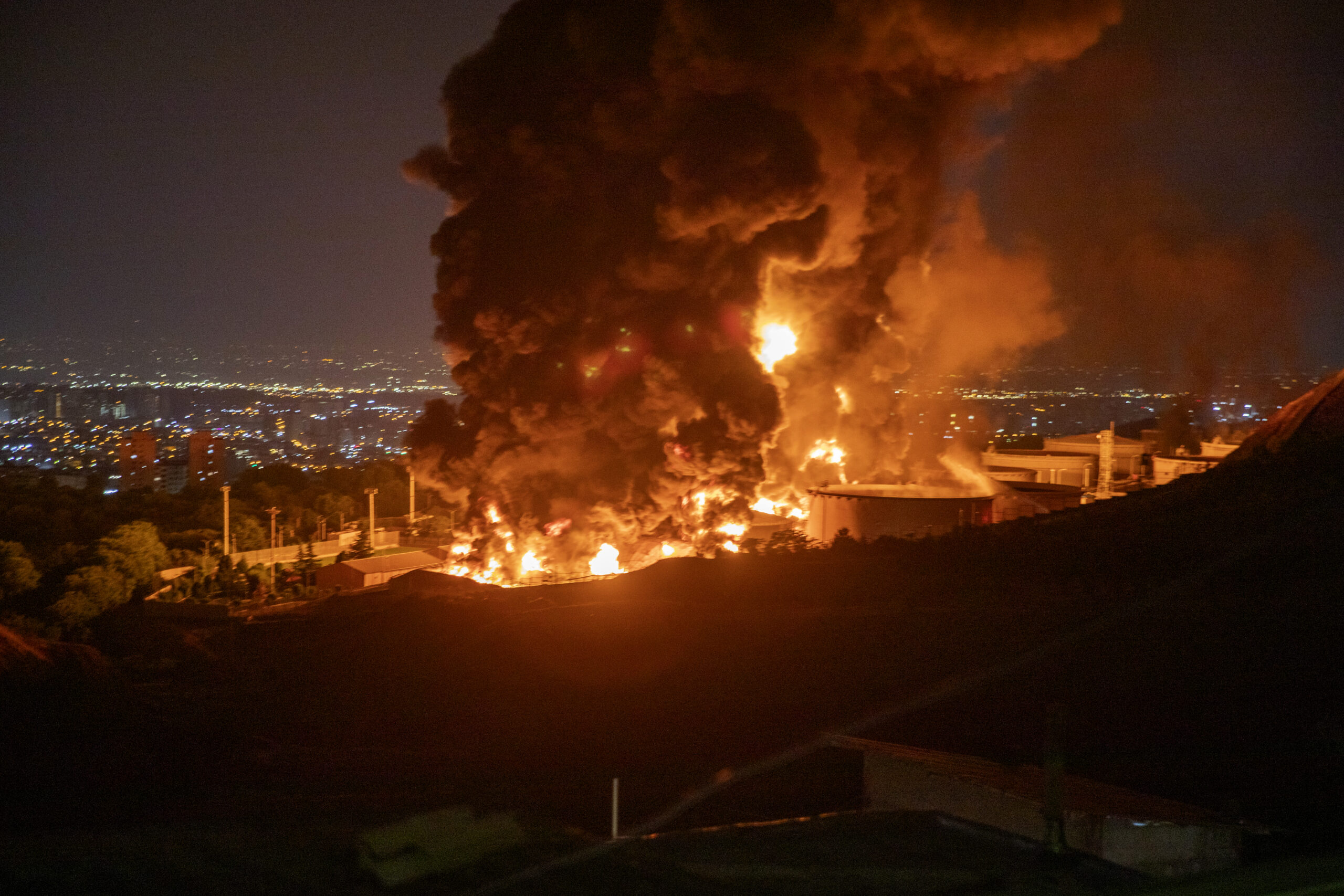
Right-wing Israelis support a strike even if Iran does not attack, while other political camps prefer to wait and see if Iran strikes Israel first, IDI poll finds
The lack of clarity is reason for concern in Jerusalem, where the line on any potential American agreement with Iran has long been zero enrichment, extensive limitations on ballistic missiles and regional proxy activity
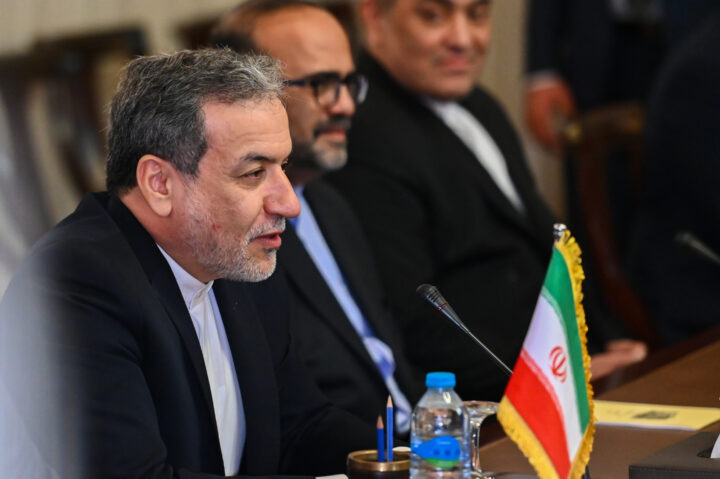
Sayed Hassan/Getty Images
Iran's Foreign Minister Abbas Araghchi meets with his Egyptian counterpart on October 17, 2024 in Cairo, Egypt.
For a brief moment on Wednesday, it looked like Iran talks were off. Tehran wanted to move their location from Turkey to Oman and narrow the scope of the negotiations to its nuclear program. The Trump administration saw this as a bad sign, and anonymous American officials began leaking to the media that Iran wasn’t taking the negotiations seriously.
Secretary of State Marco Rubio acknowledged that the negotiations were uncertain in remarks to the press at the Critical Minerals Ministerial, a conference of 43 foreign and other ministers: “As far as the talks are concerned, I think the Iranians had agreed to a certain format. For whatever reason, it changed … We’ll see if we can get back to the right place. The U.S. is prepared to meet them,” he said.
Meanwhile, President Donald Trump relayed a warning to Iranian Supreme Leader Ali Khamenei in a prerecorded interview with NBC News: “I would say he should be very worried.”
It didn’t take long – just over two hours, to be precise – between the news of the apparent collapse of talks between the U.S. and Iran and Iranian Foreign Minister Abbas Araghchi’s announcement on X that they were back on: “Nuclear talks with the United States are scheduled to be held in Muscat on about 10 am Friday.” Anonymous American sources then confirmed to various media that negotiations were set to take place, after leaders of Arab and Muslim countries urged the Trump administration to give them a chance, despite Iran’s prevarications.
Still, Araghchi’s statement alludes to one of the major reasons that the talks were, briefly, called off: Are they only “nuclear talks” or are they about a range of malign behavior by the Islamic Republic?
The Iranian answer to that question is clear, but the Trump administration sent mixed messages.
The Trump interview with NBC provided few clues. The president expressed support for the protesters against the Iranian regime, saying “we’ve had their back.”
Yet, in a bit of revisionist history, he portrayed his recent threats to Iran as being solely about the nuclear file: “They were thinking of starting a new [nuclear] site in a different part of the country. We found out about it and said, ‘you do that, we’re going to do very bad things to you,'” Trump said. He didn’t mention ballistic missiles in the interview.
Rubio, however, specified that “as far as the topics [of negotiations] and what the agenda needs to be, I think that in order for talks to actually lead to something meaningful, they will have to include certain things, and that includes the range of their ballistic missiles, that includes the sponsorship of terrorist organizations across the region, that includes the nuclear program and that includes the treatment of their own people.”
“Beyond that,” Rubio said, “the president retains a number of options as to how to respond to [the violent crackdown on protesters] and future events.”
Vice President JD Vance told Megyn Kelly that stopping Iran from getting a nuclear weapon was the main concern: “In a perfect world, would I love it if a bunch of freedom-loving Iranians… had a government that was much more friendly to the United States of America? Would that be a good thing? Absolutely.”
“But fundamentally,” he added, “the president has been focused … on this question of ensuring that they don’t get a nuclear weapon. .. I feel 100% confident that even if the Iranians were rushing toward a nuclear weapon, they couldn’t get one during the Trump administration. But we’re not thinking about the next three years; we’re thinking about the next 30 years.”
Vance argued that “global nuclear proliferation” is “the biggest threat to the world,” and as such, Trump is seeking to stop Iran from obtaining nuclear weapons so that other countries in the region do not seek to attain them, as well, and is willing to work with unfriendly countries like Russia and China to achieve that because it is “the most important thing you can do for peace and stability.”
The lack of clarity is reason for concern in Jerusalem, where the line on any potential American agreement with Iran, going back to the Obama-era negotiations, has long been zero enrichment and extensive limitations on ballistic missiles and regional proxy activity.
Israel regarded U.S.-Iran negotiations with deep skepticism even before the latest bumps on the road to Oman, with Israeli Prime Minister Benjamin Netanyahu telling White House Special Envoy Steve Witkoff during his visit to Israel on Tuesday that “Iran proved time after time that its promises cannot be trusted.” Talks that do not include missiles and proxies will likely be viewed with alarm.
Right-wing Israelis support a strike even if Iran does not attack, while other political camps prefer to wait and see if Iran strikes Israel first, IDI poll finds
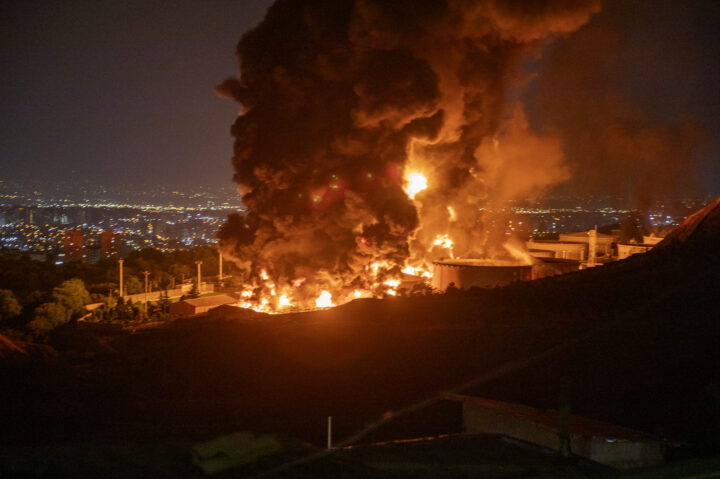
Stringer/Getty Images
Fire and smoke rise into the sky after an Israeli attack on the Shahran oil depot on June 15, 2025 in Tehran, Iran.
Less than half of Israelis support joining an American strike on Iran if Israel is not directly attacked, a poll from the Israel Democracy Institute found this week.
Half of the Israelis polled supported a military response only if Israel is directly attacked by Iran, while 44% backed joining an American strike on Iran even before a potential attack on Israel.
Among Israeli Jews, 46% support intervening only if Iran attacks first, while 48% support involvement regardless.
If those results are further divided between political affiliations, only among Israel’s right does a majority (62%) support joining a preemptive American strike on Iran. On the center-right, 41% support such a scenario, while that number decreases to 35% among centrists, 36% of those polled on the center-left and 31% of respondents who identified as left.
Among Israeli Arabs, 67% would only support an Israeli strike if Iran attacks first.
Israelis are also split over Israeli Prime Minister Benjamin Netanyahu’s announcement that U.S. military aid would be phased out in the coming years. About half (49%) think the change would make Israel less secure, while 39.5% think otherwise.
The Israeli right is less likely to think that bringing U.S. military aid down to zero will be harmful to Israel’s security, with only 30% holding that view, while most on the center-right (56%), center (64%), center-left (72%) and left (72%) hold that view.
Most Israeli Jews (54%) believe that President Donald Trump’s Board of Peace will not “help solve the problems in Gaza while maintaining Israel’s security,” while 37% believe it will. When the results are analyzed by political affiliation, a slight majority of those on the left, center and right all agree the Board of Peace will not help.
Among Israeli Arabs, 42% believe the Board of Peace will help and 34% say it will not; 24% did not know.
IDI conducted the poll on January 25-29 among a sample size of 604 with a margin of error of 3.57%.
The Texas senator has drafted legislation to designate the group as a foreign terrorist organization ‘if there’s no change in their behavior’
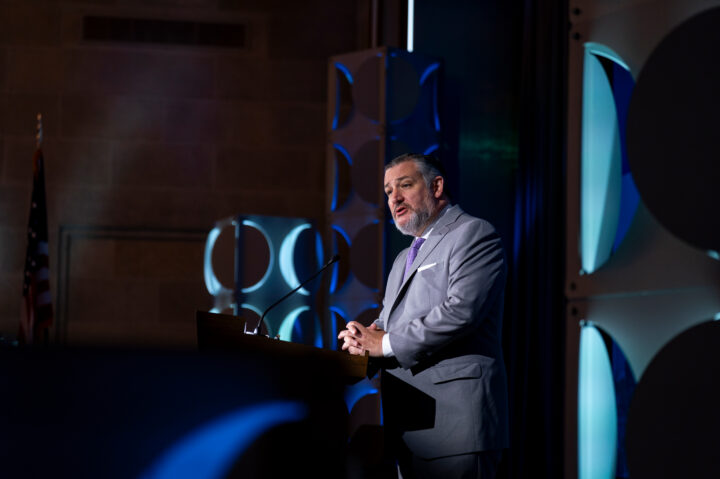
Al Drago/Bloomberg via Getty Images
Sen. Ted Cruz speaks during a U.S. Chamber of Commerce summit in Washington on Sept. 10, 2025.
Sen. Ted Cruz (R-TX) announced on Tuesday that he had drafted legislation designating the Polisario Front, the militant group that claims sovereignty over parts of the Western Sahara, as a foreign terrorist organization and will formally introduce it “if there’s no change in their behavior.”
Cruz made the comments at a Senate Foreign Relations subcommittee hearing focused on U.S. counterterrorism efforts in North Africa, after the hearing’s witnesses — the State Department’s Robert Palladino and Joel Borkert — both declined to agree with his statement that “the terrorist activity in the Sahel [region in Africa] is coming from the Polisario Front.”
“Iran is trying to turn the Polisario Front into the Houthis for West Africa, a proxy force capable of waging war to threaten regional stability and pressure U.S. partners whenever Iran wants leverage,” Cruz said. “The Polisario Front works with Iranian terrorist groups. It takes drones from the IRGC. It moves weapons and resources around the region, including to jihadists and much more.”
“I believe they should be designated as a terrorist group, and I’ve drafted a bill to do so if there’s no change in their behavior,” he added.
The Polisario Front is a separatist militant group founded in 1973 to fight against the Spanish occupation of parts of the Western Sahara. After Spain handed control of the territory to Mauritania and Morocco in 1975, splitting the land between the two countries, the PF waged war against both nations, hitting military and civilian targets while demanding recognition of Sahrawi ethnic group’s claims to the territory. The group declared in 1976 that all disputed territory in the region was part of the Sahrawi Arab Democratic Republic, and currently controls an area east of the Moroccan Wall.
Mauritania, now an Islamic republic, fell to the PF and formally recognized the SADR in 1979. While Morocco and the PF agreed to a United Nations-brokered ceasefire in 1991 that remains in effect today, the PF’s increasingly close ties to Algeria, Nigeria and Iran while governing the disputed Saharan territory have become a source of concern to those opposed to Tehran’s growing influence in the region.
President Donald Trump recognized Morocco’s claim to the Western Sahara in late 2020 at the conclusion of his first administration, as part of the deal brokered for Morocco to join the Abraham Accords.
Rep. Joe Wilson (R-SC) introduced legislation designating the PF as a foreign terrorist organization last June. The House bill has been co-sponsored by Reps. Randy Fine (R-FL), Jimmy Panetta (D-CA), Mario Diaz-Balart (R-FL), Jefferson Shreve (R-IN) and Lance Gooden (R-TX).
Speaking on his “Verdict with Ted Cruz” podcast on Tuesday evening, the Texas senator described Africa as a “major front for radical Islamic terrorism” and said the continent serves as “a major battleground” pitting Russia and China against the United States.
Regarding the PF, Cruz noted that, “The best way to understand it is as a Cold War relic, analogous to the Palestinian Liberation Front, the PLO, but it was in West Africa, and there’s still a degree to which that framework is accurate.”
“It is a darling of the international left and the United Nations, and the group has continued its insurgency against Morocco,” Cruz explained. “The critical dynamic is that Iran has begun pouring resources into the group. … The Iranians have been providing money and weapons and directions.”
Palladino, a senior bureau official with the Bureau of Near Eastern Affairs, said in his opening remarks to the committee that the Trump administration was looking “to North African countries to provide critical support to ensuring terrorist activity in the Sahel does not spread west to the Gulf of Guinea or north to regain a foothold in North Africa, where they represent a more immediate threat to the United States and our interests.”
After Cruz pressed him on if he was referring to the PF, Palladino did not answer directly, instead telling the Texas senator that “President Trump has made clear his desire to achieve a lasting resolution to the problem in the Western Sahara, to that dispute, and as part of that American policy currently, we are engaging all parties.”
Cruz went on to ask Palladino if he believed the PF posed a threat to U.S. interests, to which the NEA official replied, “We’re actively engaging all parties in the Western Sahara dispute in the interest of achieving a lasting and durable peace. That’s the policy of the president. We’re seeking more time to continue to find a way to find common ground and to come to an agreement to stabilize the situation and allow there to be prosperity to follow based upon stability.”
The Texas senator told Palladino that his answers were “positively Shakespearean. It was full of sound and fury and yet signifying nothing.”
Cruz then turned to Borkert, the deputy coordinator for programs and military coordination at the Bureau of Counterterrorism, who similarly declined to single out the PF by name.
“We continue to monitor activities throughout North Africa,” Borkert said. “We continue to see the IRGC and Hezbollah, their activities in that region and globally, and as we look at these activities, we will work with our partner countries in order to counter those threats, and where possible, designate or encourage those countries to designate the IRGC, Hezbollah and those terrorist groups.”
Both men told Cruz that they were not instructed to exclude mentions of the PF in their testimony. Cruz later revealed he did not believe their claims.
“I believe both witnesses were instructed: Do not say a negative word about the Polisario Front,” Cruz said on his podcast that evening. “They were instructed to say nothing about the Polisario Front.”
“The administration is trying to negotiate a big peace deal in Africa. There are folks in the administration who are trying to negotiate a deal in Western Africa, and right now, one of the consequences of that is that they’re reluctant to call out the Polisario Front,” he explained. “I think the Polisario Front is really dangerous. They’re funded by Iran, and so I’m working to call out people who are enemies of America and to impose real costs and consequences on those jihadists that are enemies of America.”
Ahead of nuclear negotiations, the president said the U.S. discovered Iranian officials were ‘thinking about starting a new site in a different part of the country’
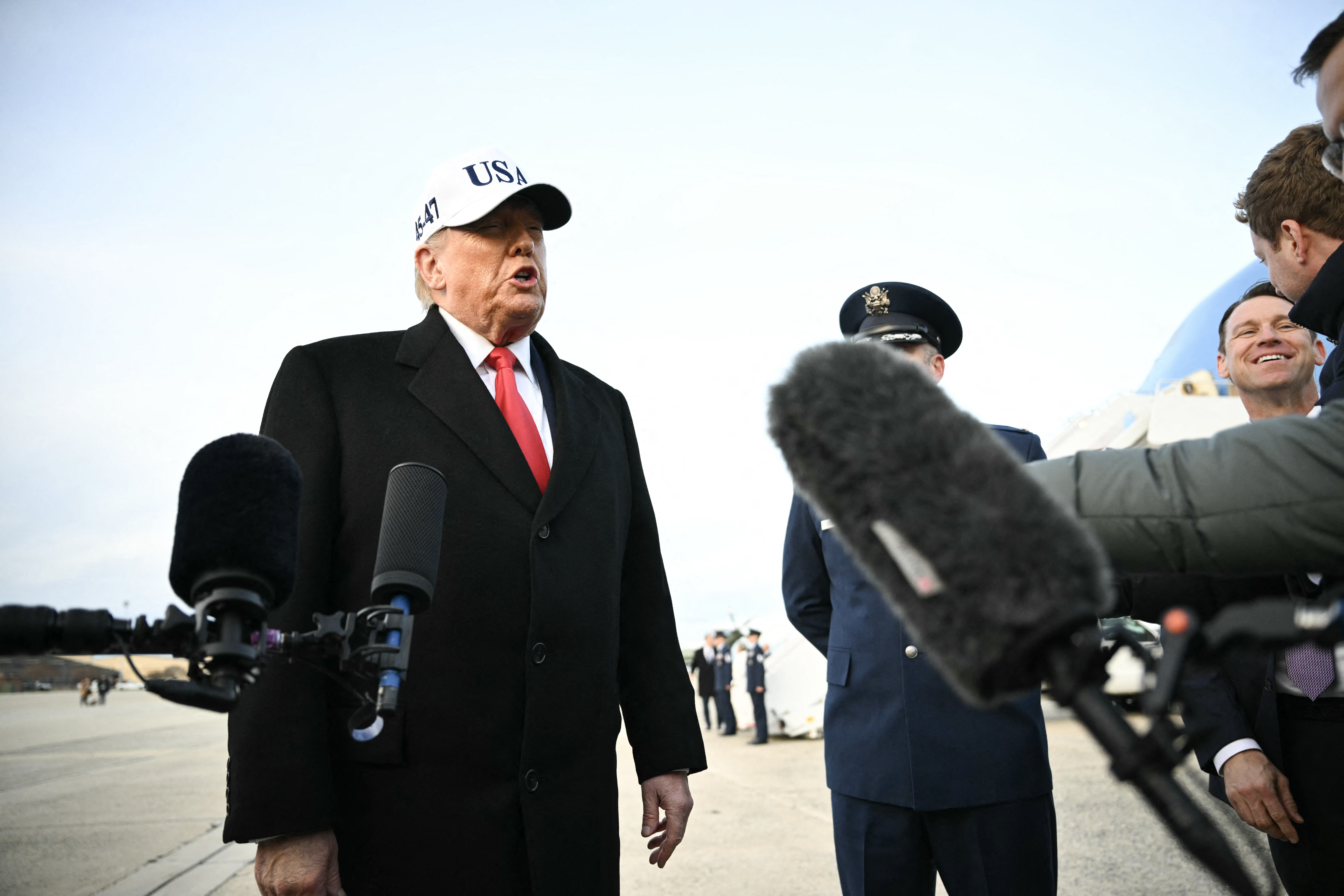
Mandel NGAN / AFP via Getty Images
President Donald Trump speaks to the press upon returning to Joint Base Andrews in Maryland on January 13, 2026.
President Donald Trump on Wednesday warned Iranian Supreme Leader Ayatollah Ali Khamenei that he should be “very worried” ahead of planned nuclear talks, as the president weighs military action amid rising tensions and signs Tehran may be trying to revive its nuclear program.
“I would say he should be very worried, yeah, he should be,” Trump told NBC News when asked whether Khamenei should be concerned. “As you know, they are negotiating with us.”
U.S. and Iranian officials are slated to meet Friday in Oman, which Iranian Foreign Minister Abbas Araghchi confirmed Wednesday. Iran pushed for the discussions to be moved from Turkey and has insisted they remain limited to its nuclear program. The United States has sought to broaden the agenda to include Tehran’s ballistic missile capabilities and support for regional proxy groups.
Experts told Jewish Insider that despite upcoming discussions, military intervention remains on the table. On Tuesday a U.S. F-35 fighter jet shot down an Iranian drone near the USS Abraham Lincoln in the Arabian Sea. Later that day, Iran’s Islamic Revolutionary Guard Corps attempted to stop and board a U.S.-flagged commercial tanker in the Strait of Hormuz before a U.S. destroyer intervened and escorted the vessel to safety.
During an interview on the Megyn Kelly Show, Vice President JD Vance said Wednesday that Trump “will try to achieve what he can through non-military means, but if he feels that the military option is the only option, he is going to choose that option.”
Several Arab and Muslim leaders reportedly lobbied the Trump administration not to walk away from the discussions after Iran demanded to change the venue and format. The administration “told the Arabs we will do the meeting if they insist,” one U.S. official told Axios, but added that they are “very skeptical.”
Satellite images released last week by Planet Labs PBC have also fueled speculation over whether Iran intends to restart its nuclear program after U.S. strikes on several sites in June. Trump confirmed that Iran was “thinking about starting a new site in a different part of the country,” but said the U.S. “found out about it.”
“I said, ‘You do that, we’re going to do very bad things to you,’” Trump warned, stating that in the event Iran continued to pursue its nuclear ambitions, the U.S. would respond as it did before. “If they do, we’re going to send” B-2 bombers “right back and do the job again.”
Last month the president had cancelled meetings with Iranian officials and vowed on social media that Tehran would “pay a big price” for its violent crackdown on protesters in early January, stating that “help is on its way.”
When pressed on whether the U.S. continues to back Iranian protesters, Trump said the administration’s position has not changed.
“We’ve had their backs,” said Trump. “If we didn’t take out” Iran’s nuclear sites, “we wouldn’t have peace in the Middle East, because the Arab countries could have never done that.”
Plus, Israel continues to cast doubt over Iran talks
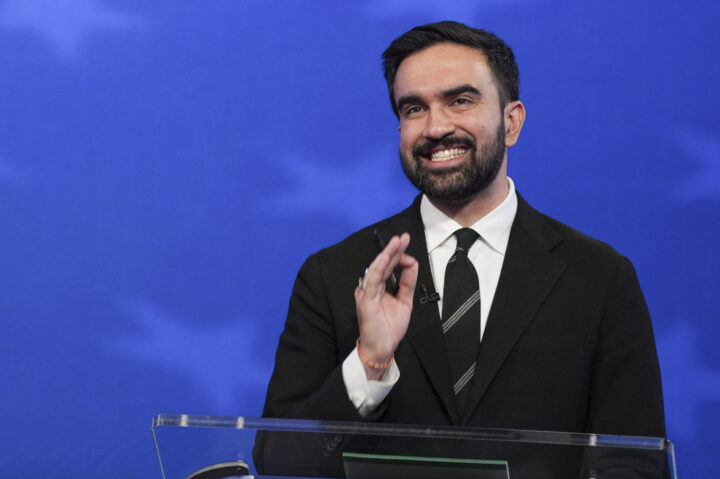
Angelina Katsanis-Pool/Getty Images
Democratic mayoral nominee Zohran Mamdani speaks during a mayoral debate at Rockefeller Center on October 16, 2025 in New York City.
Good Wednesday afternoon!
This P.M. edition is reserved for our premium subscribers — offering a forward-focused read on what we’re tracking now and what’s coming next.
It’s me again — Danielle Cohen-Kanik, U.S. editor at Jewish Insider and curator, along with assists from my colleagues, of the Daily Overtime. Please don’t hesitate to share your thoughts and feedback by replying to this email.
📡On Our Radar
Notable developments and interesting tidbits we’re tracking
U.S. officials reportedly backtracked on their rejection of Iranian demands to change the format and venue of nuclear negotiations, set for Friday, after several Middle East leaders intervened to keep the U.S. from walking away, according to Axios. “They asked us to keep the meeting and listen to what the Iranians have to say. We have told the Arabs that we will do the meeting if they insist. But we are very skeptical,” one U.S. official told the outlet.
Iranian Foreign Minister Abbas Araghchi confirmed on X that “nuclear talks … are scheduled to be held in Muscat” at 10 a.m. on Friday, indicating the U.S. agreed to move the venue from Turkey to Oman…
But Secretary of State Marco Rubio reiterated today that the Trump administration is seeking a comprehensive deal with Iran to address more than just its pursuit of nuclear weapons — including its ballistic missiles program, support for terror proxies and internal repression as well. Iran has traditionally been resistant to discussing anything beyond its nuclear program.
Asked if Iranian Supreme Leader Ayatollah Ali Khamenei should be worried right now, President Donald Trump told NBC News today, “I would say he should be very worried, yeah, he should be.” Trump said he was interested in negotiations again as he understood Iranian officials were considering restarting their nuclear program, “and if they do, we’re going to send” B-2 bombers “right back to do their job again,” referencing the U.S.’ June strikes…
Israeli officials have voiced skepticism over the prudence of negotiating with Iran at all, Jewish Insider’s Lahav Harkov reports. After Israeli Prime Minister Benjamin Netanyahu told White House Special Envoy Steve Witkoff yesterday that Iran’s “promises cannot be trusted,” Energy Minister Eli Cohen told Israeli radio, “Our message to the U.S. is that negotiations with Iran are a waste of time”…
Sam Brownback, the former U.S. ambassador at large for international religious freedom and a former GOP senator from Kansas, warned at a House Foreign Affairs Committee hearing today that, unless Syrian minority groups are allowed to maintain their own security forces, they face a likely genocide by government-aligned forces, JI’s Marc Rod reports.
“The new administration in Syria is purging religious minorities, threatening and killing them,” Brownback said. “These groups must be allowed to maintain their own security forces, or I guarantee you today, a genocide will happen in Syria like happened in Iraq to the Yazidis and Christians.”
The Trump administration has remained largely supportive of the al-Sharaa government, and critics have accused the White House of essentially abandoning the U.S.’ longtime Kurdish allies to the Syrian government onslaught…
First Lady Melania Trump welcomed freed Israeli hostages Aviva and Keith Siegel to the White House today, JI’s Gabby Deutch reports, one year after Aviva met the first lady for the first time and pleaded for help in securing her husband’s release.
“Aviva is a warrior. She’s a warrior. She was fighting very hard for Keith, and I know he suffered a lot,” Trump said at the meeting. “I’m happy to see you healthy at home with your children, with your grandchildren, with your family, and I know you’re giving back your time, your energy, to other people”…
New York City Mayor Zohran Mamdani tapped Phylisa Wisdom, the executive director of the progressive group New York Jewish Agenda, to lead the Mayor’s Office to Combat Antisemitism, the Forward reports.
Wisdom told JI last month that tackling the “scourge of antisemitism” in the city will require a comprehensive strategy,” noting that the office she will now lead “can play a key role, coordinating between long-standing offices and agencies tasked with combating hate, and input from the diversity of New York’s Jewish community.”
The appointment of the left-wing activist indicates Mamdani’s administration isn’t looking to placate the mainstream Jewish community. Wisdom, while well-known in the New York Jewish community, has traditionally opposed the International Holocaust Remembrance Alliance’s working definition of antisemitism and at times vocally opposed Israel’s war in Gaza after the Oct. 7 attacks…
Meanwhile, New York Gov. Kathy Hochul selected former New York City Council Speaker Adrienne Adams as her running mate in her reelection race this year — a pick that provoked both applause and consternation among leaders of the state’s Jewish community, JI’s Will Bredderman reports.
Adams was the first council speaker not to lead a delegation to Israel — although she denied that she was boycotting the country, she raised concerns in 2024 when her office drafted an ultimately abandoned resolution urging a ceasefire between Israel and Hamas that one Jewish community leader described to JI as “one-sided” and “inflammatory”…
A pair of well-financed groups, whose origin is currently unknown, is set to begin running ads boosting moderate pro-Israel candidates in a series of open House seats in Chicago, each of whom is facing off against vocal anti-Israel opponents, JI’s Marc Rod reports.
The ads — being run by newly formed super PACs Elect Chicago Women and Affordable Chicago Now — boost state Sen. Laura Fine, running in the 9th Congressional District, former Rep. Melissa Bean (D-IL), running in the 8th District and Cook County Commissioner Donna Miller, running in the 2nd District.
The ad buys for the two groups add up to millions of dollars across the three races. Given that the groups were just launched, FEC filing policies will not require them to disclose their donors until close to Election Day. But the ads, which do not focus on Israel policy, are widely rumored to be connected to United Democracy Project, the AIPAC-affiliated super PAC…
PEN America, an organization promoting free expression for artists and journalists, said today it would retract its Jan. 29 statement expressing concern about the abrupt cancellation of Israeli comedian Guy Hochman’s shows in New York and Los Angeles. The organization, which alleged Hochman “has been accused by advocacy organizations of incitement to genocide in Gaza,” said it would “remain committed to open and respectful dialogue about the divisions that arise in the course of defending free expression”…
The Washington Post announced mass layoffs of one-third of its staff today, including closing its sports section, reducing its local coverage and letting go all of its Middle East correspondents. The outlet has faced repeated criticism for major factual errors and alleged institutional and reporter bias related to its coverage of Israel and the war in Gaza…
⏩ Tomorrow’s Agenda, Today
An early look at tomorrow’s storylines and schedule to keep you a step ahead
Keep an eye out in Jewish Insider for a profile of Alphabet’s Israeli-American chief financial officer, Anat Ashkenazi, who got her start at Israel’s Bank Hapoalim more than two decades ago.
It’s primary day in New Jersey’s 11th Congressional District, as candidates vie for the Democratic nomination to fill Gov. Mikie Sherrill’s House seat. The race has attracted attention for the more than $2 million the AIPAC-linked super PAC United Democracy Project has spent targeting former Rep. Tom Malinowski (D-NJ), who is attempting to beat out others including Lt. Gov. Tahesha Way, far-left activist Analilia Mejia and Essex County Commissioner Brendan Gill.
The Hudson Institute will host Rabbi Yehuda Kaploun, the special envoy to monitor and combat antisemitism, for a conversation on the Trump administration’s strategy in confronting the rise of antisemitism.
Stories You May Have Missed
UNDER SCRUTINY

‘Just because someone is a hateful antisemitic looney-tune doesn’t mean they can’t win office,’ one Jewish community activist said of Shelly Arnoldi
SCHOOL OF THOUGHT

Ben Shuldiner, who is Jewish, is bringing his progressive politics to a school district facing a spike in antisemitism
With negotiations taking place this week, the secretary of state said any agreement would have to address Iran’s missile program, support for proxy terror groups and internal repression, in addition to the nuclear issue
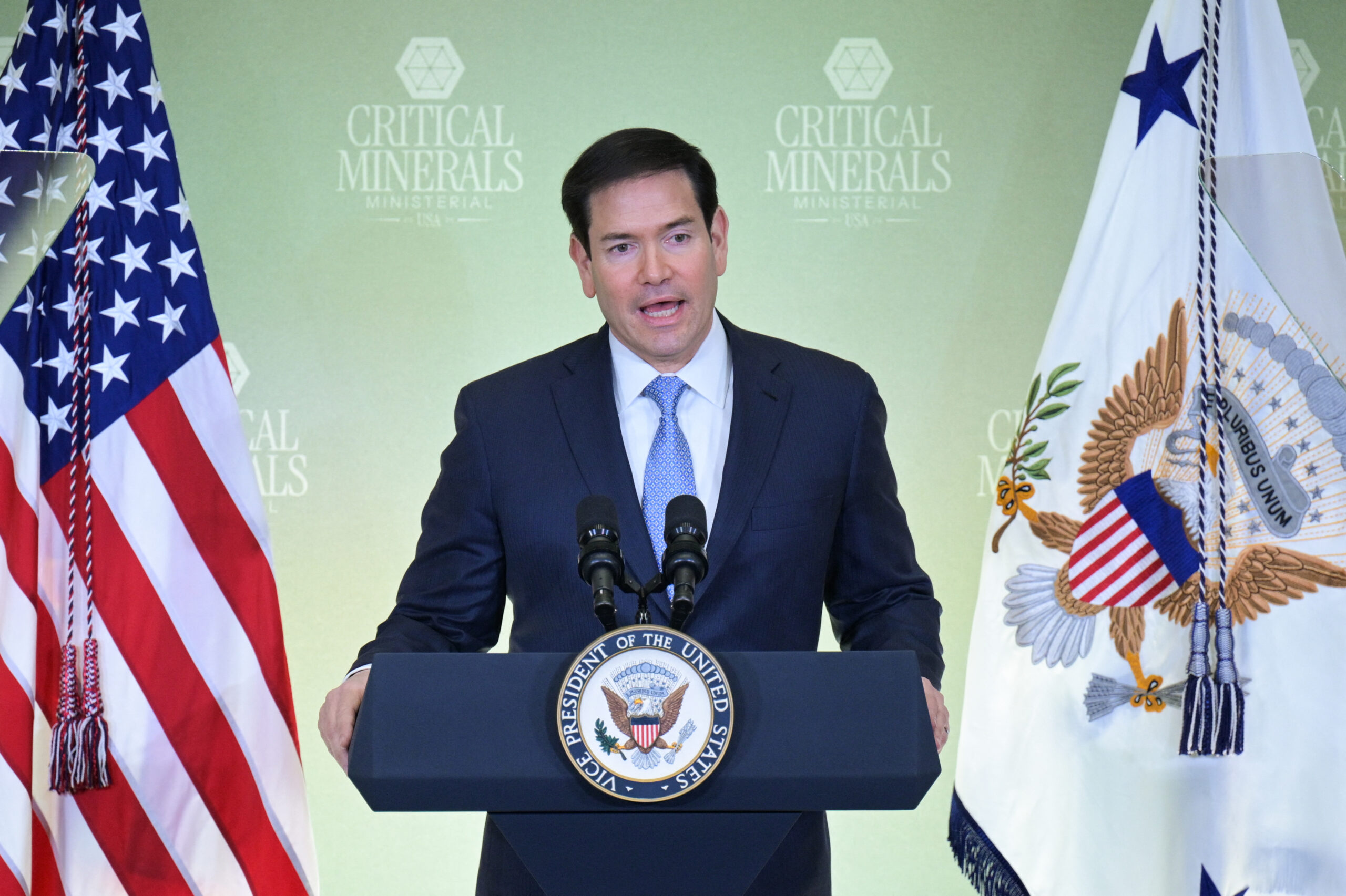
Oliver Contreras / AFP via Getty Images
Secretary of State Marco Rubio speaks during the inaugural Critical Minerals Ministerial meeting at the Sate Department in Washington, DC, on February 4, 2026.
Secretary of State Marco Rubio outlined on Wednesday what the Trump administration views as the minimum requirements for successful nuclear negotiations with Iran, insisting that any deal with Tehran be comprehensive and address its ballistic missile capabilities, support for regional terrorism and repression of its people, in addition to the nuclear issue.
“In order for talks to actually lead to something meaningful, they will have to include certain things,” Rubio said during his remarks at an event on critical minerals supply chains, which Israeli Foreign Minister Gideon Sa’ar attended. “That includes the range of their ballistic missiles, that includes their sponsorship of terrorist organizations across the region, that includes the nuclear program and that includes the treatment of their own people.”
U.S. and Iranian officials are expected to meet Friday for talks aimed at negotiating a new nuclear agreement, with Iranian Foreign Minister Abbas Araghchi and White House Special Envoy Steve Witkoff leading the delegations. While Iran has insisted the discussions be limited strictly to its nuclear program, the United States has pushed to include Tehran’s ballistic missile capabilities and support for regional proxy groups.
Iran has also demanded that the meeting location be moved from Turkey to Oman and that talks take place in a strictly bilateral format, excluding Arab mediators. Rubio acknowledged the shift on Wednesday, saying Washington remains prepared to engage despite the uncertainty.
“The Iranians had agreed to a certain format and for whatever reasons changed in their system,” Rubio said. “We’ll see if we can get back to the right place, but the United States is prepared to meet with them.”
The diplomatic maneuvering has unfolded against a backdrop of heightened military tensions between the two parties in recent days. On Tuesday, a U.S. F-35 fighter jet shot down an Iranian drone aggressively approaching the USS Abraham Lincoln aircraft carrier in the Arabian Sea.
Later that day, Iran’s Islamic Revolutionary Guard Corps (IRGC) deployed two fast-attack boats and a drone towards a U.S.-flagged commercial tanker, the Stena Imperative, in the Strait of Hormuz. U.S. officials said the IRGC appeared to be attempting to potentially seize the vessel before a U.S. missile destroyer intervened and escorted the tanker out of the area.
Israel has voiced skepticism over the prospects of renewed talks. During White House envoy Steve Witkoff’s visit to Israel on Tuesday, Prime Minister Benjamin Netanyahu told him that “Iran proved time after time that its promises cannot be trusted,” according to a statement from the Prime Minister’s Office.
Experts have also questioned whether negotiations with Tehran could lead to a meaningful outcome. Andrea Stricker, a research fellow at the Foundation for Defense of Democracies, previously told Jewish Insider that the Trump administration’s demands that Iran abandon its nuclear program, cap its missile program, halt support for regional proxies and terrorism and stop executing its people are “nonstarters for the regime.”
Should negotiations falter, experts have warned that U.S. military action against Iran remains a possibility. Rubio said that President Donald Trump retains “a number of options” for responding to “future events.”
Rubio also touched on what he described as fundamental differences between the despotic Iranian regime and the Iranian people, underscoring that Washington’s strategy is focused on confronting the regime rather than civilians.
“I remind everybody what I’ve been saying through my entire career in public service: the Iranian people and the Iranian regime are very unalike,” Rubio said. “This is a culture with deep history. I know of no other country where there’s a bigger difference between the people that lead the country and the people who live there.”
He added that the regime’s priorities remain a central obstacle to improving living conditions for Iranians.
“One of the reasons why the Iranian regime cannot provide the people of Iran the quality of life that they deserve is because they’re spending all their money,” Rubio said. “They’re spending all their resources, of what is a rich country, sponsoring terrorism, sponsoring all these proxy groups around the world, exporting, as they call it, a revolution.”
"Iran proved time after time that its promises cannot be trusted," Netanyahu told Witkoff in Jerusalem meeting
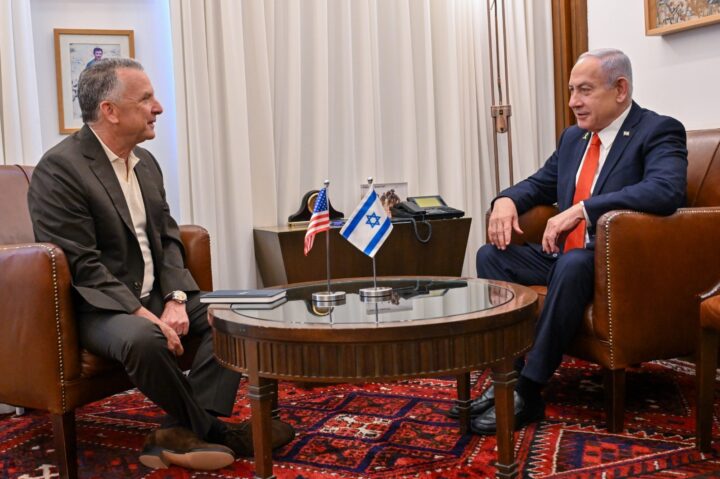
Kobi Gideon (GPO)
Prime Minister Benjamin Netanyahu, meeting in his office with US Special Presidential Envoy to the Middle East Steve Witkoff (Kobi Gideon (GPO)
There are few things that Ha’aretz and the pro-Netanyahu Channel 14 agree on, but with American and Iranian officials set to meet for nuclear talks on Friday, there was near wall-to-wall agreement in Israel that the talks are unlikely to bring positive results.
Israeli Prime Minister Benjamin Netanyahu told White House Special Envoy Steve Witkoff during his visit to Israel on Tuesday that “Iran proved time after time that its promises cannot be trusted,” according to a statement from the Prime Minister’s Office.
An Israeli military source told Channel 14 that Netanyahu also warned Witkoff that Iran wants to use the negotiations to “kill time … to transfer offensive weapons to hiding places.”
Witkoff, along with Jared Kushner, are set to represent the U.S. in the talks, which were originally set to be held in Turkey but have reportedly been moved to Oman, and Iranian Foreign Minister Abbas Araghchi is expected to lead his country’s negotiating team. Iran has also demanded that the negotiations be limited to its nuclear program, while the U.S. seeks to curb Tehran’s ballistic missile program and support for regional proxies.
Hours after Witkoff met with Netanyahu on Tuesday, Iran launched a drone at the USS Abraham Lincoln, which the military shot down, and a U.S. ship escaped an Iranian attempt to stop it at sea.
Jerusalem eyed the move toward negotiations with Iran with skepticism.
Israeli Energy Minister Eli Cohen, a member of the Security Cabinet, said on Wednesday, “Let’s admit the truth. There is no value to a diplomatic agreement with Iran.”
“Iran has never kept any of its commitments, and even if it agrees to something, it’ll be a hudna [Arabic for a temporary ceasefire] until Trump is out of office,” Cohen told Israel’s 103FM.
Cohen said that “Trump is a businessman who wants the bottom line, and therefore he is taking his time to bring it. Our message to the U.S. is that negotiations with Iran are a waste of time.”
Cohen argued that it is in the interest of the region to see the Islamic Republic fall: “Saudi Arabia, Bahrain, the UAE and Azerbaijan told the U.S. ‘don’t attack Iran’ out of fear. It’s clearly lip service.”
Ehud Ya’ari, the in-house Middle East analyst for Israel’s Channel 12, wrote in an article published Wednesday that the talks will try to reach “an interim arrangement that will relieve the tension without solving the problems.”
“A move like this is not a good enough solution for Israel,” Ya’ari wrote. “An interim agreement means freezing problems, not solving them.”
At the same time, Ya’ari argued that a broader agreement that will satisfy both Trump and Iranian Supreme Leader Ali Khamenei is impossible, though an interim agreement will also be challenging.
Tamir Hayman, director of the Institute for National Security Studies at Tel Aviv University and former IDF intelligence chief, told Ha’aretz‘s Hebrew podcast “The Week” that “anything is better than an agreement with Iran. …Israel does not want an agreement.”
“Israel does not want any nuclear program at all, zero enrichment,” Hayman said. “We’ll want limits to missile manufacturing and the export of terror to the Middle East export of arms. … My concern in light of past statements by Witkoff is that … he’s only dealing with nuclear and for him, any compromise on enrichment [is acceptable].”
Hayman argued that “you can’t bring down a regime that you are negotiating with…Any agreement they reach is a lifeline for the regime.”
However, he added, “even without an attack, [the mullahs] will fall in the end,” citing the tens of thousands of protesters killed and Iranian leadership’s inability to save the country’s collapsing economy.
Hayman said he used to be opposed to “managing the conflict,” but now he believes that the current situation, in which Iran there is a domestic political and economic crisis and no centrifuges are spinning in Iran, “could be good and increase the chances that it will awaken something inside [Iran].”
Meanwhile, Israelis continued to live under the shadow of threats from Iran’s regime, after over a month of concern that Iran may retaliate for an American strike by attacking Israel. The ad for the latest episode of Eretz Nehederet, Israel’s answer to SNL, opened with host Eyal Kitzis looking bored in the studio with ticking clocks behind him and the message: “So, we are still waiting for Iran to attack.”
Washington Institute expert witnesses argue that the U.S. should condition security assistance to Lebanon on further progress in disarming Hezbollah
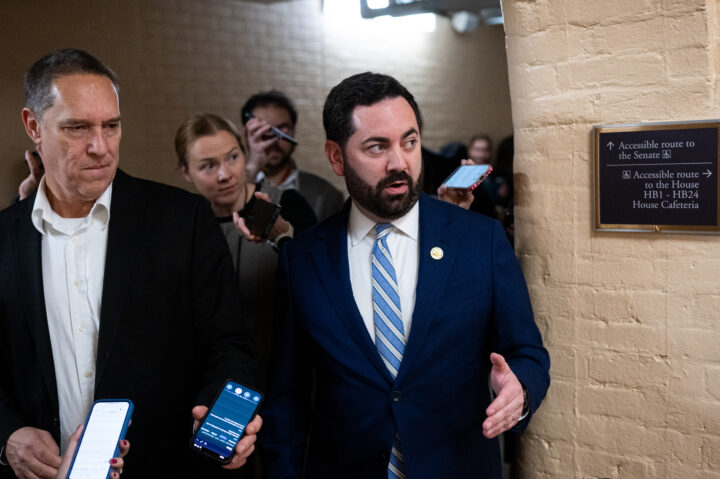
Bill Clark/CQ-Roll Call, Inc via Getty Images
Rep. Mike Lawler (R-NY) speaks to reporters as he leaves the House Republican Conference meeting in the U.S. Capitol on December 10, 2025.
Lawmakers and expert witnesses at a House Foreign Affairs Committee subcommittee hearing on Tuesday highlighted the ongoing challenges and delays in the disarming of Hezbollah in southern Lebanon, but also argued that there is tremendous opportunity in the country if Hezbollah’s influence can be defeated — including potential moves in the near term toward normalization with Israel.
“Right now, we have the chance to help this government break free of the shackles of Iran’s malign influence. Hezbollah’s influence is vastly diminished thanks in large part to decisive Israeli action. But difficult choices now need to be made to permanently block Hezbollah’s path to power,” Rep. Mike Lawler (R-NY), the Middle East subcommittee chair, said in his opening statement.
He said that the Lebanese Armed Forces have made strides in disarming Hezbollah but the ceasefire plan’s implementation “has been haphazard at best,” also emphasizing the ongoing economic difficulties and widespread corruption that continue to plague the country and provide Hezbollah and its Iranian backers opportunities to rebuild.
Lawler also emphasized that significant reforms are needed, particularly in southern Lebanon, to ensure that the same corrupt systems that allowed Hezbollah to flourish do not return. In the long term, Lawler said that he hopes to see Lebanon become a “true partner” in the region and normalize its relationship with Israel.
Rep. Brad Sherman (D-CA), the ranking member, said that there is a “historic opportunity” in Lebanon but “[t]hat window of opportunity, however, is narrow. Hezbollah is working hard to rebuild, rearm and to reconstitute itself as a major terrorist organization.”
Sherman accused the Trump administration of a “lack of urgency and a lack of the necessary support” to groups working to counter Hezbollah in the country, particularly following cuts to foreign assistance.
He said that comments by the Trump administration “have often sent the wrong signals, particularly when Special Envoy Tom Barrack downplayed Hezbollah and described it as a political party that also has a — let me quote him exactly — ‘a political party that also has a militant aspect to it,’” Sherman continued.
During the hearing, expert witnesses, all from The Washington Institute for Near East Policy, warned that the disarmament process is not proceeding smoothly or entirely as expected. All three agreed that the U.S. should condition security assistance to Lebanon on progress in disarming Hezbollah, among other steps. And they each said the U.S. should ramp up its sanctions efforts, targeting Hezbollah and malign actors in the Lebanese government.
David Schenker, a senior fellow at The Washington Institute and former Trump administration official, emphasized that the Lebanese Armed Forces (LAF) are encountering ongoing obstacles including Hezbollah’s use of human shields, a lack of political will, ongoing Hezbollah penetration of the LAF, ongoing LAF deference to Hezbollah and threats to LAF forces’ safety.
He said the Lebanese government has not deployed as many troops to southern Lebanon to carry out the disarmament mission as it had promised.
Hanin Ghaddar, a senior fellow at The Washington Institute and longtime Lebanese journalist, said that the lack of a concrete timeline for disarmament “has produced a de facto freeze,” in which neither the LAF nor Hezbollah are moving forward. She called for outside pressure, including conditions on U.S. aid, to pressure the LAF into continuing with its obligations to disarm Hezbollah.
Dana Stroul, the research director at The Washington Institute and a former Biden administration official, said that defanging Hezbollah requires not only disarming the group but also “addressing the political, social and economic system within which Hezbollah has thrived.” She called for expanded U.S. engagement in the country outside of the security realm.
Stroul, differing from the other witnesses, argued that the U.S. should offer reconstruction assistance — in addition to military aid — to offset the unconditional aid flowing in from Qatar and Turkey and ensure oversight and safeguards. She said that waiting to contribute to reconstruction efforts until after disarmament is complete risks locking the U.S. out of the process and preventing it from enforcing its own conditions.
Schenker argued that the current “division of labor” between the LAF and Israel, which maintains positions inside Lebanon and continues to carry out strikes on Hezbollah outposts, should continue pending further LAF progress. He said that many in the LAF are quietly “very pleased” about the Israeli action, in contrast with their public protests.
In spite of the ongoing issues, the witnesses said that the new Lebanese government is an improvement over previous ones and that there are people within the Lebanese government with whom the U.S. can work and who are making real strides. The witnesses noted that other regional and global developments are also depriving Hezbollah of its key allies.
Schenker and Ghaddar said that, if the Iranian regime were to fall, Hezbollah would be significantly weakened, though Schenker warned that it would not fully disappear due to its various money-generating ventures inside Lebanon and foreign supporters.
The witnesses said that Lebanese normalization with Israel could be achievable.
“Peace between Lebanon and Israel is not separate from this effort, it is what sustains it,” Ghaddar said, adding that such an outcome is “closer than many may assume” but only with a forceful U.S. policy approach. She said that “peace is no longer taboo” and that the “Lebanese street is ready” for such a step. She said that the peace process should begin immediately.
“Peace raises the political cost of re-armament, strengthens state legitimacy, unlocks economic recovery and deprives Hezbollah of its core justification. Without a credible peace horizon, disarmament and economic reform will be temporary,” Ghaddar continued. “With one, they become structural.”
She said that the U.S. should focus on eroding the Lebanese anti-normalization law by offering incentives to not enforce the law, and sanctioning those involved in its enforcement. She also called for continued discussions on economic cooperation between Lebanon and Israel.
Stroul similarly said that a Lebanese government publicly considering normalization with Israel is “not any policy opportunity that, before Oct. 7, we could have imagined,” providing a “tremendous reason for hope,” alongside other improvements in the leadership in Beirut.
Rep. Ryan Zinke (R-MT) raised concerns about the role of the Muslim Brotherhood, backed by Turkey and Qatar, in Lebanon.
Schenker said that the Muslim Brotherhood-affiliated party in Lebanon has been “making slow but steady progress.” Ghaddar said that Turkey and Qatar “play a very bad role in Lebanon in terms of supporting the Muslim Brotherhood” and that the Muslim Brotherhood branch, which she described as “Lebanese Hamas,” is a “very dangerous phenomenon.”
Ghaddar added that the Muslim Brotherhood has been treating Hezbollah as a “strategic ally” and that they might form an alliance in the upcoming elections.
Lawmakers and experts highlighted those upcoming Lebanese elections as a potential pivot point for anti-Hezbollah efforts.
Ghaddar warned that, if Hezbollah is able to win all of the Shia seats in the next parliament and the Iranian regime does not fall, the political situation would functionally return to the pre-Oct. 7 status quo.
Stroul said the “U.S. must do more than insist that elections take place on time. Signaling U.S. interest in a parliamentary outcome that demonstrates a break with the pre-Oct. 7 governmental paralysis is critical. The worst case outcome would be a parliamentary makeup that leaves in place Hezbollah-affiliated politicians.”
Ghaddar and Schenker emphasized that the Lebanese diaspora could be a key deciding factor in the upcoming election, but it is unclear if they will be able to vote as required by Lebanese law. The millions of Lebanese citizens living abroad “will have a real impact on whether this government stays or whether we go back to business as usual,” Schenker said.
Rep. Darrell Issa (R-CA) highlighted legislation he introduced with Rep. Darin LaHood (R-IL) ahead of the hearing to authorize sanctions on any individuals involved in blocking Lebanese citizens abroad from voting in the elections or who are otherwise obstructing the Lebanese elections.
Schenker called for the U.S. to press allies to fully designate Hezbollah as a terrorist organization and repudiated Barrack’s comments about Hezbollah having political and military elements — a stance mirroring that of some European countries.
He said the U.S. needs to be clear that the entire group is a terrorist organization if it wants to see its allies agree to such a designation. But he was skeptical that France, in particular, would be willing to proceed with such a step.
Stroul argued the U.S. needs more technical experts and diplomats focused on Lebanon, noting the repeated turnover in U.S. envoys working on the portfolio. She also urged the Trump administration to welcome Lebanese President Joseph Aoun to the White House for a meeting.
Plus, Fine lands key endorsement, polling bump in key IL-9 primary

Tajh Payne/US Navy via Getty Images
U.S. Navy's Gerald R. Ford Carrier Strike Group on Nov. 13, 2025.
Good Tuesday afternoon!
This P.M. edition is reserved for our premium subscribers — offering a forward-focused read on what we’re tracking now and what’s coming next.
It’s me again — Danielle Cohen-Kanik, U.S. editor at Jewish Insider and curator, along with assists from my colleagues, of the Daily Overtime. Please don’t hesitate to share your thoughts and feedback by replying to this email.
📡On Our Radar
Notable developments and interesting tidbits we’re tracking
Despite negotiations between the U.S. and Iran set for Friday, Tehran is still behaving belligerently — the U.S. military shot down an Iranian drone today as it was flying toward the USS Abraham Lincoln aircraft carrier in the Arabian Sea, and Iranian gunboats attempted to stop and board a U.S. oil tanker in the Strait of Hormuz.
Iranian officials are also pushing to alter the talks dramatically, including changing the venue from Turkey to Oman, disinviting the foreign ministers of several Middle Eastern countries who were set to participate and limiting discussions only to the nuclear issue and not Tehran’s other malign activities, Axios reports.
Amid these developments, White House Press Secretary Karoline Leavitt said the talks “are still scheduled as of right now, but of course the president has always a range of options on the table and that includes the use of military force. The Iranians know that better than anyone”…
President Donald Trump does have plenty of firepower at his disposal should talks with Iran not pan out — The Washington Post lays out which military assets are in the region, as the U.S. recently deployed “dozens of aircraft to bases operating near Iran and assembled about 12 warships in or near the Middle East”…
White House Special Envoy Steve Witkoff, before heading to the talks, wherever they may be held, met with Israeli Prime Minister Benjamin Netanyahu in Jerusalem today. The prime minister “clarified his position that Iran has proven time and again that its promises cannot be relied upon,” according to a readout, signaling lingering skepticism in Israel that the U.S. will extract any meaningful concessions from Tehran…
Netanyahu also made clear Israel’s expectations for postwar Gaza as the U.S. presses ahead with Phase 2 of the ceasefire deal: that Hamas disarm and the enclave be demilitarized, that Israel be allowed to fulfill its “war objectives prior to the reconstruction of the Strip” and that the Palestinian Authority “not be part of the administration of the Gaza Strip in any way.” The latter demand comes after the technocratic committee set up by the U.S. to oversee reconstruction changed its logo to replicate a PA symbol…
The House of Representatives passed a spending bill to end the partial government shutdown, which Trump signed this afternoon. While the package includes several provisions providing funding to Israel and for joint U.S.-Israel cooperative programs, it only funds the Department of Homeland Security through next week, setting up another battle as the parties spar over funding for Immigration and Customs Enforcement…
State Sen. Laura Fine secured the endorsement of the Chicago Tribune editorial board in the competitive race for Illinois’ 9th Congressional District, over her competitors Daniel Biss, the mayor of Evanston, and social media influencer Kat Abughazaleh.
While Fine’s opponents have been outspoken about their criticisms of Israel on the campaign trail, the editorial board noted Fine said she “had left the progressive caucus in Springfield after she was made to feel uncomfortable for her belief in Israel’s right to defend itself or even to exist,” which it called a “principled position for a principled Democrat.”
Fine’s fundraising figures for the final quarter of 2025 showed she pulled in a whopping $1.2 million, and a new internal poll for Fine’s campaign shows her tied with Biss in first place, holding the momentum in the crowded primary…
New Jersey’s 7th Congressional District’s Democratic primary gained another prominent candidate today: Sue Altman, the state director for Sen. Andy Kim (D-NJ) and the 2024 Democratic nominee for the neighboring 12th District, jumped into the race to succeed retiring Rep. Bonnie Watson Coleman (D-NJ).
Altman has been a member of the progressive left as the former state director for the New Jersey Working Families Party, but took pro-Israel stances during her prior congressional run. Attempting to gain traction in the 7th, though, where the progressive Watson Coleman has said her endorsement will hinge on a candidate’s stance on Israel, Altman said she is now “reevaluating” her position…
Michael Blake, the former New York state assemblyman now mounting a primary challenge to Rep. Ritchie Torres (D-NY), was endorsed today by the longtime mayor of Newark, N.J., Ras Baraka, further solidifying Blake’s departure from his pro-Israel past.
Baraka’s support for violent rhetoric by the controversial Nation of Islam leader Louis Farrakhan and his condemnation of Israel’s war in Gaza are among several positions that have alarmed Jewish leaders in the state; Baraka’s support boosts Blake as he attempts to establish himself as the candidate hostile to Israel in his race, even as he once engaged extensively with AIPAC…
The two Human Rights Watch employees who comprised the organization’s “Israel and Palestine” team both resigned after HRW leadership postponed the publication of their report calling Israel’s refusal to recognize Palestinians’ “right of return” a “crime against humanity,” Jewish Currents reports.
Among other concerns, the organization’s chief advocacy officer had voiced hesitation that the findings were overbroad and “will be misread by many, our detractors first and foremost, as a call to demographically extinguish the Jewishness of the Israeli state”…
⏩ Tomorrow’s Agenda, Today
An early look at tomorrow’s storylines and schedule to keep you a step ahead
Keep an eye out in Jewish Insider for a profile of Seattle Public Schools’ new Jewish superintendent, as the district grapples with rising antisemitism in the aftermath of the Oct. 7 attacks.
First Lady Melania Trump will host former hostages Keith and Aviva Siegel for a private discussion at the White House.
Israeli Foreign Minister Gideon Sa’ar is also in Washington today and tomorrow to attend Secretary of State Marco Rubio’s inaugural Critical Minerals Ministerial, with over 50 countries participating to “strengthen and diversify critical minerals supply chains.”
The House Foreign Affairs Committee will hold a hearing on “defending religious freedom around the world.” Among those testifying is Sam Brownback, the former ambassador-at-large for international religious freedom; the ambassador role is currently empty after former Rep. Mark Walker (R-NC), who was tapped by Trump last April for the position, failed to be confirmed (he now holds a similar advisory role at the State Department, which did not require Senate confirmation).
Also taking place on the Hill, the Muslim World League will host a gathering highlighting “faith, leadership, and global coexistence.” Among those speaking are Ambassador Yehuda Kaploun, the special envoy to monitor and combat antisemitism; Sheikh Mohammed Al-Issa, a prominent Saudi scholar and former justice minister; Imam Talib Shareef, the president of The Nation’s Mosque; and members of Congress.
In the evening, the University of Nebraska–Lincoln’s student government will vote on a Boycott, Divestment and Sanctions resolution.
Stories You May Have Missed
TEHRAN TALK
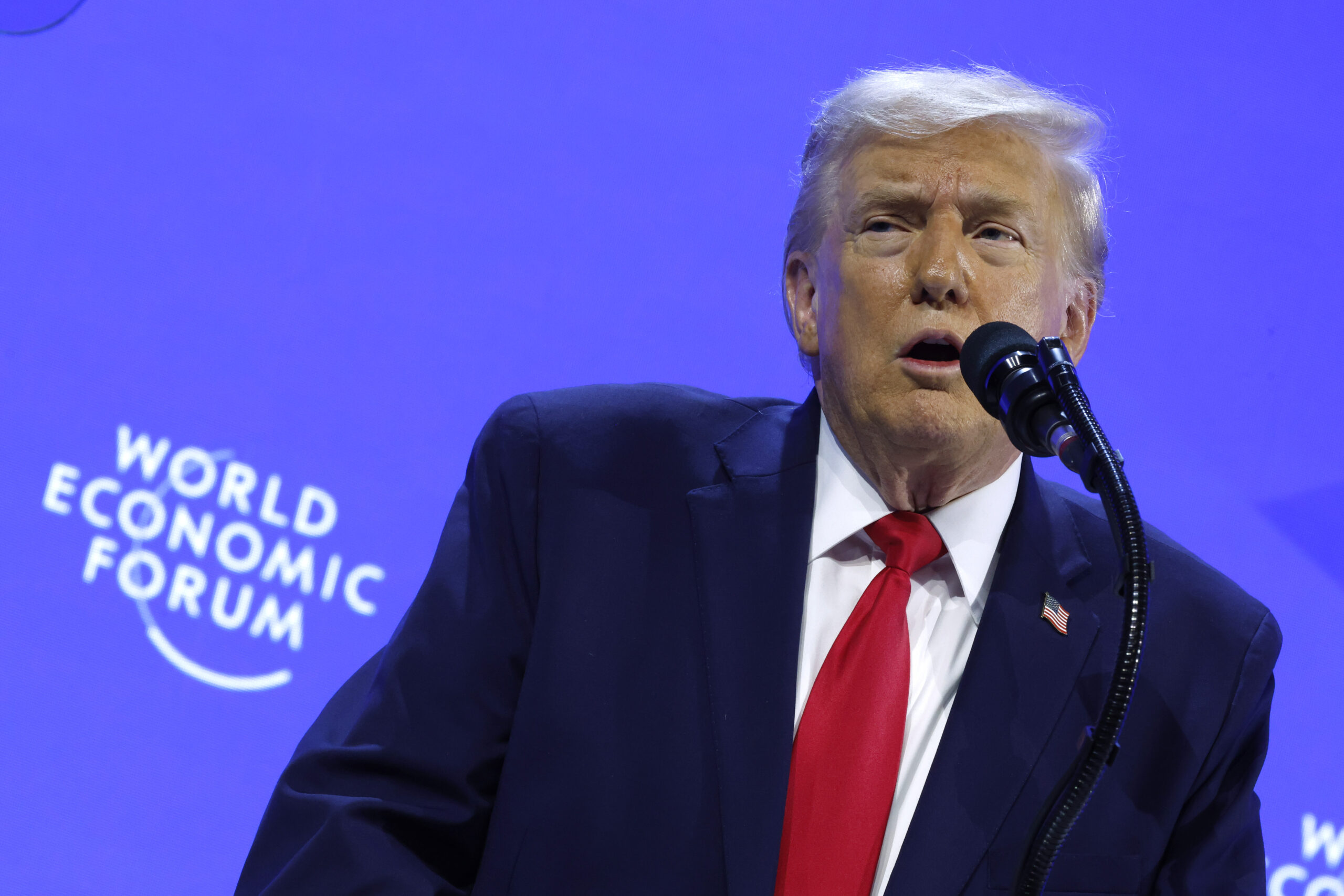
U.S.-Iran negotiations scheduled are ‘likely a diplomatic box-checking exercise and smokescreen,’ FDD’s Andrea Stricker said, while JINSA’s Jonathan Ruhe said U.S. military action is ‘unlikely for the moment’
DEM DIVIDE
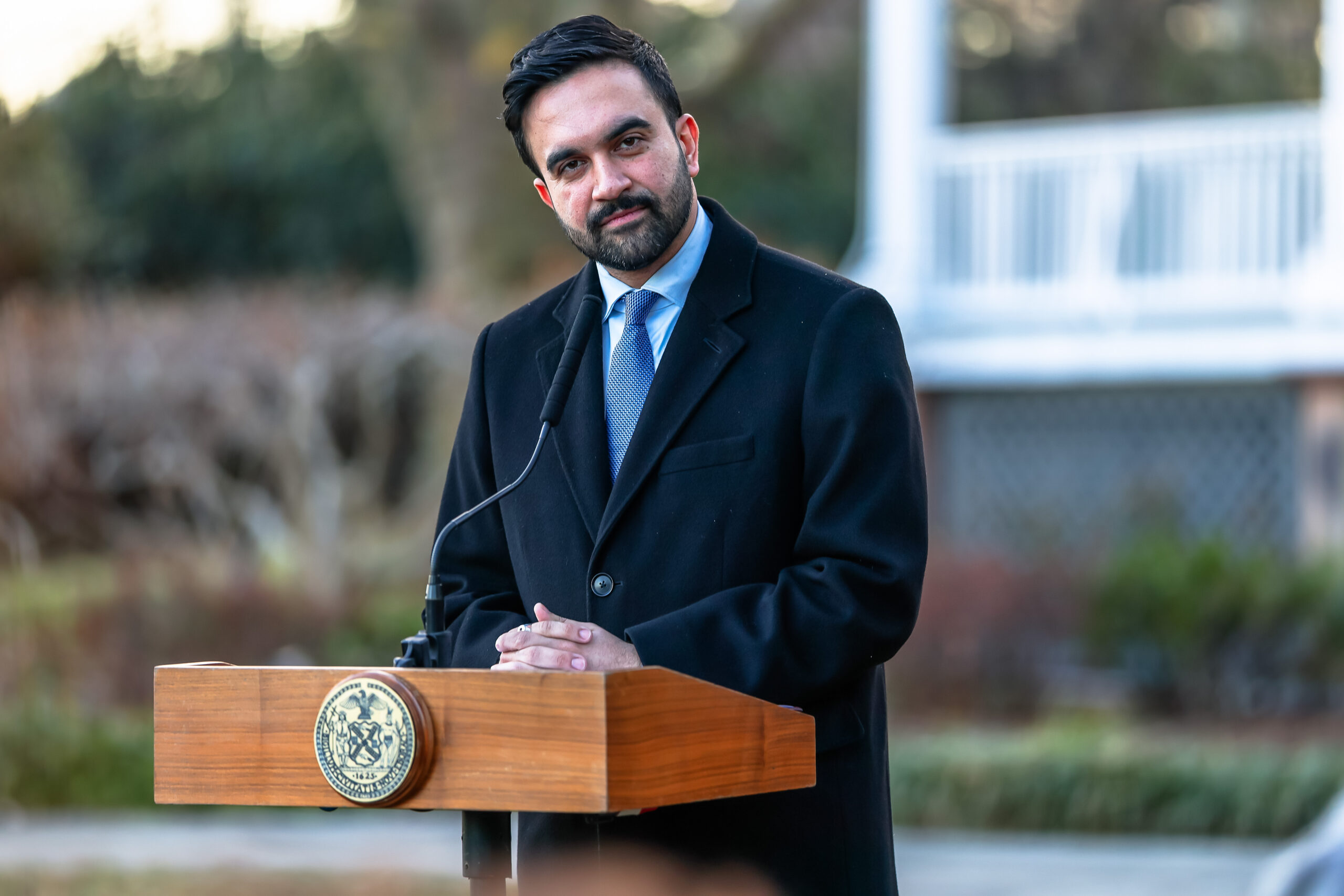
The fight to succeed Rep. Nydia Velazquez pits Mamdani and the DSA faithful against the congresswoman and her protege
U.S.-Iran negotiations scheduled are ‘likely a diplomatic box-checking exercise and smokescreen,’ FDD’s Andrea Stricker said, while JINSA’s Jonathan Ruhe said U.S. military action is ‘unlikely for the moment’
Chip Somodevilla/Getty Images
U.S. President Donald Trump gives a speech at the World Economic Forum (WEF) on January 21, 2026 in Davos, Switzerland.
Despite the Trump administration’s willingness to diplomatically engage with Iranian officials, leading Middle East experts told Jewish Insider on Monday that military action against Tehran still remains a very real possibility.
“I can’t tell you what I’m going to do,” President Donald Trump told reporters on Monday evening when asked about the threshold for an Iran strike.
“We have a tremendous force going there [to the Middle East], just like we did in Venezuela,” said Trump. “I’d like to see a deal negotiated. But right now, we’re talking to [Iran] and if we could work something out, that’d be great. If we can’t, probably bad things will happen.”
White House Special Envoy Steve Witkoff and Iranian Foreign Minister Abbas Araghchi are expected to meet in Istanbul on Friday to discuss a potential new nuclear agreement, according to reports. Jared Kushner, who has played a key role in recent high-profile diplomatic negotiations, is also expected to attend, alongside the foreign ministers of Turkey, Qatar, Egypt, Oman, Saudi Arabia and Pakistan, in the first meeting between the U.S. and Iran since U.S. strikes on Iranian nuclear facilities last June.
The planned talks come as the administration continues to exert pressure on Tehran — in response to Iran’s violent crackdown on protesters last month, Trump has publicly weighed the possibility of U.S. military intervention, ordering the movement of additional military assets into the region and issuing a series of stark warnings on social media indicating that U.S. forces are “ready, willing and able to rapidly fulfill [their] mission, with speed and violence” should a deal fail to be made.
While the administration has emphasized diplomacy as its preferred path, analysts caution that negotiations do not necessarily signal that the U.S. will not strike.
“Military intervention remains likely in light of President Trump’s demonstrated willingness to use force and the U.S. military buildup in the region,” said Michael Koplow, chief policy officer at the Israel Policy Forum. “Given the gulf between the American and Iranian positions and the general hard-line position of the Iranian regime on nuclear issues, it is hard to tag a nuclear deal as a likely outcome.”
Andrea Stricker, a research fellow at the Foundation for Defense of Democracies, told JI that a strike does remain on the table. She said that a deal could be difficult to reach and the upcoming meeting in Istanbul is unlikely to yield meaningful results or concessions from Iran.
“The planned meeting is likely a diplomatic box-checking exercise and smokescreen to enable a continued U.S. military buildup before Trump authorizes strikes,” Stricker said. “The administration’s demands that Iran abandon nuclear enrichment, cap its missile program, and halt support for regional proxies and terrorism, as well as stop executing its people, are nonstarters for the regime.”
Koplow said the administration’s “mixed signals” on whether it will seek diplomacy or take military action are likely “not a ruse or a diversion,” but instead a signal that Trump “has not actually made up his mind” and is “unsure what his end goal is.”
Jason Greenblatt, who served as White House Middle East envoy in the first Trump administration, asserted that “there’s no mixed signals,” arguing that the president’s messaging has been clear.
“President Trump has made the choice clear: a real, enforceable deal that ends Iran’s nuclear and missile threats and protects the U.S., our allies, and the Iranian people — or decisive action,” said Greenblatt, who emphasized that while Trump is reluctant to engage in war, the president will not accept an agreement he views as insufficient.
“He is not a war president,” Greenblatt said, “but he will not accept a weak deal. Iran’s leadership should understand by now that President Trump means exactly what he says.”
Stricker also noted that Trump has consistently sought to avoid prolonged conflict, but argued that Iran’s internal repression and continued nuclear advances may push the president toward decisive action. On Saturday, satellite images revealed new activity at Iranian nuclear sites, a potential sign that Tehran is aiming to salvage remaining materials from the June strikes.
“President Trump favors stability and prioritizes ending violence in global affairs,” she said. “After achieving the defanging of Tehran’s nuclear program, the regime has shown it remains a threat — the ongoing massacre is too much for Trump to tolerate as the leader of the free world.” “The president will likely ensure the regime pays a price, but whether the price is regime change remains to be seen,” she added.
When detailing what potential U.S. military intervention could look like, Koplow said that it would likely be “limited” in scope.
“Any U.S. action is likely going to fall short of what the Israelis would like to see, which is a campaign that doesn’t stop until the regime has fallen,” said Koplow. “Trump seems to favor quick strikes, and he is also facing wall-to-wall opposition from Arab states regarding the prospects of a long campaign that destabilizes the region and damages prospects for trade, investment, and growth.”
However, other analysts read the shift to negotiations as a signal that intervention is increasingly unlikely. Jonathan Ruhe, a senior fellow at the Jewish Institute for National Security of America told JI that U.S. military action is “unlikely for the moment.”
“An even bigger concern now is that military action could be off the table indefinitely, in a way it wasn’t just a day or two ago, as renewed talks now seem more likely,” said Ruhe.
Ruhe also noted that a key indicator of Trump’s intentions will be “how long he keeps the ‘armada’ within striking distance,” referring to the U.S. military assets in the region. He added that negotiating with Tehran will likely result in an unfavorable outcome for the U.S.
“Negotiating with Iran is absolutely the worst possible option for the United States now, because Iran’s regime will go from being on the ropes to thinking it prevailed,” said Ruhe, noting that Tehran is unlikely to agree to an “acceptable deal,” instead using the “prospect of talks to stave off military threats.”
“[Iran] is trying to do what it always does, playing for time and seeing what concessions it can wrangle without ever giving up anything itself,” Ruhe added. “This leaves zero upside for the U.S., since Iran is too emboldened to agree to serious concessions. There’s plenty of downside, too, since U.S. credibility would be dangerously eroded in Tehran’s eyes if Trump fails to fulfill his earlier threats.”
Koplow said Jerusalem is also concerned about a potential nuclear deal and is likely to perceive Iran’s willingness to enter talks as a way of “dragging out the process indefinitely.”
“[The Israelis] are concerned that Trump will back off his threats to take action or end up signing a deal that falls short of addressing the entire basket of issues — nuclear, missiles, and proxies,” said Koplow.
Ali Shamkhani, a senior adviser to Iranian Supreme Leader Ali Khamenei, had said Tehran would strike Israel in response to any U.S. military action, in an interview with the Lebanese-based Al Mayadeen.
Stricker warned that any agreement that falls short of dismantling the regime’s power structure and fails to address key issues would be problematic not only for the U.S. and Israel, but for the Iranian public.
“Any deal with the Islamic Republic would represent a historic betrayal of the Iranian people,” Stricker said. “The only negotiation America should entertain with Tehran is the exit of top regime officials from Iran and their relinquishing of power prior to an orderly transition to democracy.”
Ahead of reported talks between the U.S. and Iran, Sen. Mike Rounds said the regime ‘would love to deceive us … I just don’t think we’re going to have much success’
Iranian Leader Press Office / Handout/Anadolu via Getty Images
Iranian Supreme Leader Ayatollah Ali Khamenei makes remarks in Tehran, Iran, on May 20, 2025.
Several Republican senators expressed skepticism that the Iranian regime would negotiate in good faith with the United States on its nuclear program or on its crackdown on pro-democracy protesters, as the administration pursues a diplomatic approach with Tehran following threats of military action.
Some, including Sen. Lindsey Graham (R-SC) — and the Saudi defense minister, behind closed doors — have warned that, if the U.S. fails to act after President Donald Trump promised Iranian protesters that “help is on its way,” it would be a blow to the U.S.’ credibility in the Middle East and would strengthen the Iranian regime.
Sen. Rick Scott (R-FL) expressed skepticism that the Iranians would engage sincerely or willingly give up their nuclear program in talks with the U.S., reported to be taking place in Turkey on Friday.
“Wouldn’t that be great? It’d be great if they did. It’d be great if they got rid of their nuclear weapons,” Scott told JI. “Do I actually believe they’re going to negotiate in good faith? I don’t.”
Scott added that he was in favor of Trump taking action to support the protesters after promising to do so. “I think if you tell somebody you’re going to help them, you’ve got to help them,” the Florida senator said.
Sen. Mike Rounds (R-SD) said he believes Trump “wants to avoid a war.”
“I hope he’s successful,” Rounds added, but said that he is not optimistic that a viable deal is achievable. “I, personally, am really discouraged. I don’t think Iran really wants to negotiate a deal that would stop them from doing their terrorist activities, supporting terrorism around the area, and I don’t think they really want to give up their nuclear ambitions — although they would love to deceive us,” Rounds said.
“I wish [Trump] the best. I think he’s right in trying to do [make a deal]. I think that’s what we should be trying to do, but I don’t, I just don’t think we’re going to have much success,” he added.
Sen. Markwayne Mullin (R-OK) said, “You can’t trust anything the ayatollah says at all.”
“I don’t know what the details are, so it’s hard for me to say what I’d like to see in [an agreement],” Mullin continued. “We all know that a nuclear Iran can never happen, so that’s got to be part of it. What else happens there? I don’t know, but I still go back to the fact that you can’t trust anything that the ayatollah or this current regime says.”
Mullin disagreed that not striking Iran would be seen as a shift in U.S. policy, describing the administration’s current approach as an extension of the president’s “peace through strength” policy.
“People respect that the president will always strike, or ratchet that up, when the time is right. He always wants diplomacy first, but he’s willing to use the strength part if he has to get to that point,” Mullin said. “And I think that’s what the president has positioned himself to do, but he has multiple options … so hopefully we’ll have a positive outcome without anyone getting hurt.”
Sen. John Kennedy (R-LA) said that he’d want to see Iran surrender its enriched uranium, give up any future potential to obtain a nuclear weapon, stop funding terrorist groups and “start being a responsible member of a stable world order.”
He disputed the notion that a failure by the U.S. to launch strikes now would hurt the country’s credibility, arguing that any military strikes would be based on U.S. intelligence, which he does not have.
“It’s a lot more complicated. I mean, these folks are entitled to their opinion … obviously I hope the negotiations are successful,” Kennedy said. “Whether the president decides to go further is going to depend an awful lot on national and military intelligence, which I don’t have access to. We have the best spies in the world, and I don’t know what they’re telling the president, but it matters. So I can’t advise him if I don’t have the information from the intelligence community.”
Sen. Richard Blumenthal (D-CT) said that any deal with the Iranians would need to include “a complete renunciation of nuclear arms and ballistic missiles that can reach Israel or our European allies.” He also said the regime’s crackdown on protesters would need to be “renounced.”
“They’re a country that continues to maintain ‘death to America, death to Israel.’ It is what it is,” Blumenthal said. “On a military front, there has to be a complete renunciation of nuclear weapons and long-range ballistic missiles, and I think the brutal and inhumane tactics toward its own people have to be renounced.”
“I think we should do something, but it may not be a military strike,” he added. “There are a range of actions that we could take, [such as] to expand economic efforts and [implement] a stronger enforcement of sanctions. So between those, there are options.”
Sen. Tim Kaine (D-VA), who recently introduced a war powers resolution to block military action against Iran without congressional authorization, explained to JI that the resolution was a response to Trump’s comments about a potential attack and the current deployment of U.S. military assets to the Middle East.
Kaine said that the resolution would be eligible for consideration on the Senate floor next week, and that whether he calls it up will depend on how events develop and whether it will have the votes to pass.
“What really prompts me is when I think I can get the votes,” Kaine said. “Usually that means something beyond saber-rattling and it’s some kind of step, like in the international waters or Venezuela, we’re actually killing people — that clearly demonstrates we need to do this.”
Kaine also emphasized that the administration’s explanation for potential military action against Iran has shifted — citing both the protests and nuclear issue — and said he was concerned by a report last week that the administration may be considering some ground deployment of special forces into Iran.
“I’ve just got an awful lot of military families in Virginia who don’t want their kids to be in another war in the Middle East,” Kaine said.
Plus, White House press corps welcomes Hamas-friendly outlet
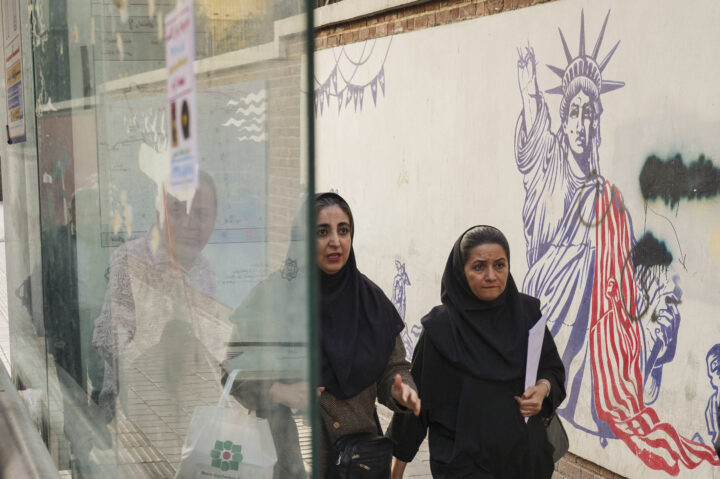
YAR/Middle East Images/AFP via Getty Images
Pedestrians walk past a mural bearing anti-American symbols on the outer wall of the former U.S. Embassy, now called the "U.S. Den of Espionage Museum," in Tehran, Iran, on October 26, 2025.
Good Monday afternoon!
This P.M. edition is reserved for our premium subscribers — offering a forward-focused read on what we’re tracking now and what’s coming next.
It’s me again — Danielle Cohen-Kanik, U.S. editor at Jewish Insider and curator, along with assists from my colleagues, of the Daily Overtime. Please don’t hesitate to share your thoughts and feedback by replying to this email.
📡On Our Radar
Notable developments and interesting tidbits we’re tracking
After weeks of rising tensions, the U.S. and Iran are back on the diplomatic track: White House Special Envoy Steve Witkoff is expected to meet with Iranian Foreign Minister Abbas Araghchi in Istanbul, Turkey, on Friday, Axios reports, possibly alongside Jared Kushner and the foreign ministers of several countries including Turkey, Qatar, Egypt, Oman, the UAE, Saudi Arabia and Pakistan.
What exactly will be up for discussion in the first meeting between the U.S. and Iran since the 12-day war last June is unclear — Iranian officials have said only nuclear activity is on the table, while the U.S. has traditionally maintained support for a comprehensive deal covering nuclear, missile and terror activity…
Before the dialogue in Turkey, Witkoff is slated to stop in Israel tomorrow to consult with Prime Minister Benjamin Netanyahu and Lt. Gen. Eyal Zamir, the IDF chief of staff, and hold meetings in the UAE and Qatar…
The parties are still covering all their bases: The U.S. and Israeli navies conducted a joint “routine maritime exercise” in the Red Sea today, after CENTCOM warned Iran’s Islamic Revolutionary Guard Corps on Friday to “avoid escalatory behavior at sea”…
Back in Washington, the White House tapped Drop Site News, a publication founded in 2024 to offer reporting explicitly hostile to Israel over the war in Gaza and the U.S. response to it, for the press corps’ new media seat on Sunday, Jewish Insider’s Gabby Deutch reports.
Drop Site has credulously interviewed several Hamas leaders, vigorously denied claims that Hamas terrorists raped anyone during the Oct. 7 attacks in Israel and supported the Iranian regime during the anti-government protests last month. Its inclusion among the outlets in Sunday’s press rotation (when no press briefing was held, so its reporter did not get the opportunity to ask a question) was a marked contrast to the mostly right-wing outlets that are usually selected…
And on the campaign trail, Sen. Tina Smith (D-MN) came out today in support of Minnesota Lt. Gov. Peggy Flanagan in the closely fought Democratic primary to replace her, joining fellow progressives Sens. Bernie Sanders (I-VT) and Elizabeth Warren (D-MA) in supporting Flanagan over the more moderate Rep. Angie Craig (D-MN). The endorsement comes days after fundraising reports for the final quarter of 2025 showed Craig raised double what Flanagan brought in ($2 million and $1 million, respectively)…
In New York City, Comptroller Mark Levine endorsed Rep. Dan Goldman (D-NY) in his primary against former Comptroller Brad Lander. Lander, challenging Goldman from the left on issues including his support for Israel, is endorsed by Mayor Zohran Mamdani, further highlighting divisions between Levine and the mayor as the two have sparred over issues including city investment in Israel bonds…
Jacobin profiles Diana Moreno, the democratic socialist running to fill Mamdani’s Queens seat in the state Assembly on a platform highlighting her progressive credentials as an organizer and immigrant.
“Moreno, wearing a keffiyeh, is featured in Mamdani’s launch video, pushing a stroller carrying her newborn son, saying ‘I want to raise my kid in New York.’ ‘I got pregnant one month after the genocide in Gaza started. My relationship to motherhood cannot be divorced from witnessing the world dehumanize children in Palestine,’” she said…
In New York’s 7th Congressional District, Councilmember Julie Won filed paperwork today to join the competitive race to replace retiring Rep. Nydia Velázquez (D-NY). All three candidates for the highly progressive district — which include Assemblymember Claire Valdez, who has the backing of Mamdani and the DSA, and Brooklyn Borough President Antonio Reynoso, who has been endorsed by Velázquez — have made comments critical of Israel.
On the one-year anniversary of the Oct. 7 attacks, Won expressed hope for a ceasefire and return of the hostages, mourning the 1,200 people “brutally killed” by Hamas in Israel and the “over 40,000 brutally killed in Palestine,” a figure Israel disputed at the time.
When a campaign last summer opposing a neighborhood development plan in her district invoked antisemitic rhetoric, Won denounced the move while maintaining her support for the “free Palestine” movement, saying in a statement, “It’s extremely alarming to me that someone would go so low to co-opt a movement of free Palestine for their own purpose — to incite anger and potentially violence … It’s shameful to compare Long Island City to Gaza — where people are literally losing their lives, land and starving to death — to this rezoning and blaming it on a local Jewish landlord who isn’t even part of the rezoning”…
Former Rep. Colin Allred (D-TX), who switched his candidacy from running for the open Texas Senate seat to its 33rd Congressional District, endorsed Rep. Jasmine Crockett (D-TX) for the Senate over his former primary rival, state Sen. James Talarico. Allred alleged that Talarico had called him a “mediocre Black man” and took aim at Talarico’s platform as a devout Christian: “You are not saving religion for the Democratic Party or the left,” Allred said…
⏩ Tomorrow’s Agenda, Today
An early look at tomorrow’s storylines and schedule to keep you a step ahead
Keep an eye out in Jewish Insider for the view from Washington on the continued possibility of U.S. strikes on Iran, even as diplomatic efforts unfold.
We’ll be watching for indications out of White House Special Envoy Steve Witkoff’s meetings in Israel on where the parties stand on engaging with Tehran.
It will be a busy day on the Hill, amid ongoing efforts to end the partial government shutdown: The House Foreign Affairs Committee will hold a hearing on U.S. policy towards Lebanon and “obstacles to dismantling Hezbollah’s grip on power” with testimony from several Washington Institute experts; the Senate Judiciary Committee will hold a hearing on the Nazis’ use of Swiss banks; the Helsinki Commission will hold a hearing on Russia’s influence in post-Assad Syria; and the Senate Foreign Relations Committee will hold a hearing on terrorism in North Africa.
The Jewish Community Relations Council of Greater Washington will host its Maryland advocacy day with Gov. Wes Moore as keynote speaker.
The World Governments Summit will kick off in Dubai, United Arab Emirates, with speakers including former Secretary of State Mike Pompeo, Lebanese Prime Minister Nawaf Salam, Spanish President Pedro Sánchez, Israeli philanthropist and Mobileye CEO Amnon Shashua and several other world leaders.
Stories You May Have Missed
DIPLOMATIC SPAT
Pretoria angered after Israel offers parched region water management aid; Jerusalem declares South African diplomat serving Palestinians persona non grata
RHOADES’ RUN
Crystal Rhoades, the clerk of the District Court in Douglas County, is running on an unapologetically pro-Israel platform
Trump is adamant that Iran will not get a nuclear weapon, has yet to set a timeline for talks, but if Iran attacks, ‘all bets are off,’ ambassador says
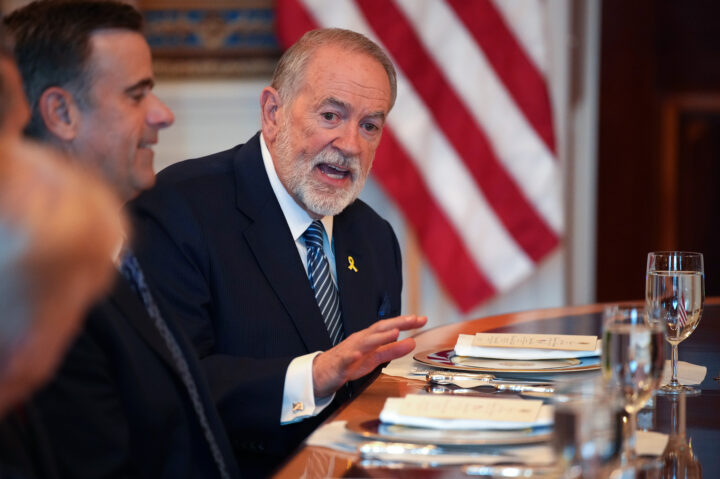
Andrew Harnik/Getty Images
U.S. Ambassador to Israel Mike Huckabee delivers remarks as President Donald Trump hosts Israeli Prime Minister Benjamin Netanyahu for a dinner in the Blue Room of the White House on July 7, 2025, in Washington, DC.
The U.S. would prefer a negotiated agreement with Iran to dismantle its nuclear program, U.S. Ambassador to Israel Mike Huckabee said in an interview that aired on Israel’s Channel 12 on Saturday night.
“I think everybody would love to see, at least in the U.S., would love to see some type of peaceful settlement in which Iran comes to it and decides that there’s no future for them to have a nuclear device, and there’s no future for them to continue to threaten both Israel and the United States,” Huckabee said.
President Donald Trump is “adamant,” Huckabee said, that “Iran is not going to get a nuclear weapon, not going to enrich uranium, so they’re going to have to get that out of their heads.”
Trump has yet to decide if he will strike Iran or not, the ambassador added.
“President Trump is always hopeful for the best outcome – let’s never forget The Art of the Deal – and if he can get that, that’s ideal,” Huckabee said. “But if he can’t, he’s not afraid to do what he proved last summer when he instigated Midnight Hammer,” the operation in which the U.S. struck Iranian nuclear sites.
As to the timing for a decision, Huckabee said he was baffled by the decision taken by some airlines to cancel flights as though a strike was imminent. The ambassador posited that Trump is likely to announce a timeline: “Remember last year, he said ‘you have 60 days,’ [and] on day 61 [the American strike on Iran] happened.”
At the same time, Huckabee said, “there are things that could precipitate a more urgent sense of reaction. If Iran were to strike, I think all bets are off.”
Huckabee also said that he “cannot imagine” that a strike on Iran would not be coordinated with Israel.
“The alignment between the United States and Israel is so incredible, more than most Israelis or Americans would ever assess,” he said. “We share intelligence that saves the lives of Americans and Israelis. We share military hardware, we share technology, and you have an excellent relationship between the president and the prime minister.”
Asked if Netanyahu had a significant role in the president calling off a strike on Iran on Jan. 14, Huckabee said “there is a genuine relationship, and there is a partnership that is unlike we have with any other country.”
In Gaza, Huckabee admitted that “there are some question marks” remaining as to how Hamas will be disarmed and who will do it, though Trump has insisted that “if they don’t give up their weapons, it’s going to be very bad.”
“You have every Arab country in the world signing the agreement saying this is going to happen,” Huckabee said. “I don’t trust Hamas to do anything, but I trust the rest of the world to say to Hamas, ‘you signed it, you’re on the line for it, if you don’t fulfil it, the whole world is going to rise up and take you down.’”
As to whether Israel will be the one to disarm Hamas, Huckabee said: “I don’t think the President is going to limit any action solely to Israel. Israel has enough blood in this. Everybody else at Sharm El Sheikh signed in ink; Israel signed in blood.”
Huckabee said that the U.S. is still hopeful that more countries will join the Abraham Accords, and that last week he met with U.S. Ambassador to Lebanon Michel Issa to discuss “how do we, as Americans, help our host countries move toward better understanding the escalating tensions and hopefully moving toward the president’s agenda of joining the Abraham Accords. It would be historic. We’d love to see this happen, and I’m optimistic that we will see that.”
The ambassador was noncommittal as to whether Trump would visit Israel in May to receive the Israel Prize in person, but he said it’s “a huge honor” for the president to be the first non-Israeli to be granted the award.
U.S. military assets have moved into the region in recent weeks amid escalating rhetoric from President Trump
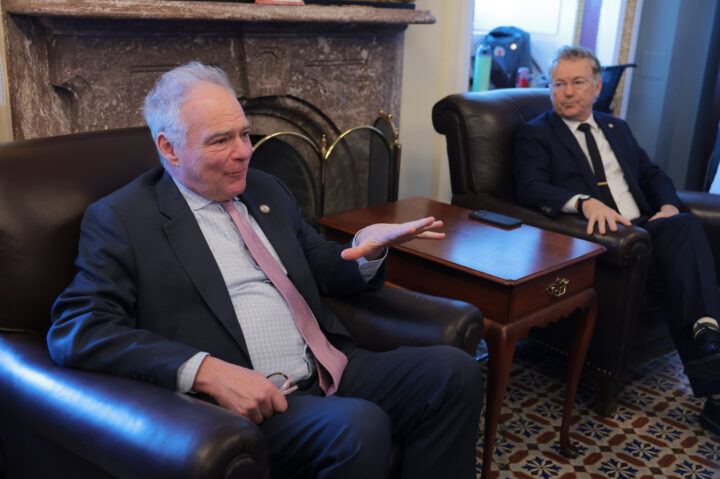
Anna Moneymaker/Getty Images
Sens. Tim Kaine (D-VA) and Rand Paul (R-KY) speak to reporters at the U.S. Capitol on January 07, 2026 in Washington, DC.
Sens. Tim Kaine (D-VA) and Rand Paul (R-KY), leading voices in the Senate on war powers issues, introduced a war powers resolution on Friday to block military action against Iran without congressional approval.
The resolution comes after weeks of threats by President Donald Trump against the Iranian regime to intervene on behalf of anti-regime protesters, and amid a U.S. military buildup in the Middle East.
Kaine and Paul can force a vote in the Senate on the resolution, as Kaine has done with resolutions related to a series of other military actions taken by the Trump administration, including last summer’s Operation Midnight Hammer strikes on Iranian nuclear facilities.
The Senate blocked that resolution by a 53-47 vote; Paul voted with most Democrats in favor of the resolution while Sen. John Fetterman (D-PA) voted with most Republicans against it.
Most recently, five Senate Republicans voted with Democrats for a procedural motion on a resolution to block further military action against Venezuela, but two ultimately flipped, under pressure from the Trump administration, on the final vote, blocking its passage.
Republicans were generally supportive of the U.S. strikes on Iran last summer, and some Democrats did praise the action after the fact, even as they expressed concerns about the administration’s unilateral action without congressional approval.
Trump has cited presidential self-defense authorities in carrying out various military actions around the world, including last summer’s strikes in Iran.
Plus, car ramming suspect charged with multiple hate crimes

John Lamparski/Bloomberg via Getty Images
Julie Menin, speaker of the New York City Council, and Mayor Zohran Mamdani on Jan. 12, 2026.
Good Thursday afternoon!
This P.M. edition is reserved for our premium subscribers — offering a forward-focused read on what we’re tracking now and what’s coming next.
It’s me again — Danielle Cohen-Kanik, U.S. editor at Jewish Insider and curator, along with assists from my colleagues, of the Daily Overtime. Please don’t hesitate to share your thoughts and feedback by replying to this email.
📡On Our Radar
Notable developments and interesting tidbits we’re tracking
After a car repeatedly drove into Chabad Lubavitch world headquarters in Brooklyn last night, New York City Council Speaker Julie Menin announced today she is creating a council task force to combat antisemitism, even as Mayor Zohran Mamdani has said he plans to retain the mayor’s Office to Combat Antisemitism (and told local news today he’s “in the final stages” of hiring someone to lead it). The council task force’s co-chair is Councilwoman Inna Vernikov, an outspoken critic of Mamdani…
The suspect arrested in the car ramming has been charged with attempted assault, reckless endangerment, criminal mischief and aggravated harassment, all enhanced as hate crimes, the NYPD announced this afternoon…
And in the wake of several protests that have disrupted New York Jewish communities in recent months, Menin also introduced a bill that would ban protests within 100 feet of a house of worship — more stringent than Gov. Kathy Hochul’s proposal of a 25-foot ban.
“The First Amendment right to peacefully protest is sacrosanct. What’s not sacrosanct is inciting violence, intimidation and harassment,” Menin told The New York Times, though some experts cast doubt on the constitutionality of the measure…
Rep. Tim Walberg (R-MI), the chair of the House Committee on Education & Workforce, sent a letter to Evanston, Ill., Mayor Daniel Biss — who is running for Congress to replace retiring Rep. Jan Schakowsky (D-IL) — requesting a briefing on Biss’ role in the 2024 anti-Israel encampment at Northwestern University.
Walberg alleged that Biss had failed “to protect Jewish students” at Northwestern “by refusing to give the university the police support it desperately needed to clear its violent and antisemitic encampment,” which resulted in a failure to arrest protesters who had harassed Jewish students. Biss has also drawn condemnation for allegedly walking back his pro-Israel positions once he was denied the support of AIPAC in his congressional campaign…
Rep. Haley Stevens (D-MI) raised $2.1 million for her Senate campaign in the final quarter of 2025, she announced today, bringing her total raised to $6.8 million. But a new Emerson College poll of the race to replace Sen. Gary Peters (D-MI) shows that haul may not be making an impact among primary voters just yet — Stevens polled at 17% to state Sen. Mallory McMorrow’s 22%, with 38% still undecided.
In a general election matchup against presumptive GOP nominee former Rep. Mike Rogers (R-MI), both McMorrow and Stevens poll ahead of Rogers, 46-43% and 47-42% respectively, with 15% undecided. In all cases, physician Abdul El-Sayed, a progressive Democrat who has made his hostility to Israel a central component of his campaign, polls behind his opponents…
The Democratic primary in New York’s 17th Congressional District got a little less crowded today: Former FBI agent John Sullivan, who served as the top bureau intelligence official in Israel from 2017-2020, dropped out of the race to challenge Rep. Mike Lawler (R-NY).
“While my congressional campaign is coming to an end, my dedication to our community is not,” Sullivan wrote, telling supporters to “stay tuned.” He did not endorse any of the remaining Democratic candidates, which include front-runner Beth Davidson, a Rockland County legislator, and national security veteran Cait Conley…
The U.S. Navy dispatched an additional warship, the USS Delbert D. Black, to the Middle East in the past two days amid heightened tensions with Iran, Reuters reports, bringing the total number of destroyers in the region to six, in addition to an aircraft carrier…
The European Union voted unanimously to designate Iran’s Islamic Revolutionary Guard Corps as a terrorist organization today, Jewish Insider’s Matthew Shea reports, in a move anticipated after several countries including Italy and France rescinded their long-held objections to the move.
“Repression cannot go unanswered,” Kaja Kallas, the EU’s high representative for foreign affairs and security policy, wrote on X following the decision. “Any regime that kills thousands of its own people is working toward its own demise”…
Sens. Lindsey Graham (R-SC) and Richard Blumenthal (D-CT) introduced the “Save the Kurds Act” in response to the Syrian government’s campaign against the Kurdish-led and U.S.-backed Syrian Democratic Forces. The legislation would impose sanctions on “Syrian government officials and financial institutions, and any foreign individual who engages in any transaction, including military or financial support, with the Syrian government,” according to a press release.
The bill would also redesignate as a terror organization Hayat Tahrir al-Sham (HTS), the al-Qaida offshoot that Syrian President Ahmad al-Sharaa led before ousting dictator Bashar al-Assad. The Trump administration removed HTS’ terror designation and U.S. sanctions on Syria after al-Sharaa assumed the presidency…
A draft resolution from the Board of Peace dictating the powers of the bodies overseeing postwar Gaza seems to relegate the Gaza Executive Board — whose inclusion of Turkey and Qatar had concerned Israel — to an advisory role for another committee largely made up of White House advisors, The Times of Israel reports. The resolution, which also increases the Trump administration’s role in managing that body, still must be signed by the president…
A man was tried in federal court today for attempting to assassinate former President Joe Biden over anti-Israel animus, traveling to Georgia with a firearm in June 2024 to sneak into a presidential debate hosted by CNN so he could reach Biden, according to the Justice Department.
The man’s manifesto was addressed to “all the Palestinian journalists … and in remembrance of the ones who lost their lives along the way” and said, “It’s time we overthrow these bastards and threaten to pull a f**king D-Day on Tel Aviv,” concluding with “Free Palestine”…
A bipartisan delegation of lawmakers organized by the AIPAC-affiliated American Israel Education Foundation met with Israeli Prime Minister Benjamin Netanyahu in Jerusalem today, including Reps. Ryan Zinke (R-MT), Jen Kiggans (R-VA), Jake Ellzey (R-TX), Mike Bost (R-IL) and Don Davis (D-NC)…
⏩ Tomorrow’s Agenda, Today
An early look at tomorrow’s storylines and schedule to keep you a step ahead
Keep an eye out in Jewish Insider for a look at the legacy of constitutional lawyer and Jewish activist Nat Lewin, who turns 90 this weekend.
Several Jewish and pro-Israel organizations were invited to a meeting with Saudi Defense Minister Khalid bin Salman, who is in Washington meeting with Trump administration officials, tomorrow afternoon, JI’s Danielle Cohen-Kanik has learned, amid a sharp rise in antisemitic and anti-Israel rhetoric from the kingdom. It’s not clear which organizations will be attending, though the Foundation for Defense of Democracies confirmed it will sit down with KBS separately in the morning.
We’ll be back in your inbox with the Daily Overtime on Monday. Shabbat Shalom!
Stories You May Have Missed
PASTOR’S POLEMIC
Singer told JI that his alignment with Rev. Frederick D. Haynes III delivered an anti-Israel polemic from the pulpit on Oct. 8, 2023, the day after Hamas’ attack on Israel
COMEBACK BID

The former congresswoman told JI, ‘Anything that needs to be done to stop Iran from acquiring a nuclear weapon needs to be done’
The unanimous decision came after several countries including France and Italy removed their objections due to Iran’s violent crackdown on protesters
Siavosh Hosseini/SOPA Images/LightRocket via Getty Images
EU Flag and 27 members of European countries at the European Parliament building.
The European Union designated Iran’s Islamic Revolutionary Guard Corps as a terrorist organization on Thursday, marking a significant shift in policy for European countries that had long been wary of irreparably harming ties with Tehran.
The 27 European Union foreign ministers convened in Brussels, Belgium where they voted unanimously to make the designation as a response to Iran’s violent suppression of nationwide protests. The decision puts the IRGC among the likes of al-Qaida, Hamas and the Islamic State on the EU terror list. The bloc also imposed new sanctions on 15 Iranian officials, including top commanders of the Revolutionary Guard, in addition to existing stringent sanctions.
“Repression cannot go unanswered,” Kaja Kallas, the EU’s high representative for foreign affairs and security policy, wrote on X on Thursday following the decision. “EU Foreign Ministers just took the decisive step of designating Iran’s Revolutionary Guard as a terrorist organisation. Any regime that kills thousands of its own people is working toward its own demise.”
Anne-Sophie Sebban-Bécache, vice president of Europe at the American Jewish Committee, told Jewish Insider the declaration was a “historical political decision.”
“It’s a very key political decision that will also have concrete consequences, because as soon as it is considered a terrorist organization, it will have legal implications,” said Sebban-Bécache. “It means that all the counter-terrorist authorities and organizations in Europe … will now be in charge of also tackling IRGC networks in Europe.”
The United States has long regarded the IRGC, an elite military force separate from the country’s regular army, as a terrorist organization; The State Department proscribed the group, along with its Quds Force, in April 2019 during President Donald Trump’s first term. Canada and Australia have also recognized the IRGC as a terrorist group, among other countries.
However, the issue had remained stalled in the EU for years, as designation requires unanimous consent of all member states. Germany and the Netherlands are among the countries that have repeatedly urged for the EU to follow suit of the U.S. Others, such as France, Italy and Spain, remained opposed, citing concerns over diplomatic ties, negotiations over European nationals being held in Iran, lack of a legal basis and ability for the bloc to reach unanimity on the issue.
“It’s a question that was on the table for many, many years,” said Sebban-Bécache. “Some countries were in favor of it, some were reluctant to do it, and because there is a need for unanimity, the discussion never really took place at the EU Council level.”
In January 2023, the European Parliament, one of two legislative bodies of the EU, voted overwhelmingly — 598 to 9 — to call for the union to make such a designation, but the issue remained unresolved.
It was not until Iran’s violent crackdown on protesters earlier this month that the conversation was reignited, sparking holdout countries to reverse course and signal newfound support for such a move. The U.S.-based Human Rights Activists News Agency (HRANA) said it had confirmed at least 6,126 deaths since the start of the protests earlier this month, adding it was investigating over 17,000 more potential deaths.
“The dramatic events that we’ve witnessed in Iran in the past month have shifted many countries’ positions, and there was some political pressure also mounting,” said Sebban-Bécache, who noted that the designation is the “best tool” for Europe to “isolate” the regime. “I think Europeans also came to the conclusion that that regime can fall and that we all have a role to play to isolate it and to make it accountable.”
On Monday, Italian Foreign Minister Antonio Tajani announced that Italy would be withdrawing its objections, stating that it is his country’s “highest priority” to protect Iranian citizens. On Wednesday, France followed suit.
Sebban-Bécache noted that the new decision is a way for Europe to further take a stand “against terror” and finally recognize an organization that poses a threat “not just for the Iranian people and the Middle East, but also for international and European security itself.” She noted that the IRGC has tried to develop financial networks in Europe.
“We’ve had proof now for many years that the IRGC has developed an international network … and also has already tried to conduct terrorist attacks around the world and especially in Europe,” said Sebban-Bécache. “We know that IRGC is the organ that is orchestrating all the terror and oppression of the Iranian population inside Iran, but it’s also the organ that is coordinating the financing and support of Iran’s proxies and conducting terrorist activities across the Middle East.”
Gideon Sa’ar, Israel’s minister of foreign affairs, welcomed the decision, calling it “important and historic.”
“The number one actor in spreading terror and undermining regional stability has now been called by its name,” Sa’ar wrote on X. “Designating the IRGC as a terrorist organization will thwart and criminalize their activities in Europe. It will deal a significant economic blow to an organization that controls a vast share of the Iranian regime’s economy, and it sends an important message to the brave men and women of Iran who are fighting for their freedom.”
The House Foreign Affairs Committee Majority also lauded the move, stating that Europe is “waking up to the truth.”
“The IRGC must not be given a free pass to export terror and brutality throughout the globe on behalf of the Ayatollah,” the post read.
Dan Diker, president of the Jerusalem Center for Security and Foreign Affairs, told JI that Trump is engaged in ‘maximum pressure negotiations,’ that are ‘setting up the regime to say no.’

Daniel Torok/The White House via Getty Images
President Donald Trump and Secretary of State Marco Rubio (R) sit in the Situation Room as they monitor the mission that took out three Iranian nuclear enrichment sites, at the White House on June 21, 2025 in Washington, DC.
President Donald Trump, over the last week, has gradually amped up threats of a military strike against Iran, pivoting away from talk of diplomatic negotiations amid continued intransigence from Tehran.
On Wednesday, Trump wrote on Truth Social that “a massive Armada is heading to Iran … ready, willing, and able to rapidly fulfill its mission, with speed and violence if necessary. Hopefully, Iran will quickly “Come to the Table” and negotiate a fair and equitable deal – NO NUCLEAR WEAPONS – one that is good for all parties. Time is running out, it is truly of the essence!”
The president warned that “the next attack will be far worse” than last June’s Operation Midnight Hammer. “Don’t make that happen,” he added.
The regime’s mission to the United Nations responded with Trump-esque capitalization that “Iran stands ready for dialogue based on mutual respect and interests—BUT IF PUSHED, IT WILL DEFEND ITSELF AND RESPOND LIKE NEVER BEFORE!”
Ali Shamkani, an advisor to Iranian Supreme Leader Ali Khamenei who was severely injured in an Israeli airstrike on Iran last June, threatened — in Arabic, English, Hebrew, Russian and Mandarin — that “any military action by [the] US … will be considered the start of [a] war and its response will be immediate, all out and unprecedented, targeting [the] heart of Tel Aviv and all those supporting the aggressor.”
Then, amid widespread reports of secret talks between Washington and Tehran through Omani mediators came the news that they made no progress on limiting the Iranian nuclear and ballistic missile programs, and that Trump was once again weighing military action, according to CNN.
Dan Diker, president of the Jerusalem Center for Security and Foreign Affairs, told Jewish Insider that Trump is engaged in “maximum-pressure negotiations,” which are “setting up the regime to say no.”
Nadav Pollak, a lecturer at Reichman University and Israeli intelligence veteran, told JI that the latest developments were significant in that “Trump laid out terms for a deal and Iran said no, or didn’t say anything. It’s not surprising, because his terms — no nuclear program, no ballistic missiles over a certain range, no support for its proxies — are a surrender without concessions [from the U.S.], something the supreme leader can’t do.”
At the same time, Diker said, “Iran is desperate to cut a deal. … The Iranians are reaching out to cut a deal, like they always do when they feel cornered. Regime survival is the top priority of the regime.”
“I think it’s fair to assess that Trump senses he has a lot of leverage and a lot of power — and he does — and I think he’s applying maximum pressure on the regime. He knows the regime is weak, but it’s like a rabid dog … that can do anything, which can be very dangerous. They still have a lot of missiles,” he said.
Diker argued that 30 years after Israeli Prime Minister Benjamin Netanyahu first warned about the Iranian threat in a joint session of Congress, “the stars aligned in terms of Trump and Netanyahu, and they could finally get rid of this regime, but it will come at a price. … The Iranian proxies will put us in a terrible position.”
Israel is not the only country exposed to those dangers, Diker pointed out. “There is pressure on Trump from the Saudis, the Qataris, the Turks and others across the Middle East not to attack because of the distinct fear the regime will start firing rockets, missiles and drones everywhere. … Iranians will just be throwing stuff all over the Middle East, is the fear.”
In Pollak’s assessment, U.S. military action is likely: “Trump, with all his language and rhetoric, climbed too high not to do anything. He also pushed U.S. assets into the region, similar to what he did in Venezuela. …The scope of a strike is unclear. That’s anyone’s guess right now.”
The shift in Trump’s rhetoric in recent days from focusing on the anti-regime protests to stopping Iran’s nuclear program shows that he is “trying to build legitimacy for a strike,” Pollak said. “The protests against the regime was a trigger for him, but he has other objectives in mind.”
Pollak said that Shamkani’s multilingual social media posts were the first public, direct military threat from Iran towards Israel, something he said Israel’s security establishment surely took note of.
“If it wasn’t certain until yesterday that Israel will get targeted, now it is, even if it’s one barrage,” Pollak said.
Whether Israel will take part in the strikes on Iran remains an open question, Pollak said, but assessed that it is likely to happen. He pointed out that IDF Military Intelligence chief Maj.-Gen. Shlomi Binder was in Washington this week, reportedly to share information about possible targets in Iran.
Pollak pointed out that a month ago, in a press conference with Netanyahu at Mar-a-Lago, Trump said he would support Israel striking Iran if it continues to produce ballistic missiles, and if Iran tries to rebuild its nuclear weapons program, he would back Israel striking “fast.”
“I think [Netanyahu] for sure would want to take the opportunity to finish some of what we didn’t finish in June,” he said. “The question is whether Trump will let him or not.”
Diker said that “Netanyahu has been hyper-focused on ridding Israel and the world of this regime for 30 years … When Netanyahu says Trump is the best friend Israel ever had, he’s not talking about the Abraham Accords. He’s talking right now about ending the Iranian regime. Netanyahu’s eyes are on that ball.”
‘Today, many of the NGOs and technology providers that maintain these tools are facing closure due to funding cuts,’ the letter warns
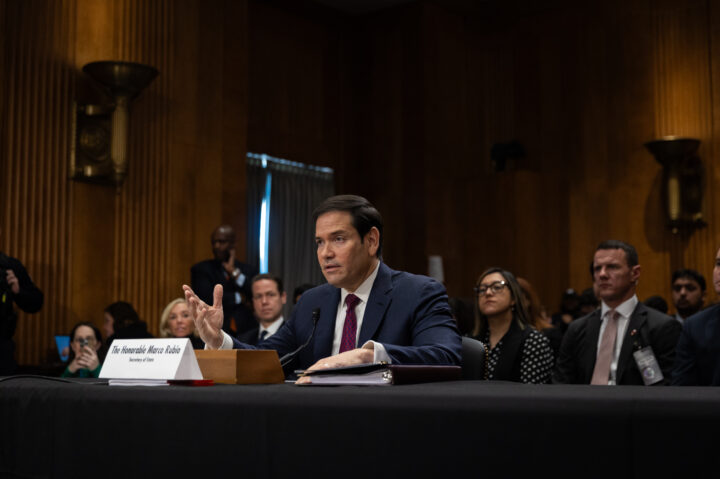
Nathan Posner/Anadolu via Getty Images
Secretary of State Marco Rubio testifies during a Senate Foreign Relations Committee hearing on Venezuela, in Washington, DC, United States on January 28, 2026.
A bipartisan group of senators wrote to Secretary of State Marco Rubio on Wednesday urging him to “surge resources to quickly enable critical internet freedom support” to protesters in Iran, pointing to funding cuts that have stretched resources for such programs.
“Today, many of the NGOs and technology providers that maintain these tools are facing closure due to funding cuts and more importantly, fewer Iranian citizens can share their videos and messages with the world and each other,” the letter warns. “Without the continuous operation of internet freedom programming carried out by the State Department and Open Technology Fund, millions of Iranians will lose their last secure window and voice to the outside world.”
The lawmakers, Sens. James Lankford (R-OK), Jacky Rosen (D-NV), Lindsey Graham (R-SC) and Cory Booker (D-NJ), warned that if U.S. programs fully lapse, regime-controlled programs and state media will step into the gap, “giving the regime near-total control over the digital space and putting users at far greater risk.”
“As we watch brave Iranians take to the streets, it is clear that supporting the Iranian people’s access to information is not a partisan issue but a matter of national security, as well as meeting legislative requirements for a strategy for promoting internet freedom in Iran,” the lawmakers said, pointing to existing legislation mandating the State Department to expand internet access in Iran. “The United States must pair its maximum pressure on the regime with maximum support for the Iranian people.”
The letter comes at a time when Congress has offered few of its own strategies to respond to the wave of protests around Iran — which, according to Rubio, have now largely been put down by the regime.
Such efforts to promote free internet access to the Iranian people, amid efforts by the regime to impose an internet blackout, have emerged as a key area of bipartisan agreement.
Much of the U.S.’ global communications programming, including funding for promoting internet access, was slashed last year amid cutbacks to various foreign aid programs. Some prominent Republicans have criticized the administration, saying that government-sponsored news programming and communications assistance have failed to meet the moment in Iran.
The letter emphasizes the “long-standing and bipartisan commitment” to supporting internet freedom programs, which are “more important than ever as the people of Iran protest against the regime in record numbers.” The legislators noted that prior administrations have, for two decades, supported various anti-censorship and internet freedom tools in Iran, and that Congress passed legislation in 2024 supporting such programs.
“Without U.S. leadership, an entire generation of Iranians would have remained in the dark — and the most powerful source of pressure against the Islamic Republic, the Iranian people themselves, would have been neutralized,” the letter reads.
It notes that the existing U.S. programs allowing a small number of Iranians to remain online had “proved decisive” during the Israel-Iran war last summer to demonstrate the division between the Iranian people and the regime, and said that expanded internet access now “would put a spotlight on the increasingly securitized atmosphere that is cracking down on dissent.”
Plus, Biden officials don't hold back on criticism of Bibi
Mass Communication Specialist 3rd Class Amber Smalley/U.S. Navy via Getty Images
Flight deck of the Nimitz-class aircraft carrier USS Abraham Lincoln (CVN 72) May 10, 2019 in the Red Sea.
Good Wednesday afternoon!
This P.M. edition is reserved for our premium subscribers — offering a forward-focused read on what we’re tracking now and what’s coming next.
It’s me again — Danielle Cohen-Kanik, U.S. editor at Jewish Insider and curator, along with assists from my colleagues, of the Daily Overtime. Please don’t hesitate to share your thoughts and feedback by replying to this email.
📡On Our Radar
Notable developments and interesting tidbits we’re tracking
President Donald Trump indicated he’s losing patience with Iran: He posted a stark warning on Truth Social this morning that a “massive Armada is heading to Iran” and “it is ready, willing, and able to rapidly fulfill its mission, with speed and violence, if necessary.”
Trump encouraged Tehran to come back to the negotiating table where he demanded it have “no nuclear weapons” — a position that differs from Israel’s, which has said Iran must not be allowed to enrich uranium at all — but made no mention of the protesters Trump had pledged to protect…
Despite Trump’s threat, Secretary of State Marco Rubio told lawmakers at a Senate Foreign Relations Committee hearing today that the “armada” of military assets being moved to the Middle East is primarily defensive, Jewish Insider’s Marc Rod reports.
Rubio noted that 30,000-40,000 U.S. troops in the region are “within the reach of an array of thousands of Iranian” drones and missiles. “We have to have enough force and power in the region, just on a baseline, to defend against that possibility,” he explained.
In addition, “the president always reserves the preemptive defensive option — in essence, if we have indications that, in fact, they’re going to attack our troops in the region,” Rubio continued, as well as security agreements to defend allies such as Israel “that require us to have a force posture in the region.”
Rubio admitted the U.S. has little clarity on who would govern Iran if the regime collapses: “I don’t think anyone can give you a simple answer as to what happens next in Iran if the supreme leader and the regime were to fall, other than the hope that there would be some ability to have somebody within their systems you could work towards a similar transition” as the U.S. has supported in Venezuela…
Rubio was also questioned by senators about the Board of Peace: He clarified that “the primary and sole focus of that board right now is to administer Phase 2 and Phase 3 of the plan in Gaza,” despite broad language in the body’s charter, and acknowledged that some European allies have declined to join over their concern that the board is competing with the U.N. “This is not a replacement for the U.N. But the U.N. has served very little purpose in the case of Gaza,” Rubio said…
As their own response to Iran’s violent suppression of protests, several European countries changed their position to support the EU designating the Islamic Revolutionary Guard Corps as a terror organization, a move they have historically opposed over fears of irreparably severing ties with Tehran.
Ahead of a Thursday meeting of EU foreign ministers in Brussels — where the bloc was already expected to approve additional sanctions on Iran — Italy, Germany and earlier today France announced they would support the designation, teeing up its approval, which must be unanimous, at tomorrow’s meeting…
The State Department found that the Palestinian Authority paid more than $200 million to terrorists and their families in 2025, the Washington Free Beacon reports, despite the PA claiming it had ended its “pay-to-slay” program last February.
The PA merely “transferred responsibility” for the payments to a new body “under the guise of social welfare,” a report provided to Congress laid out, with evidence from post offices, social media and Telegram “indicating clearly that the compensation in support of terrorism has continued”…
Biden administration officials jumped to the defense of the former president’s Israel policy after Israeli Prime Minister Benjamin Netanyahu alleged in a press conference yesterday that some IDF soldiers had been killed in Gaza due to a U.S. arms embargo that caused Israel to run out of ammunition during the Biden presidency.
Brett McGurk, Biden’s senior Middle East advisor, told Axios that Netanyahu’s comments were “categorically false” and that Biden’s “commitment to Israel’s security to include U.S. military assistance was unwavering”; diplomat Amos Hochstein slammed Netanyahu as “ungrateful to a president that literally saved Israel at its most vulnerable moment”; and former State Department antisemitism envoy Deborah Lipstadt said that to ignore Biden’s support for Israel “is to ignore history”…
Syrian President Ahmad al-Sharaa visited Moscow today where he and Russian President Vladimir Putin discussed Russia’s continued military presence in the country, Syrian state media reported. Despite its historic backing of longtime Syrian leader Bashar al-Assad, Moscow did not oppose al-Sharaa’s ouster of the dictator, though Russia has sheltered Assad and his family since they fled Damascus.
Russia has begun pulling out from its position in northeast Syria in an area still controlled by the Kurdish-led Syrian Democratic Forces, as Damascus mounts a campaign to oust them, though Moscow reportedly hopes to keep its naval and air bases on the Syrian coast…
⏩ Tomorrow’s Agenda, Today
An early look at tomorrow’s storylines and schedule to keep you a step ahead
Keep an eye out in Jewish Insider for an interview with former Rep. Elaine Luria (D-VA), as she seeks to reclaim her former seat and shore up support for Israel among her Democratic colleagues.
Pennsylvania Gov. Josh Shapiro will speak at Washington’s Sixth & I synagogue in conversation with Sen. Raphael Warnock (D-GA) about the governor’s new memoir, Where We Keep the Light.
The Hudson Institute will host a conversation with Jacob Helberg, the under secretary of state for economic affairs, as he returns from a trip around the Middle East where he brought Qatar and the United Arab Emirates into the Pax Silica initiative and signed a joint AI strategic framework in Israel.
Stories You May Have Missed
FLORIDA FIGHT
Singer told JI that his alignment with the GOP has been shaped by his Jewish faith
FOLLOW THE MONEY
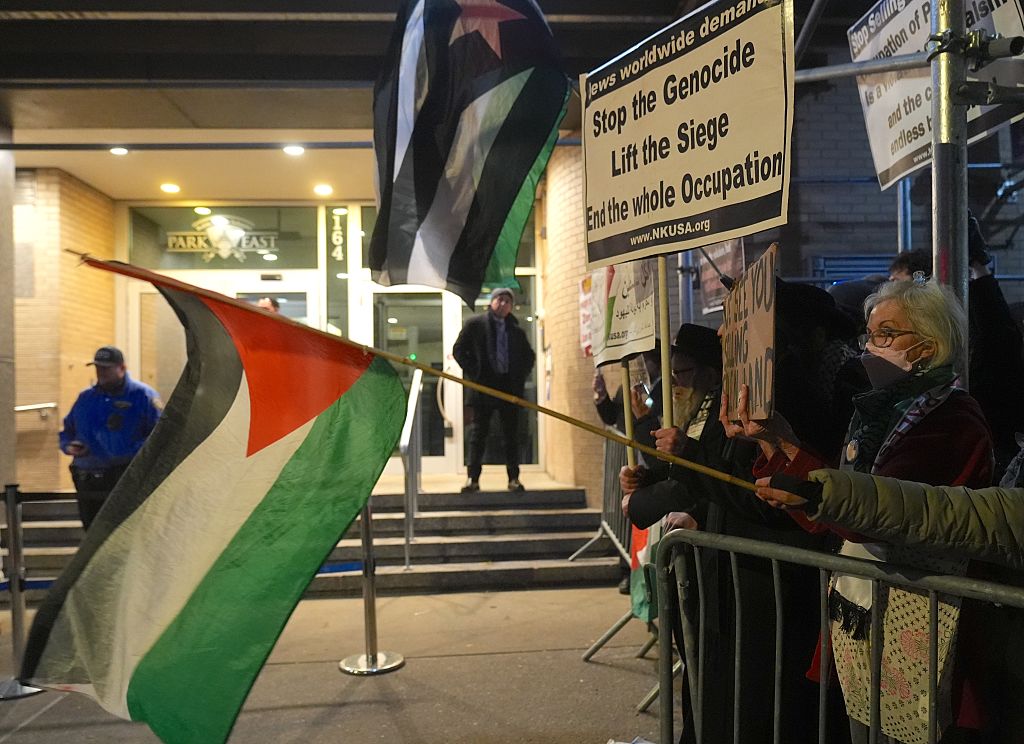
The group behind the pro-Hamas chants in Queens has a nationwide network and links to pro-terror organizations and individuals
The secretary of state also said that it is unclear who would take over Iran if the supreme leader were removed from power
Nathan Posner/Anadolu via Getty Images
Secretary of State Marco Rubio testifies during a Senate Foreign Relations Committee hearing on Venezuela, in Washington, DC, United States on January 28, 2026.
Secretary of State Marco Rubio said at a hearing before the Senate Foreign Relations Committee on Wednesday that the Iranian regime is historically weak due to serious economic troubles, but also said that Tehran’s violent crackdown on protesters has appeared to have successfully quelled the demonstrations that have swept the country in recent weeks.
Rubio also said that it’s uncertain who would take over the country if the Iranian regime were to fall. He framed the buildup of U.S. forces in the region — a U.S. carrier strike group arrived in the area this week — as a largely defensive measure to protect U.S. troops and allies from an Iranian attack.
“That regime is probably weaker than it has ever been, and the core problem they face, unlike the protests you saw in the past on some other topics, is that they don’t have a way to address the core complaints of the protests, which is that their economy is in collapse,” Rubio told senators.
“The reason why their economy is in collapse is because they spend all their money and all their resources building weapons and sponsoring terrorist groups around the world instead of reinvesting it back into their society, and as a result have taken on massive global sanctions which have isolated their economy and their country.”
He said the Iranian demonstrators want those sanctions removed and the regime to begin addressing their interests, “and this regime is unwilling to do it.”
Asked who would take over in the event that the Iranian supreme leader, Ayatollah Ali Khamenei, was removed from power, Rubio said that it was uncertain but suggested that the U.S. would expect to work with someone from within the Iranian government, rather than an outside actor, mirroring the approach it has taken in Venezuela.
“I don’t think anyone can give you a simple answer as to what happens next in Iran if the supreme leader and the regime were to fall, other than the hope that there would be some ability to have somebody in their systems that you could work toward a similar transition” as in Venezuela, Rubio said.
“I would imagine it would be even far more complex than [Venezuela] because you’re talking about a regime that’s been in place for a very long time, so that’s going to require a lot of careful thinking, if that eventuality ever presents itself,” he continued.
Addressing the U.S. military buildup in the region, he noted that the 30-40,000 U.S. troops in the region are within range of Iran’s arsenal of thousands of drones and short-range ballistic missiles. He said that the U.S. needs a “baseline” of “force and power” in the region to defend against that threat, if Iran “at some point, as a result of something” decided to attack U.S. forces.
“The president always reserves the preemptive defensive option — in essence, if we have indications that, in fact, they’re going to attack our troops in the region,” he continued, in addition to security agreements to defend allies such as Israel “that require us to have a force posture in the region.”
“I think it’s wise and prudent to have a force posture in the region that could respond and, potentially — not necessarily what’s going to happen — preemptively prevent the attack” against U.S. forces or allies, Rubio added.
The secretary of state said, however, that the violent crackdown by regime officials on the protests, which he said has killed thousands of people, has been “effective and … it’s horrifying.”
Though he said the protests have now “ebbed,” he said he was confident that “they will spark up again in the future because this regime, unless they are willing to change, or leave, have no way of addressing the legitimate and consistent complaints of the people of Iran who deserve better.”
Asked by Sen. Brian Schatz (D-HI) about the makeup of the Trump administration’s newly created Board of Peace — specifically why some close U.S. allies are not part of the group while U.S. adversaries are — and whether the body is intended to be a competitor to the United Nations, Rubio answered, “This is not a replacement for the U.N., but the U.N. has served very little purpose in the case of Gaza other than the food assistance, and so we think it’s critical to have something that’s in charge of that.”
Rubio noted that the Board of Peace was chartered through a U.N. resolution and said that the “primary and sole focus of that board right now is to administer Phase 2 and Phase 3 of the plan in Gaza.” He said that various countries have been invited to the board but some U.S. allies in Europe have declined to join or are waiting on parliamentary approval to do so.
Asked by Sen. Jacky Rosen (D-NV) whether the administration would be seeking congressional ratification or legislation to establish and join the Board of Peace, Rubio responded by again highlighting the U.N. Security Council’s support for and recognition of the board.
Rubio’s testimony came at a hearing focused primarily on the U.S. military operation in Venezuela in which former President Nicolás Maduro was arrested and U.S. policy toward Venezuela going forward.
He said that one of the Trump administration’s primary goals in conducting the operation was denying Iran, along with Russia and China, a foothold in the Western Hemisphere. He asserted that the success of the operation could help provide a deterrent to adversaries such as Iran, “because the U.S. is the only country in the world that could have done this operation.”
He also said that he does not anticipate further military action in Venezuela, but that the U.S. would act in case of a threat — offering as an example if Iran were to establish a drone factory in the country.
He further noted that Venezuela had been providing false passports to Iranian and Hezbollah operatives, which he described as deeply concerning.
During a heated back-and-forth with Sen. Tim Kaine (D-VA), Kaine referenced comments by acting Venezuelan President Delcy Rodriguez — who currently has Washington’s support — that the U.S. attack on Venezuela had “Zionist undertones.”
“What the hell did Delcy Rodriguez mean when she said this attack had Zionist undertones?” Kaine said. Rubio responded that he had “an idea what she meant” but Kaine pivoted and Rubio was not able to answer further.
Plus, Emory faculty revolt in defense of Iran official's daughter

MONEY SHARMA/AFP via Getty Images
Saudi Arabia's Crown Prince and Prime Minister Mohammed bin Salman (C) inspects a guard of honor during a ceremonial reception at the President House a day after the G20 summit in New Delhi on September 11, 2023.
Good Tuesday afternoon!
This P.M. edition is reserved for our premium subscribers — offering a forward-focused read on what we’re tracking now and what’s coming next.
It’s me again — Danielle Cohen-Kanik, U.S. editor at Jewish Insider and curator, along with assists from my colleagues, of the Daily Overtime. Please don’t hesitate to share your thoughts and feedback by replying to this email.
📡On Our Radar
Notable developments and interesting tidbits we’re tracking
Saudi Arabia’s shift away from its traditional alliances and towards Islamism is evoking more backlash: Asked about Riyadh’s growing rapprochement with Qatar and Turkey, Israeli Prime Minister Benjamin Netanyahu said at a press conference this afternoon that he’s following the developments and that Israel “expect[s] from anybody who wants normalization or peace with us that they not participate in efforts steered by forces or ideologies that want the opposite of peace”…
Netanyahu’s comments came shortly after Saudi Crown Prince Mohammed bin Salman held a phone call with Iranian President Masoud Pezeshkian, where MBS conveyed that “the Kingdom considers any threat or tension against Iran unacceptable”…
That’s not stopping the U.S. from hinting at the continued possibility of strikes on Iran: U.S. Central Command announced it will be conducting a “multi-day readiness exercise” in order to “demonstrate the ability to deploy, disperse, and sustain combat airpower” across its area of responsibility, which includes Iran…
And Sen. Lindsey Graham (R-SC) slammed Riyadh for other nefarious actions in the region, Jewish Insider’s Emily Jacobs reports, including its “attack” on the UAE and silence regarding the Syrian government’s campaign against the Kurds, demanding the kingdom use its influence to “keep the region from falling further into chaos.”
“Please understand that I am smart enough to know that Saudi Arabia has influence on the Syrian government, and I expect them to use it,” Graham said, adding that he is “trying to work with the administration and regional partners to prevent a bloodbath in Syria against our Kurdish allies”…
(President Donald Trump, meanwhile, had a markedly different take on Syria: He told reporters today that he had a “great conversation” with the “highly respected president of Syria” and that “all of the things having to do with Syria and that area are working out very, very well, so we’re very happy about it”…)
The U.S. Embassy in Riyadh also held its first-ever International Holocaust Remembrance Day event, writing that “Today’s modest but meaningful commemoration reflects a universal duty: protecting our shared humanity across cultures, faiths, and nations”…
With Graham eyeing Damascus and Riyadh, Sen. Ted Cruz (R-TX) took aim elsewhere, calling for the U.S. to arm protesters in Iran “NOW.” “For the Iranian people to overthrow the Ayatollah — a tyrant who routinely chants ‘death to America’ — would make America much, much safer,” he said…
Authorities in Azerbaijan arrested three people allegedly preparing an attack on the Israeli Embassy in Baku today; the men were affiliated with ISIS-K, the Afghani branch of the terror group…
The Board of Peace is attempting to formalize its processes and responsibilities, according to a draft resolution from the board obtained by The New York Times, which bestows expansive powers to its chairman — Trump — including naming the commander of the International Stabilization Force, which still has yet to be established.
The document also names White House Chief of Staff Susie Wiles and attorney Martin Edelman as members of the board, the first time they have been identified as such…
After a doctor who is the daughter of a senior Iranian government official departed from Emory University’s medical school, the professor who serves as head of Emory’s faculty leadership council criticized the school for letting her go, JI’s Haley Cohen has learned.
Noelle McAfee, a professor in Emory’s philosophy department, sent a scathing email to the university expressing concern that the school’s dismissal of Fatemeh Ardeshir-Larijani, the daughter of the secretary of Iran’s Supreme Council for National Security, was a politically motivated firing.
“It’s extremely disappointing to see that our leadership here at Emory are consistently caving to political pressure and never taking the side of faculty,” McAfee wrote, quoting an anonymous faculty member, expressing concern that Ardeshir-Larijani, whose father is responsible for the Islamic Republic’s national security, didn’t receive due process…
In the Garden State, Mussab Ali, the former Jersey City Board of Education president and champion of anti-Israel college encampments, officially launched his primary challenge to Rep. Rob Menendez (D-NJ) today, hitting Menendez on day one for supporting Israel and being endorsed by AIPAC.
“Democrats need to step up and become the party where we abandon corporate PACs, we won’t take money from groups like AIPAC, and we need to be accountable to everyday people,” Ali told the New Jersey Globe. He also enters the race with the endorsement of former Rep. Jamaal Bowman (D-NY), who was unseated in part due to his sharp criticisms of Israel…
Marking International Holocaust Remembrance Day, Chicago’s City Council voted unanimously to adopt the International Holocaust Remembrance Alliance’s working definition of antisemitism into its municipal code…
⏩ Tomorrow’s Agenda, Today
An early look at tomorrow’s storylines and schedule to keep you a step ahead
Keep an eye out in Jewish Insider for an interview with Republican Boca Raton Mayor Scott Singer, who’s hoping for a conservative shift among Jewish voters in South Florida to help him unseat Rep. Jared Moskowitz (D-FL).
“October 7: In Their Own Words,” a play drawn directly from testimonies of survivors of the Oct. 7, 2023, Hamas terror attacks, will premiere at the Kennedy Center. Read JI’s interview with the show’s playwrights here.
Secretary of State Marco Rubio will be on the Hill, testifying at a Senate Foreign Relations Committee hearing on U.S. policy towards Venezuela in the aftermath of the ouster of former President Nicolás Maduro.
Stories You May Have Missed
PROBLEMATIC POST

Kelly Neumann is serving as the fundraising co-chair for gubernatorial candidate Jocelyn Benson and Senate candidate Mallory McMorrow and has fundraised for several other Michigan Democrats
SABRA SLAM

The Portland Trail Blazers forward has emerged as one of Israel’s all-time top athletes
Fatemeh Ardeshir-Larijani, who was employed by Emory's medical school, is the daughter of the secretary of Iran’s Supreme Council for National Security

Jessica McGowan/Getty Images
Emory University Hospital is seen on August 1, 2014 in Atlanta, Georgia.
After a doctor who is the daughter of a senior Iranian government official departed from Emory University’s medical school, the professor who serves as head of Emory’s faculty leadership council criticized the school for letting her go, Jewish Insider has learned.
Noelle McAfee, a professor in Emory’s philosophy department, sent a scathing e-mail to the university and School of Medicine faculty expressing concern that the school’s dismissal of Fatemeh Ardeshir-Larijani, the daughter of the secretary of Iran’s Supreme Council for National Security, was a politically motivated firing.
McAfee, who was arrested in April 2024 for her participation in a campus anti-Israel encampment, said faculty members have expressed to her that Ardeshir-Larijani’s departure is “an act of unbecoming of our tolerant, free, academic community.”
“It’s extremely disappointing to see that our leadership here at Emory are consistently caving to political pressure and never taking the side of faculty,” McAfee wrote, quoting an anonymous faculty member, expressing concern that Ardeshir-Larijani, whose father is responsible for the Islamic Republic’s national security, didn’t receive due process.
On Jan. 19, demonstrators gathered outside Emory’s Winship Cancer Institute to protest the university’s employment of Ardeshir-Larijani.
But McAfee claimed that many faculty members were outraged over the loss of Ardeshir-Larijani to the medical school staff. (In an email to medical school faculty, Emory School of Medicine Dean Sandra Wong did not specify whether Ardeshir-Larijani, who was an assistant professor in the Department of Hematology and Medical Oncology at the medical school, was fired or quit.)
McAfee wrote that faculty also told her, “This is creating an actively hostile work environment here at Emory… motivated by a desire to minimize political pressure on Emory to ensure continuance of federal funding” and “it’s extremely disappointing to see that our leadership here at Emory are consistently caving to political political pressure and never taking the side of faculty.”
In a statement to JI, McAfee said her email was “not weighing in on an employment matter one way or another.”
In 2024, Emory School of Medicine fired another oncologist, Professor Abeer AbouYabis, due to her social media posts glorifying Hamas in the aftermath of the Oct. 7, 2023, terrorist attacks. The school’s University Senate Committee for Open Expression submitted an investigation report at the time, stating that “AbouYabis’s Open Expression rights likely were violated.”
Emory University did not respond to a request for comment from JI inquiring whether the school was aware of Ardeshir-Larijani’s familial ties when it hired her.
Plus, Kanye West claims he's 'not a Nazi' in full-page WSJ apology

Mostafa Alkharouf/Anadolu via Getty Images
Vehicle, carrying the body of the last Israeli hostage remaining in Gaza Ran Gvili, arrives the Abu Kabir Forensic Institute prior to the funeral ceremony in Tel Aviv, Israel on January 26, 2026.
Good Monday afternoon!
This P.M. edition is reserved for our premium subscribers — offering a forward-focused read on what we’re tracking now and what’s coming next.
It’s me again — Danielle Cohen-Kanik, U.S. editor at Jewish Insider and curator, along with assists from my colleagues, of the Daily Overtime. Please don’t hesitate to share your thoughts and feedback by replying to this email.
📡On Our Radar
Notable developments and interesting tidbits we’re tracking
The IDF announced this morning it had identified the remains of the final deceased hostage, Ran Gvili, in Gaza and is returning them to Israel for burial, Jewish Insider’s Matthew Shea reports, marking the end of the hostage crisis that had gripped Israel and world Jewry for nearly 850 days in the aftermath of the Oct. 7, 2023, Hamas attacks.
Beyond the hostages taken on Oct. 7, Gvili’s return means that no Israelis — living or deceased — are being held by terror groups in Gaza for the first time since 2014.
While the IDF uncovered Gvili’s body in a Muslim cemetery where Hamas had buried it, President Donald Trump told Axios that the terror group “worked very hard to get the body back. They were working with Israel on it. You can imagine how hard it was.”
“Now we have to disarm Hamas like they promised,” Trump continued, as the parties move into Phase 2 of his peace deal. For its part, Israel announced it will reopen the Rafah crossing between Egypt and Gaza in a “limited” capacity later this week.
Remarking on Gvili’s return, White House Press Secretary Karoline Leavitt added at a press conference this afternoon that “more than 20 new, additional countries have also signed up to join the newly established Board of Peace,” without naming the additions…
The New York Times lays out the latest developments in U.S.-Iran tensions, as American military assets reach the region and Iranian officials, as well as Iranian proxy terror groups, intensify their threats against the U.S. and Israel.
Joe Kent, the director of the U.S. National Counterterrorism Center, has warned Iraqi officials that if Iranian-backed militias in Iraq were to strike U.S. troops, the U.S. would retaliate, according to the Times…
Trump told Axios that the situation in regards to Iran is “in flux” but that the U.S. has “a big armada next to Iran. Bigger than Venezuela.” Still, the president left the possibility of diplomacy with Tehran open: “They want to make a deal. I know so. They called on numerous occasions. They want to talk”…
Despite the ongoing tensions, the Trump administration deported about a dozen Iranians back to Tehran yesterday, CNN reports. It’s the third such deportation flight to Iran during Trump’s second term, and the first since the regime began its violent crackdown on protesters…
Elsewhere in the region, Israeli and Lebanese officials were hosted by the U.S. Embassy in Jordan over the weekend to discuss “steps needed for a more peaceful and prosperous region,” according to the U.S. Embassy in Beirut…
Several leading Jewish and pro-Israel advocacy groups are expressing concerns about the impact of the recent rise in antisemitic and Islamist messaging out of Saudi Arabia, JI’s Matthew Kassel reports, as the Gulf kingdom’s rhetoric is increasingly raising questions about its standing as a reliable U.S. ally in the region.
Among other groups, the Anti-Defamation League said in a sharply worded social media statement last week that it was “alarmed by the increasing frequency and volume of prominent Saudi voices — analysts, journalists and preachers — using openly antisemitic dog whistles and aggressively pushing anti-Abraham Accords rhetoric, often while peddling conspiracy theories about ‘Zionist plots’”…
Turning to the U.S., progressive operative Waleed Shahid announced today that he will assume the newly created role of deputy communications director of economic justice in New York City Mayor Zohran Mamdani’s office, JI’s Will Bredderman, joining us to cover New York City Hall, reports.
Shahid, the former spokesperson for Justice Democrats, was also a leader in the 2024 Uncommitted movement, which sought to deny support to former President Joe Biden and Vice President Kamala Harris over the Biden administration’s support for Israel following the Oct. 7 attacks, and served as an advisor to former Rep. Jamaal Bowman (D-NY)…
After the fatal shooting of a man by ICE officers in Minneapolis this weekend, Gov. Tim Walz compared immigration enforcement activities in Minnesota to Anne Frank’s persecution by the Nazis, drawing condemnation from the U.S. Holocaust Memorial Museum. “Many of us grew up reading that story of Anne Frank. Someone’s going to write that children’s story about Minnesota,” Walz said at a press conference yesterday.
Without referencing Walz or ICE, the USHMM responded in a statement today: “Anne Frank was targeted and murdered solely because she was Jewish. Leaders making false equivalencies to her experience for political purposes is never acceptable. Despite tensions in Minneapolis, exploiting the Holocaust is deeply offensive, especially as antisemitism surges”…
Israeli comedian Guy Hochman, whose New York City show was canceled last week amid protests by pro-Hamas groups, spoke to The Hollywood Reporter about becoming an “international flashpoint” after his subsequent show in Beverly Hills, Calif., was also canceled and his visa to perform in Canada was revoked.
“I’m not a politician. I’m a comedian. A very Zionist comedian. But it’s terrible to see it happening. But I am not giving up and I’m not giving in. I will not give them the pleasure. But I am getting a lot of threats on my life. I know there’s a big difference between us, but I don’t want to be the Israeli Charlie Kirk,” Hochman said…
Rapper Kanye West took out a full-page ad in today’s print edition of The Wall Street Journal apologizing for his erratic, and often antisemitic, behavior in recent years, claiming his actions stemmed from a brain injury sustained years ago that amplified his bipolar disorder.
“In that fractured state, I gravitated toward the most destructive symbol I could find, the swastika, and even sold T-shirts bearing it,” West wrote in the ad. “I regret and am deeply mortified by my actions in that state and am committed to accountability, treatment, and meaningful change. It does not excuse what I did though. I am not a Nazi or an antisemite. I love Jewish people”…
The Washington Post reportedly informed its staff on a Zoom call today that up to half of employees will be laid off, with the biggest cuts to its foreign and sports desks…
⏩ Tomorrow’s Agenda, Today
An early look at tomorrow’s storylines and schedule to keep you a step ahead
Keep an eye out in Jewish Insider for a profile of Deni Avdija, the Israeli NBA star making his triumphant return to Washington tomorrow as his current team, the Portland Trail Blazers, takes on his former team, the Wizards, during their Jewish Heritage Night game.
Pennsylvania Gov. Josh Shapiro’s new memoir, Where We Keep the Light, is out tomorrow. We’ll be taking a look at how Shapiro discusses Israel and Judaism in its pages, as the swing-state governor potentially seeks the Democratic presidential nomination in 2028.
Marking International Holocaust Remembrance Day, representatives of the U.S. and Israel will speak at the United Nations, and the Trump-Kennedy Center in Washington will host “Enduring Music: Compositions from the Holocaust,” a concert of music composed in ghettos and death camps.
Israeli Diaspora Affairs Minister Amichai Chikli’s International Conference on Combating Antisemitism will continue with remarks from Albanian Prime Minister Edi Rama (who addressed the Knesset today), former Australian Prime Minister Scott Morrison, former New York City Mayor Eric Adams, U.S. Ambassador to Israel Mike Huckabee and more.
In Berlin, Israeli Economy Minister Nir Barkat will deliver remarks at the WELT Economic Summit, the annual European business and political confab organized by media conglomerate Axel Springer.
Stories You May Have Missed
HER WAY
Way is touting her support for stalled legislation that would codify the IHRA definition of antisemitism into law
FACING SCRUTINY
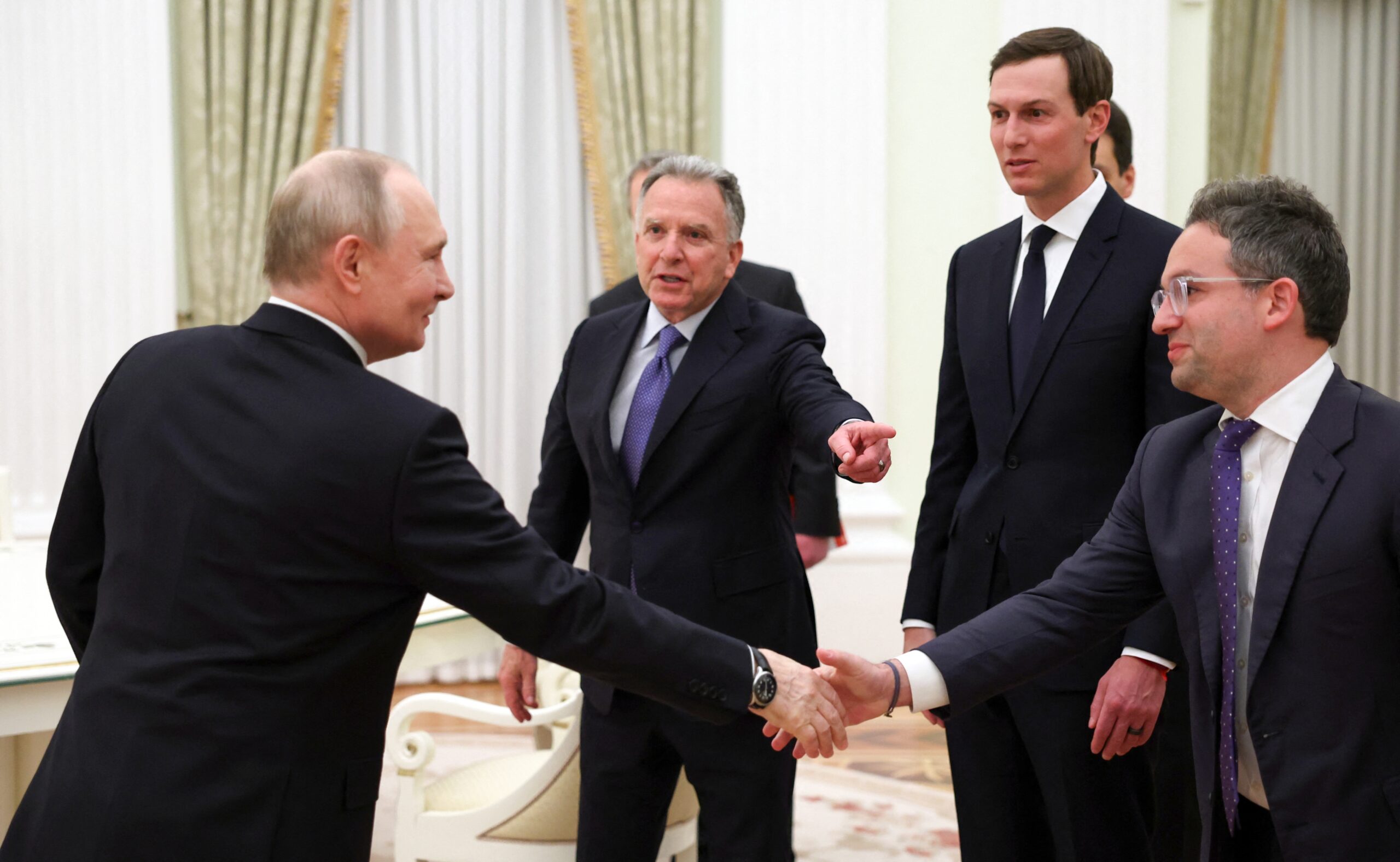
Gruenbaum started working with Steve Witkoff and Jared Kushner on Middle East diplomacy after the ceasefire between Israel and Hamas took effect in October
Plus, Swiss Shabbat in Davos
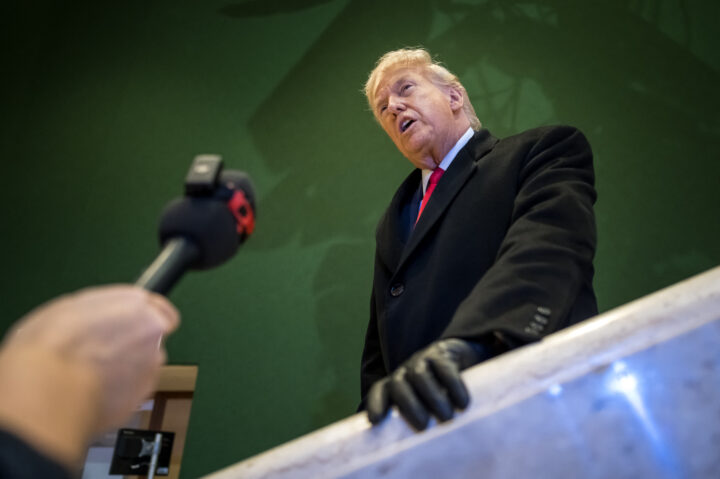
Fabrice COFFRINI / AFP via Getty Images
President Donald Trump as he leaves the World Economic Forum (WEF) annual meeting in Davos on January 21, 2026.
👋 Good Friday morning!
In today’s Daily Kickoff, we look at President Donald Trump’s mixed messaging on Iran this week, and report on California state Sen. Scott Wiener’s resignation as co-chair of the state legislature’s Jewish caucus after he accused Israel of genocide. We cover a letter from more than 100 New Jersey rabbis condemning former Gov. Phil Murphy and state Assembly leaders over their spiking of an antisemitism bill, and talk to GOP legislators about Trump’s decision to invite Russia and China to join the Board of Peace. Also in today’s Daily Kickoff: Emily Damari, AJ Edelman and Rabbi Yehoram Ulman.
Today’s Daily Kickoff was curated by JI Executive Editor Melissa Weiss and Israel Editor Tamara Zieve, with an assist from Marc Rod. Have a tip? Email us here.
For less-distracted reading over the weekend, browse this week’s edition of The Weekly Print, a curated print-friendly PDF featuring a selection of recent Jewish Insider and eJewishPhilanthropy stories, including: Paige Cognetti running in Josh Shapiro’s footsteps in key Pa. swing district; Mississippi’s Jewish community rallies after antisemitic arson; and Amy Acton became a household name in Ohio — now, she wants to be governor. Print the latest edition here.
What We’re Watching
- The World Economic Forum wrapped up this morning in Davos, Switzerland. Some of those who are staying for the weekend will be attending tonight’s Shabbat dinner in the Alpine town. Though not an official WEF event, the exclusive annual dinner will bring together roughly 150 conference attendees at the conclusion of the busy week. Anne Neuberger, the Biden administration’s deputy national security advisor for cyber and emerging technology, and Henry Schein Board Chair and CEO Stanley Bergman, will be the dinner’s main speakers this year, joined by Michelle Bolten, the chief of staff to the vice chairman of BlackRock. Rabbi Menachem Berkowitz, who received his semicha from Chabad last week, will give tonight’s d’var Torah, and professor Ricardo Hausmann will share his thoughts on current events, with a focus on Venezuela. Read more about past Shabbat dinners at Davos here.
- White House Special Envoy Steve Witkoff and Jared Kushner are in the United Arab Emirates for the weekend for meetings aimed at ending the Russia-Ukraine war following a meeting last night in Moscow with Russian President Vladimir Putin, which was also attended by White House advisor Josh Gruenbaum, that went into the early morning hours.
- The U.N. Human Rights Council is holding an emergency session today on Iran‘s weekslong crackdown on anti-government protesters.
- Manhattan’s Temple Emanu-El will hold a special interfaith service tonight honoring Cardinal Timothy Dolan as the longtime Catholic official retires as the archbishop of New York.
- The two-day JLI Leadership Summit starts on Sunday in Palm Beach Gardens, Fla.
What You Should Know
A QUICK WORD WITH JI’S MELISSA WEISS
Tensions are running high across the Middle East after a week in which the U.S. and Iran lobbed threats at each other, dominating headlines, destabilizing markets and leaving many in the region unnerved at the prospect of renewed military action seven months after the 12-day war between Israel and Iran that included U.S. strikes on Iranian nuclear facilities.
On the sidelines of the World Economic Forum in Davos, Switzerland, yesterday, Trump warned that an “armada” was on its way to the Gulf — a reference to the aircraft carrier and fleet of fighter jets being redeployed from the South China Sea.
In response, Gen. Mohammad Pakpour, the head of Iran’s Islamic Revolutionary Guard Corps, warned that Iran had its “finger on the trigger, more prepared than ever, ready to carry out the orders and measures of the supreme commander-in-chief.”
Trump, true to form, has been unpredictable and inconsistent in his approach to Tehran — alternating between threatening force and teasing diplomacy. “Iran does want to talk, and we’ll talk,” Trump said at a signing ceremony in Davos on Thursday, just hours before he told reporters on Air Force One about the naval deployment to the Gulf. “We have a massive fleet heading in that direction, and maybe we won’t have to use it,” he said on AF1, managing in one whiplash-inducing sentence to lob a threat at Iran while also offering it a theoretical off-ramp.
The president has proven that he is willing to engage in bold action — especially when it comes to Iran. One has only to look to the 2020 killing of Quds Force head Gen. Qassem Soleimani or the U.S. strikes on Iranian nuclear facilities last June to see that the Trump administration is willing to engage militarily with Iran in ways prior administrations may have not. (Case in point: former President Joe Biden’s issuance in April 2024 of a one-word warning to Iran — “Don’t” — a day before Tehran launched hundreds of missiles and drones at Israel.)
SCOOP

California state Sen. Scott Wiener announced on Thursday that he is stepping down from his role as one of the co-chairs of the California Legislative Jewish Caucus, capping off nearly two weeks of controversy and frustration among Jewish leaders in the state after the San Francisco Democrat and congressional candidate declared Israel’s actions in Gaza to be a genocide, Jewish Insider’s Gabby Deutch reports. “My campaign is accelerating, and my recent statements on Israel and Gaza have led to significant controversy in the Jewish community. The time to transition has arrived,” Wiener said in a statement. He will remain in the role until Feb. 15.
Background: Wiener, who is running for Congress in a competitive Democratic primary to fill the seat being vacated by retiring Rep. Nancy Pelosi (D-CA), has long declared himself a progressive Zionist while also criticizing the government of Israeli Prime Minister Benjamin Netanyahu and Israel’s actions in Gaza. But after a candidate forum this month where his two competitors were quick to say Israel has committed genocide in Gaza, Wiener faced pressure from his left to use the word himself, and released a video a few days later changing his stance. “I’ve stopped short of calling it genocide, but I can’t anymore,” Wiener said.
MEETING ADJOURNED
A city council meeting in Richmond, Calif., ended with shouting and frustration after 11 p.m. on Tuesday evening when the body adjourned without considering a measure seeking to censure Mayor Eduardo Martinez, who is under fire from the local Jewish community after sharing antisemitic posts on his LinkedIn page last month, Jewish Insider’s Gabby Deutch reports. Tuesday’s meeting was the first since Martinez shared multiple incendiary posts regarding the terrorist attack at a Hanukkah celebration in Bondi Beach, Australia, last month. He shared one post referring to the shooting as “Israel’s false flag attack.” Another post called the public celebration of Hanukkah “deeply provocative and very un-Jewish” and said it was meant to intimidate Muslims.
Expressing outrage: “This is a complete embarrassment as a city council,” Councilmember Jamelia Brown, one of the officials who sought to issue a formal censure of Martinez, said before walking away from the meeting room. “We will stand in solidarity and say that this was antisemitic conduct and behavior, yet we don’t want to formalize it and put it on record. It’s very coward [sic] behavior.”
PRAIRIE STATE POLITICS

Former Rep. Melissa Bean (D-IL) is emerging as the early front-runner in the Illinois 8th Congressional District primary, with an anti-Israel progressive candidate potentially a strong competitor, Jewish Insider’s Marc Rod reports.
State of play: “Coming into it, you’d say Melissa would probably be the one to beat. The question is, has the party changed a lot, especially in primaries, since she was in the House last?” Peter Giangreco, a Chicago political strategist, told JI. “Has the party moved — or at least Democratic primary voters, have they moved to the left more than where Melissa is, is sort of an open question.”
ON THE TRAIL

Sen. John Cornyn (R-TX), facing a serious primary challenge from his right, released a new campaign ad on Thursday calling “radical Islam” a “bloodthirsty ideology” that has influenced recent terror attacks targeting Jews, Jewish Insider’s Matthew Kassel reports.
The ad: “It fueled the unspeakable crimes on Oct. 7,” Cornyn says in the 30-second ad, called “Evil Face,” before citing the mass shooting last month during a Hanukkah gathering in Australia that was allegedly motivated by the terrorist group ISIS. “It showed its evil face again at Bondi Beach.” Speaking directly to the camera, Cornyn touted his recent efforts to revoke the tax-exempt status of the Council on American-Islamic Relations, a nonprofit advocacy group whose executive director has drawn scrutiny for celebrating the Hamas attacks of Oct. 7, 2023. “Let me be clear: No organization that supports terrorists should receive taxpayer benefits,” Cornyn concludes in the ad. “And Sharia law has no place in American courts or communities.”
SPEAKING OUT
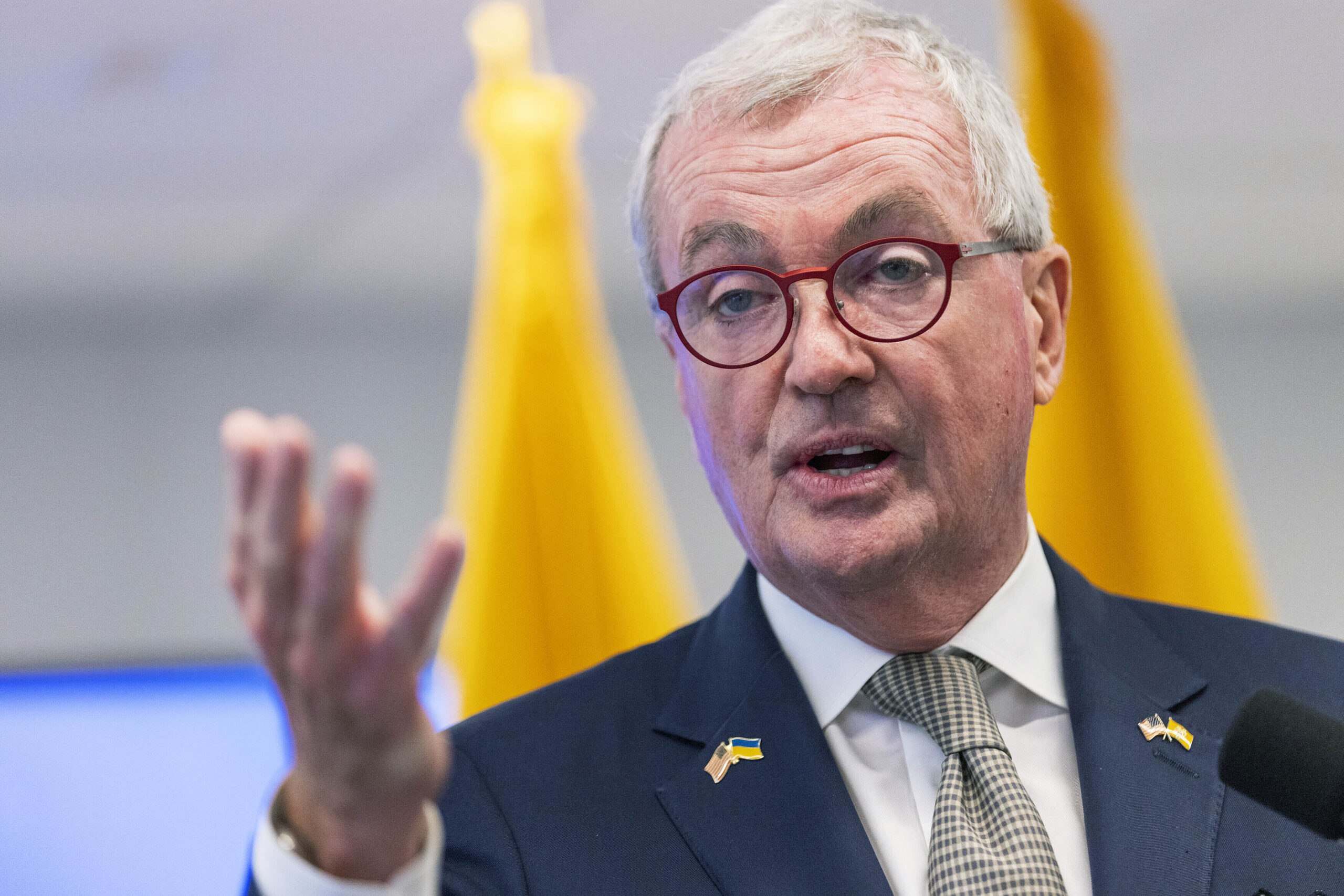
Nearly 100 New Jersey rabbis wrote to now-former Gov. Phil Murphy and members of the New Jersey Assembly this week expressing concerns about reporting from Jewish Insider that Murphy and other Democratic leaders had blocked passage of legislation to adopt the International Holocaust Remembrance Alliance’s working definition of antisemitism, JI’s Marc Rod reports.
The latest: “This is a deeply troubling failure of leadership that places political calculations above the safety of the Jewish population,” the 95 rabbis wrote. “Prioritizing politics over antisemitism signals that Jewish safety is negotiable and subjects our community to further cases of harassment and violence.” They called on state leaders to immediately take up and pass the IHRA bill.
Elsewhere: Political leaders in North Carolina are condemning the Nazi symbols and antisemitic graffiti discovered earlier this week at a hub of Jewish life in Charlotte, Jewish Insider’s Emily Jacobs reports.
NOT CONVINCED
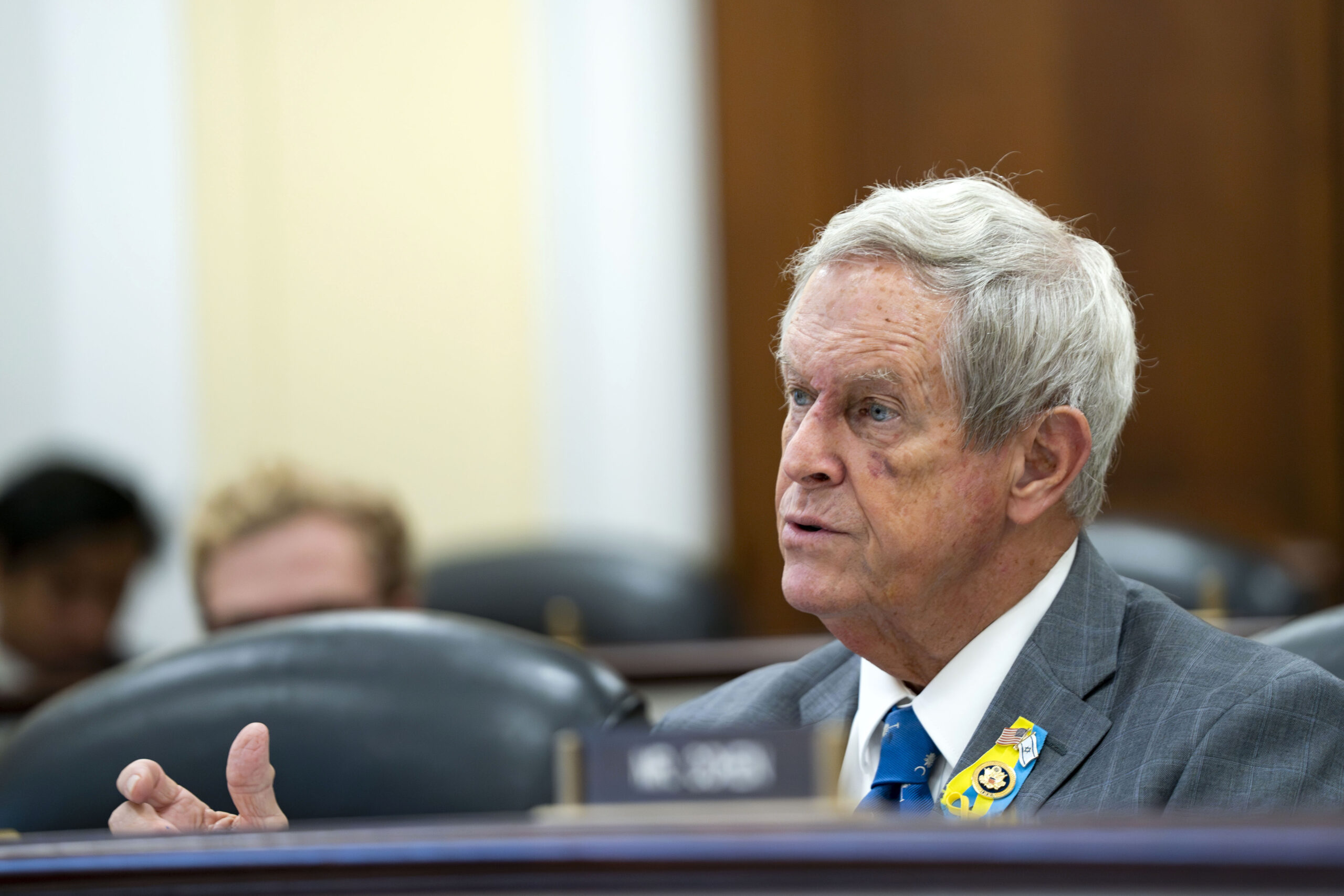
Some Republican lawmakers said they’re hesitant about President Donald Trump’s decision to invite Russia and China to be part of the Board of Peace that is set to manage the reconstruction of Gaza, Jewish Insider’s Marc Rod and Emily Jacobs report.
What they’re saying: “To exclude them from participation would be inappropriate; to include them in any real positive influence — neither one of them contributes money, neither one of them contributes an expertise in democracy,” Rep. Darrell Issa (R-CA) said. “I don’t mind them being included, but I think we have to be realistic. They both lack either the generosity or the expertise necessary to create a different world for the Palestinians in their future government.” Republicans indicated that they’re open to Trump’s idea of the Board of Peace becoming a replacement or alternative to the United Nations, citing the U.N.’s long-standing anti-Israel bias.
Seeing the big picture: Hamas must demilitarize before Gaza can undergo redevelopment, President Donald Trump’s informal advisor Jared Kushner said on Thursday on the sidelines of the World Economic Forum in Davos, Switzerland, as he presented the administration’s plan to disarm the terrorist group and rebuild Gaza, Jewish Insider’s Lahav Harkov reports.
Worthy Reads
Iraq and a Hard Place: Bloomberg’s Sam Bagher observes the difficult decisions facing Iraqi Prime Minister Mohammed Shia al-Sudani as the country finds itself being pulled by both Iran and the U.S.“The Arab country is torn between Iran, its erstwhile enemy that wants to maintain its longtime grip on its neighbor, and the U.S., the superpower whose disastrous 2003 invasion destroyed the country and destabilized the Middle East for a generation. … Over the past two years, Sudani has largely steered a middle path through the fallout from Hamas’ Oct. 7 attack on Israel and the ensuing Gaza war that have humbled Tehran, turned the Jewish state into a regional military hegemon and reshaped the Middle East. But at the same time, taking advantage of Iran’s weakness, he’s worked quietly to move Iraq closer to the US, its wealthy Sunni-led Gulf Arab allies and Turkey. It’s a fine line — he must dismantle Iran-backed militias, entice Western and Gulf Arab investment and bring in American oil companies, all without alienating Shiite political factions backed by Tehran or inviting a stronger response from the Islamic Republic.” [Bloomberg]
Bouncing Bibi: The Financial Times’ Andrew England and James Shotter look at efforts across the Israeli political spectrum to oust Prime Minister Benjamin Netanyahu in this year’s election. “As the incumbent, Netanyahu only has to ensure he doesn’t lose. If there is no clear winner — as happened in a string of elections before a 2022 vote — he could remain as caretaker prime minister. Or Netanyahu, as he has done before, could attempt to peel off opponents to form a government. That means only an outright opposition victory, achieved just once in the past 17 years of Netanyahu’s dominance, would dethrone ‘King Bibi’. ‘Politics-wise, Netanyahu pretty much yet again dug himself out of a political grave,’ says Yohanan Plesner, a former member of the Knesset for the centrist Kadima party, now at the Israel Democracy Institute. ‘The least wise thing you can do is predict Netanyahu’s end in politics.’” [FT]
Day-to-Day Hate: In The Washington Post, Or Moshe, who spent more than two years working in the international department of the Hostages and Missing Families Forum, warns that antisemitism is increasingly being accepted as a part of society even as attacks against Jews escalate in their brutality and frequency. “I have learned something painful and consistent. Jewish pain is rarely allowed to stand on its own. Instead, it is weighed. Qualified. Contextualized. Explained away. Violence against Jews is treated as a reaction rather than an atrocity. Fear is treated as an exaggeration. Mourning is treated as politics. … Antisemitism today does not always look like the caricatures people expect. It does not always announce itself with slurs or symbols. Sometimes it presents itself as moral clarity. It claims righteousness while denying Jews the right to safety, dignity and self-defense. It insists that Jewish fear is suspicious. That Jewish vulnerability is strategic. That Jewish deaths require footnotes.” [WashPost]
Monuments to Evil: In eJewishPhilanthropy, Menachem Z. Rosensaft calls on New York City leaders, including Mayor Zohran Mamdani, to act on a long-standing request from the Jewish community to remove plaques in lower Manhattan honoring French war criminals Marshal Philippe Pétain and Pierre Laval, who were responsible for the deaths of tens of thousands of French Jews during the Holocaust. “The two plaques remain as monuments not only to Laval and Pétain, but also to the callous indifference of three successive NYC mayors and municipal administrations to the glorification of two men who epitomized evil. During the primary campaign for last year’s Democratic mayoral nomination, Zohran Mamdani declared that he ‘condemned the Holocaust.’ … Fair enough. I am prepared to take him at his word. As mayor, Mamdani can now demonstrate affirmatively that he is genuinely committed to honor the memory of the more than six million Jewish people murdered by the Nazis.”[eJP]
Word on the Street
Saudi Ambassador to the U.S. Princess Reema Bandar Al Saud and Israeli President Isaac Herzog both shared optimistic remarks about the region’s future at a lunch, hosted by Meta President Dina Powell McCormick and philanthropist David Rubenstein, following a signing ceremony inaugurating the new Board of Peace in Davos, Switzerland, Jewish Insider’s Gabby Deutch reports…
President Donald Trump said he had rescinded his invitation for Canada to join his newly created Board of Peace, amid a deepening rift between Washington and Ottawa and days after Prime Minister Mark Carney warned that the world was “in the midst of a rupture”…
Israeli Prime Minister Benjamin Netanyahu met this morning with Sen. Joni Ernst (R-IA) in Jerusalem…
The House passed a funding package for the Department of Homeland Security on Thursday, with seven moderate Democrats joining with Republicans to advance the bill in spite of Democratic uproar about Immigration and Customs Enforcement operations; the bill, packaged with Pentagon funding legislation, now heads to the Senate, where its fate is uncertain…
House Republicans narrowly defeated a war powers resolution that would have limited the Trump administration’s ability to act in Venezuela without congressional approval; GOP leaders delayed the closing of the vote in order to give Rep. Wesley Hunt (R-TX) time to reach Capitol Hill from Dulles airport via police escort and cast a vote that tied the total count and prevented the resolution from passing…
Sen. Amy Klobuchar (D-MN) filed paperwork to form a campaign committee as she moves closer to announcing a run for governor in Minnesota…
Former Columbia University graduate student Mahmoud Khalil, a leader of the school’s anti-Israel protest movement, will likely be rearrested and deported to Algeria, a top Department of Homeland Security official said Wednesday, Jewish Insider’s Haley Cohen reports…
A federal judge issued an order blocking the Trump administration from retaliating against the American Association of University Professors and the Middle East Studies Association for their efforts to prevent the detention and deportation of visa holders who engaged in anti-Israel activity…
The NYPD arrested two teenagers in connection with the vandalization of a playground in Gravesend Park, Brooklyn, in which dozens of swastikas were graffitied on structures at the playground in two separate incidents; the teens are facing aggravated harassment charges, with one of them facing an additional charge of criminal mischief as a hate crime…
Children’s entertainer Ms. Rachel is under fire for liking a social media comment calling to “Free america from the Jews”; after posting a tearful apology for her initial engagement with the comment — which she said had been an accident — the educator responded “ooooooooooohhhhh” to another user’s suggestion that Jews had left the antisemitic comment…
Israel’s bobsled team, led by Israeli American athlete AJ Edelman, secured a slot in next month’s Winter Olympics in Milan, making history as the country’s first Olympic entrant in the sport; read more about Edelman’s yearslong effort to get an Israeli team to the Olympics here…
Former hostage Emily Damari got engaged to her girlfriend, food influencer Danielle Amit, at a party celebrating the British-Israeli citizen’s one-year anniversary of her release from Hamas captivity…
The U.S. is mulling a full troop withdrawal from Syria, days after Damascus took control over areas previously controlled by the U.S.-backed Kurdish Syrian Democratic Forces; a U.S. assessment found that approximately 200 low-level Islamic State fighters escaped from a Syrian prison earlier this week but had been recaptured after SDF forces abandoned the facility they had been guarding…
Baltimore-based entrepreneur and political fundraiser Michael Bronfein, the co-founder and CEO of Curio Wellness, died at 70…
Pic of the Day
At the Sydney Opera House on Thursday, Chabad of Bondi, led by Rabbi Yehoram Ulman (pictured), marked the shloshim — the 30-day milestone after death — of the victims of the Hanukkah terror attack at Bondi Beach, eJewishPhilanthropy’s Nira Dayanim reports.
Birthdays
Singer-songwriter and one of the world’s best-selling recording artists of all time, Neil Diamond turns 85 on Saturday…
FRIDAY: Real estate developer, Bruce Ratner turns 81… Professor of biological chemistry at Weizmann Institute of Science, David Wallach turns 80… Educational consultant, trade association and non-profit executive, Peter D. Rosenstein turns 79… Manager of Innovative Strategies LLLP, he is a board member of the Baltimore-based Zanvyl and Isabelle Krieger Fund, Howard K. Cohen… Former U.S. senator (D-DE), Tom Carper turns 79… Israeli archaeologist and professor at the University of Haifa, Estee Dvorjetski turns 75… Former Mayor of Los Angeles, Antonio Villaraigosa turns 73… President of Lazard, Raymond J. McGuire turns 69… Broadway theater owner, operator, producer and presenter and president of the Nederlander Organization, he is a 13-time Tony Award winner, James L. Nederlander turns 66… Former president of Staples Inc., she serves on the boards of Burlington Stores, CBRE and CarMax, Shira Goodman turns 65… Former CEO of the Foundation for Jewish Camp for 15 years, Jeremy J. Fingerman… Journalist and co-author of Game Change and Double Down: Game Change 2012, John Heilemann turns 60… Palm Beach, Fla., resident, formerly of Greenwich, Conn., Hilary Bangash Cohen… Journalist, screenwriter and film producer, in 2009 he wrote and produced “The Hurt Locker” for which he won two Academy Awards including for Best Picture, Mark Boal turns 53…Film director, comic book artist and musician, S. Craig Zahler turns 53… Israeli set and production designer for the television and film industries, Arad Sawat turns 51… Fourth rebbe of the Pittsburgh hasidic dynasty, Rabbi Meshulam Eliezer Leifer turns 47… Founder and executive director of Jew in the City, Allison F. Josephs… Strategic communications consultant, Arielle Poleg… Head of Meta’s Instagram, Adam Mosseri turns 43… Manhasset, N.Y., native who competed for Israel in figure skating, she was the 2014 Israeli national champion, Danielle Montalbano turns 37… Retired in 2024 as a soccer player for DC United, he also played on the U.S. men’s national soccer team, Steven Mitchell Birnbaum turns 35… NYC native who competed for Israel in pairs figure skating, she and her partner won silver medals in the 2008 and 2009 Israeli championships, Hayley Anne Sacks turns 35…
SATURDAY: Canadian architect and urban renewal advocate, she is a member of the Bronfman family, Phyllis Barbara Lambert turns 99… Born in Tel Aviv, 2011 Nobel Prize laureate in Chemistry, professor at Technion and Iowa State University, Dan Shechtman turns 85… Chairman of the Sazerac Company and of Crescent Crown Distributing, two of the largest domestic distillers and distributors of spirits and beer in the US, William Goldring turns 83… Professor of modern Jewish history at New York University, Marion Kaplan turns 80… Politician and lawyer who was an official in the Reagan, Bush 43 and Trump administrations, Elliott Abrams turns 78… Professor of alternative dispute resolution and mediation at Hofstra School of Law, Robert Alan Baruch Bush turns 78… Ukrainian-born comedian, actor and writer, he emigrated to the U.S. in 1977 and is noted for the catchphrase “What a country,” Yakov Smirnoff turns 75… Conductor, violinist and violist, who has performed with leading symphony orchestras worldwide, Yuri Bashmet turns 73… VP of strategy at LiveWorld, Daniel Flamberg… Founder of an online software training website which was acquired by LinkedIn in 2015 for $1.5 billion, Lynda Susan Weinman turns 71… Burlingame, California-based surgeon at Peninsula Plastic Surgery, Lorne K. Rosenfield M.D…. Beryl Eckstein… Former senior correspondent for Fox News for 24 years, now a senior correspondent at Newsmax, Rick Leventhal… Former CEO of Ford Motor Company, and now on the boards of Hertz and Qualcomm, Mark Fields (his family’s original name was Finkelman) turns 65… B’nei mitzvah coordinator at Temple Beth Am of Los Angeles, Judith Alban… Former HUD secretary and OMB director, now the president and CEO of Enterprise Community Partners, a housing non-profit, Shaun Donovan turns 60… Co-founder and executive director of Protect Democracy, he served as associate White House counsel in the Obama administration, Ian Bassin turns 50… Journalist and then tax attorney, now chief legal officer at Ripple Fiber, Joshua Runyan… Sporting director for Hapoel Jerusalem of the Israeli Premier League and the FIBA Champions League, Yotam Halperin turns 42… Founder and CEO at TACKMA and a principal at Schottenstein Property Group, Jeffrey Schottenstein… Former regional director of synagogue initiative at AIPAC, Miryam Knafo Schapira… Law Clerk at Fried Frank, Michael Krasna… Musician and former child actor, Jonah Bobo turns 29…
SUNDAY: Senior partner of The Mack Company and a director of Mack-Cali Realty, a real estate investment trust, David S. Mack (family name was Makofsky) turns 84… Israeli peace activist and author, whose fiction and nonfiction books have been translated into more than 30 languages, David Grossman turns 72… Editor-in-chief of The National Memo, Joe Conason (family name was Cohen) turns 72… Retired in 2023 as Dean of the Jerusalem campus of Hebrew Union College-Jewish Institute of Religion, Naamah Kelman-Ezrachi turns 71… SVP and senior portfolio manager in the Los Angeles office of Morgan Stanley, Robert N. Newman… Stage, film and television actress and television director, Dinah Beth Manoff turns 70… Los Angeles resident, Helene S. Ross… Agent at Creative Artists Agency, Michael Glantz… Chief correspondent and executive editor for CBS News “Eye on America” franchise, Jim Axelrod turns 63… Former member of Knesset for Yesh Atid, he also served as minister of education, Shai Moshe Piron turns 61… Founding partner of merchant bank Finback Investment Partners, John Leachman Oliver III… Member of the Canadian Parliament from Montreal since 2015, he won 12 medals in swimming at the 2013 and 2017 Maccabiah Games, Anthony Housefather turns 55… Author of multiple novels, she is a writer-in-residence in Jewish studies at Stanford University, Maya Arad turns 55… Toronto-born movie and television actress, she had a recurring guest role on the Fox TV series “24,” Mia Kirshner turns 51… National political reporter at The Washington Post covering campaigns, Congress and the White House, Michael Scherer… President and CEO of Knollwood Cemetery Corp, David Newman… President of Ukraine since 2019, he is the first Jewish leader of that country, Volodymyr Zelensky turns 48… Member of the U.S House of Representatives (D-FL), Sheila Cherfilus-McCormick turns 47… Benjamin L. Newton… Managing VP of executive operations for the National Association of Manufacturers, Mark Isaacson… Member of the Arizona House of Representatives until 2023, Daniel Hernández Jr. turns 36… Actress, writer and director, Pauline Hope Chalamet turns 34… Associate director of foreign policy at JINSA, Ari Cicurel…
Trump, true to form, has been unpredictable and inconsistent in his approach to Tehran — alternating between threatening force and teasing diplomacy
Chip Somodevilla/Getty Images
U.S. President Donald Trump gives a speech at the World Economic Forum (WEF) on January 21, 2026 in Davos, Switzerland.
Tensions are running high across the Middle East after a week in which the U.S. and Iran lobbed threats at each other, dominating headlines, destabilizing markets and leaving many in the region unnerved at the prospect of renewed military action seven months after the 12-day war between Israel and Iran that included U.S. strikes on Iranian nuclear facilities.
On the sidelines of the World Economic Forum in Davos, Switzerland, yesterday, Trump warned that an “armada” was on its way to the Gulf — a reference to the aircraft carrier and fleet of fighter jets being redeployed from the South China Sea.
In response, Gen. Mohammad Pakpour, the head of Iran’s Islamic Revolutionary Guard Corps, warned that Iran had its “finger on the trigger, more prepared than ever, ready to carry out the orders and measures of the supreme commander-in-chief.”
Trump, true to form, has been unpredictable and inconsistent in his approach to Tehran — alternating between threatening force and teasing diplomacy. “Iran does want to talk, and we’ll talk,” Trump said at a signing ceremony in Davos on Thursday, just hours before he told reporters on Air Force One about the naval deployment to the Gulf. “We have a massive fleet heading in that direction, and maybe we won’t have to use it,” he said on AF1, managing in one whiplash-inducing sentence to lob a threat at Iran while also offering it a theoretical off-ramp.
The president has proven that he is willing to engage in bold action — especially when it comes to Iran. One has only to look to the 2020 killing of Quds Force head Gen. Qassem Soleimani or the U.S. strikes on Iranian nuclear facilities last June to see that the Trump administration is willing to engage militarily with Iran in ways prior administrations may have not. (Case in point: former President Joe Biden’s issuance in April 2024 of a one-word warning to Iran — “Don’t” — a day before Tehran launched hundreds of missiles and drones at Israel.)
More recently, the capture of Venezuela’s Nicolás Maduro demonstrates that the Trump administration isn’t opposed to regime change. And indeed, that was a possibility the president has mulled vis-a-vis Tehran, telling Politico last weekend that it was “time to look for new leadership in Iran.”
Meanwhile, Trump’s inner circle and key allies are split over how to approach Iran. White House Special Envoy Steve Witkoff has been a vocal backer of using diplomacy to quell tensions with Tehran.
“Iran needs to change its ways,” Witkoff told Bloomberg on Wednesday in Davos. “They need to do that. And if they do, if they indicate that they’re willing to do that, I think we can diplomatically settle this.”
Witkoff additionally expressed disappointment that Iranian Foreign Minister Abbas Araghchi had been removed from the agenda at Davos after quietly being added last week, saying he had been “looking forward to meeting [Araghchi], because we have to build that communication channel, because the alternative to that is not a good alternative.”
Hours after Witkoff’s comments, Sen. Lindsey Graham (R-SC) posted a thinly veiled reference to the White House envoy, saying he was “unnerved by statements being made by people involved in the Iran file suggesting that if the ayatollah could change his ways, we might be able to reach an agreement with the regime.”
“Anyone who believes that the ayatollah is remotely interested in changing his ways does not understand the history of the ayatollah and the murderous regime,” Graham continued. “That’s the same as believing someone could have done a deal with Hitler.”
Within Iran, there are still hopes that U.S. action will topple Supreme Leader Ayatollah Ali Khamenei. The Economist notes a joke making the rounds among Iranian civil servants: “We used to worry we’d become Venezuela. Now we worry we won’t.”
Heading into the weekend with tensions still high, those who have to live with the consequences of the continuation of the Iranian regime — from the Iranians who have faced years of repression to the Israelis preparing their bomb shelters for the next war to people across the region whose lives have been upended by Iran’s proxies in Lebanon, Syria, Iraq and Gaza — will be watching closely for any signal from Trump and his top advisors about Washington’s next moves, and their reverberations around the world.
Plus, Cornyn targets 'radical Islam' in heated TX-SEN primary
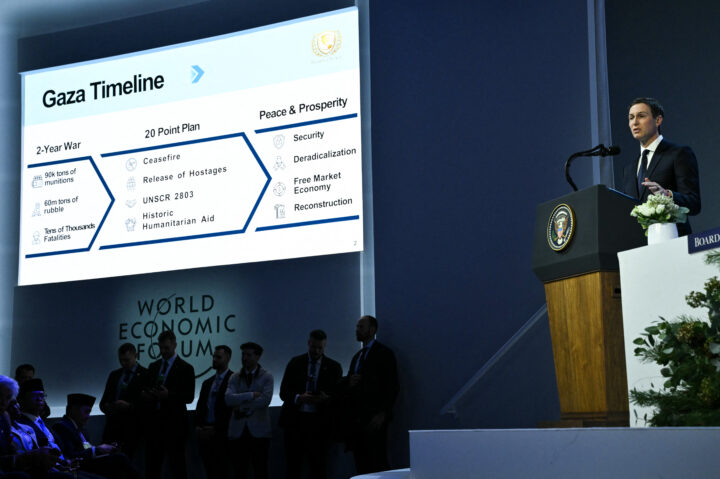
Mandel NGAN / AFP via Getty Images
Jared Kushner speaks at the "Board of Peace" meeting during the World Economic Forum (WEF) annual meeting in Davos on January 22, 2026.
Good Thursday afternoon!
This P.M. edition is reserved for our premium subscribers — offering a forward-focused read on what we’re tracking now and what’s coming next.
It’s me again — Danielle Cohen-Kanik, U.S. editor at Jewish Insider and curator, along with assists from my colleagues, of the Daily Overtime. Please don’t hesitate to share your thoughts and feedback by replying to this email.
📡On Our Radar
Notable developments and interesting tidbits we’re tracking
Before officials departed from Davos, Switzerland, today, the Trump administration undertook a big task: laying out its complete vision for the demilitarization and reconstruction of Gaza, Jewish Insider’s Lahav Harkov reports.
Jared Kushner, speaking after President Donald Trump’s remarks at his founding ceremony for the Board of Peace, presented the administration’s “demilitarization principles” meant to be implemented in the next 100 days, including the destruction of “heavy weapons, tunnels, military infrastructure, weapons production facilities and munitions.”
The ultimate vision sees a completely overhauled Gaza including a port and a tourism zone along the Mediterranean coast, as well as large residential areas and industrial complexes, while retaining the IDF security perimeter.
But “this deal only happened because … we all worked together to make this happen,” Kushner said, urging countries, including Israel, to put aside their differences to bring the plan to fruition. “I see people criticizing Israel, or Israel criticizing Turkey and Qatar. Just calm down and work together for 30 days”…
Meanwhile, several of the highest-profile attendees of the Board of Peace ceremony hustled to a private lunch, JI’s Gabby Deutch reports, including Saudi Ambassador to the U.S. Princess Reema Bandar Al Saud and Israeli President Isaac Herzog, who both spoke hopefully about the future of the Abraham Accords.
Also in the room: Bahraini Crown Prince Salman bin Hamad Al Khalifa, Commerce Secretary Howard Lutnick, Treasury Secretary Scott Bessent, Bank of America CEO Brian Moynihan, JPMorgan Chase CEO Jamie Dimon, Dell Technologies CEO Michael Dell and more…
The Wall Street Journal lays out the concerns of the Board of Peace holdouts — including China, Russia, France and Britain, who are wary of joining a body where they don’t hold a permanent veto and that seeks to replace the one where they do, at the U.N. Security Council. There’s also the issue of its broad mandate: EU foreign policy chief Kaja Kallas said today that European leaders could work with the board “if we narrow it down to Gaza like it was meant to be”…
The U.S. is weighing a complete withdrawal of its troops from Syria, the Journal also reports, shortly after Syrian President Ahmad al-Sharaa’s forces carried out a campaign against the Kurdish-led and U.S.-backed Syrian Democratic Forces, ultimately ordering it to disband.
The U.S. has around 1,000 troops in the country, many of whom are co-located with the SDF, where they carry out missions against ISIS (SDF forces were in charge of guarding ISIS prisoners until last weekend). Recent events have led the U.S. to question the viability of its mission in Syria, American officials told the Journal…
Elsewhere in the region, the commander of Iran’s Islamic Revolutionary Guard Corps issued a stark warning to the U.S. and Israel, even as Trump said this morning that he’s open to diplomatic dialogue with Tehran.
The IRGC and Iran “have their finger on the trigger, more prepared than ever, ready to carry out the orders and measures of” Supreme Leader Ayatollah Ali Khamenei, “a leader dearer than their own lives,” Mohammad Pakpour said, as Iran issued its first official death toll of the protests, putting the number killed at 3,117…
Stateside, California state Sen. Scott Wiener, who is running for retiring Rep. Nancy Pelosi’s (D-CA) seat, announced today that he is stepping down from his role as one of the co-chairs of the California Legislative Jewish Caucus, JI’s Gabby Deutch reports, capping off nearly two weeks of controversy and frustration among Jewish leaders in the state after the San Francisco Democrat declared Israel’s actions in Gaza to be a genocide.
Wiener said in a statement, which was obtained by JI, that the decision was prompted in part by the fallout of his genocide comments. “My campaign is accelerating, and my recent statements on Israel and Gaza have led to significant controversy in the Jewish community. The time to transition has arrived,” Wiener said. He will remain in the role until Feb. 15.
In an interview with Politico this week, Wiener said he’s heard from unhappy Jewish voters and leaders in the days after his comments, but asked them to remember his record. “If you’re mad at me, if you feel betrayed, I respect and honor that. But just also remember how many times I’ve gone to the mat for this community, and the bullets I’ve taken for this community,” Wiener said…
In a new ad released today, Sen. John Cornyn (R-TX), facing a serious primary challenge from his right, calls “radical Islam” a “bloodthirsty ideology” that has influenced recent terror attacks targeting Jews, JI’s Matthew Kassel reports.
“It fueled the unspeakable crimes on Oct. 7,” Cornyn says in the 30-second ad, called “Evil Face,” before citing the mass shooting last month during a Hanukkah gathering in Australia that was allegedly motivated by ISIS. “It showed its evil face again at Bondi Beach.”
The ad comes as Cornyn’s opponent, Texas Attorney General Ken Paxton, has also made combating “radical Islamist terrorist groups” a priority, as he engages in a lawsuit with the Council on American-Islamic Relations…
Pennsylvania Gov. Josh Shapiro further clarified the questions he was asked by Vice President Kamala Harris’ presidential campaign as he was vetted to be her running mate, in an interview airing this weekend on “CBS Sunday Morning.” “They actually asked if I was an agent [of the Israeli government] and if I had ever spoken to an undercover agent of the Israeli government,” he said, to which he pointed out that he wouldn’t necessarily be aware if he had spoken to someone undercover.
“I think it went beyond just checking a box on a questionnaire,” Shapiro said of his perception of the questioning. “I can tell you that it landed on me in an offensive way. I have dedicated my entire adult life to serving this country. … For someone to question my loyalty, particularly as someone who is as open about his faith as he is, was offensive to me”…
The Department of Homeland Security said Columbia University graduate student and protest leader Mahmoud Khalil could be deported to Algeria, JI’s Haley Cohen reports, shortly after a federal appeals court ruled Khalil could be rearrested.
Tricia McLaughlin, DHS assistant secretary for public affairs, said on NewsNation yesterday, “it looks like he’ll go to Algeria. That’s what the thought is right now. It’s a reminder for those who are in this country on a visa or on a green card. You are a guest in this country — act like it. It is a privilege, not a right, to be in this country to live or to study.”
New York City Mayor Zohran Mamdani said in a statement that Khalil “is a New Yorker. He should remain in New York City.” He called the “attack” on Khalil “part of a larger attack on the freedom of speech that is especially pronounced when it comes to the use of that speech to stand up for Palestinian human rights. I will make that clear to everyone. He deserves to be in the city just like any other New Yorker”…
Australia’s main opposition coalition, composed of the Liberal and National parties, split yesterday — during the country’s day of mourning for the Hanukkah Bondi Beach massacre — over a disagreement about the government’s proposed hate speech laws, which were introduced as a response to the attack. The Liberal party voted with the government to adopt the reforms, which increase penalties for hate speech and ban groups who promote it, while the Nationals were opposed, citing concerns around free speech…
⏩ Tomorrow’s Agenda, Today
An early look at tomorrow’s storylines and schedule to keep you a step ahead
Keep an eye out in Jewish Insider for a rundown of the state of the race in Illinois’ 8th Congressional District, where former Rep. Melissa Bean (D-IL) is fending off far-left Israel detractors.
Over the weekend, the Trump administration’s focus will shift back from Gaza to Russia and Ukraine, as the countries hold trilateral talks in Abu Dhabi, UAE, tomorrow and Saturday. White House Special Envoy Steve Witkoff and advisor Jared Kushner headed from the Board of Peace ceremony to Moscow earlier today.
Diplomats and Jewish leaders will head to Jerusalem for the 2nd annual International Conference on Combating Antisemitism, hosted by Israeli Diaspora Affairs Minister Amichai Chikli, which kicks off Monday evening. Last year’s inaugural conference was mired in controversy over the inclusion of far-right European politicians, causing several leading Jewish figures to cancel their appearances (many of whom similarly do not appear on this year’s agenda).
We’ll be back in your inbox with the Daily Overtime on Monday. Shabbat Shalom!
Stories You May Have Missed
COGNETTI’S CAMPAIGN
The Scranton mayor is championing her support for Israel as she challenges GOP Rep. Rob Bresnahan
FACING SCRUTINY
Moran, a former longtime congressman now lobbying for Qatar, has an extensive record of using antisemitic tropes and hostility to Israel
But, the president noted, the regime is ‘shooting people indiscriminately in the streets’
Fabrice COFFRINI / AFP via Getty Images
President Donald Trump as he leaves the World Economic Forum (WEF) annual meeting in Davos on January 21, 2026.
President Donald Trump said Wednesday that he hopes no military action will be needed in Iran, but stopped short of ruling it out as the U.S. continues to move military assets to the Middle East.
“We hope there’s not going to be further [military] action,” Trump said during an interview with CNBC on the sidelines of the World Economic Forum in Davos, Switzerland, while alluding to the fact that it still might be a possibility given Tehran’s conduct in suppressing nationwide demonstrations. “But you know, [the regime is] shooting people indiscriminately in the streets.”
The president has previously called the Iranian regime’s killing of protesters a “red line” and vowed to protesters that “help is on its way.” Trump repeated his claim on Wednesday that Iranian authorities had planned to hang 837 protesters last week, but “canceled it” after he warned them not to.
Trump has thus far refrained from authorizing military action against Iran — even as the U.S. has continued to move military assets to the Middle East in preparation for potential escalation, with reports indicating that the Pentagon has relocated more F-15 fighter jets to the region in recent days.
When asked by CNBC’s Joe Kernen whether people should “stay tuned” on Iran, Trump was noncommittal: “I guess — I mean, look, it’s a rough place,” he said.
White House Special Envoy Steve Witkoff, also at Davos, told Bloomberg News that diplomatic engagement remains possible if Tehran changes course.
“Iran needs to change its ways,” Witkoff said. “If they indicate that they’re willing to do that, I think we can diplomatically settle this.” But asked if he believes Iran wants to take the diplomatic path, Witkoff said, “We don’t have that sense yet.”
Still, the president noted that if Tehran were to continue pursuing nuclear capabilities, an attack similar to the U.S. strikes on Iranian nuclear sites last June is “going to happen again.”
“They keep experimenting with nuclear, and, you know, at some point they’re going to get the idea that they can’t do that,” he said.
Plus, Pritzker defends Harris amid Shapiro antisemitism allegations

Harun Ozalp/Anadolu via Getty Images
President Donald Trump delivers a speech during the World Economic Forum Annual Meeting in Davos, Switzerland, on January 21, 2026.
Good Wednesday afternoon!
This P.M. edition is reserved for our premium subscribers — offering a forward-focused read on what we’re tracking now and what’s coming next.
It’s me again — Danielle Cohen-Kanik, U.S. editor at Jewish Insider and curator, along with assists from my colleagues, of the Daily Overtime. Please don’t hesitate to share your thoughts and feedback by replying to this email.
📡On Our Radar
Notable developments and interesting tidbits we’re tracking
President Donald Trump took center stage at the World Economic Forum in Davos, Switzerland, this morning, and while headlines were dominated by his proclamations of the U.S.’ intent to acquire Greenland (and subsequent announcement that he and the NATO secretary general are coming to an agreement on the issue), Trump also issued a stark warning to Hamas in his remarks, Jewish Insider’s Matthew Shea reports.
“Hamas has agreed to give up their weapons,” Trump told a packed room of attendees. “If they don’t do it, they’ll be blown away very quickly.”
The president has made similar statements since the adoption of the ceasefire in October, though he laid out a more concrete timeline for his expectation of disarmament: “They’ve got to do it, and we’re going to know over the next two or three days, certainly over the next two or three weeks, whether or not they’re going to do it,” said Trump…
Ahead of the signing ceremony for the Board of Peace that Trump is hosting in Davos tomorrow, the foreign ministers of Saudi Arabia, Turkey, Egypt, Jordan, Indonesia, Pakistan, Qatar and the UAE issued a joint statement accepting his invitation to join.
White House Special Envoy Steve Witkoff told Bloomberg News “20 or 25 leaders have already said yes” to attend the signing ceremony, despite other world leaders already having departed from Switzerland. “Everyone wants to be a part of this,” he said…
On the sidelines of the confab, Trump spoke with CNBC about U.S. relations with Iran amid heightened tensions and American military assets moving into the Gulf. “We hope there’s not going to be further [military] action, but they’re shooting people indiscriminately in the streets,” Trump said of the Iranian regime.
Asked by host Joe Kernen, “Should we stay tuned in Iran?” Trump was noncommittal: “I guess — I mean, look, it’s a rough place,” he said. But he added that if Iran continues to try to acquire nuclear capabilities, strikes like those the U.S. and Israel carried out in June are “going to happen again.”
Witkoff similarly told Bloomberg, “Iran needs to change its ways, they need to do that. And if they do, if they indicate they’re willing to do that, I think we can diplomatically settle this.” Asked if he has the sense that Iran wants to take the diplomatic path, Witkoff said, “We don’t have that sense yet”…
The Treasury Department issued sanctions today against six “Gaza-based organizations that claim to provide medical care to Palestinian civilians but in fact support the military wing of Hamas, the Izz al-Din al-Qassam Brigades,” the department said. “The fraudulent nature of these organizations, which use deception to raise funds from international donors, demonstrates Hamas’s perfidy and deprives innocent civilians of the medical care they need.”
The department also designated the Popular Conference for Palestinians Abroad as a terror group, a move that lawmakers have pushed, for “not only work[ing] with, and in support of, Hamas — it operates at Hamas’s behest.” The group, which claims to be a Palestinian advocacy organization, was designated as such by Israel in 2021 and was alleged to have organized recent anti-Israel flotillas…
Meanwhile in the Big Apple, divisions between New York City Mayor Zohran Mamdani and Comptroller Mark Levine over their positions on Israel surfaced, as Mamdani pushed back on Levine’s recent statements that he remains committed to resuming the city’s investment in Israel Bonds.
“I’ve made clear my position, which is that I don’t think that we should purchase Israel Bonds. We don’t purchase bonds for any other sovereign nation’s debt. The comptroller has also made his position clear, and I continue to stand by mine,” Mamdani said at a press conference today…
While he is distancing himself from Levine, Mamdani is presenting a united front with NYPD Commissioner Jessica Tisch, The New York Times writes, as the two navigate their differences on policing, Israel and other issues…
Mamdani also said today that he was “sickened” by antisemitic vandalism found in Borough Park, which saw many swastikas painted around the predominantly Orthodox Jewish neighborhood. “I stand shoulder to shoulder with the Jewish New Yorkers who were targeted. My administration is working closely with the NYPD’s Hate Crimes Task Force as well as our Parks Department, and those responsible will be investigated and held accountable,” he said in a statement…
Not 24 hours earlier, a Manhattan comedy club canceled Israeli comedian Guy Hochman’s show last night after pro-Hamas groups protested outside of the venue, JI’s Haley Cohen reports. “The owner of the place was afraid and canceled the show,” Hochman told JI, referring to Broadway Comedy Club, located near Times Square. “So, I did an alternative show for my audience outside freezing to death”…
Some of the candidates competing for retiring Rep. Jerry Nadler’s (D-NY) seat in New York’s 12th Congressional District provided insight into their positions on Israel in a candidate questionnaire to receive the endorsement of the Working Families Party, Politico reports.
Kennedy heir Jack Schlossberg and state Assemblymembers Alex Bores and Micah Lasher all said they would not support a resolution sponsored by Rep. Rashida Tlaib (D-MI) calling Israel’s actions in Gaza a genocide; Bores and Lasher said they would not support the “Block the Bombs Act” placing sweeping restrictions on U.S. aid to Israel, while Schlossberg said he’s unsure; and Schlossberg said he would support a bill brought several years ago that sought to prohibit U.S. aid to Israel from being used for a variety of military operations, while Bores said he would not and Lasher was unsure…
After Pennsylvania Gov. Josh Shapiro alleged that Vice President Kamala Harris’ team asked if he had ever been an Israeli agent as he was being considered to be her running mate, Illinois Gov. JB Pritzker, another potential 2028 Democratic presidential contender, told reporters yesterday that he didn’t think the questions during the vetting process were inappropriate. “The questions are tough. I think you’ve got to be tough during the process,” he said.
“I mean, what’s appropriate and inappropriate in the context of getting, as one pundit calls it, ‘an MRI for your soul,’ when you’re out there in the national political arena?” Pritzker, who was also vetted by the Harris team, asked. His comments are at odds with moderate Democrats on Capitol Hill, who told JI that Shapiro’s account was “totally insane,” “problematic” and “incredibly disturbing”…
⏩ Tomorrow’s Agenda, Today
An early look at tomorrow’s storylines and schedule to keep you a step ahead
Keep an eye out in Jewish Insider for an interview with Paige Cognetti, the Democratic mayor of Scranton, Pa., seeking to flip a northeast Pennsylvania swing seat by emphasizing her pro-Israel bona fides.
President Donald Trump will hold the signing ceremony for his Board of Peace with several world leaders in Davos, Switzerland, tomorrow morning local time (around 4:30 a.m. ET).
Australia will hold a national day of mourning to honor the victims of the terror attack that took place at a Hanukkah celebration in Sydney last month, Prime Minister Anthony Albanese announced.
The Sundance Film Festival kicks off in Park City and Salt Lake City, Utah: For the cinephiles keeping track, on the docket this year is a Hebrew coming-of-age film set in the ‘80s titled “Tell Me Everything,” a documentary about three doctors providing humanitarian care in Gaza, a panel by the Jewish Institute for Television & Cinema on combating antisemitism through film and more.
Stories You May Have Missed
‘A NEW NORMAL’

‘There’s going to be a new normal,’ the progressive Israel advocacy group told JI, as it endorses candidates who call Israel’s actions in Gaza a genocide
MILAN 2026

‘It’s like the actual talented version of ‘Cool Runnings,’’ Israel bobsled team pilot AJ Edelman tells JI
Plus, Lawler calls on NY-17 opponents to denounce antisemitic ad
Kevin Dietsch/Getty Images
President Donald Trump gives a press briefing at the White House on January 20, 2026 in Washington, DC.
Good Tuesday afternoon!
This P.M. edition is reserved for our premium subscribers — offering a forward-focused read on what we’re tracking now and what’s coming next.
It’s me again — Danielle Cohen-Kanik, U.S. editor at Jewish Insider and curator, along with assists from my colleagues, of the Daily Overtime. Please don’t hesitate to share your thoughts and feedback by replying to this email.
📡On Our Radar
Notable developments and interesting tidbits we’re tracking
President Donald Trump continues to promote his Board of Peace ahead of its launch at the World Economic Forum later this week: In its charter sent to leaders around the world, the president laid out a vision for the body, which has grown into a U.N.-like institution that would mediate global conflicts and would require countries to pay $1 billion to secure a permanent seat, The Wall Street Journal reports.
Asked at a press conference this afternoon if he intends for the body to replace the U.N., Trump said it “might.” “Wish the United Nations could do more, wish we didn’t need a Board of Peace,” he said.
More than 10 countries have reportedly signed on to join the board, whose charter does not mention Gaza, including the UAE and Hungary. But its expanded mandate has made other countries wary: When told France does not intend to accept the invitation to join, Trump threatened to put a 200% tariff on French wines and Champagnes…
At the WEF in Davos, Switzerland, Treasury Secretary Scott Bessent credited the U.S.’ “maximum pressure” sanctions on Iran for the protest movement that wracked the country in recent weeks. “It’s worked because in December, their economy collapsed. … They are not able to get imports, and this is why the people took to the streets. … This is economic statecraft, no shots fired, and things are moving in a very positive way here,” Bessent said…
Asked about the remaining potential for U.S. military action in Iran over its violent crackdown on the protests, Trump said at this afternoon’s press conference, “I can’t tell you what’s going to happen in the future” and once again praised the regime for not proceeding with its plans to hang 837 protesters. “We’re just going to have to see what happens,” Trump said…
Israeli authorities began demolishing the compound that previously housed the U.N. Relief and Works Agency in Jerusalem, a year after Israel passed a law banning UNRWA from operating in the country over the involvement of its employees in terror activities, including the Oct. 7 attacks.
The Israeli Foreign Ministry denied U.N. claims that the compound has diplomatic immunity, saying in a statement, “Even prior to the passage of legislation in January 2025, UNRWA had already ceased its operations at this site and no longer had any UN personnel or UN activity there. The compound does not enjoy any immunity and the seizure of this compound by Israeli authorities was carried out in accordance with both Israeli and international law”…
Several European countries have not sent their representatives back to the U.S.-led Civil-Military Coordination Center in southern Israel after the holidays, Reuters reports, as the countries, including Germany, France and Britain, consider the value of engaging with the body that diplomats called “directionless” and a “disaster”…
In campaign news, Rep. Mike Lawler (R-NY) condemned as antisemitic an ad running in New York’s suburban 17th Congressional District that targets him for his support for Israel and for receiving backing from pro-Israel donors, Jewish Insider’s Marc Rod reports.
“This ad is a disgrace,” Lawler said in a statement. “This kind of politics has no place in the Hudson Valley. I am calling on every candidate running in NY-17 to publicly and unequivocally denounce this ad immediately. Silence is an endorsement.”
The ad, paid for by the anti-Israel Institute for Middle East Understanding, states in part, “Israelis enjoy universal healthcare, while Americans go bankrupt from medical bills. Lawler’s reward? Giant campaign donations from AIPAC and the pro-Netanyahu lobby.” The 17th District, one of Democrats’ top targets in November, has a sizable Jewish population and many pro-Israel swing voters, which have been key to Lawler’s past victories…
The Senate Leadership Fund, a super PAC with ties to Senate GOP leadership and one of the largest independent spenders in Senate races, announced an initial investment of $42 million to back Sen. Susan Collins (R-ME) in Maine. It’s the super PAC’s largest spend ever in the state, which will be rolled out in August, as Collins enters a general election likely facing either Gov. Janet Mills or oyster farmer Graham Platner…
Rep. Julia Letlow (R-LA) launched her bid to challenge Sen. Bill Cassidy (R-LA) this morning, days after Trump endorsed her on social media. Cassidy, who already has several primary challengers, drew the ire of the president when he voted to convict during his 2021 impeachment proceedings, though Cassidy had told other senators privately that he believed Trump would stay out of the race…
The University of Pennsylvania, which is being sued by the Trump administration over its alleged failure to comply with subpoenas related to an investigation into antisemitism at the Ivy League school, is fighting back against the administration’s request for records about Jewish employees, calling it “disconcerting” and an “extraordinary and unconstitutional demand.”
The Equal Employment Opportunity Commission had reportedly sought information about university employees who submitted complaints about antisemitic discrimination and those who were members of Jewish campus groups; Penn said in its filing that the EEOC is “entirely disregarding the frightening and well-documented history of governmental entities that undertook efforts to identify and assemble information regarding persons of Jewish ancestry”…
⏩ Tomorrow’s Agenda, Today
An early look at tomorrow’s storylines and schedule to keep you a step ahead
Keep an eye out in Jewish Insider for a deep dive into J Street’s embrace of Democrats seeking to create distance between the U.S. and Israel.
The World Economic Forum continues in Davos, where President Donald Trump will give an address at 8:30 a.m. ET. Also appearing onstage tomorrow are Palestinian Authority Prime Minister Mohammad Mustafa; Egyptian President Abdel Fattah El-Sisi; governors Gretchen Whitmer of Michigan, Andy Beshear of Kentucky and Kevin Sitt of Oklahoma; Saudi Foreign Affairs Minister Prince Faisal bin Farhan Al Saud; Rafael Grossi, director-general of the International Atomic Energy Agency; Nvidia CEO Jensen Huang; JPMorgan Chase CEO Jamie Dimon; and David Sacks, the White House AI and crypto czar.
Mark your calendars: AIPAC will host its Congressional Summit from Feb. 22-24, with a potential appearance by Israeli Prime Minister Benjamin Netanyahu, a Jewish communal source confirmed to JI.
Stories You May Have Missed
RESILIENCE OVER RUINS
Beth Israel Congregation in Jackson has received support from churches and Jews all over the country, and has seen a revival of interest in membership
DOCTOR’S ORDERS
Acton, the expected Democratic nominee, was the state’s public health director during COVID, a legacy she hopes won’t get in the way of her affordability message
The letter was signed by 45 House Republicans and 14 House Democrats

John McDonnell/Getty Images
Secretary of State Marco Rubio testifies before the House Committee on Appropriations | Subcommittee on National Security, Department of State, and Related Programs at the Rayburn House Office Building on May 21, 2025 in Washington, DC.
A bipartisan group of 59 House lawmakers sent a letter to Secretary of State Marco Rubio on Thursday urging the State Department to continue condemning Iran’s crackdown on protesters across the country.
The letter, led by Rep. Randy Weber (R-TX), encourages the Trump administration to remain vocally supportive of the protesters amid “the Iranian regime’s ongoing violent suppression of protests across Iran.” The lawmakers urged Rubio to continue speaking out and ensure “whole-of-government support” from the U.S. is presented publicly to Iranians.
“The Iranian people have made clear their demand for a secular, democratic, non-nuclear republic grounded in political pluralism and respect for human dignity,” the letter reads. “Protesters have also explicitly rejected all forms of authoritarian rule, whether Iran’s former monarchy dictatorship or its current theocratic system, and seek the right to determine their own future. Recent international reactions against the regime’s brutalities underscore the urgent global concern over continued violence against civilians and abuses of power in Iran.”
“We urge the Department of State to continue publicly condemning the Iranian regime’s violent repression of protesters, including attacks on hospitals and medical facilities,” it continues. “At this critical juncture, whole-of-government support is essential to reaffirm the United States’ commitment to universal human rights and solidarity with the Iranian people.”
The lawmakers also noted their “deep concern” about the ongoing crackdown against protesters.
“Credible reports indicate the use of lethal force, mass arrests, and intimidation against civilians exercising their fundamental rights,” they wrote. “We are particularly alarmed by reports that Iranian authorities have targeted civilian sites, including hospitals and medical facilities, denying injured protesters access to urgent medical care. Such actions constitute violations of international humanitarian and human rights law.”
Weber’s letter was cosigned by Reps. Don Bacon (R-NE), Andy Barr (R-KY), Austin Scott (R-GA), Nancy Mace (R-SC), Brian Babin (R-TX), James Walkinshaw (D-VA), Beth Van Duyne (R-TX), William Timmons (R-SC), Tom Tiffany (R-WI), Glenn Thompson (R-PA), Tom Suozzi (D-NY), Marlin Stutzman (R-IN), Pete Stauber (R-MN), Chris Smith (R-NJ), Maria Salazar (R-FL), John Rutherford (R-FL), Raul Ruiz (D-CA), Zach Nunn (R-IA), Donald Norcross (D-NJ), Jared Moskowitz (D-FL), John Moolenaar (R-MI), Mariannette Miller-Meeks (R-IA), Carol Miller (R-WV), Tom McClintock (R-CA), Nicole Malliotakis (R-NY), Zoe Lofgren (D-CA), Laurel Lee (R-FL), Mike Lawler (R-NY), Nick Langworthy (R-NY), Nick LaLota (R-NY), Tom Kean (R-NJ), Jeff Hurd (R-CO), Val Hoyle (D-OR), Andy Harris (R-MD), Brett Guthrie (R-KY), Michael Guest (R-MS), Josh Gottheimer (D-NJ), Carlos Gimenez (R-FL), Laura Friedman (D-CA), Scott Franklin (R-FL), Brian Fitzpatrick (R-PA), Scott Fitzgerald (R-WI), Randy Fine (R-FL), Randy Feenstra (R-IA), Jake Ellzey (R-TX), Danny Davis (D-IL), Jeff Crank (R-CO), Joe Courtney (D-CT), Herbert Conaway (D-NJ), Mike Carey (R-OH), Brendan Boyle (D-PA), Mike Bost (R-IL), Sanford Bishop (D-GA), Gus Bilirakis (R-FL), Aaron Bean (R-FL), Troy Balderson (R-OH), Mark Amodei (R-NV) and Rick Allen (R-GA).
“The Iranian people have made it unmistakably clear that they reject this regime and the system of repression it has imposed on them,” Weber said in a statement on the letter. “From mass arrests to targeting hospitals, the regime has shown it will use any means to silence political dissent. The United States must continue to condemn these abuses and stand with the Iranian people as they demand the right to determine their own future.”
Please log in if you already have a subscription, or subscribe to access the latest updates.
 Continue with Google
 Continue with Apple