






































New York magazine editor seeks to reassure Jewish leaders but stands by contentious cover issue
David Haskell promised future story assignments tied to Sephardic and Mizrahi heritage but declined to issue a correction to the controversial cover issue that spurred the discussion
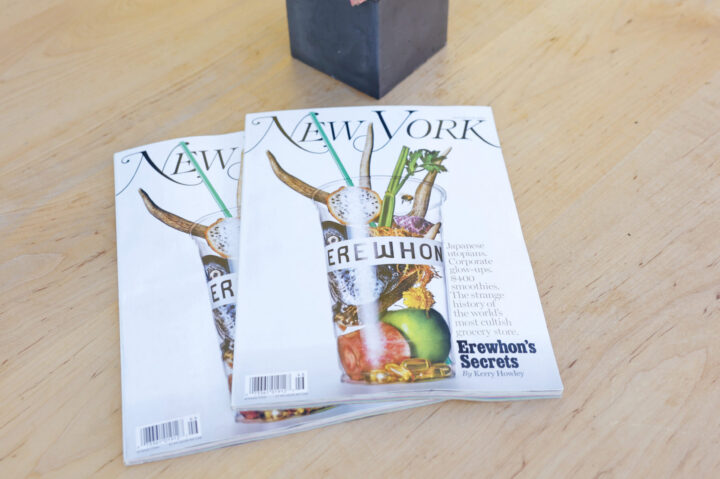
Emma McIntyre/Getty Images for VOX Media
New York magazine issues are displayed during New York Magazine's Vulture Festival LA at Goya Studios on November 11, 2023 in Los Angeles, California.


 Add JewishInsider on Google
Weeks after meeting privately with a group of Mizrahi and Sephardic leaders to address their concerns about a recent New York magazine cover package accused of erasing Jews from its narrative, the outlet’s editor-in-chief, David Haskell, vowed in response “to publish journalism that’s both accurate and empathic about the Jewish experience,” even as he otherwise declined to add a requested correction, according to an email he sent on Thursday.
Haskell’s note to the Jewish leaders, which was reviewed by Jewish Insider, came as New York has faced mounting scrutiny over its hostile turn against Israel in the years since Hamas’ Oct. 7, 2023, attacks, an ideological shift that has sparked internal tensions with some Jewish staffers who have raised objections to the magazine’s direction.
The new correspondence provides insight into Haskell’s approach to the broader topics covered in the widely debated package, which he has not addressed publicly, even as it has drawn intense backlash.
In his email, Haskell reassured the Jewish leaders that the magazine’s editors “intend to be careful and precise in our coverage, including in the words and terms we use.”
“I am in conversations with editors here at the magazine for future coverage, including making assignments directly pulled from some of the stories I heard on the call,” he confirmed, while defending the package that the Jewish leaders and other critics had accused of bias.
The meeting on Sept. 17 followed the publication in August of a controversial cover issue that had hailed a thriving Middle Eastern cultural scene in New York. The issue centered on a feature that identified what it called a “SWANA” renaissance, using the acronym for Southwest Asia and North Africa.
But in highlighting a proud network of Arab and Muslim trendsetters, the story pointedly suggested that Jews could not participate in a community the author characterized as emerging in response to “the genocide in Gaza.” The article also questioned if “Israelis can claim a connection” to the region, citing “ethnic background” as a complicating factor, and it cast Zionism as a uniquely menacing ideology akin to Islamophobia and xenophobia.
Haskell later agreed to meet for an off-the-record call with the representatives of several leading Sephardic and Mizrahi organizations that had released an open letter urging the magazine to issue a public correction acknowledging “its framing excludes the Jews of the Middle East and North Africa except on ideological terms.”
During the meeting two weeks ago, which was organized by the nonprofit Jews Indigenous to the Middle East and North Africa, the participants also pressed for “stronger editorial standards” concerning the magazine’s coverage of “Zionism, Jewish identity and Middle Eastern people,” according to one Jewish leader who joined the conversation and spoke with JI recently.
In his follow-up note on Thursday, Haskell thanked the Jewish leaders for what he called “an informative, productive and moving conversation,” saying that he had “appreciated in particular the personal stories of heritage, and the historical background” they shared on “Jewish communities across the Middle East and North Africa.”
“I very much want to publish journalism that’s both accurate and empathic about the Jewish experience, and the conversation we had deepened my awareness and sensitivity of the Sephardic and Mizrahi Jewish communities indigenous to the region,” he went on.
With regard to the magazine’s August cover issue, however, he explained that editorial leadership had “decided not to alter it or append a correction, as we believe that it clearly spoke about a specific New York City community with roots in the region and a shared political identity.”
While Haskell said it “is fair criticism for others to note that, as a geographic term, SWANA includes a broader range of identities and political beliefs, we don’t believe a correction or an addendum from the magazine is the appropriate place to do that,” since the community featured in the issue “self-identifies as SWANA.”
A spokesperson for New York did not immediately return a request for comment from JI on Thursday afternoon.
Since the publication of its cover package, New York has doubled down on its approach to Israel, writing in a subsequent letter to readers that its editors had last fall chosen to use the term genocide to describe Israel’s actions in its war in Gaza after an “extensive review of genocide scholarship and interviews with multiple experts” on the topic.
Before the institutional review, the magazine’s editorial director, Gazelle Emami, who assumed her role in October 2023, had signed a statement weeks after Hamas’ attacks calling Israel’s war in Gaza “an attempt to conduct genocide against the Palestinian people.” One source familiar with the publication’s internal dynamics told JI that Emami is among the “key instigators” driving the magazine’s increasingly antagonistic reporting and commentary on Israel.
The magazine has faced some internal pushback from Jewish writers who took issue with the content of the recent cover package, as JI reported earlier this week. Their complaints followed objections from former Jewish staffers who had raised concerns over previous stories they viewed as biased against Israel, which they detailed in a lengthy memo sent to editorial leaders in the weeks after Oct. 7.
Former Jewish employees, who spoke with JI on the condition of anonymity, said their pleas were largely met with indifference in their time at the publication, which was acquired in May by the media scion James Murdoch.
More Stories

STUDENT SAFETY
Federal civil rights complaint accuses Montgomery County, Md., schools of ignoring antisemitic harassment
RIPPLE EFFECT
New York’s suburban Dems face a Mamdani dilemma
SCOOP
AIPAC to end candidate endorsements, PAC contributions to allies
PRAIRIE STATE PRIORITIES
Illinois Democrats spend big for anti-Israel candidate running for state Senate
HILLTOP FORECAST
Democratic foreign policy veterans preview party’s shifts on Middle East policy

analysis
Playing to the cameras in the West Bank
Please log in if you already have a subscription, or subscribe to access the latest updates.
 Continue with Google
 Continue with Apple