


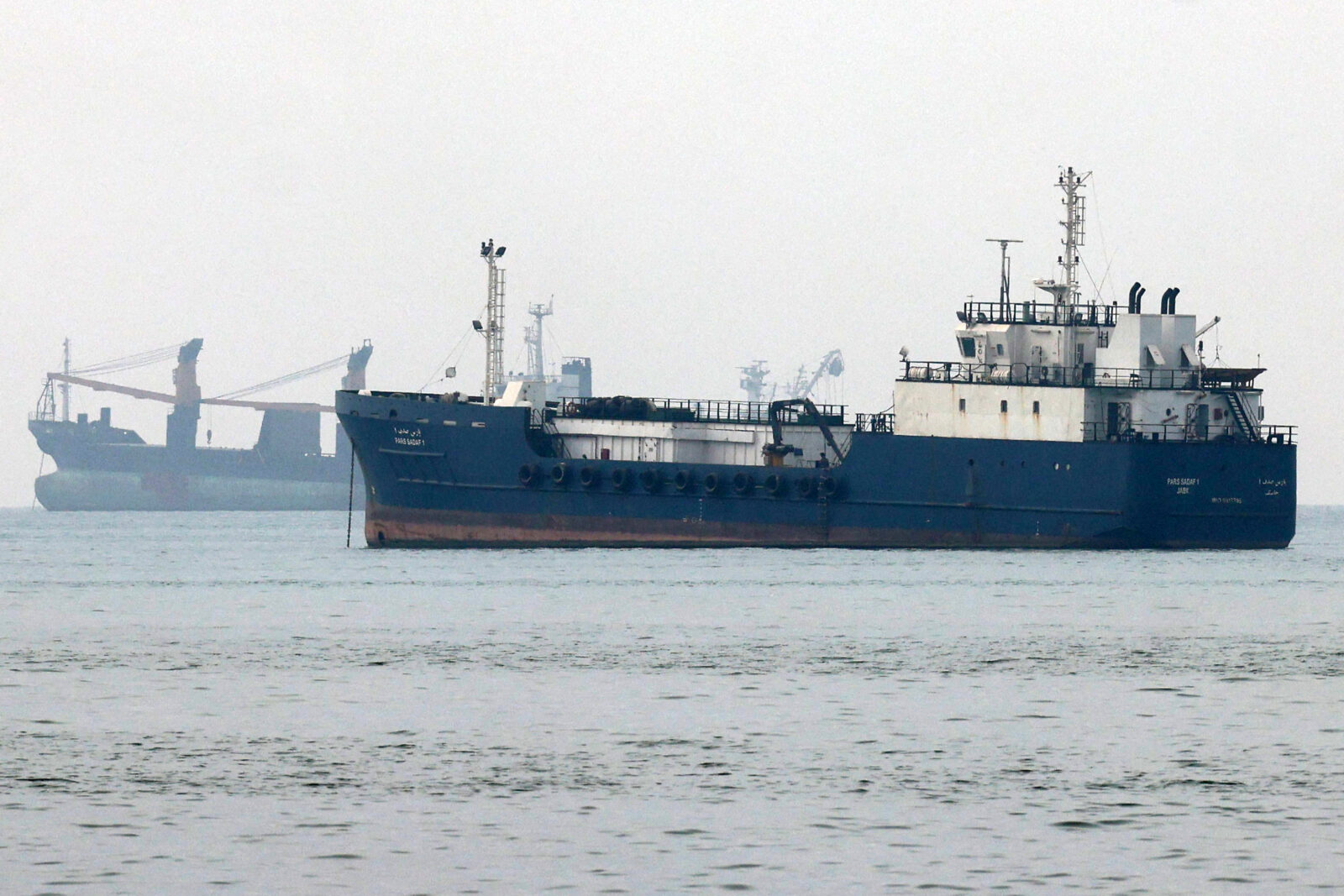
ATTA KENARE / AFP via Getty Images
U.S. protection revives Hormuz oil traffic as debate shifts to how long it can last
'Iran’s fundamental choice remains the same: negotiate from a weakening position or continue escalating against a president who has already shown that he is prepared to continue applying pressure,' former Trump administration Middle East envoy Jason Greenblatt told JI


 Add JewishInsider on Google
U.S. efforts to protect commercial shipping through the Strait of Hormuz have helped revive Persian Gulf oil exports and weaken Iran’s grip on the waterway, experts now acknowledge, but a debate is brewing over how durable those gains are, and whether Washington is willing to sustain the costly naval commitment that underpins them.
Persian Gulf crude exports rebounded to nearly 13 million barrels a day in September, approaching 72% to 80% of pre-war volumes as regional flows head back toward normal levels. According to maritime tracker Kpler, crude oil moving specifically through the Strait of Hormuz climbed to a wartime high average of 7.4 million barrels a day — supplemented by alternative pipeline and ship-to-ship routes — with an average of 17 to 19 tankers securely transiting the waterway daily under U.S. military protection.
U.S. military protection and the absence of confirmed Iranian attacks for nearly a week have helped commercial traffic increase, while Gulf exporters have also relied on ship-to-ship transfers in the Gulf of Oman and the United Arab Emirates’ Fujairah pipeline, which bypasses the Strait. In addition, Saudi Arabia resumed oil shipments from its Red Sea port of Yanbu after restarting the East-West pipeline, restoring a critical export route that allows the kingdom to bypass the Strait of Hormuz.
Analysts said that pressure could potentially increase Tehran’s incentive to ratchet up military tensions. In a video address on Tuesday, Israeli Prime Minister Benjamin Netanyahu said Israel had received “indications” that adversaries would try to attack the country ahead of its upcoming elections, slated for Oct. 27.
Ari Cicurel, associate director of foreign policy at the Jewish Institute for National Security of America, said the recent developments have challenged assumptions about how effectively Iran could use the strait to constrain international commerce.
“I think some in the foreign policy community underestimated the U.S. ability to break Iran’s effective hold over the strait, particularly the logistical capacity to sustain an alternative shipping route and protect commercial traffic,” Cicurel said. “Iran can impose costs on shipping, but the U.S. response has shown that the regime cannot translate those costs into a sustained blockade that preserves the same level of economic leverage as U.S. operations.”
The shift has reshaped Tehran’s relationship with the companies that depend on the waterway, Cicurel said, making it harder for Iran to dictate who can use the strait and on what terms. “The Navy’s blockade and protection of commercial shipping have shifted the cost of disrupting the strait onto Iran, which has lost most of its exports while its Gulf neighbors have increased their oil shipments,” he said. “Shippers now have a route through the strait that does not depend on Tehran’s permission” — eroding Iran’s leverage in negotiations.
But Cicurel said Iran can still attempt to influence decisions by creating enough uncertainty around the safety of the strait to deter companies from using it.
“Even with its leverage diminished, the Iranian regime has repeatedly withstood economic pressure by diverting money from the Iranian people to its military, and it will likely continue to do so to keep funding attacks as its revenue shrinks. Iran will likely keep launching calibrated attacks to extract as much of its remaining leverage as possible and to convince insurers and shipping companies the strait remains unsafe,” Cicurel said.
Jason Greenblatt, former White House Middle East envoy in the first Trump administration, similarly argued that U.S. efforts to reopen the strait were underestimated.
“As is often the case, much of the media, diplomatic community and foreign-policy establishment wrung their hands, predicted disaster, blamed President [Donald] Trump for the war and underestimated him and the enormous military and economic power of the United States,” Greenblatt said. “The conventional wisdom was that Iran’s leverage in the Strait of Hormuz could not be broken. President Trump demonstrated how that leverage can be eroded when Tehran is confronted with American military strength, relentless economic pressure and a president willing to use both.”
Greenblatt cautioned that the conflict is “far from over,” and warned that “complex and dangerous situations like this take time to resolve.”
“I expect Tehran will test the United States again,” he said. “But Iran’s fundamental choice remains the same: negotiate from a weakening position or continue escalating against a president who has already shown that he is prepared to continue applying pressure, regardless of the critics or the political calendar.”
Elliott Abrams, who served as Iran envoy during the first Trump administration and is now a senior fellow at the Council on Foreign Relations, said the U.S. Navy’s performance has exceeded some experts’ expectations.
Still, he said, “I do not expect a deal soon, before the U.S. elections, because that would be a gift to Trump — unless Trump is willing to accept terms that greatly advantage Iran, which I also don’t expect right now.”
Garrett Nada, a policy analyst at the Israel Policy Forum, however, asserted there was “little doubt” that the U.S. could effectively regain control of the strait. The harder question, he said, is whether the current approach can be maintained as the financial and operational costs accumulate.
Nada cited a Bloomberg report estimating that the U.S. naval blockade of Iran has costed $32.5 million per day, which he said captures only part of the resources Washington is committing to keeping commercial traffic moving.
“That estimate does not even include the additional operation costs of aerial and maritime drones, ships, manned aircraft, satellites, U.S. personnel and other U.S. assets used to guide and protect commercial traffic,” Nada said. “In the process, U.S. forces have come under Iranian attack, including from small boats, missiles, and drones. Two weeks ago, eight U.S. Marines were injured in a cruise missile attack, for example.”
That same report also outlined how Washington’s naval blockade has drained its global military power, decreasing available resources for deployment elsewhere in the world. Nada said the operation is also imposing costs on the private companies that have resumed using the waterway, creating another question about how long the current system can function.
“Aside from increased wait times for transit and more complicated travel arrangements, shippers have to pay higher crew compensation, charter rates, insurance and reinsurance premiums, and other operating expenses,” he added.
Even with those costs, Nada said the renewed traffic represents a meaningful strategic setback for Tehran because each vessel that successfully passes through the strait reduces Iran’s ability to use the waterway as leverage.
“The combination of sanctions and the blockade may be pushing Iran to try diplomacy with the U.S. again to secure its interests,” he said. “If diplomacy fails, however, Iran will be more likely to resort to military escalation as a way to restore some of its leverage.”
Matthew Levitt, a senior fellow at The Washington Institute for Near East Policy, similarly identified the durability of the U.S. commitment as the central unanswered question.
“The question is how long the United States will be willing to maintain the type of commitment necessary to enable oil flows at this level,” Levitt said. “This, even as customers have yet to feel economic relief at home and the price of diesel and other commodities like fertilizer remain sky high.”
Daniel Shapiro, the U.S. ambassador to Israel during the Obama administration and a senior fellow at the Atlantic Council, said the increased oil flows are “significant” but cautioned against viewing them as evidence that the broader economic consequences of the conflict have been resolved.
“The increased flow of oil through the Strait of Hormuz is significant. Combined with the blockade of Iranian ports and expanded sanctions, it is putting pressure on the Iranian economy and relieving some of the international economic fallout. But only some. Oil remains over $100 per barrel. Gas averages $4.50 per gallon. Diesel is at $6.50,” Shapiro said.
The recovery in oil traffic also masks continued disruptions elsewhere in the region, Shapiro said, with other commodities still struggling to reach global markets and attacks on alternative supply routes offsetting some of the gains through the strait.
“Few other commodities — natural gas, fertilizer, helium — are getting through the strait. And the Houthis offset some of the Hormuz gain by bombing the Saudi pipeline that was bringing 5 million barrels per day to the market via the Red Sea. Iran also has escalation options it has not activated yet,” Shapiro said.
Shapiro said the restored flows are a “limited tactical” achievement that do not resolve the underlying strategic problem. If the U.S. eventually reduces its presence, he said, Iran could again seek to assert control over the waterway.
“The limited tactical success of restoring some of the pre-war oil flow through the strait has come at enormous, and unsustainable, cost, and masks the lack of a strategy to keep Iran from ultimately reasserting its control over the strait when, inevitably, the U.S. scales down its operations,” Shapiro said. “The larger point is that the struggle for control of the Strait of Hormuz is a massive, costly undertaking made necessary by an ill-advised war. Will the U.S. Navy be called upon to maintain a blockade of Iranian ports and escort oil tankers … forever?”
“It has already put enormous strain on the Navy, pulled assets from elsewhere, and will leave us with delayed maintenance and disrupted deployment rotations for years to come,” he added.
Kristin Diwan, a senior resident scholar at the Arab Gulf States Institute, said alternative routes have been a key part of increased oil flows, but have not restored a fully reliable passageway through the region.
“U.S. and Gulf coordination on alternative routes and shuttle ships have increased the flow of oil and weakened Iran’s leverage in the Strait. But this is a daily battle that comes at some cost,” Diwan said. “The Iranians continue to strike ships involved in the transfer, preventing a consistent and reliable passage. And some products, most importantly diesel fuel and LNG, are more constrained and have few, if any, alternative routes.”
The pressure on Iran’s economy could nevertheless be creating an opening for diplomacy, Diwan said, as Tehran weighs whether to make concessions in exchange for an end to restrictions on its oil exports.
“The Iranians are contemplating compromise to end the ban on their oil exports which indicates that the economic blockade is beginning to bite. Still a ‘mini-deal,’ based on – but less than – the previous MOU agreement, appears to be a long-shot. Internal disagreement within the Iranian establishment and conflicting impulses from President Trump will be hard for Qatari mediators to overcome,” she said.
Meanwhile, Jonathan Ruhe, a fellow at JINSA, said the “real underestimation” was on the part of the Trump administration. He noted that while the oil is “flowing again,” Washington should have heeded presumptions that Tehran could potentially close the strait during the conflict.
“The real underestimation was the Trump administration’s failure to anticipate and preempt Iran’s initial efforts to threaten the strait. Extensive U.S. war plans built this exact scenario into their assumptions, but it was discounted,” Ruhe said. “The U.S. military, particularly the Navy, always had the ability to counter Iran’s unconventional maritime threats, but doing so became a lot harder once Iran dropped its first mines in the water and scared off commercial shipping with its opening drone strikes. Only recently have those mines, radars and other Iranian military assets been degraded, enabling the tough work of naval escorting to begin belatedly.”
Ruhe explained that while the flow of oil presents several diplomatic and economic benefits for the U.S. in its confrontation with Iran, he warned that Tehran’s leverage in talks may not shift.
“There are many diplomatic, economic, and operational benefits to getting oil flowing again. Yet it’s hard to imagine how any of this meaningfully changes Tehran’s negotiating posture,” Ruhe said. “Tellingly, Iran’s recent seven-day plan offered no concessions compared to the June MOU, when traffic through Hormuz was much lower. For all the military and economic pounding it has taken, the regime has been predictably stubborn in resisting Trump’s demands.”
“If the recent upsurge in Hormuz traffic proves sustainable, and if the U.S naval blockade on Iran remains effective, the regime could see diminishing downside in restarting attacks upstream from Hormuz, targeting the Arabian Gulf, commercial vessels, and energy sites with mines, drones, and missiles,” Ruhe continued. “Those strikes proved incredibly successful early in the war, and Iran currently has no reason to believe that’s no longer the case.”
Featured Stories

printing pressure
Inside New York magazine’s anti-Israel shift — and the Jewish staffers left behind

exclusive
Rosen, Lankford press Zuckerberg over antisemitic bot accounts on Facebook, Instagram
michigan mishpacha's ask
Michigan state lawmaker, Jewish Dem leaders join call for El-Sayed to affirm commitment to Jewish safety
Please log in if you already have a subscription, or subscribe to access the latest updates.
 Continue with Google
 Continue with Apple