
























If the reports are true, the South Carolina senator said, ‘there will be a dramatic rethinking on my part’

Anna Moneymaker/Getty Images
Sen. Lindsey Graham (R-SC) in the Senate Judiciary Committee on January 30, 2025 in Washington, D.C.


 Add JewishInsider on Google
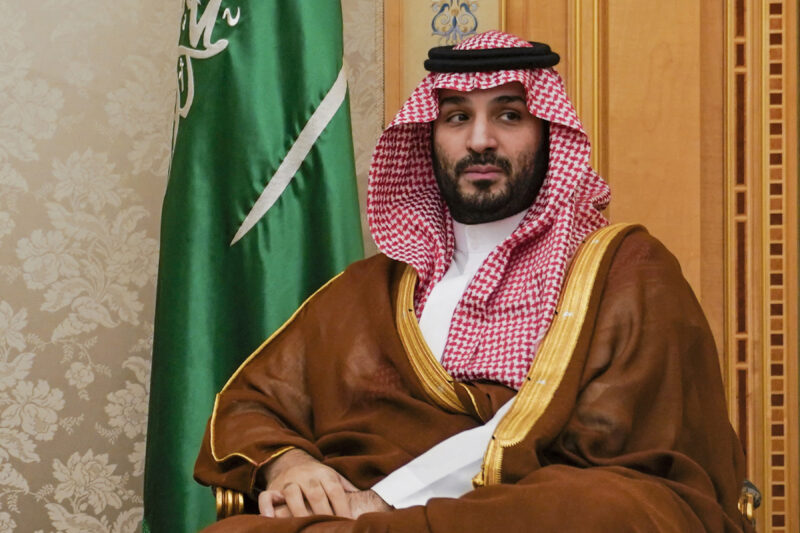
Sen. Lindsey Graham (R-SC) warned on Thursday that he would be “dramatically rethinking” the “nature of” the U.S. alliance with Saudi Arabia and other Gulf states if they “intervened on behalf of Iran to avoid decisive military action” by President Donald Trump against the Iranian regime.
Graham made the comments in a post Thursday morning on X in response to reports that Gulf states including Saudi Arabia, Qatar and Oman urged Trump against striking Tehran to avoid disrupting oil markets and sparking broader regional conflict, and without a clear succession plan for regime change.
The Saudis have also told the Iranians that they would not get involved in a potential conflict between the U.S. and Iran, nor would they allow the U.S. to use their airspace for strikes targeting the regime, The Wall Street Journal reported Tuesday.
“All the headlines suggesting that our so-called Arab allies have intervened on behalf of Iran to avoid decisive military action by President Trump are beyond disturbing. The ayatollah’s regime has American blood on its hands. They are slaughtering people in the streets,” Graham wrote on X. “If it is accurate that the Arab response is ‘action is not necessary against Iran’ given this current outrageous slaughter of innocent people, then there will be a dramatic rethinking on my part regarding the nature of the alliances now and in the future.”
Speaking to reporters at the Capitol on Thursday morning, Graham rejected the notion that Trump was reversing course on striking Iran. “There are a lot of headlines out there that are, in my view, not accurate. … President Trump’s resolve is not the question. The question is when we do an operation like this, should it be bigger or smaller? I’m in the camp of bigger.”
“Time will tell. I’m hopeful and optimistic that the [Iranian] regime’s days are numbered,” the South Carolina senator said of what’s to come.
Graham revealed in a post on X later Thursday that he is on his way to Israel to meet with Israeli Prime Minister Benjamin Netanyahu “at this crucial time in the history of the Middle East.”
“The goal is to build on the historic opportunities created by President Trump’s unprecedented leadership, to stand up to evil, and to support the people who are sacrificing for freedom,” Graham wrote of the visit. “The Trump-Netanyahu alliance has thus far been one of the strongest partnerships in the history of the U.S.-Israel relationship, and I am hopeful it will pay dividends in the near future.”
“We live in a time of great consequence with the Middle East on the verge of previously unimaginable change,” he added. “Standing together and following through on our commitments only makes us stronger.”
Plus, all the president's advice on Iran

Andrew Lichtenstein/Corbis via Getty Images
Demonstrators hold a rally and march to the national ICE headquarters to protest the arrest of Mahmoud Khalil, April 5, 2025 in Washington, D.C.
Good Thursday afternoon!
This P.M. edition is reserved for our premium subscribers — offering a forward-focused read on what we’re tracking now and what’s coming next.
It’s me again — Danielle Cohen-Kanik, U.S. editor at Jewish Insider and curator, along with assists from my colleagues, of the Daily Overtime. Please don’t hesitate to share your thoughts and feedback by replying to this email.
📡On Our Radar
Notable developments and interesting tidbits we’re tracking
U.S. officials advised President Donald Trump that a large-scale military campaign against Iran is unlikely to topple the regime and could spark a wider regional conflict, The Wall Street Journal reports, a message that coincided with the president dialing back his warnings to Tehran over its violent suppression of protests.
Israeli Prime Minister Benjamin Netanyahu also reportedly weighed in yesterday, asking Trump to postpone any strikes, and Qatar, Saudi Arabia, Oman and Egypt have communicated similar messages.
U.S. officials told the Journal these developments have led Trump to hold off on strikes for now, though he directed military assets to be readied in case of action. The USS Abraham Lincoln Carrier strike group is reportedly being moved from the Indo-Pacific to the Middle East.
In a similar vein, IDF Chief of Staff Lt. Gen. Eyal Zamir visited an Arrow missile defense battery site in Israel today and directed a drill simulating a missile attack, saying in a statement, “It is important that every citizen of Israel knows that the IDF is constantly prepared to defend the country”…
In the absence of military action, the U.S. is punishing Iran economically, issuing sanctions today against what it called “the architects” of the crackdown. The Treasury Department will “use every tool to target those behind the regime’s tyrannical oppression of human rights,” Treasury Secretary Scott Bessent said in a statement.
Among the sanctioned Iranian officials are Ali Larijani, the secretary of the Supreme Council for National Security, who was “one of the first Iranian leaders to call for violence in response to the legitimate demands of the Iranian people,” according to the Treasury Department, and several commanders of the Islamic Revolutionary Guard Corps and Iran’s Law Enforcement Forces…
Turning to Gaza, American officials expressed their optimism about Phase 2 of the peace plan shortly after its launch yesterday, telling reporters, “For the first time in Gaza in almost a long time, there’s no Palestinian Authority and there’s no Hamas governing it.”
“We’ve talked to a number of Hamas people, and we’re hearing throughout the Arab world that people don’t want to be at war anymore. They want peace,” one of the officials said, claiming Hamas leaders “are indicating that there’s a real possibility” they will lay down their arms…
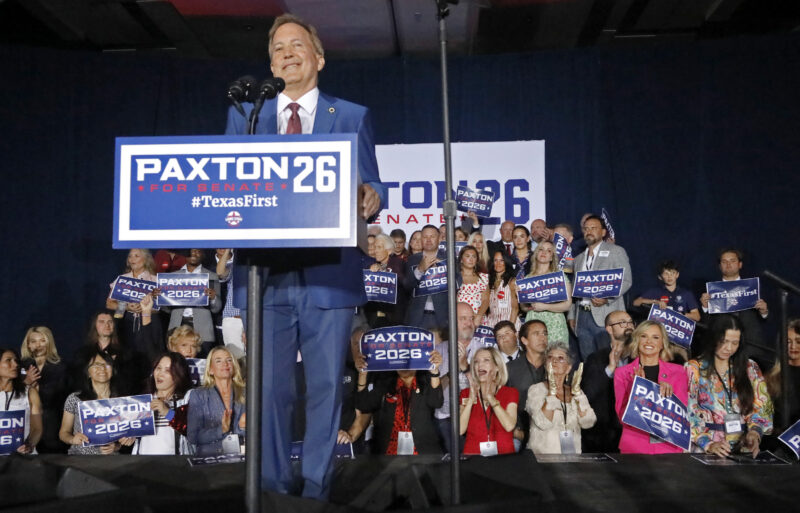
A new Emerson College poll released today shows the Republican primary for Texas Senate in a dead heat, with Sen. John Cornyn (R-TX) and his opponent, Attorney General Ken Paxton, polling at 26% and 27%, respectively. With Trump refraining from offering his endorsement to either candidate, it’s likely the race will head to a runoff.
On the Democratic side, state Sen. James Talarico is leading the primary over Rep. Jasmine Crockett (D-TX), 47-38%. Talarico has recently caused concern in the Texas Jewish community over his increasingly critical rhetoric on Israel, leading some to tell Jewish Insider that, without concerted outreach from his team, they’re likely to back Crockett…
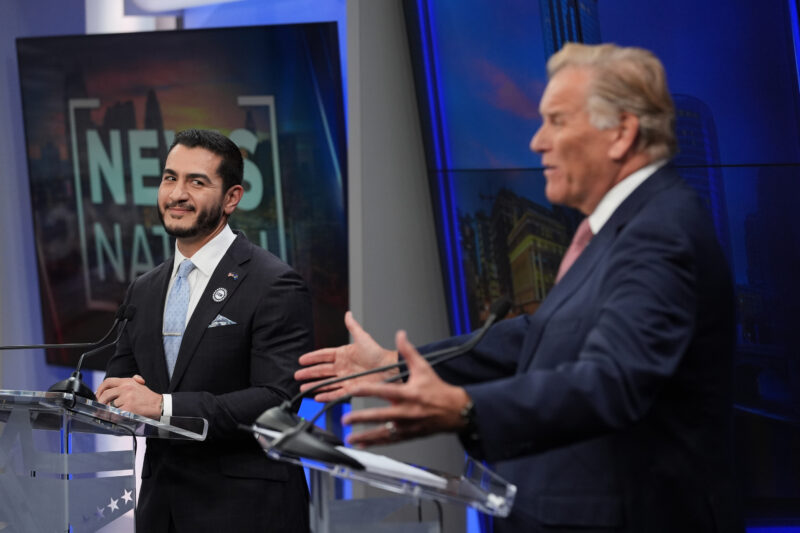
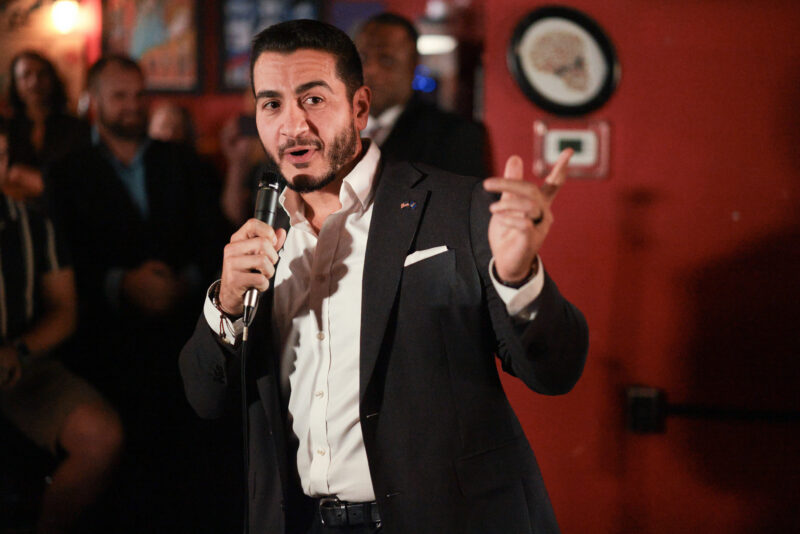
A competitive Democratic primary is also underway in New Jersey’s 12th Congressional District, where surgeon Adam Hamawy entered the race today to succeed retiring Rep. Bonnie Watson Coleman (D-NJ) with a profile that may help him break through the field.
Hamawy, of Egyptian descent, served as a trauma combat surgeon during the Iraq War, where he operated on Sen. Tammy Duckworth (D-IL), who credits him with saving her life. In May 2024, he joined a delegation of American doctors to assist in health-care efforts in Gaza, where he was temporarily stuck during an Israeli border closure (he returned for a second mission in January 2025).
Though Hamawy has not run for office before, he has spoken extensively about his experience treating “mass casualties” in the enclave and condemning Israel and the U.S.’ role in the “indiscriminate killing and destruction there.” Watson Coleman, also an outspoken critic of Israel, brought him as her guest to Trump’s 2025 State of the Union address…
Asked about his views on Israel, Antonio Delgado, New York’s lieutenant governor who is challenging Gov. Kathy Hochul from her left, said in an interview released Tuesday that the U.S. should not “fund, provide weapons or diplomatic cover to any military operation that causes catastrophic civilian deaths or mass starvation … Otherwise, we are complicit.”
Delgado pledged not to take money from AIPAC, though the pro-Israel group does not contribute to gubernatorial races, and Delgado took a 2019 trip to Israel as a member of Congress with the AIPAC-affiliated American Israel Education Foundation.
Delgado further described Netanyahu as “deeply problematic” and a “war criminal,” but when asked if Israel is committing a genocide in Gaza, he largely demurred. “I can see how people would want to argue it both ways and I’m sensitive to this, candidly, based on my own relationships,” he said. Delgado’s wife is Jewish and they are raising their children Jewish. “It’s hard to argue against scholars. … [But] wherever you fall on that question, we can’t fund it. … We can’t be complicit in it, anymore”…
A federal appeals court ruled today that former Columbia University graduate student Mahmoud Khalil, a leader of the school’s anti-Israel protest movement, could be rearrested, JI’s Haley Cohen reports. Khalil was released in June from the Immigration and Customs Enforcement detention center in Louisiana, where he had been held for three months.
In a 2-1 ruling, a three-judge panel decided that the federal district court in New Jersey that issued Khalil’s release did not have jurisdiction over the matter and that it should have been handled in immigration court, which is part of the executive branch overseen by the Justice Department, meaning Khalil is now liable to be rearrested.
New York City Mayor Zohran Mamdani denounced the ruling, saying in a statement, “as the crackdown on pro-Palestinian free speech continues, Mahmoud is being threatened with rearrest. Mahmoud is free — and must remain free”…
⏩ Tomorrow’s Agenda, Today
An early look at tomorrow’s storylines and schedule to keep you a step ahead
Keep an eye out in Jewish Insider for a profile of Amy Acton, the Jewish public health expert hoping to become the first Democrat to win an Ohio governor’s race in 20 years.
The U.S. and Israel will sign a strategic framework on AI cooperation at the City of David tomorrow, led by Jacob Helberg, the U.S. under secretary of state for economic affairs, and Brig.-Gen. (res.) Erez Eskel, head of Israel’s National AI Directorate. Israeli Foreign Minister Gideon Sa’ar and U.S. Ambassador to Israel Mike Huckabee are also expected to be in attendance.
Also heading to Israel is Sen. Lindsey Graham (R-SC), who announced a last-minute trip this afternoon to meet with Netanyahu “at this crucial time in the history of the Middle East.”
Iran International will hold its second briefing of the week in Washington with former CIA Director Gen. David Petraeus. Read JI’s coverage of Wednesday’s event here.
Honduran President-elect Nasry Asfura will travel to Israel over the weekend, where he is expected to meet with Netanyahu, Sa’ar and President Isaac Herzog, as well as visit Yad Vashem and the Western Wall. Asfura, who will take office later this month, met with Secretary of State Marco Rubio in Washington earlier this week and was hosted by AIPAC leadership.
In observance of Martin Luther King Jr. Day, we’ll be back in your inbox with the Daily Overtime on Tuesday. Shabbat Shalom!
Stories You May Have Missed
SEEING PURPLE
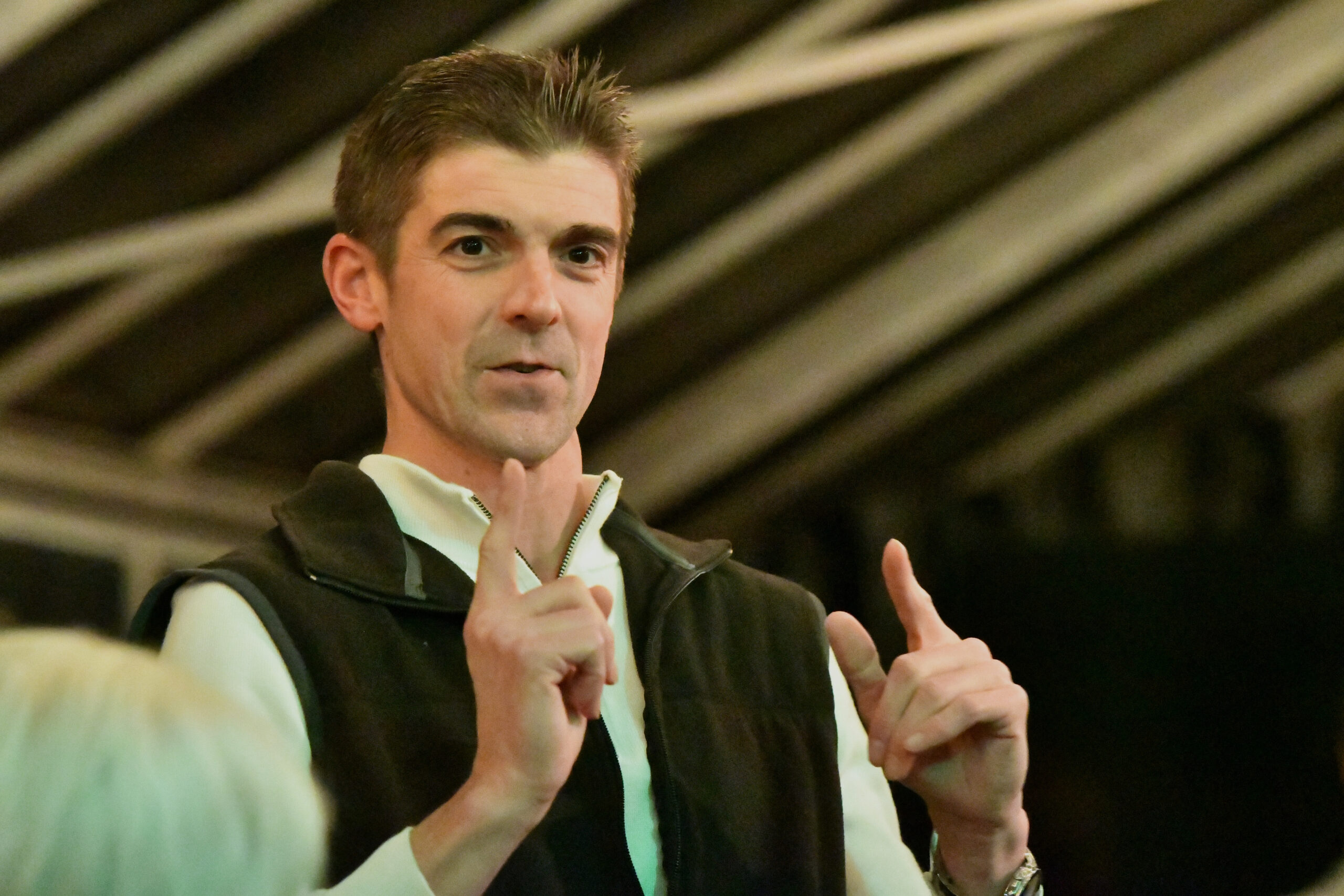
Crosswell, a former Republican who also served as a federal prosecutor, is touting his pro-Israel bona fides as he fights for the Democratic nomination against Rep. Ryan Mackenzie
BOOKSHELF

The book, ‘Mojo’s Return: A Story of Resilience and Hope,’ was published in November
Joel Rayburn, a former Trump admin nominee, said the U.S. should carry out a sustained ‘campaign’ of pressure
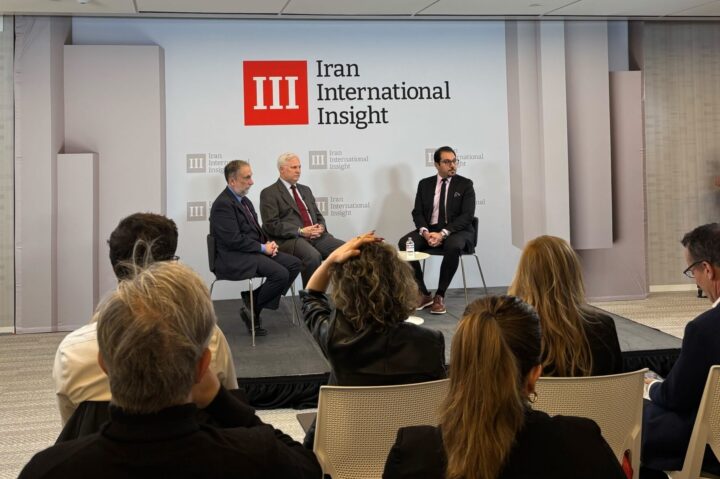
Matthew Shea
Iran International event, Jan 14th. 2025
Middle East policy experts argued on Wednesday that the United States should actively intervene in Iran’s unrest — including through cyber measures, economic pressure and potentially military strikes — amid the regime’s crackdown on nationwide protests. The comments were made during a program hosted by Iran International, one of the largest independent Persian-language news outlets in the world.
President Donald Trump has for days issued repeated warnings to the regime that the U.S. is “watching closely” and that Iran would “pay hell” for killing protesters. On Wednesday afternoon, however, the president said he had been notified that the “killing in Iran is stopping” and that Iran would not be conducting executions of protesters, as was expected, and downplayed the severity of protester deaths.
“The first thing I would recommend is that we use our very impressive capabilities to shut down the communication system for the government,” said Robert Satloff, executive director of The Washington Institute for Near East Policy, speaking of a potential retaliation for the regime’s decision to cut internet access to the public. “This will be a huge step.”
Satloff said if that did not work, he would then support subsequent U.S. strikes on Iranian military infrastructure.
“If that first act does not bring about a substantial change in Iranian behavior, then I would target very specifically the barracks and the facilities of the IRGC [Iranian Revolutionary Guard Corps],” said Satloff.
Joel Rayburn, a senior fellow at the Hudson Institute and a former diplomat in the Middle East, argued that any U.S. intervention in Iran should not be a “one-off military strike,” but rather a sustained “campaign” of economic and political pressure.
Rayburn was tapped by the White House to be assistant secretary of state for Near Eastern affairs in February 2025, however, his nomination was ultimately pulled last October.
“We have to use all of the tools at our disposal,” Rayburn said Wednesday. “There’s no reason not to be fully implementing maximum pressure to pressure the Iranian regime in order to change its behavior.”
Responding to questions about whether a weak Iranian regime — in the midst of dire economic and political challenges — can survive the protests, Rayburn suggested it is bound to fall, stating that there will be a “day after this Khamenei regime,” referring to Iran’s supreme leader, and that he believes that day will come “sooner rather than later.”
“The Iranian regime is going to collapse at some point in the not-too-distant future,” said Rayburn. “[It] can no longer function as a state. The last function they can perform is to use violence against their own people. That means they are not a sustainable regime.”
Tehran has threatened to respond to any military action with retaliation against the U.S. and Israel. Satloff said the fall of the regime would be “an enormous strategic gain for Israel,” but noted that Jerusalem is “playing it quiet.”
“The Israelis have made at least the tactical decision, that since Donald Trump has been out front, that Donald Trump has drawn a line in the sand, let Donald Trump be the key actor right now,” said Satloff. “There is no comparative advantage for Israel to be out in front in any military fashion. Let the United States play this role, the president seems to have embraced it.”
He also cast doubt on the likelihood that Tehran would strike Israel in response to U.S. action. Reports have indicated that Iran and Israel have conveyed reassurances through Russian intermediaries that neither side intends to carry out a preemptive strike.
“If the Iranians make the mistake of retaliating against Israel or Israeli assets, or Jewish assets around the world, there will be a very high price to pay,” said Satloff.
Analysts also weighed in on reports that Gulf allies have been lobbying the Trump administration to refrain from striking or intervening in Iran, warning that a U.S. intervention could be ineffective and expose them to retaliation. While the analysts acknowledged those concerns, they argued that regional governments would ultimately like to see the regime fall.
“I don’t think there are any major frontline countries in the Gulf region that believe that the Iranian regime is a regime that they can live with indefinitely,” said Rayburn. “We have not seen real restraint from the Arab capitals to either U.S. or Israeli pressure against the Iranian regime. All of those capitals would be better off without the regime.”
Regardless of whether the U.S. intervenes, Satloff emphasized that any outcome is “ultimately an Iranian process and an Iranian decision.”
“This will be their [the Iranian people’s] revolution, if it happens,” said Satloff. “It will not be something that we trigger or engineer, but to help them to be able to assert their own wishes and desires for the future.”
The president said he was told ‘on good authority’ that the regime has stopped killing protesters and will not carry out executions
Francis Chung/Politico/Bloomberg via Getty Images
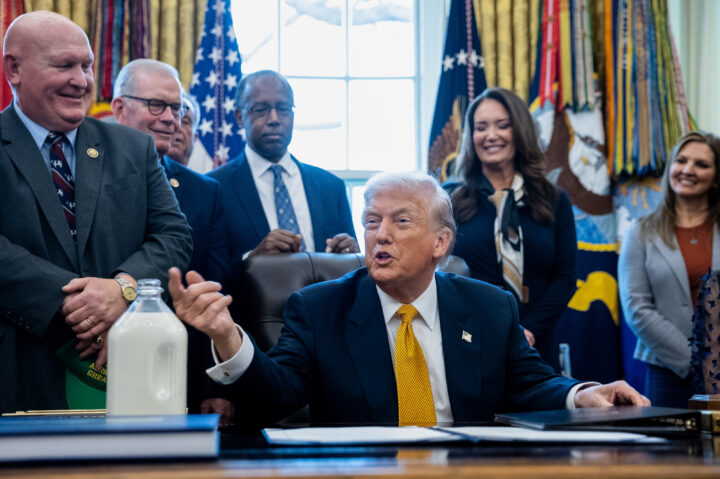
President Donald Trump speaks during a signing ceremony in the Oval Office of the White House in Washington, DC, US, on Wednesday, Jan. 14, 2026.
President Donald Trump indicated that his threats to Iran over its use of violence on protesters have had their desired effect, saying on Wednesday afternoon that “the killing in Iran is stopping.”
Speaking to reporters at a bill signing in the Oval Office, Trump said, “We have been notified and pretty strongly — but we’ll find out what that all means — but we were told that the killing in Iran is stopping, it’s stopped, and that there’s no plan for executions. … So I’ve been told that on good authority. We’ll find out about it, I’m sure, if it happens, we’ll all be very upset.”
“They’re not going to have an execution, which a lot of people were talking about for the last couple days. Today was going to be the day of execution,” the president said, referring to at least one protester who was due to be executed by the regime today, his family and human rights groups said.
Trump later claimed that information was provided to him “by very important sources on the other side, that the killing has stopped and the executions won’t take place. There was supposed to be a lot of executions today and that the executions won’t take place.”
“And we’re going to find out. I mean, I’ll find out after this, you’ll find out, but we’ve been told on good authority. And I hope it’s true. Who knows, right? Who knows,” he said.
Pressed about videos of body bags emerging out of Iran that indicate large-scale killings, Trump downplayed the issue, saying, “People were shooting at them with guns, and they were shooting back. It’s one of those things.”
Asked if this means military action against Iran is now “off the table,” Trump replied, “Well, we’re going to watch and see what the process is. But we were given a very good statement by people who are aware of what’s going on.”
The rhetoric marked a shift for the president, who a day prior had posted on social media a message to “Iranian patriots” who he told to “save the names of the killers and abusers” and that “help is on its way.” Reports indicate Iranian officials had made contact with the Trump administration seeking a diplomatic off-ramp to the escalating tension.
Plus, poll shows Stevens as most electable Dem in MI-SEN race
Francis Chung/Politico/Bloomberg via Getty Images
President Donald Trump speaks during a signing ceremony in the Oval Office of the White House in Washington, DC, US, on Wednesday, Jan. 14, 2026.
Good Wednesday afternoon!
This P.M. edition is reserved for our premium subscribers — offering a forward-focused read on what we’re tracking now and what’s coming next.
It’s me again — Danielle Cohen-Kanik, U.S. editor at Jewish Insider and curator, along with assists from my colleagues, of the Daily Overtime. Please don’t hesitate to share your thoughts and feedback by replying to this email.
📡On Our Radar
Notable developments and interesting tidbits we’re tracking
President Donald Trump indicated that his threats to Iran are making an impact; he told reporters this afternoon, “We’ve been told that the killing in Iran is stopping, it’s stopped, and there’s no plans for executions,” referencing reports that an arrested protester was due to be executed today.
Trump later appeared to downplay protester deaths, calling it “one of those things … people were shooting at them with guns and they were shooting back.” It’s a notable change in tune from the president, who just yesterday told Iranian protesters to “save the names of the killers and abusers” and that “help is on its way.”
Asked if this means that military action against Iran is off the table, Trump responded, “We’re going to watch it and see what the process is, but we were given a very good statement” that the killing has stopped “by people that are aware of what’s going on”…
Others are still bracing for potential military action: Some personnel were told to evacuate the U.S.’ Al Udeid Air Base in Qatar by tonight, Reuters reports. (Recall that Iran launched several missiles at Al Udeid after the U.S. strikes on its nuclear sites last June.)
A number of airlines have canceled or suspended flights to Iran; the Lufthansa group, in addition to avoiding Iranian and Iraqi airspace, said it will only operate day flights to Israel and Jordan through Jan. 19, avoiding overnight trips.
IDF spokesperson Brig. Gen. Effie Defrin warned on social media to avoid rumors and misinformation about the evolving situation, saying the IDF is “prepared for defense and on alert for surprise scenarios”…
White House special envoy Steve Witkoff announced the launch of Phase 2 of Trump’s 20-point Gaza peace plan today, “moving from ceasefire to demilitarization, technocratic governance, and reconstruction.” This phase “establishes a transitional technocratic Palestinian administration in Gaza … and begins the full demilitarization and reconstruction of Gaza, primarily the disarmament of all unauthorized personnel,” Witkoff said.
“The US expects Hamas to comply fully with its obligations, including the immediate return of the final deceased hostage. Failure to do so will bring serious consequences,” Witkoff added, though the U.S. has not taken action on Hamas’ failure to return the body of Ran Gvili, the final hostage, in the three months since the terror group was meant to at the outset of the ceasefire agreement.
It is still unclear how the U.S. and its partners will disarm Hamas or remove it from power, with the International Stabilization Force still not in place and foreign nations refusing to engage with Hamas militants…
Meanwhile, the midterms are picking up speed: New polling out of the Michigan Senate race shows Rep. Haley Stevens (D-MI) looking like the most electable Democrat against former Rep. Mike Rogers (R-MI), the expected GOP nominee.
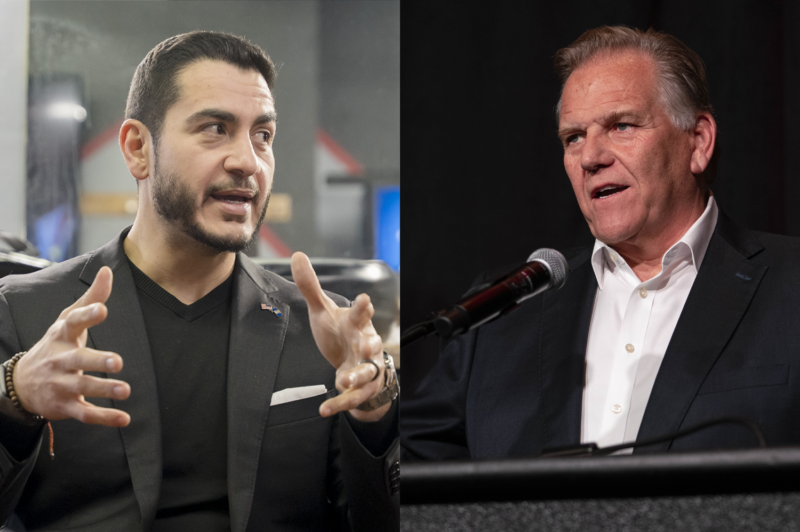
In a Detroit News poll testing general election matchups, Stevens and Rogers were tied at 44% each, while physician Abdul El-Sayed, who has made criticism of Israel central to his campaign, fared the worst, losing to Rogers 48-42%. State Sen. Mallory McMorrow, another critic of Israel, would also trail, 46-42%, the poll found…
In the Garden State, Rep. Rob Menendez (D-NJ) secured the endorsement of Sen. Andy Kim (D-NJ) today, a meaningful show of support from the progressive-minded senator as Menendez may face a primary challenge from his left from Mussab Ali.
Ali, who is expected to join the race shortly, is a vocal opponent of Israel and has been a champion for the anti-Israel protests and encampments that roiled college campuses in recent years; Kim has also been criticized by Jewish leaders for his support of measures blocking some arms sales to Israel…
Trump will not be endorsing three Republican senators facing competitive reelection campaigns: Sens. Susan Collins (R-ME), John Cornyn (R-TX) and Bill Cassidy (R-LA), Politico reports. Cornyn and Cassidy are facing serious Republican primary opposition, while Collins is facing the likelihood of a hotly contested general election…
The State Department is indefinitely suspending immigration visa processing for individuals from 75 countries starting Jan. 21, building on the Trump administration’s total and partial immigration bans that already exist on nearly 40 countries. The pause will impact those looking to permanently immigrate who may “become a public charge on the United States and exploit the generosity of the American people,” the State Department said…
⏩ Tomorrow’s Agenda, Today
An early look at tomorrow’s storylines and schedule to keep you a step ahead
Keep an eye out in Jewish Insider for an interview with Ryan Crosswell, the Marine veteran and former Republican looking to win the Democratic nomination in a key Pennsylvania swing district.
The technocratic Palestinian committee launched with Phase 2 of the Gaza Peace Plan — which will be headed by Ali Shaath, a former deputy minister for the Palestinian Authority — is expected to hold its first meeting tomorrow in Cairo, also attended by Nickolay Mladenov, the former U.N. envoy to the Middle East now leading the Gaza Board of Peace.
The Israeli American Council kicks off its annual summit tomorrow in Hollywood, Fla., with a plenary including Adm. (res.) Daniel Hagari, the previous IDF spokesperson; Boaz Levy, the CEO of Israel Aerospace Industries; and Betsy Korn, the chair of the Conference of Presidents of Major American Jewish Organizations.
Stories You May Have Missed
MAYOR’S M.O.
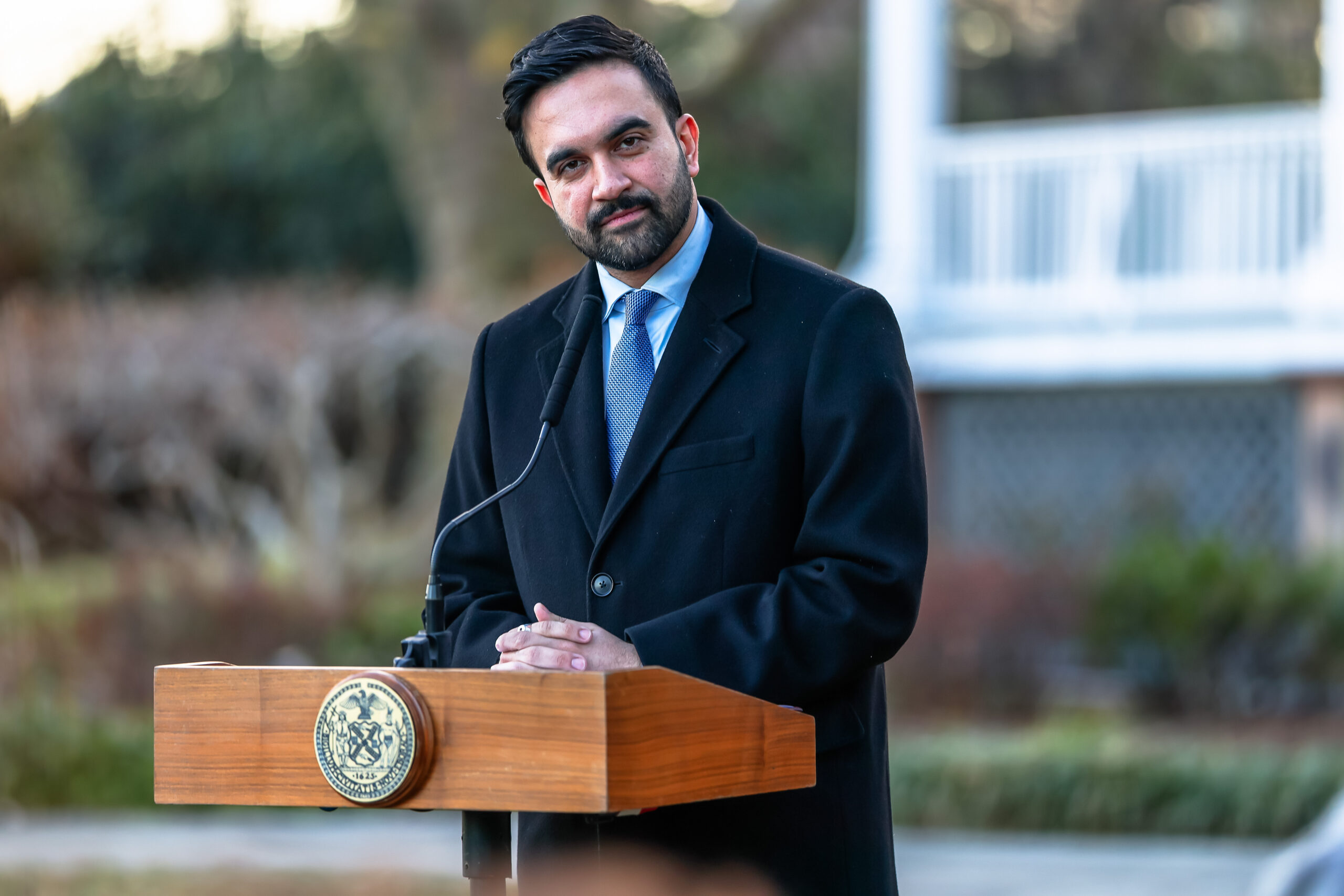
The mayor’s comments responding to pro-Hamas protesters in Queens and an arson attack on a synagogue in Jackson, Miss., illustrate what Mamdani’s critics interpret as a core tension animating his assessment of antisemitism
FIGHTER FAULT LINES

Analysts tell JI that the move ‘is not the behavior Washington can reasonably expect from a partner who would like to be trusted with the F-35’
Plus, J Street plays both sides
Mandel NGAN / AFP via Getty Images
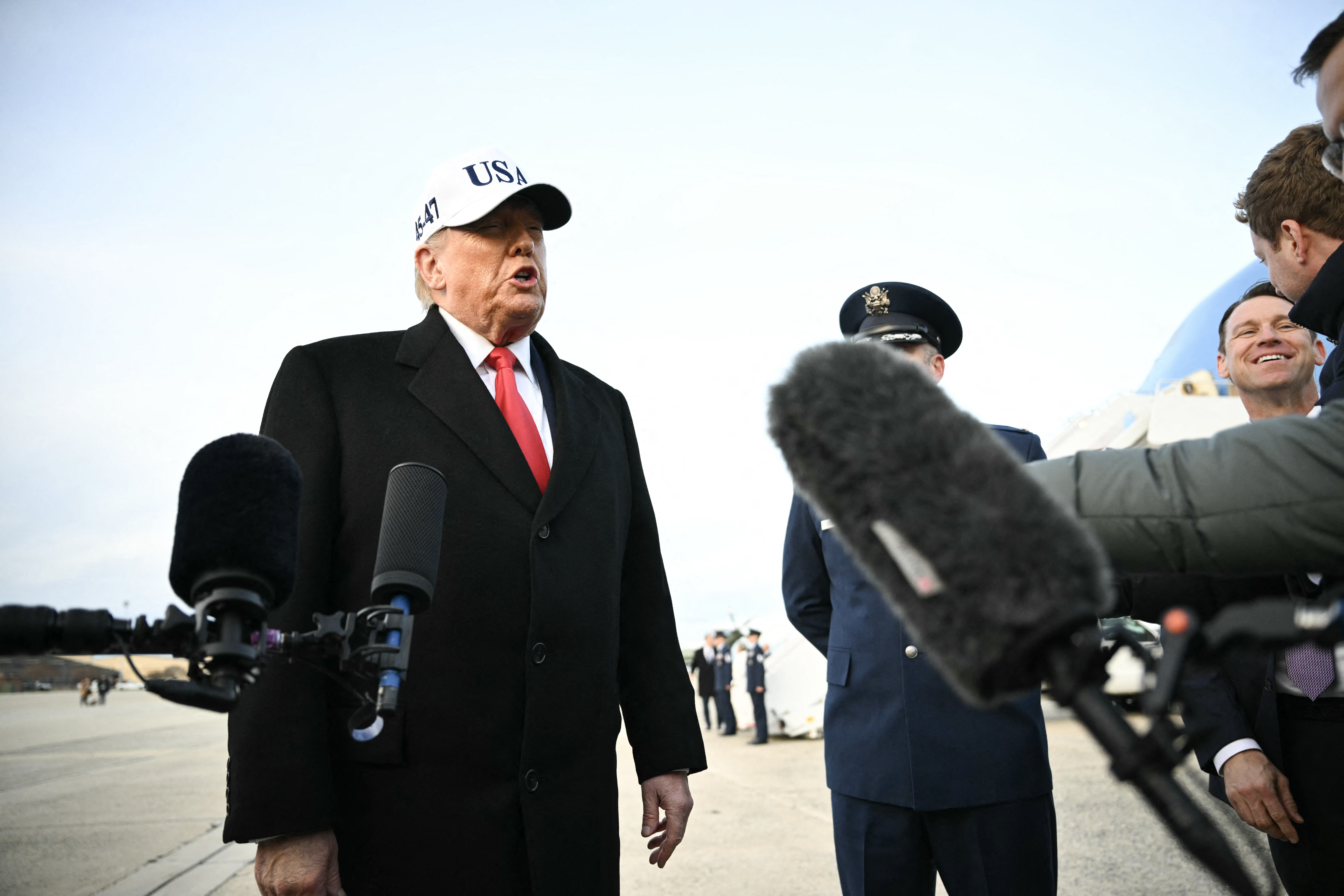
President Donald Trump speaks to the press upon returning to Joint Base Andrews in Maryland on January 13, 2026.
Good Tuesday afternoon!
This P.M. edition is reserved for our premium subscribers — offering a forward-focused read on what we’re tracking now and what’s coming next.
It’s me again — Danielle Cohen-Kanik, U.S. editor at Jewish Insider and curator, along with assists from my colleagues, of the Daily Overtime. Please don’t hesitate to share your thoughts and feedback by replying to this email.
📡On Our Radar
Notable developments and interesting tidbits we’re tracking
President Donald Trump’s rhetoric against Iran reached a fever pitch today, as reports indicate over 12,000 — and potentially as many as 20,000 — protesters have been killed by the regime amid nationwide demonstrations.
Trump posted on social media this morning that he has “cancelled all meetings with Iranian Officials until the senseless killing of protesters STOPS,” and said to the demonstrators, “Iranian Patriots, KEEP PROTESTING – TAKE OVER YOUR INSTITUTIONS!!! Save the names of the killers and abusers. They will pay a big price.”
Trump ended his message promising, “HELP IS ON ITS WAY,” without specifying what actions the U.S. may take, though he told reporters in Detroit that “it’s not a bad idea” for U.S. allies “to get out” of Iran.
Administration officials held several discussions today on options for intervening in Iran; Vice President JD Vance, whose team has pushed back on characterizations that he is opposed to military strikes, led the major briefing with the National Security Council’s Principals Committee this afternoon. Trump was in Michigan for a speech on the economy and likely did not attend…
As the U.S. weighs its next steps, Saudi Arabia, Oman and Qatar are advocating against strikes, warning the administration that destabilization of the Iranian regime could impact oil markets and hurt the American economy, The Wall Street Journal reports. Saudi officials told Iran that they will not allow the U.S. to use their airspace to conduct strikes…
While Trump blocks meetings with Iranian officials, his special envoy Steve Witkoff secretly met with the exiled former Iranian crown prince, Reza Pahlavi, over the weekend, Axios reports, in the first high-level meeting with the regime’s opposition since the protests began. It’s not clear how much support the son of the deposed shah has in Iran, though videos from recent protests show demonstrators chanting slogans associated with him and the monarchy…
Looking to the campaign trail, in a first, J Street endorsed Rep. Dan Goldman (D-NY) in his reelection race while also listing his opponent, former New York City Comptroller Brad Lander, as an “approved” candidate. It’s currently the only race where the group is supporting a challenger to an incumbent, in a district where the candidates’ differing stances on Israel are a key issue…
Roy Cooper, the former Democratic governor of North Carolina now running for the seat of retiring Sen. Thom Tillis (R-NC), raised more than $9.5 million in the final quarter of 2025, The Hill reports, a major haul for a seat that Democrats view as one of their best chances to flip. His opponent, former Republican National Committee Chair Michael Whatley, reportedly raised $5.1 million during the same time frame…
The Trump administration designated three Muslim Brotherhood branches as terrorist organizations today, including chapters in Lebanon, Egypt and Jordan, Jewish Insider’s Matthew Shea reports.
The Jordanian and Egyptian branches were named as Specially Designated Global Terrorists, with the State Department citing their provision of “material support to Hamas,” while the organization’s branch in Lebanon received the more stringent label of Foreign Terrorist Organization…
The U.S. is “closely monitoring developments in Aleppo,” Syria, and “urg[ing] all parties to exercise maximum restraint,” Adm. Brad Cooper, commander of CENTCOM, said in a statement today, after days of fighting between Syrian government forces and the Kurdish-led and U.S.-backed Syrian Democratic Forces killed dozens and displaced over 150,000 people in the city.
SDF fighters were expelled from two neighborhoods they had held since 2011 over the weekend, leading to protests by thousands of Kurds and marking a setback for efforts to integrate the SDF into the armed forces and to unify the country’s diverse populations…
⏩ Tomorrow’s Agenda, Today
An early look at tomorrow’s storylines and schedule to keep you a step ahead
Keep an eye out in Jewish Insider for a profile of the new president of the University of Michigan, who Jewish leaders are optimistic will improve the climate on a campus that experienced some of the most disruptive anti-Israel and antisemitic activity in the aftermath of Oct. 7.
Trump will address the issue of Iran in an interview airing on “CBS Evening News” tonight.
Tomorrow, Iran International will host a town hall with Robert Satloff, executive director of The Washington Institute for Near East Policy, and Joel Rayburn, the former deputy assistant secretary for Levant Affairs and U.S. special envoy for Syria.
In Netanya, Israel, the Tribe of Nova Foundation will host a ribbon-cutting for Nova House, a center primarily funded by UJA-Federation of New York for survivors of the music festival massacre.
Stories You May Have Missed
SCOOP
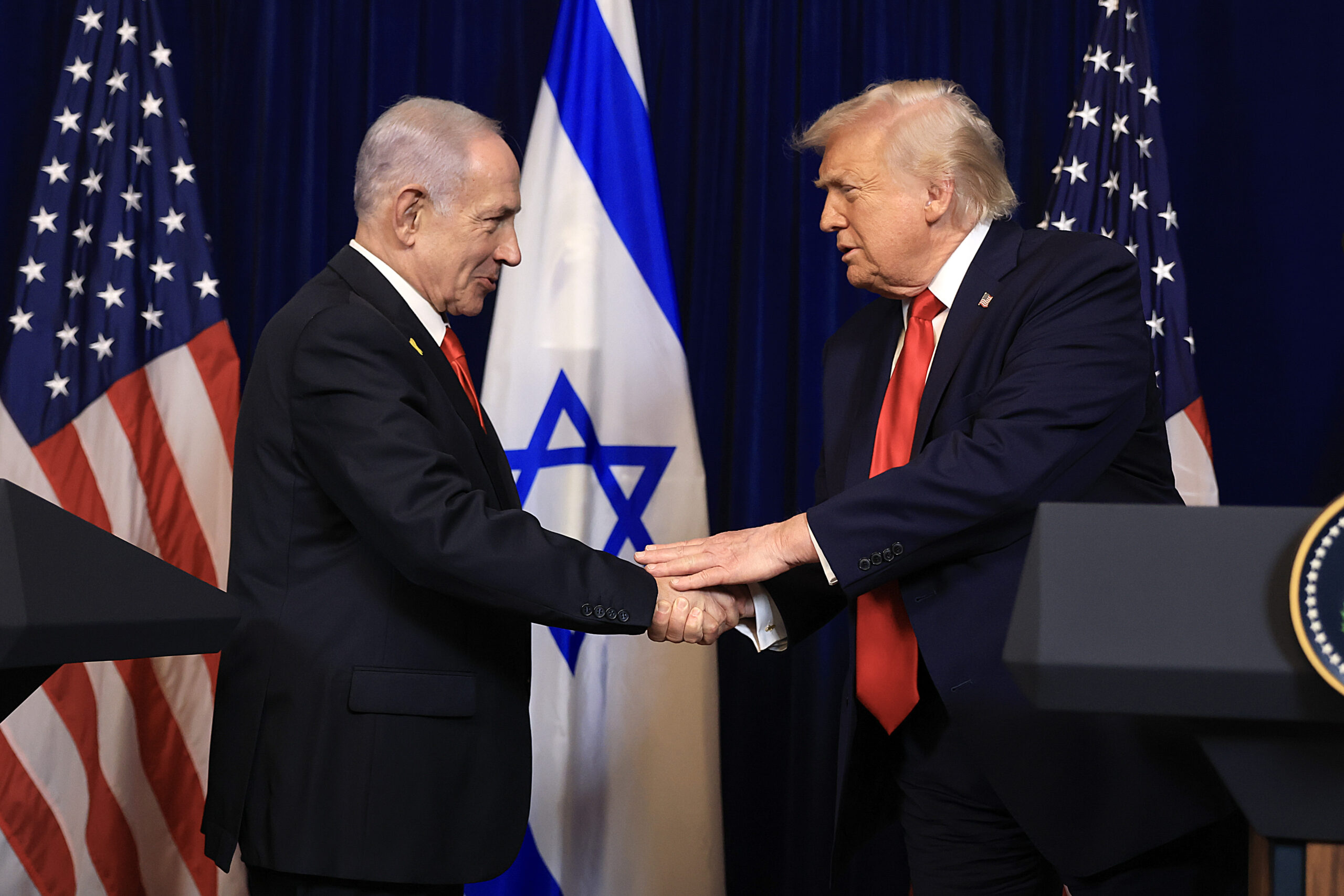
Two sources told JI the president pushed back on Netanyahu’s claims about the prudence of Israel’s proposal to end U.S. military assistance over the next decade
FUND IT OR LOSE IT
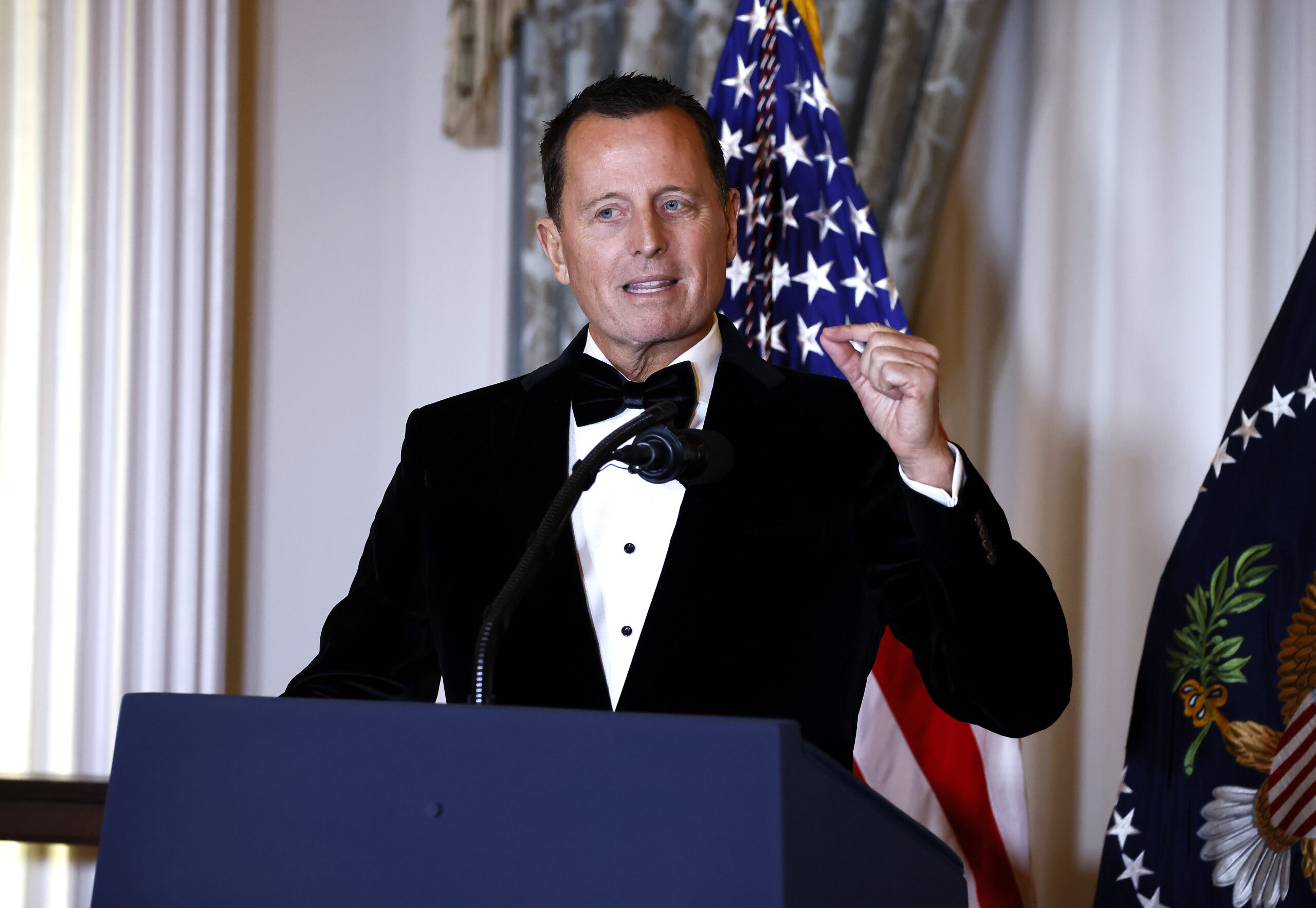
Grenell, at October event for Oct. 7-themed exhibit, told attendees: ‘It certainly would be a shame if we lost this room to a corporation or an individual and it was no longer the lounge‘
As the demonstrations in Iran grew and the regime’s response grew more violent, international talk about Israeli airstrikes subsided to near-silence
Stringer/Getty Images
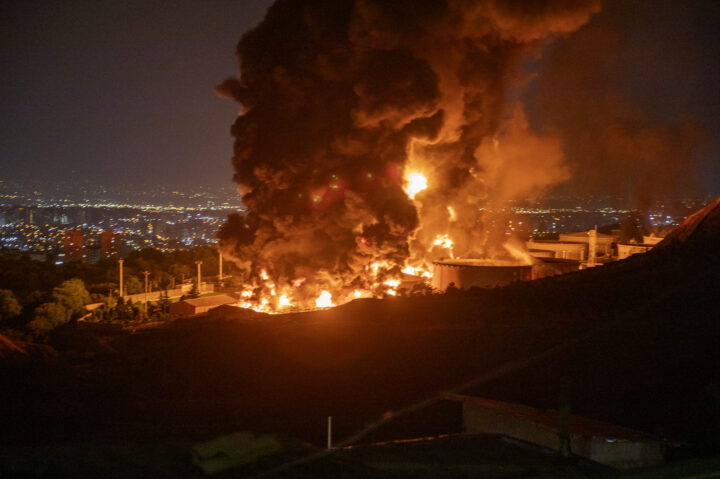
Fire and smoke rise into the sky after an Israeli attack on the Shahran oil depot on June 15, 2025 in Tehran, Iran.
The mass protests across Iran erupted just over two weeks ago — the same day that Israeli Prime Minister Benjamin Netanyahu flew to Palm Beach, Fla., to meet with President Donald Trump.
The big question as Netanyahu and Trump met was whether the president would give Israel a green light to strike Iran as it reconstituted its ballistic missile program at a pace that raised major concerns in Jerusalem. Trump’s response was a resounding yes, adding that if Iran would start rebuilding its nuclear program, the answer would be yes and “fast.”
At the same time, Israeli defense figures and officials made it known through the media that Jerusalem’s more immediate worry was that Tehran would misinterpret events and strike Israel first. Netanyahu reportedly told Russian President Vladimir Putin that Israel is not interested in escalating, but Ayatollah Ali Khamenei, Iran’s supreme leader, appeared to reject the overture in a post on X, saying “the malicious enemy is a deceiving liar.”
But as the demonstrations in Iran grew and the regime’s response grew more and more violent – Iran International reported 12,000 protesters have been killed as of Tuesday morning, while an Iranian official put the death toll at 2,000 – international talk about Israeli airstrikes subsided to near-silence.
Asked how Israel’s calculation about striking Iranian missile or nuclear sites may have changed in the last two weeks, former Israeli Ambassador to the U.S. Michael Oren told Jewish Insider’s Lahav Harkov on the “Misgav Mideast Horizons Podcast”: “With the United States threatening to intervene, what would we have to gain from this? Other than providing a pretext for the Iranians to strike back at us. I think we’re operating responsibly, prudently.”
Still, Israelis remain jittery about a second round of war with Iran, to the extent that the IDF’s spokesperson, Brig.-Gen. Effie Defrin, released a statement on Monday evening warning that “in recent days, many rumors have circulated in light of the situation in Iran. …The IDF is prepared defensively and remains on alert for surprise scenarios if required. The protests in Iran are a domestic matter. …We will provide updates if there are any changes. I emphasize: Do not lend a hand to rumors.”
Hostile actors — like the Hamas-affiliated Palestine Chronicle – misrepresented the Israeli Health Ministry’s distribution on Monday of new emergency preparation instructions incorporating the lessons of June’s 12-day war, as though hospitals were imminently entering emergency mode — even though the ministry’s letter explicitly said there is no need to do so. Other false reports stated that local governments in Israel had opened bomb shelters, leading several municipalities to issue denials.
Netanyahu said in Sunday’s Cabinet meeting that Israel is “closely monitoring what is happening in Iran. The demonstrations for freedom spread throughout the country. The people of Israel, the whole world, are amazed by the great courage of the citizens of Iran. Israel supports their struggle for freedom and strongly condemns the massacres of innocent civilians. We all hope the Persian people will soon be freed from the yoke of tyranny, and when that day arrives, Israel and Iran will go back to being faithful partners in building a future of prosperity and peace for both nations.”
Yet, hours later, he ordered a media blackout on the topic, silencing Intelligence Minister Gila Gamliel and Diaspora Minister Amichai Chikli, who have signaled their support for Reza Pahlavi, son of the deposed Shah.
Oren said that “Israel has only to gain from” the protests.
As to accusations from the Iranian regime — as well as American extremist podcasters on the right and left — Oren said: “I think Israel, and I say this very guardedly, has the ability to assist the protesters with communications, with information. … Are we providing them with arms? No, Are we saying we’re going to intervene militarily to help bring down the regime? We’re not saying that, and I think that’s why it was prudent to put the kibosh on those ministers who are flexing their muscles publicly vis-a-vis Iran.”
Plus, Trump favors strikes on Iran over diplomacy

Russell Yip/San Francisco Chronicle via Getty Images
California State Senator Scott Wiener addresses the SF Chronicle Editorial Board on Thursday, Jan. 18, 2018 in San Francisco, Calif.
Good Monday afternoon!
This P.M. edition is reserved for our premium subscribers — offering a forward-focused read on what we’re tracking now and what’s coming next.
It’s me again — Danielle Cohen-Kanik, U.S. editor at Jewish Insider and curator, along with assists from my colleagues, of the Daily Overtime. Please don’t hesitate to share your thoughts and feedback by replying to this email.
📡On Our Radar
Notable developments and interesting tidbits we’re tracking
The suspect in the arson attack that destroyed Mississippi’s largest synagogue early Saturday morning confessed to targeting the building because of its “Jewish ties,” Jewish Insider’s Haley Cohen reports.
In an affidavit filed in U.S. District Court in Mississippi more than 48 hours after the attack, the FBI said the suspect, Stephen Spencer Pittman, 19, admitted to starting the blaze at Beth Israel Congregation in Jackson, Miss., due to “the building’s Jewish ties” and referred to the institution as the “synagogue of Satan” in an interview with the Jackson Fire Department. Pittman was charged with “maliciously damaging or destroying a building by means of fire or an explosive”…
President Donald Trump said Iranian officials made contact with the U.S. over the weekend and proposed restarting nuclear negotiations, telling reporters, “A meeting is being set up, but we may have to act because of what’s happening before the meeting,” referring to the U.S. potentially taking military action in Iran over its violent crackdown on protesters around the country.
Iranian Foreign Minister Abbas Araghchi also spoke with White House special envoy Steve Witkoff in recent days about the protests, Axios reports; White House Press Secretary Karoline Leavitt told reporters today that an Iranian government official who spoke to Witkoff “express[ed] a far different tone than what you’re seeing publicly.”
Trump is currently leaning toward authorizing military strikes rather than engaging in diplomacy, The Wall Street Journal reports, and he is scheduled to hold a briefing tomorrow with advisors, including Secretary of State Marco Rubio, Secretary of Defense Pete Hegseth and Joint Chiefs of Staff Chairman Gen. Dan Caine, to make a determination…
California Jewish communal organizations released a joint statement today condemning state Sen. Scott Wiener’s remarks on Israel, after the Jewish House candidate said in a video statement yesterday that he is changing his position and will now call Israel’s actions in Gaza a genocide.
“We recognize that Senator Wiener has been a strong supporter of the Jewish community throughout the Israel-Hamas war and his many years of public service, and that he has directly experienced antisemitic attacks simply for being Jewish. Unfortunately, Senator Wiener’s newly stated position is both incorrect and lacks moral clarity. … We call on the Senator and our elected, civic, and education leaders to recognize and reflect on the consequences of their words in this fraught and polarizing environment,” the statement read…
In a major recruiting win for Senate Democrats, former Rep. Mary Peltola (D-AK) announced her run against Sen. Dan Sullivan (R-AK) today, JI’s Marc Rod reports, giving Democrats an outside chance of picking up the red-state Senate seat.
Peltola maintained a strongly pro-Israel voting record during her one term in the House, breaking on numerous occasions with a majority of her party to vote for measures supporting the Jewish state post-Oct. 7, including supporting a stand-alone Israel aid package opposed by many Democrats. Sullivan, for his part, has been a hawkish pro-Israel voice in the Senate, and has pushed for a more aggressive stance toward Iran…
Democratic Maryland state Del. Adrian Boafo is launching a bid to succeed his former mentor, Rep. Steny Hoyer (D-MD), as the former House majority leader retires. Boafo, who served as campaign manager for Hoyer, is expected to be the party favorite in the primary, Politico reports. Former Capitol Police officer Harry Dunn, who rose to prominence after the Jan. 6, 2021, Capitol riot, is also considering joining the race…
In another race to watch, Rep. Nellie Pou (D-NJ) in New Jersey’s 9th Congressional District gained another opponent in Tiffany Burress, a Republican political newcomer and wife of former NFL wide receiver Plaxico Burress. On the first day of her campaign, Burress has already secured the backing of several GOP county chairs, as the party looks to flip the seat away from Pou after Trump unexpectedly carried the district in 2024…
Former Obama administration officials and Crooked Media hosts Jon Favreau, Jon Lovett and Ben Rhodes are hosting a fundraiser in Hollywood, Calif., on Thursday for Abdul El-Sayed, a far-left, anti-Israel candidate running for Senate in Michigan, JI’s Marc Rod reports.
El-Sayed, a physician and former director of the Wayne County Department of Health, has made his criticisms of Israel a centerpiece of his campaign, blasting other candidates in the race as being insufficiently hostile to the Jewish state. Favreau, Lovett and Rhodes, on their “Pod Save America” and “Pod Save the World” podcasts, have also emerged as a vocal force against Israel and AIPAC in the Democratic Party, and have boosted prominent anti-Israel candidates in other hot-button primaries…
The future of the Israeli Lounge at the Trump-Kennedy Center is reportedly in peril, eJewishPhilanthropy‘s Judah Ari Gross reports, “unless a major donor from the Jewish community steps up and makes a large donation,” far-right commentator Laura Loomer said over the weekend. The center’s president, Richard Grenell, is seeking to renovate the space; Loomer has suggested Qatar may look to provide the funds for the room’s overhaul…
The New York Times reports on the brewing fight between states over the order of 2028 Democratic presidential primary elections…
Dina Powell McCormick, a banking executive, former deputy national security advisor to Trump and wife of Sen. Dave McCormick (R-PA), was named president and vice chair of Meta, reporting to CEO Mark Zuckerberg, Axios reports. Zuckerberg said in a statement that Powell McCormick will focus on “partnering with governments and sovereigns to build, deploy, invest in, and finance Meta’s AI and infrastructure”…
⏩ Tomorrow’s Agenda, Today
An early look at tomorrow’s storylines and schedule to keep you a step ahead
Keep an eye out in Jewish Insider for more details on the motives and background of the suspected arsonist who set fire to the Beth Israel Congregation in Jackson, Miss., over the weekend.
President Donald Trump will receive a major briefing on avenues for responding to Iran’s violent suppression of protests, including cyber, economic and military options.
New York Gov. Kathy Hochul will deliver her State of the State address in Albany, where she plans to announce her proposal to create a 25-foot buffer zone around houses of worship and health-care facilities. (The legislation, while welcomed by major Jewish groups, would not have prevented the pro-Hamas protest that disrupted a Queens community last week, which took place approximately 300 feet away from the targeted synagogue.) New York City Mayor Zohran Mamdani is expected to be in attendance.
Stories You May Have Missed
VENEZUELAN VIEWS

Some Venezuelan Jews see similarities in the response of far-left activists to Trump’s capture of Maduro and their criticism of Israel’s actions in Gaza
ON ALERT
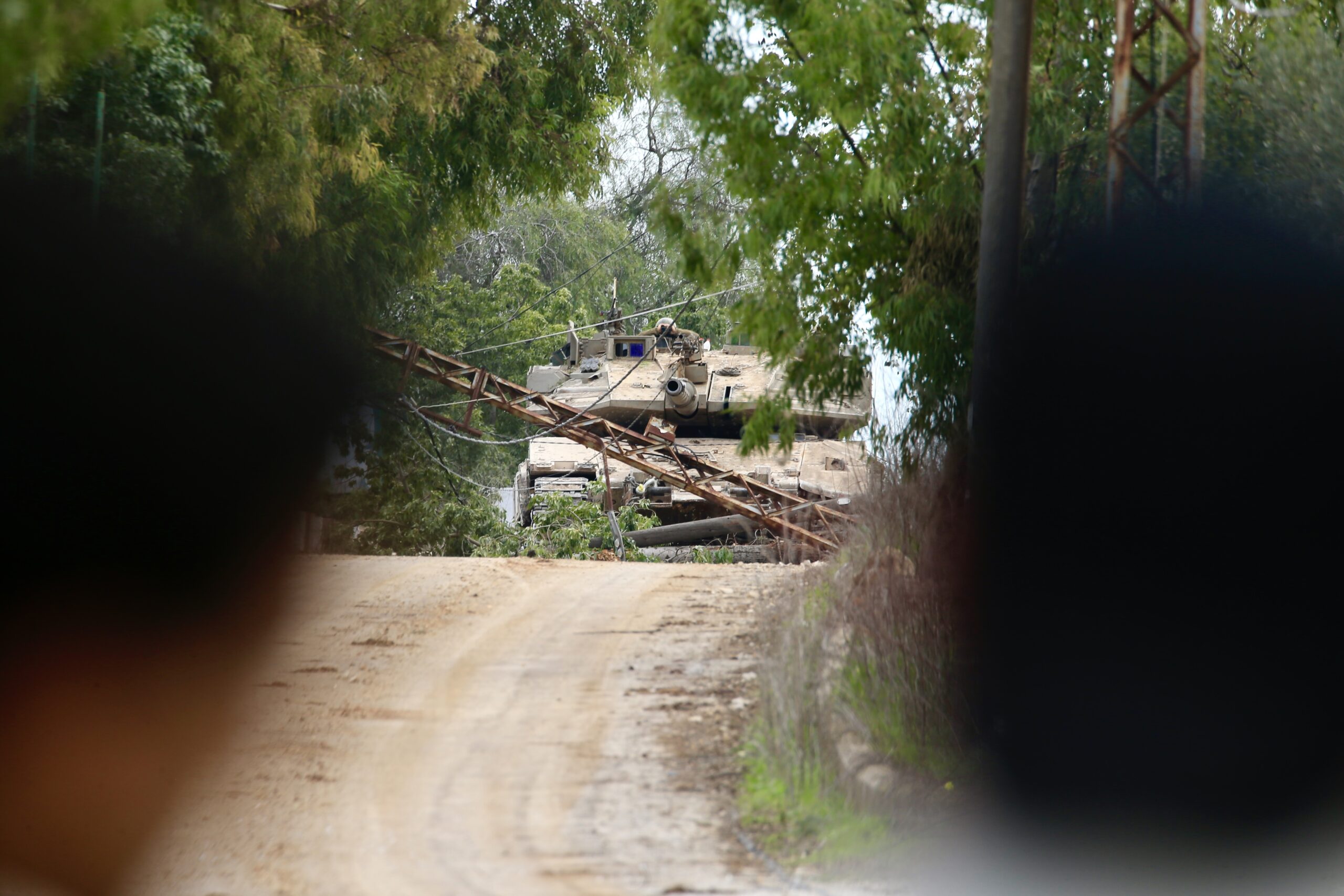
The Lebanese Armed Forces said it took operational control south of the Litani River, but has fallen well short of fully disarming the terrorist group
Plus, Trump mulls military action as Tehran murders protesters
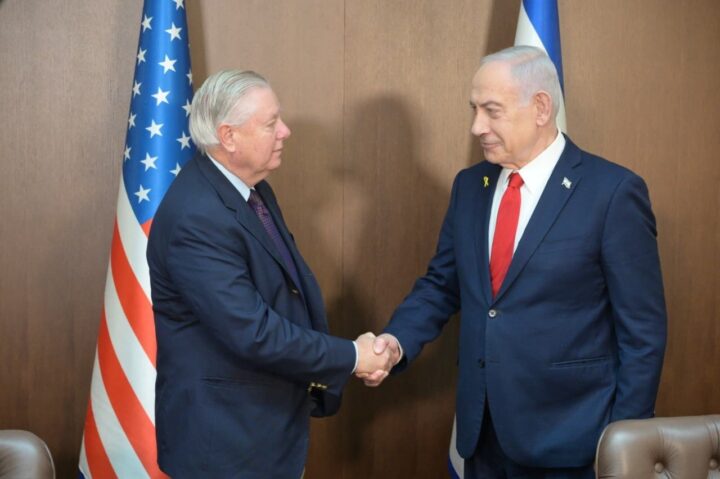
Amos Ben Gershom via Getty Images
Israeli Prime Minister Benjamin Netanyahu (R) meets with U.S. Senator Lindsey Graham (L) at the Israeli Prime Minister's Office in Jerusalem on December 21, 2025.
👋 Good Monday morning!
In today’s Daily Kickoff, we bring you the latest on the anti-government protests in Iran and the U.S.’ new threats to the Islamic Republic if it continues killing protesters, and report on Israeli Prime Minister Benjamin Netanyahu’s comments published on Friday that Israel wants to phase out U.S. aid in the next decade. We cover Saturday’s arson attack targeting Mississippi’s oldest synagogue, and report on New York City Mayor Zohran Mamdani’s stalled and muted response to pro-Hamas demonstrators who rallied outside a synagogue last week. Also in today’s Daily Kickoff: Jerome Powell, Larry Page and Miriam Zivin.
Today’s Daily Kickoff was curated by Jewish Insider Executive Editor Melissa Weiss and Israel Editor Tamara Zieve, with assists from Danielle Cohen-Kanik and Marc Rod. Have a tip? Email us here.
What We’re Watching
- Mahmoud Abbas, the 90-year-old longtime president of the Palestinian Authority, is in a hospital in Ramallah this morning. According to the Palestinian Authority’s official news agency Wafa, he is undergoing routine medical checkups.
- We’re monitoring the situation in Iran where the death toll has risen in recent days as the regime ramps up its crackdown on the nationwide protests. President Donald Trump is set to be briefed tomorrow on options to respond to the escalation. More below.
- Trump is expected to announce the global leaders of the U.S.-backed Gaza Board of Peace this week. The first meeting of the board is set to take place later this month on the sidelines of the World Economic Forum in Davos, Switzerland. The board’s launch comes as Israel prepares plans for a potential ground operation in Gaza in response to Hamas’ refusal to disarm.
- Qatar is signing the U.S.-led Pax Silica declaration today, joining the effort to strengthen AI and semiconductor supply chains. The United Arab Emirates is set to sign onto the declaration later this week. Israel, Japan, South Korea, Singapore, Britain and Australia are already part of the coalition.
What You Should Know
A QUICK WORD WITH JI’S GABBY DEUTCH
As another election year gets underway, two liberal Jewish politicians offered a window last week into just how fraught the issue of Israel has become in some Democratic primaries — and how even pushing back against claims that Israel is committing genocide is inviting intraparty political backlash, at least in the deepest-blue parts of the country.
Rep. Dan Goldman (D-NY) faces a primary challenge from the left in Brad Lander, the former New York City comptroller endorsed by Mayor Zohran Mamdani. When Goldman formally launched his reelection campaign last week, he was asked by a reporter if he believes Israel has committed genocide in Gaza. Goldman equivocated — a notable shift for a lawmaker who in February 2024 signed onto a letter calling claims of genocide in Gaza “false.”
“I think there needs to be a serious investigation into what went on in Gaza during the war,” Goldman said. “What you call it is I think more of a legal matter, in my view, but what we all can agree on is that the destruction [in Gaza] was unconscionable and devastating and I am really grateful that it is over and the hostages are out and we can move forward.” (Lander, in contrast, has accused Israel of genocide.)
Across the country, in San Francisco, California state Sen. Scott Wiener, a Democrat running to replace Rep. Nancy Pelosi (D-CA), was asked the same question at a candidate forum. His two primary opponents — Connie Chan, a member of the San Francisco Board of Supervisors, and Saikat Chakrabarti, former chief of staff to Rep. Alexandria Ocasio-Cortez (D-NY) — both raised placards that said “yes.” Wiener did not raise either the “yes” or “no” placard.
Wiener followed up with a post on X claiming that the Israeli-Palestinian conflict “demands more discussion and certainly more time,” which, after receiving blowback on social media, he subsequently deleted. He then backtracked completely: On Sunday afternoon, Wiener posted a video to social media stating that he’s “stopped short of calling [Israel’s actions in Gaza] a genocide, but I can’t anymore.”
FIREBOMBING PROBE
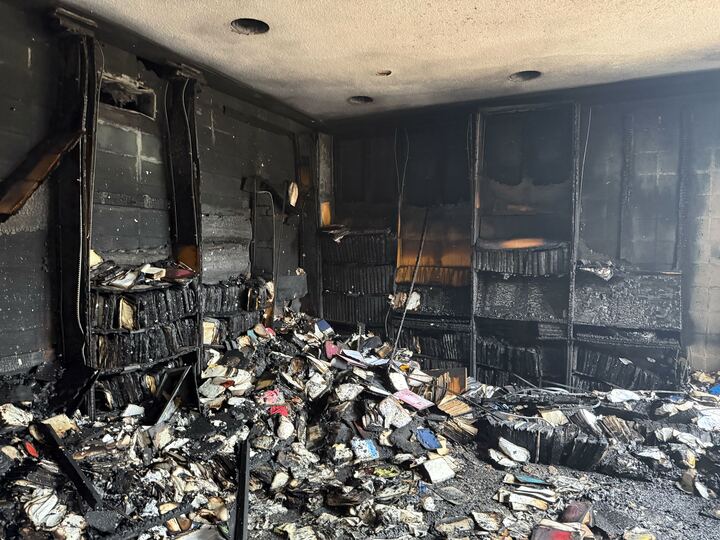
A suspect is under arrest for an arson attack that significantly damaged Mississippi’s largest synagogue early Saturday morning, authorities reported. Local law enforcement arrested a suspect whom they believe purposefully set fire to Beth Israel Congregation in Jackson shortly after 3 a.m. Saturday, Jackson Mayor John Horhn confirmed. The suspect’s name and motive have not been disclosed, Jewish Insider’s Haley Cohen reports. According to internal security camera footage, a person was filmed splashing liquid along a wall and onto a couch inside the synagogue’s lobby shortly before the fire was ignited, Mississippi Today reported.
Storied past: Beth Israel Congregation is the only synagogue in Jackson, the state’s capital and most populous city. The historic building also houses the offices of the Institute of Southern Jewish Life, which supports Jewish life in the region. Located in a major hub of the Civil Rights Movement, Beth Israel was bombed in 1967 by the Ku Klux Klan over the rabbi’s support for racial justice — including providing chaplain services to activists incarcerated for challenging segregated busing in the state.
TOUGH TALK
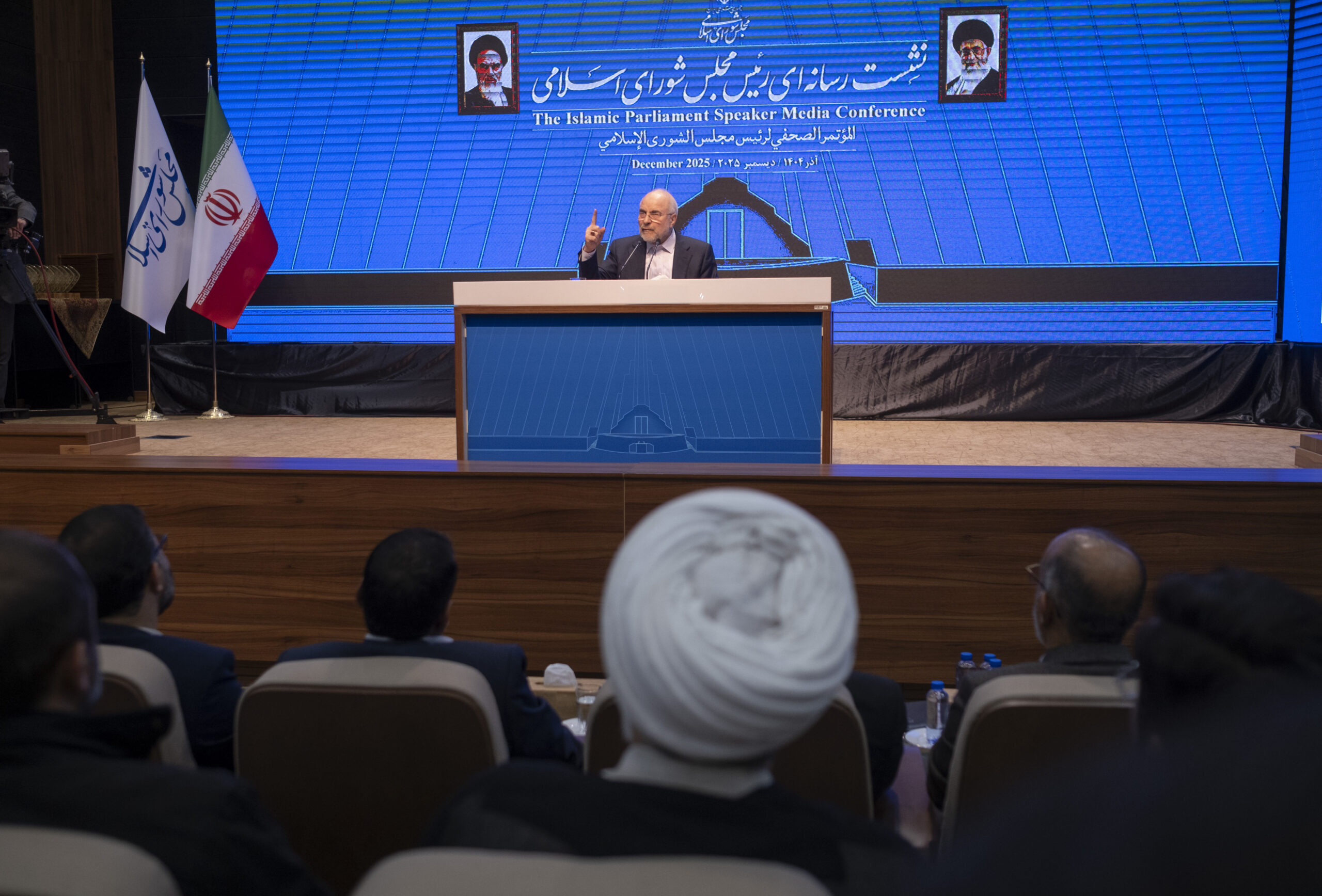
Tensions between the U.S. and Iran escalated on Sunday as President Donald Trump weighed options for striking Iran amid the regime’s crackdown on protesters, and Tehran threatened to strike U.S. bases in response, Jewish Insider’s Danielle Cohen-Kanik reports. Trump was briefed in recent days on options for sites to strike in Iran, The New York Times reported, after he issued several threats warning that the U.S. could get involved if the Iranian regime attempted to violently suppress the nationwide demonstrations that have racked the country for several weeks.
Returning the threat: In response, Mohammad-Bagher Ghalibaf, the speaker of Iran’s parliament, said on Sunday that the country would attack American military bases in the region if the U.S. follows through, and even raised the possibility of a preemptive strike. Ghalibaf also threatened to attack regional shipping lanes and Israel.
Further messaging: Iranian Foreign Minister Abbas Araghchi told a conference of foreign ambassadors today that Tehran “is not seeking war but is fully prepared for war,” and is “also ready for negotiations but these negotiations should be fair.” Speaking to reporters on Air Force One on Sunday, Trump, asked whether the regime has crossed his red line, said, “They’re starting to,” … “We’re looking at it very seriously. The military is looking at it, and we’re looking at some very strong options. We’ll make a determination.”
AID EXIT
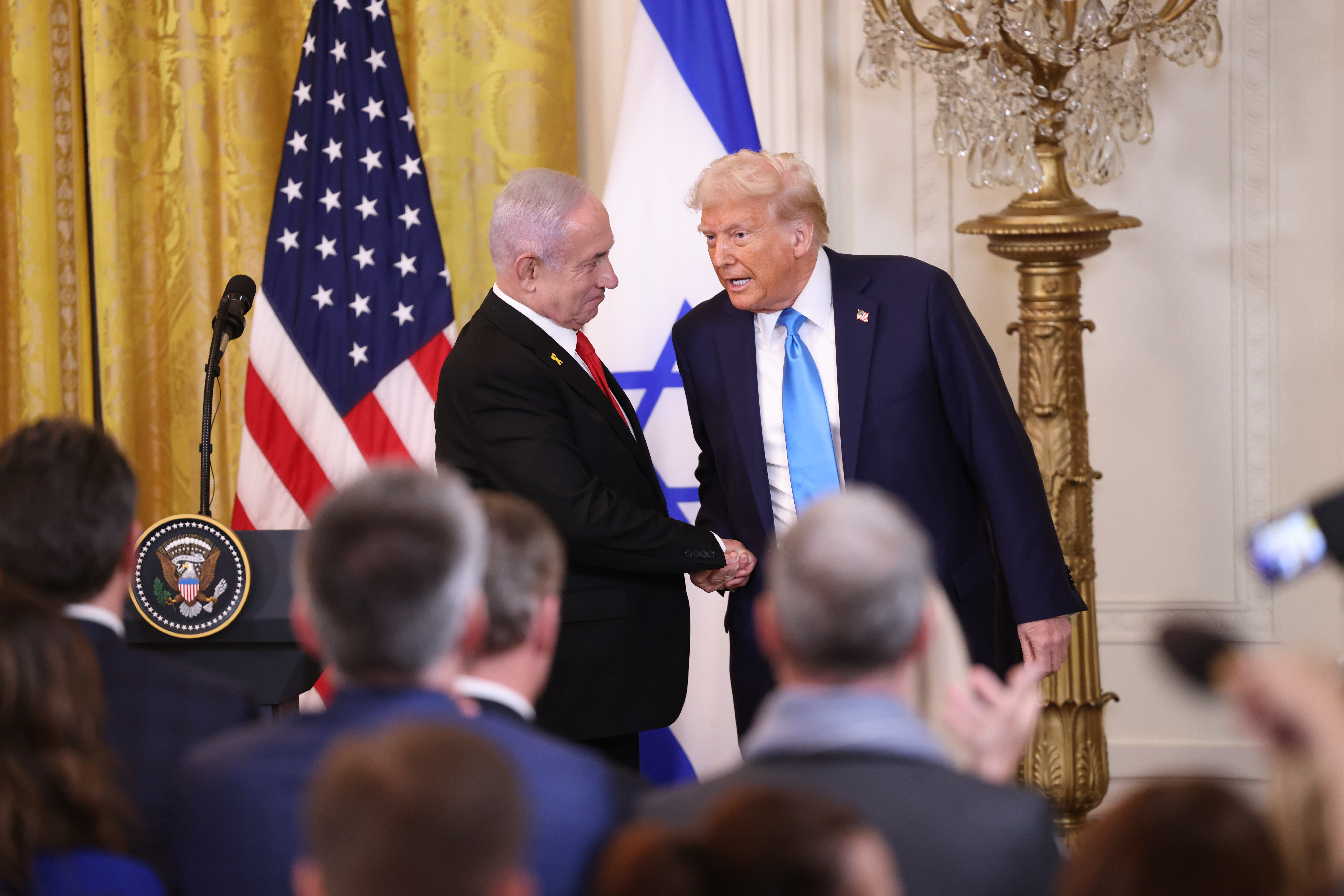
Israeli Prime Minister Benjamin Netanyahu announced that Israel is seeking to end the military assistance it receives from the U.S. in the next 10 years, a move that he said is “in the works,” Jewish Insider’s Gabby Deutch and Danielle Cohen-Kanik report.
What he said: In an interview with The Economist released Friday, Netanyahu said that during his December visit to President Donald Trump’s Mar-a-Lago resort in Palm Beach, Fla., he told Trump that Israel “very deeply appreciate[s] the military aid that America has given us over the years.” But, he said, “we’ve come of age and we’ve developed incredible capacity. And our economy, which will reach, certainly within a decade, will reach about a trillion dollars — it’s not a huge economy, but it’s not a small economy. So I want to taper off military aid within the next 10 years.”
Exclusive: Following Netanyahu’s announcement, Sen. Lindsey Graham (R-SC) told JI that he will push forward an effort to end U.S. aid more quickly — a major shift from one of Israel’s closest allies on Capitol Hill, JI’s Emily Jacobs and Marc Rod report.
LEADERSHIP TEST
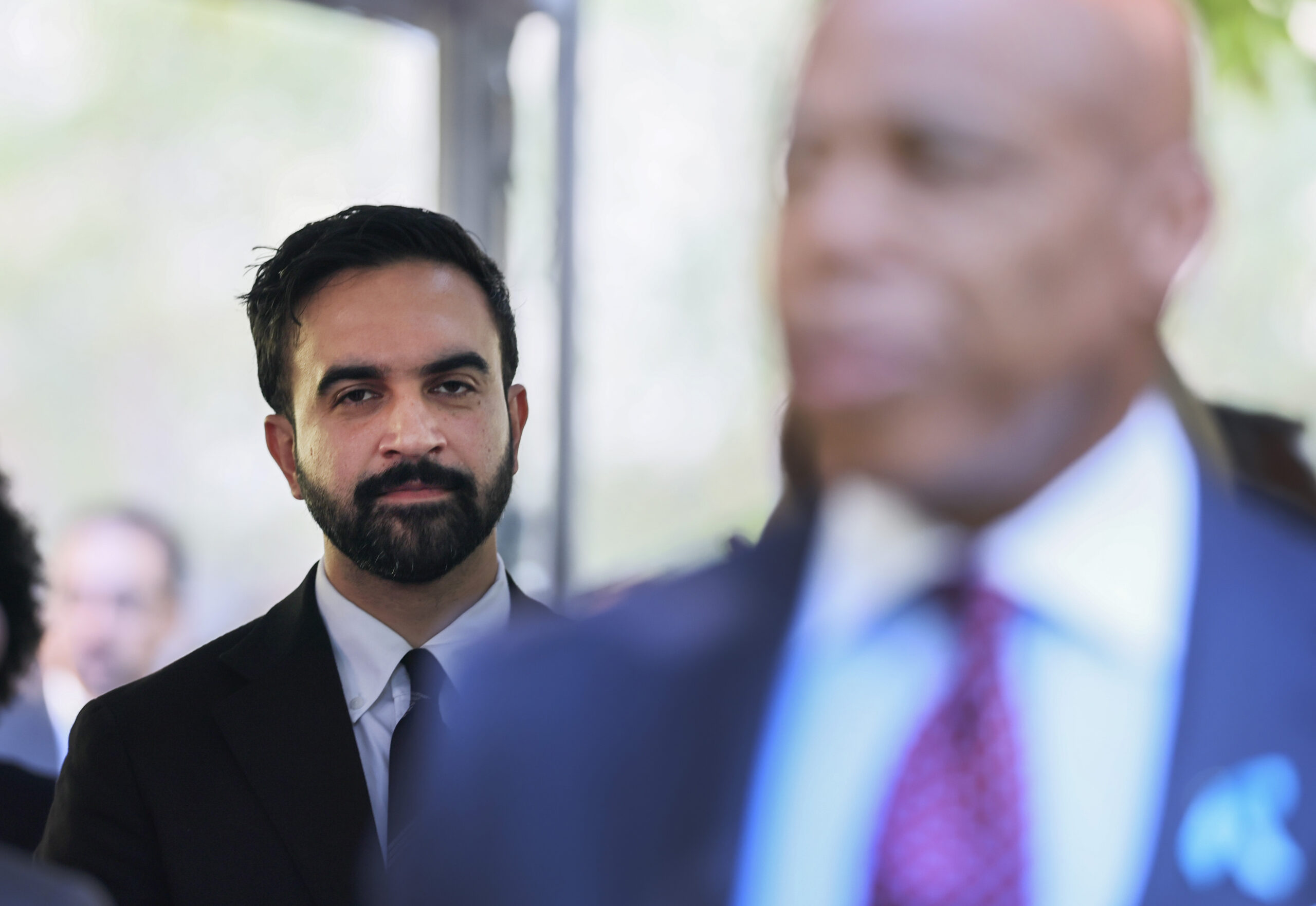
New York City Mayor Zohran Mamdani is facing criticism from Democratic leaders over his delayed and muted response to last week’s pro-Hamas protest in Queens that caused nearby schools and a synagogue to close early in anticipation of the demonstration, where dozens of masked protesters chanted “We support Hamas” near the synagogue, Jewish Insider’s Haley Cohen reports.
Delayed response: The newly inaugurated mayor remained silent Thursday night and much of the following day regarding the demonstration, which marked his first major test in protecting the city’s Jewish community. His spokesperson did not respond to multiple inquiries from JI on Thursday. Mamdani broke his silence late in the afternoon on Friday when he was asked about the protesters’ pro-Hamas chant by Politico reporter Jason Beeferman while leaving a campaign event in Brooklyn for an ally. “That language is wrong,” Mamdani replied. “I think that language has no place in New York City.”
Sign of the times: The Wall Street Journal’s editorial board argues that Mamdani’s response to the protest coupled with efforts by Breads Bakery employees for the company to cut its ties with Israel reflect the political climate in New York City under the new mayor.
WALKING BACK

Michigan state Sen. Mallory McMorrow, a Democratic candidate for Senate, said in a recent radio interview that accusations of genocide against Israel — with which she has previously agreed — have become a “political purity test,” arguing that there has been too much emphasis on that specific word, Jewish Insider’s Marc Rod reports.
Notable quotable: Asked on local radio station WDET last week whether her stance has changed since October, when she affirmed that she believed the war in Gaza met the definition of a genocide, McMorrow did not offer a direct yes or no answer. “I am somebody who looks at the videos, the photos, the amount of pain that has been caused in the Middle East, and you can’t not be heartbroken,” McMorrow said. “But I also feel like we are getting lost in this conversation, and it feels like a political purity test on a word — a word that, by the way, to people who lost family members in the Holocaust, does mean something very different and very visceral.” McMorrow went on to criticize an unnamed opponent for campaigning on the issue of the war in Gaza, presumably referring to Abdul El-Sayed, the far-left Democrat who has made his opposition to Israel a centerpiece of his campaign.
ON ALERT
The Lebanese Armed Forces announced Thursday that it had taken operational control of the south of the country and successfully completed the first phase of its operation to disarm Hezbollah — a claim that experts say is unlikely to satisfy Israel and could risk further escalation. Under the November 2024 ceasefire agreement between Israel and Hezbollah, the Lebanese government was tasked with removing the terror group south of the Litani River, near Israel’s border, with a deadline of Dec. 31, 2025, before moving to the second phase of disarmament north of the Litani. Experts told Jewish Insider’s Matthew Shea that the Lebanese army’s claim has done little to quell Israeli concerns.
Opposing information: “Despite the statements published today in Lebanon, the facts remain that extensive Hezbollah military infrastructure still exists south of the Litani River,” Israel’s Foreign Ministry stated in a post on X on Thursday. Hanin Ghaddar, a senior fellow at the Washington Institute for Near East Policy, said the situation has become increasingly tense because there is “no indication” that Lebanon will move forward with the next phases of disarmament and that it is “more likely” the country is “not going to move north of Litani” in order to avoid confrontation with Hezbollah.
Worthy Reads
Iran on the Brink: In The Atlantic, Karim Sadjadpour, a senior fellow at the Carnegie Endowment for International Peace, and Jack A. Goldstone, the author of Revolutions: A Very Short Introduction, weigh the likelihood that the Iranian regime will collapse imminently. “One of us, Jack, has written at length about the five specific conditions necessary for a revolution to succeed: a fiscal crisis, divided elites, a diverse oppositional coalition, a convincing narrative of resistance, and a favorable international environment. This winter, for the first time since 1979, Iran checks nearly all five boxes… The final and decisive catalyst for revolution is an international environment that helps sink the regime rather than bolster it. After North Korea, Iran may be the most strategically isolated country in the world. Over the past two years — since Hamas’s October 7, 2023, attack on Israel, which Ayatollah Khamenei alone among major world leaders openly endorsed — Iran’s regional proxies and global allies have been decimated or deposed.” [Atlantic]
Crackdown Crisis: The Washington Post’s David Ignatius posits that the Iranian regime’s protest crackdowns, which have occurred a number of times in recent years, have only served to delay an eventual effective uprising. “The Iranian regime is on a one-way street to disaster. A senior European diplomat in Tehran shared that assessment with me several years ago, and it remains true. Iran has powerful security tools, but they’re getting rusty. The regime couldn’t protect its proxies Hamas in Gaza, Hezbollah in Lebanon, and President Bashar al-Assad in Syria. And most important, Iran couldn’t shield itself from Israel’s systematic assault in June. … The wild card this year is whether the regime’s hard-liners have lost their edge. Like the Soviet Union during its last years, the security agencies may have lost their ideological commitment and discipline. They’ve watched helplessly as their proxy forces were crushed in Gaza, Lebanon and Syria. And they’ve suffered the same scourge of inflation and economic stagnation as the rest of the nation. They’re not broken, but they appear more fragile than in the past.” [WashPost]
Read His Lips: In Semafor, Jason Greenblatt, who served as the White House Middle East envoy during the first Trump administration, posits that Iran should take seriously President Donald Trump’s warnings that the U.S. could back the protesters demonstrating against the regime if Tehran continues to use violence against them. “Trump has established a record of acting when he draws lines. He views the June conflict with Iran — short, focused, and devastating to its strategic military assets — as proof that decisive and limited force can restore balance rather than prolong instability. In his view, hesitation invites escalation. Clear consequences reduce it. Diplomacy is preferable, but diplomacy without credibility is meaningless. … What separates Trump from many of his predecessors is not an appetite for war, but a refusal to tolerate endless gray zones. His worldview is not anti-Iranian or anti-Venezuelan. It is anti-destabilization. That applies equally to nuclear brinkmanship in the Middle East and narco-state behavior in the Western Hemisphere that corrodes security at home and abroad.” [Semafor]
The Torture Chronicles: In The Atlantic, Russia-Israeli academic Elizabeth Tsurkov recounts her 902-day captivity in Iraq. “The interrogators kept threatening me with torture, but in those opening weeks, they refrained from acting on the threats — I assume on orders from higher up. Instead, because they were clearly untrained in conducting interrogations that did not involve torture, they fell back on interrogation methods they had probably seen in movies. To intimidate me, Maher would blow smoke in my face, but because he was using an e-cigarette, all I got was a gust of strawberry-smelling vape. It wasn’t quite the tough-guy routine he was after. Later, he tried the ‘good cop, bad cop’ routine on me but undermined the effect by playing both characters himself, on alternate days, which just made him seem deranged.” [Atlantic]
Word on the Street
President Donald Trump told The New York Times that neither the Republican Party nor the MAGA movement have space for antisemitism, saying that the GOP doesn’t “need” or “like” people who espouse antisemitism; the president also called himself “the least antisemitic person probably there is anywhere in the world”…
Far-right commentator Tucker Carlson joined a lunch with Trump and Vice President JD Vance on Friday, later attending a meeting between the president and oil and gas executives regarding Venezuela…
Federal prosecutors opened a criminal investigation into the Federal Reserve and its chair, Jerome Powell, over renovations made to the agency’s Washington headquarters; Powell released a video alleging that the investigation came as a result of his clashes with the Trump administration over interest rates…
Former Rep. Marjorie Taylor Greene (R-GA) denied the White House’s allegation that she had tipped Code Pink off to a lunch the president was having at Joe’s Seafood, Prime Steak & Stone Crab in September, where the far-left activist group confronted the president in a now-viral incident…
Steve Bannon is reportedly laying the groundwork for a 2028 presidential bid in an effort to push an America First agenda during the primary season. Former Rep. Matt Gaetz (R-FL), who has appeared on Bannon’s “War Room” podcast, told Axios, “The Bannon campaign will merge the foreign policy of Rand Paul with the tax policy of Elizabeth Warren”…
Police in New Jersey arrested a man suspected of throwing a rock at a yeshiva school bus on the New Jersey Turnpike, injuring an 8-year-old girl; the man, Hernando Garciamorales, had been linked to a series of prior rock-throwing incidents…
Google co-founder Larry Page bought two Miami properties for $173.4 million, amid an influx of Silicon Valley execs to South Florida as California gears up for a referendum on a tax on billionaires…
A U.K. medical tribunal cleared the rector of the University of Glasgow of misconduct allegations for social media posts and an op-ed in which he praised members of Hamas and the People’s Front for the Liberation of Palestine…
Israel struck at least seven Hezbollah sites in southern Lebanon on Sunday, days after the Lebanese Armed Forces claimed that the Iran-backed terror group had fully disarmed…
Israeli police detained Tzachi Braverman, the chief of staff to Israeli Prime Minister Benjamin Netanyahu, for questioning over allegations that he attempted to hinder an investigation into the leaking of a classified military document in 2024…
The Associated Press reports on an ethics debate inside Israel over Sara Netanyahu’s retouching of official government photos…
The U.S. conducted strikes against ISIS targets in Syria, weeks after an attack by an ISIS-aligned member of Syria’s security forces killed two U.S. servicemembers and a civilian interpreter…
Sheikh Mohammed bin Abdulrahman Al-Thani, Qatar’s prime minister and foreign minister, met with Ben Black, CEO of the U.S. International Development Finance Corporation, in Doha on Monday…
The Qatari prime minister also met with U.S. Under Secretary of State for Economic Affairs Jacob Helberg and discussed “the close strategic relations” between the two countries, according to the Qatari Foreign Ministry…
A Bahraini court sentenced political activist Ebrahim Sharif to six months in prison and a fine over a recent interview in Lebanon in which Sharif criticized Arab states and said more support should be given to the Palestinians…
In The New York Times’ “Modern Love” column, Taiwanese-American economist David Woo reflects on his marriage to Israeli architect Margalit Shinar, who is 40 years his senior…
Jewish actors Timothée Chalamet and Seth Rogen took home awards at the Golden Globes — Chalamet for his role in the movie “Marty Supreme” and Rogen for his satire show “The Studio”…
Richard Hirschhaut is joining Jewish National Fund-USA as its national campaign director for the West Coast and Mountain states after six years as the director of the American Jewish Committee’s Los Angeles office…
Mothers Against Campus Antisemitism tapped Miriam Zivin as the advocacy group’s new board president, following a weekslong dispute between the organization’s founder and board, eJewishPhilanthropy’sJay Deitcher reports…
Sen. Lindsey Graham (R-SC) delivered the opening remarks at a Tzedek Association fundraising event in Deal, N.J….
Chabad of Westport hosted former hostage Eliya Cohen and survivor of the Nova music festival massacre Ziv Aboud, who recently got engaged and have been touring the U.S. in recent weeks, sharing their stories and working to fight misinformation…
Hessy Levinsons Taft, whose baby photo was used on the cover of the Sonne ins Haus pro-Nazi magazine as a depiction of the ideal Aryan infant by editors who did not know she was Jewish, died at 91…
Dr. Jerome Lowenstein, a physician who later became publisher of the Bellevue Literary Press, which published the 2010 Pulitzer Prize-winner for fiction, died at 92…
Pic of the Day
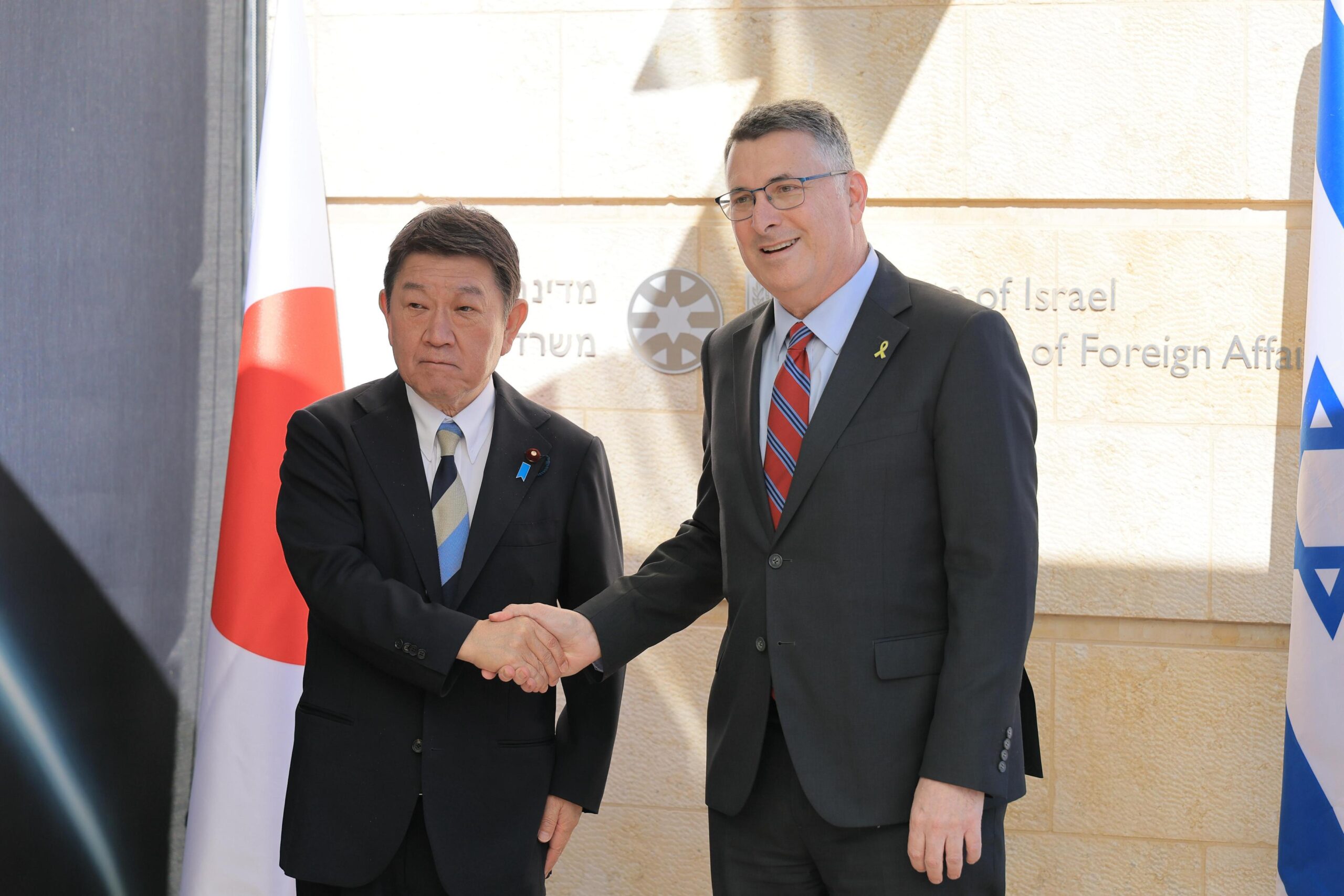
Israeli Foreign Minister Gideon Sa’ar (right) met with his Japanese counterpart, Toshimitsu Motegi, in Jerusalem on Sunday, as part of a nine-day trip by the Japanese foreign minister that will also include visits to the West Bank, Qatar, the Philippines and India. According to the Japanese Foreign Ministry, Motegi explained during the meeting Japan’s position on the situation in Gaza and the West Bank and “stated that Japan will play a proactive role in promoting peace and stability in the Middle East, in improving the humanitarian situation in Gaza and in engaging in the early-recovery and reconstruction efforts.”
Birthdays
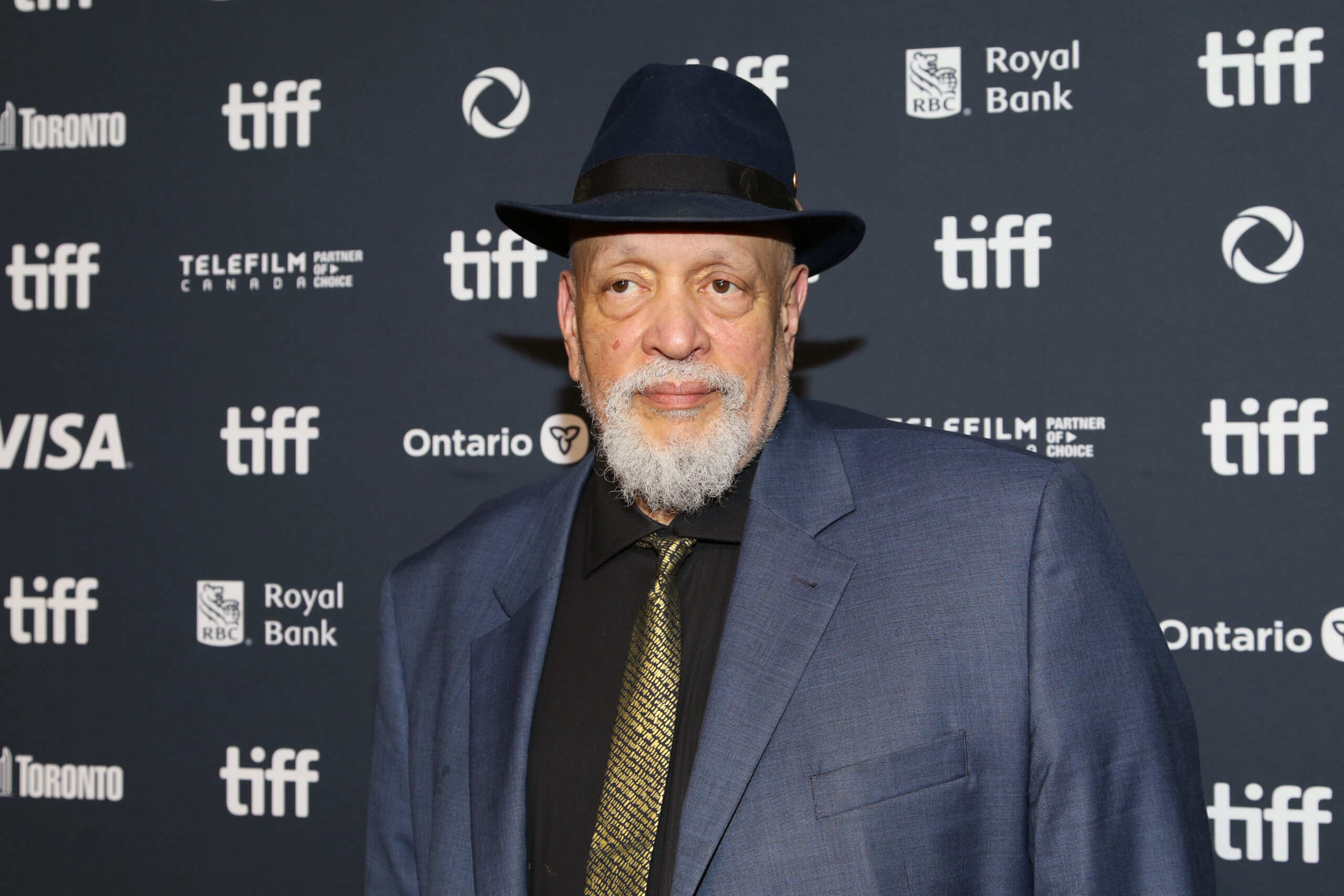
Author of over 40 books, most widely recognized for his crime fiction, Walter Ellis Mosley turns 74…
Real estate and casino magnate, he is a minority owner of the Chicago Bulls and Chicago White Sox, Neil Gary Bluhm turns 88… U.S.-born biochemist, he moved to Israel in 1973, winner of the Israel Prize (1999) and professor emeritus at Hebrew U, Howard “Chaim” Cedar turns 83… Stephen Moses… Israel-born jewelry designer, editor and businesswoman, she was the first lady of Iceland from 2003 until 2016, Dorrit Moussaieff turns 76… NYC-based psychiatrist and president of the Child Mind Institute, Harold S. Koplewicz, MD turns 73… Radio personality on Sirius XM, Howard Stern turns 72… British novelist and grandson of J.R.R. Tolkien (one of the latter’s two Jewish grandchildren), Simon Mario Reuel Tolkien turns 67… Senior director of philanthropic engagement at Jewish Funders Network, she was a consultant for DreamWorks on the film “The Prince of Egypt,” Tzivia Schwartz Getzug… Midday news anchor at Washington’s WTOP Radio, Debra Feinstein turns 64… Board member and former chair of Hillel International, she is also a board chair of Mem Global (f/k/a Moishe House), Tina Price… Member of the Maryland House of Delegates, Jon S. Cardin turns 56… Identical twin comedians and actors, Randy Sklar and Jason Sklar turn 54… Filmmaker known for parody films, Aaron Seltzer turns 52… First-ever woman to be an MLB coach, in 2024 she was a co-founder of a women’s pro baseball league, Justine Siegal Ph.D. turns 51… Rabbinical advisor of Shabtai, Shmully Hecht turns 51… Recording artist and musical entertainer, Yaakov Shwekey turns 49… Professional golfer, Rob Oppenheim turns 46… Two-time Olympian (2012 and 2016) in beach volleyball, now a chiropractor and performance coach, Josh Binstock turns 45… Founder of The Jewish Majority, Jonathan Schulman… Director of major gifts in the mid-Atlantic region for American Friends of Magen David Adom, Ira Gewanter… Executive director of the Hillel at Virginia Tech, Amanda Herring… VP of finance and operations at NYC-based Hornig Capital Partners, Daniel Silvermintz… Israeli tennis player, Lina Glushko turns 26…
Trump was reportedly briefed in recent days on options for sites to strike in Iran as the regime cracks down on protesters
Morteza Nikoubazl/NurPhoto via Getty Images
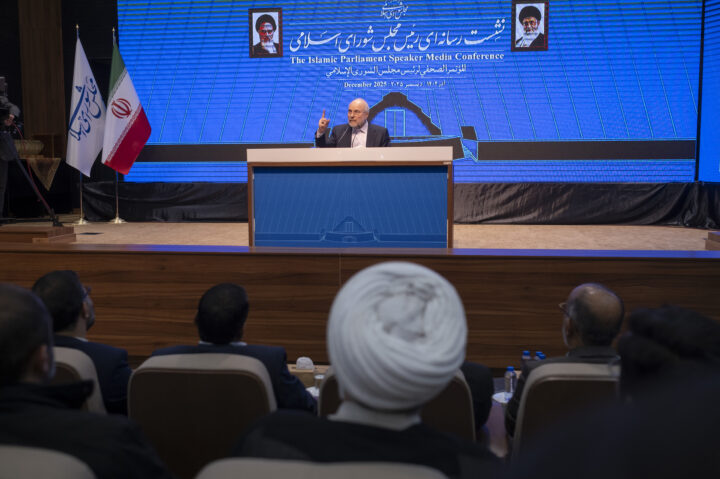
Iranian Parliament Speaker, Mohammad Bagher Ghalibaf, speaks with the media in a media conference at a conference hall in the Iranian Parliament building in Tehran, Iran, on December 2, 2025.
Tensions between the U.S. and Iran escalated on Sunday as President Donald Trump weighed options for striking Iran amid the regime’s crackdown on protesters, and Tehran threatened to strike U.S. bases in response.
Trump was briefed in recent days on options for sites to strike in Iran, The New York Times reported, after he issued several threats warning that the U.S. could get involved if the Iranian regime attempted to violently suppress the nationwide demonstrations that have racked the country for several weeks.
The options include nonmilitary sites in Tehran, the Times wrote, as well as a large-scale aerial strike on military targets, The Wall Street Journal reported. Trump has not yet made a decision whether to proceed and no U.S. military action has been taken in preparation thus far, U.S. officials told the Times and the Journal.
In response to the reports, Mohammad-Bagher Ghalibaf, the speaker of Iran’s parliament, said on Sunday that the country would attack American military bases in the region if the U.S. follows through, and even raised the possibility of a preemptive strike. Ghalibaf also threatened to attack regional shipping lanes and Israel.
Over the last week, Trump has made repeated threats against the Iranian regime that the U.S. was “locked and loaded” and would “rescue” demonstrators if security forces began killing them. Human rights groups say the death toll has reached over 200 as the protests, sparked by a severe economic crisis in the country, have spread, with protesters explicitly calling for regime change.
The president wrote on Truth Social on Saturday that “Iran is looking at FREEDOM, perhaps like never before” and that the “USA stands ready to help!!!”
Trump has floated the possibility of regime change in Iran before. During the country’s June war with Israel, when the U.S. struck nuclear sites inside Iran, Trump wrote on social media that the U.S. knows “exactly where the so-called ‘Supreme Leader’ [Ayatollah Ali Khamenei] is hiding. He is an easy target, but is safe there — We are not going to take him out (kill!), at least not for now.” Later, he wrote, “It’s not politically correct to use the term, ‘Regime Change,’ but if the current Iranian Regime is unable to MAKE IRAN GREAT AGAIN, why wouldn’t there be a Regime change??? MIGA!!!”
GOP lawmakers have voiced their support for renewed U.S. strikes on Iran, with Sen. Lindsey Graham (R-SC) sharing a message to Khamenei on Fox News last week: “You need to understand, if you keep killing your people who are demanding a better life, Donald J. Trump is gonna kill you.”
Experts say what is unfolding now could be more significant than protests of the past, expressing to JI that recent developments could pose an unprecedented challenge to a regime already under strain
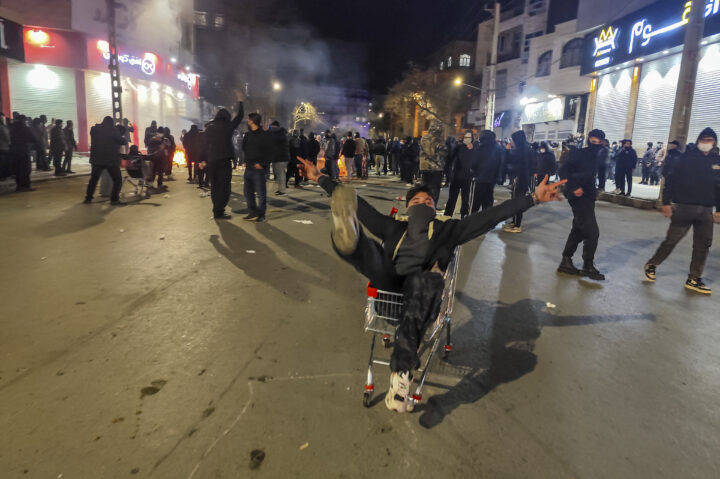
Kamran / Middle East Images / AFP via Getty Images
Iranians gather while blocking a street during a protest in Kermanshah, Iran on January 8, 2026.
The United States, Israel and their regional allies are watching closely as sustained unrest in Iran puts renewed pressure on the regime at a moment of economic strain, international isolation and lingering fallout from the 12-day war with Israel last June.
Recent demonstrations have spread across all 31 of Iran’s provinces, fueled by public anger over a collapsing economy, inflation exceeding 40% and aggressive crackdowns by security forces. Economic pressure — intensified by costly proxy wars and United Nations sanctions — have sent Iran’s currency into a sharp decline.
Jonathan Ruhe, a fellow at the Jewish Institute for National Security of America, said the regime’s “unwillingness to be responsive to its people’s basic demands and rights,” is also a factor. Adding that Tehran has a “clear preference to spend the country’s resources on military projects like its proxies, missiles and nuclear program instead of its citizens’ well-being.”
More than 400 demonstrations took place this week alone, with at least 743 recorded over the past month, according to a tracker from the Foundation for Defense of Democracies. The death toll has reached at least 38, with more than 2,200 arrests reported. The demonstrations are the largest since April 2025 and among the most sustained since late 2022 as videos continue to circulate online of Iranians flooding the streets, burning regime flags and lighting fire to statues of Supreme Leader Ayatollah Ali Khamenei.
Ruhe said that uprisings by the Iranian people against the regime are not uncommon. “In 2009 it was political corruption, when the regime clearly stole the presidential election to get [former President Mahmoud] Ahmadinejad reelected,” he said. “In 2017-18 it was economic and foreign policy issues, for instance Iranians being killed in the Syrian civil war and the regime’s lavish spending on its proxies instead of at home. In 2022 it was social and cultural issues, namely hijab enforcement.”
But experts say what is unfolding now could be more significant than protests of the past, expressing to Jewish Insider that recent developments could pose an unprecedented challenge to a regime already under strain.
Behnam Ben Taleblu, the senior director of FDD’s Iran program, called the protests a “nationwide anti-regime uprising,” telling JI that they are reaching a “crescendo” with a “greater demographic and geographic group of Iranians protesting.”
“Protests have rapidly spread due to the shared consensus that the Islamic Republic of Iran is behind the demise of Iran,” said Taleblu, who called the demonstrators “historic and different” given how the Iranian people have “not given up” in the face of crackdowns. “This matters for a regime that is battered and bruised.”
Ruhe also said the protests are “different from past waves,” explaining that the regime is less capable of solving the issues of the Iranian people in the current moment.
“The economic grievances that triggered the current protests are much more clearly beyond the regime’s ability to fix than they might have been years ago, before the effects of the regime’s corruption and mismanagement had reached the point where the country is running out of electricity and water and its money is absolutely worthless,” said Ruhe.
The ayatollah’s fears are also likely heightened by the recent U.S. operation in Venezuela that ousted President Nicolás Maduro. The U.S. pursuing similar actions in Iran is unlikely, however, Iranian officials have expressed concerns that their regime in Tehran could be next. President Donald Trump has warned that the U.S. is watching the protests “very closely.”
In response, the Iranian regime has vowed to crack down against protesters, with Khamenei stating last week that they must be “put in their place.” The regime also appeared to cut off internet access on Thursday. But none of these methods have seemed to quell the unrest, with recent reports suggesting Khamenei could flee Tehran for Moscow if security forces become overwhelmed by protests.
Nadav Eyal wrote that the continued protests could indicate that “fear has shifted sides” from the people of Iran to the regime itself.
“The oppressors are no longer as certain as they once were in using force. They cannot compete with sheer numbers, with masses filling the streets,” Eyal wrote on X. “The Islamic Republic still possesses formidable repressive capacity. Yet the signals — hesitation, mixed messaging, demonstration of fear by cutting internet — suggest a leadership aware that it may no longer be able to rely on obedience.”
‘If Iran restarts their nuclear ambitions, I fully support bombing them until they get the message,’ the Pennsylvania senator told JI
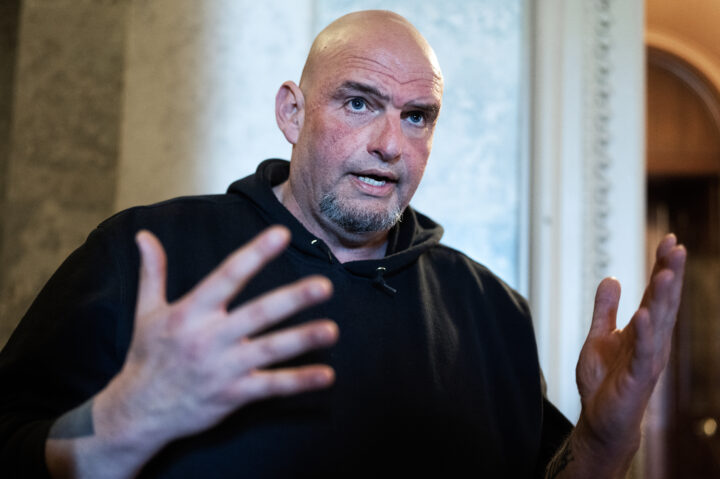
Tom Williams/CQ-Roll Call, Inc via Getty Images
Sen. John Fetterman (D-PA) talks with reporters after the Senate luncheons in the U.S. Capitol on Tuesday, March 11, 2025.
Sen. John Fetterman (D-PA) said on Thursday that he would support the U.S. striking Iran’s nuclear facilities again to prevent Tehran from rebuilding its nuclear program — if the regime is found to be making strides toward restoring sites damaged by U.S. and Israeli strikes last year.
The Pennsylvania senator told Jewish Insider that he believes the U.S. and Israel should keep targeting Iranian nuclear facilities until Iran’s leaders “get the message” that the Islamic Republic will never be allowed to acquire a nuclear weapon.
“If Iran restarts their nuclear ambitions, I fully support bombing them until they get the message,” Fetterman told JI.
Fetterman was supportive of President Donald Trump’s decision to strike Iran’s nuclear facilities amid the 12-day war with Israel last year and has emerged as one of the staunchest Iran hawks in the Democratic Party. He criticized members of his party last June who spoke out against Israel’s strikes on Iran and Trump’s subsequent decision to join the strikes.
“It was just astonishing to see colleagues criticizing these things. It’s like, do you think you can negotiate with that regime? Do you think you want to run that scenario and allow them to acquire 1,000 pounds of weapons grade uranium?” Fetterman told JI at the time. “I can’t understand, I can’t even begin to understand that.”
For his part, the president said late last month while meeting with Israeli Prime Minister Benjamin Netanyahu that he was open to another round of strikes against Iran.
Asked by reporters if he will support another Israeli attack on Iran if it continues its ballistic missile and nuclear programs, Trump said, “If they continue with the missiles? Yes. If the nuclear? Fast, OK? One will be yes, absolutely; the other was, we’ll do it immediately.”
“Iran may be behaving badly,” he added. “It hasn’t been confirmed, but if it’s confirmed, look, they know the consequences.”
Fetterman is the first Democrat in Congress to publicly endorse additional strikes on Iran’s nuclear program, a move several of his Republican colleagues have also gotten behind.
Sen. Lindsey Graham (R-SC) said in Israel last month that Washington had a duty to act on “credible evidence” that Iran is looking for avenues to rebuild its nuclear program. The South Carolina senator argued it was imperative that the U.S. and Israel “hit them before they can” do so.
“We obliterated the Iranian nuclear facilities. We did not obliterate Iran’s desire to have a nuclear weapon,” Graham said. “The regime hasn’t changed at all. They still want to kill all the Jews, consider America the great Satan, and purify Islam.”
“Are they regenerating their nuclear capability? Are they building more ballistic missiles that could hurt Europe and Israel?” he added. “I don’t know, but there’s evidence that, yes, they are.”
‘To the ayatollah: You need to understand, if you keep killing your people who are demanding a better life, Donald J. Trump is gonna kill you,’ Sen. Lindsey Graham said
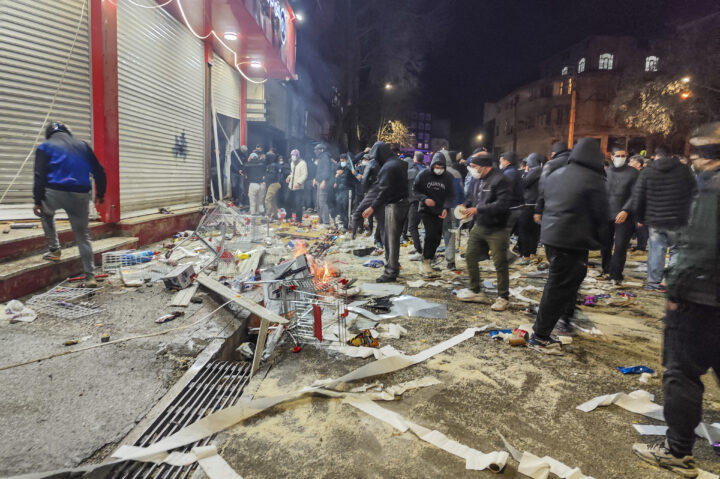
Kamran / Middle East Images / AFP via Getty Images
Iranians gather while blocking a street during a protest in Kermanshah, Iran on January 8, 2026.
Multiple Senate Republicans voiced support for President Donald Trump’s threat that the U.S. would intervene directly should the Iranian regime escalate its crackdown on the protests sweeping Iran — which appears to have already begun.
Trump warned in a post on his Truth Social platform last Friday that if Iran shoots “and violently kills peaceful protesters, which is their custom, the United States of America will come to their rescue. We are locked and loaded and ready to go.”
The president renewed that threat on Thursday on “The Hugh Hewitt Show,” saying, “If they start killing people, which they tend to do during their riots, they have lots of riots. If they do it, we’re going to hit them very hard.” But on Fox News’s “Hannity,” he said that “for the most part” the regime has not engaged in mass killings of protesters.
Asked on Thursday about the possibility of the U.S. helping the Iranian protesters, Vice President JD Vance expressed his support for the protesters but said he’d defer to Trump on what actions they would take. He also said the U.S. remains open to a “real negotiation” with Iran on its nuclear program.
“I’ll let the president speak to what we’re going to do in the future, but we certainly stand with anybody across the world, including the Iranian people, who are advocating for their rights,” he added.
Trump’s threat has been largely well-received by GOP lawmakers, but lawmakers from both parties have expressed support for the protesters generally.
“To the people of Iran: We stand with you tonight,” Sen. Lindsey Graham (R-SC) told Fox News on Tuesday evening. “We stand for you taking back your country from the ayatollah, a religious Nazi who kills you and terrorizes the world,” he said, referring to Supreme Leader Ali Khamenei “We pray for you. We support you. Donald J. Trump is not Barack Obama. He has your back. … Help is on the way.”
“And to the ayatollah: You need to understand, if you keep killing your people who are demanding a better life, Donald J. Trump is gonna kill you. Change is coming to Iran. It’ll be the biggest change in the history of the Mideast to get rid of this Nazi regime.”
“President Trump has been very clear: If the ayatollah harms the protesters, the consequences would be catastrophically painful,” Sen. Ted Cruz (R-TX) told Jewish Insider. “The regime should understand that the president is deadly serious and will enjoy strong support in Congress.”
Sen. Pete Ricketts (R-NE) told JI that “what the president said … [is] one of the things that we can do to help protect the Iranians who are protesting.”
Sen. John Fetterman (D-PA) told JI that the U.S. should act “in any possible way to support the Iranian protesters” and said he’d back any efforts in Congress to do so.
“That’s the real truth to power. They started to kill people there. Remember, they are now so desperate. They’re trying to offer people $7 a month. They’re that desperate,” Fetterman said. “How courageous those protesters are — and that’s a testament to the opportunities Israel and our strikes created — they inspire me. These are Iranian protesters. That is real courage and real — being willing to either get killed, beaten, tortured or disappeared, that’s what happens in true autocracies.”
Other senators spoke more broadly about offering U.S. support for the protesters without addressing direct intervention.
Sen. Richard Blumenthal (D-CT) noted that lawmakers haven’t engaged extensively about ways for Congress to support the protesters since returning from the holiday recess on Monday, but said it was important for them to express their support. “I’m open to any ideas. I think there’s been very little talk [among lawmakers] in specific terms,” Blumenthal told JI.
“We should speak out and support them in spirit,” Blumenthal said. “I don’t know how much we can do, practically speaking. I know the president has talked about some kind of measures if anyone is killed. I don’t know exactly what he has in mind, but we ought to be supporting the freedom fighters and brave protesters in any way we can.”
Sen. James Lankford (R-OK) said that the “biggest thing that we can do is actually have public officials speak out that our problem with Iran is not the people of Iran, it’s the Iranian regime. Our problem is the same problem the people of Iran have.”
“The regime oppresses them, prevents them from actually being [as] successful as they could be. The people of Iran [are] extremely well educated, extremely sharp people [and] could be a lot more prosperous than they are, but they’re trapped behind a regime that’s obsessed with terrorism, and so they’re holding back their entire country so they can fund Hezbollah,” Lankford said. “So people can’t get food, people can’t have a stable currency, because they want to fund terrorism. Until they have an ability to be able to pick new leaders that will actually represent their values, they’re stuck.”
Sen. Adam Schiff (D-CA) said it is “wonderful” to see the protests happening and that the U.S. “should support them diplomatically, technologically and in other ways, so that they can communicate.”
“But I think we should be very hesitant about expressing our willingness to use military force in yet another country for yet another reason,” Schiff added.
Other Democrats have also discouraged the use of U.S. military force in response to the protests.
Sen. Andy Kim (D-NJ) said the U.S. should “continue to show attention” toward Iran, “making sure we’re not just losing track of everything because of Venezuela, and just continuing to show that we want to make sure that the regime doesn’t crack down brutally as they have in the past.”
“I think that that’s an important sign right now, as this is continuing on,” Kim continued.
Plus, New Jersey IHRA bill scuttled
Kamran / Middle East Images / AFP via Getty Images
Iranians gather while blocking a street during a protest in Kermanshah, Iran on January 8, 2026.
Good Thursday afternoon!
This P.M. edition is reserved for our premium subscribers — offering a forward-focused read on what we’re tracking now and what’s coming next.
It’s me again — Danielle Cohen-Kanik, U.S. editor at Jewish Insider and curator, along with assists from my colleagues, of the Daily Overtime. Please don’t hesitate to share your thoughts and feedback by replying to this email.
📡On Our Radar
Notable developments and interesting tidbits we’re tracking
Protests are escalating across Iran, with videos showing masses of demonstrators taking to the streets and security forces at times overwhelmed. Human rights groups estimate dozens of protesters have already been killed and reports indicate the country is experiencing an internet blackout. Storeowners are reportedly shuttering their businesses in an economic boycott, further deepening the economic crisis that spurred the unrest.
President Donald Trump reiterated his warning today that the Iranian regime will “have to pay hell” if “they start killing people, which they tend to do,” speculating that the deaths so far have been caused by stampedes and not law enforcement. Vice President JD Vance said at a press briefing that the Iranian regime “has a lot of problems” and that “the smartest thing for them to have done … is for them to actually have a real negotiation with the United States”…
Australian Prime Minister Anthony Albanese announced today that he is establishing a royal commission into antisemitism in the country, after the deadly terror attack on a Hanukkah celebration in Sydney last month. The commission, considered a powerful tool in Australian governance, will investigate the scope and causes of antisemitism and make recommendations for law enforcement, in a report due on the year anniversary of the Dec. 14 attack…
Spanish Prime Minister Pedro Sanchez said Spain would send “peacekeeping troops” to the Gaza Strip “when the opportunity presents itself.” Speaking to a gathering of ambassadors in Madrid today, he said, “Of course, we have not forgotten Palestine and the Gaza Strip … Spain must actively participate in rebuilding hope in Palestine.” Many countries remain wary of contributing troops to stabilize Gaza over concerns of being required to engage with Hamas…
Israeli Prime Minister Benjamin Netanyahu met today with Nickolay Mladenov, former U.N. envoy to the Middle East and soon-to-be representative of the U.S.-led Board of Peace in Gaza…
New York City Mayor Zohran Mamdani has been silent thus far today about a protest taking place tonight organized by the radical anti-Israel group responsible for a similar protest outside the Park East Synagogue in November, Jewish Insider’s Haley Cohen reports.
The group posted the address of the real estate event they intend to protest, which is taking place at a synagogue in Queens’ heavily Jewish neighborhood of Kew Gardens Hills. The synagogue canceled prayer services and two nearby schools, Yeshiva of Central Queens and PS 165, announced early closures. Democratic state Assemblymember Sam Berger, who represents the area, told JI that local principals, staff and parents are “very concerned.” The surrounding area has been “completely upended,” he said…
The New Jersey Legislature will not give further consideration to a bill seeking to codify the International Holocaust Remembrance Alliance’s working definition of antisemitism into state law during this legislative session, the bill’s lead sponsor announced, after several years of the Jewish community’s urging for the measure to be adopted…
Rob Sand, the state auditor and Democratic candidate for governor of Iowa, announced he raised over $9.5 million in 2025, more than double the record for off-year fundraising for a gubernatorial election in the state. Sand told Jewish Insider in 2019, when he first took office as auditor, that he conducted what was “definitely the first audit” to ensure agencies were in compliance with a state anti-BDS law. “When you say [you are] willing to be supportive of your ally [Israel], you need to put your money where your mouth is,” he said at the time…
Far-left New York state Assemblywoman Claire Valdez joined the race to succeed retiring Rep. Nydia Velázquez (D-NY) today in the progressive 7th Congressional District covering parts of Brooklyn and Queens. The Democratic Socialists of America and Mamdani are expected to endorse Valdez, a move that could prove consequential in the district that The New York Times said will “pit left against lefter.”
Valdez, who has already brought on several of Mamdani’s advisors, was a vocal critic of Israel’s war in Gaza and pro-Israel political groups; her opponent, Antonio Reynoso, takes similar stances but is viewed as a more “traditional progressive” and is expected to secure Velázquez’s support, the Times reports…
Rep. Steny Hoyer (D-MD) officially announced his retirement today after serving 23 terms, one of the longest-serving House members in U.S. history. Speaking on the House floor, the former majority leader and pro-Israel champion warned he was “deeply concerned that this House is not living up to the founders’ goals” and that the country “is heading not toward greatness, but toward smallness, pettiness, divisiveness, loneliness and disdainfulness”…
In his first State of the State address since 2020 — and final before his term ends next year — California Gov. Gavin Newsom heralded his state as a “beacon” and a “policy blueprint for others to follow.” He denounced Trump and laid out a policy agenda including clean energy, increased wages and lowered housing costs, in a speech seen as laying the groundwork for his potential 2028 presidential run…
The Qatar Investment Authority and Emirati-based MGX, linked to a UAE sovereign wealth fund, participated in the latest fundraising round for Elon Musk’s xAI, which raised over $15 billion total. Gulf investors including QIA and the Saudi and Omani sovereign funds have taken part in previous fundraising rounds for the company that owns the Grok AI chatbot on X…
⏩ Tomorrow’s Agenda, Today
An early look at tomorrow’s storylines and schedule to keep you a step ahead
Keep an eye out in Jewish Insider for a look at how legislation in New Jersey to adopt the International Holocaust Remembrance Alliance’s working definition of antisemitism was scuttled — and who was behind the bill’s demise.
The third season of the hit TV show “Tehran” will premiere in the U.S. on Apple TV tomorrow, after a delay of several years. The popular international thriller, which follows a Mossad agent operating undercover in Iran, was indefinitely postponed at the outset of the Israel-Hamas war in Gaza. The season ran in Israel in December 2024, and Apple has announced the fourth season is already in production.
On Saturday, Anti-Defamation League CEO Jonathan Greenblatt will sit in conversation with Rabbi David Wolpe about the “golden age of American Jewry” at Sinai Temple in Los Angeles.
We’ll be back in your inbox with the Daily Overtime on Monday. Shabbat Shalom!
Stories You May Have Missed
SAUDI SPOTLIGHT
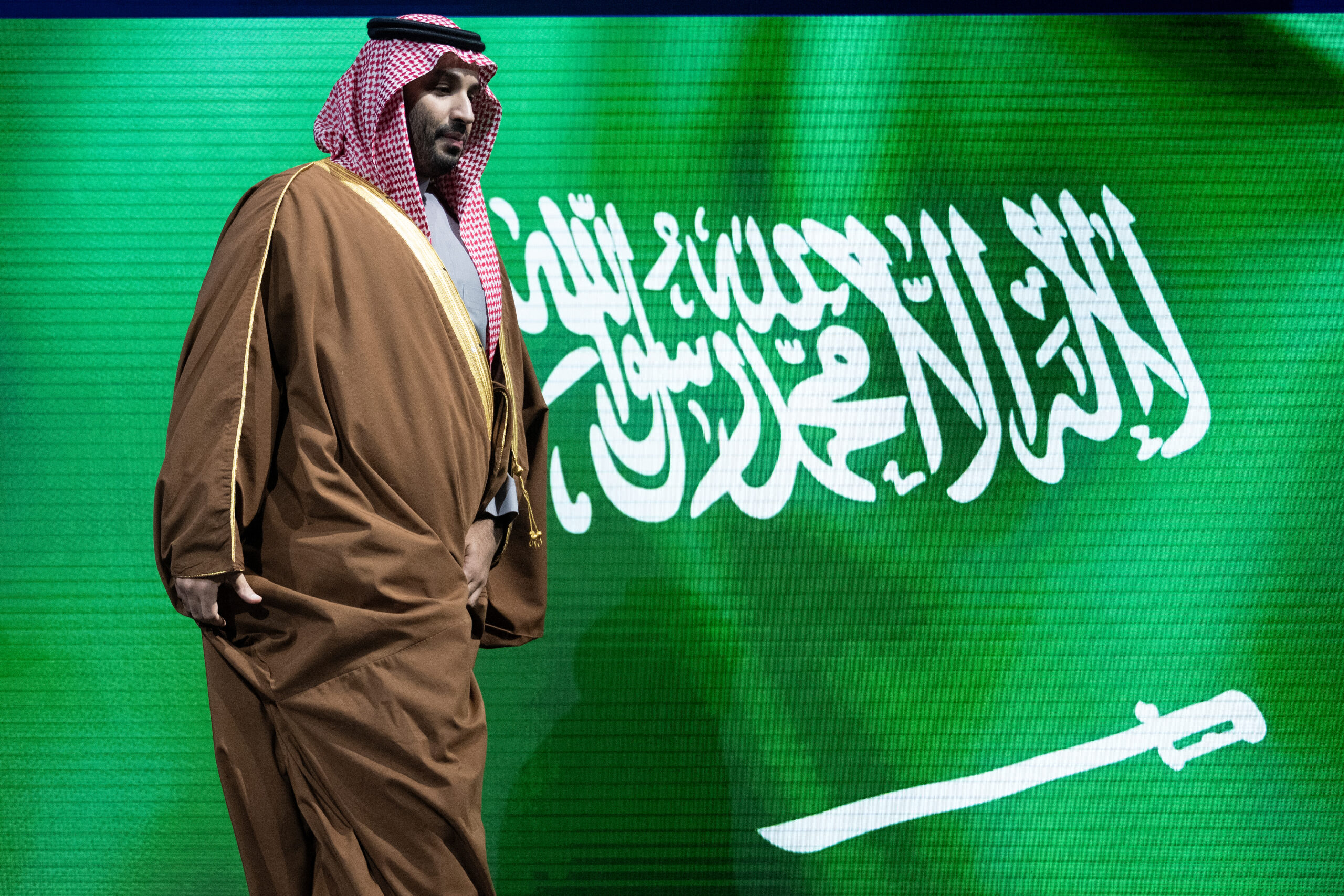
The lawmakers downplayed reports of a serious Gulf rift, with Rep. Brad Sherman calling the increasing disputes between neighbors ‘tactical, not ideological’
MENIN’S MOMENT
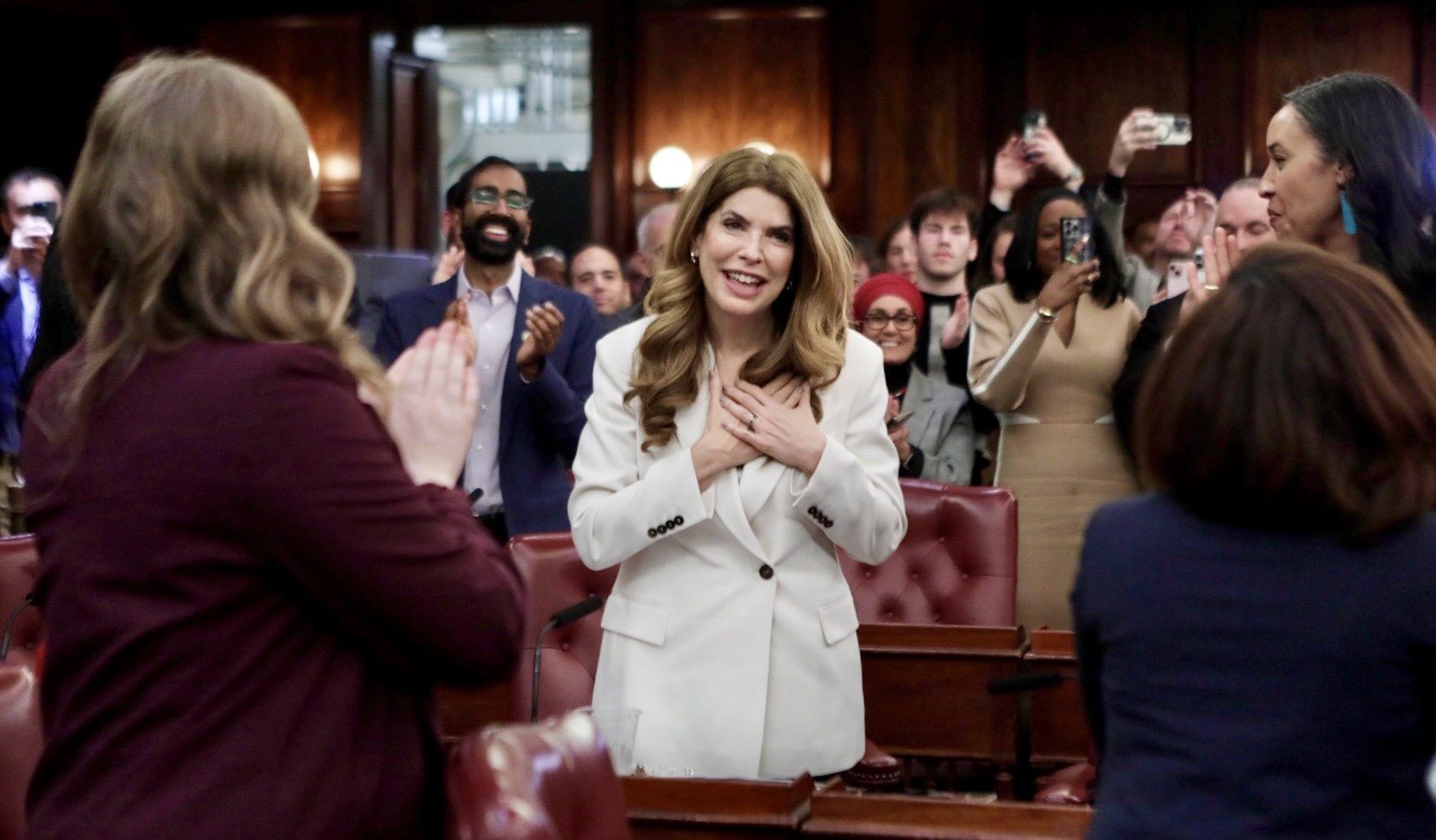
Julie Menin was elected the first Jewish speaker of the New York City Council on Wednesday
As Israel signals restraint and Iran faces mounting internal pressures, both sides are increasingly wary of miscalculating
Stringer/Getty Images
Fire and smoke rise into the sky after an Israeli attack on the Shahran oil depot on June 15, 2025 in Tehran, Iran.
At the conclusion of the 12-day war in June of last year, both Israel and Iran suspected that the ceasefire brokered by the U.S. would be a pause, not a final cessation of hostilities. That truce has lasted for more than six months, with both sides wary of entering another military conflict — one likely to be more deadly and destructive than the first.
But now, amid destabilizing world events from Venezuela to the Middle East — compounded by growing domestic pressure on the Islamic Republic amid nationwide protests — that ceasefire is even more tenuous, with officials in Tehran and Jerusalem closely watching the other’s every move, careful not to make a potentially disastrous miscalculation — even as both sides make overtures at de-escalation.
Speaking at the Knesset on Monday, Israeli Prime Minister Benjamin Netanyahu said, “President [Donald] Trump and I have expressed a firm stance — we won’t allow Iran to rebuild its ballistic missile industry or to renew the nuclear program, which we damaged severely in Operation Rising Lion.”
In response, Iran’s newly formed Defense Council warned on Tuesday that the country could act preemptively if it detects clear signs of a threat. “The long-standing enemies of this land … are pursuing a targeted approach by repeating and intensifying threatening language and interventionist statements in clear conflict with the accepted principles of international law, which is aimed at dismembering our beloved Iran and harming the country’s identity,” the council said.
Recent reports suggest that Israel, in an attempt to de-escalate tensions, has used Moscow as an intermediary, communicating through Russian President Vladimir Putin that it has no intention of launching a preemptive strike on Iranian soil. Iranian leaders, including Supreme Leader Ayatollah Ali Khamenei, are unconvinced.
In a post on X, Khamenei accused Israel of deception: “What makes the enemy first request a ceasefire during [12-day] war with the Iranian nation, then send messages saying he doesn’t want to fight us?”
“Now if he doesn’t believe the messaging and thinks that Israel is about to attack then you can understand why Israel is worried Iran is about to miscalculate and attack. Very tense days/weeks ahead of us,” Nadav Pollak, a lecturer on the Middle East at Reichman University, commented on Khamenei’s post.
Pollak told Jewish Insider that he sees the perception gaps between Israel and Iran as the “No. 1 risk for miscalculation. As we’ve seen from Khamenei’s tweet, he doesn’t believe the messages that came from Jerusalem about Israel not planning to attack. In his mind, Bibi just came back from Washington with Trump supporting action against Iran if some red lines are crossed. Bibi also continues to talk about the Iranian ballistic missile threat every week and that Israel will need to do something.”
Israeli commentator Nadav Eyal noted on Dan Senor’s “Call Me Back” podcast that “Israeli security officials are extremely worried about what’s happening vis-a-vis Iran, first and foremost because the Iranians are so tense and they are constantly fearing an Israeli attack themselves. So their first worry is miscalculation … If Iran senses that Israel might attack, it wants to preempt that. If Israel thinks that Iran is going to do that, it would want to preempt that.”
Tehran is also facing trouble at home, amid protests that have spread across the country over the last two weeks. The growing unrest, coupled with the Islamic Republic’s economic and climate woes, has put added pressure on the ayatollahs.
Aaron David Miller, a senior fellow at the Carnegie Endowment for International Peace, told JI that due to the Iranian regime’s vulnerable position amid nationwide protests over a severe economic crisis, “hardliners” within the IRGC could be weighing using a strike to “divert the public” and create national unity. However, he expressed that the decision would be a “strategic mistake,” suggesting that an Iranian strike this year is “highly unlikely.”
“It’s hard to see what the Iranians would gain,” said Miller. “A strike is simply going to wreak additional havoc on what the vast majority of the Iranian public is protesting against, which is inflation, a devaluation of the Iranian currency.”
Blaise Misztal, vice president for policy at the Jewish Institute for National Security of America, echoed those sentiments, adding that any Iranian strike now while the regime in Tehran is “on the ropes” would be “suicidal.”
“It seems unlikely that Iran would choose this moment to attack Israel,” said Misztal. “While it certainly might be looking for some way to distract its citizens from their grievances, all the evidence suggests that external aggression would have the opposite effect.”
Misztal said the Iranian regime is facing skyrocketing inflation and crumbling infrastructure “because it has chosen guns over butter and Iranians know it.”
“To once again pick up guns would only further inflame Iranians’ rightful anger,” said Misztal. “Not to mention that a direct Iranian attack against Israel would surely invite a devastating Israeli, if not also American, response.”
The lingering question is whether the fear of miscalculation will push either side toward action.
At a swearing-in ceremony on Monday, interim President Delcy Rodríguez appeared to embrace the ambassadors of Iran, China and Russia
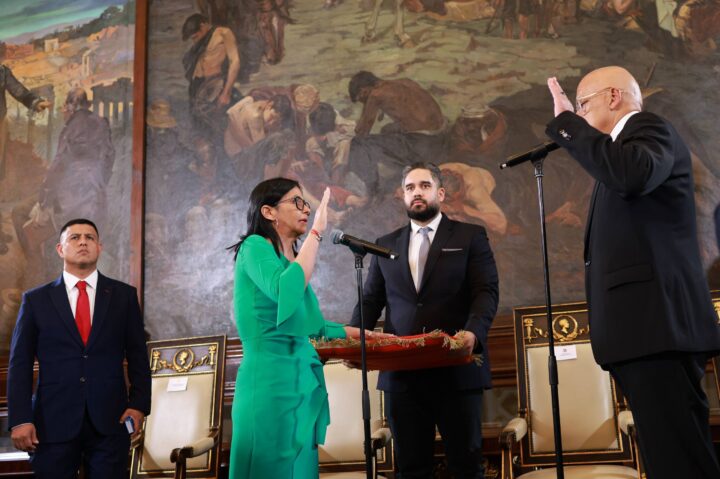
Venezuelan National Assembly/Anadolu via Getty Images
At the opening session of the National Assembly, Delcy Rodriguez (2nd L) is sworn in as acting president of Venezuela on January 5, 2026.
In the aftermath of U.S. strikes in Venezuela and the capture of leader Nicolás Maduro, uncertainty remains over whether the South American country’s ties to key U.S. adversaries and hostile posture toward Israel will change under interim President Delcy Rodríguez.
During his time in power, Maduro’s Venezuela had been deeply embedded in a broader network of U.S. adversaries, particularly Iran, Russia and China.
Dana Stroul, research director at the Washington Institute for Near East Policy, explained that Venezuela “is a key supplier of cheap oil to China and has provided fertile ground for Iran’s terrorist network abroad.”
“Venezuela under Maduro was firmly part of the anti-American bloc of countries seeking to upend the post-WWII order,” said Michael Koplow, chief policy officer at Israel Policy Forum. “Venezuela has particularly tight financial links with Iran and Hezbollah involving drugs and money laundering.”
The U.S. operation to oust Maduro was condemned by both China and Iran, who called it a violation of international law and demanded the illegitimate leader be freed. Experts have told Jewish Insider that the move potentially weakens Tehran’s hold in Latin America.
“It’s no surprise that the key enablers of the Maduro regime have all rejected the U.S. actions in Venezuela,” said Stroul. “They are now faced with the challenge of filling the Western Hemisphere gap in their network of anti-U.S. stakeholders.”
Jonathan Ruhe, a fellow at the Jewish Institute for National Security of America, said China and Iran will “miss having a Venezuelan partner to poke America in the eye from close range, launder their money, run their drugs and buy their weapons.”
Maduro also positioned himself as a consistent adversary of Israel, severing diplomatic relations in 2009 and repeatedly aligning Caracas with Palestinian causes and with Iran. After Venezuela’s disputed election in July 2024, Maduro accused “international Zionism” of orchestrating unrest in the country, claiming in a televised address that “all the communication power of Zionism, which controls all the social networks, the satellites and all the power, is behind this coup d’état.”
But despite Maduro’s capture and vows from Venezuelan opposition leader María Corina Machado to return to the country and reject the authority of the interim president, the U.S. appears to be backing Rodríguez, who is closely aligned with Maduro and has shown a similar posture when it comes to Israel and U.S. adversaries, creating concerns over whether the direction of Venezuela’s foreign policy will change.
Brad Bowman, a senior director at the Foundation for Defense of Democracies, told JI that the Trump administration’s apparent backing of Rodríguez is a “mistake” and that he doesn’t see “any reason to believe” she would depart from Maduro’s approach to U.S. adversaries.
“I have concern that we still have most of the problematic elements of the regime in Venezuela remaining in place,” said Bowman. “[Rodríguez] has been part of a regime that has been hostile to the United States and cozy with the Islamic Republic of Iran and its terror proxies. If one were a betting person, you would say at a minimum that [Rodríguez] is going to continue to harbor those problematic views toward China, Russia and Iran, if not manifest them in policy.”
At a swearing-in ceremony on Monday, the new leader appeared to embrace the ambassadors of Iran, China and Russia. In an address to the nation on Sunday, Rodríguez claimed the U.S. operation to capture the illegitimate dictator had “Zionist undertones,” echoing the sentiments of her predecessor.
“Rodríguez wasted little time before blaming Jews — or Zionists — for Maduro’s capture,” said David May, a senior research analyst at the Foundation for Defense of Democracies. “A junior partner of Iran, China, and Russia’s axis of aggressors and host of the Hezbollah terrorist group, the regime of [former Venezuelan dictator Hugo] Chávez and Maduro will continue to be hostile to Israel and the West.”
Koplow said Venezuela’s tight bonds with Iran and Hezbollah create an “anti-Israel narrative that is wrapped up in any action regarding Venezuela.”
“The close U.S.-Israel relationship has created a decades-long anti-American and anti-Israel front that links opposition to one as part and parcel of opposition to the other in a larger anti-imperialist position that takes an anti-Western and anti-Zionist stance, and we are seeing that play out in the Venezuela situation as well,” said Koplow.
Ruhe said Rodríguez’s claims were “sadly unsurprising,” and that “the Venezuelan government needs a perpetual enemy to justify its own rule.”
“The United States is the most obvious target, but leaders in Caracas scapegoat Jews and Israel, too,” said Ruhe, who added that the interim president’s initial statements “indicate key continuities with Maduro and Hugo Chavez before him.”
Bowman added that it is “not impossible” to change Rodríguez’s course of action away from Maduro’s past policy if it benefits her “personal political interests,” noting that it may take “an extraordinary set of incentives to get her to change course.”
Republican senators agreed President Donald Trump would make good on his threat to strike Iran again if it attempts to rebuild its nuclear capabilities

Satellite image (c) 2025 Maxar Technologies.
ISFAHAN NUCLEAR TECHNOLOGY CENTER, IRAN -- JUNE 22, 2025: 04 Maxar satellite image reveals multiple buildings damaged or destroyed at the Isfahan nuclear technology center after the airstrikes. Charring and roof collapses are visible across the compound.
Lawmakers said on Monday that an additional round of U.S. strikes on Iran remains on the table if the regime makes strides in rebuilding its nuclear program or other malign activities, echoing recent warnings from President Donald Trump.
Trump also threatened last week that the U.S. would intervene to protect Iranian protesters if the regime cracked down on nationwide demonstrations, as U.S. officials are watching closely while Tehran reportedly accelerates efforts to restore its ballistic missile capabilities — developments that could spark renewed conflict with Israel and potentially the United States.
Republican senators expressed confidence that the president would strike Iranian nuclear facilities a second time if the U.S. determined that Tehran was working to restore its nuclear program.
“I think there’s a chance” Trump will strike Iran’s nuclear sites again, Sen. Rick Scott (R-FL) told Jewish Insider. “If they go forward again and start building up nuclear facilities, yeah, I think Trump’s going to bomb the hell out of them.”
Sen. Pete Ricketts (R-NE) told JI, “President Trump is demonstrating that we have the most outstanding military in the world. And if he believes we have to hit Iran again, I believe he will do that.”
Sen. John Kennedy (R-LA) agreed but dismissed the suggestion that Trump’s willingness to order the operation that deposed Venezuelan President Nicolas Maduro last week signified that the president was looking to resume strikes against Iran.
“I don’t think one’s related to the other,” Kennedy told JI. “I also think that if Iran starts back in terms of developing a nuclear weapon, or substantially tries to increase the number of missiles that they have, I think the president should hit them and I believe he will.”
Asked about Trump’s threat to intervene to prevent crackdowns on Iranian protesters, and rumors of a potential second round of Israeli strikes on the Islamic Republic, Sen. Richard Blumenthal (D-CT) emphasized the threat of Iran’s missile and nuclear programs.
“We should be considering what action may be appropriate if Iran progresses with its missile building and nuclear programs, which are obviously a pressing and dire threat to us and Israel,” Blumenthal said.
Sen. Tim Kaine (D-VA), a leading voice in the Senate for constraining presidential war powers, who is pushing to block further action in Venezuela, told JI that the U.S. should not be sending in its military in response to the protests, particularly without congressional debate and approval.
“This president should not willy-nilly use the press, use the military as his palace guard to go here, there and everywhere,” Kaine said. “Not Nigeria, not Iran, not Venezuela, not international waters, not Cuba, not Mexico, not Panama, not Greenland. It should be a debate with Congress.”
He added that a constituent, whose son is an Army Ranger, urged Kaine during the holidays to work to prevent unilateral military deployments by the administration. “And I am representing one of the most pro-military states in the country, and that’s what my state thinks,” Kaine explained.
Plus, Mamdani's first mayoral moves rankle Jewish community
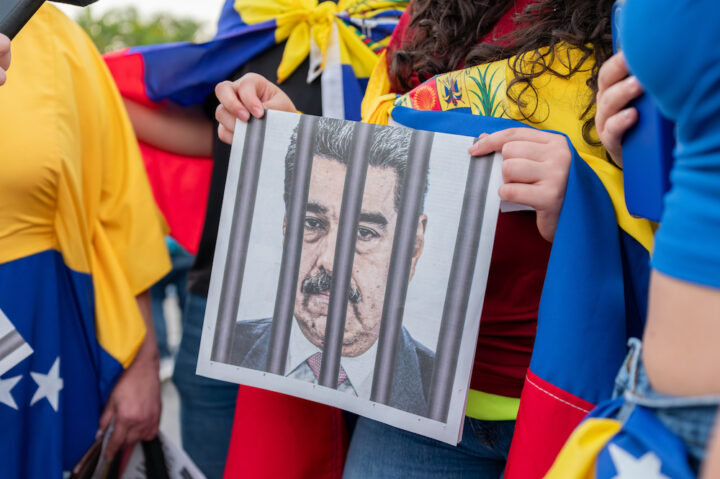
Nicole Combeau/Bloomberg
A resident holds a newspaper with news about ousted Venezuelan President Nicolas Maduro during a celebration at El Arepazo in Doral, Florida, US, on Sunday, Jan. 4, 2026.
Good Monday morning.
In today’s Daily Kickoff, we look at what the Trump administration’s capture of Venezuelan President Nicolás Maduro could mean for Iran’s influence in South America, and report on New York City Mayor Zohran Mamdani’s first days in office, which included the revocation of executive orders on supporting Israel and combating antisemitism. We have the exclusive on AIPAC’s appointment of Deryn Sousa as the organization’s new spokesperson, succeeding Marshall Wittmann, and report on Jewish communal priorities on Capitol Hill in the new year. Also in today’s Daily Kickoff: Julie Menin, Rabbi Zvi Hershcovich and Este Haim.
Today’s Daily Kickoff was curated by Jewish Insider Executive Editor Melissa Weiss and Israel Editor Tamara Zieve, with assists from Danielle Cohen-Kanik and Marc Rod. Have a tip? Email us here.
What We’re Watching
- As Congress returns this week, we’ll be keeping an eye on the Hill’s response to the ongoing wave of protests across Iran, the ripple effects of the Trump administration’s arrest of Venezuelan President Nicolás Maduro and the emerging rift among the U.S.’ Gulf allies.
- Following the winter break, lawmakers’ top priority now will be finalizing a deal on government funding before the end-of-month deadline. It’s looking less likely that we’ll see a repeat of last year’s extended government shutdown. There are still plenty of areas to be negotiated between the two chambers, including security grant funding, United Nations funding and funding levels for U.S.-Israel cooperative programs.
- We’re keeping an eye on the ongoing protests in Iran. Speaking to reporters on Air Force One last night, President Donald Trump reiterated his recent comments that the U.S. would intervene if Iranian officials were to kill protesters, having said on his Truth Social site on Friday that “If Iran shoots and violently kills peaceful protesters, which is their custom, the United States of America will come to their rescue.”
- Venezuelan President Nicolás Maduro is scheduled to make his first appearance in U.S. federal court at 12 p.m. ET today, where he will appear before Judge Alvin Hellerstein, a 92-year-old Orthodox Jewish federal judge.
- Minnesota Gov. Tim Walz, who had been planning a 2026 reelection bid, is set to make an announcement regarding his political future this morning, a day after meeting with Sen. Amy Klobuchar (D-MN). The impromptu press conference comes as Walz’s administration faces criticism and an investigation into widespread fraud centered around the state’s Somali diaspora population.
- U.S. Ambassador to Turkey and Syria envoy Tom Barrack is mediating talks in Paris today between senior Israeli and Syrian officials, aimed at reaching a security agreement between the countries.
What You Should Know
A QUICK WORD WITH JI’S MELISSA WEISS
As protests continue to spread throughout Iran and the geopolitical repercussions of the Trump administration’s capture of Venezuelan President Nicolás Maduro ripple across world capitals, the sentiment around the Middle East and in Washington is that renewed conflict with the Islamic Republic may well be on the horizon.
While smaller than previous nationwide protests in 2019 and 2022, the newest demonstrations come as Iran is facing economic instability, crushing international sanctions and record droughts. The protests that have spread across the country in recent days are the first major demonstrations since the 12-day war between Iran and Israel, with an assist from the U.S., last June that damaged the Islamic Republic’s nuclear program and further destabilized Iran.
The protests in Iran were already gaining steam at the time a Delta Force team apprehended Maduro and his wife on Saturday and brought them to the U.S. to stand trial on drug trafficking charges. But the Trump administration’s decision to send elite forces into Caracas and forcibly remove Maduro signals to Tehran — as well as Moscow and Beijing — that Washington is taking a tougher approach to regimes it sees as destabilizing and threatening to U.S. interests.
The world is watching this geopolitical high-wire act with wariness. In Israel, officials are closely monitoring the instability in Iran, concerned that the regime in Tehran could move to strike Israel in an effort to consolidate domestic support and quell the protests; Israel could also see a window of opportunity to strike Iran at a weak moment, either of which could reignite warfare between Jerusalem and Tehran.
It was less than a week ago that Israeli Prime Minister Benjamin Netanyahu met with President Donald Trump at his Mar-a-Lago resort in Florida and discussed the threat posed by Iran’s ballistic missile program.
In his weekly Cabinet meeting yesterday, Netanyahu addressed Iran in the context of his Palm Beach meeting last week, saying that Israel “reiterated our joint position of zero enrichment on one hand, and the need to remove the 400 kilograms of enriched material from Iran and oversee the sites with tight and genuine supervision.”
Noting that his sit-down with Trump was taking place as anti-government protests broke out in Iran, Netanyahu added, “The Government of Israel, the State of Israel, and my policy, we identify with the struggle of the Iranian people, with their aspirations for freedom, liberty, and justice. It is very possible that we are standing at the moment when the Iranian people are taking their fate into their own hands.”
DOMINO EFFECT
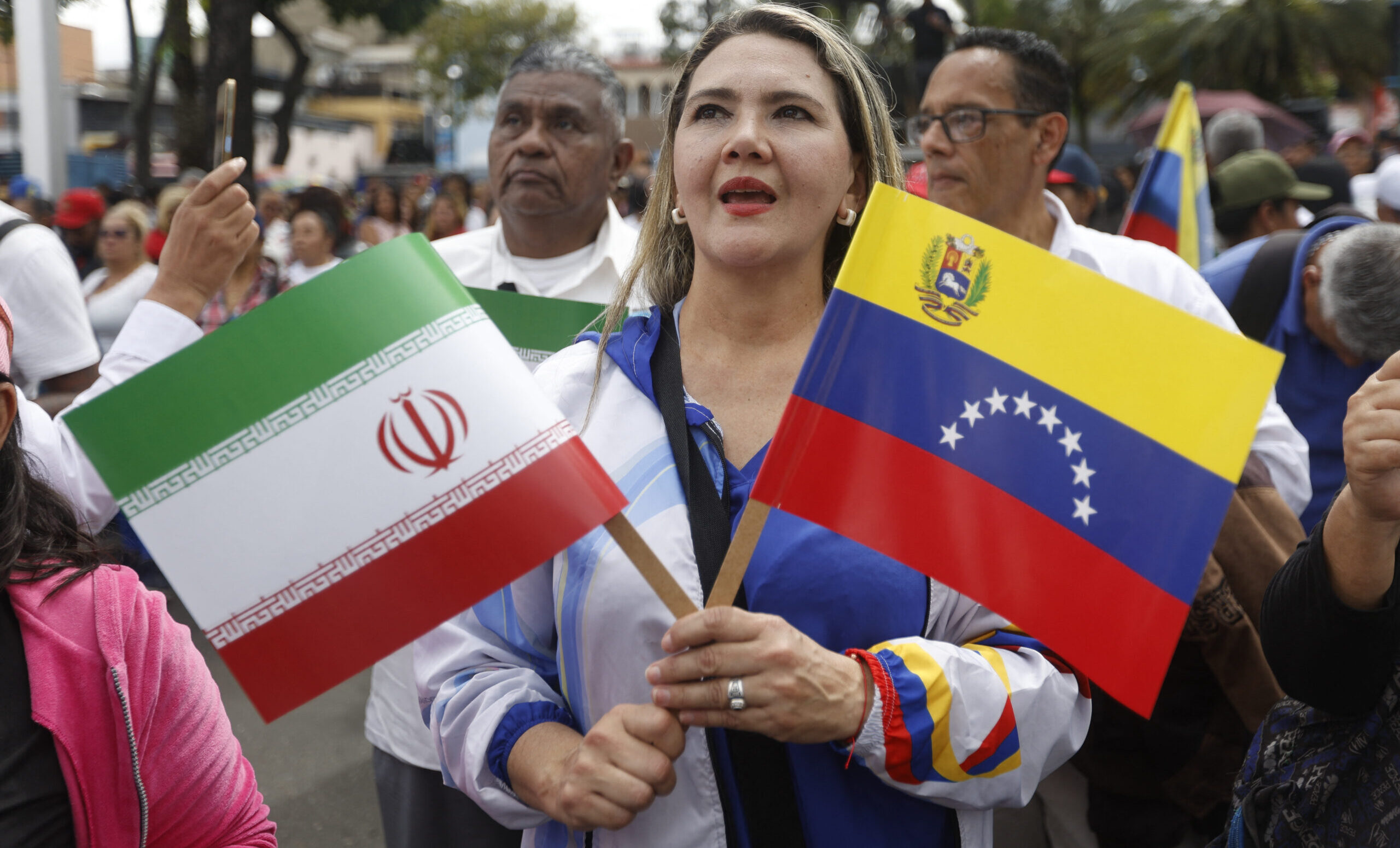
The U.S.’ capture of Venezuelan President Nicolás Maduro on Saturday is expected to weaken Iran’s terrorism efforts, weapons production and economic activity in Latin America, experts say. With Vice President Delcy Rodriguez taking power — and the Trump administration expressing willingness to work with her — it remains unclear whether Maduro’s regime will largely remain intact with American supervision or if the government will ultimately be replaced by the democratic opposition, led by Nobel Peace Prize recipient Maria Corina Machado, or someone else, Jewish Insider’s Lahav Harkov reports.
Expected impact: Emanuele Ottolenghi, senior research fellow at the Center for Research on Terror Financing, told JI that “if the regime remains in place [under Washington’s supervision], there will have to be adjustments in its regional posture and foreign policy. That means, of course, the role that nefarious foreign actors such as China, Russia, Cuba and Iran played in Venezuela will change.” Danny Citrinowicz, a senior researcher at the Institute for National Security Studies at Tel Aviv University, told JI that “the Iranians turned Venezuela into a strategic hub, and now that has disappeared.”
Bonus: Politico talks to Vandenberg Coalition head Carrie Filipetti, who served as principal deputy assistant secretary of state for Cuba and Venezuela during the first Trump administration, about the apprehension of Maduro and potential next steps for the U.S. vis-à-vis its Venezuela policy.
shifting alliances
Saudi Arabia is recalibrating its regional posture in ways that are challenging long-held assumptions about Riyadh’s role as a moderating force in the Middle East, as recent moves across Yemen, Sudan and the Horn of Africa expose the country’s widening rift with the United Arab Emirates and a growing alignment with Qatar and Turkey — two countries with openly hostile positions toward Israel, Jewish Insider’s Emily Jacobs, Lahav Harkov and Matthew Shea report.
Series of events: The realignment has been most stark on the issue of Yemen, where Saudi Arabia led an airstrike on an Emirati shipment of vehicles last week that Riyadh claimed was intended for the UAE-backed Southern Transitional Council (STC), which has consolidated power in the country’s south as Saudi-backed efforts to stabilize the war-torn nation have stalled. Hours after the strike, the Emirati government announced it would withdraw its remaining troops from the country. The Saudis’ decision to embrace Islamist-aligned factions in Sudan, where the UAE is aligned with rival forces, has caused additional fissures with the Emiratis, putting the two U.S. allies and Gulf power players at odds. The Gulf states have also taken opposite sides on Somalia, with the UAE quietly supportive of Somaliland, while Saudi Arabia condemned Israel for recognizing its independence.
Qatari condolences: Qatari Education Minister Lolwah Al-Khater publicly mourned the death of Huthayfa Samir Abdullah Al-Kahlout, a senior Hamas military spokesman who served as the public face of the group’s media strategy during the war in Gaza, drawing renewed scrutiny of Qatar’s ties to the militant group, Jewish Insider’s Matthew Shea reports.
DAY ONE DOOZY
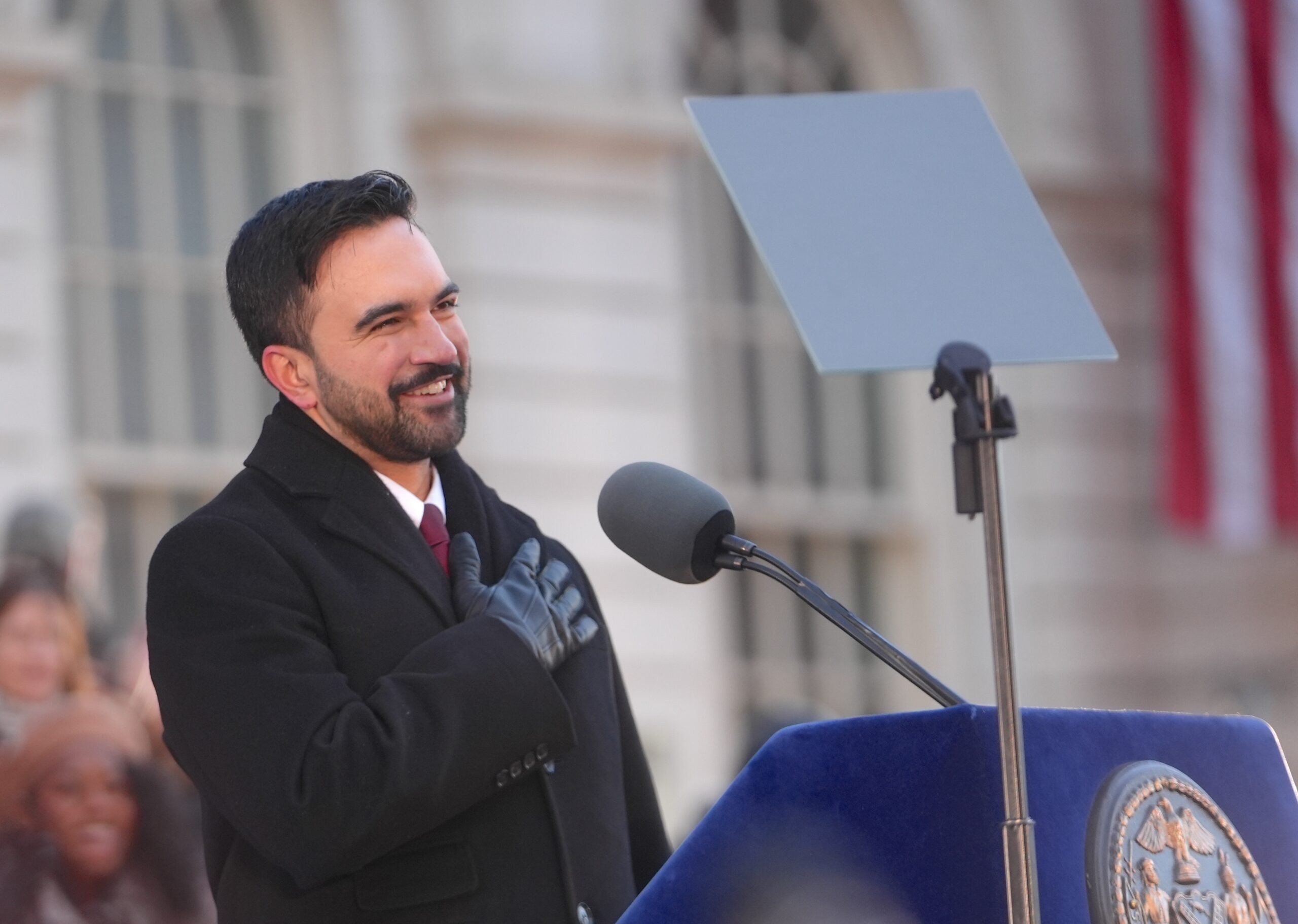
Newly inaugurated New York City Mayor Zohran Mamdani is facing criticism for repealing executive orders issued by former Mayor Eric Adams aimed at tackling antisemitism, including implementing the International Holocaust Remembrance Alliance’s working definition of antisemitism and an anti-Boycott, Divestment and Sanctions order. The revocation of those orders came as part of a blanket repeal of all of Adams’ executive orders following his September 2024 indictment on federal corruption charges, Jewish Insider’s Marc Rod reports.
Community reaction: In a joint statement, the UJA-Federation of New York, Jewish Community Relations Council of New York, American Jewish Committee of New York, Anti-Defamation League of New York/New Jersey, Agudath Israel of America, the New York Board of Rabbis and the Orthodox Union said that the Jewish community “will be looking for clear and sustained leadership that demonstrates a serious commitment to confronting antisemitism and ensures that the powers of the mayor’s office are used to promote safety and unity, not to advance divisive efforts such as BDS.” The statement continued, “Singling Israel out for sanction is not the way to make Jewish New Yorkers feel included and safe, and will undermine any words to that effect.”
Bonus: The New York Times reports that Mamdani’s decision to issue a blanket revocation of Adams’ executive orders was made in an effort to alleviate anger by Jewish groups over the rescinding of the two orders related to Israel and antisemitism.
EXCLUSIVE

The American Israel Public Affairs Committee appointed Deryn Sousa as spokesperson, replacing Marshall Wittmann, who retired at the end of 2025 after 13 years in the role. Sousa steps into the public-facing position during a time when AIPAC is regularly in the spotlight — and as the powerful pro-Israel organization faces outsized criticism from the far left and far right over its influence in the American political system, Jewish Insider’s Gabby Deutch reports.
Background: Sousa reflects a different career trajectory than that taken by Wittmann, who came to AIPAC toward the end of his career after decades working in politics in Washington, including as communications director for Sens. Joe Lieberman (I-CT) and John McCain (R-AZ). Sousa has worked for AIPAC for a decade, having joined the organization soon after she graduated from the University of Georgia, where she studied Arabic and international affairs. She moved to Washington for the spokesperson role from Houston, where she served until recently as AIPAC’s Southwest regional political director.
MONEY IN THE BANK
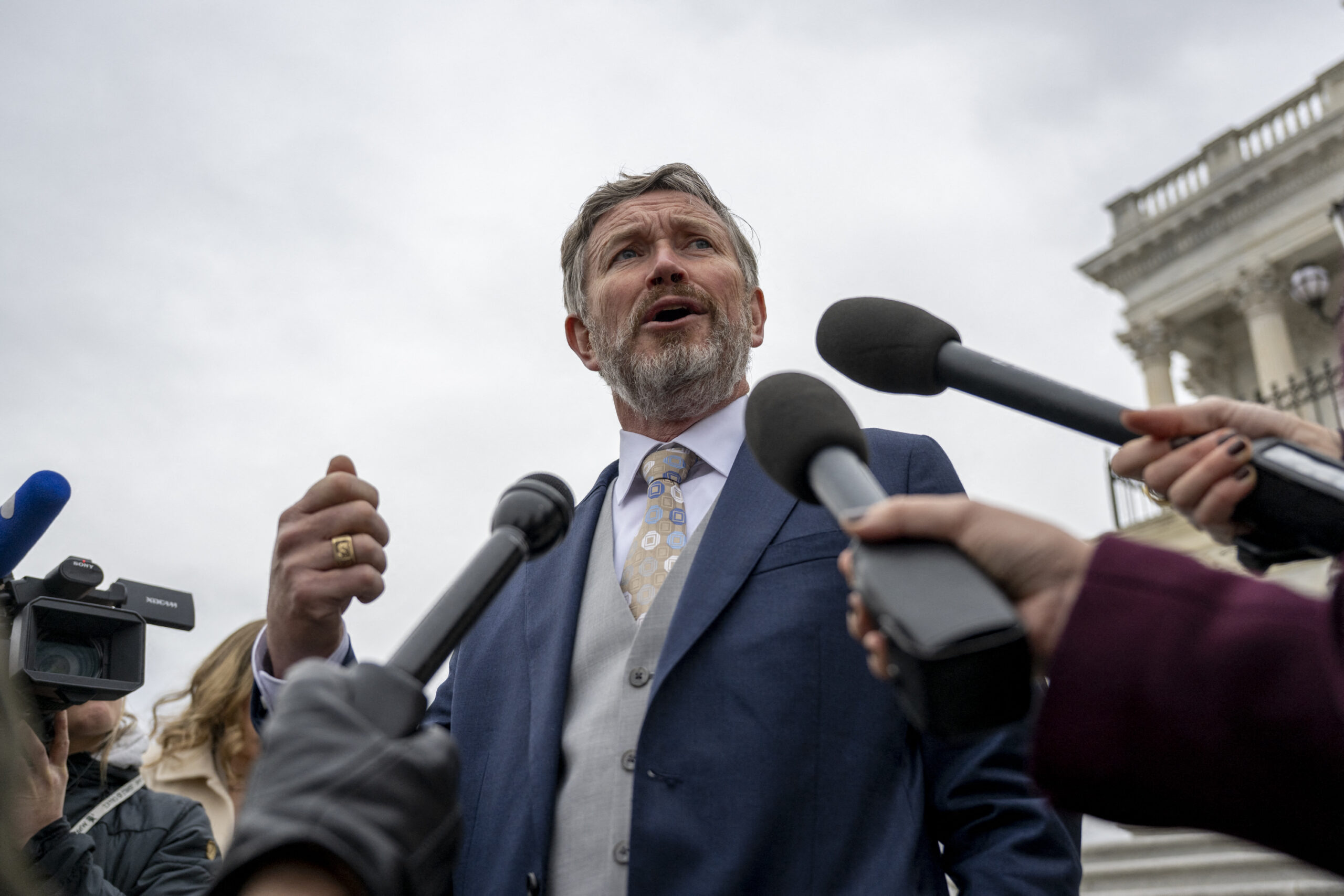
Ed Gallrein, the Republican primary challenger to Rep. Thomas Massie (R-KY) backed by President Donald Trump, said Friday that he had raised $1.2 million in the final quarter of 2025, a sizable sum that puts him in strong financial shape in preparation for a grueling race against Massie. Gallrein’s fundraising haul signals that he’s a more viable candidate than Massie’s previous challengers, and highlights the power of Trump’s endorsement, Jewish Insider’s Marc Rod reports.
Moving against Massie: Trump and his allies have also committed significant resources to the effort to defeat Massie, an isolationist Republican who has frequently opposed legislation to combat antisemitism and has broken with Trump on many key elements of his agenda, including on issues related to Israel and Iran. “This fundraising number reflects the overwhelming support Ed’s campaign has received right out of the gate,” Gallrein spokesperson Lance Trover said in a statement. “President Trump endorsed Ed because he knows Ed is fighting to put America First and will partner with him to unleash our economy, lower taxes, and stop the woke agenda.”
ON THE AGENDA
Going into 2026, Jewish community groups said their advocacy priorities for Congress and the federal government remain largely consistent, with a focus across many of the major advocacy organizations on bolstering community security through the Nonprofit Security Grant Program and tackling antisemitism online, Jewish Insider’s Marc Rod reports.
The hurdles: While Congress has increased its attention to Jewish communal issues in the years since the Oct. 7, 2023, Hamas attacks on Israel, including a string of high-profile hearings on antisemitism and several bills passed to support Israel and combat Iran, many key legislative priorities for the Jewish community — including bills on antisemitism and substantial increases to annual security funding for nonprofits — have remained stubbornly intractable.
Worthy Reads
American Muscle: Politico’s Sophia Cai, Felicia Schwartz, Dasha Burns and Eric Bazail-Eimil posit that the Trump administration is taking a more hawkish approach to foreign policy in its second term. “The Saturday morning raid is a brazen escalation of U.S. involvement in a foreign country that landed the same weekend Trump publicly threatened to defend Iranian demonstrators against their own government. It serves as a fitting coda to Trump’s first year back in power, one marked by dramatically more involvement in foreign conflicts than candidate Trump or first-term Trump predicted. … Still, the move against [Nicolás] Maduro would have been almost unimaginable during Trump’s first term and during the heat of the 2024 campaign, when Trump adopted the views of restrainers who were skeptical of unconditional aid to Ukraine and spoke of the need to stop engaging in ‘forever wars.’” [Politico]
The Ties That Bind: In The Wall Street Journal, Armin Rosen observes the relationship between Somaliland and Israel, the latter of which was the first country to recognize Hargeisa’s independence last month. “Across 1,600 miles of distance, there is a surprisingly deep kinship between Hargeisa and Jerusalem. … Both countries see themselves as global outsiders waging a long campaign for legitimacy and respect. Israeli citizens and products are still banned in dozens of Muslim countries. As an unrecognized state, Somaliland lacks access to the Swift system for clearing international financial transactions, and its government is effectively blocked from borrowing meaningful amounts of money. Like Israel, a poor, war-ravaged and diplomatically isolated desert outpost during its first decades of existence, Somaliland has to find its way without much help.” [WSJ]
Word on the Street
The New York Post interviews New York City Councilmember Julie Menin about New York City Mayor Zohran Mamdani as Menin, who is Jewish, is expected to become city council speaker; Menin said she called Mamdani shortly after his revocation of Israel- and antisemitism-related executive orders to express her concern over the moves…
Florida GOP gubernatorial candidate James Fishback is facing resurgent allegations that he had an inappropriate relationship with a minor who worked at his nonprofit organization in 2022; Fishback called the allegations “completely false”…
Jewish Insider’s Gabby Deutch interviews Zvi Hershcovich, the Philadelphia-based Chabad rabbi running a digital clubhouse for Jewish hockey fanatics…
The Chabad house in Kathmandu, Nepal, is temporarily closed following a dispute with the building’s landlord; Rabbi Chezki Lifshitz and Rebbetzin Chani Lifshitz are looking for a new site for the Chabad house, which is a popular site for Israeli and Jewish trekkers and gained fame for hosting the largest Passover Seder in the world…
The New York Times reports on efforts to repatriate items that had belonged to Holocaust victims to their descendants…
A new report from the Israel Advanced Technology Industries Association found that more than half of the companies surveyed saw an increase in requests from employees to relocate outside of Israel…
Einav Zangauker, who gained prominence in Israel for her advocacy on behalf of her son, Matan, who was a hostage in Gaza, announced Matan’s engagement to Ilana Gritzewsky; Zangauker was released from Hamas captivity in October 2025, while Gritzewsky, who was also taken hostage on Oct. 7, 2023, was freed in November 2023…
Former Israeli hostage Romi Gonen recounted multiple incidents of sexual assault during the 471 days she spent in Hamas captivity in Gaza, in an interview with Israel’s Channel 12…
The BBC reached a five-figure settlement with an Israeli family from the Gaza envelope whose home a BBC reporting team filmed from without permission in the aftermath of the Oct. 7, 2023, Hamas terror attacks…
Egypt and Qatar inked an agreement that will see Doha sending gas to Cairo as Egypt works to diversify its national gas imports…
Swiss officials identified the bodies of Israeli teenager Charlotte Needham and Jewish sisters Alicia and Diana Gunst, who died in a fire at a Swiss ski resort on New Year’s Eve…
Singer Este Haim married tech entrepreneur Jonathan Levin in a New Year’s Eve wedding in Los Angeles…
eJewishPhilanthropy talks to friends and colleagues of philanthropist Morris Kahn, who died last week at 95…
Former Orthodox Union head Rabbi Julius Berman, who previously served as chair of the Conference of Presidents of Major American Jewish Organizations and chair of the board at Yeshiva University’s Rabbi Isaac Elchanan Theological Seminary, died at 80… Holocaust survivor Eva Schloss, the stepsister of Anne Frank, died at 96… Holocaust survivor Edward Gastfriend, who was instrumental in the creation of Philadelphia’s Holocaust Memorial Plaza, died at 100… Record executive and political activist Howie Klein died at 77 (read Phil Klein’s obituary for his father in the National Review here)… Journalist Tatiana Schlossberg, the daughter of Amb. Caroline Kennedy and Edwin Schlossberg, died at 35… Former Rep. Dick Zimmer (R-NJ) died at 81… Richard Pollak, the founder and editor of More magazine, died at 91… Piano virtuoso Gary Graffman died at 87… Longtime Upper East Side veterinarian Lewis Berman, whose clientele included the pets of numerous celebrities and high-profile figures, died at 90…
Pic of the Day

Israel’s Noa Szollos finished 28th in the Women’s Slalom race in Kranjska Gora, Slovenia, at the FIS Alpine Ski World Cup 2025-2026, earning Israel’s first-ever World Cup points in alpine skiing.
Birthdays

Tennis player ranked No. 1 in Israel for most of 2022, Yshai Oliel turns 26..
Author of 10 books including Mitzvah Man and collections of short fiction including Minyan: Ten Interwoven Stories, John Jacob Clayton turns 91… Sports journalist, author and former ombudsman for ESPN, Robert Lipsyte turns 88… NBA superfan who attends over 100 basketball games nationally each season, James F. Goldstein turns 86… Former member of the Knesset for the National Religious Party, Eliyahu Gabai turns 83… Former Philadelphia mayor for eight years, and then another eight years as Pennsylvania’s governor, currently a special counsel at Ballard Spahr, Ed Rendell turns 82… Retired attorney from Latham & Watkins, Paul Israel Meyer… San Diego-based attorney, she served as a member of Congress and as chief of staff for former California Gov. Gray Davis, Lynn Alice Schenk turns 81… Former attorney general of the U.K, now London co-managing partner and chair of the European and Asian litigation practice at Debevoise & Plimpton, Lord Peter Goldsmith turns 76… CEO of Legacy Interactive / Legacy Games, Ariella Lehrer, Ph.D…. Founder and principal of DC-based Mager & Associates, a boutique public policy and advocacy consulting firm, Mimi Mager… Retired chairman of the Jewish National Fund (Keren Kayemet LeYisrael), Daniel “Danny” Atar turns 68… Journalist John F. Solomon turns 59… Actress and television personality, she is best known for her nine seasons on “The Real Housewives of Orange County,” Heather Paige Kent Dubrow turns 57… Partner of both the law firm Galper & Goldberg PLLC and the PR firm Trident GMG, Joshua P. Galper… Professional poker player with more than $29 million of winnings, including $10 million at the 2025 World Series of Poker Main Event Championship, Michael Mizrachi turns 45… NYC-based saxophonist, composer, bandleader and educator, Oded Tzur turns 42… Founder and creative director of Alsall Studio, a social media and web design firm, Alexandra Lauren Sall…
The newest demonstrations come as Iran is facing economic instability, crushing international sanctions and record drought
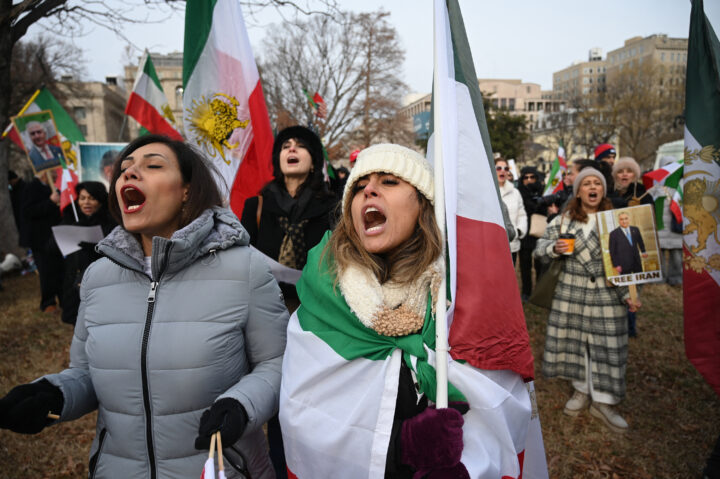
Olivier Douliery/Abaca/Sipa USA via AP Images
Activists take part in a rally supporting protestors in Iran at Lafayette Square, across from the White House in Washington, DC on January 3, 2026.
As protests continue to spread throughout Iran and the geopolitical repercussions of the Trump administration’s capture of Venezuelan President Nicolas Maduro ripple across world capitals, the sentiment around the Middle East and in Washington is that renewed conflict with the Islamic Republic may well be on the horizon.
While smaller than previous nationwide protests in 2019 and 2022, the newest demonstrations come as Iran is facing economic instability, crushing international sanctions and record droughts. The protests that have spread across the country in recent days are the first major demonstrations since the 12-day war between Iran and Israel, with an assist from the U.S., last June that damaged the Islamic Republic’s nuclear program and further destabilized Iran.
The protests in Iran were already gaining steam at the time a Delta Force team apprehended Maduro and his wife on Saturday and brought them to the U.S. to stand trial on drug trafficking charges. But the Trump administration’s decision to send elite forces into Caracas and forcibly remove Maduro signals to Tehran — as well as Moscow and Beijing — that Washington is taking a tougher approach to regimes it sees as destabilizing and threatening to U.S. interests.
The world is watching this geopolitical high-wire act with uncertainty. In Israel, officials are closely monitoring the instability in Iran, concerned that the regime in Tehran could move to strike Israel in an effort to consolidate domestic support and quell the protests; Israel could also see a window of opportunity to strike Iran at a weak moment, either of which could reignite warfare between Jerusalem and Tehran. It was less than a week ago that Israeli Prime Minister Benjamin Netanyahu met with President Donald Trump at his Mar-a-Lago resort in Florida and discussed the threat posed by Iran’s ballistic missile program.
In his weekly Cabinet meeting yesterday, Netanyahu addressed Iran in the context of his Palm Beach meeting last week, saying that Israel “reiterated our joint position of zero enrichment on one hand, and the need to remove the 400 kilograms of enriched material from Iran and oversee the sites with tight and genuine supervision.”
Noting that his sit-down with Trump was taking place as anti-government protests broke out in Iran, Netanyahu added, “The Government of Israel, the State of Israel, and my policy, we identify with the struggle of the Iranian people, with their aspirations for freedom, liberty, and justice. It is very possible that we are standing at the moment when the Iranian people are taking their fate into their own hands.”
With an eye toward Washington, the question is whether Trump will back future military action in Iran, after his success ousting Maduro in Caracas. Despite the widespread protests in Iran, there is no consolidated opposition, where the regime’s opponents are, as The Atlantic’s Arash Azizi writes, “hopelessly disorganized and disunited.”
Speaking to reporters on Air Force One last night, Trump reiterated his recent comments that the U.S. would intervene if Iranian officials were to kill protesters, having said on his Truth Social site on Friday that “If Iran shoots and violently kills peaceful protesters, which is their custom, the United States of America will come to their rescue.”
The Associated Press, citing human rights activists, reported that 15 people had been killed as of Saturday, the same day that Iranian Supreme Leader Ayatollah Ali Khamenei made his first public comments since the outbreak of protests, saying that “rioters must be put in their place.”
Iran’s political leadership appears at an impasse in its efforts to contain the demonstrations — or improve the conditions that led to them — with the hands of President Masoud Pezeshkian and other senior officials largely tied by the supreme leader. That could push the regime to act out of desperation — or to collapse entirely.
An increasingly unlikely scenario is that the protests fizzle out and Khamenei reasserts control — a move that would likely need to occur alongside an economic upturn to pull the rial up from record lows.
The first days of 2026 have seen tens of thousands of protesters taking to the streets across Iran and an administration in Washington flexing its military power, setting the stage for a potential power realignment in the Middle East and around the world.
Caracas served as the hub of Tehran's operations in the Western Hemisphere

PEDRO MATTEY/AFP via Getty Images
A woman carrying an Iranian flag and a Venezuelan flag participates in a march in Caracas on June 25, 2025.
The U.S.’ capture of Venezuelan President Nicolas Maduro on Saturday is expected to weaken Iran’s terrorism efforts, weapons production and economic activity in Latin America, experts say.
With Vice President Delcy Rodriguez taking power — and the Trump administration expressing willingness to work with her — it remains unclear whether Maduro’s regime will largely remain intact with American supervision or if the government will ultimately be replaced by the democratic opposition, led by Nobel Peace Prize recipient Maria Corina Machado, or someone else.
While Venezuela’s future remains unclear, Israel’s leaders applauded what they saw as a pro-American turn, with Prime Minister Benjamin Netanyahu expressing support for the Trump administration’s “determined decision and action of the United States to restore freedom and justice to that part of the world.”
“Across Latin America right now, we are seeing a transformation,” Netanyahu said. “Several countries are returning to the American axis and, not surprisingly, to a connection with the State of Israel. We welcome this.”
Emmanuele Ottolenghi, senior research fellow at the Center for Research on Terror Financing, told Jewish Insider that “if the regime remains in place [under Washington’s supervision], there will have to be adjustments in its regional posture and foreign policy. That means, of course, the role that nefarious foreign actors such as China, Russia, Cuba and Iran played in Venezuela will change.”
Danny Citrinowicz, a senior researcher at the Institute for National Security Studies at Tel Aviv University, told JI that “the Iranians turned Venezuela into a strategic hub, and now that has disappeared.”
“Iran built a very deep operative and strategic relationship with [Maduro’s predecessor Hugo] Chavez, and it uses Venezuela … as its jumping-off point for influence in Latin America,” he said.
Ottolenghi said that Maduro’s government allowed Iran to operate freely in Venezuela, which Tehran took advantage of in a variety of arenas, including propaganda, terrorism and arms manufacturing.
Tehran established a drone factory in Venezuela, in which Venezuelans produced Iranian drones, Ottolenghi said.
The recently foiled terrorist plot to assassinate Israel’s ambassador to Mexico was planned by Iranian operatives in Caracas, Ottolenghi added.
“The Iranians made Caracas the hub of all their propaganda and soft power operations in the region, including their Spanish-language 24/7 news network,” Ottolenghi said. “They established a permanent presence in Caracas for their missionary network, under the umbrella of the sanctioned Al-Mustafa International University.”
After former Iranian President Ebrahim Raisi visited Caracas in 2023, scientific and academic exchanges between the countries grew, and Iran was granted greater access to Venezuela’s economy.
The economic relationship with Venezuela has been important for Iran, Ottolenghi said.
“Venezuela assisted Iran in evading sanctions prior to the JCPOA [2015 Iranian nuclear deal], but since 2019-2020, when the Venezuelan economy sharply deteriorated, Iran gained the upper hand in the relationship,” he said. “Maduro essentially joined the ‘axis of resistance.’”
The country with the largest proven oil reserves in the world needed to buy refined gasoline from Iran because of “the dramatic deterioration in quality in the oil industry in Venezuela after years of cronyism, brain drain, corruption and mismanagement purging the national oil company,” Ottolenghi explained. “The Iranians stepped in to stop Venezuela from collapsing for lack of refined [oil] products, providing technicians, technology, refined gasoline shipped from Iran in exchange for gold. That gave [Iran] even more leverage inside Venezuela, including the ability to operate one of the refineries for their own needs.”
As for Hezbollah, Citrinowicz noted that the Lebanese terrorist organization is “very important to [Iran], in that it connects the Shi’ite communities in Latin America.”
Ottolenghi said that Hezbollah “benefitted from both the protection of the regime and the large expat community of Lebanese immigrants and their descendants … who are sympathetic to the movement and enabled them to become involved in money laundering and other financial activities … including crypto and reportedly illegal gold mining in the southeast of the country.”
Though Hezbollah is an Iranian proxy, it has independent sources of income, including the Latin American drug trade.
Maduro’s fall “will make it hard [for Hezbollah] to keep up those ties,” Citrinowicz said.
Ottolenghi said that “traditionally, [Hezbollah] has played mainly the role of intermediary for drug cartels, providing services in logistics, distribution and financial channels to move the money in complex translational transactions.”
However, he noted that, as opposed to Tehran, Hezbollah’s operations in Latin America have not been primarily based in Venezuela, and that until recently, the terrorist group’s senior official in Latin America was based in São Paolo, Brazil.
“Insofar as Maduro’s removal may curb Iran’s influence and its proxies in Venezuela, it does not address necessarily what Hezbollah is doing in other countries,” Ottolenghi said.
Maduro’s fall is one of “a series of blows” to Iran in recent years, Citrinowicz said, with the governments of Bolivia, Chile and Argentina turning more pro-American, and the same is likely to happen in Colombia in its upcoming presidential election.
“Iran likes working with socialist regimes that counter the West,” Citrinowicz said. “They can’t leave Latin America entirely. … They will need to work with what’s left and emphasize Cuba and Nicaragua.”
Citrinowicz said that Iran will likely pivot its investments of time and money to Africa.
Meeting in Florida, Trump and Netanyahu projected unity but highlighted disagreements on Turkey, Syria and the West Bank
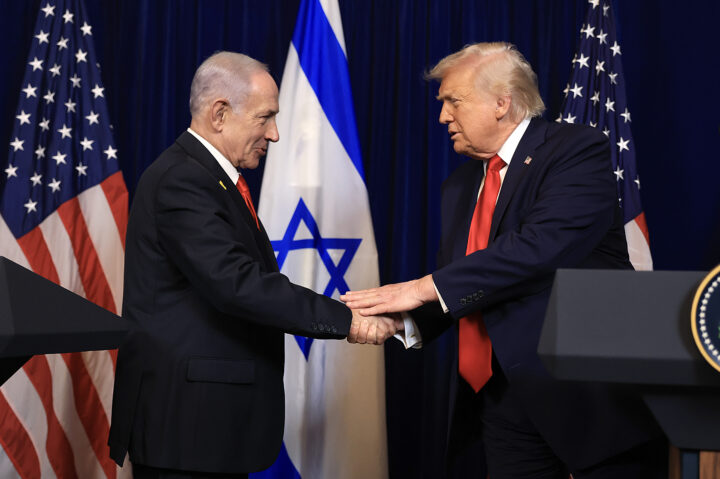
Joe Raedle/Getty Images
President Donald Trump shakes hands with Israeli Prime Minister Benjamin Netanyahu during a press conference at his Mar-a-Lago club on December 29, 2025 in Palm Beach, Florida.
President Donald Trump vowed on Monday that he would support the U.S. or Israel launching another round of strikes against Iran if Tehran is attempting to rebuild its ballistic missile program or nuclear facilities.
Trump made the comments while speaking to reporters from his Mar-a-Lago estate in Palm Beach, Fla., alongside Israeli Prime Minister Benjamin Netanyahu for the latter’s fifth visit to the United States this year.
Asked if he will support another Israeli attack on Iran if they continue their ballistic missile and nuclear programs, Trump said, “If they continue with the missiles? Yes. If the nuclear? Fast, okay? One will be yes, absolutely; the other was, we’ll do it immediately.”
He added later, “If they are [rearming], we’re going to have no choice but very quickly to eradicate that build up. … We don’t want to waste the fuel on a B-2 [bomber]. It’s a 37-hour trip, both ways, I don’t want to waste a lot of fuel,” suggesting the U.S. would again utilize its bomber jets that conducted the June strikes on Iran’s nuclear facilities.
The president repeatedly urged Tehran to return to the negotiating table with the U.S. while cautioning that the regime would face consequences for declining his offer to address the nuclear issue diplomatically. “They could have made a deal the last time before we went through the big attack on them, and they decided not to make the deal. They wish they made that deal. So I think, again, they should make a deal,” he said.
About reports that Iran is rearming, Trump said, “Iran may be behaving badly. It hasn’t been confirmed, but if it’s confirmed, look, they know the consequences.”
“This is just what we hear, but usually where there’s smoke, there’s fire,” he continued. “I’m hearing that their [efforts are] not nuclear yet, but maybe nuclear, too. The sites were obliterated, but they’re looking at other sites [than the ones the U.S. bombed in June]. That’s what I’ve heard. They’re looking. It’ll take a long time. They’re not going to go back to where they were, but they have other places they can go. And if they’re doing that, they’re making a big mistake.”
Trump repeatedly praised Turkish President Recep Tayyip Erdogan in his remarks with Netanyahu, pledging to thaw tensions between the Turkish and Israeli leaders and repeated that he was “very seriously” considering approving Turkey’s longstanding requests to purchase F-35 fighter jets from the United States. “We’re thinking about it very seriously,” Trump said about the move, which Israeli Ambassador to the U.S. Yechiel Leiter said last month that Israel opposes.
“I know President Erdogan very well, and as you all know, he’s a very good friend of mine … and I do respect him and Bibi respects him, and they’re not going to have a problem,” Trump said.
Speaking to reporters alongside Netanyahu ahead of their meeting, Trump also voiced his support for Turkey joining the proposed U.S.-led International Stabilization Force to be deployed in Gaza.
“I have a great relationship with President Erdogan, and we’ll be talking about it. And if it’s good, I think that’s good. And a lot will be having to do with Bibi, we’re going to be talking about that,” Trump said. “But Turkey has been great, and he [Erdogan] has been excellent, as far as I’m concerned. I don’t know about you [Netanyahu], but to me he’s been very good.”
Netanyahu did not comment on the suggestion at the time or during the press conference later on, though Israel, as well as several U.S. lawmakers, has said it opposes Ankara’s involvement in the proposed peacekeeping force due largely to Turkey’s ties to Hamas, despite the supportive posture from the Trump administration.
The president later used the topic of Syria to again praise Erdogan, arguing the Turkish leader deserved “a lot of credit” for ousting the Assad regime.
“Don’t forget, it was President Erdogan that helped very much get rid of a very bad ruler of Syria. That was President Erdogan, and he never wanted the credit for it, but he really gets a lot of credit. Bibi agrees with that. … I know it,” Trump told reporters.
The president went on to say that the U.S. and Israel “have an understanding regarding Syria” and that he was working to improve relations between the Jewish state and its neighbor, praising Syrian President Ahmad al-Sharaa along the way.
“We do have an understanding regarding Syria. Now with Syria, your new president. I respect him. He’s a very strong guy. That’s what you need in Syria. You can’t put a choir boy, you can’t put somebody that’s a perfect person — everything’s nice, no problems in life,” Trump said.
“I’m sure that Israel and him will get along,” he continued. “I will try and make it so that they do get along. I think they will.”
For its part, Israel has been wary of al-Sharaa and the new Syrian government, with the IDF maintaining control of the 155-square-mile buffer zone between the two countries since the fall of Syrian dictator Bashar Assad last year, against Damascus’ wishes. Israel and Syria have also continued to disagree on the contours of a potential security agreement, which the Trump administration has continuously sought, with Netanyahu maintaining that any agreement must require Syria to accept the demilitarization of territory stretching from southern Damascus to the Israeli border.
Trump was also asked about the Lebanese government’s failure thus far to disarm Hezbollah, amid reports that the terror group is rearming. The president demurred when pressed on his support of Israel striking Hezbollah targets in Lebanon again as a result, instead only acknowledging his disapproval with the terrorist organization.
“Well, we’re going to see about that. We’ll see about it,” Trump said. “The Lebanese government is at a little bit of a disadvantage, if you think of it, with Hezbollah, but Hezbollah has been behaving badly. So we’ll see what happens.”
Asked about attacks by Israeli settlers against Palestinians, Trump acknowledged that he and Netanyahu discussed the West Bank during the meeting and that they’re not in complete alignment on the issue. Still, Trump expressed confidence that all parties would reach “a conclusion” to prevent the matter from undermining the implementation of his broader peace plan, though he declined to offer specifics.
“Well, we have had a discussion, big discussion, for a long time on the West Bank. And I wouldn’t say we agree on the West Bank 100%, but we will come to a conclusion on the West Bank. … It’ll be announced at an appropriate time, but [Netanyahu] will do the right thing. I know that. I know him very well. He will do the right thing,” he said.
Trump also expressed gratitude during his remarks for being named the recipient of the Israel Prize, the Jewish state’s highest cultural honor awarded by the country’s education minister. Netanyahu said Trump will be the first non-Israeli to receive the award, which the president said “really is a great honor.”
Netanyahu invited Trump to visit Israel on Yom Ha’atzmaut, the Jewish state’s independence day, in April, which will be an election year, to receive the award in person.
Joined by Trump at his the meeting with Netanyahu were White House Chief of Staff Susie Wiles; Stephen Miller, deputy chief of staff for policy at the White House; Secretary of State Marco Rubio; Defense Secretary Pete Hegseth; Gen. Dan Caine, the chairman of the Joint Chiefs of Staff; Steve Witkoff, the White House’s Mideast envoy; and Jared Kushner, Trump’s advisor on Middle East efforts.
Netanyahu also met individually with Secretary of State Marco Rubio and Defense Secretary Pete Hegseth while at the president’s property.
As they denounce the UAE’s alleged backing of Sudan’s Rapid Support Forces, far-left lawmakers have passed over the Muslim Brotherhood affiliations and foreign backing of the rival Sudanese Armed Forces
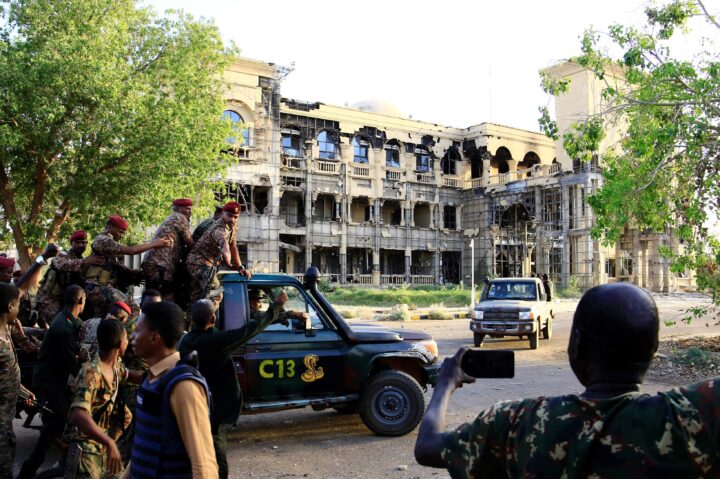
Tariq Mohamed/Xinhua via Getty Images
Abdel Fattah Al-Burhan in the vehicle, chairman of Sudan's Transitional Sovereign Council and commander of the Sudanese Armed Forces SAF, departs from the Presidential Palace in Khartoum, Sudan, on March 26, 2025.
In recent days, a chorus of left-wing lawmakers in Congress have ramped up their ire towards the United Arab Emirates, accusing the Gulf country of helping fuel the yearslong civil war in Sudan by reportedly backing the Rapid Support Forces (RSF), the non-Islamist Arab force fighting the Muslim Brotherhood-aligned Sudanese Armed Forces (SAF).
The UAE has long denied allegations of involvement in the war. The Wall Street Journal reported this week that, according to sources, recent assessments by the Defense Intelligence Agency and the State Department’s intelligence bureau purport to show the UAE sending Chinese drones to the RSF.
On the other side, Iran, Russia, Egypt and Turkey have provided support to the SAF, according to conflict monitors and reporting by Bloomberg and The Washington Post.
The war in Sudan has wrought havoc upon the eastern African nation, with both warring factions committing crimes against humanity. The conflict has killed as many as 150,000 people and has displaced around 12 million.
Over the more than two-year long conflict, both militias have been accused of widespread sexual assault, mass killings of civilians, torture and deliberate attacks on civilian infrastructure. On Monday, the RSF captured the city of El Fasher after an 18-month blockade which saw the group effectively devastate the city, with reports of mass killings, sexual violence and the destruction of hospitals and displacement camps.
The U.S. government, under former President Joe Biden, determined the RSF was committing genocide and found both the RSF and SAF guilty of committing war crimes.
Meanwhile, the Muslim Brotherhood’s growing influence with the Sudanese Armed Forces has alarmed experts, who warn that the SAF’s deepening ties to Islamist networks threaten regional stability and could pose a risk far beyond the eastern African nation.
“The Muslim Brotherhood has had a strong presence in Sudan since the 1940s and that presence has evolved over the years,” Norman Roule, a former senior U.S. intelligence official, told Jewish Insider. “It’s important to note that this presence is also why Iran is such a strong supporter of the Burhan [head of SAF] government.”
Liam Karr, an analyst at the American Enterprise Institute, who has condemned actions on both sides of the conflict, says the ties date back to former Islamist dictator Omar al-Bashir, who ruled Sudan for several decades before the SAF overthrew him in 2019.
“The SAF is working with several Islamist brigades that consist of former Bashir-era army, police and intelligence personnel,” Karr told JI. “This includes the al Baraa Ibn Malik Brigade, which is widely associated with the Sudanese Muslim Brotherhood and Bashir and has an estimated 20,000 fighters.”
In recent months, the SAF has received explosive attack drones from Iran’s Revolutionary Guard Corps to aid in the conflict, while Egypt, one of their key backers, arrested a key Islamist militia leader aligned with the group — signaling that even staunch regional supporters of the group are “growing wary of its Islamist factions,” according to Foundation for Defense of Democracies Research Fellow Hussain Adbul-Hussain.
Roule said Iran has a vested interest in providing the SAF with weaponry in order to reestablish a presence in the region and revitalize their “broken proxies,” following Israel’s degrading of its military capabilities and of its proxy Hezbollah, as well as the fall of the Assad regime in Syria.
“This is of extreme importance to the U.S. and its partners in the region, because if the Quds Force [IRGC] is able to establish a presence it lost in Syria, it would be able to reestablish training camps it operated a decade ago for Hamas smugglers, routes for weapons that it could send back into Gaza and revitalize Lebanese Hezbollah, as well as provide a transshipment location of weapons to the Houthis,” said Roule. “The Muslim Brotherhood presence in Khartoum is of serious concern for the United States and deserves much greater attention. It is a significant threat to the United States, Israel and the region.”
Anti-Israel lawmakers, including some of the Jewish state’s most vocal critics in the House, have sounded the alarm on the RSF, but have notably glossed over the SAF and its increasingly Islamist alignment.
“Sudan is facing the world’s worst humanitarian crisis and a genocide,” said Rep. Ilhan Omar (D-MN) in a post on social media on Tuesday. “The UAE and other arms dealers to the RSF and RSF-aligned militias must be held accountable.”
Rep. Rashida Tlaib (D-MI) echoed the same sentiment, saying she is “horrified” by the RSF’s “mass killings of civilians.”
“We must do everything in our power to stop this genocide, including cutting off all weapons sales to the United Arab Emirates who are arming and funding this ethnic cleansing,” said Tlaib on social media on Wednesday.
Rep. Joaquin Castro (D-TX) followed suit and similarly directed his criticism at the Emirates.
“I am incredibly concerned about the deepening humanitarian crisis in Sudan, and the atrocities committed by the Rapid Support Forces,” Castro wrote on social media on Wednesday. “The United States must put pressure on the RSF and those who back it — including the United Arab Emirates — to end these atrocities.”
A number of far-left activists online have also singled out the RSF and its reported Emirati ties for condemnation.
Kenneth Roth, a virulent critic of Israel and former head of Human Rights Watch, posted on Tuesday, “British arms sold to the United Arab Emirates are being found in Sudan, where the UAE is arming the paramilitary Rapid Support Forces as they commit genocide.”
“Both the Biden and Trump administrations refused to hold the UAE accountable as it armed Sudan’s RSF, despite massacre after massacre, atrocity after atrocity,” wrote New York Times columnist Nicholas Kristof, adding, “Members of Congress are showing more responsibility and initiative.”
House Democrats, led by Reps. Gregory Meeks and Sara Jacobs, released a statement in April marking the two year anniversary of the conflict. “External actors like the UAE must immediately stop fueling the conflict by arming the warring parties,” the statement said notably only listing the UAE and omitting any mention of Turkey, Iran, Russia, and other countries who have sent arms to factions in Sudan.
A bi-partisan group of senators, including Ranking Member Jeanne Shaheen (D-N.H.) of the Senate Foreign Relations committee, released a statement on Thursday breaking in tone from the other lawmakers – condemning both sides and making mention of all nations reportedly backing the war.
“Both the RSF and the Sudanese Armed Forces (SAF) have committed atrocities against civilians and pursued a zero-sum war at any cost,” the lawmakers said in a statement. “Foreign backers of the RSF and SAF-including the United Arab Emirates (UAE), Russia, Iran, China and governments in the immediate region-have fueled and profited from the conflict and legitimized the monsters destroying Sudan,” the senators continued.
Secular forces in Sudan have called for the country’s Islamist movement to be classified as a terrorist group, according to Hussain. Sudan’s Civil Democratic Alliance of Revolutionary Forces (Sumud) has stated that the “Islamist movement sees no pathway for ending the fighting other than the complete submission of the Sudanese people to its terrorist regime, an arrangement that has never achieved peace.”
Karr says the Trump administration and the SAF’s own partners have put “heavy pressure” on the group to “distance itself politically from the Islamist groups.” Karr also believes pressure should be applied to the RSF.
In his second term, President Donald Trump voiced support for designating the Muslim Brotherhood as a terrorist organization. Various members of congress have introduced legislation that would require the secretary of state to use this designation, though Congress has yet to move forward with the legislation.
Sen. Lindsey Graham sounded skeptical that Hamas would accept the deal: ‘Distrust and verify with these guys’

Amir Levy/Getty Images
Senator Lindsey Graham (R-SC) speaks at a press conference on US-Israel relations on February 17, 2025 at the Kempinski Hotel in Tel Aviv, Israel.
Senators reacted with cautious optimism — and a degree of skepticism — to President Donald Trump’s announcement on Monday of a sweeping deal that would end the war in Gaza, see the release of the remaining hostages and facilitate reconstruction of the Gaza Strip.
Sen. Lindsey Graham (R-SC) warned that the execution of the deal would require close monitoring of Hamas’ compliance and that long-term peace in the region will likely require eliminating Iran’s other proxies, in addition to Hamas.
“I hope Hamas agrees — we’ll get the hostages home. Distrust and verify with these guys,” Graham said. “A lot of loopholes if you don’t watch it, but I hope we can land this deal.”
“When you talk about normalizing the Mideast, I’m all for that. But after Oct. 7, we have to learn one thing: As long as radical Islamic terrorist groups exist, you can’t have a normal Mideast,” Graham continued. “I hope we can land this deal and bring the hostages home and start a new chapter in Gaza and the West Bank, but I will never support normalization until Hezbollah is dealt with. You cannot say the Mideast is a normal place as long as Hezbollah is a threat the way it is today.”
He said that he’s concerned that Hezbollah would replicate Hamas’ Oct. 7 attack if Israel and Saudi Arabia again begin to move toward normalization again before the Lebanese terror group is eliminated.
“If we do the Hamas deal, we should insist that the region deal with Hezbollah and take them both down, then eventually the Houthis,” he continued. “My takeaway of Oct. 7 is if you don’t have these radical groups in a box, you can never really achieve peace.”
Sen. John Cornyn (R-TX) said that there are “some details to be filled in, but I think by and large this seems like a very encouraging development.”
Sen. Rick Scott (R-FL) was hesitant to offer an assessment of the deal before Hamas had agreed to the terms.
“It’s the deal that hasn’t happened yet. It’d be nice. I mean, I guess it would be great if we get the hostages back and we get a ceasefire and we get to rebuild Gaza. That all sounds really good. I’m glad that Trump cares about this. It seems optimistic,” he told JI.
Sen. Kevin Cramer (R-ND) expressed some hesitation about engaging with the Qataris and taking a deal, but suggested Trump was ready to bring the conflict to a close.
“It’s bold. It’s gutsy on the president’s part. I just will believe it when I see it. I’m just so skeptical of one side in this, getting Qatar in there and involved,” Cramer told JI. “Clearly we’re playing along a little. I don’t know. I just don’t know. I think the timing for Trump is sort of like, ‘Okay, now’s the time [for a ceasefire]. We’ve done the dance long enough.’”
Sen. Ted Budd (R-NC) said he’s reviewing the plan, adding that the elimination of Hamas is a necessity.
“You can’t have Hamas promising the destruction of Israel,” he continued. “As long as there’s no threat, I see an opportunity here, but you can’t make a deal with somebody that wants to exterminate you.”
Senate Foreign Relations Committee chair Jim Risch (R-ID) praised the plan on X. “President Trump again shows his commitment to peace with his plan to bring all the hostages home, end the war in Gaza and transition to a future that allows the Palestinian people to prosper without Hamas’ terror schemes,” Risch said. “Anyone who wants a better future for the Palestinian people should join this pursuit of peace.”
Sen. John Kennedy (R-LA) told Jewish Insider he’s “glad they look like they’re moving toward peace.”
“I don’t think Israel is worried any longer about being popular. I think Israel was worried about its survival, and I respect that. And they’re going to do whatever it takes,” Kennedy continued. “Now, will Hamas accept it? I don’t know. I really don’t know. I hope they do. But if they don’t, I think Israel needs to continue to do what it’s been doing and wipe Hamas off the face of the earth.”
Democrats expressed hope that the deal would bring the war to a close.
Sen. Chris Coons (D-DE) told JI, “I’m encouraged the president’s engaging directly and saying this war must end. Humanitarian relief needs to go in, hostages need to come out, there needs to be a plan going forward for Gaza,” but said he hadn’t seen the details of Trump’s announcement.
Sen. Richard Blumenthal (D-CT) said that he was not familiar with the specifics of the plan. “If there’s a ceasefire and return of the hostages and humanitarian relief, bravo,” Blumenthal said.
Sen. Peter Welch (D-VT), one of the most vocal critics of Israel’s Gaza operations in the Senate, told JI he hadn’t reviewed the plan but “my main concern [is to] start getting food and medicine in. That has to happen immediately.”
Sen. Jeanne Shaheen (D-NH), the ranking member of the Foreign Relations Committee, said in a statement. “I call on Hamas to accept, and Israel to faithfully implement, the proposal laid out by the United States.”
Prior to the meeting, leading Senate Democrats had urged Trump to press Israeli Prime Minister Benjamin Netanyahu to accept a hostage deal that ends the war, as well as to pressure Netanyahu to rule out annexation of the West Bank.
‘It was made very clear to us it was not enough to just negotiate over their nuclear ambitions, that in their weakened state, you could not separate Iran's malignancy when it comes to all of their activity,’ she said

Anna Moneymaker/Getty Images
Rep. Debbie Wasserman Schultz (D-FL) speaks during a press conference on new legislation to support Holocaust education nationwide at the U.S. Capitol Building on January 27, 2023, in Washington, D.C.
Arab and Israeli leaders are insisting that any U.S. deal with Iran also include provisions to address Iran’s other malign activities in the region, including support for terrorist proxies, Rep. Debbie Wasserman Schultz (D-FL) told Jewish Insider following a trip earlier this month to meet with Israeli and Arab leaders in the Middle East.
Wasserman Schultz traveled with Sen. Joni Ernst (R-IA) to the Middle East for the third time since Oct. 7, 2023, visiting Israel, the United Arab Emirates, Bahrain and Jordan.
“There was a very clear urgency that the leaders we spoke to had to make sure that we … don’t let Iran up from their very weakened state. They’ve been badly pummeled and had significant defeats,” Wasserman Schultz told JI last week. “The consensus across the region, no matter where we went, was that we needed to make sure that continued and that we prevented them from achieving their nuclear weapons goals and that we particularly prevented them from continuing their support for terrorist activity.”
She said that notion was raised by multiple leaders without prompting from the U.S. lawmakers.
She said that “across the board” the leaders shared her view that any deal with Iran must “include defanging them — and that was a term that was used repeatedly, defanging them — and stopping them from continuing to terrorize” the region.
“It was made very clear to us it was not enough to just negotiate over their nuclear ambitions, that in their weakened state, you could not separate Iran’s malignancy when it comes to all of their activity — particularly if they got any relief from sanctions,” she said.
Middle East envoy Steve Witkoff, the lead negotiator for the U.S. in talks with Iran, suggested in a recent Fox News interview that the U.S. would consider allowing Iran to retain its enrichment capacity as part of a deal — a statement he later walked back — while Wasserman Schultz and Ernst were in the region. The outline Witkoff provided on Fox appeared to many to be equivalent to the original 2015 Joint Comprehensive Plan of Action which Trump withdrew from in his first term.
Wasserman Schultz called it “incredibly hypocritical” for officials from the new Trump administration, such as Witkoff, to endorse terms of a deal similar to the JCPOA. Wasserman Schultz ultimately voted for the JCPOA in 2015 and calls it “the most difficult vote I’ve cast in all the years I’ve been in Congress.”
She called on Witkoff and the American negotiators to seek a deal stronger than the original JCPOA, making her the latest pro-Israel Democrat to raise concerns about the potential terms of a new deal with Iran.
She said she’s “frustrated and concerned … and even angry” that the administration seems to be going “from pillar to post. Their discussions seem like they’re happening on quicksand and I have seen nothing that looks different than the agreement that [Trump] pulled out of.”
With Iran significantly weaker and more vulnerable than it was in 2015, Wasserman Schultz said the U.S. must seize the opportunity to push for a more comprehensive deal to prevent Iranian terrorist activity and stop Iran from obtaining a nuclear weapon.
If the U.S. does return to a deal similar to the JCPOA, Wasserman Schultz said that the ultimate result of Trump’s withdrawal from the original deal would have been allowing Iran to get “perilously close to a nuclear weapon” and removing the option to strengthen the original agreement through further negotiations.
Wasserman Schultz said that she told Israeli Prime Minister Benjamin Netanyahu, who aggressively opposed the 2015 deal, that she expected he would offer “the same howling pushback that occurred back during the Obama years when those negotiations were taking place” if Trump moves toward a deal similar to the JCPOA.
Wasserman Schultz and Ernst also discussed the ongoing war with Hamas in their meeting with Netanyahu. Compared to previous meetings, Wasserman Schultz said she believed that the prime minister and Israeli Minister of Strategic Affairs Ron Dermer outlined more comprehensive and specific strategies to achieve the release of the remaining hostages being held in Gaza.
“I probably have met with him five or six times over the course of the last year and a half there in Israel and in the U.S.,” Wasserman Schultz explained. “I was glad to see that they had varying approaches in terms of their negotiations and strategy with the ceasefire and hostage deals that they’re discussing. I was glad to see that and hear for the first time Dermer — and Netanyahu too — talk about the various options that they had, as opposed to it being a more minimalist conversation.”
Wasserman Schultz said she and Ernst had also spoken to Arab leaders about their proposals for post-war Gaza and achieving Saudi-Israeli normalization. She said the Arab leaders had been “very clear-eyed” about the difficulties of finding credible Palestinian leadership able to help move toward an eventual Palestinian state, but said they believed it was possible.
“I came away feeling like there could be some progress made. But it was clear that as a result of the war in Gaza, the signs of progress that we had hoped for when we were in Saudi Arabia on the night of Oct. 6 [2023] [were] further away at the moment than [they were] then,” Wasserman Schultz said.
But she added that the countries which have normalized relations with Israel are not retreating from those agreements and remain committed to them, highlighting as one example of the progress made that she was able to attend a Seder on the first night of Passover in Abu Dhabi.
Graham, on Fox News Sunday: ‘There's an opportunity to hit the Iran nuclear program in a fashion I haven't seen in decades’
Anna Moneymaker/Getty Images
Sen. Lindsey Graham (R-SC) in the Senate Judiciary Committee on January 30, 2025 in Washington, D.C.
Sen. Lindsey Graham (R-SC) reiterated his hope that the United States would support Israel if it chooses to strike Iran’s nuclear program.
Graham made the comments during a Fox News Sunday appearance after being asked about a resolution he introduced alongside Sen. John Fetterman (D-PA)stating that “all options should be considered” with respect to addressing the nuclear program.
“The Israelis are going to have to make a decision relatively soon [on] what to do about the Iran nuclear program,” Graham said.
“I am here to tell you and the audience in the world that I think America should support an effort by Israel if they decide to decimate the Iranian nuclear program because I think it’s a threat to mankind. Israel is strong. Iran is weak. Hezbollah, Hamas have been decimated. They’re not finished off, but they’ve been weakened. And there’s an opportunity to hit the Iran nuclear program in a fashion I haven’t seen in decades.”
Graham, who repeatedly praised Fetterman as “a champion” for the pro-Israel cause, added that he believed “it would be in the world’s interest for us to decimate the Iranian nuclear threat while we can. If we don’t, we will regret it later.”
He also clarified that he was urging U.S. support for an Israeli strike, not a U.S. military-led operation. “They [the Israelis] need some assistance, but it would be their actions,” Graham said.
The comments come as speculation mounts about how President Donald Trump will approach the issue of a nuclear Iran. The second Trump administration is expected to reimpose the “maximum-pressure” sanctions policy against Iran that it utilized during Trump’s first term.
Trump has also expressed interest in a new diplomatic agreement with Iran, a move that would run counter to his approach in the region during his first term.
The president, after signing a series of executive orders, said he hopes to avoid military action against Iran

Anna Moneymaker/Getty Images
Middle East envoy Steve Witkoff introduces U.S. President Donald Trump during an indoor inauguration parade at Capital One Arena
President Donald Trump refuted reports that Steve Witkoff, his Middle East envoy, will take over the Iran file, while also lauding Witkoff for his work helping negotiate the cease-fire and hostage deal between Israel and Hamas.
“No,” Trump said on Thursday after signing a series of executive orders, when asked by a reporter whether he would put Witkoff in charge of Iran strategy and speaking directly with the Iranians. “But he’s certainly somebody I would use. He’s done a fantastic job. He’s a great negotiator.”
Trump declined to answer a question about whether he would support an Israeli strike on Iran’s nuclear facilities. Instead, he said he hopes for a diplomatic solution with Iran.
“It would really be nice if that could be worked out without having to go to that further step,” Trump said, regarding the possibility of strikes. “Iran hopefully will make a deal. I mean, if they don’t make a deal, I guess that’s okay, too.”
The incoming Trump administration’s nominee to be secretary of state is expected to enjoy an easy glide-path to confirmation with overwhelming bipartisan support

Kevin Dietsch/Getty Images
President-elect Donald Trump’s nominee for Secretary of State, Sen. Marco Rubio (R-FL) testifies during his Senate Foreign Relations confirmation hearing at Dirksen Senate Office Building on January 15, 2025 in Washington, DC.
Sen. Marco Rubio (R-FL), the incoming Trump administration’s nominee to be secretary of state, said at his Senate confirmation hearing on Wednesday that President-elect Donald Trump’s administration is open to a new nuclear deal with Iran, under strict conditions.
Over the course of his testimony, Rubio also framed the announcement of a cease-fire between Israel and Gaza and recent losses for Iran and its proxies in the region as creating an opportunity for major steps forward on regional normalization and Israeli-Palestinian peace, condemned the International Criminal Court’s targeting of Israel and spoke forcefully about the need to combat antisemitism globally.
Overall, Rubio’s hearing — businesslike and cordial, focused on details of every region of the globe — marked a striking difference from the heated partisan slug-fests at confirmation hearings for other top Trump nominees this week. Rubio is expected to enjoy an easy glide-path to confirmation with overwhelming bipartisan support.
“My view is that we should be open to any arrangement that allows us to have safety and stability in the region, but one in which we’re clear-eyed,” Rubio said on the subject of Iran’s nuclear program. “Any concessions that we make to the Iranian regime, we should anticipate that they will use, as they have used in the past, to build their weapons systems and to try to restart their sponsorship of Hezbollah and other related entities around the region.”
He described the Iranian regime as at its “weakest point in recent memory, maybe ever,” with its air defenses degraded, its regional partners and proxies undermined and its economy in dire straits.
Secretary of State Nominee @marcorubio appeared at his confirmation hearing today, and discussed Israel, the ICC and Iran, among other issues. The following thread includes some of the highlights:
— Jewish Insider (@J_Insider) January 15, 2025
"How can any nation state on the planet co-exist side-by-side with a group of… pic.twitter.com/8x2Jl5oRab
Rubio said that this could push the Iranian regime in one of two directions: toward negotiations to buy time to rebuild, or toward rapid nuclearization as a method of regime protection.
He said that recent outreach from the regime to European nations, in the context of the expiration of snapback sanctions under the 2015 nuclear deal later this year, indicates that Iran may be leaning toward pursuing negotiations.
He said the U.S. cannot allow “under any circumstances” Iran to become a nuclear weapons state, to continue to sponsor terrorism or have the ability to attack its neighbors and the United States. He also noted that U.S. policy would be shaped by Iran’s yearslong efforts to assassinate Trump and other U.S. officials.
Rubio was careful to repeatedly draw a clear distinction between the Iranian regime of “radical Shia clerics” and the people of Iran, arguing that the gap between the regime and Iranian citizens is perhaps the widest of any country on Earth.
“In no way [are] the clerics who run that country representative of the people of that country and of its history and of the contributions it has made to humanity,” Rubio said.
He also noted that in Iran and other key U.S. adversaries, a “market” has developed for kidnapping and holding American citizens hostage, emphasizing the need for greater awareness about those risks.
Rubio described the cease-fire and hostage-release agreement between Israel and Hamas — announced in the middle of his hearing — as “a foundation to build upon” toward broader regional change, including Israeli-Palestinian peace and regional normalization. He said that the deal, in combination with the cratering of Hezbollah in Lebanon and the fall of the Assad regime, had altered the landscape of the Middle East, potentially opening pathways to renewed normalization and an Israeli-Palestinian peace process.
"I don't know of any nation on earth in which there is a bigger difference between the people and those who govern them than what exists in Iran. And that's a fact that needs to be made repeatedly." pic.twitter.com/cVAx1iUFCU
— Jewish Insider (@J_Insider) January 15, 2025
“There are opportunities now in the Middle East that did not exist 90 days ago,” Rubio said. “There are now factors at play in the Middle East that I think we can build upon and may open the door to extraordinary and historic opportunities, not just to provide for Israel’s security but ultimately begin to confront some of these other factors. But these things are going to be hard work and they’re going to require us to take advantage of those opportunities if they exist.”
Rubio said that the six-week first phase of the deal will be a critical period to build international cooperation to bring stability and new governance into Gaza. He said that both President Joe Biden and Trump deserved credit for working in tandem in the negotiations.
But he also noted that the deal did not ensure the release of all of the hostages, and emphasized that any cease-fire would be short-lived if hostages remain in Hamas captivity.
“Without the hostage situation resolved, this situation will not be resolved. It is the lynchpin,” Rubio said. “Hamas has been severely degraded, but these people, who include a number of American citizens, need to be home as soon as possible, and that will remain a priority in any engagement that we’re involved in.”
Rubio said that potential normalization between Saudi Arabia and Israel would be “one of the most historic developments in the history of the region,” adding that the Saudis and other partners in the Middle East should be part of the post-war stabilization efforts in Gaza and that a normalization agreement would help bring “a level of stability and peace” to the entire region.
He said that a key part of expanding and strengthening the Abraham Accords is ensuring that there are benefits to the countries joining the pact, such as, for Saudi Arabia, high tech investment, economic diversification and security against the mutual Iranian threat. He said the U.S. could help provide security assurances as well.
"Any concessions we make to the Iranian regime we should anticipate that they will use as they have used in the past to rebuild their weapons systems and to try to restart their sponsorship of Hezbollah and other related entities around the region." pic.twitter.com/CjH9BNsJVA
— Jewish Insider (@J_Insider) January 15, 2025
“We’re still going to have some issues with UAE and with Saudi Arabia, but we also have to be pragmatic enough to understand what an enormous achievement it would be if, in fact, you not just get a cease-fire but that leads to the opportunity of a Saudi-Israeli partnership and joint recognition,” Rubio said.
One such issue with the United Arab Emirates that Rubio said the U.S. should raise is Abu Dhabi’s support for a militant group in Sudan that Rubio and the Biden administration have said is commiting genocide. At the same time, he described the UAE as a critical partner to build stability in the Middle East.
On the subject of Israeli-Palestinian peace and a two-state solution, Rubio argued that the “conditions for that have not been in place for some time” — noting that the Palestinian Authority had rejected a Trump administration peace proposal in 2020.
He argued that if Israel had not responded forcefully to the Oct. 7 attack, the country may have faced existential threats from enemies on its various borders.
But Rubio said that there has been a potential “dynamic shift in the region” that has “an historic opportunity, if appropriately structured and pursued, that changes the dynamics of what might be possible.” He emphasized that for Israel, its existential safety is the non-negotiable starting point. If Israeli security can be guaranteed, Rubio said, there may be more opportunities for a peace process.
He said the key question for the Palestinians moving forward will be the future of governance in Gaza. “[Israel] can’t turn it over to people who seek [it’s] destruction … You cannot coexist with armed elements at your border who seek your destruction and evisceration as a state.”
Pressed by Sen. Ted Cruz (R-TX) — who accused the administration of secretly prohibiting Jews in the West Bank from accessing U.S. grants — Rubio committed to ending any waivers to sanctions in Gaza and the West Bank, ending what Cruz described as “discriminatory policies, including the Biden administration’s secret boycott policies” in the territory and ending the Biden administration’s sanctions regime against Israeli settlers accused of inciting violence in the West Bank.
One of the alleged boycotts, through the Development Finance Corporation, does not appear to have been revealed publicly before the hearing.
Senator @tedcruz pressed Senator @marcorubio during his secretary of state confirmation hearing on reversing discriminatory sanctions against Israeli Jews living in Judea and Samaria.
— Jewish Insider (@J_Insider) January 15, 2025
Rubio responded: "I'm confident in saying that President Trump's administration will continue… pic.twitter.com/i4p9mNkwny
He did not address a question from Sen. Chris Van Hollen (D-MD) about whether the Trump administration would oppose potential Israeli annexation of the West Bank.
Addressing the ICC prosecutions targeting Israeli leaders, Rubio said that the court had “done tremendous damage to its global credibility” with the effort, calling the case “completely flawed” and “completely offensive” in drawing equivalency between Israel and Hamas.
“Hamas carried out an atrocious operation. They sent a bunch of savages into Israel with the express and explicit purpose of targeting civilians,” Rubio said. “They deliberately targeted civilians. The ones they didn’t murder, the families they didn’t eviscerate, the people whose skulls they didn’t crack open, they kidnapped, and to this day continue to hold people, innocents that they took.”
He said that Israel cannot be expected to “coexist side-by-side with a group of savages like Hamas. They have to defend their national security and their national interest. And they didn’t target civilians.”
Rubio said that innocent people had been caught up in the war, “but there is a difference between those who in the conduct of armed action deliberately target civilians and those who do as much as they can to avoid civilians being caught up against an enemy that doesn’t wear a uniform, against an enemy that hides in tunnels, against an enemy that hides behind women and children.”
Further, Rubio said the case appeared to be a “test run” for a future case targeting U.S. leaders and military personnel.
Echoing rhetoric from other top Trump nominees, Rubio said that any individuals in the U.S. on visas who express support for Hamas or other terrorist groups should lose their visas and be forced out of the country.
Rubio committed to Sen. Jacky Rosen (D-NV) that the Trump administration would quickly nominate a qualified individual to serve as U.S. special envoy to monitor and combat antisemitism, saying that the nominee “needs to be someone that enjoys broad support across different sectors.”
He also said that the administration would promptly name a deputy envoy to run the office until an envoy is confirmed. Rubio said the antisemitism envoy role is particularly urgent in light of a recent Anti-Defamation League report that showed 60% of people hold some antisemitic views.
“Antisemitism is a unique danger. The suffering that it inflicted on the world historically, but within the last century, is unimaginable and can never be allowed to be repeated, and it’s something that we should make sure we’re constantly speaking out against, and identifying for what it is,” Rubio said. “I think the U.S.’s role in speaking out in that regard is indispensable, and we need to be forceful about it.”
Asked by multiple senators about the incoming administration’s approach to multilateral organizations such as the United Nations, Rubio said that the guiding philosophy for the administration’s engagement with such organizations will be whether engagement with them makes the U.S. safer and more prosperous. He said that no international organizations would be allowed to hold a veto over U.S. security interests.
Any funding to such organizations will require strict examination, Rubio added, suggesting that the administration may pull back funding from some of them.
He further described the U.N. Security Council as having become “almost irrelevant” and “weaponized” against the United States because of the power of Russia and China, which he called two of the top drivers of global conflict.
Rubio also said that international organizations had become “havens” for antisemitism, undermining their credibility.
Rubio characterized the new regime in Syria, led by leaders of an Al-Qaeda offshoot, as “not ideal” but nonetheless “worth exploring.”
“I do think it’s important to respond to this opportunity in Syria,” Rubio said. “It is in the national interest of the United States, if possible, to have a Syria that’s no longer a playground for ISIS, that respects religious minorities … that protects the Kurds and at the same time is not a vehicle through which Iran can spread its terrorism.”
Rubio said that an improved situation in Syria could positively impact Lebanon, Israel, Gaza and the Middle East as a whole. He said Iran and Russia would return to fill the gap in Syria if the U.S. does not “explore these opportunities.”
He described Turkish President Recep Tayyip Erdoğan as an “impediment” to that path forward, and said the Trump administration would communicate immediately to Erdoğan not to move against the Kurds in Syria. He said the U.S. should maintain its support for the Kurdish Syrian Democratic Forces — something Trump sought to pull back in his first administration.
FDD
Richard Goldberg
Richard Goldberg, a senior advisor at the Foundation for Defense of Democracies and former Trump administration official, discussed the need for bipartisan action on Iran in an interview with Jewish Insider’s Jacob Kornbluh on the sidelines of AIPAC’s policy conference in Washington, D.C.
Congress on one side: Goldberg noted that until the 2015 nuclear deal was signed, Democrats and Republicans addressed the Iranian nuclear threat in a bipartisan manner, and even then several Democrats chose to vote against the deal. “You’re talking about less than five years ago, a solid majority of Congress in a bipartisan fashion was against the deal,” he explained. “Those people are still in Congress,” he added, and while “it may be politically impossible for some people to say we oppose the deal now, there are things that can and should win a bipartisan majority.” Goldberg cited the arms embargo on Iran and missile and nuclear restrictions as matters that both sides agree on when it comes to legislation.
His time in the Trump administration: Goldberg joined the White House’s National Security Council as its director for countering Iranian weapons of mass destruction in 2019. He departed a year later after the birth of his baby. “It was an incredible opportunity, I am honored beyond belief to have had the opportunity to serve the national security advisor and the president in that capacity,” he said. “From my perspective, the strategy that President Trump was pursuing on Iran is exactly the right one.”
Trump can do more: According to Goldberg, “examples include designating the financial sector of Iran in its entirety, for secondary sanctions, disconnect all remaining banks from the SWIFT international system, [cutting] off their access to investment capital and resources around the world. That would be a big statement to make, and the administration has the authority to do that on its own. They don’t need Congress for that.” The reason the administration is not doing so, Goldberg suggested, is because they are hoping to avoid a diplomatic fight at the United Nations Security Council, with respect to “snapback” sanctions, waiting for European countries to take action.
Former diplomat says the U.S. should return to the JCPOA and work to ensure Iran is in compliance
Bill Clark/CQ Roll Call via AP Images
Wendy Sherman, former Under Secretary of State for Political Affairs, and John Brennan, former director of the Central Intelligence Agency, arrive to brief the House Democrats' caucus meeting on Iran in the Capitol on Tuesday, May 21, 2019.
President Donald Trump is reportedly considering easing sanctions on Iran to pave the way for a public meeting with Iranian President Hassan Rouhani in New York at the United Nations General Assembly later this month.
Wendy Sherman, who served as lead negotiator for the Obama administration on the JCPOA, told Jewish Insider on Wednesday that she “would be shocked if Iran agreed to a meeting without some sanctions relief.” According to Sherman, if Trump is serious in offering Tehran some relief, “There are plenty of ways to do this so that everyone’s interests can be met and so that everyone’s face can be saved.”
Bloomberg reported that during an Oval Office meeting on Monday, Treasury Secretary Steve Mnuchin expressed his support for such a move, while then-National Security Advisor John Bolton “forcefully” opposed such a step. On Tuesday, Trump fired Bolton, and Secretary of State Mike Pompeo suggested a meeting with Rouhani is a possibility. The Daily Beast reported on Wednesday that Trump has indicated he is “actively considering” the French plan to grant the Iranian regime a $15 billion credit line if they return to compliance with the 2015 nuclear deal.
Sherman told JI that even if the U.S. relaunches direct negotiations with Iran, it “is a very complicated undertaking. I think what’s most important here is that the president go to a meeting with a strategy; a clear objective and a plan.”
Following that, the former diplomat said, “he will need a team that can follow up, a set of consultations that have happened with our partners and allies, and a really full idea of not only what the first step is, but what the next many steps are. The president, as we know, has gone into some of these meetings thinking that he could simply trust his own instincts and his own impulses and that has never gotten a result good for our national security.”
Sherman claimed that “virtually all” of the 2020 Democratic presidential candidates have said they would return to the 2015 nuclear deal “and I agree with that. Of course, Iran would have to come into full compliance. Likely, we would then, as in all arms control agreements, work for a follow-on agreement.”
Sherman said the conditions of the deal “have changed because of the president’s actions and Iran’s reaction to the president’s actions. The JCPOA remains the essential base but, as a negotiator, you have to take that into account and you have to address where we are.”
Tommy Vietor, Obama’s former National Security Council spokesman, said he believes “Trump should be willing to meet with Rouhani or any other foreign leader. The problem is that Trump is a terrible negotiator. He’s trying to buy a meeting with Rouhani by offering sanctions relief in the hope that it will lead to a negotiation and eventually a deal as strong as the JCPOA. Meanwhile, hard liners in Iran are empowered and our European allies are furious at us for ratcheting up tensions.”
Jason Brodsky, policy director of United Against Nuclear Iran (UANI), told JI that easing sanctions just to meet the Iranian president, “who isn’t its supreme decision-maker, isn’t maximum pressure.” Mark Dubowitz, the CEO of the Foundation for Defense of Democracies, said that Trump appears poised to make “the same mistake President Obama made in 2013 when he relieved the sanctions pressure on Iran to incentivize negotiations that led to the fatally-flawed JCPOA, giving Tehran patient pathways to nuclear weapons. Why President Trump would want to pull an Obama 2.0 is troubling and puzzling.”
Douglas Feith, a former under secretary of Defense for President George W. Bush, said that Trump “deserves credit for the surprising effectiveness of unilateral U.S. sanctions. If Iran wants sanctions relief, it should be willing to alter its behavior substantially. If it does so, some sanctions relief can reasonably be granted.” But, Feith added, “The U.S. should not have to pay Iran anything to come to the table.”
As the holiday of Hanukkah – the festival of lights – came to a close last week, it is worth considering Israel’s strategically important partnership with the ‘land of fire’: Azerbaijan. The only Muslim majority country to have friendly, sustained and substantive relations with Israel, Azerbaijan is not only a beacon of religious tolerance with a historical and currently thriving Jewish community, but also an important geopolitical partner just to the north of Iran.
Israel and Azerbaijan cooperate closely in the defense and energy spheres and both share disquiet over the recent Western rapprochement with Tehran. Iran has threatened to annex Azerbaijani territory and bomb its energy infrastructure. Azerbaijani authorities have foiled Iranian-sponsored terrorist plots in their country. So, Israel and Azerbaijan have developed a joint venture to produce drones and Israeli defense contractors supply the Azerbaijani military with state of the art equipment. In return, Azerbaijan’s state energy company, SOCAR, is active in helping to develop Israel’s offshore natural gas fields, while much of the oil imported to Israel is from Azerbaijani reserves.
Due to the ‘miracle of oil’, Azerbaijan has been able to develop and distinguish itself as a ‘Dubai on the Caspian’, spending its energy wealth wisely and emerging as an international player of outsized stature in the former Soviet space. When Russian President Vladimir Putin visited recently, he showed uncommon respect to Azerbaijan’s President Ilham Aliyev and was not able to pressure Azerbaijani leaders the way Russian has done in Georgia, Ukraine and even with the United States over Syria. Azerbaijan recently served on the UN Security Council and is very active in a number of other international fora. And, its leaders do not hide their amity with Israel: Azerbaijan’s foreign minister visited Jerusalem this year and on another visit to Washington DC made a point of addressing pro-Israel Jewish organizations.
In Azerbaijan, it is not just the secular state that emphasizes good relations with Israel and discourages anti-Semitism. When asked, average Azerbaijanis express admiration for the accomplishments of the State of Israel and warm opinions about Jews in their country and around the world. Many Azerbaijani tourist guides will make a point of showcasing a major new synagogue in Baku, the country’s capital. President Aliyev regularly congratulates the Jewish community on days of religious significance and when the country’s religious leaders gather, rabbis congregate with imams and priests.
It behooves Israeli leaders and Jewish communities around the world to encourage this relationship, especially now that historical ties to Turkey are in tatters. In fact, Azerbaijan is now the largest outside investor in Turkey, due to a major pipeline project, and it is increasingly wielding influence in the greater Levant region. Azerbaijan is keen to become a technological and telecommunications hub for the Eurasian continent, so Israeli companies could seek partnerships for innovation in that sphere as well as others. Overall, as the nuclear and regional threat from Iran continues to loom large for both countries, Israel and Azerbaijan should continue to provide for their own mutual defense, strengthening an already substantive partnership amongst small nations that know how to seize the initiative.
Dr. Alexandros Petersen is the author of The World Island: Eurasian Geopolitics and the Fate of the West and co-editor of ChinainCentralAsia.com.
Please log in if you already have a subscription, or subscribe to access the latest updates.
 Continue with Google
 Continue with Apple