

























Federal commission highlights campus antisemitism concern, rebukes WH response
The U.S. Commission on Civil Rights suggested that the Trump administration’s efforts to combat antisemitism at colleges and universities has ‘sometimes represented a departure from established practice,’ among other concerns
Jeff Wheeler/Star Tribune via Getty Images
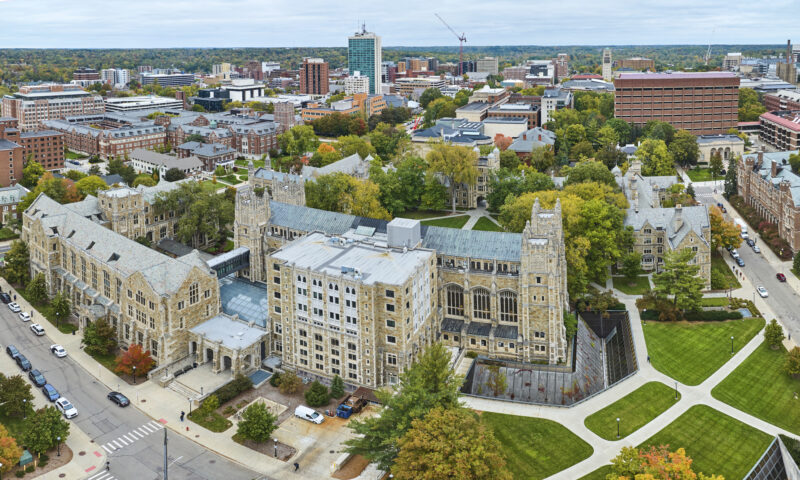
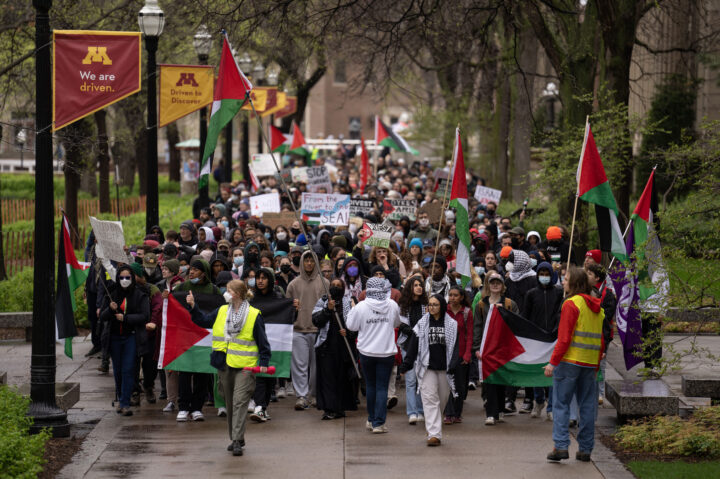
Demonstrators marched on the Northrop Mall before setting up tents on the lawn in April 2024.


 Add JewishInsider on Google
An independent federal commission on civil rights concluded, following a yearlong probe, that campus antisemitism is a “serious and growing civil rights concern,” but also suggested the Trump administration’s efforts to combat it went against both statute and established procedure.
The report by the U.S. Commission on Civil Rights highlights that “recent federal enforcement has sometimes represented a departure from established practice” and that some of the administration’s punitive measures have been overturned in court. It also notes that funding cuts and institutional penalties might cause unintended harm to Jewish students by “disrupt[ing] research, harm[ing] uninvolved students and programs, chill[ing] lawful speech, and generat[ing] resentment toward Jewish students.”
The commission said it did not receive any of the information or documents it requested from the Department of Education, Department of Justice or Department of Health and Human Services regarding its investigations into campus antisemitism, in spite of statutory requirements mandating their cooperation.
“Because agencies did not respond to the Commission’s interrogatories and document requests, and publicly available data on Title VI enforcement efforts is incomplete and outdated, a fully clear picture of how the federal government proceeded and whether it met all of its legal obligations remains unavailable,” the report states.
The report emphasizes that the Trump administration bypassed established procedure and statutory requirements to move to “the last resort funding withdrawal options,” did not limit funding cuts to impacted programs and, according to federal courts, may have overreached the “stated purpose of combatting antisemitism.”
The report notes that “not every offensive or antisemitic incident constitutes” a federal civil rights violation, that “opposition to Israel or Zionism” is distinct from “discrimination based Jewish ancestry or national origin” under civil rights law and that peaceful campus protests enjoy “substantial protections.”
“While overt instances of hostility to people of Jewish ancestry are unquestionably prohibited and rightfully condemned, more complex cases regarding anti-Zionist or anti-Israeli rhetoric and protest activity, for example, are highly context-specific and still being adjudicated by the courts,” the report states.
The report’s authors also said that universities face a “difficult legal and operational balance” in protecting Jewish students while also protecting First Amendment rights and that universities’ responses “remain inconsistent.”
The report found, based on a sample of nine public and private schools, that universities had “slow and opaque” processes for assessing discrimination complaints and that universities struggled with “how to distinguish between protected political speech and unlawful harassment.”
It also found that universities rarely concluded that complaints constituted violations of civil rights law, in many cases because they lacked sufficient information about the complaint or the complainant did not further pursue their case. The report concluded that “complaint data can overcount antisemitism,” but also that it fails to capture all antisemitic incidents, as some who do experience antisemitism do not submit complaints.
“It is important to note that complaint data for this sample of universities do not reflect reports of spikes in physically violent antisemitic incidents after October 7, 2023,” the report continues. “The small share of physical violence in this sample points to the need to flesh out the lived experience of antisemitism so that solutions can be tailored to different types of incidents.”
But it also highlights that, under federal civil rights law, it is a “central concern of the federal government” to investigate campus antisemitism and uphold antidiscrimination law where appropriate.
And, it states, “antisemitism poses a threat not only to Jewish communities but also to American democracy as a whole, threatening to simultaneously undermine civil rights for Jewish Americans and destabilize the rule of law for all U.S. residents.”
The report concludes that 97% of campus protests between Oct. 7, 2023, and May 2024 were “peaceful,” in spite of “media narratives.” It also notes that many post-Oct. 7 bias complaints were linked to protests, particularly “antisemitic messages or objects,” including some that were “overtly antisemitic” and “others [that] were protected speech that could still be offensive depending on the context, such as pro-Palestine messages.”
The report calls for greater staffing and better training for the Department of Education’s Office for Civil Rights — which the Trump administration slashed even as complaints grew significantly — to ensure adequate responses to campus antisemitism, and states that former OCR staffers believe the office was understaffed even before the Trump administration layoffs.
It further states that it is “difficult to accurately assess the true scope of unlawful campus antisemitism” given the “inconsistent or unreliable data” from universities, advocacy groups, scholars and the federal government, emphasizing the need for better, more comprehensive and more transparent data.
“Strengthening federal coordination, improving transparency in civil rights enforcement, adequately staffing civil rights offices, expanding data collection on campus climate and incidents of antisemitism, and supporting colleges and universities in developing clear and consistent policies are all critical elements of an improved federal response to campus antisemitism,” the report states.
It urges Congress to exercise oversight powers to obtain greater information about the Department of Education’s investigations into campus antisemitism — a provision included in multiple proposed bills relating to campus antisemitism.
It also calls for “consulting Jewish students, improving institutional policies and developing approaches suited to each campus rather than relying solely on broad punitive action from the federal government.”
Members of the panel are appointed by Congress and act independently, providing nonbinding recommendations to lawmakers and the executive branch on responding to civil rights issues. The report was unanimously approved by the commission.
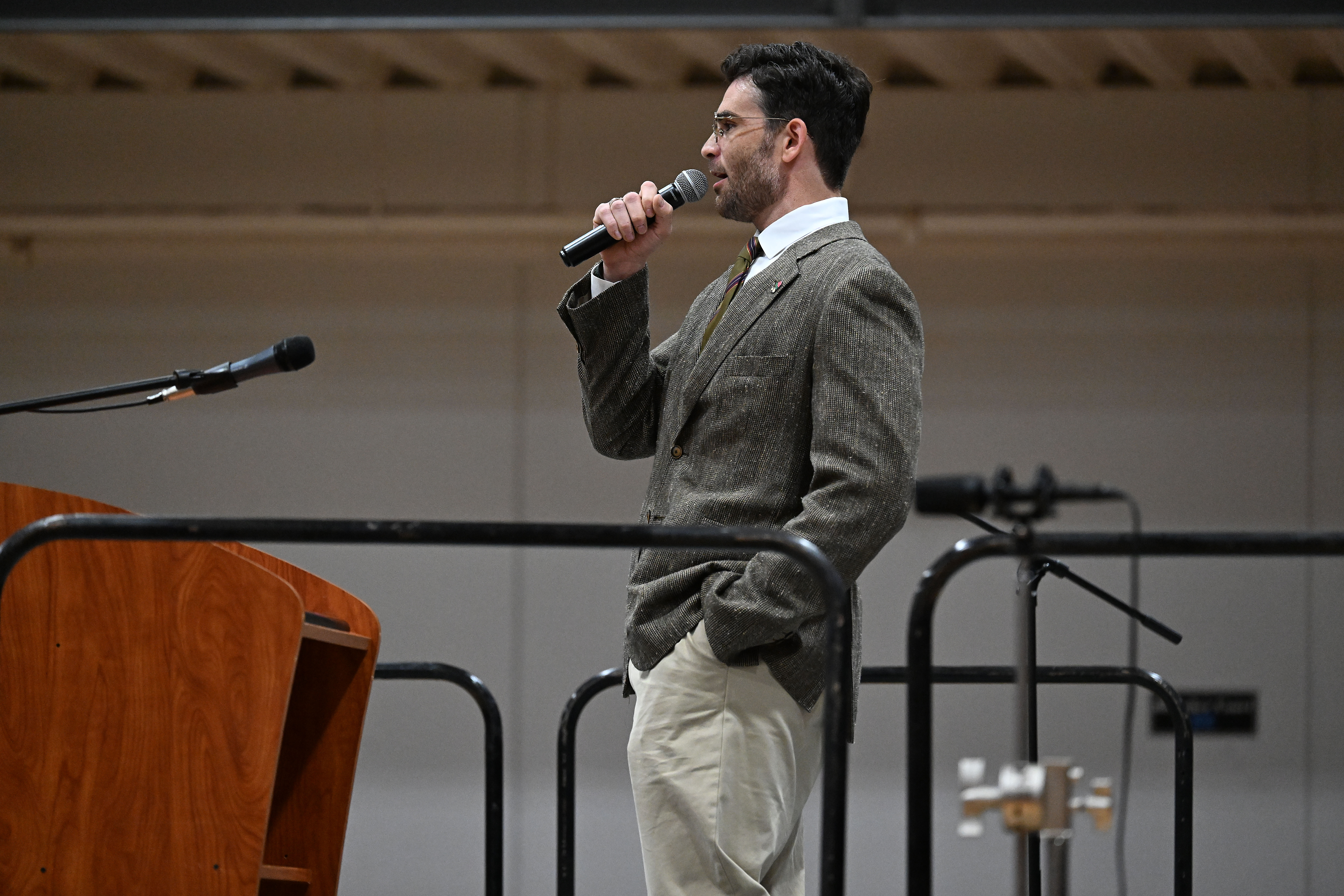
The investigation was led by commissioners Peter Kirsanow and former Democratic Rep. Mondaire Jones.
“This bipartisan, unanimously adopted report sends a clear message that protecting students from antisemitism is a shared civil rights responsibility,” commission Chair Rochelle Garza said in a statement. “Students deserve protection from discrimination and harassment while colleges and universities uphold free speech and expression. This report provides a factual foundation to help policymakers and higher education leaders move that work forward.”
The report’s comments on the Trump administration’s efforts could provide further fuel to Democratic efforts to investigate the White House’s responses to campus antisemitism.
Rep. Jake Auchincloss (D-MA) led a bipartisan congressional letter in 2024 urging the USCCR to conduct an investigation into campus antisemitism — the first such investigation by the panel since the early 2000s when there were fewer than 100 complaints of campus antisemitism per year.
“After October 7th, I went to Boston-area campuses to meet with Jewish & Israeli students & faculty. What I saw and heard was unacceptable: Jewish students socially marginalized and Israeli students downright discriminated against,” Auchincloss said in a statement to Jewish Insider following the release of the report.
“Federal and university leadership must not accept hostile learning environments for any students, and should insist on open inquiry and free debate untarred by zealotry.”
More Stories

EDIT WARS
Wikipedia failed to address coordinated anti-Israel campaign, new ADL study finds
PRAIRIE STATE PRIORITIES
Illinois Democrats spend big for anti-Israel candidate running for state Senate
ALBANY ALLIANCE
Jewish New York Dems launch PAC to counter antisemitism and anti-Zionism
FIRING FALLOUT
Hillels of Georgia claims fired Emory rabbi not ‘truthful or transparent’ during hiring process
RIPPLE EFFECT
New York’s suburban Dems face a Mamdani dilemma

Regional Responsibility
Amb. Tom Barrack: It’s ‘not America’s job’ to combat Iran-backed threats in the Middle East
Please log in if you already have a subscription, or subscribe to access the latest updates.
 Continue with Google
 Continue with Apple