


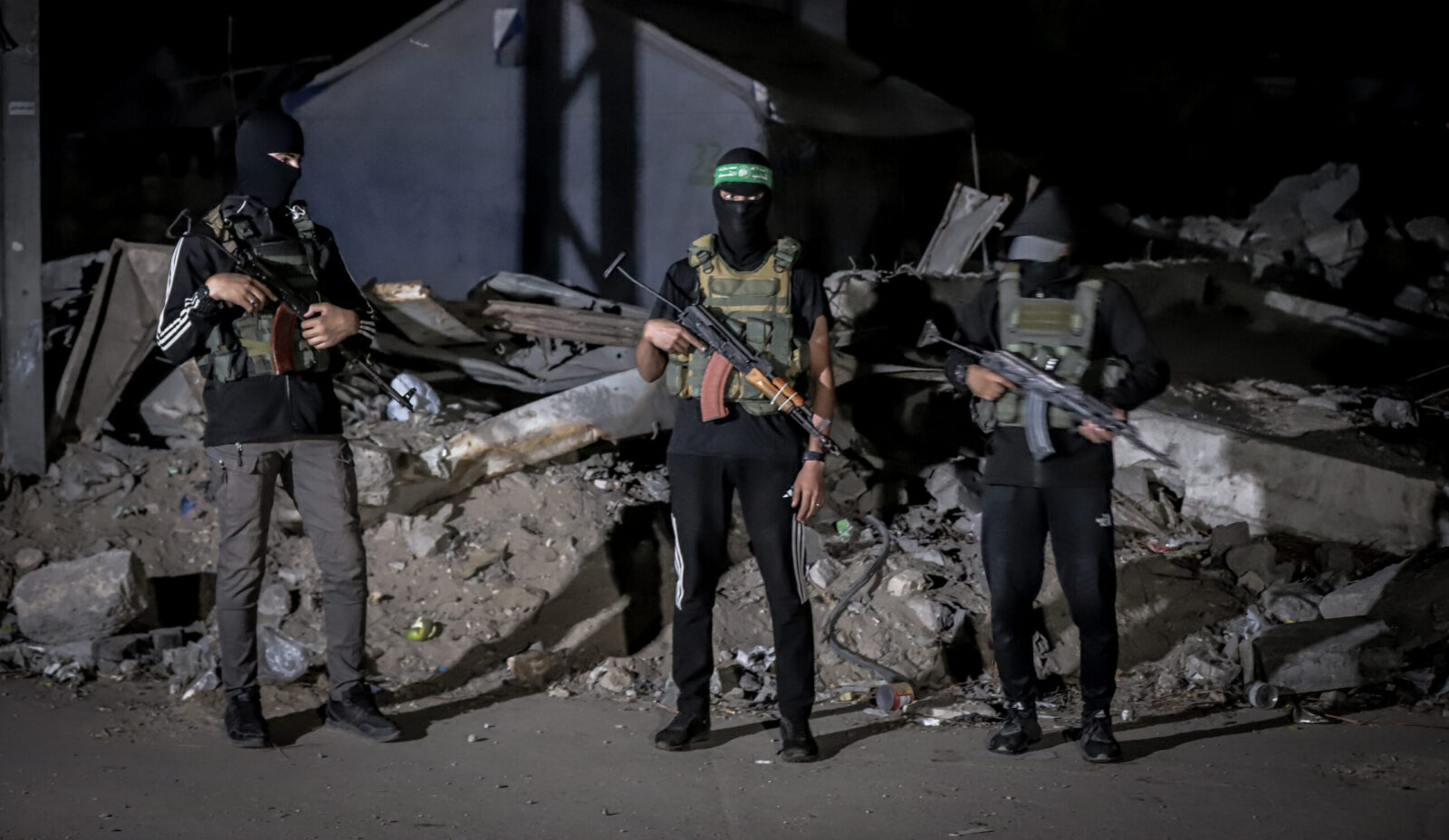
Saeed M. M. T. Jaras/Anadolu via Getty Images
White House needs to confront limits of Hamas disarmament, experts say
The options for demilitarization ‘strike me as not feasible from a military point of view and certainly not practical from a political point of view,’ says the Carnegie Endowment’s Aaron David Miller


 Add JewishInsider on Google
The White House launched Phase 2 of President Donald Trump’s 20-point Gaza peace plan last month, intending to transition the enclave toward demilitarization, technocratic governance and reconstruction. But before those plans can move forward, the administration still needs to confront a central reality on the ground: Hamas remains armed and unwilling to cooperate.
During the World Economic Forum in Davos, Switzerland, in January, the Trump administration unveiled the National Committee for the Administration of Gaza (NCAG), a committee of technocrats intended as a post-Hamas governing authority, alongside an outline for reconstructing the enclave.
That vision, however, was quickly challenged by Hamas’ leadership. Speaking at the Al Jazeera Forum in Doha, Qatar, this past weekend, Hamas leader Khaled Mashaal, who is under U.S. indictment on terrorism-related charges, rejected the U.N. Security Council–backed plan for Gaza — a move that could complicate disarmament and Phase 2 efforts.
Experts told Jewish Insider that the administration’s expectation that Hamas can be persuaded to voluntarily hand over its weapons is detached from the group’s incentives and its perception of the war’s outcome.
“Without first disarming Hamas, progress on every other facet of Phase 2 will be minimal at best,” said Jonathan Ruhe, a fellow at the Jewish Institute for National Security of America. “The U.S. needs to adapt its strategy, which remains stuck on convincing Hamas to hand over its weapons.”
Ruhe said Hamas believes it “won the war” and therefore “can’t be incentivized to give up” power. He added that, absent voluntary disarmament, the administration may need to consider using well-vetted and tightly overseen “private military contractors” to carry out the task, a suggestion also recently put forward by former special envoy for Iran and Venezuela Elliott Abrams and JINSA’s Eric Edelman and Rena Gabber.
Other experts were similarly skeptical that Hamas would relinquish control voluntarily. Michael Koplow, chief policy officer at the Israel Policy Forum, warned that Hamas is not going to “want to voluntarily give up their weapons without real guarantees,” adding that the group’s incentive to comply is “not very high.”
“If you’re going to get [Hamas to comply with the plan], it’s going to have to involve some sort of guarantees for the group and guarantees for the leadership, which are going to be very difficult for the Israelis to swallow,” said Koplow.
Aaron David Miller, a senior fellow at the Carnegie Endowment for International Peace, said Hamas is also unlikely “to surrender the actual administrative control of Gaza.” He outlined what he described as a narrow and unattractive set of options for disarmament.
“There are only two ways to fundamentally demilitarize Hamas,” Miller said. “There are only two forces capable of doing it. One would be the IDF, and you’ve seen how that has gone over the course of the last 2 ½ years. The second would be the deployment of thousands of American combat forces, which would take a while and result in a permanent occupation of Gaza by the U.S. military. Both of these strike me as not feasible from a military point of view and certainly not practical from a political point of view.”
Miller added that any disarmament process would likely need to be accompanied by an Israeli withdrawal from additional areas in Gaza. The IDF currently controls more than half of the territory, demarcated by what officials refer to as a “yellow line.”
Until Hamas is disarmed, Miller said Israel is unlikely to permit large-scale reconstruction, given concerns that materials such as cement and metal tubing could be diverted for tunnel construction and weapons production.
Koplow also noted military means as an option for disarmament, but said the Trump administration appears to be leaning toward a “DDR” process — disarmament, demobilization and reintegration — an alternative to military force in which Hamas would give up heavy weapons first, transition away from armed activity and then reintegrate former fighters into civilian life.
“The idea is that you’re not going in and destroying the group,” Koplow said. “You’re first getting rid of their weapons, you’re then trying to transform the group itself into something different and then you’re reintegrating the group’s members back into society. Historically, that’s the way that terrorist groups like this are disarmed.”
Koplow cautioned that any such effort would be slow and contentious. “Hamas is going to make it difficult,” he said, adding that demilitarization will be “a long and drawn-out and very difficult process if it has any chance of working.”
“After all these months, the ISF still lacks a clear mandate,” Jonathan Ruhe, a fellow at the Jewish Institute for National Security of America, said. “If Hamas disarmed voluntarily, as Trump’s plan envisions, any number of countries would contribute troops for relatively safe peacekeeping duties like safeguarding humanitarian aid, police training and border patrol. But because Hamas won’t disarm peacefully, Arab and other Muslim countries consistently refuse to put their forces in harm’s way.”
Under Trump’s original 20-point plan, a U.S.-led International Stabilization Force (ISF) was envisioned as a “long-term internal security solution.” Last month, Trump appointed Maj. Gen. Jasper Jeffers as commander of the ISF, and Israeli media reported on Monday that thousands of Indonesian soldiers were expected to deploy to southern Gaza in the coming weeks as part of the first foreign contingent.
Despite those moves, experts say the ISF remains constrained. No other countries have formally joined the force, and efforts to assemble it have been complicated by reluctance among potential contributors and Israeli security concerns over which countries would be permitted to participate. Analysts also say the ISF still lacks a clearly defined mandate and could be limited to a supporting role rather than directly confronting Hamas.
“After all these months, the ISF still lacks a clear mandate,” Ruhe said. “If Hamas disarmed voluntarily, as Trump’s plan envisions, any number of countries would contribute troops for relatively safe peacekeeping duties like safeguarding humanitarian aid, police training and border patrol. But because Hamas won’t disarm peacefully, Arab and other Muslim countries consistently refuse to put their forces in harm’s way.”
Miller said the ISF would most likely deploy in areas already under Israeli control, rather than Hamas-held territory. “I see the stabilization force as exactly what its name implies,” he said. “It would be an after-the-fact deployment to monitor and stabilize. The heavy work of actually decommissioning weapons is going to take a very long time.”
Even if demilitarization were achieved, Miller said the question of whether and how Hamas members could be integrated into future governance remains unresolved. The group maintains an extensive bureaucratic apparatus in Gaza, including tens of thousands of civil servants and police officers, whose future role would need to be addressed.
“It’s probably going to involve making distinctions between Hamas fighters and Hamas bureaucrats, and making some very difficult choices about what level of reintegration, if any, you’re willing to allow for former Hamas members,” Michael Koplow, chief policy officer at the Israel Policy Forum, said.
“Hamas has 40,000 civil servants and 10,000 police,” Miller said. “Those people would be under the administration of whom?”
Koplow suggested that the group be completely dismantled and barred from maintaining governing authority.
“Hamas as a group, and certainly not as it’s currently constituted, can’t responsibly be given any role in future Gaza governance,” said Koplow.
“It’s probably going to involve making distinctions between Hamas fighters and Hamas bureaucrats, and making some very difficult choices about what level of reintegration, if any, you’re willing to allow for former Hamas members,” Koplow added. “Then the question is, does anybody who’s ever had a Hamas affiliation have to be hunted down and eliminated over time, or is there a world in which they can, as individuals, be integrated into whatever future Gaza governance and society looks like?”


Please log in if you already have a subscription, or subscribe to access the latest updates.
 Continue with Google
 Continue with Apple