


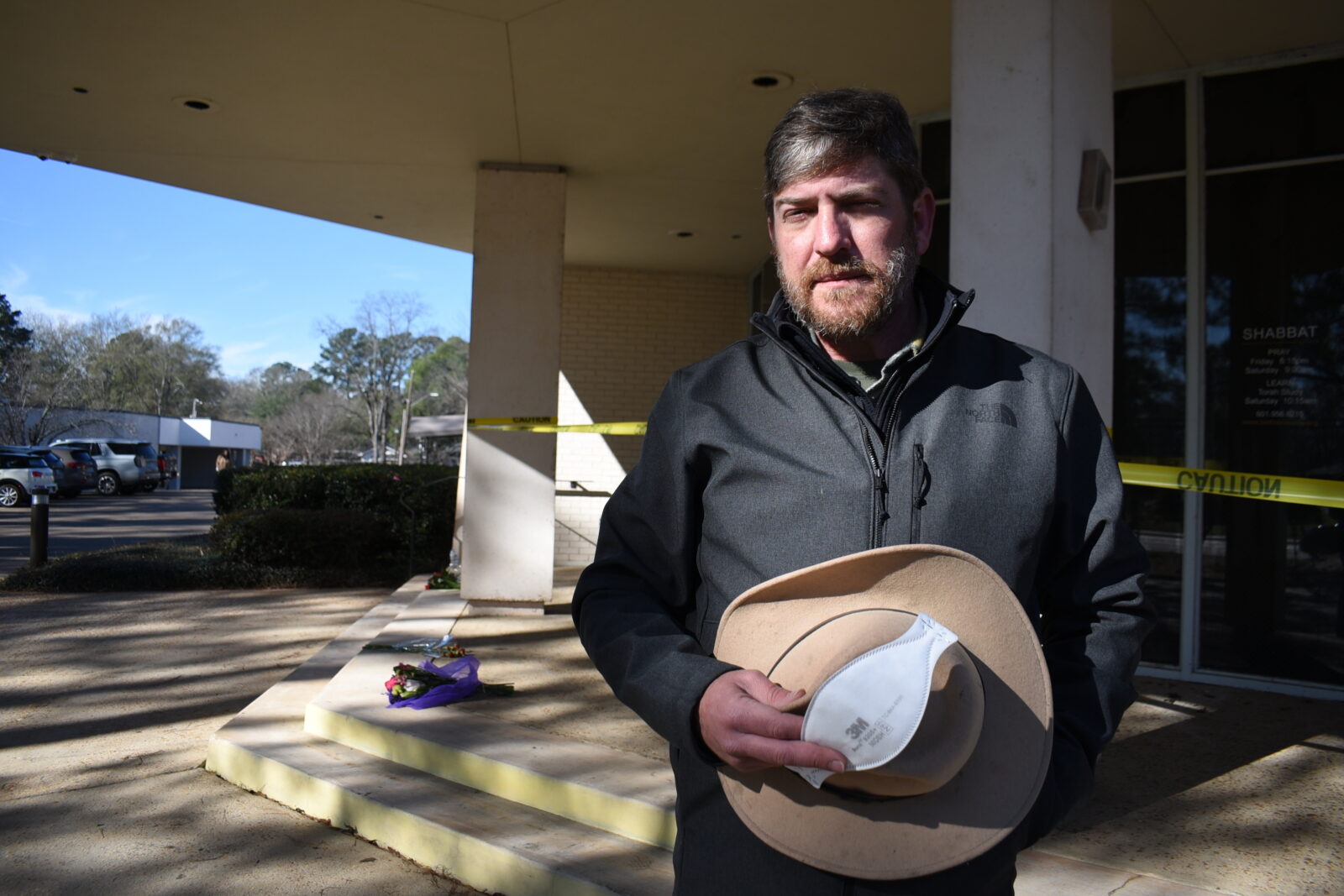
Sophie Bates/AP
Mississippi’s Jewish community rallies after antisemitic arson
Beth Israel Congregation in Jackson has received support from churches and Jews all over the country, and has seen a revival of interest in membership


 Add JewishInsider on Google
As the sun went down Friday night, Mississippi’s Jewish community packed the pews of Northminster Baptist Church in Jackson to welcome Shabbat.
Aside from the unusual location, the weekend’s schedule was typical — Friday evening prayers to bring in Shabbat, followed by a meal and oneg; a bat mitzvah service on Saturday morning; Havdalah to conclude Shabbat and Sunday school classes the next day.
But this week, each service was also an act of defiance.
For members of Beth Israel Congregation — the only synagogue in the state’s capital city — this was their first Shabbat since an arson attack heavily damaged their place of worship. The suspected arsonist, Stephen Spencer Pittman, 19, admitted to starting the blaze on Jan. 10 due to “the building’s Jewish ties,” and referred to the institution as the “synagogue of Satan,” a historically antisemitic phrase that has been re-popularized by far-right commentator Candace Owens.
Located in a major hub of the Civil Rights Movement, Beth Israel was bombed in 1967 by the Ku Klux Klan over the rabbi’s support for racial equality — including providing chaplain services to activists incarcerated for challenging segregated bussing in the state.
Two Torah scrolls were destroyed in last week’s fire, and five more were damaged. A Torah that survived the Holocaust, which was kept in a glass case, was unharmed. The congregation’s library and administrative office were also destroyed. Synagogue leaders estimate it will take two or three years to rebuild.
But throughout Shabbat services, which were also attended by Jackson Mayor John Horhn and members of various local churches in a show of solidarity, “the feeling was not sadness, it was joy,” Zach Shemper, the congregation’s president, told Jewish Insider.
“The silver lining of all of this is Jews who weren’t members or necessarily active before are coming in and saying they want to be members,” said Shemper, adding that 140 families are currently members of Beth Israel, Mississippi’s largest synagogue. “Members who left over the years are saying, ‘We want to be part of the family again.’ So the intent of the [arsonist], everything he intended to happen, it’s the exact opposite. The people here in Jackson said not only ‘we don’t mind the Jews,’ but in fact they said, ‘We want you here, what can we do to accommodate?’”
On Thursday, the city held an interfaith prayer event at the Thalia Mara Hall in downtown Jackson, an event that had already been planned as a community gathering but was dedicated to prayers for Beth Israel as a response to the fire.
The offer from Northminster Baptist Church to host services indefinitely follows a long-standing relationship between the two houses of worship. In the 1960s while the church was being built, Beth Israel allowed them to hold services in the synagogue. “Here we are 60 years later, they are able to return the favor,” said Shemper, adding that “multiple churches have reached out and offered their worship space as our worship space.”
Jewish communities near and far have also been quick to step in and offer assistance. B’nai Israel in Hattiesburg — a smaller Mississippi town about 90 miles away — loaned two Torahs and 50 prayer books. A congregant drove to Memphis to pick up 100 more siddurim from another synagogue.
“Really, that’s all we need,” said Shemper. But Jewish communities haven’t stopped there.
A synagogue in New Orleans sponsored the Friday night oneg and sent King Cake Challah. Several other congregations have created rebuilding funds.
On Friday, UJA-Federation of New York announced a $100,000 grant to support recovery and rebuilding. Jackson does not have its own Jewish federation.
“I came out here to be present and responsive on behalf of Jewish Federations of North America, to meet folks on the ground and coordinate resources, including immediate security needs and to support the work ahead so that this community can move forward and Jewish life can continue,” Sheila Katz, chief Jewish life officer of JFNA, told JI.
“We covered the cost of some of the immediate security needs here. We’ll be physically and emotionally connected with this synagogue for a long time,” said Katz, who traveled from Washington to Mississippi.
“[One] of the most impactful things to witness is how excited the synagogue leadership has been about Jews not connected to Jackson who have wanted to be helpful,” she continued. “People have offered Torahs, prayer books, food, office space in Mississippi that they offered to give for free. There’s a powerful connectedness of the Jewish people. There’s a feeling of resiliency, being called to this moment that nobody wants to be called to. They understand that Jewish life is bigger than a building.”
“Jewish life in the south in a small town has always been resilient,” said Katz.
Abram Orlansky, a 41-year-old lawyer who was born and raised in Jackson and grew up attending Beth Israel, where he remains a member and sends his kids to Hebrew school, echoed a sense of resilience that comes with growing up Jewish in the Bible Belt.
Orlansky’s son was the last person to be bar mitzvahed in the now-damaged building, last May.
“We are a smaller congregation than we used to be,” said Orlansky, noting that about 215 families belonged to the Reform congregation when his parents joined in the ‘80s. “[But] community-wide, I’m seeing resilience. Nothing could have energized Jewish life in Jackson more than this has.”
“The main takeaway for our community is that this fellow was trying to snuff out Judaism in Jackson and he has by far had the opposite impact. He wanted us to feel like the other, but the embrace we feel from the wider community speaks to how welcome we really are.”
Featured Stories
Please log in if you already have a subscription, or subscribe to access the latest updates.
 Continue with Google
 Continue with Apple