

















The mixed signals and high stakes of Trump’s Iran strategy
Trump, true to form, has been unpredictable and inconsistent in his approach to Tehran — alternating between threatening force and teasing diplomacy
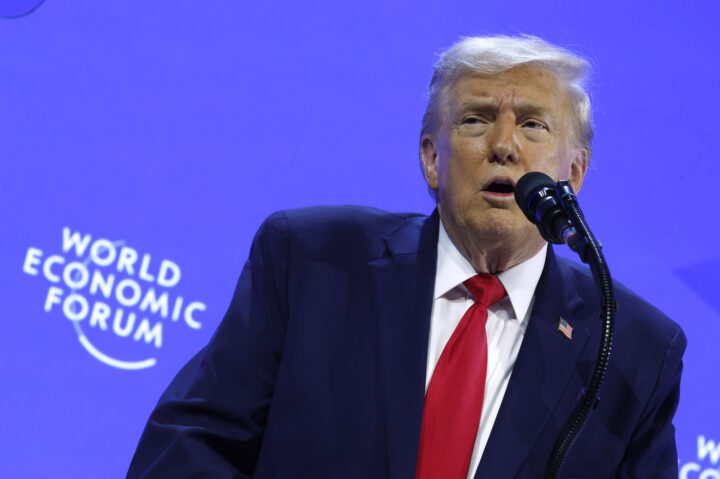
Chip Somodevilla/Getty Images
U.S. President Donald Trump gives a speech at the World Economic Forum (WEF) on January 21, 2026 in Davos, Switzerland.


 Add JewishInsider on Google
Tensions are running high across the Middle East after a week in which the U.S. and Iran lobbed threats at each other, dominating headlines, destabilizing markets and leaving many in the region unnerved at the prospect of renewed military action seven months after the 12-day war between Israel and Iran that included U.S. strikes on Iranian nuclear facilities.
On the sidelines of the World Economic Forum in Davos, Switzerland, yesterday, Trump warned that an “armada” was on its way to the Gulf — a reference to the aircraft carrier and fleet of fighter jets being redeployed from the South China Sea.
In response, Gen. Mohammad Pakpour, the head of Iran’s Islamic Revolutionary Guard Corps, warned that Iran had its “finger on the trigger, more prepared than ever, ready to carry out the orders and measures of the supreme commander-in-chief.”
Trump, true to form, has been unpredictable and inconsistent in his approach to Tehran — alternating between threatening force and teasing diplomacy. “Iran does want to talk, and we’ll talk,” Trump said at a signing ceremony in Davos on Thursday, just hours before he told reporters on Air Force One about the naval deployment to the Gulf. “We have a massive fleet heading in that direction, and maybe we won’t have to use it,” he said on AF1, managing in one whiplash-inducing sentence to lob a threat at Iran while also offering it a theoretical off-ramp.
The president has proven that he is willing to engage in bold action — especially when it comes to Iran. One has only to look to the 2020 killing of Quds Force head Gen. Qassem Soleimani or the U.S. strikes on Iranian nuclear facilities last June to see that the Trump administration is willing to engage militarily with Iran in ways prior administrations may have not. (Case in point: former President Joe Biden’s issuance in April 2024 of a one-word warning to Iran — “Don’t” — a day before Tehran launched hundreds of missiles and drones at Israel.)
More recently, the capture of Venezuela’s Nicolás Maduro demonstrates that the Trump administration isn’t opposed to regime change. And indeed, that was a possibility the president has mulled vis-a-vis Tehran, telling Politico last weekend that it was “time to look for new leadership in Iran.”
Meanwhile, Trump’s inner circle and key allies are split over how to approach Iran. White House Special Envoy Steve Witkoff has been a vocal backer of using diplomacy to quell tensions with Tehran.
“Iran needs to change its ways,” Witkoff told Bloomberg on Wednesday in Davos. “They need to do that. And if they do, if they indicate that they’re willing to do that, I think we can diplomatically settle this.”
Witkoff additionally expressed disappointment that Iranian Foreign Minister Abbas Araghchi had been removed from the agenda at Davos after quietly being added last week, saying he had been “looking forward to meeting [Araghchi], because we have to build that communication channel, because the alternative to that is not a good alternative.”
Hours after Witkoff’s comments, Sen. Lindsey Graham (R-SC) posted a thinly veiled reference to the White House envoy, saying he was “unnerved by statements being made by people involved in the Iran file suggesting that if the ayatollah could change his ways, we might be able to reach an agreement with the regime.”
“Anyone who believes that the ayatollah is remotely interested in changing his ways does not understand the history of the ayatollah and the murderous regime,” Graham continued. “That’s the same as believing someone could have done a deal with Hitler.”
Within Iran, there are still hopes that U.S. action will topple Supreme Leader Ayatollah Ali Khamenei. The Economist notes a joke making the rounds among Iranian civil servants: “We used to worry we’d become Venezuela. Now we worry we won’t.”
Heading into the weekend with tensions still high, those who have to live with the consequences of the continuation of the Iranian regime — from the Iranians who have faced years of repression to the Israelis preparing their bomb shelters for the next war to people across the region whose lives have been upended by Iran’s proxies in Lebanon, Syria, Iraq and Gaza — will be watching closely for any signal from Trump and his top advisors about Washington’s next moves, and their reverberations around the world.
Please log in if you already have a subscription, or subscribe to access the latest updates.
 Continue with Google
 Continue with Apple