













New Venezuelan president signals similar anti-American foreign policy as Maduro
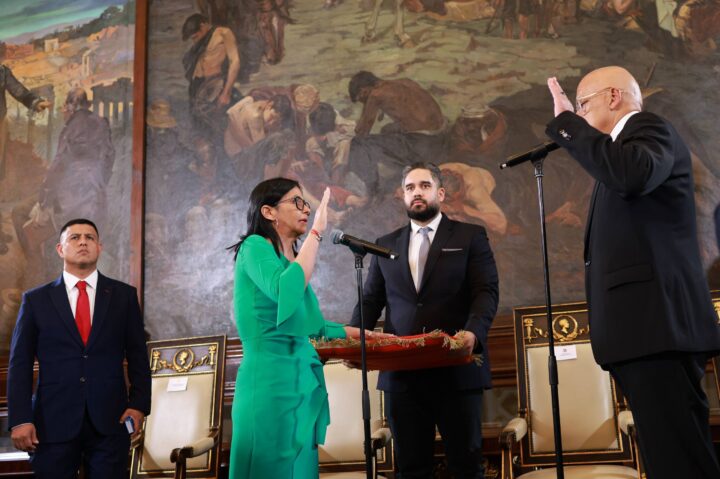
At a swearing-in ceremony on Monday, interim President Delcy Rodríguez appeared to embrace the ambassadors of Iran, China and Russia
Venezuelan National Assembly/Anadolu via Getty Images
At the opening session of the National Assembly, Delcy Rodriguez (2nd L) is sworn in as acting president of Venezuela on January 5, 2026.


 Add JewishInsider on Google
In the aftermath of U.S. strikes in Venezuela and the capture of leader Nicolás Maduro, uncertainty remains over whether the South American country’s ties to key U.S. adversaries and hostile posture toward Israel will change under interim President Delcy Rodríguez.
During his time in power, Maduro’s Venezuela had been deeply embedded in a broader network of U.S. adversaries, particularly Iran, Russia and China.
Dana Stroul, research director at the Washington Institute for Near East Policy, explained that Venezuela “is a key supplier of cheap oil to China and has provided fertile ground for Iran’s terrorist network abroad.”
“Venezuela under Maduro was firmly part of the anti-American bloc of countries seeking to upend the post-WWII order,” said Michael Koplow, chief policy officer at Israel Policy Forum. “Venezuela has particularly tight financial links with Iran and Hezbollah involving drugs and money laundering.”
The U.S. operation to oust Maduro was condemned by both China and Iran, who called it a violation of international law and demanded the illegitimate leader be freed. Experts have told Jewish Insider that the move potentially weakens Tehran’s hold in Latin America.
“It’s no surprise that the key enablers of the Maduro regime have all rejected the U.S. actions in Venezuela,” said Stroul. “They are now faced with the challenge of filling the Western Hemisphere gap in their network of anti-U.S. stakeholders.”
Jonathan Ruhe, a fellow at the Jewish Institute for National Security of America, said China and Iran will “miss having a Venezuelan partner to poke America in the eye from close range, launder their money, run their drugs and buy their weapons.”
Maduro also positioned himself as a consistent adversary of Israel, severing diplomatic relations in 2009 and repeatedly aligning Caracas with Palestinian causes and with Iran. After Venezuela’s disputed election in July 2024, Maduro accused “international Zionism” of orchestrating unrest in the country, claiming in a televised address that “all the communication power of Zionism, which controls all the social networks, the satellites and all the power, is behind this coup d’état.”
But despite Maduro’s capture and vows from Venezuelan opposition leader María Corina Machado to return to the country and reject the authority of the interim president, the U.S. appears to be backing Rodríguez, who is closely aligned with Maduro and has shown a similar posture when it comes to Israel and U.S. adversaries, creating concerns over whether the direction of Venezuela’s foreign policy will change.
Brad Bowman, a senior director at the Foundation for Defense of Democracies, told JI that the Trump administration’s apparent backing of Rodríguez is a “mistake” and that he doesn’t see “any reason to believe” she would depart from Maduro’s approach to U.S. adversaries.
“I have concern that we still have most of the problematic elements of the regime in Venezuela remaining in place,” said Bowman. “[Rodríguez] has been part of a regime that has been hostile to the United States and cozy with the Islamic Republic of Iran and its terror proxies. If one were a betting person, you would say at a minimum that [Rodríguez] is going to continue to harbor those problematic views toward China, Russia and Iran, if not manifest them in policy.”
At a swearing-in ceremony on Monday, the new leader appeared to embrace the ambassadors of Iran, China and Russia. In an address to the nation on Sunday, Rodríguez claimed the U.S. operation to capture the illegitimate dictator had “Zionist undertones,” echoing the sentiments of her predecessor.
“Rodríguez wasted little time before blaming Jews — or Zionists — for Maduro’s capture,” said David May, a senior research analyst at the Foundation for Defense of Democracies. “A junior partner of Iran, China, and Russia’s axis of aggressors and host of the Hezbollah terrorist group, the regime of [former Venezuelan dictator Hugo] Chávez and Maduro will continue to be hostile to Israel and the West.”
Koplow said Venezuela’s tight bonds with Iran and Hezbollah create an “anti-Israel narrative that is wrapped up in any action regarding Venezuela.”
“The close U.S.-Israel relationship has created a decades-long anti-American and anti-Israel front that links opposition to one as part and parcel of opposition to the other in a larger anti-imperialist position that takes an anti-Western and anti-Zionist stance, and we are seeing that play out in the Venezuela situation as well,” said Koplow.
Ruhe said Rodríguez’s claims were “sadly unsurprising,” and that “the Venezuelan government needs a perpetual enemy to justify its own rule.”
“The United States is the most obvious target, but leaders in Caracas scapegoat Jews and Israel, too,” said Ruhe, who added that the interim president’s initial statements “indicate key continuities with Maduro and Hugo Chavez before him.”
Bowman added that it is “not impossible” to change Rodríguez’s course of action away from Maduro’s past policy if it benefits her “personal political interests,” noting that it may take “an extraordinary set of incentives to get her to change course.”
More Stories
meeting minutes
Huckabee met secretly with Netanyahu’s top rival, Gadi Eisenkot

EVENT RESCHEDULED
State Department to hold Oct. 7 commemoration event on Wednesday
PHONE A FRIEND
AOC launches campaign blitz for El-Sayed across Michigan
DAYLIGHT DEBATE
Brett McGurk pushes back on former Biden WH colleagues who called for greater pressure on Israel
PROBLEMATIC POST
Paxton senior advisor endorsed antisemitic slur on social media
BIBI BOOST
Netanyahu bloc gains on Gadi Eisenkot’s opposition in latest Israeli polls
Please log in if you already have a subscription, or subscribe to access the latest updates.
 Continue with Google
 Continue with Apple