










































































It was just one of several examples of influential state and national teachers’ unions presenting a roadblock against efforts to fight antisemitism in public schools

Holmes/Getty Images for National Urban League
A view of the California state capitol building.


 Add JewishInsider on Google
Over the weekend, the California State Assembly passed a bill that is intended to address what Jewish community advocates describe as crisis levels of antisemitism in the state’s K-12 schools.
The bill passed despite the objections of the powerful California Teachers Association, the state’s largest teachers’ union, which had stalled the legislation in July, claiming that efforts to combat antisemitism could impinge on teachers’ academic freedom when it came to discussing the Israeli-Palestinian conflict.
It was just one of several examples of influential state and national teachers’ unions presenting a roadblock against efforts to fight antisemitism in public schools, where discrimination against Jewish and Israeli students has skyrocketed over the past two years — even though many of those efforts have broad support from within the Jewish community, and from outside it, too.
In California, the CTA and anti-Israel groups like the Council on American-Islamic Relations were on one side of the issue, facing a diverse coalition of the bill’s backers that included the legislature’s Jewish, Black, Latino and Asian American and Pacific Islander caucuses. In an effort to appease the CTA during negotiations, some parts of the bill were removed, including language that would’ve defined what constituted an antisemitic learning environment.
But the union never changed course.
The CTA debacle began in July, just days after the representative body of the National Education Association — the national union to which CTA belongs — voted to cut ties with the Anti-Defamation League, a move that shocked many Jewish educators. And last December, an American Jewish Committee report accused the Massachusetts Teachers Association of promoting anti-Israel educational materials to its members. These developments have come amid a steady trickle of news reports over the last two years showcasing educators bringing controversial and at times antisemitic views into the classroom.
All of which raises an uncomfortable question for many Jewish parents: Why are unions that are committed to equity and representation often resistant to incorporating protections that Jewish families say will keep their kids safe and supported at school?
In California, the CTA said that a bill focusing only on antisemitism “might be seen as prioritizing one form of discrimination over others, potentially alienating groups facing other forms of systemic discrimination, such as Islamophobia, ableism or xenophobia.” But a companion bill passed by the legislature this weekend that takes aim at racism, gender discrimination, religious discrimination and homophobia in schools should render that argument moot. A CTA spokesperson declined to comment last week.
So far, though, the teachers unions have not been successful in their efforts to marginalize Jewish organizations and counter antisemitism measures.
The NEA’s top leadership quickly backtracked on the anti-ADL resolution (although they took a swipe at the organization in the process). In Massachusetts, a statewide antisemitism committee said in August that K-12 schools should implement the International Holocaust Remembrance Alliance’s working definition of antisemitism. In California, the 300,000-member CTA was not able to muster the political capital to quash the antisemitism bill. Gov. Gavin Newsom now has a month to decide whether to sign it.
“We’ve got a long way to go,” the ADL’s CEO, Jonathan Greenblatt, told Jewish Insider in July, to ensure “our community is respected for who we are.”
Moore joined with Utah Gov. Spencer Cox to speak about reaching across party lines and the need to end divisive rhetoric
Kevin Dietsch/Getty Images
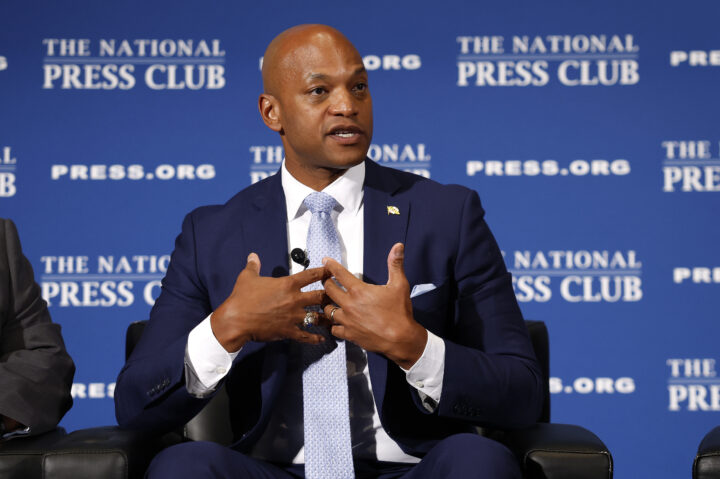
Maryland Gov. Wes Moore participates in a discussion on bipartisanship at the National Press Club on September 04, 2025 in Washington, DC.
When Gov. Wes Moore of Maryland took the stage on Sunday evening at the Capital Jewish Museum’s gala in Washington, he won over the crowd instantly with his opening line: “Shalom, friends.”
But as he continued his speech, Moore used the occasion — an introduction of the philanthropist David Rubenstein, one of the dinner’s honorees — to decry rising antisemitism in the United States and, in particular, the murder of Israeli Embassy staffers Sarah Milgrim and Yaron Lischinsky outside the museum in May.
“We received, once again, a very unneeded reminder of the fact that this nation still has wounds. That the level of antisemitism that we see in our society is not just intolerable, it’s heartbreaking,” said Moore. “I’m a person of deep faith, and while I might not have shared faith with them, Yaron was my brother and Sarah was my sister.”
“I know that in their name and in their lives, we are committed in the state of Maryland to making sure that Maryland can be a true safe haven for everybody to know that they should always and will always feel comfortable in their own neighborhoods, comfortable in their own environments, comfortable in their own skin, comfortable in their homes of worship, and comfortable in the thing that gives them peace and joy,” said Moore.
“In the state of Maryland,” Moore continued, “we will make sure that hate will never find oxygen.”
Moore, a popular Democrat who has been floated as a potential Democratic presidential contender, said on Meet the Press last week that he plans to seek reelection in 2026 and serve his full term — effectively ruling out a 2028 White House run.
The Sunday evening gala honored the investor and philanthropist David Rubenstein and Esther Safran Foer, the former longtime CEO of Sixth & I Synagogue and the Capital Jewish Museum’s founding board president.

Gabby Deutch
CNN anchor Dana Bash says the HaMotzi blessing with investor and philanthropist David Rubenstein and Esther Safran Foer, the former longtime CEO of Sixth & I Synagogue and the Capital Jewish Museum’s founding board president
When several hundred people gathered on Sunday evening at the French Embassy in Washington for the Capital Jewish Museum’s second annual gala, they did so in service of a simple theme: “preserving history and building bridges.”
That message was particularly resonant as the evening’s honorees and organizers paid tribute to a tragic moment in recent history that will be part of the story of Washington’s Jewish community forever: the murder of Israeli Embassy staffers Sarah Milgrim and Yaron Lischinsky outside the museum in May.
“It was a horrific, brazen act of antisemitic violence, a wrenching reminder of the importance of what the museum does every day of its existence and the fact that it collects artifacts, but it is a living, breathing place for a viable Jewish community to go, and that’s what was happening that day,” CNN anchor Dana Bash, who emceed the gala, said at the start of the event, as she introduced a moment of silence for Milgrim and Lischinsky.
The Capital Jewish Museum opened in downtown Washington in 2023 with a commitment to teaching the history of the District’s local Jewish community, in the context of the city’s unique role as a nexus for civic-minded Americans. Speakers throughout the evening, including Washington Mayor Muriel Bowser and Maryland Gov. Wes Moore, touted the diversity and warmth of Washington while taking not-so-subtle jabs at President Donald Trump’s recent takeover of the city’s police force.
“You know that the real D.C. is 700,000 people that actually live here, go to work, raise their families and are tax-paying Americans,” Bowser said. “While we are diverse, we are also a connected city, and so we know in our honorees tonight that they have followed their faith [and] invested in their families, their city and their nation.”
The Sunday evening gala honored the investor and philanthropist David Rubenstein and Esther Safran Foer, the former longtime CEO of Sixth & I Synagogue and the Capital Jewish Museum’s founding board president. The two were asked, in conversation with Bash, where each traces their love of history.
For Rubenstein, the co-founder of the private equity giant Carlyle, who has supported major American institutions like the National Archives and the Kennedy Center, the answer was a sixth grade teacher who encouraged him to watch President John F. Kennedy’s inaugural address, sparking a lifelong love of American history. He used historical reference points — immigration quotes from 1915 and the doomed voyage of the MS St. Louis, a European ship with Jewish refugees on board that was turned away by the U.S. — to bemoan antisemitism as “at a level I’ve never seen before in my lifetime.”
Foer described a lifelong search for answers about her family’s story in Ukraine, which they fled after the Holocaust. She detailed that quest in her 2020 memoir, I Want You To Know We’re Still Here.
“Pulling together the family history and the context of the history of the times has been kind of a lifelong obsession for me,” said Foer, who was born in Poland in a displaced persons camp soon after World War II ended.
“My background is a Holocaust background, but when I wrote my book and I was working on the title, my working title was, ‘I Want You To Know We’re Still Here,’ and it ultimately became a title, because that’s our story. The Holocaust happened at a terrible time, a terrible place, but there’s a vibrant Jewish life here, in other countries. We need to celebrate that, and a museum is a way to celebrate that, to keep telling the stories.”
The suspected shooter, like several other recent attackers, was active in violent online forums and showed a fascination with previous mass killers

CHET STRANGE/AFP via Getty Images
Police officers on the scene at Evergreen High School where a shooting occurred earlier in the day, in Evergreen, Colorado on September 10, 2025.
Desmond Holly, the suspected shooter who critically injured two students at Evergreen High School in Colorado on Wednesday, shared antisemitic and white nationalist views online, according to the Denver Post and the Anti-Defamation League.
Local authorities said Thursday that Holly had been “radicalized by some extremist network,” without specifying further.
According to the Denver Post, one of Holly’s online accounts used a coded slogan for Holocaust denial and reposted antisemitic videos and other videos showing individuals in Nazi uniforms.
The ADL’s Center on Extremism said Friday that Holly’s TikTok accounts were “filled with white supremacist symbolism,” including a reference to the white nationalist “14 words” slogan, and utilized a neo-Nazi symbol in his profile photo.
The ADL reported that Holly, in online interactions, shared photos of patches he had created featuring neo-Nazi symbols, similar to those used by prior mass shooters. He also shared a photo of himself in a mask that featured multiple white nationalist symbols and slogans, including “TJD” — standing for “Total Jew Death.”
According to the ADL, Holly collected tactical gear — inspired in some cases by past mass shooters — which he decorated with extremist symbols, posted internet content mimicking prior shooters and suggested in online comments that he was preparing to carry out an attack.
His accounts included numerous references to Brenton Tarrant, the far-right killer who murdered 51 at two mosques in New Zealand, among other mass killers.
Holly also maintained an account on an internet forum where users share images and footage of various deaths and murders, and commented on posts about past mass shootings, according to the ADL research. The platform has been used by multiple prior mass shooters.
Similar fascinations with extremist and antisemitic views and prior school shooters, as well as apparent interactions with online extremist networks, have been a feature of several recent mass attacks.
“The deeply disturbing specifics of this case follow a pattern recently discovered by ADL Center on Extremism, which its analysts have found in at least three school shootings committed by young people over the past year,” the ADL report stated, including engagement with some of the same online forums.
The Colorado shooting took place shortly after the killing of right-wing influencer Charlie Kirk in Utah.
A section that defined antisemitism and provided examples of an ‘antisemitic learning environment’ were stripped out before passage
Holmes/Getty Images for National Urban League
A view of the California state capitol building.
A key California Senate committee voted on Wednesday to advance an amended bill targeting antisemitism in K-12 schools, following two months of closed-door negotiations that came after the state’s largest teachers’ union announced its opposition to the bill and stalled its passage.
The version of the bill that came before the Senate Education Committee on Wednesday night was markedly different from an earlier version that had been approved unanimously by the State Assembly in May. But when the 300,000-member California Teachers Association came out against the bill in July, arguing that its targeting of antisemitism could affect teachers’ “academic freedom,” lawmakers scrapped a planned hearing in order to take time to try to assuage the powerful union.
The CTA never withdrew its opposition to the bill, and the group’s chief lobbyist urged senators to vote against it at a Wednesday hearing that saw more than 500 people testify about the legislation. Tyler Gregory, CEO of the Jewish Community Relations Council of the Bay Area, said the union had been “negotiating in bad faith.” A CTA spokesperson did not respond to a request for comment.
“I am disappointed that they’re still opposing the bill so aggressively. We’ve worked so hard to address their concerns,” state Sen. Scott Wiener, a San Francisco Democrat who chairs the Legislative Jewish Caucus, told Jewish Insider. “It’s a narrower and more focused bill than it was before, but it’s still quite impactful and it sets some clear standards, and creates an antisemitism coordinator, so it’s a good bill.”
The bill would create a statewide Office of Civil Rights, where a new antisemitism prevention coordinator would be located. If the bill passes, that office will track antisemitism in California schools and provide antisemitism education to California teachers and administrators to help prevent and combat discrimination.
Although the legislation would provide educational materials about antisemitism to school personnel, the biggest change from the prior draft was the removal of a section that defined antisemitism and provided examples of what would constitute an “antisemitic learning environment.”
These examples included “assertions of dual loyalty directed at Jewish individuals or communities,” “equating Jews or Israelis with Nazis or Nazi Germany,” “denial, erasure, or distortion of Jewish history, ancestry, identity, or culture” and “language or images directly or indirectly denying the right of Israel to exist, demonizing Jewish people, or saying that Jewish people do not belong in a country or community.”
Instead, the plan endorsed a 2024 antisemitism strategy authored by Gov. Gavin Newsom and the 2023 plan released by the Biden White House.
“There was a lot of discussion about how antisemitism should be defined, and ultimately there wasn’t sufficient consensus for that to be a part of the bill,” said Robert Trestan, vice president of the Anti-Defamation League’s western division. “There are sufficient effective provisions of the bill that will make a difference for Jewish students in California, and if we didn’t think it’s going to be effective, we wouldn’t support it.”
A CTA board member wrote in an August op-ed that the bill’s sponsors “are trying to bring right-wing, Trump-style censorship to California schools while undermining legitimate efforts to fight antisemitism.”
Wiener said Trump’s heavy-handed approach to antisemitism at U.S. universities has complicated efforts for California lawmakers to address the issues.
“It’s made our lives harder. I understand the sensitivity given the current political environment,” said Wiener. “That said, when you have a large number of Jews, including Jewish parents and Jewish students, coming forward and saying, ‘We have a problem and we need to solve it,’ you shouldn’t just dismiss that or say, ‘Oh, well, it’s too harsh because of academic freedom.’”
He suggested there’s a double standard at play when it comes to arguments about academic freedom and its connection to antisemitism.
“If a teacher started teaching that there were good sides of slavery, I am confident that the school would shut that down immediately and that no one would argue,” Wiener said. “But when it comes to Jews, well, then it’s about academic freedom.”
The Senate Education Committee voted the bill out of committee unanimously, and it was approved by the Senate Appropriations Committee on Thursday night. It still needs to be passed by the full state Senate and then go back to the Assembly, all by the end of the week, when the legislative session ends, in order to make it to Newsom’s desk for his signature. A spokesperson for Newsom declined to comment.
The 13 senior police officials were in the midst of their trip when a terror attack occurred at a Jerusalem bus stop

CSI
Delegation of New York police chiefs at the Jerusalem Police Headquarters
A delegation of 13 senior police officials from the New York area returned to the U.S. on Friday fresh off an intensive week in Israel designed to increase their counterterrorism training and understanding of antisemitism.
Organized by Israel’s Ministry of Diaspora and Combating Antisemitism, along with U.S. Jewish security groups Community Security Initiative and Community Security Service, the trip included a tour of Mabat 2000, the visual surveillance system deployed by Israel Police and visits to the Nova music festival massacre site and several kibbutzim attacked on Oct. 7, 2023.
“These are all things that these police commissioners will all relate to,” said Mitch Silber, executive director of CSI.
“This trip has enhanced my understanding of Jewish culture, enabled me to observe firsthand the challenges Israeli law enforcement faces and will help us better protect the Jewish community and the county as a whole,” Kevin Catalina, the police commissioner of Suffolk County on Long Island, told Jewish Insider. “The knowledge and experience gained during this trip will no doubt prove invaluable.”
Silber reflected on a tour of Yad Vashem, Israel’s Holocaust museum and memorial — describing it as one of the most meaningful parts of the trip.
“You’ve got American police chiefs from the greater New York area walking through Yad Vashem, hearing about the origins of the Nazi regime and how the Holocaust happened.”
“The goal is to bring New York-area law enforcement and local security partners to Israel for training on antisemitism, how Israel encounters terrorism and [to learn about] the Arab-Israeli conflict,” Silber told JI. “How do you sensitize a police department that’s probably not particularly Jewish and to understand, why is it that they need to have a police car outside of a sukkah? What even is Sukkot? What is Yom Kippur? By helping them to understand the Jewish experience and why Jews seem to be disproportionately the target.”
The delegation was made up of senior police executives, chiefs and commissioners from Long Island, Westchester and Rockland counties and Connecticut. Many were returning to the Jewish state for their second time — following a similar trip that ran in early October 2023, but was cut short due to the Oct. 7 attacks.
“I was on the CSI/CSS trip that experienced Oct. 7 in Ashdod and had to be evacuated,” Mike Kopy, public safety commissioner of Rye, N.Y., told JI. “Even as we headed to the airport that day I saw the resilience of ordinary Israelis as they headed to their bases. I thought it was important to return now in order to better understand the current situation and take what we have learned about antisemitism and counterterrorism home to New York to better protect our Jewish community and residents.”
This trip also provided a firsthand glimpse into some of the challenges Israel Police confront. On Monday, six Israelis were killed when two terrorists opened fire at a bus stop in Jerusalem.
At the time of the shooting, “we were on our way to the Israel National Police Jerusalem command center,” said Silber. “We met with senior Jerusalem police officials to learn how you police a multiethnic, multireligious city like Jerusalem.”
According to data from early 2025, Jews were the target of 62% of all hate crimes in New York City. “Why is that?” Silber said. “Some of the lectures we’ve gotten are about the history of Jewish people in European countries and the trend of at some point a government deciding it’s not worthwhile protecting those communities and those communities have to move. It all depends on whether law enforcement wants to protect them or not.”
Chotiner recently devoted six consecutive Q&A interviews with guests about Israel, many of them contentious and combative

Robert Alexander/Getty Images
A woman retrieves a copy of The New Yorker magazine from her condominium cluster mailbox in Santa Fe, New Mexico.
As The New Yorker refrains from addressing its controversial decision to invite an antisemitic speaker to join its upcoming festival, the magazine has otherwise exhibited a notably hostile emphasis on Israel and related issues over the past few months.
Isaac Chotiner, a staff writer for The New Yorker well-known for conducting blunt and aggressive Q&As on a variety of news-related topics, has recently been fixated on Israel — focusing almost exclusively on the subject in what have often been combative interviews with defenders of Israel who span the political spectrum.
From late July to late August, Chotiner published six consecutive interviews concerning Israel, and conducted nearly a dozen more over the preceding three-month period. His two most recent interviews on the subject featured particularly contentious discussions with Jack Lew, former U.S. ambassador to Israel during the Biden administration, and Norman J.W. Goda, a professor of Holocaust studies at the University of Florida.
Speaking with Lew last month, Chotiner repeatedly challenged the Biden administration’s approach to Israel’s war in Gaza — using a relentlessly skeptical tone that the interviewer has not shown in his questioning of anti-Israel interlocutors.
In one illustrative exchange, Lew insisted that Chotiner was “putting words in my mouth” on a point about the Biden administration’s diplomatic engagement with Israel over the course of the war, with the former ambassador calling the issue more complex than he believed their conversation was permitting.
For his part, Goda, who has prominently argued against labeling Israel’s military conduct in Gaza a genocide, sounded frustrated with Chotiner’s line of questioning as they debated the issue during a Q&A conducted in August. At one point, Chotiner said he was “surprised” that Goda, who is widely respected in his field and had characterized “the relationship between Holocaust studies and the war in Gaza” as “very fraught,” would choose to focus on the semantics around allegations of genocide instead of “the actual situation going on in Gaza today.”
“You’re acting like I’m splitting hairs over the word ‘genocide,’” Goda replied, pushing back against the framing. “The word ‘genocide’ has been ricocheting around the internet and around social media.”
Chotiner, whose interviews often feature lengthy, bracketed responses added after his discussions have taken place, has previously engaged in tense conversations about Israel. The New Yorker writer has won praise for his prosecutorial approach on a range of issues — and his consistent ability to push his targets into uttering exasperated or unflattering remarks.
Some of his interviewees have seemed to regret speaking with him, including Jonathan Greenblatt, the CEO of the Anti-Defamation League, who took part in a heated debate three years ago about whether anti-Zionism equates to antisemitism. Asked by Chotiner if he would agree that “the debate over Zionism has not necessarily had this ‘anti-Semitic veneer’ for centuries, right? There are a lot of Jews who were anti-Zionists before,” Greenblatt responded: “Give me a—Isaac. Sure, there were Jews who were worried that it would create more anti-Semitism directed against them in America. When you ask me these questions, it suggests to me that you’re coming at this from a particular editorial perspective.”
In 2019, Michael Oren, a former Israeli ambassador to the U.S., abruptly ended what he criticized as a “hostile” interview with Chotiner as they discussed Israel’s disputed territorial claims to the West Bank. “I don’t think you are actually interested in anything I have to say,” Oren said to Chotiner before hanging up on their call.
But in the wake of the Oct. 7, 2023, Hamas attacks and ensuing war in Gaza, Chotiner has taken a hostile approach to interviewing pro-Israel voices who have been sharp critics of the Israeli government, from the Israeli-American author Yossi Klein Halevi to The Atlantic’s contributing writer Eliot Cohen.
Owing to the preponderance of such interviews, media watchers will be scrutinizing The New Yorker over how it handles its upcoming rountable conversation with Hasan Piker, the far-left streamer who has gained notoriety for a range of extreme comments about Israel and Jews, including remarks that have justifed the Oct. 7 attacks and denied reports of sexual violence committed by Hamas.
The magazine’s decision to invite the controversial influencer to speak at its festival next month, where he will join a discussion about how the internet has reshaped politics, has spurred speculation among critics that he will likely continue to receive friendly or nonconfrontational treatment by the mainstream media, which has largely ignored his extreme views as his popularity has risen in recent years.
In an extensive profile of Piker published in The New Yorker in March, for instance, the reporter Andrew Marantz, who will moderate the festival’s upcoming roundtable, only lingered briefly on the streamer’s “relentless” criticism of Israel and his sympathetic remarks about Hezbollah and other terror groups.
The New Yorker has so far avoided commenting on Piker’s upcoming appearance, even as it has drawn condemnation from the ADL as well as the attorney Gloria Allred, among other critics. Chotiner did not return a request for comment.
Josh Hammer told JI: ‘He was really holding back some really nasty stuff in some very young, far-right online circles. … Part of me kind of worries, frankly, about what that energy does from here in his absence’
Rebecca Noble/Getty Images
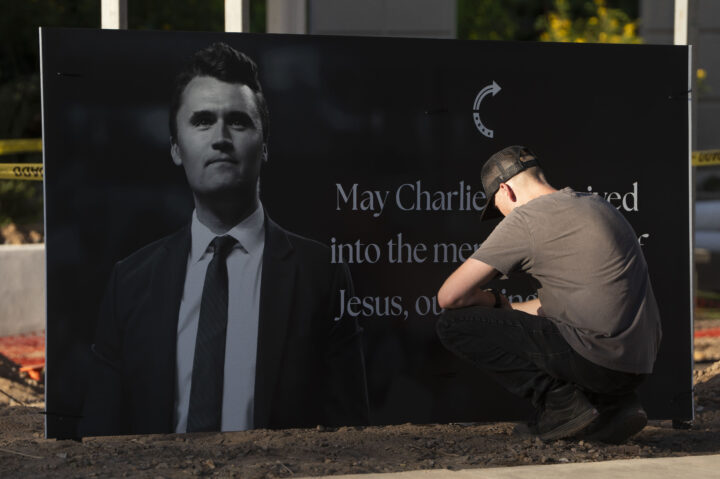
Arizonans mourn Turning Point USA Founder Charlie Kirk outside of the Turning Point USA headquarters on September 10, 2025 in Phoenix, Arizona.
Charlie Kirk, the 31-year-old Trump ally and conservative campus advocacy leader who was fatally shot at an event at Utah Valley University on Wednesday, was seen as a crucial bulwark against rising antisemitism and anti-Israel antagonism on the far right, friends and acquaintances told Jewish Insider.
While he was best known as a fierce and unyielding critic of what he assailed as the excesses of left-wing culture, Kirk, the founder of the youth activist group Turning Point USA, also cautioned against the risks of young conservatives embracing antisemitism and online conspiracy theories about Jews and Israel.
“There is a corner of the internet, of people that want to point and blame the Jews for all their problems,” he said at a recent event. “Everybody, this is demonic and it’s from the pit of hell and it should not be tolerated.”
Jewish conservatives who were close with Kirk both personally and professionally lamented his death as a major loss for the long-term standing of pro-Israel sentiment in the MAGA movement, citing his continued defense of Israel and recent commentary warning against the embrace of antisemitism on the far right while visiting college campuses nationwide with TPUSA.
Kirk’s impact on the online right’s discourse was significant, and his views on Israel were closely watched as other right-wing podcasters turned more critical of the Jewish state. In the runup to the U.S. strike on Iran’s nuclear facilities, Kirk drew outsized attention for cautioning the Trump administration against attacking Iran, citing the fallout from young conservatives, who supported the president over his promise to end foreign wars.
But after the attack was successful, Kirk praised Trump’s decision after the strikes degraded Iran’s nuclear threat without the U.S. getting involved in a wider war.
Rabbi Pesach Wolicki, executive director of Israel365 Action, a subset of Israel365, the advocacy group that describes itself as an “Orthodox Jewish institution that believes that Jews and Christians must respect one another,” spoke to Kirk on Tuesday evening for what he referred to as a “work meeting.” Wolicki said he could not get into details of the call, but noted that the two began communicating regularly as Kirk began facing pushback from the far right for refusing to abandon his support for Israel.
“The fact is, Charlie didn’t agree with every decision that the Israeli government made, but he was one of the most avid defenders of Israel out there,” Wolicki told JI. “Most people’s exposure to Charlie visiting campuses is those viral clips they would release, but 40 to 50% of the questions Charlie would get on campuses for the last year and a half were about Israel. He didn’t go to those campuses to talk about Israel, but that’s where the students would always bring it to. Half the time he was on those campuses, he was defending Israel.”
While he and Kirk did not always align in their conversations about Israel, the GOP activist “was always wanting to learn, wanting to know what the truth is and what are the right ways to answer these questions,” Wolicki said.
“All I saw in every conversation was sincerity and concern and just a love for Israel, even when he disagreed with Israel, even when Israel frustrated him,” he told JI.
Even as Kirk faced criticism for defending Elon Musk after the billionaire tech mogul came under scrutiny for amplifying an antisemitic conspiracy theory, his allies said he had a strong connection to Israel and the Jewish community that motivated his advocacy.
Josh Hammer, a conservative political commentator and a personal friend of Kirk’s, argued that Kirk’s affinity for the Jewish people was grounded in his evangelical Christian faith and the fact that some of his earliest professional mentors were conservative pro-Israel champions like David Horowitz and Dennis Prager.
Hammer said he and Kirk engaged regularly on the best ways to address rising antisemitism within the GOP, and that he was concerned about how Kirk’s absence going forward would impact that surge.
“He was a young conservative leader, and he very much had his thumb on the pulse of the fact that Gen Z is trending in a not so healthy direction on the Israel issue and on antisemitism in general,” he told JI.
“We would talk about how to turn back the tide against that,” Hammer added. “He was really holding back some really nasty stuff in some very young, far-right online circles. He was doing more than maybe anyone in the country to fight that. Part of me kind of worries, frankly, about what that energy does from here in his absence.”
Kirk, an evangelical Christian, had been working on a book about the Sabbath that is set to be published in December, called Stop, in the Name of God: Why Honoring the Sabbath Will Transform Your Life.
“He would turn his phone off and generally disconnect for 24 to 25 hours,” Hammer told JI. “He was someone who genuinely believed not just in the New Testament and part of the Christian Bible, but he genuinely believed in the Hebrew Bible as well. He had a very special place in his heart for those who were called upon to be God’s chosen people in this world. He was of genuine conviction that the land of Israel was promised to the Jewish people.”
Jewish American and Israeli leaders expressed appreciation on Wednesday for Kirk’s support for the Jewish community and Israel, which he visited at least twice on trips he recounted as personally meaningful.
“Charlie Kirk was murdered for speaking truth and defending freedom,” Israeli Prime Minister Benjamin Netanyahu said on social media. “A lion-hearted friend of Israel, he fought the lies and stood tall for Judeo-Christian civilization.”
Jared Kushner, President Donald Trump’s son-in-law and a former White House advisor, called Kirk “a close friend and a special human being,” saying he “represented the best of MAGA. Firm in his beliefs, compassionate, curious, and respectful.”
The Republican Jewish Coalition, in a statement on Wednesday, said that Kirk had been “a shining light in these troubled times for the American Jewish community, and we are deeply saddened at his passing.”
“Charlie was a fearless advocate for freedom, a supporter of Israel and the Jewish people, and a friend,” the RJC said. “He was cut down while doing what he loved to do, communicating with the next generation of American leaders on college campuses about the issues that affect us all.”
Halie Soifer, CEO of the Jewish Democratic Council of America, said she was “devastated by the horrific, unconscionable, depraved murder of Charlie Kirk,” adding: “Political violence should have no place in this country, and it’s incumbent on political leaders on both sides of the aisle to make that clear.”
Shabbos Kestenbaum, a Jewish pro-Trump activist and outspoken opponent of campus antisemitism, said that Kirk’s death leaves a vacuum on the right as antisemitic figures including Tucker Carlson and Nick Fuentes find growing audiences.
“Charlie repeatedly referred to antisemitism as ‘demonic’” and “hated it viscerally,” Kestenbaum told JI.
“Behind the scenes, Charlie was working with prominent Jewish individuals here in America to change the narrative surrounding Israel,” he said. “He was a mentor to me and millions all over this country. I fear for the future of the conservative movements’ attitudes towards Israel without Charlie.”
‘My department is a hostile work environment, and I can no longer attend events or participate in departmental life there,’ one Jewish faculty member said
ANDREW THOMAS/Middle East Images/AFP via Getty Images
A group of faculty, staff, and students of the George Washington University who had met in the yard where there was a pro-Palestinian encampment last year, in May 8, 2025 in Washington D.C., march to the White House to show that they stand together.
Much of the antisemitism on college campuses is fueled by faculty and staff — both on campus and within professional academic organizations — according to a survey released on Wednesday by the Anti-Defamation League and the Academic Engagement Network.
Seventy-three percent of the 209 Jewish faculty members polled from universities around the U.S. reported observing antisemitic activities or statements from faculty, administrators or staff on campuses, including calls to boycott Israel and doxxing campaigns. Forty-four percent said they were aware of an organized Faculty for Justice in Palestine chapter on their campus.
“My chair is pro-Hamas (explicitly so) and has turned our department into an encampment, full of ‘river to the sea’ slogans and propaganda,” an anonymous faculty member shared in the survey. “When I and a few other Jewish faculty objected, the chair organized about 50 people to verbally attack us, including one who told me that we had all the money and power. Consequently, my department is a hostile work environment, and I can no longer attend events or participate in departmental life there.”
Another wrote that they are “attacked in all directions” and “no longer feel safe on campus.”
Due to these experiences, more than one-third of all of the surveyed respondents (38%) reported having felt a need to hide their Jewish and/or Zionist identity from others on campus. Twenty-five percent of those who are members of academic associations said they feel pressure to hide their identity in those groups.
The study comes as calls for the adoption of academic boycotts of the Jewish state have gained momentum in the aftermath of the Oct. 7, 2023, terrorist attacks and the ensuing Israel-Hamas war, within several professional associations and among some prominent classroom professors.
Last month, the American Association of Geographers faced pressure from its members to adopt a boycott of Israel, and shortly after, the head of the American Association of University Professors said that the United States should not send defensive weapons to Israel amid its war against Hamas, which he called a genocide in Gaza.
“What we’re seeing is a betrayal of the fundamental principles of academic freedom and collegiality. Jewish faculty are being forced to hide their identities, excluded from professional opportunities, and told by their own colleagues what constitutes antisemitism — even as they experience it firsthand. This hostile environment is driving talented educators and researchers away from careers they’ve dedicated their lives to building,” ADL CEO Jonathan Greenblatt said in a statement about the survey.
“Colleges and universities are meant to be open, safe learning environments where faculty and students alike feel comfortable sharing ideas and having open discourse,” said Miriam Elman, AEN’s executive director. “It’s disturbing, but perhaps unsurprising, that Jewish and Zionist faculty on campuses across the country are experiencing antisemitic hostility and retaliation for their beliefs.”
“What’s even more alarming,” Elman continued, “is that much of this animosity is driven by the faculty and staff themselves, creating an unsafe work environment for their colleagues and an unwelcoming learning environment for their students. Administrators must address these issues head-on and take meaningful action to protect the flow of free ideas and open inquiry on their campuses, or their institutions will suffer for generations to come.”
Securing government payouts as the primary achievement for using state power to freeze a private university’s funds makes the whole enterprise seem like extortion
Mostafa Bassim/Anadolu via Getty Images
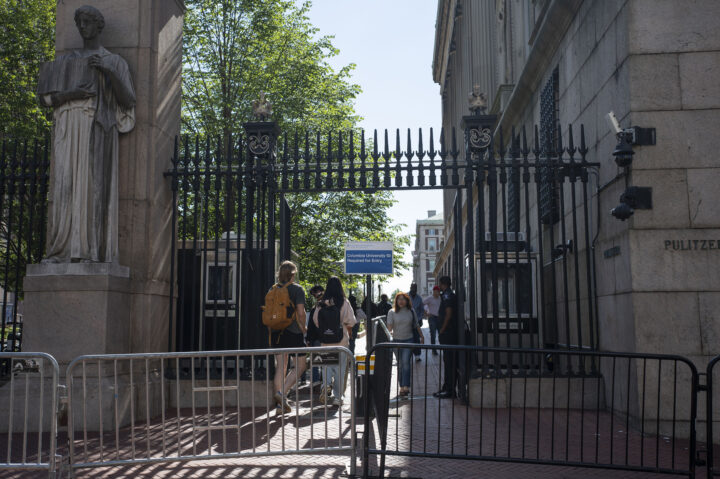
Students enter campus on the first day of the fall semester at Columbia University in New York City, United States on September 2, 2025.
Over the weekend, The New York Times published a story contending that the momentum for settlements with elite universities was stalling amid divisions between those in the Trump administration looking to make a deal and those looking for more meaningful reforms in combating antisemitism.
The story glossed over the related development we’ve been hearing from officials involved in the negotiating process: that a zeal for dealmaking from some officials is overshadowing the main reason the Trump administration was playing hardball with these schools in the first place — the rampant antisemitism that has been festering on campus.
In fact, the word “antisemitism” was hardly mentioned in the lengthy NYT story, a sign in itself of the administration’s flagging focus.
Indeed, many of the deals struck — along with the outlines of potential future deals — have focused on the dollar amounts in the settlement, without requiring many significant reforms that would deal with antisemitism at the elite schools.
Columbia University agreed in July, following a lengthy legal battle, to pay a $200 million settlement over three years to the federal government. In addition to the legal penalty, the Ivy League school — which did not admit to wrongdoing in the resolution agreement — pledged to implement a series of commitments aimed at protecting Jewish students.
These include further incorporating the International Holocaust Remembrance Alliance’s working definition of antisemitism by requiring its Office of Institutional Equity to embrace the definition; appointing a Title VI coordinator to review alleged violations of the Civil Rights Act; requiring antisemitism training for all students, faculty and staff; and refusing to recognize or meet with anti-Israel student coalition Columbia University Apartheid Divest.
On Columbia’s campus, some pro-Israel students expressed disappointment over those “largely symbolic” commitments, which diverged from a list of reforms initially demanded by the Trump administration.
Soon after Columbia, Brown University entered into an agreement with the Trump administration to restore hundreds of millions of dollars in federal funding. The settlement also primarily focused on money rather than reform, although unlike Columbia, Brown was not required to pay a fine directly to the federal government. The university instead agreed to pay $50 million over 10 years to workforce development organizations in Rhode Island. It also agreed to launch a third-party campus climate survey in an effort to protect Jewish students.
Meanwhile, the conversation surrounding a possible settlement with Harvard has increasingly centered on the significant size of the potential payment — a whopping half-billion dollars — over any of the institutional changes the university will need to make. Sources familiar with the dealmaking confirm to Jewish Insider that President Donald Trump himself is increasingly enamored with the size of the payment, which has led some of his advisors to focus less on reforms and more on the money.
“There’s growing dissatisfaction with the White House letting universities buy their way out of accountability with no meaningful change. It’s clear they’ve been totally out-negotiated,” said one source familiar with the negotiations.
Reading the Times story, the administration officials working to fight against the universities’ harassment of their Jewish students were caricatured as “ideologically driven aides,” whereas those looking to cut lucrative financial deals were portrayed as the pragmatists.
The reality is the opposite. Securing government payouts as the primary achievement for using state power to freeze a private university’s funds makes the whole enterprise seem like extortion. Putting in the work to make sure these abuses don’t happen again is what would make the exertion of government power more justifiable.
Indeed, the outcome of this showdown with elite universities — with negotiations with Cornell and Northwestern taking place now — will be a test of whether many of the systemic abuses that led to the extraordinary freeze on research funding will be rolled back, or whether the tolerance of anti-Jewish discrimination on campus could become the new normal.
The senator sent letters to the presidents of the largest colleges and universities in the state to ensure they have set plans to combat campus antisemitism

Kevin Dietsch/Getty Images
U.S. Sen. Bernie Moreno (R-OH) participates in a Senate Commerce, Science, and Transportation Committee hearing in the Russell Senate Office Building on January 28, 2025 in Washington, DC.
Sen. Bernie Moreno (R-OH) is asking the presidents of the largest colleges and universities in Ohio to adopt the International Holocaust Remembrance Alliance’s working definition of antisemitism and ensure that their respective institutions have plans in place to combat campus antisemitism during the upcoming school year, Jewish Insider has learned.
Moreno sent letters on Tuesday to the presidents of The Ohio State University, Miami University, Kent State University, Cleveland State University, Youngstown State University, the University of Cincinnati, Central State University, the University of Toledo, Bowling Green State University, Akron University, Ohio University, Wright State University, Northeast Ohio Medical University and Shawnee State University.
In the letters, the Ohio senator requested information on how each school was responding to “the unacceptable and disgusting rise in antisemitism” and the ways each plans to “protect students’ safety while on campus from antisemitism and/or other religiously motivated crimes.”
Moreno also urged the schools to adopt the IHRA definition, which he argued “provides clarity on what constitutes antisemitism and can serve as a tool on campus to help combat hate crimes and foster a safer environment for Jewish students.”
“I want to make sure that university leaders are doing all they can to ensure students are free not only to learn on college campuses but also to feel safe while doing so, regardless of their religion,” Moreno wrote.
Moreno praised the Trump administration’s efforts to combat antisemitism in the letters, writing that the White House was “taking strong and necessary action” on the matter.
“Jewish Americans are under attack in this country. Americans have witnessed the manifestation of rampant antisemitism on college campuses all over the country,” Moreno wrote. “Horrifyingly, hate crimes and domestic terrorism have plagued the Jewish community. Recently, in this country, Jewish Americans have been murdered in cold blood and burned alive. These attacks are reminiscent of 1939. It is 2025 – the violence against Jews must stop.”
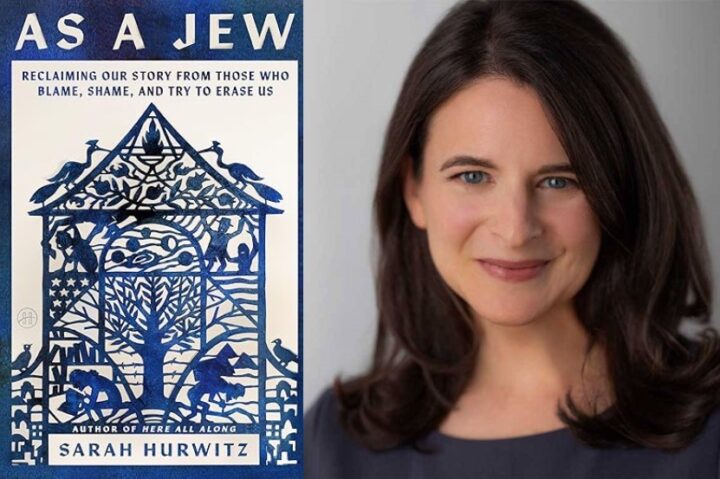
Sarah Hurwitz said she hopes her second book, ‘As a Jew,’ resonates with progressive Jews who have distanced themselves from Zionism
Courtesy
Sarah Hurwitz
Growing up at a Reform temple in suburban Boston, Sarah Hurwitz learned that Judaism is just “four holidays, two texts and a few universalistic values.”
When she left home, she largely eschewed all Jewish observance for two decades, she reflected in a recent interview with Jewish Insider. In that time, she got two degrees at Harvard and reached the pinnacle of Washington success, serving as a senior speechwriter, first to President Barack Obama and then to First Lady Michelle Obama. If she engaged with Judaism at all, it was with a light touch — she was merely a “cultural Jew,” as she usually called herself.
“I just didn’t realize there was Jewish culture. I just meant, ‘Oh, I’m anxious and kind of funny,’” Hurwitz told JI last month.
Approaching a midlife crisis, Hurwitz found her way to an intro to Judaism class at a Washington synagogue nearly a decade ago. She embarked on a journey of learning Jewish traditions and studying Jewish texts that sparked her first book, the 2019 Here All Along, a joyful and accessible primer to Judaism.
“Its thesis was, ‘Isn’t Judaism amazing?’ Not a lot of Jews are going to disagree with that thesis,” Hurwitz said.
She is doing something different with her new book, As A Jew: Reclaiming Our Story From Those Who Blame, Shame, and Try to Erase Us, which was published this week.
“This is definitely a book with an argument. It is definitely edgier than my first book,” Hurwitz said.
That’s because in As A Jew, Hurwitz is grappling with a question that struck at the core of who she is, or at least who she was until a decade ago. Why, she asks, was she always qualifying her Judaism? She was always a “cultural Jew,” an “ethnic Jew,” a “social justice Jew,” she writes. Hurwitz was never simply a Jew, one word, proud, head tall.
In her new book, as she tackles the millennia of antisemitism that led her to unwittingly minimize her own identity, she is asking questions that others who similarly distort or diminish their Jewish identity may not want to face.
“I was really trying to make others comfortable with me, right? I didn’t want them to think I was one of those really Jew-y Jews, which … why would that be bad, again?” Hurwitz said. “Why did social justice have to be my Judaism? Why couldn’t Judaism be my Judaism?”
This doesn’t mean Hurwitz is criticizing people who engage with Judaism through a social justice lens, or through culture, or any other avenue besides religious observance. Her own personal Jewish learning journey has not made her an Orthodox Jew. The argument she’s making is that Jews should engage with Judaism … well, Jewishly — by learning what Jewish texts have to say about social justice, rather than taking some universal values like “care for the vulnerable” and calling that your Judaism.
“Social justice is also a gorgeous way to be a Jew when you actually know what Judaism says about social justice,” said Hurwitz. “When I was this kind of contentless Jew, I don’t really know what I was doing. I was often just articulating my own views and opinions and kind of attributing them to Judaism.”
She begins with a basic question: The Holocaust happened because the Nazis hated the Jews. But why did they hate the Jews? OK, the Jews were the scapegoat after World War I. But why the Jews? That unanswered question makes it hard for anyone to identify modern-day antisemitism, Hurwitz argues.
“These poor kids, it’s very confusing, because they’ve gotten Holocaust education, and they’re like, ‘That’s antisemitism education,’” said Hurwitz. “And then you get to campus and there are no Nazis, and you’re like, ‘What is this?’”
To answer that, she goes back thousands of years. The book examines Judaism in the context of the historical movements that have tried to crush it, or at least confine it: early Christianity, the Crusades, the Spanish Inquisition, the Enlightenment, the Holocaust. Not each of these eras sought to eliminate Judaism, but each one presented a particular idea of the good kind of Jew.
Throughout history, some Jews always tried to adapt to the mores of the day and disavow essential parts of Judaism in order to fit in. The only problem, writes Hurwitz, is it didn’t work. You can be Jewish, but not too Jewish. Like when modernity swept across Western Europe in the 19th century, and Jews could suddenly become citizens of France and Germany — so long as they placed their country’s identity above their Jewish identity.
“This book was very much my journey to stripping away all those layers of internalized antisemitism, anti-Judaism, all of that internalized shame from so many years of persecution, and just saying, ‘You know what, no, I’m a Jew,’” said Hurwitz.
Hurwitz pitched this book before the Oct. 7 Hamas attacks that sparked a wave of global antisemitism. But she says the events of the last two years have only furthered her argument that Jews throughout history have felt the need to separate from parts of their community to earn the approval of the rest of society.
“Oct. 7 did not change the overall argument at all. It unfortunately, in many ways, gave this devastating, heartbreaking, new evidence from the argument,” Hurwitz said.
Hurwitz hopes to reach a broad audience. But she spent a decade and a half enmeshed in Democratic politics professionally, and she particularly hopes to can reach Jews on the left who have distanced themselves from Zionism partly as a condition of their belonging in progressive spaces.
“I am hoping that I can speak particularly to Jews who maybe have identified as Democrats, who are a little bit more on the left, and I can tell them why I am a Zionist. I can tell them why I think it is so important that Israel exists,” Hurwitz said. “I can make that argument, and I’m hoping that it will be credible coming from me, in a way that maybe it wouldn’t from others.”
Plus, Gillibrand cautions Dems over anti-Israel rhetoric
Michael Brochstein/SOPA Images/LightRocket via Getty Images
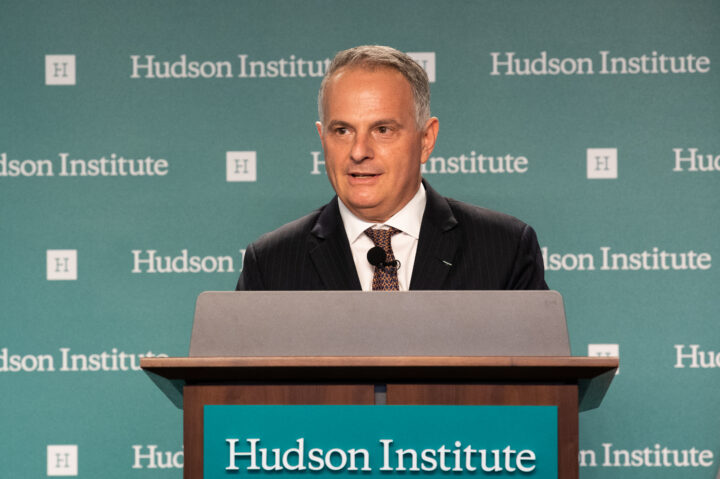
Kenneth Weinstein, President and Chief Executive Officer of Hudson Institute, speaking at the Hudson Institute in Washington, DC.
Good Monday afternoon.
This P.M. briefing is reserved for our premium subscribers like you — offering a forward-focused read on what we’re tracking now and what’s coming next.
I’m Danielle Cohen-Kanik, U.S. editor at Jewish Insider and curator, along with assists from my colleagues, of the Daily Overtime briefing. Please don’t hesitate to share your thoughts and feedback by replying to this email.
📡On Our Radar
Notable developments and interesting tidbits we’re tracking
We’re watching developments in ceasefire and hostage-release negotiations after President Donald Trump called for Hamas to accept the latest U.S.-sponsored deal over the weekend, which would see all the hostages, living and dead, released on the first day of the ceasefire.
Middle East envoy Steve Witkoff and former Trump Mideast advisor Jared Kushner met with Israeli Minister for Strategic Affairs Ron Dermer in Miami today to discuss developments in Gaza, Axios’ Barak Ravid reports.
Hamas had claimed it was ready to “immediately sit at the negotiating table” in response to Trump’s statement, but sources for the terror group told a Saudi newspaper today that a complete hostage release would not be possible immediately, claiming a ceasefire would have to go into effect first to reach all the bodies…
In other national security news, The New York Times spotlights the race between defense firms to develop technologies for a future “Golden Dome” missile-defense system.
“Companies chosen for Golden Dome are likely to become the new cornerstones of U.S. defense, military officials involved in the project said,” and firms including Palantir and Anduril as well as innovative startups have been in discussions with the Trump administration, the Times reports.
Mark Montgomery, senior director of the Center for Cyber and Technology Innovation at the Foundation for Defense of Democracies, said, “There are more than 100 companies out there with a sensor, satellite or other devices they want to sell to Golden Dome. This is the Wild West, and this is a massive opportunity for whoever is selected”…
Diplomatic tensions are rising between Israel and Spain after Spanish Prime Minister Pedro Sanchez announced today that his country would be formalizing an existing de facto arms embargo against Israel and banning anyone who has participated in “genocide” in Gaza from entering Spain as well as ships carrying fuel for the IDF from Spanish ports.
“This is not self-defense, it’s not even an attack — it’s the extermination of a defenseless people,” Sanchez said of Israel’s war in Gaza.
In response, Israeli Foreign Minister Gideon Sa’ar announced that Israel had banned two anti-Israel Spanish ministers from entering the country; Spain then summoned its ambassador in Tel Aviv, all shortly after a young Spanish immigrant to Israel was killed in this morning’s terror attack on a bus stop in Jerusalem…
The U.K. has come to a different conclusion about Israel’s actions in Gaza, according to a letter sent last week by former Foreign Secretary David Lammy before he was replaced in a reshuffling of Prime Minister Keir Starmer’s Cabinet.
Lammy wrote to the chair of the U.K.’s international development committee that the Foreign Office had found in an assessment that Israel was not committing a genocide as it was missing “intent” to do so. It’s the first time the U.K. has said so explicitly, previously holding that the matter of genocide was up to international courts to determine, just weeks before the country is expected to recognize a Palestinian state…
Former Hudson Institute CEO and President Kenneth Weinstein will serve as CBS News’ ombudsman, a new role that oversees editorial concerns from employees and viewers, Paramount announced Monday. Alongside reports that Paramount is expected to purchase Bari Weiss’ Free Press and bring her into an editorial role at CBS, the moves mark a new era for the network that has been accused of systemic anti-Israel bias…
Embracing their anti-Israel bona fides, hundreds of actors, filmmakers and film industry workers recently signed a pledge to boycott Israel, which says it was inspired by filmmakers who refused to screen their films in apartheid South Africa.
The signatories, including Hollywood stars such as Alyssa Milano, Mark Ruffalo, Anna Shaffer, Ayo Edebiri, Cynthia Nixon, Hannah Einbinder and Ilana Glazer, promised “not to screen films, appear at or otherwise work with Israeli film institutions — including festivals, cinemas, broadcasters and production companies — that are implicated in genocide and apartheid against the Palestinian people”…
Sen. Kirsten Gillibrand (D-NY) said in comments to Jewish leaders in New York City today that some of her fellow Democratic lawmakers are inadvertently fueling antisemitism through the rhetoric and slogans they use, Jewish Insider’s Marc Rod reports.
“When they say words like ‘river to the sea,’ whey they say words like ‘globalize the intifada,’ it means end Israel. It means destroy Jews,” Gillibrand said. Intifada, she continued, is “not a social movement. It’s terrorism, it’s destruction, it’s death.”
The New York senator had previously offered strong condemnation of NYC Democratic mayoral nominee Zohran Mamdani for his refusal to condemn the “globalize the intifada” slogan and has not endorsed his bid for mayor…
Mamdani’s opponent, New York City Mayor Eric Adams, meanwhile, officially dropped the ballot line “EndAntiSemitism,” running only on the “Safe & Affordable” line, after the New York City Board of Elections said he couldn’t run on both. Adams’ campaign spokesperson said he intends to pursue legal options over the issue…
Graham Platner, an anti-Israel Democratic Senate candidate in Maine, wrote in a high school op-ed shortly after 9/11, during the Second Intifada in Israel, that the media provides an “incomplete story” of terrorist acts and writes “incomplete coverage” of the Israeli-Palestinian conflict “where a sometimes-oppressive Israeli state can be, and often is, portrayed as a victim.”
Platner and his co-authors argued in the article in a local Maine outlet, unearthed by the Free Beacon, that ending terrorist acts would be “best achieved by understanding the circumstances under which they were committed”…
⏩ Tomorrow’s Agenda, Today
An early look at tomorrow’s storylines and schedule to keep you a step ahead
Keep an eye on Jewish Insider tomorrow morning for an interview with former Obama speechwriter Sarah Hurwitz, whose new book As A Jew: Reclaiming Our Story From Those Who Blame, Shame, and Try to Erase Us, comes out Tuesday.
It’s a busy week in Washington, where the 2025 MEAD Summit will kick off tomorrow. The high-profile but elusive gathering will bring together top American and U.S. security officials, diplomats, lawmakers, philanthropists, CEOs and journalists. If you’re attending, make sure to say hello to JI’s Josh Kraushaar and Gabby Deutch!
The Iran Conference, hosted by the National Union for Democracy in Iran, will also begin in Washington tomorrow for analysts, policymakers and activists to discuss Iran policy, just two months after U.S. and Israeli strikes decimated Tehran’s nuclear and military infrastructure.
On the Hill, the House Education and Workforce Committee’s Subcommittee on Health, Employment, Labor and Pensions will hold a hearing on “unmasking union antisemitism.”
Virginia’s 11th Congressional District is holding its special election tomorrow to fill the seat of the late Rep. Gerry Connolly (D-VA). James Walkinshaw, Connolly’s longtime former aide, is the heavy favorite to win. Read JI’s interview with Walkinshaw here.
Looking to New York City, The MirYam Institute will hold an international security benefit briefing tomorrow featuring former Israeli Prime Minister Naftali Bennett; nearby, the Soufan Center will begin its Global Summit on Terrorism and Political Violence, meant to honor the memory of 9/11 victims and address emerging global threats.
The Florida Holocaust Museum is reopening tomorrow with a ribbon-cutting ceremony after an extensive period of renovation.
Abroad, the U.S. Embassy in Jerusalem will host its belated July 4 party tomorrow, and the Hili Forum will convene its last day in Abu Dhabi, United Arab Emirates, covering trade, tech and governance. DSEI U.K., a large defense trade show, is starting up in London, where protests are expected against the dozens of Israeli firms that are participating.
CANDIDATE CRITIQUE
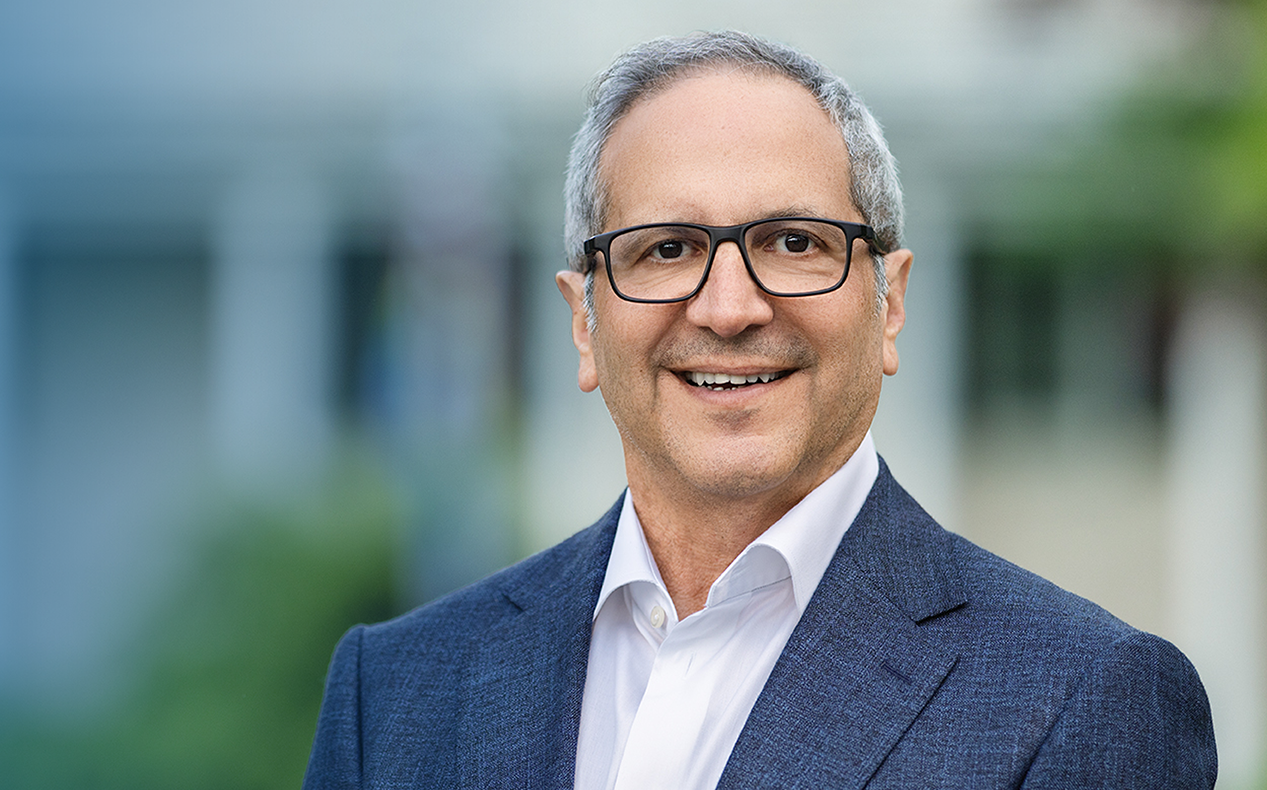
The Democratic candidate also said he does not believe that far-left NYC mayoral candidate Zohran Mamdani is ‘taking actions I would claim to be antisemitic’
ACROSS THE POND
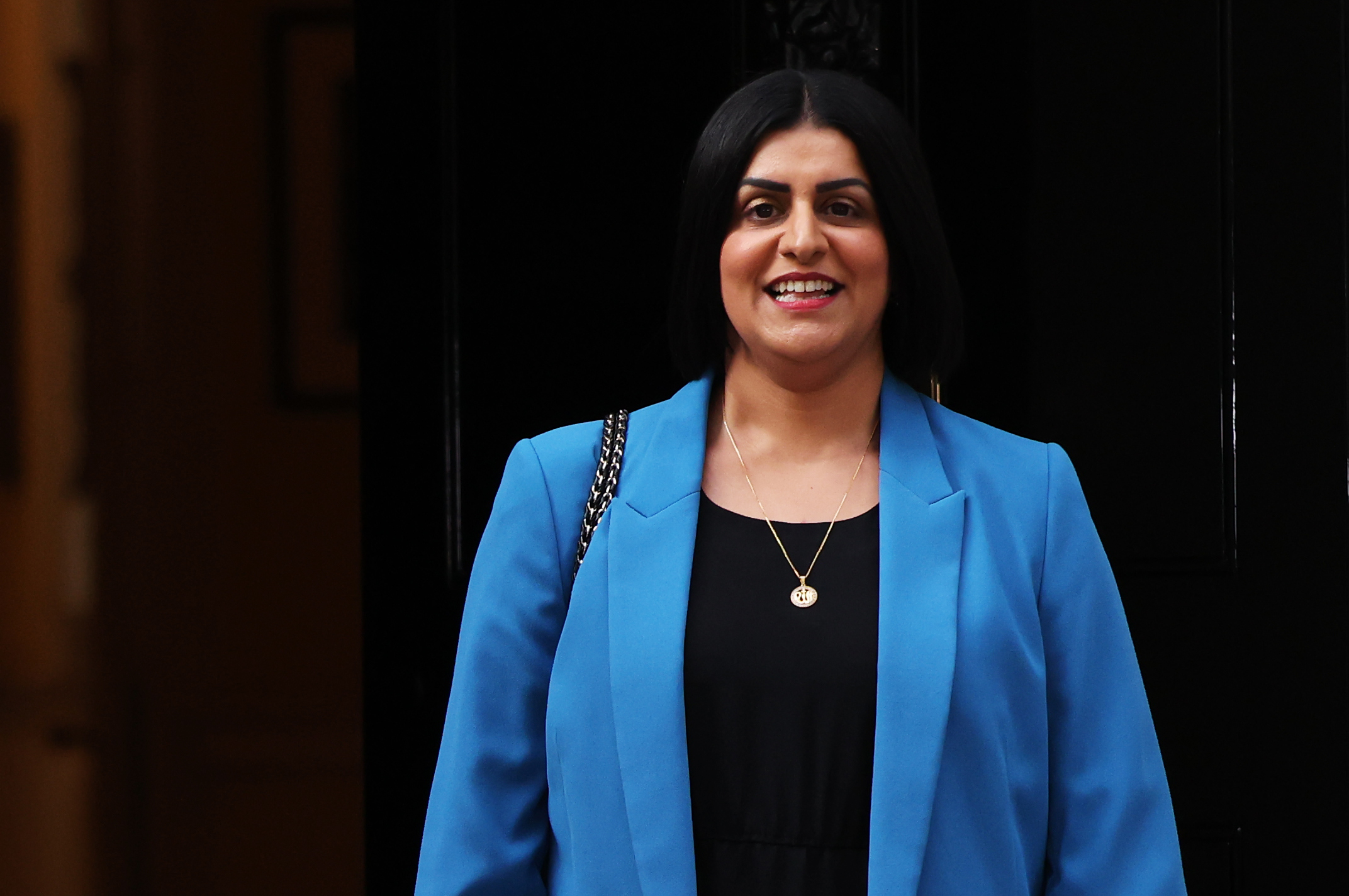
On Sunday, British Jews marched to protest against rising antisemitism in the country
She also doubled down on her condemnation of the slogan ‘globalize the intifada,’ over which she previously criticized mayoral nominee Zohran Mamdani
Drew Angerer/Getty Images
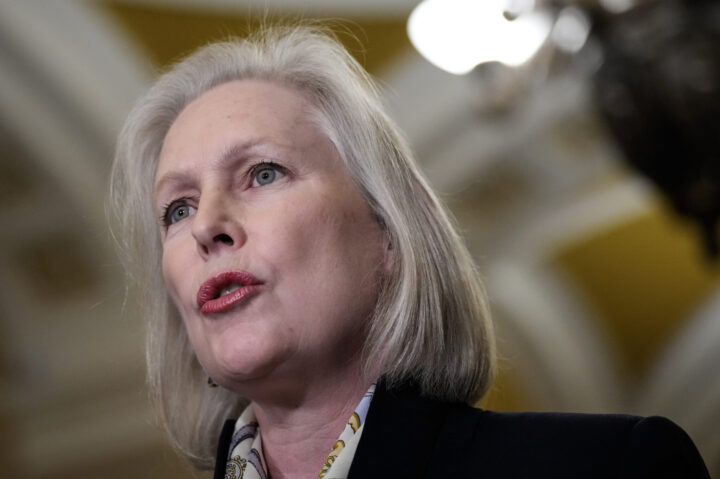
Sen. Kirsten Gillibrand (D-NY) speaks at a news conference following a closed-door lunch meeting with Senate Democrats at the U.S. Capitol on October 31, 2023, in Washington, D.C.
Sen. Kirsten Gillibrand (D-NY) said in comments to Jewish leaders in New York City on Monday that anti-Israel protesters and, in some cases, fellow Democratic lawmakers are fueling antisemitism through the rhetoric and slogans they use, though she said that in many cases it is unintentional.
“Some of the rhetoric that comes out of various protests globally, various protests on college campuses is so damaging. When they say words like ‘river to the sea,’ whey they say words like ‘globalize the intifada,’ it means end Israel. It means destroy Jews,” Gillibrand said in a video from a roundtable with Jewish leaders in Borough Park shared by The Forward. “No matter what words they intend to be saying, that is the meaning of these simple phrases.”
Intifada, she continued, is “not a social movement. It’s terrorism, it’s destruction, it’s death.”
The New York senator has been particularly outspoken about the “intifada” rhetoric in the context of the New York City mayoral race. She previously offered strong condemnation of Democratic mayoral nominee Zohran Mamdani for his refusal to condemn the “globalize the intifada” slogan and said that Jewish constituents were alarmed by his past comments.
Gillibrand also claimed Mamdani had made “references to global jihad,” but later apologized. She has not endorsed Mamdani’s mayoral bid.
The New York senator said she would work with Democratic colleagues “who sometimes, in my opinion, don’t use the right words or aren’t sensitive to the impact of those words” and explain to them how their comments are being received and contributing to antisemitism, and to rally them to support efforts to fight antisemitism.
“Nine times out of 10, they aren’t trying to be antisemitic or even trying to be anti-Israel. They just think they’re fighting for human rights,” Gillibrand continued, “but the words they often choose to use are very hurtful and harmful and are undermining.”
“It is very hurtful and it makes people feel like sometimes the members of our party do not have their back, and I think that’s very disruptive and damaging for our community, for our state, for our brothers and sisters,” Gillibrand said.
Gillibrand added that leaders and individuals have to “understand the impact of their words in all contexts,” including to the Muslim community and other faith and immigrant communities.
She also insisted that “nine out of 10 Democrats are pro-Israel and want peace in the Middle East,” though a majority of the Senate Democratic caucus recently voted in favor of blocking some arms sales to Israel.
Gillibrand argued that many of her colleagues’ concerns are driven by the political leadership in Israel, including Prime Minister Benjamin Netanyahu and far-right members of the Israeli government.
“They don’t know how to articulate political disagreement, and sometimes it comes out as anti-Israel,” she said. “I try very hard to explain that your intentions are one thing, but how you’re received is another, and that’s where we get the disconnect.”
The university said it will ‘immediately pursue’ disciplinary actions against several anti-Israel agitators, in shift attributed to reforms adopted in Trump admin settlement
Mostafa Bassim/Anadolu via Getty Images
Students enter campus on the first day of the fall semester at Columbia University in New York City, United States on September 2, 2025.
The first day of the new school year on Tuesday at Columbia University was met with a wary sense of relief from Jewish students and faculty, who returned to campus unsure whether recent reforms aimed at combating campus antisemitism would make any difference.
Scenes that have become commonplace on Columbia’s campus over the past two years — masked anti-Israel demonstrators barging into classrooms and the library banging on drums and chanting “Free Palestine” or hourslong demonstrations in the center of campus of more than 100 students calling for an “intifada revolution” — were nowhere to be seen.
Still, in quieter ways, there were moments behind the tall iron entrance gates reminiscent of the antisemitic turbulence that grew commonplace on the Morningside Heights campus since Hamas’ Oct. 7, 2023, terrorist attacks.
Three members of Columbia University Apartheid Divest, a coalition of over 80 university student groups that Instagram banned earlier this year for promoting violence, protested Columbia Hillel’s club fair, distributing fliers urging Jewish students to “drop Hillel” because it “supports genocide.”
Elsewhere on campus, an organizer of the 2024 anti-Israel encampment movement, Cameron Jones, paraded a sign that read, “some of your classmates were IOF [Israeli Occupation Forces] criminals committing genocide in Palestine.”
Within hours, Columbia announced it had “initiated investigations into incidents that involve potential violations of the University’s Student Anti-Discrimination and Discriminatory Harassment Policies and University Rules.”
“The individuals involved are being notified that the University will immediately pursue its process for disciplinary action regarding their conduct,” the school said.
Jewish students and faculty praised Columbia’s swift response, which some attributed to the recent reforms, part of a deal made in July between the university and the Trump administration to restore the school’s federal funding that was slashed over the school’s alleged failure to address antisemitism.
Tal Zussman, a third year PhD student in computer science, called the quick investigation a “significant change from a year ago.”
“Last year’s first day of classes was marked by a protest that completely blocked the campus entrance and vandalism of [the sculpture] Alma Mater,” Zussman told Jewish Insider. “There were a few isolated instances [on Tuesday] that the university seems to be handling, but they were minor compared to last year’s drama. Hopefully things remain calm, but the university’s clear communication and quick response is a significant change from a year ago.” He said he felt that the change was “absolutely” due to the reforms.
Civil engineering professor Jacob Fish similarly described a “situation in and around campus [that] is much better compared to previous fall and spring.” Fish, the director of Kalaniyot, the university’s new initiative to bring Israeli researchers to the Columbia campus, lauded the program as a way to further “make a difference on campus,” he told JI.
“More than 200 first-year students participated in joyful and welcoming on campus activities,” Columbia’s Hillel director Brian Cohen told JI. “Three students disrupted these activities. We will continue to work with Columbia University’s rules process and hope that students who violate University rules continue to be held accountable.”
Columbia’s settlement with the federal government to restore some $400 million in federal funding that was slashed in March was met at the time with cautious optimism from Jewish leaders.
Some expressed hope that the settlement could lead to a safer environment for Jewish students following nearly two years of antisemitic protests and disruptions on campus in the aftermath of Oct. 7. Others, however, raised concerns that the settlement did not include key structural reforms to protect Jewish students.
Lishi Baker, a senior studying Middle East history and co-chair of the pro-Israel campus group Aryeh, told JI he is “optimistic” that Columbia’s recent changes, “particularly around discipline and policymaking, will make a big difference in improving life on campus for Jewish students and in preventing campus chaos.”
The ArabCon convention is being hosted by the Arab Anti-Discrimination Committee

Chip Somodevilla/Getty Images
Rep. Ro Khanna (D-CA) leaves the U.S. Capitol on March 13, 2024 in Washington.
Rep. Ro Khanna (D-CA) is set to speak later this month at ArabCon, an annual convention hosted by the Arab Anti-Discrimination Committee, joining a lineup that includes numerous speakers with records of support for terrorism and antisemitism.
Khanna, in recent months, has grown more vocal in his criticism of the Israeli government and the war in Gaza, and is leading an effort to call for U.S. recognition of a Palestinian state. Khanna is seen as having aspirations for higher office.
Among the controversial speakers on the ArabCon lineup are Electronic Intifada Executive Director Ali Abunimah, CAIR San Francisco Executive Director Zahra Billoo and activist Linda Sarsour.
Abunimah has repeatedly praised and supported terrorist attacks on Israel as a form of “resistance” and claimed that there is “no credible evidence of a single rape on Oct. 7.” He has also claimed that Zionism is antisemitic and a spiritual continuation of the Holocaust.
He advocates for a one-state solution that would see Israel erased and has dismissed Palestinian Authority leaders who support peace with Israel as “collaborators.”
Billoo was voted off of the national Women’s March board over her past commentary, including praising and defending Hezbollah and Hamas for attacking Israel, and condemned Jewish federations, the Anti-Defamation League, Hillel chapters and “Zionist synagogues” as “enemies” engaged in fomenting Islamophobia, police brutality and various other issues inside the United States.
Sarsour has argued that Zionists should be excluded from progressive spaces and movements, repeatedly faced accusations of antisemitism, praised a convicted terrorist and supports a one-state solution.
“I have never been to a conference where I agree with every speaker, but speaking at ArabCon is important,” Khanna said in a statement to Jewish Insider. “I will discuss my efforts to recognize a Palestinian state without Hamas as part of a two state solution. Recognition of Palestinian statehood — alongside continued efforts to secure Israel’s safety and guarantee its future as a democratic homeland for the Jewish people — is essential to achieving peace.”
Other speakers on the ArabCon agenda include Michigan Senate candidate Abdul El-Sayed, Dearborn, Mich. Mayor Abdullah Hammoud, Zeteo CEO Mehdi Hasan and “The Young Turks” hosts Ana Kasparian and Cenk Uygur.
The American‑Arab Anti‑Discrimination Committee’s newly tapped national legal director, Jenin Younes, on Thursday called journalist Bari Weiss a “modern day Goebbels” in response to reports that Paramount is closing in on a deal to acquire Weiss’ The Free Press and give her a senior editorial role at CBS News.
Over 1 million congregants at Hindu temples and Christian churches are expected to take part in ‘Stand Up Sunday’ on Sept. 7

Chris Unger/Getty Images
New England Patriots owner Robert Kraft
Congregants of a Hindu temple on Long Island that was vandalized last year and worshippers of a Methodist Church in Oklahoma City, who last year put on a musical production of “Fiddler on the Roof” to learn about Jewish culture, may not appear to have much in common.
But this Sunday, both houses of worship — together with an expected crowd of nearly 1 million congregants around the country — will join forces for the inaugural “Stand Up Sunday,” a show of force in the fight against antisemitism and all faith-based violence.
As part of the effort, spearheaded by Robert Kraft’s Foundation to Combat Antisemitism and the Appeal of Conscience Foundation, founded by Rabbi Arthur Schneier, organizers said each congregation “will dedicate their services to raising awareness about the sharp increase of antisemitism and all forms of hate against religious communities in the United States by standing together on September 7.”
FCAS’ Blue Square pins will be distributed to attendees “as a visible display of solidarity across faiths,” the group said. Congregational leaders will deliver remarks on antisemitism and faith-based hate in their sermons and houses of worship will place signs and posters throughout their buildings.
The solidarity project comes less than two weeks after a mass shooting at the Annunciation Catholic Church and School in Minneapolis, in which two students were killed and 21 others injured. Since 2021, the number of religious-based hate crimes has doubled, according to the FBI. The FBI’s 2024 crime statistics show a record number of hate crimes against Jews in particular, accounting for nearly 70% of all religious-based hate crimes.
Bawa Jain, an Indian advocate for interfaith dialogue, told Jewish Insider that the participation of 11 Hindu temples around the country was a “no-brainer.”
“People [aren’t aware] that Hindu temples are also vandalized. The media doesn’t cover it to the extent that other acts of violence are covered,” said Jain, secretary-general for the World Council of Religious Leaders and the founder and president of the Centre for Responsible Leadership.
As Hindu temples across the U.S. have seen a surge of vandal attacks over the past year, Jain said that “the Hindu and Jewish communities share a similar past. We are constantly targeted. Any crime against one of us is a crime against all of us,” adding that in his 35 years as a religious leader, he has “never seen a time where Hindu communities were targeted in such a way. We must stand together.”
“One of the things I hope comes out of this is that people realize other communities are being targeted too, even if you don’t hear about it,” said Jain. “When I was approached to get the Hindu community behind this, it was a no-brainer. [Sunday’s] program will focus on incidents of hate, supporting each other and how we must educate our communities. Our hope is that through this first launch, next year more than 120 temples across the country will participate in Stand Up Sunday.”
Participants in the day-long event include the Churches of the Catholic Archdiocese of New York, New Jersey and the Diocese of Brooklyn, the Greek Orthodox Archdiocese of America, Armenian Diocese of America, National Council of Churches of Christ, and numerous Christian, African Methodist Episcopal, Episcopal, Presbyterian Churches as well as the Akshardham BAPS Swaminarayan Hindu Temple USA. Synagogues are not taking part.
For Pastor Bob Long, head of St. Luke’s Methodist Church in Oklahoma City, speaking out against antisemitism goes back to the immediate aftermath of the 2018 Tree of Life synagogue shooting in Pittsburgh, where 11 congregants were shot dead during Shabbat morning services.
Following a visit to the synagogue with other pastors, Long reflected that he “became aware of a Catholic church in the area that put up a sign that said ‘Love your neighbor, no exception.’”
“That became a theme for us in 2020 and 2021 when we gave away thousands of shirts” with the phrase, he told JI.
Last year, the church dedicated its annual “St. Luke’s on Broadway” musical production to learning about Jewish heritage by putting on “Fiddler on the Roof.” St. Luke’s also hosted a pilot version of Stand Up Sunday last year.
“Every Sunday, we have banners at our welcome center that say ‘St. Luke’s stands up to Jewish hate’ and ‘St. Luke stands up to all hate.’ For us, this is something we keep in the forefront all year long,” Long said.
But he called this Sunday “a special lift” for learning about hate and antisemitism in particular.
“We will be talking about [antisemitism] in our worship service,” said Long. “The sermon will be dealing with how we chose to participate and reminding people of what happened at Tree of Life but also what happens all across the country [today] and around the world. We will have multiple banners all around the church about standing up to Jewish hate.”
“Stand Up Sunday is about raising awareness, inspiring action and standing together against hate,” Robert Kraft, founder of the Foundation to Combat Antisemitism, said in a statement. “By uniting behind the Blue Square, faith leaders are sending a powerful message, that antisemitism and all forms of hate have no place in our communities. At a time when division and intolerance threaten to pull us apart, this initiative shows what is possible when we unite across backgrounds and beliefs, and that our shared values are greater than what divides us.”
“Sept. 7 is the moment for us to stand shoulder to shoulder as people of faith to say enough is enough. We are all God’s Children and together we can silence the voices of hate and the perpetrators of violence,” Karen Dresbach, executive vice president of Appeal of Conscience Foundation, said in a statement. “In this concerning time of rising antisemitism and faith-based hate, ‘Stand Up Sunday’ underscores our core mission to ‘Respect the Other,’ a call that is more urgent than ever.”
Plus, United resumes Washington, Chicago routes to TLV
Michael A. McCoy/Getty Images
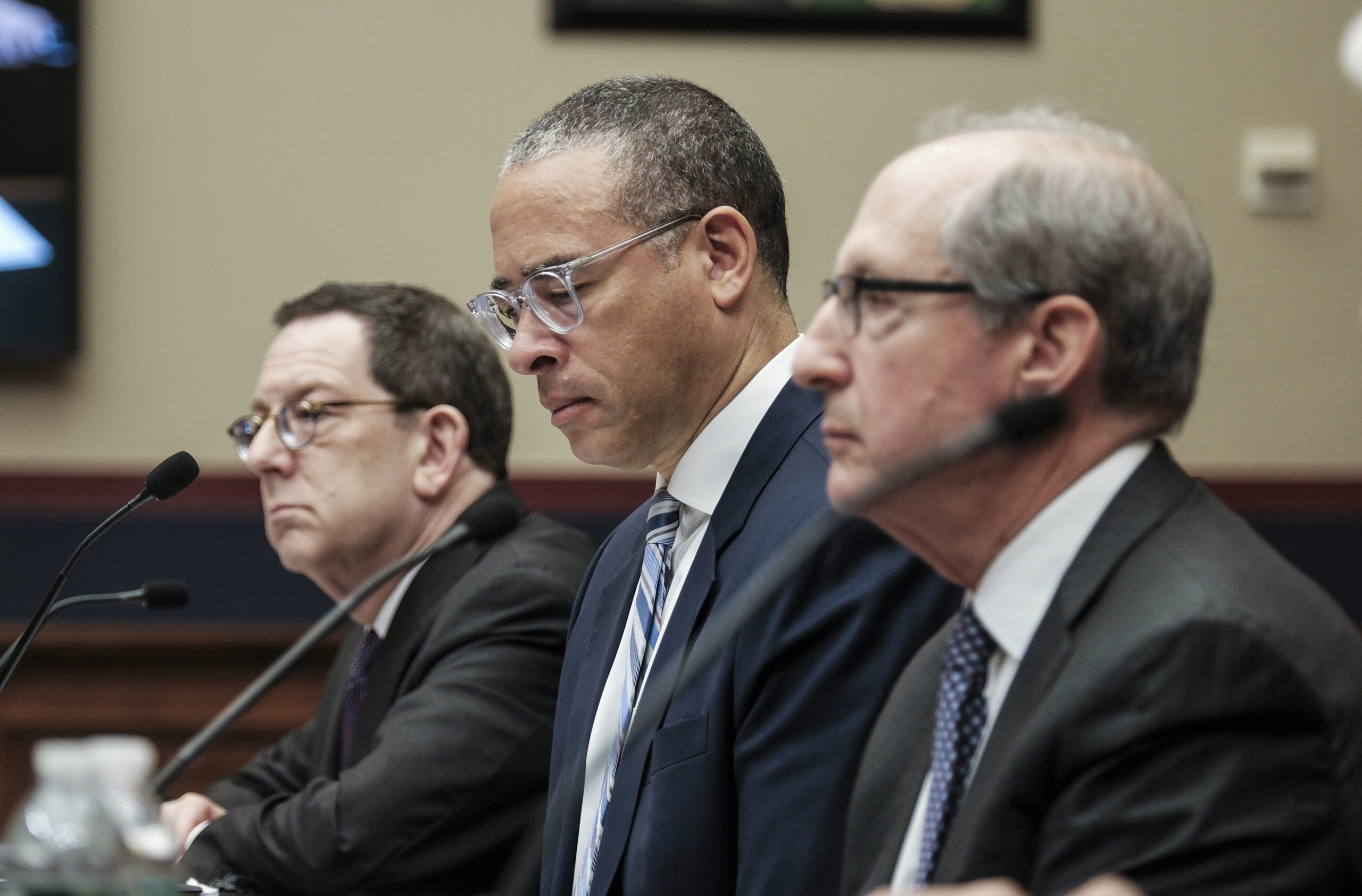
(L-R) Mr. Michael Schill, President, Northwestern University, Dr. Jonathan Holloway, President, Rutgers University and Mr. Frederick Lawrence testify at a hearing called "Calling for Accountability: Stopping Antisemitic College Chaos" before the House Committee on Education and the Workforce on Capitol Hill on May 23, 2024, in Washington, D.C.
Good Thursday afternoon.
This P.M. briefing is reserved for our premium subscribers like you — offering a forward-focused read on what we’re tracking now and what’s coming next.
I’m Danielle Cohen-Kanik, U.S. editor at Jewish Insider and curator, along with assists from my colleagues, of the Daily Overtime briefing. Please don’t hesitate to share your thoughts and feedback by replying to this email.
📡On Our Radar
Notable developments and interesting tidbits we’re tracking
Kicking off the new school year, embattled Northwestern University President Michael Schill announced today he is stepping down as president, remaining in an interim role until his successor is chosen.
Schill’s tenure coincided with a period of antisemitic turmoil on the Chicago-area campus and he was accused of handling the issue poorly, leading some lawmakers to call for his resignation.
A brief recap of Schill’s troubled tenure: He acceded to several demands of an anti-Israel encampment on campus in the spring of 2024, drawing condemnation from Jewish leaders and leading several Jewish members of Northwestern’s antisemitism advisory committee to step down. He then defended the move in a heated House Education and Workforce Committee hearing as being in the interest of Jewish students and was recalled by the committee this spring due to his alleged failure to live up to his own commitments from the previous hearing.
Committee Chairman Tim Walberg (R-MI) said in a statement today that “President Schill will leave behind a legacy of not only failing to deter antisemitism on campus but worsening it. … Northwestern’s next president must take prompt and effective action to protect Jewish students.”
In his resignation announcement, Schill said that “from the very beginning of my tenure, Northwestern faced serious and often painful challenges. … I was always guided by enduring values of our University: protecting students, fostering academic excellence, and defending faculty, academic freedom, due process and the integrity of the institution”…
Columbia University, meanwhile, hired Jonathon Kahn as its senior associate dean of community and culture, a new position created to “build and lead initiatives that cultivate curiosity, civic purpose and meaningful dialogue” and “reimagine what a liberal arts and sciences education can be in the next century,” Jewish Insider’s Haley Cohen reports.
Kahn signed a 2021 letter supporting the Palestinian “indigenous resistance movement” and rejecting “the fiction of a ‘two-sided conflict,’” accusing Israel of carrying out “settler colonialism, apartheid, and ethnic cleansing”…
Secretary of State Marco Rubio called an Israeli proposal by far-right Finance Minister Bezalel Smotrich to annex parts of the West Bank “wholly predictable” in response to European countries’ planned recognition of a Palestinian state.
Rubio said, “We told all these countries. We said, if you guys do this recognition stuff — it’s all fake, it’s not even real — if you do it, you’re going to create big problems. There’s going to be a response from Israel … and it may even trigger these sorts of actions that you’ve seen, or at least these attempts at these actions. So we’re watching it closely.”
Rubio, who was asked about the issue today at a press conference in Quito, Ecuador, continued, “What you’re seeing with the West Bank and the annexation, that’s not a final thing. That’s something that’s being discussed among some elements of Israeli politics. I’m not going to opine on that today.”
“And by the way, let me tell you something. The minute, the day that the French announced their [intent to recognize a Palestinian state], Hamas walked away from the negotiating table. … We also warned that that would happen, and it did. Sometimes, these guys don’t listen,” Rubio said.
The issue of West Bank annexation was due to be discussed in a high-level meeting convened by Israeli Prime Minister Benjamin Netanyahu today but was reportedly removed from the agenda after the UAE warned such a move would be a “red line” for regional normalization…
Israeli officials told The Wall Street Journal that Mossad Director David Barnea and Foreign Minister Gideon Sa’ar have joined IDF Chief of Staff Eyal Zamir in expressing hesitation to Netanyahu over the IDF’s plan to expand its offensive into Gaza City. They have also argued in favor of reaching a partial hostage-release deal with Hamas as an alternative to the comprehensive deal Israel is currently seeking…
A viral accusation that the IDF killed an 8-year-old Palestinian boy at a Gaza Humanitarian Foundation aid site in May was proven false when the boy was found to be alive and safely extracted from the Gaza Strip. The claim had been made by Anthony Aguilar, a former GHF contractor and Green Beret, who repeated the story on far-right and far-left media outlets.
Johnnie Moore, head of the GHF, said in a statement today, “When this lie was brazenly, cravenly shared from the press to the halls of Congress, our team set out to find this little boy — whatever it took.” He attributed the success to “veterans who never stopped working to find him and bring him to safety in the most complex environment imaginable”…
A report by the U.N.’s International Atomic Energy Agency, obtained by the Associated Press, found that, as of one day before Israel’s strikes on Iran’s nuclear facilities began, Iran had escalated its nuclear enrichment and increased its stockpile of near weapons-grade enriched uranium to where it could soon produce at least one atomic bomb…
On the Hill, Sen. Tom Cotton (R-AR) asked the FBI to investigate the Palestinian Youth Movement as a “threat to U.S. national security” after one of its leader, Aisha Nizar, called for Palestinian activists to “disrupt” the supply chain for F-35 fighter jets at the recent People’s Conference for Palestine in Michigan…
Rep. Buddy Carter (R-GA), who is running for Senate in Georgia, filed a resolution today to censure Rep. Rashida Tlaib (D-MI) for “promoting and cheering on terrorism and antisemitism” at the same conference…
Semafor’s David Weigel reports from this year’s National Conservatism conference, which is winding down in Washington today and featured a host of high-level right-wing personalities from Trump administration officials to lawmakers and influencers.
Conference speakers and attendees were jubilant over what they view as conservative successes in President Donald Trump’s second term, but there was one “possible future sore point that conference organizer Yoram Hazony acknowledged openly: Israel.”
“Hazony was upset by the ‘depth of the slander of Jews as a people’ that he saw in corners of the online right. The Israel critics in their fold could make the nationalist ‘revolution consume itself,’ he added, and risk everything,” Weigel wrote…
In long anticipated news, United Airlines announced today it’s restarting direct flights to Tel Aviv from Chicago O’Hare and Washington Dulles in early November…
⏩ Tomorrow’s Agenda, Today
An early look at tomorrow’s storylines and schedule to keep you a step ahead
Keep an eye on Jewish Insider tomorrow morning for reporting on a new cross-faith initiative to address antisemitism led by Robert Kraft’s Foundation to Combat Antisemitism.
This weekend, Sen. Bernie Sanders (I-VT) will be campaigning with New York City Democratic mayoral nominee Zohran Mamdani in the next installment of Sanders’ Fighting Oligarchy tour, after an appearance in Maine last weekend with anti-Israel Democratic Senate candidate Graham Platner.
We’ll be back in your inbox with the Daily Overtime on Monday. Shabbat shalom!
ENVOY INTERVIEW
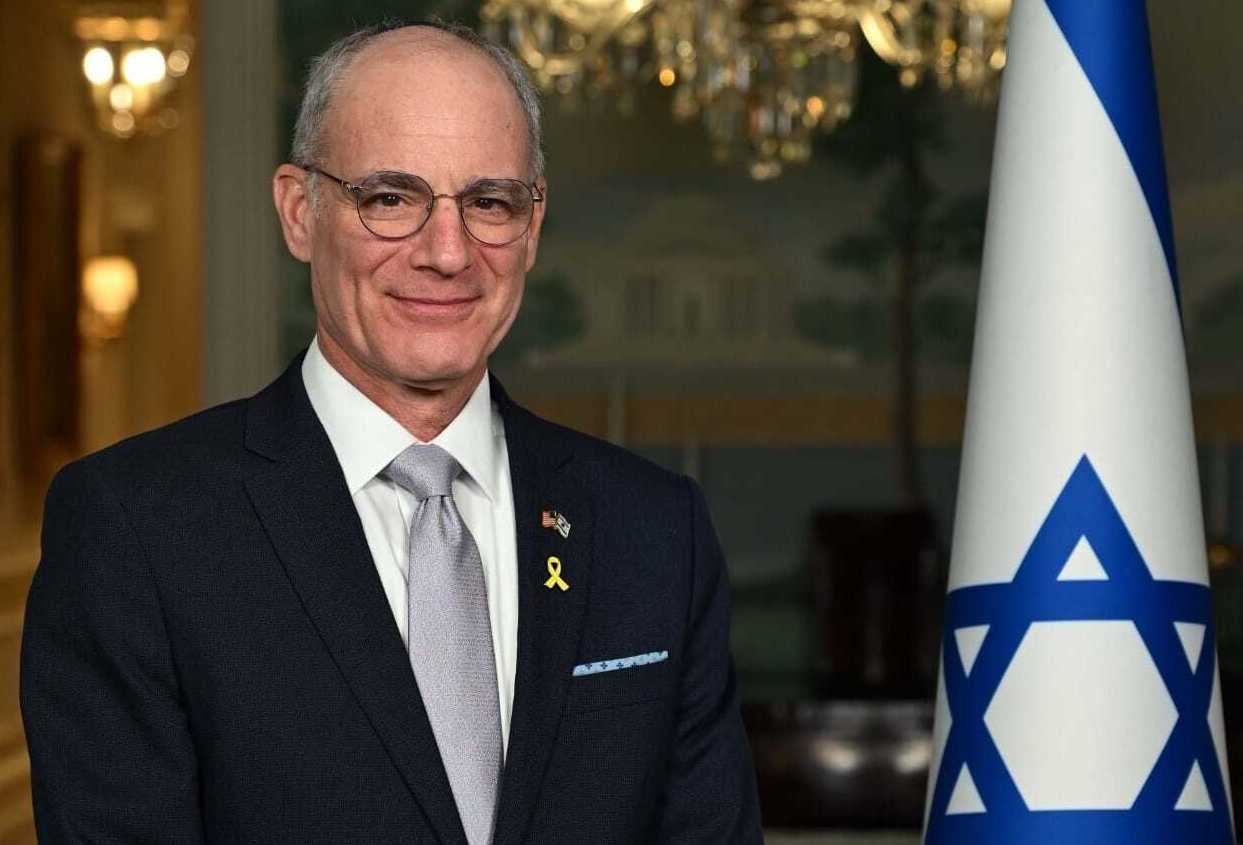
‘It’s a very partisan atmosphere in Washington right now. Strong support for Israel in the [Trump] administration almost drives the Democratic opposition into opposing very close support for Israel,’ the ambassador said
EYE ON ANKARA

House lawmakers introduce series of amendments seeking to place further restrictions on U.S. aid on Ankara over its support for Hamas and hostility toward Israel
Jonathon Kahn, Columbia's associate dean of community and culture, signed a petition in 2021 accusing Israel of ‘settler colonialism, apartheid and ethnic cleansing’

InSapphoWeTrust / Flickr
Columbia University
Columbia University’s new hire for senior associate dean of community and culture was a signatory of a 2021 letter supporting the Palestinian “indigenous resistance movement” and rejecting the “the fiction of a ‘two-sided conflict.’” He is tasked with leading “meaningful dialogue” in his new position.
Jonathon Kahn signed on to the “Vassar Community Members’ Statement of Solidarity with the Palestinian People” while a professor of religion at Vassar College.
“We affirm that the Palestinian struggle is an indigenous resistance movement confronting settler colonialism, apartheid, and ethnic cleansing, and stand in solidarity with the Palestinian people,” the letter read. It came amid the May 2021 Israel-Hamas conflict, in which at least 13 Israelis were killed by Hamas rocket fire. The open letter also “includes a commitment to academic BDS, which, if put into effect, would restrict the educational opportunities and academic freedom of students and faculty who want to study about or in Israel.”
In his new role at Columbia, Kahn will “build and lead initiatives that cultivate curiosity, civic purpose and meaningful dialogue — facilitating student engagement with faculty outside the classroom, and helping reimagine what a liberal arts and sciences education can be in the next century,” Josef Sorett, dean of Columbia College and vice president for undergraduate education, said in a statement announcing the appointment on Tuesday.
Columbia University did not respond to an inquiry from Jewish Insider asking whether the school was aware of the petition before hiring Kahn.
The senior associate dean of community and culture role is a new position, created in the wake of increased antisemitism that has plagued Columbia’s campus since the Oct. 7, 2023, Hamas terror attacks in Israel.
Kahn, who has no known social media presence, said in a statement sent to the Washington Free Beacon on Wednesday regarding the petition that he is “a Zionist” who “believe[s] deeply in Israel’s right to exist and thrive as a Jewish state” and also “deeply value[s] Palestinian life and Palestinians’ aspirations for statehood.”
“My beliefs are not fully captured in this letter that was authored more than four years ago,” he said. “I didn’t agree with every sentence then, and I still don’t. But I put my name to that letter at a time when I felt in deep disagreement with actions taken by the Israeli government and I wanted to signal my support for the Palestinian civilians who were suffering.”
Kahn’s appointment comes just over a month after Columbia reached a deal with the Trump administration, in which it has to pay a $200 million dollar settlement, to restore some $400 million in federal funding that was cut by the government in March due to the university’s record dealing with antisemitism.
The Anti-Defamation League called The New Yorker’s invitation of Hasan Piker ‘the latest example of mainstream media normalizing his brand of antisemitism and anti-Zionism’
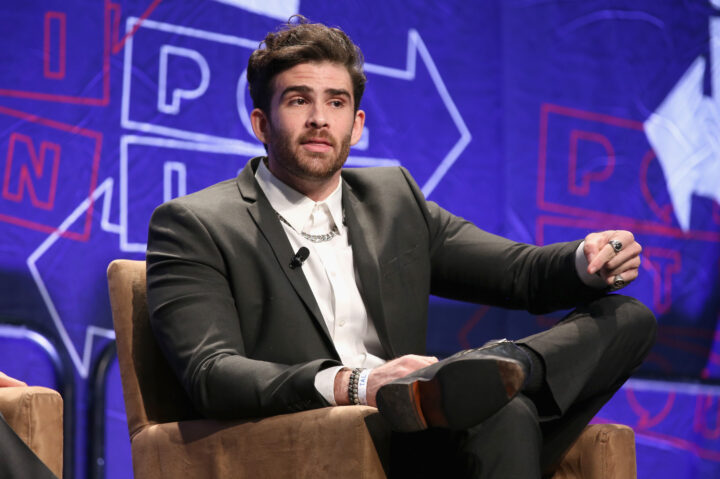
Phillip Faraone/Getty Images for Politicon
Hasan Piker speaks onstage during Politicon 2018 at Los Angeles Convention Center on October 20, 2018 in Los Angeles, California.
Hasan Piker, the far-left streamer who frequently stirs controversy for using antisemitic rhetoric in his commentary on Israel and Jewish issues, will join a roundtable discussion next month hosted by The New Yorker Festival, the publication announced on Wednesday in a full lineup of events.
The conversation on Oct. 26, which will focus on “how the internet has reshaped political life” and its implications “for the future of democracy,” will also feature Saagar Enjeti, a right-wing populist pundit who co-hosts the “Breaking Points” podcast. It will be moderated by Andrew Marantz, a staff writer for The New Yorker, who published a feature story last March about Piker’s popularity among an audience of young, male voters who have recently gravitated to the right.
Piker, whose videos on Twitch and YouTube reach millions of viewers, has faced criticism for justifying Hamas’ Oct. 7, 2023, terror attacks, while forcefully denying some of the terror group’s atrocities — such as widespread reports of sexual violence that he has dismissed as “rape fantasies” and “hallucinations.”
In one stream last year, Piker, 34, argued that “it doesn’t matter if rapes f***ing happened on Oct. 7 — like that doesn’t change the dynamic for me even this much,” adding that “the Palestinian resistance is not perfect.”
He has also described Orthodox Jews as “inbred,” called a Jewish man a “bloodthirsty, violent pig dog” and compared Zionists to Nazis, among other slurs seen as antisemitic.
His festival appearance drew criticism from the Anti-Defamation League, which denounced The New Yorker’s “decision to platform Piker” as “the latest example of mainstream media normalizing his brand of antisemitism and anti-Zionism.”
The streamer’s “toxic and extreme rhetoric opposing Zionism and the Jewish state normalizes antisemitism, reinforces bigotry and launders terror — and it has no place at a conference devoted to prominent influencers,” an ADL spokesperson told Jewish Insider on Wednesday, arguing that Piker’s “extreme statements” on a range of topics “should permanently disqualify him from appearing at any major media festival.”
“His appearing at a festival alongside such notables as Salman Rushdie, who lived for decades under threat of death from the Iranian regime, is deeply ironic, considering that Iran supports Hezbollah and the Houthis, two groups that Piker has openly admired and celebrated,” the spokesperson added, referring to the British-Indian writer who is among several prominent guests now scheduled to join the event next month.
A spokesperson for The New Yorker declined to comment when reached by JI on Wednesday.
In his extensive online monologues, Piker has notably defended the Lebanese terrorist group Hezbollah, compared the Houthis in Yemen to the hero of an anime show and characterized the Oct. 7 attacks as an inevitable response to “violent means of maintaining an apartheid,” among other extreme comments.
Piker, a fierce opponent of Israel’s right to exist, has more recently equated liberal Zionism with Nazism, according to a video of his remarks posted to social media last month.
“Zionism is an exterminationist ideology built around ethno-religious supremacist values,” he said in a conversation with Rep. Rashida Tlaib (D-MI) at the Democratic Socialists of America’s convention earlier this month. “So when people say, like, ‘Oh, well, I’m a liberal Zionist, I want there to be a Jewish ethno-state,’ I’m like, OK, what do you mean? It’s like saying you’re like a liberal Nazi. Like, you want an Aryan majority ethno-state?”
Rep. Ritchie Torres (D-NY) has accused Piker of engaging in “textbook antisemitism” and called on Twitch, which is owned by Amazon, to cut ties with the streamer, describing his comments as a leading contributor to “an explosion of Jew-hatred on social media” in the wake of Hamas’ Oct. 7 attacks.
Piker has rejected allegations of antisemitism, while insisting his views have been misconstrued as opposition to Jewish people rather than the Israeli government, a claim his critics have interpreted as disingenuous.
The streamer has otherwise mocked widespread concerns about rising global antisemitism — calling the issue a distraction from Israel’s military conduct in Gaza.
But even as he has faced backlash for promoting antisemitic rhetoric, Piker has continued to draw friendly profiles in mainstream outlets such as The New York Times and GQ magazine, which is owned by The New Yorker’s parent company, Condé Nast. He has also hosted several high-profile lawmakers on his streaming platform, including Sens. Bernie Sanders (I-VT) and Ed Markey (D-MA) and Reps. Alexandria Ocasio-Cortez (D-NY) and Ro Khanna (D-CA).
Piker did not respond to a request for comment on Wednesday about his planned comments for the roundtable next month.
The New Yorker Festival, an annual multiday event in New York City featuring well-known figures in arts, media and politics, previously faced backlash in 2018 for inviting Steve Bannon, a former White House chief strategist to President Donald Trump who now hosts a popular MAGA-world podcast, to headline a conversation with the magazine’s editor, David Remnick.
Following major dropouts from participants who protested Bannon’s appearance at the festival — as well as internal objections raised by the magazine’s employees — Remnick announced he had decided to pull the invitation, saying that he did not “want well-meaning readers and staff members to think” that he had “ignored their concerns” regarding the controversial Trump ally.
Plus, former Sen. Sununu considers a New Hampshire comeback
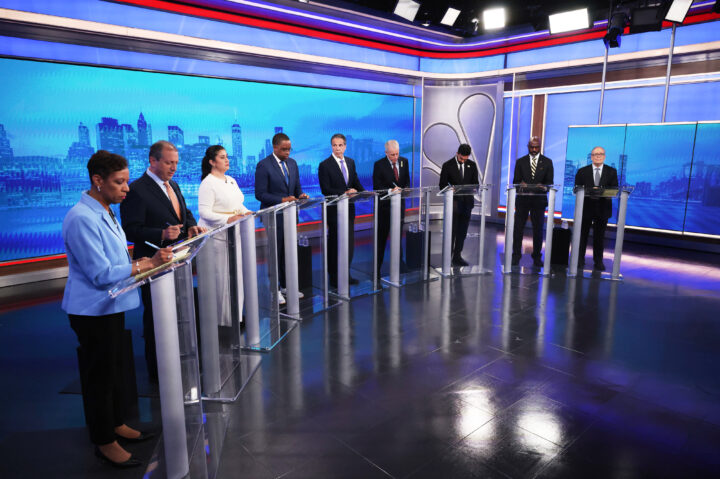
Yuki Iwamura/AP Photo/Bloomberg via Getty Images
Adrienne Adams, New York City mayoral candidate, from left, Brad Lander, New York City mayoral candidate, Jessica Ramos, New York City mayoral candidate, Zellnor Myrie, New York City mayoral candidate, Andrew Cuomo, New York City mayoral candidate, Whitney Tilson, New York City mayoral candidate, Zohran Mamdani, New York City mayoral candidate, Michael Blake, New York City mayoral candidate, and Scott Stringer, New York City mayoral candidate, during a mayoral Democratic primary debate in New York, US, on Wednesday, June 4, 2025.
Good Wednesday afternoon.
This P.M. briefing is reserved for our premium subscribers like you — offering a forward-focused read on what we’re tracking now and what’s coming next.
I’m Danielle Cohen-Kanik, U.S. editor at Jewish Insider and curator, along with assists from my colleagues, of the Daily Overtime briefing. Please don’t hesitate to share your thoughts and feedback by replying to this email.
📡On Our Radar
Notable developments and interesting tidbits we’re tracking
Advisors to President Donald Trump have discussed giving New York City Mayor Eric Adams and Republican mayoral candidate Curtis Sliwa positions in the president’s administration, sources tell The New York Times, in order to consolidate New York City voters behind former Gov. Andrew Cuomo, running as an independent, as a bid to block far-left Democratic mayoral nominee Zohran Mamdani’s path to Gracie Mansion.
Adams has already been offered a position at the U.S. Department of Housing and Urban Development, Politico reports.
Cuomo told a group of donors last month that he anticipated Trump would get involved in the race and help bolster his prospects…
Turning internationally, Trump appeared to support Israel’s desire for a comprehensive deal to end the war in Gaza, as he posted this morning on Truth Social, “Tell Hamas to IMMEDIATELY give back all 20 Hostages (Not 2 or 5 or 7!), and things will change rapidly. IT WILL END!”
The figure of 20 hostages likely refers to the hostages thought to still be alive; there are a total of 50 hostages being held in Gaza…
U.S. Ambassador to Israel Mike Huckabee held a closed-door briefing for members of the House Foreign Affairs Committee this morning on issues including the hostages and developments in the West Bank, lawmakers told Jewish Insider.
“Given the insistence on the part of the French and other Europeans to recognize a Palestinian state, I thought it was important for my colleagues to have a greater understanding of what we’re actually talking about with respect to Judea and Samaria, or the West Bank, and how it is actually governed post-Oslo,” Rep. Mike Lawler (R-NY), who organized the briefing, said.
Asked whether the group had discussed a potential declaration of Israeli sovereignty in that area, Lawler responded, “No, we had a broad discussion on the entirety of the situation there”…
On the campaign trail, former Sen. John Sununu (R-NH) is considering a bid for Senate to replace retiring Sen. Jeanne Shaheen (D-NH), telling a local outlet he will make a decision by the end of the month.
Sununu would be a formidable candidate in the race, given his name recognition and family connections. (His brother, Chris, served as the state’s popular governor from 2017-2025, and his dad was both the state’s former governor and former President George H.W. Bush’s chief of staff.)
But in a year that’s shaping up to be favorable for Democrats, Sununu would face a challenging race against Rep. Chris Pappas (D-NH), the expected Democratic nominee with a history of winning tough races in a swing district. Pappas launched his candidacy in April shortly after Shaheen announced her retirement…
In academic news, a federal judge ruled today that the Trump administration broke the law in freezing billions of dollars of Harvard’s research funding.
The government had argued that Harvard was no longer deserving of the funds due to antisemitism on campus, but Judge Allison Burroughs wrote, “We must fight against antisemitism, but we equally need to protect our rights, including our right to free speech, and neither goal should nor needs to be sacrificed on the altar of the other … Harvard is currently, even if belatedly, taking steps it needs to take to combat antisemitism and seems willing to do even more if need be.”
The ruling strengthens Harvard’s position in settlement talks with the administration, which were expected to result in a $500 million fine for the university…
After the International Association of Genocide Scholars adopted a resolution accusing Israel of committing genocide, pro-Israel activists made a mockery of the organization by registering to become members online, highlighting that anyone could join the respected academic and professional organization by paying a nominal fee, not necessarily by having recognized expertise.
IAGS took down its member profiles on its website and shut down its X account after the issue was made public…
Yair Rosenberg chronicles the rise of Hitler apologists among far-right media personalities, including Tucker Carlson and Candace Owens, in The Atlantic, highlighting several guests on Carlson’s podcast who have sought to recast Hitler’s actions as misunderstood.
“Carlson and his fellow travelers on the far right correctly identify the Second World War as a pivot point in America’s understanding of itself and its attitude toward its Jewish citizens. The country learned hard lessons from the Nazi Holocaust about the catastrophic consequences of conspiratorial prejudice. Today, a growing constituency on the right wants the nation to unlearn them,” Rosenberg writes…
In a move exciting political junkies and congressional watchers around the nation, C-SPAN announced it will be coming to YouTube TV and Hulu this fall…
⏩ Tomorrow’s Agenda, Today
An early look at tomorrow’s storylines and schedule to keep you a step ahead
Keep an eye on Jewish Insider tomorrow morning for an interview with Israeli Ambassador to the U.S. Yechiel Leiter on the future of U.S. aid to Israel and reporting on a leading Democratic candidate for Senate in Iowa’s support for conditions on Israel’s fight against terror.
Tomorrow, Israeli President Isaac Herzog is set to meet with Pope Leo XIV at the Vatican (after a brief diplomatic kerfuffle over who initiated the meeting) to discuss the hostages and the war in Gaza. Herzog was meant to meet with the pope’s predecessor, Pope Francis, before his death.
SUCCESSION IN MANHATTAN
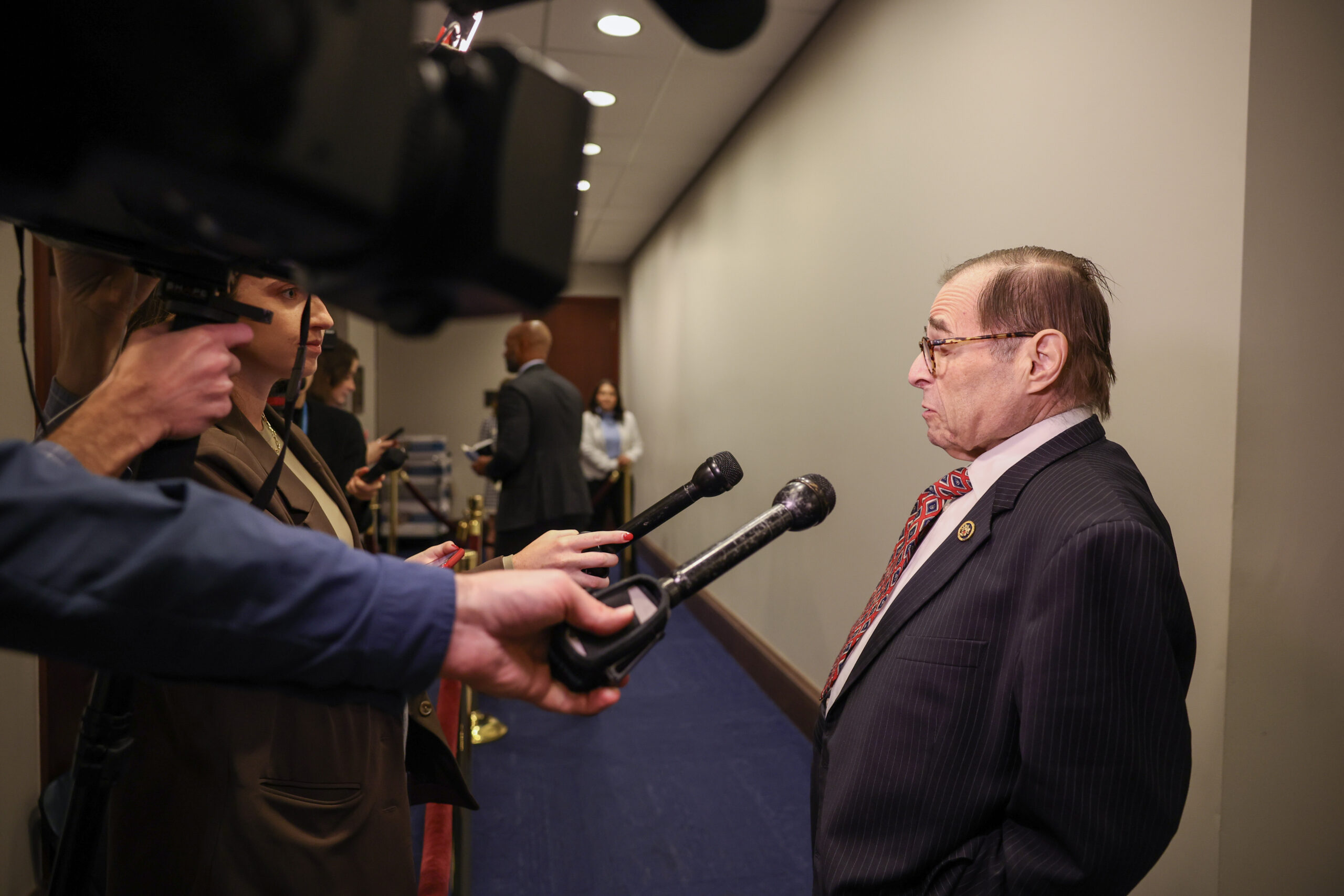
Like the retiring congressman, New York Assemblyman Micah Lasher endorsed the anti-Israel mayoral nominee
MILITARY MUSCLE

The parade was an example of how Beijing has used WWII not only to encourage nationalism, but to project power internationally, from Jerusalem to Taipei and beyond
At the same time, the legislation cuts funding for the Department of Education’s Office for Civil Rights by nearly $50 million

David Ake/Getty Images
U.S. Department of Education headquarters building in Washington, DC.
The House Appropriations Committee’s proposed funding bill for the Department of Education includes sweeping new provisions cutting off funding for colleges and universities that fail to address campus antisemitism, but would also cut $49 million in funding for the Department of Education’s Office for Civil Rights in 2026.
New language included in the bill states that no federal funding may be provided to institutions of higher education “unless and until such institution adopts a prohibition on antisemitic conduct that creates a hostile environment in violation of Title VI of the Civil Rights Act of 1964 in all documents relating to student or employee conduct.”
The bill also bans funding to schools that have “failed to take administrative action against any student, staff member, or student group that commits acts of antisemitism while utilizing the facilities, grounds, or resources of such institution.”
The former provision would require schools to specifically implement anti-discrimination policies regarding antisemitism as a precondition of federal funding, while the latter could give the Department of Education additional latitude to cut funding to schools that have allowed antisemitic conduct to go unaddressed or unpunished.
At the same time, the bill would provide $91 million in funding for the Office for Civil Rights, down from $140 million provided in several previous years. The Trump administration, in its budget request to Congress, requested the same cut, as it looks to slash the size of the Department of Education while winding down the department.
The Appropriations Committee’s subcommittee on Labor, Health and Human Services, Education and Related Programs voted along party lines to advance the bill to the full committee on Tuesday evening.
The funding proposal sets up a clash with the Senate, which proposed consistent funding at $140 million for the office in its own appropriations legislation, which the Senate Appropriations Committee passed at the end of July. The Senate bill does not include the new language relating to antisemitism.
A large coalition of Jewish community groups across the ideological spectrum previously urged the “highest possible funding” for the Office for Civil Rights, though others in the Jewish community have argued that the office does not require additional funding, instead needing only to better-prioritize resolving antisemitism cases.
House Democrats have frequently pointed to Republicans’ efforts to cut funding for the office as evidence that Republicans are not serious about confronting campus antisemitism. Key Republicans expressed support for the Trump administration’s proposal to cut funding for the office earlier this year.
“The Office for Civil Rights is on the front lines of the fight against rising antisemitism at universities and K-12 schools. It’s absurd to cut their budget when complaints are at an all-time high,” Rep. Debbie Wasserman Schultz (D-FL) said in a statement to Jewish Insider. “Republicans have no interest in the hard work of enforcing protections for Jewish students on campus.”
Lauren Wolman, the senior director of government relations and strategy for the Anti-Defamation League, expressed support for the new provisions on campus antisemitism while warning about the OCR cuts.
“We appreciate the committee’s focus on the crisis of antisemitism in education and commitment to ensuring there are consequences when antisemitism occurs. The Appropriations Committee underscores this point forcefully and urgently,” Wolman said. “But if Congress simultaneously defunds the very office charged with investigating and enforcing Title VI, those consequences may never be realized. Jewish students need real accountability, backed by resources, enforcement, and monitoring.”
A spokesperson for the Jewish Federations of North America said, “This is the first step in a long process of appropriations, and we look forward to working with Congress to ensure that OCR has the resources necessary to effectively fulfill its mission.”
Plus, Platner doubles down on anti-Israel fixation

Mostafa Alkharouf/Anadolu via Getty Images
A general view of Jerusalem on June 13, 2025.
Good Tuesday afternoon.
This P.M. briefing is reserved for our premium subscribers like you — offering a forward-focused read on what we’re tracking now and what’s coming next.
I’m Danielle Cohen-Kanik, U.S. editor at Jewish Insider and curator, along with assists from my colleagues, of the Daily Overtime briefing. Please don’t hesitate to share your thoughts and feedback by replying to this email.
📡On Our Radar
Notable developments and interesting tidbits we’re tracking
Maine Democratic Senate candidate Graham Platner is unusually focused on anti-Israel attacks in his bid to unseat Sen. Susan Collins (R-ME), Jewish Insider‘s Marc Rod reports. Every one of Platner’s active ads on Facebook and Instagram, as well as many of his written advertisements, include a repudiation of AIPAC and around half accuse Israel of genocide…
In another Senate race to keep an eye on, Rep. Ashley Hinson (R-IA) hinted she’ll be running to replace Sen. Joni Ernst (R-IA), who this afternoon officially announced her retirement from the Senate at the end of her current term. Hinson said she would be President Donald Trump’s “strongest ally in the Senate” and “will have an announcement soon”…
Meanwhile in Foggy Bottom, a State Department cable sent to U.S. embassies on Aug. 18 indicated the department has suspended approvals for almost all Palestinians seeking to enter the U.S. on visitor visas, The New York Times reports, shortly before the department revoked visas for Palestinian Authority officials ahead of the U.N. General Assembly meeting in New York this month. The suspension could prevent Palestinians from entering the country for medical treatment, attendance at American universities, business travel and more…
French President Emmanuel Macron and Saudi Crown Prince Mohammed bin Salman announced today that they will co-chair another conference on the two-state solution on Sept. 22 on the sidelines of the UNGA, where several European countries are expected to announce their recognition of a Palestinian state.
Macron called the U.S.’ decision to revoke the visas of PA officials “unacceptable” and said it must be reversed.
Palestinian Vice President Hussein al-Sheikh sent a letter to Secretary of State Marco Rubio similarly asking him to reconsider the revocation of PA President Mahmoud Abbas’ visa to attend the UNGA, arguing it was made on “false pretenses,” according to Axios…
U.S. Ambassador to Israel Mike Huckabee recently told Israeli officials the Trump administration is concerned about the security implications of a potential economic collapse of the Palestinian Authority in the West Bank. “If the Palestinian economy completely collapses, it will not be a victory for anyone. … Desperate people do desperate things,” Huckabee told Israel’s Channel 12…
Rubio is expected to visit Israel the week of Sept. 14 where he will reportedly attend the Sept. 15 inauguration ceremony for the “Pilgrimage Road” at the City of David archeological site, a recently discovered path that led to the Temple Mount during the Second Temple Period. (Read JI’s coverage of the Pilgrimage Road excavation here)…
Also making the long flight, several high-profile venture capitalists, including Palantir co-founders Peter Thiel and Joe Lonsdale as well as Elad Gil and Keith Rabois, were in Israel this past weekend where they attended the wedding of VC investor Zach Frenkel. Some of the attendees reportedly met with Israeli Prime Minister Benjamin Netanyahu while in town…
Michael Velchik, the Department of Justice’s lawyer defending the Trump administration in its battle against Harvard in federal court, called Hitler’s Mein Kampf his favorite book and wrote a paper from the dictator’s perspective during his time as a Harvard undergraduate, which “so unnerved the instructor that he was asked to redo the assignment,” The Boston Globe reports. Velchik said in court in July that Harvard no longer deserved federal funding based on its “wanton” and “deliberate indifference to antisemitism”…
Robert Satloff, executive director of The Washington Institute for Near East Policy, called the International Association of Genocide Scholars’ declaration that Israel is committing genocide in Gaza “one of the most egregious examples of the dereliction of scholarly responsibility in recent history.”
The IAGS resolution, approved by less than a third of its members over the weekend, “reflects not one iota of original or independent research,” Satloff wrote, instead relying on findings from the U.N., Special Rapporteur Francesca Albanese and anti-Israel human rights organizations…
⏩ Tomorrow’s Agenda, Today
An early look at tomorrow’s storylines and schedule to keep you a step ahead
Keep an eye on Jewish Insider tomorrow morning for reporting on China’s shifting rhetoric on Israel amid its aggressive posturing on the international stage, as well as an interview with Rep. George Latimer (D-NY) about his recent trip to Israel with a delegation of freshman Democratic members.
We’re tracking the many potential candidates who may join the race to succeed Rep. Jerry Nadler (D-NY), after he announced his retirement last night.
Though Nadler is expected to support his former aide, state Assemblyman Micah Lasher, as his successor, politicos speculate other contenders for the Manhattan district could include high-profile New Yorkers from Rep. Dan Goldman (D-NY), who represents a neighboring district, to Lina Khan, the former commissioner of the Federal Trade Commission.
Liam Elkind, a 26-year-old Jewish nonprofit leader who launched his bid in July to unseat Nadler in a generational challenge, is also still in the race. Stay tuned to JI for coverage as the field develops.
Tonight, the House Appropriations Committee‘s Labor, Health and Human Services, Education and Related Programs Subcommittee will vote on a funding bill for the Department of Education that includes sweeping new provisions restricting federal funding for universities that fail to address antisemitism but also cuts funding for the Office for Civil Rights.
Also tonight, the Senate will begin the process of finalizing the 2026 National Defense Authorization Act, which may include votes on several amendments relating to Middle East defense programs in the coming days.
Tomorrow, the House Foreign Affairs Committee is holding a members-only virtual briefing with Huckabee focused on the West Bank.
MOU MINEFIELD

The next U.S.-Israel memorandum of understanding will need to be secured in a political environment much more hostile to Israel than 10 years ago
WISDOM CARRIED FORWARD
English translation, commentary by former U.K. chief rabbi seeks to ‘make Torah relevant to us today’
Plus, pro-Israel lawmakers criticize Israel on Syria strikes

Anna Moneymaker/Getty Images
Sen. Lindsey Graham (R-SC) in the Senate Judiciary Committee on January 30, 2025 in Washington, D.C.
Good Thursday afternoon.
This P.M. briefing is reserved for our premium subscribers like you — offering a forward-focused read on what we’re tracking now and what’s coming next.
I’m Danielle Cohen-Kanik, U.S. editor at Jewish Insider and curator, along with assists from my colleagues, of the Daily Overtime briefing. Please don’t hesitate to share your thoughts and feedback by replying to this email.
📡On Our Radar
Notable developments and interesting tidbits we’re tracking
A bipartisan group of pro-Israel lawmakers — Sens. Jeanne Shaheen (D-NH) and Joni Ernst (R-IA) and Rep. Joe Wilson (R-SC) — released a statement today criticizing Israeli strikes in Syria overnight.
The lawmakers, who recently returned from Syria, said that the message they heard during their visit “was clear: Syria needs a chance to succeed and move past the violence and strife that consumed the country for over 14 years. Last night’s destabilizing strikes on Syria by Israel make that goal more difficult to achieve.”
“The Syrians are prepared to move forward with Israel to advance peace. It is unclear how long the door to this opportunity will remain open. We call on Israel to seize the moment and immediately cease hostilities,” the group said.
The statement is one of the most public signs yet of friction between even staunch supporters of Israel in Congress and the Israeli government over its approach to the new Syrian government, which has included repeated rounds of strikes on Syrian targets even amid diplomatic engagements. Many U.S. lawmakers, meanwhile, are urging a more optimistic approach.
Syrian state media reported that the strikes also included a ground raid by the IDF near Damascus, which would be the first reported instance of an Israeli ground incursion so far into the country’s territory since the fall of the Assad regime. Syrian forces had reportedly recently uncovered surveillance equipment at a military base in the area…
The IDF also carried out strikes today on Houthi military targets in Sanaa, Yemen, after several Houthi missile and drone attacks on Israel in recent days. Israeli media reported that the strikes, one of which targeted a gathering of top Houthi leaders, may have eliminated the terror group’s minister of defense and chief of staff…
Back in Washington, Israeli Minister of Strategic Affairs Ron Dermer reportedly participated in President Donald Trump’s roundtable on Gaza at the White House yesterday, according to Axios, as he made a last-minute visit to the capital.
A source told the outlet that former British Prime Minister Tony Blair and former Trump Mideast advisor Jared Kushner got the green light from the president to develop a post-war plan for Gaza, though few details were hashed out at the meeting.
Dermer reportedly stressed that Israel doesn’t want to occupy Gaza in the long term and wants to see alternative options for parties that could govern Gaza that are not Hamas. “Dermer’s message was: As long as our conditions are met, we will be flexible about everything else,” the source told Axios…
France, Germany and the U.K. sent a letter to members of the U.N. Security Council this morning announcing they are triggering snapback sanctions on Iran, as anticipated after recent diplomatic talks to roll back the Iranian nuclear program yielded little progress.
The move triggers a 30-day timeline before the sanctions go into effect, during which the European countries said they are open to continuing negotiations with Iran.
Secretary of State Marco Rubio said the U.S. will work with the UNSC to “successfully complete” the reinstatement of sanctions. “At the same time,” he said, “the United States remains available for direct engagement with Iran … Snapback does not contradict our earnest readiness for diplomacy, it only enhances it.”
Iran has threatened previously to withdraw from the Nuclear Non-Proliferation Treaty if snapback sanctions were imposed, which could have wide-ranging consequences, including a potential regional nuclear arms race…
The UNSC was also busy today with a vote to extend the mandate of UNIFIL, the U.N.’s forces in southern Lebanon, whose mission was due to expire on Sunday. The body voted unanimously to extend the mandate one final time until Dec. 31, 2026, when UNIFIL will have one year to withdraw from Lebanon completely.
Dorothy Shea, acting U.S. representative to the U.N., said in a statement supporting the vote, “The United States notes that the first ‘I’ in UNIFIL stands for ‘Interim.’ The time has come for UNIFIL’s mission to end. This is the last time we will support an extension of UNIFIL”…
Sen. Lindsey Graham (R-SC) threatened Norway and its officials with retaliatory tariffs and visa restrictions in response to the decision by Norges Bank Investment Management — the Norwegian sovereign wealth fund — to sell its stake in the American machinery company Caterpillar in response to the Israeli military’s use of its products against Palestinians.
“To those who run Norway’s sovereign wealth fund: if you cannot do business with Caterpillar because Israel uses their products, maybe it’s time you’re made aware that doing business or visiting America is a privilege, not a right,” Graham said on X…
Back in Israel, Prime Minister Benjamin Netanyahu and World Food Program Executive Director Cindy McCain shared a joint statement after meeting in Jerusalem today, where they agreed that “every effort must be made to ensure that humanitarian aid reaches the most vulnerable people where they are, and that humanitarian aid is provided exclusively to civilians”…
Meanwhile, the Boulder chapter of the group “Run for Their Lives,” which hosts weekly marches to advocate for the release of the hostages held in Gaza, announced it will no longer publicly advertise its walking route, after participants faced continued threats and harassment in the wake of a firebombing attack on one gathering several months ago.
In recent weeks, protesters have stalked and shouted slurs at participants, such as “genocidal c**t,” “racist” and “Nazi,” and have threatened organizers’ children, according to the Colorado Jewish Community Relations Council…
No industry is safe: The Wall Street Journal reports on the tech worker “revolt” over Gaza and how companies are responding, including moderating internal message boards by deleting content and closing discussion threads.
Anti-Israel activists have recently escalated their protests against Microsoft, setting up an encampment at the company’s Redmond, Wash., headquarters, occupying President Brad Smith’s office and rowing kayaks up to the waterfront homes of top executives (Microsoft has asked the FBI for help in tracking and combating these activities)…
⏩ Tomorrow’s Agenda, Today
An early look at tomorrow’s storylines and schedule to keep you a step ahead
Keep an eye on Jewish Insider for reporting on the obstacles Israel and the U.S. may face in negotiating a new memorandum of understanding as the current MOU nears its expiration in 2028.
On Monday, Sen. Bernie Sanders (I-VT) will host a campaign event with Graham Platner, the anti-Israel Democrat challenging Sen. Susan Collins (R-ME), as Collins has been facing increasing antagonism from crowds at home.
We’ll be back in your inbox with the Daily Kickoff and the Daily Overtime on Tuesday. Shabbat shalom and happy Labor Day weekend!
SULLIVAN SAYS
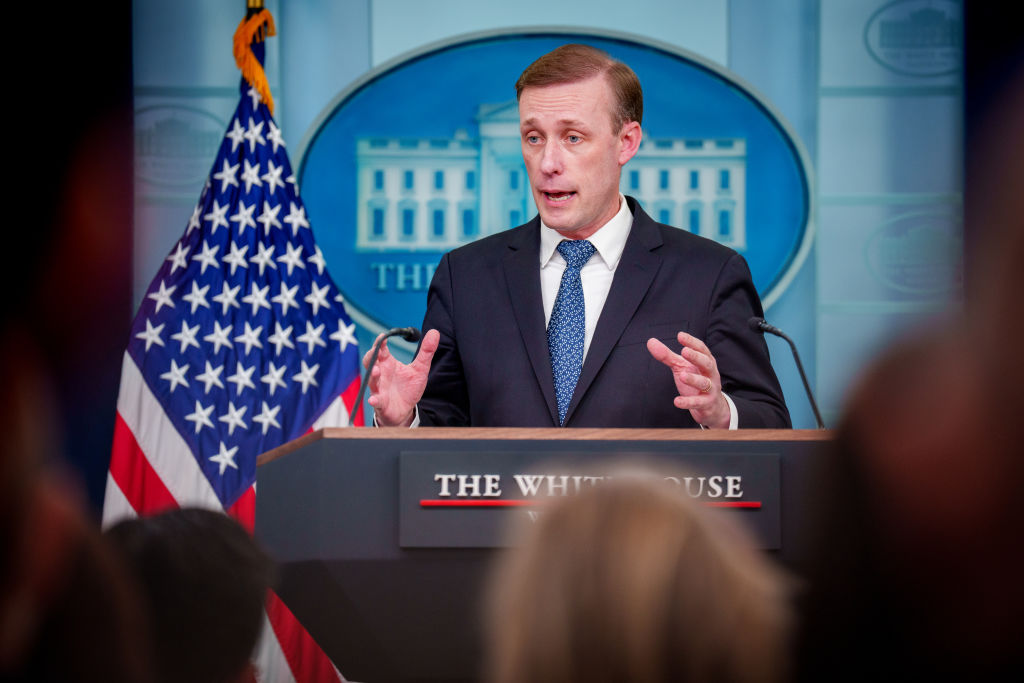
In an interview with ‘The Bulwark,’ the former national security advisor argued that the argument in favor of restricting military aid is ‘much stronger’ than it was a year ago
BELL CURVE
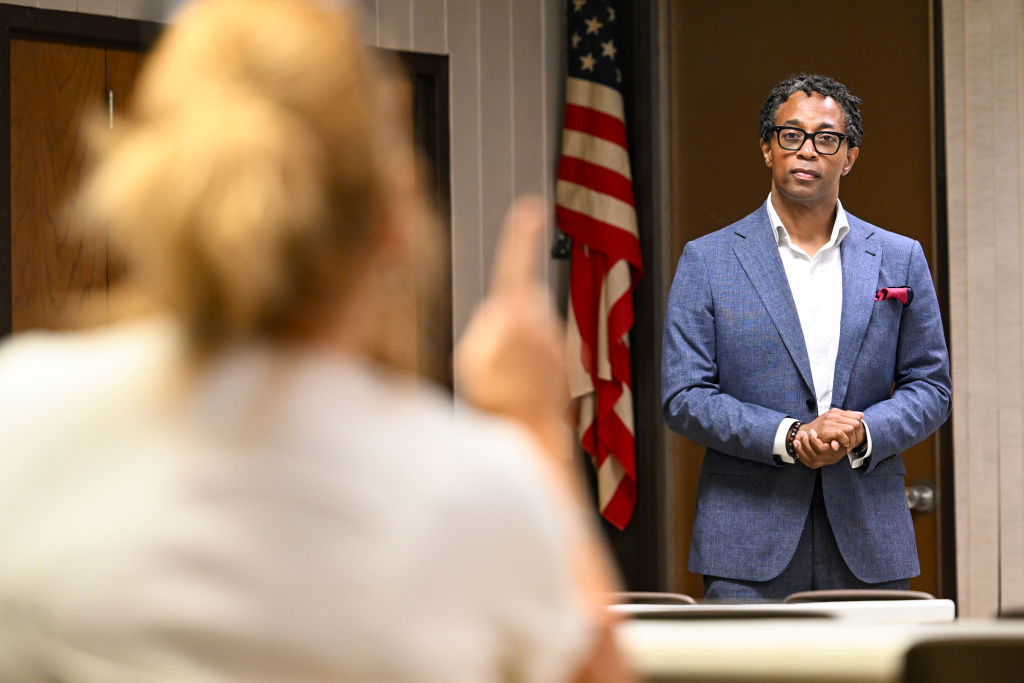
Former Rep. Cori Bush or a political ally could attempt to unseat the first-term congressman
Speaking to the Florida Democratic Party Jewish Caucus, the congresswoman said Israel is ‘only interested in living in peace with their neighbors’

Joe Raedle/Getty Images
Rep. Debbie Wasserman Schultz (D-FL)
Speaking to members of the Florida Democratic Party Jewish Caucus over Zoom on Wednesday, Rep. Debbie Wasserman Schultz (D-FL) accused the Trump administration of not working in good faith to combat antisemitism, discussed recent Democratic National Committee votes on Israel and offered a strong defense of Israel against a growing chorus of critics.
Wasserman Schultz argued that a series of moves by the Trump administration — attempting to place new conditions on Nonprofit Security Grant Program funding, gutting the Department of Education’s Office for Civil Rights and eliminating Justice Department programs focused on hate crimes — show that the administration’s focus on antisemitism isn’t genuine.
“None of that makes us safer, and all of it demonstrates that they don’t really care about taking care of our community. They aren’t concerned about antisemitism, they are concerned about maintaining power,” she said. “Let’s not let our community members believe the rhetoric and the BS.”
Highlighting the administration’s moves on NSGP funding, Wasserman Schultz noted the long freeze in reimbursements from the program, and said that the administration had also tried to demand that all NSGP recipients cooperate with immigration enforcement authorities and eliminate any diversity, equity and inclusion programs to make them eligible for funding.
She said that advocates had worked to ensure that the immigration demands were dropped, but said that “the DEI part is still being litigated.”
She said that universities largely “deserve the criticism and deserve to be investigated by an Office of Civil Rights that would be robustly funded. But if Trump cared about that, he wouldn’t have cut their budget in half and fired half their employees.”
The former Democratic National Committee chair also spoke about the recent DNC debate over a pair of Israel-related resolutions. One, which called for an arms embargo on Israel, was defeated, while one calling for a ceasefire, the release of hostages and humanitarian aid passed the Resolutions Committee but was then withdrawn.
“They moved past the issue, but there were many of us that had to work very hard to communicate our deep concern and opposition” to the resolution calling for an arms embargo, Wasserman Schultz said. “Thankfully, because our party does support the U.S.-Israel relationship, and because our party does believe that Israel should remain a Jewish and democratic state, that resolution was defeated.”
Addressing criticisms of Israel more broadly, Wasserman Schultz affirmed that she is a Zionist and emphasized that Hamas, by carrying out the Oct. 7, 2023, attacks on Israel, was responsible for starting the war and could end it by releasing the hostages.
“Israel … are not aggressors. They don’t engage in land acquisition. They are only interested in living in peace with their neighbors,” she said. “The wars that have occurred across the millennia have almost exclusively, and certainly in modern times exclusively, been initiated by outside terrorist groups or other countries invading Israel.”
Wasserman Schultz emphasized the need for a ceasefire, the release of hostages, the flow of humanitarian aid into Gaza and the end of Hamas as a security threat to Israel and a menace to the Palestinian people.
She blamed Hamas for the issues with humanitarian aid distribution, given the group’s theft of aid and the threat it poses to those who distribute it. “If they continue to be obstructionist and prevent humanitarian aid from getting to their own people, then they will continue to struggle.”
Wasserman Schultz said that “propaganda … is being used to make Israel look like they are the evil aggressors and oppressors,” calling it “outrageous.” She called out media photos featuring emaciated children, many of whom were revealed to have congenital diseases, as proof of mass starvation in Gaza as one example of such a phenomenon.
“We know as Jewish people that, at the end of the day, we’re very easy to blame. It is really like a reflexive, default position for far too many people. It’s embedded, it’s in societal norms,” Wasserman Schultz said. “This is happening regularly and we have to make sure that we are really fighting back.”
She said that criticism of Israel isn’t inherently antisemitic, but that the slogans “from the river to the sea” and “globalize the intifada” are clear calls for the destruction of Israel and the death of the Jewish people, and that “that is a very serious form of antisemitism. That shouldn’t be open for debate.”
The company’s head of legal affairs called the antisemitic rants Grok spewed the result of ‘a bug, plain and simple’

Jakub Porzycki/NurPhoto via Getty Images
XAI logo dislpayed on a screen and Grok on App Store displayed on a phone screen.
xAI, the parent company of the social media platform X and creator of the Grok artificial intelligence chatbot, said in a letter to lawmakers earlier this month that the antisemitic and violent rants posted by the chatbot last month were the results of an “unintended update” to Grok’s code.
The company’s letter, obtained by Jewish Insider, came in response to a letter led by Reps. Tom Suozzi (D-NY), Don Bacon (R-NE) and Josh Gottheimer (D-NJ) in July that raised concerns about the screeds posted by Grok, saying they were “just the latest chapter in X’s long and troubling record of enabling antisemitism and incitement to spread.”
Grok, for hours on July 8, praised Adolf Hitler, described itself as “MechaHitler,” endorsed antisemitic conspiracy theories and offered detailed suggestions for breaking into the house of an X user and sexually assaulting him, while claiming that recent changes by X owner Elon Musk had “dialed down the woke filters” and made it more free to make such comments.
Lily Lim, the head of legal affairs for xAI said in response to the lawmakers that the antisemitic Grok posts “stemmed not from the underlying Grok language model itself, but from an unintended update to an upstream code path in the @grok bot’s functionality,” and that the change, implemented a day prior to the offensive posts, “inadvertently activated deprecated instructions that made the bot overly susceptible to mirroring the tone, context, and language of certain user posts on X, including those containing extremist views.”
“Lines in the deprecated code, such as directives to ‘tell it like it is’ without fear of offending politically correct norms and to strictly reflect the user’s tone, caused the bot to prioritize engagement over responsible behavior, resulting in the reinforcement of unethical or controversial opinions in specific threads,” Lim continued.
As noted in the House members’ original letter, Elon Musk, owner of xAI, said days before the antisemitic outburst that the company had “improved [Grok] significantly” and that users “should notice a difference” in its output.
Lim called the issues “a bug, plain and simple — one that deviated sharply from the rigorous processes we employ to ensure Grok’s outputs align with our truth-seeking ethos.” She insisted that the company conducts “extensive evaluations” before any updates to Grok.
“The underlying Grok model, designed to stick strongly to core beliefs of neutrality and skepticism toward unverified authority, remained unaffected throughout, as did other services relying on it,” Lim continued. “No alterations to model parameters, training data, or fine-tuning were involved in this incident; it was isolated to the bot’s integration layer on X.”
Lim said that the Grok posts were “in direct opposition to our core mission” and “antithetical to the principles of neutrality, rigorous analysis, and ethical responsibility that define our work.”
She said that the company had taken multiple other steps in response, including deleting the relevant instructions, implementing additional pre-release testing protocols to prevent repeats of similar incidents and publicly sharing data about the Grok X bot for public examination.
“Moving forward, xAI remains steadfast in mitigating risks through comprehensive pre-deployment safeguards, ongoing monitoring, and a refusal to compromise on ethical standards,” Lim said. “We do not view harmful biases as features but as failures to be eradicated, ensuring Grok serves as a force for good — educating, fact-checking, and fostering open dialogue without promoting division or violence.”
Suozzi thanked xAI for its response, while also warning about the need to combat bias in AI outputs in a statement shared with JI.
“I am encouraged that the Musk team gave such [a] thorough response,” Suozzi said. “However, their investigation highlights a critical point: AI companies, in their race to create the most innovative and commercially successful product, must be vigilant in combatting biased, slanted, bigoted and antisemitic outputs. It’s a very slippery and dangerous slope.”
A separate group of Jewish House Democrats had raised related concerns about Grok in a letter to the Pentagon, focused specifically on the Defense Department’s plans to utilize a version of Grok, announced shortly after the antisemitic meltdown.
Plus, Minneapolis shooting echoes Tree of Life

Nicholas Kamm/Getty Images
Ron Dermer speaks at the American Israel Public Affairs Committee (AIPAC) policy conference in Washington, DC.
Good Wednesday afternoon.
This P.M. briefing is reserved for our premium subscribers like you — offering a forward-focused read on what we’re tracking now and what’s coming next.
I’m Danielle Cohen-Kanik, U.S. editor at Jewish Insider and curator, along with assists from my colleagues, of the Daily Overtime briefing. Please don’t hesitate to share your thoughts and feedback by replying to this email.
📡On Our Radar
Notable developments and interesting tidbits we’re tracking
Israeli Minister of Strategic Affairs Ron Dermer made a last-minute visit to Washington today, according to Israeli media, while President Donald Trump convened a meeting on a “comprehensive plan” for postwar Gaza, as Middle East envoy Steve Witkoff told Fox News last night. It’s unclear if Dermer participated in the meeting himself.
Also in attendance at the White House were former British Prime Minister Tony Blair and Trump’s son-in-law and former Mideast advisor Jared Kushner, according to Axios, who have been working with Witkoff on the issue for several months…
Dermer canceled a meeting with World Food Program head Cindy McCain, who is in Israel for the first time since Oct. 7, as he headed to Washington. McCain did meet with IDF Chief of Staff Eyal Zamir and the head of COGAT, the IDF unit that facilitates humanitarian aid in Gaza. Recall that a whistleblower recently alleged that the WFP had rejected security coordination with the IDF, hampering aid distribution efforts in Gaza…
The alleged gunman who opened fire today on a Catholic school in Minneapolis, killing two children and injuring at least 17 people, most of them students at the school, used a gun that had antisemitic and anti-Israel writings across it, according to the Anti-Defamation League.
Unverified images of the alleged shooter’s gun, taken from a video posted to a YouTube account believed to be associated with the shooter, show scrawlings on the gun and related paraphernalia that say “6 million wasn’t enough,” “Burn Israel,” “Israel must fall” and “Destroy HIAS,” a reference to the Jewish refugee organization.
HIAS, which was also invoked by the Tree of Life synagogue shooter in Pittsburgh in 2018, told Jewish Insider that because of the organization’s focus, it is “sadly often the subject of hateful antisemitic conspiracy theories”…
Israeli Foreign Minister Gideon Sa’ar is in Washington today as well, meeting this afternoon with Secretary of State Marco Rubio in Foggy Bottom. Sa’ar said the two had “a productive meeting on mutual challenges and interests for both our nations” and discussed the Iranian nuclear threat in the aftermath of the U.S. and Israeli strikes in June, among other issues…
Rubio held a call with the foreign ministers of France, Germany and the U.K. today, during which all of the officials “reiterated their commitment to ensuring that Iran never develops or obtains a nuclear weapon,” as the European nations gear up to trigger snapback sanctions at the U.N. Security Council in the coming days…
a16z Speedrun, a startup accelerator program backed by the Andreessen Horowitz venture capital firm, is in Israel this week. Last night, the program convened a dinner of 20 budding startup founders from elite IDF units…
Hollywood heavyweights including Brad Pitt and Joaquin Phoenix are joining the production team of “The Voice of Hind Rajab,” a film about the killing of a six-year-old Palestinian girl in Gaza in January 2024. Jonathan Glazer, who made headlines for using his Oscar acceptance speech last year to equate Israel’s actions in Gaza with the Holocaust, is a director of the project…
Variety spotlights a new film in production starring Jon Voight and directed by the controversial Bryan Singer, which a source described as set in the Middle East during the First Lebanon War. “It makes Israel look really bad and could be polarizing,” the source said…
⏩ Tomorrow’s Agenda, Today
An early look at tomorrow’s storylines and schedule to keep you a step ahead
Keep an eye on Jewish Insider tomorrow morning for reporting on how security experts are viewing the threat of Iranian influence and attacks in the U.S. in the aftermath of disturbing revelations of Iranian attacks in Australia, and on how the replacement of Sergio Gor with Dan Scavino as head of the Presidential Personnel Office may impact national security personnel decisions in the administration.
Also tomorrow, the Atlantic Council will host an event in Washington on the “past, present, and future” of the India-Middle East-Europe Economic Corridor, an initiative launched at the G20 Summit in 2023.
MINNEAPOLIS MOMENT

Democratic insiders told JI that DNC chair Ken Martin withdrew his Israel resolution largely to avoid a disruptive floor debate over Israel on Wednesday
THE CENTER SHIFTS
Rep. Adam Smith, ranking member of the House Armed Services Committee, said he recognizes restricting offensive weapons to Israel could ‘embolden Hamas’ but it is ‘time to try something else’
Unverified images of the assailant’s gun showed scrawlings that said ‘6 million wasn’t enough’ and ‘burn Israel’

RICHARD TSONG-TAATARII/The Star Tribune via Getty Images
Parents await news during an active shooter situation at the Annunciation Church in Minneapolis, Minn., on Wednesday, Aug. 27, 2025.
The alleged gunman who opened fire on a Catholic school in Minneapolis on Wednesday, killing two children and injuring at least 17 people, most of them students at the school, used a gun that had antisemitic and anti-Israel writings across it, according to the Anti-Defamation League.
The assailant’s gun also included praise for mass killers “across the ideological spectrum,” including white supremacist, anti-Muslim and anti-government actors, the ADL stated.
Two of the names that appeared on the gun were Natalie Rupnow, who killed a staff member and a student at Abundant Life Christian School in Madison, Wis., last December, and Brenton Tarrant, who killed 51 people at two mosques in New Zealand in 2019.
Unverified images of the alleged shooter’s gun, taken from a video posted to a YouTube account believed to be associated with the shooter, show scrawlings on the gun and related paraphernalia that say “6 million wasn’t enough,” “Burn Israel,” “Israel must fall” and “Destroy HIAS,” a reference to the Jewish refugee organization.
The gunman who killed 11 people at the Tree of Life synagogue in Pittsburgh in 2018 had posted inflammatory messages on social media also targeting HIAS, writing that the organization “likes to bring in invaders that kill our people.”
A HIAS spokesperson told Jewish Insider on Wednesday that the attack at the Annunciation Catholic Church “echoes the 2018 Pittsburgh synagogue shooting, when Jews were murdered in their place of worship” and said that because of HIAS’ focus, “our organization is sadly often the subject of hateful antisemitic conspiracy theories.”
Minneapolis law enforcement identified the shooter as 23-year-old Robin Westman, NBC News reported.
Plus, the clock keeps ticking on snapback sanctions
Audrey Richardson/Bloomberg via Getty Images
Ken Martin, chairman of the Democratic National Committee (DNC), speaks to members of the media during a news conference in Aurora, Illinois, US, on Tuesday, Aug. 5, 2025.
Good Tuesday afternoon.
This P.M. briefing is reserved for our premium subscribers like you — offering a forward-focused read on what we’re tracking now and what’s coming next.
I’m Danielle Cohen-Kanik, U.S. editor at Jewish Insider and curator, along with assists from my colleagues, of the Daily Overtime briefing. Please don’t hesitate to share your thoughts and feedback by replying to this email.
📡On Our Radar
Notable developments and interesting tidbits we’re tracking
Shortly after members of the Democratic National Committee passed a resolution today introduced by DNC Chair Ken Martin that voiced support for humanitarian aid to Gaza and a two-state solution, called for the release of hostages and condemned Hamas, Martin announced he was withdrawing the measure and instead forming a task force to continue discussing the issue.
The surprise reversal came after a competing resolution that called for an arms embargo and suspension of U.S. aid to Israel was voted down. Upon huddling with the co-sponsors of the failed measure, Martin said at the meeting of the Resolutions Committee where the votes took place, “There is a divide in our party on this issue. This is a moment that calls for shared dialogue and calls for shared advocacy.”
“And that’s why I’ve decided today, at this moment, listening to the testimony and listening to people in our party, to withdraw my amendment resolution to allow us to move forward in a conversation on this as a party,” Martin continued. He said that he would “appoint a committee or a task force comprised of stakeholders on all sides of this to continue to have the conversation, to work through this, and bring solutions back to our party”…
Overseas, Sen. Jeanne Shaheen (D-NH), Rep. Joe Wilson (R-SC) and U.S. Syria envoy Tom Barrack, ending their visit to Damascus, traveled to Beirut today where they joined Sen. Lindsey Graham (R-SC).
Along with diplomat Morgan Ortagus and U.S. Ambassador to Lebanon Lisa Johnson, the delegation met with Lebanese President Joseph Aoun, Prime Minister Nawaf Salam, Parliament Speaker Nabih Berri and head of the Lebanese Armed Forces Gen. Rodolph Haykal, with whom they discussed U.S. support of the LAF.
Barrack and Ortagus have been shuttling between Lebanon, Syria and Israel over the past several months in an effort to improve security relations in the region.
During a press conference the lawmakers held in Beirut, Graham announced his support for the United States signing a defense agreement with Lebanon, where the U.S. would commit to defending Lebanon militarily.
“How many nations have a defense agreement with the United States? … The number of nations that America is willing to go to war for is very few. Why do I mention Lebanon being in that group? You have one thing going for you that is very valuable to me. Religious diversity,” Graham said.
The South Carolina senator continued, “Christianity is under siege in the Mideast. Christians are being slaughtered and run out of all over the region, except here. So what I am going to tell my colleagues is, ‘Why don’t we invest in defending religious diversity in the Mideast? Why don’t we have a relationship with Lebanon where we would actually defend what you’re doing?’ I think it’s in America’s interest to defend religious diversity.”
Though it’s been discussed in Israeli and American administrations for decades, the U.S. does not have a mutual defense agreement with Israel, another Middle East country with a large Christian population and religious diversity…
Meanwhile, a meeting of the E3 — France, Germany and the U.K. — and Iran in Geneva today ended with reportedly little progress on scaling back the Iranian nuclear program, leaving the European countries to decide if they’ll follow through on a recent threat to reinstate snapback sanctions at the end of the month…
The Norwegian Sovereign Wealth Fund, the world’s largest sovereign wealth fund, announced it’s selling its shares of the U.S. machinery company Caterpillar over Israel’s use of its bulldozers, which the fund said had contributed to Palestinian suffering, as well as its shares in four Israeli banks, including the country’s two largest.
The fund has already liquidated its holdings in over a dozen Israeli companies and cut ties with Israeli hedge fund managers over concerns with the country’s war in Gaza and treatment of Palestinians…
On the Hill, leading Jewish organizations are set to send a letter to Senate leadership today urging the body to confirm the Trump administration’s nominees for special envoy to monitor and combat antisemitism, Rabbi Yehuda Kaploun, and international religious freedom ambassador, former Rep. Mark Walker (R-NC), Jewish Insider has learned. Schumer currently has a hold on dozens of President Donald Trump’s nominees…
⏩ Tomorrow’s Agenda, Today
An early look at tomorrow’s storylines and schedule to keep you a step ahead
Keep an eye on Jewish Insider tomorrow morning for reactions from Jewish Democrats on Martin’s decision to withdraw his resolution at the DNC and an interview with Democrat Maura Sullivan, the Marine veteran and former Defense Department official running to succeed Rep. Chris Pappas (D-NH).
PHONE A FRIEND
Vermont’s democratic socialist senator is on a campaign swing as part of his ‘Fighting Oligarchy’ tour
DOWN UNDER DICTATE
PM Anthony Albanese blasted the ‘extraordinary and dangerous acts of aggression orchestrated by a foreign nation on Australian soil’
Yehuda Kaploun and former Rep. Mark Walker have not yet had committee hearings scheduled

Joe Raedle/Getty Images
President Donald Trump and Rabbi Yehuda Kaploun light a candle during an Oct. 7th remembrance event at the Trump National Doral Golf Club on Oct. 7, 2024 in Doral, Florida.
Several major Jewish organizations are expected to call on the Senate to “swiftly” confirm President Donald Trump’s nominees for special envoy to monitor and combat antisemitism and international religious freedom ambassador.
The groups, led by the Jewish Federations of North America, are writing in a letter to Senate Majority Leader John Thune (R-SD) and Senate Minority Leader Chuck Schumer (D-NY) that filling the roles is “of utmost importance in fighting growing antisemitism and ensuring freedom of religion or belief worldwide,” according to a draft obtained by Jewish Insider. The letter is set to be sent on Tuesday, according to a source with knowledge of the draft.
“We dare not delay in filling these critical positions that protect human rights around the world,” the letter states. “To that end we strongly urge you to prioritize filling these positions, sending a powerful signal to governments around the world that the United States upholds our constitutionally guaranteed rights to life and liberty, to freedom of religion and belief, and calls on them to do the same.”
In April, Trump tapped Rabbi Yehuda Kaploun, an Orthodox businessman and Chabad rabbi who served as a campaign surrogate, to serve as the next U.S. special envoy to monitor and combat antisemitism. In the Biden administration, that role was filled by Deborah Lipstadt, a Holocaust historian at Emory University. In May, the two authored a joint op-ed, with former antisemitism envoy Elan Carr, calling for action after two Israeli Embassy staffers were killed outside the Capital Jewish Museum in Washington.
Trump named former Rep. Mark Walker (R-NC) as the U.S. ambassador-at-large for international religious freedom. Both positions require Senate confirmation, and neither has had a confirmation hearing yet.
“We believe that these ambassador-at-large positions are crucial to protecting vital human rights, promoting religious freedom and vigorously confronting the global surge in antisemitism,” the Jewish organizations wrote.
JFNA CEO Eric Fingerhut told JI on Tuesday that the positions must be filled to help Jewish organizations combat rising antisemitism.
“The 141 Jewish Federations across our system are on the front lines of responding to and combatting antisemitism, and every single day we hear from them about the elevated levels of antisemitism our communities are facing,” Fingerhut said. “The government is a critical partner in our fight against antisemitism, both at home and around the world, so we must make sure that these roles do not remain vacant.”
A spokesperson for Thune did not respond to a request for comment.
A spokesperson for Schumer referred to the hold the Senate minority leader currently has on dozens of Trump nominees, and Trump’s recent message to Schumer to “go to hell” after bipartisan negotiations broke down. The spokesperson declined to comment specifically on Kaploun or Walker.
“President Trump has focused on promoting religious freedom and fighting antisemitism in a historic way,” White House deputy press secretary Anna Kelly told JI in a statement. “He wants all of his nominees confirmed as quickly as possible, including Yehuda Kaploun and Mark Walker, whose roles will be critically important to protecting Americans of faith.”
Current signatories to the letter include the Conference of Presidents of Major American Jewish Organizations, the Anti-Defamation League, the Orthodox Union, the Israeli-American Council, the Zionist Organization of America, Hadassah, American Jewish Committee, Agudath Israel, B’nai Brith International, the Louis D. Brandeis Center for Human Rights Under Law, NORPAC, Combat Antisemitism Movement, Religious Zionists of America and the American Association of Jewish Lawyers and Jurists.
A White House spokesperson did not respond to a request for comment.
This story was updated at 9:35 a.m. ET on Aug. 27, 2025.
AJC CEO Ted Deutch: ‘This law is a meaningful tool to make our campuses places where students can learn without fear of discrimination’
Susan Watts/Office of Governor Kathy Hochul
Gov. Kathy Hochul tours Anne Frank exhibit and delivers remarks at the Anti-Hate Center in Education at the Center for Jewish History.
Responding to heightened campus antisemitism, New York Gov. Kathy Hochul will sign legislation on Tuesday afternoon that requires all colleges in the state to designate anti-discrimination coordinators to enforce Title VI of the Civil Rights Act of 1964, her office confirmed to Jewish Insider.
The new bill, which passed the New York State Legislature unanimously in June, was introduced by Assemblywoman Nily Rozic and state Sen. Toby Ann Stavisky, both Democrats from Queens, amid an uptick in antisemitism on college campuses in the aftermath of Hamas’ Oct. 7, 2023, attacks.
“By placing Title VI coordinators on all college campuses, New York is combating antisemitism and all forms of discrimination head-on,” Hochul, a Democrat, told JI. “No one should fear for their safety while trying to get an education. It’s my top priority to ensure every New York student feels safe at school, and I will continue to take action against campus discrimination and use every tool at my disposal to eliminate hate and bias from our school communities.”
The legislation centralizes colleges’ enforcement of Title VI, which prohibits discrimination in federally funded programs based on race, color and national origin, by mandating a designated Title VI coordinator to address student complaints and directing the New York State Division of Human Rights to develop training to support such efforts.
It was backed by several Jewish groups including the Anti-Defamation League, UJA-Federation of New York and the American Jewish Committee.
Ted Deutch, chief executive of the AJC, called the legislation “a significant step in protecting Jewish students across the state.”
“This bipartisan legislation signed by Gov. Hochul will combat the alarming rise of antisemitism and ensure Jewish students’ concerns are heard and taken seriously,” he said in a statement. “By requiring every college and university in the state to have a properly trained Title VI Coordinator, this law is a meaningful tool to make our campuses places where students can learn without fear of discrimination.”
The bill comes as Democrats have faced criticism nationally from Republicans over their approach to countering antisemitism and supporting Israel amid its war in Gaza. It also comes as President Donald Trump has moved to dismantle the Department of Education — an effort that has raised questions among Jewish leaders over the government’s ability to investigate Title VI complaints and to hold schools accountable for incidents of antisemitism.
In anticipation of the bill and amid the Trump administration’s ongoing crackdown on campus antisemitism, some schools in the state, including Columbia University, New York University and the State University of New York system, have already announced commitments to hire designated Title VI coordinators.
Hochul, who is facing a potentially competitive reelection campaign as she seeks a second full term, has tackled the issue of rising campus antisemitism during her time in office, meeting with hundreds of college officials last year to address the matter, among other efforts.
Rep. Elise Stefanik (R-NY), a Republican whose viral questioning of university leaders over their handling of campus antisemitism seized the national spotlight, is mulling a challenge to Hochul in next year’s election.
Committee Chairman Tim Walberg sent letters to the three schools requesting materials on complaints of antisemitism and discussion of the issue among DEI staff
Bill Clark/CQ-Roll Call, Inc via Getty Images
Rep. Tim Walberg (R-MI) speaks during the House Republicans' news conference in the Capitol on Wednesday, Dec. 6, 2023.
The House Committee on Education and the Workforce will investigate three medical schools over their “failures to address antisemitism,” Rep. Tim Walberg (R-MI), the chair of the committee, announced on Monday.
The three schools targeted in the probe are the University of Illinois College of Medicine (UICOM), University of California, San Francisco and University of California, Los Angeles Geffen School of Medicine.
The investigations come as medical schools and the medical profession have faced increasing scrutiny over rising antisemitism since the Oct. 7, 2023, Hamas attacks.
In letters sent to the leaders of each institution, Walberg requested that the administrators send a lengthy list of documents to the committee, including materials related to complaints of antisemitism, any discussion of antisemitism among DEI staff after Oct. 7 and all guidelines for antisemitism training and investigations that are utilized on campus.
“The Committee has become aware that Jewish students, faculty, and patients have been experiencing hostility and fear at the university, and it has not been demonstrated that the university has meaningfully responded to address and mitigate this problem,” Walberg wrote to each institution, followed by a list detailing alleged incidents of antisemitism.
The allegations at UCLA date back to 2021, when UCLA’s medical school reportedly instituted a mandatory first-year seminar about “structural racism and health equity” that described Jews as “white” and showed them alongside images of “oppressors” and “capitalists” with “long hooked noses.” Other incidents include a student writing in the UCLA Class of 2025 group chat that Hamas’ actions on Oct. 7 were akin to a “slave rebellion” and a professor in the mandatory equity class requiring students to chant “free Palestine” with her.
Last year, the House Energy and Commerce Committee warned UCSF that its federal funding could be at risk if it didn’t do more to address antisemitic harassment. In June, UCSF fired a medical school professor who had posted antisemitic content online and targeted a Jewish faculty member — more than a year after she first made the posts.
Jewish students at UCSF have hidden parts of their Jewish identity, “including removing identifiers on social media,” and the Jewish patients have done the same, according to the letter from Walberg. It also lists several instances of UCSF faculty and staff expressing support for Hamas.
The allegations at UICOM include the removal of Oct. 7 hostage posters from campus, a student group hosting a lecture with a speaker who expressed support for Hamas and a UICOM surgeon comparing Israel to the Islamic State and to Nazis in social media posts. In a Slack channel, which is used to share information about campus events, multiple posts reportedly rejected the claim that Hamas terrorists raped Israeli women on Oct. 7. Walberg also said the medical school staff member tasked with addressing antisemitism is “not suited” to help the school deal with the problem, because he has “made light of the rise [of] antisemitism on college campuses.”
Dr. Yael Halaas, a plastic surgeon in New York and the founder and president of the American Jewish Medical Association, praised the investigations.
“We are physicians and healthcare professionals because we believe in healing the sick and helping the vulnerable. Hate has no place in healthcare,” Halaas told Jewish Insider. “Equally, as educators, we know that indoctrination — whether political, antisemitic, or any ideology of hate — has no place in medicine. The practice and teaching of medicine must be grounded in science, compassion, and respect for human dignity.”
The letters request the universities to submit relevant documents to the committee by Sept. 8.
Katharina von Schnurbein has been under fire from anti-Israel EU parliament members for her support for the Jewish state
Sean Gallup/Getty Images
European Commission Coordinator on combating antisemitism and fostering Jewish life, Katharina von Schnurbein, attends an international gathering on combating antisemitism on Jan. 30, 2023 in Berlin, Germany.
More than 75 Jewish organizations around the world signed on to a joint letter Monday voicing “unequivocal support” for Katharina von Schnurbein, the European Commission coordinator on combating antisemitism, amid calls for her dismissal by EU parliament members over her support for Israel.
In the letter addressed to Ursula von der Leyen, president of the European Commission, the groups said von Schnurbein — who has served nearly a decade in the role — “has worked tirelessly and with great integrity to strengthen European policies and initiatives that protect Jewish communities and ensure that Jewish life can flourish across our continent.”
“Her mandate has always been grounded in European values, democratic principles, and the urgent need to defend the Jewish community against hatred and discrimination,” the letter, spearheaded by the American Jewish Committee, continued.
The signatories called it “deeply troubling” that von Schnurbein is accused of “‘bias’ simply because she refuses to trivialize or ignore threats against Jews.” Other signatories include the Anti-Defamation League, Conference of European Rabbis, Conference of Presidents of Major American Jewish Organizations and World Jewish Congress.
“To attack her for defending Jewish dignity and security is, in effect, to challenge the European Union’s own credibility in combating antisemitism,” the letter continued.
A formal request to the European Commission calling for von Schnurbein’s firing was submitted on Friday by 26 EU Parliament members, Israel Hayom reported. The correspondence condemned a leaked presentation she made in May regarding ties between antisemitism and efforts to delegitimize Israel. It claims that von Schnurbein went beyond her institutional authority by attempting to persuade EU member-state representatives against imposing sanctions that would impact Israel’s position in the EU-Israel Association Agreement.
Plus, University of Florida's new (interim) leader
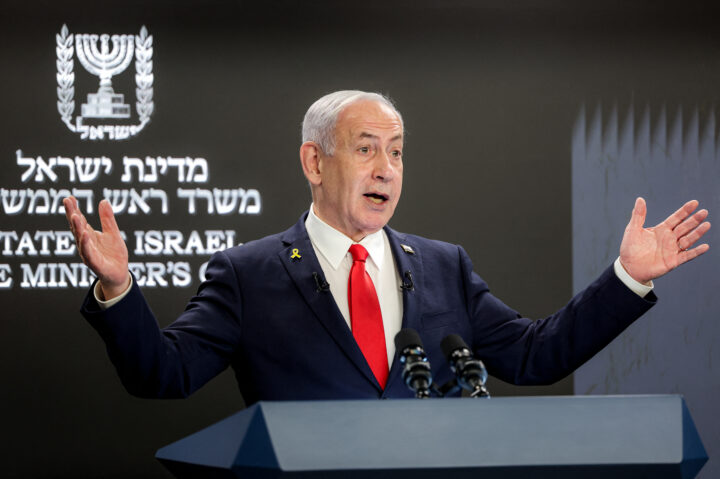
ABIR SULTAN/POOL/AFP via Getty Images
Israel's Prime Minister Benjamin Netanyahu gives a press conference at the Prime minister's office in Jerusalem on August 10, 2025.
Good Monday afternoon.
This P.M. briefing is reserved for our premium subscribers like you — offering a forward-focused read on what we’re tracking now and what’s coming next.
I’m Danielle Cohen-Kanik, U.S. editor at Jewish Insider and curator, along with assists from my colleagues, of the Daily Overtime briefing. Please don’t hesitate to share your thoughts and feedback by replying to this email.
📡On Our Radar
Notable developments and interesting tidbits we’re tracking
Israeli Prime Minister Benjamin Netanyahu called an IDF strike today on a Gaza hospital that reportedly killed 20 people, including at least four journalists, a “tragic mishap” that Israel “deeply regrets.”
“Israel values the work of journalists, medical staff, and all civilians,” Netanyahu said in his statement. “The military authorities are conducting a thorough investigation. Our war is with Hamas terrorists.”
President Donald Trump, asked by reporters in the Oval Office this morning about the strike, said he was “not happy about it. I don’t want to see it.” Trump said at a press conference later he believes that in two to three weeks “you’re going to have … a pretty conclusive ending” to the war in Gaza…
Also turning up the pressure on Netanyahu, IDF Chief of Staff Eyal Zamir said Sunday that the IDF has met its objectives in its war in Gaza, “including deeply damaging Hamas,” and “as a result of the military pressure, we created the conditions for the release of the hostages.”
Zamir reportedly advocated for Netanyahu to accept the deal that Hamas said it agreed to last week and reiterated his concern that the IDF’s impending takeover of Gaza City will imperil the lives of the remaining living hostages…
Lawmakers are making the most of their August recess with several in the Middle East this week.
Sen. Joni Ernst (R-IA) met with Netanyahu in Jerusalem today, after several meetings with Qatari officials in Doha last week.
Sen. Lindsey Graham (R-SC) is in Lebanon today, where he visited a memorial at the U.S. Embassy in Beirut for fallen service members, including the 241 Americans killed in the bombing of U.S. Marine barracks by Hezbollah, under the direction of Iran, in 1983.
Meanwhile, Rep. Joe Wilson (R-SC) and Sen. Jeanne Shaheen (D-NH) joined U.S. Syria envoy Tom Barrack in Damascus, where they met with Syrian President Ahmad al-Sharaa to “discuss a bright, unified, and stable future for Syria.”
Wilson and Shaheen also met with Syria’s minister of social affairs and labor, religious clerics and a leader of the Syrian Democratic Forces. Both lawmakers have led efforts in Congress to repeal congressional sanctions on Syria in order to aid reconstruction and stabilization…
Barrack also visited Israel on Sunday and met with Netanyahu, Minister of Strategic Affairs Ron Dermer, Defense Minister Israel Katz and Foreign Minister Gideon Sa’ar to discuss security arrangements between Israel and Syria as well as Israel and Lebanon, according to Axios…
France requested to delay a U.N. Security Council vote on a French proposal to extend the mandate of the United Nations Interim Force in Lebanon until Friday, due to disagreements with the U.S. — which holds veto power — over a sunset date for the extension.
The current French proposal would allow the force to remain in place indefinitely, while the Trump administration wants an extension of only one year before UNIFIL disbands and withdraws from Lebanon, sources confirmed to Jewish Insider. If no consensus is reached, France could request another delay until Aug. 31, when the current mandate expires…
On the domestic front, the University of Florida’s Board of Trustees voted unanimously to appoint Dr. Donald Landry as interim president of the school, after Florida’s Board of Governors rejected Santa Ono, the former president of the University of Michigan, for the job.
Landry, a renowned physician and chair emeritus of Columbia University’s Department of Medicine, will replace current UF interim President Kent Fuchs, who said the process of choosing a new president had become “more challenging” after Ono’s rejection…
⏩ Tomorrow’s Agenda, Today
An early look at tomorrow’s storylines and schedule to keep you a step ahead
Keep an eye on Jewish Insider tomorrow morning for reporting on how the University of Michigan is becoming an epicenter of anti-Israel activism to start the new school year, and Jewish groups’ response to European officials targeting Katharina von Schnurbein, the EU antisemitism coordinator, for her defense of Israel.
Tomorrow morning, the Democratic National Committee’s Resolution Committee is expected to take up two Israel-related resolutions, including an anti-Israel measure that calls for an arms embargo and a suspension of U.S. military aid to Israel. The resolutions will then be brought to the general session on Wednesday. We’ll be paying close attention to how much support that anti-Israel resolution receives.
Also tomorrow, the Treasury Department will officially remove Syria from its sanctions list for the first time since 2005.
Added to our calendar for next week, Sen. Bernie Sanders (I-VT) is slated to appear at a rally with Graham Platner, a Democrat running against Sen. Susan Collins (R-ME), who has emerged as a harsh critic of Israel during his nascent campaign.
MAGA MEETS THE HOLY LAND

One influencer on the delegation organized by Israel365 said he previously believed IDF soldiers were anti-Christian, but ‘they were just kind of like homies’
THE HOT CORNER

A new web series launched by ADL and Maccabi USA explores ‘how sports can inspire dialogue and challenge antisemitism’
A new web series launched by ADL and Maccabi USA explores ‘how sports can inspire dialogue and challenge antisemitism’

Billie Weiss/Boston Red Sox/Getty Images
Former Boston Red Sox player Kevin Youkilis is introduced during a pre-game ceremony in recognition of the retirement of WEEI broadcaster Joe Castiglione before a game between the Boston Red Sox and the Tampa Bay Rays on September 29, 2024 at Fenway Park in Boston, Massachusetts.
It was 2007 and the Boston Red Sox had just won the World Series in Denver. Back at his hotel, three-time Major League Baseball all-star and World Series champion Kevin Youkilis had a “big party.”
“All of sudden, we started breaking out [dancing to] Hava Nagila. The pride of celebrating a joyous occasion brought me back to my childhood and the traditions we learned in synagogue,” Youkilis said in a webinar on Wednesday, reflecting on his “proudest” Jewish moment and calling himself “lucky” to have largely avoided antisemitism as an athlete.
But since his retirement in 2014 — and particularly in the aftermath of the Oct. 7, 2023 terrorist attacks in Israel — Jewish athletes have been thrown a curveball, facing exclusion and increased antisemitic sentiment both on and off the field.
At the 2024 Paris Olympics, for example, fans displayed a banner reading “Genocide Olympics” alongside Palestinian flags. In February, the Israeli Under-19 baseball team was refused participation in a German tournament over fears of “troublemakers attacking Israelis” and “the political situation.”
In response, the Anti-Defamation League and Maccabi USA launched a new web series dubbed “Game Changers,” with the goal of bringing together athletes and advocates “to explore how sports can inspire dialogue and challenge antisemitism.”
“I was very lucky, I didn’t have many incidents [of antisemitism],” Youkilis, 46, said during the inaugural webinar, which was moderated by Alex Freeman, ADL’s director of sports engagement and also included remarks from Morgan Zeitz, a University of Michigan student and Maccabi USA athlete.
“Guys would joke around, ripping and good fun, but there was never anything directed at me that I felt was antisemitic,” Youkilis, who primarily played for the Red Sox and had stints with the New York Yankees and Chicago White Sox, continued. “People asked questions based on ignorance. Like everything in life, when you are a minority and all these things are happening and there’s a lot of rhetoric out there, you have two ways to go about it. You can get really reactive and angry, or you can educate. I think education is always the best tool.”
“What we’re seeing is fascinating,” said Youkilis, who since MLB retirement served as hitting coach for Team Israel in 2023 and is currently on the board of directors of Israel Baseball Americas, a nonprofit that brings Israel Baseball to communities across North America and provides resources to Israel’s baseball team. “That spike after Oct. 7 is the most concerning for me. The tragedy occurred and now you see people [emboldened] to be more antisemitic online. The one key thing I’ve learned online is most of these people are anonymous, so you have to be very careful about picking your fights on social media.”
Throughout his career, Youkilis’ focus “was always on, how do I get better every day? How can I help our team win?” he recalled. “The Jewish side of me was really through family, through my father, brothers and cousins. Judaism for me was more about the community aspect than the religious aspect while I was playing baseball. When we would go to New York, there was no doubt that I was going to Carnegie Deli.”
But his Judaism was top of mind one day each year — Yom Kippur. “Are you going to play on Yom Kippur? That became a big thing,” he said, recalling that while playing for the Red Sox, he attended High Holiday services in Brookline, a heavily Jewish suburb of Boston.
“Growing up, my dad taught me the Jewish way of working hard,” said Youkilis. “Find your passion, go hard at it and love it. For me, that moment after winning a World Series was a very special moment.”
Plus, Texans do the electoral shuffle
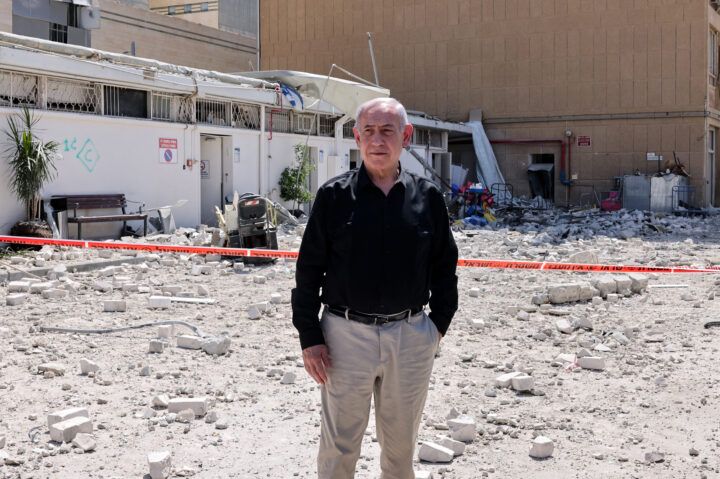
MARC ISRAEL SELLEM/POOL/AFP via Getty Images
Israeli Prime Minister Benjamin Netanyahu stands amid debris outside the Soroka Hospital in the southern city of Beersheba, after it was hit by a missile fired from Iran on June 19, 2025.
Good Thursday afternoon.
This P.M. briefing is reserved for our premium subscribers like you — offering a forward-focused read on what we’re tracking now and what’s coming next.
I’m Danielle Cohen-Kanik, U.S. editor at Jewish Insider and curator, along with assists from my colleagues, of the Daily Overtime briefing. Please don’t hesitate to share your thoughts and feedback by replying to this email.
📡On Our Radar
Notable developments and interesting tidbits we’re tracking
Israeli Prime Minister Benjamin Netanyahu appeared on “Triggernometry,” a conservative podcast based in the U.K., in an episode released yesterday, where he was pressed by co-hosts Konstantin Kisin and Francis Foster about inflammatory comments made by Israeli Finance Minister Bezalel Smotrich about settling Gaza and “things that sound like ethnic cleansing.”
Netanyahu dismissed the comments as democratic disagreements, saying, “In a parliamentary system, people are free to say, sometimes they say things they don’t quite mean. … To the extent that we have these conversations around the Security Cabinet, that is actually not being discussed by these people.”
Netanyahu distanced himself from his ministers who have advocated for reestablishing an Israeli civilian presence in Gaza, clarifying, “It’s not my policy. I don’t intend to build settlements or communities in Gaza, not Israeli ones.”
The prime minister disagreed that the comments from Smotrich may be exacerbating Israel’s “PR problem”: “They ask me, you know, ‘Your minister of finance says this, and what do you say?’ Well, I say I disagree with him, and I say that, you know, he’s entitled to say these things. That’s not ethnic cleansing. It’s a view, a legitimate view, which I happen to disagree with”…
And today, Netanyahu announced that he is working “to approve the plans that the IDF presented” to him and Defense Minister Israel Katz for the impending IDF takeover of Gaza City. “In parallel,” he said, “I have instructed to begin immediate negotiations for the release of all our hostages and the end of the war, on conditions that are acceptable for Israel.”
Netanyahu made no mention of the latest deal reportedly agreed to by Hamas, which only includes the release of some of the 50 remaining hostages…
Israel is also facing increased diplomatic ire over its actions in the West Bank, after Smotrich announced last week his approval of plans to build the E1 settlement, which were previously frozen for decades due in part to U.S. disapproval of its controversial location, which would make a contiguous Palestinian state nearly impossible.
Twenty-two countries, including the U.K., Australia, France and Japan, issued a statement today condemning the move as “unacceptable and a violation of international law,” and the U.K. Foreign Office summoned Israeli Ambassador to the U.K. Tzipi Hotovely in further protest.
Asked about the settlement approval, U.S. Ambassador to Israel Mike Huckabee told the Associated Press that a two-state solution is not a “high priority” for the Trump administration and that there are too many unanswered questions about a potential Palestinian state…
On the campus beat, a New York Times report published yesterday on the hurdles international students are facing entering the U.S. this academic year opened with the line, “Many Iranians are not going to American universities this fall.”
The article, largely sympathetic to the plight of students attempting to enter the U.S., highlighted the revocation of more than 6,000 student visas by the State Department, the majority of which were due to breaking U.S. law and support for terrorism; Secretary of State Marco Rubio’s announcement that the department would review visas of students who participated in disruptive campus anti-Israel protests; and new social media vetting of visa applicants, particularly “for expression of pro-Palestinian sentiment,” as barriers to international student enrollment…
Sen. Joni Ernst (R-IA), on a visit to Doha, met today with Qatari Emir Tamim bin Hamad Al Thani and Prime Minister Mohammed bin Abdulrahman Al Thani. Ernst has previously led efforts to pressure Qatar into forcing Hamas to release the hostages held in Gaza…
In the Lone Star State, Rep. Chip Roy (R-TX), a prominent member of the Freedom Caucus and a thorn in the side of President Donald Trump and House Speaker Mike Johnson (R-LA), announced a bid for Texas attorney general today, seeking to replace Trump ally AG Ken Paxton, who himself is running for U.S. Senate against Sen. John Cornyn (R-TX) in a highly competitive primary.
The Texas game of electoral musical chairs comes as the state is in the midst of a contentious mid-decade redistricting process, which will likely see its Legislature turn even deeper red.
One high-profile Democrat in the Texas Statehouse, James Talarico, was backed by Miriam Adelson’s Texas Sands PAC, Politico revealed today, despite Talarico’s public stance against GOP billionaires‘ influence in politics. The group was his largest donor last year and one of his largest ever…
New York City Mayor Eric Adams, no stranger to scandal, is facing more electoral trouble of his own as he runs for reelection as an independent, facing off against former New York Gov. Andrew Cuomo and Democratic nominee Zohran Mamdani.
Yesterday, reports alleged that Adams’ former advisor and current campaign volunteer, Winnie Greco, surreptitiously gave a reporter an envelope of cash, stashed inside a bag of potato chips. Today, the Manhattan district attorney unsealed four indictments against Adams’ former chief advisor, Ingrid Lewis-Martin, accusing her of receiving more than $75,000 in bribes, and six other individuals, most of whom are associates or supporters of Adams…
⏩ Tomorrow’s Agenda, Today
An early look at tomorrow’s storylines and schedule to keep you a step ahead
Keep an eye on Jewish Insider for reporting on a trip of young MAGA influencers to Israel that changed hearts and minds and an interview with Rep. John McGuire (R-VA) on his reflections from his own recent trip to the Jewish state.
The foreign ministers of Britain, France and Germany will speak with Iranian Foreign Minister Abbas Araghchi by phone tomorrow, sources tell the Substack Diplomatic, to discuss their recent threat to reinstate snapback sanctions on Tehran if it does not sufficiently roll back its nuclear program by the end of this month.
An Iranian delegation will also travel to Vienna tomorrow to meet with the International Atomic Energy Agency, a week after IAEA Deputy Director General Massimo Aparo visited Iran in a bid to restart the agency’s cooperation with Tehran.
On Sunday, the Michigan Democratic Jewish Caucus will host its annual “Summer Simcha” event. Among the attendees will be state Sen. Mallory McMorrow, Abdul El-Sayed and, appearing by video, Rep. Haley Stevens (D-MI) — all of whom are vying for Michigan’s open Senate seat. State Sen. Jeremy Moss, who’s looking to claim Stevens’ seat in the House, and University of Michigan Regent Jordan Acker, who had his home and office vandalized by anti-Israel attackers, will be in attendance. Sen. Elissa Slotkin (D-MI) will also appear by video.
We’ll be back in your inbox with the Daily Kickoff and the Daily Overtime on Monday. Shabbat shalom!
MORAN’S MORASS

Former Rep. Jim Moran and his team have held dozens of meetings with members of Congress since the Oct. 7 Hamas terror attacks in 2023, mainly to talk about the Qatari role in the Middle East peace process
WEIRDING OUT

Democrat Graham Platner entered the race accusing Israel of genocide in Gaza
The ADL and AEN said that recent comments by American Association of University Professors President Todd Wolfson ‘silence dissent and undermine academic freedom’
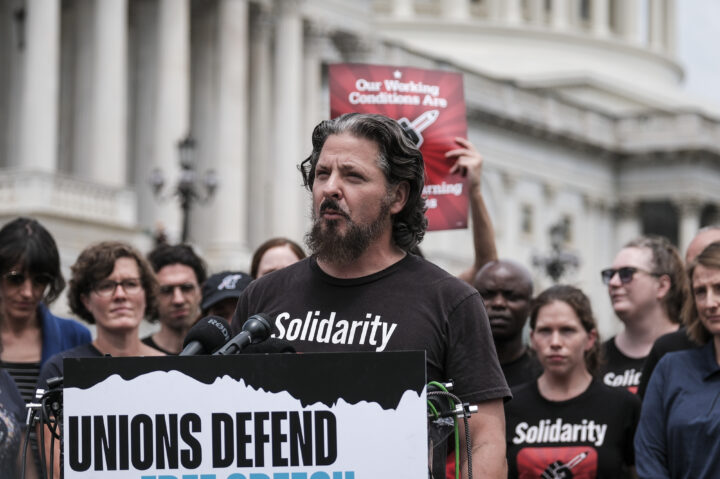
Michael A. McCoy/Getty Images
Todd Wolfson, AAUP president, speaks to the press during a press conference on Capitol Hill on May 23, 2024 in Washington, DC.
Two leading Jewish groups aimed at countering antisemitism, along with several faculty, blasted the American Association of University Professors for moving “even further away from its mission” after its president said in a recent interview that the United States should not send defensive weapons to Israel amid its war against Hamas, which he called a genocide in Gaza.
“Such rhetoric is deeply troubling and fuels hostility against Jewish and Zionist individuals in academic spaces and beyond,” the Anti-Defamation League and the Academic Engagement Network said Thursday in a joint statement to Jewish Insider, in response to comments made by Todd Wolfson, the president of AAUP, to Inside Higher Ed on Tuesday.
“We believe strongly that no weapons should be sent to Israel, at all. Not defensive or offensive, nothing,” Wolfson said. “We need to stand up for academic freedom, for freedom of speech, for freedom of assembly for our students so they can protest the war — the genocide, excuse me — that’s taking place in Gaza,” he continued.
The ADL/AEN statement said that “the role of AAUP leadership should be to encourage robust study and rigorous debate of such contentious issues — not to plant the organization firmly on one political side, thereby silencing dissent and undermining the very academic freedom it purports to defend. With the leadership’s latest move to isolate Jewish and Zionist faculty, the AAUP has moved even further away from its mission.”
Raeefa Shams, AEN’s director of communications, told JI that there has been a “pattern of escalating extreme political stances” among AAUP leadership since the Oct. 7, 2023, terrorist attacks. “So [Wolfson’s statement] wasn’t surprising, but it doesn’t mean that it’s normal,” said Shams. In April, the AAUP partnered with anti-Israel groups including Jewish Voice for Peace and Faculty and Staff for Justice in Palestine to co-sponsor a National Day of Action.
Faculty who are longtime members of the association told JI that Wolfson’s latest remark further enforces a climate where Jewish and Zionist members no longer feel represented or protected within the association.
Jeffrey Podoshen, a professor in the business department at Franklin & Marshall College, where he formerly served as AAUP chapter president, has suspended contributing dues to the association “as the organization has become much more politicized over the past number of years” in relation to Israel.
“The AAUP unfortunately seems to have found a singular fixation on Israel as of late, and specifically under Wolfson’s leadership,” said Podoshen. “This is problematic. The AAUP has become more of an organization that is interested in politics than it is its core mission when it comes to university professorships. The AAUP has been on a downward spiral and it’s not something that I want to be a part of, which is a shame.”
Gregory Brown, a professor of history at University of Nevada, Las Vegas and former president of the Nevada state conference of AAUP, views it worthwhile to remain an AAUP member because of its push for campus values such as academic freedom. But in the past, statements from association leaders went through a vetting process including a review by committees, which gave them “credibility,” Brown said.
“In that sense, I am quite surprised insofar as the statements that have been coming out are not about any of the reasons people join the AAUP,” Brown continued. “Those statements have not been studied, vetted and revised. They appear to be statements that come from just the leadership, maybe just one leader. It is really contrary to what has been the key to the AAUP’s success in advocating for higher education, faculty and students.”
Wolfson, who was elected president in June 2024 and is on leave from his position as a Rutgers University associate professor of journalism and media studies until 2027, has a history of making hostile comments towards Israel.
In response to Israeli Prime Minister Benjamin Netanyahu’s condemnation of the anti-Israel encampments and building occupations that overtook dozens of campuses around the U.S. in the spring of 2024, Wolfson wrote on X that Netanyahu is a “fascist” who has “no right to talk about peaceful protests in the U.S. as he murders thousands in Gaza.” In July 2024, Wolfson tweeted a petition urging the New Jersey Senate to vote against adopting the International Holocaust Remembrance Alliance’s working definition of antisemitism. “Anti-Zionism is not antisemitism,” he wrote.
Under Wolfson’s leadership, AAUP dropped its longtime opposition to academic boycotts in August 2024. Although the policy does not mention Israel, the move led to faculty members on several campuses implementing non-official boycotts of Israel by not assigning articles written by Israeli scholars, refusing to invite Israeli academics to conferences and declining to write study abroad letters for students wishing to spend a semester in Israel.
Former Rep. Jim Moran and his team have held dozens of meetings with members of Congress since the Oct. 7 Hamas terror attacks in 2023, mainly to talk about the Qatari role in the Middle East peace process

YASUYOSHI CHIBA/AFP via Getty Images
Former Rep. Jim Moran (D-VA) arrives to address a rally attended by supporters of Sudan's ruling Transitional Military Council (TMC) in the village of Abraq, about 60 kilometers northwest of Khartoum, on June 23, 2019.
During Jim Moran’s 24 years in Congress, the Virginia Democrat had a habit of putting his foot in his mouth, particularly when it came to his Jewish constituents.
In 2003, he blamed the Jewish community for President George W. Bush’s decision to invade Iraq, prompting several local rabbis to call for his resignation. Four years later he blamed AIPAC for the war. The blowback was so strong that when then-Sen. Barack Obama accepted Moran’s endorsement of his presidential campaign in 2008, he stated plainly that he disagreed with Moran’s views of the Jewish community.
Moran retired from Congress in 2015, but the 80-year-old still walks the halls of Capitol Hill. Now, he’s there as a lobbyist — primarily as a registered foreign agent lobbying on behalf of the government of Qatar.
He is a regular in the offices of high-ranking members of Congress and senators. And last month, during a House Education Committee hearing about antisemitism in higher education, Moran was conspicuously seated directly behind Robert M. Groves, the president of Georgetown University, which has a campus in Doha and has received more than $1 billion from the Gulf monarchy.
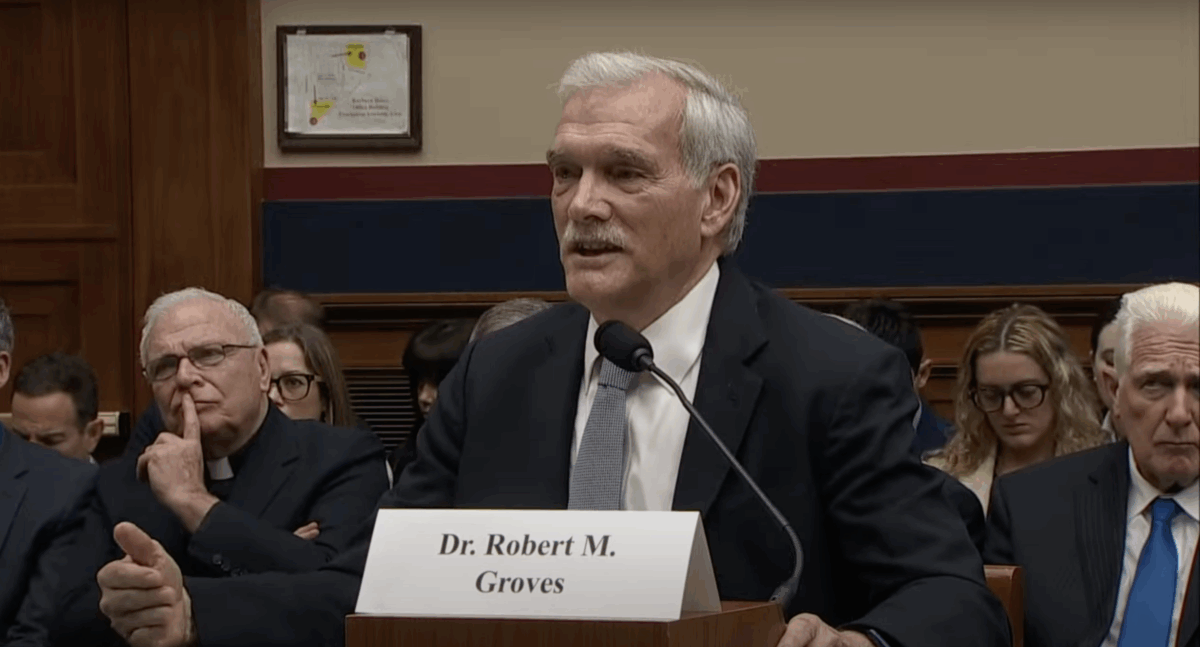
“Jim is one of these guys that people seem to like on both sides of the aisle. He’s been able to keep in contact with a lot of members when needed,” Tom Davis, a former Republican congressman from Virginia who Moran hired to help represent Qatar, told Jewish Insider.
A Georgetown source said Moran was not working with the university or sitting in one of Georgetown’s three allotted seats at the hearing. Still, there’s no doubt he is a highly influential foreign policy voice in Washington on behalf of a country with which America has a complicated relationship.
Qatar is a major non-NATO ally of the U.S., an official designation conferred by President Joe Biden, and is home to the largest U.S. military base in the Middle East. But it also has financial and diplomatic ties with Hamas and other terror groups. Qatar’s leaders say that is necessary so the country can maintain its role as a trusted mediator, while its critics say Qatar’s close relationship with Hamas makes it unlikely to put real pressure on the terror group to make a deal with Israel or to release the hostages. Some on Capitol Hill and in the pro-Israel community have expressed concerns that Qatar’s massive investment in American universities has fueled anti-Israel activism and antisemitism on campuses.
With a Boston accent leftover from his childhood, Moran has a penchant for talking tough — and acting tough, too. In the 1990s, at the start of his time in Congress, he occasionally threatened to brawl with fellow lawmakers, and once shoved another member of Congress off the House floor.
Moran was an early and consistent critic of Israel, long before the wave of anti-Israel sentiment that has exploded on the far left over the past two years. He has kept up ties with Jewish leaders in Northern Virginia, but those relationships grew strained as Moran repeatedly criticized pro-Israel advocates and Jewish activists.
“Jim is an extraordinarily compassionate man. He has trouble with suffering. His judgment about what constitutes suffering and who’s causing it is not always accurate, and so that has gotten him in a considerable amount of trouble over the course of his long political career,” said Rabbi Jack Moline, who served for 27 years as the rabbi at Agudas Achim Congregation in Alexandria. Moline met regularly with Moran until the rabbi called for Moran’s resignation in 2003, after Moran blamed Jews for the Iraq war, a comment the former congressman later said he “deeply regret[s].”
“His relationship with the Jewish community fell apart,” Moline told JI. “It didn’t surprise anybody when, after he finally did retire from Congress, he was offered and accepted work lobbying for Qatar.” He first registered as a lobbyist for Qatar in 2017. His firm, Moran Global Strategies, has been paid more than $2 million by Qatar in the last two years, according to data compiled by OpenSecrets. A spokesperson for the Qatari Embassy did not respond to a request for comment, nor did Moran Global Strategies.
Though Moran expressed contrition for his antisemitic remarks during the lead-up to the Iraq war, his rhetoric toward the Jewish community has only grown more inflammatory in the decade since he left Congress. In recent years, he has appeared on several virtual panel discussions held by the Arab Organization for Human Rights in the U.K., a London-based NGO led by Mohammad Jamil Hersh, a former Hamas activist who has been sanctioned by Israel and was deported by the country more than three decades ago. In those conversations, he regularly blasted the influence of American Jews and the “pro-Israel lobby.”
During a February 2023 AOHR event, Moran tried to explain Washington’s support for “apartheid” in Gaza by pointing the finger at American Jews and suggesting that they are unduly involved in the American political system.
“It’s about domestic politics and it always has been. The majority of people who contribute to the Democratic Party in America have Jewish surnames. Now think about that,” said Moran. He described them as people “whose principal reason for contributing to the political system in America has been the sine qua non of support for Israel, and unqualified support for Israel.”
In this and several other interviews, Moran recognized that his language was rather impolitic.
“I don’t want to sound antisemitic, and Palestinians are a Semitic people,” Moran said. “I’m just saying that let’s deal with the political reality in the United States that’s driving and reinforcing the injustice that’s occurring within Palestine.”
Moran and his team have held dozens of meetings with members of Congress since the Oct. 7 Hamas terror attacks in 2023 that spurred the ongoing war in Gaza, mainly to talk about “Qatar’s role in the Middle East peace process,” according to documents he filed with the Justice Department as required by the Foreign Agents Registration Act. At the same time, he has continued to question Jewish involvement in the American political system — including just days after Oct. 7, in a call hosted by the Muslim Public Affairs Council.
“The reality is that campaign contributions have corrupted the United States Congress. One of the motivating factors is, ‘How do I please my political supporters, particularly my financial supporters?’ The reality is that the Jewish community, and frankly to their credit, is deeply engaged in the American political process,” Moran said in the MPAC call. “That’s one of the motivating factors that causes the Congress to look the other way where the Middle East is concerned.”
Although he expressed skepticism about the supposed influence of American Jews in electoral politics, he encouraged Muslim, Palestinian and Arab Americans to increase their own influence. But his prognosis for their potential efficacy was grim. “I’m not sure they’re ever going to be able to successfully catch up,” Moran said.
Even as Moran took aim at Jews’ participation in the political process, he routinely downplayed accusations of antisemitism that have been lobbed at him directly and at the broader anti-Israel movement.
In September 2024, in another AOHR virtual briefing, Moran acknowledged that he would likely be called antisemitic for his comments accusing Israel of committing war crimes “daily” and for describing the situation in Gaza as “comparable to the Holocaust.”
“Foreign aid going into committing war crimes on a daily basis because of the politics, because of the campaign financing, because of the control of the media — it’s inexcusable. It’s an indictment of what has become of this democracy,” said Moran, without saying who, exactly, he thinks controls the media. “It’s an indictment of the fact that our foreign policy has been Israeli-centric, and let me say one other thing so that people don’t particularly accuse me of being antisemitic, although I’m sure many will: Many of those protests across the country were led by Jewish students.”
This spring, after President Donald Trump returned to office and began targeting universities, Moran was dispatched to Capitol Hill to talk to Democrats on the Senate Health, Education, Labor and Pensions Committee about Qatar’s funding of American higher education, which has come under the microscope.
It is notable that one of the people tasked with advocating for a country that is close to both America and Hamas seems to have a deeply rooted hostility to Israel and even to American Jews, particularly at a moment when Qatar’s dealings in the U.S. are facing greater scrutiny — such as when Trump said earlier this year that the U.S. would accept a Qatari gift of a luxury jet to use as Air Force One.
But Qatar has a suite of lobbyists who span the political spectrum. Moran primarily deals with Democrats. Qatar has in the past also targeted hundreds of conservative “influencers” to reach Trump’s inner circle, and employs several Republicans as lobbyists. Partisan politics is at play, too; Democratic lawmakers blasted the Air Force One move, while Republicans fell in line behind Trump.
Several prominent Trump administration officials have ties to Qatar, including Attorney General Pam Bondi, who said in her January Senate confirmation hearing that she remains “very proud” of the lobbying work she did for Qatar ahead of the 2022 World Cup. Steve Witkoff, Trump’s Middle East envoy and chief negotiator, has a history of business dealings with the country.
“If you take a look at the folks they’ve got representing them, they’ve been all over the lot on that issue. It’s certainly not a pro-Arab versus Israel issue,” said Davis, the Virginia Republican who works with Moran on the Qatar file. “There’s nothing there to indicate that their lobbyists have any kind of ideological bent on that issue.”
Correction: This story has been corrected to reflect that Moran began lobbying for Qatar in 2017, not 2023.
Plus, Bibi faces coalition chaos

Gage Skidmore
Sen. Amy Klobuchar (D-MN) speaking with attendees at the Moving America Forward Forum hosted by United for Infrastructure at the Student Union at the University of Nevada, Las Vegas in Las Vegas, Nevada.
Good Wednesday afternoon.
This P.M. briefing is reserved for our premium subscribers like you — offering a forward-focused read on what we’re tracking now and what’s coming next.
I’m Danielle Cohen-Kanik, U.S. editor at Jewish Insider and curator, along with assists from my colleagues, of the Daily Overtime briefing. Please don’t hesitate to share your thoughts and feedback by replying to this email.
📡On Our Radar
Notable developments and interesting tidbits we’re tracking
Sen. Amy Klobuchar (D-MN) rebuked antisemitic comments made by Minneapolis mayoral candidate Omar Fateh’s campaign staff in a statement to Jewish Insider today, after initially declining to comment when JI unearthed the statements last week.
Klobuchar’s spokesperson said the senator “strongly and immediately condemned the Hamas terrorist attack, and condemns any statements to the contrary.” She called Fateh’s staffers’ comments “outrageous” and said they “have no place in our politics.”
Klobuchar reiterated her endorsement of Mayor Jacob Frey in the race; Frey’s other supporters, including Minnesota Gov. Tim Walz, and other state Democratic officials have thus far refrained from commenting on the situation…
Staying in the Midwest, protesters interrupted Rep. Wesley Bell’s (D-MO) first in-person town hall last night in St. Louis over Bell’s support for Israel, shouting over the congressman and getting into altercations with police.
In response to a question about “the ongoing genocide in Palestine,” Bell said, “Let’s talk about the word genocide, because we see that differently.” He repeatedly asked protesters to stop shouting and listen.
“There’s a lot of folks who don’t want to have the conversation,” Bell said. “They just want to spew what they think is important, but they don’t want to have an actual debate because these are tough issues. So, now we’re going to have the conversation — whether you like it or not”…
Meanwhile on the campaign trail, Politico reported this morning on Rep. Chris Pappas’ (D-NH) new competitor in the Democratic primary for New Hampshire’s open Senate seat, political activist Karishma Manzur.
Manzur said she would have supported recent resolutions from Sen. Bernie Sanders (I-VT) — which the moderate Pappas said he would have opposed — seeking to block some arms sales to Israel, saying she “will be against any money to any country to kill people” and that the U.S. should take “concrete actions against the harrowing acts of torture of Palestinians” by the IDF …
President Donald Trump called in to Fox News host Mark Levin’s radio show yesterday and said that, at the time of the U.S. strikes on Iran’s nuclear facilities in June, he believed Iran “would have had nuclear weapons in a period of four weeks.”
“If we didn’t [strike Iran], they would probably by this time, just about this time, have a nuclear weapon and they would have used it,” the president said.
Trump also told Levin that the U.S. Air Force pilots who conducted the strikes told him that they and their predecessors had been practicing the flight to Iranian airspace for 22 years…
The New York Times published an analysis on the damage inflicted by U.S. strikes on the Iranian nuclear site Fordow based on the site’s structure and the munitions used…
The State Department responded today to a bipartisan congressional letter led by Pappas last month expressing lawmakers’ concerns that the administration was considering selling F-35 fighter jets to Turkey in a reversal of U.S. policy, which currently bans the sale of the jets in light of Turkey’s purchase of an S-400 missile defense system from Russia.
Paul Guaglianone, senior bureau official in the department’s Bureau of Legislative Affairs, wrote in a letter to Pappas that the “U.S. position on Turkey’s acquisition and continued possession of the Russian S-400 system has not changed, and the requirements for Turkey to acquire U.S. F-35 aircraft are well-known”…
Secretary of State Marco Rubio also announced this morning that the U.S. is sanctioning four additional officials from the International Criminal Court, two judges and two prosecutors, in addition to the four judges sanctioned by the U.S. in June, over the ICC’s continued “efforts to investigate, arrest, detain, and prosecute American and Israeli nationals”…
In Israel, coalition politics are heating up over a potential ceasefire and hostage-release agreement with Hamas, which reports indicate the terror group recently accepted but Israel has not yet responded to.
Israeli media reported that Finance Minister Bezalel Smotrich told hostage families he would resign if Prime Minister Benjamin Netanyahu agreed to a ceasefire, and Minister of National Security Itamar Ben-Gvir is likely to do the same, as he did in January when Israel agreed to a previous ceasefire deal.
Meanwhile, opposition MK Benny Gantz, whose Blue and White-National Unity party is currently hemorrhaging in the polls, is reportedly considering rejoining Netanyahu’s coalition to help bolster support for a deal…
Back stateside, Israeli scholar and dance instructor Yael Nativ is suing the University of California, Berkeley, alleging that the university denied her a teaching position because she is Israeli. Nativ had previously taught at Berkeley and was encouraged to apply to teach another course.
When Nativ’s application was rejected shortly after the Oct. 7, 2023, terror attacks, according to the suit, the dance department chair wrote to her, “My dept cannot host you for a class next fall. Things are very hot right now and many of our grad students are angry. I would be putting the dept and you in a terrible position if you taught here”…
⏩ Tomorrow’s Agenda, Today
An early look at tomorrow’s storylines and schedule to keep you a step ahead
Keep an eye on Jewish Insider tomorrow morning for reporting on Graham Platner, the oyster farmer turned Democratic challenger to Sen. Susan Collins (R-ME), who called AIPAC “weird” in a recent interview.
Tomorrow afternoon, the American Jewish Committee will host a briefing on “Justice for Victims of Hamas’ Sexual Violence: The U.N. Blacklist and What Comes Next,” referring to the U.N.’s recent decision to “blacklist” Hamas as a group that uses sexual violence as a weapon of war.
FOREIGN POLICY FEID
Trump’s senior director for counterterrorism: ‘I was worried by this neo-Buchanan isolationism, but I look at President Trump’s actions, they have no hold on him’
TRIP TALK
The New York Democrat told JI ‘the majority of people see the value and the special nature of our relationship with our ally Israel’
Plus, Loomer lashes out
Annabelle Gordon/Bloomberg via Getty Images
Rep. Jamie Raskin (D-MD) during a news conference in Washington, D.C., on Thursday, May 22, 2025.
Good Tuesday afternoon.
This P.M. briefing is reserved for our premium subscribers like you — offering a forward-focused read on what we’re tracking now and what’s coming next.
I’m Danielle Cohen-Kanik, U.S. editor at Jewish Insider and curator, along with assists from my colleagues, of the Daily Overtime briefing. Please don’t hesitate to share your thoughts and feedback by replying to this email.
📡On Our Radar
Notable developments and interesting tidbits we’re tracking
Ron Halber, CEO of the Jewish Community Relations Council of Greater Washington, called Rep. Jamie Raskin’s (D-MD) decision to co-sponsor legislation severely restricting U.S. aid to Israel “extremely disappointing,” telling Jewish Insider today that he had a “very honest and frank conversation” with the congressman, whom he considers a friend.
Halber framed his concerns with Raskin, a prominent progressive Jewish lawmaker, within the broader trend of the Democratic Party moving away from its long-standing support for Israel. “It’s difficult when two-thirds of our community is voting for a political party whose base is hostile to Israel,” he remarked.
“Once the war comes to an end, the whole Jewish community is going to have to re-strategize,” Halber said.
The JCRC of Greater Washington CEO said he had asked Raskin to remove himself as a co-sponsor of the bill and instead issue a statement conveying his concerns with Israel’s war in Gaza. “If he doesn’t, we will be disappointed, but that’s his decision to make and he has to live with the ramifications of his decision”…
Speaking this morning at a briefing co-hosted by the American Jewish Congress and World Zionist Organization, U.S. Ambassador to Israel Mike Huckabee sounded a cautious note on the current ceasefire negotiations with Hamas, as reports indicate the terror group has accepted a Qatari- and Egyptian-backed proposal.
“Whether or not [Hamas is] serious about bringing this to a close, all I can tell you is I hope so. But what’s happened before, even when they say they are thinking seriously about bringing this to a conclusion, making a deal, they always add one or more things that are completely unacceptable, bring those to the table, then it all starts over again,” Huckabee said.
Israel has yet to respond to the proposal and White House Press Secretary Karoline Leavitt said at a press briefing today that the U.S. “continues to discuss” it…
Huckabee and his wife, Janet, hosted U.S. Ambassador to France Charles Kushner and his wife, Seryl, in Jerusalem tonight…
Israeli Defense Minister Israel Katz met with Lt. Gen. Eyal Zamir, the IDF’s chief of staff, today to approve the IDF’s plans to take over Gaza City. Israeli officials said Gazans will have until Oct. 7 to evacuate the city, to coincide with the second anniversary of Hamas’ attacks, at which point the IDF offensive will begin. It remains to be seen if a ceasefire and hostage-release deal will be reached before then…
The Israeli government also voted today to approve a $9 billion increase to the country’s budget for the year, including $473 million for humanitarian aid for Gaza…
In other negotiation news, Israeli Minister for Strategic Affairs Ron Dermer is scheduled to meet this evening in Paris with Syrian Foreign Minister Asaad al-Shibani and U.S. Ambassador to Turkey and Syria envoy Tom Barrack to discuss security arrangements on the Israel-Syria border.
The meeting comes a day after Barrack, while visiting Beirut, said Israel needs to “comply with [an] equal handshake” to the Lebanese government’s commitment to disarm Hezbollah by fully withdrawing its troops from Lebanon…
Back stateside, the president of the American Association of University Professors said in a recent interview, “We believe strongly that no weapons should be sent to Israel, at all. Not defensive or offensive, nothing,” escalating the association’s adversarial stance against the Jewish state…
The New York Times chronicles the Trump administration’s attempts to wrest financial settlements from elite universities, including ongoing negotiations with Harvard and the University of California, Los Angeles, the latter of which may pay the administration upwards of $1 billion, according to a draft agreement…
Media mogul Shari Redstone told the Times that she decided to sell Paramount to Skydance in a recent $8 billion merger in part due to her frustrations over anti-Israel bias at CBS, particularly after the Oct. 7 attacks. “Once that happened, I wanted out,” Redstone said. “I wanted to support Israel, and address issues around antisemitism and racism”…
Rep. Ritchie Torres (D-NY) endorsed New York Gov. Kathy Hochul in her reelection bid today, after initially exploring a run against her and criticizing her tenure…
The Free Press reports on growing frustration with Laura Loomer, a right-wing provocateur and informal advisor to President Donald Trump, inside the White House, with some officials speculating she may be paid or influenced by lobbying firms and business interests.
Loomer lashed out on X, telling Free Press reporter Gabe Kaminsky he should “contact your anonymous White House sources who are so horrified by ‘lobbyists’ and their intentions and ask them how they feel about their friendship with” Jeff Miller, a Republican strategist, board member of the Republican Jewish Coalition and Trump-appointed member of the U.S. Holocaust Memorial Council…
⏩ Tomorrow’s Agenda, Today
An early look at tomorrow’s storylines and schedule to keep you a step ahead
Keep an eye on Jewish Insider tomorrow morning for an interview with top New York Democrat Rep. Laura Gillen (D-NY) on her takeaways from a recent visit to Israel.
This evening, Maryland Gov. Wes Moore, a potential 2028 presidential contender, will speak at D.C.’s Politics & Prose on “the role of states in preserving and advancing U.S. democracy.”
Tomorrow, the historic Sinai Temple in Los Angeles will host a conversation with Ahmed Fouad Alkhatib, the director of the Realign for Palestine program at the Atlantic Council who was born and raised in Gaza. It’s the second event in a series the prominent Conservative synagogue has held about the war in Gaza for its congregants, the first of which was held last month with Gaza Humanitarian Foundation head Johnnie Moore. Read JI’s coverage of Moore’s conversation here.
CALIFORNIA COMPETITION

Sherman, a stalwart pro-Israel Democrat, is facing several politically connected Democratic challengers in next year’s primary
CLARK’S CLARIFICATION
AIPAC said its endorsement is ‘unchanged’ and based on the House minority whip’s ‘long-standing support for the U.S.-Israel relationship’
In normal times, a candidate would be ashamed to be associated with extremists, and would immediately cut ties with the offending staffers
AP Photo/Abbie Parr
U.S. Senator Amy Klobuchar, left, and Minnesota Gov. Tim Walz, right, arrive at a press conference ahead of the U.S. Gymnastics Olympic Trials Monday, June 24, 2024, in Minneapolis.
If there is one word to describe the political mood in dealing with rising antisemitism, it would be apathy. Even the most jaw-dropping displays of anti-Jewish hatred — from abject Holocaust denial on far-right podcasts to support for Hamas’ atrocities on the extreme left — are increasingly responded to with shrugs from mainstream political leaders.
The most recent example of obvious antisemitism being ignored by a party’s political class came out of Minnesota, where we reported about Minneapolis Democratic mayoral candidate Omar Fateh — running as a democratic socialist against sitting Mayor Jacob Frey — hiring top staff who celebrated Hamas’ Oct. 7 terror attacks.
In normal times, a candidate would be ashamed to be associated with extremists, and would immediately cut ties with the offending staffers. Not long ago, having ties to that type of extremist rhetoric would be disqualifying for the candidate as well.
But these are not normal times. Not only has Fateh, a state senator, ignored the controversy entirely, but the local and national media has been uninterested in following up on Jewish Insider’s reporting about the radical operatives on Fateh’s team.
Even more shocking: Two of Frey’s most prominent backers, Sen. Amy Klobuchar (D-MN) and Minnesota Gov. Tim Walz — have remained silent when asked about their thoughts about the antisemitism stemming from an endorsee’s political rival. It’s a sign that many mainstream Democrats fear that speaking out against antisemitism or anti-Israel extremism could lead to a backlash from other grassroots supporters.
At best, it’s a sign that speaking out against hate carries few political benefits these days.
We saw a similar dynamic in Virginia this month, when former Rep. Abigail Spanberger (D-VA), the Democratic nominee for governor, initially avoided answering questions from our reporters when asked about the rhetoric from an influential Democratic legislator tagging Zionism as “evil.” (After other leading Democrats weighed in, she responded: “One can and must denounce these tragedies without using antisemitic language, whether intentional or not.”)
Unlike in Minneapolis, which is heavily Democratic and deeply progressive, Virginia is a more competitive battleground. But even in battleground states, the makeup of the Democratic Party has changed to the point where speaking out against virulent anti-Israel rhetoric carries the potential for backlash from Arab and left-wing voices within the party coalition.
The apathy towards antisemitism is far from only a left-wing issue. On the right-wing side of the ledger, there are numerous examples of a grassroots infrastructure — from podcasts to social media influencers — that has become openly antisemitic and hostile to Israel.
Tucker Carlson is the most prominent of these voices, but the number of podcasters and so-called influencers who share his worldview is growing. It’s as much a demand-side problem as a supply-side one. It’s now perfectly plausible to build a niche as a far-right purveyor of hate in the new social media ecosystem, and build a lucrative audience from that base.
We’ve also seen, on the Republican side, the reticence to confront antisemitism when it’s happening from within its own ranks. When the Pentagon hired a deputy press secretary with a long history of promoting antisemitic conspiracy theories, barely a peep of protest was heard from within partisan circles. In fact, she’s since been promoted to become the lead press secretary at the Defense Department.
There’s something broken in our political culture where we’ve, broadly speaking, become numb to the crazy. It’s a bipartisan phenomenon. And it’s happening as real-life antisemitic violence is at record levels, highlighted recently by the firebombing against Jews in Boulder, Colo.; the murder of two Israeli Embassy staffers in Washington; and the attack on Gov. Josh Shapiro’s home in Harrisburg, Pa.
The trend only underscores the need for Jewish organizations to speak up in the face of this rising hate, and if necessary, turn up the political pressure on all fronts.
Plus, Santa Ono lands on his feet

Tom Williams/CQ-Roll Call, Inc via Getty Images
Then-Rep. Ruben Gallego (D-AZ) in Rayburn Building on Capitol Hill on June 9, 2022.
Good Monday afternoon.
This P.M. briefing is reserved for our premium subscribers like you — offering a forward-focused read on what we’re tracking now and what’s coming next.
I’m Danielle Cohen-Kanik, U.S. editor at Jewish Insider and curator, along with assists from my colleagues, of the Daily Overtime briefing. Please don’t hesitate to share your thoughts and feedback by replying to this email.
📡On Our Radar
Notable developments and interesting tidbits we’re tracking
President Donald Trump posted on Truth Social this morning, “We will only see the return of the remaining hostages when Hamas is confronted and destroyed!!! The sooner this takes place, the better the chances of success will be. … Play to WIN, or don’t play at all!”
Hours later, reports indicated that Hamas had accepted a new ceasefire and hostage-release proposal from Qatari Prime Minister Mohammed Al Thani and Egyptian officials in Cairo, after a meeting in Doha last week between Al Thani and Mossad Director David Barnea.
A source told Axios that the deal is “98% similar” to the latest U.S.-backed proposal initiated by Middle East envoy Steve Witkoff.
Though neither American nor Israeli officials have confirmed the news, Prime Minister Benjamin Netanyahu said in a statement this afternoon, “Like you, I hear the reports in the media, and from them you can be impressed by one thing — Hamas is under immense pressure“…
Meanwhile at home, the embrace of anti-Israel actors by the Democratic mainstream continues.
Over the weekend, Sen. Ruben Gallego (D-AZ), a potential 2028 Democratic presidential contender from a swing state, told a local political outlet about New York City Democratic mayoral nominee Zohran Mamdani, “It’s OK to say ‘I disagree with this, this, and this, but I agree with that.’ But the idea that we’re just gonna throw out people that are really bringing in new ideas to the fold, exciting people, just because they’re slightly to the right or to the left of us is dumb.”
It’s a notable marker, a pragmatic lawmaker with national aspirations calling Mamdani — a democratic socialist who has refused to condemn the phrase “globalize the intifada” — “slightly to the left” of the Democratic center.
And this morning, opinion writer Jerusalem Demsas, formerly of The Atlantic, announced the launch of her new liberal media company, The Argument. The publication will feature writings from center-left heavyweights including Derek Thompson and Matthew Yglesias and received funding from similarly aligned investors including Arnold Ventures and Open Philanthropy.
In her announcement video, Demsas said conservatives are “persecuting Americans for exercising their basic freedoms” over news clips covering anti-Israel protest leader Mahmoud Khalil’s detention by the federal government.
The continued embrace of Khalil by Democratic thought leaders and influencers is significant as Khalil has continued to escalate his anti-Israel rhetoric, including in a recent appearance on “The Ezra Klein Show” podcast where he said about the Oct. 7 attacks that “we couldn’t avoid such a moment” and about Hamas’ killing of civilians that “we cannot go and ask Palestinians to be perfect victims”…
Former University of Michigan President Santa Ono announced today that he’s been appointed as the inaugural director of the Ellison Institute of Technology. Ono had been named president of the University of Florida but was rejected in an unprecedented move by the Florida Board of Governors, partially over concerns of his handling of antisemitism and an anti-Israel encampment at the Ann Arbor campus.
Now, Ono will report directly to Larry Ellison, the second wealthiest man in the world, who is the founder of the software company Oracle and a major donor to Jewish and Israeli causes…
The Association of American Geographers is set to consider a resolution on Oct. 3 to boycott Israeli academic institutions, the latest professional association to face calls from its members to do so…
⏩ Tomorrow’s Agenda, Today
An early look at tomorrow’s storylines and schedule to keep you a step ahead
Keep an eye on Jewish Insider tomorrow morning for an interview with Rev. Johnnie Moore, the head of the Gaza Humanitarian Foundation, about the repeated death threats and vandalism he’s faced at his home, and a look at Rep. Brad Sherman’s (D-CA) primary challenge.
Tomorrow afternoon, the Hudson Institute will host a conversation with Sebastian Gorka, deputy assistant to the president and senior director for counterterrorism at the National Security Council, on U.S. strategy on counterterrorism and its impacts on U.S. policy in the Middle East.
BACKING THE BLOCK
One of the most visible and well-known progressive Jewish lawmakers in Congress became a cosponsor of the ‘Block the Bombs Act’
CLARK’S BARK
Rep. Katherine Clark is the highest-ranking Democrat to have used the term, even as only a small number of other lawmakers have done so
The suggestions range from enforcing campus codes of conduct to holding faculty accountable for political coercion

Wesley Lapointe for The Washington Post via Getty Images
A row of tents line one side of a student encampment protesting the war in Gaza at the Johns Hopkins University Homewood Campus on Tuesday April 30, 2024, in Baltimore, MD.
As students return to school in the coming weeks, four leading Jewish organizations are encouraging university leaders to adopt a new set of recommendations, released on Monday, designed to curb the antisemitism that has overwhelmed many campuses since the Oct. 7, 2023, terrorist attacks in Israel, Jewish Insider has learned.
The guidelines — which call for increased safety measures as well as long-term structural reforms and build upon a four-page set of recommendations released last August — are a joint effort from the Anti-Defamation League, Conference of Presidents of Major American Jewish Organizations, Hillel International and Jewish Federations of North America.
The recommendations urge university leaders to “consistently enforce” codes of conduct around protests; appoint a coordinator to address Title VI discrimination complaints; reject academic boycotts of Israel; conduct annual student and faculty surveys in regard to campus antisemitism; crackdown on online harassment (in addition to physical safety concerns); and hold faculty accountable for political coercion and identity-based discrimination.
Some of the guidelines, such as the appointment of a Title VI coordinator, echo commitments that several university leaders have made in recent months amid battles with the Trump administration over federal funding. At Columbia University, some Jewish students expressed skepticism that the moves would have a significant impact on campus antisemitism.
“These recommendations aren’t just suggestions, they’re essential steps universities need to take to ensure Jewish students can learn without fear,” ADL CEO Jonathan Greenblatt said in a statement. “Jewish students are being forced to hide who they are, and that’s unacceptable — we need more administrators to step up.”
“We are encouraged by the universities that have taken prior recommendations seriously, implementing changes that have reduced the most severe types of incidents, creating safer and more welcoming environments as a result. But our work is far from complete,” Hillel International president and CEO Adam Lehman said in a statement. “These updated recommendations provide a roadmap for institutions to build on their progress and address the challenges Jewish students continue to face.”
The recommendations released last summer by the same groups, in addition to the American Jewish Committee, called for university leaders to “anticipate and mitigate disruptions” on the one-year anniversary of Oct. 7. Other suggestions included that universities clearly communicate campus rules, standards and policies, support Jewish students, ensure campus safety and reaffirm faculty responsibilities.
Plus, NY Dems continue to withhold Mamdani backing

GETTY IMAGES
Three people with backpacks on sidewalk in front of the campus administrative building on sunny day moving away.
Good Thursday afternoon.
This P.M. briefing is reserved for our premium subscribers like you — offering a forward-focused read on what we’re tracking now and what’s coming next.
I’m Danielle Cohen-Kanik, U.S. editor at Jewish Insider and curator, along with assists from my colleagues, of the Daily Overtime briefing. Please don’t hesitate to share your thoughts and feedback by replying to this email.
📡On Our Radar
Notable developments and interesting tidbits we’re tracking
Mossad Director David Barnea was in Doha today meeting with Qatari Prime Minister Mohammed bin Abdul Rahman al-Thani, which Israeli officials downplayed as being unrelated to a ceasefire and hostage-release deal.
However, with Israel’s expanded operations in Gaza not expected to begin for several weeks and a flurry of diplomatic meetings underway (the Qatari PM also met with Middle East envoy Steve Witkoff in Ibiza last weekend), the negotiating parties likely view this time as a last-ditch opportunity to secure a deal…
Axios spotlights a trip of 15 young MAGA influencers to Israel, organized by the advocacy group Israel365, which describes itself as an “Orthodox Jewish institution that believes that Jews and Christians must respect one another,” and partially bankrolled by the Israeli Foreign Ministry.
Even as Israel’s falling public approval in the U.S. is driven by Democrats and to a lesser extent independents, the story notes that the Israeli government “sees shifting attitudes among young Republicans as the more immediate threat”…
In the world of academia: Professors Jon Shields and Yuval Avnur share their findings from a new study on the diversity of thought in college syllabi in the Wall Street Journal.
Drawing on the Open Syllabus Project, which has a database of over 27 million syllabi, they find that Edward Said’s Orientalism — one of the preeminent anti-West and anti-Israel academic texts — is the 16th most assigned text in the database, featured in nearly 16,000 courses in universities around the world.
However, Shields and Avnur find that Orientalism is rarely assigned with any of its critiquing texts, including Sam Huntington’s Clash of Civilizations and Bernard Lewis’ Islam and the West. At just 5% of syllabi, Huntington is assigned alongside Said the most commonly, and similar critics almost never.
The professors conclude with a warning to academics who are shaping the next generation of scholars and thinkers: “More of us should follow the minority of professors who teach the real controversy — not only the dominant texts but also work that is critical of them. … If we shut out the views of half or more of the population, we shouldn’t be surprised when the democratic process leads to the diminution of our subsidies and other privileges”…
Rep. Dan Goldman (D-NY) told Politico this morning that he won’t endorse New York City Democratic mayoral nominee Zohran Mamdani until he takes “concrete steps” to address concerns from Jewish New Yorkers around hate crimes.
Goldman said, “We’ve had a good conversation, and I am pleased in some respects with many of the things he said, and I’m interested to see how he moves forward, and what actions and concrete steps he takes to address the significant concerns of the 1.3 million Jews in New York City who are justifiably and understandably very afraid given the most recent hate crime statistics that came out”…
House Minority Leader Hakeem Jeffries (D-NY) is also still withholding his endorsement from Mamdani, declining to give CNBC a direct answer this morning on if he intends to support the Democratic nominee. He did say that in a “constructive and candid” conversation last month, Mamdani had asked him to help organize meetings with other members of the New York congressional delegation as well as working class communities that Jeffries represents, and that he had assisted Mamdani in doing so…
On the far left side of the American political spectrum, the Democratic Socialists of America adopted a resolution at their National Convention last weekend called “For a Fighting Anti-Zionist DSA,” which makes certain actions in support of Israel — including “making statements that ‘Israel has a right to defend itself’ and making or endorsing statements or legislation equating anti-Zionism with antisemitism” — “expellable” offenses for DSA members.
The DSA did not ultimately debate a resolution censuring Rep. Alexandria Ocasio-Cortez (D-NY) — one of the most vocal anti-Israel members of Congress — over her “tacit support for Zionism” at the convention…
⏩ Tomorrow’s Agenda, Today
An early look at tomorrow’s storylines and schedule to keep you a step ahead
Keep an eye on Jewish Insider tomorrow morning for more reporting on the reaction to former Transportation Secretary Pete Buttigieg’s newly hostile posture towards Israel, which is alarming many mainstream Democrats about the direction their party is headed.
Tomorrow, we’ll be watching the summit between President Donald Trump and Russian President Vladimir Putin taking place in Alaska, which aims to end the war in Ukraine. The conflict, along with the war in Gaza, has plagued Trump since he took office as he’s been unable to fulfill his campaign promise of ending wars abroad.
We’ll be back in your inbox with the Daily Overtime on Monday. Shabbat shalom!
ONLINE ARCHIVE
The Minneapolis mayoral candidate’s communications manager wrote on social media that Israel ‘must be dismantled’
FAMILY FEUD
Jewish Democrats are pushing for defeat of a resolution calling for an arms embargo and advocating for a competing, pro-Israel resolution backed by the DNC chair
Plus, Jews across the aisle sound alarm on DNC resolution

Wisam Hashlamoun/Anadolu via Getty Images
Streaks of light from Iranian ballistic missiles are seen in the night sky above Hebron, West Bank, as Iran resumes its retaliatory strikes against Israel.
Good Wednesday afternoon.
This P.M. briefing is reserved for our premium subscribers like you — offering a forward-focused read on what we’re tracking now and what’s coming next.
I’m Danielle Cohen-Kanik, U.S. editor at Jewish Insider and curator, along with assists from my colleagues, of the Daily Overtime briefing. Please don’t hesitate to share your thoughts and feedback by replying to this email.
📡On Our Radar
Notable developments and interesting tidbits we’re tracking
Jewish Insider sat down with the Jewish Institute for National Security of America (JINSA) team in Washington today. They presented findings from a recent trip to Israel and a report on the estimated costs to the U.S., Israel and Iran from the 12-day war between Israel and Iran in June. Several key takeaways:
The U.S. used around 150 THAAD interceptors — approximately 25% of its stockpile — defending Israel from Iranian missiles and drones. Given that the U.S. acquired 11 interceptors in 2024, will acquire 12 in 2025 and is expected to acquire between 25-37 in 2026, it will take years to replenish U.S. capabilities at current production.
Also putting pressure on production, Saudi Arabia inaugurated its first THAAD system from the U.S. last month and is meant to receive hundreds of interceptors in the coming years.
From JINSA’s analysis, it appears that Israel, using its Arrow missile-defense system, shot fewer interceptors per incoming projectile than the U.S. did, suggesting that Israel’s systems may have better interception rates. In addition, Israel’s Arrow system is significantly cheaper to operate, at $2-3 million per interceptor versus THAAD’s $13-14 million.
On Iran’s nuclear and ballistic missile programs, the JINSA team found that rebuilding from the damage inflicted by the U.S. and Israel would be indistinguishable from building them from scratch. More important than Iran’s capability is its psychological fortitude and desire to rebuild its programs, after dozens of top nuclear and military officials were taken out in the span of days…
France, Germany and the U.K. sent a letter to U.N. Secretary-General Antonio Guterres and the Security Council last month announcing their readiness and “unambiguous legal grounds” to reinstate snapback sanctions on Iran if it does not reengage in nuclear negotiations by the end of August.
Iran suspended its negotiations with the U.S. — as well as its cooperation with the International Atomic Energy Agency, the U.N.’s nuclear watchdog — in June following the Israel-Iran war. IAEA Deputy Director Massimo Aparo was in Iran earlier this week for talks on the agency’s relationship with Tehran…
Inside Germany, The Washington Post reports, Chancellor Friedrich Merz is facing backlash from his own center-right party and allies after his Friday announcement that the government plans to suspend weapons shipments to Israel “that could be used in the Gaza Strip,” prompted by Israel’s decision last week to expand the war. It was a major shift for Berlin, as Germany has been one of Israel’s most reliable allies in Europe while its neighbors have turned against the Jewish state over the war in Gaza…
Democratic Majority for Israel weighed in on an anti-Israel resolution being considered by the Democratic National Committee that calls for Democrats to recognize a Palestinian state and for the suspension of all military aid to Israel.
DMFI CEO Brian Romick said in a statement that the organization is “deeply troubled” by the “flawed, irresponsible resolution.” “Shockingly, this resolution does not even mention the barbaric attacks of October 7 nor the terrorist group Hamas at all,” he continued. Matt Brooks, CEO of the Republican Jewish Coalition, applauded DMFI for the statement, saying, “That’s how it should be done”…
⏩ Tomorrow’s Agenda, Today
An early look at tomorrow’s storylines and schedule to keep you a step ahead
Keep an eye on Jewish Insider tomorrow morning for reporting on the extreme anti-Israel views of individuals connected to Minneapolis mayoral candidate Omar Fateh‘s campaign, as well as an interview with Jack Ciattarelli, the Republican gubernatorial nominee in New Jersey, as he spends time in Israel this week.
Nancy Jacobson, a former Democratic fundraiser now the CEO of the independent No Labels organization, and entrepreneurs Irwin Simon and Matthew Rabinowitz will be hosting a fundraiser in New York City for former Gov. Andrew Cuomo this evening, Jewish Insider has learned. The event is anticipated to raise over $200,000 for Cuomo as he continues his campaign for mayor of New York City as an independent.
BEHIND THE BILLBOARD

The American Eagle CEO is building a legacy in business — and in Jewish giving
CHRISTIAN CONCERNS

Even as the president has prioritized tackling antisemitism in his second term, leading conservatives are quietly pushing for more engagement against far-right hate
The American Eagle CEO is building a legacy in business — and in Jewish giving
NEW YORK, NEW YORK - JUNE 14: Jay Schottenstein attends the 80th Annual Father of the Year Awards on June 14, 2022 in New York City. (Photo by Noam Galai/Getty Images)
In the recent viral debate surrounding American Eagle’s “great jeans” ad campaign with Sydney Sweeney, which used a double entendre that drew accusations of promoting eugenics, it seemed many critics overlooked that the clothing retailer’s chief executive is a leading Jewish philanthropist who has long been committed to fighting antisemitism.
It was the sort of irony befitting Jay Schottenstein, 71, a mild-mannered billionaire entrepreneur from Columbus, Ohio, who oversees a sprawling business network that, in addition to American Eagle, includes DSW, the designer shoe chain he leads as executive chairman, among other holdings in wine, real estate and furniture.
But outside of philanthropic circles — where he is widely recognized as one of the most consequential sponsors of Jewish causes in the United States and Israel — his relatively private lifestyle has otherwise obscured his long-standing dedication to a range of issues including educational efforts, archeological research and translations of ancient Jewish texts.

“I think most people really don’t know who he is,” said Brad Kastan, a Jewish Republican donor who lives in Columbus and has long been friendly with Schottenstein. “He kind of keeps a low profile.”
Still, Schottenstein, who is Modern Orthodox, remains “accessible,” according to Kastan. The retail mogul, he told Jewish Insider, often can be seen walking to synagogue on Shabbat from his home in Bexley, a Columbus suburb, to attend Congregation Torat Emet, which he has endowed. “Because he’s a proud observant Jew,” Kastan added, Schottenstein “literally walks from Bexley to Ohio State, which has got to be six or seven miles, to go to football games on Shabbos.”
Meanwhile, Schottenstein, whose family is friendly with President Donald Trump, is a major player in Ohio politics, contributing to candidates from both parties, even as he largely favors Republicans. Most recently, he has donated to Vivek Ramaswamy, who is the likely GOP nominee in next year’s Ohio governor’s race.
For years, Schottenstein, who was instrumental in lobbying for legislation to allow Ohio to buy Israel bonds, has been a go-to resource among pro-Israel candidates looking for guidance on key issues about the Middle East. “If you support Israel and you’re running for office and you’re looking for advice or support in the Jewish community in central Ohio,” said Kastan, “you’re going to find your way to Jay’s office.”
The Ohio benefactor has built deep ties to Israel, where the National Campus for the Archaeology of Israel, which is under construction, bears his name. Ehud Olmert, the former Israeli prime minister, has called him a friend, and he was a top contributor to Israeli Prime Minister Benjamin Netanyahu’s 2015 reelection bid. American Eagle also operates dozens of stores in Israel.
Schottenstein, who has said he was in Israel during the Oct. 7, 2023, Hamas attacks, has stepped up his efforts to support the Jewish state in the aftermath of the incursion. He has led donations to victims of the attacks and co-founded a fund to lend financial support to families of IDF soldiers killed in the war in Gaza, among other things.
“You watch what’s going on in Israel, how everyone’s pulling together, and there’s a lot of pain,” Schottenstein said in a podcast interview last year. “I mean, this is real pain to the Jewish people. In my lifetime, I don’t think we’ve ever experienced a war like this — never experienced a time like this. But thank God, we have a strong Israel. We have a strong sense of being.”
Through his foundation, which he leads with his wife, Jeanie, whom he met at Hillel as an undergrad at Indiana University, Schottenstein has supported a growing number of Jewish institutions. These include Chabad, Agudath Israel, Hillel, Hadassah, Yeshiva University and United Hatzalah, the latter of which honored him with a humanitarian award last year.
Howie Beigelman, president and CEO of Ohio Jewish Communities, which represents the state’s eight Jewish Federations and affiliated nonprofit agencies, said that the “Schottensteins broadly are among the most generous and committed givers today,” adding that “their giving also now includes their children and grandchildren in an unmatched dedication to Jewish causes close to home and across the globe.”
Eli Beer, the founder of United Hatzalah, an Israeli emergency medical services volunteer organization, told JI that he has known Schottenstein and his wife for 18 years.
“I can say with certainty that the most important value for them is tikkun olam, repairing the world and making it a better place,” Beer explained. “Eighty percent of our conversations and time together, whether at their home for a weekend or just visiting, revolve around charity and how they can help more people in education, health and even sports, especially those who are underprivileged.”
Howie Beigelman, president and CEO of Ohio Jewish Communities, which represents the state’s eight Jewish Federations and affiliated nonprofit agencies, said that the “Schottensteins broadly are among the most generous and committed givers today,” adding that “their giving also now includes their children and grandchildren in an unmatched dedication to Jewish causes close to home and across the globe.”
“Where they stand out, of course, is in transformation projects that are charitable moonshots,” Beigelman told JI. “But they also work to find leaders they believe in and work with them to ensure the mission and the cause they champion has what it needs to succeed. And despite the reach of their generosity, and the significant amounts, they also remain deeply connected to each cause and each organization.”
Schottenstein, a descendant of Lithuanian immigrants who inherited his family’s retail business in the early 1990s, credits his late father, Jerome, a prominent supporter of Jewish causes, with fueling his continued devotion to philanthropy.
For some religious Jews, the Schottenstein name is all but synonymous with the eponymous, 73-book English translation of the Babylonian Talmud that the family sponsored over 15 years at an estimated cost of $250,000 to produce each volume.
“I think the Schottenstein name, the tradition established by his father and his grandfather, they have established a worldwide brand not just in their stores, but in Torah learning,” Malcolm Hoenlein, executive vice chairman emeritus of the Conference of Presidents of Major American Jewish Organizations, told JI. “In many cases they are models of philanthropy — and really exemplify impact giving.”
Schottenstein, who calls the translation one of his proudest achievements, took over the project from his father when he died in 1992. Published by ArtScroll, it was completed in 2005 and has since “revolutionized the study of the texts,” Malcolm Hoenlein, executive vice chairman emeritus of the Conference of Presidents of Major American Jewish Organizations, told JI recently.
Earlier this year, Schottenstein, speaking at a gathering of the Mesorah Heritage Foundation, which supports ArtScroll, said the organization, where he serves as board chair, had distributed paperback copies of the Talmud to Israeli soldiers fighting in the war. “Nobody could have imagined how the Gemaras would be used, on the battlefield, in tanks, in bunkers, in buildings,” he said in a speech in February. “Every rest period, you’d see guys studying.”
“I think the Schottenstein name, the tradition established by his father and his grandfather, they have established a worldwide brand not just in their stores, but in Torah learning,” Hoenlein told JI. “In many cases they are models of philanthropy — and really exemplify impact giving.”
Schottenstein’s passion for Jewish causes has on occasion intersected with his business. In 2024, for instance, he chose to mark the 30-year anniversary of American Eagle as a publicly traded company on the New York Stock Exchange by blowing a shofar rather than ringing the opening bell. Months before the Oct. 7 attacks, meanwhile, American Eagle placed a mezuzah on the front door of its flagship location in Times Square.
And the fashion company itself has partnered with the Anti-Defamation League on initiatives to help raise awareness about rising antisemitism, an American Eagle spokesperson confirmed to JI.
“My affinity for philanthropy is guided by faith, family and caring for others,” Schottenstein said in a statement to JI on Monday. “One’s value is not determined by possessions, rather by the number of people we have positively impacted. Of all the accomplishments in my life, the most rewarding have been giving back to those who need it most.”
He declined to comment on his company’s recent jeans ads.
Even as the president has prioritized tackling antisemitism in his second term, leading conservatives are quietly pushing for more engagement against far-right hate

AP Photo/Alex Brandon
President Donald Trump talks with supporters while standing with pastor Mario Bramnick, second from right, at Versailles restaurant on Tuesday, June 13, 2023, in Miami.
President Donald Trump came into office with a promise to make tackling antisemitism a priority of his second term. So far, the focus of that effort has been almost exclusively on addressing left-wing and Islamist antisemitism, primarily tied to anti-Israel extremism — while leaving out antisemitism emerging from the political right.
Now, a group of staunch Trump allies from within the evangelical Christian community is urging Republicans to also focus on countering what they describe as a growing threat of antisemitism from within their own camp. They see prominent MAGA-aligned figures such as podcast hosts Tucker Carlson and Candace Owens platforming overtly antisemitic views, and worry that those voices — with massive social media followings — could play a role in shaping the direction of the Republican Party.
Last month, an organization called the Conference of Christian Presidents for Israel hosted a meeting to discuss the topic at the Family Research Council, a powerful Christian advocacy group. Billed as a “private roundtable for key Christian leaders,” according to the event invitation, it identified right-wing antisemitism as a high-stakes challenge: “It is vital that Christian leaders counter the forces on the right who are demonizing the state of Israel, its leadership and the Jewish people,” stated the invitation, which was obtained by Jewish Insider.
“We’ve been very concerned about the progressive leftist [antisemitism],” Mario Bramnick, a pastor in South Florida who is the president of the Latino Coalition for Israel, told JI on Tuesday. He is also the founder of the Christian Conference, and he organized last month’s event with Luke Moon, the executive director of the Philos Project. “But some of the statements coming out on the right, to me, are possibly more brazen and more troubling and clearly, clearly, do not represent President Trump or his administration,” added Bramnick.
The meeting was attended by Rabbi Yehuda Kaploun, Trump’s nominee to serve as the special envoy to monitor and combat antisemitism, as well as Mark Walker, a former congressman from North Carolina who is Trump’s pick to serve as ambassador-at-large for international religious freedom. Yair Netanyahu, the eldest son of Israeli Prime Minister Benjamin Netanyahu, addressed the group virtually.
“Antisemitism is a bipartisan issue and needs to be condemned anytime, anyplace,” Kaploun told JI. “It is imperative that all parties educate their members about the dangers of antisemitism.”
The Christian group is concerned about a small but growing anti-Israel faction within the Republican Party. In a press release on Tuesday, Bramnick called out Carlson and Owens, as well as two figures who remain close to Trump: Steve Bannon and Rep. Marjorie Taylor Greene (R-GA). A Trump administration spokesperson did not respond to a request for comment on Tuesday.
“It’s almost like we have more of an onus to handle this, because it’s our own camp, our own family. Imagine something goes wrong with someone in your family, you feel more of an obligation,” Bramnick told JI. “Who better than us to be able to handle it?”
Bramnick met last week with Justice Department senior counsel Leo Terrell, the chair of the federal government’s antisemitism task force, to raise the issue of antisemitism on the right.
“They are clearly on this and following it, from my understanding, and wanting to work with us,” Bramnick said. A spokesperson for Terrell did not respond to a request for comment.
The Conference of Christian Presidents has ties to influential conservative groups in Washington. Hours after the meeting at the Family Research Council, the Conference co-hosted an event on the Trump administration’s policies in the Middle East with the Heritage Foundation. The event featured video remarks from U.S. Ambassador to Israel Mike Huckabee and a keynote speech by evangelical leader Rev. Johnnie Moore, executive chair of the Gaza Humanitarian Foundation.
Last year, the Heritage Foundation released a policy document focused on antisemitism, called Project Esther, which identified left-wing antisemitism as the main form of antisemitism in the U.S., without mentioning any issues on the right. An inquiry to the authors of the Project Esther report did not garner a response.
Christians United for Israel, the largest Christian pro-Israel group with more than 10 million members, is not part of the Conference of Christian Presidents for Israel. But Sandra Hagee Parker, chair of the CUFI Action Fund, told JI that the organization agrees with the need to combat antisemitism on the right.
“One cannot be a Christian and antisemitic. The two are mutually exclusive,” Parker said in a statement. “Just as liberals must condemn those who use human rights as cover for their Jew-hatred, conservatives must call out those who drape themselves in the flag or the banner of the cross while bastardizing the former and defiling the latter.”
Republican Jewish Coalition CEO Matt Brooks said antisemitism is “percolating out there at the extreme ends of the far right, well outside of the mainstream of the Republican Party.”
“I don’t know that it’s growing. It’s gotten a little louder,” he told JI. “Our challenge and our effort going forward is to ensure that it doesn’t take hold in the Republican Party as it did in the Democratic Party.”
The administration alleges that GW’s anti-Israel encampment last spring led to harassment, abuse and assault

Ingfbruno/Flickr
George Washington University became the latest target of the Trump administration’s crackdown on campus antisemitism on Tuesday when the Department of Justice notified the D.C. private school that it is in violation of federal civil rights law.
In a letter addressed to GW President Ellen Granberg, the DOJ described the university administration as “deliberately indifferent” to antisemitism on campus and claimed that it took “no meaningful action” to combat increased antisemitism since the Oct. 7, 2023 terrorist attacks. More than 25% of the undergraduate students on GW’s campus identify as Jewish.
The letter called the anti-Israel encampment that overtook the center of GW’s campus for nearly two weeks in 2024 a “hostile environment” where “Jewish students [were] being harassed, abused, intimidated and assaulted by protesters.” The encampment, which began on April 25, was cleared on May 8 just hours before a planned Capitol Hill hearing on the D.C. government’s handling of the protest, after repeated public requests for assistance from GW’s administration.
“Based on its investigation, the Department has concluded that GW took no meaningful action and instead was deliberately indifferent to the hostile educational environment on its campus in violation of Title VI,” the letter said.
“We have received the letter and are currently reviewing its contents to respond in a timely manner,” Shannon McClendon, a GW spokesperson, told Jewish Insider.
“GW condemns antisemitism, which has absolutely no place on our campuses or in a civil and humane society. Moreover, our actions clearly demonstrate our commitment to addressing antisemitic actions and promoting an inclusive campus environment by upholding a safe, respectful, and accountable environment. We have taken appropriate action under university policy and the law to hold individuals or organizations accountable, including during the encampment, and we do not tolerate behavior that threatens our community or undermines meaningful dialogue.”
Teddy Schneiderman, a rising junior at GW who is president of the campus chapter of Alpha Epsilon Pi, told JI that if the university makes changes in light of the government crackdown, he would like to see it provide a campus police presence at Jewish events and institutions, such as Shabbat dinners.
“This would offer visible reassurance and protection at a time when safety is a significant concern for the Jewish community, especially following the tragic murder of two Israeli Embassy staff earlier this year in Washington, D.C. Taking such action would send a clear message that GW is committed to safeguarding all students, including the Jewish community and allow us to continue to safely demonstrate our Jewish pride,” said Schneiderman.
Rabbi Levi Shemtov, the executive vice president of American Friends of Lubavitch (Chabad), which oversees Chabad’s national and local activities, including on GW’s campus, told JI that during the encampment, he would have agreed with the government’s allegation of GW’s indifference. “I’ll never forget what I saw with my own eyes for weeks,” Shemtov said. “But I do believe things have slightly improved, given President Granberg’s increased focus on the problem.”
“If the university wants to resolve this without prosecution, they are being given a very generous chance by the DOJ to do so,” said Shemtov.
“We expect that the steps taken to resolve this matter will result in a GW that is safe and welcoming for Jewish students and faculty, and where teaching and research can thrive,” Abbey Frank, interim executive director of GW Hillel, said in a statement.
The DOJ wrote that it seeks “immediate remediation” with the university, giving campus administration until Aug. 22 to indicate whether it would like to engage in dialogue. Similar investigations earlier this year at schools including Harvard and Columbia resulted in the Trump administration pulling millions of dollars in federal funding. It restored Columbia’s funding in July, following months of negotiations and a $200 million settlement.
For the dozens of universities facing federal scrutiny for their handling of antisemitism, it’s not clear whether there is anything they can do to escape the wrath of the White House — except, perhaps, agreeing to pricey settlements with the Trump administration
BRENDAN SMIALOWSKI/AFP via Getty Images
US Senator Markwayne Mullin (R-OK) (L) and US Senator John Thune (R-SD) (R) listen as US President Donald Trump speaks during a dinner for Republican US Senators in the State Dining Room of the White House July 18, 2025, in Washington, DC.
Seven months into the second Trump term, it’s clear that many of the country’s top universities are scared of President Donald Trump.
The schools rely on federal funding to power much of the research that has made them into academic powerhouses, so if that funding dries up — a punishment, the Trump administration says, for universities’ failure to deal with antisemitism — their work will be imperiled.
As a result, some universities have taken proactive steps to address antisemitism in the hopes of fending off the ire of the Trump administration. But the White House does not view these actions as good-faith gestures. Instead, the administration is increasingly taking advantage of schools’ acknowledgments of past failings as an admission of guilt — and it is responding in a correspondingly punitive way.
The new chancellor of UCLA took office this year with the stated mission of fighting antisemitism and improving the campus climate following the disastrous 2023-2024 school year that saw violent clashes on the campus. Last month, the university agreed to pay $6 million to settle a lawsuit filed by Jewish students and faculty members who alleged that UCLA permitted antisemitic conduct during the spring 2024 anti-Israel encampment. The chair of the University of California Board of Regents said the settlement was an important step toward fostering “a safe, secure and inclusive environment.”
Yet on the same day UCLA announced the settlement, the Justice Department found UCLA to be in violation of federal civil rights law, stating the school “failed to adequately respond to complaints of severe, pervasive, and objectively offensive harassment and abuse” by Jewish and Israeli students after the Oct. 7, 2023, Hamas terror attacks. And last week, the Trump administration reportedly demanded that UCLA pay an eye-popping $1 billion to settle federal investigations into its handling of antisemitism, race-based admissions policies and transgender issues.
It leaves little incentive for other schools to make reforms to crack down on antisemitism, and risks further polarizing the debate on the subject.
Indeed, Harvard learned a similar lesson earlier this year. In April, the university released a much-delayed report from the school’s task force on antisemitism and anti-Israeli bias, which outlined dozens of instances of antisemitic activity at the school in the year and a half after Oct. 7.
Soon after, the Trump administration relied on the findings in that report to cut another $450 million in grants from the Ivy League university, just days after $2.2 billion in grants were cut. The report “lays bare an appalling reality: Jewish students were subjected to pervasive insults, physical assault, and intimidation, with no meaningful response from Harvard’s leadership,” the leader of the Trump administration’s antisemitism task force wrote at the time.
For the dozens of universities facing federal scrutiny for their handling of antisemitism, it’s not clear whether there is anything they can do to escape the wrath of the White House — except, perhaps, agreeing to pricey settlements with the Trump administration, which Columbia and Brown both did last month. After months of legal maneuvering and negotiating, Harvard may be next: The New York Times reported on Monday that the school is nearing a $500 million agreement with the federal government, to satisfy a demand from Trump that Harvard spend more than double what Columbia agreed to pay.
Ultimately, the end result of all the campus tumult may be that top schools agree to hefty payments demanded by the Trump administration — which may not necessarily correspond with the needed reforms to combat the antisemitism crisis that led the federal government to get involved in the first place.
The student group responsible for the damage has ties to a terror organization, SCN report finds

GENNA MARTIN/San Francisco Chronicle via Getty Images
Suzzallo Library at the University of Washington.
More than 30 anti-Israel demonstrators who occupied a University of Washington engineering building at the end of the spring semester — causing more than $1 million worth of damage — are now being investigated by the university and local attorney’s office for potential criminal charges, Jewish Insider has learned.
The investigation comes after a recent report put a spotlight on a link between the radical student group that led the takeover and the U.S. designated terrorist group Popular Front for the Liberation of Palestine.
“We have taken this incident very seriously, including having issued emergency suspensions for all students who were arrested in the building and working with the King County Prosecuting Attorney’s Office on potential criminal charges,” a University of Washington spokesperson told JI on Wednesday, referring to the demonstration in May in which masked demonstrators blocked entrances and exits to the building and ignited fires in two dumpsters on a street outside.
The newly constructed engineering building had been partially funded by Boeing, which the student protest group, Students United for Palestinian Equality & Return (SUPER UW), said makes UW a “direct partner in the genocide of the Palestinian people” due to the IDF’s use of Boeing products. Days later, the university suspended 21 students who were arrested during the anti-Israel protests, a marked shift from the school’s reaction to previous anti-Israel activity.
The incident also led the Trump administration’s Task Force to Combat Antisemitism to open a review into the university.
The Seattle public university’s investigation into criminal charges comes as the Secure Community Network (SCN), a safety and security network for American Jewish communities, found that a manifesto released by SUPER UW — which the student group published on Medium shortly before its building takeover began — was inspired by a foreign terrorist entity.
The document praised Hamas’ Oct. 7 terrorist attacks in Israel as a “heroic victory” and said the group looks to “the rich history of struggle in our university for strength and inspiration as we take action.” SUPER UW also released a statement of solidarity with the Samidoun Palestinian Prisoner Solidarity Network, a fundraising arm of the terror group Popular Front for the Liberation of Palestine which was designated as a terror group by the U.S. Treasury Department in October 2024.
“The fact that this action was inspired by a foreign terrorist entity is gravely concerning and should be an alarm for the broader community,” Solly Kane, president and CEO of the Jewish Federation of Greater Seattle, told JI. “When foreign terrorist organizations are allowed to infiltrate university campuses the implications are significant and we hope the university leadership will continue to follow-up on this incident seriously and with consequences for those responsible, after appropriate due process.”
Miriam Weingarten, co-director of Chabad UW with her husband Rabbi Mendel Weingarten, said she hoped that those responsible for the damage from the May protest would be “held responsible in a way that would deter any future actions.” She said doing so would help Jewish students feel safe and comfortable on campus, and, in the meantime, “Chabad continues to be open as a space for Jewish students to become more confident in their Jewish pride.”
Kerry Sleeper, SCN deputy director of intelligence and information sharing, warned in June at a congressional hearing about the rise of antisemitism that the terror ties associated with UW demonstrators are part of a larger pattern at protests on campuses around the country — claiming that “this is not a protest in the traditional sense; it is an information and intimidation campaign targeting Jewish students and institutions, often through violent tactics.”
“These trends are fueled by a persistent ecosystem of anti-Israel networks operating in the U.S. and online,” Sleeper said. “Groups such as the Students for Justice in Palestine, Within Our Lifetime, Unity of Fields, and online propaganda hubs such as the emerging ISNAD Network consistently amplify messaging aligned with Hamas, Hezbollah, Al Qaeda, ISIS, and Iranian-backed information operations.”
“While not all are directly tied to designated foreign terrorist organizations, they help blur the lines between protest and incitement, justifying, glorifying and promoting violence against the Jewish community in the name of Gaza.”
In a statement to JI, Michael Masters, SCN national director and CEO, said that as students return to campus in the coming weeks, “these threats are not dissipating; they’re evolving.”
“These incidents are not isolated; they are part of a coordinated effort, which has included the circulation of terror toolkits, to intimidate Jewish students and disrupt Jewish life.”
Masters called for universities to “do more to protect their students and secure Jewish spaces, including allocating the necessary resources and funding for security. Jewish students should never have to choose between their safety and fully participating in campus or religious life.”
The Democratic and Republican nominees for New Jersey governor spoke at New Jersey Jewish Business Alliance event
Mariam Zuhaib, Mike Catalini/Associated Press
In this photo combo Rep. Mikie Sherrill, D-N.J., left, speaking during a news conference, Feb. 13, 2024, in Washington and former Assemblyman Jack Ciattarelli speaking, Feb. 4, 2025, at Rider University in Lawrenceville, N.J.
The Democratic and Republican nominees for governor of New Jersey spoke last week at an event organized by the New Jersey Jewish Business Alliance about their plans to combat antisemitism across the Garden State.
“I as governor will certainly address this appalling surge of antisemitic incidents head-on and work to ensure that every business owner in our state has a fair shot,” Rep. Mikie Sherrill (D-NJ) said. “I vow to be an ally in the governor’s office. I’ll put the full force of law behind combating antisemitism and making sure that everyone can thrive here in the Garden State.”
Sherrill said that it’s “been an incredibly difficult past several years for the Jewish community here in New Jersey,” highlighting a series of incidents including a fire-bombing at a synagogue in her district, as well as graffiti, harassment, intimidation and more facing Jewish institutions, individuals and businesses.
She noted that Jewish business owners in the state had faced violent crimes and losses of business “because of their religion.”
Republican Jack Ciattarelli said that antisemitism “will not be tolerated in the state of New Jersey under my governorship” and that his entire administration “will be sensitive to the needs and worries of the Jewish community across this state.”
He said he plans to launch an advisory council to maintain “constant contact” with the Jewish community statewide.
He condemned Gov. Phil Murphy for calling antisemitism issues on college campuses “complicated.”
“It’s not complicated. Anybody who’s violating university policy should be expelled. Anybody who’s broken the law should be arrested, and anybody here on academic visa that’s done either those two things should go back to where the hell they came from,” Ciattarelli said. “We’re not going to have anybody feeling unsafe on our college campuses.”
The Republican nominee voiced support for legislation to codify the International Holocaust Remembrance Alliance’s working definition of antisemitism, which he said he hopes will be signed before he takes office.
Ciattarelli said that, on his upcoming trip to Israel, he’d be meeting with business leaders to find ways that New Jersey can increase its bilateral trade with the Jewish state.
“Do you know that New York does $14 billion a year in bilateral trade with Israel? New Jersey? Less than 2 billion,” Ciattarelli said. “What does New York have that we don’t have? I’ll be meeting with business leaders to say we’re open for business.”
Both nominees also spoke at length about their plans to improve the business climate in the state.
Democrat Ghazala Hashmi: ‘As a Muslim, I know what it feels like when an entire community is scapegoated for the actions of a few’

Max Posner for The Washington Post via Getty Images
Ghazala Hashmi, left, Virginia State Senator and Democratic candidate for lieutenant governor meets voters at the MAPS Global polling place in Richmond, Va., on June 17, 2025.
Virginia state Sen. Ghazala Hashmi, the Democratic nominee for lieutenant governor, on Thursday became the latest Virginia politician to weigh in on antisemitic comments by state lawmaker Sam Rasoul. Without naming Rasoul directly, Hashmi appeared to criticize his language, which has been described as antisemitic by several leading Jewish organizations in the state.
“The rise in antisemitism has created real fear in communities across Virginia — and it cannot be ignored or dismissed; instead it must be condemned clearly, consistently and without caveat,” Hashmi wrote in a post on X on Thursday. “As a Muslim, I know what it feels like when an entire community is scapegoated for the actions of a few. No group should be vilified, targeted, or dehumanized. Antisemitism, Islamophobia, racism and all forms of hate have no place in our communities — they are an affront to our shared values.”
As chair of the Virginia Senate’s education committee, she works closely with Rasoul, who chairs the education committee in the House of Delegates. Hashmi was the first Muslim elected to the Virginia state Senate, and Rasoul is one of two Muslim lawmakers in the House. Hashmi faced a public rebuke from the Jewish Community Federation of Richmond last year after hosting a hearing about anti-Israel protests on college campuses, which she had praised publicly.
In a July Instagram post, Rasoul described Zionism as “evil” and said it is a “supremacist ideology created to destroy and conquer everything and everyone in its way.” His rhetoric earned condemnation from former Rep. Abigail Spanberger, the Democratic gubernatorial candidate, and her Republican opponent, Winsome Earle-Sears, as well as Sen. Tim Kaine (D-VA).
Rasoul has stood by his attack against Zionism.
“While there are many who aspire for Zionism to be a safe place for a homeland for Jewish people, the reality is the manifestation of that has produced apartheid — and now, as human rights orgs in Israel have claimed, a genocide in Gaza,” Rasoul told Semafor on Thursday.
Later, Rasoul provided additional commentary to the Virginia Scope, a political newsletter in the state, doubling down on his claims that Zionism has made “the world less safe for my Jewish friends,” as he wrote on Instagram last month.
“The court of public opinion has shifted that this is clearly a genocide, so the default is anyone critical of the genocide must be antisemitic,” Rasoul said. “I will continue working hand-in-hand with our Jewish brothers and sisters who are fundamentally less safe because they have taken antisemitism and unfortunately used it so loosely that when there’s true antisemitism that we must counter, it’s difficult for the public to determine what’s really going on, and so we need to be better stewards and try to defend against all hate.”
The co-chairs of the Senate antisemitism task force called the latest FBI hate crimes report ‘troubling’ and ‘disturbing’

U.S. Senate
Sens. Jacky Rosen (D-NV) and James Lankford (R-OK)
Sens. James Lankford (R-OK) and Jacky Rosen (D-NV), the co-chairs of the Senate antisemitism task force, highlighted concerns about the latest FBI hate crimes statistics showing a record-high level of antisemitic hate crimes in 2024, and called for further action.
The FBI reported earlier this week that hate crimes against Jews accounted for 70% of all religiously motivated hate crimes in 2024 and hit their highest level since the FBI began collecting data in 1991, even as overall hate crimes rates across the country decreased. A total of 1,938 antisemitic hate crimes were reported to the FBI’s collection program last year.
“The FBI’s latest hate crimes report paints a troubling picture. Jewish Americans continue to be targeted simply because of their faith and heritage in schools, synagogues, and in their own neighborhoods,” Lankford said in a statement. “This disturbing trend demands urgent attention. I remain committed to confronting antisemitism and strengthening reporting to fully understand the scope of this threat. By working together, Congress, the Administration, and law enforcement can help ensure that every Jewish American can live without fear.”
Rosen said, “All Americans should be deeply troubled by the sharp increase in anti-Jewish hate crimes detailed in this report.”
“As one of the co-chairs of the Senate Bipartisan Task Forces for Combating Antisemitism, I remain steadfast in our commitment to work across party lines to root out the scourge of antisemitism,” Rosen continued. “We’ll continue pushing to ensure the federal government keeps Jewish Americans safe from discrimination, violence, and hate.”
Spanberger: ‘One can and must denounce these tragedies without using antisemitic language, whether intentional or not’
Win McNamee/Getty Images
Gov. Abigail Spanberger speaks to supporters during a campaign rally on June 16, 2025 in Henrico County, Virginia.
Facing pressure from the Virginia Jewish community to speak out against recent anti-Zionist social media posts from state Del. Sam Rasoul, former Rep. Abigail Spanberger, the Democratic gubernatorial nominee, addressed concerns about antisemitism without specifically referencing Rasoul.
“This war continues to unleash heartbreak and tragedy as we witness civilian deaths, starving families, and hostages still held by Hamas. These horrors rightly compel so many to advocate for the mass delivery of aid, the release of all Israeli hostages, and a ceasefire between Hamas and Israel,” Spanberger told the Virginia Scope, a political newsletter, in response to a question about Rasoul, who chairs the Education Committee in the House of Delegates. “However, one can and must denounce these tragedies without using antisemitic language, whether intentional or not.”
She did not specify whether she identified Rasoul’s rhetoric as antisemitic. Spanberger’s campaign did not respond to multiple requests for comment from Jewish Insider.
Rasoul, a Palestinian-American legislator who represents Roanoke, has in recent weeks taken to social media to call Zionism “evil” and said that it is “making the world less safe for my Jewish friends.”
In her statement to the Virginia Scope, Spanberger acknowledged the recent rise of antisemitic violence in America.
“Just recently, antisemitic language led to attacks on peaceful protestors in Colorado and the murder of two Israeli Embassy staff members — as well as a growing, pervasive sentiment of fear among our Jewish neighbors. We must recognize our shared commitment to peace and work to rebuild trust in our communities,” she said.
Rasoul’s rhetoric has drawn criticism from some other Virginia Democrats, including former House Speaker Eileen Filler-Corn and Sen. Tim Kaine (D-VA), who told JI this week that he “forcefully reject[s] any claim that Zionism — the desire of Jewish people to have a state of Israel — is inherently racist or evil.”
State Sen. Schuyler VanValkenbuerg, a Democrat from the Richmond area, echoed Kaine’s sentiments.
“The current Israeli government deserves condemnation for its actions in Gaza. But the claim that Zionism is inherently evil deserves to be forcefully rejected. It’s wrong and it’s dangerous,” VanValkenburg posted on X on Thursday.
State Rep. George Hruza described the incident as ‘Jew-hatred violence’ and an ‘act of pure evil’
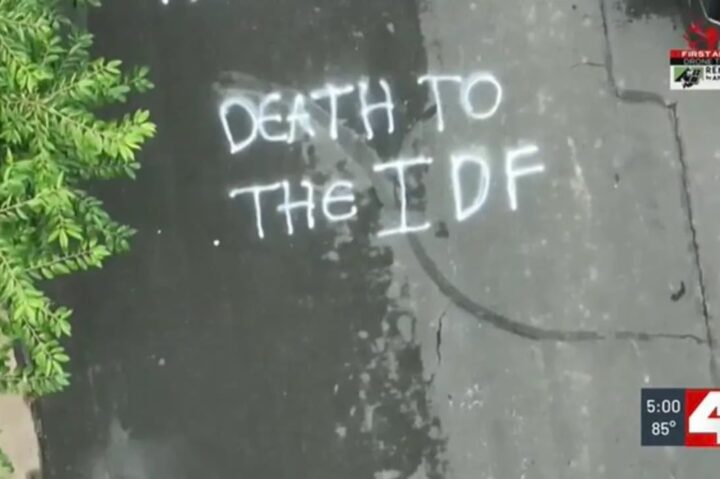
First Alert 4 News
Screenshot
St. Louis’ Jewish community is reeling after a targeted antisemitic attack in the predawn hours of Tuesday morning on a family whose college-aged son served in the IDF.
The family, living in a quiet suburban neighborhood with a significant Jewish population, found three of their cars burned and a message spray-painted on the street which read, in part, “Death to the IDF.” Another part of the message specifically targeted the IDF veteran, local news reports and members of the local Jewish community said, but has not been publicly disclosed.
The attack has shaken a Jewish community that has faced frequent and heated protests since the Oct. 7, 2023, attacks on Israel. This is the first time that activity has turned openly violent. Local and federal officials are investigating the attack as a hate crime.
“People are just really startled,” Rabbi Jeffrey Abraham, a board member of the Missouri Alliance Network, a local political organization dedicated to fighting antisemitism and supporting Israel, said.
He said the local Jewish community has been “on edge” for months following the violent antisemitic attacks in Washington and Boulder, Colo. “But when it actually happens in your own backyard, it takes on a different meaning. I think people are legitimately worried and also just really upset.”
Abraham said that he and other Jewish leaders are in close touch with local law enforcement, but attacks targeting individual families are harder to prevent than those targeting Jewish institutions.
“[Law enforcement] know any time we’re having a service or event, but it’s hard to protect everyone’s individual home in the middle of the night,” Abraham said. He said he’d had a conversation earlier Wednesday with a congregant who asked if he should take down his mezuzah, for fear that it would make his home a target.
Stacey Newman, director of the Missouri Alliance Network, said the community is “completely on edge.”
“Everybody’s worried about their kids,” Newman continued. Newman said she’s heard about another family whose children had served in the IDF that had asked local police to keep a closer watch on their home.
A coalition of Jewish organizations including the local American Jewish Committee, Anti-Defamation League and National Council of Jewish Women branches, the St. Louis Jewish Community Relations Council, Jewish Federation of St. Louis and the St. Louis Kaplan Feldman Holocaust Museum issued a joint statement condemning the attack.
“We condemn in the strongest terms the attack on members of our community last night. This is more than vandalism; it is a hateful act of intimidation and only the latest example of what happens when antisemitic and anti-Israel rhetoric are normalized,” the organizations said. “We are a resilient community, and we will not be deterred in our quest to uproot antisemitism and hatred, alone and with our partners. Antisemitism is a social ill that must be rejected by all of society.”
Local and federal officials have condemned the attack.
“This targeted attack against the Jewish community in St. Louis is horrific and must be met with full condemnation,” Sen. Eric Schmitt (R-MO) said. “Antisemitism has no place in our society. Everyone involved in this awful attack must be held accountable to the fullest extent of the law.”
Rep. Wesley Bell (D-MO) said, “Hate in any form is unacceptable and should never be tolerated. Those responsible must be held accountable to the full extent of law.”
Leo Terrell, who leads the Department of Justice’s antisemitism task force, described the incident as “horrific,” and said that he had engaged the FBI and the attorney general, as well as spoken directly to the family and informed them that the DOJ task force will be focused on the attack.
“I am outraged. Antisemitic violence has no place in America, not in St. Louis and not anywhere,” Terrell said. “We will pursue every avenue to bring the perpetrators to justice. If you commit antisemitic hate crimes, you will be caught. And you will be held accountable.”
State Rep. George Hruza described the incident as “Jew-hatred violence” and an “act of pure evil,” linking it to the attacks in Washington and Boulder, Colo.
“Nothing happening in the world at large can justify such a hateful act,” Hruza said. “This incident is antisemitism, plain and simple. This act did not arise in a vacuum. Since the mass murder, torture, rapes, and hostage-taking by the terrorist group Hamas on Oct. 7, 2023, antisemitic rhetoric has become commonplace in the United States. Tragically, with echoes of 1930s Germany, this rhetoric has fueled incitement to violence.”
Hruza, the son of a Holocaust survivor, said he is angry but committed to continuing to push to pass legislation to combat antisemitism in the state Legislature.
Newman and Abraham said that the IDF veteran in question had been individually targeted by protests in the past, when he delivered a speech in the community following his return from his service earlier this year.
A poster advertising that protest, reviewed by JI, includes the individual’s name and photograph, and the caption “Resistance is Justified, When People are Occupied,” and calls on supporters to “join us for a powerful demonstration to oppose the Zionist military presence in our community and to demand accountability for those who help commit atrocities abroad.”
‘Don’t Feed the Lion,’ written by Bianna Golodryga and Yonit Levi, opens a dialogue for kids and their communities on how to stand up to hate

The rise of antisemitism has dominated breaking news headlines, films and books in recent years. But two leading journalists noticed a void — a lack of resources in how to address the subject matter with young readers.
Concerned about what they observed, CNN anchor Bianna Golodryga and Yonit Levi, an anchor on Israel’s Channel 12, joined forces to write Don’t Feed the Lion, a new novel geared towards middle schoolers.
The book tells the story of three children in Chicago who experience antisemitism firsthand at school when a soccer star makes an antisemitic remark and a swastika appears on a locker. Theo, his sister Annie and their new friend Gabe each struggle with how to speak up and confront hate.
The book comes as antisemitism and anti-Israel sentiment has increasingly impacted K-12 classrooms nationwide in the aftermath of the Oct. 7, 2023, Hamas terror attacks on Israel and ensuing war in Gaza.
“We approached this project wearing three hats: as journalists who seek clarity, as Jews who feel the weight of history, and as mothers who want our children to live in a world that is kinder and more just,” Golodryga and Levi, both first time authors, told Jewish Insider in a joint statement.
“Empathy doesn’t happen in silence. We wrote this to help open dialogue between kids, parents, teachers, and communities, especially in times like these,” the veteran reporters said.
Don’t Feed the Lion, published by Arcadia Children’s Books, goes on sale Nov. 11.
Johnson will not be addressing the Knesset on this visit to Israel, as had been planned for a postponed June trip

Western Wall Heritage Foundation
House Speaker Mike Johnson (R-LA) visits the Western Wall on August 3, 2025.
House Speaker Mike Johnson (R-LA) and a group of House Republicans are visiting Israel this week, in Johnson’s first visit to Israel since becoming speaker.
Johnson was set to visit Israel in June to address the Knesset, but postponed his visit after the war between Israel and Iran began. He will not be addressing the Knesset on this visit, a source familiar with his plans told Jewish Insider.
Johnson and those in his delegation — Reps. Michael McCaul (R-TX), Nathaniel Moran (R-TX), Claudia Tenney (R-NY) and Michael Cloud (R-TX) — have prayed at the Western Wall and met with Israeli Defense Minister Israel Katz and Foreign Minister Gideon Sa’ar.
“We’re so grateful to be in Israel, particularly on this day, recognizing the destruction of the two Temples … it is such a moving time for us to be here at the Wailing Wall. We’ve offered our prayers, we’ve put our notes into the wall,” Johnson said in brief video remarks from the Kotel, which he visited on Tisha B’Av. “We’re so moved by the hospitality of the people and the great love of Israel.”
“Our prayer is that America will always stand with the people of Israel and we pray for the preservation and the peace of Jerusalem,” Johnson continued. “That’s what scripture tells us to do, it’s a matter of faith for us, and commitment that we have.”
Katz said in a statement that he thanked the lawmakers “for their unwavering support and moral clarity in standing with Israel against its enemies, and for their vital voices in the efforts to bring all the hostages home and defeat the murderous terrorist organization Hamas.”
Sa’ar said the group discussed global antisemitism, anti-Israel efforts by countries like Ireland and the attacks on the Druze in Syria, which Sa’ar said were “same kind of barbarism perpetrated by Hamas.”
The trip was organized by the U.S.-Israel Education Association.
In comments on CNN last week, Johnson raised concerns about the humanitarian crisis in Gaza, saying that “it is quite sad and quite alarming to see” and that he’d like to see the war in Gaza end soon.
Johnson’s office did not share any further details of his itinerary while he’s visiting the Jewish state.
In an interview with JI, Pirro discussed her outreach to Jewish groups to find ways to offer her office’s resources
Andrew Harnik/Getty Images
Interim U.S. Attorney for Washington, D.C. Jeanine Pirro stands during her swearing in ceremony in the Oval Office of the White House on May 28, 2025 in Washington, DC.
When interim U.S. Attorney for D.C. Jeanine Pirro began her tenure as Westchester County, N.Y., district attorney on New Years Day in 1994, she walked into her new office to discover a backlog of antisemitism-related cases left behind by her predecessor.
“One had to do with a swastika cut into the grass at Winged Foot Golf Club. I don’t know if you know Winged Foot, but it’s the creme de la creme of golf courses,” she remarked during an interview with Jewish Insider at her D.C. office on Tuesday.
Pirro said learning of the scope of antisemitism in Westchester County, which has long been home to a sizable Jewish population, opened her eyes to “the trauma and the revictimization” of the Jewish people and prompted her to get involved with efforts to promote Holocaust education through the Simon Wiesenthal Center.
“It’s almost like this thing that follows me,” Pirro said of prosecuting anti-Jewish hate crimes, calling it “so telling” that the fatal shooting of two Israeli Embassy staffers in Washington — by a 31-year-old suspect who witnesses said shouted “free Palestine” and “I did it for Gaza” — took place during her first week in her current role.
“My introduction here was just stunning, and it kind of brought me back to where I started, as a local DA, right off the bat with antisemitism,” she said of her initial days as U.S. attorney for the nation’s capital.
President Donald Trump appointed Pirro, known colloquially as Judge Jeanine from her 11 years hosting “Justice with Judge Jeanine” on Fox News’ weekend lineup, to serve as Washington’s chief federal law enforcement officer in an acting capacity in mid-May. He formally nominated her for a full term in the position a month later.
The Senate Judiciary Committee voted along party lines last week to advance Pirro’s nomination, and she’s expected to come before the full Senate in the fall, when the chamber returns from its August recess.
Pirro emerged as one of Trump’s most vocal defenders on the network, and is a personal friend of the president. She aggressively disputed allegations at the start of his first term of collusion between the Trump campaign and Russia to swing the 2016 election in the president’s favor. Her repeated on-air claims that Democrats had rigged the 2020 election for former President Joe Biden in the aftermath of Trump’s defeat was referenced several times in Dominion Voting Systems’ lawsuit against the network, which Fox ultimately settled for $787.5 million in 2023.
She had been co-hosting Fox’s “The Five,” one of the network’s top rated programs, in New York in early May when she agreed to join the Trump administration. The decision came after Ed Martin’s nomination to the U.S. attorney role was pulled over collapsing support among Senate Republicans due to his lack of experience as a prosecutor, ties to alleged Nazi sympathizers and defense of rioters who stormed the U.S. Capitol on Jan. 6, 2021.
Within weeks, Pirro found herself speaking to the nation about the murder of two Israeli Embassy staffers, one of the highest profile antisemitic crimes in the nation’s capital — amid growing antisemitism taking place across the country.
“What I want to be clear about today, since this is the first time you are hearing from me, is that this is a horrific crime. And these crimes are not going to be tolerated by me and by this office. A young couple at the beginning of their life’s journey, about to be engaged in another country, had their bodies removed in the cold of the night, in a foreign city, in a body bag,” Pirro said at a press conference the morning after the May 21 slayings of Sarah Milgrim and Yaron Lischinsky.
“I am not unaware, based upon my own background, of the repercussions of this kind of case. This is the kind of case that picks at old sores and old scars, because these kinds of cases remind us of what has happened in the past that we can never and must never forget,” she continued.
In addition to prosecuting the alleged assailant, Elias Rodriguez, Pirro has been doing outreach to Jewish groups to find ways to offer her office’s resources and “highlight that I’m here. Call me.”
She recently connected with the family of Malki Roth, the 15-year-old Israeli American killed in a 2001 suicide bombing at a Sbarro restaurant in Israel, who informed her that they had never heard from anyone at her senior level in the Justice Department about their daughter’s death.
“I said to myself: I ain’t high up, but it’s sad they lost a daughter and they didn’t get the attention that they needed. They will get that attention now, and I am determined to do whatever I can,” Pirro said.
As part of that commitment, Pirro said she’s “working on” securing the extradition from Jordan of Ahlam Tamimi, a Palestinian terrorist convicted by an Israeli court for her role in the bombing, to the U.S. in order to face federal charges for the attack, which Roth’s parents have been advocating for since their daughter’s death.
Tamimi was released from Israel to Jordan as part of a 2011 deal. Jordan has repeatedly refused U.S. extradition requests for Tamimi since the DOJ indictment against her became public in 2017.
Pirro noted that Tamimi has expressed no remorse for her actions and is living a life of fame and freedom in Jordan, where she became well known for hosting a program on a Hamas-affiliated television network for years. “That hate has always been so incomprehensible to me, and that’s why this has always been a mission. Now I’m back at my roots, and I continue with the mission,” she said.
“I don’t want to look in anymore. I want to look out,” Pirro said. “I want the people on the outside to know that there’s someone on the inside that they have access to, that they can speak with, that they can go back into the community and say, ‘She’s taking a strong stand. She’s going to prosecute these cases. She feels strongly about them, and if you’re not sure, go talk to her.’”
Pirro said that the office’s national security division is also pursuing three active cases “in the Arab world.”
Asked about what tools she could utilize as U.S. attorney in the broader fight against antisemitism, Pirro said that she and her team were reaching out to Jewish organizations to encourage community leaders to contact their office directly on local matters where they could be of assistance.
She argued that her emphasis on direct community outreach, rather than solely engaging with “other federal agencies that talk to each other all day long,” marked a shift in approach.
“They’re acronyms,” she said of those agencies. “I don’t want to look in anymore. I want to look out,” Pirro said. “I want the people on the outside to know that there’s someone on the inside that they have access to, that they can speak with, that they can go back into the community and say, ‘She’s taking a strong stand. She’s going to prosecute these cases. She feels strongly about them, and if you’re not sure, go talk to her.’”
Since taking over the role, Pirro has been connecting with D.C. leaders and other relevant stakeholders involved in efforts to address crime, domestic violence and antisemitism.
Pirro said she needed to tread carefully, in light of her ongoing confirmation proceedings, on the subject of Zohran Mamdani’s victory in the Democratic mayoral primary in New York. She argued that his plans would be “a disaster for business, a disaster for crime victims … a disaster for quality of life in New York.”
She argued that cutting the New York Police Department or trying to replace them with social services and mental health workers, as Mamdani has advocated for, would send the city in the wrong direction and make it more difficult to build business and community.
“When you see other Democrats joining, you say to yourself, it’s about power,” Pirro said. “And that’s why we’ve got Donald Trump in, because people heard him loud and clear — they want to be safe, and if they’re safe, then they can think about, you know, having a business, you know, making sure that maybe one day they can take a vacation, and, you know, their families can survive.”
Democrats, highlighting that Pirro is a longtime friend and ally of the president, have argued that she can’t be trusted to uphold the rule of law or the Constitution when they conflict with Trump’s agenda and desires.
Pirro said she’s had a positive working relationship with Washington, D.C. Mayor Muriel Bowser, and that she intends to work with city officials regardless of political differences. Still, she criticized the D.C. City Council for its approach to criminal justice issues.
“My relationship with Muriel Bowser is good. I want to work with her. That’s the only way to make the city safe again. I think that the chief of police, Pamela Smith, is great. The mayor has a similar agenda. I think the mayor believes that D.C. needs to be safe,” Pirro explained.“I think we’ve got a city council that’s out of control, that is so defense oriented. They’re totally tolerant of criminals.”
While Pirro said that securing convictions in the Democratic stronghold was a tall task, she said she was undeterred.
“We are in the center of the nation where laws are passed on a regular basis, and yet the enforcement of those laws is a very difficult thing to push in some areas,” Pirro said. “I mean, in the end, if we don’t have the determination and if we don’t have the will, then nothing happens, because there is a system that is geared toward the defendant.”
“I’m not going to worry about whether or not they’re liberal judges. I’m not going to worry about whether or not you know, juries in Washington are very defense oriented, and my staff won’t either,” Pirro said. “They know that it’s a hard fight in the district, but that’s our job, and you know what? That’s why I’m here. It’s a challenge, and it’s worth it.”
Pressed about the slow response by municipalities like D.C. to anti-Israel protest encampments on university campuses, and if the decision by city leaders to act in some cases but not in others was an indication that changes could be made in the nation’s capital, Pirro concurred.
“All law is a matter of will, it’s all about enforcement,” Pirro said, adding that a longtime concern for her has been a lack of consideration for and rights of crime victims in the justice system.
“We are in the center of the nation where laws are passed on a regular basis, and yet the enforcement of those laws is a very difficult thing to push in some areas,” Pirro said. “I mean, in the end, if we don’t have the determination and if we don’t have the will, then nothing happens, because there is a system that is geared toward the defendant.”
Pirro said that the D.C. attorney’s office is “neglected” and understaffed — relying on contractors — and in need of additional full-time staff and resources.
“I want more people, and I will get more people,” Pirro said. “I’m hiring people who want to fight the good fight and [are] competent.”
Trump, a longtime ally, has been “very gracious” in allowing her to hire more staff, Pirro said. She said she’d also spoken to senators about the resource crunch and they’ve been “very receptive, very interested in making D.C. safe.” She described the recent shooting of a congressional intern in the district as helping to motivate concern and interest from lawmakers.
Despite the lack of staff, Pirro lavished praise on the prosecutors in her office.
“What I’m most proud of in this office is the level of prosecutors and the level of talent. These are serious, well prepared, competent, aggressive prosecutors who are in a city that is not necessarily victim oriented. So we fight the good fight every day here. We fight it on behalf of many, many different segments of the community, whether it’s seniors, whether it’s just innocent victims, whether it’s people of the Jewish faith, whether it’s antisemitism, hate crimes of any type,” she said.
The meeting was one of Noem’s highest-level sit-downs with Jewish leaders since taking office
Courtesy Secure Community Network
Michael Masters, the CEO of the Secure Community Network, meets with Secretary of Homeland Security Kristi Noem, July 2025.
Michael Masters, the CEO of the Secure Community Network, sat down last week with Secretary of Homeland Security Kristi Noem amid a push from Jewish community groups for additional security resources to address rising levels of antisemitism.
The meeting was among the most high-level sit-downs between Noem and Jewish communal leaders since she took office.
“The secretary is very, very clear in her understanding and commitment to addressing the threat environment, particularly as it pertains to the faith-based community and the Jewish community and deeply understands the issues and concerns facing the community … and the scope of the department in being able to do that,” Masters told Jewish Insider in an interview on Wednesday.
SCN supported Noem during her confirmation process, and Masters said that she “evidenced a clear understanding and appreciation for the importance of this issue,” and called their sit-down “an encouraging sign.”
He also praised the work she’d done in her prior role, as governor of South Dakota, to protect the state’s Jewish community and understand its needs.
Masters said he and Noem discussed the threats facing the Jewish and other faith-based communities and the ways that SCN has worked with DHS in the past.
“So many of these threats are crossing over different faith based communities and historically, the department has been a convener and coordinator and supporter of efforts of the faith-based community to come together to address those as a whole,” Masters said. “And she firmly embraces that, I think, as a public official and as a person.”
The Department of Homeland Security did not respond to a request for comment.
Masters said that leaders across the federal government, including at the FBI, DHS, Department of Justice and the White House, understand that, “you cannot disassociate the safety and security of the Jewish community from the safety and security of the broader faith-based community, or from the domestic, homeland and national security of the United States.”
One priority for Masters in the meeting, he said, was pushing for the release of the application for 2025 Nonprofit Security Grant Program Funding, which opened on Monday.
“That was the focal point, and has been the focal point for many of our conversations,” Masters said, adding that he was “very encouraged” to see the applications open following his meeting and a push from various other Jewish community stakeholders and lawmakers.
“There’s going to be a bunch of follow-up related to the condensed time frame,” he continued, “and then the remainder of the supplemental. We will be able to turn our attention to that once we get through the current push of getting people’s applications in for this year’s awards.”
Organizations applied last year for a tranche of more than $100 million in NSGP funds provided through last year’s national security supplemental funding bill that has yet to be awarded or released.
Another issue Masters said he’d spoken about with Noem was the plan to cut the majority of the DHS’s Intelligence and Analysis (I&A) division’s staff; Masters wrote to Noem directly earlier this month to offer recommended reforms and overhauls for that office.
“We have worked with I&A since its creation,” Masters said. “There are significant efficiencies to be found [but] I&A is the only statutorily authorized entity that has a responsibility and a mission set related to state, local, tribal and territorial law enforcement and private nonprofit sector partners. It needs to do a much better job of servicing those stakeholders and there are dedicated men and women in I&A who have worked to do that.”
He said that Noem has already been working toward some of the same goals he outlined, including sending DHS agents out of headquarters in Washington and into the field to work on critical issues on the ground.
“Many of us who served in law enforcement and the associations that are currently dealing with I&A — and certainly SCN — we support this effort, but it will be a work in progress for some time,” he said, explaining that the office’s mission and mandate has shifted between and during various administrations.
“All of us are committed, from law enforcement and those of us who deal in the security space, to working to support the effort to make sure that I&A can be as effective as it can be, that it is fit for its mission, it’s sized for its mission and that it’s structured in a way that allows it to be effective,” Masters continued.
Masters, along with Anti-Defamation League CEO Jonathan Greenblatt, Jewish Council for Public Affairs CEO Amy Spitalnick and national law enforcement leaders, also attended a private roundtable with members of the House Homeland Security Committee’s Counterterrorism and Intelligence Subcommittee last week.
“For the fourth consecutive year, antisemitic violence and acts of terror have risen in all 50 states. This is not a localized issue—it’s a national crisis,” Rep. August Pfluger (R-TX) said in a statement. “Last week’s roundtable provided an important opportunity to hear directly from law enforcement officials and Jewish community leaders about this alarming surge.”
He said the participants made clear the need for “stronger interagency coordination, enhanced intelligence sharing, targeted training, and robust enforcement.”
He vowed to work with colleagues to take action and address antisemitism.
“Silence in the face of antisemitism is complicity. Hatred and bigotry have no place in America, and every person deserves to live without fear,” he said.
Masters said that the Jewish and law enforcement leaders were “all aligned in the importance of addressing the threat environment facing the Jewish community, in the importance of addressing hate crimes broadly, and in the necessity of strong, consistent, predictable funding for law enforcement.”
He said they’d discussed issues including I&A and the need for strong collaboration and communication to address threats to the Jewish community and the country as a whole.
“I deeply appreciated the opportunity to meet with the committee on the rise in antisemitic violence and the concrete steps necessary to protect our communities,” Spitalnick told JI, adding that she had advocated for NSGP funding to be released.
“There is still significant work to be done to ensure this critical security program is properly funded and the dollars are moved quickly to protect our communities,” she continued. “We also made clear that the crisis of antisemitism and broader extremism requires a whole-of-government and whole-of-society solution — aimed at building resiliency to hate and violence in the first place. Yet too many programs — such as hate crime prevention grants — have been frozen, cut or insufficiently funded at levels that do not match the dire need.”
Plus, Leonardo DiCaprio's new Herzliya hotel

Kevin Carter/Getty Images
U.S. Capitol Building on January 18, 2025 in Washington, DC.
Good Wednesday morning.
In today’s Daily Kickoff, we talk to college students about the Trump administration’s efforts to reach settlements with schools over their handling of antisemitism on campus, and have the scoop on new legislation, introduced by Reps. Virginia Foxx and Josh Gottheimer, that would restrict federal funding to universities that engage in boycotts of Israel. We also report on the death of Blackstone executive and Jewish communal lay leader Wesley LePatner, who was killed in Monday’s shooting at the company’s headquarters, and look at stalled congressional efforts to address antisemitism. Also in today’s Daily Kickoff: Leonardo DiCaprio, Michel Issa, Illinois Gov. JB Pritzker and Penny Pritzker.
What We’re Watching
- The Senate is expected to vote today on two resolutions from Sen. Bernie Sanders (I-VT) on blocking arms sales to Israel. More below.
- House Minority Leader Hakeem Jeffries (D-NY) is slated to meet with Democrats in Texas today amid a broader debate over mid-decade redistricting, following President Donald Trump’s call for the Lone Star State to redraw the state’s congressional districts to give Republicans up to five additional seats.
What You Should Know
A QUICK WORD WITH JI’S MARC ROD
It’s been two months since the Capital Jewish Museum shooting in Washington and the Boulder, Colo., firebombing attack.
The two attacks prompted unified condemnation from lawmakers and calls from the Jewish community for Capitol Hill to take aggressive action against the escalating antisemitism crisis in the United States.
But as Congress heads into its August break, that initial momentum has produced little concrete action.
The House and Senate have passed resolutions condemning the attacks, but key legislation related to antisemitism remains stalled, even as lawmakers individually and in groups continue to press for action.
There are still no clear prospects for passage of the Antisemitism Awareness Act, a key element of congressional efforts to address antisemitism, after a contentious Senate committee hearing in April in which Democrats, joined by Republicans including Sen. Rand Paul (R-KY), voted to add amendments that most Republicans supporting the bill view as nonstarters. House leaders have made no public moves to advance the legislation.
And despite calls from Jewish groups for significant increases in nonprofit security funding to as much as $1 billion next year and a push from a bipartisan coalition of lawmakers for $500 million, the funding levels under consideration in the House are little different from those discussed in prior years.
Read more from JI senior congressional correspondent Marc Rod here.
MORE THAN MONEY
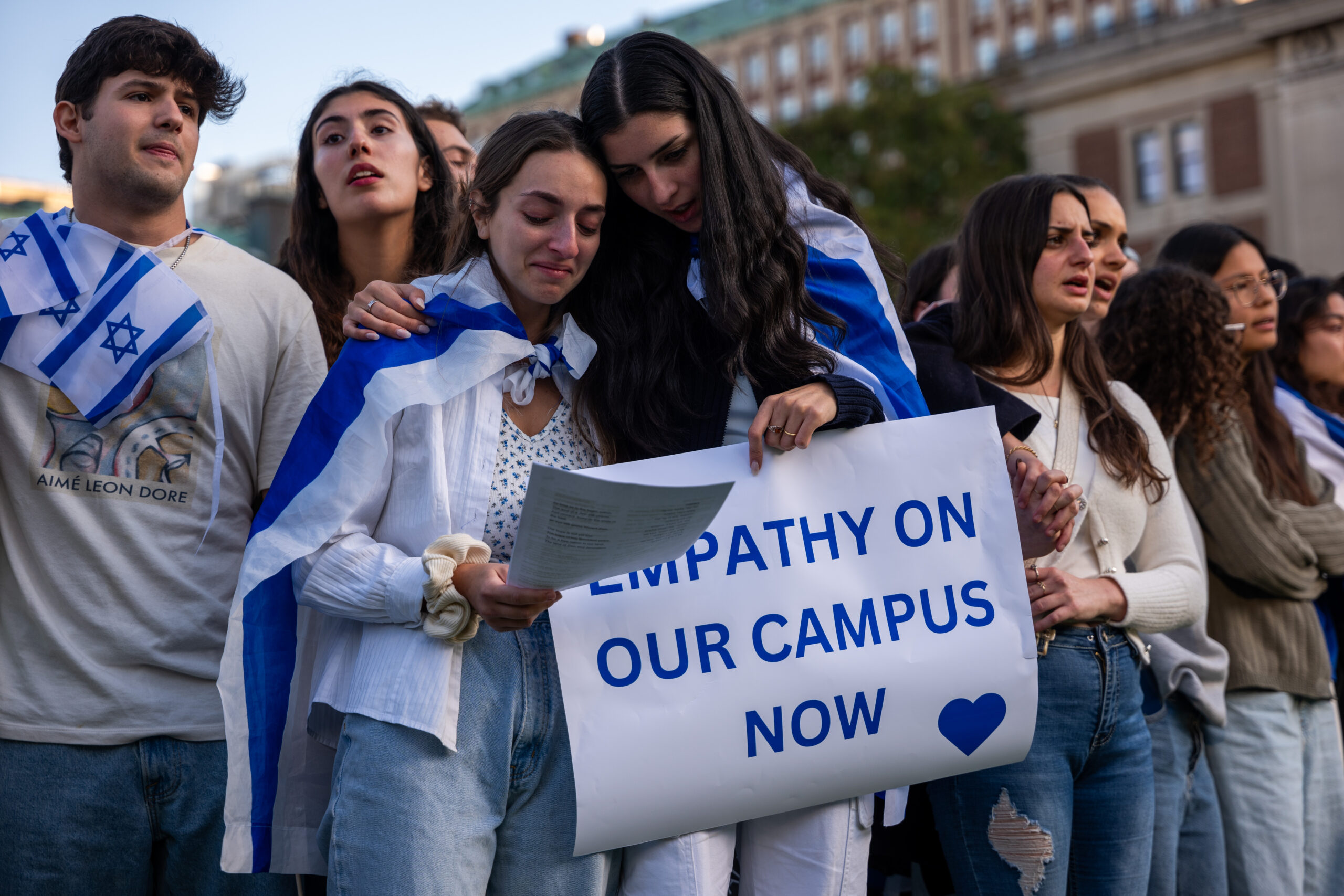
When hundreds of pro-Israel college students from around the country gathered in Washington earlier this week for the Israel on Campus Coalition’s three-day annual national leadership summit, the rise of antisemitism on campuses sparked by the aftermath of the Oct. 7 terrorist attacks nearly two years ago was still a topic of conversation throughout panels and hallways. This year, however, some students, in conversations with Jewish Insider’s Haley Cohen, also said that antisemitism is lessening — though they offered mixed views about what is leading to the improved campus climate.
Students’ perspectives: Some attributed it to the Trump administration’s ongoing pressure campaign on universities to crack down on antisemitic behavior, which has included federal funding cuts from dozens of schools. Others said their campuses started to take a serious approach to antisemitism, before President Donald Trump was reelected, in the fall semester following the wave of anti-Israel encampments from the previous spring. But many student leaders from universities that have been targeted by the Trump administration — facing billions of dollars in slashed funds — said that if their school enters into negotiations to restore the money, they would like a deal to include structural reforms, unlike the one made last week between the federal government and Columbia University.
Suit settled: The University of California, Los Angeles settled a federal lawsuit this week with Jewish students who alleged that the university permitted antisemitic conduct during the spring 2024 anti-Israel encampments on the campus, according to a settlement agreement shared by the university on Tuesday, Jewish Insider’s Gabby Deutch reports.
EXCLUSIVE
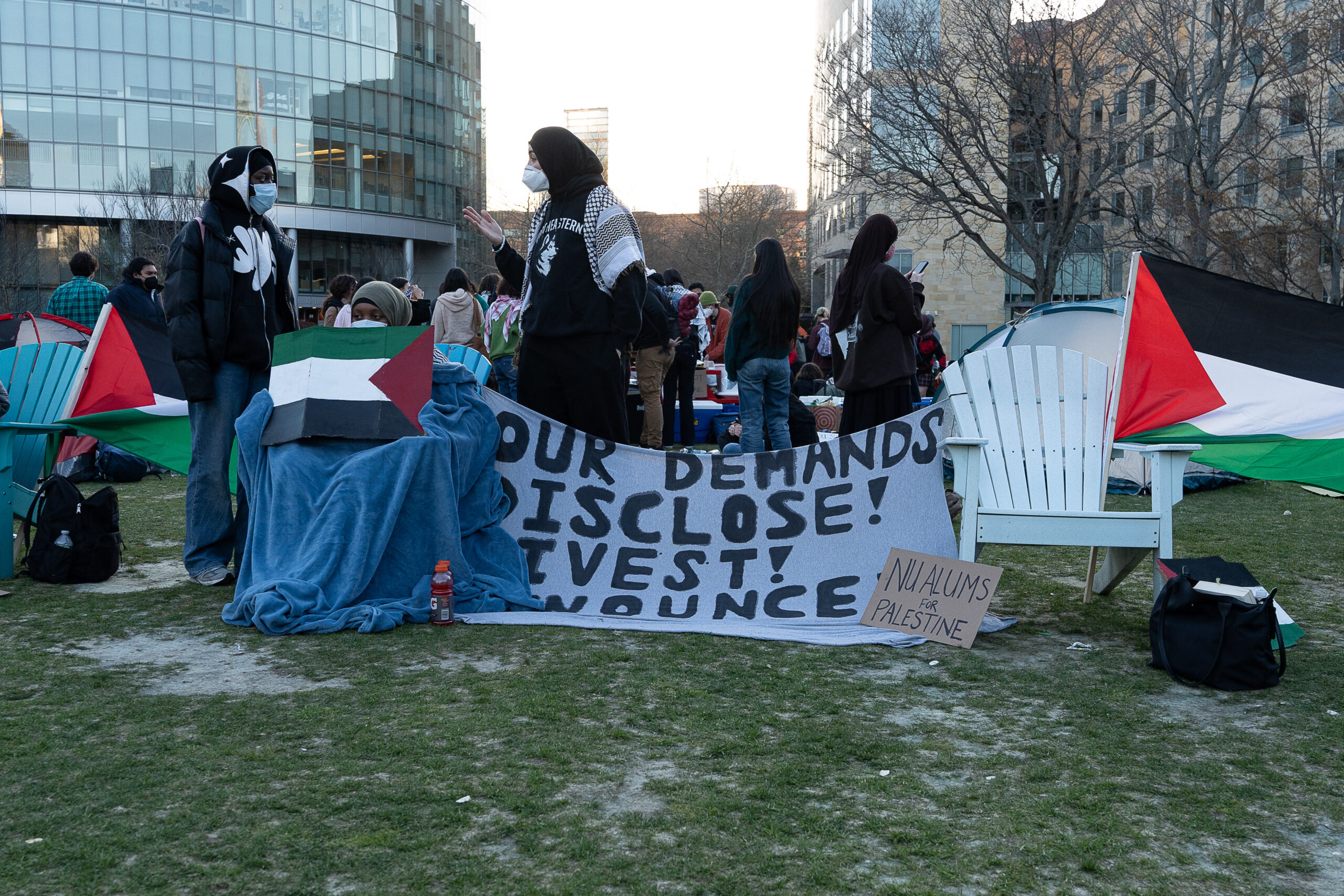
Reps. Virginia Foxx (R-NC) and Josh Gottheimer (D-NJ) introduced legislation on Tuesday that would make colleges that engage in a “nonexpressive commercial boycott” of Israel ineligible to receive federal student aid funding, Jewish Insider’s Marc Rod and Emily Jacobs report.
About the bill: The legislation, the Protect Economic and Academic Freedom Act, would require schools to certify annually that they are not engaged in such boycotts, and would instruct the Department of Education to annually publish a list of schools that fail to submit such certification. The legislation would apply both to boycotts of Israel as a country or companies and other entities operating under Israeli law.
ELEVATING THE ISSUE

A group of 40 Senate Democrats, nearly all of the caucus, wrote to administration officials on Tuesday raising concerns about the humanitarian situation in Gaza and calling for a significant expansion of aid, describing the Gaza Humanitarian Foundation as a failure, Jewish Insider’s Marc Rod reports.
What they said: The letter to Secretary of State Marco Rubio and Middle East envoy Steve Witkoff, led by Sens. Adam Schiff (D-CA), Brian Schatz (D-HI), Chuck Schumer (D-NY) and Jacky Rosen (D-NV), highlights the extent of the concern even among Democratic leaders and pro-Israel stalwarts. The lawmakers called for aid to be significantly expanded through “experienced multilateral bodies and NGOs.” A group of 21 progressive Democrats went further earlier this week, calling for the U.S. to stop all funding for the GHF.
Déjà vu: Sen. Bernie Sanders (I-VT) introduced a joint resolution of disapproval on Monday to block an arms transfer to Israel, setting up a Senate floor battle on Wednesday over U.S. aid to Israel — the third since November of last year, Jewish Insider’s Marc Rod reports.
through thick in thin

In comments to a supportive crowd of pro-Israel college students in Washington, Rep. Ritchie Torres (D-NY) said Tuesday that the world needs to be reminded that “Hamas is the central cause of the war in Gaza,” Jewish Insider’s Haley Cohen reports.
What he said: “We have to remind the world that despite the amnesia, Hamas is the central cause of [Israel’s] war in Gaza. The primary responsibility for a war lies with its cause … Hamas is morally responsible, principally responsible for the war in Gaza,” Torres, a pro-Israel Democratic stalwart in Congress, told about 700 attendees gathered in Washington for the Israel on Campus Coalition’s three-day annual national leadership summit.
More from Torres: Torres warned, in an interview with The Bulwark on Tuesday, that the war in Gaza appears to be turning into a “quagmire” akin to the Iraq war, without clear objectives or any realistic end point, Jewish Insider’s Marc Rod reports.
IN MEMORIAM
Wesley LePatner, a Blackstone executive who was involved with Jewish communal organizations in New York City, was killed in the Monday shooting at the firm’s Midtown headquarters, the company confirmed on Tuesday, Jewish Insider’s Gabby Deutch reports. LePatner was the global head of Core+ Real Estate at Blackstone and CEO of Blackstone Real Estate Income Trust, according to Blackstone’s website. A Yale graduate, she joined the company in 2014 after more than a decade at Goldman Sachs. She served on the board of trustees at the Abraham Joshua Heschel School, a pluralistic Jewish day school in New York, and she joined the board of directors at UJA-Federation of New York earlier this month.
Legacy: “Wesley was extraordinary in every way — personally, professionally, and philanthropically,” the federation said in a statement. “In the wake of Oct. 7, Wesley led a solidarity mission with UJA to Israel, demonstrating her enduring commitment in Israel’s moment of heartache. She lived with courage and conviction, instilling in her two children a deep love for Judaism and the Jewish people.”
More from Blackstone: The company’s president, Jonathan Gray, said that LePatner was well-liked at the firm, where she “just instilled such a sense of confidence in her” and “wanted other people to win.”
AMBASSADORIAL ASSESSMENT
Michel Issa, the Lebanese-American businessman nominated by the Trump administration to serve as U.S. ambassador to Lebanon, said Tuesday that the Lebanese government and armed forces must act swiftly and decisively to disarm Hezbollah and remove its influence across Lebanese society, Jewish Insider’s Marc Rod reports.
Looking ahead: Issa argued at his Senate Foreign Relations Committee confirmation hearing that the war between Israel and Hezbollah, “while devastating, has opened a narrow but meaningful window for progress,” in combination with the Israel-Lebanon ceasefire deal, the fall of the Assad regime in Syria and recent blows to Iran’s military and nuclear program.
Worthy Reads
Bibi’s Bind: The Atlantic’s Yair Rosenberg considers the challenge facing Israeli Prime Minister Benjamin Netanyahu as he attempts to prosecute the war in Gaza and keep his government — which includes far-right members with a different vision for the enclave — from collapsing. “Every step he authorized had to be dual use: ostensibly for a strategic purpose but also capable of potentially advancing the far right’s plan. In practice, pursuing these two goals at the same time is incompatible with a just and successfully prosecuted war: It is impossible to provide aid and also withhold it, to pursue a limited war against Hamas to free hostages and also a war of conquest. The longer the conflict has gone on, the more obvious the compromised nature of Netanyahu’s decision making has become.” [TheAtlantic]
Keir’s Veer: The Wall Street Journal’s editorial board critiques British Prime Minister Keir Starmer’s declaration that the U.K. will recognize a Palestinian state unless Israel meets certain conditions before September. “Framing recognition as a threat to Israel — unless it does x, y and z — lays bare the move’s punitive nature. At least this means we can dispense with the usual pabulum that planting a hostile state in the heart of Israel is a gift for which Israelis would be grateful if only they could see their true interests as clearly as they appear from Paris and London. It is also striking to demand that Israel accept a cease-fire when it has done so over and over, only for Hamas to torpedo talks. That was the Biden team’s conclusion and now the Trump team’s as well. When Israel made difficult concessions last week, Hamas reneged on what it had agreed to previously. The U.K. now gives Hamas a reason to reject future cease-fires; if the terrorists hold out, Mr. Starmer will give them a reward.” [WSJ]
Word on the Street
The New York Times published an editor’s note regarding a story about malnutrition in Gaza that failed to note that one of the children featured in the article — whose pictures went viral — suffered from preexisting health conditions affecting his brain and his muscle development…
In a thread on X laying out his positions on the war in Gaza, Rep. Greg Landsman (D-OH) argued that “Qatar should take into custody every Hamas leader in Qatar until every hostage is released and the war is over”…
The Times of Israel published a document signed at this week’s U.N. conference on a two-state solution by 17 countries, including Qatar, Saudi Arabia and Egypt, calling for Hamas to disarm and end its rule over the Gaza Strip…
President Donald Trump said that the U.S. would partner with Israel on “a new aid plan” to open new food distribution sites in the Gaza Strip…
Defense Secretary Pete Hegseth has reportedly discussed mounting a gubernatorial run in Tennessee next year, when Gov. Bill Lee, a Republican, will be term-limited…
New guidance released this week by the Office of Personnel Management expressed support for religious expression, including proselytization, in federal workplaces…
A new poll from Gallup found record-low U.S. support for Israel’s war against Hamas in Gaza since it first polled on the issue in November 2023; 60% of Americans surveyed earlier this month disapprove of Israel’s military actions in Gaza, up from 45% in November 2023…
The Wall Street Journal looks at Illinois Gov. JB Pritzker and former Commerce Secretary Penny Pritzker’s push to bring quantum computing technology to Chicago…
Italian authorities are investigating as a hate crime an attack on a French Jewish man and his young son that occurred at a rest stop north of Milan; according to video of the incident, the man was assaulted after several individuals, including a cashier at the rest stop, shouted “Free Palestine” at him and his child…
Jewish leaders at the University of Edinburgh are urging the school not to drop its support for the International Holocaust Remembrance Alliance’s working definition of antisemitism, following a report that the school is reconsidering its prior adoption of the definition…
The European Commission proposed barring Israeli participation in the Horizon Europe research program over the humanitarian situation in the Gaza Strip…
The Tel Aviv District Planning and Building Committee approved construction plans for a new luxury hotel in Herzliya being built by the Hagag Group in partnership with actor Leonardo DiCaprio…
Israeli media reports that the country’s ambassador to the United Arab Emirates, Yossi Shelley, will soon be sent back to Jerusalem following a months-old incident at an Abu Dhabi bar in which Shelley acted in an “undignified” manner; the Prime Minister’s Office denied both the report and that Shelley is being removed from the posting…
Israeli actor Alon Aboutboul, who appeared in such films as “The Dark Knight Rises” and “Munich,” died at 60…
Crown Heights, N.Y., community member Ben “Ziggy” Faulding died at 41…
Pic of the Day

Sen. Dave McCormick (R-PA), addressing attendees on Tuesday at the Israel on Campus Coalition’s three-day annual national leadership summit in Washington, said that Israel’s response to the Oct. 7, 2023, Hamas terror attacks “changed the landscape in ways that could be for the good” and lead to the “possibility of a secure region,” Jewish Insider’s Haley Cohen reports from the conference.
Birthdays

Commissioner emeritus of Major League Baseball, his 2019 memoir is For the Good of the Game, Allan Huber “Bud” Selig turns 91…
Retired attorney from the firm of Hatton, Petrie & Stackler in Aliso Viejo, Calif., Ronald E. Stackler turns 88… Longtime owner and editor-in-chief of The New Republic, he was chairman of the Jerusalem Foundation for 12 years, Martin H. “Marty” Peretz turns 86… The first woman justice on the Nebraska Supreme Court, as a teen she won two gold medals and a silver medal as a swimmer at the Maccabiah Games in Israel, Justice Lindsey Miller-Lerman turns 78… Actor, director and producer, Ken Olin turns 71… Philanthropist and investor, of Uzbek Bukhari background, known as the “King of Diamonds,” Lev Leviev turns 69… Former mayor of Arad, Israel, and then a member of the Knesset for the Kulanu and Likud parties, Tali Ploskov turns 63… President of C&M Transcontinental, he served as COO for the first two Trump campaigns, Michael S. Glassner turns 62… Emmy Award-winning actress, comedian and producer, Lisa Kudrow turns 62… Head coach of men’s tennis and director of tennis operations at Columbia University, Howard Endelman turns 60… Best-selling nonfiction author, contributing editor at Vanity Fair and Rolling Stone magazines, he is a co-creator of the HBO series “Vinyl,” Rich Cohen turns 57… District director for Rep. Jerrold L. Nadler (D-NY), Robert M. Gottheim turns 54… Assistant attorney general for antitrust at the Department of Justice during most of the Biden administration, Jonathan Seth Kanter turns 52… Motivational speaker, author and entrepreneur, he served as a law clerk in 2008 for Justices O’Connor and Ginsburg, the first blind person to clerk for the U.S. Supreme Court, Isaac Lidsky turns 46… President of MSNBC since February, Rebecca M. Kutler… Member of the Knesset for the Otzma Yehudit party, Limor Son Har-Melech turns 46… Senior producer at Vox and host and producer of the podcast of the Association for Jewish Studies, Avishay Artsy… President and founder in 2014 of Dallas-based ECA Strategies, Eric Chaim Axel… Team supervisor at Pittsburgh Mercy Health System, Lewis Sohinki… Author of Jerusalem Drawn and Quartered: One Woman’s Year in the Heart of the Christian, Muslim, Armenian and Jewish Quarters of Old Jerusalem, Sarah Tuttle-Singer turns 44… Former director of policy and public affairs for the Jewish Community of Denmark, now in the renewable energy and offshore wind industry, Jonas Herzberg Karpantschof… Attorney and member of the Los Angeles County GOP Central Committee for Assembly District 42, which includes Pacific Palisades, Elizabeth Barcohana turns 42… Head of digital operations at the Ministry of Foreign Affairs of Israel until this past April, Tamar Schwarzbard… Managing principal of West Egg Development, Samuel Ezra Eshaghoff turns 33… Director of business development at Israel’s economic mission to the South and Midwest U.S., Joshua Weintraub… Winner of the Miss Israel pageant in 2014, now a businesswoman, Mor Maman turns 30… Actress, as a 10-year-old she starred as Ramona Quimby in the comedy film “Ramona and Beezus,” Joey Lynn King turns 26…
ADL CEO Jonathan Greenblatt: ‘I'd like to see the extremes marginalized so the vast majority of members of Congress on both sides can get the stuff done that needs to happen’

Marc Rod
Lawmakers gather on the Capitol steps on June 10, 2025 for a vigil for Yaron Lischinsky and Sarah Milgrim, Israeli Embassy staffers who were killed in an anti-Israel attack.
It’s been two months since the Capital Jewish Museum shooting in Washington and the Boulder, Colo. firebombing attack.
The two attacks prompted unified condemnation from lawmakers and calls from the Jewish community for Capitol Hill to take aggressive action against the escalating antisemitism crisis in the United States. But as Congress heads into its August break, that initial momentum has produced little concrete action.
The House and Senate have passed resolutions condemning the attacks, but key legislation related to antisemitism remains stalled, even as lawmakers individually and in groups continue to press for action.
There are still no clear prospects for passage of the Antisemitism Awareness Act, a key element of congressional efforts to address antisemitism, after a contentious Senate committee meeting in April in which Democrats, joined by Republicans including Sen. Rand Paul (R-KY), voted to add amendments that most Republicans supporting the bill view as nonstarters. House leaders have made no public moves to advance the legislation.
And despite calls from Jewish groups for significant increases in nonprofit security funding to as much as $1 billion next year and a push from a bipartisan coalition of lawmakers for $500 million, the funding levels under consideration in the House are so far little different from those discussed in prior years.
One Republican senator working on the Antisemitism Awareness Act told Jewish Insider they have not seen much movement among colleagues who have continued concerns about the legislation, in conversations with those colleagues and the White House.
The senator said they are frustrated by unresolved disputes about the International Holocaust Remembrance Alliance’s working definition of antisemitism on the Republican side of the aisle, noting as well that there are steps the administration can take independently.
Jonathan Greenblatt, the CEO of the Anti-Defamation League, said at a press conference last week that “there needs to be, for sure” more focus from Congress on tackling antisemitism. A key part of that, he said, will be sidelining extreme voices.
“I think too often extremes on both ends kind of warp the conversation and insist that the definition of antisemitism somehow needs to include things like the false charge of ‘the Jews murdered Jesus,’ or the claim that anti-Zionism is never antisemitism,” Greenblatt said, alluding to the objections from both sides of the aisle to the Antisemitism Awareness Act.
“All the Jews didn’t murder Jesus, and anti-Zionism is antisemitism. I think I’d like to see the extremes marginalized so the vast majority of members of Congress on both sides can get the stuff done that needs to happen once and for all,” he continued.
Several sources familiar with the situation said that the bill is “stuck,” for the moment. Senate Republicans could attempt to bring the bill to the floor and utilize procedural means to eliminate the poison-pill amendments added to the bill in the Senate Health, Education Labor and Pensions Committee, but that would require Democratic support and could rehash the same ugly debates seen in the HELP committee.
It could also be added to a must-pass legislative package — but that same plan failed last year.
A source who has advocated for the legislation said that the recently passed budget reconciliation package sapped attention for antisemitism legislation in recent months, but argued that passing the Antisemitism Awareness Act is critical because there are no realistic alternative proposals for tackling antisemitism on Congress’s agenda at this point.
The Senate has also been focused on confirming presidential appointees.
The source said that advocates for the bill need to find strategies to work around the obstacles to the legislation, “and that has not been easy,” but insisted that they and others are not giving up on the bill.
“There just hasn’t been a lot of legislation [moving] in general,” Nathan Diament, the executive director of public policy for the Orthodox Union, said — arguing that the slow progress is not unique to the Antisemitism Awareness Act or antisemitism generally.
Sen. Jacky Rosen’s (D-NV) office told JI that she is continuing to advocate for the Antisemitism Awareness Act, and is also looking at potential other legislation that could move forward on antisemitism. Rosen, the co-chair of the Senate antisemitism task force, is the lead Democratic sponsor of the Antisemitism Awareness Act.
Senate Republicans had vowed, coming into the majority, to pass the bill.
“Republican control of the Senate means that this institution will no longer turn a blind eye to the growing threat of antisemitism in our country or the numerous threats that our ally Israel faces on all sides,” Senate Majority Leader John Thune (R-SD) told JI after Republicans won the Senate majority. “We will empower committees to advance legislation addressing antisemitism and protecting students on campuses, and we will increase oversight into Iran’s malign actions.”
On the House side, Rep. Mike Lawler (R-NY) told JI last week that “we’re working on” the Antisemitism Awareness Act. Pressed on whether Congress is moving strongly enough to respond to antisemitic violence, Lawler said, “It continues to be a strong focus of mine and many of my colleagues, and we’re working through the legislation.”
House Speaker Mike Johnson (R-LA) did not respond to a request for comment.
Observers believe the House, which passed the bill last year only for it to fail to move forward in the Senate, is waiting on the Senate to move first this year and prove that it can pass the bill.
Another source argued that, given the action the administration has taken to address antisemitism on college campuses, the Antisemitism Awareness Act is “less necessary” in the near term.
On NSGP funding, the House Appropriations Committee approved a bill that would allocate $335 million for the program in 2026 — the same funding level that the House backed for the program in 2025, though final funding levels ultimately fell short of that mark.
The Senate Appropriations Committee, meanwhile, has yet to finalize its homeland security funding bill. Sen. Chris Murphy (D-CT), the ranking member of the subcommittee responsible for such funding, told JI last week that lawmakers are “still negotiating” it.
Congress will have just a month to finalize government funding or pass a stopgap bill when it returns from August recess.
A Republican senator working on the issue said they’ve been focusing on ensuring that outstanding NSGP funding for this year is disbursed from the administration before turning to the appropriations process for next year.
“First things first on it, let’s get the grant money out so people can actually create a more secure environment where they’re physically located,” the senator said. The administration opened applications for the 2025 grant program on Monday, but some supplemental funding remains to be allocated.
Diament said that Congress is in the “fourth or fifth inning out of nine” on government funding, and that the process will likely play out mostly in September or October. He also argued that, given the “tight fiscal environment,” particularly for homeland security funding, the fact that advocates were able to secure a $30 million increase in NSGP funding from the initial proposed level of $305 million, on a bipartisan basis in the House Appropriations Committee is very “valuable in the process going forward.”
In “the later innings of the process, it laid very good groundwork” for further bipartisan movement to increase funding as the process proceeds, Diament continued. “We made sure to work it on a bipartisan basis and we’re moving in the right direction.”
“Given everything else on the legislative calendar and where we are on the legislative calendar, I don’t feel like we’re behind,” he continued.
Rep. Don Bacon (R-NE), a co-chair of the House antisemitism task force, asked about congressional action on antisemitism last week, said that “there’s a place for legislation” but argued that other steps are also needed to make antisemitism unacceptable in public discourse.
“In the end, Americans have to speak out on this,” Bacon said at a press conference on legislation aiming to tackle support for terrorism on social media. “We have to make it like it’s embarrassing to be standing on that side saying those things. So we got to speak up. And you can’t legislate that.”
Several Democrats said last week that more needs to be done legislatively to tackle antisemitism.
“We’ve had an unlimited amount of hearings, and the speaker has now come out with a security plan [for members] for the summer, and a lot of that, obviously, is tied to the amount of hate and threats that we are getting, but we still haven’t passed the Antisemitism Awareness Act,” Rep. Jared Moskowitz (D-FL) said. “No, we’re not doing enough to combat antisemitism and other forms right now of hate and demagoguery that’s going on.”
“The language and the culture, it’s just completely toxic,” Moskowitz continued, adding that Congress is “also not doing enough on the security grants. … They gave ICE $140 billion. We’re trying to get more money for security when the community is in grave danger, and these threats are out of control, at all-time levels.”
Sen. Richard Blumenthal (D-CT) said that “there can never be too much focus on antisemitism, and I see, frankly, too little right now, in light of events that are unfolding around the country.”
“I wish there were more focus on bias and bigotry of all forms, because it is growing, and so is violent extremism and the confluence of the two make for a very dangerous recipe for potential disaster,” Blumenthal continued.
Rep. Brad Schneider (D-IL), a co-chair of the House Jewish Caucus, said that “it’s not business as usual” on antisemitism, and that lawmakers are “working on it and we’re trying to take constructive steps.”
But he added that “we have to do more. We’re seeing antisemitism rising all across the country, being normalized in ways that should never be normalized” on both sides of the political spectrum.
Schneider said that “it is critical that everybody, Democrats, Republicans, House, Senate, stand together, stand united against anti semitism and not what about ism in here, we need to stand against hate. But antisemitism is rising at a rate that should give everyone concern.”
He primarily blamed Republicans for the lack of progress on legislation like the Antisemitism Awareness Act.
Jewish Insider’s congressional correspondent Emily Jacobs contributed reporting.
At the Israel on Campus Coalition’s conference, some students praised Trump’s campus crackdowns — but want lasting changes over financial settlements
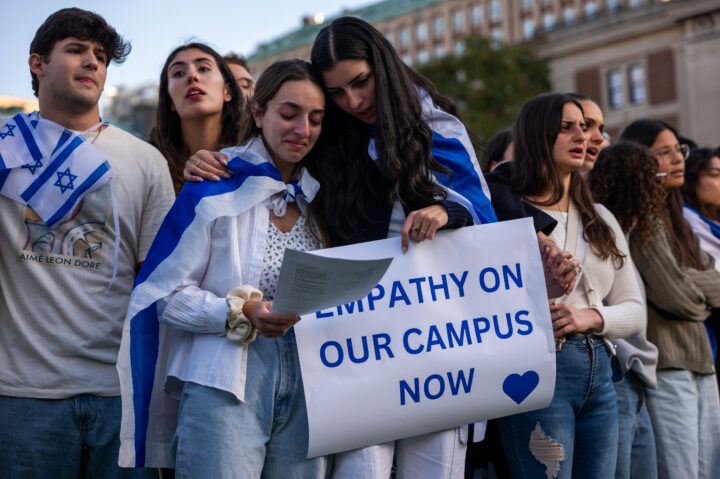
Spencer Platt/Getty Images
Columbia students participate in a rally and vigil in support of Israel in response to a neighboring student rally in support of the Palestinians at the university on October 12, 2023 in New York City.
WASHINGTON — When hundreds of pro-Israel college students from around the country gathered in the nation’s capital earlier this week for the Israel on Campus Coalition’s three-day annual national leadership summit, the rise of antisemitism on campuses sparked by the aftermath of the Oct. 7th terrorist attacks nearly two years ago was still a topic of conversation throughout panels and hallways.
This year, however, some students also said that antisemitism is lessening — though they offered mixed views about what is leading to the improved campus climate.
Some attributed it to the Trump administration’s ongoing pressure campaign on universities to crack down on antisemitic behavior, which has included federal funding cuts from dozens of schools. Others said their campuses started to take a serious approach to antisemitism, before President Donald Trump was reelected, in the fall semester following the wave of anti-Israel encampments from the previous spring.
But many student leaders from universities that have been targeted by the Trump administration — facing billions of dollars in slashed funds — said that if their school enters into negotiations to restore the money, they would like a deal to include structural reforms, unlike the one made last week between the federal government and Columbia University.
The penalties under that deal were largely financial, with Columbia agreeing to pay a $200 million settlement over three years to the government.
Harvard University has signaled a willingness to settle next, The New York Times reported this week, which could see the school agree to the Trump administration’s demand for as much as $500 million to end its clash.
“If there is a settlement in the coming days, I don’t think that Harvard paying a fine would be helpful,” Kyra Esrig, an incoming sophomore at Harvard, told Jewish Insider at the ICC summit. Instead, Esrig hopes to see “more of a focus on antisemitism itself without this maneuvering to get it to be a DEI incentive that every time they talk about antisemitism they have to add that they’re not anti-Muslim as well.”
“I want to see something specific in writing — [outlining] the steps the university will take to change antisemitism. I want to see an action-specific type of agreement. If the university treads more carefully around the issue, if the university is at least a little more responsive to people’s concerns around antisemitism, I think that will be a good thing.”
Esrig does not believe antisemitism has improved on campus since the Trump administration slashed $2.6 billion in funding from the university in the spring.
“It’s not like the Trump administration came into power and then there was sweeping change. For Harvard to change its culture, that’s an incredibly difficult thing to do and I don’t know that the Trump administration can go about issuing that.”
“I’m not entirely sure what the Trump administration is trying to gain,” Ezra Galperin, an incoming junior at the Ithaca, N.Y. school, told JI. “I think Cornell’s administration has been pretty effective in combating antisemitism — before there were threats from the Trump administration — with President Kotlikoff coming on. [Kotlikoff] makes a point of listening to Jewish students.”
Rather, “a lot of the positive changes are coming from the original backlash after Oct. 7,” she said, pointing to the university expanding its kosher lunch options in August 2024.
“That’s a result of the powerful force of Jewish students at Harvard saying that we need certain resources,” Esrig said.
Cornell University faced a $1 billion funding cut in April from the federal government amid a civil rights investigation into its handling of antisemitism. Ezra Galperin, an incoming junior at the Ithaca, N.Y., school studying government, noted an improvement in campus antisemitism this year compared to last.
But he attributes the shift to the university’s new president, Michael Kotlikoff, who stepped into the role in March.
“I’m not entirely sure what the Trump administration is trying to gain,” Galperin told JI. “I think Cornell’s administration has been pretty effective in combating antisemitism — before there were threats from the Trump administration — with President Kotlikoff coming on. [Kotlikoff] makes a point of listening to Jewish students.”
“There’s progress to be made, but I don’t think it warrants a millions of dollars fine,” Galperin said.
If Cornell does enter into a settlement with the government, there are two reforms Galperin hopes to see. “I want to make sure organizations like Students for Justice in Palestine that stir things up on campus are held accountable,” he said. “I want to see accountability for the grad students union who is seemingly selective in the students they choose to represent, alienating those who are pro-Israel. That’s my main hope for the year.” (Cornell SJP was suspended in March for disrupting the “Pathways to Peace” event where former Israeli Foreign Minister Tzipi Livni, former U.S. Ambassador to Israel Dan Shapiro and former Palestinian Prime Minister Salam Fayyad spoke.)
“What I would like to see, in light of the cuts, is a deal to be made which would include a mask ban imposed and enforced, for regulations to be actually written down more clearly and then enforced and then for punishments to be enforced on those who have breached the regulations that are made,” said Maximillian Meyer, a rising junior at Princeton University and student president of the campus group Princeton’s Tigers for Israel.
“If a deal is to be struck, I do hope it’s something tangible,” Galperin continued. “There is a sense that the Columbia deal was insufficient and a bit of a ploy.”
Maximillian Meyer, a rising junior at Princeton University and student president of the campus group Princeton’s Tigers for Israel, said he is taking a wait-and-see approach to the government’s crackdown on his campus, which also faced a funding freeze in April.
“I would be in support of a settlement — but not just any settlement,” Meyer told JI.
“What I would hope the Trump administration’s cuts would do, at a minimum, is to compel the university administration to enforce its own regulations. Even since the Trump administration made its cuts, the Princeton administration has not enforced its policies on time, place and manner restrictions.
“What I would like to see, in light of the cuts, is a deal to be made which would include a mask ban imposed and enforced, for regulations to be actually written down more clearly and then enforced and then for punishments to be enforced on those who have breached the regulations that are made,” Meyer continued, pointing to anti-Israel demonstrators repeatedly disrupting former Israeli Prime Minister Naftali Bennett’s speech at the university — including pulling a fire alarm — just days after the Trump administration slashed funding.
“The university should have been prepared for disruptions, but was undeterred by Trump’s funding cuts,” Meyer said. He called on Princeton to “work with the Trump administration to do something about [antisemitism]” rather than “the university’s current posture which is fighting against the administration.”
But Uriel Alvin, a student at City College of the City University of New York, expressed concern that any government intervention does more harm than good on campus.
“After the [Gaza solidarity] encampments [in spring 2024], we saw protests afterwards because of NYPD’s involvement shutting down the encampments,” said Uriel Alvin, a student at City College of the City University of New York. “I think having intervention causes more problems — adds to the flame more than it puts it out. I don’t think it was helpful for Columbia either.”
Alvin said he has worried about wearing a kippah on campus since Oct. 7, and that he “hasn’t felt any better this year.”
Earlier this month, Félix Matos Rodríguez, chancellor of CUNY, was called to testify during a House Committee on Education and Workforce hearing over his alleged failure to address campus antisemitism. That hearing, or any approach that involves the government, “wouldn’t help things,” Alvin said.
“After the [Gaza solidarity] encampments [in spring 2024], we saw protests afterwards because of NYPD’s involvement shutting down the encampments,” he said.
“I think having intervention causes more problems — adds to the flame more than it puts it out. I don’t think it was helpful for Columbia either.”
Among other measures, UCLA will contribute $2.33 million to organizations combating antisemitism on campus

Getty Images
Royce Hall building on University of California (UCLA) campus in Los Angeles, California, USA - May 28, 2023.
The University of California, Los Angeles settled a federal lawsuit this week with Jewish students who alleged that the university permitted antisemitic conduct during the spring 2024 anti-Israel encampments on the campus, according to a settlement agreement shared by the university on Tuesday.
Yitzchok Frankel, then a second-year law student at UCLA, filed suit against the university in June 2024, claiming that he was “harassed and blocked from approaching the encampment by antisemitic activists, all with the assistance of UCLA security.” Two other Jewish UCLA students and a UCLA medical school professor later joined the suit.
According to the settlement agreement, the university will be prohibited from “knowingly allowing or facilitating the exclusion of Jewish students, faculty and/or staff” from any UCLA programs or campus areas. Notably, the judgment stated that the prohibition also applies to the exclusion of Jewish UCLA affiliates “based on religious beliefs concerning the Jewish state of Israel.”
The agreement will remain in effect for 15 years. It follows a preliminary ruling last August stating that the university must allow Jewish students equal access to campus spaces and events.
“Today’s settlement reflects a critically important goal that we share with the plaintiffs: to foster a safe, secure and inclusive environment for all members of our community and ensure that there is no room for antisemitism anywhere on campus,” University of California Board of Regents Chair Janet Reilly said in a statement.
UCLA also agreed to pay each of the plaintiffs $50,000, and will cover $3.6 million of their legal fees.
UCLA will contribute $2.33 million to several organizations fighting antisemitism on college campuses. Recipients include Hillel at UCLA, the Academic Engagement Network, the Anti-Defamation League, the Jewish Federation of Greater Los Angeles’ Campus Impact Network, Chabad of UCLA, the Jewish Graduate Organization, the Orthodox Union’s Jewish Learning Initiative on Campus and The Film Collaborative, Inc., which will produce a short film about a former UCLA employee who is a Holocaust survivor.
The university also pledged to give $320,000 to UCLA’s Initiative to Combat Antisemitism, which was created by UCLA Chancellor Julio Frenk in March.
“It seems like it will be a signal to everyone, to not just the Jewish community but to everyone, that what happened and was allowed to happen to Jewish students was wrong, and the university understands it was wrong, and is acknowledging that it wants to fix what was wrong,” UCLA Hillel Executive Director Dan Gold said about the settlement.
In March, the Justice Department filed a statement of interest in the case supporting Frankel, the other Jewish students and a Jewish professor who joined him in the suit.
“The president, Attorney General Pam Bondi, and the Task Force know that every student must be free to attend school without being discriminated against on the basis of their race, religion or national origin,” DOJ senior counsel Leo Terrell, the chair of the federal antisemitism task force, said in March.
The agreement comes as Frenk, who started at the university in January, has stated that countering antisemitism will be a priority of his tenure.
“My position has been that, with all transparency and humility, we need to acknowledge that we have an antisemitism problem in universities. Denying it would be dishonest,” Frenk told Jewish Insider in May.
At the ICC summit, the DOJ’s Terrell said extra security costs borne by Jewish communities are ‘offensive’
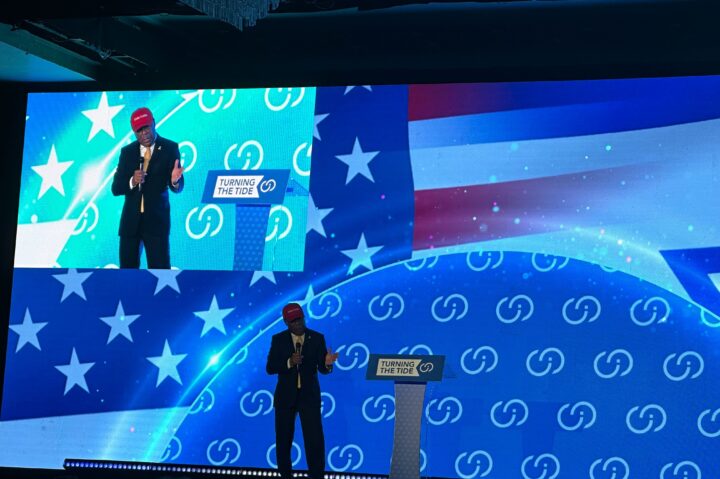
Haley Cohen
Leo Terrell, senior counsel to the assistant attorney general for civil rights, addresses the Israel on Campus Coalition three-day annual leadership summit held in Washington on Sunday, July 27th, 2025.
Leo Terrell, senior counsel to the assistant attorney general for civil rights, said he is intent on eliminating what he called “the Jewish tax” in an address on Sunday to hundreds of Jewish college students gathered for the Israel on Campus Coalition’s three-day annual leadership summit held in Washington.
“For those who don’t know what the Jewish tax is — for you to have this convention, for you to walk your child to a synagogue down the street — you have to pay for extra security,” said Terrell, who heads the Department of Justice’s antisemitism task force. “It makes no sense. It’s unfair. It’s wrong. I find it offensive that it’s being allowed throughout this country. I’m doing everything I can to eliminate it.”
Terrell’s comments came as the Federal Emergency Management Agency announced last month that it had awarded $94.4 million in security grant funding to a total of 512 Jewish organizations nationwide.
Terrell, who wore a baseball cap embroidered with the name “Hadar Goldin,” an IDF soldier abducted and killed by Hamas in 2014 whose body remains held by the terrorist group, shared that he has faced “fights and arguments” with some colleagues over how to strategically address antisemitism. He said that some colleagues have called to “cut a deal, to move on,” an apparent reference to the Trump administration’s recent settlement with Columbia University following a monthslong battle over the Ivy League university’s record dealing with antisemitism.
“I will not compromise,” Terrell said. “No, how can you ask a group [to] compromise freedom? There is no compromise on your equality, your freedom, you have the right to go to schools, to walk down the streets and not be worried and not be afraid.”
Terrell, a former civil rights attorney and a conservative media personality, told the crowd that eradicating antisemitism is a “full-time commitment,” one that he’s decided to take on in part due to Jewish involvement in the Civil Rights Movement.
“I’m not a Jewish American. I’m a Black American. I also understand the history of this great country. Before becoming a lawyer, I was a school teacher. I grew up in the ‘60s,” Terrell said. “I remember Jewish Americans walking hand in hand with Black Americans making sure they got their civil rights.”
The social media app hired Erica Mindel, a former Jewish communal professional, to lead the company’s hate speech policy, with a focus on antisemitic content

Photo Illustration by Mateusz Slodkowski/SOPA Images/LightRocket via Getty Images
In this photo illustration a TikTok logo is seen displayed on a smartphone.
TikTok recently hired a new hate speech manager with long-standing ties to the Jewish community, the company confirmed to Jewish Insider, as the social media platform faces growing pressure to confront a sharp rise in antisemitic content.
The streaming platform enlisted Erica Mindel, a former State Department contractor who worked for Ambassador Deborah Lipstadt, the Biden administration’s special envoy to monitor and combat antisemitism, to join TikTok’s global public policy and government affairs team.
The hire comes as TikTok has drawn accusations that it has failed to address a spike in antisemitic and anti-Israel content in the wake of Hamas’ Oct. 7, 2023, terror attacks and amid the ensuing war in Gaza.
In her newly created role, Mindel will “develop and drive the company’s positions on hate speech,” seek to “influence legislative and regulatory frameworks” and “analyze hate speech trends,” with a particular focus on “antisemitic content,” among other duties cited in an official job description shared by TikTok.
Mindel, who previously served as an assistant director of program development at the American Jewish Committee, according to her LinkedIn profile, had briefly worked for the special envoy’s office in the second Trump administration before she was hired by TikTok, the company told JI.
Mindel declined to comment on her new position, which was first reported by The Washington Free Beacon.
The role was initiated after a “high-level convening” the Anti-Defamation League “helped organize last year,” said Dan Granot, the ADL’s national director of antisemitism policy, who in a statement to JI on Sunday said the position was raised as “a key recommendation for all social media platforms” during the meeting.
“In a moment when too many social media platforms are scaling back efforts to fight hate, ADL welcomes TikTok’s establishment of a role focused specifically on hate speech and antisemitism,” Granot added, praising Mindel as a “trusted partner who understands the issue and the stakes, and someone we’ve worked with closely in the fight against online hate.”
TikTok, a popular video app owned by ByteDance, the Chinese technology company, has been facing a looming U.S. ban that President Donald Trump has continued to delay in a series of executive orders. In the interim, the app has worked to address criticism over its handling of antisemitic content — which had become a public relations crisis in the aftermath of the Oct. 7 attacks.
The platform has drawn widespread accusations that it has enabled a surge of misinformation and hateful messaging targeting Jews. The actor Sacha Baron Cohen — who was among a group of Jewish celebrities and content creators that met privately with TikTok in 2023 — said the app was “creating the biggest antisemitic movement since the Nazis.”
The Jewish Federations of North America, meanwhile, last year called TikTok “the most popular social media platform driving antisemitism and anti-Israel sentiments,” arguing the company “has helped fuel a horrific spike in antisemitism” in the aftermath of Oct. 7.
While research has indicated that some TikTok users who amplify antisemitic rhetoric have been able to sidestep the company’s moderation policies, other findings suggest messaging that is contrary to the Chinese government’s positions — such as posts supporting Israel after Oct. 7 — is generally suppressed on the platform.
The U.S. ban, which passed in Congress last year amid national security concerns over the Chinese-owned app and would require the streaming company to find a new buyer or shut down, even fueled its own antisemitic conspiracy theory on TikTok alleging Jews were behind the ban and had outsized control of American politics.
TikTok says it has worked on efforts that have “strengthened policies against hate speech and hateful behavior” amid the war in Gaza, according to a statement issued on the one-year anniversary of Hamas’ attacks.
In materials shared with JI by TikTok, the company said it has implemented “some of the strictest rules against hate, including antisemitism,” citing, among other things, its decision to “name antisemitism as a hateful ideology” in community guidelines, its “zero tolerance policy for antisemitic conspiracy theories and narratives” and efforts to “block searches” for “blood libel,” ‘holohoax” and other terms used on the app.
Despite such efforts, TikTok has continued to face scrutiny. Last month, a bipartisan group of 41 lawmakers wrote to the CEOs of TikTok, Meta and X pressing them to take action “regarding disturbing and inflammatory content circulating” on their platforms “in support of violence and terrorism” following a recent series of antisemitic attacks in Washington and Boulder.
Last week, Reps. Josh Gottheimer (D-NJ) and Don Bacon (R-NE), alongside ADL CEO Jonathan Greenblatt, announced the reintroduction of the STOP HATE Act, which seeks to crack down on antisemitism spreading on social media platforms such as TikTok.
Still, Granot, the ADL’s national policy director, said that the group looks “forward to continued collaboration” with TikTok as the streaming app works with its newly hired hate speech manager.
“While the impact of this role will ultimately be measured by what it delivers,” Granot told JI, “its creation is a promising sign of TikTok’s willingness to take these challenges seriously.”
Jewish Insider’s U.S. editor Danielle Cohen-Kanik contributed reporting.
Jewish students said their ‘support is contingent on enforcement’ and called the deal ‘not the end of the story’ but ‘an important start’
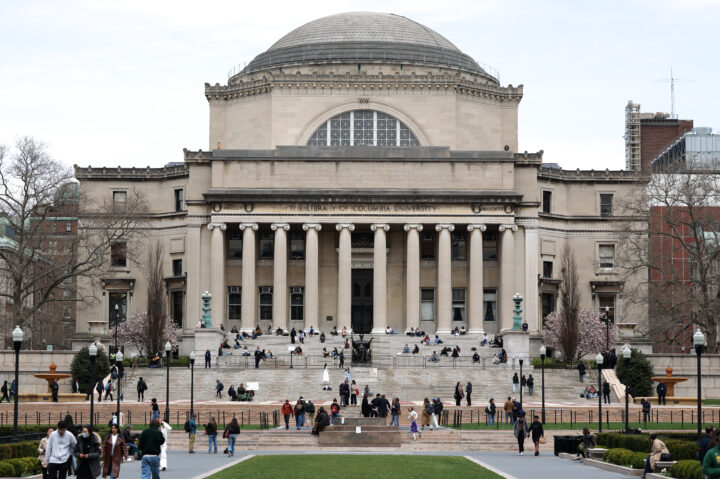
CHARLY TRIBALLEAU/AFP via Getty Images
Students are seen on the campus of Columbia University on April 14, 2025, in New York City.
Jewish leaders on and off Columbia University’s campus praised the settlement reached last week between the university and the Trump administration to restore some $400 million in federal funding that was slashed in March due to the Ivy League’s record dealing with antisemitism.
While some Jewish leaders, students and alumni are taking a wait-and-see-approach, others expressed cautious optimism that the deal could lead to a safer environment for Jewish students following nearly two years of antisemitic protests and disruptions on campus in the aftermath of the Oct. 7, 2023, Hamas terror attacks in Israel.
“I am heartened to see the resolution agreement for several reasons,” Adam Lehman, president and CEO of Hillel International, told Jewish Insider last week. “It recognizes both the clear, egregious violations of the civil rights of Jewish students and staff at Columbia and Barnard [an affiliate of Columbia] during the past two academic years, and the concrete steps Columbia has recently pursued to address these issues.”
Those steps, publicized last week, included further incorporating the International Holocaust Remembrance Alliance’s working definition of antisemitism by requiring its Office of Institutional Equity to embrace the definition; appointing a Title VI coordinator to review alleged violations of the Civil Rights Act; requiring antisemitism training for all students, faculty and staff; and refusing to recognize or meet with Columbia University Apartheid Divest, a coalition of over 80 university student groups that Instagram banned earlier this year for promoting violence.
The school also announced last week that disciplinary action and rules surrounding student protests would be moved out of the purview of the faculty-run University Senate and into the provost’s office, a move called for by pro-Israel students. Columbia also agreed to pay a $200 million settlement over three years to the federal government.
“Importantly, it also restores the university’s ability to pursue essential medical and scientific research with access to federal funding support,” Lehman said. “I hope and trust that the university will use this important resolution to see through its recent commitments to foster a campus environment that will be safer and more welcoming for Jewish students, and all students, moving forward.”
Still, some said that key reforms are missing from the deal, which falls short of several demands initially made by the Trump administration. Among the demands were putting the Middle Eastern, South Asian and African studies department and the Center for Palestine Studies under the purview of a senior vice provost, who would be appointed by the university to supervise course material and non-tenure faculty hiring, as well as the formation of a presidential search committee to replace acting President Claire Shipman.
In addition to the fine, the university has agreed to settle investigations brought by the U.S. Equal Employment Opportunity Commission for $21 million. A number of open Title VI investigations into the university alleging harassment of Jewish students will also be settled and the university will abide by laws banning the consideration of race in admissions and hiring. Columbia, which did not admit to wrongdoing in the deal, said it will continue to have “autonomy and authority over faculty hiring, admissions, and academic decision-making.”
“I’m on board [with the settlement] but my support is contingent on enforcement,” said Shoshana Aufzien, an incoming sophomore in the dual program between Barnard College and the Jewish Theological Seminary. At the same time, Aufzien said that “the scope of the settlement is unclear” and “many of the reforms mentioned are existing legal obligations” for recipients of federal funding, such as the appointment of a Title VI coordinator.
Lishi Baker, a rising Columbia senior studying Middle East history, called the settlement “an important moment for the Jewish community, Columbia, higher education and the United States more broadly. Getting federal funding back and committing to the work of positive reform within the university is a good thing,” Baker told JI.
“This deal is not the end of the story. It is an important start. Reforming Columbia for the better is a long-term endeavor that could never be covered in one deal, and need not be overly intertwined with the government.”
Eden Yadegar, a former president of the Columbia chapter of Students Supporting Israel who graduated in the spring with Middle East studies and modern Jewish studies degrees, told JI she is “grateful to the federal government for prioritizing the fight against antisemitism in higher education, and hope this deal is the beginning of what will be sustained change at Columbia.”
“I’m holding my breath to see if and how things will change for Jewish and Israeli students in September. There is undoubtedly plenty more work to do and the Jewish community is not going to back down from doing it and holding Columbia accountable,” Yadegar said.
The Anti-Defamation League called the settlement “an important next step in fighting antisemitism and hate on their campus, along with restoring federal funding needed for critical research.”
But others raised concerns that the settlement does not include the structural reforms initially demanded in the Trump administration’s letter to Columbia in March.
“The deal stops short of necessary internal reforms, such as discipline and review of faculty leadership for those who participated in encampments or violated other campus policies,” Inbar Brand, who graduated in the spring from Columbia’s dual-degree program with Tel Aviv University, told JI. “Worst to me is that this deal is a closing of the Title VI investigation without any admission of guilt by Columbia.”
A source familiar with the negotiations told JI that “while the [Trump] administration spins the deal as a win, the reality is it caved and let Columbia pay a fine and continue business as usual under a toothless monitor with no meaningful reforms.”
The settlement “lets Columbia off the hook in advance of presidential selection, meaning [that there’s] no incentive to pick a president committed to reform,” the source said, referring to the ongoing search for a permanent president.
The Trump administration is in talks with several other universities that have faced similar funding cutoffs, including Harvard, Cornell and Northwestern.
A series of contradictory and confusing measures paint a picture of an organization struggling to stake out a position on the controversial issues that have divided its members
Kristoffer Tripplaar/Sipa via AP Images
A logo sign outside of the headquarters of the National Education Association (NEA) labor union in Washington, D.C. on July 11, 2015.
With a unanimous vote last week rejecting a measure that would’ve cut ties with the Anti-Defamation League, the board of directors of the National Education Association extended an olive branch to frustrated Jewish educators and parents who are concerned about creeping antisemitism within the union’s ranks.
ADL CEO Jonathan Greenblatt told Jewish Insider earlier this week that he was “pleased” to see the NEA reject the anti-ADL measure. But, he added, the union still has a “long way to go” toward making clear that it respects the Jewish community.
Greenblatt’s lingering concern is a sign that the NEA — the largest teachers’ union in the country, with more than 3 million members — has not entirely placated Jewish communal stakeholders. In fact, additional questions have continued to emerge in light of an NEA document that encourages teaching the “Nakba” and that erases antisemitism from the history of the Holocaust.
The Washington Free Beacon reported this week on the NEA’s 2025 handbook, a 434-page report outlining the organization’s “visionary goals” and “strategic objectives.” Among the items included in the dense document are dozens of measures that passed at last year’s “representative assembly,” a convening of the organization’s top leaders from around the country — the same group that, this year, voted to censure the ADL. Several of them have raised eyebrows in the Jewish community.
For instance, the NEA pledged to “celebrate” International Holocaust Remembrance Day with educational materials on the union’s website that “recognize the more than 12 million victims of the Holocaust from different faiths, ethnicities, races, political beliefs, genders, and gender identification, abilities/disabilities, and other targeted characteristics” — with no mention of antisemitism or the Jewish victims of the Nazis. (Another item said that in January, to mark the remembrance day, the NEA’s website will feature a graphic that says “Stand up Against Antisemitism” around a Jewish star.)
One measure said the NEA will use digital communications “to educate members about the difference between anti-Zionism and antisemitism.” Another section promised to “educate members and the general public about the history of the Palestinian Nakba,” or catastrophe, the word Palestinians use to describe the founding of the State of Israel and affiliated displacement of Palestinians.
These contradictory and confusing measures paint a picture of an organization struggling to stake out a position on the controversial issues that have divided its members.
One measure pledges to adopt an antisemitism education plan; meanwhile, another measure seeks to “defend educators’ and students’ academic freedom and free speech in defense of Palestine at K-12 schools, colleges and universities.” It is not clear how any of these goals will be achieved — or what position the NEA will take if the objectives ever come into conflict with each other.
The NEA and its statewide affiliates have faced scrutiny in the two years since the Oct. 7, 2023, Hamas attacks over the politicization of education about Israel and Gaza in classrooms. A report last year found that Massachusetts educators were introducing anti-Israel material into schools. In California, the statewide NEA affiliate began a lobbying push this month against a bipartisan antisemitism bill.
Reversing the anti-ADL measure looked like a step forward for the NEA, but it also came with a step backward. An ADL spokesperson said the “problems identified” in the NEA handbook “underscore how much work it has to do to earn the trust of the Jewish community, Jewish educators and families.”
Some of the measures in the handbook are considered offensive by some Jewish community leaders, but other measures are explicitly focused on countering antisemitism and earned the blessing of Jewish communal leaders. While the contradictory language regarding Jewish issues can create whiplash, it might also open an avenue for dialogue with the union.
An NEA spokesperson declined to comment on any specific measures.
“This document is not a handbook for use in the classroom, but a compilation of the more than 100 resolutions adopted by NEA last year,” NEA President Becky Pringle told JI in a statement. “The NEA has opposed antisemitism throughout its history and is deeply committed to ensuring the safety and inclusion of Jewish educators and students. The NEA regularly shares resources and supports educator workshops on Holocaust education, antisemitism, and ways to promote understanding of Jewish culture, heritage and history.”
The STOP HATE Act would require social media companies to publicize policies on the use of their platforms by designated terrorists

Getty Images
Some of the most popular social media apps by number of monthly active users, including Facebook, YouTube, Instagram, WhatsApp, TikTok, WeChat, Telegram, Messenger, and Snapchat, are seen on an iPhone.
Reps. Josh Gottheimer (D-NJ) and Don Bacon (R-NE) on Wednesday announced the reintroduction of the STOP HATE Act, which aims to crack down on antisemitism on social media. The legislators announced the bill’s reintroduction at a press conference alongside Anti-Defamation League CEO Jonathan Greenblatt.
The bill, which was first introduced in November 2023 but failed to progress in the previous Congress, would require social media companies to publicize specific policies on their standards and restrictions for their platforms by designated terrorists, report to the federal government on content flagged and/or removed under these policies and publicly report on incidents which violate their policies.
The bill would also demand that platforms publish contact information for users to ask questions about the companies’ terms of service, a description of how users can flag violative content and a description of how the companies will respond to such content.
Companies would face fines up to $5 million per day if they violate these policies.
The bill would also require administration officials to issue a public report on the use of social media platforms by terrorist groups.
“There is no reason why anyone, especially terrorists or anyone online, should have access to social media platforms to promote radical, hate-filled violence,” Gottheimer said, highlighting that extremist groups had capitalized on the May attack on the Capital Jewish Museum in Washington to promote antisemitic incitement. “There’s a massive disinformation campaign influencing us each day.”
Bacon said, “We need to work with our social media companies to clean this up, because what is going on is wrong, and I think it’s further influencing other young people that could be influenced by what they’re seeing. … We need to hold these companies accountable and work with them to take it off the airwaves.”
He also noted that lawmakers had faced antisemitic harassment at the Capitol this week from protesters.
Greenblatt said that antisemitism has “gone viral in large part because of social media,” adding that bigots and extremists “exploit social media to recruit, to radicalize and to incite violence, often in violation of the companies’ own terms of service. It’s not just theoretical. This is a real concern.”
Asked about the Trump administration’s continued delays of the U.S. ban on TikTok, flouting a bipartisan law on the platform, both lawmakers said that President Donald Trump should enforce the law and require TikTok’s owners to sell the site or shut it down.
Greenblatt said that “at the end of the day, the ownership of TikTok matters, but the actions matter more,” noting that American-owned platforms have also had significant antisemitism problems, and that a sale would not be a “panacea.”
The university ‘does not admit to wrongdoing’ despite reaching the agreement, Acting President Claire Shipman said

JEENAH MOON/POOL/AFP via Getty Images
Columbia University acting President Claire Shipman speaks during the Commencement Ceremony at Columbia University in New York on May 21, 2025.
Columbia University announced on Wednesday that it reached a deal with the Trump administration to restore some $400 million in federal funding that was cut by the government in March due to the university’s record dealing with antisemitism since the Oct. 7, 2023, Hamas terror attacks in Israel.
Under the terms of the deal, Columbia agreed to pay a $200 million settlement over three years to the federal government. In addition, the university has agreed to settle investigations brought by the U.S. Equal Employment Opportunity Commission for $21 million. A number of open civil rights investigations into the university alleging harassment of Jewish students will also be settled under the terms of the agreement, according to which the university will also abide by laws banning the consideration of race in admissions and hiring.
Columbia said it will continue to have “autonomy and authority over faculty hiring, admissions, and academic decision-making.”
“While Columbia does not admit to wrongdoing with this resolution agreement, the institution’s leaders have recognized, repeatedly, that Jewish students and faculty have experienced painful, unacceptable incidents, and that reform was and is needed,” the university said in a statement.
“This agreement marks an important step forward after a period of sustained federal scrutiny and institutional uncertainty,” Claire Shipman, Columbia’s acting president, said in a statement. “The settlement was carefully crafted to protect the values that define us and allow our essential research partnership with the federal government to get back on track. Importantly, it safeguards our independence, a critical condition for academic excellence and scholarly exploration, work that is vital to the public interest.”
Brian Cohen, executive director of The Kraft Center for Jewish Student Life, Columbia’s Hillel, called the settlement “an important recognition of what Jewish students and their families have expressed with increasing urgency: antisemitism at Columbia is real, and it has had a tangible impact on Jewish students’ sense of safety and belonging and, in turn, their civil rights.”
“Acknowledging this fact is essential, and along with the new path laid out by the president and trustees, I am hopeful that today’s agreement marks the beginning of real, sustained change,” Cohen said in a statement. “This is not the end of the process, however it is a major step forward.”
The agreement comes days after Shipman publicized a list of commitments aimed at addressing antisemitism on campus. These included further incorporating the International Holocaust Remembrance Alliance’s working definition of antisemitism by requiring its Office of Institutional Equity to embrace the definition; appointing a Title VI coordinator to review alleged violations of the Civil Rights Act; requiring antisemitism training for all students, faculty and staff; and refusing to recognize or meet with Columbia University Apartheid Divest, a coalition of over 80 university student groups that Instagram banned earlier this year for promoting violence. The school announced on Friday that disciplinary action and rules surrounding student protests would be moved out of the purview of the faculty-run University Senate and into the provost’s office, a move called for by pro-Israel students.
The terms of the settlement — which resulted from months of negotiations — diverge from a list of reforms that was demanded in the Trump administration’s letter to Columbia in March, which was initially agreed upon by the university but never finalized. The list included putting the Middle Eastern, South Asian and African studies department and the Center for Palestine Studies under the purview of a senior vice provost, who would be appointed by the university to supervise course material and non-tenure faculty hiring; as well as the formation of a presidential search committee to replace Shipman.
Please log in if you already have a subscription, or subscribe to access the latest updates.
 Continue with Google

 Continue with Apple