



























Amman has resisted U.S. efforts to extradite Ahlam Tamimi, who has resided in Jordan since being released from Israeli custody in 2011
Courtney Kealy/Getty Images
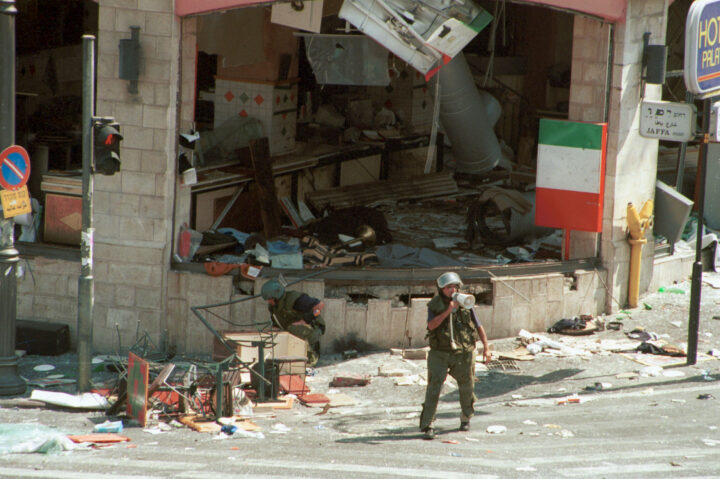
Israeli soldiers check for explosives at the site of a Palestinian suicide bombing at a Sbarro pizzaria on Aug. 9, 2001 in Jerusalem.


 Add JewishInsider on Google
Two U.S. ambassadors highlighted ongoing U.S. efforts to bring Ahlam Tamimi — who was convicted by Israeli courts for her involvement in the 2001 bombing of a Sbarro pizzeria in Jerusalem that killed 16 people, including three Americans — to face trial in the United States around the 25th anniversary of the terror attack.
Tamimi has resided in Jordan since being released from Israeli custody in 2011 as part of a deal that saw Israel free 1,027 Palestinian prisoners in exchange for Gilad Shalit, who was held hostage by Hamas for more than five years.
U.S. advocates have long pushed for Jordan to extradite Tamimi to face trial in the U.S. on a pending indictment by the Department of Justice, calling for Amman to enforce a 1995 extradition treaty with the U.S. signed by King Hussein. But Amman has refused, claiming the treaty was never properly ratified by its parliament and is therefore invalid.
Ambassador Yehuda Kaploun, the State Department’s antisemitism envoy, on Sunday called on X for Tamimi to face justice. Kaploun’s post was shared by the U.S. Embassy in Jordan, which is the body best poised to push the Jordanian monarchy to extradite Tamimi.
“Today, we mark 25 years since the Hamas terrorist attack at the Sbarro pizzeria in Jerusalem,” Kaploun said. “We remember the 16 victims murdered — including Americans Judith Greenbaum, Chana Nachenberg, and Malki Roth — and the more than 120 others injured. The United States will never forget and remains committed to bringing the perpetrators, including Ahlam al-Tamini, to justice.”
U.S. Ambassador to Israel Mike Huckabee also posted on Sunday about Tamimi, sharing a link to the Department of Justice page offering up to $5 million for information that could assist in her capture.
“Twenty-five years ago today, a Hamas suicide bomber murdered 16 people and injured more than 120 at the Sbarro pizzeria in Jerusalem. Among the victims were Americans Judith Greenbaum, Chana Nachenberg, and 15-year-old Malka Roth. May their memories be a blessing,” Huckabee said. “We stand with @Israel against terrorism in all its forms and remain committed to bringing every last fugitive of this heinous act to justice.”
Neither ambassador directly called on Jordan to extradite Tamimi to the U.S.
The Conference of Presidents of Major American Jewish Organizations, Anti-Defamation League and other U.S.-based advocates including Roth’s father renewed their calls for Tamimi’s extradition last week.
Yael Lempert, the Biden administration’s nominee to serve as U.S. ambassador to Jordan, pledged during her confirmation hearing in 2023 to “do everything in my power” to secure Tamimi’s extradition, while declining to say that the U.S. should withhold aid to Amman to secure her capture.
Despite reports in early 2025 that Jordan had changed its posture and would seek to expel Tamimi, there has been no apparent progress toward securing her extradition.
Antisemitism envoy Yehuda Kaploun, who also spoke at the event, praised Argentina as having ‘transformed from a beacon where terrorism once reigned supreme to a beacon of Jewish life’

Embassy of Argentina
The State Department and Argentine Embassy in Washington host a commemoration ceremony for the 32nd anniversary of the AMIA bombing.
The State Department’s top legal advisor on Wednesday drew a direct connection from the signing of the Oslo Accords in 1993 — which sought to bring peace between the Israelis and Palestinians — to the global rise in Islamist terrorism, in remarks delivered at an event in Washington marking the anniversary of the deadly 1994 terror attacks on the AMIA Jewish Center in Buenos Aires. The suicide bombing, orchestrated by Hezbollah, killed 85 people and injured more than 300 others one year after the signing of the Oslo Accords at the White House.
Diplomats, survivors of the attack, Jewish community members and State Department officials gathered on Wednesday at the U.S. Institute of Peace to commemorate the July 18 attacks, where U.S. and Argentine officials vowed to work together to fight Islamist terrorism. Reed Rubinstein, the State Department legal advisor, used his remarks to herald President Donald Trump’s efforts to fight terrorism, which he described as a course correction from decades of failed leadership.
“The fruit of those accords paradoxically included a massive increase in brutal terrorism,” Rubinstein said, referring to the Oslo Accords. “Oslo led to an unprecedented wave of suicide bombing and death.”
He criticized activists who called the dead “sacrifices to peace,” chastising them for using biblical language “to justify the murder of many as ‘unfortunate but necessary’ sacrifices on the path to peace.”
“In those days, and for so many years after, when moral clarity and truth telling were required, the leadership failed,” said Rubinstein. He took aim at institutions like the United Nations, universities and the media for failing to speak out against antisemitism — and placed blame on Trump’s predecessor, President Joe Biden.
“Candidly, prior to Jan. 20, 2025, the United States government more often than not failed, and in many cases failed spectacularly,” said Rubinstein. “But under President Trump, things have changed. Under his direction, the United States has taken and is taking decisive and unprecedented steps to fight antisemitism.”
Rabbi Yehuda Kaploun, the U.S. special envoy to monitor and combat antisemitism, called Argentina a “model for the world” in combating terrorism. He shared that two days earlier, during a visit to the South American country, he met with President Javier Milei and thanked him for designating Iran’s Islamic Revolutionary Guard Corps as a terrorist organization.
“Argentina has transformed from a beacon where terrorism once reigned supreme to a beacon of Jewish life,” said Kaploun.
Other senior State Department officials at the event included Jacob Helberg, the under secretary of state for economic affairs; Thomas DiNanno, under secretary of state for arms control and international security; and the State Department’s counterterrorism coordinator, Gregory LoGerfo. Argentine Ambassador to the U.S. Alejandro Oxenford introduced the event, which was organized by Rep. Brian Mast (R-FL), chair of the House Foreign Affairs Committee.
His critics once saw him as an ally, but fear he’s pandered to extremists as he raises his national profile ahead of the 2028 presidential election

Chip Somodevilla/Getty Images
Rep. Ro Khanna (D-CA) leaves the U.S. Capitol on March 13, 2024 in Washington.
Rep. Ro Khanna’s (D-CA) emergence as a leading Democratic party critic of Israel — while affiliating with and embracing individuals and groups that have been accused of antisemitism and support for terrorism — is creating divisions within the local Jewish community in his Silicon Valley-centered district.
While Khanna maintains unified support from Jewish elected officials in the district, other Jewish community leaders say they feel abandoned, ignored and even attacked by their congressman, whom they once saw as an ally, as he faces what could be his most credible primary challenge in years.
For some in the district, ties with the congressman have been strained for years, and were further inflamed by the March attack on two Israeli Americans in San Jose’s Santana Row shopping district.
Khanna strongly condemned the attack but some in the community said his words rang hollow after months of escalating anti-Israel rhetoric. Some Jewish leaders in the district say that they saw a direct connection between Khanna’s incendiary language condemning the Jewish state and attacks such as the one their community experienced.
Two days after the attack, Khanna posted about how he is “proud to stand” with Maine Senate candidate Graham Platner and New York Mayor Zohran Mamdani, as well as to join far-left streamer Hasan Piker’s show, all of whom have faced criticism from the Jewish community — comments that prompted condemnation by Anti-Defamation League CEO Jonathan Greenblatt.
Jewish leaders in the district who are now critical of the congressman said the community’s relationship with Khanna started out strong when he was first elected in 2016, but has significantly deteriorated over time, particularly in the past few years. Khanna’s Silicon Valley district includes substantial, concentrated Jewish and Israeli-American communities.
Tali Klima, a spokesperson for Bay Area Jewish Coalition Action, a local grassroots advocacy group, said that Khanna was “warmly welcomed” by the Jewish community when he was first elected and that many in the community had supported him.
Khanna traveled to Israel three times while in office, and has expressed support for the Abraham Accords, voted in 2019 to condemn the Boycott, Divestment and Sanctions movement, condemned calls to “globalize the intifada,” voted in early 2024 to condemn the slogan “from the River to the Sea, Palestine will be free” and introduced a Holocaust education resolution in 2024. Amid rising antisemitism in recent years, he has touted appointing a point of contact for addressing antisemitism in the district on his congressional team.
But, Klima and other critics said, they’ve seen the congressman’s posture change over time.
“He’s become more and more divisive and more extremist in his views, that we never heard when he was first elected, especially since Oct. 7. It’s been a massive shift in the way that he communicates about things that we care about,” Klima continued.
“At this point, the community has really lost trust in him,” Klima said. “Much of the community is afraid of him, and much of the community is also very angry and feels betrayed by him.”
“Having participated in local town halls with Representative Khanna and spoken with him about various community concerns, I am thankful for his commitment to open dialogue and remaining accessible even when we disagree,” Assemblymember Patrick Ahrens said. “His dedication to peace and justice for all people and support for a two-state solution is laudable. He has been a leader for accountability and transparency with the Trump Administration, particularly with the bipartisan push for the release of the Epstein files.”
Khanna has frequently and repeatedly accused Israel of genocide, was among the first lawmakers to endorse calls for cutting off U.S. support for Israel’s Iron Dome missile-defense system and led an effort for U.S. recognition of a Palestinian state, among a range of other stances and votes, and has repeatedly faced scrutiny for his affiliations with groups and individuals condemned by the Jewish community.
Later this week, he’s set to offer an amendment to strip a provision advancing U.S.-Israel cooperative programs out of the 2027 defense bill. Though one former Biden administration called the provision “quite unremarkable” and in keeping with existing programs, Khanna called it a “fusion” of the U.S. and Israeli militaries to prevent scrutiny and accountability for U.S. aid to Israel.
Jewish elected officials supporting Khanna, in statements shared with Jewish Insider, praised the congressman for his support for a two-state solution and for engaging with local Jewish communities.
“Having participated in local town halls with Representative Khanna and spoken with him about various community concerns, I am thankful for his commitment to open dialogue and remaining accessible even when we disagree,” Assemblymember Patrick Ahrens said. “His dedication to peace and justice for all people and support for a two-state solution is laudable. He has been a leader for accountability and transparency with the Trump Administration, particularly with the bipartisan push for the release of the Epstein files.”
State Sen. Josh Becker added, “While Congressman Khanna gets a lot of ink for his criticism of Israel he gets less for his vocal support of a two state solution and Israel as a safe democratic Jewish state.”
Others, such as San Jose City Councilmember David Cohen, more broadly praised him for his work on local issues.
“The fact that an elected official like Khanna defends [people like Hasan Piker and Zohran Mamdani] and their dangerous antisemitic views is not only shameful — but it also actively endangers the lives of Jewish people both in his district and around the country,” Oleg Ivanov, executive director of StandWithUs Northern California, said.
“Times are very difficult these days in Washington D.C., and Congressmember Khanna remains a steady advocate for our region and economy. We need people who understand the tech industry and also who bring money back to our community from the federal budget,” Cohen said. “He has shown courage and has been willing to face his constituents at monthly town hall meetings ever since he was elected. While I don’t agree with every position he takes, I admire his thoughtfulness and transparency.”
Cohen declined to speak further on Khanna’s foreign policy work or his relationship with the local Jewish community.
But others in the community feel that their concerns aren’t being heard or listened to by the congressman. Daniel Klein, CEO of Jewish Silicon Valley, a Jewish nonprofit which runs a local JCC and other community programs and resources, said he’s communicated to Khanna directly that he thinks the legislator is out of step with his constituents.
“The fact that an elected official like Khanna defends [people like Hasan Piker and Zohran Mamdani] and their dangerous antisemitic views is not only shameful — but it also actively endangers the lives of Jewish people both in his district and around the country,” Oleg Ivanov, executive director of StandWithUs Northern California, said.
Ivanov also accused Khanna of spreading a “blood libel” in accusing Israel of genocide in Gaza.
Oded Shekel, executive director of Bay Area Jewish Coalition Action, emphasized that members of the Jewish and Israeli community in Khanna’s district feel afraid, isolated and that they have to hide who they are, and don’t feel they’re getting the support they expect from their congressman.
Shekel said that he doesn’t necessarily think Khanna is personally or openly antisemitic, but that he is supporting and rationalizing extreme voices, to the point that has made many Jews like him feel that Khanna is the “strongest voice [that] hurts Jews in his district.”
Khanna joined a town hall in 2024 hosted by the Bay Area Jewish Coalition — a separate entity from Bay Area Jewish Coalition Action led by the same individuals — but the relationship has soured since then.
Sunnyvale Mayor Larry Klein, a Khanna supporter, said he’d attended the BAJC town hall, and met with Jewish community members alongside Khanna to discuss the challenges that Jewish high schoolers were facing from antisemitism in the district, and how the congressman could address them.
“Good to hear directly from High School Students and their parents on the district issues,” Mayor Klein said in a statement. “It was valuable to hear firsthand about the harassment that Jewish Students had endured.
Mayor Klein also praised Khanna’s “bipartisan approach to leadership” on issues including “working to halt reckless foreign intervention” and the release of the Epstein Files, saying that Khanna, “consistently puts principles over politics.” He also praised Khanna’s engagement with constituents more broadly and work on securing federal funding for the district.
Daniel Klein of Jewish Silicon Valley described Khanna’s stances and statements as hostile to the Jewish community. He said that the violent attack in Santana Row, and other similar incidents, are the “natural maturation” of the rhetoric Khanna has used and elevated.
“I appreciate the congressman being outraged” about the Santana Row attack, “but statements and what he normalizes and who he platforms before these incidents, and then who he chooses to stand with and platform and normalize after these incidents, makes the community feel unseen and unsupported by the congressman,” Klein said he told Khanna’s office in the wake of the attack.
Yet, Klein said, Khanna’s rhetoric does not appear to have shifted substantially since the March attack.
“I’m a big fan of Congressman Khanna,” Ben Linder, a J Street board member who lives just outside Khanna’s district, told JI. “The majority of the Jewish community is squarely behind him and very aligned with him,” Linder continued, emphasizing that he has seen Khanna speak on multiple occasions to busy synagogue audiences.
Klima echoed that, expressing frustration that Khanna’s condemnation of the attack was quickly followed by a return to his usual rhetoric and activity.
In addition to Jewish elected officials backing him, Khanna maintains support among segments of the local Jewish community. Ben Linder, a J Street board member who lives just outside Khanna’s district, told JI he continues to strongly support the congressman. J Street has endorsed Khanna, but Linder spoke to JI in a personal capacity, not on behalf of the progressive Israel advocacy group.
“I’m a big fan of Congressman Khanna,” Linder, who was born in Israel and moved to the U.S. in high school, said. “The majority of the Jewish community is squarely behind him and very aligned with him,” Linder continued, emphasizing that he has seen Khanna speak on multiple occasions to busy synagogue audiences.
He called critics “out of touch with the view of the majority of Jews right now” both in Khanna’s district and nationally, pointing to a Washington Post poll last year that found a majority of Jews are critical of the way the war in Gaza has been conducted.
He asserted that discontent with Khanna traces to a “vocal minority in the district, mainly led by right-wing Israeli expats that dislike Congressman Khanna” and are “out of touch with where our community is.”
“I consider Ro Khanna very pro-Israel. He is clearly anti-Netanyahu and anti- the policies of Israel’s right wing government, but so am I, and, I think, so are the majority of Jews in this district,” Linder said.
Critics of Khanna said that the congressman’s activity following the Santana Row attack matches a pattern they’ve observed repeatedly when Khanna is called out for conduct or statements they find offensive — Khanna will apologize, or offer targeted condemnations, but won’t substantially change his behavior, and ultimately continues doubling down.
They said this pattern ignores the way that Khanna’s own rhetoric is fueling antisemitism.
Klima emphasized that Khanna’s constituents have come to him on numerous occasions asking him to dial down his rhetoric. At this point, she said, his “symbolic condemnations” of antisemitism “ring very hollow.”
“He’s speaking out of both sides of his mouth, basically,” she said, adding that, as a longtime congressman, his comments “[legitimize] this rhetoric,” driving similar activity from other local officials as well.
Ivanov said it’s easy for Khanna to denounce antisemitic attacks or vandalism, “but as soon as he does that, he continues to spread the antisemitic conspiracy theories, to defend antisemitic speakers that are out there every day, fueling the antisemitism that leads to these actions.”
“We will not accept Khanna’s pro-forma denunciation of antisemitic incidents while he himself continues to fuel antisemitism and defend antisemites,” Ivanov said.
Linder, the Khanna supporter, argued that Khanna has made clear that he “will speak with anyone” and “dialogues with people he disagrees with, and I respect that.” Khanna has expressed similar sentiments to JI in the past.
Linder said he strongly disagreed with the notion that Khanna’s rhetoric is fueling violence, and emphasized that the Santana Row attack was not charged as a hate crime.
“I don’t believe there was sufficient evidence to show that it was hate-motivated,” Linder said. “The congressman came out very quickly and denounced that attack, denounced the violence, and I fundamentally am not a subscriber to the notion that criticizing Israel fuels antisemitism. I see a clear delineation between criticism of Israel and Jew hatred. I don’t believe the two are connected. As a matter of fact, I think some of the actions of Netanyahu and the Israeli government, the extreme right Israeli government foment antisemitism.”
Shekel, a Khanna critic, said that, during conversations with Khanna about antisemitism that community members are facing, Khanna has expressed sympathy while pivoting to emphasize his disputes with various Israeli government policies.
“We feel that he is fixated, obsessed with Israel,” Klima added.
“The organized Jewish community is telling you exactly where the majority of the Jewish community stands, and if you choose not to listen, it is not due to lack of knowing where your constituents are. It’s a choice,” Daniel Klein, CEO of Jewish Silicon Valley, said. “It’s a choice at that point, and then that begs the question of why the member of Congress is choosing to ignore the Jewish community while also at the same time saying he’s being responsive to the Jewish community. That’s a contradiction I don’t have the answer to.”
Klein said that some in the community see Khanna as not only ignoring their concerns but attacking the Jewish community for elevating those issues in the first place. He pointed to an incident in which Khanna shared on his X account a clip of Holocaust denying social media influencer Ian Carroll as one such instance.
Klein said he and representatives of the local Jewish Community Relations Council sat down in person with Khanna’s staff about the video — “not only the fact that this person was platformed, the person wasn’t taken down immediately, and instead of listening to the Jewish community’s concerns, at least publicly, he seemed to attack the Jewish community instead.”
Klein also characterized Khanna as deflecting the concerns of the local Jewish community in conversations, offering a variety of excuses, including pointing to national polling on Israel policy issues.
“The organized Jewish community is telling you exactly where the majority of the Jewish community stands, and if you choose not to listen, it is not due to lack of knowing where your constituents are. It’s a choice,” Klein said. “It’s a choice at that point, and then that begs the question of why the member of Congress is choosing to ignore the Jewish community while also at the same time saying he’s being responsive to the Jewish community. That’s a contradiction I don’t have the answer to.”
Critics in the district see a political motivation behind Khanna’s rhetoric and positioning.
Ivanov said that he first met Khanna several years ago, when Ivanov was working for the American Jewish Committee. The congressman at the time emphasized “the importance of maintaining progressive support for Israel in American society. That has obviously changed over the past few years, where he has embraced this tide of vilification of Israel as a way to appeal to the rising popularity of bashing Israel among certain voters,” Ivanov said.
Klima said that the “general sentiment” among members of the Jewish community is that Khanna’s stance is “opportunistic” and that he’s following anti-Israel trends for the sake of popularity, rather than any “deeply held view.”
“We feel like he’s throwing us, his constituents, under the bus for his political game, because he feels like this is a win for progressives,” she said.
The congressman is widely seen as preparing for a presidential campaign in 2028.
Khanna’s frequent commentary about the “Epstein Class” — he was one of the leading advocates in the House for releasing files related to sex offender Jeffrey Epstein — has also set off alarm bells for Khanna’s critics.
Klima said that many in the Jewish community read those references as code for the Jewish community writ large, “because of our history with him, our recent history with him.” She said that Khanna’s pattern of rhetoric and actions has sowed distrust of him and his motives.
Khanna has dismissed the notion that the phrase is antisemitic, pointing to Jewish elected officials who have also spoken about the “Epstein Class.”
Critics in the district say that Khanna has a lot of work to do to repair his relationships with the Jewish community — and that it will take more than the pro forma condemnations of antisemitism that they feel he’s been offering over the past few years.
Klein encouraged Khanna to “stop feeding the extreme left and the alt-right” on social media and called on him to apologize for “ignoring the Jewish community,” and “actually start listening to the organized Jewish community,” rather than the “fringes.”
Klima said that she is fed up with what she sees as “symbolic gestures” by the congressman.
“We feel like we’re just pawns in his political game, because the very next day, he’s back to the ‘genocide’ and his political obsession,” she said. “[He] is clearly hurting us and it needs to be something much deeper than just a statement.”
After traveling with the ‘Blind Sheikh,’ Hamawy worked with Benevolence International Foundation, later shuttered as an Al-Qaida front
Islam Dogru/Anadolu via Getty Images
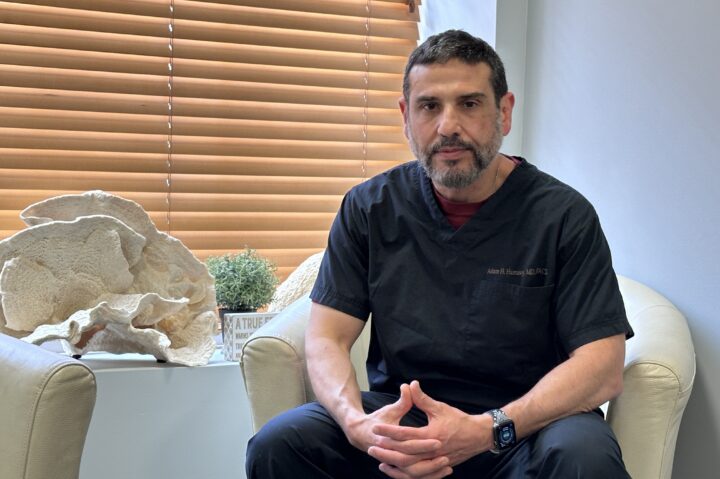
Adam Hamawy, a plastic surgeon, is seen during an exclusive interview at in New York, United States on April 24, 2024.
Adam Hamawy’s past relationship with terrorist mastermind Sheikh Omar Abdel-Rahman has loomed over his rapid rise in the race to succeed retiring Rep. Bonnie Watson Coleman (D-NJ).
Their relationship spanned a 1991 road trip the two took together to Detroit, Hamawy’s service as the sheikh’s translator for a press conference in which Abdel-Rahman denied any role in the 1993 World Trade Center bombing and Hamawy’s testimony on the sheikh’s behalf at his 1995 trial, where the Islamist leader was convicted of plotting to carry out a campaign of terrorist attacks in New York City.
But just one year before Hamawy took the witness stand to describe his travels with Abdel-Rahman, the now-Congressional candidate made a different journey with another party entangled in terrorist conspiracies: to Bosnia, with a group subsequently shut down for providing “logistical support” to Al-Qaida.
In a 1996 interview with the Newark Star-Ledger, according to a copy Jewish Insider recovered through an archive of print publications, Hamawy described volunteering in Bosnia during the summer of 1994 with a Chicago-based nonprofit called the “Benevolence International Foundation.”
“I worked in Sarajevo for 10 days and then the rest in Zenica, a large regional center in central Bosnia,” Hamawy, who had just graduated from medical school, told the paper about the five weeks he spent with the organization. “We went out to hospitals around the area and in the mountains to check what supplies they needed and we tried to deliver them.”
Sarajevo and Zenica were the exact cities where Benevolence International maintained its offices — offices that Bosnian authorities raided in 2002, part of a joint effort with U.S. authorities to dismantle the group, which they had identified as a front for Al-Qaida. The 9/11 Commission Report would later identify the foundation’s base in the Bosnian capital as part of the “impressive array of offices [that] covertly provided financial and other support for terrorist activities” that Osama bin Laden established in the early 1990s.
Hamawy, who has scored endorsements from Sen. Bernie Sanders (I-VT) and Reps. Ro Khanna (D-CA), Ilhan Omar (D-MN), Alexandria Ocasio-Cortez (D-NY) and Rashida Tlaib (D-MI) in his New Jersey congressional bid, did not respond to repeated questions about his relationship with Benevolence International and his contacts and activities in Bosnia.
The plastic surgeon has emerged as a frontrunner in the congressional race despite his relationship with the “Blind Sheikh” receiving significant coverage in recent weeks. A 1995 court transcript shows how the then-medical student Hamawy described meeting the Islamist leader in 1991, visiting him at his home and accompanying him on a 13-hour van trip to a conference in Detroit. In the courtroom, he and the sheikh greeted each other warmly, and Hamawy denied a government informant’s claim that Abdel-Rahman had urged the assassination of the then-president of Egypt.
But no other publication has reported Hamawy’s connection to Benevolence International since the Star-Ledger interview in 1996.
According to evidence federal prosecutors proffered in court, and the affidavits of federal agents, the 2002 raids on the Bosnian offices recovered weapons; correspondence between the group’s chief executive, Enaam Arnaout, and bin Laden from the 1980s and 1990s; letters from other Al-Qaida leaders on battles and financial transactions; a photo of Arnaout and bin Laden together; an organizational chart of Al-Qaida; a handwritten list of top donors to the terror organization; copies of never-before-seen documents concerning Al-Qaida’s 1988 founding and its admission policies; and details regarding training camps and Al-Qaida operations in Afghanistan, Pakistan and Sudan.
According to Marko Atila Hoare, a political science professor and historian at the Sarajevo School of Science and Technology, the early 1990s saw a global mobilization of Muslims to aid their co-religionists in the Balkans. Facing a Serbian onslaught, the embattled Bosnian government accepted this support, even though the involvement of foreign Islamic militants would later cause frustration and embarrassment for authorities there.
“A lot of them wanted to go and defend Muslims from non-Muslims persecuting them,” Hoare said, noting that the chaos of war allowed many groups to operate with little scrutiny from officials or the outside world. “You had these organizations like Benevolence, like the Third World Relief Agency, which were operating in this chaotic situation, and some of them were absolute fronts for radical Islamists, and others were ordinary charities. But in these ordinary charities you could also have radicals or extremists infiltrating them.”
Hoare said that not every volunteer who came to the country, even with Benevolence International, was “a hardcore jihadist with terrorist intent.” But among those who took up this “cause celebre in the Muslim world,” as he called it, was Al-Qaida.
The federal evidence file in the case against Benevolence International and Arnaout described how the terror organization deployed a representative to the Balkans in late 1992 on a fact-finding mission for bin Laden, part of a plan “to establish a base for operations in Europe against al Qaeda’s true enemy, the United States.” The materials assert that senior Al-Qaida officials credited Benevolence International with obtaining funds and weapons for the jihadist group, as well as with helping Al-Qaida secure arms for Bosnian militants.
By the time Hamawy arrived, the Syrian-born Arnaout had already been arrested in Croatia on suspicions of weapons smuggling, according to a 2002 handbook from the Austrian National Defence Academy — and then “apparently managed to escape from prison” and continued “forming and supervising the Training Centres” near Zenica (An attorney for Arnaout called this account of his client’s activities “unsupported,” and asserted he lacked the “practical military experience” to carry them out.)
The area near Zenica was where Hamawy reported working in 1994. It was also where the Bosnian Army had recently set up its “El Mujahedin” unit, for foreign fighters who had poured into the warzone, according to the European Court of Human Rights. And among the organizations providing the unit with “funds and assistance,” the court found, was the Benevolence International Foundation.
According to the testimony of FBI agent Robert Walker, Benevolence International was originally the creation of Saudi Sheikh Adel Abdul Jalil Batterjee, a since-sanctioned Al-Qaida financier. The group, Walker attested, operated in tandem with the terror group across multiple nations, providing it with “logistical support.”
“BIF was used in the early 1990s by Usama Bin Laden as a means to transfer money to bank accounts, generally held by purported relief organizations, in countries where al Qaeda members or associates were conducting operations,” the Walker affidavit, which cites multiple confidential informants, reads. “Arnaout was an administrator for Usama Bin Laden who disbursed funds at times on behalf of Bin Laden.”
Arnaout incorporated the Benevolence International branch in the United States in 1992 and served as its chief executive. In 1994, the year Hamawy volunteered with the group, its leadership included Mohamed Loay Bayazid, an alleged Al-Qaida co-founder who sought to secure weapons-grade uranium for the terrorist group. In December of that year, Bayazid was arrested in San Francisco in the company of bin Laden’s brother-in-law, Al-Qaida lieutenant Mohammed Jamal Khalifa.
Walker’s informants also described Arnaout as a “close associate” of Afghan militant commander Gulbuddin Hekmatyar, and the Bosnian office raid turned up video footage of the two men together. The FBI affidavit in turn linked Hekmatyar to Hamawy’s associate and travel companion, the Blind Sheikh Abdel-Rahman — another ally of bin Laden, who also allegedly encouraged his followers to wage jihad in Bosnia.
In 1996, Hamawy told the Star-Ledger he had gotten in contact with Benevolence International through the “Bosnian mission to the United States,” and made no mention of the then-freshly convicted Abdel-Rahman. The article also said his work in Bosnia had occurred “under the auspices of the United Nations High Command for Refugees.” No U.N. agency of this name exists, although there is a High Commission for Refugees, which was unable to confirm that it worked with Benevolence International in Bosnia. Hoare, the historian in Sarajevo, described the U.N.’s work in the country during the war as “corrupted” by local interests and actors, many with ill intent.
Records show that in 1994, the counselor and second deputy ambassador at the Bosnian mission in New York was a New Jersey native named Saffet Catovic. In December 2001, the time of the first federal raids upon Benevolence International’s offices outside Chicago, Catovic was widely quoted as the foundation’s spokesman.
“[The collapsing Bosnian state was] forming these missions in different countries on an ad hoc basis, with what they had, the people they had,” said Hoare, who did not speak directly to Catovic’s case. “It was a very sort of chaotic, ad hoc situation where it was very easy for people to infiltrate missions.”
An imam, Catovic has remained prominent in New Jersey politics and religious affairs, and last fall hosted Hamawy on a YouTube panel discussion of the Gaza conflict. Members of Catovic’s family have donated to Hamawy’s congressional campaign, Federal Election Commission records show.
Catovic did not respond to repeated questions about his contact with Hamawy during his time in the Bosnian mission. Hamawy and his campaign similarly did not answer whether Catovic provided any referral for his work with Benevolence International, or whether the Blind Sheikh had ever referenced the Bosnian conflict in his presence.
Arnaout ultimately pleaded guilty to a racketeering charge in 2003, admitting he had raised money for purported humanitarian purposes and funneled it to the Bosnian military. The Justice Department dropped its terrorism charges, and the judge in the case criticized some of the evidence federal authorities presented as overly reliant on personal associations.
However, the same judge ruled in the Justice Department’s favor in 2019 when it moved to strip Arnaout of his U.S. naturalization status. The prosecutors cited — among other factors — Ernaout’s employment at Benevolence International and the group’s links to Al-Qaida.
In his defense at his denaturalization trial, Arnaout admitted having been “an acquaintance” of bin Laden and Hekmatyar, but continued to deny any ties to terrorist activity. His attorney underscored that the criminal terrorism allegations against him “were never proven.” He entered a settlement agreement with the federal government that remains under seal.
The U.S. Treasury Department and the United Nations Security Council continue to include Benevolence International on their lists of entities sanctioned for terrorist connections, although the group has long since ceased operations. The foundation has been the target of numerous civil lawsuits from parties harmed on 9/11.
On the campaign trail, Hamawy has stressed another part of his volunteer record: his eight years as a U.S. Army officer during the Global War on Terror, which saw him work in a host of military hospitals, including one in Baghdad.
He has referenced his time in Bosnia only glancingly, gently correcting a Turkish state TV interviewer that his work in the Balkans was not through the Army but “another volunteer mission.” He did not mention Benevolence International by name.
He also told a local New Jersey station, “I was in Bosnia early on in ‘95” — which, if accurate, would mean he either spent more time in the country than he acknowledged in the 1996 Star-Ledger interview, or was there during a different period than he described to the newspaper.
But what has given the plastic surgeon such recent prominence has been his volunteer work in the Gaza Strip during Israel’s war with Hamas, including at the European Hospital in Khan Younis. The IDF struck the hospital repeatedly in 2025 to take out an underground Hamas command center that it said operated beneath the medical center.
In multiple interviews in far-left media, Hamawy has denied the existence of such a terrorist post, and insisted to Jacobin that the facility was “a completely benign civilian hospital with no tunnels underneath it.”
The IDF has contradicted his account with footage of subterranean passages, including where it reported recovering the body of Hamas leader Mohammed Sinwar. Hamas subsequently confirmed the killing.
The bill introduces a new version of the provision put forward by House Republicans last year that would withhold funding for the United Nations secretariat

Anna Moneymaker/Getty Images
Rep. Mario Diaz-Balart (R-FL) speaks at a press conference following their weekly caucus meeting in the U.S. Capitol Building on July 19, 2022, in Washington, D.C.
Republicans on the House Appropriations Committee, in their draft 2027 funding bill for the State Department, are again aiming to leverage U.S. funding to the United Nations and other foreign programs to seek accountability for involvement by U.N. employees and others in the Oct. 7, 2023, attacks on Israel.
They made similar efforts during the 2026 government funding process, but the provisions were ultimately excluded from the final 2026 funding bill.
The bill introduces a new version of the provision put forward by House Republicans last year that would withhold funding for the United Nations secretariat — the U.N. management headed by the secretary-general — until the U.N. agrees to waive privileges and immunities for United Nations Relief and Works Agency employees or employees of other U.N. entities in cases involving gross violations of human rights, acts of terrorism, support for terrorism or other serious criminal conduct.
The move is an effort to respond to findings that UNRWA employees took part in the Oct. 7 attacks on Israel and subsequently were involved in holding hostages and engaging in other terrorist activity in Gaza.
The provision also withholds any funding for any entities that fail to comply within 90 days with U.S. inspector general requests related to projects and programs in Gaza, the Oct. 7 attacks or support for terrorism.
“The bill also includes a provision to help provide justice for victims murdered in the October 7 terrorist attacks, including 50 American citizens, by requiring full accountability for the UNRWA staff involved in this vicious attack,” Rep. Mario Díaz-Balart (R-FL), who chairs the subcommittee with jurisdiction over the bill, said at a Thursday meeting. “In addition, the bill includes a new provision cutting off funds to any international organization that refuses to cooperate with inspector general investigations into whether October 7 terrorists are on its staff.”
Under the 2026 funding bill, 10% of U.S. funding to the U.N. and its agencies is conditioned on the State Department’s certification that the recipients of that funding are taking credible steps to counter anti-Israel bias, informing donors when aid has been diverted or destroyed and implementing policies to vet staff for terrorist affiliations, among a range of unrelated reforms.
In the new bill, House Republicans proposed increasing that to 15% of the funding in question.
More broadly, the bill would leverage U.S. foreign aid by tying aid levels to cooperation with various U.S. priorities, including recipients’ U.N. votes and their efforts to oppose U.S. adversaries, maintaining a provision first implemented in 2026.
It cuts funding for the U.N. by $1.8 billion, including slashing all funding for the U.N.’s regular budget, as well as cutting nearly $1 billion from humanitarian assistance programs generally.
It maintains the now-multiyear provision banning U.S. support for the UNRWA, as well as enhanced vetting and oversight procedures for assistance to the West Bank and Gaza. And it bans U.S. funding for the U.N. Human Rights Council and its Commission of Inquiry investigating Israel, the International Criminal Court and the International Court of Justice.
The bill eliminates a previous provision allowing the administration to waive a ban on U.S. aid to U.N. agencies or bodies led by states that support terrorism.
Overall, the bill cuts an additional $2.69 billion from the State Department budget — 6% of its 2026 funding — while maintaining the annual $3.3 billion military aid for Israel.
The bill adds a new provision prohibiting the admission or resettlement in the U.S. of any foreign national from Gaza.
It maintains bans on any effort to move the U.S. Embassy in Israel out of Jerusalem, or to establish any other U.S. diplomatic facility in Israel’s capital. It also maintains existing prohibitions and restrictions on U.S. aid to the Palestinians, and a ban on the taxation of U.S. aid, a provision crafted in response to Palestinian Authority policies.
It continues the U.S. weapons stockpile in Israel for an additional year, through 2029.
Regarding Iran, the bill would maintain bans on any Iran nuclear agreement that is not submitted to Congress for review, and would bar the revocation of the Islamic Revolutionary Guard Corps’ terrorism designation.
The bill would allow for continued U.S. aid to the Lebanese Armed Forces — which some Republicans argue should be cut off if Beirut’s military continues to fail to comply with its obligation to disarm Hezbollah.
House Republicans are seeking to strip out longstanding human rights conditions on a portion of the proposed $1.3 billion in U.S. military aid to Egypt, an effort that the Senate has previously rejected — though those conditions have habitually been waived by both the Trump and Biden administrations. It instructs the State Department to seek a multi-year Memorandum of Understanding with Egypt on military aid. The bill also includes $125 million in other national security aid to Egypt.
It would provide $845.1 million in budget support and $425 million in military aid to Jordan.
It fully defunds the U.S. Agency for Global Media — which, under previous leadership, faced criticism for a slow response to the protests in Iran — instead providing $540 million for a new “International Communications Activities” program requested by the president.
‘I’m going to have a problem with any candidate — Democrat, Republican or independent — who shares antisemitic and hateful posts on social media,’ the Michigan senator said
Tom Williams/CQ-Roll Call, Inc via Getty Images
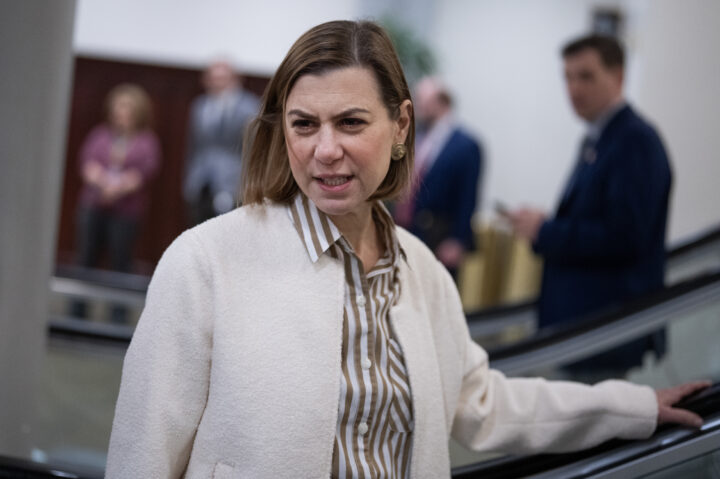
Sen. Elissa Slotkin (D-MI) is seen in the U.S. Capitol on Thursday, March 26, 2026.
Sen. Elissa Slotkin (D-MI) joined other Michigan Democrats in condemning Amir Makled, a Democratic nominee for regent of the University of Michigan, over Makled’s past comments on social media expressing antisemitic sentiments and support for terrorism.
“I’m going to have a problem with any candidate — Democrat, Republican or independent — who shares antisemitic and hateful posts on social media. Especially when they refuse to disavow those comments or show remorse,” Slotkin said in a statement to Jewish Insider on Thursday, in response to a question about Makled.
Makled was nominated for the post at the Michigan Democratic Party convention last weekend, replacing Jewish and pro-Israel regent Jordan Acker, who has been repeatedly harassed and has had his home vandalized by anti-Israel campus activists.
The convention, which also featured aggressive heckling of pro-Israel speakers, has left prominent Jewish Democrats in the state feeling alienated and unmoored from their party.
Rep. Kristen McDonald Rivet (D-MI) similarly criticized Makled, and Sen. Gary Peters (D-MI) more broadly criticized the behavior of activists at the convention.
Officials revealed the assailant had recorded a video stating, ‘This is the largest gathering place for Israelis in the State of Michigan … God willing, I will kill as many of them as I possibly can’

Emily Elconin/Getty Images
Law enforcement respond near Temple Israel following reports of an active shooter on March 12, 2026 in West Bloomfield, Michigan.
The FBI determined that the attack on Temple Israel in West Bloomfield Township, Mich., earlier this month was “a Hezbollah-inspired act of terrorism purposely targeting the Jewish community and the largest Jewish temple in Michigan,” officials said on Monday.
Jennifer Runyan, head of the FBI in Detroit, said during a news conference that the assailant, Ayman Mohamad Ghazali, made a video stating, “This is the largest gathering place for Israelis in the State of Michigan in the United States. I have booby-trapped the car. I will forcefully enter and start shooting them. God willing, I will kill as many of them as I possibly can.”
On March 12, Ghazali rammed a truck full of explosives and weapons into Temple Israel, one of the largest Reform synagogues in the country, which has an active early childcare center. Armed security stationed at the synagogue engaged with Ghazali inside the vehicle, who killed himself after his truck caught fire during the gunfight. No one else was killed.
Ghazali, 41, was born in Lebanon and entered the U.S. in 2011 on an IR1 immigrant visa as the spouse of a U.S. citizen. He was granted U.S. citizenship in 2016, according to the Department of Homeland Security.
Ghazali was the brother of a Hezbollah commander who was killed by the IDF in Lebanon the week before the attack.
In the days following the attack, US officials said Ghazali was flagged by federal government databases as having connections to “known or suspected terrorists” associated with Iranian-backed terrorist group Hezbollah in Lebanon, the FBI revealed on Monday.
If he survived, he would have been charged with providing material support to Hezbollah, Jerome Gorgon, U.S. attorney for the Eastern District of Michigan, said.
“This man acted under Hezbollah’s direction and control,” Gorgon said. “He intended to kill others, not just himself.”
Critics say the controversial law will likely be struck down by the Israeli High Court
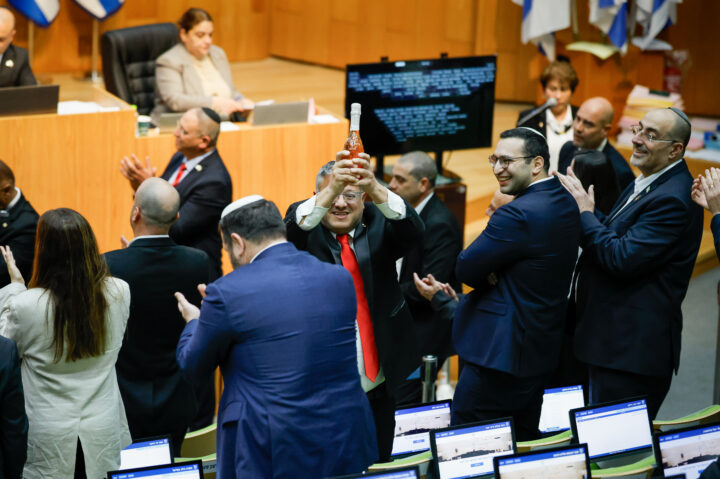
Noam Moskowitz/Knesset Spokesperson's Office
Israeli National Security Minister Itamar Ben-Gvir celebrates passage of his party's death penalty law on March 30, 2026.
The Knesset passed a controversial law on Monday allowing — and in some cases requiring — courts to impose the death penalty on terrorists found guilty of murder. Opponents swiftly challenged the legislation in court, with appeals arguing that its designations are vague and discriminatory.
While Israel already allowed the death penalty for genocide and crimes against humanity, it had not been invoked since the execution of senior Nazi Adolf Eichmann in 1962. National Security Minister Itamar Ben-Gvir’s Otzma Yehudit Party proposed the new law in the aftermath of Hamas’ Oct. 7, 2023, attacks with an aim to have terrorists sentenced to death, and conditioned the party’s support for the state budget, which the Knesset approved earlier Monday, on passage of the bill.
The law applies in military courts to non-Israeli residents of the West Bank — meaning, in the vast majority of cases, Palestinians.
In civilian courts, the law permits applying the death penalty to those who “intentionally cause the death of a person with the aim of denying the existence of the State of Israel” — language which would also likely exclude Jewish assailants.
The law further states that the government cannot free or exchange prisoners sentenced to death. Israel released around 2,000 Palestinian security prisoners last fall in exchange for hostages held in Gaza, including about 250 prisoners who were serving life sentences for carrying out deadly terror attacks.
The legislation passed along coalition lines, with 62 in favor and 48 opposed.
Otzma Yehudit lawmaker Zvika Fogel argued from the Knesset podium that “the State of Israel is dealing with a reality of evil and hatred that is unmatched around the world. Our enemies do not want a border, compromise or shared future. Rather, [they seek] to destroy, harm, sow fear and undermine our existence here. In such a reality, it is our clear responsibility to defend the citizens of Israel not with words or hopes, but with action.”
“This bill is not about revenge or rage, but the state’s responsibility towards its citizens and its leadership towards human life. … The message is clear, whoever chooses the path of terror and raises a hand against Israeli citizens … should know that it has a clear and irreversible price,” Fogel added.
The new law is also much broader than legislation making its way through the Knesset to prosecute perpetrators of the Oct. 7 attacks in a special military tribunal, which could also result in their being sentenced to death.
Yulia Malinovsky, from the opposition Israel Beytenu party and one of the cosponsors of the bill to prosecute Oct. 7 perpetrators, said that “everyone in the coalition understands that Otzma Yehudit’s bill cannot be implemented and will be struck down by the High Court of Justice, but they are all afraid of Ben-Gvir. They tell me so themselves.”
“I am in favor of the death penalty for terrorists,” she added, “but… even if [the law] passes and is not canceled, terrorists will only die of old age.”
Gilad Kariv of the Labor Party plans to petition the High Court against the law, along with Israeli human rights organizations.
During the debate, Kariv said that the law is “not moral, not Jewish and not democratic, nor is it helpful to security.” According to Kariv, none of the defense officials or experts that appeared before the Knesset Law, Constitution and Justice Committee meetings to discuss the bill said that it would serve as a deterrent against terrorism.
Some lawmakers, like Hadash-Ta’al’s Aida Touma-Sliman, argued that the bill is discriminatory against Arabs, comparing it to apartheid South Africa and the Jim Crow South: “First, we look at the nationality of the victim and the nationality of the murderer, and then we decide.”
However, Touma-Sliman added, she would still oppose the law if it were applied more broadly to Israelis, because she opposes the death penalty — “even against terrorist settlers.”
The Foreign Ministers of Germany, France, Italy and the U.K. released a joint statement expressing “deep concern” about the bill on Sunday.
“The adoption of this bill would risk undermining Israel’s commitments with regards to democratic principles,” they stated. “The death penalty is an inhumane and degrading form of punishment without any deterring effect. This is why we oppose the death penalty, whatever the circumstances around the world. The rejection of the death penalty is a fundamental value that unites us. We urge the Israeli decision makers in Knesset and Government to abandon these plans.”
The debate ahead of the final votes on the death penalty law took close to 10 hours, and was not held in the plenum; rather it took place in an auditorium that is fortified in case of a missile attack from Iran.
Deputy Inspector General Adam Kaplan told lawmakers that vetting processes for USAID had exempted U.N. employees, despite identifying Gaza as ‘high-risk’ for ‘misuse of U.S.-funded assistance’

Rafah Police
Armed men sit atop a U.N. aid truck outside a U.N. logistics facility in the Gaza Strip
The deputy inspector general of the U.S. Agency for International Development, Adam Kaplan, said on Tuesday that his office will investigate U.N. staff for ties to Hamas, noting that previous vetting requirements by the aid agency exempted employees of the international body.
Following the Oct. 7, 2023, terrorist attacks in Israel, USAID’s Office of Inspector General (USAID OIG) — responsible for conducting independent auditing and investigation of USAID and other foreign assistance programs — identified Gaza as a “high-risk for potential diversion and misuse of U.S.-funded assistance,” and has initiated investigations into several partners over connections to terrorism and fraud “to ensure humanitarian assistance in Gaza does not fall into the hands of Hamas and other foreign terrorist organizations.”
Previously, the agency has looked into the United Nations Relief and Works Agency, which provides services to Palestinians, uncovering evidence in 2025 connecting three “current or former” UNRWA employees to the Oct. 7 attacks and affiliating 14 other “current or former” UNRWA employees with Hamas. UNRWA also itself dismissed nine of its employees for their potential participation in the attacks.
During a House Oversight and Intelligence Subcommittee hearing on Tuesday discussing wasteful foreign assistance spending, Kaplan noted that USAID “required partner vetting of organization staff” to ensure that “terrorists don’t get our money,” however, that action “exempted U.N. staff.”
“To address this gap, USAID IG is investigating U.N. staff for ties to Hamas to ensure U.S. taxpayers do not pay their salaries,” Kaplan said.
He also noted a lack of transparent access to information. Describing ongoing investigations, Kaplan said his department has sought information from “five different U.N. agencies on 10 investigations,” but that response times spanned six months to two years, something he called “unacceptable.”
“We encounter nonstop obstruction by the U.N. to share information about potential misuse of U.S. funds,” Kaplan said. “USAID heavily relied on award recipients operating in remote locations to self-disclose fraud allegations of all award recipients. The least transparent is the United Nations.”
“We urge the State Department to implement a clause mandating that awards to the U.N. provide us with access to information,” he added.
Kaplan also said a major issue was that U.S. Anti-Terrorism Certifications (ATC), a legal promise required from organizations receiving U.S. foreign aid that they are not connected to terrorism and will not use U.S. funds to support terrorist groups, “applied only to grants, not contracts,” something that shielded contractors from being investigated over terrorist links.
“This certification allowed the Department of Justice and Office of the Inspector General to bring cases against grantees for concealing past support to Iran and Hezbollah,” Kaplan said. “Inexplicably, however, contractors were not required to make the same representation.”
Kaplan said that bad actors have “tried to exploit gaps” in the past, referencing a case in the Southern District of New York where a “British NGO [that] had falsified its past support provided to Hezbollah and Iranian affiliates” was dismissed because the office was not in the U.S.
“We brought the case, the judge in New York said, ‘Well, there’s really no ties. It’s a British firm, and other than the actual contract grant, there’s no ties to the United States. They don’t have an office in the U.S.,’” Kaplan said. “The case was dismissed. You have no idea how much that frustrated us, because it was a great case, and this contractor lied about his past affiliation with terrorist actors.”
The potential terrorist attack against Temple Israel is a reminder of the consequences of what can happen when antisemitism is allowed to become normalized in our society

JEFF KOWALSKY/AFP via Getty Images
Families leave after being reunited outside Temple Israel synagogue after an assailant rammed his truck into the building in West Bloomfield, Michigan, a suburb of Detroit, on March 12, 2026.
It’s a testament to the level of security, staff preparation and good fortune that a potential terrorist attack against Temple Israel in suburban Detroit was foiled yesterday. The fact that no one other than the heavily armed perpetrator was killed after driving a vehicle filled with explosives into a synagogue filled with preschoolers, counts as something of a miracle.
It’s also a reminder of the consequences of what can happen when antisemitism is allowed to become normalized in our society, moving unchecked through our social media feeds and political discourse, all amid the record levels of hate crimes committed against Jews simply for their identity.
Even as politicians are reflexively speaking out against antisemitism in the aftermath of the attack, it’s hard to forget the poisonous rhetoric many on the extremes have advanced that could easily activate a lone-wolf extremist to commit an unspeakable crime.
On the hard left, opposition to Israel’s war in Gaza has morphed into accusations of genocide, attacks against AIPAC as a uniquely sinister organization, conspiracy theories that Israel tricked the U.S. into war with Iran and euphemizing the support of terrorism as merely being “pro-Palestinian.”
Rep. Ro Khanna (D-CA), who has emerged as one of his party’s leading anti-Israel voices as he mulls a presidential campaign, had the audacity to say he “stands with” antisemitic streamer Hasan Piker — along with New York City Mayor Zohran Mamdani, who has refused to condemn “globalize the intifada” rhetoric and anti-Israel Democratic Senate candidate Graham Platner — during the Michigan synagogue terror attack.
Former Obama deputy national security advisor Ben Rhodes and his “Pod Save America” colleagues are now declaring that anyone who supports the Iran war — a group that may well include some Jewish Democrats in Congress who are sympathetic to the operation’s aims, even if they have reservations — should be primaried, and have no place within the Democratic Party.
On the hard right, extremist podcasters are broadcasting the most undiluted antisemitism in media since the days of Father Coughlin in the 1930s. Tucker Carlson has devoted much of his show to promoting conspiracy theories about Jews, while other social media influencers have found that attacking Israel and questioning Jewish influence is a ticket to building a niche audience in online spaces. Gatherings of young right-wingers have all too often become cesspools of anti-Jewish hate.
Sen. Ted Cruz (R-TX), who has emerged as a leader in speaking out against right-wing antisemitism, cautioned that Republicans may be losing the fight to contain the scourge — especially among a younger generation of conservatives.
All this is happening amid relative bipartisan silence towards the social media companies that often profit through division, using tech-tailored algorithms to feed extreme content to unsuspecting audiences. It’s no coincidence that polls indicate dramatic levels of antisemitism and extremist views from the youngest Americans, who are marinating in echo chambers instead of reading the headlines dispassionately from newspapers, as the generation before them did.
That the only fatality from yesterday’s attack in West Bloomfield Township, Mich., was the assailant is a testament to the time, energy and money that the Jewish community, with some federal assistance, has dedicated to ensuring security for its many institutions across the country. The FBI’s recent active shooter preparedness drill held for clergy and staff at the synagogue undoubtedly led them to be prepared in that fraught moment Thursday.
But a strong defense — hardening security for Jewish institutions — requires a complementary offense, in leaders confronting rising extremism whenever it rears its ugly head. It shouldn’t take the avoidance of a mass casualty event to get candidates across the political spectrum to start speaking out against antisemitism, as Platner did on Thursday.
We saw some signs of growing courage from political leaders this week in calling out the hate emanating from their fringes. Cruz, who called Carlson “the single most dangerous demagogue in this country,” at an antisemitism conference this week co-sponsored by the Republican Jewish Coalition and National Review, was joined by Sens. Tom Cotton (R-AR) and Jim Banks (R-IN) in speaking out against anti-Jewish hate.
The moderate Democratic think tank Third Way directly confronted Khanna on Thursday for his praise of Piker and other anti-Israel figures in the party. “Our side has a real antisemitism problem too that too many Democrats are failing to face squarely,” Third Way VP Matt Bennett bluntly told JI, in one of the few public intraparty acknowledgements about the growing threat.
The country feels like it’s at a boiling point, with few institutional leaders providing the guardrails necessary to contain growing extremism and hate. We saw on Thursday where unchecked extremism leads. It will take leaders to put principles ahead of political expedience for the wave of antisemitism to subside.
As state Sen. Jeremy Moss, a Democrat who represents the district where the attack took place, wrote: “When I was growing up, antisemitism was primarily in history books and black and white film reels. Today it was in real color right up the road at Temple Israel … This is a fire that will take all of us to snuff out.”
Federal charges were filed against Pennsylvania youth who lobbed improvised explosive devices outside Gracie Mansion
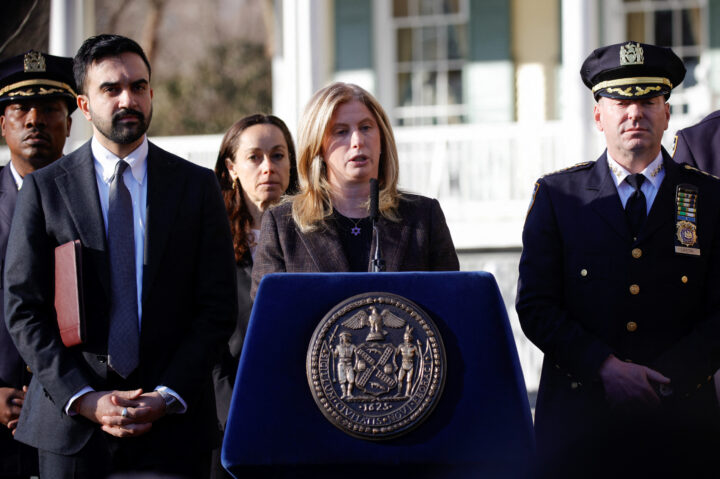
Leonardo MUNOZ / AFP via Getty Images
New York City Police Commissioner Jessica Tisch (C) speaks alongside New York City Mayor Zohran Mamdani (L) during a news conference at Gracie Mansion in New York City on March 9, 2026.
The two Pennsylvania men who allegedly hurled improvised explosive devices toward a protest against New York City Mayor Zohran Mamdani will face federal charges for “ISIS-inspired terrorism,” NYPD Commissioner Jessica Tisch revealed Monday.
Mamdani and Tisch addressed the press near the scene of the crime, the mayoral residence of Gracie Mansion, where far-right provocateur Jake Lang held a protest on Saturday to “Stop the Islamic takeover of New York City.” Tisch said Lang and his supporters were the targets of two homemade bombs that Emir Balat, 18, who had traveled from Pennsylvania with his accused accomplice Ibrahim Kayumi, 19, flung from amid the counter-demonstration.
Tisch confirmed earlier reporting that the Islamic State appears to have inspired the alleged perpetrators’ actions — but maintained nothing at present pointed to any link between the attempted attack and the ongoing U.S. and Israeli military campaign against Iran.
“I can confirm this morning that this is being investigated as an act of ISIS-inspired terrorism,” the commissioner said, noting that so far one of the devices had tested positive for triacetone triperoxide, an explosive used in terrorist bombings across the world. “At this time we do not have any information that connects this investigation to what’s going on overseas in Iran.”
Neither bomb ultimately detonated. The criminal complaint filed in the Southern District of New York Monday stated that both men waived their Miranda rights and explicitly identified ISIS as their inspiration.
“This isn’t a religion that just stands when people talk about the blessed name of the Prophet [Muhammad],” Balat told police, according to the charging documents. The complaint continues that Balat requested and received writing materials, and jotted down: “All praise is due to Allah lord of all worlds. I pledge my allegience [sic] to the Islamic State. Die in your rage yu [sic] kuffar!”
The Federal Bureau of Investigation agent deposed for the complaint stated that the written statement reflects common ISIS slogans. Further, the document alleges Balat subsequently told police he had hoped to pull off something “even bigger” than the 2013 Boston Marathon bombing, which he noted had caused “only three deaths.” The indictment also states that Balat was carrying a Turkish government identification card as well as a Pennsylvania driver’s license.
The duo face charges of attempted provision of material support and resources to a designated foreign terrorist organization, use of a weapon of mass destruction, transportation of explosive materials — including over state lines — and unlawful possession of destructive devices.
Tisch said Monday her department remains in “a heightened state of alert” due to the ongoing U.S. war against Iran , and had deployed “heavy weapons, teams, K-9 units, aviation and more” to secure sensitive locations.
Mamdani, who revealed he was not home at the time of the incident, joined his commissioner in praising the police department and the officers who helped secure the location. He opened his remarks with an attack upon Lang, known for throwing up Nazi salutes at his events, including outside AIPAC headquarters — but strongly reaffirmed his support for each side’s right to protest.
“While I found this protest appalling, I will not waiver in my belief that it should be allowed to happen,” he said. “Ours is a free society, where the right to peaceful protest is sacred. It does not belong only to those we agree with. It belongs to everyone.”
Still, Mamdani continued, “This was a vile protest rooted in white supremacy. Many of the counterprotesters met this display of bigotry peacefully, with a vision of a city that is welcoming to all. But a few did not.”
Condemning Talat and Kayumi, Mamdani, whose own Shi’ite faith is anathema to the Sunni extremism of ISIS, continued, “They are suspected of coming here to commit an act of terrorism. New York City will never tolerate violence, whether from protests or counterprotests.”
Graham said Trump told him there’s ‘no light’ between Trump and Netanyahu
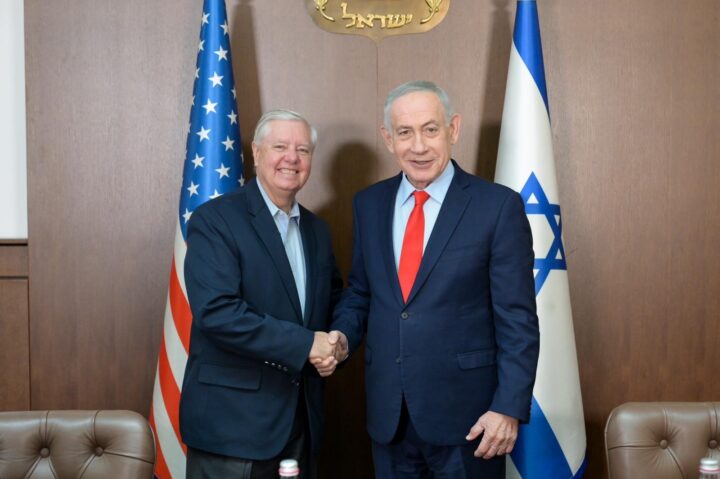
Maayan Toaff/GPO
Sen. Lindsey Graham (R-SC) meets Israeli Prime Minister Benjamin Netanyahu in Jerusalem.
The Iranian regime may fall within weeks, Sen. Lindsey Graham (R-SC) said during a press conference in Tel Aviv on Monday.
“We’re on the verge of eliminating the greatest state sponsor of terrorism in the region,” Graham said. “We’re in for weeks, not months.”
“President Trump is very good at making sure people don’t play him by giving them deadlines. I think you may see that now with Iran,” he added.
Graham said that President Donald Trump is pursuing diplomacy “to find a way to end this regime diplomatically that will advance our national security interests,” while leaving the military option open.
“I think President Trump is looking to see which line will catch the biggest fish,” he added.
Trump and Israeli Prime Minister Benjamin Netanyahu are in total agreement about how to proceed to weaken the Iranian regime, Graham said.
“There is no light between President Trump and Bibi about what to do and how to do it,” Graham said, later adding: “That’s what the president told me.”
After their meeting at the White House last week, Netanyahu characterized Trump’s assessment of Iran negotiations as overly optimistic of the regime’s intentions, saying, “The president thinks the Iranians understand who they’re dealing with. He thinks the conditions he is setting, combined with their understanding that they made a mistake last time not reaching a deal, could bring them to agree to conditions that will allow a good deal to be reached.”
But Netanyahu’s own view was more reserved: “I do not hide my general skepticism about the possibility of any deal with Iran.”
Graham called on the U.S. to “meet the moment” to topple the regime in Tehran.
The senator said both that he is “hopeful that diplomacy may prevail yet,” but when asked if he thinks a diplomatic solution is possible, he noted that Iran is “prone to cheat,” and that “based on the past, no,” but he is willing to give it a chance.
He pointed out that the military option is still on the table and that “the [USS] Gerald Ford [aircraft carrier] is steaming this way. I don’t think they’re just going for better weather.”
“In the coming weeks, if we can’t find a diplomatic solution, we will engage in the great endeavor of supporting the Iranian people, demanding their freedom and the end of their oppression,” he stated.
To reach that goal, Graham said, “we have military capability second to none. There’s no more clever nation than Israel and no more powerful nation than the United States.”
Asked if he thinks a military solution could actually bring about the end of the regime, Graham said that the Iranian regime is “weak” and “will collapse with sustained pressure,” and noted that their Air Force flies planes “from the 80s.”
“To anybody who believes the ayatollah can withstand all of this — you’re wrong,” he said.
Graham said the way to topple the regime militarily is to “kill the people who do the killing and see if the next guy wants to volunteer. … To those who want to appease: It never works. How many times could we have stopped Hitler? A bunch … The ayatollah represents evil incarnate to me.”
Graham acknowledged that military action in Iran could endanger American troops and result in the regime shooting ballistic missiles at Israel, but said “the risk associated with that is far less than the risk associated with blinking and pulling the plug and not helping the [Iranian] people as we promised. … We have to be good to our word.”
Should the mullahs’ regime fall, Graham said, it will be the result of Israel’s “determination to … go on the offensive” in response to the Oct. 7, 2023 attacks by Hamas, sponsored in part by Iran, and the “bravery of the people of Iran, who said ‘we’ve had it; we want change.’”
“I look forward to the day that Israel no longer has to fear a nuclear weapon developed by the Iranian regime,” he said.
Graham also recalled attending a demonstration against the Iranian regime in Munich over the weekend, and displayed a “Make Iran Great Again” hat, the idea for which, he said, came from diplomat Morgan Ortagus.
“The best way to make Iran great again is through the people, not the ayatollah,” Graham said.
In Gaza, Graham said that Hamas is “playing a game,” and Trump should set a time limit for disarmament.
“I think it’s either going to take pressure from the region to get a monster to disarm, or Israel is going to have to go back in and wipe them out. The sooner we get an answer to those questions the better,” he said.
Graham also expressed doubts that Gaza can be rebuilt “if right down the road there’s a neighborhood controlled by Hamas.”
Graham’s remarks came following meetings with Netanyahu, Israeli Defense Minister Israel Katz, Foreign Minister Gideon Sa’ar and former Prime Minister Naftali Bennett, and he plans to visit the United Arab Emirates and Saudi Arabia in the coming weeks.
The senator said one recurring theme in his meetings in Israel was expressions of appreciation for UAE leadership, specifically President Mohammed bin Zayed, as “a stalwart, reliable partner under difficult circumstances.”
As for concerns about antisemitic and anti-Israel messages coming out of Saudi Arabia, Graham said that he knows Saudi Crown Prince Mohammed bin Salman well, and that he “believe[s] he still has the same vision for the region as he did before Oct. 7, but Oct. 7 took its toll.”
Graham expressed support for Netanyahu’s plan to taper off U.S. military aid over the next decade, saying that “rather than writing a check, he wants to create a partnership. … I like that idea. The wars of the future are being planned here in Israel, because if you’re not one step ahead of the enemy, you suffer. … We’re looking at Israel advancing down the road of new weaponry far beyond us. It would be nice to be part of that process.”
As to Trump calling Israeli President Isaac Herzog a “disgrace” for not yet deciding whether to pardon Netanyahu of his various corruption charges, Graham said: “I’ll leave that to President Herzog.”
Budd says Qatar should hand over Khaled Mashaal because he has the ‘blood of Americans on his hands’

Kevin Dietsch/Getty Images
Sen. Ted Budd (R-NC)
Sen. Ted Budd (R-NC) called on Qatar to extradite Hamas operative Khaled Mashaal to the U.S., telling Jewish Insider on Wednesday that the leader has the “blood of Americans on his hands.”
Mashaal, who is under U.S. indictment on terrorism-related charges, appeared this past weekend at the Al Jazeera Forum in Doha, where he rejected the U.N. Security Council-backed plan for Gaza — a move that could further complicate U.S. efforts to advance Phase 2 of President Donald Trump’s Gaza peace initiative.
“[Mashaal] is responsible for plotting the brutal massacre of Americans and Israelis on Oct. 7, 2023,” said Budd. “He should absolutely be extradited to the U.S. to face justice for his appalling crimes, not walking free to make public appearances in Qatar calling for Hamas to maintain its weapons and deny foreign intervention in Gaza.”
Budd also told JI that he wants to see Qatar crack down on the content disseminated by state-backed Al Jazeera.
Sen. Pete Ricketts (R-NE) said that he wasn’t familiar with Mashaal’s case in particular, but told JI that “one would like to see the that Qataris, who are supposed to be helping us out, participate or cooperate with us when we’re trying to bring terrorists to justice.”
Also featured at the forum was Francesca Albanese, the U.N. special rapporteur, who was sanctioned by the U.S. in July 2025. Appearing by video, she told forum attendees that humanity has a “common enemy” in Israel.
Middle East policy experts have cautioned that Qatar’s hosting of prominent Hamas and U.S.-sanctioned individuals allows those figures to circumvent U.S. restrictions, while promoting anti-American sentiment. The U.S. does not currently impose any direct sanctions on Qatar.
“The Qataris are not inherently violating U.S. sanctions by inviting these guys to speak,” said Natalie Ecanow, senior research analyst at the Foundation for Defense of Democracies. But, she added, “that’s not to say that this isn’t a latent disregard for U.S. sanctions by a country that’s supposed to be an ally and a partner.”
Ecanow said it is “not the first time” the Qataris have “thrown a finger in the face of American sanctions.” She noted Doha’s significant and long-term investment in Russia’s energy sector amid the ongoing war in Ukraine, as well as Qatar’s continual hosting of Hamas officials.
“The Qataris say that they were asked by the Americans to host Hamas. I have not seen documentation to prove that,” said Ecanow. “Hamas leaders have been living there for over a decade, and they amass multi-billion dollar fortunes.”
Edmund Fitton-Brown, a former British diplomat and senior fellow at FDD, called the forum in Doha a “convention of enemies of America,” telling JI that the decision to give Hamas leaders a platform is “thoroughly obnoxious.”
“The fact that this is happening doesn’t seem to me to be a significant evolution from what has been completely normal practice in Qatar throughout the year and during the Trump administration,” said Fitton-Brown. “How do you have a close relationship with Qatar when it evidently supports Hamas?”
Ecanow said Doha’s actions are especially troubling as a country that is supposed to be a U.S. partner. During Trump’s second term, the White House has worked to strengthen bonds with Qatar; the president visited last May and signed an executive order in September that regards “any armed attack on the territory, sovereignty, or critical infrastructure of the State of Qatar as a threat to the peace and security of the United States.” The two countries also finalized an agreement in October that allows Doha to build an air force facility in Idaho.
“These guys are supposed to be our allies,” said Ecanow. “It’s not just some random country that’s disrespecting U.S. sanctions. It’s a major non-NATO ally. It hosts the largest American military base in the region and invests billions of dollars in the U.S. education system.”
Michael Jacobson, a senior fellow at The Washington Institute for Near East Policy, said the issue has become a “continuous source of angst and irritation in Washington circles.” He said that entities and individuals in Qatar are involved in “sanctionable activity.”
“I’m sure there’s still Qatari entities and individuals involved in trying to send money to Hamas,” said Jacobson. “It’s interesting that this administration has sanctioned many entities and pushed other governments to sanction entities tied to Hamas and its fundraising, meanwhile I don’t think there’s been any in Qatar that have been sanctioned over the last year.”
Jacobson described the issue as a “long-standing problem” and said the Trump administration’s inaction is “telling,” adding that there is “certainly stuff you could sanction if you wanted to.” However, he also argued that the U.S. relationship with Qatar does carry upside.
“It’s not like [Qatar is] doing nothing to help us,” said Jacobson. “They did serve as a liaison to Hamas, and they were able to, with the Turks, put pressure on Hamas to release the hostages and agree to a ceasefire.”
Regardless, analysts suggested that the Trump administration is unlikely to alter its current approach to Doha.
“It would have to be something really headline-grabbing that would have the president look at it and say, ‘Hang on a minute,” said Fitton-Brown.
“In my view, the nearest we’re going to get to [sanctions] is going to be some of the actions of the Qatari state in U.S. academia, where they’re putting money into universities with completely unacceptable conditions about not criticizing Qatar or appointing totally unsuitable faculty,” said Fitton-Brown.
He added that Qatar’s influence in education “crosses over with some of the anti‑Israel, anti‑Jewish, anti‑American manifestations on U.S. campuses that have certainly been a focus of concern from this administration.”
Even if Washington stops short of imposing new penalties, Fitton-Brown argued that the larger strategic question about Qatar’s role in the U.S. and the region remains unresolved.
“[Qatar] is not a friend,” said Fitton-Brown. “At best it’s a frenemy, and at worst it’s actually a systematic and insidious and sustained threat to America, its way of life, and its values.”
The Texas senator has drafted legislation to designate the group as a foreign terrorist organization ‘if there’s no change in their behavior’
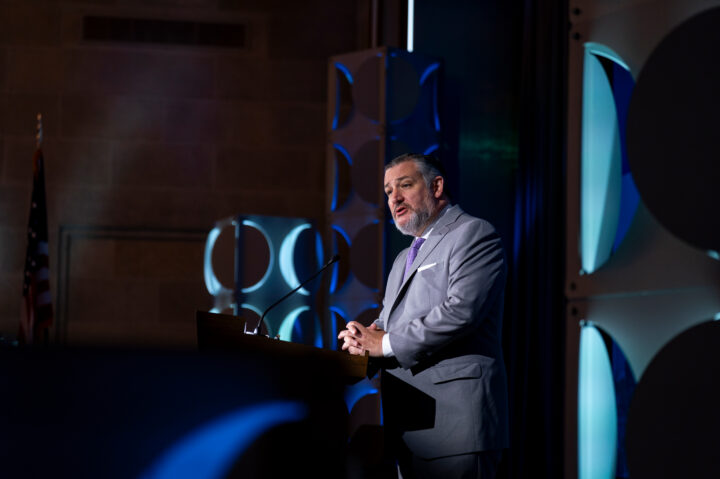
Al Drago/Bloomberg via Getty Images
Sen. Ted Cruz speaks during a U.S. Chamber of Commerce summit in Washington on Sept. 10, 2025.
Sen. Ted Cruz (R-TX) announced on Tuesday that he had drafted legislation designating the Polisario Front, the militant group that claims sovereignty over parts of the Western Sahara, as a foreign terrorist organization and will formally introduce it “if there’s no change in their behavior.”
Cruz made the comments at a Senate Foreign Relations subcommittee hearing focused on U.S. counterterrorism efforts in North Africa, after the hearing’s witnesses — the State Department’s Robert Palladino and Joel Borkert — both declined to agree with his statement that “the terrorist activity in the Sahel [region in Africa] is coming from the Polisario Front.”
“Iran is trying to turn the Polisario Front into the Houthis for West Africa, a proxy force capable of waging war to threaten regional stability and pressure U.S. partners whenever Iran wants leverage,” Cruz said. “The Polisario Front works with Iranian terrorist groups. It takes drones from the IRGC. It moves weapons and resources around the region, including to jihadists and much more.”
“I believe they should be designated as a terrorist group, and I’ve drafted a bill to do so if there’s no change in their behavior,” he added.
The Polisario Front is a separatist militant group founded in 1973 to fight against the Spanish occupation of parts of the Western Sahara. After Spain handed control of the territory to Mauritania and Morocco in 1975, splitting the land between the two countries, the PF waged war against both nations, hitting military and civilian targets while demanding recognition of Sahrawi ethnic group’s claims to the territory. The group declared in 1976 that all disputed territory in the region was part of the Sahrawi Arab Democratic Republic, and currently controls an area east of the Moroccan Wall.
Mauritania, now an Islamic republic, fell to the PF and formally recognized the SADR in 1979. While Morocco and the PF agreed to a United Nations-brokered ceasefire in 1991 that remains in effect today, the PF’s increasingly close ties to Algeria, Nigeria and Iran while governing the disputed Saharan territory have become a source of concern to those opposed to Tehran’s growing influence in the region.
President Donald Trump recognized Morocco’s claim to the Western Sahara in late 2020 at the conclusion of his first administration, as part of the deal brokered for Morocco to join the Abraham Accords.
Rep. Joe Wilson (R-SC) introduced legislation designating the PF as a foreign terrorist organization last June. The House bill has been co-sponsored by Reps. Randy Fine (R-FL), Jimmy Panetta (D-CA), Mario Diaz-Balart (R-FL), Jefferson Shreve (R-IN) and Lance Gooden (R-TX).
Speaking on his “Verdict with Ted Cruz” podcast on Tuesday evening, the Texas senator described Africa as a “major front for radical Islamic terrorism” and said the continent serves as “a major battleground” pitting Russia and China against the United States.
Regarding the PF, Cruz noted that, “The best way to understand it is as a Cold War relic, analogous to the Palestinian Liberation Front, the PLO, but it was in West Africa, and there’s still a degree to which that framework is accurate.”
“It is a darling of the international left and the United Nations, and the group has continued its insurgency against Morocco,” Cruz explained. “The critical dynamic is that Iran has begun pouring resources into the group. … The Iranians have been providing money and weapons and directions.”
Palladino, a senior bureau official with the Bureau of Near Eastern Affairs, said in his opening remarks to the committee that the Trump administration was looking “to North African countries to provide critical support to ensuring terrorist activity in the Sahel does not spread west to the Gulf of Guinea or north to regain a foothold in North Africa, where they represent a more immediate threat to the United States and our interests.”
After Cruz pressed him on if he was referring to the PF, Palladino did not answer directly, instead telling the Texas senator that “President Trump has made clear his desire to achieve a lasting resolution to the problem in the Western Sahara, to that dispute, and as part of that American policy currently, we are engaging all parties.”
Cruz went on to ask Palladino if he believed the PF posed a threat to U.S. interests, to which the NEA official replied, “We’re actively engaging all parties in the Western Sahara dispute in the interest of achieving a lasting and durable peace. That’s the policy of the president. We’re seeking more time to continue to find a way to find common ground and to come to an agreement to stabilize the situation and allow there to be prosperity to follow based upon stability.”
The Texas senator told Palladino that his answers were “positively Shakespearean. It was full of sound and fury and yet signifying nothing.”
Cruz then turned to Borkert, the deputy coordinator for programs and military coordination at the Bureau of Counterterrorism, who similarly declined to single out the PF by name.
“We continue to monitor activities throughout North Africa,” Borkert said. “We continue to see the IRGC and Hezbollah, their activities in that region and globally, and as we look at these activities, we will work with our partner countries in order to counter those threats, and where possible, designate or encourage those countries to designate the IRGC, Hezbollah and those terrorist groups.”
Both men told Cruz that they were not instructed to exclude mentions of the PF in their testimony. Cruz later revealed he did not believe their claims.
“I believe both witnesses were instructed: Do not say a negative word about the Polisario Front,” Cruz said on his podcast that evening. “They were instructed to say nothing about the Polisario Front.”
“The administration is trying to negotiate a big peace deal in Africa. There are folks in the administration who are trying to negotiate a deal in Western Africa, and right now, one of the consequences of that is that they’re reluctant to call out the Polisario Front,” he explained. “I think the Polisario Front is really dangerous. They’re funded by Iran, and so I’m working to call out people who are enemies of America and to impose real costs and consequences on those jihadists that are enemies of America.”
Speaking to camera, Cornyn touts his efforts to revoke the tax-exempt status of the Council on American-Islamic Relations

Kayla Bartkowski/Getty Images
Sen. John Cornyn (R-TX) speaks with press in the Hart Senate Office Building on April 07, 2025 in Washington, DC.
Sen. John Cornyn (R-TX), facing a serious primary challenge from his right, released a new campaign ad on Thursday calling “radical Islam” a “bloodthirsty ideology” that has influenced recent terror attacks targeting Jews.
“It fueled the unspeakable crimes on Oct. 7,” Cornyn says in the 30-second ad, called “Evil Face,” before citing the mass shooting last month during a Hanukkah gathering in Australia that was allegedly motivated by the terrorist group ISIS. “It showed its evil face again at Bondi Beach.”
Speaking directly to the camera, Cornyn touted his recent efforts to revoke the tax-exempt status of the Council on American-Islamic Relations, a nonprofit advocacy group whose executive director has drawn scrutiny for celebrating the Hamas attacks of Oct. 7, 2023.
“Let me be clear: No organization that supports terrorists should receive taxpayer benefits,” Cornyn concludes in the ad. “And Sharia law has no place in American courts or communities.”
The seven-figure ad buy is now running statewide on broadcast, cable and digital platforms, according to the campaign.
The ad comes after Texas Gov. Greg Abbott, a Republican, issued a declaration last November designating CAIR as a foreign terrorist group as well as a “successor” to the Muslim Brotherhood effectively posing as a front for Hamas, prohibiting the organization from purchasing land in the state.
The declaration allows the state’s attorney general, Ken Paxton, the right-wing Republican mounting a competitive challenge to Cornyn in the March primary, to sue to shut down the group and impose fines on its leaders.
CAIR, which called the proclamation defamatory and unconstitutional, has filed suit to challenge the designation, which Paxton has vowed to vigorously defend.
Following Abbott’s announcement, Cornyn, for his part, introduced legislation in the Senate in December that seeks to strip CAIR of its nonprofit status over its alleged support for terrorism. In a statement about the bill, Cornyn, who is seeking reelection to a fifth term, described the organization as “a radical group of terrorist sympathizers with a long history of undermining American values,” while endorsing the governor’s designation.
Both Cornyn and Paxton have otherwise boasted of their records supporting Israel and fighting the rise of antisemitism.
Caracas served as the hub of Tehran's operations in the Western Hemisphere

PEDRO MATTEY/AFP via Getty Images
A woman carrying an Iranian flag and a Venezuelan flag participates in a march in Caracas on June 25, 2025.
The U.S.’ capture of Venezuelan President Nicolas Maduro on Saturday is expected to weaken Iran’s terrorism efforts, weapons production and economic activity in Latin America, experts say.
With Vice President Delcy Rodriguez taking power — and the Trump administration expressing willingness to work with her — it remains unclear whether Maduro’s regime will largely remain intact with American supervision or if the government will ultimately be replaced by the democratic opposition, led by Nobel Peace Prize recipient Maria Corina Machado, or someone else.
While Venezuela’s future remains unclear, Israel’s leaders applauded what they saw as a pro-American turn, with Prime Minister Benjamin Netanyahu expressing support for the Trump administration’s “determined decision and action of the United States to restore freedom and justice to that part of the world.”
“Across Latin America right now, we are seeing a transformation,” Netanyahu said. “Several countries are returning to the American axis and, not surprisingly, to a connection with the State of Israel. We welcome this.”
Emmanuele Ottolenghi, senior research fellow at the Center for Research on Terror Financing, told Jewish Insider that “if the regime remains in place [under Washington’s supervision], there will have to be adjustments in its regional posture and foreign policy. That means, of course, the role that nefarious foreign actors such as China, Russia, Cuba and Iran played in Venezuela will change.”
Danny Citrinowicz, a senior researcher at the Institute for National Security Studies at Tel Aviv University, told JI that “the Iranians turned Venezuela into a strategic hub, and now that has disappeared.”
“Iran built a very deep operative and strategic relationship with [Maduro’s predecessor Hugo] Chavez, and it uses Venezuela … as its jumping-off point for influence in Latin America,” he said.
Ottolenghi said that Maduro’s government allowed Iran to operate freely in Venezuela, which Tehran took advantage of in a variety of arenas, including propaganda, terrorism and arms manufacturing.
Tehran established a drone factory in Venezuela, in which Venezuelans produced Iranian drones, Ottolenghi said.
The recently foiled terrorist plot to assassinate Israel’s ambassador to Mexico was planned by Iranian operatives in Caracas, Ottolenghi added.
“The Iranians made Caracas the hub of all their propaganda and soft power operations in the region, including their Spanish-language 24/7 news network,” Ottolenghi said. “They established a permanent presence in Caracas for their missionary network, under the umbrella of the sanctioned Al-Mustafa International University.”
After former Iranian President Ebrahim Raisi visited Caracas in 2023, scientific and academic exchanges between the countries grew, and Iran was granted greater access to Venezuela’s economy.
The economic relationship with Venezuela has been important for Iran, Ottolenghi said.
“Venezuela assisted Iran in evading sanctions prior to the JCPOA [2015 Iranian nuclear deal], but since 2019-2020, when the Venezuelan economy sharply deteriorated, Iran gained the upper hand in the relationship,” he said. “Maduro essentially joined the ‘axis of resistance.’”
The country with the largest proven oil reserves in the world needed to buy refined gasoline from Iran because of “the dramatic deterioration in quality in the oil industry in Venezuela after years of cronyism, brain drain, corruption and mismanagement purging the national oil company,” Ottolenghi explained. “The Iranians stepped in to stop Venezuela from collapsing for lack of refined [oil] products, providing technicians, technology, refined gasoline shipped from Iran in exchange for gold. That gave [Iran] even more leverage inside Venezuela, including the ability to operate one of the refineries for their own needs.”
As for Hezbollah, Citrinowicz noted that the Lebanese terrorist organization is “very important to [Iran], in that it connects the Shi’ite communities in Latin America.”
Ottolenghi said that Hezbollah “benefitted from both the protection of the regime and the large expat community of Lebanese immigrants and their descendants … who are sympathetic to the movement and enabled them to become involved in money laundering and other financial activities … including crypto and reportedly illegal gold mining in the southeast of the country.”
Though Hezbollah is an Iranian proxy, it has independent sources of income, including the Latin American drug trade.
Maduro’s fall “will make it hard [for Hezbollah] to keep up those ties,” Citrinowicz said.
Ottolenghi said that “traditionally, [Hezbollah] has played mainly the role of intermediary for drug cartels, providing services in logistics, distribution and financial channels to move the money in complex translational transactions.”
However, he noted that, as opposed to Tehran, Hezbollah’s operations in Latin America have not been primarily based in Venezuela, and that until recently, the terrorist group’s senior official in Latin America was based in São Paolo, Brazil.
“Insofar as Maduro’s removal may curb Iran’s influence and its proxies in Venezuela, it does not address necessarily what Hezbollah is doing in other countries,” Ottolenghi said.
Maduro’s fall is one of “a series of blows” to Iran in recent years, Citrinowicz said, with the governments of Bolivia, Chile and Argentina turning more pro-American, and the same is likely to happen in Colombia in its upcoming presidential election.
“Iran likes working with socialist regimes that counter the West,” Citrinowicz said. “They can’t leave Latin America entirely. … They will need to work with what’s left and emphasize Cuba and Nicaragua.”
Citrinowicz said that Iran will likely pivot its investments of time and money to Africa.
Ted Deutch praised Sen. Ted Cruz as a particularly powerful voice standing up to the ‘horrific’ antisemitic conspiracy theories spread by right-wing extremists

Celal Gunes/Anadolu via Getty Images
Ted Deutch, CEO of the American Jewish Committee, testifies about 'The Crisis on Campus: Antisemitism, Radical Faculty, and the Failure of University Leadership" during a US House Committee on Ways and Means hearing on Capitol Hill in Washington, DC, on June 13, 2024.
Following the terrorist attack at a Sydney, Australia, Hanukkah event in which 15 people were killed, American Jewish Committee CEO Ted Deutch said that it is critical for Jewish communal organizations to join together around a campaign to protect the Jewish community worldwide and win over allies in that fight.
“The community organizations need to come together around an immediate effort to respond to Bondi Beach. This is urgent for us,” Deutch said. Even if various groups have different approaches to their work, “we’ve got to show the Jewish world” and the philanthropists who back them “that we can actually work together, all of us, in ways that will protect the Jewish community in response to what happened at Bondi Beach.”
He said all Jewish community organizations need to come together on “one campaign right now that seeks to help secure the Jewish community, to help the world better understand the Jewish community, to enlist allies in this fight, and to help everyone understand why fighting antisemitism is not just the right thing to do, but it is in everyone’s self interest, because our society will be strengthened as a result.”
And he said that the Jewish community needs to stand its ground and be clear that it has the right and expectation to have its concerns and security “treated as seriously as other communities” and the “expectation that when we’re at risk, there will be action, rather than asking that everyone please consider our plight.”
“We are a proud community that has experienced challenges for thousands of years. We’re not going anywhere. If you’re not going to take this seriously, then we’re going to keep ramping up the pressure until you do,” Deutch said. “We can’t just go from one of these tragedies to the next. At other moments in American history with rising antisemitism, the community came together in ways that forced policymakers to acknowledge what we’re going through. This is one of those moments.”
He said he’s begun reaching out to colleagues on the subject.
Deutch said that he sees a level of unified horror, “passion” and “resolve” following the Bondi Beach attack akin to that he saw after the Oct. 7, 2023, attacks on Israel, and said that the community and organizational leadership need to build on that.
He said it’s critical to make clear to non-Jews that the fear and horror they felt at the footage of the Sydney shooting is “what we think about every single day as a community” and whenever Jews gather together.
Asked how those efforts will be more successful and more durable than similar calls seen repeatedly since Oct. 7, Deutch responded, “because we have to.”
“One coordinated campaign … isn’t going to solve the thousands of years of antisemitism but it will help us in this moment and it will show that the Jewish community can actually work together on one effort in a meaningful way, which is what members of the Jewish community everywhere in America are desperate to see,” Deutch continued.
The AJC CEO said that lawmakers and leaders have a responsibility to mind their rhetoric, emphasizing that the Bondi attack has shown “yet again” that rhetoric can prompt violence against the Jewish community.
“The need for them to ratchet down the rhetoric, to focus on the dangers that spreading antisemitism and polarization is having on society, is something that they can do without passing legislation. That needs to be an ongoing topic of conversation,” Deutch said. “They need to lead by example.”
Deutch, a former Democratic member of Congress, said that antisemitic actors on both sides of the political aisle have “not been marginalized” in the way that they should be. He said he’d “like to see more from leaders across politics and throughout the country and in every part of our society.”
Calls to “globalize the intifada” and “casual accusations of genocide” lead people to “taking action against anyone they think is responsible,” Deutch said, pointing to the Capital Jewish Museum attack in which two Israeli Embassy staffers were killed outside an AJC event in Washington, perpetrated by an alleged shooter who witnesses said shouted that he had carried out the shooting in the name of Gaza and freeing Palestine.
“What the leaders need to understand in Australia and around the world is, this has always been about terrorism,” Deutch said. “It’s terrorism against the Jewish community. These are attacks against the Jewish community to terrorize us, to put us at risk. The motives have been clear throughout.”
Referencing comments from Democratic Party Chair Ken Martin calling the party a “big tent,” Deutch said that “both parties may claim to be big tents” but have the ability to decide “who’s in the tent and who’s outside of the tent.” He said that anyone targeting Jews should be excluded, regardless of which side they’re on.
Deutch praised Sen. Ted Cruz (R-TX) as a particularly powerful voice standing up to the “horrific” antisemitic conspiracy theories spread by far-right voices like Tucker Carlson, Candace Owens and Nick Fuentes, calling him a “model” for other leaders.
“There has to be an acknowledgement in both parties that there will be no place for that, for those kinds of voices,” Deutch said.
He expressed frustration with Australian Prime Minister Anthony Albanese and the Australian government’s response to the Sydney attack, which he said has ignored and de-emphasized the fact that the attack targeted Jews.
He also highlighted Canberra’s failure to fully implement the recommendations of its own antisemitism envoy, which were presented over the summer, saying Albanese should have made such a commitment immediately after the attack.
“What the leaders need to understand in Australia and around the world is, this has always been about terrorism,” Deutch said. “It’s terrorism against the Jewish community. These are attacks against the Jewish community to terrorize us, to put us at risk. The motives have been clear throughout.”
Earlier in the year, Deutch had offered a mixed response to the administration’s efforts to combat antisemitism, particularly on college campuses. In the months since, those efforts have mostly fallen out of the headlines. But Deutch largely praised the administration’s ongoing efforts and the “serious way they’re approaching these issues.”
Of Assistant Attorney General for Civil Rights Harmeet Dhillon’s work on antisemitism, he said, “the way that she’s approaching this fight is serious and thoughtful and aggressive and that’s the way that every part of the administration should be approaching it.”
“When protesters come and stand and march and scream outside of a synagogue, it’s clear that there’s not a question of why they’re doing this. It’s antisemitism and the idea that every, every Jew is to be held responsible for whatever ills they see in Israel,” Deutch said. “It all starts with this fundamental belief that, just as it’s true for Christians and for Muslims and for Hindus and for everyone else: Jews should not be afraid simply for gathering together.”
Deutch recently sent a letter to Dhillon urging her to investigate whether there is coordination or foreign involvement in recent synagogue attacks across the country, and to enforce applicable laws to ensure access to religious institutions.
He said that AJC is open to working with the administration and supporting legislation, if necessary, to ensure that blocking access to a religious institution is banned — even if the institution is not hosting a religious service, currently a gray area in existing law.
“When protesters come and stand and march and scream outside of a synagogue, it’s clear that there’s not a question of why they’re doing this. It’s antisemitism and the idea that every, every Jew is to be held responsible for whatever ills they see in Israel,” Deutch said. “It all starts with this fundamental belief that, just as it’s true for Christians and for Muslims and for Hindus and for everyone else: Jews should not be afraid simply for gathering together.”
Deutch said that the Department of Education has made “significant steps forward in working toward a real plan” that he hopes the administration will put into effect. And he praised Justice Department senior counsel Leo Terrell for his efforts as well.
Looking at the year in retrospect, Deutch said that it brought many unexpected developments in the foreign policy realm, especially the strikes against Iran’s nuclear facilities, Israel’s strengthened geopolitical position and the return of all but one of the hostages in Gaza.
“The administration’s leadership has been significant,” Deutch said. “The president’s decision about Iran and the president’s leadership on this peace plan have given us this opportunity to think about what comes next.”
He said the administration needs to continue to squeeze Qatar and Turkey to pressure Hamas to stand down and relinquish its arms, in accordance with the next stages of the ceasefire plan. He said key administration officials also need to stay focused on moving the plan ahead.
AJC has worked for decades to cultivate ties with the Gulf and pushed for greater regional integration and normalization. Asked about how he views the prospects for Saudi-Israeli normalization, Deutch said there have been some concerning developments, but said that the U.S. and other advocates “have to stick with this.” With progress on the peace plan, he said that movement toward normalization would also be possible, he argued.
Deutch also warned that, even after the 12-day war between Israel and Iran that included U.S. strikes on Iranian nuclear sites, the Islamic Republic continues to pose a threat through its international terrorism and plots against the Jewish community, its repression of its citizens, its continued desire to destroy Israel and its global efforts to foment conflict.
“Their desire to destroy Israel has not changed as a result of the strikes,” Deutch said. “So the advice to policymakers everywhere is Iran continues to be a threat, not just to Israel, but to the Jewish community around the world and more broadly beyond that, and they have to be treated that way. That requires being vigilant, both in the military context and through using economic force.”
While Israel did not have intelligence pointing specifically to Sunday’s attack, it had provided information to Canberra about threats to the Australian Jewish community
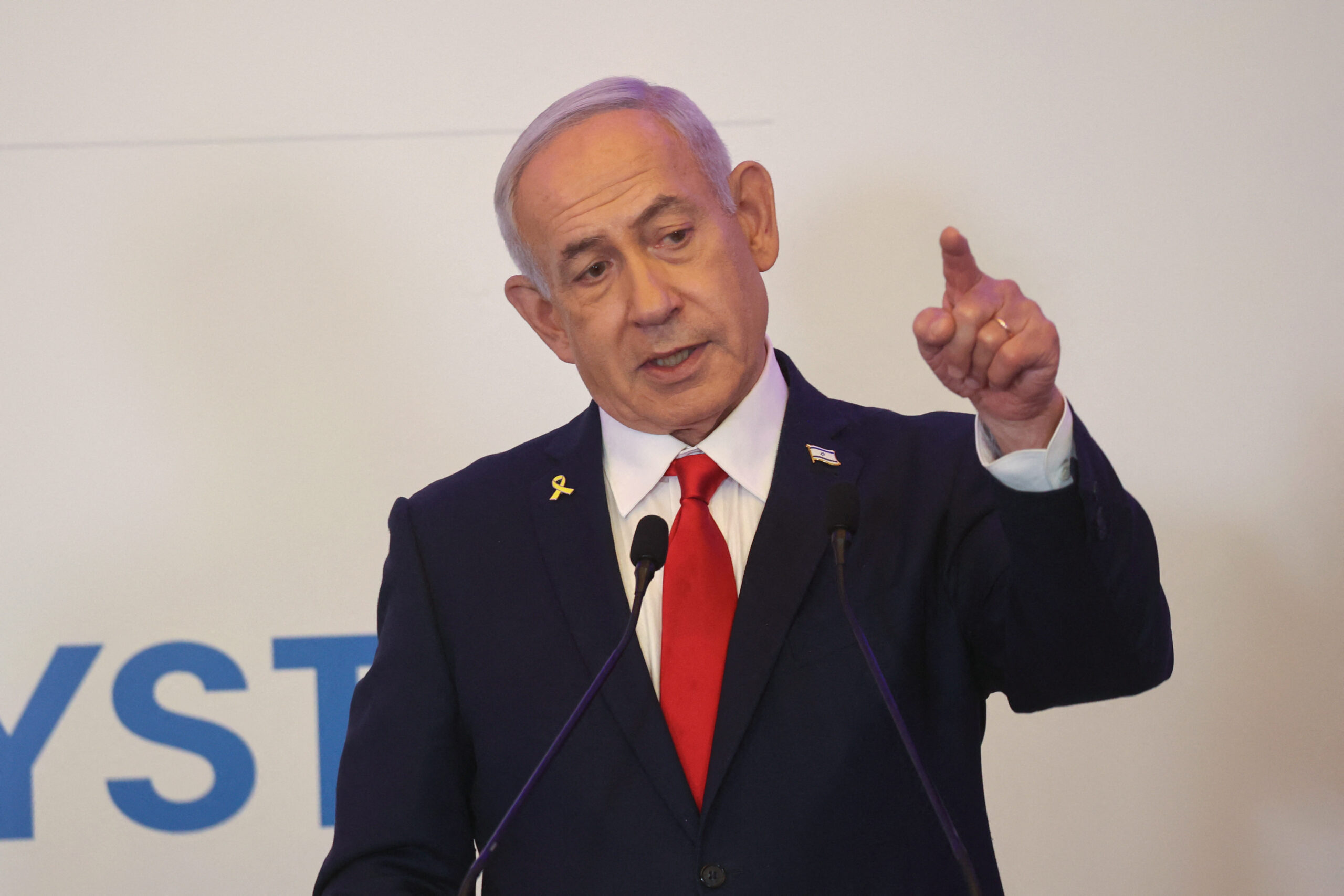
GIL COHEN-MAGEN/AFP via Getty Images
Israel's Prime Minister Benjamin Netanyahu speaks during an event at the Waldorf Astoria Hotel in Jerusalem on July 27, 2025.
In the wake of the deadly terrorist attack in Sydney, Australia, on Sunday in which 15 people were killed, Israel is imploring Western governments to heed its warnings about the potential for violent acts of antisemitism.
In a video statement on Tuesday, Israeli Prime Minister Benjamin Netanyahu said, “I demand that Western governments do what is necessary to fight antisemitism and provide the required safety and security for Jewish communities worldwide. They would be well-advised to heed our warnings. I demand action from them now.”
One of the recurring themes in Israeli officials’ statements after the attack on Bondi Beach, following condolences to the community, was “we told you so.” While Israel did not have intelligence pointing specifically to Sunday’s attack, it had provided information to Canberra about threats to the Australian Jewish community.
In his initial public statement following the attack, Netanyahu said, “Four months ago, I wrote a letter to the prime minister of Australia. I told him: ‘Your policy encourages terrorism. It encourages antisemitism. You call for a Palestinian state, and you are essentially giving a prize to Hamas for the terrible massacre they carried out on Oct. 7. You are legitimizing all these rioters and you are not lifting a finger to eliminate these terror hotspots. This will lead to more murders.’ [Prime Minister Anthony Albanese] did nothing.”
Israeli Foreign Minister Gideon Sa’ar said that “the Australian government, which received countless warning signs, must come to its senses.” President Isaac Herzog recalled that Israel “repeat[ed] our alerts time and again to the Australian government to seek action and fight against the enormous wave of antisemitism which is plaguing Australian society.”
American lawmakers and Jewish leaders also emphasized that Canberra had been repeatedly warned about a rise in violent threats to the local Jewish community.
In August, Netanyahu said that “history will remember Albanese for what he is: A weak politician who betrayed Israel and abandoned Australia’s Jews.”
At the time, the post seemed to be a response to Australia’s plan to recognize a Palestinian state. However, it was harsher and more personal than Netanyahu’s statements about the 10 other countries that did the same.
Days later, Australia expelled Iran’s ambassador, saying that intelligence services found Tehran was linked to arson attacks on a kosher cafe in Sydney and a synagogue in Melbourne in 2024. That intelligence reportedly came from Israel and included warnings that Iran was plotting more attacks.
Mark Regev, chair of the Abba Eban Institute for Diplomacy and Foreign Relations at Reichman University and former diplomatic advisor to Netanyahu, who was born and grew up in Australia, told Jewish Insider that “it’s clear that despite the bad political working relationship between the two governments, at least the channel between security services was working well. As a result of the information received in Australia, that they verified themselves, they took a stand against the Iranians.”
Michal Cotler-Wunsh, CEO of the International Legal Forum and Israel’s former special envoy for combating antisemitism, told JI that she has met with former and current chiefs of police in Canberra, and found them to be “well aware” that, quoting former British Chief Rabbi Jonathan Sacks, “antisemitism is the world’s most reliable early warning sign of a major threat to freedom, humanity and the dignity of difference.”
Regev said that usually, when Israel has reason to believe a Jewish community is in danger, it “expresses concern and talks to the relevant government.”
“Israel sees itself as the homeland of all Jewish people, so when Jews are under threat, it raises its voice,” he said.
Generally, “it is accepted that Israel has a say. Everyone understands it,” Regev said. “It’s not an accident that [Australian Foreign Minister] Penny Wong so quickly [after the attack] had a phone call with Sa’ar. That Israel has standing with Jews who are not Israeli citizens is commonly accepted in many parts of the world.”
There is little Israel can do beyond relaying warnings and intelligence, Regev said: “The Mossad can talk to local intelligence and give them information, and we can informally advise the Jewish community on how to protect synagogues, Jewish day schools and public events.”
“Ultimately, the job of protecting the Jewish community is the government” of the country in which the community lives, he added. “Israel is not in charge of law and order in Australia; that’s the Australian government.”
“Aside from saying ‘you have to do a better job,’ I’m not sure what else we can do,” Regev said.
Cotler-Wunsh argued on this week’s episode of the Misgav Mideast Horizons Podcast that Israel can be doing much more to combat antisemitism around the world. She resigned from her position as special envoy earlier this year in part because it remained voluntary and with little to no funding or ability to set policy. (JI’s Lahav Harkov cohosts the Misgav Mideast Horizons Podcast.)
“There needs to be some sort of authority, because it seems that there is no collaboration. … As Israel’s special envoy for combating antisemitism, different from many of my counterparts in the rest of the world, in the U.S., in Canada … I was not privy to the conversations that the security [establishment] was having, and I would say that is another testament to the lack of understanding of how severe an existential threat antisemitism is as both a symptom and a weapon in this eighth front of a raging war,” Cotler-Wunsh said.
“In no other war front would we say we have no strategy. We are just reacting,” Cotler-Wunsh lamented.
Jeremy Leibler, president of the Zionist Federation of Australia, told JI that the way Israeli leadership responded to the deadly terrorist attack did not take into consideration the particular concerns of Diaspora Jewry, and that their statements “go to the heart of Diaspora Jewry’s relationship with Israel and historic allegations of loyalties.”
Netanyahu and Sa’ar’s “immediate reaction is to attack the Australian government after this horrific terrorist attack for failing the Jewish community in relation to antisemitism … and I don’t disagree, but their first reaction should have been to convey condolences to the Australian government and the people of Australia,” he said.
“This is the greatest mass-casualty event [in Australia] since [1996] … This is an attack on Australia,” Leibler said. “It’s important to keep in mind, because the message you send otherwise is that the Jewish community is a fifth column. We’re not. We are passionately Zionist and that is completely consistent with being passionate Australians.”
“I don’t think people thought deeply about that, and it’s an important point,” Leibler added, saying that it may be a result of “politics in Israel [being] globally tough” and lacking “the same level of decency in the way people interact that perhaps there once was, and that does come out in the way some of the reactions were communicated.”
Regev recalled that when he was Israeli ambassador to the U.K. from 2016 to 2020, “the British Jewish community had nothing but praise for the seriousness with which [the government] took the safety of the Jewish community, and there were serious threats.”
This week, the police forces of London and Manchester said they would arrest people who chanted “globalize the intifada” in light of the Sydney attack.
“The Australian Jewish community is not in the same place in the way they look at the Australian government. … Jews were seen as whingers, overstating the threat, but obviously they weren’t,” he said.
“The general message [from Israel] is that Australia is not taking these things seriously enough,” Regev added. “What will [Canberra] do following this event? They say all of the right things, but are they taking steps?”
Leibler said that Albanese’s government has “absolutely, there is no doubt, failed since Oct. 7 to thwart the antisemitism that has exploded. They bear responsibility for an environment that has allowed antisemitism to thrive.”
He emphasized that “from a basic moral perspective, it is important to acknowledge the people responsible are the perpetrators and those who inspired, educated and financed them.”
“Had this government known about this attack, they would have tried to prevent it, but they are clearly not equipped to deal with it, and the response so far has been inadequate,” he said.
Leibler called on Australia to adopt its antisemitism envoy’s recommendations, made in July, and to acknowledge that the weekly anti-Israel protests on the streets have “crossed the line from criticism of Israel to full-blown antisemitism. … Ninety percent of the Jewish community has been demonized.” At the same time, he acknowledged that the government has increased funding for security Jewish sites and introduced hate speech laws.
“What they have not done is come to the defense of Israel’s legitimacy and model how one can criticize Israel’s policies of the day but vehemently come to its defense,” he said. “The Jewish community maybe would have disagreed with policy shifts, like recognition [of a Palestinian state] and changing [U.N.] voting patterns, but it wouldn’t have resulted in the same sense of isolation and demonization.”
‘Lives are at stake. This is not pretend. These enemies of the Jewish people are not playing games,’ Rep. Debbie Wasserman Schultz said
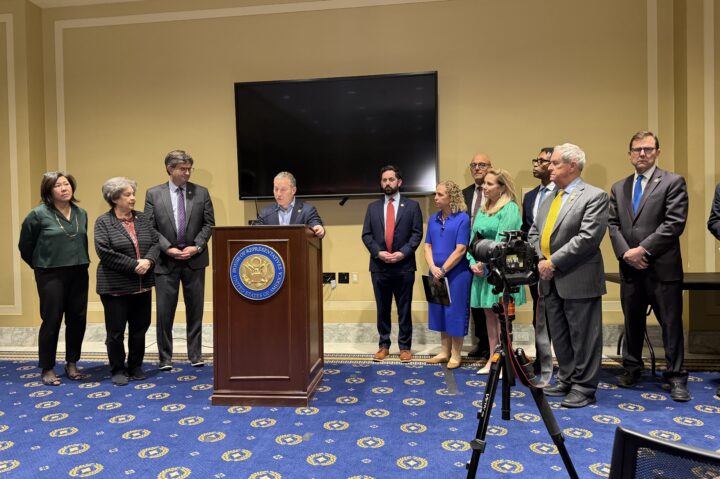
Marc Rod
From left to right: Reps. Grace Meng (D-NY), Lois Frankel (D-FL), Brad Schneider (D-IL), Josh Gottheimer (D-NJ), Mike Lawler (R-NY), Debbie Wasserman Schultz (D-FL), AJC CEO Ted Deutch, Laura Gillen (D-NY), Wesley Bell (D-MO), Joe Wilson (R-SC), Tom Kean Jr. (R-NJ), Dec. 16, 2025
Speaking to reporters on Tuesday, multiple Jewish lawmakers emphasized that the Sunday terror attack in which 15 people were killed at a Hanukkah celebration in Sydney, Australia, came after warnings from the Australian Jewish community, and Jewish communities around the world, about the rising violent threats they face — warnings that have often gone ignored, the lawmakers said.
Rep. Debbie Wasserman Schultz (D-FL) said that Australian Jews and others around the world have been warning “for far too long” about the “alarming, explosive rise in violent antisemitism.”
“That threat, those warnings, have fallen on deaf ears, and we are living with those consequences now,” Wasserman Schultz said. “I hope that this tragedy is the wake-up call that world leaders need to truly stand up and protect their Jewish communities from antisemitism, whether that manifests online or in person.”
She said that leaders around the world “must do better.”
“Lives are at stake. This is not pretend. These enemies of the Jewish people are not playing games. They mean to end our existence as a people,” she continued. “We will not allow that. Our allies and friends must help us make sure that never happens.”
Rep. Brad Schneider (D-IL), a co-chair of the Congressional Jewish Caucus, emphasized that the attack was “not predicted” but “it was predictable.”
“For too long, the Jewish community in Australia was saying to the authorities, saying to the government, ‘Antisemitism is a cancer eating away at the soul of the nation, and it’s going to result in the death of Jews in the land,’ and that’s what we saw on Sunday,” Schneider continued.
Rep. Brad Sherman (D-CA) emphasized that Australia’s special envoy for antisemitism had in July offered a plan to combat antisemitism, but the plan had not been fully implemented by the Australian government.
The briefing was hosted by Reps. Josh Gottheimer (D-NJ) and Mike Lawler (R-NY) and the American Jewish Committee.
Gottheimer said that the public outcry he had seen since the Sydney massacre “is a sign to me that there is a recognition that we can do something if we stand together.”
“We should all be going after the root of the rising scourge of antisemitic hate around the world,” he added. “We must stand up to our foreign adversaries like the government of Iran, and the terrorist organizations that they support, for driving this hatred and violence for the Jewish people.”
Lawler said that the lawmakers had gathered “united in a bipartisan way to say that we will not tolerate this. We will not accept this as the norm that our Jewish brothers and sisters have to live in fear of being murdered while practicing their faith.”
AJC CEO Ted Deutch, who previously represented a South Florida House district, urged lawmakers to act promptly to confirm Rabbi Yehuda Kaploun as the U.S. special envoy to monitor and combat antisemitism and to provide adequate funding for the office, to strongly condemn the attack, to publicly stand with the Jewish community and to investigate foreign-backed antisemitism and influence operations targeting Jews globally.
“In the U.S. and with our allies, we’ve got to take concrete steps to strengthen our intelligence and counterterrorism cooperation, protect our communities, to preserve democratic stability and to prevent massacres like the one that happened on Bondi Beach,” Deutch continued.
William Daroff, the CEO of the Conference of Presidents of Major American Jewish Organizations, said, “If there was ever any doubt that anti-Zionism and antisemitism are one and the same, the attacks since Oct. 7 erase it. Jews are being targeted not for policy, but for presence. Not for politics, but for being Jewish, visible and alive.”
Marina Rosenberg, the Anti-Defamation League’s vice president of international affairs, said that she and a global coalition of Jewish leaders had visited Australia just days before the massacre to “sound the alarm on the dangers of surging antisemitism, calling on officials to act before it was too late. Tragically, for our brothers and sisters in Australia, it is too late.”
Rosenberg also emphasized that the attack is part of a “global pattern targeting Jewish communities,” not an isolated incident. She said that Congress must boost security funding for religious institutions and confirm Kaploun.
Other lawmakers who attended the briefing included Reps. Tim Burchett (R-TN), Chris Smith (R-NJ), Tom Kean Jr. (R-NJ), Madeleine Dean (D-PA), Nick LaLota (R-NY), Jonathan Jackson (D-OH), Brad Sherman (D-CA), Steve Cohen (D-TN), Grace Meng (D-NY), Lois Frankel (D-FL), Laura Gillen (D-NY), Wesley Bell (D-MO), Joe Wilson (R-SC) and George Latimer (D-NY).
Jerry Nadler protege Micah Lasher: ‘The spread of violence against Jews is intertwined with the social acceptability of violent rhetoric directed at Jews’
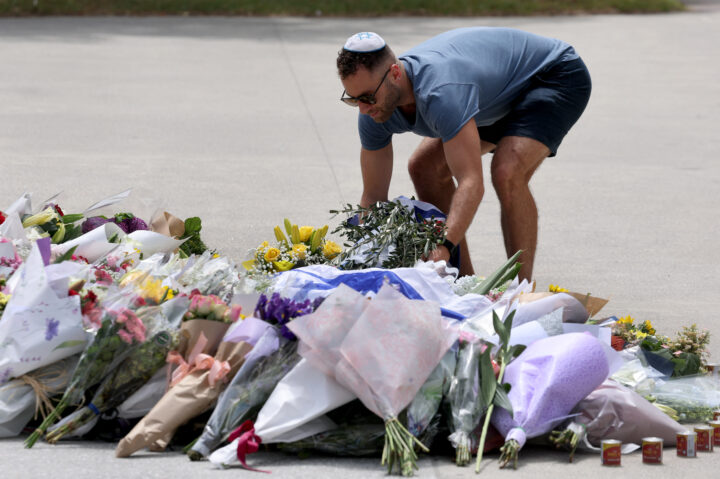
(Photo by DAVID GRAY / AFP via Getty Images)
A man lays flowers at the Bondi Pavillion in memory of the victims of a shooting at Bondi Beach, in Sydney on December 15, 2025.
The deadly terrorist attack during a Hanukkah celebration in Australia on Sunday is sparking a renewed debate within the Democratic Party over anti-Israel slogans including “globalize the intifada,” and whether such extreme rhetoric fuels antisemitic prejudice that can lead to violence against Jews.
Some candidates and elected officials in New York City, where recent anti-Israel demonstrations have raised alarms within the largest Jewish community in the world, are tying such rhetoric directly to the carnage at Bondi Beach in Sydney — after two gunmen killed at least 15 people and wounded more than three dozen in the deadliest attack against the Jewish community in Australian history.
Eric Adams, the outgoing mayor, said on Sunday that “the attack in Sydney is exactly what it means to ‘globalize the intifada,’” and cast the shooting as “the real-world application of that call to violence.”
Erik Bottcher, a city councilman who is among several Democrats now competing to succeed Rep. Jerry Nadler (D-NY) in a heavily Jewish district in Manhattan, said that, in the wake of “an attack like Bondi Beach, we should be unequivocal: antisemitic violence is unacceptable, full stop.”
“And we should also be honest that slogans like ‘globalize the intifada’ don’t advance justice, they escalate hostility and make Jewish communities feel targeted,” Bottcher continued in a statement shared with Jewish Insider on Monday. “Leaders should be lowering the temperature.”
Alex Bores, a state assemblyman also seeking to replace Nadler, called the attack “horrifying and despicable” and said “antisemitism is a growing threat around the world,” while noting that “New York City has a special responsibility to confront it head‑on.”
“Any rhetoric or actions that dehumanize Jews, incite violence or put Jewish communities at risk must be called out and stopped, without exceptions. I have repeatedly condemned the use of the slogan ‘globalize the intifada,’” Bores told JI. “I believe that phrase, regardless of a specific speaker’s intent, has been tied inextricably to violent attacks, strikes fear in many New Yorkers and has no place in our city.”
Micah Lasher, a Jewish state assemblyman and another Democrat in the race, asked rhetorically in a social media post Sunday whether there was “any question” that “the spread of violence against Jews is intertwined with the social acceptability of violent rhetoric directed at Jews.”
“People of good will must confront this reality,” he concluded.
Such discourse is likely to intensify in next year’s primaries, where several anti-Israel candidates in New York City are seeking to challenge incumbent Democrats over their positions on Gaza and ties to AIPAC, the pro-Israel advocacy group increasingly demonized by the far left.
For now, however, those challengers were largely reluctant to weigh in on the heated rhetoric used by anti-Israel protesters — including just last month at at a synagogue in Manhattan where demonstrators chanted such phrases as “globalize the intifada” and “death to the IDF” — and if such language deserves further scrutiny amid heightened security concerns in the Jewish community following the Bondi Beach attack.
Darializa Avila Chevalier, an organizer in Harlem who helped to lead anti-Israel protests at Columbia University and recently launched a bid to challenge Rep. Adriano Espaillat (D-NY), did not respond to a request for comment.
Michael Blake, a former state assemblyman who is now challenging Rep. Ritchie Torres (D-NY) in the Bronx and who has drawn charges of hypocrisy for pivoting from his past outspoken support for Israel and close relations with AIPAC, also did not return a request for comment — even as he condemned the shooting in Australia.
For his part, Torres, a pro-Israel stalwart and top ally of the Jewish community, described the attack as “part of a global surge in antisemitism fueled by an ever-escalating campaign of demonization and dehumanization.”
A spokesperson for Brad Lander, the outgoing city comptroller mounting a newly launched bid to unseat Rep. Dan Goldman (D-NY) in a left-leaning district covering Lower Manhattan as well as parts of Brooklyn, likewise declined to comment, instead referring to his “several public comments about the Sydney shooting.”
The spokesperson also cited previous remarks in which Lander voiced reservations about calls to “globalize the intifada,” shortly after Zohran Mamdani, who is now the mayor-elect of New York City, had faced widespread backlash for refusing to denounce the slogan.
“Maybe you don’t mean to be saying it’s open season on Jews everywhere in the world, but that’s what I hear,” Lander, a top Jewish ally of Mamdani, said in comments in June. “And I’d like to hear that from other people.”
A spokesperson for Goldman, a pro-Israel Jewish Democrat, also declined to weigh in on the matter.
Mamdani, who condemned the Bondi Beach attack as a “vile act of antisemitic terror” in a social media post on Sunday, has refused to denounce the phrase “globalize the intifada,” but has vowed to discourage its usage.
In a Friday interview with WCBS in New York, Mamdani responded to feedback from a prominent local rabbi, Ammiel Hirsch, who expressed concern about the mayor-elect’s “ideological hostility to the very existence of Israel” and said that “anti-Zionist rhetoric and anti-Israel policies will threaten Jewish safety” in the city.
“Rabbi Hirsch is entitled to his opinions,” Mamdani stated. “The positions that I’ve made clear on Israel and on Palestine, these are part of universal beliefs of equal rights and the necessity of it for all people everywhere.”
A spokesperson for Mamdani did not respond to a request for comment.
Despite reluctance among Mamdani and some of his allies to now more openly grapple with rhetoric many Jews have found threatening, one progressive challenger to Rep. Grace Meng (D-NY), a pro-Israel incumbent in Queens endorsed by AIPAC, said that he has come to view phrases such as “globalize the intifada” as harmful, thanks to conversations with his Jewish friends.
Chuck Park, a former City Council aide and foreign service officer who has criticized Meng’s donations from AIPAC, said “Jewish people around the world — from Bondi Beach to Bushwick — are very scared right now,” while adding “it is the job of non-Jewish leaders like myself to listen to them.”
“When I listen to my Jewish friends,” he said in an interview with JI on Monday, “they tell me that they hear” the phrase particularly “as a call to violence against them.”
“The swastika is no longer a Buddhist symbol of good fortune, right?” Park added. “The pointed white hood is no longer a Catholic symbol of penance. And in a very similar way, that phrase is not a call for the liberation of an oppressed people, and I think it has instilled and maybe even inspired dangerous attacks on Jewish people around the world.”
The president and Commerce Secretary Howard Lutnick insisted that Jewish Americans continue to celebrate ‘proudly’
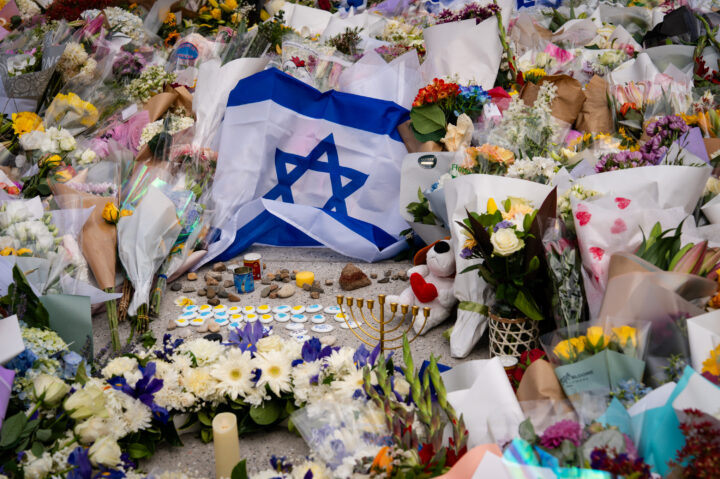
Audrey Richardson/Getty Images
An Israeli flag and flowers are laid outside Bondi Pavilion at Bondi Beach as people gather to mourn in the wake of a mass shooting on December 15, 2025 in Sydney, Australia.
President Donald Trump and senior U.S. officials took a moment during the start of Hanukkah to reflect on the deadly antisemitic terrorist attack over the weekend at a holiday celebration in Sydney, Australia.
The attack, which occurred Sunday when two gunmen opened fire at a Hanukkah event on Sydney’s Bondi Beach, killed at least 15 people, including a Holocaust survivor. Over 40 others were injured.
Speaking at the White House Sunday night, Trump called the shooting a “purely antisemitic attack,” and praised Ahmed al Ahmed, a Muslim man and bystander who stepped in to disarm the gunman at Bondi Beach. Ahmed is undergoing surgery for gunshot wounds.
“It’s a very brave person actually who went and attacked one of the shooters, and saved a lot of lives,” said Trump. “Great respect to that man that did that.”
Trump added that in the wake of the attack, Jews should celebrate Hanukkah “proudly.” The president has largely dismissed safety concerns in the U.S. and told reporters on Fox News on Sunday that Jewish Americans should “be proud of who you are.”
Antisemitic incidents have been on the rise around the world, particularly since Hamas’ Oct. 7, 2023 terror attack on Israel. On Friday night, a California home decorated for Hanukkah was the target of a drive-by shooting. In Amsterdam on Sunday, anti-Israel protesters gathered and set off smoke bombs near a venue that was scheduled to hold a Hanukkah concert performed by Israeli cantor Shai Abramson.
During the National Hanukkah Menorah lighting ceremony in Washington on Sunday, Commerce Secretary Howard Lutnick echoed Trump’s message about the attack and insisted that Jewish Americans “celebrate proudly.”
“Today we light the light of Hanukkah to bring light to much of this darkness,” said Lutnick. “It is a difficult and tough day for what we’ve lost, but we must always celebrate being Jews.”
On Sunday, Secretary of State Marco Rubio held a call with Australian Minister for Foreign Affairs Penny Wong to discuss the attack in Sydney.
“The United States strongly condemns the heinous terrorist attack in Australia targeting a Hanukkah celebration hosted by Chabad-Lubavitch of Bondi,” said State Department deputy spokesperson Tommy Pigott. “We stand in solidarity with the Jewish community and with the Australian people as we pray for the victims and their families. We are grateful to Australian first responders and bystanders for their heroic response.”
In his statement, Pigott called rising antisemitism a “scourge that must be confronted and defeated.”
“No community should have to fear publicly celebrating their faith and traditions due to the threat of extremist violence and terror,” said Pigott. “There can be no compromise with antisemitism.”
The Turtle Island Liberation Front, which federal authorities say was plotting an explosive attack, appears to have organized a disruptive protest targeting the Wilshire Boulevard Temple earlier this month

Sarah Reingewirtz/MediaNews Group/Los Angeles Daily News via Getty Images
First Assistant U.S. Attorney Bill Essayli speaks to the press with LA County Sheriff Robert Luna and LAPD Chief Jim McDonnell in Los Angeles on Monday, December 15, 2025.
Federal authorities foiled an alleged terror plot by an anti-Israel, anti-American extremist group, officials announced on Monday. The group — the Turtle Island Liberation Front — appears to also be one of the organizers of an anti-Israel protest that targeted a Los Angeles synagogue this month.
Four members of TILF were arrested over the weekend in the Mojave Desert, where they had allegedly gathered to attempt to construct improvised explosive devices. According to Bill Essayli, the first assistant U.S. attorney for the Central District of California, they planned to set off the pipe bombs in a coordinated attack at midnight on New Year’s Eve targeting U.S. companies in Los Angeles and Orange County, Calif.
“Last Friday, Dec. 12, the defendants took a significant step to carry out their plans,” Essayli said at a press conference Monday, noting that they traveled to a remote campsite near Twentynine Palms in San Bernardino County to begin assembling the bombs. “They had everything they needed to make an operational bomb.”
Attorney General Pam Bondi described TILF as “a far-left, pro-Palestine, anti-government, and anti-capitalist group” in a social media post about the arrests. The four people arrested were identified as Audrey Ilene Carroll, Dante Garfield, Zachary Aaron Page and Tina Lai. They face charges of conspiracy and possession of a destructive device. FBI Director Kash Patel announced on Monday that a fifth individual with ties to the plot was arrested in New Orleans.
Carroll had a poster at her home that said “Death to America. Long live Turtle Island and Palestine,” according to prosecutors. Turtle Island is a phrase used by some Native Americans to describe North America.
TILF appears to be an organizer of an anti-Israel protest that targeted Wilshire Boulevard Temple, one of the largest synagogues in Los Angeles, earlier this month.
The group posted a “call to action” on its Instagram urging followers to target the “bloody war criminals” and “genocidal monsters” from Elbit Systems, an Israeli defense company, because of the purported use of Elbit’s AI technology in Los Angeles’ Koreatown neighborhood. “Never let them live in peace,” the caption read.
The post listed an address on Wilshire Boulevard for the demonstration but did not name the location. The address corresponds with the Wilshire Boulevard Temple building where an event to teach Koreans about security strategies, featuring an AI researcher from Elbit Systems, was taking place at the same date and time.
Protesters entered the synagogue and disrupted the event, with one person shattering a glass vase and chanting profanities. Two people were arrested during the incident. L.A. Mayor Karen Bass called the activists’ actions “abhorrent” and pledged to send more security to houses of worship.
Other posts on TILF’s Instagram call for violence.
“Peaceful protest will never be enough,” one graphic reads. “The only way out is through resistance.”
The account’s most recent post was promoting a Palestine-themed holiday market in Los Angeles last weekend.
Prosecutors announced on Monday that the investigation into the TILF New Year’s Eve plot was due in part to an executive order signed by President Donald Trump in September “to root out left-wing domestic terror organizations in our country such as antifa and other radical groups,” according to Essayli.
Sen. John Fetterman (D-PA): ‘Tree of Life to 10/07 to Bondi Beach: antisemitism is a rising and deadly global scourge’

Saeed KHAN / AFP via Getty Images
A Jewish community member reacts as he stands at the site of a terror attack at Bondi Beach in Sydney on December 14, 2025.
U.S. officials and lawmakers across the political spectrum are condemning the terrorist attack at a Chabad Hanukkah celebration Sunday outside Sydney, Australia, tying the murder of 15 attendees to the rise of antisemitism across the world.
Secretary of State Marco Rubio said in a statement that the United States “strongly condemns” the attack and that “antisemitism has no place in this world.”
U.S. Ambassador to the U.N. Mike Waltz said the “horrific and deadly terrorist attack” is a “sickening reminder that antisemitism remains a global threat. Under President Trump’s leadership, the United States will confront this hatred — at the U.N. and around the world — without apology or hesitation.”
FBI Director Kash Patel said he is “in touch with our counterparts in Australia” regarding the attack and is “providing the requested assistance,” while Attorney General Pam Bondi called it “heartbreaking news.”
U.S. Ambassador to Israel Mike Huckabee noted, as did several others, that Australian Prime Minister Anthony Albanese’s original statement on the attack did not specify its antisemitic nature. “The disgraceful statement from Australia PM never mentioned it was jihadist attack on Jews on first day of Hanukkah. Hope he’s ashamed of antisemitic statements past year,” Huckabee wrote on X.
On the Hill, lawmakers from both parties also expressed their shock and sadness. All 25 Jewish members of the House, on both the Republican and Democratic sides, issued a joint statement remembering the “Jewish families in Australia” who were “grotesquely targeted with hate and murderous intent.”
“Sadly, this attack does not come as a surprise to the Jewish community of Sydney who have been raising a clarion call for local and national authorities to take concrete steps against a rising tide of antisemitism,” the members, organized by Rep. Brad Schneider (D-IL), wrote. “Antisemitism is a cancer that eats at the core of society, whether in Australia, the United States, or anywhere it is allowed to take root and grow. We join leaders around the globe in condemning this evil act and in calling for justice, peace, and unwavering support for those affected. We also call on all leaders to do better standing up to antisemitism, bigotry, and hate.”
House Speaker Mike Johnson (R-LA) said the “tragic news” is “another wake-up call.”
“Jewish people must be free to practice their faith openly and without fear. Antisemitism must be confronted and defeated wherever it appears,” he wrote on X.
House Minority Leader Hakeem Jeffries (D-NY) said in a statement he was “horrified by the attack” and that it is “our collective responsibility to aggressively eradicate the poison of antisemitism whenever and wherever it is found.”
“Today, as the Jewish community throughout America gathers with their loved ones to celebrate Hanukkah, the New York Police Department and law enforcement resources across the country must be vigorously deployed to keep everyone safe. It is my sincere hope that the story of Hanukkah and the candles that will shine on windowsills in homes around the world will bring needed light and resolve that the powerful resilience of the Jewish people that has existed for millennia will continue to endure always and forever,” Jeffries wrote.
Senate Minority Leader Chuck Schumer (D-NY) said the attack “is beyond appalling” and “a shocking reminder that antisemitism and hate is not only toxic and far too present and widespread around the world, it is deadly. It must be vigorously condemned, confronted and overcome.”
Sen. Ted Cruz (R-TX) called it “an act of barbaric, antisemitic terrorism.”
“It was the outrageous, but all-too-predictable result of far too many leaders around the world tolerating and even fomenting hatred of Jews, instead of countering the evil of antisemitism with moral clarity and unrelenting condemnation.”
Sen. John Fetterman (D-PA) connected the attack to other antisemitic acts of violence: “Tree of Life to 10/07 to Bondi Beach: antisemitism is a rising and deadly global scourge,” he wrote. “I stand and grieve with Israel and the Jewish global community.”
Rep. Ritchie Torres (D-NY) said, “Terror and violence against Jews are part of a global surge in antisemitism fueled by an ever-escalating campaign of demonization and dehumanization. Yet the Australian Prime Minister’s initial statement expressed sympathy for ‘every affected person,’ conspicuously omitting any mention of Jews or Jew-hatred: a sin of omission that constitutes a fundamental failure of moral clarity at the very moment it is most urgently needed.”
Rep. Elise Stefanik (R-NY) called it “heinous” and said, “We must root out the rot of this most ancient hatred to bring safety and security for all humanity. Never Again is NOW.”
Rep. Ro Khanna (D-CA) called the “targeted terrorist attack … appalling and sickening,” and Rep. Haley Stevens (D-MI) said she was “horrified by the news of yet another disgusting act of antisemitic violence … Antisemitism has no place in our world.”
Sen. Rick Scott (R-FL) wrote, “Allowing antisemitism in Australia created the environment for this despicable act. Globalize the antifada [sic] is not a slogan — it’s a promise. A promise we all have to stop.”
Sens. Jacky Rosen (D-NV), Amy Klobuchar (D-MN), Lindsey Graham (R-SC), Mark Warner (D-VA), Tim Scott (R-FL), John Curtis (R-UT), Dave McCormick (R-PA), Katie Britt (R-AL), Ted Budd (R-NC), Jim Banks (R-IN) and Marsha Blackburn (R-TN) and Reps. Mike Lawler (R-NY), Raja Krishnamoorthi (D-IL), Rudy Yakym (R-IN), House Majority Whip Tom Emmer (R-MN), and Shontel Brown (D-OH) also offered their condemnation of the attack and prayers to the victims, among others.
Deborah Lipstadt, former special envoy to monitor and combat antisemitism under the Biden administration, called out New York Mayor-elect Zohran Mamdani for contributing to rhetoric that she said fueled the attack. “Mr. MayorElect, when you refuse to condemn & only ‘discourage’ use of the term ‘Globalize the Intifada, you help facilitate (not cause) the thinking that leads to Bondi Beach,” she wrote of Mamdani.
In a subsequent post, she asked, “Some asked has Mamdani condemned this? Not yet but he will. Strongly. But the time 2speak is before tragedies. The ‘wink & nod’ to Jew-hatred by facilitating language that leads to murdering Jews is unacceptable — and need we say it — so is murdering Jews.”
Mamdani did issue a statement about the attack, which he called “a vile act of antisemitic terror.”
“Another Jewish community plunged into mourning and loss, a holiday of light so painfully reduced to a day of darkness. This attack is merely the latest, most horrifying iteration in a growing pattern of violence targeted at Jewish people across the world. Too many no longer feel safe to be themselves, to express their faith publicly, to worship in their synagogues without armed security stationed outside. What happened at Bondi is what many Jewish people fear will happen in their communities too,” the mayor-elect wrote.
Jewish organizations also came out in force to share their condemnation and pain.
Ted Deutch, CEO of the American Jewish Community, said he was “Horrified. But not surprised.”
“Bondi Beach is one of the most beautiful places in the world. And Jewish kids celebrating the joyous holiday of Hanukkah with their families is likewise one of the most beautiful images of our people. Both have now been ripped to pieces. … This week, we will be reaching out to leaders from around the world to unite around a shared commitment to eradicate the evil scourge of antisemitism. Take our call. Stand with the Jewish community.”
“But don’t wait to speak out,” he continued. “Do it today. Wherever you live. If you are a leader, then lead. Stand with your Jewish community where you are. Yes, reach out privately to your friends in the community to express your support. But speak out as well for all the world to hear. Everyone who looks up to you needs to hear you condemn the antisemitic slaughter in Australia and the ongoing threats to our community everywhere. We are 16 million people in the world. We cannot do this on our own. Stand with us.”
William Daroff and Betsy Berns Korn, respectively the CEO and chair of the Conference of Presidents of Major American Jewish Organizations, recalled their own recent trip to Australia in a statement, including meeting with a Chabad emissary who was killed in the attack: “Just last week, we joined a delegation of Jewish leaders from the seven largest Diaspora Jewish communities in Australia as they confronted a sharp rise in antisemitism. … This past Shabbat, we attended morning services at Chabad of Bondi Beach. We davened in their beautiful new building and saw a community full of warmth, faith, and energy. After services, we had the honor of sharing Shabbat lunch in the home of Rabbi Yehoram and Shternie Ulman with their family, including Rabbi Eli Schlanger and his wife, Chaya. We are devastated to learn that Rabbi Schlanger, z’l, was among those murdered today.”
“Our hearts are with the families of those killed and injured, and with our brothers and sisters in Sydney as they confront this brutal tragedy. The story of Chanukah speaks to Jewish survival and resilience in the face of persecution. This attack on the Bondi Beach community strikes at the heart of the entire Jewish people. We pray for the swift recovery of the injured and mourn those whose lives were taken in this senseless antisemitic act,” Daroff and Korn wrote.
Karen Paikin Barall, chief policy officer at The Louis D. Brandeis Center for Human Rights Under Law, wrote in a post, “In 2008, as Deputy Special Envoy to Monitor and Combat Antisemitism, I traveled to Australia amid rising antisemitic incidents and a troubling lack of response from law enforcement and government leaders. Australia is home to the largest population of Holocaust survivors outside Israel. The Bondi attack is not isolated. It reflects years of inaction and minimization. Antisemitism doesn’t fade when ignored, it grows more violent.”
The Orthodox Union called the attack “a direct assault on Jewish life.”
“Chanukah is the most public of Jewish holidays. We mark the defeat of ancient antisemitic persecution by lighting our menorahs openly and unapologetically. That is precisely why this attack matters. It was meant to intimidate, silence, and drive Jews out of the public square. It will fail. At a time when antisemitism is being normalized, excused, and even justified in public discourse, this attack is no longer shocking. It is the predictable result of unchecked incitement, extremist rhetoric, and repeated failures by leaders to draw red lines,” the organization wrote.
“Calls to ‘globalize the intifada’ are not slogans. They are threats, and they lead directly to violence. … Silence, moral equivocation, and inaction are no longer acceptable. Jews have the right to celebrate their faith openly and safely, without fear, anywhere in the world.”
Democratic Majority for Israel said the attack “makes painfully clear that antisemitic violence remains a grave and growing threat. Jews must be able to gather, pray, and celebrate their religion openly and safely. From the Tree of Life to Poway, from Boulder to Washington, D.C., and now Bondi Beach, the rise of violent antisemitism demands urgent and sustained action from our leaders and communities.”
“At this moment of darkness, as we prepare to begin Hanukkah, we draw strength from the story of the Maccabees, who faced hatred and persecution with courage and resilience. That spirit endures today.”
The Jewish Council for Public Affairs wrote, “Our hearts are shattered for those murdered and injured, all those impacted, and the entire Australian Jewish community. And we are angry: That Jews around the world are now beginning Hanukkah fearful of showing up and celebrating. That after years of us sounding the alarm about the crisis of antisemitism, our leaders and our society have still failed to truly recognize and effectively address this threat. That too many loud voices seek to politicize and exploit our real, legitimate fears — rather than taking the comprehensive, whole-of-society action necessary to keep us safe.”
The Jewish Federations of North America, Anti-Defamation League, Secure Community Network, Community Security Service and Community Security Initiative issued a joint statement with increased security recommendations for “all Jewish organizations that are hosting events in the coming days to undertake.”
Australian Prime Minister Anthony Albanese called the attack, among whose victims was a Chabad emissary, an ‘act of terror’

George Chan/Getty Images
A member of the public leaves the scene with her child, who is covered in an emergency blanket, after a shooting at Bondi Beach on December 14, 2025 in Sydney, Australia.
At least 15 people were killed on Sunday in an attack at a Hanukkah event in Sydney, Australia, in what authorities described as a targeted terror attack on the Jewish community.
The event was hosted by Chabad of Bondi, a neighborhood with a major Jewish community in Sydney.
Two gunmen opened fire with long rifles from outside the gated-off event, killing at least 15, and injuring 40. Among the victims were Rabbi Eli Schlanger, the Chabad emissary to Bondi, Holocaust survivor and immigrant from the Former Soviet Union Alex Kleytman, 87, and a 10-year-old girl identified by the Australian press only as Matilda.
The terrorists were Naveed Akram, an unemployed bricklayer and his father, Sajid, a grocer, who was killed at the scene. Naveed was shot, as well, and was in critical condition in the hospital on Monday. They were known to Australian Federal Police, which were investigating their possible ties to the ISIS offshoot the Islamic State of East Asia.
Police also found unexploded bombs in the area, near Sydney’s most popular beach, as well as additional weapons in the Akrams’ car.
Chris Minns, the premier of New South Wales, the province in which Sydney is located, said that the shooting was a “targeted attack on the Sydney Jewish community.” NSW Police declared the attack a terrorist incident. One of the two assailants was identified by authorities as Naveed Akram, and was killed at the scene.
Australian Prime Minister Anthony Albanese said following the attack that his government would implement parts of its special envoy on antisemitism’s recommendations, including additional funding for security.
“This senseless attack is one which is an act of terror. It is aimed at creating fear. But we will stand with the Jewish community and Jewish Australians at this time,” Albanese said in a statement to the press.
Kobi Farkash, an Israeli tourist in Sydney and an eyewitness to the attack, told Jewish Insider that he went to the beach and happened upon the Chabad event.
“It was surrounded by a simple fence. There were four or five Jewish security guards without weapons, and maybe two police officers there before the attack,” he recalled. “Someone from Chabad, a man with a kippah and tzitzit, invited me in … he told the security guard to let me in because I’m Israeli. I put on tefillin, ate a sufganiya [jelly doughnut]. There were activities for kids, like at any community event.”
After spending some time at the event, Farkash said, “I heard gunshots … I saw people running and someone on the floor, bleeding. I started running away with everyone else.”
“People were running in all directions, like the Nova,” Farkash said, referring to the Hamas massacre of revelers at a rave in southern Israel on Oct. 7, 2023. “It’s an event where people are celebrating and happy, and you can’t believe this happened a moment later. It felt like the Nova.”
When things seemed quieter, Farkash returned to the scene and found that first responders “were working very slowly. In Israel, we’re used to this and things work much faster. The ambulances, police, news reports, come sooner. My sense was that [Australian authorities] don’t know how to deal with mass casualty events. … I didn’t see anything on the news for almost an hour, and when I asked locals why they weren’t calling news hotlines or reporting on news apps, they said Australia doesn’t have that. In Israel, it would be in the news three minutes later.”
“I have never been in a terrorist attack in Israel,” Farkash, who grew up in Bnei Brak, near Tel Aviv, said. “It’s crazy that I went to the end of the world and experienced a terror attack here.”
Lissy Abrahams was walking with her adult daughter to a Bar Mitzvah party being held nearby and parked by where the Chabad party was being held. As they were walking, she and her daughter heard gunshots.
“We looked at each other and said ‘run,’” Abrahams recounted to JI. “I was wearing high heels that were strapped on and couldn’t just flick them off. My daughter was wearing flat shoes, and she kept coming back for me, but I told her to go. … She looked at me and made a decision that she couldn’t.”
Abrahams and her daughter saw a storage area, where lifeguards keep their equipment, and ran down to the beach to take shelter with beachgoers, including parents holding babies.
“People were standing in the doorway and didn’t know what to do, but as Jews, we understood what was going on,” she said. “I said ‘this is a terrorist attack. We need to be very careful and we need to pull this [garage] door down.’ … We needed a barrier. I had to be very firm with them, because they didn’t understand, but I had Oct. 7 footage in my mind.”
“Time was distorted, it was moving fast and slow, so I have no idea how long it took, but someone from the [local] council came and said we can go. We decided to trust that advice and go out … My daughter and I just ran. … We hitchhiked; we jumped into a stranger’s van. … We were so lucky,” she said.
Abrahams said she kept thinking about the Oct. 7, 2023, Hamas attacks on Israel: “It really struck me how many decisions I had to make and I had no idea where they would lead me. I didn’t know how many terrorists there were. I was making decisions that could have ended my life. … Jews on Oct. 7, they just had to make decisions, too.”
Abrahams was part of a group of Sydney residents who would meet weekly to read the names of the hostages taken in the Oct. 7 attacks, and she said she was very moved to see the letter written by the Hostage Families Forum to the community.
“On Saturday [the group] met for lunch. We were happy; we could breathe; we were proud of our commitment. And there we were the next day, with our community suffering,” she said. “We are feeling the love from Israel and around the world. We are one big Jewish family.”
Abrahams spoke to JI on Monday, after returning to Bondi Beach to retrieve her car, and said she saw Chabad rabbis had set up a booth at the site to help people put on Tefilin: “These are the cousins, the brothers-in-law and the best friends of people killed.”
Prominent pro-Israel activist Arsen Ostrovsky, who recently moved back to Australia after living in Israel for 13 years to head the advocacy group Australia Israel & Jewish Affairs Council, was injured by a bullet that grazed his head during the attack. His wife and two daughters also attended the event, but were not injured.
“I was here with my family, it was a Hanukkah event, there were hundreds of people, there were children, families, elderly, enjoying themselves,” Ostrovsky told Australia’s News 9. “All of a sudden, there’s absolute chaos, there’s gunfire, people ducking. … I saw blood gush in front of me, I saw people hit. … My only concern was where are my kids? Where is my wife? … I survived Oct. 7, I lived in Israel 13 years. We came here only two weeks ago to work with the Jewish community, to fight antisemitism, to fight this bloodthirsty ravaging hatred. … We’ve lived through worse. We’re going to get through this and we’re going to get the bastards that did this.”
“It was an absolute bloodbath, blood gushing everywhere. Oct. 7, that’s the last time I saw this. I never thought I’d see this in Australia, not in my lifetime,” Ostrovsky added.
Ostrovsky’s brother-in-law, Rabbi Menachem Creditor, founder of Rabbis Against Gun Violence, posted a photo of Ostrovsky being evacuated, writing, “Antisemitism is blasphemy against life, and I know this will not slow my brave brother Arsen down. It will fuel his work with AIJAC … on behalf of the Jewish community in Sydney … All Jews are family and are responsible for one another. In this case, that hit even closer to home. We will not be quiet. We will not hide. We are Jews. We are proud. We are strong. And we have work to do in the world, and this will not slow us down. Am Yisrael Chai!”
There has been a sharp increase in antisemitic attacks in Australia since the Oct. 7, 2023, Hamas attacks on Israel and the subsequent war. In the decade before October 2023, there was an average of 342 anti-Jewish incidents a year in Australia; since then, the average has risen to 1,858. Two days after the Oct. 7 attacks, thousands gathered outside the Sydney Opera House to protest Israel and chanted “f*ck the Jews.” Incidents since October 2024, the period that the latest antisemitism report from the Executive Council of Australian Jewry measures, included an arson attack on a kosher caterer, burning of cars and vandalizing buildings in a Sydney suburb, and the firebombing of a synagogue in Melbourne.
Australia expelled the Iranian ambassador earlier this year and designated the Islamic Revolutionary Guard Corps a terrorist organization, after intelligence services found that Iran was linked to the arson attacks.
Israeli President Isaac Herzog said, “The heart of the entire nation of Israel skips a beat at this very moment, as we pray for the recovery of the wounded … and we pray for those who lost their lives.”
Herzog and Israeli Foreign Minister Gideon Sa’ar noted that Israel had warned Australia that it needs to do more against antisemitism.
“We repeat our alerts time and again to the Australian government to seek action and fight against the enormous wave of antisemitism which is plaguing Australian society,” Herzog stated.
Sa’ar posted that the attack is “the results of the antisemitic rampage in the streets of Australia over the past two years, with the antisemitic and inciting calls of ‘globalize the Intifada’ … The Australian government, which received countless warning signs, must come to its senses!”
The order leaves out scrutiny of Qatar and Turkey — a strategy that experts say reflects both legal realities and geopolitical constraints
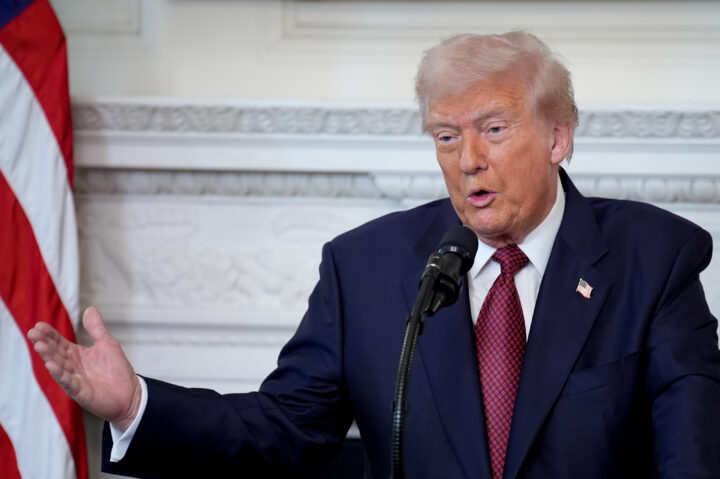
Yuri Gripas/Abaca/Bloomberg via Getty Images
US President Donald Trump during a breakfast with Senate Republicans in the State Dining Room of the White House in Washington, DC, US, on Wednesday, Nov. 5, 2025.
President Donald Trump’s recent executive order directing a review of Muslim Brotherhood chapters for potential terrorism designations is limited in scope, and leaves out scrutiny of Qatar and Turkey — a strategy that experts say reflects both legal realities and geopolitical constraints.
The order, which was signed on Nov. 24, directs Secretary of State Marco Rubio and Treasury Secretary Scott Bessent to identify which branches of the Muslim Brotherhood — with a focus on chapters in Jordan, Lebanon and Egypt — should be designated as Foreign Terrorist Organizations and which should be deemed Specially Designated Global Terrorists.
Rather than apply a terrorist designation to the entire Muslim Brotherhood as a whole, Trump’s executive order first looks at individual branches. This strategy is echoed in a Senate bill, sponsored by Sen. Ted Cruz (R-TX), which requires an assessment of every branch of the Muslim Brotherhood in an effort to designate the organization for its involvement.
The House version of the legislation was modified in committee last week and now more closely resembles the Trump executive order.
Michael Jacobson, a senior fellow at The Washington Institute for Near East Policy, said the approach “makes sense,” adding that a “one-size-fits-all” designation would be unproductive. He also noted that it will allow the administration to more effectively pursue chapters of the organization.
“The bottom-up approach will allow the administration to proceed in a more strategic and calculated fashion,” said Jacobson. “Targeting individual chapters and entities could also open up additional avenues for investigation and action. Once individual branches are designated, the Treasury could then use its authorities to sanction those supporting these branches. I believe that this approach is also more likely to gain support from other governments.”
This same sentiment was echoed by Cruz, who called the “bottom-up” approach the “correct and sustainable strategy.”
“That strategy is built into both the president’s executive order, which was a bold and critical breakthrough in advancing American national security, and my bipartisan legislation,” Cruz told Jewish Insider. “It’s the consensus strategy, and it’s the right one.”
David Adesnik, vice president of research at the Foundation for Defense of Democracies, told JI that while a single designation done in “one fell swoop” might be appealing, it faces legal and factual challenges.
“The administration was rightly concerned that a judge could overturn a designation of the entire organization if he or she assessed that it didn’t meet the legal thresholds. This would have serious consequences in several respects,” said Michael Jacobson, a senior fellow at The Washington Institute for Near East Policy. “If a judge ruled against a Muslim Brotherhood ban, it would be interpreted by some as a signal that the MB is not a terrorist organization, end of story — also a message the administration was likely eager to avoid.”
“This is not a single unified organization,” said Adesnik. “There’s no headquarters, no address, no person who is the head. It’s very hard to make a terror designation if you’re not exactly sure who you’re designating.”
Jacobson said the administration also looked to avoid a blanket designation out of concern that any legal challenges that followed could hurt efforts to reign in the Muslim Brotherhood.
“The administration was rightly concerned that a judge could overturn a designation of the entire organization if he or she assessed that it didn’t meet the legal thresholds. This would have serious consequences in several respects,” said Jacobson. “If a judge ruled against a Muslim Brotherhood ban, it would be interpreted by some as a signal that the MB is not a terrorist organization, end of story — also a message the administration was likely eager to avoid.”
Some critics of the executive order, including far-right influencer Laura Loomer, who is a confidant of the president, have expressed frustration over the administration’s decision not to name Qatar and Turkey in the order.
“The Muslim Brotherhood designation signed by President Trump today doesn’t have any teeth,” Loomer posted on X on Nov. 24. “This designation is probably the weakest designation of the Muslim Brotherhood we could have ever received, as it doesn’t even apply to Qatar and Turkey.”
Both Qatar and Turkey have strengthened ties with the United States during Trump’s second term, however the two countries are also significant supporters of the Muslim Brotherhood and have been known to provide sanctuary for their members.
“Claiming to get tough on the Muslim Brotherhood without a serious strategy to clamp down on the support provided by the movement’s most important state sponsors in Qatar and Turkey is not a serious policy,” said John Hannah, a senior fellow at the Jewish Institute for National Security of America. “Out of consideration for America’s longstanding partnerships with both countries and President Trump’s particular affinity for their leaders, one hopes that there is a plan to bring real pressure to bear on both Doha and Ankara in private to cease and desist their wide-ranging support for MB affiliates across the Middle East and globally.”
But while Qatar and Turkey’s ties to the Muslim Brotherhood are problematic, experts said they were not included because they do not currently have chapters of the organization in their countries, which the executive order focuses on.
“If we’re targeting chapters of the Brotherhood, there are no Brotherhood chapters in those countries,” said Adesnik. “So the real question is, how do you deal with what are effectively state sponsors of the Brotherhood? And does that state sponsorship cross the line into terrorism or sponsorship of terrorism?”
The Senate bill also does not address how Turkey and Qatar would be targeted as state sponsors of the organization.
However, experts and legislators remain wary of the threat posed by the two nations and have expressed that plans to root out the Muslim Brotherhood should account for Turkey and Qatar.
“Claiming to get tough on the Muslim Brotherhood without a serious strategy to clamp down on the support provided by the movement’s most important state sponsors in Qatar and Turkey is not a serious policy,” said John Hannah, a senior fellow at the Jewish Institute for National Security of America. “Out of consideration for America’s longstanding partnerships with both countries and President Trump’s particular affinity for their leaders, one hopes that there is a plan to bring real pressure to bear on both Doha and Ankara in private to cease and desist their wide-ranging support for MB affiliates across the Middle East and globally.”
With the current executive order, the White House is seeking to first designate branches in countries that experts said are involved in violence from within the country. This will also likely include entities that finance other Foreign Terrorist Organizations, according to Jacobson.
In Jordan, Lebanon and Egypt, threats connected to the Muslim Brotherhood have become national issues of concern.
“The Islamic Group [Muslim Brotherhood chapter in Lebanon] clearly built up the ability to carry out attacks against Israel and cooperated very openly with Hezbollah,” said David Adesnik, vice president of research at the Foundation for Defense of Democracies. “Authorities there really aren’t doing anything about it, partly because they lack power and have other issues to address. So it’s a pretty fair point.”
In April 2025, Jordanian authorities arrested 16 individuals and thwarted a plot that was to involve rocket and drone attacks inside the country. The suspects were linked to the Muslim Brotherhood, which is the government’s largest opposition group. Following the arrests, the Jordanian government banned the group entirely.
Adesnik said that while Jordan has initiated a “thorough crackdown” to address the problem, it is notable that there was “clearly a branch that had migrated toward planning for terrorism.”
In Lebanon, he called the Muslim Brotherhood a “persistent issue.”
“The Islamic Group [Muslim Brotherhood chapter in Lebanon] pretty openly built up a capability to carry out attacks against Israel and cooperated very clearly and openly with Hezbollah,” said Adesnik. “Authorities there really aren’t doing anything about it, in part because they don’t have a lot of power and they have a lot of other problems to deal with. So it’s a pretty reasonable case.”
Adesnik called the administration’s targeting of Egypt the “thorniest case from a definitional perspective.” He noted that while Egyptian President Abdel Fattah el-Sissi’s regime in Cairo has spent more than a decade cracking down on the Brotherhood “aggressively,” concerns still remain over the presence of branches such as Harakat Sawa’d Misr, also known as Hasm, which was already designated by the U.S. as a Specially Designated Global Terrorist Entity in 2018.
“The question is just what’s left of the Brotherhood there?” said Adesnik. “Is it doing enough to merit a designation?”
‘The version approved by the House Foreign Affairs Committee lacks the teeth of the original House bill as well as the current legislation in the Senate,’ an official at a pro-Israel group said

Getty Images
U.S. Capitol Building
The House Foreign Affairs Committee removed key provisions of a bill designed to designate the Muslim Brotherhood as a terrorist organization when it approved the legislation last week, prompting concerns from some conservatives.
The bill was amended by a voice vote to strip out provisions mandating the designation of eligible Muslim Brotherhood branches and the entire Muslim Brotherhood as terrorist organizations, including backing from the committee’s chairman, Rep. Brian Mast (R-FL).
The original legislation, introduced in both the House and Senate, included language requiring that the secretary of state assess each branch of the Muslim Brotherhood and report to Congress on whether those branches meet the criteria for designation as a terrorist group under either of two authorities.
It then mandated that the administration designate those branches that meet the criteria as terrorist groups and impose sanctions pursuant to those designations, and required that those sanctions remain in place for at least four years. It would also impose sanctions on the entire Muslim Brotherhood.
The amended legislation mandates only the assessment of Muslim Brotherhood chapters “that pose a threat to United States national security interests,” rather than all branches of the group — potentially allowing some branches of the group to duck scrutiny — and requires a report to Congress on whether those branches “ha[ve] been designated” as terrorist groups. Most significantly, it removes the specific mandate that the branches in question and the full Muslim Brotherhood be designated as terrorist groups and sanctioned pursuant to the findings of that report.
In effect, the changes remove key provisions that made the legislation broader than an executive order issued by the Trump administration last month, which authorized the designation of certain Muslim Brotherhood branches as terrorist organizations, but did not mandate an assessment of all branches for terrorist activity or require that the entire organization be designated and sanctioned.
“The bill reported out of committee codifies the Trump administration’s bold efforts to counter the Muslim Brotherhood,” a House Foreign Affairs Committee spokesperson told Jewish Insider, when asked about the changes.
“This is one part of a broader process to work directly with the administration as they advance towards imposing a full designation. There should be no question about House Foreign Affairs Committee Republicans’ commitment to hold terrorist groups accountable, and we are in lockstep with the administration in doing so.”
A spokesperson for Rep. Mario Diaz-Balart (R-FL), the lead Republican sponsor of the bill, said he is “thrilled the bill made its way out of committee and is grateful to Chairman Mast for providing that opportunity,” adding that discrepancies between final House and Senate legislation would need to be worked through in a conference committee. “We look forward to engaging throughout the process,” the spokesperson added.
An official at a pro-Israel organization, reflecting concerns about the amended legislation among some conservatives, said that the legislation should be stronger.
“While the legislation is still a step in the right direction, the version approved by the House Foreign Affairs Committee lacks the teeth of the original House bill as well as the current legislation in the Senate put forward by Senator [Ted] Cruz,” the official told JI.
“President Trump has been crystal clear about the threat posed by the Muslim Brotherhood. When President Trump says that we will not tolerate those who fuel and fund radical terrorism, it should be backed up with the strongest possible legislation that will cement his legacy on this issue.”
The legislation, set for a vote on Wednesday, intends to designate the entire Muslim Brotherhood globally as a terrorist organization, as opposed to other efforts which focus on its branches

Kevin Carter/Getty Images
U.S. Capitol Building on January 18, 2025 in Washington, DC.
Just over a week after the Trump administration announced moves to designate branches of the Muslim Brotherhood as terrorist organizations, the House Foreign Affairs Committee is set to discuss and vote on legislation that aims to classify the entire organization globally as a terrorist group on Wednesday.
The bipartisan House legislation, led by Reps. Mario Diaz-Balart (R-FL) and Jared Moskowitz (D-FL), would instruct the Department of State to assess whether each branch of the Muslim Brotherhood operating globally meets the requirements for designation as a terrorist group. It would then use those determinations to designate the Muslim Brotherhood as a terrorist group in its entirety.
The legislation may go further than the current executive action on the issue, which does not specifically mandate assessments of each Muslim Brotherhood branch and does not directly aim to proscribe the entire Muslim Brotherhood.
Some analysts have raised concerns that the executive branch action does not directly target the Muslim Brotherhood branches in Qatar and Turkey, as it names only the branches in Lebanon, Jordan and Egypt.
But others have argued that designating the entire Muslim Brotherhood as a terrorist group is legally and logistically problematic, given that the group does not have any central organization or leadership and that some Muslim Brotherhood branches are not directly tied to terrorism.
Rep. Brian Mast (R-FL), the committee chairman, told Jewish Insider prior to the administration’s announcement that the committee was looking to take up legislation on the issue.
Companion legislation in the Senate led by Sen. Ted Cruz (R-TX) has not yet been scheduled for a markup.
In addition to the Muslim Brotherhood bill, the Foreign Affairs Committee will vote on legislation — led by Reps. Darrell Issa (R-CA), Brad Sherman (D-CA), Mike Lawler (R-NY), Brad Schneider (D-IL), Bill Keating (D-MA) and Moskowitz — to impose sanctions on the Houthis and their members under the Global Magnitsky Act and the Robert Levinson Hostage Taking and Accountability Act in response to the group’s obstruction of humanitarian aid, human rights violations and involvement in taking U.S. nationals hostage.
The sanctions would phase out after five years, and the legislation would also require reports to Congress on Houthi indoctrination efforts, obstruction of humanitarian aid and human rights violations.
The Committee is also set to discuss the Protecting Europe from Antisemitic Crime and Extremism (PEACE) Act, led by Reps. Randy Fine (R-FL) and Max Miller (R-OH), which instructs the State Department to diplomatically engage with European governments to address antisemitism in their countries and to consult with Congress on the issue.
It will additionally consider a bill by Fine and Moskowitz that aims to harmonize various U.S. sanctions lists, instructing the administration to assess whether individuals included on some designation lists should be sanctioned under other authorities as well, and to report to Congress on those determinations.
There are several new consensus issues for American Jews, with community leaders highlighting that tackling the increase in antisemitism remains a central and unifying concern
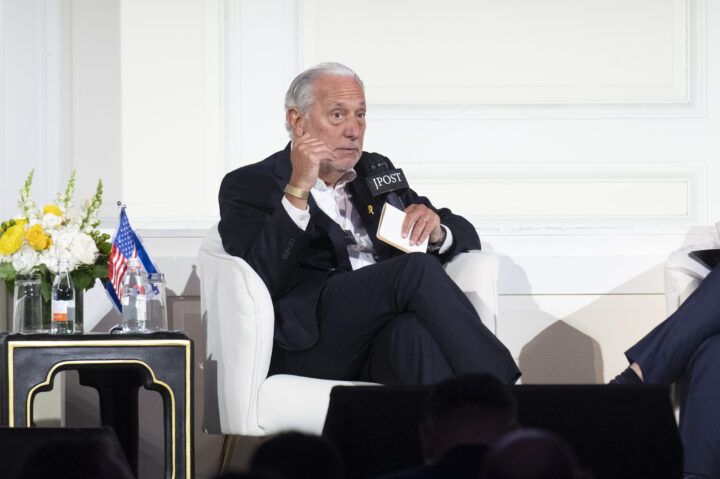
Noam Galai/Getty Images
Eric Fingerhut speaks during The Jerusalem Post New York conference on June 03, 2024 in New York City.
For more than two years, Jewish communities around the country — despite deep rifts over Israel’s prosecution of the war in Gaza — demonstrated a historic united effort to bring home the hostages kidnapped by Hamas during the Oct. 7, 2023, terrorist attacks. In cities coast to coast, Jewish individuals and groups across different denominations, political affiliations and ages gathered together for rallies, fundraisers and walks, voicing a singular message: “Bring Them Home Now.”
The efforts culminated last month with the release of the remaining living hostages and a ceasefire in the Israel-Hamas war. But heads of leading Jewish organizations say the work is not done and there are several new consensus issues for American Jews, with many echoing that tackling the increase in antisemitism remains a central and unifying concern.
“Helping to rebuild Israel, continuing to secure our communities and leaning into a surge in Jewish life” that sparked new energy in the community in the wake of Oct. 7 are the next issues Jewish federations nationwide are addressing, Eric Fingerhut, CEO of Jewish Federations of North America, told Jewish Insider.
“We all understand that there are serious and long-term issues related to the war in Israel, both related to trauma and mental health issues that have arisen, all of the rebuilding that is needed and support to those who fought and bereaved families,” said Fingerhut.
“The toxic combination of rising security threats and antisemitism remain a top priority. We still have work to do to make sure our communities are fully secure,” he continued. An October JFNA and Anti-Defamation League survey found that more than half of all Jewish Americans experienced at least one form of antisemitism in the past year; 14% have developed exit plans to flee the U.S. if the situation worsens.
Additionally, Fingerhut said the “significant rise and interest in Jewish life” that was fueled by Oct. 7, which JFNA termed “The Surge,” is here to stay. An April survey conducted by JFNA found that while the increased engagement that was documented in the months following the attacks has ebbed over the past year, it remains relatively high, with roughly a third of the respondents — 31% — saying that they are engaging more with the Jewish community than they did in the past, compared to 42% who said so last year.
“There are great opportunities to increase the number of people engaged in Jewish life and education, [including] restarting travel to Israel fully,” Fingerhut told JI.
Even while some donors and Jewish professionals are increasingly facing burnout, Fingerhut said “the level of engagement is very high.”
“We’ve seen growth across the Jewish federations system,” he continued. “Campaigns are up in every community and there’s a high level of cooperation between all of the Jewish organizations working more closely together now than ever. I expect you’ll see lots of consensus and working together to address these issues.”
Jonathan Greenblatt, CEO of the ADL, wrote in an eJewishPhilanthropy op-ed last month that “the existential crisis that the Jewish Diaspora has experienced over these last 24 months is not going away.”
“We will make no apologies for focusing ferociously on the safety of the Jewish community at a time when that safety is at risk,” wrote Greenblatt. “We will not shrink from the task of ensuring that America remains a place where Jewish people can live, work, worship and thrive openly and proudly. For those that perpetrate antisemitism, spread anti-Zionism, discriminate against Jews, or attack our community in any way, we will use every tool at our disposal to stop you. We will push back in boardrooms, expose the issues in classrooms, and prosecute our case in courtrooms.”
Similarly, the American Jewish Committee told JI that consensus work will involve “the continued fight against antisemitism.”
“It is imperative that the community calls out antisemitism in all its forms — whether it comes from the far left or far right. AJC will continue working with leaders around the world and across the political spectrum, from local governments to heads of state, to recognize and confront this threat. We are also engaging with businesses and civil society in a multi-pronged approach that counters antisemitism from all angles. The surge of antisemitism that we are currently witnessing requires our community to band together. We cannot and will not succeed if we are not united in this fight,” the group said in a statement.
AJC, which launched a Center for a New Middle East in 2024, said it also plans to continue focusing on issues in the Middle East, including advocating for the release of the three deceased Israelis still held in Gaza.
“Expanding the Abraham Accords and the growing circle of peace remains a top priority for us,” the AJC added, noting that “in a post-war Middle East, the substance of the work changes, but our engagement with leaders throughout the region will continue to be a vital part of our work.”
Amy Spitalnick, CEO of the Jewish Council for Public Affairs, told JI that “the vast majority of American Jews have deep concerns about rising antisemitism and broader threats to our democracy — including the false choice between Jewish safety and democracy offered by extreme voices on both ends of the political spectrum.”
“Our institutions and leaders can all rally behind the recognition that there is no Jewish safety when our democratic norms and the rule of law are threatened, just as there is no democracy without real Jewish safety,” said Spitalnick.
Aya Shechter, chief programming officer of the Israeli-American Council, echoed an “intense focus” on combating antisemitism, in a statement to JI, adding that the group plans to also “strengthen civic engagement and cultivate Jewish identity.”
Among the 306 American plaintiffs are the families of Israeli Americans Hersh Goldberg-Polin and Itay Chen
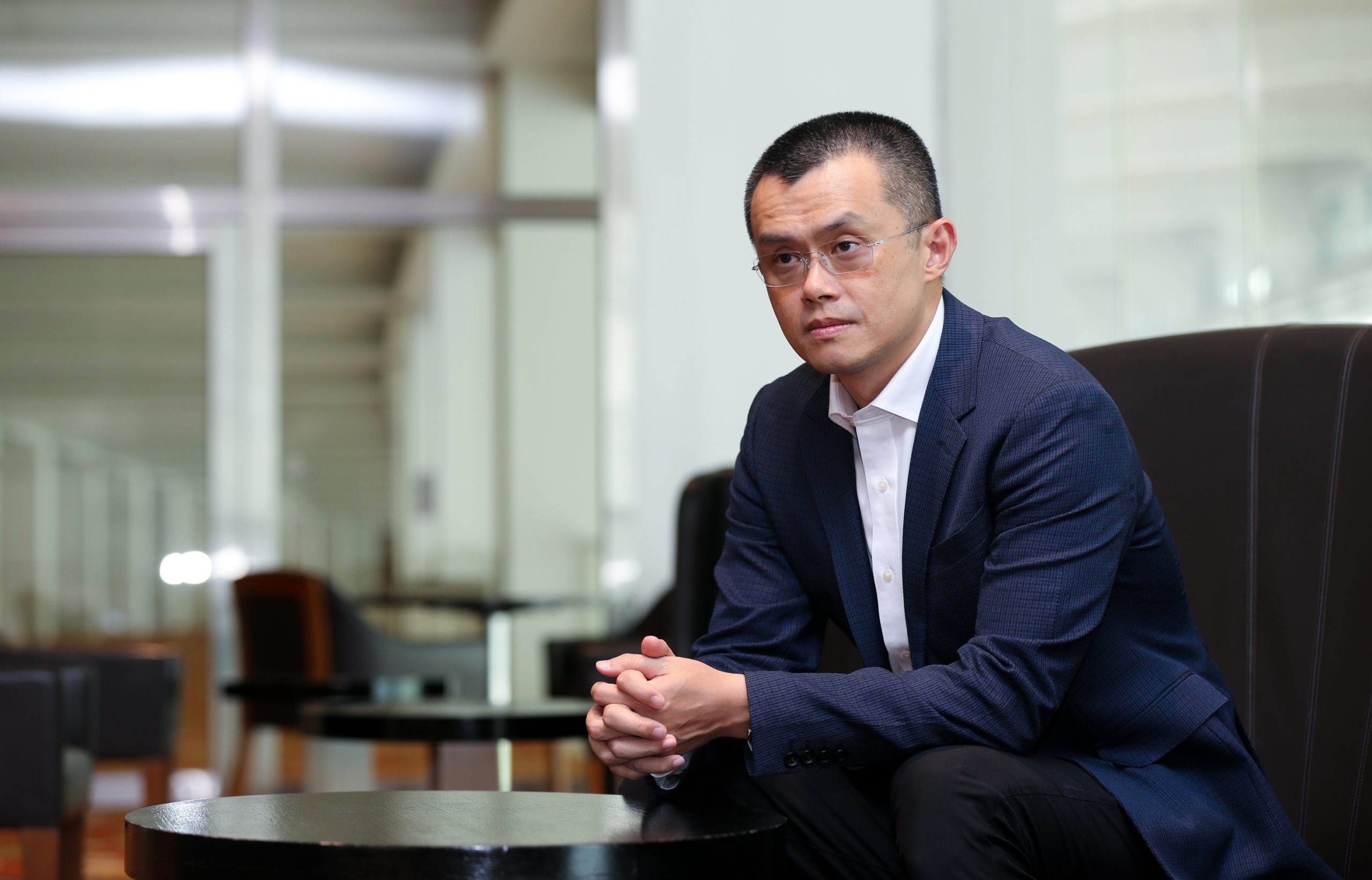
Singapore Press via AP Images
Binance founder and CEO Zhao Changpeng on July 12, 2021.
A new federal lawsuit filed on behalf of families of victims of Hamas’ Oct. 7, 2023, attacks accuses the crypto giant Binance of knowingly facilitating the transfer of hundreds of millions of dollars to U.S.-designated foreign terror organizations on an “industrial scale,” helping contribute to the deadly incursion in Israel that killed around 1,200 people and took more than 250 hostages.
According to the complaint, Binance, the world’s largest cryptocurrency exchange, “deliberately” failed “to monitor inbound funds” to such terror groups as Hamas, Hezbollah, Palestinian Islamic Jihad and the Islamic Revolutionary Guard Corps, ensuring “that terrorists and other criminals could deposit and shuffle enormous sums on the exchange with impunity.”
“Moreover, when specific customers were designated or particular accounts were subject to seizure orders, Binance allowed those customers and accounts to shift the assets into other Binance accounts, thus negating the effect of any ‘blocking’ or ‘seizing’ of the account,” the complaint states.
Such a policy “demonstrates Binance’s deliberate and conscious effort to enable users to operate on the Binance platform and clearly helps facilitate financial crime on an industrial scale,” the filing adds.
Among the 306 American plaintiffs are the families of Hersh Goldberg-Polin, an Israeli-American hostage murdered by Hamas in Gaza; Itay Chen, an Israeli-American IDF soldier whose body was returned to Israel this month; Eyal Waldman, an Israeli philanthropist whose U.S.-born daughter, Danielle, was killed at the Nova music festival during the Oct. 7 attacks; and Yechiel Leiter, the Israeli ambassador to the U.S.
“The lawsuit details how Binance knowingly facilitated the transfer of hundreds of millions of dollars between 2021 and 2023 that helped enable the terrorist organizations responsible for the Oct. 7 attacks,” Gary Osen, an attorney representing the plaintiffs who specializes in civil terror cases, said in a statement to Jewish Insider. “One of our goals is to cast a public spotlight on specific ways in which the Binance platform has been used by Iran, Hezbollah and Hamas to finance terrorism.”
The 284-page complaint, filed Monday in U.S. District Court for the District of North Dakota under the Anti-Terrorism Act, targets Binance as well as its founder and former CEO, Changpeng Zhao, and Guangying Chen, a close associate of Zhao whom the lawsuit identifies as the crypto exchange’s “de facto chief financial officer.”
Zhao and Chen could not be reached for comment regarding the lawsuit.
A Binance spokesperson said the company “cannot comment on any ongoing litigation.”
“However, as a global crypto exchange, we comply fully with internationally recognized sanctions laws, consistent with other financial institutions. For context, the heads of the U.S.Treasury’s FinCEN and OFAC have confirmed that cryptocurrency is not widely used by Hamas terrorists,” the spokesperson told JI in a statement, referring to the Financial Crimes Enforcement Network and Office of Foreign Assets Control. “Most importantly, we hope for lasting peace in the region.”
The company’s “conduct was far more serious and pervasive than what the U.S. government disclosed during its 2023 criminal enforcement actions,” the complaint says, claiming that Binance “knowingly sent and received the equivalent of more than $1 billion to and from accounts and wallets controlled by the FTOs responsible for the Oct. 7 attacks.”
That figure, the filing states, vastly outnumbers a previous amount of more than $2,000 in known transactions for Hamas disclosed by the federal government in 2023.
In November 2023, Zhao pleaded guilty to money laundering charges and agreed to step down from his executive role. He served four months in federal prison and was pardoned last month by President Donald Trump. Binance itself also pleaded guilty to federal charges and paid over $4 billion in fines.
Last May, Binance participated in a $2 billion business deal with World Liberty Financial, a new crypto company founded by the families of Trump and Steve Witkoff, the president’s special envoy.
“To this day,” the complaint states, “there is no indication that Binance has meaningfully altered its core business model.”
Citing a complex forensic money laundering analysis, the lawsuit identifies a wide range of Binance accounts with alleged terror links and spanning multiple locales, including Venezuela, Gaza, Lebanon and even North Dakota, where an account connected to Hamas was accessed several times from a small city outside Fargo.
The suit refers to Gaza money exchanges, a gold smuggling operation in South America with ties to Hezbollah and a purported Venezuelan livestock entrepreneur allegedly moving millions of dollars for known terror organizations in the Middle East, among other illicit transactions.
“Every tunnel, every missile, every bullet, every attack is paid for by someone,” Izhar Shay, a plaintiff whose son Yaron died defending Kibbutz Kerem Shalom in Israel on Oct. 7, said in a statement shared with JI. “Companies like Binance cannot keep profiting if they enable terrorists to operate in the shadows. This case is about making sure that those who enabled Hamas’ evil are held to account.”
Netanyahu vows Israel will not allow the terror group to rebuild; Hezbollah official says the leadership is assessing its response

Scott Peterson/Getty Images
Hezbollah members and Lebanese Army soldiers secure the location and clear away debris after a deadly Israeli strike on an apartment building on November 23, 2025 in Beirut, Lebanon.
Amid indications that Hezbollah is rearming itself, Israel assassinated a top official of the Lebanese terrorist group in an airstrike on Sunday in Beirut. The strike, which killed Haytham Ali Tabatabai, the group’s chief of staff, was the first such attack in the Lebanese capital in five months and part of a recent escalation in Israeli strikes to blunt Hezbollah’s rebuilding.
Tabatabai served as Hezbollah’s chief of staff for the last year, when a ceasefire agreement was reached between Israel and Lebanon, according to the Israel Defense Forces. Before that, the army said, Tabatabai oversaw Hezbollah’s combat operations against Israel and had held a series of senior positions since he joined the group in the 1980s, including commander of the Radwan Force unit and head of Hezbollah’s operations in Syria.
“Tabatabai is a mass murderer,” Israeli Prime Minister Benjamin Netanyahu said in a statement on Sunday evening.
“His hands are soaked in the blood of many Israelis and Americans, and it is not for nothing that the U.S. put a bounty of five million dollars on his head,” Netanyahu said, in reference to a 2016 decision designating Tabatabai as a Specially Designated Global Terrorist.
“Tabatabai served as a senior commander in the Radwan Force. This is the force that prepared to conquer the Galilee and slaughter many of our citizens,” Netanyahu added. “Recently, he led Hezbollah’s renewed efforts to rearm, this is of course after the heavy blows Hezbollah suffered in the ‘Pager Operation,’ in the damage to its missile stockpiles, and of course, in the elimination of [Hezbollah Secretary-General Hassan] Nasrallah,” the prime minister said, stressing that Israel would not allow the group to rebuild and calling on the Lebanese government to “fulfill its commitment to disarm Hezbollah.”
Israel reportedly did not notify the U.S. in advance of the strike.
The strike killed five people and wounded 25 others, according to Lebanon’s Health Ministry.
Lebanese President Joseph Aoun condemned the strike and called on the international community to intervene “to stop the attacks on Lebanon and its people.”
The Israeli army said in its statement that it “will act against efforts to rebuild and rearm the Hezbollah terrorist organization and will operate to remove any threat posed to Israeli civilians,” adding that it “remains committed to the understandings reached between the State of Israel and Lebanon.”
“Hezbollah’s leadership is studying the matter of response and will take the appropriate decision,” Mahmoud Qamati, deputy chair of Hezbollah’s political council, told reporters, according to the Associated Press.
Israeli intelligence officials told Haaretz they believe that Hezbollah may retaliate with attacks on Jewish, Israeli or Israeli-linked targets in foreign countries, rather than directly attacking Israel.
Legislation that would ban the group has received bipartisan support in both the House and Senate
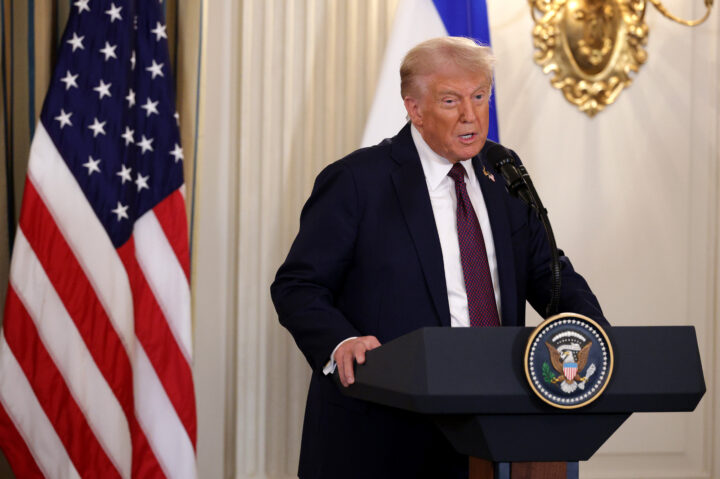
Alex Wong/Getty Images
U.S. President Donald Trump delivers remarks at the White House on September 29, 2025 in Washington, DC.
President Donald Trump announced on Sunday that he plans to designate the Muslim Brotherhood as a Foreign Terrorist Organization following months of bipartisan calls for his administration to target the group.
Trump announced the move in an interview with journalist John Solomon of the conservative outlet Just the News on Sunday morning, saying that an executive order is being prepared for his signature.
“It will be done in the strongest and most powerful terms,” Trump said. “Final documents are being drawn.”
The White House did not respond to Jewish Insider’s request for comment on the announcement or details of the order being drafted for the president.
Trump considered designating the Brotherhood as a Foreign Terrorist Organization (FTO) during his first administration, though that effort never materialized. Sebastian Gorka, who serves as Trump’s deputy assistant for national security affairs and senior director for counterterrorism at the National Security Council, has been publicly and privately urging the president to do so since returning to office, as have a chorus of GOP lawmakers, along with a handful of Democrats in Congress.
Gorka posted on X on Sunday that the “time has come” to designate the group, which he called “the progenitor of all modern Jihadist terror groups, from al Qaeda to HAMAS.”
A Senate bill that would designate the Muslim Brotherhood as a terrorist group, led by Sen. Ted Cruz (R-TX), has 11 co-sponsors, including Sen. Tom Cotton (R-AR), Sen. Rick Scott (R-FL), Sen. Dave McCormick (R-PA) and Sen. John Fetterman (D-PA). The House version of the bill has 19 co-sponsors, including four House Democrats.
Trump’s announcement comes less than a week after Texas Gov. Greg Abbott, a Republican, issued a declaration designating the Muslim Brotherhood and Council on American-Islamic Relations as foreign terrorist groups and transnational criminal organizations, a move prohibiting both groups from buying land in Texas and allowing the AG’s office to sue to shut them down.
Secretary of State Marco Rubio said in August that the FTO designation was “in the works” for the Brotherhood.
“Obviously, there are different branches of the Muslim Brotherhood, so you’d have to designate each one of them,” Rubio told right-wing talk show host Sid Rosenberg on his radio program at the time, adding that the State Department needed to go through a lengthy “process which I didn’t fully appreciate until I came into this job.”
News of Trump’s comments was met with praise in the U.S. and in Israel, even as the details are still fuzzy over what he will be signing.
Israeli Prime Minister Benjamin Netanyahu said on Sunday that he wanted to “commend President Trump on his decision to outlaw and designate the Muslim Brotherhood organization as a terrorist organization.”
“This is an organization that endangers stability throughout the Middle East and also beyond the Middle East. Therefore, the State of Israel has already outlawed part of the organization, and we are working to complete this action soon,” Netanyahu said.
The Institute for the Study of Global Antisemitism and Policy (ISGAP) released a statement commending “the fact that the threat posed by the Muslim Brotherhood’s ideology is now being taken seriously at the highest levels of the U.S. government.”
“We welcome President Trump’s statements and the growing recognition that the Muslim Brotherhood, its ideology and network pose a serious challenge to the United States and democratic societies,” Charles Asher Small, ISGAP’s executive director, said to Jewish Insider..
“A formal U.S. designation would represent an important first step to confront the Muslim Brotherhood in the United States,” Small added. “This will require sustained, evidence-based policy, serious scrutiny of its affiliated structures and funding streams, and long-term investment in democratic resilience.”
Dan Schlessinger, the lead attorney for the Boim family in their lawsuit against American Muslims for Palestine regarding the murder of American teenager David Boim in 1996, told JI in a statement: “This is welcome news for many including the Boim family. The next question is what does this mean for U.S.-based, Hamas adjacent groups like American Muslims for Palestine and Students for Justice in Palestine. Our hope is they will be included in this designation as well.”
Schlessinger and his team have accused AMP in court of acting as an “alter ego” of a now-defunct group that shut down after it was found to have provided support to Hamas.
One of its branches is banned for Hamas ties. The other sits in the Knesset
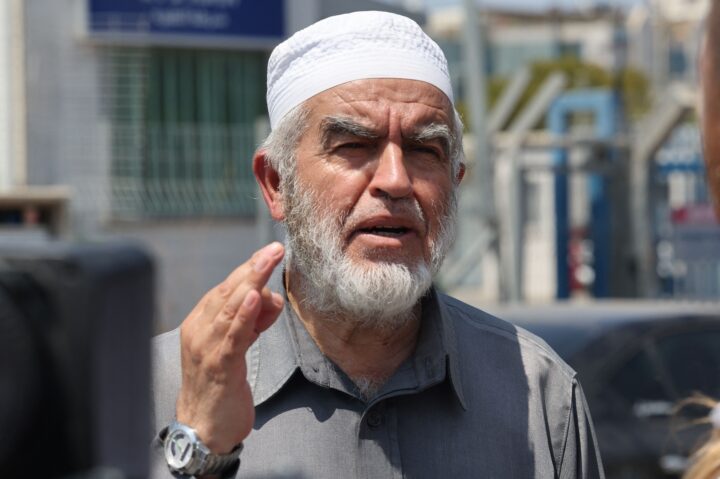
AHMAD GHARABLI/AFP via Getty Images
Sheikh Raed Salah, leader of the radical northern branch of the Islamic Movement in Israel, speaks on August 23, 2023, outside a police station during the funeral of the director-general of the Arab city of Tira in Israel, who was gunned down on August 21 evening.
While Congress is working on a bill to designate the Muslim Brotherhood a terrorist organization in the U.S., and the Islamist group is banned from Egypt, Syria, Saudi Arabia, the United Arab Emirates and beyond, the group’s status in Israel is much more complicated.
The matter drew renewed attention this week after Mansour Abbas, the leader of the Ra’am party in the Knesset, an ideological offshoot of the Muslim Brotherhood, declined to call for the eradication of Hamas on Israeli radio.
In an interview with Israeli public broadcaster KAN, Abbas mostly lamented the high rate of crime and gun violence in Israeli-Arab society, but when he mentioned Gaza, the interviewer, Asaf Liberman, asked whether he sees Hamas as part of the enclave’s future.
“Palestinian society needs to pick its leadership and go on a new path towards peace and reconciliation,” Abbas responded.
Liberman twice repeated his question and sharpened it: “Does Hamas need to be destroyed?”
Abbas added that an international force must enter Gaza and after an interim period a security force of the Palestinian Authority would be trained, but after being pressed to make his position on Hamas clear, he said the interview was beginning to feel like an “interrogation,” and pointed out that he had gone on air to talk about domestic issues facing Arab Israelis. “If you want to talk about crime, fine, if not, bye,” he said, before hanging up.
Abbas has previously condemned Hamas’ Oct. 7 attacks, calling them unjustifiable and inhumane, and called for the release of the hostages. The other reporter who conducted the interview, Suleiman Maswadeh, later noted that Abbas and his family had recently received death threats, and hinted that was the reason the Knesset member avoided repeating his previously articulated position — which Maswadeh said does not include a future for Hamas in the governance of Gaza.
In 2021, the Ra’am party became the first Arab party in 50 years to join an Israeli governing coalition, which was celebrated by many in Israel and abroad as a milestone for coexistence, while the Israeli right criticized the 2021-2022 government for what it characterized as working with the Muslim Brotherhood.
Monday’s interview sparked headlines and analysis in right-leaning Israeli media and comments by politicians on the right about the viability of center and left-wing parties once again forming a coalition with Ra’am to oust Prime Minister Benjamin Netanyahu, when Ra’am’s leader would not say that he is for eradicating Hamas.
“The Muslim Brotherhood is a very generic term,” said Michael Milshtein, head of the Palestinian Studies Forum at the Moshe Dayan Center at Tel Aviv University. “It’s not membership in an organization; it’s a denomination. Mansour Abbas is the Muslim Brotherhood. Raed Salah, his rival, is also the Muslim Brotherhood. Hamas is the Muslim Brotherhood. [Turkish President Recep Tayyip] Erdogan is the Muslim Brotherhood.”
The historic and recent connections between Hamas and Ra’am, both of which were founded by adherents of the Muslim Brotherhood, shed light on the nuances of the international Sunni Islamist movement and its status in Israel.
Michael Milshtein, head of the Palestinian Studies Forum at the Moshe Dayan Center at Tel Aviv University, emphasized, in an interview with Jewish Insider on Wednesday, that the Muslim Brotherhood is an ideology aiming to make Muslim societies more religious, and is not one centralized organization spanning the Muslim world.
“The Muslim Brotherhood is a very generic term,” Milshtein said. “It’s not membership in an organization; it’s a denomination. Mansour Abbas is the Muslim Brotherhood. Raed Salah, his rival, is also the Muslim Brotherhood. Hamas is the Muslim Brotherhood. [Turkish President Recep Tayyip] Erdogan is the Muslim Brotherhood.”
Muslim Brotherhood founder Hasan al-Banna’s brother, Abd al-Rahman al-Banna, founded the group’s branch in Mandatory Palestine in 1935; its leaders included Mufti of Jerusalem Hajj Amin al-Husseini, who incited the deadly Hebron riots against Jews in 1929 and collaborated with Hitler, and Izz al-Din al-Qassam, leader of the 1935 Arab Revolt against the British and namesake of Hamas’ short-range Qassam rockets.
Gaza-based Sheikh Ahmad Yasin formed the Muslim Brotherhood-inspired Hamas in the 1980s. Sheikh Abdullah Nimar Darwish founded the Islamic Movement in Israel in 1971, which also espoused Muslim Brotherhood ideology.
In 1979, Darwish founded an underground group in Israel called The Family of Jihad with a goal of establishing an Islamic state. However, after his arrest and conviction for involvement in killing an accused collaborator and membership of a terrorist organization, he renounced violence and decided to promote Islamism within the confines of Israeli law.
Fissures began in the Islamic Movement in Israel after the Oslo Accords, with the northern branch, led by Sheikh Raed Salah, opposing it, while the southern branch supported it. The two parts of the movement officially split when the southern branch ran for the Knesset in 1996 as Ra’am, and Salah advocated boycotting national elections.
The leaders of the northern branch were arrested in 2003 for aiding Hamas and in 2015, the branch was banned, after the police and Shin Bet demonstrated that it had close ties to Hamas and the Muslim Brotherhood, and received funds from groups affiliated with Hamas.
Darwish, however, continued to be the spiritual leader of the Islamic Movement’s southern branch and said he was committed to obeying the laws of Israel. He engaged in interfaith dialogue events, often with former Labor lawmaker Rabbi Michael Melchior, and spoke out against Holocaust denial.
While Islamic Movement Southern Branch leaders have met with Hamas leaders and taken part in mediation efforts between the Palestinian Authority and Hamas, in 2022, then-leader of Hamas Yahya Sinwar declared Mansour Abbas a traitor for joining the governing coalition and saying Israel is a Jewish state. Abbas has said that his decision to join the governing coalition in 2021 came from the values he “absorbed from the legacy of Sheikh Abdullah Nimr Darwish.”
As such, the more radical of the two major offshoots of the Muslim Brotherhood is outlawed in Israel.
Yet, more recently, the Islamic Movement Southern Branch has come under scrutiny for its own possible ties to Hamas.
In the decades since its establishment, the Islamic Movement has faced repeated crackdowns on its charities. The Islamic Relief Committee, founded in 1987 with the stated goal to help the needy in the West Bank and Gaza, was shut down by Israeli authorities in 1995 for aiding Hamas members’ families, the first in a series of such actions.
“Israel’s anti-terrorism law and the whole discipline has been to focus on specific organizations and declaring them as terrorist organizations because of their goals, because of the means that they use, rather than focusing on an idea, which the Muslim Brotherhood really is,” Lt.-Col. (res.) Maurice Hirsch, the former director of the IDF Prosecution for Judea and Samaria, told JI.
In July, the Israeli Justice Ministry unit dealing with nonprofit organizations found grounds to shut down “Aid 48,” a charity affiliated with Ra’am, on suspicion of providing funding to terrorist organizations. “Aid 48” is the Islamic Movement Southern Branch’s main charity. According to an investigation by the ministry, in 2020-2021, the organization transferred NIS 2 million to a charity in Hebron that Israel had declared in 2012 to be part of a terrorist organization; in 2023, “Aid 48” worked with three such Palestinian charities; in 2020, the organization gave NIS 933,000 to a Turkish organization run by Hamas members, which funneled money to the terrorist organization.
Lt.-Col. (res.) Maurice Hirsch, the former director of the IDF Prosecution for Judea and Samaria, currently the director of the Initiative for Palestinian Authority Accountability and Reform in the Jerusalem Center for Public Affairs, explained to JI that Israeli law makes it easier to crack down on smaller subgroups than an umbrella term like the Muslim Brotherhood.
“Israel’s anti-terrorism law and the whole discipline has been to focus on specific organizations and declaring them as terrorist organizations because of their goals, because of the means that they use, rather than focusing on an idea, which the Muslim Brotherhood really is,” he said on the sidelines of a JCFA conference last week.
In order to declare the Muslim Brotherhood a terrorist organization, “you have to break it down into intelligence,” Hirsch said, adding that the authorities would have to determine who they are seeking to arrest and what money and possibly weapons need to be seized.
Hirsch recounted taking part in the Israeli Security Cabinet meeting in 2015 when the government decided to outlaw the Islamic Movement Northern Branch.
“Some of the questions that were asked were, what is the next step? Who do we operate against now? It was a bit clearer than the entire Muslim Brotherhood, but even then there was a question,” he said.
“I would be very careful because, at its core, the Muslim Brotherhood is a movement that aims to change society. They have a lot of social organizations. It’s very different from Islamic Jihad or ISIS, who are not interested in social activism,” said Milshtein, adding that the Muslim Brotherhood ideology is up for interpretation by its adherents.
When it comes to the southern branch, Hirsch, who has worked with the “Choosing Life” organization of relatives of victims of terror whose lawsuit led to the shuttering of “Aid 48,” argued that “there is a clear connection between Ra’am and funding Hamas … That connection was there all along. It’s partly ideological and partly the idea of the Muslim Brotherhood in its different constellations, including in Israel.”
Milshtein acknowledged that there have been cases of leaders of “Aid 48” meeting with Hamas leaders and funding going to Hamas ahead of its invasion of Israel on Oct. 7, 2023, but said that Abbas “took care of” those responsible when he learned of the incidents.
“I would be very careful because, at its core, the Muslim Brotherhood is a movement that aims to change society. They have a lot of social organizations. It’s very different from Islamic Jihad or ISIS, who are not interested in social activism,” he said, adding that the Muslim Brotherhood ideology is up for interpretation by its adherents.
“If you ask Mansour Abbas, there is no problem with being part of the Muslim Brotherhood and part of the government in a state that defines itself as Jewish,” he said. “If you ask Hamas, they want jihad against Israel.”
The legislation would require the imposition of sanctions on the Muslim Brotherhood, making it illegal to provide support to the group
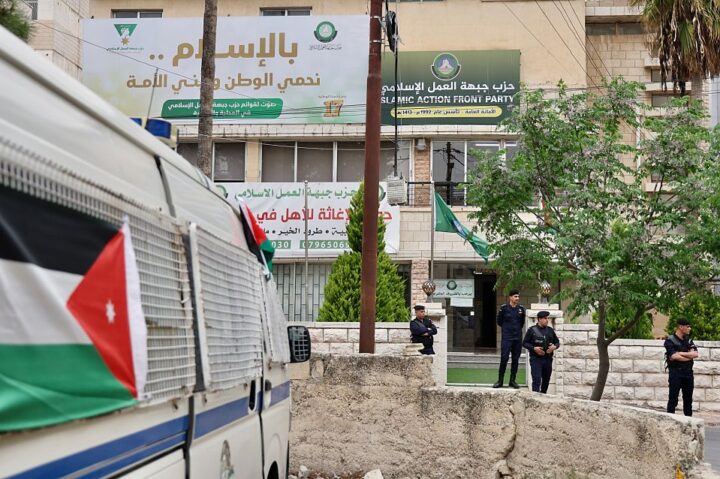
Salah Malkawi/Getty Images
Jordanian police close the entrance of a Muslim Brotherhood headquarter after the announcement of banning the society in the country on April 23, 2025 in Amman, Jordan.
The firebombing of a hostage-release march in Boulder, Colo., this summer triggered a wave of calls from lawmakers — particularly Republicans — for action to designate the Muslim Brotherhood as a terrorist organization, Jewish Insider’s Emily Jacobs and Marc Rod report.
Legislation to that effect was introduced in both the Senate and House in July, taking a new approach to designating the group as compared to previous legislative efforts that had stalled over the course of the last decade.
The legislation would require the imposition of sanctions on the Muslim Brotherhood, making it illegal to provide support to the group, making its members and affiliates inadmissible to the United States and blocking transactions involving assets held by Muslim Brotherhood members in U.S. financial institutions.
There were also calls from lawmakers on both sides of the aisle for the Trump administration to investigate the group and take action to designate it through executive authorities. The secretary of state has the authority to designate a group as a Foreign Terrorist Organization (FTO), and the White House could issue an executive order on the subject.
But so far, none of those efforts have come to fruition. The Senate bill currently sits at 11 co-sponsors, having recently picked up Sen. John Fetterman (D-PA) as its first Democratic supporter, while the House bill has 19 co-sponsors from both parties — below the levels of support previous iterations of the bill had amassed.
Fetterman’s co-sponsorship could help the bill receive consideration by the Senate Foreign Relations Committee, as the panel often only considers legislation with bipartisan support. A source familiar with the matter tells JI that Sen. Ted Cruz (R-TX), the bill’s co-sponsor in the Senate and a member of the committee, is pushing for the panel to mark up the bill at their next business meeting.
Neither bill has been called up yet for a vote in committee — a process further slowed by the ongoing government shutdown — and it is currently not included in either the Senate or House versions of the 2026 National Defense Authorization Act, a potential vehicle for legislation of this sort.
The White House declined to comment. A spokesperson for Cruz told JI: “Sen. Cruz is pushing for the bill to be advanced through the Senate Foreign Relations Committee, and then to be passed by the full Senate. Sen. Fetterman is showing commitment and leadership to American national security interests by providing this measure with bipartisan backing here in the Senate, and it’s time to move it forward.”
Sen. James Lankford (R-OK), who is not currently a co-sponsor of the Senate bill but is supportive of efforts to counter the Muslim Brotherhood, told JI on Wednesday that the issue is not top of mind for many colleagues and it will take time to build interest and support for moves like designating the group.
Richard Goldberg, a senior advisor at the Foundation for Defense of Democracies and a former Trump administration official, told JI that, within the executive branch, FTO designations are a time-consuming process — requiring extensive legal consultations as well as significant behind-the-scenes work to understand potential implications, unintended consequences and diplomatic fallout, as well as assembling a list of visa exemptions needed for diplomats.
Based on public comments from Secretary of State Marco Rubio and the National Security Council’s Sebastian Gorka indicating support for a terrorism designation, Goldberg said that he believes that there is momentum in the administration, further fueled by the election of Zohran Mamdani as mayor of New York City, anti-Israel protests around the country and evidence of growing Islamist influence on the far right as well. He said that the fact that no designation has been announced should not necessarily be read as a sign that it is not actively being worked on in private.
Goldberg also said that any action on the designation from Congress would likely be timed to coordinate with potentially pending action by the Trump administration, given the high-profile nature of the issue and the administration’s expressed interest.
One potential obstacle to the efforts: Qatar and Turkey, with which the administration has been strengthening ties. Both have extensive links to the Muslim Brotherhood and could be resistant to such a designation. Goldberg, however, said he has not heard any discussion of those countries actively trying to stop a designation, and urged the Trump administration to push forward, describing the Muslim Brotherhood as both a threat to homeland security and President Donald Trump’s desire for Middle East peace.
Al-Ansari praised the Second Intifada for its ‘martyrdom operations’ against the ‘Zionist enemy’

MAHMUD HAMS/AFP via Getty Images
Qatar's Foreign Mininstry spokesperson Majed al-Ansari looks on at a press conference during the 2025 Arab-Islamic emergency summit in Doha on September 15, 2025.
Majed al-Ansari, a Qatari Foreign Ministry spokesman and advisor to the prime minister, praised Palestinian suicide bombings and rocket attacks on Israeli civilian centers in social media and blog posts prior to taking up his post in 2022.
Al-Ansari is one of the Qatari government’s most public faces, hosting regular press briefings and giving interviews about the Gulf state, including to Israeli media.
In May 2021, when Palestinian Islamic Jihad launched 130 rockets at Israel, Al-Ansari posted his support on X, saying that “Palestine emerges to remind this nation of its glory and the greatness of its message.” Al-Ansari added the hashtag #Tel_Aviv_is_burning to his post.
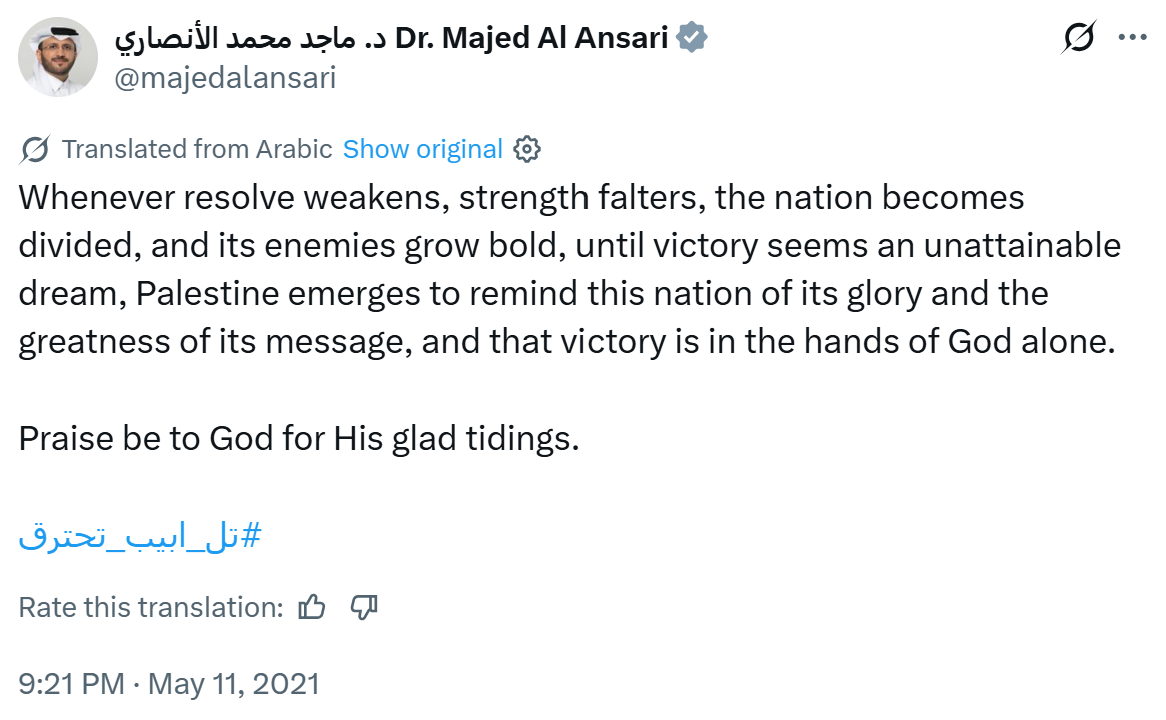
During the ensuing 11 days of fighting between Israel and Palestinian terrorists in Gaza and the West Bank, and rioting by Israeli Arabs in mixed Jewish-Arab cities in Israel, Al-Ansari posted: “Jerusalem, the interior [of Israel], the West Bank, Gaza … rise with one voice against the occupier. This unity is what terrifies the enemy the most. Oh Allah, unite their word and guide their aim.”
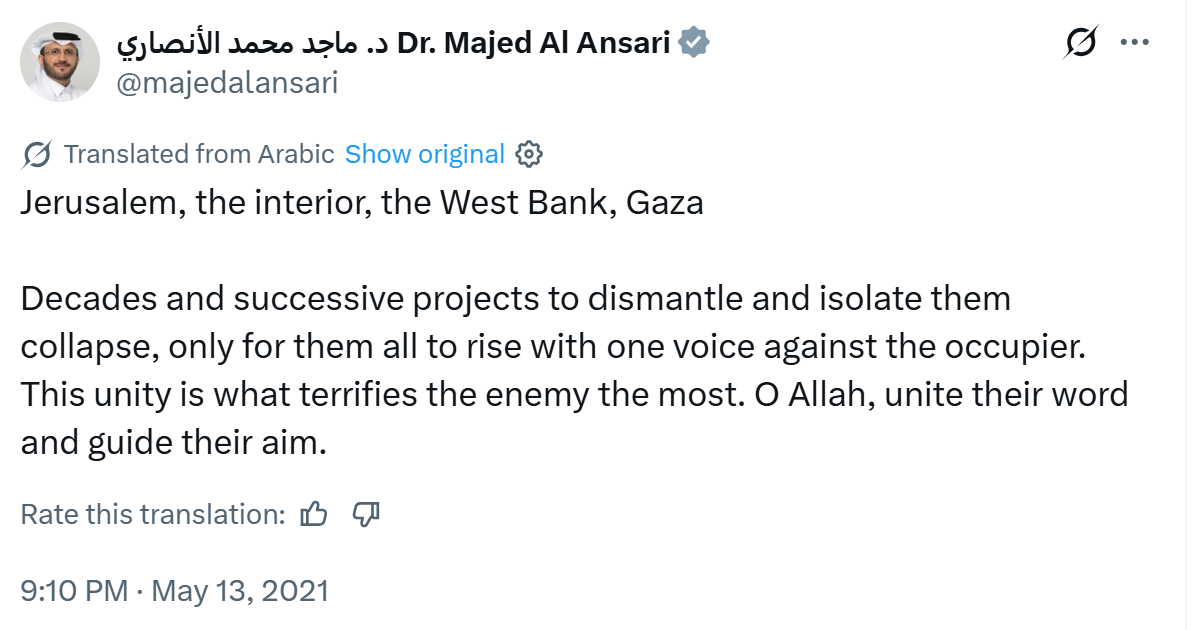
The posts were resurfaced by analyst Eitan Fischberger.
Al-Ansari also maintained a blog, which he linked to on his verified X account.
In one blog post, Al-Ansari praised the Second Intifada — the 2000-2005 Palestinian terror campaign — against the “Zionist enemy” and its “martyrdom operations,” a euphemism for terrorist attacks. He credited the intifada with leading Israel to pull out of Gaza in 2005.
In an overview of Palestinian terrorism against Israelis in recent decades, Al-Ansari argued that “the Israeli military losses were great, but the most important loss was Tel Aviv’s loss of a large part of its narrative and story of its victimhood in the West, following the spread of images of the brutal aggression throughout the world.”
Al-Ansari encouraged “a celebration of the continued march toward victory in the conflict,” praising what he described as the Palestinians’ advancement from “resistance with stones and bare chests [to] the launching of 3,000 rockets in ten days toward the entity’s [Israel’s] cities.”
In another blog post, in which Al-Ansari wrote about the Israeli Arab riots in May 2021, which included burning down Jewish-owned businesses and a synagogue, he falsely claimed that “the occupation forces were forced to withdraw” from Lod — a central Israeli city in which Ben Gurion Airport continued to operate normally and most neighborhoods continued to function peacefully.
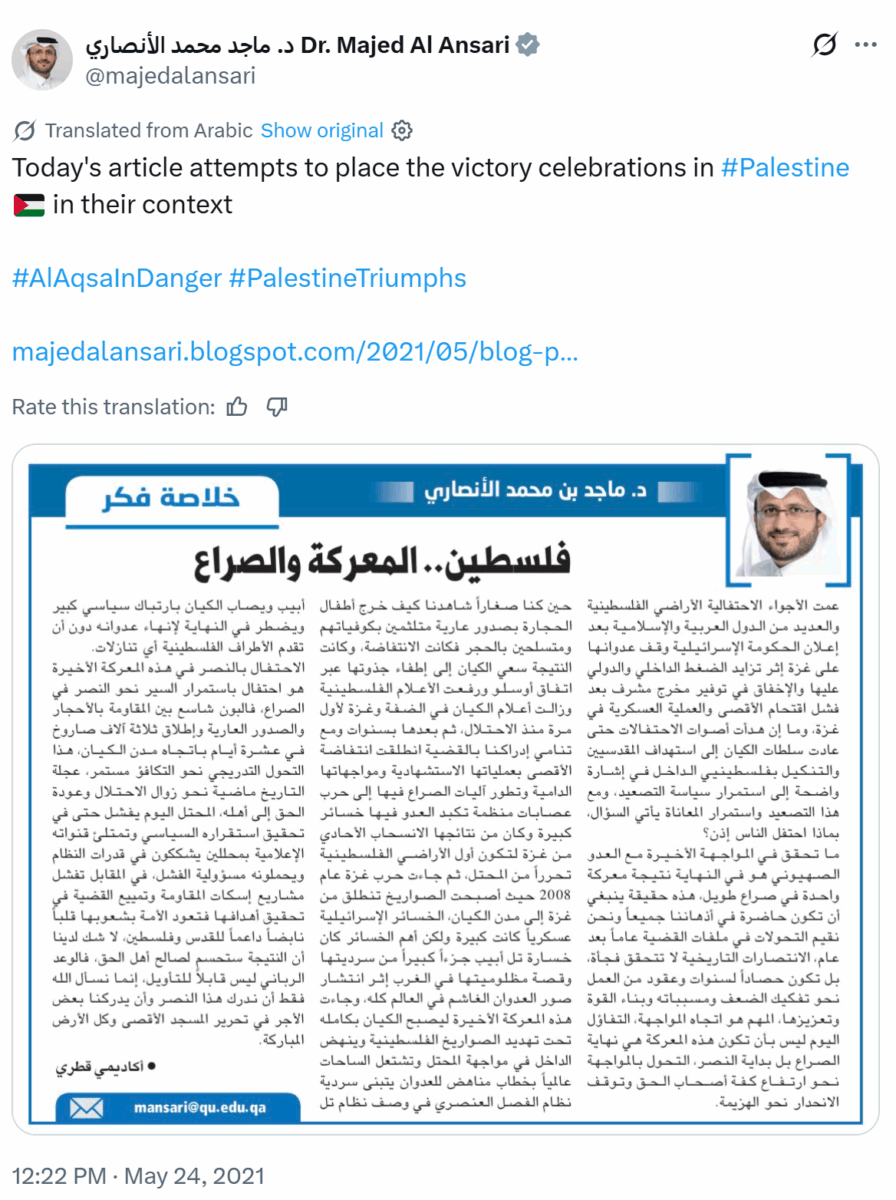
The blog and X posts were written when Al-Ansari was the head of the Qatar International Academy for Security Studies. The blog was deleted after Jewish Insider sent a request for comment about the matter to the Qatari Embassy, which the embassy did not respond to.
In earlier posts on an unverified Facebook account under Al-Ansari’s name, the Qatari spokesman repeatedly called President Donald Trump a racist.
In 2015, during Trump’s first presidential campaign, Al-Ansari wrote, “We call on the board of directors of Qatar Airways to cut ties with Trump and his racist empire.” Also that year, he lamented that the head of Qatar Airways “brags about his friendship with this racist.”
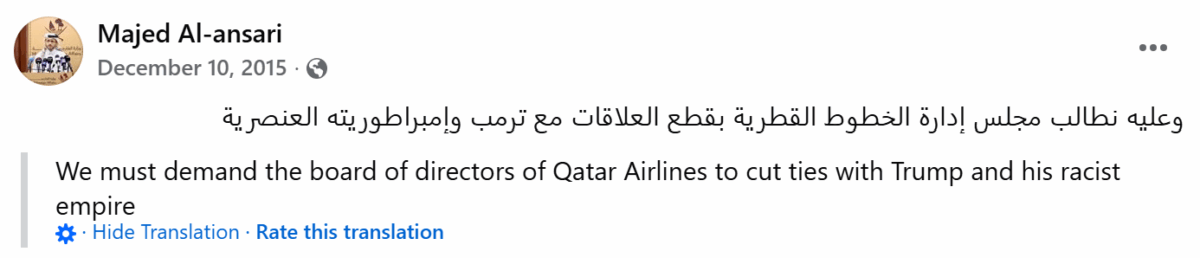

Israeli Justice Minister Yariv Levin threw his support behind legislation to allow for the formation of a special tribunal to prosecute Hamas terrorists who are part of the Nukhba, the terrorist group’s special forces unit

Knesset
MK Simcha Rothman (center)
The return of the final, living hostages to Israel last week has reopened discussion of putting the Palestinian perpetrators of the Oct. 7, 2023, atrocities in Israel on trial.
Israeli Justice Minister Yariv Levin threw his support behind legislation to allow for the formation of a special tribunal to prosecute Hamas terrorists who are part of the Nukhba, the terrorist group’s special forces unit, on charges of genocide, which carries the death penalty.
The bill is meant to “ensure that the legal process will be run efficiently and to ensure that justice will be done and seen,” Levin said in a joint statement with the bill’s sponsors, Knesset Law, Constitution and Justice Committee Chairman Simcha Rothman of the Religious Zionist Party and Yisrael Beytenu lawmaker Yuli Malinovsky. The group plans to bring the legislation to a first vote as soon as possible and usher it through the process “at the greatest speed, with a shared aim to bring the Nukhba terrorists to justice soon.”
Levin, Rothman and Malinovsky said that the office of the Israeli state attorney, the country’s chief prosecutor, has drafted indictments against Nukhba terrorists.
They noted that during the two years since the Hamas attacks on southern Israel, the State Attorney’s Office, police and Shin Bet have interrogated the Nukhba terrorists and collected evidence “of an unprecedented scope,” including thousands of hours of video of the atrocities and of testimony.
During that time, the Law, Constitution and Justice Committee held a series of meetings to examine possible ways to put the Nukhba terrorists on trial and ensure they are prosecuted to the full extent of the law.
“We met with the Justice Ministry once every few months,” Rothman told Jewish Insider. “Levin finally supports [the bill]. Every obstacle was standing in our way, and [Levin] didn’t make an effort to remove them. Now, there’s nothing preventing it from moving forward.”
The move toward putting Oct. 7 perpetrators on trial comes soon after the return of the living hostages, as well as weeks after a heated debate in the Knesset over instituting the death penalty for terrorists. The legislation’s explanatory portion says it is meant to “nip terrorism in the bud and create a heavy deterrent.”
The death penalty has only been carried out once in Israel’s history — following the conviction of senior Nazi official Adolf Eichmann for crimes against the Jewish people and crimes against humanity.
The bill, which applies to terrorists broadly, not only those who participated in the Oct. 7 attacks, was proposed by members of National Security Minister Itamar Ben-Gvir’s Otzma Yehudit Party and brought before the Knesset National Security Committee, chaired by Tzvika Foghel, also of Otzma. The Prime Minister’s Office asked Ben-Gvir to postpone the vote.
Gal Hirsch, the coordinator for the hostages, said in the committee meeting that Ben-Gvir’s effort was potentially harmful to the ongoing discussions to secure the release of the remaining hostages. Representatives from hostage families have also pleaded with the lawmakers to stop the proceedings, concerned that the moves could endanger their loved ones.
On Monday, Ben-Gvir made an ultimatum to Israeli Prime Minister Benjamin Netanyahu that either the death penalty bill passes a first Knesset vote in the next three weeks, or his party will no longer vote with the coalition.
“When terrorists remain alive, the terrorists outside are motivated to carry out kidnappings in order to free their Nazi brothers in future deals,” Ben-Gvir said. “If they murder a Jew, they do not stay alive.”
Rothman argued that his bill is significantly different from Ben-Gvir’s, and pointed out that he held a committee meeting the same week as the one that courted controversy, and neither Netanyahu nor Hirsch asked him to hold off.
“It’s a question of whether you want real results. [Otzma lawmakers] don’t understand what they’re dealing with. The law they want to pass [is so broad], I think it would end up giving a Jewish Israeli the death penalty first,” he remarked.
While Rothman said that having all of the living hostages home will help the Oct. 7 trials to move forward, when he asked senior defense figures over the last two years whether there was a risk to the hostages’ lives from his actions, “they said no. They said when there’s a conviction or maybe even an indictment, possibly, but just building the framework is not a risk.”
As such, Rothman said that though it may seem like a long time has passed, “the time hasn’t been a waste. A lot of material was collected and we oversaw the legislative and political decisions that needed to be made.”
Rothman and Malinovsky’s bill would establish a special tribunal for those who participated in the Oct. 7 attacks, with the proceedings made public. The legislation sets different rules for presenting evidence to protect the privacy of victims and their families, and to streamline the process of prosecuting large numbers of defendants. It also allows for non-Israeli judges to be appointed. In addition, it would establish a committee of representatives of Israel’s justice minister, defense minister and foreign minister to determine government policy as to whether to prosecute the Nukhba terrorists on genocide charges, which carry the death penalty, taking national security into consideration.
In a Knesset Law, Constitution and Justice Committee meeting on Wednesday, the first since Levin publicly supported the bill, Malinovsky said that she and Rothman “understand that it was difficult to gather evidence … and I know that law enforcement and the State Attorney’s Office overturned every stone to find evidence. [Regular] criminal justice proceedings do not have a response for the events of Oct. 7, therefore MK Rothman and I wrote this bill to regulate the jailing and prosecution of the terrorists who participated in the Oct. 7 massacre.”
Malinovsky said that there is difficulty tying specific terrorists to specific murders, and genocide is a collective crime, by which they can be charged as a group. In cases in which there is no evidence tying a terrorist to genocide, they can be tried in a military court as illegal fighters who committed acts of terror against Israel, a crime that carries a life sentence.
Much of the bill is focused on clear criteria for genocide charges.
“At first, the Justice Ministry said that genocide charges won’t work,” Rothman recalled earlier this week, “but today, I think they understand that they need to go there.”
The special tribunal is meant to prevent the Oct. 7 trials from getting caught up in the Israeli justice system’s significant backlog.
“It’s a lot of heavy cases that will block up the whole justice system” if the trials are in regular courts, Rothman explained.
In addition, he said, “I don’t want a situation where a judge is with the Nukhba in the morning and in the afternoon is dealing with an Israel who stole a car. We could end up lowering the standards of defendants’ rights in all of Israel. When we authorized preventing meetings [of terrorists] with lawyers, [judges] used it for all kinds of other cases, just because they can. We’re not going to allow that.”
Rothman said that the question of appointing foreign judges to the tribunal remains open, because it may be too complex. However, he said, “bringing a major jurist from the U.S. or somewhere else can give the trials an international imprimatur.”
Malinovsky said at the committee meeting that the Oct. 7 attacks “are like nothing else in the world, and I invite anyone who has knowledge to speak. We need creative solutions, outside of the box, and therefore we need a change of attitude, especially in the Justice Ministry.”
The manifesto, by masked individuals who disrupted an Oct. 7 commemoration event, called Zionism ‘a death cult that must be dealt with accordingly’

Genaro Molina/Los Angeles Times via Getty Images
Pomona College students march to Alexander Hall where 20 students were arrested during a sit-in at on Pomona Campus in Claremont on April 11, 2024.
An anonymous manifesto was sent on Wednesday to two Pomona College student-run newspapers by demonstrators who recently stormed a campus vigil for the second anniversary of Hamas’ Oct. 7, 2023, terrorist attacks. The emailed manifesto states that “Zionism is a death cult that must be dealt with accordingly.”
It was sent days after an on-campus event commemorating the Oct. 7 anniversary was disrupted by four masked and keffiyah-clad individuals who barged in chanting “Zionists not welcome here.” The memorial, sponsored by Hillel in a university building and scheduled on the Hebrew calendar anniversary of the attacks, featured a talk by Yoni Viloga, who survived the attack on his family’s home in Kibbutz Mefalsim.
The disruption, which also included chants of “Zionism is still a colonial ideology” and “You’re all complicit in genocide,” lasted about two minutes, until campus safety officers arrived.
The perpetrators of last week’s demonstration wrote in the manifesto that “Viloga served in the zionist occupational forces and is a settler on stolen land. Knowing this, we had to act.”
The communiqué included several antisemitic and threatening statements, such as, “this moment demands … making modern-nazis feel unwelcome, not just from these college campuses, but everywhere,” and said about the event that “Claremont Hillel and every single zionist in that room advance the genocide.”
A Pomona spokesperson told Jewish Insider, “The language we saw today is vile, threatening and highly disturbing. It has no place on our campus.”
The university responded to last week’s disruption by opening an investigation the following day. The spokesperson said about the incident that the university has “every intention of getting to the bottom of what happened. As part of this investigation, we are examining our security protocols, and reviewing security and other kinds of footage, with the intention of identifying and disciplining the individuals involved.”
While the liberal arts college in Claremont, Calif., has faced several anti-Israel demonstrations since the Oct. 7 attacks, last week’s protest was the first to occur in an expressly Jewish space on campus. It also came days after Israel and Hamas agreed to a ceasefire and hostage-release deal.
While added financial resources for more guards and extra security has been welcomed by the U.K.’s Jewish community, there remains considerable unease and hostility toward the government
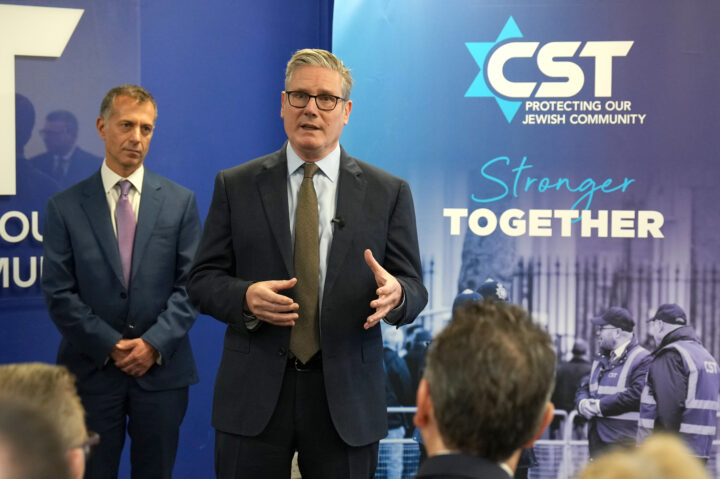
Carlos Jasso - WPA Pool/Getty Images
Britain's Prime Minister Keir Starmer speaks to members of the Jewish community at the Community Security Trust (CST) where they discussed the Government's response to the attack at the Heaton Park synagogue in Manchester on October 16, 2025 in London, England.
LONDON — Since the terrorist attack on a Manchester, England, synagogue on Yom Kippur that left two congregants dead, British politicians have redoubled their efforts to reassure the country’s Jewish community, which has been increasingly concerned about security issues amid widespread anti-Israel sentiment that has grown in the wake of the Oct. 7, 2023, Hamas terror attacks and ensuing war in Gaza.
British Prime Minister Keir Starmer promised to do “everything” in his power to protect the Jewish community, including the recent approval of £10 million ($13 million) in emergency funds to provide greater security.
But while the added financial resources for more guards and extra security has been welcomed by the U.K.’s Jewish community, there remains considerable unease and hostility toward the government, something that became starkly apparent the day after Yom Kippur.
When David Lammy, the country’s deputy prime minister, attended a vigil close to Heaton Park synagogue the day after the attack, he was booed and heckled with cries of “Shame on you” and “Blood on your hands.”
Lammy was foreign secretary when Britain said it intended to recognize a Palestinian state earlier this year. The move was formally announced by Starmer last month, alongside similar action taken by countries including France, Australia and Canada.
In his previous role, Lammy imposed restrictions on British arms sales to Israel and twice summoned Israel’s ambassador to the U.K. to criticize him over Israel’s handling of the Gaza war. Lammy and his parliamentary colleagues have also been criticized by the Jewish community for not doing enough to protect them by allowing hostile anti-Israel marches to proceed week after week in British cities.
“What David Lammy and his government have done has allowed this to happen,” Melanie, who asked only to be identified by her first name, told Jewish Insider. The 42-year-old nurse, who was among those who booed Lammy, attended the vigil with her husband and three children, all of whom attend a Jewish school close to the targeted synagogue.
The angry outburst included cries of “Go to Palestine, leave us alone,” and “You have allowed Jew hatred in Manchester.”
“What right did that man have to be there? That was probably the worst person they [the government] could have sent,” said Melanie. “I don’t know who made that decision but it was the wrong decision.”
As in many Western European countries, incidents of antisemitism in the U.K. have skyrocketed over the last two years. In its latest report, the Community Security Trust (CST), a charity that works towards Britain’s Jewish communal safety and monitors antisemitism, revealed that 1,521 antisemitic incidents were reported in the first half of 2025. This was the second highest level ever recorded for that period, just behind the same timeframe in 2024.
Among the incidents in recent months have been synagogues desecrated with excrement, the vandalism of a rabbi’s home with a swastika and an incident in which visibly Jewish teenagers were shot at with an air rifle.
Meanwhile last week, soccer club Aston Villa announced that it was banning fans of Maccabi Tel Aviv from attending a match at their stadium next month. The decision came after police in Birmingham, Britain’s second-largest city and home to a substantial Muslim population, warned it could not guarantee fans’ safety, leading the Israeli football club to announce on Monday that it would decline any tickets offered to its fans out of concern for their wellbeing and safety. The U.K. government said it was “deeply saddened” by Maccabi Tel Aviv’s decision.
Writing in The Guardian in the wake of the Manchester attack, Dave Rich, director of policy at CST, said, “Antisemitism has been allowed to rise in an unacceptable way for far too long. Last year’s official hate-crime statistics showed that a Jewish person in Britain was 12 times more likely to be the victim of a religious hate crime than someone from any other faith background. Calls for violence against Jews, or Israelis, or Zionists, online and on our streets, have become normalised in parts of our politics.”
The U.K.’s recognition of a Palestinian state was also met with concern over the message the move conveyed about the country’s priorities around the war in Gaza.
A survey of over 4,800 British Jews conducted prior to the Manchester attack by the Institute for Jewish Policy Research, a U.K.-based Jewish research organization, found that Jews’ sense of “ambient antisemitism” in society, including hostile media coverage, online commentary and microaggressions, had increased substantially — 45% of respondents said they experienced it “frequently” or “regularly” in 2025, as opposed to only 8% of British Jews before the Oct. 7 attacks.
In a statement released after the Manchester, attack CST described what happened on Yom Kippur as “the kind of terrorist attack that we have prepared for over many years.”
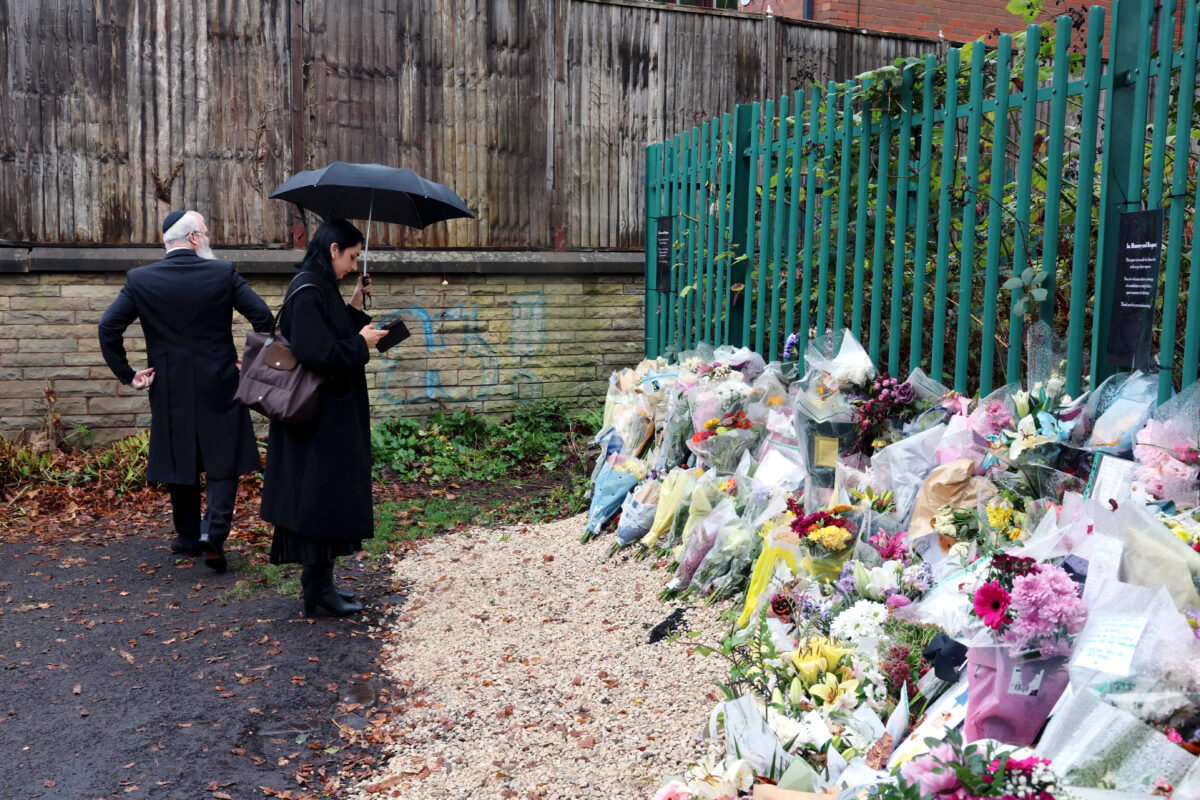
That is cold comfort for many in the community. “If somebody decided to ram a car along the pavement as the kids were heading into school, they would be hitting lots of kids and lots of parents,” Melanie, the nurse who attended the vigil, said.
“We don’t have any thoughts that the government is going to protect us because they haven’t done so far,” she said. “It’s terrifying for the kids to know this is the world they’re growing up in.
Is there any place for Jews in this country anymore? If things carry on the way they’re going, I don’t think so because we’re just targeted all the time.”
Lord Katz, a government frontbencher in the House of Lords, told JI that the government has been “acutely aware of the increasing fear and anxiety of the community over the past two years.”
“Whatever your views on the Israeli government, it’s always been clear that that shouldn’t impact on the way that British Jews live their lives and the government’s commitment to working with the CST and other communal bodies to ensure they have enough funding and the right legal measures in place to tackle antisemitism is very very clear and is underlined by lots of recent activity,” he said.
“In the long term, though, it has to be about tackling the cause and not just the symptoms. It has to be done through education and building community cohesion and there’s no easy route to that.”
Katz added: “This isn’t a party political issue — whether it’s attending football matches, wearing Jewish insignia, using the NHS [National Health Service] or feeling safe on our streets and campuses, the Government knows British Jews are fearful and will protect our rights, liberties and way of life.”
Journalist Nicole Lampert, who has been outspoken about antisemitism in the U.K., said that antisemitism began to flourish under the previous Conservative government. The marches have been taking place since the start of the war when Rishi Sunak and his Conservative government was still in power.
She said: “There are many people to blame, but of course, the people that are in control of things are the government,” she said, adding that Labour “came with a history of antisemitism,” referring to the party’s previous leadership under Jeremy Corbyn, who had a long record of anti-Israel and antisemitic rhetoric.
In 2020, an investigation by the Equality and Human Rights Commission (EHRC) found that under Corbyn the party had a culture “which, at best, did not do enough to prevent antisemitism and, at worst, could be seen to accept it”.
Lampert said, “Many of the people that were in the cabinet, including Keir Starmer, had been in the cabinet with Jeremy Corbyn and had told us to vote for Jeremy Corbyn and had refused to really speak out against antisemitism.”
“Although Keir Starmer said ‘I’m going to clear this party of antisemitism’ [in his leadership campaign], in some ways he used antisemitism as a blunt tool to just get rid of the far left in his party,” she added.
“They didn’t use it as an opportunity for a teachable moment as to what antisemitism actually is and what they’d done wrong,” Lampert said. “That was really frustrating because antisemitism is complex. If you had explained ‘this is why you’re antisemitic’ or ‘this was what was wrong,’ that would’ve been better.”
Alex Hearn, co-director of the campaign group Labour Against Antisemitism, agreed.
“Time after time we’ve seen that it’s easier to remove Jews rather than to challenge racism,” he said. “It’s easier to erase the people who cooperate rather than challenge the vocal and unlawful minority.
“The places we’re allowed to go safely are getting narrower and narrower. Don’t go to central London during marches, don’t walk down the streets looking visibly Jewish, don’t go on social media. And it’s just growing and growing, whether it be comedy clubs or now football matches — our world is getting smaller,” Hearn said. “Then what we’re hearing from our government is that they say the right things when they have to and we find ourselves applauding the sentiments, but wondering where the meaningful action is.”
Hearn added: “Keir Starmer has announced increased security funding to the Jewish community, but other things show why that’s necessary: because the authorities consistently allow racists to run riot on our streets. So we’re building higher and higher fences but we’re not addressing the issue. The most high fences can’t keep everyone out, as we’ve learned from Manchester.”
Dovid Lewis, the rabbi of Bowdon synagogue in south Manchester, said that, like many others, he had been “shaken and shocked” but “not surprised” by the Yom Kippur attack. “Antisemitism is insidious throughout society at the moment,” he said.
“There’s a reason why we have guards outside shul,” he said. “It’s not because we’re paranoid. It’s because there’s a credible threat.”
One of the worshippers at Lewis’ synagogue told him that following the attack she felt most insulted by an interview in which Starmer said that Jews “should feel comfortable in my country.”
The rabbi responded, “We don’t need to feel comfortable in the prime minister’s country — this is our country. I was born here, my parents were born here, my grandparents were born here.”
“You can’t declare [support for] a Palestinian state on Erev Rosh Hashanah and declare at the Labour Party conference, between Rosh Hashanah and Yom Kippur, that Israel is committing genocide, then scratch your head and wonder why somebody named Jihad Al-Shamie did what he did several days later,” he said. “There is a cause and an effect.”
Students wearing masks and keffiyahs disrupted a speech by an Oct. 7 survivor, chanting ‘Zionists not welcome here’
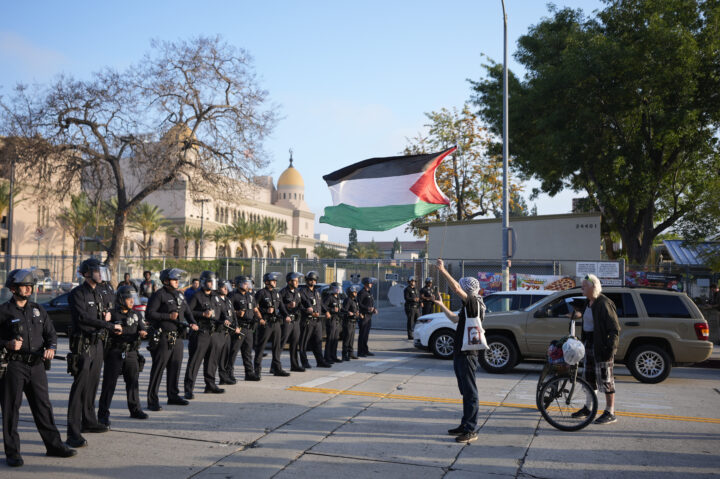
Ryan Sun/AP
A pro-Palestinian demonstrator holds a flag in front of a police line after protesters were told to disperse at the Shrine Auditorium, where a commencement ceremony for graduates from Pomona College was being held, Sunday, May 12, 2024, in Los Angeles.
Pomona College opened an investigation on Thursday after an on-campus event held Wednesday commemorating the second anniversary of Hamas’ Oct. 7, 2023, terrorist attacks was disrupted by four masked and keffiyah-clad individuals who barged in chanting “Zionists not welcome here.”
“While we have not yet identified the individuals, we are examining video footage taken during the event, as well as security footage to determine how access could have been gained,” Gabrielle Starr, the college’s president, wrote in a campus-wide email. “We are also reviewing our security protocols for on-campus events.”
“Antisemitic hate cannot be tolerated here,” Starr wrote.
The memorial, sponsored by Hillel in a university building and scheduled on the Hebrew calendar anniversary of the attacks, featured a talk by Yoni Viloga, who survived the attack on his family’s home in Kibbutz Mefalsim.
“The event was meant to be an opportunity for students to reflect on what happened two years ago. The disruption was very unsettling, I saw students with tears in their eyes,” Bethany Slater, director of Pomona Hillel, told Jewish Insider. The disruption, which also included chants of “Zionism is still a colonial ideology” and “You’re all complicit in genocide,” lasted about two minutes, until campus safety officers arrived.
While the liberal arts college in Claremont, Calif., has faced several anti-Israel demonstrations since the Oct. 7 attacks, Wednesday evening’s protest was the first to occur in an expressly Jewish space on campus. It also came days after Israel and Hamas agreed to a ceasefire and hostage-release deal.
“This is the first time Hillel has been targeted. Demonstrations have always been directed at the [university] administration because they were calling for [Boycott, Divest and Sanctions measures],” said Slater. “This is the first time a Jewish event has been targeted at all, which is just shocking that it would happen now in the context of the ceasefire agreement.”
Pomona College is among the dozens of universities currently under investigation by the Department of Education’s Office for Civil Rights for its alleged failure to address campus antisemitism.
Pomona administrators have responded quickly to a number of anti-Israel incidents that have occurred on campus in the aftermath of the Oct. 7 attacks and ensuing war in Gaza. In April 2024, police officers dressed in riot gear arrested at least 20 masked students after some 150 people stormed the university president’s office and refused to leave for more than three hours. Organized by the student-led group Pomona Divest Apartheid, the demonstrators from Pomona, as well as the affiliated Scripps and Pitzer Colleges, were protesting the removal of an anti-Israel “mock apartheid wall” on campus.
The following October, when an on-campus demonstration — which involved anti-Israel students taking over and shutting off access to a campus building — took place on the first anniversary of the Oct. 7 attacks, Pomona suspended 10 involved students through the end of the 2024-25 academic year.
Tapper told JI that recent anti-Israel protests outside his home are not 'really an issue with my commentary as much as it’s an issue with my faith'
In his new book, Race Against Terror: Chasing an Al Qaeda Killer at the Dawn of the Forever War, released on Oct. 7, CNN anchor Jake Tapper uses novelistic flair to explore the little-known true story behind a high-stakes, globe-spanning effort to prosecute a jihadist who was ultimately convicted in federal court of killing American service members in Afghanistan.
The yearslong case constructed by a team of dogged federal prosecutors against Spin Ghul, a Saudi-born Al-Qaida operative who was sentenced to life in prison in 2018, represents what Tapper, in his meticulously reported account, calls “unique not only at the Florence Supermax but also in modern American history.”
“Spin Ghul is the only one who was tried and convicted for killing U.S. soldiers on the battlefield overseas,” he writes of the terrorist now serving his sentence in a federal prison in Colorado that has held some of the most dangerous criminals “from the modern era.”
In the briskly told story, Tapper, 56, also lingers on the broader legal and political issues that surround the case even years after its conclusion, highlighting how “the distinction between terrorism and warfare — and between criminal justice and the laws of war — was blurred” in the aftermath of the 9/11 attacks.
“My first goal for people who read the book is they’ll just enjoy the story and find it compelling,” Tapper told Jewish Insider in a recent interview. “I tried to write it almost like a novel in as compelling a way as possible.”
“But a second goal is for people to think about the war on terrorism and the best ways to keep us safe,” he added, noting “an argument to be made that the attempt to lock Spin Ghul up forever keeps us safer than if he had just been sent to Guantanamo, where by now he might have been freed.”
The book, which follows the recent publication of Original Sin, his best-selling book, co-written with Alex Thompson, on President Joe Biden’s “disastrous choice to run again,” is Tapper’s fourth nonfiction work. He has also written several novels and is now at work on a graphic nonfiction book about Nazi war criminal Klaus Barbie, marking a serious return to his early career dabbling in political cartoons and comic strips.
In the interview with JI last week, Tapper discussed his new book and the lessons he hopes readers will draw from it. The CNN host, who is Jewish, also shared how he balances side projects with his day job, weighed in on the Trump administration’s threats targeting the media industry and explained why he strongly feels that anti-Israel protesters who demonstrated outside his home last year are explicitly antisemitic, among other topics.
The conversation has been edited for length and clarity.
Jewish Insider: You say in the acknowledgements section of the book that you first learned about this story at a paintball birthday party for your son, where you spoke with Dave Bitkower, one of the lead prosecutors on the Spin Ghul case. What was it about the story that drew you to write a book about it?
Jake Tapper: I’m a big fan of police procedurals on TV — “Law & Order” and “CSI” and “Cold Case” and all that. I just find sleuthing really interesting, and this story that Dave Bitkower told me was just about the incredible sleuthing that he and these other prosecutors and FBI agents and other folks did to prove this case. It was just so interesting how they pulled together the case from all sorts of documents and testimonies, the methodical way they tracked down evidence and the hurdles that they faced. When he was all done telling me the story in Virginia that day at the paintball location, the first question I had was, has anyone written about this? Has anybody told this story? And he said no, that Spin Ghul’s prosecution was covered but that nobody had done the story about how the prosecution came into place. I was just lucky that I got there first.
JI: It’s quite a yarn. How did you find the time to write this book? On top of your day job at CNN, you recently co-wrote a widely read book about former President Biden. You’ve published several novels and have a number of other projects in the works as well.
JT: I love writing and I love reporting, and the writing and reporting I do for CNN is different than the writing and reporting I can do for the book. Just as a practical matter, when I have a project, I try to write for at least 15 minutes a day. Everybody can find 15 minutes, even if it’s 7:30 in the morning or 7:30 at night. If you do 15 minutes a day, at the end of the week, that’s an hour and 45 minutes you wrote, maybe three pages, and it adds up. But also, the nonfiction books that I write are about topics I’m really interested in and really, really want to write about. I’m writing them for myself as much as I’m writing them for anyone else.
JI: Beyond your interest in the procedural details of the case, you also draw a larger point about how, as you write in the book, “the distinction between terrorism and warfare — and between criminal justice and the laws of war was blurred” in the wake of the 9/11 attacks. What do you hope readers will draw from the book?
JT: My first goal for people who read the book is they’ll just enjoy the story and find it compelling. I tried to write it almost like a novel in as compelling a way as possible.
But a second goal is for people to think about the war on terrorism and the best ways to keep us safe. I think there’s an argument to be made that the attempt to lock Spin Ghul up forever keeps us safer than if he had just been sent to Guantanamo, where by now he might have been freed. As the lines of terrorism and war blur because of this opponent that we face, individual terrorists or terrorist groups, our way of addressing it as a country needs to adapt as well.
JI: How do you feel the Trump administration is approaching this ambiguity?
JT: There are two different ways to look at it. One is they are actually following in [former President Barack] Obama’s footsteps, because they have this terrorist from ISIS-Khorasan, [Mohammad Sharifullah, known as] ‘Jafar,’ who is in a Virginia prison or Virginia jail awaiting trial for conspiring to kill Americans in the Abbey Gate suicide bombing [in Afghanistan], and if they’re successful, then he will be the second foreign terrorist tried in U.S. Criminal Court for killing service members on a battlefield, which is interesting.
By the same token, the Trump team is also expanding the definition of what a terrorist group is by designating drug traffickers as terrorists and deploying the military against them in a way that previous presidents had only really used to deploy against groups like Al-Qaida or ISIS. So it’s both continuity and also pushing the envelope.
JI: Did you get the chance to exchange letters or speak directly with Spin Ghul during the course of writing this book?
JT: I reached out to him in prison, and I was told he was not going to cooperate. But I was lucky in the sense that he had participated in a multiday confession in Italy that I was able to use and tell his story. But no, he didn’t cooperate.
JI: In the book, you briefly relay an amusing anecdote about Susan Kellman, the Jewish defense attorney for Ghul who, as you note, came to roast “a kosher cornish game hen for an accused Al Qaeda terrorist,” as Ghul wouldn’t eat food that wasn’t halal. You write that there was a suspicion Ghul may have been reluctant to engage with Kellman because she was Jewish.
JT: All three of Spin Ghul’s defense attorneys are Jewish. Bitkower is Jewish as well. I don’t know how much Susan’s Judaism played a role versus how much her being a woman played a role versus how much her just being an American played a role. But I think it didn’t help. Susan says [Ghul] was initially happy to hear that she could bring him food that was halal.
But I think, ultimately, that he was not going to cooperate with the attorneys no matter what, because he just started to refuse to cooperate at all in what I refer to it at some point in the book as “the Jihad of Annoyance,” meaning he has nothing else he can do to fight the to fight the West other than be as uncooperative as possible — and so that’s what he did.
JI: You’ve previously said you are working on a fourth novel in your Marder family series of political thrillers, the last of which was published in 2023. Is that still in the works, and are there any other projects you’ve got going that you can mention?
JT: That novel morphed into a project that is not with the Marder family. I’m working on two other projects right now. One is a new novel, but it’s a whole new set of characters, because I wanted it to take place today, and the Marder family would be too old, so I just wanted to start fresh.
Then I’m also working on a graphic novel — though it’s not a novel, it’s a true story — on the Nazi Klaus Barbie, about how he escaped from Germany, how he thrived in Bolivia, how he was tracked down by Nazi hunters and journalists, how he was brought to justice in France, and all the rest. So I’m working on that right now.
JI: What piqued your interest in Barbie? And are you illustrating it yourself? I know you used to draw comics in college and early in your career.
JT: I am, I am, and I’m doing this for Top Shelf Comics, which did the John Lewis graphic novels and the George Takei graphic novels. What piqued my interest was my family and I went to France a couple summers ago, and my son and I went to the Museum of the Resistance, and I learned all about Jean Moulin, who was the hero of the Resistance. I had not known that Klaus Barbie had tortured and maybe killed John Moulin. I had heard of Klaus Barbie as a kid because he was brought to justice in France when I was like 13, but I didn’t really know much about his story.
When I just kind of started learning more about his story, and learning about all the details of it, it just was so interesting to me. In my 50s, if there’s a story about World War II I’m learning for the first time, I’ve got to believe a lot of people don’t know it either. I wanted to do it as a graphic novel because I miss drawing — I was an art minor in college — and also because I wanted it to be accessible to younger people.
JI: Interesting. Is there anything you can share about the other novel you’re writing that’s set in the present day?
JT: Oh, it’s too early to talk about it. It’s not fleshed out a lot. I don’t have a publisher for it or anything like that. It just exists in my head.
JI: With regard to your return to drawing, I can’t help but recall you mentioning on Seth Meyers’ show recently that, if President Trump continues his attacks on the news industry, “maybe you and I will be drawing comic books together.”
JT: [Laughs.] Well, I was just joking. I was just joking.
JI: You’ve criticized the Trump administration and the FCC over its interference in the media industry. What is it like for you working day in and day out with the knowledge of these increased threats from the Trump administration coming directly at news personalities and outlets?
JT: I mean, it’s unfortunate, but nothing great in life doesn’t come without a fight. And the fight for freedom of the press and the freedom to deliver a fact-based news broadcast, instead of just trying to appeal to one side of the aisle over the other, is vital to our democracy — and I think, ultimately, will win the day.
JI: You’ve also faced protests outside your home from anti-Israel demonstrators who have taken issue with your commentary on the war in Gaza.
JT: I don’t think that it’s really an issue with my commentary as much as it’s an issue with my faith.
JI: You think it’s directly antisemitic?
JT: Of course. There’s any number of journalists in Washington, D.C., and these people targeted me and Dana Bash. Maybe someday somebody can explain to me why they protested outside the house of [former Secretary of State] Antony Blinken but not outside the house of any secretary or Cabinet official in the Trump administration. It seems pretty obvious to me.
Commerce Secretary Howard Lutnick and his wife, Allison, supported the creation of the sukkah through their family foundation
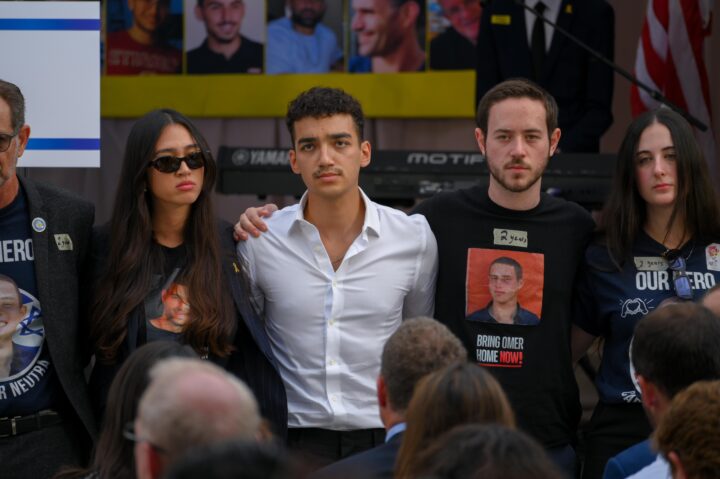
Liri Agami
Former hostages Noa Argamani (left) and Edan Alexander (center) stand with Daniel Neutra, brother of hostage Omer Neutra, and other hostage family members at a memorial event at the Kennedy Center in Washington, D.C., on Oct. 7, 2025.
Oct. 7 bloomed warm and sunny in Washington this year as dozens of Jewish community leaders and bipartisan political officials gathered somberly at a pavilion at the Kennedy Center to mark two years since the Hamas terror attacks in Israel.
A large sukkah, deemed the “Sukkah of Hope,” had a simple message displayed: “Two years in captivity. We can bring them home,” with photos of the 48 people, living and dead, still held captive by Hamas in Gaza. Several former hostages and the family members of those still in Gaza walked up to the stage inside the sukkah, one after the other, all with variations on the same message: Thank you, President Trump, they said. Bring our loved ones home.
“President Trump, we are thankful for what you’ve done, for your determination, for the time and energy you’ve given to this cause,” said Liran Berman, whose twin brothers, Gali and Ziv, remain in Gaza.
“We are really grateful and hopeful. I’m glad that this man, Donald Trump, is behind us,” said Iair Horn, who in February returned to Israel after 498 days in Hamas captivity. His younger brother, Eitan, is still being held in Gaza.
Their appeal to the president’s dealmaking prowess came after the Hostages and Missing Families Forum nominated Trump for a Nobel Peace Prize, an honor he has long coveted. The president sent a letter to the former hostages and the hostage families early Tuesday thanking them for the nomination and expressing his commitment “to returning all the hostages home, and ensuring the total destruction of Hamas so these horrific acts may never be repeated.”
The Sukkah of Hope was supposed to be constructed on the Ellipse, outside the White House. But the government shutdown meant that could not happen. Still, its move to the Kennedy Center did not keep high-level government officials from visiting.
Before the memorial service, several Cabinet secretaries had breakfast with the former hostages and hostage family members. In attendance were Secretary of State Marco Rubio, Commerce Secretary Howard Lutnick, Interior Secretary Doug Burgum, Director of National Intelligence Tulsi Gabbard, Environmental Protection Agency Administrator Lee Zeldin and Treasury Secretary Scott Bessent.
Ronen Neutra, whose son Omer was killed on Oct. 7 and whose body is being held hostage by Hamas, said the Cabinet members sounded optimistic about the possibility of a deal.
“We are hearing from the Cabinet members their optimism that we might be getting closer to a deal,” Neutra said. “But I think what is more important for us, or as important, is to hear the commitment that [we] have been hearing from President Trump, that this has to happen, and this is on his top priority list, and I think it trickles down.”
Lutnick and his wife, Allison, supported the creation of the sukkah through their family foundation.
“Donald Trump is the driving force of peace in this world,” Lutnick said at the memorial event. “The United States of America is together with the hostages and the hostage families. We are part of you, we are with you and we will help get them home.”
In the crowd at the event were Noa Argamani, Edan Alexander, Keith Siegel, Arbel Yehoud, Doron Steinbrecher and Ilana Gritzewsky, all of whom survived Hamas captivity. Alexander, a dual U.S.-Israeli citizen, and the Neutra family met with Trump at the White House on Tuesday afternoon.
At the memorial, several outlined the torture they face and they fears they harbor for loved ones who remain in Gaza.
“There are no words in any language to describe what I went through,” said Yehoud, whose partner, Ariel Cunio, 28, remains in Gaza. “Even as I stand here before you, I’m not really there. A massive part of me is still there, trapped in that darkness, and I will remain there until my Ariel and everyone comes home.”
Tibon told JI that the documentary's eventual debut, despite significant roadblocks, was ‘a victory for the movie and a victory for the truth of what happened on Oct. 7’
George Pimentel Photograph
AM Noam Tibon and Barry Avrich at the premiere of "The Road Between Us" documentary at the Toronto International Film Festival.
The most important major victory of retired Israeli Gen. Noam Tibon’s life was rescuing his son, Amir, his daughter-in-law, Miri, and their two young daughters from their home in Kibbutz Nahal Oz during the Oct. 7, 2023 Hamas terror attacks.
But the premiere of a new documentary telling that story almost didn’t happen.
“The Road Between Us: The Ultimate Rescue” debut at the Toronto International Film Festival last month was “a victory for the movie and a victory for the truth of what happened on Oct. 7,” said Tibon, the film’s protagonist who served in the IDF for 35 years, specializing in combat operations and counterterrorism.
“For 72 hours, as the world came together to say this should be screened, I felt a ray of hope,” the documentary’s director, Barry Avrich, told Jewish Insider in an interview alongside Tibon, days before the film debuted in 81 theatres across North America on Friday. “We hadn’t felt that since Oct. 7 at all.”
Getting the film to the big screen required a global effort. In August, a month before the festival, TIFF organizers revoked their invitation to show “The Road Between Us,” citing the documentary’s use of Hamas footage of the attacks that the festival said had not been approved for use by the terror group.
Following pressure from Hollywood heavyweights and Jewish groups, the film was ultimately allowed to premiere at the festival on Sep. 10, where it received a standing ovation from an audience of nearly 2,000 people and won the festival’s top prize, the People’s Choice Award.
“What was extraordinarily amazing to me — because I just didn’t think we had the wind to our back — was that the global pressure and reaction to the withdrawal of this film was so enormous and validating. We received emails from Jewish people as far as Shanghai” who were outraged over the film’s cancellation, Avrich recalled. “It was one of the great moments in my film career, when the Hollywood community and Jewish community globally said, ‘We will not be erased.’ I kept telling Noam, ‘You will not cancel your ticket, you’re coming to Toronto. We will show this film.’”
“I was very proud that we got into the TIFF festival,” added Tibon. “This industry is all new to me but I understand it’s one of the biggest festivals in the world. One day, Barry called me and said we were out of the festival. Then we got so much support from Jewish communities and movie supporters all over the world. I want to thank all of the people who stood up and said this is not fair.”
The documentary tells the story of Tibon and his wife Gali’s race in their jeep — pistol in hand — from Tel Aviv to the kibbutz in the Gaza envelope to rescue their son, Amir Tibon — a correspondent for Haaretz — his wife Miri Bernovsky-Tibon and their two daughters, then three and nearly two years old, trapped in a safe room on their kibbutz when Hamas terrorists invaded on Oct. 7. The film uses Hamas body cam footage and video from surveillance cameras to tell Tibon’s chronicle as he not only successfully fought his way to his son, but saved several others along the way, from Nova Music Festival concert-goers to Israeli soldiers.
The elder Tibon said that from his experience on Oct. 7, diaspora Jews and the organizations that serve them can learn “only one piece of advice.”
“If your family or people you love are in danger, do something. Do whatever you can to save them,” he told JI. “Of course you can prepare, but [it comes down to] your spirit, your willingness to take risks to save the people you love. The movie — and my story about my family — is about doing whatever [can be done] to save family. I used all my experience and skills on that day.”
Avrich, a Canadian acclaimed documentary filmmaker, first learned of the Tibon family story when it aired on “60 Minutes” in October 2023. “You look for stories as a documentary filmmaker. I like stories of heroism,” he told JI. “[This story] is about leaving no one behind. The minute I got on a Zoom with Noam, I knew I had to tell his story.”
“It wasn’t so much that this was an Israeli story,” continued Avrich, who said he wasn’t seeking out Oct. 7 stories. “It’s a story about family. This is a slice of a day that really attracted me to some hope of the day. The film is not about Oct. 7. It’s about the Tibon family. It happened on Oct. 7, but it’s not a political commentary.”
As the two year anniversary of the attacks approaches, Tibon said Israel has several issues it needs to address — including uncovering how the Israeli government missed signals of the looming Hamas terror attack on Oct. 7.
“It’s important that all of the kibbutzim communities along the border feel secure,” he told JI. “That’s why the hostages are the second biggest failure of this government. It’s against Judaism and the main values of the IDF to leave anyone behind. All of the communities along the border need to see that the hostages are back home to feel that they are secure. One of the biggest challenges is making people in Israel feel secure again.”
“Oct. 7 was the biggest failure in the history of the state of Israel,” Tibon continued. “It’s not one or two [issues], it’s a collapse of a system. I’m pushing that the government will go according to Israeli law and build a formal investigation, led by a Supreme Court judge, like we did after the [1973] Yom Kippur [War] failure. This should answer three main questions: what happened on that day, why it happened and who was in charge and what we need to do in order to prevent such a failure in the future. After the election in Israel, this is the first thing the new government will do.”
Tibon said that his experience on Oct. 7 should lead to the IDF permitting “more and more people” to volunteer to serve, including older Israelis in reserves. “On Oct. 7, the IDF was too small for the challenges of the security of the state of Israel,” he said.
The younger Tibons remain displaced from Nahal Oz, which is located just 850 meters from the border with the Gaza Strip. “Kids cannot come back to the kibbutz yet,” said Tibon, adding that he hopes they will return home “as soon as the border will be quiet.”
“We heard [President Donald] Trump’s [Gaza peace] plan. I hope we will move forward to this and bring the hostages home,” said Tibon. On Wednesday night, Israel and Hamas signed off on the first phase of the peace deal, with all the hostages expected to be released by Monday.
Noting the upcoming anniversary of the attacks, Tibon said he dedicates the film to “all of the people who fought with me on Oct. 7 — the brave soldiers and border patrol and the brave squad of [Kibbutz Nahal Oz]. I hope many people will watch this around the world because it’s a story about family. What would you do in such a situation?”
At ArabCon, several panelists laughed at the notion of condemning Hamas’ Oct. 7 attacks and defended the terrorist group as ‘Palestinian resistance’
Chip Somodevilla/Getty Images
Rep. Ro Khanna (D-CA) leaves the U.S. Capitol on March 13, 2024 in Washington.
Rep. Ro Khanna (D-CA) distanced himself from some speakers and attendees at the ArabCon conference that he attended in Dearborn, Mich., while defending their First Amendment right to free speech.
The conference, held last week, included a series of speakers who had previously expressed support for terrorism and made antisemitic comments. Several panelists laughed at the notion of condemning the Oct. 7, 2023, Hamas attacks, defended Hamas as “Palestinian resistance” and said the group should not be condemned and defended convicted terrorists and terrorist financiers, according to excerpts of the event shared online.
In another video circulating online, an audience questioner is met with cheers and applause from other audience members for urging speakers to stop condemning Oct. 7 and Hamas. And another speaker claimed that law, medicine and engineering are “Zionist-controlled fields.”
During his own separate panel at the event, Khanna dismissed the notion that there were any “pro-terror radical[s]” speaking at the event or attending the conference, referencing criticism he faced prior to the event.
“I don’t agree with everyone who spoke at the conference, but I do believe in free speech. You can’t just be for free speech when it’s convenient. I’ve unequivocally condemned the Oct. 7 attacks and called for the release of the hostages,” Khanna said in a statement to Jewish Insider on Monday, when pressed about whether he considered the comments of other speakers and attendees to constitute pro-terror radicalism.
Online, Khanna pushed back against critics of his appearance at the conference for intercutting his comments with offensive remarks by other speakers. “You know I spoke on a different panel and wasn’t there for this and I have condemned Hamas attacks and Oct 7. Attack my ideas, but play it straight,” he said.
The California Democrat has said he was unaware of any other remarks made at the conference, and that he was “in and out for my panel from 10-11 on Saturday. It was a 3 day conference.”
In an interview with JI, Ambassador Gilad Cohen discusses his push to persuade Japan not to recognize a Palestinian state at the UNGA
Courtesy Gilad Cohen
Israeli Ambassador to Japan Gilad Cohen
TOKYO — As Japan decided against recognizing a Palestinian state at the United Nations General Assembly on Friday, Israeli Ambassador to Japan Gilad Cohen told Jewish Insider in a wide-ranging interview in Tokyo that he is appreciative of Japan, “an important factor of the international community.”
On Friday evening, Japanese Foreign Minister Takeshi Iwaya called his Israeli counterpart, Gideon Sa’ar, to update him that after weeks of deliberation, Japan decided it will not recognize a Palestinian state at the UNGA.
“Sa’ar appreciated [the] decision and briefed [Iwaya] about Israel’s actions against Hamas chiefs in Qatar and IDF operations in Gaza,” Cohen told JI. “I join my foreign minister in appreciating Japan, a member of the G7, and an important factor of the international community, and for the deep friendship of our nations.”
“A recognition of a Palestinian state would be a reward to Hamas after the Oct. 7 terrorist attacks, would not contribute to peace and would not build on the trust of Israelis in the future,” he said. In recent weeks, Cohen relayed that message to Japanese ministers as the country weighed recognizing a Palestinian state as several governments, including those in Britain, France, Australia and Canada, have announced plans to do at the UNGA.
“This recognition is null and void because when you acknowledge a state there have to be conditions — what are the boundaries? Do you have effective control of the population? Nothing about that works with the Palestinians,” Cohen told JI. “Are they going to dismantle Hamas? Are they going to continue paying salaries for families of suicide bombers? Are they going to continue to have pacts with Iran against Israel? Is there going to be a repetition of Oct. 7 because they have a state? We are the Jewish people, we always have to be concerned and worried.”
For Cohen, who assumed office as ambassador of Israel to Japan in October 2021 following a stint as deputy director general for Asia and Pacific division in the Israel Ministry of Foreign Affairs, Japan’s consideration of recognizing a Palestinian state has been one of only a few disagreements he’s held with local politicians since arriving in Tokyo. In the immediate aftermath of the Oct. 7 attacks, “the Japanese government stood by Israel, called for an immediate and unconditional release of our hostages and said publicly that Hamas should be dismantled,” Cohen said.
“I thank the Japanese for acknowledging that Hamas is a terrorist organization and for saying that Iran is the number one destabilizer of the region. I want to thank the Japanese government for standing on the right side of history.”
When war broke out between Israel and Hamas soon after the Oct. 7, 2023, Hamas attacks on Israel, Japan, as a member of the U.N. Security Council, “was trying to influence the release of the hostages and not to [attack] Israel. They were not mediating, but there were messages Japan was trying to deliver for both sides in order to bring our hostages back,” Cohen recalled.
Looking ahead to the postwar period, Cohen suggested that Japan will contribute to rebuilding the Palestinian economy. “We will welcome any kind of investment in the Palestinian economy to revive it,” he said. “Economy is a major part of the vision of Palestinians living side by side with Israelis in peace and security.”
While tourism from Japan to Israel has seen a decline amid the war, Cohen said that joint business ventures between the two countries have increased over the past two years, as Israeli tech companies engage with Japan’s industrial giants and venture capital networks.
“Investments from Japanese companies in Israel were much higher in 2024 than 2023, including in AI and technology,” he said. “There is a saying that Israel can do things from zero to one and Japanese can take them from one to 10. Israeli innovation and startups can be combined with Japanese wisdom, experience and production ability that Israel doesn’t have.”
When it comes to creating cars, for example, an area that Japan is a global leader in, “Israel should focus on the brain of the car, systems that prevent accidents such as Waze and Mobileye,” said Cohen. “The synergy that we can learn from Japan — and we can share our experience with them — I see a lot of potential in economic relations. Japanese companies are looking at Israeli startups with great interest. In the last two and a half years, there have been direct flights from Israel to Japan, which is important because businessmen and investors do not have time to waste. This is an engine for connecting the people of Israel and Japan.”
Israel is among the handful of countries that Japan has a free trade deal with, an agreement signed by Cohen in March 2023. It allows 200 Israelis to come to Japan annually on a visa for one year of work, study and travel. At the same time, 200 Japanese citizens can come to Israel for one year to do the same.
Cohen sees himself not only as an ambassador of Israel “but also as representing the Jewish people in Japan,” he said, describing a small but vibrant community. Tokyo is home to two Chabad houses and a Jewish community center, which runs a pluralistic synagogue. The cities of Kyoto and Kobe also each have a Chabad. All five centers primarily cater to tourists.
It can be a challenge to navigate Holocaust education and antisemitism awareness in a country with limited historical exposure to those issues, Cohen said, recommending that all Japanese visit the Holocaust Education Center in Fukuyama City, near Hiroshima.
“The Japanese government comes to commemorate our Holocaust memorial days,” Cohen told JI. “They give thanks to [Chiune] Sugihara,” he said, referring to the Japanese diplomat who, while posted in Lithuania, saved thousands of Jews during the Holocaust. “We are participating in ceremonies to commemorate him. In Japan, he became a hero.”
“I see a lot of potential in the future when things calm down in the region,” continued Cohen. “I would like to have future agreements signed with Japan to boost the economy on both sides. I have many things on my agenda, but this will be after Rosh Hashanah.”
The suit invokes two U.S. laws that provide civil remedies to victims of international terrorism

Christian Ohde/McPhoto/ullstein bild via Getty Images
Gavel and scales of justice
The Anti-Defamation League filed a new lawsuit on Thursday on behalf of more than 140 U.S. victims of the Oct. 7 attacks alleging that several different terrorist groups carried out the attacks with material support from U.S.-designated state sponsors of terror: Iran, Syria and North Korea.
The suit comes a year after a similar suit by the ADL targeting Iran, Syria and North Korea, but it relies on an additional statute to seek compensation for the American victims of the attacks, which left 1,200 people dead. The suit also includes more plaintiffs than the original case.
The new case names the terror groups — Hamas, Palestinian Islamic Jihad, the Popular Front for the Liberation of Palestine, the Democratic Front for the Liberation of Palestine, the Al-Aqsa Martyrs Brigade, the Palestinian Mujahideen Movement, Hezbollah and the Popular Resistance Committees — and invokes two American laws that provide civil remedies to victims of international terrorism.
“The victims of the October 7 massacre deserve justice, accountability and redress,” ADL CEO Jonathan Greenblatt said in a statement. “This lawsuit seeks to do that by holding those responsible for the carnage accountable, from the state sponsors who provided the funding, weapons and training to the terrorist organizations who carried out these unspeakable atrocities.”
ADL brought the lawsuit with Crowell & Moring, a law firm that has helped victims in terrorism cases including the bombings of the U.S. Embassy in Beirut in the 1980s and the bombing of UTA flight 772 in 1989. The firm obtained billions of dollars in judgments in those cases.
“State sponsors of terrorism should not be able to avoid the consequences of their heinous acts by hiding behind the proxies they materially support,” Crowell partner Aryeh Portnoy, the lead counsel on the case, said in a statement.
The parents of Yona Brief, an IDF soldier who was severely injured on Oct. 7 and died as a result of his wounds more than a year later, said they hope the lawsuit will help deter future attacks.
“We believe it is critical that those responsible for the horrific terror inflicted that day are held accountable in a court of law, to ensure the record is clear as to who helped support, plan and carry out the violence that day,” David and Hazel Brief said in a statement. “We are hopeful that this type of litigation will help prevent attacks like these in the future, so that no other families have to go through losing a loved one as a result of such violence.”
The Israeli-Russian Princeton researcher was kidnapped in Baghdad in 2023 by Kataib Hezbollah, an Iranian-backed terrorist group

Eric Tucker/AP Photo
In this Sept., 2018 selfie image provided by Emma Tsurkov, right, she and Elizabeth Tsurkov are shown in Santa Clara Valley, Calif.
President Donald Trump announced Tuesday that Elizabeth Tsurkov, an Israeli-Russian researcher at Princeton University, was released by an Iranian-backed terrorist group in Iraq to the U.S. Embassy in Baghdad.
Tsurkov was kidnapped in Baghdad in 2023 while working on her doctoral thesis by Kataib Hezbollah, an Iranian-backed terrorist group separate from Lebanese Hezbollah.
“I am pleased to report that Elizabeth Tsurkov, a Princeton Student, whose sister is an American Citizen, was just released by Kata’ib Hezbollah (MILITANT Hezbollah), and is now safely in the American Embassy in Iraq after being tortured for many months,” Trump said on Truth Social. “I will always fight for JUSTICE, and never give up. HAMAS, RELEASE THE HOSTAGES, NOW!”
Tsurkov’s sister Emma, who has been a vocal advocate for her freedom, thanked the Trump administration in an X post, noting that her sister had been in captivity for more than 900 days.
“We are so thankful to President Trump and his Special Envoy, Adam Boehler. If Adam had not made my sister’s return his personal mission, I do not know where we would be,” Tsurkov said. “We also want to thank Josh Harris and his team at the US Embassy in Baghdad for the support they provided to our sister and the team at the nonprofit Global Reach who advocated relentlessly for my sister’s safe return.”
Princeton University President Christopher L. Eisgruber also celebrated her release.
“The release of Princeton graduate student Elizabeth Tsurkov brings relief and joy to the University community, and we celebrate that she will be reunited with her family. We thank President Trump for securing Elizabeth’s release,” Eisgruber said. “We are also grateful to those who worked tirelessly to bring an end to her terrible ordeal, including her family, friends and advocates.”
Multiple groups of U.S. lawmakers had appealed to administration officials to work to secure Tsurkov’s release. Kataib Hezbollah, the group that kidnapped Tsurkov, holds an official role in the Iraqi government.
Tsurkov’s captors released a video in 2023 in which Tsurkov claimed to be an Israeli and American spy, which Emma Tsurkov said was clearly made under duress.
Sen. Andy Kim (D-NJ), who helped lead efforts earlier this year to advocate for Tsurkov’s release, told Jewish Insider he spoke on Tuesday evening with Emma Tsurkov while she was on a videoconference with her sister, a conversation he said was “very emotional.”
The Tsurkov family, Kim said, has been through “so much” and “I can’t even imagine what it’s been like for Elizabeth.”
“My immediate thoughts [are] just making sure she’s getting the care she needs. I’ve done a lot in the past … when I was at the State Department on hostages and the kind of care they need coming out of it,” he said. “So it’s going to be a long road ahead.”
He said that he wishes Emma “all the best with the recovery” and offered the family any help he can provide to ensure she receives the care she needs. He said he hopes to see both sisters in the United States in the future.
He added that Emma Tsurkov’s “strength as a sister, just being there, just holding that hope for Elizabeth … it’s amazing, it’s inspiring.”
Kim said he had not yet been briefed by the administration on Tsurkov’s release, including the terms by which the administration was able to secure Tsurkov’s freedom.
Sen. Jacky Rosen (D-NV), who joined a push with Kim for Tsurkov’s freedom, said in a statement, “I’m relieved to hear the news that Elizabeth Tsurkov has finally been released after being held hostage by extremists in Iraq for over two years. I’ve been proud to advocate for her release and applaud all the efforts that made this possible. My thoughts are with Elizabeth and the Tsurkov family as they reunite, and I wish them peace and healing.”
Rep. Jamie Raskin (D-MD), who led an appeal from House members for Tsurkov’s release, told JI, “I am overjoyed for Elizabeth Tsurkov’s family and loved ones on this happy occasion. I have long pushed for Elizabeth’s safe return and I’m sending her my prayers and solidarity as she returns home to recover from a 903-day-long nightmare.”
Sen. Cory Booker (D-NJ) said on X, “I am deeply grateful that Elizabeth Tsurkov has been released and will finally be reunited with her family and loved ones. Thankful for all who partnered in advocating for her release and for all who tirelessly worked to ensure her safe return.”
The ArabCon convention is being hosted by the Arab Anti-Discrimination Committee
Chip Somodevilla/Getty Images
Rep. Ro Khanna (D-CA) leaves the U.S. Capitol on March 13, 2024 in Washington.
Rep. Ro Khanna (D-CA) is set to speak later this month at ArabCon, an annual convention hosted by the Arab Anti-Discrimination Committee, joining a lineup that includes numerous speakers with records of support for terrorism and antisemitism.
Khanna, in recent months, has grown more vocal in his criticism of the Israeli government and the war in Gaza, and is leading an effort to call for U.S. recognition of a Palestinian state. Khanna is seen as having aspirations for higher office.
Among the controversial speakers on the ArabCon lineup are Electronic Intifada Executive Director Ali Abunimah, CAIR San Francisco Executive Director Zahra Billoo and activist Linda Sarsour.
Abunimah has repeatedly praised and supported terrorist attacks on Israel as a form of “resistance” and claimed that there is “no credible evidence of a single rape on Oct. 7.” He has also claimed that Zionism is antisemitic and a spiritual continuation of the Holocaust.
He advocates for a one-state solution that would see Israel erased and has dismissed Palestinian Authority leaders who support peace with Israel as “collaborators.”
Billoo was voted off of the national Women’s March board over her past commentary, including praising and defending Hezbollah and Hamas for attacking Israel, and condemned Jewish federations, the Anti-Defamation League, Hillel chapters and “Zionist synagogues” as “enemies” engaged in fomenting Islamophobia, police brutality and various other issues inside the United States.
Sarsour has argued that Zionists should be excluded from progressive spaces and movements, repeatedly faced accusations of antisemitism, praised a convicted terrorist and supports a one-state solution.
“I have never been to a conference where I agree with every speaker, but speaking at ArabCon is important,” Khanna said in a statement to Jewish Insider. “I will discuss my efforts to recognize a Palestinian state without Hamas as part of a two state solution. Recognition of Palestinian statehood — alongside continued efforts to secure Israel’s safety and guarantee its future as a democratic homeland for the Jewish people — is essential to achieving peace.”
Other speakers on the ArabCon agenda include Michigan Senate candidate Abdul El-Sayed, Dearborn, Mich. Mayor Abdullah Hammoud, Zeteo CEO Mehdi Hasan and “The Young Turks” hosts Ana Kasparian and Cenk Uygur.
The American‑Arab Anti‑Discrimination Committee’s newly tapped national legal director, Jenin Younes, on Thursday called journalist Bari Weiss a “modern day Goebbels” in response to reports that Paramount is closing in on a deal to acquire Weiss’ The Free Press and give her a senior editorial role at CBS News.
Plus, The New Yorker's Piker problem

ADEM ALTAN/AFP via Getty Images
Turkish President and leader of the Justice and Development (AK) Party Recep Tayyip Erdogan attends his party's group meeting at the Turkish Grand National Assembly in Ankara, on October 25, 2023.
Good Thursday morning.
In today’s Daily Kickoff, we report on a series of amendments to the National Defense Authorization Act targeting Turkey for its support of terrorist groups and hostility toward Israel, and cover The New Yorker’s platforming of antisemitic influencer Hasan Piker at its upcoming festival. We talk to members of the House Foreign Affairs Committee’s MENA subcommittee following yesterday’s closed-door briefing on the West Bank with U.S. Ambassador to Israel Mike Huckabee, and spotlight Iowa Senate candidate Josh Turek’s support for conditioning aid to Israel. Also in today’s Daily Kickoff: Amb. Yechiel Leiter, Rep. George Latimer and Linda Frum.
Today’s Daily Kickoff was curated by Jewish Insider Executive Editor Melissa Weiss and Israel Editor Tamara Zieve, with assists from Haley Cohen and Marc Rod. Have a tip for us? Email us here.
What We’re Watching
- President Donald Trump will convene a call this morning between Ukrainian President Volodymyr Zelensky and French President Emmanuel Macron, who are both in Paris today for a summit of European allies of Kyiv, as well as Australia and Canada, aimed at formulating postwar security guarantees for Ukraine.
- Israeli President Isaac Herzog is at the Vatican today, where he just concluded a meeting with Pope Leo XIV.
- The Middle East Institute is hosting an event this afternoon in Washington, featuring writers Ross Harrison and Mohsen Milani, focused on Iran’s options following its 12-day war with Israel in June.
- In Israel, we’re keeping an eye on high-level government talks about West Bank annexation. More below.
What You Should Know
A QUICK WORD WITH JI’S MELISSA WEISS
Flashback to 2020: As Israel mulls annexation of the West Bank, a prominent Emirati official communicates to an Israeli outlet that such a move could have disastrous consequences for Israel’s positioning in the region.
“Annexation,” UAE Ambassador to the U.S. Yousef Al Otaiba wrote in a Yediot Ahronoth op-ed in June 2020, “will certainly and immediately upend Israeli aspirations for improved security, economic and cultural ties with the Arab world and with UAE.”
Al Otaiba’s op-ed was part of the groundwork laid for the Abraham Accords, announced less than two months later and signed in September 2020. With the normalization agreement in place, Israel’s annexation plans were shelved — at least temporarily — as it deepened its relations with the UAE and Bahrain, the original signatories to the landmark deal.
Five years later, senior Emirati diplomat Lana Nusseibeh, who previously served as Abu Dhabi’s envoy to the United Nations, is issuing a similar warning.
“Annexation would be a red line for my government, and that means there can be no lasting peace. It would foreclose the idea of regional integration and be the death knell of the two-state solution,” Nusseibeh told The Times of Israel earlier this week.
The five years between Al Otaiba’s op-ed and Nusseibeh’s comments have seen seismic shifts in the region: the Israel-Hamas war and the degradation of Iran’s nuclear capabilities and its regional proxy network, particularly with the collapse of the Assad regime in Syria. Israel has shown itself to be the dominant military player in the region, even as it finds itself on the receiving end of widespread criticism across the Middle East and beyond over its war against Hamas in Gaza.
But they have also seen the rise of the Israeli far right as a more significant player in the country’s politics. The ascensions of Finance Minister Bezalel Smotrich and National Security Minister Itamar Ben-Gvir have paved the way for a renewed Israeli effort to annex broad swaths of the West Bank, five years after plans to do so were derailed by peace efforts.
ENVOY INTERVIEW
Israeli Ambassador to the U.S. Yechiel Leiter arrived at his post in January as Israel was more than a year into its war with Hamas in Gaza and facing declining American support for the Jewish state. The Trump administration has been much friendlier to the government in Jerusalem than its predecessor, supporting the Israeli war effort in Gaza with no limitations on arms shipments. Yet, the broader political atmosphere is more hostile to Israel than it has been in decades. Leiter spoke with Jewish Insider’s Lahav Harkov and the executive director of the Misgav Institute for National Security and Zionist Strategy, Asher Fredman, on the “Misgav Mideast Horizons” podcast this week about his efforts to engage members of both parties, the future of the U.S.-Israel alliance, what is next in the war in Gaza and more.
MOU musings: Amid these concerning political trends, Leiter said that the U.S. and Israel have started to discuss what will happen after the Obama-era 10-year Memorandum of Understanding between the countries, which currently commits $3.8 billion a year in American defense aid to Israel annually, expires in 2028. While Israel’s official position favors continuing aid, some in Israeli Prime Minister Benjamin Netanyahu’s Likud Party and others on the Israeli right have been advocating for moving from a model of aid to one of collaboration on joint projects. “Maybe we’ll change the nature [of the MOU], where there will be greater [joint] research and development between our two countries, rather than relying on American weapons,” Leiter said.
EYE ON ANKARA

Bipartisan groups of House lawmakers are aiming to crack down on Turkey in the 2026 National Defense Authorization Act, introducing a series of amendments seeking to place further restrictions on U.S. aid to the NATO ally in response to its support for Hamas and hostility toward Israel, Jewish Insider’s Marc Rod reports.
Angles of attack: Groups of House members introduced amendments to the NDAA, set for consideration next week, that would ban any arms sales or transfers to Turkey until the administration outlines how it is ensuring that Turkey is no longer threatening or violating the sovereignty of U.S. allies, providing support to terrorist groups or purchasing any defense systems from U.S. adversaries; impose new, elevated conditions on the sale of F-35 and F-16 fighter jets to Turkey; and protect Israel’s Qualitative Military Edge over Turkey. It remains to be seen which, if any, of these amendments will receive consideration or be incorporated into the House’s final draft version of the NDAA.
HOSTING HATE
Hasan Piker, the far-left streamer who frequently stirs controversy for using antisemitic rhetoric in his commentary on Israel and Jewish issues, will join a roundtable discussion next month hosted by The New Yorker Festival, the publication announced on Wednesday in a full lineup of events. The conversation on Oct. 26, which will focus on “how the internet has reshaped political life” and its implications “for the future of democracy,” will also feature Saagar Enjeti, a right-wing populist pundit who co-hosts the “Breaking Points” podcast. It will be moderated by Andrew Marantz, a staff writer for The New Yorker, who published a feature story last March about Piker’s popularity among an audience of young, male voters who have recently gravitated to the right, Jewish Insider’s Matthew Kassel reports.
Backlash: His festival appearance drew criticism from the Anti-Defamation League, which denounced The New Yorker’s “decision to platform Piker” as “the latest example of mainstream media normalizing his brand of antisemitism and anti-Zionism.” The streamer’s “toxic and extreme rhetoric opposing Zionism and the Jewish state normalizes antisemitism, reinforces bigotry and launders terror — and it has no place at a conference devoted to prominent influencers,” an ADL spokesperson told JI on Wednesday, arguing that Piker’s “extreme statements” on a range of topics “should permanently disqualify him from appearing at any major media festival.”
MEMBER UPDATE
U.S. Ambassador to Israel Mike Huckabee privately briefed lawmakers on the House Foreign Affairs Committee on Wednesday morning on the security and political situation in the West Bank and the war in Gaza, Jewish Insider’s Marc Rod reports. The briefing was organized by Rep. Mike Lawler (R-NY), who chairs the subcommittee on the Middle East and North Africa, in response to efforts by France and other U.S. allies to recognize a Palestinian state. Despite a focus on the West Bank, attendees indicated that the briefing did not provide specific answers on any U.S. policy toward a potential Israeli move to annex all or part of the territory.
In the room: Lawler told JI the briefing had included a “thorough discussion with the ambassador about Judea and Samaria and the challenges and the opportunities,” using the biblical term for the West Bank preferred by the Israeli government and utilized by the Foreign Affairs Committee. “Given the insistence on the part of the French and other Europeans to recognize a Palestinian state, I thought it was important for my colleagues to have a greater understanding of what we’re actually talking about with respect to Judea and Samaria, or the West Bank, and how it is actually governed post-Oslo,” Lawler continued, referring to the peace accords brokered in the 1990s.
TUREK’S TAKE
Iowa state Rep. Josh Turek, a leading Democratic Senate candidate in the state, supported an amendment in the Iowa Statehouse earlier this year that called for U.S. support for Israel’s ability to eliminate terrorist groups to be conditional, Jewish Insider’s Marc Rod reports.
About the amendment: The amendment, which failed to pass, would have struck language in a pro-Israel resolution supporting Israel’s “sovereignty and right to pursue, without interference or condemnation, the elimination of any terrorist group until all such groups are permanently neutralized and Israelis can live in peace.” It would have instead inserted language that stated that the Iowa House supports Israeli sovereignty and its right to take action to eliminate terrorist threats but added: “However, this support is conditioned upon the State of Israel’s adherence to international humanitarian law and protection of innocent civilian lives. The House of Representatives affirms its commitment to human rights and condemns acts by any party that constitute war crimes, crimes against humanity or indiscriminate attacks against civilian populations.” Turek ultimately voted in favor of final passage of the original, unamended resolution.
ISRAEL INSIGHTS

Returning from a trip to Israel, Rep. George Latimer (D-NY) emphasized that Israel’s critics in the United States and around the world are overlooking Hamas’ key role in perpetuating the conflict and contributing to the humanitarian issues in Gaza, strengthening the terrorist group’s position and insulating it from pressure, Jewish Insider’s Marc Rod reports. At the same time, he also said that Israel must do more to pursue an end to the war, make its case to the world and provide aid in Gaza.
Shades of gray: “When you see on the ground, you understand it is not a simple black-and-white situation,” Latimer, a first-term congressman from heavily Jewish Westchester County, N.Y., who sits on the House Foreign Affairs Committee, said. “People come up to me and say, ‘Israel is practicing genocide. What they’re doing is evil and we need to stop it.’ And then you get on the ground and you realize how much more complicated it is than that.” He said that American critics of Israel fail to acknowledge Hamas’ “role in all of this and its contributory actions.”
Worthy Reads
The Case Against Genocide: In The Wall Street Journal, Bernard-Henri Lévy breaks down misconceptions about Israel’s war against Hamas in Gaza. “A genocidal army doesn’t take two years to win a war in a territory the size of Las Vegas. A genocidal army doesn’t send SMS warnings before firing or facilitate the passage of those trying to escape the strikes. A genocidal army wouldn’t evacuate, every month, hundreds of Palestinian children suffering from rare diseases or cancer, sending them to hospitals in Abu Dhabi as part of a medical airlift set up right after Oct. 7. To speak of genocide in Gaza is an offense to common sense, a maneuver to demonize Israel, and an insult to the victims of genocides past and present.” [WSJ]
MAGA’s Nazi Apologists: The Atlantic’s Yair Rosenberg considers the factors motivating far-right influencers, including Tucker Carlson and Candace Owens, who platform antisemites and engage in revisionist history around the Holocaust. “The 21st-century heirs of Lindbergh and Coughlin seek to turn back the clock to a time when such sentiments were seen by many as sensible rather than scandalous. These far-right figures have correctly ascertained that to change what is possible in American politics, they need to change how America talks about itself and its past. Had Carlson and his cohort attempted their revisionism 20 years ago, they would have encountered a chorus of contradiction from real people who had experienced the history they sought to rewrite and know where its conspiratorial calumnies lead. But today, most of those people are dead, and a new generation is rising that never witnessed the Holocaust firsthand or heard about it from family and friends who did.” [TheAtlantic]
Two Roads Diverged…: In Ynet, Nadav Eyal posits that Israeli and Diaspora Jewry are simultaneously at a crossroads that will determine the future of both. “In the Diaspora, Jewish existence is endangered by processes in the surrounding non-Jewish societies. In Israel, Jewish existence is endangered by the region and by the political leadership itself. It is both a junction and a race: which crisis will reach a tipping point first? Because ultimately, one can predict, either the Diaspora will flow into Israel, or Israel will spill into the Diaspora. Actually, both could happen simultaneously. Across the Jewish world, modern Orthodox communities demonstrate increasing aliyah to Israel; this is natural, considering the triangle of hatred built around those who identify as Jews. … It is certainly possible that the antisemitic storm will pass, like a hurricane leaving destruction in its wake, after the war ends. And perhaps Israel will leave behind the current political darkness and commit to major reforms. But what will come first —a positive transformation, or a catastrophe, or both?” [Ynet]
Word on the Street
Former Sen. John Sununu (R-NH) is mulling a bid for his old seat; Sununu served as senator from 2003-2009 before losing his seat to Sen. Jeanne Shaheen (D-NH), who announced her retirement earlier this year…
The Trump administration reportedly offered a position at the Department of Housing and Urban Development to New York City Mayor Eric Adams in an effort to incentivize Adams to drop his reelection bid against front-runner Zohran Mamdani; Adams met with administration officials in Florida earlier this week…
The New York Times looks at Mamdani’s rhetoric shift away from some of his more fringe political positions as the November election nears…
A federal judge in Massachusetts ruled that the Trump administration’s cancellation of billions of dollars in research funding to Harvard violated the school’s First Amendment and due process rights…
Columbia and NYU launched investigations into student conduct violations days into the start of the new academic year; at Columbia, a student protested with a sign accusing classmates of being “IOF [Israeli occupation forces] criminals committing genocide in Palestine,” while at NYU, a mezuzah was ripped off the doorpost of a student dorm…
Cornell University told Jewish Insider it was rescheduling the start of the housing lottery for rising juniors and seniors to begin at 8 p.m. on Oct. 2 after initially causing controversy for scheduling the lottery to begin earlier in the day, during the last few hours of Yom Kippur…
Israeli artist Ilana Goor listed her home on Manhattan’s Upper East Side for $19 million; the carriage house home was previously listed last year for $37.75 million…
Puck cites a source who said that a deal for David Ellison’s Paramount to acquire Bari Weiss’ Free Press is “on the one-yard line”; the agreement reportedly surpasses The Free Press’ $100 million valuation…
Larry Ellison’s Oracle is laying off an unknown number of employees in a handful of states, weeks after laying off hundreds of staffers…
Record executive Scooter Braun and actress Sydney Sweeney are reportedly dating after meeting at the Venice wedding of Jeff Bezos and Lauren Sanchez over the summer…
C-SPAN reached an agreement with YouTube for the streaming platform to carry the nonprofit network’s three channels; the network will also be available on Hulu+LiveTV…
CNN announced the hiring of former Walla journalist Tal Shalev to be a senior reporter for the network and Zeena Saifi as a Jerusalem-based field producer…
A hospital in Belgium suspended a doctor who had described a 9-year-old patient’s condition as “Jewish” after conducting an investigation and finding the medical provider had posted dozens of antisemitic messages on social media…
Jillian Segal, Australia’s antisemitism envoy, suggested that Canberra cut funding to organizations that fail to address antisemitism, making a comparison to the Australian government’s threat to end funding to childcare facilities that do not prevent child abuse…
The Wall Street Journal reviews Operation Wrath of God: The Secret History of European Intelligence and Mossad’s Assassination Campaign, Aviva Guttmann’s new book examining the European role in the Mossad’s efforts to track down those responsible for the 1972 Munich Olympics massacre…
Israeli Prime Minister Benjamin Netanyahu reportedly spiked a planned visit to Israel by French President Emmanuel Macron, conditioning the French leader’s trip on Macron rescinding a previous call for Palestinian statehood…
Israel’s Shin Bet said it arrested Hamas members planning an assassination attempt on National Security Minister Itamar Ben-Gvir…
A report from the International Atomic Energy Agency found that Iran significantly increased its stockpile of weapons-grade enriched uranium in the weeks prior to Israel’s June strike on Iranian nuclear facilities and ensuing 12-day war…
Former U.S. Chamber of Commerce CFO Stefan Freiberg is joining Hillel International as chief financial officer…
Linda Frum was elected as the new board chair of UN Watch…
Artist and writer Rosalyn Drexler died at 98…
Pic of the Day
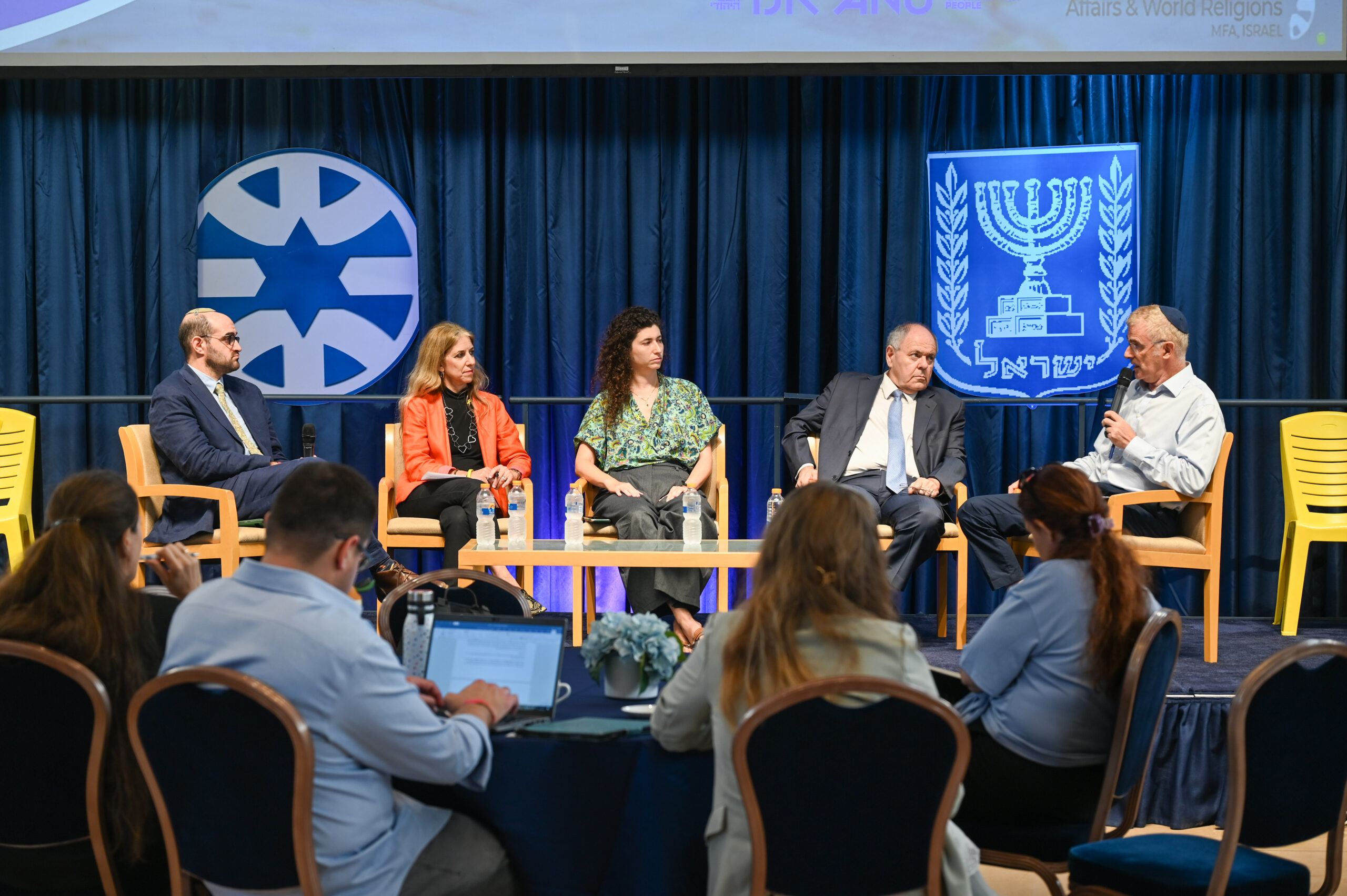
Former Israeli Ambassador to the U.K. and author Daniel Taub (right) spoke on a panel on Tuesday hosted at Israel’s Foreign Ministry in Jerusalem about Israeli foreign policy and the country’s relationship with world Jewry.
The panel, which was organized by the ministry and the Anu Museum’s Peoplehood Coalition and conducted in accordance with Chatham House Rule, was moderated by eJewishPhilanthropy Managing Editor Judah Ari Gross (left) and also included Shuli Davidovich, head of the Foreign Ministry’s Diaspora and Religions Bureau; Shelly Wolkowicz, who until last month served as CEO of the World Union of Jewish Students; and Dani Dayan, chair of Yad Vashem.
Birthdays
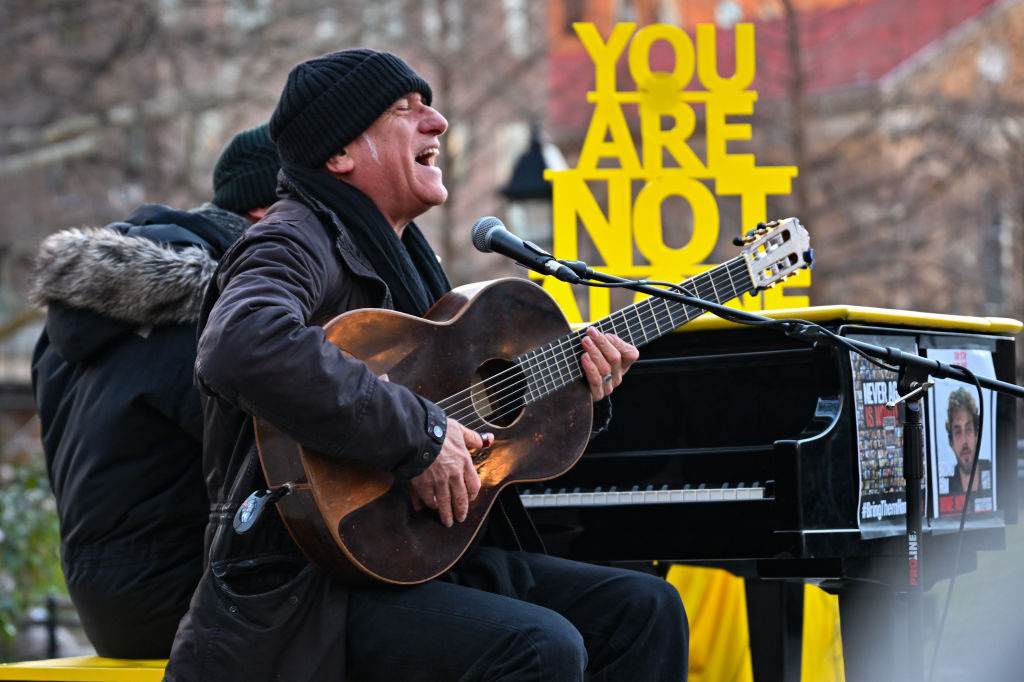
Israeli singer-songwriter David Broza turns 70…
Award-winning computer scientist and philosopher who is a pioneer in artificial intelligence, he is the father of slain Wall Street Journal journalist Daniel Pearl, Judea Pearl turns 89… Israeli architect renowned for designing public buildings across Israel and internationally over six decades, Meir Nir turns 86… Emeritus professor of law and former acting dean at the Benjamin N. Cardozo School of Law, Lester Brickman turns 85… Retired professor at the University of Puerto Rico School of Medicine, Edmundo N. Kraiselburd, Ph.D. turns 82… Saxophonist, flautist and jazz educator, in 2010 he received a lifetime achievement award from the National Endowment for the Arts, David Liebman turns 79… Attorney and political consultant who has served as board president of Louisville, Kent.’s, Jewish Family & Career Services, Mark Steven Ament… Celebrity doctor, he is a board-certified internist, addiction medicine specialist and media personality, known as “Dr. Drew,” David Drew Pinsky, M.D. turns 67… Musician, music producer, audio engineer and corporate speaker, Mark Schulman turns 64… Former member of the House of Representatives (D-NY), Anthony Weiner turns 61… Real estate strategic advisor, political strategist and commentator, E. O’Brien (“Obi”) Murray… Screenwriter best known as the writer of the 2008 film “Vantage Point,” Barry Louis Levy turns 53… Former member of Knesset for the Labor / Zionist Union party, he was the secretary general of Israel’s Labor party until early 2017, Yehiel “Hilik” Bar turns 50… Painter, sculptor, filmmaker, actor, writer, producer, photographer and restaurateur, Andrew Levitas turns 48… EVP and chief corporate affairs officer at BioMarin Pharmaceutical, Marni Kottle turns 47… Former special assistant and personal aide to President George W. Bush, later at Thrive Capital, Jared Weinstein… Television and film actor, he has also written four children’s books, Max Greenfield turns 45… Israeli former professional basketball player and coach, currently serving as an assistant coach for Maccabi Tel Aviv, Guy Pnini turns 42… Development officer at Atlanta’s Jewish Home Life Communities, Melissa Horen Kaplan… Javelin thrower, she won the Israeli national championship seven times, Marharyta Dorozhon turns 38… Television and film actor, Carter Mark Jenkins turns 34…
The freshman New York congressman also said that Israel must do more to pursue an end to the war, make its case to the world and provide aid in Gaza
Spencer Platt/Getty Images
Westchester County Executive George Latimer speaks to supporters after winning his race against Democratic incumbent Representative Jamaal Bowman in the 16th Congressional District of New York's Democratic primary.
Having recently returned from a trip to Israel, Rep. George Latimer (D-NY) is emphasizing that Israel’s critics in the United States and around the world are overlooking Hamas’ key role in perpetuating the conflict and contributing to the humanitarian issues in Gaza, strengthening the terrorist group’s position and insulating it from external pressures.
At the same time, the New York Democrat also said that Israel must do more to pursue an end to the war, make its case to the world and provide aid in Gaza.
Latimer, speaking to Jewish Insider last week, said that the trip, organized by the AIPAC-affiliated American Israel Education Foundation for Democratic freshmen and leading Democratic lawmakers, had reinforced his view that the situation on the ground is more complicated than the more simplistic narratives demonizing Israel that have been spread by some critics and media.
“When you see on the ground, you understand it is not a simple black-and-white situation,” Latimer, a first-term congressman from Westchester County, N.Y., who sits on the House Foreign Affairs Committee, said. “People come up to me and say, ‘Israel is practicing genocide. What they’re doing is evil and we need to stop it.’ And then you get on the ground and you realize how much more complicated it is than that.”
He said that American critics of Israel fail to acknowledge Hamas’ “role in all of this and its contributory actions.” He said he sees a “lack of appreciation here in the United States that Hamas is committed — has shown no signs to want to sit, talk peace, have a cessation of hostilities. … That makes it very, very hard to plot a strategy, if the other side is completely intransigent.”
Latimer said the situation is comparable to overlooking the fact that the U.S. entered World War II because Japan bombed Pearl Harbor, or that the U.S. invaded Afghanistan because of the 9/11 attacks. He said that the “mindset” that motivated such attacks doesn’t disappear overnight, and can take protracted conflict to address.
At the same time, he said that “there’s a gap between what [the Israeli government] needs to be doing and what it is doing, and it’s a serious gap.” He said he doesn’t see proposals to relocate the population of Gaza out of the enclave, discussed during a meeting with Israeli Prime Minister Benjamin Netanyahu, as “workable” or “humane.”
He addressed friction within Israeli society over Israel’s war plans in Gaza, and said that Netanyahu’s decision-making may be shaped by his far-right coalition members, adding that “if there’s no movement from Hamas, what can you ask Israel to do unilaterally?”
“So Netanyahu’s strategies present as intransigent in the face of intransigence on the other side,” Latimer continued. “You need some joint breakthrough where both sides step back from the path that they’re on, and both sides have to be willing to do that, if you can expect the other side to also then do that.”
He noted the difficulty of forcing a dug-in enemy like Hamas to surrender, comparing it to the challenge of forcing a Japanese surrender during WWII.
Latimer unseated Rep. Jamaal Bowman (D-NY), a vocal Israel critic, in the 2024 Democratic primary, boosted by significant support from his district’s Jewish community as well as national pro-Israel groups.
Latimer told JI he thinks Israel has not done enough to try to win over or influence global opinion in its favor. Latimer said he believes that the Israeli government views such efforts as a lost cause and not worth attempting.
“There’s a case to be made [for Israel]. But in lieu of that, the rhetoric is all what Israel is doing and not doing, and how evil they are, when, in fact, all of this came from an attack that was horrific on Oct. 7,” Latimer said.
He said that there have been “atrocities” on the Israeli side, pointing broadly to settler violence in the West Bank, but said that “the question is, overall, are you weighing all of these things together, or as the world opinion, and much of the United States opinion, particularly among younger people, has been framed completely around ‘Israel bad,’” ignoring the “evil that’s been done on behalf of the other side of this. That is a contributing reason why we’re in the situation we’re in.”
“The fact that people are starving is horrific. But as long as the world blames Israel for it solely, Hamas is winning. Why would they change any strategies?” Latimer said. “The leaders of Hamas are not sitting in the tunnels. … They’re sitting in the safety of the protection of [Turkish President Recep Tayyip] Erdogan or over in Qatar. Therefore, they’re not under the pressure.”
Latimer said that the food supply in Gaza was a key issue he examined on the trip, calling starvation in Gaza a “legitimate” problem.
He said that the current four Gaza Humanitarian Foundation aid distribution sites are “nowhere near enough,” given the “massive number of people that need to be fed and housed.”
But he added that Hamas being “unwilling to cooperate” in the safe delivery of aid is an impediment to efforts to improve the humanitarian situation and that the United Nations “in the eyes of the Israelis, has lost credibility.”
He said that the best path forward would likely be for a coalition of Arab countries to take the lead of a humanitarian aid distribution entity: “We need to have a third party that has credibility.”
“Israel is not doing enough to solve the problem, and Hamas is doing things to prohibit the problem from being solved,” Latimer said, calling on Israel to work to increase the number of food distribution centers and strengthen supply lines and on Hamas to stop attempting to intercept food and sow chaos at distribution sites.
“The fact that people are starving is horrific. But as long as the world blames Israel for it solely, Hamas is winning. Why would they change any strategies?” he said. “The leaders of Hamas are not sitting in the tunnels. … They’re sitting in the safety of the protection of [Turkish President Recep Tayyip] Erdogan or over in Qatar. Therefore, they’re not under the pressure.”
“What I saw in September 2005 gave me hope. What I see when I go back 20 years later is, you shake your head and you go, ‘Why did it turn out this way?’” Latimer said. “Did it turn out this way because Israel wanted it to turn out this way? Israel didn’t want Oct. 7. Israel didn’t want all of its young men in the reserves and active duty, constantly on a wartime footing.”
He declined to weigh in definitively — citing the limited information at his disposal and his limited power as a lone congressman — on whether the U.S. needs to increase pressure on its allies in Turkey or Qatar to expel or detain those Hamas leaders, but said that “clearly there has been insufficient pressure on Hamas” because its leaders have shown no urgency to return the hostages, negotiate in good faith or participate in un-corrupted food distribution.
Latimer said he first traveled to Israel two decades ago, just after the Israeli disengagement from Gaza, and that there was hope at the time that the Israeli withdrawal would “allow the opportunity for Gaza to experience peace and some kind of growth.”
“What I saw in September 2005 gave me hope. What I see when I go back 20 years later is, you shake your head and you go, ‘Why did it turn out this way?’” Latimer said. “Did it turn out this way because Israel wanted it to turn out this way? Israel didn’t want Oct. 7. Israel didn’t want all of its young men in the reserves and active duty, constantly on a wartime footing.”
He said that if Gaza’s leaders had pursued growth and development over the past 20 years, “we could be in a very different place today,” but instead Hamas seized power and used Gaza as a platform to attack Israel.
Asked about recent decisions by European countries to unilaterally recognize a Palestinian state, which came around the time of Latimer’s trip, the congressman said that he supports a two-state solution, but one that “comes out of a negotiated process,” noting the many outstanding issues to be worked through.
“You cannot expect Israel to survive with a hostile entity interspersed with its borders, and yet be its own country. And there has to be a sense that this country can function and provide its services to its people and maintain civil control. None of those things are automatically in place yet, so I don’t know what we’re recognizing in substance,” Latimer said.
“I think what we’re recognizing in symbolism is European countries that basically are saying, ‘We need to have a two state solution,’ and probably their population is reacting to what’s happening in the moment and putting pressure on their governments to do this,” he continued.
“The Palestinian Authority certainly has a steep mountain to climb, but right now, they’re the best hope that you have of a presence — and certainly it’s not Hamas, it’s certainly not coming out of any of the groups that Iran is backing or has backed,” Latimer said.
Based on the delegation’s meeting with Palestinian Authority leaders, Latimer said that he believes there is an “intent” and “willingness” in the PA to pursue needed reform and bolster credibility with the Palestinian population.
“How much success they’re going to have with the civilian population to accomplish those things — it’s going to be a tall task,” he said.
At the same time, he noted that some Arab governments such as those in Jordan and Egypt maintain cooperative relationships with Israel even as many of their citizens remain hostile.
“The Palestinian Authority certainly has a steep mountain to climb, but right now, they’re the best hope that you have of a presence — and certainly it’s not Hamas, it’s certainly not coming out of any of the groups that Iran is backing or has backed,” he continued.
In the long term, Latimer added, the Abraham Accords represent a path forward for the region, and said that moderate Sunni Arab states want to see a viable and demilitarized Palestinian Authority government that can credibly govern the Palestinian people.
‘These comments are outrageous and have no place in our politics,’ said the Democratic Minnesota senator, who is backing Minneapolis Mayor Jacob Frey

Gage Skidmore
Sen. Amy Klobuchar (D-MN) speaking with attendees at the Moving America Forward Forum hosted by United for Infrastructure at the Student Union at the University of Nevada, Las Vegas in Las Vegas, Nevada.
Sen. Amy Klobuchar (D-MN) is rebuking a top mayoral candidate in Minneapolis, far-left state Sen. Omar Fateh, who has recently faced criticism for employing campaign staffers who have glorified Hamas’ Oct. 7, 2023, terror attacks, blamed Israel for the war in Gaza and called for the destruction of the Jewish state, among other extreme comments.
In a statement to Jewish Insider on Wednesday, a spokesperson for Klobuchar, who is backing Fateh’s chief rival, Mayor Jacob Frey, said that the senator “strongly and immediately condemned the Hamas terrorist attack, and condemns any statements to the contrary.”
“These comments are outrageous and have no place in our politics,” the spokesperson, Jane Meyer, said of the staffers’ remarks, which were unearthed by JI last week. “She has spoken out against antisemitism for years. She has endorsed the mayor and did so months ago.”
Klobuchar, who along with Minnesota Gov. Tim Walz is the most high-profile Democratic official supporting Frey’s campaign for a third term, had until now remained silent with regard to Fateh, a 35-year-old democratic socialist whose insurgent bid has drawn comparisons to Zohran Mamdani, the Democratic nominee for New York City mayor.
Meyer declined a request for comment from JI last Friday but ultimately shared a statement this week after Fateh drew backlash from, among others, the local Jewish Community Relations Council, which called into question his commitment to addressing Jewish safety concerns as he tolerates staffers who “traffic in antisemitism” and act as “apologists” for Hamas.
Fateh, who pledged to boycott the JCRC in a recent candidate questionnaire solicited by the Twin Cities chapter of the Democratic Socialists of America, has not yet addressed the staffers’ rhetoric, significantly more extreme than his own public stances on Israel and Gaza.
While he has accused Israel of genocide and voiced support for the Boycott, Divestment and Sanctions movement against Israel, Fateh’s communications manager, Ayana Smith-Kooiman, has endorsed the Hamas attacks as a justified act of “resistance” and declared that Israel “does not have a ‘right’ to exist” and “must be dismantled,” among several other now-deleted social media posts reviewed by JI.
In addition, David Gilbert-Pederson, a local political activist and City Council aide who has been listed as a Fateh campaign staffer in filings, has unreservedly praised Hamas’ violence against Israel. Speaking in December 2023, Gilbert-Pederson celebrated “what happened collectively for the people of Palestine on Oct. 7” and said supporters of the Palestinian cause must “stand in unconditional solidarity with those resisting oppression.”
Despite Klobuchar’s new condemnation of such rhetoric, most of Frey’s leading allies in the hotly contested mayoral race have so far refrained from commenting on the situation. Representatives for Walz have not responded to multiple requests for comment on the staffers or Fateh’s acceptance of their views.
Prominent Democratic officials who have not taken sides in the race have likewise declined to weigh in on the matter.
Fateh’s campaign did not respond to a request for comment on Wednesday.
The state senator is set to host a “Jews for Fateh” fundraiser early next month, according to an event page, which notes that attendees will learn about his “campaign’s movement to build a city that leaves no one behind.”
A TIFF board member told the Toronto Sun that the movie ‘will be exhibited as planned and even bigger than originally’

Jeremy Chan/Getty Images
Cameron Bailey speaks on behalf of Toronto International Film Festival on June 14, 2025 in Toronto, Ontario.
The Toronto International Film Festival reversed course on Thursday, deciding to air “The Road Between Us: The Ultimate Rescue,” a documentary about the Oct. 7, 2023, Hamas terror attacks, at its upcoming festival.
TIFF had faced serious backlash from Jewish organizations and Canadian politicians over its initial decision to cancel the screening due to the film’s usage of Hamas footage from the attacks, saying the terror organization had not approved them for use.
TIFF board member John Ruffolo told the Toronto Sun that the organization decided at a board meeting Thursday that the movie “will be exhibited as planned and even bigger than originally.”
The documentary tells the story of retired Israeli general Noam Tibon, who raced from Tel Aviv to rescue his son and two young granddaughters trapped in a safe room in Kibbutz Nahal Oz when Hamas terrorists invaded on Oct. 7.
Another source told the Sun that TIFF President Cameron Bailey and Barry Avrich, the film’s director, were essential to the decision, along with input from philanthropist Heather Reisman and entrepreneur Henry Wolfond, both influential Jewish Canadians.
Councillor Brad Bradford, who had called on TIFF to reverse course, said he was “relieved” by the organization’s decision, “but the fact it was ever pulled — silencing a Canadian filmmaker and granting legal legitimacy to a listed terrorist organization — is deeply troubling. It should not have taken a public outcry to correct this mistake.”
The Minneapolis mayoral candidate’s communications manager wrote on social media that Israel ‘must be dismantled’
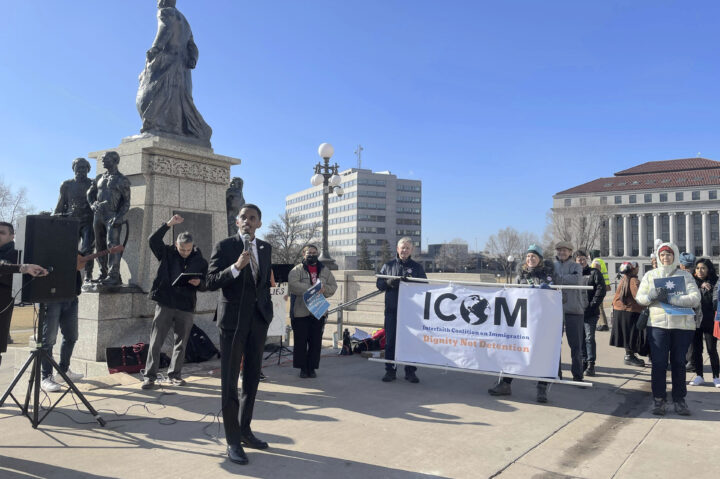
Trisha Ahmed/AP Photo
Minnesota Sen. Omar Fateh, of Minneapolis, speaks in front of the state capitol building in St. Paul, Minn., on Monday, Feb. 12, 2024.
Two political activists closely affiliated with Omar Fateh, a far-left Minnesota state senator who is now running for mayor of Minneapolis, have expressed a range of extreme views on the Hamas terror attacks of Oct. 7, 2023, endorsing the violence as a justified act of resistance and accusing Israel of initiating the war in Gaza, among other inflammatory comments.
Their rhetoric could fuel concerns among local Jewish leaders who sounded alarms about Fateh’s close alliances with anti-Israel activists after he won the state Democratic Party endorsement last month over Jacob Frey, the incumbent seeking a third and final term. Fateh, a 35-year-old democratic socialist whose campaign has recently drawn comparisons to New York City Democratic mayoral nominee Zohran Mamdani, has likewise been a staunch critic of Israel, calling its conduct in Gaza a genocide and pushing for a ceasefire 10 days after Hamas’ attack.
In a mayoral candidate questionnaire solicited by the Twin Cities chapter of the Democratic Socialists of America — which endorsed his bid after facing widespread criticism over its response to the Oct. 7 attack — Fateh also backed the Boycott, Divestment and Sanctions movement targeting Israel, according to portions of the form reviewed by Jewish Insider.
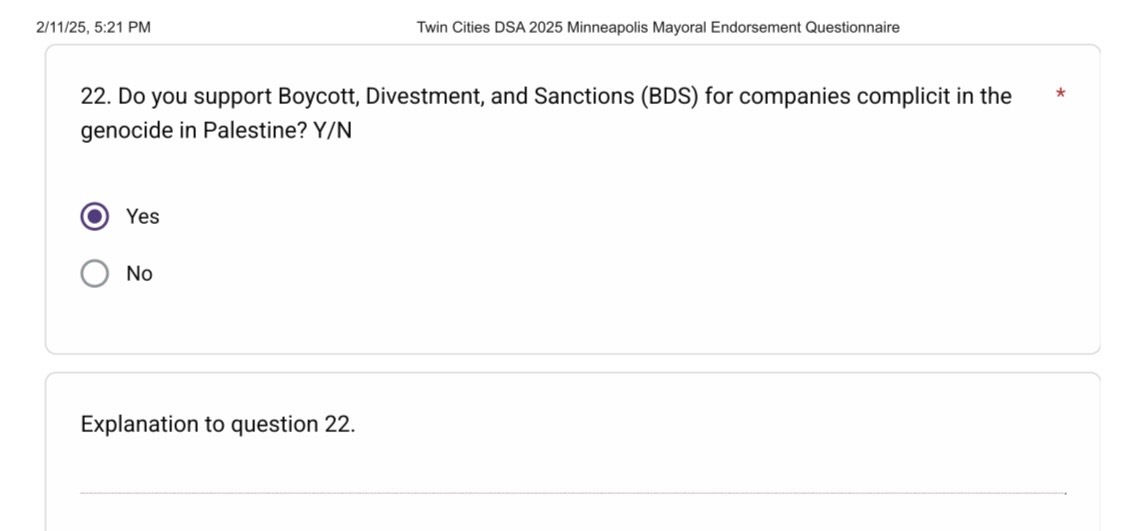
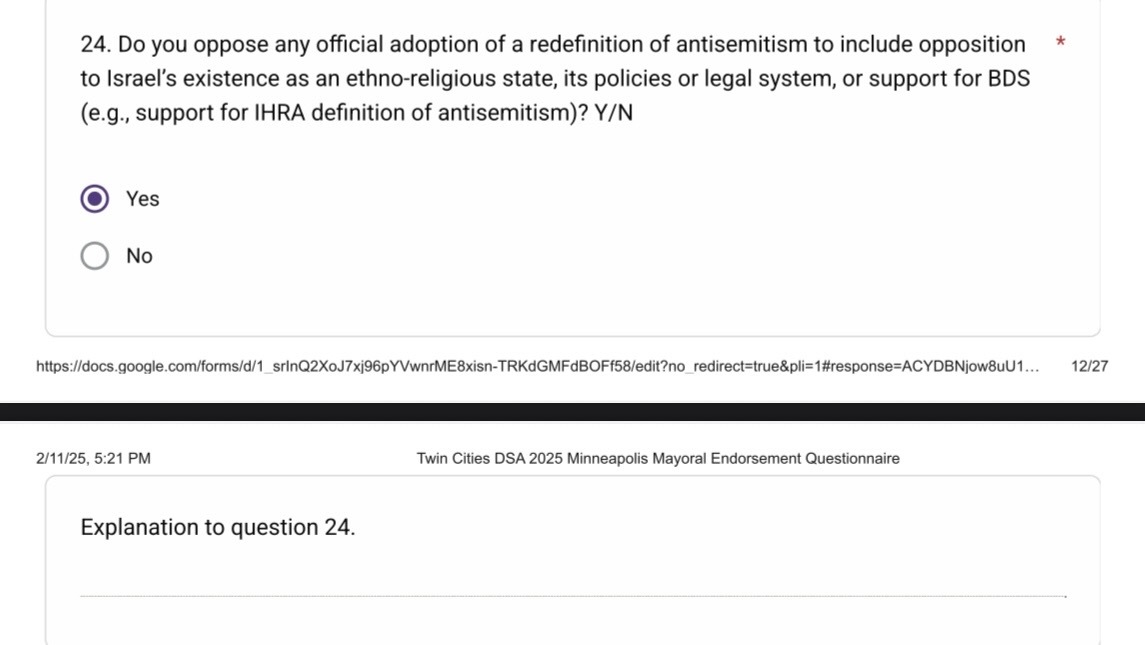
He additionally pledged, without explanation, to “refrain from any and all affiliation” with what the DSA questionnaire dismissed as “Zionist lobby groups,” citing AIPAC, J Street, Christians United for Israel and, most notably, the Jewish Community Relations Council, a nonpartisan organization that typically engages with a diverse group of elected officials in both parties. The local JCRC — which represents the Jewish community to Minneapolis government officials — has voiced reservations about its ability to interact with Fateh if he is elected, in light of his statements on Israel.
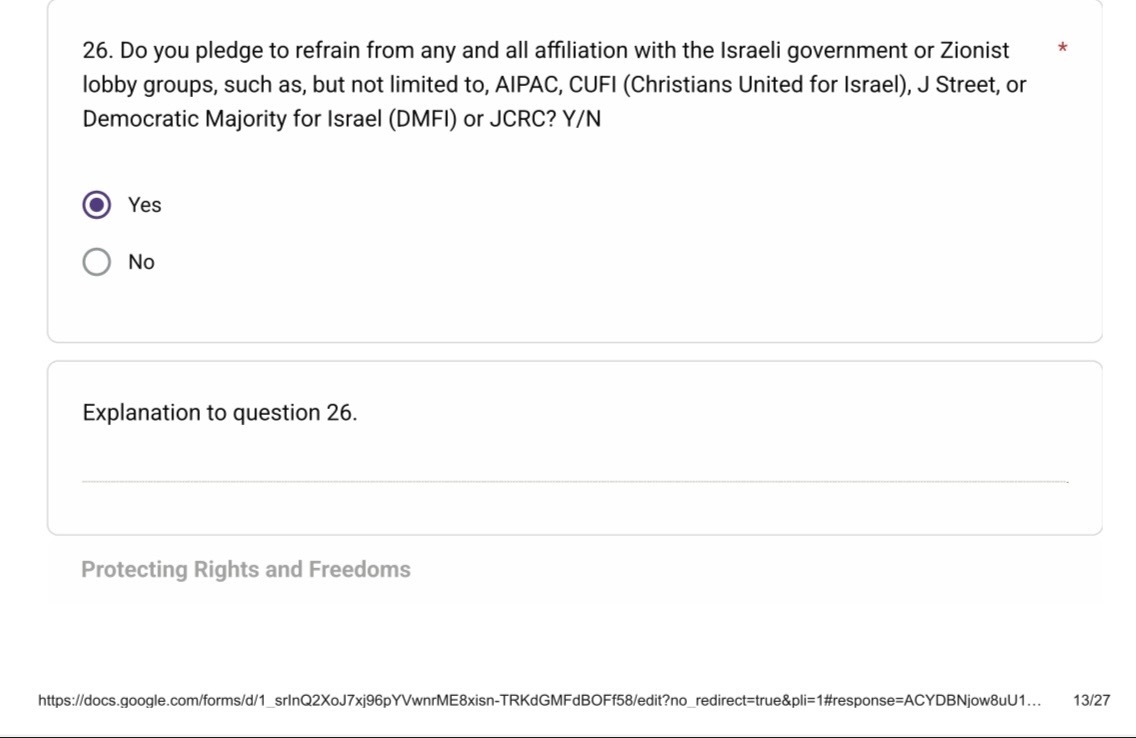
But some of Fateh’s campaign staffers have gone significantly further than the state legislator, raising questions over his tolerance for incendiary language on a sensitive issue that has stoked growing internal tensions in the state party and could possibly inflect an increasingly bitter mayoral race in the lead-up to November.
In a series of now-deleted social media posts, for instance, Fateh’s communications manager, Anya Smith-Kooiman stated that Israel “does not have a ‘right’ to exist” and “must be dismantled,” while amplifying comments dismissing widespread reports of sexual violence on Oct. 7 as “propaganda” and hailing the attacks as a form of “resistance” that succeeded where the peace process had failed.
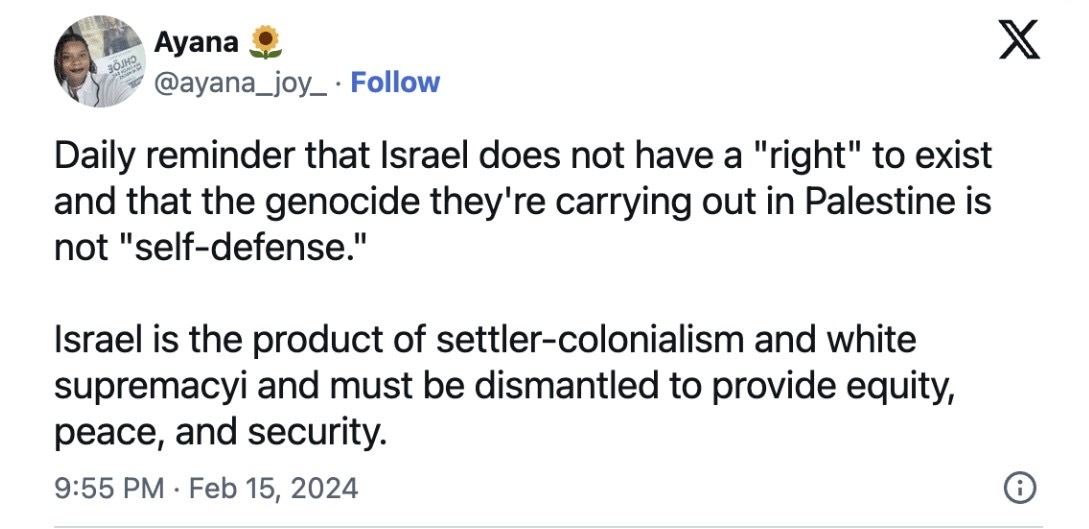

Elsewhere, Smith-Kooiman, who joined Fateh’s campaign in December, according to her LinkedIn page, declared a month after the Oct. 7 attacks that she did “not give a flying f**k about Hamas,” claiming “the root of the problem is a colonial government segregating, ethnically cleaning, murdering Palestinians, stealing their land with impunity and not expecting a resistance group to violently fight back.”
“Colonial and oppressive regimes love to call everyone but themselves a terrorist,” she continued in her November 2023 post to X, now removed from her profile. “Israeli terrorism created Hamas and the cycle will go on and on until Israel, Britain and the U.S. are held accountable for their violence and thievery. Let’s address root causes: imperialism.”
More recently, Smith-Kooiman, in a June social media post, advocated for the release of what she called “all Palestinian hostages,” equating prisoners held in Israel with the captives who were kidnapped by Hamas on Oct. 7.
In addition to Smith-Kooiman, another activist with ties to Fateh’s mayoral bid, David Gilbert-Pederson, has unreservedly praised the Oct. 7 attack, which he has characterized as a heroic feat of defiance against “imperial domination.”
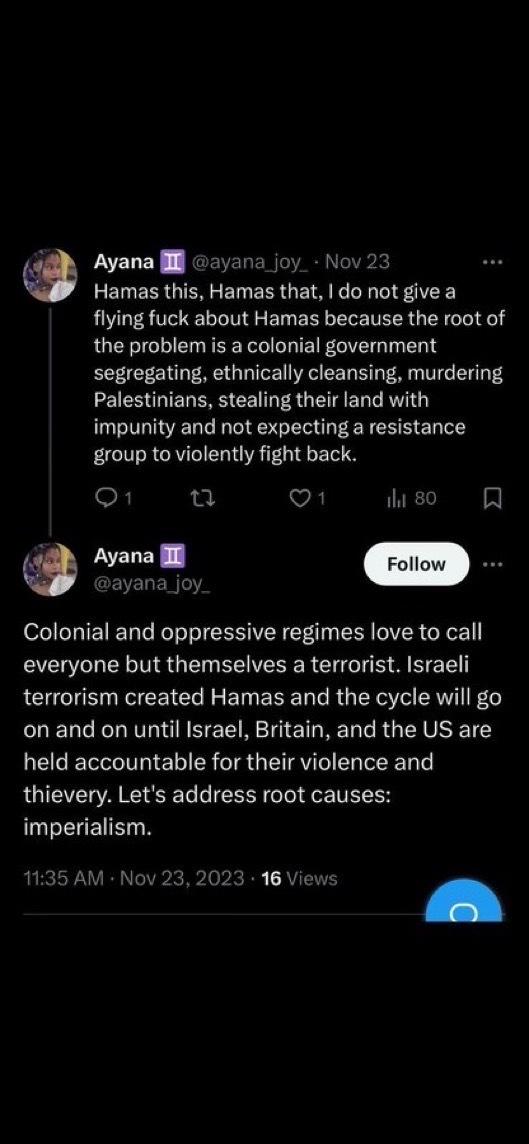
Speaking on a panel discussion about “connecting movements for collective liberation” in December 2023, Gilbert-Pederson — who has been listed as a Fateh campaign staffer in filings — celebrated “what happened collectively for the people of Palestine on Oct. 7,” saying it was not his place to cast judgment on the violence.
“We as Americans, people who live in the imperial core, our job is to stand in unconditional solidarity with those resisting oppression,” Gilbert-Pederson, a close ally of Rep. Ilhan Omar (D-MN), explained in his panel remarks. “Unconditional solidarity does not mean that we get to say, ‘Oh, this tactic you did, we don’t really like that,’ or, ‘We agree with you, but I think that some of your methods are too extreme.’ That’s not what unconditional solidarity means.”
“We live in the core of the empire,” he said, “so it is our job to demand that our government divest from Israel, divest from the colonial project, and start to free the U.S. as well.”
Broadly summarizing his approach, he argued that “all resistance to that kind of imperial domination is justified.”
Fateh’s campaign did not respond to a request for comment on Wednesday about Gilbert-Pederson and Smith-Kooiman, both of whom have previously faced some scrutiny for their rhetoric on Israel and Oct. 7, or his answers to the DSA’s questionnaire.
For his part, Frey, a Jewish Democrat, has been outspoken against rising antisemitism in the wake of Hamas’ attacks. The mayor, 44, has clashed with the City Council over anti-Israel resolutions he has dismissed as one-sided, even as he has condemned Israeli Prime Minister Benjamin Netanyahu and his government’s handling of the ongoing war in Gaza.
Jewish groups, Canadian politicians outraged over film festival’s cancellation of Oct. 7 documentary
American Jewish Committee: ‘Pulling a movie because footage wasn't cleared for copyright by a terror group is so ridiculous that it would almost be laughable’

Jemal Countess/Getty Images
A view of a large TIFF display on King Street during the first night of the 2024 Toronto Film Festival on September 05, 2024 in Toronto, Ontario.
Pro-Israel groups and Canadian politicians expressed outrage on Wednesday after organizers of the Toronto International Film Festival canceled an invitation to show the documentary “The Road Between Us: The Ultimate Rescue,” about the Oct. 7, 2023, Hamas terror attacks, at its upcoming festival, citing the use of Hamas footage of the attacks that had not been approved for use by the terror group.
The documentary tells the story of retired Israeli general Noam Tibon, who raced from Tel Aviv to rescue his son and two young granddaughters trapped in a safe room in Kibbutz Nahal Oz when Hamas terrorists invaded on Oct. 7.
“The Toronto International Film Festival’s reasoning for canceling the October 7 documentary screening is completely absurd and transparently dishonest,” the American Jewish Committee said in a statement. “Pulling a movie because footage wasn’t cleared for copyright by a terror group is so ridiculous that it would almost be laughable — if it weren’t so deeply, shamelessly disturbing.”
In an open letter, Creative Community for Peace, a nonprofit that mobilizes prominent members of the entertainment community to oppose boycotts of Israel, wrote that “instead of advancing peace, TIFF has chosen to amplify hate.”
“This is a surrender to an antisemitic campaign determined to silence Jewish and Israeli voices, at a time when antisemitism in Canada is surging to historic levels. Your decision has only deepened and legitimized that hostility. You claim the cancellation was for security reasons — yet anti-Israel productions face no such barrier.”
The CCFP letter continued, “You claim that the project couldn’t be screened because the filmmakers didn’t have the rights to footage Hamas — a Canadian designated terrorist group, broadcast to the world on October 7, 2023 when they massacred, raped, brutalized, and kidnaped thousands of innocent people from toddlers to Holocaust survivors — but that strains credibility.”
“By pulling this film, TIFF has silenced a story of extraordinary courage and survival,” Noah Shack, CEO of the Centre for Israel and Jewish Affairs, the advocacy arm of the Jewish Federations of Canada, said in a statement. “This shameful decision comes at a perilous time, as extremists are emboldened by recent plans by Canada and other nations to recognize Palestinian statehood.”
Toronto City Councillors James Pasternak and Brad Bradford called on the TIFF to reverse its decision.
“If TIFF does not reverse its decision, [the] Council should demand an investigation into this film banning decision,” Pasternak and Bradford said in a joint statement. “This film tells the story of a heroic rescue in the face of unimaginable violence, yet instead of defending truth and artistic freedom, TIFF appears to have yielded to political pressure and the fear of protests. Intimidation must not dictate which stories can be told. Silencing survivors and granting a listed terrorist organization any semblance of legal legitimacy is not neutrality — it is a moral failure.”
A TIFF spokesperson told Deadline that the invitation was withdrawn “because general requirements for inclusion in the festival, and conditions that were requested when the film was initially invited, were not met, including legal clearance of all footage.”
“The purpose of the requested conditions was to protect TIFF from legal implications and to allow TIFF to manage and mitigate anticipated and known risks around the screening of a film about highly sensitive subject matter, including potential threat of significant disruption.”
The 2024 TIFF festival also did not spotlight an Israeli film. Rather, it featured three anti-Israel documentaries, with four more slated for 2025. The festival is scheduled to run Sep. 4-14.
The group also visited a Gaza Humanitarian Fund staging site on the Gaza border and met with hostage families
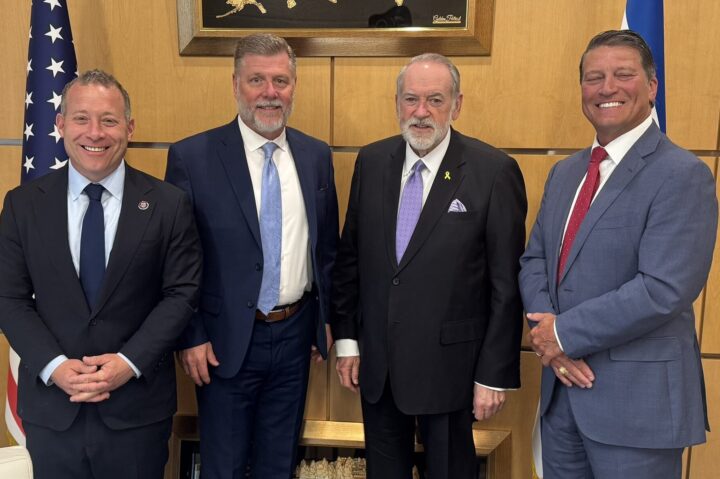
Courtesy of Rep. Rick Crawford
From left to right: Rep. Josh Gottheimer (D-NJ), House Intelligence Committee Chair Rick Crawford (R-AR), Ambassador to Israel Mike Huckabee and Rep. Ronny Jackson (R-TX).
A group of House Intelligence Committee members visited Israel this week, meeting with top Israeli leaders as well as visiting one of the sites of the Oct. 7, 2023, Hamas terror attacks, a Gaza Humanitarian Foundation staging site and the Kerem Shalom border crossing.
The group included committee Chairman Rick Crawford (R-AR) and Reps. Josh Gottheimer (D-NJ) and Ronny Jackson (R-TX).
The lawmakers met with officials including Prime Minister Benjamin Netanyahu, Mossad Director David Barnea, U.S. Ambassador to Israel Mike Huckabee, IDF representatives and Palestinian Authority officials.
The group also visited Kibbutz Kfar Aza near the Gaza border, which suffered heavy losses in the Oct. 7 attacks, and met with hostage families, including the family of Evyatar David, an Israeli hostage shown in a recent video emaciated and forced by Hamas to dig his own grave in a Gaza tunnel.
“Israel and its people have experienced untold levels of tragedy and devastation because of the very fact that they exist,” Crawford said in a statement. “But the Jewish people are a strong, resilient, and compassionate people. Based on our conversations and briefings with military and intelligence partners this week, it is clear Israel is committed to a peaceful end to the unrest in the region but will not cede any ground to Hamas or other Iranian terrorist proxies.”
He said that the group’s “message was simple — the United States stands with Israel and its people. I am grateful for the ongoing cooperation between the U.S. and our Israeli partners as we work to advance our shared goals in the region.”
In a statement, Gottheimer emphasized the need to free the hostages, increase humanitarian aid and end Hamas’ rule in Gaza.
“Given the situation, it was extremely important to meet with Prime Minister Netanyahu and other senior Israeli officials, Ambassador Huckabee, and family members of hostages still in Gaza,” Gottheimer said. “It was also critical to visit an aid staging location at the Kerem Shalom border crossing and a GHF coordination site, which gave me a better understanding of efforts to surge aid into Gaza.”
“We must ensure aid is able to swiftly reach Gazans in need, not Hamas terrorists, who continue to steal food from innocent Palestinians,” he continued. “With so much misinformation, there is no better way to understand the situation than to see it firsthand. By promoting security and stability in the Middle East, the United States will improve our own national security.”
Jackson said in a statement, “This trip not only provided critical firsthand updates from our Defense, State, and Intelligence partners on the ever-evolving elements that threaten Israel, the Middle East, and ultimately the United States, but also reinforced the need for continued strong support to our key ally in the region, Israel.”
He praised both Huckabee and Netanyahu for the work that they are doing.
“We need strong leadership and coordination to protect American lives and interests, and I’m proud to see the Trump administration making national security a top priority with a strategy that is tough, smart, and focused on keeping our country and allies safe,” Jackson continued.
Discussions touched on issues including freeing the hostages, the need to end Hamas’ control of Gaza, the need to increase humanitarian aid — including through the GHF — the need for continued maximum pressure on Iran, the threats from Iran-backed terrorist groups, Hamas’ use of human shields and the need for continued bipartisanship in the U.S.-Israel relationship, according to press releases.
McCormick: ’We have to eradicate [and] destroy the evil’ that caused the Oct. 7 attacks
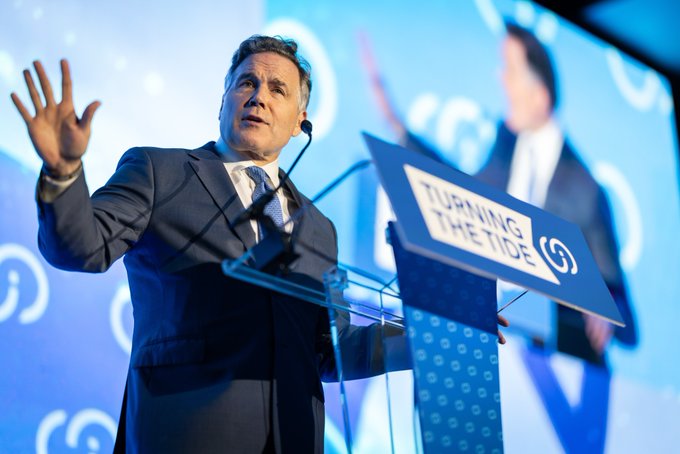
Israel on Campus Coalition/X
Rep. Dave McCormick (R-PA) speaks at the ICC National Leadership Summit in Washington on July 29, 2025.
Israel’s response to the Oct. 7, 2023 Hamas terror attacks “changed the landscape in ways that could be for the good” and lead to the “possibility of a secure region,” Sen. Dave McCormick (R-PA) told a group of pro-Israel college students on Tuesday.
McCormick lauded Israel’s “historic” military efforts that led to the degradation of Iran’s terrorist proxies across the Middle East.
“What’s happened with the conduct of military operations since then in the fight against Hezbollah, the fight against Hamas, taking out much of Iran’s [nuclear] capabilities, what has happened with Israel’s incredible military leadership … has reset the possibility of a secure region,” McCormick told about 700 attendees on the final day of Israel on Campus Coalition’s three-day national leadership summit in Washington.
“It has changed the possibilities in the Middle East and I hope it’s brought an awareness and change to our complacency here at home in the need to fight against that pure evil [and] reset the table in the Middle East.”
“We have to eradicate [and] destroy the evil” that caused the Oct. 7 attacks, McCormick continued, referring to Hamas.
McCormick also took aim at the rise of antisemitism across the country, including in his home state.
After Oct. 7 “there was a second surprise attack. That’s the evil of antisemitism that we saw across our campuses,” McCormick said. “Most of us didn’t know the degree to which antisemitism would rear its ugly head on campuses across Pennsylvania and across our country.”
“It has shown us that we have to engage in a constant battle against the kind of hatred and evil that we saw in Israel on Oct. 7, but also that we saw across our campuses.”
The university ‘does not admit to wrongdoing’ despite reaching the agreement, Acting President Claire Shipman said

JEENAH MOON/POOL/AFP via Getty Images
Columbia University acting President Claire Shipman speaks during the Commencement Ceremony at Columbia University in New York on May 21, 2025.
Columbia University announced on Wednesday that it reached a deal with the Trump administration to restore some $400 million in federal funding that was cut by the government in March due to the university’s record dealing with antisemitism since the Oct. 7, 2023, Hamas terror attacks in Israel.
Under the terms of the deal, Columbia agreed to pay a $200 million settlement over three years to the federal government. In addition, the university has agreed to settle investigations brought by the U.S. Equal Employment Opportunity Commission for $21 million. A number of open civil rights investigations into the university alleging harassment of Jewish students will also be settled under the terms of the agreement, according to which the university will also abide by laws banning the consideration of race in admissions and hiring.
Columbia said it will continue to have “autonomy and authority over faculty hiring, admissions, and academic decision-making.”
“While Columbia does not admit to wrongdoing with this resolution agreement, the institution’s leaders have recognized, repeatedly, that Jewish students and faculty have experienced painful, unacceptable incidents, and that reform was and is needed,” the university said in a statement.
“This agreement marks an important step forward after a period of sustained federal scrutiny and institutional uncertainty,” Claire Shipman, Columbia’s acting president, said in a statement. “The settlement was carefully crafted to protect the values that define us and allow our essential research partnership with the federal government to get back on track. Importantly, it safeguards our independence, a critical condition for academic excellence and scholarly exploration, work that is vital to the public interest.”
Brian Cohen, executive director of The Kraft Center for Jewish Student Life, Columbia’s Hillel, called the settlement “an important recognition of what Jewish students and their families have expressed with increasing urgency: antisemitism at Columbia is real, and it has had a tangible impact on Jewish students’ sense of safety and belonging and, in turn, their civil rights.”
“Acknowledging this fact is essential, and along with the new path laid out by the president and trustees, I am hopeful that today’s agreement marks the beginning of real, sustained change,” Cohen said in a statement. “This is not the end of the process, however it is a major step forward.”
The agreement comes days after Shipman publicized a list of commitments aimed at addressing antisemitism on campus. These included further incorporating the International Holocaust Remembrance Alliance’s working definition of antisemitism by requiring its Office of Institutional Equity to embrace the definition; appointing a Title VI coordinator to review alleged violations of the Civil Rights Act; requiring antisemitism training for all students, faculty and staff; and refusing to recognize or meet with Columbia University Apartheid Divest, a coalition of over 80 university student groups that Instagram banned earlier this year for promoting violence. The school announced on Friday that disciplinary action and rules surrounding student protests would be moved out of the purview of the faculty-run University Senate and into the provost’s office, a move called for by pro-Israel students.
The terms of the settlement — which resulted from months of negotiations — diverge from a list of reforms that was demanded in the Trump administration’s letter to Columbia in March, which was initially agreed upon by the university but never finalized. The list included putting the Middle Eastern, South Asian and African studies department and the Center for Palestine Studies under the purview of a senior vice provost, who would be appointed by the university to supervise course material and non-tenure faculty hiring; as well as the formation of a presidential search committee to replace Shipman.
Reps. Jim Jordan and Brian Mast have also been investigating grants received by six Israeli NGOs that played a role in the judicial overhaul protest movement
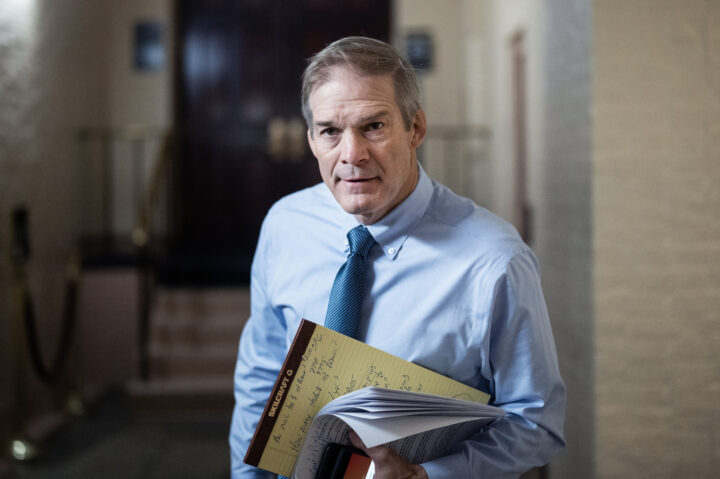
Tom Williams/CQ-Roll Call, Inc via Getty Images
Rep. Jim Jordan (R-OH) leaves a meeting of the House Republican Conference in the U.S. Capitol on Wednesday, June 4, 2025.
The GOP-led House Judiciary Committee drafted a new memo on Thursday alleging that federal funding granted to USAID and nongovernmental organizations under the Biden administration was given to Palestinian nonprofits with ties to proscribed terror groups.
“Oversight conducted by the Committee reflects the Biden-Harris Administration’s neglect and misuse of taxpayer dollars through USAID, the State Department, and other federal agencies, which were used to directly and indirectly fund the efforts of anti-Netanyahu organizations and terrorist groups,” the memo sent to committee members, which was obtained by Jewish Insider, states.
Judiciary Committee Republicans also revealed in the memo that they were “expanding” their investigation “to include additional American and Israeli NGOs that may be involved in funneling U.S. government funds with the purpose of undermining the Israeli government or for the support or fiscal sponsorship of terrorist groups.”
The memo comes nearly four months after Rep. Jim Jordan (R-OH), who chairs the Judiciary Committee, and Rep. Brian Mast (R-FL), chairman of the House Foreign Affairs Committee, began reaching out to six NGOs to determine if they had received U.S. tax dollars through USAID or the State Department and the role they individually played in the protest movement. The inquiries specifically requested documentation and communications from the organizations about the funding applications, any communications between the NGOs in question and details about how the funds were spent. So far, the probe has not published evidence indicating that they have received federal funding.
The organizations — the Jewish Communal Fund, Middle East Dialogue Network, Movement for Quality Government in Israel, PEF Israel Endowment Funds, Rockefeller Philanthropy Advisors and Blue and White Future — “produced 380 total documents” to the committees to date in the ongoing probe into “the Biden-Harris Administration’s use of U.S. taxpayer funds to undermine Israel’s democratically elected government,” according to the memo.
Blue and White Future categorically denied the notion that the organization received any federal funding in a statement to JI and in communications with House lawmakers.
“No state entity, administration or government body – American or otherwise (USAID included) – has ever provided funding to the organization, whether directly or indirectly. All donations to the organization originate from private donors who care deeply about Israel’s security and its future. Every donation received and every activity undertaken by the organization is fully documented, reported, and independently audited in strict compliance with applicable law,” a BWF spokesperson told JI.
“The letters circulated by members of the U.S. Congress rely on biased and factually incorrect publications that bear no connection to reality. These claims are entirely baseless. The organization has clearly and comprehensively addressed these allegations in its responses to all relevant inquiries,” they added.
After legal and structural changes, the anti-Israel group has switched its focus from protests and advocacy to organizing for and against candidates

Tierney L. Cross/Getty Images
Demonstrators from Jewish Voice For Peace protest the war in Gaza at the Canon House Building on July 23, 2024 in Washington, DC.
Jewish Voice for Peace, a far-left anti-Israel advocacy group that has built a growing profile in the wake of Hamas’ Oct. 7, 2023, terror attacks, is pivoting to a new organizational structure that will soon allow it to engage more forcefully in electoral politics.
The group recently began the process of consolidating its membership and organizing in an affiliated but lesser-known political nonprofit called Jewish Voice for Peace Action, devoting the bulk of its resources to lobbying and political activities, such as supporting and opposing candidates that had not traditionally been a part of its core focus.
As a nonpartisan tax-exempt group, JVP, which has been at the forefront of campus anti-Israel protests and promotes efforts to divest from Israel, has been legally prohibited from taking sides in campaigns — a limitation the new structural change is designed to address.
The shift comes as the activist left has felt newly emboldened by Zohran Mamdani’s shocking victory in New York City’s Democratic mayoral primary in June, fueling debates over the ideological direction of the party as it gears up for next year’s midterms.
JVP Action, which recently changed its public name to Jewish Voice for Peace to match its sister organization, was an early supporter of Mamdani and has cited his outspoken opposition to Israel as a sign of evolving voter attitudes about the Israeli-Palestinian conflict.
“There is unprecedented, mass support for Palestinians. Our movement has already grown larger, and more quickly, than many of us thought possible. But it’s clear we have not begun to tap our full potential,” JVP writes in a detailed new page on its website about the decision-making behind its shift. “The U.S. government has not budged from its commitment to sponsor Israel’s genocide. Public polling and public displays of opposition alone will not shift U.S. policy. Our movement must contend for real power.”
JVP, which until now had been the primary home for the group’s organizing work, will become a “supporter-based” rather than a “membership-based” organization renamed JVP Leadership & Culture Lab — with a focus on educational training and arts and culture programming to help promote “anti-Zionist Jewish” advocacy, according to its tentative mission statement.
The change was approved in a recent membership vote and will be implemented by Oct. 15, according to a lengthy agenda from a virtual meeting last week shared with Jewish Insider.
JVP Action’s board, for its part, had already voted to change its name and structure independently of the recent all-members meeting, in anticipation of the organizational inversion.
During the meeting, a recording of which was reviewed by JI, one member raised a concern that the change could “lead to a deemphasis” on JVP’s involvement in “mobilizing of protests and direct action” in favor of “electoralism and support for progressive Democrats.” The member was reassured by leadership that such approaches are complementary and that electoral work is a “key tactic inside a set of tools” including “civil disobedience” and divestment campaigns.
In moving to now operate primarily as a political nonprofit, “the barriers between the work of JVP and JVP Action organizations will be removed,” JVP further explains on its website.
“This has long been a challenge, creating silos and firewalls in our respective work that keep us from drawing clear connections between the political, electoral, cultural and financial forces that uphold the U.S.-Israeli relationship,” the group adds.
JVP, which is closely aligned with American Muslims for Palestine, a leading pro-Palestinian advocacy group that has faced legal scrutiny for alleged ties to terror organizations such as Hamas, has significantly bolstered its fundraising in recent years.
The organization raised a record $11 million in revenue from July 2023 to June 2024, according to its latest tax filing, far outpacing previous figures. It is not required to share the names of its donors as a 501(c)(3) to which contributions are tax-deductible.
As a so-called “dark money” group, JVP Action, a 501(c)(4) that is not tax-exempt, can also shield its contributors from the public, even as it engages in elections — unlike political action committees that must disclose their donors.
JVP Action pulled in $800,000 in revenue from July 2022 to June 2023, its most recent tax filing shows, marking its strongest showing since it was established in 2020.
A smaller PAC affiliated with JVP raised only $133,000 last election cycle and does not seem to be part of the new restructuring. The Anti-Defamation League filed a complaint last year accusing the PAC of engaging in a pattern of misrepresentations that violate federal campaign finance law.
In its efforts to stake out a more prominent role in elections, JVP Action is borrowing a page from one of its primary adversaries, the pro-Israel lobbying group AIPAC, which launched a super PAC as well as a political action committee in 2021 to wield its more considerable resources in congressional races where divisions over Israel have drawn significant outside spending.
“For a century, our opposition — the American Zionist establishment — has employed a long-term multipronged strategy to build U.S. support for Zionism and genocide and they have used all the tactics in the book,” JVP says in its recent meeting agenda. “They have a cultural strategy, an electoral strategy, a lobbying arm, youth organizations, mass movement organizations and funding vehicles.”
But the group argues that its opponents are “now experiencing a crack in their power.”
JVP Action, which has previously endorsed a range of Squad members in the House, has not indicated how it plans to approach the upcoming midterms in its more streamlined role.
The group did not return a request for comment on Wednesday, nor did JVP.
A poll released in February by The Jewish Majority, a pro-Israel research group in Washington, showed most Jewish Americans oppose the confrontational protest tactics used by JVP and regard anti-Zionist movements as antisemitic, among other findings.
Jonathan Schulman, the executive director of The Jewish Majority, said that JVP’s “decision to more vigorously engage in electoral politics signals their growing ambition to influence policy in ways that undermine Israel’s very existence as a Jewish state.”
“As they pursue this goal,” Schulman said in a statement to JI on Wednesday, “the pro-Israel community must make it clear to both the public and policymakers that the rhetoric and tactics of anti-Zionism undermine any prospects for a peaceful resolution to the conflict and contribute to the rise in violent attacks against Jews in America. JVP seeks to disprove any connection between anti-Zionism and antisemitism. We must expose that anti-Zionism is fundamentally opposed to peace.”
But with Mamdani’s resounding win over former New York Gov. Andrew Cuomo, who had touted his staunch support for Israel and opposition to rising antisemitism in the primary, JVP now claims to see evidence its “movement work” is gaining traction.
“It is no longer popular for the U.S. to be sending endless weapons and funding to Israel,” the group said in its meeting agenda. “People are questioning the U.S.’ support for genocide and violence against the Palestinian people. Our movement is growing! And we still have a long way to go to break open this crack and end U.S. support for Israel.”
The bill takes a new tack at a previously attempted move by first designating Muslim Brotherhood branches individually
Salah Malkawi/Getty Images
Jordanian police close the entrance of a Muslim Brotherhood headquarter after the announcement of banning the society in the country on April 23, 2025 in Amman, Jordan.
A bipartisan House bill set to be introduced on Tuesday aims to designate the Muslim Brotherhood as a terrorist organization, a step forward for an effort that saw renewed interest following the terrorist attack in Boulder, Colo., targeting Jews advocating for the release of hostages in Gaza by a man who appeared to have expressed support for the group years earlier.
Similar efforts have been pursued at multiple points in the past, but the latest legislation has been updated significantly and focuses on the various branches of the Muslim Brotherhood responsible for terrorism.
The bill, led by Reps. Mario Díaz-Balart (R-FL) and Jared Moskowitz (D-FL), notes that Hamas is a Muslim Brotherhood affiliate that has long been designated as a Foreign Terrorist Organization by the U.S. and that receives material support from the Muslim Brotherhood. It also highlights the destabilization efforts by other Muslim Brotherhood branches in various Arab partner countries of the U.S.
The bill is co-sponsored by Reps. Randy Fine (R-FL), Chuck Fleischmann (R-TN), John Rutherford (R-FL), Andy Barr (R-KY) and Mike Bost (R-IL).
“Today, I once again introduced legislation to designate the Muslim Brotherhood as a foreign terrorist organization,” Díaz-Balart said in a statement. “The global Muslim Brotherhood has numerous regional branches, including terrorist organizations such as Hamas, and spreads violence and instability throughout the Middle East. For this reason, it is crucial to U.S. national security interests that we prohibit U.S. dollars from enabling the Muslim Brotherhood’s dangerous activities, and that we ensure Muslim Brotherhood members are blocked from entering the United States.”
“This important legislation gives the Trump Administration the additional authority it needs to protect Americans, and our closest allies, from this insidious threat,” he continued.
Moskowitz said in a statement, “The Muslim Brotherhood has a documented history of promoting terrorism against the United States, our allies, and our society.”
“Countries such as Bahrain, Egypt, Austria, Jordan, Saudi Arabia, UAE, and France have already taken important steps to investigate and crack down on the Muslim Brotherhood and its affiliates. The U.S. government has to have the authority to crack down on the serious threats posed by this group as well,” Moskowitz continued. “That’s why I’m joining Rep. Diaz-Balart and Sen. Cruz to introduce the Muslim Brotherhood Terrorist Designation Act. This bill builds on my call for an investigation into designating the Muslim Brotherhood a Foreign Terrorist Organization, and it ensures we are taking crucial steps to protect our national security.”
Sen. Ted Cruz (R-TX) introduced companion legislation in the Senate on Monday.
The legislation instructs the secretary of state to identify all branches of the Muslim Brotherhood operating globally and provide a determination of whether each of those branches meets the requirements for designation as a foreign terrorist organization.
The legislation would use those determinations to designate the global Muslim Brotherhood organization as a terrorist group, in light of its support for those branches.
The bill also pursues three methods of designating the group as a foreign terrorist organization: by revising the Anti-Terrorism Act, which was initially targeted at the Palestine Liberation Organization, to include the Muslim Brotherhood, by seeking State Department designation as a Foreign Terrorist Organization and seeking Treasury Department designation as a Specially Designated Global Terrorist group.
The three designations grant the federal government various sanctions authorities and bar Americans from supporting the groups. The bill would also make Muslim Brotherhood members ineligible for entry into the United States and could impose financial sanctions on them.
Previous efforts to designate the group focused on the entire Muslim Brotherhood, rather than starting by targeting specific branches, and only pursued FTO designation.
A fact sheet by the legislation’s sponsors states that the previous “top-down … strategy failed because not all MB branches are currently violent and would therefore meet the criteria for designation.” It described this new approach as “bottom-up,” and similar to the approach the Trump administration took to designate the Islamic Revolutionary Guard Corps as a terrorist group — citing its support for the Quds Force, which was designated as a terrorist group.
Fine has separately introduced legislation to designate the Council on American Islamic Relations as a terrorist group.
The DHS Office of Intelligence and Analysis, responsible for a variety of information-sharing functions, plans to shed 75% of its staff
JIM WATSON/AFP via Getty Images
A sign for the US Department of Homeland Security in Washington, DC, March 24, 2025.
Jewish community groups and congressional Democrats are raising concerns about the Department of Homeland Security’s plans to slash 75% of the staff for the department’s Office of Intelligence and Analysis (I&A).
NextGov reported that the cuts — totaling 725 of the office’s 1,000 staff — had been in progress for months but were temporarily paused following the U.S. strikes on Iran’s nuclear facilities, which federal officials warned could prompt domestic attacks.
I&A plays a role in collecting and disseminating to local law enforcement and private partners intelligence to counter threats including terrorism and foreign adversaries. But the office has also come under criticism from various fronts in recent years over alleged domestic surveillance abuses and failures to investigate threats, and faced questions over its scope, capabilities and mission, which have prompted calls for reform.
Top congressional Democrats wrote to the administration last week criticizing the expected cuts.
“Hollowing out the office risks leaving the homeland dangerously exposed to these threats, especially at a time when the FBI’s budget is being substantially reduced,” Sen. Gary Peters (D-MI), the ranking member of Senate Homeland Security and Governmental Affairs Committee, and Reps. Bennie Thompson (D-MS) and Jim Himes (D-CT), the ranking members of the Homeland Security and Intelligence committees, said in a letter to Secretary of Homeland Security Kristi Noem and Director of National Intelligence Tulsi Gabbard.
“Radically reducing I&A’s workforce at headquarters or in the field would create dangerous and unnecessary security gaps and could again leave us in the dark about the threats that lie ahead,” the lawmakers continued.
They emphasized that, despite issues at I&A in the past, it has made progress and fills critical gaps in the intelligence infrastructure.
A coalition of Jewish community groups — the American Jewish Committee, the Anti-Defamation League and the Secure Community Network — wrote to the top lawmakers on the Senate and House Intelligence Committees last week raising similar concerns.
“We are deeply concerned that any wholesale changes to the operations of I&A will have an adverse effect on countering antisemitism and ensuring the safety of the Jewish community in the United States,” the Jewish groups wrote. “With the historic rise in antisemitic incidents and threats both targeting and impacting the American Jewish community, I&A’s role has never been more important.”
The groups highlighted the office’s mission in sharing information with partners, including state and local law enforcement, and said that they “rely on I&A to provide accurate and timely updates on behalf of the intelligence community to inform efforts for our community’s safety and security.”
The groups urged the lawmakers to work to halt changes that would jeopardize Jewish community security.
Michael Masters, SCN’s CEO, wrote separately to Noem on Monday to offer recommendations for the future of I&A, emphasizing, “as the only Intelligence Community entity statutorily mandated to share threat information with state, local, tribal, and territorial (SLTT) partners, and a key information sharing partner of a non-profit entity such as ours, it is critical that we at SCN, as well as our law enforcement partners, have an effective, credible, and efficient partner in DHS I&A.”
Masters said that, while the office is a critical resource, there have been issues with I&A’s output in the past, some of which have impacted the Jewish community: “When we have received information and support from I&A, we have faced issues with the timely and credible nature of the information itself,” Masters said.
He recommended that I&A’s mission be focused in part on collaboration and information-sharing with nonprofits such as SCN and on open-source intelligence collection and coordinating with other federal intelligence agencies.
A DHS spokesperson said in a statement to JI that DHS has identified some roles and programs inside I&A as unnecessary.
“Under President Trump’s leadership, we focused on getting the Department of Homeland Security back to its core mission of prioritizing American safety and enforcing our laws. DHS component leads have identified redundant positions and non-critical programs within the Office of Intelligence and Analysis,” the statement reads. “The Department is actively working to identify other wasteful positions and programs that do not align with DHS’s mission to prioritize American safety and enforce our laws.”
Groups representing state and local law enforcement officials, including the Major Cities Chiefs Association, County Sheriffs of America, the Association of State Criminal Investigative Agencies, the National Fusion Center Association and the National Sheriffs’ Association, have also warned against gutting the office.
“[I&A] is the only component of the U.S. intelligence community with a statutory mandate to share threat information with state and local partners,” a letter from the Major Cities Chiefs Association, County Sheriffs of America and the Association of State Criminal Investigative Agencies, reads. “The current threat landscape makes our partnership with [I&A] more critical than ever. Ongoing Middle East conflicts heighten risks of foreign-directed and homegrown violent extremism, as demonstrated by the recent antisemitic attack in Boulder, Colorado.”
The Democratic senator — and Joe Lieberman successor — has grown increasingly antagonistic toward Israel and now says he welcomes out-of-the mainstream voices into the Democratic party

Jemal Countess/Getty Images for Fair Share America
Sen. Chris Murphy (D-CT) speaks at the U.S. Capitol on April 10, 2025 in Washington, DC.
When Sen. Chris Murphy (D-CT) walked up to the microphone at the “Rally for Israel” in West Hartford, Conn., two days after the Oct. 7, 2023, Hamas terror attacks, sporting a well-worn UConn baseball hat and a quarter-zip sweatshirt, the first thing he did was apologize for his attire. He was in the middle of his annual walk across the entire state of Connecticut, sporting the same sneakers he has worn each year since 2016.
He said he almost canceled the remainder of the walk after the attacks in Israel.
“But then I thought to myself, what better way to spend my week than traveling from one end of the state to the next to explain to the people of this state why it is so important for this state, the people of this state, to stand up and speak with one voice that we stand in support of Israel?” Murphy asked, receiving loud applause from the crowd gathered outside West Hartford City Hall. The Hartford metro area boasts the largest Jewish community in the state.
Murphy spoke emotionally about the “unspeakable” videos and images that were emerging from Israel. “This is a moment where we are going to have to stand as a nation with greater force, with greater purpose than ever, to make sure that Israel has what it needs,” Murphy said.
But members of Connecticut’s Jewish community say Murphy strayed from that promise just weeks after Hamas launched the deadliest terror attack in Israel’s history. In late November 2023, Murphy said on CNN that he was open to placing conditions on U.S. aid to Israel, a position that astounded many of the people who had stood with him in West Hartford not long before. Since then, he has emerged as a vocal critic of Israel’s handling of the war in Gaza.
“Unlike the unwavering support for Israel shown by President [Joe] Biden and the Democratic leadership in the Senate, your tune has changed in recent weeks,” Rabbi Tuvia Brander, the spiritual leader of Young Israel of West Hartford, wrote in an open letter responding to Murphy, published in the Jewish Link, a local Jewish news outlet. “As a voter and your constituent, I hope you will do better; Israel deserves better, America deserves better, we deserve better!”
Now, more than 18 months after the attack and Murphy’s pledge to stand by Israel, the Connecticut Jewish community’s frustration with Murphy has only grown.
The Connecticut senator voted twice in support of resolutions put forward by Sen. Bernie Sanders (I-VT) that would block certain arms sales to Israel. Following Israel’s strikes on Iranian nuclear facilities, Murphy slammed Israeli Prime Minister Benjamin Netanyahu for sending the Middle East into a “new, deadly conflict,” arguing that the U.S. has “no obligation to follow Israel into a war we did not ask for and will make us less safe.”
His shift to the party’s left flank on Israel comes as Murphy positions himself as a leading voice in the Democratic Party in opposition to President Donald Trump’s policies and builds a stronger public profile for himself. He’s a regular on cable news shows and recently created a new political action committee to encourage protests against Trump, with plans to spend $2 million in the 2026 midterms, sparking rumors that he could mount a presidential bid in 2028.
It’s not just Murphy’s foreign policy views that are concerning his Jewish constituents. Recently, the senator has emerged as one of the most prominent boosters of presumptive New York City Democratic mayoral nominee Zohran Mamdani, even as some of his Democratic colleagues have raised concerns about Mamdani’s refusal to condemn the phrase “globalize the intifada.”
Murphy went on national television on Sunday and announced he was endorsing Mamdani, while saying it might be necessary to include outside-the-mainstream views within the Democratic Party.
“He was authentic, right? I mean, yes, he’s got some views that are a little bit out of the conventional mainstream. But you know what? The traditional political pundits have no idea what’s actually mainstream in this country … And so Democrats should learn from his victory,” Murphy said on “Meet the Press.”
Brander told Jewish Insider that Murphy’s praise of Mamdani is “so beyond the pale of what is just in the basic interests of many of his constituents.”
“He really seems to be trying to position himself within the progressive wing of the Democratic Party,” said Leslie Loew, an emeritus professor at the University of Connecticut’s cell biology department. “He’s been saying things and doing things that people who are supportive of Israel and are sympathetic to Israel’s plight are kind of disturbed at.”
Murphy, a member of the Senate Foreign Relations Committee, views foreign policy as a key issue of national concern, and one where he has decided to be outspoken. His official website touts his efforts to chart a “forward-thinking foreign policy vision” for the United States, describing himself as an “outspoken proponent of diplomacy, international human rights and the need for clear-eyed American leadership abroad.”
Some in the Jewish community — including many who have supported him in the past, particularly around gun control, the issue that first brought him national attention — are left watching all of this warily. (Murphy became a vocal advocate for gun violence prevention after the Sandy Hook Elementary School shooting in 2012, when he represented Newtown in the House of Representatives.)
“He really seems to be trying to position himself within the progressive wing of the Democratic Party,” said Leslie Loew, an emeritus professor at the University of Connecticut’s cell biology department. “He’s been saying things and doing things that people who are supportive of Israel and are sympathetic to Israel’s plight are kind of disturbed at.”
Loew, a Democrat, voted for Murphy in his first two Senate elections. But last year, when Murphy was on the ballot, Loew opted not to vote in the Senate race.
Murphy defeated Republican challenger Matthew Corey by nearly 20 points. He does not face any serious political opposition in solidly blue Connecticut.
“There’s really no challenging him in terms of state politics. He can have his Senate seat as long as he wants it,” said Scott McLean, a political science professor at Connecticut’s Quinnipiac University, who also called Murphy “one of the most visible voices challenging the [Trump] administration on a whole variety of issues.”
One of those issues is Iran, and, more broadly, Trump’s foreign policy in the Middle East. Murphy had also taken aim at Trump for bombing three nuclear sites in Iran, saying that Trump was “goaded into these strikes by the perpetual cheerleaders of war in the Middle East,” and called the actions “illegal” while warning that “countless Americans” could die as a result.
Last week, a senior foreign policy advisor in Murphy’s office met virtually with Loew and Ari Schaffer, who founded an Israel advocacy group called Greater Hartford for Israel, over concerns about Murphy’s approach to Iran. Loew and Schaffer have been organizing weekly pro-Israel marches in West Hartford since Oct. 7.
Murphy’s staffer “insisted that he is fully supportive of Israel,” Loew said after last week’s meeting. “I actually believe her. I think that in his mind, he believes in Israel’s right to exist, but he doesn’t project that when he criticizes Israel. He criticizes Israel at every opportunity, and obviously very unfairly in many cases.”
Murphy told JI in a statement Monday that he “will always be a strong friend of the Israeli people and support Israel’s right to defend itself, especially after the horrors of October 7th but also against the threats posed by Iran and its proxies.”
In April, on the morning of the Senate vote on the Sanders-sponsored resolutions on cutting arms sales to Israel, Murphy spoke with a group of leaders from Jewish federations throughout Connecticut, according to a person with knowledge of the meeting. He listened to their arguments, but he was still one of 15 Democratic senators to vote in favor of the resolutions.
Stephen Davis, a Harvard Law School professor who lives in Connecticut, defended Murphy, despite his distance from the Jewish communal establishment. “Senator Murphy is as pro-Israel as they come. But that doesn’t mean backing everything the current Israeli government does,” said Davis, the chair of J Street’s Connecticut chapter.
Murphy told JI in a statement Monday that he “will always be a strong friend of the Israeli people and support Israel’s right to defend itself, especially after the horrors of October 7th but also against the threats posed by Iran and its proxies.”
He argues that the change is not his attitude toward Israel, but Israel’s actions in Gaza and the shifting geopolitical reality in the Middle East. “I have consistently supported sending Israel the military aid it needs to decimate Hamas’ military capabilities and eliminate Hamas leadership,” said Murphy, adding that he believes “those aims have been achieved, and the government should prioritize a cease-fire deal that brings home all of the hostages.”
“Sen. Chris Murphy has been a critical voice in the fight against antisemitism and extremism. At a time when Jewish communities face historic threats, he has renewed his commitment to strengthening and growing the Nonprofit Security Grant Program,” said Stacey Sobel, the Anti-Defamation League’s Connecticut director, adding that the ADL will continue “working through any differences to advance our shared goals.”
“My vote on the recent JRDs reflects my serious frustration with how Prime Minister Netanyahu has prosecuted this war, which has led to the deaths of more than 50,000 Palestinians and pushed Gaza to the brink of famine,” Murphy said, referring to the Sanders-authored resolutions.
Despite mounting frustration over Murphy’s approach to Israel, Jewish leaders have found common cause with the senator on their requests to increase federal funding for vital security aid for nonprofits. Murphy, a member of the Senate Appropriations Committee, plays an important role on that issue, and has advocated for additional funding for the Nonprofit Security Grant Program.
“Sen. Chris Murphy has been a critical voice in the fight against antisemitism and extremism. At a time when Jewish communities face historic threats, he has renewed his commitment to strengthening and growing the Nonprofit Security Grant Program,” said Stacey Sobel, the Anti-Defamation League’s Connecticut director, adding that the ADL will continue “working through any differences to advance our shared goals.”
Still, despite the areas of collaboration, some of Murphy’s Jewish constituents view his approach to Israel as a betrayal — and a cause for concern as he ascends within the Democratic Party.
“A lot of people are worried what it means for the future of the Jewish community and the safety of the Jewish community, for our relationship with the State of Israel, if he’s the kind of person who’s going to be the standard bearer for the Democratic Party going forward,” Schaffer, who is a registered Republican, said.
The pro-Israel marches that Schaffer has organized since Oct. 7 have drawn several Connecticut lawmakers, including Sen. Richard Blumenthal (D-CT) and Rep. John Larson (D-CT). Despite regular invitations, Murphy has yet to attend one of the weekly pro-Israel events.
The ruling affirmed the constitutionality of legislation passed by Congress to assert U.S. jurisdiction over the PLO and PA

MENAHEM KAHANA/AFP via Getty Images
Shopkeepers, police and fire officers look at the debris at the scene of a suicide bombing near the Sbarro pizzeria on the junction of Jaffa Road and King George Street in Jerusalem.
The Supreme Court ruled unanimously in favor of the victims of Palestinian terrorist groups on Friday in a case regarding the constitutionality of a U.S. law allowing lawsuits against the Palestinian Authority and Palestine Liberation Organization in American courts over payments to terrorists and their families through the “pay-for-slay” program.
The Supreme Court victory in Fuld v. Palestine Liberation Organization is a hard-fought win for the families, and comes following a decades-long series of efforts by American terror victims and their families to sue the Palestinian groups.
Previously, the Second Circuit had repeatedly ruled that legislation passed by Congress to assert U.S. jurisdiction over the PLO and PA, designed to allow victims to sue the groups, was unconstitutional.
Those rulings prompted a back-and-forth between the courts and Congress, which has repeatedly passed legislation designed to address the issues raised by the courts and re-establish a path for terror victims to use the PLO and PA.
The Supreme Court on Friday ruled that the most recent of those bills, the Promoting Security and Justice for Victims of Terrorism Act (PSJVTA), which stated that the PLO and PA would be subject to U.S. jurisdiction if they continued the terror payments or carried out activities in the United States, was constitutional, reversing the Second Circuit’s decision.
In an opinion written by Chief Justice John Roberts, the court ruled that the PSJVTA was reasonable, tying jurisdiction to PLO and PA activities involving the U.S. and sensitive foreign policy matters in which Congress and the executive branch should enjoy broad discretion.
He wrote that the Constitution allows the federal government authority inside and outside the United States, particularly in cases involving U.S. nationals attacked outside U.S. borders.
The case was named for Ari Fuld, who in 2018 was stabbed to death by a Palestinian terrorist whose family subsequently received payments from the PA. Fuld’s wife was one of several family members of terror victims who were party to the suit.
“This is a big deal indeed,” Hillel Fuld, an American Israeli columnist and Ari’s brother, said on X. “Now any American citizen affected by Palestinian terror can sue the Palestinian authority in American courts. Pretty unprecedented! Wow.”
“Ari continues to change the world even after his death,” Fuld continued.
The Supreme Court’s decision should also allow a previous $650 million judgement in the case Sokolow v. Palestine Liberation Organization, which was struck down by the Second Circuit, to move ahead.
Justice Clarence Thomas wrote in a concurring opinion that the court should have gone further in its decision, saying that he is “skeptical” that groups such as the PLO and PA are entitled to “any constitutional rights at all, let alone qualify as ‘person[s]’ for purposes of the Fifth Amendment.” Thomas also cast doubt on the idea that the Fifth Amendment restrains in any way Congress’ authority to expand U.S. jurisdiction beyond U.S. borders.
Justice Neil Gorsuch joined Thomas’s concurrence in part.
“It’s a big win for the plaintiffs,” Mark Pinkert, an attorney for Holtzman Vogel who filed an amicus brief on behalf of a slew of Jewish organizations, told Jewish Insider. “It’s a very big win for victims of terrorism. It’s a really good day.”
He said the case should bring to an end the long-running battle over whether U.S. courts have jurisdiction in these cases.
“For the Sokolow plaintiffs, who already got a jury award, that should be it, and that should allow them to have that jury award reinstated,” Pinkert continued. “Now there’s questions about how they collect on it, but as far as having a judgment in hand that says, ‘You owe me $600 million,’ it should be the nail in the coffin.”
The Fuld case will still need to proceed to trial, but he said it’s “not a stretch to say the Fuld plaintiffs” will be able to successfully argue their case, given the results in Sokolow.
Pinkert explained that in their decision, the justices largely declined to address broader constitutional questions about the boundaries of the Fifth Amendment raised during oral arguments, only declaring that this case did not violate it.
Jennings, stuck indefinitely in Israel until airspace reopens, said Americans ‘need to understand what’s going on here is nothing short of the fight for Western civilization’

Courtesy
Scott Jennings visits the Nova Music Festival site during an AIEF trip to Israel in June 2025.
CNN contributor Scott Jennings traveled to Israel last week to bear witness to the atrocities Hamas committed during the Oct. 7, 2023, terrorist attacks. But in the wake of Israel launching its military operation to take out Iran’s nuclear facilities and prevent the regime from acquiring a nuclear weapon, Jennings is witnessing more than he expected to on his first trip to the Jewish state.
“Not only did I get to fulfill my mission of understanding deeply the horrors of Oct. 7, but being here watching the war unfold against Iran, I feel like I am here at the beginning of the war to defend Western civilization,” Jennings, who is traveling with the AIPAC-affiliated American Israel Education Foundation, told Jewish Insider from his hotel in Tiberias on Friday. “I think this has to end with a complete annihilation of Iran’s ability to make a nuclear weapon,” he said, calling on the U.S. to do “whatever we have to do to achieve that in concert with our special partner, Israel.”
“I had gotten up at about 3 a.m. [Friday morning] to do a CNN appearance on the politics of the day. That’s when our phones went off with the emergency alert,” Jennings recalled. “I went out on the hotel balcony and for the next couple of hours watched the sky and saw lots of jets flying over. It was really the front end of the war watching the Israeli Air Force heading off towards bombing Iran.”
Slated to head back to the U.S. on Saturday but now stuck in Israel while the country’s airspace remains closed, Jennings is making the most of his extended trip. On Sunday, he met with U.S. Ambassador to Israel Mike Huckabee.
Earlier in the week, the group visited Tel Aviv, Jerusalem and Kibbutz Nir Oz, a community where approximately one-quarter of the 400 residents were killed or taken hostage by Hamas on Oct. 7, as well as the site of the Nova Music Festival massacre, where 378 people were killed. They also met with the mother of Alon Ohel, who was kidnapped from the festival and remains held captive in Gaza.
Jennings, who served as special assistant to the president and deputy director of political affairs in the George W. Bush administration, said that his message to Americans amid Israel’s war with Iran is the “need to understand what’s going on here is nothing short of the fight for Western civilization.”
“Israel is the one fighting it and they’re fighting it in their own backyard,” he told JI. “But these people who hate Israel also chant ‘death to America.’ To allow Iran to continue to develop terror proxies and nuclear weapons, it’s just not a possibility for the West. Israel’s taking care of that and we should be fully supportive of that.”
Jennings expressed “continuing rolling disappointment” with Senate Democrats, who have voiced divided responses on Israel’s strikes on Iran.
“This idea that everything must be turned into some sort of anti-[President Donald] Trump narrative is ridiculous,” the conservative commentator said. “I’ve been thoroughly unimpressed. There are a few Democrats who stepped forward and said the right thing,” he continued, mentioning Sen. John Fetterman (D-PA), who on Friday criticized his Democratic colleagues in Congress who have spoken out against Israel’s attack on Iran, calling it “astonishing” to see members of his party treat Israel’s actions as escalatory.
“Looking at this situation — literally looking at it, watching missiles fly over my head,” Jennings continued, “we should be thankful that Israel is willing to take bold, decisive steps to defeat the enemy of the West. We should also be thankful that President Trump participated in this.”
“President Trump has clearly said his policy is that Iran cannot get a nuclear weapon,” Jennings said. “I think President Trump has played this smart so far and if it all ends with a neutered Iran thanks to Israel and the U.S. working together, that’s a great outcome,” he said.
Trump has continued to reject assertions that the U.S. is involved in Israel’s strikes on Iran. “We’re not involved in it. It’s possible we could get involved. But we are not at this moment involved,” the president said on Sunday.
By Monday afternoon, Iran had fired around 350 missiles and several drones at Israel, killing 24 Israelis and injuring almost 600 others.
But amid the chaos and fear, Jennings said he’s observed that Israelis are overwhelmingly united — even across the political spectrum.
“Talking to people, you get a sense of resolve,” he told JI. “They have differences of opinion on certain things but everybody seems to agree — you can’t live with Hamas next door. Everybody seems to agree that Iran is the head of the octopus here. From north to south, what you get a feeling for is this incredible resolve and clarity of purpose when it comes to defeating the enemies of Israel. This is not happening in a faraway land. What happened to them happened in their homes, in their [kibbutzim], at a music festival. It’s up close and personal. You get a feeling that they’re still living with that trauma.”
“You get a real feeling for the camaraderie and sense of purpose,” Jennings said, calling the trip “a real eye-opening experience.”
“I wasn’t sure what to expect,” he continued. “I get the feeling everyone is resolved to endure whatever sacrifices they have to in order to put an end to this existential threat once and for all.”
Plus, will the Knesset dissolve today?

Tom Williams/CQ-Roll Call, Inc via Getty Images
Speaker of the House Mike Johnson (R-LA)
Good Wednesday morning.
In today’s Daily Kickoff, we report on CENTCOM head Gen. Erik Kurilla’s comments that the Trump administration has been presented with a military option to eliminate Iran’s nuclear program, and spotlight Wayne Wall, who is now leading Middle East policy at the National Security Council. We cover last night’s Capitol Hill vigil for the Israeli Embassy staffers killed in a terror attack at the Capital Jewish Museum last month, and report on the Treasury Department’s levying of sanctions on charities and individuals with ties to Hamas and the People’s Front for the Liberation of Palestine. Also in today’s Daily Kickoff: Argentine President Javier Milei, Michael Bloomberg and Ben Black.
What We’re Watching
- The House Homeland Security Committee’s Subcommittee on Counterterrorism and Intelligence will hold a hearing this morning probing the rising influence of anti-Israel extremist groups as a threat to U.S. national security. Representatives from the Anti-Defamation League, Secure Community Network, American Jewish Committee and Heritage Foundation are slated to testify. Read more here.
- Defense Secretary Pete Hegseth will testify this morning before the Senate Appropriations Committee on the Pentagon’s FY 2026 budget, the second of three hearings for Hegseth this week.
- The House Ways and Means Committee is holding a hearing this morning with Treasury Secretary Scott Bessent. In the afternoon, Bessent will appear before the Senate Appropriations Committee to discuss the Trump administration’s FY 2026 budget for the Treasury Department.
- The Auschwitz Jewish Center Foundation is celebrating its 25th anniversary gala dinner tonight in New York City, where the organization will honor CNN commentator Van Jones.
- Elsewhere in New York, United Hatzalah is holding its annual gala. Middle East envoy Steve Witkoff is slated to address the gathering, which is chaired by Dr. Miriam Adelson.
- In Israel, a preliminary vote will be held today on a motion to dissolve the Knesset. More on this below.
- Also in Jerusalem, Argentine President Javier Milei will be awarded the Genesis Prize at the Knesset this evening.
What You Should Know
A QUICK WORD WITH JOSH KRAUSHAAR
Rep. Mikie Sherrill (D-NJ) comfortably prevailed in New Jersey’s Democratic gubernatorial primary last night, translating strong fundraising and backing from numerous party leaders into a double-digit margin of victory in the six-candidate field. With most of the ballots tallied, Sherrill won just over one-third of the Democratic vote.
Sherrill, a pragmatic suburban lawmaker and military veteran, will face Republican former state Rep. Jack Ciattarelli in the November general election. Boosted by President Donald Trump’s endorsement, Ciattarelli easily won the GOP nomination.
Sherrill continues the trend of moderate-minded candidates prevailing in recent Democratic primary fights. Three of her Democratic opponents ran to the congressman’s left, with left-wing Newark Mayor Ras Baraka even getting arrested at a federal immigration facility. That activist messaging didn’t end up winning him much traction in the race.
Baraka’s anti-Israel record and past praise of Louis Farrakhan concerned Jewish leaders, but he ultimately finished well behind Sherrill, in second place with 20% of the vote.
Rep. Josh Gottheimer (D-NJ) ran to the center in the race, spent heavily and worked hard to win over the significant Jewish vote in the state, landing key endorsements from several Orthodox groups. But aside from handily winning his home county of Bergen, he struggled to make inroads in other parts of New Jersey, tallying 12% of the vote. (In Ocean County, where the congressman picked up a key endorsement of the Lakewood Vaad, he lagged in third place.)
TEHRAN TACTICS

Gen. Michael “Erik” Kurilla, the top U.S. military commander in the Middle East, said Tuesday under questioning from the House Armed Services Committee that he had provided “a wide range of options” to Secretary of Defense Pete Hegseth and President Donald Trump for carrying out U.S. military strikes on Iran’s nuclear program if negotiations with Tehran fail to achieve the dismantlement of its nuclear program, Jewish Insider’s Marc Rod reports.
Houthi headache: Asked about the U.S. ceasefire with the Houthis, Kurilla and another Pentagon official said that the U.S. bombing campaign had achieved the goal Trump had set out of restoring freedom of navigation for U.S. ships through the Red Sea. While the ceasefire made no provisions to halt Houthi attacks on Israel, which have continued, Kurilla insisted that the U.S. is continuing to defend Israel through the operation of an American THAAD missile defense system in Israel and other efforts to intercept Houthi missiles and drones. He acknowledged that normal commercial traffic through the region has not yet resumed, but said that it would be a “lagging indicator” that would increase over time.
Scoop: Sen. Lindsey Graham (R-SC) is set to introduce a resolution affirming that the only acceptable outcome of U.S. nuclear talks with Iran would be the total dismantlement of its enrichment program. Graham says he hopes to introduce the legislation on Thursday, Jewish Insider’s Emily Jacobs has learned.
going nuclear

With a cryptic video that Director of National Intelligence Tulsi Gabbard posted on X on Tuesday morning, the Democratic-congresswoman-turned-America-First-advocate reignited simmering concerns about the unorthodox intelligence chief among both her longtime detractors and some Republicans who voted to confirm her earlier this year, Jewish Insider’s Gabby Deutch and Emily Jacobs report. In the social media video, Gabbard describes a recent visit to Hiroshima, Japan, where she learned about the toll of the atomic bomb dropped on the city by American troops in 1945, which spurred a Japanese surrender and the end of World War II. She warned that the world faces another “nuclear holocaust” unless people “reject this path to nuclear war.”
Backlash: “She obviously needs to change her meds,” Sen. John Kennedy (R-LA) told JI of Gabbard. Kennedy, like all Republicans except Sen. Mitch McConnell (R-KY), voted to confirm Gabbard in February. “I only saw a post that she did, which I thought was a very strange one since many people believe that, unfortunate though it was, the nuclear bomb that was dropped in World War II at Hiroshima actually saved a lot of lives, a lot of American lives,” Sen. Susan Collins (R-ME) told JI of Gabbard’s video.
Defense: Alexa Henning, Gabbard’s deputy chief of staff, declined to say whether Gabbard was referring in the video to a specific nation or to specific people. “Acknowledging the past is critical to inform the future. President Trump has repeatedly stated in the past that he recognizes the immeasurable suffering, and annihilation can be caused by nuclear war, which is why he has been unequivocal that we all need to do everything possible to work towards peace,” Henning said in a statement. “DNI Gabbard supports President Trump’s clearly stated objectives of bringing about lasting peace and stability and preventing war.”
Read the full story here with additional comments from Sens. John Cornyn (R-TX), Lindsey Graham (R-SC) and Markwayne Mullin (R-OK).
WAYNE’S WORLD

Wayne Wall, an under-the-radar former military and intelligence official, is now the National Security Council’s senior director for the Middle East, a source familiar with the situation told Jewish Insider’s Marc Rod.
New face: Wall’s public record and online presence is minimal — a LinkedIn page matching his background appears to have recently been deleted, and his X account has no active posts. Searches indicate that he was, until earlier this year, active on the platform but has since deleted all of his posts and replies. Several conservative and pro-Israel leaders outside of government and on the Hill contacted about Wall said they were not familiar with him until rumors began to circulate about his appointment to the NSC, which was not announced publicly. The NSC has not responded to requests for comment about his appointment.
Rayburn roadblocks: Joel Rayburn, the Trump administration’s nominee to be assistant secretary of state for Near Eastern affairs, faces a difficult path to confirmation, with no Democrats on the Senate Foreign Relations Committee expected to support him, leaving the vote to move him to full Senate consideration deadlocked, Jewish Insider’s Marc Rod reports.
REMEMBRANCE AND VIGILANCE

House Speaker Mike Johnson (R-LA) sharply denounced the anti-Israel movement on Tuesday, describing it as making common cause with terrorists and putting “a bounty on the heads of peace-loving Jewish Americans,” Jewish Insider’s Marc Rod reports.
Notable quotable: “‘Free Palestine’ is the chant of a violent movement that has found common cause with Hamas,” Johnson said. “It’s a movement that has lost hold of the difference between right and wrong, between good and evil, between light and darkness … They proclaim that violence is righteous, that rape is justice and that murder is liberation. They have created a culture of lies that puts a bounty on the heads of peace-loving Jewish Americans.”
Bonus: Punchbowl News reports this morning that Johnson is slated to travel to Israel, arriving on June 22. Johnson will reportedly meet with Israeli Prime Minister Benjamin Netanyahu and address the Knesset in a rare Sunday session.
COALITION CRISIS

The Knesset is set to hold a preliminary vote today to trigger an early election — and crucial partners in Israeli Prime Minister Benjamin Netanyahu’s coalition are threatening to support it. For the past week, Haredi parties have said they would vote in favor of legislation that would dissolve the Knesset and schedule an election for this fall. The parties, Shas and United Torah Judaism, are threatening to jump ship because the coalition has not passed a law to continue the long-standing exemption for full-time yeshiva students from IDF conscription, Jewish Insider’s Lahav Harkov reports.
Scrambling for a solution: Without Shas and UTJ, Netanyahu’s coalition would be left with 50 members, far short of the 61-seat majority he needs to keep his government afloat. As such, Netanyahu and his allies have been frantically trying to negotiate a compromise that will keep the Haredi parties in the fold. Past laws exempting young Haredi men from military service have expired and a new one has not been passed, leading the High Court of Justice to order the government last year to actively conscript them.
Meanwhile: The IDF plans to send 54,000 draft notices in July to Haredim, who will be given conscription dates spread over the next year, the head of the IDF Personnel Directorate’s Planning and Personnel Management Division, Brig.-Gen. Shay Tayeb, told a Knesset committee this morning. The IDF plans to stop allowing institutions to report that their students will not be enlisting and instead have individuals be responsible for their own response, which Tayeb said is meant to streamline enforcement against those who avoid the draft. In addition, the military plans to scale up its enforcement efforts, including greater cooperation with the civilian police to arrest draft-dodgers throughout the country as opposed to mostly at Ben Gurion Airport, currently the major site of enforcement.
terror tag

The Treasury Department imposed sanctions on Tuesday on several individuals and charities that the U.S. alleges are connected to the terrorist groups Hamas and the Popular Front for the Liberation of Palestine, Jewish Insider’s Haley Cohen reports.
Treasury statement: “Today’s action underscores the importance of safeguarding the charitable sector from abuse by terrorists like Hamas and the PFLP, who continue to leverage sham charities as fronts for funding their terrorist and military operations,” Michael Faulkender, the department’s deputy secretary, said in a statement. “Treasury will continue to use all available tools to prevent Hamas, the PFLP, and other terrorist actors from exploiting the humanitarian situation in Gaza to fund their violent activities at the expense of their own people.” The sanctions will target “five individuals and five sham charities located abroad that are prominent financial supporters of Hamas’s Military Wing and its terrorist activities,” the Treasury Department said, as well as a separate fraudulent charity linked to the PFLP.
Worthy Reads
Name the Oct. 7 Terrorists: In The Washington Post, Patrick Desbois, a Catholic priest whose Yahad-In Unum organization investigates mass killings, calls for the names of the perpetrators of the Oct. 7, 2023, Hamas terror attack to be made public. “Every terrorist who has imprisoned, assaulted or killed a hostage has a name. An address. A job. A family. A life story that should be made public. Each murder, rape and kidnapping on or since Oct. 7 was a terrorist act, but it was also a crime. And while terrorists should be neutralized, crimes should be investigated. Otherwise, deniers will flourish because, without a criminal, there is no crime.” [WashPost]
Iran Deal Déjà Vu: The New York Times’ David Sanger and Farnaz Fassihi look at the similarities between the Obama administration negotiations with Iran that led to the 2015 Joint Comprehensive Plan of Action and President Donald Trump’s efforts to reach a nuclear agreement with Tehran. “To Mr. Trump and his special envoy, Steve Witkoff, the negotiations with Iran are a new experience, and Iran’s insistence that it will never surrender its ability to enrich uranium on its soil threatens to scuttle an agreement that the president only a few weeks ago confidently predicted was within reach. But it is almost exactly the same vexing dilemma that President Barack Obama faced a decade ago. Reluctantly, Mr. Obama and his aides concluded that the only pathway to an accord was allowing Iran to continue producing small amounts of nuclear fuel, keeping its nuclear centrifuges spinning and its scientists working.” [NYTimes]
Word on the Street
President Donald Trump said that Iran has been acting “much more aggressive” in recent days, ahead of the next round of nuclear talks, slated to begin on Thursday…
Iranian Defense Minister Aziz Nasirzadeh threatened that Tehran could strike American bases in the region if nuclear talks fail and a military conflict with the U.S. arises…
U.S. Ambassador to Israel Mike Huckabee told Bloomberg there is “no room for” a Palestinian state, “unless there are some significant things that happen that change the culture,” suggesting that such a scenario was unlikely to happen “in our lifetime”; Huckabee also suggested that a Palestinian state could be created elsewhere in the Arab world, rather than in the West Bank…
The House Appropriations Committee‘s proposal for 2026 Defense funding suggests providing a total of $122.5 million for U.S.-Israel cooperative development programs, in addition to the regular $500 million for joint missile defense programs…
Ben Black, President Donald Trump’s nominee to lead the U.S. International Development Finance Corporation, had his confirmation hearing before the Senate Foreign Relations Committee on Tuesday, Jewish Insider’s Emily Jacobs reports…
Former New York City Mayor Michael Bloomberg endorsed former New York Gov. Andrew Cuomo ahead of the city’s upcoming Democratic mayoral primary; Bloomberg praised Cuomo’s for having “governed as a pragmatist, focused on solving problems rather than engaging in ideological or partisan warfare”…
The majority Satmar faction in Brooklyn, which represents the largest Hasidic voting bloc in New York City, is backing Cuomo for mayor, lending what is likely to be a major boost to his campaign in the final days of the increasingly competitive Democratic primary, Jewish Insider’s Matthew Kassel reports…
Arizona Gov. Katie Hobbs vetoed legislation that would have prohibited educators in the state from, among other things, teaching or promoting antisemitism and advocating for antisemitic points of view…
A recently unsealed criminal complaint against a Pakistani national revealed that the man, who had been residing in Canada, had planned to carry out a “coordinated assault” on Jewish targets in New York City; Muhammad Shahzeb Khan was apprehended in September 2024, weeks before he planned to carry out an attack on the anniversary of the Oct. 7, 2023, Hamas terror attack…
Protests against Immigration and Customs Enforcement deportations that have engulfed San Francisco’s streets this week took an antisemitic turn on Monday night when a local Jewish-owned civic engagement hub and community space had its windows smashed and walls defaced with slurs including “Die Zio,” “The Only Good Settler is a Dead One,” “Death 2 Israel is a Promise” and “Intifada,” Jewish Insider’s Haley Cohen reports…
Leaders of the Executive Council of Australian Jewry are suing a Muslim cleric in Sydney, Australia, alleging he used dehumanizing language in his sermons that “denigrate[d] all Jewish people”…
Australia, Canada, New Zealand, Norway and the U.K. jointly announced sanctions on Israeli Finance Minister Bezalel Smotrich and National Security Minister Itamar Ben-Gvir, saying the two members of Israel’s ruling coalition had repeatedly “incit[ed] violence against Palestinians”…
The Wall Street Journal looks at the Gaza Humanitarian Foundation’s operations amid mounting distribution, logistical and leadership challeges…
Andreessen Horowitz is looking to recruit veterans of elite IDF units for its a16z speedrun accelerator program…
Calcalist reports on the draft agreement between the Jewish National Fund and Gary Barnett’s Extell Israel that would exchange JNF’s rights to some of its land in Jerusalem for some of Barnett’s high-profile properties in the city, and the larger debate over housing and urban renewal in the Israeli capital…
Argentina’s Supreme Court upheld former President Cristina Fernández de Kirchner’s six-year prison sentence and lifetime ban on holding political office; Kirchner is facing additional legal issues, including allegations that she conspired with Iran to hide its ties to the 1994 bombing of the AMIA Jewish community center in Buenos Aires…
Pic of the Day

Israeli President Isaac Herzog (right) met with Argentine President Javier Milei on Tuesday in Jerusalem. Herzog presented Milei with a replica of a silver amulet that was discovered in the upper Hinnom Valley that contained a fragment of the Jewish “Priestly Blessing” prayer.
Birthdays

Columbus, Ohio-based retail mogul, chairman of American Eagle Outfitters, Value City Department Stores, DSW and others, sponsor of ArtScroll’s translation of the Babylonian Talmud, Jay Schottenstein turns 71…
Heir to the British supermarket chain Sainsbury’s, minister in two British governments under prime ministers Major and Thatcher, Sir Timothy Alan Davan Sainsbury turns 93… Executive director of NYC-based government watchdog Citizens Union, she was elected as NYC’s public advocate in 2001 and reelected in 2005, Elisabeth A. “Betsy” Gotbaum turns 87… Chief spokesperson for AIPAC since 2012, Marshall Wittmann turns 72… Member of the Knesset for the Agudat Yisrael faction of the United Torah Judaism party, Meir Porush turns 70… Hedge fund manager and owner of MLB’s New York Mets, Steven A. Cohen turns 69… Past president and national board member of AIPAC, he is a senior advisor to Illinois Gov. JB Pritzker, Lee “Rosy” Rosenberg… Former director of the Israeli Shin Bet, Yuval Diskin turns 69… Member of the Knesset for the Shas party, now serving as minister of labor, Yoav Ben-Tzur turns 67… New Windsor, N.Y., attorney, Barry Wolf Friedman… Political and social justice activist, she served as Illinois state representative and as human rights commissioner, Lauren Beth Gash turns 65… Opinion columnist for The Washington Post until earlier this year, now writing on Substack, Jennifer Rubin turns 63… Partner in the D.C. office of worldwide consulting firm, Brunswick Group, Michael J. Schoenfeld… President of J Street, Jeremy Ben-Ami turns 63… Deputy director of the CIA in the Biden administration, he held the same role in the last two years of the Obama administration, David S. Cohen turns 62… Deputy assistant secretary in the Office for Civil Rights at the U.S. Department of Education during the Biden administration, Matt Nosanchuk… Professor of Jewish thought at the University of Haifa, Josef Hillel “J.H.” Chajes turns 60… Founder of Shabbat[dot]com, he also serves as the national educational director for Olami Worldwide, Rabbi Benzion Zvi Klatzko… Dean of TheYeshiva[dot]net, Rabbi Yosef Yitzchak (YY) Jacobson turns 53… Commissioner of the Food and Drug Administration from 2017 until 2019, now a senior fellow at the American Enterprise Institute, Dr. Scott Gottlieb turns 53… Budget director at the City Council of the District of Columbia, Jennifer Budoff… Israeli businesswoman and philanthropist, she participated in two seasons of the Israeli reality show “Me’usharot,” Nicol Raidman turns 39… Director of communications and programming at Academic Engagement Network, Raeefa Shams… Actor, performance artist and filmmaker, Shia LaBeouf turns 39… Retired figure skater who competed for Israel in the team event at the 2018 Winter Olympics, Aimee Buchanan turns 32… Olympic medalist in canoe slalom in London, Rio, Tokyo and Paris, Jessica Esther “Jess” Fox turns 31… Israeli attorney and CEO of Dualis Social Venture Fund, Dana Naor…
One resolution from Republicans highlights immigration issues; a bipartisan resolution links the attack to a growing series of violent antisemitic incidents
Kevin Carter/Getty Images
U.S. Capitol Building on January 18, 2025 in Washington, DC.
The House of Representatives is set to vote next week on two resolutions condemning antisemitism and the terrorist attack on a hostage march in Boulder, Colo.
One resolution from Republicans, focused on Boulder, highlights immigration issues and denounces the slogan “Free Palestine,” while the other, which is bipartisan, links Sunday’s Colorado attack to a series of other recent violent antisemitic attacks.
The first of the two resolutions is already attracting criticism from some Democrats. Led by Reps. Gabe Evans (R-CO), Jeff Crank (R-CO) and Lauren Boebert (R-CO), it includes a line that describes “Free Palestine” — a slogan shouted by both Mohamed Sabry Soliman, the Boulder attacker, and Elias Rodriguez, who killed two Israeli Embassy employees at the Capital Jewish Museum, during or shortly after their crimes — as “an antisemitic slogan that calls for the destruction of the state of Israel and the Jewish people.”
Evans’ resolution also notes that Soliman, an Egyptian national, violated U.S. immigration restrictions and states that the case “highlights the need to aggressively vet aliens who apply for visas to determine whether they endorse, espouse, promote, or support antisemitic terrorism or engage in other antisemitic or anti-American activity” and “demonstrates the dangers of not removing from the country aliens who fail to comply with the terms of their visas.”
It criticizes Colorado’s sanctuary state policies, stating that Colorado “hinders immigration enforcement” activities and prohibits law enforcement officials from providing information to federal immigration officials.
It also “affirms that free and open communication between State and local law enforcement and their federal counterparts remains the bedrock of public safety and is necessary in preventing terrorist attacks” and “expresses gratitude” to Immigration and Customs Enforcement personnel and other law enforcement.
Given Democratic opposition to many of the Trump administration’s immigration policies, those provisions could prove controversial, and some on the left are also likely to oppose labeling “Free Palestine” as antisemitic.
In statements about the legislation, the sponsors lambast Colorado’s sanctuary state policies, the Biden administration, Democratic Colorado Gov. Jared Polis and state lawmakers for their approach to immigration issues.
The resolution goes on to condemn Soliman and his “antisemitic terrorist attack on peaceful demonstrators supporting the release of the hostages” and prays for the victims of the attack.
The second resolution, led by Rep. Jeff Van Drew (R-NJ), has 53 bipartisan cosponsors, and condemns “the rise in ideologically motivated attacks on Jewish individuals in the United States,” including the Boulder attack, and expresses the House’s “commitment to combating antisemitism and politically motivated violence.”
The resolution describes the Colorado attack, as well as the D.C. shooting and the arson targeting Pennsylvania Gov. Josh Shapiro’s residence on the first night of Passover, as part of a “disturbing pattern of targeted aggression” and “politically and religiously motivated violence directed at Jewish individuals and institutions.”
It states that the three attacks “share a common pattern of targeting Jewish individuals or symbols of Jewish life and civic engagement” and calls antisemitism “fundamentally incompatible with the values of the United States,” saying it must be “condemned unequivocally.”
The Van Drew resolution calls on law enforcement to thoroughly investigate and prosecute the incident and on leaders to “speak out against antisemitism and politically motivated violence in all forms.”
Rep. Jerry Nadler (D-NY), a co-chair of the House Jewish caucus and a prominent progressive Jewish voice in the chamber, condemned Republicans for calling up the Evans-led resolution and urged colleagues not to support it.
“I am deeply disappointed in the Republican majority’s decision to put a blatantly partisan antisemitism resolution on the floor next week — especially since there is a bipartisan resolution that appropriately speaks to the horrible tragedy in Boulder that is already scheduled to come to the floor,” Nadler said in a statement to Jewish Insider.
“Once again, Republicans are using Jewish safety and the rise of antisemitism in America for their own partisan gain and to perpetuate their bigoted immigration propaganda,” Nadler continued. “As a community full of families who fled to America in search of a better life, American Jews will not fall for this cynical tactic, and I urge my colleagues not to take the bait.”
The two resolutions are the latest in a series of resolutions on antisemitism introduced by House members in the weeks since the Washington attack, some of which point to the increasingly fractured and politicized discourse about the issue.
Following the D.C. attack, 73 House Republicans led by Rep. Addison McDowell (R-NC) introduced a resolution condemning the attack and antisemitism, which noted that “the murderer is a far-left activist and has been affiliated with the Party for Socialism and Liberation.” It also called for “the enforcement of existing laws that punish hate crimes, protect religious freedom, and ensure justice for victims of antisemitic violence and discrimination.”
Following the Boulder attack, another Republican-only resolution led by Reps. Randy Fine (R-FL) and August Pfluger (R-TX), co-sponsored by 23 other House Republicans, also noted that Soliman overstayed his visa, said he “should never have been permitted to remain in the country as long as he was” and called for Congress to “take immediate action to secure the border and deport migrants who overstay their visas.”
Separately, six members of Colorado’s House delegation — all but Evans and Boebert — introduced a bipartisan resolution condemning the attack and expressing support for the survivors, as well as calling for additional federal resources to counter antisemitism and hate crimes and protect targeted communities.
Senate Minority Leader: ‘We're witnessing — unfortunately, in real time — the resurgence of collective blame against the Jewish people’

Aaron Schwartz/NurPhoto via Getty Images
Senate Democratic Leader Chuck Schumer speaks to the media during a weekly press conference in the Capitol Building in Washington DC, on Tuesday, March 12, 2024.
Senate Minority Leader Chuck Schumer (D-NY) will announce on Monday that he is launching “an all-out push to shore up” $500 million in the fiscal year 2026 budget for the Nonprofit Security Grant Program in response to a spate of recent antisemitic terrorist attacks, he revealed to Jewish Insider in an interview on Thursday.
He said that key Senate Republicans have appeared amenable to that request and called the administration’s proposal for flat funding for the program a nonstarter.
“The attack in Colorado, the shooting in Washington, the arson in Pennsylvania [of Gov. Josh Shapiro’s home] have one thing in common: they have cited anti-Israel sentiment as a justification for their violence. In other words, they’ve used the actions of the Israeli government they don’t like to justify violence against Jewish Americans here at home,” Schumer said.
“We’re witnessing — unfortunately, in real time — the resurgence of collective blame against the Jewish people,” he continued. “Collective blame is traditionally one of the most nasty, dangerous forms of antisemitism, and so if we don’t confront it clearly, unequivocally together, we risk opening the door to even darker days.”
Schumer emphasized that criticism and peaceful protest of the Israeli government is not antisemitic, “but there’s a profound and dangerous difference between criticizing a government and condemning an entire people,” he continued.
He told JI that he had spoken to key Republicans about the funding level, and they seemed amenable. He argued that enhanced security provided through the grants could “stop a lot of these attacks.”
“We’ve had discussions with the members of the Appropriations Committee,” Schumer said. “They seemed open to it. The NSGP has always had bipartisan support, and our leading Republican has been Sen. [James] Lankford of Oklahoma.”
Lankford was the lead Republican on a recent bipartisan Senate letter requesting $500 million in funding. Thirty-two other senators, including one other Republican, also signed that request.
A Schumer spokesperson told JI that the Democratic leader believes $500 million should be attainable under the current administration. Schumer had initially pushed for an additional $1 billion for the program in the immediate aftermath of the Oct. 7, 2023, Hamas attacks on Israel.
The administration’s flat funding request for $274.5 million, which Schumer called “unacceptable” in the interview, would amount to an effective funding cut, given that funding was supplemented in 2024 by $180 million provided through the national security supplemental bill, the senator argued. An additional $220 million in supplemental funds remain in limbo — institutions applied last year, but have not yet been notified if their applications were accepted, — on top of the $274.5 million that will be available through regular appropriations this year.
The top Senate Democrat said threats against synagogues and Jewish day schools have surged further following the attacks in Washington and Boulder, Colo. He said he had been in contact with the FBI about the potential for “copycat” attacks.
“This is not new. In Boulder and in so many other places there have been threats against synagogues, against Jews, etc., and if it is not confronted strongly and directly, it then leads to even death, to people being killed,” Schumer said.
He said the FBI was “very open” to his warning and had clearly received the message.
In 2024, when the program had a total of $454.5 million available, just 43% of funding requests were fulfilled. Supporters of the program in the House and Senate have urged Appropriations Committee leaders and the administration to allocate $500 million for the program, while Jewish groups asked for $1 billion in the wake of the D.C. murders.
In addition to the $500 million for FY 2026, Schumer will push for the 2026 funding bill to include funds for the Federal Emergency Management Agency, which manages NSGP, to provide technical assistance to smaller institutions to apply for grants, a process some lack the expertise or staff to navigate.
“They don’t have the consultants or the wherewithal on their own,” Schumer said.
Schumer told JI he also wants the administration to promptly open applications for the 2025 cycle, which usually open in May. “We passed this last year and the deadline was May 14, but now the money has to start flowing,” he said.
And he called on Americans broadly to “confront and disavow antisemitism … across the nation.”

Screenshot/X
A man is arrested after throwing a Molotov cocktail at pro-Israel demonstrators in Boulder, CO on June 1, 2025.
Good Wednesday morning.
In today’s Daily Kickoff, we report on the aftermath of the terrorist attack last weekend at a hostage march in Boulder, Colo., and cover a resurgent push for the U.S. to designate the Muslim Brotherhood as a terrorist organization following reports that the Boulder attacker had expressed support for the group. We also talk to students and faculty at Harvard to check in on the school’s recent approach to antisemitism and its clashes with the Trump administration, and report on President Donald Trump‘s recommendation not to increase the funding level of the Nonprofit Security Grant Program. Also in today’s Daily Kickoff: Rep. Randy Fine, Santa Ono and Jake Sullivan.
What We’re Watching
- The White House is holding a briefing for Jewish community leaders this afternoon.
- The House Education and the Workforce Committee is holding a hearing today with Education Secretary Linda McMahon on the department’s policies and priorities.
- Sen. Jim Risch (R-ID) is speaking at the Hudson Institute this afternoon about the future of American foreign policy in the Middle East.
- The Congressional Israel Allies Foundation is hosting a belated Jerusalem Day celebration today on Capitol Hill. MK Gila Gamliel, Israel’s minister of innovation, science and technology, will address the gathering.
- In New York City, WNBC, Politico and Telemundo are hosting a mayoral primary debate at 7 p.m. tonight for nine of the candidates vying for the Democratic nomination later this month.
- Israeli Foreign Minister Gideon Sa’ar is traveling to Germany today, where he’ll meet with his German counterpart, Johann Wadephul, and other senior officials, as well as Jewish communal leaders, in Berlin.
What You Should Know
A QUICK WORD WITH JI’s mELISSA WEISS
The holiday of Shavuot is one of prayer and celebration, marked by all-night learning, indulging in cheesecake and communal events.
But across the U.S., this Shavuot was marked with a fear and unease that has become abnormally normal in recent months, following the Passover arson at the home of Gov. Josh Shapiro and the murders of two Israeli Embassy employees outside the Capital Jewish Museum last month, and deepened further by the horrific attack in Boulder, Colo., on Sunday in which an Egyptian national threw homemade Molotov cocktails at marchers calling for the release of the remaining 58 hostages being held in Gaza. Twelve people, including a Holocaust survivor, were injured.
The reverberations from the attack are already being felt in Washington, where legislators are reviving a bill to designate the Muslim Brotherhood as a terrorist organization. More below.
Two days before the attack, we reported on the Trump administration’s full FY 2026 budget request for Congress — which did not recommend an increase in funding to the Nonprofit Security Grant Program, instead holding it at its current level of $274.5 million. Fewer than half of the requests — which are submitted by organizations at elevated risk of being targeted in a terrorist attack — were fulfilled in 2024.
The attack in Boulder is likely to garner additional calls from the Jewish community for increased funding for the program. In the wake of last month’s deadly attack at the Capital Jewish Museum, a coalition of leading Jewish groups called for the federal government to increase NSGP spending to $1 billion. “The rising level of anti-Jewish incitement, which inevitably leads to violent acts … requires governmental action commensurate with the level of danger,” the organizations said.
In the wake of Sunday’s attack, many legislators condemned the attacks, most denouncing the antisemitic nature of the firebombing. But three Squad members — Reps. Rashida Tlaib (D-MI), Ilhan Omar (D-MN) and Summer Lee (D-PA) — condemned the attacks without mentioning Israel or antisemitism. President Donald Trump, in his response, did not mention Israel or antisemitism either, choosing instead to rail against former President Joe “Biden’s ridiculous Open Border Policy, which has hurt our Country so badly.”
The identities of the victims of the attack and the perpetrators’ declared motivations are political inconveniences to legislators and activists on both sides of the political spectrum — and their decision to erase both perhaps reverberates the loudest.
Other lawmakers focused their comments on the shooter’s immigration status. Mohamed Sabry Soliman had come to the U.S. in 2022 and received a work visa, which expired earlier this year. That the attack was perpetrated by an individual who had been approved for a visa by the Biden administration and remained illegally under the Trump administration is expected to produce more calls for stricter immigration policies. Last night, Homeland Security Secretary Kristi Noem said that Soliman’s wife and five children had been apprehended by immigration officials and faced potential deportation.
But while politicians debate the best approaches — from designating terror groups to calling for immigration crackdowns — Jewish communities remain on edge, feeling unsafe and unheard.
Perhaps nothing underscores Jewish communal concerns at this moment better than an op-ed published in The New York Times on Tuesday by National Council for Jewish Women CEO Sheila Katz.
“When antisemitism emerges within progressive spaces, cloaked in the language of justice, too often it is met with silence and discomfort, creating echo chambers where dangerous ideas are amplified rather than confronted,” Katz wrote. In response to sounding the alarm about antisemitism in left-wing circles, she said, “we have been gaslit, ignored and told that our fear is overblown, our outrage unjustified. Among many groups that have fought to secure and reclaim civil rights, voting rights and reproductive rights, we have seen antisemitism dismissed as not bad enough to matter, our grief met with cynicism, our safety treated as optional.”
Some Americans waking up to their morning news on Tuesday saw “Jews Are Afraid Right Now” as the Times headline accompanying Katz’s piece. But for the first several hours it was posted, the op-ed had a different headline: “American Jews Are Paying for the War in Gaza” — an approach to both the Israel-Hamas war and antisemitism in America that plays into the dual-loyalty tropes that American Jews have fought long before the Oct. 7 attacks.
The Times quietly changed the op-ed’s headline to the milquetoast “Jews Are Afraid Right Now” — which, while correct, missed Katz’s core point: “At rallies and on campuses, in coalition rooms and online spaces, slogans sometimes directly drawn from Hamas’s terrorist manifesto have been chanted and painted on placards, and shouted from stages and in the streets. ‘Globalize the intifada.’ ‘By any means necessary.’ ‘From the river to the sea.’ ‘Zionists out.’ These are not simply words; they can be interpreted as calls for violence.”
The Boulder attacker told investigators he wanted “to kill all Zionist people” — not dissimilar from comments made by the Capital Jewish Museum shooter, who declared, “I did it for Palestine, I did it for Gaza,” after gunning down Yaron Lischinsky and Sarah Milgrim. The arsonist who set the Pennsylvania governor’s mansion on fire said he committed the crime because of what Shapiro, one of the most prominent Jewish politicians in the country, “wants to do to the Palestinian people.”
From academia to activism to journalism, there is a reticence in left-wing circles to acknowledge that inciting language around the Israel-Hamas war can have a dangerous impact.
A year and a half ago, Ivy League administrators were pressed on whether “From the river to the sea” was a genocidal chant. The response, given by the since-ousted presidents of Harvard and the University of Pennsylvania, was that “it depends on the context.”
In this case, the context is the firebombing of elderly Jews calling for the release of hostages in Gaza. Last month, the context was the gunning down of a young couple outside a Jewish organization’s event focused on humanitarian aid in Gaza. In April, the context was the arson of the residence of a Jewish governor on the first night of Passover.
The recent attacks in Harrisburg, Washington and now Boulder are not surprising. They are what happens when ideology-driven activism trumps ethical journalism, when antisemitism becomes a political football and when the boundaries between free speech and calls for violence blur — creating a dangerous and deadly reality for American Jews.
temperature check

As Israeli students departed from Harvard University last month to begin summer break, the usual sense of relief and excitement at having completed another academic year was replaced by fear and uncertainty for many. Amid the Trump administration’s battle with Harvard — which recently escalated to stripping the university of its ability to enroll foreign students entirely — among international students exchanging goodbyes, “See you in the fall” was replaced with “I hope to see you in the fall.” Jewish students and faculty who conduct biomedical research at Harvard also face grim prospects, after Trump revoked billions of dollars in federal funds to the university. At the same time, many Jewish students on campus expressed relief that the antisemitism and anti-Israel activism that was all too common in the aftermath of the Oct. 7, 2023, Hamas attacks had declined significantly in the previous school year, Jewish Insider’s Haley Cohen and Gabby Deutch report.
Trump effect: Changes on campus were implemented at the beginning of the 2024-2025 school year, when Joe Biden was still president, said Harvard Law professor Jesse Fried, noting that Harvard’s progress in addressing antisemitism and students’ anti-Israel bias was not only a result of pressure from President Donald Trump. But once Trump came into office and began threatening Harvard — and then implementing policies that directly targeted the Ivy League university — change happened more quickly, Fried observed. “Harvard is moving very quickly and aggressively to eliminate certain sources of anti-Israel bias on campus,” Fried said. “If the Trump administration were not breathing down their neck, I believe progress would have been much slower.”
Elsewhere: A federal judge dismissed a discrimination lawsuit filed against the University of Pennsylvania by two Jewish students, saying that the plaintiffs failed to demonstrate that the university had taken action that “could be interpreted as antisemitic with the intention of causing harm to the plaintiffs.”
OH NO

In an unprecedented move, the Florida Board of Governors rejected the confirmation of Santa Ono, the former president of the University of Michigan, as the University of Florida’s next president, Jewish Insider’s Haley Cohen reports.
Board grilling: During a three-hour meeting on Tuesday, Ono was questioned by the board, which oversees the state’s 12 public universities, about an anti-Israel encampment last year that remained on the Michigan campus for a month, as well as his stance on antisemitism. Alan Levine, vice chair of the board, grilled Ono about what he described as an inadequate response to antisemitism at Michigan during Ono’s tenure to the Oct. 7, 2023, Hamas attacks in Israel, The Gainesville Sun reported. “What happened on Oct. 7 deeply affected the members of my community and me personally, and so at UF I would be consistently focused on making sure antisemitism does not rear its head again,” Ono responded.
APOLOGY TOUR

The Washington Post issued an apology on Tuesday for an article that claimed, citing the Hamas-controlled Gaza Health Ministry, that Israeli troops had killed more than 30 people on Sunday at an aid site in Gaza, a story picked up by a variety of U.S. news outlets in spite of denials by Israeli forces and U.S.-backed aid contractors, Jewish Insider’s Marc Rod reports.
Walk-back: “The Post didn’t give proper weight to Israel’s denial and gave improper certitude about what was known about any Israeli role in the shootings,” the paper said in an editor’s note added Tuesday, days after it corrected the story. “The early versions fell short of Post standards of fairness and should not have been published in that form.” The newspaper has repeatedly faced accusations of bias and faulty reporting in its coverage of the war and the families of hostages. It has repeatedly been forced to issue corrections to high-profile stories accusing Israel of misconduct.
Bonus: The Washington Post is creating a new program to publish a range of essays and writings from journalists and writers who do not work for the Post; the move comes amid a revamping of the paper’s editorial section that saw the departure of David Shipley, the section’s editor, and other top editorial writers.
terror tag

Following Sunday’s attack in Boulder, Colo., on a group marching to raise awareness about the hostages being held in Gaza, a bipartisan push is growing on Capitol Hill to designate the Muslim Brotherhood as a terrorist organization, Jewish Insider’s Marc Rod reports.
New push: Mohamed Sabry Soliman, an Egyptian citizen who lived in Kuwait for 17 years prior to arriving in the United States, appears to have expressed support for the group. Sen. Ted Cruz (R-TX) said he plans to reintroduce legislation he had led on multiple previous occasions on the subject. Rep. Jared Moskowitz (D-FL) wrote to Trump urging him to designate the group as a Foreign Terrorist Organization. Lawmakers on both sides of the aisle indicated they’ll support the effort.
fine’s fix

Rep. Randy Fine (R-FL), the newest Jewish Republican member of Congress, argued on Monday, following an antisemitic attack on a group marching in support of the hostages in Gaza in Boulder, Colo., that the federal government should take aggressive action against groups such as the Council on American-Islamic Relations, deport all undocumented immigrants and take a strong hand toward college campuses, Jewish Insider’s Marc Rod reports.
What he said: “I’m angry that we’ve allowed this to get there, I’m angry that we’ve allowed Muslim terror to operate unfettered in this country,” Fine said in an interview with JI on Monday. “Make no mistake, the Palestinian cause is fundamentally a broken, evil philosophy … It’s time to realize there is evil in this world and we have to fight it.” He said that institutions tied to that ideology, including CAIR, the Muslim Brotherhood and Students for Justice in Palestine, should not be allowed to operate in the United States, and should be designated as terrorist organizations, “because that’s what they are.”
SPENDING FREEZE

President Donald Trump’s full budget request to Congress on Friday recommended Congress hold the Nonprofit Security Grant Program at its current level of $274.5 million, in spite of chronic funding shortages and pressure from both lawmakers and the Jewish community for substantially increased funding at a time of rising antisemitism, Jewish Insider’s Marc Rod reports.
About the request: The budget also requests no funding for two hate crimes prevention grant programs, the Khalid Jabara and Heather Heyer NO HATE Act Program and the Matthew Shepard and James Byrd, Jr. Hate Crimes Prevention Grants Program, and proposes funding cuts for the Federal Bureau of Investigation and the Department of Education’s Office for Civil Rights.
Bonus: Speaking at a Senate Appropriations Committee hearing on Tuesday, Secretary of Education Linda McMahon laid out the administration’s expectations for campus antisemitism policies, including encampment and mask bans and stricter student and faculty vetting, but sidestepped how the administration will execute on those directives while making substantial cuts to OCR.
Worthy Reads
Lighting the Fuse: In The Atlantic, Bruce Hoffman considers the impact that anti-Israel rhetoric plays in stoking antisemitic sentiment. “Words matter. The protester at Columbia University in 2024 holding a sign labeling Jewish demonstrators who were waving Israeli flags as ‘Al-Qasam’s next targets’ was dismissed as being hyperbolic. So were the ‘By Any Means Necessary’ banners carried at demonstrations and the red inverted triangles, similar to those Hamas uses to mark Israeli targets, spray-painted on university buildings, a national monument, and even the apartment building of a museum director. When demonstrators wave the flags of terrorist organizations, wear headbands celebrating those same groups, and publicly commemorate the martyrdom of terrorist leaders such as Hamas’s Yahya Sinwar and Hezbollah’s Hassan Nasrallah, they’re not throwing the bomb, but their message can light the fuse.” [TheAtlantic]
The Battle Over Food Aid: In The Free Press, Eli Lake looks at how the misreporting about aid distribution in Gaza is being pushed by Hamas and its affiliates in the enclave. “In other words, Hamas wants to sabotage Israel’s plans to cut out the terrorist group from one of its remaining sources of control and leverage in Gaza: distribution of food and aid. That is an important piece of context missing from nearly all of the first-day stories on the alleged massacres. It also may explain why on Tuesday morning, the world awoke to more reports of Palestinians being shot as they awaited food deliveries. At a bare minimum it’s reasonable to conclude that Hamas is instigating confrontations with the IDF in order to provoke the shootings of hungry aid recipients. This, however, does not eliminate the possibility that Israeli soldiers have in some cases fired in the direction of Palestinians awaiting aid. Israel is attempting to deliver food in the middle of a war zone. Even the most professional armies make mistakes. If the accounts of these shootings are accurate, then the Israelis have fired warning shots as crowds approached a site before the aid distribution was ready. That’s a tragedy, but not a massacre.” [FreePress]
Credit Risk:The Wall Street Journal’s David Cloud reports on efforts by Iranian-backed militias to exploit a currency-exchange scheme that allowed the groups to bring in billions of dollars. “Regulators in Iraq and U.A.E. limited daily withdrawals and cracked down on the card smuggling. In one case, more than two dozen Iraqis carrying a total of around 1,200 cash cards loaded with more than $5 million were arrested at Iraqi airports and border crossings. An Iraqi traveler was arrested at the airport in the city of Najaf with 300 bank cards hidden in cigarette packs in his luggage. In another, multiple Iranians and Iraqis were caught by border guards while attempting to smuggle Mastercards to Iran. The militias adjusted, and began persuading merchants in the other countries with access to Visa and Mastercard networks to run fake purchase transactions in return for a kickback. In an example described by bankers familiar with the scheme, a luxury-goods store in the U.A.E. charges a Visa or Mastercard cash or debit card $5,000, even though no merchandise changes hands. In return for a 5% payment, the shop gives the cardholder the $5,000 in cash or the equivalent in U.A.E.’s currency, the dirham, which is pegged to the dollar. The card company debits the card at the official Iraqi dollar rate. The funds then move back to Iraq for the market exchange.” [WSJ]
Word on the Street
Iranian Supreme Leader Ayatollah Ali Khamenei on Wednesday rejected a nuclear deal with the “rude, insolent” U.S. that would require the Islamic Republic to stop enriching uranium, one of President Donald Trump’s core requirements for any nuclear agreement, Jewish Insider’s Lahav Harkov reports; the Trump administration had reportedly been negotiating an interim deal that would allow Iran to enrich uranium to 3% until a final agreement is reached in which the Islamic Republic can no longer enrich its own uranium…
Trump withdrew the nomination of Jason Isaacman to be the head of NASA, with a White House spokesperson saying that it is “essential that the next leader of NASA is in complete alignment with President Trump’s America First agenda”…
Rev. Johnnie Moore was named the new head of the Gaza Humanitarian Foundation following Jake Woods’ departure last month; Moore’s appointment came a day after the Boston Consulting Group, which had been advising the effort, withdrew its team from the project…
The GHF paused operations on Wednesday with plans to resume on Thursday, following a string of security incidents in the vicinity of distribution sites in which Israeli forces fired at Palestinians who had mistakenly strayed from pre-approved routes to the sites; the GHF reportedly asked the IDF to improve instructions and directions for Palestinians to safely access the aid sites…
Rep. Frank Pallone (D-NJ) introduced a resolution honoring the 129th anniversary of the Jewish War Veterans organization…
Reps. Dan Goldman (D-NY), Jerry Nadler (D-NY), Yvette Clarke (D-NY) and Tom Suozzi (D-NY) introduced a resolution honoring the 100th anniversary of the YIVO Institute for Jewish Research…
A group of four House Democrats introduced legislation on Wednesday that aims to exempt Israel and Ukraine from the global tariffs that Trump imposed by executive order, Jewish Insider’s Marc Rod reports…
The State Department is launching a pilot program to vet student visa applicants’ social media profiles in an effort to crack down on the matriculation into American universities of foreign students with antisemitic beliefs; the pilot program is focused on individuals “seeking to travel to Harvard University for any purpose”…
In Foreign Policy, Aaron David Miller assesses the state of relations between the Trump administration and Israeli Prime Minister Benjamin Netanyahu…
The House Education and Workforce Committee threatened on Monday to subpoena Bowdoin College, accusing the school of failing to comply with the committee’s requests for information regarding antisemitism on campus, Jewish Insider’s Marc Rod reports…
In a recent appearance on the “Unholy Podcast,” former National Security Advisor Jake Sullivan praised Trump for his strategy of engagement with Iran on their nuclear weapons program and predicted that the Trump administration would reach a deal that “is going to look and feel pretty similar to the” 2015 nuclear deal reached by former President Barack Obama, Jewish Insider’s Emily Jacobs reports…
In a newly surfaced clip of New York Assemblymember Zohran Mamdani from 2021, the legislator, who is currently mounting a bid for New York City mayor, acknowledged that he identifies as an anti-Zionist, saying, “In the anti-Zionist movement that I believe in and belong to, there is no room for antisemitism”…
CBS News interviews the family of Sarah Milgrim, one of two Israeli Embassy employees killed in a terror attack outside the Capital Jewish Museum last month…
The French National Assembly unanimously voted to promote Alfred Dreyfus to the rank of brigadier general more than a century after the Jewish army officer was stripped of his rank in an incident widely attributed to antisemitism…
Several Jewish institutions in Paris, as well as the city’s Holocaust memorial, were vandalized over the weekend…
U.S. Ambassador to Turkey Tom Barrack, who is also serving as the Trump administration’s Syria envoy, said that the U.S. would eliminate seven of its eight bases in Syria as part of a broader drawdown of troops from the country…
Israel conducted a series of airstrikes on weapons targets in southern Syria following the launch of projectiles from the area into Israel on Tuesday evening…
Betsy Berns Korn assumed the role of chair of the Conference of Presidents of Major American Jewish Organizations over the weekend, succeeding Harriet P. Schleifer…
Macroeconomist Stanley Fischer, who served as governor of the Bank of Israel and vice chairman of the U.S. Federal Reserve, died at 81…
South African author Lynn Freed, whose writings focused on her childhood in a Jewish community in apartheid South Africa, died at 79…
Pic of the Day

Israeli President Isaac Herzog met on Tuesday with released hostage Omer Wenkert and his parents, Niva and Shai, at the president’s residence in Jerusalem.
Birthdays

Israeli supermodel, Bar Refaeli turns 40…
Co-founder of Boston Properties and owner of U.S. News & World Report, Mort Zuckerman turns 88… Professor emeritus of organic chemistry at the Weizmann Institute of Science and winner of the 2012 Israel Prize, David Milstein turns 78… Retired chief justice of the Michigan Supreme Court, Stephen J. Markman turns 76… Judge on the Court of Common Pleas in Philadelphia since 2018, he was the longest tenured member of the Pennsylvania House of Representatives (42 years from 1974 to 2016), Mark B. Cohen turns 76… Lineman for the Miami Dolphins for 11 seasons, which included three Super Bowl appearances and four Pro Bowls, then a judge on the 11th Judicial Circuit of Florida (Miami-Dade County), Ed Newman turns 74… British journalist, author of 11 books and columnist for The Times of London, The Jerusalem Post and The Jewish Chronicle, Melanie Phillips turns 74… First-ever Jewish governor of Hawaii and then chief operating officer of Illinois, she serves on the board of directors of the Republican Jewish Coalition, Linda Lingle turns 72… President and CEO of the Metropolitan Museum of Art in NYC until 2023, now a professor at Johns Hopkins, Daniel H. Weiss turns 68… Co-founder of Ripco Real Estate, Todd Cooper… Chair in Human Cancer Genetics at the Dana-Farber Cancer Institute, Dr. Matthew Langer Meyerson turns 62… Law professor at both the University of Toronto and University of California, Berkeley, Ayelet Shachar turns 59… U.S. Sen. Mike Lee (R-UT) turns 54… French-Israeli entrepreneur, angel investor in over 360 startups, Jeremie Berrebi turns 47… D.C.-based photographer and founder of Revamped Media, Daniel Swartz… Reporter for The Washington Post, Colby Itkowitz… Senior planning analyst at Con Edison in NYC, Adam E. Soclof… Director at Dentons Global Advisors, Jason Hillel Attermann… Managing editor at eJewishPhilanthropy, Judah Ari Gross… Gena Wolfson… Political coordinating producer for NBC, Emily Gold… Former member of the New York State Assembly, now VP of government relations at UJA-Federation of New York, Daniel Rosenthal turns 34… Ken Moss…
One person has been arrested after throwing a Molotov cocktail towards demonstrators, injuring multiple victims
Screenshot/X
A man is arrested after throwing a Molotov cocktail at pro-Israel demonstrators in Boulder, CO on June 1, 2025.
The FBI and law enforcement in Colorado are investigating a possible act of terrorism after multiple people attending a weekly pro-Israel gathering in Boulder to honor hostages kidnapped by Hamas were attacked by a suspect seen throwing Molotov cocktails in their direction.
FBI Director Kash Patel wrote on X that the bureau was “fully investigating” what he described as a “targeted terror attack” in Boulder on Sunday, while FBI Deputy Director Dan Bongino said they were probing the incident as an “act of terror, and targeted violence” while asking for anyone with information to contact the bureau.
One person was arrested after throwing a Molotov cocktail towards the pro-Israel demonstrators, according to Boulder Police Chief Steve Redfearn. Speaking to reporters from the scene of the attack, Redfearn said authorities were called to the area responding to calls “that people were being set on fire” by “a man with a weapon.”
Redfearn also said that victims, attendees of the weekly Boulder Run for Their Lives event calling for the release of the remaining hostages in Gaza, had “injuries consistent with burns and other injuries,” though he could not provide an estimate for the number of individuals who were harmed in the attack.
He warned that some of those injuries could be life threatening. At a Sunday evening press conference, Redfearn said the victims ranged in age from 67 to 88 years old, “at least one” of whom “was very seriously injured, probably safe to say, [in] critical condition.” The 88 year old victim fled Nazi persecution in Europe, Rabbi Yisroel Wilhelm, the Chabad director at the University of Colorado Boulder, told CBS Colorado.
At a press conference Sunday, FBI Denver Special Agent in Charge Mike Michalek identified the suspect as Mohamed Sabry Soliman. Fox News reported that Soliman is an “Egyptian national in the U.S. illegally as a visa overstay who entered the U.S. during the Biden administration,” citing senior Department of Homeland Security officials.
Soliman arrived in the U.S. in August 2022 on a visa that expired in February 2023, filing a claim with U.S. Citizenship and Immigration Services in September 2022 for a work visa that was approved for a two-year period in March 2023. He remained in the U.S. illegally despite his work authorization expiring in March of this year.
Videos circulating on social media of the attack showed Soliman shouting “end Zionists.”
Colorado Gov. Jared Polis, a Democrat, said in a post on X that he was “closely monitoring the situation in Boulder” and said that his state was working “with local and federal law enforcement to support this investigation.”
In a second statement on his personal account, Polis wrote that, “As the American Jewish community continues to reel from the horrific antisemitic murders in Washington, D.C., it is unfathomable that the Jewish community is facing another terror attack here in Boulder, on the eve of the holiday of Shavuot no less.”
“Several individuals were brutally attacked while peacefully marching to draw attention to the plight of the hostages who have been held by Hamas terrorists in Gaza for 604 days. I condemn this vicious act of terrorism, and pray for the recovery of the victims,” he continued.
Sen. Michael Bennet (D-CO), who is running to replace the term-limited Polis, described the incident as a “horrifying terror attack” in a statement posted to X. “My thoughts are with the victims of the horrifying terror attack that occurred this afternoon in Boulder. Hate and violence of any kind will not be tolerated in Colorado,” Bennet wrote.
Sen. John Hickenlooper (D-CO) wrote on the platform that, “Hate of any kind has no home in Colorado. We’re monitoring the reports of a horrific terror attack in Boulder this afternoon. Our thoughts are with the victims and their loved ones.”
Senate Minority Leader Chuck Schumer (D-NY) also said that he was “closely monitoring the situation in Boulder,” adding, “This is horrifying, and this cannot continue. We must stand up to antisemitism.”
A White House official said late Sunday that President Donald Trump “has been briefed” on the attack.
The attack comes less than two weeks after the murder of two Israeli Embassy staffers attending an American Jewish Committee event in Washington. The alleged shooter yelled “Free Palestine” shortly after committing the crime.
In April, during the first night of Passover, an arsonist tried to burn down Gov. Josh Shapiro’s residence. The perpetrator cited the governor’s support for Israel as his motive.
New UCLA chancellor: ‘With all transparency and humility, we need to acknowledge that we have an antisemitism problem in universities. Denying it would be dishonest’

Victor Boyko/Getty Images for Aurora Humanitarian Initiative
Julio Frenk speaks during the Humanitarian Summit and 2025 Human Rights and Humanitarian Forum at the UCLA Luskin Conference Center on May 7, 2025 in Los Angeles, California.
Julio Frenk was sitting at a Miami Hurricanes football game on Oct. 7, 2023, when he learned the details of the terror attacks in Israel that killed 1,200 people and saw over 250 taken hostage. Frenk, a public health scholar and sociologist who was then the president of the University of Miami, knew immediately that he had to weigh in with an unequivocal condemnation of the violence.
“I had no question that I had to respond and say something. It’s very personal for me,” Frenk, whose family settled in Mexico City after fleeing Nazi Germany in the 1930s, told Jewish Insider in an interview this week. His wife’s father survived Nazi concentration camps but lost nearly his entire family in the Holocaust. “I think it was one of the first messages by a university president, and it was unambiguous.”
In an email sent to university affiliates two days after Oct. 7, he touted UM’s “deep ties” to Israel. “We stand in solidarity with the people of Israel, with all those impacted by the violence and with all who seek peace,” wrote Frenk.
It was an unusually bold statement from a university president at a time when many other leaders of elite universities seemed afraid of issuing similar clear-eyed denunciations. He followed the email with straightforward guidance about the university’s rules around protesting, harassment and violence, and continued disavowals of antisemitism. There was no anti-Israel encampment at UM in the spring of 2024.
But that was in Florida, a conservative-minded state where Republican Gov. Ron DeSantis and other political officials have made clear that violent anti-Israel protest activity would be punished — bolstered by the leadership of Frenk at the University of Miami, Ben Sasse at the University of Florida and other academic leaders.
Now, Frenk, who is 71, is attempting to bring some Florida to deep-blue California as he wraps up his first semester as chancellor of the University of California, Los Angeles, a position he started in January. Both schools have among the largest Jewish student populations in the country.
Westwood, where UCLA is located, is a dramatically different environment for Frenk, who was the dean of the Harvard T.H. Chan School of Public Health before taking over in Coral Gables. UCLA, the top-rated public university in the country, has a budget double the size of Miami’s. It’s also a public university, which means greater free speech protections than at UM. But for Frenk, the core issue has nothing to do with infringing on students’ freedom of expression. It’s about teaching them what’s right and what’s wrong.
“When we engage with each other, we do that respectfully and without — obviously no hatred, no harassment, no incitement to violence, but also no expressions that are deeply offensive to the other side,” Frenk said to JI. He specified that he was referring specifically to the anti-Israel slogan “From the river to the sea” as one such expression. “That’s the same message here. It’s not a legalistic issue. It’s part of educating young people.”
During UCLA’s large anti-Israel encampment last spring, Jewish students were barred from accessing parts of campus by the protest organizers. The tents popped up just days after Frenk had accepted the offer from Michael Drake, president of the University of California system.
“I had already said yes, and he said, ‘Are you going to change your mind?’ And I said, ‘No, I’m not going to change my mind. I think this is a very important challenge to face and fix if I can, and I’m going to give it my all,’” Frenk recalled. “What drew me here is just the reputation, the standing, and I know that that spring, the images of UCLA going to the world were not very enticing. But to be honest, facing that challenge was something that attracted me.”
“My position has been that, with all transparency and humility, we need to acknowledge that we have an antisemitism problem in universities. Denying it would be dishonest,” Frenk added. “What we are telling the Department of Justice and others is yes, we acknowledge, and we are fixing the problem.”
Frenk took over the chancellorship of UCLA at a precarious time for the entire institution of higher education, which is facing “the greatest challenge in living memory,” he said in a speech to a Jewish communal advocacy day in Sacramento this month.
He committed early on to fighting antisemitism, even seeking to work proactively with the Trump administration on protecting Jewish students.
“We’re trying to respond to the federal government, first of all by saying that I applaud the decision to combat antisemitism, and secondly, that we acknowledge that there had been a problem with, there is a problem with, growing antisemitism. But we are determined to deal with that and eradicate antisemitism.”
But Frenk walks a fine line as he declares President Donald Trump’s goal of combating antisemitism to be laudable while also criticizing some of the administration’s strategies, such as cutting federal funds to Harvard and other institutions — all while the UC schools face the prospect of being sued by the Trump administration.
“That occupies me at night,” he said of the prospect of losing federal funds. UCLA receives hundreds of millions of dollars from the federal government each year.
“My position has been that, with all transparency and humility, we need to acknowledge that we have an antisemitism problem in universities. Denying it would be dishonest,” Frenk added. “What we are telling the Department of Justice and others is yes, we acknowledge, and we are fixing the problem.”
He cited a statement that UCLA signed onto, as a member of the American Association of Universities, which “clearly states that we applaud the decision to combat antisemitism, but that certainly withholding research money is not the way to do it,” Frenk explained. “We’re hoping that the administration will reconsider those kinds of measures.”
“My North Star is always to be explicit about the principles,” Frenk said. “[One] thing we said [at Miami], and I’m following the same idea at UCLA, is here are the rules: You cannot occupy space, you can have no encampments, etc., and here are the consequences of violating the rules.”
Early in his tenure at UCLA, Frenk suspended the undergraduate and graduate chapters of Students for Justice in Palestine after their members vandalized the home of UC Regent Jay Sures. In March, he announced an initiative to combat antisemitism that would implement the recommendations of a task force that studied antisemitism and anti-Israel bias on campus.
“It has a budget. It’s not just volunteer time. It has a full-time executive director,” said Frenk. “It has administrative support. It is real. It reports to me directly.” Its goals include hiring a Title VI officer to enforce federal civil rights statutes and implementing trainings for students and staff when they return in the fall. That’s in addition, he noted, to a UC-wide revision of rules about campus protests and gatherings that took place last year.
“My North Star is always to be explicit about the principles,” Frenk said. “[One] thing we said [at Miami], and I’m following the same idea at UCLA, is here are the rules: You cannot occupy space, you can have no encampments, etc., and here are the consequences of violating the rules.”
It was, he explained, a page out of his pandemic playbook, when Miami reopened in the fall of 2020 with strict precautions in place. He suspended a student soon after for hosting a party in her dorm room.
“The parents were pleading with me, and I said, ‘Look, I am responsible for protecting this campus. And furthermore, you’re paying us to educate your daughter, and part of their education is to learn that there is something called the rule of law, and that if you don’t follow the law, there are consequences,’” Frenk recalled. “She’s going to graduate into the real world, and is going to find that that’s not the way the rest of the world behaves. I see this as part of my educational duty, and it’s exactly the same principles we’re using in UCLA.”
So far, Frenk insists he “very much” has buy-in from the relevant stakeholders at UCLA in his quest to ensure that, contrary to last year, the school actually enforces its policies.
“We do it for our Jewish students, faculty and staff, for the rest of the members of our community and for the university itself,” said Frenk.
Fighting antisemitism and the impact it has on the entire campus environment will “save the university,” according to Frenk. That’s a lesson he learned from his grandparents, after they fled Germany.
“It was through antisemitism that German universities, which were the premier universities in the world in the 1920s and early 1930s, declined,” said Frenk. “It destroyed the soul of the university.”
Countries threatening Israel if it does not work with U.N. on humanitarian aid are funding a Hamas-controlled program to distribute aid in Gaza; USAID also involved

OMAR AL-QATTAA/AFP via Getty Images
A Palestinian man stands next to a truck carrying UNICEF aid supplies outside a shopping mall in Gaza City on May 12, 2025.

