























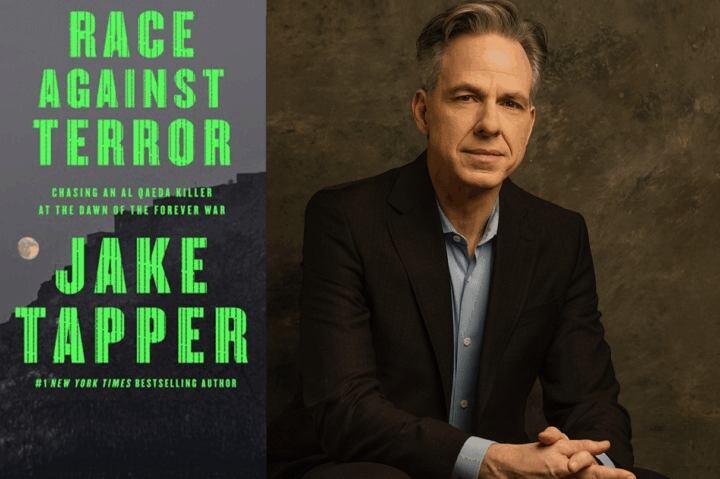
In ‘Race Against Terror,’ Jake Tapper takes on the justice system and jihadism
Tapper told JI that recent anti-Israel protests outside his home are not 'really an issue with my commentary as much as it’s an issue with my faith'


 Add JewishInsider on Google
In his new book, Race Against Terror: Chasing an Al Qaeda Killer at the Dawn of the Forever War, released on Oct. 7, CNN anchor Jake Tapper uses novelistic flair to explore the little-known true story behind a high-stakes, globe-spanning effort to prosecute a jihadist who was ultimately convicted in federal court of killing American service members in Afghanistan.
The yearslong case constructed by a team of dogged federal prosecutors against Spin Ghul, a Saudi-born Al-Qaida operative who was sentenced to life in prison in 2018, represents what Tapper, in his meticulously reported account, calls “unique not only at the Florence Supermax but also in modern American history.”
“Spin Ghul is the only one who was tried and convicted for killing U.S. soldiers on the battlefield overseas,” he writes of the terrorist now serving his sentence in a federal prison in Colorado that has held some of the most dangerous criminals “from the modern era.”
In the briskly told story, Tapper, 56, also lingers on the broader legal and political issues that surround the case even years after its conclusion, highlighting how “the distinction between terrorism and warfare — and between criminal justice and the laws of war — was blurred” in the aftermath of the 9/11 attacks.
“My first goal for people who read the book is they’ll just enjoy the story and find it compelling,” Tapper told Jewish Insider in a recent interview. “I tried to write it almost like a novel in as compelling a way as possible.”
“But a second goal is for people to think about the war on terrorism and the best ways to keep us safe,” he added, noting “an argument to be made that the attempt to lock Spin Ghul up forever keeps us safer than if he had just been sent to Guantanamo, where by now he might have been freed.”
The book, which follows the recent publication of Original Sin, his best-selling book, co-written with Alex Thompson, on President Joe Biden’s “disastrous choice to run again,” is Tapper’s fourth nonfiction work. He has also written several novels and is now at work on a graphic nonfiction book about Nazi war criminal Klaus Barbie, marking a serious return to his early career dabbling in political cartoons and comic strips.
In the interview with JI last week, Tapper discussed his new book and the lessons he hopes readers will draw from it. The CNN host, who is Jewish, also shared how he balances side projects with his day job, weighed in on the Trump administration’s threats targeting the media industry and explained why he strongly feels that anti-Israel protesters who demonstrated outside his home last year are explicitly antisemitic, among other topics.
The conversation has been edited for length and clarity.
Jewish Insider: You say in the acknowledgements section of the book that you first learned about this story at a paintball birthday party for your son, where you spoke with Dave Bitkower, one of the lead prosecutors on the Spin Ghul case. What was it about the story that drew you to write a book about it?
Jake Tapper: I’m a big fan of police procedurals on TV — “Law & Order” and “CSI” and “Cold Case” and all that. I just find sleuthing really interesting, and this story that Dave Bitkower told me was just about the incredible sleuthing that he and these other prosecutors and FBI agents and other folks did to prove this case. It was just so interesting how they pulled together the case from all sorts of documents and testimonies, the methodical way they tracked down evidence and the hurdles that they faced. When he was all done telling me the story in Virginia that day at the paintball location, the first question I had was, has anyone written about this? Has anybody told this story? And he said no, that Spin Ghul’s prosecution was covered but that nobody had done the story about how the prosecution came into place. I was just lucky that I got there first.
JI: It’s quite a yarn. How did you find the time to write this book? On top of your day job at CNN, you recently co-wrote a widely read book about former President Biden. You’ve published several novels and have a number of other projects in the works as well.
JT: I love writing and I love reporting, and the writing and reporting I do for CNN is different than the writing and reporting I can do for the book. Just as a practical matter, when I have a project, I try to write for at least 15 minutes a day. Everybody can find 15 minutes, even if it’s 7:30 in the morning or 7:30 at night. If you do 15 minutes a day, at the end of the week, that’s an hour and 45 minutes you wrote, maybe three pages, and it adds up. But also, the nonfiction books that I write are about topics I’m really interested in and really, really want to write about. I’m writing them for myself as much as I’m writing them for anyone else.
JI: Beyond your interest in the procedural details of the case, you also draw a larger point about how, as you write in the book, “the distinction between terrorism and warfare — and between criminal justice and the laws of war was blurred” in the wake of the 9/11 attacks. What do you hope readers will draw from the book?
JT: My first goal for people who read the book is they’ll just enjoy the story and find it compelling. I tried to write it almost like a novel in as compelling a way as possible.
But a second goal is for people to think about the war on terrorism and the best ways to keep us safe. I think there’s an argument to be made that the attempt to lock Spin Ghul up forever keeps us safer than if he had just been sent to Guantanamo, where by now he might have been freed. As the lines of terrorism and war blur because of this opponent that we face, individual terrorists or terrorist groups, our way of addressing it as a country needs to adapt as well.
JI: How do you feel the Trump administration is approaching this ambiguity?
JT: There are two different ways to look at it. One is they are actually following in [former President Barack] Obama’s footsteps, because they have this terrorist from ISIS-Khorasan, [Mohammad Sharifullah, known as] ‘Jafar,’ who is in a Virginia prison or Virginia jail awaiting trial for conspiring to kill Americans in the Abbey Gate suicide bombing [in Afghanistan], and if they’re successful, then he will be the second foreign terrorist tried in U.S. Criminal Court for killing service members on a battlefield, which is interesting.
By the same token, the Trump team is also expanding the definition of what a terrorist group is by designating drug traffickers as terrorists and deploying the military against them in a way that previous presidents had only really used to deploy against groups like Al-Qaida or ISIS. So it’s both continuity and also pushing the envelope.
JI: Did you get the chance to exchange letters or speak directly with Spin Ghul during the course of writing this book?
JT: I reached out to him in prison, and I was told he was not going to cooperate. But I was lucky in the sense that he had participated in a multiday confession in Italy that I was able to use and tell his story. But no, he didn’t cooperate.
JI: In the book, you briefly relay an amusing anecdote about Susan Kellman, the Jewish defense attorney for Ghul who, as you note, came to roast “a kosher cornish game hen for an accused Al Qaeda terrorist,” as Ghul wouldn’t eat food that wasn’t halal. You write that there was a suspicion Ghul may have been reluctant to engage with Kellman because she was Jewish.
JT: All three of Spin Ghul’s defense attorneys are Jewish. Bitkower is Jewish as well. I don’t know how much Susan’s Judaism played a role versus how much her being a woman played a role versus how much her just being an American played a role. But I think it didn’t help. Susan says [Ghul] was initially happy to hear that she could bring him food that was halal.
But I think, ultimately, that he was not going to cooperate with the attorneys no matter what, because he just started to refuse to cooperate at all in what I refer to it at some point in the book as “the Jihad of Annoyance,” meaning he has nothing else he can do to fight the to fight the West other than be as uncooperative as possible — and so that’s what he did.
JI: You’ve previously said you are working on a fourth novel in your Marder family series of political thrillers, the last of which was published in 2023. Is that still in the works, and are there any other projects you’ve got going that you can mention?
JT: That novel morphed into a project that is not with the Marder family. I’m working on two other projects right now. One is a new novel, but it’s a whole new set of characters, because I wanted it to take place today, and the Marder family would be too old, so I just wanted to start fresh.
Then I’m also working on a graphic novel — though it’s not a novel, it’s a true story — on the Nazi Klaus Barbie, about how he escaped from Germany, how he thrived in Bolivia, how he was tracked down by Nazi hunters and journalists, how he was brought to justice in France, and all the rest. So I’m working on that right now.
JI: What piqued your interest in Barbie? And are you illustrating it yourself? I know you used to draw comics in college and early in your career.
JT: I am, I am, and I’m doing this for Top Shelf Comics, which did the John Lewis graphic novels and the George Takei graphic novels. What piqued my interest was my family and I went to France a couple summers ago, and my son and I went to the Museum of the Resistance, and I learned all about Jean Moulin, who was the hero of the Resistance. I had not known that Klaus Barbie had tortured and maybe killed John Moulin. I had heard of Klaus Barbie as a kid because he was brought to justice in France when I was like 13, but I didn’t really know much about his story.
When I just kind of started learning more about his story, and learning about all the details of it, it just was so interesting to me. In my 50s, if there’s a story about World War II I’m learning for the first time, I’ve got to believe a lot of people don’t know it either. I wanted to do it as a graphic novel because I miss drawing — I was an art minor in college — and also because I wanted it to be accessible to younger people.
JI: Interesting. Is there anything you can share about the other novel you’re writing that’s set in the present day?
JT: Oh, it’s too early to talk about it. It’s not fleshed out a lot. I don’t have a publisher for it or anything like that. It just exists in my head.
JI: With regard to your return to drawing, I can’t help but recall you mentioning on Seth Meyers’ show recently that, if President Trump continues his attacks on the news industry, “maybe you and I will be drawing comic books together.”
JT: [Laughs.] Well, I was just joking. I was just joking.
JI: You’ve criticized the Trump administration and the FCC over its interference in the media industry. What is it like for you working day in and day out with the knowledge of these increased threats from the Trump administration coming directly at news personalities and outlets?
JT: I mean, it’s unfortunate, but nothing great in life doesn’t come without a fight. And the fight for freedom of the press and the freedom to deliver a fact-based news broadcast, instead of just trying to appeal to one side of the aisle over the other, is vital to our democracy — and I think, ultimately, will win the day.
JI: You’ve also faced protests outside your home from anti-Israel demonstrators who have taken issue with your commentary on the war in Gaza.
JT: I don’t think that it’s really an issue with my commentary as much as it’s an issue with my faith.
JI: You think it’s directly antisemitic?
JT: Of course. There’s any number of journalists in Washington, D.C., and these people targeted me and Dana Bash. Maybe someday somebody can explain to me why they protested outside the house of [former Secretary of State] Antony Blinken but not outside the house of any secretary or Cabinet official in the Trump administration. It seems pretty obvious to me.
More Stories
race to the finish
AIPAC closes a rocky primary season with a California gamble
READING THE RIGHT
Florida primaries pose a test for far-right candidates
MR. ROGERS’ NEIGHBORHOOD
Mike Rogers calibrates Jewish outreach as he builds broad coalition against Abdul El-Sayed
FOLLOW THE MONEY
Nevada GOP candidate took max-out contribution from ‘Protocols’-promoting activist

CASE DISMISSED
Ruling for Harvard clouds picture for future campus antisemitism cases

sephardic summit
Sephardic rabbis and leaders gather in New York to build a stronger voice in Jewish institutional life
Please log in if you already have a subscription, or subscribe to access the latest updates.
 Continue with Google
 Continue with Apple