





































U.S. to begin blockading Strait of Hormuz after negotiations with Iran fall short, Trump says
Trump said the sticking point in talks that ended early Sunday morning was Iran’s refusal to give up its nuclear program
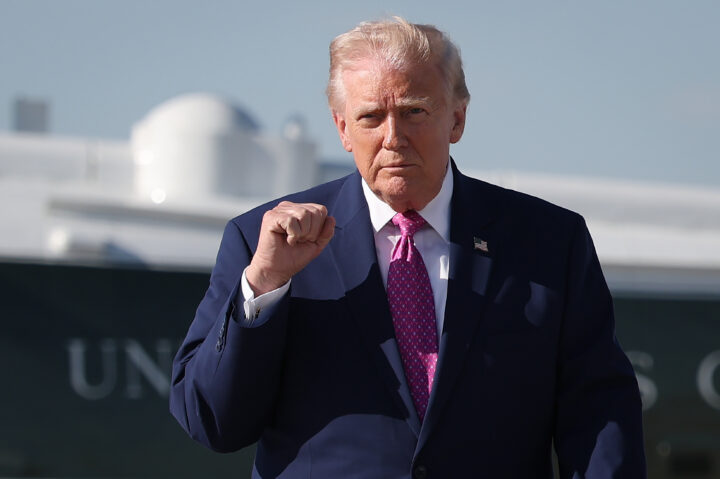
Win McNamee/Getty Images
President Donald Trump walks toward reporters before answering questions prior to boarding Air Force One on April 10, 2026 at Joint Base Andrews, Maryland.


 Add JewishInsider on Google
The U.S. will begin blockading the Strait of Hormuz, President Donald Trump announced on Sunday, hours after negotiations in Islamabad, Pakistan, ended without reaching an agreement.
“Effective immediately, the United States Navy, the Finest in the World, will begin the process of BLOCKADING any and all Ships trying to enter, or leave, the Strait of Hormuz,” Trump wrote on Truth Social, adding that “other countries will be involved with this blockade.”
Trump called Iran’s claim that it had lost track of the mines it dropped in the strait “world extortion.”
In addition, the president said that any vessel that pays Iran a toll to enter the strait will be interdicted and that “Iran will not be allowed to profit off this Illegal Act of EXTORTION.”
As to the negotiations, Trump wrote, “There is only one thing that matters, IRAN IS UNWILLING TO GIVE UP ITS NUCLEAR AMBITIONS! … They were very unyielding as to the single most important issue.”
Nuclear power cannot “be in the hands of such volatile, difficult, unpredictable people… IRAN WILL NEVER HAVE A NUCLEAR WEAPON!” Trump added.
He also indicated military action will resume: “At an appropriate moment, we are fully ‘LOCKED AND LOADED,’ and our Military will finish up the little that is left of Iran,” he wrote.
Soon after, Trump told Fox News that the Iranians “haven’t left the bargaining table. I predict they come back and give us everything we want, and I told my people, ‘I want everything. I don’t want 90%, I don’t 95%.’ I told them, ‘I want everything.’ They have no cards. Their navy is gone, their air force is gone, totally gone.”
Earlier Sunday, Vice President JD Vance departed Islamabad after 20 hours of talks with Iranian negotiators.
“The bad news is that we have not reached an agreement, and I think that’s bad news for Iran much more than it’s bad news for the United States of America,” Vance said at a press conference shortly before his departure. “So we go back to the United States having not come to an agreement. We’ve made very clear what our red lines are.”
Vance said he made “a very simple proposal” that was “our final and best offer.” Under the terms of Vance’s proposal, Iran would have been required to make an “affirmative commitment” not to seek a nuclear weapon or the tools to do so. The vice president said the U.S. was leaving its last proposal on the table as he left for Washington: “We’ll see if the Iranians accept it.”
At the same time, he said the U.S. had been flexible and negotiated in good faith.
The vice president did not mention in his press conference Iran’s promise to reopen the Strait of Hormuz during the ceasefire, nor any demands relating to Iran’s ballistic missiles or funding of proxies, and declined to respond to a question as to the status of the ceasefire.
Mohammad Ghalibaf, Iran’s parliament speaker and negotiator with the U.S., wrote on X that his team had “no trust in the opposing side. My colleagues on the Iranian delegation raised forward-looking initiatives, but the opposing side ultimately failed to gain the trust of the Iranian delegation.”
Pakistani Foreign Minister Ishaq Dar, whose country hosted the talks, said it was “imperative” to continue the ceasefire despite the failure of the first round of negotiations to reach a resolution.
Ahead of the talks, Iran released its own ceasefire proposal that included continued control over the Strait of Hormuz, a ceasefire that would include Lebanon and the cancellation of primary and secondary sanctions. Iran also demanded their “acceptance of enrichment” of uranium.
More Stories

CAMPAIGN CALCULUS
El-Sayed focuses on attacking Israel in closing stretch of the campaign

SCOOP
Former Haley Stevens campaign chair and prominent Democratic fundraiser says he plans to vote for Rogers

STARS, STRIPES AND SEATS
Meet the Americans hoping to secure a seat in the next Knesset
NEW HIRE
El-Sayed hires veteran political consultant Lenore Goldman as Jewish liaison
CHAIN REACTION
Bank of Israel rejects Netanyahu’s suggestion to circumvent sanctions with cryptocurrency

CANCEL CALLS
Democratic push grows for Ilhan Omar, Fateh to cancel Hasan Piker event
Please log in if you already have a subscription, or subscribe to access the latest updates.
 Continue with Google
 Continue with Apple