




































The British PM called for protesters who use the phrase ‘globalize the intifada’ to be prosecuted and for increased security presence in Jewish communities
Leon Neal/Getty Images
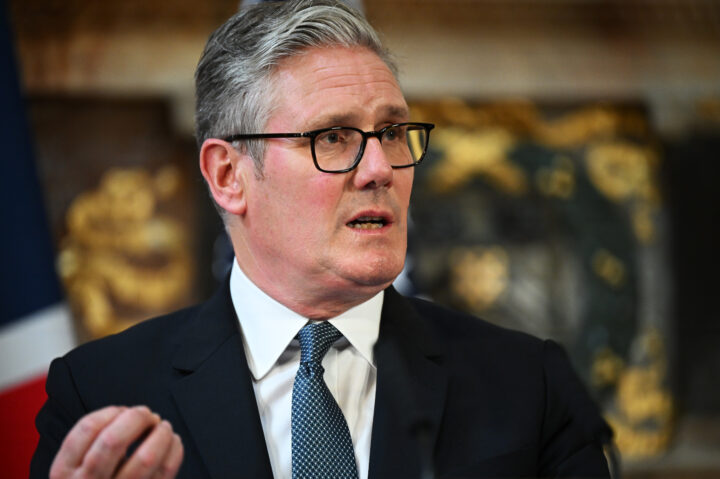
UK Prime Minister Keir Starmer talks at a press conference at Chequers at the conclusion of a state visit by U.S. President Donald Trump, on September 18, 2025 in Aylesbury, England.


 Add JewishInsider on Google
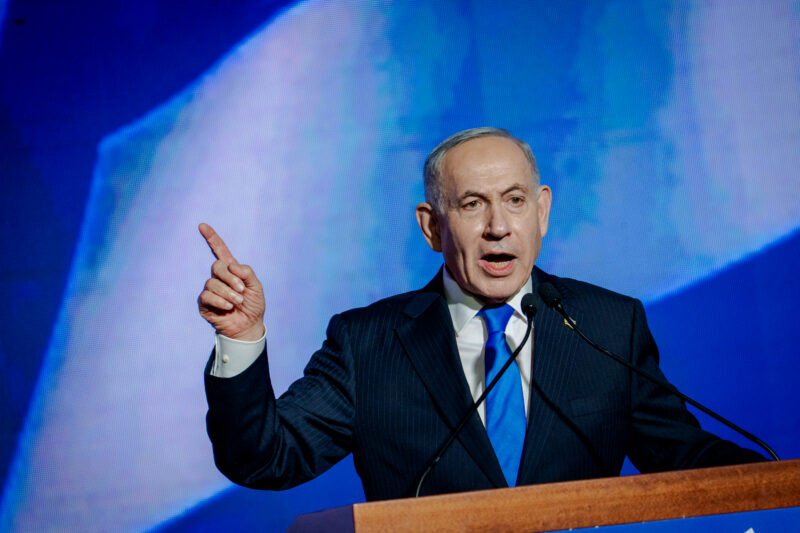
U.K. Prime Minister Keir Starmer announced several new policies aimed at protecting British Jews, including a ramped up security presence, a tightening of immigration laws and a crackdown on extremist charities, in a speech on Thursday following the stabbing of two Jewish men in a suburb of London.
Starmer denounced the rise in antisemitic attacks, naming several that have occurred in recent months, and fear that British Jews experience while conducting everyday life. He listed new government priorities including increasing visible police presence in Jewish communities; increasing investments in Jewish security services; introducing new legislation to prevent “hate preachers” from entering the country and speaking on college campuses; and working to speed up sentencing for perpetrators of antisemitic attacks.
Starmer further condemned those who participate in protests with antisemitic themes. “Of course we protect freedom of speech and peaceful protest in this country, but if you are marching with people wearing pictures of paragliders without calling it out, you are venerating the murder of Jews,” he said.
He added that demonstrators who use the phrase “globalize the intifada” are “calling for terrorism against Jews” and should be prosecuted.
As British authorities are investigating whether a recent surge of attacks targeting Jewish institutions in the country is linked to Iran, Starmer added, “We need stronger powers to tackle the malign threat posed by states like Iran because we know for a fact that they want to harm British Jews, which is why we will fast-track the necessary legislation.”
British Jews have been raising the alarm on rising antisemitism in the country and government inaction to combat it. On Wednesday, two Jewish men, one in his 70s and one in his 30s, were stabbed in the heavily Jewish London suburb of Golders Green. Both were hospitalized in stable condition, according to the Metropolitan Police, which declared the attack a terrorist incident.
The stabbing is the latest in a string of violent attacks against Jewish individuals and sites around London in recent months, which U.K. Chief Rabbi Ephraim Mirvis has called a “sustained campaign of violence and intimidation.” He said following Wednesday’s attack that “words of condemnation are no longer sufficient.”
Last week, an arsonist who pleaded guilty to attacking a London synagogue was released on bail. Also this month, two suspects in an arson attack on another London synagogue were similarly released on bail, and a building that used to house the Jewish Futures charity and still bears its name on the side was targeted in a separate arson attack the same week.
Antisemitic attacks in the country have extended beyond London. Last year, during Yom Kippur, two men were killed at the Heaton Park Hebrew Congregation synagogue in Manchester in a car-ramming and stabbing attack. At the time, Starmer promised to do “everything” in his power to protect the Jewish community, including allocating $13 million in emergency funds to provide greater security.
The Senate candidate shared that her husband, who is Jewish, was verbally attacked in front of their 5-year-old daughter
MANDEL NGAN/AFP via Getty Images
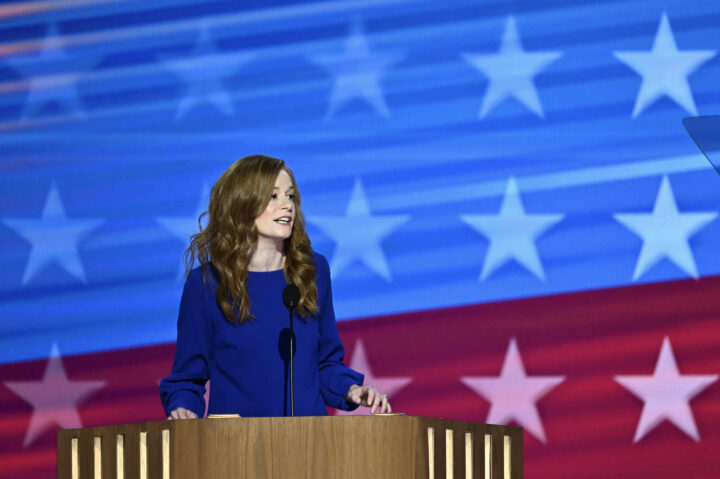
Michigan state Sen. Mallory McMorrow speaks on the first day of the Democratic National Convention (DNC) at the United Center in Chicago, Illinois, on August 19, 2024.
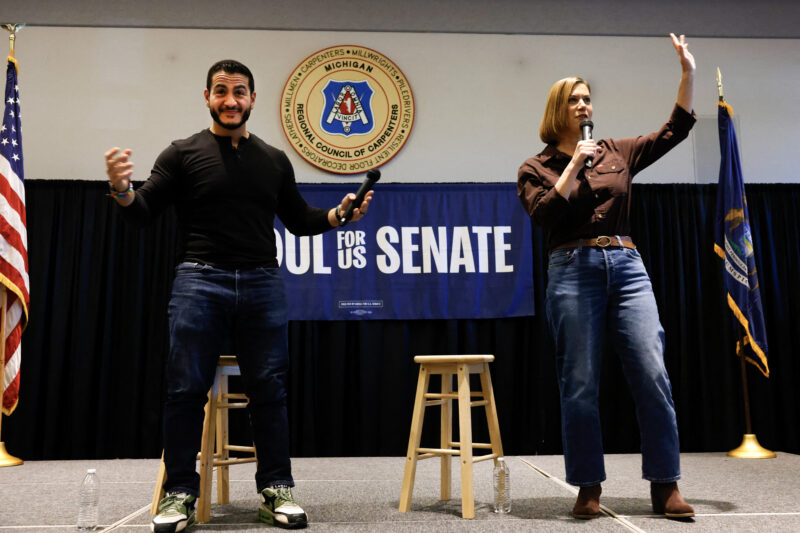
An activist at this month’s Michigan Democratic Party convention in Detroit screamed an antisemitic slur at the husband of Michigan Senate candidate Mallory McMorrow, in front of the couple’s 5-year-old daughter, McMorrow revealed in a radio interview airing Wednesday.
McMorrow, a state senator seeking the Democratic nomination for an open U.S. Senate seat, is not Jewish, but her husband is and their daughter attends a Jewish preschool. The incident occurred at a convention where far-left activists also booed one of her primary opponents, Rep. Haley Stevens (D-MI), a moderate pro-Israel lawmaker.
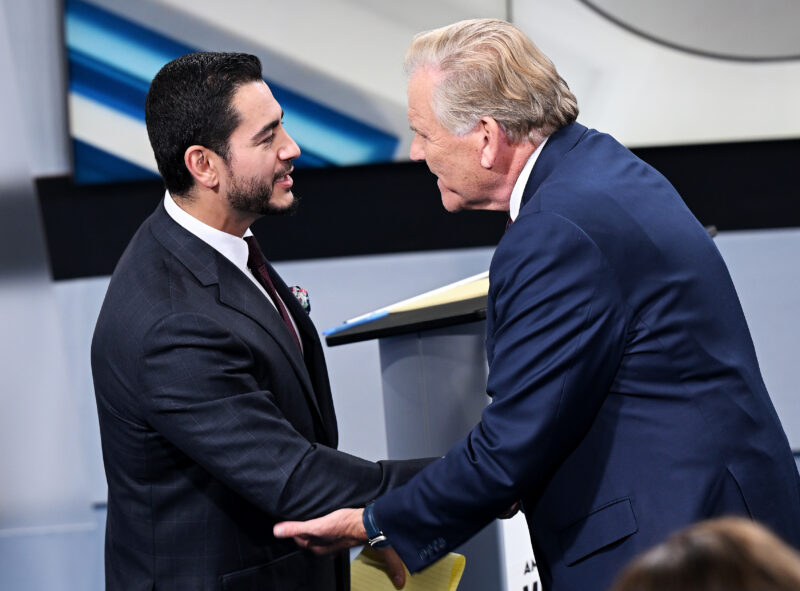
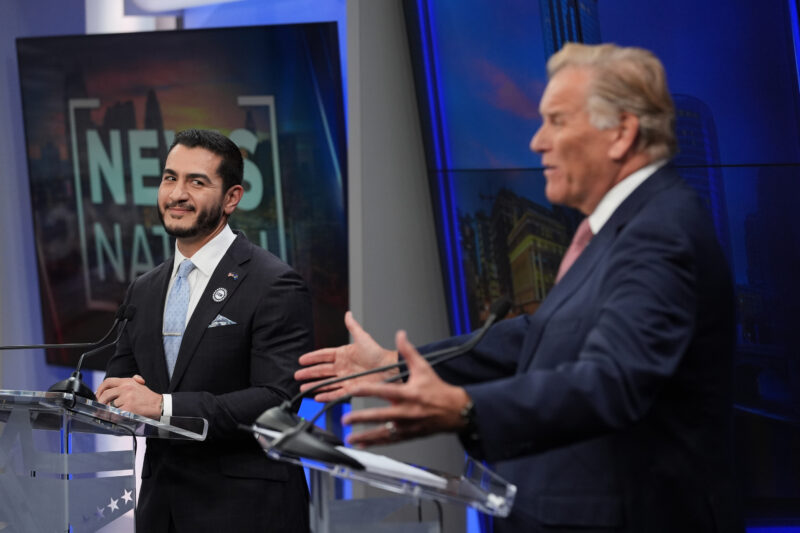
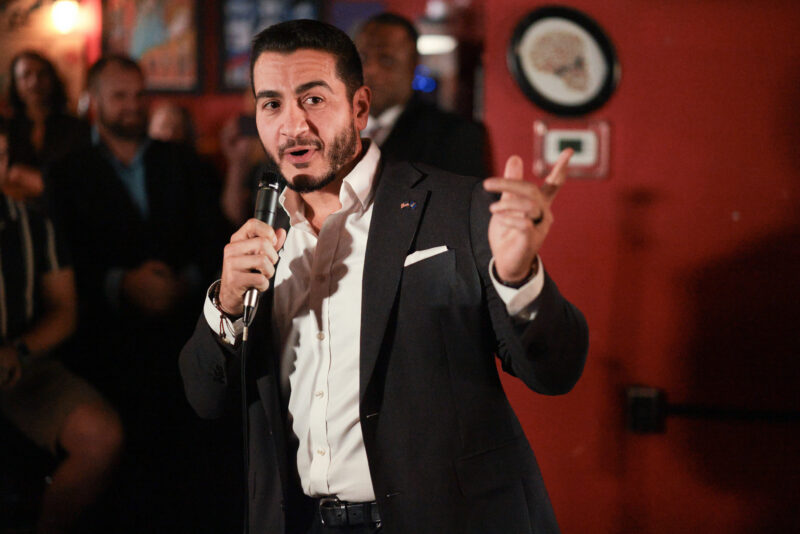
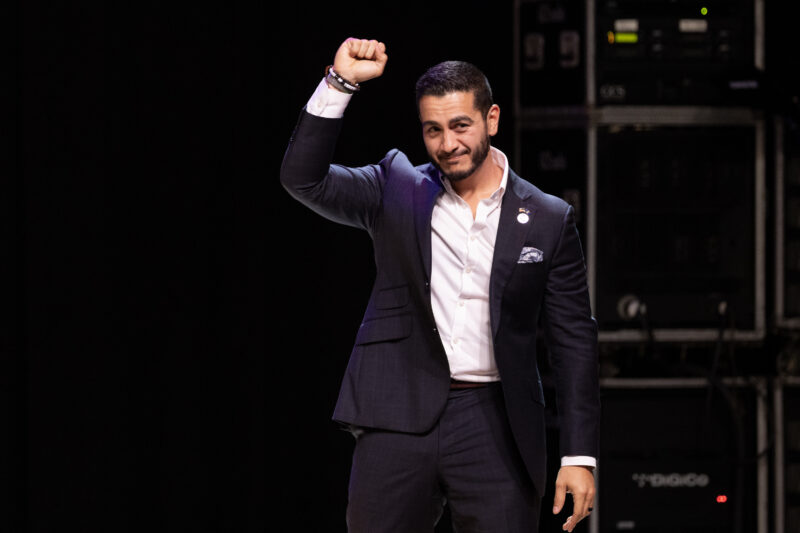
The third candidate in the race is physician Abdul El-Sayed, a progressive who has a longstanding hostile record towards Israel.
“At the convention a few weeks ago, there was a mood,” McMorrow said in an interview with WHMI, a radio station in metro Detroit. “They booed Haley, but there was a man who walked up to my husband and my daughter — I was not there, just my husband and my daughter, and screamed an antisemitic slur at him in his face, in front of my 5-year-old.”
On the campaign trail, McMorrow has made a point of trying to cater to both the state’s sizable Jewish population and its large Arab population. She described herself in the interview as trying to be “the bridge,” while navigating conflicting views that she hears from voters.
“I got in an Uber the other day and unprompted, the man said to me, ‘Why is it that this country can afford to drop bombs on other countries, but we can’t feed our kids?’ There is a truth in that anger that we as a country have to figure out how we solve that,” McMorrow said.
But she cautioned that politicians and activists who are unhappy with American policy in the Middle East need to ensure their criticism does not veer into antisemitism.
“I will be the first to say, and I’ve taken a lot of heat for it — when it crosses the line into antisemitism, I will be the first to say so,” said McMorrow. “We have to make space for you to be angry and do so in a way that does not make people feel scared, truly scared, to just exist as a Jewish person in this country.”
McMorrow has been endorsed by J Street and pledged not to accept any funding from AIPAC. But she has also taken aim at El-Sayed for his approach to the Middle East. After he announced that he would hold campaign rallies with the far-left, antisemitic streamer Hasan Piker, McMorrow slammed El-Sayed in an interview with Jewish Insider last month.
She reiterated that position to WHMI, although she said she has “no problem” with people who appear on Piker’s show if they want to try to reach his audience and push back on his point of view.
“Bringing somebody in to campaign for you implies that you endorse that person’s point of view, and it tells your audience that this messaging is who I am,” said McMorrow, noting that the timing of Piker’s appearance in Michigan was particularly striking, just weeks after the attack on Temple Israel in West Bloomfield.
Asked whether she believes Piker to be antisemitic, McMorrow said no — but added that it almost doesn’t matter.
“I don’t think that he is. I think he gets dangerously close,” she said. “I think there is justifiable anger at the ongoing war. I think a lot of what he says is uninformed and hurtful. I can’t purport to speak for what he believes in his heart, but I can tell you, for my family, a lot of what he says is really hurtful.”
Plus, Israel-Ukraine relations face grain of contention

Joe Raedle/Getty Images
Rep. Debbie Wasserman Schultz (D-FL)
This P.M. edition is reserved for our premium subscribers like you — offering a forward-focused read on what we’re tracking now and what’s coming next. Please don’t hesitate to share your thoughts and feedback by replying to this email.
📡On Our Radar
Notable developments and interesting tidbits we’re tracking
The gunman who attacked the White House Correspondents’ Dinner on Saturday night, Cole Tomas Allen, was arraigned in Washington this afternoon. He is being charged with transportation of a firearm between states, discharging a firearm during a crime of violence and attempting to assassinate the president of the United States, which carries a potential life sentence.
Assistant U.S. Attorney Jocelyn Ballantine said Allen, 31, had “a 12-gauge, pump-action shotgun, a .38-caliber semiautomatic pistol and … three knives and other dangerous paraphernalia” during the attack. He will remain in detention with another hearing scheduled for Thursday…
White House Press Secretary Karoline Leavitt confirmed that President Donald Trump met with his national security team this morning where they discussed Iran’s latest proposal to end the war, which reportedly includes reopening the Strait of Hormuz but postponing talks on the country’s nuclear program…
German Chancellor Friedrich Merz said the U.S. is “being humiliated” by Iranian leaders after negotiations between the two countries this weekend were called off.
“The Iranians are obviously very skilled at negotiating, or rather, very skillful at not negotiating, letting the Americans travel to Islamabad and then leave again without any result,” Merz told a group of students. The result is “an entire nation is being humiliated by the Iranian leadership, especially by these so-called Revolutionary Guards,” he added…
Russian President Vladimir Putin praised how “courageously and heroically the people of Iran are fighting for their independence” in a meeting with Iranian Foreign Minister Abbas Araghchi today in St. Petersburg. Araghchi thanked Russia for standing by its side and said the countries will continue their “strategic partnership”…
Hezbollah leader Naim Qassem said today that the terror group will not disarm, despite the Lebanese government’s intent to remove the group from power in the south of the country under the terms of the ongoing ceasefire with Israel. Hezbollah and Israel have continued to exchange fire throughout the ceasefire, including a wave of Israeli airstrikes today in response to Hezbollah’s deadly drone attack that killed an IDF soldier and wounded six yesterday…
New Department of Homeland Security training materials allow green card applicants to be denied for antisemitic and anti-Israel social media posts and activism, as well as anti-American activism, The New York Times reports. The documents, distributed to immigration officers last month, cite “as an example of questionable speech a social media post that declares, ‘Stop Israeli Terror in Palestine’ and shows the Israeli flag crossed out”…
Ukrainian Foreign Affairs Minister Andrii Sybiha summoned Israel’s ambassador to the country to protest the arrival of a ship allegedly carrying grain taken from Russian-occupied Ukraine at Israel’s Haifa Port, Sybiha said on X. Sybiha also denounced Israel’s “lack of appropriate response to Ukraine’s legitimate request” regarding a similar vessel that docked in Haifa last week.
Israeli Foreign Minister Gideon Sa’ar slammed Sybiha for his announcement: “Diplomatic relations, especially between friendly nations, are not conducted on Twitter or in the media,” Sa’ar wrote. He said that “evidence substantiating [Ukraine’s] allegations have yet to be provided” and that “the matter will be examined”…
Several pro-Israel House Democrats in Florida could lose their seats after Gov. Ron DeSantis unveiled a new congressional map that eliminates their districts — state lawmakers are expected to approve the map for use in this year’s midterm elections at a special session of the state Legislature tomorrow.
The new map could give the GOP up to four additional House seats by redrawing Democratic-leaning districts, including those of Reps. Jared Moskowitz (D-FL), Debbie Wasserman Schultz (D-FL) and Darren Soto (D-FL)…
Claims by New Jersey congressional candidate Adam Hamawy that the Gazan hospital where he volunteered as a trauma surgeon in 2024 during Israel’s war with Hamas was a “completely benign civilian hospital with no tunnels underneath it” are false, The Washington Free Beacon reports.
While Hamawy claimed in an interview shortly after he returned that “there were definitely no tunnels underground and no command base there,” Hamas leader Yahya Sinwar was killed a year later “in a tunnel directly under the hospital emergency department, where he was leading a high-level meeting with senior Hamas terrorists,” the Free Beacon writes…
All five of Pennsylvania’s living former governors, both Democrats and Republicans, released a statement today calling on state officials to prioritize the safety and security of Gov. Josh Shapiro, Jewish Insider’s Gabby Deutch reports.
The letter came days after state Treasurer Stacy Garrity — Shapiro’s leading Republican opponent in this year’s gubernatorial race — said the state will not pay for security upgrades made to Shapiro’s privately owned family residence, done after the state-owned governor’s mansion was targeted in an antisemitic arson attack last spring…
The New York Times chronicles Google co-founder Sergey Brin’s turn away from the Democratic Party and increasing political involvement, including against the proposed “billionaire tax” in his home state of California.
“I fled socialism with my family in 1979 and know the devastating, oppressive society it created in the Soviet Union. I don’t want California to end up in the same place,” Brin told the Times. Brin, who is Jewish, has also been disturbed by the Democratic Party’s leftward shift on Israel policy…
Toronto-based Jewish advocate Adam Hummel argues in the “Boundless Insights” Substack that “anti-Zionism” is an obsolete position, given the 78-year-old existence of the State of Israel.
“Israelis don’t owe anyone an argument for their existence. … The debate is over, not because one side won, but because the thing itself came into being. They are a people. They speak a language. They live on a piece of land and have mortgages. That is what peoples do. The Greeks do it. The Poles do it. The Québécois do it. The arguments about whether they should are, at this point, a leisure activity for people who live elsewhere”…
⏩ Tomorrow’s Agenda, Today
An early look at tomorrow’s storylines and schedule to keep you a step ahead
Keep an eye out in Jewish Insider for a profile of Keith Sonderling, the acting secretary of labor, who is Jewish and the grandson of Holocaust survivors, following the resignation of Secretary Lori Chavez-DeRemer.
The Zionist Rabbinic Coalition will present its first “Pillar of Zion” award to Rep. Steny Hoyer (D-MD) at the organization’s fifth annual National Conference in Washington. Other speakers at the three-day conference will include Israeli Ambassador to the U.S. Yechiel Leiter; State Department antisemitism envoy Yehuda Kaploun; Assistant Attorney General for Civil Rights Harmeet Dhillon; and Jonathan Schanzer, executive director of the Foundation for Defense of Democracies.
Stories You May Have Missed
REPORTER’S NOTEBOOK

‘Two thoughts ran through my head. The main one: I’m getting married in six days. I can’t die now. The second: I can’t believe this is happening to me again’
FOLLOW THE MONEY
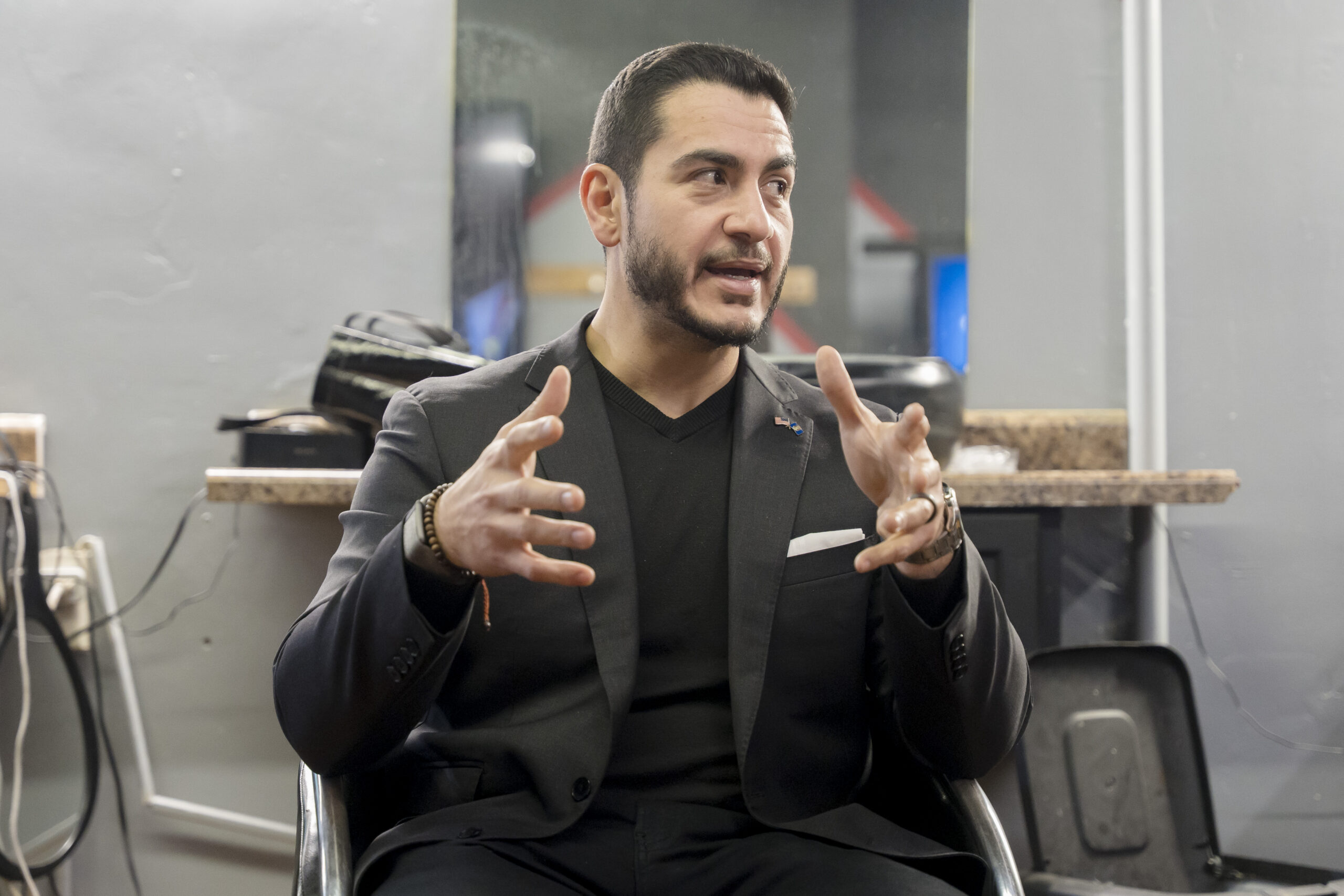
The Michigan Senate contender accepted $7k from the chair of Al-Awda/PRRC — and hired her son
Sures told JI members of the student association who condemned Omer Shem Tov’s appearance on campus are ‘shortsighted, antisemitic or both’
Tommaso Boddi/Getty Images for UCLA
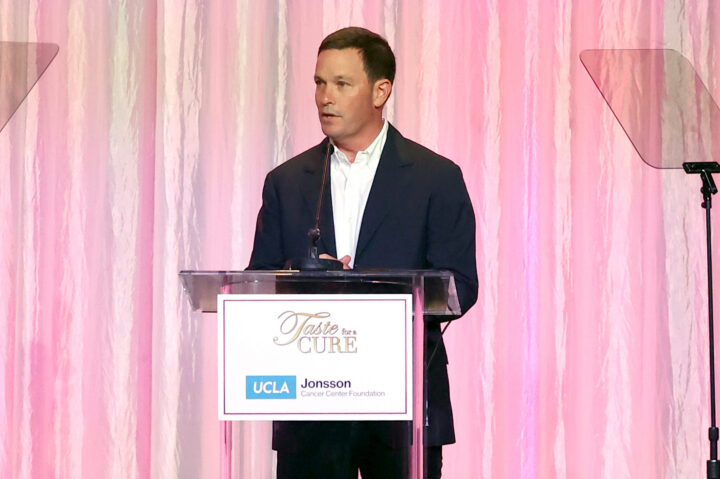
Jay Sures, vice chairman of United Talent Agency, speaks onstage during the 27th Annual UCLA Jonsson Cancer Center Foundation’s “Taste for a Cure” Event at the Beverly Wilshire, a Four Seasons Hotel on May 10, 2024 in Beverly Hills, California.
Jay Sures, vice chairman of United Talent Agency and a regent of the University of California system, slammed the members of UCLA’s Undergraduate Student Association who authored a letter condemning former Israeli hostage Omer Shem Tov’s recent campus appearance as “shortsighted, antisemitic or both,” in an interview with Jewish Insider.
“Why would anybody send out a letter condemning a hostage who is a student who was held in captivity for over 500 days? You have to be a complete lunatic to sign on to that letter,” Sures told JI on Friday, shortly after he issued his own letter to the body stating he was “disgusted and appalled” by its condemnation.
Sures, who was appointed to the Board of Regents in 2019, told JI that UCLA’s campus is host to a “small number of people who have a very loud voice that love to spew antisemitic hatred,” adding that “administration has done an excellent job at cracking down on this and having a zero tolerance towards it.”
Sures, who is Jewish, has frequently spoken out in support of Israel since the Oct. 7, 2023 terrorist attacks and had his home vandalized last year by anti-Israel demonstrators.
Upon sending Friday’s letter, Sures told JI he has renewed concerns regarding his family’s safety. “Having said that, I think it’s critical that my voice is heard louder than ever at this moment in time in history,” he said.
In his letter, which was drafted on Regents of the University of California letterhead, Sures said, “Like many University leaders, I am disgusted and appalled by the Council’s recent statement condemning an on-campus event featuring former Israeli hostage Omer Shem Tov. Talk about a missed opportunity. Rather than hearing the perspective of a 23 year old peer abducted by terrorists at a music festival and held hostage by Hamas for 505 days, those of you who voted for the letter of condemnation chose not to listen at all.”
“Let’s unpack this. Omer Shem Tov is not a representative of the Israeli government. In fact, he is a young student, like many of you, whose life took a horrific turn when he and his friends were kidnapped at a music festival and driven into Gaza, where he was held hostage and tortured for months underground without contact to the outside world,” continued Sures in his letter.
“While your letter expresses concern over ‘a troubling disregard for Palestinian life,’ it says nothing about the Israeli lives lost on Oct. 7th, including the shooting of many of Omer’s close friends. Nor does your letter mention the countless rapes and massacres carried out by Hamas on that day. It is as if none of that happened,” he said.
In an undated letter to UCLA administration, as well as the organizers of the event — UCLA Hillel and the UCLA Y&S Nazarian Center for Israel Studies — and “affiliated campus stakeholders,” the the undergraduate student council wrote that it “condemns” the April 14 event, held on Yom HaShoah, which was titled “505 Days in Captivity: Omer Shem Tov’s Testimony of Resilience.”
The letter from the council, which represents over 29,000 undergraduates at UCLA, said Shem Tov’s appearance constituted “selective platforming of narratives that obscure the broader reality of ongoing state violence” and “a troubling disregard for Palestinian life.”
In his counterletter, Sures asserted that students were promoting a “double standard.”
“You claim you want balance in programming and more than ‘a single narrative’ from speakers at UCLA. Balance, by definition, inherently involves equal consideration of more than one point of view. By condemning this speaker’s public appearance on our campus, your words and actions make clear you have no interest in balance at all,” he wrote. “That is the biggest double standard of all.”
“It is this failure of some student leaders in your council to listen to and acknowledge views of people with whom they disagree that I find the most disappointing and dangerous. It is not the condemnation itself that is concerning — that is absolutely their right, but it is the rush to do so without even considering other’s perspectives that is so disheartening.”
A spokesperson for UCLA told JI earlier this week, “The event’s message was one of resilience and respect for human rights and dignity — a message we support. We stand by UCLA Hillel, UCLA Y&S Nazarian Center for Israel Studies and the UCLA Chapter of Students Supporting Israel’s invitation to have this very important dialogue.”
“We will review the process by which this letter was issued. The condemnation of such a peaceful event to share a story of resilience in the face of extreme suffering is antithetical to the values of our Bruin community,” the spokesperson said.
Sures told JI he expects that the UCLA administration will ultimately “have speakers from all different groups, from all different walks of life so that our students, faculty and staff can hear thoughtful points of view from different places.
“It’s critical that we give the audiences that come to UCLA a very diverse group of opinions, that’s what learning is all about. I think that’s essential to the learning experience,” said Sures. “UCLA has been terrific in terms of bringing in speakers from different walks of life.”
Weeks after Oct. 7, Sures also sent a letter to the UC system’s Board of Regents, its chancellors and its president condemning what he called an “appalling and repugnant” letter condemning Israel from the UC Ethnic Studies Faculty Council, which represents hundreds of faculty systemwide.
Sures wrote that the letter was “rife with falsehoods about Israel and seeks to legitimize and defend the horrific savagery of the Hamas massacre of October 7.”
Sures was honored at the Los Angeles Jewish Federation’s 2025 gala, soon after the targeting of his home. At the event, he paid tribute to his late father, a veteran of Israel’s 1948 War of Independence, and to his mother, whom Sures commended for her foresight anticipating a rise in antisemitism.
“We need louder voices to say this is not okay, it’s not normal,” he told JI. “To let folks go out and spew this hatred without pushing back is the worst thing we can do.”
Plus, half of young Americans view Israel as a burden
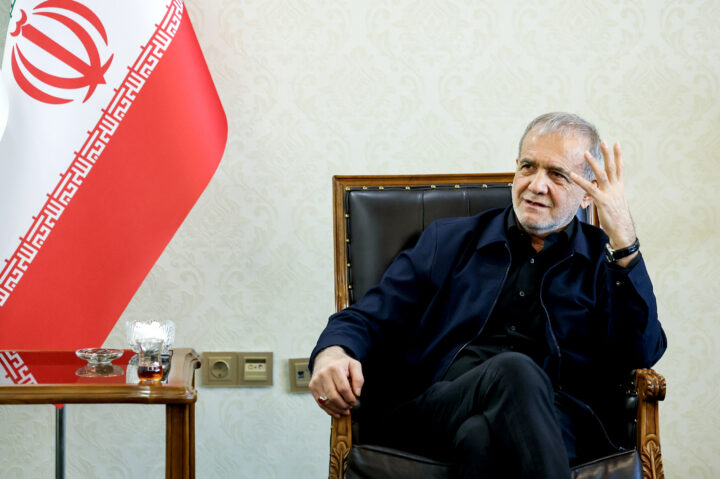
Iranian Presidency/Handout/Anadolu via Getty Images
Iranian President Masoud Pezeshkian delivers a speech on April 19, 2026.
This P.M. edition is reserved for our premium subscribers like you — offering a forward-focused read on what we’re tracking now and what’s coming next. Please don’t hesitate to share your thoughts and feedback by replying to this email.
📡On Our Radar
Notable developments and interesting tidbits we’re tracking
Talks between Israel and Lebanon, which are currently underway, were moved from the State Department to the White House. Vice President JD Vance and Secretary of State Marco Rubio were spotted arriving there together this afternoon, and a White House official told Jewish Insider that President Donald Trump would greet the participants at the opening of the discussion…
U.S. Ambassador to Israel Mike Huckabee, who returned to Washington in order to participate in the talks, also stopped by Capitol Hill where he met with Sen. Ted Cruz (R-TX)…
While the bombing campaign in Iran is on pause, the battle at sea continues: U.S. forces boarded another vessel carrying Iranian oil in the Indian Ocean this morning and Trump said he had ordered the U.S. Navy to “shoot and kill any boat” placing mines in the Strait of Hormuz — just as a third U.S. aircraft carrier arrived in the region…
Trump also said Iran is “having a very hard time figuring out who their leader is,” indicating the regime may still be struggling to present the U.S. with a unified proposal. “The infighting is between the ‘Hardliners,’ who have been losing BADLY on the battlefield, and the ‘Moderates,’ who are not very moderate at all (but gaining respect!),” he claimed.
In response, Iranian parliament Speaker Mohammad Bagher Ghalibaf and President Masoud Pezeshkian, both considered relative moderates, issued nearly identical statements on X pledging “complete obedience to the Supreme Leader”…
Iranian officials tell The New York Times their new supreme leader, Mojtaba Khamenei, is alive but injured, and so far ruling differently than his late father; the younger Khamenei is relying on Islamic Revolutionary Guards Corps commanders to provide him advice to make decisions “as though he is the director of the board.”
Khamenei’s injuries are extensive and he is largely inaccessible in person: “One leg was operated on three times, and he is awaiting a prosthetic. He had surgery on one hand and is slowly regaining function. His face and lips have been burned severely, making it difficult for him to speak, the officials said, adding that, eventually, he will need plastic surgery”…
U.S. officials are expressing concern over the military’s ability to defend Taiwan from China in the near future should the need arise, given that the U.S. has burned through more than 1,000 Tomahawk missiles and more than 1,500 air-defense missiles in the course of the war with Iran so far, supplies that could take up to six years to replace…
Israeli Foreign Minister Gideon Sa’ar named Israel’s first Christian ambassador, George Deek, as the country’s special envoy to the Christian world, JI’s Lahav Harkov reports, after several recent controversies in Israel relating to Christians. Deek is part of the Arab Orthodox Christian community in Jaffa…
Sen. Elissa Slotkin (D-MI) joined other Michigan Democrats in denouncing Amir Makled, a Democratic nominee for regent of the University of Michigan, over Makled’s past comments expressing antisemitic sentiments and support for terrorism.
“I’m going to have a problem with any candidate — Democrat, Republican or independent — who shares antisemitic and hateful posts on social media. Especially when they refuse to disavow those comments or show remorse,” Slotkin said in a statement to JI’s Marc Rod, in response to a question about Makled…
Defense Secretary Pete Hegseth did not give advance notice to senior Republican senators before announcing yesterday that he was firing Navy Secretary John Phelan, causing surprise and confusion on Capitol Hill. “I found out about it the way everybody else did,” Senate Majority Leader John Thune (R-SD) told JI’s Emily Jacobs and Marc Rod of the Pentagon’s announcement on social media of Phelan’s dismissal.
Trump praised Phelan in a post on Truth Social this afternoon and said he’d “certainly like to have him back within the Trump Administration sometime in the future” — Phelan had reportedly bumped heads with Hegseth but had a close relationship with the president…
Nearly half of young American adults view Israel as a burden to the United States, according to a new Harvard Youth Poll of 18- to 29-year-olds. The survey found that 46% of young Americans consider Israel to be mostly a burden to the U.S., compared to just 16% who say Israel is mostly a benefit, JI’s Gabby Deutch reports.
In addition, Ukraine, which has also received U.S. support in its lengthy war with Russia, was also determined to be more of a burden by young Americans — 31% of respondents said Ukraine is mostly a burden, while 21% said it is mostly a benefit…
The Wall Street Journal‘s Matthew Hennessey issued a defense of Elliot Kaufman, a member of the Journal‘s editorial board, after Trump slammed him on Truth Social as an “idiot” and a “moron.”
“What triggered the president’s ire was an op-ed under Mr. Kaufman’s byline headlined ‘The Iranians Take Trump for a Sucker.’ That’s a provocative title, yes, but the piece delivers on the provocation. Mr. Kaufman wasn’t calling Mr. Trump a sucker; he was merely pointing out that the Iranians are acting like they think he is one. The piece offers plenty of recent evidence to support that claim,” Hennessey wrote…
American journalist Shelly Kittleson details in The Atlantic her experience being kidnapped and held hostage by the Iran-backed Kataib Hezbollah terror group in Iraq for nine days earlier this month…
Former Disney CEO Bob Iger, who stepped down last month, is returning to Joshua Kushner’s venture firm, Thrive Capital, in an advisory role…
⏩ Tomorrow’s Agenda, Today
An early look at tomorrow’s storylines and schedule to keep you a step ahead
Keep an eye out in Jewish Insider for an interview with Rep. Tom Suozzi (D-NY) as he introduces a buffer zone bill in Congress, which follows legislation under consideration in New York and elsewhere, aiming to protect attendees at houses of worship.
Washington is abuzz ahead of the White House Correspondents’ Dinner, being held at the Washington Hilton on Saturday night. The event will be headlined by American Israeli mentalist Oz Pearlman and attended by Trump for his first time as president, alongside celebrities (including Trump fan Nicki Minaj), politicians and media figures. Politicos and reporters will schmooze at events beginning this evening through Sunday morning.
We’ll be back in your inbox with the Daily Overtime on Monday. Shabbat Shalom!
Stories You May Have Missed
SHAPIRO SPOTLIGHT
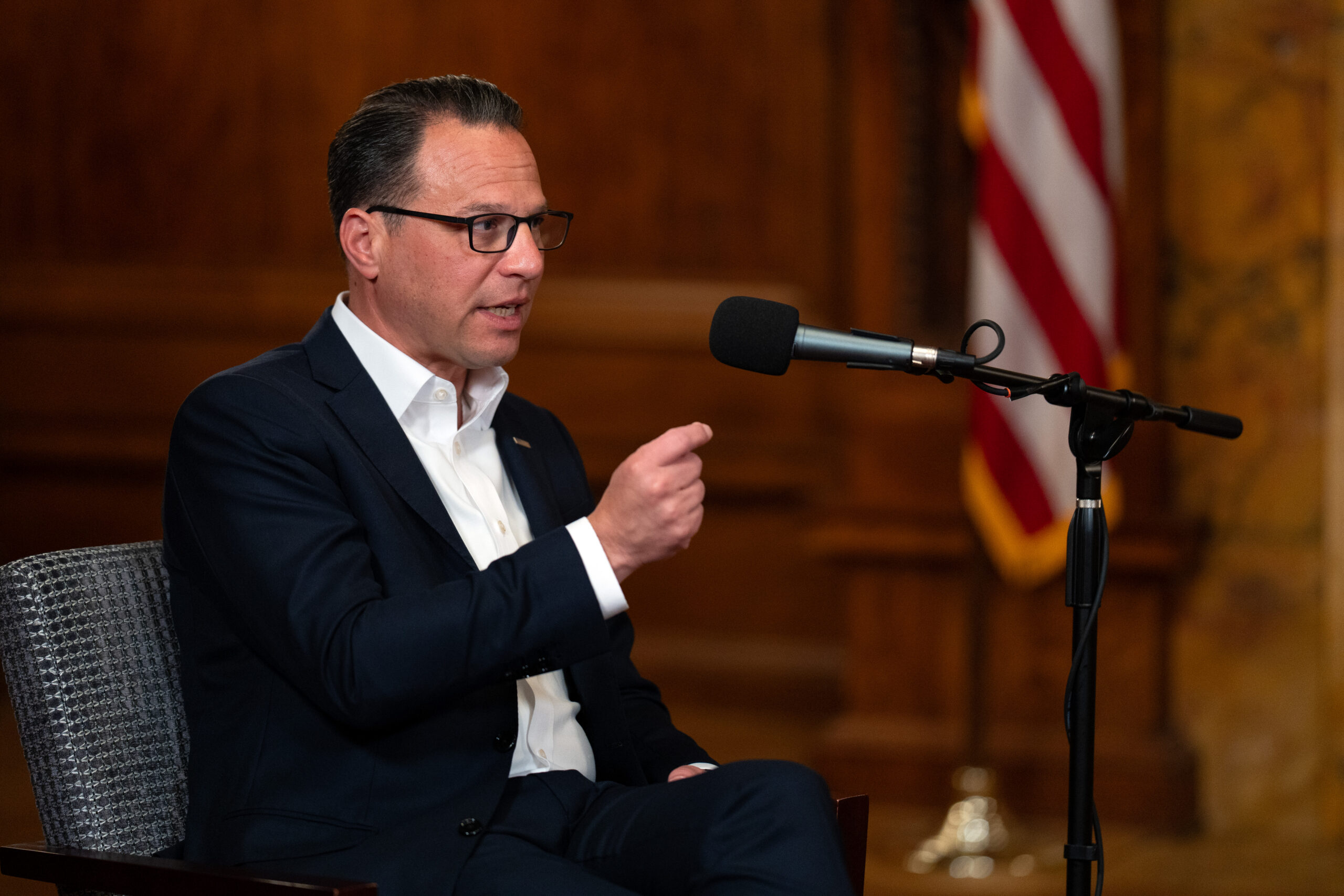
In an interview with JI, Shapiro said he ‘[hasn’t] really thought about’ whether he would appear on Hasan Piker’s stream but that he hasn’t been invited
DEFINITION DEBATE
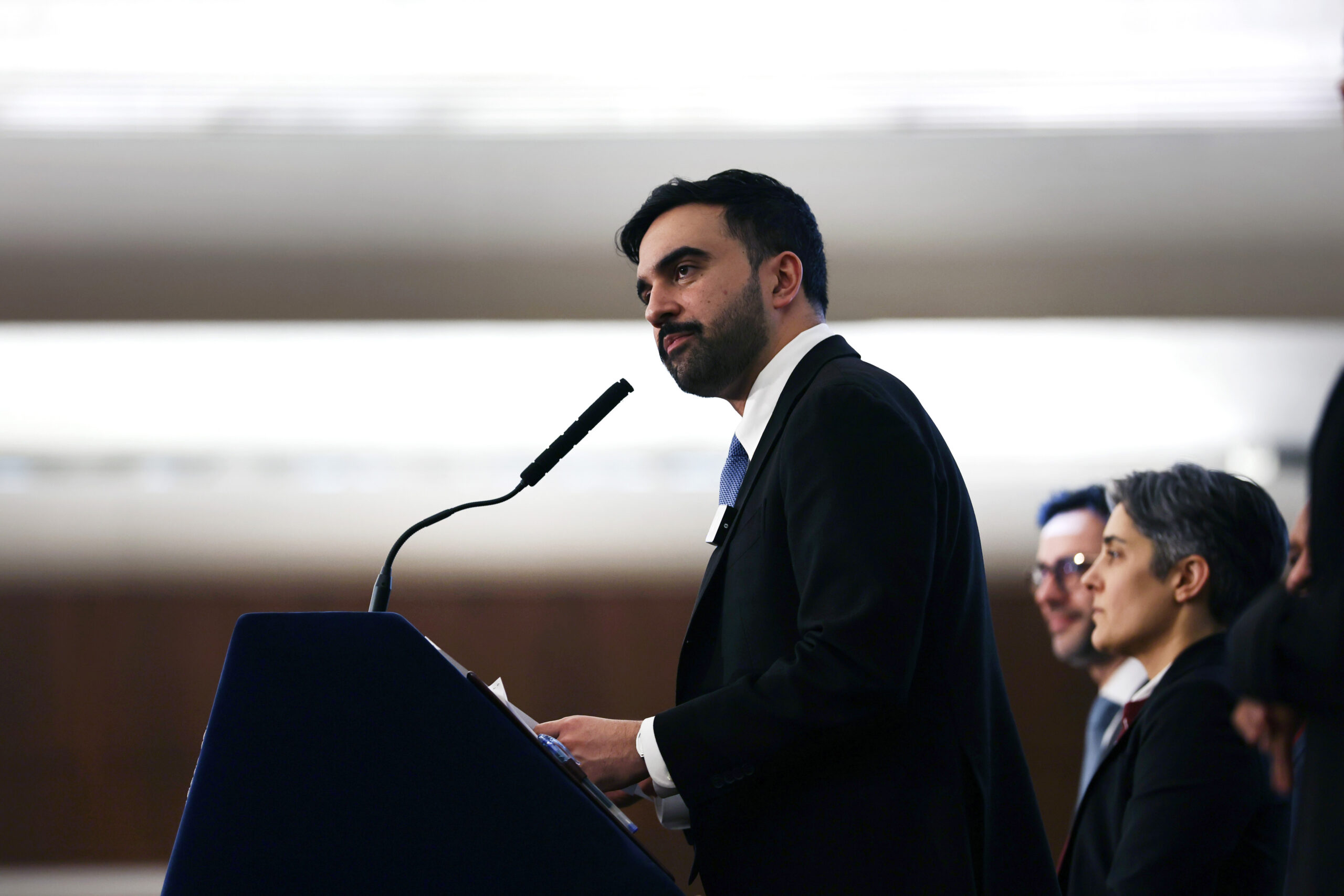
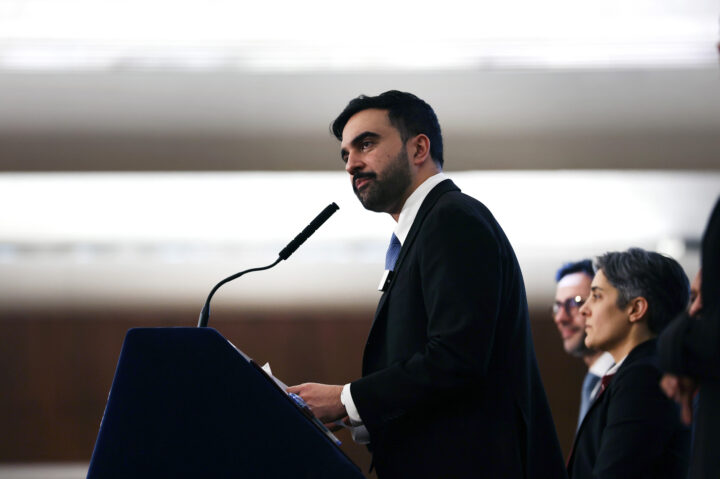
In testimony before the City Council’s antisemitism task force, an NYPD official said Mamdani played no role in a controversial change in reporting data from hate crimes
In testimony before the City Council’s antisemitism task force, an NYPD official said Mamdani played no role in a controversial change in reporting data from hate crimes
Spencer Platt/Getty Images
New York City Mayor Zohran Mamdani speaks at a "Rental Ripoff" hearing at Fordham University in the Bronx borough of New York on March 11, 2026, in New York City.
New York City Mayor Zohran Mamdani’s antisemitism czar said on Wednesday that his administration won’t replace the International Holocaust Remembrance Alliance’s working definition of antisemitism he wiped off the books his first day on the job.
Speaking before the City Council’s Task Force Antisemitism alongside officials from the NYPD, the executive director of the Mayor’s Office to Combat Antisemitism, Phylisa Wisdom, said that city agencies do not and will not work off any official definition of antisemitism. Mamdani’s predecessor, former Mayor Eric Adams, adopted the IHRA definition and established the office Wisdom leads amid a dramatic uptick in hate crimes targeting Jewish New Yorkers in the wake of the Oct. 7 attacks and subsequent Israeli military campaign in Gaza.
“Across city government there is not a definition codified for any form of hate at all,” Wisdom told Republican Councilmember Inna Vernikov, one of the task force’s two co-chairs. “We don’t believe that there needs to be a codified definition at all.”
A total of 37 states, as well cities from D.C. to Los Angeles, have adopted the IHRA definition. But critics allege its assertion that certain antagonism toward the Jewish state can be classified as antisemitism serves to stifle criticism of Israel.
Instead of a formal, written classification, Wisdom, who previously led the progressive Zionist group New York Jewish Agenda, touted “an understanding that we share.”
“We understand broadly, in the universe of civil rights and combating antisemitism, it to be prejudice, violence and discrimination against Jews because they are Jewish,” she explained. “We understand usually what that looks like.”
Wisdom acknowledged the question of how the vast city bureaucracy recognizes antisemitism was “a hot one in the community.” When Vernikov pressed Wisdom on how the administration could address and rectify antisemitism without defining it, Wisdom acknowledged the difficulty, but fell back on equating it with other undefined forms of bigoted behavior.
She also alluded to previous testimony by NYPD Deputy Commissioner for Legal Matters Michael Gerber that the police department operates off a state-level hate crime statute, which does not feature definitions of prejudice, but only considers whether a victim was targeted because of their real or perceived identity.
“I think what you’re asking is a good question because it is hard,” Wisdom said. “In terms of bias and hate, it’s really sticky and extremely serious stuff, and it’s case by case.”
After the hearing, Wisdom avoided questioning from Jewish Insider about whether she considered it antisemitic to applaud the Oct. 7 attacks on Israel or the man behind them, late Hamas military leader Yahya Sinwar — as Mamdani’s wife and other personnel in his office have done.
In his testimony, Gerber said Mamdani and his team had no input on a data-reporting change that drew controversy after the city logged a 152% increase in hate offenses in January over the same month last year, driven by a spike in reported incidents targeting Jewish New Yorkers — then changed its reporting criteria for February. The move drew criticism from experts and transparency advocates.
But Gerber asserted the old methodology was deeply flawed, and that NYPD Commissioner Jessica Tisch, who was originally appointed by Adams, had only recently learned of it and ordered it changed.
“That data did not reflect confirmed hate crimes. It did not reflect reported hate crimes,” said Gerber. “It was numbers pulled from an informal tracker that had a mix of reported hate crimes that had not yet been classified by the [NYPD Hate Crimes] Task Force and confirmed hate crimes. These were hodgepodge numbers, resulting in clarity about nothing.”
He added that the decisions did not come “at the initiative or direction of anyone at City Hall” — a point he stressed under questioning.
“These were decisions by the NYPD. We made these decisions and we stand by them,” he told Vernikov. “These were not decisions made by anyone at City Hall.” The NYPD is formally part of Mamdani’s administration.
Gerber further asserted the mayor’s team was “notified” of the reporting change, but “not consulted.” He further highlighted a recent NYPD announcement that going forward, it would disclose to the public both reported and confirmed bias crime incidents, the favored approach of good government and civil rights supporters.
Plus, Dems concerned over fraying Israel-Europe ties

Gage Skidmore
Elizabeth Warren
This P.M. edition is reserved for our premium subscribers — offering a forward-focused read on what we’re tracking now and what’s coming next. Please don’t hesitate to share your thoughts and feedback by replying to this email.
📡On Our Radar
Notable developments and interesting tidbits we’re tracking
White House Press Secretary Karoline Leavitt maintained this afternoon that President Donald Trump is “generously offering a bit of flexibility” to Iranian leaders and has not given them a “firm deadline” to provide a proposal to the U.S., contrary to reports that said Trump only intended to wait a few days before ending the ceasefire that he extended yesterday.
Leavitt also said the president did not view Iran’s seizure of two ships near the Strait of Hormuz today as a violation of the ceasefire: “These were not U.S. ships. These were not Israeli ships,” she said — a change in tone for Trump, who has taken a hardline against Tehran’s escalatory actions in the key waterway.
Meanwhile, mediating countries are reportedly working to get Tehran and Washington back to the negotiating table, with a meeting possibly on Friday. Iranian President Masoud Pezeshkian said Iran “has welcomed dialogue and agreement and continues to do so,” but that “breach of commitments, blockade and threats are the main obstacles” to continuing talks…
Even as negotiations to end the war are still in flux, Trump thanked Iran for granting his request not to execute eight women who were reportedly due to be killed by the regime tonight, instead releasing four of them and holding the other four in jail for one month…
The Financial Times profiles Pakistani army chief Asim Munir as he emerges as an unexpected key mediator between the U.S. and Iran, utilizing his ties to Tehran’s security establishment — including the Islamic Revolutionary Guard Corps — and personal rapport with Trump to help secure a comprehensive deal…
Former Secretary of State Mike Pompeo is keeping the door open to a possible 2028 presidential run, saying “only the good Lord knows” what comes next as he continues to reestablish himself in the private sector and policy world after serving in the first Trump administration.
In a wide-ranging interview with Jewish Insider’s Emily Jacobs, Pompeo also praised Columbia University, where he now teaches at the School of International and Public Affairs, for “beg[inning] to get back the correct leadership … in a way where more voices can be heard”…
U.S. Ambassador to Turkey Tom Barrack stood by his comments that drew criticism over the weekend in which he repeatedly criticized Israel and praised Turkey, saying he was merely “stating the obvious.”
“When I described the Israel-Hezbollah ceasefire as a ‘time out’ and said that ‘everybody has been equally untrustworthy,’ I was simply stating the obvious reality on the ground. This is realism, not criticism of any side,” Barrack told Fox News Digital. He also reaffirmed his comments that the goal in Lebanon is “not killing Hezbollah,” and that Turkey should be readmitted to the F-35 fighter jet program…
A group of Jewish District of Columbia residents gathered at the city’s municipal building today for a scheduled meeting with Janeese Lewis George, a D.C. councilmember and one of the leading candidates in this year’s mayoral race, but she never showed, two people who were in the meeting told JI’s Gabby Deutch.
A staff member for Lewis George told attendees at the start of the meeting that she was having a busy morning, and they should begin the conversation without her. At the end of the meeting, when Lewis George still had not arrived, the staff member apologized that she could not attend…
New York City Council Speaker Julie Menin warned this morning that if Mayor Zohran Mamdani vetoes the council’s legislation intended to regulate protests at religious and educational sites, the city will face “more divisiveness,” calling the decision a critical test for the mayor, JI’s Haley Cohen reports.
Menin, New York City Comptroller Mark Levine and Manhattan Borough President Brad Hoylman-Sigal, speaking at 92NY on the future of Jewry in New York, beseeched the Jewish community not to flee despite tensions with the mayor. “This is not a time to lose hope. Hopefully the three of us here can embody the future of the commitment to fighting antisemitism, the commitment to supporting the Jewish community,” Menin said…
Rep. Tom Suozzi (D-NY) is set to introduce a federal buffer zone bill, similar to that of the New York City Council, alongside Anti-Defamation League CEO Jonathan Greenblatt on Friday, as Suozzi seeks reelection to his swing-district seat on Long Island…
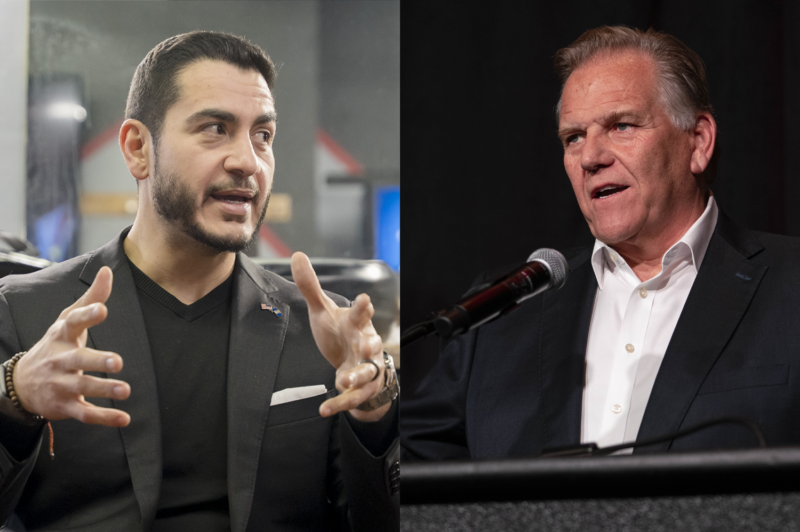
Democratic lawmakers and strategists are expressing concern over the rising popularity of far-left Michigan Senate candidate Abdul El-Sayed, fearing that if he clinches the Democratic nomination, he would lose in a general election to former Rep. Mike Rogers (R-MI), the GOP front-runner, Semafor reports. Democrats must retain the Michigan Senate seat to have any hope of taking back the chamber in the midterm elections.
Rep. Hillary Scholten (D-MI), who is backing Rep. Haley Stevens (D-MI) in the race, told the outlet that “all three candidates are qualified, but dinged El-Sayed for campaigning with [Hasan] Piker and said ‘we are continuing to see consistent polling that suggests that Haley is the only one that can win in a general election’”…
Maine Senate candidate Graham Platner said he would not support keeping Senate Minority Leader Chuck Schumer (D-NY) as the party’s leader in the chamber, naming as potential replacements Sens. Chris Van Hollen (D-MD), Mark Kelly (D-AZ), Chris Murphy (D-CT) or Brian Schatz (D-HI). He also said he would oppose a ban on semiautomatic assault weapons, a priority policy for much of the Democratic caucus…
Sen. Elizabeth Warren (D-MA) dismissed criticism of Platner after campaigning with him in Maine last weekend: Asked on CNBC about her comment that Platner is “my kind of man” given his past incendiary rhetoric and actions including his Nazi chest tattoo, Warren said, “He has apologized, he’s out meeting with the people of Maine every single day so they can evaluate not who Graham Platner was but who Graham Platner is today.”
Warren sidestepped a question specifically about Platner’s 2014 praise of Hamas tactics during an attack on Israeli soldiers, as reported by JI: “You guys want to be the party of inclusivity, right?” host Sara Eisen asked regarding the report. “I want to be the party that stands up for hardworking people,” Warren answered…
Schumer dodged a question yesterday asking if he is on the wrong side of his party after most Democratic senators voted in favor of blocking arms sales to Israel — a measure he opposed. “Our caucus is united and focused on ending the war in Iran,” he said, and touted Democrats’ war powers resolutions before walking away…
Rep. David Scott (D-GA) died today at 80. Scott, who voted on the House floor last night, had been running for reelection for his 13th term…
⏩ Tomorrow’s Agenda, Today
An early look at tomorrow’s storylines and schedule to keep you a step ahead
Keep an eye out in Jewish Insider for the results of this afternoon’s war powers resolution vote in the Senate, which is expected to be blocked by Republicans as the previous four were.
Israeli Ambassador to the U.S. Yechiel Leiter and Lebanese Ambassador to the U.S. Nada Hamadeh will meet at the State Department tomorrow for the second round of direct talks between the two countries. Lebanon is reportedly seeking a one-month extension to the ongoing ceasefire, which is set to expire on Sunday; Hezbollah, which has said it is not bound by the agreement, has continued to fire rockets and a drone at Israeli troops in southern Lebanon.
Paramount Skydance CEO David Ellison will host an exclusive dinner honoring President Donald Trump and CBS News’ White House correspondents at the recently renamed Donald J. Trump Institute of Peace. Ellison is currently seeking regulatory approval of Paramount’s deal to acquire Warner Bros. Discovery.
The Jewish Democratic Council of America will host a candidate forum for New York’s 17th Congressional District featuring leading candidates Beth Davidson, a Rockland County legislator, and Cait Conley, a national security veteran.
Stories You May Have Missed
DEM DIVIDES
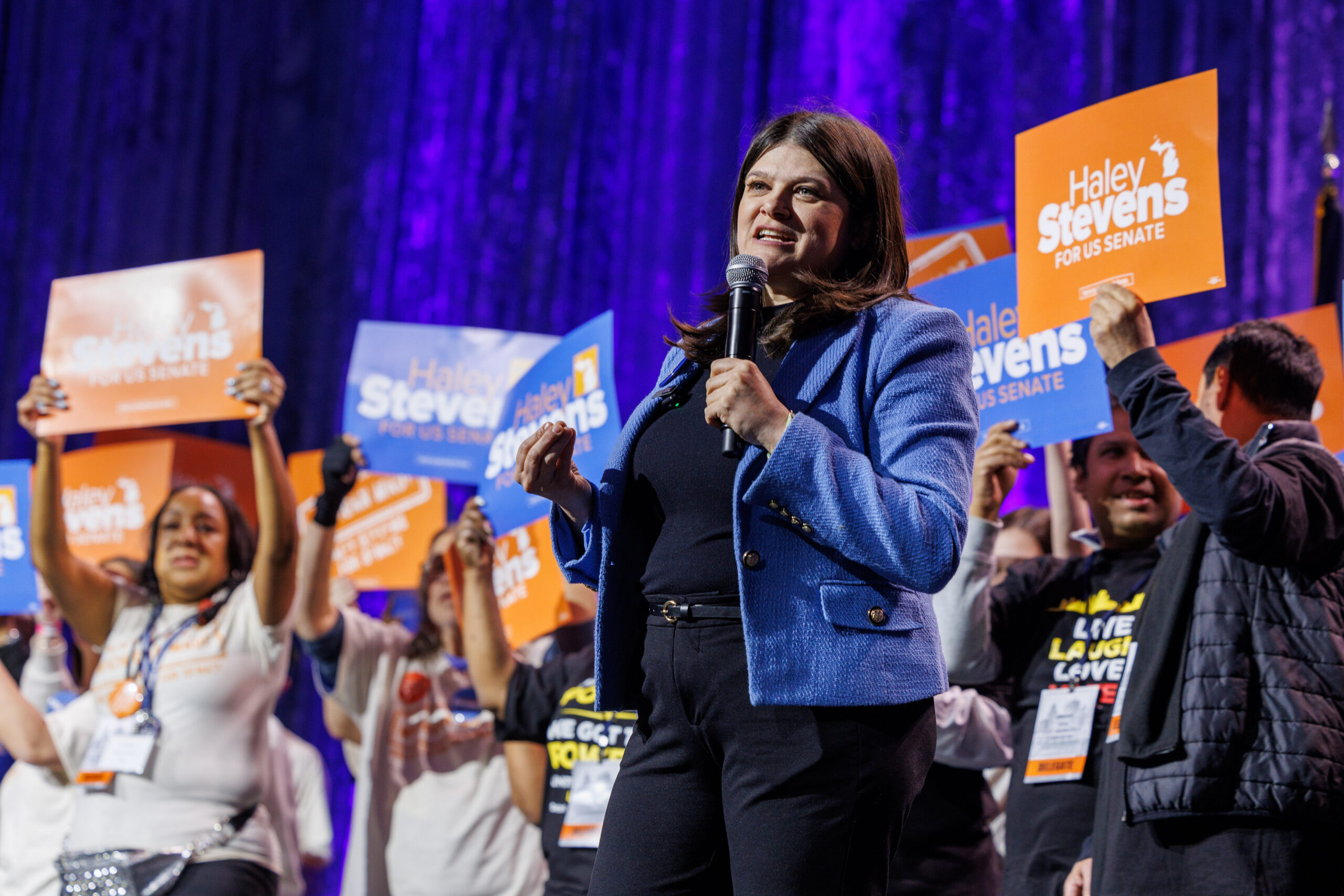
Jewish Democrats described a ‘shell-shocked’ atmosphere at their statewide convention that saw marked hostility to pro-Israel voices
CAMPAIGN CLASH
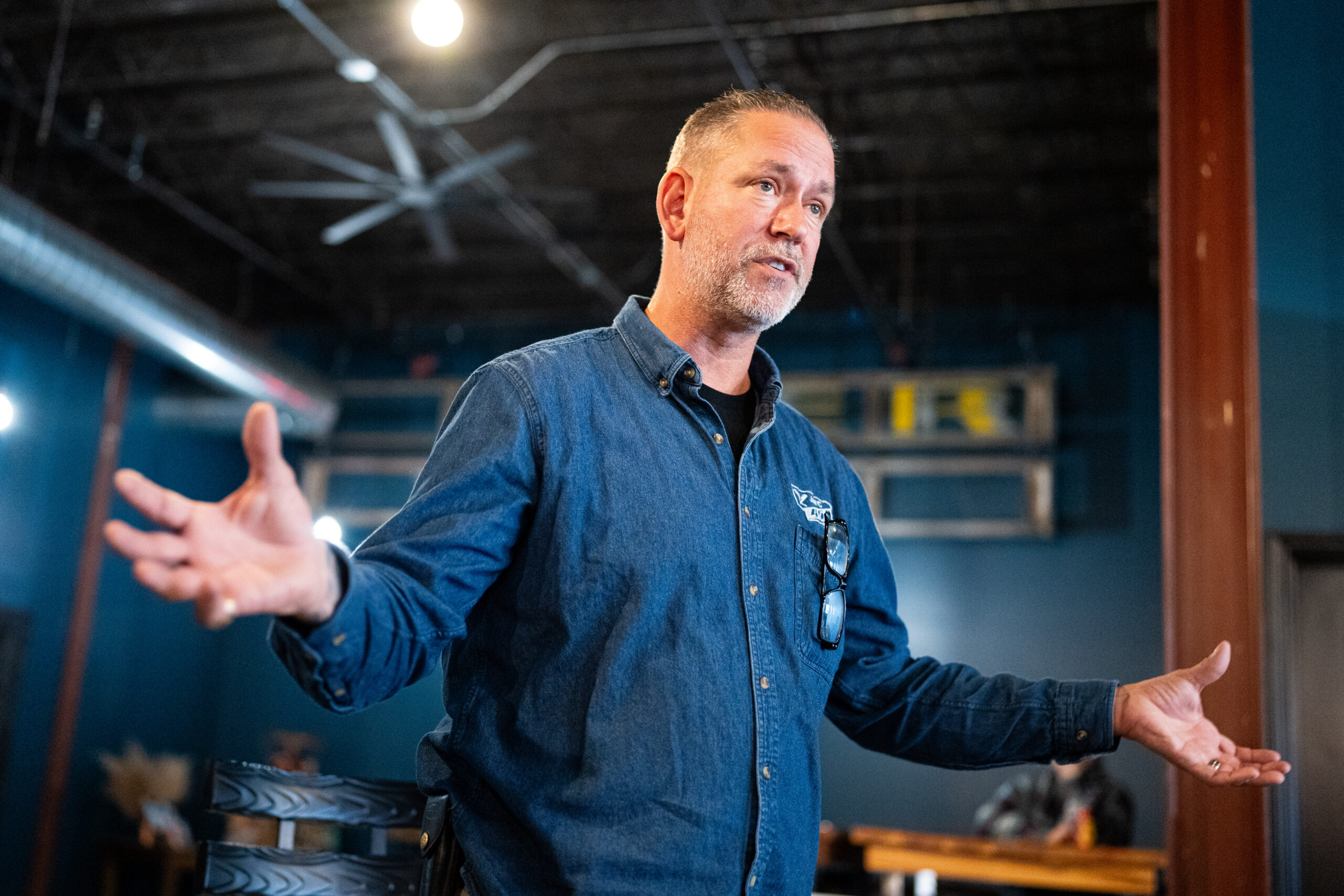
Daniel Moraff also recruited Rep. Summer Lee, a leading anti-Israel Democrat, to pursue her political career
Plus, Dems concerned over fraying Israel-Europe ties

Daniel Torok/The White House via Getty Images
President Donald Trump and Secretary of State Marco Rubio (R) sit in the Situation Room as they monitor the mission that took out three Iranian nuclear enrichment sites, at the White House on June 21, 2025 in Washington, DC.
This P.M. edition is reserved for our premium subscribers — offering a forward-focused read on what we’re tracking now and what’s coming next. Please don’t hesitate to share your thoughts and feedback by replying to this email.
📡On Our Radar
Notable developments and interesting tidbits we’re tracking
President Donald Trump announced this afternoon, with the status of negotiations with Iran up in the air and the expiration of the ceasefire quickly approaching, that he is indefinitely extending the ceasefire at the request of Pakistani negotiators (despite having said, as recently as this morning, that he was not inclined to do so).
“Based on the fact that the Government of Iran is seriously fractured … we have been asked to hold our Attack … until such time as their leaders and representatives can come up with a unified proposal,” Trump wrote on Truth Social. “I have therefore directed our Military to continue the Blockade and, in all other respects, remain ready and able, and will therefore extend the Ceasefire until such time as their proposal is submitted, and discussions are concluded, one way or the other”…
Talks were meant to begin shortly in Islamabad, but Vice President JD Vance’s trip was reportedly put on hold and he remains in Washington. Vance, Special Envoy Steve Witkoff and Jared Kushner were all spotted arriving at the White House for meetings this afternoon.
Iran also had not committed to sending its own delegation — Iranian Foreign Minister Abbas Araghchi accused the U.S. of violating the ceasefire through its blockade of Iranian ports and seizure of an Iranian-flagged cargo ship, calling it an “act of war. … Iran knows how to neutralize restrictions, how to defend its interests, and how to resist bullying,” he wrote…
U.S. forces boarded an oil tanker in the Indian Ocean that had been sanctioned for working with Iran which defense officials said was currently carrying Iranian oil, in a further escalation of the U.S. campaign against Tehran-aligned assets and actors outside of the Middle East.
The Treasury Department also announced sanctions on 14 individuals and entities in Iran, Turkey and the United Arab Emirates for “their involvement in procuring or transporting weapons or weapons components on behalf of the Iranian regime”…
Six weeks after he was announced as Iran’s new supreme leader after the assassination of his father, Mojtaba Khamenei has still not been seen in public, raising speculation he is incapacitated from injuries sustained in a U.S.-Israeli airstrike or has been smuggled abroad…
Senate Foreign Relations Committee Chairman Jim Risch (R-ID) endorsed Sen. Roger Wicker’s (R-MS) view that the U.S. should reconsider its funding for the Lebanese Armed Forces in light of its continued inaction to disarm Hezbollah, in addition to the Lebanese government’s failure to “follow through on long-promised economic reform. The era of complacency & unconditional bailouts must come to end,” Risch said…
Sen. Chris Murphy (D-CT) clarified that his post calling it “awesome” that several Iranian oil tankers had bypassed the U.S. blockade — reporting that has been disputed as Iranian propaganda — was written as sarcasm. “[O]bviously Trump’s bungled mismanagement of this war is not ‘awesome.’ As I have said a million times here, it’s a disaster and he should end the war immediately,” Murphy wrote on X…
Democratic lawmakers are expressing concern over Israel’s fracturing relationship with key European allies, while experts say the shifting dynamics could carry longer-term economic and political risks for Jerusalem, even if Israel weathers threats to unwind largely symbolic defense agreements, Jewish Insider’s Matthew Shea reports.
Among other recent moves, Spain and Ireland led a push today to suspend the EU’s association agreement with Israel. The initiative stalled as member states remained divided on the issue; still, Rep. Josh Gottheimer (D-NJ) called the developments “deeply alarming.”
“NATO allies like Spain, France and Italy are turning their backs on Israel, a key democratic partner that is actively fighting on the front lines against Iran,” Gottheimer said. “Singling out Israel represents a double standard”…
The arsonist who pleaded guilty to attacking a North London synagogue on Saturday night was released on bail by the Westminster Magistrates’ Court today, JI’s Haley Cohen reports. The 17-year-old boy who threw a bottle containing accelerant through the window of Kenton United Synagogue must live and sleep at his home address and not enter any synagogue, the judge said. It was the third such attack on a Jewish institution in London within a week…
Rep. Sheila Cherfilus-McCormick (D-FL) resigned from Congress this afternoon, half an hour before her House Ethics Committee sanctions hearing was due to begin. Having lost jurisdiction in the matter, the committee canceled the hearing…
The Board of Peace is reportedly in discussion with the UAE-owned DP World logistics company about managing supply chains and humanitarian aid in Gaza, including potentially building a new port and developing a free-trade zone, according to Financial Times, as part of the Trump administration’s vision of privatizing much of Gaza’s services and infrastructure…
⏩ Tomorrow’s Agenda, Today
An early look at tomorrow’s storylines and schedule to keep you a step ahead
Keep an eye out in Jewish Insider for a look at how Jewish Democrats in Michigan are making sense of their place in the party in the wake of a state convention where pro-Israel voices were shouted down and a pro-Hezbollah candidate won the party’s nomination for a statewide race.
The House Financial Services Committee will hold a hearing evaluating the effectiveness of U.S. sanctions.
A vote on the fifth Iran war powers resolution in the Senate, expected today, has been pushed to tomorrow.
92NY will host a discussion on the future of New York’s Jewish community with New York City Council Speaker Julie Menin, Manhattan Borough President Brad Hoylman-Sigal and New York City Comptroller Mark Levine.
The New York City Council’s Task Force to Combat Antisemitism will hold its first hearing. The task force was established by Menin in January, shortly after her election, to make recommendations and work towards her five-point plan to combat antisemitism.
Robert Kraft’s Blue Square Alliance Against Hate will host a unity dinner in partnership with the NFL, Hillel International, United Negro College Fund and the Pittsburgh Steelers for Black and Jewish college students from the Pittsburgh area. The event will include a fireside chat featuring Kraft, Pennsylvania Gov. Josh Shapiro and former Pittsburgh Steelers quarterback Charlie Batch.
Washington, D.C., mayoral candidate Kenyan McDuffie will hold a meet-and-greet with young Jewish professionals.
Rep. Elise Stefanik (R-NY) will speak in conversation at Yeshiva University with its president, Rabbi Ari Berman, about her new book, Poisoned Ivies: The Inside Account of the Academic and Moral Rot at America’s Elite Universities.
Stories You May Have Missed
IRON DOME DECISIONS

J Street’s Ilan Goldenberg said the surge in far-left calls to cut off missile-defense aid ‘stirred up the conversation a little more’ but says the group was moving that way regardless
CAMPAIGN CLASH

Adam Hamawy said on Hasan Piker’s show that he does not support Israel’s Iron Dome missile-defense system, arguing that it insulates Israel from the consequences of war
Plus, Israel-Lebanon talks to continue Thursday
Edna Leshowitz/Getty Images
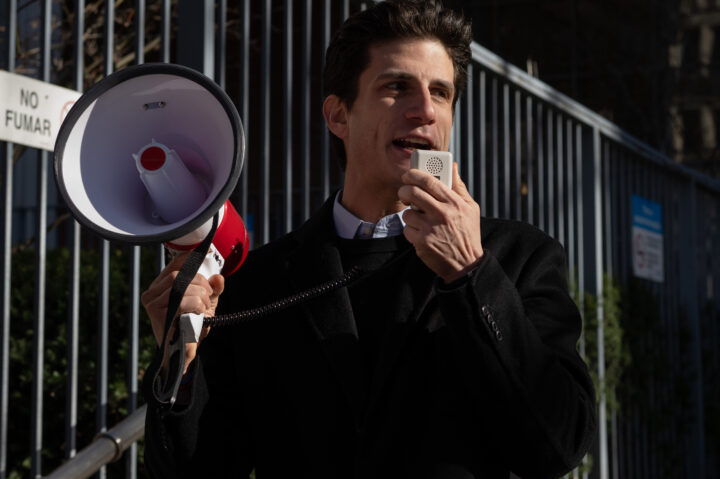
Jack Schlossberg, grandson of former President John. F Kennedy who is currently running for Congress, on Jan. 12, 2026 in New York City.
This P.M. edition is reserved for our premium subscribers — offering a forward-focused read on what we’re tracking now and what’s coming next. Please don’t hesitate to share your thoughts and feedback by replying to this email.
📡On Our Radar
Notable developments and interesting tidbits we’re tracking
Iranian officials have signaled they will attend talks with the U.S. in Islamabad, Pakistan, this week, with Vice President JD Vance, White House Special Envoy Steve Witkoff and Jared Kushner expected to depart for the meeting tomorrow (despite President Donald Trump’s claim that they were already in transit this morning).
Negotiators are up against a running clock, as Trump said today that his two-week ceasefire with Iran will end “Wednesday evening Washington time” and it’s “highly unlikely that I’d extend it” if no deal is reached…
In a series of heated social media posts, Trump again denied that Israel dragged the U.S. into war with Iran: “[T]he results of Oct. 7th, added to my lifelong opinion that IRAN CAN NEVER HAVE A NUCLEAR WEAPON,” were his motivation, he wrote on Truth Social.
Trump also boasted that the deal under negotiation will be “far better” than the 2015 Iran nuclear deal. “If a Deal happens under ‘TRUMP,’ it will guarantee Peace, Security, and Safety, not only for Israel and the Middle East, but for Europe, America, and everywhere else,” he wrote. Lashing out at the media, Trump insisted, “I’m winning a War, BY A LOT, things are going very well,” claiming the U.S. blockade, “which we will not take off until there is a ‘DEAL,’ is absolutely destroying Iran”…
The State Department confirmed that the U.S. will host the second round of ambassador-level talks between Israel and Lebanon on Thursday, as the 10-day ceasefire between the two countries that began last Thursday, after the first round of talks, continues to hold…
Republican operatives and strategists are growing increasingly concerned that the GOP may lose the Senate in the midterm elections, several told Politico, as rising gas prices and unease around the war with Iran create a poor national environment for Trump’s party.
The New York Times’ Nate Cohn argues that Democrats have a “realistic chance” to flip the four seats they need to win back the chamber because “they’ve recruited unusually strong candidates in three states that supported Mr. Trump three times: North Carolina, Ohio and Alaska.”
“In all three states, the Democrats’ likely nominees are popular recent statewide office holders. They either won their last campaign or were highly competitive in losing re-election under less favorable political conditions. So far, the polls show those Democrats running well ahead of what one might otherwise expect,” Cohn writes…
Kennedy scion Jack Schlossberg’s shifting views on Israel policy and decision to skip two upcoming Jewish community candidate forums are raising eyebrows in New York’s heavily Jewish 12th Congressional District, Jewish Insider’s Matthew Kassel reports.
During a candidate forum at 92NY last week, for example, Schlossberg rejected continued U.S. funding for offensive weapons to Israel amid the war in Iran — even as he emphasized support for boosting the Iron Dome missile-defense system, which he described as a “critical” technology…
Minnesota’s Democratic Party is poised to endorse progressive Lt. Gov. Peggy Flanagan for U.S. Senate at its convention next month, Flanagan’s campaign said, after the lieutenant governor secured support from over 90% of Democratic-Farmer-Labor Party local conventions held statewide. The party endorsement, however, will not determine the nominee, as Democratic voters are set to choose their candidate in the Aug. 11 primary election.
The campaign of Rep. Angie Craig (D-MN), Flanagan’s primary opponent and the favorite of pro-Israel activists, called on the DFL last week to launch a formal investigation into a series of alleged instances of antisemitic activity among its delegates. One instance at a local convention last month reportedly saw an unnamed delegate argue that “we should nuke” Israel…
The Wall Street Journal reports on the growing feud between Defense Secretary Pete Hegseth and Army Secretary Dan Driscoll, which “spilled out into public view on Thursday, when Driscoll described to lawmakers his fondness for the Army’s former top general, Randy George, whom Hegseth fired as the service’s chief of staff on April 2 while Driscoll was on vacation”…
A Washington Post investigation found that, since January 2025, neo-Nazi influencer Nick Fuentes has made nearly $900,000 through paid messages on his livestreams from roughly 11,000 fans. His top 500 donors are responsible for almost half of that amount…
The UAE has asked the U.S. to consider offering it financial assistance amid the war with Iran, as the Gulf country has borne the brunt of Iran’s drone and missile strikes, taking a heavy toll on its oil, economic and tourism industries. Emirati officials raised the idea of a currency-swap line, which would allow Abu Dhabi inexpensive access to U.S. dollars…
European officials hosted two meetings on Gaza reconstruction today — one gathering, led by EU representative Kaja Kallas and Norway, centered on coordinating aid with the U.S.-led Board of Peace, where White House advisor Josh Gruenbaum requested international assistance in rebuilding the enclave. The other forum, led by Kallas and Belgium, focused on a two-state solution and was attended by Palestinian Authority Prime Minister Mohammad Mustafa…
In response to Israeli Foreign Minister Gideon Sa’ar’s condemnation of an IDF soldier found to have desecrated a statue of Jesus in southern Lebanon, Radosław Sikorski, Poland’s deputy prime minister and foreign affairs minister, accused the IDF of committing war crimes.
“Lessons should also be drawn regarding the way they are being trained,” Sikorski wrote on X. “IDF soldiers themselves admit to war crimes. They killed not only civilian Palestinians but even their own hostages”…
Incoming Hungarian Prime Minister Peter Magyar affirmed that his country is bound by rules of the International Criminal Court to arrest those sought under its warrants, including Israeli Prime Minister Benjamin Netanyahu; Magyar said he intends to prevent Hungary from leaving the ICC, a move his predecessor, Prime Minister Viktor Orban, had initiated.
Responding to questions about Netanyahu’s claim that Magyar had invited him to the country for a ceremony marking the 70th anniversary of the Hungarian Uprising, Magyar responded, “Every leader is welcome to attend this important commemoration,” but “we have a legal obligation to enforce the court’s rulings, and I’m sure [Netanyahu] knows this”…
Apple CEO Tim Cook announced this afternoon that he will step down from the helm of the tech giant and become its executive chairman in September. Succeeding Cook is John Ternus, head of the company’s hardware engineering…
⏩ Tomorrow’s Agenda, Today
An early look at tomorrow’s storylines and schedule to keep you a step ahead
Keep an eye out in Jewish Insider for an interview with Rachel Goldberg-Polin on the release of her book, When We See You Again, which debuts tomorrow.
The Senate Committee on Banking, Housing and Urban Affairs will hold a nomination hearing for Kevin Warsh, son-in-law of Jewish philanthropist Ronald Lauder, to be chairman of the Board of Governors of the Federal Reserve. Democrats intend to press Warsh on his personal fortune, which he has only partially disclosed thus far.
The House Ethics Committee will hold a public hearing to determine whether to apply sanctions to Rep. Sheila Cherfilus-McCormick (D-FL), after finding last month that she had committed serious ethics violations and campaign finance misconduct.
The U.S. Helsinki Commission will hold a hearing on Iran’s support for Russia amid its war with Ukraine.
The Senate Foreign Relation Committee’s subcommittee on Africa will hold a hearing on U.S. approaches to counterterrorism on the continent.
Stories You May Have Missed
LATIN LINKS

An Israeli diplomatic source told JI that Ecuador and Paraguay are expected to join the Isaac Accords
MICHIGAN MOMENT
Platner, in Reddit post on Hamas terrorist attack: ‘From a strictly professional standpoint, this was a damn fine looking and successful raid against a superior opponent’
Plus, Michigan Dems swap Jewish regent for Hezbollah cheerleader
Jose Juarez/AP
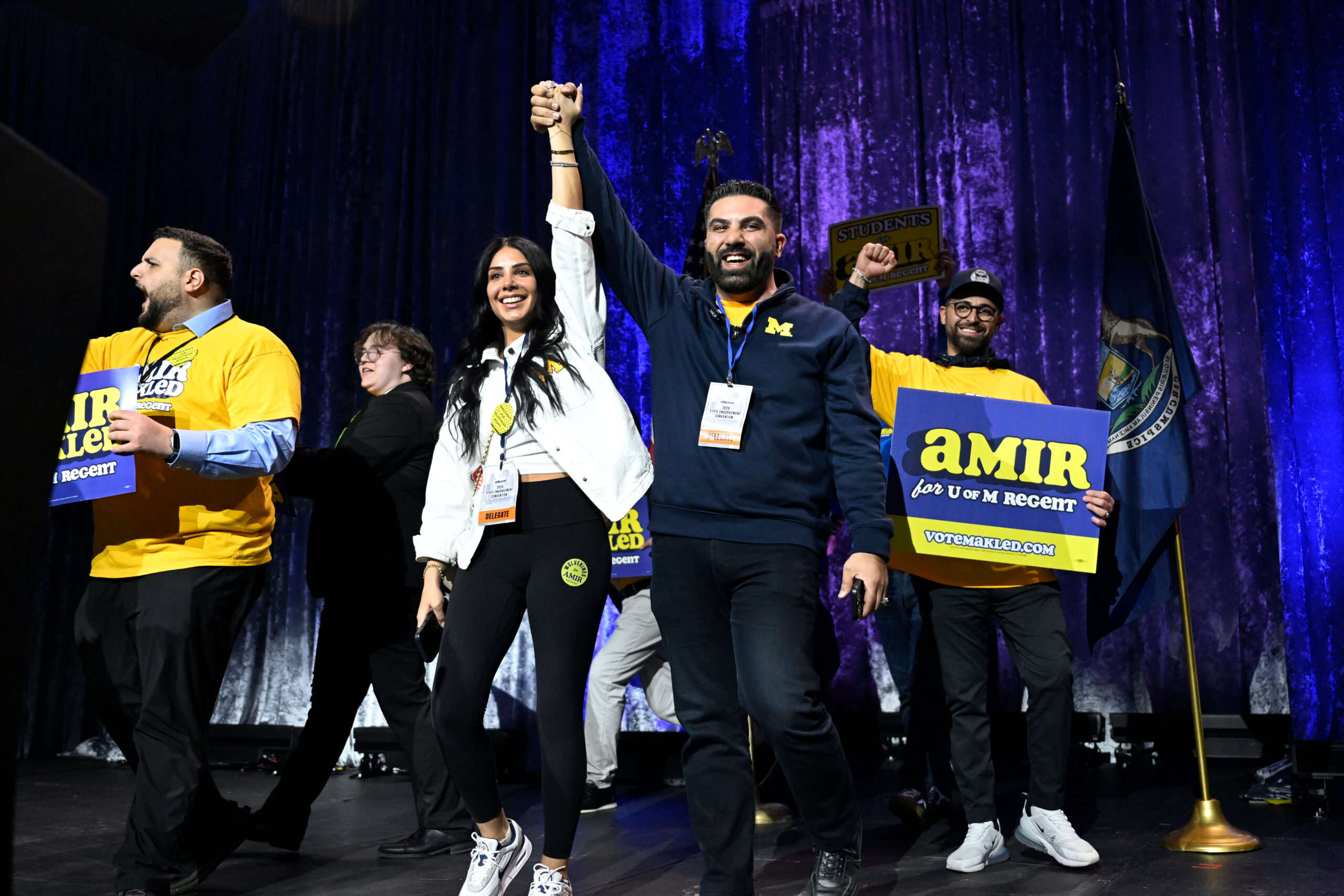
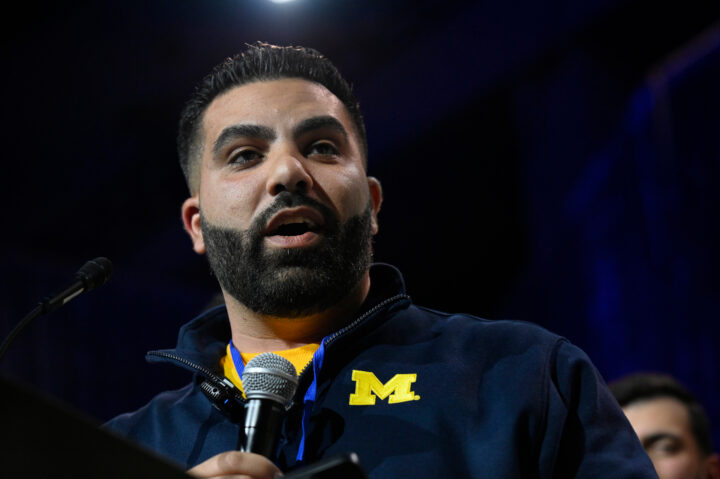
Amir Makled, a candidate for the University of Michigan Board of Regents, addresses delegates after winning the party's nomination during the Michigan Democratic Party State Endorsement Convention, Sunday, April 19, 2026, in Detroit.
👋 Good Monday morning!
In today’s Daily Kickoff, we look at deepening concerns among Jewish Democrats over the party’s increasing embrace of terror supporters and antisemitism, and report on recent polling from Israel that indicates a divide in public opinion over the Trump administration-brokered recent ceasefires with Iran and Lebanon. We cover the weekend’s Alex Soros-backed inaugural Global Progressive Summit in Barcelona, and break down the results of last week’s special election in New Jersey’s 11th Congressional District, where progressive Analilia Mejia sailed to victory, despite a lack of support from some of the district’s most Jewish areas. Also in today’s Daily Kickoff: Rabbi Ephraim Mirvis, Raz Hershko and Luke Lindberg.
Today’s Daily Kickoff was curated by JI Executive Editor Melissa Weiss and Israel Editor Tamara Zieve, with assists from Danielle Cohen-Kanik and Marc Rod. Have a tip? Email us here.
What We’re Watching
- Vice President JD Vance is expected to return to Islamabad, Pakistan, this week for a second round of talks with senior Iranian officials amid conflicting reports over the status of the talks, with Iran saying it has not yet decided whether it will send representatives to the negotiations.
- Meanwhile, Tehran threatened retaliation this morning for the U.S.’ weekend attack on and seizure of an Iranian-flagged ship in the Gulf of Oman that had attempted to evade the Navy’s blockade of the Strait of Hormuz.
- Argentine President Javier Milei is in Israel today after arriving over the weekend ahead of events around Israel’s Yom HaZikaron and Yom HaAtzmaut, the country’s back-to-back commemorations of Israel’s fallen soldiers and victims of terror, and its Independence Day. Yesterday, Milei and Israeli Prime Minister Benjamin Netanyahu launched the Isaac Accords between the two countries. Read more about the initiative here.
- Israel will hold official Yom HaZikaron events at the Western Wall this evening and at Mt. Herzl, the country’s military cemetery, tomorrow morning.
- In Washington, Secretary of State Marco Rubio will speak this morning at a State Department ceremony unveiling the portrait of former Secretary of State Mike Pompeo.
What You Should Know
A QUICK WORD WITH JI’S JOSH KRAUSHAAR
Events in recent days may well be marking a tipping point in the decline of the Democratic Party — at least when it comes to its treatment of Jews, on top of its growing hostility toward Israel.
The weekend ended with the news that Michigan Democratic delegates, at their statewide convention Sunday, nominated a Hezbollah supporter, Amir Makled, to the University of Michigan Board of Regents, choosing to oust a Jewish member, Jordan Acker, whose home and car were repeatedly vandalized with antisemitic graffiti and his family threatened.
Acker’s offenses? He backed efforts to hold anti-Israel campus protesters at the University of Michigan accountable for assaulting police and engaging in intimidation of Jewish students, among other instances of student misconduct. He declined to support efforts to divest university funds from Israel, along with other members of the Board of Regents, as a radical faction of students had demanded.
Acker’s non-Jewish Democratic ticketmate, Paul Brown, who also supported discipline against anti-Israel students, wasn’t targeted and was renominated for election. But the Democratic delegates ousted Acker in exchange for Makled, who has posted on social media with comments praising Hezbollah’s leaders and retweeted antisemitic messages from the conspiracy-theorizing influencer Candace Owens.
The results mark a new low for Michigan Democrats. Also over the weekend, Michigan Senate candidate Abdul El-Sayed told CNN that he believes the Israeli government is just as evil as Hamas. Read more here.
In the same interview, El-Sayed also said that Sen. Chris Van Hollen (D-MD) should replace Senate Minority Leader Chuck Schumer (D-NY) as the Democratic leader in the upper chamber, citing Schumer’s continued support for U.S. aid to Israel. Van Hollen is among the most vocal critics of Israel in the Senate.
Michigan is a closely watched bellwether of the direction of the Democratic Party, and the latest developments underscore that a more radical faction of the party appears to be growing. This, in the state where dozens of Jewish preschoolers were nearly killed in a terrorist attack last month by a Hezbollah sympathizer who targeted the state’s largest synagogue.
dem defections
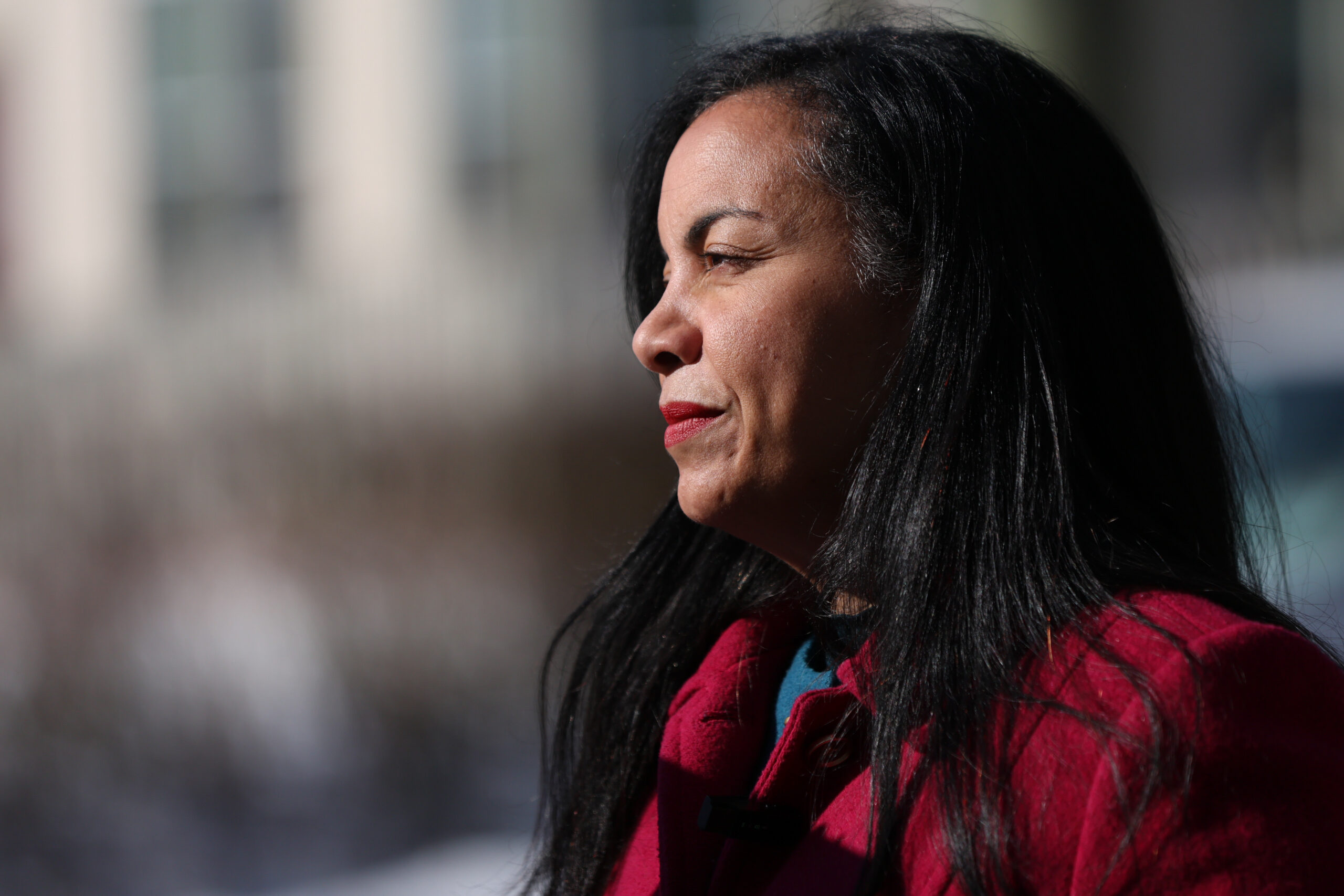
Rep.-elect Analilia Mejia (D-NJ) cruised to victory in last Thursday’s special election for New Jersey’s 11th Congressional District, but the results showed notable defections among Jewish Democrats — an early warning sign for both the left-wing Mejia and her party, Jewish Insider’s Marc Rod reports.
By the numbers: Mejia ran significantly behind other recent Democratic candidates in two municipalities that have traditionally strongly favored Democrats — Livingston Township and Millburn Township — both areas with significant Jewish populations. In Millburn, Mejia lagged 22 percentage points behind former Vice President Kamala Harris’ performance in the 2024 presidential election, and 17 percentage points behind Harris in Livingston.
SPEAKING OUT
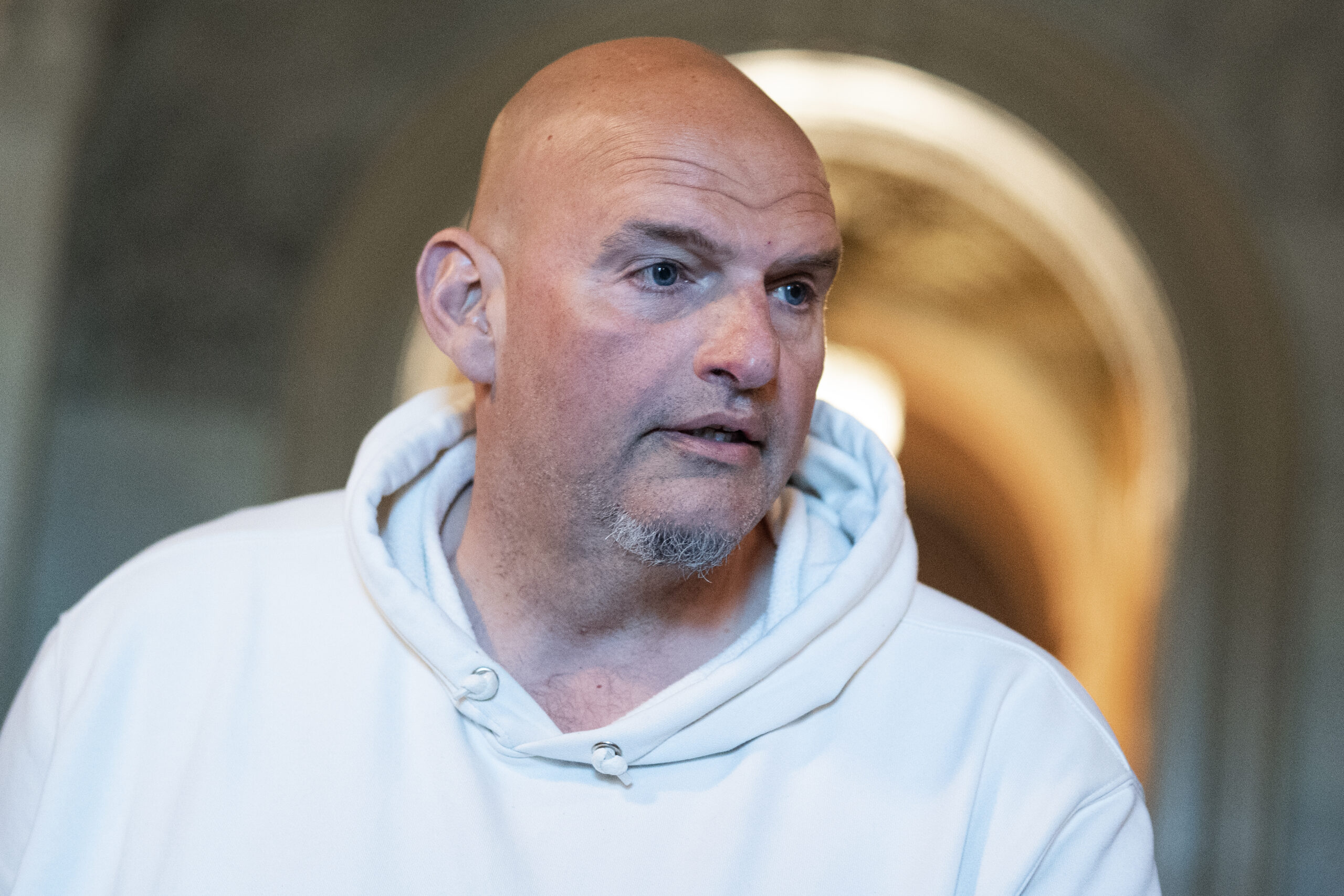
Sen. John Fetterman (D-PA) said on Friday that the Democratic Party “absolutely” has an issue with rising antisemitism, calling out the party’s embrace of candidates including Graham Platner in Maine and Abdul El-Sayed in Michigan while criticizing the recent progressive push to cut off defensive aid to Israel, Jewish Insider’s Emily Jacobs reports.
What he said: The Pennsylvania senator made the comments after being asked on CNN’s “The Arena with Kasie Hunt” if he believed the Democratic Party has a problem with antisemitism. Fetterman argued that the growing support for both candidates in their respective primaries was indicative of a tolerance for antisemitism within the party. “I mean, the guy that’s going to win the primary in Maine has a Nazi tattoo on his chest and now that’s no problem for a lot of voters,” Fetterman said.
IDENTITY CRISIS
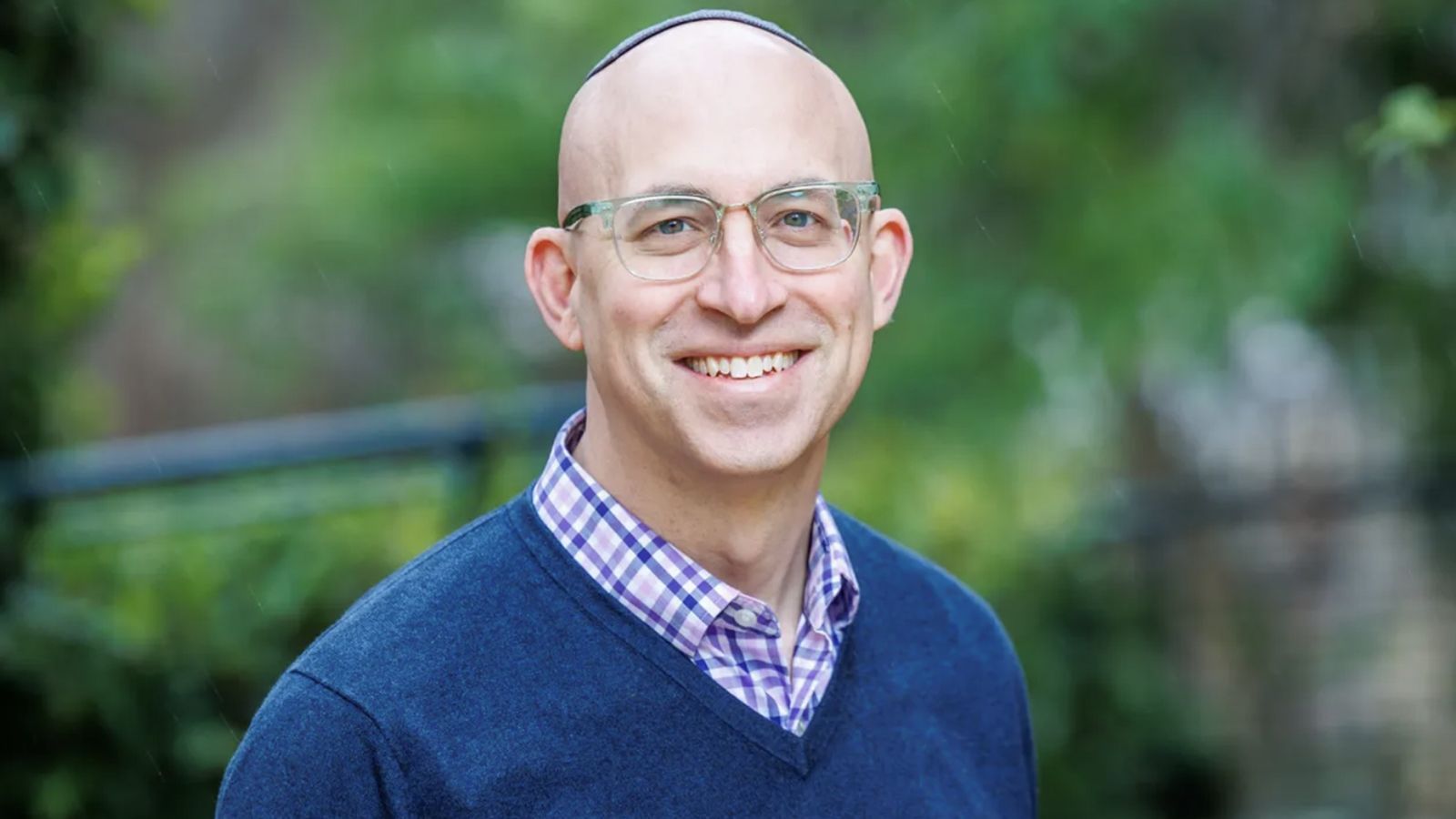
Amid a surge in antisemitism across the political spectrum, many American Jews have described feeling a growing sense of isolation. But for Yehuda Kurtzer, president of the Shalom Hartman Institute, being “politically homeless” is not a crisis to be solved, but rather a position to be embraced, Jewish Insider’s Matthew Shea reports.
A different perspective: “I don’t think some measure of political homelessness is a fundamentally bad thing,” Kurtzer said on Thursday while speaking alongside Jeffrey Goldberg, editor-in-chief of The Atlantic, at the Capital Jewish Museum in Washington. “I think Americans have become hyper-partisan in ways that reflect that partisan political identity has become part of our identities in ways that are not healthy for Americans.” Kurtzer and Goldberg sat in conversation at an event focused on American Jewry ahead of the upcoming 250th anniversary of the founding of the United States.
the view from israel

A weekend of diplomatic turbulence has deepened fault lines in Israel over the ceasefires in Lebanon and Iran, with public opinion split along political lines over whether President Donald Trump is serving Israeli interests — or overriding them. Trump’s announcement of a ceasefire in Lebanon on Thursday, before any known progress had been made in talks between Jerusalem and Beirut toward dismantling Hezbollah, already made waves in Israel, Jewish Insider’s Lahav Harkov reports.
Tough talk: Israeli Prime Minister Benjamin Netanyahu said on Friday that “we have not yet finished the job,” but said Israel was “provid[ing] an opportunity to advance an integrated diplomatic and military solution with the Lebanese government,” at Trump’s request. Within an hour of the release of Netanyahu’s statement, Trump published a Truth Social post in which he “PROHIBITED” Israel from continuing to bomb Hezbollah targets, adding: “Enough is enough!!!” Shira Efron, a senior fellow at RAND who serves as the think tank’s distinguished chair for Israel policy, told JI that “there is no question that the tone – ‘prohibited’ in upper case, ‘enough is enough’ – struck a sensitive note in Israel, and people are talking about a vassal state.”
Under pressure: Rep. Brian Fitzpatrick (R-PA), a moderate Republican and co-chair of the House Problem Solvers Caucus, introduced a war powers resolution on Thursday that aims to enforce the deadlines for the war in Iran laid out in the 1973 War Powers Act, breaking with all Republicans except Thomas Massie (R-KY) JI’s Marc Rod reports.
ENVOY SPOTLIGHT
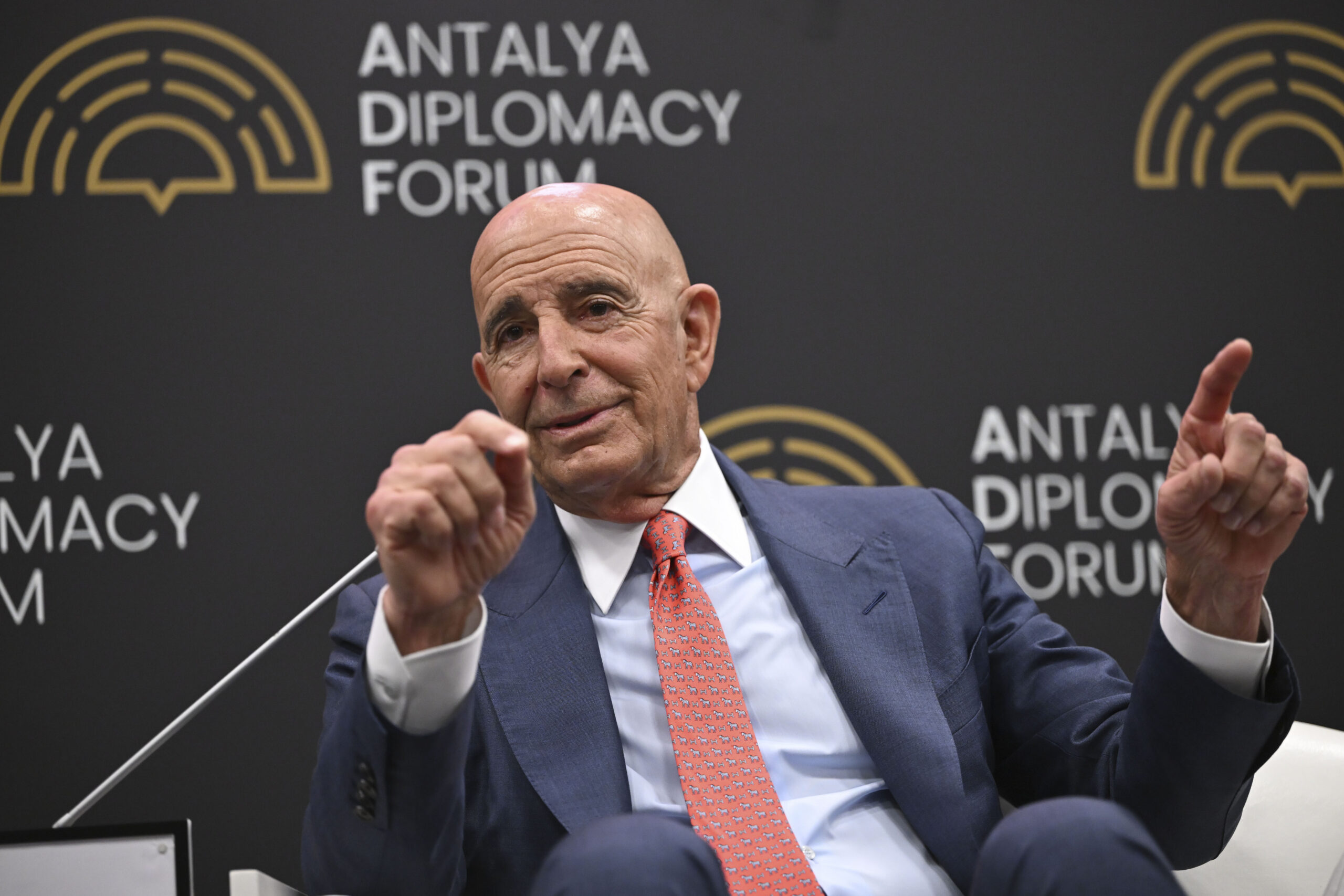
U.S. Ambassador to Turkey Tom Barrack faced fresh condemnation from two Senate Republicans and conservative influencers for a series of comments he made at the Antalya Diplomacy Forum in Turkey this weekend in which he repeatedly criticized Israel and praised Ankara, Jewish Insider’s Marc Rod reports.
Hezbollah hiccups: To comments by Barrack claiming that the current ceasefire in Lebanon “is so delicate because everybody has been equally untrustworthy” — referring to both Israel and Hezbollah — Sen. Lindsey Graham (R-SC) said he “respectfully and strongly disagree[s].” Barrack said at the conference there needs to be “a path with Hezbollah, and that path has to be not killing Hezbollah.” He further dismissed the idea that the Lebanese Armed Forces would act to disarm Hezbollah, as is required under the terms of the current and past ceasefires. “I always get in trouble because Hezbollah, in American parlance, and most of the West, is a foreign terrorist organization. Hezbollah, in Lebanon, is also a political organization,” Barrack added.
UNITING THE GLOBAL LEFT
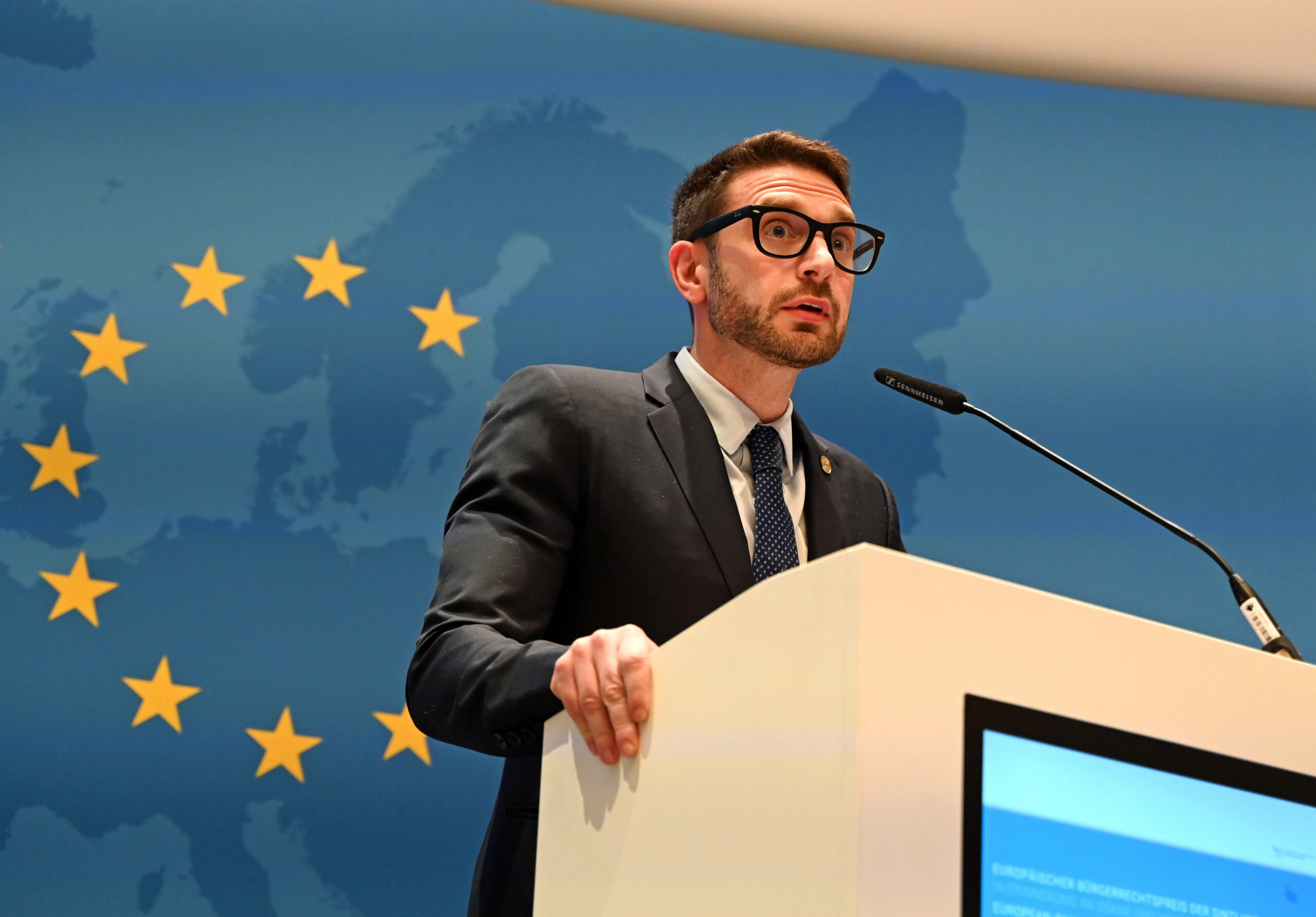
A range of Israel critics, from Sen. Chris Murphy (D-CT) to Israeli lawmaker Ahmed Tibi, were among those gathered in Barcelona, Spain, over the weekend for the inaugural Global Progressive Summit, backed by left-wing philanthropist Alex Soros. The conference brought together representatives from over 40 countries, offering, according to its website, “a necessary alternative to conservative and far-right forces,” Jewish Insider’s Lahav Harkov reports.
In attendance: Spanish Prime Minister Pedro Sánchez, an outspoken critic of Israel who called on Saturday to downgrade EU-Israel relations, hosted the two-day conference, whose American attendees also included Minnesota Gov. Tim Walz, with Soros. Sen. Bernie Sanders (I-VT), New York City Mayor Zohran Mamdani and former Secretary of State Hillary Clinton sent video messages. South African President Cyril Ramaphosa, whose government petitioned the International Criminal Court to prosecute Israeli leaders, Brazilian President Lula de Silva and U.K. Justice Secretary David Lammy were also in attendance.
Worthy Reads
Dumb and Dumber: The Atlantic’s Yair Rosenberg explores the expanding platforms of influencers and public figures who are uneducated on the issues about which they speak and unchallenged by interviewers. “Talking with Piker about a political coalition to save American democracy without discussing his affinity for China’s rulers is like teaming up with Carlson without interrogating his praise for Russian President Vladimir Putin — or with Donald Trump without examining his outlook toward Israeli Prime Minister Benjamin Netanyahu. And yet, only the debate over the latter tends to happen, such that Israel crowds out all other considerations, including extremely consequential beliefs that can end up going unchallenged.” [TheAtlantic]
It’s All Relative: In The Washington Post, the American Enterprise Institute’s Danielle Pletka raises concerns about the presence of relatives of officials from American adversaries who are living in the U.S., amid an effort to deport some of those family members. “The U.S. is littered with other nepo babies, wives and cousins — what the Iranians and Arabs call aghazadeh and the Russians call mazhor — enjoying the privileges of living in the land of the free, often made possible by the ill-gotten gains of the fam back home. It’s little wonder why they came. … It turns out the easiest route is through higher education, with some institutions explaining outright how F-1 student visa holders can transfer to permanent status upon graduating.” [WashPost]
Dropping the Trump Name: The New York Times’ Eric Lipton spotlights an effort by the wealthy Khayyat family in Syria to influence U.S. foreign policy in Syria through the Trump family’s business dealings. “Such a mixing of personal and diplomatic affairs has long been the norm in Middle Eastern nations, where a small set of players have historically run, and profited from, their dominant role in society. But it has become the way Washington operates in Mr. Trump’s second term, too. … [A friend of Mohamad Al-Khayyat, Syrian American businessman Tarek] Naemo, who is based in Florida and runs an investment firm that he said had done deals with partners including the Qatari Investment Authority, began with his wife to court at least a dozen members of Congress, starting with Speaker Mike Johnson.” [NYTimes]
Word on the Street
President Donald Trump nominated Under Secretary of Agriculture Luke Lindberg to serve as the next head of the World Food Program, following Cindy McCain’s announced departure from the role over health issues…
The New York Times looks at divisions within the conservative campus movement in the wake of Turning Point USA founder Charlie Kirk’s assassination in September, finding that members of some campus chapters and breakaway groups are split “over support for Israel, the showcasing of conspiracy theorists and who is rightfully American,” as well as disagreements over the war against Iran…
Buckley Carlson, the son of Tucker Carlson, departed his role as deputy press secretary to Vice President JD Vance to start his own consulting firm…
Commerce Secretary Howard Lutnick was spotted with Philadelphia 76ers owner Josh Harris as the 76ers took on the Boston Celtics in Massachusetts over the weekend…
Authorities in Los Angeles arrested an Iranian woman with permanent U.S. residency status accused of brokering sales of Iranian weapons to the Sudanese Armed Forces for use in the African country’s yearslong civil war…
A George Washington University alumna is suing the school and her former employer, Ernst & Young, as well as a number of GWU officials, alleging that she faced retaliation and discrimination in the wake of an address she delivered at one of the school’s 2025 commencement ceremonies; her remarks calling for GWU to divest from Israel deviated from those approved by the school…
Rümeysa Öztürk, the Tufts University graduate student who was detained for more than a month by immigration officials for co-authoring an op-ed critical of Israel, is returning to Turkey, having completed her Ph.D. studies at the Boston-area school…
The New York Times reviews When We See You Again, Rachel Goldberg-Polin’s account, which will be released tomorrow, of her life before and after the 2024 death of her son, Hersh Goldberg-Polin, at the hands of his Hamas captors…
Canada’s Centre for Israel and Jewish Affairs, with the backing of more than 80 Jewish groups, is calling on the federal government in Ottawa to increase funding to address “rising security demands” as the country sees a sharp increase in antisemitism…
A French peacekeeper was killed and three others members of UNIFIL, the U.N.’s peacekeeping force in Lebanon, were injured in what France and UNIFIL said was a Hezbollah attack; French President Emmanuel Macron, whose government was sidelined from recent U.S.-brokered talks between the Lebanese and Israeli ambassadors to Washington, called on Beirut to “immediately arrest those responsible and assume their responsibilities alongside UNIFIL”…
An appeals court in France ruled than an Algerian-born nanny who worked for a French Jewish family was not acting out of antisemitism when she poisoned family members, despite having told police, “Because they have money and power, I should never have worked for a Jewish woman; she only brought me trouble”; the woman was sentenced to two-and-a-half years in prison, less than if she was found to have been motivated by antisemitism…
Kanye West’s upcoming concert in Poland, which was slated to take place in June, was called off by organizers, one of whom cited “formal and legal reasons,” weeks after West’s planned concerts in France and the U.K. were also cancelled amid public outcries over his past antisemitic comments…
Helen Mirren, Skylar Astin and Liev Schreiber were among more than 1,000 signatories to an open letter organized by Creative Community for Peace in support of Israel’s continued participation in the Eurovision Song Contest…
U.K. Chief Rabbi Ephraim Mirvis decried the “sustained campaign of violence and intimidation” targeting British Jews amid a series of attacks on Jewish communities around the country…
Mirvis’ statement came shortly before the arrest of two teenagers in connection with an arson attack that caused minor damage to London’s Kenton United Synagogue; British authorities are investigating whether the recent spate of attacks targeting Jewish sites in the country is linked to Iran…
A British court rejected an effort by the International Centre of Justice for Palestinians to issue a summons for a dual U.K.-Israeli citizen who traveled to Israel on Oct. 8, 2023, to rejoin his unit as a reservist in the wake of Hamas’ deadly attacks the day prior…
Sixteen Arab and Muslim countries — including Saudi Arabia, Jordan and Egypt, but excluding Abraham Accords signatories the United Arab Emirates, Morocco and Bahrain — signed onto a Qatar-led statement condemning Israel for appointing former Israeli Ambassador to Kenya Michael Lotem as the country’s first ambassador to Somaliland, four months after Jerusalem recognized the African state…
The New York Times explores the impact of the war in Iran on Qatar and other U.S.-allied Gulf nations, finding Doha [t]rapped between their chief ally and their neighbor” and now being “forced to rethink their security strategies”…
The UAE’s minister of state for international cooperation said that 90% of the sites struck in the Gulf nation by Iran over the course of the recent conflict were civilian infrastructure; Reem Al Hashimy said that approximately 2,800 missiles and drones launched by Iran had hit targets in the UAE…
The governor of the UAE’s central bank, who met last week in Washington with Treasury Secretary Scott Bessent, introduced the possibility of working with Washington to create a currency-swap line as a potential financial backstop should the Gulf state face further economic challenges…
Iran said it executed two people alleged to have collaborated with Israel’s Mossad…
The IDF released a map showing the Lebanese territory under its control as it fights against Hezbollah in the southern part of the country…
IDF spokesperson Lt. Col. Nadav Shoshani said the military was conducting an investigation following the surfacing of a photo in which an IDF soldier is pictured desecrating a statue of Jesus in the southern Lebanese Christian village; Israeli Prime Minister condemned the incident, saying he “was stunned and saddened” and that Israel “express[es] regret for the incident and for any hurt this has caused to believers in Lebanon and around the world”…
Senior Hamas officials confirmed to The New York Times that the terror group was willing to relinquish some of its weapons to the Palestinian administrative committee operating under the Trump administration’s Board of Peace…
Israeli Olympic silver medalist Raz Hershko won gold in her weight class at the European Judo Championships in Tbilisi, Georgia…
Pic of the Day

Yizhar Hess, vice chairman of the World Zionist Organization, hosted a reading on Sunday of Israel’s Declaration of Independence at the egalitarian section of the Western Wall in Jerusalem. Hess was joined by members of the Sydney Jewish community as well as former Israeli hostage Shoshan Haran.
Birthdays

Israeli model, swimwear designer and social media star, Neta Alchimister turns 32…
Stanford University professor and 2020 Nobel Prize laureate in economics, Paul Robert Milgrom turns 78… Chairman of the media networks division of Activision Blizzard, he previously held high-ranking roles at NFL Network, ESPN and ABC, Steve Bornstein turns 74… Philadelphia-based development professional, currently at AJC after a long career for a number of organizations, Andrew Demchick turns 70… Immigrants rights activist and professor at Salem State University, she is the eldest daughter of Noam Chomsky, Aviva Chomsky turns 69… Television and radio host, syndicated columnist and political commentator, Steve Malzberg turns 67… Past president and executive director of the D.C.-based Electronic Privacy Information Center, now at the Center for AI and Digital Policy, Marc Rotenberg turns 66… Author, journalist and former co-host of “The Femsplainers Podcast,” Danielle Crittenden Frum turns 63… Semi-professional race car driver and restaurateur, he was previously CEO, president and chairman of the Trust Company of New Jersey, Alan Wilzig turns 61… Television producer and game show host, known professionally as J.D. Roth, James David Weinroth turns 58… Israeli jazz bassist, composer, singer and arranger, Avishai Cohen turns 56… British film director, Sarah Gavron turns 56… Member of the U.S. House of Representatives, one of four Jewish Republican congressmen, Randy Fine (R-FL) turns 52… VP of government and public affairs at Cleveland-based GBX Group, a historic real estate development firm, Seth Foster Unger… Deputy associate administrator at the General Services Administration, Michael C. Frohlich… Chief philanthropy and leadership officer at the World Jewish Congress, Elliott G. Mendes… President and CEO at the Los Angeles-based Skirball Cultural Center, Jessie Kornberg turns 44… Former general manager of Bird in Israel, he is a nephew of Israel’s past president Reuven Rivlin, Yaniv Rivlin… ESPN sportscaster and former Fox Sports and NFL Network personality, Peter Schrager turns 44… New York-based national security and human rights lawyer, Irina Tsukerman… Co-founder of The Free Press and its head of strategy, Nellie Bowles turns 38… PM breaking news editor at CNN Politics, Kyle Feldscher… Policy advisor and counsel to U.S. Sen. Jack Reed (D-RI), Zachary L. Baum… Systems engineer at Google X, Joseph Gettinger turns 38… Facilitator, coach and workshop organizer, Daniela Kate Plattner… Research analyst at the U.S. Department of State during the Biden administration, David Mariutto… VP at Cedar Capital Partners, Alex Berman… CEO of Social Lite Creative and news anchor on ILTV, Emily K. Schrader… Israeli scientist, engineer and artificial intelligence researcher at Massachusetts Institute of Technology, Dr. Maor Farid turns 34… Working on advertising platforms at Apple, McKenna Klein… Senior associate at LvlUp Ventures, Andrew J. Hirsh… R&B, soul, pop singer and teen actress, at 13 she was the runner-up on the second season of “The X Factor,” Carly Rose Sonenclar turns 27… Diane Kahan…
Michigan is a closely watched bellwether of the direction of the Democratic Party, and the latest developments underscore that a more radical faction of the party appears to be growing

Al Drago/Bloomberg via Getty Images
Democratic National Convention (DNC) at the United Center in Chicago, Illinois, US, on Thursday, Aug. 22, 2024.
Events in recent days may well be marking a tipping point in the decline of the Democratic Party — at least when it comes to its treatment of Jews, on top of its growing hostility toward Israel.
The weekend ended with the news that Michigan Democratic delegates, at their statewide convention Sunday, nominated a Hezbollah supporter, Amir Makled, to the University of Michigan Board of Regents, choosing to oust a Jewish member, Jordan Acker, whose home and car were repeatedly vandalized with antisemitic graffiti and his family threatened.
Acker’s offenses? He backed efforts to hold anti-Israel campus protesters at the University of Michigan accountable for assaulting police and engaging in intimidation of Jewish students, among other instances of student misconduct. He declined to support efforts to divest university funds from Israel, along with other members of the Board of Regents, as a radical faction of students had demanded.
Acker’s non-Jewish Democratic ticketmate, Paul Brown, who also supported discipline against anti-Israel students, wasn’t targeted and was renominated for election. But the Democratic delegates ousted Acker in exchange for Makled, who has posted on social media with comments praising Hezbollah’s leaders and retweeted antisemitic messages from the conspiracy-theorizing influencer Candace Owens.
The results mark a new low for Michigan Democrats. Also over the weekend, Michigan Senate candidate Abdul El-Sayed told CNN that he believes the Israeli government is just as evil as Hamas.
In the same interview, El-Sayed also said that Sen. Chris Van Hollen (D-MD) should replace Senate Minority Leader Chuck Schumer (D-NY) as the Democratic leader in the upper chamber, citing Schumer’s continued support for U.S. aid to Israel. Van Hollen is among the most vocal critics of Israel in the Senate.
Michigan is a closely watched bellwether of the direction of the Democratic Party, and the latest developments underscore that a more radical faction of the party appears to be growing. This, in the state where dozens of Jewish preschoolers were nearly killed in a terrorist attack last month by a Hezbollah sympathizer who targeted the state’s largest synagogue.
But it’s not just in Michigan where the weekend’s developments suggest an ominous turn in the Democratic Party’s evolution.
Today’s Daily Kickoff includes comments made by Sen. John Fetterman (D-PA), one of the few pro-Israel Democratic stalwarts left, who blasted his party for tolerating antisemitism, calling out Democrats’ acceptance of Senate candidates with checkered histories, including Graham Platner in Maine and El-Sayed.
In particular, Fetterman expressed shock that party leaders had nothing to say about revelations that Platner praised Hamas’ tactics in a 2014 Reddit forum that shared video of the terrorist group killing several Israeli soldiers.
We cover the implications of the election results from New Jersey’s 11th Congressional District, a moderate-minded, affluent suburb, where voters elected a far-left Israel critic who withheld criticism of Hamas after the Oct. 7, 2023, attacks — except for the Jewish Democrats in the district, who swung decidedly to the right.
And we report on the pained comments from Yehuda Kurtzer, the president of the Shalom Hartman Institute (a liberal, pluralistic think tank dealing with issues affecting the Jewish community), who called on American Jews to “embrace political homelessness” as part of a pointed perspective on how badly things have gotten within the progressive movement, the longtime home for many American Jews.
“We’re stuck as an American Jewish community between an illiberal argument on the right, which is currently in power, and an illiberalism of the left,” he said.
Also notable from the weekend: Likely Democratic presidential candidate Rahm Emanuel, who is portraying himself as a bold, moderate truth teller against the left wing of his party, championed the fact on HBO’s “Real Time with Bill Maher” that he wants to cut off all U.S. military aid to Israel — in a clear political pander to the growing anti-Israel wing of his party. Truth-telling only goes so far when public opinion against Israel within the Democratic party has grown to such a high level.
It’s surely comforting to believe that Israel’s aggressive war against Hamas and Hezbollah in Gaza and Lebanon and tough tactics against Iran or Israeli Prime Minister Benjamin Netanyahu’s haughty approach to his engagement with Washington are the main factors driving the Democratic Party towards its estrangement of Israel. Maybe then, after a possible change of Israeli leadership in the country’s October elections, Democratic public opinion would shift.
But if that was truly the case, you wouldn’t see the party tolerating candidates with neo-Nazi tattoos who “dig” Hamas’ terror tactics and ones who compare the mistakes of a democratic state with a terrorist group that seeks in its charter to eliminate all Jews.
You wouldn’t see a Jewish regent of the University of Michigan and a Jewish Michigan attorney general being personally threatened for enforcing the law — with little protest from party leadership.
And you wouldn’t see Hasan Piker, an antisemitic social media figure with a laundry list of terror-justifying rhetoric, become the progressive movement’s trendy surrogate, in this fraught moment for American Jews.
Kurtzer is right that illiberalism is rising on all sides. But when the party that has long positioned itself as the bulwark against bigotry now tolerates terrorist apologists and antisemitic hate — while abandoning pro-Israel Jews who long called it home — it should be a wake-up call that something is broken.
An Israeli diplomatic source told Jewish Insider that Ecuador and Paraguay are expected to join the Isaac Accords

Kobi Gideon (GPO
Argentinian President Javier Milei, Israeli Prime Minister Benjamin Netanyahu and U.S. Ambassador to Israel Mike Huckabee take part in the launch ceremony of the Isaac Accords
Argentine President Javier Milei began an event-packed visit to Israel on Sunday, which will include receiving a Presidential Medal of Honor and lighting a torch in Israel’s Independence Day ceremony on Tuesday.
Milei and Israeli Prime Minister Benjamin Netanyahu launched the “Isaac Accords” on Sunday, an initiative conceived by Milei to encourage closer cooperation between Israel and Latin American countries.
An Israeli diplomatic source told Jewish Insider that Ecuador and Paraguay are expected to join the Isaac Accords. Israeli media have reported that Costa Rica, Panama and Uruguay have also expressed interest.
Milei described the launch of the initiative as “a historic moment for our nations. It will not only strengthen the relationship between Argentina and Israel, united by shared values, but also represents a step toward a freer and more prosperous hemisphere.”
“Isaac, the son of Abraham, represents an initiative to extend the model initiated by President [Donald] Trump in the Middle East to Latin America, addressing challenges such as terrorism, antisemitism, and drug trafficking, while inviting other nations to join,” Milei said. “Nations that share values have a mission to work together. With the support of the United States, we have the opportunity to bring about transformative change.”
The accords are “a new strategic framework aimed at strengthening cooperation between Argentina, Israel and like-minded partners in the Western Hemisphere, the descendants of Isaac and nations of the Judeo-Christian tradition, in defense of freedom and democracy, and in the fight against terrorism, antisemitism, and drug trafficking,” according to Israel’s Foreign Ministry.
Milei suggested launching the accords in a meeting with Israel Foreign Minister Gideon Sa’ar, whose father was from Argentina. The Israeli foreign minister was the main Israeli catalyst pushing for the agreement, including in his most recent meeting with Secretary of State Marco Rubio last summer, during which they established a working group to advance the matter, an Israeli diplomatic source told JI.
Netanyahu said that he sees “great hope vis-à-vis the Latin American continent. We see the beginnings of change, certainly we’ve seen enormous change in Argentina, but I think that this is also a compass and a map for other countries, not only for their internal reforms but also for their external reforms, that is coming back to the alliance of freedom. It begins with the two of us and with the support that is always there of the United States for free societies.”
U.S. Ambassador to Israel Mike Huckabee took part in the launch ceremony, and called Milei and Netanyahu “two of President Trump’s greatest friends” who seek to “bring back the values that are the underpinning of Western civilization and Judeo-Christian values upon which our nations were built.”
Sa’ar described Milei as “one of the boldest leaders of our age. … We will continue to strengthen this close friendship! Viva Argentina! Viva Israel!”
Earlier Sunday, Milei visited the Western Wall with Argentinian Ambassador to Israel Axel Washnish, a rabbi with whom he learned Torah for years before becoming president.
Israel and Argentina also announced direct flights between the countries. The first El Al flights to Buenos Aires are expected to start in November.
‘The guy that’s going to win the primary in Maine has a Nazi tattoo on his chest and now that’s no problem for a lot of voters. … That’s crazy,’ Fetterman told CNN
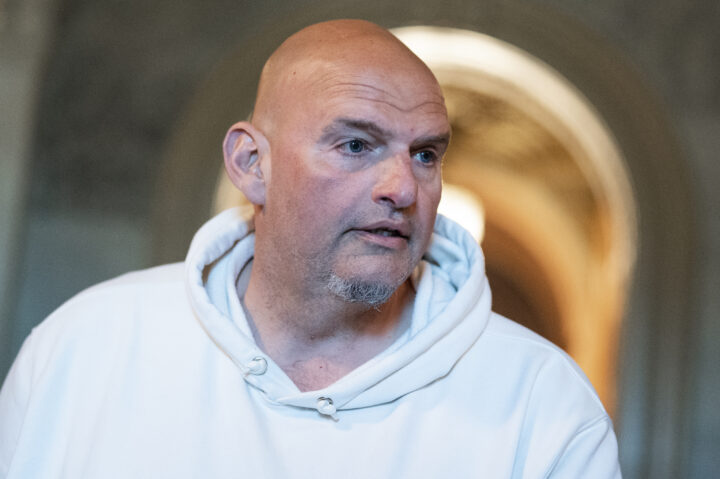
Tom Williams/CQ-Roll Call, Inc via Getty Images
Sen. John Fetterman (D-PA) is seen after the Senate luncheons in the U.S. Capitol on Tuesday, April 14, 2026.
Sen. John Fetterman (D-PA) said on Friday that the Democratic Party “absolutely” has an issue with rising antisemitism, calling out the party’s embrace of candidates including Graham Platner in Maine and Abdul El-Sayed in Michigan while criticizing the recent progressive push to cut off defensive aid to Israel.
The Pennsylvania senator made the comments after being asked on CNN’s “The Arena with Kasie Hunt” if he believed the Democratic Party has a problem with antisemitism. Fetterman argued that the growing support for both candidates in their respective primaries was indicative of a tolerance for antisemitism within the party.
He pointed to Platner surviving the controversy surrounding his Nazi tattoo and Jewish Insider’s reporting in recent days that the first-time candidate repeatedly praised Hamas’ tactics in a 2014 Reddit forum that shared video of the terrorist group killing several Israeli soldiers.
“I mean, the guy that’s going to win the primary in Maine has a Nazi tattoo on his chest and now that’s no problem for a lot of voters,” Fetterman said. “I don’t know why. That’s crazy. And now, I mean, we know he knows, he knew what that was. I mean, if you’re back over 12, 13 years, cheering about the death of Israeli soldiers, I mean, you clearly have a serious issue, and the left has a serious issue with antisemitism.”
“It was just released that he was praising and celebrating a video online where Hamas was beating and torturing Israeli soldiers to death,” Fetterman said, referring to Platner.
Fetterman also made note of El-Sayed’s lead in one recent primary poll despite his decision to campaign alongside antisemitic streamer Hasan Piker.
“The guy in Michigan, he’s leading now in that race, as my party becomes more and more hostile to Israel,” Fetterman said. “They’re just palling around someone like Hasan Piker, you know the guy that, absolutely, I mean, he absolutely is proud to cheer for Hamas, loves Hamas.”
“The Democrats are proud to stand with him and campaign with him,” he added. “Go ahead, try to win Pennsylvania and campaign around Hasan Piker, or saying, ‘Yeah, America deserved 9/11’ or ‘Hamas is 1,000% better than Israel’ or ‘I don’t care about the rapes and for all this other things.’ We have a serious problem with my party.”
Fetterman, one of most vocal pro-Israel Democrats in the Senate, told Hunt that Israel is “becoming more and more toxic for a Democrat to support,” pointing out that “80% of Democrats view Israel in a negative way.” He specifically condemned the uptick in progressive and far-left voices coming out against continued defensive aid to Israel.
“You have people like [Rep. Alexandria Ocasio-Cortez] voting against Iron Dome, the technology that prevents tens and tens of [thousands] of Israeli deaths from the rockets that those cowards fire at civilians,” he said.
Fetterman went on to criticize members of his party for opposing the war in Iran, saying that there were other Democrats who felt the same as him in supporting the effort but were not speaking out because doing so would be “politically toxic.”
“Every single Democrat has already been on record saying, ‘We can‘t ever allow Iran to acquire a nuclear bomb,’” Fetterman said, specifically naming former Vice President Kamala Harris and former Secretary of State Hillary Clinton and “everyone that’s run for president” who said “we can’t ever allow that to happen.”
“Then, [President Donald] Trump happened to do something about that to prevent that. That’s why I support that,” he continued. “I’m not the only Democrat who supports this, but I’m the only Democrat that’s willing to stand up and say it’s the right thing because I know how politically toxic it is as a Democrat to support this.”
Fetterman surmised that he is the “only Democrat … perhaps left in the entire Congress” who will say publicly that recent U.S. military action in Iran “was necessary” because doing so “contradicts every single thing that every Democrat has said” about how “we can’t ever allow Iran to acquire a nuclear bomb.”
Fetterman went on to criticize the Democratic lawmakers who voted for the recent war powers resolutions in the House and Senate, arguing that their opposition to the war has been “celebrated” by Iranian leadership and calling their response to the conflict “absurd.”
“Iran has celebrated this,” Fetterman said of the broad Democratic opposition. “A lot of people in my party and a lot of people in the media has turned Iran into the underdog. They’re like Rudy” — making a reference to the 1993 sports movie — “and putting them up on their shoulders and cheering for Iran at this point.”
Asked to respond to Sen. Elissa Slotkin’s (D-MI) statement that “being pro-Israel today is not about simply supporting the political or military agenda of Prime Minister [Benjamin] Netanyahu, just like being pro-American should not be equated with loyalty to President Trump,” Fetterman argued that her comments on her votes for Sen. Bernie Sanders’ (I-VT) measures on Thursday blocking military sales to Israel were similarly “absurd.”
“She’s a Democratic senator. Why aren’t you criticizing Iran? Why aren’t you criticizing Hamas or Hezbollah or these other kinds of forces? If you have to pick a side here, criticize that. So that’s where we are as a Democratic Party, and you’re going to vote against the kinds of critical aid that Israel requires and needs in order to beat back and destroy an organization like Hezbollah. Like I said, if you have to pick a side in a war, and clearly we have a side, I’m proud to stand on the side of Israel and America.”
Pressed on if he was still committed to being a Democrat given that his comments marked his harshest criticism yet of his party, Fetterman responded affirmatively.
“Well, of course. Yeah, I am absolutely committed to [remaining a] Democrat, absolutely,” Fetterman said. “I vote 91, 92 percent the Democratic line, but I am the only Democrat now that’s proud to consistently stand with Israel, and I’m going to do that, and that’s been very damaging with my standing as a Democrat.”
“If it’s what’s necessary, I’ll be the last Democrat standing with Israel through this,” he later added.
Fetterman also predicted that the war in Iran would not go on much longer, noting that “things kind of continue to wind down,” and said it’s “important to support” the U.S. securing an outcome in which Iranian leadership “surrenders.”
“I think these are very positive developments,” he said of Israel and the U.S. targeting Iran and their leading proxies.
“I think it seems like it’s going to wind down,” Fetterman said. “And we’re heading to a strong end at this point.”
In conversation with The Atlantic’s Jeffrey Goldberg, Kurtzer said the Jewish community is caught between the illiberalism of the left and the illiberalism of the right
Shalom Hartman Institute
Yehuda Kurtzer
Amid a surge in antisemitism across the political spectrum, many American Jews have described feeling a growing sense of isolation. But for Yehuda Kurtzer, president of the Shalom Hartman Institute, being “politically homeless” is not a crisis to be solved, but rather a position to be embraced.
“I don’t think some measure of political homelessness is a fundamentally bad thing,” Kurtzer said on Thursday while speaking alongside Jeffrey Goldberg, editor-in-chief of The Atlantic, at the Capital Jewish Museum in Washington. “I think Americans have become hyper-partisan in ways that reflect that partisan political identity has become part of our identities in ways that are not healthy for Americans.”
Kurtzer and Goldberg sat in conversation at an event focused on American Jewry ahead of the upcoming 250th anniversary of the founding of the United States.
Kurtzer argued that hyper-partisanship is particularly dangerous for the Jewish community, noting that Jews “believe in the notion that we are tethered to other people regardless of what they believe.” He said American Jews “should take that same ethos and apply it to what it means to be an American as well.”
“Choosing a side has never worked for Jews because when you get out of the hall to power, you will be identified as the exemplar of that political attitude that can now be destroyed,” Kurtzer said.
“Now we’re stuck as an American Jewish community between an illiberal argument on the right, which is currently in power, and an illiberalism of the left,” Kurtzer continued. “We don’t have a choice as American Jews but to fight for the very liberal framework that resists the authoritarianism of the right and resists the authoritarianism of the left and insists that this is the only way we can make it work for ourselves.”
This tension is especially acute on university campuses, Kurtzer said, where he believes “progressivism” has played “a major role in shutting down the pluralistic discourse that a university campus is supposed to inhabit.”
“I think there’s an immense amount of shame that travels for American Jews, especially for young people, about association with Israel,” Kurtzer said. “At a moment like this, it’s very hard to get past that shame with even rational arguments.”
However, Kurtzer suggested that young Jews may be uniquely positioned to model a “healthy political alternative” by demonstrating how to navigate complex discourse. He noted that since the Oct. 7, 2023, Hamas attacks, many Jews feel “a greater sense of attachment to the Jewish community and Jewish lives and even the State of Israel.”
He argued that American Jews must “find a way to articulate the thickness of our relationship to Israel and the Jewish people that is not perpetually under the test of what the Israeli government does today and tomorrow.”
Kurtzer also warned that the American Jewish community has grown too “comfortable” being part of the daily fabric of American life.
“Jews wrote the soundtrack to American patriotism. We engaged in that project,” he said. “The thing that I think the American Jewish community has let go of is that we became comfortable saying, ‘We’re now insiders to that project. We no longer need to be active creators of the American story.’ We just get to kind of sit on our laurels.”
While Kurtzer called for further engagement from the Jewish community in American life and political processes, he explained that the strength of the community also lies in its willingness to remain distinct.
“It’s OK and probably important for Judaism to maintain some dimension of counter-culturalism,” Kurtzer said. “Some dimension of insisting that in a radical technological world, anti-technological behaviors like turning off your phone for 25 hours a week are actually good.”
EEOC Chair Andrea Lucas: ‘At some point, either the government will know information related to individuals’ religion, or we will not be able to enforce the laws on their behalf’
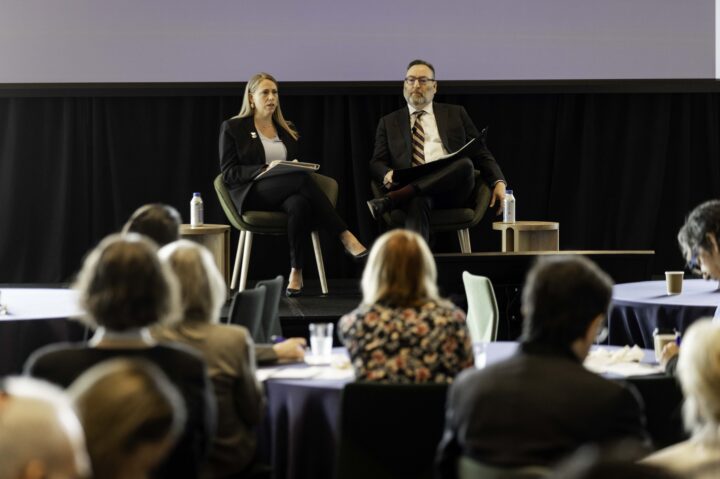
Dillon Meyer Media
EEOC Chair Andrea Lucas and Brandeis Center founder Kenneth Marcus speak at the inaugural conference on antisemitism and civil rights law at Harvard University on April 16, 2026.
The Trump administration official leading a controversial probe into antisemitism at the University of Pennsylvania told Jewish leaders and legal experts on Thursday that compiling a list of Jewish faculty with their detailed personal information was necessary to identify and protect victims.
“There is no other way to protect victims of harassment or discrimination unless you collect information about them,” Andrea Lucas, chair of the United States Equal Employment Opportunity Commission, said at the Louis D. Brandeis Center for Human Rights Under Law’s inaugural conference on antisemitism and civil rights law, held at Harvard University.
“We never collect information to contact someone on their work system,” she said. “The EEOC’s long-standing practice is to collect personal information because we want to make sure that there is not any clear monitoring of your email systems … that when you speak to a government agency you feel completely not pressured.”
Last month, a federal judge ordered Penn to comply with a subpoena from the Trump administration requesting detailed information about Jewish university affiliates as part of the EEOC’s ongoing investigation into Penn’s handling of antisemitism. The subpoena had requested the school turn over lists of Jewish employees and members of Jewish organizations — including their identifying details and phone numbers — which the school called “extraordinary and unconstitutional.” Critics on campus have likened the move to Nazi-era methods of collecting information about Jews.
During a fireside chat with Kenneth Marcus, founder of the Brandeis Center and former assistant secretary of education for civil rights under the first Trump administration, Lucas noted she was speaking generally and not about the Penn case specifically, as litigation is ongoing.
“At some point, either the government will know information related to individuals’ religion, or we will not be able to enforce the laws on their behalf,” continued Lucas, who is not Jewish but emphasized a personal interest in religious liberty as “a core thing the EEOC needs to be focusing on.”
“I understand the sensitivities around this issue … but fundamentally the Jewish community does have to decide: do you want to have civil rights enforcement in this space? If you do, there is no other way we can get money for victims.”
Experts told Jewish Insider in January that a more typical investigation might involve agency officials interviewing people who issued complaints directly with the agency, then visiting the campus and publicizing their investigation, calling the EEOC’s methods in the Penn case “incredibly unusual, if not completely unprecedented.”
Lucas asserted that the same standard applied for helping members of any race, religion or gender. None of the event’s speakers publicly disagreed with Lucas’ statements.
The daylong conference was born out of last year’s settlement between the Brandeis Center and Harvard over a Title VI lawsuit, and was framed around this year’s U.S. Semiquincentennial.
It opened with an address from Marcus and a benediction from Harvard Chabad’s Rabbi Hirschy Zarchi. Attendees included Harvard community members, Jewish activists, lawyers and scholars.
The plenary session, “Towards a Jewish Civil Rights Movement,” moderated by Marcus, featured William Daroff, CEO of the Conference of Presidents of Major American Jewish Organizations; Elan Carr, CEO of Israeli-American Council and former special envoy to monitor and combat antisemitism; and Miriam Elman, executive director of the Academic Engagement Network.
Carr called the battle against antisemitism “a war for the soul of America and the soul of civilization,” and advocated for a shift in classroom curriculums and federal funding.
“Jew-hatred is history’s greatest barometer of human ruin and suffering. We are fighting for the future of our country and American values. So we need to get serious about teaching American values … we can’t safeguard this republic unless we teach American kids what this republic is, why it was founded, what our values are and constitutional structures are,” he said. “This is a national crisis with national implications. The federal government needs to say ‘no money goes anywhere to any educational institution unless there’s Western values, American civics, basic principles of the United States as part of the curriculum.’”
After the session, Daroff told JI that “today’s conference brought a united American Jewish community together, aligned in action. We are not standing back. We are organizing, building and acting together with shared purpose and resolve.”
The conference also featured a panel titled “Defining Anti-Semitism at America’s 250th: New Challenges for a New Century.” Speakers debated the importance of pushing states to codify the International Holocaust Remembrance Alliance’s working definition of antisemitism, as many mainstream Jewish groups are using resources to do. Critics of IHRA say the definition chills political speech and criticism of Israel.
Nathan Diament, executive director for the Orthodox Union Advocacy Center, said that IHRA is not only important for combating campus antisemitism — as several of the speakers emphasized — but also regarding legislation in Washington.
At the same time, “in the political arena, vagueness around questions [of what is antisemitism] is unhelpful. The most important currency in politics is votes. Advocates and voters need to be able to say with clarity to politicians [what they will and will not support]. This is the most important need for the definition of antisemitism, to draw a line as clearly as we can and make clear to politicians that if they cross this line, there will be consequences,” said Diament.
“Even as the OU has, and continues to, support legislation to codify the IHRA definition, I don’t think at this stage in the game that’s the most important way to further the definition and to use our political capital,” he continued. “We don’t need Congress’ approval of how we want to define antisemitism. We don’t need them to codify it and we don’t need them to give us permission to use it to hold members of Congress and other politicians accountable. We can use the IHRA definition because we say that’s the definition.”
Alyza Lewin, president of U.S. affairs for the Combat Antisemitism Movement and former president of the Brandeis Center, pushed back by highlighting how the law enforcement trainings she provides varies based on local adoption of the IHRA definition. She noted a stark difference between training in states where it is codified, such as Georgia, and those where it is not, such as New York.
Law enforcement in Georgia “has a very concrete reason now to understand and use” the training, said Lewin. “In New York, especially after [Mayor Zohran Mamdani] reversed the executive order on IHRA, I can try to explain it to them but it’s just a nice thing I teach them. They are under no obligation to actually engage with it and utilize it. So I do think on a state by state level, it does make a difference whether or not a state has adopted the IHRA definition.”
In a separate panel, moderated by Anat Alon-Beck, a visiting professor at Harvard Law School, speakers explored new avenues for litigation against antisemitism.
“Nearly two years after the largest massacre of Jews since the Holocaust, the Jewish community still lacks unified messaging, coordinated toolkits and a clear strategy. At a time when antisemitic actors are highly organized and aligned, our disunity is a serious vulnerability,” Alon-Beck told JI following her session. “We need to come together — with clarity, courage and coordination — because the stakes could not be higher.”
According to the Brandeis Center, this conference was the first in an annual three-part series.
Charles Dabda, a third-year student at Touro Law Center and law clerk with National Jewish Advocacy Center, told JI he was leaving the conference with a clear sense that “antisemitism is rising in real time with real consequences across campuses, professional spaces and beyond. At the Brandeis Center, and NJAC, our commitment remains resolute and steadfast; we will confront antisemitism wherever it manifests — through advocacy, and, when necessary, the courtroom.”
The New York Republican talked to JI about her leading role holding university presidents accountable

Kent Nishimura/Getty Images
Rep. Elise Stefanik (R-NY) testifies before the Senate Foreign Relations Committee on her nomination to be Ambassador to the United Nations on Capitol Hill on January 21, 2025 in Washington, D.C.
On Capitol Hill, Rep. Elise Stefanik (R-NY) has long been a vocal advocate for combating antisemitism and active on Middle East security issues. But it was her questioning at a December 2023 hearing that made her a household name in the American Jewish community and beyond, and drew her into the center of the unfolding fight on campus antisemitism.
“Does calling for the genocide of Jews violate [your school’s] code of conduct or rules regarding bullying and harassment?” Stefanik asked the presidents of Harvard, the University of Pennsylvania and the Massachusetts Institute of Technology.
Their equivocal responses, as disruptive and at times threatening anti-Israel protests were sweeping universities across the country, were a major factor in the resignations of two of those presidents and a slew of further hearings that put college presidents in the hot seat.
Now, as she prepares to leave Congress next year, Stefanik is out with a new book on campus antisemitism, Poisoned Ivies: The Inside Account of the Academic and Moral Rot at America’s Elite Universities.
More than two years after that first hearing — and after a tumultuous political period in which she saw her nomination as ambassador to the United Nations withdrawn before launching a short-lived New York gubernatorial campaign — Stefanik offered a mixed readout on how she sees the state of American higher education in an interview with Jewish Insider this week.
“In the year after the hearing, we saw that the universities failed to fix themselves and continued to dig deeper and deeper, and it was going to take significant administrative and legislative and frankly, appropriations action of withholding of funds, to force them to really reckon with what the American people saw loudly and clearly in that hearing, [which] is that there are deep-seated issues in higher education,” Stefanik said.
She said that there have also, however, been leadership changes at many of the universities that were probed by the House Committee on Education & the Workforce, in part because of those hearings, as well as overhauls such as the elimination of diversity, equity and inclusion programs at some schools.
“The other piece, I would say, is you’re seeing parents and students vote with their wallets and their feet,” such as the rising application and matriculation rates to schools like Vanderbilt University, which Stefanik has highlighted as having handled the post-Oct. 7, 2023, environment effectively.
The New York congresswoman argued that the hearings played a major factor in the reform efforts that followed. She also said that the Trump administration, even before it took office, has been sharply focused on the issue of campus antisemitism, coordinating closely with her office to help shape the administration’s lawsuits and executive orders on the issue.
Asked about anti-Israel and antisemitic voices in the Republican Party such as commentators Tucker Carlson and Candace Owens, Stefanik largely dismissed the idea that antisemitism was, or could become, a significant problem within the GOP.
“The difference between [New York City Mayor Zohran] Mamdani and those podcasters is Mamdani is elected to the most important city in the world as mayor, and those other names are not elected, and I think are often overstated [in] their influence,” Stefanik said. “They would not be elected to local office, to state office, to congressional office. That’s why I think it’s very important for actual elected officials, actual leaders, to speak out on issues of importance.”
She praised Trump for calling out Carlson and Owens and making clear that they don’t represent him or his voters, and argued that similar voices represent just a small fringe of Republican members in Congress.
Pressed on the fact that such voices represented a similarly small fringe of the Democratic Party in Congress a decade ago, Stefanik insisted that Republican voters would not embrace such voices.
“The Democrat[ic] Party — it’s a full blown takeover of Hasan Piker, of these voices that The New York Times is now embracing, and ‘Pod Save America’ is now embracing,” Stefanik said. “That is not the case on the Republican side. And as a candidate who actually has stood in front of the voters for the past decade-plus — yes, those voices can say what they want, you actually represent the people that elect you, and that’s not what voters in my district [want].”
Despite the relatively small share of Jewish voters in her district, Stefanik said that her work on campus antisemitism still receives some of the strongest praise from constituents.
Though the administration’s initial blitz of action on campus antisemitism has faded from the headlines, Stefanik said its efforts to address issues in higher education are ongoing, and that the issue also remains top-of-mind for the country at large.
“It’s not just about antisemitism,” she added. “This is broader higher education reform. … That was the canary in the coal mine issue that brought up so many broader issues that were wrong with higher education.”
In Congress, she said that more legislation should be brought to the floor on campus antisemitism, adding that she’s also hoping to work on reining in funding to colleges, cracking down on tax advantages and loopholes that benefit colleges and further limiting foreign funding and foreign student populations at U.S. institutions in her remaining months on the Hill.
She pointed to Qatar as one driver of antisemitism on campuses, and said that the U.S. should make clear to Doha that, if it wants to remain a military partner with the U.S., it “can’t foment and fund this anti-Americanism on college campuses, full stop.”
Stefanik isn’t yet sharing her next steps, but said she wrote her new book in part to serve as a historical record of antisemitism on college campuses, so that “mainstream media” can’t “brush this chapter under the rug.” She said she intends to continue shining a light on the issue.
Though she ultimately passed on a gubernatorial run, Stefanik seems to have longer-term plans in New York politics, and said that Republicans will be in a stronger position to win in the state in the coming years.
Regarding her decision to drop out of the governor’s race, Stefanik argued that the political environment is not currently ripe for a GOP victory, that Republicans need more time to build their statewide infrastructure and that Mamdani’s policies will grow more unpopular in the next few years.
“I think the Democrat Party is going to be increasingly taken over [by Mamdani-aligned socialists],” Stefanik said. “That, long-term, is where Republicans can win back those independents and traditional Democrats.”
Stefanik drew a direct line between the anti-Israel encampment at Columbia University and Mamdani’s election — both because Mamdani’s father is “very much part of this antisemitic petri dish” at Columbia and because “the same people that were organizing the pro-Hamas encampment at Columbia directly were boots on the ground for [his] campaign.”
She called herself “the leader” among state Republicans in pushing back against “socialist and Democrat single-party rule of New York State,” and highlighted that she has her own statewide political apparatus — separate from the statewide GOP, which she said lacks infrastructure.
“There is going to be a long road in rebuilding that infrastructure to save the state,” she said.
She also said she wanted to spend more time with her four-year-old son at this stage of his life.
“My voice is not going anywhere. If anything, it’s more. I mean, we’re putting this [book] out in the world and helping set the tone for the type of leadership we need in New York and, frankly, across the country,” Stefanik said.
Plus, Vance courts pro-Israel donors ahead of 2028

Adri Salido/Getty Images
The Lebanese capital is seen from a viewpoint after U.S. President Donald Trump announced a ceasefire between Israel and Lebanon that would commence at midnight local time on April 16, 2026 in Beirut, Lebanon.
This P.M. edition is reserved for our premium subscribers — offering a forward-focused read on what we’re tracking now and what’s coming next. Please don’t hesitate to share your thoughts and feedback by replying to this email.
📡On Our Radar
Notable developments and interesting tidbits we’re tracking
President Donald Trump announced the start of a 10-day ceasefire between Israel and Lebanon to begin at 5 p.m. ET today, after he held phone calls with Lebanese President Joseph Aoun and Israeli Prime Minister Benjamin Netanyahu earlier in the day.
Trump added that he will be inviting Aoun and Netanyahu to the White House for “meaningful talks,” later telling reporters such a meeting could happen in the “next week or two.”
The text of the agreement released by the State Department indicates the ceasefire is a “gesture of goodwill” on Israel’s part “intended to enable good-faith negotiations” toward a permanent agreement. The temporary pause in hostilities could be extended if Lebanon “effectively demonstrates its ability to assert its sovereignty” and prevent Hezbollah from carrying out attacks against Israel…
Trump again indicated further talks with Iran could take place this weekend and said the two sides are “very close to making a deal,” telling reporters this afternoon that Iran has already agreed to “give us back the nuclear dust,” referring to its highly enriched uranium.
Hours earlier, Secretary of Defense Pete Hegseth warned at a press briefing that U.S. forces are “maximally postured” to return to military operations against Iran if negotiations are unsuccessful, and will look to attack “infrastructure, power and energy”…
The House narrowly voted to block a Democratic resolution to force an end to the war in Iran by a vote of 214-213-1, with all but one of the four Democrats who opposed a similar effort in March changing their votes to support today’s measure, Jewish Insider’s Marc Rod reports.
Reps. Greg Landsman (D-OH), Juan Vargas (D-CA) and Henry Cuellar (D-TX), who voted last month against a similar resolution, flipped their votes to support the war powers effort. But Rep. Jared Golden (D-ME), who is retiring at the end of his term, voted no again. On the Republican side, Rep. Warren Davidson (R-OH), who voted for the war powers resolution last time, switched his vote to “present.” Rep. Thomas Massie (R-KY) was the only Republican who voted for the resolution…
Vice President JD Vance, the first vice president to serve simultaneously as finance chair of his party, is building donor relationships that may prove useful should he choose to run for president in 2028, The New York Times reports, including attempting to woo some pro-Israel donors who have otherwise been wary of his ties to far-right commentator Tucker Carlson.
Among others, Vance has developed relationships with Jewish philanthropists Miriam Adelson, whom he spent New Years Eve with at Trump’s Mar-a-Lago resort, and Paul Singer; has appeared as the guest of honor at a dinner hosted by Palantir and 8VC co-founder Joe Lonsdale; and has been featured at a Republican National Committee event hosted by tech executive Keith Rabois, who is married to Under Secretary of State Jacob Helberg…
With less than six weeks to go until the Texas primary runoff election, Sen. John Cornyn (R-TX) is defending his seat against Texas Attorney General Ken Paxton with a significantly larger war chest: As the first quarter of 2026 closed, Cornyn had more than $8 million in cash on hand (including a small donation from former President George W. Bush), while Paxton had $2.6 million in the bank. Whoever clinches the GOP nomination will face state Sen. James Talarico, who has nearly $10 million on hand…
Josef Palermo, who was the first curator of visual arts and special programming at the Kennedy Center until his dismissal last month, recounts his experience as Trump and the center’s then-President Richard Grenell initiated an overhaul of the building, a process Palermo describes as “cronyism, incompetence, and a series of bizarre moves.”
Palermo recounts an exhibition he organized commemorating the Oct. 7 Hamas attacks in the building’s Israeli Lounge: “Speaking at the opening reception, Grenell warned the mostly Jewish audience that unless donors came forward to sponsor the space and pay for renovation costs, the lounge would be given away to a new donor. … Such a strong-armed fundraising pitch, at an event commemorating a pogrom, struck many of us in the room as inappropriate. I was mortified”…
Asked for his perspective on antisemitic streamer Hasan Piker’s reach on his platform, Twitch CEO Daniel Clancy said at the Semafor World Economy summit in Washington today that “one of the challenges is when you’re livestreaming you say a lot … you might say a lot of things that are over the top. … If you violate [community guidelines] then we take enforcement actions and we suspend you — it’s designed not to kick you off forever.”
“Whenever Hasan has stepped over the line, we’ve taken action … Folks will get worked up from both the right and the left on this because we have also conservative people that are saying certain things that some people don’t like. … In general, we think it is important for us to allow people to express themselves,” Clancy said…
⏩ Tomorrow’s Agenda, Today
An early look at tomorrow’s storylines and schedule to keep you a step ahead
Keep an eye out in Jewish Insider for a temperature check on support for Israel within the Democratic Party, in light of 85% of Democratic senators voting in favor of a Sen. Bernie Sanders (I-VT)-led measure to block military sales to the Jewish state.
France and the U.K. will co-host a conference tomorrow focused on restoring freedom of navigation through the Strait of Hormuz, with leaders from several European, Asian and Gulf countries participating via video.
Michigan’s Democratic Party will hold its endorsement convention on Sunday, where party activists will nominate their two preferred candidates for the University of Michigan’s Board of Regents. The election has reignited the campus’ debate over Israel, as candidate and anti-Israel activist Amir Makled seeks to unseat Jewish regent Jordan Acker, who became the target of antisemitic vandalism and harassment in the aftermath of the Oct. 7 Hamas attacks. (The SEIU labor union recently pulled its endorsement of Makled over his past support of Hezbollah.)
National party leaders including former Vice President Kamala Harris and Sen. Cory Booker (D-NJ) will appear at events in Detroit ahead of the convention.
We’ll be back in your inbox with the Daily Overtime on Monday. Shabbat Shalom!
Stories You May Have Missed
CAPITAL CONTEST
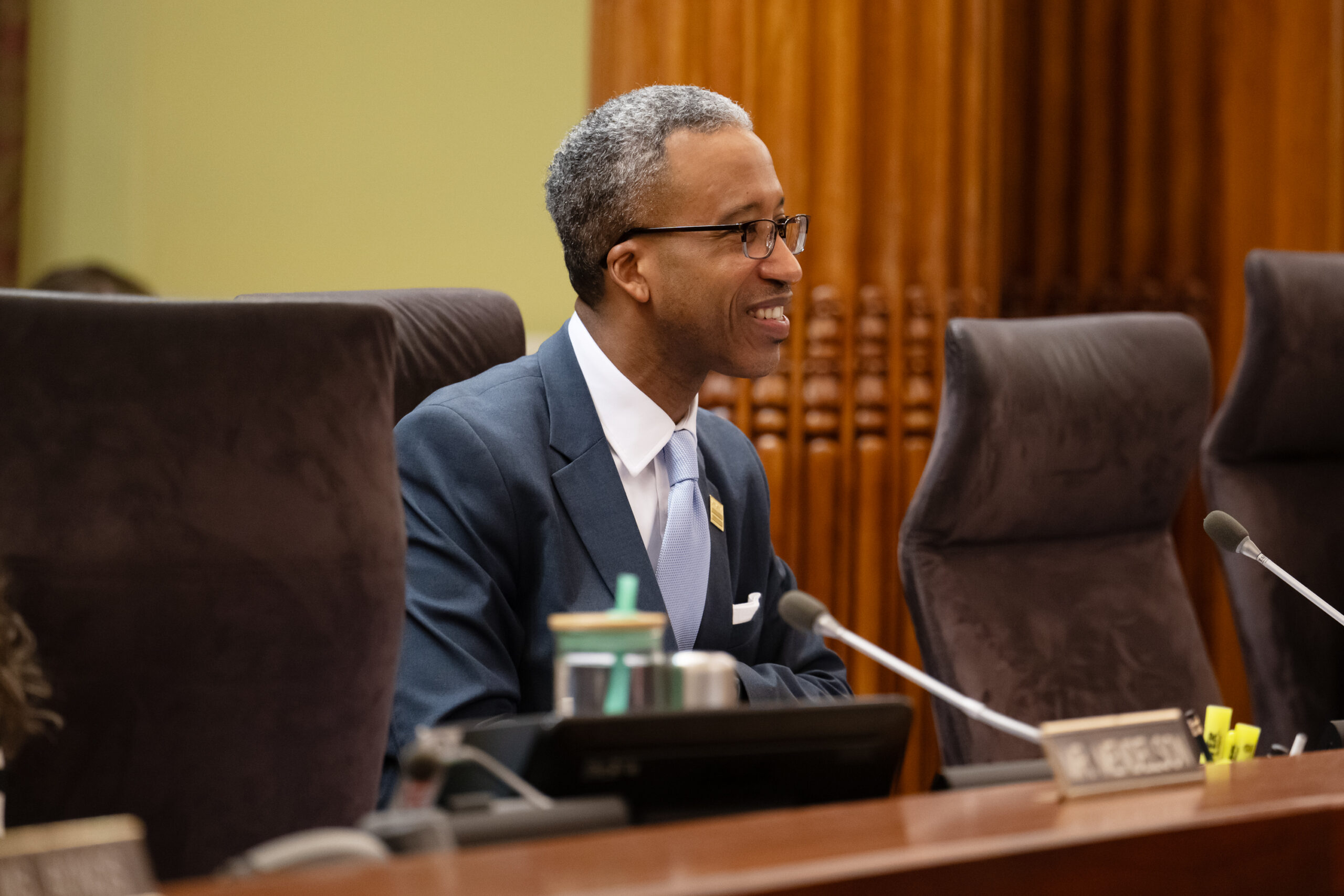
‘I didn’t seek, nor would I accept, the endorsement of Democratic Socialists of America,’ McDuffie told JI in an interview
SCOOP
Platner, in Reddit post on Hamas terrorist attack: ‘From a strictly professional standpoint, this was a damn fine looking and successful raid against a superior opponent’
Meta’s director of content policy spoke at a ‘Hack the Hate’ tech conference as the ADL released a report documenting antisemitism spreading unchecked on its platform Instagram
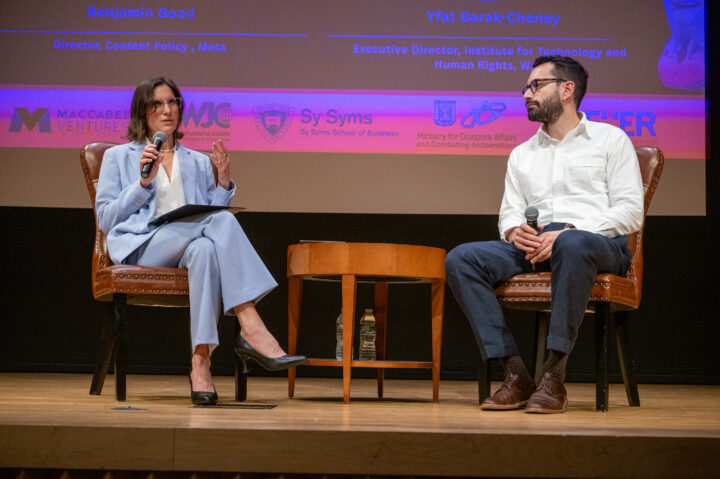
Shahar Azran/WJC
Ben Good, Meta's director of content policy, speaks at the 2026 Hack the Hate summit in Manhattan.
Amid accusations that Meta’s moderation policies enable antisemitic content to circulate on its platforms, a Meta leader on Tuesday highlighted efforts to combat online Jew-hatred, including restrictions on Holocaust denial.
“We remove Holocaust distortion and denial, not because it’s false, which it is, but because it’s antisemitic. It is hate speech against Jewish people, so we’ve drawn a clear line against it,” said Ben Good, director of content policy at Meta, the parent company of Instagram, Facebook and WhatsApp.
Good spoke at “Hack the Hate NYC 2026,” an event at the Yeshiva University Museum in Manhattan spotlighting Israeli tech experts and Jewish leaders working to combat digital antisemitism.
Good, who leads Meta’s team that writes content policies — the rules for what can be posted to the platforms — spoke during a fireside chat with Yfat Barak-Cheney, executive director of the Institute for Technology and Human Rights at the World Jewish Congress.
“Those are policies that govern the global speech of 3 billion people, so we take the responsibility extremely seriously. We want to make sure people can express themselves maximally but we also have to keep our community safe,” said Good.
The event was held as Jewish communities in Israel and around the world marked Yom HaShoah. Barak-Cheney noted that it took four years of advocacy from groups like WJC for Meta to recognize Holocaust denial as antisemitism. In October 2020, the company updated its policies to explicitly prohibit content that denies, distorts or minimizes the Holocaust.
Even after that recognition, she said, the situation remains “especially alarming because it’s not just that we see a larger quantity of AI-generated material, but the quality is different, it’s getting better.”
“Holocaust denial is looking very realistic,” she said. “There’s fabricated quotes. I am worried that we’re losing our grip on the reality of the Holocaust. Does Meta see this as alarming from the inside as it is from our point of view?”
“I have seen new trends putting words in people’s mouths that were not said, having prominent Nazis say things that aren’t true. Those violate our policies. It’s hate speech and we remove it,” said Good. “The same goes for a lot of other conspiracy theories that are misinformation but really are about dehumanizing Jewish people. The most prominent one being the centuries-old tropes that Jewish people control the media or government. We know that underlies dangerous acts so we remove it.”
Good said that Meta, which uses AI-generated content moderation, has “tremendous potential to advance AI systems in dealing with what we call ‘integrity work’ in social media.”
He said that “traditional machine learning,” utilized about two years ago, required being fed “a ton of data, some content that violates [Meta policies], some that doesn’t and they begin to understand [and match] patterns.”
Modern LLMs are able to analyze context on their own, said Good, allowing for more accurate reasoning.
“That is extremely important in an area such as Holocaust denial because it’s very coded and can often be long-form speeches and text which can be hard to understand even for a human,” said Good. “The LLMs are really good at understanding coded language and context.”
But even as Meta has made strides in addressing Holocaust denial, the Anti-Defamation League released a new report on Wednesday revealing that Instagram failed to remove 93% of reported extremist and hateful content, tying the trend directly to Meta’s efforts to roll back content moderation last year.
A spokesperson for Meta told Jewish Insider after the report was released that “over two-thirds of the accounts and posts flagged by the ADL were removed prior to the publication of this report, while some did not violate our policies.” ADL told JI it gave Meta a two-week window from reporting the content to getting a response from the platform.
The January 2025 rollback of content moderation included ending the platform’s third-party fact-checking program and replacing it with a system modeled after the community notes feature on Elon Musk’s X.
At the time, some Jewish leaders expressed concern that the move would “open the floodgates to content” that could target Jewish communities and individuals, and called the decision a “step back” in the fight against rising antisemitism. Meta had said the relaxed guidelines aim to “allow more speech by lifting restrictions on some topics that are part of mainstream discourse.”
“The name of the game isn’t just relying on the magic of AI and setting it loose on our platform,” said Good. “Instead, we have to be extremely positive that it understands our written policies and will apply and enforce them. We don’t want to leave the guesswork to the technology. We will always be reporting our enforcement metrics. But this is a chance to bring contextual understanding to content moderation.”
Barak-Cheney asked Good what guardrails Meta, which produces its own AI system called Llama, has in place to stop its LLMs from generating content that might be antisemitic.
“We do train the models on our safety standards,” said Good. “The unique challenge with generative AI is that it’s interactive and adaptable. When we train the models to prevent harm, we’ve learned it’s not so much the ‘what’ but the ‘why.’ It’s not so much telling the model that it can or can’t say this, it’s explaining to the model why we have certain rules, prohibitions and standards and reasoning with it so it can extrapolate that reasoning into situations.”
“This can mean a number of things, but an old-school way of doing it would be to say ‘here are 500 words we consider slurs, don’t say them.’ A more dynamic rule might be ‘this is what a slur is, this is why we consider a word a slur and these are the circumstances in which you can say it,’ and let the model reason through various situations,” explained Good.
He added that “there’s no limit” to how much help antisemitism watchdogs can provide to Meta.
“To be clear, we understand that generally it’s our job to understand how problems manifest and address them, but when people who are on the ground in a given space give us reports and intel it allows us to validate our own research in a way that helps us make decisions better. The policy shouldn’t be a bunch of people in Silicon Valley deciding things. They should be decided collaboratively,” Good said.
The event, attended by some 150 Jewish leaders and innovators, opened with remarks from Rabbi Ari Berman, president of Yeshiva University. It was organized by Generative AI for Good and the 8200 Alumni Association, which preserves the legacy of IDF Unit 8200, in partnership with the Israeli Ministry for Diaspora Affairs and Combating Antisemitism, Gesher Israel, Maccabee Ventures, President Isaac Herzog’s Voice of the People Initiative, the World Jewish Congress’ TecHRI and Yeshiva University’s Sy Syms School of Business.
Attendees are expected to include Harvard community members, Jewish activists, lawyers and scholars

Cassandra Klos/Bloomberg via Getty Images
The Widener Library on the Harvard Campus in Cambridge, Massachusetts, US, on Wednesday, June 4, 2025.
A Jewish legal group will convene its inaugural conference on antisemitism and civil rights law at Harvard University on Thursday, an event that was born out of last year’s settlement of a Title VI lawsuit against the school and framed around the upcoming 250th anniversary of the United States.
“We’re very excited to have a mix of federal, high-level leadership, prominent scholars, Jewish communal leaders, high-powered litigators and experts in the field,” Ken Marcus, founder and chairman of the Louis D. Brandeis Center for Human Rights Under Law, the group hosting the conference, told Jewish Insider.
The day-long event is slated to open with an address from Marcus and benediction from Rabbi Hirschy Zarchi, who leads Harvard Chabad.
Held as America prepares to celebrate its 250th anniversary this summer, Marcus said the headline session will focus “on how we define antisemitism as lawyers and professionals, and why a proper definition of antisemitism matters for America at this point in time.” The panelists will include Andrea Martin, co-chair of the Center for Jewish Legal Studies; Nathan Diament, executive director for the Orthodox Union Advocacy Center; Alyza Lewin, president of U.S. affairs for Combat Antisemitism Movement; and Julie Paris, Mid-Atlantic regional director of StandWithUs.
The plenary session, “Towards a Jewish Civil Rights Movement,” moderated by Marcus, will feature William Daroff, CEO of the Conference of Presidents of Major American Jewish Organizations; Elan Carr, CEO of Israeli-American Council and former special envoy to monitor and combat antisemitism; and Miriam Elman, executive director of the Academic Engagement Network.
A separate panel, moderated by Anat Alon-Beck, a visiting professor at Harvard Law School, will explore new avenues for litigation against antisemitism.
Attendees are expected to include Harvard community members, Jewish activists, lawyers and scholars, according to Marcus, who served as assistant secretary of education for civil rights in President Donald Trump’s first administration.
In January 2025, the Brandeis Center settled its lawsuit with Harvard, which alleged that since the Oct. 7, 2023, terrorist attacks in Israel, students and faculty on campus called for violence against Jews and celebrated Hamas’ terrorism as the university ignored harassment — including a physical assault — of Jewish students.
Under the terms of the resolution, Harvard agreed to host Brandeis Center events, implement the International Holocaust Remembrance Alliance’s working definition of antisemitism, invest additional academic resources to study antisemitism and establish another partnership with a university in Israel, in addition to programs the university currently has in place with Israeli universities.
The conference comes as Harvard remains entrenched in legal battles with the Trump administration, which it has sued to recover billions in funding that was frozen over the government’s allegations that the school has not adequately addressed antisemitism. A federal judge ruled last September that the government violated Harvard’s First Amendment rights and federal law when it froze nearly $2 billion in federal grants. The Trump administration filed an appeal in December 2025, which is ongoing.
Last month, the clash escalated when the Trump administration filed a new lawsuit against the university, claiming that its leadership violated the civil rights of Jewish students by failing to address ongoing antisemitism that has roiled the campus since Oct. 7.
The conference is also held against the backdrop of a newly released report by Harvard’s official Jewish alumni group finding that Jewish enrollment at the Boston school has fallen to roughly 7% — its lowest level since the pre-World War II era.
Marcus said the Brandeis Center has been in “continuing engagement with Harvard University over both the challenges that we still see there and the efforts that they’re undertaking to address them.”
“This conference is a part of that process and we hope it can be used to take the problems that they have had at Harvard and to turn them into something positive, not just for Harvard University and the Commonwealth of Massachusetts, but for the country as a whole,” continued Marcus.
“We see this as the first of a series of conferences that we will have at Harvard University and may consider hosting them in other locations as well,” he said.
Plus, Senate Dems dominate 2026 fundraising

Kevin Dietsch/Getty Images
Rep. Ilhan Omar (D-MN) speaks at a press conference on committee assignments for the 118th U.S. Congress, at the U.S. Capitol Building on January 25, 2023, in Washington, D.C.
This P.M. edition is reserved for our premium subscribers — offering a forward-focused read on what we’re tracking now and what’s coming next. Please don’t hesitate to share your thoughts and feedback by replying to this email.
📡On Our Radar
Notable developments and interesting tidbits we’re tracking
A war powers resolution brought by Senate Democrats to force an end to the war in Iran was blocked by Republicans yet again this afternoon, the fourth failed attempt mounted by Senate Democrats since the war began in late February, Jewish Insider’s Marc Rod reports.
Nevertheless, top Senate Democrats have said they intend to continue forcing such votes weekly (they have nine more resolutions already filed) in the hopes that more Republicans will change their votes as the war drags on…
Texas state Sen. James Talarico announced he raised $27 million in the first quarter of 2026 in his run for U.S. Senate, a massive haul that his campaign claimed is the largest amount ever raised by a Senate candidate in the first quarter of an election year. Democrats hope the funds will put Texas in play as Talarico seeks to challenge either Sen. John Cornyn (R-TX) or Texas Attorney General Ken Paxton, who are still locked in their own hotly contested primary.
The top Senate fundraisers behind Talarico this quarter were also Democrats: Sen. Jon Ossoff (D-GA) brought in $14 million — breaking the record for first-quarter fundraising in Georgia — former North Carolina Gov. Roy Cooper raised $13.8 million and former Sen. Sherrod Brown (D-OH) raised $12.5 million…
Rep. Tom Kean Jr. (R-NJ) said he raised $1.1 million in this year’s first quarter, bringing his total to $4.4 million raised — more than any other House incumbent or candidate in New Jersey this cycle, according to the New Jersey Globe — as he defends his swing seat from several well-funded Democratic challengers.
But even as he’s pulled in plenty of support, Kean has missed a month’s worth of votes on Capitol Hill due to an unspecified medical issue, with his staff declining to say when he will return…
Rep. Ilhan Omar (D-MN) in an interview on the “Pod Save America” podcast praised former Rep. Marjorie Taylor Greene (R-GA) — once a vocal Omar foe who called for the congresswoman’s deportation while they were both in the House — and far-right influencer Candace Owens over the pair’s break with President Donald Trump, JI’s Marc Rod reports.
“I believe the thing that has been very fascinating, especially about Marjorie and Candace, is that … they’re saying, ‘This action is wrong,’ right? They’re saying, ‘I am done with you.’ We should give them credit for that, the fact that they’ve had this wake-up call to finally seeing this con man, this corrupt, chaotic man for what he is,” Omar said…
Sebastian Gorka, the White House senior director for counterterrorism and a deputy assistant to the president, is reportedly angling for the position of director of the National Counterterrorism Center, which was recently vacated by Joe Kent amid Kent’s opposition to the Iran war. Gorka has been a staunch defender of Trump and backed his war with Iran, as well as repeatedly praised Israel amid its war in Gaza…
Israeli Prime Minister Benjamin Netanyahu spoke with Péter Magyar, the presumptive next prime minister of Hungary, for the first time today, calling the conversation “warm” and saying that Magyar indicated he will continue the close relationship the countries enjoyed under his predecessor, outgoing Prime Minister Viktor Orbán…
New York Gov. Kathy Hochul defended her proposal to bar demonstrations of more than two people from occurring within 25 feet of a house of worship today, JI’s Will Bredderman reports, legislation that has drawn legal scrutiny over its creation of a new felony offense for violators.
“I believe I have the right to protect people’s constitutional right to free exercise of religion,” Hochul told reporters when asked if she had concerns that the legislation might provoke challenges on First Amendment grounds. “So if that means we test it in court, bring it on”…
After holding its final public hearing earlier this week, the White House Religious Liberty Commission is now preparing a set of recommendations to be presented to the president next month. Ambiguity and confusion about the commission’s mandate has left commissioners unsure if they’ll continue to meet — their first year on the panel was marred by the firing of one commissioner over her disruption of a hearing on antisemitism…
Progressive media organization More Perfect Union is launching More Perfect University, an effort aimed at college students to act as an alternative to the conservative Turning Point USA, with a focus on urging young people to share left-wing political and economic messaging through social media. Faiz Shakir, the head of More Perfect Union who is also chief political advisor to Sen. Bernie Sanders’ (I-VT) campaign, said he hopes to jump-start “an economic populist movement for the next generation”…
Duke University’s Students for Justice in Palestine chapter has been suspended as a student group and had its funding frozen after it posted virulently antisemitic imagery depicting Israel and the U.S. as pigs frothing at the mouth on its Instagram page, prompting student complaints to campus administration…
University of Michigan President-elect Kent Syverud announced today he has been diagnosed with brain cancer and will no longer assume the presidency, leaving the future of the school’s leadership in question. Jewish leaders had praised Syverud’s appointment as a positive development for UM, which had seen rampant anti-Israel activity in the aftermath of the Oct. 7, 2023, Hamas attacks…
⏩ Tomorrow’s Agenda, Today
An early look at tomorrow’s storylines and schedule to keep you a step ahead
Keep an eye out in Jewish Insider for a preview of a first-of-its-kind antisemitism conference taking place tomorrow at Harvard, created as an outcome of last year’s settlement of a Title VI lawsuit against the school.
New Jersey’s 11th Congressional District will hold its special election for the remainder of Gov. Mikie Sherrill’s congressional term, where progressive Analilia Mejia is expected to prevail against Republican Joe Hathaway.
The Senate Foreign Relations Committee will hold nomination hearings for John Breslow to be U.S. ambassador to Cyprus, Todd Steggerda to be U.S. representative to the U.N. in Geneva and Preston Wells to be U.S. representative to the International Atomic Energy Agency, among others.
The Shalom Hartman Institute will host a discussion at the Capitol Jewish Museum in Washington with Jeffrey Goldberg, editor-in-chief of The Atlantic, on American Jewry ahead of the 250th anniversary of the founding of the United States.
The House Appropriations Committee will hold a budget hearing on the Department of Homeland Security, including the Federal Emergency Management Agency, which oversees the Nonprofit Security Grant Program.
Stories You May Have Missed
SCOOP

The Oct. 7 mastermind died in ‘heroic’ style, according to Donald Borenstein, director of video for the Mamdani campaign and City Hall
DEM DIVIDES
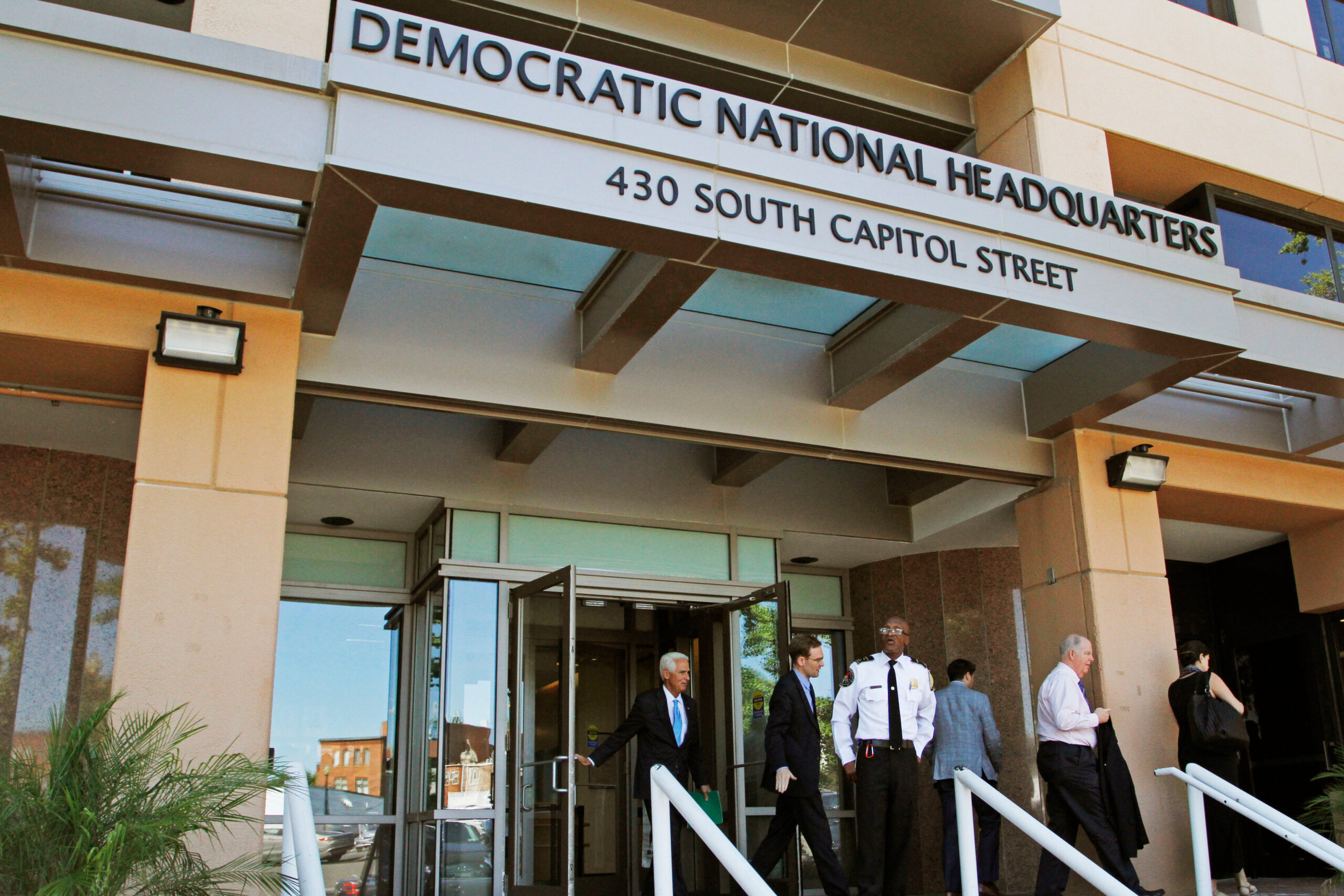
The question facing the Middle East working group’s members is whether they will actually be able to agree on anything — or if the group is simply a way to push the issue off until 2028
Omar is finding common cause with Greene over their anti-Israel views, even though the Republican wanted her deported from the country
Kevin Dietsch/Getty Images
Rep. Ilhan Omar (D-MN) speaks at a press conference on committee assignments for the 118th U.S. Congress, at the U.S. Capitol Building on January 25, 2023, in Washington, D.C.
Rep. Ilhan Omar (D-MN) in an interview on the “Pod Save America” podcast praised former Rep. Marjorie Taylor Greene (R-GA) — once a vocal Omar foe who called for the congresswoman’s deportation while they were both in the House — and far-right influencer Candace Owens over the pair’s break with President Donald Trump.
All three have faced repeated accusations of antisemitism. Owens, in particular, has become a propagator of rampant and often bizarre conspiracy theories, including becoming one of the most prominent antisemitic voices on the right. Greene and Owens have broken with Trump over his continued support for Israel and the war in Iran, among other issues.
“I think as Americans, it is really important for us to work together for the preservation of everything that is good in our country, and to support leaders that we can trust to safeguard what is good of our country,” Omar said, in response to a clip of Greene disavowing Trump on conspiracy theorist Alex Jones’ podcast. “And I believe the thing that has been very fascinating, especially about Marjorie and Candace, is that they are not just coming out — like the other ones that you’d mentioned — where they’re saying, ‘This action is wrong,’ right? They’re saying, ‘I am done with you.’”
“We should give them credit for that, the fact that they’ve had this wake up call to finally seeing this con man, this corrupt, chaotic man for what he is,” Omar continued. “I think is an important thing for us to put our arms around and say, ‘Yes, and now let’s figure out, how do we save our country from the disaster that this man is creating?’”
While Omar is not the first Democrat to praise Greene or to suggest that Democrats should be partnering with her, her comments are particularly notable in light of the enmity between the two women while they served in the House together.
Greene, in 2024, sought to censure Omar for allegedly working as a foreign agent on behalf of Somalia, in what Greene described as “treasonous tendencies” in violation of Omar’s oath of office.
“I would love to have her expelled. I’d love to have her deported,” Greene said at the time. “Unfortunately, I don’t think we have the votes to do that.”
Asked about the past opposition that she faced from Greene and others, Omar brushed it off as a product of their “brainwashed” cult-like devotion to Trump and his movement.
“I’m glad, as my fellow Americans, that they understand that, that they want us to chart a new chapter in America,” Omar continued.
Omar said she had approached Greene on the House floor before Greene resigned from Congress to thank her for her advocacy against Israel and opposition to U.S. support for Israel.
Of 150 reported accounts and 103 reported posts linked to white supremacist networks, designated Foreign Terrorist Organizations and vendors selling Nazi merchandise, Instagram removed only 11 accounts and 8 posts

Ismail Kaplan/Anadolu via Getty Images
Instagram logo displayed on a mobile phone screen in front of a computer screen displaying Meta logo in Ankara, Turkiye, on April 10, 2026.
A new report reveals that Instagram failed to remove 93% of reported extremist and hateful content, tying the trend directly to Meta’s efforts to roll back content moderation last year. The changes lifted some speech restrictions, allowing incendiary content to remain on the platform, fueling what the Anti-Defamation League report calls a surge of antisemitism.
The ADL report, “How Meta’s Content Moderation Changes Risk Turning Instagram into a Hub for Hate,” released on Wednesday, identified 105 accounts affiliated with white supremacist Nick Fuentes’ “groyper” network, with more than 1.4 million combined followers. Those accounts frequently posted antisemitic conspiracy theories, Holocaust denial and pro-Hitler content.
The report highlights that in May 2025, shortly after the rollback, Fuentes noted that his content continues to spread on Instagram despite him personally having been banned since 2021, writing on Telegram that Instagram “relaxed its content moderation” and had “stopped taking my clips down.”
Oren Segal, ADL’s senior vice president for counter-extremism and intelligence, said that the proliferation of antisemitism on Instagram is a direct outcome of the changes in policy at Meta, its parent company.The rollback included ending the platform’s third-party fact-checking program and replacing it with a system modeled after the community notes feature on Elon Musk’s X.
At the time, some Jewish leaders expressed concern that the move would “open the floodgates to content” that could target Jewish communities and individuals, and called the decision a “step back” in the fight against rising antisemitism.
Meta had said the relaxed guidelines aim to “allow more speech by lifting restrictions on some topics that are part of mainstream discourse.” Meta, also the owner of Facebook and WhatsApp, simultaneously said that it planned to crack down on “high severity violations,” such as pro-terrorism content. Meta CEO Mark Zuckerberg cited the results of the 2024 U.S. presidential election as the underlying decision to move to a “community note” model, calling it a “cultural tipping point towards, once again, prioritizing speech.” Zuckerberg said that third-party moderators were “too politically biased” and it was “time to get back to our roots around free expression.”
“When a platform used by 80 percent of American adults under 30 allows pro-Hitler content to rack up millions of views, Holocaust denial to spread unchecked and terrorist organizations to fundraise openly, we’re not talking about a policy disagreement,” said Segal. “We’re talking about a public safety crisis. Mark Zuckerberg acknowledged Meta would ‘catch less bad stuff’ after the rollback. Our research proves he was right, and the consequences are deeply concerning.”
Furthermore, the study found more than 340,000 followers across accounts directly or indirectly linked to U.S.-designated Foreign Terrorist Organizations, including the Popular Front for the Liberation of Palestine. It also identified more than 3.2 million views on content from a single extremist merchandise vendor selling apparel with Nazi symbols including Sonnenrads, Totenkopfs and SS bolts.
The ADL Center on Extremism researchers conducted testing between January and February 2026, by reporting 253 pieces of violative content through Instagram’s standard user reporting system. Of 150 reported accounts and 103 reported posts linked to white supremacist networks, designated Foreign Terrorist Organizations and vendors selling Nazi merchandise, Instagram removed 11 accounts and 8 posts. In 20 cases, Instagram explicitly stated it lacked the bandwidth to review the reports, according to the ADL.
According to Meta’s Community Standards, the company does not allow “organizations or individuals that proclaim a violent mission or are engaged in violence to have a presence on our platforms.” The company asserts that it removes any glorification or support of designated Foreign Terrorist Organizations, Specially Designated Global Terrorists, and any groups that organize or advocate for violence against civilians, including Taliban, ISIS and Al-Qaida.
Despite this official policy, ADL researchers found many active accounts that praise these groups, identifying at least 23 accounts that spread Islamic State and Al-Qaida propaganda. The accounts often post an image or video that glorifies organizations that meet Meta’s terrorism definition with caption text that is unrelated to the subject matter — like a synopsis of the movie “Home Alone” or gardening advice — potentially in an effort to evade detection.
A spokesperson for Meta told Jewish Insider after the report was released that “over two-thirds of the accounts and posts flagged by the ADL were removed prior to the publication of this report, while some did not violate our policies.” ADL told JI its figures were based on a two-week window from submitting a report to getting a response from the platform.
The 14-page report was released shortly before an upcoming Meta shareholder vote, scheduled for the end of May.
Last month, an AI-generated Instagram account called “Rabbi Goldman,” which featured a fake Orthodox rabbi spreading antisemitic conspiracies to its more than 1.4 million followers, was taken offline following major backlash from Jewish groups and one Democratic lawmaker — yet several similar, hate-peddling accounts have emerged with little to no public action from Meta.
This report was updated on April 15 to include a statement from Meta.
Plus, positive readouts from Israel-Lebanon talks in D.C.

Stefano Costantino/SOPA Images/LightRocket via Getty Images
Italian Prime Minister Giorgia Meloni addresses the Italian Chamber of Deputies in Rome.
This P.M. edition is reserved for our premium subscribers — offering a forward-focused read on what we’re tracking now and what’s coming next. Please don’t hesitate to share your thoughts and feedback by replying to this email.
📡On Our Radar
Notable developments and interesting tidbits we’re tracking
U.S.-Iran talks could restart in the next two days, President Donald Trump told the New York Post. “[S]omething could be happening over the next two days, and we’re more inclined to go [back to Islamabad, Pakistan]” rather than a different mediating country, he said in an interview today.
Trump also indicated he wasn’t happy with reports that his own negotiating team had offered Iran a 20-year pause on its ability to enrich uranium. “I’ve been saying they can’t have nuclear weapons, so I don’t like the 20 years,” he said…
CENTCOM announced that no ships made it past the U.S. blockade of the Strait of Hormuz in its first 24 hours, and six merchant ships “complied with direction from U.S. forces to turn around”…
Saudi Arabia is reportedly pressuring the U.S. to end the blockade, fearing retaliation and disruption to other trade routes. Iran has threatened to mobilize the Houthis in Yemen to close off the Bab al-Mandeb Strait, which Riyadh utilizes to move its oil exports out of the Red Sea…
European countries are drafting a plan to restore freedom of navigation in the Strait of Hormuz after the war ends, possibly without the participation of the U.S. As part of this effort, French President Emmanuel Macron announced that France and the U.K. will co-host a conference on Friday of “non-belligerent countries ready to contribute” to the “multilateral and purely defensive mission”…
The Treasury Department said it will not renew a waiver set to expire later this week that temporarily lifted sanctions on Iranian oil — the waiver had drawn condemnation from some lawmakers who had worked to institute those sanctions…
Secretary of State Marco Rubio emphasized at the outset of negotiations between Israel and Lebanon in Washington this morning that the talks are a “process” that will “take time,” and that the objective of today’s meeting was to “outline a framework upon which a permanent and lasting peace can be developed” and bring a “permanent end to Hezbollah’s influence” in the region.
The State Department said after the meeting, the highest-level talks between Jerusalem and Beirut in over 30 years, that the sides “agreed to launch direct negotiations at a mutually agreed time and venue,” though it did not indicate when or where further talks may take place. Israeli Ambassador to the U.S. Yechiel Leiter told reporters that the parties “discovered today that we’re on the same side of the equation. That’s the most positive thing we could have come away with”…
Italy is suspending its defense agreement with Israel, Italian Prime Minister Giorgia Meloni said today, declining to renew the agreement “in consideration of the current situation.” Italy had grown critical of Israel’s war in Gaza and has been noncooperative in the war with Iran, reportedly not allowing U.S. aircraft to land at its bases.
Trump railed against Meloni, who has thus far been an ally of his, in an interview with an Italian outlet today, saying he’s “shocked by her. I thought she was brave, but I was wrong,” and claiming she’s “no longer the same person” after she called the president’s attack on Pope Leo XIV yesterday “unacceptable.” “It’s her who’s unacceptable, because she doesn’t care if Iran has a nuclear weapon and would blow up Italy in two minutes if it had the chance,” Trump said…
Hamas has rejected the U.S.-led Board of Peace’s disarmament proposal, according to the BBC. The parties seem to once again be at an impasse, as Hamas tells mediators it will not continue onto the second phase of the ceasefire until it feels Israel has complied completely with the first phase, while Israel says it will not move forward until there is progress on disarming Hamas…
The New York Times details a tense event held by Rep. Mike Lawler (R-NY) in his Hudson Valley-based swing district where the lawmaker was pressed by constituents demanding answers and accountability on the Iran war; it’s seen as a harbinger of the growing discontent some Republicans will have to contend with around the largely unpopular war in the lead-up to the midterms…
The Union for Reform Judaism released a statement yesterday voicing concern about “efforts to single out AIPAC as a particularly malign influence in campaign finance. … [T]he harsh language being used by some to denigrate and vilify AIPAC borders on — and in some cases crosses over into — antisemitism.”
“Until such time as [C]ongress reforms the nation’s broken campaign finance system overall — an effort we would enthusiastically welcome — to single out AIPAC’s activity will continue to raise questions of antisemitic motivation,” the organization wrote, in a sign of how the demonization of pro-Israel donors and groups is raising alarms across the Jewish political and religious spectrum…
California state Sen. Scott Wiener, a progressive Jewish legislator running to fill Rep. Nancy Pelosi’s (D-CA) seat, was accused at a campaign event earlier this week of taking $50,000 from AIPAC by a constituent citing the far-left group TrackAIPAC. “I just want to be clear, I’m not accepting any support from AIPAC,” Wiener responded. “There are people who are gonna list out all my Jewish donors and say that. I’m not taking any support from AIPAC and I support the Block the Bombs Act”…
The Michigan arm of the powerful SEIU labor union announced today that it had rescinded its endorsement of Amir Makled, a candidate for the University of Michigan board of regents, in light of Makled’s deleted social media posts praising the terrorist group Hezbollah, Jewish Insider’s Gabby Deutch reports.
Makled is a Dearborn attorney who represented an anti-Israel protester who was arrested during the 2024 anti-Israel encampments at UM’s flagship Ann Arbor campus. A Detroit News report found that Makled had deleted posts praising Hezbollah’s leaders and retweets of antisemitic messages from the far-right influencer Candace Owens, as he now seeks to unseat Jewish regent Jordan Acker…
The relationship between New York City Mayor Zohran Mamdani and City Council Speaker Julie Menin appears to be growing increasingly acrimonious as Menin publicly distances herself from some of the mayor’s policies, Politico reports, including apparently helping to plan a protest outside Mamdani’s speech marking his first 100 days in office…
France is exploring legal options to bar rapper Kanye West from entering the country to perform at a concert in Marseille in June, after he was similarly banned and prevented from performing in the U.K. earlier this month. “I refuse to let Marseille be a showcase for those who promote hatred and unapologetic Nazism,” the city’s mayor, Benoit Payan, wrote on social media…
⏩ Tomorrow’s Agenda, Today
An early look at tomorrow’s storylines and schedule to keep you a step ahead
Keep an eye out in Jewish Insider for a look into the work of the Democratic National Committee’s Middle East working group, established last summer, including how it’s approaching intraparty divides over Israel policy.
Two of Sen. Bernie Sanders’ (I-VT) three joint resolutions of disapproval seeking to halt $658.8 million in sales of munitions to Israel are expected to receive a vote in the Senate tomorrow. Sanders and other progressive Democrats have forced votes on similar efforts to block arms sales to Israel on three previous occasions since the war in Gaza began, with a majority of the Democratic caucus — 27 lawmakers — voting to block at least one arms sale in July of last year, a significant jump in support from similar efforts in November 2024 and April 2025.
Sen. Tim Kaine (D-VA) told reporters Democrats will likely force a vote tomorrow on another Iran war powers resolution, the third such vote after the previous two failed largely along party lines.
The Senate Foreign Relations Committee will hold a hearing on reforming the U.N. with U.S. Ambassador to the U.N. Mike Waltz and U.S. Representative for U.N. Management and Reform Jeff Bartos.
The Stephen Wise Free Synagogue in Manhattan will host an antisemitism town hall with Senior Rabbi Ammiel Hirsch and Anti-Defamation League CEO Jonathan Greenblatt.
Israel’s Sheba Medical Center will unveil ARC Landing Boston, its first health care accelerator based in the U.S., at an event featuring Democratic Massachusetts Gov. Maura Healey.
Stories You May Have Missed
MINNESOTA MATTERS
Angie Craig calls on Minnesota Democrats to investigate antisemitism ahead of state party convention
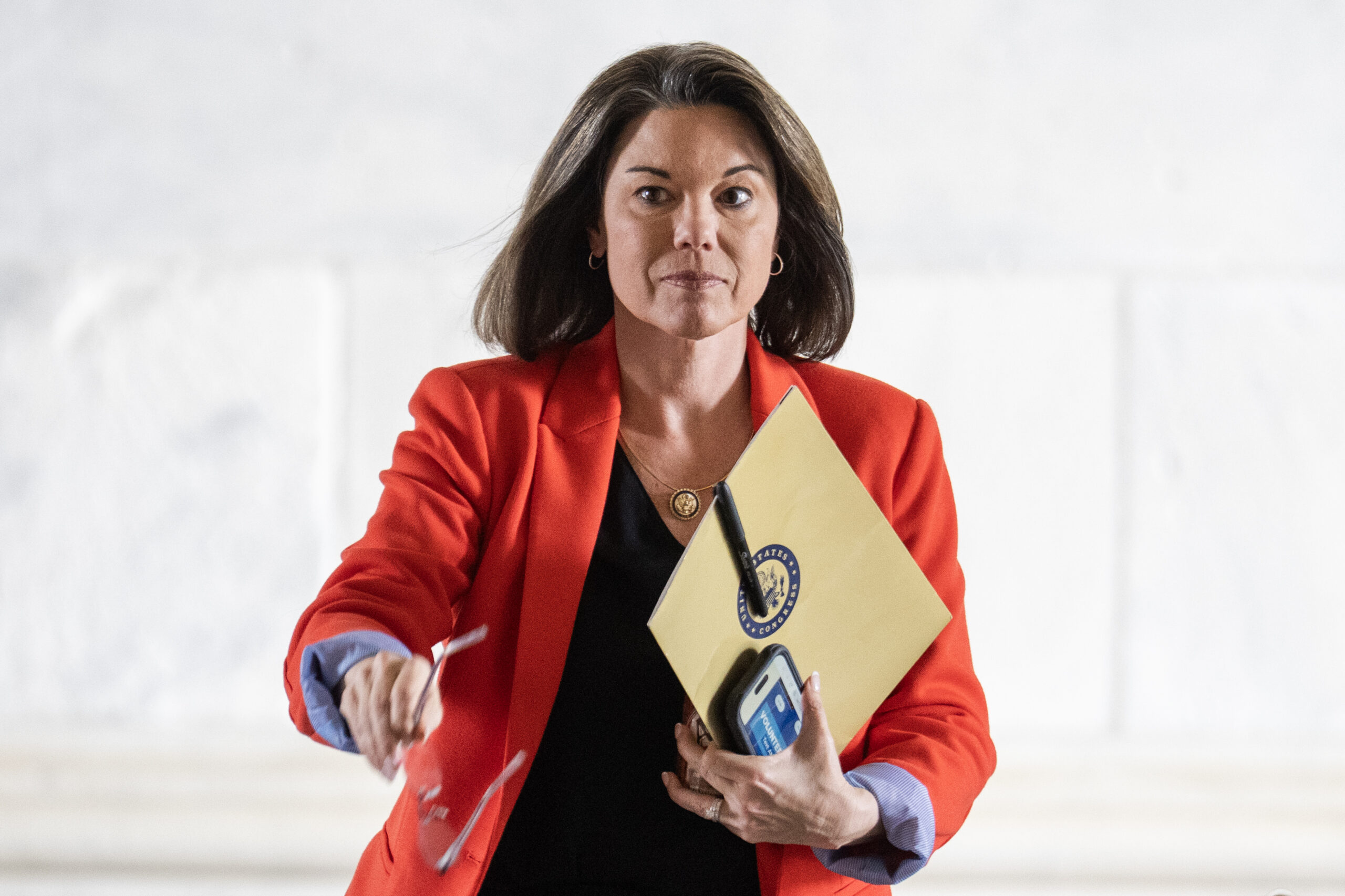
Delegates are expected to take up divisive anti-Israel resolutions at the convention being held next month
HUNGARY FOR MORE

Economic ties and broader European alliances are likely to preserve the bilateral relationship, even as the expected prime minister-elect moves to rejoin the ICC and potentially pivot back towards the EU
Angie Craig calls on Minnesota Democrats to investigate antisemitism ahead of state party convention
Delegates are expected to take up divisive anti-Israel resolutions at the convention being held next month
Tom Williams/CQ-Roll Call, Inc via Getty Images
Rep. Angie Craig (D-MN) arrives for a vote in the U.S. Capitol on Thursday, March 26, 2026.
The Senate campaign of Rep. Angie Craig (D-MN) is calling on Minnesota’s Democratic Party to launch a formal investigation into a series of alleged instances of antisemitic activity among delegates in the lead-up to its state convention being held at the end of next month.
In a letter sent last week to Richard Carlbom, chair of Minnesota’s Democratic-Farmer-Labor Party, Craig’s campaign wrote that one of its staffers had received a threatening anonymous phone call last month from a person “believed to be a delegate” who used an ethnic slur for Jews and said that the congresswoman “takes dirty Jewish money.”
The letter, shared exclusively with Jewish Insider, also cited a local DFL organizing convention in late March at which an unnamed delegate allegedly said that “we should nuke” Israel, among other examples of extremist violent rhetoric.
Mara Kunin, Craig’s campaign manager, said in the letter to state party leadership that such “incidents should be investigated promptly and that the DFL should take appropriate action and make clear that antisemitism in addition to other forms of hate will not be tolerated in our party.”
“Hate in all forms must be called out, whether it comes from the right or the left,” Kunin wrote. “We hope this serves as a necessary wake-up call for the DFL. We urge prompt and decisive action — action that allows the DFL to live up to our shared goal of building a big-tent party rooted in the principles of respect, dignity and integrity.”
In a statement shared with JI, Carlbom said that the DFL “condemns antisemitism and harassment in all forms without reservation,” and called the incidents raised by Craig’s team “disgusting and wrong, full stop.”
“We have responded directly to the Craig campaign, connected them to our Code of Conduct Committee, and encouraged those affected to file a police report,” he continued. “We will enforce our Code of Conduct and hold every leader and member to the standard our party demands. That work is happening and it won’t stop.”
The letter comes as Jewish and pro-Israel Democrats have voiced concerns about growing hostility toward Israel that has overlapped with a creeping extremism among some high-profile party influencers who have gained prominence espousing antisemitic rhetoric.
In Michigan’s Senate race, for example, Hasan Piker, an antisemitic streamer who has praised Hamas, has recently emerged as a flash point in a broader debate about whether Democratic candidates should appear with him publicly or join his show.
The issues raised by Craig’s campaign also dovetail with an uptick in anti-Israel sentiment during state and national party conventions around the country. Last week, at the Democratic National Committee’s meeting in New Orleans, party activists voted down one controversial resolution that criticized AIPAC’s “undue influence” in primary elections, while kicking two other measures to a Middle East working group.
Similar efforts are now poised for consideration at several state conventions in the coming months, including a series of new resolutions introduced by Democratic activists in Texas seeking to formally condemn Israel for alleged genocide while labeling pro-Israel political activity as “foreign interference in U.S. elections.”
In Minnesota, where Craig is facing off against Lt. Gov. Peggy Flanagan for the DFL endorsement, the party’s convention in late May is expected to feature some divisive resolutions related to Israel as in past years, according to local Jewish community activists familiar with the ongoing preparations.
During a recent local convention among several that take place before the statewide meeting, for instance, one new resolution advocated for removing language from the DFL’s official platform recognizing “Israel’s right to exist within secure borders, Palestinian rights to self-determination, and continued peace efforts in the Middle East.”
“Israel with the full support & shielding of the U.S. Government has conducted an intensification of genocide & ethnic cleansing in the past 2+ years, murdering more than 75,000 Palestinians since October 2023,” the resolution states. “The DFL party cannot claim any sort of morality while providing support to a state that’s founded on and committed to ongoing occupation, apartheid, and genocide. The two-state solution has long been an illusion, and so-called ‘peace’ without justice is not worth supporting.”
The DFL did not return a request for confirmation about the status of the resolution and if it would be taken up at the state convention in its current form.
Manny Houle, a Democratic pro-Israel strategist based in Minnesota, said it was “highly unlikely this divisive verbiage makes it as is to the state ballot at the end of May,” noting “there is an entire other round of editing when it comes to resolutions and most of the greatly divisive platforms are not getting the statewide support needed to make the ballot.”
“However, some sort of floor petition resolution is likely,” he told JI. “In addition there likely will be a resolution, if not multiple, about Middle East peace.”
One local Jewish activist now involved in efforts to oppose such resolutions, speaking on condition of anonymity to address a sensitive matter, predicted “other problematic” measures will also arise at the state convention. “We have been strategizing about how to handle any anticipated nastiness at the state convention this year, likely to arise through ‘debate’ over these resolutions,” the activist told JI, pointing to a DFL Jewish community outreach organization that is seeking to become an official party caucus.
In the August Senate primary to be held three months after the convention, Craig, a moderate favored by the pro-Israel community, has claimed backing from the party’s establishment wing, while Flanagan is largely coralling progressive support in what is regarded as a proxy fight between opposing Democratic factions.
While AIPAC has not made an endorsement in the race, Craig’s past support from the advocacy group have drawn criticism from activists working to force the party leftward on Israel.
Antoine Givens, a Craig spokesperson, said her team “will continue to make clear that antisemitism and all forms of hate cannot be tolerated in our party,” while referring to the recent alleged incidents of antisemitic behavior among party members.
“Violence and the threat of violence have no place in our politics and no place in the DFL,” he told JI in a statement. “These actions are unacceptable, and it’s on all of us to demand better.”
Plus, Hasan Piker calls Hamas 'orphan children'

Jacquelyn Martin - Pool/Getty Images
Vice President JD Vance arrives for talks with Iranian officials on April 11, 2026 in Islamabad, Pakistan.
This P.M. edition is reserved for our premium subscribers — offering a forward-focused read on what we’re tracking now and what’s coming next. Please don’t hesitate to share your thoughts and feedback by replying to this email.
📡On Our Radar
Notable developments and interesting tidbits we’re tracking
The U.S. blockade of the Strait of Hormuz began this morning, with more than 15 American warships involved in the operation intended to pressure Iran into concessions after this weekend’s failed negotiations.
President Donald Trump said hours later that the U.S. was “called this morning by the right people, the appropriate people, and they want to work a deal.” Mediators including Pakistan, Egypt and Turkey are also reportedly attempting to revive talks between the parties…
One reported sticking point in the negotiations is a U.S. request that Iran agree not to enrich uranium for 20 years. The 2015 Iran nuclear deal was highly criticized for its sunset clauses, which lifted limits on activity including uranium enrichment after 15 years.
Israeli Prime Minister Benjamin Netanyahu invoked a similar timeframe at a Cabinet meeting today, saying he spoke with Vice President JD Vance yesterday who told him that the U.S. aims to ensure “there is no more enrichment in the coming years, and that could be in decades, no enrichment within Iran.”
Sen. Lindsey Graham (R-SC) took issue with the timeline: “If this reporting is accurate, the idea that we would agree to a moratorium on enrichment rather than a ban on enrichment would be a mistake in my view. Would we agree to a moratorium for al Qaeda to enrich? No,” he wrote on X. “No enrichment means no enrichment”.…
Six additional Senate Democrats plan to file new war powers resolutions this week to halt the war in Iran, a move that would allow Democrats to continue forcing votes on the war for the foreseeable future, Jewish Insider’s Marc Rod reports.
Previously, a different group of six Democrats introduced similar resolutions, and Democrats have called up two of them thus far, with plans to call up a third this week. The latest group of lawmakers spans from staunch progressives and critics of Israel to generally more pro-Israel members, including Sens. Jeff Merkley (D-OR), Kirsten Gillibrand (D-NY), Chris Van Hollen (D-MD), Mark Kelly (D-AZ), Raphael Warnock (D-GA) and Andy Kim (D-NJ)…
Citing an “increasingly sour national environment for Republicans,” the Cook Political Report shifted its ratings for four key Senate races in Democrats’ favor: The North Carolina and Georgia races now lean Democratic, the Ohio race is a toss-up and the Nebraska race is likely Republican, rather than solidly. Democrats would need to flip four seats to take back the chamber…
In another heated Senate race where Democrats hope to pick up a seat, former Rep. Mary Peltola (D-AK) raised nearly $9 million in the first quarter of 2026, four times the amount her opponent, Sen. Dan Sullivan (R-AK), pulled in. The GOP super PAC Senate Leadership Fund has pledged to spend $15 million in the race, as polls show Peltola with a slight lead…
In an appearance on the “Pod Save America” podcast released yesterday, antisemitic streamer Hasan Piker said he “stands by” his statement made in January that “Hamas is a thousand times better than a fascist settler-colonial apartheid state,” referring to Israel.
“I would vote for Hamas over Israel every single time,” he said on the podcast, claiming Hamas is “entirely comprised … of orphan children that have had their parents killed by an apartheid state that has been dominating the lives of Palestinians for 80 years at this point. … Hamas’ tactics, which I oppose at times, or its like internal governance issues are secondary to this conversation”…
Sen. Rick Scott (R-FL) called for the federal government to “immediately” pull funding from Yale University over Yale Political Union’s decision to host Piker, who previously suggested that the senator should be killed. Piker is scheduled to speak on campus tomorrow for a debate titled “Resolved: End the American Empire.”
For Scott, Piker’s incendiary language is personal: the streamer was briefly suspended from Twitch last year after urging his followers to “kill Rick Scott.” “An elite private university that hosts an antisemite who says a Senator should be killed, capitalists should be killed, and the U.S. deserved 9/11, shouldn’t get ONE CENT from taxpayers,” Scott wrote on X on Friday…
J Street is seeking to “set the record straight” after the group backed the growing calls among far-left lawmakers to end U.S. support for Israel’s missile-defense systems, including Iron Dome, despite its own criteria for its endorsees stating otherwise.
In a new FAQ, the group called Iron Dome “a critically important defense system” which it “supports and consistently lobbies for.” After the end of the Memorandum of Understanding between the U.S. and Israel, which runs through Fiscal Year 2028, however, “financial subsidies to Israel should be rapidly and responsibly phased out. … Israel should pay for these systems”…
More Jews were killed in antisemitic incidents outside of Israel in 2025 than any year in the past three decades, according to a report from Tel Aviv University. Twenty Jews were killed last year in attacks in countries including Australia, the U.S. and the U.K., while the previous record was set in 1994 with the AMIA bombing, which killed 85 people in Buenos Aires, Argentina…
⏩ Tomorrow’s Agenda, Today
An early look at tomorrow’s storylines and schedule to keep you a step ahead
Keep an eye out in Jewish Insider for a look at a new poll assessing the partisan divide emerging among American Jews over pro-Israel political engagement.
The U.S. Holocaust Memorial Museum will host a Yom HaShoah remembrance event at the Capitol, with a keynote address delivered by Commerce Secretary Howard Lutnick. Other speakers include several Holocaust survivors as well as House Speaker Mike Johnson (R-LA), House Minority Leader Hakeem Jeffries (D-NY), Sen. Kirsten Gillibrand (D-NY) and Reps. Joe Wilson (R-SC) and Lois Frankel (D-FL).
Amid the International Monetary Fund and World Bank Group’s spring meetings being held in Washington this week, Jacob Helberg, under secretary of state for economic affairs, will speak at an event with the Atlantic Council about U.S. economic leadership in the Middle East, including utilization of the India-Middle East-Europe Corridor, which has been floated as an alternative trade route to the volatile Strait of Hormuz.
Stories You May Have Missed
THE VIEW FROM ISRAEL
Israelis uncertain if Iran war made them safer after ceasefire brings combat to an inconclusive halt

After the ceasefire went into effect, there was a pervading feeling in Israel that the war with Iran was not complete, and the return to routine life may be short-lived
COMFORT FOOD

A traveling program called ‘Soul and Roll’ by singer Hananel Edri and Foodish CEO Merav Oren tells the Jewish story through an immersive culinary and musical experience
Piker has previously urged his followers to kill the Florida senator, who spoke at Yale Political Union last year

Kevin Dietsch/Getty Images
Sen. Rick Scott (R-FL) speaks on government funding during a press conference at the U.S. Capitol on March 06, 2024 in Washington, DC.
Sen. Rick Scott (R-FL) called for the federal government to “immediately” pull funding from Yale University over Yale Political Union’s decision to host Hasan Piker, an antisemitic streamer who previously suggested that the senator should be killed. Piker is scheduled to speak on campus Tuesday for a debate titled “Resolved: End the American Empire.”
Scott, who spoke last year at YPU, a storied debate society at the Ivy League university, wrote on X on Friday that “Yale receives billions from the federal government — President Trump and Congress need to IMMEDIATELY revoke it.”
Piker, a far-left Twitch streamer, has recently been invited to speak at several high-profile events, despite a laundry list of antisemitic, anti-American and terror-supporting rhetoric, which includes justifying Hamas’ Oct. 7, 2023, terror attacks in Israel. He has also called Orthodox Jews “inbred” and claimed America deserved 9/11.
For Scott, Piker’s incendiary language is personal; the streamer was briefly suspended from Twitch last year after urging followers to “kill Rick Scott.”
“An elite private university that hosts an antisemite who says a Senator should be killed, capitalists should be killed, and the U.S. deserved 9/11, shouldn’t get ONE CENT from taxpayers,” Scott wrote.
Asked about YPU hosting Piker, a spokesperson for Yale told Jewish Insider last week that “student organizations are responsible for issuing their own invitations to speakers.”
“At the same time, Yale is committed to maintaining a diverse, vibrant, and respectful community in which free expression is a fundamental value and a shared responsibility. The university is dedicated to providing a space where differing views can be expressed and heard respectfully,” the spokesperson said.
Unlike several Ivy League counterparts, including Harvard and Columbia, the Trump administration has not slashed Yale’s federal funding over antisemitism concerns.
‘Saying Jewish donors are somehow the same as "pro-Israel lobby," I got a problem with that, and not just as an elected official, as a Jew,’ Slotkin said in response to a question at a town hall
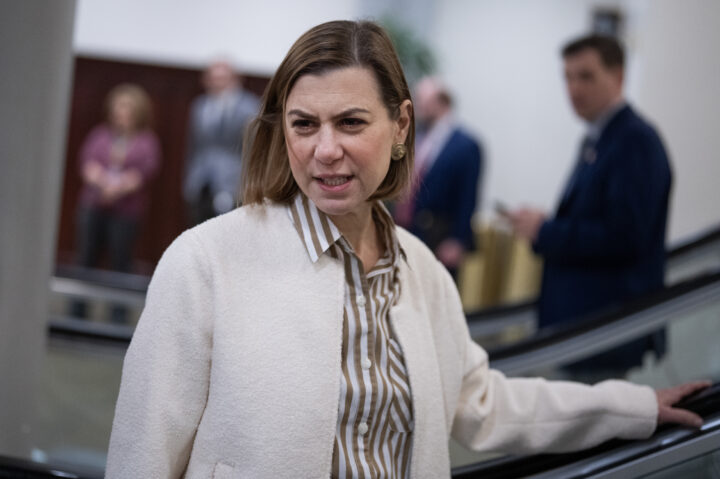
Tom Williams/CQ-Roll Call, Inc via Getty Images
Sen. Elissa Slotkin (D-MI) is seen in the U.S. Capitol on Thursday, March 26, 2026.
Sen. Elissa Slotkin (D-MI) has lately been saying that she does not take money from AIPAC or any corporate political action committees. So when a college student asked her at a town hall in Cincinnati on Thursday about $4.5 million she has received from “pro-Israel lobbies,” Slotkin pushed back — arguing the student was unfairly lumping together all Jewish donors.
“I’m not sure what you’re referring to on ‘not AIPAC but the Israel lobby.’ If you’re equating ‘Israel lobby’ to Jews, I got a problem with that,” Slotkin said.
The figure that the Xavier University student quoted comes from a far-left organization called Track AIPAC, which targets elected officials who it alleges have received funding from the “Israel lobby.” But increasingly, the group is tallying up donations from “lobby donors,” a broad category that critics believe includes any Jewish donors who have also supported AIPAC, J Street or other Jewish or Israel-related advocacy groups.
Slotkin said that just as Iranian Americans, for instance, may not agree with everything the Iranian government does, “I think it’s really important, especially now, to make a distinction between the Israeli government and the choices that they’re making and the average Jew, okay, and Jewish people who donate to campaigns,” Slotkin said, earning applause from the audience.
At the end of the event, she stood by her response to the question when asked about it by another attendee.
“What I take issue with is someone saying that I took $4.5 million from the pro-Israel lobby. That’s not AIPAC. I don’t know what that is,” she said. “But if that’s counting Jewish donors and saying Jewish donors are somehow the same as ‘pro-Israel lobby,’ I got a problem with that, and not just as an elected official, as a Jew.”
Asked her position about taking money from AIPAC, Slotkin said she doesn’t accept AIPAC funding in the same way she eschews other “corporate PAC money.” But she said their work in Washington, of advocating for an issue by building relationships with members of Congress, is the same thing that scores of other groups do.
“I think Americans have the right to support those groups and do whatever they want. Doesn’t mean I have to agree with them. I don’t personally take money from AIPAC. I haven’t in many, many years,” Slotkin said to cheers. “But they and every other organization have an ecosystem in Washington, that they are doing things that every — there’s plenty of groups like them that do the very same thing, a Pakistani American group, or whatever group.”
After the town hall, Slotkin told Politico that she would not do an interview with Hasan Piker, the antisemitic Twitch streamer who appeared at two campaign rallies earlier this week with progressive Michigan Senate candidate Abdul El-Sayed.
“I gotta call balls and strikes, whether it’s antisemitism, Islamophobia, coming from the state that I come from, so that’s what I’ve tried to do as he’s come into Michigan,” Slotkin said.
The comments Piker has made with which she takes issue, Slotkin continued, are “some derogatory things he’s said about Orthodox Jews, saying that we deserve 9/11, there’s some things in there. Not to mention he calls me stupid like every other week.”
The South Carolina Republican brought Christian and Jewish leaders together to speak out against ‘stopping’ antisemitism in the GOP ‘before it gets stronger’
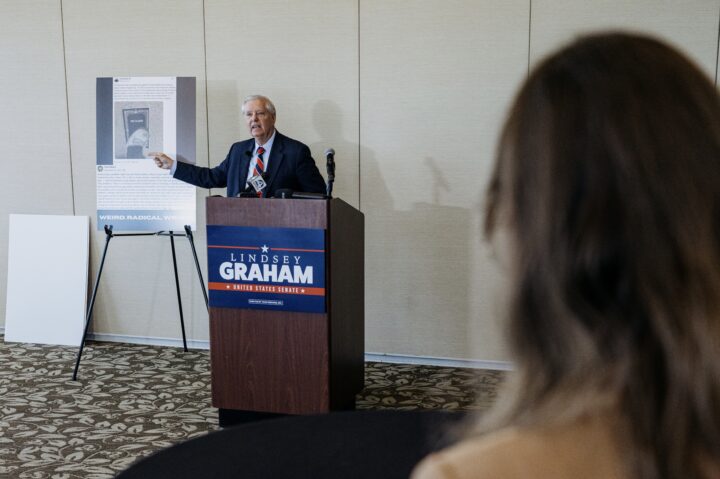
Lindsey Graham for Senate Campaign
Sen. Lindsey Graham (R-SC) at news conference last Thursday during which he criticized the actions of his primary opponents' staffers.
Sen. Lindsey Graham (R-SC) doubled down on his calls for two of his primary challengers in his reelection campaign to fire senior officials over their record of antisemitic statements after both candidates refused to do so — vowing on Tuesday to fight the growing tolerance for Jew-hatred in the GOP and call out aspiring lawmakers in South Carolina who excuse or embrace it.
The South Carolina senator convened Christian and Jewish leaders for a call with reporters to criticize Paul Dans and Mark Lynch, who are challenging Graham in the Republican primary for his Senate seat, over Dans’ refusal to fire Vish Burra as his campaign communications director and Lynch declining to part ways with Evan Mulch as his political director despite their respective records of making antisemitic statements.
Graham told reporters that while he would not typically make an issue of the behavior of staffers from an opposing campaign, he felt compelled to speak out because of the outgrowth of antisemitism in the Republican Party.
“I’m speaking more today as just an American, a senator representing South Carolina, rather than just a candidate. I’ve never had to make a phone call like this, and it, quite frankly, is disturbing,” Graham said. “There are two opponents of mine that have staff members that are very out of touch with where I think South Carolina is, and spewing hate in the form of antisemitism.”
“I’ve never done this before, but this is a problem in America, a small problem in the Republican Party, that I don’t want to grow,” he continued. “I seldom do this, go after other people’s campaigns, because I feel confident that what I’ve got to offer wins the day politically, but this is not about politics. This is not about my primary. This is about stopping something before it gets stronger, calling it out and making it unacceptable.”
Graham highlighted both staffers’ records at a news conference last Thursday and on Tuesday’s call, condemning Burra for depicting Jews as cockroaches in a video he created on the right-wing One America News Network, which ultimately resulted in his firing as a producer.
Mulch, meanwhile, posted a photo on X last June of a boot stepping on the Talmud and calling it a “hate filled book.”
“I call this out because I think it’s a vile antisemitic action. It has no place in politics or, quite frankly, decent society, and he hasn’t been fired,” Graham said on Tuesday. “As a matter of fact, Mr. Dans, in responding to the call to deal with the staffers, said that my campaign was controlled by Israel and that I’m being blackmailed by Israel and other affiliated groups, which I think is one of the oldest stereotypes, that the Jews control politicians.”
“When you step on the Talmud with a boot, I don’t think that’s American,” he added of Mulch. “I don’t think it’s Christian, and I don’t think there’s any place in running for higher office for people who engage in that behavior, and I’ve called for him to be fired with no response.”
While Graham said he does not believe it is inherently antisemitic to voice objections to the policies of the Israeli government, he argued that tolerance of such criticisms did equate to tolerance of blatant antisemitism.
“I’m a strong supporter of Israel, and you can oppose Israeli policies and not be an antisemite,” Graham said. “But when you’re an antisemite, not only do you oppose Israel, I think you oppose human decency and what America stands for.”
Graham told Jewish Insider on the call that he was confident “that when the people of South Carolina — Republicans, Democrats and independents — hear what’s going on, and that’s why I’m doing it today, it will be soundly rejected.”
Matt Brooks, CEO of the Republican Jewish Coalition; Tony Perkins, president of the Family Research Council; Ralph Reed, founder of the Faith & Freedom Coalition; Sandra Hagee Parker, who chairs the board of CUFI Action Fund, the political arm of Christians United for Israel; and Rabbi Yossi Refson of Chabad of Charleston spoke on the call in support of Graham’s efforts.
“We have witnessed, I believe, sadly, the institutionalization of antisemitism in the Democratic Party,” Brooks told attendees. “For us at the Republican Jewish Coalition, let me be very clear and unambiguous that this is a fight that we will take everywhere. We will ensure that antisemitism does not take hold in our party like it has taken hold in the Democratic Party. The fabric of America was woven together based on Judeo-Christian values, the values that we all cherish are built in partnership with our Christian allies and friends. Anybody who traffics in antisemitic rhetoric or antisemitic actions has no place in our party.”
Graham vowed at the end of the call to continue his push to ensure elected Republicans in and out of the state are individuals who repudiate antisemitism.
“The breadth of condemnation here and the quality of the thoughts expressed not only give me hope and prove that I’m doing the right thing. It inspires me. I am not going to let this go after what I heard today. I am never going to let this go until my last breath. I will make sure that any group, but particularly the long suffering Jewish people, have my unequivocal support.”
Dans and Lynch were unapologetic about their campaign staffers, instead releasing statements late last week and Tuesday directing their ire at Graham in deeply personal terms.
“He’s given a member of my campaign staff more attention than he’s given South Carolinians for decades,” Dans said in a statement last Thursday. “The real headline that you should be covering is how many opioid deaths happened in South Carolina last year on Lindsey Graham’s watch. Israel picks Lindsey Graham’s staff, but they do not pick mine. I am not firing Vish Burra and I am calling on the people of South Carolina to fire Lindsey Graham.”
Lynch, meanwhile, told JI in a statement on Tuesday evening that Graham was “an existential threat to both the nation of Israel and the United States.”
“Lindsey Graham is responsible for the deaths of countless Jews in Israel by the fact that he has sent 10s of millions of dollars to Al-Qaeda, Hamas, and Al-Nusra Front — funding the enemies of Israel,” Lynch said.
Plus, Joe Kent amplifies Iranian propaganda

Tom Williams/CQ-Roll Call, Inc via Getty Images
President Donald Trump conducts a news conference in the White House briefing room about the war in Iran on Monday, April 6, 2026.
This P.M. edition is reserved for our premium subscribers — offering a forward-focused read on what we’re tracking now and what’s coming next. Please don’t hesitate to share your thoughts and feedback by replying to this email.
📡On Our Radar
Notable developments and interesting tidbits we’re tracking
Amid reports that Iran has rejected the U.S.’ ceasefire framework, President Donald Trump told reporters Tehran has made its own “significant” proposal, though it is “not good enough.”
Asked if he may push the deadline again for Iran to reopen the Strait of Hormuz or face increased U.S. military action — as he has already done three times — Trump said, “Highly unlikely. They’ve had plenty of time.”
Trump also claimed the U.S. had “sent guns, lot of guns” into Iran. “They were supposed to go to the people so they could fight back against these thugs. You know what happened? The people that they sent them to kept them, because they said, ‘What a beautiful gun. I think I’ll keep it,’” he said…
At a press conference this afternoon, Defense Secretary Pete Hegseth said today would mark “the largest volume of strikes since Day 1” of the Iran war, with more to come tomorrow.
Trump doubled down on his threats, warning that all of Iran “can be taken out in one night, and that night might be tomorrow night.” If Tehran does not acquiesce by his 8 p.m. ET deadline tomorrow, Trump said, “they’re going to have no bridges. They’re going to have no power plants. Stone ages.”
The president also floated the possibility of charging U.S. tolls to ships transiting the Strait of Hormuz once it is reopened and potentially seizing Iran’s oil. Trump and defense officials further detailed the harrowing rescue of a fighter jet pilot, who reportedly treated his own wounds while scaling mountainous terrain to evade capture after being downed over Iran…
Israeli Prime Minister Benjamin Netanyahu said he spoke yesterday with Trump, who thanked him for Israel’s assistance in rescuing the pilot…
Joe Kent, the former director of the National Counterterrorism Center who resigned over his opposition to the Iran war, shared a post on social media on Saturday spreading false claims from Iranian state-linked media and Drop Site News that the U.S. was attempting to kill the servicemember whose fighter jet was shot down over Iran prior to him being rescued, Jewish Insider’s Matthew Shea reports.
The initial statement from Drop Site, a far-left news outlet sympathetic to Hamas and totalitarian regimes, cited a report by Tasnim News, which is linked to the Islamic Revolutionary Guard Corps, claiming that the U.S. had “lost hope” of recovering the airman and was instead “attempting to kill him”…
Rep. Pat Fallon (R-TX), who previously served in the Air Force, predicted that the U.S. will deploy ground troops into Iran: “I just don’t see any other way,” he said on Fox News. “I personally think it’s going to be boots — at least special ops, American special operators — on the ground, with allies in the region and air cover,” he said…
The U.S.-led Board of Peace is pressing Hamas to finalize a Gaza demilitarization agreement by the end of the week, The New York Times reports, which would require the terror group to give up its weapons and maps of its tunnel network in the enclave. Negotiators from both sides are expected to meet in Cairo, Egypt, tomorrow…
Democratic Michigan state Sen. Mallory McMorrow announced she raised more than $3 million in the first quarter of 2026 in her bid for U.S. Senate. “There was not a dime of corporate PAC donations, not a dime of AIPAC donations,” she said in a video. The pro-Israel group was the only organization she named.
While McMorrow’s opponents have not yet publicized their latest fundraising figures, her haul surpassed those of last quarter, when Rep. Haley Stevens (D-MI) led the pack with $2.1 million raised in the final quarter of 2025…
The Senate Leadership Fund, the Senate GOP’s top super PAC, revealed its $350 million plan to retain control of the upper chamber, focusing on defending incumbents in Ohio, North Carolina, Maine, Iowa and Alaska and seeking to flip seats in Michigan, Georgia and New Hampshire.
The funds will largely be used for ad campaigns, with the most money being spent to defend Sen. Jon Husted (R-OH), who must win his first Senate election for the remainder of his term against the likely Democratic nominee, former Sen. Sherrod Brown (D-OH)…
Ukrainian President Volodymyr Zelensky received a grand welcome upon touching down in Damascus yesterday for his first meeting with Syrian President Ahmad al-Sharaa. The two leaders “explored avenues for strengthening economic cooperation and the exchange of expertise,” al-Sharaa said…
Sovereign wealth funds from Saudi Arabia, Qatar and the UAE have signed equity commitments to the tune of $24 billion to back Paramount’s acquisition of Warner Bros. Discovery, The Wall Street Journal reports…
⏩ Tomorrow’s Agenda, Today
An early look at tomorrow’s storylines and schedule to keep you a step ahead
Keep an eye out in Jewish Insider for a preview of tomorrow’s special election runoff in Georgia’s 14th Congressional District, where Republican military veteran and Israel supporter Clay Fuller is expected to win the ruby-red seat of former Rep. Marjorie Taylor Greene (R-GA).
Defense Secretary Pete Hegseth and Gen. Dan Caine, chairman of the Joint Chiefs of Staff, will hold another press briefing on the Iran war tomorrow morning.
Michigan Senate candidate Abdul El-Sayed will host rallies tomorrow at Michigan State University and the University of Michigan with guests including Rep. Summer Lee (D-PA) and antisemitic streamer Hasan Piker, a move which has drawn condemnation from some Democrats and sparked a broader debate about the mainstreaming of Piker within the party.
The Democratic National Committee will begin its five-day meeting in New Orleans tomorrow, where its resolutions committee will consider several resolutions condemning AIPAC and Israel, including calls for conditions on or a suspension of U.S. military aid to the Jewish state.
NATO Secretary-General Mark Rutte will meet with Trump and administration officials in Washington on Wednesday, as the president continues to slam the organization for its refusal to engage in the Iran war.
In observance of Passover, we’ll be back in your inbox with the Daily Overtime on Monday, April 13. Chag Pesach Sameach!
Stories You May Have Missed
ALTERED LIVES

The foiled attack at the Michigan synagogue is being called a miracle — but those who were inside now face the lasting impact of trauma and a search for safety
O CANADA
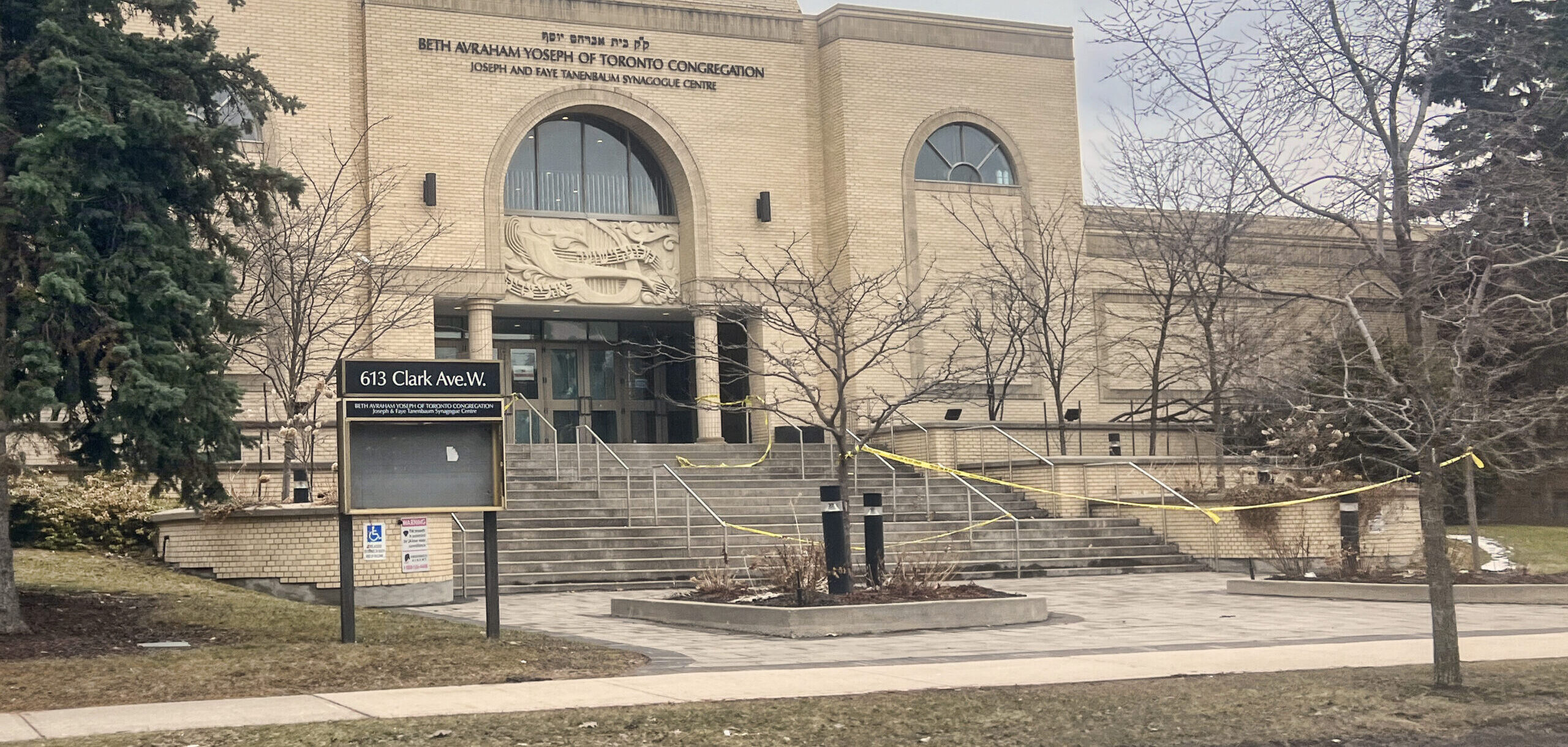
After a series of targeted attacks in Toronto and beyond, Jewish leaders are raising the alarms on Canada’s failure to properly protect its Jews amid ‘systemic’ antisemitism
After a series of targeted attacks in Toronto and beyond, Jewish leaders are raising the alarms on Canada’s failure to properly protect its Jews amid ‘systemic’ antisemitism
Creative Touch Imaging Ltd./NurPhoto via Getty Images
Police tape is seen outside the Beth Avraham Yoseph of Toronto (BAYT) synagogue following overnight gunshots fired at the building in Vaughan, Ontario, Canada, on March 21, 2026.
As Canadian Jewish families began celebrating the holiday of Passover, a commemoration of Jewish persecution and redemption, many found the ancient narrative colliding with a modern reality of rising fear at home.
Early Friday, a Jewish-owned restaurant in Toronto was struck by gunfire for the second time in weeks — a targeted, 14-bullet assault that police called a “glaring example of domestic terrorism.”
The incident marks the latest in a wave of antisemitic attacks, highlighting what Jewish leaders describe as “systemic” Jew-hatred in Canada. And it is even leading some Jewish Canadians to consider their own kind of exodus from their country, with one communal leader saying that “the promise” that Jews could practice their faith openly in the country “has been broken.”
“There’s a real sense — and I don’t want to overstate it — but that the Jewish community in Toronto has felt under siege since [the Oct. 7, 2023, terrorist attacks in Israel],” Rabbi Debra Landsberg, who leads Temple Emanu-El, a Reform synagogue in Toronto’s North York district, told Jewish Insider.
On March 2, Landsberg’s congregation was shot at several times, as her family and at least one staff member remained near the building following a Purim celebration. No injuries were reported, but the exterior and front lobby sustained significant damage.
The shooting was the first in a series of three synagogue attacks in Toronto last month. One week after Temple Emanu-El was targeted, the front doors of Shaarei Shomayim Synagogue and The Beth Avraham Yoseph of Toronto were shot at in the middle of the night, causing damage to both buildings.
In another recent incident, Canadian law enforcement arrested three Toronto-area men accused of planning violent kidnappings targeting women and members of the Jewish community.
Israel’s ambassador to Canada, Iddo Moed, said that last week’s restaurant shooting “the 12th incident of its kind in the latest wave of antisemitism and violence against the Jewish community in Canada.” UJA Federation of Greater Toronto warned that the incident should cause “all Canadians to be extremely concerned by what’s happening in our country right now.”
Toronto police have responded to the surge of violence by deploying armed officers at Jewish institutions around the city, an effort that was ramped up during the Passover holiday.
Canada has experienced some of the most severe manifestations of the global surge in antisemitism since Oct. 7. — with higher rates of antisemitic incidents than other countries but lower conviction rates.
In the first two months of 2026 alone, 22 antisemitic incidents were reported in Toronto, representing approximately 62% of all reported hate crimes in the country, according to police. Based on population, a Jewish Canadian is 25 times more likely to experience a hate crime than any other Canadian, according to the Centre for Israel and Jewish Affairs (CIJA).
Some Jewish leaders told JI they have come to expect sluggish or nonexistent responses from law enforcement and political leadership, a failure that they say exacerbates the problem.
One month after the synagogue shootings, no arrests have been made. Police say investigations are ongoing.
A spokesperson for the Toronto Police Department told JI last week that “the synagogue shootings are being examined for potential links … information, evidence, and intelligence are being shared to determine whether there are any connections.”
“There has been a systemic failure across jurisdictions to face antisemitism,” said Richard Marceau, senior vice president of strategic initiatives and general counsel at CIJA, an agency of the Jewish Federations of Canada. Marceau asserted that society has “a complete misunderstanding” of what antisemitism is, whether it stems from “the far left, far right [or] Islamic circles.”
“There’s also a reluctance to act,” he said. “There’s a desire to say ‘we’ll just let a little steam out and the pressure will go away.’ There’s no consequences to what’s happening [so] people feel emboldened.”
“In terms of fighting on the criminal legal side, the police are reluctant to press charges and go from a ‘let’s keep the peace’ mentality to ‘let’s enforce the law,’” continued Marceau, a former Bloc Québécois member of parliament. “Charges are dropped by the prosecution for no good reason. Often judges don’t understand what antisemitism is.”
“If there’s one thing that should be clear it’s that Jews are under threat and this type of thing should not take such a long time,” Marceau said of the investigations into last month’s synagogue shootings. “There should be infrastructure to make sure that the people who attack are quickly found and identified.”
“There’s also a reluctance to act,” Marceau said. “There’s a desire to say ‘we’ll just let a little steam out and the pressure will go away.’ There’s no consequences to what’s happening [so] people feel emboldened.”
Marceau noted some positive movement since the Toronto synagogue shootings. Bill C-9, which would amend the criminal code to strengthen penalties against hate-motivated crimes, protect religious spaces and ban public display of hate symbols, passed in the House of Commons last month. Marceau called for the Senate “to quickly pass it.”
“All around, the authorities have been given a failing grade on this. All the lights are flashing on Canada’s dashboard — things need fixing and the fixing needs to happen now,” said Marceau.
Landsberg, former president of the Toronto Board of Rabbis, said that among her congregants, “everybody is just a little jumpier” since last month’s attack. “The police are responsive but not forthcoming with information. Visible police presence has been noticeable here and at other Jewish institutions. The care and concern from our police has been real.”
But many questions remain, said Landsberg. “Whether or not they are able to solve this — and what it will take — and do they have the clear support of political leadership, to make Jews safe and feel safe? As time goes on, one imagines that we might live without ever having someone brought to account for this.”
“The political response has been complicated and underwhelming,” continued Landsberg. “Since Oct. 7 at least, the question of whether laws on the books are being implemented when it comes to hate crimes against Jews is an open question. I don’t know many people who are convinced that the law has been applied during some of these protests when there is classic imagery of Jews as rats.”
Few Jewish institutions have been targeted as severely as Kehillat Shaarei Torah, a Modern Orthodox synagogue that has endured 10 separate attacks in the last two years alone. The congregation is also located in North York, but about 2.5 miles from most of Toronto’s Jewish life.
Geographic distance hasn’t spared the synagogue from becoming a target of antisemitic incidents, the first of which occurred the Thursday before Passover two years ago when “about six or eight of our windows were smashed by somebody with a hammer who came in the middle of the night,” the congregation’s leader, Rabbi Joe Kanofsky, told JI.
“We got through Pesach and then there was another by the same person, judging by the security tapes, who came back to get what he missed,” said Kanofsky. “He missed our doors, he came back to smash our glass doors and some more windows. We had a couple more things throughout the summer into the next year.”
Other incidents included a sign outside of the synagogue calling for the release of the hostages kidnapped by Hamas on Oct. 7 being set on fire and dead animals being thrown onto the property. The windows were also smashed several more times.
Frustrated, synagogue leaders installed a black iron fence around the perimeter of the building in December 2024. That “slowed things down” until November 2025, said Kanofsky, “when we had somebody, possibly the same person, come smash the windows with a hammer again. That was our most recent and brought us up to 10 figures all together.” No arrests have been made in any of the attacks.
Canada operates under three levels of government — federal, provincial and municipal — and Kanofsky expressed dissatisfaction with the political response, noting that certain branches have performed worse than others.
“The municipal government seems to be wishing the problem away,” he said. “If they close their eyes they imagine it’s not so bad and maybe they’ll give a little money for increased security so the Jews can take care of that.” In March, days after the Toronto synagogue shootings, the Canadian government announced a new $10 million investment through the Canada Community Security Program to help Jewish institutions enhance security.
“I haven’t heard much from the provincial government until the three shootings in March happened. Right after that happened, the provincial government called the meeting of rabbis. [Doug Ford,] the premier of Ontario, asked a lot of questions and listened, sharing his plans for beefing up security. After a long time, finally there was some attention from the provincial government, which oversees prosecutions. That’s where things are falling apart, things do not go to trial and if they do they are dropped.”
“From the federal government, our representatives in Ottawa have been fairly supportive. There’s a bit of a degree of ‘it’s somebody else’s job’ and everyone points to someone else,” continued Kanofsky. “But the police are always there for us before and after we call. If the rest of the levels of government were as determined as the police, we probably would not have this problem.”
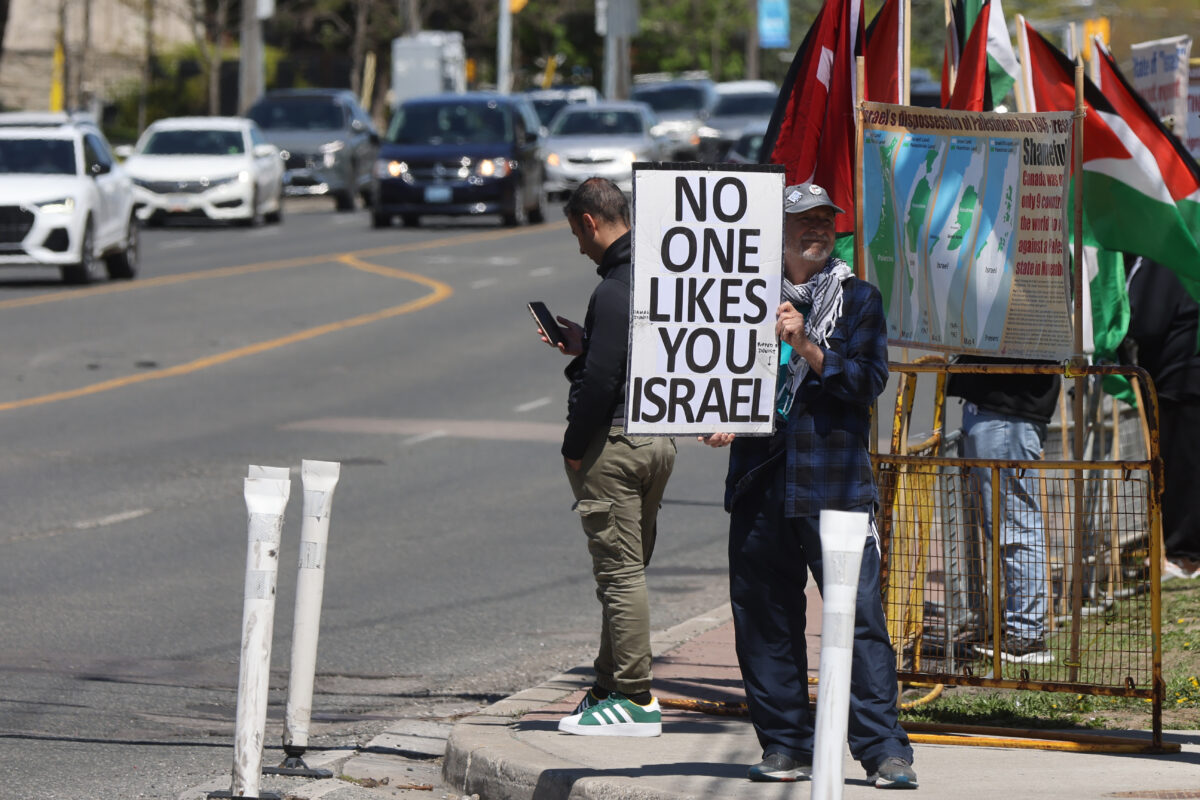
While nearly half of Canadian Jews reside in Toronto — which is home to about 150 Jewish institutions — the problem extends beyond Canada’s largest city. In Ottawa, the country’s capital, a Jewish grandmother was stabbed in August while shopping at a kosher supermarket. In 2024, Jews in Montreal were granted an injunction to prohibit the spate of anti-Israel protests, which included chants of “death to the Jews” in Arabic outside of a school, occurring within 50 meters of dozens of Jewish institutions.
In what The Atlantic recently called “Canada’s Polite Pogrom,” many incidents targeting Jews have been quieter, without broken glass or bones, but disruptive and exclusionary nevertheless.
Eighty percent of Jewish doctors and medical students surveyed by the Jewish Medical Association of Ontario reported experiencing antisemitism at work after the Oct. 7, 2023, attacks. In 2024, more than 100 Jewish doctors stopped acknowledging their affiliation with the University of Toronto’s Temerty Faculty of Medicine in protest of what they saw as the school’s failure to protect Jewish students and faculty. Almost a third of Ontario’s Jewish doctors say they are considering leaving Canada because of hostile work environments, according to the JMAO survey.
A group of Jewish teachers in British Columbia filed a human rights complaint against their own union, accusing the BC Teachers’ Federation of excluding, harassing and silencing its Jewish members. A federal investigation into Ontario’s K-12 schools found nearly 800 antisemitic incidents reported in elementary and high schools since 2023, many stemming from teachers’ conduct. The Toronto International Film Festival briefly dropped a documentary from its lineup that chronicled an Israeli grandfather’s experience rescuing his family from Hamas on Oct. 7, before a global effort successfully pushed for its reinstatement.
Jewish life in Canada wasn’t always this way, said Irwin Cotler, Canada’s former justice minister.
“When I was in the Ministry of Justice, at that time we had nowhere near the levels of antisemitism we’re witnessing now,” Cotler, who served as a member of Parliament, attorney general and Canada’s first special envoy on combating antisemitism, told JI. He called the current situation “an unprecedented explosion.”
“One would have thought that the times since [Oct. 7] would have resulted in actions to combat antisemitism. We’ve had on a public level, tragically almost, denials that Oct. 7 took place or support and justification — even celebration — for it in the public squares,” he said.
Upon completing his term as Canada’s special envoy on combating antisemitism in 2023, just before the Oct. 7 attacks, Cotler recalled reporting that “the conventional paradigm for combating antisemitism on the far right and far left was still true.” But, he continued, “the most important finding I had was that we were witnessing an increasing mainstream normalizing antisemitism and particularly in the campus culture, with an absence of outrage underpinned by indifference and a failure to appreciate that antisemitism is not only increasingly threatening Jews but that it’s toxic to democracies and an assault on our human rights values.”
If not addressed quickly, Cotler warned that there’s “a ticking bomb here in Canada for what will be the Bondi massacre occurring in Canada,” a reference to the December 2025 mass shooting at a Hanukkah gathering at Bondi Beach in Sydney, Australia, that killed 15 people.
“The synagogue shootings here are part of a pattern. We are experiencing not only the highest level of antisemitic incidents since tracking began in the 1970s, but the real disturbing data has been the dramatic increase in hate crimes targeting Canadian Jews. Hate crimes are different from other forms of antisemitism because they are identity crimes that target the whole community and reverberate within the whole community,” continued Cotler.
Cotler described law enforcement and government as ineffective. “Arrests are not made or if they are made then charges are not laid. If charges are laid, prosecutions are not proceeded with, or if prosecutions are proceeded with the courts do not sustain it,” he said.
Canada “needs a wake up call,” continued Cotler, “and it needs a whole government commitment at [all] levels to combat antisemitism. If the government gives a 10 percent increase in community security it’s basically telling Jews to protect themselves and giving a little more money to do that. That’s not a response. If you don’t have leadership at the governmental levels, lack of leadership will trickle down and start to become part of the culture of inaction. What we’re witnessing from the government are performative tweets and virtue signaling, but not effective leadership and action on the ground.”
Last month, frustration with political leadership deepened for many Jews with the election of Avi Lewis, a far-left Jewish anti-Zionist, as the leader of the New Democratic Party, widely described as Canada’s democratic socialist party.
“We are left with a deep sense of sadness,” Marceau and Rachel Chertkoff, senior vice president of community engagement at CIJA, said in a joint statement following the March 29 election. “When a leader declares that Zionism is inseparable from ethnic cleansing, he is not engaging in legitimate policy critique. He is telling Jewish Canadians that a core part of their identity is illegitimate. That is exclusion.”
Cotler, who was friends with Avi Lewis’ father, Stephen Lewis, said the election left him “concerned — not about criticism of Israel, but engaging in obsessive preoccupation in calling out alleged Israeli genocide.”
As a member of Parliament, Cotler said he was “close” with the NDP. “The astonishing difference [is] now we’ve gone down the road where NDP is no longer a place Jews feel they can be at home,” said Cotler. “It’s tragic because of the important role Jews played in the founding of the NDP.”

Landsberg noted that the writing was always on the wall: Canadian Jews would face a harsher reality than their American counterparts.
Canada is “50-plus years slower in reaching integration. In many ways the American story — of freedom and exodus — has been integrated naturally, the early Civil Rights Movement, for example,” Landsberg said. “There isn’t that comparable norming of the Jewish story [in Canada]. The first Jew who made it into a political cabinet position wasn’t until the late 1960s, decades after there were Jews on the Supreme Court in the U.S. Same thing with leadership in medicine and universities. It’s much later here. It’s a much smaller community that is made up of many more immigrants. It’s a different community in that this is home but these are people who have had to flee homes already. Canada’s understanding of Jewish citizens as part of the multicultural story that it has been trying to create has played out differently.”
Marceau, who splits his time between Montreal and Ottawa, has three friends who have left Canada because of antisemitism. “In discussions around Shabbat tables or at synagogue, [fleeing] is a constant conversation that is happening,” he said. “The promise that everyone could be openly themselves in Canada, to practice whatever faith they want — has been broken — certainly for Jews.”
Similarly, Kanofsky said that among his 200-family congregation, “people have already received second or third passports through their parents or grandparents. People are gathering their documents. Younger families are looking into Central America or other places that might be more hospitable. These are people that if you would have asked five years ago would have said they have deep roots and are not going anywhere for the long term. The Canadian Jewish community had a very deep-seated feeling of being part of society and being protected. A lot of that has been deeply damaged by the complacency of the government over the last couple of years.”
“Jewish communities will for sure learn from mistakes from the past and no one will stay longer than is necessary. People in our congregation have already gone on aliyah,” continued Kanofsky. “In a hurry, everybody gained a sense of mobility when they saw the inaction of the government.”
But, even when describing the boarded-up front lobby of her congregation — where leaders are still debating the type of shatterproof glass to install — Landsberg painted a picture of a resilient community with hope for the future.
“This is probably the same for Jews in the U.S.,” she said, “but there’s a sense of clarity that many people are really feeling a deep discomfort with how society here is handling this, and also the sense of strength [because] the Jewish people have been through a lot.”
Plus, inside Temple Israel's difficult road ahead

Bill Clark/CQ Roll Call via AP Images
UNITED STATES - JUNE 18: Democratic candidate for Georgia's 6th Congressional district Jon Ossoff speaks to campaign workers and volunteers at his campaign office in Chamblee, Ga., on Sunday, June 18, 2017. Ossify is facing off against Republican Karen Handel in the special election to fill the seat vacated by current HHS Secretary Tom Price will be held on Tuesday.
👋 Good Wednesday morning!
In today’s Daily Kickoff, we visit West Bloomfield Township, Mich., as the Jewish community reels from last month’s attack at a local synagogue, and report on antisemitic and conspiratorial rhetoric from Maureen Tkacik, a top editor at The American Prospect. We talk to former Rep. Mike Rogers about the GOP’s shifting attitudes toward Israel, and report on Rep. Alexandria Ocasio-Cortez’s pledge to reject defensive funding for Israel. Also in today’s Daily Kickoff: Bill Ackman, Amar’e Stoudemire and Joshua Kramer.
Ed. note: In observance of Passover, the next Daily Kickoff will arrive on Monday, April 6. Chag sameach!
Today’s Daily Kickoff was curated by JI Executive Editor Melissa Weiss and Israel Editor Tamara Zieve, with assists from Danielle Cohen-Kanik and Marc Rod. Have a tip? Email us here.
What We’re Watching
- President Donald Trump will give a primetime address on the state of the war with Iran tonight at 9 p.m. ET. The president’s speech, which will be televised on the major networks, will take place hours after the start of the Passover holiday. Trump said last night that the U.S. would end operations in Iran in the next two to three weeks — regardless of whether a deal is reached with Tehran.
- The USS George H.W. Bush aircraft carrier strike group departed Norfolk, Va., on Tuesday for its scheduled deployment. The Navy did not say where the ship would be positioned, but the deployment comes as the USS Gerald R. Ford, which had previously been positioned in the Middle East, was taken out of service for repairs.
- Emergency responders in Israel treated 14 people, including an 11-year-old girl and a 13-year-old boy, for injuries this morning after Iran fired four missile barrages at Israel.
- In New Jersey, Democrat Analilia Mejia and Republican Joe Hathaway, candidates in the special election to succeed Gov. Mikie Sherrill in the state’s 11th Congressional District, will participate in a New Jersey Globe-sponsored debate this evening.
What You Should Know
A QUICK WORD WITH JI’S MARC ROD
Hasan Piker, the far-left, antisemitic streamer, was recently asked by Politico who his favorite presidential candidates are for the Democratic nomination in 2028. He offered a few unsurprising names: progressive Reps. Alexandria Ocasio-Cortez (D-NY) and Ro Khanna (D-CA), United Auto Workers President Shawn Fain… and Sen. Jon Ossoff (D-GA), the mild-mannered purple-state senator up for reelection this year.
Piker, in the interview, called Ossoff, “my dark-horse pick, depending on how he presents himself if he has ambitions for higher office.”
But does Ossoff, a Jewish senator who is facing a tough reelection in a state President Donald Trump carried twice, return Piker’s affections? His team has been unresponsive about his views on Piker, even as some leading Democrats have spoken out against the influencer and kept their distance.
Multiple spokespeople for Ossoff didn’t respond to several inquiries this week from JI.
Ossoff’s silence about Piker could strain his already rocky relationship with Georgia’s Jewish community. Key Jewish leaders and donors have repeatedly expressed outrage with the senator over his votes in favor of resolutions to block U.S. arms sales to Israel, and some have threatened to withhold support from his presidential campaigns.
ALTERED LIVES
Pop. Pop. Pop. A preschool teacher at Temple Israel heard the shots, locked eyes with her co-teacher, and mouthed: Don’t show any emotion. Weeks later, every child who was in the building that day is safe. But the people who lived through the attack — and the broader Jewish community of Metro Detroit — are still grappling with trauma, shattered security and a world that has largely moved on, Jewish Insider’s Gabby Deutch reports from West Bloomfield, Mich. “People are traumatized, and there’s no way around it,” Rabbi Josh Bennett, who has been on the pulpit at Temple Israel for 33 years, told JI last week.
Second chances: Jeremy Moss, a Democratic state senator who is running for Congress this year, is the only Jewish member of the Michigan state Senate. He is also the only LGBTQ member of the Senate. He knows that those two parts of his identity are often treated differently. “In the past several years, when I talk about antisemitism, it feels like I’m talking alone, or that I’m challenged, or that I’m lectured, not necessarily by my colleagues, but lectured about what is antisemitism from others, rather than allowing my own experience to be accredited, to be valid,” he added. “It’s a very isolating, lonely feeling, and it really makes you realize how small the Jewish community is and how difficult it is to get our lived experience heard and supported.” The attack on Temple Israel, and the fact that no one died, offers a “second chance,” Moss said.
on the mike
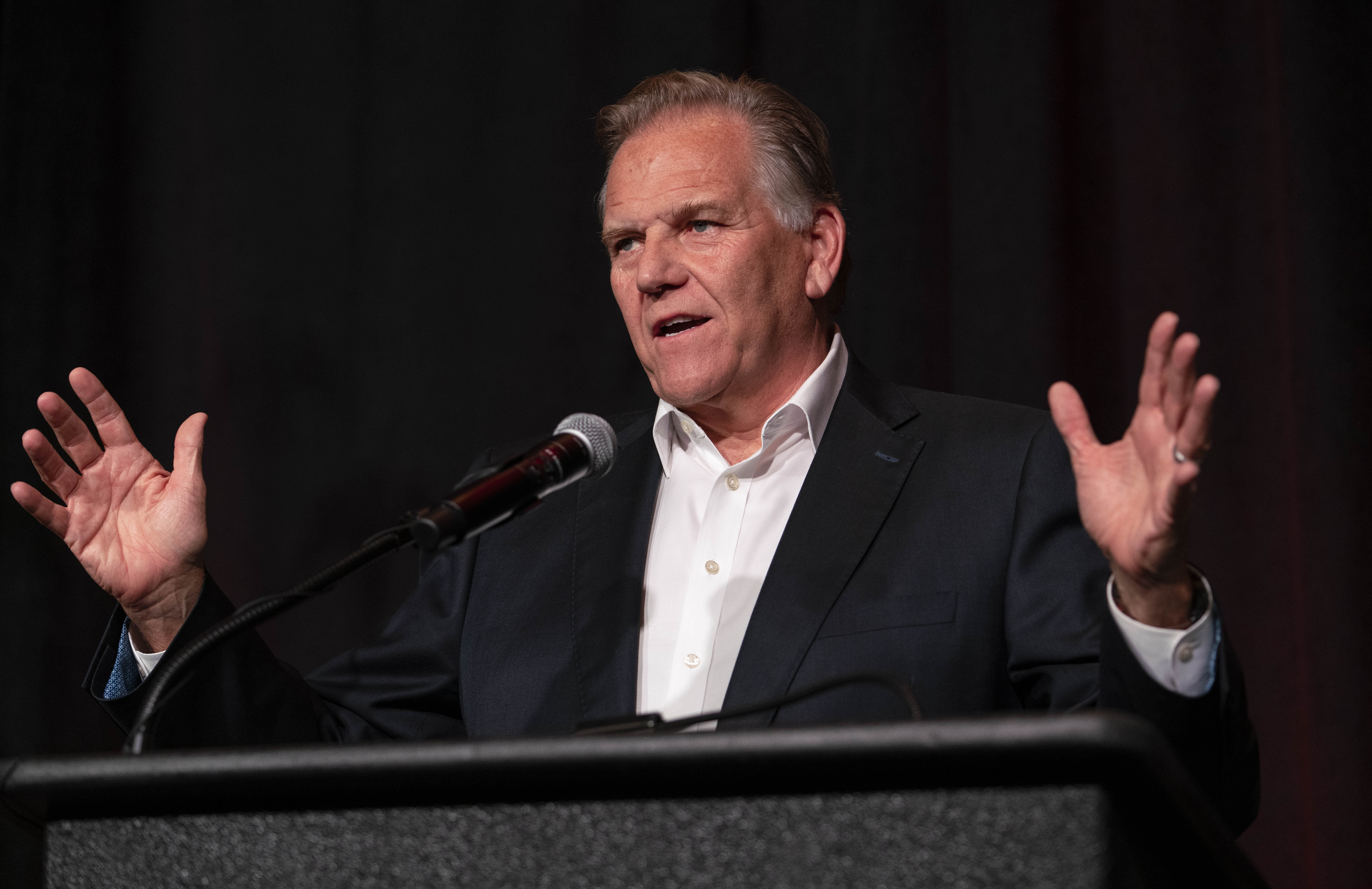
As former Rep. Mike Rogers (R-MI) campaigns for the open Senate seat in Michigan, he is not shy about his support for Israel. But he has lately encountered more people pushing back on American support for the Jewish state, and he is worried not enough is being done, including in his own party, to fight that trend. “I don’t think we have an effort to counter the [anti-Israel] narrative,” Rogers, a former chairman of the House Intelligence Committee, told Jewish Insider’s Gabby Deutch in an interview near Detroit last week.
Primary position: “You don’t have to love Israel, but you have to respect the fact that the nation is trying to defend itself and its people who have maybe, probably, the most horrific history of being treated in the world of any other race on planet earth,” Rogers said. Rogers is the only major Republican candidate in the Senate race, while three Democrats are locked in a tight battle for the nomination, with several months still to go until the August primary.
NEWSROOM NOISE
Maureen Tkacik, a top editor for The American Prospect, an influential progressive magazine in Washington, has made no secret of her self-avowed hatred of Israel, particularly in the wake of Hamas’ Oct. 7, 2023, attacks and the ensuing war in Gaza. In recent months, however, she has increasingly entertained conspiracy theories about Israel, used antisemitic rhetoric and expressed her approval of far-right extremists stoking anti-Jewish sentiment, raising questions over her ongoing association with a periodical that had long been viewed as a paragon of modern liberalism, Jewish Insider’s Matthew Kassel reports.
Social media scrutiny: In some social media posts she has indicated that she believes it is possible Israel was involved in the assassinations of both President John F. Kennedy and conservative activist Charlie Kirk. “JFK did not want Israel to develop the nuclear weapons they still refuse to acknowledge having,” she wrote last month, in response to commentary from far-right commentator Tucker Carlson tacitly suggesting that Israel was behind the killing, a conspiracy theory that has recently gained renewed currency on the far right. In other posts, Tkacik has railed against “ZOG,” short for “Zionist Occupied Government,” which the American Jewish Committee and Anti-Defamation League have called a white supremacist conspiracy theory alleging that the United States is controlled by Jews.
TARGETED THREAT
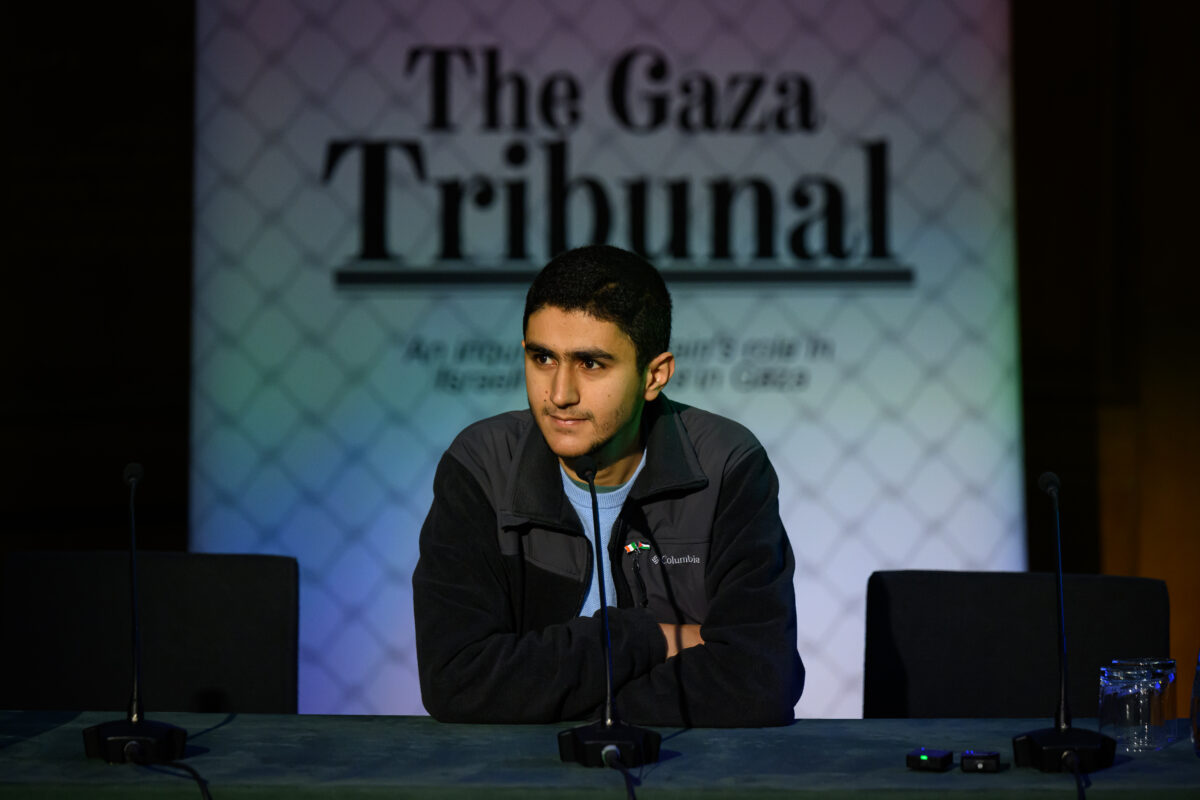
An Ireland-based Palestinian journalist who has contributed to outlets including The Guardian, Al Jazeera, Drop Site, Middle East Eye, The New Arab and The Electronic Intifada shared posts on his Instagram story encouraging violence against an Irish pro-Israel commentator, Druze Israeli politicians and Israelis generally, Jewish Insider’s Marc Rod reports.
From Gaza to Ireland: Abubaker Abed had been based in Gaza and was evacuated during the war, ending up in Ireland. According to screenshots of Abed’s Instagram stories shared by others on X, he called for violence against Israelis and against Rachel Moiselle, a popular pro-Israel Irish commentator, in response to Israel’s passage this week of a death penalty law for Palestinian terrorists. The screenshots are no longer active on Abed’s account and could not be independently verified by JI. Abed did not respond to a request for comment.
AID ARGUMENT
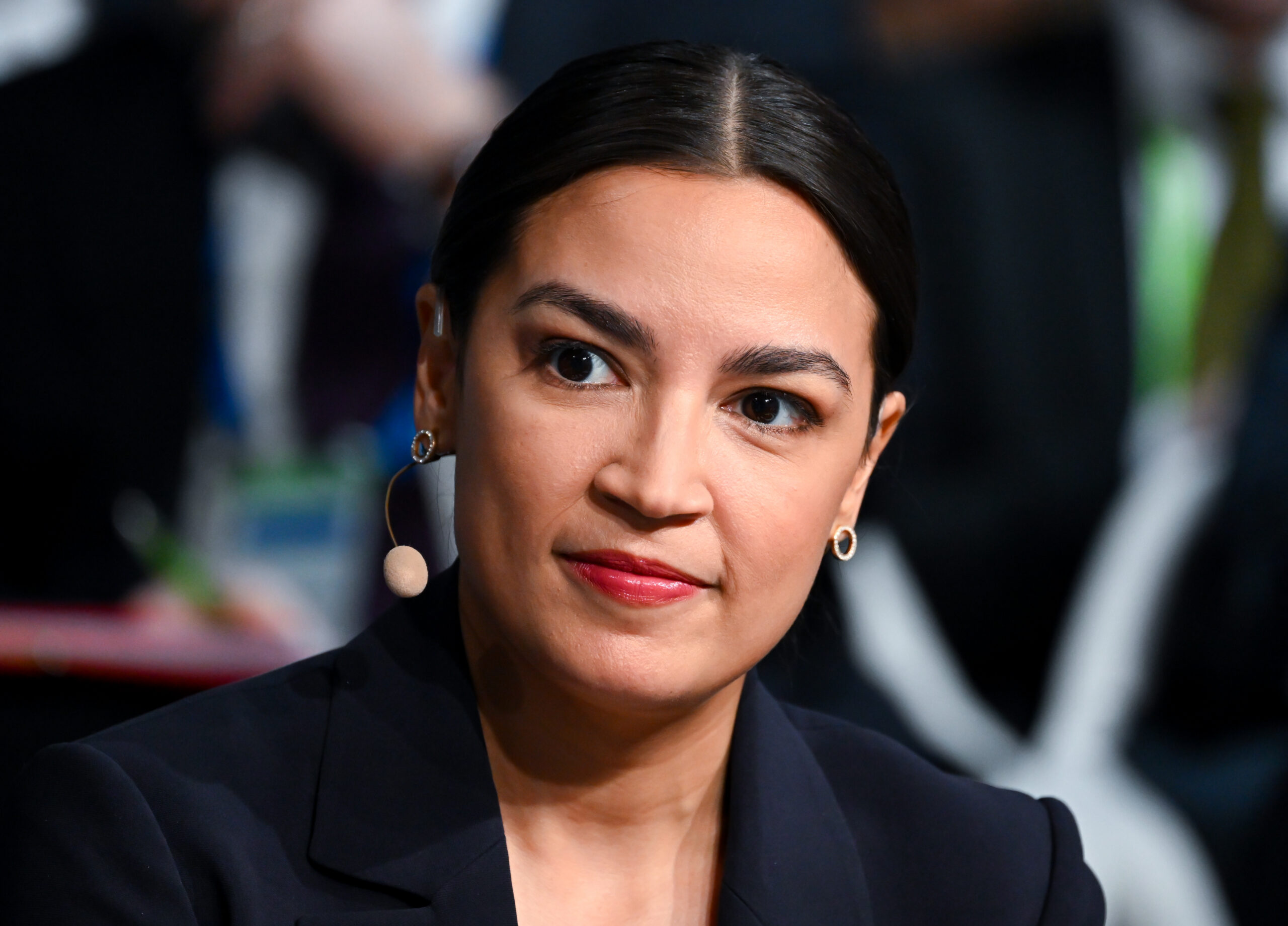
Rep. Alexandria Ocasio-Cortez (D-NY) reportedly committed on Tuesday to opposing “any spending on arms for Israel, including so-called defensive capabilities” for Israel as well as the International Holocaust Remembrance Alliance’s working definition of antisemitism, according to an editor from City & State New York. The New York Democrat made the comments on a Democratic Socialists of America endorsement call on Tuesday evening, Jewish Insider’s Marc Rod reports.
Voting history: Though Ocasio-Cortez has not voted in favor of aid to Israel, she did vote against an amendment last year by then-Rep. Marjorie Taylor Greene (R-GA) to cut funding for defensive systems such as Iron Dome, earning the ire of the far left. “I have not once ever voted to authorize funding to Israel, and I will never,” Ocasio-Cortez reportedly said during the forum. “The Israeli government should be able to finance their own weapons if they seek to arm themselves.”
DATING DILEMMAS

Nearly half (47%) of young Jewish women reported dating less as a result of increased antisemitism and other negative consequences of the Oct. 7, 2023, Hamas terror attacks, according to a new survey by Jewish Women International, Jewish Insider’s Danielle Cohen-Kanik reports.
Survey says: Over one-third (36%) of respondents said they’ve ended existing romantic relationships due to these dynamics, while 18% said they’ve stopped online dating altogether. Many of the Jewish American women surveyed, who were between the ages of 20 and 34, reported other negative impacts to their romantic relationships including strained conversations (75%), arguments (53%) and decreased contact or connection (39%). Read the full story here.
Worthy Reads
Europe’s War Too: In Politico, Axel Springer CEO Mathias Döpfner rejects efforts in European capitals to distance the continent from the war in Iran. “Of course it is our war. It is far more our war than America’s. The infiltration of European societies by Islamist networks is further advanced and more acute here than in America. (And solidarity with Israel, whose very existence is under threat, ought to be far stronger in Germany than in the United States.) But even if one believed it was not our war, or even if one were disappointed not to have been briefed on the plans, there remains a potent strain of European society where proclaiming hatred of Donald Trump is greater than sound self-interest. In those circles, one can almost sense something like schadenfreude whenever something goes wrong for the Americans once again.” [Politico]
Wrong Man for the Job: In The Washington Post, the Foundation for Defense of Democracies’ Behnam Ben Taleblu raises concerns about the Trump administration’s willingness to engage with Iranian parliament Speaker Mohammad Bagher Ghalibaf, as it mulls a Venezuela-like approach to Iran. “If Trump replicates his Venezuela decision and promotes a regime insider like Ghalibaf to the helm, he is unlikely to attain the stability and calm that he seeks in the Middle East. Iranians did not turn out in droves in January and give their lives for musical chairs or ornamental change in Tehran. They are not likely to stop protesting against a corrupt establishment that turned Iran into a failed state and is complicit in their killing.” [WashPost]
These Boots…: Wall Street Journal columnist William Galston considers the challenges facing the Trump administration as Washington weighs ground operations in Iran. “The prospects for negotiations reopening the strait and ending the war are dismal, and there is no guarantee that force can accomplish what diplomacy cannot. The U.S. is in no position, militarily or politically, to mount the kind of all-out invasion of Iran that brought down Saddam Hussein in Iraq. But anything less will probably allow the Iranian regime to survive, which it will trumpet as a victory against the Great Satan.”[WSJ]
Modern-Day Exodus: In Tablet, Rachel Sharansky Danziger, a daughter of refusenik Natan Sharansky, reflects on the retelling of the Passover story as she contemplates passing her own family’s stories to her children. “The Haggadah taught me how to tell my parents’ story, and how to give my kids the liberty to explore it for themselves. Time will tell what they’ll make of it. But in the meantime, my struggles with the latter taught me something about Passover in turn. Perhaps when the authors of the Haggadah told us to see ourselves as if we came out of Egypt, they meant something more than envisioning ourselves wearing tunics, marching out of Egypt with matzos in our sacks. Perhaps they meant that we should take this opportunity to experience what it means to become the authors of our own story.”[Tablet]
Word on the Street
President Donald Trump said he is considering pulling the U.S. out of NATO after members of the alliance failed to assist the U.S. in its military operations targeting Iran…
Arab officials told The Wall Street Journal that the United Arab Emirates is preparing to assist the U.S. in opening up the Strait of Hormuz by force…
The UAE’s Foreign Ministry denied the report, saying that the country “maintains a defensive posture focused on protecting its sovereignty, its people, and its infrastructure, and reserves its right to self-defence in response to ongoing unlawful and unprovoked attacks”…
Supporters of Iranian human rights activist Narges Mohammadi, who is imprisoned in Iran’s Zanjan prison, said the Nobel Peace Prize laureate suffered a heart attack last week and had been denied medical access…
Politico reporter Karl Mathiesen, who earlier this week published a glowing profile of U.N. Special Rapporteur Francesca Albanese, deleted his X account after the resurfacing of his past social media posts, including questioning if “US reluctance to stand up to Israel” was because of the “Jewish lobby”…
American freelance journalist Shelly Kittleson was abducted in Baghdad; a U.S. official said Kittleson was taken by the Iran-backed Iraqi militia Kataib Hezbollah, which previously kidnapped Israeli-Russian researcher Elizabeth Tsurkov and held her for more than two years…
Argentina announced its designation of Iran’s Islamic Revolutionary Guard Corps as a terror organization, citing the group’s support for Hezbollah, which was behind the 1992 bombing of the Israeli Embassy in Buenos Aires and the 1994 bombing of the AMIA Jewish community center…
Michigan state Rep. Carrie Rheingans, who backed out of an upcoming rally with Senate candidate Abdul El-Sayed over the participation of far-left streamer Hasan Piker, told the Michigan Advance that while she is still supporting El-Sayed in the primary, “I don’t appreciate many of Piker’s antisemitic comments. … Maybe Hasan Piker has some room to learn how his comments affect other people, but I have to say, Jews, Muslims, and Arabs in Michigan are hurting for a lot of really good reasons right now”…
A federal judge ordered the University of Pennsylvania on Tuesday to comply with a subpoena from the Trump administration requesting detailed information about Jewish university affiliates as part of the government’s crackdown on campus antisemitism, Jewish Insider’s Haley Cohen reports…
New York City Mayor Zohran Mamdani lifted City Hall’s ban on TikTok for use by government officials…
Mark Cuban said he regretted selling the Dallas Mavericks to the Adelson and Dumont families, saying he “made a lot of mistakes in the process” of the December 2023 sale…
“Denial,” the 2016 film starring Rachel Weisz about former antisemitism envoy Deborah Lipstadt’s legal battle against Holocaust denier David Irving, will be added to Netflix’s offerings this month…
ESPN reports that Israeli American basketball coach Amar’e Stoudemire will be inducted into the Naismith Basketball Hall of Fame Class of 2026…
The U.K.’s Jewish Leadership Council condemned the decision by the organizers of the annual Wireless festival to have Kanye West, known as Ye, headline each night of the three-night festival, saying that West has “repeatedly used his platform to spread antisemitism and pro-Nazi messaging”…
The mayor of the British city of Bath resigned after controversy over his sharing of social media posts suggesting that the arson attack targeting Hatzola ambulances in London’s Golders Green suburb was an Israeli false flag operation…
Bill Ackman purchased a $20 million luxury apartment in Tel Aviv’s Rothschild 10 development…
Israel is ending all defense procurement from France, the Israeli Defense Ministry said, citing Paris’ hostile posture toward Jerusalem and a desire to increase domestic production and purchases from allies, Jewish Insider’s Matthew Shea reports…
Cleveland native Joshua Kramer was named the next CEO of Ohio Jewish Communities, succeeding Howie Beigelman; Kramer, who will assume the role in June, has led the American Jewish Committee’s New York regional office since 2021…
Director Slava Tsukerman, whose 1982 “Liquid Sky” became a cult classic, died at 86…
Pic of the Day

Men in the Israeli city of Bnei Brak on Tuesday burned pieces of leavened bread in preparation for the Passover holiday.
Birthdays
Singer-songwriter best known as the original lead guitarist for Sha Na Na and as the youngest person, at age 18, to play on the main stage at Woodstock in 1969, Henry Gross turns 75…
Physicist and 1997 Nobel Prize laureate Claude Cohen-Tannoudji (the hyphenated last name means simply the Cohen family from Tangiers) turns 93… Psychotherapist in South Florida, Annie Schlachet Garfield, LCSW… Former member of the Knesset for the Likud party, he is a nephew of Moshe Dayan, Uzi Dayan turns 78… Former Sephardic chief rabbi of Israel, Rabbi Shlomo Moshe Amar turns 78… Research professor at Boston University noted for her studies in relation to parrots, Irene Maxine Pepperberg, Ph.D. turns 77… Former president and CEO of the Michigan League for Public Policy, she was previously a Democratic member of the Michigan Senate, Gilda Z. Jacobs turns 77… Associate justice of the Supreme Court of the U.S. since 2006, Justice Samuel Anthony Alito Jr. turns 76… Professor at SUNY New Paltz, her writing is focused on presidential war powers and national security law, Nancy Kassop turns 76… Producer and director for film and television including the “Men in Black” trilogy, he was originally a cinematographer for the Coen brothers, Barry Sonnenfeld turns 73… Lecturer at Stony Brook University’s School of Journalism, he is a columnist for Straus Media, Jonathan P. Friedman… Six-term member of the U.S. House of Representatives from Florida, he is the founder of the Ben Gamla Charter School in Florida (2007) and now lives in Ra’anana, Israel, Peter Deutsch turns 69… President of Baltimore-based HealthSource Distributors, Jerry L. Wolasky turns 68… Author of over 200 children’s books, Mark Shulman turns 64… Former member of the Knesset for the Kadima party, she made aliyah from the Soviet Union in 1979, Yulia Shamalov-Berkovich turns 62… VP of the Euro-Asian Jewish Congress and a leader of the Jewish community of Kyiv, Ukraine, Alexander “Aaron” Levin turns 58… Lawyer, turned political thriller novelist, Brad Meltzer turns 56… Israeli writer, speaker and blogger, Daniel Ravner turns 50… Senior policy advisor to then-VPOTUS Kamala Harris, earlier she was the COO at J Street, Jessica “Jess” Smith turns 49… Professor at Villanova University, he won a gold medal in soccer at the Pan American Maccabi Games in 2008, Bret Myers turns 46… Four-year star basketball player at the University of Maryland including a national championship (2006), she was drafted by the WNBA but played mostly in Israel, Shay Doron turns 41… Film and television actor, Joshua Ryan Zuckerman turns 41… Associate at Debevoise & Plimpton, Noah L. Schwartz… Former assistant secretary for public affairs at the U.S. Treasury, her grandmother is noted philanthropist Lynne Honickman, Julia Aviva Hahn turns 35… Ronald Lippman…
The foiled attack at the Michigan synagogue is being called a miracle — but those who were inside now face the lasting impact of trauma and a search for safety

JEFF KOWALSKY / AFP via Getty Images
Law enforcement vehicles are seen parked outside Temple Israel guarding the scene in West Bloomfield, Michigan, on March 13, 2026.
WEST BLOOMFIELD, Mich. — Pop. Pop. Pop. Liz Rosenbaum heard the unmistakable sounds of a gun being fired and took a deep breath as the 4-year-old boy next to her looked her way, wide-eyed. Even in the best of times, he was an anxious kid. This was not one of those times. “Was that a gun?” he asked.
Without missing a beat, Rosenbaum reminded the boy that the classroom across the hall in the Temple Israel Early Childhood Center had a bunch of balloons set up earlier for someone’s birthday. They must’ve popped, she suggested. “Remember? You saw the balloons in their class,” she told the child.
Rosenbaum, a retired Detroit public school teacher, locked eyes with the much younger teacher across the room and whisper-yelled to her: Don’t show any emotion. Just take care of the kids. So they held the babies — to a preschool teacher, any child is a baby — and waited, not knowing anything beyond the fact that someone was shooting a gun and the smell of smoke was getting worse. Rosenbaum’s 5-year-old grandson, Theo, was in a nearby classroom, but she had already gotten word from her daughter, via Theo’s teacher, that he was OK.
Seconds or minutes or hours later — it was hard to know — police officers came to the door. Rosenbaum’s co-teacher was perched at the door’s little window, peeking through a one-way blackout shade that allowed teachers to look out but kept outsiders from seeing in.
The officers said the code word that the teachers had been trained to know would reveal the person on the other side of the door was, in fact, one of the good guys. The teachers opened the door and grabbed the kids, carrying or pulling or holding or dragging, whatever it took to obey the officers’ command to “get out of here, fast.”
“[The kids] knew something was going on. I said, ‘Remember these officers you studied? You read about them. We talked about them. Those are our helpers,’” Rosenbaum recalled telling the kids. Two days earlier, police and firefighters had visited the preschool, located in the largest Reform congregation in Michigan, as part of a lesson.
A cadre of preschool teachers carried babies and led toddlers out the back door of the synagogue, first to an ambulance that was too crowded, and ultimately onto a West Bloomfield School District bus that took them across the street to a country club for the Chaldeans, an Iraqi Christian community. Some teachers had to run with their kids to get there. You’re a dinosaur — run as fast as you can! they said, hoping to hurry the kids along without scaring them.

Rosenbaum and the entire world would soon learn that a Lebanese immigrant — later revealed to have ties to the terror group Hezbollah — had driven a truck packed with explosives into Temple Israel around noon that day. Cable news networks showed aerial shots of smoke billowing from the roof of the synagogue and reported in alarming chyrons that an active shooter was inside. The attacker got out of his car and started shooting before he died of a self-inflicted gunshot wound.
Every child in Rosenbaum’s classroom walked out of Temple Israel alive. In fact, every person who was already in the building survived; the only person who was injured was a security guard, hailed as a hero and already on the mend. (He was apparently quite pleased that, in his moment of need, he convinced a Temple Israel rabbi to buy him a sandwich with bacon to bring to his hospital room.)
The story of Temple Israel is one of miracles. The building’s sprinkler system turned on, soaking everything in the building except for the Torah scrolls. Miracle. The hallway where the attacker rammed his car was set aflame, burning most of the photos that lined the wall showing the synagogue’s annual confirmation classes but sparing the oldest photos, from decades ago, which were not digitized and otherwise would’ve been lost forever. Miracle. Teachers trained in active-shooter protocols acted quickly and meticulously to secure their classrooms, and security guards performed their jobs perfectly. Miracle. No children were in the hallway in the path of the truck. Miracle upon miracle upon miracle.
“Nes gadol hayah poh,” Noah Arbit, a lifelong member of Temple Israel and a Michigan state representative whose district includes the synagogue, said last week in an interview with Jewish Insider at a bakery a couple of towns over. A great miracle happened here. It was a riff on a Hebrew phrase used on Hanukkah, the holiday that celebrates the Jews’ miraculous victory over the ancient Greeks during the time of the Second Temple in Jerusalem. Usually, Jews living in the diaspora say a different version of the phrase that translates to “a great miracle happened there.” This time, the miracle was here in Michigan.
”I think if it happened anywhere else but Temple Israel, we probably could have had a massacre. Temple Israel benefits from scale and resources in a way that other synagogues around here don’t,” said Arbit, a Democrat.
But it is not accurate to say that this is only a story of miracles. For people who don’t live in West Bloomfield, once the headlines shifted from “active shooter at a synagogue” to “antisemitic attack thwarted,” many moved on. Jews in Metro Detroit did not. For them, this story of miracles was first a story of terror, of fear, of never being able to un-learn the feeling of dread that comes from not knowing whether your child is alive or dead.
“People are traumatized, and there’s no way around it,” Rabbi Josh Bennett, who has been on the pulpit at Temple Israel for 33 years, told JI last week. “And yet there’s an entirely different world out there, which is the world talking about miracles, and thank God nobody was injured. And that’s actually very dissonant, because the rest of the world has kind of moved on, and they’re just waiting for us to reopen the building.”
The path toward healing is not as straightforward as just reopening the building, and even that will be complicated and time-intensive.
“The building will be rebuilt. If you drive by there now, you’ll see there’s construction workers working on it right now, and they’re drying it out, and they’re redoing the drywall and fixing it. It will come back bigger and better,” said Steve Ingber, a Temple Israel member and CEO of the Jewish Federation of Metropolitan Detroit.
There’s also the question of where to have Temple Israel’s preschool meet for the rest of the school year. The ECC students have been holding playdates together as the school remains closed and Temple Israel looks to find an alternate place for the school to meet.
But first and foremost is the lingering emotional trauma that is only beginning to be unpacked.

“We don’t want to leave anyone behind. We don’t want anyone to feel like they are isolated and living in a black hole, and after this traumatic moment and after a mass violence experience, that is often the case, is what I’m learning from these professionals,” said Rabbi Arianna Gordon, Temple Israel’s director of education and lifelong learning. “It’s really easy to fall into that black hole and really feel like you’re invisible, feel like you’re isolated. And we are really, really trying to make sure that everyone feels seen and feels helped and feels heard.”
On March 12, the day of the attack, Gordon heard a loud boom that she later learned came from the truck driving into the building. She opened her office door and saw a stroller overturned in a pile of broken glass. A security guard shouted to get back in the room, and she took her staff to shelter in place in a far corner of a new office they had moved into only two days earlier. She sent a message to all the teachers, telling them to implement lockdown procedures.
Her 2-year-old son was in the building. When Gordon and her colleagues were evacuated, she waited outside the building until her son came out.
“Rachel, our ECC director who ran out with me, will say that my voice screaming for my child, when we were running out, will forever haunt her,” said Gordon. She doesn’t remember making a sound.
Most of all, as social workers and rabbis work to meet community members’ emotional needs, the biggest unanswered question has to do with security: Is there enough? Even if so — and by all accounts, Temple Israel’s large security operation saved lives — how do community members make sense of the fact that their sense of safety has now been shattered? That a man from a nearby community pledged his allegiance to a foreign terrorist group and sought to bring tremendous harm to Jewish children?
“It hurts more than I ever thought that it would. I think there’s a lot of people who feel that way. It’s a beautiful building and a sacred space,” said Arbit, the state representative. He blinked back tears. “Sorry. It’s been really hard.”
The day of the attack, Ingber was getting ready to leave the federation office in nearby Bloomfield Hills for lunch when he heard the security radio crackle to life. The Jewish Federation of Detroit employs 23 security officers throughout the community’s schools and synagogues, and each of them carries a radio. The one in Ingber’s office goes off each morning around 8 a.m., a tech check to make sure it works. It sits quiet the rest of the time. Except on March 12. “SHOTS FIRED,” a voice announced over the radio.
“First, it took me a second, like, Wait, did I just hear that?” Ingber recalled during an interview in his office last week. “From there, we heard that this was real, and then we immediately started working on it, and that entailed sending every other Jewish building in town into lockdown, because we don’t know: Is this a one-off, or is this a coordinated attack?”
Security is the biggest annual line item expense for the Jewish federation, as it is for many Jewish institutions. The federation has made more than $1 million in security funds available to local organizations since the attack. Jewish activists from Detroit and around the country went to Capitol Hill the week after the attack to lobby Congress to increase the amount of money in the federal Nonprofit Security Grant Program.
But for the 75,000 or so Jews in the Detroit metropolitan area, the need still feels almost impossible to meet.
“I still feel, despite everything, that Temple Israel is incredibly safe, because what happened was our team protected us. They protected the staff and the children,” said Elyssa Schmier, the regional director of the Anti-Defamation League’s Michigan office and a Temple Israel member. Her 5-year-old son goes to another Jewish preschool in the area that is smaller, with less of a security presence.
”My son’s preschool was — the security was fine. I wouldn’t say it was great, and we’ve kind of known all along it wasn’t super great. So now they’ve had to put in full-day armed security and go with a new company. People weren’t sending their kids to school until that went into place. We’ve had a couple families pull out altogether,” Schmier said in a conversation last week in a coffee shop near West Bloomfield. “The additional cost is astronomical now of what the school’s going to have to take on.”
All of the added security means even more closed doors at a time when the Jewish community longs more than ever for allies.
“Things that are part of the strength of the Michigan Jewish community are now being looked at with an eye of concern, and the irony of that, for a community that so values community building and institutions is, I think, not lost on anybody,” Sen. Elissa Slotkin (D-MI) told JI last week.
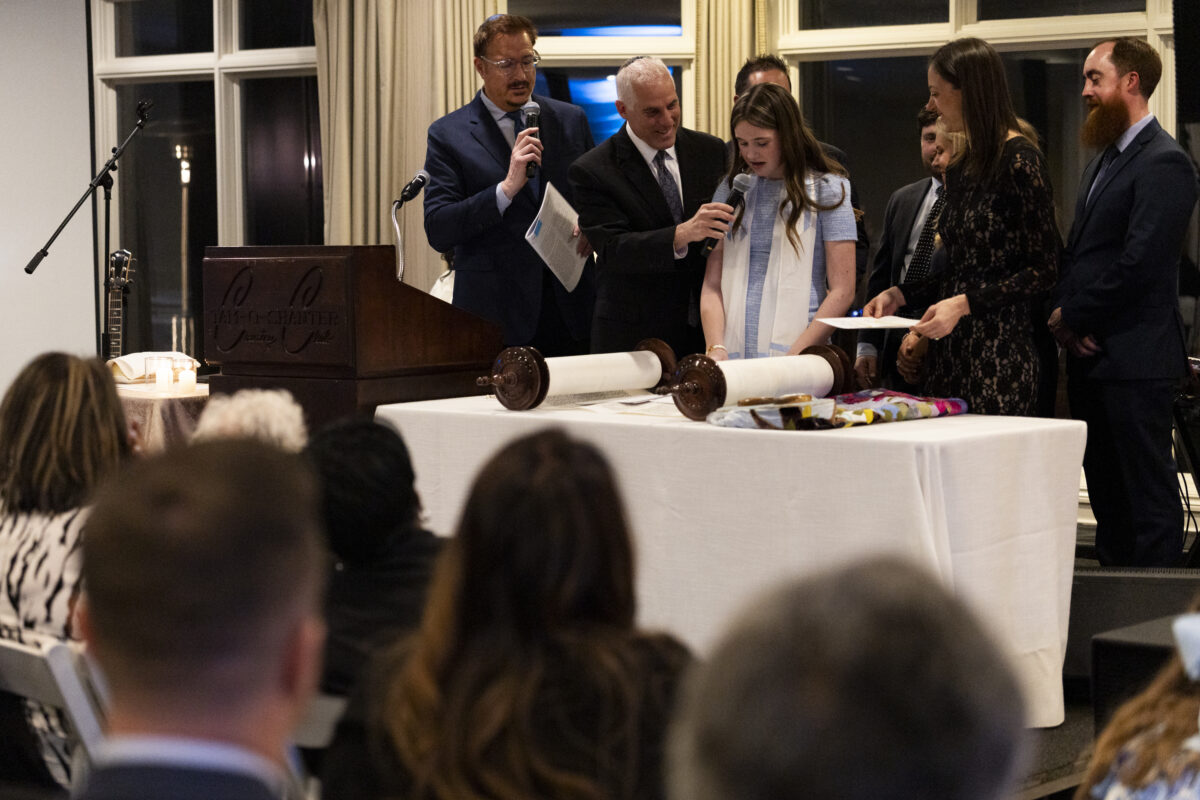
Jeremy Moss, a Democratic state senator who attends a Conservative synagogue in the area, said over a meal of rye bread, pickles and chicken soup at a West Bloomfield deli last week that the Temple Israel attack warrants a much larger outcry from outside the Jewish community than it is getting. Moss, who is running for Congress this year, is the only Jewish member of the Michigan state Senate. He is also the only LGBTQ member of the Senate. He knows that those two parts of his identity are often treated differently.
“When I talk about LGBTQ rights, I have my Democratic colleagues rushing to be behind me, to stand in solidarity, to allow me to lead on the discussion, to allow me talk about what is homophobic and transphobic, to back me up,” he said.
“In the past several years, when I talk about antisemitism, it feels like I’m talking alone, or that I’m challenged, or that I’m lectured, not necessarily by my colleagues, but lectured about what is antisemitism from others, rather than allowing my own experience to be accredited, to be valid,” he added. “It’s a very isolating, lonely feeling, and it really makes you realize how small the Jewish community is and how difficult it is to get our lived experience heard and supported.”
The attack on Temple Israel, and the fact that no one died, offers a “second chance,” Moss said. Not just for the parents and children, he said, but “for all of us.”
“Whether you’re on the left, this is a second chance to speak out if you haven’t spoken out before. Whether you’re on the right, this was a second chance for them,” Moss said, taking aim at his Republican colleagues who did not support a major hate crimes package passed last year. “I think there’s a lot of second chances going on as a result of this incident, where every child went home healthy to their parents that day. The question is, what are we going to do with that?”
For a lot of people at Temple Israel, it’s too early to think about what all of this means. The pain is too raw. Because here’s what they know: A man was able to park in the Temple Israel parking lot, sit there for two hours listening to Arabic battle anthems while texting his sister and other family members about his plans and drive his truck head-on into the building, while teachers shushed children and sang them songs just feet away.
What could be normal after that?
“It needs to be driven home over and over again: A person who drives their vehicle with fireworks and gasoline into an early childhood center with the intent of killing children and Jews — that is antisemitism,” said Bennett, the senior rabbi. “It is impossible to be in an event like this without being forever changed. It is an indelible mark on the soul of our congregation.”
In a strange irony, many of the kids who were at Temple Israel during the attack are unfazed. Some were too young to notice anything out of the ordinary. The slightly older kids experienced the chaos, but they mostly felt lucky to get an unexpected field trip that came with chicken tenders, pizza and games. Parents whose younger children were at the ECC are struggling to describe what happened to their older kids.
“When they ask, like, why do people hate Jews, it is really hard to be a parent and to be an educator in this moment and figure out the right things to say to our children,” said Gordon, the education director. Her 2-year-old is, of course, not asking those questions; he was mostly asleep throughout the attack, which occurred during nap time. But her 7- and 9-year-old kids are.
“I say that I don’t have a good explanation. I can’t tell you why people hate Jews. But what I can tell you is that there also are people who are really incredibly helpful and wonderful and supportive of our Jewish community, and we want to focus on that,” said Gordon.

The day after the attack, Shabbat services were held at Shenandoah County Club, the Chaldean club that had opened its doors a day earlier as a reunification center during the attack. Last Friday, Temple Israel’s members met inside another West Bloomfield synagogue. At least 200 people joined the service, eager to hug each other and sing together and live out the beautiful parts of being Jewish. But they were reminded at every moment that they were living in a world transformed by ugliness.
Police cars parked out front directed traffic, and anyone coming in had to pass seven or eight security guards as they walked through a metal detector. During the service, security guards slowly walked around the room, monitoring the crowd. One guard stood like a sentry at the sanctuary’s big window, eyes fixed on whatever unknown threats might be lurking outside on the frigid early spring evening.
Indoors, Temple Israel’s rabbis and cantor joyfully ushered in Shabbat with a musical service. They told congregants about webinars being offered by mental health professionals. They shared that the synagogue’s staff were being given the entire week of Passover off so they could relax with their families.
The rabbis and ECC staff had been allowed back into the synagogue briefly to be able to take items from their offices before cleanup crews disposed of the rest, most of which was waterlogged or burned. One of them grabbed a box of large, colorful plastic bricks.
As people left the service, they were invited to take one of those bricks home with them to place on their Seder plates. It would be a bitter reminder of what Temple Israel had endured. But more importantly, it would remind people that with the help of its dedicated and loving community, Temple Israel will rebuild.

For Rosenbaum, the Temple Israel preschool teacher, it’s been a challenging few weeks. She woke a few days after the attack from a nightmare. She stepped outside, breathing in the fresh air. She is in therapy. Babysitting the Temple Israel toddlers who are now out of school helps, too. She will be back teaching at Temple Israel as soon as she is allowed.
“My mother taught me, when you fall off a bicycle, you get back on and you learn to ride it. When you get in an auto accident, you get back in the car and you learn to drive it. I taught my kids that. And Temple Israel is very strong. We are going to go back. We’re going to go back as being strong and supporting and loving one another, like we do,” said Rosenbaum.
“In the grand scheme of things, Hashem was with us.”
‘I have not once ever voted to authorize funding to Israel, and I will never,’ Ocasio-Cortez said during a Democratic Socialists of America endorsement call, according to an editor from City & State New York
Sven Hoppe/picture alliance via Getty Images
Rep. Alexandria Ocasio-Cortez (D-NY) takes part in the Munich Security Conference.
Rep. Alexandria Ocasio-Cortez (D-NY) reportedly committed on Tuesday to opposing “any spending on arms for Israel, including so-called defensive capabilities” for Israel as well as the International Holocaust Remembrance Alliance’s working definition of antisemitism, according to an editor from City & State New York.
The New York Democrat made the comments on a Democratic Socialists of America endorsement call on Tuesday evening.
“I believe the Israeli government is well able to fund the Iron Dome system, which has proven critical to keep innocent civilians safe from rocket attacks and bombardment. Consistent with my voting record to date, I will not support Congress sending more taxpayer dollars and military aid to a government that consistently ignores international law and U.S. law,” Ocasio-Cortez said in a statement.
“Netanyahu’s allies in the Knesset just approved a $45 billion defense budget, and the Prime Minister himself also asserted his interest in withdrawing from the MOU in January,” she continued. “It is fully within their ability to fund Iron Dome and other defensive systems. Our allies who need our military aid must understand that we will provide it consistent with the Leahy amendment and the foreign assistance act.”
Though Ocasio-Cortez has not voted in favor of aid to Israel, she did vote against an amendment last year by then-Rep. Marjorie Taylor Greene (R-GA) to cut funding for defensive systems such as Iron Dome, earning the ire of the far left.
“I have not once ever voted to authorize funding to Israel, and I will never,” Ocasio-Cortez reportedly said during the forum. “The Israeli government should be able to finance their own weapons if they seek to arm themselves.”
The systems in question have no offensive use, and are only used to intercept incoming attacks on Israel. Just five lawmakers — Reps. Ilhan Omar (D-MN), Al Green (D-TX), Summer Lee (D-PA), Thomas Massie (R-KY) and Rashida Tlaib (D-MI) — voted with Greene on the amendment.
Last year, Ocasio-Cortez framed the vote as a clear choice.
“Marjorie Taylor Greene’s amendment does nothing to cut off offensive aid to Israel nor end the flow of U.S. munitions being used in Gaza. Of course I voted against it,” she said. “What it does do is cut off defensive Iron Dome capacities while allowing the actual bombs killing Palestinians to continue. I have long stated that I do not believe that adding to the death count of innocent victims to this war is constructive to its end. That is a simple and clear difference of opinion that has long been established.”
Some on the far left have resurfaced that vote in recent days to criticize Ocasio-Cortez, and circulated a petition opposing an endorsement if she didn’t change her stance. During a standalone vote in 2021 on Iron Dome funding, Ocasio-Cortez ultimately voted present, but said she regretted not voting against the funding.
She suggested on the forum that DSA members were misrepresenting her record in a way that would make it harder to grow the group’s membership. “It does not benefit us as a movement, because I see when we try to persuade our colleagues, I see the effect that that has when people feel like if they vote our way, they are just going to be lied about anyway,” she said.
Ocasio-Cortez’s commitment to the DSA suggests she has no plans of moderating her stance on Israel — even to support purely defensive systems that still enjoy support among progressives critical of Israel — as she looks toward a potential bid for higher office.
Though she voted against the Antisemitism Awareness Act, which would codify the Department of Education’s use of the IHRA definition, Ocasio-Cortez still took heat from the far left for voting for a nonbinding resolution expressing support for the State Department’s global guidelines on combating antisemitism.
Those nonbinding recommendations, issued by the State Department under the Biden administration and dozens of international partners, recommend that governments around the world adopt the IHRA definition.
Just 21 House members — mostly from the right wing of the GOP — voted against the resolution, including Omar, Tlaib and then-Rep. Cori Bush (D-MO), who were the only Democrats to oppose the resolution.
A new survey by Jewish Women International found that young women experienced major disruption to their dating lives in the aftermath of Oct. 7, with some now seeking out Jewish partners

Getty Images
Rear view of a young couple sitting side by side on a bench in a city park during autumn.
Nearly half (47%) of young Jewish women reported dating less as a result of increased antisemitism and other negative consequences of the Oct. 7, 2023, Hamas terror attacks, according to a new survey by Jewish Women International.
Over one-third (36%) of respondents said they’ve ended existing romantic relationships due to these dynamics, while 18% said they’ve stopped online dating altogether.
Many of the Jewish American women surveyed, who were between the ages of 20 and 34, reported other negative impacts to their romantic relationships including strained conversations (75%), arguments (53%) and decreased contact or connection (39%).
One respondent described ending a relationship over “our differing levels of Zionism” and while another experienced “tension in our relationship” on the “first anniversary of Oct. 7.” One said she “ultimately ended my relationship with my partner because he was always so angry about Gaza but never showed any anger toward antisemites, toward Hamas, or even to an antisemitic gunman who killed two of my peers.”
A vast majority (71%) of respondents said they’d changed what they’re looking for in a dating partner in the aftermath of the attacks, which for several meant seeking out exclusively Jewish partners,
“I decided to only date Jewish to avoid any blatant antisemitism, and also to ensure that there would be common ground,” one wrote. “Before October 7, like, sure, I wasn’t opposed to going on a date with someone who wasn’t Jewish, and exploring that opportunity. And now — not really so much,” another said. “Felt deeper connections to Jews I know and are strangers. Exclusively wanted to date only Jews,” another wrote.
Jewish singles have been grappling with the impact of increasingly heated antisemitic rhetoric on dating apps and among potential romantic interests for years now, as several told Jewish Insider in 2024 that they too had pivoted to seeking a Jewish partner as they waded through politically charged rhetoric on dating profiles.
Even more than their dating lives, survey respondents experienced negative impacts to their mental health (75%) and friendships (74%), with 80% reporting decreased contact in their platonic relationships. For those on college campuses, 68% said their sense of belonging was damaged in the aftermath of Oct. 7, and 63% said the same of their relationships with their classmates.
In professional settings, 39% of respondents said they’d felt pressured to minimize their Jewish identity and 18% said they’d removed Jewish content from their resumes. Several said in written responses that they’d been drawn to work in Jewish advocacy by their experiences.
“JWI has dedicated significant time and resources to a comprehensive national survey of the impact of antisemitism and misogyny on young Jewish women. Based on our findings, young Jewish women feel disenfranchised in the workplace, ostracized in social circles, and compelled to erase their Jewish identities for fear of personal safety,” said Meredith Jacobs, CEO of JWI, who added that the organization will focus its programming on “post-traumatic growth.”
“As the mothers of the next generation of the Jewish diaspora, the support these women receive will directly impact the future of Jewish peoplehood,” Jacobs continued.
The 514 respondents were largely reached through JWI’s networks, including focus groups at the organization’s leadership conference, between Nov. 11-Dec. 22, 2025.
Plus, judge rules against UPenn in antisemitism investigation

Haidar Mohammed Ali/Anadolu via Getty Images
Mourners carry the coffin of Kata'ib Hezbollah member on March 2, 2026 amid Kata'ib Hezbollah flags.
This P.M. edition is reserved for our premium subscribers — offering a forward-focused read on what we’re tracking now and what’s coming next. Please don’t hesitate to share your thoughts and feedback by replying to this email.
📡On Our Radar
Notable developments and interesting tidbits we’re tracking
President Donald Trump lashed out at European countries this morning for their posture during the war in Iran: He wrote on Truth Social that France is prohibiting planes with military supplies destined for Israel from flying over its territory, calling Paris “VERY UNHELPFUL … The U.S.A. will REMEMBER!”
Trump also named the U.K. among the countries “which refused to get involved in the decapitation of Iran” and are now struggling to acquire fuel due to the effective closure of the Strait of Hormuz. “[G]o to the Strait, and just TAKE IT. You’ll have to start learning how to fight for yourself, the U.S.A. won’t be there to help you anymore, just like you weren’t there for us,” the president warned…
Trump told the New York Post about reports that he’s willing to end the war without reopening the Strait of Hormuz: “I don’t think about it, to be honest. My sole function was to make sure that they don’t have a nuclear weapon. They’re not going to have a nuclear weapon. When we leave the strait will automatically open.”
He similarly said to CBS News about removing Iran’s enriched uranium, “I don’t even think about it. I just know that, you know, that’s so deeply buried it’s gonna be very hard for anybody. … It’s pretty safe. But, you know, we’ll make a determination”…
During a press briefing this morning, Defense Secretary Pete Hegseth revealed that he took a secret trip to the Middle East in recent days to meet with U.S. servicemembers, including Air Force intelligence analysts, Army troops and pilots.
CENTCOM also confirmed that Adm. Brad Cooper visited Israel earlier this week where he met with Defense Minister Israel Katz and Lt. Gen. Eyal Zamir, the IDF’s chief of staff…
Israel is ending all arms purchases from France and “replacing it with domestic Israeli procurement or purchases from allied countries,” the Israeli Ministry of Defense said today, adding that there will be “no new professional engagement with the French military” in the latest rift in the deteriorating relationship between Jerusalem and Paris…
A week after Lebanon declared Iran’s ambassador to Beirut persona non grata and expelled him from the country, the ambassador has still refused to leave the embassy compound, and Iran has stated that the embassy remains open…
China and Pakistan, which has been the intermediary for indirect negotiations between the U.S. and Iran, put forward a ceasefire proposal that would see the immediate cessation of hostilities, the safeguarding of nonmilitary targets and the restoration of transit through global shipping lanes…
American journalist Shelly Kittleson was kidnapped in Baghdad, Iraq, today, according to the Iraqi interior ministry, reportedly by Kataib Hezbollah, the same group that held researcher Elizabeth Tsurkov for over 900 days. Kittleson is a freelance journalist primarily based in Europe who has written for outlets including Al-Monitor and Foreign Policy.
Dylan Johnson, assistant secretary of state for global public affairs, said in a statement that the State Department “is aware of the reported kidnapping” and had “previously fulfilled our duty to warn this individual of threats against them.” Johnson said an “individual with ties” to Kataib Hezbollah “has been taken into custody” in connection with the kidnapping and that the department will coordinate with the FBI to secure Kittleson’s release…
New York City Mayor Zohran Mamdani attended a dinner for Eid last week where he spoke with antisemitic streamer Hasan Piker, a conversation that Piker called “very productive” on a recent Twitch stream.
“No, he did not disavow me,” Piker said in response to a listener’s question. “‘Did you tell him to tune out the bad faith haters?’ I did,” Piker continued. Mamdani appeared on Piker’s Twitch for an interview during the mayoral campaign but has not met with him publicly since…
“Nope,” Rep. Josh Gottheimer (D-NJ) said in response to a video of Sen. Bernie Sanders (I-VT) claiming that, “in many respects,” Piker “is doing a very good job.” “Hasan Piker is a proud antisemite … His voice should have no place in our political discourse and all elected officials should condemn his rhetoric,” Gottheimer wrote…
Michigan Attorney General Dana Nessel, a Jewish Democrat, shared an image of a sign which read, “A Jewish data center has no home here,” displayed outside a town hall she held yesterday urging caution around the approval of data centers. “If you think antisemitism isn’t a problem in Michigan, think again,” Nessel wrote…
A new poll commissioned by former Maine state Sen. Troy Jackson, now a Democratic candidate for governor, found oyster farmer Graham Platner — whom Jackson is backing — nearly 40 points ahead of Gov. Janet Mills in the state’s Senate race (66-28%) among likely Democratic primary voters. The survey was conducted after Mills had started running ads against Platner based on his past controversial statements, a sign that her line of attack may not be persuading voters…
And another poll commissioned by the Senate Majority PAC, a Democratic group, found Texas Attorney General Ken Paxton leading in the heated Republican primary runoff for Senate against incumbent Sen. John Cornyn (R-TX), 47-42%…
A federal judge ruled that the University of Pennsylvania must comply with a subpoena from the Trump administration that seeks information about Jewish university affiliates, which the university had said resembled nefarious efforts by governments over history to gather lists of Jews…
⏩ Tomorrow’s Agenda, Today
An early look at tomorrow’s storylines and schedule to keep you a step ahead
Keep an eye out in Jewish Insider for a report from West Bloomfield, Mich., where JI’s Gabby Deutch sat down with community members still reeling from the attack on Temple Israel earlier this month.
Democrat Analilia Mejia and Republican Joe Hathaway will participate in a debate tomorrow evening ahead of the April 16 special election in New Jersey’s 11th Congressional District, after Mejia eked out a surprise victory in last month’s primary. While this race will decide who serves out the rest of Gov. Mikie Sherrill’s House term, the progressive Mejia is also running essentially unopposed by other Democrats for the full term.
In observance of Passover, we’ll be back in your inbox with the Daily Overtime on Monday, April 6. Chag Pesach Sameach!
Stories You May Have Missed
COMMUNITY TIGHTROPE
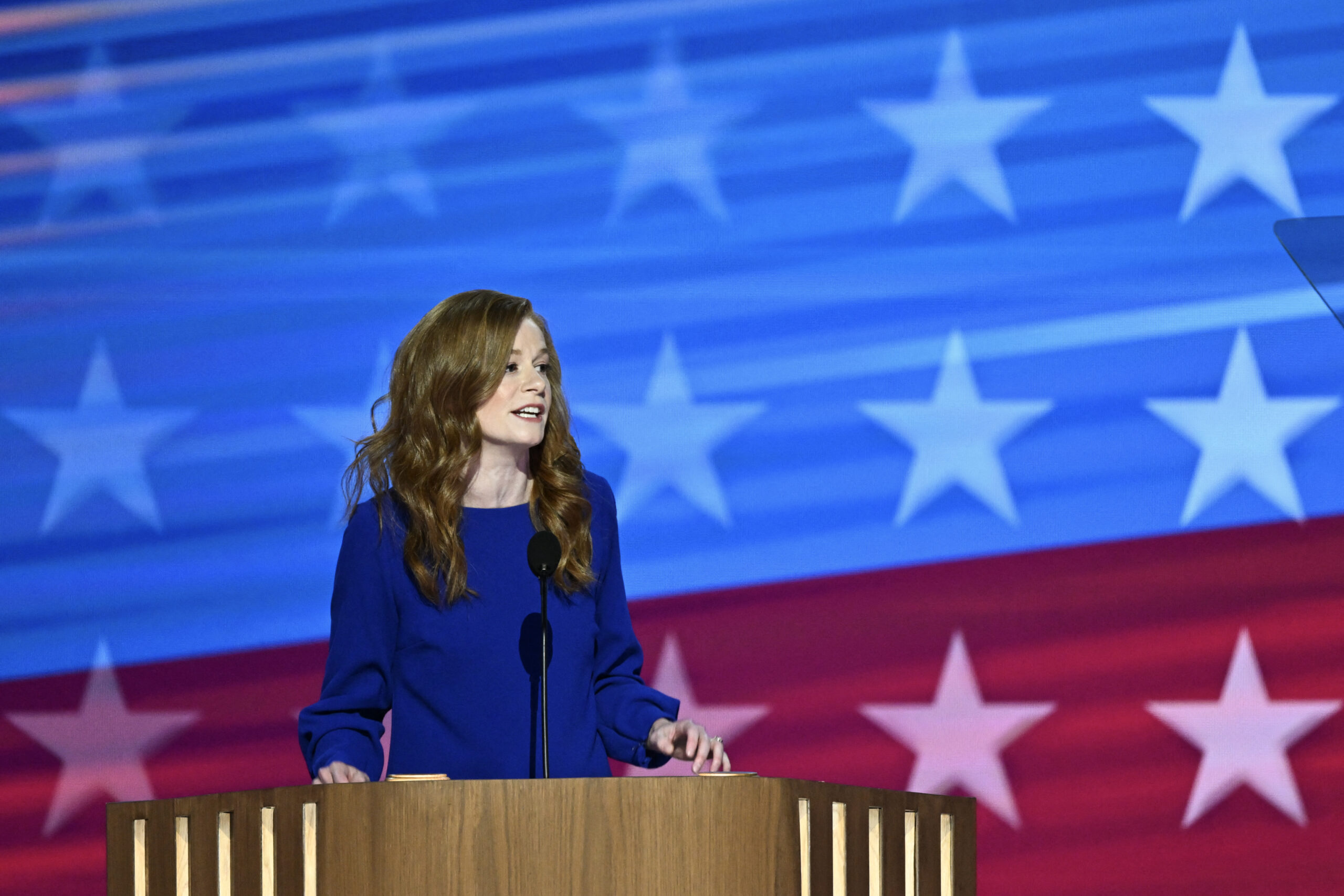
In an interview with JI, the state senator described herself as someone who supports the U.S.-Israel relationship, but not unconditionally
DECISION TIME

As the president touts progress in talks with Tehran while escalating military pressure, analysts say the administration is keeping its options open — but will need to make a move soon
Plus, one AI rabbi down but more pop up

Emily Elconin/Getty Images
Caution tape near the front entrance of Temple Israel a day after an active shooter incident on March 13, 2026 in West Bloomfield, Michigan.
This P.M. edition is reserved for our premium subscribers — offering a forward-focused read on what we’re tracking now and what’s coming next. Please don’t hesitate to share your thoughts and feedback by replying to this email.
📡On Our Radar
Notable developments and interesting tidbits we’re tracking
President Donald Trump doubled down on threats to escalate the war in Iran while simultaneously heralding the success of ongoing negotiations: He claimed on Truth Social this morning that the U.S. is in “serious discussions” with a “new” and “more reasonable” Iranian regime and that “great progress has been made.”
“But,” he added, “if for any reason a deal is not shortly reached, which it probably will be, and if the Hormuz Strait is not immediately ‘Open for Business,’ we will conclude our lovely ‘stay’ in Iran by blowing up and completely obliterating all of their Electric Generating Plants, Oil Wells and Kharg Island (and possibly all desalinization plants!)”…
Trump confirmed to the New York Post that the U.S. is engaging with Iranian parliament speaker Mohammad Bagher Ghalibaf and assessing whether he’s a reliable partner: “We’re gonna find out. I’ll let you know that in about a week.” He also said the U.S. believes new Supreme Leader Mojtaba Khamenei is “probably” alive “but in extraordinarily bad shape” after he was injured in an airstrike…
Treasury Secretary Scott Bessent claimed in a Fox News interview that the U.S. is “going to retake control of the straits and there will be freedom of navigation, whether it is through U.S. escorts or a multinational escort”…
A series of surveys released today reveal how Jews and Israelis are perceiving the war in Iran: A poll conducted by the Mellman Group found 55% of American Jews oppose the war while 32% are in favor. Another poll of American Jews, solicited by J Street, found 60% of respondents opposed and 40% in support.
In Israel, meanwhile, a poll released by the Israel Democracy Institute found that the war is losing some support among Israelis, Jewish Insider’s Lahav Harkov reports. In the first week of the war, 93% of Jewish Israelis supported continuing it, while in the latest poll — conducted nearly a month into the war — 78% support it. Nearly three times as many Israeli Jews (12%) now oppose the war as did at the beginning of March (4%)…
The FBI announced findings that the attack on Temple Israel in suburban Detroit earlier this month was “a Hezbollah-inspired act of terrorism purposely targeting the Jewish community and the largest Jewish temple in Michigan.” The brother of the assailant was a Hezbollah commander who had been killed in Lebanon by the IDF the week before the attack…
Michigan Democratic Senate candidate Abdul El-Sayed told campaign staff that he did not want to take any public position on the killing of former Iranian Supreme Leader Ayatollah Ali Khamenei at the beginning of the war because “there are a lot of people in Dearborn who are sad,” according to meeting audio obtained by The Washington Free Beacon.
If asked by reporters, El-Sayed said his strategy would be to “go straight to pedophilia, frankly. I’ll just be like, ‘Pedophile president decides that he doesn’t like the front page news, so he decides to take us into another war’”…
Allies of New York City Mayor Zohran Mamdani told Politico that the mayor’s dismissal of criticisms of his wife, Rama Duwaji, for her past extreme rhetoric and social media posts — calling her “a private person” — doesn’t comport with Duwaji’s very public profile.
“‘She is the first lady of New York City. She has a police detail and a government staff,’ said one of the elected officials, who believes Duwaji should explain herself publicly. ‘She would need to do an interview, better explain herself, and have her do some visits and meetings with key constituencies, like Jewish museums’”…
An AI-generated Instagram account, which featured a fake Orthodox rabbi spreading antisemitic conspiracies to its more than 1.4 million followers, was taken offline over the weekend following major backlash from Jewish groups and one Democratic lawmaker — yet several similar, hate-peddling accounts have emerged with little to no public action from Meta, JI’s Haley Cohen reports.
Several new Rabbi Goldman accounts started posting similar videos within the past two weeks — two of which already have followings of 18,500 and 10,000. Both remain active on Instagram and their bios state, “only Backup account for @rabbigoldman” and “old account got banned”…
The Knesset passed a controversial law today allowing courts to impose the death penalty on convicted terrorists found guilty of murder, JI’s Lahav Harkov reports.
The law, championed by National Security Minister Itamar Ben-Gvir, applies in military courts to non-Israeli residents of the West Bank — meaning, in the vast majority of cases, Palestinians. In civilian courts, the law permits applying the death penalty to those who “intentionally cause the death of a person with the aim of denying the existence of the State of Israel” — language which would also likely exclude Jewish assailants. Critics say it will likely be struck down by the High Court…
The Times of Israel breaks down the legislative maneuver used in Knesset by the coalition that caused opposition members to accidentally vote in favor of allocating 800 million shekels (~$250 million USD) to Haredi schools as they passed the state budget this morning…
In an interview on Israel’s Channel 12, Ukrainian President Volodymyr Zelensky said he has barely spoken to Israeli Prime Minister Benjamin Netanyahu since their last meeting at the United Nations General Assembly in September 2023…
⏩ Tomorrow’s Agenda, Today
An early look at tomorrow’s storylines and schedule to keep you a step ahead
Keep an eye out in Jewish Insider for a look at the resolution coming under consideration by the Democratic National Committee that explicitly criticizes AIPAC’s political spending.
The House and Senate left for recess until mid-April, after failing to come to an agreement to fund the Department of Homeland Security, which has now reached its longest-ever shutdown. Calls have already begun from at least one Republican senator to bring Congress back into session sooner, but prospects for an early return are currently unclear.
Sen. Cory Booker (D-NJ) will speak at Temple Emanu-El in New York City tomorrow about his new book, Stand, on the one-year anniversary of his delivery of the longest-ever speech on the Senate floor.
Stories You May Have Missed
SEAT SHAKE-UP
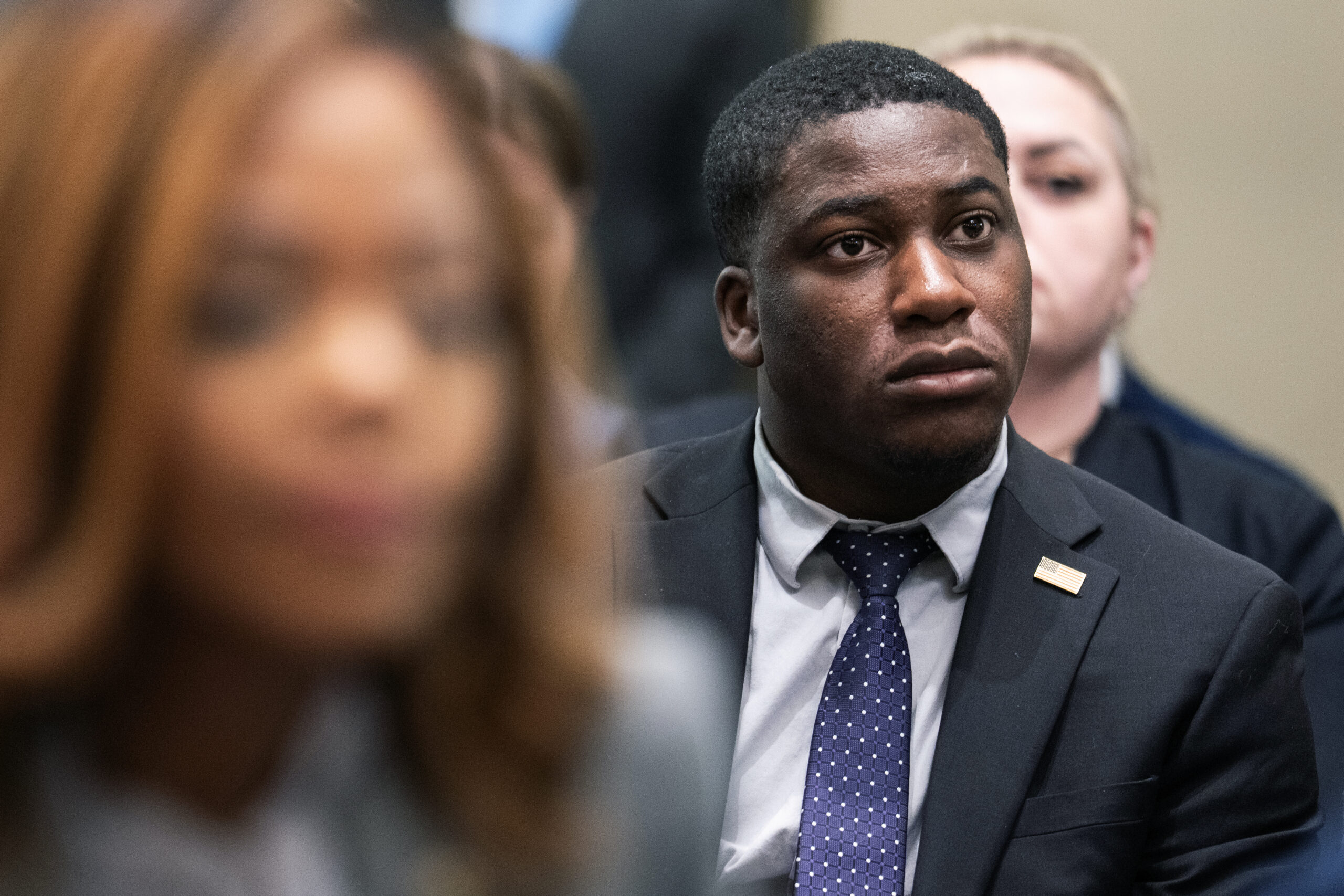
The lawmaker, who may soon be expelled from the chamber, is already in a heated primary race with Elijah Manley, a young far-left candidate endorsed by TrackAIPAC
PHONE A FRIEND
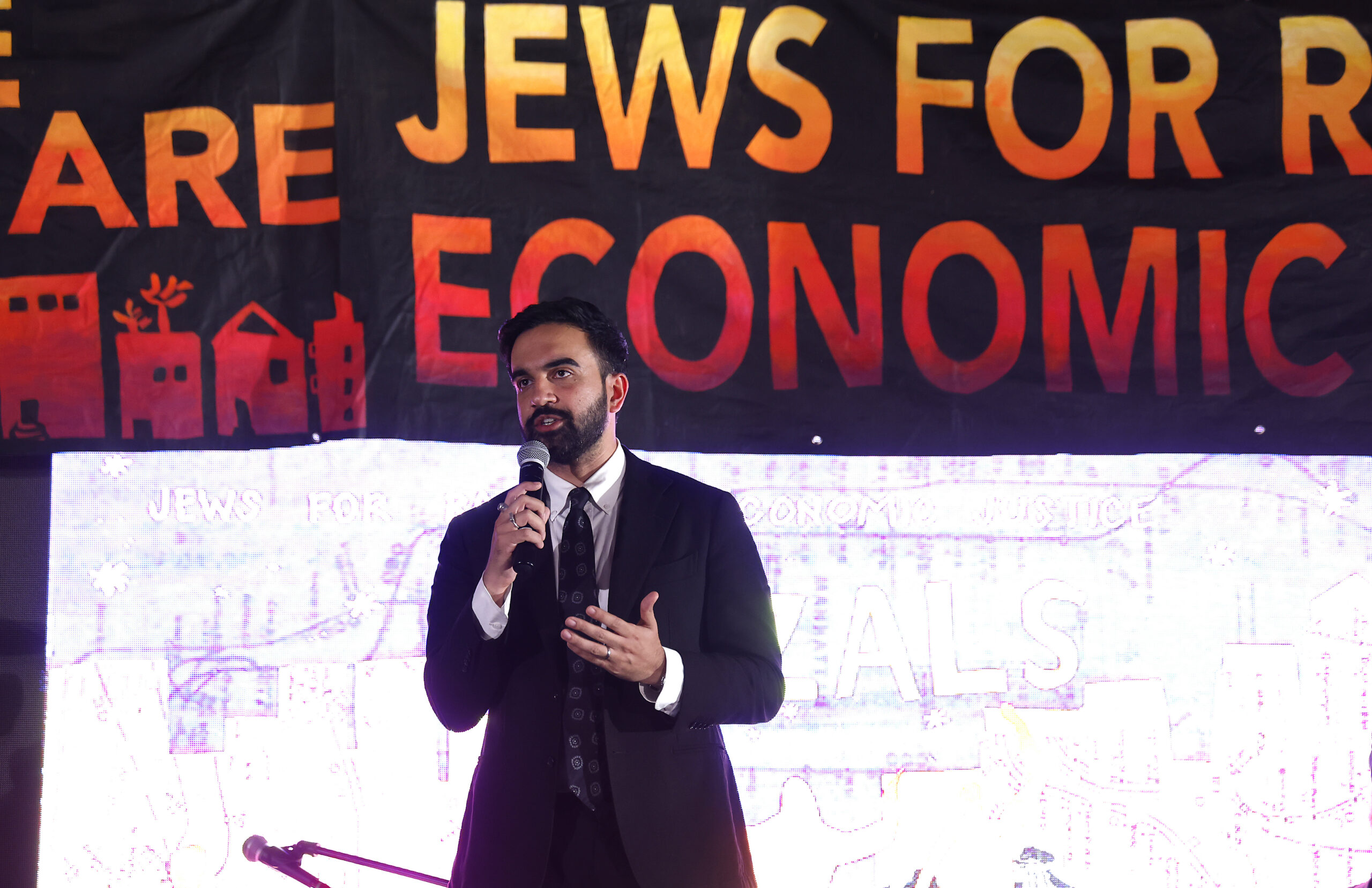
The sister, niece and brother-in-law of Maoist magnate Neville ‘Roy’ Singham have gained influence in New York’s ascendant socialist movement
The viral Instagram account with 1.4 million followers was taken offline, but similar accounts abound

Screenshot
AI Rabbi Goldman copycat accounts appear on Instagram after original is taken down.
An AI-generated Instagram account, which featured a fake Orthodox rabbi spreading antisemitic conspiracies to its more than 1.4 million followers, was taken offline over the weekend following major backlash from Jewish groups and one Democratic lawmaker — yet several similar, hate-peddling accounts have emerged with little to no public action from Meta.
An account called “Rabbi Goldman” “uses fake, AI-created authority figures to spread hate” in “a troubling and growing tactic,” according to a report published last week by Combat Antisemitism Movement.
The account, which was taken offline after the report was released, featured videos such as one in which the “rabbi,” wearing a tuxedo and seemingly seated in a luxury airplane, claims that Jews utilize empty private jets to evade taxes. A community note attached to the clip reads, “This is an AI generated rabbi who is trying to scam you by selling a fake 9$ get rich handbook. This account is ran by scammers based in south India.”
Several new Rabbi Goldman accounts started posting similar videos within the past two weeks — two already have followings of 18,500 and 10,000. Both remain active on Instagram and their bios state, “only Backup account for @rabbigoldman” and “old account got banned.”
The CAM report identified 12 AI-generated “rabbis” with a combined following of 2.1 million Instagram users, all of which promote classic antisemitic stereotypes. Many of the accounts remain active on the platform even after the Rabbi Goldman account was removed.
One account called “Rabbi Rothstein,” for example, with more than 57,000 followers, has posted more than 100 videos since February. In one video, “Rabbi Rothstein” states that “us Jews teach our children that being liked is expensive but being respected is profitable,” an apparent reference to the antisemitic trope that Jews are money obsessed. Another video also claims that Jews evade taxes, by purchasing expensive art.
Lawmakers have been pushing for more oversight regarding online antisemitism from Meta — which is the parent company of Instagram, as well as Facebook and WhatsApp — for years. In 2024, a bipartisan group of House lawmakers condemned Meta, and its oversight board, for ruling that the phrase “From the river to the sea” does not violate the social media company’s rules against hate speech, violence and incitement.
In response to Jewish Insider’s coverage of the Instagram accounts, Rep. Josh Gottheimer (D-NJ) called for oversight. “This is disgusting, dangerous, and exactly why we need increased accountability online to prevent the spread of misinformation and pure, flat-out hate,” he wrote on X. “These AI-generated rabbis and their antisemitic BS have real consequences.”
Meta did not respond to several requests for comment from JI asking about its decision to take the Rabbi Goldman account offline — whether it was shut down or suspended — and whether there will be a crackdown on similar accounts.
Last year, Meta received pushback from Jewish leaders when it introduced a new community-driven fact-checking system, ending its third-party fact-checking program and replacing it with a system modeled after the community notes feature on Elon Musk’s X. Some Jewish leaders expressed concern that the move would “open the floodgates to content” that could target Jewish communities and individuals, and called the decision a “step back” in the fight against rising antisemitism.
Piker, a far-left streamer who has been the subject of favorable media profiles despite a laundry list of antisemitic and terror-justifying rhetoric, is a case study in how traditional journalists normalize extremists
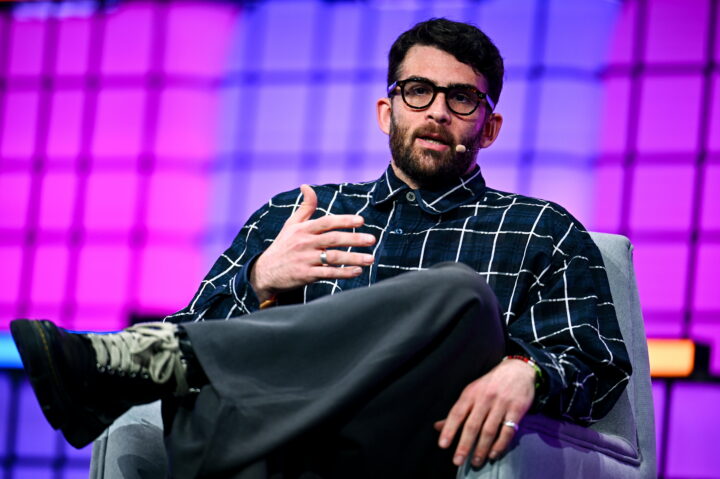
Shauna Clinton/Sportsfile for Web Summit Qatar via Getty Images
Hasan Piker during day two of Web Summit Qatar 2026 at the Doha Exhibition and Convention Center in Doha, Qatar.
A useful rule of thumb to live by: Social media isn’t real life.
But one of the challenges in the brave new world of media is that extremist influencers can often create the perception of influence simply by dominating so much of the online discourse.
Hasan Piker, a far-left streamer who has been the subject of favorable media profiles despite a laundry list of antisemitic and terror-justifying rhetoric, is a case study in how traditional journalists normalize extremists — and how politicians conclude there’s a marketplace for radical views in the electoral marketplace, even when it’s typically a mirage.
In part because Democrats have been desperate to find anti-establishment voices that claim to speak for young men, Piker is seen as a popular, edgy podcaster by liberal leaders in both media and politics. (Nevermind the fact that Piker gets only about 36,000 viewers on a typical stream — about 1/25th of the typical nighttime audience of MS NOW, as The Atlantic’s David Frum pointed out.)
The New Yorker invited Piker to speak at its annual festival, treating the antisemitic streamer as just another one of the many thought leaders in attendance. Leading progressives, such as Sen. Bernie Sanders (I-VT) and Rep. Alexandria Ocasio-Cortez (D-NY), joined him at rallies and on his show.
And a handful of leading Democratic presidential contenders — most notably California Gov. Gavin Newsom — expressed interest in going on his show.
This, despite the fact Piker has justified Hamas’ Oct. 7 terror attacks, forcefully denied some of the terror group’s atrocities, has called Orthodox Jews “inbred” and claimed America deserved 9/11.
Any one of those comments on their own would have typically disqualified anyone from playing a part in our political discourse. Yet in the wave of glowing profiles, Piker’s antisemitism and anti-Americanism didn’t even merit a mention.
It wasn’t until March 19, when Third Way President Jon Cowan and Lily Cohen, a press advisor from the center-left think tank, took the initiative to co-write a column for The Wall Street Journal calling out Piker’s antisemitism without any caveats. The decision to call out the crazy — when few in the press or politics had the courage to do so — was a moment that proved that one principled voice in defense of normalcy can break the mirage of those who believe there’s a political marketplace for this garbage.
The op-ed, headlined “Democrats Are Too Cozy with Hasan Piker,” generated outsized attention, in a way that previous efforts to spotlight Piker’s antisemitism hadn’t. Reporters who once gave Piker a free pass were now asking Democrats whether they agreed with his extremist positions.
Suddenly, when presented with his indefensible comments, some Democrats started building up enough courage to speak out against him. First, it was Rep. Brad Schneider (D-IL), head of the moderate New Democratic Coalition, who called Piker an “unapologetic antisemite.” Then, state Sen. Mallory McMorrow, running for the U.S. Senate in Michigan, told JI that Piker is “somebody who says extremely offensive things in order to generate clicks” — and called on one of her primary opponents, Abdul El-Sayed, to cancel a scheduled rally with him.
Even left-wing lawmakers and candidates — such as Maine Senate candidate Graham Platner and a progressive Democratic state legislator from Michigan — canceled scheduled appearances with Piker.
By the end of the month, only three of the 14 prospective Democratic presidential candidates that Politico interviewed said they would appear on a livestream with Piker if invited. That marks a sea change from just weeks earlier, when he was being treated as the trendy fad in progressive politics.
The dynamic is a reminder that the delusions of a social media echo chamber will persist unless they get confronted by political reality. Sometimes that reality is as simple as speaking up against craziness when everyone else is afraid to speak the truth.
It would be heartening to conclude that this episode is proof that antisemitism can be confronted when good people speak up.
But this past week also featured Politico publishing a virulently antisemitic cartoon that could have been drawn from the Nazi tabloid Der Sturmer — one that they pulled from their website and apologized for. This is the same publication, owned by Axel Springer, that gave Piker a credulous interview last year making no mention of his extremism. (And last week, it also blatantly misrepresented leading Democrats’ comments on AIPAC to manufacture an anti-Israel narrative.)
It all goes to show that the antisemitic rot fueled by social media is entering into the mainstream. It will take more brave and principled voices like Cowan and Cohen to stem the tide.
‘Injecting the views of antisemites into’ the rise of political extremism ‘and welcoming those views is dangerous,’ Deutch said

Celal Gunes/Anadolu via Getty Images
Ted Deutch, CEO of the American Jewish Committee, testifies about 'The Crisis on Campus: Antisemitism, Radical Faculty, and the Failure of University Leadership" during a US House Committee on Ways and Means hearing on Capitol Hill in Washington, DC, on June 13, 2024.
Ted Deutch, the CEO of the American Jewish Committee and a former Democratic congressman, said that Democratic lawmakers and candidates should not associate with far-left streamer Hasan Piker, who has a record of antisemitism and support for terrorism.
His comments come at a time when a small but growing group of Democrats has begun speaking out against Piker, particularly as he’s set to join a far-left Michigan Senate candidate on the trail.
Deutch drew parallels between Piker on the far left and white supremacist influencer Nick Fuentes on the far right.
“In both cases, each party should make clear that voices that aren’t representative of their parties have no place in an official campaign setting — shouldn’t be welcomed, shouldn’t be welcomed in to share their views,” Deutch said. “In Piker’s case, his record speaks for itself, the same with Nick Fuentes. I don’t need to go into details about who they are or what they represent. Neither one of them belongs in the middle of the political process as a result of candidates choosing to put them there.”
He said he’s expressed that view to candidates on both sides of the aisle and would keep those conversations private, but “my hope is that we’ll see some clarity on that issue going forward.”
“The challenges that we’re facing now with increasing polarization and the rise of extremism on the edges of both political parties is bad enough. Injecting the views of antisemites into that mix and welcoming those views is dangerous,” Deutch said.
AJC’s Director of Antisemitism Policy Holly Huffnagle: ‘The No. 1 reason that we have the antisemitism levels that we do today in the United States and around the world is because of the digital space’
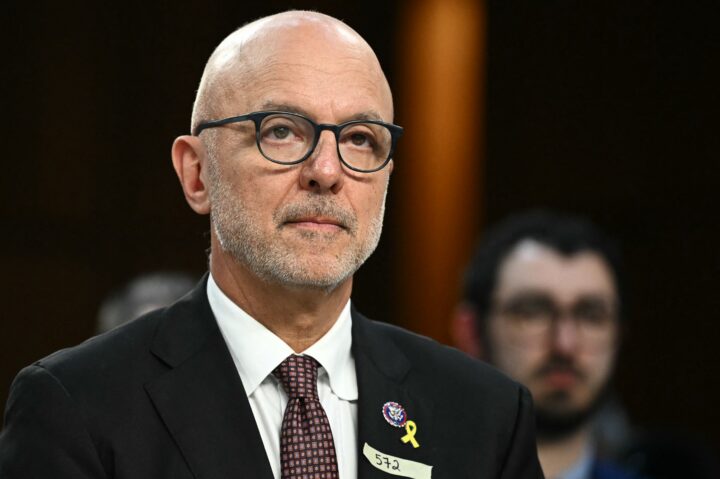
MANDEL NGAN/AFP via Getty Images
AJC CEO Ted Deutch on Capitol Hill in Washington, DC, on April 30, 2025.
A new report by the American Jewish Committee, released on Friday, found that 73% of American Jews saw or heard antisemitism online in the last year and 21% said that the antisemitism they witnessed made them feel physically threatened.
Top officials at the group say that this pervasive antisemitism online is the fundamental root of the current wave of antisemitic sentiment society-wide, including violent extremist attacks on Jewish communities in the U.S. and globally, and that protecting the Jewish community requires making real progress in tackling that problem.
According to the group’s CEO, Ted Deutch, the report is the first comprehensive survey-based tracking of American Jews’ experiences with and opinions on social media, “and the results are alarming.”
Deutch told Jewish Insider in an interview on Thursday that the report further finds that those pushing antisemitic content have found an “alarming number of ways” to avoid rules on various platforms to safeguard against hate.
Deutch, a longtime former House lawmaker, expressed frustration at the continued lack of action from Congress on antisemitism generally, amid a series of violent attacks across the country and the globe, drawing some parallels between that dynamic and his own struggles in the House to pass legislation in response to school shootings, as such events repeated themselves.
“If we stop it from spreading online, we’ve taken a dramatic step to preventing someone from showing up in D.C., killing two people, and saying, ‘I did it for Gaza,’ or someone in Colorado showing up, throwing Molotov cocktails with people at a march for the hostages, and killing someone there, and saying, ‘I did it for Palestine,’” Deutch said. “This needs urgent attention. It’s not getting it and it’s not acceptable.”
Speaking out against antisemitism is important, he said, “but you know what? We know where this starts, we know how it spreads. We have to do something to stop it there, so that we can stop the violence.”
He said that he’s concerned that Congress is becoming desensitized to the string of attacks on the Jewish community and isn’t responding with the action it warrants.
“The ability for Congress and policymakers around the country to simply move on, from one attack to another, the normalization of the antisemitic rhetoric that’s being used, the willingness to simply chalk this up to one extreme or another … You wind up accepting it. We cannot accept it,” Deutch said. “That sense of urgency does not exist. I don’t understand it.”
“I get it that this is a really hard time for Congress to legislate,” Deutch continued. “I understand that there are very strong feelings about everything that happens in politics, but I cannot understand how on an issue like this, when the data is clear and the impact of what’s happening is clear, that we can allow week to week, more attacks on synagogues, more attacks on schools.”
He said that ultimately, true security for the Jewish community won’t come through increasingly stringent physical security measures, but through a broader shift, “and that starts with what’s happening online” because the attacks across the country and the world “aren’t isolated incidents.”
He said that he wants Congress, President Donald Trump and the American people to understand that, and to collectively work to tone down antisemitic rhetoric online and decrease its spread.
The report, compiled in collaboration with Cyberwell, an Israeli nonprofit aimed at fighting antisemitism online, offers a variety of recommendations for technology companies and platforms to respond to antisemitism on their services.
“The No. 1 reason that we have the antisemitism levels that we do today in the United States and around the world is because of the digital space,” Holly Huffnagle, AJC’s director of antisemitism policy, said. “We can’t just keep sitting by and observing and collecting data. We actually need to do something about this, and this is how we think is the best way to go forward in closing some of those gaps around enforcement on the platforms.”
The report found that, across social media platforms, only around one-third of American Jews report antisemitic content they see, in many cases feeling that doing so will be futile. Deutch said he found that data point the most concerning.
“If the Jewish community is essentially throwing up its hands … then that says an awful lot about them, and our larger population as a whole,” Deutch said. He argued it sends the conclusion to the population at large that “the battle is lost. We can’t afford that. This isn’t a battle that is lost. This is an ongoing effort that we all have to be a part of.”
Huffnagle said that the report, based in part on data from AJC’s annual poll of the Jewish community’s experience of antisemitism, is proof of what many in the Jewish community have long seen and felt — that antisemitism is rampant online — and shows that “they’re not alone.”
The report offers a set of nine recommendations for tech companies: tightening enforcement mechanisms against those who support terrorism and antisemitic attacks; clarifying and strengthening policies on antisemitism; addressing coded antisemitism through emojis and euphemisms; consistently applying visibility restrictions on antisemitic content, ensuring that such measures are applied early and improving tools to prevent targeted harassment; ensuring that hateful content is not monetized or amplified and that users can’t evade restrictions; detecting and preventing AI-created and -driven antisemitic content; implementing better tools to prevent coordinated activity to boost antisemitic content; creating better reporting systems for antisemitism; and providing greater transparency and data access.
Legislatively, AJC is supporting the Platform Accountability and Transparency Act, which would require social media companies to share more data with the public. Deutch said that lawmakers are “flying blind” when it comes to antisemitism on social media platforms, lacking the data internal to the platforms that they and civil society need to address the problem.
“The transparency … can help drive accountability and real policy change and real changes to community standards, so that we don’t have to see these kinds of data points repeat year after year,” Deutch said.
“We have to approach this with greater urgency,” he continued. “Congress can’t simply allow itself to fall into the same old argument about how to approach this, and should we be talking about liability or not, whether this is free speech or it’s not free speech. That’s not what this is about. This is about real threats to the Jewish community and the ability that social media companies have — and the urgent need that we all have — for them to act, to keep the Jewish community and, in turn, to keep society safe.”
Huffnagle said she hopes the report can help identify other “creative” solutions and approaches to addressing antisemitism, particularly outside of government and apart from longstanding debates in Congress like reforming liability protections for social media platforms under Section 230 of the Communications Decency Act — an idea that Jewish groups have discussed for years but hasn’t seen movement on legislatively.
“I think we need to be creative,” she said. “Just because something’s being stalled doesn’t mean there can’t be movement elsewhere.”
Huffnagle said AJC is working with various platforms to tailor the group’s approach to the specific issues on those platforms — having developed a greater understanding of the distinct problem sets on each platform — rather than taking a one-size-fits-all approach that they and others in the Jewish community previously had.
In spite of policy shifts at social media companies in recent years toward a more permissive posture, including less strict content moderation and less company-sponsored fact-checking, Huffnagle said that AJC maintains relationships with social media companies and that they have been receptive to and implemented some of the feedback that AJC has offered.
She added that engaging with the tech sector — not just law enforcement and government — is necessary to addressing the society-wide problem of antisemitism. Huffnagle emphasized that she wants to see real change come out of this report — not just a compilation of data and unfulfilled recommendations.
She acknowledged that the survey likely includes a blindspot when it comes to TikTok because AJC only surveyed adults, and the platform is highly popular among younger teens.
The survey found that a majority of American Jews (65%) are concerned that artificial intelligence chatbots will spread antisemitism, and 69% were concerned that information produced by AI will fuel antisemitic incidents.
AI, Huffnagle said, poses both “novel problems” as well as “helpful solutions.” It can both create and amplify antisemitic content, but can also help moderate content, particularly as platforms are scaling back on human moderators. But, she said, using AI for moderation can’t currently keep up with the pace of antisemitic content.
“It can be used for good. I see it. It’s just not nearly as efficient and sufficient to meet how it’s being used for bad,” Huffnagle said.
Deutch said another concern is that, without proper policies and transparency from social media companies, platforms may devolve into a “war … between the AI that’s targeting us and the AI that’s trying to protect us.”
Deutch and Huffnagle’s conversation with JI came on the same day that a jury ruled that Meta and YouTube were negligent in their design of their platforms, awarding a plaintiff $3 million, a landmark case finding that social media platforms are responsible for their platforms’ impacts on their users.
“The one conclusion that I think everyone should draw from these headlines is that the courts have now ruled that there is responsibility to the customer,” Deutch said. “The tech companies acknowledge that. They wouldn’t have their community standards if they weren’t worried about what’s happening to their users. … It’s time for these community standards to be enforced.”
Lewis George pledged not to exclude Jews ‘based on your opinions or feelings on matters here and across the world'
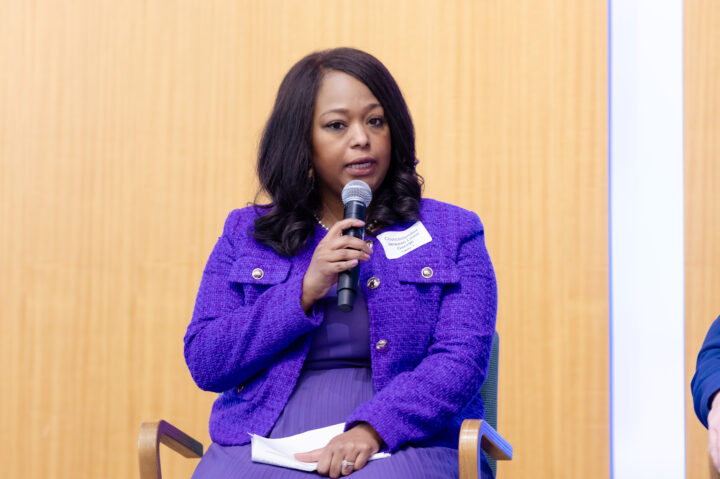
Jewish Community Relations Council of Greater Washington
D.C. City Councilmember Janeese Lewis George speaks at a "Lox and Legislators" breakfast held by the Jewish Community Relations Council of Greater Washington on Dec. 18, 2025
After Janeese Lewis George met last week with Washington rabbis and other local Jewish leaders who were concerned about her views on Israel and antisemitism, the Washington, D.C., mayoral candidate released a statement pledging to stand firm in both her opposition to antisemitism and her support for the Palestinian cause.
“Those two things are not in conflict,” Lewis George, who is endorsed by the Democratic Socialists of America, wrote in a statement that was posted to her campaign website on Wednesday.
Her campaign has not publicly acknowledged the meeting at Congregation Ohev Sholom, where Lewis George discussed a DSA questionnaire she filled out in which she pledged to avoid events that promote “Zionism and apartheid” and took issue with local Jewish groups’ approach to fighting antisemitism, according to attendees who spoke to Jewish Insider.
At the meeting, Lewis George apologized for the language she used in the questionnaire and attributed it to a staff member. She said she would have responded differently if she had written the answers herself. A spokesperson for Lewis George did not respond to requests for comment from JI about the meeting.
“To the Jewish community in DC: I will not be a mayor who includes or excludes you based on your opinions or feelings on matters here and across the world. I will always protect your freedom, safety, and sense of belonging,” Lewis George, a D.C. councilmember, wrote in the statement. She described going to synagogues when she was growing up and working with Jewish organizers in Washington.
“As Ward 4 Councilmember, I worked with Jewish organizations and neighbors to secure security grants for our schools and synagogues,” Lewis George wrote. “Antisemitism is morally wrong and unacceptable, and it is spreading. It is part of the same machinery of division and fear used against Black people, immigrant communities and others. We must work together to stop it.”
Lewis George then noted that she was one of the first councilmembers in the District to call for a ceasefire in Gaza and that she met with students at George Washington University who were advocating for a ceasefire.
“Together, we mourned the innocent lives that have been lost in Israel as well as in Gaza and the West Bank. I will continue to stand up against efforts to silence local pro-Palestinian speech and organizing,” Lewis George wrote. “I have no problem voicing my disagreement, loudly, when it is needed. I do not shy away from standing by my values in front of all audiences.”
Council Speaker Julie Menin says the mayor ‘hasn’t indicated’ he will veto her signature legislation
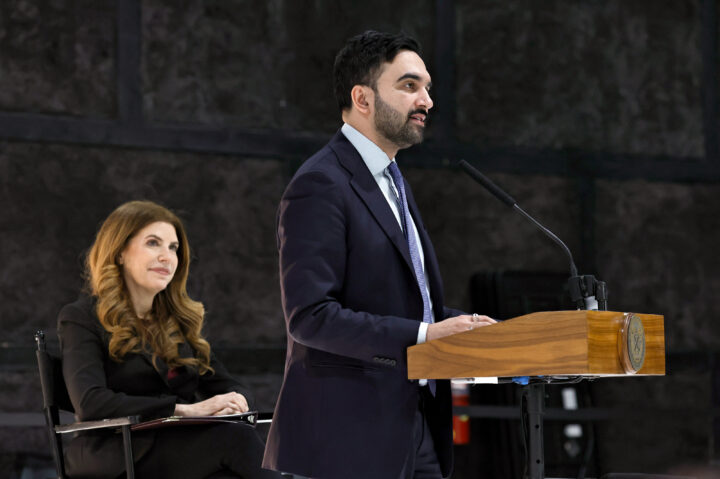
John Lamparski/Bloomberg via Getty Images
Julie Menin, speaker of the New York City Council, left, and Zohran Mamdani, mayor of New York, during an announcement in Brooklyn, New York, on Jan. 12, 2026.
The New York City Council passed a suite of legislation Thursday intended to battle antisemitism — and to formalize NYPD policy toward protests at religious and educational facilities — leaving it up to Mayor Zohran Mamdani to try to block the bills or let them become law.
Council Speaker Julie Menin told reporters before the vote that she’s received no signal that Mamdani would veto her signature bill, which would compel the city’s police commissioner to lay out official department procedure for its longstanding practice of establishing buffer zones around religious institutions during protest activity.
Mamdani has repeatedly refused to take a stand on the issue, though he has acknowledged concerns against the bill from civil rights organizations and left-wing activists in his base who have targeted synagogues and yeshivas with anti-Israel demonstrations.
“I have many conversations with the mayor, we meet one-on-one all the time. He hasn’t indicated to me that he will do that,” Menin said when asked about the potential for a veto.
The NYPD told the Council it had “no objections” to a revised version of the proposal at a council hearing in February, which would typically signal the mayor, who oversees the police department, intends to sign the legislation, or take no action, at which point it would automatically become law after 30 days. The bill had 35 co-sponsors and passed with 44 of 51 council members voting in favor, well in excess of the two-thirds majority needed to override a mayoral veto.
Far closer was the vote on a bill advanced by Bronx Councilman Eric Dinowitz, chair of the body’s Jewish Caucus, which would similarly obligate Police Commissioner Jessica Tisch to create formal protocol for police security perimeters — but near educational institutions rather than religious ones. Michael Gerber, the NYPD’s deputy commissioner for legal affairs, expressed hesitation as to this measure at last month’s hearing, arguing that a single uniform policy may not be appropriate to police actions around private property.
Dinowitz maintained after the vote that the bill’s language makes clear the NYPD should only establish perimeters around entrances and exits onto public parks and sidewalks, not school facilities themselves.
“We wanted to be clear that the intent of the bill is not to police what’s going on at college campuses,” Dinowitz told reporters.
Still, the bill passed with just 30 votes, four shy of what it would require to overcome a veto.
Plus, fake AI rabbis peddle antisemitism
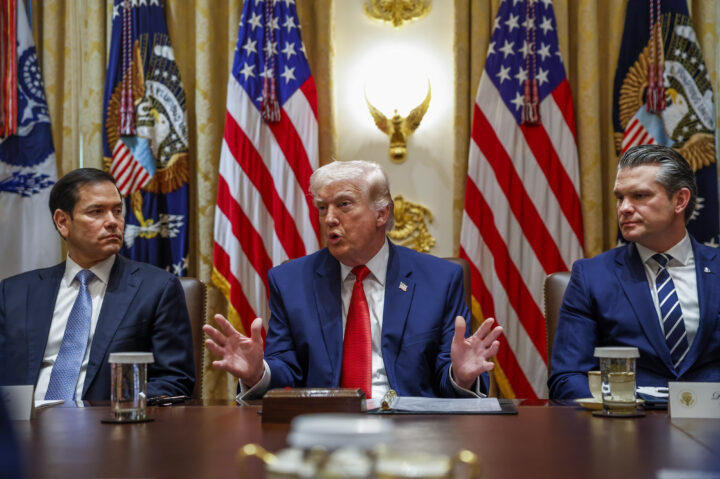
Will Oliver/EPA/Bloomberg via Getty Images
Secretary of State Marco Rubio, President Donald Trump and Defense Secretary Pete Hegseth during a Cabinet meeting at the White House in Washington, DC, US, on Thursday, March 26, 2026.
This P.M. edition is reserved for our premium subscribers — offering a forward-focused read on what we’re tracking now and what’s coming next. Please don’t hesitate to share your thoughts and feedback by replying to this email.
📡On Our Radar
Notable developments and interesting tidbits we’re tracking
President Donald Trump announced this afternoon that he’s extending his original five-day delay on strikes on Iran’s energy sector, which was set to expire tomorrow, by another 10 days. “As per Iranian Government request … I am pausing the period of Energy Plant destruction by 10 Days to Monday, April 6, 2026, at 8 P.M., Eastern Time,” he wrote on Truth Social, adding that negotiations continue and are “going very well”…
At a Cabinet meeting earlier today, Trump revealed that the “present” Iran had provided the U.S. earlier this week was allowing eight Pakistani-flagged oil tankers to pass safely through the Strait of Hormuz, which he said proved the U.S. was speaking with the “right people” in Iran with the authority to make such decisions.
Special Envoy Steve Witkoff, meanwhile, confirmed reports that the U.S. had presented Iran with a “15-point action list” as a starting offer in peace talks between the two countries, and that Pakistan is acting as mediator…
Speaking at the FII Priority summit in Miami, Jared Kushner said that, during his negotiations with Iran prior to the war, “We basically saw that there was no seriousness, and that they were trying to play different games to just get beyond President Trump in order to preserve their capabilities and pathway to get to a nuclear weapon in a way that would have been very, very hard to be stopped in the future”…
CENTCOM applauded an Israeli strike that killed Alireza Tangsiri, the commander of the IRGC Navy, and warned all IRGC Navy members to “immediately abandon their post and return home.” Tangsiri had been named a Specially Designated Global Terrorist by the U.S. in 2019 and was leading Iran’s efforts to shutter the Strait of Hormuz…
Even as U.S.-Iran negotiations continue, the U.S. is considering diverting weapons for Ukraine to the Middle East, The Washington Post reports, including air-defense interceptor missiles.
Ukraine has proved a stalwart ally to the Gulf as it comes under attack from Iran — around 200 Ukrainian military personnel have been deployed around the Middle East to help defend against Iranian drones and President Volodymyr Zelensky arrived in Saudi Arabia today for a surprise visit…
Resources are also being redirected to Gaza — the Trump administration has reportedly pulled $1.25 billion from international peacekeeping and disaster assistance programs for the Board of Peace’s operations, for which Trump had pledged $10 billion in U.S. funding…
An AI-generated Instagram account portraying an Orthodox-looking rabbi is pushing antisemitic conspiracy theories to its more than 1.4 million followers, and it’s not the only one, according to a study published Wednesday by Combat Antisemitism Movement.
Jewish Insider’s Haley Cohen reports: Researchers identified 12 AI-generated “rabbis” with a combined following of 2.1 million Instagram users, all of which promote classic antisemitic stereotypes. The “Rabbi Goldman” account features many of these, including one video in which the “rabbi,” wearing a tuxedo and seemingly seated in a luxury airplane, claims that Jews utilize empty private jets to evade taxes…
A new Emerson College poll of the Maine Senate race found oyster farmer Graham Platner with a nearly 30 point lead over Gov. Janet Mills (55-28%) in the Democratic primary. Both Platner and Mills lead Sen. Susan Collins (R-ME) in the general election matchup, 48-41% and 46-43%, respectively…
California Gov. Gavin Newsom again reaffirmed his support for Israel in an interview with The Bulwark, likening his love for the country but strong disapproval of its current government with how he feels about the U.S…
Democrat Analilia Mejia and Republican Joe Hathaway will participate on April 1 in what is likely to be the only debate of the New Jersey 11th Congressional District’s special election, after the far-left Mejia won the Democratic nomination in a hotly contested primary last month. The New Jersey Globe, which is hosting the debate, acknowledged it had chosen to do so on the first night of Passover, in a district with a sizable Jewish population…
The College Republicans chapter at the University of Florida is suing the school, after a photo of one of its members doing what appeared to be a Nazi salute led to the chapter’s ban from campus.
The chapter argues that the ban violated its First Amendment rights as the member “expressed a viewpoint off-campus that was alleged by some to be anti-Semitic,” and claims it was deactivated in part because it recently hosted James Fishback, a candidate for Florida governor who has expressed antisemitic and anti-Israel views…
⏩ Tomorrow’s Agenda, Today
An early look at tomorrow’s storylines and schedule to keep you a step ahead
Keep an eye out in Jewish Insider for comments from Michigan state Sen. Mallory McMorrow on Israel and antisemitism as she seeks the Democratic nomination for U.S. Senate against Rep. Haley Stevens (D-MI) and Abdul El-Sayed.
President Donald Trump will provide closing remarks at the FII Priority summit in Miami tomorrow afternoon.
Texas Attorney General Ken Paxton will headline CPAC’s Ronald Reagan Dinner. His primary opponent, Sen. John Cornyn (R-TX), will not be making an appearance, despite the confab taking place in his home state and calls from its leadership for him to attend.
Secretary of State Marco Rubio is traveling to France to attend a meeting of G7 foreign ministers where he is expected to press allies on the Iran war — he told reporters as he departed today, echoing a line from Trump, that the countries involved “get far more of their fuel from” the Strait of Hormuz “than we do.”
Stories You May Have Missed
TROUBLE IN THE NEIGHBORHOOD

Frustrated UAE leaders are questioning the ‘impotence’ of countries like Egypt — and warn that silence on Iranian aggression will push the Gulf closer to U.S., Israel
MICHIGAN MOMENT
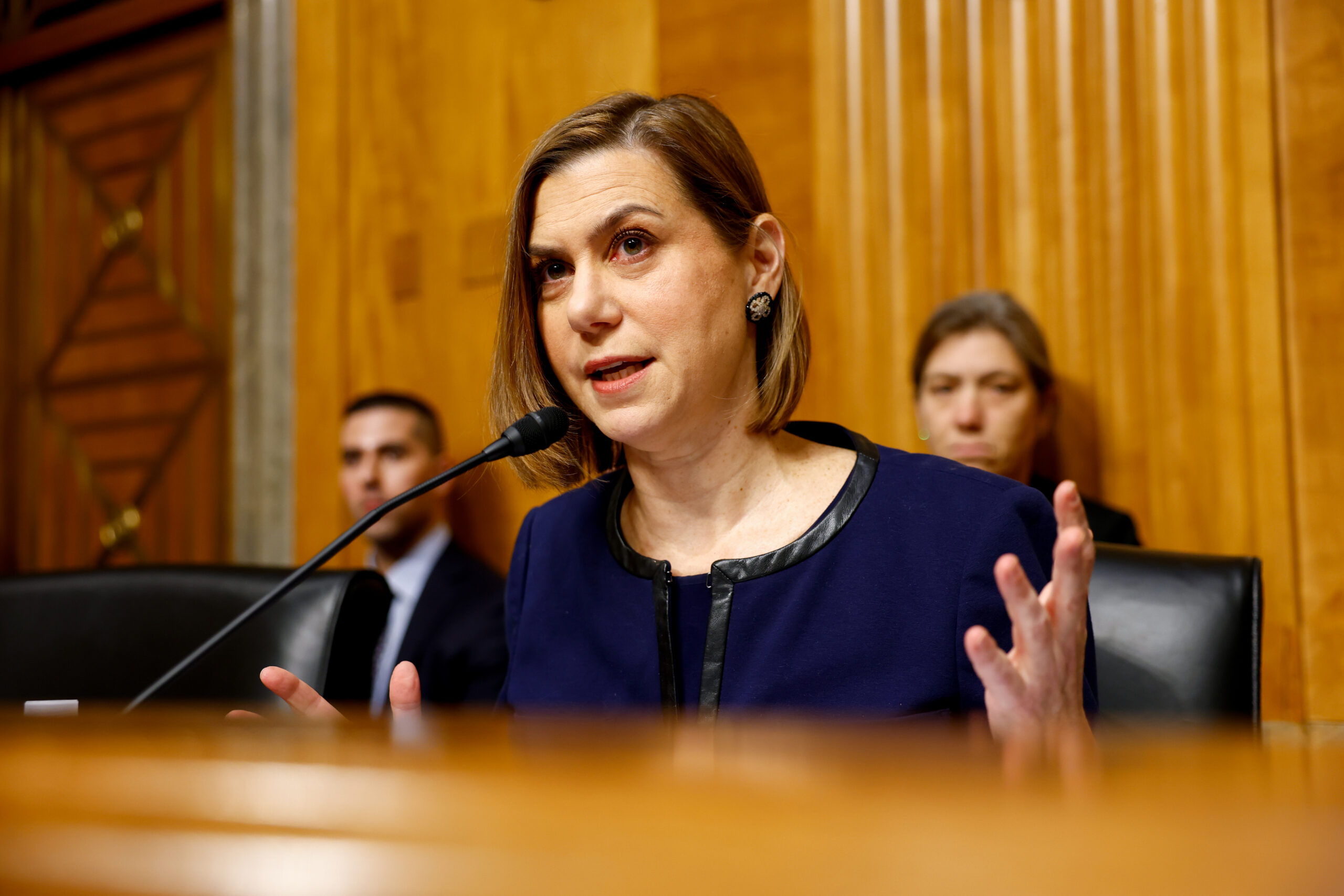
Stevens said that by associating with Piker, El-Sayed is ‘choosing to campaign with someone who has a history of antisemitic rhetoric’
The report from Combat Antisemitism Movement found the platform has actively recommended this content to millions of users

Illustration by Jonathan Raa/NurPhoto via Getty Images
The Instagram logo is being displayed on a smartphone among other social media networks in this photo illustration in Brussels, Belgium, on January 22, 2024.
An AI-generated Instagram account portraying an Orthodox-looking rabbi is pushing antisemitic conspiracy theories to its more than 1.4 million followers, and it’s not the only one, a study published this week about antisemitic content on the social media platform has found.
An account called “Rabbi Goldman” “uses fake, AI-created authority figures to spread hate” in “a troubling and growing tactic,” according to the report, published on Wednesday by the Combat Antisemitism Movement.
The 12-page report, titled “Engineered Exposure: How Antisemitic Content Is Pushed and Amplified to Millions Across Instagram,” documents 100 posts that researchers described as antisemitic, pushed directly to Instagram accounts over a 96-hour period from March 19-22.
These posts, actively suggested by the platform’s recommendation systems, generated more than 5.3 million likes and 3.8 million shares, with an estimated reach of 150 to 280 million users, according to the report.
CAM defined antisemitic posts as ones that invoke conspiracy theories — such as Jews controlling the media or manipulating global conflicts — and posts that claim Jews, often referred to as “Zionists,” are linked to demonic forces or satanic imagery, all of which have been used to justify antisemitic violence.
The report raises particular concern around the creation of “closed content environments,” in which users are repeatedly fed similar antisemitic themes, with little or no countervailing content.
“This type of algorithmic clustering reaffirms dangerous beliefs, contributing to a process of radicalization that can have lethal real-world consequences,” the report states. Researchers identified 12 AI-generated “rabbis” with a combined following of 2.1 million Instagram users, all of which promote classic antisemitic stereotypes.
The “Rabbi Goldman” account features many of these, including one video in which the “rabbi,” wearing a tuxedo and seemingly seated in a luxury airplane, claims that Jews utilize empty private jets to evade taxes. The community note attached to the clip reads, “This is an AI generated rabbi who is trying to scam you by selling a fake 9$ get rich handbook. This account is ran by scammers based in south India.”

Meta, which is the parent company of Instagram — as well as Facebook and WhatsApp — did not respond to a request for comment from Jewish Insider about the report’s findings.
“Simply put, this is evidence of a broad systemic failure on the part of Instagram and Meta,” Sacha Roytman, the CEO of CAM, said in a statement. “When a platform actively recommends content that dehumanizes Jews to mass audiences, we are no longer talking about a simple oversight or a mistake in the algorithmic design. We are talking about infrastructure that normalizes hatred at scale that must be addressed immediately.”
“CAM is calling on Meta to go beyond basic enforcement and take real responsibility. What’s been uncovered here must be taken seriously. This isn’t a fringe problem. Rather, it points to a broader, systemic issue with global reach, shaping how millions of people encounter and engage with antisemitic ideas in 2026,” the report states.
Last year, Meta received pushback from Jewish leaders when it introduced a new community-driven fact-checking system, ending its third-party fact-checking program and replacing it with a system modeled after the community notes feature on Elon Musk’s X. Some Jewish leaders expressed concern that the move would “open the floodgates to content” that could target Jewish communities and individuals, and called the decision a “step back” in the fight against rising antisemitism.
Dangerous implications of social media have extended beyond the Jewish community, with a jury in Los Angeles ruling on Wednesday that Meta, as well as Google, are liable for creating addictive products that caused a teenager’s depression and anxiety. The verdict marks the first time juries have decided that tech companies are at least partially liable for distress online and offline.
Plus, is Stevens losing steam in Michigan Senate race?
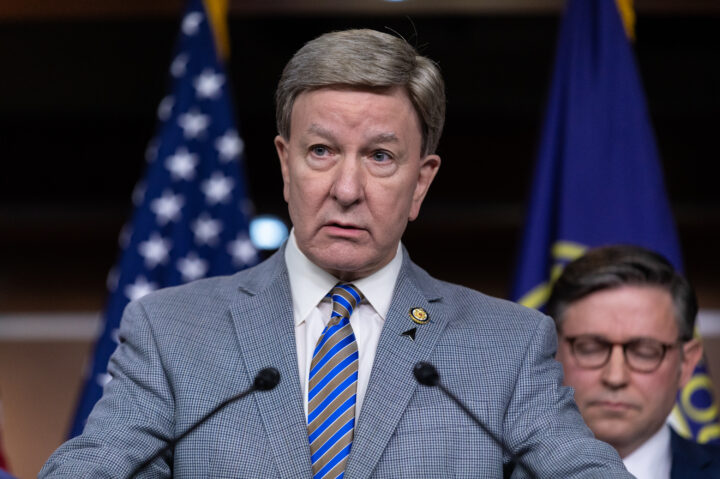
Anna Rose Layden/Getty Images
House Armed Services Committee Chairman Mike Rogers (R-AL) speaks to the press at the U.S. Capitol on October 17, 2025 in Washington, DC.
This P.M. edition is reserved for our premium subscribers — offering a forward-focused read on what we’re tracking now and what’s coming next. Please don’t hesitate to share your thoughts and feedback by replying to this email.
📡On Our Radar
Notable developments and interesting tidbits we’re tracking
White House Press Secretary Karoline Leavitt downplayed reports that Iran has rejected President Donald Trump’s ceasefire proposal, saying in a press briefing today that “talks continue” and “are productive.” She further confirmed, while cautioning against speculation, that there are “elements of truth” to the 15-point plan that has been reported.
About potential face-to-face negotiations, which International Atomic Energy Agency head Rafael Grossi said could take place in Pakistan as soon as this weekend, Leavitt said she “would not get ahead of our skis on reporting about any talks this weekend until you hear directly from us”…
Emerging from a classified House Armed Services Committee briefing on Iran, Chairman Mike Rogers (R-AL) expressed frustration that the administration isn’t forthcoming enough about its war plans. “We want to know more about what’s going on, what the options are and why they’re being considered, and we’re just not getting enough answers on those questions,” Rogers told reporters.
And Senate Armed Services Committee Chairman Roger Wicker (R-MS), asked about his House colleague’s comments, said, “Let me put it this way: I can see why he might have said that.” It’s the latest sign of cracks in the GOP nearly a month into the war effort…
For the first time since the start of the war, the UAE — which has faced the brunt of Iran’s attacks — reported zero Iranian ballistic missile attacks today, raising questions about the Islamic Republic’s potentially dwindling supplies.
Yousef Al Otaiba, the Emirati ambassador to the U.S., called for a “conclusive outcome” to the war, as opposed to a “simple cease-fire.” Writing in The Wall Street Journal, he argued that “building a fence around the problem and wishing it goes away isn’t the answer. It would simply defer the next crisis”…
European authorities are investigating whether a new group that has claimed responsibility for several recent terror attacks on Jewish institutions across Europe, the Islamic Movement of the Righteous Companions, is a front for Iran, which has likely recruited people online to carry out the attacks on its behalf…
The Journal profiles Iranian parliament speaker Mohammad-Bagher Ghalibaf as he emerges as a potential leader and negotiating partner for the U.S., with one expert calling him a “wannabe strongman” who simultaneously has “the necessary credentials to deliver a potential deal with the Trump administration”…
An internal poll from the campaign of Michigan state Sen. Mallory McMorrow shows her leading the pack in the Democratic primary for U.S. Senate, followed by the far-left Abdul El-Sayed with Rep. Haley Stevens (D-MI) trailing in third place, a sign her campaign is struggling to build momentum. A fifth of potential primary voters still identified themselves as undecided.
Stevens’ campaign then released its own internal poll that showed her in first place, followed closely by El-Sayed with McMorrow in third, though the survey was conducted in mid-February…
As the Trump administration sues Harvard — again — over alleged civil rights violations and failure to address campus antisemitism, Rabbi Hirschy Zarchi, president of Harvard Chabad, told The Harvard Crimson that the school is in fact “taking the issue” of antisemitism “very seriously.”
“While there is much more to be done, the only plausible characterization of Harvard’s current leadership is as principled and effective in confronting and removing the intolerance which had taken root on campus over more than a decade,” added Jason Rubenstein, executive director of Harvard Hillel…
Asked at a recent event at Harvard’s Kennedy School whether the Biden administration could have done more to save lives in the war in Gaza, former Secretary of State Tony Blinken said, “Could we, should we have done things differently such that the suffering that people endured, the loss of the children you just listed and so many others could have been averted? The short answer is: Maybe yes.”
Blinken also called on people not to be “binary” in their thinking about the Middle East, Jewish Insider’s Gabby Deutch reports. With the Gaza war, he said, “Where did we start? We started with Oct. 7. We started with the most horrific massacre of Jews since the Holocaust. It’s very easy to say, ‘Oh, yeah, that’s a given.’ Except it wasn’t a given for Israelis and Israeli society”…
⏩ Tomorrow’s Agenda, Today
An early look at tomorrow’s storylines and schedule to keep you a step ahead
Keep an eye out in Jewish Insider for a look at the growing divide in the Democratic Party over engagement with antisemitic streamer Hasan Piker — and the questions it raises about the meaning of progressivism in the current political landscape.
The Atlantic Council and U.S.-Syria Business Council will host a symposium on Syria’s energy sector with keynote remarks from U.S. Special Envoy to Syria Tom Barrack. Also speaking are several oil executives and Jacob McGee, the State Department’s deputy assistant secretary for Israeli-Palestinian affairs.
The FII Priority Summit continues in Miami; among other sessions tomorrow, Jared Kushner will speak on U.S.-Gulf investment and Zach Witkoff, co-founder of World Liberty Financial and son of Special Envoy Steve Witkoff, will discuss crypto.
CPAC, which President Donald Trump is seemingly not attending for the first time in a decade, continues in Dallas. GOP candidates who are in attendance include Brandon Herrera, the far-right influencer running in Texas’ 23rd District; Michael Whatley, the front-runner in North Carolina’s open Senate race; Rep. Mike Collins (R-GA), running in a competitive primary to challenge Sen. Jon Ossoff (D-GA); Rep. Kevin Hern (R-OK), seeking the Senate seat vacated by new Homeland Security Secretary Markwayne Mullin; and Nate Morris, running to succeed retiring Sen. Mitch McConnell (R-KY).
The House Ethics Committee will hold a rare public hearing on Rep. Sheila Cherfilus-McCormick’s (D-FL) alleged ethics violations, including her laundering of funds from a FEMA-backed contract for her family business into her congressional campaign.
Stories You May Have Missed
STRAIT TALK
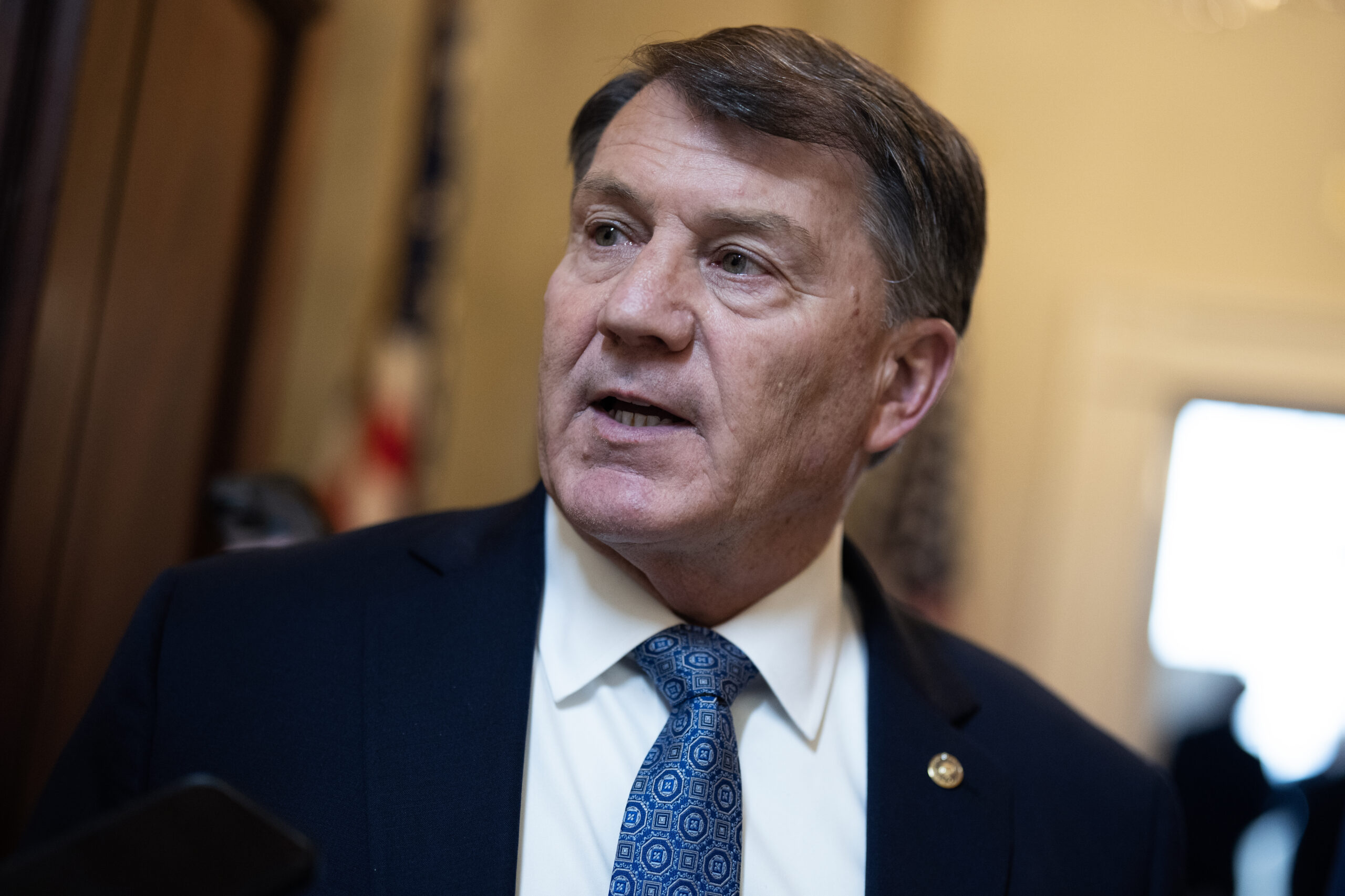
Some disagree on who should claim ultimate responsibility for the strait — the U.S. or other countries in the region
GUARDING THE GATES
Schneider called Piker ‘an unapologetic antisemite’ and warned ‘Democrats risk losing our credibility to condemn those on the right who traffic in bigotry’ if they continue to embrace him
‘Fortnite’ was rated the best at implementing safeguards to combat antisemitism, with ‘Grand Theft Auto Online,’ ‘Call of Duty’ and ‘Minecraft’ following closely behind

Thomas Fuller/NurPhoto via Getty Images
The Fortnite logo is displayed on a smartphone screen in the Apple app store on March 6, 2026.
A first-of-its kind leaderboard evaluating how major video game companies address antisemitism and extremism in online games was released on Wednesday by the Anti-Defamation League, Jewish Insider has learned.
The leaderboard assessed 10 of the most popular games and their respective companies on their policies and in-game safety features. “Fortnite” was rated the best at implementing safeguards to combat antisemitism, with “Grand Theft Auto Online,” “Call of Duty” and “Minecraft” following closely behind. Other major games evaluated included “Roblox,” “Valorant,” “Clash Royale,” “Counter-Strike 2” and “PUBG: Battlegrounds.”
ADL evaluated the product features of each individual game and the relevant policies that govern that game — for some games, the policies that govern them were specific to the game, while for some it was the company policies that apply to all of their games.
The leaderboard, created by the ADL Center for Technology and Society in partnership with the ADL Ratings and Assessment Institute, builds on the annual survey work that CTS did in partnership with gaming analytics firm NewZoo, from 2019-2023.
Games received labels of advanced, moderate or limited protections based on criteria including: antisemitism and hate policy; extremism/terrorism policy; in-game display of code of conduct; documentation of escalation to law enforcement; and in-game tooling.
The latter criteria, which accounts for 60% of a game’s overall score, includes players’ ability to block and/or mute other players; players’ ability to report players for voice, text, usernames and user-generated content; and the game’s prevention of antisemitic and hateful extremist usernames.
Bonus points were awarded for clear appeals processes and engagement with ADL, and points were deducted for harmful content on public-facing game stores. The antisemitism watchdog shared detailed findings with each gaming company and invited them to discuss the assessment before the leaderboard’s release, to which Epic Games, Supercell and Minecraft responded.
Popular online games boast hundreds of thousands of players, with 85% of U.S. teens reporting playing video games in 2024, according to the Pew Research Center. The Pew study found that 80% of all teens think harassment over video games is a problem for people their age, and 41% of those who play them say they’ve been called an offensive name while playing.
The leaderboard comes one year after ADL conducted a study where it asked 15 participants (university students, recent graduates and young adults) to play four leading online games (“Valorant,” “Counterstrike 2,” “Overwatch 2” and “Fortnite”) in one-hour increments with different identities (Jewish and Muslim religious and ethnic identities, as well as in national identities such as Chinese, Mexican and Israeli). It found that almost half of game play experiences included some form of harassment, such as slurs, trash-talking or disrupted play, and one-third included identity-based harassment, such as “gas the Jews” or calling people the “N-word.”
The ADL said it plans to feature the results in an online Gaming Leaderboard, designed to be a resource that will track how gaming companies manage their online multiplayer ecosystems over time to guide parents, gamers, policymakers and the gaming industry itself.
“When a parent wants to know if an online game is safe for their child, there has been no one-stop shop to understand how a particular game approaches online safety,” Daniel Kelley, senior director of the ADL Center for Technology and Society, said in a statement. “This leaderboard addresses that critical gap by offering the most comprehensive evaluation of safety measures in online multiplayer games to date, with a focus on how companies manage antisemitism and extremism.”
Plus, media misdirection over AIPAC money
Shauna Clinton/Sportsfile for Web Summit Qatar via Getty Images
Hasan Piker during day two of Web Summit Qatar 2026 at the Doha Exhibition and Convention Center in Doha, Qatar.
This P.M. edition is reserved for our premium subscribers — offering a forward-focused read on what we’re tracking now and what’s coming next. Please don’t hesitate to share your thoughts and feedback by replying to this email.
📡On Our Radar
Notable developments and interesting tidbits we’re tracking
Rumblings of a potential peace summit between Washington and Tehran have begun — sources told Axios that the U.S. and several mediating countries are waiting for Iran to respond to a proposal for peace talks this Thursday, while President Donald Trump reposted a message from Pakistan offering to “be the host to facilitate meaningful and conclusive talks”…
Trump told reporters in the Oval Office this afternoon that “we’re dealing with the right people” in Iran because they “gave us a present, and the present arrived today. It was a very big present worth a tremendous amount of money,” but would only tease that it was “oil and gas related.” Asked if he is negotiating over who will control the Strait of Hormuz, Trump said, “No … we’ll have control of anything we want”…
Saudi Crown Prince Mohammed bin Salman has encouraged Trump to continue the campaign against Iran and push towards toppling the regime, The New York Times reports, believing that Iran’s threat to the Gulf will only be removed through the transition of its government and not if the war results in a failed state. MBS has reportedly argued in favor of striking Iran’s energy infrastructure and putting U.S. troops on the ground…
The Pentagon is expected to announce the deployment of about 3,000 soldiers from the military’s 82nd Airborne Division to participate in the campaign against Iran, The Wall Street Journal reports, a move that opens the possibilities for boots on the ground, as the division is trained to parachute into hostile territory…
Israeli Defense Minister Israel Katz said today that the IDF will now maintain control over a security zone south of the Litani River in Lebanon and prevent the return of Lebanese residents who have been evacuated from the area “until the security of northern [Israeli] residents is assured”…
Lebanese Minister of Foreign Affairs Youssef Raggi declared Iran’s ambassador to Beirut persona non grata and expelled him from the country, as Iranian proxy Hezbollah continues to fire on Israel against the Lebanese government’s orders.
Shortly after, an Iranian ballistic missile was launched towards Beirut for the first time — it was reportedly intercepted by a “foreign naval vessel,” presumably the U.S., though fragments struck Lebanese towns…
Secretary of State Marco Rubio is being dispatched to France later this week to discuss the Iran war, among other issues, with the U.S.’ G7 allies, including Britain, Canada, France, Germany, Italy and Japan, countries that have all declined to participate in the war effort…
Majed al-Ansari, spokesperson for the Qatari foreign ministry, said today that Qatar is not involved in mediating any U.S.-Iran negotiations, a shift for the country that has traditionally played the part of go-between. Al-Ansari said there has been no communication between Doha and Tehran since a phone call early in the conflict when Qatar made clear its anger with Iranian strikes on its territory…
Politico reports that several 2028 Democratic presidential hopefuls said they wouldn’t or haven’t taken money from AIPAC, including Sen. Cory Booker (D-NJ), California Gov. Gavin Newsom, Sen. Ruben Gallego (D-AZ), Kentucky Gov. Andy Beshear, Illinois Gov. JB Pritzker, Pennsylvania Gov. Josh Shapiro, Sen. Elissa Slotkin (D-MI) and former Chicago Mayor Rahm Emanuel.
But while framing the statements as rejections of AIPAC and Israel, the outlet buried or declined to mention Booker’s rebuke of the Democratic Party’s singling out of the pro-Israel group, several respondents’ inability to accept funds from AIPAC since it only participates in congressional elections and Newsom’s own about-face on Israel, where in the same publication he walked back critical comments he’s made and said he’s “proud to support the state.”
AIPAC said in response that it has “never given to a presidential campaign” and that “singling out and excluding millions of pro-Israel Democrats” who are AIPAC members “is wrong and undemocratic”…
Michael Sacks — a prominent Democratic donor and supporter of former President Barack Obama who chaired the 2024 Democratic National Convention host committee — denounced Democratic criticism of AIPAC as a “thinly disguised effort to make support for Israel politically toxic in the Democratic Party, to chase Jews and their allies out of our big tent coalition.”
Sacks wrote in the Chicago Tribune, “Real leadership recognizes that we can hold complicated views about the Israeli government and still refuse to make Jewish identity and pro-Israel sentiment a political disqualifier in our party. We can defend the big tent when it is inconvenient, not just when it is easy”…
Jonathan Cowan, president of the moderate Democratic think tank Third Way, condemned far-left Michigan Senate candidate Abdul El-Sayed for his upcoming rallies with antisemitic streamer Hasan Piker, Jewish Insider’s Danielle Cohen-Kanik reports.
“It is morally repugnant and strategically self-defeating for Democrats like Abdul El-Sayed and Members of Congress like Summer Lee to cozy up to antisemitic extremists like Hasan Piker,” Cowan said in a statement. “Anyone eager to campaign with Hasan Piker is, at best, comfortable overlooking his antisemitic and anti-American extremism and, at worst, endorsing it”…
El-Sayed stood by his controversial statement about the shooting attack at Temple Israel in suburban Detroit earlier this month, in which he condemned the attack but blamed Israel’s military campaign in Lebanon for the perpetrator’s actions (the attacker’s brother was a Hezbollah commander).
The statement “was a risk,” El-Sayed said on an internal campaign call, per Punchbowl News, “but leadership is being willing to say the thing if you believe it to be true that nobody else is going to say”…
⏩ Tomorrow’s Agenda, Today
An early look at tomorrow’s storylines and schedule to keep you a step ahead
Keep an eye out in Jewish Insider for coverage of another war powers resolution expected to receive a vote this evening in the Senate.
President Donald Trump will give the keynote speech at the National Republican Congressional Committee’s annual President’s Dinner in Washington.
The House Homeland Security Committee will hold a hearing assessing the impact of the Department of Homeland Security shutdown, as lawmakers make progress on negotiations to fund the agency.
D.C. councilmember and mayoral candidate Janeese Lewis George will rally alongside other members of the Democratic Socialists of America including Squad-member Rep. Rashida Tlaib (D-MI), days after Lewis George held a private meeting with Jewish leaders to apologize for saying in a DSA questionnaire she would boycott events “promoting Zionism” and avoid the “Zionist lobby.”
Scholar of Jewish literature Ruth Wisse will deliver the annual Jefferson Lecture in the Humanities, the highest honor the federal government gives for intellectual achievement in the humanities, at the Kennedy Center in Washington.
The FII PRIORITY Summit, a high-profile investment and policy conference, will kick off in Miami, with speakers over the rest of the week including Trump; Donald Trump Jr.; Jared Kushner; White House Special Envoy Steve Witkoff; Dina Powell McCormick, president of Meta; Saudi Ambassador to the U.S. Princess Reema Bandar Al Saud; former Treasury Secretary Steve Mnuchin; Massad Boulos, senior White House advisor on the Middle East; and many more.
The Conservative Political Action Conference, known as CPAC, also begins tomorrow in Dallas.
The Jewish Book Council will hold the 75th National Jewish Book Awards Gala, hosted by entertainer Jonah Platt, at Temple Emanu-El in New York City.
Stories You May Have Missed
SECOND ACT


PAIN TO POWER

In the wake of Oct. 7, some in the Jewish community turned to faith, philanthropy or federal advocacy. Others set their sights closer to home, organizing to shape school boards and influence city councils
The centrist think tank called it 'morally repugnant and strategically self-defeating' for the left-wing Michigan Senate candidate to appear with Piker at an upcoming rally
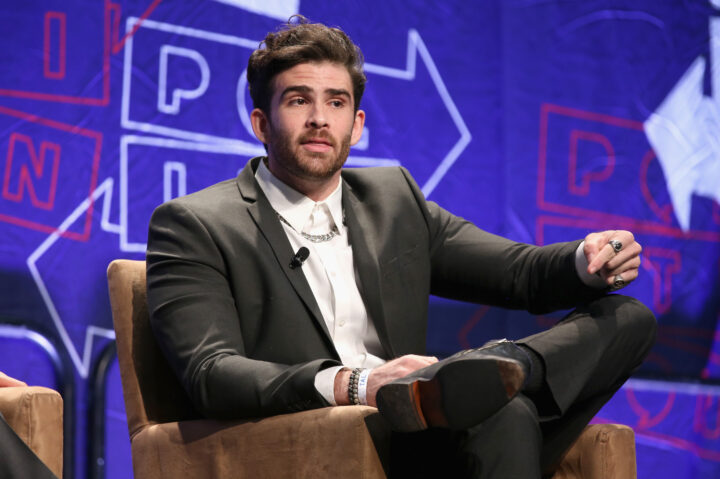
Phillip Faraone/Getty Images for Politicon
Hasan Piker speaks onstage during Politicon 2018 at Los Angeles Convention Center on October 20, 2018 in Los Angeles, California.
A prominent moderate Democratic think tank is continuing to call out Democratic candidates for being “too cozy” with antisemitic streamer Hasan Piker, who has been embraced by several left-wing Democrats in recent months.
In his latest statement, Jonathan Cowan, president of Third Way, condemned Michigan Senate candidate Abdul El-Sayed for his upcoming rallies with Piker, first reported by Politico, set to take place on April 7 at Michigan State University and the University of Michigan alongside Rep. Summer Lee (D-PA).
“It is morally repugnant and strategically self-defeating for Democrats like Abdul El-Sayed and Members of Congress like Summer Lee to cozy up to antisemitic extremists like Hasan Piker,” Cowan said. “Anyone eager to campaign with Hasan Piker is, at best, comfortable overlooking his antisemitic and anti-American extremism and, at worst, endorsing it.”
Cowan referenced a Wall Street Journal editorial he co-authored with Third Way’s Lily Cohen last week, titled “Democrats Are Too Cozy With Hasan Piker,” in which the two urged Democrats to follow the lead of Sen. Ted Cruz (R-TX) in calling out antisemitism in their own party.
“Piker’s depravity rivals that of far-right bigots. We will not defeat the surge of antisemitism in America without taking on its most influential proponents on our own side,” Cowan’s statement continued. “Embracing extreme bigots like Piker, who, for starters, has called religious Jews ‘inbred’ and said ‘America deserved 9/11,’ is not only dangerous and wrong, but antithetical to the urgent work of winning over the middle and defeating Trumpism.”
Other Democrats, including Rep. Ro Khanna (D-CA), have also embraced Piker, while California Gov. Gavin Newsom recently pledged to appear on Piker’s popular Twitch stream.
In the wake of Oct. 7, some in the Jewish community turned to faith, philanthropy or federal advocacy. Others set their sights closer to home, organizing to shape school boards and influence city councils

Michael Nigro/Pacific Press/LightRocket via Getty Images
A pro-Israel supporter holds a sign during the "March for Israel" held on the National Mall.
After the Sandy Hook Elementary School shooting in 2012, Norri Leder dedicated herself to fighting gun violence as a founding member of Moms Demand Action, the gun control group created after the shooting.
And last year, there was another single defining moment that pushed her to create something new, just like she did after Sandy Hook: A candidate running in a Houston school board special election in 2025 sent out a mailer showing herself in a photo with a virulently anti-Israel politician. When Leder ran into the candidate at the polls, she told the candidate that she was “unknowingly alienating yourself, potentially, from members of the Jewish community.” The candidate had no idea.
“She asked me if there was a Jewish group that meets with candidates as they’re running,” Leder recalled. “I said, there are Jewish groups, but it occurred to me that many of them don’t have the bandwidth to meet on these races that are at much more of a local, state and county level as [candidates are] running for office.”
So Leder created one. Where she was once a single-issue activist fighting for gun control measures, now she is putting everything else aside to focus on Jewish communal concerns with her new organization, Houston Jewish Women Vote. Less than four months into its existence, the group has met with candidates running in local attorney, city council and judicial races in 2026.
“We are narrowly focusing on physical security for the Jewish community, antisemitism, targeting of Jews in academic and professional settings, prayer in school and staying in your lane for state, local and county offices — just please don’t engage in foreign policy issues that undermine bridge building in the community and accomplish nothing in the world of foreign policy,” said Leder. “There’s a feeling of, we’re Jewish women, and a lot of us feel politically homeless right now. People feel good knowing that they’re participants and that they can exercise their voice.”
Houston Jewish Women Vote joins dozens of other Jewish advocacy efforts that grew out of the desperation people felt in the days after the Oct. 7, 2023, attacks to fill a void in local politics.
In Pittsburgh, the Beacon Coalition was created when community activist Jeremy Kazzaz saw that local politicians were too afraid to criticize a colleague who posted pro-Hamas messages. The group is now urging Jewish Democrats in the Pittsburgh area to run for seats on the Allegheny County Democratic Committee to be able to help shape the party’s endorsements.
In California, Israeli immigrants helped launch the Bay Area Jewish Coalition (BAJC), in part to help locals make sense of the many local races for positions most people have never heard of.
“Even when we have special elections for things that seem totally unrelated, like the county assessor, which is in charge of property taxes and things like that, at this point, people are reaching out to us and saying, ‘Who do we vote for?’” said BAJC co-founder Keren-Or Reiss, who was born in Israel and now lives in San Mateo, Calif., where she works as a product manager at a tech company. “Is there someone here who’s going to somehow use this platform to spread hate or to normalize antisemitism against us?”
Some in the Jewish community turned to religious practice after Oct. 7, or to supporting charities helping victims of the attacks in Israel, or to pro-Israel political advocacy through establishment groups like AIPAC, or some combination. Leder, Kazzaz and Reiss represent a new class of Jewish American activists: people who were disappointed by the apathy or even outright hostility that some co-workers, teachers, neighbors and local elected officials demonstrated towards Jews and Israelis suffering in the aftermath of Oct. 7, and who felt no one was doing what needed to be done to reach those leaders.
“Local community members can’t just wait for institutions to have enough bandwidth to do everything. People can take responsibility to step up and engage. And that’s what people were doing,” said Jeremy Burton, CEO of the Boston Jewish Community Relations Council. “Part of this revitalization of American Jewish life that we’ve seen has been this emergence of these activists.”
They saw a new kind of opportunity in an American political landscape reshaped by Oct. 7 and the ensuing war in Gaza. Advocating for Congress to vote a certain way on weapons sales to Israel would not do much to affect the swell of antisemitism growing in their communities. Although the war was happening thousands of miles away, they understood that its impact would be local.
“Almost every other community and interest group is doing this on the local level, and not the Jewish community. So we’re really trying to close that gap,” said Tyler Gregory, CEO of the Bay Area Jewish Community Relations Council, which in 2024 became the first JCRC in the country to launch an affiliated advocacy arm to fundraise for candidates and engage in elections. “I think it’s a combination of Congress being sexier and there being fewer issues at the local level.”
After Oct. 7, it became clear that there were not, in fact, fewer issues locally. City council members who were elected to work on municipal governance were now tasked with voting on contentious ceasefire resolutions and calls to divest from Israel. School superintendents and principals had to decide how to respond to teachers who were bringing biased, anti-Israel instruction into the classroom. These were battlefields where existing Jewish communal infrastructure did not have the capacity to fight — either because their nonprofit status kept them from engaging in political races, or because they simply did not have the manpower to reach the hyper-local spaces where debates about Israel, Zionism and antisemitism were now front and center.
“Local community members can’t just wait for institutions to have enough bandwidth to do everything. People can take responsibility to step up and engage. And that’s what people were doing,” said Jeremy Burton, CEO of the Boston Jewish Community Relations Council. “Part of this revitalization of American Jewish life that we’ve seen has been this emergence of these activists.”
The new Jewish activism did not begin in Jewish federation board rooms or congressional office buildings in Washington. It was grassroots campaigns that started in WhatsApp groups and recruited dozens of volunteers through word-of-mouth conversations. These were people who showed up to city hall hearings or met with candidates running for local offices that prior to Oct. 7 may have seemed irrelevant to Jewish concerns.
For Sam Gechter, who works in tech in Boston, a call from a friend in early 2024 alerted him that the city council of Somerville, Mass., where he lives, was trying to pass a resolution calling for a ceasefire in Gaza. The language, Gechter recalled, was “atrocious,” pinning the blame for the war on Israel and hardly mentioning Hamas.
“I got off the phone. I turned to my wife, who was standing next to me, and said, ‘We gotta start a WhatsApp right now of everybody we know in Somerville and get people to come and speak against this,’” Gechter told JI. “That was my moment of being politically activated.”
Soon, that WhatsApp group became Shalom Somerville, a group of Jewish people in the small Boston suburb — an uber-progressive city that neighbors the better-known Cambridge — committed to advancing “a Somerville that is safe for Jews and Israelis.” Despite nominally being an advocacy organization, Shalom Somerville has also become a lifeline for people who otherwise weren’t connected to Jewish institutions.
“For a number of people who haven’t found their place Jewishly in the community, this has become their main Jewish community,” said Gechter. “We had, like, 150 people at our Hanukkah party. It’s gotten to be a pretty big group.”
New organizations that formed to focus on important but unglamorous posts like the county commission and municipal human relations councils are heading into a major election year with ambitious plans to activate Jewish community members to flex their political muscle. They want to show local officials that they ignore Jewish voters at their own peril — and that, conversely, Jewish voters will miss a chance to improve their community if they sit out these races that have a real impact on their day-to-day lives.
“Around the country, there was this awakening, and an understanding that the cavalry wasn’t coming for anybody,” Chicago Jewish Alliance founder Daniel Schwartz told JI.
Each local outfit has a different strategy. Mindy Miller, a former top aide to the Colorado Senate president, co-founded the Colorado Jewish Action Alliance to educate her former colleagues about topics that they never expected to address but that are now everywhere, even in state politics.
“We ask them what they think Zionism means because it’s been so weaponized, and I would say virtually all of them have been appreciative of being able to have those conversations without being fear of being canceled or called out or vilified, because they have to walk a tight rope,” Miller told Jewish Insider.
Chicago Jewish Alliance founder Daniel Schwartz has taken a more confrontational approach. During the city council’s vote on a contentious ceasefire resolution in January 2024, he showed up at City Hall draped in an Israeli flag. He created a WhatsApp group — called the “Zionist Information Group” — to get Chicagoans out to protest.
“Around the country, there was this awakening, and an understanding that the cavalry wasn’t coming for anybody,” Schwartz told JI.
In Lexington, Mass., a suburb of Boston, a group called Lexington United Against Antisemitism, is focused on interfaith work, and connecting members of the town’s Jewish community with Christians.
“Quickly we understood that people, actually, even in Lexington, know very little about Jews altogether. Jews — what do they think? What do they believe?” said Francine Jacobs, a retired Tufts professor who created LUAA.
The group was founded several months before Oct. 7, but its founders have doubled down on their mission, particularly as some liberal Christians who are critical of Israel have taken stances that crossed into antisemitism.
“It took some of the steam out of our effort. There were some folks who just said, ‘Oh, Israel, I’m so angry about it, I just can’t hear the word Jew,’” said Stephen Van Evera, a retired MIT international relations professor, who is Christian and leading LUAA with Jacobs. “I mean, why are you connecting these dots that way? Do you really think that the Jewish community in Lexington is deciding how to fight the Gaza war?”
What drove many people to get involved was their kids. Viviane Safrin became an education activist in San Francisco after the pandemic, when she felt frustrated that public schools were not doing more to reopen. After Oct. 7, parents started calling her to report that their children had experienced antisemitism. So she created SF Jews in School, with the tagline “advancing Jewish inclusion in San Francisco schools.”
“We respond to incidents. We guide families through working with their school. We also engage directly with principals and administrators to support them in ensuring that our schools are welcoming spaces, but we also celebrate our heritage. We build Jewish pride and belonging across the city,” Safrin told JI. “We bring apples and honey for Rosh Hashanah and sufganiyot for Hanukkah.”
Two thousand five hundred miles away, in the Philadelphia suburb of Lower Merion, Dani Shaw created a WhatsApp group for 75 moms soon after Oct. 7. They wrote to the diversity, equity and inclusion director in their school district to ask to talk about ensuring Jewish perspectives were included in the office’s programming. They wound up meeting with the superintendent instead and having a productive conversation. But, shortly after, an op-ed in a high school newspaper that Shaw said spread “blood libels” against Israel caused the moms to step up their activism.
“We created an organization called the Jewish Families Association with a board that consisted at the time of about 15 parents who were all representing different schools in the district,” Shaw told JI. There are now several other Jewish Families Associations in small school districts across Pennsylvania. “It’s really representation — a bridge between the parents and the administration, the school district, to make sure that these incidents, whether they be bullying or problematic curriculum, are dealt with appropriately.”
The group in Lower Merion, a heavily Jewish suburb, supported three Republican candidates for school board last year. They all lost in the liberal town. Keeping activists engaged in the work is hard — “they have to get on with their lives and their livelihoods,” Shaw acknowledged — particularly because the group plans to remain volunteer-led and grassroots, with no fundraising arm.
Fatigue is real. The work of building ties with dozens or even hundreds of local elected officials requires dedicated volunteers and resources. BAJC, the Bay Area group, created a voter guide in 2024 tracking dozens of races — work they want to replicate in 2026, even as they see some people in the community losing interest.
“It’s a constant fight to activate the community. I wouldn’t take that for granted. People prefer to go and watch a football game than to go to a demonstration,” said Oded Shekel, a BAJC leader and an Israeli immigrant who is the CEO of a financial technology startup. “You need to find ways to keep people motivated, activated, connected. I think local fights are easier to connect to than, ‘Would you like to come and support, like, a D.C. bill that we are going to promote?’ Yeah, whatever, I don’t care. ‘Would you like to meet the school boards who actually create policies for the teachers or the kids in your class?’ That’s more likely.”
Not everyone who got involved in this work after Oct. 7 remains involved. But many still are. There is now an entire class of American Jews, many of whom were not engaged politically at all before, who now wholeheartedly believe that the way to make their communities safer and more welcoming is to get involved in local politics. And as both the Democratic and Republican parties face internal fissures over Israel at the national level, an awareness is starting to solidify that reaching politicians at the beginning of their careers, when they are unpolished and open-minded, is a winning strategy.
“We’re not seeking to educate candidates about our issues once they announce for Congress. We want to have multi-year relationships and be able to explain the many nuances of Judaism and Zionism long before they’d like to run for higher office,” said Sam Jefferies, co-chair of The Kids Table, a political action committee in Washington state that is supporting “pro-Jewish” candidates. “You can’t solve antisemitism, but you can prevent antisemites from being in positions of power.”
Plus, GOP losing hope in unseating Ossoff

Roberto Schmidt/Getty Images
President Donald Trump speaks to reporters before boarding Air Force One at Palm Beach International Airport on March 23, 2026 in West Palm Beach, Florida.
This P.M. edition is reserved for our premium subscribers — offering a forward-focused read on what we’re tracking now and what’s coming next. Please don’t hesitate to share your thoughts and feedback by replying to this email.
📡On Our Radar
Notable developments and interesting tidbits we’re tracking
President Donald Trump revealed today that White House Special Envoy Steve Witkoff and advisor Jared Kushner have been negotiating with Iran amid the ongoing war, Jewish Insider’s Emily Jacobs reports, which played a role in Trump’s decision to delay by five days potential strikes on Iranian energy infrastructure.
“We have had very strong talks,” Trump told reporters. “Mr. Witkoff and Mr. Kushner had them. They went, I would say, perfectly. If they carry through with that, it’ll end that problem.” But the president kept the option of continued military action open: “If it goes well, we’re going to end up with settling this. Otherwise, we’ll just keep bombing our little hearts out,” he said.
At an event in Tennessee this afternoon, Trump added, “My whole life has been a negotiation, but with Iran we’ve been negotiating for a long time, and this time they mean business” and claimed the U.S. has taken out 90% of Iran’s missile launchers…
Israeli Prime Minister Benjamin Netanyahu said in a video statement that he spoke with Trump today about the negotiations, which the president believes could result in “an agreement that will safeguard our vital interests.”
“At the same time,” Netanyahu said, Israel is continuing to strike targets in Iran and Lebanon; the IDF announced it had struck several “regime headquarters” in Tehran and CENTCOM also said it continues “to aggressively strike Iranian military targets with precision munitions”…
Senate Minority Leader Chuck Schumer (D-NY) declined to directly address whether the degradation of Iran’s military infrastructure should be viewed as a positive outcome, JI’s Matthew Shea reports, instead emphasizing the war’s potential economic and geopolitical consequences.
Asked on MS NOW’s “Morning Joe” if the degradation is a “good thing,” Schumer said it’s a “premature question. What is going to happen in the next several months? Is it worth it? Will the world economy collapse? … If you ask the American people, if you have the choice of degrading the military structure in Iran, but having gasoline be $6 a gallon and our economy falling into a deep recession where millions lose their job, what do you think?”…
The New York Times reports on the apparent failure of a plan by the Mossad to foment internal Iranian rebellion that could lead to the overthrow of the regime amid the ongoing war, as American and Israeli intelligence indicates the regime is weakened but intact…
UAE Foreign Minister Abdullah bin Zayed said Abu Dhabi will “never be blackmailed by terrorists,” in response to a post from French diplomat Gérard Araud who called the UAE’s further embrace of the U.S. amid bombardment from Iran “strange”…
The Associated Press examines Israel’s use of Iran’s network of surveillance cameras to carry out intelligence operations including the assassination of former Supreme Leader Ayatollah Ali Khamenei…
Asked if former intelligence official Joe Kent was leaking classified information, as he is reportedly under investigation by the FBI for doing, Trump said “that’s possible,” and largely derided Kent for his failed congressional campaigns and for remarrying “quickly” after his first wife was killed in 2019 while serving in Syria.
“I felt badly for him, so I told my people, ‘Reach out to him, give him a job at the White House.’ This is the thanks I get,” Trump told reporters. He also dismissed Kent’s opposition to the Iran war as an effort “to get publicity”…
Heritage Foundation President Kevin Roberts said that internal MAGA divisions over the Iran war, like those espoused by Kent, are “good” for the movement. “As it relates to tensions in the movement or disagreements about national security, actually, it’s good that those exist,” he told The Hill. But, Roberts said, he believes Trump “has executed [the war] perfectly, including not involving untrustworthy European, quote, unquote allies in the conversation”…
Politico looks at the decision of pro-Israel groups including AIPAC and the Republican Jewish Coalition not to spend money against Texas congressional candidate Brandon Herrera as they did during his first run for Congress, despite Herrera’s history of extreme views and antisemitic rhetoric. Trump endorsed Herrera last week after Rep. Tony Gonzales (R-TX) withdrew from the race…
New filings from the Federal Election Commission show that two super PACs rumored to be established by pro-Israel groups during the Illinois Democratic primaries were primarily funded by United Democracy Project, the AIPAC-affiliated super PAC, which spent more than $5.3 million through Elect Chicago Women and Affordable Chicago Now.
Among the other major donors who backed the two groups was prominent Democratic philanthropist Michael Sacks, who had lamented the rising “Jew hate” among candidates who refused to take money from donors affiliated with AIPAC earlier in the election…
Republicans are quietly losing hope in their ability to defeat Sen. Jon Ossoff (D-GA), a seat which the GOP had named as one of its main targets to flip, The Washington Post reports. “This guy’s no slouch,” Rep. Buddy Carter (R-GA), running in the GOP primary, told a crowd of Republican voters, calling Ossoff “articulate” and “handsome.”
Jewish leaders in Georgia told JI last year that Ossoff was making amends with their community after he had voted to block some aid to Israel, though the Jewish lawmaker is now drawing fresh controversy by adopting Rep. Ro Khanna’s (D-CA) rhetoric about the “Epstein class,” which some have identified as antisemitic…
⏩ Tomorrow’s Agenda, Today
An early look at tomorrow’s storylines and schedule to keep you a step ahead
Keep an eye out in Jewish Insider for a look at how the aftermath of the Oct. 7 attacks has sparked a wave of grassroots Jewish political activism across the U.S., as community members organize locally — from city councils to school boards — to respond to rising antisemitism and shape down-ballot races.
The Hill & Valley Forum, a summit focused on connecting government and the tech and innovation industries, will hold its annual gathering in Washington tomorrow with opening remarks by its co-founder, Jacob Helberg, now under secretary of state for economic affairs. Ahead of the summit, Helberg announced today that the U.S. will contribute $250 million alongside a consortium of countries involved in the Pax Silica initiative to invest in energy projects and critical minerals.
Also speaking tomorrow are Sens. Mike Rounds (R-SD), Chris Coons (D-DE), Todd Young (R-IN), Maria Cantwell (D-WA), Jim Banks (R-IN), Rick Scott (R-FL) and Mark Warner (D-VA); House Speaker Mike Johnson (R-LA); Reps. Josh Gottheimer (D-NJ) and John Moolenaar (R-MI); OpenAI COO Brad Lightcap; JPMorgan Chase CEO Jamie Dimon; NASA Administrator Jared Isaacman; Palantir CTO Shyam Sankar; Michael Duffey, under secretary of defense for acquisition and sustainment; and Ben Black, CEO of the U.S. International Development Finance Corporation.
Stories You May Have Missed
PERSIAN COVERAGE PUSH
The international broadcaster, along with Radio Free Europe, has struggled to deploy its Persian-language services to provide coverage amid an internet blackout in Iran
IVY LEAGUE INQUIRY

The report’s author argued Harvard has been ‘ambivalent’ about its decreasing Jewish population, while other Jewish leaders cast doubt on its findings
Plus, Trump suspends strikes on Iranian energy targets

(Henry Nicholls / AFP via Getty Images)
Local residents gather next to a firetruck (behind) as firefighters secure an area in the Golders Green neighbourhood of north London on March 23, 2026, after volunteer ambulances run by a Jewish organisation were set on fire overnight.
👋 Good Monday morning!
In today’s Daily Kickoff, we look at the implications of Iran’s ballistic missile strikes targeting the U.S.-U.K. base in Diego Garcia, and break down a new poll of GOP voters that found overwhelming support for military action in Iran. We report on a meeting between the Congressional Progressive Staff Association and Columbia University protest leader Mohsen Mahdawi, and cover the creation of a new PAC created to push back against New York City Mayor Zohran Mamdani and the Democratic Socialists of America. Also in today’s Daily Kickoff: Rep. Elise Stefanik, Michael Kotlikoff and Yossi Cohen.
Today’s Daily Kickoff was curated by JI Executive Editor Melissa Weiss and Israel Editor Tamara Zieve, with assists from Danielle Cohen-Kanik and Marc Rod. Have a tip? Email us here.
What We’re Watching
- President Donald Trump posted on his Truth Social site minutes ago that the U.S. will postpone — for five days — strikes targeting Iranian energy infrastructure over Iran’s closure of the Strait of Hormuz, about 12 hours before his 48-hour deadline to the Islamic Republic was set to expire. The president cited “very good and productive conversations regarding a complete and total resolution of our hostilities in the Middle East,” which he said will continue over the course of the week.
- A final vote on Sen. Markwayne Mullin’s (R-OK) nomination to be secretary of homeland security is likely to take place today or tomorrow. Mullin is expected to be confirmed with support from at least two Democrats: Sens. John Fetterman (D-PA) and Martin Heinrich (D-NM), the latter of whom cited his “very honest and constructive working relationship” with the Oklahoma Republican in explaining his vote.
- The House and Senate are both expected to vote on war powers resolutions this week.
- Sara Netanyahu is slated to travel to Washington this week for a two-day summit being convened by First Lady Melania Trump for women — many who, like Netanyahu, are the spouses of heads of state — and technology companies focused on children’s empowerment. The summit kicks off on Tuesday at the State Department.
- Mrs. Netanyahu will be among a small number of people able to fly out of Israel’s Ben Gurion Airport after Israeli authorities on Sunday cut the maximum number of passengers allowed per flight from 150 to 50, amid ongoing missile fire from Iran.
- Senior Trump administration officials are heading to Houston this week for the annual CERAWeek conference, which kicks off today.
- Conservative radio host Mark Levin, a frequent critic of Tucker Carlson and other far-right figures, is slated to interview Joe Kent, who resigned last week as the head of the National Counterterrorism Center, on his program tonight.
- In New York tonight, author Matti Friedman will sit in conversation with Abigail Pogrebin at 92NY to discuss his new book, Out of the Sky: Heroism and Rebirth in Nazi Europe, a look at the young Jews from then-Mandatory Palestine who parachuted into Nazi Europe in an effort to assist Allied forces and rescue Jews.
- The Leffell Foundation’s fourth annual “Zionism: A New Conversation” conference is taking place in Florida today and tomorrow. Read more here.
What You Should Know
A QUICK WORD WITH JI’S MELISSA WEISS
Iran’s launch over the weekend of two ballistic missiles targeting the joint U.S.-U.K. Diego Garcia base in the Indian Ocean — hours after London said it would allow the U.S. to use the base to launch strikes on Iranian missile sites — deepened concerns that the Islamic Republic had not been forthcoming in the past about its weapons capabilities and set off alarms in Europe that the continent could find itself on the receiving end of Tehran’s long-range missiles.
Iranian Foreign Minister Abbas Araghchi said last month that the Islamic Republic only had ballistic missiles with the capacity to hit targets within a 2,000-km radius (approximately 1,200 miles) with the country’s state-run media quoting the diplomat as saying “We are not developing long-range missiles … we have limited the range below 2,000 kilometers.”
Diego Garcia is some 2,400 miles from Iran, twice as far as the distance Iran’s top diplomat had claimed the country’s missiles could reach. It’s further from Tehran than most major European capitals — meaning that the bulk of the European continent is potentially within striking range of Iran. (And, critically, without the types of air defenses and civilian protective measures that have been deployed multiple times a day in Israel for the last month.)
The discrepancy didn’t go unnoticed by current and former U.S. officials. Brett McGurk, who served as a senior national security official in the Biden administration, noted Araghchi’s February claim alongside a map showing Diego Garcia’s distance from Iran, saying that Araghchi’s blatant falsehood “speaks for itself.” In a rare show of agreement between the Trump administration and its predecessor, Defense Secretary Pete Hegseth and the White House’s rapid-response account shared McGurk’s post.
Though neither missile reached the Chagos Island base — one fell short and one was intercepted — the weekend launches have elevated concerns that Tehran has developed the capacity to strike deep inside Europe — most of which is much closer to the Islamic Republic than the Diego Garcia base in the middle of the Indian Ocean.
POLITICS PULSE

Republican voters expressed strong support for President Donald Trump’s military action against Iran, and would decidedly prefer a GOP congressional candidate who advocates for the war’s aims, according to a new survey from pollster J.L. Partners. The poll, which surveyed 1,018 likely GOP voters between March 17-18, finds that an overwhelming share of Republicans (83%) support Trump’s war against Iran, with just 9% opposing. Nearly two-thirds (63%) of Republicans said they “strongly support” Trump’s war efforts, Jewish Insider’s Josh Kraushaar reports.
Additional findings: The poll also found a sizable share of Republicans holds negative views towards far-right, antisemitic podcaster Tucker Carlson, even as many media outlets claim he speaks for the MAGA movement. Only 40% of Republicans hold a favorable view of Carlson, while nearly one-quarter of respondents view him unfavorably. When GOP voters were asked whether they’d prefer a candidate endorsed by Trump or by Carlson and Megyn Kelly, a whopping 80% preferred a Trump-backed candidate, with just 7% siding with the podcasters. Asked whether voters trust Trump’s position on Iran or Carlson and Kelly’s view, 83% sided with Trump while just 6% sided with the far-right podcasters.
HILL HAPPY HOUR
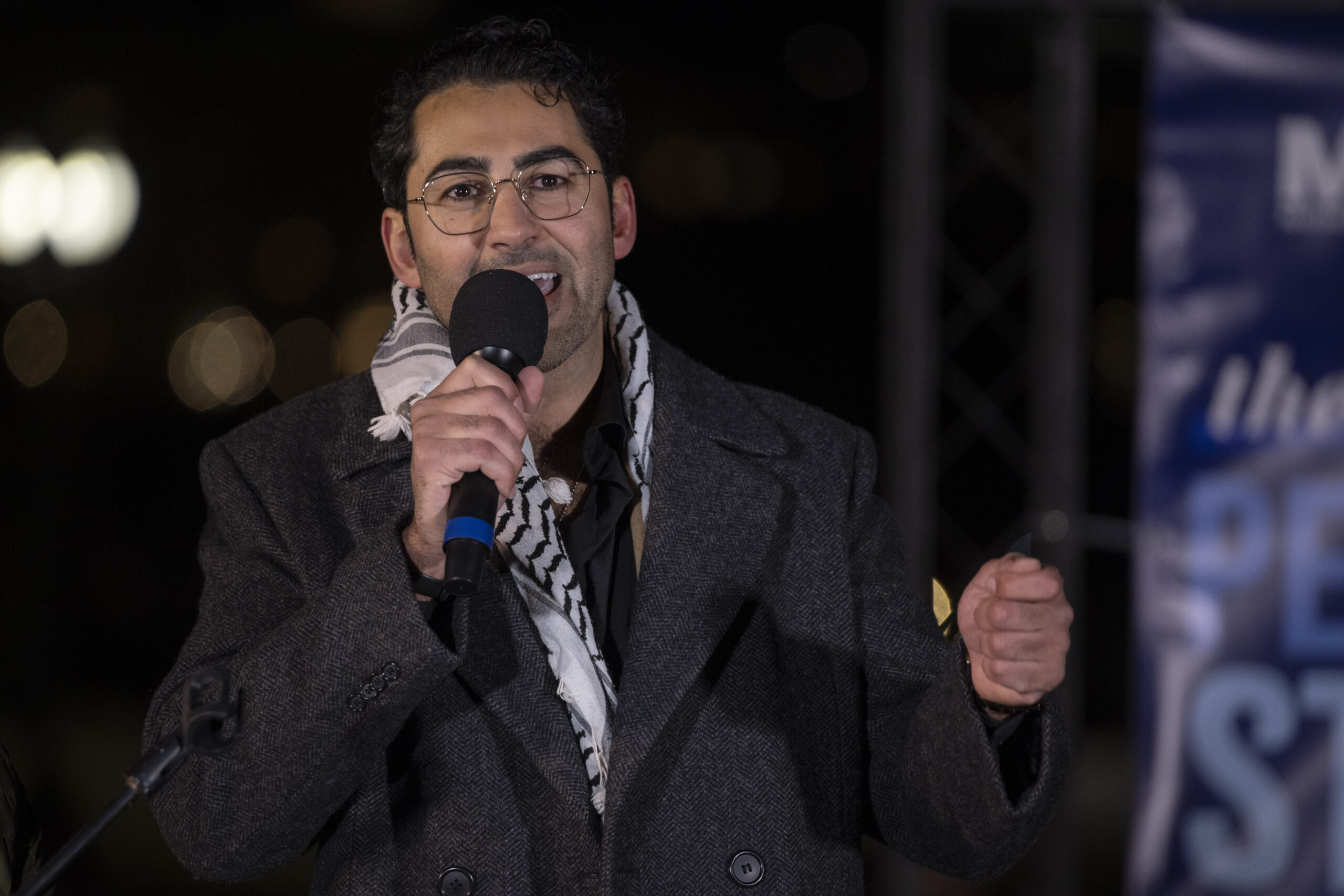
The Congressional Progressive Staff Association, a congressional employee group for progressive staffers and prospective staffers, hosted a happy hour this week with Columbia University protest leader Mohsen Mahdawi, whom the administration has been trying for months to deport, Jewish Insider’s Marc Rod reports.
Background: The Department of Homeland Security has characterized Mahdawi, who has not been charged with a crime, as a “ringleader” in anti-Israel protests at Columbia and accused him of using “threatening rhetoric and intimidation” against Jewish students. The administration has also claimed that Mahdawi admitted to being involved in and supporting terrorist violence, including telling a gun shop owner more than a decade ago that he had “considerable firearm experience” and used guns to “kill Jews while he was in Palestine,” that he attempted to purchase a rifle and a machine gun, that he claimed to have made guns for Hezbollah and that he said that he enjoyed killing Jews.
PAC ATTACK
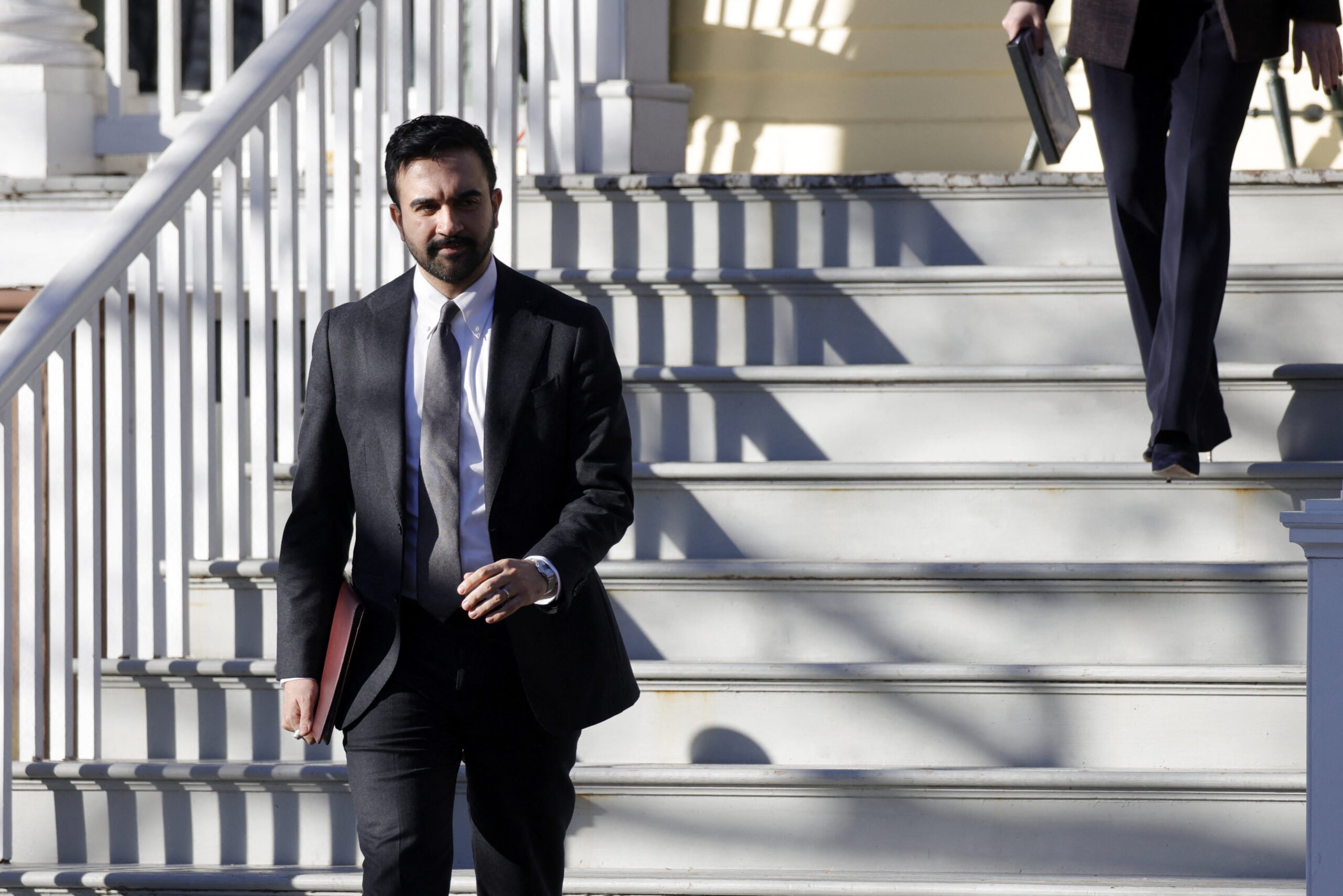
A veteran operative for former Chicago mayor and congressman Rahm Emanuel has established a new political action committee to fight New York City Mayor Zohran Mamdani and the Democratic Socialists of America in the Big Apple — an effort that sources say could involve former city Comptroller Scott Stringer and aides to former Gov. Andrew Cuomo, Jewish Insider’s Will Bredderman reports.
Joining forces: The Next NYC PAC registered with the New York State Board of Elections on March 11, using the address of Gregory Goldner’s home in the Mid-North District of Chicago. Goldner, who helmed Cuomo’s mayoral campaign in the final weeks of the 2025 cycle and ran a PAC aimed at preventing the election of Chicago Mayor Brandon Johnson two years prior, did not respond to repeated requests for comment. However, sources — who spoke anonymously with JI as Next NYC remains in its formative stages — said that it could fuse the political infrastructure of two candidates who failed to block Mamdani from City Hall last year: Cuomo and Stringer.
DIGGING IN
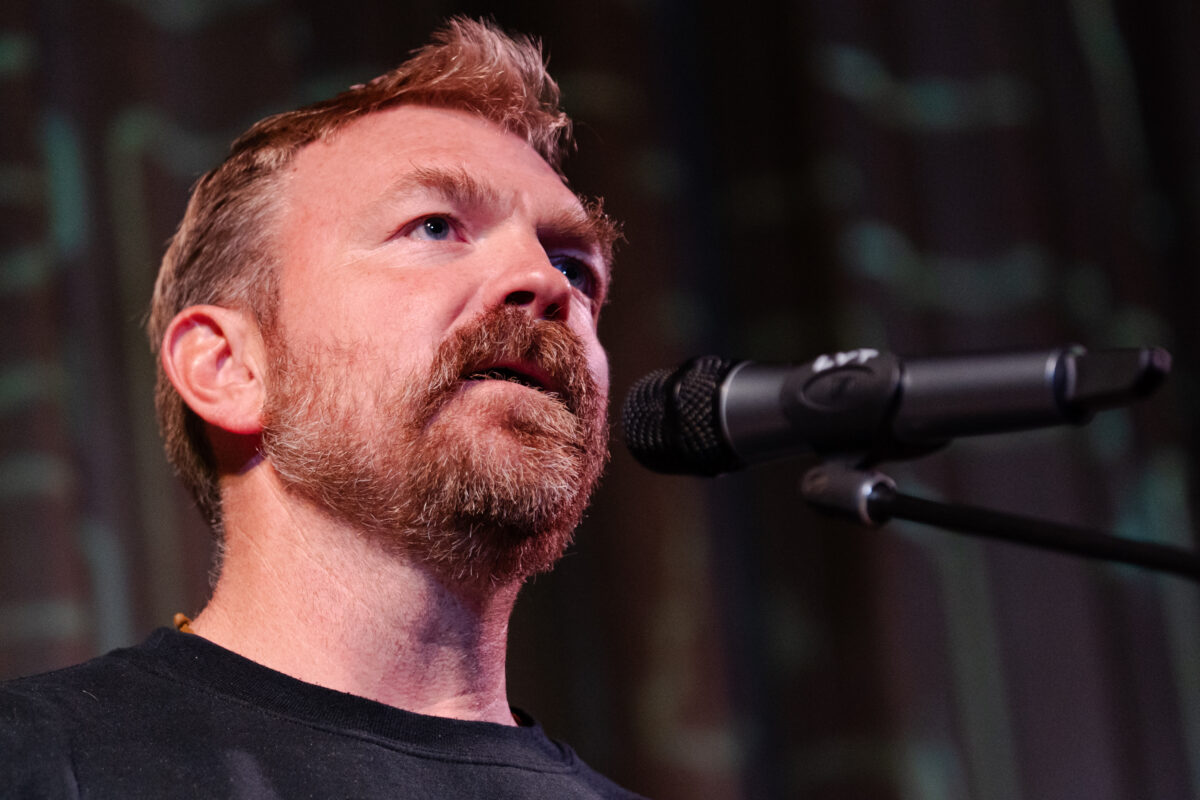
Graham Platner, the progressive Maine Senate candidate, in a CNN interview that aired Sunday accused Israel of committing genocide and said the U.S. should cut off all aid, as well as dismissed concerns that bringing the Iran war to a halt would endanger U.S. forces in the region, Jewish Insider’s Marc Rod reports.
Notable quotable: “I fundamentally believe that a nation that is committing a genocide should not be a place that we are putting money. We should be leveraging the fact that we have a lot of power in this relationship due to our funding,” Platner said in the interview. “We should be leveraging that to, frankly, get the Israeli government to stop behaving in such an utterly atrocious fashion.”
SHIFTING STANCE
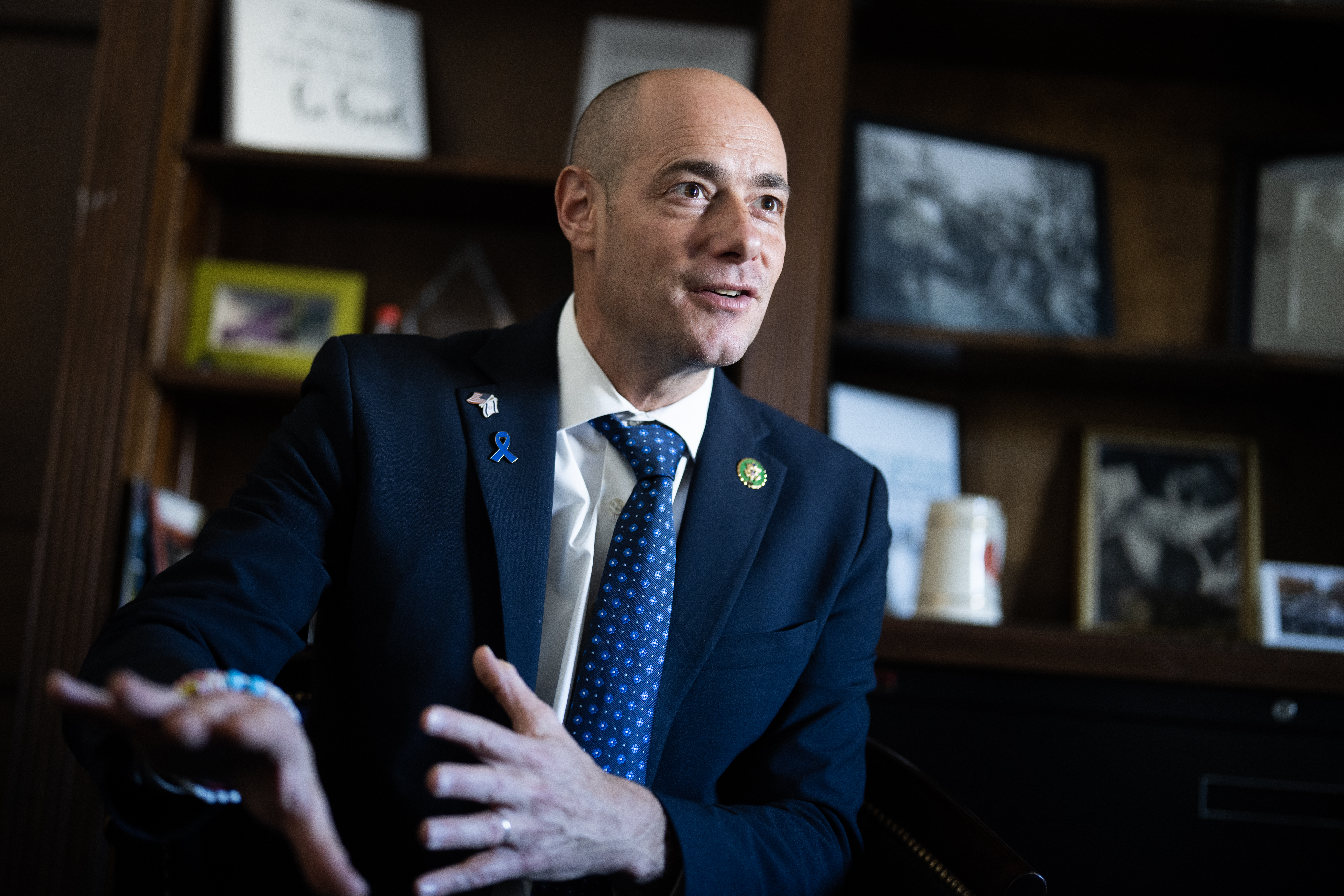
Rep. Greg Landsman (D-OH), one of the few House Democrats who has supported strikes on Iran and opposed a war powers resolution to bring it to an end earlier this month, now says he wants to see the war wrapped up, and will vote for an upcoming resolution to end the conflict, Jewish Insider’s Marc Rod reports.
Time up: “It’s time to finish the operation in Iran. It’s time to be done,” Landsman said in a statement on Friday. “No expansion of the original operation. No ground troops.” Landsman’s statement comes in advance of an anticipated vote on another war powers resolution to end the conflict this week, led by Rep. Greg Meeks (D-NY). Landsman said he plans to vote for the war powers resolution, and urged colleagues to do the same.
War worries: As the U.S. deploys thousands of Marines to the Middle East and President Donald Trump continues to send mixed messages about whether he plans for a ground invasion of Iran, Sen. Josh Hawley (R-MO) told JI he’s hoping the administration does not take that step.
CAMPUS CRACKDOWN

The Trump administration filed a new lawsuit against Harvard University on Friday, claiming that its leadership violated the civil rights of Jewish students by failing to address ongoing antisemitism that has roiled the Ivy League campus since the Oct. 7, 2023, terrorist attacks in Israel, Jewish Insider’s Haley Cohen reports.
What it says: In the 44-page lawsuit, filed in federal court in Boston, the Department of Justice said that Harvard unlawfully discriminated against Jewish students by its “intentional conduct and its deliberate indifference to discriminatory harassment of Jewish and Israeli students and creation of a hostile educational environment” since Oct. 7 and “up to the present day.” Jewish and Israeli students “were repeatedly denied access to educational facilities by antisemitic demonstrators. Fearful for their safety, Jewish students wore baseball caps to conceal their yarmulkes or kept out of sight, effectively denying them access to federally funded educational opportunities,” the lawsuit argues.
Leadership rebuke: Cornell President Michael Kotlikoff rejected a recent Student Assembly resolution calling for the university to boycott its partnership with an Israeli institution, the Technion in Haifa, stating that doing so would “fundamentally conflict with our core commitment to academic freedom” and noting the “political bias” within the resolution “is deeply disturbing.”
Worthy Reads
Aiding the Revolution: The Free Press’ Eli Lake looks at Israel’s efforts to align with Iranian opposition efforts. “The Iranian people have voted against the Islamic Republic with their feet since the first student uprisings at Tehran University in 1999. In 2009, Iranians protested a stolen presidential election. Since 2017, uprisings have sprouted throughout the country every few years, only to be crushed by the Basij and Revolutionary Guards. Israel is evening the odds for a revolution by putting its air force in the service of Iran’s dissidents. At least that’s the dream.” [FreePress]
U.K. Concern: In The Guardian, Jonathan Freedland raises concerns about attacks on Jewish institutions conducted under the guise of criticism of Israel. “Every minority faces discrimination – note Tory frontbencher Nick Timothy’s appalling attack on Muslim prayer this week – but next to no other diaspora community goes through this. People can’t stand Vladimir Putin’s invasion of Ukraine, but Russian Orthodox churches don’t require round-the-clock protection. People loathe Donald Trump and his bombing of Iran, but U.S.-branded stores on UK high streets are not smashed and daubed. As for British businesses with investment links to the U.S., including to U.S. security firms, those remain untouched. Israel and Jews are the exception.” [TheGuardian]
Word on the Street
Police in London are investigating a series of overnight fires that damaged four Hatzola Northwest emergency vehicles in Golders Green, one of the city’s most heavily Jewish suburbs; the U.K.-based Community Security Trust said that the Iran-linked Ashab al-Yamin, which said it was behind recent attacks in the Netherlands and Belgium, claimed responsibility for the string of arsons…
The Treasury Department announced sanctions on 10 individuals in Lebanon, Syria, Poland, Slovenia, Qatar and Canada accused of laundering more than $100 million in money, arms and telecommunications equipment to Hezbollah…
The U.S. reportedly rejected a proposal from Russia in which Moscow would end its intelligence sharing with Iran on the condition that Washington cease giving intelligence to Ukraine regarding Russia…
Axios looks at efforts by the CIA, Mossad and other intelligence agencies to assess the status of Iranian Supreme Leader Mojtaba Khamenei, who has not appeared in public since he was named his father’s successor earlier this month and is believed to have been injured in the strikes last month that killed the elder Khamenei…
One person was killed and another injured in Israel over the weekend, after two cars caught fire in the Upper Galilee from errant IDF shells that fell inside Israel, rather than Lebanon, an investigation by the military found on Monday. Over 100 people were injured in missile strikes from Iran and Hezbollah in Lebanon between Saturday night and Sunday morning, Jewish Insider’s Lahav Harkov reports…
The Wall Street Journal reports on concerns that the Houthis in Yemen could join the conflict, as the Iran-backed terror group, whose previous attacks on naval vessels in the Red Sea, ramps up its threatening rhetoric, including a warning from a senior Houthi official last week that “Yemen joining the conflict is only a matter of time”…
Nine Senate Democrats and more than 30 House Democrats wrote to the administration defending Columbia University protest leader Mahmoud Khalil, describing the protests in which he was involved as “overwhelmingly non-violent expressions of views in opposition to the conduct of the Israeli government in Gaza”…
Rep. Elise Stefanik (R-NY) was honored over the weekend at Chabad of Stamford, Conn., with the group’s inaugural Eishet Chayil Award…
The Wall Street Journal looks at frustrations among some progressive Senate Democrats — a group of eight legislators known as the “Fight Club” over Senate Minority Leader Chuck Schumer’s (D-NY) approach to the midterms as they mull a potential challenge to his leadership…
The Hill explores Pennsylvania Gov. Josh Shapiro’s vocal support for Israel in recent interviews as he mulls a 2028 presidential bid…
President Donald Trump, who spent the weekend in Florida, dropped into the anniversary party being hosted for Gary and Terri Schottenstein over the weekend at Mar-a-Lago…
The New York Times reviews Michael Kimmel’s “Playmakers,” as the distant relative of teddy bear inventors Morris and Rose Michtom looks at the major contributions of Jewish immigrants to the American toy industry…
A Reuters deep dive into decades-old Manhattan police records confirmed the identity of the graffiti artist Banksy…
Former Mossad head Yossi Cohen and Israel Canada controlling shareholders Barak Rosen and Asaf Touchmair are investing in the Israel-based UAV company Aerodrome Group…
Molecular biologist David Botstein, whose research laid the groundwork for the field of gene-mapping, died at 83…
Pic of the Day

Israeli judoka Raz Hershko won the gold medal at the women’s over 78 kg final at the Grand Slam judo tournament on Sunday in Tbilisi, Georgia.
Birthdays

Former NFL referee for 23 seasons, he is the only NFL head referee to officiate four Super Bowl games (1983, 1987, 1992 and 1995), Jerry Markbreit turns 91…
Actor, film director, television director and producer, Mark Rydell turns 97… Together with her husband, Theodore, she pledged $25 million to BBYO in 2019, Harriette Perlman turns 86… Mandolinist and composer of acoustic, instrumental, bluegrass and newgrass music, David Grisman turns 81… Writer and producer of television series, creator of “Deadwood” and co-creator of “NYPD Blue,” David Milch turns 81… Tel Aviv native, she has been a professor of music at the Juilliard School since 1993, Yoheved “Veda” Kaplinsky turns 79… Los Angeles-based psychologist and author, her first book is The Blessings of a Skinned Knee: Using Jewish Teachings to Raise Self-Reliant Children, Wendy Mogel turns 75… Designer of men’s and women’s footwear, clothing and accessories, Kenneth D. Cole turns 72… Former mayor of Austin, Texas, first elected in 2014 and reelected in 2018, Stephen Ira Adler turns 70… Former director of business development at Fannie Mae, she was also the president of the Jewish Federation of Howard County (Md.), Beth Millstein… Investor, author, financial commentator and radio personality, Peter Schiff turns 63… Russian-American businessman with holdings in oil, he is also a winemaker, Eugene Shvidler turns 62… Senior writer for “The Daily Show,” he is also the creator of 2018’s television series “Liberty Crossing,” Daniel Radosh turns 57… Managing partner of D.C.-based Stein Mitchell Beato & Missner, Jonathan Missner turns 57… French actress who has appeared in more than 30 films, her Holocaust survivor grandparents changed their name from Goldreich, Judith Godrèche turns 54… Client partner at Meta/Facebook working with the financial services and real estate industry verticals, Scott Shapiro… Member of the Maryland General Assembly since 2011, initially as a delegate and since 2016 as a state senator, Craig Zucker turns 51… Israeli actress, comedian and television host, Adi Ashkenazi turns 51… Three-time Grammy Award-winning record producer, audio engineer and songwriter, Ariel Rechtshaid turns 47… Writer and teacher in Los Angeles, Yehuda Martin Hausman… Staff reporter for The New York Times, Sarah Maslin Nir… Israeli singer-songwriter, actress and musician, she performs in Hebrew, French and Arabic, Riff Cohen turns 42… Chief of staff for the Commonwealth’s attorney in Fairfax County, Va., Benjamin Shnider… Former tennis coach at Chestnut Hill College in Philadelphia, as a player she won five singles and four doubles titles on the ITF Women’s Circuit, Julia Cohen turns 37… Former member of the National Israeli Rhythmic Gymnastics Team, she competed in the 2012 Olympic Games, Moran Buzovski turns 34… Television and film actress, Victoria Pedretti turns 31…
Amid other ongoing legal battles, the federal government is seeking to reclaim millions in taxpayer dollars over Harvard’s alleged civil rights violations

JOSEPH PREZIOSO/AFP via Getty Images
Tents and signs fill Harvard Yard in the anti-Israel encampment at Harvard University in Cambridge, Massachusetts, on May 5, 2024.
The Trump administration filed a new lawsuit against Harvard University on Friday, claiming that its leadership violated the civil rights of Jewish students by failing to address ongoing antisemitism that has roiled the Ivy League campus since the Oct. 7, 2023, terrorist attacks in Israel.
In the 44-page lawsuit, filed in federal court in Boston, the Department of Justice said that Harvard unlawfully discriminated against Jewish students by its “intentional conduct and its deliberate indifference to discriminatory harassment of Jewish and Israeli students and creation of a hostile educational environment” since Oct. 7 and “up to the present day.”
Jewish and Israeli students “were repeatedly denied access to educational facilities by antisemitic demonstrators. Fearful for their safety, Jewish students wore baseball caps to conceal their yarmulkes or kept out of sight, effectively denying them access to federally funded educational opportunities,” the lawsuit argues.
It further claims that Harvard faculty and leadership’s response was to “turn a blind eye to antisemitism and discrimination against Jews and Israelis.”
The suit is seeking to recover millions of dollars in taxpayer funds that the school received as these alleged civil rights violations were ongoing.
The litigation marks the administration’s latest crackdown in its ongoing battle with several elite universities including Harvard, which have faced multibillion-dollar funding cuts since last year. The school sued the federal government over the funding freezes, and a federal judge ruled last September that the government violated Harvard’s First Amendment rights and federal law when it froze nearly $2 billion in federal grants. The Trump administration filed an appeal in December 2025, which is ongoing.
“Harvard University has failed to protect its Jewish students from harassment and has allowed discrimination to wreak havoc on its campus. President Trump is committed to ensuring every student can pursue their academic goals in a safe environment,” White House Regional Press Secretary Liz Huston said in a statement.
In a statement to Jewish Insider, a Harvard spokesperson said, “Harvard cares deeply about members of our Jewish and Israeli community and remains committed to ensuring they are embraced, respected, and can thrive on our campus. Our actions illustrate this. Harvard has taken substantive, proactive steps to address the root causes of antisemitism and actively enforces anti-harassment and anti-discrimination rules and policies on campus … Harvard’s efforts demonstrate the very opposite of deliberate indifference.”
Since Oct. 7, Harvard has also faced legal action from Jewish groups. In May 2024, the Louis D. Brandeis Center for Human Rights Under Law filed a federal lawsuit claiming that students and faculty on campus have called for violence against Jews and celebrated Hamas’ terrorism daily as the university ignored harassment— including a physical assault — of Jewish students.
The DOJ suit comes days after a new report was released by the university’s official Jewish alumni group that found Jewish enrollment at Harvard has fallen to roughly 7% — its lowest level since the pre-World War II era.
The report’s author argued Harvard has been ‘ambivalent’ about its decreasing Jewish population, while other Jewish leaders cast doubt on its findings

Zhu Ziyu/VCG via Getty Images
A glimpse into the Harvard University campus on May 24, 2025 in Cambridge, Massachusetts.
A newly released report finding that Jewish enrollment at Harvard University has fallen to roughly 7% — its lowest level since the pre-World War II era — has sounded alarms among some Jewish leaders, while touching off a debate at Harvard about its accuracy.
The figure marks a steep decline from a decade ago, when Jewish students made up about twice that share, and represents the lowest proportion among Ivy League schools with available data. The decrease is not reflected at all Ivy Leagues, though: At Princeton, Jews declined at less than a fifth of the rate of their white non-Jewish peers. At Brown and Cornell, Jewish enrollment held or grew over the past decade.
The 64-page report, “A Narrowing Gate: Jewish Enrollment at Harvard and Its Peers, 1967-2025,” released this week by the university’s official Jewish alumni group, argues that the decline is not simply the byproduct of neutral admissions trends, but reflects a growing “ambivalence” to admitting Jewish students on Harvard’s part.
“It’s not that Harvard intended [Jewish enrollment] to decline. It’s that they were ambivalent about the decline. We were invisible and therefore irrelevant,” Adrian Ashkenazy, the report’s author and president of the Harvard Jewish Alumni Alliance, told Jewish Insider.
Jews face several documented structural disadvantages in the admissions process, according to the report, chief among them geography. Harvard has deliberately shifted enrollment away from the Northeast and Mid-Atlantic, it alleges, home to nearly half of all American Jews, with New York state enrollment alone falling from 264 students in 1992 to 160 in 2024.
An increase in international student enrollment has deepened the effect: The report finds that international students come from a “uniformly and dramatically less Jewish applicant pool,” meaning every percentage point of international student growth decreases the available seats for Jewish students.
Racial and ethnic diversity goals and financial aid present additional headwinds: The vast majority of American Jews are Ashkenazi and check “white” on an application box, placing them outside the diversity categories universities actively recruit.
Harvard’s access initiative since 2004 recalibrated holistic review to weight “socioeconomic context, parental occupation, and first-generation status as positive factors.” Jewish applicants are, the report finds, “disproportionately higher-income, continuing-generation, and concentrated in coastal urban centers, characteristics that sit on the unfavored side of all four dimensions of this initiative simultaneously.”
The Supreme Court’s decision reversing affirmative action, which was ostensibly meant to reverse these policies, has “made it much harder to pursue diversity for its own sake, which includes a targeted increase in Jewish enrollment,” said Ashkenazy.
But Ashkenazy argues it’s not a given that these factors have to decrease Jewish enrollment — he offered Brown as a counter-example to Harvard, saying the Rhode Island school had been intentional in its efforts to recruit Jews.
“Brown looked at its Jewish community and decided that maintaining and growing it was consistent with their broader diversity goals — that the Jewish community is not a monolith and that real diversity can be pursued within it. At Harvard we were absent from the equation. At Brown we were integrated into it. That is the difference.”
“The decline at Harvard is a story of absence, not intention,” he continued. “We were crowded out by other admissions priorities. Harvard didn’t measure it, anticipate it or manage it. The Jewish community simply was not a priority.”
“When a decline is steepest at particular institutions, it ceases to be coincidence and looks more like culture,” Rabbi David Wolpe, emeritus rabbi of Sinai Temple in Los Angeles, who served as a visiting scholar at Harvard Divinity School in 2023-24, told JI. Harvard now has “a choice of denial or determination to change the atmosphere and procedures that led us here,” said Wolpe, who stepped down from his position on Harvard’s antisemitism advisory committee in December 2023 due to what he said was an inability to effect change.
A spokesperson for Harvard told JI that the university “does not collect data on applicants’ shared ancestry or religious identity. Any estimates that exist on applicant data come from external surveys, which vary widely in methodology and cannot reliably measure changes over time, outline differences across schools, or explain application, admission, or enrollment patterns. Harvard continues to fully comply with the law, including Title VI and the Students for Fair Admissions decision, in its admissions policies and practices.”
Harvard “shares the Harvard Jewish Alumni Alliance’s commitment to fostering a vibrant Jewish community at Harvard,” the spokesperson said. “Jewish life on campus remains active and well-supported, with strong participation across student organizations, religious and cultural life, and campus programming. Additionally, over the last few years, Harvard has taken intentional steps to strengthen our campus culture and environment.”
Miriam Elman, executive director of the Academic Engagement Network, said that the report “has provided university leaders with a thoughtful and rigorous analysis.”
“While Harvard has seen a dramatic decline in Jewish undergraduate student enrollment, enrollment at Brown remains high and robust, even though this Ivy League university has also experienced antisemitic incidents in recent years. What explains the difference? It’s because Brown has significantly invested in campus Jewish life and cares about recruiting Jewish students,” Elman told JI.
“For a number of years it has strategically focused on a number of local New England high schools with high Jewish student populations,” Elman continued. “Brown is also initiating a host of educational programs that infuse a welcoming culture that supports Jewish and Zionist students: open inquiry, dialogue across difference and mutual understanding. So, while there are still challenges and room for improvement, Jewish life at Brown is thriving. Harvard should look closely at Brown’s successes.”
Two Jewish leaders on Harvard’s campus expressed skepticism about aspects of the study.
Rabbi Hirschy Zarchi, founder of Harvard Chabad, said that “while the data and studies are admittedly not scientific, they raise important questions.”
“However, because different methods and factors vary across universities — and even within the same institution over time — we don’t have the data to accurately contrast Jewish population figures,” Zarchi told JI. “Additionally, from Chabad’s personal relationships with hundreds of students, we know that many Jewish students at Harvard come from highly assimilated backgrounds who often first discover their Jewish identity and belonging with Chabad on campus. This indicates that the actual number of Jewish students is likely higher than what may surface on non-scientific surveys.”
Rabbi Jason Rubenstein, director of Harvard Hillel, told JI that the study provides a “vitally important” opportunity to better understand why Harvard’s Jewish population is “significantly smaller than similar institutions,” an issue that he said the Harvard Jewish community has been advocating on for several years already.
Still, “our perception is that each of the last two admitted classes have an appreciably larger number of Jewish students than the preceding classes,” said Rubenstein.
Hillel’s data from last year’s admissions cycle shows the number of students admitted from two prominent New York Modern Orthodox day schools — five from Salanter Akiba Riverdale Academy and five from Ramaz — is high compared to previous generations.
“Harvard has been speaking with stakeholders for a while about the need to refocus efforts” in outreach to Jewish day schools, said Ashkenazy. “That’s obviously a good thing that they’re starting to prioritize it. On the one hand, it’s a visible win for the university and Jewish community to recruit from Jewish day schools. At the same time, we all have to accept that the percentage of us that goes to Jewish day schools is excruciatingly small as it pertains to our community.”
Zac Sardi-Santos, a Jewish Harvard senior studying computer science, said the report left him with a question: “If this is true, where are these potential Harvard Jewish students going, and why?”
“But in order to diagnose this issue, we must first prove its existence with transparency and independent review,” said Sardi-Santos. “I do believe it would be in Harvard’s best interest to collect this data and verify if this anomaly is truly the case … especially for Jewish students, in a time when antisemitism on college campuses is increasing.”
The study draws only on data collected before the Oct. 7, 2023, terrorist attacks in Israel, and therefore does not reflect Jewish enrollment during and after the campus protests and encampments that disrupted many universities.
“I’m hoping the number has stayed stable. What I can say is that Jewish prospective students I’ve spoken with have expressed real hesitation about Harvard since Oct. 7, and that is something the university needs to take seriously,” said Ashkenazy.
In the aftermath of the attacks and the surge of antisemitism that ensued, Jewish scholars, as well as students and their parents, grappled over whether they should still attend schools such as Columbia and Harvard — two Ivy League campuses that have been beset by controversy over anti-Israel encampments and classroom disruptions, physical assaults of Jewish students and battles with the federal government over an alleged failure to address antisemitism. (While Brown has been relatively quieter, it too was targeted by the Trump administration over antisemitism allegations, and in July 2025 reached a settlement.)
But declines in Jewish representation have been a persistent and contentious issue at Ivy League institutions well before Oct. 7. In April 2023, Tablet reported that the number of Jews on most major prestigious campuses had been cut in half or more over the past decade, by “new elite doctrines that downplay merit in favor of amorphous definitions of ‘diversity’ and ‘privilege.’”
The issue dates further back, to the 20th century when wealthy, liberal American Jews in the Northeast navigated a system that tried to exclude them. Harvard admitted to having a quota system for Jews in the early 1920s. From the 1920s until the early 1960s, Yale’s administration implemented a series of secret admissions rules that had the intention of keeping the Jewish percentage of the student body at a consistent 10%.
But eventually, Ivy League doors opened to Jewish students, and the community at Harvard became “a present and vital part of this university for a century,” Ashkenazy told JI. “We have long believed in the importance of building a genuinely diverse university, and that commitment has not changed.”
“We ask only that we remain woven into the university’s social fabric, valued as much as those we have long advocated for. Diversity is not a finite resource. Making room for the Jewish community does not diminish anyone else’s place here. It never has. A university that embraces every other race, religion, and background should understand that better than most.”
Plus, Temple Israel seeks to 'tell its story'

Andrew Harnik/Getty Images
Tulsi Gabbard is sworn in as Director of National Intelligence in the Oval Office at the White House on February 12, 2025 in Washington, DC.
This P.M. edition is reserved for our premium subscribers — offering a forward-focused read on what we’re tracking now and what’s coming next. Please don’t hesitate to share your thoughts and feedback by replying to this email.
📡On Our Radar
Notable developments and interesting tidbits we’re tracking
Director of National Intelligence Tulsi Gabbard distanced herself — to a degree — from two of her isolationist-minded aides, Joe Kent and Dan Caldwell, who have taken a hostile stance to the U.S.’ Middle East policy, Jewish Insider’s Marc Rod reports.
Gabbard affirmed, after being pressed at a House Intelligence Committee hearing today, that the conspiratorial views about Israel espoused by Kent in his resignation letter earlier this week did concern her, and said about Caldwell that he would have no influence over intelligence reports at her agency.
Gabbard, who has previously been a vocal critic of military engagement with Iran, further acknowledged that her current position requires her to “check” her personal views “at the door”…
Reports of a potential $200 billion emergency funding request from the Pentagon for the war in Iran are drawing firm Democratic opposition and hedged responses from Republicans on the Hill: House Speaker Mike Johnson (R-LA) said he’ll “look at” the request “but obviously it’s a dangerous time in the world and we have to adequately fund defense,” while Sen. Lindsey Graham (R-SC) said he’d “hate to be the senator that denied the request if it made sense.” Rep. Pat Ryan (D-NY) responded with a simple “No,” while Sen. Richard Blumenthal (D-CT) called it a “nonstarter”…
The Senate is set to hold another round of votes on blocking U.S. arms transfers to Israel, after Sen. Bernie Sanders (I-VT) filed three new joint resolutions of disapproval against $658.8 million in sales of over 20,000 bombs to Israel, JI’s Marc Rod reports.
A majority of the Democratic caucus — 27 lawmakers — voted to block at least one arms sale in July of last year, a significant jump in support from previous similar efforts; Israel’s standing in the party has largely declined since then amid Democratic criticism of the war with Iran…
During a meeting with Japanese Prime Minister Sanae Takaichi at the White House today, President Donald Trump reiterated that he had told Israeli Prime Minister Benjamin Netanyahu not to attack Iranian oil facilities, after an Israeli strike on the South Pars gas field yesterday: “I told them, don’t do that. We didn’t discuss. … It’s coordinated, but on occasion, he’ll do something.”
Trump also put pressure on Takaichi to help secure the Strait of Hormuz, while European leaders released a joint statement “express[ing] our readiness to contribute to appropriate efforts to ensure safe passage through the Strait,” after repeatedly declining to get involved. A team of British military planners is now consulting with CENTCOM on options to assist short of military action, The New York Times reports…
Asked if he will deploy more U.S. troops in the region, Trump told reporters he’s “not putting troops anywhere. If I were, I certainly wouldn’t tell you — but I’m not putting troops”…
Secretary of Defense Pete Hegseth compared Iran to Hamas in a briefing today, saying that, “just like Hamas and their tunnels,” Iran has “poured any aid, any economic development … into tunnels and rockets”…
A group of congressional Democrats is urging the State Department to restart chartered evacuation flights out of Israel and take additional steps to help U.S. citizens who wish to leave the country amid the ongoing war with Iran, JI’s Marc Rod reports.
The lawmakers described the State Department’s current partnership with El Al, which launched on March 13 with a limited number of special evacuation flights for U.S. citizens, as insufficient. The Israeli airline has currently suspended registration for the flights, and government-imposed security restrictions are limiting passenger capacity on each flight and reducing airport operations…
Treasury Secretary Scott Bessent said that the U.S. may lift sanctions on Iranian oil already at sea in order to blunt rising gas prices. “In essence, we will be using the Iranian barrels against the Iranians to keep the price down for the next 10 or 14 days as we continue this campaign,” he explained on Fox News…
Saudi Foreign Minister Prince Faisal bin Farhan warned the kingdom is reaching a breaking point after continued Iranian attacks, saying “what little trust” Riyadh had with Tehran has “completely been shattered.”
On a potential Saudi military response, Prince Faisal said, “Do they have a day, two, a week? I’m not going to telegraph that.” It’s a notable shift for Riyadh, which had been pivoting away from its traditional allies and towards Iran and other Islamist countries prior to the war…
Illinois Gov. JB Pritzker condemned AIPAC after a primary cycle in which the pro-Israel group spent millions backing — and opposing — candidates across the state, calling it “an organization that was supporting Donald Trump and people who follow Donald Trump.”
Pritzker, a Jewish Democrat who was once an AIPAC donor himself, said it “really is not an organization that I think today I would want any part of.” He further echoed far-left sentiments that Israel dragged the U.S. into conflict with Iran, claiming Trump “simply follow[ed] Netanyahu into that war”…
Rep. Jared Moskowitz (D-FL) details his experience with a would-be assailant, a man described by authorities as a “ticking time bomb,” who was arrested near his home last year after police discovered an arsenal of weapons and a handwritten list of targets that included Jewish sites and Moskowitz.
“Besides the police presence outside his house, Moskowitz himself will not appear in parades and says he won’t speak at outdoor staged events. ‘It’s not worth it. I’d rather lose my election,’” the lawmaker told Roll Call…
Temple Israel in suburban Detroit released photos of the devastation to the building caused by an attacker last week, noting that it had “chosen thus far not to make [the photos] public” but are doing so now “to take back control of our narrative” after several were leaked to the media.
“We share these images because our community deserves to see our building through eyes of love, not through the lens of spectacle. This is our sacred space, and we will be the ones to tell its story,” the synagogue wrote…
The University of California, Berkeley reached a settlement in its lawsuit with the federal government, agreeing to pay $1 million and make changes to its discrimination policy following accusations that the university had failed to properly address campus antisemitism.
Among the policy changes, the school will clarify that the word “Zionist” cannot be used as a proxy for Jew or Israeli. The claims in the lawsuit predate the recent campus unrest over Israel’s war in Gaza, stemming from an incident in 2022 when student groups adopted policies saying they would not host Zionist speakers…
⏩ Tomorrow’s Agenda, Today
An early look at tomorrow’s storylines and schedule to keep you a step ahead
Keep an eye out in Jewish Insider for a look at the struggles facing international broadcasters Voice of America and Radio Free Europe in reaching Iranian citizens during the ongoing war due to budget cuts and roadblocks from the U.S. Agency for Global Media.
The House Appropriations Committee will hold a field hearing at the U.S. Mission to the U.N. in New York City on “accountability and reform” at the U.N.
We’ll be back in your inbox with the Daily Overtime on Monday. Shabbat Shalom!
Stories You May Have Missed
DEADLINE LOOMING
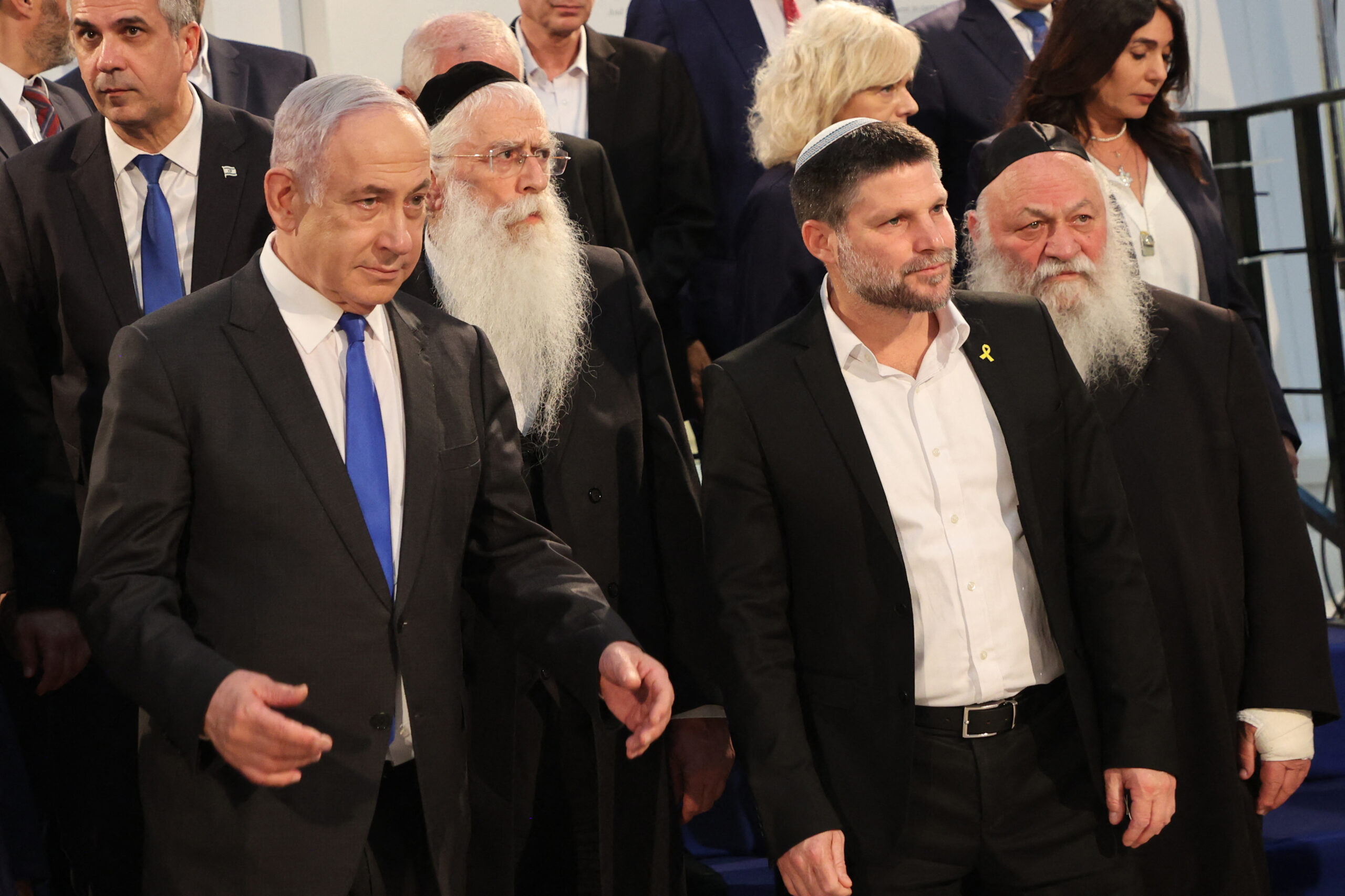
The prime minister’s governing coalition is struggling to stay intact to pass 2026 budget amid shifting political priorities
QUARREL ON THE QUAD
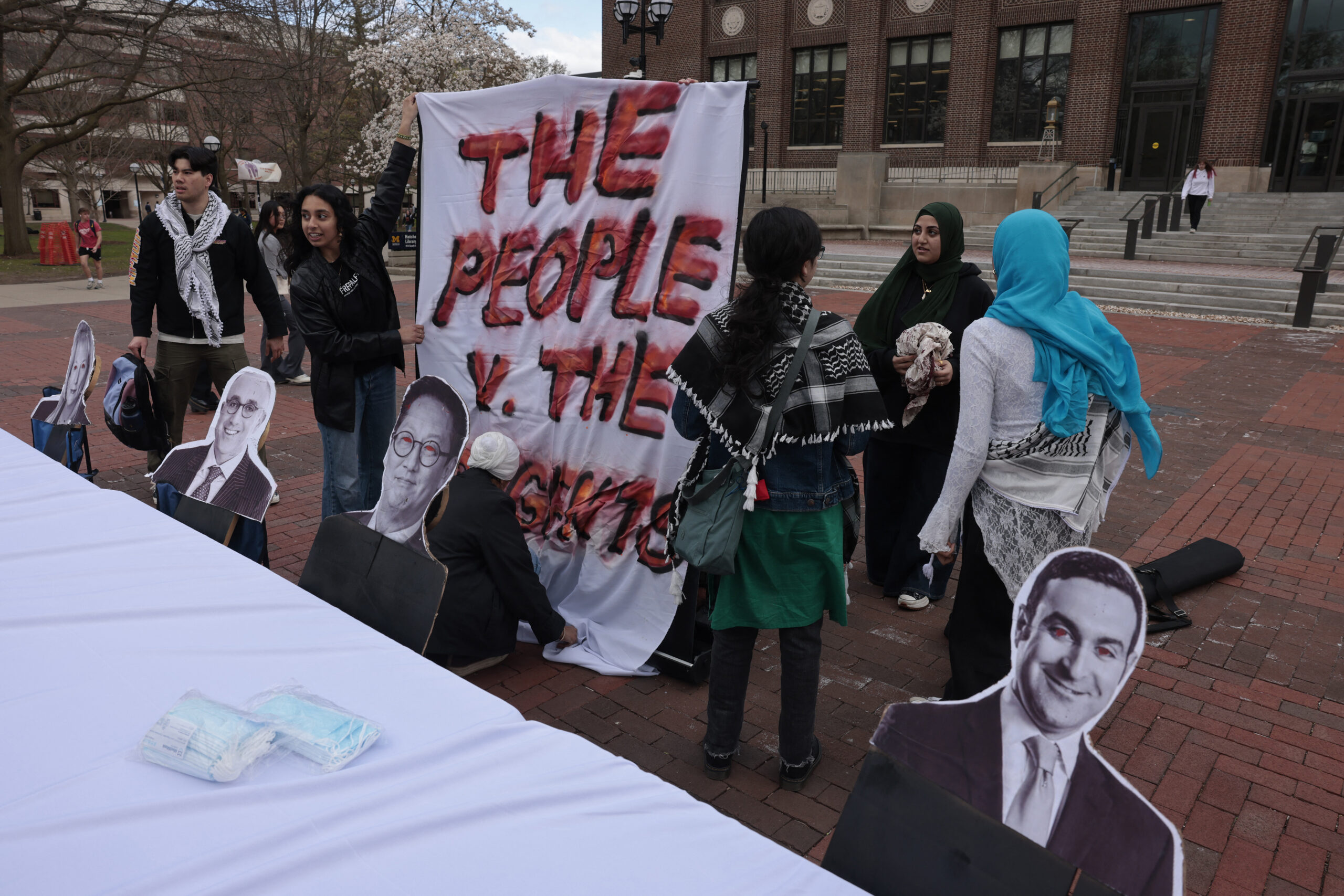
Anti-Israel activists are singling out regent Jordan Acker, hoping to unseat him with attorney Amir Makled, who represented a member of the school’s encampment
Owens and Kent are set to speak at a far-right Catholic advocacy gala, while one Catholic leader called to ‘reject the conspiracies … against our Jewish brothers and sisters’
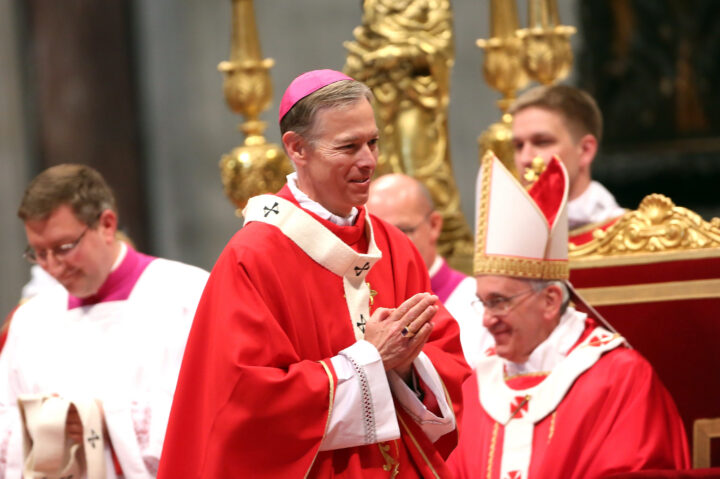
Franco Origlia/Getty Images
Archbishop of Portland Alexander King Sample receives the Pallium from Pope Francis during the Solemnity of Saint Peter and Paul at Vatican Basilica on June 29, 2013 in Vatican City, Vatican.
In the 24 hours before a fringe Catholic political group planned to host a gala in Washington honoring a number of public figures who have faced accusations of antisemitism, several prominent members of the American Catholic Church stated unequivocally that antisemitism is not a part of their religious doctrine.
“The Jewish community is attacked at a far higher rate than any other religious group in the United States. If we Catholics, in truly living out the Gospel, are to defend religious freedom with integrity, we must clearly speak out against antisemitism,” Archbishop Alexander K. Sample, the archbishop of Portland, Ore., said in a video posted by the U.S. Conference of Catholic Bishops on Wednesday.
Sample is the chairman of the religious liberty commission at the USCCB, the membership organization of current and retired Catholic bishops in the United States. The video was timed with the upcoming Easter holiday, which Sample said has “at times been the occasion for outbursts of hatred and even violence against Jews” by Catholics who collectively hold the Jews responsible for the crucifixion of Jesus.
“As Catholics, we are called to walk in the truth and so to reject the conspiracies and lies that lead to harassment and even violence against our Jewish brothers and sisters,” said Sample.
On Thursday morning, Vince Haley, the director of the White House Domestic Policy Council, delivered greetings from President Donald Trump at the annual National Catholic Prayer Breakfast in Washington. Haley, who is Catholic, wrapped up his own remarks with a call for Catholics to take a stand against antisemitism.
American Catholics have a responsibility, Haley said, “to render assistance to and speak out tirelessly in defense of our beloved Jewish neighbors and fellow citizens in the face of rising attacks and the tidal wave of hatred that is being manufactured against them.”
“Hatred toward Jewish people is ugly, despicable, an affront to the Sacred Heart of Jesus, and surely an occasion of terrible grief for our Jewish mother, Mary,” Haley continued. “And such evil should be condemned loudly and often by all people of goodwill, especially us.”
Neither Haley nor Sample mentioned the Catholic Prayer for America Gala, an event being hosted on Thursday night in Washington by Catholics for Catholics, a far-right political advocacy organization with a mission of targeting Catholic politicians who they deem to be insufficiently supportive of their perspective on church doctrine.
But the gala raised eyebrows across Washington when the organization announced just hours after Joe Kent resigned as director of the National Counterterrorism Center in protest of Trump’s policy toward Iran earlier this week that Kent would speak at the event.
Kent, who has a history of ties to far-right extremists and sought the support of antisemitic influencer Nick Fuentes during a 2022 congressional run, claimed that the U.S. was driven into war by “Israel and its powerful American lobby.”
The event’s lineup already featured a who’s who of right-wing media personalities who have faced accusations of antisemitism.
Carrie Prejean Boller, a former beauty pageant contestant who was fired from the White House Religious Liberty Commission Task Force in February after a disruptive anti-Zionist tirade at a public hearing, will be speaking. She was invited soon after the blow-up at the hearing, and in the weeks since she has doubled down on posting antisemitic content online.
At the Religious Liberty Commission hearing, Prejean Boller came to the defense of the far-right influencer Candace Owens, who since parting with the Daily Wire in 2024 has become a reliably antisemitic voice on social media. Owens will also be speaking at the Catholics for Catholics event, along with Michael Flynn, who served as national security advisor for the first 22 days of Trump’s first term.
Plus, JD Vance says he likes Joe Kent
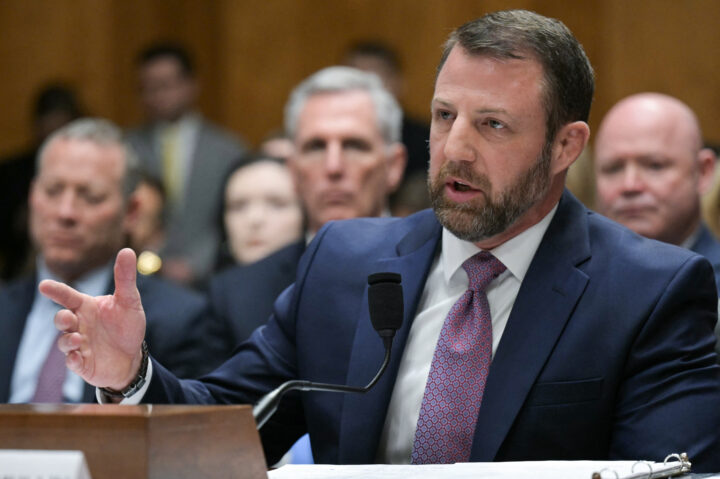
Oliver Contreras/AFP via Getty Images
DHS Secretary Markwayne Mullin testifies during a Senate Committee on Homeland Security and Governmental Affairs confirmation hearing on Capitol Hill in Washington, DC
This P.M. edition is reserved for our premium subscribers — offering a forward-focused read on what we’re tracking now and what’s coming next. Please don’t hesitate to share your thoughts and feedback by replying to this email.
📡On Our Radar
Notable developments and interesting tidbits we’re tracking
Director of National Intelligence Tulsi Gabbard said during a Senate Intelligence Committee hearing today that the Iranian regime “appears to be intact but largely degraded,” Jewish Insider’s Marc Rod reports, as the U.S. and Israel continue to target Iranian leaders and assets. If it survives the war, she said, the regime would “seek to begin a yearslong effort to rebuild its military, missiles and UAV forces.”
Gabbard, a longtime opponent of war with Iran, repeatedly declined to say whether the intelligence community had assessed Iran to be an imminent threat to the United States, after her former deputy, Joe Kent, alleged in his resignation letter yesterday that no such threat existed. CIA Director John Ratcliffe, however, was clear in his view that “Iran has been a constant threat to the United States for an extended period of time, and posed an immediate threat at this time”…
Regarding Kent’s resignation over his opposition to the war in Iran and claims that Israel coerced the U.S. into the war, White House Press Secretary Karoline Leavitt said Kent “was not someone who was involved in … the president’s intelligence briefings over the last several months. Have not seen him here at the White House for quite some time.”
She said President Donald Trump finds it “disappointing” that Kent would “resign with a letter filled with falsehoods, accusing the president of the United States [of] being controlled by a foreign country. That’s both insulting and laughable.”
Vice President JD Vance told reporters, “I know Joe Kent a little bit. I like Joe Kent … It’s fine to disagree, but once the president makes a decision, it’s up to everybody who serves in his administration to make it as successful as possible. That’s how I do my job”…
In his nomination hearing to be secretary of homeland security, Sen. Markwayne Mullin (R-OK) said he will aim to “streamline the process” for grants, including the Nonprofit Security Grant Program, JI’s Matthew Shea reports, vowing to work to “cut out the redundancies.”
“The amount of paperwork once you’re approved to get the funding flowing, and then the paperwork that’s followed up on is way too encompassing,” Mullin said. “Taking years to get reimbursed is not acceptable. Taking months to get reimbursed is not acceptable.” His hearing was otherwise colored by personal hostility with Homeland Security Committee Chair Sen. Rand Paul (R-KY), which could complicate Mullin’s path to nomination…
The Israeli Air Force reportedly struck the South Pars gas field in Iran, the largest in the world; Qatar, which owns half of the field, called it a “dangerous and irresponsible step.” The U.S. reportedly had knowledge of the operation, despite the Trump administration asking Israel earlier this month not to strike energy facilities…
Trump issued a veiled threat to American allies who have declined to assist in securing the Strait of Hormuz, musing on Truth Social, “I wonder what would happen if we ‘finished off’ what’s left of the Iranian Terror State, and let the Countries that use it, we don’t, be responsible for the so called ‘Strait?’ That would get some of our non-responsive ‘Allies’ in gear, and fast!!!”…
Michael Blake, the Democrat challenging Rep. Ritchie Torres (D-NY) whose campaign has focused extensively on criticism of Israel and AIPAC, expressed strong support for Kent’s resignation letter and his baseless claim of Israel’s role in initiating the war. “An absolutely breathtaking, courageous and bold resignation letter stating that Iran posed NO IMMINENT THREAT to us and Trump made this decision due to the Israeli government and its American Lobby,” Blake wrote on X…
Maine Senate candidate Graham Platner released an ad in response to one from his opponent, Gov. Janet Mills, highlighting social media comments he had made about sexual assault. “If I saw these ads, I’d have questions,” Platner says in the spot. “Maine, I’m asking you not to judge me for the worst thing I said on the internet on my worst day 14 years ago, but who I am today.”
Mills replied with another ad featuring an interview clip of Platner in which he said about his posts, “I made a lot of comments that I’m not, like, ashamed of. It’s not as though I have this ream of comments in which I look back and I’m like, oh my god, I was a terrible person back then”…
During an economic-focused visit to Detroit today, Vance remarked about the recent shooting attack at nearby Temple Israel, “When something happens to any member of our American family, and this particular incident happened to Jewish members of our American family, it is something that all of us have to stand up and say, it’s disgusting, it’s unacceptable”…
Also in response to the Temple Israel attack, Montgomery County, Md., a heavily Jewish suburb of Washington, announced it will provide $500,000 in supplemental funding for its Nonprofit Security Grant Program for current recipients over the next 90 days. It’s one of the few localities that provides its own funding in addition to the federal program…
⏩ Tomorrow’s Agenda, Today
An early look at tomorrow’s storylines and schedule to keep you a step ahead
Keep an eye out in Jewish Insider for a look at the far-left candidates running against establishment Democrats in Colorado.
The Senate will vote on another war powers resolution this evening aiming to stop the U.S. operation in Iran. The resolution, sponsored by Sen. Cory Booker (D-NJ), is expected to fail largely along party lines, as the previous one did earlier this month.
Administration intelligence officials including DNI Tulsi Gabbard and CIA Director John Ratcliffe will appear before the House Intelligence Committee tomorrow for its rescheduled worldwide threats hearing.
The Senate’s Homeland Security & Governmental Affairs Committee is set to hold a vote on Sen. Markwayne Mullin’s (R-OK) nomination to be secretary of homeland security, though Sen. Rand Paul (R-KY) threatened to cancel it over personal animosity and outstanding questions about a 2016 overseas trip that Mullin claims was classified. If a vote is held, Mullin will need the support of at least one Democrat on the committee in order to advance without Paul’s support, which Sen. John Fetterman (D-PA) has previously pledged to provide.
After his appearance this evening on far-right commentator Tucker Carlson’s podcast, Joe Kent will be interviewed tomorrow by Candace Owens, who similarly deals in antisemitic conspiracy theories, at the Catholic Prayer for America gala in Washington. Also appearing at the gala is Carrie Prejean Boller, the former beauty pageant queen who was removed from the White House’s Religious Liberty Commission after berating Jewish hearing witnesses over antisemitism.
Stories You May Have Missed
LONE STAR LIABILITY

Bexar County sheriff’s deputy Johnny Garcia is facing off against Maureen Galindo, who has made antisemitic conspiracy theories a key feature in her campaign
HORSESHOE POLITICS
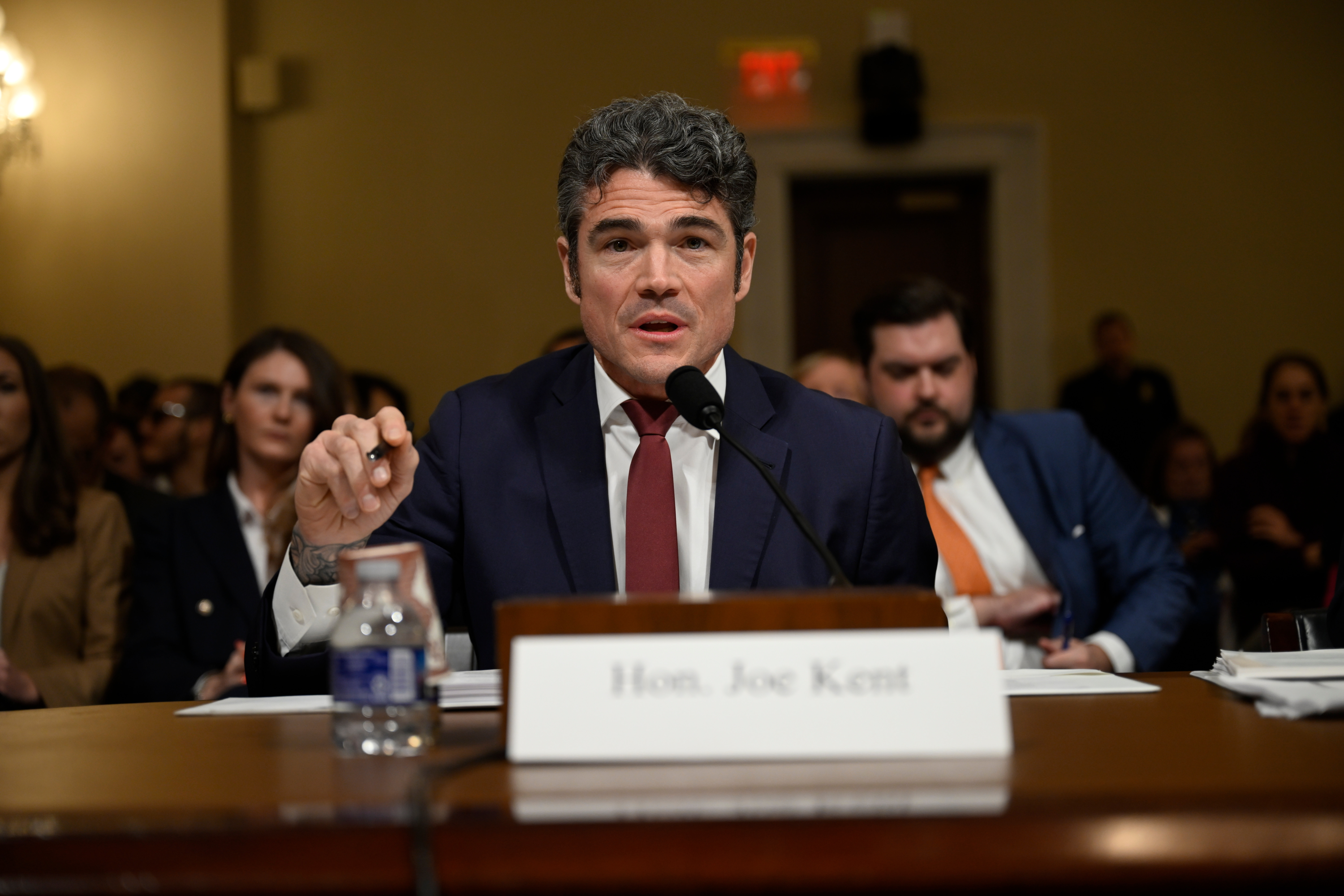
Democrats previously slammed Kent as an untrustworthy extremist in opposing his nomination. Now, amid his anti-Israel accusations, some argue he has a point
Mullin said he would work to streamline the paperwork process and reimbursement timelines
Oliver Contreras/AFP via Getty Images
DHS Secretary Markwayne Mullin testifies during a Senate Committee on Homeland Security and Governmental Affairs confirmation hearing on Capitol Hill in Washington, DC
In his nomination hearing to be secretary of homeland security, Sen. Markwayne Mullin (R-OK) said he will aim to “streamline the process” for grants, including the Nonprofit Security Grant Program (NSGP) aimed at helping harden religious institutions, amid heightened antisemitism and increased threats during the ongoing war in Iran.
The NSGP has faced persistent challenges, including severe underfunding, controversial new conditions and, most recently, delays tied to the ongoing partial shutdown of the Department of Homeland Security.
When pressed by senators on the need to unlock NSGP funding in the wake of the violent attack at Temple Israel in suburban Detroit last week, Mullin agreed that the process should be streamlined and said he would aim to “cut out the redundancies” and “amount of paperwork.”
“The Jewish community is spending about a billion dollars a year privately securing their own institutions,” said Sen. Elissa Slotkin (D-MI). “No religious group should have to spend that amount of money on their own security in the United States of America. So I would just ask for your help in reforming the Nonprofit Security Grant Program so it’s agile, so you don’t have to win the grant and then still do 100 pieces of paper.”
Sen. James Lankford (R-OK) echoed those sentiments, noting that the “length of time it takes to get a response” is concerning, especially for “locations that are higher risk than others.”
“Synagogues and temples have been one of those very high risk locations that are out there,” Lankford said, referencing the attack at Temple Israel. “That location happened to be one of the locations where there’s also been this nonprofit security grant to help harden that facility.”
“We have multiple challenges here,” Lankford added. “One of them is, when the decision is made, they make a request, go through the paperwork, get approval to be one of those locations that we say we need to harden this location. Once the approval is done, it may take months to over a year just for the dollars to actually come on it because there’s more bureaucratic hoops to go through.”
In response, Mullin agreed, “there’s a better way to do this.” He added that while he may have political differences with some of the lawmakers on the committee, this issue “isn’t one” of them and that he would be “laser focused and get this resolved.”
“The amount of paperwork once you’re approved to get the funding flowing, and then the paperwork that’s followed up on is way too encompassing,” Mullin said. “Taking years to get reimbursed is not acceptable. Taking months to get reimbursed is not acceptable.”
Mullin was also pressed on the threat of terrorist attacks domestically amid the DHS funding lapse and ongoing conflict in Iran.
Sen. Josh Hawley (R-MO), cited several recent incidents that had “potential terrorist ties,” including the antisemitic attack at Temple Israel in Michigan whose perpetrator had family ties to Hezbollah; a school shooting at Old Dominion University earlier this month, which is being investigated as an act of terrorism; a mass shooting in Austin, Texas, which is being investigated as having ties to the Iran conflict; and the detonation of bombs in New York City.
“Is this a good time for the Department of Homeland Security to be shut down and unfunded?” Hawley said.
“It’s a horrible time,” Mullin replied. “It’s devastating to the morale of the men and women we have tasked to keep care, take care of all of us, all the homeland, regardless it’s a blue state or red state.”
Sen. Richard Bumenthal (D-CT) pressed Mullin over whether he would approve the deportation of Iranian dissidents who could face death or punishment upon being returned to Tehran. The Trump administration has deported Iranians back to Iran from the U.S. on several deportation flights after a deal between the two governments was reached.
“Before the war in Iran began, the Trump administration negotiated a back-channel agreement, a deal with the Islamic Republic to deport Iranian nationals, including asylum seekers and dissidents,” Blumenthal said. “I have no doubt you share my outrage about the treatment of Iranian nationals who were deported, possibly to torture and death in Iran. We should not be sending Iranian dissidents and asylum seekers back to Iran, wouldn’t you agree?”
Mullin was noncommittal, arguing that he didn’t know “the specifics” behind the incident.
“Before I can talk about hypotheticals, I would need to know the reasons behind it,” Mullin said. “But I don’t want to deport anybody that’s here legally and most definitely not individuals that have done everything possible to be a contributor to society.”
“We know that our enemies want to infiltrate us and use our rules and generosity against us, so I don’t know the specifics of their background,” Mullin added. “But I will be happy to look into it.”
Rep. Josh Gottheimer (D-NJ), a leader in the House on antisemitism and NGSP funding who attended Mullin’s hearing, told Jewish Insider that DHS needed “new leadership,” and signaled an openness to working with Mullin on the issue.
“We don’t agree on everything, that’s for sure. But, after a decade of working out together most mornings, and finding bipartisan solutions to some of the toughest issues, Markwayne and his family have become very good friends,” Gottheimer said.
During the hearing, Mullin also noted that Gottheimer is “a friend” and that he would “run through fire for the guy.”
“When Josh asked me to join a bipartisan group called No Labels, that’s when we really started seeing that there’s a lot of common ground that we can work together on,” Mullin said. “We can set the differences aside, and we can work together. In fact, our daughters are writing a book together about bipartisanship.”
Mullin’s prospects for confirmation remain somewhat in question, given apparent opposition from Sen. Rand Paul (R-KY), who leads the committee where Mullin’s nomination vote will take place. Paul’s opposition traces to personal animosity between the two colleagues, as well as what Paul described as Mullin’s “anger issues.”
Mullin recently called Paul a “freaking snake” and said that he “understood” why Paul’s neighbor had attacked him, an assault that resulted in serious injuries and a prison sentence for Paul’s neighbor. Mullin refused to apologize at the hearing, to Paul’s outrage.
“I was shocked that you would justify and celebrate this violent assault that caused me so much pain and my family so much pain. The record will show a lack of contrition, no apology and no regrets for your support. You completely understand the violence that was perpetrated on me. You’re unrepentant,” Paul said. “I just wonder if someone who applauds violence against their political opponents is the right person to lead an agency that has struggled to accept limits to the proper use of force.”
“We can have our differences,” Mullin replied. “It’s not going to keep me from doing my job as secretary of homeland security.”
Paul threatened during the hearing to cancel the vote, scheduled for Thursday, on Mullin’s nomination. If Paul refuses to allow a vote, that would effectively block Mullin’s nomination, even if he otherwise has the necessary support to advance.
The Kentucky senator and committee Democrats also raised questions about a classified trip Mullin claims to have taken to a combat zone while he was a member of the House, the details of which Mullin refused to discuss in public during the hearing, alleging that the trip was classified. Committee members retired to a secure room to discuss the trip after the hearing.
If a vote is held, Mullin will need the support of at least one Democrat on the committee in order to advance without Paul’s support. Sen. John Fetterman (D-PA) has previously expressed his intention to support Mullin, and urged Paul and Mullin to move past their feud during the hearing.
Nadell and Robert Kraft both offered messages of resilience to the Jewish community amid a spate of antisemitic attacks
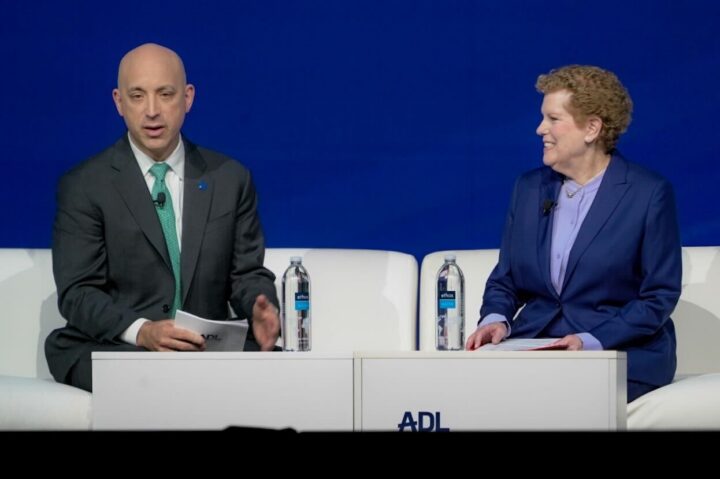
Courtesy
Historian Pamela Nadell speaks with ADL CEO Jonathan Greenblatt at the organization's Never is Now summit on March 17, 2026.
Prominent historian and Jewish studies scholar Pamela Nadell joined the ongoing debate over the effectiveness of legacy Jewish organizations on Tuesday, arguing that they play a crucial role in educating non-Jews about antisemitism.
“It is impossible to consider dismantling legacy organizations that uncover potentially extremist attacks and that educate Americans — not Jewish Americans, we don’t need this education — about antisemitism and all forms of hate. We need to continue doing this work,” Nadell said at the conclusion of the Anti-Defamation League’s Never is Now conference in Manhattan in a conversation with the group’s CEO, Jonathan Greenblatt.
Nadell was referring to a recent speech by conservative New York Times columnist Bret Stephens, in which he questioned the necessity of Jewish civil rights groups like the ADL, which Greenblatt has pushed back on.
Nadell, the Patrick Clendenen Chair in Women’s and Gender History at American University and director of the school’s Jewish studies program, spoke as America prepares for its 250th anniversary this July. The anniversary comes at a fraught moment for American Jewry, which is reeling from recent synagogue attacks in Mississippi and Michigan while grappling with the implications of rising antisemitism on both the far left and right, exacerbated by social media.
Nadell said the current moment is unprecedented. “It’s really hard to make sense of this moment because when we think of the era [of when] antisemitism was at its highest peak in America, it was the 1930s and 40s,” she said. “What ADL’s predecessors were fighting back against was by and large antisemitism coming from the right, [such as] a plot to kidnap 20 prominent Hollywood Jews and hang them in hopes of sparking a nationwide pogrom that would keep the U.S. out of [World War II].”
Nadell ended with a message of resilience for American Jewry’s next 250 years. She quoted the biblical psalm “those who sow in tears shall reap with shouts of joy.”
“I’m sowing in tears,” said Nadell. “Maybe I won’t be around to reap in shouts of joy but I hope my children and grandchildren will.”
The second day of the ADL’s annual two-day conference kicked off Tuesday morning with an address by New England Patriots owner Robert Kraft, who also conveyed a message of resiliency, as he was awarded with the group’s Changemaker Award.
The society “we want to build — a society of dignity, tolerance and respect — will not be built by one leader or one organization, it will be built by all of us standing together,” Kraft, founder of the Blue Square Alliance Against Hate, told attendees.
“We must refuse to accept a world where hatred is normalized and insist that our country live up to its noblest values,” continued Kraft. “We’re living in a time of rising division. Too many voices are trying to pull people apart. That’s why we must stand closer together… refusing to let hate define who we are as a country.”
The conference opened on Monday with Jonathan Greenblatt, ADL’s CEO, calling out two Democratic lawmakers — Sen. Chris Van Hollen (D-MD) and Rep. Ro Khanna (D-CA) — during his State of Hate address, accusing them of perpetuating antisemitism.
Elsewhere at the conference, Ofir Akunis, consul general of Israel in New York, said that those who like posts that “cheer” the Oct. 7, 2023, terrorist attacks in Israel “are antisemitic,” an apparent reference to social media posts liked by New York City First Lady Rama Duwaji, the wife of Mayor Zohran Mamdani.
Bob and Nancy Milgrim, the parents of slain Israeli Embassy staffer Sarah Milgrim, also addressed the gathering on Tuesday.
Plus, airlines push back direct flights to TLV
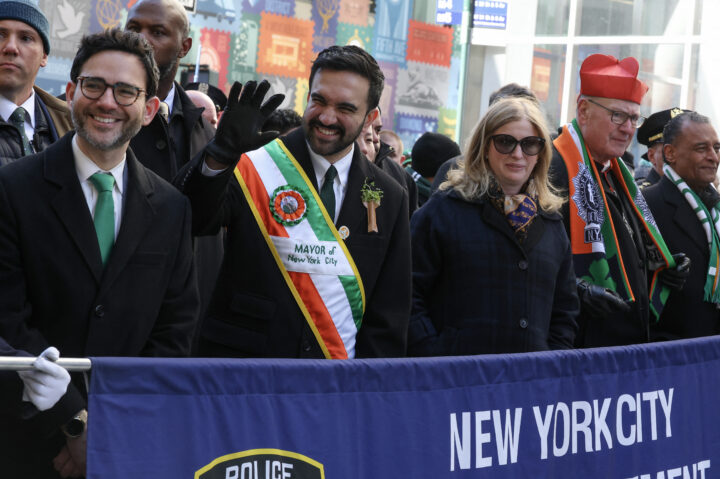
TIMOTHY A. CLARY / AFP via Getty Images
New York City Mayor Zohran Mamdani (2L), New York City Police Commissioner Jessica Tisch (2R) and Cardinal Timothy Dolan (R) participate in annual St. Patrick's Day Parade in New York on March 17, 2026.
This P.M. edition is reserved for our premium subscribers — offering a forward-focused read on what we’re tracking now and what’s coming next. Please don’t hesitate to share your thoughts and feedback by replying to this email.
📡On Our Radar
Notable developments and interesting tidbits we’re tracking
Joe Kent, director of the National Counterterrorism Center, resigned from his role today over opposition to the war in Iran, baselessly alleging that Israel had coerced the United States into what he characterized as a misguided military conflict, Jewish Insider’s Matthew Kassel reports.
In a letter to President Donald Trump, Kent, a former Green Beret who had reported to Director of National Intelligence Tulsi Gabbard, wrote that he “cannot in good conscience support the ongoing war in Iran,” claiming that the Islamic Republic “posed no imminent threat to our nation, and it is clear that we started this war due to pressure from Israel and its powerful American lobby.”
Kent, a hard-right former congressional candidate with isolationist foreign policy leanings, has previously promoted conspiracy theories, echoed pro-Russia messaging and associated with white supremacists and neo-Nazis, among other controversies. He’s now expected to appear on the podcast of his ally and friend Tucker Carlson…
After being largely rejected by foreign leaders on his repeated calls to assist in the war with Iran, Trump claimed in a post on Truth Social that, “Because of the fact that we have had such Military Success, we no longer ‘need,’ or desire, the NATO Countries’ assistance — WE NEVER DID! … WE DO NOT NEED THE HELP OF ANYONE!”
Asked about the timeline of the war by reporters in the Oval Office this afternoon, Trump said, “We’re not ready to leave yet, but we will be leaving in the … very near future”…
Reports indicate Iran’s security forces, despite being badly battered by the U.S. and Israel, are conducting renewed crackdowns on the Iranian public and potential dissenters. At least 500 people have been arrested since the start of the war, and new security checkpoints are being deployed for regime oversight…
Major U.S. airlines have extended their suspensions of direct flights to Tel Aviv as the war continues, JI’s Haley Cohen reports, with both United and Delta airlines not offering any direct flights until June.
The first direct flight on United Airlines between Newark Liberty International Airport and Ben Gurion Airport is available on June 16, while the first direct New York to Tel Aviv flight on Delta Airlines is available June 1. United’s direct flights from Israel to Chicago O’Hare and Washington Dulles International Airport are also suspended…
U.S. Special Envoy to Syria Tom Barrack denied reports that the U.S. is encouraging Syria to deploy forces into eastern Lebanon to help disarm Hezbollah, as the IDF begins to carry out ground incursions in the south of the country…
Israeli Prime Minister Benjamin Netanyahu continues to post “proof of life” videos on social media amid internet conspiracy theories that he has been killed and replaced by a look-alike…
Trump’s decision to withhold his endorsement in the Texas Senate GOP runoff all but guarantees that Sen. John Cornyn (R-TX) and Texas Attorney General Ken Paxton will both appear on the May 26 runoff ballot, as neither have dropped out of the race ahead of this evening’s deadline…
Maine Gov. Janet Mills released her first attack ad against her Democratic primary rival in the race for U.S. Senate, oyster farmer Graham Platner, highlighting social media comments he made about sexual assault that have marred his campaign. In the ad, several women read disparaging comments made by Platner on Reddit over a decade ago relating to rape, and a picture of Platner’s Nazi tattoo — which he has since had covered — is displayed under a magnifying glass. “The closer you look, the worse it gets,” the ad’s narrator says…
The Wall Street Journal spotlights the gamble being made by Illinois Gov. JB Pritzker as he expends political capital (and actual capital) backing his lieutenant governor, Juliana Stratton, in the state’s Democratic primary for U.S. Senate taking place today. Pritzker’s involvement has drawn the ire of the Congressional Black Caucus, which is backing Rep. Robin Kelly (D-IL), even though both Stratton and Kelly are Black. The race is seen as a test of Pritzker’s political clout in his home state…
New York City Mayor Zohran Mamdani took the occasion of St. Patrick’s Day and the presence of former Irish President Mary Robinson in New York to accuse Israel of committing genocide and to praise Robinson’s controversial tenure as the United Nations’ high commissioner for human rights, JI’s Will Bredderman reports.
“I think also of how she stood steadfast alongside the people of Palestine,” the mayor said in listing Robinson’s accomplishments. “I say this as over the past few years as we’ve witnessed a genocide unfold before our eyes, there has been deafening silence from so many. For those who have long cared about universal human rights and the extension of them to Palestinians, silence, however, is nothing new. For Palestinians are so often left to weep alone. Yet former President Robinson has never been silent”…
⏩ Tomorrow’s Agenda, Today
An early look at tomorrow’s storylines and schedule to keep you a step ahead
Keep an eye out in Jewish Insider for a rundown of the results of Illinois’ Democratic primaries, where polls close at 8 p.m. ET.
Director of National Intelligence Tulsi Gabbard is expected to face questions over the departure of her deputy, Joe Kent, at the Senate Intelligence Committee’s hearing on worldwide threats, where she will testify alongside other intelligence agency heads. Gabbard said today after Kent’s resignation that, as commander-in-chief, Trump “concluded that … Iran posed an imminent threat and he took action based on that conclusion,” but did not say whether she agrees herself in that assessment, something she is likely to be pressed on tomorrow.
The Senate Foreign Relations Committee will receive a classified briefing on the war in Iran from State Department intelligence officials.
The Senate Homeland Security & Governmental Affairs Committee will hold a nomination hearing for Sen. Markwayne Mullin (R-OK) to be secretary of homeland security after Trump’s ouster of Secretary Kristi Noem.
The U.S. Commission on International Religious Freedom will hold a hearing on rising antisemitism abroad.
Stories You May Have Missed
DOMESTIC FRONT
Eighteen-year legal fight over the Iran-tied Alavi Foundation ends with a new group with similar leadership taking over its assets — and NYC skyscraper
NAMING NAMES
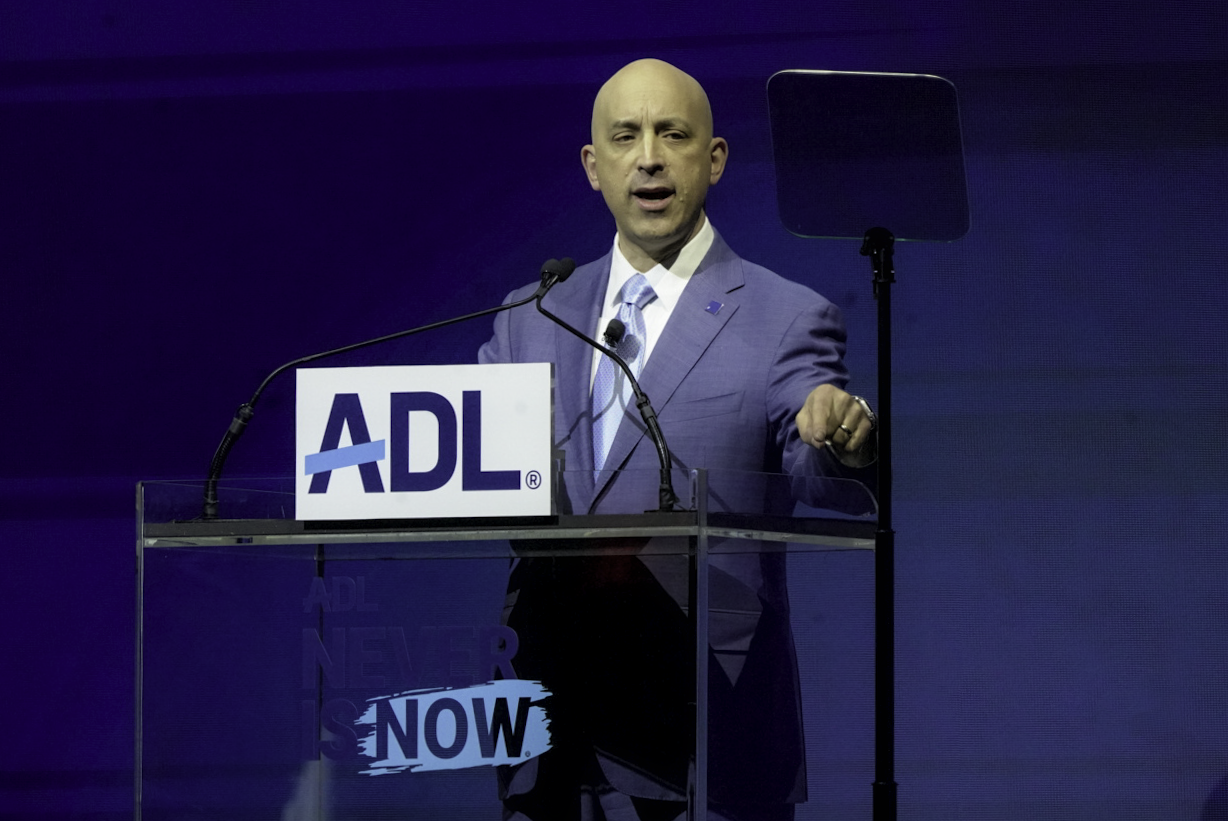
The ADL’s annual summit comes amid high-profile antisemitic attacks during the Iran war
Schools with Faculty and Staff for Justice in Palestine chapters were seven times more likely to experience violence against Jews, the report found

GETTY IMAGES
Three people with backpacks on sidewalk in front of the campus administrative building on sunny day moving away.
A newly released report from House Republicans on the Education and Workforce Committee alleges that faculty members and student groups have played a central role in promoting and amplifying antisemitism on college campuses, particularly those affiliated with Students for Justice in Palestine (SJP).
The report, titled “How Campuses Became Hotbeds: The Rise of Radical Antisemitism on College Campuses,” was released Tuesday and examines campus activity following the Oct. 7, 2023, Hamas terrorist attacks on Israel.
The report finds that faculty affiliated with Faculty and Staff for Justice in Palestine (FSJP) “played a significant role in legitimizing and amplifying antisemitism on college campuses,” and that campuses with FSJP chapters were seven times more likely to experience “violence against Jews.”
It alleges that some faculty members sought to “strip Jewish students of protections, incited protests that turned violent, taught antisemitic content in their courses and hosted programming that isolated Jewish students and demonized Israel.”
According to the report, FSJP chapters have pressured universities to boycott Israel, reject the International Holocaust Remembrance Alliance’s working definition of antisemitism and circulated statements that justified violence against Israel.
In one example, the report indicates that the FSJP chapter at Sarah Lawrence College challenged the school’s decision to put the word “antisemitism” before the word “racism” in a two-day orientation curriculum. “We’re worried [it] sends a message to incoming students about whose oppression matters,” the school’s chapter wrote.
“Faculty members also perpetuate antisemitism through university centers, such as Middle East studies centers, that offer a one-sided view of Israel as a ‘settler colonialist’ enterprise,” the report states. “It also views Jews as white and the privileged ‘oppressor,’ rather than a diverse minority that has been persecuted for thousands of years.”
The report found that in September 2024, the University of California Berkeley announced Ussama Makdisi as the inaugural chair of a newly created program in Palestinian and Arab Studies. However, earlier that year, Makdisi made a post on social media supporting the actions of Hamas on Oct. 7, 2023, writing: “I could have been one of those who broke through the siege on October 7.”
The report also alleges that student groups, most notably SJP, have “consistently acted as ringleaders for antisemitic harassment faced by Jewish students on campus.” It argues that institutions of higher education have “given in” to student demands and “failed” to discipline students promoting antisemitism. SJP chapters in particular “organize violent antisemitic disturbances, host antisemitic speakers and pressure universities to boycott Israel.”
The report cites another incident at Sarah Lawrence College in which the school’s SJP chapter posted a statement calling on peers to “defend the student intifada,” described the Oct. 7, 2023 terrorist attacks as an “uprising” and shared an image “of a Hamas bulldozer tearing through Israel’s security fence.” The group later received a student leadership award after being nominated by the school’s FSJP chapter.
“At the award ceremony, the individual presenting the award described SJP as having ‘engaged in empathetic and powerful activism,’” the report states.
“Every campus that the Committee investigated while preparing this report featured an SJP chapter, or a variant of one, that served as a ringleader for antisemitic activity on campus,” the report adds, noting that many colleges and universities not only “failed” to respond to SJP, but also allowed “hostility towards Jewish students to fester.”
The report also suggested that foreign influence in American higher education is part of the problem, pointing to satellite campuses in Qatar operated by Northwestern University and Georgetown University. It alleges that both institutions have “housed faculty or fellows and student groups that foment antisemitism” without consequences.
“Neither NU-Q nor GU-Q have disciplined any faculty, students, or staff for antisemitism since October 7, 2023,” the report states. “The committee found that after October 7th, GU-Q entities that should be neutral promoted, participated in or hosted deeply one-sided events that legitimize antisemitic rhetoric.”
The report cites a series of incidents involving faculty and staff at Northwestern’s Qatar campus, including Professor Marc Jones, who it says has circulated a conspiracy theory that Israelis steal Palestinian organs and described Israel as “worse than Hamas.” It also references visiting Professor William Youmans, described as an Al Jazeera specialist, who called Israel a “terrorist state” and defended Hamas following the Oct. 7 attacks.
Additionally, the report highlights a social media post from Sami Hermez, director of Northwestern in Qatar’s Liberal Arts Program, in which he wrote that “Zionists have control over European policy and power,” adding, “If you want to make the leap that Jews control Europe, I don’t care.”
At Georgetown University’s Qatar campus, the report alleges that student groups displayed posters reading, “We stand with violence on Israelis,” and that at an SJP event, some students “drew hearts around Hamas’ name,” while others left messages including, “Oh Allah, deal with the Zionists,” and expressed a desire for the Jewish people “to fall.”
The report also outlines a series of recommendations aimed at addressing these problems, including adoption of the IHRA definition of antisemitism.
It also calls on Congress to pass legislation such as the Civil Rights Protection Act, which would require higher education institutions to be more transparent about procedures and investigations related to civil rights complaints, as well as the Defending Education Transparency and Ending Rogue Regimes in Nefarious Transactions (DETERRENT) Act, which would lower the financial threshold at which universities must report foreign gifts and contracts.
The report further suggests requiring U.S. universities operating overseas to make course syllabi publicly available, arguing that doing so would allow the government to hold faculty “who have exhibited blatant antisemitism” accountable.
“The findings in this report make clear that antisemitism in higher education is not confined to encampments at a handful of elite universities, nor did it begin or end with the events of October 7th,” the report states. “The evidence demonstrates that antisemitism is driven by persistent leadership failures and radical faculty and student groups that legitimize and foment antisemitism in classrooms and on campus grounds.”
The ADL’s annual summit comes amid high-profile antisemitic attacks during the Iran war
Courtesy
ADL CEO Jonathan Greenblatt speaks at the 2026 Never is Now summit.
Jonathan Greenblatt, CEO of the Anti-Defamation League, called out two Democratic lawmakers from the main stage of the organization’s Never is Now conference in Manhattan on Monday, accusing them of perpetuating antisemitism.
“For the senior senator from Maryland — a state with one of the largest, most active and most observant Jewish populations in the country — he blamed AIPAC, which he slandered as ‘un-American,’” Greenblatt said during his State of Hate address, referring to Sen. Chris Van Hollen’s (D-MD) address at the J Street convention where he attacked the pro-Israel advocacy group earlier this month.
“Then, there is the U.S. congressman who stated that he stands against the ‘neoconservatives’ who led the U.S. into the current war [with Iran] and instead is ‘proud to stand’ with Hasan Piker, one of the most outspoken, virulent antisemitic influencers in the world … who the congressman described as one of the representatives of the ‘new moral order,’” continued Greenblatt, a reference to Rep. Ro Khanna (D-CA).
Van Hollen and Khanna have previously faced blowback from Jewish leaders and centrist Democrats for their antagonistic rhetoric.
“Other elected officials fell over themselves to make big splashy announcements of not taking money from the largest pro-Israel organization in the country — but seemingly have no problem taking money from anyone else,” Greenblatt added.
In an apparent reference to a recent speech by conservative New York Times columnist Bret Stephens, in which he questioned the necessity of Jewish civil rights groups like the ADL, Greenblatt made the case that fighting antisemitism and building thriving Jewish communities should not be mutually exclusive.
“Recently, some have argued that we need to choose between ‘fighting antisemitism’ or ‘building Jewish life,’” he said, apparently alluding to Stephens’ call last month for the American Jewish community to dismantle the ADL and reallocate its ample communal resources to building Jewish identity, rather than combating antisemitism.
“But they got it wrong. Security and identity aren’t competing priorities; they’re inseparable preconditions for the flourishing of Jewish life in an open society,” continued Greenblatt.
As America’s 250th anniversary approaches this summer, Greenblatt said that fighting antisemitism does not only protect Jews but is also a fight to “save America itself … to keep this incredible, 250-year experiment alive and thriving.”
The address, opening the two-day conference which is being attended by about 4,000 people, was followed by a conversation between Greenblatt and Rev. Samuel Rodriguez, a prominent American evangelical leader.
The Latino Christian community “will not tolerate” antisemitism, said Rodriguez, president of the National Hispanic Christian Leadership Conference, the largest Hispanic Christian organization in the country.
He said that his pledge comes as “sectors and segments of the evangelical community have unfortunately [started] to advance a narrative that is antisemitic.”
The ADL and NHCLC announced a partnership in October aimed at combating antisemitism and deepening Hispanic-Jewish solidarity.
Greenblatt called the collaboration “one of the most important undertakings I have had the privilege to be a part of.”
“The bigots are afraid of this kind of alliance,” said Greenblatt. “They’re afraid of Jews and Christians coming together to push back on the bigotry.”
Rodriguez, who leads a Pentecostal church in Sacramento, Calif., added that “education of our children at an early age” is the first step in combating hate.
“We engage the culture in order to reform the culture, and push back on manifestations of hate in society, [including on] college campuses.”
This year’s Never is Now summit comes as Jewish communities continue to see a persistent rise of antisemitism that started after the Oct. 7, 2023, terrorist attacks, and has been sparked anew by Israel’s ongoing war with Iran. Last week, a synagogue in Michigan faced an attempted terrorist attack, and several Toronto synagogues were targeted in shootings the week prior.
And Europe to Trump: Iran is 'not our war'
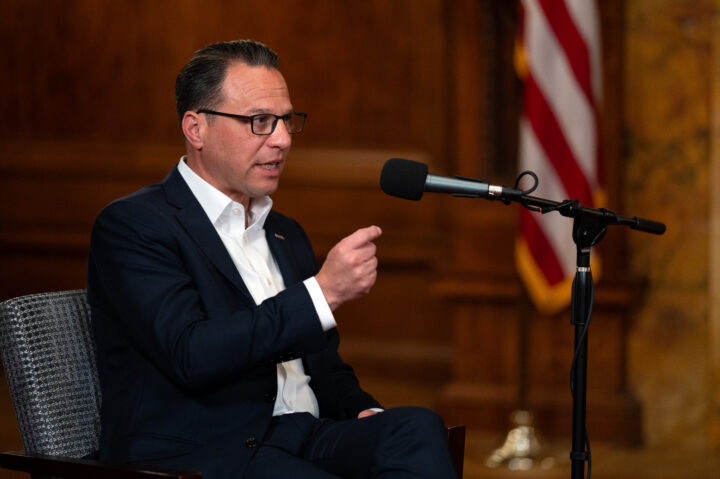
Peter W. Stevenson/The Washington Post via Getty Images
Pennsylvania Gov. Josh Shapiro sits for an interview at the Pennsylvania State Capitol on June 11, 2025.
This P.M. edition is reserved for our premium subscribers — offering a forward-focused read on what we’re tracking now and what’s coming next. Please don’t hesitate to share your thoughts and feedback by replying to this email.
📡On Our Radar
Notable developments and interesting tidbits we’re tracking
European countries are largely rebuffing President Donald Trump’s calls to join the war with Iran and help secure the largely impassable Strait of Hormuz. German Defense Minister Boris Pistorius said today, “This is not our war; we did not start it,” while the French foreign ministry said, “Posture has not changed: defensive it is.” Poland, the U.K. and Italy similarly made clear they would not be participating in an offensive capacity…
On potential negotiations with Iran, Trump told reporters, “We don’t even know their leaders. We have people wanting to negotiate. We have no idea who they are.” He said new Supreme Leader Mojtaba Khamenei is “badly disfigured” and noted it’s “unusual” he hasn’t recently been seen in public.
Khamenei narrowly survived an airstrike on his compound on Feb. 28 as he briefly stepped outside, according to leaked audio obtained by The Telegraph, which reportedly contains remarks by an official in the office of deceased Ayatollah Ali Khamenei to senior clerics…
IDF spokesperson Lt. Col. Nadav Shoshani denied reports that Israel is running low on missile interceptors, saying there is no “urgent problem” and that the military re-equips its supplies “in real time”…
Debris and missile fragments from Iranian attacks fell in the Old City of Jerusalem near several sensitive sites including the Western Wall Plaza and feet away from the Church of the Holy Sepulchre…
Twenty-three Democratic members of the House Foreign Affairs Committee wrote to Trump requesting a public hearing with Special Envoy Steve Witkoff and Jared Kushner to understand their role in “lead[ing] diplomatic engagement with Iran”…
Representatives of the U.S.-led Board of Peace met with Hamas officials over the weekend in Cairo, Egypt, Reuters reports, in an effort to keep ceasefire negotiations on track even as the war with Iran proceeds. Aryeh Lightstone, an aide to Witkoff, reportedly represented the U.S. delegation, with more meetings expected this week…
Times of Israel reporter Emanuel Fabian chronicles his experience receiving death threats from users of the prediction market platform Polymarket over his reporting on a recent Iranian missile strike in the city of Beit Shemesh…
Trump announced that Susie Wiles, his White House chief of staff, has been diagnosed with early stage breast cancer and will receive treatment while remaining in her post…
Pennsylvania Gov. Josh Shapiro, a potential 2028 presidential contender, tested out his measured, pro-Israel messaging in a series of recent podcast interviews, Jewish Insider’s Gabby Deutch reports. In his appearances on “Pod Save America” and “Higher Learning,” Shapiro made the case that, as the starting point for any public political conversation about Israel, the fact of Israel’s right to exist as a Jewish state must be respected.
“I think what is dangerous here … is for those who think Israel doesn’t have a right to exist in [the] conversation. That to me is a recipe for permanent war,” Shapiro told “Higher Learning” host Van Lathan. He also pushed back on California Gov. Gavin Newsom, his potential 2028 opponent, for saying Israel could be described as an apartheid state…
Rep. Mike Lawler’s (R-NY) reelection campaign is employing a community activist, Darrell Davis, who has criticized Democratic politicians, including Rep. George Latimer (D-NY) and a county executive, for taking money from pro-Israel groups and traveling to Israel, Politico reports.
Davis accused Latimer of being on the receiving end of a “Jewish organized spending spree” and taking “about $30 million to buy a congressional seat, to represent the interests of Israel,” which he called “a horrific threat to democracy.” About Westchester County Executive Ken Jenkins’ trip to Israel, Davis wrote, “Why are they in Israel?? What more proof do people need that black Dems don’t give a sh*t about you. They are up for sale”…
The day before her primary election in Illinois’ 9th Congressional District, far-left social media influencer Kat Abughazaleh removed language from her campaign website claiming “There is no acceptable scenario that leaves Hamas in charge of the Gaza Strip,” after she had faced criticism from the Hamas-friendly outlet Drop Site News over its inclusion. Her site says that the earlier language on the page “did not accurately reflect Kat’s views or the values of this campaign”…
And the closing drama in the Illinois Senate Democratic primary is Lt. Gov. Juliana Stratton’s claim that she received a deathbed endorsement from civil rights leader Rev. Jesse Jackson, which the Jackson family said today he had never finalized. The late reverend’s support is seen as meaningful in the race, which includes multiple prominent Black candidates, as well as Rep. Raja Krishnamoorthi (D-IL)…
The Atlantic spotlights one of the main obstacles facing Maine Gov. Janet Mills in her Democratic primary for U.S. Senate against oyster farmer Graham Platner: her age. Mills, 78, “does not have a dicey Reddit history or a recently covered-over Nazi tattoo” but is still trailing in the polls, even as Platner continues to be plagued by scandals. “One likely factor: If she is elected, Mills would be the oldest freshman senator in history”…
⏩ Tomorrow’s Agenda, Today
An early look at tomorrow’s storylines and schedule to keep you a step ahead
Keep an eye out in Jewish Insider for a look at the tense runoff in the Democratic primary for Texas’ 35th Congressional District, where a fringe conspiracy theorist eked out a narrow victory over a sheriff’s deputy backed by the pro-Israel establishment.
All eyes will be on the Prairie State tomorrow, as several high-profile Democratic primaries will be decided across Illinois. Read JI’s coverage of the races to watch.
On the Hill, the House Intelligence Committee will hold its annual hearing on worldwide threats, with testimony from Director of National Intelligence Tulsi Gabbard, CIA Director John Ratcliffe, FBI Director Kash Patel, NSA Acting Director William Hartman and DIA Director James Adams.
The House Foreign Affairs Committee will hold a hearing on reforming U.S. defense sales.
Stories You May Have Missed
BREAKING POINT
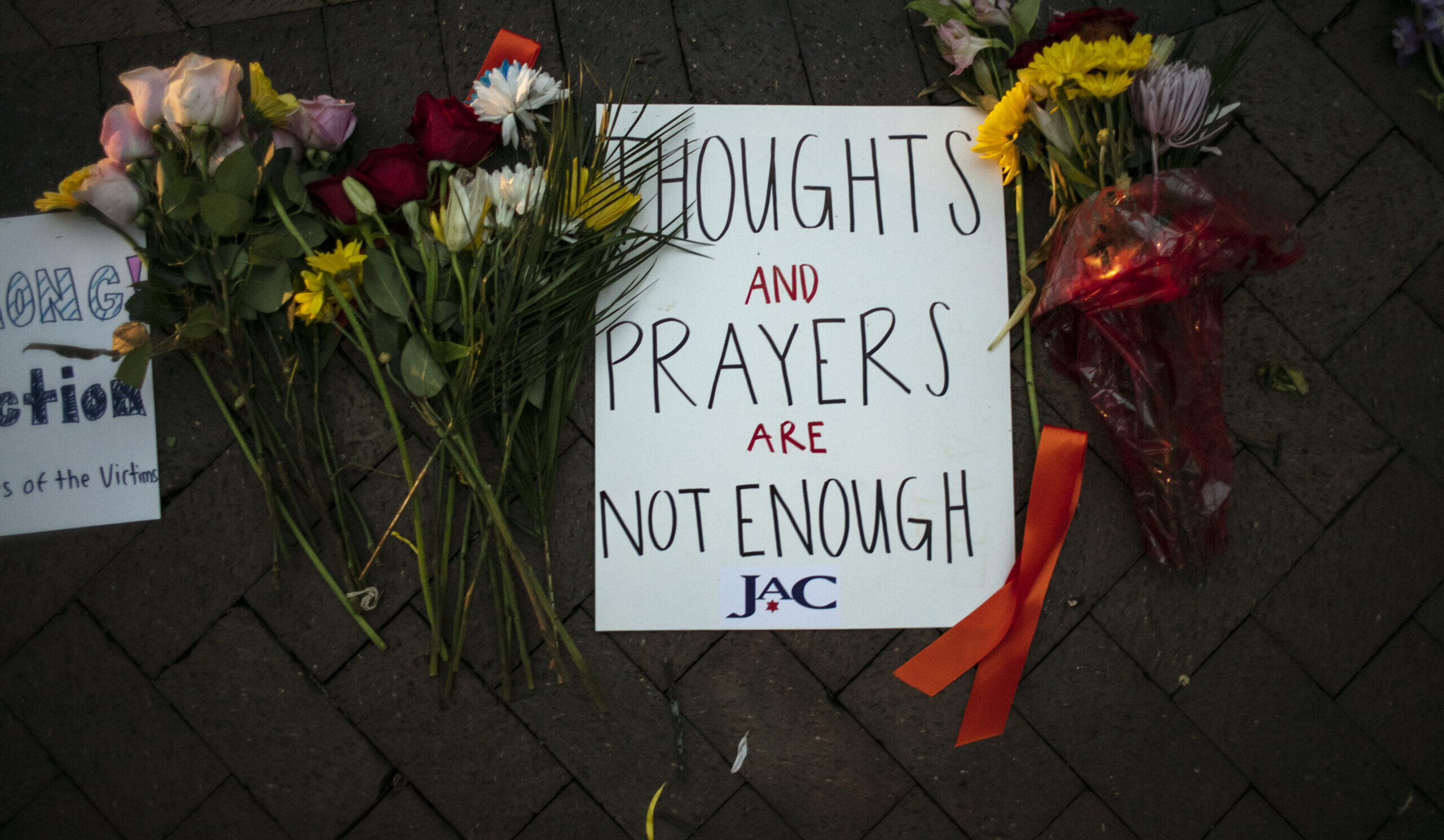
Democrats began calling out those who traffic in antisemitic rhetoric when they offered platitudes after an attack on a Michigan synagogue
UNDER PRESSURE
Tech entrepreneur Ethan Agarwal: ‘He thinks being racist against Jewish people is going to help him win the American left. I don’t care if he’s right. I just think it’s unethical and immoral’
Tech entrepreneur Ethan Agarwal: ‘He thinks being racist against Jewish people is going to help him win the American left. I don’t care if he’s right. I just think it’s unethical and immoral’
Courtesy
Ethan Agarwal
Rep. Ro Khanna (D-CA) has become one of the harshest critics of Israel in the House, in recent months associating with some of the leading anti-Israel figures within the Democratic Party — at one point proudly declaring his ties to a far-left antisemitic podcaster.
In his pushback to the U.S. war against Iran, he has caricatured those supportive of taking military action against the Islamic Republic as part the “Epstein class” — which critics have accused of being an antisemitic trope — while defending right-wing commentator Pat Buchanan from past charges of antisemitism.
As a result, he is facing a primary challenge from tech entrepreneur Ethan Agarwal, who is accusing the congressman of embracing far-left views to seek national attention for a potential presidential campaign — at the expense of focusing on constituents back home in the Silicon Valley-based district.
“The district is being represented by a guy who could not care less about the people in the district, and that’s frustrating because I supported Ro when he first ran back in 2012,” Agarwal told Jewish Insider on Friday. “He’s completely [turned around] on basically everything that he said to his supporters.”
Agarwal said he sees Khanna’s activities, including his opposition to the Iran war and outspokenness against Israel, as plays for national attention, rather than representing the district that elected him.
Khanna “just totally does not give a s*** about the district. He’s running for president, and he wants to run to the left on every issue,” Agarwal alleged. “The district needs a representative that’s focused on the district itself, and that’s why I’m running for Congress.”
Those allegations of political opportunism were echoed in a recent Washington Post column by writer James Kirchick, who reported that Khanna professed to being a strong ally of Israel and the Jewish community earlier in his career when he was seeking a role in the Obama administration. The op-ed framed Khanna as a relentless self-promoter willing to change his views for attention and career advancement.
Khanna, in response to the allegations that he’s lost focus on his district back home, told JI he was “proud of my record representing California’s 17th district,” pointing to his work to secure $13.5 million in funding this year for projects including affordable housing, veteran housing, safe routes for children to get to school, clean water and transportation. He added that he has held nearly 80 town halls, is regularly meeting with local community leaders and is in touch with anti-ICE activists, and touted his constituent services and endorsements from local leaders and groups.
“And I’m willing to take on powerful people when accountability is needed. When I called for the release of the Epstein files, many dismissed it and said no one in the district would care. They were wrong. Constituents raise it with me regularly because they want transparency and justice for survivors,” Khanna added.
Agarwal’s criticisms go beyond hitting Khanna for putting national issues ahead of local ones. He accused the congressman of engaging in shoot-from-the-hip social media commentary that has inflamed antisemitism at a time of heightened fears within the Jewish community.
“Even if you weren’t running for Congress or trying to run for president — what is wrong with you?” Agarwal said. “If the congressperson of the district is advocating these kinds of things publicly, it stokes and it inflames the culture on the ground.”
“He thinks being racist against Jewish people is going to help him win the American left,” Agarwal added. “I don’t care if he’s right. I just think it’s unethical and immoral.”
Khanna responded that he has “consistently condemned antisemitism in all forms,” including speaking out specifically against various recent incidents, that he has been “been clear in my support for Israel as a Jewish and democratic state,” that he has worked with Jewish leaders and visited synagogues within the district.
“This issue is personal for me. My nieces and nephews are Jewish through my brother’s marriage, which has deepened my understanding of why it is so important to speak out against antisemitism in any form,” Khanna continued.
Defending his affiliation with New York City Mayor Zohran Mamdani, Maine Senate candidate Graham Platner and far-left influencer Hasan Piker, Khanna said, “I do believe like Franklin Roosevelt and President Obama that we need to build a big tent, and Mayor Mamdani and Graham Platner are part of that. I also engage with media across the political spectrum, from Hasan Piker to Shawn Ryan to Theo Von to Sean Hannity, because we shouldn’t shy away from debates or discussions with people with different ideologies. We must engage.”
Agarwal has publicly linked Khanna’s rhetoric to an assault on two people speaking Hebrew in a San Jose restaurant earlier this week. The attack took place within Khanna’s district.
“It doesn’t take a genius to draw a line between those two things,” Agarwal said.
“We MUST capture and punish the perpetrators. Beyond that, we HAVE to turn down the dial of anti-Israeli rhetoric. [Khanna] acknowledge your role in this, and apologize for inflaming tensions,” he urged the congressman on X last week. “Take responsibility for creating the environment that enables these lunatics.”
In response, Khanna called the assault “horrific” and said it has “no place in our community,” adding that he had “unequivocally condemned” the attack and pushed for the attackers to be prosecuted.
“I’ve taken concrete steps to confront antisemitism locally. I’ve held multiple town halls and meetings with members of the Jewish community across the district to hear directly about their concerns and make sure they feel safe,” Khanna said.
He also highlighted his move two years ago to appoint a staffer in his office to serve as a point of contact for community members on antisemitism and a recent town hall he held with a local Jewish Democratic group.
“My focus has been making sure that when antisemitism occurs, our community knows it will be taken seriously and addressed immediately,” Khanna continued.
While he didn’t weigh in on the broader strategic goals of the U.S. operation in Iran, Agarwal has argued that it’s an unequivocal good for the Iranian people and the world that Iranian Supreme Leader Ayatollah Ali Khamenei, who was killed on the first day of the joint U.S.-Israel operation, is dead, and criticized Khanna for trying to prevent or stop the U.S. operation against Iran.
“I am in support of the murder of Ali Khamenei because he was a brutal dictator and 20,000 Iranian Americans in [this] district — I spoke to many of them — agree with that,” Agarwal said. “I don’t know what happens from here. I think there’s open questions. I think there’s a good path, and there’s mistakes that can be made, but what I do know is that Iran is better off without him, and I think America is better off without him being alive.”
Khanna stood behind his advocacy for the war powers resolution, emphasizing the support it received among House Democrats, including Minority Leader Hakeem Jeffries (D-NY) and two moderate Jewish Democrats who initially opposed it. He said that the issue is a matter of constitutional authority.
“I have been clear that the Iranian regime is brutal and destabilizing, as we have seen in its repression of its own people and the killing of thousands of protestors. But launching a war of choice in the Middle East without fully understanding the risks to our servicemembers or the potential for wider escalation has been reckless,” Khanna said. “People in my district understand the cost of these endless wars and oppose them. They expect their representative to stand up for the Constitution and to ensure that decisions are made carefully and with accountability.”
Agarwal has also blasted Khanna for his comments linking the Iran war to the Epstein case.
“What does [Jeffrey] Epstein have to do with the war in Iran? … aside from these being two topics he thinks are going to help him get elected president,” Agarwal said, adding that he believes that Khanna is using “Epstein class” as a broad pejorative to smear his political enemies, Israelis and the Jewish people.
Khanna told JI, “The ‘Epstein class’ refers to a group of wealthy and powerful elites who use their wealth and connections to operate as if they are above the law and not subject to the same accountability as everyone else. The phrase reflects the reality that Jeffrey Epstein and the people around him were able to operate for years without consequences,” and said “many prominent Jewish Americans” including Sen. Jon Ossoff (D-GA) and columnist Bill Kristol “have used the phrase after I coined it.”
“Attempts to twist the meaning of that phrase into something else is an empty political attack to distract from the real issue, which is accountability for powerful people who believe the rules do not apply to them, including rules of war,” Khanna said.
Agarwal also didn’t expound at length on Israel policy — emphasizing that his first responsibility in Congress would be on local issues in his district. He did say, however, that he believes that Israel is “our strongest ally in the Middle East” and that a stronger relationship between the two countries is good for the U.S., the U.S. economy and the district.
With a nearly decade-long record in Congress, a prominent profile and $15.5 million in donations on hand as of the end of the year, Khanna is strongly favored to win re-election. In the previous election, Khanna picked up 63% of the vote in the all-party primary, rising to 68% in the general election against a Republican challenger.
But with some prominent figures in Silicon Valley’s tech scene getting behind Agarwal, he might have a chance at making Khanna work harder for his re-election.
Agarwal argues that Khanna is also taking the election for granted, and that his alleged lack of attention to local issues will backfire on him, as well as his support for a wealth tax and his breaks with the local Israeli, Jewish, Iranian and other immigrant communities.
“I’m going to win this election by listening to the people in the district and being their advocate, as opposed to focusing on my national profile,” he said, pointing to Khanna’s national travel to 2028 presidential primary states.
The prominent NYC Reform leader condemned Mamdani’s recent decision to host Mahmoud Khalil at his residence

Screenshot
Rabbi Ammiel Hirsch speaks at the Stephen Wise Free Synagogue in New York City on Feb. 28, 2025
The vehicle ramming and shooting attack on a Michigan synagogue last Thursday was the latest example of a “direct connection between hatred of Israel and hatred of Jews,” Rabbi Ammiel Hirsch, a prominent Reform rabbi who leads Manhattan’s Stephen Wise Free Synagogue, said during a sermon on Friday evening.
From the pulpit, Hirsch urged both the Jewish community and U.S. elected officials — including New York City Mayor Zohran Mamdani — to take seriously the “moral and political blindness” that is “casting a darkening shadow over all that we hold dear.”
“We must grapple seriously with this phenomenon of antisemitism; not only for the sake of the Jews, but for the sake of America,” said Hirsch, one day after the suspect, Ayman Mohamad Ghazali, drove a truck full of explosives through the front entrance of Temple Israel, one of the country’s largest Reform congregations, as 140 children were inside the building.
Armed security stationed at the synagogue engaged with Ghazali who killed himself when his truck caught fire during the gunfight with security officials. One other person — the synagogue’s director of security, Danny Phillips — was injured.
“It is still the case that decent people see an attack on an American nursery school and are aghast at the brazen immorality, the unfathomable indecency, and the bottomless depravity. They send thoughts and prayers — and these sentiments are sincere. But there is an encroaching moral and political blindness in the West casting a darkening shadow over all that we hold dear,” said Hirsch.
He highlighted a connection between “hateful words and hateful deeds — between bad ideas and bad outcomes.”
“There is a direct connection between the obsessive and frenzied incitement against Israel, and incitement against American Jews. Everyone knows this. Why is it even controversial to say?” said Hirsch. “If [far-right commentator] Tucker Carlson pulls out of nowhere wild blood libels against Chabad that they pushed America into war — will it surprise anyone if the next Bondi Beach [massacre] is being hatched as we speak? And those on the other end of the political spectrum who shout ‘globalize the intifada’ — they mean Oct. 7 brought to the West, the Midwest and West Bloomfield.”
Hirsch said society “must do the much harder work of eradicating ideologies of hate in our communities. It means facing the problem of extremism and antisemitism head-on. It means acknowledging with honesty that antisemitism today is not only the domain of white supremacists and neo-Nazis.”
Hirsch, a self-described liberal who voiced opposition to Mamdani throughout the mayoral election, called the mayor’s statement on the Michigan attack “half-fine.”
Hirsch said he “welcomed” that Mamdani “expressed his horror, emphasized that his thoughts are with the congregation, called the attack ‘antisemitic violence” and pledged increased NYPD presence at Jewish institutions in New York.
“But unless you say the second half, the first half is just cover — a distraction — an evasion, a diversion from the source of the problem.”
“What about committing to using the bully pulpit of the mayor to influence greater tolerance for Jews in this city?” continued Hirsch. “What about castigating anti-Israel hate that so influences anti-Jewish hate? Help us understand why the attempted murder of children at Temple Israel is so morally clear while the actual murder and hostage-taking of children in their living rooms in Israel is so morally opaque?”
Hirsch condemned Mamdani’s recent decision to host Mahmoud Khalil, a former leader of Columbia University’s anti-Israel protest movement, at his official residence.
“The issue is not Mahmoud Khalil’s right to speak, or his immigration status. It is that Mayor Mamdani hosted him for an iftar meal and proudly posted his picture as if he is some kind of heroic freedom fighter. This is the man who said about Oct. 7, ‘we could not avoid such a moment.’ This is the man who called for the ‘collapse of the Zionist project and the ideology that it’s built on.’ Along with upholding his asserted right to free speech, do you have anything to say about the actual content of Mahmoud Khalil’s speech?”
This past Shabbat marked a gathering of “determination and defiance,” said Hirsch.
“On some level, to be a Jew is, itself, an act of defiance. We will not cower. We will not cringe. We will not crawl. We have seen it all before, we have survived it all. We are not going anywhere. You can harm us, you can inflict pain upon us, you can kill some of us, but you cannot destroy us.”
Democrats began calling out those who traffic in antisemitic rhetoric when they offered platitudes after an attack on a Michigan synagogue
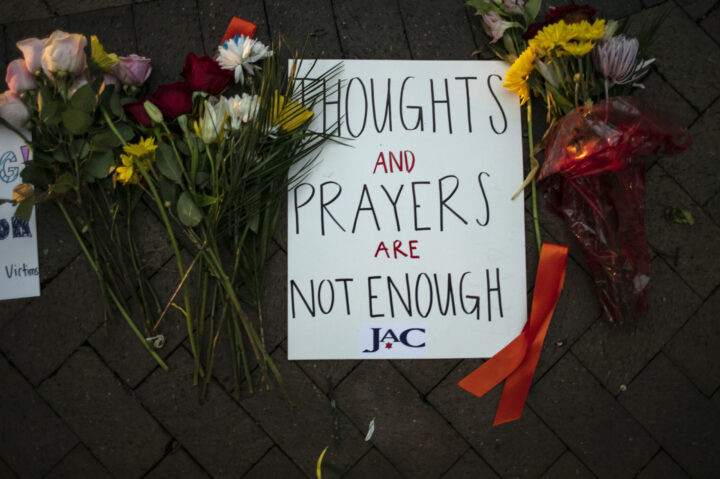
Jim Vondruska/Getty Images
A vigil is held near the scene of a mass shooting at a Fourth of July parade, on July 5, 2022 in Highland Park, Illinois.
American antisemitism is having its “thoughts and prayers” moment.
Whenever there is a mass shooting in the United States, the immediate reaction has become something of a meme. “Sending thoughts and prayers,” politicians — mostly Republicans — will inevitably write in a social media post expressing grief at the murder of innocent people at an elementary school, in a bowling alley or at a Walmart.
Gun violence prevention advocates roll their eyes. They see the oft-repeated sentiment as disingenuous, given how little action Congress has taken to enact gun control measures. During the 2018 March for Our Lives, when hundreds of thousands of Americans took to the streets to demand action after 17 people were killed at a high school in Parkland, Fla., scores of people carried signs with the words “thoughts and prayers” crossed out, and the phrase “policy and change” written underneath.
A similar phenomenon was on display after a heavily armed man drove a car into a synagogue in suburban Detroit on Thursday. He was killed by a security guard before he was able to enter the building, where 140 preschool and kindergarten students were locked down in their classrooms.
Afterward, politicians with a history of promoting antisemitic tropes began bemoaning antisemitism. And Jewish politicians and activists in the Democratic party who had grown exasperated over the hypocrisy of it all started calling them out.
Noah Arbit, the Jewish state representative whose district includes West Bloomfield Township, where the attack took place, called out Democratic Senate candidate Abdul El-Sayed for his “crocodile tears” expressing concern about the shooting. Arbit grew up attending Temple Israel.
“Amazed by the crocodile tears from someone who’s done more than most to stoke & inflame hatred against Jews. It’s a very small logical leap from ‘AIPAC controls the US government,’ ‘Israel is committing genocide,’ ‘Zionists kill Arab babies’ to ‘kill Jews in West Bloomfield,’” Arbit, a Democrat, wrote in a post on X replying to El-Sayed.
El-Sayed, a progressive running a campaign with an anti-Israel message, sent a fundraising email on the two-year anniversary of Oct. 7 accusing Israel of genocide and calling out AIPAC. “If you’re asking yourself, ‘Why on Earth are politicians in Washington continuing to add fuel to the fire?’ The answer is money. AIPAC is funneling millions into campaigns in exchange for loyalty,” El-Sayed wrote in the Oct. 7 email, referring to the war in Gaza.
As the attack was unfolding, Rep. Ro Khanna (D-CA) took to social media to respond to a message by a junior staffer at the centrist think tank Third Way that called for Democrats to do more to address antisemitism within their ranks. Rather than taking the criticism seriously, Khanna said he was “proud” to stand by New York City Mayor Zohran Mamdani and far-left antisemitic streamer Hasan Piker, and took aim at “neocons” in the party. (Forty minutes later, Khanna condemned the shooting and said “antisemitism and violence have no place in America.”)
“What the hell is wrong with you? 48 hours ago two men were beaten in your district for speaking Hebrew. Earlier today there was a shooting at a Jewish school in Michigan. Is it politics? Lack of empathy? Are you actually racist?” Ethan Agarwal, a Silicon Valley entrepreneur challenging Khanna in this year’s Democratic primary, wrote in response.
Earlier in the day, Khanna had tweeted in defense of Pat Buchanan, President Ronald Reagan’s communications director who has a lengthy history of making overtly antisemitic arguments.
“The same Pat Buchanan who wrote that Hitler was ‘a man of great courage’? Who called Capitol Hill ‘Israeli-occupied territory’? Who said there was ‘No evidence exists that any Jews were gassed at Treblinka’? Pretty sure he was antisemitic,” said Shannon Watts, a liberal activist who started the advocacy group “Moms Demand Action” after the Sandy Hook shooting in 2012, when 26 students and teachers were killed at a Connecticut elementary school.
Khanna doubled down afterward.
Later, Watts — who has called Republicans’ “thoughts and prayers” framing a form of gaslighting — said Democrats need to do more to combat antisemitism among members of their own party.
“The Democratic Party has been infected by antisemitism and it’s spreading. It isn’t (yet) as virulent as it is on the right, but it’s insidious and we have to stop pretending it doesn’t exist,” Watts wrote on X.
In West Bloomfield, tragedy was averted, miraculously, because of the actions of a security guard who quickly put himself in harm’s way.
But if the response to rising antisemitism begins to resemble the country’s response to gun violence — expressions of outrage followed by little introspection — the result may be a familiar one: condemnation after the antisemitic incident, but little reckoning with the permissive culture that helped create the danger in the first place.
Plus, Iranian missile injures dozens in northern Israel

Emily Elconin/Getty Images
Law enforcement respond near Temple Israel following reports of an active shooter on March 12, 2026 in West Bloomfield, Mich.
👋 Good Friday morning!
In today’s Daily Kickoff, we report on yesterday’s attack on the Temple Israel congregation in West Bloomfield Township, Mich., and talk to Senate leaders about how the incident, in which one person was injured, could affect the ongoing stalemate over Department of Homeland Security funding. We cover the clash between the center-left think tank Third Way and Rep. Ro Khanna over the Democratic Party’s approach to antisemitism, and talk to experts about Iran’s degraded missile launch capabilities. Also in today’s Daily Kickoff: former Mayor Michael Bloomberg, Sarah Rogers and Jeff Miller.
Today’s Daily Kickoff was curated by JI Executive Editor Melissa Weiss and Israel Editor Tamara Zieve, with assists from Danielle Cohen-Kanik, Emily Jacobs and Marc Rod. Have a tip? Email us here.
For less-distracted reading over the weekend, browse this week’s edition of The Weekly Print, a curated print-friendly PDF featuring a selection of recent Jewish Insider and eJewishPhilanthropy stories, including: The Amodei siblings leading Anthropic clash with the White House over AI safety; Conservative students alarmed about College Republicans leader with Nick Fuentes ties; and Will Iranian attacks push Qatar to expel Hamas leaders? Print the latest edition here.
What We’re Watching
- We’ll be keeping an eye out in the coming days on how yesterday’s attack on a Michigan synagogue is playing out on the national stage, from Jewish communal conversations to debates in Washington and in state capitals about antisemitism, security funding and safety measures.
- We’ll also be monitoring the ongoing military operations in the Middle East. Overnight, dozens were injured in an Iranian strike on the northern Israeli Arab town of Zarzir. Earlier this morning, CENTCOM confirmed that four of the six crew members of a U.S. KC-135 that crashed during a refueling mission in western Iraq on Thursday were killed, with an investigation underway.
- In Iran, a large explosion was reported this afternoon local time at a Quds Day demonstration in Tehran. The IDF had previously warned against congregating in the area.
- SXSW continues today, with Tech Tribe hosting its annual Shabbat dinner this evening.
- On Sunday, Jewish philanthropists are convening in San Diego for the three-day annual Jewish Funders Network conference. eJewishPhilanthropy’s Jay Deitcher and Rachel Kohn will be on the ground at JFN — sign up for eJP’s Your Daily Phil for the latest on the conference, and say hello if you see Jay and Rachel in San Diego.
- The Zionist Organization of America is hosting a gala in South Florida on Sunday night, where the group will honor Sen. Rick Scott (R-FL), Rep. Randy Fine (R-FL) and the Justice Department’s Leo Terrell.
- In New York on Sunday, HaZamir: The International Jewish Teen Choir, is slated to perform at Lincoln Center.
- And across the country, the Oscars are taking place Sunday night in Los Angeles.
What You Should Know
A QUICK WORD WITH JI’S JOSH KRAUSHAAR
It’s a testament to the level of security, staff preparation and good fortune that a potential terrorist attack against Temple Israel in suburban Detroit was foiled yesterday. The fact that no one other than the heavily armed perpetrator was killed after driving a vehicle filled with explosives into a synagogue filled with preschoolers, counts as something of a miracle.
It’s also a reminder of the consequences of what can happen when antisemitism is allowed to become normalized in our society, moving unchecked through our social media feeds and political discourse, all amid the record levels of hate crimes committed against Jews simply for their identity.
Even as politicians are reflexively speaking out against antisemitism in the aftermath of the attack, it’s hard to forget the poisonous rhetoric many on the extremes have advanced that could easily activate a lone-wolf extremist to commit an unspeakable crime.
On the hard left, opposition to Israel’s war in Gaza has morphed into accusations of genocide, attacks against AIPAC as a uniquely sinister organization, conspiracy theories that Israel tricked the U.S. into war with Iran and euphemizing the support of terrorism as merely being “pro-Palestinian.”
Rep. Ro Khanna (D-CA), who has emerged as one of his party’s leading anti-Israel voices as he mulls a presidential campaign, had the audacity to say he “stands with” antisemitic streamer Hasan Piker — along with New York City Mayor Zohran Mamdani, who has refused to condemn “globalize the intifada” rhetoric and anti-Israel Democratic Senate candidate Graham Platner — during the Michigan synagogue terror attack.
Former Obama deputy national security advisor Ben Rhodes and his “Pod Save America” colleagues are now declaring that anyone who supports the Iran war — a group that may well include some Jewish Democrats in Congress who are sympathetic to the operation’s aims, even if they have reservations — should be primaried, and have no place within the Democratic Party.
On the hard right, extremist podcasters are broadcasting the most undiluted antisemitism in media since the days of Father Coughlin in the 1930s. Tucker Carlson has devoted much of his show to promoting conspiracy theories about Jews, while other social media influencers have found that attacking Israel and questioning Jewish influence is a ticket to building a niche audience in online spaces. Gatherings of young right-wingers have all too often become cesspools of anti-Jewish hate.
TEMPLE ISRAEL ATTACK

An assailant was killed during an active shooter situation at Temple Israel in West Bloomfield Township, Mich., law enforcement officials confirmed on Thursday afternoon. One other person, a security guard, was injured, Jewish Insider’s Haley Cohen reports.
Probe details: The attack is being investigated as a “targeted act of violence against the Jewish community,” Jennifer Runyan, the special agent in charge of the FBI’s Detroit field office, confirmed in a Thursday evening press conference. A Department of Homeland Security spokesperson confirmed to JI that the attack was carried out by Ayman Mohamad Ghazali. Ghazali, 41, was born in Lebanon and entered the U.S. in 2011 on an IR1 immigrant visa as the spouse of a U.S. citizen. He was granted U.S. citizenship in 2016, according to DHS. Law enforcement officials did not release information on a possible motive.
SECURITY RECKONING

The car ramming and shooting attack at Temple Israel in West Bloomfield Township, Mich., on Thursday seems unlikely to break the congressional stalemate over funding for the Department of Homeland Security, which has been in a partial shutdown for weeks, Jewish Insider’s Marc Rod reports. Among other programs, the Federal Emergency Management Agency and the Nonprofit Security Grant Program fall under the DHS funding bill, which Democrats have sought to renegotiate to implement new restrictions on Immigration and Customs Enforcement, following the deadly shootings of two U.S. citizens in Minneapolis.
Not shifting: Senate Majority Leader John Thune (R-SD) said that Republicans have tried to fund DHS through a short term stopgap bill as negotiations continue, but Democrats have refused. “It’s a dangerous game, and people are going to get hurt,” Thune said. Senate Minority Leader Chuck Schumer (D-NY) pointed blame for the lack of NSGP funding toward Republicans, highlighting that they had blocked passage of legislation by Democrats on Thursday to fund and reopen portions of DHS, including FEMA. “Leader Schumer is an ardent supporter of NSGP funding, and this week, Republicans rejected Democratic efforts to fund the program through FEMA, along with the TSA, CISA, and the Coast Guard,” a spokesperson for Schumer told JI.
TAKING A STAND
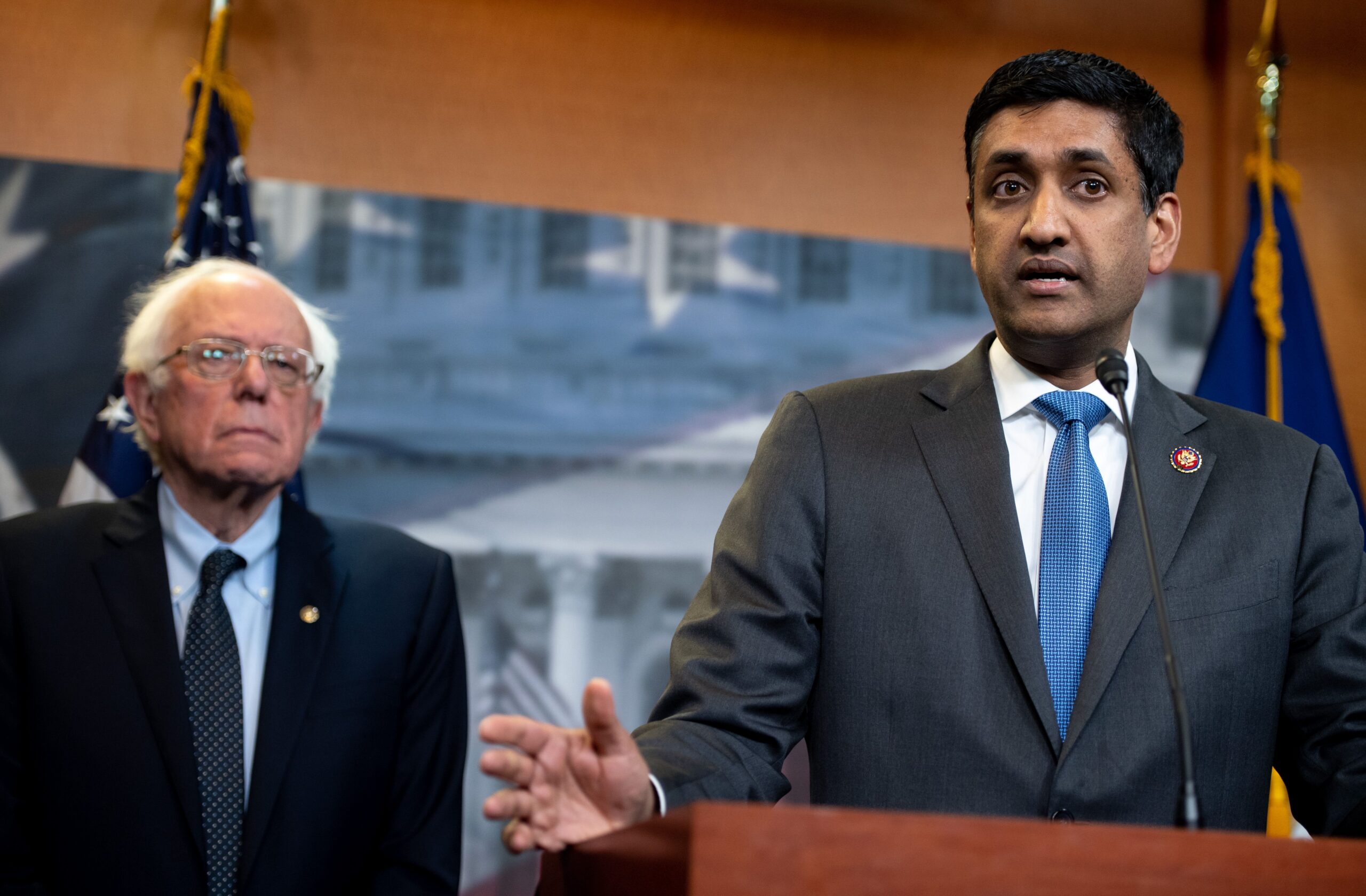
Following a Republican convening this week focused on combating right-wing antisemitism, a prominent moderate Democratic group urged fellow Democrats to follow the lead of Sen. Ted Cruz (R-TX) in calling out antisemitism within their own party. “We certainly believe that Cruz was right and our side has a real antisemitism problem too that too many Democrats are failing to face squarely,” Matt Bennett, executive vice president for public affairs at the center-left think tank Third Way, told Jewish Insider’s Gabby Deutch on Thursday.
Speaking out: His comments came after Lily Cohen, a press advisor at the organization, shared a post highlighting Cruz’s comments at the Republican Jewish Coalition confab and said she “would love to see more Dems calling out antisemitism on their own side with the same fervor.” Cohen specifically mentioned Maine Senate candidate Graham Platner, New York City Mayor Zohran Mamdani and the far-left, antisemitic streamer Hasan Piker. “We do believe that Platner has not remotely done enough to explain why he had a Nazi tattoo for 20 years,” said Bennett. Rep. Ro Khanna (D-CA), a progressive lawmaker who has been a frequent critic of Israel and pro-Israel activists in the U.S., responded to Cohen’s post by saying he stands with Platner, Mamdani and even Piker.
ISRAEL UNDER FIRE

An Iranian missile struck northern Israel early Friday, injuring 58 residents and damaging 300 homes in Zarzir, a Bedouin town near Nazareth, Jewish Insider’s Lahav Harkov reports. A woman in her 30s was moderately injured by shrapnel in her back; the rest of the injuries were minor, according to Magen David Adom emergency services.
Threats from all sides: Soon after the attack, President Donald Trump issued a threat to Iran: “Watch what happens to these deranged scumbags today,” the president wrote on Truth Social. “They’ve been killing innocent people all over the world for 47 years, and now I, as the 47th president of the United States of America, am killing them. What a great honor it is to do so!” Iranian state TV said that new Supreme Leader Mojtaba Khamenei released his first statement since being named to the position earlier this week, after his father, Ayatollah Ali Khamenei, was killed in the initial strikes of the ongoing war with Iran, which began on Feb. 28. In the statement, Khamenei vowed that Iran “will not neglect avenging the blood of [the] martyrs.”

