







































Rep. Dan Goldman badly trails Brad Lander in his reelection bid; a DSA-endorsed candidate holds a narrow lead in a nearby deep-blue NYC district

Mary Altaffer/AP
Rep. Dan Goldman (D-NY), left, is joined by New York City Comptroller Brad Lander during a news conference outside the Metropolitan Detention Center in the Sunset Park neighborhood of Brooklyn on Tuesday, Aug. 16, 2022.


 Add JewishInsider on Google
A new series of Emerson College polls of three closely watched New York Democratic congressional primaries shows a strong left-wing, anti-establishment sentiment coursing through the party.
The polls, commissioned by WPIX-TV, find that a sitting congressman, party-backed borough president and experienced state assemblyman championed by local political leaders are either trailing or barely leading their insurgent challengers.
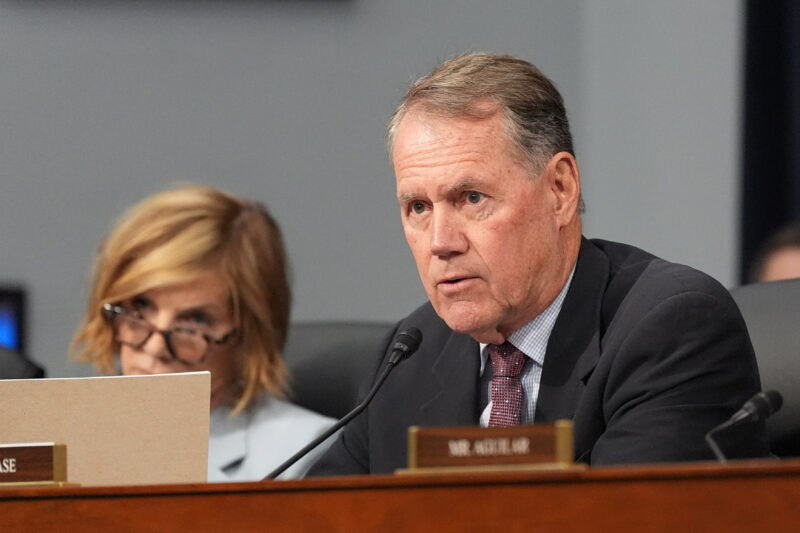
Rep. Dan Goldman (D-NY), a pro-Israel liberal and fierce critic of President Donald Trump, is badly trailing by 34 points (57-23%) his left-wing challenger Brad Lander, who most recently served as New York City comptroller and has been deeply critical of Israel.
Lander, who was endorsed by New York City Mayor Zohran Mamdani, holds a substantial advantage among voters under 40, winning 73% of the younger constituency. Mamdani, who comfortably carried the district in last year’s mayoral election, holds a 79% approval rating among Democrats in the progressive district.
Goldman’s campaign manager, Simone Kanter, questioned the poll’s methodology in a post on X: “Emerson is assuming an electorate that looks exactly like the once-in-a-generation turnout Mamdani mobilized when he was on the ballot.”
In New York’s 7th Congressional District, the poll finds Assemblymember Claire Valdez, the Democratic candidate backed by Mamdani and the local chapter of Democratic Socialists for America (DSA), holding a narrow lead (23-21%) over Brooklyn Borough President Antonio Reynoso, the candidate endorsed by retiring Rep. Nydia Velazquez (D-NY). A near-majority of Democratic voters (43%) are still undecided.
And in the race to replace retiring Rep. Jerry Nadler (D-NY), state Assemblymember Micah Lasher has a small advantage over Assemblymember Alex Bores, and a larger lead over social media influencer Jack Schlossberg and attorney George Conway.
Lasher holds more institutional support in the race, boasting the endorsements of Nadler, Gov. Kathy Hochul and former New York City Mayor Michael Bloomberg, but that backing hasn’t automatically led into widespread party support. Still, this poll shows Lasher leading, in contrast to other recent public and internal polls that found Bores with a narrow edge.
DNC Chair Ken Martin added his condemnation of Galindo: ‘This kind of vile, antisemitic rhetoric has no place in the Democratic Party’

U.S. House of Representatives
Reps. Josh Gottheimer (D-NJ) and Jared Moskowitz (D-FL)
Reps. Josh Gottheimer (D-NJ) and Jared Moskowitz (D-FL) said on Wednesday that they would seek to expel Maureen Galindo, a Democrat running for Congress in Texas who has expressed extreme antisemitic views, if she is elected.
Their comments mark an escalation among Democrats condemning Galindo since comments by the House candidate, in which she called for the interment and castration of Zionists, gained widespread attention.
“If for some reason, Maureen Galindo wins the Congressional election in TX-35, as soon as she is sworn in, we will force a vote to expel her every single day we are here,” Gottheimer and Moskowitz said in a joint statement. “Maureen’s insane, antisemitic views — including putting Americans in concentration camps — have no place in our Party or country.”
Moskowitz added in a post on X about Galindo, “My grandmother was part of the Kindertransport out of Berlin. Her parents were killed in Auschwitz. My kids are never going to ‘the camps.’”
He made a similar comment, and expounded on the situation, during a House hearing earlier in the day, describing Galindo’s comments as a logical escalation of attacks on Jewish and pro-Israel Americans and U.S. support for Israel, which have become increasingly common in Democratic politics.
“We’ve gone from, ‘Oh there’s Americans who donate to elected officials that are AIPAC,’ and then it’s ‘ok, Netanyahu,’ and then it’s ‘ok, maybe we shouldn’t support foreign money,’ and ‘ok, now we’re going to call all these people Zionists.’ And now we’re at concentration camps,” Moskowitz said. “By the way, we got to concentration camps much faster than I thought we would, but here we are. And it’s real scary.”
“People are scared. People don’t want to show their Jewish stars anymore, they’re moving into neighborhoods just to be around other Jews because they’re concerned,” he continued.
Galindo came in first place in the March 3 primary race, leading sheriff’s deputy Johnny Garcia, despite Garcia being the party-backed candidate. Since the primary, a host of national Democratic groups, including the Democratic Congressional Campaign Committee and Democratic Majority for Israel, have been boosting Garcia ahead of a runoff race.
But Lead Left PAC, a secretive GOP-linked super PAC, has been airing ads backing Galindo with close to $1 million in outside spending ahead of next week’s runoff.
Galindo had previously made numerous antisemitic comments, including claiming that Jews “own Hollywood” and “worship at the synagogue of Satan,” but her comments about placing Zionists into concentration camps gained greater attention.
All Jewish Democratic House lawmakers joined in another joint statement on Wednesday to condemn the “vile, bigoted, and antisemitic views spewed by the desperate and unhinged Maureen Galindo,” which they said “[merit] no safe harbor anywhere in American politics, and for sure not in the Democratic Party.” In a first, the group expressed their joint support for Garcia.
They also said they were “appalled” by reports of a GOP-linked super PAC supporting Galindo, “shamefully embracing and elevating her disgusting antisemitic views and ideas.”
Democratic National Committee Chairman Ken Martin also condemned Galindo.
“This kind of vile, antisemitic rhetoric has no place in the Democratic Party,” Martin said. “No matter someone’s political party, we must confront and stand up to hate wherever and whenever it appears.”
A group of Texas Democratic Party leaders, including the state party chair, also condemned Galindo on Wednesday.
“Antisemitism and hateful rhetoric have no place in the Democratic Party or in our communities. Maureen Galindo’s comments do not reflect our values as Democrats or Texans,” their statement reads. “The Texas Democratic Party and its county parties remain committed to standing against antisemitism in all its forms.”
‘Barney Frank changed the country through the barriers he broke and through the seriousness, clarity, and effectiveness he brought to public life,’ said Jeremy Burton of the Boston JCRC
Anna Moneymaker/Getty Images
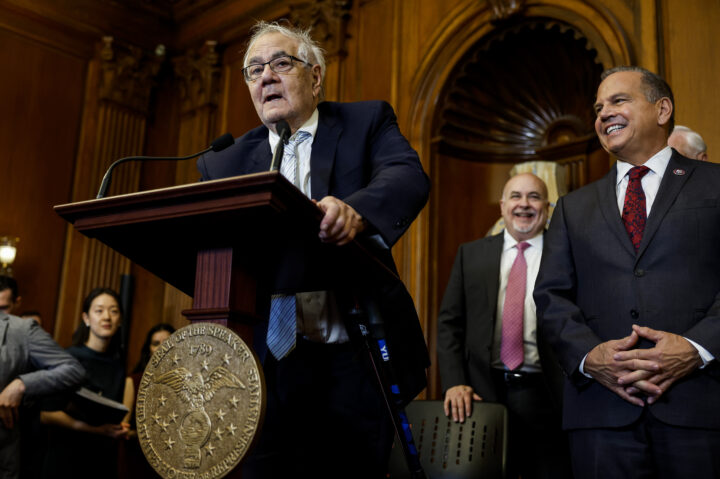
Former Rep. Barney Frank (D-MA) speaks during a bill enrollment ceremony for the Respect For Marriage Act as Rep. David Cicilline (D-RI) looks on at the U.S. Capitol Building on December 08, 2022 in Washington, DC.
Former Rep. Barney Frank (D-MA), who represented the Boston area in Congress for more than three decades and was the first openly gay member of Congress, died on Tuesday. He was 86.
Known as a liberal firebrand, Frank’s most high-profile act in politics was drafting the legislation that tightened financial regulations in response to the 2008 financial crisis, a bill known as the Dodd-Frank Wall Street Reform and Consumer Protection Act. He also was widely considered a pioneer for the LGBTQ community after coming out publicly as gay in 1987.
Frank grew up in a working-class Jewish family in Bayonne, N.J. His sister, Ann Lewis, also worked in politics, holding senior roles in the Clinton administration and later on Hillary Clinton’s presidential campaign.
Frank said he was drawn to public service early, feeling in some way that he was an outsider who could challenge how things were done.
“I’m a left-handed gay Jew,” Frank said. “I’ve never felt, automatically, a member of any majority.”
He knew from the time he was a teenager that he was gay, but figured that being Jewish would be a bigger barrier to holding public office.
“I knew I was a homosexual growing up in the 1950s, but figured no one had to know I was one,” Frank told a group of Yale students in 2013. “And it was already out [that] I was Jewish. I had been bar mitzvahed.”
A graduate of Harvard Law School, Frank spent nearly his entire career in elected office after a short stint working in Boston politics. He was elected to the Massachusetts State House in 1972, a position he held for eight years until his election to Congress in 1980.
For 32 years, until he retired in 2013, he represented a district that included the Boston suburbs of Newton, Needham, Brookline, Foxborough and Sharon. One of Frank’s final acts in office was marrying his husband, James Ready, in 2012, becoming the first sitting member of Congress to marry a same-sex partner.
“Massachusetts and the Jewish community are mourning one of the defining public leaders of his generation,” Jeremy Burton, CEO of the Jewish Community Relations Council of Greater Boston, said in a statement. “Barney Frank changed the country through the barriers he broke and through the seriousness, clarity, and effectiveness he brought to public life.”
In the final weeks of his life, Frank did a series of interviews to promote his new book, The Hard Path to Unity: Why We Must Reform the Left to Rescue Democracy, which will be released in September. He entered hospice a few weeks ago and knew he would not make it to the book’s release date.
Frank explained in a May 8 interview with the Jewish Telegraphic Agency that he believed Democrats should get rid of far-left litmus tests that he said limited the party’s electoral prospects and turned away voters — but added that he thought Israel should be treated differently.
“I’ve been talking about the importance of repudiating positions from the left and from the far left, but the Israel one is almost 180 degrees” different, he told JTA. “It’s the one area where we are not doing enough in terms of making our position clear.”
Frank, who considered himself a Zionist and supporter of Israel, said Democrats need to be much clearer about their opposition to Israeli Prime Minister Benjamin Netanyahu and his treatment of the Palestinians in Gaza and the West Bank. He said Netanyahu is the “enabler” of rising anti-Israel Democrats, such as New York City Mayor Zohran Mamdani.
“It’s what the Democrats should be doing, it’s what America should be doing, and it should be what the Democrats are advocating, is giving an ultimatum that [Netanyahu] either changes things substantially in Gaza and the West Bank, or we cut off any aid,” Frank said in the interview. “We’ve now gone to the point where supporting Israel has become unpopular, and that’s all Netanyahu’s doing.”
But, Frank added, opposition to Netanyahu should not be seen as opposing Israel’s very existence.
“We should make it clear that the right position here is to support Israel’s right to exist, but to be unwilling to facilitate what they’re doing militarily and to give them an ultimatum,” said Frank.
The Center for American Progress hosted leading Democratic officials and featured several panels on foreign policy. Israel was barely discussed

Screenshot
Sen. Ruben Gallego (D-AZ) speaks at the Center for American Progress’ IDEAS Conference, May 19, 2026
On Tuesday, a gilded ballroom inside a Washington hotel served as a soapbox for more than a dozen Democrats — many with national ambitions — to pitch their vision for America to a room full of liberal donors, staffers and funders.
The setting was the Center for American Progress’ IDEAS Conference, a convening put on by the Democratic think tank that pledged to bring together “the broad center-left’s leading thinkers and doers” to offer ideas on a range of policy topics.
American foreign policy was, naturally, one of those topics. In the two sessions on national security, each of which devoted significant discussion to the Middle East, one topic was notably absent: Israel.
Democratic support for Israel has shifted dramatically since the Oct. 7 attacks and the resulting war in Gaza. Over the last few months, particularly since the war in Iran began, that policy shift has quickly solidified. Forty out of 47 Senate Democrats voted last month to block some arms sales to Israel, and the progressive Israel advocacy group J Street has urged Democrats to move toward ending all U.S. aid to Israel.
Democrats’ attitude toward the U.S.-Israel relationship is in flux, and is almost certain to be a major point of contention in the 2028 primary campaign. But if CAP’s conference is any indication, many mainstream Democrats — the ones who are not pushing firebrand far-left views on Israel — would rather avoid the topic if they are not forced to discuss it.
Certainly, it made clear that they no longer see Israel as the kind of ally that will earn applause in the same way that Taiwan and Ukraine garner cheers from rank-and-file Democrats.
Sen. Ruben Gallego (D-AZ) kicked off the gathering with an address billed as “National Security Ideas for the Future.” He cited his own experiences as a member of the Marine Corps who served in Iraq, arguing that the war in Iran is misguided and harming Americans.
”I’m here today because right now our country is in danger. Will this president continue to drag America into another endless Middle East war?” Gallego said. “This is a war that wasn’t planned, wasn’t authorized and is not making us safer. [Donald] Trump got his war, and working families got stuck with the bill every day.”
Gallego made clear that his opposition to the Iran war does not mean he thinks America should step off the world stage. The U.S., he argued, should still come to the defense of Taiwan and Ukraine.
“I see on Twitter all the time, ‘Well, if you’re against the war in Iran, why do you support the war in Ukraine?’” Gallego said. “Let me be clear: The Ukrainian people are fighting for their independence, and it’s in our strategic interest to make sure that they win, that Europe wins and that we all win and defeat Russia.”
He extended the argument to Taiwan, calling for Washington to continue arms sales to the country and to help it grow its self-defense capabilities.
“We have allies that have fought with us and will continue to fight with us, but not if we abandon Taiwan, Ukraine and NATO,” said Gallego. He did not mention Israel in his speech.
Later in the day, a conversation on the future of American policy featured Sen. Andy Kim (D-NJ), former Secretary of State Tony Blinken and former U.S. Ambassador to the United Nations Linda Thomas-Greenfield. Like Gallego, they slammed Trump’s campaign against Iran as illegal.
“This is not a situation where we should normalize the idea that a president can start a war on their own, and then it’s up to Congress later to disapprove of it, right?” said Kim. “Just from the outset, this is wrong. This is an illegal, unconstitutional war.”
The only mention of Israel in their 30-minute conversation was a brief aside from Blinken, as part of a broader point he was making about Iranian missile attacks on the United Arab Emirates. All three speakers doubled down on U.S. support for Ukraine and for Taiwan, particularly in the face of Trump’s meeting with Chinese President Xi Jinping last week.
At the end of the day, CAP President Neera Tanden said she hopes attendees walk away with a sense of where the Democratic Party is going. “To win the future we have to tell people where to go, what the path is, what the path is forward,” Tanden said.
Other speakers included California Gov. Gavin Newsom, Maryland Gov. Wes Moore, Virginia Gov. Abigail Spanberger, House Minority Leader Hakeem Jeffries (D-NY), Senate Minority Leader Chuck Schumer (D-NY), Cory Booker (D-NJ) and Elizabeth Warren (D-MA).
Democrats are uniting to condemn Maureen Galindo’s extremist candidacy — and blame the GOP’s opportunistic intervention
Katina Zentz/San Antonio Express-News via Getty Images
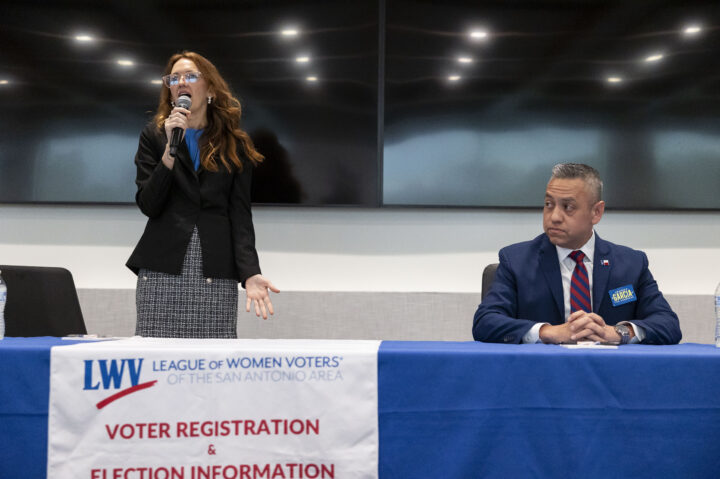
Maureen Galindo, left, and Johnny Garcia, right, participate in a TX-35 forum in San Antonio on May 6, 2026.
A newly launched super PAC with ties to Republicans has spent nearly half a million dollars to help boost a Democrat running for a competitive open House seat in Texas who is facing growing bipartisan furor over a series of virulently antisemitic social media remarks.
Lead Left PAC, the GOP-linked group, has been aggressively promoting Maureen Galindo, a fringe San Antonio activist who finished first in the primary and has said that Jews “own Hollywood” and “worship the synagogue of Satan.” Last week, she said that, if elected, she would turn a local immigration detention center “into a prison for American Zionists and former ICE officers for human trafficking,” while adding, “It will also be a castration processing center for pedophiles which will probably be most of the Zionists.”
The comments, which circulated online Tuesday, fueled widespread condemnation from members of both parties, and drew further scrutiny to Lead Left, which has faced accusations of meddling in the race to prop up a weaker candidate in the redrawn district. Democrats see the district as winnable in November if they elect Johnny Garcia, Galindo’s moderate rival, in the May 26 runoff.
Lead Left, which has not returned requests for comment, had invested around $430,000 in the runoff to elevate Galindo as of Tuesday, according to federal filings. The shadowy PAC was expected to double that figure on Wednesday with a roughly $500,000 investment, bringing its total spending in the district to around $1 million with less than a week until the election, according to media buying figures from an internal reporting database that were shared with Jewish Insider.
Lead Left, which has not yet disclosed its donors, has also recently spent in other Democratic races across the country. While no Republicans have taken credit for the group, the metadata for its website links to a major GOP fundraising platform, strongly suggesting Republican fingerprints.
In a joint statement on Tuesday, House Minority Leader Hakeem Jeffries (D-NY) and Rep. Suzan DelBene (D-WA), chair of Democratic Congressional Campaign Campaign Committee, said that “House Republican leadership must immediately cease propping up this antisemitic candidacy, pull spending in the race and forcefully condemn these comments.”
“This vile language by her is disqualifying and has no place in American politics, and certainly not in the Democratic Party,” the Democratic leaders added on Tuesday. “To embrace and uplift a fringe candidate with antisemitic — and extremely dangerous — rhetoric and views in order to win an election is beyond the pale.”
The DCCC recently added Garcia, a sheriff’s deputy in Bexar County, to its “Red to Blue” program for House candidates in battleground districts key to reclaiming the majority.
Democratic Majority for Israel’s political arm, which is also supporting Garcia, accused Republicans of “deliberately elevating one of the most grotesque antisemites in American politics this cycle because they think it helps them win.”
“It is sick, it is cynical, and it tells you everything about a party that will fund anyone, including someone openly invoking the language of pogroms, as long as it serves their politics,” Brian Romick, who leads DMFI PAC, said in a statement after Galindo’s most recent comments came to light. “Democrats across the ideological spectrum reject Maureen Galindo and everything she stands for, completely and without qualification. Republicans should explain why they’re paying to keep her viable.”
Galindo, whose endorsement from the extremist anti-Israel account Track AIPAC was rescinded on Tuesday, garnered nearly unanimous denunciations from across the political spectrum, including Reps. Elise Stefanik (R-NY), Alexandria Ocasio-Cortez (D-NY) and others who expressed outrage over her remarks.
Rep. Josh Gottheimer (D-NJ) called Galindo’s recent comments about imprisoning and castrating Zionists “straight out of the Nazi playbook,” while Rep. Jared Moskowitz (D-FL) urged Democratic leaders to speak out against rhetoric “suggesting concentration camps for American Jews.”
Galindo, who has gained prominence on social media promoting conspiracy theories about Jews and Israel, narrowly finished first in the crowded March primary with 29% of the vote, two points ahead of Garcia, who placed second. She did not respond to a request for comment.
Galindo has attributed the surge of spending from Lead Left to “a billionaire zionist who made the pac to sabotage candidates,” according to a text message to The New York Times last week.
The motion passed with four Republicans voting in favor, teeing up a vote on the war powers resolution itself
Tyler Kaufman/Getty Images
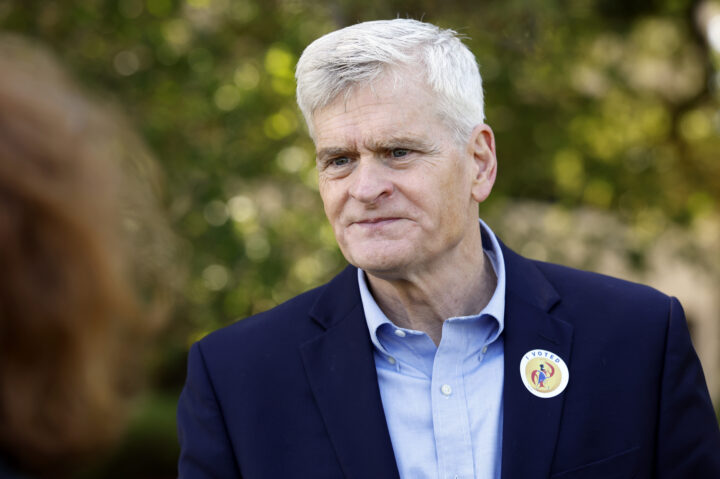
Sen. Bill Cassidy (R-LA) speaks to media on the first day of early voting outside of the Louisiana State Archives on May 02, 2026 in Baton Rouge, Louisiana.
Sen. Bill Cassidy (R-LA) joined with Democrats to vote for a procedural motion advancing legislation that would end U.S. military operations against Iran, allowing the war powers resolution to move forward on Democrats’ eighth such attempt since the war began.
Cassidy joined three other Republicans — Sens. Susan Collins (R-ME), Lisa Murkowski (R-AK) and Rand Paul (R-KY) — in voting for the procedural motion, which was approved by a 50-47 vote. Sen. John Fetterman (D-PA) voted against the motion.
The passage of the motion will now tee up further debate and an additional vote on the resolution itself, at a time to be determined. The Senate is set to depart for a Memorial Day recess this weekend, and floor time this week is expected to be focused on a reconciliation bill funding immigration enforcement, among other issues.
Cassidy’s vote came days after he lost his primary race to a challenger backed by President Donald Trump. He’s been supportive of the Iran war to this point, but has also been critical of the administration and has voiced the need to assert congressional power, particularly in the wake of his election loss.
He emphasized to reporters on Monday evening the need to rally support from traditional U.S. allies to address the situation in the Strait of Hormuz.
“While I support the administration’s efforts to dismantle Iran’s nuclear program, the White House and Pentagon have left Congress in the dark on Operation Epic Fury,” Cassidy said on X. “In Louisiana, I’ve heard from people, including President Trump’s supporters, who are concerned about this war. Until the administration provides clarity, no congressional authorization or extension can be justified.”
The result came about in part due to absences by Sens. John Cornyn (R-TX), Thom Tillis (R-NC) and Tommy Tuberville (R-AL). Had they been present and voted as they have in the past, the vote would have been tied, allowing Vice President JD Vance to cast a tie-breaking vote and reject the motion.
Yet, some of those votes may not be guaranteed when the resolution itself comes to the floor.
Tillis, who is retiring, has repeatedly bucked Trump and his party on a range of issues. Cornyn has been strongly supportive of the war, but Trump on Tuesday endorsed his primary opponent, Texas Attorney General Ken Paxton, likely setting Cornyn on the road to defeat in his primary race.
Cornyn announced on X shortly after the vote that he would be canceling campaign events in Texas on Wednesday and heading back to Washington to vote on Republicans’ reconciliation bill.
However, earlier this year, several Republicans voted with Democrats to advance a similar motion on a war powers resolution relating to Venezuela, but most of them flipped their votes under pressure from the administration and Republican leadership, ultimately blocking final passage of the resolution.
The House could pass a war powers resolution as well this week, depending on attendance. A previous vote last week was tied, 212-212, but Rep. Jared Golden (D-ME), the sole Democrat to vote against the resolution, said he would vote for a future resolution.
Even if the resolutions pass, they can still be vetoed by Trump.
The Jewish American Security Act addresses security threats, antisemitism on campus and online antisemitism
U.S. Senate
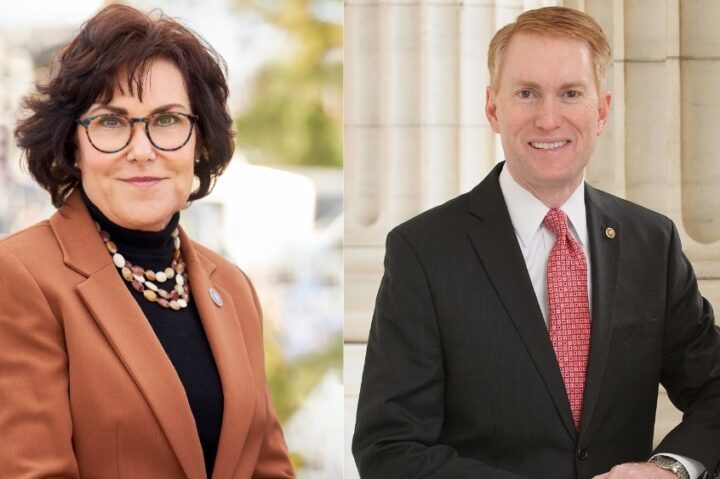
Sens. Jacky Rosen (D-NV) and James Lankford (R-OK)
Sens. Jacky Rosen (D-NV) and James Lankford (R-OK) on Tuesday introduced the Jewish American Security Act, a broad new effort by the lawmakers, who co-chair the Senate antisemitism task force, to address antisemitism across multiple sectors of American society.
Similar legislation is also expected to be introduced in the House.
The bill, which has widespread support from all corners of Jewish leadership, including all major religious denominations and political organizations on both sides of the aisle, contains various provisions aimed at increasing security for Jewish communities through additional funding and federal resources.
Key provisions include: additional security assistance and improvements to security grant programs for Jewish communities; addressing antisemitism on college campuses through new federal oversight measures including a federal official to handle campus antisemitism; and addressing the spread of antisemitism online by requiring new transparency reports from social media companies, among a range of related steps in each category.
Rosen, leaders from the Anti-Defamation League, American Jewish Committee and BBYO International and local leaders whose communities have been impacted by antisemitic violence in recent years spoke in favor of the bill at a Jewish Federations of North America press conference on Capitol Hill on Tuesday. JFNA activists are on Capitol Hill this week meeting with more than 200 lawmakers to advocate for the bill and other legislation.
Rosen called the bill an “aggressive and comprehensive” response to antisemitism in the U.S. which will “help keep Jewish students safe, will help secure Jewish community institutions and we will help fight antisemitism online.”
She acknowledged that the path ahead is “not going to be easy” but emphasized that “it’s not an option for our government to not do more to fight antisemitism.”
Lankford emphasized the impacts of antisemitic violence on individual Jews and communities in a statement on the bill.
“These are not just numbers, these are real stories impacting real people. Jewish students being targeted on campuses. Synagogues being vandalized. People being attacked in the streets simply because of their faith and heritage,” Lankford said. “That is not who we are as a nation, and we unequivocally condemn antisemitism in all its forms. Every American deserves to live their faith freely. That is worth fighting for.”
Rosen told Jewish Insider later in the day that she and Lankford had been working to craft the bill for the past year, and had taken a range of input on the legislation. She said she and Lankford had learned from past legislative fights that to garner strong bipartisan support “you have to be very specific” and targeted in how legislation is crafted.
She said the new bill is focused on combating domestic antisemitism across three of the areas that have been epicenters of the recent rise in antisemitism since Oct. 7.
“I think it’s a good, solid bill and I believe that we crafted it in a way to get that good bipartisan support,” Rosen said. “We’re not going to solve every problem, but you have to start with something and work from there, and hopefully we build on that success.”
“Antisemitism we know is a canary in the coal mine. It starts with the Jews, it doesn’t end with the Jews,” she said.
“This bill that we wrote, we meant it to not be so prescriptive,” Rosen continued.” When we do things on college campuses, it’s going to help all students. When we do things in houses of worship, it’s not just for synagogues, it’s for all houses of worship. And when we start looking and analyze some of these algorithms online, it will probably inform us about some of the other algorithms, probably the same algorithms that are taking people down that hateful rabbit hole.”
Asked after the press conference about the path forward for the bill, and how advocates could avoid the same pitfalls that befell other efforts to combat antisemitism since Oct. 7, JFNA CEO Eric Fingerhut said that Jewish community groups took lessons from previous fights, particularly over the Antisemitism Awareness Act, which would codify the federal government’s use of the International Holocaust Remembrance Alliance’s working definition of antisemitism in evaluating campus antisemitism cases, but has failed to pass in several congressional sessions.
“We learned a lot from the experience with the Antisemitism Awareness Act. Of course we still support the IHRA definition, but we made a collective communal decision that there’s a separate bill that covers the IHRA definition, and that we hope that will continue to move through the process, but this is a separate issue,” Fingerhut told JI.
The bill does not explicitly endorse the International Holocaust Remembrance Alliance’s working definition of antisemitism, which has proven a hurdle to previous efforts to combat antisemitism, but it notes that the Trump administration in 2019 implemented an executive order enforcing the IHRA definition on college campuses.
“This is the security of the Jewish community, and it has to be something that can be embraced on a bipartisan basis across the aisle,” he continued.
Fingerhut said that Rosen and other advocates made specific efforts to ensure the bill would not contain elements that would “turn it into a partisan effort” or “alienate people who have strong feelings about some of the issues that were in the Antisemitism Awareness Act, and so we hope we’ve accomplished that.”
Rep. Dan Goldman (D-NY), who co-chairs the House antisemitism task force and also spoke at the press conference, said that he and his House co-chairs are moving toward introducing companion legislation.
“This was a labor of … unquestionabl[e] importance and it has taken us quite some time to come together in a bipartisan, bicameral way,” Goldman acknowledged. “We worked for several months to fine tune this bill, so that it can be a targeted, productive, and effective concrete step to fighting antisemitism and rooting it out on the ground. We have worked very hard in a bipartisan way because none of these bills matter unless they become law.”
Goldman highlighted the “dramatic escalation” in antisemitic incidents in New York City in recent weeks, and said that simple condemnation after -the -fact is “too little, too late.”
The bill has widespread support among Jewish community groups and across all major religious denominations, including from the American Jewish Committee, Anti-Defamation League, Jewish Council for Public Affairs, Orthodox Union, JFNA, Conference of Presidents of Major Jewish Organizations, Secure Community Network, The Rabbinical Assembly, Hadassah, Jewish Women International, Religious Action Center of Reform Judaism, the United Synagogue of Conservative Judaism, the Blue Square Alliance Against Hate, JCC Association of North America, the Nexus Project, Union for Reform Judaism, the Central Conference of American Rabbis and Agudath Israel of America.
The Republican Jewish Coalition and Jewish Democratic Council of America are also both endorsing the bill, JI has learned.
The legislation follows a previous effort by Rosen and Lankford, and counterparts in the House, to introduce a comprehensive package of antisemitism legislation in the past Congress, the Countering Antisemitism Act, which faced opposition from senior lawmakers on both sides of the aisle and ultimately did not advance.
The new bill is somewhat more limited than that prior effort, and builds on or combines other efforts that lawmakers have advanced individually, though certain provisions could still face objections from various corners.
Mirroring efforts currently underway in the 2027 government funding process, the legislation would authorize $1 billion annually for the Nonprofit Security Grant Program — though that funding would still have to be approved annually through the appropriations process even if this bill passes.
It also includes various provisions aimed at reforming NSGP management, including requiring that the Federal Emergency Management Agency provide sufficient staffing to “streamline the application process and post-approval process for a grant,” provide additional technical assistance to grantees and quickly disburse funds under the program, within 90 days of when grantees submit reimbursement requests.
At the outset of the Trump administration, grant reimbursements were paused for a significant period as the administration reviewed all Department of Homeland Security grant programs.
It requires that applications for the program open no later than 90 days after Congress passes funding for the program, and that each state publicize a timeline to submit applications, both of which were issues during the 2025 grant cycle.
Addressing repeated congressional complaints during the second Trump term that lawmakers have not received adequate information about or communication from the administration about the grant program, the legislation would codify a requirement that FEMA provide Congress with a list of grant awards and amounts at least a week before such grants are publicized. It would also release to the public information about grant acceptances and rejections and the criteria for such decisions.
Responding to concerns about new conditions imposed on applicants relating to cooperation with immigration authorities and Diversity, Equity and Inclusion programming, the bill bars any conditions or terms that would disadvantage applicants or grant recipients based on their “religious, political, or ideological affiliation.”
The bill would modify current grant rules to allow nonprofits to use NSGP funding to pay for contracted or in-house security personnel.
At the press conference, Rosen called the provisions “comprehensive and long overdue reforms to this program that will actually make sure that it works for our at-risk institutions.”
And it would require the intelligence community to produce annual assessments on domestic and transnational antisemitic violent extremism.
The legislation would additionally codify a version of a program established in the 2026 Department of Justice funding bill that would allow the DOJ to provide grants to state and local law enforcement for the purpose of protecting religious institutions and addressing religious-based hate crimes.
In the education space, the bill would establish an antisemitism coordinator within the Department of Education, whose responsibilities would include working to ensure that antisemitism complaints that have been pending with the department’s Office for Civil Rights for more than 180 days are resolved promptly.
It would also mandate that any schools receiving federal funding designate a coordinator for addressing discrimination complaints under Title VI of the Civil Rights Act, and establish a uniform grievance procedure and provide support mechanisms for such complaints. The effort mirrors policies currently in place for sex-based discrimination, under Title IX.
To improve visibility into the volume of antisemitic activity on college campuses, the legislation would change federal reporting procedures for hate crimes on college campuses, requiring that annual public campus crime reports disaggregate such offenses based on the bias category, such as antisemitism, that motivated them.
It also requires the Department of Education to offer trainings for schools on their Title VI responsibilities and to create an online database on Title VI best practices and recommendations. It requires schools to publicize educational materials about students’ Title VI rights both online and in person.
Rosen told JI that existing mechanisms have been “woefully inadequate to protect our students.”
Addressing antisemitism online, the bill requires platforms with more than 50 million unique monthly American users to submit to the Federal Trade Commission and to share publicly a transparency report on their “content moderation practices and efforts to detect, remove, limit the visibility of, and prevent the amplification of antisemitic content” on their platform, twice each year.
That report would include details on the specific review mechanisms and content moderation tools the platforms use; the total number of pieces of content on the platform that were determined to violate their policies on antisemitism and what action the platforms took; the amount of antisemitic content that reached more than 100 viewers or was promoted by the platform’s algorithms; the percentage of antisemitic content that violated the platforms’ policies but remained online; and details on accounts that were suspended or removed for sharing antisemitic content.
Platforms that do not comply with these reporting requirements would be subject to penalties by the FTC.
The administration would also be required to report to Congress on antisemitism online that has been linked to offline violence.
Goldman said that such transparency provisions would serve as a “tremendous deterrent.”
“If these social media companies need to disclose how much money they’re making off of antisemitic content, that’s going to be a deterrent. That is bad PR. And so it is critically important that we take this first step,” Goldman said. “It doesn’t violate the First Amendment, it doesn’t violate Section 230. It is purely bringing some transparency.”
Rosen emphasized that social media has been an “accelerant” and driver of antisemitism, making such content easier to access. She said the legislation would not compel speech or action by the platforms, but would provide transparency into how algorithms may be driving people toward hate and violence, and allow better analysis and understanding of the problem.
Fingerhut told JI that recent antisemitic attacks may also play a role in demonstrating to lawmakers the need for the legislation to address antisemitism and protect the Jewish community.
Several speakers also made note at the press conference of the attack on Monday at the Islamic Center in San Diego, highlighting the threats to religious communities broadly which can benefit from the NSGP funding.
In an interview with leftist podcasters Matt Bernstein and Emma Vigeland, the Michigan Senate candidate backed Israel’s access to Iron Dome systems, suggested Palestinians should also have them
MANDEL NGAN/AFP via Getty Images
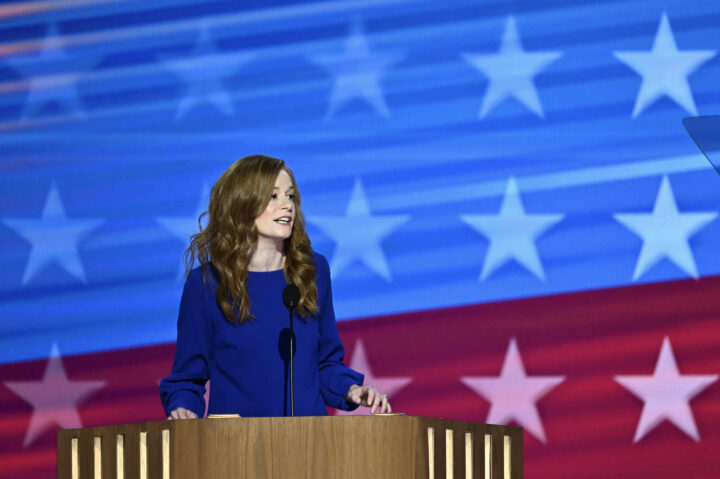
Michigan state Sen. Mallory McMorrow speaks on the first day of the Democratic National Convention (DNC) at the United Center in Chicago, Illinois, on August 19, 2024.
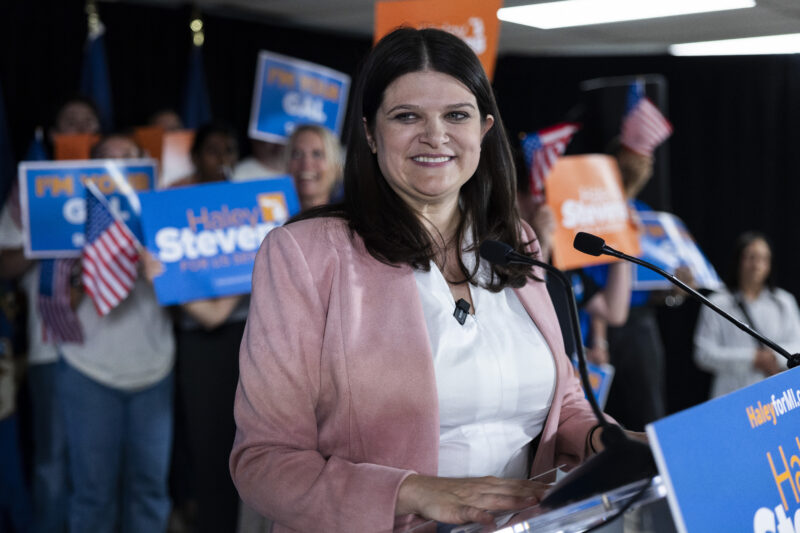
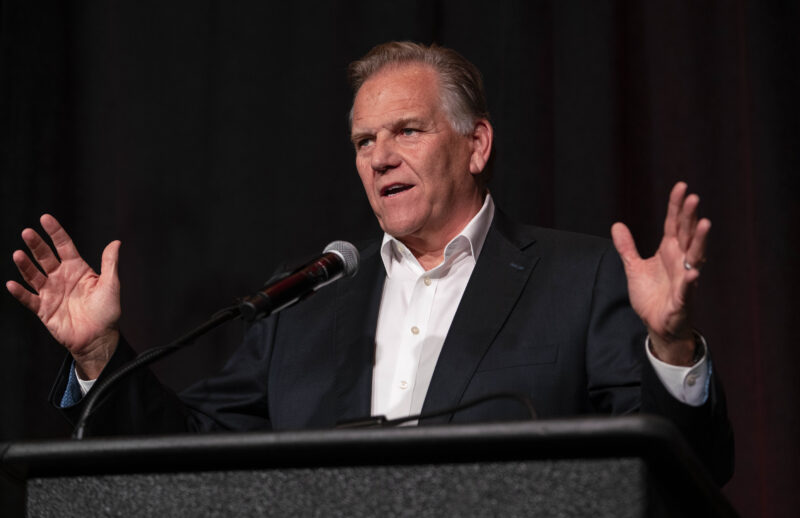
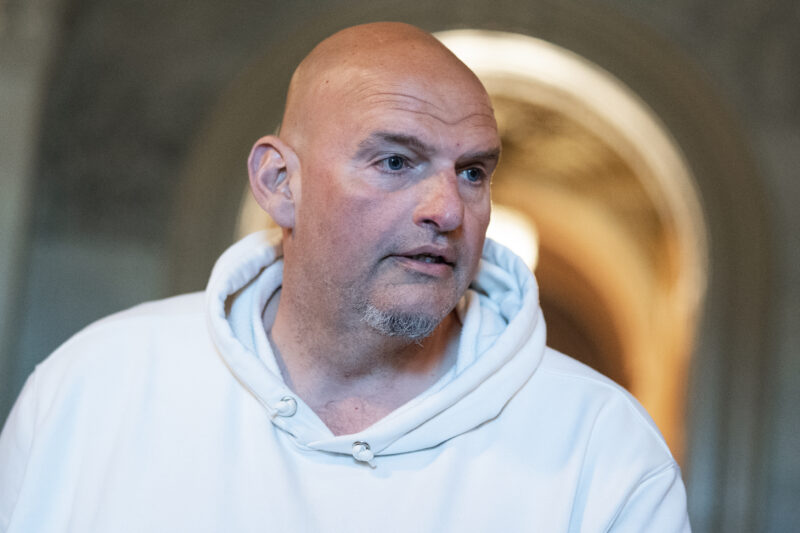
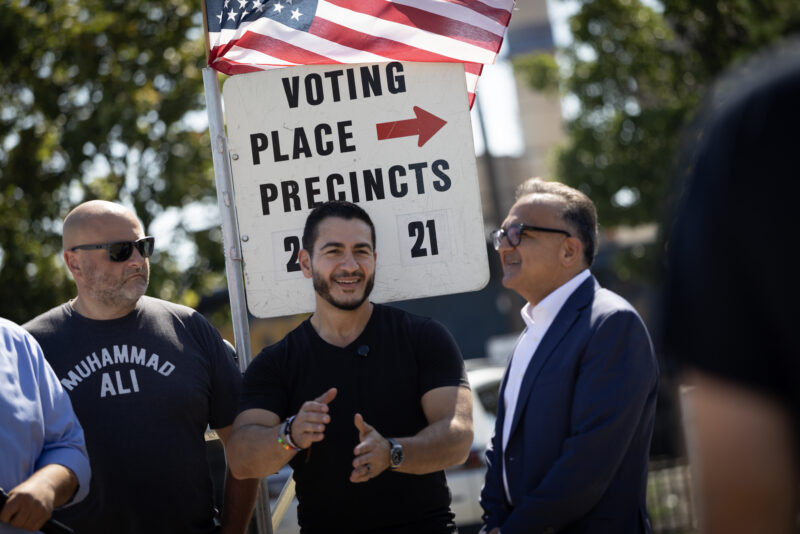
In the tight Michigan Senate race, state Sen. Mallory McMorrow has tried to present herself as a middle-of-the-road Democrat, ideologically situated between Abdul El-Sayed, an anti-Israel progressive, and Rep. Haley Stevens (D-MI), who has been endorsed by AIPAC.
In a recent interview with leftist podcasters Matt Bernstein and Emma Vigeland, McMorrow continued to position herself as an objective observer of the Israeli-Palestinian conflict — and said it’s worth discussing whether the Palestinians should also have access to the Israeli-developed Iron Dome missile-defense technology, which the U.S. partially funds for Israel.
Bernstein, the host of the queer political podcast “A Bit Fruity,” questioned McMorrow about why she supports Israel’s access to the life-saving Iron Dome systems, arguing that it empowers Israel to attack Palestinians without risk of harm to its own population, which is protected by the systems.
While highly effective, the Iron Dome does not provide complete protection and Israelis have continued to be killed and wounded throughout the conflict.
“I don’t think anybody should live in fear of being bombed or killed. I would look at: How do we support defensive systems for Palestinians? How would we support defensive systems for Lebanese?” McMorrow said. When Vigeland sarcastically asked if the Palestinians should get their own Iron Dome, McMorrow said maybe.
“Let’s talk about that as a conversation,” McMorrow said. “I mean, the horror of living in fear of being bombed constantly. Let’s work with the outcome of how do we end the violence, period?
Then backing away from that, how do we protect people?”
She added that she wants to get to a place where Iron Dome systems are “not needed, period, for anybody.”
McMorrow’s interview with Bernstein, which was released on Monday, was initially canceled — according to Bernstein, who said in a post on X earlier this month that her team withdrew after the podcast host told them he wanted to talk about foreign policy — but then rescheduled after Bernstein publicized the cancellation.
Bernstein’s questions to McMorrow reflected his own anti-Israel worldview. McMorrow responded by reiterating her opposition to sending financial aid to Israel, a position that she said has evolved as even Israeli Prime Minister Benjamin Netanyahu now says he wants to end U.S. aid.
“I would support Israel continuing to be able to purchase systems like the Iron Dome defensive systems, but I think it’s in the best interest of the United States in reducing that aid and allowing Israel to do that on their own,” said McMorrow. “I do not support the Netanyahu government. I think that they have continued to push well beyond what is proportionate, what is rational in response to the Oct. 7 attacks, in a way that is horrifying to watch.”
McMorrow said she would have voted with the 40 Senate Democrats who supported a measure last month that sought to block some arms sales to Israel.
“Let’s acknowledge how stunning it is that a year ago that number was significantly smaller than it is today. My views on this have evolved because the reality on the ground has evolved,” said McMorrow.
Mallory McMorrow: "I would have voted alongside the 40 out of 47 senators who voted in the past Sanders' resolution blocking arms sales" to Israel.
— Jewish Insider (@jewishinsider) May 19, 2026
"My views on this have evolved because the reality on the ground has evolved," she said.
Read more about how Michigan Senate… pic.twitter.com/og2dKQ5kIv
When Bernstein and Vigeland pressed McMorrow to describe Israel’s actions in Gaza as a genocide, she said she believes it meets “the legal definition” of the word. But she added that she doesn’t like to use it because of Jewish constituents’ “personal visceral reaction” to the word, due to family members lost in the Holocaust. And avoiding the word, McMorrow said, is a way to build consensus and not alienate voters in a swing state, even as she uses sharply critical language to describe Israel’s actions.
“There is no doubt that war crimes have been committed. There is no doubt that the pain and suffering at the vast expense of our taxpayer dollars, Matt, to your point, that we continue to pay for this, needs to end,” McMorrow said.
Bernstein: "Do you believe Israel has committed — and is committing — a genocide?"
— Jewish Insider (@jewishinsider) May 19, 2026
McMorrow: "I do believe that it meets the [legal] definition."
"What I also heard in response," the Michigan Senate candidate said, "from many of my constituents who had family that they lost in… pic.twitter.com/xCDX2WugoA
“I’m asking for the trust to represent 10 million people in a very diverse state that is a purple state that could very easily go to the Republicans,” added McMorrow, referring to “the goal that I think all of us on this call share: to keep a state like mine together and to not let this issue tear people, apart because if we let it tear us apart, we get [Republican Senate candidate] Mike Rogers. [Donald] Trump gets a win.”
Bernstein has more than 400,000 subscribers on YouTube and 2.2 million followers on Instagram.
The far-left congressional candidate also liked a post celebrating Oct. 7 shortly after the attacks

Erik McGregor/LightRocket via Getty Images
NY Assemblymember Claire Valdez
New York state Assemblymember Claire Valdez, a far-left Democrat now campaigning to fill an open House seat covering parts of Brooklyn and Queens, sat for a friendly interview released on Friday with a Twitch streamer who was once suspended from the platform for calling Jews a “demonic ethnicity.”
Valdez, who is backed by New York City Mayor Zohran Mamdani, Sen. Bernie Sanders (I-VT) and the Democratic Socialists of America’s New York City chapter, joined a nearly hour-long virtual conversation with Michael Beyer, a fellow DSA member who uses the online moniker “Mike from PA” and has drawn criticism for invoking antisemitic rhetoric about Jews and Israel.
Beyer, who now lives in Los Angeles, was suspended from Twitch last year after offensive comments about Jewish ethnicity he made during a livestream had been resurfaced online. “Jewish is not an ethnicity,” he said in remarks from 2024. “This constructed ethnicity, this demonic ethnicity —, wholly invented.”
The Anti-Defamation League commended Twitch’s decision to implement the suspension, saying that streamers “should use their platforms responsibly and not engage in inflammatory, dehumanizing and antisemitic rhetoric.”
Beyer apologized for the comments, insisting that he had misspoken and had meant to say that “Jewish ethnicity in Israel is a Zionist construction and is intended to flatten the true diversity of Judaism.”
Beyer has frequently used inflammatory rhetoric in his social media posts about Israel. He has said that “supporting Israel is treason,” referred to “Zionist spies in this country that must be rooted out” and criticized “Zionist scum,” among other incendiary comments.
A mayoral candidate in Los Angeles, Rae Huang, who is also a DSA member, faced scrutiny this month after she accepted a campaign donation from Beyer, which she has refused to return.
Valdez, who is facing off against Brooklyn Borough President Antonio Reynoso in a competitive race to succeed retiring Rep. Nydia Velazquez (D-NY), has long been an outspoken critic of Israel and supports the Boycott, Divestment and Sanctions movement targeting the Jewish state.
In a candidate questionnaire solicited by the DSA, Valdez pledged to “refrain from any affiliation with” what it called Zionist lobbying groups including J Street, AIPAC and Democratic Majority for Israel, according to a copy of the document obtained by Jewish Insider.
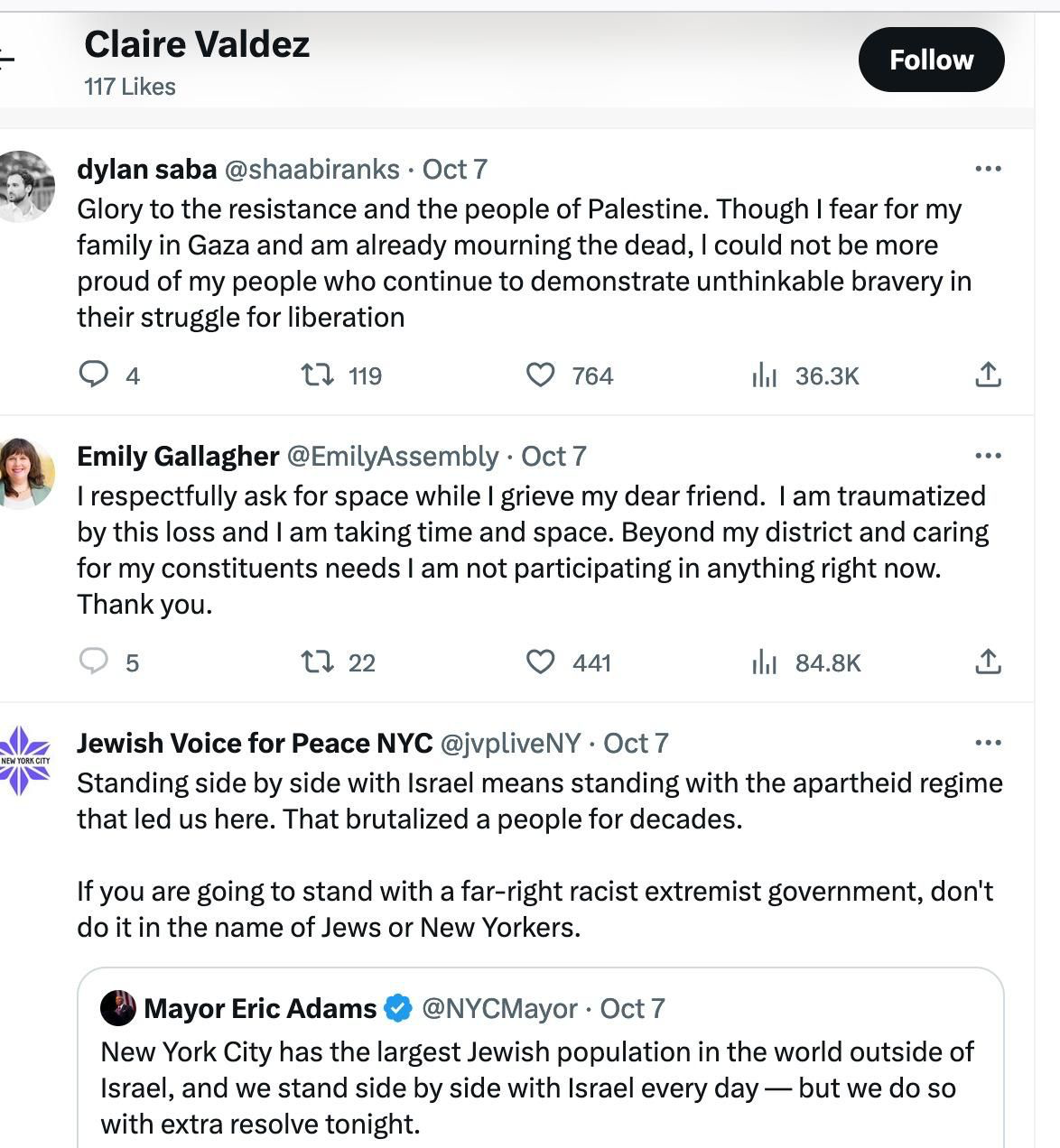
Shortly after Hamas’ Oct. 7, 2023, attacks, Valdez also liked an X post celebrating the violence, according to a screenshot shared with JI. “Glory to the resistance and the people of Palestinian,” the post said on Oct. 7.
During her new interview with Beyer, whose Twitch account claims more than 100,000 followers, Valdez was asked by the streamer if she believed “we need to be challenging more of these kind of Zionist politicians, or these right-wing Democrats.”
“This is such a DSA conversation,” Valdez replied, without directly alluding to Zionists. “This is exactly why I really love being a member of DSA.”
Elsewhere, she said she was running for Congress “in part because the Democratic status quo politicians turned away from our base when they committed to upholding Israel as an apartheid state and as a genocidal state.”
“Seeing how the Democratic base has shifted position on Palestine and Israel over the last two years,. I think there’s a real hunger within the Democratic base to think about our foreign policy and the investments that we’ve been making,” she told Beyer.
Valdez’s campaign did not respond to a request for comment on Friday afternoon about her appearance on Beyer’s show or the X post she had liked about the Oct. 7 attacks.
Her primary in the 7th Congressional District has been shaping up as a clash between the socialist left championed by Valdez and traditional progressivism embodied by Reynoso.
In a recent interview, Reynoso said he viewed himself as the underdog in the race, even as he holds support from the outgoing veteran incumbent as well as state Attorney General Letitia James and the left-wing Working Families Party.
The vote ended in a 212-212 tie, with two new House Republicans voting to force an end to the war

Kevin Carter/Getty Images
The U.S. Capitol Building is seen at sunset on May 31, 2025 in Washington, DC.
The House voted by the narrowest possible margin to reject Democrats’ latest effort to force an end to the war in Iran, with a final tied vote of 212-212.
Reps. Tom Barrett (R-MI) and Brian Fitzpatrick (R-PA) both voted with Democrats and Rep. Thomas Massie (R-KY) for the war powers resolution, while Rep. Jared Golden (D-ME) again voted against it.
Following the vote, an angry shout about Golden could be heard from a lawmaker on the Democratic side of the chamber. Golden said in a statement on Wednesday that he would vote for a “‘clean’ war powers resolution to remove the United States from hostilities against Iran,” pointing to a potential upcoming vote next week on a resolution by Rep. Greg Meeks (D-NY), but said that the resolution that came up for a vote on Thursday was flawed.
Wednesday’s resolution, of which Golden was an original co-sponsor, set a 30-day timeline for the war operations in Iran, a deadline which has long since passed.
“I supported this resolution when it was introduced, but unfortunately its proposed 30-day deadline lacks any real meaning now that we are more than 70 days into this conflict,” Golden said. “It no longer passes the straight-face test. I look forward to voting for a clean, relevant resolution as soon as possible.”
But, Golden continued, the “law is clear” and the administration’s “window for unilateral military engagement has closed. Hostilities, including the use of the U.S. fleet to impose a blockade of Iranian ports, cannot legally continue unless the president seeks, and wins, Congressional approval.”
Barrett and Fitzpatrick both represent swing districts, and Barrett recently introduced an Authorization for Use of Military Force to limit the U.S. operations in Iran. Should Barrett and Fitzpatrick maintain their positions and attendance otherwise remain the same, a war powers resolution could pass as early as next week.
Barrett, when he introduced the AUMF, said that he believes operations in Iran are ongoing in spite of claims to the contrary by the administration and that Congress needs to reclaim its constitutional authority over war powers.
Rep. Warren Davidson (R-OH), who voted for the first Democratic war powers resolution earlier this year and “present” on a second one in April, flipped his vote to “no” on this third effort. Davidson said he wanted to allow President Donald Trump space to negotiate and that any vote before the 90-day mark of the war would be “political.”
House progressives have gradually introduced a barrage of war powers resolutions, with the goal of potentially forcing votes as frequently as every day, meaning many more such votes are on the horizon.
The endorsement comes as the New York Democrat faces a tough primary challenge from progressive Brad Lander
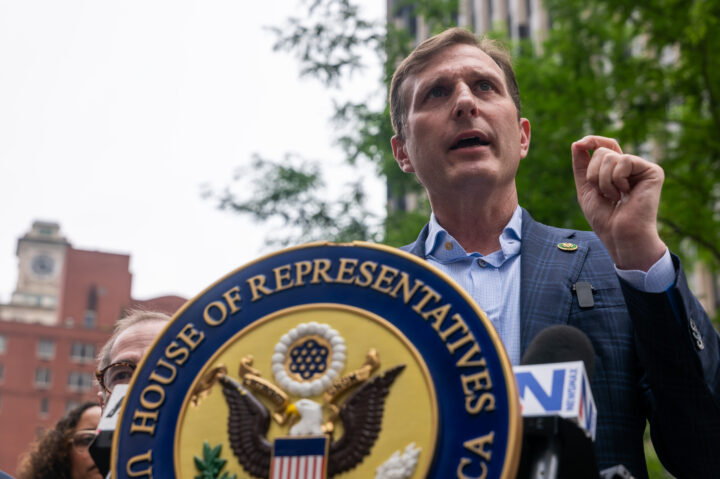
(Spencer Platt/Getty Images)
Rep. Dan Goldman (D-NY) speaks at a news conference on June 18, 2025 in New York City.
Rep. Dan Goldman (D-NY), a pro-Israel Democrat facing a formidable primary challenge from former New York City Comptroller Brad Lander next month, won a key endorsement on Thursday from the United Federation of Teachers, a union representing around 200,000 members.
“Dan Goldman has the integrity we need in Washington,” UFT President Michael Mulgrew said in a statement. “He fought to curb Trump’s abuses and supported raising taxes on the wealthy — like himself — to level the playing field so all Americans can live with dignity. We are proud to support Dan Goldman for New York’s 10th Congressional District.”
Goldman, a two-term congressman who represents a heavily Jewish district covering parts of Brooklyn and Lower Manhattan, has been racking up labor support as he seeks reelection in the June 23 primary against Lander, an outspoken progressive endorsed by New York City Mayor Zohran Mamdani.
On Monday, Goldman joined New York Gov. Kathy Hochul at a labor rally in Lower Manhattan, where she touted his role as lead prosecutor in President Donald Trump’s first impeachment and called him a “go-to man” in Washington.
Despite such high-profile support, Goldman is still eyeing a tough primary in his progressive-leaning district. A recent poll commissioned by a super PAC backing his campaign, for instance, showed Goldman with 42% of the vote, trailing Lander by five points.
JDCA’s top activists made clear this week that a major concern is making sure pro-Israel Jews continue to be welcome in the party
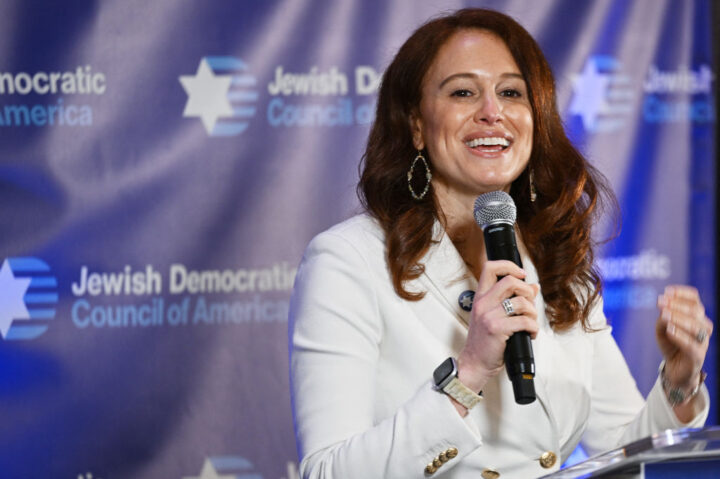
MANDEL NGAN/AFP via Getty Images
Jewish Democratic Council of America CEO Halie Soifer in Washington on May 24, 2023.
When a group of Jewish Democratic activists and donors convened in Washington this week for the annual leadership summit of the Jewish Democratic Council of America, the message seemed to be one of defiance: defiance against President Donald Trump, to be sure, but also a defiant attitude pushing back against some of the recent shifts within the party.
JDCA’s primary objective is to elect Democrats. But as more Democrats have taken positions critical of or outright hostile to Israel, JDCA’s top activists made clear this week that another major concern is making sure pro-Israel Jews continue to be welcome in the party.
“We are fighting to ensure that the views and values of Jewish Americans continue to find their political home in the Democratic Party in Michigan and beyond, and we have work to do,” Halie Soifer, the group’s CEO, said on Tuesday night. She noted that the JDCA hopes to help defeat Michigan Senate candidate Abdul El-Sayed, a far-left candidate who appears to be rising in the polls.
“It’s clear there’s one candidate whose views are antithetical to ours, and we want to ensure he’s defeated,” said Soifer, though she did not name El-Sayed directly. JDCA has not endorsed either of his opponents, state Sen. Mallory McMorrow or Rep. Haley Stevens (D-MI).
“We at JDCA only support Democrats, but we do not support them all,” Soifer told the summit. “We understand it’s not just about electing Democrats. It’s about electing Democrats who align with us, and this includes efforts to ensure that candidates who have espoused anti-Israel and/or antisemitic views are defeated before November.”
Over the two-day gathering, a parade of high-profile speakers from Democratic leadership — Senate Minority Leader Chuck Schumer (D-NY) and House Minority Leader Hakeem Jeffries (D-NY), along with Reps. Nancy Pelosi (D-CA) and Steny Hoyer (D-MD), respectively the former House speaker and majority leader — addressed the convening. Their appearances seemed designed to affirm that Democrats remain pro-Israel and committed to fighting antisemitism.
“We have to decisively confront antisemitism from wherever it comes from,” said Jeffries. “I will always hold firm in my support for the State of Israel as a Jewish and democratic state and eternal homeland for the Jewish people.”
Schumer did not specifically discuss Israel but raised concerns about the increasing use of the word “Zionist” as a slur.
“I’ve long said we must fight antisemitism wherever and whenever it appears, even if it’s in our own party. I’ll continue to do so,” said Schumer. “Today, antisemitism takes all different forms: Holocaust denialism, conspiratorial delusions of Jewish or Zionist control of the world, replacing the word ‘Jewish’ with the word ‘Zionist’ to demonize Jewish communities.”
The outgoing Democratic leaders were not as sanguine, instead offering a note of caution about how the dynamic towards Israel has shifted within the Democratic Party.
“Always, but right now, we really have to work together to make sure that support for Israel is, without question, bipartisan,” Pelosi said. “It doesn’t mean we don’t have our differences of opinion … but it should not weaken the fact that we have bipartisan support. That has always been the tradition, and we must make sure we get through this place where we are, where there may be some doubt in people’s minds as to whether that is a value.”
Pelosi is retiring at the end of this year, as is Hoyer, who was even more blunt: “How many of you have been anxious yourselves about rhetoric heard from some Democratic officials and candidates? We ought to be,” he said.
Speaking to reporters on Wednesday, Sen. Chris Coons (D-DE) said he hoped to prove that Sen. Bernie Sanders (I-VT) does not speak for the party on matters related to Israel, though he noted with worry that Sanders’ attitude — one that is deeply critical of Israel — appears to be on the rise.
“It’s clearer and clearer to me that there is real alarm about a fundamental break between Democrats as a party and Israel as a nation, and I’m going to do everything I can to resist and oppose that break, while criticizing [Benjamin] Netanyahu and his values and decisions,” said Coons. “I’m trying to be an effective and engaged voice with a perspective that you just heard and not have Bernie Sanders be the only senator whose perspective and attitude is heard across the country.”
Forty Senate Democrats voted last month for a Sanders-authored resolution attempting to block some arms sales to Israel, a record high. Coons said he knows those senators still support Israel’s right to exist, but cautioned that being too critical of Netanyahu can give cover to people who are actually anti-Israel.
“I strongly support Israel’s right to exist, its right to be a Jewish homeland and a democracy, and its value to the American people as a partner and ally,” said Coons. “I think we are at risk of some of my colleagues, in trying to send a message to Netanyahu or in opposition to his policies and stances, to be misunderstood as abandoning that commitment.”
Coons said that on the campaign trail, and on recent trips around the country, he hears “profound concern about where’s the Democratic Party going on Israel.” Some Jewish politicians who addressed the JDCA summit expressed a deeper sense of unease and discomfort about their Jewish identity, against the backdrop of rising antisemitism.
Sen. Elissa Slotkin (D-MI), who spoke at a cocktail reception Tuesday evening, talked about how challenging it is to be a Jewish elected official in the current environment.
“It has become deeply, deeply complicated to be a Jew in America,” said Slotkin. “There’s not a single day that goes by for myself representing the state of Michigan that I am not feeling torn.”
Minneapolis Mayor Jacob Frey delivered a jolt of energy to the room with an impassioned speech about his community’s support for immigrants in the face of ICE enforcement activity, which resulted in the killing of two American citizens by ICE agents in his city in January. When a JDCA member asked him for advice on how to respond to others in the Democratic Party who have made anti-Zionism a political litmus test, he expressed concern.
“It has been deeply concerning for me personally, as a proud Jew,” Frey said. “I am a great supporter of the endurance of our American Republic, a big believer that America should continue to exist, and an adamant opponent of Donald Trump. The same thing can apply to Israel.”
Ultimately, though, the gathering was a political pep rally — a chance for Democratic activists and donors to hear from politicians at all levels of government and gin up excitement ahead of this year’s midterm elections. Everyone who addressed the gathering all but guaranteed that Democrats would take back control of the House and Senate.
The conversations seemed meant to ressure Jewish Democrats about both the party’s fortunes for November and its treatment of pro-Israel Jews. One JDCA activist described the group’s work as “grasstops,” which was demonstrated by the appearances from top party leaders.
But the anti-Israel sentiment that has steadily grown within the party over the past three years is not coming from party leaders; it is driven by far-left activists. Whether JDCA has a plan to counter that grassroots energy remains to be seen — and the answer will only come at the ballot box later this year.
Morris Katz, who helped propel Mamdani to power, has been advising some of the leading anti-Israel Democrats on the ballot this year

Lev Radin/Pacific Press/LightRocket via Getty Images
Micah Lasher campaigns and distributes flyers as he runs to represent Congressional District 12 on Lexington Avenue.
Micah Lasher, a Democratic state assemblymember who is running for an open House seat in Manhattan, has enlisted a top progressive consulting firm with ties to New York City Mayor Zohran Mamdani to cut ads for his campaign, Jewish Insider has learned.
Fight Agency, a media firm co-founded by Morris Katz, who rose to prominence as an advisor for Mamdani’s insurgent mayoral campaign, is working with Lasher as he seeks to succeed retiring Rep. Jerry Nadler (D-NY) in a crowded primary in New York’s 12th Congressional District, which has the largest Jewish electorate in the country.
“Team Lasher is thrilled to welcome Fight Agency to our team that includes powerhouses Mark Guma and Haley Scott,” Grace Peacore, a Lasher spokesperson, told JI on Wednesday, referring to other consultants advising the campaign. “We can’t wait for you to see what we’ve been cooking up. Stay tuned!”
Katz shot a new ad for Lasher this week at a bagel shop on the Upper West Side with Nadler and New York Gov. Kathy Hochul, both of whom have backed his campaign, according to Peacore.
The relationship represents something of an unlikely pairing for both parties. Fight Agency prides itself on elevating anti-establishment candidates with left-wing worldviews — among its most high-profile clients this election cycle are Graham Platner, an oyster farmer who is now the presumptive Democratic nominee in Maine’s Senate race, and Abdul El-Sayed, who is running in Michigan’s crowded Senate primary. Both candidates have positioned themselves as staunch critics of Israel.
Katz, who is Jewish, is also an outspoken critic of Israel who has sought to push the party leftward on Middle East policy, while Lasher has called himself a “proud Zionist Jew” and opposed legislative efforts to block U.S. weapons sales to Israel. He is known as a policy wonk with close connections to the Democratic establishment in New York — thanks to his past roles working for Hochul and former New York City Mayor Michael Bloomberg, among others.
Katz had reportedly been working to help consolidate progressive backing for Lasher, though one of his top rivals in the June primary, Assemblymember Alex Bores, has drawn endorsements from a range of left-wing groups in recent days.
Lasher, whose campaign had not yet been up on the airwaves, is also facing Jack Schlossberg, a Kennedy scion and social media influencer, and George Conway, a prominent critic of President Donald Trump, among other lesser-known candidates.
One Jewish leader, speaking anonymously to discuss the race, called Lasher’s decision to hire Katz a smart move, even if he disagreed with his stances on Israel. “I would also use him!” he told JI on Wednesday.
Citing the estimated $29 billion cost of the Iran war, the House minority leader asked, ‘How is it possible that we can't spend at least 500 million’ on NSGP?
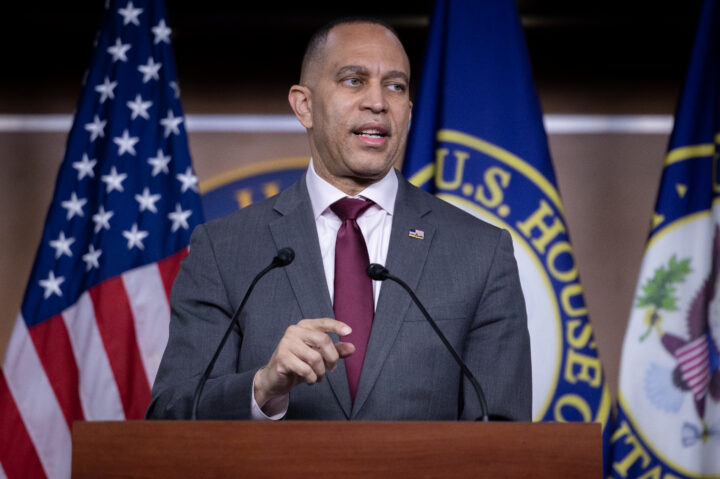
Nathan Posner/Anadolu via Getty Images
House Minority Leader Hakeem Jeffries (D-NY) speaks during his weekly press conference at the U.S. Capitol in Washington, DC on March 19, 2026.
House Minority Leader Hakeem Jeffries (D-NY) called for a dramatic increase in funding of the federal Nonprofit Security Grant Program, telling a group of Jewish activists on Wednesday that it should receive $1 billion — up from the $300 million that Congress allocated in last month’s homeland security funding bill.
“The not-for-profit security grant funding program is woefully underfunded. It’s woefully underfunded. $300 million is not acceptable,” Jeffries said at the Jewish Democratic Council of America’s leadership summit in Washington.
He pointed out that the Pentagon now estimates the cost of the war with Iran so far is $29 billion, and Democrats believe it is possibly much more.
“We think it’s probably double that. But even if you just take the $29 billion number, how is it possible that we can’t spend at least 500 million? I think the number should be even higher,” said Jeffries. “Why wouldn’t we spend a billion dollars to make sure that the communities that we care about across this country are safe?”
The $300 million approved by Congress last month is a small increase from the $274.5 million allocated to the program in 2024 and 2025.
Jewish organizations have for years been lobbying for Congress to significantly increase the federal budget for the program, which provides security grants to vulnerable nonprofits, including synagogues and Jewish day schools, arguing that its current level does not come close to meeting the security needs of Jewish institutions. In 2024, more than half of all applications for NSGP funding were declined.
Jewish communities and institutions are “now spending an outsized amount of budget funding to provide security in America,” Jeffries said. “That should not happen.”
A group of 41 senators last month called for $750 million in funding for the program next year. Last month, a coalition of interfaith groups called for Congress to increase NSGP funding to $1 billion. A bipartisan group of 150 members of the House asked the House Appropriations Committee in March to increase funding to $1 billion, although no members of House leadership in the Democratic or Republican Party signed onto it.
The former House majority leader urged American Jews not to abandon the Democratic Party, despite acknowledging many now feel unwelcome

JDCA
Rep. Steny Hoyer (D-MD) at the Jewish Democratic Council of America’s annual leadership summit, May 12, 2026
Rep. Steny Hoyer (D-MD), a pro-Israel stalwart and a former House majority leader, said on Tuesday that Jewish Democrats “ought to be” concerned about the critical way that some of their Democratic colleagues talk about Israel.
“How many of you here tonight have been trying to convince a family member, a friend, a neighbor not to abandon the party that has long been their political home?” Hoyer said in remarks at the Jewish Democratic Council of America’s annual leadership summit, where he was honored with an award marking his upcoming retirement, after 45 years in Congress.
He was introduced by three of his current and former Jewish senior staffers, including Brian Romick, the CEO of Democratic Majority for Israel.
“How many of you have been anxious yourselves about rhetoric heard from some Democratic officials and candidates? We ought to be,” said Hoyer. “I will stand up and say, ‘I do not agree with that.’”
Hoyer, a longtime champion of pro-Israel legislation, used the speech to reiterate his commitment to the Jewish state and explain why he thinks Democrats should support Israel. But even as he acknowledged issues of antisemitism and anti-Israel sentiment in the party, he also pitched American Jews to maintain their historic support for Democrats and urged those who are unhappy with the party’s leftward shift on Israel to allow room for nuance, and to work to reverse it.
He said he disagreed with the 40 Senate Democrats who voted in April against certain arms sales to Israel, but added that he still believed those lawmakers would support the Jewish community. He encouraged JDCA activists to keep calling those senators to push them to change their minds.
“Those same 40 senators will stand up for you all the time. I disagree with them, but the fact of the matter is, keep in mind, it is not day to day. It is long-term commitment that counts. They need to keep hearing from you,” said Hoyer. “They need to keep seeing us fight to keep our party strong and pro-Israel, and consistent with its values. And they need to see our passion and our resolve.”
Reflecting on his 22 visits to Israel over the last five decades, Hoyer called the trips particularly meaningful due to his Baptist faith. Still, he said he could not distill into words the reason for his deep-rooted affection for Israel.
“I really can’t put my finger on why, but I know that’s what I feel. I know that I feel that the Jewish community … for millennia has been the object of scorn, derision, prejudice, hate and violence,” said Hoyer. “At a very early age, I thought that was wrong, and I am so proud that I had the opportunity to not only say it was wrong, but to try and make it right.”
Hoyer described himself as “a champion for Israel,” a title he said made him proud. He insisted he is not alone in that category among Democrats.
“The majority of Democrats still stand, in my view, and will continue to stand with Israel and with the Jewish people,” said Hoyer. “I’m confident we will be able to overcome this moment and defeat Trumpism at the ballot box, while defeating antisemitism and anti-Zionism in our politics.”
In the speech, Hoyer praised American Jews for the leading role they have played in Democratic politics. He insisted that he will make sure they are still welcome even as he leaves office.
“The Democratic Party has long stood for the same values that Jewish tradition teaches: caring for the sick and hungry, ensuring equal opportunity for all, freedom of conscience, freedom of religion, freedom of choice, freedom for workers to organize and justice for all under the rule of law,” said Hoyer.
“For as long as I am in office, and even in retirement,” he continued, “I will stand with you in strong support, strong foundation for our party as the warm and welcoming home for pro-Israel Jewish voters who care deeply about equal rights, justice and opportunity for all Americans.”
Plus, the race to replace Pelosi

Tasos Katopodis/Getty Images
U.S. President Donald Trump waves to the media after walking off of Air Force One at Miami International Airport on April 11, 2026 in Miami, Florida.
Good Tuesday morning.
In today’s Daily Kickoff, we do a deep dive into the race to succeed Rep. Nancy Pelosi, in what has become something of a proxy battle in the war for the identity of the Democratic Party, and report on an effort by Democratic Majority for Israel to boost a Texas congressional candidate whose far-left opponent has trafficked in antisemitic tropes. We talk to Senate Republicans about the possibility of resuming military operations against Iran, and have the scoop on Gerald Steinberg’s decision to step down from the helm of NGO Monitor early next year, and the first interview with his successor, Olga Deutsch. Also in today’s Daily Kickoff: Daniel Septimus, Rom Braslavski and Ben Shapiro.
Today’s Daily Kickoff was curated by JI Executive Editor Melissa Weiss and Israel Editor Tamara Zieve, with assists from Danielle Cohen-Kanik and Marc Rod. Have a tip? Email us here.
What We’re Watching
- Defense Secretary Pete Hegseth and Chairman of the Joint Chiefs of Staff Gen. Dan Caine are both slated to testify this morning at back-to-back House and Senate Appropriations Committee budget hearings. In the afternoon, FBI Director Kash Patel will testify before Senate Appropriations.
- The Anti-Defamation League is holding a Jewish American Heritage Month reception this evening on Capitol Hill.
- Elsewhere in Washington, the Jewish Democratic Council of America is kicking off its annual summit tonight with a reception at the Watergate Hotel. The group will honor Sen. Elissa Slotkin (D-MI) and Rep. Steny Hoyer (D-MD), and will hear from Sens. Jacky Rosen (D-NV) and Mark Kelly (D-AZ) and Reps. Debbie Wasserman Schultz (D-FL), Jason Crow (D-CO), Chris Deluzio (D-PA), Maggie Goodlander (D-NH) and Chrissy Houlahan (D-PA).
- The funeral for former Anti-Defamation League head Abe Foxman, who died on Sunday, will take place this morning at Park Avenue Synagogue.
- In New York City tonight, three of the top candidates in the open congressional race in NY-12 — George Conway and Assemblymembers Alex Bores and Micah Lasher — will participate in a forum at the West Side Institutional Synagogue moderated by Jewish Insider Editor-in-Chief Josh Kraushaar.
- Elsewhere in New York, the American Jewish Committee will present Cardinal Timothy Dolan with the group’s Nostra Aetate at Sixty Award, honoring Dolan’s interfaith efforts on the 60th anniversary of the groundbreaking Vatican declaration.
- Across the Hudson, the New Jersey Globe is hosting a primary debate for the Democrats running in New Jersey’s 7th Congressional District. ER physician and former government official Tina Shah, former Navy pilot Rebecca Bennett and businessmen Brian Varela and Michael Roth will participate in tonight’s debate, which starts at 7 p.m. ET.
- Israeli Eurovision entrant Noam Battan will perform tonight when the contest’s semifinals kick off in Vienna.
What You Should Know
A QUICK WORD WITH JI’S GABBY DEUTCH
Over the last two years, the second semester of the academic year at American universities coincided with crisis and chaos. In 2024, it was anti-Israel encampments overtaking campus quads across the country; last year, it was threats from the Trump administration to slash hundreds of millions of dollars in funding and ban foreign students.
By comparison, the spring of 2026 has been relatively smooth sailing for research universities, even with a bit of hubbub over graduation speakers scrutinized for their stance on Israel and Gaza at a few schools, including the University of Michigan and Georgetown Law.
But it’s not that things have gone back to the pre-Oct. 7, pre-Donald Trump normal. University administrators have just gotten better at managing an ambient sense of friction: Conflict between university leaders and activist faculty and students is still bubbling under the surface, and the threat of funding cuts at the federal level lingers.
According to several university presidents who gathered last week at the Milken Institute Global Conference in Los Angeles, the task before universities is to win back the trust of skeptical Americans.
“The world of higher education, I think, is still in turmoil,” Vanderbilt University Chancellor Daniel Diermeier told Jewish Insider in an interview at the Milken confab. “I think the time when a university does say that’s all overblown and everything is great, that’s over. At least the vast majority of university presidents know that there are challenges, and they want to take them on.”
democratic fault lines
Race to replace Pelosi offers early test of whether progressive Jews welcomed on the left
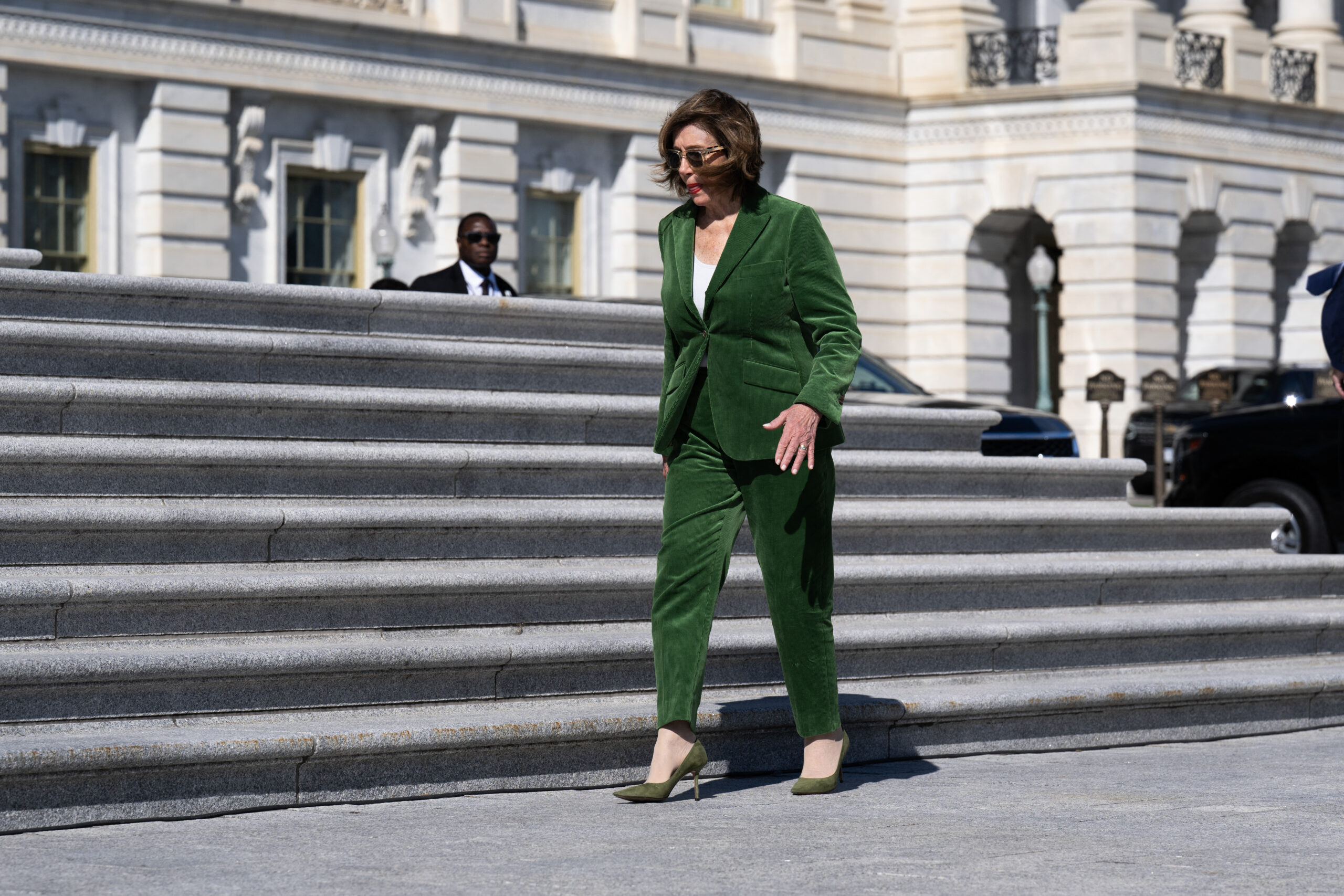
The race to fill the seat of Rep. Nancy Pelosi (D-CA) in California’s 11th Congressional District has become somewhat of a proxy battle in the war for the identity of the Democratic Party, where describing Israel’s war in Gaza as a genocide, supporting arms embargoes to Israel and attacking Zionism as a racist ideology have become much more common since the Oct. 7, 2023, Hamas terrorist attacks and the subsequent war in Gaza, Gabe Stutman reports for Jewish Insider. The outcome of the race will help answer an important question: Can a progressive candidate still win in a deep-blue district like San Francisco without fully embracing the politics of the anti-Zionist left?
State of play: The race is by most accounts a three-way contest between state Sen. Scott Wiener, Connie Chan, a progressive member of the San Francisco Board of Supervisors who has the backing of major labor organizations but has struggled to compete in fundraising, and Saikat Chakrabarti, a wealthy tech entrepreneur who entered progressive politics working for Sen. Bernie Sanders (I-VT) during his 2016 presidential bid and later served as Rep. Alexandria Ocasio-Cortez’s (D-NY) chief of staff.
EXCLUSIVE
DMFI works to block antisemitic activist from winning Dem nomination in Texas swing district

Democratic Majority for Israel’s political arm is kicking off an ad campaign on Tuesday to boost Johnny Garcia, a sheriff’s deputy in Bexar County, Texas, in his Democratic runoff election later this month against Maureen Galindo, a San Antonio activist who has faced scrutiny for trafficking in antisemitic tropes, Jewish Insider’s Matthew Kassel reports.
Getting behind Garcia: “Democrats need candidates who can build broad coalitions and win in November,” Brian Romick, the chair of DMFI PAC, told JI. “Johnny Garcia is a coalition builder who supports a strong U.S.-Israel relationship and has been clear in standing against antisemitism. His opponent, on the other hand, proudly embraces vile, antisemitic conspiracies and if she advances could put a Democratic House majority at risk.”
TEHRAN TALKS
Senate Republicans split over the prospect of resuming military operations against Iran

With President Donald Trump publicly mulling the resumption of military action against Iran, fault lines are opening up among Senate Republicans over the prospect of a renewed military effort, Jewish Insider’s Marc Rod reports.
State of play: Some Senate Republicans are publicly calling for the U.S. to resume military operations. Others are leaving the prospect of military action on the table without fully ruling out a diplomatic path, while offering varying degrees of skepticism about how realistic a deal actually would be. Sen. Josh Hawley (R-MO) urged Trump to ignore calls from some of his more hawkish colleagues to restart military operations.
Pakistan problems: Senators on both sides of the aisle, including Sens. Lindsey Graham (R-SC), Mark Kelly (D-AZ) and Ted Budd (R-NC), on Monday expressed concerns about a report by CBS News that Pakistan had sheltered multiple Iranian military aircraft at an air force base in the country since shortly after the U.S.-Iran ceasefire in April, raising questions about the country’s neutrality as a mediator, JI’s Marc Rod reports.
PARTY SWITCH
Israel’s business leaders see opportunity amid war, political shifts

The Israeli financiers, investors and entrepreneurs who attended last week’s Milken Institute Global Conference in Beverly Hills brought an upbeat attitude about Israel’s economy, even two-and-a-half years into near-constant war that began with Hamas’ Oct. 7, 2023, attacks, Jewish Insider’s Gabby Deutch reports.
Exceeded expectations: “When the war began, I think none of us — none of the regulators in Israel, and almost none of the players or the investors in Israel — thought or believed that after two-and-a-half years of war, Israel would show such growth, such resilience,” Seffy Zinger, chair of the Israel Securities Authority, told JI in an interview. “I’m not an investment advisor, but you can see that if you were not in Israel in the past two years, you probably missed out, if Israel was not part of your portfolio.”
SPEAKING OUT
Pennsylvania Supreme Court justice leaves Democratic Party, citing rise in antisemitism
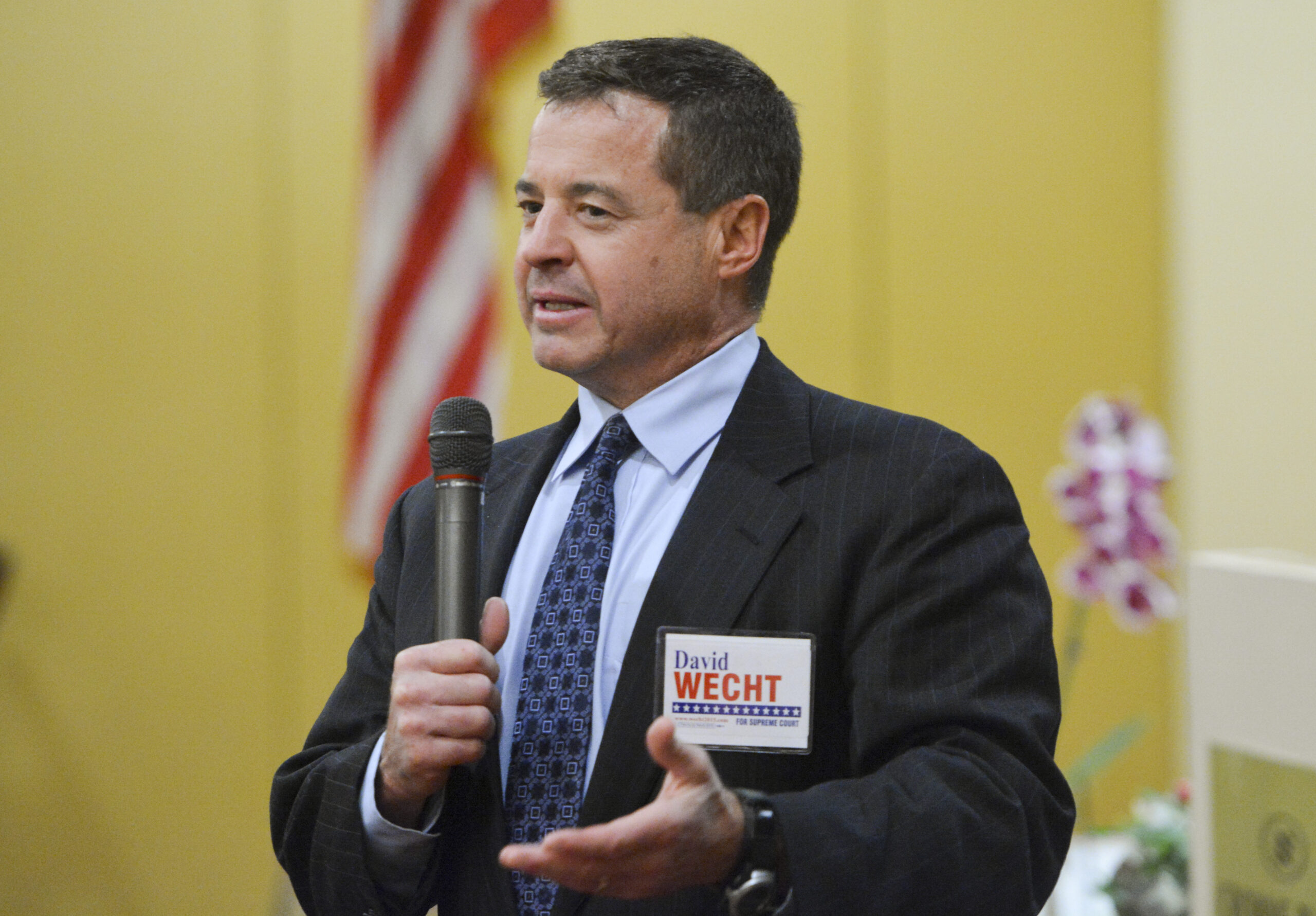
Pennsylvania Supreme Court Justice David Wecht, a former vice-chair of the Pennsylvania Democratic Party, announced Monday he has left the party, citing “anti-Jewish” actions and “acquiescence to Jew-hatred” within the party, including from elected officials, Jewish Insider’s Haley Cohen reports.
What he said: “Acquiescence to Jew-hatred is now disturbingly common among activists, leaders and even many elected officials in the Democratic Party. I can no longer abide this,” wrote Wecht, who was elected as a Democrat in 2015. He added that he is no longer affiliated with any political party. “That terror came from the right,” he wrote. “Jew-hatred has always festered on the fringe of that sector.” But, Wecht continued, “in the quarter century that has passed” since his leadership position, “the Democratic Party has changed.”
scoop
Olga Deutsch to succeed Gerald Steinberg as president of NGO Monitor
NGO Monitor President Gerald Steinberg is set to step down in January, 25 years after founding the Jerusalem-based watchdog group focused on scrutinizing nonprofit organizations critical of Israel and their funding sources, Jewish Insider’s Tamara Zieve reports. Olga Deutsch, 47, currently NGO Monitor’s vice president, will succeed Steinberg following a months-long transition process at the organization, which since its inception has been closely associated with its founder.
Passing the baton: Steinberg, 74, who resigned from his position as a professor of political science at Bar-Ilan University seven years ago, told JI, “There is a point in one’s life where one has to decide the different priorities. And I’ve done this long enough, and other people can have more energy and can take over.” Deutsch told JI that she hopes to “open the next exciting chapter,” while preserving the “character of the organization that Gerald created, which is serving as pioneers and continuing to flag the new fronts through which the Jewish state and the Jewish people are being attacked or put in danger.”
Worthy Reads
Abe as Mentor: In eJewishPhilanthropy, William Daroff, the CEO of the Conference of Presidents of Major American Jewish Organizations, eulogizes former Anti-Defamation League head Abe Foxman, who died on Sunday. “He combined toughness and warmth in a way few leaders can. He expected seriousness. He spoke with moral clarity. He pushed younger Jewish leaders to think bigger about our responsibility to the Jewish people and the broader democratic society in which we live. He also challenged me, usually in private, though occasionally in the public pages of newspapers. Abe Foxman knew exactly when to make a point, and exactly how to make it land.” [eJP]
Miller Lite: The Atlantic’s Michael Scherer and Nick Miroff spotlight the waning influence of Stephen Miller in the second Trump administration. “White House insiders said that Miller remains a top adviser to the president, that he has a singular relationship to Trump built over the past decade, and that his job is not in jeopardy. Immigration enforcement remains a central theme of the administration and is expected to feature prominently in Trump’s midterm-election messaging. … But Trump, who has previously joked that Miller’s ‘truest feelings’ are so extreme that they should not be aired publicly, has also told others in recent weeks that he understands Miller sometimes goes too far, advisers told us.” [TheAtlantic]
Word on the Street
President Donald Trump said that the ceasefire with Iran was on “life support” following Washington’s rejection of Tehran’s latest response to the U.S. proposal to end the war, Jewish Insider‘s Emily Jacobs reports…
CNN looks at efforts by Iran to recruit operatives in Europe to carry out attacks on Jewish targets…
The United Arab Emirates reportedly carried out strikes on Iran during the active military campaign launched by the U.S. and Israel, targeting among other things an oil refinery on the Lavan Island in the Persian Gulf…
U.S. Ambassador to Israel Mike Huckabee, speaking at the Tel Aviv Conference today,confirmed that Israel sent missile-defense batteries and operating personnel to the UAE during the war with Iran…
The Financial Times spotlights Iran’s “mosquito fleet” of Islamic Revolutionary Guard Corps fast-attack boats that are engaging commercial and military vessels in the Strait of Hormuz…
Rep. Pat Ryan (D-NY) and 17 other Democrats introduced a bill to ban further funding for military operations against Iran…
Trump nominated Cameron Hamilton to head FEMA, a year after Hamilton, who mounted a failed 2024 bid for Congress, was fired as the interim head of the agency…
Kevin Warsh is expected to be confirmed as the next head of the Federal Reserve as early as tomorrow…
Trump invited several business leaders to join him on his trip later this week to China, including Elon Musk, outgoing Apple CEO Tim Cook, BlackRock’s Larry Fink, Meta’s Dina Powell McCormick, Goldman Sachs’ David Solomon, Citi’s Jane Fraser and Blackstone’s Stephen Schwarzman, among others…
Trump announced the nominations of Kari Lake, the former head of the U.S. Agency for Global Media, and Pennsylvania state Sen. Doug Mastriano to be, respectively, the ambassadors to Jamaica and Slovakia…
Former Rep. Billy Long (R-MO), who has been nominated to be U.S. ambassador to Iceland, shared a three-minute clip of a speech by neo-Nazi influencer Nick Fuentes on X on Sunday, Jewish Insider’s Marc Rod reports…
The New York Times spotlights the work of Fuentes’ acolytes to build on the antisemitic conspiracy theorist’s political movement, an effort that coalesced around a conference of influencers and fringe candidates from both parties in a sparsely attended summit; the low turnout was attributed in part to the absence of Fuentes, who distanced himself from the gathering…
Puck News does a deep dive into the recent layoffs at Ben Shapiro’s Daily Wire, finding that the recent decision to cut approximately 20% of the company’s staff was fueled by a combination of internal business disagreements and the “‘vibe shift’ among the MAGA base” that has divided conservatives in recent years…
A judge in Santa Clara County, Calif., ordered a Jewish prosecutor to recuse himself from a case against anti-Israel student protesters at Stanford University after the prosecutor described the incident as antisemitic in campaign literature, Jewish Insider’s Haley Cohen reports…
The Wall Street Journal’s Shira Kaplan reflects on the sanctity of Shabbat following President Donald Trump’s call for the American Jewish community to observe a “national Sabbath” this weekend…
Daniel Septimus is departing Sefaria after 13 years atop the organization, eJewishPhilanthropy’s Jay Deitcher reports…
Australian Jewish musicians testifying on Tuesday before the country’s royal commission into antisemitism in the country detailed the yearslong ostracization they experienced from the arts community for their support for Israel…
Israeli journalist Haviv Rettig Gur breaks down the “obvious propaganda” in a recent New York Times opinion piece by Nicholas Kristof about alleged Israeli abuses of Palestinian prisoners…
Former Israeli hostage Rom Braslavski, who was one of the last hostages to be freed after spending more than 700 days in Hamas captivity, called for the resignation of all members of the current Israeli government, whom he called “miserable cowards”…
Israel’s Civil Commission on October 7 Crimes Against Women and Children released its comprehensive report on sexual violence during the Oct. 7, 2023, Hamas terror attacks and during hostages’ time in captivity…
The Knesset passed, with the support of 93 of the body’s 120 lawmakers, a law establishing a military tribunal to try terrorists who took part in the Oct. 7 attacks…
E.U. member states unanimously voted to sanction Hamas leaders as well as Israeli settlers in a bid to target extremism; the vote came after Hungary, no longer under the leadership of Viktor Orbán, removed its longstanding opposition to the measure…
Israel denied entry to YouTuber Tyler Oliveira, who in recent months has posted videos suggesting that Jews were “invading” communities in New York and New Jersey…
The Israeli soldier photographed desecrating a statue of the Virgin Mary in a southern Lebanese village was sentenced to three weeks in a military prison, while the soldier who took the photo received a sentence of two weeks…
Iran executed a graduate student convicted of spying on behalf of the CIA and Mossad; Erfan Shakourzadeh, who attended the prestigious Iran University of Science and Technology, denied the charges in a letter written before his execution…
Pic of the Day

Ukrainian President Volodymyr Zelensky (left) met in Kyiv earlier today with Palantir CEO Alex Karp.
Birthdays

Acclaimed architect and master planner for the World Trade Center site in Lower Manhattan, he also designed the Jewish Museum in Berlin, Daniel Libeskind turns 80…
Israeli agribusiness entrepreneur and real estate investor, he was chairman and owner of Carmel Agrexco, Gideon Bickel turns 82… Former member of the California state Senate for eight years, following six years as a member of the state Assembly, Lois Wolk turns 80… Chairman of the Israel Paralympic Committee, he served for four years as a member of the Knesset for the Yisrael Beiteinu party, Moshe “Mutz” Matalon turns 73… Former Washington correspondent for McClatchy and then the Miami Herald covering the Pentagon, James Martin Rosen turns 71… SVP and deputy general counsel at Delta Air Lines until 2024, now chief legal officer at private aviation firm Wheels Up, Matthew Knopf turns 70… Professor at Emory University School of Law, he has published over 200 articles on law, religion and Jewish law, Michael Jay Broyde turns 62… Actress known for her role as Lexi Sterling on “Melrose Place,” she also had the lead role in many Lifetime movies, Jamie Michelle Luner turns 55… Founder of strategic communications and consulting firm Hiltzik Strategies, Matthew Hiltzik turns 54… Communications officer in the D.C. office of George Soros’ Open Society Foundations until last year, Jonathan E. Kaplan… First-ever Jewish governor of Colorado, he was a successful serial entrepreneur before entering politics, Jared Polis turns 51… Professor of mathematics at Bar-Ilan University and a scientific advisor at the Y-Data school of data science in Israel, Elena Bunina turns 50… Italian politician, she is the first-ever Jewish mayor of Florence, Sara Funaro turns 50… Israeli pastry chef and parenting counselor, she is married to former Israeli Prime Minister Naftali Bennett, Gilat Ethel Bennett turns 49… Author, blogger and public speaker, Michael Ellsberg turns 49… Senior advisor at Accelerator for America Action, Joshua Cohen… Technology and social media reporter at Bloomberg, Alexandra Sophie Levine… Executive director of government affairs at BridgeBio, Amanda Schechter Malakoff… A government affairs and public policy manager for YouTube, Erica Arbetter… Haifa-born actress and model, she is known for her lead roles in seven films since 2014, Odeya Rush turns 29…
State Sen. John Cavanaugh, backed by left-wing Democrats, declined to sign a resolution supporting Israel and condemning Hamas on anniversary of Oct. 7 terrorist attack

Campaign page/Wikimedia Commons
Denise Powell and John Cavanaugh
Nebraska’s 2nd Congressional District — the so-called “blue dot” in an otherwise red state — is a critical pickup opportunity for Democrats in November’s midterms. Vice President Kamala Harris won the district in 2024, and the popular, moderate Republican incumbent, Rep. Don Bacon (R-NE), is retiring.
The Democratic primary in the district on Tuesday is coming down to John Cavanaugh, a progressive state senator backed by a range of prominent left-wing leaders, and Denise Powell, a nonprofit executive backed by a host of Democratic political groups.
The outgoing Bacon has been an outspoken supporter of Israel, and is also a co-chair of the House’s bipartisan antisemitism task force, speaking out at times against members of his own party on the issue.
Cavanaugh was one of 10 state senators who declined to sign onto a resolution supporting Israel and condemning Hamas on the first anniversary of the terrorist group’s Oct. 7, 2023, attacks on Israel. “I support Israel and believe Israel has a right to exist. And I also believe a two-state solution is the only way to secure lasting peace,” Cavanaugh said in a statement to Jewish Insider in February.
He has been endorsed by the Congressional Progressive Caucus and a range of left-wing lawmakers including Reps. Jamie Raskin (D-MD), Pramila Jayapal (D-WA), Ro Khanna (D-CA), Greg Casar (D-TX), Chris Deluzio (D-PA), Adelita Grijalva (D-AZ), Jan Schakowsky (D-IL) and Mark Pocan (D-WI), as well as J Street.
Following the attempted terrorist attack on a synagogue and preschool in West Bloomfield, Mich., in March, Cavanaugh said on Facebook, “I’m horrified by the acts of violence we are seeing against Jewish Americans. Everybody has the right to worship in safety and security and while I’m thankful the gunman didn’t make it inside, violence like this shakes entire communities — my thoughts are with West Bloomfield.”
Powell is taking a more pro-Israel line, yet still falls to the left of other Democrats in the race on the issue. She said in a statement to JI earlier this year that she has “always unequivocally supported Israel’s right to exist and its right to defend itself.”
“My position is clear: I fully support providing aid to Israel and believe that we should ensure humanitarian aid reaches those in need,” the statement continued. “In order for the region to rebuild, it is imperative that we center our efforts around a two-state solution that both ensures Israel’s security and gives the Palestinian people the resources they need to reestablish their lives.”
She said during a candidate forum that she would have been hesitant to support a State Department funding bill that would have blocked funding to the United Nations Relief and Works Agency, provided $3.3 billion in military funding for Israel and penalized Palestinian international legal action against Israel, citing, in her statement to JI, concerns about “strip[ping] humanitarian aid to Gaza.”
Powell has been endorsed by Reps. Annie Kuster (D-NH), Emily Randall (D-WA), Norma Torres (D-CA), Andrea Salinas (D-WA) and former state Sen. Tony Vargas, the two-time Democratic nominee in the district, as well as the New Democrat Coalition, the Congressional Black Caucus, the Congressional Hispanic Caucus’ BOLD PAC, EMILY’s List and 33Elect Democratic Women.
Cavanaugh said at a candidate forum earlier this year that he wouldn’t accept funding from pro-Israel groups, while Powell said she wouldn’t accept backing from any special interest groups.
Democratic Majority for Israel filed with the Federal Election Commission its plans to spend $750,000 attacking Cavanaugh, but ultimately withdrew the buy. A person familiar with DMFI’s thinking told JI that DMFI PAC “decided to direct its resources into other races” for “strategic reasons” but remains focused on boosting pro-Israel Democrats who will help Democrats retake the House.
Nevertheless, Cavanaugh has repeatedly bashed Powell over the ultimately canceled DMFI intervention in the race.
“AIPAC aligned groups that are funded by Trump donors are now supporting Denise Powell. She said that she would refuse support from Democratic Majority for Israel or AIPAC, and now dark money groups are pouring millions into the Democratic primary here in NE-02 – and trying to hide it,” he said on X. “Voters deserve to know which out-of-state groups are funding these misleading attacks.”
Other candidates who have taken an outspoken pro-Israel stance, including district court clerk Crystal Rhoades and former Rep. Steny Hoyer (D-MD) aide James Leuschen, are seen as lagging behind in the race.
Gary Javitch, a board member of B’nai B’rith who hosted both Cavanaugh and Powell for lunch events with the Jewish community in Omaha and has long been involved in bipartisan pro-Israel politics in the state, described Cavanaugh as “the worst candidate [in the race] for people who favor Israel” and Powell as “very strongly pro-Israel,” based on their comments at the lunch events and their overall records.
“The Republican candidate is the closest to retiring [Rep.] Don Bacon,” Javitch added.
The expected Republican nominee is Omaha City Councilmember Brinker Harding, who faces no primary opposition.
Powell leads the field in fundraising with $1.6 million total raised, followed by Cavanaugh with $1.1 million. Harding, meanwhile, has raised $1.3 million. All other Democratic candidates trail significantly behind the three.
Notably, a GOP-linked outside group has been spending in the Democratic primary in an apparent effort to boost Powell, claiming Cavanaugh is a supporter of President Donald Trump. Yet other Republicans see Cavanaugh as the weaker challenger to Harding.
Powell and her allies — along with other candidates challenging Cavanaugh — have also argued that a Cavanaugh victory would have farther-reaching consequences for Democrats nationwide. If he wins, Nebraska’s Republican governor would appoint Cavanaugh’s replacement in the state Senate, likely delivering a stronger GOP majority in the chamber and potentially allowing Nebraska Republicans to overhaul the state’s electoral college apportionment.
Currently, the 2nd District has its own electoral college vote, apportioned separately, which went to Democrats in 2020 and 2024. Democrats assume that Republicans, given the chance, would move to a winner-take-all system in the electoral college — and would use the expanded Senate majority to pass other conservative priorities as well.
Cavanaugh has brushed off these criticisms as a “Republican talking point” spread by “dark money PACs.”
ADL CEO Jonathan Greenblatt called Foxman, who died on Sunday at 86, 'an iconic Jewish leader who embraced the ideal of an America free from antisemitism and hate'

Anna Moneymaker/Getty Images
Holocaust survivor and former National Director of the Anti-Defamation League Abraham Foxman becomes emotional during the U.S. Holocaust Memorial Museum's Annual Days of Remembrance ceremony at the U.S. Capitol on April 23, 2025 in Washington, DC.
Abraham “Abe” Foxman, a towering figure in Jewish communal life who led the Anti-Defamation League for nearly three decades, and whose personal story as a hidden child during the Holocaust gave him a unique gravitas in dealing with issues of Holocaust memory and anti-Jewish bias, died on Sunday, the ADL confirmed. He was 86.
Foxman was born to Polish Jewish parents in present-day Belarus in 1940. As a toddler, his parents placed him in the care of his Catholic nanny, who had him baptized and raised him in the church. After being reunited with his parents at the end of World War II, the family moved into a displaced persons camp in Austria. In 1950, when he was 10 years old, the family immigrated to the U.S.
His early childhood experiences shaped the trajectory of his life. Foxman joined the ADL in 1965 as a legal assistant, becoming the organization’s national director in 1987, a post he held until his retirement in 2015. He was succeeded by Jonathan Greenblatt, who serves as the group’s CEO.
Foxman was named to the U.S. Holocaust Memorial Museum’s council by President Ronald Reagan in 1987, a role he was reappointed to by Presidents George H. W. Bush, Bill Clinton and Joe Biden. In recent years, Foxman was the only Holocaust survivor to serve on the board, which now includes a number of children and grandchildren of survivors.
Met Council CEO David Greenfield, who met Foxman while serving on the New York City Council, said the longtime ADL head “really shaped modern Jewish leadership today.”
Foxman, Greenfield said, “was the kind of leader that all of us aspire to be. … I really believe he set the standard, and everyone is still chasing that standard. There was only one Abe Foxman.”
In his years at the ADL, Foxman built deep relationships with his staff. Jay Kaiman, the president of the Marcus Foundation, was hired by Foxman to head the group’s operations in the Southeast. That relationship endured long after Kaiman left the organization, he told JI.
“He was my compass,” Kaiman said. “He was invaluable to me as a resource all those years, and he had a lot to offer.” Foxman, Kaiman added, “really was a mentor to so many people.”
After stepping down from the ADL, Foxman remained active in Jewish communal life. “He really did love his work,” Kaiman said, “and he never stopped working, even if he wasn’t the ADL director. He was the epitome of being the professional’s professional.”
Once he was no longer the head of a nonpartisan organization, Foxman began to endorse candidates and policies, while speaking out against the mainstream media’s coverage of Israel and antisemitism. He endorsed Vice President Kamala Harris’ 2024 presidential bid, but became increasingly critical of the Democratic Party’s leftward shift on Israel.
Foxman was also critical at times of Republicans and the Trump administration.
Delivering an address last spring at the Capitol to mark Holocaust Remembrance Day, Foxman said, “As a [Holocaust] survivor, my antenna quivers when I see books being banned, when I see people being abducted in the streets, when I see government trying to dictate what universities should teach and whom they should teach. As a survivor who came to this country as an immigrant, I’m troubled when I hear immigrants and immigration being demonized.”
In the same address, he gave credit to both the Biden administration and the second Trump administration for their commitments to addressing antisemitism.
“What made him so unique was he wasn’t a Democrat or Republican. He called balls and strikes like he saw them,” Greenfield told JI. “He was really one of the few leaders to call out both sides and say, ‘Hey, a pox on both of your houses. You both have increasing levels of antisemitism, to new levels never seen before.’”
Deborah Lipstadt, who served as the Biden administration’s special envoy to monitor and combat antisemitism, knew Foxman for decades. When she was being sued for libel by Holocaust denier David Irving, Foxman was a source of support, she told JI, even bringing a group to the trial in a London court.
She praised Foxman’s lifelong commitment to fighting antisemitism. “We’ve got too many voices that carry with them an agenda,” she said. “His agenda was, ‘I hate the Jew-haters.’ And he had no patience for the Jew-haters: right, left, center. He had no patience for people who use their position for self-aggrandizement.”
Citing record-high levels of antisemitism, Lipstadt called Foxman’s death “a big loss for the Jewish people at a particularly crucial moment.”
“At a time like this, we have very few voices like that that spoke with a personal and professional authority, a personal and professional commitment, and he shall be deeply missed,” Lipstadt said.
Greenblatt said that Foxman was “an iconic Jewish leader who embraced the ideal of an America free from antisemitism and hate and who strongly believed that these scourges could be defeated if good people opposed it.”
“In his storied career, Abe transformed ADL while confronting antisemitism and hate (from both left and right), opposing the global rise in antisemitism, holding world leaders accountable and working to ensure that Israel was Jewish, secure and democratic,” Greenblatt continued.
“Abe’s voice was heard — and listened to — by popes, presidents, and prime ministers, a voice he used wherever Jews were at risk. Abe Foxman spoke on the global stage with moral authority and clarity and was relentlessly dedicated to his pursuit of a world without hate.”
William Daroff, the CEO of the Conference of Presidents of Major American Jewish Organizations, called Foxman “a mentor, a guide, and a towering presence in Jewish communal life” who “showed a generation of leaders that fighting antisemitism demands clarity, courage, and the willingness to stand firm under pressure.”
In a statement, Israeli President Isaac Herzog praised Foxman as a “passionate Zionist, a humanist, and an outspoken, [and] wise friend.”
“Coming into a world at war, the Holocaust shaped Abe’s character and defined his mission: Combating antisemitism and hypocrisy, calling out racism and bias, speaking up for the Jewish people and the Jewish democratic Israel,” Herzog said. “His story, of rising from the ashes, is our story, the story of our people.”
Foxman met his wife, Golda Bauman, while attending Camp Herzl in Webster, Wisc. The couple was engaged in Mexico and married in 1967, the same year he joined the ADL.
He is survived by his wife and two children, Michelle and Ariel.
The mayor again condemned the Israeli real estate event while the governor, attorney general and council speaker ripped protesters’ extremist behavior

Selcuk Acar/Anadolu via Getty Images
Anti-Israel demonstrators protest against 'Great Israel Real Estate' event at the Park East Synagogue in Manhattan on Tuesday, May 05, 2026, in New York City.
New York City Mayor Zohran Mamdani reiterated on Wednesday his criticism of an event held at Park East Synagogue the night prior, even as fellow Democrats condemned the extremist speech and actions of protesters who sought to break the police cordon outside.
Pressed on Tuesday about plans for protests at the Manhattan shul, Mamdani released a statement strictly criticizing the “Great Israel Real Estate Event” held inside — which included, among other offerings, advertisements for settlements in the West Bank — with no mention of the previous disturbance the same pro-Hamas activist group caused outside Park East last November.
Mamdani’s spokesperson told the far-left Drop Site News ahead of the event that the mayor was “deeply opposed” to its promotion of settlements that are “illegal under international law and deeply tied to the ongoing displacement of Palestinians.” Still, Mamdani’s administration said it has “also been clear that we are committed to ensuring safe entry and exit from any house of worship.”
Questioned Wednesday morning about the protest, the police response and the influence his own rhetoric might have on antisemitic incidents citywide, Mamdani reaffirmed his earlier stance.
“I think that critique of the policies of a government are very much separate from bigotry toward people of a specific religious faith,” the mayor said at an unrelated press conference. “When we have a real estate expo that is promoting the sale of land that includes the sale of land in occupied West Bank, in settlements that are a violation of international law, that is something I firmly disagree with and that I also believe that many New Yorkers firmly disagree with, because it has been at the heart of an ongoing effort to displace Palestinians from their homes.”
Mamdani also lauded the NYPD’s enforcement of a security perimeter around the synagogue, which demonstrators tried to push through, and added that the right to protest is “sacrosanct.”
But much as the mayor and his allies stressed the West Bank property advertisements, the protesters outside the synagogue did not call for a peaceful two-state solution along the internationally recognized borders established in 1949. To the contrary, they waved the flag of Hezbollah — an Iran-backed terror group that seeks Israel’s destruction — defaced images of the late Chabad-Lubavitch Rebbe Menachem Mendel Schneerson and shouted “we don’t want no Zionists here,” “death to the IDF” and “we don’t want no two-state, we want ‘48.”
When Jewish Insider reached out to Mamdani’s team about these chants and actions, they signaled disapproval of “some” protester behavior.
“Some of the rhetoric and conduct outside Park East Synagogue — including displays of support for terrorist organizations and antisemitic acts — was unacceptable,” said Deputy Press Secretary Sam Raskin. “As the mayor has said, chants in support of terrorist organizations and promoting violence of any kind have no place in our city,” Raskin added, alluding to Mamdani’s belated criticism of pro-Hamas slogans bandied near a synagogue in Queens in January.
Other leading New York Democrats, meanwhile, uniformly denounced the protesters’ conduct.
“No one should be intimidated when entering their house of worship,” said Jen Goodman, spokesperson for Gov. Kathy Hochul, highlighting the administration’s support for legislation making it a felony to obstruct entryways to houses of worship during demonstrations. “While protesters have a First Amendment right to be heard, hate-fueled antisemitic rhetoric has no place in New York and Governor Hochul will continue to call it out and confront it head on.”
Attorney General Letitia James offered similar remarks, stressing both freedom of speech and the necessity of condemning threats and bigotry.
“Antisemitism has no place in New York,” James said in a statement to JI. “We will protect New Yorkers’ First Amendment rights and condemn hate, harassment, and violence in equal measure.”
Council Speaker Julie Menin offered a thorough critique of both the protesters and of the NYPD’s response, noting complaints that the safety cordon set up at the site also constrained the movements of journalists, local residents and even would-be attendees. She further asserted that her own recently passed bill compelling the department to codify protocols for such buffer zones would resolve these issues.
“I’m deeply disturbed by the hateful rhetoric heard last night outside Park East Synagogue. Calls for the destruction of Israel and the glorification of Hezbollah are horrific, intimidating, and only fuel the flames of antisemitism,” she said. “Whether you are a congregant entering a house of worship, a peaceful protestor, a journalist, or a passerby, the Council’s new law will help bring greater transparency to the considerations that the NYPD uses in situations like these.”
The hedge fund manager and GOP donor said Emanuel ‘did an extraordinary job’ as Democratic mayor of Chicago

Patrick T. Fallon / AFP via Getty Images
Ken Griffin, founder and CEO of multinational hedge fund Citadel, speaks during the 29th annual Milken Institute Global Conference at the Beverly Hilton in Beverly Hills, California on May 5, 2026.
Citadel CEO Ken Griffin praised Rahm Emanuel’s tenure as former mayor of Chicago while attacking Illinois Gov. JB Pritzker for his handling of crime and education issues — two Democrats seen as potential presidential contenders — during a panel at the annual Milken Institute Global Conference on Tuesday.
The billionaire hedge fund magnate and major Republican donor has held a longstanding feud with Pritzker over his state’s economic, crime and education policies to the point that he moved his firm’s headquarters from Chicago to Miami, Florida.
Griffin said his acrimonious relationship with New York City Mayor Zohran Mamdani was “triggering of the trauma I went through in Chicago.” Citadel has a major presence in New York City, but Griffin has threatened not to proceed with a major planned development in Manhattan due to Mamdani’s use of Griffin’s property there to promote a tax on luxury second homes.
“Chicago went through a renaissance during most of my 30 years there,” Griffin said on Tuesday. “Under the leadership of JB Pritzker, [former Chicago Mayor] Lori Lightfoot and the current mayor [Brandon Johnson], it has just evolved into a state that has lost its way. … This is really a story of the progressive left. I mean, when Rahm Emanuel was there, I think he did an extraordinary job of helping to deal with the issues that we had in our public schools and that we had with crime on the streets.”
Griffin touted the work he did with the Emanuel administration to get the city to “use digital technology to forecast what crime could occur.”
“I helped to fund this work, and we would actually pre-position police officers in these crime hotspots. We brought murder rates down in one of the most difficult neighborhoods by 50% in less than two years. That’s lives saved. That’s both political leadership, thought leadership and execution from our police department,” he said.
“We saw that JB Pritzkers and Lori Lightfoots of the world dismantle these gains that we were making that we’re really improving the lives of people who depend upon good government to make their lives better.”
Griffin said violent crime was “the biggest problem” that caused him to leave the state, telling Eisen that “I had a colleague stabbed outside the door of our building. I had a colleague’s house burned down by an arsonist. I could just go on for the next 10 minutes about muggings, about bullets flying through people’s cars.”
“It became impossible to recruit people to Illinois, because of the question they posed: ‘I love the job, I love the people, but will my family be safe here?’” he continued. “You couldn’t look somebody in the eyes and go, ‘Your family will be safe here.’ You couldn’t. The best you could do is, ‘I hope they will be.’”
The Citadel chief executive said his team’s conversations with Mamdani’s City Hall have “made clear … that we need to double down on our bet in Miami.”
“We want to be in a state that embraces business, that embraces education, that embraces personal freedom and liberty and that embraces people having an opportunity to live the American dream,” Griffin said. “It’s a dream of earned success, not a dream of redistributive handouts that lead people dependent on government for their lives and their livelihoods in a way that takes away community and honor.”
On the U.S. war with Iran, Griffin backed the rationale for the war while criticizing the Trump administration for not being transparent enough with the American public.
“I applaud the president for having the willingness to actually try to ensure a nuclear-free Middle East,” Griffin said. “I don’t think he has made that case strongly for the American people, but we should all sleep better knowing that he has set back the Iranians and their nuclear ambitions for years, if not decades, over the course of his time as president.”
Asked by Eisen about the lack of broad support domestically for the war, Griffin reiterated his view that the president has not made a “strong enough” case to the public for launching the war, but continued to defend its mission.
“A nuclear Iran would put into question the safety and security of the people of our nation,” Griffin said. “I think that they have made many good decisions here, but they have encountered something that they did not anticipate, which is a military capacity by Iran and a commitment to the preservation of the regime that is completely different to what they saw in Venezuela. In some sense, the extraordinary success of Venezuela almost certainly led all of us to believe that we could have some remarkable success in Iran,” he added, referencing the U.S. mission to oust former dictator Nicholas Maduro.
Griffin also noted that the Iranian military had not yet “been defeated,” counter to Trump’s claims, which Griffin described as a “stalemate situation” that was causing energy prices to rise. He said that the U.S. is “largely shielded from that” from a holistic standpoint, but that individual consumers are not.
Since the Oct. 7 attacks, Rep. Al Green, running against Rep. Christian Menefee, has taken a hostile turn against Israel — and Jewish voters in his district have noticed
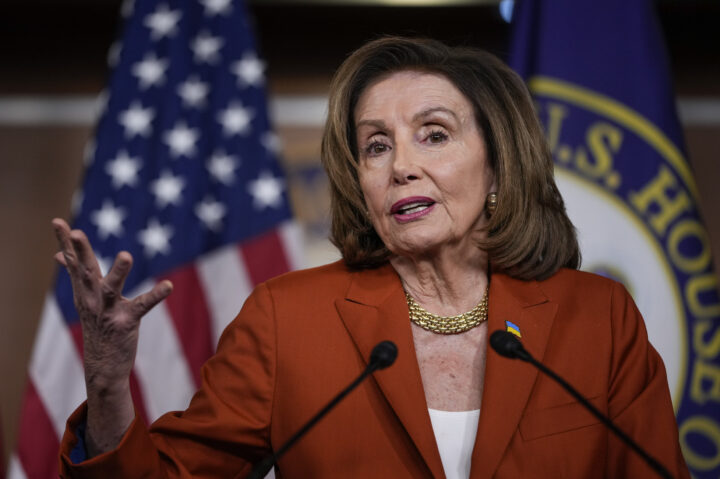
Drew Angerer/Getty Images
Then-Speaker of the House Nancy Pelosi (D-CA) speaks during her weekly news conference on Capitol Hill March 9, 2022 in Washington, D.C.
Rep. Al Green (D-TX), a vocal critic of Israel competing in a closely contested runoff against a fellow House Democrat later this month, announced in social media posts on Monday that he had received a coveted endorsement from Rep. Nancy Pelosi (D-CA), the powerful former House speaker.
Jewish community leaders in the Houston area were surprised to see Pelosi’s endorsement, especially as it appeared to break with her precedent of declining to engage in member-on-member races.
It also fueled ongoing frustrations with Green’s alleged lack of outreach to Houston’s sizable Jewish community — a potentially critical constituency in what is expected to be a close election.
The endorsement wasn’t straightforward — by Tuesday afternoon, Green’s original post had been removed, raising questions about his claim. Neither Pelosi nor her team had confirmed the purported endorsement before it was suddenly deleted without explanation.
On Wednesday, however, the endorsement had been reposted across Green’s social media accounts, albeit with slightly altered imagery.
“Speaker Pelosi is a leader I have stood beside through the most consequential fights of our time,” Green said on Wednesday. “Her endorsement of our campaign is a profound honor. We carry this moment forward, together, for the people of New CD 18 and the country we love.”
The message was accompanied by a graphic that featured an image of Pelosi differing from the photo used in the initial post. “The honorable Nancy Pelosi endorses,” it said. “Proven fighter. Real results. Vote Al Green in the runoff election.”
Ian Krager, a spokesperson for Pelosi, confirmed to Jewish Insider on Wednesday that Green’s new post was official, saying that her endorsement was “based in loyalty” to a longstanding colleague. Pelosi, who is set to retire at the end of her term, has traditionally avoided taking sides in House races between sitting members of her own party.
Krager declined to comment on why the original posts had been deleted. Green’s campaign also would not comment on the initial posts, only directing JI to his social media platforms “where you can find the endorsement from Speaker Emerita Nancy Pelosi.”
The confusion underscored some of the intraparty sensitivities surrounding the May 26 runoff election between two incumbents — Green, 78, and freshman Rep. Christian Menefee (D-TX), 38 — now vying for a Houston-area House seat in a bitter fight caused by the state’s recent Republican redistricting.
While some House colleagues are supporting Green, according to his campaign site, Pelosi’s backing is a major pickup for the outspoken, 11-term lawmaker seeking reelection in Texas’ newly consolidated 18th Congressional District, redrawn to favor Democrats.
It also marks something of a change in their relationship — Green had publicly clashed with Pelosi during her time as speaker over his efforts in 2019 to impeach President Donald Trump, which she had opposed.
In the March primary election, neither candidate claimed more than 50% of the vote required to win the nomination outright and avoid a runoff. Green secured 44%, two points short of Menefee, a former Harris County attorney who took office in February after winning a special election runoff to fill the seat held by Rep. Sylvester Turner (D-TX) until his death last year.
Art Pronin, a Jewish Democratic leader who lives in the district, echoed others who have said that Green has all but disengaged from the Jewish community in recent years — contributing to a strained relationship with the veteran congressman.
Since the Hamas attacks of Oct. 7, 2023, Green has also taken a noticeably hostile turn against Israel in his votes and public statements, local Jewish leaders say. Weeks after the attacks, for instance, Green was among just 10 House lawmakers who opposed a bill voicing support for Israel while condemning Hamas. He has otherwise supported House legislation calling the war in Gaza a genocide and consistently voted to cut military aid to Israel, among other moves seen as antagonistic.
“Regardless of the rhetoric, showing up” to Jewish community functions “is really important,” especially in a tight race, Pronin told JI on Tuesday. “We don’t see him breaking bread.” Green’s long absence “could cost him the race,” Pronin suggested. “It’s going to be close, and I think that we’re in a situation where a lot of the community is feeling alienated from Green,” he said.
With a few weeks until the runoff, Pronin said he is leaning toward voting for Menefee because the new congressman has been a more active presence in the Jewish community, showing up at several events like a Passover Seder sponsored by the Jewish Federation of Greater Houston last month. Meanwhile, Menefee has expressed a more “balanced view” with regard to Israel and Gaza, Pronin told JI, even as he has made only a limited number of public statements clarifying his own views on Middle East policy while in office.
During a tense debate on Monday, Menefee said he believed that Israel had committed “atrocities” and “war crimes” in Gaza, while acknowledging that Oct. 7 was “absolutely horrific.” He understood, he told the audience, “why a nation would want to wage war against a terrorist organization.”
Green, for his part, reiterated his charge that Israel had committed a genocide and accused Menefee of avoiding the term because, he alleged, his opponent is beholden to the pro-Israel advocacy group AIPAC. “He didn’t say genocide,” Green noted. “AIPAC won’t allow that.”
AIPAC, however, has not issued an endorsement in the race.
Pritzker, Emanuel take contrasting paths on Israel, antisemitism ahead of possible presidential runs
In two separate interviews published Tuesday, Pritzker came out as a more forceful voice against antisemitism and in support of the U.S. relationship with Israel

U.S. Embassy in Japan/United States Department of Defense
Rahm Emanuel/Illinois Gov. JB Pritzker
Two Jewish Democrats from Chicago are looking to run for president.
One, Illinois’ two-term governor, JB Pritzker, has built up a reliably progressive record while steering clear of ideological fights over Israel, antisemitism and other cultural issues fueling the Democratic Party.
The other, former Chicago Mayor Rahm Emanuel, is one of his party’s leading pragmatists, known for feuding with left-wing Democrats over education, the power of unions and the degree to which cultural progressivism cost the party on the ballot box.
So it came as a surprise that, in two separate interviews each published Tuesday, it was Pritzker who came out as a more forceful voice against antisemitism and in support of the U.S. relationship with Israel, while Emanuel sounded like he was all too eager to blame Israeli Prime Minister Benjamin Netanyahu as he anticipated a future breakup between the two close allies.
Pritzker offered the point that relationships between allies aren’t dependent on whether you personally like the elected leadership in charge. It’s a line you’d expect more mainstream Democrats to invoke, especially as Israel’s favorability within the Democratic Party has sunk to new lows.
“There are a lot of people who don’t like Netanyahu, but you shouldn’t take it out on Israel. It’s a democracy that elected him. There are a lot of people who don’t like Trump. I mean, should we be tossed into The Hague as a country because of Trump?” Pritzker told Politico over matzoh ball soup at Manny’s Deli, referring to the home of the International Criminal Court.
Emanuel, when asked by Jewish Insider if there was a special relationship between the U.S. and Israel, agreed with the premise but then quickly pivoted to arguing the state of the relationship should be premised on Israel’s efforts contributing to peace in the region. It’s an implication that its post-Oct. 7 efforts at self-defense have gone too far.
“Every risk you will take, the State of Israel takes, for peace, then America will stand by you,” he told JI. “We understand there’s risks. We have stood by Israel through thick and thin.” “But,” he said, “when one friend in that relationship abandoned something that’s contrary to our interests and contrary, in my view, also to Israel’s interests,” it is reasonable to rethink that alliance.
Pritzker also spoke directly about the scourge of antisemitism, laying most of the blame for the rise in anti-Jewish hate on President Donald Trump, but when pressed, also laid out a clear red line that it’s never acceptable to invoke antisemitism for disagreeing about Israel’s policies.
“Antisemitism has often been connected to people’s views about Israel. That is: If you don’t like what Israel and, in particular, Netanyahu are doing, now it’s OK to have slurs that you’re spewing about Jews,” Pritzker said. “It’s not. It’s never OK.”
Asked about whether anti-Zionism intersects with antisemitism, Emanuel touted his own experiences fighting neo-Nazis in Skokie, Ill., and relentlessly attacking anti-Jewish hate as an elected leader. He told JI that “we have to confront” antisemitism wherever it emerges, referencing Maine Senate candidate Graham Platner not knowing he had a neo-Nazi tattoo on his chest. One day later on CNN, he endorsed Platner’s campaign.
At a time when unfavorable views of Israel are at historic highs within the Democratic Party and open antisemitism is being tolerated in a way unimaginable not long ago, the trajectory of these two prominent Jewish presidential contenders — along with the fate of Pennsylvania Gov. Josh Shapiro — will be instructive on the future role of Jewish voters within the Democratic coalition.
Pritzker, with strong anti-Trump and progressive bona fides, may feel a little more comfortable tacking to the center when talking about Israel and antisemitism. Emanuel, who has made a name for himself as a moderate calling out the excesses of the left as he travels across the country (and speaks on TV), may be a little more reticent to tout his pro-Israel credentials, given the ideological direction the party is headed in.
In an interview with Jewish Insider, Emanuel outlines his views amid changing winds in a Democratic Party increasingly antagonistic to the pro-Israel perspective that had long been central to his identity
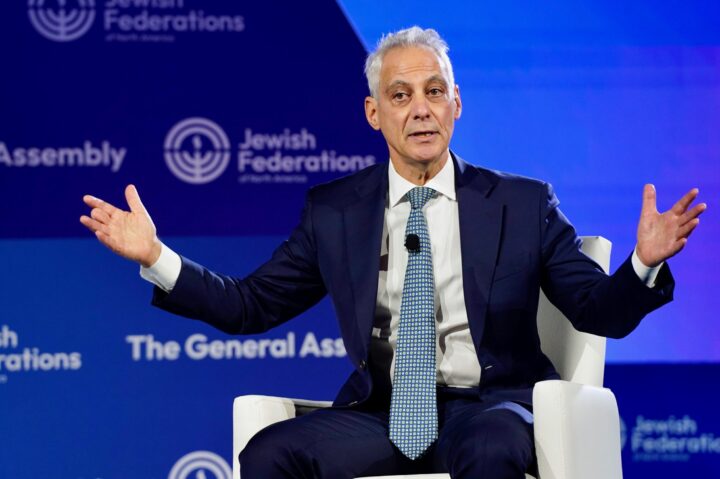
Jewish Federations of North America
Rahm Emanuel speaks at the Jewish Federations of North America's 2025 General Assembly opening plenary on Nov. 16, 2025.
Last November, Rahm Emanuel, the tough-talking Democratic operative and prospective presidential candidate, took the stage of the Jewish Federations of North America’s annual conference in Washington to deliver a blunt word of warning about Israel’s declining reputation in the United States and around the globe.
“I don’t mean to be the party pooper, but look, this is not going to be helpful if we’re not going to be honest with each other,” he said on an opening panel, urging the crowd to reckon with a marked downturn in support for the Jewish state over its war in Gaza, particularly among younger voters. “Israel is extremely unpopular.”
Emanuel, a veteran Jewish politician and party official who had recently concluded a tour as U.S. ambassador to Japan in the Biden administration, acknowledged his message might not ingratiate him to the thousands of Jewish communal leaders in the audience who were no doubt deeply familiar with the issue he was highlighting.
“This may be the last time I’m asked to speak to you. I get it,” he said with a hint of indifference. “But we have to be honest about the task we have” for those “who believe that there is something special” to the U.S.-Israel relationship. “We have our work cut out, and it’s not here to get applause,” he told the crowd.
In hindsight, Emanuel’s frankly worded comments marked something of a turning point in his approach to Israel and the Jewish community, foreshadowing more recent remarks in which he has voiced harsh criticism of the country’s military tactics in the wake of Hamas’ Oct. 7 terror attacks and championed new policy proposals against American military aid to Israel.
Yet even as he builds a profile as a potential candidate willing to tell the Democratic Party hard truths and challenge orthodoxy on a range of issues from trans rights to child social media bans to age limits for politicians, Emanuel, 66, was reticent in exploring his views on Israel in more depth during an interview with Jewish Insider, which he had resisted for nearly a month.
“What I said couldn’t have been clearer,” he told JI last Thursday, referring to his recent comments on “Real Time With Bill Maher” calling for an end to U.S. military aid to Israel that raised eyebrows in the Jewish community. “There will no longer be U.S. taxpayer subsidies for the purchase of U.S. military equipment. Israel will be like every other ally. They can buy what they want, and they have to live within the restrictions.”
“You can decide to slice it, dice it, but that’s what it is,” he said.
While U.S. military funding to Israel has increasingly faced pushback in the Democratic Party, particularly on the far left, Emanuel’s argument that Israel no longer needs the sort of special treatment that he helped promote in the Obama White House has been striking to watch precisely because he has long been a staunch defender of the Jewish state and its founding ideals.
Emanuel, whose middle name is Israel and who speaks fluent Hebrew, holds a uniquely personal connection to the Jewish state. His late father, an Israeli immigrant born in Jerusalem, served in the Irgun, the Zionist paramilitary force that fought for Israeli independence. As a child, he spent summers in Israel and later volunteered as a civilian assistant to the Israel Defense Forces during the Gulf War. His son celebrated his bar mitzvah in Israel.

Emanuel, a moderate former congressman and mayor of Chicago, pointed out in the interview that Israeli Prime Minister Benjamin Netanyahu had himself proposed winding down U.S. military aid over the next 10 years, saying in January that the country had “come of age” and “developed incredible capacity” to continue on its own.
Emanuel, however, said that he would instead suspend the assistance “immediately,” characterizing his position as “part of an overall policy” tied to Israel’s strategically secure position in the region as well as its political isolation on the world stage — both of which he argued have never been greater than now.
“If you or anybody thinks you’re going to continue the American taxpayers paying for this, good luck passing that in the U.S. Congress. You’re asking a president of the United States to spend X amount of political capital to do something that even Israel’s own prime minister acknowledged isn’t going to happen,” he said, referring to continued U.S. military aid.
The Jewish state “has made a decision to only lean on its defense and not lean on its diplomatic front,” he told JI, adding that Netanyahu had chosen to “walk away” from pursuing a two-state solution, support for which has declined in Israel since the Oct. 7 attacks and ensuing war in Gaza.
In his view, the U.S. should continue to stand with Israel only if its efforts in the region help contribute to peace. “Every risk you will take, the State of Israel takes, for peace, then America will stand by you,” he said. “We understand there’s risks. We have stood by Israel through thick and thin.”
“But,” he said, “when one friend in that relationship abandoned something that’s contrary to our interests and contrary, in my view, also to Israel’s interests,” it is reasonable, he suggested, to rethink that alliance.
“There will no longer be U.S. taxpayer subsidies for the purchase of U.S. military equipment. Israel will be like every other ally. They can buy what they want, and they have to live within the restrictions,” Emanuel said of his vision of the future of military aid to Israel.
His comments indicate that he is now embracing a fundamental reassessment of the U.S.-Israel alliance, abandoning even the pretense of tough love that once characterized his approach, among other moderate voices in the Democratic Party.
For example, Pennsylvania Gov. Josh Shapiro, a centrist Jewish Democrat who is also weighing a presidential campaign in 2028, recently reiterated his support for continued U.S. aid to Israel but said that it should be seen as “leverage” to exert pressure over the country’s use of American-made weapons.
“Rahm’s move tells you a lot about the politics of the Democratic Party on Israel now. And that is a sign of how Israel’s image has changed in the country,” said Dennis Ross, a former U.S. diplomat and Middle East negotiator who overlapped with Emanuel in the Obama administration.
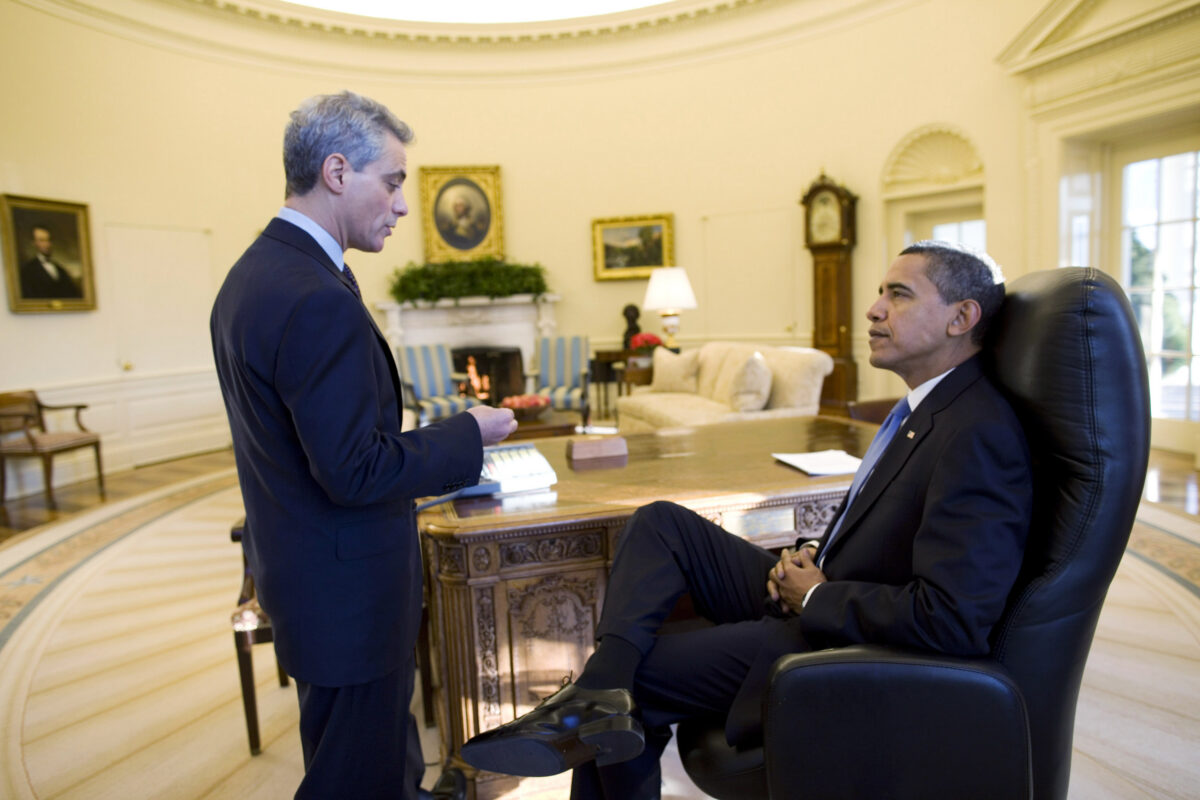
Despite his strong attachment to Israel, Emanuel is reckoning with a changing party no longer broadly sympathetic to the pro-Israel perspective that had long been central to his political identity, even as he has tussled with Israeli leadership during his time as a public figure.
Last Friday, for example, Emanuel signaled he would back Graham Platner, the far-left Senate candidate in Maine now poised to become the Democratic nominee, even as the Marine veteran has called to block U.S. military aid to Israel while facing controversy over a Nazi tattoo he recently covered up.
“Whether it’s people chanting ‘Jews will not replace us’” in Charlottesville, “or somebody bombing Gov. Shapiro’s home, or somebody painting Nazi insignia on my fence, or the candidate saying ‘I did not know that was a Nazi’” insignia on his chest, “we’re going to have to confront this,” Emanuel told JI the day before announcing his support for Platner, while touting his record of fighting antisemitism.
“I’ve dealt with it when I ran for Congress,” he said on the phone from Chicago, noting that he was outside an Anne Frank exhibition opening in his home city. “And I’ve also been upfront when I think a decision is going to lead to the strategic and diplomatic isolation of, not only the State of Israel, but, more importantly, the Jewish people.”
Still, Emanuel seemed reluctant and even somewhat frustrated to answer further questions seeking clarity on the implications of his new approach to Israel and how he arrived at his position. He refused to confirm explicitly, for example, if he would back defensive aid for Israel’s Iron Dome missile defense system, which has recently emerged as a subject of intense debate in some corners of the Democratic Party.
It is a significant contrast with where Emanuel stood during his time as Obama’s chief of staff. In the White House from 2009-2010, Emanuel was one of Obama’s top consiglieres on policies relating to Israel. He was involved in initial funding to boost Israel’s Iron Dome system, an effort that culminated in a 10-year memorandum of understanding between the two countries that provides $3.8 billion in annual aid through 2028, which the White House touted, at the time, as “the largest single pledge of military assistance in U.S. history.”
In 2009, Emanuel shared more reassuring words in his address to the JFNA’s annual gathering, praising Netanyahu while citing his own familial ties to Israel as well as what he had called the “privileged point of view” from understanding the Jewish state’s “value as a homeland.”
“Those who have questioned” whether the Obama administration’s opposition to Israeli settlement building in the West Bank and outreach to the Arab world “implies diminished support for Israel, that is not the intent,” he said, filling in for his boss. “It is not the case and it never will be. The truth is the opposite. Only through dialogue will Israel achieve the peace it seeks.”

Emanuel now takes a more jaundiced view of Israeli diplomacy, fueling his calls for an end to U.S. aid. “Under Prime Minister Netanyahu, in the last three years, you’ve lost Europe, you’ve lost the American public, and you picked up Somaliland,” he scoffed to JI, referring to Israel’s decision to formally recognize the secessionist region in the Horn of Africa last year. “As my grandmother would say, ‘Such a deal.’ That is your only diplomatic achievement.”
Julie Fishman Rayman, senior vice president of policy and political affairs at the American Jewish Committee, called Emanuel’s views “disappointing and worrying,” arguing that U.S. security assistance to Israel “is not just vital to deterring further attacks and ensuring the survival of the state of Israel, but is integrally tied to safeguarding American interests in the region.”
Emanuel argued that his position on U.S. aid is a logical extension of sentiments he had conveyed in 2009 while in the Obama administration, when he repeatedly clashed with Netanyahu over settlement expansion in the West Bank, which the White House cautioned would jeopardize prospects for achieving a two-state solution.
“I went straight to the prime minister to his face and said, ‘What you’re doing is going to lead to the great isolation of Israel,’” Emanuel recalled, noting, as he often does, that Netanyahu called him a “self-hating Jew,” underscoring the highly personal tenor of their long-testy relationship. “Look, I have a longstanding relationship,” he explained. “I’m honest about it.”
But even as he argues that Israel is today “a different country from a sense of wealth and capacity,” he has strained to harmonize the motives now animating his current approach. He has dismissed speculation over the sincerity of his stance and whether it is rooted in a good-faith view of Israel’s economic standing or if it is instead a more cynical political calculation tailored to a rising anti-Israel faction in the Democratic Party.
Though in contrast with high-profile voices on the far left, Emanuel has shied away from charged rhetoric about genocide in Gaza, saying it is a legal question, as well accusations that Israel had tricked President Donald Trump into war with Iran, which he says ignores U.S. agency in the conflict. He has said it is a “mistake” to restrict arms sales to Israel, suggesting that he is not aligned with related resolutions that were introduced by Sen. Bernie Sanders (I-VT) last month and notably drew backing from most Senate Democrats.
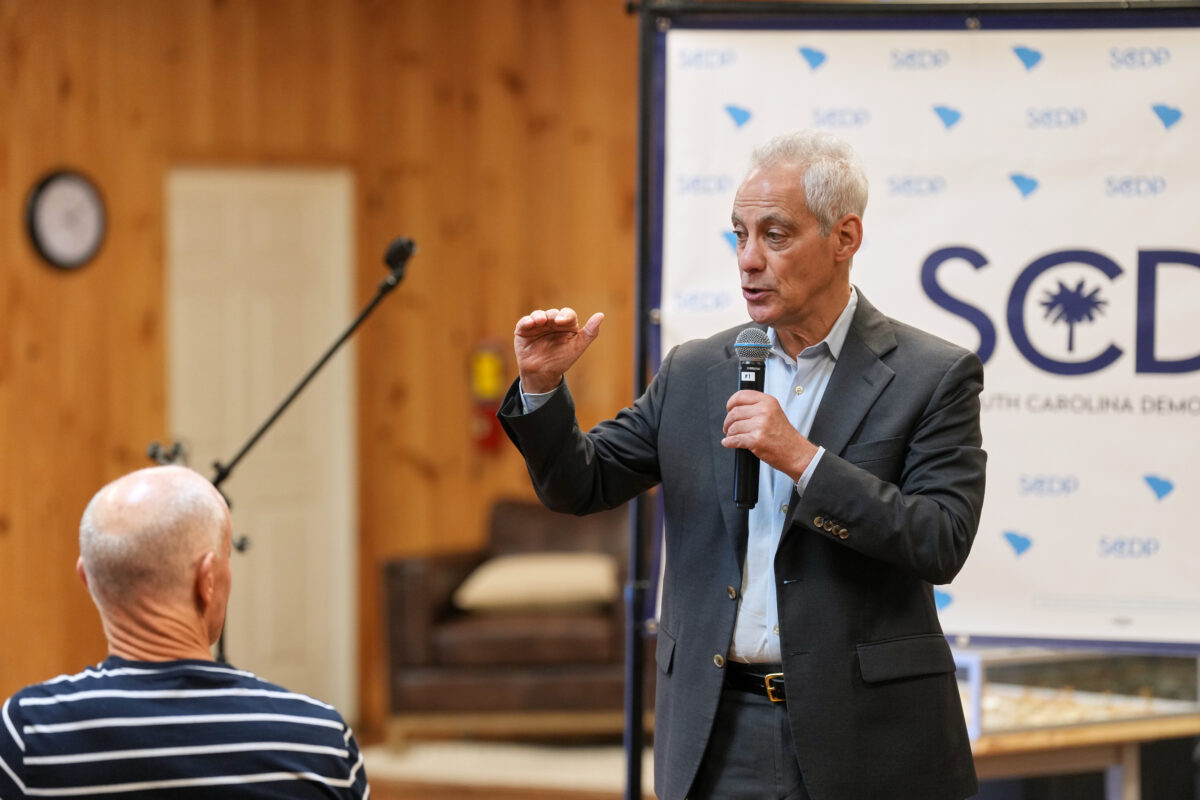
Emanuel’s allies said in recent interviews that they were not surprised with his approach, saying that he has been building to this moment for some time. “Do I agree with him? Not necessarily,” former Rep. Steve Israel (D-NY), who served with Emanuel in Congress, told JI. “But this is not a breakthrough position. He’s expressed those concerns for years.”
David Axelrod, a former chief strategist to Obama, likewise agreed in a text message to JI that “Rahm’s basic concerns about where Bibi is leading are not new,” using Netanyahu’s nickname. “Rahm, like a lot of us, has always believed a two-state solution was the only road to peace and Bibi has been deeply, irretrievably opposed and actively hostile to the notion.”
“You ask these questions like somehow I’ve changed. The prime minister used to articulate a two-state solution. He was for it. He’s the one that’s changed,” Emanuel said of Israeli Prime Minister Benjamin Netanyahu.
One prominent Jewish Democrat, who asked to remain anonymous to discuss a charged issue, called Emanuel’s stance a practical response that “takes the wind out of the sails of the far left and the far right,” which have politicized funding for Israel. “As long as we’re giving aid to Israel, Americans will feel like they have a say in Israeli policy and how that investment is managed.”
But if that is Emanuel’s aim, he has not made it clear. In conversation with JI, he was hesitant to clarify his own positions when pressed. Asked if he would back Iron Dome funding, he said he had been “part of the financing” for a “joint project” that he called “key for Israel’s security” when it was first developed with the United States.
He declined to elaborate further about such aid. “U.S. taxpayers should not be in the position of subsidizing a country,” he reiterated. “You know my history with the Iron Dome,” he said. “I’m done. I’ve answered it.”
Though some allies of Emanuel are willing to indulge his views more favorably than other 2028 prospects with thinner resumes related to Middle East policy, a range of Jewish and pro-Israel organizations are now pushing back on his recent turn against U.S. military aid.
“It’s in America’s interests to keep our word and help a democratic partner shield innocent civilians from missiles,” Deryn Sousa, a spokesperson for AIPAC, told JI, referring to the Iron Dome. “Reneging on the Obama administration’s signed agreement with our closest ally in the Middle East would send a devastating message to our allies, empower our enemies and do nothing to advance peace.”
Brian Romick, president of Democratic Majority for Israel, said that “Israel’s situation is not comparable to our other close allies.”
“Unlike Japan, South Korea and Germany, Israel does not have permanent U.S. troops on the ground,” he told JI recently. “It’s also surrounded by enemies who actively want to wipe it off the face of the earth. U.S. security assistance reflects that reality and the significant strategic benefits the aid provides.”
Michael Makovsky, president and CEO of the Jewish Institute for National Security of America, told JI in a recent interview that he disagreed with Emanuel, even as he acknowledged the sentiment as a “legitimate view.” Still, he added that it is “in the U.S. interest” to continue providing military aid to Israel, “which anyway all goes to buying U.S. weaponry.”
Even some pro-Israel Democrats sympathetic to Emanuel and his perspective said his comments on military aid raise more questions than they answer. One influential Jewish Democrat who has long been acquainted with Emanuel, speaking on the condition of anonymity to address a sensitive topic, expressed concerns that ending aid to Israel could stoke further calls from the far left to condition military funding or block future weapons sales outright.
For his part, Emanuel avoided commenting on the question of Israel’s qualitative military edge, which the U.S. is legally obligated to ensure but allies say could suffer without military aid. “I feel like we’re taking the same question from 50 angles,” Emanuel told JI. “I want Israel to fight for peace the way it’s proven that it’s fought in the last three years. That’s what’s missing,” he said last week.
“You ask these questions like somehow I’ve changed,” Emanuel said earlier in the call. “The prime minister used to articulate a two-state solution. He was for it. He’s the one that’s changed.”
National Security Action named Maher Bitar, a former Biden official and Students for Justice in Palestine student activist, as its new leader
Screenshot/C-SPAN
Maher Bitar
Several top Jewish Democrats are expressing concerns about the ideological direction of a newly revived foreign policy group now aiming to shape the party’s approach to Israel in the 2028 presidential election as well as a future Democratic administration.
National Security Action, an influential Democratic foreign policy organization that launched in 2018 and helped staff the Biden administration, is returning to the political arena with a new leader, Maher Bitar, who has served in high-level defense and intelligence roles on Capitol Hill and in the White House, the group confirmed on Sunday.
Bitar, a deputy assistant to President Joe Biden and coordinator for intelligence and defense policy at the National Security Council who most recently served as chief counsel and national security advisor to Sen. Adam Schiff (D-CA), has faced scrutiny over his past record of anti-Israel activism.
During his time in the Biden administration, Bitar, who is Palestinian American, drew criticism from Republican lawmakers who alleged that he had demonstrated bias against Israel, citing, among other things, his past board membership with Students for Justice in Palestine while attending Georgetown University. As a student, he had also helped organize a pro-Boycott, Divestment and Sanctions conference and was shown in a university yearbook performing a dance in front of a banner that called to “divest from Israeli apartheid.”
Ben Rhodes, a former deputy national security advisor in the Obama administration who is now a leading left-wing critic of Israel, co-founded NSA with Jake Sullivan, most recently Biden’s national security advisor. Sullivan drew headlines last year when he came out in support of withholding arms to Israel, an argument he reiterated last month on “Real Time With Bill Maher” while defending the majority of Senate Democrats who had recently voted to block some weapons sales to the Jewish state.
Both sit on NSA’s board and will be involved in the group, Rhodes told Axios, saying he is invested in building a “pipeline” to help “populate a Democratic administration” as well as crafting “ideas that can form a progressive or Democratic foreign policy going forward.”
“The center of gravity has shifted on the relationship with Israel, and there will be a debate about the nature of the relationship going forward,” Sullivan told the outlet.
“We urge National Security Action to continue to be an honest convener about these important issues,” Brian Romick, the president of Democratic Majority for Israel, told Jewish Insider. “There is a strong majority of Americans, including Democratic primary voters, who support the U.S.-Israel relationship because they understand that doing so is in the best interest of the United States.
“DMFI is proud to advocate for those voices and we recognize they have a major role to play in choosing our 2028 nominee,” Romick said.
Bitar told Axios, which first reported his role, that NSA would be a “big-tent” organization seeking to unite the party. “We are not excluding anyone,” he said, noting that the group will serve as a “hub” to discuss Democratic foreign policy “to be ready for 2028 and beyond.”
A former senior foreign policy official in the Biden administration, who was granted anonymity to address a sensitive issue, told JI that Bitar “was part of a small cohort of senior White House advisors who worked to actively undermine President Biden’s policy preferences by inserting their own anti-Israel ideology, especially” following Hamas’ Oct. 7 attacks.
“National Security Action exists to help empower our leaders and broad community of stakeholders to communicate effectively about foreign policy and bring together a wide range of perspectives,” David McGonigal, a spokesperson for the group, said in a statement to JI.
“Maher’s deep relationships across the national security community and the outpouring of support for his appointment — including from members of Congress and organizations such as J Street, the Jewish Democratic Council of America and the Nexus Project — underscore how National Security Action is uniquely positioned to carry out this important mission.”
Ethan Wolf, a Democratic strategist who previously worked as a communications director for Rep. Tom Suozzi (D-NY), told JI he was “concerned National Security Action is rewriting everything they’ve ever stood for and putting their pen in the hand of a ‘Pod Save America’ bro,” referring to Rhodes’ association with the left-wing political podcast hosted by former Obama officials who have grown increasingly hostile to Israel.
DMFI, for its part, also alluded to Rhodes and the podcast in a heated social media post on Monday. “Democrats and Americans do not want Pod Save America hosts dictating our future national security platform,” the group wrote.
Despite other reservations over Bitar’s new role, some Jewish Democrats voiced positive views about his extensive resume.
“Maher has held multiple high-level national security positions in government — in the House, in the Senate and in the Biden and Obama administrations — where he was deeply respected for his pragmatism, depth and expertise,” said Halie Soifer, CEO of the Jewish Democratic Council of America. “I enjoyed working with Maher in the Obama administration and think National Security Action is lucky to have him at the helm.”
Daniel Shapiro, a U.S. ambassador to Israel in the Obama administration who served as a top defense official in the Biden administration, said he had worked with Bitar “in various capacities for over a decade, and know him to be a thoughtful and talented national security professional.”
“When we agree and when we disagree — and we do both — Maher has always been dedicated to pursuing smart, strategic, productive policy in the national interest,” Shapiro told JI. “I am confident we will continue to have a productive dialogue. And I completely reject the prejudiced attacks against him based on his Palestinian-American identity.”
In an unsolicited statement shared by a spokesperson for Schiff, the senator said Bitar “has been devoted to addressing the country’s most complex foreign policy challenges while upholding our values and protecting America’s national security interests.”
“In this new role with National Security Action, I know Maher will continue to provide the great insights and leadership we need to get through these turbulent times,” Schiff told JI.
Joel Rubin, a progressive strategist involved in Jewish and pro-Israel causes, acknowledged what he called a “freak-out” among some Jewish leaders over Bitar, but expressed optimism that the new NSA head would be open to constructive dialogue on a divisive issue.
“As long as multiple voices are included at the table, and I have no reason to believe they won’t be, this is the reality of the Democratic Party,” said Rubin, who is releasing a new book on Democratic foreign policy this week.
Michael Makovsky, the president and CEO of the hawkish Jewish Institute for National Security of America, said, “Given the recent anti-Israel statements and actions of possible Democratic presidential candidates, even historically pro-Israel ones such as Rahm” Emanuel “and centrist former officials like Jake Sullivan, it will be interesting to see if the big tent the organization says it’s seeking will include real pro-Israel voices.”
NSA is also hiring an associate director for polling and outreach to “support its work advancing a smart, principled vision of U.S. foreign policy, while pushing back on the Trump administration’s reckless national security policies,” according to a job listing posted to its website.
The group’s previous executive director, Caroline Tess, a former National Security Council official in the Obama administration, stepped down in 2025.
Chris Rabb, the DSA-endorsed House candidate in a Philadelphia congressional race, blamed the Sydney Hanukkah attack on ‘Zionists’
Paul Weaver/SOPA Images/LightRocket via Getty Images
Pennsylvania state Rep. Chris Rabb speaks during a protest outside of the Pennsylvania Capitol.
Pennsylvania state Rep. Chris Rabb — a Democrat seeking the Philadelphia House seat of retiring Rep. Dwight Evans (D-PA) — shared an Instagram post blaming the massacre of Jewish Australians at a Hanukkah celebration at Sydney’s Bondi Beach on “Zionists,” the Philadelphia Inquirer reported.
In the aftermath of the attack, in which 14 were killed and 40 injured, Rabb’s account shared disinformation insinuating the slaughter was a false flag perpetrated by Israeli interests.
“We all know the gunmen were likely Zionists themselves,” read the post, which used an emoji in the place of the word “gun.”
Shortly after the attack, the alleged assailants were identified as a father and son whom authorities linked to an offshoot of the Islamic State. Rabb’s post further lamented that Ahmed al-Ahmed, a Muslim Syrian immigrant who intervened, had not received broader acknowledgment for his “hero” role of disarming one of the attackers.
A Rabb campaign spokesperson asserted to the Inquirer that the candidate not only did not share the post himself, but that he had “no knowledge” of it, and blamed a former staffer for posting it. The campaign declined to share the staffer’s name and the details of their dismissal with Jewish Insider, but stated that “Rabb has and does condemn [the post] in the strongest terms.”
Rabb is locked in a tight race with state Sen. Sharif Street and Dr. Ala Stanford. In recent weeks, Rabb was endorsed by Sen. Chris Van Hollen (D-MD) and Reps. Jamie Raskin (D-MD), Alexandria Ocasio-Cortez (D-NY) and Maxwell Frost (D-FL), and received the backing of the Congressional Progressive Caucus. He’s also gotten the backing of far-left streamer Hasan Piker and the Democratic Socialists of America.
Former U.S. Ambassador to Japan Rahm Emanuel, on the Maine Senate candidate: ‘If he's the Democratic nominee, I'm going to help him if he wants my help, absolutely’
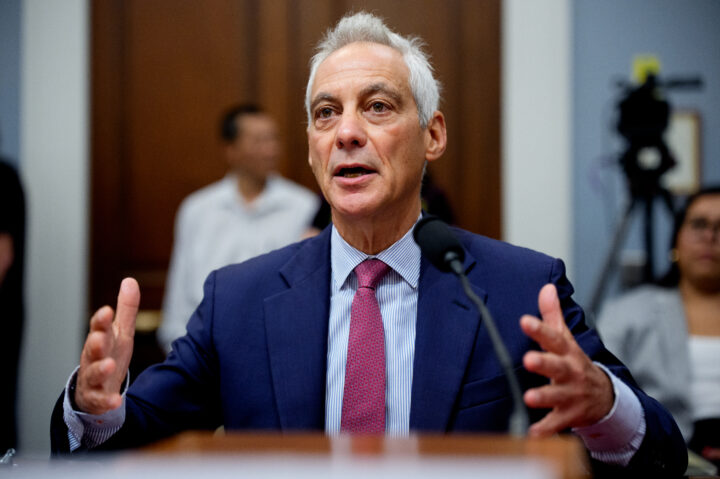
Andrew Harnik/Getty Images
Former U.S. Ambassador to Japan Rahm Emanuel speaks on Capitol Hill on July 23, 2025 in Washington, DC.
Former U.S. Ambassador to Japan Rahm Emanuel, a likely Democratic presidential candidate, on Friday signaled his backing for Maine Democratic Senate candidate Graham Platner, who has drawn scrutiny over his far-left views and decades-old Nazi tattoo that he recently covered up.
“I would hope at this point in the process he understands what a Nazi symbol is,” Emanuel said. “He’s going to have to make his way. And the Democrats — he’ll be the nominee — should support his candidacy,” Emanuel told CNN’s Kasie Hunt.
Asked by Hunt if he was personally backing Platner, Emanuel said, “If he’s the Democratic nominee, I’m going to help him if he wants my help, absolutely.”
“You have to put an end to Donald Trump,” Emanuel added.
Emanuel, who served as mayor of Chicago from 2011-2019, later quipped about a meeting with New York City Mayor Zohran Mamdani, a vocal critic of Israel, after Mamdani’s election as mayor. “I told him when I first met him, I said, ‘I don’t know who’s going to hate this meeting more, my rabbi or AOC,’ but we had an honest meeting … an honest discussion about what to face as mayor,” he said.
Platner is now the expected Democratic nominee against Sen. Susan Collins (R-ME) after the Democratic establishment’s favored candidate, Maine Gov. Janet Mills, dropped out of the race on Thursday. Mills, despite holding a strong political track record, consistently trailed Platner in primary polling since launching her campaign.
Over the weekend, Platner’s campaign also drew support from another unexpected voice: far-right podcaster Tucker Carlson.
In a lengthy interview with The New York Times, Carlson said he “appreciated” Platner’s foreign policy views, and plans to meet with the candidate. “I appreciate how different [his foreign policy views] are from everybody else in his party,” Carlson said.
‘We won’t support a Democrat who doesn’t represent the views and values of the vast majority of American Jews,’ Halie Soifer said
MANDEL NGAN/AFP via Getty Images
Jewish Democratic Council of America CEO Halie Soifer in Washington on May 24, 2023.
The Jewish Democratic Council of America is not ready to endorse Graham Platner, the controversial presumptive Democratic nominee in Maine’s Senate race, said Halie Soifer, the group’s CEO.
“We won’t support a Democrat who doesn’t represent the views and values of the vast majority of American Jews,” Soifer said in a statement. “JDCA has endorsed more than 120 candidates across the country who are fighting for the issues Jewish Americans care about and standing against antisemitism. It’s those many Democrats who have our backs, and we’ll have theirs as they work to defeat Republicans aligned with this White House whose views are antithetical to our values.”
Soifer additionally told The Forward on Thursday that Platner’s record of incendiary past comments and personal controversies are “reasons for concern” about his candidacy, saying that the far-left insurgent would first need to clarify his views to receive possible consideration from the group.
Reached by Jewish Insider on Thursday, Soifer confirmed JDCA’s position on the race but declined to comment further.
JDCA, a leading Jewish Democratic group, typically endorses most Democrats in major federal races, especially closely contested ones like the Senate seat in Maine.
The group had backed Maine Gov. Janet Mills in the June primary to unseat Sen. Susan Collins (R-ME). But Mills, the establishment favorite, said Thursday that she was suspending her campaign due to a lack of financial resources, clearing the way for Platner to secure the nomination in a race viewed by Democratic leaders as key to regaining control of the upper chamber.
Previously, JDCA had expressed criticism of Platner after it was revealed that he had a Nazi tattoo on his chest for nearly two decades. He has since removed the tattoo and claimed he was unaware of its links to Nazism until recently, even as a former acquaintance told JI that he had long known the icon represented a skull-and-crossbones known as a Totenkopf, adopted by an infamous SS unit.
“Hateful rhetoric and Nazi symbols must have no place in the Democratic Party, the Republican Party, or anywhere in our politics,” JDCA said last year after JI’s report. “Under any and all circumstances, it must be unacceptable to glorify Nazis or Nazism. Period.”
Platner’s hostile approach to Israel and demonization of AIPAC have also faced scrutiny among mainstream Jewish leaders at the state and national levels.
He has repeatedly accused Israel of committing genocide in Gaza and called for blocking U.S. aid to the Jewish state. In a past Reddit post recently uncovered by JI, the Marine veteran voiced admiration for Hamas’ tactics in a violent raid into Israel in 2014.
JDCA’s reservations over Platner’s campaign reflect ongoing discomfort among both Democratic and nonpartisan Jewish organizations that are now reckoning with the implications of his popularity in spite of the tattoo and other issues he has weathered.
The Anti-Defamation League as well as Maine’s Jewish federation have also raised concerns about Platner’s tattoo and past comments.
Platner, for his part, has pledged to engage further with the Jewish community, recently hosting a Seder in Maine that included the state chair of J Street, the progressive Israel advocacy group.
A spokesperson for J Street did not immediately respond to a request for comment on Thursday night about whether it would endorse Platner’s campaign.
The measure garnered 47 votes in the Senate, with GOP Sen. Susan Collins joining with Democrats for the first time
Kevin Carter/Getty Images
The U.S. Capitol Building is seen at sunset on May 31, 2025 in Washington, DC.
The Senate rejected for the sixth time an effort from Democrats to force the Trump administration to halt the war in Iran — with the vote once again falling largely along party lines.
The vote was the last before the conflict approaches the 60-day mark outlined in the War Powers Resolution of 1973, which requires the executive to seek congressional approval for continuing hostilities or draw down U.S. forces.
“After 60 days of war, it is long past time for Republicans to hold Donald Trump accountable,” Sen. Adam Schiff (D-CA) said in a statement released prior to the vote. “Some of my colleagues have indicated that the War Powers Act’s 60-day mark is the moment they may join our efforts to bring this war to its conclusion. That time has come.”
The latest resolution, sponsored by Schiff and Senate Minority Leader Chuck Schumer (D-NY), failed by a measure of 50-47. Sens. Jerry Moran (R-KS), Patty Murray (D-WA) and Tommy Tuberville (R-AL) did not vote.
Sens. John Fetterman (D-PA), Rand Paul (R-KY) and Susan Collins (R-ME) voted with the opposition party. This was the first time in which Collins sided with the Democrats on the war powers votes.
“As I have said since these hostilities with Iran began, the President’s authority as Commander-in-Chief is not without limits,” Collins said in a statement following the vote. “Further military action against Iran must have a clear mission, achievable goals, and a defined strategy for bringing the conflict to a close. I voted to end the continuation of these military hostilities at this time until such a case is made.”
Collins added that the 60-day war powers deadline is “not a suggestion; it is a requirement.”
Sen. Josh Hawley (R-MO) said he was not surprised by Collins, noting that “she has been saying the 60-day clock is significant for her.”
He added that for him: “We haven’t reached the 60 days. That’s why I voted the way I voted.” However, Hawley said that he wants “to see an end to the war.”
Senate Republicans have told Jewish Insider they expect the White House to abide by the law and provide notification of a 30-day extension to Congress, which is permitted to ensure a safe withdrawal. However, the administration has not yet indicated publicly whether it will seek that extension or continue offensive operations, and Defense Secretary Pete Hegseth claimed at a Senate Armed Services Committee hearing on Thursday that the 60-day clock was “paused” during the ongoing ceasefire.
As the deadline approaches, a growing rift is emerging among Senate Republicans over whether to support an Authorization of Use of Military Force.
“I would hope it wouldn’t come to that,” Hawley said of the White House potentially extending the conflict past the 60-day mark. “I think the administration has tried to remain within the statute.” Hawley has said that should the conflict extend past the deadline with no further action from the White House that he would debate an AUMF, but said he would prefer not to support authorizing a war he wants to see “wind down.”
Hawley said he would “welcome further communication from the White House.”
Sen. Todd Young (R-IN) also said he expects that the White House will “communicate” and “make a very strong legal argument.” He also noted that he believes the administration has “followed the War Powers Act provision so far in a very careful way.”
Young said that should an AUMF be necessary, he could see himself voting for a “properly structured authorization.”
“That’s been my position throughout this exercise,” Young said, referring to the recent slate of war powers votes. “My hope would be that if we went down that road, we’d work with the administration to draft a properly scoped authorization for the use of military force.”
Meanwhile, Sen. Mike Rounds (R-SD) said he is “not ready to commit to anything.”
“I want to make sure that we continue to get classified information on a timely basis from the Pentagon,” Rounds said. “I think today we had a very good classified setting with a lot of good information being provided. I think they [the White House] did a good job of sharing their point of view on it. So we’re moving in a good direction.”
Asked whether he believes anything would change at the 60-day deadline, Rounds replied: “I have no reason to believe that’s the case right now.”
Rounds said he believes a path forward between the U.S. and Iran will be “extremely difficult without regime change.”
“But that doesn’t mean that there isn’t hope for an agreement with this particular regime under very strict observations by outside forces to make sure that they adhere to any agreements we make,” Rounds added.
Sen. Tim Kaine (D-VA) said that while he thinks the current war is “unwise” and “illegal,” he said that if Congress “were to pass an AUMF in both houses it would stop being illegal.”
“I would stop critiquing it as an illegal war if they [Congress] passed an AUMF,” Kaine said.
Kaine said he expects that another war powers vote “will come up right after [Congress adjourns for] recess.”
“I think the testimony this morning shows they [the White House] know they got a 60-day problem,” Kaine said, referring to Hegseth’s remarks at the hearing.
Rounds, who serves on the Senate Armed Services committee, said that he would need to “go back and do a good review of that particular” remark.
“We’re in the middle of it,” Rounds said. “Once I have a chance to actually go through it myself then I’ll have a comfort level. I’m not going to disagree with him [Hegseth] at this stage.”
In a hearing on the 2027 State Department funding bill, Democrats pushed unsuccessfully to condition the use of U.S. funded-weapons by Israel
(Heather Diehl/Getty Images)
Rep. Rosa DeLauro (D-CT) questions Interior Secretary Doug Burgum during a House Appropriations Committee hearing at the Rayburn House Office Building on April 20, 2026 in Washington, DC.
During a meeting on the 2027 funding bill for the Department of State, several Democrats on the House Appropriations Committee pushed, ultimately unsuccessfully, for the committee to adopt new conditions on the $3.3 billion in U.S. military aid allocated for Israel annually in the bill.
Rep. Mike Quigley (D-IL) introduced an amendment which would have prevented the use of U.S. funded-weapons to expand settlements or damage or destroy “homes, schools, farms, orchards or other civilian property” in the West Bank or Gaza, but ultimately withdrew it. Israel has routinely targeted Hamas operatives hiding in a range of civilian locations throughout Gaza.
Though he withdrew the amendment before requesting a vote, several progressive Democrats spoke in favor of it, most notably Rep. Rosa DeLauro (D-CT), who is set to be the chair of the Appropriations Committee should Democrats retake the House in November.
The amendment “would require the United States to live up to our obligations under international law,” DeLauro argued, condemning settlement expansion as “annexation of the West Bank … happening before our very eyes.”
Destructions of Palestinian homes in the West Bank “are part of a strategy to destroy the possibility of a two-state solution,” she continued.
“This amendment would recognize the United States’ obligation under international law, which is at a minimum to cease support for Israel’s illegal settlement policies,” she said. “But there are impacts at home as well. The more the U.S. ignores lawless actions, turns a blind eye to the violations of Palestinian territory and sovereignty, the more that our credibility and influence erodes on the global stage.”
Rep. Lois Frankel (D-FL), the ranking member of the subcommittee responsible for State Department funding, did not offer a definitive stance on the bill, but indicated her opposition, praising Quigley repeatedly for withdrawing it.
“This has obviously become a contentious situation. I myself am a strong supporter of the security of Israel, of the people who live there, and also decency to innocent people who live nearby,” Frankel said. “I respect your offering [the amendment] and willingness to withdraw.”
Rep. Mario Diaz-Balart (R-FL), the subcommittee chair, emphasized Hamas’ use of human shields in Gaza and placement of terror infrastructure under schools, hospitals and United Nations facilities, and noted that U.S. aid to Israel is already subject to global human rights conditions.
“These other conditions, additional conditions, are totally unnecessary. I think they’re totally inappropriate to one of our closest allies that is under serious threat right now,” he continued.
Quigley introduced a second amendment allocating at least $400 million for rebuilding civilian infrastructure in Gaza, which failed by a vote of 32-25.
The explanatory report accompanying the committee’s draft 2027 funding bill for the State Department, also released this week, includes multiple passages that offer veiled and overt criticism of U.S. allies for failing to assist in the U.S. operations against Iran, a gripe shared by President Donald Trump.
One section “strongly encourages longstanding allies and partners to work with the United States to help secure freedom of navigation within critical sea lanes, including the Strait of Hormuz,” and another “condemns the decision by the Government of Spain” to deny the U.S. use of its bases and airspace for operations against Iran.
The full bill includes various new provisions aimed at securing accountability for United Nations Relief and Works Agency staff’s involvement in the Oct. 7, 2023, attacks on Israel, and ties to Hamas. The explanatory report accompanying the bill expands upon such efforts.
It condemns the United Nations for providing “ongoing protection” to former U.N. staff involved in the Oct. 7 attacks, and highlights that the State Department inspector general has sought information from organizations operating in Gaza about their staffing and relationships with Hamas, but such requests have at times been ignored.
It requires that funding to any entity be suspended if the entity fails to comply within 90 days with a request for information from a U.S. inspector general. It emphasizes that the “committee expects” that anyone employed by a U.S.-funded group who is a member of a terrorist organization, or any group that knowingly employed such individuals, “shall be referred expeditiously for the appropriate criminal and administrative remedies.”
And it urges the administration to use U.S. influence and power at the U.N. to push other countries to defund UNRWA, and to identify other aid mechanisms.
It instructs the administration to assess whether international organizations’ anti-Israel bias arises from specific actions by member states or “systemic behavior” within the organizations, and to assess “institutional practices” that might undermine neutrality toward Israel, such as hiring individuals known to be prejudiced against Israel or accepting information provided by Hamas while rejecting information provided by Israel.
It also calls for an assessment of the U.N.’s progress in implementing efforts to combat antisemitism and recommendations on how such efforts can improve.
The report raises concerns about Turkey’s relationship with Hamas, demanding a briefing to Congress on such ties. And it blocks U.S. funding to South Africa until the South African government stops cooperating with U.S. adversaries, additionally condemning the country for its anti-Israel advocacy on the international stage.
The bill proposes a marginal increase in funding for the office of the State Department’s special envoy to monitor and combat antisemitism, from $2.6 million in 2026 up to $2.75 million. It again urges the State Department to increase full-time staffing within the office.
The explanatory report offers support for the State Department’s Global Guidelines for Countering Antisemitism, and urges the department to expand efforts to promote those guidelines globally.
It further expresses concern about rising antisemitism in Latin America, particularly by elected officials, and calls on the State Department to engage with regional leaders to combat it.
The bill allocates $37.5 million for the Nita Lowey Middle East Partnership for Peace Act designed to promote Israeli-Palestinian people-to-people ties, level with 2026; allocates $55 million for the Near East Regional Democracy program, which promotes civil society and democracy in Iran, as well as directing the administration to consult with Congress on expanding internet access in Iran; keeps consistent funding at $3 million for U.S.-Israel development partnerships in third countries; holds funding for Israeli-Arab scientific partnerships level at $7 million; and offers a substantial increase in funding for the Middle East Partnership Initiative from $20 million to $50 million.
It also allocates $4 million in U.S. military aid for Bahrain.
The report condemns the U.N. General Assembly for passing, in a previous year, a resolution upgrading the Palestinians’ status at the U.N.
The report urges the further expansion of the Abraham Accords, calling the “urgent need” for further normalization “more apparent than ever” following Oct. 7. It calls for additional “dedicated resources” to implement U.S.-driven normalization efforts. It instructs the Department of State to “ensure resources are available” to implement and expand on normalization agreements, and to consult with Congress on these efforts.
The report instructs the administration to report to Congress every 90 days on progress in implementing the 20-point peace plan for Gaza — an effort that has been hampered by Hamas’ refusal to disarm — as well as to brief Congress on the Board of Peace.
It asks the administration to provide information to lawmakers on the Boycott, Divestment and Sanctions campaign targeting Israel, including companies, international organizations, countries, sovereign investment funds and other entities promoting or engaging in BDS, and steps that the administration is taking to “discourage or end” such policies.
It further directs the administration to “expand vetting policies and practices” to ensure no U.S. aid is provided to entities that engage in the Boycott, Divestment and Sanctions movement, glorify violence or support efforts to target Israel or the U.S. at the International Criminal Court or the International Court of Justice.
The report further instructs the State Department to report to Congress on the effectiveness of Iran sanctions and current Iranian revenue streams — as well as to allocate an additional $2 million to enforce and implement Iran sanctions; report on efforts to end the Palestinian Authority’s prisoner payments program; report on the status of religious and ethnic minorities in Syria; report on the Iranian and Iranian proxy presence in Latin America; and report on the production and distribution of the narcotic Captagon by Hezbollah and other adversaries.
It also urges the administration to “prioritize partnerships” with educational institutions that support U.S.-Israel engagement, and instructs it to make funds available to support humanitarian needs in Israel stemming from Iranian and Iran-backed attacks and to provide funding to historical preservation projects in Israel such as the City of David.
All living Pa. governors decry decision not to fund security upgrades to Shapiro’s home after attack
Republican state Treasurer Stacy Garrity, Shapiro’s gubernatorial opponent, said the state would not pay for the security upgrades to Shapiro’s private residence

Kyle Mazza/Anadolu via Getty Images
Pennsylvania Governor Josh Shapiro speaks during a press conference outside of the Governor's Mansion after an arsonist sets fire to the Governor's Residence in a targeted attack in Harrisburg, Pennsylvania, United States on April 13, 2025.
All five of Pennsylvania’s living former governors, both Republicans and Democrats, released a statement on Monday calling on state officials to prioritize the safety and security of Gov. Josh Shapiro.
The bipartisan letter comes days after Pennsylvania Treasurer Stacy Garrity — Shapiro’s leading Republican opponent in this year’s gubernatorial race — said the state would not pay for security upgrades at Shapiro’s private home.
“Combatting political violence and keeping our elected officials safe should always be nonpartisan and a priority,” Democratic former Govs. Tom Wolf and Ed Rendell wrote in a statement with GOP former Govs. Tom Corbett, Mark Schweiker and Tom Ridge.
The security upgrades were already made to Shapiro’s privately-owned family home in Abington, outside of Philadelphia, following the arson attack on the state-owned governor’s mansion in Harrisburg last year. State Police said such upgrades were necessary because Shapiro and his family lived in their private home while repairs were undertaken at the governor’s mansion after the fire.
Shapiro and prosecutors have said that the attack, which occurred on the first night of Passover, was antisemitic in nature, citing the perpetrator’s targeting of Shapiro over his stance on Israel’s war against Hamas in Gaza.
The former governors did not specifically mention Garrity, though they did refer directly to the “unspeakable attack” that occurred at the governor’s residence while he and his family were asleep.
“For us, the attack on Pennsylvania’s First Family was particularly upsetting,” the governors wrote. “In the aftermath of that attack we ask the state’s current leaders and legislators to make the safety and security of the governor and his family a priority.”
Garrity told reporters last Thursday that the state’s procurement rules don’t allow public funds to be used to pay for construction work on property that is not state-owned, SpotlightPA reported.
Garrity insisted she was not motivated by politics, saying she calls “balls and strikes here at Treasury.”
A spokesperson for Shapiro said last week that Garrity’s announcement was “a completely unprecedented and shameful political action without legal basis.”
Rasoul will instead remain in the Virginia House of Delegates, where he is chair of the Education Committee
Samuel Corum/Getty Images
Sam Rasoul of the Virginia House of Delegates speaks during a rally on the National Mall on May 31, 2021 in Washington, DC.
A Virginia state lawmaker with a history of inflammatory anti-Israel rhetoric who had been exploring a congressional run announced on Friday that he would instead remain in the state’s House of Delegates.
Sam Rasoul, a Roanoke Democrat who is the son of Palestinian immigrants, said he would hold onto his seat in the state Legislature to continue focusing on his work chairing the Education Committee, a role that has garnered concern from the state’s Jewish community due to his heated comments.
The decision comes days after Virginia voters approved a new congressional map that is likely to deliver four additional House seats to Democrats, prompting a reshuffling as politicians in the state opt to run — or not to run — for the newly drawn Democratic-friendly seats.
“Over the past few months, I have been evaluating the best path forward for me to continue serving our communities as we witness the Trump administration use our taxpayer dollars to fund a genocide abroad and wage an illegal and immoral Middle East war, all while our infrastructure and education systems are left crumbling here at home,” Rasoul said in a statement. “After careful consideration, I have decided that I will not be running for Congress this year.”
He urged congressional leaders to “champion Medicare for All, tackle the affordability crisis, and fight for an arms embargo on Israel.”
Rasoul came under fire last year from Jewish leaders in the state after posting a series of anti-Israel messages on social media that critics say veered into antisemitism. “Zionism has proven how evil our society can be,” he wrote on Instagram last summer, in a post that also called Zionism a “supremacist ideology created to destroy and conquer everything and everyone in its way.”
The Jewish Community Relations Councils for the Washington metro area, Richmond, Virginia Beach and Newport News called last August for Rasoul to be removed from his position as chair of the Education Committee, but that push was not successful.
The Michigan Senate contender accepted $7k from the chair of Al-Awda/PRRC — and hired her son
Evan Cobb for The Washington Post via Getty Images
Michigan Senate candidate Abdul El-Sayed speaks with customers and barbers at Blazin Wade Cuts in Grand Rapids, Michigan, on Saturday, Feb. 21, 2026.
Democratic Michigan Senate candidate Abdul El-Sayed has taken donations from a deep-pocketed activist whose group spearheaded the pro-Hamas protests that targeted a Queens synagogue in January — while the far-left candidate has at the same time paid tens of thousands in campaign funds to her son, Jewish Insider has found.
The latest Federal Election Commission filings show El-Sayed has received a total of $7,000 from Amani Barakat, the chair of Al-Awda-Palestinian Right of Return Coalition and a promoter of antisemitic conspiracy theories linking Jewish people to the Illuminati.
It’s part of $33,550 that El-Sayed has taken in total from the Barakat family, a Palestinian-American real estate dynasty based in Southern California.
But records show the money has flowed both ways, as El-Sayed’s committee has given $10,000 a month since December to a newly formed consulting firm belonging to Barakat’s son, a philanthropy advisor with no apparent background in campaign work.
As Jewish Insider previously reported, Amani Barakat chairs the group Al-Awda, which also uses the names Palestinian Right of Return Coalition and Palestinian Assembly for Liberation.
The group greeted Hamas’ Oct. 7, 2023, attacks with a statement sending “their highest salutations to the Palestinian Resistance, the Freedom Fighters and Defenders of the indigenous Palestinian people,” and it has collaborated with numerous radical groups, including the People’s Forum, CODEPINK and Samidoun — the latter of which the Treasury Department has identified as “a sham charity that serves as an international fundraiser for the Popular Front for the Liberation of Palestine (PFLP) terrorist organization.”
Amani Barakat’s social media history is consistent with her organization’s extremism. She shared her organization’s Oct. 7 statement on her personal Facebook account, and made multiple celebratory posts on the day of the atrocities, including one in English reading, “When people are occupied, Resistance is justified” accompanied by the hashtags “#longlivetheresistance” and “#feepalestine” [sic].
Another in Arabic translates to “Hail, my people! My people, hail!” A third English language post declares, “This is a fight for freedom.”
Also on Oct. 7, Amani Barakat shared a video of since-killed Hamas political chief Ismail Haniyeh justifying the attack, and a drawing celebrating the assault as a battle between a Palestinian David and Israeli Goliath.
Amani Barakat also has an extensive history of social media posts amplifying or applauding terrorist leaders and activities: she has repeatedly shared videos by a Beirut-based TikTok user named Muhammad Kawtharani, who has served as a Hezbollah spokesman (though is distinct from the group’s commander of the same name); posted PFLP-branded content and celebrated its founders; and shared memes and material supportive of Hamas officials and fighters.
She has also repeatedly defended and applauded Khaled Barakat, the Canadian-based co-founder of Samidoun who was identified by both the U.S. and Canada as part of the leadership of the PFLP, which pioneered skyjacking in the 1970s and participated in the Oct. 7 assault, among other massacres. Amani Barakat and Khaled Barakat have exchanged greetings on Facebook, with Amani Barakat even suggesting they might meet up in the West Bank.
Since the start of the U.S.-Israeli military conflict with Iran, Amani Barakat has openly cheerleaded the regime in Tehran, posting an “I Stand with Iran” image, an image eulogizing assassinated Supreme Leader Ayatollah Ali Khamenei with a Quranic verse and news of a defiant statement from the Iranian foreign minister with emojis illustrating her support.
She has also lauded antisemitic podcaster Tucker Carlson for his “brave, principled journalism,” and signal-boosted antisemitic conspiracy theories claiming “Zionists” are responsible for wildfires in Argentina and naming “Illuminati and other secret Jewish and Zionist societies as the real powers running the world and fueling the ongoing war in Iran.”
The Al-Awda leader, who did not respond to requests for comment for this story, has also shared multiple posts from El-Sayed. Her $7,000 in contributions amounts to a small portion of the total funds the wealthy and sprawling Barakat family has mobilized for the Senate contender — a financial effort that also includes $4,300 from her son, Jamal.
But records suggest that the younger Barakat has received far more from the El-Sayed campaign than he or his mother have given. The disclosures show that El-Sayed has paid at least $40,000 since December for “political consulting” to The Commonwealth Project, a firm formed in late November 2025 in Wyoming.
State incorporation documents show that Jamal Barakat created this firm in conjunction with education technology entrepreneur John R. Hall, with whom he serves as an executive at Bayan Islamic Graduate School, a theological institution with campuses in Los Angeles and Chicago.
There is no record of any other campaign ever hiring the newly formed Commonwealth Project, and Jamal Barakat’s LinkedIn profile shows extensive background in the education and philanthropy sectors — but no experience in politics.
Jamal Barakat and Hall did not respond to emailed questions from Jewish Insider about how they came to work for the El-Sayed campaign. Hall also did not respond to any queries, while Jamal Barakat hastily said “no comment” and hung up when a JI reporter introduced himself.
El-Sayed, who has labeled both the Israeli government and Hamas as equally “evil,” did not respond to questions about his relationship with the Barakat family, or he came to hire their scion’s firm.
This contrasts with how El-Sayed reacted when JI notified him that a donor and self-identified fundraiser for his campaign posted antisemitic sentiments and shared tweets on X including denial of the Holocaust.
User @Niavaran555 described themselves as a fundraiser for El-Sayed and invited Jenin Younes, the national legal director for the Arab Anti-Discrimination Committee, to join a fundraiser for El-Sayed in Washington in the coming weeks or months. Niavaran said separately that they gave the “max” to El-Sayed.
After JI inquired to El-Sayed’s campaign about the Niavaran account, the user made his posts private.
“Abdul’s campaign had no knowledge of this person’s anonymous online account. Abdul condemns any and all antisemitic or racist comments made, no matter who or where they come from,” spokesperson Sophie Pollock told JI, and said that the campaign refunded in full a donation from the apparent owner of the account.
They shared a post that appeared to question whether the Nazis used gas chambers to kill Jews during the Holocaust. “1944 Hitler introducing a ‘gas chamber’…. (Topic forbidden to question/debate)….” the post reads, in reference to Israel’s new death penalty law for Palestinian terrorists.
They reposted an X post saying that “Jewish n***** treating genocide like New Years Eve,” referencing a countdown on an Israeli television news channel for a deadline Trump provided to Iran.
Niavaran also reposted a meme urging now-deceased Iranian Supreme Leader Ali Khamenei to “BUILD THE NUKE RETARD.”
Numerous biographical details shared by Niavaran online point to the account being owned by Sam Zia, a travel consultant based in Washington, D.C. Niavaran said they “ran a speaker series in oxford (OxSpeaks)” and Zia was a co-founder of the group in 2023. Zia is also based in Washington, D.C., based on his LinkedIn profile.
Niavaran also said he wrote his thesis on former Iranian Prime Minister Mohammed Mossadegh; Zia used a picture of Mossadegh as his Instagram profile picture. Zia had donated $2750, to El-Sayed’s campaign as of the most recent FEC filings.
‘I’m going to have a problem with any candidate — Democrat, Republican or independent — who shares antisemitic and hateful posts on social media,’ the Michigan senator said
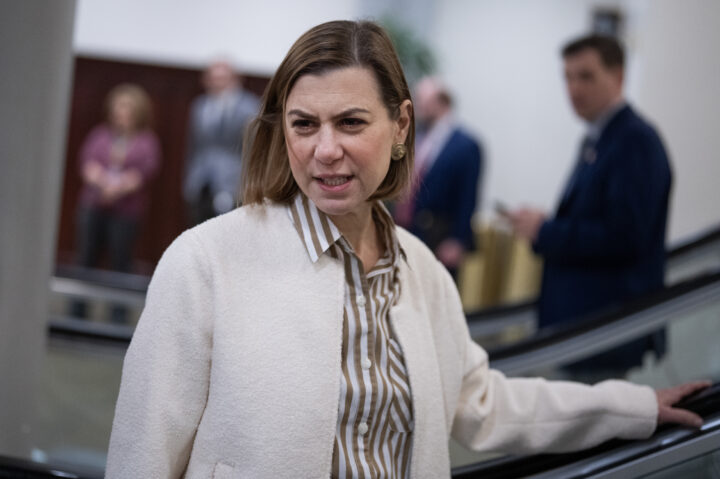
Tom Williams/CQ-Roll Call, Inc via Getty Images
Sen. Elissa Slotkin (D-MI) is seen in the U.S. Capitol on Thursday, March 26, 2026.
Sen. Elissa Slotkin (D-MI) joined other Michigan Democrats in condemning Amir Makled, a Democratic nominee for regent of the University of Michigan, over Makled’s past comments on social media expressing antisemitic sentiments and support for terrorism.
“I’m going to have a problem with any candidate — Democrat, Republican or independent — who shares antisemitic and hateful posts on social media. Especially when they refuse to disavow those comments or show remorse,” Slotkin said in a statement to Jewish Insider on Thursday, in response to a question about Makled.
Makled was nominated for the post at the Michigan Democratic Party convention last weekend, replacing Jewish and pro-Israel regent Jordan Acker, who has been repeatedly harassed and has had his home vandalized by anti-Israel campus activists.
The convention, which also featured aggressive heckling of pro-Israel speakers, has left prominent Jewish Democrats in the state feeling alienated and unmoored from their party.
Rep. Kristen McDonald Rivet (D-MI) similarly criticized Makled, and Sen. Gary Peters (D-MI) more broadly criticized the behavior of activists at the convention.
‘An overriding goal that has been one of my most profound concerns since coming to the United States Senate is to preserve bipartisan support for Israel,’ Blumenthal told JI
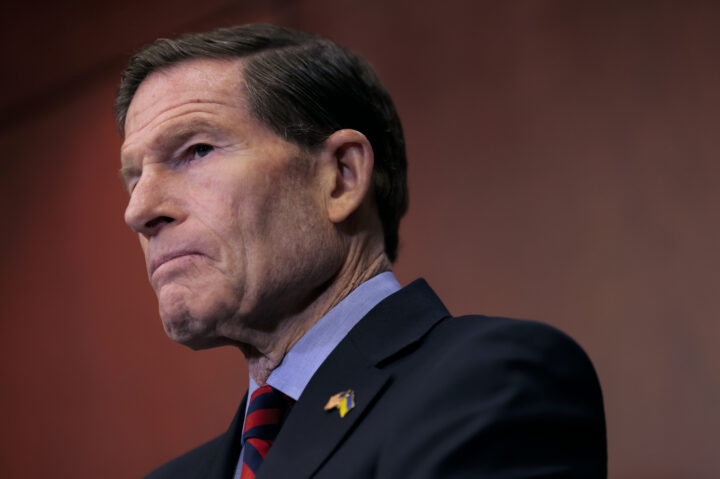
Heather Diehl/Getty Images
Sen. Richard Blumenthal (D-CT) holds a press conference at the U.S. Capitol on March 03, 2026 in Washington, DC.
Sen. Richard Blumenthal (D-CT), one of just seven Senate Democrats to vote last week against resolutions to block U.S. arms sales to Israel, said that he wants to maintain and restore bipartisan support for Israel.
“An overriding goal that has been one of my most profound concerns since coming to the United States Senate is to preserve bipartisan support for Israel,” Blumenthal told Jewish Insider in a brief interview on Wednesday. “I partnered with [former Sen.] John McCain (R-AZ) on traveling to the Middle East and to Israel a number of times. He believed powerfully, as I do, that the cause of Israel’s security has to be bipartisan, and I will adhere to that goal as long as I’m in this body.”
Asked how that support on the Democratic side can be restored, he said that he doesn’t have a silver bullet, but he’s “going to work at it every day,” reaching out to colleagues on both sides of the aisle, even those who disagree with him, to work on the issue and travel to the region.
“I will take advantage of every opportunity to make sure that we are as bipartisan as possible, and I resent and oppose anyone who tries to use Israel as a wedge issue politically,” he said. “We need to make decisions on the merits of our own national interests and security.”
He said that he has family in Israel and in the IDF, but his support for Israel comes from it being one of the U.S.’ closest allies and the U.S.-Israel relationship being “vital to our own national security” through military cooperation, intelligence sharing and technological, academic and educational cooperation.
“My argument to my colleagues is that Israel is an ally in a dangerous world,” he continued.
He said he’s also working “fervently” toward normalizing relations between Israel and Saudi Arabia and other Gulf states, a goal he said was “very close” prior to the Oct. 7, 2023, Hamas attacks.
“But it’s a very powerful, long-range dynamic that serves everyone’s interests, including our own,” Blumenthal said, describing normalization as an issue that “could bring us together again, to more robust bipartisan support.”
Asked during a Tuesday press conference about the anti-Israel shift in the Democratic Party, Senate Minority Leader Chuck Schumer (D-NY), another one of the seven Democrats who opposed the effort to block weapons sales, pivoted to discussing the war in Iran.
“Our caucus is united and focused on ending the war in Iran,” Schumer responded.
The results remained unchanged from previous iterations of the vote
Graeme Sloan/Bloomberg via Getty Images
The U.S. Capitol in Washington, DC, US, on Wednesday, April 1, 2026.
For the fifth time, the Senate rejected an effort by Democrats to force the administration to end the war in Iran, with the partisan battle lines on the issue remaining firmly unchanged from previous iterations of the vote.
“Democrats will continue to force votes on war powers resolutions every week until Republicans decide to put the American people over Donald Trump and end this war,” Senate Minority Leader Chuck Schumer (D-NY) said ahead of the vote.
The vote failed 51-46, with Sens. Mark Warner (D-VA), Chuck Grassley (R-IA) and David McCormick (R-PA) not voting, and Sens. John Fetterman (D-PA) and Rand Paul (R-KY) voting with the opposing party.
Democrats have already introduced eight other similar resolutions that will be eligible for votes in the coming days and weeks, giving them plenty of runway to continue such efforts for the foreseeable future.
In the House, Reps. Greg Meeks (D-NY) and Ro Khanna (D-CA) also introduced new war powers resolutions on Iran, after previous efforts narrowly failed. The Congressional Progressive Caucus reportedly plans to force votes on such resolutions frequently next month.
Though they haven’t broken openly with the president, dynamics for at least some Senate Republicans could begin to shift toward the end of the month; under the War Powers Act, the administration can only carry on military operations without congressional approval for 60 days, with an additional 30-day drawdown period.
Though some Republicans have said Congress and the administration should disregard that deadline, others say that some form of action will be necessary at that point, and some hope that the war will be over before then.
Sen. Lisa Murkowski (R-AK) who has been working with other senators on crafting an Authorization for Use of Military Force on the war, told Jewish Insider on Wednesday, “we’ve been having some good conversations, and we’re going to continue them.” She said the goal of the AUMF is to have “greater disclosure, greater transparency” about the war.
Sen. Josh Hawley (R-MO) said earlier this week, ahead of the U.S. extension of the ceasefire, that he believed the president was “trending in a direction of ‘let’s end this without further involvement, including even further strikes’” and said that he hopes the war is over before the 60-day mark.
He told JI that he hasn’t been working with Murkowski on her AUMF, but said that the effort “makes sense since we’re approaching the 60-day deadline.”
Sen. Mike Rounds (R-SD) told JI he would “give the administration the benefit of the doubt that they will respond accordingly, in compliance with that” 60-day deadline “and if not, then we’ll have to have some discussions” around further congressional involvement through an AUMF or other avenue.
Still, other Republicans seem comfortable overlooking the 60-day deadline.
“I think the president has the authority to protect us, so we should let the president protect us,” Sen. Pete Ricketts (R-NE) said.
Daniel Moraff also recruited Rep. Summer Lee, a leading anti-Israel Democrat, to pursue her political career

Bill Clark/CQ-Roll Call, Inc via Getty Images
Independent Senate candidate Dan Osborn speaks during his campaign stop at the in O'Neill, Neb., on Monday, October 14, 2024.
A former Democratic Socialists of America organizer has been a top advisor to independent Nebraska Senate candidate Dan Osborn and Democratic Maine Senate candidate Graham Platner.
Daniel Moraff was a longtime DSA member, including acting as a local and national DSA organizer and leader in the mid-to-late 2010s, though he said his membership lapsed in 2019 because his local chapter became too focused on internal matters. He argued in a now-deleted 2017 article that the best way for socialists to gain political power and achieve elective office would be by running in Democratic primaries.
He subsequently recruited now-Rep. Summer Lee (D-PA), among the farthest-left and most anti-Israel members of the House, to run for the Pennsylvania Statehouse, and served as her campaign manager.
Moraff reportedly helped recruit Osborn into the Nebraska Senate race in 2024 and has continued to serve as a consultant for Osborn. Campaign disclosures show that Osborn’s wife, Megan Osborn, has received compensation from Moraff’s firm for work on her husband’s current Senate campaign.
Osborn has cultivated an image as a heterodox populist, seeking to appeal to moderate and Republican voters, by adopting center-right views on border security and government spending while maintaining progressive views on abortion rights and unions.
Osborn was also recently endorsed by the anti-Israel group A New Policy.
“Daniel Moraff has advised candidates across the country who seek to give the working class a voice in our politics. The fact those candidates have diverse backgrounds and beliefs is not a story,” an Osborn spokesperson said in a statement to Jewish Insider.
Amid a reshuffle of Platner’s campaign — he shed staff as revelations emerged about his tattoo of a Nazi symbol and extreme prior social media posts — Moraff reportedly served as Platner’s de-facto campaign manager.
Platner’s campaign did not respond to a request for comment, nor did Moraff personally.
In addition to his DSA ties, as a Brown University student in 2012, Moraff was an undergraduate representative on an advisory committee on investment practices, responsible for “dialogue” with Brown Students for Justice in Palestine over its push for Brown to divest from Israeli-linked companies.
The committee, with Moraff as a signatory, said in a letter to Brown’s president that “the documented abuses of Palestinian citizens by the Israeli Defense Force in the Occupied Territories are deeply troubling” and “Israel is indisputably engaged in ongoing systemic abuses of human rights and violations of international law, as documented by the United Nations Human Rights Council and the International Court of Justice.”
The committee said that Brown University may be invested “in firms whose products and services are being used to commit human rights violations in Palestine” and recommended further discussions over divestment.
Rep. Kristen McDonald Rivet said some of her party’s nominees are ‘out of step with my values and those of Democrats across our state’
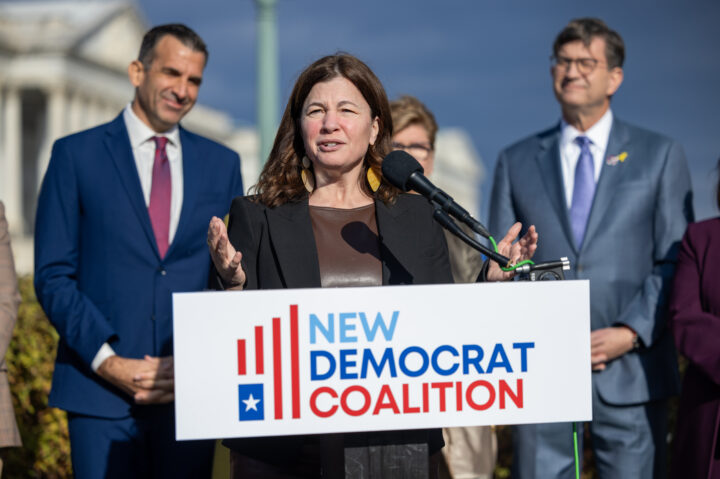
Rep. Kristen McDonald Rivet (D-MI) speaks to the press during a press conference for the New Democrat Coalition outside of the U.S. Capitol in Washington, DC on November 21, 2024. (Photo by Nathan Posner/Anadolu via Getty Images)
Rep. Kristen McDonald Rivet (D-MI), a Democrat representing a swing district in Michigan, condemned the state party for nominating an attorney who expressed support for Hezbollah for the University of Michigan Board of Regents, as well as other harassment and divisive tactics delegates targeted at pro-Israel candidates at the party convention last weekend.
She argued that such activity and decisions will ultimately help Republicans in the November midterm elections.
“What I saw on the MDP Convention floor is deeply troubling — for what it says about who we are, how we win, and whether we will be able to meet this urgent moment,” McDonald Rivet said on X on Tuesday, emphasizing that, coming from the only Trump-won district held by a Democrat in the state, she “know[s] how hard it is to win.”
She said that while she is “excited” to run alongside “many” of those nominated, “the Convention nominated others with extreme positions and records — like calling Tucker Carlson ‘a real one,’ Hezbollah leaders ‘martyrs,’ or amplifying Qasem Soleimani — that are out of step with my values and those of Democrats across our state.”
Her comments are a reference to Makled, who has run on an anti-Israel platform and had an endorsement from the SEIU labor union pulled over past social media posts expressing support for Hezbollah. Makled’s nomination ousted Jewish regent Jordan Acker, who was repeatedly harassed and had his home vandalized by anti-Israel demonstrators.
McDonald Rivet said she was also concerned that “too much of the behavior we saw on the floor is not acceptable.” Pro-Israel candidates and those supporting them, including a supporter of Acker and Rep. Haley Stevens (D-MI), faced aggressive boos at the party convention, to the extent that Abdul El-Sayed, the far-left Senate candidate who many of those vocal demonstrators are supporting, called out their behavior.
“We don’t name-call. We don’t belittle and bully. We don’t shout people down. We don’t make them feel unwelcome or unsafe based on who they are,” McDonald Rivet said. “We reject all forms of hate, including both antisemitism and Islamophobia.”
She said that the Democrats “will never beat MAGA by practicing their division.” She pointed to comments by Michigan Republicans celebrating the chaos and welcoming Jewish Democrats into the fold as proof that the events at the convention will “[make] it much, much harder for us to win back power this November” and make Republicans’ “jobs easier.”
“On Sunday, we saw a troubling step in the wrong direction. But it isn’t too late to course correct. Michigan Democrats, we can’t afford any less,” she concluded.
McDonald Rivet called for the Democratic Party to come together around a “unifying agenda” and to create spaces where everyone feels “respected, liked, and welcome.”
A spokesperson for Murphy said the senator's social media post was 'sarcasm'

Jemal Countess/Getty Images for Fair Share America
Sen. Chris Murphy (D-CT) speaks at the U.S. Capitol on April 10, 2025 in Washington, DC.
Sen. Chris Murphy (D-CT) on Monday appeared to cheer on the reported evasion by more than two dozen Iranian ships of the U.S. maritime blockade of the Strait of Hormuz.
The Connecticut Democrat, one of the most vocal critics of Israel in the Senate, responded on X with a one-word comment — “awesome” — to an unconfirmed report that at least 26 vessels belonging to the shadow fleet, which is overseen by the Islamic Revolutionary Guard Corps, had bypassed the blockade.
A spokesperson for Murphy clarified to Jewish Insider, “The tweet was sarcasm. Chris obviously thinks it’s terrible that Donald Trump continues to mishandle every aspect of a war he started but clearly has no strategy to end.”
Over the weekend, Murphy appeared at the Alex Soros-backed Global Progressive Summit in Barcelona, where he claimed that the U.S. was “in the middle of” a “totalitarian takeover.”
This post was updated at 9:25 a.m. ET on 4/21/2026 to add comment from Murphy’s office.
Two new polls suggest that the Jewish state still can rely on a sizable, if largely Republican, constituency of support

Jim Lo Scalzo/EPA/Bloomberg via Getty Images
President Donald Trump, right, and Benjamin Netanyahu, Israel's prime minister, during a news conference in the State Dining Room of the White House in Washington, DC, US, on Monday, Sept. 29, 2025.
Amid the downbeat assessment of Israel’s political standing in the U.S., two new polls that came out last week suggest that the Jewish state still can rely on a sizable, if largely Republican, constituency of support.
The biggest takeaway from these two new polls — one commissioned by NBC News and one conducted by the respected GOP firm Echelon Insights — is that Israel has become a partisan issue, with Democrats turning decidedly against the Jewish state while Republicans have become strongly supportive.
All told, the polls show the public evenly divided over Israel, with the splits largely along party, ideological and generational lines. The results indicate President Donald Trump’s embrace of the Jewish state has caused Democrats to take an instinctively more negative view — in a continuation of how politics has generally operated in the Trump era.
Echelon Insights, which surveyed 1,022 respondents from March 12-16, found 44% of respondents held a favorable view of Israel, while 38% held an unfavorable view. While Israel’s plus-6 net favorability score is nothing to write home about, the results are noticeably better than a recent Pew Research Center poll that drew outsized attention for finding Israel’s net favorability rating at a dismal minus-23 (37/60%).
The Echelon poll found support was highest for Israel among the most conservative voters, with 72% of “very conservative” voters viewing the Jewish state favorably, while 61% of “somewhat conservative” respondents said the same. Moderates broke evenly, with 40% viewing Israel favorably and 39% unfavorably.
But among “somewhat liberal” respondents, support for Israel dropped noticeably, with just 31% viewing the Jewish state favorably and 55% unfavorably. And among the “very liberal” voters, only 14% viewed Israel favorably and 70% unfavorably — a worse favorability rating than Iran and China.
The Echelon survey found the same general splits within both parties: Republicans under 50 were significantly less supportive of Israel than their older counterparts, with 44% viewing it favorably and 33% unfavorably. By contrast, 78% of Republicans over 50 gave Israel positive marks.
Similarly, there was a sizable minority of Democrats over 50 (33%) who viewed Israel favorably, compared to the smaller share of under-50 Democrats (17%) who said the same.
The NBC poll, conducted by SurveyMonkey between March 30-April 13, framed its question about Israel in a different way, asking respondents whether they were more sympathetic to Israelis or Palestinians. The poll found an even 50-50% split on the question.
The groups that were most sympathetic to Palestinians were Democrats (75% viewed Palestinians more favorably, 25% Israelis) and Gen Zers (74%/26%).
While Democrat Analilia Mejia comfortably won the special election to succeed Mikie Sherrill, Jewish voters swung to the right
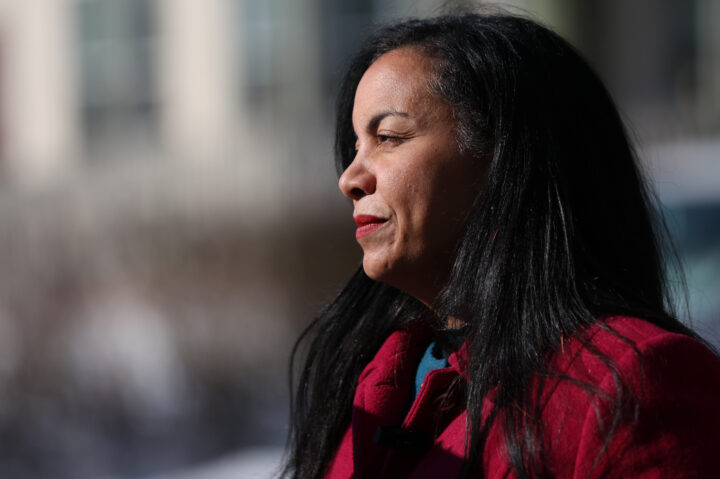
Heather Khalifa/Bloomberg via Getty Images
Analilia Mejia, US Democratic House candidate for New Jersey, speaks to members of the media outside of the Montclair Municipal Building on the first day of early voting in Montclair, New Jersey, US, on Thursday, Jan. 29, 2026.
Rep.-elect Analilia Mejia (D-NJ) cruised to victory in last Thursday’s special election for New Jersey’s 11th Congressional District, but the results showed notable defections among Jewish Democrats — an early warning sign for both the left-wing Mejia and her party.
Mejia ran significantly behind other recent Democratic candidates in two municipalities that have traditionally strongly favored Democrats — Livingston Township and Millburn Township — both areas with significant Jewish populations. In Millburn, Mejia lagged 22 percentage points behind former Vice President Kamala Harris’ performance in the 2024 presidential election, and 17 percentage points behind Harris in Livingston.
Dan Cassino, the director of the Fairleigh Dickinson University Poll, said that, given that Livingston favored Democrats by 34 percentage points but Mejia won it by just two, “you could count [that] as a 32-point underperformance.”
Joe Hathaway, the GOP nominee against Mejia, worked during his campaign to attract Jewish voters, casting himself as a moderate centrist and Mejia as an antisemitic extremist.
Jeff Grayzel, the deputy mayor of Morris Township who ran in the Democratic primary against Mejia, said that the special election presented an “actual Sophie’s choice” for Jewish Democrats.
“Some Jews surely voted for her because of their anger with President [Donald] Trump. But many Jewish Democrats I spoke to refused to support Mejia because of her genocide position,” Grayzel, who had hoped to rally support from Jewish voters across the district in the primary, said. Mejia accused the Jewish state of genocide shortly after the Oct. 7, 2023, Hamas attacks on Israel.
“So some Jewish Democrats voted for Hathaway, which was evidenced by the result in Livingston, and others simply stayed home,” Grayzel continued. “We will see from voter turnout data how many Jews actually sat out this election. Unfortunately, our voice is our vote, and declining to vote will only hurt the Jewish community in the long run.”
Jason Shames, the CEO of the Jewish Federation of Northern New Jersey, said “it’s disappointing to see someone representing New Jersey or any district in America who not only doesn’t fight antisemitism but seemingly aligns with those who delegitimize Israel. Her comments on Israel’s self defense to the horrific terror attack by Palestinians [are] alarming and should not be dismissed.”
Cassino said that while Mejia outperformed other Democrats who have run in this district, she “did slightly worse than we would have expected from a generic Democrat in the special election,” given that the environment strongly favored Democrats.
Cassino said that it’s a “reasonable hypothesis” that attacks on Mejia’s stance on Middle East policy drove Democrats in Millburn and Livingston to vote for Hathaway.
“I would be really cautious, though, about saying that her stance on Palestine, or any other issue, cost her any particular number of votes, because all of these numbers are conditional on turnout,” he added, noting that all of the voters who turned out for Mejia might not have turned out for a different Democratic candidate.
Cassino said that strategists are likely to read the results to mean that attacks on Mejia’s stance on Israel were effective.
“Maybe the most important thing here is that strategists — Democrats and Republicans alike — are going to look at these results and conclude that the attacks on Mejia worked, and ramp them up in November,” he added. “They’re also likely to try and use them against any candidate where they might plausibly stick. So, I hope voters liked those ads, because they’re going to be seeing a lot more of them.”
Micah Rasmussen, the director of the Rebovich Institute of New Jersey Politics at Rider University, said that the apparent protest votes in the Jewish community “could … matter in a different election,” but this time, “Mejia picked up other votes in their place.”
“A lot is being made about these 900 or so votes, and I want to be balanced about how I see them. Yes, they were certainly noticeable. Yes, you can never take any voting bloc for granted,” Rasmussen added. “But electoral coalitions do shift. What can’t be denied is that Mejia’s current margin of 19.5 percent is larger than any other candidate for federal or statewide office since [former Rep.] Rodney Frelinghuysen’s (D-NJ) 25.2 percent win over Mark Dunec in 2014.”
‘The guy that’s going to win the primary in Maine has a Nazi tattoo on his chest and now that’s no problem for a lot of voters. … That’s crazy,’ Fetterman told CNN
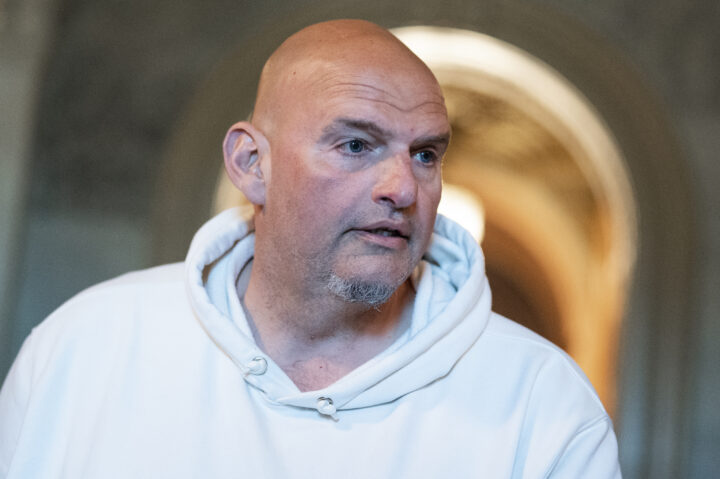
Tom Williams/CQ-Roll Call, Inc via Getty Images
Sen. John Fetterman (D-PA) is seen after the Senate luncheons in the U.S. Capitol on Tuesday, April 14, 2026.
Sen. John Fetterman (D-PA) said on Friday that the Democratic Party “absolutely” has an issue with rising antisemitism, calling out the party’s embrace of candidates including Graham Platner in Maine and Abdul El-Sayed in Michigan while criticizing the recent progressive push to cut off defensive aid to Israel.
The Pennsylvania senator made the comments after being asked on CNN’s “The Arena with Kasie Hunt” if he believed the Democratic Party has a problem with antisemitism. Fetterman argued that the growing support for both candidates in their respective primaries was indicative of a tolerance for antisemitism within the party.
He pointed to Platner surviving the controversy surrounding his Nazi tattoo and Jewish Insider’s reporting in recent days that the first-time candidate repeatedly praised Hamas’ tactics in a 2014 Reddit forum that shared video of the terrorist group killing several Israeli soldiers.
“I mean, the guy that’s going to win the primary in Maine has a Nazi tattoo on his chest and now that’s no problem for a lot of voters,” Fetterman said. “I don’t know why. That’s crazy. And now, I mean, we know he knows, he knew what that was. I mean, if you’re back over 12, 13 years, cheering about the death of Israeli soldiers, I mean, you clearly have a serious issue, and the left has a serious issue with antisemitism.”
“It was just released that he was praising and celebrating a video online where Hamas was beating and torturing Israeli soldiers to death,” Fetterman said, referring to Platner.
Fetterman also made note of El-Sayed’s lead in one recent primary poll despite his decision to campaign alongside antisemitic streamer Hasan Piker.
“The guy in Michigan, he’s leading now in that race, as my party becomes more and more hostile to Israel,” Fetterman said. “They’re just palling around someone like Hasan Piker, you know the guy that, absolutely, I mean, he absolutely is proud to cheer for Hamas, loves Hamas.”
“The Democrats are proud to stand with him and campaign with him,” he added. “Go ahead, try to win Pennsylvania and campaign around Hasan Piker, or saying, ‘Yeah, America deserved 9/11’ or ‘Hamas is 1,000% better than Israel’ or ‘I don’t care about the rapes and for all this other things.’ We have a serious problem with my party.”
Fetterman, one of most vocal pro-Israel Democrats in the Senate, told Hunt that Israel is “becoming more and more toxic for a Democrat to support,” pointing out that “80% of Democrats view Israel in a negative way.” He specifically condemned the uptick in progressive and far-left voices coming out against continued defensive aid to Israel.
“You have people like [Rep. Alexandria Ocasio-Cortez] voting against Iron Dome, the technology that prevents tens and tens of [thousands] of Israeli deaths from the rockets that those cowards fire at civilians,” he said.
Fetterman went on to criticize members of his party for opposing the war in Iran, saying that there were other Democrats who felt the same as him in supporting the effort but were not speaking out because doing so would be “politically toxic.”
“Every single Democrat has already been on record saying, ‘We can‘t ever allow Iran to acquire a nuclear bomb,’” Fetterman said, specifically naming former Vice President Kamala Harris and former Secretary of State Hillary Clinton and “everyone that’s run for president” who said “we can’t ever allow that to happen.”
“Then, [President Donald] Trump happened to do something about that to prevent that. That’s why I support that,” he continued. “I’m not the only Democrat who supports this, but I’m the only Democrat that’s willing to stand up and say it’s the right thing because I know how politically toxic it is as a Democrat to support this.”
Fetterman surmised that he is the “only Democrat … perhaps left in the entire Congress” who will say publicly that recent U.S. military action in Iran “was necessary” because doing so “contradicts every single thing that every Democrat has said” about how “we can’t ever allow Iran to acquire a nuclear bomb.”
Fetterman went on to criticize the Democratic lawmakers who voted for the recent war powers resolutions in the House and Senate, arguing that their opposition to the war has been “celebrated” by Iranian leadership and calling their response to the conflict “absurd.”
“Iran has celebrated this,” Fetterman said of the broad Democratic opposition. “A lot of people in my party and a lot of people in the media has turned Iran into the underdog. They’re like Rudy” — making a reference to the 1993 sports movie — “and putting them up on their shoulders and cheering for Iran at this point.”
Asked to respond to Sen. Elissa Slotkin’s (D-MI) statement that “being pro-Israel today is not about simply supporting the political or military agenda of Prime Minister [Benjamin] Netanyahu, just like being pro-American should not be equated with loyalty to President Trump,” Fetterman argued that her comments on her votes for Sen. Bernie Sanders’ (I-VT) measures on Thursday blocking military sales to Israel were similarly “absurd.”
“She’s a Democratic senator. Why aren’t you criticizing Iran? Why aren’t you criticizing Hamas or Hezbollah or these other kinds of forces? If you have to pick a side here, criticize that. So that’s where we are as a Democratic Party, and you’re going to vote against the kinds of critical aid that Israel requires and needs in order to beat back and destroy an organization like Hezbollah. Like I said, if you have to pick a side in a war, and clearly we have a side, I’m proud to stand on the side of Israel and America.”
Pressed on if he was still committed to being a Democrat given that his comments marked his harshest criticism yet of his party, Fetterman responded affirmatively.
“Well, of course. Yeah, I am absolutely committed to [remaining a] Democrat, absolutely,” Fetterman said. “I vote 91, 92 percent the Democratic line, but I am the only Democrat now that’s proud to consistently stand with Israel, and I’m going to do that, and that’s been very damaging with my standing as a Democrat.”
“If it’s what’s necessary, I’ll be the last Democrat standing with Israel through this,” he later added.
Fetterman also predicted that the war in Iran would not go on much longer, noting that “things kind of continue to wind down,” and said it’s “important to support” the U.S. securing an outcome in which Iranian leadership “surrenders.”
“I think these are very positive developments,” he said of Israel and the U.S. targeting Iran and their leading proxies.
“I think it seems like it’s going to wind down,” Fetterman said. “And we’re heading to a strong end at this point.”
Former ADL chief Abe Foxman: 'This is a calamity for the Democratic Party, if it will not be contained and stopped'

Andrew Harnik/Getty Images
(L-R) Senate Democratic leadership, Sens. Brian Schatz (D-HI), Bernie Sanders (I-VT), Elizabeth Warren (D-MA), Amy Klobuchar (D-MN), Senate Majority Leader Chuck Schumer (D-NY), Senate Majority Whip Richard Durbin (D-IL), Tammy Baldwin (D-WI), Cory Booker (D-NJ), Mark Warner (D-VA), Catherine Cortez Masto (D-NV), and Chris Murphy (D-CT), pose for a group photo in the U.S. Capitol on December 3, 2024 in Washington, DC.
The Democratic shift on Israel policy was on full, dramatic display on the Senate floor on Wednesday night as 40 of 47 Senate Democrats voted for at least one of two resolutions to block U.S. shipments of bulldozers and bombs to Israel.
The votes left many pro-Israel Democrats shocked and disillusioned — exemplified in the muted statements, if any, on the vote from key pro-Israel groups — and is being seen by some as the marker of a new era of Democratic policy on Israel, in which critics of Israel are firmly in the party mainstream.
“It’s yet another data point that the bipartisan consensus [in support of Israel] is, at least at the moment, no longer,” a former Biden administration official told Jewish Insider on Thursday. “Democrats think it’s politically advantageous to take these votes that would have been completely out-of-bounds just two-and-a-half years ago. … It’s deeply concerning if you care about the relationship, if you care about the security of [Israel]. But that’s the state of play at the moment, I think until or unless there’s an event that changes the trajectory.”
Abe Foxman, the former head of the Anti-Defamation League, said the vote highlights the “progressive socialist wing” of the Democratic Party’s increasing takeover. “This is a calamity for the Democratic Party, if it will not be contained and stopped,” Foxman told JI. “What’s also disturbing to me is that this litmus test is being first administered to every Jewish candidate.”
He added that the votes send a terrible message to U.S. allies beyond Israel that the U.S. can’t be relied upon.
Pro-Israel Democrats who spoke to JI said the votes came about as a combination of several factors: They served as a proxy for the war in Iran that nearly all Democrats oppose, but also were a signal of opposition to Israel’s operations in Lebanon, settler attacks and settlement expansion in the West Bank, the war in Gaza and — to a substantial degree — the Democratic enmity that has been growing for years toward Israeli Prime Minister Benjamin Netanyahu, his government and his alignment with President Donald Trump and Republicans.
And lawmakers are also responding to the growing progressive pressure, fueled by two years of imagery from the war in Gaza, amplified by social media platforms that boosted antisemitic content, that has changed the politics around Israel in a “really dramatic way” in the Democratic Party, the former Biden administration official said.
“Those [resolutions], at this moment in time, were just a proxy for real discomfort with the direction of the Trump-Netanyahu relationship in this war, which is not the right reason to vote for these,” another former Biden administration official told JI. “I understand the [vote to block] bulldozers at this moment in time. [Withholding] the munitions — I think it’s really, really troubling.”
Sen. Tim Kaine (D-VA), an early supporter of efforts to block weapons sales to Israel, said that the growing opposition can’t be blamed solely on Netanyahu. “I also think it’s watching how the weapons are used,” Kaine told reporters. “I think the observation of how the weapons are used is probably a little bit more the reason that the vote total is going up than a feeling about the domestic politics of Israel.”
Some pro-Israel Democrats say that the impact and meaning of the votes shouldn’t be overstated, and that there remains a sizable pro-Israel Democratic contingent, even including some of the lawmakers who voted for the resolutions on Wednesday.
“There were pro-Israel senators, and senators who are close partners and allies of the Jewish community, on both sides of this vote last night,” Halie Soifer, the CEO of the Jewish Democratic Council of America, said. “This didn’t occur in a vacuum, and it’s not necessarily driven by anti-Israel, and certainly not antisemitic, views. It also doesn’t necessarily represent a wholesale shift in the Democratic Party. It’s a snapshot of where we are in this moment as it relates to these particular arms sales and this particular Israeli government and its policies. But I have no doubt that there’s the chance that that will change in the future.”
Soifer said that she and JDCA didn’t support the resolutions, but emphasized that some of the Democrats who voted for the resolutions said in their statements that they remain strong supporters of Israel. And she said JDCA doesn’t view the votes as “inherently anti-Israel” or necessarily an expression of alignment with the far left.
She called the vote on the bulldozers, which received 40 supporters, a particularly potent “symbolic message” — many Democrats associate the machines with the destruction of Palestinian homes and expansion of settlements in the West Bank. But she said it was something of an “anomaly” as compared to previous efforts to block systems such as bomb guidance kits.
“It’s a challenging time where both things are true at once: You do have an increased number of Democrats who are supporting these [resolutions], and you also still continue to have a majority of Democrats who support the U.S.-Israel security relationship,” Soifer said.
A common refrain in conversations with those in the Democratic pro-Israel world after the votes — and even before then — was that the end of Netanyahu’s premiership would provide a critical opening and opportunity to start rebuilding support for Israel among Democrats.
Kaine said that a change in the Israeli government would lead lawmakers to step back and analyze the potential implications, but said it wouldn’t necessarily bring sweeping changes. “I don’t think the 40 [Democrats voting for the resolutions] is baked in, I also don’t think it will immediately change.”
But a Netanyahu defeat in this year’s Israeli elections is far from a sure thing. So what happens if Netanyahu wins again? “I think it will be very difficult for Democrats to hold any center on support for Israel,” one former Biden administration official said.
The other former Biden administration official said that the intense anti-Israel pressure on Democrats would likely fade if Middle East policy issues are out of the headlines on a day-to-day basis. They further argued that the 2028 primaries will be an “inflection point,” on both sides of the aisle.
And they said that the Jewish community, particularly the non-Orthodox community, needs to be more organized and active locally and on a grassroots level in advocating for their representatives to be supportive of the U.S.-Israel relationship.
Foxman said he hopes to see more Democratic lawmakers — naming Sen. Jacky Rosen (D-NV) specifically — standing up directly to the anti-Israel wing of the party, just as Sen. Ted Cruz (R-TX) has spoken out against antisemitism on the right.
With opposition to weapons systems for Israel apparently firmly within the mainstream, we wrote earlier this week about the emerging progressive push to cut off U.S. support for Israel’s missile-defense systems as well.
Asked whether he takes a similar view, Sen. Bernie Sanders (I-VT), the lead driver of the Senate votes, did not directly respond. “Let’s take one thing at a time. Right now, I think we made progress yesterday,” he told JI.
Kaine took a firmer stance in support of missile-defense aid, calling those who want to cut it off “a tiny minority,” especially in the Senate. He noted that no Democrats have offered similar resolutions to block defensive systems, and that other weapons sales to Israel have gone entirely unchallenged — though he acknowledged that the distinction between offensive and defensive weapons can be fuzzy at times.
One of the former Biden administration officials warned that opposing missile-defense support is a “totally unproductive, terrible” policy — not just for Israel, but also sending a message to allies around the world that the U.S. can’t be relied upon to follow through for its partners.
The 41 signatories to the letter — including three Republicans and 38 Democrats — mark the highest number of lawmakers to make such a request

Emily Elconin/Getty Images
Law enforcement respond near Temple Israel following reports of an active shooter on March 12, 2026 in West Bloomfield, Mich.
Saying that funding to protect synagogues and other religious-based nonprofits “has not kept pace to meet the moment,” 41 senators — almost entirely Democrats — wrote to leaders of the Senate Appropriations Committee urging members to provide $750 million in funding for the Nonprofit Security Grant Program in 2027.
That figure amounts to a substantial increase in funding over current levels, as well as over Senate lawmakers’ request from last year.
The program was funded in 2025 at $274.5 million, which has not yet been disbursed, and the still-stalled 2026 Homeland Security funding bill includes $300 million for the program. Yet, in 2024, the program fulfilled just 43% of requests, even with additional funding provided through a national security supplemental bill that year. Jewish and interfaith groups, as well as House lawmakers, have been pushing for up to $1 billion for the program.
Last year, 33 senators requested $500 million for the program, a record-high request at the time. This year’s request represents a new high-water mark, both in terms of the funding requested and the number of lawmakers who signed the bipartisan letter in support.
“The threat of violence is unfortunately increasing at places of worship across our country at alarming rates. In the past few years, there has been an increase in hoax bomb threats and attacks against houses of worship that are intended to interrupt services and intimidate worshippers. In particular, there has been an increase in antisemitic incidents across the country following the October 7th attack on Israel,” the senators wrote. “Nationwide, there have been countless acts of violence against religious communities.”
The lawmakers also urged the Appropriations Committee to “maintain separate line-items for this program,” amid reports that the administration has been pushing to convert Federal Emergency Management Agency grant programs, under which NSGP falls, into a broad state-by-state block grant.
The administration also called for cuts to non-emergency FEMA grants, a category that includes NSGP, without making any specific line-item request for the NSGP.
“[F]unding has not kept pace to meet the moment,” the lawmakers added, highlighting a litany of attacks on religious institutions and the funding shortages in 2024.
The letter was led by Sens. Kirsten Gillibrand (D-NY), James Lankford (R-OK), Gary Peters (D-MI) and Jacky Rosen (D-NV). Only two Republicans other than Lankford joined the effort: Sens. Kevin Cramer (R-ND) and Josh Hawley (R-MO).
“As we continue to work with Congress to secure Jewish communities, the bipartisan consensus in the Senate around $750 million for the Nonprofit Security Grant Program is a monumental step toward our community’s $1 billion goal,” Eric Fingerhut, the CEO of the Jewish Federations of North America, said. “At a time of rising antisemitism and an escalating security crisis facing vulnerable communities across the country, demand continues to far outpace available funding.”
Fingerhut said that JFNA plans to bring Jewish activists from across the country to lobby Congress on the issue next month “and urge them to act with urgency and resolve to ensure at-risk institutions have the resources they need before the next incident, not after.”
Lauren Wolman, the Anti-Defamation League’s senior director of government relations and strategy, said, “At a time of sustained and evolving threats, this program remains a critical lifeline for houses of worship and nonprofit institutions working to protect their communities. Demand continues to far outpace available resources, and we urge Congress to ensure funding levels reflect the reality on the ground.”
Nathan Diament, the executive director of the Orthodox Union Advocacy Center, said, “The need for increased NSGP funding remains critical. We are thankful to the large bipartisan group of Senators who signed onto this letter.”
“OU Advocacy will keep pressing on all fronts to deliver the funding our Shuls and schools need to stay safe,” Diament continued.
All but one of the four Democrats who had opposed the previous war powers effort flipped their votes in support
Graeme Sloan/Sipa via AP
The U.S. Capitol Building at sunset in Washington, D.C., on Saturday, March 6, 2021.
The House narrowly voted to block a Democratic resolution to force an end to the war in Iran by a vote of 214-213-1, with all but one of the four Democrats who opposed a similar effort in March changing their votes to support it on Thursday.
Rep. Greg Meeks (D-NY), the top Democrat on the House Foreign Affairs Committee, had held off on calling a vote on the resolution in hopes that he would be able to win over enough Democratic holdouts and Republican defectors to pass the legislation.
Reps. Greg Landsman (D-OH), Juan Vargas (D-CA) and Henry Cuellar (D-TX), who voted last month against a similar resolution, flipped their votes to support the war powers effort. But Rep. Jared Golden (D-ME), who is retiring at the end of his term, voted no again.
On the Republican side, Rep. Warren Davidson (R-OH), who voted for the war powers resolution last time, switched his vote to “present.” Rep. Thomas Massie (R-KY) was the only Republican who voted for the resolution.
A small number of Republicans who have expressed skepticism about the war effort and could have been potential swing votes, including Reps. Lauren Boebert (R-CO) and Nancy Mace (R-SC), did not vote.
Golden said in a statement that the war powers resolution would “weaken our hand” in negotiations with Iran.
“I believe we must maintain a strong negotiation position over Iran’s nuclear program, freedom of movement in the international waters at the Strait of Hormuz, and how to achieve a durable peace between our two nations,” Golden said in a statement.
Forty Senate Democrats voted to block sales of bulldozers to Israel, while 36 voted to block the sales of 1,000-pound bombs
Andrew Harnik/Getty Images
(L-R) Senate Democratic leadership, Sens. Brian Schatz (D-HI), Bernie Sanders (I-VT), Elizabeth Warren (D-MA), Amy Klobuchar (D-MN), Senate Majority Leader Chuck Schumer (D-NY), Senate Majority Whip Richard Durbin (D-IL), Tammy Baldwin (D-WI), Cory Booker (D-NJ), Mark Warner (D-VA), Catherine Cortez Masto (D-NV), and Chris Murphy (D-CT), pose for a group photo in the U.S. Capitol on December 3, 2024 in Washington, DC.
Most of the Democrats in the Senate — 40 in total, including some traditionally pro-Israel lawmakers — voted on Wednesday evening for a measure led by Sen. Bernie Sanders (I-VT) that aimed to block sales of bulldozers to Israel, with 36 of them also voting to advance a second Sanders-backed resolution to block sales of thousands of 1,000-pound bombs.
The votes are a striking statement of the extent to which anti-Israel sentiment has become mainstream in the Democratic Party. Just seven members of the Democratic caucus voted against both measures.
Twenty-seven Democrats supported at least one of two similar measures in July 2025, which was a record at that time.
After having opposed previous similar efforts, Sens. Mark Kelly (D-AZ), Ruben Gallego (D-AZ), Adam Schiff (D-CA), Ron Wyden (D-OR), Maria Cantwell (D-WA), Gary Peters (D-MI), Mark Warner (D-VA), Cory Booker (D-NJ), Elissa Slotkin (D-MI), John Hickenlooper (D-CO), Michael Bennet (D-CO), Alex Padilla (D-CA) and Maggie Hassan (D-NH) all flipped and voted in favor of Sanders’ latest resolutions.
Warner and Peters, along with Sens. Jack Reed (D-RI) and Sheldon Whitehouse (D-RI), voted to advance the resolution to block the bulldozer sale but against advancing the one on bombs.
Sens. Angela Alsobrooks (D-MD), Tammy Baldwin (D-WI), Lisa Blunt Rochester (D-DE), Tammy Duckworth (D-IL), Dick Durbin (D-IL), Martin Heinrich (D-NM), Mazie Hirono (D-HI), Tim Kaine (D-VA), Andy Kim (D-NJ), Angus King (I-ME), Amy Klobuchar (D-MN), Ben Ray Lujan (D-NM), Ed Markey (D-MA), Jeff Merkley (D-OR), Chris Murphy (D-CT), Patty Murray (D-WA), Jon Ossoff (D-GA), Brian Schatz (D-HI), Jeanne Shaheen (D-NH), Tina Smith (D-MN), Chris Van Hollen (D-MD), Raphael Warnock (D-GA), Elizabeth Warren (D-MA) and Peter Welch (D-VT), all of whom had supported at least one past effort to block arms sales, voted for both measures on Wednesday.
Every Senate Democrat rumored to have presidential ambitions voted to block both arms sales.
Kelly, a moderate Democrat and potential presidential candidate, insisted in a Senate floor speech that he “cannot and will not abandon Israel,” which is “one of our closest partners. They have a right to defend themselves, and I will always support Israel’s right to exist as a successful and prosperous nation.”
But, he said, “Supporting a partner doesn’t mean that we don’t ask tough questions. It doesn’t mean that we always agree. Our support for our allies must always be about what makes us stronger and safer, and we can look at what’s happening in the region right now and understand that this is not business as usual, and it is not making us safer,” referring to the war in Iran, Israel’s war against Hezbollah in Lebanon and violence in the West Bank.
He said that the weapons sales will not “bring us closer to peace and security,” but that he remains “confident” that Israel has the ability to protect its people and that “we’ll be able to do so in the future with our partnership and I will always support that.”
Schiff, who is Jewish and generally a reliable supporter of Israel, and Padilla released a joint statement saying that they voted for the resolutions “to oppose the U.S. sale of specific weapons and equipment to Israel which might be used in Iran or to facilitate further settlement activity, which we believe undermine Israel’s long-term security and our own.”
“We strongly support Israel’s right to defend itself and the right of the people of Israel to live in peace and prosperity in a Jewish state,” they said. “We oppose actions that further deepen the United States in an unauthorized conflict in Iran — one with no clear strategy, no legal authority, and no defined end.”
They said they also intend to oppose any supplemental funding for the war.
Slotkin said she would “continue to assess U.S.-funded offensive weapons to Israel on a case-by-case basis” but would continue to support missile-defense systems. She said that she had “struggled with these [measures] as much as any vote since I joined Congress.”
“My entire life, I have been — and continue to be — a strong supporter of a Jewish and democratic State of Israel,” she said. “The people of Israel, like all people throughout the region, deserve long-term security and peace. But being pro-Israel today is not about simply supporting the political or military agenda of Prime Minister Netanyahu, just like being pro-American should not be equated with loyalty to President Trump.”
Slotkin said she is also “deeply skeptical” of providing additional funding for the war in Iran.
Warner, the top Democrat on the Senate Intelligence Committee, told Jewish Insider in a statement that he did not want to provide equipment to enable displacements of Palestinians in the West Bank or “escalatory military actions in southern Lebanon,” which he called contrary to both Israel and the United States’ interests.
“The United States can and must hold two truths at once: we can stand firmly with Israel’s security while also speaking out against actions that jeopardize peace and stability in the region,” Warner said. “Israel has an unequivocal right to defend itself, but it does not have the right to unilaterally displace Palestinians in the West Bank and torpedo any chance of ever achieving a two-state solution.”
“The United States should ensure that Israel has the tools it needs to protect its people and deter its adversaries while opposing transfers of equipment that are used to demolish homes, expand settlements, and further entrench a reality that weakens the already fragile prospects for a durable peace,” he continued.
Sanders, who has called for the U.S. to “end US military aid to the extremist Netanyahu government,” had described these votes as a referendum on the war in Iran, as well as Israel’s attacks on Hezbollah in Lebanon and violence by settlers and Israeli military forces in the West Bank.
J Street, the progressive Israel advocacy group that last week called for the U.S. to end financial support for Israel’s missile-defense systems after the current U.S.-Israel memorandum of understanding expires in 2028, supported the Sanders-led resolutions.
Senate Minority Leader Chuck Schumer (D-NY) and Sens. Kirsten Gillibrand (D-NY), Jacky Rosen (D-NV), Catherine Cortez Masto (D-NV), Richard Blumenthal (D-CT), John Fetterman (D-PA) and Chris Coons (D-DE) were the only Democrats to oppose both resolutions.
Gillibrand, who this week introduced a war powers resolution to halt the war in Iran, told JI on Wednesday morning that she sees the resolutions on weapons sales to Israel and the resolutions on the Iran war “very differently.”
“I oppose the war in Iran, but I do not believe we should leave an ally [Israel] who is being attacked without support,” Gillibrand said during a press conference.
AIPAC said in a statement, “We appreciate the senators who opposed these misguided and dangerous resolutions. Letting our democratic ally buy American-made equipment to protect its families from Iran and terrorist groups is clearly in America’s national interest. Congress must continue to stand with Israel as it confronts multiple ongoing threats.”
Even after their fourth failed attempt, Democrats say they intend to continue forcing such votes weekly
Kevin Carter/Getty Images
The U.S. Capitol Building is seen at sunset on May 31, 2025 in Washington, DC.
An effort by Senate Democrats to force an end to the war in Iran was again blocked by Republicans on Wednesday, the fourth such failed attempt mounted by Senate Democrats since the war began in late February.
The measure failed by a vote of 52-47, with all Democrats except Sen. John Fetterman (D-PA) voting for a procedural motion on the war powers resolution, and all Republicans except Sen. Rand Paul (R-KY) voting against it. Sen. Jim Justice (R-WV) was not present for the vote.
Nevertheless, Democrats intend to continue their efforts. They have nine such resolutions that have been filed, and top Senate Democrats said this week they intend to continue forcing such votes weekly, in the hopes that more Republicans will change their votes as the war drags on.
Some Republicans have begun to express hesitation about the war, and top members of the caucus have said they hope it comes to an end soon. But thus far most have not been willing to openly break with President Donald Trump on the effort.
Separately, Sen. Bernie Sanders (I-VT) plans to call up a vote later on Wednesday on a pair of measures to block sales of bombs and bulldozers to Israel, which Sanders has also framed as referenda on the war in Iran. Twenty-seven Democrats have previously voted for such resolutions, and supporters of the effort expect that number to increase this time.
But at least one lawmaker, Sen. Kirsten Gillibrand (D-NY), who introduced a war powers resolution on Iran this week, for future consideration, said that she views the two issues differently.
“I think of them very differently,” Gillibrand told Jewish Insider during a virtual press conference on Wednesday. “I oppose the war in Iran, but I do not believe we should leave an ally who is being attacked without support,” she said, referring to Israel.
Omar is finding common cause with Greene over their anti-Israel views, even though the Republican wanted her deported from the country

Kevin Dietsch/Getty Images
Rep. Ilhan Omar (D-MN) speaks at a press conference on committee assignments for the 118th U.S. Congress, at the U.S. Capitol Building on January 25, 2023, in Washington, D.C.
Rep. Ilhan Omar (D-MN) in an interview on the “Pod Save America” podcast praised former Rep. Marjorie Taylor Greene (R-GA) — once a vocal Omar foe who called for the congresswoman’s deportation while they were both in the House — and far-right influencer Candace Owens over the pair’s break with President Donald Trump.
All three have faced repeated accusations of antisemitism. Owens, in particular, has become a propagator of rampant and often bizarre conspiracy theories, including becoming one of the most prominent antisemitic voices on the right. Greene and Owens have broken with Trump over his continued support for Israel and the war in Iran, among other issues.
“I think as Americans, it is really important for us to work together for the preservation of everything that is good in our country, and to support leaders that we can trust to safeguard what is good of our country,” Omar said, in response to a clip of Greene disavowing Trump on conspiracy theorist Alex Jones’ podcast. “And I believe the thing that has been very fascinating, especially about Marjorie and Candace, is that they are not just coming out — like the other ones that you’d mentioned — where they’re saying, ‘This action is wrong,’ right? They’re saying, ‘I am done with you.’”
“We should give them credit for that, the fact that they’ve had this wake up call to finally seeing this con man, this corrupt, chaotic man for what he is,” Omar continued. “I think is an important thing for us to put our arms around and say, ‘Yes, and now let’s figure out, how do we save our country from the disaster that this man is creating?’”
While Omar is not the first Democrat to praise Greene or to suggest that Democrats should be partnering with her, her comments are particularly notable in light of the enmity between the two women while they served in the House together.
Greene, in 2024, sought to censure Omar for allegedly working as a foreign agent on behalf of Somalia, in what Greene described as “treasonous tendencies” in violation of Omar’s oath of office.
“I would love to have her expelled. I’d love to have her deported,” Greene said at the time. “Unfortunately, I don’t think we have the votes to do that.”
Asked about the past opposition that she faced from Greene and others, Omar brushed it off as a product of their “brainwashed” cult-like devotion to Trump and his movement.
“I’m glad, as my fellow Americans, that they understand that, that they want us to chart a new chapter in America,” Omar continued.
Omar said she had approached Greene on the House floor before Greene resigned from Congress to thank her for her advocacy against Israel and opposition to U.S. support for Israel.
Meeks said he will likely bring up a war powers resolution for a vote this week, and is waiting to see if several of his colleagues will flip their votes in favor

Tom Williams/CQ-Roll Call, Inc via Getty Images
Rep. Gregory Meeks (D-NY)
Rep. Greg Meeks (D-NY) said he’s aiming to call up a war powers resolution this week to force an end to the war in Iran, but that he’s still working to lock down the support of a few wavering Democratic and Republican lawmakers whose support will be necessary to pass the legislation.
Meeks had considered calling up the legislation before Congress’ two-week recess, but ultimately declined to do so, saying he was waiting until the legislation could pass and he didn’t yet have the votes.
“I’m probably going to do war powers this week. I’m still working [on] it. I’m very close,” Meeks told Jewish Insider. “I’ve got just about all of the Democrats — just about — and [some] Republicans. And I have some that are contemplating, but I don’t know what they’re going to do.”
He said that there are a few lawmakers who voted against a previous war powers effort in the House who are talking to him and considering now voting in favor, but haven’t disclosed their final plans to him yet.
Meeks said that he thinks he will get “just about every Democrat … maybe the exception of one.”
Of the four Democrats who voted against a previous war powers effort, two — Reps. Greg Landsman (D-OH) and Henry Cuellar (D-TX) — said that they would vote for the next war powers resolution, and Cuellar affirmed those plans to JI on Tuesday. Reps. Juan Vargas (D-CA) and Jared Golden (D-ME) haven’t announced their plans yet.
Vargas told JI on Tuesday that he has made up his mind, but declined to preview how he plans to vote. Golden, who is not running for reelection, could be the hardest of the four to flip.
On the Republican side, Rep. Lauren Boebert (R-CO), who said she would oppose a supplemental funding request for the war, declined to comment on how she would vote, saying she isn’t currently focused on a potential war powers resolution.
Meeks said that the current ceasefire makes it an important time for Congress to weigh in, and that he may ultimately bring the resolution forward for a vote even if he’s not sure if there are sufficient votes to pass it.
“We don’t know what the president may do or may not do afterwards,” Meeks explained. “I’ve been waiting to get commitments … it may be time for them to get on one side of the fence or the other, as opposed to staying on the fence. I may just do it. I haven’t decided yet, but I may just do it.”
Even if the resolution passes the House, it currently would not pass the Senate and would almost certainly be vetoed by the president. But Meeks argued that passing the resolution in the House would send an important message to the administration anyway.
“I think this is giving a message to the president — and it becomes really important, because the 60 days will be up soon, and they have to come to Congress for the money,” Meeks said, referring to a 60-day deadline for the operation cease or to come to Congress for authorization under the War Powers Act. “And it lets the president know that unless he comes to Congress and lets us know what the plan is, he’s not going to get the money.”
Rep. Don Bacon (R-NE), who has said the administration hasn’t properly articulated its plans and goals for the war to Congress, told reporters he will “support continued operations until we get this job done, or it’s clear to me it’s fruitless.”
“I support the military campaign. I think some of the commentary has not been helpful from the White House, but yes, I think the military has done a great job,” Bacon said, pointing to the destruction of Iran’s leadership and military capabilities.
He said that an Authorization for Use of Military Force would be legally required to continue the war beyond the 60-day deadline — a point that other Republicans have disputed — but said that he would be “inclined to support” such an authorization.
“Maybe not a blanket one, but yes, I think we should finish the job,” Bacon said. “These guys have been our enemy. These guys have been our enemy, they’ve killed young [U.S. troops].”
Jewish Insider’s Washington reporter Matthew Shea contributed reporting.
The question facing the Middle East working group’s members is whether they will actually be able to agree on anything — or if the group is simply a way to push the issue off until 2028
Paul Holston/AP
People stand outside the Democratic National Committee headquarters in Washington, June 14, 2016.
At last week’s Democratic National Committee meeting in New Orleans, two resolutions concerning Israel — including one that referred to Israel’s actions as a genocide — were tabled, and punted to a working group tasked with building consensus among Democrats on Middle East-related issues.
At a time when Democrats appear deeply divided about how to address the U.S.-Israel relationship and Middle East policy more broadly, that’s a tall order. Never mind that the members of the working group include both strongly pro-Israel and staunchly anti-Israel voices, all tasked with working to further a message that will resonate with as many party members as possible.
“As much as this issue is potentially divisive, I think it’s actually really the purview of a smaller group of activists who want something really radical. I think most Democrats are within what the Democratic platform of 2024 is, and that’s two peoples living in two states, side-by-side in peace,” Adam Goldwyn, a working group member who serves as chair of the North Dakota Democratic Party, told Jewish Insider.
The Democratic Party’s 2024 platform, authored in the midst of Israel’s war in Gaza and the simultaneous hostage crisis, reflected former President Joe Biden’s support for Israel. But rank-and-file Democrats have shifted away from Israel since then. A recent Pew Research Center poll showed that 80% of Democrats and Democratic-leaning independents have an unfavorable view of Israel, an increase from 69% one year ago, and a growing cadre of Democratic candidates and activists have targeted the pro-Israel group AIPAC as a toxic brand that is not welcome in Democratic politics.
Even though the DNC is not tasked with rewriting the party platform until 2028, the party’s biannual meetings present opportunities for activists to submit resolutions on any number of topics. Following Democrats’ 2024 defeat, anti-Israel activists — including two who sit on the working group — have put forward resolutions that would attempt to dramatically move the party’s public positioning to the left.
One, which called for an arms embargo on Israel, was voted down at the party’s summer meeting in August 2025. Another, which criticized AIPAC’s involvement in Democratic primaries, failed to advance at the meeting in New Orleans last week. Allison Minnerly, a DNC member from Florida who authored both of those resolutions, sits on the working group. Another resolution considered last week, which referred to Israel’s actions as a genocide and was written by working group member Joseph Salas, was sent back to the working group for consideration.
The question facing the group’s members is whether they will actually be able to agree on anything — or if the group is simply a way to push the issue off until 2028, when the party platform is again up for debate. It would not be the first bureaucratic Band-Aid applied to paper over an increasingly fraught political debate.
“Both young voters who consider themselves vigorously pro-Palestinian, and Jewish voters, who are one of the most loyal groups in the Democratic Party, are not going anywhere,” said Andrew Lachman, a member of the working group who was previously the president of California Jewish Democrats. “Anyone who wants to take an approach of trying to shout one or the other out of the room, I think it’s bad politics. It’s bad for the party, and it’s an unrealistic expectation.”
“We are working within the framework of the Democratic platform as it is now, so anything which attempts to radically rewrite where the party has been is not something that I personally feel is appropriate,” said Andrew Lachman, a member of the working group who was previously the president of California Jewish Democrats.
Lachman said he recognized “that the conversation has shifted a little bit in the last couple of years.” But, he added, the party must still be able to find common ground among party members who hold different views on the issue.
“Both young voters who consider themselves vigorously pro-Palestinian, and Jewish voters, who are one of the most loyal groups in the Democratic Party, are not going anywhere,” said Lachman. “Anyone who wants to take an approach of trying to shout one or the other out of the room, I think it’s bad politics. It’s bad for the party, and it’s an unrealistic expectation.”
DNC Chair Ken Martin created the working group last August, amid controversy surrounding the failed arms embargo resolution. He had put forth his own resolution, which was more balanced, but withdrew it and opted instead to task a group of party activists with litigating the issue.
“I feel like we’ve been a little rudderless,” Steph Newton, an Oregon Democrat who was appointed co-chair of the group, told JI on Friday after the group met in New Orleans. “I’m taking it seriously. I want my kids to be Democrats. I want this party to be safe for my kids in the future.”
“There is a divide in our party on this issue. This is a moment that calls for shared dialogue and calls for shared advocacy,” Martin said in August. He called on the task force “of stakeholders on all sides of this to continue to have the conversation, to work through this, and bring solutions back to our party.”
Steph Newton, an Oregon Democrat who was appointed co-chair of the group, drafted a charter for the working group that the body is now editing ahead of its next planned meeting later this month. The group was “convened to support the Democratic Party in advancing a just, secure, and lasting peace in the Middle East, while strengthening internal cohesion across perspectives within the Democratic coalition,” the draft charter states, according to a copy shared with JI.
“I feel like we’ve been a little rudderless,” Newton told JI on Friday after the group met in New Orleans. “I’m taking it seriously. I want my kids to be Democrats. I want this party to be safe for my kids in the future.”
She expressed frustration at working group members who had submitted their own resolutions ahead of last week’s meeting. Newton’s goal is for the group to be able to come up with some kind of compromise language that they can all get behind.
“We got agreement from folks. We said, ‘Hey, it wasn’t cool that you guys went off and did something like this and just submitted something. You should have come to the group,’” said Newton, who also leads the Oregon Democratic Party’s Jewish caucus. “The next thing that’s going to be coming out of this is going to be coming from the working group.”
Her co-chair on the working group is Shad Murib, the chair of the Colorado Democratic Party. Other members include longtime pro-Palestinian activist James Zogby and Deborah Cunningham-Skurnik, a regional director in the California Democratic Party.
What the working group members can agree on is the shared goal of electing Democrats. A DNC spokesperson told JI that this is the lens through which the working group views its mandate: winning elections.
“I think certainly there are some people for whom the message is more important than the election,” said Goldwyn, the North Dakota Democrat. “But I think that’s not where most Americans and most DNC members and most voters are.”
Angie Craig calls on Minnesota Democrats to investigate antisemitism ahead of state party convention
Delegates are expected to take up divisive anti-Israel resolutions at the convention being held next month
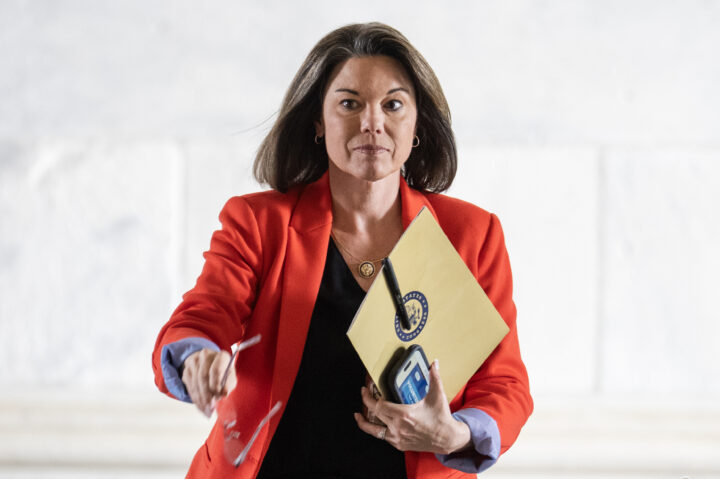
Tom Williams/CQ-Roll Call, Inc via Getty Images
Rep. Angie Craig (D-MN) arrives for a vote in the U.S. Capitol on Thursday, March 26, 2026.
The Senate campaign of Rep. Angie Craig (D-MN) is calling on Minnesota’s Democratic Party to launch a formal investigation into a series of alleged instances of antisemitic activity among delegates in the lead-up to its state convention being held at the end of next month.
In a letter sent last week to Richard Carlbom, chair of Minnesota’s Democratic-Farmer-Labor Party, Craig’s campaign wrote that one of its staffers had received a threatening anonymous phone call last month from a person “believed to be a delegate” who used an ethnic slur for Jews and said that the congresswoman “takes dirty Jewish money.”
The letter, shared exclusively with Jewish Insider, also cited a local DFL organizing convention in late March at which an unnamed delegate allegedly said that “we should nuke” Israel, among other examples of extremist violent rhetoric.
Mara Kunin, Craig’s campaign manager, said in the letter to state party leadership that such “incidents should be investigated promptly and that the DFL should take appropriate action and make clear that antisemitism in addition to other forms of hate will not be tolerated in our party.”
“Hate in all forms must be called out, whether it comes from the right or the left,” Kunin wrote. “We hope this serves as a necessary wake-up call for the DFL. We urge prompt and decisive action — action that allows the DFL to live up to our shared goal of building a big-tent party rooted in the principles of respect, dignity and integrity.”
In a statement shared with JI, Carlbom said that the DFL “condemns antisemitism and harassment in all forms without reservation,” and called the incidents raised by Craig’s team “disgusting and wrong, full stop.”
“We have responded directly to the Craig campaign, connected them to our Code of Conduct Committee, and encouraged those affected to file a police report,” he continued. “We will enforce our Code of Conduct and hold every leader and member to the standard our party demands. That work is happening and it won’t stop.”
The letter comes as Jewish and pro-Israel Democrats have voiced concerns about growing hostility toward Israel that has overlapped with a creeping extremism among some high-profile party influencers who have gained prominence espousing antisemitic rhetoric.
In Michigan’s Senate race, for example, Hasan Piker, an antisemitic streamer who has praised Hamas, has recently emerged as a flash point in a broader debate about whether Democratic candidates should appear with him publicly or join his show.
The issues raised by Craig’s campaign also dovetail with an uptick in anti-Israel sentiment during state and national party conventions around the country. Last week, at the Democratic National Committee’s meeting in New Orleans, party activists voted down one controversial resolution that criticized AIPAC’s “undue influence” in primary elections, while kicking two other measures to a Middle East working group.
Similar efforts are now poised for consideration at several state conventions in the coming months, including a series of new resolutions introduced by Democratic activists in Texas seeking to formally condemn Israel for alleged genocide while labeling pro-Israel political activity as “foreign interference in U.S. elections.”
In Minnesota, where Craig is facing off against Lt. Gov. Peggy Flanagan for the DFL endorsement, the party’s convention in late May is expected to feature some divisive resolutions related to Israel as in past years, according to local Jewish community activists familiar with the ongoing preparations.
During a recent local convention among several that take place before the statewide meeting, for instance, one new resolution advocated for removing language from the DFL’s official platform recognizing “Israel’s right to exist within secure borders, Palestinian rights to self-determination, and continued peace efforts in the Middle East.”
“Israel with the full support & shielding of the U.S. Government has conducted an intensification of genocide & ethnic cleansing in the past 2+ years, murdering more than 75,000 Palestinians since October 2023,” the resolution states. “The DFL party cannot claim any sort of morality while providing support to a state that’s founded on and committed to ongoing occupation, apartheid, and genocide. The two-state solution has long been an illusion, and so-called ‘peace’ without justice is not worth supporting.”
The DFL did not return a request for confirmation about the status of the resolution and if it would be taken up at the state convention in its current form.
Manny Houle, a Democratic pro-Israel strategist based in Minnesota, said it was “highly unlikely this divisive verbiage makes it as is to the state ballot at the end of May,” noting “there is an entire other round of editing when it comes to resolutions and most of the greatly divisive platforms are not getting the statewide support needed to make the ballot.”
“However, some sort of floor petition resolution is likely,” he told JI. “In addition there likely will be a resolution, if not multiple, about Middle East peace.”
One local Jewish activist now involved in efforts to oppose such resolutions, speaking on condition of anonymity to address a sensitive matter, predicted “other problematic” measures will also arise at the state convention. “We have been strategizing about how to handle any anticipated nastiness at the state convention this year, likely to arise through ‘debate’ over these resolutions,” the activist told JI, pointing to a DFL Jewish community outreach organization that is seeking to become an official party caucus.
In the August Senate primary to be held three months after the convention, Craig, a moderate favored by the pro-Israel community, has claimed backing from the party’s establishment wing, while Flanagan is largely coralling progressive support in what is regarded as a proxy fight between opposing Democratic factions.
While AIPAC has not made an endorsement in the race, Craig’s past support from the advocacy group have drawn criticism from activists working to force the party leftward on Israel.
Antoine Givens, a Craig spokesperson, said her team “will continue to make clear that antisemitism and all forms of hate cannot be tolerated in our party,” while referring to the recent alleged incidents of antisemitic behavior among party members.
“Violence and the threat of violence have no place in our politics and no place in the DFL,” he told JI in a statement. “These actions are unacceptable, and it’s on all of us to demand better.”
The group ranges from pro-Israel Democrats like Sen. Kirsten Gillibrand to anti-Israel members like Sen. Chris Van Hollen
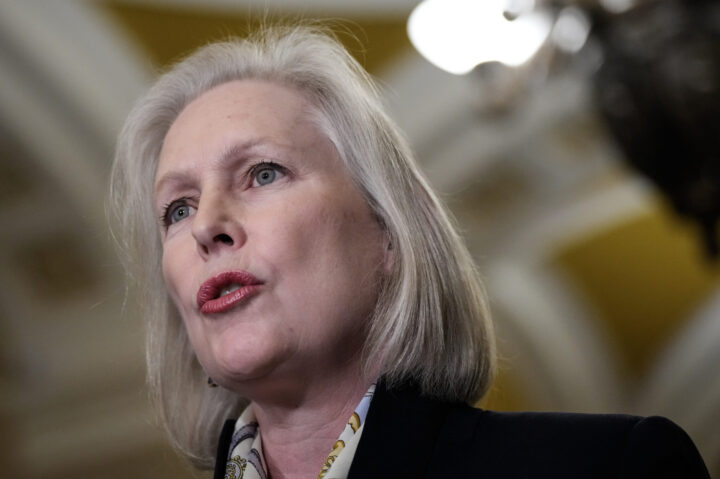
Drew Angerer/Getty Images
Sen. Kirsten Gillibrand (D-NY) speaks at a news conference following a closed-door lunch meeting with Senate Democrats at the U.S. Capitol on October 31, 2023, in Washington, D.C.
A group of six additional Senate Democrats plan to file new war powers resolutions this week to halt the war in Iran, a move that would allow Democrats to continue forcing votes on the war for the foreseeable future.
Previously, a different group of six Democrats introduced similar resolutions, and Democrats have called up two of them thus far, with plans to call up a third this week. So far, the resolutions have all failed along mostly party lines, with all senators remaining consistent in their votes.
The latest group of lawmakers includes Sens. Jeff Merkley (D-OR), Kirsten Gillibrand (D-NY), Chris Van Hollen (D-MD), Mark Kelly (D-AZ), Raphael Warnock (D-GA) and Andy Kim (D-NJ).
The array of lawmakers involved in the latest effort spans from staunch progressives and critics of Israel to generally more pro-Israel members.
“President Trump chose to start a war knowing it was going to raise gas prices on Americans already struggling to get by,” Gillibrand said in a statement. “The president, and his party, just don’t care about anyone other than themselves. They lie, cheat and steal to enrich themselves and leave regular folks with the bill. It is long past time for Republicans in Congress to stand up and do their job.”
House Democrats also plan to call up a war powers resolution this week, which may pass given that some Democrats who previously opposed a war powers effort and a handful of Republicans have indicated they plan to change their votes.
The latest set of six resolutions will not be eligible for floor votes immediately, but Democrats can call up the other four resolutions introduced previously at will. Senate Democrats are also likely to force votes on matters related to the Iran war during the upcoming reconciliation process, which Republicans aim to use to fund immigration enforcement and other priorities.
Engel was remembered by colleagues and community leaders as a ‘mensch,’ a ‘true public servant’ and ‘an American in every way’

AP Photo/J. Scott Applewhite
House Foreign Affairs Committee Chair Eliot Engel, D-N.Y., walks through the Hall of Columns at the Capitol as House Democratic chairs gather for a meeting with Majority Leader Steny Hoyer, D-Md., in Washington, Wednesday, March 27, 2019.
Former Rep. Eliot Engel (D-NY), who represented the Bronx and Westchester County in the House from 1988 to 2020 and served for years as the top Democrat on the House Foreign Affairs Committee, died Friday at age 79.
Engel, who was Jewish, rose to become the chair of the House Foreign Affairs Committee when Democrats retook the House in 2018, after serving as the ranking member from 2013 to 2018. He was a strong and vocal advocate for the U.S.-Israel relationship and the Jewish community, also acting as a co-chair of the House antisemitism task force.
But he was defeated in the 2020 election by far-left former Rep. Jamaal Bowman (D-NY), with Engel’s support for Israel becoming a primary issue in the race — an early harbinger of subsequent trends in the Democratic Party.
In an exit interview with Jewish Insider in 2020, Engel said that he had committed himself throughout his career to being “the best friend that Israel ever had in Congress, and I think that I have kept up that bargain,” arguing that the U.S.-Israel relationship was stronger than ever. Engel’s stalwart support of Israel is now increasingly uncommon in a Democratic Party that’s becoming more critical of the Jewish state.
In 2020, he called conditioning aid to Israel “just about the stupidest thing I’ve ever heard.”
Engel broke at times with his party on issues related to the Middle East and the Jewish community, including being one of the few House Democrats to vote in 2015 against the Obama administration’s nuclear deal with Iran.
He also helped lead the first impeachment inquiry into President Donald Trump.
Rep. Jerry Nadler (D-NY), who served for years alongside Engel, told JI that Engel was “one of my greatest colleagues and dearest friends in Congress — a true progressive, a lifelong Democrat, and a tireless champion for the people of the Bronx, Rockland, and Westchester.”
“As Chair of the House Foreign Affairs Committee, he brought integrity and experience to America’s role in the world, and he was an unwavering friend to Israel throughout his decades of service,” Nadler continued. “His legacy of service to the Bronx, Rockland, Westchester, and the nation will not be forgotten.”
“Serving alongside Eliot Engel was one of the great privileges of my time in Congress. Eliot combined deep moral clarity with an unwavering commitment to America’s alliances, especially the U.S.–Israel relationship,” former Rep. Ted Deutch (D-FL), who now leads the American Jewish Committee, told JI. “He led the Foreign Affairs Committee with principle, steadiness, and a genuine respect for colleagues on both sides of the aisle. I was proud to call him not only a colleague, but a friend.”
House Minority Leader Hakeem Jeffries (D-NY) said that Engel was “a champion for the people he was privileged to represent in the Bronx and Westchester County.”
“The grandson of Jews fleeing czarist Russia and a proud son of New York City, Eliot’s career in public service was inspired by his deep roots,” Jeffries said. “Eliot was an astute and prolific legislator who fought for human rights, civil rights and against antisemitism here at home and abroad.”
Senate Minority Leader Chuck Schumer (D-NY) said Engel was a “true public servant who delivered for the people of his beloved Bronx and Westchester for 30 years — and a dear friend going back to when I first met him as a district leader in the Bronx.”
He praised Engel’s leadership of the Foreign Affairs Committee “with a rare blend of conviction, effectiveness, and kindness that has cemented him as one of the great diplomatic leaders of the 21st century.”
Rep. Brad Schneider (D-IL) said in a statement that Engel was “a mensch and a truly patriotic American.”
“He was one of the first Members of Congress to take me under his wing when I was just a candidate in 2012. After my election, it was a privilege and honor to serve on the House Foreign Affairs Committee with Eliot as Ranking Member, working with our colleagues on both sides of the aisle to promote our country’s interests and advance our national security,” Schneider continued. “Throughout our service together, I got to know a real leader who never gave up on the United States and knew in his heart that Americans have so much more in common than what might set us apart.”
Rep. Joe Wilson (R-SC), another longtime member of the House Foreign Affairs Committee, praised Engel as a “fighter for democracy and human rights around the world,” highlighting their work together on the Caesar Civilian Protection Act sanctions on the Assad regime in Syria and their support for the Syrian people.
New York City Council Speaker Julie Menin said, “Eliot Engel proudly served New Yorkers in Congress. As a proud member of the Jewish community and the son of immigrants, he represented the best of … America’s promise.”
Rep. George Latimer (D-NY), who ousted Bowman in 2024, said that Engel, “devoted his lifetime to public service — as a teacher and as an elected official in Albany and Washington DC. His legacy consists of hard work on issues and kindness to all.”
AIPAC, in a statement, called Engel “a steadfast friend of the pro‑Israel community and an unabashed champion of the U.S.-Israel relationship.”
“Throughout his distinguished 32‑year career in Congress, including as chairman of the House Foreign Affairs Committee, Congressman Engel worked tirelessly to strengthen and deepen the strategic alliance between the United States and Israel,” the group said, praising him as a “leading force against efforts to delegitimize our ally Israel.”
“He led critical efforts to support security assistance to Israel, worked to impose sanctions on the Iranian regime, opposed efforts to impose political cuts or conditions on aid, rejected the BDS campaign, and courageously opposed the 2015 Iran nuclear deal,” the group continued.
Local leaders who spoke to JI remembered Engel as an ever-present and deeply caring lawmaker who was always accessible both to the Jewish community and all of the communities he represented in Congress.
New York state Rep. Jeffrey Dinowitz said that Engel had been not only a professional colleague but a close personal friend for most of his life, with their families and children growing up together.
“We were the closest of friends for decades, literally decades. So it’s a horrible loss for the family and for the other people close to him,” Dinowitz said. “He does leave behind a great legacy — just the people that they helped. There’s no question that his office and sometimes he personally, they helped tens of thousands of people … he attended thousands of community events. He showed up everywhere.”
Dinowitz described Engel as a model of the Bronx, growing up from humble beginnings in public housing, going to college in the district and ultimately becoming the longest-serving member of Congress from the Bronx. “This is what the Bronx is all about. Somebody from modest beginnings can rise to one of the most powerful positions in the country,” Dinowitz said.
“He was the strongest supporter of Israel in the Congress, bar none,” Dinowitz added. “He was an effective advocate for Israel, and not only Israel, but Jewish causes in general. … He stood strong and he never wavered in his support for Israel.”
State Rep. Amy Paulin said that one of her earliest memories of Engel, when her district was redistricted into his in the 2010s, is one that stands out the most strongly. At the time, she said, the two did not know each other well, but he personally took her call on a Saturday evening to help a dying constituent obtain visas for family members to come to the United States to see him on his death bed.
“Not only did he take the call personally, he acted on it personally,” Paulin said. “What stood out for me, as I even recall the story, was just, you know, there wasn’t a hesitation on his part. … He was just such a terrific asset for us. He went to every event that he knew about, when he was in town, and he was such a kind, warm, smart, capable person, and his loss is going to mean something. … He cared. That’s just who he was.”
She said she later worked with Engel during the first Trump administration to obtain visas for young Palestinians to join a program with young Israelis to discuss peacebuilding, and he later helped facilitate a visit by Paulin to the Jewish state during a time of conflict.
“He cared deeply about Israel. He represented an area that also cares deeply about Israel,” Paulin added. “Being in Israel, you could see his love of the country. … He wanted to be there to see everything he could, to bring those messages back to the rest of the Jewish community so that everybody had a real clear picture of what Israel was up against and he did that because of his love of Israel and his wanting Israel to exist.”
Justin Brasch, the mayor of White Plains, N.Y., told JI that Engel was “so accessible and so down to earth,” a “tremendous public servant” and “so warm” to everyone in the community.
“What probably is [most] sad about him leaving the stage is that there aren’t enough people who are just kind and nice to everyone,” Brasch said. “There’s so much anger and betrayal in politics today, and he absolutely rejected that. He was kind and helpful and accessible to everyone. And I know for me that has always been something that has inspired me.”
He said that Engel was always willing and eager to take calls and to help constituents with any problem, in addition to being a strong supporter of Israel and fighter against antisemitism.
“He would always show up at events of concern to the Jewish community,” Brasch said. “And then we were quite proud that he was a congressman in our area.”
William Schrag, the former president of the Westchester Jewish Council, said that Engel was a “fierce [advocate]” for his constituents and “never lost sight of the people here.” Schrag said that the local Jewish community “loved him.”
Hank Sheinkopf, a longtime New York Democratic strategist who once worked for Engel, emphasized that the former congressman took on the traditional Democratic establishment in the Bronx on behalf of “the people who felt powerless” and won, remaining his own man throughout his public career.
He said Engel also clearly enjoyed being a public official — “he enjoyed the byplay, he enjoyed the drama, he enjoyed the behind the scenes stuff” and he was known for arriving early to State of the Union addresses to secure a coveted center-aisle seat and photo with the president.
Ultimately, however, Engel was “a victim of the first wave of the hostile takeover of the Democratic Party [by the far-left] which has become much more pronounced since then,” Sheinkopf continued. “Eliot Engel was an American in every way. He believed in democracy, he believed in diversity. He was racially blind. He thought power ought to be shared, and he never, never walked away from those convictions, nor his Jewishness, for which he paid the price of being evicted from office.”
“He was the precursor of what we are now experiencing. … He was the first guy to see it way up close,” Sheinkopf continued.
At least 50 House Democrats are calling for Trump’s immediate removal from office
Nathan Posner/Anadolu via Getty Images
House Minority Leader Hakeem Jeffries (D-NY) speaks during his weekly press conference at the U.S. Capitol in Washington, DC on March 19, 2026.
Top Democrats across both chambers condemned President Donald Trump for threatening that “a whole civilization will die tonight” in Iran, with some pushing for Trump’s immediate removal from office over the threat and his conduct of the war.
House Minority Leader Hakeem Jeffries (D-NY) and other members of Democratic leadership including Reps. Katherine Clark (D-MA), Pete Aguilar (D-CA), Ted Lieu (D-CA), Joe Neguse (D-CO) and Suzan DelBene (D-WA), issued a statement calling Trump “unhinged” and saying that he risks bringing the country “into World War III” unless Congress reconvenes to vote to bring the war to an end.
“For years, Republicans have enabled and excused Donald Trump’s deeply dangerous and extreme behavior. Enough is enough,” the leaders said. “Our brave men and women in uniform have been put into harm’s way in the Middle East. Over a dozen have already been killed and hundreds injured. Gas prices are skyrocketing, the cost of living in America is out of control and billions of taxpayer dollars are being wasted on a reckless war of choice.”
In another joint statement, Senate Minority Leader Chuck Schumer (D-NY) and Sens. Chris Coons (D-DE), Jeanne Shaheen (D-NH), Jack Reed (D-RI) and Brian Schatz (D-HI), who are the top Democrats on several relevant committees and subcommittees, similarly condemned Trump’s comments, saying they indicate an intent to commit war crimes.
“This is not strength. Intentionally destroying the power, water, or basic infrastructure upon which tens of millions of civilians depend to punish the very civilians who suffer at the hands of the Iranian regime would constitute a war crime, a betrayal of the values this nation was founded on, and a moral failure,” the lawmakers said. “It’s unconscionable to threaten the lives of so many people — grandparents, children, families — simply because they were born in Iran.”
They said that Trump’s comment “makes Americans less safe, further destabilizes our nation and economy, and puts at greater risk U.S. service members,” as well as makes a diplomatic solution — ”the only viable solution to this war” — harder to achieve.
In a separate statement, Rep. Greg Meeks (D-NY), the ranking member of the House Foreign Affairs Committee, also said that Trump’s threat constitutes a war crime and an illegal action under international law which risks tens of millions of Iranian civilians, and potentially catastrophic after-effects.
“At this critical moment, the United States must pursue immediate de-escalation and a coordinated diplomatic strategy with our allies. We cannot allow Iran to simply reset to a dangerous status quo — but the answer is not to threaten war crimes and isolate us from every partner we need to end this conflict,” Meeks said. Trump’s threat is “recklessness that America and the region will pay for long after this president is gone,” he added.
Rep. Jared Moskowitz (D-FL), who prior to the war was one of the few Democrats who said he would oppose a war powers resolution — though he ultimately voted for it after the war began — demanded that the House immediately reconvene for a war powers vote. Moskowitz’s comments are a sign that Trump’s latest comments have crossed a line even for some of the most hawkish Democrats in the House.
“Speaker Johnson must immediately reconvene the House to vote on a war powers resolution. It’s beyond clear we are at war,” Moskowitz said. “The Speaker’s legacy will be that he made Congress so irrelevant that a president can threaten to wipe out a civilization while Congress is on vacation.”
Jeffries said Democrats plan to bring up another war powers resolution to halt the conflict in Iran, which stands a stronger chance of passing than a previous one, when the House returns from its recess. At least some of the Democrats who voted against the previous resolution are expected to support this one, and a small number of additional Republicans may join them.
Rep. Henry Cuellar (D-TX), one of four House Democrats who voted against the previous war powers resolution on the war in Iran last month, announced he will now support such an effort because the administration has failed to provide adequate answers about its goals and its exit strategy.
“[W]e must be careful with the language we use. Strength and destruction are not the same,” Cuellar added. “When the United States echoes the rhetoric of its adversaries, we risk weakening the values that have long defined our leadership.”
Several Democrats have described Trump’s comments as a threat to commit genocide.
Trump’s threat has also prompted growing calls from at least 70 House Democrats for his removal from office, either through impeachment or the invocation of the 25th Amendment, which allows the involuntary removal of a president from power if he is mentally or physically unfit to govern.
Sens. Ed Markey (D-MA) and Ron Wyden (D-OR) joined those calls.
“Donald Trump is deranged,” Wyden said. “He must be impeached and removed from office. Republicans who don’t stop him will have blood on their hands, and anyone who carries out an order to bomb civilian targets will be complicit in war crimes and will be held accountable.”
Markey called the president “unstable and a clear and present danger, not just to the American people but to the world” and said he “must be removed from office before he causes incalculable and unfathomable harm.” He said that a war powers resolution to stop the war is now insufficient to address the situation.
A small number of Republicans are also airing concerns with Trump’s threat.
Sen. Lisa Murkowski (R-AK), one of the few Republicans who has been openly skeptical of the war effort in Iran, said that Trump’s threat “cannot be excused away as an attempt to gain leverage in negotiations with Iran.”
“This type of rhetoric is an affront to the ideals our nation has sought to uphold and promote around the world for nearly 250 years. It undermines our long-standing role as a global beacon of freedom and directly endangers Americans both abroad and at home,” Murkowski said, calling for deescalation by both Trump and Iran, and insisting that the U.S. must draw a distinction between the Iranian regime and the Iranian people.
Rep. Nathaniel Moran (R-TX) said that, while he has supported the war thus far, “I do not support the destruction of a ‘whole civilization.’ That is not who we are, and it is not consistent with the principles that have long guided America.”
“[W]hat sets America apart is not only our strength, but how we use it. Our nation has always conducted military operations for just causes and through just and moral means. This must continue in the future; otherwise we forfeit our legitimacy to lead the world,” Moran said. “[H]ow we protect the lives of the innocent is just as important as how we engage the enemy.”
Rep. Kevin Kiley (I-CA), who recently left the Republican Party but remains part of the GOP caucus and has generally been hawkish on Iran, said that the U.S. “does not destroy civilizations. Nor do we threaten to do so as some sort of negotiating tactic.”
“Congress has a responsibility to conduct oversight with respect to ongoing military operations and our obligations under both U.S. law and international agreements to which we are a signatory,” Kiley said.
What makes the otherwise sleepy contest significant is the potential for the results to indicate if there are any fissures within the MAGA coalition that may represent discontent with Trump’s hawkish turn amid the Iran war

Megan Varner/Getty Images
Clay Fuller, Trump endorsed Republican candidate for Congressional district 14, speaks to members of the media after arriving early to his voting precinct to cast his vote on March 10, 2026 in Lookout Mountain, Georgia.
Today’s special election runoff in Georgia between Republican Clay Fuller and Democrat Shawn Harris to determine the successor to former Rep. Marjorie Taylor Greene (R-GA) isn’t much in doubt. The northwestern Georgia district that Greene represented backed President Donald Trump by 37 points in 2024, one of the largest GOP margins in the country.
What makes the otherwise sleepy contest significant is the potential for the results to indicate if there are any fissures within the MAGA coalition, ones that may represent Republican discontent with Trump’s hawkish turn amid the Iran war. In this race, the margins will be as notable as the winner.
Greene, since leaving Congress, has emerged a loud Republican voice against the Iran war and against Trump’s strong alliance with Israel. Fuller, a military veteran with a background in counterterrorism operations and district attorney for the Lookout Mountain Judicial Circuit, has been a stalwart supporter of Trump’s military operations in the Middle East, and Trump has endorsed him in the race.
Harris, the Democrat, holds foreign policy views closer to the isolationist Greene, attacking the pro-Israel advocacy group AIPAC and describing Israel’s war against Hamas as a “genocide” — views which place him on the left flank of the Democratic Party. This despite Harris’ time serving as defense attache in Israel during his years in the National Guard, work history that he has not publicized during the campaign.
It’s worth noting that Greene, since she was first elected to the seat in 2020, has underperformed Trump’s standing in the district, only winning 64% of the vote against Harris in 2024 — four points below Trump’s 68% showing at the top of the ticket. And since breaking with Trump in his second term, her political standing has taken an even bigger hit.
Greene has not endorsed either candidate in the race.
If Harris wins over 40% of the vote in this ruby-red district, it’s a sign that Democrats are making inroads into rock-ribbed conservative turf, potentially over frustrations with rising gas prices and the Iran war. But if he doesn’t perform much better than he did in 2024 — and he only won 37% of the vote in the first round of balloting, compared to the 36% he tallied two years ago — it’s a sign that the media hype over a MAGA fissure is greatly overstated.
The election also carries some relevance for another big political showdown in Georgia later this year: Sen. Jon Ossoff’s (D-GA) reelection campaign. Given a divided GOP primary field and an unfavorable national environment for Republicans, Ossoff starts with some advantages in what otherwise looks like a tough reelection.
If the GOP base turns out strongly for Fuller, it’s a sign that Republicans will still be able to rely on conservative voter enthusiasm and engagement in the run-up to the closely watched Senate battleground.
But if there are signs of GOP weakness in one of the reddest parts of the state, it would be evidence that Trump’s political problems aren’t just limited to swing voters, but could extend to even redder states and districts on the battleground map.
The ER physician and former government official is making support for Israel and outreach to Jewish voters central to her bid to unseat Rep. Tom Kean Jr.

Taylor Hill/Getty Images
Tina Shah attends the 2024 Forbes Healthcare Summit at NYU Langone on December 04, 2024 in New York City.
Tina Shah is hoping she might have the cure to Democrats’ struggles in New Jersey’s 7th Congressional District.
Shah, an emergency room physician and former government official, is running in the Democratic primary to face off against Rep. Tom Kean Jr. (R-NJ), who has proven resilient against repeated Democratic challenges in the purple district.
Shah noted in an interview with Jewish Insider last month that the district is home to a substantial Jewish community, and said that she’s had many conversations with community members about the situation in the Middle East and the Oct. 7, 2023, Hamas attacks, conversations she said have fostered her support for continued, unconditional aid for the Jewish state.
“Where I am right now is unequivocally that Israel is our most important ally in the Middle East,” Shah said. “They had a right to defend themselves then, [and] they continue to. I will be the strongest ally to make sure that we continue to build this relationship and support Israel with aid.”
In a position paper shared with JI, Shah emphasized her support for ongoing security aid to Israel, and said that the Oct. 7 attacks and their lasting impacts show the need for a continued U.S.-Israel alliance.
“Allyship with Israel is a bedrock principle of US foreign policy in the Middle East,” she wrote. “Our shared security interests and democratic principles have built a resilient foundation that I will support in Congress.”
She also emphasized the two countries’ shared values and democracies. Shah said she supports a two-state solution and said that she favors a “diplomacy-first approach” like that which led to the Abraham Accords. Shah argued that the U.S. needs stronger advocates for a comprehensive peace deal, and said she would be such an advocate.
“The US should remain a partner in Israel’s long-term security, and the long-term security of the Palestinians, to ensure the realization of a two-state solution achieved through a political and diplomatic process,” Shah said in the paper. “As many members of Israel’s security establishment have acknowledged, failing to reach such a resolution represents an existential threat to Israel.”
She went on to argue that a diplomatic agreement, rather than unilateral action or annexation, will ultimately better serve Israel’s security interests.
She said that she mourns the loss of any innocent life, emphasizing Palestinians’ right to their own state as well, calling for an end to “illegal settlement activity” and said that the “international community must do more to de-escalate violence and provide pathways toward lasting peace.”
Working in the medical technology field, Shah said in her position paper she’s seen firsthand the benefits that the Israeli economy and tech sector has brought to her state and the country.
“I am proud that Israel is one of New Jersey’s largest trading partners,” Shah said. “Continuing this incredible partnership will only make New Jersey more attractive and competitive for employers, it will also increase employment opportunities for New Jersey families and workers.”
Shah told JI she is concerned by the rise of antisemitism in her home state, in part blaming President Donald Trump, who she said is “stoking … he’s feeding the fire and allowing antisemitic acts to go unchecked.”
She pledged her support for the Antisemitism Awareness Act, which is stalled in Congress, and the International Holocaust Remembrance Alliance’s working definition of antisemitism. She said she’d also listen to members of the Jewish community in her district to “make sure that I can advocate in the strongest possible way in Congress.”
Shah said in her position paper she “would continue to be an advocate against the weaponization of conflict in the Middle East against American Jews” and that she would oppose the Boycott, Divestment and Sanctions movement targeting Israel, which she said ultimately does not help Israelis, Palestinians or the U.S.’ own interests.
Shah also blasted the Trump administration’s moves to cut the Department of Education, the Civil Rights Division at the Department of Justice and parts of the intelligence community, saying that those moves only hamper efforts to protect the Jewish community.
Shah told JI that Jews in her community are also worried that the war in Iran is going to make them less safe at home, a concern she said she shared, speaking to JI a day after the attempted attack on Temple Israel in the Detroit suburbs.
Shah said that Trump did not have the constitutional authority to start the war, and vowed that she would “hold our president accountable.”
“Let me be clear, the Iranian regime is brutal, repressive and destabilizing, but there’s a safeguard that was built in with the Constitution to prevent any president, especially Donald Trump, from unilaterally dragging the nation into war,” Shah said, describing the war as directionless.
She said she supports stronger sanctions on the Iranian regime, while lamenting the first Trump administration’s decision to withdraw from the Iran nuclear deal in 2018, a decision she said led the administration to the war today.
In her position paper, Shah said that Israel’s strikes on Iran in the summer of 2025 were a necessary action, in light of Iran’s violations of its nuclear Non-Proliferation Treaty obligations, which “created a situation in which Israel could not delay action,”
But she said that she did not agree with the U.S.’ own involvement in the conflict without congressional authorization or, in her view, proper consideration and consultation.
Shah is a practicing intensive care unit doctor in the district, and said that she was inspired to run for office by her experiences seeing patients unable to afford the medicine they need. America, she argues, is in “critical condition.”
“We live in the greatest country in the world,” Shah said. “How is it that people get so sick that they need the ICU because they can’t afford basic medical care?”
But Shah is also hardly new to government or the political scene. She served in three administrations, in the Department of Veterans Affairs and under the U.S. Surgeon General. She also advocated in her home state to prevent insurance companies from denying patients essential care.
And she’s also been involved in the business world, as the chief medical officer of a health care AI startup.
Asked what positions her to win the primary, and to defeat Kean, Shah again pointed to her medical background. “People trust their doctor,” Shah said. “I’m a doctor running in an election cycle where the No. 1 economic issue is health care.”
She said that her time in the exam room gives her experience getting to know and understand people and build trust quickly, regardless of political affiliation.
“I have the ability to raise enough money to combat what Tom Kean Jr. is going to do. But I am the only candidate who has worked across the aisle in D.C., who has worked to pass a bipartisan bill into law here in New Jersey, and that is how I’m going to flip NJ-07,” she said.
Shah faces a series of other candidates in the primary including Rebecca Bennett, a former Navy pilot who is leaning into her national security experience and whom many Democrats see as a top contender for the seat, and Brian Varela, a businessman who is leaning into a progressive lane after initially vying for the centrist vote.
Bennett leads the field in fundraising with nearly $2 million, followed by Varela with $1.76 million and Shah with $1 million.
The viral Instagram account with 1.4 million followers was taken offline, but similar accounts abound

Screenshot
AI Rabbi Goldman copycat accounts appear on Instagram after original is taken down.
An AI-generated Instagram account, which featured a fake Orthodox rabbi spreading antisemitic conspiracies to its more than 1.4 million followers, was taken offline over the weekend following major backlash from Jewish groups and one Democratic lawmaker — yet several similar, hate-peddling accounts have emerged with little to no public action from Meta.
An account called “Rabbi Goldman” “uses fake, AI-created authority figures to spread hate” in “a troubling and growing tactic,” according to a report published last week by Combat Antisemitism Movement.
The account, which was taken offline after the report was released, featured videos such as one in which the “rabbi,” wearing a tuxedo and seemingly seated in a luxury airplane, claims that Jews utilize empty private jets to evade taxes. A community note attached to the clip reads, “This is an AI generated rabbi who is trying to scam you by selling a fake 9$ get rich handbook. This account is ran by scammers based in south India.”
Several new Rabbi Goldman accounts started posting similar videos within the past two weeks — two already have followings of 18,500 and 10,000. Both remain active on Instagram and their bios state, “only Backup account for @rabbigoldman” and “old account got banned.”
The CAM report identified 12 AI-generated “rabbis” with a combined following of 2.1 million Instagram users, all of which promote classic antisemitic stereotypes. Many of the accounts remain active on the platform even after the Rabbi Goldman account was removed.
One account called “Rabbi Rothstein,” for example, with more than 57,000 followers, has posted more than 100 videos since February. In one video, “Rabbi Rothstein” states that “us Jews teach our children that being liked is expensive but being respected is profitable,” an apparent reference to the antisemitic trope that Jews are money obsessed. Another video also claims that Jews evade taxes, by purchasing expensive art.
Lawmakers have been pushing for more oversight regarding online antisemitism from Meta — which is the parent company of Instagram, as well as Facebook and WhatsApp — for years. In 2024, a bipartisan group of House lawmakers condemned Meta, and its oversight board, for ruling that the phrase “From the river to the sea” does not violate the social media company’s rules against hate speech, violence and incitement.
In response to Jewish Insider’s coverage of the Instagram accounts, Rep. Josh Gottheimer (D-NJ) called for oversight. “This is disgusting, dangerous, and exactly why we need increased accountability online to prevent the spread of misinformation and pure, flat-out hate,” he wrote on X. “These AI-generated rabbis and their antisemitic BS have real consequences.”
Meta did not respond to several requests for comment from JI asking about its decision to take the Rabbi Goldman account offline — whether it was shut down or suspended — and whether there will be a crackdown on similar accounts.
Last year, Meta received pushback from Jewish leaders when it introduced a new community-driven fact-checking system, ending its third-party fact-checking program and replacing it with a system modeled after the community notes feature on Elon Musk’s X. Some Jewish leaders expressed concern that the move would “open the floodgates to content” that could target Jewish communities and individuals, and called the decision a “step back” in the fight against rising antisemitism.
Piker, a far-left streamer who has been the subject of favorable media profiles despite a laundry list of antisemitic and terror-justifying rhetoric, is a case study in how traditional journalists normalize extremists

Shauna Clinton/Sportsfile for Web Summit Qatar via Getty Images
Hasan Piker during day two of Web Summit Qatar 2026 at the Doha Exhibition and Convention Center in Doha, Qatar.
A useful rule of thumb to live by: Social media isn’t real life.
But one of the challenges in the brave new world of media is that extremist influencers can often create the perception of influence simply by dominating so much of the online discourse.
Hasan Piker, a far-left streamer who has been the subject of favorable media profiles despite a laundry list of antisemitic and terror-justifying rhetoric, is a case study in how traditional journalists normalize extremists — and how politicians conclude there’s a marketplace for radical views in the electoral marketplace, even when it’s typically a mirage.
In part because Democrats have been desperate to find anti-establishment voices that claim to speak for young men, Piker is seen as a popular, edgy podcaster by liberal leaders in both media and politics. (Nevermind the fact that Piker gets only about 36,000 viewers on a typical stream — about 1/25th of the typical nighttime audience of MS NOW, as The Atlantic’s David Frum pointed out.)
The New Yorker invited Piker to speak at its annual festival, treating the antisemitic streamer as just another one of the many thought leaders in attendance. Leading progressives, such as Sen. Bernie Sanders (I-VT) and Rep. Alexandria Ocasio-Cortez (D-NY), joined him at rallies and on his show.
And a handful of leading Democratic presidential contenders — most notably California Gov. Gavin Newsom — expressed interest in going on his show.
This, despite the fact Piker has justified Hamas’ Oct. 7 terror attacks, forcefully denied some of the terror group’s atrocities, has called Orthodox Jews “inbred” and claimed America deserved 9/11.
Any one of those comments on their own would have typically disqualified anyone from playing a part in our political discourse. Yet in the wave of glowing profiles, Piker’s antisemitism and anti-Americanism didn’t even merit a mention.
It wasn’t until March 19, when Third Way President Jon Cowan and Lily Cohen, a press advisor from the center-left think tank, took the initiative to co-write a column for The Wall Street Journal calling out Piker’s antisemitism without any caveats. The decision to call out the crazy — when few in the press or politics had the courage to do so — was a moment that proved that one principled voice in defense of normalcy can break the mirage of those who believe there’s a political marketplace for this garbage.
The op-ed, headlined “Democrats Are Too Cozy with Hasan Piker,” generated outsized attention, in a way that previous efforts to spotlight Piker’s antisemitism hadn’t. Reporters who once gave Piker a free pass were now asking Democrats whether they agreed with his extremist positions.
Suddenly, when presented with his indefensible comments, some Democrats started building up enough courage to speak out against him. First, it was Rep. Brad Schneider (D-IL), head of the moderate New Democratic Coalition, who called Piker an “unapologetic antisemite.” Then, state Sen. Mallory McMorrow, running for the U.S. Senate in Michigan, told JI that Piker is “somebody who says extremely offensive things in order to generate clicks” — and called on one of her primary opponents, Abdul El-Sayed, to cancel a scheduled rally with him.
Even left-wing lawmakers and candidates — such as Maine Senate candidate Graham Platner and a progressive Democratic state legislator from Michigan — canceled scheduled appearances with Piker.
By the end of the month, only three of the 14 prospective Democratic presidential candidates that Politico interviewed said they would appear on a livestream with Piker if invited. That marks a sea change from just weeks earlier, when he was being treated as the trendy fad in progressive politics.
The dynamic is a reminder that the delusions of a social media echo chamber will persist unless they get confronted by political reality. Sometimes that reality is as simple as speaking up against craziness when everyone else is afraid to speak the truth.
It would be heartening to conclude that this episode is proof that antisemitism can be confronted when good people speak up.
But this past week also featured Politico publishing a virulently antisemitic cartoon that could have been drawn from the Nazi tabloid Der Sturmer — one that they pulled from their website and apologized for. This is the same publication, owned by Axel Springer, that gave Piker a credulous interview last year making no mention of his extremism. (And last week, it also blatantly misrepresented leading Democrats’ comments on AIPAC to manufacture an anti-Israel narrative.)
It all goes to show that the antisemitic rot fueled by social media is entering into the mainstream. It will take more brave and principled voices like Cowan and Cohen to stem the tide.
Effie Phillips-Staley is trying to find her niche in the Democratic primary by reaching out to the most anti-Israel elements in the swing district

Getty Images
Effie Phillips-Staley
Speaking to Jewish Insider last July, Effie Phillips-Staley, one of the Democrats aiming to take on Rep. Mike Lawler (R-NY) in suburban New York this fall, said that she wanted to be “very clear that the U.S. has to continue to be a critical ally to Israel” and that she wouldn’t support additional conditions or restrictions on U.S. aid to Israel.
But as support for Israel has declined with the Democratic base, the progressive candidate has flip-flopped on her views towards the Jewish state. She received an endorsement this month from the virulently anti-Israel group TrackAIPAC, which has garnered accusations of antisemitism and dishonest tactics from even elected Democrats who are themselves critical of Israel.
In a statement to JI, a spokesperson for Phillips-Staley said that her initial stance was a result of “the typical boilerplate advice from establishment Democrats to stay away from critiques of US aid to Israel.”
“But as voters and advocates continuously pressed her to examine this position, and as Israel’s bombardment and starvation of Gaza intensified, Effie began to evolve her thinking,” the statement continued. “The turning point came in August when the New York Times started reporting that UN agencies were classifying the starvation of Palestinians in Gaza as famine. At the end of that month, Effie announced that she would support the Block the Bombs legislation. She also determined that scholars and NGOs across the world were justified in classifying Israel’s actions in Gaza as genocide.”
Phillips-Staley went on a trip to the West Bank in February, where the spokesperson said she “witnessed first-hand the apartheid conditions on the ground for Palestinians,” including the “unequal application of law between Palestinians and Israelis, the daily state-sanctioned settler violence that Palestinians endure, and the severe travel restrictions that exist for Palestinians in cities like Hebron and Ramallah.”
Ramallah and significant areas of Hebron are controlled by the Palestinian Authority.
“Effie’s position is that the United States must not make exceptions to its own laws for Israel or any nation that benefits from US support and tax dollars,” the spokesperson said. “She believes the path toward peace and resolution of this conflict requires equal application of American and international law for all nations and states, fair consequences for those who do not follow the law, and a firm belief in upholding universal human rights.”
Phillips-Staley is also racking up other anti-Israel endorsements, including from former Rep. Jamaal Bowman (D-NY) and former Ohio state Sen. Nina Turner, who lost a 2021 primary campaign to a pro-Israel Democrat.
And this week, she joined antisemitic streamer Hasan Piker’s show, eliciting a joint condemnation from the chairs of the Westchester, Rockland, Putnam and Dutchess County Democratic Committees, in which they called out Piker’s history of “profoundly shocking, abhorrent, and offensive” content, including antisemitism.
“We must speak up now to express deep disappointment by the appearance this afternoon of … Effie Phillips-Staley on Hasan Piker’s Twitch stream,” the chairs said. “Her decision represents a dangerous and unacceptable step toward legitimizing rhetoric that has no place in this District, in mainstream Democratic politics, or in any serious political discourse.”
Phillips-Staley responded by attacking the “Democratic establishment” for its “outdated mentality that alienates the very voters we need to win” and for “narrowing our tent and refusing to engage with platforms that reach young people.”
“While I don’t align with every word Hasan Piker has ever said, we must recognize the massive value of a platform that engages millions of young people in the democratic process,” she continued. “[Piker] is mobilizing a movement that demands our politics center human rights and favor diplomacy over the reflexive use of military force.”
Phillips-Staley’s recent endorsements, comments and interviews — have brought heightened attention to her pivot on Israel policy issues, at the same time as she’s trying to gain attention against several better-funded and higher-polling opponents.
When she entered the race, Phillips-Staley had the progressive lane largely to herself, competing against a lineup of Democratic moderates.
But Peter Chatzky, the deputy mayor of Briarcliff Manor, N.Y., subsequently entered the race as a progressive, dropping $5.8 million of his own money to support his bid, according to the most recent campaign finance disclosures. Phillips-Staley, meanwhile, had raised just $302,000 and had less than $30,000 on hand at the end of the year, trailing in fundraising behind two other candidates who have since dropped out of the race.
Chatzky entered the race as a critic of Israel, accusing the Jewish state of violating U.S. arms sales laws, though Phillips-Staley falls to his left on the issue, touting on her campaign website that she’s “the first candidate in this race to support the Block the Bombs Act.”
Both progressives are polling well behind their moderate, pro-Israel competitors — Rockland County legislator Beth Davidson led a recent survey with 23% support, followed by national security veteran Cait Conley with 17% and Chatzky and Phillips-Staley far behind at 8% and 5%, respectively.
“I believe that she looks around and sees a field that has not differentiated themselves a lot on this issue, and she says, ‘OK, this will be one of the the ways that I try to stand out in an otherwise crowded field where I’m being heavily outspent,’” said Jake Dilemani, a New York Democratic strategist, adding that her positions are also consistent with a shift among the progressive faction of the Democratic Party.
“She’s trying to outflank Chatzky, period,” he continued. “Chatsky is the only other candidate competing for what you would call the left of the field. Effie is still to the left of him,” he continued.
The anti-Israel push is particularly notable in a Democratic-leaning, moderate district with a significant Jewish population, which has repeatedly helped push Lawler, an outspoken supporter of Israel, to victory.
Phillips-Staley’s campaign insisted that her stance isn’t motivated by political considerations.
“Effie received immense political pressure to remain silent on Israel’s human rights abuses against Palestinians. Because she has centered human rights and equality throughout her career, she investigated the issue and determined she could not remain silent, regardless of the political cost,” the spokesperson said. “Her support for Palestinian human rights reflects her moral stance that human rights should apply equally to all.”
Dilemani said that there’s more room for a further-left position in the Democratic primary than there would be in the general election. But he said there’s a larger gap between Phillips-Staley’s stances and the average general election voter, and that she would be a long shot in the general election.
Phillips-Staley suggested in an interview with the anti-Israel outlet Zeteo that leaning into stance is yielding benefits — she said that a post about her trip to the West Bank yielded more likes and more positive comments than any other issue she’d posted about. But she also claimed that local Democratic leaders are trying to silence her for describing the situation in the West Bank as apartheid.
Phillips-Staley said in the interview she visited Israel and the West Bank because the conflict is “the most consequential foreign policy issue of our time” and it has been the most talked-about issue among voters on the campaign trail.
“For many people this is a litmus test for honesty — can we speak about it and can we speak about it from [a] human rights perspective knowing that there are political consequences for doing so,” she said. “And then on the other side that I hear not as much is the establishment telling us not to talk about it.”
She said that she found the situation in the West Bank “much worse … than I imagined,” referencing a conversation and video she posted with Rev. Munther Isaac, a virulent antisemite who has justified Hamas’ Oct. 7, 2023, attack on Israel.
Phillips-Staley also asserted that Israel applies different tiers of citizenship for different people.
“Her trip to the West Bank was organized by Israeli and American Jews, including former IDF soldiers. They arranged the visit with Rev. Isaac, and he gladly welcomed us all to his church,” Phillips-Staley’s spokesperson said, when asked about Isaac’s history. “Effie strongly condemns antisemitism and any prejudice against Jews. She does not see criticism of Israel’s occupation, apartheid, and genocide as antisemitic and believes everyone has a right to live with freedom and equality under the law.”
Phillips-Staley has also recently blasted Chatzky over revelations of a yearslong history of bizarre and sexual posts on social media, calling on him last week to drop out of the race. She said she would not support Chatzky if he’s the nominee.
The dispute erupted Tuesday after Piker revealed that he would join Abdul El-Sayed, a Democratic Senate candidate in Michigan, for two upcoming rallies in the state
Shauna Clinton/Sportsfile for Web Summit Qatar via Getty Images
Hasan Piker during day two of Web Summit Qatar 2026 at the Doha Exhibition and Convention Center in Doha, Qatar.
A nasty intraparty divide intensified this week as Democrats publicly debated whether to associate with Hasan Piker, the far-left streamer who has faced criticism for antisemitic commentary and pro-Hamas rhetoric, among other extreme remarks.
The dispute erupted Tuesday after Piker revealed that he would join Abdul El-Sayed, a Democratic Senate candidate in Michigan, for two upcoming rallies in the state, marking the Twitch streamer’s first major campaign appearance of the midterms.
For mainstream Democrats increasingly troubled with Piker’s rising influence on the left, El-Sayed’s decision was particularly alarming. In a statement on Tuesday, Jonathan Cowan, president of the centrist Democratic think tank Third Way, said Democrats’ associations with Piker are “morally repugnant and strategically self-defeating,” and alleged that candidates “eager to campaign with” him are, “at best, comfortable overlooking his antisemitic and anti-American extremism and, at worst, endorsing it.”
Meanwhile, Rep. Brad Schneider (D-IL), a top moderate voice in the House, became one of the first prominent Democratic officials to speak out against Piker in comments on Tuesday, calling on the party to reject and distance itself from a figure he characterized as “an unapologetic antisemite.”
In a statement to social media, Schneider said Democrats “cannot allow those who preach hate and seek division to find safe harbor among us,” urging his colleagues to “call out hate and reject those who champion ideologies of exclusion and demonization.”
On Wednesday, El-Sayed faced further blowback from high-profile Michigan Democrats, including Rep. Haley Stevens (D-MI), a top rival in the Senate race, who said “choosing to campaign with someone who has a history of antisemitic rhetoric” would not be a winning formula in the swing state. Sen. Elissa Slotkin (D-MI) echoed that sentiment, saying Piker “sounds deeply antisemitic” and he is “not someone that should be helping anybody out in the Michigan political environment.”
A spokesperson for El-Sayed’s campaign did not respond to a request for comment asking if he had weighed Piker’s antisemitic rhetoric in choosing to appear with him. The Senate candidate has said he is unconcerned with backlash to his decision, while arguing that his “politics resonates with people who have been locked out.”
Piker, for his part, has appeared to relish the new controversy, calling Schneider an “AIPAC dog” in an X post. “Democrats that spend any amount of time chirping about me love israel [sic] more than defeating Republicans and preserving democracy,” he wrote in another.
Even as prominent progressives have come to Piker’s defense, none seem to have meaningfully reckoned with his record of extreme commentary, which features a range of offensive statements about Jews and Israel. He has labeled Orthodox Jews as “inbred,” compared Zionists to Nazis and dismissed reports of sexual violence perpetrated by Hamas on Oct. 7, 2023. More recently, he unequivocally sided with Hamas, saying the terror group “is a thousand times better” than Israel — which he condemned as a “fascist settler colonial apartheid state” in a social media post last January to his 1.6 million followers.
Rep. Ro Khanna (D-CA), for instance, a potential 2028 presidential contender who has appeared on Piker’s show, said in mid-March that he is “proud” to join the streamer’s feed. But when asked to share his views on Piker’s antisemitic comments, Khanna — in keeping with other progressive elected officials and activists who likewise have ties to the influencer — has demurred, stating broadly that he condemns antisemitism while reiterating he has called Hamas a terrorist organization.
The debate over Piker raises questions about the meaning of progressivism as left-leaning figures have continued to tolerate and in some cases even condone Piker’s extreme commentary, which has frequently shown a penchant for illiberalism that is sharply at odds with traditional progressive values.
In addition to espousing antisemitism and using eliminationist rhetoric with regard to Israel, Piker has said “America deserved 9/11,” downplayed the U.S.-designated Uyghur genocide in China, voiced approval of Hezbollah, called Russia’s annexation of Crimea “justifiable” and endorsed political violence, among other radical sentiments regularly expressed on his Twitch stream and on social media.
Jeremiah Johnson, co-founder of the Center for New Liberalism, who has written critically about Democrats embracing Piker, said the fundamental issue with the streamer “is that he does not believe in liberal democracy.”
“I am generally in favor of a big tent for the Democratic Party,” he told Jewish Insider. “If we want to win large majorities, we’re going to have to accept that some of the people who vote for us will have idiosyncratic, outdated or even outright wrong and bigoted views. But that doesn’t mean we should make those voices the face of the party, and I think it’s a dangerous game for Democrats to promote people like Piker.”
Piker’s status otherwise underscores how some progressive leaders are increasingly aligning with extreme figures in the Democratic Party based on broad policy agreements, without fully accounting for the implications of ignoring or validating baggage that voters would likely find off-putting.
Last week, for example, Sen. Elizabeth Warren (D-MA) joined a growing cohort of Democratic senators in endorsing Graham Platner, a far-left candidate running for Senate in the battleground state of Maine, saying he’s “got the grit to fight for what’s right on behalf of Maine’s working families — not billionaires and giant corporations.”
Her statement made no allusion to the lingering concerns over Platner’s now-covered Nazi tattoo — whose symbolism he claims not to have known until recently — even as she raised alarms last year about one of Defense Secretary Pete Hegseth’s tattoos that is reportedly linked to white supremacist ideology.
Warren’s team did not respond to a request for comment from JI asking if she had considered Platner’s tattoo while making her endorsement.
Some critics argue that progressives who overlook Piker’s disturbing record or dismiss Platner’s tattoo do so at their own peril.
Shannon Watts, a prominent gun control activist who has vocally criticized both Piker and Platner, said it is “disheartening to watch some Democratic politicians and pundits align with the most morally vacant and dangerous people in our party, just as we watched happen on the right for over a decade.”
“Too many Democrats are deciding one compromise at a time that their political survival matters more than principle,” she told JI this week. “Anyone who embraces hatred cannot call themselves progressive; they are simply an emerging version of MAGA on the left. Aligning with and supporting antisemitic behavior is a moral stain on our party and a stark warning sign for our future.”
Stevens said that by associating with Piker, El-Sayed is ‘choosing to campaign with someone who has a history of antisemitic rhetoric’
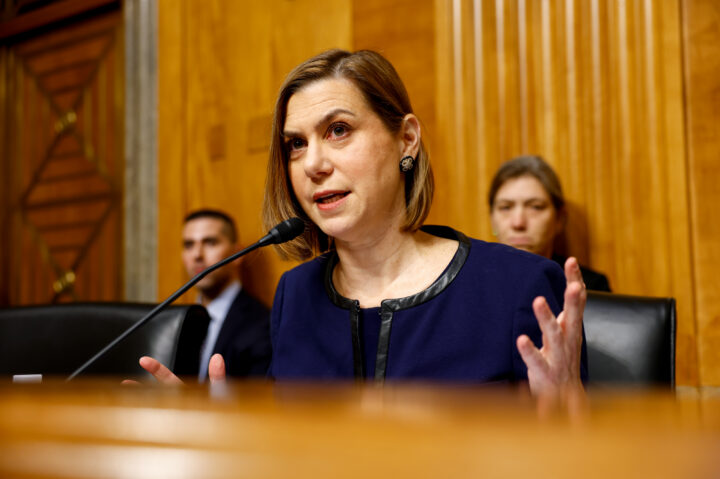
Kent Nishimura/Bloomberg via Getty Images
Senator Elissa Slotkin (D-MI) during a Senate Homeland Security and Governmental Affairs Committee confirmation hearing in Washington, DC, on March 18, 2026.
Michigan Senate candidate Abdul El-Sayed is facing criticism from some prominent Michigan Democrats — including Sen. Elissa Slotkin (D-MI) and Rep. Haley Stevens (D-MI), who is running against him in the Democratic primary — for his decision to host campaign rallies with Hasan Piker, the far-left political streamer with a history of antisemitic remarks.
“That’s the exact opposite of someone I’d be campaigning with,” Stevens told Jewish Insider on Wednesday. “We have to be serious here about who’s going to be the best general election candidate for U.S. Senate in Michigan to beat [Republican] Mike Rogers, and someone who’s campaigning with someone like that is not going to win in Michigan.”
El-Sayed will host two rallies with Piker and Rep. Summer Lee (D-PA) at the University of Michigan and Michigan State University on April 7.
Piker has millions of followers on the streaming platform Twitch. He has said that “Hamas is a thousand times better” than Israel, and has described Orthodox Jews as “inbred.” He has also praised terrorists and said America deserved 9/11.
Stevens said that by associating with Piker, El-Sayed is “choosing to campaign with someone who has a history of antisemitic rhetoric.”
Slotkin told JI that she is not familiar with much of Piker’s language but that what she knows of his rhetoric raises concerns for her.
“Any equating of all Jews or American Jews with Israel and the Israeli government is a problem right off the bat, and then it sounds like, from there, a cascading set of antisemitic tropes and just the kind of rhetoric that is — I want to read for myself, but sounds deeply antisemitic, consistently, and therefore not someone that should be helping anybody out in the Michigan political environment,” said Slotkin.
The announcement of Piker’s upcoming campaign visits to Michigan comes two weeks after an attempted terrorist attack at Temple Israel, a Reform synagogue in West Bloomfield Township, Mich.
A new poll conducted by the campaign of Michigan state Sen. Mallory McMorrow, the third major Democrat running alongside Stevens and Piker, shows McMorrow leading the race with 30%. El-Sayed is behind her at 25%, and Stevens follows at 23%, with 21% undecided. Other polling ahead of the August primary has shown Stevens with a small lead.
The former secretary of state also said he questions whether the U.S. could have done more to save lives in Gaza

Kevin Dietsch/Getty Images
Then-Secretary of State Antony Blinken delivers remarks during a NATO public forum as part of the 2024 NATO Summit on July 10, 2024 in Washington, DC.
Former Secretary of State Tony Blinken said at a Harvard Kennedy School event this week that he warned Israeli Prime Minister Benjamin Netanyahu a few months into the war in Gaza that Israel was going to lose support among not just Democrats, but also Republicans and evangelical Christians.
“Israel was mostly seen as the David and other forces were seen as the Goliath. That is now flipped,” Blinken said. “One of the things that I told Netanyahu was, ‘You may not care that you’re losing the Democratic Party, but trust me, you are going to lose young Republicans. You’re going to lose young evangelicals. This is generational.’ And he moved on to something else.”
The conversation took place early in 2024, a few months after the Oct. 7 Hamas attacks that killed 1,200 people in Israel. During his remarks at Harvard, Blinken said he wonders if there is more the U.S. could have done to protect Palestinians in Gaza. But he also called on people not to be “binary” in their thinking about the Middle East.
“Of course, for me, coulda-woulda-shoulda is something that will always be there when it comes to Gaza. It could not help but be given the level of human suffering,” said Blinken.
“But where did we start? We started with Oct. 7. We started with the most horrific massacre of Jews since the Holocaust,” Blinken added. “It’s very easy to say, ‘Oh, yeah, that’s a given.’ Except it wasn’t a given for Israelis and Israeli society. It became one for the rest of the world, but not for Israelis.”
Blinken was being interviewed by New York Times reporter David Sanger, who said that history books written about President Joe Biden will show his administration as “strongest on Ukraine and weakest on Gaza.”
Asked whether the Biden administration could have done things differently in Gaza to save lives, Blinken said, “Could we, should we have done things differently such that the suffering that people endured, the loss of the children you just listed and so many others could have been averted? The short answer is: Maybe yes.”
“We had to make judgments in real time about how to try to get to a better place. We made those judgments. People will make their own judgments about what we did and what we didn’t do,” said Blinken.
Despite the humanitarian crisis that emerged in Gaza, the U.S. pushed Israel to do more for Palestinians and to allow more aid into Gaza, Blinken said.
“That didn’t just happen. It happened because every single day we were on the Israelis to try to get assistance in, to open more crossing points, to flood the zone. They did that profoundly inadequately. They did that in ways that were not the way I would like to have seen it done, but we got some of that done,” said Blinken. “But yes, of course, you couldn’t be and I wouldn’t be human if I didn’t ask myself every day, could we have done things differently.”
Blinken said that the trauma Israelis experienced after Oct. 7 was so severe that Israel’s war in Gaza would have continued, even without American support — and that cutting off American weapons sales to Israel may have actually lengthened the war.
“Cutting off arms, sure, that was an option. But I don’t actually believe that at least in the near term, it would have changed things,” said Blinken. “I also believe it would have led to an even wider war as Israel’s enemies, and they were multiple, jumped in, and that only would have extended the war in Gaza, not ended the war in Gaza.”
The main focus of the Biden administration, according to Blinken, was to reach a ceasefire, “with hostages coming out and with aid going in.” He acknowledged the pain of people who were angry about the situation in Gaza, but questioned why so little anger was directed at Hamas.
“I empathize with people who felt this so deeply,” said Blinken. “I do remain with a question in my mind about why barely a word was spoken in all those months about Hamas, which was an actor too, and is responsible for so much of what happened.”
Schneider called Piker ‘an unapologetic antisemite’ and warned ‘Democrats risk losing our credibility to condemn those on the right who traffic in bigotry’ if they continue to embrace him

Tom Williams/CQ-Roll Call, Inc via Getty Images
Chairman Brad Schneider (D-IL) conducts a news conference with members of the New Democrat Coalition during the House Democrats 2025 Issues Conference at the Lansdowne Resort in Leesburg, Va., on Thursday, March 13, 2025.
Rep. Brad Schneider (D-IL), who chairs the moderate New Democratic Coalition, called on Democrats on Tuesday to reject and distance themselves from Hasan Piker, the far-left media figure boosted by an increasing number of Democrats and Democratic candidates.
Piker has faced repeated criticism for antisemitic comments and support for terrorism, in addition to a range of other offensive remarks and activity. Schneider, in addition to his leadership in the New Dems -— one of the largest groups in the House Democratic Caucus — is a co-chair of the Congressional Jewish Caucus.
“Hasan Piker is an unapologetic antisemite,” Schneider said on X on Tuesday. “Democrats risk losing our credibility to condemn those on the right who traffic in bigotry, antisemitism, & hate when our own Members of Congress & candidates are celebrating or, worse yet, platforming those who espouse hate of any kind.”
Schneider said he is proud that the Democratic Party “welcome[s] a broad diversity of opinions and priorities. But we cannot allow those who preach hate & seek division to find safe harbor among us. We must call out hate & reject those who champion ideologies of exclusion and demonization.”
The moderate Democratic leader’s comments come on the same day that Michigan Senate candidate Abdul El-Sayed announced a rally alongside Piker, and after numerous other colleagues have appeared on Piker’s livestream show or defended him.
They also follow similar condemnation from Third Way, a prominent moderate Democratic group.
The vote again fell largely along party lines, with only Sens. John Fetterman and Rand Paul defecting from their parties
Kevin Carter/Getty Images
The U.S. Capitol Building is seen at sunset on May 31, 2025 in Washington, DC.
For the third time in a month, Senate Republicans on Tuesday evening blocked an effort by Democrats to halt U.S. operations in Iran.
The war powers resolution, this time led by Sen. Chris Murphy (D-CT), is part of a series of efforts by Senate Democrats to disrupt business on the Senate floor to force a reckoning and public testimony by Cabinet officials about the war in Iran.
Democrats have four other such resolutions filed, which they could call up for votes at a time of their choosing, using special procedures allowing lawmakers to force votes on war powers resolutions.
The Senate again rejected the resolution 53-47, with Sen. John Fetterman (D-PA) once again voting in favor of the war effort and Sen. Rand Paul (R-KY) again voting against it.
The mostly party-line vote comes in spite of recent comments by some Senate Republicans pushing for the war to come to an end.
Sen. Tim Kaine (D-VA), another leader of the Democratic war powers push, said that the group plans to continue to force weekly votes on the issue. He acknowledged before the vote that the results might not change this week, but suggested that some Republican colleagues might be won over if the war continues to drag on, troops are sent to invade Iran or oil prices continue to spike.
Kaine indicated that he was not encouraged by President Donald Trump’s comments that he considered the U.S. to have “won” the war in Iran or his recent claims of engaging in productive talks with the regime.
“If he announces that it’s over, that will be good news,” Kaine told Jewish Insider. “Now, the consequences are not going to be over for a very long time, and Virginians are going to be suffering the consequences of something that lacked a rationale and lacked a plan for a very long time, in all likelihood. But the minute he announces it’s over, that will be positive — if he doesn’t change his mind, but he could change his mind.”
The House is expected to vote this week on a similar measure led by Rep. Greg Meeks (D-NY). A separate House measure led by Rep. Josh Gottheimer (D-NJ) and other pro-Israel moderates which would limit the war effort to 30 days — a period which will expire next week — could also come to a vote soon.
At least one House Democrat who voted previously against a war powers resolution and backed the U.S. operations in Iran has said he plans to vote for the Meeks resolution this week.
The centrist think tank called it 'morally repugnant and strategically self-defeating' for the left-wing Michigan Senate candidate to appear with Piker at an upcoming rally
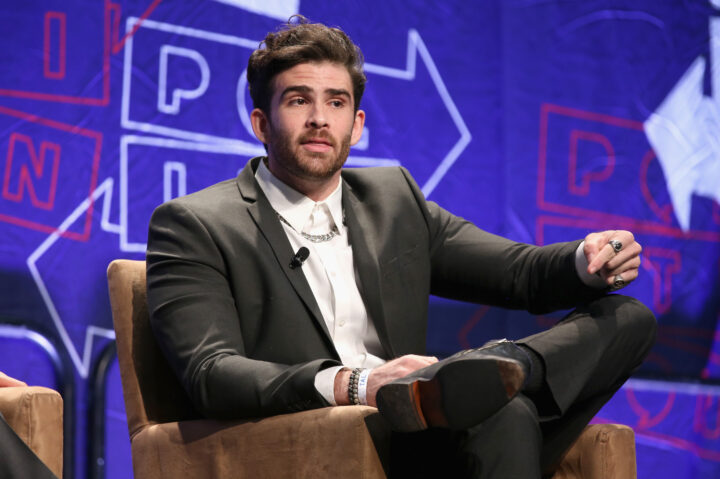
Phillip Faraone/Getty Images for Politicon
Hasan Piker speaks onstage during Politicon 2018 at Los Angeles Convention Center on October 20, 2018 in Los Angeles, California.
A prominent moderate Democratic think tank is continuing to call out Democratic candidates for being “too cozy” with antisemitic streamer Hasan Piker, who has been embraced by several left-wing Democrats in recent months.
In his latest statement, Jonathan Cowan, president of Third Way, condemned Michigan Senate candidate Abdul El-Sayed for his upcoming rallies with Piker, first reported by Politico, set to take place on April 7 at Michigan State University and the University of Michigan alongside Rep. Summer Lee (D-PA).
“It is morally repugnant and strategically self-defeating for Democrats like Abdul El-Sayed and Members of Congress like Summer Lee to cozy up to antisemitic extremists like Hasan Piker,” Cowan said. “Anyone eager to campaign with Hasan Piker is, at best, comfortable overlooking his antisemitic and anti-American extremism and, at worst, endorsing it.”
Cowan referenced a Wall Street Journal editorial he co-authored with Third Way’s Lily Cohen last week, titled “Democrats Are Too Cozy With Hasan Piker,” in which the two urged Democrats to follow the lead of Sen. Ted Cruz (R-TX) in calling out antisemitism in their own party.
“Piker’s depravity rivals that of far-right bigots. We will not defeat the surge of antisemitism in America without taking on its most influential proponents on our own side,” Cowan’s statement continued. “Embracing extreme bigots like Piker, who, for starters, has called religious Jews ‘inbred’ and said ‘America deserved 9/11,’ is not only dangerous and wrong, but antithetical to the urgent work of winning over the middle and defeating Trumpism.”
Other Democrats, including Rep. Ro Khanna (D-CA), have also embraced Piker, while California Gov. Gavin Newsom recently pledged to appear on Piker’s popular Twitch stream.
The ousted New York lawmaker consulted for the far-left PAC, which is partially funded by Don Henley of The Eagles

Spencer Platt/Getty Images
Former Rep. Jamaal Bowman (D-NY) speaks at the National Action Network’s (NAN) three-day annual national convention on April 07, 2022 in New York City.
Former Rep. Jamaal Bowman (D-NY), who lost his bid for reelection in 2024 largely over his hostile views on Israel, now appears to be working for a political action committee linked to a radical anti-AIPAC social media account — a committee funded in part by soft-rock icon Don Henley.
The latest disclosure filings from Citizens Against AIPAC Corruption, one of two PACs tied to the X account AIPAC Tracker and website Track AIPAC, show that it paid $7,000 to a Yonkers, N.Y.-based firm called JAB Advocates for “General Campaign Consulting.”
JAB does not appear to be a registered company in New York, but its address in the filing belongs to Bowman, who lost a primary challenge for his seat covering parts of the Bronx and Westchester County to Rep. George Latimer (D-NY) in 2024.
Bowman’s LinkedIn identifies him as JAB Advocates’ “Founder & Principal.”
“Advising political leaders, EdTech companies, and advocacy organizations on policy strategy, government relations, and market entry — with active engagements across the U.S., Europe, and South Asia,” the description on his page reads, highlighting Bangladesh and Qatar as countries where his clients conduct business. “Senior advisor to members of Congress, elected officials, think tanks, and fundraisers across the country.”
Prior to his loss to Latimer, who received support from AIPAC, Bowman’s tenure in Congress was marred by his censure for pulling a fire alarm during a House vote, his eventually recanted denial of sexual violence committed during the Oct. 7 attacks and the revelation that he had promoted 9/11 conspiracy theories on his personal blog prior to holding office.
The former high school principal and congressman did not respond to questions about how he came to work for the PAC. Federal Election Commission records show his firm has also worked for New Hampshire Senate candidate Karishma Manzur, whom Track AIPAC has repeatedly promoted on X.
One of Track AIPAC’s co-founders, Cory Archibald, is a veteran of the far-left group Brand New Congress and previously reported working as a campaign staffer for Bowman and other Squad members. A Washington Free Beacon report last year found that Archibald had in the recent past identified herself online as a Marxist and a resident of Germany.
The Track AIPAC team did not respond to questions for this story. The group has come under criticism for the arbitrary manner in which it links politicians to the “pro-Israel lobby,” often simply on the basis of association with Jewish individuals and institutions — such as in the case of Sen. Jon Ossoff (D-GA) a Jewish lawmaker who has an openly hostile relationship with AIPAC and has opposed military aid packages for Israel.
And while Track AIPAC has cast itself as a crusade for transparency, FEC records show CAAC PAC has dumped tens of thousands of donor dollars into an anonymous consulting firm called Overton Strategies LLC. Overton formed last fall in Delaware, where the state’s notorious corporate secrecy laws make its structure and ownership inscrutable.
No other federal PAC appears to have ever retained Overton’s services. Much of the rest of the PAC’s money goes toward fundraising bids.
The Track AIPAC account has also attacked multiple members of Congress as “pedophile Protectors.” However, FEC filings show that one of its biggest donors is Don Henley, drummer and vocalist for The Eagles, has given more than $30,000 to CAAC PAC and its affiliate Tracker PAC — and who pleaded no contest to contributing to the delinquency of a minor after an infamous incident in 1980.
Henley was arrested at the height of his fame when an underage sex worker was hospitalized for overdose-related seizures after doing cocaine with the musician at his Los Angeles home. In a 2024 court proceeding, Henley admitted procuring the girl via a brothel operator, but maintained the two never had intercourse and that he believed her to be at least 20 years old.
Henley did not respond to a request for comment from Jewish Insider sent via his website.
Plus, Temple Israel seeks to 'tell its story'

Andrew Harnik/Getty Images
Tulsi Gabbard is sworn in as Director of National Intelligence in the Oval Office at the White House on February 12, 2025 in Washington, DC.
This P.M. edition is reserved for our premium subscribers — offering a forward-focused read on what we’re tracking now and what’s coming next. Please don’t hesitate to share your thoughts and feedback by replying to this email.
📡On Our Radar
Notable developments and interesting tidbits we’re tracking
Director of National Intelligence Tulsi Gabbard distanced herself — to a degree — from two of her isolationist-minded aides, Joe Kent and Dan Caldwell, who have taken a hostile stance to the U.S.’ Middle East policy, Jewish Insider’s Marc Rod reports.
Gabbard affirmed, after being pressed at a House Intelligence Committee hearing today, that the conspiratorial views about Israel espoused by Kent in his resignation letter earlier this week did concern her, and said about Caldwell that he would have no influence over intelligence reports at her agency.
Gabbard, who has previously been a vocal critic of military engagement with Iran, further acknowledged that her current position requires her to “check” her personal views “at the door”…
Reports of a potential $200 billion emergency funding request from the Pentagon for the war in Iran are drawing firm Democratic opposition and hedged responses from Republicans on the Hill: House Speaker Mike Johnson (R-LA) said he’ll “look at” the request “but obviously it’s a dangerous time in the world and we have to adequately fund defense,” while Sen. Lindsey Graham (R-SC) said he’d “hate to be the senator that denied the request if it made sense.” Rep. Pat Ryan (D-NY) responded with a simple “No,” while Sen. Richard Blumenthal (D-CT) called it a “nonstarter”…
The Senate is set to hold another round of votes on blocking U.S. arms transfers to Israel, after Sen. Bernie Sanders (I-VT) filed three new joint resolutions of disapproval against $658.8 million in sales of over 20,000 bombs to Israel, JI’s Marc Rod reports.
A majority of the Democratic caucus — 27 lawmakers — voted to block at least one arms sale in July of last year, a significant jump in support from previous similar efforts; Israel’s standing in the party has largely declined since then amid Democratic criticism of the war with Iran…
During a meeting with Japanese Prime Minister Sanae Takaichi at the White House today, President Donald Trump reiterated that he had told Israeli Prime Minister Benjamin Netanyahu not to attack Iranian oil facilities, after an Israeli strike on the South Pars gas field yesterday: “I told them, don’t do that. We didn’t discuss. … It’s coordinated, but on occasion, he’ll do something.”
Trump also put pressure on Takaichi to help secure the Strait of Hormuz, while European leaders released a joint statement “express[ing] our readiness to contribute to appropriate efforts to ensure safe passage through the Strait,” after repeatedly declining to get involved. A team of British military planners is now consulting with CENTCOM on options to assist short of military action, The New York Times reports…
Asked if he will deploy more U.S. troops in the region, Trump told reporters he’s “not putting troops anywhere. If I were, I certainly wouldn’t tell you — but I’m not putting troops”…
Secretary of Defense Pete Hegseth compared Iran to Hamas in a briefing today, saying that, “just like Hamas and their tunnels,” Iran has “poured any aid, any economic development … into tunnels and rockets”…
A group of congressional Democrats is urging the State Department to restart chartered evacuation flights out of Israel and take additional steps to help U.S. citizens who wish to leave the country amid the ongoing war with Iran, JI’s Marc Rod reports.
The lawmakers described the State Department’s current partnership with El Al, which launched on March 13 with a limited number of special evacuation flights for U.S. citizens, as insufficient. The Israeli airline has currently suspended registration for the flights, and government-imposed security restrictions are limiting passenger capacity on each flight and reducing airport operations…
Treasury Secretary Scott Bessent said that the U.S. may lift sanctions on Iranian oil already at sea in order to blunt rising gas prices. “In essence, we will be using the Iranian barrels against the Iranians to keep the price down for the next 10 or 14 days as we continue this campaign,” he explained on Fox News…
Saudi Foreign Minister Prince Faisal bin Farhan warned the kingdom is reaching a breaking point after continued Iranian attacks, saying “what little trust” Riyadh had with Tehran has “completely been shattered.”
On a potential Saudi military response, Prince Faisal said, “Do they have a day, two, a week? I’m not going to telegraph that.” It’s a notable shift for Riyadh, which had been pivoting away from its traditional allies and towards Iran and other Islamist countries prior to the war…
Illinois Gov. JB Pritzker condemned AIPAC after a primary cycle in which the pro-Israel group spent millions backing — and opposing — candidates across the state, calling it “an organization that was supporting Donald Trump and people who follow Donald Trump.”
Pritzker, a Jewish Democrat who was once an AIPAC donor himself, said it “really is not an organization that I think today I would want any part of.” He further echoed far-left sentiments that Israel dragged the U.S. into conflict with Iran, claiming Trump “simply follow[ed] Netanyahu into that war”…
Rep. Jared Moskowitz (D-FL) details his experience with a would-be assailant, a man described by authorities as a “ticking time bomb,” who was arrested near his home last year after police discovered an arsenal of weapons and a handwritten list of targets that included Jewish sites and Moskowitz.
“Besides the police presence outside his house, Moskowitz himself will not appear in parades and says he won’t speak at outdoor staged events. ‘It’s not worth it. I’d rather lose my election,’” the lawmaker told Roll Call…
Temple Israel in suburban Detroit released photos of the devastation to the building caused by an attacker last week, noting that it had “chosen thus far not to make [the photos] public” but are doing so now “to take back control of our narrative” after several were leaked to the media.
“We share these images because our community deserves to see our building through eyes of love, not through the lens of spectacle. This is our sacred space, and we will be the ones to tell its story,” the synagogue wrote…
The University of California, Berkeley reached a settlement in its lawsuit with the federal government, agreeing to pay $1 million and make changes to its discrimination policy following accusations that the university had failed to properly address campus antisemitism.
Among the policy changes, the school will clarify that the word “Zionist” cannot be used as a proxy for Jew or Israeli. The claims in the lawsuit predate the recent campus unrest over Israel’s war in Gaza, stemming from an incident in 2022 when student groups adopted policies saying they would not host Zionist speakers…
⏩ Tomorrow’s Agenda, Today
An early look at tomorrow’s storylines and schedule to keep you a step ahead
Keep an eye out in Jewish Insider for a look at the struggles facing international broadcasters Voice of America and Radio Free Europe in reaching Iranian citizens during the ongoing war due to budget cuts and roadblocks from the U.S. Agency for Global Media.
The House Appropriations Committee will hold a field hearing at the U.S. Mission to the U.N. in New York City on “accountability and reform” at the U.N.
We’ll be back in your inbox with the Daily Overtime on Monday. Shabbat Shalom!
Stories You May Have Missed
DEADLINE LOOMING
Netanyahu has less than two weeks to pass a budget — or go to early elections

The prime minister’s governing coalition is struggling to stay intact to pass 2026 budget amid shifting political priorities
QUARREL ON THE QUAD
University of Michigan regent race revives campus fight over Israel

Anti-Israel activists are singling out regent Jordan Acker, hoping to unseat him with attorney Amir Makled, who represented a member of the school’s encampment
‘As Israel continues to face threats from hostilities with Iran, the State Department cannot abandon American citizens abroad,’ the lawmakers wrote

GIL COHEN-MAGEN/AFP via Getty Images
The empty departures hall at Ben Gurion Airport near Tel Aviv on June 13, 2025 after Israel closed its air space to takeoff and landing.
A group of congressional Democrats is urging the State Department to restart chartered evacuation flights and take additional steps to help U.S. citizens who wish to leave Israel amid the ongoing war with Iran.
The lawmakers described the State Department’s current partnership with El Al, which launched on March 13 with a limited number of special evacuation flights for U.S. citizens, as insufficient. The Israeli airline has currently suspended registration for the flights, and government-imposed security restrictions are limiting passenger capacity on each flight and reducing airport operations.
“We were shocked to learn this week that as the military conflict in Iran escalates and continues to threaten the safety of U.S. citizens in the Middle East, the State Department has abruptly and effectively ended emergency evacuations for Americans out of Israel,” the lawmakers said in a letter to Secretary of State Marco Rubio on Thursday. “As Israel continues to face threats from hostilities with Iran, the State Department cannot abandon American citizens abroad. Failing to assist Americans in their time of need is totally unacceptable.”
The letter, led by Rep. Laura Gillen (D-NY), was co-signed by Senate Minority Leader Chuck Schumer (D-NY) and Reps. Yvette Clarke (D-NY), Don Davis (D-NC), Dan Goldman (D-NY), Josh Gottheimer (D-NJ), Julie Johnson (D-TX), Greg Landsman (D-OH), George Latimer (D-NY), Jared Moskowitz (D-FL), Jerry Nadler (D-NY), Pat Ryan (D-NY), Tom Suozzi (D-NY), Ritchie Torres (D-NY), John Mannion (D-NY), Haley Stevens (D-MI), Joe Morelle (D-NY) and Johnny Olszewski (D-MD).
According to the letter, the State Department is urging Americans to rely on commercial transportation or the Israeli Ministry of Tourism, and El Al lacks the capacity to carry all U.S. citizens who wish to depart, leaving Americans “without real options.” The information provided by the State Department, the letter reads, is “causing frustration, anxiety, and fear.”
“In the midst of a conflict, U.S. citizens should not have to wait weeks to be able to board a commercial flight or cross the Israeli border into another country to find their way home. It is unacceptable for the State Department to leave them on their own,” the letter continues.
In a press release Thursday, the State Department heralded its partnership with El Al, which it said has “already allowed more than 2,000 American citizens to return to the United States from Israel.”
The airline “will continue to reserve a percentage of seats on all regular U.S.-bound flights for Americans wishing to depart Israel” and has 28 flights scheduled over the next week “to the extent permitted by the Israeli authorities,” the State Department said. The release did not acknowledge that the registration form for the evacuation flights is currently closed.
Democrats have accused the administration of failing to adequately prepare to evacuate U.S. civilians, or government personnel, from the Middle East before launching the war in Iran.
The lawmakers called on the State Department to restart charter flights from Israel and elsewhere in the region; reopen the State Department’s crisis intake form, which helps citizens receive emergency information; activate a crisis task force to assist Americans attempting to leave Israel; and provide clearer information on commercial air travel options.
Thousands of Americans, currently in Israel, are unable to access flights home and are not being offered alternative travel options or any additional assistance by the State Department,” their letter reads. “Additionally, the Department’s inconsistent guidance and lack of responsiveness have added to uncertainty and fear, making the situation even more dire for impacted families.”
In its press release, the State Department defended its evacuation efforts: “After the launch of Operation Epic Fury, the Department offered charter flight options to thousands of Americans wishing to leave Israel to Athens and destinations in the United States, as well as ground transportation options to Egypt — with supply exceeding demand on nearly every chartered flight and bus.”
Anti-Israel activists are singling out regent Jordan Acker, hoping to unseat him with attorney Amir Makled who represented a member of the school’s encampment

JEFF KOWALSKY/AFP via Getty Images
Anti-Israel demonstrators set up a mock trial against the University of Michigan's Board of Regents on the university's campus in Ann Arbor, Michigan, on April 21, 2025.
When Jordan Acker ran for the University of Michigan Board of Regents in 2018 — a statewide elected office — he presented himself as a young alumnus eager to bring a fresh energy to the governing board of Michigan’s flagship public university.
But since the Oct. 7 Hamas attacks in Israel in 2023, Acker has become the target of the university’s anti-Israel activists, facing harassment and vandalism that Michigan leaders have called plainly antisemitic.
Acker, who is Jewish, has been a staunch opponent of efforts to divest university funds from Israel, along with other members of the Board of Regents, which has reiterated that it will not divest from Israeli companies. In November, the president of Michigan’s student government vetoed a divestment resolution.
In May 2024, a stranger wearing a keffiyeh came to Acker’s house in the middle of the night and placed papers on the door, described as a list of demands from the “UMich Gaza Solidarity Encampment.” In December of that year, his front windows were smashed and his wife’s car was vandalized with pro-Hamas graffiti. The university called it “a clear act of antisemitic intimidation.”
Now Acker is up for reelection, along with regent Paul Brown. Both of them are Democrats who were elected to the board in 2018, and they each oppose divestment.
But the university’s anti-Israel activists are targeting only Acker. This time, they are advocating for voters to unseat him and to vote instead for Amir Makled, a candidate who has aligned himself with anti-Israel activists and advocated for the university to divest from Israel. Only two of the three candidates will proceed to the general election, where they’ll go up against two Republicans.
A flyer that was distributed at a recent Washtenaw County Democrats meeting in support of Makled called out only Acker for his support of Israel. (Brown told Jewish Insider that he and Acker are running on a ticket, and they are doing events together as well as joint fundraising.)
“UM Regent Jordan Acker is up for re-election this year, and as one of the most vocally zionist regents who has personally advocated for the repression of pro Palestine voices at the university, we are mobilizing to unseat him from his position on the Board of Regents,” read the flyer, which featured a photo of Acker’s face crossed out with a red X. “Together we can replace him with pro-Palestine regental candidate Amir Makled who helped successfully defend the UM Encampment 11 against charges from MI attorney general Dana Nessel.”
The flyer encouraged Michigan students to sign up to attend the Michigan Democratic Party convention in Detroit on April 19, where delegates will nominate the two candidates for Board of Regents.
Nearly two decades ago, Makled helped pass a measure calling on the University of Michigan’s Dearborn campus to divest from Israel when he was a student there in the late 2000s. It was one of the first universities in the nation to vote in support of the Boycott, Divestment and Sanctions movement.
Makled, a Dearborn trial lawyer who represented an anti-Israel protester who was arrested during the 2024 University of Michigan encampments, is basing his pitch to voters in part on the idea that the state’s flagship public university should divest from Israel. Makled has been endorsed by Rep. Rashida Tlaib (D-MI), one of the most vocal critics of Israel in Congress.
“Investment in entities that are not ethical and don’t represent the values of this institution aren’t in the best interest of the university,” Makled recently told The Michigan Daily, the campus newspaper. “[Investment] should be based off ethical dollars and ethical approaches to investment. And so we shouldn’t be profiting from entities that are supporting a genocide.”
And while Acker and Brown might prefer that the race not be used to relitigate the messy 2023-2024 academic year that followed the Oct. 7 Hamas attacks — other issues like tuition affordability and the university’s response to President Donald Trump are expected to be a focus for all three candidates — the election is already shaping up to be a referendum on the university’s handling of anti-Israel protests that year.
“We made mistakes. I think there’s no question about it. And I think a lot of these decisions were made from a place of real stress and real personal fear and real trying to do what was right based on the information we knew at the time,” Acker told JI on Wednesday. “You have to be realistic and protect the rights, yes, of pro-Palestine protesters. I think that’s one of our most sacred rights. But we can’t do so at the expense of other people’s rights.”
Brown is also opposed to divestment, and he, like Acker, had to deal with a protester showing up at his home in the middle of the night. But it did not change his stance on divestment.
“I had a masked person come to my home at 3 a.m. and nail a demand letter onto my door that said, Do these I think, four things by Thursday or else, and every one of them was, in essence, a form of punishment to the people in the nation of Israel,” Brown said. “My feeling is that I’m just fundamentally opposed to using the university as a mechanism, as a weapon, to punish any group or nation.”
Makled, who is the child of Lebanese immigrants, received a burst of national media attention early last year when he was detained at the Detroit airport on his way home from a family vacation. He claimed he was being questioned because he was representing a University of Michigan student who was facing felony charges of resisting arrest during a police raid on the anti-Israel encampment in 2024. He told the Michigan College Democrats that the Board of Regents’ handling of the protests was part of his reason for deciding to run.
“We have to support students, and we have to have the right to speak out, because that’s at the core of what we do when we’re going through the process of higher education,” Makled said at the meeting.
The charges against the protesters, including his client, were dropped last year. Afterward, in the courtroom, he made an impromptu speech.
“This was not about trespass. This was not about felony conduct. This was the criminalization of free speech and today the state of Michigan agrees,” said Makled. “There is still a genocide that is happening in Palestine. And we should never forget that today, we still get to stand firm and say, free Palestine.”
Makled did not respond to a request for comment.
Katy Padilla Stout told JI she believes her ‘common sense’ campaign will sway conservative voters who have concerns over Herrera’s previous Nazi commentary

Katy Padilla Stout campaign page
Texas congressional candidate Katy Padilla Stout
Arguing that character in politics still matters, Katy Padilla Stout, an attorney and former teacher, sees an opportunity to flip a red district in south Texas that President Donald Trump won by 15 points in the last presidential election.
Padilla Stout is the Democratic nominee in Texas’ 23rd Congressional District, where she’s now set to face hard-right influencer and GOP nominee Brandon Herrera, who brings significant baggage to the House race. Herrera became the presumptive GOP nominee after Rep. Tony Gonzales (R-TX), who is more moderate and had demonstrated crossover appeal, withdrew from the race under an increasing cloud of scandal.
Herrera has repeatedly come under fire for social media videos in which he used imagery from and made light of the Nazi regime and the Holocaust, which he has dismissed as jokes. He also recently attracted controversy for a podcast appearance in which he discussed owning a copy of Mein Kampf, though he denied agreeing with the Nazi manifesto.
Padilla Stout told Jewish Insider in an interview this week that, since entering the race, she saw a path to victory against either Gonzales or Herrera, given Gonzales’ reported scandals and Herrera’s incendiary activity.
“I didn’t want someone like [Herrera] representing my children,” Padilla Stout said. “And then when I realized that he was going to be representing the county of Uvalde,” the site of a 2022 mass school shooting, “I decided to go ahead and put my name in the ring.” She accused Herrera of espousing bigotry toward various groups.
But she said that she views Herrera as a weaker opponent than Gonzales would have been.
“Even with his scandal, Tony was still an incumbent. He’s still been there for six years. He had name recognition. He had people who obviously were still supporting him, even post-scandal,” Padilla Stout said.
“Now that we’re able to only run a race against Mr. Herrera, I think that there are stark differences between the two of us, I think that many people who possibly were more moderate would have said, ‘OK, I can vote for Tony again,’ aren’t in that same boat now. And so I think that that definitely makes this race more winnable.”
Herrera campaign manager Kimmie Gonzalez dismissed the criticisms of the GOP nominee as misleading.
“The accusations against Brandon were manufactured through misleading video edits by one desperate candidate who lost, and are now being weaponized by another desperate candidate who will lose in November. Brandon is proud of his support from the Jewish community and does not have an antisemitic bone in his body,” Gonzalez said in a statement to JI.
“What is, in fact, disqualifying are our opponent’s horrendous policies, including reopening the southern border, bringing back Joe Biden’s ‘catch and release’ program, and advocating for taking children to drag shows. Her values are not just out of touch with Southwest Texas voters, they are downright dangerous,” Gonzalez continued.
Though the Cook Political Report previously rated the district as “solid Republican,” the election handicapper gave Democrats a better chance of winning after Gonzales dropped out, shifting its rating to “likely Republican.”
A recent Public Policy Polling survey conducted for the House Majority PAC, which is aligned with House Democratic leadership, found Padilla Stout and Herrera nearly tied, with 18% of voters undecided.
Republicans have insisted they’ll have no issue winning the seat, regardless of their nominee.
“Texas’ 23rd District is deep red, and Democrats know it. While they talk a big game in Washington, they don’t even have a credible recruit and are too busy defending their own vulnerable members across Texas to compete here,” NRCC spokesman Christian Martinez said in a statement to JI earlier this month. “In November, voters will once again elect a Republican who will secure the border, lower costs, and stand up for Texas families.”
Padilla Stout said that she felt a “deep sense of disgust” with Herrera’s past videos. She dismissed his claims that the incidents were only intended in jest, calling the pattern “really concerning,” particularly when coupled with Herrera’s longtime membership in a neo-Confederate group.
“Everybody who watched it understood that he was normalizing that and that it wasn’t funny, and it wasn’t about humor,” Padilla Stout said. “It was about doing something that was harmful to our society and desensitizing people.”
Padilla Stout said that, living in a conservative area, reaching out to GOP-leaning voters she’ll need to win the seat is natural to her, and that she has many conservative friends. And, she claims, Republicans tell her frequently they’re not willing to vote for Herrera.
“I think we just appeal to a lot of people in the sense that we’re a pretty common-sense campaign, I’m not an extreme leftist, and so I think that that’s helpful for people who maybe haven’t voted for a Democrat before,” she continued. “But I think most importantly, our message is people over politics.”
Asked how she would tackle rising antisemitism in the United States more broadly, Padilla Stout called for stronger laws against hate crimes to protect all communities targeted by bigotry and ensure that such crimes are properly prosecuted and punished.
Padilla Stout largely declined to weigh in on Israel or Middle East policy, citing her lack of access to sensitive information that members of Congress can access. She said she would wait until she’s elected in order to more fully articulate her views.
“First and foremost, I always stand for happy, healthy families, whether that be, you know, here or across the world, and making sure that our children are protected and making sure that we’re taking care of our most vulnerable,” she said.
She said she doesn’t know enough about the conflict in Gaza to judge whether it is a genocide, and said that she would consider U.S. aid to Israel on a “case-by-case basis.”
She said she has discussed the conflict with a Jewish friend whose son is serving in the IDF as well as a Palestinian friend, from whom she has heard different perspectives and concerns on the conflict. “That’s the most helpful thing we can always do in any kind of conflict situation, is to really kind of understand both sides, right, see where the dialogue breakdown is occurring.”
Addressing the war in Iran, Padilla Stout raised concerns around the administration’s decision not to seek congressional approval before launching U.S. strikes.
“Our servicemembers deserve to know that if they’re in a conflict or in a war that that’s based on a really hard decision that has been made after looking at intelligence, after having briefings by multiple sources, by multiple people,” Padilla Stout said. “It was a little bit reckless to start this, when anybody can start a war, and it’s going to take a lot more diplomacy to be able to stop one. And I’m just concerned that we may be in over our heads right now.”
Please log in if you already have a subscription, or subscribe to access the latest updates.
 Continue with Google
 Continue with Apple