




































































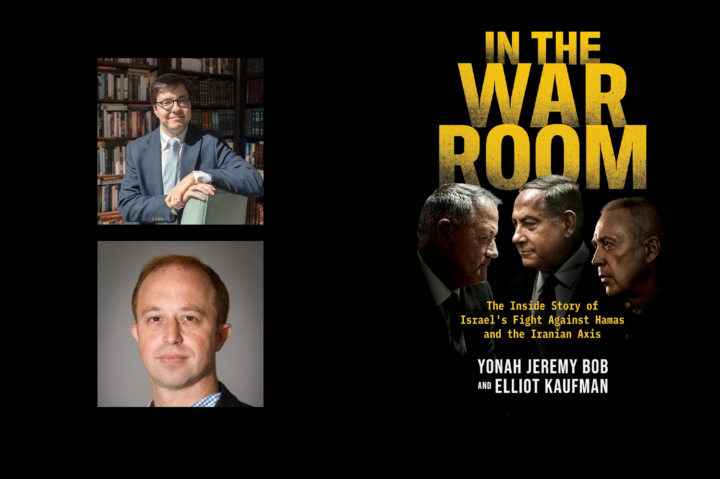
New book ‘In the War Room’ offers candid look at Netanyahu’s wartime decisionmaking
Jerusalem Post military correspondent Yonah Jeremy Bob and Wall Street Journal editorial writer Elliot Kaufman draw on years of interviews with top Israeli leadership


 Add JewishInsider on Google
As Israeli Prime Minister Benjamin Netanyahu heads toward what could be one of the most consequential elections of his career next month, a new book is offering an unusually candid look at the decision-making that will define how history — and Israeli voters — judge him.
In the War Room: The Inside Story of Israel’s Fight Against Hamas and the Iranian Axis, by Jerusalem Post military correspondent Yonah Jeremy Bob and Wall Street Journal editorial writer Elliot Kaufman, draws on two years of interviews with Israel’s political, military and intelligence leadership to reconstruct the internal battles that shaped the war — battles that often pitted Netanyahu against his own defense establishment.
Both Bob and Kaufman criticize some of Netanyahu’s choices, from the delayed ground invasion of Gaza to the “unforced error” of the 2025 aid blockade, though each credits him with historic gains against Hezbollah, Iran and Syria.
The authors sat down with Jewish Insider on Tuesday, the book’s publication day, to talk about what their reporting reveals about Netanyahu’s wartime leadership, and what it might mean for how he’s remembered at the ballot box.
Jewish Insider: In your view, what is the most impactful revelation in your book that has not previously been reported on?
Yonah Jeremy Bob: This is the first book that’s an inside story about the war. There are a lot of books about Oct. 7. There hasn’t been a book that’s covered the full war from the inside. We really got deeply into the beepers and walkie talkies [Israeli operation against Hezbollah] of September 2024. There had been coverage of these issues but in terms of the depth, IDF sources, Mossad sources in Israel, in the U.S., we tell the story — there was actually a debate, should they go first with the beepers or should they go first with the walkie talkies? The things that we learned were stunning: what could have been done differently, how they accomplished it.
Elliot Kaufman: I would point to just how much it took to convince Prime Minister Netanyahu to launch a ground invasion of Gaza at all. You’d think after Oct. 7, of course, Israeli troops are going to roll into Gaza, but in fact Netanyahu was very hesitant, worrying — with good reason, by the way — that Israeli troops could be walking into a death trap. More than that, he had certain Israeli generals telling him, “Don’t do it, the IDF isn’t ready.” He had all the top American generals, sent by President [Joe] Biden, telling him the same thing. He really had to gain confidence in the plan. We tell that story, which I think most people, the way they think about it, would rush right over. But it did take Israel 20 days from the Oct. 7 attack until Oct. 27 to be able to invade Gaza.
JI: You write that nearly the entire Israeli defense establishment wanted the war to end well before it actually did. Why did it keep going?
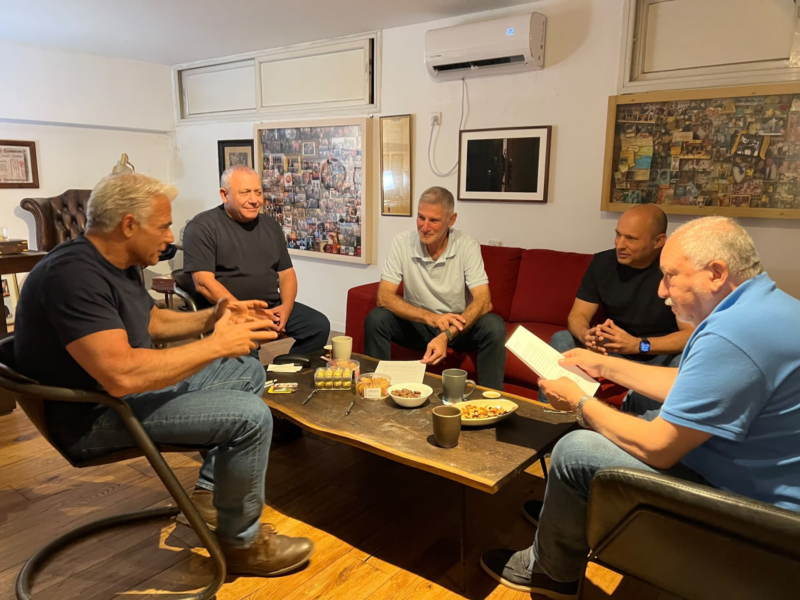
YJB: This was one of the remarkable things we found in doing this book. At the beginning of the war, you have Israeli Defense Minister Yoav Gallant and most of the Israeli military high command all wanting to invade Gaza faster. The first two rounds [of invasions] the defense chiefs and for some amount of time Benny Gantz, an opposition leader who becomes a war minister, all want to go in and go in faster. Netanyahu is more worried about how things are going to go.
In March/April 2024, it shifts and Netanyahu gains confidence that continuing the war longer will reduce the Hamas threat. The defense establishment is concerned about wear and tear on the military, the opportunity to normalize with the Saudis. If you go back to October 2023, Netanyahu is the one who is most concerned about losing U.S. support, and that shifts. The defense officials become more concerned about losing U.S. support. Summer 2024 the vast majority of the defense establishment wants to end the war and get all of the hostages back. Netanyahu is thinking he needs to push the war longer to defeat Hamas. He’s also afraid he’s going to lose his government. For Netanyahu, there’s a mix of ideology and politics.
EK: I would just add that in summer 2024, there were several things in this war that still hadn’t happened yet. Israel had not really taken the fight to Hezbollah so that the northern threat was still looming over Israel. You hadn’t dealt with Iran and its nuclear program, the 12-day war [with Iran in June 2025] hadn’t happened yet. In Gaza, the reason that Israel right now can still hold half of Gaza is because it took some 75% of the territory and then was able to trade that in the final hostage deal, which certainly took me by surprise. I did not think Israel was going to be able to do that. A lot of the most important things in the war actually happened after that point.
YJB: My understanding based on interviews is that Netanyahu did not have some sort of master plan in extending so that he could take care of Hezbollah at Point A and Iran at Point B. A lot of it sort of ended up being luck. There is a Netanyahu philosophy that sometimes he keeps things going looking for luck.
EK: Right. Netanyahu understood after the immense failure of Oct. 7 that he needed total victory. The country may have needed it too — but certainly he knew he’d need it if he was ever going to come back from this. So keeping those options open to “solve” the various fronts, yes, that was part of it as well.
JI: You write that you disagreed as co-authors on terms like “judicial overhaul” versus “judicial reform.” How did covering this as a Jerusalem Post military correspondent versus a Wall Street Journal editorial writer lead you two to different readings on the same events? Yonah, you write that some of your personal views were “watered down” through the bipartisan process of co-writing. Can you give an example of an assessment you’d have stated more sharply if you’d written the book alone?
YJB: There is so little dialogue and debate between people with different views. I hope more people will try to work together in dialogue. I probably would have been more critical about the decision to extend the war in summer 2024. Not because I’m sure that would have gotten all of the hostages back — and when we spoke to everyone across the board, including [former National Security Advisor] Jake Sullivan, he wasn’t sure either. It was not clear exactly when Hamas would say yes. Even though it’s an uncertainty, Netanyahu could have pushed further. Most of the negotiators I spoke to think that he could have cut a deal earlier, the hostages could have come home earlier, Israel’s reputation in the world [would maybe be better].
JI: A substantial percentage of Democrats and a small but growing number of Republicans are calling for the U.S. to reduce military support for Israel — which Netanyahu has proposed phasing out completely over the next decade. After reading your book, do you think these elected officials — and their constituents — would be more or less willing to revisit their position and seek to increase military support for the Jewish state?
YJB: I hope that after reading our book they’ll be willing to reconsider their position. I think a lot of the positions in the U.S. right now about Israel, Hamas and Iran are based on emotional considerations, not really understanding the context of the situation. That’s not new with Israel but it’s a whole different level. I hope people will see that Israel tried very hard to get things right. I hope that whoever is running Israel after Oct. 27, whether it’s the same government or a new government, there’s been a lack of diplomacy and I hope whoever is running Israel next will lean into diplomacy hard. As important as military power is — and it’s very important in this neck of the woods — diplomacy is crucial. If you ignore diplomacy for too long, you can get into the situation Israel is in right now.
EK: So much of the anti-Israel critique during this war, especially the hardline anti-Israel critique alleging genocide, has succeeded only by systematically covering up Hamas, Hezbollah, Iran and the real miltary threats that Israel was confronting. If our book can help in one regard to combat that way of looking at it, it is to lift that veil and really show who Israel was fighting and the real military and strategic dilemmas Israel was facing. Once you seriously engage with those, I don’t see how you can look at it and say Israel was just trying to kill Palestinians.
JI: In the book you criticized Israel’s two‑month aid blockade in 2025: “Blocking humanitarian aid … was an unforced error … It failed to squeeze Hamas … and led to substantial food insecurity.” Do you believe Israel — as an innovation powerhouse — could have come up with better, more novel ways to reduce food insecurity without compromising its own security? Can you offer some examples?
YJB: I do think Israel could have done better. We highlight in the book that it was one of the largest errors of the war. It’s not that there was actually famine in Gaza. There was a fear of famine and a hike of food insecurity. The Israeli government astronomically elevated the amount of food aid. But the fact that it happened at all allowed those who had been critiquing Israel to label Israel with the famine thing. The clearest points, already in 2024, some in the Biden administration suggested neighborhood to neighborhood to put out pilot programs. This was attempted with the Gaza Humanitarian Foundation in mid-2025, but if they had tried it in early 2024 it may have actually succeeded. When they tried it it was too little too late.
EK: Yup, Israel started too late. It would have been nice to roll out the GHF even a few months earlier instead of waiting to the point food insecurity had risen. Why do it then and start in an impossible situation? When in agreement with the U.S., Israel began facilitating aid to Gaza in October 2023, President Biden announced it saying if Hamas steals the aid it will end. That seemed to make sense. Once that began actually happening, the U.S. response was not that aid will end, it was that aid will increase. Much of Israel’s war room raged at the seeming injustice of that. And yet, if Israel wasn’t willing to offer a practical alternative, what did they want the Biden administration to say? The only way to keep going was to make sure there wasn’t a humanitarian catastrophe. They were constantly shooting themselves in the foot.
JI: With [former Syrian dictator Bashar al-]Assad gone and Hezbollah weakened, how real is the opening for a changed Lebanon and Syria?
EK: I remain skeptical that the Lebanese government is going to seize the opportunity, and there are good reasons it doesn’t. It’s afraid of civil war. However, there are opportunities here for the situation [to improve]. Hezbollah isn’t going to be thrown out of the country. But you can have it pressured in different ways. Israel can retain a sort of buffer with the standing offer that when Hezbollah will be seriously disarmed, that territory will be relinquished. Israel has dramatically improved its own security situation. Can Israel save Lebanon? I don’t think so. I don’t even think America can save Lebanon. Lebanon is going to have to save itself, and that is a much more difficult question.
YJB: Another point is the Lebanese government is working directly with Israel for the first time. That’s good. A negative, according to my sources, is the Lebanese army has been less effective now in pushing Hezbollah out than it was in 2025.
The variable is Ahmad al-Sharaa, the leader of Syria. If he is able to change his colors enough from being a jihadist, if he is able to work with Israel on the basis of “my enemy’s enemy is my friend,” to shut down Hezbollah’s ability to rearm, that could be a gamechanger. If he doesn’t and Israel and Syria remain hostile, it will be difficult to reduce Hezbollah’s threat.
JI: Turning now to the present campaign against Iran, how long do you believe the regime can hold out with the “Economic D-day” being imposed recently by the Treasury Department on top of the monthslong naval blockade?
YJB: This is one of the most unpredictable points in the last three years of war. It’s so complicated. I’ve been speaking to a ton of high-up Israeli officials and the damage to Iran is real. The regime in many ways has been weakened, and yet at the same time, it would seem like a paradox but the regime is more confident than it’s been in years because it has this leverage of the Strait of Hormuz and the nuclear program isn’t gone. The ballistic missile program certainly isn’t gone.
When you put all of that together, it’s a question of who breaks first — the American public who is mad about their gas prices or the Iranians who have a much worse situation but their government doesn’t care about how much they suffer. If the regime is willing to let their people suffer, maybe they end up winning the standoff. If Iran gives up first then you can solve the nuclear weapons issue. If the U.S. gives up first it’s going to be problematic. There’s no easy solution.
EK: If you’re Iran looking at the broad sweep of this war — which you were involved in planning, although Hamas didn’t consult you on the timing or decision — you would have wanted the war to go very differently. What [late Hamas leader Yahya] Sinwar set in motion, you can see not only Hamas losing half of Gaza and being truly smashed but Hezbollah losing territory, leadership and its massive missile arsenal. Iran itself is attacked directly multiple times, its nuclear program is in rubble, it’s facing its greatest economic pressure it has ever faced, it’s under a U.S. naval blockade.
In this recent war, Iran can claim real accomplishments and has gone part of the way to restoring its deterrence. But when you look at that broad sweep, the currency is now trading over 2 million to the dollar — you would have to say this has been a disaster for the Iranian regime, on all fronts. This latest war has not gone as planned for the U.S. or for Israel. And yet, when it looks at the broader Iranian axis I still think we can say it has been substantially weakened. Israeli security is in a much better place vis-à-vis Iran than it was before all of this.
JI: Anything else you’d like Jewish Insider readers to know about the book?
YJB: One of the things we showed was that this was a complex war. The three central characters for the first 8-13 months — Netanyahu, Gantz and Yallant — sometimes couldn’t stand each other and had very different ideologies. The war room shifts, but there’s still disagreements. It’s harder to paint Israel as this war-mongering country [when you see] that the war room is this complex place with hard decisions. When you see them struggling with those issues, maybe people will be able to humanize Israelis.
More Stories

PIKER PROBLEM
Hasan Piker event in Minnesota with Ilhan Omar faces growing backlash
DEBATE DIGS
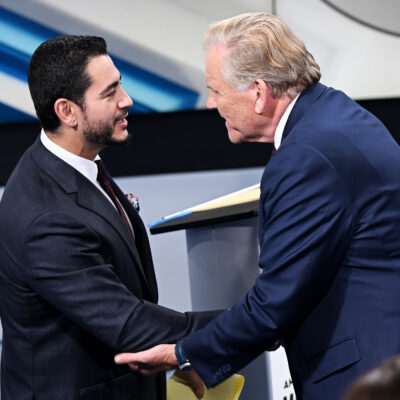
Rogers describes El-Sayed as a national security threat in final Michigan Senate debate
PRESIDENTIAL POV
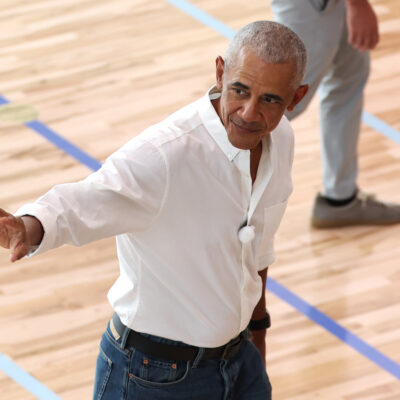
Obama scrutinizes Israel’s founding, says Palestinians want their ‘land back’

HILLTOP FORECAST
Democratic foreign policy veterans preview party’s shifts on Middle East policy

DFL DISCORD
Amy Klobuchar, Angie Craig condemn Hasan Piker ahead of Minneapolis event with Ilhan Omar

SECURITY SETBACK
Saudi Arabia postpones ‘Davos in the Desert’ until 2027 amid Houthi attacks
Please log in if you already have a subscription, or subscribe to access the latest updates.
 Continue with Google
 Continue with Apple