

























Former Trump official: U.K. sanctions will render Europe ‘less relevant in Middle Eastern affairs’
Most analysts agreed that the British sanctions against Israeli settlements were imposed as a result of pressure from Labour’s left-wing base
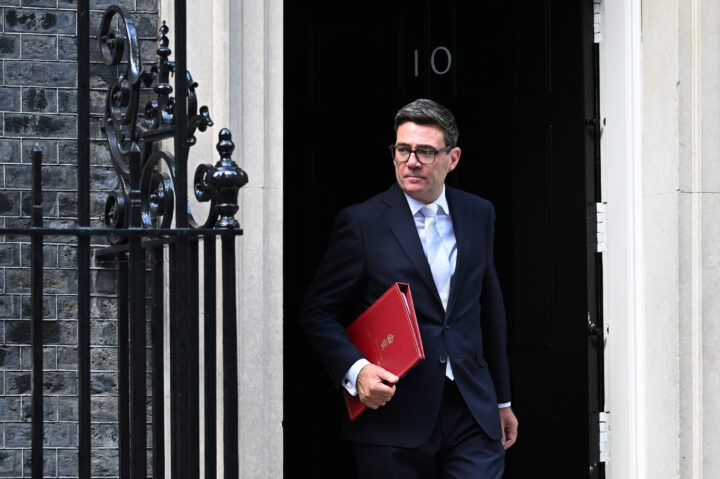
Leon Neal/Getty Images
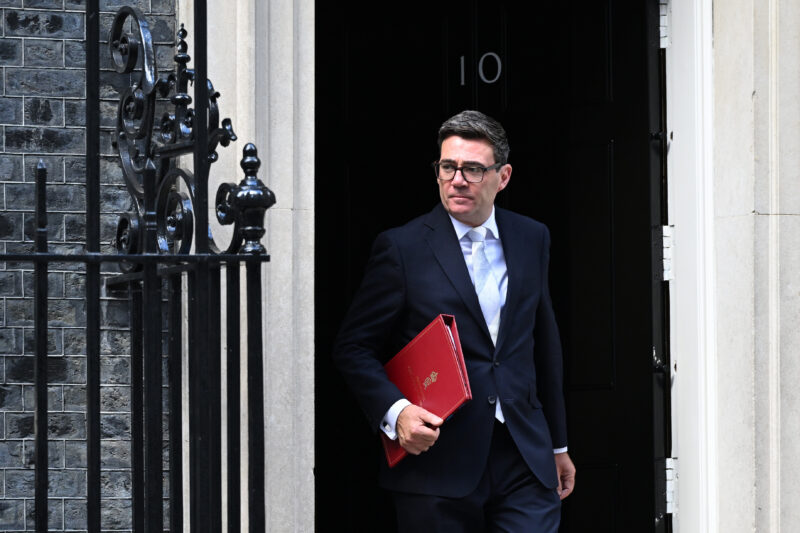
Prime Minister Andy Burnham departs 10 Downing Street to address the House of Commons on Sept. 1, 2026 in London, England.


 Add JewishInsider on Google
Former White House officials and diplomats say the U.K. government’s decision to slap sweeping new sanctions on Israeli West Bank settlements is primarily a bid to appease far-left political factions in Britain, warning that while the move is unlikely to alter Israeli behavior on the ground, it risks increasing diplomatic friction between London, Jerusalem and Washington.
On Tuesday, U.K. Foreign Secretary Ed Miliband announced the U.K. would institute an import ban on goods produced in settlements, targeted sanctions against individuals and corporate entities involved in constructing, advertising or financing settlement expansion and a ban on events held in the U.K. that promote West Bank real estate.
Israeli Foreign Minister Gideon Sa’ar denounced the step as a “hostile sanctions package” and announced that Israel in response would close the British Consulate in Jerusalem, expel British representatives from the U.S.-backed International Gaza Support Center, terminate the British Support Team in Ramallah tasked with training Palestinian Authority Security Forces and bar 12 British officials, including MP Jeremy Corbyn, accused of “antisemitic and anti-Israel activity.”
While the U.S. has not issued an official response, Secretary of State Marco Rubio indicated that Washington will not follow suit, though he refrained from offering explicit condemnation of London’s new policy.
Experts told Jewish Insider that London’s move was predictable given global sentiment toward Israeli settlements, though it’s unlikely to shift Israeli policy. Analysts argued the decision was primarily driven by U.K. domestic politics and warned it could strain relations between Washington and London.
“The poor timing of the U.K. action — days before the Jewish holy days and a few weeks before Israel’s election — shows that this move is largely a matter of British domestic politics,” Elliott Abrams, former U.S. special envoy during the first Trump administration, told JI. “The Labour Party conference is coming, and that was the primary consideration for the British government. This action, and wider European support for it, will not change Israeli conduct, but it will render Europeans even less relevant in Middle Eastern affairs.”
Abrams added that the sanctions fail to deliver tangible support to Palestinians while actively damaging Western diplomatic ties.
The U.K. “seem[s] intent on sacrificing their relationship with Israel without doing anything that actually helps Palestinians,” Abrams said. “This action will hurt U.S.-U.K. relations in one important way: it demonstrates to U.S. policymakers that Britain’s current leadership is not a serious partner.”
Jason Greenblatt, former White House Middle East envoy in the first Trump administration, told JI that the U.K. is prioritizing “domestic politics ahead of its own security” and warned the decision “helps no one.” He predicted the Trump administration is “carefully weighing its response to a badly timed and poorly reasoned decision aimed at an important American ally.”
“Punishing Jews for living and trading in the land where Jewish history began more than 3,000 years ago is a terrible decision, and calling it a legal opinion is a farce,” Greenblatt said. “No Palestinian will be better off for it, and it will not move the Israeli-Palestinian conflict one inch. What it does is weaken an important intelligence partner of the United Kingdom in the middle of the war against the Iranian regime.”
“Tehran, Hamas, Hezbollah, and the Houthis could not have asked for a better gift,” he continued. “Washington raised its concerns before London acted, and London dismissed them.”
Edmund Fitton-Brown, a former British diplomat and senior fellow at the Foundation for Defense of Democracies, similarly characterized the move as “political opportunism” framed by domestic electoral pressures.
“It reflects primarily political opportunism on the eve of an important by-election and in the run-up to the Labour Party conference this fall,” Fitton-Brown said. “Miliband and Burnham are pandering to nervous backbench MPs and to the red-green alliance within the party. They are afraid of losing votes to the Green Party and ‘Gaza-first’ independents.”
Fitton-Brown noted that the decision marks a sharp escalation from previous Labour policy and carries internal risks for the U.K.
“It is an acceleration of poor choices made by the Starmer government, such as recognizing a Palestinian state last year. It indicates that [British Prime Minister Andy] Burnham and Miliband will take a more hostile stance toward Israel than Starmer did,” Fitton-Brown said. “Miliband’s public comments leading up to this were particularly aggressive, and the near-unanimous assessment among British Jews is that this makes them less safe.”
He added that the sanctions will likely damage U.S.-U.K. relations, referencing criticism from Huckabee and warnings from U.S. lawmakers — such as Rep. Randy Fine (R-FL) — regarding potential state-level boycotts against the U.K., which other states may replicate.
“The U.K. is damaging its own security — Israel has helped prevent terrorist attacks on British soil over recent years,” Fitton-Brown said. “The U.K. should be concerned about this, as well as facing renewed Argentinian ambitions in the Falklands, where current U.K. capabilities will struggle to defend the islands without support from key allies, particularly given President Trump’s past equivocation on the issue.”
Simon Henderson, a senior fellow at the Washington Institute for Near East Policy, called the decision “entirely predictable” given international sentiment on the issue.
“Concern about the activities of settler activists whom US Ambassador Huckabee has called terrorists has been widespread in the world,” Henderson said. “We await the responses to the action from London, Europe and Canada by President Trump and Prime Minister Netanyahu.”
More Stories
NUCLEAR NEWS
Senate expected to vote on Saudi nuclear deal before end of year

EVENT RESCHEDULED
State Department to hold Oct. 7 commemoration event on Wednesday

Daily Kickoff
Barack to 1948
PEACH STATE PUNCHES
Rep. Mike Collins ducks question about white nationalist influencer son-in-law at Senate debate

COURSE CORRECTION
ADL, Gratz College launch antisemitism training for college administrators, faculty
ON DEFENSE
El-Sayed dismisses half-sister’s comments about family’s Muslim Brotherhood ties as ‘hearsay’
Please log in if you already have a subscription, or subscribe to access the latest updates.
 Continue with Google
 Continue with Apple