





























Democrats at J Street are pushed on conditioning U.S. aid to Israel

Michael Stokes/Flickr
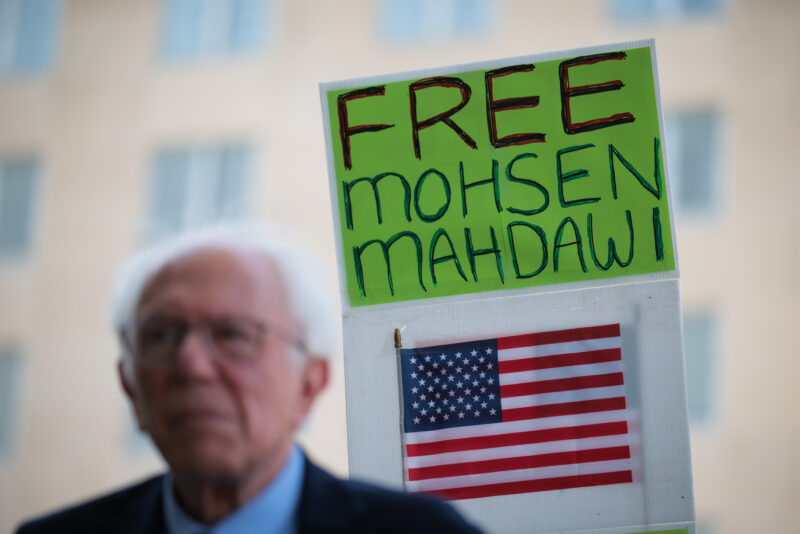
Bernie Sanders attends a rally at Hahnemann Hospital in Philadelphia on July 15, 2019.


 Add JewishInsider on Google
At the annual J Street conference in Washington, Democratic presidential hopefuls were questioned on whether they would condition U.S. aid to Israel on the Jewish state not annexing any part of the West Bank.
In a presidential forum hosted by former Obama administration officials Ben Rhodes and Tommy Vietor, candidates were pressed to express their willingness to take a tougher stance on the U.S.-Israel relationship.
Vermont Senator Bernie Sanders (I-VT) took the hardest line of any of the attending candidates, telling Rhodes and Vietor that Israel will have to “fundamentally change” its relationship with Gaza if it wants continued military aid. Sanders has long been supportive of conditioning U.S. aid to Israel and using it as leverage to change the behavior of Prime Minister Benjamin Netanyahu’s government, which he has repeatedly described as “racist.”
South Bend Mayor Pete Buttigieg told attendees that he would support conditioning U.S aid as a means to discourage Israel from attempting to annex parts of the West Bank. The Democratic hopeful, who visited Israel last year, said the United States needs to “have mechanisms to do this to make sure U.S. taxpayer support for Israel doesn’t turn into U.S. taxpayer support for a move like annexation.” He also argued that “U.S. policy should not be promoting settlement construction because it is incompatible or at best detrimental to what we need to see happen” in the region. Buttigieg added, “you can be committed to the U.S.-Israel alliance without that entailing support for any individual choice of a right-wing government over there.”
Former Secretary of Housing and Urban Development Julian Castro struck a more cautious note. Castro, who served in the cabinet from 2014-2017, would not take the idea of conditioning aid “off the table” but argued that the United States already has a “carrot-and-stick approach.” Castro expressed the hope that “we’re going to have a new [Israeli] government to work with our ally to ensure that there is not unilateral annexation and that we pursue a two-state solution.”
Colorado Senator Michael Bennet echoed Castro’s caution. “I would not rule out” conditioning American aid to Israel, said the two-term senator. However, he was hesitant to embrace it, worried that “if we pick one instrument like that in this town, it very quickly is going to become a partisan litmus test.” The Colorado Democrat also made clear that while he didn’t believe Israel should be building settlements and that the United States should be doing “everything we can to limit settlements,” Bennet also warned that the current Israeli government “basically has a permission slip from [the] Trump administration to do whatever they want.”
Speaking on Sunday, Minnesota Senator Amy Klobuchar (D-MN) dodged the question. “It is not a good idea to negotiate these things right now,” said the Minnesota Democrat. She disagreed with Netanyahu’s September announcement that he would begin to annex settlements on the West Bank if re-elected, calling it “wrong.”
Other candidates submitted videos instead of attending the forum. In her video, Senator Elizabeth Warren (D-MA) said, “If Israel’s government continues with steps to formally annex the West Bank, the U.S. should make clear that none of our aid should be used to support annexation.” In contrast, former Vice President Joe Biden said in a video that Israel should stop “settlement activity which takes us further from peace” and warned about support for the Jewish state becoming “a political football.”
Former Congressman Beto O’Rourke, businessman Andrew Yang and author Marianne Williamson also submitted videos to the liberal group, which advocates a dovish Middle East policy.

The CNN and New York Times Democratic Presidential Debate Otterbein University Westerville, Ohio 2019
Westerville, Ohio — In a heated debate Tuesday night, Senator Elizabeth Warren (D-MA) bore the brunt of the attacks from rival candidates after taking the lead in national and early state polls.
On a crowded stage of 12 presidential hopefuls, the Massachusetts Democrat faced barbed questions about her health care and tax policies from more moderate rivals including South Bend, Indiana Mayor Pete Buttigieg and Senator Amy Klobuchar (D-MN).
Buttigieg, who launched a web ad attacking Warren for her support for Medicare for All before Tuesday’s debate, tried to portray her as a classic Washington politician reluctant to acknowledge the tax increases that would come as part of the plan. Warren has emphasized that costs will go down “for hardworking middle-class families” as part of legislation intended to provide free health care coverage to every American.
Senator Bernie Sanders (I-VT), who has long boasted of “writing the damn [Medicare for All] bill,” acknowledged that taxes would go up, but “for virtually everybody, the tax increase they pay will be substantially less — substantially less than what they were paying for premiums and out-of-pocket expansions.” Klobuchar praised Sanders “for being honest” and then accused Warren of not telling Americans “where we’re going to send the invoice.” Klobuchar defended her comments after the debate, telling reporters, “I wasn’t sharply attacking anyone, I was making my case about why I’m the best candidate.”
Although in past debates, Warren had been attacked by centrist candidates for her support for Medicare for All, that criticism came from long-shot candidates like former Congressman John Delaney (D-MD) and former Governor John Hickenlooper (D-CO). The Massachusetts Democrat emphasized her health care policy as a moral position and said that “the issue is whether the Democratic Party has the guts to stand up to the health care industry.”
Warren faced attacks from rivals on a variety of other topics: Businessman Andrew Yang criticized her support of a wealth tax, Congresswoman Tulsi Gabbard (D-HI) attempted to pin her down on foreign policy and Senator Kamala Harris (D-CA) went after her for refusing to call on Twitter to delete President Donald Trump’s account.
Warren also had a tense exchange with former Vice President Joe Biden. After Warren touted her efforts to create the Consumer Finance Protection Bureau (CFPB) during the Obama administration, Biden noted his own efforts at the time, telling her, “I went to the floor and I got you the votes.” In response, Warren pointedly thanked Barack Obama for his efforts.
The debate also featured the first extended discussion of foreign policy in the six presidential debates of the 2020 cycle, and came days after Trump announced the withdrawal of U.S. troops from Syria as the Turkish military launched an invasion of the country.
Gabbard, who has defended the regime of Bashar al-Assad, served as a foil for the other candidates on stage, criticizing “regime-change wars” and attacking “the mainstream media” and politicians from both parties for having, along with Trump, the “blood of Kurds” on their hands. Gabbard’s comments prompted a fierce rebuke from Buttigieg about the president’s decision to withdraw U.S. forces. “Part of what makes it possible for the United States to get people to put their lives on the line to back us up is the idea that we will back them up, too,” said the South Bend mayor, who served a tour in Afghanistan as a Navy reservist. “This president has betrayed American values. Our credibility has been tattered.”
Elizabeth Warren argued, “I think that we ought to get out of the Middle East. I don’t think we should have troops in the Middle East but we have to do it the right way, the smart way.” Warren’s comments were strongly criticized by fellow senator Chris Coons (D-DE) after the debate. Coons, a Biden supporter, told reporters that Warren’s statement “showed a striking degree of naïveté or ill preparedness.”
Former Texas congressman Beto O’Rourke clashed with the other candidates over his support for mandatory buybacks of assault weapons. O’Rourke, whose hometown of El Paso, Texas, was the site of a mass shooting in August, insisted that if assault weapons “are too dangerous to sell, they are also too dangerous to own.” He sparred with Buttigieg, who said that the Texas Democrat was focused on “purity tests,” arguing that O’Rourke had no clear plan for how he would take assault weapons away from their owners. O’Rourke also faced criticism from former HUD Secretary Julian Castro. “I am not going to give these police officers another reason to go door to door in certain communities, because police violence is also gun violence, and we need to address that,” Castro said.
Democrats did find common ground in the first debate since the beginning of the impeachment inquiry against Trump. On stage Tuesday night, there was unanimous support for the impeachment inquiry centered around Trump’s effort to pressure the Ukrainian government to investigate Biden’s son Hunter Biden. Only hours after the former vice president’s son admitted to bad judgment in an interview with ABC News, his father insisted on the debate stage “my son did nothing wrong. I did nothing wrong.”
Candidates took to the grills and rallied support at annual Des Moines event

Democratic presidential candidate former Vice President Joe Biden works the grill during the Polk County Democrats Steak Fry, Saturday, Sept. 21, 2019, in Des Moines, Iowa. (AP Photo/Charlie Neibergall)
DES MOINES, IOWA — The Polk County Steak Fry is an ersatz tradition in Iowa politics.
The descendant of an annual fundraiser held by former Senator Tom Harkin in Indianola, Iowa, has transmuted into a presidential cattle call of gargantuan proportions. Candidates parade into the venue with crowds of supporters and marching bands (or, in the case of former Secretary of Housing and Urban Development Julian Castro, a mariachi band). They take turns grilling steak and pouring beer for television cameras before taking the stage to give 10-minute sales pitches to a crowd of thousands.
For big-name candidates, Saturday’s event was yet another photo opportunity. Perhaps the most visible presence there was South Bend Mayor Pete Buttigieg, who bought 1,500 tickets to the event. Many ticketholders marched in with him, wearing bright yellow t-shirts as a marching band blared a version of the Rolling Stones’ “Paint It Black.” For candidates struggling in the polls, the event was an extended retail stop. Congresswoman Tulsi Gabbard (D-HI) and Senator Michael Bennet (D-CO) could be spotted working the crowd long after their speeches, having one-on-one conversations with attendees. In contrast, standing on a wide plank of plywood covering the muddy ground, Elizabeth Warren had another of her signature “selfie lines,” which lasted hours after her speech. Her campaign said that 1,050 people waited to take a photo with the Massachusetts Democrat —a significant fraction of the 12,000 attendees, many of whom had come to support other candidates.
Before and during the speeches, attendees lined up for slabs of steak, potato salad and baked beans, which they consumed on long tables lined with bottles of steak sauce in a massive tent. Food was washed down with free lemonade or iced tea, or with a $5 plastic cup of local beer. Attendees then moved to stand or sit in lawn chairs and watch candidate after candidate take their turn on stage in 10-minute increments. Most speakers kept their remarks within the limits, though former Vice President Joe Biden and former Congressman Joe Sestak (D-PA) had to be played offstage.
Perhaps the highest stakes of the day were for Cory Booker. The New Jersey senator’s campaign manager, Addisu Demissie, released a memo earlier that day stating that the campaign needed to raise $1.7 million by the end of September in order to mount a viable campaign to win the nomination.
Covered in sweat, Booker spoke to reporters after he made a renewed pitch for support to save his lagging campaign. Booker emphasized that he had built “one of the strongest campaigns to win the nomination,” noting the investment his team had made on the ground in states with early primaries. The New Jersey senator was endorsed by more Iowa state legislators than any other candidate and had personnel on the ground in the Hawkeye State during the 2018 midterms.
Booker boasted that “we have built — with a fraction of [the] money of the top four fundraisers — about the strongest campaign in the early states,” but admitted “I can’t stay in this race if I don’t have the resources to deliver a winning campaign.” The New Jersey Democrat told reporters, “I’m not in this as a vanity project and exercise of ego, we’re doing this to win the nomination and defeat Donald Trump… I don’t believe people should stay in this just to stay in this; you either have a trajectory for victory or you do not.” He conceded, “If we don’t raise the $1.7 million, we’re going to have to have a hard conversation.”
Booker didn’t get cheery news from the Iowa poll released on Saturday night. The poll, conducted by Ann Setzer and considered the benchmark in the Hawkeye State, ranked the senator in sixth place with 3%. For the first time, the poll showed Warren in the lead in Iowa with 22%, followed by Biden at 20%, Sanders at 11%, Buttigieg at 9% and Senator Kamala Harris (D-CA) at 6%.
Gabbard says Trump wants to “push our country into war with Iran”

CNN
CNN Democratic Presidential Debate Detroit, Michigan 2019 Businessman Andrew Yang Hawaii Rep. Tulsi Gabbard Washington Gov. Jay Inslee
Democratic presidential candidate Tulsi Gabbard refused to accept findings by the United States and Saudi Arabia that Iran was responsible for the recent attack on Saudi oil facilities.
In an interview with The Hill, the Hawaii congresswoman said the assessment, announced by Secretary of State Mike Pompeo, was “yet the latest move by this administration to push our country into war with Iran.”
Gabbard declined to say whether she believes the Iranian regime was responsible for the attack: “there needs to be evidence.” She also attacked President Donald Trump for what she labeled as the president’s willingness to use the United States military as mercenaries for Saudi Arabia. “Trump is ready to offer up our military to use as the Saudi kingdom sees fit,” said Gabbard, who previously tweeted that Trump was prostituting the American military to Saudi Arabia.
Saudi Arabia presented evidence of Iranian involvement in the attack during a press conference earlier on Wednesday, in which Pompeo labeled it “an act of war” by Iran against Saudi Arabia. Houthi rebels in Yemen, who are backed by the Iranian regime in that country’s civil war, had previously claimed responsibility. Intelligence analysts, however, have insisted that the Houthis do not have the capability to carry out such an attack.
Although Trump has tweeted about new sanctions against Iran, he was vague about military action when speaking to reporters in Los Angeles on Wednesday. “There are many options,” said Trump. “There’s the ultimate option and there are options a lot less than that.”Gabbard has long faced criticism for her friendly rhetoric towards Syrian dictator and Iranian proxy Bashar al-Assad. She made a surprise visit to Damascus in 2017 and described regime opponents as “terrorists.” Gabbard’s continued defense of the Assad regime led to a charge from Senator Kamala Harris (D-CA) during the August presidential debate that the Hawaii congresswoman was an “Assad apologist.” Gabbard has since said Assad is a “brutal dictator.”
The Jewish veteran says Israel could serve as a model for national service in the United States
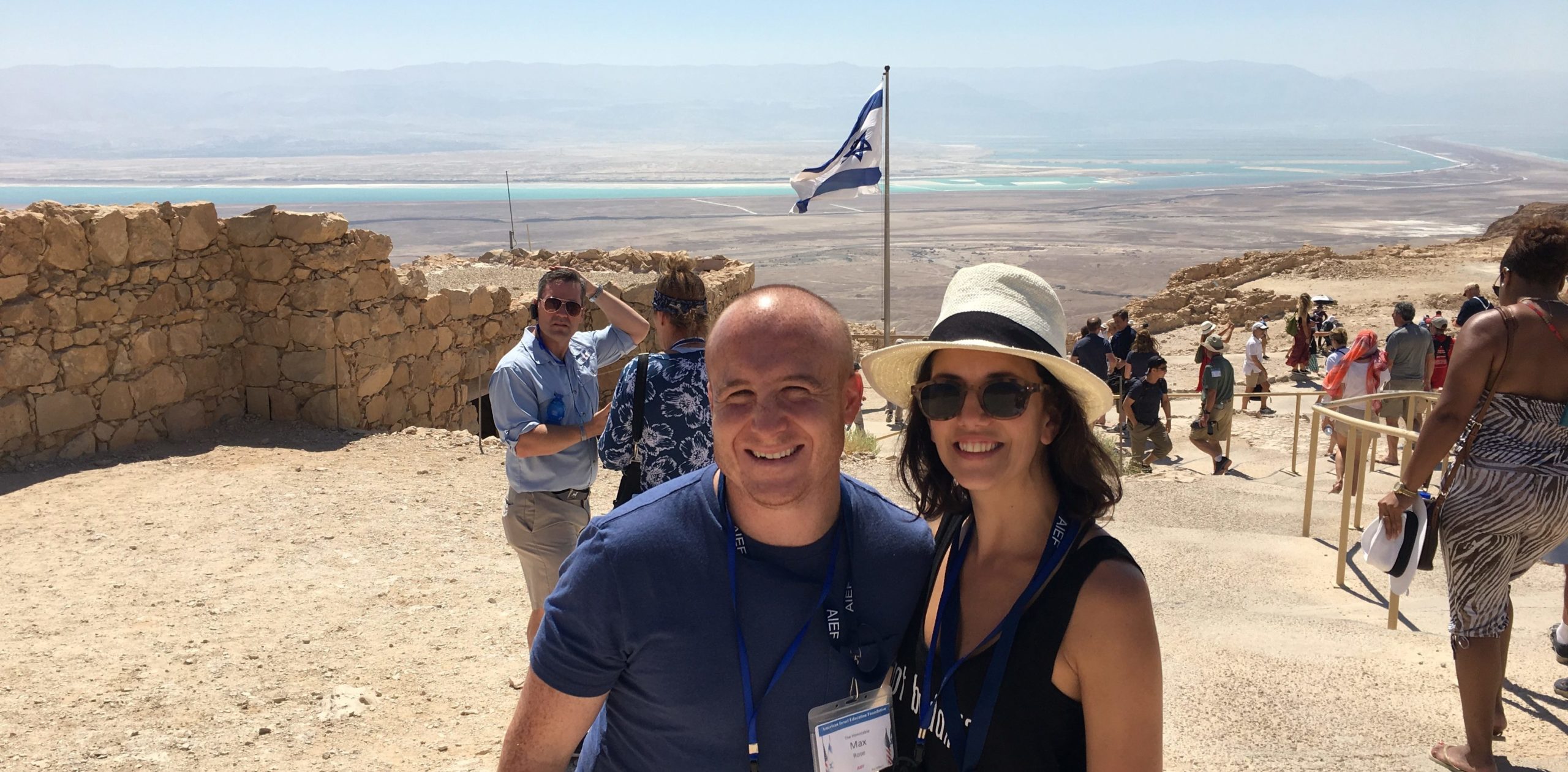
Courtesy
Rep. Max Rose (D-NY) and his wife, Leigh, pose for a photo atop Masada.
Congressman Max Rose (D-NY) returned from Israel this week with a renewed commitment to the U.S.-Israel relationship and an unflagging belief in the possibility of peace between Israelis and Palestinians.
“I will never lose hope on the potential for a peace resolution in the region, whether that is [with] Mahmoud Abbas or down the road, whoever replaces him,” Rose told Jewish Insider in a phone interview this week, just a day after he arrived back in the United States.
Similarly, on the Israeli side, Rose said that “irrespective of who leads Israel, whether it is Prime Minister [Benjamin] Netanyahu, whether it is Mr. [Benny] Gantz, or whether it is someone else down the road… I am especially hopeful after this trip that America’s firm alliance, strategic support for Israel as a Jewish, democratic nation will continue. This has got to be something that rises above politics. And that’s also the case for [whomever] is in political power in Washington DC.”
Rose was one of 41 Democrats — the majority of whom are, like him, freshman members of Congress — who took part in a weeklong visit to Israel led by the American Israel Education Foundation, an affiliate of AIPAC. The group met with Netanyahu, Gantz and Abbas, as well as Israeli and Palestinian entrepreneurs, business leaders and IDF troops.
But unlike the majority of the freshmen on the trip, this was not Rose’s first visit to Israel. The Jewish war veteran said he had traveled to Israel 10 years ago, though his experience this month was wildly different.
“The most memorable part was certainly the opportunity to see firsthand the incredible security conundrum that Israel finds itself in — and has found itself in since its inception,” Rose said. “To see that firsthand, to go to the border with Syria, to go to the border with Lebanon, to go near the border with Gaza, to travel through the West Bank, you can really see the incredibly tenuous situation that it’s in.”

Rep. Max Rose (D-NY) meets with active IDF soldiers.
Rose, a veteran of the war in Afghanistan, said he was particularly excited to meet with IDF soldiers during his time in Israel.
“Anytime that I get the opportunity to meet with and speak to soldiers… there’s such a shared bond and shared culture,” he said. Rose said he views the Israeli model as something that could “speak potentially to the need for a national service model in the United States. It brings people together from all different parts of the country, it establishes a common bond that rises above other divisions.”
Rose told JI that taking part in the AIPAC trip was a no-brainer for him, despite criticism that lawmakers should be remaining in their district or that the trip is a biased look at the region.
“In my district, many people of Jewish faith know that I have personally been to Israel as a member and witnessed firsthand the tenuous security situation that they’re in — as well as the economic and diplomatic and historical miracle… that’s very important to many people in my district,” Rose said. “It’s important to Jews and to Christians… as well as people who are concerned with issues of national security, both global and domestic.”
Rose said the AIPAC-affiliated trip was “very valuable and informative” but it was not a “silver bullet. This trip is representative of just the beginning of our work.”

Rose and his wife, Leigh, visit the Western Wall in Jerusalem.
The New York Democrat also pushed back against the media firestorm surrounding Reps. Rashida Tlaib (D-MI) and Ilhan Omar (D-MN), who are expected to visit Israel on a separate trip later this month.
“This is representative of a trend in media generally, because media enjoys this type of story,” he said. “The narrative that I was focused on throughout my time there, was the fact that this was the largest congressional delegation to Israel in history. That is monumental.”
Rose said he believes that “those who did not make this trip, they need to make some type of trip to Israel, and there are plenty of opportunities for them to do this.” The freshman Democrat said while “there are plenty of people who enjoy speaking about… drama, reality TV politics. I’m not one of them.”
He also addressed the reports of increased violent antisemitic attacks on Jews in New York, including in his district.
“We’re not seeing a revival of antisemitism,” he said. “We know antisemitism never went away, but it has certainly been increasing, and I do believe that — as it has been throughout history — it is often tied to culturally divisive rhetoric and economic anxiety.”
“We have got to invest in educating our youth about the history of antisemitism,” he continued. “We have to support our law enforcement as they show that there are consequences for engaging in acts like this. And we cannot be nuanced with our response either. This is wrong, and there’s no place for these types of actions in the United States of America.”
Lindsey Boylan says the 14-term congressman is ‘kicking the can down the road’ on impeaching Trump

Courtesy
Lindsey Boylan
In his 13 re-election bids since joining Congress in 1992, Representative Jerrold Nadler (D-NY) has yet to face a viable challenger. But next year Nadler, who now serves as chair of the influential House Judiciary Committee, will face at least one Democratic primary opponent who is garnering significant attention and resources in her quest to replace the 72-year-old incumbent and represent New York’s 10th congressional district.
Lindsey Boylan, who raised $264,657 in the last quarter, served as an economic development advisor for New York Governor Andrew Cuomo. Despite her background, she doesn’t expect the establishment to support her candidacy against the veteran congressman. “I went into this knowing I was doing it, and I’m doing this because of what I believe we need. No one is coming in to make this happen for me and that’s just the way I want it,” Boylan said in a recent interview with Jewish Insider in midtown Manhattan.
Boylan orderly outlined the issues she feels people in the district most care about, including housing, climate change and infrastructure. But what makes her confident voters in the district would oust a sitting representative who beat his last primary challenger by nearly 80 percentage points? After all, constituents are now seeing Nadler rise to the top ranks in House leadership and becoming a leading voice in making the case against President Donald Trump.
Boylan disagreed with the premise. “I respect his career,” she said. “What I would say is that in almost 30 years, he’s gotten three pieces of his own legislation enacted. Two of those were ceremonial. And I think when we talk of actually producing legislation, putting forth ideas that garner support and change the conversation, that’s just not something we’ve seen from him. We haven’t seen solutions to the problems we have.”
Boylan also largely dismissed Nadler’s role as chair of the Judiciary Committee: “I think as we’ve seen recently, the agenda of the Judiciary is driven by the Speaker of the House. If we talk about the interests of the district, there’s nothing on the judiciary committee that gets specific policy funded. And I think one of the things we’re seeing is that what you have to do to become part of the establishment leadership isn’t necessarily listening to the interests of your district.”
Boylan also thinks Nadler is “kicking the can down the road” and “politicizing” the issue of impeaching the president, rather than moving forward. “My view and the views of the people I’ve spoken with — who are supportive of impeachment in the district — really feel that we need to hold the president accountable for both rhetoric and substantive matters,” she said. “I think that [Nadler] has completely mishandled this. He has made, in many ways, what should not be a political process, a completely politicized issue. We should have been on this road months ago.”
Boylan firmly believes voters will express their dissatisfaction with the way Nadler has been handling the issue when they enter the ballot booth. “We just heard Congressman Nadler say that this moment is reminiscent of the 1930s in Germany… that’s a pretty big statement to just put out there and do nothing about, if you really believe that.”
Defining herself as a progressive woman, Boylan draws a clear line between her progressive bona fides and her views on Israel and national security. She sees Rep. Ayanna Pressley (D-MA) — who unseated a 10-term incumbent, Rep. Michael Capuano, in a surprise upset in 2018 — as her model. Unlike the other three members of “The Squad” — Reps. Alexandria Ocasio-Cortez (D-NY), Ilhan Omar (D-MN) and Rashida Tlaib (D-MI) — Pressley voted in favor of the recent House anti-BDS resolution.
As a supporter of Israel, Boylan says she approves of the anti-BDS resolution that recently passed with overwhelming support: “Boycotting Israel is both unproductive and unfair, at best.”
While Pressley has been promoting herself as part of The Squad, Boylan doesn’t see herself as part of any such group. “I was always way too nerdy to be a part of any kind of school,” Boylan quipped. “So the only squad I feel like I get to be part of is the one with my daughter and my husband, and my parents who moved across the country to be my treasurers.”
According to Boylan, people across the 10th district have an interest in foreign policy — and she has a very personal connection to Israel. “I had the opportunity when I worked for the governor to do all of the policy work for the economics side of his trade mission trips to Israel,” she explained. “And that was tremendous fun because — whether we’re talking about water resource management, or technology, or life sciences — Israel is a leader in so many things in terms of innovation, that’s a topic that is of great interest.”
Boylan recently visited Israel with her family to attend a bat mitzvah celebration for the daughter of a close friend. “It was magical,” she said of the weeklong trip. “It was the most magical trip I’ve ever been on. We went to Masada. We took so many tours of the Old City.”
Boylan said she has “a friend who’s in the intelligence community and is based in Jerusalem. He gave me a tour the Old City of Jerusalem and you see the security concerns. You see very real examples of how complicated and important security is for Israel. I’m someone who has an unshakeable support for Israel. I believe in a two-state solution, which I think is at the moment very complicated. As the daughter of a marine, as someone who’s been to Jerusalem, as someone who has an interest in long-[term] support for Israel and also a future that Palestinians can be proud of, it’s really important to me to focus on and also listen to the people in my district.”
As the interview wrapped up, Boylan shared with JI her favorite Jewish pastry: “Sufganiyot — the jelly-filled ones.”
Many funders have maxed out their contributions to multiple Democratic candidates

(AP Photo/Carlos Osorio)
From left, Marianne Williamson, Rep. Tim Ryan, D-Ohio, Sen. Amy Klobuchar, D-Minn., South Bend Mayor Pete Buttigieg, Sen. Bernie Sanders, I-Vt., Sen. Elizabeth Warren, D-Mass., former Texas Rep. Beto O'Rourke, former Colorado Gov. John Hickenlooper, former Maryland Rep. John Delaney and Montana Gov. Steve Bullock take the stage for the first of two Democratic presidential primary debates hosted by CNN Tuesday, July 30, 2019, in the Fox Theatre in Detroit.
While many voters remain undecided on who to support in the crowded 2020 presidential field, Democratic donors are already reaching into their pockets to support their favorite candidates. In a review of the most recent quarterly filing with the Federal Election Commission, along with the help of GovPredict, Jewish Insider found several donors who have maxed out their contributions to candidates they are backing, donating the maximum amount of $2,800.
Other notable contributions revealed in the FEC filings include former Secretary of Defense Chuck Hagel’s $2,800 to the campaign of former Vice President Joe Biden, former National Security Advisor Susan Rice’s $2,800 gift to Sen. Michael Bennet (D-CO), and Chuck Schumer’s brother, Robert, maxing out to Biden’s campaign.
Below is a rundown of donors who have donated to multiple 2020 campaigns:
Marilyn and Jeffrey Katzenberg, film producer and founder of WndrCo: 13
The Katzenbergs each donated the maximum amount to 13 Democratic candidates — Biden, Bennet, Sen. Elizabeth Warren (D-MA), former Rep. Beto O’Rourke (D-TX), Sen. Kamala Harris (D-CA), Washington Governor Jay Inslee, Montana Governor Steve Bullock, Rep. Seth Moulton (D-MA), Sen. Amy Klobuchar (D-MN), Sen. Kirsten Gillibrand (D-NY), South Bend Mayor Pete Buttigieg, Sen. Cory Booker (D-NJ), and former Colorado Governor John Hickenlooper.
Blair Effron, co-founder of Centerview Partners: 8
Effron maxed out to the campaigns of Biden, O’Rourke, Harris, Booker, Gillibrand, Bennet and Klobuchar, while Hickenlooper received $5,400.
Jonathan Gray, COO and president of Blackstone Group: 7
Gray gave the maximum amount of $2,800 to seven campaigns: Booker, Klobuchar, Gillibrand, Bennet, Hickenlooper, Moulton and Buttigieg. His wife Mindy, co-founder of the Gray Foundation, maxed out to Bennet.
Robert Rubin, former Treasury Secretary under President Bill Clinton: 6
Rubin contributed $5,600 to Klobuchar and Harris. He also maxed out to Booker, Bennet, Buttigieg and Biden
Jeannie and Jonathan Lavine, co-managing partner of Bain Capital and a part-owner of the Boston Celtics: 5
The Lavines both maxed out to Booker, Biden, O’Rourke, Gillibrand and Bennet.
Lynda Resnick, vice chair and co-owner of The Wonderful Company: 4
Resnick maxed out to Harris, Klobuchar, Biden, Hickenlooper and Booker. Her husband, Stewart, maxed out to Harris, Biden and Hickenlooper, and wrote a $100 check to Booker.
Hedge fund manager Seth Klarman, chief executive and portfolio manager of the Baupost Group: 5
Klarman, a former Republican donor who gave $20 million to the Democrats in 2018, contributed $5,600 to the primary and general election campaigns of Buttigieg, Bennet, Klobuchar, Booker and former Massachusetts Governor Bill Weld (who is running as a Republican). His wife, Beth, maxed out to Booker and Klobuchar.
Laura Lauder, a venture philanthropist in Silicon Valley and general partner at Lauder Partners: 5
Lauder maxed out to Bennet, Hickenlooper and Booker. She also donated $2,000 to Harris and $1,000 to Gillibrand.
Her husband, Gary, gave the maximum to Booker, Bennet and Hickenlooper and gave $1,000 to the Gillibrand campaign.
Clifford Mumm, who ran Bechtel’s operations in Iraq: 5
Mumm maxed out to O’Rourke, Buttigieg and Marianne Williamson and gave $2,700 each to Biden and Klobuchar.
Michael Kempner, CEO of MWWPR: 4
Kempner maxed out to Biden, Buttigieg, donated $5,600 to Klobuchar, and $100 to Booker.
Marc Lasry, CEO of Avenue Capital Group: 4
Lasry maxed out to Harris, Buttigieg, Booker and Gillibrand.
Matt Pritzker, CEO of the Matthew Pritzker Company: 4
Pritzker donated $5,600 to Inslee and maxed out to Biden, Harris and Buttigieg
Marc Benioff, founder and chairman of Salesforce: 3
Benioff gave $2,700 each to Harris, Inslee and Booker.
Real estate developer Aby Rosen: 3
Rosen maxed out to the campaigns of Booker, Buttigieg and New York City Mayor Bill de Blasio. Rosen’s wife, Samantha Boardman, and his business partner Michael Fuchs each also gave $2,800 to de Blasio.
Howard Wolfson, former deputy mayor of New York City under Michael Bloomberg: 3
Wolfson, who leads the education program of Bloomberg Philanthropies, maxed out to Booker, Bennet and Hickenlooper.
Jack Rosen, CEO of Rosen Partners: 3
Rosen, president of the American Jewish Congress, maxed out to de Blasio. He also contributed $2,500 to Hickenlooper and Klobuchar.
Former Pennsylvania Governor Ed Rendell: 3
Rendell maxed out for Biden and donated $2,000 to Klobuchar and $1,000 to Booker.
Philanthropist Eli Broad: 3
The Los Angeles-based Broad maxed out to Harris, Booker and Bennet.
Paul Taubman, founding partner and CEO of PJT Partners: 3
Taubman maxed out to Biden, O’Rourke and Bennet.
Dal LaMagna, CEO of IceStone: 3
LaMagna, who also goes by ‘Tweezerman,’ maxed out to Williamson, and gave $1,000 to Inslee and $250 to Gillibrand.
Etan Bendheim, CEO of Lavvan: 2
Bendheim maxed out to Booker and Buttigieg.
Thomas Nides, managing director and vice chairman of Morgan Stanley: 2
Nides, who served as deputy secretary of state for management and resources under President Barack Obama, gave $5,600 to Klobuchar and $2,700 to O’Rourke.
Joel Klein, chief policy and strategy officer at Oscar Health: 2
Klein, who served as chancellor of the New York City Department of Education under Bloomberg, maxed out to Bennet and gave $500 to Buttigieg.
David Gorodyansky, CEO of AnchorFree: 2
Gorodyansky gave the $2,800 max to both Biden and Gabbard.

Credit: Wikimedia COmmons.
Congressman Moulton Visits Des Moines Public Schools
In a statement sent to Jewish Insider, Rep. Seth Moulton explains his support for Rep. Betty McCollum’s 2017 bill, “Promoting Human Rights by Ending Israeli Military Detention of Palestinian Children Act.” The bill faced opposition from groups such as AIPAC, who charged that it was based on a biased report. McCollum introduced a new version of the 2017 bill on May 1 of this year. Moulton hasn’t taken a position on the new version yet, as it stands with zero cosponsors.
Moulton’s emailed statement:
“For decades, the Israeli-Palestinian conflict has endured despite efforts by leaders within the region and throughout the world to find peace. Undeniably, actions taken by both sides throughout this long, complicated history have contributed to making a resolution more difficult to achieve. Despite the challenges, I still believe peace is achievable if parties recommit to negotiations towards a two-state solution that allows both nations to safely live side-by-side.
H.R. 4391 would express a Sense of Congress that any abusive or unnecessarily harsh conditions or treatment of Palestinian children during their detention by the Israeli military is a violation of international law and counter to U.S. and international human rights standards.
H.R. 4391 also prohibits the use of U.S. funds to support any abusive or inhumane detention of children, and requires the Secretary of State to certify to Congress that no funds were obligated for such use. A 2013 UNICEF report showed that Israeli forces arrest, interrogate, and detain approximately 700 Palestinian children a year. While experiences vary, the Israeli military has been documented subjecting children to harsh and sometimes abusive interrogation methods, without an attorney present, that often include forced confessions signed in Hebrew. America should not support these undemocratic practices. That is why I support H.R. 4391, and I believe it will contribute towards a peaceful resolution to this complex conflict and a lasting two-state solution.
I am and will continue to support a strong U.S. – Israel relationship and the Israeli military’s efforts to provide security for its people. As part of the Fiscal Year 2019 National Defense Authorization Act (NDAA), I strongly supported the inclusion of $500 million for Israeli Missile Defense co-development and co-production of the Iron Dome, David’s Sling, and Arrow weapon systems. Such technologies are critical to Israel’s defense and an important part of our U.S. – Israel bilateral relationship. I have also supported efforts to strengthen research and development on critical counter-tunnel technologies given the threats posed by terrorist groups to Israel and am encouraged by the inclusion of such language in the NDAA.
Despite the many challenges at hand, we must continue to work towards negotiations to reach a two-state solution while firmly condemning the use of violence and upholding human rights.”
Please log in if you already have a subscription, or subscribe to access the latest updates.
 Continue with Google
 Continue with Apple