
































































Barney Frank, trailblazing Jewish congressman, dies at 86
‘Barney Frank changed the country through the barriers he broke and through the seriousness, clarity, and effectiveness he brought to public life,’ said Jeremy Burton of the Boston JCRC
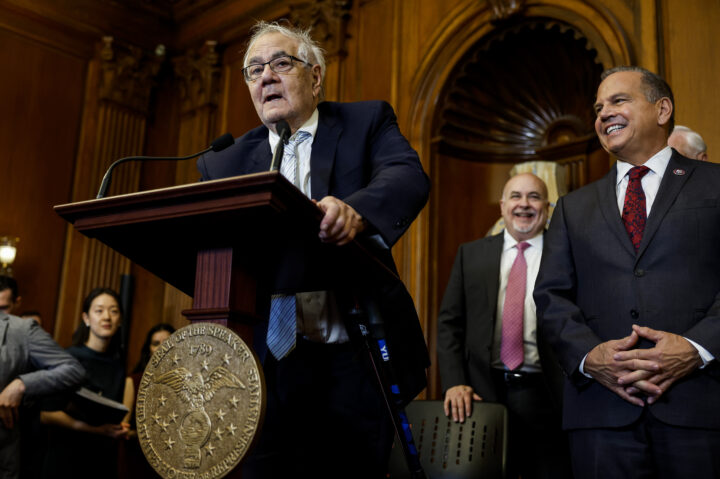
Anna Moneymaker/Getty Images
Former Rep. Barney Frank (D-MA) speaks during a bill enrollment ceremony for the Respect For Marriage Act as Rep. David Cicilline (D-RI) looks on at the U.S. Capitol Building on December 08, 2022 in Washington, DC.


 Add JewishInsider on Google
Former Rep. Barney Frank (D-MA), who represented the Boston area in Congress for more than three decades and was the first openly gay member of Congress, died on Tuesday. He was 86.
Known as a liberal firebrand, Frank’s most high-profile act in politics was drafting the legislation that tightened financial regulations in response to the 2008 financial crisis, a bill known as the Dodd-Frank Wall Street Reform and Consumer Protection Act. He also was widely considered a pioneer for the LGBTQ community after coming out publicly as gay in 1987.
Frank grew up in a working-class Jewish family in Bayonne, N.J. His sister, Ann Lewis, also worked in politics, holding senior roles in the Clinton administration and later on Hillary Clinton’s presidential campaign.
Frank said he was drawn to public service early, feeling in some way that he was an outsider who could challenge how things were done.
“I’m a left-handed gay Jew,” Frank said. “I’ve never felt, automatically, a member of any majority.”
He knew from the time he was a teenager that he was gay, but figured that being Jewish would be a bigger barrier to holding public office.
“I knew I was a homosexual growing up in the 1950s, but figured no one had to know I was one,” Frank told a group of Yale students in 2013. “And it was already out [that] I was Jewish. I had been bar mitzvahed.”
A graduate of Harvard Law School, Frank spent nearly his entire career in elected office after a short stint working in Boston politics. He was elected to the Massachusetts State House in 1972, a position he held for eight years until his election to Congress in 1980.
For 32 years, until he retired in 2013, he represented a district that included the Boston suburbs of Newton, Needham, Brookline, Foxborough and Sharon. One of Frank’s final acts in office was marrying his husband, James Ready, in 2012, becoming the first sitting member of Congress to marry a same-sex partner.
“Massachusetts and the Jewish community are mourning one of the defining public leaders of his generation,” Jeremy Burton, CEO of the Jewish Community Relations Council of Greater Boston, said in a statement. “Barney Frank changed the country through the barriers he broke and through the seriousness, clarity, and effectiveness he brought to public life.”
In the final weeks of his life, Frank did a series of interviews to promote his new book, The Hard Path to Unity: Why We Must Reform the Left to Rescue Democracy, which will be released in September. He entered hospice a few weeks ago and knew he would not make it to the book’s release date.
Frank explained in a May 8 interview with the Jewish Telegraphic Agency that he believed Democrats should get rid of far-left litmus tests that he said limited the party’s electoral prospects and turned away voters — but added that he thought Israel should be treated differently.
“I’ve been talking about the importance of repudiating positions from the left and from the far left, but the Israel one is almost 180 degrees” different, he told JTA. “It’s the one area where we are not doing enough in terms of making our position clear.”
Frank, who considered himself a Zionist and supporter of Israel, said Democrats need to be much clearer about their opposition to Israeli Prime Minister Benjamin Netanyahu and his treatment of the Palestinians in Gaza and the West Bank. He said Netanyahu is the “enabler” of rising anti-Israel Democrats, such as New York City Mayor Zohran Mamdani.
“It’s what the Democrats should be doing, it’s what America should be doing, and it should be what the Democrats are advocating, is giving an ultimatum that [Netanyahu] either changes things substantially in Gaza and the West Bank, or we cut off any aid,” Frank said in the interview. “We’ve now gone to the point where supporting Israel has become unpopular, and that’s all Netanyahu’s doing.”
But, Frank added, opposition to Netanyahu should not be seen as opposing Israel’s very existence.
“We should make it clear that the right position here is to support Israel’s right to exist, but to be unwilling to facilitate what they’re doing militarily and to give them an ultimatum,” said Frank.
More Stories
CANCEL CALLS
Democratic push grows for Ilhan Omar, Fateh to cancel Hasan Piker event
MAIL FAIL
El-Sayed letter to Jewish community on antisemitism fails to reassure skeptics

Daily Overtime
Deadlocked dash to Israeli elections
MINNESOTA MIC DROP
Jacob Frey, Betty McCollum join Minnesota Dem chorus condemning Piker event

FOLLOW THE MONEY
Brandeis Center, FDD urge federal court to allow disclosure of campus foreign funding data
CALLING IT OUT
Rep. Don Bacon blasts Dan Osborn over ‘anti-Jewish’ ad
Please log in if you already have a subscription, or subscribe to access the latest updates.
 Continue with Google
 Continue with Apple