



























































Rosen, Lankford introduce bill championed by Jewish leaders to address antisemitism
The Jewish American Security Act addresses security threats, antisemitism on campus and online antisemitism
U.S. Senate
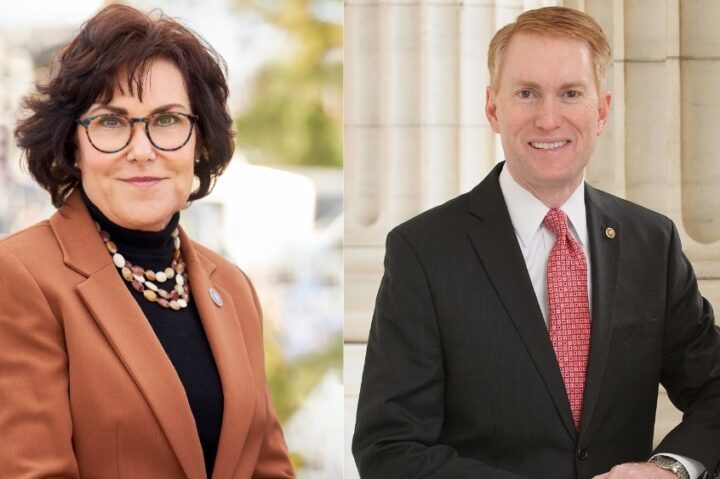
Sens. Jacky Rosen (D-NV) and James Lankford (R-OK)


 Add JewishInsider on Google
Sens. Jacky Rosen (D-NV) and James Lankford (R-OK) on Tuesday introduced the Jewish American Security Act, a broad new effort by the lawmakers, who co-chair the Senate antisemitism task force, to address antisemitism across multiple sectors of American society.
Similar legislation is also expected to be introduced in the House.
The bill, which has widespread support from all corners of Jewish leadership, including all major religious denominations and political organizations on both sides of the aisle, contains various provisions aimed at increasing security for Jewish communities through additional funding and federal resources.
Key provisions include: additional security assistance and improvements to security grant programs for Jewish communities; addressing antisemitism on college campuses through new federal oversight measures including a federal official to handle campus antisemitism; and addressing the spread of antisemitism online by requiring new transparency reports from social media companies, among a range of related steps in each category.
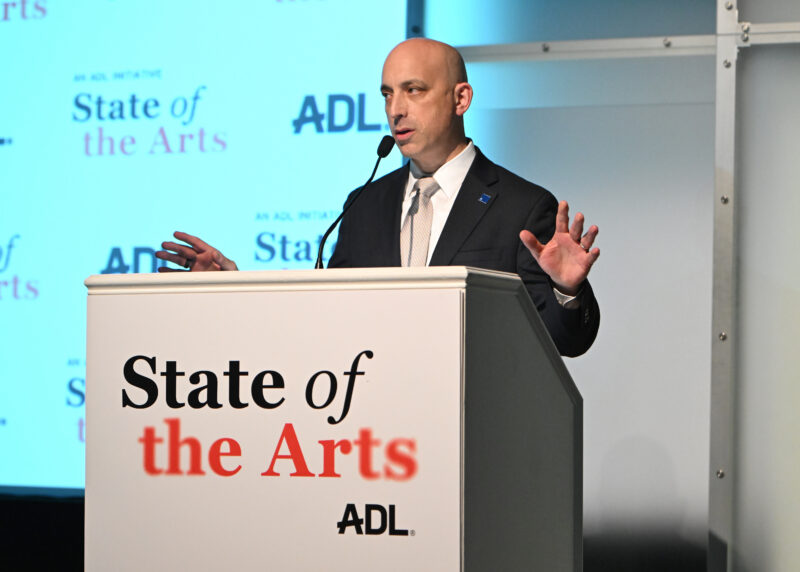
Rosen, leaders from the Anti-Defamation League, American Jewish Committee and BBYO International and local leaders whose communities have been impacted by antisemitic violence in recent years spoke in favor of the bill at a Jewish Federations of North America press conference on Capitol Hill on Tuesday. JFNA activists are on Capitol Hill this week meeting with more than 200 lawmakers to advocate for the bill and other legislation.
Rosen called the bill an “aggressive and comprehensive” response to antisemitism in the U.S. which will “help keep Jewish students safe, will help secure Jewish community institutions and we will help fight antisemitism online.”
She acknowledged that the path ahead is “not going to be easy” but emphasized that “it’s not an option for our government to not do more to fight antisemitism.”
Lankford emphasized the impacts of antisemitic violence on individual Jews and communities in a statement on the bill.
“These are not just numbers, these are real stories impacting real people. Jewish students being targeted on campuses. Synagogues being vandalized. People being attacked in the streets simply because of their faith and heritage,” Lankford said. “That is not who we are as a nation, and we unequivocally condemn antisemitism in all its forms. Every American deserves to live their faith freely. That is worth fighting for.”
Rosen told Jewish Insider later in the day that she and Lankford had been working to craft the bill for the past year, and had taken a range of input on the legislation. She said she and Lankford had learned from past legislative fights that to garner strong bipartisan support “you have to be very specific” and targeted in how legislation is crafted.
She said the new bill is focused on combating domestic antisemitism across three of the areas that have been epicenters of the recent rise in antisemitism since Oct. 7.
“I think it’s a good, solid bill and I believe that we crafted it in a way to get that good bipartisan support,” Rosen said. “We’re not going to solve every problem, but you have to start with something and work from there, and hopefully we build on that success.”
“Antisemitism we know is a canary in the coal mine. It starts with the Jews, it doesn’t end with the Jews,” she said.
“This bill that we wrote, we meant it to not be so prescriptive,” Rosen continued.” When we do things on college campuses, it’s going to help all students. When we do things in houses of worship, it’s not just for synagogues, it’s for all houses of worship. And when we start looking and analyze some of these algorithms online, it will probably inform us about some of the other algorithms, probably the same algorithms that are taking people down that hateful rabbit hole.”
Asked after the press conference about the path forward for the bill, and how advocates could avoid the same pitfalls that befell other efforts to combat antisemitism since Oct. 7, JFNA CEO Eric Fingerhut said that Jewish community groups took lessons from previous fights, particularly over the Antisemitism Awareness Act, which would codify the federal government’s use of the International Holocaust Remembrance Alliance’s working definition of antisemitism in evaluating campus antisemitism cases, but has failed to pass in several congressional sessions.
“We learned a lot from the experience with the Antisemitism Awareness Act. Of course we still support the IHRA definition, but we made a collective communal decision that there’s a separate bill that covers the IHRA definition, and that we hope that will continue to move through the process, but this is a separate issue,” Fingerhut told JI.
The bill does not explicitly endorse the International Holocaust Remembrance Alliance’s working definition of antisemitism, which has proven a hurdle to previous efforts to combat antisemitism, but it notes that the Trump administration in 2019 implemented an executive order enforcing the IHRA definition on college campuses.
“This is the security of the Jewish community, and it has to be something that can be embraced on a bipartisan basis across the aisle,” he continued.
Fingerhut said that Rosen and other advocates made specific efforts to ensure the bill would not contain elements that would “turn it into a partisan effort” or “alienate people who have strong feelings about some of the issues that were in the Antisemitism Awareness Act, and so we hope we’ve accomplished that.”
Rep. Dan Goldman (D-NY), who co-chairs the House antisemitism task force and also spoke at the press conference, said that he and his House co-chairs are moving toward introducing companion legislation.
“This was a labor of … unquestionabl[e] importance and it has taken us quite some time to come together in a bipartisan, bicameral way,” Goldman acknowledged. “We worked for several months to fine tune this bill, so that it can be a targeted, productive, and effective concrete step to fighting antisemitism and rooting it out on the ground. We have worked very hard in a bipartisan way because none of these bills matter unless they become law.”
Goldman highlighted the “dramatic escalation” in antisemitic incidents in New York City in recent weeks, and said that simple condemnation after -the -fact is “too little, too late.”
The bill has widespread support among Jewish community groups and across all major religious denominations, including from the American Jewish Committee, Anti-Defamation League, Jewish Council for Public Affairs, Orthodox Union, JFNA, Conference of Presidents of Major Jewish Organizations, Secure Community Network, The Rabbinical Assembly, Hadassah, Jewish Women International, Religious Action Center of Reform Judaism, the United Synagogue of Conservative Judaism, the Blue Square Alliance Against Hate, JCC Association of North America, the Nexus Project, Union for Reform Judaism, the Central Conference of American Rabbis and Agudath Israel of America.
The Republican Jewish Coalition and Jewish Democratic Council of America are also both endorsing the bill, JI has learned.
The legislation follows a previous effort by Rosen and Lankford, and counterparts in the House, to introduce a comprehensive package of antisemitism legislation in the past Congress, the Countering Antisemitism Act, which faced opposition from senior lawmakers on both sides of the aisle and ultimately did not advance.
The new bill is somewhat more limited than that prior effort, and builds on or combines other efforts that lawmakers have advanced individually, though certain provisions could still face objections from various corners.
Mirroring efforts currently underway in the 2027 government funding process, the legislation would authorize $1 billion annually for the Nonprofit Security Grant Program — though that funding would still have to be approved annually through the appropriations process even if this bill passes.
It also includes various provisions aimed at reforming NSGP management, including requiring that the Federal Emergency Management Agency provide sufficient staffing to “streamline the application process and post-approval process for a grant,” provide additional technical assistance to grantees and quickly disburse funds under the program, within 90 days of when grantees submit reimbursement requests.
At the outset of the Trump administration, grant reimbursements were paused for a significant period as the administration reviewed all Department of Homeland Security grant programs.
It requires that applications for the program open no later than 90 days after Congress passes funding for the program, and that each state publicize a timeline to submit applications, both of which were issues during the 2025 grant cycle.
Addressing repeated congressional complaints during the second Trump term that lawmakers have not received adequate information about or communication from the administration about the grant program, the legislation would codify a requirement that FEMA provide Congress with a list of grant awards and amounts at least a week before such grants are publicized. It would also release to the public information about grant acceptances and rejections and the criteria for such decisions.
Responding to concerns about new conditions imposed on applicants relating to cooperation with immigration authorities and Diversity, Equity and Inclusion programming, the bill bars any conditions or terms that would disadvantage applicants or grant recipients based on their “religious, political, or ideological affiliation.”
The bill would modify current grant rules to allow nonprofits to use NSGP funding to pay for contracted or in-house security personnel.
At the press conference, Rosen called the provisions “comprehensive and long overdue reforms to this program that will actually make sure that it works for our at-risk institutions.”
And it would require the intelligence community to produce annual assessments on domestic and transnational antisemitic violent extremism.
The legislation would additionally codify a version of a program established in the 2026 Department of Justice funding bill that would allow the DOJ to provide grants to state and local law enforcement for the purpose of protecting religious institutions and addressing religious-based hate crimes.
In the education space, the bill would establish an antisemitism coordinator within the Department of Education, whose responsibilities would include working to ensure that antisemitism complaints that have been pending with the department’s Office for Civil Rights for more than 180 days are resolved promptly.
It would also mandate that any schools receiving federal funding designate a coordinator for addressing discrimination complaints under Title VI of the Civil Rights Act, and establish a uniform grievance procedure and provide support mechanisms for such complaints. The effort mirrors policies currently in place for sex-based discrimination, under Title IX.
To improve visibility into the volume of antisemitic activity on college campuses, the legislation would change federal reporting procedures for hate crimes on college campuses, requiring that annual public campus crime reports disaggregate such offenses based on the bias category, such as antisemitism, that motivated them.
It also requires the Department of Education to offer trainings for schools on their Title VI responsibilities and to create an online database on Title VI best practices and recommendations. It requires schools to publicize educational materials about students’ Title VI rights both online and in person.
Rosen told JI that existing mechanisms have been “woefully inadequate to protect our students.”
Addressing antisemitism online, the bill requires platforms with more than 50 million unique monthly American users to submit to the Federal Trade Commission and to share publicly a transparency report on their “content moderation practices and efforts to detect, remove, limit the visibility of, and prevent the amplification of antisemitic content” on their platform, twice each year.
That report would include details on the specific review mechanisms and content moderation tools the platforms use; the total number of pieces of content on the platform that were determined to violate their policies on antisemitism and what action the platforms took; the amount of antisemitic content that reached more than 100 viewers or was promoted by the platform’s algorithms; the percentage of antisemitic content that violated the platforms’ policies but remained online; and details on accounts that were suspended or removed for sharing antisemitic content.
Platforms that do not comply with these reporting requirements would be subject to penalties by the FTC.
The administration would also be required to report to Congress on antisemitism online that has been linked to offline violence.
Goldman said that such transparency provisions would serve as a “tremendous deterrent.”
“If these social media companies need to disclose how much money they’re making off of antisemitic content, that’s going to be a deterrent. That is bad PR. And so it is critically important that we take this first step,” Goldman said. “It doesn’t violate the First Amendment, it doesn’t violate Section 230. It is purely bringing some transparency.”
Rosen emphasized that social media has been an “accelerant” and driver of antisemitism, making such content easier to access. She said the legislation would not compel speech or action by the platforms, but would provide transparency into how algorithms may be driving people toward hate and violence, and allow better analysis and understanding of the problem.
Fingerhut told JI that recent antisemitic attacks may also play a role in demonstrating to lawmakers the need for the legislation to address antisemitism and protect the Jewish community.
Several speakers also made note at the press conference of the attack on Monday at the Islamic Center in San Diego, highlighting the threats to religious communities broadly which can benefit from the NSGP funding.
More Stories

Daily Kickoff
Wikipedia’s edit scandal, unedited
SPENDING SCRAPPED
GOP leadership super PAC cancels spending plans against Rep. Landsman

PREDECESSOR PROBLEMS
The Lander policy at the heart of Levine’s Israel bonds reversal

Daily Overtime
Jewish leaders press Miliband on U.K. antisemitism

PEACH STATE PUNCHES
Rep. Mike Collins ducks question about white nationalist influencer son-in-law at Senate debate

GOING GLOBAL
Israeli, Lebanese leaders expressed interest in Michigan Senate race, Sen. Lankford says
Please log in if you already have a subscription, or subscribe to access the latest updates.
 Continue with Google
 Continue with Apple