




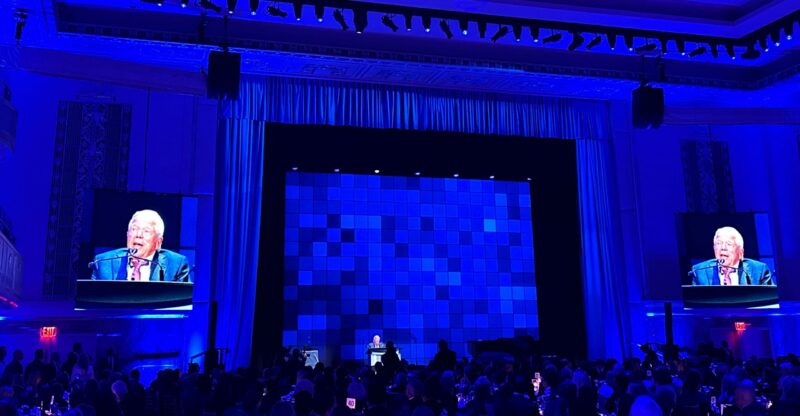




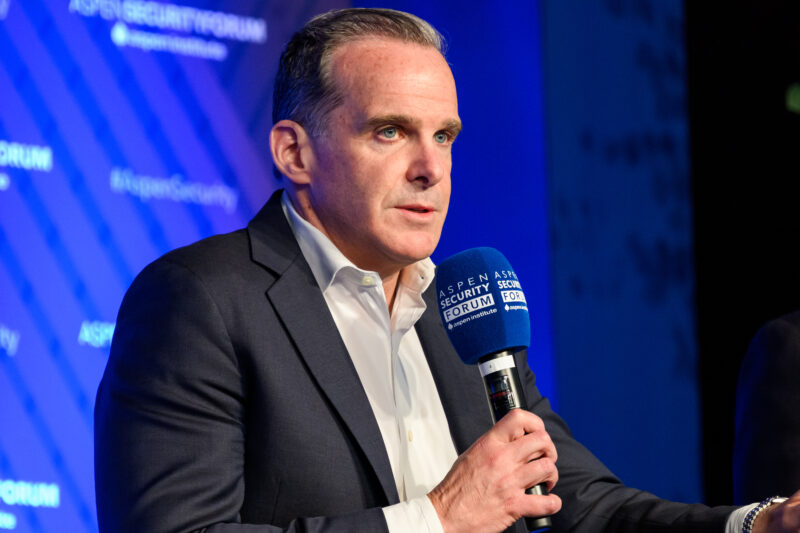



















Speaking in Doha, Barrack said Washington’s efforts at regime change have failed and the U.S. should move into a supporting capacity in the region
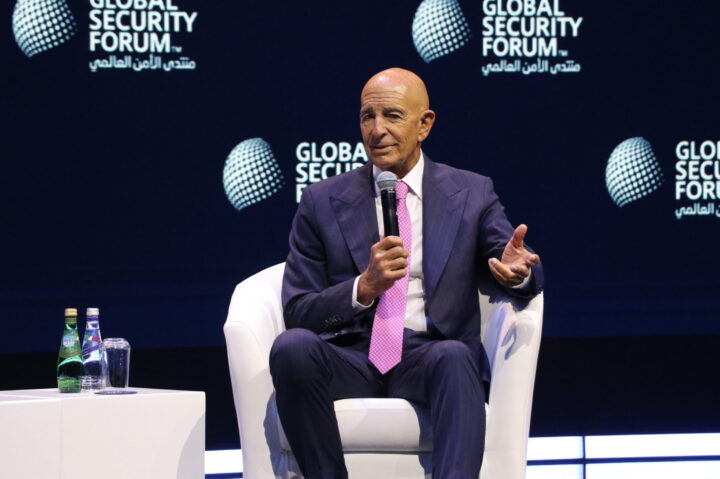
Ali Altunkaya/Anadolu via Getty Images
U.S. Ambassador to Turkey Tom Barrack delivers a speech during the 8th Global Security Forum, held under the theme 'The Future of Alliances,' in Doha, Qatar, on October 20, 2026.


 Add JewishInsider on Google
U.S. Ambassador to Turkey Tom Barrack said Tuesday that it is “not America’s job” to resolve the threats posed by Iranian-backed terror groups and militias across the Middle East, arguing that regional governments must take greater responsibility for their own security rather than relying on U.S. military intervention.
Speaking with Al Jazeera diplomatic editor James Bays at the Global Security Forum in Doha, Qatar, Barrack said the “answer” to Yemen’s struggle with the Houthis, Lebanon’s attempt to demilitarize Hezbollah and Iraq’s battle with Iran-funded militias “has to be that there becomes no purpose for those militias or those intermediaries, that the state or the nation state or the regime itself takes responsibility. So there’s no function for those militias. That’s not America’s job.”
Barrack said that while Saudi Arabia is in a “difficult position” as the Houthis repeatedly strike the kingdom, he expressed skepticism about the prospect of direct American military intervention.
“I think the president has been clear that he supports Saudi Arabia and the backing that they need logistically. He will supply, but America getting involved in a ground kinetic battle somewhere else seems fruitless,” he said.
Barrack argued generally that the United States should maintain its presence in the Middle East while moving away from efforts to control political outcomes.
“We’ve had 23 regime changes; none of them have worked,” he said. “Every time we try and intervene and change the person or the regime, it seems to have been a mistake.”
“The bargain is not to own, not to control, but to tend, not to leave. We’re not leaving,” Barrack said. “But what everybody’s doing is saying, ‘OK, I can’t rely on America to solve all my problems anymore.'”
Asked whether he was advocating an American “overwatch” role in the region, he agreed, arguing that regional governments must develop their own security arrangements with Washington serving in a supporting capacity.
Barrack also declined to say whether American military involvement in the war with Iran had been a “mistake,” instead warning that the conflict has resulted in “unintended consequences.”
“So I think when we say, ‘Is it a mistake?’ I don’t know whether it’s a mistake or not,” Barrack said. “It’s something that certainly none of us want to see, including this administration does not want to see proliferation of these unintended consequences of what’s happening in the region, or to the Iranian people, or to the Israeli people, or what’s happening in Europe.”
Barrack said that while he was deeply concerned about the conflict’s effects, he maintained that Trump’s original objective had been to prevent a nuclear threat rather than overthrow Iran’s government, despite President Donald Trump at times suggesting he supported regime change.
He argued that a negotiated settlement, rather than continued military escalation, offered the most viable path forward, pointing to the lack of trust between Washington and Iran’s Islamic Revolutionary Guard Corps as a central obstacle.
“The IRGC has become an adversary. The IRGC, in its adversarial role with Israel, has been a problem,” Barrack said. “It’s, ‘How do we have not an event but a process in which everybody has relevancy, respect, and continues on without this dramatic threat to all of us?’”
Despite identifying the IRGC as an adversary, Barrack rejected describing the Iranian regime as “evil,” saying its religious tradition was deserving of respect.
“It’s a theocracy. It’s not an evil regime and that has nothing to do with it,” Barrack said. “That’s a religious content and practice that we all respect.”
He said a process toward a negotiated agreement with Tehran should include a ceasefire, opening international waterways and easing the hardship facing Iranian civilians, arguing that greater prosperity in the country could help bring change over time.
Barrack also addressed Israel’s relations with its neighbors, acknowledging Israel’s security concerns about Syrian President Ahmad al-Sharaa’s government while expressing confidence that Damascus was seeking a more peaceful relationship.
“Israel made it clear from the beginning that they weren’t sure of Al-Sharaa. By the way, they’re entitled to that opinion,” Barrack said. “They were entitled to wait and see, is this going to be predatory or is it calm?”
But he argued that Al-Sharaa had demonstrated a willingness to pursue normalization with Israel.
“Al-Sharaa, I think, has done a very good job under very difficult situations to say, ‘I’m not predatory. I have no problem with Israel. I want a normalization with Israel,'” Barrack said.
Asked about increasingly hostile rhetoric between Israel and Turkey, Barrack downplayed the prospect of a direct confrontation between the two countries, while warning about the possibility of an accidental escalation.
“My belief is Israel is way too smart to actually pick a real fight with Turkey, and Turkey is way too smart to accede to the verbosity of these threats,” Barrack said. “This is politics.”
“I don’t believe Israel wants that. I know Turkey does not want that,” he added. “But the sensitivities in the region are so high that what we need to do is, in baby steps, is lower the temperature and increase the respect for everybody.”
The lawmakers said Ankara is carrying out an 'alarming campaign of repression’ against the community, including raids and arrests
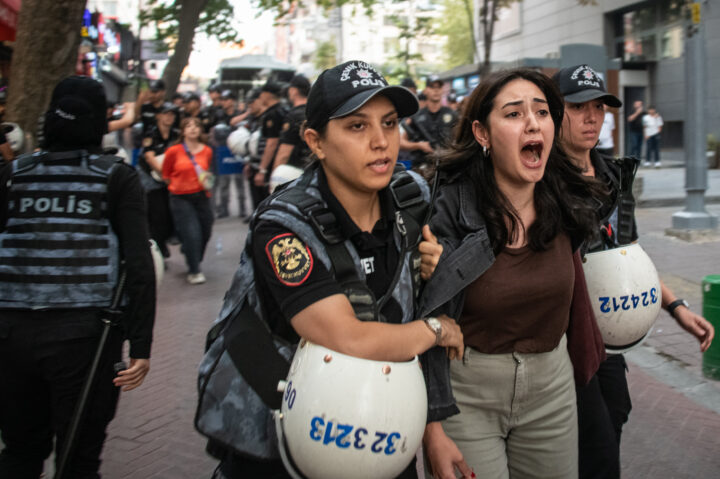
Diego Cupolo/NurPhoto via Getty Images
Turkish police detain dozens of LGBT rights protesters in Ankara, on September 15, 2026.
A group of 65 House Democrats wrote to Secretary of State Marco Rubio on Thursday urging him to take action in response to what they described as Turkey’s “alarming campaign of repression against LGBTQI+ people, human rights organizations, and advocates.”
They specifically highlighted a recent “crackdown” by Ankara starting in mid-September that they said represented a “dangerous and significant escalation,” with raids and arrests targeting HIV and LGBTQ civil society organizations and protesters, internet restrictions and efforts to dissolve human rights organizations.
“Together, these developments mark a dangerous new phase in the Erdogan regime’s efforts to use criminal law and the state apparatus to suppress legitimate human rights advocacy on behalf of the LGBTQI+ community,” the lawmakers, led by Reps. Yassamin Ansari (D-AZ) and Dina Titus (D-NV), said.
The lawmakers called on Rubio to undertake an “urgent diplomatic response” to protect basic rights for Turkish citizens, including using “all available channels to raise these concerns directly with the Turkish government,” work for the release of those arrested and monitor judicial proceedings related to these cases.
They said that Turkey is in violation of human rights agreements and that its actions are “an affront to basic human dignity and the values expected of a fellow NATO member.”
Other signatories included House Foreign Affairs Committee ranking member Rep. Greg Meeks (D-NY) and former House Speaker Nancy Pelosi (D-CA).
They also called on Rubio to provide an update on the State Department’s broader efforts to address human rights abuses by the Turkish government, describing the recent actions against the LGBTQ community as “part of a broader pattern of human rights violations and democratic backsliding in Turkey. We urge the Department to ensure that human rights are meaningfully integrated into all bilateral engagements and request a clear explanation of how the Department intends to do so.”
The lawmakers requested a response from Rubio by the end of the month.
Plus, Barrack hikes back Golan Heights claim
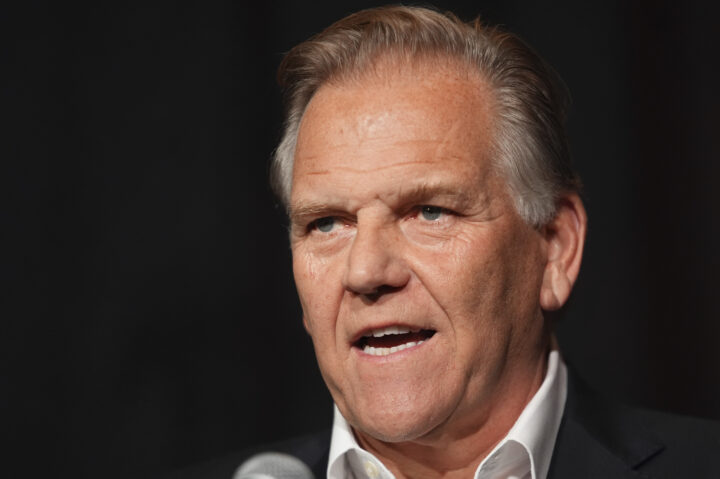
AP Photo/Paul Sancya, File
Republican Michigan Senate candidate Mike Rogers speaks during an election night watch party, Nov. 5, 2024, at Suburban Showplace Collection in Novi, Mich.
Good Monday morning.
In today’s Daily Kickoff, we report on U.S. Ambassador to Turkey Tom Barrack’s recent comments on control of the Golan Heights, talk to Palestinian analyst Ahmed Fouad Alkhatib about his new book about Hamas’ hold over Gaza and cover Hasan Piker’s suggestion that Jews who support Israel are inviting violence. Also in today’s Daily Kickoff: Josh Harris, Avi Nesher and Artem Dolgopyat.
Curated by JI Executive Editor Melissa Weiss, with assists from Danielle Cohen-Kanik and Marc Rod.
Today’s Agenda
Treasury Secretary Scott Bessent is set to hold a press conference today on Iran, days after announcing that the U.S. planned to impose “the toughest sanctions in history” on the Islamic Republic. In a post on X last night, Bessent said, “We are now entering the endgame. At dawn begins an economic D-Day — the single greatest financial offensive ever marshaled against an adversary.”
Ahead of Bessent’s speech — which came as the Iranian rial hit another record low — China’s Foreign Ministry released a readout on Sunday of a previously undisclosed meeting last week between China’s vice foreign minister and Iranian Deputy Foreign Minister Kazem Gharibabadi in which Beijing said it was “closely monitoring the situation in the Middle East and is actively committed to promoting peace talks.”
In Aspen, Colo., the Democratic Governors Association wraps up its annual two-day summer policy conference and board retreat this week. Speakers include Colorado Gov. Jared Polis, Pennsylvania Gov. Josh Shapiro and Kentucky Gov. Andy Beshear.
The Montreal City Council is slated to hold a vote this evening on a resolution that would declare a genocide in Gaza and “recognize and denounce the apartheid regime in Palestine.” The resolution, being promoted by the opposition Projet Montréal party, has stirred controversy in the city and drawn pushback amid an uptick in antisemitic crimes.
One Thing To Know
analysis
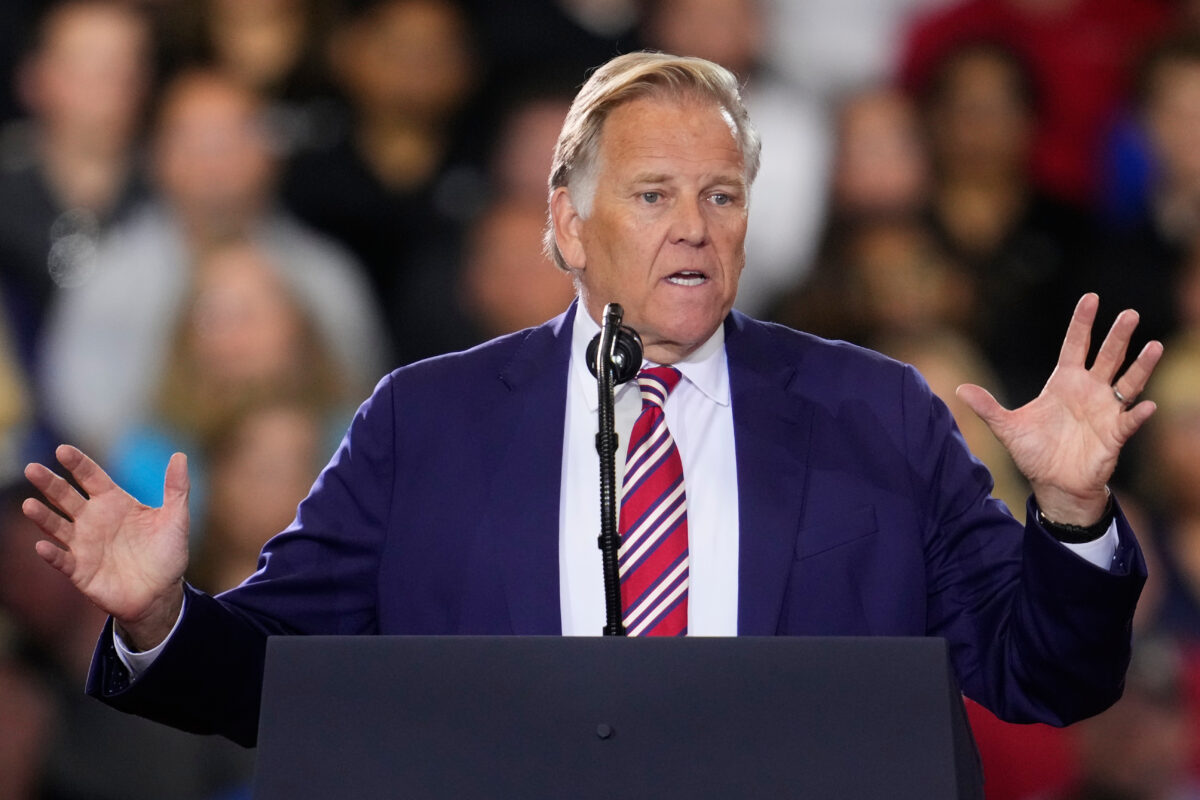
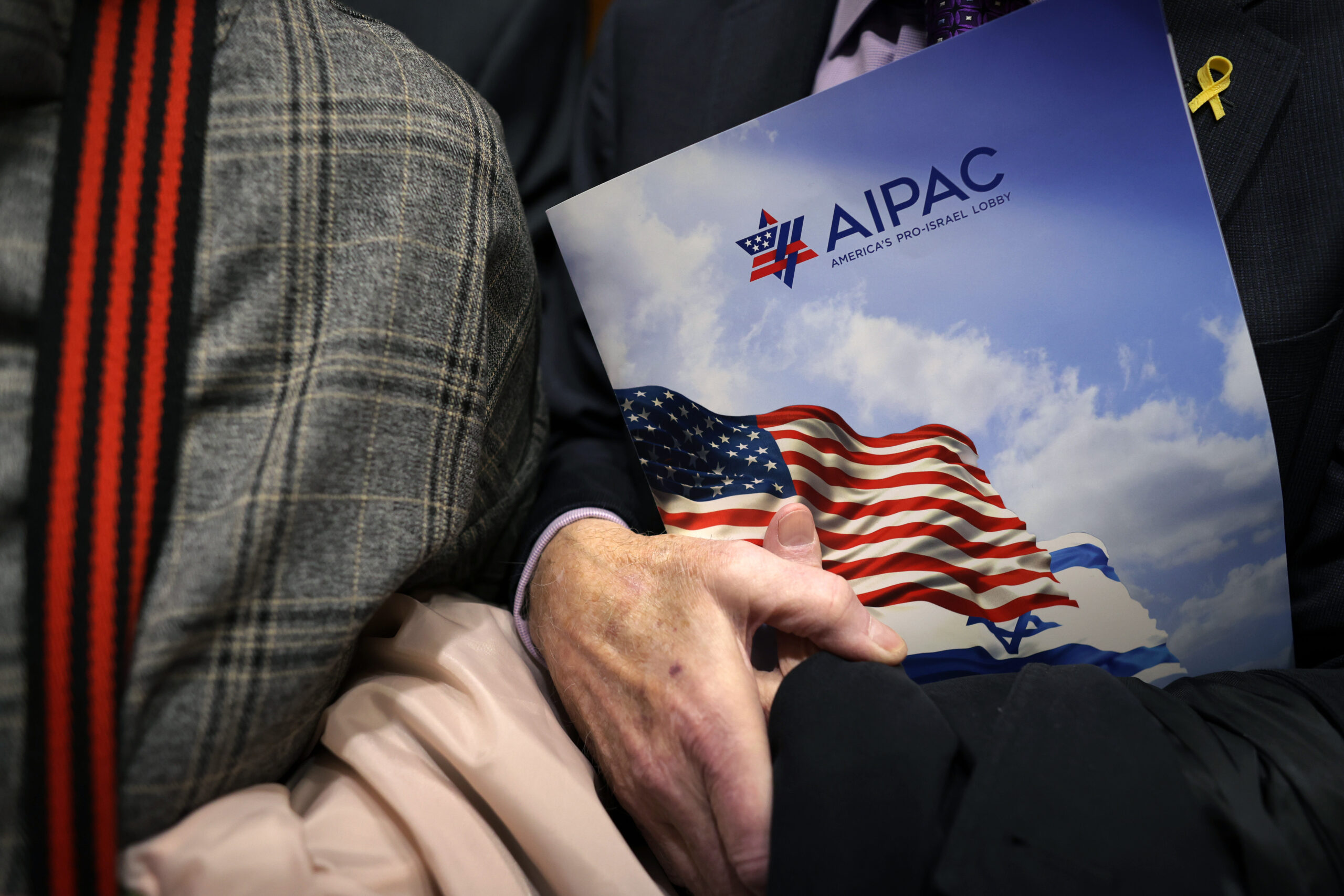
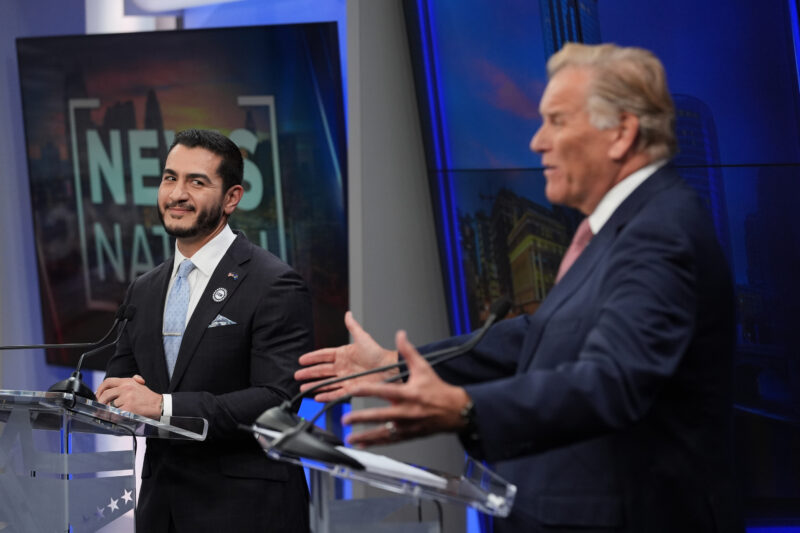
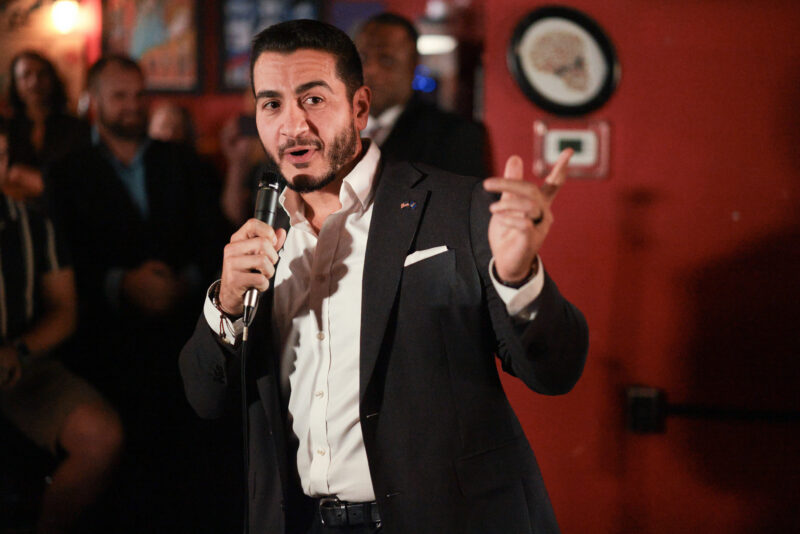
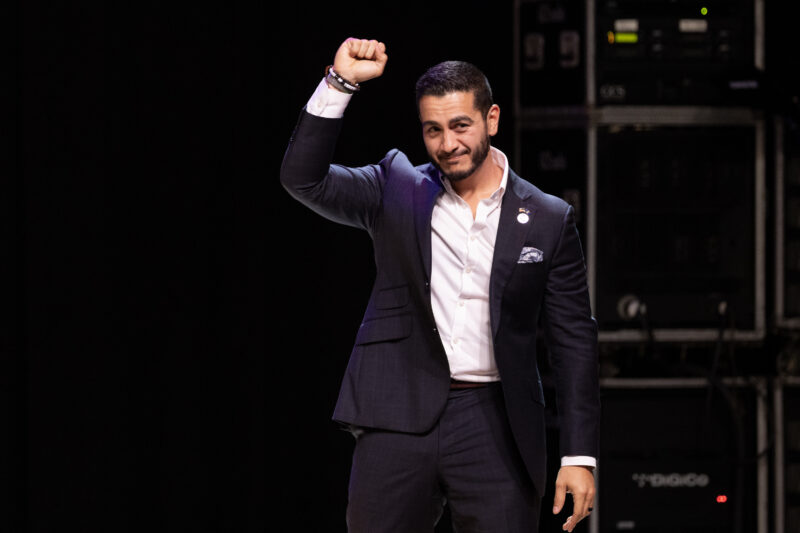
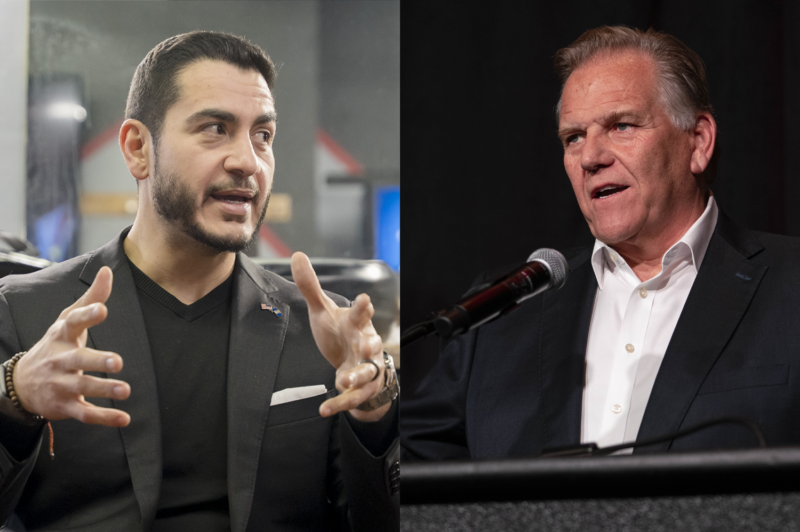
The debate over AIPAC’s involvement in the high-stakes Michigan Senate race is drawing renewed attention after an Axios report outlined a request from allies of former Rep. Mike Rogers (R-MI) for the pro-Israel group’s super PAC to lay low for the general election. The Rogers campaign advisors suggested instead that the group transfer money for the race to a separate pro-Rogers entity so as not to make its outside spending a major issue in the contest.
The episode has touched a lot of raw nerves in both the pro-Israel world and the Republican political landscape. Rogers, a longtime supporter of the U.S.-Israel relationship, is highlighting his relationships with Michigan’s Jewish community, and has made attacking Democratic nominee Abdul El-Sayed’s anti-Israel virulence and his relationship with antisemitic figures like Hasan Piker a central element of his campaign message.
AIPAC’s super PAC, United Democracy Project, spent about $32 million in the Democratic primary to try to defeat El-Sayed, and there’s little doubt its money — in the absence of any moderate group willing to spend similar resources to stop a far-left candidate like El-Sayed from winning — made the race more competitive than it otherwise would have been. But it also gave El-Sayed a talking point in attacking outside money in the race that diluted the impact of the aggressive advertising campaign, especially at a time when support for Israel itself is diminishing within the Democratic Party.
The Big Reads
BARRACK’S ROW
U.S. Ambassador to Turkey Tom Barrack on Sunday reaffirmed the U.S. policy on the Golan Heights, days after suggesting on a livestream that the Israelis “still occupy the Golan against the [United Nations] resolutions,” despite the Trump administration’s 2019 recognition of the area as Israeli territory, Jewish Insider’s Marc Rod reports. In a statement to JI after facing pushback on his initial comments, Barrack said, “The reference to the United Nations was offered as evidence of the point I was making — that territory taken by force remains contested for generations, in this case for more than fifty years and still unresolved at the UN — which is why I argue that negotiated understandings, not maps, are what endure.”
BOOKSHELF
During the war between Israel and Hamas sparked by the Oct. 7, 2023, attacks, dozens of relatives of the Atlantic Council’s Ahmed Fouad Alkhatib were killed in Israeli airstrikes. But ultimate blame for their deaths, the author of Hamas and Its Two Million Hostages argued to Jewish Insider’s Matthew Shea, is with the terror group and not Israel. In his first book, Alkhatib said he sought “to weave in elements of my personal story with Gaza’s contemporary history, and add a human dimension to what I felt was Hamas’ devastating impact on the Palestinian people, their destructive role in setting back the Palestinian national project and the radicalization of the society.”
VEILED THREAT
Antisemitic social media influencer Hasan Piker, who has campaigned with a number of progressive Democratic candidates this year, said on his Twitch stream last week that American Jews who express support for Israel are inviting violence against themselves, Jewish Insider’s Haley Cohen reports. In his commentary, Piker added that Jews who tie their “entire identity” to Israel, which he referred to as “Jewish ISIS,” are “making antisemitism worse.” Two hours into his nearly seven-hour stream last week, Piker said, “If Jews in America keep putting this idea out there that they are singularly invested in Israel, eventually someone’s going to come around and take action, not against the State of Israel, mind you, but against American Jews.”
The Rundown
EDUCATION IMPACT
TURKEY TROUBLE
MONEY MOVES
On Our Radar
● The Live Briefing. Word on the street, clips, podcasts and quick updates — the items we’re tracking all day in our Live Briefing on the app (on Apple and Android) and website.
House Minority Leader Hakeem Jeffries (D-NY) met privately with White House advisor Jared Kushner in recent weeks to discuss policy issues as Democrats look poised to retake control of the House in the midterm elections…
The U.S. canceled an upcoming joint amphibious landing exercise with South Korea, with Washington reportedly citing constraints due to the Iran war…
Mossad Director Roman Gofman and Syrian Foreign Minister Asaad al-Shaibani met on Sunday in an effort to lower tensions after Israel struck a Syrian air base last week…
U.K. power companies were put on high alert following a successful effort by hackers with suspected Iran ties to shut down a small British energy plant, weeks after Iran-linked hackers were suspected of targeting water systems in at least seven U.S. states…
Iranian authorities are increasingly cracking down on coffee shops that are serving as gathering spots for young Iranians to socialize, often citing the country’s restrictive modesty laws…
Rep. Anna Paulina Luna (R-FL) is planning to introduce legislation amending the Foreign Agents Registration Act that would require influencers to disclose funding from foreign governments to push political messages; the legislation has the backing of Reps. Jared Moskowitz (D-FL), Vicente Gonzalez (D-TX) and Derrick Van Orden (R-WI)…
The New York Times spotlights Powerus as the Florida-based startup, which makes 3D-printed drone interceptor components, begins production in a newly opened facility in the United Arab Emirates in its first foray into the Middle East; the expansion is part of a broader effort to quintuple production by 2027 to match growing needs from the U.S. and its allies…
Blackwater founder Erik Prince launched Vectus Air Defense Systems, which will provide “layered air-defense networks” in partnership with Ukrainian drone software group Swarmer, for which he serves as non-executive chair…
Paramount condemned Mark Ruffalo’s use of “antisemitic tropes … in purported service of a business dispute” after the actor and activist, who has opposed Paramount’s bid to takeover Warner Bros. Discovery, accused CEO David Ellison and his father, Oracle founder Larry Ellison, of “powering some of the most destructive and inhuman forces in the world”…
Josh Harris, a minority owner of the Crystal Palace Football Club, told Sportico that the team is “trying to look at whether there are investors that might want to join us” as the owners of the English Premier League club consider a potential sale…
City & State NY looks at the NYPD’s continued relationship with Israeli law enforcement — including a full-time liaison stationed in Israel — despite New York City Mayor Zohran Mamdani’s anti-Israel rhetoric, finding that “[n]owhere has the gap between Mamdani’s views on Israel and his actual policy been greater than his management of the NYPD”…
Variety interviews Israeli filmmaker Avi Nesher about his new film “Our Loves,” inspired by the real-life relationships of survivors of the Oct. 7, 2023, attacks, which is set to premiere next month at the Toronto International Film Festival…
Seven anti-Israel protesters who were convicted last month of shutting down traffic on the Golden Gate Bridge during a 2024 demonstration were sentenced to 30 days in jail and six months probation, with the imposition of jail time on hold until the defendants file appeals…
A Jewish camp in Belgrade, Maine, is seeking a protective order from a neighbor with whom camp officials have clashed for years; the camp alleged that Nathan Hewett has sought to disturb campers and staff, and said that earlier this month he fired nearly two dozen gunshots nearby, sending the camp into lockdown…
The Wall Street Journal looks at the Alternative for Germany’s attacks on the Bauhaus art and design school, as the far-right party seeks to portray the art movement — which was banned by the Nazis — as “inhumane” and anti-German…
AirMail and Politico profile Yashar party leader Gadi Eisenkot, as the latest poll from Israel’s Kan network shows Israeli Prime Minister Benjamin Netanyahu with 51 seats — short of the 61-seat majority needed to form a coalition…
Military officials from Burundi and Uganda met with officials in Israel last week to discuss the deployment of troops from both countries to join the international security force in Gaza…
Israel announced that it had discovered the wreckage of the Altalena, nearly 80 years after the vessel, which had been carrying arms to the Irgun when those aboard clashed with the IDF after the ship ran aground in Tel Aviv, was sunk on the orders of Prime Minister David Ben-Gurion in June 1948…
Peter Berkowitz was named the next James R. Schlesinger distinguished professor at the University of Virginia’s Miller Center of Public Affairs…
Worthy Reads
Find more Worthy Reads in our Live Briefing via our app (on Apple and Android) and website.
What Bernie Wrought: In The Free Press, Joel Rubin, the former Jewish outreach director on Sen. Bernie Sanders’ (I-VT) 2020 presidential campaign, argues that Sanders and his political infrastructure have helped bring about the Democratic Party’s turn against Israel and a broader rise in antisemitism. “No longer are there any guardrails within the Sanders team that take the broader Jewish community’s sensitivities into account. … Rather, for the past several years, Sanders has helped build a political infrastructure on the American left in which hostility toward Israel has increasingly become a marker of ideological authenticity.” [FreePress]
That Other King: In The Washington Post, Rabbi Elie Kaunfer reflects on the upcoming High Holy Days of Rosh Hashanah and Yom Kippur in the context of the “No Kings” protests that have taken place across the U.S. over the last year. “At the emotional center of both holidays is a word that recurs in their liturgies: king. … But 2,000 years before anyone printed a protest sign, the ancient rabbis who composed these words wrestled with the same discomfort we feel today. Indeed, the rabbinic approach to God as King can be summed up simply: Whatever you think a human king is, God is the opposite.” [WashPost]
Base Running: The Financial Times’ Jacob Judah does a deep dive into the debate over how — or whether — to rebuild U.S. military facilities in the Middle East that were damaged by Iranian fire. “As Pentagon planners have reimagined how to fight against advanced adversaries, large and fixed bases have been losing favour as the staging and supply hubs for military operations. The preference in Washington has been to move towards a more dispersed deployment model that makes it harder to target American forces.” [FT]
Picture of the Day

Israeli Olympic gold medal gymnast Artem Dolgopyat won his third European Championship title for his floor routine during last week’s competition in Zagreb, Croatia. MARKO LUKUNIC/PIXSELL/MB MEDIA/GETTY IMAGES
Birthdays
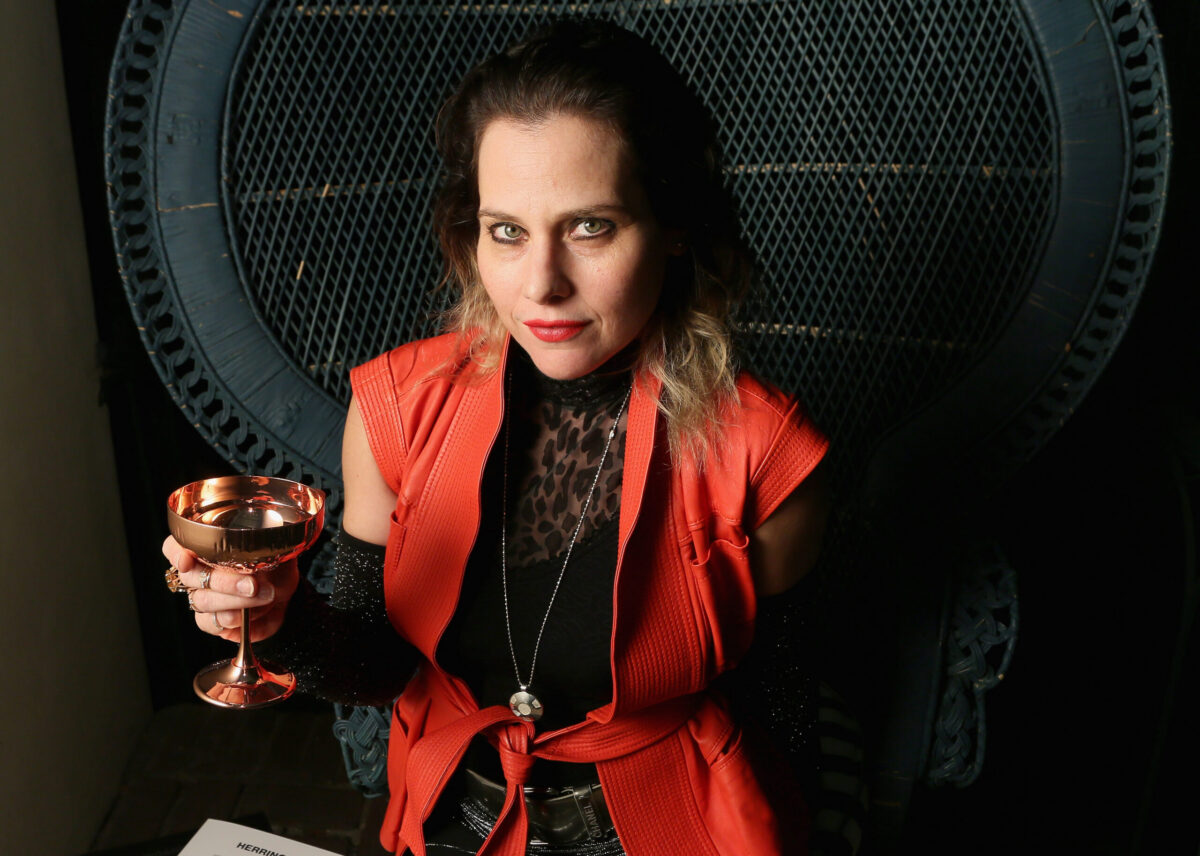
Meital Dohan, Israeli actor and musician, turns 50
Meir Stern, rosh yeshiva of the Yeshiva Gedola of Passaic, N.J., turns 91
J. David Bleich, professor of Jewish law and ethics at Yeshiva University, he also teaches at Cardozo Law School, turns 90
Lois Tager, author, speaker, geriatric care manager and online counsellor for seniors in Scottsdale, Ariz.
Mel Karmazin, former president of Infinity Broadcasting, he eventually became the CEO of CBS and of Sirius Radio, turns 83
Joe Manchin, former U.S. senator (I-WV), turns 79
Dakota Jackson, celebrity furniture designer known for his eponymous furniture brand, turns 77
Lawrence Bacow, former president of Harvard and Tufts universities, turns 75
Jonathan Romain, rabbi emeritus of the Maidenhead Synagogue in Berkshire, England, turns 72
Ricki Seidman, senior counselor to the secretary of Homeland Security during the Biden administration, turns 71
Mike Huckabee, U.S. ambassador to Israel, turns 71
Phil Rosen, retired in 2024 as head of the real estate practice at Weil, Gotshal & Manges, he is the vice chair of Birthright Israel Foundation and chair of World Jewish Congress-American section
Adam Gopnik, author of nine books, essayist and longtime staff writer for The New Yorker, turns 70
Steve Guttenberg, actor, producer and director, turns 68
Marvin Krislov, president of Pace University, turns 66
Jonathan Aviv, professor of otolaryngology at Mount Sinai Hospital in NYC, turns 66
Marc Terrill, president emeritus of The Associated: Jewish Federation of Baltimore
Donna Barwald, professional organizer
Marlee Matlin, 1986 winner of the Academy Award for Best Actor for her role in “Children of a Lesser God,” she is the first deaf performer to have won the award, turns 61
Nick Denton, founder and CEO of Gawker Media until it was bankrupted by Hulk Hogan and Peter Thiel, turns 60
Andrew Romanoff, former speaker of the Colorado House of Representatives, he is now executive director for Disability Law Colorado, turns 60
Lonnie Nasatir, president of the Jewish United Fund/Jewish Federation of Metropolitan Chicago
David Gregory, CNN political analyst, he is the former host of NBC’s “Meet the Press,” turns 56
Todd Young, U.S. senator (R-IN), turns 54
Avigail Sperber, Israeli cinematographer and film and television director, turns 53
Miriam Shaviv, content marketing lead at Dow Jones Risk & Compliance, turns 50
Jon Daniels, former GM of MLB’s Texas Rangers, now a senior advisor for the Tampa Bay Rays, turns 49
Emily Cherniack, Boston-based, founder and executive director of the group New Politics
Michael M. Rosen, counsel at Irell & Manella and a nonresident senior fellow at the American Enterprise Institute
Jenn Hyman, co-founder and former CEO of Rent the Runway, a company focused on the renting of high-end clothing and accessories, turns 46
Jon Scheyer, head coach of the Duke men’s basketball team after serving as assistant to the legendary Coach K (Mike Krzyzewski), turns 39
David Perelman, CEO of the JCommerce Group, an e-commerce enterprise that services the Jewish community
Galia Slayen, VP of strategic communications at The Lede Company
Samantha Feinstein, owner of Sustayne and co-owner of Peabody Group
Natalie Short, SVP at Edelman Smithfield
Griffin Gluck, film and television actor, turns 26
The U.S. envoy to Syria’s comments came at odds with Trump’s recognition of Israeli sovereignty over the Golan in 2019
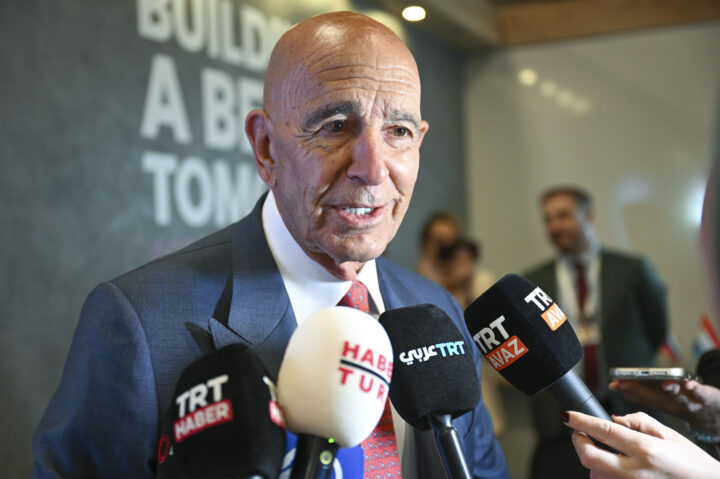
Special Envoy for Syria Tom Barrack speaks during an interview within Antalya Diplomacy Forum, held under the theme of 'Mapping Tomorrow, Managing Uncertainties' in Antalya, Turkiye on April 17, 2026.
U.S. Ambassador to Turkey Tom Barrack, who also serves as the U.S. special envoy for Syria, on Friday described Israel as occupying the Golan Heights, despite the U.S.’ recognition of Israeli sovereignty in the region.
“In the Golan with Syria — they still occupy the Golan against the [United Nations] resolutions, against all of the international order which has said the Golan is Syria’s,” Barrack said during an appearance on commentator Mario Nawfal’s livestreamed show.
Barrack’s comments did not address the U.S.’ 2019 recognition of the Golan Heights as sovereign Israeli territory — a decision made by President Donald Trump during his first term and maintained by the Biden administration.
“My comments were descriptive of a well-known historical record and were made in the course of explaining why I do not anticipate annexation in Lebanon,” Barrack said in a statement on Sunday. “The reference to the United Nations was offered as evidence of the point I was making — that territory taken by force remains contested for generations, in this case for more than fifty years and still unresolved at the UN — which is why I argue that negotiated understandings, not maps, are what endure. It was not an endorsement of the UN’s position. United States policy on the Golan was set by President Trump in 2019 and is unchanged. “
Barrack’s comments came in response to a question about whether Israel seeks to annex Lebanese territory — something Barrack ultimately denied.
The comments had prompted backlash from a range of figures on the right.
“The Senate confirmed [Barrack] to enact the PRESIDENT’S AGENDA, which millions of Americans voted for,” Sen. Rick Scott (R-FL) said on X. “It seems the Ambassador forgot that or failed to do his research, so here’s a refresher for him… President Trump has been CLEAR about Israel’s sovereignty over the Golan Heights for years!”
Far-right influencer Laura Loomer blasted Barrack and demanded that he be forced to resign, calling Barrack “clearly compromised by Arab money.” Bush administration official David Wurmser called the comments a “clear statement” that Barrack “regards the President’s policy and U.S. recognition of the Golan as part of Israel as null and void” and urged him to clarify if he supports U.S. policy, believes he can change U.S. policy on his own or whether U.S. policy has changed.
The U.S. ambassador also dismissed the idea of forced demilitarization of Hezbollah — as required under both U.N. Security Council resolutions and recent Israel-Lebanon diplomatic agreements — as an impossibility.
“We’re asking [the Lebanese Armed Forces], please go shoot your cousins if they don’t give you the AK-47. It’s not going to happen that way. It’s too difficult for it to happen that way,” Barrack said. “So I think what [U.S. Ambassador to Lebanon Michel] Issa is doing in this whole process is saying there’s got to be a better way. How do we get Hezbollah to not utilize those weapons?”
He seemed to rationalize Hezbollah’s continued defiance of demilitarization efforts as resistance to Israeli demolition of Lebanese homes and as the only way for the terror group to financially survive, by receiving monetary support from Iran.
Addressing other comments in the interview, which many saw as a call for negotiating with Hezbollah and Iran over Hezbollah’s demilitarization, Barrack described the Lebanese government as the “sole legitimate authority.”
“My point was that implementation of the June framework requires an honest reckoning with who holds the weapons and who supplies them. I was describing the difficulty of the problem, not proposing a new table,” Barrack said. “Hezbollah is a designated foreign terrorist organization. We do not negotiate with it, and nothing I said suggests otherwise. My remarks should be read in their full context.”
He added that “any honest observer” must determine how to move Iran and Hezbollah.
“How does Hezbollah come to accept disarmament? And who, other than Tehran, sustains the communities of the south, so that the money on which that arsenal’s political cover depends is replaced by something better? Naming those questions is not conferring standing on anyone,” Barrack said. “It is the precondition of answering them — and answering them is precisely what the framework’s designers are working at.”
Barrack praised the defense agreement between Turkey, Pakistan and Saudi Arabia as an accomplishment for the Trump administration, pressing regional powers to take responsibility for their own security — similar to the president’s efforts to pressure European NATO allies to spend more on their own defense.
“It’s not anti-Israel, it’s not pro-Sunni and it’s not anti-America,” Barrack said. “It’s, ‘Guys, we need to band together.’”
He also suggested that others in the region shouldn’t be concerned by Turkey’s apparent growing regional ambitions.
“Turkey’s going into a new, powerful mode, which makes everybody nervous, but it’s a great thing for Turkey,” Barrack said. “They — as a hub, as a non-Arab, really workable, kind, loving, Islamic country with eight countries around it and four seas … it’s threatening in its geographical presentation. So I’m hopeful the calmer heads will be there.”
Barrack is in the midst of a media tour addressing Israel’s decision to strike the runway of a Syrian airbase with the goal of preventing Turkey from deploying troops to the site. Barrack and other U.S. officials have criticized the strikes.
On Friday, Barrack suggested two potential motivations for the strikes: that Israel was “baiting the Turks” or that there had been a “miscommunication” among different elements of the Israeli government that led an Israeli commander to carry out a strike without any intention of sparking further conflict or causing injuries.
Speaking on the incident on “PBS NewsHour” on Friday, Barrack said that Israel believed it had a tacit agreement with Turkey and Syria that the countries would not deploy military equipment that could obstruct an Israeli attack path to Syria, but Barrack said that the other parties did not agree that they had any such accord.
He said that Israel had communicated its concerns about the deployment to Syria, and that Syria had denied any Turkish movement toward the base, with further talks planned the following week. “Something went awry and Israel decided they needed to bomb the craters on two runways. The problem with this is Turkey did not know it was coming,” Barrack continued.
Barrack suggested on both shows that recent tensions between Turkey and Israel are largely a political gambit by both sides ahead of elections in their countries — despite Turkish President Recep Tayyip Erdoğan’s now yearslong threats to invade or attack Israel. And he said on Nawfal’s show that Turkey is “concentrating on restraint” and is “not predatory” and “not interested in attacking or even engaging in any kind of kinetic or adversarial relationship with Israel.”
He said that the U.S. saw no malign intent or aggressive action by Syria or Turkey.
However, in the same interview, Barrack expressed an understanding of Israel’s concerns about the new Syrian government, particularly when it first took power, and insisted that Israel’s incursion into Syria was designed as a protective measure, not as an effort to expand its territory, as some in anti-Israel circles have claimed.
Nawfal’s show, on which Barrack appeared, has also featured a range of anti-Israel figures and conspiratorial anti-Israel narratives. Other recent guests have included Anthony Aguilar, the former U.S. Marine turned anti-Israel activist who claimed to have seen Gaza Humanitarian Foundation contractors kill a child in Gaza only for that child to be found alive and well; former Trump administration official Joe Kent; and anti-Israel commentator and retired Gen. Douglas Macgregor.
The senator called for NATO to step in and said Turkey ‘needs to act like a real ally’ after Ankara called for Interpol to issue an international arrest warrant for Netanyahu

Kevin Dietsch/Getty Images
Sen. Rick Scott (R-FL) speaks on government funding during a press conference at the U.S. Capitol on March 06, 2024 in Washington, DC.
Sen. Rick Scott (R-FL) blasted Turkey this week over its continued hostility toward Israel, calling on the U.S.’ NATO ally to stop targeting Israel and working with terrorist groups.
“We all know that Turkey likes cozying up to terrorists and supporting Israel’s and America’s enemies,” Scott said Friday, in response to a Turkish request for Interpol to issue an arrest notice for Israeli Prime Minister Benjamin Netanyahu.
Ankara has issued charges against Netanyahu including war crimes, genocide and torture in connection with Israel’s interception of an activist flotilla headed to Gaza.
Scott said that “anyone who isn’t a terrorist sympathizer can see that” Israel has a right to defend itself.
“Where is NATO in all of this? When are our other allies going to join in calling this out and setting clear expectations on this outrageous behavior? Turkey needs to act like a real ally. This needs to END,” Scott continued.
It’s the second time this week Scott has hit out at Ankara. Earlier this week, he responded to an interview by U.S. Ambassador to Turkey Tom Barrack in which Barrack asserted that the Turkish military was not aware Israel planned to strike targets inside Syria, which Barrack said could have sparked a military confrontation.
“It’s clear Israel gave Turkey advanced warning, and Ankara ignored it. Israel has the right and the duty to defend itself from threats,” Scott said. “Turkey needs to stop playing around, stop shilling for terrorists, and start acting like the NATO ‘ally’ they pretend to be.”
Netanyahu also responded to the arrest effort, calling Turkish President Recep Tayyip Erdogan an “antisemitic dictator” and accusing Erdogan of trying to “extend his aggression against Israel into Syria.”
Alleged straw-donor masterminds are selling tickets to an event with the Montana Republican — who says he’s not attending
Bill Clark/CQ-Roll Call, Inc via Getty Images
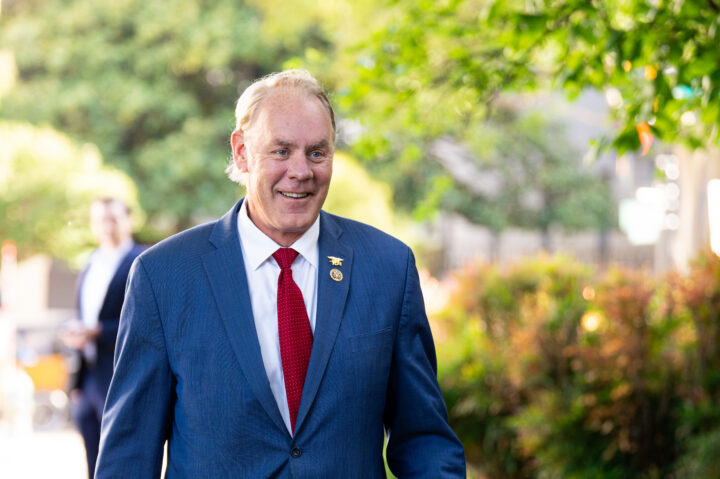
Rep. Ryan Zinke (R-MT) arrives for the House Republican Conference caucus meeting at the Capitol Hill Club in Washington on Wednesday, May 13, 2026.
A Turkish-tied organization that launched in 2023 with an alleged straw-donor fundraiser for former New York City Mayor Eric Adams has spent recent weeks selling tickets for a Sept. 20 gathering listing Rep. Ryan Zinke (R-MT) as a “featured speaker ” — even as Zinke’s office insists he’s not attending the event.
The CEO Club New York and Turkish-American Business Association have posted materials online and created a listing on Eventbrite advertising the “World Business Summit New York & Award Ceremony 2026,” to take place at a venue inside The New York Times building during the U.N. General Assembly next month. Prominently displayed is the name and photo of the retiring Montana congressman, who served as secretary of the interior during the first Trump administration.
“We’re bringing together global business leaders, entrepreneurs, investors, innovators, and decision makers for a day of meaningful conversations, networking, and collaboration,” CEO Club Founder Jimmy Cuneyt Gurkan wrote on LinkedIn, adding that Zinke was “already confirmed” to appear along with a roster of private sector guests.
Previous reporting has identified Cuneyt Gurkan as the unnamed, unindicted “public relations representative” in the criminal complaint against Adams who plotted to illegally funnel large amounts of money from a Turkish-American businessman into the then-mayor’s later-aborted reelection campaign — and the CEO Club’s inaugural gathering in October 2023 has been identified as the event used to mask the donations as lawful gifts from attendees.
Prosecutors described the “public relations representative” as an associate of a “Turkish official” who directed foreign money into Adams’ campaign coffers and arranged perks from state-owned Turkish Airlines in exchange for favorable treatment.
The New York Times and other publications have outed that official as Reyhan Özgür, the former Turkish consul general. The indictment states that Özgür and a Turkish Airlines official shared a donation link for the 2023 CEO Club event.
Cuneyt Gurkan and the CEO Club did not respond to repeated inquiries for this story. The Times Center, the event space in the paper’s Manhattan headquarters, told Jewish Insider that it has “been in touch with” the CEO Club about using the space in the 9 a.m. to 2 p.m. slot listed in the promotions but does not yet have a contract in place.
But, after initially avoiding answering questions about whether Zinke would attend the event, the congressman’s team told JI that he will not be there. Asked if the congressman had ever intended to participate in the event, and if he will be in New York City on that date, his office would only answer that it was never on his official schedule and that his House staff never interacted with the CEO Club.
Zinke has a mixed history with Turkey — but has had past contact with the network allegedly involved in the Adams bribery scheme. Foreign Agent Registration Act filings show that as a congressman he has had contact with lobbyists for Turkey’s government and ruling political party both before joining the first Trump administration and since returning to the Hill.
As interior secretary, Zinke came under fire from ethics watchdogs in 2018 for bringing an official security team on a vacation to Turkey, a trip that also included a stop in Greece.
While that controversy received broad coverage, few U.S. outlets reported that Zinke’s wife — who had previously lived in Turkey — received an award from Turk of America magazine and TOA Consulting. Turk of America’s publisher was Cuneyt Gurkan’s co-conspirator in the CEO Club’s straw-donor scheme for Adams, while Cuneyt Gurkan at the time served as TOA Consulting’s chief operating officer, according to LinkedIn and media appearances.
Personally presenting the award to Lola Zinke was another key figure in the Adams scandal: Turkish Airlines executive Cenk Ocal. Cuneyt Gurkan took a selfie with the interior secretary at the event, and the secretary lauded the U.S. partnership with Turkey.
“Certainly, they’re regional and strategic partners, and the people of the United States and Turkey, they love each other, as shown here,” video posted to YouTube shows Zinke saying. “Look at our mutual values and our core strengths, and it’s about the people, that there’s a long-time bond and a relationship between the Turkish people and the United States.”
Just months later, however, the Republican was briefly the target of retaliatory Turkish sanctions after the U.S. sought to penalize the Mediterranean nation for detaining an American pastor. Experts attributed the move against Zinke to confusion by Turkish President Recep Tayyip Erdoğan over the U.S. Department of the Interior’s remit, as a similarly named ministry in Ankara handles domestic security.
Back in Congress, Zinke — who sits on the House Foreign Affairs Committee — has coupled praise for Turkey as a NATO ally with concern about Ankara’s support for Hamas. In a markup session last fall, he opposed an amendment that would compel consideration of Israeli military advantage when making arms sales to the country, a standard applied to all other Middle Eastern countries.
Analysts who spoke to JI last week said the deal could portend a more aggressive posture against Israel by Ankara and its ally in Damascus

Bonnie Cash/Getty Images
Rep. Joe Wilson (R-SC) looks on during a hearing to examine war crimes from Syria to Ukraine at the U.S. Capitol on July 10, 2024 in Washington, DC.
Rep. Joe Wilson (R-SC) on Sunday praised the new mutual defense pact between Saudi Arabia, Turkey and Pakistan as an accomplishment by President Donald Trump.
“The mutual defense pact of Saudi Arabia, Türkiye, and Pakistan is another achievement of [Trump] promoting stability, peace, and prosperity in the Middle East,” Wilson, a vocal supporter of Israel who has also been strongly supportive of Turkey, said in a post on X. “With our prosperous Gulf allies, a liberated Syria, and Lebanese-Israeli negotiations, it is clear the murderous regime in Iran is isolated and the people of Iran can regain a new government worthy of Iran’s rich history.”
Wilson has been among the most prominent supporters on Capitol Hill of the new Syrian government, which is tied closely to Turkey’s own government.
The pact has been seen by many in pro-Israel circles as a sign that some of the U.S.’ Gulf allies are attempting to hedge against the U.S. and Israel, creating an alternative to the Abraham Accords and empowering those hostile to Israel.
There also has been no public reporting about Trump or the U.S. having been involved with the deal.
Multiple U.S. analysts told Jewish Insider last week that the agreement should be cause for concern for both the U.S. and Israel, and could portend a more aggressive posture against Israel by Ankara and its ally in Damascus.
Foundation for Defense of Democracies senior fellow Edmund Fitton-Brown: ‘For Turkey, it is an assertion of its centrality to security arrangements in the region’

Getty Images
Turkish President Recep Tayyip Erdogan delivers a speech during a joint press conference, July 19, 2022, in Tehran, Iran.
A coalition of Sunni regional powers signed a historic joint defense pact on Friday, but national security experts expressed deep unease over the arrangement, arguing that it reflects U.S. shortcomings in the Middle East while raising serious questions about its practical military feasibility.
The agreement, dubbed the Mecca Joint Defense Agreement, was signed in the Saudi holy city of Mecca by Saudi Crown Prince Mohammed bin Salman, Turkish President Recep Tayyip Erdogan, and Pakistani Prime Minister Shehbaz Sharif.
Under the pact, Saudi Arabia, Turkey, and Pakistan agreed to treat an armed attack on one signatory as an attack on all. The move solidifies security and defense cooperation between the three powers amid a period of heightened regional turmoil and uncertainty stemming from the war in Iran.
As a result of the ongoing conflict with Iran, Saudi Arabia has seen its critical infrastructure and oil facilities targeted by strikes, which analysts say has prompted Riyadh to diversify its strategic and security partnerships. The trilateral agreement follows a bilateral mutual defense pact signed between Pakistan and Saudi Arabia last September.
Edmund Fitton-Brown, a former British diplomat and senior fellow at the Foundation for Defense of Democracies, explained that the military alliance formed in response to an “uncertain security situation” across the wider region.
“For Turkey, it is an assertion of its centrality to security arrangements in the region. For Saudi Arabia and Pakistan, it is a reflection of weakness and uncertainty, as both feel threatened (by Iran and India respectively),” Fitton-Brown said. “Although the agreement is not primarily directed against Israel or the United States, both should be concerned about it.”
Fitton-Brown emphasized that the pact poses strategic complications for both Jerusalem and Washington, while raising alarms for regional actors.
“For Israel, it is further confirmation of Turkish ambitions, which are explicitly directed against Israeli interests,” Fitton-Brown said. “For the U.S., it is questioning how reliable or permanent it is viewed as a player in the region. Stirring up a hornet’s nest in the Gulf and then appearing unsure about an end game, or even clear red lines, has left American allies uncertain about the future and willing to hedge their bets.”
Jonathan Ruhe, a fellow at the Jewish Institute for National Security of America, similarly labeled the agreement as problematic, noting that it reflects U.S. diplomatic shortcomings rather than an effective counterweight to Tehran.
“This alignment is problematic to the extent it is about Washington and its regional relationships, not Tehran,” Ruhe said. “These three countries have almost zero shared ability or interest to meaningfully contain Iran. The Trump administration certainly should have done better coalition-building before the Iran war.”
Ruhe added that for Turkey, the pact serves to “support Ankara’s longstanding pretensions to be a major player and arms exporter in the Middle East and beyond, independent of the United States and NATO.”
Fitton-Brown also highlighted how regional shifts in Syria intersect with the new alliance.
“There is also a Syrian dimension: President Sharaa now leads a Sunni Islamist government in Damascus, where Turkey is the most influential foreign power and Saudi Arabia is a key investor and stabilizing influence,” Fitton-Brown said. “Israel will worry that this consolidates Turkish influence in Syria and will ultimately turn Sharaa’s Syria against Israel.”
Fitton-Brown noted that the emerging alliance signals a broader realignment of regional power dynamics following recent geopolitical shifts.
“On one hand, the new agreement looks like a Sunni axis that is replacing the Iran-led Axis of Resistance, following the weakening of the Islamic Republic, Lebanese Hezbollah, and the collapse of the Assad regime in Syria,” he explained. “On the other hand, Iran remains threatening to the Gulf States, especially, and the Saudis are probably comforted by the appearance of Sunni solidarity.”
Simon Henderson, a senior fellow at The Washington Institute for Near East Policy, similarly assessed that the pact acts as a strategic signal to Tehran.
“The alliance is reminding Iran that it isn’t the only big power in the region,” Henderson said, adding that the dynamic is less about sectarian identity than geopolitical posturing. “[The alliance is] not particularly a Sunni-Shia thing. Pakistan is mainly Sunni, but any tensions are mainly Iran and Saudi playing games.”
Despite the high-profile announcement, Fitton-Brown expressed skepticism over the operational capabilities of the agreement, noting that paper commitments rarely translate to direct military intervention across disparate conflicts.
“In practice, it is inconceivable that Turkey or Saudi Arabia would get involved in a conflict with India if the latter came to blows with Pakistan again, as is more or less inevitable on a regular basis,” Fitton-Brown said. “The extension of Pakistan’s nuclear deterrent to cover Saudi against Iran or Turkey in any circumstances looks equally implausible. But defense industrial collaboration may flesh out the substance of the alliance over time.”
Analysts warn that the emerging bloc could complicate future diplomatic breakthroughs in the region, particularly regarding U.S. efforts to broker Saudi-Israeli normalization. Ruhe noted that as a result of the new axis, Riyadh is significantly raising its leverage against Washington.
“With this new axis, Riyadh also is telling Washington that the price for normalization will be incredibly high, greater even than the incredibly one-sided deal for U.S.-aided nuclear enrichment on Saudi soil,” Ruhe said. “As part of the ultimate goal of normalization, the Trump administration should pursue a more comprehensive and balanced partnership with Saudi Arabia: Riyadh gets a truly safeguarded nuclear program and U.S. defense guarantees, but only in exchange for the kingdom formally aligning with Washington and concretely doing more for collective defense.”
To counter the fallout from the alliance, Ruhe argued that the U.S. must recalibrate its regional policy and tighten its focus on existing partnerships.
“The United States should focus more immediately on deepening, not broadening, the Abraham Accords, by redoubling security cooperation with Israel and the UAE,” Ruhe said. “Trump also needs to stop fawning over Erdogan and feeding his ambitions to reap all the benefits of being a U.S. partner without assuming any corresponding responsibilities.”
The U.S. ambassador to Turkey floated an overland route for regional trade centered on Iraq, sidelining the India-Middle East-Europe Economic Corridor meant to run through Israel
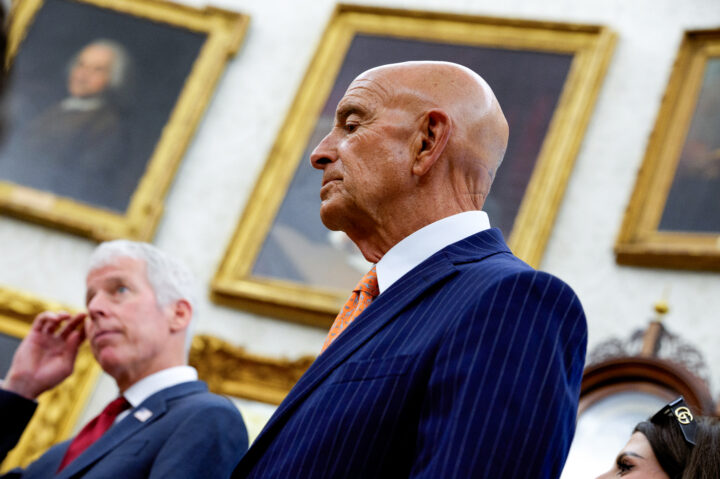
Photo by Andrew Harnik/Getty Images
U.S. Ambassador to Turkey Thomas Barrack attend a meeting with U.S. President Donald Trump and Prime Minister of Iraq Ali al-Zaidi in the Oval Office of the White House on July 14, 2026 in Washington, D.C.
U.S. Ambassador to Turkey Tom Barrack on Friday promoted a new regional trade and security alignment in the Middle East centered around Iraq, Turkey and neighboring Arab states, appearing to sideline a similar regional project including Israel.
Speaking at the U.S.-Iraq Business Summit, Barrack told attendees that Iraqi Prime Minister Ali al-Zaidi, who visited with President Donald Trump at the White House this week, is considering a transformative agreement “that will make the Strait of Hormuz” — which has been effectively shut down due to the Iran war and continued hostilities — an “afterthought in two years” by shifting trade that usually passes through the waterway to overland routes.
“What this young leader [al-Zaidi] has in mind — aligned with Syria, Jordan, Turkey, Lebanon, Egypt — is a program that will make the Strait of Hormuz an afterthought in two years,” Barrack said. “We’re going from just-in-time delivery on boats through these minor straits to just-in-case delivery going the other way.”
The proposal appears to serve as an alternative framework to the stalled India-Middle East-Europe Economic Corridor (IMEC), which has faced roadblocks following regional turmoil and the Oct. 7, 2023, Hamas terror attacks. While the original IMEC agreement included Israel as a vital transit point connecting India to Europe via the UAE and Saudi Arabia, the newly envisioned corridor relies instead on a coalition featuring Syria, Lebanon and Jordan.
The State Department also released a statement on Friday welcoming the announcement of cooperation between Iraq and Syria on the “rehabilitation and reconstruction of the Iraq-Syria crude oil pipeline as a priority infrastructure project of bilateral and regional strategic significance.”
“We feel the chaos on one side, but actually, what’s happened is a brilliant realignment of security and strategic alliances in the region,” Barrack said in his remarks, with “Iraq being at the forefront of a new strategic security alliance.”
Barrack praised Trump for recognizing the necessity of working with localized “strong leaders” rather than enforcing Western-style regime change, which he admitted has historically failed.
“The connectivity of what can happen is mind-boggling,” he continued. “So, if we now take from Turkey, Azerbaijan, to Turkmenistan through Central Asia, the amount of gas that can be sent the other way towards Europe through commerce, we’re starting to find a way to create a different fabric.”
Speaking at the Aspen Security Forum, an advisor to the Turkish president called Iran's nuclear program a 'civil' project and said Ankara is in talks with Washington to resolve a standoff over Russian-made missile defense systems
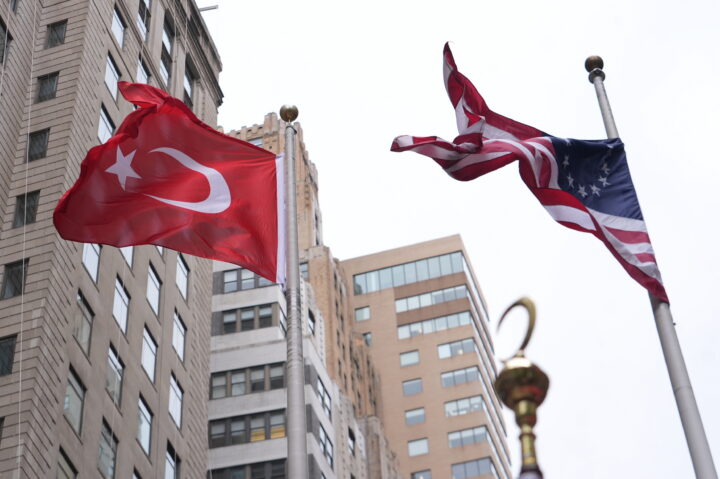
Photo by Selcuk Acar/Anadolu via Getty Images
A flag-raising ceremony is held at Bowling Green Park in New York, U.S. on May 15, 2026.
ASPEN, Colo. — Akif Çağatay Kılıç, a top foreign policy and security advisor to Turkish President Recep Tayyip Erdoğan, downplayed the threat posed to the region by Iran’s nuclear program at the Aspen Security Forum, while also repeatedly sidestepping questions about the status of Turkey’s Russian S-400 missile defense system and efforts to acquire F-35 fighter jets.
“I don’t perceive that we have a nuclear threat to the level that is being talked about, but we are closely monitoring it, and we’re talking to our Iranian colleagues and friends on how they perceive to be working on their nuclear program — civil nuclear program,” Kılıç said.
He continued to defend his country’s decision to acquire the S-400 system.
Kılıç also argued that the alternative energy corridors through the region that have been proposed to avoid the Strait of Hormuz are not a viable option so long as the war continues.
Kılıç said that Turkey is working with the U.S. to resolve the “legal issue” around the F-35s and S-400s, emphasizing that the leaders of both countries have expressed a desire to move the F-35 sale forward.
Asked directly about whether Turkey will offload its S-400s, Kılıç prevaricated and did not offer clear answers.
“It’s not easy always to navigate these things. But we’re trying to work with our American partners and allies to find a way that both countries can live with and go towards the future,” Kılıç said.
Plus, Khanna's quiet Israel trip
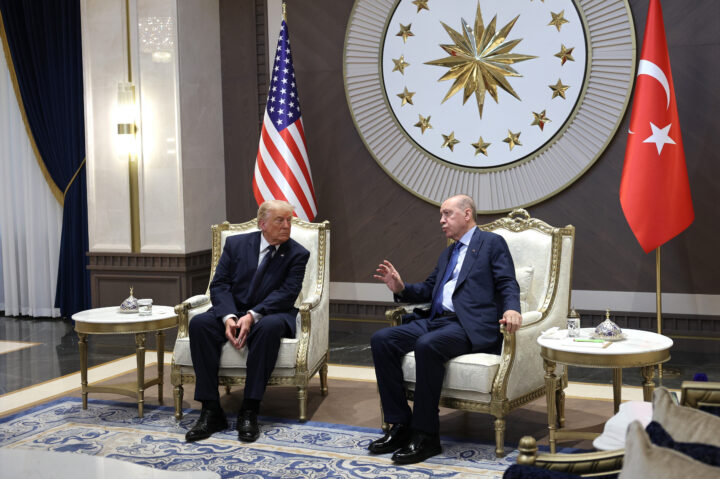
Win McNamee/Getty Images
President Donald Trump speaks to Turkish President, Recep Tayyip Erdogan, after arriving at Etimesgut Air Base for the annual NATO Summit on July 7, 2026 in Ankara, Turkey.
Good Friday morning.
In today’s Daily Kickoff, we have the scoop on a letter from House Democrats concerned that the U.S.’ warming relationship with Turkey is being driven by the personal interests of President Donald Trump and his family and associates, and report on a call from a bipartisan group of lawmakers urging FEMA to extend the nonprofit security grant application deadline. We look at the candidates who have thrown their hats in the ring to be Maine Democrats’ Senate nominee following Graham Platner’s withdrawal from the race, and report on Rep. Ro Khanna’s trip to Israel and the West Bank this week. Also in today’s Daily Kickoff: David Lubin, Ambassador Mike Huckabee and Evan Bernstein.
We have also launched a new on-demand Live Briefing that you can access throughout the day via our new app (on Apple and Android) and on our website.
Today’s Daily Kickoff was curated by JI Executive Editor Melissa Weiss and Israel Editor Tamara Zieve, with an assist from Danielle Cohen-Kanik. Have a tip? Email us here.
For less-distracted reading over the weekend, browse this week’s edition of The Weekly Print, a curated print-friendly PDF featuring a selection of recent Jewish Insider and eJewishPhilanthropy stories, including: Rahm Emanuel, in Tel Aviv, says he is ‘not impressed’ by far-left wing of the Democratic Party; New psychology training program aims to combat antisemitism in mental health care; and AI models more lax with antisemitism when engaging in Persian, new ADL study finds. Print the latest edition here.
What We’re Watching
- We’re keeping an eye on the tense situation in the Middle East, amid hints from senior Israeli officials, including Prime Minister Benjamin Netanyahu, Defense Minister Israel Katz and Israeli Ambassador to the U.S. Yechiel Leiter, that it is willing to reenter the fight against Iran and assist the U.S. More below.
- The Wall Street Journal reported last night that Israel had notified the U.S. of intelligence indicating that Iran was plotting a new assassination attempt against President Donald Trump, who, while in Turkey earlier this week for the NATO summit, repeatedly suggested that Iran considered him its “No. 1” target. “I saw this morning, I’m on every single one of their lists,” Trump told reporters in Ankara. When the president returned from Turkey mid-week, he took one of the older planes home, rather than the refurbished Qatari luxury jet, which lacks some of the same security features as the older Air Force Ones.
- Turkey is expected to announce today that it will sell its Russian-made S-400 batteries to the United Arab Emirates, a move that would allow the U.S. to move forward on its sale of F-35s to Ankara.
What You Should Know
A QUICK WORD WITH JI’S TAMARA ZIEVE AND MATTHEW SHEA
After several days of watching from the wings as the United States has conducted strikes against Iran, Israeli officials have increasingly indicated that Jerusalem is ready to return to military action if it determines that circumstances demand it.
Israeli Ambassador to the U.S. Yechiel Leiter told CNN on Thursday that Jerusalem is “supportive of the position of the United States” and would “fly alongside U.S. aircraft” if called on to do so.
At an Israeli Air Force graduation ceremony the same day, Defense Minister Israel Katz said the IDF is prepared to “regain air superiority and carry out ‘blue-and-white’ [Israeli] strikes in Iran to remove threats — even for a third time,” warning that it would be with “even greater force” than before. Meanwhile, IDF Chief of Staff Lt. Gen. Eyal Zamir told graduates that “on the drawing board are new plans. Major operations are still expected to lie ahead of us. Be prepared.”
Prime Minister Benjamin Netanyahu reinforced that message in his remarks at the ceremony. While celebrating the outcome of Operations Rising Lion and Roaring Lion, he made clear that Israel does not view the conflict with Iran as settled. “Our policy is clear: With an agreement or without an agreement, Iran will not have nuclear weapons,” Netanyahu said. He added: “The war is not yet over. Alongside old challenges, new ones are emerging. Axes fall, and axes rise. We are turning our attention to this. We are prepared for any scenario.”
Security analysts say the messaging reflects a desire to preserve military pressure without committing to another immediate campaign. Yoni Tobin, a senior political analyst at the Jewish Institute for National Security of America, told Jewish Insider, “While Israel isn’t exactly clamoring for more combat with Iran, particularly after nearly three years of multifront war, it is certainly ready for it.” Tobin noted that “Israel will likely feel comfortable acting against Iran if the United States does so as well, and if the two countries are aligned on objectives and strategy.”
David May, a senior research analyst at the Foundation for Defense of Democracies, said the memorandum of understanding “should be seen as part of the process of ending the fighting between the United States and Iran, not the final agreement.”
SCOOP
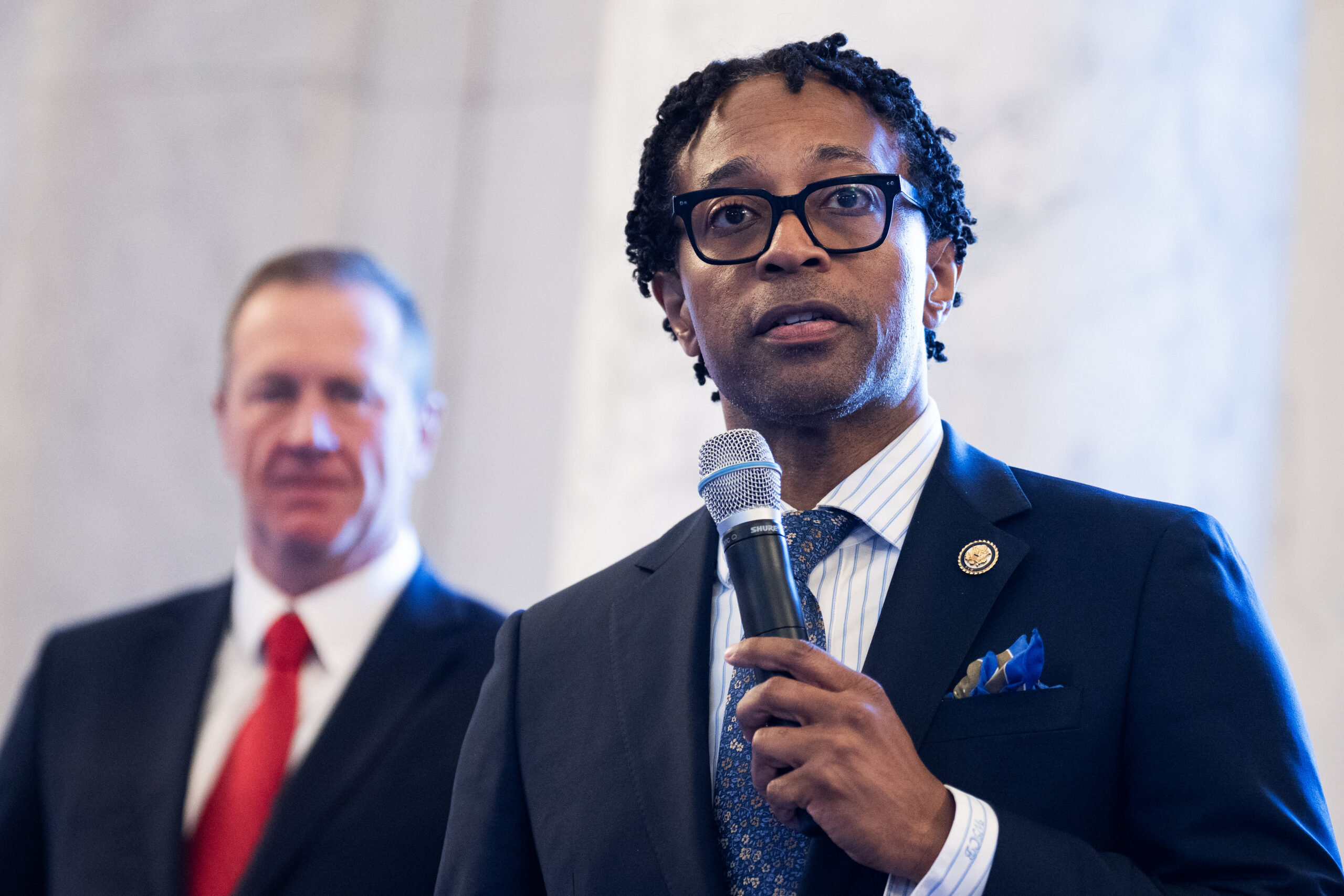
A group of House Democrats wrote to President Donald Trump on Friday to express “strong opposition” to the administration’s plans to lift sanctions on Turkey and sell the country’s F-35 fighter jets, and suggested that the decisions may be driven by Trump’s or his family members’ financial interests, Jewish Insider’s Marc Rod reports.
What they’re saying: The letter requests that Trump, U.S. Ambassador to Turkey Tom Barrack and Trump’s son Donald Trump Jr. preserve records relating to their relationships with Turkish President Recep Tayyip Erdoğan and the Turkish government, stating that, “In the coming months and years, Congress will continue to exercise our constitutional oversight authorities and thoroughly scrutinize this matter to ensure the interests of the American people and their security is protected” — suggesting a potential House investigation if Democrats retake the chamber in November.
Signed on: The letter was led by Reps. Wesley Bell (D-MO), Dan Goldman (D-NY) and Dina Titus (D-NV), joined by Reps. Debbie Wasserman Schultz (D-FL), Brad Schneider (D-IL), Gabe Amo (D-RI), Jim Costa (D-CA), Jared Moskowitz (D-FL), Brad Sherman (D-CA) and Rob Menendez (D-NJ).
SHORT NOTICE
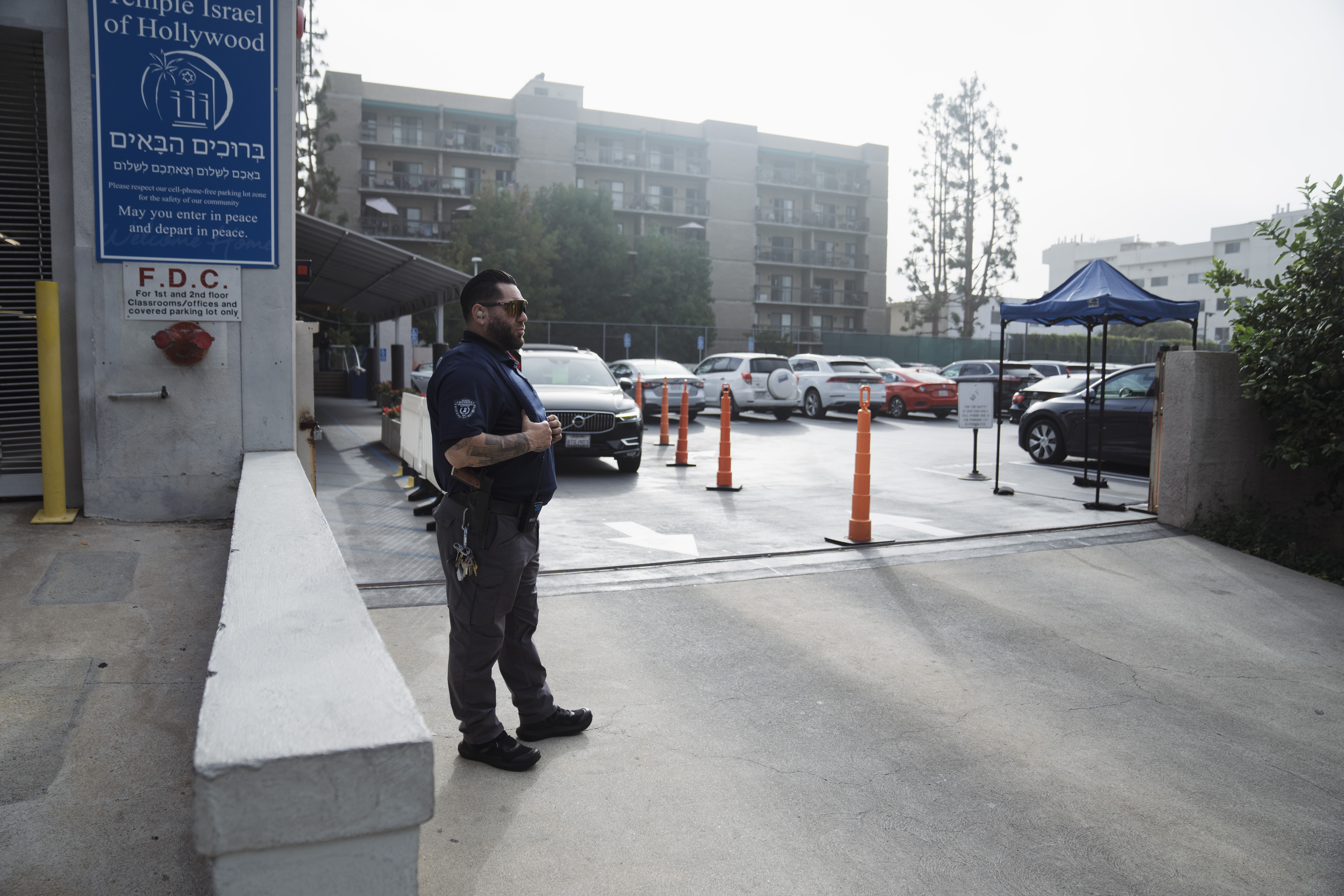
Fifty-eight House members from both sides of the aisle urged the Federal Emergency Management Agency on Thursday to extend the deadline for 2026 Nonprofit Security Grant Program applications, arguing that the current timeline gives states and institutions “insufficient time to complete the application process” and fulfill the program’s goals, Jewish Insider’s Marc Rod reports.
Deadline dealings: Applications for the program were announced on June 24 and are due to the federal government from state emergency management agencies by July 24. Those state agencies must set their own earlier deadlines for individual institutions to submit applications. “It is essential that eligible applicants have a fair shot to apply for these funds and fully realize the program’s intended purpose,” the lawmakers, led by Reps. Grace Meng (D-NY) and David Joyce (R-OH), wrote in a letter to acting FEMA Administrator Robert Fenton.
IN QUEUE

The mad dash to replace Graham Platner as the Democratic Senate nominee in Maine is coming together so quickly and haphazardly that one potential replacement, Nirav Shah, is taking stickers from his failed gubernatorial campaign and cutting off the “for governor” line below his name before handing them to supporters, Jewish Insider’s Gabby Deutch reports.
Following in his footsteps: Many of the candidates now seeking to succeed Platner on the general election ballot — which also include Troy Jackson, Paige Loud, Shenna Bellows, Dan Kleban and Jordan Wood — are commending the populist movement he built and looking to capitalize on it. Less than 24 hours into the contest, some had already made clear they will adopt a platform much like Platner’s when it comes to Israel — seeking to end U.S. weapons sales to the country and shunning donations from AIPAC — while others are remaining mum on that topic.
Into the woods: Wood, a former chief of staff to Rep. Katie Porter (D-CA), shared his views with JI on Thursday about the U.S.-Israel relationship, saying that he considers Israel “our strongest ally in the Middle East” but that its government must be reined in. He entered the race after placing third in last month’s congressional primary to replace retiring Rep. Jared Golden (D-ME).
SCOOP

Rep. Ro Khanna (D-CA) traveled to Israel and the West Bank this week while Congress is in recess, according to two individuals with knowledge of the trip, Jewish Insider’s Melissa Weiss reports. Khanna has not posted publicly about his trip, which is scheduled to conclude Thursday night. His office did not respond to requests for comment from JI.
Israel approach: The California Democrat has become increasingly critical of Israel since the onset of the Israel-Hamas war following Hamas’ Oct. 7, 2023, terror attacks. In September 2025, he accused Israel of having committed genocide in Gaza. A spokesperson for the Prime Minister’s Office said that Netanyahu did not meet with Khanna during this trip.
SCENE IN SUN VALLEY
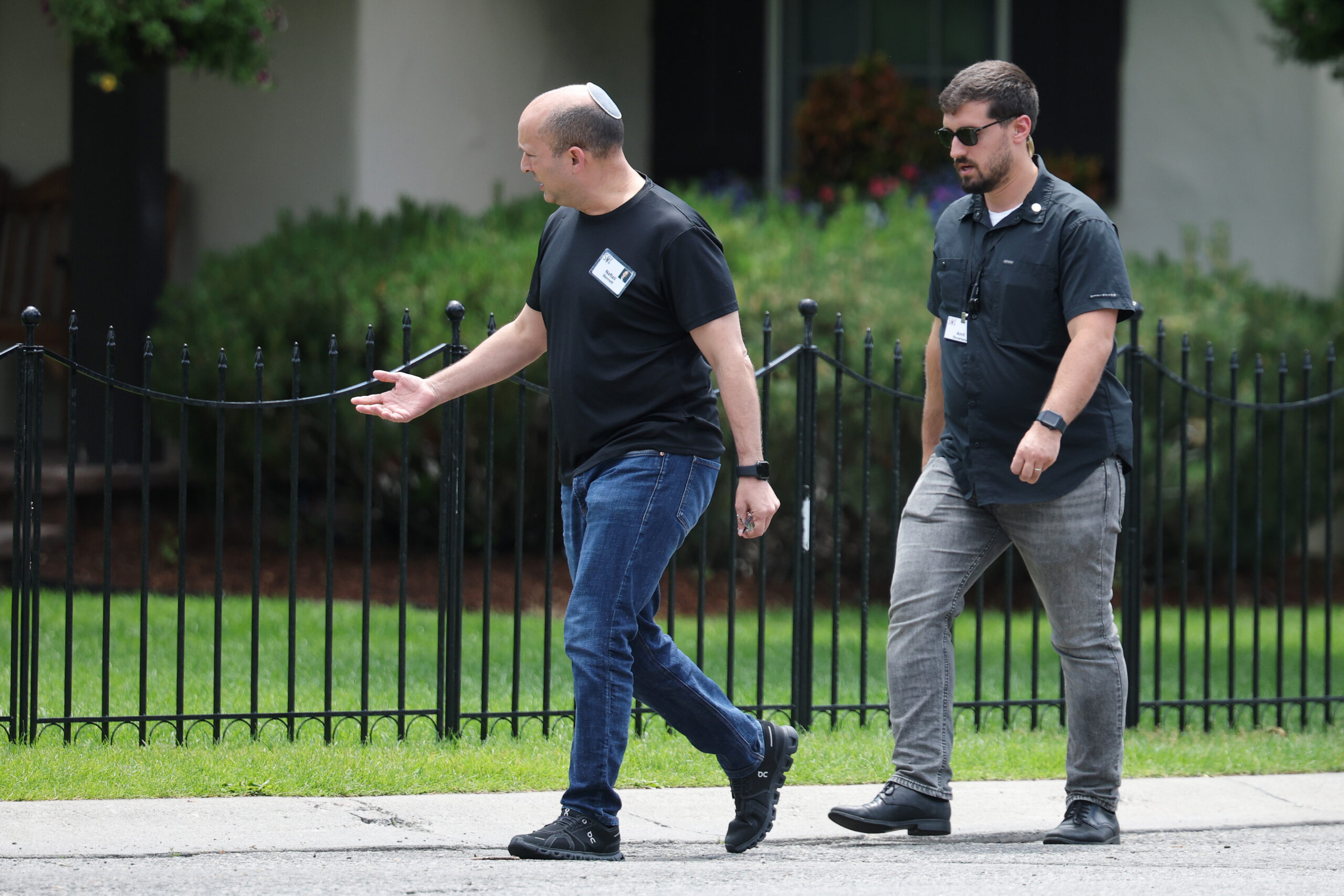
Jared Kushner, United Arab Emirates Ambassador to the U.S. Yousef Al Otaiba and former Israeli Prime Minister Naftali Bennett participated in an off-the-record discussion on Thursday morning at Allen & Company’s annual Sun Valley conference, Puck News reported. The closed-door conversation was held before the conference’s invite-only audience of business, media and technology leaders, Jewish Insider’s Emily Jacobs reports.
Also in attendance: Later in the morning, Sens. Dave McCormick (R-PA) and John Fetterman (D-PA) appeared together for a wide-ranging discussion. Meta COO Dina Powell McCormick, who is married to the Pennsylvania senator, is also in attendance at Sun Valley this week alongside Meta CEO Mark Zuckerberg and other senior Meta executives.
Bonus: In an op-ed in Time, Bennett posits that Israel is one of the “greatest assets” to U.S. foreign policy, describing the relationship between Jerusalem and Washington as “a partnership of equals — not in the size of our populations, but in the depth of our commitments.”
TRANSITIONS
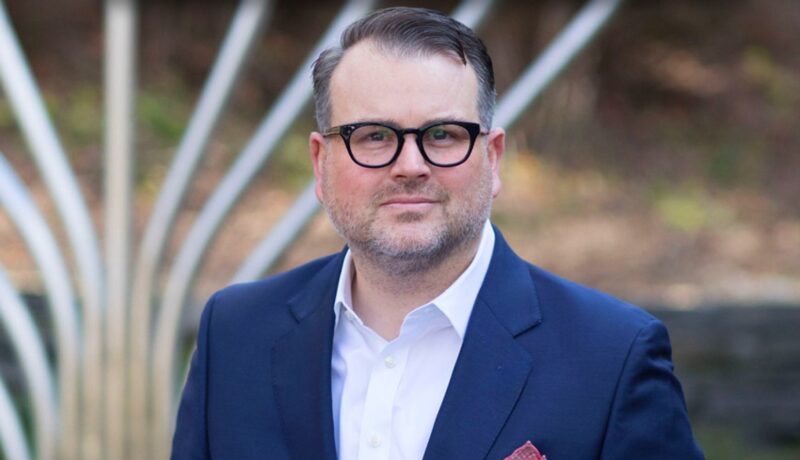
In a generational change at the top of B’nai B’rith International, the organization has tapped Evan Bernstein as its next CEO, the group exclusively told eJewishPhilanthropy’s Jay Deitcher on Thursday, as the longtime communal professional looks to breathe new life — and a spirit of innovation — into a 182-year-old legacy organization.
Drawing on experience: Bernstein, 51, will take the reins of B’nai B’rith on Aug. 24, succeeding longtime CEO Dan Mariaschin, 77. Bernstein brings with him 25 years of Jewish nonprofit experience at a host of communal organizations, including serving as the inaugural CEO of Community Security Service and in leadership roles at the Jewish Federations of North America, the Anti-Defamation League and AIPAC. In his first interview since accepting the position, Bernstein discussed how he will use his connections at past agencies to cultivate new partnerships for B’nai B’rith and how he will bring a startup mentality to the world’s oldest Jewish service organization.
Read the full interview here and sign up for eJewishPhilanthropy’s Your Daily Phil newsletter here.
Worthy Reads
From Friends to Foes: Bloomberg‘s Ethan Bronner spotlights the dissolution of the “cross-cultural bromance” between Israeli entrepreneuer Eyal Waldman and Palestinian American tycoon Bashar Masri following Hamas’ Oct. 7, 2023, attacks on Israel in which Waldman’s daughter Danielle, who was attending the Nova music festival, was killed. “The Hamas attack effectively reset the historical clock so that in Israel today, all political and security discussions start on Oct. 7. … Waldman today says his views on coexistence haven’t changed. He continues to meet with the Palestinian leadership and advocate for two states. But he dismisses the notion that Masri might ever again be a partner. Convinced that Masri helped Hamas build the infrastructure that was set loose to such devastating effect, Waldman is doing everything he can to bring down his old friend through the U.S. lawsuit.” [Bloomberg]
Mojtaba’s MIA: The New York Times’ Yeganeh Torbati reports on Ayatollah Mojtaba Khamenei’s “looming absence at the top of the government” and failure to appear in public since he succeeded his father in March. “Without a strong central authority like the elder Ayatollah Khamenei, it has become even more unpredictable which faction will eventually gain the upper hand — and how the country will navigate its many crises. … ‘There’s no central authority in effect to reconcile the various factions that are fighting for control,’ said Ali Ansari, a historian of Iran at the University of St. Andrews in Scotland.” [NYTimes]
Crowd Control: In The Free Press, Masih Alinejad posits that the coverage from within Iran of the funeral ceremonies for late Supreme Leader Ayatollah Ali Khamenei did not depict the reality on the ground. “The Islamic Republic has always treated mass mobilization as a proof of legitimacy: The bigger the crowd, the stronger the claim to power. But the crowds are an illusion. I know from experience how they are assembled: through force. This time is no different. … The Islamic Republic spent this week performing strength. But the regime has a problem: Almost everything about it — the chants, the flags, the scripted weeping at the coffin — is a performance. The people inside Iran, dancing in secret or driving north with 20 kilograms of rice they did not want, know this to be true.” [FreePress]
Word on the Street
Rep. Carlos Gimenez (R-FL) withdrew as co-chair of the Congressional Friends of Spain Caucus, citing in part Madrid’s “hostile actions against Israel and the Jewish people”…
A new survey from the Pew Research Center found that fewer than half of Americans ages 18-29 — both Democrats and Republicans — view either Israelis or the Israeli government favorably…
A Pennsylvania man was arrested and charged with making antisemitic threats targeting Gov. Josh Shapiro; the Delco, Pa., resident, after entering the office of a state legislator to complain about taxes, threatened an arson attack at the governor’s mansion, 15 months after Shapiro’s residence was firebombed during Passover…
The New York Times spotlights Notarikon Review Publisher Mendel Uminer, whose collection of some 10,000 books prompted his landlord to force him from his apartment…
David Lubin, the father of slain lone soldier Rose Lubin, an Atlanta native who was killed in a terror attack in Jerusalem in November 2023, opened the first U.S. chapter of Yad LaBanim, an Israeli group that supports bereaved military families, eJewishPhilanthropy’s Nira Dayanim reports…
U.K. Labour MP Andy Burnham, who is poised to become the U.K.’s next prime minister, apologized for the party’s stance on Gaza, saying that London was “too slow to call for a ceasefire. And we must now do more to strengthen our approach”…
London Mayor Sadiq Khan visited the Nova music festival exhibition in the city, a week after the exhibition’s organizers told the Jewish News they were disappointed that the mayor had yet to attend; Khan was at the exhibition on the birthday of British-Israeli musician Jack Marlowe, who was killed at the music festival…
Jewish Community Iceland—Beit Tovah Chabad opened the country’s first Jewish center, in the capital of Reykjavik, after years of operating out of the home of the local emissary…
The Wall Street Journal looks at the challenges and delays the International Stabilization Force in Gaza is facing in deploying troops to the enclave…
The IDF said it is investigating an incident in which a Palestinian detainee was stripped and bound, after an image of the man posted online last month by a Palestinian activist went viral; the IDF confirmed the photograph’s authenticity while not releasing any details about the circumstances surrounding it…
The Associated Press spotlights an Israeli effort to clear unexploded ordnance and other munitions off the coast of the city of Rishon LeZion, which has been used for decades as a military firing range…
Pic of the Day
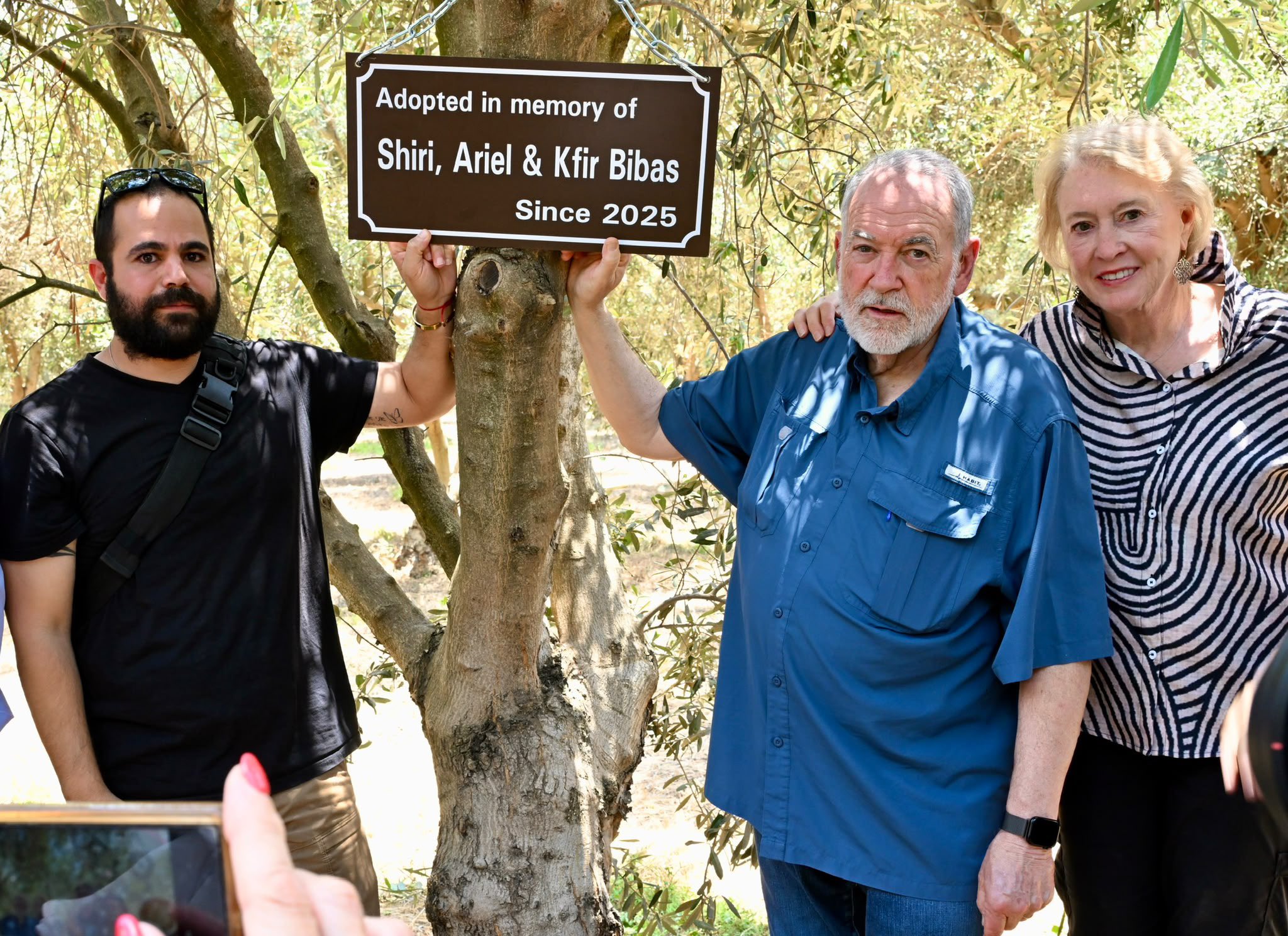
Alongside former Israeli hostage Yarden Bibas (left), whose wife and sons were killed in captivity in Gaza after being taken during the Oct. 7, 2023, Hamas terror attacks, U.S. Ambassador to Israel Mike Huckabee and his wife, Janet, installed a plaque through the My Tree in Israel program honoring Shiri, Ariel and Kfir Bibas.
Birthdays

Co-founder of Imagine Entertainment, his films and TV series have been nominated for 47 Academy Awards and 217 Emmys, Brian Grazer turns 75 on Sunday…
FRIDAY: Senior U.S. district court judge in the Southern District of Texas, Judge David Hittner turns 87… Retired attorney at the California Office of Legislative Counsel, Robert D. Gronke… Stan Udaskin… Folk singer-songwriter, Arlo Guthrie turns 79… NYC-born author of 13 novels, she has been living in Israel since 1971, Naomi Ragen turns 77… Partner in consulting firm Quorum, LLC and president at Regal Domestics, Barbara Goldberg Goldman… Author of 13 books, journalist, she is the daughter of two Holocaust survivors, Julie Salamon turns 73… Editor of the Cleveland Jewish News, Columbus Jewish News and Akron Jewish News, Bob Jacob… Israel’s ambassador to Spain until 2024, Rodica Radian-Gordon turns 69… Past president of the Jewish Federation of Greater MetroWest New Jersey, Leslie Dannin Rosenthal… Partner in Holland & Knight’s public policy group, he was previously a member of Congress (D-FL-22), Ronald J. “Ron” Klein turns 69… Lobbyist, he was a member of the New York state Legislature: Assembly for 10 years and Senate for 14 years, Jeffrey D. Klein turns 66… National president of the American Jewish Committee, he is a founder of Lapin & Landa, a Houston-based civil litigation firm, Robert E. Lapin turns 66… Voice actor and impressionist who has voiced Bugs Bunny, Daffy Duck, Sylvester the Cat and dozens of others, Jeffrey Bergman turns 66… U.S. ambassador to his native Estonia, he is the former president of NYC’s Park East Day School, Roman Pipko turns 66… Critic at large for The New York Times Book Review, Anthony Oliver “A.O.” Scott turns 60… U.S. senator (D-MI), Elissa Blair Slotkin turns 50… NYC-based founding partner at Purposeful Advisors, Elie Jacobs… Member of the Knesset for the Shas party, Yinon Azulai turns 47… VP of politics and public affairs at Altice and Optimum Media, Rena Shapiro… Writer and comedian, his conversion from Mormon to Jew is the subject of a documentary, “Latter Day Jew,” H. Alan Scott turns 44… Senior policy adviser at the U.S. Mission to the United Nations, Morgan Deann Ortagus turns 44… Managing editor of The Bulwark, a center-right news outlet, Sam Stein… Multidisciplinary artist, filmmaker,and fine art photographer, she is the daughter of CAA co-founder Michael Ovitz, Kimberly Ovitz turns 43… Television and film actor, Aviva Farber Baumann turns 42… Dance teacher at John Foster Dulles High School in Sugar Land, Texas, Kayla Sokoloff…
SATURDAY: Entrepreneur, investment banker, civil servant and political advisor, Stephen Berger turns 87… Developmental psychologist at Harvard, he was selected in the 1981 inaugural class of MacArthur genius fellows, Howard Gardner turns 83… Member of the U.K.’s House of Lords, he was PM Tony Blair’s special envoy to the Middle East for nine years, Baron Michael Abraham Levy turns 82… U.S. senator (D-MA), Ed Markey turns 80… EVP of the Milken Family Foundation and past chair of the board of trustees of the Jewish Federations of North America, Richard V. Sandler turns 78… Journalist covering classical music, he is the author of Genius & Anxiety: How Jews Changed the World, 1847-1947, Norman Lebrecht turns 78… Founder in 1992 of Schnur Associates, a marketing, PR and lobbying firm, she spent 12 years as executive director of the Greater New York Coalition for Soviet Jewry, Zeesy Schnur… West Orange, N.J., resident, Jeffrey Maas… Actor, she portrayed Frau Farbissina in the “Austin Powers” film series, Mindy Lee Sterling turns 73… Singer-songwriter, known by his stage name “RebbeSoul,” Bruce Burger turns 69… Founder and retired CEO of Sidewalk Labs (an Alphabet company), he was previously CEO of Bloomberg L.P., Daniel L. Doctoroff turns 68… Group EVP of public relations for Discovery Channel and Science Channel from 2007 to 2023, Laurie Goldberg… Executive chairman of Aston Martin and the owner of the Aston Martin Formula 1 Team, Lawrence Stroll turns 67… Radiation oncologist at the Dana-Farber Cancer Institute and Brigham and Women’s Hospital, Harvey Jay Mamon, MD, Ph.D…. General partner and head of research at CET Ventures, Barry Mannis… Former member of the Knesset for the Likud party, Yaron Mazuz turns 64… Former commander of the IDF’s Southern Command, now in the IDF Reserves, Maj. Gen. Shlomo “Sami” Turgeman turns 62… Judge of the U.S. Court of Appeals for the 11th Circuit since 2014, Judge Robin Stacie Rosenbaum turns 60… Retired tax attorney, she now bakes challahs on Manhattan’s UWS to benefit UJA-Federation of New York, Adina Tamar Spiro Wagman… Editor-in chief of the Forward, Alyssa A. Katz… Founder of Koz and Effect LLC, Lindsey Caren Kozberg… Consultant focused on social impact strategies, Joshua D. Wachs… Actor, podcaster and lead singer of the band Sun Spin, Michael Owen Rosenbaum turns 54… Ukrainian-born computer scientist and internet entrepreneur, Max Levchin turns 51… Founder and CEO of Wisconsin-based Good Karma Brands, Craig Karmazin turns 51… Principal at Civitas Public Affairs Group, Celine Mizrahi… Chabad rabbi at Washington University in St. Louis, Rabbi Hershey Novack… Comedian, podcaster and political commentator, Katherine Rose “Katie” Halper turns 45… Screenwriter and executive producer, Theodore Beren Bressman… Retired ice hockey forward, he played for 19 seasons in the U.S., Canada and Europe, now a businessman in Destin, Fla., Jacob Micflikier turns 42… Executive director of the New Democrat Coalition, Anne Sokolov… and her twin sister, a co-founder at Social Goods, Kate Sokolov (daughters of shopping mall executive Rick Sokolov)… Offensive guard in the NFL for eight seasons, his Hebrew name is Gedalia Yitzhak, Geoff Schwartz turns 40… Senior deputy associate counsel in the White House Counsel’s office during the Biden administration, Matthew J. Rosenbaum… Bryan Stone…
SUNDAY: Former U.S. Ambassador to the U.N. Commission on Human Rights, Rita E. Hauser turns 92… Former congressman (R-OK-5) for 16 years, Marvin Henry “Mickey” Edwards turns 89… Former executive director of the Crown Heights Jewish Community Council, Dan Botnick… Canadian journalist, social activist and author of three bestselling books, Michele Landsberg turns 87… Former member of the Florida House of Representatives for eight years, Franklin Sands turns 86… Best-selling author, screenwriter, and playwright, sister of the late Nora Ephron, Delia Ephron turns 82… Professor of religion at the University of Vermont, he was an advisor to Sen. Bernie Sanders (I-VT) on his 2016 presidential campaign, as an undergraduate at Yale his roommate was Joe Lieberman, Richard Sugarman turns 82… Obstetrical nurse and board certified lactation consultant in NYC, Rhona Yolkut… Founding executive director (now retired) of Newton, Mass.-based Gateways: Access to Jewish Education, focused on children with special educational needs, Arlene Remz… Co-owner of the Midland Group with holdings in steel, shipping, real estate, agriculture and sports, Eduard Shifrin turns 66… Former member of the Knesset for the Blue and White party, he grew up in Raleigh, N.C., as Albert Rosenthal, Alon Tal turns 66… Chief television critic for The New York Times, James “Jim” Poniewozik turns 58… Former chairwoman of the Federal Communications Commission, now executive director of the MIT Media Lab, Jessica Rosenworcel turns 55… Israeli journalist and former member of Knesset for the Yisrael Beiteinu party, Anastassia Michaeli turns 51… Founder of Innovation Policy Solutions, a D.C.-based health care consulting and advocacy firm, Jennifer Leib… U.S. senator (I-AZ) until January 2025, Kyrsten Sinema turns 50… Israeli news anchor, television presenter and journalist, Yonit Levi turns 49… Winner of an Olympic gold medal (Athens, 2004) and a silver medal (Sydney, 2000) as a freestyle swimmer, now in the product development software business, Scott Daniel Goldblatt turns 47… Senior reporter at CNN, Edward-Isaac Dovere… Partner in the Des Moines, Iowa-based public relations firm AdelmanDean Group, Liz Rodgers Adelman… Israeli media personality, sociologist and fashion and jewelry designer, Ortal Ben Dayan turns 45… U.S. senator (D-NJ), Andrew Kim turns 44… Founder and CEO of executive communications firm A.H. Levy & Co based in NYC, Alex Halpern Levy… Intensive care nurse now living in Jerusalem, Rena Meira Rotter… Benjamin Birnbaum… Actor, she is well known for playing a Jewish character on television (the title character in “The Marvelous Mrs. Maisel”), though she herself is not of Jewish descent, Rachel Brosnahan turns 36… CEO of Teach Coalition, an Orthodox Union affiliate, Sydney Altfield… Board member at Israel Policy Forum and member of the board of governors of the Peres Center for Peace and Innovation, Steven Koppel…
A letter sent by House Democrats requested that Trump, Donald Trump Jr. and Ambassador Tom Barrack preserve records relating to their relationship with the Turkish president, previewing a potential investigation
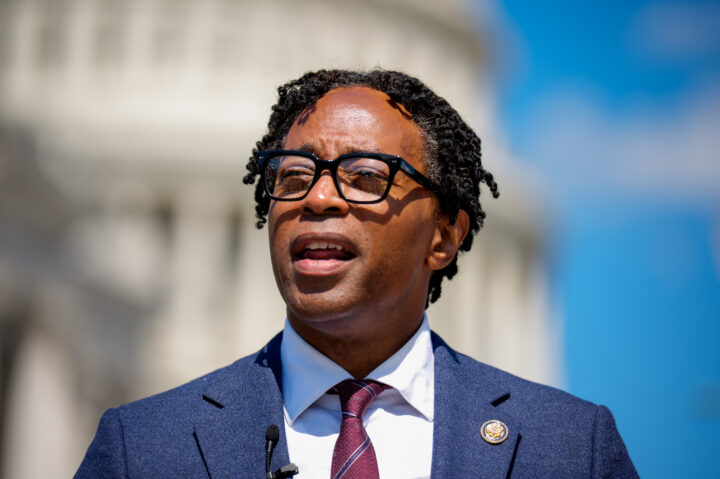
Andrew Harnik/Getty Images
Rep. Wesley Bell (D-MO) speaks during a news conference outside the U.S. Capitol on September 9, 2025 in Washington.
A group of House Democrats wrote to President Donald Trump on Friday to express “strong opposition” to the administration’s plans to lift sanctions on Turkey and sell the country F-35 fighter jets, and suggested that the decisions may be driven by Trump’s or his family members’ financial interests.
The letter requests that Trump, U.S. Ambassador to Turkey Tom Barrack and Trump’s son Donald Trump Jr. preserve records relating to their relationships with Turkish President Recep Tayyip Erdoğan and the Turkish government, stating that, “In the coming months and years, Congress will continue to exercise our constitutional oversight authorities and thoroughly scrutinize this matter to ensure the interests of the American people and their security is protected” — suggesting a potential House investigation if Democrats retake the chamber in November.
The letter was led by Reps. Wesley Bell (D-MO), Dan Goldman (D-NY) and Dina Titus (D-NV), joined by Reps. Debbie Wasserman Schultz (D-FL), Brad Schneider (D-IL), Gabe Amo (D-RI), Jim Costa (D-CA), Jared Moskowitz (D-FL), Brad Sherman (D-CA) and Rob Menendez (D-NJ).
“Besides the legal limitations on your authority on this issue, we are perplexed by what you believe justifies this potential action,” the lawmakers said of the sanctions relief.
They emphasized that Turkey has only continued to “provoke our democratic allies, undermine regional stability, and support U.S. adversaries and their proxies — including Foreign Terrorist Organizations” since the sanctions were first imposed by Congress during Trump’s first term, and has still not resolved the issue that prompted the sanctions initially — namely, purchasing a Russian S-400 missile-defense system. This issue may be resolved on Friday, as Turkey is expected to announce that it will sell its S-400 batteries to the United Arab Emirates.
The lawmakers said that given the lack of “any reasonable explanation” for the change in policy, the decision “raises serious questions about your Administration’s personal dealings with the Turkish government.”
“There exists no indication of Erdogan’s willingness to reform his rogue, authoritarian behavior — in fact, quite the opposite,” the letter states. “This lack of clear benefit to American interests leads us to the inevitable conclusion that you and those around you may be personally benefiting from this absurd arrangement.”
They highlighted a reported private meeting between Trump Jr. and Erdoğan in 2025 as reason for further investigation and alleged that Barrack “has a history of acting in his own self interests,” pointing to his past indictment for acting as an unregistered foreign agent on behalf of the United Arab Emirates.
Other critics have also alleged that Barrack’s actions on policy and statements have suggested an excessive closeness with Erdoğan or even service to Turkey’s interests and priorities over those of the U.S.
The lawmakers demanded the administration answer questions about Trump Jr.’s visit to Turkey, the Trump and Barrack families’ business interests in Turkey, the administration’s plans regarding a potential F-35 sale, Turkey’s support for Hamas and the administration’s decision to drop an Iran sanctions evasion case against the Erdoğan-linked Halkbank.
The lawmakers argued that Turkey has not, as Trump has claimed, been a strong ally, but rather maintained ties with Russia and threatened and violated the territorial integrity of U.S. allies and risked U.S. security by maintaining the Russian missile-defense system.
“Erdoğan has made no attempt to hide his cozy relationship with our adversaries, including Iran and Russia. Despite sanctions on those countries, Turkey maintains significant economic and energy ties to both,” the lawmakers wrote.
The White House referred Jewish Insider to comments Trump had made during a press conference with Erdoğan this week and Trump Jr. did not respond to a request for comment.
Bell said in a statement to JI that Erdoğan has “made it perfectly clear that he advocates for our adversaries and their terrorist proxies in the Middle East,” but asserted that Trump’s actions are being driven by personal ties.
“Because of President Trump and his family’s ties to Erdogan’s regime, he is reopening a Pandora’s box that can only lead to more chaos in the region,” Bell continued. “President Trump ran on a platform of getting our nation out of continued conflicts in the Middle East. Instead, he has further destabilized the region — costing American service members their lives, wreaking havoc for our allies abroad, and eroding our global leadership. And this latest action only continues to advance his dangerous agenda.”
The potential for the sale — one that strikes at the heart of Israel's qualitative military edge in the region — is fueling anxiety in Israel
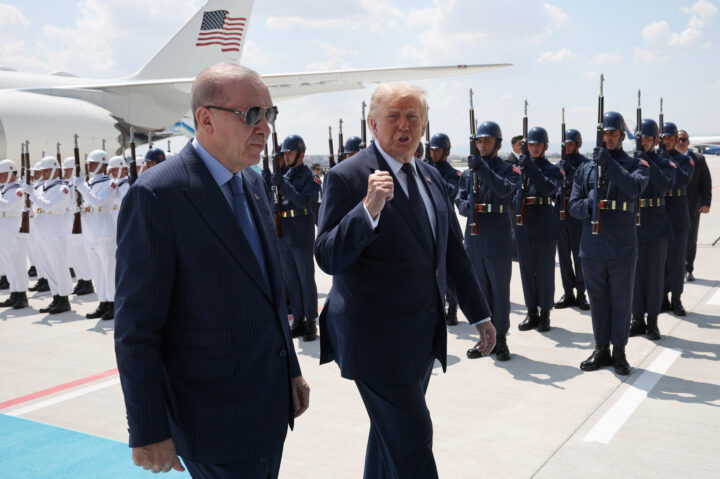
(Win McNamee/Getty Images)
U.S. President, Donald Trump (R), speaks to Turkish President, Recep Tayyip Erdogan, as he arrives at Etimesgut Air Base for the annual NATO Summit on July 7, 2026 in Ankara, Turkey.
Is President Donald Trump about to throw Israel under the … fighter jet?
The F-35 may be a stealth jet, but the Trump administration’s likely sale of the highly sophisticated planes to Turkey is creating a very out-in-the-open rift between Jerusalem and Ankara. It pits two strongmen of the type that Trump purports to admire — Israeli Prime Minister Benjamin Netanyahu and Turkish President Recep Tayyip Erdoğan, both of whom are vying to be a kind of Mideast “favorite son” to the mercurial American president — against each other.
The potential for the sale — one that strikes at the heart of Israel’s qualitative military edge and could tilt the balance of power in the region — is fueling anxiety in Israel. So much so that Netanyahu took to Fox News on both Sunday and Monday to detail Turkey’s long anti-Israel “rap sheet.” And this comes after harsh words by both Trump and Vice President JD Vance about Israel’s isolation on the world stage.
Israeli foreign policy analysts are also raising red flags. “Defining [Turkey] as an enemy would be a mistake, but it is clearly a rival that openly acts against the State of Israel and promotes a vision that includes Israel’s destruction,” Avner Golov, vice president of national security consulting firm MIND Israel and former senior director at the Israeli National Security Council, told JI.
The relationship between the two regional superpowers, however, hasn’t always been this strained. Just three years ago, Netanyahu met with Erdoğan on the sidelines of the U.N. General Assembly, and the two leaders were planning reciprocal visits. But about a month later, Hamas launched the Oct. 7 attacks against Israel and regional dynamics were rocked with the multifront war that followed.
Turkey has repeatedly claimed that Israel was committing genocide in Gaza, and the rhetoric only escalated, followed, eventually, by action. Last week, after years of deliberation, Israel officially recognized the Armenian genocide, a move that deeply displeased Ankara. Then came the Trump administration’s moves to allow Turkey back into the F-35 program, which deeply troubled Israeli decision-makers.
In his comments to Fox, Netanyahu listed Jerusalem’s grievances against Turkey, including: supporting Hamas; failing to assist in the struggle against Iran (even though in 2022, the Mossad and the Turkish MIT, headed then by Hakan Fidan, now the foreign minister, thwarted an Iranian cell actively targeting Israeli citizens); occupying half of Cyprus and even threatening to conquer Jerusalem. Netanyahu then delivered his punch line: “They are not like us. We, Israel and the U.S., share the same values.”
But the potential F-35 fighter jet sale is a complex one for Israel. Turkey was actually part of the program once before, but was expelled from it during the previous Trump administration over its purchase of a Russian air-defense system.
“Turkey used to be our friend, we used to train together, so they were not part of our demand within the framework of the Qualitative Military Edge,” a former Israeli Air Force planner told Jewish Insider. “And here we find ourselves in a problem: Turkey was a member of the project, and we are not” — though Israel has received F-35s despite not being an official partner.
“The Turks were thrown out of the project,” the former planner said, “because of internal matters between them and the U.S. But Turkey is very hostile to us, and it is not good for it to receive such an advanced system whose greatest advantage is the richness of the image that the pilot himself has in the cockpit.”
According to Golov, “In practice, Turkey is leading a Muslim Brotherhood camp that combines military power, diplomatic influence alongside Qatar, nuclear capabilities through Pakistan and a drive to establish a presence on Israel’s borders in Egypt, Jordan and Syria. It is also leading the delegitimization campaign against Israel in the West. Preserving Israel’s military superiority vis-à-vis the Turkish threat is therefore a critical Israeli interest, both in order to restrain Erdogan and, in my view, to pursue diplomatic superiority.”
Israeli officials believe that the die has been cast, and the deal will move forward. Does this mean there will soon be a Turkish F-35? Not necessarily. There is still a long way to go, but Israel is banking on two things: first, that Congress will raise objections, as lawmakers have already begun to do, and second, that the highly complex bureaucracy inherent in the stealth fighter jet program will run its course and delay the matter further.
Dan Shapiro, former U.S. ambassador to Israel, thinks that even after Turkey acquires the F-35, Israel and its air force will be years ahead. “As the United States insists that NATO allies do more to provide for their own security, it will be more difficult to deny a key NATO partner top-line U.S. equipment. So an F-35 sale to Turkey is increasingly likely,” he told JI.
“Rather than try to block it,” Shapiro continued, “Israel should focus on the understandings the United States should seek to ensure Turkish capabilities do not pose a threat to Israel’s security. Israel will be more than a decade ahead of any Turkish F-35 capability. But to ensure Israel stays ahead and can maintain access to this capability, Israel needs to take into account the totality of its relationship with, and standing in, the United States.”
The harsh, even painful words from Vance regarding Israel’s current standing in the world, and his assertion that Trump remains the only one by Israel’s side, spark exactly that anxiety. If this is what Trump is doing now, by likely allowing the sale of the F-35, what will come next? Israel, for now, is left with the question of how it maintains the sense that, ultimately, the Jewish state is the “model ally” for the United States, regardless of the political climate in Washington.
The president said the U.S. would ‘de-nuke’ the Islamic Republic following Iranian strikes targeting U.S. military facilities in Bahrain and Kuwait
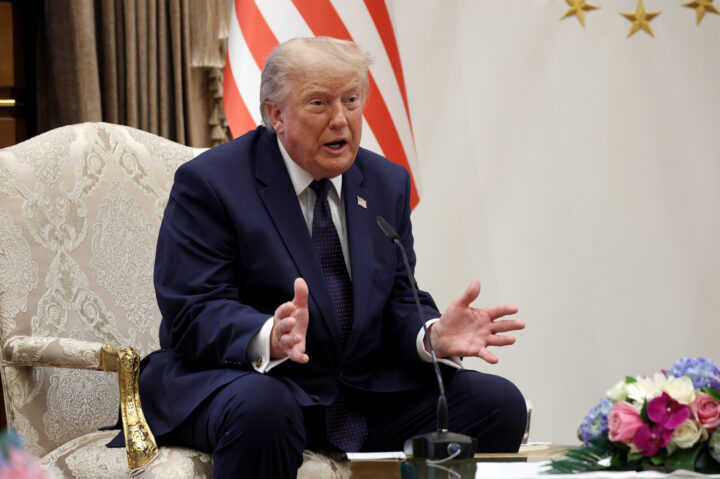
Win McNamee/Getty Images
President Donald Trump speaks during bilateral meeting at the Bestepe Presidential Compound, following his arrival to attend the annual NATO Summit on July 7, 2026 in Ankara, Turkey.
President Donald Trump, speaking at the NATO summit in Ankara, Turkey, on Wednesday, said that the memorandum of understanding with Iran that was inked last month was “over,” following overnight Iranian attacks targeting U.S. military installations in Bahrain and Kuwait.
“To me, I think it’s over,” Trump said. “I don’t want to deal with them anymore.”
The Iranian attacks came after CENTCOM hit over 80 targets in Iran on Tuesday in retaliation for Iranian strikes on three commercial vessels — including a Qatari ship and a Saudi oil tanker — in the Strait of Hormuz earlier this week.
“We attacked very powerfully last night the very dangerous people from Iran,” Trump said of the U.S. strikes, which targeted air-defense systems, command and control networks, coastal radar sites and more than 60 Islamic Revolutionary Guard Corps small boats. “They’re sick. There’s something wrong with them.”
“We said, ‘Go and do your funeral stuff,’” Trump added, noting the multiday funeral ceremonies for the late Iranian Supreme Leader Ayatollah Ali Khamenei, who was killed in joint U.S.-Israeli strikes on the first day of the war against the Islamic Republic in February. “Instead of that, they start shooting rockets at ships yesterday, and so we hit them very hard last night.”
The president, appearing alongside NATO Secretary General Mark Rutte in Ankara, said that the U.S. was “going to de-nuke Iran.”
“We’re not going to let them because they’re crazy,” Trump added.
The Iranians, the president said, are “bad people, very bad people. I think they’re incompetent, by the way, because if they were competent they would have made a deal a long time ago.”
“Of course they’re dirty players, so they go after everyone. Probably including me. I’ve been No. 1 on their list for years. And they’re a bunch of scum, if you want to know the truth. They’re scum. So we don’t like them, I don’t like them. And they’re evil people.”
Members from both parties warned lifting penalties would reward Erdoğan's destabilizing actions, while senators at NATO summit said Turkey could rejoin F-35 program if concerns over Russian S-400 system are resolved

Burak Kara/Getty Images
Turkey's President Recep Tayyip Erdogan speaks to supporters at his party’s Istanbul mayoral candidate Murat Kurum's campaign rally on March 29, 2024 in Istanbul, Turkey.
Lawmakers on both sides of the aisle remain deeply skeptical of President Donald Trump’s plans to lift sanctions on Turkey and revive its participation in the F-35 fighter jet program, but members of a bipartisan Senate delegation attending the NATO summit said Wednesday they could support the move if Ankara resolves longstanding security concerns over its Russian-made S-400 missile defense system.
Trump said at the NATO summit on Tuesday that he’s preparing to remove sanctions under the Countering America’s Adversaries Through Sanctions Act (CAATSA), explaining, “We don’t want to sanction friends.” The CAASTA sanctions block the administration from selling Turkey F-35s until it disposes of an S-400 missile defense system it purchased from Russia.
“Selling one of America’s most advanced fighter jets to Turkey is not in the best interest of the United States,” Rep. Mike Lawler (R-NY) told Jewish Insider. “It risks compromising critical technology and sends the wrong message to our allies in Europe and the Middle East. Restrictions on the sale of F-35s to Turkey should absolutely remain in place while Erdogan continues to operate Russian S-400s, in accordance with existing U.S. law.”
Rep. Nicole Malliotakis (R-NY) also called on the administration not to allow the F-35 sale to proceed.
“Erdogan has aligned himself with Iran and Russia, harbored Hamas, refused to sanction Russia, undermined American counter-ISIS operations, continues to illegally occupy part of Cyprus, has repeatedly directed illegal military jet overflights above the Greek Islands, and called for the destruction of Israel,” Malliotakis said in a statement to JI. “Additionally, he continues to jail his political opponents and has denied dozens of journalists access to the NATO Summit.”
“Providing Turkey with our most advanced fighter jet would jeopardize U.S. national security, risk sensitive technology falling into the wrong hands, and endanger our allies in the Eastern Mediterranean and Middle East,” she continued.
Rep. Brad Sherman (D-CA) said that lifting CAATSA sanctions or reopening the possibility of F-35 sales would be a “profound mistake” that “would reward Erdogan’s actions toward Israel as well as his domestic strongman behavior, and it would be tantamount to handing [Russian President Vladimir] Putin the blueprints to our technology.”
“Congress imposed these sanctions because Turkey’s acquisition of the S-400 posed an unacceptable threat to U.S. and NATO security, and those concerns remain every bit as valid today,” Sherman said. “Until Turkey permanently disposes of the S-400 system, we should not consider lifting sanctions or returning Turkey to the F-35 program.”
He emphasized Turkish President Recep Tayyip Erdoğan’s repeated hostile language toward Israel as well as the threat that operating the S-400 in proximity to the F-35 would pose to sensitive U.S. stealth technology.
“Trump cannot unilaterally authorize the sale of F-35s to Turkey,” Sherman added. The legal process by which the White House could lift the sanctions unilaterally remains unclear.
Rep. Brad Schneider (D-IL) emphasized that Turkey remains in breach of CAATSA and the sale should not proceed.
“Congress passed CAATSA in 2017, and the law is very clear: it’s illegal to bring Turkey back into the F-35 program so long as it has the Russian S-400 air defense system. This violates the law,” Schneider told JI. “We cannot let President Trump give Putin a backdoor to one of our most technologically advanced aircrafts, just because an authoritarian leader who hosts Hamas flatters him.”
Speaking on the sidelines of the NATO summit at a press conference on Wednesday morning, members of a bipartisan delegation sounded a more positive note toward Trump’s effort.
Sen. Jeanne Shaheen (D-NH), ranking member of the Senate Foreign Relations Committee and co-chair of the NATO observer group, noted that “[Sen.] Thom Tillis [R-NC] and I wrote the legislation that prohibited, that kicked Turkey out of the F-35 program because of their acquisition of the S-400.”
“If there is an acceptable way to deal with the S-400 and the threat that that poses to the technology and the F-35 and there is satisfactory agreement on the part of all parties about that, then I think having Türkiye back in the F-35 program would be a positive development, both for Türkiye and for the United States,” Shaheen added. “But we still have questions to answer with respect to what’s being proposed, and we haven’t gotten those answers, so we will wait to see what happens.”
Sen. Mike Rounds (R-SD), also participating in the press conference, agreed with Shaheen on the matter, saying, “Hopefully it can be resolved. Türkiye is a major NATO contributor, and anything that we can do to provide them with the resources to be an even stronger adversary with regard to incurrences by Russia in Europe, the better off we all are, and one of those is to have that tool of the F-35.”
Asked about the U.S.-Turkey relationship, Shaheen said, “I think Congress views the relationship with Türkiye as positive, and particularly with respect to Türkiye’s role in NATO, there are some concerns about the commitment to democracy and how that is playing out in Türkiye with respect to elections, but I think that there is an appreciation for the importance of the defense industrial base in Türkiye, and how that contributes to NATO, and that that will continue in Congress.”
Rounds added, “we really need to re-energize” the industrial base “among all of the NATO countries.”
“We need what each of our NATO allies can offer with regard to that industrial base, and Türkiye does not stand alone, they stand with everyone else, but they have some real opportunities here for advancements,” Rounds continued. “They were one of the countries selected to participate originally in the manufacturing of the F-35 fighters and that shows a strong competency in technological areas that provided that award to them in the first place, and so we want Türkiye, along with all of our NATO allies, to be able to participate in this growth of an industrial base that makes it easier for us to respond to areas of aggression by Mr. [Russian President Vladimir] Putin.…”
Rep. Mike Turner (R-OH) said during the press conference that “the details that have been shared with us do appear to be promising,” with regard to the F-35 and S-400 issues.
Sen. Chris Coons (D-DE) added that “the legitimate national security concerns that drove the actions led by Sen. Shaheen … would continue if the S-400 were to be deployed somewhere else, so concerns about the possibility of critical American technology related to the F-35 being misappropriated or sent to Russia would also pertain if there were some resolution.”
Rep. George Latimer (D-NY), however, said that Congress should push to block the sale of F-35s if Trump insists on moving ahead with it.
“President Trump’s inclination for deal-making with dictators like President Erdoğan is grossly neglectful of our national security interests at home and abroad,” Latimer told JI. “This Congress — both houses and both sides of the aisle — needs to speak out against this situation and remain adamant for a Joint Resolution of Disapproval should this administration move to readmit Turkey back into the United States F-35 program.”
Rep. Dina Titus (D-NV) and 17 other House Democrats sent a letter to House leaders on Monday urging them to “stand ready to exercise your authority under statute to prevent” the administration from allowing Turkey back into the F-35 program by introducing a joint resolution of disapproval to block the move.
The letter emphasizes that the administration is required to maintain the CAATSA sanctions until such time as Turkey disposes of the S-400 — which Turkey has not. “Beyond the legal question, we are also concerned about the strategic message this decision would send to U.S. partners in the Eastern Mediterranean and beyond,” the letter continues, noting Turkey’s aggression against Greece, Cyprus, Armenia and Israel.
“CAATSA was passed by overwhelming bipartisan margins in both chambers precisely to ensure that Congress, not any individual president, retains a meaningful check on decisions to reward adversary-aligned conduct with American military technology,” the lawmakers wrote. “The integrity of that framework and the signal it sends to every country weighing whether to purchase Russian arms depend on Congress being willing to enforce it.”
Actually waiving or lifting the CAATSA sanctions is likely easier said than done, and could spark conflict with Congress. The original legislation provides little wiggle-room, requiring sanctions on anyone or any country that engages in business with the Russian defense or intelligence sectors.
Congress added a modified waiver provision in 2018 that requires the administration to certify that the waiver would not endanger U.S. alliances or adversely affect U.S. operations and that the waiver recipient is actively working to decrease its use of Russian military equipment or is otherwise cooperating with the U.S. on critical matters.
Updated certifications and reports to Congress are required every 90 days.
Under CAATSA, Congress can advance a joint resolution of disapproval to overturn the administration’s decisions on sanctions relief or arms sales, though it’s unlikely that the Republican-controlled Congress would publicly buck Trump on the issue.
Matt Zweig, the managing director for policy at FDD Action and a former congressional staffer who helped craft the original CAATSA bill, told JI, “Lifting these sanctions is generally easy to announce but will likely be hard to execute. The sanctions and the congressional review mechanism are embedded in the law, unwinding them runs straight through the Hill,”
Sen. John Cornyn (R-TX) said on X that he hoped that a report about Trump’s move was “wrong,” following up by sharing information about CAATSA sanctions.
Rep. Chris Pappas (D-NH) said in a separate statement, “It’s outrageous for Trump to even consider readmitting Turkey to the F-35 program while Erdogan’s government continues to violate U.S. law and threaten our allies. We cannot reward Erdogan’s aggressive and destabilizing activity across the region.”
Reached for comment, a spokesperson for Rep. Gus Bilirakis (R-FL) referred JI to a statement that Bilirakis and other Greek-American Republican House members previously released opposing the sale of military jet engines and F-35s to Turkey.
“As Greek American Members of Congress, we are deeply concerned about reports of a proposed military sale of jet engines to Turkey. Turkey continues to be a destabilizing force in the region through its expansive and disputed maritime claims, continued illegal occupation of Cyprus, and rhetorical demonization of Israel,” the lawmakers said, also raising concerns about Ankara’s decision to harbor Hamas leaders and refusal to sanction Russia.
“We are actively engaging with the Administration and House leadership to obtain additional information regarding this reported sale and to express our strong opposition to any prospect of Turkey’s reintegration into the F-35 program without complete compliance with CAATSA requirements,” the statement continued.
Rep. Joe Wilson (R-SC), one of the most vocal supporters of Turkey in the House, offered the most unqualified support for Trump’s effort to roll back sanctions.
“President Trump and [U.S.] Ambassador [to Turkey] Tom Barrack have displayed visionary leadership and pragmatism alongside valued NATO ally Türkiye,” Wilson said. “Türkiye has played an instrumental role in assisting Syria’s stabilization after over a decade of mass murder under butcher [Bashar al-]Assad, who correctly fled to Moscow. We don’t sanction friends. We work together for a better future.”
Trump told reporters in Ankara that ‘Turkey has been in many ways much more loyal than other countries’
Win McNamee/Getty Images
President Donald Trump speaks to Turkish President, Recep Tayyip Erdogan, after arriving at Etimesgut Air Base for the annual NATO Summit on July 7, 2026 in Ankara, Turkey.
President Donald Trump announced on Tuesday that his administration was preparing to lift congressionally mandated sanctions on Turkey as he weighs moving forward with the sale of coveted F-35 fighter jets to Ankara.
“We’re going to be taking the sanctions off,” Trump said alongside Turkish President Recep Tayyip Erdoğan on the sidelines of the NATO summit in Ankara, referring to lifting the Countering America’s Adversaries Through Sanctions Act (CAATSA).
“It’s time to do that. We don’t want to sanction friends. It’s very simple,” he continued. “We’re working very closely with [Secretary of State] Marco Rubio and with [Treasury Secretary] Scott Bessent and with [Defense Secretary] Pete [Hegseth] and everybody else.”
"We don't wanna sanction friends," Trump said at the NATO summit as he announced he was preparing to lift sanctions on Turkey.
— Jewish Insider (@jewishinsider) July 7, 2026
"It's very simple."
Read more: https://t.co/FM9Me9HQQk pic.twitter.com/HjwESQs5M6
The CAATSA sanctions were imposed by Congress in December 2020 during the final weeks of Trump’s first administration due to Turkey’s acquisition of Russian S-400 missile-defense systems. The Trump administration had, the year before, announced it would be banning Turkey from the F-35 fighter jet program over the same issue, which Congress codified. Defense experts and lawmakers have previously told Jewish Insider that Turkey still maintains the Russian hardware, which makes lifting the sanctions legally complicated.
The Trump administration noted last month that it planned to review Ankara’s eligibility to receive the F-35s, a move that has already drawn bipartisan pushback in Congress. Asked whether he is still considering the deal despite these remaining legal restrictions, Trump said it was “something, certainly, we would consider.”
“It’s a decision we’re going to make,” Trump said. “We have a very good relationship. I can tell you, many people, including the people sitting right here, think, ‘Why wouldn’t we do that?’ We have a better relationship with Turkey and Turkey has been in many ways much more loyal than other countries.”
Throughout the exchange, Trump repeatedly emphasized his close ties with Erdoğan, describing the two as “great friends” and crediting the Turkish leader with playing an instrumental part in neighboring Syria.
“Because of [Erdoğan], we have a very good relationship with the new leader of Syria,” Trump said. “I approved [Syrian President Ahmad al-Sharaa] along with [Erdoğan]. We were the two that really wanted him, and he’s done a great job.”
Trump also lauded Turkey for playing an “extraordinary” role in helping wind down the military conflict between the U.S. and Iran, downplaying criticism over Ankara’s increasingly hostile relationship with Israel.
“They could have gotten into the fight on the other side,” Trump said of Turkey’s role in the Iran war.
“They are a nation that’s been very good, they’ve been extraordinary in many ways with respect to our relationship, including trying to end the war with Iran — or whatever you call it, it’s not even a war, it’s a military operation, it’s a denuclearization,” he added.
The Israeli leader said Turkey was 'infected by the Muslim Brotherhood' and warned the sales would upset the regional power balance hours before Trump's NATO summit departure
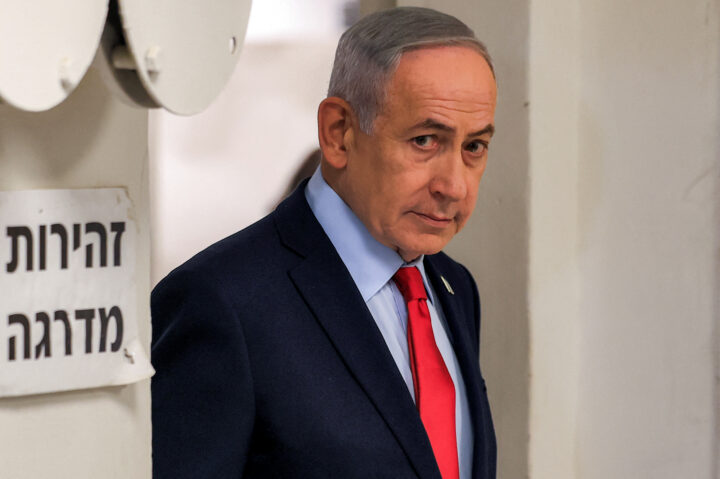
POOL/AFP via Getty Images
Israeli Prime Minister Benjamin Netanyahu arrives for a press conference in Jerusalem on March 19, 2026.
Israeli Prime Minister Benjamin Netanyahu voiced opposition to the Trump administration’s sale of jet engines and potential sale of F-35 fighter jets to Turkey on Monday, saying on “Fox & Friends” that such moves “will upset the power balance in the Middle East, which is ultimately guaranteed by Israeli air superiority” and “America’s posture” in the region.
Netanyahu’s remarks came hours before President Donald Trump’s departure for a NATO summit in Turkey, on the sidelines of which Trump is expected to hold a bilateral meeting with Turkish President Recep Tayyip Erdoğan.
“I don’t think [Turkey] should be given F-35s or the engines for their fighter jets,” Prime Minister Benjamin Netanyahu said on Fox News.
— Jewish Insider (@jewishinsider) July 6, 2026
He described Turkey as “infected by the Muslim Brotherhood, an extreme movement that hates America.”
Read more: https://t.co/gSW5VJLPfA pic.twitter.com/XKovNgVPJM
Last month, the Trump administration told Congress it was moving to sell more than $700 million of U.S.-made F-110 jet engines to the Turkish military and was reviewing Ankara’s eligibility for the F-35 program, in a potential change to U.S. sanctions which currently prevent Turkey from participating.
“I don’t think they should be given F-35s or the engines for their fighter jets,” Netanyahu said on Monday, describing Turkey as “infected by the Muslim Brotherhood, an extreme movement that hates America.” He also pointed to recent comments by Erdoğan and Turkish ministers that Netanyahu characterized as “calling for the annihilation of Israel.”
Netanyahu’s comments echo concerns shared by a bipartisan group of House lawmakers, led by Reps. Mike Lawler (R-NY) and Brad Sherman (D-CA), who wrote to Trump last week warning that Erdoğan’s “constant and growing anti-Israel rhetoric” and ties to Iran make Turkey’s inclusion in the F-35 program unwise.
Rep. Dina Titus is leading the Joint Resolution of Disapproval against the Trump administration's $700 million sale of F110 jet engines to Turkey despite legal restrictions on U.S. military sales to the country

Mahmut Serdar Alakus/Anadolu via Getty Images
Turkish Stars, aerobatic team of the Turkish Air Force perform a demonstration flight during the Youth and Aviation Festival organized by the Ministry of National Defense to mark the 115th anniversary of the Turkish Air Force in Izmir, Turkiye on June 07, 2026.
A group of House Democrats introduced a resolution last week that aims to block the sale of advanced jet engines to Turkey, as the Trump administration pushes ahead with the sale despite legal restrictions on U.S. military sales to the country.
The resolution is led by Rep. Dina Titus (D-NV), a vocal critic of Ankara, and co-sponsored by Reps. Chris Pappas (D-NH), Brad Schneider (D-IL), Josh Gottheimer (D-NJ), Mike Quigley (D-IL), Jim Costa (D-CA), Jim McGovern (D-MA), George Latimer (D-NY) and Brad Sherman (D-CA).
“The regime of Turkish President Erdoğan has made repeated threats of military action against NATO allies and other partner nations throughout the Middle East,” Titus said on X. “I am introducing a Joint Resolution of Disapproval to stop the $700 million sale of F110 jet engines to Turkey which would undermine regional stability and pose a threat to U.S. allies.”
Titus also said on X that she’s working on a letter to House leadership “to prevent any attempt to readmit Turkey into the F-35 program,” urging a Republican colleague who is also critical of the Turkish government to support her initiative.
The lawmakers, led by Reps. Mike Lawler and Brad Sherman, warned the White House of Turkey’s ‘constant and growing anti-Israel rhetoric’ and its relations with Iran
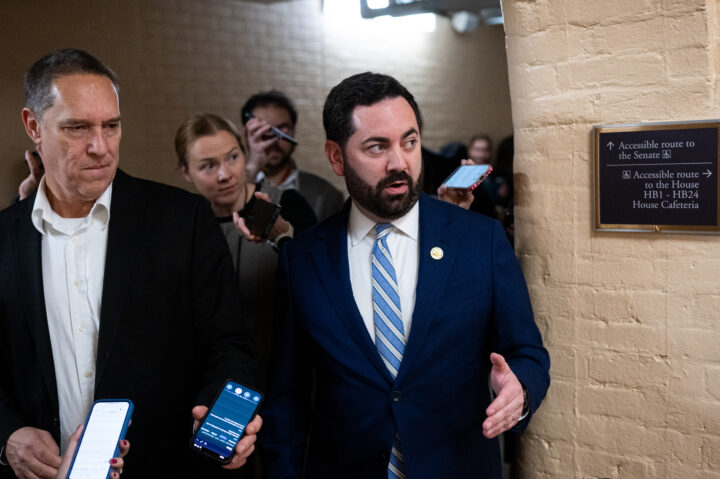
Bill Clark/CQ-Roll Call, Inc via Getty Images
Rep. Mike Lawler (R-NY) speaks to reporters as he leaves the House Republican Conference meeting in the U.S. Capitol on December 10, 2025.
A bipartisan group of House lawmakers wrote to President Donald Trump on Thursday to “express deep concern about any effort to sell F-35s to Turkey.”
The letter comes after Trump and Vice President JD Vance publicly discussed plans to push the sale ahead at the White House last week, in spite of continued legal restrictions prohibiting such a sale, and ahead of a NATO summit in Ankara next week.
“With [Turkish] President [Recep Tayyip] Erdogan’s continued aggression toward our greatest partners along with his troubling defense partnerships with our adversaries, it is not in the best interest of our country to sell them F-35s,” the lawmakers, led by Reps. Mike Lawler (R-NY) and Brad Sherman (D-CA), wrote. “While Turkey has been a NATO ally since 1952, they have hardly been a reliable partner in the present day.”
They emphasized that the first Trump administration removed Turkey from the advanced F-35 fighter jet program for its purchase of a Russian S-400 air defense system in spite of warnings from the U.S. and other NATO allies, describing the S-400 as a “major security threat” to the critical military asset.
They noted that Congress also sent a clear message codifying the ban on F-35 sales to Turkey while it maintains possession of the S-400. There have been no public reports of Turkey disposing of the S-400 system.
“Since 2019, President Erdogan has only further antagonized the U.S. and our NATO allies,” the lawmakers continued, pointing to Turkey’s continued occupation of northern Cyprus, its aggression toward Greece and its “constant and growing anti-Israel rhetoric, all while Turkey maintains bilateral relations with Iran.”
The lawmakers said that reversing course now “would send the wrong message to President Erdogan and to our allies and partners both in Europe and the Middle East.”
The letter was co-signed by Reps. Nicole Malliotakis (R-NY), Gus Bilirakis (R-FL), Jeff Hurd (R-CO), Max Miller (R-OH), Young Kim (R-CA), Stephen Lynch (D-MA), Gabe Amo (D-RI) and Jared Moskowitz (D-FL).
Other lawmakers are currently working on additional efforts to oppose the F-35 sale and other military sales to Turkey, including the White House’s recently announced sale of fighter jet engines to Ankara. Some House members reportedly plan to introduce legislation aimed at blocking that sale, though the administration will likely ultimately be able to proceed if it wishes to do so.
Plus, a Brooklyn Dem's antisemitic 'truth'
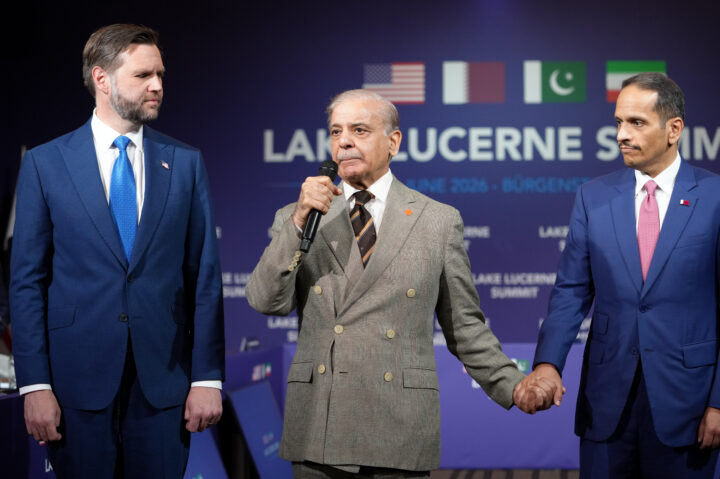
Nathan Howard-Pool/Getty Images
Pakistan's Prime Minister Shehbaz Sharif speaks next to U.S. Vice President JD Vance and Qatar's Prime Minister and Minister for Foreign Affairs Sheikh Mohammed bin Abdulrahman bin Jassim Al-Thani during a quadrilateral meeting between the U.S., Iran, Pakistan, and Qatar at the Lake Lucerne Summit, aimed at advancing a deal to end the Middle East conflict at the Buergenstock Resort, Lake Lucerne on June 21, 2026 near Stansstad, Switzerland.
Good Friday morning.
In today’s Daily Kickoff, we talk to lawmakers concerned about President Donald Trump’s plans to sell the F-35 fighter jets to Turkey, and have the scoop on the antisemitic social media activity of a newly elected Democratic official in Brooklyn. We look at the role Qatar is playing after Vice President JD Vance’s comments that Doha would serve as a place for CENTCOM and the Islamic Revolutionary Guard Corps to “hang out,” and talk to former American Jewish Committee head David Harris about his new book about antisemitism. Also in today’s Daily Kickoff: Neera Tanden, Mathias Döpfner, and Jonathan Safran Foer.
Today’s Daily Kickoff was curated by JI Executive Editor Melissa Weiss and Israel Editor Tamara Zieve, with assists from Danielle Cohen-Kanik and Marc Rod. Have a tip? Email us here.
For less-distracted reading over the weekend, browse this week’s edition of The Weekly Print, a curated print-friendly PDF featuring a selection of recent Jewish Insider and eJewishPhilanthropy stories, including: Starmer’s resignation puts Burnham’s record on Israel, antisemitism in the spotlight; Prospective 2028 Democrats rally against Trump’s Iran agreement; and How Ritchie Torres dodged the DSA wave in New York City. Print the latest edition here.
What We’re Watching
- State Department-facilitiated talks between Israel and Lebanon that were slated to conclude yesterday are being extended and are now expected to wrap up today, as the parties remain split on whether the IDF will partially withdraw from southern Lebanon.
- Elsewhere in Washington, the State Department’s two-day Pax Silica Summit continues today. The State Department announced on Thursday that nine new parties had signed on to Pax Silica, the U.S.-led initiative uniting American allies with the aim of developing global supply chains for artificial intelligence and the production of semiconductors, chips, critical minerals and energy sources to reduce global dependence on China. Read more here.
- Texas Democrats are gathered in Corpus Christi for the state party’s convention, which began yesterday. Among the resolutions expected to be voted on before the convention concludes on Saturday are more than a dozen resolutions about Israel.
- The Aspen Ideas Festival is underway in Colorado. This evening, Jake Sullivan and Jon Finer, respectively the national security advisor and deputy national security advisor in the Biden administration, are recording a live episode of their podcast “The Long Game,” alongside foreign policy analyst Robert Kagan, focused on shifting global power dynamics.
- On Saturday in Aspen, Karen Brunwasser, Riman Barakat, Nour Darwish and Noam Helfer are set to speak on a panel titled “The Opposite of War Is Creation: Israeli-Palestinian Artistic Partnership.” Later in the day, Fareed Zakaria, Kim Ghattas, Karim Sadjadpour and Mark Dubowitz will discuss Middle East dynamics and the war with Iran.
What You Should Know
A QUICK WORD WITH JI’S MELISSA WEISS
As diplomacy between the U.S. and Iran continues following the adoption of the memorandum of understanding between the two countries last week, Washington is again leaning on Qatar to serve as a critical interlocutor, further cementing Doha’s standing as an intermediary despite the significant setbacks sustained by the Gulf state during the recent war with Iran.
In an interview with UnHerd that was published on Thursday, Vice President JD Vance, traveling back from the Iran talks in Switzerland earlier this week, said that Doha would serve as the location for CENTCOM to meet with Islamic Revolutionary Guard Corps officials — despite the IRGC’s designation as a foreign terror organization by the U.S. (a move undertaken by President Donald Trump in his first term).
“One of the things we wanted to come out [of the negotiations]” was a “channel on the Iranian side” to seek conflict resolution, Vance told UnHerd aboard Air Force Two. “Which we did. They were like, ‘OK, fine, we’ll send somebody from the IRGC to go hang out in Doha with somebody from CENTCOM,’ and that’s how we’re going to settle a lot of these disputes,” he said. Read more here.
Doha has long played a role in the back-channel communications between the U.S. and adversaries. But Vance’s comments underscore the degree to which Qatar’s once-quiet intermediary role is now not only public, but a key element of the infrastructure supporting the new regional dynamics.
SCOOP
An activist that two politicians from the Democratic Socialists of America helped elevate to a leadership position in the Brooklyn Democratic Party on Tuesday posted a vitriolic antisemitic screed to her Instagram last year — declaring as “the truth” a notorious work beloved by Adolf Hitler that describes a Jewish world conspiracy, Jewish Insider’s Will Bredderman reports.
Brooklyn beat: Although the DSA itself did not formally endorse Charrington for the post of Democratic leader, two of its most important local figures campaigned with her and helped her make the ballot: state Sen. Jabari Brisport and state Assembly candidate Eon Huntley. Reached by JI, Charrington maintained that she was not prejudiced, but also insisted the video “was some facts.” She repeatedly told the reporter to “get your rabbi,” as she intended to hold a future “roundtable” on what she called a “bullying community.”
DIRECT LINE
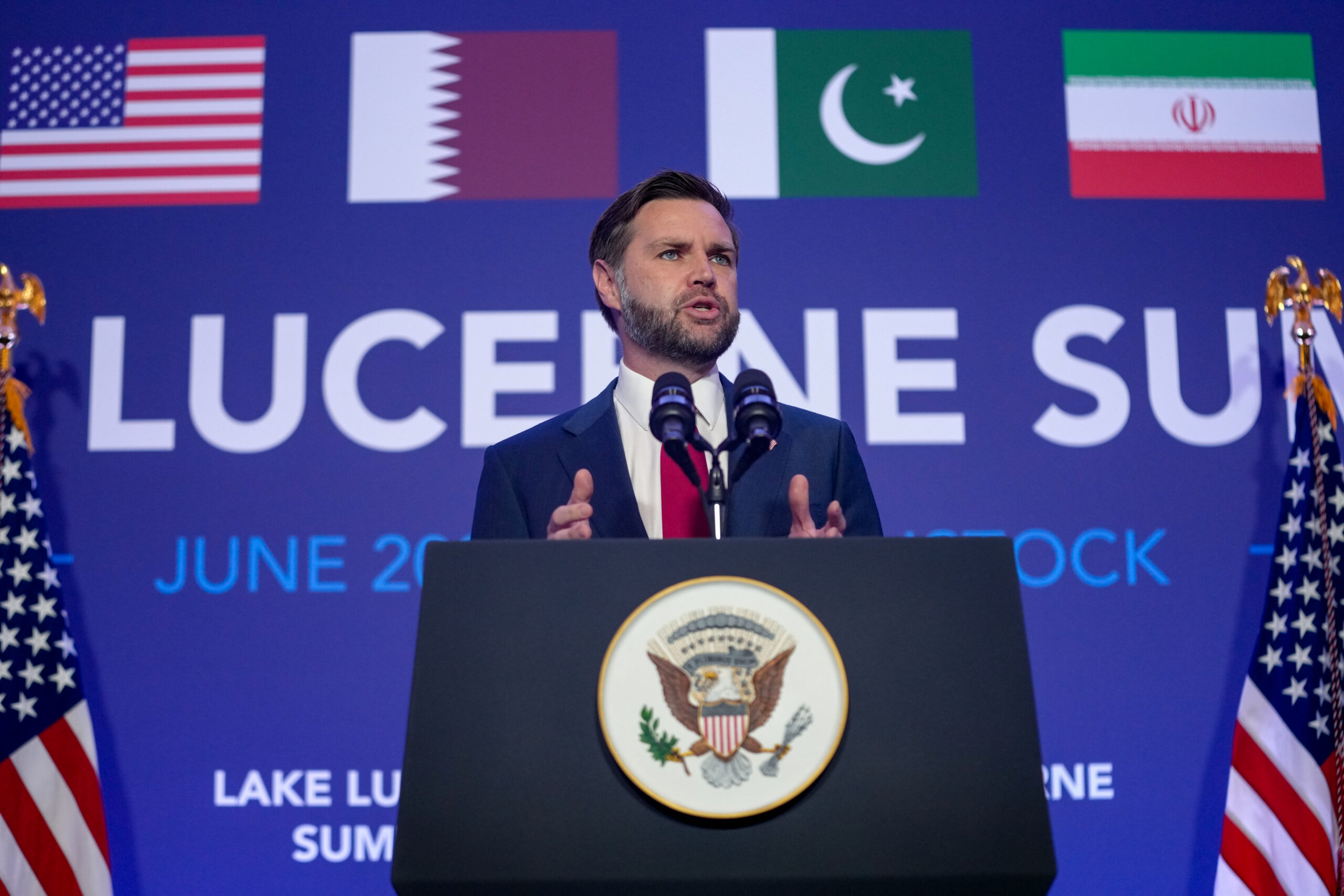
Vice President JD Vance said this week that U.S. military officials are working directly with Iran’s Islamic Revolutionary Guard Corps, a U.S.-designated Foreign Terrorist Organization. The vice president made the comments after departing Switzerland following the conclusion of talks with Iran that lasted until Monday, Jewish Insider’s Danielle Cohen-Kanik reports.
What he said: “One of the things we wanted to come out [of the negotiations] with” was a “channel on the Iranian side” to seek conflict resolution, Vance told the outlet UnHerd aboard Air Force Two. “Which we did. They were like, ‘OK, fine, we’ll send somebody from the IRGC to go hang out in Doha with somebody from CENTCOM,’ and that’s how we’re going to settle a lot of these disputes,” he said.
F-35 FRICTION
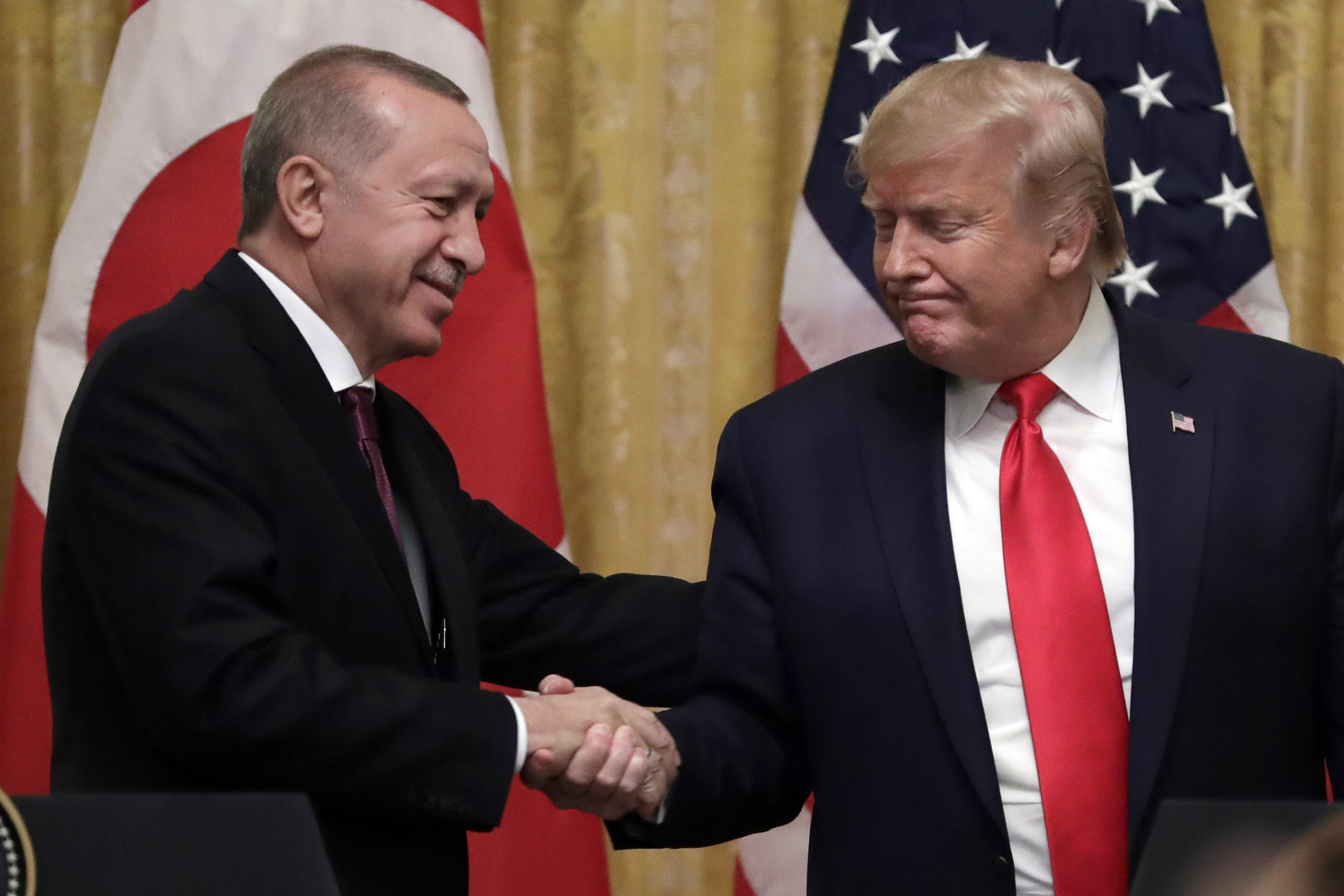
U.S. lawmakers across the political spectrum are sounding the alarm over the Trump administration’s plans to review whether it can sell F-35 fighter jets to Turkey, arguing that the move would raise national security concerns and that Ankara has not yet fulfilled its obligation to dump its Russian S-400s, Jewish Insider’s Matthew Shea and Marc Rod report.
Turkey talk: The proposed deal has drawn fierce bipartisan pushback and notable criticism from within Trump’s own ranks. Rep. Brad Schneider (D-IL) told JI, “Turkey has integrated its defenses with the Russian missiles. The F-35 is a technology platform that Russia would love to get information on and we can’t allow that to happen. Turkey has not been the best NATO ally. Its actions in the Eastern Mediterranean have been contrary to U.S. interests and regional interests, so I have real concerns.”
Read the full story here with additional comments from Reps. Nicole Malliotakis (R-NY), Josh Gottheimer (D-NJ), Dina Titus (D-NV), Chris Pappas (D-NH), Brian Mast (R-FL) and Greg Meeks (D-NY).
PUSHING BACK
A decade ago, Center for American Progress CEO Neera Tanden spent her time arguing with the far left on Twitter. Her life doesn’t look too different today: After four years holding senior roles in the Biden administration, Tanden is back at CAP and once again arguing with the far left on X. But Tanden now finds herself fighting a much more solitary battle than before against the ascendant left flank of the party, Jewish Insider’s Gabby Deutch reports.
Sorry, not sorry: Tanden has called out far-left candidates challenging incumbent Democratic lawmakers for taking positions well outside the party’s mainstream. And at a time when some in the party are calling to make the Democratic tent so wide that it includes even activists and candidates who have flirted with antisemitism, she has taken to X to push back. “Sorry if I think it’s important to state out loud on here my disagreements with a guy who says it’s ok to murder people, Jews are inbred, America was responsible for 9/11 and Russia was right to invade Crimea, amongst other insane things,” Tanden wrote on X in April after “Pod Save America” interviewed Hasan Piker, the far-left, antisemitic political streamer.
DEM DYNAMICS

In the wake of a trifecta of victories by far-left candidates in New York City primaries on Tuesday — in addition to several other radical insurgents expected to join the House next year — Rep. Josh Gottheimer (D-NJ), a leading moderate Democrat, said that Democrats of his ilk need to stand firm and push back, Jewish Insider’s Marc Rod reports.
Fighting back: Gottheimer told JI on Wednesday that he’s concerned the incoming DSA-aligned lawmakers will be coming to Washington to “wreak havoc in Congress,” rather than focusing on affordability and protecting national security, and warned that they will try to “hold the party hostage” to their socialist views. “Common-sense Democrats will fight back … when they try to push some part of their socialist agenda, whether that’s anti-cop, anti-American, we’ll stand up and block it. I’m not going to allow the party to be hijacked by a bunch of socialist agenda,” Gottheimer said.
On the Hill: The House Education & Workforce Committee advanced three bills to combat antisemitism on college campuses, with minimal or no support from Democrats, at a markup on Thursday.
bookshelf

David Harris spent more than two decades leading the American Jewish Committee, where he navigated crises facing the Jewish community and built bipartisan coalitions to advance the group’s mission of supporting Israel and Diaspora Jewry. His book, Antisemitism: What Everyone Needs to Know, published by Oxford University Press last year, is Harris’ attempt to reach beyond the Jewish community — churches, classrooms and the “average New York Times reader.” His goal, he said, is to turn the “silent majority” into the “loud majority,” Jewish Insider’s Haley Cohen reports.
Interview with the author: Harris, who quipped that he retired “for about 30 seconds” after serving as AJC’s CEO from 1990–2022, sat down with JI on Thursday to discuss the book at a moment in which he said he has “never been more worried” about antisemitism — yet also remains optimistic about the Jewish future. “I wrote the book over the span of close to two years during the post-Oct. 7 period,” Harris said. “Two things impacted me: the speed and virulence of which history was turned on its head. The worst day in Israeli and Jewish history since the end of World War II had before our eyes suddenly become directed at Jews, Zionists [and] friends of Israel who were suddenly seen as the perpetrators.”
Worthy Reads
Leaving Iranians Behind: In The Washington Post, Elliott Abrams, who served as Iran envoy in the first Trump administration, raises concerns about Washington’s pledge, in its memorandum of understanding with Iran, to “refrain from interfering” in the country’s domestic affairs. “If the West cares about freedom in Iran, support for dissidents is crucial — for opposition leaders in the country and those in exile, for the millions of Iranians who loathe the regime and for the hundreds of thousands who rise up against it even in the face of murderous suppression. They need and want the moral and political support of democratic societies. Lifting sanctions and unfreezing the mullahs’ assets only make their struggle more difficult.” [WashPost]
Feeling the Heat on Israel: In The Free Press, Mark Halperin examines the degree to which Israel has become a “toxic litmus test” among Democrats. “The anti-Israel left has learned that it can pressure establishment politicians by arousing the grassroots over Israel, which has created an unvirtuous cycle. The more such pressure campaigns work against universities, corporations, and political actors, the more the left returns again and again to the same tactics, strategies, and themes to apply their threats. There is not a Democratic candidate in the country, from places with a lot of Jewish voters to places with nearly none, who is not aware of this dynamic.” [FreePress]
Vance’s Veer: Puck’s Julia Ioffe looks at how Vice President JD Vance, assessing shifting political dynamics, has increasingly staked out a position on Israel that is more critical than it was when he was in the Senate. “In recent weeks, word has spread around town that Vance has been regularly talking to Trita Parsi, the Swedish-Iranian co-founder of the Quincy Institute. The anti-interventionist think tank, which is funded by Charles Koch, bills itself as ‘transpartisan’ and operates in that space between the ends of the political horseshoe — one that, these days, looks increasingly like a circle.” [Puck]
Gulf Positioning: The Wall Street Journal’s Elliot Kaufman reflects on Vance’s appeal to Gulf states as he worked to promote the memorandum of understanding with Iran. “The Gulf states are always hedging with Iran, by virtue of geography. Several opposed the war from the start and denied the U.S. use of local airspace and U.S. military bases. … The Gulf states want their oil exports out and their energy infrastructure safe, and they are glad for the conflict to end. But that doesn’t mean they think this is a strong deal. The collapse of the U.S. position on Iran’s missile program — left out of the memorandum of understanding entirely — has unsettled the Gulf Arabs, and rightly so.” [WSJ]
Word on the Street
The Islamic Revolutionary Guard Corps struck a Singapore-flagged ship in the Strait of Hormuz on Thursdayin an apparent violation of the ceasefire agreement…
Iran is estimating it will amass some $40 billion annually in revenue from its control over thestrait as an increasing number of ships transit the waterway after it was reopened…
The Wall Street Journal does a deep dive into Washington’s calculus on rebuilding destroyed and damaged U.S. military facilities in the Middle East and relocating assets — including potentially to Israel — as it addresses the significant damage caused by Iran’s attacks on a U.S. Navy base in Bahrain during the war…
Former National Security Advisor John Bolton is expected to plead guilty to a single count of retaining government information when he appears today in federal court; Bolton, who served in the first Trump administration, had previously pleaded not guilty after being accused by prosecutors of sending from his personal email address more than 1,000 pages of “diary-like” recollections to relatives helping him with a book…
In The Hill, former Rep. Steve Israel (D-NY) considers the takeaways for moderate Democrats following the Democratic Socialists of America’s victories in Tuesday’s primaries in New York…
Republican Bruce Blakeman, who is mounting a gubernatorial bid in New York challenging Gov. Kathy Hochul, suggested that Brad Lander, who won his primary against Rep. Dan Goldman (D-NY) on Tuesday, “would be a camp guard in the concentration camp if he could,” prompting Lander to respond, “Standing up for Palestinian human rights doesn’t make me any less proud to be Jewish, or any less serious about fighting antisemitism”…
Axel Springer CEO Mathias Döpfner, speaking this week at the Alliance for Responsible Citizenship conference in London, cautioned that antisemitism had become a “global export” following the Oct. 7, 2023, Hamas terror attacks, and that antisemitism among younger generations was “the biggest disgrace of our times”…
The New York Times interviews MIT professor Yossi Sheffi about his new book about antisemitism at the university, which he said he wrote in response to administrators’ decision not to thoroughly investigate and report on antisemitism on the campus and efforts to address it…
Canadian Prime Minister Mark Carney said that the country should reopen its embassies in Iran and Venezuela, noting that having a diplomatic presence “does not mean we endorse the policies of that country”…
The head of the Australian Security Intelligence Organisation, the Australian government’s security arm, said that an Australian citizen living in Iran and working for the Islamic Revolutionary Guard Corps had orchestrated the firebombing of a 2024 Sydney restaurant, months before an Australian living in Iraq had plotted an attack on a Melbourne synagogue…
The Wall Street Journal looks at how CoinEx became a “major hub” for Iran, which used the cryptocurrency exchange to move nearly $4 billion in illicit funds…
Wine of the Week

JI wine columnist Yitz Applbaum reviews the Katzrin Cabernet 2021:
Celebrating the Sheva Brachot of a close friend’s daughter in his glorious Jerusalem garden was spiritual, emotional and full of joy, and it settled, for me, an age-old question: Does the wine make the moment, or the moment make the wine? The answer came the instant I opened one of Israel’s greatest bottles, the Yarden Katzrin 2021, as wine and occasion were joined in perfect harmony.
The Katzrin Cabernet 2021 is rich and generous from first sip to last. The opening is layered with tobacco leaf; the mid-palate carries a Bordeaux-style earthiness; and the finish is deep, luscious and unforgettable. This is a wine with 20 years ahead of it. Pour some now, alongside a 14-hour wine-braised brisket, and the marriage will speak for itself.
Pic of the Day
Author Jonathan Safran Foer met this week with Pope Leo XIV at the Vatican, where he presented the pontiff with a sold-out New York Knicks yarmulke days after the team’s NBA championship win. Foer was invited to the Holy See as it celebrated the centenary of the Vatican Publishing House.
Birthdays

Emmy, Grammy, Oscar and Tony Award-winning actor, movie director, composer and comedian, born Melvin James Kaminsky, Mel Brooks turns 100 on Sunday…
FRIDAY: Member of the New York State Senate from Queens since 1999, she chairs the committee on higher education, Toby Ann Stavisky turns 87… Partner in the law firm BakerHostetler known for his recovery of $14.5 billion from the Madoff investment scandal, Irving H. Picard turns 85… Retired co-host for more than 30 years of NPR’s “All Things Considered,” Robert Siegel turns 79… Rabbi of Congregation Chaverim in Tucson, Ariz., for more than 35 years, Stephanie Aaron… Chair of the Nexus Project and retired lawyer, he was previously chairman of the Conference of Presidents of Major American Jewish Organizations, Alan Solow turns 72… CEO of Emerging Star Capital and the author of a biography of President Bill Clinton, Robert E. Levin… Attorney and Holocaust survivors’ rights advocate, Samuel J. Dubbin turns 71… CEO of ZMC, he was previously chairman of CBS and president of 20th Century Fox, Strauss Zelnick turns 69… Professor of psychology at Loyola University Maryland, she is known for her work on sleep patterns and behavioral well-being, Amy Ruth Wolfson, Ph.D…. Israeli actor and comedian, Anat Waxman turns 65… Once the wealthiest of all Russian businessmen, then a prisoner in Russia and now living in London, Mikhail Khodorkovsky turns 63… First Jewish federal cabinet member to serve in post-WWII Germany, she is minister for education, family, seniors, women and youth, Karin Prien turns 61… Creator of multiple TV series including “Felicity,” “Alias,” “Lost” and “Fringe,” and director and producer of many films, Jeffrey Jacob “J.J.” Abrams turns 60… Novelist and journalist, most notable as the author of the Magicians trilogy, he was the book critic and lead technology writer at Time magazine, Lev Grossman… and his twin brother, author, video game designer and adjunct instructor at NYU, Austin Grossman both turn 57… Head of school at Ramaz since 2025, Noam T. Wasserman turns 57… President and founder of Reut Group, a Tel Aviv-based nonpartisan and nonprofit policy think tank, Gidi Grinstein turns 56… Political commentator, YouTube personality, comedian and talk show host, Dave Rubin turns 50… Head of external communications at Geico, Ross Feinstein… Partner in Mayer Brown’s D.C. office, Michael “Mickey” Leibner… EVP of programming at the Jewish Community Relations Council of New York, Sara Fredman Aeder… CEO at Jewish California (formerly JPAC), David Bocarsly turns 36… Principal at Boston Consulting Group, Asher J. Mayerson… Author, model, media personality and political operative, she was the national spokesperson for the Republican Party, Elizabeth Pipko turns 31…
SATURDAY: One of the heirs to the Bronfman family fortune, a co-founder of Taglit Birthright, the first chairman of the United Jewish Communities and former owner of MLB’s Montreal Expos, Charles Bronfman turns 95… One-half of the husband-wife screenwriting and television production team, Richard Allen Shapiro turns 92… Technion graduate, he is regarded as the founding father of unmanned aerial vehicle (drone) technology, Abraham Karem turns 89… Brooklyn resident, Meyer Roth… Former member of both houses of the Pennsylvania Legislature, Constance Hess “Connie” Williams turns 82… Former commander of the Israeli Navy, head of the Shin Bet and member of Knesset, Amihai “Ami” Ayalon turns 81… First-ever woman ordained as a rabbi by HUC-JIR, Sally Jane Priesand turns 80… Author of fiction and nonfiction books, she is the founding president of the Mayyim Hayyim mikveh in Newton, Mass., Anita Diamant turns 75… New Jersey resident, Kenneth R. Blankfein… Minority leader of the Florida State Senate, Lori Berman turns 68… Managing director at Osprey Foundation, Louis Boorstin… and his twin brother, principal at Panther Works and senior advisor at Albright Stonebridge Group, Robert O. Boorstin, both turn 67… British historian and award-winning author, he is a great-great-great-nephew of Sir Moses Montefiore, Simon Sebag Montefiore turns 61… Southern California-based accountant, Susan M. Feldman… President and CEO of the Jewish Federation of Greater Portland (Ore.) since 2010, Marc N. Blattner turns 57… South Florida resident, Gordon M. Gerstein… Reporter for The New York Times on the climate desk, Lisa Friedman… Member of Knesset for United Torah Judaism, Yoel Yaakov Tessler turns 53… Senior fellow and director of constitutional studies at the Manhattan Institute, Ilya Shapiro… Israeli judoka, best known for his default victory at the 2004 Summer Olympics when his Iranian opponent refused to fight him, Ehud Vaks turns 47… Director of stakeholder advocacy at Ford Motor, Caroline Elisabeth Adler Morales… Singer and musician, best known for being Avril Lavigne’s lead guitarist, Evan David Taubenfeld turns 43… Executive talent partner at Greylock Partners, Holly Rose Faith… National security advisor to Sen. Michael Bennet (D-CO), Charles Dunst…
SUNDAY: Laguna Woods, Calif., resident, she is a retired hospital administrator, Saretta Platt Berlin… Owner of NYC’s United Equities Companies and honorary chairman of Berkshire Bank, Moses M. Marx turns 91… Former member of Congress for 16 years and now a distinguished fellow and president emerita of the Wilson Center, Jane Harman turns 81… Political consultant, community organizer and author, he is married to Rep. Jan Schakowsky (D-IL), Robert Creamer turns 79… Novelist, journalist, conservative commentator and senior fellow at the Claremont Institute, Mark Helprin turns 79… Author of crime fiction for both adults and children, Peter Abrahams turns 79… Documentary producer and adjunct associate professor at USC, James Ruxin turns 78… Professor emeritus of mathematics at the University of California, Berkeley, Kenneth Alan Ribet turns 78… Shareholder in the Tampa law office of Carlton Fields, Nathaniel L. Doliner turns 77… Rabbi and historian, he is the author of a 2017 book Jewish Justices of the Supreme Court: From Brandeis to Kagan, David G. Dalin turns 77… Former member of the California State Senate following two terms in the State Assembly, Martin Jeffrey “Marty” Block turns 76… Retired partner at Chicago-based accounting firm of Morrison & Morrison, he has been involved with the leadership of J Street since its inception, Mark Zivin… Volunteer president of the International Jewish Sports Hall of Fame, he served for 17 years as executive director of Maccabi USA, Jed Margolis turns 75… Founding partner of NYC law firm Kasowitz LLP, Marc Kasowitz turns 74… Israeli journalist for Haaretz, she lives in Ramallah, Amira Hass turns 70… Chairman and CEO of Comcast Corporation, a Fortune 50 company that includes NBC Universal, Brian L. Roberts turns 67… Rabbi of the Har Bracha community and rosh yeshiva of the yeshiva there, Rabbi Eliezer Melamed turns 65… U.S. special envoy for Holocaust issues at the State Department, Ellen J. Germain turns 64… Founding member of GPS Investment Partners, Marc Spilker turns 62… Actor and singer, Jessica Hecht turns 61… Former diplomatic correspondent for Al-Monitor, now reporting on Substack, Laura Rozen… Novelist and short story writer, Aimee Bender turns 57… Israeli actor residing in Los Angeles, Ayelet Zurer turns 57… Trillionaire CEO of Tesla and SpaceX, owner of X formerly known as Twitter, Elon Musk turns 55… Former member of Knesset as a member of the Labor Party / Zionist Union, Michal Biran turns 48… Toltzy Kornbluh… and her twin sister, Chany Stark… UAE-based businessman and philanthropist who is the founder and CEO of NY Koen Group, Naum Koen turns 45… Associate at Latham & Watkins, she was previously the social secretary to the ambassador of Israel in Washington, Molly Rosen… Mark Winkler…
Rep. Josh Gottheimer said ‘Erdoğan cannot be trusted’ and that the decision ‘must be reversed’
Evan Vucci
President Donald Trump shakes hands with Turkish President Recep Tayyip Erdoğan after a news conference in the East Room of the White House, Wednesday, Nov. 13, 2019, in Washington.
U.S. lawmakers across the political spectrum are sounding the alarm over the Trump administration’s plans to review whether it can sell F-35 fighter jets to Turkey, arguing that the move would raise national security concerns and that Ankara has not yet fulfilled its obligation to dump its Russian S-400s.
In the Oval Office on Wednesday, President Donald Trump said he was considering selling the advanced jet engines to Turkey, stating that he would “do something that’s going to make him [Turkish President Recep Tayyip Erdoğan] very happy.” Vice President JD Vance said the administration is “confirming” that Turkey has fulfilled its obligations under U.S. law in order to receive advanced F-35 fighter jets.
Ankara has long sought the advanced systems but has been barred from purchasing it since 2020, after it acquired the S-400 air-defense system from Russia. A report published last week by the Jewish Institute for National Security of America suggested that the S-400 system is inactive but still intact in Turkey.
The proposed deal has drawn fierce bipartisan pushback and notable criticism from within Trump’s own ranks.
Rep. Brad Schneider (D-IL) told Jewish Insider that he is “very concerned” about the prospect of Turkey acquiring the F-35s, arguing that such a move would raise significant national security concerns due to Ankara’s close security ties with Russia.
“Turkey has integrated its defenses with the Russian missiles. The F-35 is a technology platform that Russia would love to get information on and we can’t allow that to happen,” Schneider said. “Turkey has not been the best NATO ally. Its actions in the Eastern Mediterranean have been contrary to U.S. interests and regional interests, so I have real concerns.”
Schneider also noted that he does not believe Turkey has given up possession of the Russian S-400s, suggesting that Ankara has yet to fulfill the critical obligation that must be certified, in writing, to Congress.
“I have not seen that,” Schneider said. “I’d want to see that in concrete evidence from this administration.”
Rep. Nicole Malliotakis (R-NY) said on social media that there is “bipartisan opposition” to the move and posted a photo of Erdoğan hand-in-hand with Russian President Vladimir Putin and former Iranian President Ebrahim Raisi.
“As long as Turkey is under the leadership of Erdogan who aligns himself with Iran and Russia, harbors Hamas & remains the only NATO member to not sanction Russia, Turkey should NOT receive our best jets and military equipment,” Malliotakis wrote.
Rep. Josh Gottheimer (D-NJ) also criticized the move, saying in a post on X that “Erdogan cannot be trusted” and that the “decision must be reversed.”
“Turkish President Erdogan has cozied up to Hamas and Putin while threatening our allies in Israel, Greece and Cyprus,” Gottheimer wrote. “Yet, the Trump administration is happy to sell them advanced engines to power fighter jets.”
Rep. Dina Titus (D-NV) said that if Trump continued with the move she would “introduce a joint resolution of disapproval.
Rep. Chris Pappas (D-NH) also expressed sharp disapproval, saying, “Absolutely no F-35s to Turkey” in a post on social media.
“Turkey was kicked out of the F-35 program during the first Trump administration for purchasing Russian S-400 missiles, which it still possesses today,” Pappas wrote. “Since then Turkey has only grown more aggressive against critical American allies such as Greece and Cyprus, increased oppression of its people, and made the region even more unstable.”
“The law is clear: the Trump administration is required to certify to Congress that Turkey is in compliance with our laws before any sale can even be considered. We cannot reward Erdogan’s government while it continues to violate U.S. law and threaten our reliable, democratic allies,” he added.
Rep. Brian Mast (R-FL), the chair of the House Foreign Affairs Committee, said that he expects to receive a classified briefing on the F-35 sale and the status of the S-400 next week.
Asked about the administration’s praise of Erdoğan, Mast said that “Turkey as a whole is a large and important NATO ally.” On Wednesday, the president called the Turkish leader a “very good person,” despite also saying that he would fight “on the Iran side” of the war.
“I’m not going to go out there and defend Erdoğan in any way, shape or form,” Mast said. “Erdoğan and I don’t have a personal relationship. I think a number of activities by Turkey have been problematic and I have nothing that would make me go out there and personally defend Erdoğan. I have many relationships — that’s not one of them.”
Meanwhile, Schneider expressed concern over Trump’s praise of Erdoğan.
“I’m worried he [Trump] seems to get close to a lot of leaders who have totalitarian instincts,” Schneider said. “It’s a pattern.”
Mast’s Democratic counterpart, Rep. Greg Meeks (D-NY), said he opposed the sale of F-35s to Turkey, warning of its impact on other U.S. allies in the region such as Greece and Cyprus, and also expressed criticism of Erdoğan personally while calling Turkey an important ally with which to maintain conversations.
But Meeks said he’s open to the sale of advanced jet engines to Turkey “if I get my questions answered by the administration,” and expressed frustration that Trump is speaking publicly about the sale without communicating with him as the ranking member of the Foreign Affairs Committee, a break with precedent.
Sinan Ciddi, director of the Turkey program at the Foundation for Defense of Democracies, said that while Trump appears intent on making the sale, it is likely to meet significant hurdles. For instance, Ciddi confirmed that Turkey still possesses the S-400 defense system, which would not fulfill the obligations required under law to lift the sanctions.
“Turkey does still maintain the S-400 defense system,” Ciddi said. “We’re not talking about one or two missiles. I believe in total Turkey holds up to 200 air defense missiles that were sold to them by the Russians back in 2019. They are presently sitting under lock and key in Turkish warehouses.”
Ciddi noted that Turkey has not deployed the S-400s it currently holds as a precautionary measure because it would have “resulted in additional U.S. sanctions against Turkey.”
He said a major area of concern of selling Turkey F-35s while it still maintains the S-400s is the ability for sensitive information to be shared with U.S. adversaries.
“The concern is if they don’t get rid of those and the F-35 was delivered to Turkey, or became operational in Turkey, those S-400 systems could collect sensitive information about their stealth capabilities and share them with adversarial powers, such as the Chinese, the Russians, as well as the Iranians.”
“There’s been a relative consensus in opinion in congress, as well as political administrations, that you want to keep Turkey out of the F-35 program,” he added.
Ciddi also discussed Trump’s closeness to Erdoğan, arguing that the U.S. has not held Turkey accountable on key issues such as support for terrorism and the Muslim Brotherhood, due to Ankara’s role in helping mediate talks between Israel, Iran and the U.S. as well as in the Russia-Ukraine war.
“In Trump’s own words, he seems to admire and essentially have a strong affinity for Erdoğan,” Ciddi said, noting that another explanation is that Trump is listening closely to U.S. Ambassador to Turkey Tom Barrack on Turkish issues rather than “what he needs to hear from a variety of voices within his administration.”
Elliott Abrams, a former Iran envoy during the first Trump administration, also cautioned against the move and Trump’s “soft spot” for Erdogan.
“President Trump has a soft spot for Erdoğan for reasons that no one can understand, but that is no reason to risk American military secrets,” Abrams said. “Turkey has not abandoned the S-400 and therefore should be excluded from the F-35 program. This ought to be simple, because U.S. law is clear.”
Ciddi also expressed concern on what the potential move might mean for Israel and suggested that Turkey holds considerable military prowess even without the F-35s, although he noted that Israel holds an advantage having operated the F-35s for a longer period of time and also maintaining more sophisticated models.
“The Israelis are really concerned,” Ciddi said. “The acquisition of an F-35 would be a game changer, but there are significant hurdles ahead of that. Israel already has F-35s and operates them, and the Israeli variant of the F-35 is one of the most advanced and unique versions of the F-35 that is operated, and it’s unique to Israel – no other country possesses and operates the F-35 that has the boutique suite of operating capabilities that the Israelis have, so Israel does maintain a significant qualitative military edge.”
He said that even if the Trump administration authorized the sale, it would likely take years to come together and “would not be an immediate delivery of F-35 units beyond the six that Turkey already purchased back in 2019, which are essentially sitting in U.S. warehouses here and collecting dust.”
Latest reports indicate Ankara still possesses the Russian system that has prevented it from purchasing the F-35s; meanwhile, the White House is also advancing a $700 million sale of jet engines to Turkey
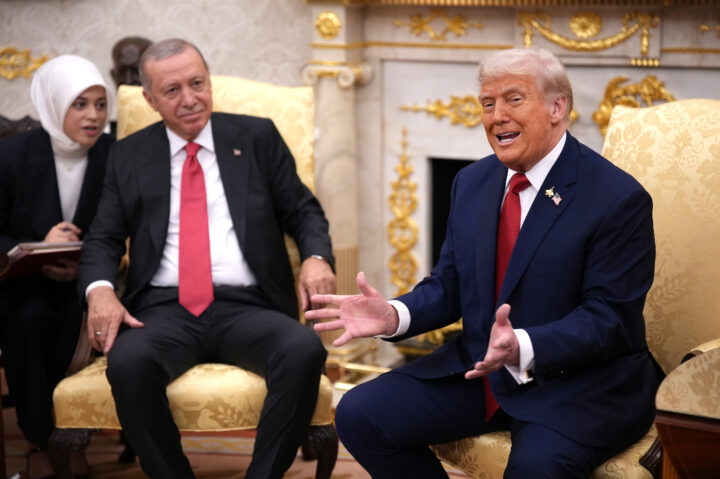
Photo by Andrew Harnik/Getty Images
President Donald Trump delivers remarks during a meeting with President of Turkey Recep Tayyip Erdogan in the Oval Office at the White House on September 25, 2025 in Washington, D.C.
Vice President JD Vance said on Wednesday that the administration is “confirming” Turkey has fulfilled its obligations under U.S. law in order to receive advanced F-35 fighter jets, which Ankara has long sought but has been barred from purchasing since 2020 after it acquired the S-400 air-defense system from Russia.
U.S. law requires the secretaries of state and defense to certify to Congress in writing, prior to any F-35 transfer, that Turkey no longer possesses the S-400 system and has provided credible assurances it will not acquire similar Russian air-defense systems. Latest reports indicate the S-400 system is inactive but still intact in Turkey, which would not fulfill the obligations required under law to lift the sanctions.
Asked in the Oval Office “what needs to happen for the F-35 deal to be finalized,” Vance said, “[Defense Secretary] Pete [Hegseth] and the entire team are reviewing this right now, because there are certain things that we have to certify have happened … in order to comply with American law. The president has asked us to do that. We’re running the traps and confirming that’s happened.”
Vance’s remarks were at odds with Secretary of State Marco Rubio’s comments to the House Foreign Affairs Committee earlier this month, when he said Turkey was still prohibited from acquiring the F-35 jets until it resolved the S-400 issue in a way that complies with U.S. law. “We don’t have that choice because it’s governed by statute,” Rubio said. No certification proving otherwise has been submitted to Congress in the interim.
President Donald Trump, asked about whether he’s considering selling advanced jet engines or F-35s to Turkey, said while sitting next to Vance, “I think so. Look, [Turkish President Recep Tayyip Erdoğan is] a member of NATO. Some people don’t consider him so, but he really is, he’s a strong member of NATO. Yeah, I’m going to probably do something that’s going to make him very happy.” Trump is slated to attend the NATO summit being held in Ankara next month.
The president made similar comments during Erdoğan’s visit to Washington in September, when Trump said he was likely to permit Turkey to purchase F-35s as soon as “the end of the day.”
Rep. Greg Meeks (D-NY), ranking member of the House Foreign Affairs Committee, said the administration told him on Tuesday “it would once again bypass Congressional review” by allowing the Turkish military to purchase more than $700 million of U.S.-made F-110 jet engines. “The State Department did not even attempt to justify its decision,” Meeks said in his statement, adding that the administration failed to provide written rationale, brief Congress or invoke emergency authority in order to proceed with the sale.
The proposed engine sale would likely also face scrutiny under the sanctions and export-control restrictions imposed after Turkey’s acquisition of the S-400 system
Trump credited Turkey’s “very strong military” and praised Erdoğan as “a very good person” in his remarks on Wednesday.
Trump has maintained close ties with the Turkish leader, even as Turkish-Israeli relations have soured. Last year, Erdoğan reportedly said during a mosque visit: “May Allah destroy Zionist Israel in his holy name.”
Trump told reporters on Wednesday that Erdoğan was “a prime candidate to go into the war with Iran — maybe on the Iran side, because he’s not a big fan of Israel,” adding, “I asked him to stay out. He stayed out.“
Barrack called Israel and Hezbollah ‘equally untrustworthy’ in comments at the Antalya Diplomacy Forum
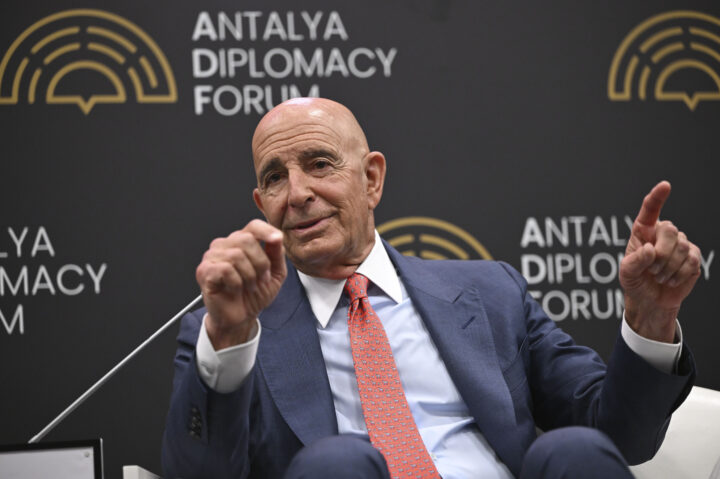
Utku Ucrak/Anadolu via Getty Images
Ambassador to the Republic of Turkiye and Special Envoy for Syria Tom Barrack attends ADF2026 Talks within Antalya Diplomacy Forum, held under the theme of 'Mapping Tomorrow, Managing Uncertainties' in Antalya, Turkey on April 17, 2026.
U.S. Ambassador to Turkey Tom Barrack faced fresh condemnation from two Senate Republicans and conservative influencers for a series of comments he made at the Antalya Diplomacy Forum in Turkey this weekend in which he repeatedly criticized Israel and praised Ankara.
The U.S. envoy has faced criticism and scrutiny from fellow Republicans previously for his perceived closeness with Turkish President Recep Tayyip Erdogan and his government, comments critical of Israel and more.
In response to comments by Barrack claiming that the current ceasefire in Lebanon “is so delicate because everybody has been equally untrustworthy” — referring to both Israel and Hezbollah — Sen. Lindsey Graham (R-SC) said he “respectfully and strongly disagree[s].”
Barrack said at the conference there needs to be “a path with Hezbollah, and that path has to be not killing Hezbollah” — a group that the U.S. has long designated as a terrorist organization and has been responsible for the deaths of hundreds of Americans. He further said that Iran and Hezbollah both should be involved in talks to end the fighting in Lebanon.
“I always get in trouble because Hezbollah, in American parlance, and most of the West, is a Foreign Terrorist Organization. Hezbollah, in Lebanon, is also a political organization,” Barrack added.
The ambassador repeatedly criticized provisions in past ceasefire agreements that allowed Israel to take action against Hezbollah in its own self-defense, which he argued made the agreements weak and functionally nonbinding on Israel. He further dismissed the idea that the Lebanese Armed Forces would act to disarm Hezbollah, as is required under the terms of the current and past ceasefires.
“The majority of the Lebanese Armed Forces are not going to go shoot their cousins, especially at a time where Israel is bombarding them, which only gives efficacy to the reason Hezbollah should exist, to protect itself from Israel. So what’s the answer? The answer has got to be underlying prosperity,” Barrack said. “When you have a sovereign nation like Iran, which is supporting a militia, you cannot get rid of that militia by killing them.”
He said he believes that bringing Lebanon into the Abraham Accords, and working closely with Turkey, is the long-term answer to addressing Hezbollah.
“The brilliance of [the ceasefire agreement] is it stopped senseless killing and President [Donald] Trump and Secretary [of State Marco] Rubio stepping in strongly with Israel and saying, ‘We need a timeout,’” Barrack continued. “Everybody is in atrophy over this idiotic war. So will the ceasefire stick? What will we do? It’s baby steps. Everybody’s rushing to fill in those pieces.”
Barrack also criticized the Israeli government’s posture toward Turkey. “I think this rhetoric is going to go away,” he said, referring to Israel’s view of Turkey as a rising threat and aspiring regional hegemon. “Turkey is not a country to be messed with.”
The ambassador said that, in his personal opinion, “the smartest thing that Israel could do is to entice and embrace Turkey” to join the U.S.-led international stabilization force in Gaza, a prospect that Israel has resoundingly rejected as a result of ongoing Turkish hostility and Ankara’s relationship to Hamas leaders.
Barrack also praised Turkey for refusing to designate Hamas as a terrorist organization and for serving as a mediator with the group. “It could have never happened had they agreed with us that Hamas was a Foreign Terrorist Organization and you have to exclude them,” Barrack said, referring to the ceasefire between Israel and Hamas.
Barrack broadly dismissed the notion that antisemitism is a widespread problem in the Arab world or elsewhere, arguing that he grew up as a “Lebanese Catholic in a very Jewish neighborhood, everybody’s done business with Jews — that’s not the issue. Zionism was a question as to a definition.”
Barrack said that he and Trump believe that Turkey should be accepted into the F-35 fighter jet program — downplaying Ankara’s decision to buy a Russian S-400 missile-defense system, which led to U.S. sanctions that still prevent Turkey from rejoining the F-35 program. He also brushed off the long-running Turkish provocations against Greece.
“Sanctions, again, in my humble opinion — they don’t work, because what happens is the sanctioned country, they become so smart, so ingenious, that they figure out ways around the sanctions and alliances with other nations that don’t serve the U.S. benefit,” Barrack said, celebrating efforts by the Trump administration to ease sanctions on Turkey.
Sen. Rick Scott (R-FL) responded on X that he remains committed to blocking Turkey from receiving the F-35 or other U.S. defense systems.
“Turkey, the country that funds Hamas, the Muslim Brotherhood, hates Israel, loves Russia and Iran … good luck getting the F35, F16, and any other American made defense platform,” Scott said. “I told Erdoğan in 2018 and I tell him again: you’re NOT getting the F35.”
Conservative commentator Mark Levin, who has repeatedly criticized Barrack, said that the ambassador “sounds like an Erdogan mouthpiece.”
“Will somebody give this wrecking ball Barrack the hook. He’s THE worst,” Levin said in another X post, and called Barrack “poison” and “awful” in other posts.
Barrack was critical of Israel’s interventions in Syria, which Israel has said were an effort to protect Druze minorities from ongoing atrocities by government-aligned forces. He suggested Israel was not legitimately concerned with protecting the Druze and said that Syria was “brilliant” for not engaging against Israel’s “constant” incursions.
He repeatedly lavished praise on the new Syrian government, and on the Turkish government for backing it.
“My bet is we’ll get to a non-aggression and normalization agreement with Syria [and Israel] sooner than Lebanon,” Barrack said.
Barrack additionally declared, repeating past rhetoric that earned criticism from U.S. lawmakers and analysts, that the only system of government that has worked in the Middle East is “powerful leadership regimes — either benevolent monarchies, a kind of monarchial republic,” and that “countries that have put on this cloak of democracy … have failed,” referring to countries that implemented reforms following the Arab Spring.
He said that Israel’s best path forward would be “aligning its interests with the Gulf, with these strong civilizations.”
Trump made the remarks in a Truth Social post, in which he threatened that the U.S. would bomb the South Pars gas field if Iran does not stop attacking Qatar
Alex Wong/Getty Images
President Donald Trump speaks during the annual Friends of Ireland Luncheon at the U.S. Capitol on March 17, 2026 in Washington, DC.
Current and former Israeli and U.S. officials suggested that an Israeli strike on an Iranian gas field on Wednesday that prompted the Islamic Republic to strike Qatar was coordinated with the White House, despite President Donald Trump’s claim that the U.S. “knew nothing about this particular attack.”
Trump made the remarks in a Truth Social post, in which he threatened that the U.S. would bomb the South Pars gas field, the Iranian portion of the larger field shared with Qatar, if Iran does not stop attacking Qatar.
“The United States knew nothing about this particular attack, and the country of Qatar was in no way, shape or form involved with it, nor did it have any idea that it was going to happen. Unfortunately, Iran did not know this … and unjustifiably and unfairly attacked a portion of Qatar’s [liquid natural gas] facility,” the president wrote.
If “Iran unwisely decides to attack a very innocent, in this case, Qatar,” he added, the U.S., “with or without the help or consent of Israel, will massively blow up the entirety of the South Pars Gas Field at an amount of strength and power that Iran has never seen or witnessed before.”
An Israeli official told Kan News, Israel’s public broadcaster, that the attack on the South Pars gas field was coordinated with the U.S.
Dan Shapiro, the former U.S. ambassador to Israel and Pentagon official in the Biden administration, wrote on X, “Trump can post whatever he likes. But there is zero, I mean zero, chance the IDF would conduct a strike in that location without giving CENTCOM full visibility.”
“Trump knew (and approved),” Shapiro added. “Now he realizes it caused a major escalation with Iran’s (entirely unjustified) attacks on Gulf energy targets.”
Shapiro later clarified that the Israeli strike “could not have been carried [out] without U.S. knowledge and explicit or implicit approval.”
“It was predictable that strikes on Iranian energy facilities (by US or Israel) would lead to Iranian strikes on Gulf energy facilities,” he wrote. “There is a narrow window following the Israeli and Iranian strikes, and Trump’s Truth Social Post (untrue, but possibly useful in this context), to de-escalate away from further strikes on energy industry targets in either direction. That will still leave a very challenging situation to unwind, but [it] would be the best near-term development.”
Gilad Erdan, a former Israeli ambassador to Washington and a former member of Israel’s Security Cabinet, told Jewish Insider that it was highly likely the U.S. knew about the strike, saying that Trump did not criticize Israel in his post, and “in the same breath” as saying the U.S. was unaware, “[Trump] himself threatened to erase the [gas] field.”
Erdan noted that the South Pars gas field is “used for Iran’s domestic energy needs [and] doesn’t harm the international energy market.”
“Israel took upon itself to be at the front [of the situation] in my estimation because the field is also Qatari,” Erdan, who is also a senior fellow at the Misgav Institute for National Security, said. “Someone had to send the deterrent message about the energy field to the Iranians, that if they continue, then all options are open against them and they will be hurt badly.” (The writer is a senior fellow at the Misgav Institute and cohosts its podcast.)
Yaakov Katz, an Israeli military expert and author of While Israel Slept: How Hamas Surprised the Most Powerful Military in the Middle East, told JI that he agreed with Shapiro’s assessment. “There is no way Israel would attack such a strategic facility [without coordination] because they know it would draw the Iranians to attack the Gulf states,” he said.
Katz pointed to Israeli Prime Minister Benjamin Netanyahu’s behavior since the war with Iran began late last month as further indication that Israel was unlikely to make such a move without coordinating with the U.S.: “Why would Netanyahu who behaved so carefully all throughout the war, coordinating with Trump to not upset him so he keeps the war going … do something that would anger Trump and potentially lead him to do something brash and declare the war is over?”
“It was coordinated, and now Trump is saying what he’s saying to distance himself, but it was done to send a message to the Iranians,” Katz added.
Also Thursday, Saudi Arabia released a statement with the foreign ministers from Azerbaijan, Jordan, the UAE, Bahrain, Pakistan, Turkey, Syria, Qatar, Kuwait, Lebanon and Egypt urging Iran to stop its attacks.
“The participants held Iran fully responsible for the losses and called on Iran to immediately and unconditionally cease its aggression and to comply with UN Security Council resolutions. The meeting also emphasized the dangers of supporting militias and destabilizing security, stressing that Iran must seriously reconsider its miscalculations,” the statement read.
If Iran continues, the foreign ministers stated, there will be “serious consequences for Iran and the security of the region, and will exact a heavy price, casting a shadow over its relations with the countries and peoples of the region, who will not stand idly by in the face of threats to their capabilities.”
Defense official Michael Duffey called recent comments by Erdogan ‘atrocious’ but said the issue falls outside his purview
Tierney L. Cross/Bloomberg via Getty Images
Michael Duffey, under secretary of defense for acquisition, during a Senate Armed Services Committee confirmation hearing in Washington, DC, on March 27, 2025.
Administration officials dodged questions about weapons sales to Turkey during a House Foreign Affairs Committee hearing Tuesday, despite calling antisemitic statements from Turkish President Recep Tayyip Erdogan “atrocious.”
“The president of Turkey, President Erdogan, has said, less than one year ago, ‘May Allah make Zionist Israel destroyed and devastated,’” Rep. Randy Fine (R-FL), a hard-right Jewish lawmaker, said during the hearing. He also referenced other comments, such as Erdogan calling Israelis “murderers to the point that they kill children who are five or six years old. They are murderers to the point they drag women on the ground to their death.”
“Why does the Department of War [Defense] think it’s a good idea to sell American weapons to a country whose leader makes these statements?” Fine added. “Do you think it’s a good idea to be selling weapons to a country that made these statements about Jews and Israel?”
The U.S. has maintained extensive defense ties with Turkey, a NATO ally, through years of foreign military sales. In May 2025, the Trump administration approved a $304 million missile sale to Ankara as part of broader efforts to sustain security cooperation. Between 2020 and 2024, the U.S. agreed to up to $21.67 billion in foreign military sales to Turkey under the Biden administration.
Critics have argued that Ankara’s hostile posture toward Israel and American interests, including support for the Muslim Brotherhood, should draw scrutiny over arms sales to the country.
Michael Miller, director of the Defense Security Cooperation Agency, said the issue falls out of his purview.
“It is certainly a fact that Turkey, historically, has been one of our largest purchasers through foreign military sales,” Miller said. “In terms of the decision of whether or not to sell to Turkey, that would be the department of state’s direction on behalf of the president.”
Michael Duffey, the undersecretary of defense for acquisition and sustainment, also sidestepped the prompt, replying: “My response is similar to Director Miller.”
“I don’t endorse any of the statements [from Turkey]. I think they’re atrocious,” Duffey said. “But in terms of making a decision, it’s not within my expertise or knowledge set to make a balanced decision about whether or not that is the advantage of the United States national security to sell weapons to Turkey.”
Turkish political leaders are circulating propaganda that Israel wants to turn its military attention to Ankara
Burak Kara/Getty Images
Turkey's President Recep Tayyip Erdogan speaks to supporters at his party’s Istanbul mayoral candidate Murat Kurum's campaign rally on March 29, 2024 in Istanbul, Turkey.
As the military conflict between the U.S., Israel and Iran continues, Turkish elites have reportedly begun circulating claims that Israel could turn its military attention toward Ankara should Iran emerge from the war depleted — a belief analysts say reflects growing mistrust and conspiratorial thinking in Turkey rather than any actual Israeli intent.
“I have started hearing from inside of Turkey suggesting that there’s a not unsizable position of governing elite circles which do believe that Israel will turn its attention next onto Turkey, militarily or some derivative thereof, after its finished with Iran,” Sinan Ciddi, director of the Turkey program at the Foundation for Defense of Democracies, said during a livestreamed webinar on Thursday.
Steven Cook, a senior fellow at the Council on Foreign Relations, called Turkey’s perception of Israel’s intentions as “ridiculous.”
“I’m surprised that even the sophisticated are deep in this idea that the Israelis are going to take on Turkey next,” said Cook. “All I’m getting from Israeli professional security and diplomatic channels is that ‘we want to find a way to de-conflict with Turkey.’ The fact that the Turkish political elite and government think that this is what the Israelis are going to do is a fundamental misreading.”
Cook suggested that Turkish officials and elites could be spreading those claims for “political purposes,” arguing that Ankara could be “whipping up anti-Zionist, antisemitic fury.”
“It is very easy for people in Turkey to make up all these conspiracy theories,” Henri Barkey, a senior adjunct fellow at the Council on Foreign Relations, said. He noted that while there is a “great deal of dislike” between Ankara and Jerusalem, there would be “positive aspects” should the two work together for the betterment of the region following the conflict with Iran.
“Turkey and Israel actually have a great deal of trade, over $5 billion a year, and it would make much more sense for Israel to work with Turkey and maybe invest in Iran together,” Barkey said.
But, he said, Jerusalem has instead become a “convenient enemy” for Ankara. “We have an Israel that clearly is much more capable than most people expected and is now willing to take on Iran, not once, but twice, so that is a very useful and convenient enemy [for Turkey].”
At the same time, experts said the two countries appear to have sharply different preferences regarding the outcome of the war with Iran.
“I think Turkey desires for the existence of a weakened Islamic Republic with the Islamic regime in charge,” Ciddi said. “But it really does not seek the emergence of a Democratic or ‘free Iran.’”
“Turkey could potentially continue to cooperate and work with a weakened Iran, because a weakened Iran would essentially be able to continue working with its proxy networks to destabilize what Turkey identifies its adversaries in the region, such as Israel, but it will also allow Turkey to grow into the region as this new hegemonic power,” he added.
Cook echoed those sentiments, calling a “greatly weakened Islamic Republic” the best outcome for Ankara. He said a diminished Iranian regime is more likely to “seek help” from Turkey.
“A weakened Iran will be much more at the beck and call of Turkey on a variety of issues,” Barkey said. “Turkey will be able to exercise much more leverage and get what it wants from Iran.”
Meanwhile, Cook noted that Israel is seeking a much different outcome.
“If something emerges from this conflict that’s called the Islamic Republic of Iran, it is a strategic defeat for Israel,” Cook said. “The Israelis have spent a lot of time and effort trying to create a pathway for the Iranian people to overthrow this regime. It’s a defeat for Israel if that doesn’t happen, and that’s good for Turkey during their current adversarial relationship.”
However, Cook cautioned that such an outcome could also backfire on Turkish ambitions for a more stable region, cautioning to “be careful what you wish for.”
“We’re right that some kind of smaller Islamic Republic that’s IRGC-dominated is the best possible outcome for Turkey, but this is still a potent and dangerous, wounded state,” Cook said. “It’s not great for the region, because if you take the Turks at their word that they want regional stability, they’re not going to get it with some rump version of the Islamic State.”
The groups ‘have provided significant material support’ to the terror group, the Treasury Department said
Saeed M. M. T. Jaras/Anadolu via Getty Images
Israeli hostages are handed over to the International Committee of the Red Cross (ICRC) by the Al-Qassam Brigades, the armed wing of Hamas, as part of the ceasefire agreement in effect in Gaza City, Gaza on October 15, 2025.
The Treasury Department announced on Thursday that it is imposing sanctions on four “sham charity” groups in Turkey and Indonesia that it said are funneling money and resources to Hamas’ military wing.
The four groups targeted are Ghazi Destek Dernegi (GDD), Hayat Yolu and the Palestinian White Hands Assistance and Solidarity Association, all based in Turkey, and Komite Nasional Untuk Rakyat Palestina (KNRP), based in Indonesia, all sanctioned for providing support for Hamas.
“Hamas continues to finance its military wing by exploiting sham charities to support terrorist operations,” Treasury Secretary Scott Bessent said in a statement. “The Treasury Department will not allow Hamas to misuse the charitable sector for its violent aims, and we will continue to target these networks wherever they operate.”
According to a press release from the Treasury, the three Turkey-based groups “have provided significant material support to Hamas.” GDD and Hayat Yolu are “involved in Hamas’ international funding network that enables Hamas to generate external revenue in direct support of Hamas’ military wing,” working with other groups to support individual Hamas members and construction projects “that directly benefit Hamas.” Hayat Yolu is also an “operational headquarters, banking and financial hub for the Muslim Brotherhood.”
“Separate internal Hamas documents also indicate Palestinian White Hands is integrated within the Hamas military wing security apparatus,” the press release continued.
The Indonesia-based KNRP “funded charitable projects in Gaza that Hamas directly benefited from,” including working with the terrorist group to provide material for Hamas fighters.
“The entities included in today’s action underscore Hamas’ efforts to leverage a covert global network to fund its Military Wing, the Izz al-Din al-Qassam Brigades, which is responsible for carrying out some of the group’s most heinous terrorist activities,” the Treasury release states.
Turkish Foreign Minister Hakan Fidan warns his Iranian counterpart not to allow the conflict to spread across the region
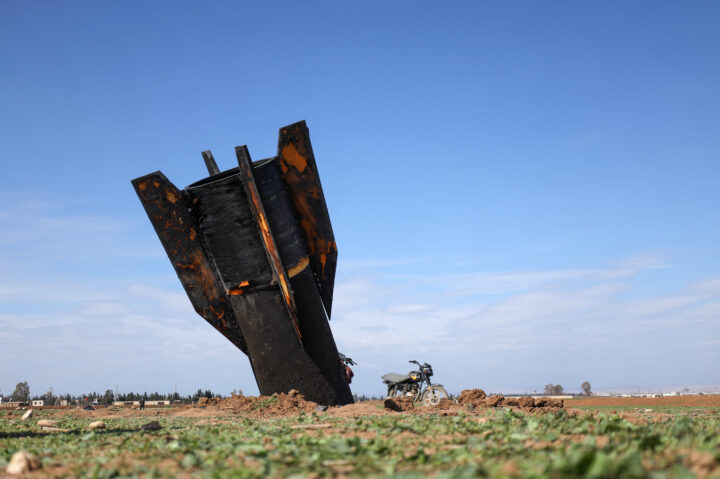
Amjad Kurdo / Middle East Images / AFP via Getty Images
A view of an Iranian missile after it fell near Qamishli International Airport, near the Turkish border in the Qamishli district of Hasakah, Syria, on March 4, 2026, amid the U.S.-Israeli conflict with Iran.
Iran and Turkey moved to de-escalate tensions between them in the immediate aftermath of the downing of an Iranian missile over Turkey on Wednesday, but the development signals dangerous potential if the conflict heats up between them, experts said.
NATO air defense systems shot down an Iranian ballistic missile heading for Turkish airspace on Wednesday. Turkish Foreign Minister Hakan Fidan spoke with his Iranian counterpart, Abbas Araghchi, warning Araghchi not to allow the conflict to spread across the region. Turkey summoned the Iranian ambassador to Ankara for a reprimand.
“All necessary steps to defend our territory and airspace will be taken resolutely and without hesitation,” including consulting with NATO allies to protect the country, Turkey’s Defense Ministry said in a statement.
Officials told The Wall Street Journal the missile was targeting the Incirlik Air Base in Turkey, which hosts American troops. At the same time, a Turkish official told Agence France-Presse that the missile was likely aimed at Cyprus, where Iran has struck British military assets.
Zvi Yehezkeli, an Arab affairs expert for i24 News, interpreted the missile over Turkey as mostly symbolic, meant as an Iranian message to Ankara to stay out of the war.
Though Turkish President Recep Tayyip Erdogan said he was saddened by the killing of Iranian Supreme Leader Ayatollah Ali Khamenei in the war, his response “was viewed in Tehran as hypocrisy,” and they see Erdogan as “playing a double game,” according to Yehezkeli.
“Ankara knows that this symbolic shot was mostly meant for domestic needs in Tehran,” Yehezkeli stated. “For Turkey, silence and containment are the most comfortable way at the moment.”
Gallia Lindenstrauss, a senior research fellow at the Institute for National Security Studies at Tel Aviv University specializing in Turkish foreign relations, told Jewish Insider that there were “efforts on both sides to minimize the significance of the event.”
In Ankara, she said, “some said [the missile] was meant for Cyprus, some said it was shot by independent groups and not under orders from Tehran. The Iranians said there was no attempt to harm Turkey.”
Lindenstrauss said that while Iran’s intentions are hard to confirm, they may have aimed at the Ceyhan port, through which Azerbaijan ships oil to Israel, especially in light of Iran’s strike on Azerbaijan the following day.
“The attempt to strike Turkey is part of an Iranian policy of trying to get everyone involved in the conflict. They are shooting in all directions. I don’t think [targeting Turkey] is a one-time thing,” she said.
Lindenstruass said she sees several possible negative consequences for Turkey from the war.
“Turkish commentators who understand the severity [of the missile attack] say that Iran is suicidal,” she said.
In addition, Ankara is very concerned about the “spillover of destabilization,” including the possibility of the Kurds getting involved in the conflict, of European navies sending ships to the region to defend Cyprus, and a wave of refugees attempting to enter Turkey from Iran.
Turkey has long had a wall on its border with Iran, and hundreds of Iranians have successfully crossed the border since the start of the war on Saturday, according to Reuters.
“For Israelis, what is most concerning is a growing view [in Turkey] of Israel as a threat that has grown too strong,” Lindenstrauss said. “They have the idea that Israel is behind the events. They don’t blame the U.S.; they blame Israel for a provocation and sabotaging the negotiations.”
At the same time, Turkey is making gains from the conflict in its defense industry, she said.
“Turkey is supplying drones to Gulf States, and Saudi Arabia and Egypt are interested in the fighter jet that Turkey is building. The Gulf States are not happy with Turkish behavior, but they will not isolate Ankara because of its defense industry. That is seen [in Turkey] as a game-changer,” Lindenstrauss said.
David Wurmser, former Middle East advisor to Vice President Dick Cheney and a senior fellow at the Jerusalem Center for Security and Foreign Affairs, warned in a message, obtained by JI, that he sent to Israeli and American officials that Turkey may choose to join the war against Iran, expressing a broader concern about the involvement of radical Sunni countries.
After Iranian missiles struck Qatar, the Gulf state’s foreign minister, Sheikh Mohammed bin Abdulrahman Al Thani, rejected Iran’s claim that they were aiming for American assets and said Tehran “was seeking to inflict harm on its neighbors and drag them into a war that is not theirs.”
Pakistan publicly warned that Iran “should keep … in mind” that it signed a mutual defense pact last year with Saudi Arabia, which has been struck repeatedly by Iranian missiles and drones in recent days. Pakistan has nuclear weapons.
“Any intervention by Turkey, Pakistan or Qatar is extremely dangerous,” Wurmser said. “It adds nothing, but transforms the texture of this war in extreme, dangerous ways. Even to the point that it can complicate or potentially even make [Israel and the U.S.] lose this … If a Sunni shark-feeding frenzy emerges, Iranians will hunker down, and become passive in fear, perhaps passive even against this regime.”
Intervention by those countries would “transform the narrative of this war,” Wurmser said. “Right now, the war [is] one of the civilized world defending itself and returning Iran to the Iranian people from a lunatic, evil and sadist regime. It cast the Iranian people as our allies and part of our team in battle.”
“The Sunni threat to Iran, however, is seen by Iranians in their gut and bones as a matter of threatening death,” he added.
Wurmser noted that most Sunni states in the region “opposed this war; they tried to sabotage it.” He accused Turkey, Pakistan and Qatar of now “try[ing] to swoop in on the prey.”
Yehezkeli also wrote about the role of deep-seated divisions between Sunni and Shi’ite states.
The Shi’ite leadership of Iran “has a clear accounting of who supported [them], who was silent and who is the real enemy,” Yehezkeli wrote. “The background goes deeper than recent events. The hatred between the Sunnis and the Shi’ites, which began in Islam’s early days, never disappeared. It was only hidden at times behind political interests and temporary alliances.”
Lindenstrauss, however, said she thinks “the Turkish context is more complex” when it comes to the Sunni-Shi’ite divide.
“The largest minority in Iran is Azeris, and they’re Shi’ite and so is [Turkey ally] Azerbaijan,” she noted. “The Kurds are Sunni and that doesn’t calm the Turks down about them. … I don’t see Sunni cooperation against Iran.”
Lindenstrauss said she thinks “Turkey’s interest is for the Islamic Republic to stay in charge [of Iran] but weaker, yet not so weak that there will be a wave of refugees and a Kurdish uprising.”
Barrack, the U.S. ambassador to Turkey, plays an outsized role in setting foreign policy in the region, lawmakers and experts say
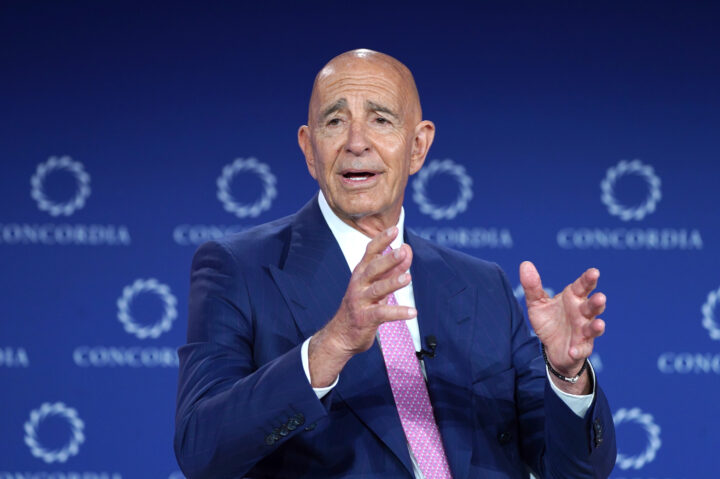
Leigh Vogel/Getty Images for Concordia Annual Summit
U.S. Ambassador to Turkey Tom Barrack speaks during the 2025 Concordia Annual Summit on September 24, 2025 in New York City.
Simmering frustrations among lawmakers with U.S. Ambassador to Turkey Tom Barrack — who also serves as special envoy to Syria and manages a wide remit in America’s Middle East policy — have recently emerged with force, as multiple lawmakers tell Jewish Insider they have concerns about the U.S. envoy’s expansive role.
Barrack’s critics see the envoy pushing U.S. policy in concerning directions, toward an overly close relationship with Turkey despite the country’s overt anti-Israel posture and regional ambitions and, most recently, as a key enabler of the Turkish-backed Syrian government’s offensive against U.S.’ longtime Kurdish allies in the Syrian Democratic Forces.
Over the course of months, the envoy has also made comments that have concerned lawmakers, including questioning Israel’s status as a democracy, downplaying the threat from Hezbollah and supporting a Turkish role in the International Stabilization Force in Gaza, despite Turkey’s long record of hostility to Israel.
A Republican senator, granted anonymity to speak candidly, told JI last week that Barrack’s role in U.S. policy in the region makes them “nervous.”
“He’s running a Turkish line, and there are very legit[imate] concerns” about his role and influence, the senator said.
A senior Senate Democrat involved in foreign policy issues also said he had concerns about Barrack, suggesting the envoy was pursuing personal business interests through his post.
“Barrack is clearly knowledgeable about the region, he’s clearly energetic and engaged. But that’s the only good I can say. I have real concerns about his motives and the consequences of his actions,” the Democratic senator said.
“That’s something I really worry about. When the president himself is among the most corrupt in American history, we can’t be surprised when the people he puts in positions of power conduct themselves in the same way, but it’s really dangerous,” the lawmaker added. “We’re losing our reputation as a good partner, a reliable ally and a country committed to supporting anti-corruption efforts.”
Asked about Barrack’s role in the administration, Sen. Richard Blumenthal (D-CT) told JI, “I’m hopeful that the interests of the Kurds will be protected. America needs to stand up to the Turks where necessary and insist that those rights be adequately represented.”
Lawmakers’ concerns have become public at a series of hearings on the Hill in recent weeks.
At a House Foreign Affairs Committee hearing on Syria last week, Rep. Josh Brecheen (R-OK), a leading skeptic among House Republicans of repealing U.S. sanctions on Syria, said he feels that Barrack’s dual role as ambassador to Turkey and Syria special envoy is hampering the U.S.’ ability to take a tougher stance with Syria.
“[Barrack] has to maintain a good relationship with Turkey. Would we not be well-served for someone to be specific to Syria, whether it be an envoy specific to Syria or an ambassador — how would that not help us to make sure that Tom Barrack can maintain a good relationship with Turkey but we’d have somebody to play hardball with Syria?” Brecheen said.
Brecheen said he’s worried that Turkish President Recep Tayyip Erdoğan seeks to reestablish the Ottoman Empire and that Syrian President Ahmed al-Sharaa is deceiving the U.S. and still maintains a jihadist ideology. He said current U.S. policy appears to be facilitating Turkish and Russian interests.
Nadine Maenza, the former chair of the U.S. Commission on International Religious Freedom, who testified before the committee, responded that she shares Brecheen’s concerns.
“It’s been very difficult to have him have both hats on, and I think we’ve seen that with the State Department not having a role to play in Syria policy and waiting for Barrack to make decisions,” Maenza said. “I don’t think that serves the president well, if his goal is peace and stability in the Middle East.”
At another House Foreign Affairs Committee hearing earlier this month, Rep. Brad Sherman (D-CA) highlighted Barrack’s past comments on Hezbollah, which he said “have often sent the wrong signals.” David Schenker, a senior fellow at The Washington Institute for Near East Policy who served in the first Trump administration, also repudiated Barrack’s comments.
Barrack has faced criticism off the Hill in conservative circles as well: a Wall Street Journal editorial last month blasted his “not-so-excellent Syrian adventure,” characterizing the ambassador as overly close with Turkey and pushing an anti-SDF policy in the administration.
Responding to the editorial, former Sen. Rick Santorum (R-PA) blasted Barrack for having “betrayed [the Kurds], Christians in Syria and our country for Turkey.” “His behavior is a disgrace. He should be recalled,” Santorum added.
Former National Security Advisor John Bolton — who has since come under fire by President Donald Trump — said last year that Barrack has been “publicly making excuses for al-Sharaa’s reluctance to open full diplomatic relations with Israel. It is not generally a U.S. ambassador’s job to justify another country’s actions. He should be warned about the symptoms he is displaying.”
Conservative commentator Mark Levin similarly criticized Barrack last summer for rebuking Israel’s attacks on Syrian government-aligned forces carrying out massacres of Druze and other minority groups.
His concerns were echoed by right-wing influencer Laura Loomer, who said that Barrack’s “delusions that he can play nice with [al-Sharaa], who is literally ISIS, is going to continue to destabilize the Middle East and get more innocent non-Muslims killed,” describing Barrack’s approach to Syria as completely wrong-headed.
“I have heard from different sources that [the Turks] perceive Tom Barrack to be their man, and this is the first time in a long time they feel that they have a U.S. envoy that’s essentially on their side, if you want to use that terminology, and is basically positioning Ankara to really realize a lot of their policy goals, their geostrategic goals,” Sinan Ciddi, the director of the Turkey program at the Foundation for Defense of Democracies, told JI.
Barrack, while being “a problematic actor,” is also “deeply influential,” Ciddi said, characterizing him as one of the two most influential figures in the U.S.’ regional policy alongside White House Special Envoy Steve Witkoff. Like Witkoff, Barrack is a longtime friend and business associate of Trump.
“He is making moves, he’s implementing policies as special envoy and as ambassador that I think present deep risks and and could have potentially detrimental consequences, because it’s going to alienate the United States at the least, but at worst, they could really inflame a considerable number of situations that we’re active looking at,” Ciddi said.
He raised concerns about three particular policies that Barrack has appeared to promote: providing Turkey with advanced F-35 fighter jets despite U.S. sanctions, bringing Turkey into the International Stabilization Force in Gaza and pushing for an influential role for Turkey in Syria and a favorable stance toward the new Syrian government.
He said that Barrack and the Trump administration more broadly appear to view Turkey as a partner that they can cooperate with on goals including stabilizing Syria and Gaza.
Israeli officials, however, view the situation in a very different light, and “feel that through Barrack’s adventurism, what we are seeing are dangerous moves to position Turkey in the Levant and the Middle East as an aggressive actor,” Ciddi said. “They feel that Turkey is, through Barrack, finding a means and opportunity to weaken Israel.”
Ciddi warned that Turkey having any role in the stabilization force in Gaza would be “fundamentally very, very dangerous” given Turkey’s friendliness with Hamas and hostility toward Israel. And he said that providing Turkey with the advanced F-35 jets would be “deeply problematic” given its close relationship with Russia, along with various other issues, a dynamic that has troubled lawmakers and European allies.
Ciddi also said that Barrack’s public comments, or lack thereof, about Turkey’s closeness with Hamas and Iran, about Hezbollah and about Israel’s status as a democracy should be concerning for “all the countries that have signed up to the Abraham Accords, or any country in the region that’s taking a position against jihadist movements and Salafist movements.”
Michael Makovsky, the CEO of the Jewish Institute for National Security of America, told JI that, “half the things the guy says I can’t understand, and the other half I don’t agree with.” Makovsky said he’s been particularly troubled by Barrack’s influence on Syria policy, seemingly pushing the U.S. toward support for al-Sharaa.
“I think that’s been a big mistake,” Makovsky said, criticizing the “betrayal of the Syrian Kurds, which I found rather obscene” and emphasizing that the Kurds had been a critical ally of the U.S. in the fight against ISIS. He noted that al-Sharaa remains aligned with jihadists who have carried out massacres of Syrian minority groups.
“We’re all in on [al-]Sharaa, and I think that’s partly because Trump met him and likes him, but even before that, it’s because this is what Barrack wants,” Makovsky continued. “He seems to often reflect exactly the Turkish view, and I don’t think the Turkish view on Syria aligns with our own interests at all.”
He said that he was also troubled by Barrack’s claim that Israel is not a democracy, saying that it was a poor message from a U.S. official and suggested that he does not properly understand the region.
Congressional correspondent Emily Jacobs contributed reporting.
Plus, Massie challenger gets strong GOP backing

Julie Menin, speaker of the New York City Council and Zohran Mamdani, mayor of New York, arrive for an announcement in the Brooklyn borough of New York, US, on Monday, Jan. 12, 2026 (Photographer: John Lamparski/Bloomberg via Getty Images)
Good Thursday afternoon!
This P.M. edition is reserved for our premium subscribers — offering a forward-focused read on what we’re tracking now and what’s coming next.
It’s me again — Danielle Cohen-Kanik, U.S. editor at Jewish Insider and curator, along with assists from my colleagues, of the Daily Overtime. Please don’t hesitate to share your thoughts and feedback by replying to this email.
📡On Our Radar
Notable developments and interesting tidbits we’re tracking
Sen. Bill Cassidy (R-LA), the chairman of the Senate Health, Education, Labor and Pensions Committee, wrote to New York Mayor Zohran Mamdani today voicing “serious concerns” about Mamdani’s “rescission of executive orders related to antisemitism and boycotts of Israel.”
Cassidy said the New York City Department of Education’s $2.2 billion in federal funding could be rescinded “contingent on compliance with federal civil rights laws and applicable executive orders designed to protect students”…
New York City councilmembers on both sides of the aisle denounced a new working group established by employees of the city’s Department of Health on “global oppression,” Jewish Insider’s Will Bredderman reports, which a presenter at its first meeting on Tuesday acknowledged was “really developed in response to the ongoing genocide in Palestine.”
City Council Speaker Julie Menin called for a probe into the working group at DOH, which operates under Mamdani’s administration, telling the New York Post, “Our health care officials should be fighting infectious diseases and addressing skyrocketing health care costs instead of spending public time debating geopolitics”…
Moshe Davis, the former executive director of the Mayor’s Office to Combat Antisemitism in New York City, told The Free Press upon being ousted from the role by Mamdani, “I don’t think the priority of the administration has been to combat antisemitism.”
Davis, who was a political appointee of former Mayor Eric Adams, said a Mamdani staffer told him they were “looking to go in a different direction” in replacing him with Phylisa Wisdom, a progressive Jewish activist. “Look, I’m a loud, proud Jewish person with a kippah on my head, a proud Zionist. This administration maybe felt that was too much for them,” Davis said. He noted that his requests to meet with the mayor and the memos he produced on rising antisemitism in the city had gone ignored…
Mamdani officially endorsed New York Gov. Kathy Hochul in an anticipated move, boosting her reelection prospects while also dealing a blow to her lieutenant governor, Antonio Delgado, who is running to oust Hochul from her left…
Rep. Andy Barr (R-KY) and businessman Nate Morris, two of the leading Republican candidates for Kentucky’s Senate seat, today endorsed Ed Gallrein, the GOP challenger to Rep. Thomas Massie (R-KY), one of the leading Republican critics of Israel in Congress, JI’s Marc Rod reports.
“Ed will never side with AOC or the radical-left against President Trump. He is exactly the kind of conservative warrior we need in Congress, and I’m proud to endorse him,” Barr said in a statement, referencing Massie’s pattern of breaking with various elements of Trump’s agenda, which has included voting against support for Israel.
The endorsements came amid an ongoing series of attacks by Trump on Massie, which included calling Massie a “moron” in remarks at the National Prayer Breakfast this morning, as well as attacks on Truth Social this week targeting Massie’s wife…
Daniel Flesch, a senior policy analyst at the Heritage Foundation who led the drafting of the organization’s Project Esther report on combating left-wing antisemitism, has parted ways with the conservative think tank, according to Heritage’s website.
Flesch had raised the alarm on right-wing antisemitism after Heritage President Kevin Roberts released a video defending Tucker Carlson for hosting neo-Nazi Nick Fuentes on his podcast, telling the Young Jewish Conservatives in December that, “Now, in some ways, the call is coming from inside the house.” Flesch had also been Heritage’s point person for the National Task Force to Combat Antisemitism, a coalition of conservative groups that disaffiliated from the think tank after the incident…
White House Press Secretary Karoline Leavitt confirmed today that Special Envoy Steve Witkoff and Jared Kushner will be traveling to Oman for negotiations with Iran tomorrow, saying at a press conference this afternoon that the president is “standing by for an update from them.”
“The president has obviously been quite clear in his demands of the Iranian regime — zero nuclear capability is something he’s been very explicit about and he wants to see if a deal can be struck. And while these negotiations are taking place, I would remind the Iranian regime that the president has many options at his disposal aside from diplomacy as the commander-in-chief of the most powerful military in the history of the world,” Leavitt added…
Israeli Prime Minister Benjamin Netanyahu told lawmakers at a closed-door meeting of the Knesset Foreign Affairs and Defense Committee that U.S.-Israel coordination is “as high and as close as possible” ahead of the nuclear talks tomorrow, Israeli media reports, but that he still doesn’t know if President Donald Trump will choose to take military action…
Middle East countries that were originally meant to participate in the talks, including Saudi Arabia, Qatar, Egypt, Oman, the UAE and Pakistan, drafted a potential agreement for the U.S. and Iran, including a nonaggression pact, diplomats told The Times of Israel…
Iran’s Islamic Revolutionary Guard Corps seized two foreign oil tankers in the Persian Gulf today, Iranian state media reported, days after attempting to stop and board a U.S.-flagged oil tanker. Reports did not provide the country of origin of the tankers seized today…
Sen. Lindsey Graham (R-SC) expressed frustration with the Lebanese government’s stance toward Hezbollah amid struggling disarmament efforts, describing on X a meeting he’d had with Gen. Rodolphe Haykal, the commander of the Lebanese Armed Forces. “I asked him point blank if he believes Hezbollah is a terrorist organization. He said, ‘No, not in the context of Lebanon.’ With that, I ended the meeting.”
“They have been designated as a foreign terrorist organization by both Republican and Democrat administrations since 1997 — for good reason. As long as this attitude exists from the Lebanese Armed Forces, I don’t think we have a reliable partner in them,” Graham continued. The U.S. has provided over $3 billion to shore up the LAF in the last 20 years, including $230 million approved by the Trump administration as recently as October…
⏩ Tomorrow’s Agenda, Today
An early look at tomorrow’s storylines and schedule to keep you a step ahead
Keep an eye out in Jewish Insider for whether AIPAC’s active role in the New Jersey 11th Congressional District Democratic primary — opposing former Rep. Tom Malinowski (D-NJ) — paid off. Polls in the district close at 8 p.m.
We’ll be watching for readouts from the meeting between White House Special Envoy Steve Witkoff, advisor Jared Kushner and Iranian Foreign Minister Abbas Araghchi in Oman at 10 a.m. local time tomorrow, including whether issues beyond Tehran’s nuclear program are discussed.
We’ll be back in your inbox with the Daily Overtime on Monday. Shabbat Shalom!
Stories You May Have Missed
AI AMBITION
The Israeli-American CFO first fueled Eli Lilly’s success, and is now turning her attention to the tech sector
SURVEY SAYS
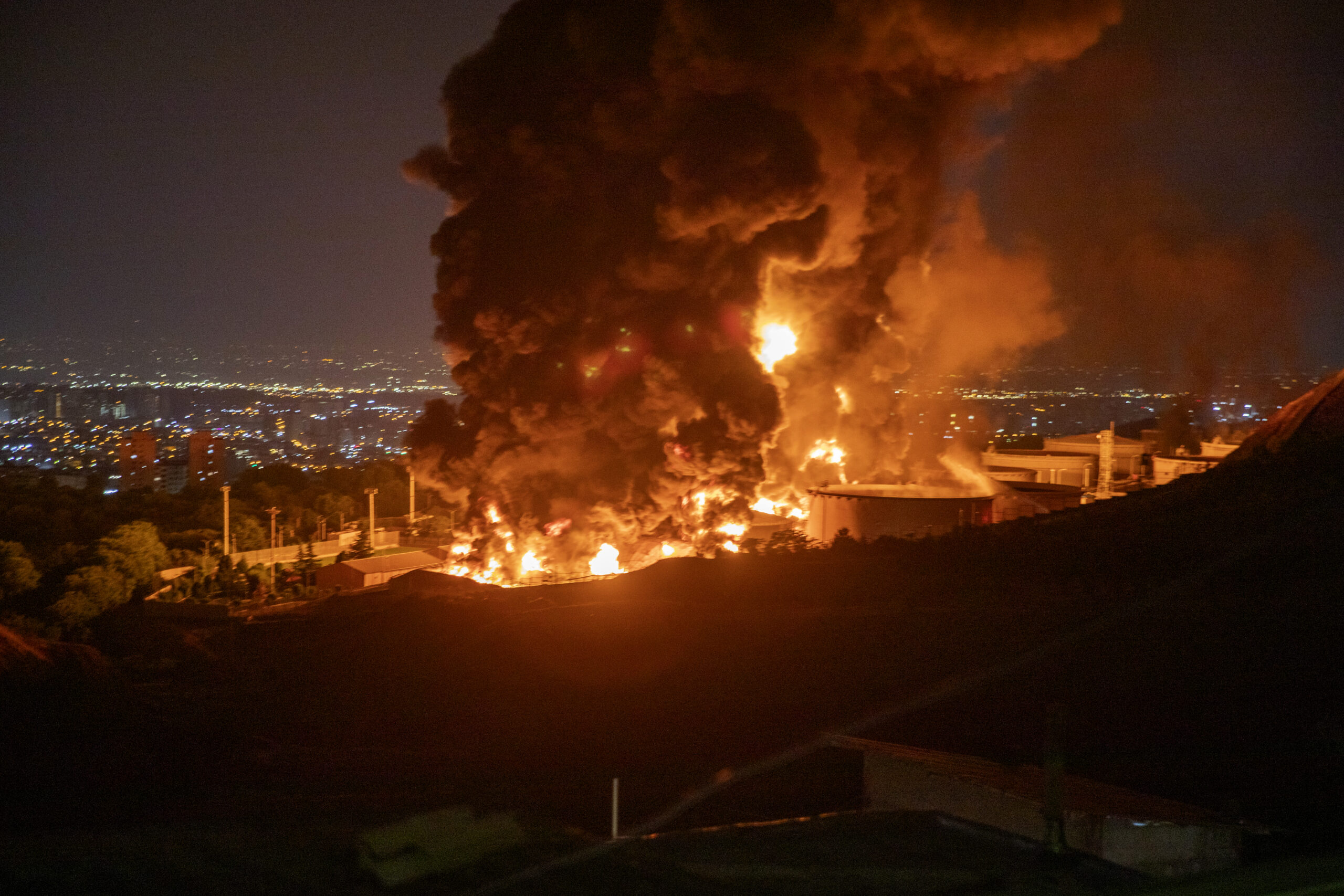
Right-wing Israelis support a strike even if Iran does not attack, while other political camps prefer to wait and see if Iran strikes Israel first, IDI poll finds
Plus, Israel continues to cast doubt over Iran talks
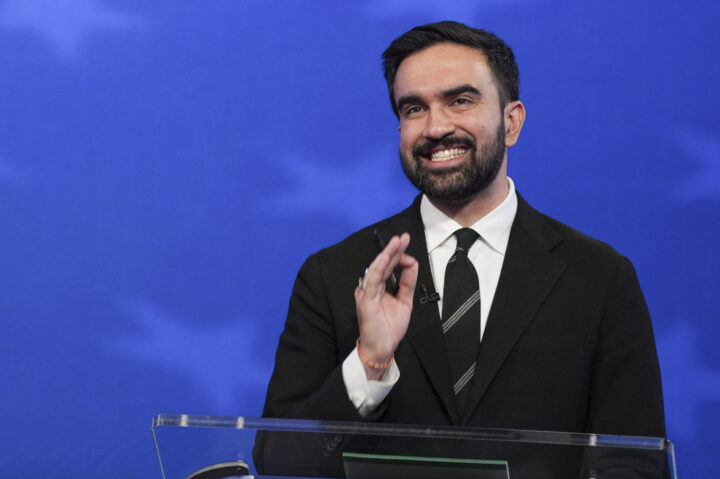
Angelina Katsanis-Pool/Getty Images
Democratic mayoral nominee Zohran Mamdani speaks during a mayoral debate at Rockefeller Center on October 16, 2025 in New York City.
Good Wednesday afternoon!
This P.M. edition is reserved for our premium subscribers — offering a forward-focused read on what we’re tracking now and what’s coming next.
It’s me again — Danielle Cohen-Kanik, U.S. editor at Jewish Insider and curator, along with assists from my colleagues, of the Daily Overtime. Please don’t hesitate to share your thoughts and feedback by replying to this email.
📡On Our Radar
Notable developments and interesting tidbits we’re tracking
U.S. officials reportedly backtracked on their rejection of Iranian demands to change the format and venue of nuclear negotiations, set for Friday, after several Middle East leaders intervened to keep the U.S. from walking away, according to Axios. “They asked us to keep the meeting and listen to what the Iranians have to say. We have told the Arabs that we will do the meeting if they insist. But we are very skeptical,” one U.S. official told the outlet.
Iranian Foreign Minister Abbas Araghchi confirmed on X that “nuclear talks … are scheduled to be held in Muscat” at 10 a.m. on Friday, indicating the U.S. agreed to move the venue from Turkey to Oman…
But Secretary of State Marco Rubio reiterated today that the Trump administration is seeking a comprehensive deal with Iran to address more than just its pursuit of nuclear weapons — including its ballistic missiles program, support for terror proxies and internal repression as well. Iran has traditionally been resistant to discussing anything beyond its nuclear program.
Asked if Iranian Supreme Leader Ayatollah Ali Khamenei should be worried right now, President Donald Trump told NBC News today, “I would say he should be very worried, yeah, he should be.” Trump said he was interested in negotiations again as he understood Iranian officials were considering restarting their nuclear program, “and if they do, we’re going to send” B-2 bombers “right back to do their job again,” referencing the U.S.’ June strikes…
Israeli officials have voiced skepticism over the prudence of negotiating with Iran at all, Jewish Insider’s Lahav Harkov reports. After Israeli Prime Minister Benjamin Netanyahu told White House Special Envoy Steve Witkoff yesterday that Iran’s “promises cannot be trusted,” Energy Minister Eli Cohen told Israeli radio, “Our message to the U.S. is that negotiations with Iran are a waste of time”…
Sam Brownback, the former U.S. ambassador at large for international religious freedom and a former GOP senator from Kansas, warned at a House Foreign Affairs Committee hearing today that, unless Syrian minority groups are allowed to maintain their own security forces, they face a likely genocide by government-aligned forces, JI’s Marc Rod reports.
“The new administration in Syria is purging religious minorities, threatening and killing them,” Brownback said. “These groups must be allowed to maintain their own security forces, or I guarantee you today, a genocide will happen in Syria like happened in Iraq to the Yazidis and Christians.”
The Trump administration has remained largely supportive of the al-Sharaa government, and critics have accused the White House of essentially abandoning the U.S.’ longtime Kurdish allies to the Syrian government onslaught…
First Lady Melania Trump welcomed freed Israeli hostages Aviva and Keith Siegel to the White House today, JI’s Gabby Deutch reports, one year after Aviva met the first lady for the first time and pleaded for help in securing her husband’s release.
“Aviva is a warrior. She’s a warrior. She was fighting very hard for Keith, and I know he suffered a lot,” Trump said at the meeting. “I’m happy to see you healthy at home with your children, with your grandchildren, with your family, and I know you’re giving back your time, your energy, to other people”…
New York City Mayor Zohran Mamdani tapped Phylisa Wisdom, the executive director of the progressive group New York Jewish Agenda, to lead the Mayor’s Office to Combat Antisemitism, the Forward reports.
Wisdom told JI last month that tackling the “scourge of antisemitism” in the city will require a comprehensive strategy,” noting that the office she will now lead “can play a key role, coordinating between long-standing offices and agencies tasked with combating hate, and input from the diversity of New York’s Jewish community.”
The appointment of the left-wing activist indicates Mamdani’s administration isn’t looking to placate the mainstream Jewish community. Wisdom, while well-known in the New York Jewish community, has traditionally opposed the International Holocaust Remembrance Alliance’s working definition of antisemitism and at times vocally opposed Israel’s war in Gaza after the Oct. 7 attacks…
Meanwhile, New York Gov. Kathy Hochul selected former New York City Council Speaker Adrienne Adams as her running mate in her reelection race this year — a pick that provoked both applause and consternation among leaders of the state’s Jewish community, JI’s Will Bredderman reports.
Adams was the first council speaker not to lead a delegation to Israel — although she denied that she was boycotting the country, she raised concerns in 2024 when her office drafted an ultimately abandoned resolution urging a ceasefire between Israel and Hamas that one Jewish community leader described to JI as “one-sided” and “inflammatory”…
A pair of well-financed groups, whose origin is currently unknown, is set to begin running ads boosting moderate pro-Israel candidates in a series of open House seats in Chicago, each of whom is facing off against vocal anti-Israel opponents, JI’s Marc Rod reports.
The ads — being run by newly formed super PACs Elect Chicago Women and Affordable Chicago Now — boost state Sen. Laura Fine, running in the 9th Congressional District, former Rep. Melissa Bean (D-IL), running in the 8th District and Cook County Commissioner Donna Miller, running in the 2nd District.
The ad buys for the two groups add up to millions of dollars across the three races. Given that the groups were just launched, FEC filing policies will not require them to disclose their donors until close to Election Day. But the ads, which do not focus on Israel policy, are widely rumored to be connected to United Democracy Project, the AIPAC-affiliated super PAC…
PEN America, an organization promoting free expression for artists and journalists, said today it would retract its Jan. 29 statement expressing concern about the abrupt cancellation of Israeli comedian Guy Hochman’s shows in New York and Los Angeles. The organization, which alleged Hochman “has been accused by advocacy organizations of incitement to genocide in Gaza,” said it would “remain committed to open and respectful dialogue about the divisions that arise in the course of defending free expression”…
The Washington Post announced mass layoffs of one-third of its staff today, including closing its sports section, reducing its local coverage and letting go all of its Middle East correspondents. The outlet has faced repeated criticism for major factual errors and alleged institutional and reporter bias related to its coverage of Israel and the war in Gaza…
⏩ Tomorrow’s Agenda, Today
An early look at tomorrow’s storylines and schedule to keep you a step ahead
Keep an eye out in Jewish Insider for a profile of Alphabet’s Israeli-American chief financial officer, Anat Ashkenazi, who got her start at Israel’s Bank Hapoalim more than two decades ago.
It’s primary day in New Jersey’s 11th Congressional District, as candidates vie for the Democratic nomination to fill Gov. Mikie Sherrill’s House seat. The race has attracted attention for the more than $2 million the AIPAC-linked super PAC United Democracy Project has spent targeting former Rep. Tom Malinowski (D-NJ), who is attempting to beat out others including Lt. Gov. Tahesha Way, far-left activist Analilia Mejia and Essex County Commissioner Brendan Gill.
The Hudson Institute will host Rabbi Yehuda Kaploun, the special envoy to monitor and combat antisemitism, for a conversation on the Trump administration’s strategy in confronting the rise of antisemitism.
Stories You May Have Missed
UNDER SCRUTINY

‘Just because someone is a hateful antisemitic looney-tune doesn’t mean they can’t win office,’ one Jewish community activist said of Shelly Arnoldi
SCHOOL OF THOUGHT

Ben Shuldiner, who is Jewish, is bringing his progressive politics to a school district facing a spike in antisemitism
Plus, Congress questions Hezbollah disarmament delays
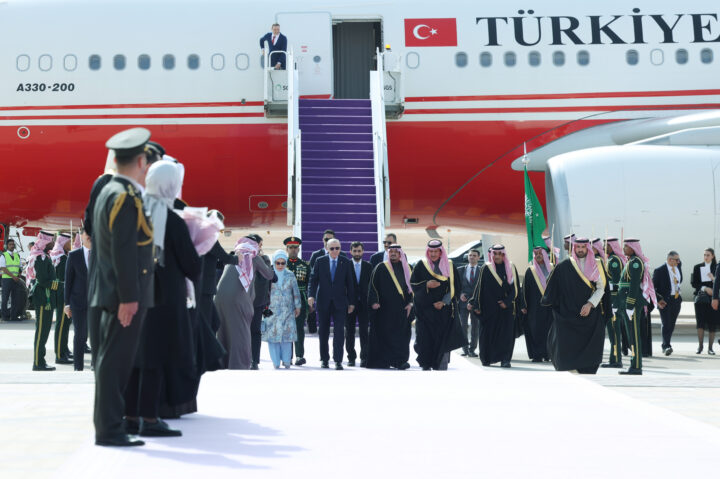
TUR Presidency/Mustafa Kamaci/Handout /Anadolu via Getty Images
Turkish President Recep Tayyip Erdogan arrives in the Saudi capital Riyadh at King Khalid International Airport, on February 03, 2026.
👋 Good Wednesday morning!
In today’s Daily Kickoff, we report on yesterday’s meeting in Riyadh between Saudi Crown Prince Mohammed bin Salman and Turkish President Recep Tayyip Erdoğan, as Saudi Arabia and Turkey clash with Israel on a range of geopolitical issues, and cover a House Foreign Affairs Committee subcommittee hearing in which experts raised concerns about Lebanon’s slow-walking of its disarmament of Hezbollah. We report on concerns by Jewish leaders in Virginia over antisemitic statements espoused by a candidate for Fairfax County GOP chair, and profile Ben Shuldiner, the new head of Seattle Public Schools. Also in today’s Daily Kickoff: Isaac Mizrahi, Guy Gilboa-Dalal and Matt Nosanchuk.
Today’s Daily Kickoff was curated by JI Executive Editor Melissa Weiss and Israel Editor Tamara Zieve, with assists from Danielle Cohen-Kanik and Marc Rod. Have a tip? Email us here.
What We’re Watching
- White House Special Envoy Steve Witkoff is in the United Arab Emirates today for meetings aimed at reaching a ceasefire in the Russia-Ukraine war. Witkoff traveled to the UAE from Israel, where he met with Prime Minister Benjamin Netanyahu yesterday afternoon.
- The meeting between Witkoff and Netanyahu came amid increasing tensions between the U.S. and Iran, and took place hours before a U.S. aircraft carrier shot down an approaching Iranian drone. On Tuesday evening, reports emerged that Tehran was pushing to move a meeting between Witkoff and Iranian Foreign Minister Abbas Araghchi from Turkey to Oman.
- In Washington, First Lady Melania Trump is hosting former hostages Keith and Aviva Siegel at the White House this afternoon for a private sit-down.
- Israeli Foreign Minister Gideon Sa’ar is in Washington for a critical minerals conference hosted by Secretary of State Marco Rubio. Last night, Sa’ar convened a group of Latin American and U.S. diplomats, including the ambassadors of Argentina, Paraguay and Ecuador as well as Deputy Secretary of State Christopher Landau, White House Faith Advisor Paula White and Reps. Maria Elvira Salazar (R-FL) and Mario Díaz-Balart (R-FL).
- The House Foreign Affairs Committee is holding a hearing on religious freedom around the world. Sam Brownback, who served as ambassador at large for international religious freedom, is among those set to testify.
- The Muslim World League is holding an event on Capitol Hill with former Saudi Justice Minister Sheikh Mohammed Al-Issa and Rabbi Yehuda Kaploun, the State Department’s special envoy to monitor and combat antisemitism.
- The Manhattan Institute is awarding Ben Shapiro with the annual City Journal Award at a reception tonight in Palm Beach, Fla.
- The World Governments Summit continues today in Abu Dhabi, United Arab Emirates. Earlier today, Tucker Carlson interviewed newly appointed Venezuelan Vice President Calixto Ortega Sánchez on the main stage. Former Secretary of State Mike Pompeo, who took the stage yesterday, told attendees that a new deal between the U.S. and Iran was “unimaginable” while Iranian Supreme Leader Ayatollah Ali Khamenei remains in power.
- Web Summit Qatar wraps up today in Doha, Qatar. During one of yesterday’s mainstage sessions, far-left streamer Hasan Piker alleged that Israel “played a significant role in how Oct. 7 took place.” Read more from JI’s Matthew Shea here.
What You Should Know
A QUICK WORD WITH JI’S JOSH KRAUSHAAR
Tomorrow’s New Jersey special Democratic primary election to fill Gov. Mikie Sherrill’s vacant House seat will offer an early test of AIPAC’s ability to continue showcasing its political clout. The pro-Israel group’s super PAC, in a potentially risky move, has spent over $2 million in ads attacking former Rep. Tom Malinowski (D-NJ), who has come out in favor of conditioning some aid to Israel, in hopes of electing a more reliable ally in former Lt. Gov. Tahesha Way.
The group’s ad hits Malinowski not for his views on Israel, but for a bipartisan vote in 2019 funding the Immigration and Customs Enforcement (ICE) and over stock trades he made as a congressman. The ICE attacks, in particular, are expected to resonate in the affluent, center-left district. Because of his name recognition representing a neighboring district before losing reelection in 2022, Malinowski started out as the early front-runner but is taking a serious hit on the airwaves.
But complicating that strategy is the presence of a far-left, anti-Israel candidate in Analilia Mejia, who leads a progressive advocacy group and has been endorsed by Sen. Bernie Sanders (I-VT) and Rep. Alexandria Ocasio-Cortez (D-NY). Mejia has been polling in second place, according to some reports, and has a path to winning the nomination — and the seat, given the 11th Congressional District’s Democratic lean.
The race also features Essex County Commissioner Brendan Gill, an establishment-oriented politician — endorsed by former Gov. Phil Murphy — who has expressed consistently pro-Israel views on the campaign trail and in an interview with Jewish Insider.
Even as the political environment within the Democratic Party has shifted to the left, AIPAC isn’t backing down from its aggressive, on-offense playbook from 2024, when a number of mainstream pro-Israel Democrats backed by the group won their elections to Congress — while two of AIPAC’s most extreme opponents, former Reps. Cori Bush (D-MO) and Jamaal Bowman (D-NY), fell short in their reelection bids.
Given the changed intraparty mood, there was a question about whether pro-Israel groups would need to play a little more defense this election cycle, or at least refocus attention on stopping the most radical candidates with a chance of winning instead of going all-out for the most principled allies.
That’s looking — at least for now — not to be the case.
DEEPENING TIES
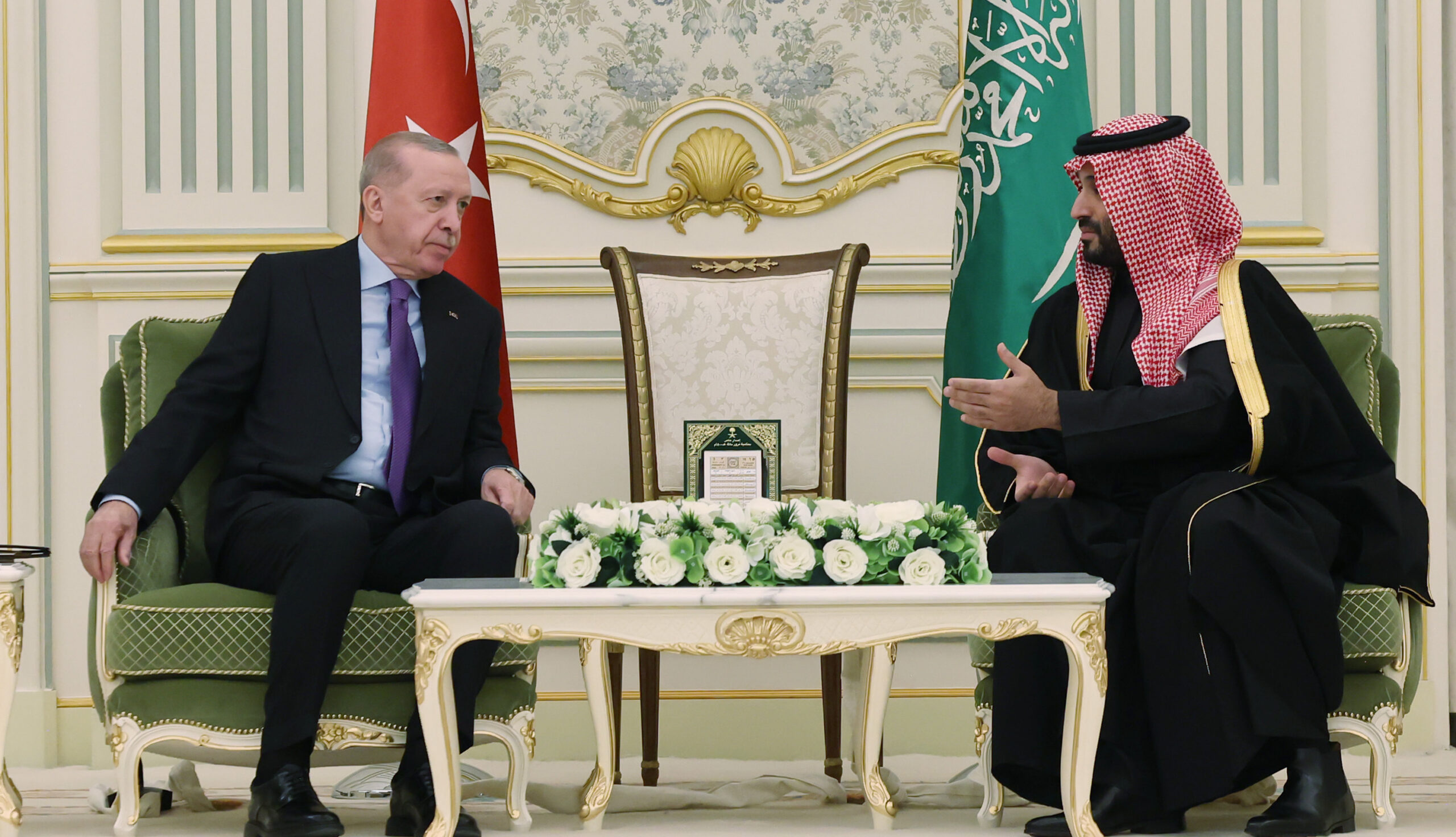
Saudi Arabia and Turkey issued a joint declaration on Tuesday pledging to expand cooperation across a wide range of defense, economic and regional security issues, signaling deepening strategic ties between the two countries and cementing a markedly improved relationship between former foes, Jewish Insider’s Matthew Shea reports.
Areas of agreement: As part of the joint statement, the two countries outlined their alignment on several regional issues, including rejecting Israel’s recognition of Somaliland and calling for an immediate Israeli withdrawal from Syria, as well as a two-state solution. The two leaders also agreed to push the U.S. toward de-escalation with Iran. The parties also agreed to “strengthen their cooperation” in areas including oil and gas and renewable energies, “building on Saudi Arabia’s massive energy investments,” the statement read.
ON THE HILL
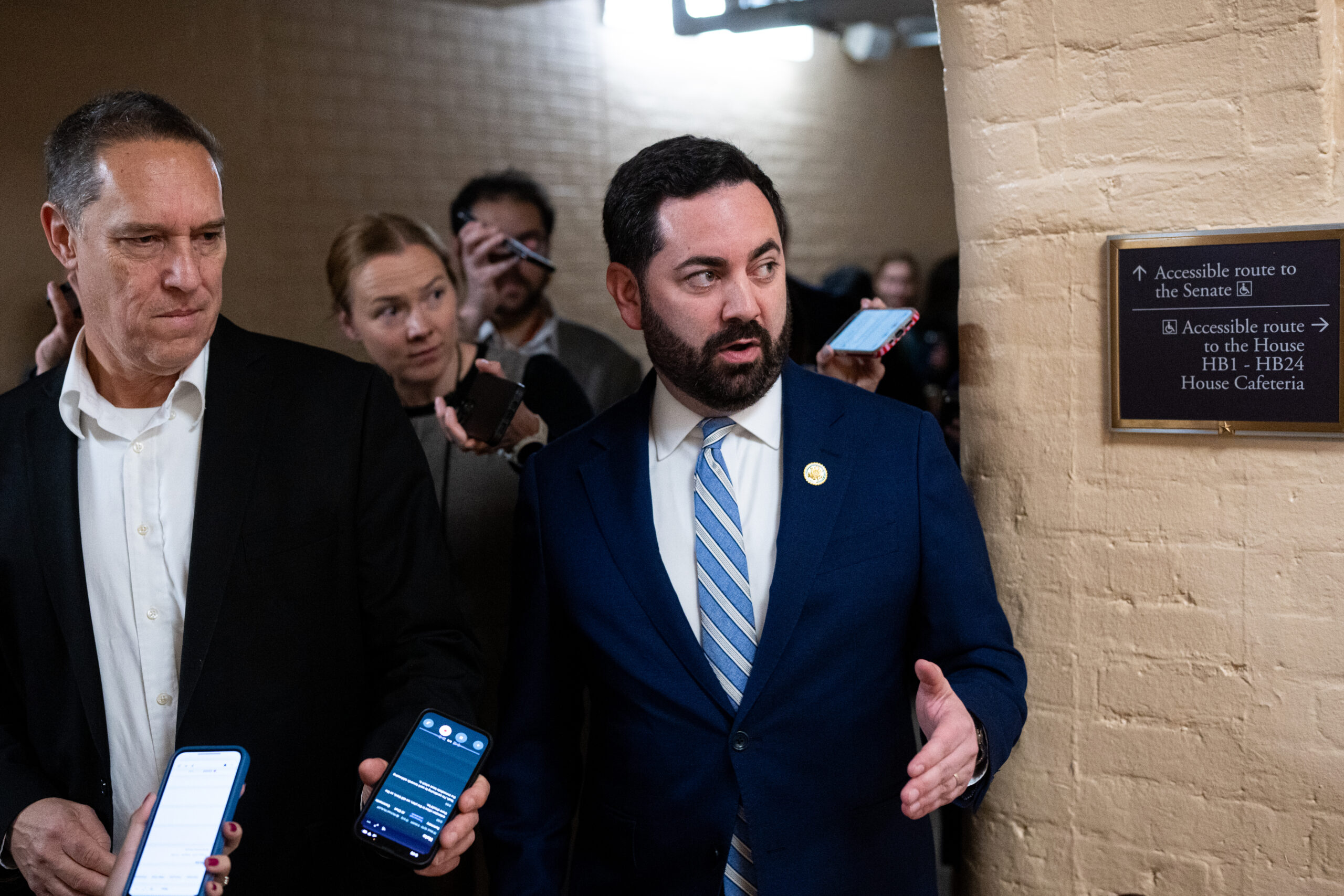
Lawmakers and expert witnesses at a House Foreign Affairs Committee subcommittee hearing on Tuesday highlighted the ongoing challenges and delays in the disarming of Hezbollah in southern Lebanon, but also argued that there is tremendous opportunity in the country if Hezbollah’s influence can be defeated — including potential moves in the near term toward normalization with Israel, Jewish Insider’s Marc Rod reports.
Notable quotable: “We have the chance to help this government break free of the shackles of Iran’s malign influence. Hezbollah’s influence is vastly diminished thanks in large part to decisive Israeli action. But difficult choices now need to be made,” Rep. Mike Lawler (R-NY), the Middle East subcommittee chair, said in his opening statement, noting the “haphazard at best” efforts to disarm Hezbollah. Rep. Brad Sherman (D-CA), the ranking member, said that there is a “historic opportunity” in Lebanon but “[t]hat window of opportunity, however, is narrow. Hezbollah is working hard to rebuild, rearm and to reconstitute itself as a major terrorist organization. He criticized the Trump administration and Special Envoy Tom Barrack in particular as hampering U.S. interests.
Syria spotlight: Lawmakers and expert witnesses pushed back at a Helsinki Commission hearing on Tuesday on efforts to reimpose sanctions on the Syrian government for its assault against the Kurds and other minorities, and pushed for the U.S. to facilitate a diplomatic arrangement between Israel and Turkey that would allow for a greater Turkish presence in Syria — in part as a counterweight to Russia, Jewish Insider’s Marc Rod reports.
UNDER SCRUTINY
A new candidate for Republican county chair in Virginia’s largest jurisdiction is facing scrutiny over a range of antisemitic social media posts in which she has told Jews to “move to Israel,” spread conspiracy theories about Jewish control of U.S. politics and expressed admiration for prominent neo-Nazis and Holocaust deniers, among other extremist comments. Shelly Arnoldi, who recently launched her bid to lead the Fairfax County Republican Committee, is stoking concerns among Jewish community leaders now seeking to raise awareness about her extensive public record of promoting antisemitic tropes while demonizing Israel, Jewish Insider’s Matthew Kassel reports.
Sign of the times: While Arnoldi is not seen as a particularly viable candidate in the upcoming Feb. 28 election, local political observers say, her campaign has still given some pause to both Jewish and Republican activists who worry her radical views underscore a creeping embrace of antisemitic sentiment in the GOP fueled by leading far-right commentators including Tucker Carlson, whose interviews she has eagerly endorsed. “She does not appear to be a serious person,” one Jewish community activist told Jewish Insider on condition of anonymity to address a sensitive topic. “But just because someone is a hateful antisemitic looney-tune doesn’t mean they can’t win office. She strikes me as someone who would continue to run, and in that regard I consider her to be a real threat.”
NAZI-ERA ACCOUNTABILITY
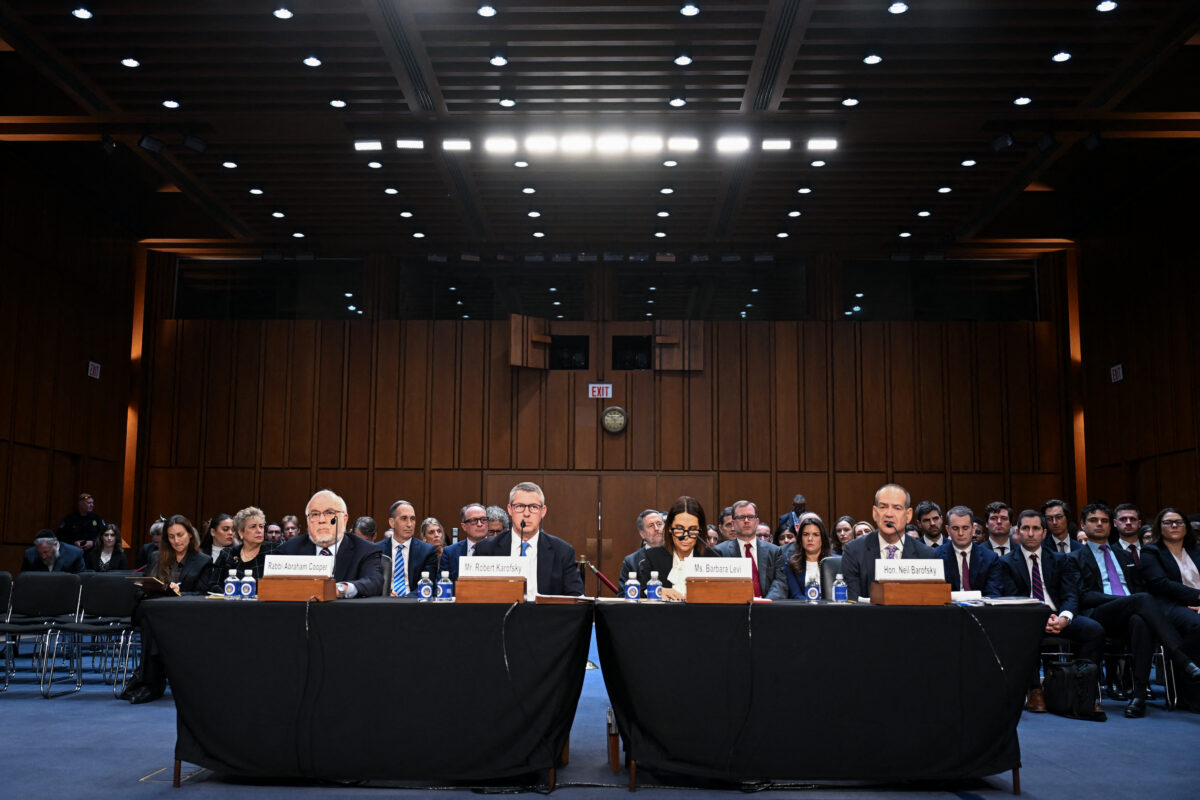
Republican and Democratic senators urged senior UBS executives in a hearing on Tuesday to reconsider the Swiss banking giant’s continued refusal to hand over more than 150 documents to an investigator probing Credit Suisse’s support for Nazi Germany during and after World War II, Jewish Insider’s Emily Jacobs reports.
The arguments: Senators pressed Robert Karofsky, president of UBS Americas, and Barbara Levi, UBS Group’s general counsel, to reverse course on the bank’s opposition to sharing with attorney Neil Barofsky and Congress the remaining files on the yearslong investigation into the ways that Credit Suisse, which UBS acquired in 2023, aided Adolf Hitler’s war efforts. Karofsky and Levi testified at the Senate Judiciary Committee hearing that UBS could not provide the documents until the New York judge that approved a $1.25 billion settlement in 1998 between multiple Swiss banks, including Credit Suisse, and Holocaust survivors issued an order affirming that the deal would cover any future claims.
BARAKA’S BACKING
Brian Varela, a businessman running in New Jersey’s 7th Congressional District, picked up an endorsement on Monday from Newark, N.J., Mayor Ras Baraka, a sign of Varela’s increasing outreach to progressive voters, Jewish Insider’s Marc Rod reports.
Background: Baraka’s progressive candidacy in last year’s New Jersey gubernatorial race raised concerns in the Jewish community, in part because Baraka, in the early 2000s, appeared alongside Nation of Islam leader Louis Farrakhan, who has a long record of antisemitism, and applauded violent rhetoric by the controversial preacher. Baraka also faced scrutiny over his record on Israel and antisemitism. A Varela spokesperson said the candidate is proud to have Baraka’s endorsement but “wants to be unequivocal” in condemning Farrakhan and his violent rhetoric and antisemitism.
school of thought
As Ben Shuldiner begins his tenure as superintendent of Seattle Public Schools, he’s got his hands full: The district is dealing with, among other things, a sharp decline in enrollment, a roughly $100 million budget deficit and serious gun violence issues, including the deaths of two students who were killed in a shooting outside a district high school on Friday. Adding to his plate, SPS has also made headlines in recent years with a series of high-profile antisemitic incidents, and Shuldiner, who is Jewish, knows he will likely be called to account for them, Jewish Insider’s Danielle Cohen-Kanik reports.
Shuldiner’s message: “What I’d say to Jewish readers, or anyone who wants to be an ally: If you see something bad, tell us. And we must act. If something is brought to me and we don’t deal with it, that’s on me. You should come after me — just give me a couple days to find a place to live first,” he told The Cholent, a local Seattle blog, in November. Shuldiner, 48, who took the helm at SPS on Feb. 1, comes from a family of New York educators. “Perhaps the most visceral and powerful concept in our faith is tikkun olam, repairing the world,” he wrote in an essay for The School Superintendents Association in November.
Worthy Reads
Talking to Tehran: In Newsweek, former White House Middle East Envoy Jason Greenblatt urges U.S. negotiators to address Iran’s treatment of its citizens when the parties meet later this week for talks aimed at calming tensions between Washington and Tehran. “The Iranian people are too often treated as a secondary concern, eclipsed by geopolitical calculations and security debates. That framing misses something fundamental. The regime’s threat to the outside world begins with how it governs at home. … Too often, international negotiations bracket domestic repression as an internal matter. That choice has consequences. A regime sustained by fear is not stable; it is brittle. Its violence is not incidental to its strategy. It is the strategy. Any serious approach to Iran must therefore confront the full scope of the threat the regime poses — not only to regional security and global nonproliferation, but to the Iranian people themselves. Their repression is not peripheral to the problem. It is central to it.” [Newsweek]
Pahlavi’s Path: The Free Press’ Eli Lake spotlights exiled Iranian Crown Prince Reza Pahlavi and the challenges he faces as he works to position himself as the successor to the current regime, should it collapse. “The moment has arrived for Pahlavi to decide what role he’ll play in any future beyond the regime. And there are signs that he is not well-positioned to unite the factions of Iran’s opposition and lead an orderly transition to a new form of government. Many other Iranian opposition figures told The Free Press that the crown prince’s organization has sought to marginalize them. Based on interviews with Iranian activists, along with journalists and friends and advisers to Pahlavi, it’s clear that the crown prince has alienated many of the Iranians who are challenging the Islamic Republic on the ground. Friends of the crown prince have bullied rival political figures and tried to curb their influence. And Pahlavi himself has at times exaggerated the fragility of the regime that just slaughtered thousands of his countrymen.” [FreePress]
San Francisco’s Mr. Fix-it: The New York Times’ Heather Knight profiles San Francisco Mayor Daniel Lurie, who has spent the bulk of his first year in office targeting minor bureaucratic hurdles and inconveniences facing city residents. “His quality-of-life strategy, which also included trying to bring businesses back to the hollowed-out downtown and clearing sidewalks of daytime drug markets, has paid off so far, resulting in strong first-year approval ratings. At the same time, Mr. Lurie, a moderate Democrat and earnest technocrat, insists he has no interest in national politics, and he still refuses to say President Trump’s name in public. … The maze at City Hall is so complex that some savvy San Franciscans earn a living as ‘permit expediters.’ Mr. Lurie’s administration has convened focus groups to figure out how to smooth the permitting process, yielding a running ‘no nonsense list’ that includes dozens of fixes.” [NYTimes]
Word on the Street
State Department Deputy Spokesman Tommy Pigott slammed South Africa for expelling Israel’s top diplomat in the country after video surfaced last week of Israel offering water technology and medical aid to minority tribes; “Expelling a diplomat for calling out the African National Congress party’s ties to Hamas and other antisemitic radicals prioritizes grievance politics over the good of South Africa and its citizens,” Pigott wrote on X…
The Chicago Tribune endorsed state Sen. Laura Fine over Evanston, Ill., Mayor Daniel Biss and far-left activist Kat Abughazaleh in the Democratic primary in Illinois’ 9th Congressional District…
Democrat Sue Altman, who lost to Rep. Tom Kean Jr. in the 2024 congressional election in New Jersey’s 7th District before working for Sen. Andy Kim (D-NJ) as state director, is mounting a bid in the 12th District, which covers central Jersey…
New England Patriots owner Robert Kraft’s Blue Square Alliance released its upcoming Super Bowl ad aimed at tackling antisemitism, Jewish Insider’s Haley Cohen reports; the commercial will also air during the Winter Olympics and is part of a $15 million campaign that additionally includes digital advertisements and billboards…
The New York Times spotlights fashion designer and actor Isaac Mizrahi, whose three-week cabaret residence at New York’s Café Carlyle opened this week…
The descendants of French-Jewish art dealer Max Julius Braunthal, who was forced to sell a painting by Camille Pissarro under duress in 1941, are suing the Metropolitan Museum of Art for ownership of the work, which had been bequeathed to the museum more than two decades ago by its former chairman…
In an interview with The New York Times, former Israeli hostage Guy Gilboa-Dalal recounts his experiences in captivity, including the numerous sexual assaults he endured over the course of two years…
Israel’s high court ruled that Israeli Prime Minister Benjamin Netanyahu must explain why he has not fired National Security Minister Itamar Ben-Gvir despite a determination by the country’s attorney general, with whom Ben-Gvir has clashed in the past, that the far-right minister abused his powers…
The two Human Rights Watch staffers comprising the organization’s Israel bureau resigned after the NGO refused to publish a report that called Israel’s refusal to allow Palestinians the “right of return” a “crime against humanity”…
Somaliland President Abdirahman Mohamed Abdullahi said that Hargeisa expects to soon reach a trade agreement with Israel, which in December became the first country to formally recognize the East African nation; Abdullahi said the country would seek access to Israeli technology as part of the deal, while it would give Israel rights to some of the country’s mineral deposits…
NPR spotlights efforts by the Syrian government to return ownership of the country’s Jewish sites to the largely exiled community…
Matt Nosanchuk was announced as The George Washington Law School’s new Lerner family associate dean for public interest and lecturer in public service law; Nosanchuk, a co-founder of the New York Jewish Agenda, was previously deputy assistant secretary for strategic operations and outreach in the Office for Civil Rights in the Biden administration…
The National Jewish Advocacy Center announced that it has acquired the Zachor Legal Institute…
Rochel Pinson, the oldest Chabad-Lubavitch emissary, who helped expand the movement’s footprint across North Africa while living in Morocco and Tunisia, died at 102…
Pic of the Day
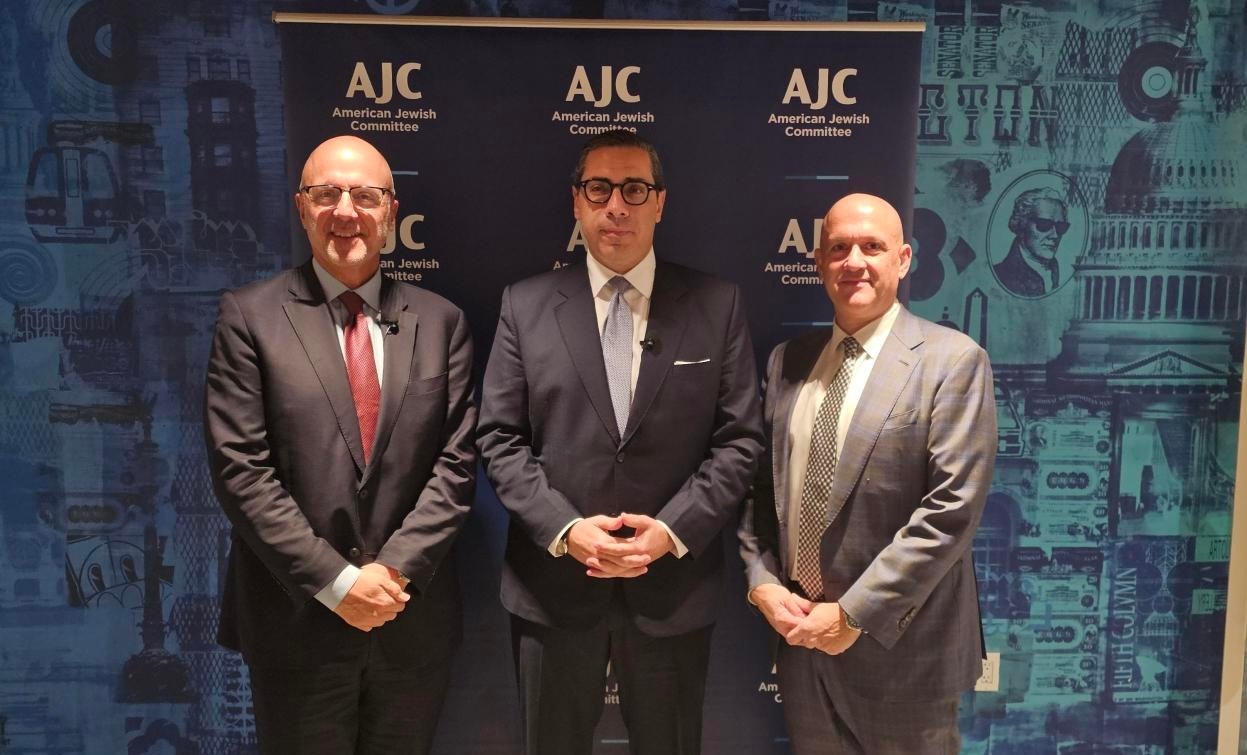
Cypriot Foreign Minister Constantinos Kombos (center) met earlier this week with American Jewish Committee CEO Ted Deutch (left) and Hellenic American Leadership Council Executive Director Endy Zemenides at AJC’s Washington office to discuss the opportunities and challenges presented by the India-Middle East-Europe Economic Corridor.
Birthdays

Television writer and producer, best known for his work on two ABC dramas, “Lost” and “Once Upon a Time,” Edward Lawrence “Eddy” Kitsis turns 55…
One of the founders of the Jewish Community of Greater Stowe (Vt.), Barbara Gould Stern… Co-founder and chair of Sage Publications, an academic publishing company, she was international president of B’nai B’rith Girls at 19, Sara Miller McCune turns 85… Attorney, bank executive and philanthropist, donor of the Adrienne Arsht Center for the Performing Arts of Miami-Dade County, Adrienne Arsht turns 84… Torrance, Calif., resident, Patrick B. Leek… Senior counsel at the global law firm Dentons, Evan Wolfson turns 69… Director of English-language programming at Herzog College in Alon Shvut, Israel, Shalom Berger turns 66… Actress, best known for her award-winning role in the 1986 science fiction action film “Aliens,” Jenette Elise Goldstein turns 66… Member of the state Senate of Maryland, representing portions of Montgomery County, Brian J. Feldman turns 65… Former mayor of Anchorage, Alaska, Ethan Avram Berkowitz turns 64… Former kickboxing champion, ultra-distance cycling champion and IDF soldier, Leah Goldstein turns 57… President and COO of Blackstone Group and chairman of the board of Hilton Worldwide, Jonathan D. “Jon” Gray turns 56… The first Jewish mayor of Los Angeles, he then served as the U.S. ambassador to India until 2025, Eric Garcetti turns 55… Executive director of the Baltimore Jewish Council, Howard Libit… Senior vice president and chief policy officer at J Street, he was previously director of Jewish outreach for Kamala Harris’ 2024 presidential campaign, Ilan Goldenberg… Author, psychotherapist and group fitness instructor, her book is about her genetic disease that has made her almost completely blind and deaf, Rebecca Alexander turns 47… Washington-based economic policy reporter for The New York Times since 2014, Alan Rappeport… CEO at Aeris Medical Group PLLC in Minneapolis, Noson “Nelson” Weisbord turns 43… Senior manager in the NYC office of Monitor Deloitte, he previously held a series of White House, OMB and Commerce Department positions, Justin Meservie turns 43… Client operations and legal project manager at Ropes & Gray, Abigail Dana Cable… Professor emeritus at Northeast Forestry University in Harbin, China, Dan Ben-Canaan… Jan Winnick…
The two countries outlined their alignment on several regional issues, including rejecting Israel’s recognition of Somaliland and calling for an immediate Israeli withdrawal from Syria, as well as a two-state solution

TUR Presidency/ Murat Cetinmuhurdar / Handout/Anadolu via Getty Images
Turkish President Recep Tayyip Erdogan meets with Saudi Arabia Crown Prince Mohammed bin Salman in Riyadh, Saudi Arabia on February 03, 2026.
Saudi Arabia and Turkey issued a joint declaration on Tuesday pledging to expand cooperation across a wide range of defense, economic and regional security issues, signaling deepening strategic ties between the two countries and cementing a markedly improved relationship between former foes.
As part of the joint statement, the two countries outlined their alignment on several regional issues, including rejecting Israel’s recognition of Somaliland and calling for an immediate Israeli withdrawal from Syria, as well as a two-state solution. The two leaders also agreed to push the U.S. toward de-escalation with Iran.
The parties also agreed to “strengthen their cooperation” in areas including oil and gas and renewable energies, “building on Saudi Arabia’s massive energy investments,” the statement read.
The declaration came during Turkish President Recep Tayyip Erdoğan’s visit to Riyadh on Tuesday, his first in more than two years. Erdoğan said during the trip that Ankara was determined to elevate relations with Saudi Arabia to a “higher level.”
The agreement and accompanying statements highlighted a broader rapprochement between Riyadh and Ankara, whose relationship has steadily warmed in recent years after a prolonged period of tension.
The two countries had been on opposite sides of several issues in the region, including the 2013 coup in Egypt and the Libyan civil war.
Relations plunged further after Saudi agents killed Washington Post columnist Jamal Khashoggi at the Saudi consulate in Istanbul, an episode that triggered a prolonged diplomatic rupture. Turkey’s decision to pursue the case publicly, including opening a formal investigation and sharing findings with the international community, also inflamed tensions.
Following the incident, Riyadh imposed a partial economic boycott on Turkish products and trade and Saudi Crown Prince Mohammed bin Salman did not visit Turkey until 2022, during which the two leaders vowed to start “a new era of cooperation.”
That cooperation has since translated into a recalibrated relationship, with both countries increasingly shifting their tone and building partnerships across different sectors. Riyadh and Ankara have also recently adopted similar stances on key geopolitical issues. Both have criticized Israel’s conduct in the Gaza conflict and voiced support for Syria’s new government.
Earlier this month, Bloomberg reported that Ankara had expressed interest in joining a Saudi-Pakistan defense pact, though Riyadh later clarified that the arrangement would remain strictly bilateral and would not be expanded to include Turkey.
Plus, Fine lands key endorsement, polling bump in key IL-9 primary

Tajh Payne/US Navy via Getty Images
U.S. Navy's Gerald R. Ford Carrier Strike Group on Nov. 13, 2025.
Good Tuesday afternoon!
This P.M. edition is reserved for our premium subscribers — offering a forward-focused read on what we’re tracking now and what’s coming next.
It’s me again — Danielle Cohen-Kanik, U.S. editor at Jewish Insider and curator, along with assists from my colleagues, of the Daily Overtime. Please don’t hesitate to share your thoughts and feedback by replying to this email.
📡On Our Radar
Notable developments and interesting tidbits we’re tracking
Despite negotiations between the U.S. and Iran set for Friday, Tehran is still behaving belligerently — the U.S. military shot down an Iranian drone today as it was flying toward the USS Abraham Lincoln aircraft carrier in the Arabian Sea, and Iranian gunboats attempted to stop and board a U.S. oil tanker in the Strait of Hormuz.
Iranian officials are also pushing to alter the talks dramatically, including changing the venue from Turkey to Oman, disinviting the foreign ministers of several Middle Eastern countries who were set to participate and limiting discussions only to the nuclear issue and not Tehran’s other malign activities, Axios reports.
Amid these developments, White House Press Secretary Karoline Leavitt said the talks “are still scheduled as of right now, but of course the president has always a range of options on the table and that includes the use of military force. The Iranians know that better than anyone”…
President Donald Trump does have plenty of firepower at his disposal should talks with Iran not pan out — The Washington Post lays out which military assets are in the region, as the U.S. recently deployed “dozens of aircraft to bases operating near Iran and assembled about 12 warships in or near the Middle East”…
White House Special Envoy Steve Witkoff, before heading to the talks, wherever they may be held, met with Israeli Prime Minister Benjamin Netanyahu in Jerusalem today. The prime minister “clarified his position that Iran has proven time and again that its promises cannot be relied upon,” according to a readout, signaling lingering skepticism in Israel that the U.S. will extract any meaningful concessions from Tehran…
Netanyahu also made clear Israel’s expectations for postwar Gaza as the U.S. presses ahead with Phase 2 of the ceasefire deal: that Hamas disarm and the enclave be demilitarized, that Israel be allowed to fulfill its “war objectives prior to the reconstruction of the Strip” and that the Palestinian Authority “not be part of the administration of the Gaza Strip in any way.” The latter demand comes after the technocratic committee set up by the U.S. to oversee reconstruction changed its logo to replicate a PA symbol…
The House of Representatives passed a spending bill to end the partial government shutdown, which Trump signed this afternoon. While the package includes several provisions providing funding to Israel and for joint U.S.-Israel cooperative programs, it only funds the Department of Homeland Security through next week, setting up another battle as the parties spar over funding for Immigration and Customs Enforcement…
State Sen. Laura Fine secured the endorsement of the Chicago Tribune editorial board in the competitive race for Illinois’ 9th Congressional District, over her competitors Daniel Biss, the mayor of Evanston, and social media influencer Kat Abughazaleh.
While Fine’s opponents have been outspoken about their criticisms of Israel on the campaign trail, the editorial board noted Fine said she “had left the progressive caucus in Springfield after she was made to feel uncomfortable for her belief in Israel’s right to defend itself or even to exist,” which it called a “principled position for a principled Democrat.”
Fine’s fundraising figures for the final quarter of 2025 showed she pulled in a whopping $1.2 million, and a new internal poll for Fine’s campaign shows her tied with Biss in first place, holding the momentum in the crowded primary…
New Jersey’s 7th Congressional District’s Democratic primary gained another prominent candidate today: Sue Altman, the state director for Sen. Andy Kim (D-NJ) and the 2024 Democratic nominee for the neighboring 12th District, jumped into the race to succeed retiring Rep. Bonnie Watson Coleman (D-NJ).
Altman has been a member of the progressive left as the former state director for the New Jersey Working Families Party, but took pro-Israel stances during her prior congressional run. Attempting to gain traction in the 7th, though, where the progressive Watson Coleman has said her endorsement will hinge on a candidate’s stance on Israel, Altman said she is now “reevaluating” her position…
Michael Blake, the former New York state assemblyman now mounting a primary challenge to Rep. Ritchie Torres (D-NY), was endorsed today by the longtime mayor of Newark, N.J., Ras Baraka, further solidifying Blake’s departure from his pro-Israel past.
Baraka’s support for violent rhetoric by the controversial Nation of Islam leader Louis Farrakhan and his condemnation of Israel’s war in Gaza are among several positions that have alarmed Jewish leaders in the state; Baraka’s support boosts Blake as he attempts to establish himself as the candidate hostile to Israel in his race, even as he once engaged extensively with AIPAC…
The two Human Rights Watch employees who comprised the organization’s “Israel and Palestine” team both resigned after HRW leadership postponed the publication of their report calling Israel’s refusal to recognize Palestinians’ “right of return” a “crime against humanity,” Jewish Currents reports.
Among other concerns, the organization’s chief advocacy officer had voiced hesitation that the findings were overbroad and “will be misread by many, our detractors first and foremost, as a call to demographically extinguish the Jewishness of the Israeli state”…
⏩ Tomorrow’s Agenda, Today
An early look at tomorrow’s storylines and schedule to keep you a step ahead
Keep an eye out in Jewish Insider for a profile of Seattle Public Schools’ new Jewish superintendent, as the district grapples with rising antisemitism in the aftermath of the Oct. 7 attacks.
First Lady Melania Trump will host former hostages Keith and Aviva Siegel for a private discussion at the White House.
Israeli Foreign Minister Gideon Sa’ar is also in Washington today and tomorrow to attend Secretary of State Marco Rubio’s inaugural Critical Minerals Ministerial, with over 50 countries participating to “strengthen and diversify critical minerals supply chains.”
The House Foreign Affairs Committee will hold a hearing on “defending religious freedom around the world.” Among those testifying is Sam Brownback, the former ambassador-at-large for international religious freedom; the ambassador role is currently empty after former Rep. Mark Walker (R-NC), who was tapped by Trump last April for the position, failed to be confirmed (he now holds a similar advisory role at the State Department, which did not require Senate confirmation).
Also taking place on the Hill, the Muslim World League will host a gathering highlighting “faith, leadership, and global coexistence.” Among those speaking are Ambassador Yehuda Kaploun, the special envoy to monitor and combat antisemitism; Sheikh Mohammed Al-Issa, a prominent Saudi scholar and former justice minister; Imam Talib Shareef, the president of The Nation’s Mosque; and members of Congress.
In the evening, the University of Nebraska–Lincoln’s student government will vote on a Boycott, Divestment and Sanctions resolution.
Stories You May Have Missed
TEHRAN TALK
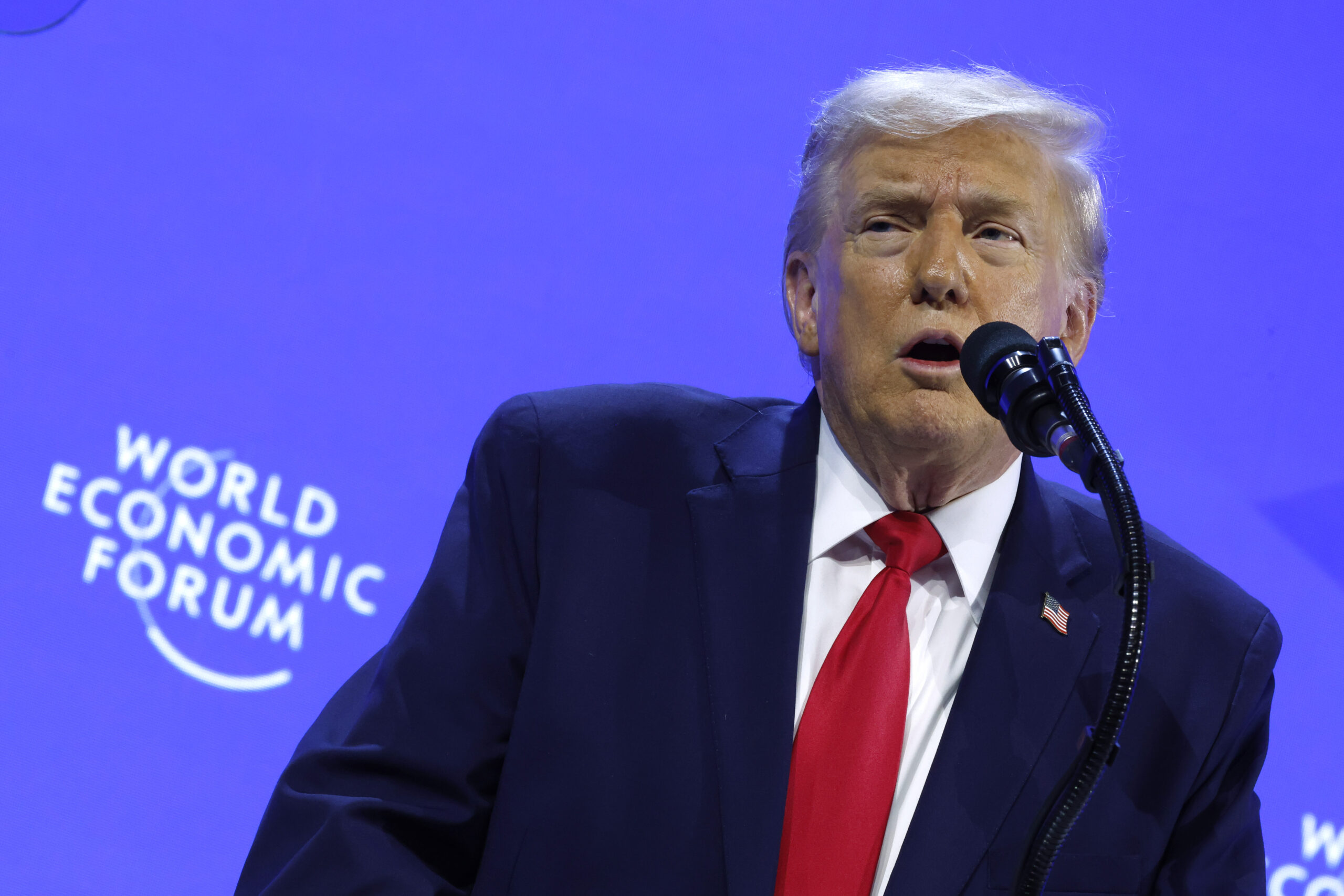
U.S.-Iran negotiations scheduled are ‘likely a diplomatic box-checking exercise and smokescreen,’ FDD’s Andrea Stricker said, while JINSA’s Jonathan Ruhe said U.S. military action is ‘unlikely for the moment’
DEM DIVIDE
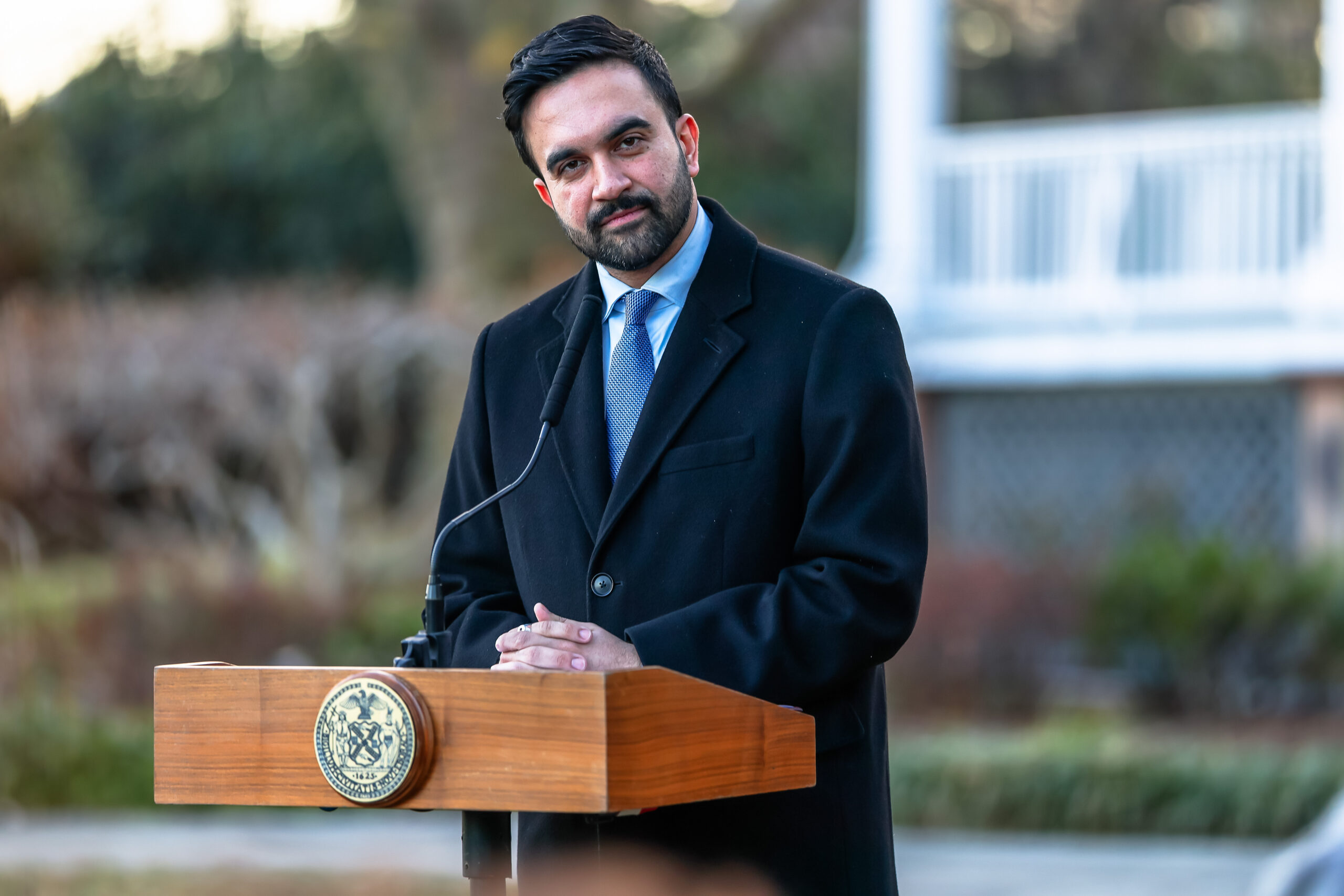
The fight to succeed Rep. Nydia Velazquez pits Mamdani and the DSA faithful against the congresswoman and her protege
Plus, White House press corps welcomes Hamas-friendly outlet
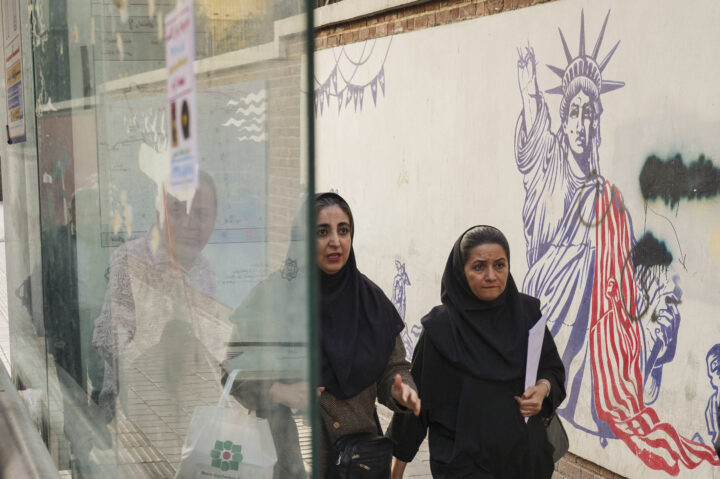
YAR/Middle East Images/AFP via Getty Images
Pedestrians walk past a mural bearing anti-American symbols on the outer wall of the former U.S. Embassy, now called the "U.S. Den of Espionage Museum," in Tehran, Iran, on October 26, 2025.
Good Monday afternoon!
This P.M. edition is reserved for our premium subscribers — offering a forward-focused read on what we’re tracking now and what’s coming next.
It’s me again — Danielle Cohen-Kanik, U.S. editor at Jewish Insider and curator, along with assists from my colleagues, of the Daily Overtime. Please don’t hesitate to share your thoughts and feedback by replying to this email.
📡On Our Radar
Notable developments and interesting tidbits we’re tracking
After weeks of rising tensions, the U.S. and Iran are back on the diplomatic track: White House Special Envoy Steve Witkoff is expected to meet with Iranian Foreign Minister Abbas Araghchi in Istanbul, Turkey, on Friday, Axios reports, possibly alongside Jared Kushner and the foreign ministers of several countries including Turkey, Qatar, Egypt, Oman, the UAE, Saudi Arabia and Pakistan.
What exactly will be up for discussion in the first meeting between the U.S. and Iran since the 12-day war last June is unclear — Iranian officials have said only nuclear activity is on the table, while the U.S. has traditionally maintained support for a comprehensive deal covering nuclear, missile and terror activity…
Before the dialogue in Turkey, Witkoff is slated to stop in Israel tomorrow to consult with Prime Minister Benjamin Netanyahu and Lt. Gen. Eyal Zamir, the IDF chief of staff, and hold meetings in the UAE and Qatar…
The parties are still covering all their bases: The U.S. and Israeli navies conducted a joint “routine maritime exercise” in the Red Sea today, after CENTCOM warned Iran’s Islamic Revolutionary Guard Corps on Friday to “avoid escalatory behavior at sea”…
Back in Washington, the White House tapped Drop Site News, a publication founded in 2024 to offer reporting explicitly hostile to Israel over the war in Gaza and the U.S. response to it, for the press corps’ new media seat on Sunday, Jewish Insider’s Gabby Deutch reports.
Drop Site has credulously interviewed several Hamas leaders, vigorously denied claims that Hamas terrorists raped anyone during the Oct. 7 attacks in Israel and supported the Iranian regime during the anti-government protests last month. Its inclusion among the outlets in Sunday’s press rotation (when no press briefing was held, so its reporter did not get the opportunity to ask a question) was a marked contrast to the mostly right-wing outlets that are usually selected…
And on the campaign trail, Sen. Tina Smith (D-MN) came out today in support of Minnesota Lt. Gov. Peggy Flanagan in the closely fought Democratic primary to replace her, joining fellow progressives Sens. Bernie Sanders (I-VT) and Elizabeth Warren (D-MA) in supporting Flanagan over the more moderate Rep. Angie Craig (D-MN). The endorsement comes days after fundraising reports for the final quarter of 2025 showed Craig raised double what Flanagan brought in ($2 million and $1 million, respectively)…
In New York City, Comptroller Mark Levine endorsed Rep. Dan Goldman (D-NY) in his primary against former Comptroller Brad Lander. Lander, challenging Goldman from the left on issues including his support for Israel, is endorsed by Mayor Zohran Mamdani, further highlighting divisions between Levine and the mayor as the two have sparred over issues including city investment in Israel bonds…
Jacobin profiles Diana Moreno, the democratic socialist running to fill Mamdani’s Queens seat in the state Assembly on a platform highlighting her progressive credentials as an organizer and immigrant.
“Moreno, wearing a keffiyeh, is featured in Mamdani’s launch video, pushing a stroller carrying her newborn son, saying ‘I want to raise my kid in New York.’ ‘I got pregnant one month after the genocide in Gaza started. My relationship to motherhood cannot be divorced from witnessing the world dehumanize children in Palestine,’” she said…
In New York’s 7th Congressional District, Councilmember Julie Won filed paperwork today to join the competitive race to replace retiring Rep. Nydia Velázquez (D-NY). All three candidates for the highly progressive district — which include Assemblymember Claire Valdez, who has the backing of Mamdani and the DSA, and Brooklyn Borough President Antonio Reynoso, who has been endorsed by Velázquez — have made comments critical of Israel.
On the one-year anniversary of the Oct. 7 attacks, Won expressed hope for a ceasefire and return of the hostages, mourning the 1,200 people “brutally killed” by Hamas in Israel and the “over 40,000 brutally killed in Palestine,” a figure Israel disputed at the time.
When a campaign last summer opposing a neighborhood development plan in her district invoked antisemitic rhetoric, Won denounced the move while maintaining her support for the “free Palestine” movement, saying in a statement, “It’s extremely alarming to me that someone would go so low to co-opt a movement of free Palestine for their own purpose — to incite anger and potentially violence … It’s shameful to compare Long Island City to Gaza — where people are literally losing their lives, land and starving to death — to this rezoning and blaming it on a local Jewish landlord who isn’t even part of the rezoning”…
Former Rep. Colin Allred (D-TX), who switched his candidacy from running for the open Texas Senate seat to its 33rd Congressional District, endorsed Rep. Jasmine Crockett (D-TX) for the Senate over his former primary rival, state Sen. James Talarico. Allred alleged that Talarico had called him a “mediocre Black man” and took aim at Talarico’s platform as a devout Christian: “You are not saving religion for the Democratic Party or the left,” Allred said…
⏩ Tomorrow’s Agenda, Today
An early look at tomorrow’s storylines and schedule to keep you a step ahead
Keep an eye out in Jewish Insider for the view from Washington on the continued possibility of U.S. strikes on Iran, even as diplomatic efforts unfold.
We’ll be watching for indications out of White House Special Envoy Steve Witkoff’s meetings in Israel on where the parties stand on engaging with Tehran.
It will be a busy day on the Hill, amid ongoing efforts to end the partial government shutdown: The House Foreign Affairs Committee will hold a hearing on U.S. policy towards Lebanon and “obstacles to dismantling Hezbollah’s grip on power” with testimony from several Washington Institute experts; the Senate Judiciary Committee will hold a hearing on the Nazis’ use of Swiss banks; the Helsinki Commission will hold a hearing on Russia’s influence in post-Assad Syria; and the Senate Foreign Relations Committee will hold a hearing on terrorism in North Africa.
The Jewish Community Relations Council of Greater Washington will host its Maryland advocacy day with Gov. Wes Moore as keynote speaker.
The World Governments Summit will kick off in Dubai, United Arab Emirates, with speakers including former Secretary of State Mike Pompeo, Lebanese Prime Minister Nawaf Salam, Spanish President Pedro Sánchez, Israeli philanthropist and Mobileye CEO Amnon Shashua and several other world leaders.
Stories You May Have Missed
DIPLOMATIC SPAT
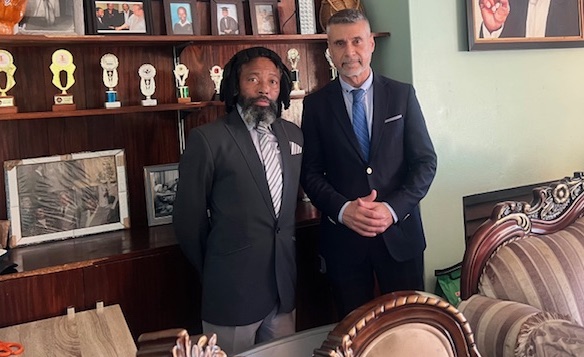
Pretoria angered after Israel offers parched region water management aid; Jerusalem declares South African diplomat serving Palestinians persona non grata
RHOADES’ RUN
Crystal Rhoades, the clerk of the District Court in Douglas County, is running on an unapologetically pro-Israel platform
Blumenthal: ‘I hope that this indication of a change in course is just a short-term flip’

Jemal Countess/Getty Images for Fair Share America
Sen. Richard Blumenthal speaks at a rally at the Capitol on April 10, 2025 in Washington, DC.
Sen. Richard Blumenthal (D-CT) warned on Thursday that the U.S. would need to reevaluate its relationship with Saudi Arabia if Riyadh makes a long-term pivot against efforts to normalize relations with Israel.
Israeli Prime Minister Benjamin Netanyahu suggested this week that Saudi Arabia’s increasing rapprochement with Turkey and Qatar would be a nonstarter for continued normalization efforts. Leading Saudi figures and media have also recently taken a strongly anti-Israel and antisemitic tone, which Netanyahu said provides aid to anti-Israel forces.
“If they’re reversing course on normalization, all bets are off for almost everything, including a defense treaty and other kinds of agreements,” Blumenthal told Jewish Insider. “I would very much regret it, and I think they would too in the long run, because it goes against all of the long-term goals of the kingdom to turn a leaf on terrorism and restore or reimagine their economy with less dependence on oil.”
He added that he “would be very surprised” if Riyadh actually makes such a pivot “and I hope that this indication of a change in course is just a short-term flip.”
Pressed on signals that Riyadh’s long-term vision may be shifting — given Saudi Arabia’s deepening ties to Turkey and Qatar and its recent plans to scale back some of the landmark megaprojects that were part of its Vision 2030 push — Blumenthal said he believes that Crown Prince Mohammed Bin Salman’s plan remains the same.
“I think there continues to be a long-term strategy in MBS’ mind, but there’s no question we need to be very clear-eyed that there are reactionary forces, and frankly antisemitic elements, in the regime,” Blumenthal said. “And we’re going to see those elements bubble up and potentially resist progress — and hopefully not prevent it. But we need to be very mindful of the mantra ‘trust but verify’ when dealing with Saudi.”
Two Republican senators offered a more optimistic view on the future of the U.S.-Saudi relationship.
Sen. Markwayne Mullin (R-OK) said that “every conversation I’ve had with Saudi Arabia is that they’re interested in normalization,” and that he would have to hear from Riyadh directly before judging the consequences of any potential change in direction.
Sen. James Lankford (R-OK) said that he didn’t have a strong read on Saudi Arabia’s current stance on normalization, but that he continues to believe that it is in the U.S.’ and the world’s interest.
“That brings long-term stability to the region,” Lankford said. “It’s been one of the main dividing points in the region is this absurd belief that Israel’s not even a country should be recognized. We don’t break through that until everybody just acknowledges everybody’s sovereignty.”
Plus, car ramming suspect charged with multiple hate crimes
John Lamparski/Bloomberg via Getty Images
Julie Menin, speaker of the New York City Council, and Mayor Zohran Mamdani on Jan. 12, 2026.
Good Thursday afternoon!
This P.M. edition is reserved for our premium subscribers — offering a forward-focused read on what we’re tracking now and what’s coming next.
It’s me again — Danielle Cohen-Kanik, U.S. editor at Jewish Insider and curator, along with assists from my colleagues, of the Daily Overtime. Please don’t hesitate to share your thoughts and feedback by replying to this email.
📡On Our Radar
Notable developments and interesting tidbits we’re tracking
After a car repeatedly drove into Chabad Lubavitch world headquarters in Brooklyn last night, New York City Council Speaker Julie Menin announced today she is creating a council task force to combat antisemitism, even as Mayor Zohran Mamdani has said he plans to retain the mayor’s Office to Combat Antisemitism (and told local news today he’s “in the final stages” of hiring someone to lead it). The council task force’s co-chair is Councilwoman Inna Vernikov, an outspoken critic of Mamdani…
The suspect arrested in the car ramming has been charged with attempted assault, reckless endangerment, criminal mischief and aggravated harassment, all enhanced as hate crimes, the NYPD announced this afternoon…
And in the wake of several protests that have disrupted New York Jewish communities in recent months, Menin also introduced a bill that would ban protests within 100 feet of a house of worship — more stringent than Gov. Kathy Hochul’s proposal of a 25-foot ban.
“The First Amendment right to peacefully protest is sacrosanct. What’s not sacrosanct is inciting violence, intimidation and harassment,” Menin told The New York Times, though some experts cast doubt on the constitutionality of the measure…
Rep. Tim Walberg (R-MI), the chair of the House Committee on Education & Workforce, sent a letter to Evanston, Ill., Mayor Daniel Biss — who is running for Congress to replace retiring Rep. Jan Schakowsky (D-IL) — requesting a briefing on Biss’ role in the 2024 anti-Israel encampment at Northwestern University.
Walberg alleged that Biss had failed “to protect Jewish students” at Northwestern “by refusing to give the university the police support it desperately needed to clear its violent and antisemitic encampment,” which resulted in a failure to arrest protesters who had harassed Jewish students. Biss has also drawn condemnation for allegedly walking back his pro-Israel positions once he was denied the support of AIPAC in his congressional campaign…
Rep. Haley Stevens (D-MI) raised $2.1 million for her Senate campaign in the final quarter of 2025, she announced today, bringing her total raised to $6.8 million. But a new Emerson College poll of the race to replace Sen. Gary Peters (D-MI) shows that haul may not be making an impact among primary voters just yet — Stevens polled at 17% to state Sen. Mallory McMorrow’s 22%, with 38% still undecided.
In a general election matchup against presumptive GOP nominee former Rep. Mike Rogers (R-MI), both McMorrow and Stevens poll ahead of Rogers, 46-43% and 47-42% respectively, with 15% undecided. In all cases, physician Abdul El-Sayed, a progressive Democrat who has made his hostility to Israel a central component of his campaign, polls behind his opponents…
The Democratic primary in New York’s 17th Congressional District got a little less crowded today: Former FBI agent John Sullivan, who served as the top bureau intelligence official in Israel from 2017-2020, dropped out of the race to challenge Rep. Mike Lawler (R-NY).
“While my congressional campaign is coming to an end, my dedication to our community is not,” Sullivan wrote, telling supporters to “stay tuned.” He did not endorse any of the remaining Democratic candidates, which include front-runner Beth Davidson, a Rockland County legislator, and national security veteran Cait Conley…
The U.S. Navy dispatched an additional warship, the USS Delbert D. Black, to the Middle East in the past two days amid heightened tensions with Iran, Reuters reports, bringing the total number of destroyers in the region to six, in addition to an aircraft carrier…
The European Union voted unanimously to designate Iran’s Islamic Revolutionary Guard Corps as a terrorist organization today, Jewish Insider’s Matthew Shea reports, in a move anticipated after several countries including Italy and France rescinded their long-held objections to the move.
“Repression cannot go unanswered,” Kaja Kallas, the EU’s high representative for foreign affairs and security policy, wrote on X following the decision. “Any regime that kills thousands of its own people is working toward its own demise”…
Sens. Lindsey Graham (R-SC) and Richard Blumenthal (D-CT) introduced the “Save the Kurds Act” in response to the Syrian government’s campaign against the Kurdish-led and U.S.-backed Syrian Democratic Forces. The legislation would impose sanctions on “Syrian government officials and financial institutions, and any foreign individual who engages in any transaction, including military or financial support, with the Syrian government,” according to a press release.
The bill would also redesignate as a terror organization Hayat Tahrir al-Sham (HTS), the al-Qaida offshoot that Syrian President Ahmad al-Sharaa led before ousting dictator Bashar al-Assad. The Trump administration removed HTS’ terror designation and U.S. sanctions on Syria after al-Sharaa assumed the presidency…
A draft resolution from the Board of Peace dictating the powers of the bodies overseeing postwar Gaza seems to relegate the Gaza Executive Board — whose inclusion of Turkey and Qatar had concerned Israel — to an advisory role for another committee largely made up of White House advisors, The Times of Israel reports. The resolution, which also increases the Trump administration’s role in managing that body, still must be signed by the president…
A man was tried in federal court today for attempting to assassinate former President Joe Biden over anti-Israel animus, traveling to Georgia with a firearm in June 2024 to sneak into a presidential debate hosted by CNN so he could reach Biden, according to the Justice Department.
The man’s manifesto was addressed to “all the Palestinian journalists … and in remembrance of the ones who lost their lives along the way” and said, “It’s time we overthrow these bastards and threaten to pull a f**king D-Day on Tel Aviv,” concluding with “Free Palestine”…
A bipartisan delegation of lawmakers organized by the AIPAC-affiliated American Israel Education Foundation met with Israeli Prime Minister Benjamin Netanyahu in Jerusalem today, including Reps. Ryan Zinke (R-MT), Jen Kiggans (R-VA), Jake Ellzey (R-TX), Mike Bost (R-IL) and Don Davis (D-NC)…
⏩ Tomorrow’s Agenda, Today
An early look at tomorrow’s storylines and schedule to keep you a step ahead
Keep an eye out in Jewish Insider for a look at the legacy of constitutional lawyer and Jewish activist Nat Lewin, who turns 90 this weekend.
Several Jewish and pro-Israel organizations were invited to a meeting with Saudi Defense Minister Khalid bin Salman, who is in Washington meeting with Trump administration officials, tomorrow afternoon, JI’s Danielle Cohen-Kanik has learned, amid a sharp rise in antisemitic and anti-Israel rhetoric from the kingdom. It’s not clear which organizations will be attending, though the Foundation for Defense of Democracies confirmed it will sit down with KBS separately in the morning.
We’ll be back in your inbox with the Daily Overtime on Monday. Shabbat Shalom!
Stories You May Have Missed
PASTOR’S POLEMIC
Singer told JI that his alignment with Rev. Frederick D. Haynes III delivered an anti-Israel polemic from the pulpit on Oct. 8, 2023, the day after Hamas’ attack on Israel
COMEBACK BID
The former congresswoman told JI, ‘Anything that needs to be done to stop Iran from acquiring a nuclear weapon needs to be done’
Plus, Biden officials don't hold back on criticism of Bibi

Mass Communication Specialist 3rd Class Amber Smalley/U.S. Navy via Getty Images
Flight deck of the Nimitz-class aircraft carrier USS Abraham Lincoln (CVN 72) May 10, 2019 in the Red Sea.
Good Wednesday afternoon!
This P.M. edition is reserved for our premium subscribers — offering a forward-focused read on what we’re tracking now and what’s coming next.
It’s me again — Danielle Cohen-Kanik, U.S. editor at Jewish Insider and curator, along with assists from my colleagues, of the Daily Overtime. Please don’t hesitate to share your thoughts and feedback by replying to this email.
📡On Our Radar
Notable developments and interesting tidbits we’re tracking
President Donald Trump indicated he’s losing patience with Iran: He posted a stark warning on Truth Social this morning that a “massive Armada is heading to Iran” and “it is ready, willing, and able to rapidly fulfill its mission, with speed and violence, if necessary.”
Trump encouraged Tehran to come back to the negotiating table where he demanded it have “no nuclear weapons” — a position that differs from Israel’s, which has said Iran must not be allowed to enrich uranium at all — but made no mention of the protesters Trump had pledged to protect…
Despite Trump’s threat, Secretary of State Marco Rubio told lawmakers at a Senate Foreign Relations Committee hearing today that the “armada” of military assets being moved to the Middle East is primarily defensive, Jewish Insider’s Marc Rod reports.
Rubio noted that 30,000-40,000 U.S. troops in the region are “within the reach of an array of thousands of Iranian” drones and missiles. “We have to have enough force and power in the region, just on a baseline, to defend against that possibility,” he explained.
In addition, “the president always reserves the preemptive defensive option — in essence, if we have indications that, in fact, they’re going to attack our troops in the region,” Rubio continued, as well as security agreements to defend allies such as Israel “that require us to have a force posture in the region.”
Rubio admitted the U.S. has little clarity on who would govern Iran if the regime collapses: “I don’t think anyone can give you a simple answer as to what happens next in Iran if the supreme leader and the regime were to fall, other than the hope that there would be some ability to have somebody within their systems you could work towards a similar transition” as the U.S. has supported in Venezuela…
Rubio was also questioned by senators about the Board of Peace: He clarified that “the primary and sole focus of that board right now is to administer Phase 2 and Phase 3 of the plan in Gaza,” despite broad language in the body’s charter, and acknowledged that some European allies have declined to join over their concern that the board is competing with the U.N. “This is not a replacement for the U.N. But the U.N. has served very little purpose in the case of Gaza,” Rubio said…
As their own response to Iran’s violent suppression of protests, several European countries changed their position to support the EU designating the Islamic Revolutionary Guard Corps as a terror organization, a move they have historically opposed over fears of irreparably severing ties with Tehran.
Ahead of a Thursday meeting of EU foreign ministers in Brussels — where the bloc was already expected to approve additional sanctions on Iran — Italy, Germany and earlier today France announced they would support the designation, teeing up its approval, which must be unanimous, at tomorrow’s meeting…
The State Department found that the Palestinian Authority paid more than $200 million to terrorists and their families in 2025, the Washington Free Beacon reports, despite the PA claiming it had ended its “pay-to-slay” program last February.
The PA merely “transferred responsibility” for the payments to a new body “under the guise of social welfare,” a report provided to Congress laid out, with evidence from post offices, social media and Telegram “indicating clearly that the compensation in support of terrorism has continued”…
Biden administration officials jumped to the defense of the former president’s Israel policy after Israeli Prime Minister Benjamin Netanyahu alleged in a press conference yesterday that some IDF soldiers had been killed in Gaza due to a U.S. arms embargo that caused Israel to run out of ammunition during the Biden presidency.
Brett McGurk, Biden’s senior Middle East advisor, told Axios that Netanyahu’s comments were “categorically false” and that Biden’s “commitment to Israel’s security to include U.S. military assistance was unwavering”; diplomat Amos Hochstein slammed Netanyahu as “ungrateful to a president that literally saved Israel at its most vulnerable moment”; and former State Department antisemitism envoy Deborah Lipstadt said that to ignore Biden’s support for Israel “is to ignore history”…
Syrian President Ahmad al-Sharaa visited Moscow today where he and Russian President Vladimir Putin discussed Russia’s continued military presence in the country, Syrian state media reported. Despite its historic backing of longtime Syrian leader Bashar al-Assad, Moscow did not oppose al-Sharaa’s ouster of the dictator, though Russia has sheltered Assad and his family since they fled Damascus.
Russia has begun pulling out from its position in northeast Syria in an area still controlled by the Kurdish-led Syrian Democratic Forces, as Damascus mounts a campaign to oust them, though Moscow reportedly hopes to keep its naval and air bases on the Syrian coast…
⏩ Tomorrow’s Agenda, Today
An early look at tomorrow’s storylines and schedule to keep you a step ahead
Keep an eye out in Jewish Insider for an interview with former Rep. Elaine Luria (D-VA), as she seeks to reclaim her former seat and shore up support for Israel among her Democratic colleagues.
Pennsylvania Gov. Josh Shapiro will speak at Washington’s Sixth & I synagogue in conversation with Sen. Raphael Warnock (D-GA) about the governor’s new memoir, Where We Keep the Light.
The Hudson Institute will host a conversation with Jacob Helberg, the under secretary of state for economic affairs, as he returns from a trip around the Middle East where he brought Qatar and the United Arab Emirates into the Pax Silica initiative and signed a joint AI strategic framework in Israel.
Stories You May Have Missed
FLORIDA FIGHT
Singer told JI that his alignment with the GOP has been shaped by his Jewish faith
FOLLOW THE MONEY

The group behind the pro-Hamas chants in Queens has a nationwide network and links to pro-terror organizations and individuals
Plus, Emory faculty revolt in defense of Iran official's daughter

MONEY SHARMA/AFP via Getty Images
Saudi Arabia's Crown Prince and Prime Minister Mohammed bin Salman (C) inspects a guard of honor during a ceremonial reception at the President House a day after the G20 summit in New Delhi on September 11, 2023.
Good Tuesday afternoon!
This P.M. edition is reserved for our premium subscribers — offering a forward-focused read on what we’re tracking now and what’s coming next.
It’s me again — Danielle Cohen-Kanik, U.S. editor at Jewish Insider and curator, along with assists from my colleagues, of the Daily Overtime. Please don’t hesitate to share your thoughts and feedback by replying to this email.
📡On Our Radar
Notable developments and interesting tidbits we’re tracking
Saudi Arabia’s shift away from its traditional alliances and towards Islamism is evoking more backlash: Asked about Riyadh’s growing rapprochement with Qatar and Turkey, Israeli Prime Minister Benjamin Netanyahu said at a press conference this afternoon that he’s following the developments and that Israel “expect[s] from anybody who wants normalization or peace with us that they not participate in efforts steered by forces or ideologies that want the opposite of peace”…
Netanyahu’s comments came shortly after Saudi Crown Prince Mohammed bin Salman held a phone call with Iranian President Masoud Pezeshkian, where MBS conveyed that “the Kingdom considers any threat or tension against Iran unacceptable”…
That’s not stopping the U.S. from hinting at the continued possibility of strikes on Iran: U.S. Central Command announced it will be conducting a “multi-day readiness exercise” in order to “demonstrate the ability to deploy, disperse, and sustain combat airpower” across its area of responsibility, which includes Iran…
And Sen. Lindsey Graham (R-SC) slammed Riyadh for other nefarious actions in the region, Jewish Insider’s Emily Jacobs reports, including its “attack” on the UAE and silence regarding the Syrian government’s campaign against the Kurds, demanding the kingdom use its influence to “keep the region from falling further into chaos.”
“Please understand that I am smart enough to know that Saudi Arabia has influence on the Syrian government, and I expect them to use it,” Graham said, adding that he is “trying to work with the administration and regional partners to prevent a bloodbath in Syria against our Kurdish allies”…
(President Donald Trump, meanwhile, had a markedly different take on Syria: He told reporters today that he had a “great conversation” with the “highly respected president of Syria” and that “all of the things having to do with Syria and that area are working out very, very well, so we’re very happy about it”…)
The U.S. Embassy in Riyadh also held its first-ever International Holocaust Remembrance Day event, writing that “Today’s modest but meaningful commemoration reflects a universal duty: protecting our shared humanity across cultures, faiths, and nations”…
With Graham eyeing Damascus and Riyadh, Sen. Ted Cruz (R-TX) took aim elsewhere, calling for the U.S. to arm protesters in Iran “NOW.” “For the Iranian people to overthrow the Ayatollah — a tyrant who routinely chants ‘death to America’ — would make America much, much safer,” he said…
Authorities in Azerbaijan arrested three people allegedly preparing an attack on the Israeli Embassy in Baku today; the men were affiliated with ISIS-K, the Afghani branch of the terror group…
The Board of Peace is attempting to formalize its processes and responsibilities, according to a draft resolution from the board obtained by The New York Times, which bestows expansive powers to its chairman — Trump — including naming the commander of the International Stabilization Force, which still has yet to be established.
The document also names White House Chief of Staff Susie Wiles and attorney Martin Edelman as members of the board, the first time they have been identified as such…
After a doctor who is the daughter of a senior Iranian government official departed from Emory University’s medical school, the professor who serves as head of Emory’s faculty leadership council criticized the school for letting her go, JI’s Haley Cohen has learned.
Noelle McAfee, a professor in Emory’s philosophy department, sent a scathing email to the university expressing concern that the school’s dismissal of Fatemeh Ardeshir-Larijani, the daughter of the secretary of Iran’s Supreme Council for National Security, was a politically motivated firing.
“It’s extremely disappointing to see that our leadership here at Emory are consistently caving to political pressure and never taking the side of faculty,” McAfee wrote, quoting an anonymous faculty member, expressing concern that Ardeshir-Larijani, whose father is responsible for the Islamic Republic’s national security, didn’t receive due process…
In the Garden State, Mussab Ali, the former Jersey City Board of Education president and champion of anti-Israel college encampments, officially launched his primary challenge to Rep. Rob Menendez (D-NJ) today, hitting Menendez on day one for supporting Israel and being endorsed by AIPAC.
“Democrats need to step up and become the party where we abandon corporate PACs, we won’t take money from groups like AIPAC, and we need to be accountable to everyday people,” Ali told the New Jersey Globe. He also enters the race with the endorsement of former Rep. Jamaal Bowman (D-NY), who was unseated in part due to his sharp criticisms of Israel…
Marking International Holocaust Remembrance Day, Chicago’s City Council voted unanimously to adopt the International Holocaust Remembrance Alliance’s working definition of antisemitism into its municipal code…
⏩ Tomorrow’s Agenda, Today
An early look at tomorrow’s storylines and schedule to keep you a step ahead
Keep an eye out in Jewish Insider for an interview with Republican Boca Raton Mayor Scott Singer, who’s hoping for a conservative shift among Jewish voters in South Florida to help him unseat Rep. Jared Moskowitz (D-FL).
“October 7: In Their Own Words,” a play drawn directly from testimonies of survivors of the Oct. 7, 2023, Hamas terror attacks, will premiere at the Kennedy Center. Read JI’s interview with the show’s playwrights here.
Secretary of State Marco Rubio will be on the Hill, testifying at a Senate Foreign Relations Committee hearing on U.S. policy towards Venezuela in the aftermath of the ouster of former President Nicolás Maduro.
Stories You May Have Missed
PROBLEMATIC POST
Kelly Neumann is serving as the fundraising co-chair for gubernatorial candidate Jocelyn Benson and Senate candidate Mallory McMorrow and has fundraised for several other Michigan Democrats
SABRA SLAM

The Portland Trail Blazers forward has emerged as one of Israel’s all-time top athletes
A Trump administration source characterized Netanyahu's statement to JI as a minor issue that would likely be smoothed out within days
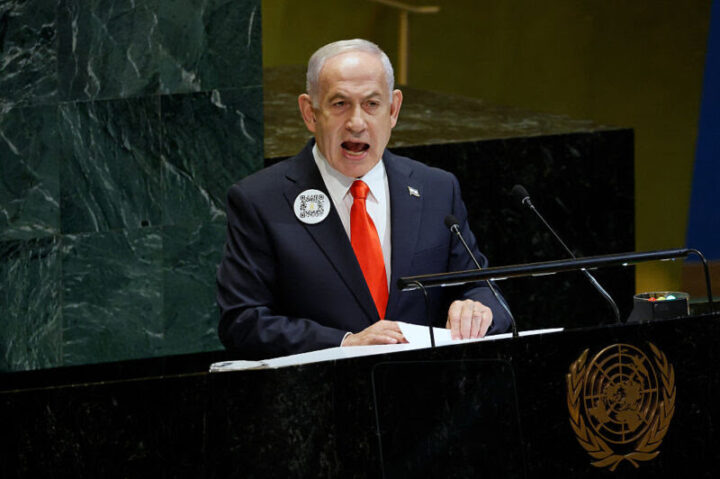
Taylor Hill/Getty Images
Prime Minister of Israel Benjamin Netanyahu speaks during the 80th session of the UN’s General Assembly (UNGA) at the United Nations headquarters on September 26, 2025 in New York City.
Israeli Prime Minister Benjamin Netanyahu opposes the composition of the executive board meant to oversee the rebuilding of Gaza, his office said on Saturday.
“The announcement regarding the composition of the Gaza Executive Board, which is subordinate to the Board of Peace, was not coordinated with Israel and runs contrary to its policy,” the Prime Minister’s Office stated. “The Prime Minister has instructed the Foreign Affairs Minister to contact the U.S. Secretary of State on this matter.”
Netanyahu emphasized his objection in a speech to the Knesset on Monday, saying that “there will be no Turkish or Qatari soldiers in Gaza. We are currently in a dispute with the U.S. over the makeup of the advisory council for Gaza.”
Though Netanyahu said the board was not coordinated with Israel, he spoke with President Donald Trump twice in recent days, and Mossad Chief David Barnea met with White House Special Envoy Steve Witkoff on Friday. The calls and meetings were reportedly about Iran.
The White House announced on Friday that several committees to govern Gaza and oversee its reconstruction and administration had been formed, including the Gaza Executive Board.
The Gaza Executive Board is meant to support the office of the high representative for Gaza and the National Committee for the Administration of Gaza, which is made up of Palestinian technocrats. It includes Witkoff, Jared Kushner, former U.K. Prime Minister U.K. Tony Blair, Apollo Global Management CEO Marc Rowan, Israeli-Cypriot businessman Yakir Gabay, head of Egyptian intelligence General Hassan Rashad, UAE Minister for International Cooperation Reem Al-Hashimy, U.N. Special Coordinator for the Middle East Peace Process Sigrid Kaag, and the previous holder of that position, Nickolay Mladenov, who will serve as the high representative for Gaza.
The board also includes Turkish Foreign Minister Hakan Fidan and Qatari diplomat Ali Al-Thawadi. Israeli officials have previously spoken out against Turkish involvement in Gaza’s reconstruction. Qatar has funded Gaza reconstruction in the past, with significant funding and dual-use materials reaching Hamas; the terrorist group’s leaders have also resided in Doha.
A Trump administration source characterized Netanyahu’s statement to Jewish Insider as a minor issue that would likely be smoothed out within days.
The source noted that Turkish and Qatari representatives were key to negotiating the ceasefire in Gaza, which took effect in October, and that they call Witkoff and Kushner daily, and therefore have an influence on the process regardless of the titles they are given. He also added that Netanyahu has a direct line to Trump.
“It’s all based on whether Hamas demilitarizes or not,” he added. “If Hamas demilitarizes, that is what’s most important [above the composition of the board]. If Hamas doesn’t demilitarize, none of this matters. … The prime minister has a commitment from the president that Hamas will demilitarize.”
Israeli Opposition Leader Yair Lapid said that “Netanyahu is allowing Turkey and Qatar into Gaza. That endangers Israel’s security. That is not what our brave soldiers fought for for two years.
“Instead of releasing panicky statements of protest, Israel should offer a clear alternative, for Egypt to administer Gaza for the next 15 years, for Hamas to be disarmed, and work with American partners to strengthen Israel’s border,” Lapid added.
Israeli National Security Minister Itamar Ben-Gvir said that he supports Netanyahu’s “important message.”
“Gaza does not need an ‘executive board’ that will supervise its ‘rehabilitation,’ it needs to be cleaned of Hamas terrorists who should be destroyed, along with encouraging massive voluntary emigration, in accordance with President Trump’s original plan,” Ben-Gvir said. “I call on the prime minister to instruct the IDF to prepare to go back to war in Gaza using great force in order to achieve the central goal of the war, the destruction of Hamas.”
The White House also announced the members of the founding executive board of the Trump-chaired Board of Peace, whose purview is not limited to Gaza. Netanyahu told the Knesset on Monday that the board is meant to serve as an alternative to the United Nations, 66 of whose organizations the U.S. left earlier this month. The board is composed of Secretary of State Marc Rubio, Witkoff, Kushner, Blair, Rowan, World Bank President Ajay Banga and Deputy National Security Advisor Robert Gabriel.
Canadian Prime Minister Mark Carney and Argentinian President Javier Milei also accepted invitations from Trump to join the board, while Egyptian President Abdel Fattah al-Sissi and Turkish President Recep Tayyip Erdogan had yet to respond. French President Emmanuel Macron declined to join. Netanyahu was invited to join or send an Israeli representative, according to Ynet. Russian President Vladimir Putin was invited, as was President Alyaksandr Lukashenka of Belarus; Ukrainian President Volodymyr Zelensky received an invitation on Tuesday, Ukrainian Ambassador to Israel Yevgen Kornichuk told JI. China, Germany, Australia, Albania, Jordan, Egypt and Bahrain reportedly received invitations, as well.
Membership on the Board of Peace is for three years; Trump asked countries to pay $1 billion for a permanent seat, Bloomberg reported.
Trump appointed Aryeh Lightstone and Josh Gruenbaum, members of Witkoff’s team, to be special advisors to the Board of Peace, “leading day-to-day strategy and operations, and translating the Board’s mandate and diplomatic priorities into disciplined execution,” the White House stated.
The order leaves out scrutiny of Qatar and Turkey — a strategy that experts say reflects both legal realities and geopolitical constraints
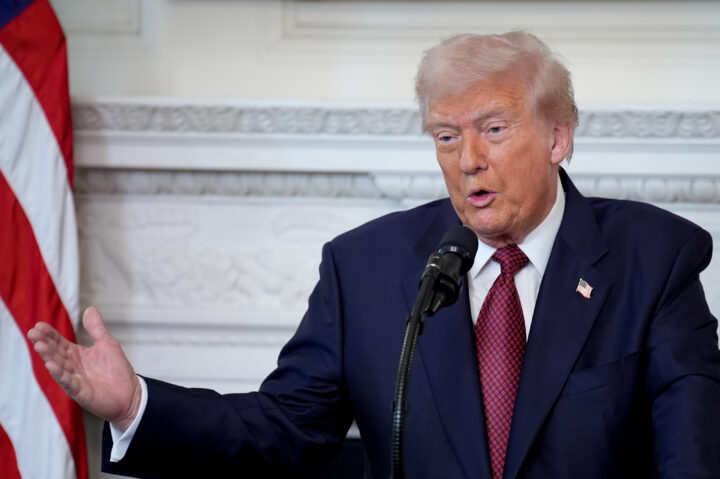
Yuri Gripas/Abaca/Bloomberg via Getty Images
US President Donald Trump during a breakfast with Senate Republicans in the State Dining Room of the White House in Washington, DC, US, on Wednesday, Nov. 5, 2025.
President Donald Trump’s recent executive order directing a review of Muslim Brotherhood chapters for potential terrorism designations is limited in scope, and leaves out scrutiny of Qatar and Turkey — a strategy that experts say reflects both legal realities and geopolitical constraints.
The order, which was signed on Nov. 24, directs Secretary of State Marco Rubio and Treasury Secretary Scott Bessent to identify which branches of the Muslim Brotherhood — with a focus on chapters in Jordan, Lebanon and Egypt — should be designated as Foreign Terrorist Organizations and which should be deemed Specially Designated Global Terrorists.
Rather than apply a terrorist designation to the entire Muslim Brotherhood as a whole, Trump’s executive order first looks at individual branches. This strategy is echoed in a Senate bill, sponsored by Sen. Ted Cruz (R-TX), which requires an assessment of every branch of the Muslim Brotherhood in an effort to designate the organization for its involvement.
The House version of the legislation was modified in committee last week and now more closely resembles the Trump executive order.
Michael Jacobson, a senior fellow at The Washington Institute for Near East Policy, said the approach “makes sense,” adding that a “one-size-fits-all” designation would be unproductive. He also noted that it will allow the administration to more effectively pursue chapters of the organization.
“The bottom-up approach will allow the administration to proceed in a more strategic and calculated fashion,” said Jacobson. “Targeting individual chapters and entities could also open up additional avenues for investigation and action. Once individual branches are designated, the Treasury could then use its authorities to sanction those supporting these branches. I believe that this approach is also more likely to gain support from other governments.”
This same sentiment was echoed by Cruz, who called the “bottom-up” approach the “correct and sustainable strategy.”
“That strategy is built into both the president’s executive order, which was a bold and critical breakthrough in advancing American national security, and my bipartisan legislation,” Cruz told Jewish Insider. “It’s the consensus strategy, and it’s the right one.”
David Adesnik, vice president of research at the Foundation for Defense of Democracies, told JI that while a single designation done in “one fell swoop” might be appealing, it faces legal and factual challenges.
“The administration was rightly concerned that a judge could overturn a designation of the entire organization if he or she assessed that it didn’t meet the legal thresholds. This would have serious consequences in several respects,” said Michael Jacobson, a senior fellow at The Washington Institute for Near East Policy. “If a judge ruled against a Muslim Brotherhood ban, it would be interpreted by some as a signal that the MB is not a terrorist organization, end of story — also a message the administration was likely eager to avoid.”
“This is not a single unified organization,” said Adesnik. “There’s no headquarters, no address, no person who is the head. It’s very hard to make a terror designation if you’re not exactly sure who you’re designating.”
Jacobson said the administration also looked to avoid a blanket designation out of concern that any legal challenges that followed could hurt efforts to reign in the Muslim Brotherhood.
“The administration was rightly concerned that a judge could overturn a designation of the entire organization if he or she assessed that it didn’t meet the legal thresholds. This would have serious consequences in several respects,” said Jacobson. “If a judge ruled against a Muslim Brotherhood ban, it would be interpreted by some as a signal that the MB is not a terrorist organization, end of story — also a message the administration was likely eager to avoid.”
Some critics of the executive order, including far-right influencer Laura Loomer, who is a confidant of the president, have expressed frustration over the administration’s decision not to name Qatar and Turkey in the order.
“The Muslim Brotherhood designation signed by President Trump today doesn’t have any teeth,” Loomer posted on X on Nov. 24. “This designation is probably the weakest designation of the Muslim Brotherhood we could have ever received, as it doesn’t even apply to Qatar and Turkey.”
Both Qatar and Turkey have strengthened ties with the United States during Trump’s second term, however the two countries are also significant supporters of the Muslim Brotherhood and have been known to provide sanctuary for their members.
“Claiming to get tough on the Muslim Brotherhood without a serious strategy to clamp down on the support provided by the movement’s most important state sponsors in Qatar and Turkey is not a serious policy,” said John Hannah, a senior fellow at the Jewish Institute for National Security of America. “Out of consideration for America’s longstanding partnerships with both countries and President Trump’s particular affinity for their leaders, one hopes that there is a plan to bring real pressure to bear on both Doha and Ankara in private to cease and desist their wide-ranging support for MB affiliates across the Middle East and globally.”
But while Qatar and Turkey’s ties to the Muslim Brotherhood are problematic, experts said they were not included because they do not currently have chapters of the organization in their countries, which the executive order focuses on.
“If we’re targeting chapters of the Brotherhood, there are no Brotherhood chapters in those countries,” said Adesnik. “So the real question is, how do you deal with what are effectively state sponsors of the Brotherhood? And does that state sponsorship cross the line into terrorism or sponsorship of terrorism?”
The Senate bill also does not address how Turkey and Qatar would be targeted as state sponsors of the organization.
However, experts and legislators remain wary of the threat posed by the two nations and have expressed that plans to root out the Muslim Brotherhood should account for Turkey and Qatar.
“Claiming to get tough on the Muslim Brotherhood without a serious strategy to clamp down on the support provided by the movement’s most important state sponsors in Qatar and Turkey is not a serious policy,” said John Hannah, a senior fellow at the Jewish Institute for National Security of America. “Out of consideration for America’s longstanding partnerships with both countries and President Trump’s particular affinity for their leaders, one hopes that there is a plan to bring real pressure to bear on both Doha and Ankara in private to cease and desist their wide-ranging support for MB affiliates across the Middle East and globally.”
With the current executive order, the White House is seeking to first designate branches in countries that experts said are involved in violence from within the country. This will also likely include entities that finance other Foreign Terrorist Organizations, according to Jacobson.
In Jordan, Lebanon and Egypt, threats connected to the Muslim Brotherhood have become national issues of concern.
“The Islamic Group [Muslim Brotherhood chapter in Lebanon] clearly built up the ability to carry out attacks against Israel and cooperated very openly with Hezbollah,” said David Adesnik, vice president of research at the Foundation for Defense of Democracies. “Authorities there really aren’t doing anything about it, partly because they lack power and have other issues to address. So it’s a pretty fair point.”
In April 2025, Jordanian authorities arrested 16 individuals and thwarted a plot that was to involve rocket and drone attacks inside the country. The suspects were linked to the Muslim Brotherhood, which is the government’s largest opposition group. Following the arrests, the Jordanian government banned the group entirely.
Adesnik said that while Jordan has initiated a “thorough crackdown” to address the problem, it is notable that there was “clearly a branch that had migrated toward planning for terrorism.”
In Lebanon, he called the Muslim Brotherhood a “persistent issue.”
“The Islamic Group [Muslim Brotherhood chapter in Lebanon] pretty openly built up a capability to carry out attacks against Israel and cooperated very clearly and openly with Hezbollah,” said Adesnik. “Authorities there really aren’t doing anything about it, in part because they don’t have a lot of power and they have a lot of other problems to deal with. So it’s a pretty reasonable case.”
Adesnik called the administration’s targeting of Egypt the “thorniest case from a definitional perspective.” He noted that while Egyptian President Abdel Fattah el-Sissi’s regime in Cairo has spent more than a decade cracking down on the Brotherhood “aggressively,” concerns still remain over the presence of branches such as Harakat Sawa’d Misr, also known as Hasm, which was already designated by the U.S. as a Specially Designated Global Terrorist Entity in 2018.
“The question is just what’s left of the Brotherhood there?” said Adesnik. “Is it doing enough to merit a designation?”
Sen. John Kennedy told JI that Barrack was ‘very incorrect’ when casting doubt on Israel’s status as a democracy
Leigh Vogel/Getty Images for Concordia Annual Summit
U.S. Ambassador to Turkey Tom Barrack speaks during the 2025 Concordia Annual Summit on September 24, 2025 in New York City.
Republican lawmakers are criticizing U.S. Ambassador to Turkey Tom Barrack over his recent comments questioning whether Israel is a democracy while voicing support for Turkey joining the proposed U.S.-led International Stabilization Force to operate in Gaza.
Barrack raised eyebrows with his comments on Sunday at the Doha Forum in Qatar — where the Syria envoy appeared to cast doubt on Israel’s status as a democracy while suggesting that “benevolent” monarchies were typically more successful in the region. Earlier last week, the ambassador drew attention for endorsing Turkey’s inclusion in the ISF because their “criticized relationship” with Hamas would “soften whatever has to be done” to disarm them.
Barrack’s comments in Doha were made in the context of criticizing previous efforts by the U.S. and others to impose democratic governing models in the Middle East. “Almost every decision that the West has imposed on the region, rather than allowing it to evolve on its own, has been a mistake,” Barrack said.
“The first thing that has to happen is that we have to allow them, Syria, to define it themselves without going in with Western expectations and saying, ‘We want a democracy in 12 nights,’” Barrack said on Sunday. “We’ve never had a democracy [in the Middle East]. I don’t see a democracy anywhere. Israel can claim that it’s a democracy, but in this region, really what has worked the best, whether you like it or don’t like it, is a benevolent monarchy.”
At the Milken Institute’s Middle East and Africa Summit in Abu Dhabi, United Arab Emirates, on Friday, Barrack said, “If you think about it, having Turkey, who has a relationship and an Islamic foothold, will soften whatever has to be done in this, disarming Hamas. … How are you going to disarm them? Are you really going to militarily disarm them? Are we going to be in the soup again? Do you have caches and say, show up at public storage, and we’ll give you a ticket, and this is going to go into the IDF?”
Sen. John Kennedy (R-LA) told JI that Barrack was “very incorrect” with his musing about Israel’s standing as a democracy. “I think Israel is a democracy, and Israel is our only true friend in the Middle East,” Kennedy said.
Asked for his reaction to Barrack’s public support for Turkey joining the ISF, the Louisiana senator replied: “I don’t trust Turkey.”
Sen. Lindsey Graham (R-SC) said about Barrack’s comments, “If I had to give you an example of a robust democracy, it would be Israel. If you don’t like the government, stick around a month, they’ll get a new one.”
Daniel Shapiro, who served as U.S. ambassador to Israel during the Obama administration and as deputy assistant secretary of defense for the Middle East for a year and a half of the Biden administration, told JI that Barrack’s comments about Israel’s democratic bona fides were “a bit chilling.”
“There’s no cause for calling into question Israel’s status as a democracy,” Shapiro said. “I’ll give him the benefit of the doubt that that was simply a misstatement that he probably will think better of.”
“I know it’s better when ambassador’s statements are fully aligned with the policies of their administration,” he continued. “This administration generally may be less coordinated in that regard than others because our president speaks so frequently and extemporaneously, but that actually raises the importance of ambassadors ensuring that they are fully aligned with whatever the president’s policy is.”
The remarks also prompted criticism from foreign policy analysts and experts, who suggested the ambassador to Ankara was acting more in the interests of Turkey than the United States.
“There’s no question that he often reflects the Turkish view on a number of things,” Michael Makovsky, president of the Jewish Institute for National Security of America, told JI. “That might be his view, or in my opinion, he doesn’t really understand the Middle East or proper U.S. interests in the Middle East. Generally, he often reflects Turkish views of the region.”
“That happens sometimes with ambassadors, they sometimes strongly reflect the views of the countries to which they’re posted, but he’s really been out there on this,” he continued. “Personally, that is concerning to me.”
Makovsky questioned Barrack’s broader approach to the media while criticizing his remarks about whether Israel is a democracy as “a bit incomprehensible.”
“I find that Barrack speaks a lot in public or to journalists, to the media. Frankly, a number of the statements he makes are kind of hard to understand, and certainly this is one of them,” he explained, describing Barrack’s previous statements to the media as “word salads.”
Sinan Ciddi, a senior fellow at the Foundation for Defense of Democracies, similarly voiced concerns about Barrack’s warm stance toward the Turkish government.
“He’s made it no secret that he is essentially very pro-Turkey, and that he sympathizes [with the view that] the key to stability or [achieving] U.S. interests goes through projecting Turkish interests in the region,” Ciddi told JI. “For a long time [he has been] suggesting that if there is going to be lasting peace and essentially a cessation of hostilities inside of Gaza, then Turkey has to play a role, which means putting Turkish troops inside of Gaza as part of the stabilization force.”
“Obviously, Israel has a problem with that,” he added. “Not only Israel, but also significant parts of the U.S. government and a handful of Arab states, because they feel that a Turkish presence there would unsettle the balance there because of Turkey’s ties to Hamas.”
Ciddi noted that the United Arab Emirates, Saudi Arabia and Egypt have all voiced concerns about what type of involvement Ankara would have in the ISF. He added that Turkish President Recep Tayyip Erdogan sees the ISF “as a momentous opportunity to step into Gaza and undermine Israel and really project Turkey’s power.”
The Arab states are “deeply worried that Turkey’s military presence there would be to basically prop up Hamas. They’re not going to be there to essentially disarm and dissolve Hamas, that Turkey is basically going to stand shoulder to shoulder [with Hamas],” Ciddi told JI. “That’s going to just basically heighten tensions between Turkey and Israel and could lead to the potential of an arms conflict between them. Nobody wants that. Nobody understands why Barrack is pushing for that.”
“Either Tom Barrack is ignorant of the facts pertaining to Turkey’s deep enmeshment and involvement with Hamas over the years, particularly since Oct. 7 in terms of the material support it has provided Hamas … or he is choosing to ignore that,” he continued. “I think he’s either coming at it from a perspective of ignorance, or he’s choosing to ignore it. But neither bodes well, and that is the unfortunate circumstance.”
Ciddi also accused Barrack of “essentially running a portfolio where he feels very emboldened as ambassador to Ankara, as well as special envoy to Syria,” citing that he “doesn’t come from a traditional diplomacy or foreign service background. He knows he has the ear of [President Donald] Trump. He knows he’s one of the few people that Trump listens to.”
Barrack faced backlash from Israel on Tuesday for his recent comments, with Walla News reporting that Israeli Prime Minister Benjamin Netanyahu and his team view Barrack as too closely aligned with Turkey.
“Barrack is acting like a Turkish ambassador and undermining regional stability,” a senior Israeli official told the outlet, adding that Barrack is “overly influenced by Turkish interests in Syria” and is operating “to a significant extent in line with Syrian interests.”
An Israeli diplomatic source confirmed the Walla report, adding that they were “stunned by [Barrack’s] statements praising benevolent monarchies and belittling Israeli democracy,” and saying that the remarks were unprecedented.
The White House did not respond to JI’s request for comment.
Lahav Harkov contributed to this report.
Pope Leo XIV’s remarks come after a three-day visit to Turkey, where he met with leaders of the Catholic and Orthodox Christian churches
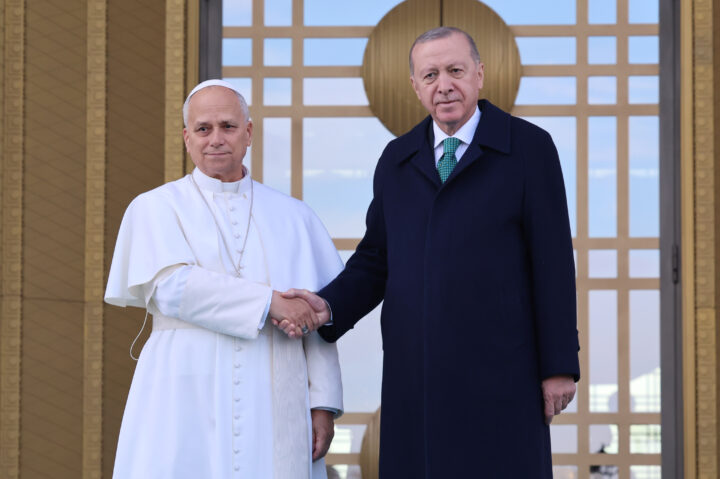
Yavuz Ozden/ dia images via Getty Images
President Recep Tayyip Erdoğan greets Pope Leo XIV at the Presidential Complex during an official welcoming ceremony on November 27, 2025 in Ankara, Türkiye.
Following a visit to Turkey on his inaugural international trip last week, Pope Leo XIV lauded Turkish President Recep Tayyip Erdogan on his peacemaking abilities and said Turkey has “an important role that it could play” in advancing peace in the Middle East and effectuating a two-state solution.
“I spoke about this with President Erdogan,” Leo said, referring to a two-state solution, which he called the “only” solution to resolving the Israeli-Palestinian conflict, reaffirming the Holy See’s longstanding position on the issue.
“Unfortunately we still haven’t seen a solution,” Leo told reporters upon departing from Istanbul. “We know that in this moment, Israel doesn’t accept [a two-state] solution, but we see it as the only one that can offer a solution to the conflict that they are living in.”
Erdogan “is certainly in agreement with this proposal,” Leo said.
The pope’s comments and decision to share pleasantries with the Turkish leader have struck some in the pro-Israel community as out of touch and are part a pattern of recent remarks from the Vatican that have been critical of Israel, most notably in its handling of the war against Hamas in Gaza.
In October, Cardinal Pietro Parolin, the Holy See’s secretary of state, described Israel’s conduct in Gaza as an “inhuman massacre” — language Leo later endorsed. In November 2024, the late Pope Francis called for an investigation into whether Israel’s actions in Gaza amounted to genocide.
Leo’s remarks came after the pope spent three days in Turkey, meeting with leaders of Catholic and Orthodox Christian churches to commemorate the 1,700th anniversary of a gathering of bishops in A.D. 325 in present-day Iznik, Turkey. He arrived in Beirut on Sunday for the second leg of his trip, and addressed politicians and religious leaders, including Lebanese President Joseph Aoun and Prime Minister Nawaf Salam at the presidential palace.
Steven Cook, a senior fellow at the Council on Foreign Relations, called the pontiff’s comments on Turkey “odd,” adding that his intentions were likely to “flatter his hosts but have little connection to reality.”
“At the outset of the war in Gaza, the Turkish government could have used its good offices with Hamas and Israel to play a constructive role helping to bring hostages home and bringing about an end to hostilities.” said Cook. “Erdogan chose an entirely different approach that offered significant political and diplomatic support to Hamas, demonized Israel, and [Turkey] was the first country to impose an economic boycott on Israel over the war.”
Sinan Ciddi, a senior fellow at the Foundation for Defense of Democracies, echoed those sentiments, calling the pope’s comments “flawed” and “fantasy.” However, he noted that popes have a “record of being idealists.”
“One thing that Leo is probably trying to do is he seems to be much more interested in promoting the potential to pursue any avenue towards establishing peace where he sees conflict,” said Ciddi. “[The pope has] probably been advised that the Turks have sort of demonstrated ability to be a mediator in the Ukraine-Russia conflict … and Turkey is a Muslim country that is able to speak to Hamas and is an ally of the United States … so why not essentially go after that, as opposed to labeling it as a supporter of terrorism.”
The Vatican has long advocated for a two-state framework, formally recognizing a Palestinian state in 2015. But the pope’s renewed push comes as the Israel-Hamas war intensified international pressure on Jerusalem to accept such a model. Earlier this year, several countries — including France, Saudi Arabia, the United Kingdom, Australia and Canada — formally recognized a Palestinian state at the United Nations General Assembly.
Israeli Prime Minister Benjamin Netanyahu has maintained his opposition to a Palestinian state, a position that’s shared by a significant majority of the Israeli public in the aftermath of Oct. 7.
The pontiff noted to reporters that the Vatican is “friends with Israel” and seeks to “be a mediating voice that can help bring them closer to a solution with justice for all.”
Ciddi told Jewish Insider that while Erdogan has been “relentless” in calling upon the pope to condemn Israel, Leo “has ignored that.”
After his inauguration in May, Leo said that dialogue with the Jewish community is “close to my heart.”
“Because of the Jewish roots of Christianity, all Christians have a special relationship with Judaism,” the pope said in May. “Theological dialogue between Christians and Jews remains always important and is very close to my heart.”
During his recent trip, Leo indicated a willingness to commemorate the 2,000th anniversary of Christ’s crucifixion in Jerusalem in 2033.
The Oklahoma senator also told JI that his colleagues have more work to do on raising awareness about efforts to designate the Muslim Brotherhood as a terrorist organization

Andrew Harnik/Getty Images
Sen. James Lankford (R-OK) speaks during a news conference on Capitol Hill on May 1, 2024 in Washington, DC.
As the international community looks to advance the ceasefire plan in Gaza, Sen. James Lankford (R-OK) emphasized the need for continued pressure from countries like Turkey and Qatar on Hamas to comply with the terms of the ceasefire requiring it to disarm.
But he also warned that there should be limits on the ways in which Turkey and Qatar are involved in the future of Gaza, arguing that they should have no role in certain sensitive areas, even as they remain involved in reconstruction work.
Lankford, in an interview with Jewish Insider this week, said that Hamas’ release of the final remaining deceased hostages will be an inflection point necessitating movement into the next phase of the ceasefire plan presented by the United States.
“The requirement for Hamas to disarm is still there. It has to be there, both for the people that live in Gaza that are Palestinian and for the security of the entire region,” Lankford said.
He said that ensuring that Hamas disarms, something it has thus far refused to do, will require military, diplomatic and financial pressure, particularly from countries like Turkey and Qatar that have been Hamas patrons.
“If the Turks want contracts to be able to rebuild in Gaza, which they do, then that’s not going to happen until Hamas is actually disarmed, so Turkey’s got to decide, ‘Do you want those contracts to be able to rebuild or not?’ If they do, then here’s what that requirement is going to be,” Lankford said.
He said that providing a higher level of security and freedom of movement on the Israeli-controlled side of Gaza will also help to increase pressure on Hamas. And he said that any further violations of the ceasefire agreement by Hamas should be met with “immediate, serious consequences.”
Turkey and Qatar’s roles in the future of Gaza should be limited to certain sectors, Lankford added, given the countries’ hostility to Israel and support for Hamas. He said he’s comfortable seeing Ankara assist with reconstruction, but it should not be involved in running hospitals, schools or mosques or in rebuilding the economy.
“We’re going to have to figure out what are roles that they can do and they cannot do,” Lankford said. “There are certain roles they just should not be a part of.”
He said he’s not yet able to name specific countries that he would be comfortable seeing taking on more sensitive tasks — though he noted Indonesia’s interest — and said it’s “going to take a multinational force.”
“It’s going to be a trusted force. It’s not going to be American forces in the middle of that. It needs to be a trusted force from the region as much as possible, but that’s going to have to be somebody that’s tenacious enough to say, ‘No, we’re going to actually bring some stability to this area,’” Lankford said. “And I don’t know who that is yet.”
He said that there are “plenty of Arab countries that don’t like the Muslim Brotherhood and don’t like all of its offshoots” — including Hamas — but the question will be whether they’re “willing to be able to put their sons on the line” to confront the terrorist groups in Gaza.
Asked about efforts to counter the Muslim Brotherhood at home — several of Lankford’s colleagues have introduced legislation to designate the group as a terrorist organization and have pushed for similar action by executive order from the White House — Lankford said that supporters of the effort have more work to do to raise awareness.
“I think the first issue for me is really to keep raising it, to be able to continue to raise awareness of it, because you’re not going to build momentum among 100 senators if it’s the first time they thought about it,” Lankford said. “So we’re going to have to build some of that momentum for a while.”
The Oklahoma senator, a co-chair of the Senate antisemitism task force, has also been outspoken about rising antisemitism on the “New Right” and was critical of the Heritage Foundation’s response to neo-Nazi Nick Fuentes’ recent appearance on Tucker Carlson’s podcast.
Asked about Carlson, Lankford said that he “can say whatever he wants to … but we also have a protected right to be able to speak back and to say we disagree on areas.”
“I think the worst case scenario is to just be able to leave it out there,” Lankford continued. He argued that providing counter-narratives to antisemitic talking points is crucial to stemming the tide of antisemitism on both sides of the aisle.
“If you get loud voices that say it and repeat it, people that just see it and don’t see a counter-narrative just accept it,” Lankford said. “We’ve got to make sure a counter-narrative is out there so that people actually hear a different opinion on it.”
Lankford, a Southern Baptist minister, objected to Carlson’s comments condemning Christian Zionists.
“To say those that support Israel that are Christians are ‘heretics,’ and are ‘the worst’ — I guess worse than Hamas and Hezbollah,” Lankford said. “That’s a bit of a bizarre statement to make, and I think we have a responsibility to be able to speak out and say, ‘Hey, I don’t agree with that.’”
“It seems that he is defining what Christianity is. And he has a right to be able to say whatever he wants to, but I also have a right to be able to live biblical Christianity as well, and to be able to see the scripture in the full context of what it says,” Lankford continued. “So I want to speak out on that as well.”
Asked about Vice President JD Vance’s exchange last week with a student who asserted that Jews are seeking to persecute Christians — a narrative that Vance did not address or dispute — Lankford said that leaders, including in the White House and the Trump administration, need to speak up “for the most basic issue of religious liberty.”
He said it’s important for people to be able to hold and live their own faiths and to also protect the ability of others to practice different faiths. “What’s interesting on that dialogue is, I’ve literally not met a Jewish person that wasn’t very protective of religious liberty,” Lankford added. “It’s literally the opposite of that question.”
The president said hostages will be released Monday or Tuesday, confirmed his team working on a weekend trip to Egypt and Israel
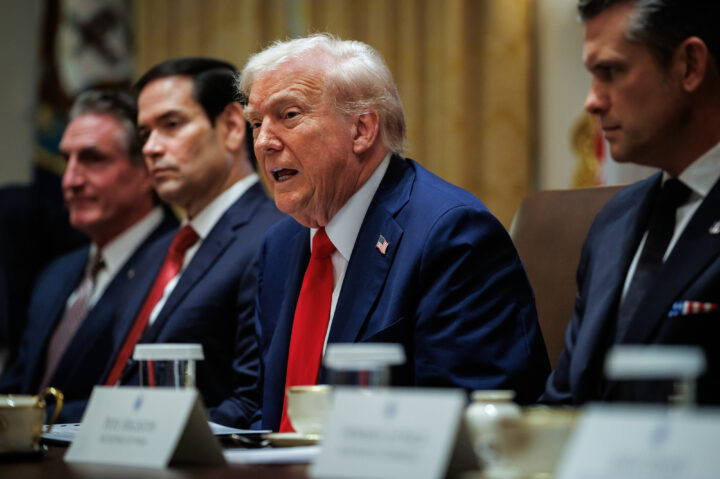
Samuel Corum/Sipa/Bloomberg via Getty Images
President Donald Trump during a Cabinet meeting at the White House in Washington on Oct. 9, 2025.
President Donald Trump heaped praise on the leaders of Qatar, Egypt, Saudi Arabia, Turkey and Indonesia on Thursday, lauding them and members of his administration as key parties responsible for getting Israel and Hamas to agree to the first phase of his peace plan for the region.
“I want to express my tremendous gratitude to the leaders of Qatar, Egypt and Turkey for helping us reach this incredible day and for being there. They were there with us all the way. And of course, as you know, Saudi Arabia and Jordan and so many,” Trump said during a Cabinet meeting at the White House. “I will tell you, [Turkish] President [Recep Tayyip] Erdoğan was personally involved in dealing with Hamas and some of the others. He’s been great. They’ve all been really amazing. Indonesia has been amazing. Indonesia has been fantastic.”
“The whole world has come together for this, people that didn’t get along, people that didn’t like each other, neighboring countries that, frankly, didn’t like each other,” he continued.
The president confirmed in his remarks on Thursday that his team was working on organizing a Mideast trip for him to commemorate the deal, which would include stops in Egypt and Israel, where he has been invited to address the Knesset.
He said he plans to depart from Washington on Sunday and is considering the timing of the release of the hostages in his plans. “They should be released on Monday or Tuesday. … That’ll be a day of joy. I’m gonna try and make a trip over,” Trump said. “We’re planning on leaving sometime Sunday,” he added later.
Regarding the U.S. officials involved in the deal, Trump credited Vice President JD Vance; White House Chief of Staff Susie Wiles; Secretary of State Marco Rubio; Secretary of Defense Pete Hegseth; Middle East envoy Steve Witkoff; Jared Kushner, the president’s son-in-law and former advisor who spearheaded the Abraham Accords in the first Trump administration; and CIA Director John Ratcliffe with helping bring the agreement across the finish line.
“All Americans should be proud of the role that our country has played in bringing this terrible conflict to an end,” Trump said.
Israeli and Hamas negotiators signed off on the first phase of the deal in Egypt earlier in the day, which would see the release of all the remaining hostages in exchange for the release of Palestinian security prisoners.
In brief remarks to reporters during the meeting, Rubio similarly attributed the administration’s success to its engagement with Arab and Muslim-majority nations.
“What really took a turn about a month ago, less than a couple weeks ago, is when we were at the United Nations, and [Trump] convened an historic meeting, not simply of Arab countries, but Muslim-majority countries from around the world … Indonesia was there, Pakistan was there, and created this coalition behind this plan. Then on that following Monday, you met with the prime minister of Israel here, and that plan was presented. And then, of course, our great negotiating team followed up on it in the interim,” Rubio said.
Asked about the potential for political turmoil in Israeli Prime Minister Benjamin Netanyahu’s governing coalition by far-right parties who said today they would oppose the deal in a Cabinet vote, Trump replied that the issue was not a concern and predicted that such an agreement could help Netanyahu.
“Bibi may go a little bit out of whack. Look, that’s politics. … I think he’s very popular right now. He’s much more popular today than he was five days ago, I can tell you that. Right now, maybe people shouldn’t run against him, five days ago it might not have been a bad idea,” Trump said. “This has been a very good thing. I don’t think he did it [agreed to a deal] for that reason [of political survival]. But I think just looking as an analyst would look at this … I think Bibi should be very popular right now.”
Trump said that, beyond bringing an end to the war in Gaza, the new agreement was “really [about achieving] peace in the Middle East.” He then described the war as a “big retribution” in response to Hamas’ Oct. 7, 2023, attacks on the Jewish state.
“Remember, Oct. 7 was terrible, but also, from the Hamas standpoint, they probably lost 70,000 people. That’s big retribution. That’s big retribution. But at some point that whole thing has to stop, and we’re going to see to it,” he said.
Looking forward, Trump was noncommittal about how future phases of his 20-point peace plan would be implemented or upheld, instead noting that Gaza would be rebuilt, the Abraham Accords would expand to include more countries and the hostages would be returned. He also declined to take a stance on supporting or opposing a two-state solution.
“Gaza is going to be slowly redone. You have tremendous wealth in that part of the world by certain countries, and just a small part of that, what they make will do wonders for Gaza,” the president explained. “I think you’re going to see some tremendous countries stepping up and putting up a lot of money and taking care of things. There’s this tremendous spirit like I haven’t seen.”
“The first thing we’re doing is getting our hostages back. That’s what people wanted more than anything else. They wanted these hostages back that have lived in hell like nobody has ever even dreamt possible. And after that, we’ll see,” he later added when asked about ensuring all sides adhere to the deal. “But they’ve agreed to things, and I think it’s going to move along pretty well.”
Middle East Institute experts said that a common security understanding between Jerusalem and Ankara could help Syria maintain stability in the post-Assad era
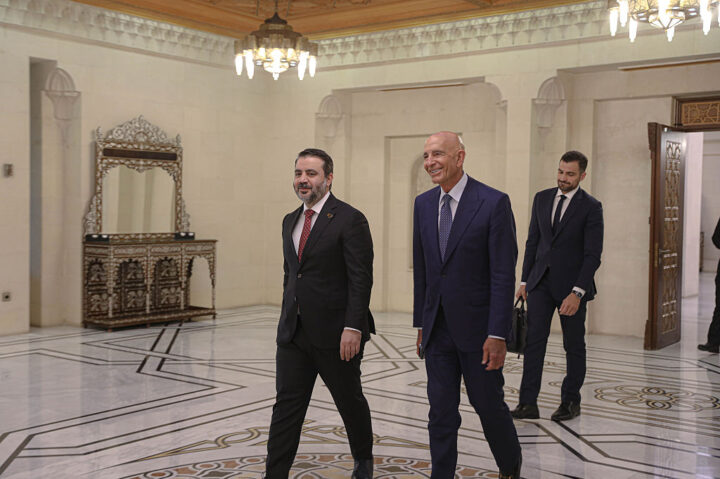
Izettin Kasim/Anadolu via Getty Images
Syrian President Ahmed al-Sharaa welcomes US Ambassador to Ankara and Special Envoy for Syria Tom Barrack (R) and his accompanying delegation at the People's Palace in Damascus, Syria on July 9, 2025.
Stability in Syria could help ease tensions between Israel and Turkey — two countries with competing interests in the region — and the U.S. has a key role to play in shaping the security agreements needed to get there, experts from the Middle East Institute said Thursday during a panel titled “Can Turkey and Israel Find Common Ground in Syria?”
“A lot depends on what the United States decides to do, how they treat the Kurdish question in the northeast of Syria, and what they ask the Israelis and the Kurds to do,” said Natan Sachs, a senior fellow at MEI who focuses primarily on Israel.
“It’s not that [President Donald] Trump can decide what happens, because these interests, certainly for the Israelis but also for the Turks, are seen as vital domestic interests. It’s not just the question of the peace process in Turkey. For Israelis, it’s seen as vital threats on the Israeli border. But nonetheless, there is enormous room, I think, for [U.S.] diplomacy here with some chance of success.”
The webinar, moderated by MEI’s vice president for policy, Ken Pollack, also featured Gonul Tol, a senior fellow at MEI who focuses primarily on Turkish politics. It comes against the backdrop of the collapse of the Assad regime last December and Syrian President Ahmad al-Sharaa’s assumption of power in January. Al-Sharaa addressed the U.N. General Assembly on Wednesday, the first time a Syrian president has done so in almost 60 years, presenting a vision of a “new Syria” after decades of civil war and dictatorship under the Assad family.
But questions remain about Syria’s future and the influence of its two most powerful neighbors — Israel and Turkey. Sachs and Tol addressed how Syria has become a focal point for Turkish-Israeli rivalry, what role the U.S. could play in softening the hostilities between its two allies and how the situation impacts stability in the region.
The Assad family “has been a long foe of Israel, but it was a known foe. It was a devil that they knew,” said Sachs, expressing concern that al-Sharaa, who was once a leader in Al-Qaida, could be a “pragmatist, but not someone who’s changed fundamentally.”
Tol said that “it’s always been Syria that kept the two countries together, historically, from Turkey’s point of view, overlapping interests with Israel in Syria and on some level Iran too.”
“That was the glue that kept the relationship, no matter what was happening on the Palestine question, right? So now we are at a moment where that glue is not there,” Tol continued. “Syria and clashing interests are driving these two countries apart. What is worse is what kept that relationship in the golden years of the 1990s was the fact that Israel really needed Turkey, and it was the main factor behind this bilateral partnership. But in the last several years, Israel has taken many steps that makes Israel a lot less dependent on Turkey. I mean partnership with Ankara granted Israel this legitimacy.”
“So we’ve got a point where there is a dominant Israel that is militarily very powerful … Israel does not need Turkey anymore, and Turkey does not have leverage,” she continued.
Tol called the Kurdish angle “important” to the situation. “Kurds now want autonomy,” she said. “They are somewhat emboldened by the Israeli presence there [in northern Syria] and as long as Syria remains unstable they won’t be able to send back those refugees.”
She went on to say that the presence of U.S. troops in the country complicates the situation of stabilizing Syria. A potential solution, Tol suggested, is “maybe both sides should just accept different spheres of influence,” similar to Israel and Turkey’s understanding in Azerbaijan.
“The parties helped there in order to establish a non-conflict mechanism. So you control Turkey’s tens of thousands of troops in northern Syria. So the understanding was going to be, okay, you remain there. We are here. We do our business. So we don’t conflict with each other. Can that be done? I think that would be an ideal scenario for [Turkish President Recep Tayyip] Erdogan, because Erdogan wants Israel out of Syria. But he understands that it’s not realistic,” she said, adding that the two countries would like good relations. “Erdogan is not interested in military conflict with Israel. That is, I know that’s a negative that some have been pushing, but I just don’t think so. And I don’t think Israel has any interest in confronting Turkey’s military either. Turkey is a NATO country at the end of the day, and the stakes are just too high.”
Asked whether Israel can accept a Turkey-Syria agreement, and under what conditions, Tol pointed to recent reports from Israeli media that said one of the asks from the Israeli side in an agreement with Damascus is that it stops cooperating with Ankara on defense.
“We know that Turkey wants to have access to spaces in Syria and Israelis were saying they weren’t going to accept this … but Damascus is slow on that and in a difficult spot, too. So I think the defense angle, if Israelis are pushing that, forcing Damascus to stop having that defense partnership with Ankrara, that would be difficult to follow,” Tol said.
Sachs said a red line for Israel in a Turkey-Syria agreement would be “Turkish access to [air] bases, and in particular flexibility for aerial defense.”
“The Israeli assumption here is that Turkey’s influence is almost a given,” said Sachs. “The question is more the confines of that limit, not whether [the countries] come to an accommodation. From the Israeli perspective, the current trend is extremely worrying, with the rise of a regime it is very skeptical of — and with good reason.”
Trump: ‘He needs certain things, and we need certain things, and we’re going to come to a conclusion’
Photo by Andrew Harnik/Getty Images
President Donald Trump delivers remarks during a meeting with President of Turkey Recep Tayyip Erdogan in the Oval Office at the White House on September 25, 2025 in Washington, D.C.
President Donald Trump suggested on Thursday that he was likely to permit Turkey to purchase F-35 fighter jets as soon as “the end of the day,” ending a nearly eight year blockade on Ankara’s acquiring the top-of-the-line fighter jet as a result of its 2017 purchase of a Russian S-400 missile system.
Speaking to reporters from the Oval Office alongside Turkish President Recep Tayyip Erdogan ahead of a meeting between the two and their respective teams, Trump said without mentioning the F-35’s or the less-advanced F-16 jets by name that he expected the Turkish leader would “be successful with buying the things” he would “like to buy.”
“He needs certain things, and we need certain things, and we’re going to come to a conclusion. You’ll know by the end of the day,” Trump said at the outset of his meeting with Erdogan.
The White House declined to comment on what the president was referring to or if an announcement regarding resumed F-35 sales to Ankara was imminent.
Erdogan has focused his visit to the White House, his first such trip in six years, around securing U.S. sanctions relief and approval for new arms deals, including the F-35 jets and other fighter and Boeing aircraft. Trump implemented the sanctions during his first term after Turkey purchased a Russian air defense system that U.S. officials warned could be used by the Russians to harness data on the F-35’s capabilities and compromise the aircraft.
The sanctions, pursued through the Countering American Adversaries Through Sanctions Act, are still in place due to Turkey’s refusal to replace the Russian system. The Biden administration approved the sale of F-16 jets to Turkey in early 2023 on the condition of Ankara allowing Sweden to join NATO.
The prospect of Trump changing course on the sale has sparked bipartisan concern from some lawmakers. While some see such a sale as a way to incentivize better behavior from Ankara, others have warned that the embrace could have the opposite effect.
A bipartisan coalition of House lawmakers wrote a letter to Secretary of State Marco Rubio and Defense Secretary Pete Hegseth on Thursday urging the Trump administration against approving a deal for F-16s or F-35s.
It was signed by Reps. Chris Pappas (D-NH), Gus Bilirakis (R-FL), Dina Titus (D-NV), Nicole Malliotakis (R-NY), Brad Sherman (D-CA), Frank Pallone Jr. (D-NJ), Don Bacon (R-NE), Jim Costa (D-CA), Josh Gottheimer (D-NJ), Stephen Lynch (D-MA), Dan Goldman (D-NY), Brian Fitzpatrick (R-PA), Brad Schneider (D-IL), Tom Suozzi (D-NY), Wesley Bell (D-MO), Ted Lieu (D-CA), Mike Lawler (R-NY), Rob Menendez (D-NJ), Greg Landsman (D-OH) and Gabe Amo (D-RI). The American Jewish Committee, CUFI Action Fund and FDD Action were among the organizations that endorsed the letter.
“The security risks of Turkey’s acquisition and continued possession of the Russian S-400 system are well known. The S-400 poses a direct threat to U.S. military aircraft, including both the F-16 and F-35, by enabling Russian intelligence to gain insight into sensitive U.S. military technology if operated alongside these platforms,” the lawmakers wrote.
“Congress has consistently upheld bipartisan restrictions on Turkey’s access to the F-35. Any move to reverse this policy without first securing the statutorily required certification would be a clear violation of U.S. law, undermine Congressional authority, and signal to others that U.S. law and strategic principles can be disregarded,” they added.
Trump said he expects to reach a positive conclusion to F-35 talks with the Turkish president ahead of a White House meeting this week
Evan Vucci
President Donald Trump shakes hands with Turkish President Recep Tayyip Erdoğan after a news conference in the East Room of the White House, Wednesday, Nov. 13, 2019, in Washington.
A bipartisan group of House members urged the administration to “be very careful” in negotiations with Turkey about its potential re-entry into a program allowing it to acquire and potentially co-produce F-35 fighter jets, ahead of a White House meeting between President Donald Trump and Turkish President Recep Tayyip Erdogan on Thursday.
Trump said Friday that he would host Erdogan at the White House for trade and military talks, “including the large-scale purchase of Boeing aircraft, a major F-16 Deal, and a continuation of the F-35 talks, which we expect to conclude positively.”
Lawmakers have been pressing for months for the administration to be cautious in allowing Turkey to acquire the advanced fighter jets, something it has been banned by law from doing since it purchased a Russian S-400 missile defense system. By law, Turkey must dispense with that system before it can be re-admitted into the F-35 program, but some lawmakers have pushed for additional conditions, given various conflicts with Turkey, including its hostile posture toward Israel.
“The United States must be very careful when engaging in negotiations particularly as it relates to discussions surrounding Turkey’s potential reentry into the F-35 Joint Strike Fighter program. Turkey was rightfully removed from the program in 2019 following its acquisition of the Russian-made S-400 missile defense system—a clear violation of U.S. law under the Countering America’s Adversaries Through Sanctions Act (CAATSA),” Reps. Gus Bilirakis (R-FL), Chris Pappas (D-NH), Nicole Malliotakis (R-NY) and Dina Titus (D-NV), who chair the Congressional Hellenic Caucus, said in a joint statement on Monday.
They emphasized that the Turkish-Russian cooperation, in spite of Turkey’s NATO status, “directly undermines the security of U.S. defense technology and poses a threat to the strategic integrity of allied defense cooperation,” as well as “risks exposing sensitive U.S. military capabilities to Russian intelligence, eroding allied trust, and jeopardizing the development of next-generation military platforms.”
In addition to the formal legal obstacles that should ban F-35 acquisition under current conditions, the four lawmakers added that Erdogan has “consistently demonstrated a disregard for international norms and democratic principles.”
They said that upholding the sanctions law is critical both to protect U.S. defense technology as well as to demonstrate the U.S.’s commitment to the rule of law.
“Rewarding Erdogan’s government without meaningful changes in behavior would set a dangerous precedent and weaken the credibility of U.S. foreign policy,” the lawmakers wrote. “The United States must stand firm in defending its laws, its alliances, and the international order.”
Plus, The New Yorker's Piker problem

ADEM ALTAN/AFP via Getty Images
Turkish President and leader of the Justice and Development (AK) Party Recep Tayyip Erdogan attends his party's group meeting at the Turkish Grand National Assembly in Ankara, on October 25, 2023.
Good Thursday morning.
In today’s Daily Kickoff, we report on a series of amendments to the National Defense Authorization Act targeting Turkey for its support of terrorist groups and hostility toward Israel, and cover The New Yorker’s platforming of antisemitic influencer Hasan Piker at its upcoming festival. We talk to members of the House Foreign Affairs Committee’s MENA subcommittee following yesterday’s closed-door briefing on the West Bank with U.S. Ambassador to Israel Mike Huckabee, and spotlight Iowa Senate candidate Josh Turek’s support for conditioning aid to Israel. Also in today’s Daily Kickoff: Amb. Yechiel Leiter, Rep. George Latimer and Linda Frum.
Today’s Daily Kickoff was curated by Jewish Insider Executive Editor Melissa Weiss and Israel Editor Tamara Zieve, with assists from Haley Cohen and Marc Rod. Have a tip for us? Email us here.
What We’re Watching
- President Donald Trump will convene a call this morning between Ukrainian President Volodymyr Zelensky and French President Emmanuel Macron, who are both in Paris today for a summit of European allies of Kyiv, as well as Australia and Canada, aimed at formulating postwar security guarantees for Ukraine.
- Israeli President Isaac Herzog is at the Vatican today, where he just concluded a meeting with Pope Leo XIV.
- The Middle East Institute is hosting an event this afternoon in Washington, featuring writers Ross Harrison and Mohsen Milani, focused on Iran’s options following its 12-day war with Israel in June.
- In Israel, we’re keeping an eye on high-level government talks about West Bank annexation. More below.
What You Should Know
A QUICK WORD WITH JI’S MELISSA WEISS
Flashback to 2020: As Israel mulls annexation of the West Bank, a prominent Emirati official communicates to an Israeli outlet that such a move could have disastrous consequences for Israel’s positioning in the region.
“Annexation,” UAE Ambassador to the U.S. Yousef Al Otaiba wrote in a Yediot Ahronoth op-ed in June 2020, “will certainly and immediately upend Israeli aspirations for improved security, economic and cultural ties with the Arab world and with UAE.”
Al Otaiba’s op-ed was part of the groundwork laid for the Abraham Accords, announced less than two months later and signed in September 2020. With the normalization agreement in place, Israel’s annexation plans were shelved — at least temporarily — as it deepened its relations with the UAE and Bahrain, the original signatories to the landmark deal.
Five years later, senior Emirati diplomat Lana Nusseibeh, who previously served as Abu Dhabi’s envoy to the United Nations, is issuing a similar warning.
“Annexation would be a red line for my government, and that means there can be no lasting peace. It would foreclose the idea of regional integration and be the death knell of the two-state solution,” Nusseibeh told The Times of Israel earlier this week.
The five years between Al Otaiba’s op-ed and Nusseibeh’s comments have seen seismic shifts in the region: the Israel-Hamas war and the degradation of Iran’s nuclear capabilities and its regional proxy network, particularly with the collapse of the Assad regime in Syria. Israel has shown itself to be the dominant military player in the region, even as it finds itself on the receiving end of widespread criticism across the Middle East and beyond over its war against Hamas in Gaza.
But they have also seen the rise of the Israeli far right as a more significant player in the country’s politics. The ascensions of Finance Minister Bezalel Smotrich and National Security Minister Itamar Ben-Gvir have paved the way for a renewed Israeli effort to annex broad swaths of the West Bank, five years after plans to do so were derailed by peace efforts.
ENVOY INTERVIEW
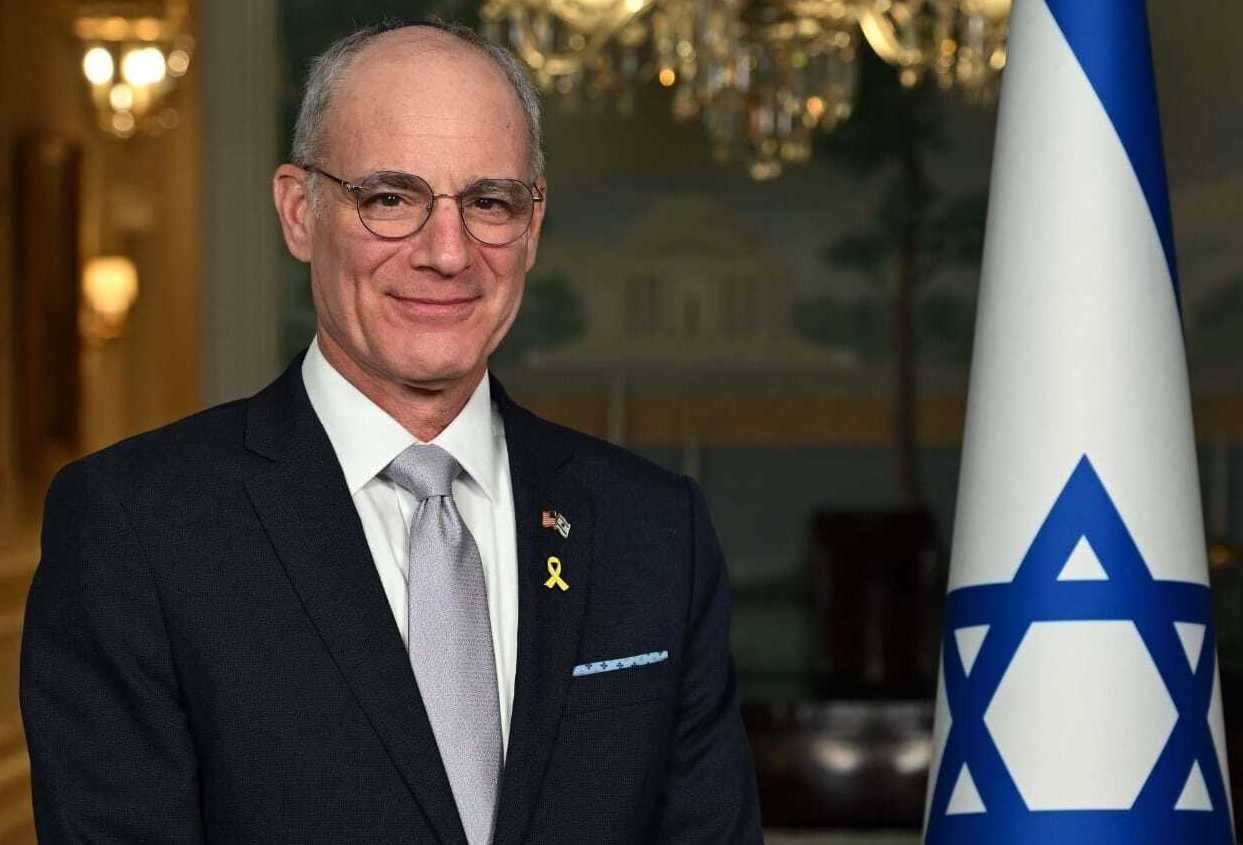
Israeli Ambassador to the U.S. Yechiel Leiter arrived at his post in January as Israel was more than a year into its war with Hamas in Gaza and facing declining American support for the Jewish state. The Trump administration has been much friendlier to the government in Jerusalem than its predecessor, supporting the Israeli war effort in Gaza with no limitations on arms shipments. Yet, the broader political atmosphere is more hostile to Israel than it has been in decades. Leiter spoke with Jewish Insider’s Lahav Harkov and the executive director of the Misgav Institute for National Security and Zionist Strategy, Asher Fredman, on the “Misgav Mideast Horizons” podcast this week about his efforts to engage members of both parties, the future of the U.S.-Israel alliance, what is next in the war in Gaza and more.
MOU musings: Amid these concerning political trends, Leiter said that the U.S. and Israel have started to discuss what will happen after the Obama-era 10-year Memorandum of Understanding between the countries, which currently commits $3.8 billion a year in American defense aid to Israel annually, expires in 2028. While Israel’s official position favors continuing aid, some in Israeli Prime Minister Benjamin Netanyahu’s Likud Party and others on the Israeli right have been advocating for moving from a model of aid to one of collaboration on joint projects. “Maybe we’ll change the nature [of the MOU], where there will be greater [joint] research and development between our two countries, rather than relying on American weapons,” Leiter said.
EYE ON ANKARA

Bipartisan groups of House lawmakers are aiming to crack down on Turkey in the 2026 National Defense Authorization Act, introducing a series of amendments seeking to place further restrictions on U.S. aid to the NATO ally in response to its support for Hamas and hostility toward Israel, Jewish Insider’s Marc Rod reports.
Angles of attack: Groups of House members introduced amendments to the NDAA, set for consideration next week, that would ban any arms sales or transfers to Turkey until the administration outlines how it is ensuring that Turkey is no longer threatening or violating the sovereignty of U.S. allies, providing support to terrorist groups or purchasing any defense systems from U.S. adversaries; impose new, elevated conditions on the sale of F-35 and F-16 fighter jets to Turkey; and protect Israel’s Qualitative Military Edge over Turkey. It remains to be seen which, if any, of these amendments will receive consideration or be incorporated into the House’s final draft version of the NDAA.
HOSTING HATE
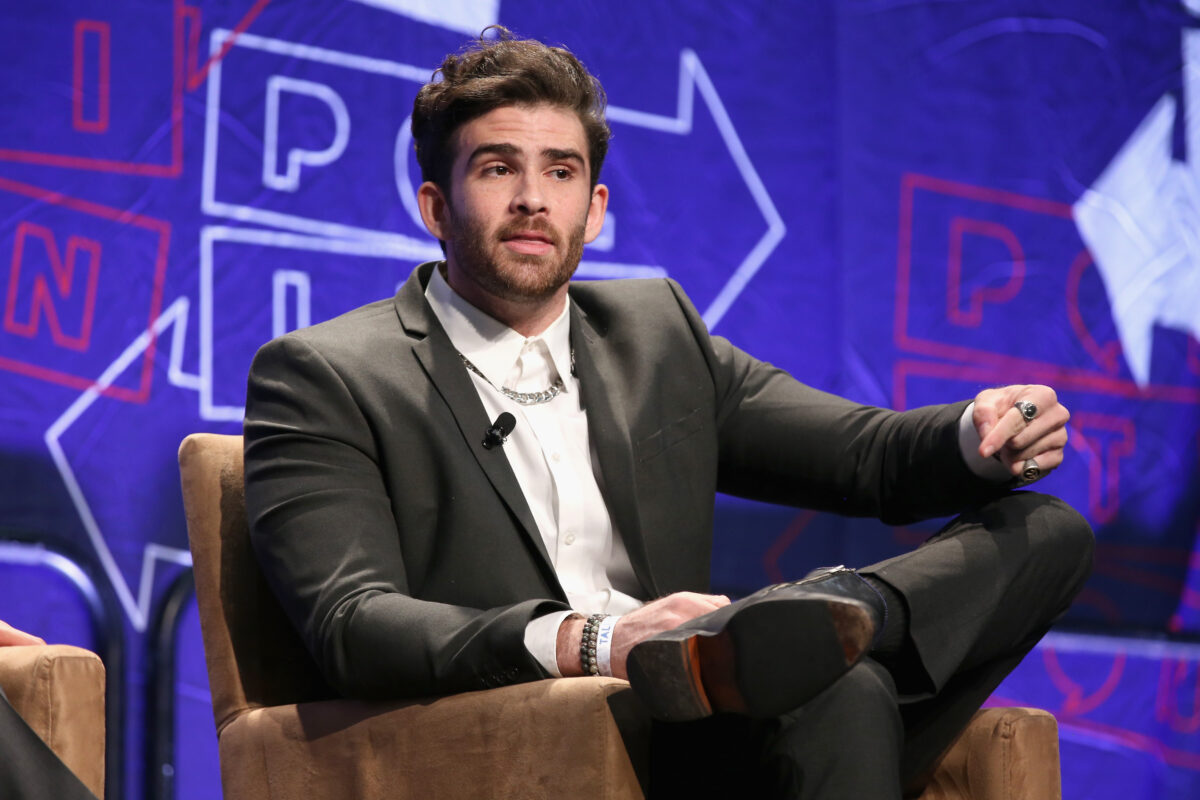
Hasan Piker, the far-left streamer who frequently stirs controversy for using antisemitic rhetoric in his commentary on Israel and Jewish issues, will join a roundtable discussion next month hosted by The New Yorker Festival, the publication announced on Wednesday in a full lineup of events. The conversation on Oct. 26, which will focus on “how the internet has reshaped political life” and its implications “for the future of democracy,” will also feature Saagar Enjeti, a right-wing populist pundit who co-hosts the “Breaking Points” podcast. It will be moderated by Andrew Marantz, a staff writer for The New Yorker, who published a feature story last March about Piker’s popularity among an audience of young, male voters who have recently gravitated to the right, Jewish Insider’s Matthew Kassel reports.
Backlash: His festival appearance drew criticism from the Anti-Defamation League, which denounced The New Yorker’s “decision to platform Piker” as “the latest example of mainstream media normalizing his brand of antisemitism and anti-Zionism.” The streamer’s “toxic and extreme rhetoric opposing Zionism and the Jewish state normalizes antisemitism, reinforces bigotry and launders terror — and it has no place at a conference devoted to prominent influencers,” an ADL spokesperson told JI on Wednesday, arguing that Piker’s “extreme statements” on a range of topics “should permanently disqualify him from appearing at any major media festival.”
MEMBER UPDATE
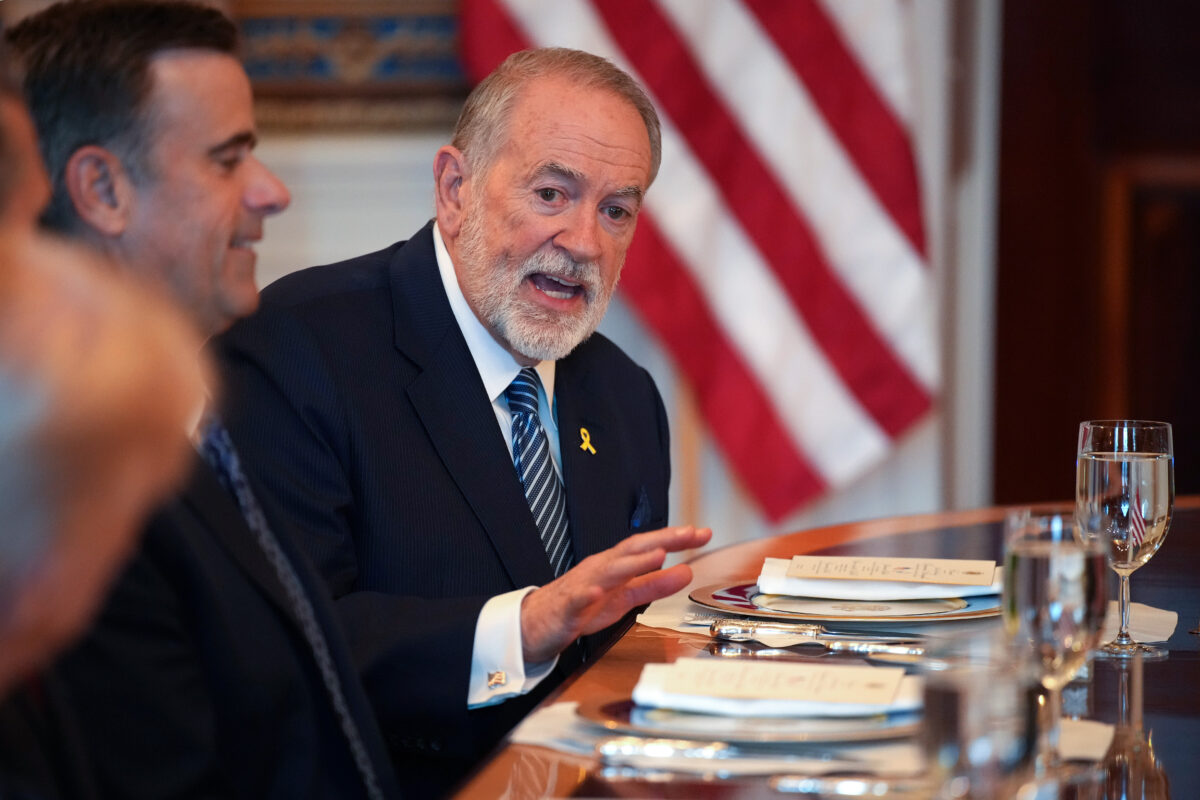
U.S. Ambassador to Israel Mike Huckabee privately briefed lawmakers on the House Foreign Affairs Committee on Wednesday morning on the security and political situation in the West Bank and the war in Gaza, Jewish Insider’s Marc Rod reports. The briefing was organized by Rep. Mike Lawler (R-NY), who chairs the subcommittee on the Middle East and North Africa, in response to efforts by France and other U.S. allies to recognize a Palestinian state. Despite a focus on the West Bank, attendees indicated that the briefing did not provide specific answers on any U.S. policy toward a potential Israeli move to annex all or part of the territory.
In the room: Lawler told JI the briefing had included a “thorough discussion with the ambassador about Judea and Samaria and the challenges and the opportunities,” using the biblical term for the West Bank preferred by the Israeli government and utilized by the Foreign Affairs Committee. “Given the insistence on the part of the French and other Europeans to recognize a Palestinian state, I thought it was important for my colleagues to have a greater understanding of what we’re actually talking about with respect to Judea and Samaria, or the West Bank, and how it is actually governed post-Oslo,” Lawler continued, referring to the peace accords brokered in the 1990s.
TUREK’S TAKE
Iowa state Rep. Josh Turek, a leading Democratic Senate candidate in the state, supported an amendment in the Iowa Statehouse earlier this year that called for U.S. support for Israel’s ability to eliminate terrorist groups to be conditional, Jewish Insider’s Marc Rod reports.
About the amendment: The amendment, which failed to pass, would have struck language in a pro-Israel resolution supporting Israel’s “sovereignty and right to pursue, without interference or condemnation, the elimination of any terrorist group until all such groups are permanently neutralized and Israelis can live in peace.” It would have instead inserted language that stated that the Iowa House supports Israeli sovereignty and its right to take action to eliminate terrorist threats but added: “However, this support is conditioned upon the State of Israel’s adherence to international humanitarian law and protection of innocent civilian lives. The House of Representatives affirms its commitment to human rights and condemns acts by any party that constitute war crimes, crimes against humanity or indiscriminate attacks against civilian populations.” Turek ultimately voted in favor of final passage of the original, unamended resolution.
ISRAEL INSIGHTS

Returning from a trip to Israel, Rep. George Latimer (D-NY) emphasized that Israel’s critics in the United States and around the world are overlooking Hamas’ key role in perpetuating the conflict and contributing to the humanitarian issues in Gaza, strengthening the terrorist group’s position and insulating it from pressure, Jewish Insider’s Marc Rod reports. At the same time, he also said that Israel must do more to pursue an end to the war, make its case to the world and provide aid in Gaza.
Shades of gray: “When you see on the ground, you understand it is not a simple black-and-white situation,” Latimer, a first-term congressman from heavily Jewish Westchester County, N.Y., who sits on the House Foreign Affairs Committee, said. “People come up to me and say, ‘Israel is practicing genocide. What they’re doing is evil and we need to stop it.’ And then you get on the ground and you realize how much more complicated it is than that.” He said that American critics of Israel fail to acknowledge Hamas’ “role in all of this and its contributory actions.”
Worthy Reads
The Case Against Genocide: In The Wall Street Journal, Bernard-Henri Lévy breaks down misconceptions about Israel’s war against Hamas in Gaza. “A genocidal army doesn’t take two years to win a war in a territory the size of Las Vegas. A genocidal army doesn’t send SMS warnings before firing or facilitate the passage of those trying to escape the strikes. A genocidal army wouldn’t evacuate, every month, hundreds of Palestinian children suffering from rare diseases or cancer, sending them to hospitals in Abu Dhabi as part of a medical airlift set up right after Oct. 7. To speak of genocide in Gaza is an offense to common sense, a maneuver to demonize Israel, and an insult to the victims of genocides past and present.” [WSJ]
MAGA’s Nazi Apologists: The Atlantic’s Yair Rosenberg considers the factors motivating far-right influencers, including Tucker Carlson and Candace Owens, who platform antisemites and engage in revisionist history around the Holocaust. “The 21st-century heirs of Lindbergh and Coughlin seek to turn back the clock to a time when such sentiments were seen by many as sensible rather than scandalous. These far-right figures have correctly ascertained that to change what is possible in American politics, they need to change how America talks about itself and its past. Had Carlson and his cohort attempted their revisionism 20 years ago, they would have encountered a chorus of contradiction from real people who had experienced the history they sought to rewrite and know where its conspiratorial calumnies lead. But today, most of those people are dead, and a new generation is rising that never witnessed the Holocaust firsthand or heard about it from family and friends who did.” [TheAtlantic]
Two Roads Diverged…: In Ynet, Nadav Eyal posits that Israeli and Diaspora Jewry are simultaneously at a crossroads that will determine the future of both. “In the Diaspora, Jewish existence is endangered by processes in the surrounding non-Jewish societies. In Israel, Jewish existence is endangered by the region and by the political leadership itself. It is both a junction and a race: which crisis will reach a tipping point first? Because ultimately, one can predict, either the Diaspora will flow into Israel, or Israel will spill into the Diaspora. Actually, both could happen simultaneously. Across the Jewish world, modern Orthodox communities demonstrate increasing aliyah to Israel; this is natural, considering the triangle of hatred built around those who identify as Jews. … It is certainly possible that the antisemitic storm will pass, like a hurricane leaving destruction in its wake, after the war ends. And perhaps Israel will leave behind the current political darkness and commit to major reforms. But what will come first —a positive transformation, or a catastrophe, or both?” [Ynet]
Word on the Street
Former Sen. John Sununu (R-NH) is mulling a bid for his old seat; Sununu served as senator from 2003-2009 before losing his seat to Sen. Jeanne Shaheen (D-NH), who announced her retirement earlier this year…
The Trump administration reportedly offered a position at the Department of Housing and Urban Development to New York City Mayor Eric Adams in an effort to incentivize Adams to drop his reelection bid against front-runner Zohran Mamdani; Adams met with administration officials in Florida earlier this week…
The New York Times looks at Mamdani’s rhetoric shift away from some of his more fringe political positions as the November election nears…
A federal judge in Massachusetts ruled that the Trump administration’s cancellation of billions of dollars in research funding to Harvard violated the school’s First Amendment and due process rights…
Columbia and NYU launched investigations into student conduct violations days into the start of the new academic year; at Columbia, a student protested with a sign accusing classmates of being “IOF [Israeli occupation forces] criminals committing genocide in Palestine,” while at NYU, a mezuzah was ripped off the doorpost of a student dorm…
Cornell University told Jewish Insider it was rescheduling the start of the housing lottery for rising juniors and seniors to begin at 8 p.m. on Oct. 2 after initially causing controversy for scheduling the lottery to begin earlier in the day, during the last few hours of Yom Kippur…
Israeli artist Ilana Goor listed her home on Manhattan’s Upper East Side for $19 million; the carriage house home was previously listed last year for $37.75 million…
Puck cites a source who said that a deal for David Ellison’s Paramount to acquire Bari Weiss’ Free Press is “on the one-yard line”; the agreement reportedly surpasses The Free Press’ $100 million valuation…
Larry Ellison’s Oracle is laying off an unknown number of employees in a handful of states, weeks after laying off hundreds of staffers…
Record executive Scooter Braun and actress Sydney Sweeney are reportedly dating after meeting at the Venice wedding of Jeff Bezos and Lauren Sanchez over the summer…
C-SPAN reached an agreement with YouTube for the streaming platform to carry the nonprofit network’s three channels; the network will also be available on Hulu+LiveTV…
CNN announced the hiring of former Walla journalist Tal Shalev to be a senior reporter for the network and Zeena Saifi as a Jerusalem-based field producer…
A hospital in Belgium suspended a doctor who had described a 9-year-old patient’s condition as “Jewish” after conducting an investigation and finding the medical provider had posted dozens of antisemitic messages on social media…
Jillian Segal, Australia’s antisemitism envoy, suggested that Canberra cut funding to organizations that fail to address antisemitism, making a comparison to the Australian government’s threat to end funding to childcare facilities that do not prevent child abuse…
The Wall Street Journal reviews Operation Wrath of God: The Secret History of European Intelligence and Mossad’s Assassination Campaign, Aviva Guttmann’s new book examining the European role in the Mossad’s efforts to track down those responsible for the 1972 Munich Olympics massacre…
Israeli Prime Minister Benjamin Netanyahu reportedly spiked a planned visit to Israel by French President Emmanuel Macron, conditioning the French leader’s trip on Macron rescinding a previous call for Palestinian statehood…
Israel’s Shin Bet said it arrested Hamas members planning an assassination attempt on National Security Minister Itamar Ben-Gvir…
A report from the International Atomic Energy Agency found that Iran significantly increased its stockpile of weapons-grade enriched uranium in the weeks prior to Israel’s June strike on Iranian nuclear facilities and ensuing 12-day war…
Former U.S. Chamber of Commerce CFO Stefan Freiberg is joining Hillel International as chief financial officer…
Linda Frum was elected as the new board chair of UN Watch…
Artist and writer Rosalyn Drexler died at 98…
Pic of the Day
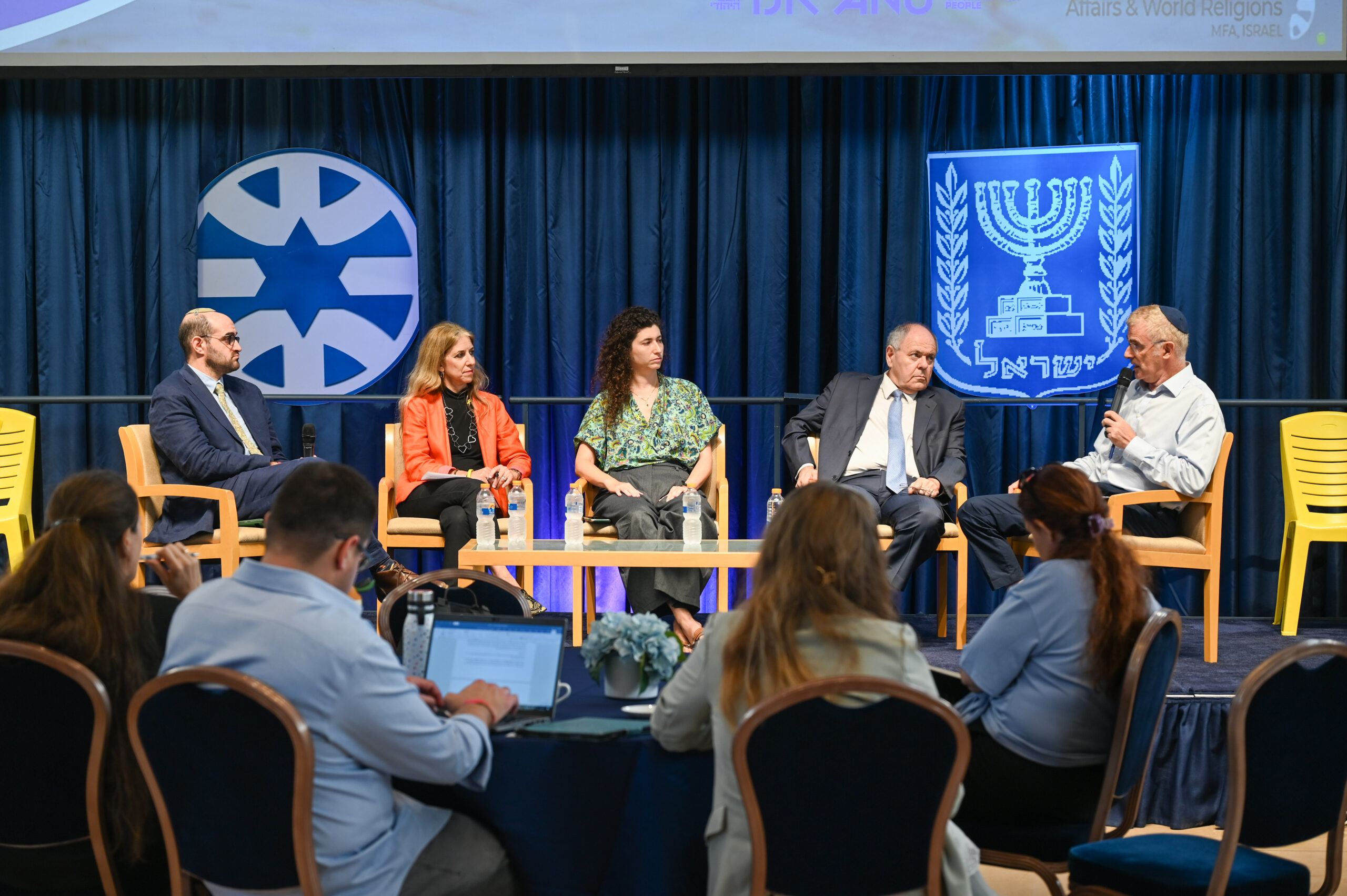
Former Israeli Ambassador to the U.K. and author Daniel Taub (right) spoke on a panel on Tuesday hosted at Israel’s Foreign Ministry in Jerusalem about Israeli foreign policy and the country’s relationship with world Jewry.
The panel, which was organized by the ministry and the Anu Museum’s Peoplehood Coalition and conducted in accordance with Chatham House Rule, was moderated by eJewishPhilanthropy Managing Editor Judah Ari Gross (left) and also included Shuli Davidovich, head of the Foreign Ministry’s Diaspora and Religions Bureau; Shelly Wolkowicz, who until last month served as CEO of the World Union of Jewish Students; and Dani Dayan, chair of Yad Vashem.
Birthdays

Israeli singer-songwriter David Broza turns 70…
Award-winning computer scientist and philosopher who is a pioneer in artificial intelligence, he is the father of slain Wall Street Journal journalist Daniel Pearl, Judea Pearl turns 89… Israeli architect renowned for designing public buildings across Israel and internationally over six decades, Meir Nir turns 86… Emeritus professor of law and former acting dean at the Benjamin N. Cardozo School of Law, Lester Brickman turns 85… Retired professor at the University of Puerto Rico School of Medicine, Edmundo N. Kraiselburd, Ph.D. turns 82… Saxophonist, flautist and jazz educator, in 2010 he received a lifetime achievement award from the National Endowment for the Arts, David Liebman turns 79… Attorney and political consultant who has served as board president of Louisville, Kent.’s, Jewish Family & Career Services, Mark Steven Ament… Celebrity doctor, he is a board-certified internist, addiction medicine specialist and media personality, known as “Dr. Drew,” David Drew Pinsky, M.D. turns 67… Musician, music producer, audio engineer and corporate speaker, Mark Schulman turns 64… Former member of the House of Representatives (D-NY), Anthony Weiner turns 61… Real estate strategic advisor, political strategist and commentator, E. O’Brien (“Obi”) Murray… Screenwriter best known as the writer of the 2008 film “Vantage Point,” Barry Louis Levy turns 53… Former member of Knesset for the Labor / Zionist Union party, he was the secretary general of Israel’s Labor party until early 2017, Yehiel “Hilik” Bar turns 50… Painter, sculptor, filmmaker, actor, writer, producer, photographer and restaurateur, Andrew Levitas turns 48… EVP and chief corporate affairs officer at BioMarin Pharmaceutical, Marni Kottle turns 47… Former special assistant and personal aide to President George W. Bush, later at Thrive Capital, Jared Weinstein… Television and film actor, he has also written four children’s books, Max Greenfield turns 45… Israeli former professional basketball player and coach, currently serving as an assistant coach for Maccabi Tel Aviv, Guy Pnini turns 42… Development officer at Atlanta’s Jewish Home Life Communities, Melissa Horen Kaplan… Javelin thrower, she won the Israeli national championship seven times, Marharyta Dorozhon turns 38… Television and film actor, Carter Mark Jenkins turns 34…
House lawmakers introduce series of amendments seeking to place further restrictions on U.S. aid on Ankara over its support for Hamas and hostility toward Israel
Burak Kara/Getty Images
Turkey's President Recep Tayyip Erdogan speaks to supporters at his party’s Istanbul mayoral candidate Murat Kurum's campaign rally on March 29, 2024 in Istanbul, Turkey.
Bipartisan groups of House lawmakers are aiming to crack down on Turkey in the 2026 National Defense Authorization Act, introducing a series of amendments seeking to place further restrictions on U.S. aid to the NATO ally in response to its support for Hamas and hostility toward Israel.
Turkey recently announced its plans to close its airspace to Israeli aircraft and cut off remaining commercial ties with Israel. It has long hosted Hamas leaders, and its leadership has been increasingly hostile toward Israel since Oct. 7, 2023, including threatening to invade the Jewish state. The NDAA, Congress’ annual defense and foreign policy legislation package, is set to come up for debate on the House floor next week.
Reps. Josh Gottheimer (D-NJ), Nicole Malliotakis (R-NY), Dan Goldman (D-NY) and Tom Kean Jr. (R-NJ) introduced an NDAA amendment that would ban any arms sales or transfers to Turkey until the administration outlines how it is ensuring that Turkey is no longer threatening or violating the sovereignty of U.S. allies, providing support to terrorist groups or purchasing any defense systems from U.S. adversaries.
Reps. Gus Bilirakis (R-FL) and Brad Schneider (D-IL) introduced a separate amendment to add new preconditions to the sale of F-35 fighter jets to Turkey, including requiring that Ankara cease cooperation with U.S. adversaries, end its military threats to Israel, cease providing support for Hamas, Hamas affiliates and terrorist groups in Syria and stop targeting Kurdish civilian infrastructure.
Bilirakis and Schneider introduced another amendment imposing similar conditions on the sale of F-16 fighter jets or F-16 upgrade kits, also a controversial issue on the Hill, to Turkey.
Currently, the sale of F-35s is banned under U.S. law in response to Turkey’s purchase and continued possession of an S-400 missile defense system from Russia, but Ankara and Washington have been in negotiations for months about potential pathways to lift that restriction and resume the sale process. The State Department recently denied plans to change U.S. policy on the issue.
An amendment by Rep. Dina Titus (D-NV) would require the U.S., in considering military sales to Ankara, to protect Israel’s Qualitative Military Edge over Turkey.
Bilirakis and Schneider introduced other amendments requiring reports to Congress on Turkey’s targeting of civilian populations in Syria and elsewhere, its support for terrorism and cooperation between Turkey and Iran to evade U.S. sanctions.
Goldman, Malliotakis, Gottheimer, Kean, Bilirakis and Rep. Keith Self (R-TX) introduced another amendment requiring a report on Turkey’s relationship with Hamas and the support Ankara is providing to the terrorist group.
And Goldman, Malliotakis, Gottheimer, Bilirakis and Kean proposed an amendment requesting a report on the Turkish occupation of Cyprus and whether any members of Iran-backed terrorist groups are present or active in Cyprus.
It remains to be seen which, if any, of these amendments will receive consideration or be incorporated into the House’s final draft version of the NDAA.
CUFI Action Fund, the advocacy arm of the Christian pro-Israel group, issued a memo on Wednesday backing the Bilirakis-Schneider amendment on F-35 sales and the Titus amendment on Israel’s Qualitative Military Edge.
“Congress should expand the current F-35 ban beyond the narrow question of Turkey’s possession of Russian missile systems,” Boris Zilberman, CUFI Action Fund’s senior director for public policy and strategy, said in a statement. “The broader issue is Ankara’s sustained pattern of behavior: regional aggression, diplomatic sabotage, and support for terrorism. U.S. defense technology should never be placed in the hands of governments that threaten American allies and enable terrorist activity. That standard should be non-negotiable.”
Zilberman argued that Turkey is “not misunderstood” but instead “is making deliberate strategic choices — choices that undermine American security, compromise our alliances and erode regional stability,” calling Ankara a “revisionist anti-Western power.”
“It is time to stop pretending that [Turkish President Recep Tayyip] Erdoğan’s Turkey is still the ally we want it to be — and start treating it as the adversarial actor it has become,” he continued.
Asked about Turkey’s latest anti-Israel moves, including closing its airspace, Sen. Pete Ricketts (R-NE) told Jewish Insider this week, “Israel is fighting an existential war against a terrorist organization and I would ask all nations to understand just how serious a threat Hamas poses to Israel.”
He said that the U.S. has a “key role” in working with Turkey to ensure that it can work with our other allies, including Israel.
Sen. Mike Rounds (R-SD) added that it’s “always of concern when two of our allies are not getting along,” but declined to comment further.
The lawmakers said allowing Turkey to obtain the jets while still possessing a Russian missile defense system ‘would jeopardize the integrity of F-35 systems’ and ‘expose U.S. military secrets to Russian intelligence’
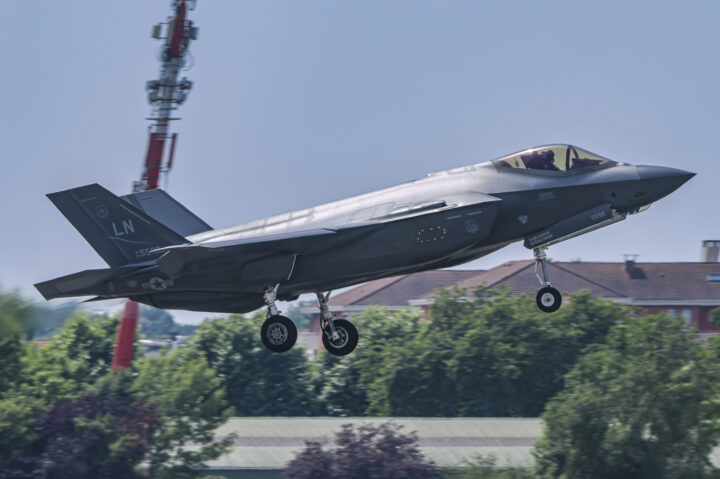
Nicolas Economou/NurPhoto via Getty Images
Lockheed Martin F-35 Lightning II a fifth generation fighter jet during a flight demonstration while landing, at Paris Air Show 2025 at Le Bourget Airport.
A bipartisan group of 40 House members is urging Secretary of State Marco Rubio to maintain the U.S. ban on exporting advanced F-35 fighter jets to Turkey, amid ongoing reports that the U.S. and Turkey are negotiating to allow the sale of the jets.
“We strongly urge the Administration to review the facts and reject Turkey’s attempt to rewrite the history of its violation of U.S. law and national security policy,” the lawmakers said in a letter to Rubio on Thursday.
The group highlighted that President Donald Trump, during his first term, signed the law that bans the sale of the F-35s to Turkey in light of its purchase of an S-400 missile defense system from Russia.
“Nearly a decade later, Turkey still possesses S-400 systems and has shown no willingness to comply with U.S. law. This behavior cannot be rewarded,” the letter reads. “Lifting sanctions or allowing Turkey back into the F-35 program without first removing its S-400s would jeopardize the integrity of F-35 systems; expose U.S. military secrets to Russian intelligence; undermine our defense industrial base and allied confidence in purchasing future U.S. platforms; and disrupt development of the next-generation fighter jet recently announced by the Administration.”
The lawmakers emphasized that U.S. policy on the issue has been consistent across administrations and parties.
They said that the U.S. must “uphold U.S. law, maintain CAATSA sanctions, and protect American defense and intelligence assets” and “continue to hold allies and adversaries alike accountable when their actions threaten U.S. interests.”
The letter was led by Reps. Chris Pappas (D-NH), Gus Bilirakis (R-FL), Dina Titus (D-NV) and Nicole Malliotakis (R-NY), who lead the Congressional Hellenic Caucus.
The letter is supported by the American Jewish Committee, Christians United for Israel Action Fund and FDD Action as well as the American Hellenic Educational Progressive Association, the American Hellenic Institute, American Friends of Kurdistan, Armenian National Committee of America, Coordinated Effort of Hellenes, the Hellenic American Leadership Council, Middle East Forum and the International Coordinating Committee Justice for Cyprus.
The lawmakers said the move reflects Turkey’s shift away from its Western alliances toward U.S. adversaries
Burak Kara/Getty Images
Turkey's President Recep Tayyip Erdogan speaks to supporters at his party’s Istanbul mayoral candidate Murat Kurum's campaign rally on March 29, 2024 in Istanbul, Turkey.
A bipartisan group of House members introduced legislation this week to redesignate Turkey at the State Department as a Middle Eastern country, rather than a European country, describing the move as a message to Turkey about its turn away from its relationships with Europe and the United States and shift toward U.S. adversaries.
The bill is designed “to send a clear message to Ankara: The United States recognizes Turkey’s turn to the Middle East and no longer sees Turkey prioritizing its relationship with Europe,” according to a statement from the bill’s lead sponsors, Reps. Brad Schneider (D-IL) and Gus Bilirakis (R-FL).
The statement says that the designation change is consistent with Turkey’s growing ties with Russia, China and Iran, its backing of Hamas and its hostile military actions toward Greece and Cyprus, which “are fundamentally at odds with Western security interests”; its “increasingly anti-Western posture, turning away from its European aspirations”; and its “growing authoritarianism and continued hostility toward NATO allies.”
They noted that the redesignation would leave Turkey in the same category as Iran, Syria and Libya.
“Turkey is at a crossroads, but Erdoğan has made his choice,” Schneider said in a statement, referring to Turkish President Recep Tayyip Erdoğan. “His government harbors Hamas operatives, props up [Russian President Vladimir] Putin’s war machine, and obstructs NATO unity — while still demanding the privileges of a Western ally. It’s time for American diplomacy to stop pretending that Turkey is still part of Europe.”
The bill is being introduced under the auspices of the Congressional Hellenic Israel Alliance.
“Turkey has consistently demonstrated a complete disregard for following international law,” Bilirakis said in a statement. “Erdoğan repeatedly acts contrary to American interests, with his dangerous behavior contributing to the instability of the region. The time has come for official U.S. foreign policy to more accurately reflect the realities of this hostile regime’s conduct and for Erdoğan to be held accountable.”
The bill is co-sponsored by Reps. Dina Titus (D-NV), Nicole Malliotakis (R-NY), Chris Pappas (D-NH) and Josh Gottheimer (D-NJ), and comes days after a congressional hearing where lawmakers voiced concerns about Turkey’s role in the U.S. alliance system.
The bill also requires the State Department to report to Congress on the impacts of Turkey’s move away from Europe.
Please log in if you already have a subscription, or subscribe to access the latest updates.
 Continue with Google
 Continue with Apple