









































New defense pact between Saudi Arabia, Turkey and Pakistan concerns U.S. national security experts
Foundation for Defense of Democracies senior fellow Edmund Fitton-Brown: ‘For Turkey, it is an assertion of its centrality to security arrangements in the region’

Getty Images
Turkish President Recep Tayyip Erdogan delivers a speech during a joint press conference, July 19, 2022, in Tehran, Iran.


 Add JewishInsider on Google
A coalition of Sunni regional powers signed a historic joint defense pact on Friday, but national security experts expressed deep unease over the arrangement, arguing that it reflects U.S. shortcomings in the Middle East while raising serious questions about its practical military feasibility.
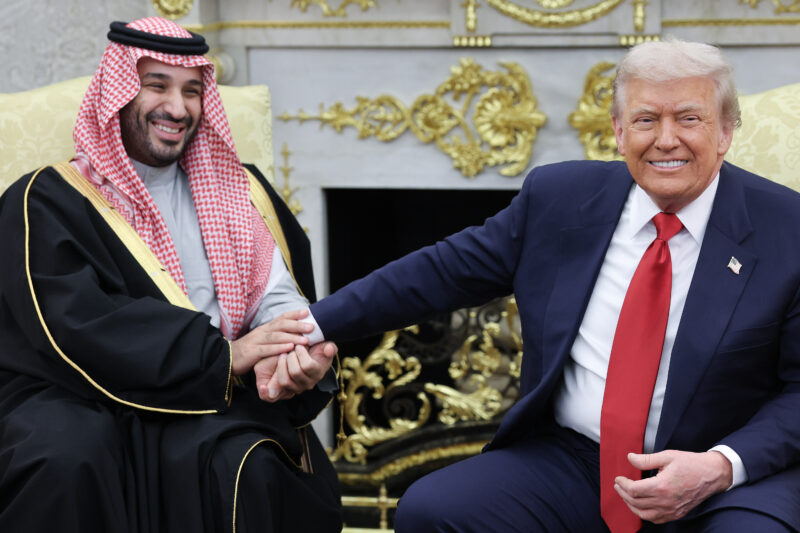
The agreement, dubbed the Mecca Joint Defense Agreement, was signed in the Saudi holy city of Mecca by Saudi Crown Prince Mohammed bin Salman, Turkish President Recep Tayyip Erdogan, and Pakistani Prime Minister Shehbaz Sharif.
Under the pact, Saudi Arabia, Turkey, and Pakistan agreed to treat an armed attack on one signatory as an attack on all. The move solidifies security and defense cooperation between the three powers amid a period of heightened regional turmoil and uncertainty stemming from the war in Iran.
As a result of the ongoing conflict with Iran, Saudi Arabia has seen its critical infrastructure and oil facilities targeted by strikes, which analysts say has prompted Riyadh to diversify its strategic and security partnerships. The trilateral agreement follows a bilateral mutual defense pact signed between Pakistan and Saudi Arabia last September.
Edmund Fitton-Brown, a former British diplomat and senior fellow at the Foundation for Defense of Democracies, explained that the military alliance formed in response to an “uncertain security situation” across the wider region.
“For Turkey, it is an assertion of its centrality to security arrangements in the region. For Saudi Arabia and Pakistan, it is a reflection of weakness and uncertainty, as both feel threatened (by Iran and India respectively),” Fitton-Brown said. “Although the agreement is not primarily directed against Israel or the United States, both should be concerned about it.”
Fitton-Brown emphasized that the pact poses strategic complications for both Jerusalem and Washington, while raising alarms for regional actors.
“For Israel, it is further confirmation of Turkish ambitions, which are explicitly directed against Israeli interests,” Fitton-Brown said. “For the U.S., it is questioning how reliable or permanent it is viewed as a player in the region. Stirring up a hornet’s nest in the Gulf and then appearing unsure about an end game, or even clear red lines, has left American allies uncertain about the future and willing to hedge their bets.”
Jonathan Ruhe, a fellow at the Jewish Institute for National Security of America, similarly labeled the agreement as problematic, noting that it reflects U.S. diplomatic shortcomings rather than an effective counterweight to Tehran.
“This alignment is problematic to the extent it is about Washington and its regional relationships, not Tehran,” Ruhe said. “These three countries have almost zero shared ability or interest to meaningfully contain Iran. The Trump administration certainly should have done better coalition-building before the Iran war.”
Ruhe added that for Turkey, the pact serves to “support Ankara’s longstanding pretensions to be a major player and arms exporter in the Middle East and beyond, independent of the United States and NATO.”
Fitton-Brown also highlighted how regional shifts in Syria intersect with the new alliance.
“There is also a Syrian dimension: President Sharaa now leads a Sunni Islamist government in Damascus, where Turkey is the most influential foreign power and Saudi Arabia is a key investor and stabilizing influence,” Fitton-Brown said. “Israel will worry that this consolidates Turkish influence in Syria and will ultimately turn Sharaa’s Syria against Israel.”
Fitton-Brown noted that the emerging alliance signals a broader realignment of regional power dynamics following recent geopolitical shifts.
“On one hand, the new agreement looks like a Sunni axis that is replacing the Iran-led Axis of Resistance, following the weakening of the Islamic Republic, Lebanese Hezbollah, and the collapse of the Assad regime in Syria,” he explained. “On the other hand, Iran remains threatening to the Gulf States, especially, and the Saudis are probably comforted by the appearance of Sunni solidarity.”
Simon Henderson, a senior fellow at The Washington Institute for Near East Policy, similarly assessed that the pact acts as a strategic signal to Tehran.
“The alliance is reminding Iran that it isn’t the only big power in the region,” Henderson said, adding that the dynamic is less about sectarian identity than geopolitical posturing. “[The alliance is] not particularly a Sunni-Shia thing. Pakistan is mainly Sunni, but any tensions are mainly Iran and Saudi playing games.”
Despite the high-profile announcement, Fitton-Brown expressed skepticism over the operational capabilities of the agreement, noting that paper commitments rarely translate to direct military intervention across disparate conflicts.
“In practice, it is inconceivable that Turkey or Saudi Arabia would get involved in a conflict with India if the latter came to blows with Pakistan again, as is more or less inevitable on a regular basis,” Fitton-Brown said. “The extension of Pakistan’s nuclear deterrent to cover Saudi against Iran or Turkey in any circumstances looks equally implausible. But defense industrial collaboration may flesh out the substance of the alliance over time.”
Analysts warn that the emerging bloc could complicate future diplomatic breakthroughs in the region, particularly regarding U.S. efforts to broker Saudi-Israeli normalization. Ruhe noted that as a result of the new axis, Riyadh is significantly raising its leverage against Washington.
“With this new axis, Riyadh also is telling Washington that the price for normalization will be incredibly high, greater even than the incredibly one-sided deal for U.S.-aided nuclear enrichment on Saudi soil,” Ruhe said. “As part of the ultimate goal of normalization, the Trump administration should pursue a more comprehensive and balanced partnership with Saudi Arabia: Riyadh gets a truly safeguarded nuclear program and U.S. defense guarantees, but only in exchange for the kingdom formally aligning with Washington and concretely doing more for collective defense.”
To counter the fallout from the alliance, Ruhe argued that the U.S. must recalibrate its regional policy and tighten its focus on existing partnerships.
“The United States should focus more immediately on deepening, not broadening, the Abraham Accords, by redoubling security cooperation with Israel and the UAE,” Ruhe said. “Trump also needs to stop fawning over Erdogan and feeding his ambitions to reap all the benefits of being a U.S. partner without assuming any corresponding responsibilities.”
More Stories

analysis
Florida primaries to test antisemitism’s reach in both parties
SCOOP
N.J. Dem nominee Rebecca Bennett will not endorse Hamawy, campaign says
MR. ROGERS’ NEIGHBORHOOD
Mike Rogers calibrates Jewish outreach as he builds broad coalition against Abdul El-Sayed
PAC PUSH
J Street launches six-figure ad campaign to boost progressive in Swalwell’s former seat
PLEA TO PELOSI
Bay Area Jewish leaders urge Pelosi to address ally Connie Chan’s anti-Israel rhetoric
on the hill
Lawmakers worried over NSGP’s ‘concerning new compliance requirements’
Please log in if you already have a subscription, or subscribe to access the latest updates.
 Continue with Google
 Continue with Apple