









Barrack says Israel is occupying Golan Heights, in spite of U.S. recognition
The U.S. envoy to Syria’s comments came at odds with Trump’s recognition of Israeli sovereignty over the Golan in 2019
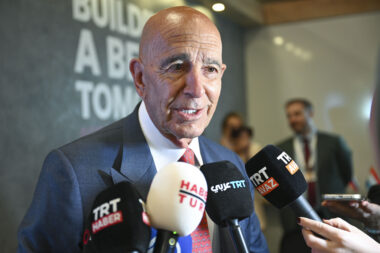
Special Envoy for Syria Tom Barrack speaks during an interview within Antalya Diplomacy Forum, held under the theme of 'Mapping Tomorrow, Managing Uncertainties' in Antalya, Turkiye on April 17, 2026.


 Add JewishInsider on Google
U.S. Ambassador to Turkey Tom Barrack, who also serves as the U.S. special envoy for Syria, on Friday described Israel as occupying the Golan Heights, despite the U.S.’ recognition of Israeli sovereignty in the region.
“In the Golan with Syria — they still occupy the Golan against the [United Nations] resolutions, against all of the international order which has said the Golan is Syria’s,” Barrack said during an appearance on commentator Mario Nawfal’s livestreamed show.
Barrack’s comments did not address the U.S.’ 2019 recognition of the Golan Heights as sovereign Israeli territory — a decision made by President Donald Trump during his first term and maintained by the Biden administration.
The State Department did not immediately respond to a request for clarification on whether the administration’s policy on the Golan’s status has changed.
Barrack’s comments came in response to a question about whether Israel seeks to annex Lebanese territory — something Barrack ultimately denied.
The comments prompted backlash from a range of figures on the right.
“The Senate confirmed [Barrack] to enact the PRESIDENT’S AGENDA, which millions of Americans voted for,” Sen. Rick Scott (R-FL) said on X. “It seems the Ambassador forgot that or failed to do his research, so here’s a refresher for him… President Trump has been CLEAR about Israel’s sovereignty over the Golan Heights for years!”
Far-right influencer Laura Loomer blasted Barrack and demanded that he be forced to resign, calling Barrack “clearly compromised by Arab money.” Bush administration official David Wurmser called the comments a “clear statement” that Barrack “regards the President’s policy and U.S. recognition of the Golan as part of Israel as null and void” and urged him to clarify if he supports U.S. policy, believes he can change U.S. policy on his own or whether U.S. policy has changed.
The U.S. ambassador also dismissed the idea of forced demilitarization of Hezbollah — as required under both U.N. Security Council resolutions and recent Israel-Lebanon diplomatic agreements — as an impossibility.
“We’re asking [the Lebanese Armed Forces], please go shoot your cousins if they don’t give you the AK-47. It’s not going to happen that way. It’s too difficult for it to happen that way,” Barrack said. “So I think what [U.S. Ambassador to Lebanon Michel] Issa is doing in this whole process is saying there’s got to be a better way. How do we get Hezbollah to not utilize those weapons?”
He seemed to rationalize Hezbollah’s continued defiance of demilitarization efforts as resistance to Israeli demolition of Lebanese homes and as the only way for the terror group to financially survive, by receiving monetary support from Iran.
Barrack praised the defense agreement between Turkey, Pakistan and Saudi Arabia as an accomplishment for the Trump administration, pressing regional powers to take responsibility for their own security — similar to the president’s efforts to pressure European NATO allies to spend more on their own defense.
“It’s not anti-Israel, it’s not pro-Sunni and it’s not anti-America,” Barrack said. “It’s, ‘Guys, we need to band together.’”
He also suggested that others in the region shouldn’t be concerned by Turkey’s apparent growing regional ambitions.
“Turkey’s going into a new, powerful mode, which makes everybody nervous, but it’s a great thing for Turkey,” Barrack said. “They — as a hub, as a non-Arab, really workable, kind, loving, Islamic country with eight countries around it and four seas … it’s threatening in its geographical presentation. So I’m hopeful the calmer heads will be there.”
Barrack is in the midst of a media tour addressing Israel’s decision to strike the runway of a Syrian airbase with the goal of preventing Turkey from deploying troops to the site. Barrack and other U.S. officials have criticized the strikes.
On Friday, Barrack suggested two potential motivations for the strikes: that Israel was “baiting the Turks” or that there had been a “miscommunication” among different elements of the Israeli government that led an Israeli commander to carry out a strike without any intention of sparking further conflict or causing injuries.
Speaking on the incident on “PBS NewsHour” on Friday, Barrack said that Israel believed it had a tacit agreement with Turkey and Syria that the countries would not deploy military equipment that could obstruct an Israeli attack path to Syria, but Barrack said that the other parties did not agree that they had any such accord.
He said that Israel had communicated its concerns about the deployment to Syria, and that Syria had denied any Turkish movement toward the base, with further talks planned the following week. “Something went awry and Israel decided they needed to bomb the craters on two runways. The problem with this is Turkey did not know it was coming,” Barrack continued.
Barrack suggested on both shows that recent tensions between Turkey and Israel are largely a political gambit by both sides ahead of elections in their countries — despite Turkish President Recep Tayyip Erdoğan’s now yearslong threats to invade or attack Israel. And he said on Nawfal’s show that Turkey is “concentrating on restraint” and is “not predatory” and “not interested in attacking or even engaging in any kind of kinetic or adversarial relationship with Israel.”
He said that the U.S. saw no malign intent or aggressive action by Syria or Turkey.
However, in the same interview, Barrack expressed an understanding of Israel’s concerns about the new Syrian government, particularly when it first took power, and insisted that Israel’s incursion into Syria was designed as a protective measure, not as an effort to expand its territory, as some in anti-Israel circles have claimed.
Nawfal’s show, on which Barrack appeared, has also featured a range of anti-Israel figures and conspiratorial anti-Israel narratives. Other recent guests have included Anthony Aguilar, the former U.S. Marine turned anti-Israel activist who claimed to have seen Gaza Humanitarian Foundation contractors kill a child in Gaza only for that child to be found alive and well; former Trump administration official Joe Kent; and anti-Israel commentator and retired Gen. Douglas Macgregor.
Please log in if you already have a subscription, or subscribe to access the latest updates.
 Continue with Google
 Continue with Apple