






































Plus, Platner doubles down on anti-Israel fixation

Mostafa Alkharouf/Anadolu via Getty Images
A general view of Jerusalem on June 13, 2025.


 Add JewishInsider on Google
Good Tuesday afternoon.
This P.M. briefing is reserved for our premium subscribers like you — offering a forward-focused read on what we’re tracking now and what’s coming next.
I’m Danielle Cohen-Kanik, U.S. editor at Jewish Insider and curator, along with assists from my colleagues, of the Daily Overtime briefing. Please don’t hesitate to share your thoughts and feedback by replying to this email.
📡On Our Radar
Notable developments and interesting tidbits we’re tracking
Maine Democratic Senate candidate Graham Platner is unusually focused on anti-Israel attacks in his bid to unseat Sen. Susan Collins (R-ME), Jewish Insider‘s Marc Rod reports. Every one of Platner’s active ads on Facebook and Instagram, as well as many of his written advertisements, include a repudiation of AIPAC and around half accuse Israel of genocide…
In another Senate race to keep an eye on, Rep. Ashley Hinson (R-IA) hinted she’ll be running to replace Sen. Joni Ernst (R-IA), who this afternoon officially announced her retirement from the Senate at the end of her current term. Hinson said she would be President Donald Trump’s “strongest ally in the Senate” and “will have an announcement soon”…
Meanwhile in Foggy Bottom, a State Department cable sent to U.S. embassies on Aug. 18 indicated the department has suspended approvals for almost all Palestinians seeking to enter the U.S. on visitor visas, The New York Times reports, shortly before the department revoked visas for Palestinian Authority officials ahead of the U.N. General Assembly meeting in New York this month. The suspension could prevent Palestinians from entering the country for medical treatment, attendance at American universities, business travel and more…
French President Emmanuel Macron and Saudi Crown Prince Mohammed bin Salman announced today that they will co-chair another conference on the two-state solution on Sept. 22 on the sidelines of the UNGA, where several European countries are expected to announce their recognition of a Palestinian state.
Macron called the U.S.’ decision to revoke the visas of PA officials “unacceptable” and said it must be reversed.
Palestinian Vice President Hussein al-Sheikh sent a letter to Secretary of State Marco Rubio similarly asking him to reconsider the revocation of PA President Mahmoud Abbas’ visa to attend the UNGA, arguing it was made on “false pretenses,” according to Axios…
U.S. Ambassador to Israel Mike Huckabee recently told Israeli officials the Trump administration is concerned about the security implications of a potential economic collapse of the Palestinian Authority in the West Bank. “If the Palestinian economy completely collapses, it will not be a victory for anyone. … Desperate people do desperate things,” Huckabee told Israel’s Channel 12…
Rubio is expected to visit Israel the week of Sept. 14 where he will reportedly attend the Sept. 15 inauguration ceremony for the “Pilgrimage Road” at the City of David archeological site, a recently discovered path that led to the Temple Mount during the Second Temple Period. (Read JI’s coverage of the Pilgrimage Road excavation here)…
Also making the long flight, several high-profile venture capitalists, including Palantir co-founders Peter Thiel and Joe Lonsdale as well as Elad Gil and Keith Rabois, were in Israel this past weekend where they attended the wedding of VC investor Zach Frenkel. Some of the attendees reportedly met with Israeli Prime Minister Benjamin Netanyahu while in town…
Michael Velchik, the Department of Justice’s lawyer defending the Trump administration in its battle against Harvard in federal court, called Hitler’s Mein Kampf his favorite book and wrote a paper from the dictator’s perspective during his time as a Harvard undergraduate, which “so unnerved the instructor that he was asked to redo the assignment,” The Boston Globe reports. Velchik said in court in July that Harvard no longer deserved federal funding based on its “wanton” and “deliberate indifference to antisemitism”…
Robert Satloff, executive director of The Washington Institute for Near East Policy, called the International Association of Genocide Scholars’ declaration that Israel is committing genocide in Gaza “one of the most egregious examples of the dereliction of scholarly responsibility in recent history.”
The IAGS resolution, approved by less than a third of its members over the weekend, “reflects not one iota of original or independent research,” Satloff wrote, instead relying on findings from the U.N., Special Rapporteur Francesca Albanese and anti-Israel human rights organizations…
⏩ Tomorrow’s Agenda, Today
An early look at tomorrow’s storylines and schedule to keep you a step ahead
Keep an eye on Jewish Insider tomorrow morning for reporting on China’s shifting rhetoric on Israel amid its aggressive posturing on the international stage, as well as an interview with Rep. George Latimer (D-NY) about his recent trip to Israel with a delegation of freshman Democratic members.
We’re tracking the many potential candidates who may join the race to succeed Rep. Jerry Nadler (D-NY), after he announced his retirement last night.
Though Nadler is expected to support his former aide, state Assemblyman Micah Lasher, as his successor, politicos speculate other contenders for the Manhattan district could include high-profile New Yorkers from Rep. Dan Goldman (D-NY), who represents a neighboring district, to Lina Khan, the former commissioner of the Federal Trade Commission.
Liam Elkind, a 26-year-old Jewish nonprofit leader who launched his bid in July to unseat Nadler in a generational challenge, is also still in the race. Stay tuned to JI for coverage as the field develops.
Tonight, the House Appropriations Committee‘s Labor, Health and Human Services, Education and Related Programs Subcommittee will vote on a funding bill for the Department of Education that includes sweeping new provisions restricting federal funding for universities that fail to address antisemitism but also cuts funding for the Office for Civil Rights.
Also tonight, the Senate will begin the process of finalizing the 2026 National Defense Authorization Act, which may include votes on several amendments relating to Middle East defense programs in the coming days.
Tomorrow, the House Foreign Affairs Committee is holding a members-only virtual briefing with Huckabee focused on the West Bank.
Stories You May Have Missed
MOU MINEFIELD

The next U.S.-Israel memorandum of understanding will need to be secured in a political environment much more hostile to Israel than 10 years ago
WISDOM CARRIED FORWARD

English translation, commentary by former U.K. chief rabbi seeks to ‘make Torah relevant to us today’
Plus, pro-Israel lawmakers criticize Israel on Syria strikes

Anna Moneymaker/Getty Images
Sen. Lindsey Graham (R-SC) in the Senate Judiciary Committee on January 30, 2025 in Washington, D.C.
Good Thursday afternoon.
This P.M. briefing is reserved for our premium subscribers like you — offering a forward-focused read on what we’re tracking now and what’s coming next.
I’m Danielle Cohen-Kanik, U.S. editor at Jewish Insider and curator, along with assists from my colleagues, of the Daily Overtime briefing. Please don’t hesitate to share your thoughts and feedback by replying to this email.
📡On Our Radar
Notable developments and interesting tidbits we’re tracking
A bipartisan group of pro-Israel lawmakers — Sens. Jeanne Shaheen (D-NH) and Joni Ernst (R-IA) and Rep. Joe Wilson (R-SC) — released a statement today criticizing Israeli strikes in Syria overnight.
The lawmakers, who recently returned from Syria, said that the message they heard during their visit “was clear: Syria needs a chance to succeed and move past the violence and strife that consumed the country for over 14 years. Last night’s destabilizing strikes on Syria by Israel make that goal more difficult to achieve.”
“The Syrians are prepared to move forward with Israel to advance peace. It is unclear how long the door to this opportunity will remain open. We call on Israel to seize the moment and immediately cease hostilities,” the group said.
The statement is one of the most public signs yet of friction between even staunch supporters of Israel in Congress and the Israeli government over its approach to the new Syrian government, which has included repeated rounds of strikes on Syrian targets even amid diplomatic engagements. Many U.S. lawmakers, meanwhile, are urging a more optimistic approach.
Syrian state media reported that the strikes also included a ground raid by the IDF near Damascus, which would be the first reported instance of an Israeli ground incursion so far into the country’s territory since the fall of the Assad regime. Syrian forces had reportedly recently uncovered surveillance equipment at a military base in the area…
The IDF also carried out strikes today on Houthi military targets in Sanaa, Yemen, after several Houthi missile and drone attacks on Israel in recent days. Israeli media reported that the strikes, one of which targeted a gathering of top Houthi leaders, may have eliminated the terror group’s minister of defense and chief of staff…
Back in Washington, Israeli Minister of Strategic Affairs Ron Dermer reportedly participated in President Donald Trump’s roundtable on Gaza at the White House yesterday, according to Axios, as he made a last-minute visit to the capital.
A source told the outlet that former British Prime Minister Tony Blair and former Trump Mideast advisor Jared Kushner got the green light from the president to develop a post-war plan for Gaza, though few details were hashed out at the meeting.
Dermer reportedly stressed that Israel doesn’t want to occupy Gaza in the long term and wants to see alternative options for parties that could govern Gaza that are not Hamas. “Dermer’s message was: As long as our conditions are met, we will be flexible about everything else,” the source told Axios…
France, Germany and the U.K. sent a letter to members of the U.N. Security Council this morning announcing they are triggering snapback sanctions on Iran, as anticipated after recent diplomatic talks to roll back the Iranian nuclear program yielded little progress.
The move triggers a 30-day timeline before the sanctions go into effect, during which the European countries said they are open to continuing negotiations with Iran.
Secretary of State Marco Rubio said the U.S. will work with the UNSC to “successfully complete” the reinstatement of sanctions. “At the same time,” he said, “the United States remains available for direct engagement with Iran … Snapback does not contradict our earnest readiness for diplomacy, it only enhances it.”
Iran has threatened previously to withdraw from the Nuclear Non-Proliferation Treaty if snapback sanctions were imposed, which could have wide-ranging consequences, including a potential regional nuclear arms race…
The UNSC was also busy today with a vote to extend the mandate of UNIFIL, the U.N.’s forces in southern Lebanon, whose mission was due to expire on Sunday. The body voted unanimously to extend the mandate one final time until Dec. 31, 2026, when UNIFIL will have one year to withdraw from Lebanon completely.
Dorothy Shea, acting U.S. representative to the U.N., said in a statement supporting the vote, “The United States notes that the first ‘I’ in UNIFIL stands for ‘Interim.’ The time has come for UNIFIL’s mission to end. This is the last time we will support an extension of UNIFIL”…
Sen. Lindsey Graham (R-SC) threatened Norway and its officials with retaliatory tariffs and visa restrictions in response to the decision by Norges Bank Investment Management — the Norwegian sovereign wealth fund — to sell its stake in the American machinery company Caterpillar in response to the Israeli military’s use of its products against Palestinians.
“To those who run Norway’s sovereign wealth fund: if you cannot do business with Caterpillar because Israel uses their products, maybe it’s time you’re made aware that doing business or visiting America is a privilege, not a right,” Graham said on X…
Back in Israel, Prime Minister Benjamin Netanyahu and World Food Program Executive Director Cindy McCain shared a joint statement after meeting in Jerusalem today, where they agreed that “every effort must be made to ensure that humanitarian aid reaches the most vulnerable people where they are, and that humanitarian aid is provided exclusively to civilians”…
Meanwhile, the Boulder chapter of the group “Run for Their Lives,” which hosts weekly marches to advocate for the release of the hostages held in Gaza, announced it will no longer publicly advertise its walking route, after participants faced continued threats and harassment in the wake of a firebombing attack on one gathering several months ago.
In recent weeks, protesters have stalked and shouted slurs at participants, such as “genocidal c**t,” “racist” and “Nazi,” and have threatened organizers’ children, according to the Colorado Jewish Community Relations Council…
No industry is safe: The Wall Street Journal reports on the tech worker “revolt” over Gaza and how companies are responding, including moderating internal message boards by deleting content and closing discussion threads.
Anti-Israel activists have recently escalated their protests against Microsoft, setting up an encampment at the company’s Redmond, Wash., headquarters, occupying President Brad Smith’s office and rowing kayaks up to the waterfront homes of top executives (Microsoft has asked the FBI for help in tracking and combating these activities)…
⏩ Tomorrow’s Agenda, Today
An early look at tomorrow’s storylines and schedule to keep you a step ahead
Keep an eye on Jewish Insider for reporting on the obstacles Israel and the U.S. may face in negotiating a new memorandum of understanding as the current MOU nears its expiration in 2028.
On Monday, Sen. Bernie Sanders (I-VT) will host a campaign event with Graham Platner, the anti-Israel Democrat challenging Sen. Susan Collins (R-ME), as Collins has been facing increasing antagonism from crowds at home.
We’ll be back in your inbox with the Daily Kickoff and the Daily Overtime on Tuesday. Shabbat shalom and happy Labor Day weekend!
Stories You May Have Missed
SULLIVAN SAYS
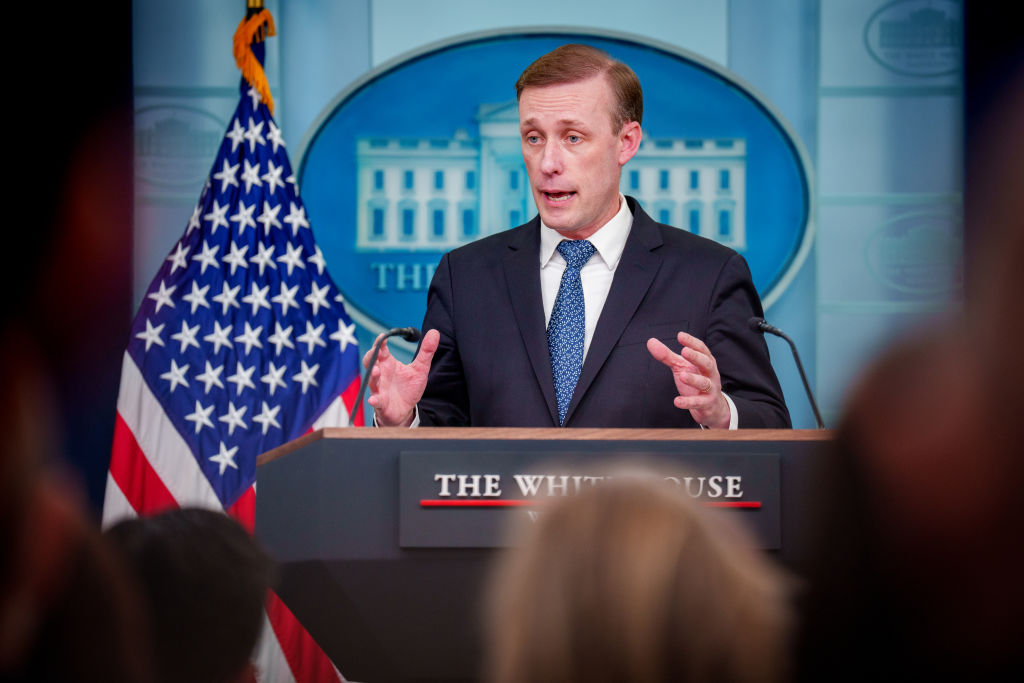
In an interview with ‘The Bulwark,’ the former national security advisor argued that the argument in favor of restricting military aid is ‘much stronger’ than it was a year ago
BELL CURVE
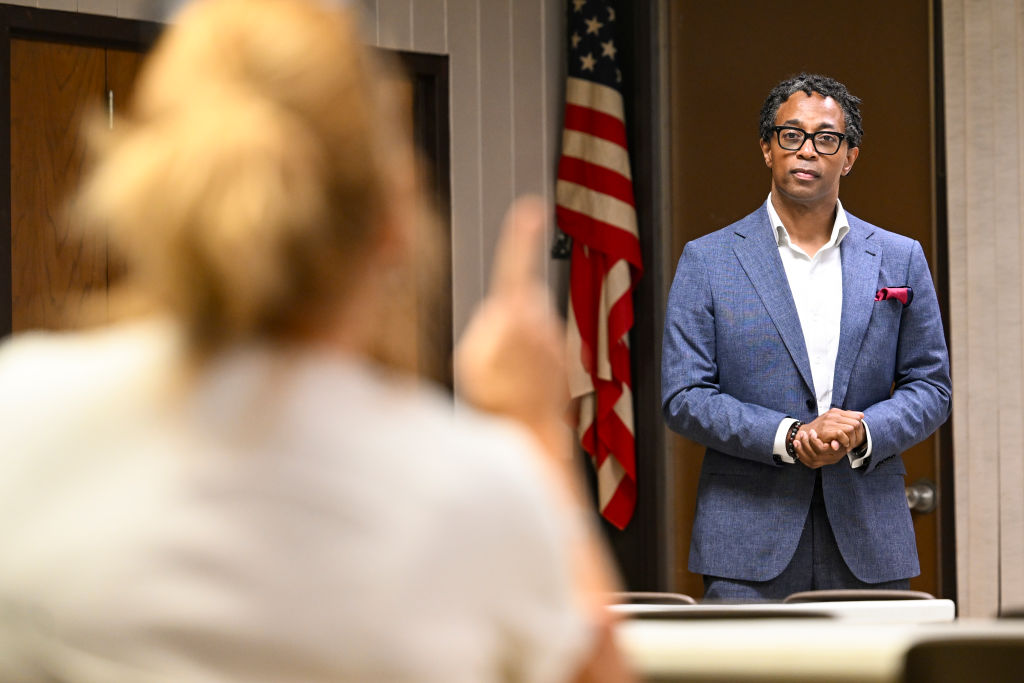
Former Rep. Cori Bush or a political ally could attempt to unseat the first-term congressman
The sanctions will be reinstated in 30 days; Iran could come to an agreement with the West before then
Selcuk Acar/Anadolu via Getty Images
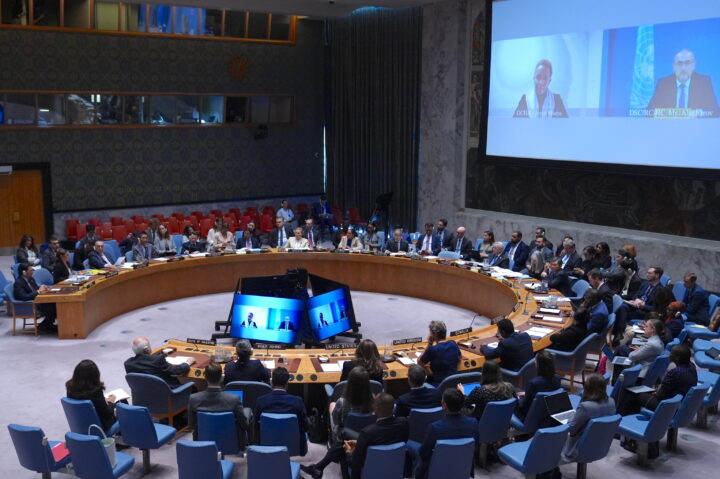
U.N. Security Council meeting New York City on August 27, 2025.
France, Germany and the United Kingdom triggered the snapback sanctions mechanism on Thursday, to reinstate all United Nations Security Council sanctions on Iran that had been lifted since the implementation of the 2015 nuclear deal.
The European parties to the Iran deal, known as the E3, notified the UNSC that they were triggering snapback sanctions due to Iran’s continued noncompliance with its commitments under the Joint Comprehensive Plan of Action, to which they are still parties despite the U.S. withdrawal in 2018.
If the UNSC does not adopt a resolution stopping the process — which is unlikely unless Iran reaches an agreement with the West, because it would be subject to vetoes from the states triggering the sanctions and the U.S. — all of the sanctions sunsetted in the framework of the 2015 deal will be restored in 30 days.
However, the E3 said it is open to continuing negotiations with Iran during those 30 days.
The E3’s move came after its foreign ministers met with their Iranian counterpart Abbas Araghchi in Geneva earlier this week in a last-ditch effort to reach an agreement with the Islamic Republic to scale back its nuclear program. It also comes less than three months after Israel and the U.S. bombed Iranian nuclear facilities, after which U.S.-Iranian negotiations broke down.
“Since 2019,” the E3 foreign ministers’ statement reads, “Iran has exceeded JCPoA limits on enriched uranium, heavy water, and centrifuges, restricted the IAEA’s ability to conduct JCPoA verification and monitoring activities, and has abandoned the implementation and the ratification process of the Additional Protocol to its Comprehensive Safeguards Agreement. These actions contravene Iran’s commitments set out in the JCPoA and have serious implications on the capacity of Iran to progress toward developing a nuclear weapon.”
The E3 noted that it repeatedly negotiated with Iran to return to its 2015 commitments, to no avail.
“Today, Iran’s non-compliance with the JCPoA is clear and deliberate, and sites of major proliferation concern in Iran are outside of IAEA monitoring,” the foreign ministers stated. “Iran has no civilian justification for its high enriched uranium stockpile … Its nuclear program therefore remains a clear threat to international peace and security.”
Among the sanctions that would be restored are an arms embargo, a ban on Iranian uranium enrichment and reprocessing, a ban on transferring ballistic missile technology and technical assistance, a global asset freeze on targeted Iranian individuals and entities and foreign inspections of Iranian cargo planes.
The snapback mechanism was set to expire at the end of October, in accordance with the terms of the JCPOA, but Russia will assume the presidency of the UNSC in October, raising concerns in the West that it would try to delay the 30-day snapback process. As such, the E3 set a deadline for the end of August for Iran to make progress in rolling back its nuclear program.
In 2020, two years after the U.S. left the JCPOA, the first Trump administration attempted to trigger snapback sanctions, but the other parties argued that it was no longer entitled to do so.
Iran’s Foreign Ministry said that it “categorically reject[s] and condemn[s] in strongest terms the unlawful notification by the E3 to the UNSC … This escalation will severely undermine the ongoing process of engagement between Iran and the International Atomic Energy Agency. It will be met with appropriate responses.”
Secretary of State Marco Rubio said the U.S. supports the E3’s move and called it “a direct response to Iran’s continuing defiance of its nuclear commitments.”
“At the same time,” Rubio said in a statement, “the United States remains available for direct engagement with Iran … Snapback does not contradict our earnest readiness for diplomacy, it only enhances it.”
Israeli Foreign Minister Gideon Sa’ar posted on X that “even after Israel and the U.S. operation against Iran’s nuclear program, Iran hasn’t abandoned its desire to acquire a nuclear weapon. This is why the E3’s move to initiate the return of UN sanctions on Iran is inevitable. It is an important step in the diplomatic campaign to counter the Iranian regime’s nuclear ambitions.”
In an interview with ‘The Bulwark,’ the former national security advisor argued that the argument in favor of restricting military aid is ‘much stronger’ than it was a year ago
Andrew Harnik/Getty Images
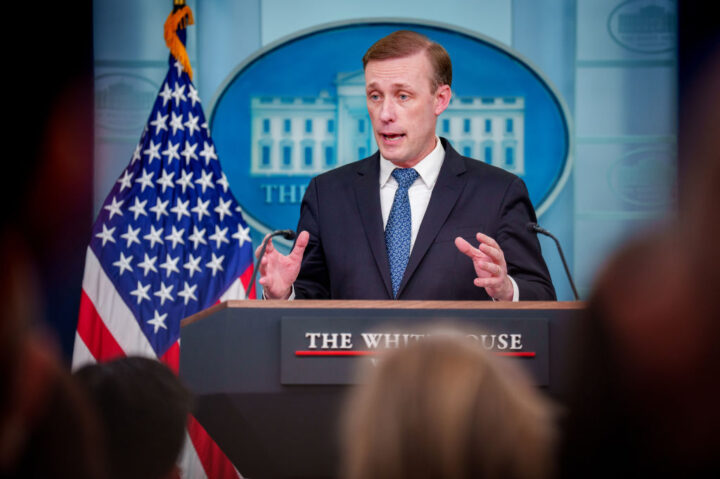
National Security Advisor Jake Sullivan speaks during a news conference in the Brady Press Briefing Room at the White House on January 13, 2025 in Washington, DC.
Former National Security Advisor Jake Sullivan said on Wednesday that the “case for withholding weapons from Israel today is much stronger than it was one year ago,” adding that he now backs such efforts.
“The thing that we were grappling with throughout all of 2024, which is not the case today, is that Israel was under attack from multiple fronts,” Sullivan, who served under President Joe Biden, told The Bulwark’s Tim Miller. “It was under attack from Hezbollah, from the Houthis, from Syria, from Iraq, obviously from Hamas and from Iran itself. So the idea of saying, ‘Israel, we’re not going to give you a whole set of military tools’ in that context was challenging.”
“The case for withholding weapons from Israel today is much stronger than it was one year ago,” Sullivan added. “One, they don’t face the same regional threats. Two, there was a ceasefire hostage deal in place and the ability to have negotiations, and it was Israel who just walked away from it without negotiating seriously. Three, there is a full-blown famine in Gaza. And four, there are no more serious military objectives to achieve. It’s just bombing the rubble into rubble.”
Sullivan, who was tapped as the inaugural Kissinger Professor of the Practice of Statecraft and World Order at the Harvard Kennedy School, suggested that the political makeup of the Israeli government could affect the future of the U.S.-Israel relationship.
“If nothing changes in their government — if it continues to be a far-right government that pursues the same policies — then it won’t be the Israel we’ve known,” Sullivan said. “I think a lot of Israelis would say they wouldn’t recognize that Israel. And obviously, that should have an impact on the relationship.”
After Australia revealed the IRGC was behind two attacks on a synagogue and kosher restaurant, observers call for ‘increased awareness’ in the U.S.
Asanka Ratnayake/Getty Images
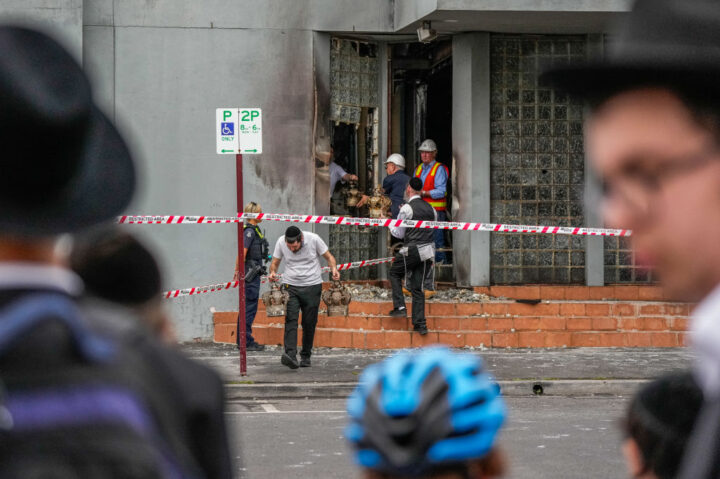
Members of the synagogue recover items from the Adass Israel Synagogue on December 06, 2024 in Melbourne, Australia.
National security experts are warning that Jewish communities around the world could face increased Iranian threats following the recent accusation by Australian Prime Minister Anthony Albanese that the Islamic Revolutionary Guard Corps orchestrated attacks last year on a synagogue and kosher restaurant in the country.
“We’ve seen Iranian penetration in many Westernized countries, with Australia now being the latest. Though to see direct evidence of a linkage to actual violence — not just disinformation campaigns or cyber campaigns — is very frightening,” Rich Goldberg, a senior advisor at Foundation for Defense of Democracies, told Jewish Insider.
On Tuesday, Albanese announced the expulsion of the Iranian ambassador in Canberra — the first time Australia has expelled a foreign ambassador since World War II — as well as three other embassy staffers, and designated the Islamic Revolutionary Guard Corps as a terrorist group, after Australian intelligence indicated that Tehran was behind the 2024 attacks.
Goldberg called it “earth-shattering” that Australia’s “left-wing prime minister, who may not agree on a whole lot of politics with the U.S., has been woken up to the very sobering reality of Iranian threats in his own country.”
Goldberg urged Canada, the United Kingdom and the European Union to “follow swiftly” in severing diplomatic relations with Iran, and for the U.S. and Australia to put diplomatic pressure on other governments to designate IRGC as a terrorist organization. Nearly all the major EU countries still have full diplomatic ties with Iran.
“We know that Canada is highly penetrated by Iranian assets and the IRGC inside the country without having a very clear designation as a terrorist organization,” said Goldberg. “We’ve seen terrorist plots that are Iranian sponsored on British soil and the British government is still dragging its feet on prescribing the IRGC as a terrorist group. We know that they have operatives, both undercover as diplomats and as operatives, throughout the EU.”
More than a year ago, the Biden administration’s director of national intelligence, Avril Haines, warned of the Iranian regime’s efforts to take advantage of campus unrest. In light of Australia going public with the Iranian threat, Goldberg urged the Trump administration to order an updated review of Iranian influence efforts in the U.S.
“We all sort of forgot about that report, but it was big news at the time [even though] we never got a lot of detail on that,” he said. “Nobody has asked the question of what’s the current status of Iranian influence on protest movements or acts of violence in the U.S. We suspect that Iran has agents in the U.S. Some of those people have been arrested in the past. This has to remain a key priority for the FBI and [Department of] Homeland Security.”
Matt Levitt, director of the Jeanette and Eli Reinhard Program on Counterterrorism and Intelligence at The Washington Institute for Near East Policy, called for increased awareness of “Iranian external operations around the world, including in the U.S., in which the IRGC and other Iranian government agencies increasingly pay criminal proxies to carry out acts of violence, intimidation, and even kidnapping and murder on their behalf,” he said in a statement to JI.
Heads of security organizations that monitor American Jewish communal safety said that the latest news coming out of Australia — in addition to an already heightened fear of Iranian retaliation following the U.S. airstrikes on Tehran’s nuclear facilities in June — make threats from Iran and its proxy groups particularly alarming.
“The FBI and NYPD have had live investigations that have resulted in arrests of Hezbollah operatives in New York City casing out institutions,” Mitch Silber, executive director of the Community Security Initiative, which works to safeguard Jewish communities, told JI. “Iranians have a long timeline. Just because [an attack] hasn’t happened in the last six to eight weeks [since the airstrikes] doesn’t mean that the Iranians haven’t stopped plotting.”
Silber pointed to the recent case of a Hezbollah operative in Texas purchasing 300 pounds of ammonium nitrate. “Why would you [purchase] an explosive if you weren’t thinking of potentially trying to use it somewhere in the U.S.?” he said.
“These developments in Australia reflect yet another tentacle of the IRGC in its escalating influence campaigns: furthering violence, destruction and discord, with the Jewish community bearing the brunt,” Michael Masters, Secure Community Network director and CEO, told JI.
“We applaud the Australian government for shining the disinfecting light of day regarding these attacks. It only underscores the continued need for reporting, coordination and proactive security efforts by and for the Jewish community.”
Plus, Minneapolis shooting echoes Tree of Life

Nicholas Kamm/Getty Images
Ron Dermer speaks at the American Israel Public Affairs Committee (AIPAC) policy conference in Washington, DC.
Good Wednesday afternoon.
This P.M. briefing is reserved for our premium subscribers like you — offering a forward-focused read on what we’re tracking now and what’s coming next.
I’m Danielle Cohen-Kanik, U.S. editor at Jewish Insider and curator, along with assists from my colleagues, of the Daily Overtime briefing. Please don’t hesitate to share your thoughts and feedback by replying to this email.
📡On Our Radar
Notable developments and interesting tidbits we’re tracking
Israeli Minister of Strategic Affairs Ron Dermer made a last-minute visit to Washington today, according to Israeli media, while President Donald Trump convened a meeting on a “comprehensive plan” for postwar Gaza, as Middle East envoy Steve Witkoff told Fox News last night. It’s unclear if Dermer participated in the meeting himself.
Also in attendance at the White House were former British Prime Minister Tony Blair and Trump’s son-in-law and former Mideast advisor Jared Kushner, according to Axios, who have been working with Witkoff on the issue for several months…
Dermer canceled a meeting with World Food Program head Cindy McCain, who is in Israel for the first time since Oct. 7, as he headed to Washington. McCain did meet with IDF Chief of Staff Eyal Zamir and the head of COGAT, the IDF unit that facilitates humanitarian aid in Gaza. Recall that a whistleblower recently alleged that the WFP had rejected security coordination with the IDF, hampering aid distribution efforts in Gaza…
The alleged gunman who opened fire today on a Catholic school in Minneapolis, killing two children and injuring at least 17 people, most of them students at the school, used a gun that had antisemitic and anti-Israel writings across it, according to the Anti-Defamation League.
Unverified images of the alleged shooter’s gun, taken from a video posted to a YouTube account believed to be associated with the shooter, show scrawlings on the gun and related paraphernalia that say “6 million wasn’t enough,” “Burn Israel,” “Israel must fall” and “Destroy HIAS,” a reference to the Jewish refugee organization.
HIAS, which was also invoked by the Tree of Life synagogue shooter in Pittsburgh in 2018, told Jewish Insider that because of the organization’s focus, it is “sadly often the subject of hateful antisemitic conspiracy theories”…
Israeli Foreign Minister Gideon Sa’ar is in Washington today as well, meeting this afternoon with Secretary of State Marco Rubio in Foggy Bottom. Sa’ar said the two had “a productive meeting on mutual challenges and interests for both our nations” and discussed the Iranian nuclear threat in the aftermath of the U.S. and Israeli strikes in June, among other issues…
Rubio held a call with the foreign ministers of France, Germany and the U.K. today, during which all of the officials “reiterated their commitment to ensuring that Iran never develops or obtains a nuclear weapon,” as the European nations gear up to trigger snapback sanctions at the U.N. Security Council in the coming days…
a16z Speedrun, a startup accelerator program backed by the Andreessen Horowitz venture capital firm, is in Israel this week. Last night, the program convened a dinner of 20 budding startup founders from elite IDF units…
Hollywood heavyweights including Brad Pitt and Joaquin Phoenix are joining the production team of “The Voice of Hind Rajab,” a film about the killing of a six-year-old Palestinian girl in Gaza in January 2024. Jonathan Glazer, who made headlines for using his Oscar acceptance speech last year to equate Israel’s actions in Gaza with the Holocaust, is a director of the project…
Variety spotlights a new film in production starring Jon Voight and directed by the controversial Bryan Singer, which a source described as set in the Middle East during the First Lebanon War. “It makes Israel look really bad and could be polarizing,” the source said…
⏩ Tomorrow’s Agenda, Today
An early look at tomorrow’s storylines and schedule to keep you a step ahead
Keep an eye on Jewish Insider tomorrow morning for reporting on how security experts are viewing the threat of Iranian influence and attacks in the U.S. in the aftermath of disturbing revelations of Iranian attacks in Australia, and on how the replacement of Sergio Gor with Dan Scavino as head of the Presidential Personnel Office may impact national security personnel decisions in the administration.
Also tomorrow, the Atlantic Council will host an event in Washington on the “past, present, and future” of the India-Middle East-Europe Economic Corridor, an initiative launched at the G20 Summit in 2023.
Stories You May Have Missed
MINNEAPOLIS MOMENT
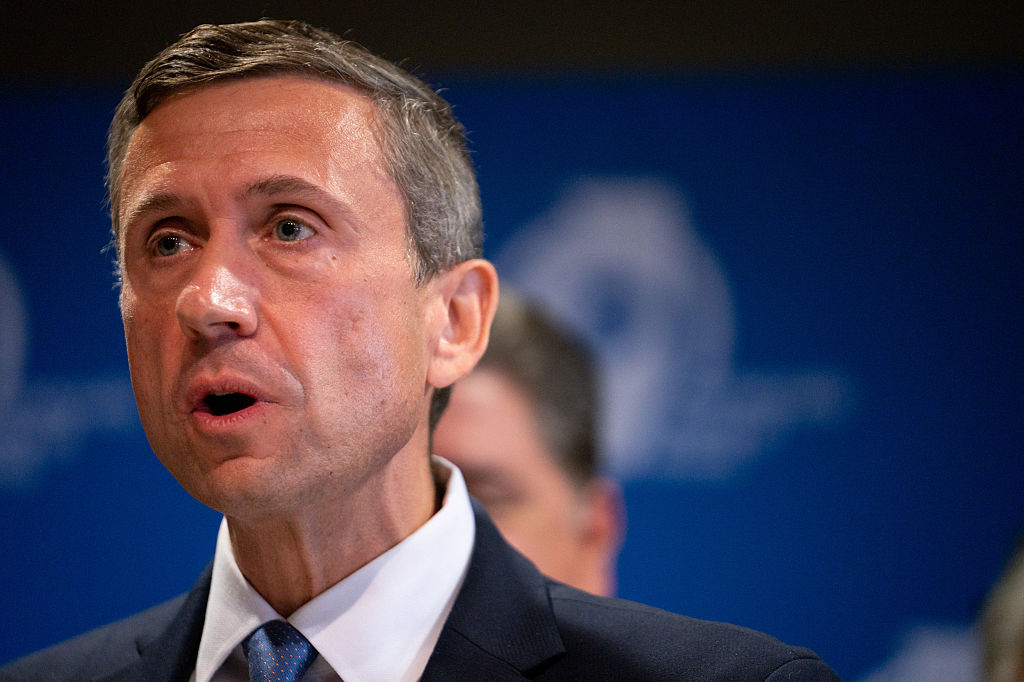
Democratic insiders told JI that DNC chair Ken Martin withdrew his Israel resolution largely to avoid a disruptive floor debate over Israel on Wednesday
THE CENTER SHIFTS
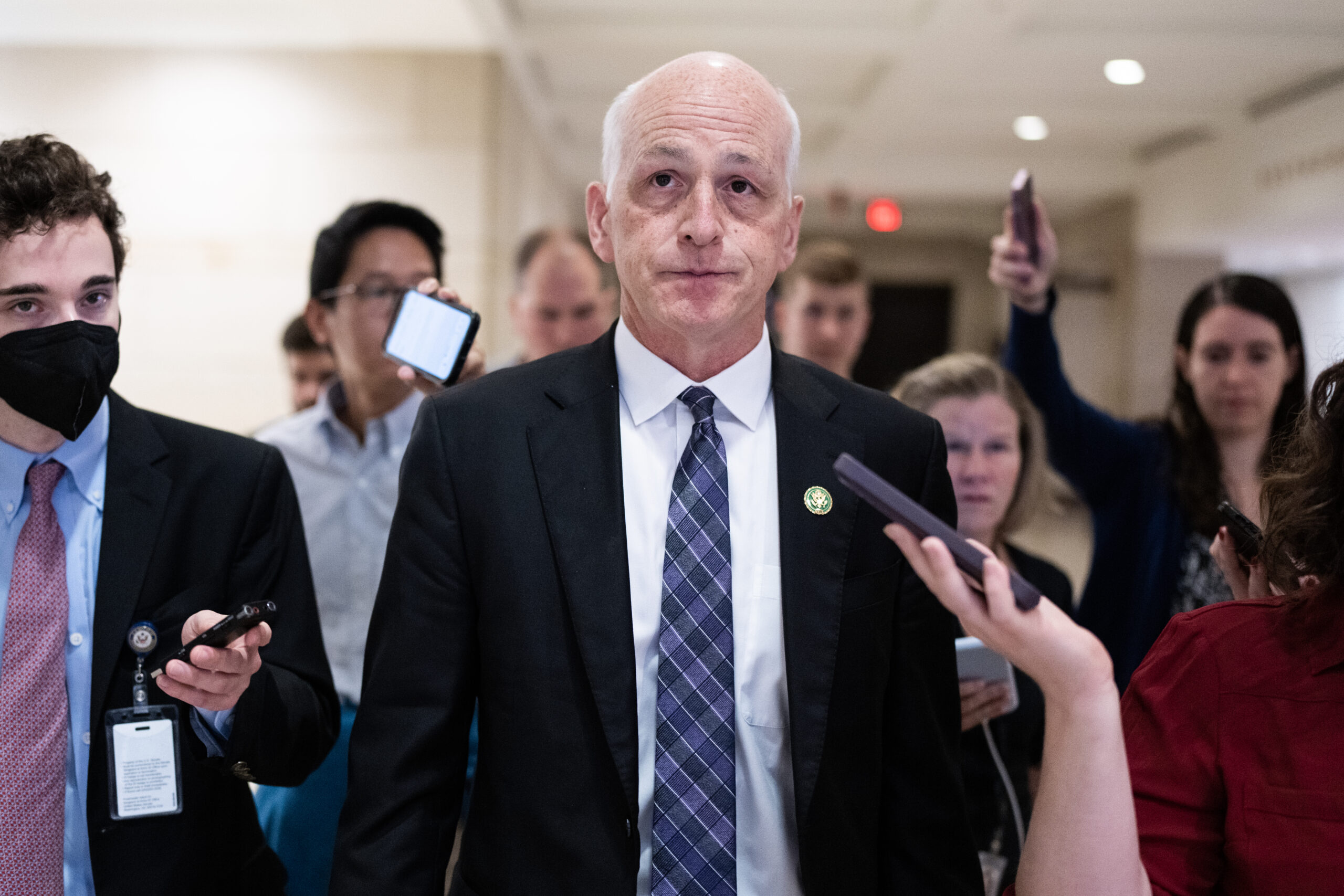
Rep. Adam Smith, ranking member of the House Armed Services Committee, said he recognizes restricting offensive weapons to Israel could ‘embolden Hamas’ but it is ‘time to try something else’
Reports indicate the move could come as soon as Thursday, after talks in Geneva ended with little progress on rolling back the Iranian nuclear program

Kay Nietfeld/picture alliance via Getty Images
French President Emmanuel Macron (l-r), German Chancellor Friedrich Merz (CDU) and Keir Starmer, Prime Minister of Great Britain, meet in The Hague at the delegation hotel on the sidelines of the NATO summit for trilateral talks in the E3 format.
France, Germany and the U.K. are poised to reinstate snapback sanctions on Iran in the next several days, after talks held in Geneva this week aimed at scaling back Iran’s nuclear program reportedly concluded with little progress.
The three countries — known as the E3 — sent a letter to the U.N. Security Council earlier this month outlining “ongoing concerns regarding the lack of assurances as to the exclusively peaceful nature of Iran’s nuclear program” and Tehran’s ongoing violations of the 2015 Joint Comprehensive Plan of Action, to which the E3 countries are still parties despite the U.S. withdrawal in 2018.
The countries threatened to reinstate snapback sanctions by the end of August 2025 if “no satisfactory resolution” to the issue was reached before then.
The mechanism to trigger snapback sanctions at the UNSC expires in October, at which point any attempt to adopt new UNSC sanctions could face vetoes from Russia and China. However, the E3 and U.S. are looking to start the process before Russia assumes the UNSC presidency in October, giving it the power to delay the imposition of snapback sanctions — a process that takes 30 days to complete — until its expiration date.
The foreign ministers of the E3 and Iran met in Geneva earlier this week to discuss a diplomatic solution that would see Iran roll back its nuclear program without additional sanctions, which reportedly ended with little progress made.
A senior European diplomat told Axios on Wednesday that it would take a “diplomatic miracle” to prevent the reinstatement of snapback sanctions, with the European nations poised to trigger the mechanism as soon as Thursday.
Secretary of State Marco Rubio held a call with the E3 foreign ministers on Wednesday, during which all of the officials “reiterated their commitment to ensuring that Iran never develops or obtains a nuclear weapon,” State Department Principal Deputy Spokesperson Tommy Pigott said.
U.S. lawmakers have repeatedly pressed for the E3 to trigger the snapback mechanism.
Plus, the clock keeps ticking on snapback sanctions
Audrey Richardson/Bloomberg via Getty Images
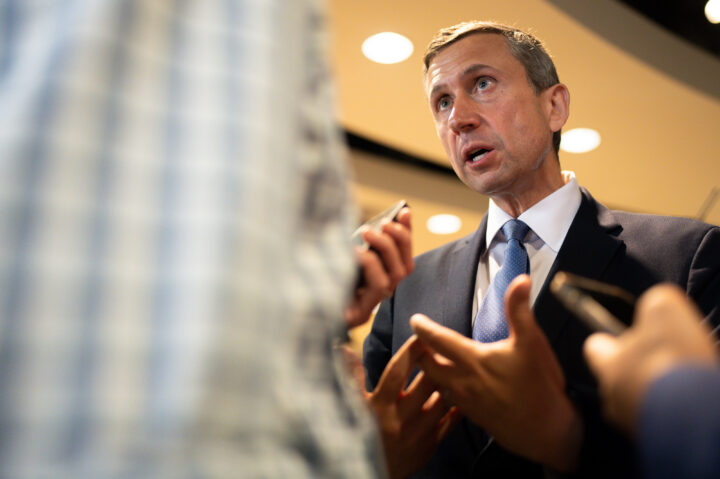
Ken Martin, chairman of the Democratic National Committee (DNC), speaks to members of the media during a news conference in Aurora, Illinois, US, on Tuesday, Aug. 5, 2025.
Good Tuesday afternoon.
This P.M. briefing is reserved for our premium subscribers like you — offering a forward-focused read on what we’re tracking now and what’s coming next.
I’m Danielle Cohen-Kanik, U.S. editor at Jewish Insider and curator, along with assists from my colleagues, of the Daily Overtime briefing. Please don’t hesitate to share your thoughts and feedback by replying to this email.
📡On Our Radar
Notable developments and interesting tidbits we’re tracking
Shortly after members of the Democratic National Committee passed a resolution today introduced by DNC Chair Ken Martin that voiced support for humanitarian aid to Gaza and a two-state solution, called for the release of hostages and condemned Hamas, Martin announced he was withdrawing the measure and instead forming a task force to continue discussing the issue.
The surprise reversal came after a competing resolution that called for an arms embargo and suspension of U.S. aid to Israel was voted down. Upon huddling with the co-sponsors of the failed measure, Martin said at the meeting of the Resolutions Committee where the votes took place, “There is a divide in our party on this issue. This is a moment that calls for shared dialogue and calls for shared advocacy.”
“And that’s why I’ve decided today, at this moment, listening to the testimony and listening to people in our party, to withdraw my amendment resolution to allow us to move forward in a conversation on this as a party,” Martin continued. He said that he would “appoint a committee or a task force comprised of stakeholders on all sides of this to continue to have the conversation, to work through this, and bring solutions back to our party”…
Overseas, Sen. Jeanne Shaheen (D-NH), Rep. Joe Wilson (R-SC) and U.S. Syria envoy Tom Barrack, ending their visit to Damascus, traveled to Beirut today where they joined Sen. Lindsey Graham (R-SC).
Along with diplomat Morgan Ortagus and U.S. Ambassador to Lebanon Lisa Johnson, the delegation met with Lebanese President Joseph Aoun, Prime Minister Nawaf Salam, Parliament Speaker Nabih Berri and head of the Lebanese Armed Forces Gen. Rodolph Haykal, with whom they discussed U.S. support of the LAF.
Barrack and Ortagus have been shuttling between Lebanon, Syria and Israel over the past several months in an effort to improve security relations in the region.
During a press conference the lawmakers held in Beirut, Graham announced his support for the United States signing a defense agreement with Lebanon, where the U.S. would commit to defending Lebanon militarily.
“How many nations have a defense agreement with the United States? … The number of nations that America is willing to go to war for is very few. Why do I mention Lebanon being in that group? You have one thing going for you that is very valuable to me. Religious diversity,” Graham said.
The South Carolina senator continued, “Christianity is under siege in the Mideast. Christians are being slaughtered and run out of all over the region, except here. So what I am going to tell my colleagues is, ‘Why don’t we invest in defending religious diversity in the Mideast? Why don’t we have a relationship with Lebanon where we would actually defend what you’re doing?’ I think it’s in America’s interest to defend religious diversity.”
Though it’s been discussed in Israeli and American administrations for decades, the U.S. does not have a mutual defense agreement with Israel, another Middle East country with a large Christian population and religious diversity…
Meanwhile, a meeting of the E3 — France, Germany and the U.K. — and Iran in Geneva today ended with reportedly little progress on scaling back the Iranian nuclear program, leaving the European countries to decide if they’ll follow through on a recent threat to reinstate snapback sanctions at the end of the month…
The Norwegian Sovereign Wealth Fund, the world’s largest sovereign wealth fund, announced it’s selling its shares of the U.S. machinery company Caterpillar over Israel’s use of its bulldozers, which the fund said had contributed to Palestinian suffering, as well as its shares in four Israeli banks, including the country’s two largest.
The fund has already liquidated its holdings in over a dozen Israeli companies and cut ties with Israeli hedge fund managers over concerns with the country’s war in Gaza and treatment of Palestinians…
On the Hill, leading Jewish organizations are set to send a letter to Senate leadership today urging the body to confirm the Trump administration’s nominees for special envoy to monitor and combat antisemitism, Rabbi Yehuda Kaploun, and international religious freedom ambassador, former Rep. Mark Walker (R-NC), Jewish Insider has learned. Schumer currently has a hold on dozens of President Donald Trump’s nominees…
⏩ Tomorrow’s Agenda, Today
An early look at tomorrow’s storylines and schedule to keep you a step ahead
Keep an eye on Jewish Insider tomorrow morning for reactions from Jewish Democrats on Martin’s decision to withdraw his resolution at the DNC and an interview with Democrat Maura Sullivan, the Marine veteran and former Defense Department official running to succeed Rep. Chris Pappas (D-NH).
Stories You May Have Missed
PHONE A FRIEND
Vermont’s democratic socialist senator is on a campaign swing as part of his ‘Fighting Oligarchy’ tour
DOWN UNDER DICTATE
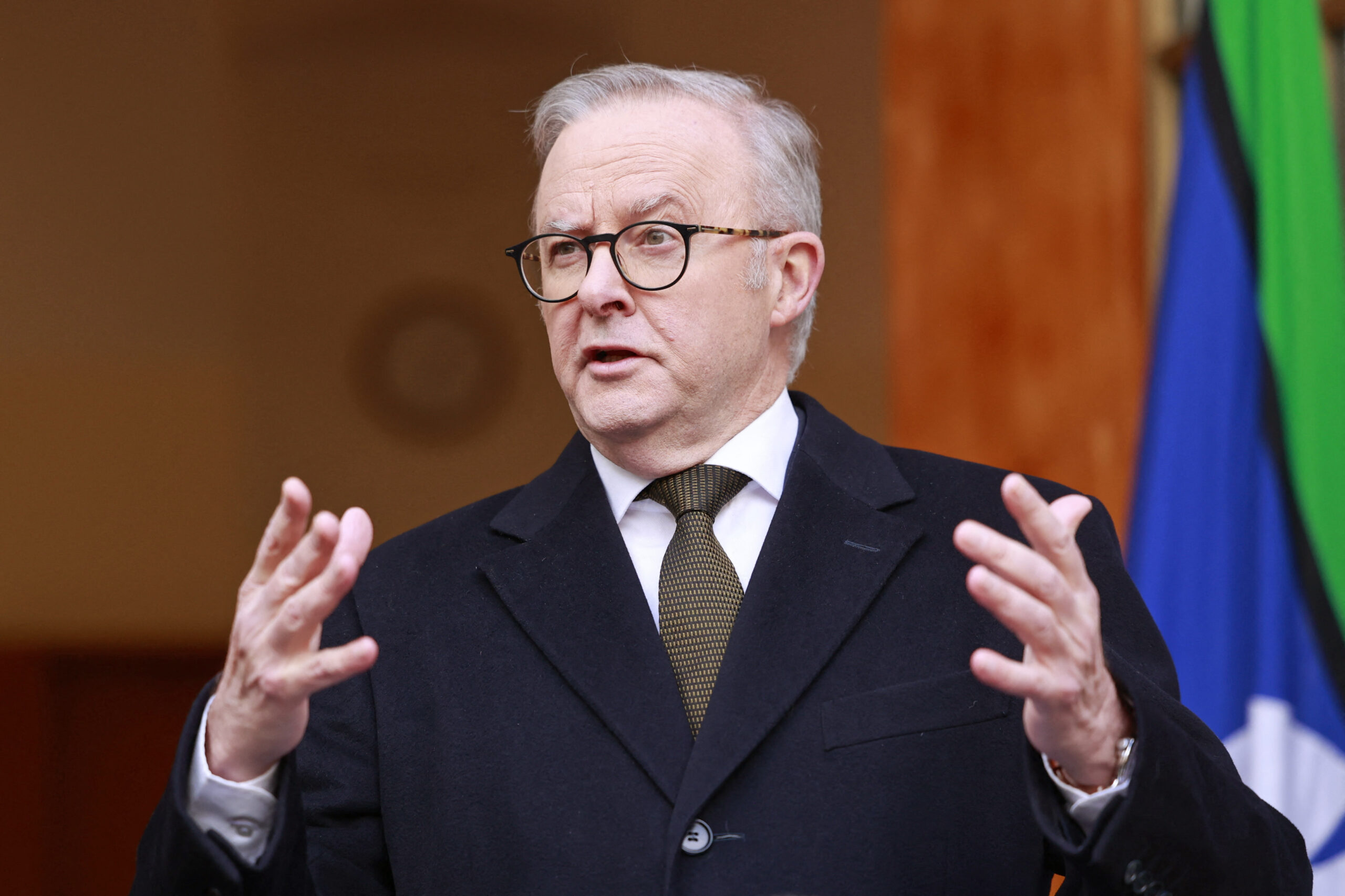
PM Anthony Albanese blasted the ‘extraordinary and dangerous acts of aggression orchestrated by a foreign nation on Australian soil’
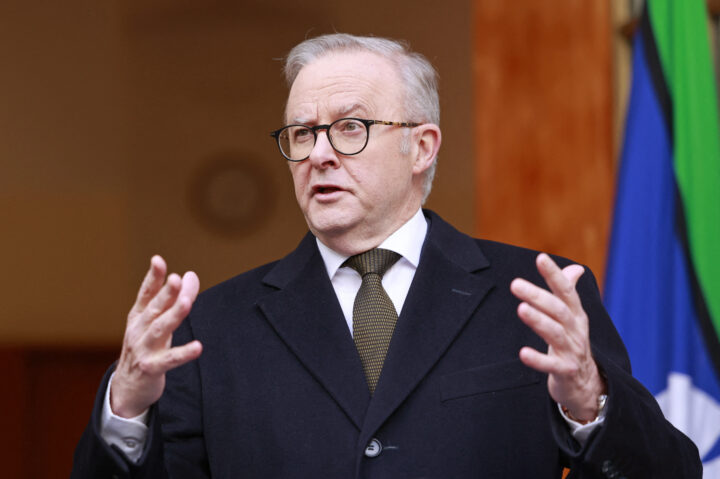
HILARY WARDHAUGH/AFP via Getty Images
Australian Prime Minister Anthony Albanese speaks during a press conference in Canberra on August 11, 2025.
Good Tuesday morning.
In today’s Daily Kickoff, we report on Australia’s expulsion of Iran’s top diplomat over evidence of Tehran’s involvement in attacks on Jewish institutions in the country, and have the scoop on New York Gov. Kathy Hochul’s plans to sign into law legislation requiring schools in the state to designate anti-discrimination coordinators. We report on Mahmoud Khalil and Rep. Rashida Tlaib’s upcoming appearances at the University of Michigan, and cover the House Education and the Workforce Committee’s investigations of allegations of antisemitism at three medical schools. Also in today’s Daily Kickoff: Israeli Foreign Minister Gideon Sa’ar, Katharina von Schnurbein and Ken Martin.
What We’re Watching
- The Treasury Department is lifting its remaining U.S. sanctions on Syria today, two months after an order from President Donald Trump.
- The Democratic National Committee’s Resolutions Committee is set to vote today on two Israel-related resolutions at the DNC summer meeting in Minneapolis. One resolution, proposed by a Gen Z DNC member from Florida, calls for an arms embargo on the Jewish state, and the other — backed by DNC Chair Ken Martin — calls for a ceasefire, an influx of humanitarian aid into Gaza and a two-state solution.
- New York Gov. Kathy Hochul is slated to sign into law legislation mandating that state schools designate anti-discrimination coordinators to enforce Title VI of the Civil Rights Act. More below.
- Iranian officials are in Geneva today to meet with U.K., French and German officials for nuclear talks.
What You Should Know
A QUICK WORD WITH JI’S MELISSA WEISS
Australian Prime Minister Anthony Albanese announced on Tuesday that Iranian Ambassador to Australia Ahmad Sadeghi, along with three other Iranian diplomats, is being expelled from the country over findings from Australia’s security service that Iran was behind multiple antisemitic attacks in the country — the first time Canberra has expelled a foreign ambassador since World War II.
Albanese, speaking at a press conference alongside the country’s top intelligence official, foreign minister and home affairs minister, called the plots “extraordinary and dangerous acts of aggression orchestrated by a foreign nation on Australian soil.”
The expulsion of the Iranian diplomats comes shortly after the arrests of two individuals in connection with a December 2024 Melbourne synagogue attack, in which a synagogue was firebombed while nearly two dozen people were inside. The arson at Sydney’s Lewis’ Continental Kitchen, which took place in October 2024, caused $1 million in damage to the kosher restaurant.
Sadeghi’s expulsion comes amid an explosion of antisemitism down under in the wake of the Oct. 7, 2023, Hamas attacks on Israel and Israel’s ensuing war against the terror group in Gaza. More recently, tensions between Canberra and Jerusalem have been strained following Australia’s revocation of visas for several Israeli officials and activists and its plans, announced earlier this month, to recognize a Palestinian state.
Iran and its proxies have an extensive history of plotting attacks against Jewish, Israeli and diplomatic targets abroad, dating back decades. Tehran and its Hezbollah proxy were determined by Argentine courts to be behind the 1992 bombing of the Israeli Embassy in Buenos Aires as well as the 1994 bombing of the AMIA Jewish community center in the city, which collectively killed 114 people and injured hundreds. More recently, Iran was discovered in 2011 to be plotting to assassinate the Saudi ambassador in Washington.
Tehran has also been discovered to be behind attacks and plots across Europe and Asia, though few countries have taken significant steps to address the Islamic Republic’s malign behavior. Israel has since last April, when Iran launched its first wave of ballistic missile attacks against the Jewish state, pushed for countries to designate the IRGC as a terrorist group.
Capitol Hill has backed such efforts, with more than 130 House legislators signing onto a letter in 2023 calling on the EU to issue such a designation.
mea culpa

An Israeli strike on a Gaza hospital yesterday that reportedly killed 20 people, including four journalists, was a “tragic mishap,” Israeli Prime Minister Benjamin Netanyahu said on Monday, not long after President Donald Trump criticized the attack, Jewish Insider’s Gabby Deutch reports.
Probe underway: “Israel deeply regrets the tragic mishap that occurred today at the Nasser Hospital in Gaza. Israel values the work of journalists, medical staff and all civilians,” the Prime Minister’s Office said in a statement. “The military authorities are conducting a thorough investigation. Our war is with Hamas terrorists. Our just goals are defeating Hamas and bringing our hostages home.” Trump told reporters in the Oval Office that he is “not happy” about Israel’s strike on the Nasser Hospital, in the southern Gaza Strip.
Inside Israel: IDF Chief of Staff Eyal Zamir said in remarks during a visit to a Haifa naval base on Sunday that the Israeli army has met its objectives in its war with Hamas in Gaza, “including deeply damaging Hamas,” and “as a result of the military pressure, we created the conditions for the release of the hostages.” Read more from JI’s Danielle Cohen-Kanik here.
new york minute
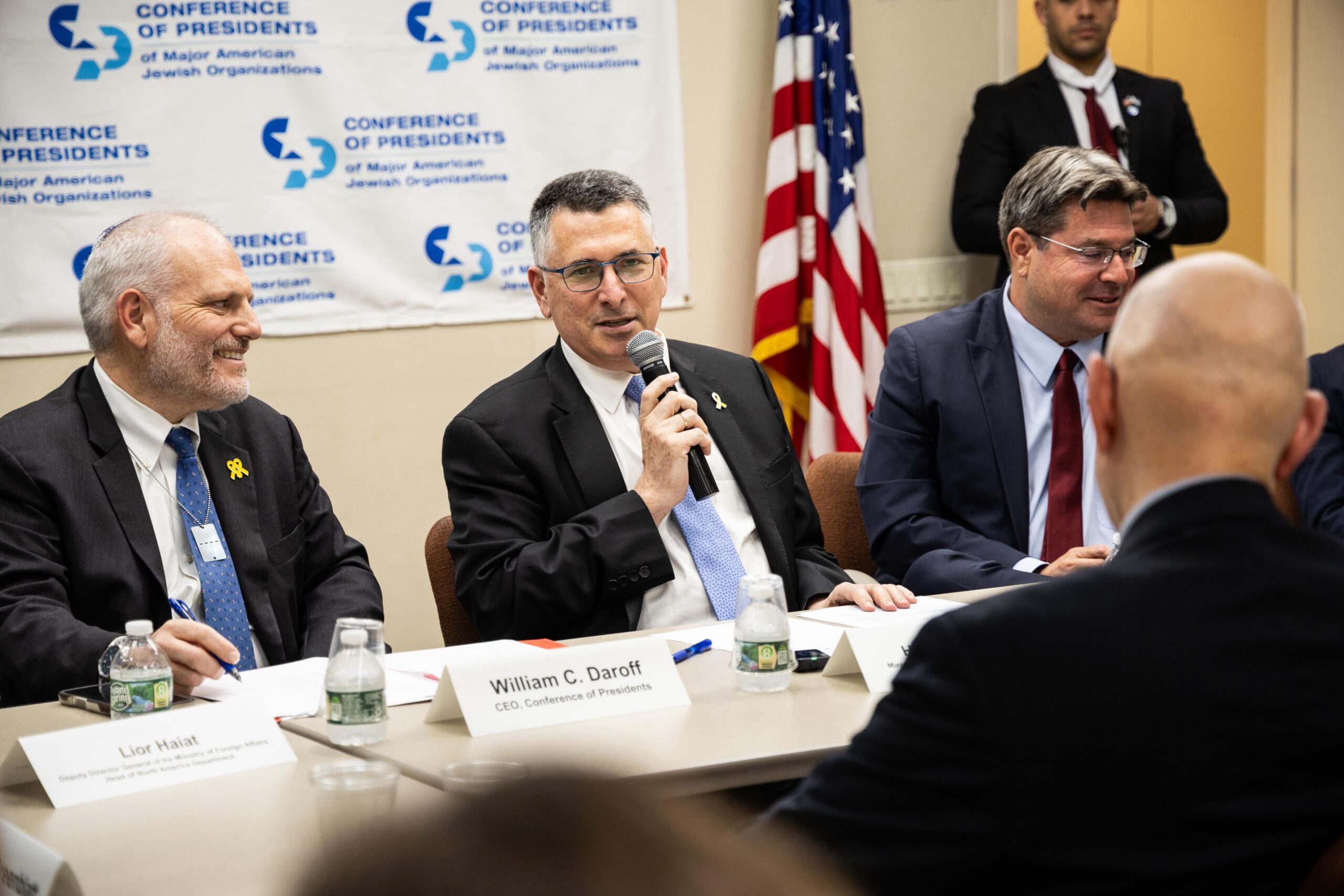
Israeli Foreign Minister Gideon Sa’ar met on Monday with American Jewish leaders in New York, speaking with the group at a moment when tensions between Diaspora Jews and Israel’s leaders over the conduct of the war in Gaza seem to be growing, Jewish Insider’s Gabby Deutch reports. The meeting was organized by the Conference of Presidents of Major American Jewish Organizations, and most of its members — representing the Reform, Orthodox and Conservative movements, as well as major national organizations including the Anti-Defamation League and the Jewish Federations of North America — were present in the room.
Mixed readouts: “We spoke about the war, the plight of the hostages, and the challenges facing Israel, with a clear focus on strengthening U.S.-Israel relations,” Conference of Presidents CEO William Daroff told JI about the “positive and wide-ranging” 90-minute meeting. “The exchange underscored our unity, our partnership with Israel and our shared commitment to the Jewish future.” But two attendees, who requested anonymity, described the meeting as antagonistic, saying Sa’ar took an argumentative tone against Jewish leaders in America who have raised concerns about the humanitarian situation in Gaza.
phone a friend
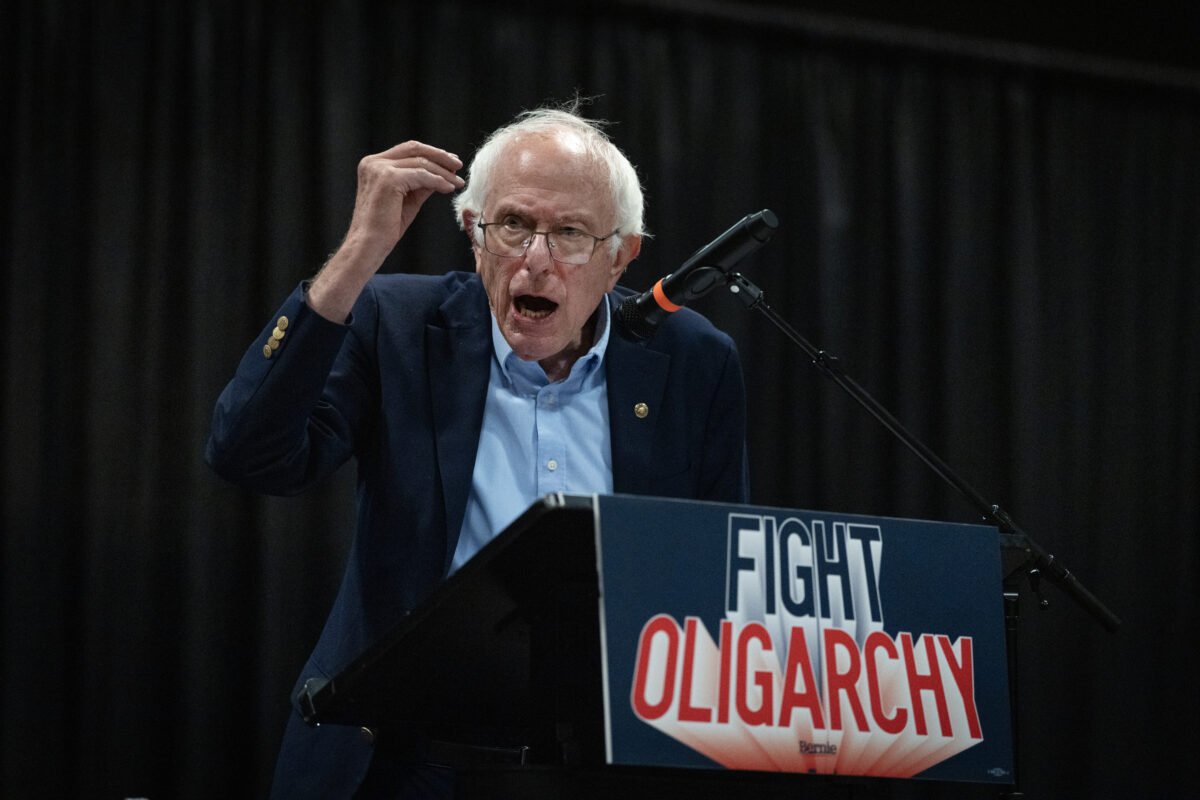
Sen. Bernie Sanders (I-VT) is slated to appear with Graham Platner, a Democrat running to unseat Sen. Susan Collins (R-ME), at a rally in Portland, Maine, on Labor Day, as the progressive leader from Vermont steps up his efforts to boost left-wing candidates who have been outspoken in their criticism of Israel and its ongoing war in Gaza, Jewish Insider’s Matthew Kassel reports.
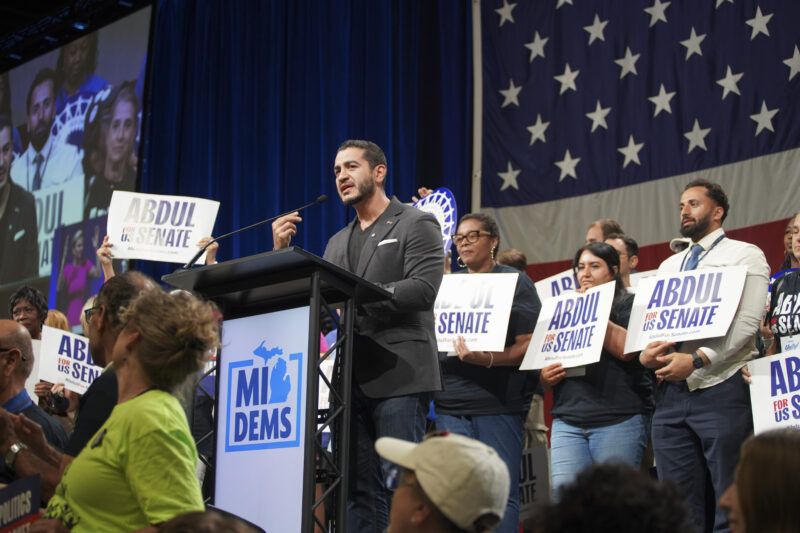
Michigan to Maine: Platner, who launched his campaign last week, has accused Israel of committing genocide in Gaza and backed Sanders’ recent resolutions to block arms sales to Israel. The Portland event on Sept. 1, the next stop on Sanders’ nationwide “Fighting Oligarchy” tour, follows a rally in Michigan on Saturday at which the senator sought to boost Abdul El-Sayed, a staunch critic of Israel who is vying to replace retiring Sen. Gary Peters (D-MI) in a crowded primary next year.
SCOOP

Responding to heightened campus antisemitism, New York Gov. Kathy Hochul will sign legislation on Tuesday afternoon that requires all colleges in the state to designate anti-discrimination coordinators to enforce Title VI of the Civil Rights Act of 1964, her office confirmed to Jewish Insider’s Matthew Kassel. The bill passed the Legislature unanimously in June.
‘Top priority’: “By placing Title VI coordinators on all college campuses, New York is combating antisemitism and all forms of discrimination head-on,” Hochul, a Democrat, told JI. “No one should fear for their safety while trying to get an education. It’s my top priority to ensure every New York student feels safe at school, and I will continue to take action against campus discrimination and use every tool at my disposal to eliminate hate and bias from our school communities.”
in the hot seat

The House Committee on Education and the Workforce will investigate three medical schools over their “failures to address antisemitism,” Rep. Tim Walberg (R-MI), the chair of the committee, announced on Monday. The three schools targeted in the probe are the University of Illinois College of Medicine (UICOM), University of California, San Francisco and University of California, Los Angeles Geffen School of Medicine, Jewish Insider’s Gabby Deutch reports.
‘Hostility and fear’: The investigations come as medical schools and the medical profession have faced increasing scrutiny over rising antisemitism since the Oct. 7, 2023, Hamas attacks. “The Committee has become aware that Jewish students, faculty, and patients have been experiencing hostility and fear at the university, and it has not been demonstrated that the university has meaningfully responded to address and mitigate this problem,” Walberg wrote to each institution, followed by a list detailing alleged incidents of antisemitism.
back to school

Days after the University of Michigan kicks off the new school year this week, the campus is slated to host two anti-Israel speakers — former Columbia University protest leader Mahmoud Khalil and Rep. Rashida Tlaib (D-MI), one of the most outspoken critics of Israel in Congress, Jewish Insider’s Haley Cohen reports.
Campus calendar: On Wednesday afternoon, Tlaib is scheduled to speak at an on-campus press conference titled “United Against Genocide, United Against Repression” hosted by The People’s Coalition Michigan. Later that evening, the campus chapter of Students Organize for Syria is scheduled to host Khalil, who was released in June from the immigration detention center where he had been held for three months as the Trump administration sought to have him deported. The events come days before thousands of pro-Palestinian activists are set to gather in Detroit, beginning Aug. 29, for the second annual People’s Conference for Palestine, under the slogan “Gaza is the Compass.”Read the full story here.
Worthy Reads
Israel, Alone: The New York Times’ Tom Friedman reflects on Israel’s increasingly isolated global status amid the continuation of its war in Gaza and its blunders on the battlefield. “[The Israeli government] is destroying Israel’s standing in the world, it is killing Gazan civilians with seemingly no regard for innocent human life, and it is tearing apart Israeli society and world Jewry, between those Jews who want to still stand with Israel no matter what and those who can no longer tolerate, explain or justify where this Israeli government is taking the Jewish state and now want to distance themselves from it. … So why is the world ganging up only on Israel now? Because it holds Israel to a higher standard than Hamas, because Israel has always held itself to a higher standard. And because the world can tell the difference now between a war being waged for the survival of the Jewish state and a war being waged for the political survival of its prime minister.” [NYTimes]
The Mamdani Effect: In The Washington Post, Ramesh Ponnuru considers the liabilities New York City mayoral nominee Zohran Mamdani brings to the Democratic Party as he looks increasingly likely to win the November general election. “This debate ignores what might be the biggest danger that Mamdani poses to the Democratic Party. That danger is not that his performance as mayor, assuming his polling lead holds, will turn off swing voters nationally (although it might). It’s that he will excite Democratic activists in all the wrong ways. His example will encourage them to do what a lot of them already want to do: get louder and lefter. Committed partisans are always tempted to find evidence, however dubious, that being more hard-line is the path to political victory. It happens to people of all political descriptions. In recent years, though, Democrats have been especially prone to political misjudgments of this kind.” [WashPost]
The New Anti-Zionism: In The Jerusalem Post, Betsy Berns Korn and Eric Mandel raise concerns about a new effort to push “Anti-Palestinian Racism,” as the effort, which originated in Canada, gets a foothold in the U.S. “If left unchallenged, APR will reshape public discourse, empower hostile NGOs, and normalize antisemitism in schools, governments, and even corporations. Policymakers must act now. Congress, state legislatures, and school boards should ensure anti-racism curricula are not hijacked to advance anti-Israel ideology. Universities should adopt the IHRA definition of antisemitism and resist attempts to elevate APR. Civil society must demand equal standards, where Palestinians are held accountable for terror and incitement just as Israelis are for policy decisions. The stakes could not be higher. Anti-Zionism has always adapted to survive, and APR is its newest disguise.” [JPost]
Word on the Street
The State Department is backing U.S. Ambassador to France Charles Kushner amid a diplomatic row with Paris following the weekend publication of a Wall Street Journal op-ed in which Kushner slammed the country for its failure to address antisemitism; France’s trade minister said in response to Kushner’s criticism that Paris “need take no lessons whatsoever” from the U.S. regarding antisemitism…
More than 75 Jewish organizations around the world signed on to a letter spearheaded by the American Jewish Committee voicing “unequivocal support” for Katharina von Schnurbein, the European Commission coordinator on combating antisemitism, amid calls for her dismissal by EU parliament members over her support for Israel, Jewish Insider’s Haley Cohen reports…
The Associated Press looks at internal dissent and fundraising challenges facing the Democratic National Committee and its chair, Ken Martin, amid the group’s summer gathering in Minneapolis, which kicked off on Monday…
In the Minnesota Star Tribune, Sarah Clarke, the wife of Minneapolis Mayor Jacob Frey, raises concerns about a planned protest outside the couple’s home on Thursday; in the op-ed, Clarke slams the “threats, harassment and even vandalism that my family endures when people feel entitled to target our family and home for perceived political gain”…
Police in Philadelphia are investigating the vandalism of the Weitzman National Museum of American Jewish History early Friday morning, in which red paint was sprayed on the side of the building over the words “the Weitzman stands with Israel,” which appeared under an Israeli flag…
The George Mason University chapter of Students for Justice in Palestine, which had been dormant since it was suspended in the aftermath of the arrests of several chapter leaders, posted a video ahead of the start of the fall semester in which a masked speaker pledged that “the spirit of resistance will not be quenched until we see full liberation of Palestine from the river to the sea”…
The Irish rap group Kneecap canceled the U.S. stops on its upcoming tour, citing the London court appearance of one of its members on terrorism charges as a scheduling conflict; Kneecap member Liam O’Hanna is facing the charges following his display of a Hezbollah flag at a November 2024 show…
Israel announced plans for a “phased reduction” in troops in southern Lebanon as part of an agreement in which Beirut will force the disarmament of Hezbollah…
Israel’s Foreign Ministry downgraded its ties with Brazil, following the South American country’s rejection of former Israeli Ambassador to Colombia Gali Dagan as Jerusalem’s envoy to Brasilia…
Belgium-born diamond baron Maurice Tempelsman, who for more than a decade was the partner of Jacqueline Kennedy Onassis, died at 95…
Pic of the Day
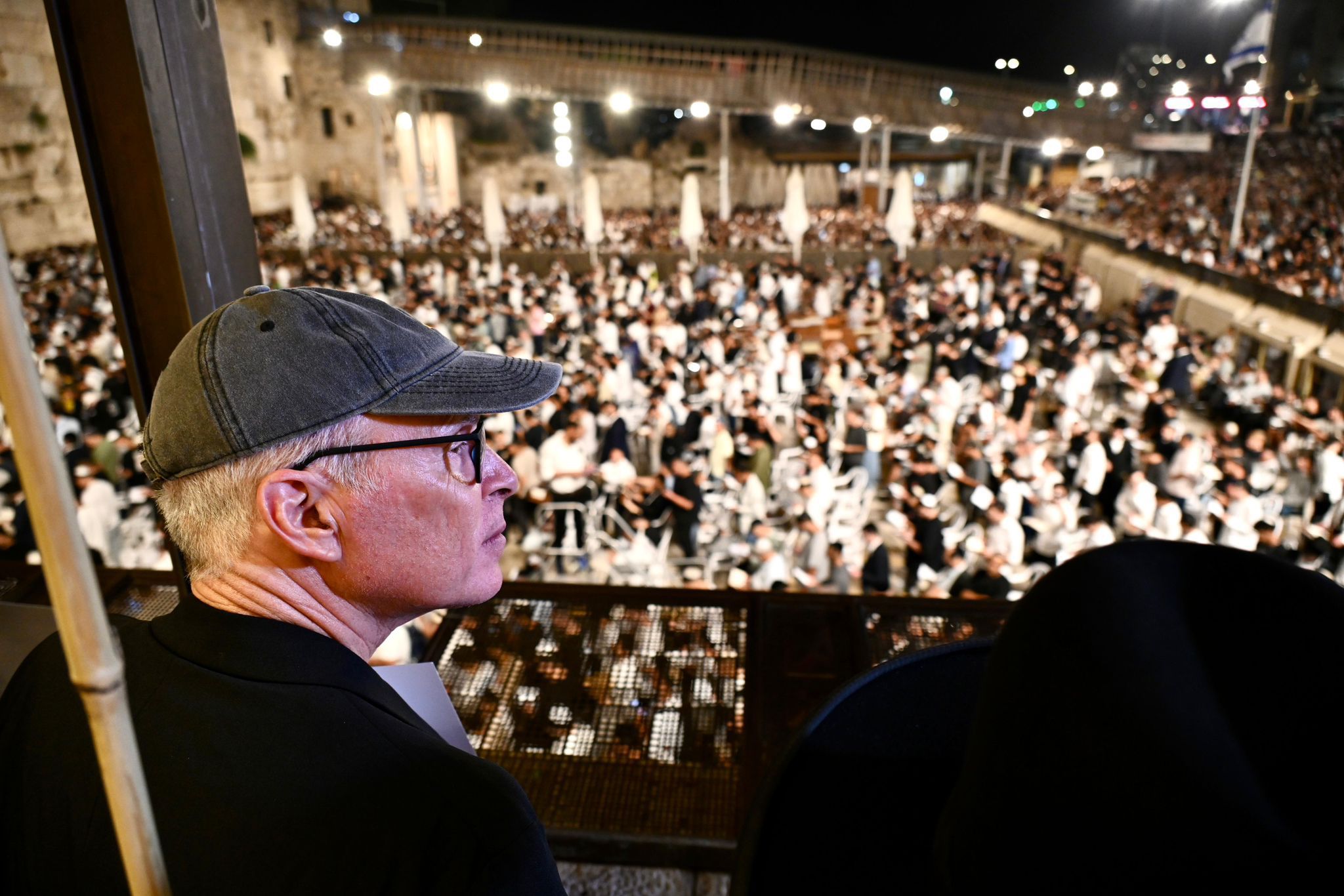
Former hostage Keith Siegel looked on at the First Selichot gathering at the Western Wall in Jerusalem last night, at the start of the Hostages and Missing Families Forum’s “National Day of Struggle” taking place today across the country to call attention to the plight of the remaining 50 hostages.
Birthdays

Rapper, known professionally as Kosha Dillz, Rami Matan Even-Esh turns 44…
Rabbi (now emeritus) of Congregation Beth Jacob of Atlanta, he made aliyah in 1991, Rabbi Emanuel Feldman turns 98… CEO of Siegelvision, a brand identity consultancy, he is also the founder and chairman emeritus of global brand strategy firm Siegel+Gale, Alan Siegel turns 87… Owner of You Save On Meds, Martin J. Portnoy… Mayor of Tel Aviv since 1998, Ron Huldai turns 81… Partner at the D.C. law firm of Williams & Connolly, Robert B. Barnett turns 79… Former Democratic member of the Florida House of Representatives, Irving Slosberg turns 78… Sales representative for ADT Security, Jay Caplan… Vaudeville performer, clown, mime, juggler and sleight of hand magician, known by his stage name “Avner the Eccentric,” Avner Eisenberg turns 77… Co-owner of Rochester, N.Y.-based August Moon Imports and World Tae Kwon Do Center, Jane Cota August… First vice president of the French Senate from 2020 until 2023, Roger Karoutchi turns 74… Venture capitalist, social policy researcher and philanthropist, Freada Kapor Klein turns 73… Board chair of Gap, a retail chain founded by his parents, Robert J. Fisher turns 71… EVP and managing director of polling and consulting at The Mellman Group, Michael J. Bloomfield… CEO of LawMedia Group (LMG), Julian Epstein turns 64… Journalist and co-author of the “Freakonomics” series, Stephen J. Dubner turns 62… Member of the Maryland Senate since 2020, Michelle “Shelly” Laskin Hettleman turns 61… President of NARAL Pro-Choice America for eight years until 2021, Ilyse Hogue turns 56… CFO at Cornerstone OnDemand, Perry Wallack… Managing partner of Austin-based Texas Venture Partners, Lorne Abony turns 56… Managing partner of RNS Strategies based in Portland, Ore., Robert Sacks… Professor at the Olin Business School of Washington University in St. Louis, Steven Malter turns 52… Deputy general counsel at ICANN Internet Corporation for Assigned Names and Numbers, the coordinator of the Internet’s naming system, Samantha Eisner… Co-founder and CEO of Danari Global, Ariel Maurice (“Ari”) Ratner… Founder and CEO of The Lemon Perfect Company, maker of the enhanced water brand Lemon Perfect, Yanni Hufnagel turns 43… Member of the Knesset for Yesh Atid, she served in the previous government as minister for social equality and minorities, Meirav Cohen turns 42… Singer-songwriter, vocalist, guitarist and co-writer for the indie rock band Tally Hall, Robert Howard “Rob” Cantor turns 42… Principal and founder of Inspire Capital and Development, Brielle Joy Appelbaum… Managing partner of Victor Capital Partners, Doug Korn… John Train… Carrie Shapiro…
PM Anthony Albanese blasted the ‘extraordinary and dangerous acts of aggression orchestrated by a foreign nation on Australian soil’
HILARY WARDHAUGH/AFP via Getty Images
Australian Prime Minister Anthony Albanese speaks during a press conference in Canberra on August 11, 2025.
Australia expelled the Iranian ambassador in Canberra as well as three other embassy staffers on Tuesday, with Prime Minister Anthony Albanese accusing the Islamic Revolutionary Guard Corps of orchestrating attacks on a synagogue in Melbourne and a kosher restaurant in Sydney.
Albanese, speaking at a press conference alongside the country’s top intelligence official, foreign minister and home affairs minister, called the plots “extraordinary and dangerous acts of aggression orchestrated by a foreign nation on Australian soil.” The expulsion of Ahmad Sadeghi marks the first time Australia has expelled a foreign ambassador since World War II.
Canberra also withdrew its diplomatic staff from Iran and has encouraged Australian citizens to leave the country if they are able.
Australian intelligence indicates that Tehran was behind additional antisemitic attacks in the country since the Oct. 7, 2023, Hamas terror attacks. The country has seen an explosion of antisemitism, with a 316% year-over-year increase in antisemitic incidents in the year following the attacks.
Mike Burgess, the director-general of the Australian Security Intelligence Organisation, said that the plots were carried out “through a series of overseas cut-out facilitators to coordinators that found their way to tasking Australians,” describing the scheme as a “layer cake” of middlemen originating with the IRGC.
The expulsion of the Iranian diplomats comes shortly after the arrests of two individuals in connection with the December 2024 Melbourne synagogue attack, in which a synagogue was firebombed while nearly two dozen people were inside.
The arson at Sydney’s Lewis’ Continental Kitchen, which took place in October 2024, caused $1 million in damage to the kosher restaurant. Court documents released earlier this month indicate that a middleman, Sayed Moosawi, who was directing the Sydney attack, was to receive $12,000 for his work. Prior to the fire at Lewis’ Continental Kitchen, two men directed by Moosawi mistakenly set fire to a brewery with a similar name to the restaurant.
Plus, University of Florida's new (interim) leader
ABIR SULTAN/POOL/AFP via Getty Images
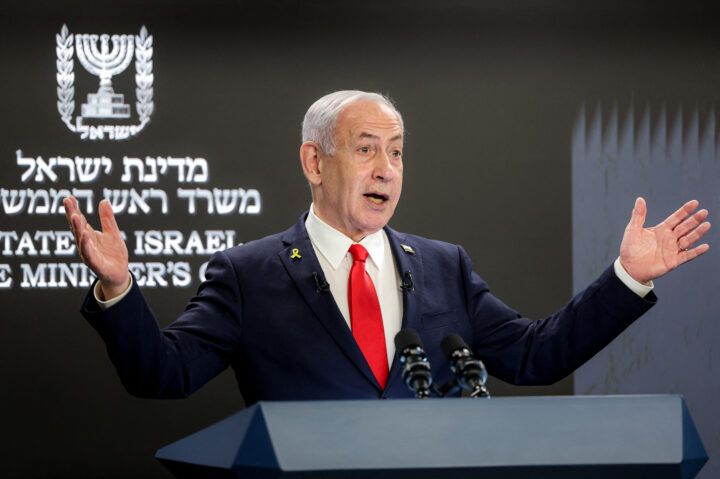
Israel's Prime Minister Benjamin Netanyahu gives a press conference at the Prime minister's office in Jerusalem on August 10, 2025.
Good Monday afternoon.
This P.M. briefing is reserved for our premium subscribers like you — offering a forward-focused read on what we’re tracking now and what’s coming next.
I’m Danielle Cohen-Kanik, U.S. editor at Jewish Insider and curator, along with assists from my colleagues, of the Daily Overtime briefing. Please don’t hesitate to share your thoughts and feedback by replying to this email.
📡On Our Radar
Notable developments and interesting tidbits we’re tracking
Israeli Prime Minister Benjamin Netanyahu called an IDF strike today on a Gaza hospital that reportedly killed 20 people, including at least four journalists, a “tragic mishap” that Israel “deeply regrets.”
“Israel values the work of journalists, medical staff, and all civilians,” Netanyahu said in his statement. “The military authorities are conducting a thorough investigation. Our war is with Hamas terrorists.”
President Donald Trump, asked by reporters in the Oval Office this morning about the strike, said he was “not happy about it. I don’t want to see it.” Trump said at a press conference later he believes that in two to three weeks “you’re going to have … a pretty conclusive ending” to the war in Gaza…
Also turning up the pressure on Netanyahu, IDF Chief of Staff Eyal Zamir said Sunday that the IDF has met its objectives in its war in Gaza, “including deeply damaging Hamas,” and “as a result of the military pressure, we created the conditions for the release of the hostages.”
Zamir reportedly advocated for Netanyahu to accept the deal that Hamas said it agreed to last week and reiterated his concern that the IDF’s impending takeover of Gaza City will imperil the lives of the remaining living hostages…
Lawmakers are making the most of their August recess with several in the Middle East this week.
Sen. Joni Ernst (R-IA) met with Netanyahu in Jerusalem today, after several meetings with Qatari officials in Doha last week.
Sen. Lindsey Graham (R-SC) is in Lebanon today, where he visited a memorial at the U.S. Embassy in Beirut for fallen service members, including the 241 Americans killed in the bombing of U.S. Marine barracks by Hezbollah, under the direction of Iran, in 1983.
Meanwhile, Rep. Joe Wilson (R-SC) and Sen. Jeanne Shaheen (D-NH) joined U.S. Syria envoy Tom Barrack in Damascus, where they met with Syrian President Ahmad al-Sharaa to “discuss a bright, unified, and stable future for Syria.”
Wilson and Shaheen also met with Syria’s minister of social affairs and labor, religious clerics and a leader of the Syrian Democratic Forces. Both lawmakers have led efforts in Congress to repeal congressional sanctions on Syria in order to aid reconstruction and stabilization…
Barrack also visited Israel on Sunday and met with Netanyahu, Minister of Strategic Affairs Ron Dermer, Defense Minister Israel Katz and Foreign Minister Gideon Sa’ar to discuss security arrangements between Israel and Syria as well as Israel and Lebanon, according to Axios…
France requested to delay a U.N. Security Council vote on a French proposal to extend the mandate of the United Nations Interim Force in Lebanon until Friday, due to disagreements with the U.S. — which holds veto power — over a sunset date for the extension.
The current French proposal would allow the force to remain in place indefinitely, while the Trump administration wants an extension of only one year before UNIFIL disbands and withdraws from Lebanon, sources confirmed to Jewish Insider. If no consensus is reached, France could request another delay until Aug. 31, when the current mandate expires…
On the domestic front, the University of Florida’s Board of Trustees voted unanimously to appoint Dr. Donald Landry as interim president of the school, after Florida’s Board of Governors rejected Santa Ono, the former president of the University of Michigan, for the job.
Landry, a renowned physician and chair emeritus of Columbia University’s Department of Medicine, will replace current UF interim President Kent Fuchs, who said the process of choosing a new president had become “more challenging” after Ono’s rejection…
⏩ Tomorrow’s Agenda, Today
An early look at tomorrow’s storylines and schedule to keep you a step ahead
Keep an eye on Jewish Insider tomorrow morning for reporting on how the University of Michigan is becoming an epicenter of anti-Israel activism to start the new school year, and Jewish groups’ response to European officials targeting Katharina von Schnurbein, the EU antisemitism coordinator, for her defense of Israel.
Tomorrow morning, the Democratic National Committee’s Resolution Committee is expected to take up two Israel-related resolutions, including an anti-Israel measure that calls for an arms embargo and a suspension of U.S. military aid to Israel. The resolutions will then be brought to the general session on Wednesday. We’ll be paying close attention to how much support that anti-Israel resolution receives.
Also tomorrow, the Treasury Department will officially remove Syria from its sanctions list for the first time since 2005.
Added to our calendar for next week, Sen. Bernie Sanders (I-VT) is slated to appear at a rally with Graham Platner, a Democrat running against Sen. Susan Collins (R-ME), who has emerged as a harsh critic of Israel during his nascent campaign.
Stories You May Have Missed
MAGA MEETS THE HOLY LAND

One influencer on the delegation organized by Israel365 said he previously believed IDF soldiers were anti-Christian, but ‘they were just kind of like homies’
THE HOT CORNER

A new web series launched by ADL and Maccabi USA explores ‘how sports can inspire dialogue and challenge antisemitism’
Plus, Texans do the electoral shuffle
MARC ISRAEL SELLEM/POOL/AFP via Getty Images
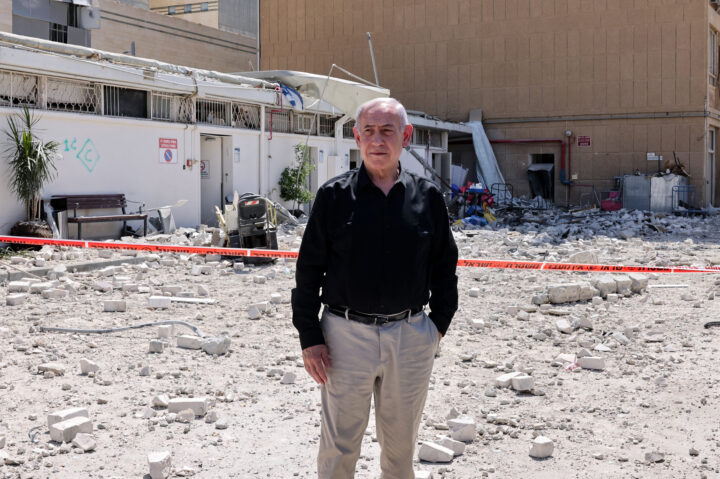
Israeli Prime Minister Benjamin Netanyahu stands amid debris outside the Soroka Hospital in the southern city of Beersheba, after it was hit by a missile fired from Iran on June 19, 2025.
Good Thursday afternoon.
This P.M. briefing is reserved for our premium subscribers like you — offering a forward-focused read on what we’re tracking now and what’s coming next.
I’m Danielle Cohen-Kanik, U.S. editor at Jewish Insider and curator, along with assists from my colleagues, of the Daily Overtime briefing. Please don’t hesitate to share your thoughts and feedback by replying to this email.
📡On Our Radar
Notable developments and interesting tidbits we’re tracking
Israeli Prime Minister Benjamin Netanyahu appeared on “Triggernometry,” a conservative podcast based in the U.K., in an episode released yesterday, where he was pressed by co-hosts Konstantin Kisin and Francis Foster about inflammatory comments made by Israeli Finance Minister Bezalel Smotrich about settling Gaza and “things that sound like ethnic cleansing.”
Netanyahu dismissed the comments as democratic disagreements, saying, “In a parliamentary system, people are free to say, sometimes they say things they don’t quite mean. … To the extent that we have these conversations around the Security Cabinet, that is actually not being discussed by these people.”
Netanyahu distanced himself from his ministers who have advocated for reestablishing an Israeli civilian presence in Gaza, clarifying, “It’s not my policy. I don’t intend to build settlements or communities in Gaza, not Israeli ones.”
The prime minister disagreed that the comments from Smotrich may be exacerbating Israel’s “PR problem”: “They ask me, you know, ‘Your minister of finance says this, and what do you say?’ Well, I say I disagree with him, and I say that, you know, he’s entitled to say these things. That’s not ethnic cleansing. It’s a view, a legitimate view, which I happen to disagree with”…
And today, Netanyahu announced that he is working “to approve the plans that the IDF presented” to him and Defense Minister Israel Katz for the impending IDF takeover of Gaza City. “In parallel,” he said, “I have instructed to begin immediate negotiations for the release of all our hostages and the end of the war, on conditions that are acceptable for Israel.”
Netanyahu made no mention of the latest deal reportedly agreed to by Hamas, which only includes the release of some of the 50 remaining hostages…
Israel is also facing increased diplomatic ire over its actions in the West Bank, after Smotrich announced last week his approval of plans to build the E1 settlement, which were previously frozen for decades due in part to U.S. disapproval of its controversial location, which would make a contiguous Palestinian state nearly impossible.
Twenty-two countries, including the U.K., Australia, France and Japan, issued a statement today condemning the move as “unacceptable and a violation of international law,” and the U.K. Foreign Office summoned Israeli Ambassador to the U.K. Tzipi Hotovely in further protest.
Asked about the settlement approval, U.S. Ambassador to Israel Mike Huckabee told the Associated Press that a two-state solution is not a “high priority” for the Trump administration and that there are too many unanswered questions about a potential Palestinian state…
On the campus beat, a New York Times report published yesterday on the hurdles international students are facing entering the U.S. this academic year opened with the line, “Many Iranians are not going to American universities this fall.”
The article, largely sympathetic to the plight of students attempting to enter the U.S., highlighted the revocation of more than 6,000 student visas by the State Department, the majority of which were due to breaking U.S. law and support for terrorism; Secretary of State Marco Rubio’s announcement that the department would review visas of students who participated in disruptive campus anti-Israel protests; and new social media vetting of visa applicants, particularly “for expression of pro-Palestinian sentiment,” as barriers to international student enrollment…
Sen. Joni Ernst (R-IA), on a visit to Doha, met today with Qatari Emir Tamim bin Hamad Al Thani and Prime Minister Mohammed bin Abdulrahman Al Thani. Ernst has previously led efforts to pressure Qatar into forcing Hamas to release the hostages held in Gaza…
In the Lone Star State, Rep. Chip Roy (R-TX), a prominent member of the Freedom Caucus and a thorn in the side of President Donald Trump and House Speaker Mike Johnson (R-LA), announced a bid for Texas attorney general today, seeking to replace Trump ally AG Ken Paxton, who himself is running for U.S. Senate against Sen. John Cornyn (R-TX) in a highly competitive primary.
The Texas game of electoral musical chairs comes as the state is in the midst of a contentious mid-decade redistricting process, which will likely see its Legislature turn even deeper red.
One high-profile Democrat in the Texas Statehouse, James Talarico, was backed by Miriam Adelson’s Texas Sands PAC, Politico revealed today, despite Talarico’s public stance against GOP billionaires‘ influence in politics. The group was his largest donor last year and one of his largest ever…
New York City Mayor Eric Adams, no stranger to scandal, is facing more electoral trouble of his own as he runs for reelection as an independent, facing off against former New York Gov. Andrew Cuomo and Democratic nominee Zohran Mamdani.
Yesterday, reports alleged that Adams’ former advisor and current campaign volunteer, Winnie Greco, surreptitiously gave a reporter an envelope of cash, stashed inside a bag of potato chips. Today, the Manhattan district attorney unsealed four indictments against Adams’ former chief advisor, Ingrid Lewis-Martin, accusing her of receiving more than $75,000 in bribes, and six other individuals, most of whom are associates or supporters of Adams…
⏩ Tomorrow’s Agenda, Today
An early look at tomorrow’s storylines and schedule to keep you a step ahead
Keep an eye on Jewish Insider for reporting on a trip of young MAGA influencers to Israel that changed hearts and minds and an interview with Rep. John McGuire (R-VA) on his reflections from his own recent trip to the Jewish state.
The foreign ministers of Britain, France and Germany will speak with Iranian Foreign Minister Abbas Araghchi by phone tomorrow, sources tell the Substack Diplomatic, to discuss their recent threat to reinstate snapback sanctions on Tehran if it does not sufficiently roll back its nuclear program by the end of this month.
An Iranian delegation will also travel to Vienna tomorrow to meet with the International Atomic Energy Agency, a week after IAEA Deputy Director General Massimo Aparo visited Iran in a bid to restart the agency’s cooperation with Tehran.
On Sunday, the Michigan Democratic Jewish Caucus will host its annual “Summer Simcha” event. Among the attendees will be state Sen. Mallory McMorrow, Abdul El-Sayed and, appearing by video, Rep. Haley Stevens (D-MI) — all of whom are vying for Michigan’s open Senate seat. State Sen. Jeremy Moss, who’s looking to claim Stevens’ seat in the House, and University of Michigan Regent Jordan Acker, who had his home and office vandalized by anti-Israel attackers, will be in attendance. Sen. Elissa Slotkin (D-MI) will also appear by video.
We’ll be back in your inbox with the Daily Kickoff and the Daily Overtime on Monday. Shabbat shalom!
Stories You May Have Missed
MORAN’S MORASS
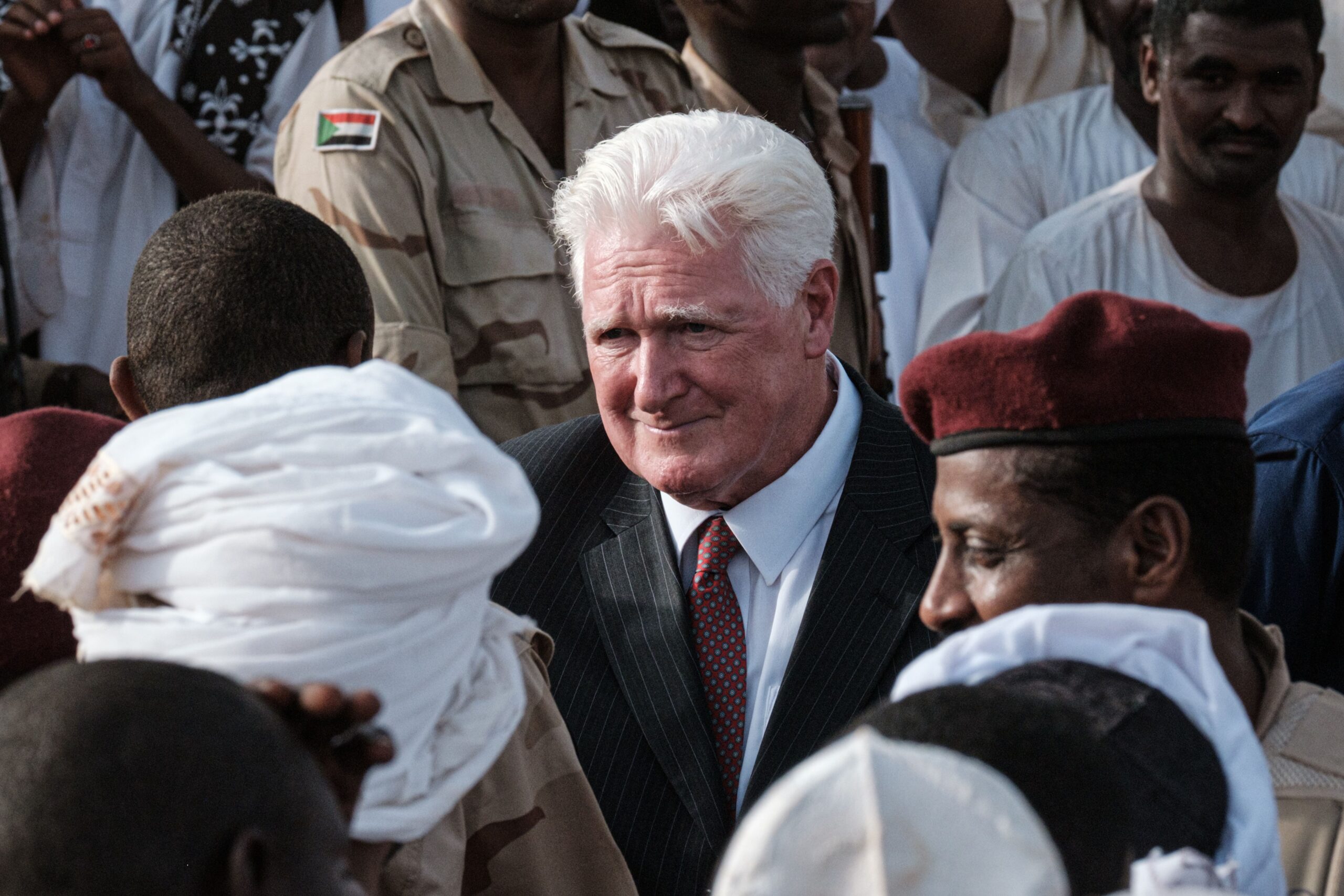
Former Rep. Jim Moran and his team have held dozens of meetings with members of Congress since the Oct. 7 Hamas terror attacks in 2023, mainly to talk about the Qatari role in the Middle East peace process
WEIRDING OUT

Democrat Graham Platner entered the race accusing Israel of genocide in Gaza
Plus, Bibi faces coalition chaos

Gage Skidmore
Sen. Amy Klobuchar (D-MN) speaking with attendees at the Moving America Forward Forum hosted by United for Infrastructure at the Student Union at the University of Nevada, Las Vegas in Las Vegas, Nevada.
Good Wednesday afternoon.
This P.M. briefing is reserved for our premium subscribers like you — offering a forward-focused read on what we’re tracking now and what’s coming next.
I’m Danielle Cohen-Kanik, U.S. editor at Jewish Insider and curator, along with assists from my colleagues, of the Daily Overtime briefing. Please don’t hesitate to share your thoughts and feedback by replying to this email.
📡On Our Radar
Notable developments and interesting tidbits we’re tracking
Sen. Amy Klobuchar (D-MN) rebuked antisemitic comments made by Minneapolis mayoral candidate Omar Fateh’s campaign staff in a statement to Jewish Insider today, after initially declining to comment when JI unearthed the statements last week.
Klobuchar’s spokesperson said the senator “strongly and immediately condemned the Hamas terrorist attack, and condemns any statements to the contrary.” She called Fateh’s staffers’ comments “outrageous” and said they “have no place in our politics.”
Klobuchar reiterated her endorsement of Mayor Jacob Frey in the race; Frey’s other supporters, including Minnesota Gov. Tim Walz, and other state Democratic officials have thus far refrained from commenting on the situation…
Staying in the Midwest, protesters interrupted Rep. Wesley Bell’s (D-MO) first in-person town hall last night in St. Louis over Bell’s support for Israel, shouting over the congressman and getting into altercations with police.
In response to a question about “the ongoing genocide in Palestine,” Bell said, “Let’s talk about the word genocide, because we see that differently.” He repeatedly asked protesters to stop shouting and listen.
“There’s a lot of folks who don’t want to have the conversation,” Bell said. “They just want to spew what they think is important, but they don’t want to have an actual debate because these are tough issues. So, now we’re going to have the conversation — whether you like it or not”…
Meanwhile on the campaign trail, Politico reported this morning on Rep. Chris Pappas’ (D-NH) new competitor in the Democratic primary for New Hampshire’s open Senate seat, political activist Karishma Manzur.
Manzur said she would have supported recent resolutions from Sen. Bernie Sanders (I-VT) — which the moderate Pappas said he would have opposed — seeking to block some arms sales to Israel, saying she “will be against any money to any country to kill people” and that the U.S. should take “concrete actions against the harrowing acts of torture of Palestinians” by the IDF …
President Donald Trump called in to Fox News host Mark Levin’s radio show yesterday and said that, at the time of the U.S. strikes on Iran’s nuclear facilities in June, he believed Iran “would have had nuclear weapons in a period of four weeks.”
“If we didn’t [strike Iran], they would probably by this time, just about this time, have a nuclear weapon and they would have used it,” the president said.
Trump also told Levin that the U.S. Air Force pilots who conducted the strikes told him that they and their predecessors had been practicing the flight to Iranian airspace for 22 years…
The New York Times published an analysis on the damage inflicted by U.S. strikes on the Iranian nuclear site Fordow based on the site’s structure and the munitions used…
The State Department responded today to a bipartisan congressional letter led by Pappas last month expressing lawmakers’ concerns that the administration was considering selling F-35 fighter jets to Turkey in a reversal of U.S. policy, which currently bans the sale of the jets in light of Turkey’s purchase of an S-400 missile defense system from Russia.
Paul Guaglianone, senior bureau official in the department’s Bureau of Legislative Affairs, wrote in a letter to Pappas that the “U.S. position on Turkey’s acquisition and continued possession of the Russian S-400 system has not changed, and the requirements for Turkey to acquire U.S. F-35 aircraft are well-known”…
Secretary of State Marco Rubio also announced this morning that the U.S. is sanctioning four additional officials from the International Criminal Court, two judges and two prosecutors, in addition to the four judges sanctioned by the U.S. in June, over the ICC’s continued “efforts to investigate, arrest, detain, and prosecute American and Israeli nationals”…
In Israel, coalition politics are heating up over a potential ceasefire and hostage-release agreement with Hamas, which reports indicate the terror group recently accepted but Israel has not yet responded to.
Israeli media reported that Finance Minister Bezalel Smotrich told hostage families he would resign if Prime Minister Benjamin Netanyahu agreed to a ceasefire, and Minister of National Security Itamar Ben-Gvir is likely to do the same, as he did in January when Israel agreed to a previous ceasefire deal.
Meanwhile, opposition MK Benny Gantz, whose Blue and White-National Unity party is currently hemorrhaging in the polls, is reportedly considering rejoining Netanyahu’s coalition to help bolster support for a deal…
Back stateside, Israeli scholar and dance instructor Yael Nativ is suing the University of California, Berkeley, alleging that the university denied her a teaching position because she is Israeli. Nativ had previously taught at Berkeley and was encouraged to apply to teach another course.
When Nativ’s application was rejected shortly after the Oct. 7, 2023, terror attacks, according to the suit, the dance department chair wrote to her, “My dept cannot host you for a class next fall. Things are very hot right now and many of our grad students are angry. I would be putting the dept and you in a terrible position if you taught here”…
⏩ Tomorrow’s Agenda, Today
An early look at tomorrow’s storylines and schedule to keep you a step ahead
Keep an eye on Jewish Insider tomorrow morning for reporting on Graham Platner, the oyster farmer turned Democratic challenger to Sen. Susan Collins (R-ME), who called AIPAC “weird” in a recent interview.
Tomorrow afternoon, the American Jewish Committee will host a briefing on “Justice for Victims of Hamas’ Sexual Violence: The U.N. Blacklist and What Comes Next,” referring to the U.N.’s recent decision to “blacklist” Hamas as a group that uses sexual violence as a weapon of war.
Stories You May Have Missed
FOREIGN POLICY FEID
Trump’s senior director for counterterrorism: ‘I was worried by this neo-Buchanan isolationism, but I look at President Trump’s actions, they have no hold on him’
TRIP TALK
The New York Democrat told JI ‘the majority of people see the value and the special nature of our relationship with our ally Israel’
The president spoke with Fox News host Mark Levin about his administration’s strike on Iran’s nuclear facilities

Tasos Katopodis/Getty Images
President Donald Trump
President Donald Trump said in an interview with Fox News host Mark Levin on Tuesday that at the time of the U.S. strikes on Iran’s nuclear facilities in June, he believed Tehran “would have had nuclear weapons in a period of four weeks.”
Calling in to Levin’s radio show, Trump said that, “if we didn’t [strike Iran], they would probably by this time, just about this time, have a nuclear weapon and they would have used it.”
Trump said that, despite news reports questioning his assessment of the efficacy of the strikes, “it turned out that” the impacts were “even more so than I said. It was obliteration.”
“The Atomic Energy Commission said, this place is gone. [Iran] can maybe start up, but they’re not starting up there,” Trump said of the Iranian nuclear facilities targeted in the operation. The Israel Atomic Energy Commission found that the U.S. strike on the Fordow nuclear facility “destroyed the site’s critical infrastructure” and rendered it “inoperable,” though reports differ on the extent of the damage.
The president told Levin that the U.S. Air Force pilots who conducted the strikes told him that they and their predecessors had been practicing the flight to Iranian airspace for 22 years.
Trump lauded his peacemaking abilities, saying, “I’ve settled six wars and we did the Iran night, wiped out their whole nuclear capability, which they would have used against Israel in two seconds if they had the chance.”
He called Israeli Prime Minister Benjamin Netanyahu a “war hero” and said, “I guess I am, too. … I mean, I sent those planes.”
Plus, Loomer lashes out
Annabelle Gordon/Bloomberg via Getty Images
Rep. Jamie Raskin (D-MD) during a news conference in Washington, D.C., on Thursday, May 22, 2025.
Good Tuesday afternoon.
This P.M. briefing is reserved for our premium subscribers like you — offering a forward-focused read on what we’re tracking now and what’s coming next.
I’m Danielle Cohen-Kanik, U.S. editor at Jewish Insider and curator, along with assists from my colleagues, of the Daily Overtime briefing. Please don’t hesitate to share your thoughts and feedback by replying to this email.
📡On Our Radar
Notable developments and interesting tidbits we’re tracking
Ron Halber, CEO of the Jewish Community Relations Council of Greater Washington, called Rep. Jamie Raskin’s (D-MD) decision to co-sponsor legislation severely restricting U.S. aid to Israel “extremely disappointing,” telling Jewish Insider today that he had a “very honest and frank conversation” with the congressman, whom he considers a friend.
Halber framed his concerns with Raskin, a prominent progressive Jewish lawmaker, within the broader trend of the Democratic Party moving away from its long-standing support for Israel. “It’s difficult when two-thirds of our community is voting for a political party whose base is hostile to Israel,” he remarked.
“Once the war comes to an end, the whole Jewish community is going to have to re-strategize,” Halber said.
The JCRC of Greater Washington CEO said he had asked Raskin to remove himself as a co-sponsor of the bill and instead issue a statement conveying his concerns with Israel’s war in Gaza. “If he doesn’t, we will be disappointed, but that’s his decision to make and he has to live with the ramifications of his decision”…
Speaking this morning at a briefing co-hosted by the American Jewish Congress and World Zionist Organization, U.S. Ambassador to Israel Mike Huckabee sounded a cautious note on the current ceasefire negotiations with Hamas, as reports indicate the terror group has accepted a Qatari- and Egyptian-backed proposal.
“Whether or not [Hamas is] serious about bringing this to a close, all I can tell you is I hope so. But what’s happened before, even when they say they are thinking seriously about bringing this to a conclusion, making a deal, they always add one or more things that are completely unacceptable, bring those to the table, then it all starts over again,” Huckabee said.
Israel has yet to respond to the proposal and White House Press Secretary Karoline Leavitt said at a press briefing today that the U.S. “continues to discuss” it…
Huckabee and his wife, Janet, hosted U.S. Ambassador to France Charles Kushner and his wife, Seryl, in Jerusalem tonight…
Israeli Defense Minister Israel Katz met with Lt. Gen. Eyal Zamir, the IDF’s chief of staff, today to approve the IDF’s plans to take over Gaza City. Israeli officials said Gazans will have until Oct. 7 to evacuate the city, to coincide with the second anniversary of Hamas’ attacks, at which point the IDF offensive will begin. It remains to be seen if a ceasefire and hostage-release deal will be reached before then…
The Israeli government also voted today to approve a $9 billion increase to the country’s budget for the year, including $473 million for humanitarian aid for Gaza…
In other negotiation news, Israeli Minister for Strategic Affairs Ron Dermer is scheduled to meet this evening in Paris with Syrian Foreign Minister Asaad al-Shibani and U.S. Ambassador to Turkey and Syria envoy Tom Barrack to discuss security arrangements on the Israel-Syria border.
The meeting comes a day after Barrack, while visiting Beirut, said Israel needs to “comply with [an] equal handshake” to the Lebanese government’s commitment to disarm Hezbollah by fully withdrawing its troops from Lebanon…
Back stateside, the president of the American Association of University Professors said in a recent interview, “We believe strongly that no weapons should be sent to Israel, at all. Not defensive or offensive, nothing,” escalating the association’s adversarial stance against the Jewish state…
The New York Times chronicles the Trump administration’s attempts to wrest financial settlements from elite universities, including ongoing negotiations with Harvard and the University of California, Los Angeles, the latter of which may pay the administration upwards of $1 billion, according to a draft agreement…
Media mogul Shari Redstone told the Times that she decided to sell Paramount to Skydance in a recent $8 billion merger in part due to her frustrations over anti-Israel bias at CBS, particularly after the Oct. 7 attacks. “Once that happened, I wanted out,” Redstone said. “I wanted to support Israel, and address issues around antisemitism and racism”…
Rep. Ritchie Torres (D-NY) endorsed New York Gov. Kathy Hochul in her reelection bid today, after initially exploring a run against her and criticizing her tenure…
The Free Press reports on growing frustration with Laura Loomer, a right-wing provocateur and informal advisor to President Donald Trump, inside the White House, with some officials speculating she may be paid or influenced by lobbying firms and business interests.
Loomer lashed out on X, telling Free Press reporter Gabe Kaminsky he should “contact your anonymous White House sources who are so horrified by ‘lobbyists’ and their intentions and ask them how they feel about their friendship with” Jeff Miller, a Republican strategist, board member of the Republican Jewish Coalition and Trump-appointed member of the U.S. Holocaust Memorial Council…
⏩ Tomorrow’s Agenda, Today
An early look at tomorrow’s storylines and schedule to keep you a step ahead
Keep an eye on Jewish Insider tomorrow morning for an interview with top New York Democrat Rep. Laura Gillen (D-NY) on her takeaways from a recent visit to Israel.
This evening, Maryland Gov. Wes Moore, a potential 2028 presidential contender, will speak at D.C.’s Politics & Prose on “the role of states in preserving and advancing U.S. democracy.”
Tomorrow, the historic Sinai Temple in Los Angeles will host a conversation with Ahmed Fouad Alkhatib, the director of the Realign for Palestine program at the Atlantic Council who was born and raised in Gaza. It’s the second event in a series the prominent Conservative synagogue has held about the war in Gaza for its congregants, the first of which was held last month with Gaza Humanitarian Foundation head Johnnie Moore. Read JI’s coverage of Moore’s conversation here.
Stories You May Have Missed
CALIFORNIA COMPETITION

Sherman, a stalwart pro-Israel Democrat, is facing several politically connected Democratic challengers in next year’s primary
CLARK’S CLARIFICATION
AIPAC said its endorsement is ‘unchanged’ and based on the House minority whip’s ‘long-standing support for the U.S.-Israel relationship’
Plus, Santa Ono lands on his feet

Tom Williams/CQ-Roll Call, Inc via Getty Images
Then-Rep. Ruben Gallego (D-AZ) in Rayburn Building on Capitol Hill on June 9, 2022.
Good Monday afternoon.
This P.M. briefing is reserved for our premium subscribers like you — offering a forward-focused read on what we’re tracking now and what’s coming next.
I’m Danielle Cohen-Kanik, U.S. editor at Jewish Insider and curator, along with assists from my colleagues, of the Daily Overtime briefing. Please don’t hesitate to share your thoughts and feedback by replying to this email.
📡On Our Radar
Notable developments and interesting tidbits we’re tracking
President Donald Trump posted on Truth Social this morning, “We will only see the return of the remaining hostages when Hamas is confronted and destroyed!!! The sooner this takes place, the better the chances of success will be. … Play to WIN, or don’t play at all!”
Hours later, reports indicated that Hamas had accepted a new ceasefire and hostage-release proposal from Qatari Prime Minister Mohammed Al Thani and Egyptian officials in Cairo, after a meeting in Doha last week between Al Thani and Mossad Director David Barnea.
A source told Axios that the deal is “98% similar” to the latest U.S.-backed proposal initiated by Middle East envoy Steve Witkoff.
Though neither American nor Israeli officials have confirmed the news, Prime Minister Benjamin Netanyahu said in a statement this afternoon, “Like you, I hear the reports in the media, and from them you can be impressed by one thing — Hamas is under immense pressure“…
Meanwhile at home, the embrace of anti-Israel actors by the Democratic mainstream continues.
Over the weekend, Sen. Ruben Gallego (D-AZ), a potential 2028 Democratic presidential contender from a swing state, told a local political outlet about New York City Democratic mayoral nominee Zohran Mamdani, “It’s OK to say ‘I disagree with this, this, and this, but I agree with that.’ But the idea that we’re just gonna throw out people that are really bringing in new ideas to the fold, exciting people, just because they’re slightly to the right or to the left of us is dumb.”
It’s a notable marker, a pragmatic lawmaker with national aspirations calling Mamdani — a democratic socialist who has refused to condemn the phrase “globalize the intifada” — “slightly to the left” of the Democratic center.
And this morning, opinion writer Jerusalem Demsas, formerly of The Atlantic, announced the launch of her new liberal media company, The Argument. The publication will feature writings from center-left heavyweights including Derek Thompson and Matthew Yglesias and received funding from similarly aligned investors including Arnold Ventures and Open Philanthropy.
In her announcement video, Demsas said conservatives are “persecuting Americans for exercising their basic freedoms” over news clips covering anti-Israel protest leader Mahmoud Khalil’s detention by the federal government.
The continued embrace of Khalil by Democratic thought leaders and influencers is significant as Khalil has continued to escalate his anti-Israel rhetoric, including in a recent appearance on “The Ezra Klein Show” podcast where he said about the Oct. 7 attacks that “we couldn’t avoid such a moment” and about Hamas’ killing of civilians that “we cannot go and ask Palestinians to be perfect victims”…
Former University of Michigan President Santa Ono announced today that he’s been appointed as the inaugural director of the Ellison Institute of Technology. Ono had been named president of the University of Florida but was rejected in an unprecedented move by the Florida Board of Governors, partially over concerns of his handling of antisemitism and an anti-Israel encampment at the Ann Arbor campus.
Now, Ono will report directly to Larry Ellison, the second wealthiest man in the world, who is the founder of the software company Oracle and a major donor to Jewish and Israeli causes…
The Association of American Geographers is set to consider a resolution on Oct. 3 to boycott Israeli academic institutions, the latest professional association to face calls from its members to do so…
⏩ Tomorrow’s Agenda, Today
An early look at tomorrow’s storylines and schedule to keep you a step ahead
Keep an eye on Jewish Insider tomorrow morning for an interview with Rev. Johnnie Moore, the head of the Gaza Humanitarian Foundation, about the repeated death threats and vandalism he’s faced at his home, and a look at Rep. Brad Sherman’s (D-CA) primary challenge.
Tomorrow afternoon, the Hudson Institute will host a conversation with Sebastian Gorka, deputy assistant to the president and senior director for counterterrorism at the National Security Council, on U.S. strategy on counterterrorism and its impacts on U.S. policy in the Middle East.
Stories You May Have Missed
BACKING THE BLOCK
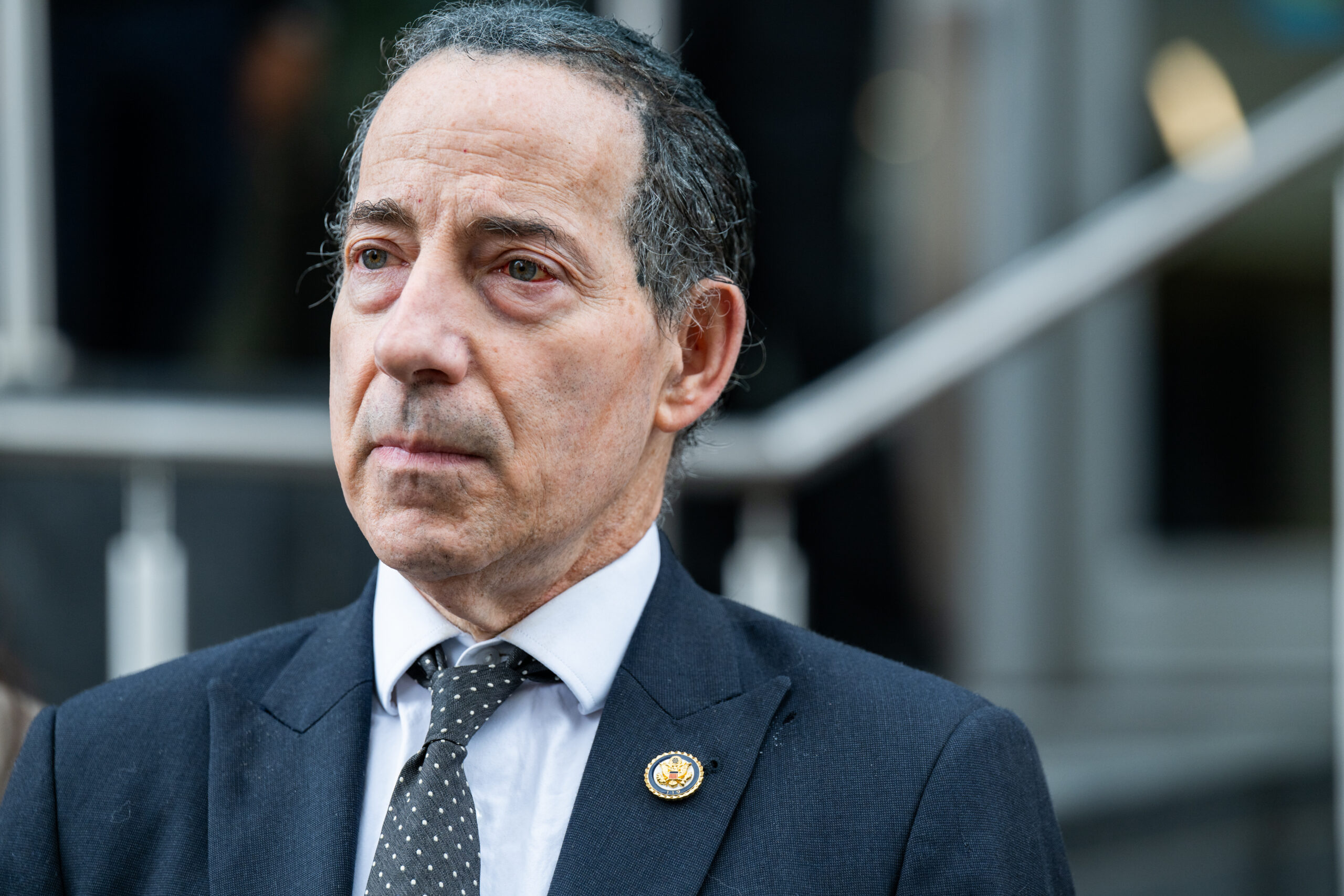
One of the most visible and well-known progressive Jewish lawmakers in Congress became a cosponsor of the ‘Block the Bombs Act’
CLARK’S BARK
Rep. Katherine Clark is the highest-ranking Democrat to have used the term, even as only a small number of other lawmakers have done so
Plus, NY Dems continue to withhold Mamdani backing

GETTY IMAGES
Three people with backpacks on sidewalk in front of the campus administrative building on sunny day moving away.
Good Thursday afternoon.
This P.M. briefing is reserved for our premium subscribers like you — offering a forward-focused read on what we’re tracking now and what’s coming next.
I’m Danielle Cohen-Kanik, U.S. editor at Jewish Insider and curator, along with assists from my colleagues, of the Daily Overtime briefing. Please don’t hesitate to share your thoughts and feedback by replying to this email.
📡On Our Radar
Notable developments and interesting tidbits we’re tracking
Mossad Director David Barnea was in Doha today meeting with Qatari Prime Minister Mohammed bin Abdul Rahman al-Thani, which Israeli officials downplayed as being unrelated to a ceasefire and hostage-release deal.
However, with Israel’s expanded operations in Gaza not expected to begin for several weeks and a flurry of diplomatic meetings underway (the Qatari PM also met with Middle East envoy Steve Witkoff in Ibiza last weekend), the negotiating parties likely view this time as a last-ditch opportunity to secure a deal…
Axios spotlights a trip of 15 young MAGA influencers to Israel, organized by the advocacy group Israel365, which describes itself as an “Orthodox Jewish institution that believes that Jews and Christians must respect one another,” and partially bankrolled by the Israeli Foreign Ministry.
Even as Israel’s falling public approval in the U.S. is driven by Democrats and to a lesser extent independents, the story notes that the Israeli government “sees shifting attitudes among young Republicans as the more immediate threat”…
In the world of academia: Professors Jon Shields and Yuval Avnur share their findings from a new study on the diversity of thought in college syllabi in the Wall Street Journal.
Drawing on the Open Syllabus Project, which has a database of over 27 million syllabi, they find that Edward Said’s Orientalism — one of the preeminent anti-West and anti-Israel academic texts — is the 16th most assigned text in the database, featured in nearly 16,000 courses in universities around the world.
However, Shields and Avnur find that Orientalism is rarely assigned with any of its critiquing texts, including Sam Huntington’s Clash of Civilizations and Bernard Lewis’ Islam and the West. At just 5% of syllabi, Huntington is assigned alongside Said the most commonly, and similar critics almost never.
The professors conclude with a warning to academics who are shaping the next generation of scholars and thinkers: “More of us should follow the minority of professors who teach the real controversy — not only the dominant texts but also work that is critical of them. … If we shut out the views of half or more of the population, we shouldn’t be surprised when the democratic process leads to the diminution of our subsidies and other privileges”…
Rep. Dan Goldman (D-NY) told Politico this morning that he won’t endorse New York City Democratic mayoral nominee Zohran Mamdani until he takes “concrete steps” to address concerns from Jewish New Yorkers around hate crimes.
Goldman said, “We’ve had a good conversation, and I am pleased in some respects with many of the things he said, and I’m interested to see how he moves forward, and what actions and concrete steps he takes to address the significant concerns of the 1.3 million Jews in New York City who are justifiably and understandably very afraid given the most recent hate crime statistics that came out”…
House Minority Leader Hakeem Jeffries (D-NY) is also still withholding his endorsement from Mamdani, declining to give CNBC a direct answer this morning on if he intends to support the Democratic nominee. He did say that in a “constructive and candid” conversation last month, Mamdani had asked him to help organize meetings with other members of the New York congressional delegation as well as working class communities that Jeffries represents, and that he had assisted Mamdani in doing so…
On the far left side of the American political spectrum, the Democratic Socialists of America adopted a resolution at their National Convention last weekend called “For a Fighting Anti-Zionist DSA,” which makes certain actions in support of Israel — including “making statements that ‘Israel has a right to defend itself’ and making or endorsing statements or legislation equating anti-Zionism with antisemitism” — “expellable” offenses for DSA members.
The DSA did not ultimately debate a resolution censuring Rep. Alexandria Ocasio-Cortez (D-NY) — one of the most vocal anti-Israel members of Congress — over her “tacit support for Zionism” at the convention…
⏩ Tomorrow’s Agenda, Today
An early look at tomorrow’s storylines and schedule to keep you a step ahead
Keep an eye on Jewish Insider tomorrow morning for more reporting on the reaction to former Transportation Secretary Pete Buttigieg’s newly hostile posture towards Israel, which is alarming many mainstream Democrats about the direction their party is headed.
Tomorrow, we’ll be watching the summit between President Donald Trump and Russian President Vladimir Putin taking place in Alaska, which aims to end the war in Ukraine. The conflict, along with the war in Gaza, has plagued Trump since he took office as he’s been unable to fulfill his campaign promise of ending wars abroad.
We’ll be back in your inbox with the Daily Overtime on Monday. Shabbat shalom!
Stories You May Have Missed
ONLINE ARCHIVE
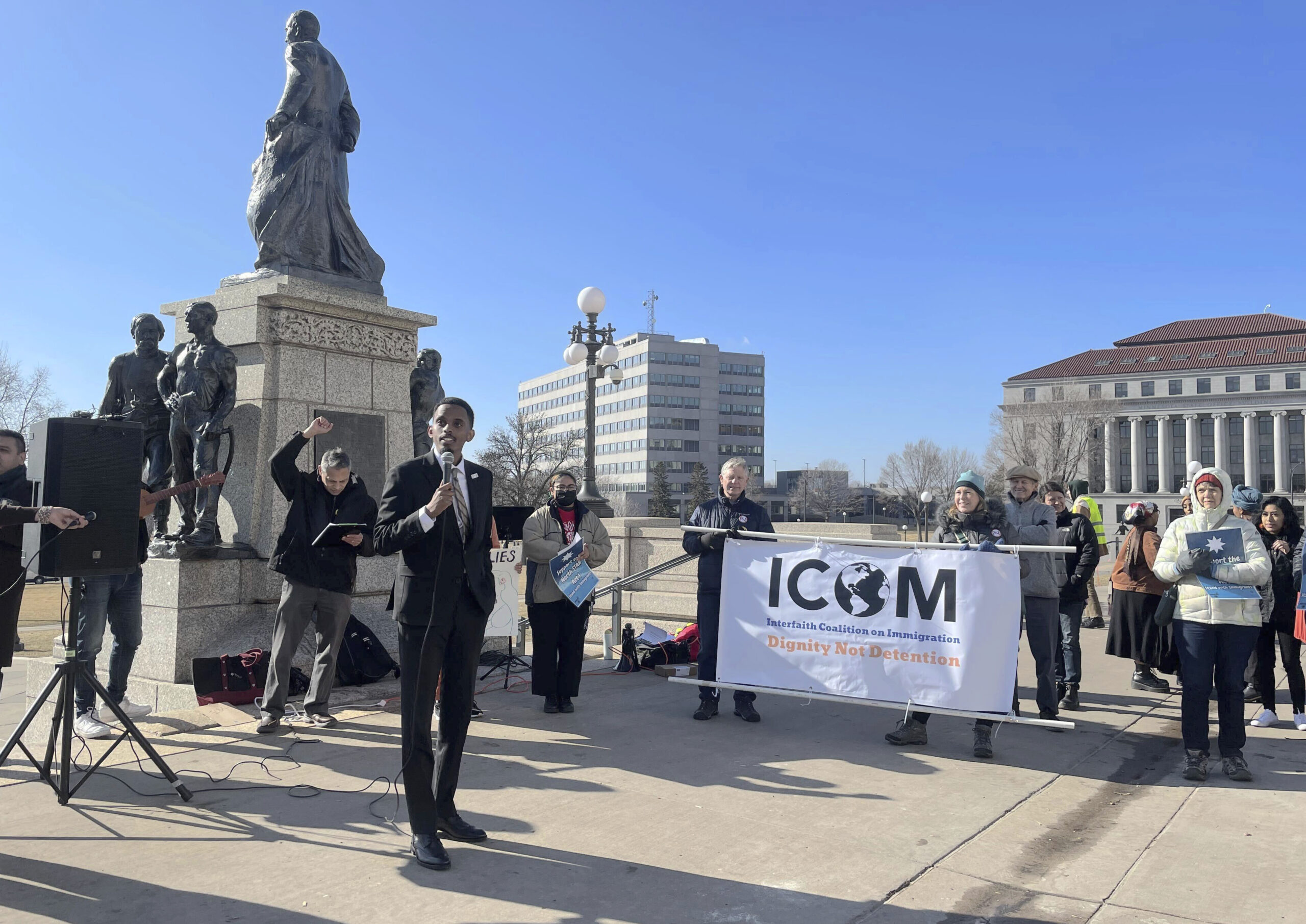
The Minneapolis mayoral candidate’s communications manager wrote on social media that Israel ‘must be dismantled’
FAMILY FEUD
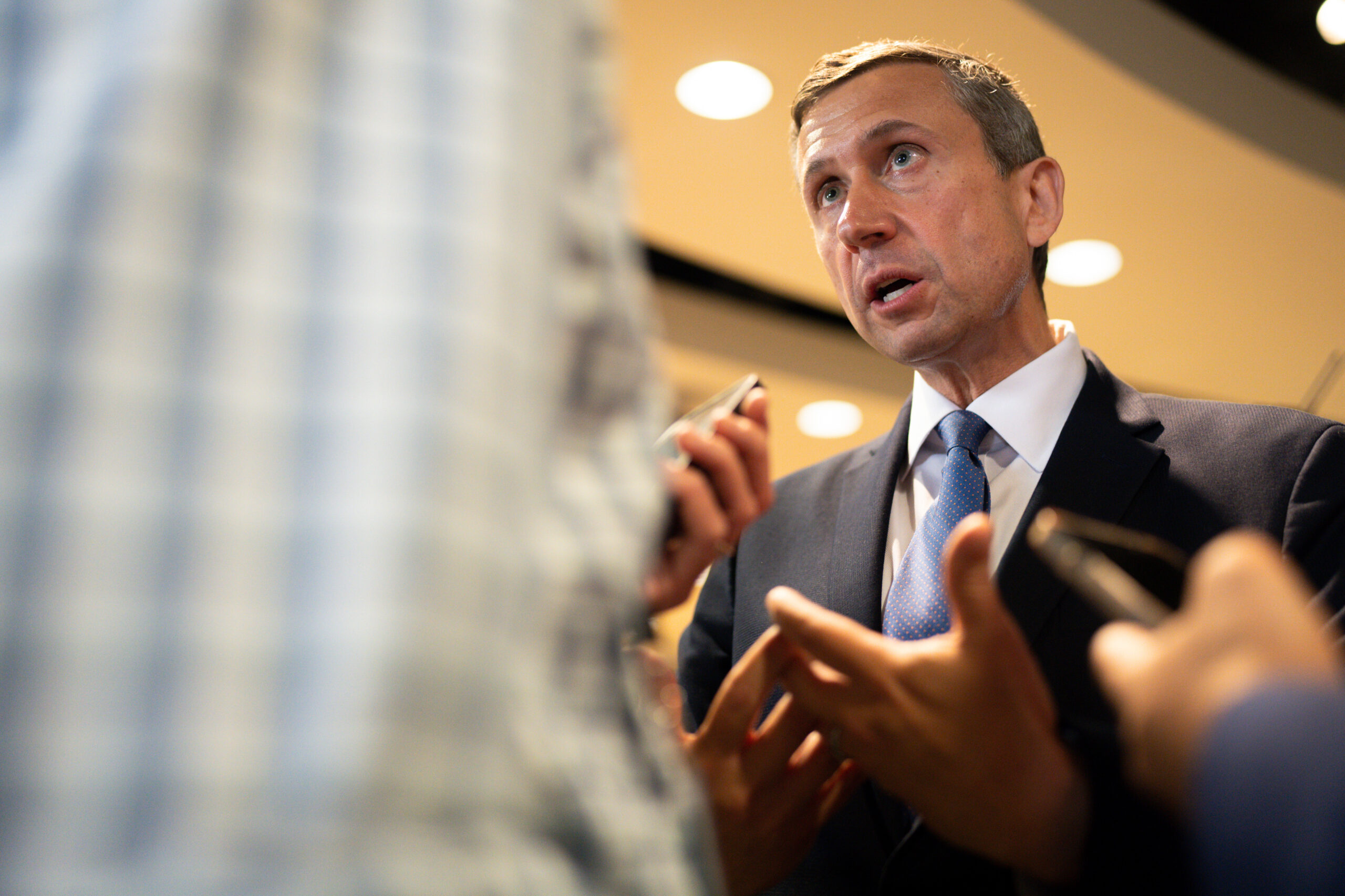
Jewish Democrats are pushing for defeat of a resolution calling for an arms embargo and advocating for a competing, pro-Israel resolution backed by the DNC chair
Plus, Jews across the aisle sound alarm on DNC resolution

Wisam Hashlamoun/Anadolu via Getty Images
Streaks of light from Iranian ballistic missiles are seen in the night sky above Hebron, West Bank, as Iran resumes its retaliatory strikes against Israel.
Good Wednesday afternoon.
This P.M. briefing is reserved for our premium subscribers like you — offering a forward-focused read on what we’re tracking now and what’s coming next.
I’m Danielle Cohen-Kanik, U.S. editor at Jewish Insider and curator, along with assists from my colleagues, of the Daily Overtime briefing. Please don’t hesitate to share your thoughts and feedback by replying to this email.
📡On Our Radar
Notable developments and interesting tidbits we’re tracking
Jewish Insider sat down with the Jewish Institute for National Security of America (JINSA) team in Washington today. They presented findings from a recent trip to Israel and a report on the estimated costs to the U.S., Israel and Iran from the 12-day war between Israel and Iran in June. Several key takeaways:
The U.S. used around 150 THAAD interceptors — approximately 25% of its stockpile — defending Israel from Iranian missiles and drones. Given that the U.S. acquired 11 interceptors in 2024, will acquire 12 in 2025 and is expected to acquire between 25-37 in 2026, it will take years to replenish U.S. capabilities at current production.
Also putting pressure on production, Saudi Arabia inaugurated its first THAAD system from the U.S. last month and is meant to receive hundreds of interceptors in the coming years.
From JINSA’s analysis, it appears that Israel, using its Arrow missile-defense system, shot fewer interceptors per incoming projectile than the U.S. did, suggesting that Israel’s systems may have better interception rates. In addition, Israel’s Arrow system is significantly cheaper to operate, at $2-3 million per interceptor versus THAAD’s $13-14 million.
On Iran’s nuclear and ballistic missile programs, the JINSA team found that rebuilding from the damage inflicted by the U.S. and Israel would be indistinguishable from building them from scratch. More important than Iran’s capability is its psychological fortitude and desire to rebuild its programs, after dozens of top nuclear and military officials were taken out in the span of days…
France, Germany and the U.K. sent a letter to U.N. Secretary-General Antonio Guterres and the Security Council last month announcing their readiness and “unambiguous legal grounds” to reinstate snapback sanctions on Iran if it does not reengage in nuclear negotiations by the end of August.
Iran suspended its negotiations with the U.S. — as well as its cooperation with the International Atomic Energy Agency, the U.N.’s nuclear watchdog — in June following the Israel-Iran war. IAEA Deputy Director Massimo Aparo was in Iran earlier this week for talks on the agency’s relationship with Tehran…
Inside Germany, The Washington Post reports, Chancellor Friedrich Merz is facing backlash from his own center-right party and allies after his Friday announcement that the government plans to suspend weapons shipments to Israel “that could be used in the Gaza Strip,” prompted by Israel’s decision last week to expand the war. It was a major shift for Berlin, as Germany has been one of Israel’s most reliable allies in Europe while its neighbors have turned against the Jewish state over the war in Gaza…
Democratic Majority for Israel weighed in on an anti-Israel resolution being considered by the Democratic National Committee that calls for Democrats to recognize a Palestinian state and for the suspension of all military aid to Israel.
DMFI CEO Brian Romick said in a statement that the organization is “deeply troubled” by the “flawed, irresponsible resolution.” “Shockingly, this resolution does not even mention the barbaric attacks of October 7 nor the terrorist group Hamas at all,” he continued. Matt Brooks, CEO of the Republican Jewish Coalition, applauded DMFI for the statement, saying, “That’s how it should be done”…
⏩ Tomorrow’s Agenda, Today
An early look at tomorrow’s storylines and schedule to keep you a step ahead
Keep an eye on Jewish Insider tomorrow morning for reporting on the extreme anti-Israel views of individuals connected to Minneapolis mayoral candidate Omar Fateh‘s campaign, as well as an interview with Jack Ciattarelli, the Republican gubernatorial nominee in New Jersey, as he spends time in Israel this week.
Nancy Jacobson, a former Democratic fundraiser now the CEO of the independent No Labels organization, and entrepreneurs Irwin Simon and Matthew Rabinowitz will be hosting a fundraiser in New York City for former Gov. Andrew Cuomo this evening, Jewish Insider has learned. The event is anticipated to raise over $200,000 for Cuomo as he continues his campaign for mayor of New York City as an independent.
Stories You May Have Missed
BEHIND THE BILLBOARD

The American Eagle CEO is building a legacy in business — and in Jewish giving
CHRISTIAN CONCERNS
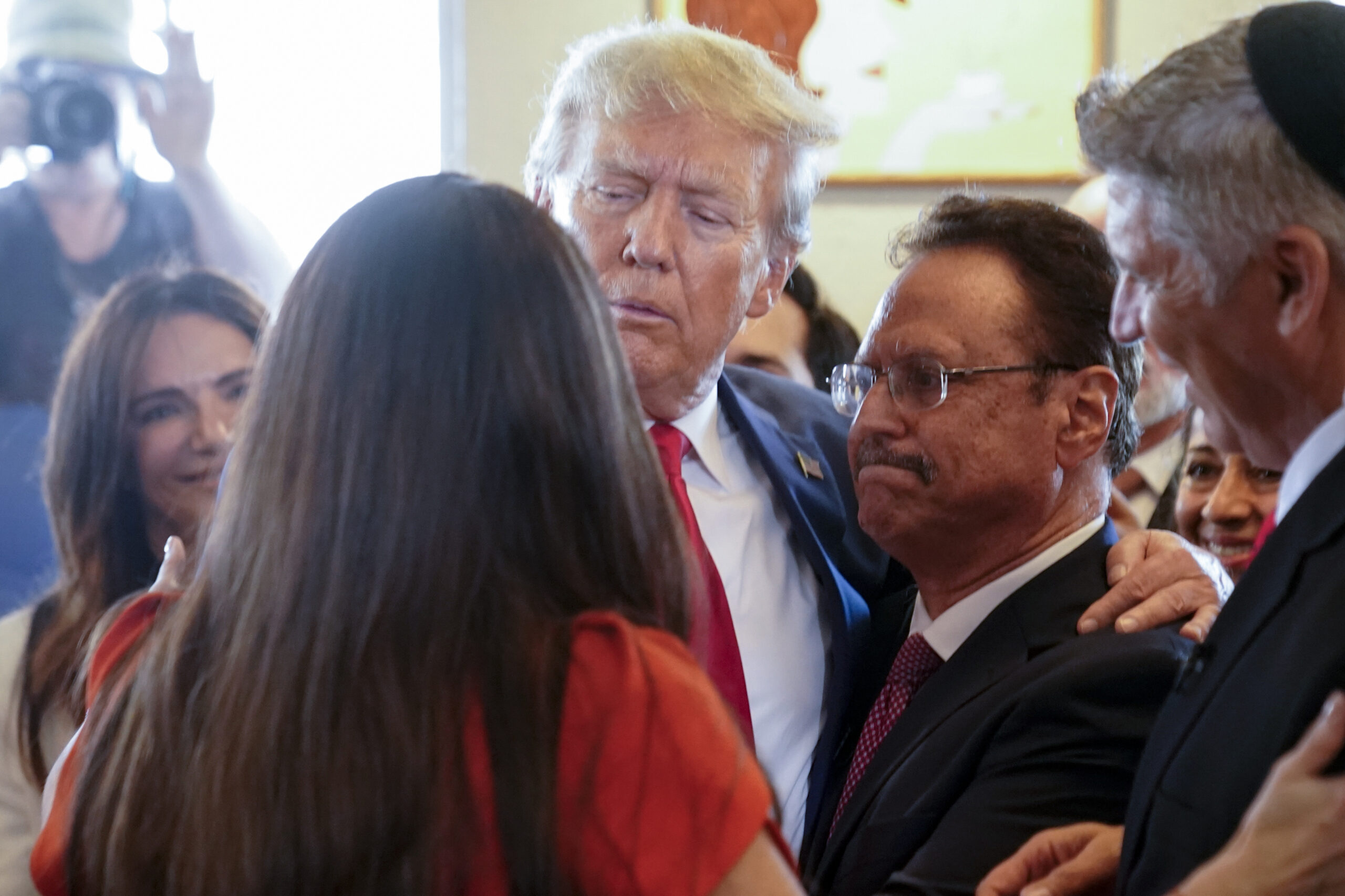
Even as the president has prioritized tackling antisemitism in his second term, leading conservatives are quietly pushing for more engagement against far-right hate
Sources told Israel Hayom that Dermer began considering the move after Israel’s degraded Iran’s nuclear program

Michael Brochstein/SOPA Images/LightRocket via Getty Images
Ron Dermer, Israeli ambassador to the United States, seen speaking at an AIPAC Policy Conference in Washington, DC.
Israeli Strategic Affairs Minister Ron Dermer is considering resigning from the Israeli government in the coming months, Israel Hayom reported on Monday.
Dermer, a close advisor of Prime Mister Benjamin Netanyahu, has in recent years worked primarily on the issue of the Iranian nuclear threat. He began contemplating his exit after Israel degraded Iran’s nuclear capabilities in June, senior government sources told the outlet.
It wasn’t clear when he would resign, though the sources indicated it would likely be before Israel’s next elections. Elections are currently scheduled for October 2026, but could be held sooner, depending on Netanyahu’s ability to keep his 60-member coalition together.
Since February, Dermer has also led Israel’s ceasefire and hostage-release negotiation efforts, a role that has engendered criticism from elements of the Israeli public, including hostage family members who called for his resignation from the negotiating team in May over the lack of progress toward a deal.
The administration says the move is part of President Trump’s ‘renewed maximum pressure campaign’
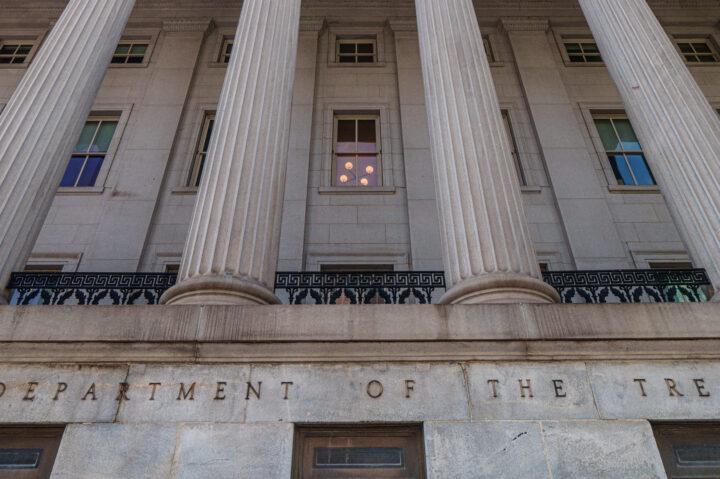
J. David Ake/Getty Images
The sun flares over the top of the side entrance to the U.S. Treasury Department Building on August 18, 2024, in Washington, DC.
The Treasury Department announced on Wednesday that it sanctioned an illicit Iranian shipping empire run by Mohammad Hossein Shamkhani, the son of a prominent Iranian government official. According to officials at the Treasury Department, the new sanctions — targeting more than 115 individuals, entities and shipping vessels — represent the largest Iran-related action since 2018.
“Our goal is to limit Tehran’s primary source of revenue, to pressure the regime to end its nuclear threat, curtail its ballistic missile program and stop its support for terrorist groups,” Deputy Treasury Secretary Michael Faulkender told reporters on Wednesday. “The Trump administration seeks to drive down Iranian oil exports under President [Donald] Trump’s renewed max pressure campaign.”
Shamkhani is the son of Ali Shamkhani, a senior advisor to Iran’s supreme leader, who had supervised nuclear negotiations with the U.S. earlier this year. He controls a vast shipping network that stretches far beyond Iran, with ties to India, the United Arab Emirates, Turkey, Italy and Switzerland, among other nations based mostly in Europe and the Middle East, according to the Treasury Department. The network generates tens of billions of dollars in profit.
Shamkhani and other Iranian oil traders often obscure their connections to Iran when overseas, and Treasury Department officials said the new sanctions will make it more difficult for them to conduct business abroad.
“What this action underscores is the extraordinary steps the Iranian regime is having to go through to execute oil sales,” a senior Treasury official said Wednesday. “Those that continue to go forward are going to be more complicated, making it harder for Iran to execute, and more importantly, likely resulting in them generating less revenue.”
Shamkhani’s network does not only transport Iranian oil. It also transports Russian oil, and last week he was sanctioned by the European Union for his role in the Russian oil trade.
“We fully are recognizing and going after this network because of the illicit activity that involves Russia and Iran,” the senior official said. A Bloomberg News investigation published last year detailed Shamkhani’s ties to both Moscow and Tehran.
According to a Foundation for Defense of Democracies analysis, Iran exported 1.7 million barrels of oil per day in June, a higher figure than during the Biden administration. Iranian oil exports averaged 800,000 barrels per day at points in Trump’s first term, at the height of his maximum pressure sanctions campaign.
McCormick: ’We have to eradicate [and] destroy the evil’ that caused the Oct. 7 attacks

Israel on Campus Coalition/X
Rep. Dave McCormick (R-PA) speaks at the ICC National Leadership Summit in Washington on July 29, 2025.
Israel’s response to the Oct. 7, 2023 Hamas terror attacks “changed the landscape in ways that could be for the good” and lead to the “possibility of a secure region,” Sen. Dave McCormick (R-PA) told a group of pro-Israel college students on Tuesday.
McCormick lauded Israel’s “historic” military efforts that led to the degradation of Iran’s terrorist proxies across the Middle East.
“What’s happened with the conduct of military operations since then in the fight against Hezbollah, the fight against Hamas, taking out much of Iran’s [nuclear] capabilities, what has happened with Israel’s incredible military leadership … has reset the possibility of a secure region,” McCormick told about 700 attendees on the final day of Israel on Campus Coalition’s three-day national leadership summit in Washington.
“It has changed the possibilities in the Middle East and I hope it’s brought an awareness and change to our complacency here at home in the need to fight against that pure evil [and] reset the table in the Middle East.”
“We have to eradicate [and] destroy the evil” that caused the Oct. 7 attacks, McCormick continued, referring to Hamas.
McCormick also took aim at the rise of antisemitism across the country, including in his home state.
After Oct. 7 “there was a second surprise attack. That’s the evil of antisemitism that we saw across our campuses,” McCormick said. “Most of us didn’t know the degree to which antisemitism would rear its ugly head on campuses across Pennsylvania and across our country.”
“It has shown us that we have to engage in a constant battle against the kind of hatred and evil that we saw in Israel on Oct. 7, but also that we saw across our campuses.”
After meeting with U.K. Prime Minister Starmer, the president said the U.S. will be getting more involved in providing aid
Tasos Katopodis/Getty Images
President Donald Trump
President Donald Trump decried the humanitarian situation in Gaza on Monday, telling reporters that he does “not particularly” agree with Israeli Prime Minister Benjamin Netanyahu’s assessment that there is no starvation taking place in the enclave.
“That’s real starvation stuff,” Trump said, following a meeting in Scotland with U.K. Prime Minister Keir Starmer. “I see it, and you can’t fake that.”
Trump said the U.S. will be getting “even more involved” in taking steps toward addressing hunger in Gaza, including by setting up “food centers.” A White House spokesperson declined to comment when asked for specifics about what this plan might entail. Trump said “all of the European nations” would be part of the project.
“We’re going to do it in conjunction with some very good people, and we’re going to supply funds,” said Trump.
Food distribution in Gaza is currently being operated by the Gaza Humanitarian Foundation, which is backed by both the U.S. and Israel. The organization has faced criticism for failing to meet the needs of Gazans, and scenes of chaos at the gates of its distribution centers have spread online.
Without mentioning GHF by name, Trump appeared to take aim at the existing aid mechanisms, saying that the new “food centers” will not have fences to keep people out.
“We’re also going to make sure that they don’t have barriers stopping people here. You’ve seen the areas where they actually have food, and the people are screaming for the food in there, they’re 35-40 yards away, and they won’t let them because they have lines that are set up,” said Trump. “And whether they’re set up by Hamas or whoever, but they’re very strict lines. We have to get rid of those lines.”
Trump blamed Hamas for the failure of recent ceasefire talks and for prolonging the war, including the humanitarian crisis. The president’s comments come after European leaders have pressed Israel to allow a freer flow of humanitarian aid into Gaza.
“We have a good group of countries who can help with the humanitarian needs, which is food, sanitation, some other things. It’s very difficult to deal with Hamas,” said Trump. “Hamas has become very difficult to deal with in the last couple of days, because they don’t want to give up these last 20 [hostages], because they think as long as they have them, they have protection. But I don’t think it can work that way.”
Fifty hostages remain in Gaza, and Israel believes at least 27 of them are dead. The most recent ceasefire proposal would only have seen the release of about half of the living hostages.
Trump also said Iran played a role in the failure of ceasefire talks, saying Iran “interjected themselves in this last negotiation.”
“I think they got involved in this negotiation, telling Hamas and giving Hamas signals and orders. And that’s not good,” Trump said. “For a country that just got wiped out, they’ve been sending very bad signals, very nasty signals. And they shouldn’t be doing that.”
Sen. Ricketts’ resolution intended to urge the U.K., France and Germany to impose snapback ‘as soon as possible’
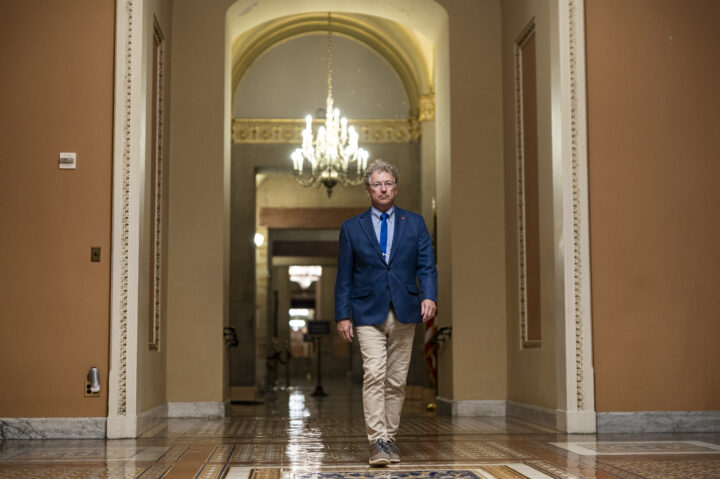
Al Drago/Getty Images
Sen. Rand Paul (R-KY) walks to the Senate floor during overnight votes at the U.S. Capitol on July 1, 2025 in Washington, DC.
Sen. Pete Ricketts (R-NE) attempted to call up and pass by unanimous consent a resolution urging the United Kingdom, France and Germany to trigger the snapback of United Nations sanctions on Iran under the Joint Comprehensive Plan of Action “as soon as possible,” but was blocked by Sen. Rand Paul (R-KY).
“In order to seize this moment,” and capitalize on Iranian weakness, “the U.S. and our allies must impose maximum pressure to the highest extent possible to force Iran to agree to permanently and verifiably end its nuclear program, including its capacity to enrich,” Ricketts said on the Senate floor on Wednesday.
The option to invoke snapback is set to expire in mid-October, but Ricketts emphasized that the process will take at least 30 days to complete, and that Russia is set to assume the presidency of the U.N. Security Council in October, in which role it could delay the proceedings. European allies have reportedly set an August deadline to initiate snapback, but Ricketts argued that “timeline … leaves little room for error.”
“I stand to urge our European friends to hold the line” in upcoming talks with Iran, Ricketts said, warning that Iran is trying to buy time and delay snapback.
Paul warned that the U.S. attack on Iran might make Iran more resistant to U.S. demands and “may turn out to be a disaster” that prompts Iran to sprint to a nuclear weapon.
He argued that sanctions have never changed Iran’s behavior — a notion disputed by leaders on both sides of the aisle — and “are often counterproductive” in general. Paul also suggested that the U.S. is in no position to make any requests related to snapback since President Donald Trump removed the U.S. from the Iran nuclear deal in 2018.
“It is a bit inconsistent for us to be arguing that Europe should apply and adhere to the JCPOA, which we no longer participate in,” Paul said. “If the United States is no longer a member of the JCPOA, what gives Washington the right to advise those who remain in it to invoke certain mechanisms within the agreement?”
He requested the Ricketts resolution be modified to instead call for deescalation and diplomacy.
Ricketts responded that diplomacy without pressure is a failed concept.
Sen. Jim Risch (R-ID), the chairman of the Senate Foreign Relations Committee, also spoke on the Senate floor in support of Ricketts’ resolution.
“Over the last 10 years, Iran has enjoyed unwarranted sanctions relief and time is short before the opportunity expires to snap back sanctions,” Risch said. “We cannot afford to wait until the end of August. Initiating the snapback process would be the right and long overdue move.”
Gorka also discussed efforts to designate the Muslim Brotherhood as a terrorist organization and end Qatari and Turkish support for Hamas
JIM WATSON/AFP via Getty Images
U.S. Senior Director for Counterterrorism Sebastian Gorka walks outside the White House in Washington, DC, on May 7, 2025.
Sebastian Gorka, the White House senior director for counterterrorism and a deputy assistant to the president, said Wednesday at the Foundation for Defense of Democracies that the U.S. is not seeking regime change in Iran, but will maintain its maximum-pressure campaign on Tehran.
Gorka also said that he supports efforts to designate the Muslim Brotherhood as a terrorist organization, suggested that he’s pursuing efforts to convince Qatar and Turkey to cut ties with Hamas and said the U.S. wants to see Syrian minority groups come to the table and join with the new Syrian government.
He said that the Trump administration views Iran as the paramount threat and focus in the Middle East, and that its strategy toward Iran is “max pressure, no regime change,” with the goal of stopping Iran’s nuclear program and ending its support for terrorist proxies.
“We are not in the business of deploying the 82nd Airborne to do regime changes anywhere. We don’t believe in that,” Gorka said.
In the long term, he added, “we would like the people of Persia, including the minorities of Persia, to eventually liberate themselves.”
Trump had publicly floated the possibility of regime change in Iran after the U.S. strikes on the country last month, but subsequently said he does not seek regime change. Some administration officials had also floated the idea of sanctions relief for Iran.
Gorka said he backs efforts to designate the Muslim Brotherhood as a terrorist organization, describing the group as the “granddaddy” of all of the terrorist organizations that have attacked the United States and its allies for decades.
“If we can designate, as we have, Hamas, which in its founding charter from 1984 says, ‘We are a chapter of the Muslim Brotherhood,’ then why haven’t we designated the Brotherhood itself?”
“So what I’ll say right now,” Gorka said, clearing his throat, is, “I like the idea,” he finished in a whisper.
Asked by Jewish Insider about whether the administration is working to end Turkey and Qatar’s sponsorship of Hamas, he said that he is “imminently traveling to that part of the world, so that should tell you something.”
He added that Turkey is an “important nation, it’s a geopolitical nation, it has a role to play with us as a NATO nation, but there are things I will be discussing with Ankara that I find leave me with a sense of unease,” including the Turkish government’s relationship with Hamas as well as reports that ISIS terrorists have been moving through Turkey.
“There has to be a balance between their conceptualization of the PKK threat,” Gorka said, referring to the Kurdish militant group, “and threats that we share, such as ISIS. I think that’s where the rebalance has to come.”
“With regards to Qatar, Qatar has … a very simple choice it has to make. Do you give any kind of succor to those who do not help in the stabilization of the region? That’s all I’m going to say,” he continued.
In Gaza, Gorka said that there “are a lot of good things happening at a tactical and operational level” on the ground, in that the U.S. is working to train anti-Hamas police and security units and that those units are “working quite closely with Israel.”
But, he said, “as far as I’m concerned, none of that goes anywhere until the political leadership changes,” saying that the “cultural issue” of widespread support in Gaza for Hamas and the Oct. 7, 2023, attacks on Israel is a problem that cannot be solved by a police force. “We need some brave men and women to say, ‘I am here to help fix Gaza.’”
Gorka framed President Donald Trump’s proposal for the U.S. to take over Gaza and relocate the Palestinian population as a negotiating tactic to motivate Middle Eastern countries to step up to take responsibility and invest in Gaza — though that investment hasn’t yet come to fruition.
Gorka, who said he regularly watched videos of ISIS and Al-Qaida’s brutal torture and murder of their victims, described footage of the atrocities committed by Hamas on Oct. 7 as far beyond anything he had ever seen before. “Nothing I’d watched in my two decades prepared me for what I saw that day.”
“I praise the government of Israel. I praise the IDF because what they have done in response is a redrawing of the map of the Middle East that will change your politics for at least a century,” Gorka said. “One of the greatest things they have done is to ensure that the strategic threat of Iran is now incapable of resupplying its proxies in the territory of Syria. God bless Israel for doing that. Now we have to finish the job. We have to make sure Iran stops supplying its proxies. We have to stabilize Syria.”
He added that, “despite the ideological way it has been exploited by certain actors here and elsewhere, the response to Oct. 7 has actually benefited us, because people have woken up to the horrors of modern … Jew hatred.”
The White House advisor said that the administration has told Syrian President Ahmad al-Sharaa that the U.S. “want[s] him to make Syria great again,” and that doing so will require bringing all elements of Syria to the table, including Kurds, Christians, Alawites and Druze. Additionally, the U.S. has told those minority groups, including Kurdish allies, that it does not support them making pushes for autonomy.
“Come to the table, because this is your shot,” Gorka said. “Get in on that deal, because it’s the only time it’s going to happen.”
In the short term, he said, the administration wants to make sure those minority communities can protect themselves and to “make sure the state sees an end to the massacre of whichever confessional community.”
Asked by JI about the possibility of Iranian retaliatory attacks in the United States, Gorka said that “because of how we boxed in Iran, they are basically forced to use surrogates. … They can’t deploy their own assets, which is a good thing. Beyond that, we take it very seriously and that’s all I can say right now.”
He highlighted other recent intercepted plots, including one in the United Kingdom, where Iran has attempted to utilize Iranian expatriates to attack the Israeli Embassy, adding that the group has also sought to employ domestic criminal groups to carry out operations on its behalf.
Gorka praised Israel’s operations against Hezbollah in Lebanon, and noted that the country’s new president, Joseph Aoun, studied under him at the National Defense University.
“The relationship is positive but it could be improved in terms of matching verbiage to actual results,” he said.
Gorka previewed U.S. plans for a “series of short efforts, high-intensity efforts to make the leading terror threats to America combat-inneffective, at which point our friends, our allies, our partners in the Middle East and elsewhere pick up the terrorist suppression operations.” The goal, he explained, is to prevent terrorist groups from being able to carry out operations on U.S. soil.
He said that the U.S. does not want to maintain a global presence permanently to counter terrorism, though he added that the U.S. is willing to maintain a “small footprint” in certain locations to address specific threats.
He also emphasized the need for the U.S.’ Muslim partner nations to lead efforts to counter jihadist narratives and recruiting efforts, and poke holes in jihadist ideology.
‘If the current status quo is the same a year from now and it actually leads towards further negotiation — success,’ Warner told JI

Francis Chung/POLITICO via AP Images
Sen. Mark Warner (D-VA) ascends on an escalator on his way to a vote at the U.S. Capitol on June 17, 2025.
Sen. Mark Warner (D-VA) told Jewish Insider on Friday that he’s inclined to view the Trump administration’s strikes last month on Iran’s nuclear facilities as a “success,” if negotiations with Tehran resume and barring substantial future retaliation from Iran.
His comments largely echo sentiments shared earlier in the day by Sen. Chris Coons (D-DE) at the Aspen Security Forum, suggesting an increasing willingness by moderate, national security-minded Democrats to publicly acknowledge positive outcomes of the strikes, even if they maintain other concerns about the process that produced them.
“I will acknowledge the successfulness of the Israeli attacks and how back-foot the regime was. The fact that they didn’t launch the thousands of missiles,” Warner told JI on the sidelines of the forum. “I was concerned about an attack that didn’t bring Congress along. And I do think there was a huge process foul when the Gang of Eight wasn’t notified and the Republicans [were]. Trump[’s first administration] never did that — but I have never contested the success.”
Warner, the vice chair of the Senate Intelligence Committee, said he’s been pleased that there has not been ongoing asymmetric retaliation against the U.S. by Iran, such as cyber, sleeper cell or Iraqi militia attacks.
“If the current status quo is the same a year from now and it actually leads towards further negotiation — success.”
Warner, Coons and other top Democrats had cautioned the administration against unilateral action against Iran without congressional approval just days before the attack.
“Let’s make no doubt that the Iranian regime [are] bad guys, and that is why I’ve been such a consistent supporter of Israel,” Warner told JI.
“Iran’s, at least so far, been shown to be more of a paper tiger,” Warner said. “If we could just get to the resolution in Gaza, there really could be a fresh start.”
The senator said that his ongoing concern is how President Donald Trump has responded to the attacks, declaring that Iran’s nuclear program had been completely obliterated.
“The president, within two hours of the strike, set an arbitrary, almost impossible standard to meet, in terms of ‘total obliteration,’” Warner said. “To get the enriched uranium you’re going to need troops on the ground. And there are more than three sites — the vast majority [of the activity] was [at] those three, but there was some bad stuff happening elsewhere.”
He said the intelligence community had also been pressured to “contort itself to meet” the assessment Trump put forward.
In the immediate aftermath of the strikes, Warner and other Democrats expressed frustration that the Trump administration took days to brief Congress about them. Warner said he’s received “some additional clarity” in the weeks since the strikes about their effects. But he said that without physically sending operatives into the facilities, it’s difficult to know for sure the impacts of the strikes.
“Other nations have made assessments that were more in the multiple months” of delay to Iran’s nuclear program, “but I’m not even sure that’s the right metric,” Warner said. “It was a success. So the question is, what’s next? That, I don’t have visibility on.”
Going forward, Warner emphasized the need for negotiations to bring International Atomic Energy Agency inspectors back into Iran, adding that he wants to look further into the source of the delays in resuming talks.
Warner said he’s also seeking information on the timeline on which Iran would be able to build a less sophisticated nuclear device that could be delivered in a truck, rather than via a ballistic missile.
Though he noted that U.S. intelligence had not assessed that Iran was actively constructing a nuclear weapon, he said he had heard reports about an Israeli assessment that offered a different view and that he is looking further into it.
Asked about the fluid situation in Syria, in which Israel went, in the span of just a week, from floating normalization with the new Syrian government to bombing key government facilities in response to attacks on the Druze population, Warner indicated he’s still gathering information.
He said that Israel is “appropriately … very protective of its Druze population,” adding that he does not know at this point whether the Syrian government forces attacking the Druze population are doing so at the orders of that government.
He said he’s hopeful that Israel and other parties involved will not miss an opportunity to find a peaceful resolution that could defuse a major longtime threat to Israel’s north.
Warner said he also wants to see Trump use his “enormous influence in Israel” to “[force] Bibi’s government into a return of the hostages, a ceasefire,” saying that would open up opportunities for transformational change in the region, including Saudi-Israeli normalization.
Warner said that while he’s been critical of Israeli Prime Minister Benjamin Netanyahu, Israel and the IDF deserve credit for their surprise accomplishments in taking down Iran’s proxy network and in their strikes against Iran itself.
“The [Jewish community’s] concern is real and understandable,” Warner said. He said that he has been struck by the “level of anger, animosity, vile things said” in anti-Israel protests that have targeted him — “and I’m not Jewish. And I can only imagine.”
“Iran’s, at least so far, been shown to be more of a paper tiger,” Warner said. “If we could just get to the resolution in Gaza, there really could be a fresh start.”
Asked how concerned he is about the possibility of homeland attacks against the Jewish community carried out by or in the name of Iran, Warner said that U.S. intelligence monitors potential threats fairly comprehensively, but indicated that he’s most worried about radicalized lone-wolf attacks, like those in Washington and Boulder, Colo.
“The [Jewish community’s] concern is real and understandable,” Warner said. He said that he has been struck by the “level of anger, animosity, vile things said” in anti-Israel protests that have targeted him — “and I’m not Jewish. And I can only imagine.”
Warner expressed frustration at the way that the Palestinian cause has crowded out other global issues on college campuses. He said that it “would be healthy” if young people “have the chance to get exposed to other things in the world,” offering as examples the conflict in Sudan — which he said has been more deadly than Gaza and Ukraine combined — and the military junta in Myanmar.
On the subject of the Houthis, who have ramped up attacks against commercial shipping and Israel in recent weeks, Warner called the group a “tough nut to crack,” noting that a protracted Saudi and Emirati campaign against the Iran-backed terrorist group in Yemen had failed to put the issue to bed. But he said that the U.S. can’t rule out further military action against the group.
“I hope that those plans would be kept classified and not shared … on a device that’s not secure,” he quipped, referencing the Signalgate scandal, which he said had prompted concern from the Israeli government.
******
Last week’s Aspen summit, which typically prioritizes bipartisan and nonpartisan discussion and solution-making, became particularly politicized after nearly all Trump administration speakers canceled their participation, followed by a handful of foreign and private sector leaders and former government officials disappearing from the week’s agenda.
The issue was a frequent topic of discussion both on the main stage and across the Aspen Meadows campus last week, seen by many as a sign of the ways that intense partisanship has infiltrated U.S. foreign policy, once seen as a less antagonistic space.
Warner’s own panel featured himself and Coons, but not a Republican senator, as has been tradition.
Nevertheless, Warner said that bipartisanship on foreign policy issues still lives in the Senate, noting that the Intelligence Committee had passed an Intelligence Authorization Act recently in a nearly unanimous vote.
Looking ahead, he said the “easiest place to rebuild that consensus is around China,” which he described as an unprecedented competitor. He said there has been a long and difficult journey across multiple administrations to refocus on China, but he said there has been bipartisan success in pushing back against China.
He also argued that the Trump administration’s transactional and short-sighted approach to foreign policy goes against a longtime bipartisan tradition of viewing U.S. international relationships as an effort in “mutual trust-building.”
He said that his Republican colleagues privately disagree with many of Trump’s more outlandish foreign policy efforts — like annexing Canada. “At some point, there’s got to be a break,” he responded, when pressed on the fact that some Republicans defend Trump’s policies publicly despite those private disagreements.
Warner told JI that the bill the Intelligence Committee recently passed would cut the size of the Office of the Director of National Intelligence. But, despite offering biting criticisms of DNI Tulsi Gabbard, Warner said that the reform efforts are not a reflection of or specifically prompted by concerns about her conduct in the role.
“I’m very comfortable with the idea of bringing the mission closer to what it was originally, but also making sure that people who are at the ODNI get returned to their original home agency and don’t get [fired],” Warner said.
Clarifying comments that he made on the panel about close U.S. intelligence partners in the Five Eyes group curtailing their intelligence sharing with the United States, Warner said he was not aware of specific instances in which that had happened, but said that U.S. partners are concerned about the state of the U.S. intelligence community.
“The challenge about intelligence sharing is [that] this is all based on trust,” Warner said.
‘A weak and vulnerable Iran was susceptible to a very good deal that would lock Iran's program in a box for decades, not just set it back for a couple of years,’ Sullivan said

Drew Angerer/Getty Images
Former National Security Advisor Jake Sullivan speaks during the daily press briefing after U.S. President Joe Biden gave remarks on the terrorist attacks in Israel at the White House October 10, 2023 in Washington, DC.
ASPEN, Colo. — Former National Security Advisor Jake Sullivan suggested at the Aspen Security Forum on Friday that the U.S. strikes on Iran had not been necessary and didn’t accomplish the fundamental goal of permanently stopping Iran’s nuclear program.
Asked whether he wished that President Joe Biden had carried through with plans to strike Iran before he left office, Sullivan argued that the situation at the time had been ripe for a diplomatic solution.
“During the transition, we handed off to the Trump administration. The situation in which Iran was at its weakest point since 1979,” Sullivan said. “Hezbollah had been functionally defeated. Assad had fallen. Its air defenses had been destroyed, and twice, Iran had tried to hit Israel with large salvos and missiles, and twice, with American help ordered by President Biden, Israel defeated those attacks. So Iran was weak and vulnerable.”
“In my view, a weak and vulnerable Iran was susceptible to a very good deal that would lock Iran’s program in a box for decades, not just set it back for a couple of years,” Sullivan continued.
He said that, after the strikes, a very similar deal remains necessary, “which is what I think President Trump will pursue, because the only way to permanently end Iran’s nuclear threat, I think, is through diplomacy.”
Sullivan’s perspective separates him from some Senate Democrats who spoke earlier in the day at Aspen, who described the strikes as successful even as they criticized the administration’s failure to coordinate with Congress and also emphasized that negotiations must follow.
Coons: ‘Having Iran on its back foot and having the Iranian enrichment progress halted is something I'm not going to criticize’
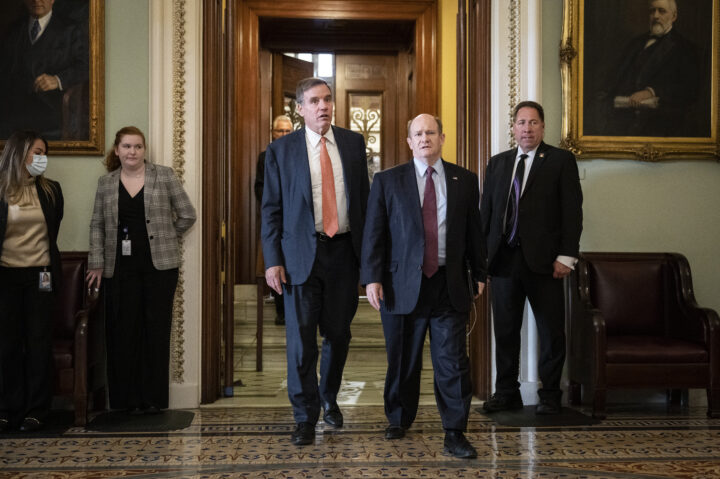
Drew Angerer/Getty Images
Sen. Mark Warner (D-VA) and Sen. Chris Coons (D-DE) leave the Senate floor and walk to a luncheon with Senate Democrats at the U.S. Capitol on June 15, 2021 in Washington, DC.
ASPEN, Colo. — Sen. Chris Coons (D-DE) said Friday that the U.S. strikes on Iran could ultimately produce a positive outcome, a softening of the Delaware senator’s previous skepticism.
“The strike on Iran is one that I disagreed with because of the process, the lack of consultation with Congress, the partisan way that Republicans were notified at the most senior levels [and]Democrats were not,” Coons said at the Aspen Security Forum.
He said he also had not expected that the administration would be able to avoid significant Iranian retaliation and an escalating conflict.
“I frankly, did not believe that we would end up in the period we seem to be in where a counter-strike by Iran against American soldiers and interests has not yet come,” Coons continued.
But, he said, “if it actually ends up securing a movement towards regional peace and really knocking down Iran’s nuclear enrichment program, it’s a good thing. I mean, having Iran on its back foot and having the Iranian enrichment progress halted is something I’m not going to criticize.”
Coons added that he is concerned that the administration lacks a clear plan for the path forward or the commitment to sustain pressure on Israeli Prime Minister Benjamin Netanyahu to end the war in Gaza and pursue “Saudi-Israeli-Palestinian reconciliation and recognition.”
Sen. Mark Warner (D-VA), speaking alongside Coons, argued that President Donald Trump had overplayed the strikes’ effectiveness and missed the opportunity to capitalize on them.
“I would also grant on the Iran strike that I had the same concerns, and I was Gang of Eight and did not get told,” Warner said, referring to the group of eight senior congressional leaders who are traditionally briefed on important intelligence matters by the executive branch. “In [Trump’s] effort to claim total credit, he turned something that was a success, but by saying within two hours ‘total obliteration’ when we didn’t even try to fully take out all the enriched uranium [storage] sites set a standard that was too high.”
“Setting Iran back dramatically was important,” Warner said. “But then you had everybody trying to kowtow to this level that is unattainable unless you have troops on the ground.”
He said the only way to ensure Iran’s nuclear program won’t continue is to reach a deal to allow nuclear inspectors back into the country, and that he expected Trump was pursuing that path after the strikes, but “it feels like that moment has already passed.”
The two Democratic senators also spoke about their concerns about the upcoming 2026 appropriations process, and Office of Management and Budget Director Russ Vought’s recently reported comments that he wanted to see the process be less bipartisan. They raised concerns that Republicans would seek to walk back bipartisan appropriations deals through recissions down the road.
Warner, the vice chair of the Senate Intelligence Committee, railed against Director of National Intelligence Tusli Gabbard as untrustworthy and “not competent,” accusing her of politicizing the intelligence community and mishandling classified information. He said he believes that close intelligence partners are curtailing their information-sharing with the U.S. due to concerns about Gabbard and the Trump administration.
Addressing the Signalgate scandal, when top administration officials discussed operational plans against the Houthis in Yemen on an unsecured private messaging app, Warner said “the Israeli government was extraordinarily upset” about the incident.
The former CIA director warned that the Islamic Revolutionary Guard Corps may attempt to consolidate power in Iran

Maxym Marusenko/NurPhoto via Getty Images
Former CIA Director and retired US General David H. Petraeus speaks at a special event of the Kyiv Security Forum, Kyiv, Ukraine, September 05, 2023.
ASPEN, Colo. — Retired Gen. David Petraeus, the former director of the CIA and head of U.S. Central Command, said Friday at the Aspen Security Forum that, in the post Oct. 7, 2023 environment, Israel will no longer tolerate threats to its security throughout the region, including a resumption of Iran’s nuclear program.
Petraeus said, “We have to step back a little bit and recognize that Israel’s strategic calculation is very, very different from before Oct. 7, and that’s a big deal for the region,” explaining that Israel will no longer allow threats to metastasize anywhere in the Middle East.
He added that Iran must understand that it is vulnerable and that no Israeli leader will allow it to resume its push for a nuclear weapon.
“[The Iranians] have to recognize that if they make another move, they’re going to get hammered once again,” Petraeus said. “And I don’t think that an Israeli prime minister, even if it’s not Bibi Netanyahu, will allow the Iranians to proceed down the path to a nuclear device.”
He predicted that Russia would not be helpful to Iran in replacing its Russian-manufactured air-defense systems that Israel destroyed, since it doesn’t have sufficient systems to protect itself from Ukraine’s counter-strikes at this point.
Petraeus argued that Iran’s future direction and leadership will depend on what sort of leader or leadership structure succeeds Ayatollah Ali Khamenei — whether the country remains ruled by a hardline religious cleric or whether a new body, potentially one dominated by the Islamic Revolutionary Guard Corps, emerges.
“You can actually entertain at least a notion that, since they control 30 to 40% of the economy, that the Revolutionary Guard Corps says, ‘Hey, why are we doing all this stuff? We could be living high on the hog and stop getting bombed and our headquarters getting taken out, us individually targeted, if we just cut loose Hezbollah, and all these others. Who cares about this nuclear stuff? What has this brought us now?’” Petraeus said.
Journalist Kim Ghattas, speaking alongside Petraeus, said that “this 40 year arc of the Islamic Revolution is coming to an end,” citing knowledge from an unnamed Western diplomat previously based in Iran, “but exactly how it ends we just don’t know yet.”
She argued that the “inconclusive” nature of the Israel-Iran war “has actually complicated matters internally and in the region” and may allow the Iranian regime to recalibrate and consolidate power. She suggested that the IRGC could take charge and transform the country into more of a military dictatorship, sidelining the mullahs.
“I think that in the medium term, we’re looking at a more oppressive, more militaristic Iranian regime,” Ghattas said.
And she predicted that Iran would push ahead with its nuclear program as its only option for deterrence.
Ghattas also said that the fact that Iran had managed to survive the Israeli attacks had complicated efforts to sideline Hezbollah in Lebanon, sending a message to the group that it should hold out; she said that Hezbollah is unlikely to disarm without instruction from Iran, and that it would require political concessions in order to do so.
“We had a really golden opportunity at the beginning of the year, when everything was in flux, Hezbollah was very much on the back foot. [Syrian dictator Bashar al-]Assad was gone. Gaza had a ceasefire in January,” Ghattas said. “This was the moment to strike with a grand political vision, diplomatic vision, for the region. Now, everybody’s recalibrating. Iran is trying to see how it can get a foothold stronger again, into Lebanon, even into Syria.”
Petraeus said that he supports Israel’s objectives it has laid out in Gaza — destroying Hamas, removing it from governance and freeing the hostages — “but I’ve said publicly from the very beginning and written about it as well, that I just don’t think they’re going about it the right way.”
He said Israel should be pursuing a “comprehensive civil-military counterinsurgency campaign — clear, hold, build and transition,” including establishing security and governance measures in Gaza as the campaign proceeds and allowing Gazan Palestinians return to their homes.
“And that requires a fourth objective, which has never been stated, and that is to provide a better future for the Palestinian people in Gaza without Hamas in their lives,” he continued.
He said that, though Hamas has been degraded, it still has the largest armed force in Gaza and would reemerge as the dominant force in a vacuum, despite Israel’s arming of some Palestinian clans in Gaza.
“I’m really worried about what is the future of Gaza, for which there’s been no real vision provided for what life of the Palestinian people will look like,” Petraues said.
The retired general indicated that he’s optimistic about Syrian President Ahmad al-Sharaa, explaining, “We believe that he understands the need for a government that has representation from all of these different elements and not only assures majority rule, but also ensures minority rights.”
Ghattas warned that the ongoing Israeli military campaign in Syria risks spawning a revitalized terrorist threat in Lebanon and a renewed threat from Syria.
She said she supports the Trump administration’s policy in opening a door to the new Syrian government, but said that the U.S. has “gone a little bit too far in embracing al-Sharaa.”
“Great about lifting the sanctions, but you still need to breathe down his neck, because international support does not translate into national legitimacy, yet, and he’s not done enough in terms of national legitimacy,” Ghattas said.
The panelists also discussed Saudi Crown Prince Mohamed Bin Salman’s rise to power and vision for the region.
Petraeus said that bin Salman had overhauled a slow and indecisive government to consolidate power.
“There’s never been a consolidation of power like we see there, and there’s never been someone with the kind of vision that he has put forward as well,” Petraeus said. “You can ask if some of that is beyond realistic. … But he knows that.”
He said that bin Salman’s initiative has established Saudi Arabia as one of the key centers of power in the region, alongside the United Arab Emirates and Qatar, supplanting traditional power-players like Egypt.
Ghattas said that bin Salman had evolved over time and “transformed, for the better, the lives of millions of young Saudis.”
“I think the opportunities are great, but I think Saudi Arabia, which wanted to establish relations with Israel before Oct. 7, is finding itself with a conundrum that it cannot solve on its own without pressure from the United States on Israel,” Ghattas said, “which is [that] it is not going to reach out to Israel anymore unless they get a promise of a Palestinian state. The bar for that has risen tremendously.”
'I must say, I was disappointed by the response of some senior people on the Democratic side,' Herzog told JI

Aspen Security Forum
Former Israeli Ambassador to the U.S. Michael Herzog
ASPEN, Colo. — Former Israeli Ambassador to the U.S. Michael Herzog and other pro-Israel speakers received a warm reception from the crowd at the Aspen Security Forum this week, as they discussed continued efforts to free the hostages in Gaza and Israel’s strikes on Iran.
But Herzog told Jewish Insider, on the sidelines of the conference after his panel on Wednesday, that he’s been disappointed by the response to the strikes from Democratic lawmakers in Washington, which has been overwhelmingly negative.
It’s a response that also stands in contrast to Herzog’s description of the transition he observed in the Biden administration’s thinking on Iran: from pushing for a nuclear deal with Iran that Herzog said would have been weaker than the Obama-era Joint Comprehensive Plan of Action to, by the time President Joe Biden left office, active discussions of strikes on Iran.
“I must say, I was disappointed by the response of some senior people on the Democratic side,” Herzog told JI. “I’m saying it carefully because I never interfere in domestic politics here, but from a strategic point of view, I was disappointed by the response of some senior Democrats to the war on Iran.”
Herzog said that maintaining bipartisan support for Israel was the central goal of his ambassadorship and that he engaged with nearly everyone, including critics, with the exception of the most extreme voices. He said he expected U.S. leaders on both sides of the aisle to realize that the strikes offered a “unique opportunity” to counter a “malign actor” and “changed the strategic landscape in the Middle East.”
“People who either criticize it on procedural issues or people who say, ‘[It] wasn’t the right timing because they were talking to each other about a deal’ — there’s never a right time. Never,” Herzog said, emphasizing that the strikes had not, as critics warned, spiraled into a protracted war similar to Iraq or Afghanistan.
Herzog said Israel must “put a lot of work into maintaining that dialogue with both sides of the aisle, explaining our common interest, away from domestic politics here … and exploring the new opportunities that have been created in the Middle East.”
Herzog said that Israel has been preparing for an attack on Iran for decades, but the specific planning for what became Israel’s Operation Rising Lion and the U.S.’ Operation Midnight Hammer began in earnest in November 2024, after the second Iranian strike on Israel and Israel’s elimination of Iran’s air-defense systems. By that time, U.S. nuclear talks with Iran, which Herzog criticized as misguided, had been long stalled.
He said the fall of the Assad regime in Syria the following month provided a further opportunity to take action.
“If you look at the journey the Biden administration took from the initial days when they were rushing to a deal with Iran, to the last few months of the Biden administration where they were talking to us about military options against Iran, they went a long way,” Herzog recounted.
Herzog said he believes that the Biden administration underwent “disillusionment with the possibility of reaching a good deal with Iran,” as Iran made unrealistic demands, such as removing the Islamic Revolutionary Guard Corps’ terrorism designation. And he said Iran’s supply of weapons for Russia’s invasion of Ukraine made the talks “much more difficult.”
“I just could see that movement with time, to the last phase of Biden’s presidency, when, after we turned the tables on the Iranian axis and opened that huge opportunity, we actually started looking with them at the military option,” he said. “It was too late in the day [to carry out the strikes before Biden left office], but it was a very interesting journey that I noticed.”
Looking at the rising isolationist sentiments on the Republican side of the aisle, Herzog said he’s been monitoring the issue and has “been concerned about it,” but also argued that such voices aren’t dominant in the Trump administration’s decision-making.
“It’s like a swing of a pendulum because the U.S. ultimately decided to follow Israel and strike Iran, and this is really historic, in that it’s a first-of-its-kind coordinated offensive operation. … This is the first time that we are coordinated in our offensive operations, that’s a very big deal for a long time to come in my view,” Herzog said.
He said he sees the pendulum swinging against the isolationists in the administration’s recent moves to provide additional support to Ukraine and take a tougher stance toward Russia as well.
“So all in all, I don’t think that the administration is following this isolationist trend, but I do follow it and I am concerned about it,” Herzog said. “I do believe that the world needs American leadership, [an] American dominant role. The world needs America to be a force of good, as it has always been, and that’s what we’d like to see.”
Herzog — reflecting on the panel he spoke on, “Israel at a Crossroads” — said that the U.S. and Israel need to be closely coordinated and in lockstep on the path forward on Iran, including the limits of a diplomatic deal and the red lines that would prompt further military action to prevent Iran from rebuilding its nuclear program, as well as ways to capitalize on Iran’s weakness throughout the region and prevent it from rebuilding its proxy network.
“We managed to surprise the Iranians, hit all the main centers of gravity and take them completely off balance. But challenges are still ahead of us because we have to assume that Iran will seek to rebuild those threatening capabilities,” Herzog said. “We should not rest on our laurels.”
He also emphasized that the strikes and the degradation of Iran’s proxies had “created the conditions for a different Middle East.”
Asked about the Israeli government’s policy on Syria — which shifted in the span of a week, from Israeli Prime Minister Benjamin Netanyahu actively discussing normalization and diplomatic paths with President Donald Trump in the White House to Israel bombing key Syrian government sites in recent days — Herzog described the new Syria as a “mixed bag” with both risks and opportunities, and said that it may be too early to judge.
“On one hand, I believe that this new leader, Ahmad al-Sharaa, a.k.a. Mohammad al-Jolani, doesn’t want, he doesn’t seek war with Israel, and he sends across messages, and that’s what he told the Trump administration,” Herzog said, adding that Israel had started a dialogue through the U.S. on what Herzog termed a formal or informal non-aggression agreement and the demilitarization of southern Syria.
“On the other hand, we should not forget the background of al-Sharaa and the people surrounding him or subordinate to him,” Herzog said. “They all grew up in the school of jihadism.”
He criticized al-Sharaa for what he said was an effort to “subjugate [Syrian minorities] so they become part of his Syria, his vision of Syria” rather than allowing for a federalist system. Herzog said the Israeli strikes “sent a very strong message … that we will not tolerate the scenes of humiliating the Druze and endangering their lives,” and aimed to block the Syrian army from conquering Druze areas and carrying out atrocities.
“What we’ve seen, first with the Alawites and now with the Druze, is very troubling,” Herzog said. “We in Israel, our concerns are about, first, the security situation in southern Syria, and second about the state of minorities, especially the Druze, because not only are they close to our border, [but] because we have an important Druze community in Israel. They are our brothers in arms.”
He added that it’s unclear to what extent al-Sharaa himself is in control over Syrian government forces’ actions.
The Israeli ambassador also reflected on the ways that the Oct. 7, 2023, Hamas attacks on Israel seemingly activated a global wave of antisemitism.
“You’re hit hard, you’re bleeding, and all your enemies smell the blood and rise to hit you,” Herzog said. “That pertains to all of our enemies in the region, the Iranian axis, but also pertains to anti-Israel, antisemitic forces here in the U.S. and elsewhere.”
He said that Israel has “gone a long way” against its military adversaries in the Middle East, “really turned the tables on Iran and the Iranian axis” and “created the conditions for a different Middle East.”
“But,” he continued, “we still have a long way to go against these anti-Israel, antisemitic forces. That’s an open front.”
Speaking at the Aspen Security Forum, the analysts also discussed the possibility of Iran attempting to reconstitute its nuclear weapons program covertly and the prospect of regime change in Iran

Aspen Security Forum
Former National Security Advisor Stephen Hadley, Rachel Bronson, David Sanger and Vali Nasr speak on a panel about Iran at the Aspen Security Forum on July 17, 2025.
ASPEN, Colo. — Speaking on a panel at the Aspen Security Forum, a group of Iran analysts discussed the potential paths forward in nuclear talks with Iran after the American and Israeli strikes on Iran’s nuclear facilities, the possibility that Iran will attempt to reconstitute its nuclear program covertly and the prospect of regime change in Iran.
Former National Security Advisor Stephen Hadley laid out three paths forward after the strikes: a continued campaign of Israeli air strikes to “mow the lawn,” while Iran works to try to re-establish its own deterrence; a negotiated agreement with Iran including intrusive inspections that would make it difficult for Iran to construct a covert nuclear program, with provisions addressing Iran’s ballistic missiles and proxies; and the possibility, with an agreement, that Iran decides to give up its pursuit of nuclear weapons, having spent billions of dollars on the program, alienated the region and still failed to deter a U.S. or Israeli attack.
“There is a question whether the Iranians will decide that the cost of pursuing a nuclear program was just too high,” Hadley said. “It was supposed to safeguard them from getting attacked by the Israelis in the United States, and it resulted in them getting attacked. … That’s a long way down the road. It’s probably a low-likelihood probability, but it would certainly remake the Middle East.”
He presented a potential pathway for Iran, working with Gulf states, to pursue the model that they have laid out, focusing on economic development.
Rachel Bronson, a senior advisor at the Bulletin of the Atomic Scientists, said that it’s widely believed Iran has seen a nuclear weapon as a guarantor of regime survival, in the model of North Korea. But she said there’s a chance that Iran wants to go down a different path.
“That begs the question whether the Iranians want to live like North Koreans and want to live in a sanctioned regime and in such isolation, which the Iranians demonstrated that they don’t want to live that way,” Bronson said.
David Sanger, the chief Washington correspondent for The New York Times, argued that, while the Fordow nuclear facility has likely been rendered inoperable due to U.S. strikes, other sites, such as Natanz and Isfahan, can likely be repaired or rebuilt.
“I don’t think anybody can say whether or not this is really gone for good. My guess is you’re going to need a political agreement with getting inspectors back in to make sure that it stays out of circulation,” he said.
Sanger added that it would be a “long time” before Iran is in a position where it will be willing to negotiate. He said he’s concerned about the lack of inspections in the interim, “because I think if we get into another confrontation with them, they will leave the [Nuclear Non-Proliferation Treaty]. And if that happens, I think we could see a second cycle of [military action].”
From the U.S. side, Sanger said that Washington publicly presenting a proposal could build pressure on Iran to strike a deal. Without diplomacy, Sanger continued, future military confrontation is likely. He said there are also major questions around enrichment that Israel and Iran will have to answer.
“The question for the Israelis is, would they give an assurance that says, ‘We won’t strike you if you don’t try to reconstitute your program and don’t have a covert nuclear weapons program?’” Sanger said. ”For the Iranians on the enrichment point, there’s a question of whether, diplomatically, you could finesse it by saying, ‘You of course have the sovereign right to enrich, but you also, in the exercise of that sovereignty, can elect to give it up for other purposes.’”
And he said that Israel should also consider whether it’s willing to allow limited enrichment under comprehensive and intrusive IAEA inspections, arguing that Iran’s pathway to a potential covert weapons program would come via other avenues.
Bronson highlighted that the U.S.’ European partners, and even Russian President Vladimir Putin, are now in lockstep with the Trump administration in insisting that Iran must give up its enrichment capacity.
She also said it’s likely unrealistic that Iran would be able to restart a covert nuclear program without the world’s knowledge, particularly if it attempts to retrieve its stockpiles of highly enriched uranium, activity that would be noticed by various intelligence services.
“The covert is always out there, but it’s a long way to go for them to get back in that game,” she said.
Johns Hopkins University professor Vali Nasr predicted that the Iranian government’s priority would be finding a way to prevent future strikes by the United States and Israel, rebuilding its deterrence and defense.
He also argued that the public, aggressive diplomacy from the Trump administration, including demands on Truth Social for full dismantlement of Iran’s nuclear program, make such a deal politically unpalatable for the Iranian regime. He accused the Trump administration of failing to seriously negotiate before its strikes.
“You’re basically asking for surrender. It’s not a compromise anymore,” Nasr said. “So then the question becomes, what is the acceptable cost for surrender? Would the supreme leader think that Iran is back to the wall sufficiently for him to … go and sign a surrender treaty?”
Nasr suggested that the U.S. would have to offer Iran incentives to bring in to the table and that Tehran would make significant demands for such a deal, including a guaranteed end to Israeli strikes on Iran and safeguards against the U.S. pulling out of the deal in the future.
The panel members downplayed the notion that regime change is an imminent prospect in Iran.
Hadley said the most likely source of such a change would be from a faction inside the regime, like the Islamic Revolutionary Guard Corps, that decides it wants to reduce the role of the mullahs and their revolutionary ideology.
“If folks come out in the streets it may be because one of those factions has called them to the streets to give them an excuse for making some kind of change with the regime,” Hadley said. “But that’s going to take a long, I think, considerable time, to play out.”
Sanger said that “betting on regime change is a risky business.” He said that the Obama administration had been gambling on the idea that Supreme Leader Ayatollah Ali Khamenei would be dead before the JCPOA sunset.
“It’s pretty clear from talking to the Israelis who were in Washington last week, that is their bet now: They are just pushing for time, and they think a regime change will happen,” Sanger continued. “But I’m not sure where they get that confidence.”
Nasr predicted that there will be no major changes inside Iran as long as Khamenei is still alive. And he argued that the U.S. would need to lay out an attractive alternative and future for Iran in order to motivate a faction like the IRGC to take action.
“How do you force this shift in Iran? How do you cause the debate at the top that people seriously consider that this is a dead end and there’s some other path on the table?” Nasr said. “Iranian leaders, hardline moderates cannot react to what is theoretically possible but is not actually solidly in front of them as an option.”
At the same time, Nasr said that the failure of Iran’s proxy network had been a significant blow to segments of Iran’s government, leaving them in a weakened position in the regime.
In a letter, GOP senators urge France, Germany and U.K. to utilize the snapback provision in UNSC Resolution 2231

Al Drago-Pool/Getty Images
Ranking member of the Senate Foreign Relations Committee U.S. Sen. Jim Risch (R-ID) speaks during a Senate Foreign Relations Committee hearing on April 26, 2022 in Washington, DC.
A group of Senate Republicans sent a letter to French, German and U.K. officials this week urging them to immediately reimpose U.N. Security Council sanctions on Iran for the regime’s violations of the 2015 nuclear deal and the Treaty on the Non-Proliferation of Nuclear Weapons.
Six GOP senators, led by Sen. Jim Risch (R-ID), chairman of the Senate Foreign Relations Committee, urged French Foreign Minister Jean-Noël Barrot, German Federal Foreign Minister Johann Wadephul and U.K. Foreign Secretary David Lammy to utilize the snapback provision in UNSC Resolution 2231, which would reimpose all the sanctions lifted on Iran as part of the 2015 deal in response to any violations of the agreement.
“Initiating the snapback process would be the right — and long overdue — move and would deny Iran the resources it uses for its terror agenda. The 2015 deal flooded Iran with cash while allowing it low-level enrichment, a clock to simply wait out, no limitations on ballistic missiles, and nothing to rein in terror proxies. Years down the line, the sanctions relief Iran received from this deal directly funded Iran’s terror proxies and led to Hamas’ October 7 attack on Israel,” the senators wrote.
“Iran’s ejection of the International Atomic Energy Agency from its facilities marked the latest in a long chain of violations to Iran’s nuclear commitments. These actions confirm what we have known all along: the Iranian nuclear program is not civilian; it is the pursuit of a bomb to destroy Israel and threaten U.S. national security interests in the region. The international community must not tolerate this activity any longer,” they continued.
The letter was co-signed by Sens. Ted Cruz (R-TX), Pete Ricketts (R-NE), John Cornyn (R-TX), Steve Daines (R-MT) and Bill Hagerty (R-TN).
French Foreign Minister Jean-Noel Barrot warned on Tuesday that the E3, the European countries party to the 2015 Iran nuclear deal known as the Joint Comprehensive Plan of Action, will trigger the snapback mechanism, reimposing all U.N. sanctions, if a new agreement is not reached.
The senators encouraged the recipients of their letter to go beyond simply initiating the snapback sanctions, which takes 30 days and would likely need to be completed before Russia takes over the presidency of the UNSC in October, the same time that the snapback mechanism is set to expire.
“The decision to initiate the snapback process is only the beginning. The UNSC must fully process and formally re-instate UN sanctions without delay. This will take several weeks, and the October expiration of the snapback mechanism is looming. Furthermore, once sanctions are back in place, we must commit to their enforcement. Chinese purchases of Iranian oil and illicit oil smuggling through third countries have long violated existing U.S. secondary sanctions. Once UN sanctions return, all member countries will have a duty to crack down on this illegal activity,” the group wrote.
“President Trump has instituted a maximum pressure policy to bring Iran to the negotiating table. It is our sincere hope that our allies will stand side by side with America as we counter Iran’s threat to regional and global security for good,” they continued.
‘I’ve thought this alliance is somewhat weaker than we sometimes would give it credit for, and I’d slam them together and make them deal with their own internal contradictions,’ Rice said
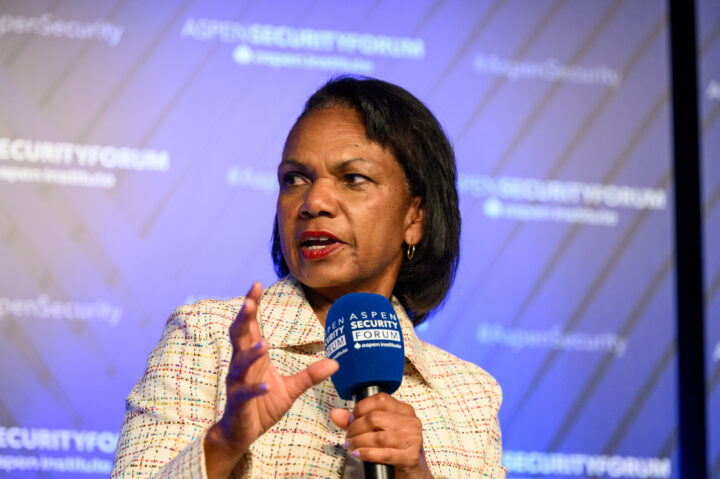
Aspen Security Forum
Former Secretary of State Condoleezza Rice speaks at the Aspen Security Forum on July 17, 2025.
ASPEN, Colo. — Former Secretary of State Condoleezza Rice said Thursday at the Aspen Security Forum that the U.S. should work to exploit frictions between Iran, Russia, China and North Korea, to interfere with their deepening alliances.
Rice suggested that, rather than trying to disrupt links between Iran and other adversaries, the U.S. should “slam them together” because “they actually have very little in common and they actually have a lot of problems between them.”
“Nobody could feel very good right now in their alliance about the Iranian situation,” Rice said, emphasizing that Russia had declined to provide any military backing to Iran after it was attacked by Israel and the United States, and China is also trying to “keep their heads down.”
“I’ve thought this alliance is somewhat weaker than we sometimes would give it credit for, and I’d slam them together and make them deal with their own internal contradictions,” Rice reiterated.
Jason Bordoff said at the Aspen Security Forum that ‘some measure of security’ came from ‘the fact that we’re in a global oil market and we’re all in this together’

Aspen Security Forum
Jason Bordoff, the founding director of the Center on Global Energy Policy at Columbia University, speaks on a panel on energy security at the Aspen Security Forum on July 16, 2025.
The pressures of the global oil market restrained Israel from bombing Iran’s Kharg Island oil facilities and Iran from closing the Strait of Hormuz or attacking Saudi Arabia’s Abqaiq oil facilities, an energy policy analyst argued at the Aspen Security Forum on Wednesday.
“There was some measure of security that came from the fact that we’re in a global oil market and we’re all in this together,” Jason Bordoff, the founding director of the Center on Global Energy Policy at Columbia University, said on a panel on energy security. “If Iran had tried to do that, it would have imposed pain on itself, it would have imposed pain on China, it would have imposed pain on Gulf countries it was trying to keep on its side.”
Meghan O’Sullivan, the director of the Belfer Center for Science and International Affairs at Harvard University, said on the same panel that the Gulf states’ work to develop both oil and renewable energy sources place them in a key role in the global AI race.
“The Gulf, particularly, I would say, Saudi Arabia and the UAE, are really playing into this in a very significant way that I think will really accrue to their geopolitical and economic advantages,” O’Sullivan said, discussing renewable energy development. “They’re in the midst of managing an uncertain but somewhat inevitable energy transition, and they’re thinking about what are the other sources of strength in their economy.”
She said the Saudi energy transition in particular is designed “to really drive home to places, particularly the United States, that they have the advantage when it comes to energy, and the energy needs for AI.”
O’Sullivan said that Saudi Arabia’s continued development of both oil and alternative energy sources has allowed it to provide “guaranteed, low-price energy” to support AI development.
“This is part of the reason why President [Donald] Trump, when he went to visit the Gulf in May, was able to get agreement on some deals that would actually place the heart of American AI advantage in the Gulf,” she said.

BRENDAN SMIALOWSKI/AFP via Getty Images
Qatar's Emir Sheikh Tamim bin Hamad al-Thani (L) and Prime Minister and Minister of Foreign Affairs Sheikh Mohammed bin Abdulrahman Al-Thani talk to US President Donald Trump as he prepares to leave at the end of the Qatari leg of his regional tour, at the Al-Udeid air base southwest of Doha on May 15, 2025.
Good Wednesday morning.
In today’s Daily Kickoff, we cover yesterday’s antisemitism hearing on Capitol Hill with the leaders of Georgetown University, the City University of New York and the University of California, Berkeley, as well as the suspension of Georgetown professor Jonathan Brown following his call for Iran to strike the U.S. We also report on steps taken by Columbia University to try to reach a deal with the Trump administration on its handling of antisemitism and report from the Pennsylvania Energy and Innovation Summit in Pittsburgh. Also in today’s Daily Kickoff: Ambassador Mike Huckabee, Albert Bourla and Richard Attias.
What We’re Watching
- President Donald Trump is slated to host Qatari Prime Minister Mohammed bin Abdulrahman Al Thani tonight at the White House. More below.
- At the Aspen Security Forum this afternoon, Amos Yadlin, the former head of the IDF’s Intelligence Directorate; former Israeli Ambassador to the U.S. Mike Herzog; Brett McGurk, the former National Security Council coordinator for the Middle East and North Africa; and author and “Call Me Back” podcast host Dan Senor are set to take the stage for a conversation about Israel’s future.
- This morning in Washington, the Senate Foreign Relations Committee is slated to hold a business meeting followed by a full committee hearing on State Department reform.
- This afternoon, the House Foreign Affairs Committee’s Middle East and North Africa subcommittee is holding its own hearing on State Department management.
- Also today, Rep. Mark Harris (R-NC) is holding a press conference with other members of Congress calling for the National Education Association’s congressional charter to be revoked following the organization’s adoption of a measure effectively banning cooperation with the Anti-Defamation League.
What You Should Know
A QUICK WORD WITH jI’S MELISSA WEISS
Ceasefire and hostage-release talks have been ongoing in Doha, Qatar, for the last week. But one of the most consequential meetings in the negotiations could be happening tonight in Washington, when President Donald Trump hosts Qatari Prime Minister Mohammed bin Abdulrahman Al Thani for dinner at the White House.
This continues a new tradition for Trump of hosting prominent Gulf royals who aren’t the heads of state of their respective countries for dinner at the White House. In March, Trump hosted a dinner in the White House’s State Dining Room for Sheikh Tahnoon bin Zayed Al Nahyan, the United Arab Emirates’ national security advisor and chairman of several sovereign wealth funds.
Qatari officials have been in the U.S. all week. Qatari Emir Sheikh Tamim bin Hamad Al Thani was rumored to have met with Trump on the sidelines of the FIFA finals in New Jersey on Sunday, after being spotted in New York over the weekend.
White House Middle East envoy Steve Witkoff, whose trip to Doha last week was postponed over stalled talks, told reporters over the weekend that he planned to meet with Qatari negotiators on the sidelines of the match. And Trump shared a suite with senior Qatari sports officials at the match, including Nasser bin Ghanim Al-Khelaifi, the president of the Paris Saint-Germain team who played in New Jersey on Sunday and chairman of beIN Sports, previously known as Al Jazeera Sport. (In a weekend interview at the FIFA match, Trump even noted Qatar’s “big presence.”)
Qatar also loomed large in Washington this week, where legislators on the House Education and the Workforce Committee pressed university leaders from Georgetown, CUNY and the University of California, Berkeley about their foreign funding sources during a hearing about antisemitism in higher education. (More below on the hearing.) Former Rep. Jim Moran (D-VA), one of Qatar’s top lobbyists in Washington, was seen sitting right behind Georgetown University interim President Robert Groves as Groves testified on Tuesday. The school has received over $1 billion from Qatar, and has a campus in Doha.
Qatar’s be-everywhere, invest-in-everything strategy has allowed Doha to gain footholds across the global economy and in diplomatic circles. And since the start of the war, it has sought to highlight its role as a facilitator of ceasefire talks between Israel and Hamas, the latter of which Doha supports financially and diplomatically.
Doha has the power to push Hamas to accept a ceasefire. Whether tonight’s dinner will exact a change in Qatar’s approach to Hamas remains to be seen. The sit-down between Trump and the Qatari prime minister could change the tide in the 21-month war, or it could serve as yet another missed opportunity in a war full of stalemates and diplomatic posturing — with fresh casualties mounting on both sides and 50 hostages still languishing in captivity.
TESTIMONY TALK

When the leaders of Georgetown University, the City University of New York and the University of California, Berkeley sat down on Tuesday morning to testify at a congressional hearing about antisemitism, they clearly came prepared, having learned the lessons of the now-infamous December 2023 hearing with the presidents of Harvard, the University of Pennsylvania and MIT, each of whom refused to outright say that calls for genocide violated their schools’ codes of conduct. Georgetown interim President Robert Groves, CUNY Chancellor Felix Matos Rodriguez and UC Berkeley Chancellor Rich Lyons were all quick to denounce antisemitism and even anti-Zionism at Tuesday’s House Education and Workforce Committee hearing examining the role of faculty, funding and ideology in campus antisemitism. But while the university administrators readily criticized antisemitism broadly, they struggled to apply that commitment directly to their field of academia, Jewish Insider’s Gabby Deutch reports.
Mind the gap: Lyons in particular offered a revealing look at the gulf between a university’s stated values and its difficulty in carrying them out. He was asked to account for the promotion of Ussama Makdisi, a Berkeley history professor who described the Oct. 7, 2023, Hamas terror attacks as “resistance” and later wrote on X that he “could have been one of those who broke the siege on October 7.” Why, Lyons was asked by Reps. Randy Fine (R-FL) and Lisa McClain (R-MI), did Berkeley announce last September that Makdisi had been named the university’s inaugural chair of Palestinian and Arab studies? Lyons first defended Makdisi: “Ussama Makdisi, Professor Makdisi, is a fine scholar. He was awarded that position from his colleagues based on academic standards,” Lyons said. Later, when McClain followed Fine’s line of questioning, Lyons went to great lengths to avoid criticizing Makdisi.
Given the boot: Jonathan Brown, a tenured Georgetown University professor who came under fire last month for a social media post in which he called for Iran to conduct a “symbolic strike” on a U.S. military base, has been placed on leave and removed as chair of the school’s Department of Arabic and Islamic Studies, Georgetown’s Groves said Tuesday at the congressional hearing.
CAMPUS BEAT

Columbia University announced on Tuesday it would implement several measures to confront antisemitism in an effort to reach a deal with the Trump administration to restore the $400 million in federal funding that was cut by the government in March due to the university’s record dealing with the issue, Jewish Insider’s Haley Cohen reports.
The measures: The steps include the university further incorporating the International Holocaust Remembrance Alliance’s working definition of antisemitism by requiring its Office of Institutional Equity to embrace the definition; appointing a Title VI coordinator to review alleged violations of the Civil Rights Act; requiring antisemitism training for all students, faculty and staff; and refusing to recognize or meet with “Columbia University Apartheid Divest,” a coalition of over 80 university student groups that Instagram banned for promoting violence.
MIKE’S MOMENT

Former White House National Security Advisor Mike Waltz laid out an aggressive approach to countering anti-Israel sentiment at the United Nations during his Senate confirmation hearing on Tuesday to be U.S. ambassador to the global body, accusing the organization in his opening statement of “pervasive antisemitism,” Jewish Insider’s Matthew Kassel reports.
Setting goals: Waltz, a staunch supporter of Israel and an outspoken critic of Iran who was nominated for the U.N. post in May after being removed from his position as national security advisor, said he would seek to block “anti-Israel resolutions” in the General Assembly and would push for the dismantlement of the United Nations Relief and Works Agency over some of its employees’ involvement in the Oct. 7, 2023, Hamas attacks.
SMART STATE

Pennsylvania’s top lawmakers put up a united front on Tuesday to emphasize to the hundreds of tech and energy investors at Sen. Dave McCormick’s (R-PA) inaugural innovation summit the benefits of working with states that embrace bipartisanship and the national security imperatives of investing domestically, Jewish Insider’s Emily Jacobs reports from Pittsburgh. The Pennsylvania Energy and Innovation Summit brought top tech and energy executives to Carnegie Mellon University’s campus, home to one of the world’s most advanced AI programs. Tuesday’s gathering also included the state’s two leading Democrats, Gov. Josh Shapiro and Sen. John Fetterman (D-PA), and President Donald Trump, all of whom praised the conference as a strategic way to promote U.S. investment to the scores of foreign and American leaders in attendance.
Better together: Amazon Web Services’ $20 billion investment last month in three computing and AI campuses in the Keystone State was “an indicator of all that we can be when we harness the new things that we have going for us, and when we have government and the private sector working together, not at odds, and when we pull in our educational institutions … in a way that really helps move Pennsylvania forward,” Shapiro said during a panel discussion with McCormick and AWS CEO Matt Garman.
STRAIGHT TALK

U.S. Ambassador to Israel Mike Huckabee on Tuesday called on Israel to “aggressively investigate” the death of Saif Musallet, a Palestinian-American man from Florida who was killed by Israeli settlers in the West Bank last Friday. In a statement posted to X, Huckabee called the incident a “criminal and terrorist act” and said “there must be accountability.” Musallet, 20, was attacked by Israeli settlers while visiting his family in Sinjil, a village north of Ramallah. The Palestinian Authority Ministry of Health reported a second man was also shot and killed during the incident, Jewish Insider’s Danielle Cohen-Kanik reports.
Weighing in: Democratic lawmakers in Washington also weighed in on the attack. Rep. Brad Schneider (D-IL), a pro-Israel stalwart, said on Tuesday that he was “appalled and heartbroken” by the news, adding he had “repeatedly called on the Israeli government to address the growing number of violent attacks by Israeli settlers in the West Bank.” House Minority Leader Hakeem Jeffries (D-NY) called the “brutal killing” of Musallet “shocking and appalling” and said the Israeli government “must thoroughly investigate this killing and hold any and all settlers responsible.”
EXCLUSIVE
A new bipartisan House bill set to be introduced on Wednesday aims to expand U.S.-Israeli research and development cooperative programs in the medical field. The BIRD Health Act, led by Reps. Randy Weber (R-TX) and Chris Pappas (D-NH), builds on the long-running Binational Industrial Research and Development Foundation program, Jewish Insider’s Marc Rod reports.
Moving forward: Around a third of BIRD projects in the past decade have been related to the health-care sector, and the U.S. and Israel have pursued growing cooperation in the field in recent years. The bill would further formalize those efforts by establishing a new $10 million annual funding stream and joint management structure between the Department of Health and Human Services and the Israeli Ministry of Health specifically focused on supporting such projects. It would support research and development between institutions and companies in both countries, including startups, as well as health systems, telemedicine, disease prevention efforts and biological product manufacturing.
Worthy Reads
NEA’s Lesson Plan: In The Wall Street Journal, Anti-Defamation League CEO Jonathan Greenblatt responds to the National Education Association’s recent adoption of a measure targeting the ADL. “This wasn’t about the ADL. It was a clear and unambiguous statement to Jewish educators, parents and children: You don’t count. And it perversely takes this stance at a time when anti-Jewish hate is skyrocketing. … Unfortunately, the NEA vote is symptomatic of a larger problem of intensifying antisemitism in our K-12 schools. Specifically, antisemitism cloaked in the rhetoric of anti-Zionism. A generation of teachers has been educated on college campuses where this poison has festered and spread. It has been normalized. Now its purveyors want to bring this bigotry into your children’s classrooms.” [WSJ]
Pressing Putin: The Washington Post’s David Ignatius looks at President Donald Trump’s new approach to Russia, following Trump’s support for sending offensive weapons to Ukraine. “Trump decided to escalate for three reasons, according to a source familiar with administration discussions. First, he believed that Putin was disrespecting him, feigning a readiness to make peace but ignoring the U.S. president’s call for a ceasefire. Second, he saw the efficacy of U.S. military power in the use of B-2 bombers and Tomahawk missiles against Iran. And third, he thought Putin would only negotiate if threatened with greater force. As the Russians like to say, Trump decided to ‘escalate to de-escalate.’ Trump has made a sound choice in recognizing that Putin won’t make concessions without more pressure. But the president has also embarked on an escalatory course whose risks are unknowable.” [WashPost]
Mamdani’s Gift … to the GOP: The New York Times’ Bret Stephens posits that a victory in November by New York City Democratic mayoral candidate Zohran Mamdani would be a positive outcome for Republicans nationwide who are likely — and in some cases, have already begun — to push Mamdani as the future of the Democratic Party. “Among the reasons the Democratic Party’s brand has become toxic in recent years is progressive misgovernance in places like Los Angeles; San Francisco; Oakland, Calif.; Portland, Ore.; Seattle; and Chicago. If Mamdani governs on the promises on which he’s campaigned, he’ll bring the same toxicity to America’s biggest city. … A Mamdani mayoralty would be the political gift that keeps on giving. The state of the city would become a reflection of the Democratic Party writ large. Every Mamdani utterance would become a test for every Democratic politician, starting with Senator Chuck Schumer on Israel.” [NYTimes]
Word on the Street
The FBI released new images of three Iranian intelligence agents believed to be involved in the kidnapping and disappearance of retired special agent Bob Levinson, who was last seen on Iran’s Kish Island in 2007; Levinson is believed to have died in Iranian custody sometime prior to the onset of the COVID-19 pandemic…
Adelita Grijalva was declared the winner of the Democratic primary special election in Arizona’s 7th Congressional District to succeed her father, Rep. Raúl Grijalva, who died earlier this year; the special election in the deep-blue district will take place in September…
Former Washington, D.C., Councilmember Trayon White, who was expelled last year over an ongoing bribery case, was reelected to his seat in a special election on Tuesday; White had previously promoted antisemitic conspiracy theories while in office…
New York City Democratic mayoral candidate Zohran Mamdani told business leaders on Tuesday that he would “discourage” the use of the “globalize the intifada” slogan and not use the phrase himself, but said the term was used by many to show support for Palestinians; among the attendees in the 90-minute meeting was Pfizer CEO Albert Bourla, who, according to The New York Times, “pushed Mr. Mamdani about the meaning of genocide and defended Israel’s war in Gaza”…
Former Future Investment Initiative Institute CEO Richard Attias is rejoining the Saudi Arabian conference network as interim CEO, replacing Penny Richards, who is departing after six months in the position…
The United Synagogue of Conservative Judaism ended its contract last month with an interfaith advisor who had been working with the group for several years, in a potential indication that it is moving away from previous plans to allow rabbis within the movement to officiate interfaith weddings, eJewishPhilanthropy’s Jay Deitcher reports…
The Washington Post reports on the recent reunion between a 97-year-old Holocaust survivor and one of the American soldiers involved in the liberation of the Buchenwald concentration camp; the reunion was facilitated by the USC Shoah Foundation…
British police cautioned that Russia, China and Iran were behind an increasing number of sabotage, espionage and kidnapping plots in the U.K….
France, Germany and the U.K. will bring back sanctions on Iran via the U.N. Security Council if a nuclear deal is not reached by the end of August, French Foreign Minister Jean-Noel Barrot warned on Tuesday, Jewish Insider’s Lahav Harkov reports…
The Wall Street Journal looks at how Iran struck Israeli targets with increasing success during the 12-day war between the countries, as Tehran used trial and error to adapt its military strategy by using more advanced weaponry and firing from more locations toward the end of the war…
The Financial Times reports on tensions between Iranian hard-liners and the country’s reformists following the country’s war last month with Israel, with the country’s hard-line faction opposing engagement with the Trump administration that President Masoud Pezeshkian has supported…
The U.N.’s special representative for Afghanistan warned that the country’s support systems were under strain amid an influx of Afghans returning to the country following the implementation of new immigration laws in Iran; more than 1 million Afghans illegally living in Iran have been repatriated this year amid the crackdown…
The three members of the U.N.’s Commission of Inquiry on the Occupied Palestinian Territory reportedly resigned from their positions in rapid succession earlier this month; the resignations come amid an effort by the Trump administration to sanction officials who have targeted Israel in international institutions…
Twenty Palestinians were killed in a crowd rush at a Gaza Humanitarian Foundation distribution site in Khan Younis, Gaza; the organization said the “chaotic and dangerous surge” was “driven by agitators in the crowd”…
Pic of the Day

The Argentine Embassy in Washington held a commemoration event at the Capitol last night ahead of the 31st anniversary of the bombing of the AMIA Jewish community center in Buenos Aires, in which 85 people were killed.
Birthdays

World-renowned violinist, violist and conductor, Pinchas Zukerman turns 77…
One of the three co-founders of Comcast Corporation, he served as its chief financial officer and vice chairman, Julian A. Brodsky turns 92… Senior U.S. district court judge for the Southern District of New York, Judge Sidney H. Stein turns 80… President of an eponymous communications firm, public speaker and coach, Betsy R. Sheerr… Co-creator of the first-ever spreadsheet program (VisiCalc), he currently serves as the chief technology officer of Alpha Software, Daniel Singer “Dan” Bricklin turns 74… Former high ranking civilian official in the Pentagon during the Bush 43 administration, now a senior fellow at the Hudson Institute, Douglas J. Feith turns 72… Senior rabbi since 1997 at Temple Beth Avodah in Newton Centre, Mass., Rabbi Keith Stern… Los Angeles-based attorney, she is the president emerita of the LA chapter of the Jewish National Fund, Alyse Golden Berkley… Past vice chair of the Board of Trustees of The Jewish Federations of North America, Cynthia D. Shapira… British solicitor, he represented Princess Diana in her divorce and Ambassador Deborah Lipstadt in a libel case, Anthony Julius turns 69… Pulitzer Prize-winning and Tony Award-winning playwright and screenwriter, Tony Kushner turns 69… U.S. ambassador to the EU in the Trump 45 administration, Gordon David Sondland turns 68… Former airline executive at Northwest and Delta, now on the board of Spirit Airlines, Andrea Fischer Newman… Former president of Viacom Music and Entertainment Group, Douglas Alan Herzog turns 66… Businessman and philanthropist, owner of interests in many Israeli firms including IKEA Israel, Matthew Bronfman turns 66… Canadian journalist, he worked for CNN International for 30 years, Jonathan Mann turns 65… Former Israeli minister of science and technology, now a venture capitalist, Yizhar Nitzan Shai turns 62… Chief of staff of the Jewish United Fund of Metropolitan Chicago, Jim Rosenberg… Chicago-based entrepreneur and philanthropist, Victoria Rivka Zell… Former NFL offensive lineman, he is now the president of Collective Mortgage in Colorado, Ariel Mace Solomon turns 57… Senior scholar at the Fuchsberg Jerusalem Center, a home for Conservative Judaism in Israel, Rabbi Joshua Kulp turns 55… Israeli former professional tennis player, in 2003 she was ranked 15th in the world, Anna Smashnova turns 49… Founder of Pinkitzel, a cupcake cafe, candy boutique and gift store located in three Oklahoma cities, Jonathan Jantz… U.S. senator (R-IN) since the beginning of this year, Jim Banks turns 46… National political correspondent for The New York Times, Shane Goldmacher… Co-founder of Los Angeles-based Meteorite Social Impact and Health Action Alliance Advisors, Steven Max Levine… White House liaison to the Jewish community in the Bush 43 administration, now managing partner at Arogeti Endeavors, Scott Raymond Arogeti… Features reporter for Jewish Insider, Matthew Kassel… Founder and managing partner at Vine Ventures, Eric M. Reiner… Registered nurse and an internationally board-certified lactation consultant, Chantal Low Katz…
Mechanism to bring back U.N. sanctions expires in October

Press Association via AP Images
French President Emmanuel Macron, Germany's Chancellor Friedrich Merz and Prime Minister Sir Keir Starmer at a hotel prior to an E3 meeting on the sidelines of the NATO summit in The Hague, Netherlands, Tuesday June 24, 2025.
France, Germany and the U.K. will bring back sanctions on Iran via the U.N. Security Council if a nuclear deal is not reached by the end of August, French Foreign Minister Jean-Noel Barrot warned on Tuesday.
Barrot said that the E3, the European countries party to the 2015 Iran nuclear deal known as the Joint Comprehensive Plan of Action, will trigger the snapback mechanism, reimposing all U.N. sanctions, if a new agreement is not reached.
The Trump administration hopes to reach an agreement with the Islamic Republic to stop any uranium enrichment in Iran after Israeli and American strikes on Iran’s nuclear sites last month, aiming to prevent Tehran from rebuilding its severely damaged nuclear program.
“France and its partners are … justified in reapplying global embargoes on arms, banks and nuclear equipment that were lifted 10 years ago,” Barrot said on the way to a meeting with EU foreign ministers in Brussels. “Without a firm, tangible and verifiable commitment from Iran, we will do so by the end of August at the latest.”
The snapback mechanism expires in October and takes 30 days to activate, such that the end of August is the last chance to impose U.N. sanctions that cannot be vetoed by Russia and China, Iran’s allies on the Security Council. Moscow is slated to assume the presidency of the U.N. Security Council in October and could try to obstruct the move if it is not completed before then.
The E3 reached the shared policy in a phone call with Secretary of State Marco Rubio on Monday, according to Axios.
Barrot’s statement also came after reports in Arabic and Iranian media that Germany planned to activate snapback sanctions this week, which the German Foreign Ministry denied to Jewish Insider. A German official confirmed that his country shares France’s position.
Earlier this week, Tehran threatened a “proportionate and appropriate response” if the E3 snaps back sanctions, a move Iranian Foreign Ministry Spokesman Esmaeil Baqaei claimed “lacks any legal, political or moral justification.”
“European parties are constantly trying to use it as a tool in violation of their fundamental obligations,” he added.
At a Capitol Hill hearing, Georgetown’s president announced Brown was placed on leave after calling for Iran to conduct a ‘symbolic strike’ against a U.S. military base

Celal Gunes/Anadolu via Getty Images
Georgetown University students take part in a campus protest against the Israel-Gaza war in Washington on April 25, 2024.
Jonathan Brown, a tenured Georgetown University professor who came under fire last month for a social media post in which he called for Iran to conduct a “symbolic strike” on a U.S. military base, has been placed on leave and removed as chair of the school’s Department of Arabic and Islamic Studies, Georgetown University interim President Robert M. Groves said Tuesday at a congressional hearing.
“Within minutes of our learning of that tweet, the dean contacted Professor Brown, the tweet was removed [and] we issued a statement condemning the tweet. Professor Brown is no longer chair of his department and he’s on leave, and we’re beginning a process of reviewing the case,” Groves said in response to a question from Rep. Virginia Foxx (R-NC) at a House Education and Workforce Committee hearing on campus antisemitism.
One day after the U.S. struck Iranian military targets in June, Brown posted on X: “I’m not an expert, but I assume Iran could still get a bomb easily. I hope Iran does some symbolic strike on a base, then everyone stops.”
Last month, a university spokesperson said that Georgetown administrators were reviewing Brown’s conduct and that Georgetown was “appalled” by his comments.
Brown, until recently the chair of the university’s Department of Arabic and Islamic Studies and Alwaleed bin Talal chair of Islamic civilization in the School of Foreign Service, has a lengthy history of anti-Israel commentary on social media.
A profile listing Brown as chair of Islamic civilization was still active on Georgetown’s website during the hearing.
On Dan Senor’s ‘Call Me Back’ podcast, the Israeli minister of strategic affairs discussed erroneous press leaks about relations between Trump and Netanyahu and ceasefire negotiations with Hamas
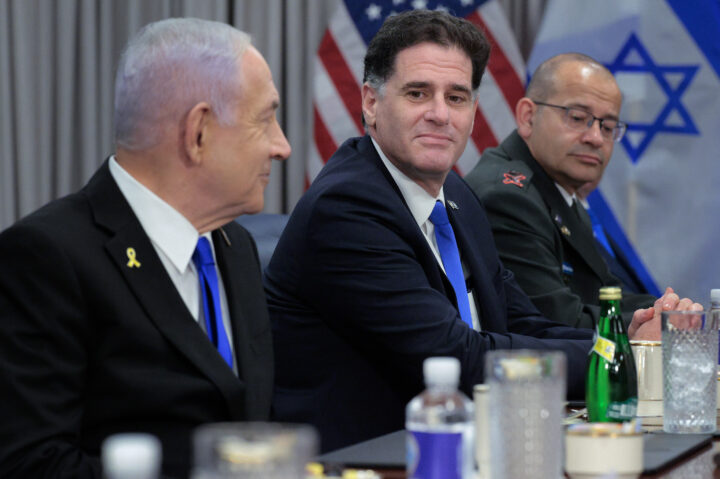
Chip Somodevilla/Getty Images
Israeli Prime Minister Benjamin Netanyahu (L) is joined by Israeli Minister of Strategic Affairs Ron Dermer and other officials for a meeting with U.S. Secretary of Defense Pete Hegseth at the Pentagon on July 09, 2025 in Arlington, Virginia.
In a wide-ranging interview, Israeli Minister of Strategic Affairs Ron Dermer connected Israel’s strikes against Iran’s nuclear facilities with Israeli Prime Minister Benjamin Netanyahu’s opposition to the U.S.’ 2015 nuclear deal with Tehran, saying that President Donald Trump wouldn’t have pulled out of the deal during his first administration without that precedent.
“I believe that what Iran’s strategy was [before Oct. 7] is to surround Israel with this ring of fire,” including Hamas in Gaza, Hezbollah in Lebanon and militias in Syria and Iraq. “And this is another reason why I was so opposed to the nuclear deal that was done in 2015,” Dermer said in the first installment of his interview on Dan Senor’s “Call Me Back” podcast, which dropped on Monday.
“And by the way, the attack [on Iran’s nuclear facilities] that happens now does not happen if Prime Minister Netanyahu doesn’t show up and confront that deal then. People don’t make the connection. I do, because I’ve lived it every day since then,” Dermer continued. “I don’t see Trump withdrawing if Netanyahu doesn’t take a stand, because no one’s going to be more Catholic than the pope, and no one’s going to be more pro-Israel than the prime minister of Israel.”
Dermer said he and Netanyahu began discussing striking Iran shortly after the Oct. 7, 2023, Hamas terror attacks on Israel. “I don’t know if it was Oct. 8, Oct, 9, Oct. 10, but I remember having conversations with [Netanyahu] early that we need to turn the tables on this, but ultimately the address is Iran. If you don’t deal with Iran and you don’t deal with its support for the proxies, then what is the impact you’re going to have if they can just sort of rebuild this stuff over and over and over again?”
“I think we have removed that threat [of the Iranian nuclear program] for the foreseeable future, particularly if we do the things that we need to do now in the aftermath” of the Israeli and U.S. strikes, Dermer continued, without elaborating.
Senor asked Dermer about leaks to the press prior to Israel’s war with Iran that portrayed a strained relationship between Trump and Netanyahu, with the two leaders reportedly at odds over whether to pursue military action or diplomacy with Tehran. “How much of it was orchestrated to throw everyone off, especially the Iranians?” Senor asked.
“I will tell you as somebody who’s been involved at the highest levels of the U.S.-Israel relationship …. [for] around 15 years, you’ve never had a level of coordination and cooperation that you had,” Dermer replied.
“I don’t know if it was the Monday or Tuesday [before the strikes began], there was a conversation between the prime minister and the president. And 50 years from now, people will say that was one of the best conversations ever between a prime minister and a president,” he continued. After press reports arose saying it was a “really tough call,” Dermer said he asked Netanyahu, “Did we leak that to make it look like it was a terrible call? He’s like, ‘No, no. Somebody else came and just assumed that this was a very, very terrible call’ … But we didn’t say anything at the time, because we thought it would help us, ultimately, with what we were trying to do.”
On the ceasefire negotiations with Hamas, which are ongoing in Doha, Qatar, Demer laid out the Israeli objective of removing Hamas from power in Gaza.
“I think the question is, how do you demilitarize Gaza and end Hamas’ political rule?” Dermer said, noting that “to kill every single Hamas terrorist in Gaza … would require us to take over everything and to stay there indefinitely. That’s not what the goal is. Hamas exists today in Judea and Samaria, in the West Bank … But they don’t control it.”
“Now, it might be that Hamas is willing to give up de jure control, and they say, ‘Well, somebody else will take out the trash, but we’ll continue to have this militia again.’ That’s something that’s not acceptable,” the minister continued.
In reference to the proposal under consideration — which includes a 60-day temporary ceasefire during which time around half of the remaining hostages would gradually be returned and the parties would begin to negotiate terms for a permanent ceasefire — Dermer said the question remains to be answered: “Can [Israel’s] minimal security requirements, can our minimum hit the maximum that they [Hamas] are capable of living with?”
“And we’re not going to know that until you have that engagement. And that’s the engagement that you need to have in the 60 days,” he said. “Because is there only one answer for what Gaza can look like the day after? No, I think there are several potential answers of what could happen. I worked on this last year, I mean, very quietly, of a potential plan that could work. And we will continue to work on it now.”
With no long-term ceasefire in Gaza and a strategy of trying to contain and balance Iran’s power in the region, the Saudis are in no rush to normalize relations with Israel, experts told JI

Win McNamee/Getty Images
President Donald Trump and Saudi Crown Prince Mohammed bin Salman interact with officials during a “coffee ceremony” at the Saudi Royal Court on May 13, 2025, in Riyadh, Saudi Arabia.
One of the original drivers of the 2020 Abraham Accords, in which the United Arab Emirates and Bahrain normalized relations with Israel, was Israel’s vocal, public stance against Iran’s nuclear program and regional aggression. That stance also brought Israel and Saudi Arabia closer, a relationship that developed to the point that in the summer of 2023, it seemed like normalization was just around the corner — which officials, including former Secretary of State Tony Blinken, have since confirmed.
By extension, it might make sense for the Abraham Accords and a Saudi-Israel rapprochement to be back in the headlines after Israel took the ultimate stand against Iran’s nuclear program last month, bombing it with assistance from the U.S. President Donald Trump has expressed hope to expand the accords in recent weeks, ahead of and during his meetings with Israeli Prime Minister Benjamin Netanyahu last week.
Yet there has been almost no serious talk about Saudi Arabia joining the Abraham Accords in recent weeks.
Riyadh has also been publicly signaling that its relationship with Tehran is still on track since China brokered a deal between the two countries in 2023. Saudi Arabia, like other Gulf States, spoke out last month against the Israeli and American airstrikes on Iran. Last week, Iranian Foreign Minister Abbas Araghchi met with Saudi Crown Prince Mohammed bin Salman in Jeddah.
With no long-term ceasefire in Gaza and a strategy of trying to contain and balance Iran’s power in the region, the Saudis are in no rush to normalize relations with Israel, experts told Jewish Insider.
Bernard Haykel, a professor of Near Eastern Studies at Princeton University, told JI that the Saudis’ statements came out of a fear that “if Iran is attacked by Israel and the U.S., the Iranians would retaliate against them … The public statements are all basically defending Iran’s right as a sovereign state to get the Iranians not to see them as an ally or a proxy of America and Israel.”
But, “in fact, they are allies of America,” he added.
“There’s all this public condemnation of the attacks on Iran,” Haykel said, “but when the U.S. pulled its forces from the Air Force base in Qatar [due to Iran’s retaliation], they moved their planes to a Saudi base. So they condemned the U.S. for attacking Iran, but they also gave the U.S. protection.”
In addition, he noted, Saudi Arabia is in CENTCOM, as is Israel, such that if any Iranian drones or missiles were detected over Saudi territory, the information would be relayed to Washington and Jerusalem. “It is a fact that [the Saudis] are part of a security architecture that protects Israel as much as it protects them.”
Haykel said there is a sense of relief in Riyadh from how the 12-day Israel-Iran war played out, but Saudi officials are still concerned about Iran’s remaining ballistic and cruise missiles: “[Iran is] very close and can swarm Saudi Arabia. Unlike Israel, the Saudis don’t have an Iron Dome. They’re much more vulnerable.”
The meeting between bin Salman and Araghchi is “part of the strategy to protect themselves from an Iranian attack,” Haykel added.
Hussein Aboubakr Mansour, a senior fellow at the Jerusalem Center for Security and Foreign Affairs and a researcher at the Institute for the Study of Global Antisemitism and Policy, told JI that “the Gulf states are immediate neighbors of Iran and will always have to live with them.”
“Iran will always be a problem for them no matter who is in power. It is a huge, advanced state, and they are these tiny Gulf states. They can’t stop Iran’s ambition and wish for hegemony,” he said.
Aboubakr Mansour argued that the Saudis have an interest in keeping the current Iranian regime in place, because a more liberal Iranian regime may turn itself into Washington’s favored Middle Eastern power, as it was in the 1960s and ‘70s, threatening the close relationship Riyadh has with the Trump administration.
“They have an interest in Iran remaining the pariah that it is,” he said.
Haykel said that the Saudis “are not going to shed tears for Iran, regardless of their public statements.”
“They sound like they’re anti-Israel, but in actual fact, the Israeli military capability that has been on display vis-a-vis Iran, the attack on the Iranian nuclear facilities and the Israeli capability to defend itself from Iranian attacks are all things the Saudis want,” he added. “They want an Iran chastened, that doesn’t use non-state actors and doesn’t have a nuclear program. They want a contained Iran.”
Saudi Arabia’s strategy has been “trying to get Iran to behave more responsibly,” rather than as a “hugely destabilizing factor in the region through its proxies,” Haykel said. That was also the motivation behind the 2023 China-mediated detente between Saudi Arabia and Iran, he explained.
Aboubakr Mansour said that balancing the other major powers in the Middle East — Iran, Israel and Turkey — is a priority for Riyadh.
A decade ago, “standing up to Iran was one of the main attractions of Israel [for the Saudis], that was true then,” Aboubakr Mansour said. “Now there’s a main factor they need to calculate, that the U.S. is not reliable and maybe it isn’t going to be again … [The Saudis] had four good years with Trump and the Abraham Accords, and then the Biden administration [and the Saudis] couldn’t stand each other.”
In addition, he said that the Gulf states “have a complete lack of hard power compared to Israel, Iran and Turkey,” and bin Salman has big ambitions for his country and its economy.
“All of these elements together lead them to calculate their national interests and strategy in a way that gives them maximum leverage over everyone all the time,” he said. “It’s about balancing everyone against everyone else … The Saudis’ ambition is huge and they can’t allow the Iranians, Turks or Israelis to become a hegemonic force in the region.”
As such, Aboubakr Mansour posited that “the Saudis are in a place where they want to see neither the Israelis nor the Iranians win. [The Saudis] want them to put each other in check, which will give [the Saudis] more leverage.”
As for what the means for Saudi-Israel normalization, Aboubakr Mansour argued that “the Saudis are comfortable playing the normalization game for as long as they can … because they can gain more from their current position than actually normalizing.”
Normalization talk gives the Saudis positive attention from the media, attracts investment and makes them look better in Washington, but “it’s a good show. There’s no reality to it,” Aboubakr Mansour said.
“They cooperate with the Israelis — they have a new class of statesmen who are [Millenials], they are not interested in the ‘resistance’ and see the positive in Israel — but interests dictate everything. They will play the game as long as they can extract more leverage from it … Normalizing with Israel doesn’t have the incentives for the Saudis that it did five years ago,” he said.
Haykel similarly said that “the Saudis are very good at temporizing, kicking the can down the road until they feel the time is right,” he added.
The Saudis “have their own constraints — domestic, regional and the Islamic public – that they have to keep in mind,” Haykel said. “They are insisting first and foremost on a ceasefire … They seem to be talking less about irreversible steps towards Palestinian statehood, but I think it is still a condition for normalization.”
Still, he said, “Palestinian statehood is seen in Israel as rewarding terrorism and not something the Israeli public is willing to entertain at the moment, and the Saudis know this well.”
Because of that, the Saudis have been “pushing for more cosmetic things … [such as] working with France to get as many states as possible to recognize a Palestinian state through the U.N.”
According to Haykel, the Saudis want to be able to say that a solution for Palestinian self-determination has been found, without making specific demands of what that means, whether the Palestinians would have an army or not, or if they would have full or partial sovereignty.
In that regard, not much has changed since Oct. 7, 2023, in that the Saudi leadership “never had much respect for the Palestinian Authority, with a few exceptions,” and as such, Riyadh does not want to be saddled with the bill for Gaza’s reconstruction because they do not think the PA is up to the task, Haykel said.
“They want some kind of face-saving solution with the ceasefire being a precondition,” he said. “They’re waiting for President Trump to put pressure on Netanyahu to reach a ceasefire and then make gestures toward the Palestinians.”
At the same time, Haykel warned that there is some talk in Riyadh of pushing for a U.N. Security Council resolution that would enshrine a right for the Palestinians to have sovereignty over the West Bank and to have a capital in east Jerusalem. The idea, he said, came from former PA Prime Minister Salam Fayyad.
“They would like the U.S. to push for this regardless of what Israel says or thinks or does,” he added, “but they have not moved to do this yet.”
Meanwhile, the only recent public movement toward Israeli-Saudi normalization was the appearance last week of Saudi journalist Abdulaziz Alkhamis in the Knesset for a meeting of the Caucus to Advance a Regional Security Arrangement.
Alkhamis said that the Oct. 7 terrorist attacks and subsequent war, along with the Israeli strikes on Iran, are a sign that the region’s “tectonic plates” are moving, and that Israel exposed Iran’s strategic limitations. However, he emphasized that “normalization, from a Saudi point of view, is not just a bilateral agreement. It is a regional alignment and must include a credible, irreversible path to Palestinian sovereignty.”
Former Israeli Defense Minister Benny Gantz said in the caucus meeting that “there is too much weight given to the Palestinian matter and it is being turned into [an excuse] to stay in place. We must be daring and make advances — we must, but we should also demand this courage from neighboring countries that want to advance normalization.”
The Ohio Democrat suggested the responses to the strikes from within his party are motivated by the current political environment, fears about a broader war and concerns about the future of diplomatic talks and the safety of people in the region
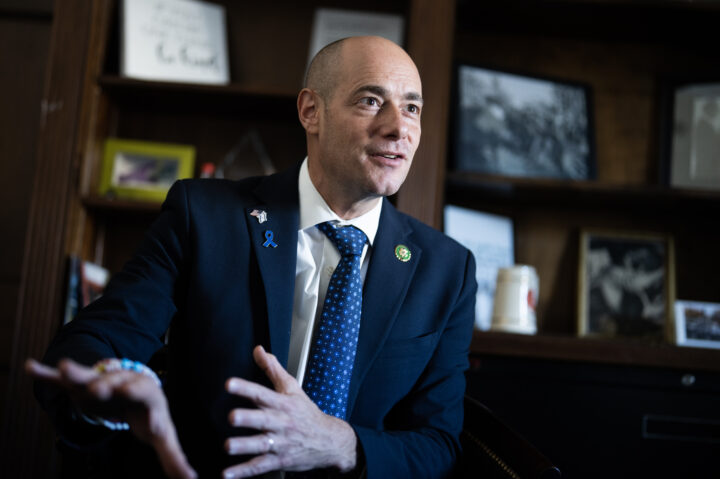
Tom Williams/CQ-Roll Call, Inc via Getty Images
Rep. Greg Landsman (D-OH) is interviewed by CQ-Roll Call, Inc via Getty Images in his Longworth Building office on Friday, November 3, 2023.
Rep. Greg Landsman (D-OH) has stood apart in recent weeks as one of a small number of congressional Democrats who’ve been supportive of the Trump administration’s strikes on Iranian nuclear facilities.
He argued in an interview with Jewish Insider last week and in a recent op-ed that the Israeli and American show of force, alongside the undermining of Iran’s proxies across the region, could be the key to weakening the Iranian regime to a point where it will agree to a fundamental change of course going forward, unlocking opportunities for regional peace and prosperity. And, he said, it’s critical that the U.S. move forward in a truly unified and bipartisan manner to capitalize on that opportunity.
Landsman told JI he thinks that his Democratic colleagues’ responses to the strikes are motivated by the current political environment, fears about a broader war and concerns about the future of diplomatic talks and the safety of people in the region.
“We’re just in a different political environment than the one I grew up in,” Landsman, 48, said. “The one I grew up in was ‘politics stops at the water’s edge,’ which I loved. … The thinking behind it … is that when we take on these really complicated foreign policy issues, that we do it in a bipartisan way, and that’s not the environment we live in right now.”
He said there’s also a “legitimate concern that it would provoke further attacks or it would instigate a broader war.” Landsman has argued that the current situation is fundamentally different from the run-up to the Iraq war that many skeptics of the strikes have invoked.
Some colleagues, he added, may have also had concerns about compromising diplomatic efforts or “legitimate concerns for people’s safety. But I think for others, and for a lot of folks, it’s just political,” he said.
Landsman said he still hews to the older approach, believing that it’s critical to work toward bipartisan common ground in critical foreign policy questions. He highlighted that the American people overwhelmingly oppose the prospect of an Iranian nuclear weapon.
“I think the American people want [our Middle East policy] to be bipartisan, all of it,” Landsman said. “I think they’re tired of the partisanship in general, but in particular, as it relates to how we resolve these international conflicts and how we take advantage of international or global opportunities, I think they are done with all of this being so partisan.”
He said he still believes a diplomatic solution with Iran is possible and necessary, but said the regime needed to be weakened and see that the U.S. is willing to use force in order to agree to totally dismantle its nuclear program and allow comprehensive international inspections and to dismantle its terrorist proxies .
Unlike some supporters of the strikes, Landsman said he doesn’t think regime change in Iran is the most productive goal, and that the U.S. should instead leverage the regime’s vulnerability for a more favorable deal and fundamental change to the regime’s posture.
“This regime wants to stay in power. If they decide — which they can, and now they’re so weakened that it’s an easier decision for them, and that’s why the strikes were important — they can decide, ‘We’re going to focus on the Iranian people’” and abandon terrorism and their ambitions to destroy Israel, Landsman said. “They could unlock the talent of tens of millions of incredibly brilliant people that have been stuck in Iran under this regime.”
He said that achieving that will “require real engagement and leadership” from both Congress and the executive branch.
Landsman has proposed establishing a bipartisan and bicameral congressional committee to work toward Middle East peace, and argued that the administration needs an expanded team working on the issue, describing Middle East envoy Steve Witkoff as stretched too thin.
“They need to lay out a vision for ending hostilities with Iran and ending the war in Gaza and giving people a sense of what will happen next in terms of peace and stability and security,” Landsman said.
The congressman argued that these issues are too difficult and too important for Congress to be excluded, or to be treated in a partisan manner. He pushed for deep and ongoing executive branch engagement with Congress, not just providing briefings, but in strategizing and building a lasting solution going forward.
Finally putting the Iranian threat to bed would set the Middle East on a fundamentally different course, Landsman argued. “[The Middle East] should be Europe, [if not] for Iran. It hasn’t been able to break out that way because Iran has been the primary obstacle.”
“Getting to a point where Iran is slowly but surely being removed as a threat opens up all the doors,” he said. “It just changes the dynamic for everybody.”
He said he believes leaders across the region see a path toward ending the war in Gaza and the long-running conflicts and building “a Middle East that’s entirely free from terror and countries are working together” and prospering.
In spite of the deep divisions that have increasingly characterized discussions in the United States on Israel and the Middle East since the Oct. 7, 2023, terror attacks, Landsman said he still believes that “the list of what we agree on is way bigger than the list of what folks may disagree on.”
The points of agreement across the American political spectrum include: that Iran cannot have a nuclear weapon; that Iran needs to be subject to stringent inspections; that Iran needs to cease its support for terrorists; that Hezbollah must be disarmed; that the war in Gaza needs to end; that the hostages need to be returned; that Hamas needs to be removed from power; and that international investment in collaboration with Israel and non-Hamas Palestinian leaders is needed to move Gaza forward.
“More international pressure can be brought to bear on Iran and Hamas and Hezbollah and the Houthis to separate them … and say ‘The world has come together. We are going to pick the side of those who want to rebuild the region and rebuild it free of terror and corruption,’” Landsman said. “Ultimately, when you have the kind of security that any country would need and expect, then you get back to the negotiating table.”
Landsman has spoken on multiple occasions in recent months about his aspirations for an abiding peace in the Middle East, a vision that he says is driven by a lifetime of connection and passion for Israel and the region.
He said his Jewish upbringing had inculcated in him a sense of connection to the importance of Israel for the Jewish people.
Landsman said that efforts to negotiate between Israel and the Palestinians were also a constant feature of his youth, and that he believes that there is still broad agreement on the goal of a durable peace that can provide security for Israel and self-determination and self-governance for the Palestinians.
A Harvard Divinity School graduate, the Ohio congressman has visited Israel numerous times as a lawmaker, but also traveled there frequently and built connections in his previous work in education advocacy. After implementing new preschool programs in the Cincinnati area, Landsman was asked to help work with Ethiopian Israelis to improve educational outcomes, an effort that grew between 2015 and 2020.
He said his time on the ground in Israel showed him that Jews and Palestinians “have a lot in common” — shared history, a shared home and common experiences of expulsion and rejection. And it highlighted to him the extent to which Arab Israelis are part of and integrated into Israeli society.
“I have built up this legitimate affection and love for these two communities of people that, because of circumstance, have been fighting,” Landsman said. “Ending that would transform everything — not just their lives, but the region and the world.”
A senator in attendance told JI that Netanyahu took a different tone discussing negotiations with Hamas: ‘It sure felt like he'd been told by Trump to get to a ceasefire’
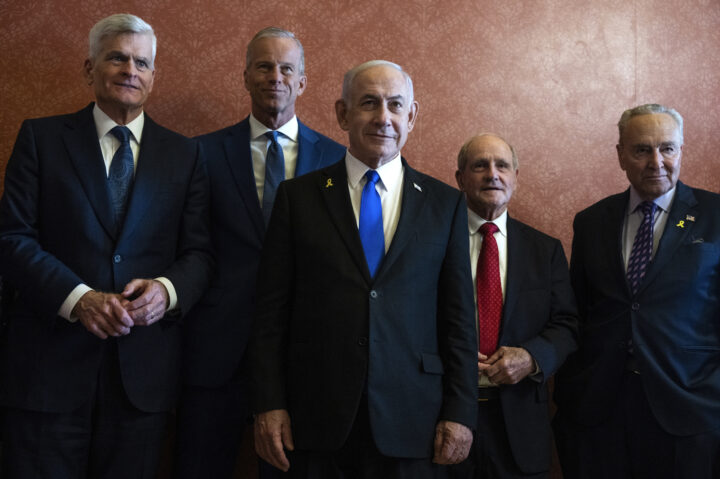
Tom Williams/CQ Roll Call via AP Images
Israeli Prime Minister Benjamin Netanyahu, center, is seen during photo op before a bipartisan meeting with senators in the U.S. Capitol on Wednesday, July 9, 2025. Also appearing are, from left, Sen. Bill Cassidy, R-La., Senate Majority Leader John Thune, R-S.D., Sen. Jim Risch, R-Idaho, and Senate Minority Leader Charles Schumer, D-N.Y.
Israeli Prime Minister Benjamin Netanyahu gathered with Senate leaders on Capitol Hill on Wednesday to discuss the ongoing efforts to reach a ceasefire in Gaza and expand the Abraham Accords.
Among those in attendance at the meeting, which was rescheduled from Tuesday, were Senate Majority Leader John Thune (R-SD), Senate Minority Leader Chuck Schumer (D-NY), Sens. Jim Risch (R-ID), Ted Cruz (R-TX), Steve Daines (R-MT), Bill Cassidy (R-LA), Chris Coons (D-DE), Jacky Rosen (D-NV), Maria Cantwell (D-WA), Amy Klobuchar (D-MN), Cory Booker (D-NJ) and Adam Schiff (D-CA).
The prime minister was joined by Israeli Ambassador to the U.S. Yechiel Leiter, Israeli Strategic Affairs Minister Ron Dermer and advisor Caroline Glick.
Netanyahu projected unity with President Donald Trump in comments to reporters just before the meeting, dismissing media reports “about the great tension between us, about the great disagreements between us” in the lead-up to Israel launching its attack on Iran’s nuclear facilities and on the ongoing ceasefire and hostage-release talks with Hamas, which Trump has been eager to finalize.
“President Trump and I have a common goal. We want to achieve the release of our hostages. We want to end Hamas rule in Gaza. We want to make sure that Gaza does not pose a threat to Israel anymore. In pursuing this common goal, we have a common strategy. Not only do we have a common strategy, we have common tactics. This doesn’t involve pressure, doesn’t involve coercion, it involves full coordination,” Netanyahu said.
“President Trump wants a deal, but not at any price. I want a deal, but not at any price. Israel has security requirements and other requirements, and we’re working together to try to achieve them. Everything else that you hear and are being briefed on is folly,” Netanyahu continued.
Behind closed doors, Netanyahu spoke for around 30 to 40 minutes about the rationale for Israel’s actions in Iran and Gaza and his vision for the Middle East, including the normalization of ties with Saudi Arabia and Syria through an expanded Abraham Accords, before taking questions from the group, two senators in attendance told Jewish Insider on condition of anonymity.
On Gaza, Netanyahu said that he and the U.S. were trying to reach a ceasefire deal with Hamas and did not suggest he had any opposition to the push, something one of the senators described as a shift in tone for the Israeli prime minister.
The senator noted that Netanyahu was “very clear [that] we are actively negotiating towards a ceasefire without the usual, predictable litany of reasons why we can’t [agree to a deal]. It sure felt like he’d been told by Trump to get to a ceasefire. It felt that way.”
Netanyahu also addressed criticisms of how Israel has handled the distribution of humanitarian aid in Gaza by pointing to Hamas’ seizure of relief packages and criticizing what he called the “humanitarian aid industrial complex,” according to the senators.
“Netanyahu said that one of the sticking points with Hamas is that they want to control the distribution of food. That’s how they make their money and get their recruits, and so they don’t want them to have control of the distribution of food,” one senator said.
“He told us, ‘We don’t want anyone to starve. We’re going to be delivering more humanitarian aid. We recognize people here are critical of how we’ve delivered humanitarian aid.’ But it was all wrapped in Hamas stealing everything we send in,” the other senator quoted Netanyahu as saying, adding that Dermer also answered several questions on the subject.
On the issue of Saudi normalization, Netanyahu outlined a plan for new energy cooperation through the region.
“He said if there was not the destabilization of Iran, without their proxies in Gaza, Syria and Lebanon, then the Saudis could run a pipeline through the desert, through Israel, to the Mediterranean,” one senator told JI. “So instead of having to go through the Suez Canal, you could just take it straight to the Mediterranean. Think about what that would do to international energy security and even to energy prices.”
Other topics touched upon were ways to address the threats from the Houthis and Hezbollah, as well as the best approach to Iraq.
Publicly, lawmakers said little about the sit-down. Thune called it “good,” while Schumer said that “there were a lot of comments back and forth,” declining to comment further.
Schiff said the meeting was “fine” and “informative.” He said he hadn’t had a chance to ask questions because the meeting was cut short by a Senate vote. “We covered the waterfront of issues.”
Sen. John Fetterman (D-PA) met privately with the Israeli leader on Tuesday.
“My meeting with Netanyahu was a great opportunity to discuss and congratulate Israel’s total domination over Iran and its proxies,” Fetterman told JI. “I expressed my admiration for the sacrifices of the IDF, my support for bringing the hostages home and my hope for the possibility of true peace in the region.”
Earlier Wednesday, Netanyahu met off Capitol Hill with Sens. Lindsey Graham (R-SC), Tom Cotton (R-AR) and Richard Blumenthal (D-CT).
“We discussed the importance of keeping the Iranian regime in a weakened state until they change their behavior toward Israel and the region, and toward the United States,” Graham said on X. ”We also talked about the mutual desire to continue to integrate the region politically and economically, moving toward the light away from the darkness. I completely support Israel’s position that Hamas must be removed from Gaza as part of any peace agreement and that Iran should recognize Israel’s right to exist as a prerequisite to any peace negotiations.”
Graham said that Netanyahu had also celebrated Graham’s birthday — his 70th — with cake and a rendition of “Happy Birthday.”
The Democratic candidate for New York’s 17th Congressional District called the U.S. strikes on Iran ‘alarming and unprecedented’

Getty Images
Effie Phillips-Staley
Effie Phillips-Staley, running on a progressive platform in the crowded Democratic field looking to unseat Rep. Mike Lawler (R-NY) in a swing congressional district, is taking a firm stance against the U.S. and Israeli strikes on Iran’s nuclear program, even as she has expressed concern about Iran’s nuclear ambitions.
“For the leader of the free world to decide to strike Iran based on Fox News coverage and without deliberation or the approval of Congress is alarming and unprecedented,” she said in a statement to Jewish Insider on Monday, a position shared by many congressional Democrats. “We cannot have a nuclear armed Iran under any circumstances and Congress must hold this President accountable by upholding the War Powers Act and requiring a full diplomatic process.”
She also expressed concern in a statement following the initial Israeli strikes on Iran.
“I do not support a nuclear Iran under any circumstances and understand Israel must preserve its security as it faces near constant threat of attacks. I am also deeply troubled at the rush to war, especially as diplomacy was underway,” Phillips-Staley said. “It is not lost on me that Trump’s decision to carelessly destroy the JCPOA in his first term has now put the lives of countless people, including Israelis and Americans, at risk. Diplomacy must be given a chance. We must prioritize the safety of innocent civilians, American personnel and peace.”
Phillips-Staley, a Tarrytown, N.Y., village trustee who has made her career in the nonprofit world focused on issues including the Hispanic community, public schools and art, told JI in an interview last month that she sees an open lane in the race for an unabashed progressive.
“I looked at the field and felt strongly that there was a space for a progressive candidate in this field, and so I decided to enter,” she said.
She’s leaning on that progressive positioning to distinguish her from a field of nearly 10 Democrats, many of whom are staking out broadly moderate or center-left platforms. Despite her criticisms of the Iran strikes, Phillips-Staley has otherwise not embraced elements of the left-wing policy agenda that have alienated Jewish voters.
Phillips-Staley said she wanted to be “very clear that the U.S. has to continue to be a critical ally to Israel,” emphasizing that Israel remains under threat and “does, of course, have a right to exist and should continue to exist.”
She indicated that she would oppose additional conditions or restrictions on U.S. aid to the Jewish state, which she emphasized is critical to keeping Israel safe from existential threats.
But Phillips-Staley criticized Israeli Prime Minister Benjamin Netanyahu, whom she said had “repeatedly undermined” a two-state solution, while adding that Hamas cannot continue to rule Gaza.
She said she wants to see Congress work to “create incentives to find a peaceful resolution,” but emphasized that the hostages must first be released. Phillips-Staley said that her family’s El Salvadorian background helps her understand the damage that a “cycle of violence can do” and how difficult it can be to interrupt.
She described the Abraham Accords as a framework that could be built upon for Israeli-Palestinian peace.
Speaking to JI in the aftermath of the antisemitic attacks in Washington and Boulder, Colo., Phillips-Staley called rising antisemitism nationwide “deeply, deeply troubling and appalling.” She suggested that brokering Israeli-Palestinian peace would help tamp down on antisemitism domestically.
“Apart from what everybody says — ‘we need more education, we need to come together more’ — I think we really have to work very hard to find a resolution to the conflict between Israel and Palestine,” Phillips-Staley said. “Peace creates peace. And the terrifying thing is … what is spilling from that unresolved conflict is now making Jews in America under threat even more, which is entirely unacceptable.”
She said the U.S. also needs to crack down on acts of violence and provide more resources to address antisemitism in the country.
Asked about the increase of domestic antisemitism predating the war in Gaza, Phillips-Staley criticized the first Trump administration, saying it had enabled and emboldened a range of unacceptable behavior, including white nationalism.
She expressed hope that a new Congress and subsequently a new presidential administration could help to reverse those trends.
Citing her own immigrant family background, she also criticized the Trump administration for implementing immigration restrictions in the name of combating antisemitism, explaining, “anything that creates wedges, that undermines the openness of people coming together, I question as effective.”
Phillips-Staley told JI she’s running for Congress to continue what she characterized as a lifetime of service in the nonprofit sector and, later, public office. She added that as the daughter of an immigrant from El Salvador, she has close ties to the Lower Hudson Valley district’s Hispanic and immigrant communities. She said those communities had urged her to run for higher office.
She currently lags behind many of the other candidates in the 17th District race in fundraising, though she entered the race more recently than several other competitors. In the first six weeks of her campaign she only raised $52,000, loaning her campaign an additional $100,000. She ended the third quarter with $103,000 on hand.
“Effie’s campaign is people-powered and grassroots,” campaign spokesperson John Tomlin said in a statement. “She does not come to the table with a list of corporations, ultra-rich and Washington establishment figures to seed her operation. We have an active campaign and we are on target with our goals.”
Rockland County Legislator Beth Davidson said she raised $350,000 in the past quarter and $850,000 since the start of her campaign, while national security veteran Cait Conley reported raising $472,000 in the second quarter and more than $800,000 since launching her campaign, and nonprofit leader Jessica Reinmann raised $311,000 in the first quarter, $100,000 of that self-funded.
Phillips-Staley argued that her lived experience as a Hispanic person from a working-class background, who put herself through college and worked her way up from a receptionist to executive director of a nonprofit, makes her fairly unique among political candidates and leaders.
Her key issues as a member of Congress, she said, will be affordability, particularly in housing, and protecting government services that help Americans succeed. She said she’s proud of the work she’s done on issues like infrastructure and zoning in her role in local government.
Azerbaijan's national energy company, SOCAR, finalized its purchase of a 10% stake in Israel's Tamar gas field

Leon Neal/Getty Images
President of Azerbaijan Ilham Aliyev arrives at the 6th European Political Community summit on May 16, 2025 at Skanderbeg Square in Tirana, Albania.
Following the Israel-Iran ceasefire and amid questions about the extent of the damage Israel and the U.S. inflicted on the Islamic Republic’s nuclear program, an important piece of news flew under the radar: Azerbaijan’s national energy company, SOCAR, finalized its purchase of a 10% stake in Israel’s Tamar gas field.
The deal and its timing amid hesitation from other countries that have considered investing in Israel, reflect a growing strategic partnership between Jerusalem and Baku — one that has garnered increasing pressure from Iran toward Azerbaijan.
The day after the ceasefire between Israel and Iran was announced toward the end of last month, Union Energy, owned by Israeli businessman Aharon Frenkel, received the final approval from Israel’s Petroleum Council and Competition Authority to sell half its shares of the gas field in the Mediterranean, which provides 60-70% of Israel’s electricity each year, to Azerbaijan’s SOCAR. Chevron owns 25% of the Tamar field and the UAE’s Mudabala owns an 11% stake.
Jerusalem and Baku have had relations since 1992, soon after the latter’s independence from the Soviet Union, and in 2023, Azerbaijan became the first Shi’ite Muslim-majority country to open an embassy in Israel.
Azerbaijan supplies as much as two-thirds of Israel’s oil, and Israel was the largest supplier of arms to Azerbaijan from 2016-2020. Israel continued to sell drones and missiles to Baku during its war with Armenia over the disputed Nagorno-Karbach region in 2020, as well as satellites and a missile-interception system in 2023, during another war between Azerbaijan and Armenia.
A 2009 U.S. diplomatic cable posted on Wikileaks described cooperation between Israel and Azerbaijan in terms that are still apt today: The relationship between Jerusalem and Baku is “an iceberg; nine-tenths of it is below the surface,” the cable stated.
Azerbaijan also shares a 475-mile border with Iran. The cable noted that “much like Israel, Azerbaijan perceives Iran as a major, even existential security threat, and [for] the two countries, cooperation flows from this shared recognition … Even open sources have identified an extensive relationship between the countries’ intelligence services … and it only stands to reason that this remains a major area of cooperation, which both sides naturally seek to downplay.”
Some parts of that relationship have surfaced: for example, that Israel smuggled Iran’s archive out via Azerbaijan in 2018.
Three years ago, Azerbaijan’s president, Ilham Aliyev, during a time of tensions with Iran, staged a photo-op of himself stroking an Israeli attack drone, after Tehran accused Baku of allowing Israel to “establish its presence in several regions of Azerbaijan.”
There had been persistent reports, going back over a decade, that Israel plans to use Azerbaijan’s airbases for a strike on Iran, which Baku and Jerusalem have consistently denied.
Tehran latched onto that theory at the onset of Israel’s 12-day operation targeting Iran’s nuclear and ballistic-missile programs.
The day the Israeli strikes began, Azerbaijan’s Foreign Ministry condemned “the escalation,” urging diplomacy, and a day after that, Azerbaijani Foreign Minister Ceyhun Bayramov told his Iranian counterpart, Abbas Araghchi, that Azerbaijan would not be used to attack Iran.
When the operation ended, IDF Chief of Staff Eyal Zamir said that commandos operated “on the ground,” but the military later clarified he meant in a nearby unspecified country.
On June 26, Iranian President Masoud Pezeshkian said in a call with Aliyev that Baku must “investigate and verify” reports that Israeli drones entered Iran via Azerbaijan. Aliyev denied that his country’s territory was used.
While the IDF has not publicized the details of every IAF flight to Iran, it has mentioned in its statements the long distances of flights, making it clear that Israel has the capability to fly directly to the Islamic Republic.
Farid Shafiyev, the chairman of the Baku-sponsored think tank Center for Analysis of International Relations, dismissed the pressure from Iran.
“The latest round of accusations is probably because Iran’s air defense was decimated and not capable of defense. The people in charge, especially the military establishment, are trying to find scapegoats,” Shafiyev told Jewish Insider. “My understanding is that different factions in the Iranian establishment are trying to blame someone outside of Iran for the failures of their military system.”
Shafiyev argued that “if Azerbaijan was somehow a part of [Israel’s operation in iran] it would be known by major intelligence agencies or by the media. It’s fake news.”
Relations between Iran and Azerbaijan have had ups and downs, such as the attack on Azerbaijan’s embassy in Tehran in 2023, he said, “but lately we have managed to maintain our relationship.” Pezeshkian even visited Baku last week for a regional economic conference, suggesting that the latest round of tensions between the countries may have subsided.
“If Iran were to try to exert pressure on someone, Azerbaijan would be a likely target because of that open relationship with Israel and Azerbaijan’s assets connected to the much larger global [energy] grid, supplying oil and gas to Turkey and Europe, in addition to Israel,” Gabriel Mitchell, the director of undergraduate studies at Notre Dame’s Jerusalem campus and an expert on the intersection between energy and security policy, said.
Gabriel Mitchell, the director of undergraduate studies at Notre Dame’s Jerusalem campus and an expert on the intersection between energy and security policy, told JI that “the dynamic with Iran is very serious.”
“If you consider all of the things that have happened over the 20 months of war [in Gaza],” Mitchell said, “such as [Iranian President Ebrahim] Raisi dying in a helicopter crash [that originated in] Azerbaijan, the escalation between Israel and Iran, and it is no secret the degree to which Israel and Azerbaijan have collaborated on security issues in the last decade and a half, it’s natural for Iran to start pointing fingers.”
“If Iran were to try to exert pressure on someone, Azerbaijan would be a likely target because of that open relationship with Israel and Azerbaijan’s assets connected to the much larger global [energy] grid, supplying oil and gas to Turkey and Europe, in addition to Israel,” he said.
Mitchell noted that there is a large ethnic Azeri minority in Iran, and Iran’s pressure on Azerbaijan also sends a message to that minority to curb any rebellious aspirations.
“Iranian pressure may have nothing to do with Israel and more to do with internal politics,” he added. “It’s impossible for them to flex against Israel right now and they’re not going to act against the Gulf states, so Azerbaijan is a soft middle ground that has a complicated relationship with Iran.”
Despite the ongoing backlash from Iran over ties with Israel, Azerbaijan’s state energy company SOCAR buying a stake in Israel’s Tamar gas field indicates that Baku is not hiding or backing down from a close relationship with Jerusalem.
“SOCAR is not an independent company,” Mitchell said, “so [the deal] is signalling not only to Israel but to the region and the U.S. that Azerbaijan is interested in cooperating with Israel … and wants to be part of broader regional arrangements in a more constructive way.”
The sale of a significant stake in a gas field in the eastern Mediterranean “stands in contrast with anything else going on in the region,” Mitchell said. “Very few companies are interested in making investments in the EastMed natural gas scene right now for understandable reasons, not only because of the war, but … Egypt has economic issues with being able to fulfill payments, which has dampened interest from oil and gas companies in investing in the region.”
“That SOCAR decided to take this leap is rare, and for that reason it should be applauded. It’s only a good thing for Israel,” he added. “I wouldn’t be surprised if other companies saw it as a green light for them to invest.”
The investment is also likely to benefit Azerbaijan as Tamar is a very reliable gas field, Mitchell said: “Azerbaijan can always say, ‘Set aside geopolitics, we’re just here for the money.’”
“When it comes to Turkey,” said Farid Shafiyev, the chairman of the Baku-sponsored think tank Center for Analysis of International Relations, “Israelis should understand that we are very close, we are military allies … Overall, I think there is room for diplomacy and Azerbaijan can play a role.”
Azerbaijan had the confidence to invest in the Tamar field, Shafiyev said, “because we believe the conflicts in the Middle East will not cause a major crisis that will make the fields inaccessible.”
The bilateral ties have withstood the souring relationship between Azerbaijan’s strongest ally, Turkey, and Israel, and Baku has at times served as a mediator between them.
“When it comes to Turkey,” Shafiyev said, “Israelis should understand that we are very close, we are military allies … Overall, I think there is room for diplomacy and Azerbaijan can play a role.”
The Azerbaijan-Israel relationship also remains stable despite the war in Gaza and beyond, Shafiyev said, because it rests on a decades-long foundation. He also cited the longstanding community in Azerbaijan of Mountain Jews, a population that has inhabited the eastern and northern Caucasus since the fifth century.
Roman Gurevich, the Jewish Agency’s honorary ambassador in Azerbaijan, who is well-connected in the government in Baku, said that “the deep-rooted friendship between the Jewish and Azerbaijani peoples has naturally evolved into the warm relationship Azerbaijan now shares with the State of Israel. When the brutal Hamas attack occurred on Oct. 7, [2023], ordinary citizens in Baku brought memorial candles and flowers to the Israeli Embassy in a spontaneous outpouring of solidarity.”
“Regardless of outside pressure or hostility, Azerbaijan remains committed to its friendship and strategic alliance with Israel and the Jewish world,” Gurevich added. “A strong, independent Azerbaijan that honors its friends and knows how to defend its interests is an invaluable ally for Israel.”
Rogers, a former House Intel Cmte chair: ‘I was for all of this when it wasn’t very cool to be for all of this’
AP Photo/Paul Sancya, File
Republican Michigan Senate candidate Mike Rogers speaks during an election night watch party, Nov. 5, 2024, at Suburban Showplace Collection in Novi, Mich.
Former Rep. Mike Rogers (R-MI), making his second bid for Michigan’s Senate seat, is leaning into his support for the Trump administration’s decision to strike Iran’s nuclear program on the campaign trail.
Rogers emphasized, in an interview with Jewish Insider last week, that he has long been suspicious and concerned about Iran’s nuclear program and other malign activities dating back to his time as the chairman of the House Intelligence Committee in the early 2010s, when he had access to highly classified information.
“I couldn’t have supported [the operation] more,” Rogers, who served in the House from 2001 to 2015, said. “I was for all of this when it wasn’t very cool to be for all of this.”
The former lawmaker said he believes that Iran was much closer to a nuclear weapon than many believe, noting that its development of advanced supercomputers would likely have allowed it to reliably simulate a nuclear weapons test, an undetectable alternative to actually testing a nuclear bomb.
“I believe, on the day that Trump went in, that they had all three components” of a nuclear weapon: highly enriched uranium, a weapon and a delivery system using a ballistic missile, Rogers said. “They just didn’t have them assembled.”
He said that the “urgency of which Israel undertook their mission” suggests to him that Iran was working to bring those three elements of a nuclear weapon together.
Rogers added that the U.S. and Israel need to take seriously Iran’s threat to wipe out Israel if it obtains a nuclear weapon.
Rogers said that the destruction of much of Iran’s enrichment capacity — particularly the strikes on Fordow — and many of its missile launchers, as well as its anti-aircraft capabilities, put Iran on its back foot if it attempts to reconstitute its program. He predicted it would take Iran years to regain access to Fordow, if it attempts to do so.
“What I have said publicly is, I believe we should leave the option on the table for another round of attacks targeted at their nuclear capability,” Rogers continued. “I don’t care if it’s in uranium enrichment stockpiles, delivery equipment … there’s always the possibility you might find another centrifuge effort somewhere.”
He said that making clear that the U.S. is prepared to act again will help force Iran back to the negotiating table and rebut Iranian deception and stalling tactics in negotiations.
The U.S. strikes could create heated political dynamics in Michigan in the upcoming election cycle, as the war in Gaza did in the 2024 election, in the Jewish, Muslim and Arab communities.
When speaking to Arab and Muslim voters, Rogers said he emphasizes the ways that the Iranian regime has hurt the Muslim world, saying it has killed many more Muslims and Americans than it has Jews and that its support for groups like Hamas and Hezbollah has destabilized the region and undermined opportunity and prosperity.
“My argument is this may be the first step. I think this is the most consequential time in American, Israeli and Middle East politics in my lifetime, because I think the president set the tone for real peace,” Rogers said.
Rogers added: “I am against military adventurism, I think it’s a terrible idea for the country. What you saw here, and this is how I explain it to them — this is very surgical. … If you’re going to tout peace through strength, you have to show the strength path. Iran was undeterred up to this point.”
He described potential future talks with Iran as on a fundamentally different footing than they have been in the past: now, he argued, the debate is not over details like International Atomic Energy Agency inspection schedules, but a more comprehensive and permanent solution and peace.
Rogers added that he keeps his message on Middle East policy consistent regardless of whether he’s addressing Jewish or Muslim audiences.
“You can’t say one thing to one group and another thing to another. It never works,” Rogers said. “But if they know where you’re at and they can articulate why you’re there and why support of Israel is so important, both to me personally, but I think to the country … and Republicans, we talk about it too, that’s this debate, should we or shouldn’t we.”
Rogers is looking like the early favorite to emerge as the GOP nominee for the seat of retiring Sen. Gary Peters (D-MI). He is backed by Senate Republican leaders, as well as Trump campaign co-manager Chris LaCivita. But Rep. Bill Huizenga (R-MI) is considering challenging Rogers in the primary.
Rogers described himself as “one of the first folks” to raise alarms about the Joint Plan of Action, the precursor to the Obama administration’s nuclear deal, during his time in the House.
“I thought we were engaging and empowering Iran in a way that seemed to me that the Obama administration just didn’t understand, or didn’t want to understand, who Iran is, what their intentions are, and when they say they want to wipe Israel from the face of the earth, they actually mean it,” Rogers said.
He also said that he was among the first to sound the alarm about the Houthis, in 2013 or 2014.
“I said that if we don’t do something about the Houthis … we’re going to have a problem, and it’s going to be a problem for Israel, our greatest ally in the region, and our security as well,” Rogers said. He visited Yemen at the time and said he watched in real time as the group grew its capabilities and deepened its ties to Iran, at the same time that the situation in Yemen deteriorated.
“We couldn’t get people interested in [it] enough to understand what the threat was,” Rogers said. Going forward, “I would make sure that the Houthis understand what U.S. intention and Israeli intention is, if they continue to shoot at our sailors in our commercial enterprise in the region.”
“Those attacks on Fordow, that was the U.S. showing strength,” Rogers continued, invoking the motto of “peace through strength.” “Now let’s get to the peace part, but you also may have to reduplicate that in a few places to get people’s attention.”
Prior to his service in Congress, Rogers was an FBI agent, during which time he said he was involved in tracking down Iraqi agents inside the United States, during the first Gulf War. He said that there are some parallels between those “sleeper cells” and Iran’s more recent efforts to infiltrate and carry out operations in the United States.
“Here’s what I worry about — the difference between the Iraqi operations and what I know that Iran had the capabilities then as well,” Rogers said. “The Iranians will be, I think, more loyal to their mission than the Iraqis. … By the time [the Iraqis] lived here for 10 years, they thought, ‘This America thing is pretty good. I don’t know if I want to screw this up.’ I think the Iranian threat is much worse than the Iraqi threat at that time because they’re more passionate about it.”
He emphasized that Iran’s operations globally, including in the U.S., have been “pretty aggressive,” and serious in their planning and intentions and have disregarded potential civilian casualties.
“You need to reassign some agent manpower here to make sure you’re dealing with it” and get ahead of the Iranians before they can execute their plans, Rogers said. “Sometimes just including letting them know, ‘We know who you are, we know where you live, we know what you’re doing.’ That stuff can be a pretty good deterrence sometimes.”

Maxar/Getty Images
Maxar satellite imagery reveals new damage at the tunnel entrances of the Isfahan nuclear site following U.S. airstrikes. The entrances show signs of impact and obstruction. Satellite image (c) 2025 Maxar Technologies.
After Israel’s 12-day war with Iran, the U.S. is now demanding that Tehran return to the negotiating table.
“Told you so,” many prominent Democrats — including architects of Iran policy in both the Obama and Biden administrations — are saying in response, arguing they were right all along about the power of negotiations. But in doing so, they are also overlooking the impact of President Donald Trump’s military strikes against Iran’s nuclear facilities on the regime’s negotiating calculus.
The Pentagon is now saying the strikes set back the Iran nuclear program by two years. Lt.-Gen. Eyal Zamir, the IDF’s chief of staff, said that Iran is no longer a nuclear threshold state as a result of the U.S. and Israeli attacks.
But those assessments, among other similar analyses, have done little to change the minds of some of the leading Democratic foreign policy hands who have long argued for diplomacy above all else.
Susan Rice, who served as national security advisor during President Barack Obama’s negotiations with Iran, said this week that Trump’s use of military force in Iran was a “strategic mistake,” because “diplomacy had not been exhausted.” President Joe Biden’s national security advisor, Jake Sullivan, was skeptical that the impact of the brief war with Iran will be long-lasting.
“OK, then what?” he said in an interview with CNN last week. “We still need a deal.”
Former Secretary of State Tony Blinken was more circumspect. He called the U.S. strike on Iran “unwise and unnecessary.” But, he wrote in The New York Times, now that it happened, “I very much hope it succeeded.”
The White House hopes that the military successes — and threats of further strikes if needed — will translate to a tougher negotiating position and garner more concessions from Iran.
It has at least one prominent Bidenworld name on its side: Brett McGurk, Biden’s top Middle East advisor. (McGurk has worked in both Democratic and Republican administrations.)
“This has been a remarkable feat of Israeli military and intelligence proficiency, together with American military power that is unmatched globally,” McGurk wrote in a CNN analysis.
But even McGurk, a rare Biden appointee who offered praise for Trump’s actions in the Middle East, warned that it will take time to know just how successful the U.S. and Israeli efforts will be, though he argued that they dealt Iran its “greatest military setback” since the Islamic Revolution in 1979.
“No doubt, this short crisis was well managed and well handled by Trump and his national security team, but the ultimate judgment is far from rendered,” McGurk wrote. “The question now is whether this tactical success will translate into strategic gains.”
The looming question is whether the strikes will push Iran closer to — or further from — the negotiating table. And the answer to that relies on the degree to which Iran believes that the U.S. and Israel will mount further attacks on its nuclear program — or if they are satisfied with the time bought by last month’s strikes.
Iran’s foreign minister told American media that the country can quickly restart its program, despite ‘heavy and severe’ damage

Satellite image/Maxar Technologies
Maxar satellite image reveals multiple buildings damaged or destroyed at the Isfahan nuclear technology center after the airstrikes.
The Pentagon’s chief spokesman said on Wednesday that the U.S. strikes against the Iranian nuclear program had set the program back by two years. His estimate appears to be the most specific information the Trump administration has shared on the extent of the damage caused by the strikes.
U.S. allies “share our sentiments about the degradation of Iran’s nuclear program and the fact we have degraded their program by one or two years … I think we’re thinking closer to two years,” Sean Parnell said at a press conference.
The administration has consistently claimed the strikes completely destroyed the nuclear program. During the briefing, Parnell said that he believed the combination of U.S. and Israeli strikes would be successful in deterring Tehran from continuing its nuclear program in the future.
“We believe that sending bombers from Missouri, 37 hours on a mission, not a single shot fired on them, took a very strong psychological toll on the Iranian leadership,” Parnell said. “So, when you take the constellation of different things into consideration, we believe Iran’s nuclear capability has been severely degraded, perhaps even their ambition to build a bomb.”
Parnell’s remarks came hours after Iranian Foreign Minister Abbas Araghchi told CBS News that the country’s nuclear facilities were “heavily and severely damaged.” Araghchi maintained that Iran’s enrichment equipment and knowledge base were not impacted, despite Israel assassinating several of the country’s senior nuclear scientists.
Araghchi also said that Iran’s nuclear agency was still conducting damage assessments at the Fordow, Natanz and Isfahan nuclear sites. This was confirmed by geospatial imagery analysis from the Institute for Science and International Security, which showed crews working to gain access to the underground sections of the facilities.
The military victories under Netanyahu's leadership are seemingly not staunching the Israeli right’s continued collapse in the polls as the war grinds on in its 635th day
MARC ISRAEL SELLEM/POOL/AFP via Getty Images
Israeli Prime Minister Benjamin Netanyahu stands amid debris outside the Soroka Hospital in the southern city of Beersheba, after it was hit by a missile fired from Iran on June 19, 2025.
It might be hard to remember now, with all that has happened in recent weeks, but the Knesset seemed very close to calling an early election a day and a half before Israel commenced its airstrikes on Iran’s nuclear and ballistic missile programs last month.
Israeli Prime Minister Benjamin Netanyahu received a post-Iran victory bump, and is once again leading in the polls – but not by much. A poll published on Tuesday showed his Likud party leading a potential party led by former Prime Minister Naftali Bennett by only two seats, and tied with Bennett for leading candidate for prime minister. Another pollster showed a similar margin during the Iran operation, but had the two parties tied after the ceasefire. Parties in the current coalition made up less than half of the Knesset in every poll. In a poll from the Israel Democracy Institute published on Wednesday, only 46% of Jewish Israelis said they trust Netanyahu.
A common accusation heard by Netanyahu’s political opponents at home and abroad is that he is prolonging the war in Gaza to stay in office, because ending the war before his far-right coalition partners deem Hamas fully defeated would likely see the collapse of his government. But the victories under his leadership are seemingly not staunching the Israeli right’s continued collapse in the polls as the war grinds on in its 635th day.
Though Israelis are impressed by their intelligence agencies’ feats and pilots’ daring and skill that significantly degraded Hezbollah and then Iran, they clearly remember who was in charge during the Hamas massacres on Oct. 7, 2023. Fifty hostages remain in Gaza; 13 soldiers have been killed there in the past three weeks. Inside Israel, thousands have been displaced due to Iranian strikes — joining the thousands more who were left without homes after the Oct. 7 attacks.
An Israeli comedian’s video last week asking why there isn’t a victory parade after “winning” in Iran went viral; she answered that Israel is in a Babushka doll of a war within a war within a war. “We need to end something,” she said.
Netanyahu may consider the political advantages of “ending something” as he heads to Washington next week while President Donald Trump is pushing for a broad deal that would encompass a Gaza ceasefire and the release of hostages, the administration of Gaza by moderate Sunni states, normalization between Israel and Syria and perhaps other countries, plus working to ensure Iran doesn’t rebuild its nuclear program.
Hamas tends to spoil the best-laid plans of American negotiators, but Trump has been hinting that things are moving in a positive direction in the past few days.
If Netanyahu returns to Israel with a Gaza ceasefire and the hostages returned, an expanded Abraham Accords and a way to keep Israel’s achievement in Iran intact, then he may get a more significant electoral bump. In that scenario, one option for him could be to ride that wave and call a snap election, rather than wait until the official October 2026 date for the vote.
Or, Netanyahu could see this as his legacy-clinching move, a sign that his work is done. In 2021, the prime minister said that he wants his legacy to be that he was the “protector of Israel, because I devoted much of my adult life to preventing Iran from having a nuclear weapon.”
That doesn’t seem likely in light of Netanyahu’s behavior over the years. After he lost the 1999 election, Netanyahu returned to publicly commenting on politics as a “concerned citizen” the following year and by 2002 was foreign minister. When he lost the election in 2021, he remained as opposition leader and successfully peeled off members of the Bennett coalition, contributing to its demise.
But Trump’s recent Truth Social posts tying together a deal and Netanyahu’s corruption trial are instructive here. Trump seemed to be lamenting that the trials are time-consuming when Netanyahu’s focus should be elsewhere. But there are constant rumors of a plea deal or a pardon of some sort, which could also pave the way for a dignified exit from the political stage, saying he fulfilled the promise of most of his political life, to stop Iran from going nuclear.
An Israeli official told JI that ‘everything’ is on the agenda, including Iran, Gaza and expanding diplomatic relations with Arab and Muslim countries

SAUL LOEB/AFP via Getty Images
President Donald Trump with Israeli Prime Minister Benjamin Netanyahu during the signing of the Abraham Accords.
Israeli Prime Minister Benjamin Netanyahu’s White House visit next week is a chance to “take advantage of the victory” in Iran, he said at the start of a Cabinet meeting on Tuesday.
The trip to Washington “comes as a continuation of the great victory we achieved in Operation Rising Lion,” Netanyahu said, referring to Israel’s 12-day operation against Iran’s nuclear and ballistic missile program, which the U.S. joined. “Taking advantage of the victory is no less important than achieving the victory.”
An Israeli official told Jewish Insider on Tuesday that “everything” is on the agenda, including U.S.-Israel cooperation to stop Iran from rebuilding its nuclear program, next steps in Gaza and the possibility of establishing diplomatic relations with Syria and other Arab and Muslim countries.
Netanyahu and Trump are said to be discussing a sweeping plan that would include all of those elements. However, the official noted on Tuesday, Israel has yet to decide what it wants to do in Gaza.
The trip will be Netanyahu’s third visit to the White House this year, having previously met with Trump in the Oval Office in February and April. The prime minister said he plans to meet with Vice President JD Vance, Secretary of State Marco Rubio, Secretary of Defense Pete Hegseth, Middle East envoy Steve Witkoff, Commerce Secretary Howard Lutnick and legislators, who he did not name.
Israel held two Security Cabinet meetings this week that ended inconclusively, with a split as to whether to escalate the war in Gaza to further weaken Hamas or to accept a ceasefire, and whether, if the government chooses the latter, such a move would be temporary or comprehensive.
A temporary ceasefire would likely be 60 days long and include the release of half of the remaining hostages in exchange for hundreds of Palestinian prisoners, including terrorists.
A long ceasefire, as part of Trump’s broader plan for the region, would see Hamas release all 50 remaining hostages, some 20 of whom are thought to be alive, in exchange for an end to the war. Israeli troops would remain along Gaza’s perimeter, and there are still discussions about whether there will be troops present on the Philadelphi Corridor along the Gaza-Egypt border, a source told JI earlier this week.
The Trump administration has also proposed that the United Arab Emirates, Egypt and Saudi Arabia take over Gaza’s administration.
Netanyahu denied an Israel Hayom report about the Israeli government pursuing a deal that included Israeli acknowledgment of a future Palestinian state, something his coalition partners strongly oppose.
In his remarks during Tuesday’s Cabinet meeting, the prime minister emphasized the support he received from his ministers during the Iran operation, and noted that the operation had the backing of much of the government’s political opposition.
“This is important and I hope it will continue … I thank each and every one of you for the outstanding cooperation,” he said.
Spielman hopes his new book on archeological finds from the City of David will help young Jews ‘stand on a foundation of truth’

Courtesy
Doron Spielman
After Israel waged war against an Iranian regime that has vowed to destroy the Jewish state and diaspora Jews face a heightened atmosphere of antisemitism stemming from the Israel-Gaza war, a new book aims to equip Israel supporters with “a foundation” to refute claims that Jews do not have ancient roots in the land of Israel.
When the Stones Speak: The Remarkable Discovery of the City of David and What Israel’s Enemies Don’t Want You to Know, written by former IDF spokesperson Doron Spielman, does so by recounting discoveries made in Israel’s largest excavation site, the City of David, where Spielman has worked closely with archaeologists for two decades to uncover and promote the site’s historical significance.
The book, Spielman suggested in an interview with Jewish Insider, is aimed at what he calls “the middle group of people” — “logical, reasonable people” who don’t know whether they’re pro-Israel or anti-Israel. “When they understand that ‘when the stones speak,’ they tell the story of the truth of the Jewish people’s connection to the land,” that could help sway the conversation on college campuses. This middle group will come to understand, he said, that “at the very least [the Israeli-Palestinian conflict] is a fight between two people who think they’re indigenous, and at the very best they understand the Jews are people who have only one land, they’ve been there for 3,800 years and therefore they have a right to defend it.”
That understanding “will have not only a huge impact on [the rise of antisemitism on college] campuses,” Spielman said, it “will have a huge impact on the Jews on those campuses. Jews on campus need to be able to stand on a foundation of truth that Israel is in fact their land. Without this knowledge, they cannot make that statement.”
Spielman hopes the book’s impact will also reach supporters of New York City mayoral candidate Zohran Mamdani, the presumptive winner of the city’s Democratic primary last week, amid his refusal to condemn the phrase “globalize the intifada” and denial that Israel has a right to exist as a Jewish state.
“He’s denying the Jewish people their right to live as a nation in the one place they ever called home,” Spielman told JI. “When the Stones Speak cuts through the lies with facts on the ground — literally.”
Spielman, who lives in Jerusalem, wrote the book’s first draft before Hamas launched its Oct. 7, 2023, attacks in Israel. Before the massacre, he had planned to meet with his editor on Oct. 8, 2023. That was put on hold when he was drafted into the reserves for 100 days. “When I came back to the book, I understood how far Hamas was willing to go with its ideology,” Spielman said. “If they aimed to erase our history, then the next thing they were going to try to do was erase us as a people.” So in light of Oct. 7, he reedited the entire book — which made it to The New York Times bestseller list just weeks after its May 13 publication.
“This is not just an academic debate, this is a battlefront,” Spielman continued. “The Jewish people need to understand and own our identity. This is critical — literally life and death — for Jews and Israel supporters to understand this because this is exactly what our enemies are fighting against.”
Since Israel launched its preemptive military campaign against Iran — a move that Spielman said “will prevent a major [worldwide] escalation later on with China,” which backs Tehran — Spielman said that the message of his book has become even more critical. It comes as the Iranian regime has been at the forefront of the effort to deny Jewish connections to ancient Israel.
“The Quds Force, which is the long arm of Iran and provides support for Hezbollah, Hamas, militias, is based on the very principle that the faith the ayatollahs want to establish reaches all the way to Jerusalem and replaces completely what they call the Zionist state,” Spielman said. “It’s not by chance that Hamas, which is a child of Iran, has taken this idea of denying Jewish history and translated it into absolutely the educational indoctrination of every Palestinian in Gaza and the West Bank, [who] are taught that Jews have no connection to their history in Jerusalem.”
Amid a rise of antisemitism in America, Spielman is hopeful that the book will help combat the movement by left-wing groups to equate the Zionist movement with “settler colonialism.”
“If we’re looking to understand why Jews are being attacked on campuses, it’s the same ideology of denying the connection between Jews and Jerusalem — that is exactly what is erupting on campuses, the claim that we are settlers and colonialists,” he said. “I wrote this book before Oct. 7 in order to establish firmly that we have the archaeological proof that the Jewish people are more indigenous to Israel than any people are in any area of the world today. We have an unbroken chain.”
Spielman expressed hope that the discoveries and insights from the City of David eventually make their way into textbooks used in American middle and high schools. He also called on the U.S. Department of Education to work proactively to ensure that students are taught about the historic ties of the Jewish people to the land of Israel.
He pointed to one of his findings from several years ago at the entrance of the City of David: the seals of two ministers who in the Book of Jeremiah tried to kill the namesake prophet.
“A massive campaign erupted throughout the Muslim world denying the legitimacy of these findings,” Spielman said. “They also realized what a threat this was to the narrative of the Palestinians which was claiming that the Jews have no connection and therefore they began identifying the City of David as a massive settlement effort, never mentioning the name of the City of David. It’s amazing that they did this because they realized that they can’t stop the archaeology so they tried to stop the entire site … [The] bottom line is that all of the claims that Jews are settlers shatter when they are held up over the bedrock of the City of David and the discoveries we’ve made.”
Spielman noted that City of David excavations have “widespread acceptance” across the political spectrum in Israel, with politicians from Prime Minister Benjamin Netanyahu to Yair Lapid, the opposition leader, having visited the site.
“Within the standard Israeli electorate, the City of David is really a central place of Israeli identity today and therefore the budget is funded by private individuals around the world as well as Israeli tax dollars,” Spielman told JI.
He urged world leaders to visit as well. “For the same reason that Washington, D.C., is the historical site that you want every diplomat from around the world to see, a diplomat that comes to Israel that only goes to Yad Vashem [Israel’s Holocaust museum] is only getting five years of the Jewish story of exile. When you go to the City of David, you’re getting 2,000 years.”
At the City of David, there is “something deeper than modern-day geopolitics,” Spielman said. “There is a claim here that goes to the heart. It’s something Israelis have ignored for a long time. We cannot stand strong about our rights to the land of Israel unless we understand the very foundations of our connections to the land. Archaeology, DNA, ancient texts and the stones of Jerusalem prove what history already knows— the Jewish people are not colonizers in their homeland.”
“It’s not enough to talk about how we carry out our military and that we’re a moral army. We have got to go back to the reason we’re here.”
Obama’s former national security advisor disagreed with David Petraeus, John Bolton over the effectiveness of the strikes

Win McNamee/Getty Images
Former National Security Advisor Susan Rice speaks at the J Street 2018 National Conference April 16, 2018 in Washington, D.C.
Susan Rice, who served as national security advisor during the Obama administration’s nuclear deal with Iran, sharply criticized President Donald Trump’s decision to strike Tehran’s nuclear program while defending the 2015 agreement during a panel discussion on Monday at the Aspen Institute’s Ideas Festival.
Rice, who was on stage with former Trump administration National Security Advisor John Bolton and former CIA director David Petraeus, disagreed with her two colleagues that Trump’s Iran strikes were largely a success.
“I think the resort to military action when diplomacy had not been exhausted was a strategic mistake,” Rice said. “And the reality is, and we’re back to this point today, only diplomacy and a negotiated settlement can ensure the sustainable and verifiable dismantling of Iran’s nuclear program. You need inspectors on the ground. You need verifiable constraints that are very significant, and you don’t achieve that by ripping up the 2015 nuclear agreement and replacing it with nothing.”
Rice joins a chorus of former Obama and Biden administration officials who have criticized Trump’s decision to strike Iran’s nuclear facilities, despite many experts concluding the damage to the program was significant. IDF Chief of Staff Eyal Zamir, for instance, said that “based on the assessments of senior officers in IDF Intelligence, the damage to [Iran’s] nuclear program is … systemic … severe, broad and deep, and pushed back by years.”
Last week, former Secretary of State Tony Blinken wrote an op-ed in The New York Times: “The strike on three of Iran’s nuclear facilities by the United States was unwise and unnecessary. Now that it’s done, I very much hope it succeeded.”
At the Aspen Ideas Festival last week, former Biden administration National Security Advisor Jake Sullivan told moderator Fareed Zakaria: “We still need a deal because Iran still has, it appears, stockpiles of enriched uranium, still has centrifuge capacity, even if the installed centrifuge capacity has been destroyed or damaged or who knows what, and still has know-how and therefore still has the possibility of reconstituting its program.”
Bolton, on the same panel as Rice, argued that the time was ripe for military action against Iran.
“I think the regime is weaker than at any point since the 1979 revolution,” Bolton said. “But I think we will never have an opportunity this good to remove not just the nuclear program but the Iranian support for terrorism, which dates back to 1979 when they seized our embassy employees and it went downhill from there.”
Bolton outlined several ways in which Iranians are dissatisfied with the regime, including economic stagnation and state of women’s rights in the country.
“The answer is regime change. But in the meantime, we want to make sure that there aren’t any even possible successful efforts by Iran to do something with what they have,” Bolton said.
Turning to Israel’s war in Gaza, all members of the panel argued that Israel needed to shift its strategy to successfully eliminate Hamas. Bolton said that, despite successfully degrading the terror group’s organizational structure, Israel had not successfully fulfilled all of its war goals, which include eliminating Hamas and securing the release of all the hostages.
Bolton argued that an additional objective of the war should be to “provide a better future for the Palestinians without Hamas in their lives. The only way you can achieve all four of these is … by going in and conducting a comprehensive civil military counterinsurgency campaign. You clear every building floor room and block all the tunnel entrances, let the people that belong there back in with biometric ID cards, and then you have an entry control point to the rest of Gaza. With security, anything is possible.”
Customs and Border Protection Commissioner Rodney Scott: ‘The threat of sleeper cells or sympathizers acting on their own, or at the behest of Iran, has never been higher’

JIM WATSON/AFP via Getty Images
A sign for the US Department of Homeland Security in Washington, DC, March 24, 2025.
In the aftermath of the U.S. strikes on Iran, officials and lawmakers are warning of potential threats from Iranian or Iran-affiliated “sleeper cells” embedded in the United States, a threat that could persist in spite of the ceasefire reached last week.
Experts say that there is a real threat that Iran could seek to target the U.S. government, Jewish communities or other targets within the United States, either through networks of operatives in the country or individuals radicalized online against Israel and Jews.
“Though we have not received any specific credible threats to share with you all currently, the threat of sleeper cells or sympathizers acting on their own, or at the behest of Iran, has never been higher,” Customs and Border Protection Commissioner Rodney Scott said in a memo to CBP personnel earlier this month, asserting that thousands of known and unknown Iranian nationals are believed to have entered the United States.
Iran also reportedly sent a message to President Donald Trump days before the U.S. strikes on Iranian nuclear facilities, threatening to activate a terrorist network inside the United States if the U.S. struck Iran, NBC News reported.
A Department of Homeland Security public bulletin warned that the conflict in Iran could prompt attacks in the United States, and that a specific direction from Iran’s religious leadership could increase the likelihood of homegrown violent extremist mobilization. It also warned of potential cyberattacks.
Both before and after the U.S. strikes, lawmakers on both sides of the aisle had delivered similar warnings. Jewish community security groups came together to caution institutions to take heightened precautions in response to the strikes to protect their physical safety and cybersecurity.
Matthew Levitt, the director of the counterterrorism and intelligence program at The Washington Institute for Near East Policy and a former counterterrorism official, told Jewish Insider that homeland threats are very real, though he argued that the term “sleeper cells,” which he said invokes spy thriller TV shows, can trivialize the threat.
Levitt said there are past cases of Islamic Revolutionary Guard Corps-linked operatives being smuggled into the U.S. and surveying sensitive government and Jewish community locations. One such individual, after his arrest, told authorities he might have been instructed to attack those sites following a development like a direct American attack on Iran.
Levitt said that there have also been documented cases of groups such as Hezbollah setting up networks abroad to raise funds or spread propaganda, among other operations — but these individuals are generally not, as seen in popular culture, “a trigger puller who’s been sent here to wait until he’s ultimately told to pull the trigger.”
“There is real concern that if there was ever a time when Iran or Hezbollah was going to use these types of operatives, now would be it,” Levitt said, “especially since their other toolkits have generally been denied to them.”
Embedded foreign operatives operatives are likely few in number, Levitt added. A larger threat is from individuals in the United States who have been radicalized by anti-Israel and antisemitic propaganda or could be prompted to violence by a potential future Shia religious edict.
The degradation of Iran’s proxies and limited effectiveness of its missile attacks leaves “the potential for international terrorist attacks” that are less easy to definitively trace to the Iranian government, but send a message that “they haven’t been beaten” and can still retaliate, Levitt said.
Oren Segal, the vice president of the Anti-Defamation League’s Center on Extremism, told JI that “this specific conflict speaks to concerns that intelligence agencies have talked about for years, about the idea that Iran or its proxies have people around the world.”
“It’s understandable for not only the Jewish community, but frankly, the broader community, to be feeling anxiety over whether these people are in place and what they might do,” Segal continued.
He said it’s difficult to know how many direct Iranian assets might be in the United States, but regardless of that, there’s an ongoing threat of individuals being radicalized online.
“You don’t have to look too far to see attacks that have happened, or plots in this country that were motivated or animated by ideology, as opposed to somebody coming in from abroad,” Segal said. “To me, that is always going to be the most omnipresent threat.”
He emphasized that violent language targeting the Jewish community has skyrocketed since recent antisemitic terrorist attacks in Washington and Boulder, Colo., and “we just don’t have the luxury to ignore any of these threats.”
Secure Community Network CEO Michael Masters, speaking on a recent webinar with FBI and DHS officials, warned of heightened risks to Jewish community groups that could emanate from a range of different sources, according to prepared remarks reviewed by JI.
Masters emphasized that Iran has a record of attempting operations inside the United States in recent years, and noted that U.S. military engagement against Iran has long been seen as a likely trigger for Iranian retaliatory attacks in the United States.
He said SCN believes that Jewish institutions and leaders would be top targets of Iranian proxies and criminals working with them. And he noted that within hours of the U.S. attacks on Iran, SCN had identified nearly 1,700 violent social media posts targeting the American Jewish community.
Levitt said that the “good news is” that IRGC and Hezbollah operatives in the country are likely under tight surveillance, noting that recent reporting indicates that the FBI has increased its focus on such groups in recent days.
“On the one hand, I’m sure that there are adversaries that would like to do something against America in America,” Levitt said. “It’s also a case that — there’s no such thing as 100% successful — we’re pretty good at law enforcement, intelligence and border security and all that here.”
Many Republicans have linked the “sleeper cell” threat to increased levels of undocumented immigration during the Biden administration, a connection that Levitt largely dismissed.
“I don’t subscribe to the opinion that border security was so lax in previous administrations that all kinds of bad guys got in,” Levitt said. “More people were allowed in the country. It doesn’t mean that law enforcement wasn’t doing its job, and the actual [number of] cases we know about where bad guys were able to come into the country is very, very small.”
Sen. John Fetterman was the only Democrat who opposed the resolution and Sen. Rand Paul was the only Republican who supported it

Drew Angerer/Getty Images
Sen. Tim Kaine (D-VA) speaks to reporters on his way to a classified all-Senate briefing
The Senate voted down Sen. Tim Kaine’s (D-VA) war powers resolution that would have blocked additional U.S. military action against Iran on Friday evening, with nearly all Democrats voting in favor of the resolution, and almost all Republicans voting against it.
The resolution failed, 53-47, with Sen. Rand Paul (R-KY) being the only Republican to vote in favor and Sen. John Fetterman (D-PA) being the only Democrat to vote against.
Kaine said in an address prior to the vote that while he acknowledged the need for U.S. military engagement in certain instances, any offensive actions required the approval of the legislative branch.
“The United States needs to defend itself and it needs to work with allies to help them defend themselves,” Kaine said. “But our troops, our sons and daughters, deserve to have wise civilian leadership that only make the decision to send them into war on the basis of careful consideration and a debate before the entire public.”
The Virginia senator, who has long been a champion of enforcing Congressional war powers, argued the president does not have the authority “to go on offense against another nation or an entity like a terrorist group.”
In response, Sen. Lindsey Graham (R-SC), one of the most vocal supporters of the strikes in the Senate, said that requiring congressional approval would be a “disaster for the country” and upend the military command structure.
“Since the founding of this country, it’s been understood that the commander in chief can act, as the commander in chief, to protect our nation from threats — that he is in charge of the military. He’s the civilian in charge of the military, and it’s his decision to use military force,” Graham said. He noted that Congress has only declared war five times but engaged in hundreds of military actions, and said Congress can cut off funding for military operations if it does not agree with the executive.
“Just think of the chaos that would ensue in this country if there were not one commander in chief, but 535,” Graham reiterated, adding that the reaction from Congress to the strikes and conflicting intelligence about their efficacy shows that Congress would not be able to act decisively if consulted.
He said it would not be practical for the administration to have to wait for Congress to act in response to a future nuclear facility or threat to U.S. forces, “and that’s not what the founders meant.”
Several Senate Republicans who backed a similar resolution in 2020 following the U.S. strike that killed Islamic Revolutionary Guard Corps Gen. Qassem Soleimani voted, this time, against the resolution. That list included Sen. Todd Young (R-IN), Bill Cassidy (R-LA), Susan Collins (R-ME), Mike Lee (R-UT) and Jerry Moran (R-KS).
Collins noted in her statement that Iran had “threatened to attack Americans on our own soil and around the world” after Israel launched its operation to take out its nuclear program. She also said she supported the strikes and the subsequent ceasefire, both of which made it “the wrong time to consider this resolution and to risk inadvertently sending a message to Iran that the President cannot swiftly defend Americans at home and abroad.”
“I continue to believe that Congress has an important responsibility to authorize the sustained use of military force. That is not the situation we are facing now,” Collins said. “The president has the authority to defend our nation and our troops around the world against the threat of attack.”
Lee said that determinations around war powers are “heavily fact-dependent.”
“We got a classified briefing yesterday. The totality of the circumstances that they outlined, including the finality of the action they’d taken — there’s no ongoing operations there,” Lee said.
Sen. Jacky Rosen (D-NV), one of the Senate’s most vocal pro-Israel Democrats, said in a statement that she hopes the strikes are successful in the long-term, that Iran must be prevented from obtaining nuclear weapons, that the U.S. must defend its personnel and that she would “continue to back Israel should it need to respond to a break in the agreement.”
“At the same time, the U.S. Constitution gives Congress the power to declare war and authorize any offensive attacks on other sovereign nations,” Rosen said. “The decision to go to war and put our troops in harm’s way is one that cannot be made lightly, and must be made by Congress, which is why I voted today to advance the War Powers Resolution.”
Sen. Josh Hawley (R-MO), who has advocated for a more restrained approach to U.S. foreign policy, dismissed arguments that the War Powers Act was applicable to the strikes ordered by Trump, which he called “an Article II matter.”
“I think, probably, the War Powers Act is unconstitutional. Some parts of the War Powers Act are kind of closer questions, but I think this is actually not very hard. I mean, if a president, any president of any party, cannot order one-off, limited military strikes without the approval of Congress, why do we have Article II?” Hawley asked.
“Go back and read the debates, and exactly what the framers did not want was foreign policy by committee, so I think this is not a close question. You can be opposed to the strikes and still be like, ‘Wow, this is not a good idea, this resolution,’” he told JI, adding that Trump was “100%” acting within his constitutional authority.
The president also said that he would require Iran to allow entry for international inspectors to ensure the regime doesn’t rebuild its nuclear program

U.S. President Donald Trump speaks to reporters before boarding the Marine One presidential helicopter (Photo by Chip Somodevilla/Getty Images)
President Donald Trump announced Friday afternoon that he was suspending the possibility of sanctions relief efforts with Iran after Supreme Leader Ayatollah Khamenei defiantly proclaimed victory over the U.S. and Israel in a videotaped message.
“During the last few days, I was working on the possible removal of sanctions, and other things, which would have given a much better chance to Iran at a full, fast, and complete recovery – The sanctions are BITING! But no, instead I get [sic] hit with a statement of anger, hatred, and disgust, and immediately dropped all work on sanction relief, and more,” Trump said in the Truth Social post.
Previously, Trump had announced the potential for sanctions relief towards Iran during a press conference at the NATO Summit on Wednesday as part of a desire to help them recover from the war in exchange for other concessions. Later that day, Witkoff confirmed the administration had begun rolling back sanctions, although an administration official denied there was a change in policy.
In addition to ending any sanctions relief efforts, Trump said in a White House press conference that he would require Iran to allow entry for international inspectors to ensure the regime doesn’t rebuild its nuclear program.
The pivot comes as Israel Defense Minister Israel Katz announced that Israel will adopt the “Lebanon model” against Iran. The plan calls for continuing strikes against military targets to further degrade Iran’s military capabilities and cement the progress made during this month’s war.
The Indiana senator tells JI: ‘I do not believe this resolution is necessary at this time’

Samuel Corum/Getty Images
The move to oppose a war powers resolution represents a shift for Todd Young (R-IN), shown here in the Capitol in a photo from 2020.
Sen. Todd Young (R-IN) will oppose Sen. Tim Kaine’s (D-VA) war powers resolution blocking the U.S. from taking further military action against Iran, he revealed to Jewish Insider ahead of Friday’s vote.
The position is a shift for Young, who partnered with Kaine in early 2023 to successfully pass legislation repealing the 1991 and 2002 Authorizations of Military Force to formally end the Gulf and Iraq wars. The two introduced their first joint war powers repeal bill in 2019, and Young voted for an amended version of Kaine’s 2020 war powers resolution following President Donald Trump’s decision to assassinate Iranian Gen. Qassem Soleimani after initially opposing the Virginia Democrat’s original language.
The Indiana senator, who has been a leader on the GOP side in efforts to update and enforce Congress’ war-making powers, told JI on Friday that he will vote no on Kaine’s latest resolution, citing his belief that Iran’s nuclear program was a direct threat to the U.S. meriting a targeted response.
“Following recent briefings, I feel confident that Iran was prepared to pose a significant threat to the security of the United States and Israel, making the president’s decision to pursue limited, targeted action necessary and based on the appropriate legal foundation. America and the world are safer because of the skill and determination of our military personnel who acted last Saturday,” Young said in a statement.
Young also said that given President Donald Trump’s push for a ceasefire rather than an escalation of U.S. military action in Iran, he did not view the resolution as needed. Still, he cautioned that the Trump administration should engage with Congress on any future military actions.
“Based on President Trump’s stated goal of no further military action against Iran and conversations with senior national security officials regarding the administration’s future intentions, I do not believe this resolution is necessary at this time,” Young said.
“Should the administration’s posture change or events dictate the consideration of additional American military action, Congress should be consulted so we can best support those efforts and weigh in on behalf of our constituents. I am prepared to work with the Trump administration to advance a targeted authorization for the use of military force against Iran should the situation require it,” he continued.
Republicans praised the strikes, while most Democrats remained skeptical

Satellite image (c) 2025 Maxar Technologies.
ISFAHAN NUCLEAR TECHNOLOGY CENTER, IRAN -- JUNE 22, 2025: 04 Maxar satellite image reveals multiple buildings damaged or destroyed at the Isfahan nuclear technology center after the airstrikes. Charring and roof collapses are visible across the compound.
House lawmakers, like their Senate counterparts, remain divided over the U.S.’ strikes on Iran following a classified briefing Friday morning, with Republicans praising the strikes and most Democrats remaining skeptical.
“This is a historic time that we live in, and this has been an incredible two weeks,” House Speaker Mike Johnson (R-LA) told reporters. “We delivered a major setback [to Iran’s nuclear weapons program[ that resulted in a feeble, face-saving response from Iran and immediately thereafter the ceasefire agreement.”
Johnson said that the U.S. expects that Iran will now join “direct, good-faith negotiations, not through third parties, not through other countries” and agree to a lasting peace deal.
“We’re on the verge of a real peace in the Middle East for the first time in a long time, and that’s because of the decisive leadership in the United States,” the House speaker said.
Rep. Darrell Issa (R-CA) suggested that the factors that prompted the strike would likely have spurred past Democratic presidents into action as well. He argued that the exact timeline of how long the strikes had delayed Iran’s nuclear program is not as relevant as whether the strikes, and the threat of further military action, will convince Iran to give up its nuclear program.
“Everyone agrees that it has set them back substantially. It has destroyed vast amounts of very valuable work, above and below ground,” Issa told Jewish Insider. “Now the question is has it done what it was asked to do, which is to give the Iranian leadership a decision to make — one in which they appear to be, and very well might, have abandoned their nuclear ambitions and be willing to come to the table in a different way than they were at the table for the 60 days that President Trump negotiated.”
He added that, given the widespread destruction of Iran’s nuclear facilities, including the “above-ground stuff that they did need,” the U.S. and Israel would be able to know if Iran attempted to restart its nuclear program, and could stop them.
“If the Israelis are willing to not let them start building again, or punish them when they do, then, in fact, that’s what the Iranian leadership has,” Issa said. “Let’s just say, hypothetically, they’re pushed back one year. Can they get one year of building without the Israelis pushing it back again? And the answer clearly is no. So that’s their calculation today.”
“The debate is not about how long, anymore,” he continued. “It’s about, really, abandonment, or at least a pause in which they take no action.”
Asked whether the briefing had provided any clarity as to the Iranian leadership’s thinking on that issue, Issa declined to say, explaining that that information would be highly classified, but said he’d met with anti-regime Iranian diaspora activists the night before who believe that the 12-day Israeli bombardment was a “wake-up call” for the Iranian regime which could also embolden the Iranian people.
Rep. Scott Perry (R-PA), a member of the House Foreign Affairs and Intelligence Committees, told reporters that the U.S. strikes had “destroyed” their targets — one that he emphasized was achieved without the need for a massive U.S. invasion force or a protracted war.
“This was a spectacular success, spectacular under any measure whatsoever, spectacular with no casualties,” Perry told JI.
He said the briefers had shared information about how much Iran’s nuclear program had been delayed, but said he was not able to share it publicly.
House Democrats remained more cautious about the situation.
Rep. Jim Himes (D-CT), the ranking member of the House Intelligence Committee who is a lead sponsor of a war powers resolution aiming to block further U.S. military action against Iran without congressional approval, said that it is “pretty clear there was no imminent threat to the United States,” beyond the ongoing Iranian threat to the world.
“I have not seen anything to suggest that the threat from the Iranians was radically different last Saturday than it was two Saturdays ago,” that would have justified a unilateral strike without the consent of Congress, Himes told JI.
“The objective here has been a little bit of a moving target,” Himes continued. “And I think we actually got a clear statement of objective today, which was, you know, the secretary of state said it. The objective was to set back or destroy Iranian, Iranian nuclear capability in the service of bringing them to the table. He was clear on that point.”
But he said that the briefing did not indicate that any diplomatic “overtures or discussions” are actually currently underway.
Himes said that the administration has been using “a lot of very sloppy adjectives, like ‘obliterated'” to describe the outcome of the strikes, and said it’s “still too early to tell exactly how much” damage the strikes had done.
He said that the briefing affirmed that the U.S.’ goal in the strikes was not to eliminate Iran’s stockpiles of highly enriched uranium, which “must be accounted for at some point.”
Himes has been publicly frustrated about the administration’s failure to notify him and other senior Democrats about the strike beforehand — he told reporters that he learned about it on X while sitting on his couch on Saturday night — but said that the briefing was “a good start.”
Rep. Greg Meeks (D-NY), the ranking member of the Foreign Affairs Committee, told JI that “90% of what I heard in there is public,” when asked if anything he learned in the briefing had impacted his views on the necessity or justification for the strike.
Meeks is another lead sponsor of the war powers resolution, with Himes.
Another House Democrat, speaking on condition of anonymity to discuss the sensitive briefing, similarly told JI he “didn’t learn anything that was helpful in drawing a judgement,” and that there was “nothing that you walk away thinking, ‘Well, I learned this, and therefore I might consider whether I can draw an independent judgement on whether this was necessary or not.’”
“I got nothing out of it that I didn’t already think I had walking in,” they continued.
The Democrat said that military leaders had “brilliantly” executed the plan they were told to carry out, but there are still questions about the decision-making and judgement of the administration’s civilian leadership.
“One of the problems that you have … is when you pick such highly partisan heads of departments, you don’t know if the person has got sufficient experience to make certain judgements,” the Democrat said.
Rep. Wesley Bell (D-MO), who sits on the House Armed Services Committee, told JI, “It’s going to take time to get a full assessment and understanding exactly, exactly the extent of any damages and timelines and things of that nature.”
Bell added, “In order to effectively ensure that Iran doesn’t have a nuclear weapon, it’s going to have to be a coordinated effort. Obviously, you have to have credible military deterrence, as we’ve seen. Then there also has to be a commitment to the diplomatic side.”
He added that lawmakers agree on a bipartisan basis that Iran cannot have nuclear weapons.
Middle East envoy Steve Witkoff appeared to confirm this week that the U.S. had already lifted some oil sanctions on Iran

Kayla Bartkowski/Getty Images
Sen. John Cornyn (R-TX) speaks with press in the Hart Senate Office Building on April 07, 2025 in Washington, DC.
Two Senate Republicans are urging the administration against lifting any sanctions on Iran in absence of real concessions from the regime, following comments from Middle East envoy Steve Witkoff indicating the U.S. had already rolled back some sanctions.
Witkoff, speaking on CNBC on Wednesday, appeared to confirm that President Donald Trump had lifted some oil sanctions on Iran this week, as a signal of cooperation to China and Iran. Trump also said at the NATO summit that Iran would “need money to put that country back into shape. We want to see that happen,” adding, “If they’re going to sell oil, they’re going to sell oil.”
The comments came after Trump posted on Truth Social earlier this week, “China can continue to purchase Oil from Iran” — comments that a senior White House official said did not indicate any policy shift or sanctions relief.
Sen. James Lankford (R-OK) told Jewish Insider he had heard Trump and Witkoff’s comments and that he was not sure what they were referring to, but said no sanctions should be removed until Iran ends its support for terrorism and guarantees that International Atomic Energy Agency inspectors have access to facilities in Iran.
“We’re trying to get additional details, because we’re hearing the sanctions are still there, as well they should be. They still have acts of terrorism. Until we can actually verify that they’ve actually set aside planting terrorism around the region, we need to continue to be able to put pressure on them,” Lankford told JI.
He said the U.S. should not be removing any sanctions at this point, noting, “We can’t verify anything on the ground yet. … They’re literally trying to be able to block out the future [International Atomic Energy Agency] certification,” referring to an Iranian parliament effort to block IAEA inspectors from Iran going forward.
“We know they don’t have the power and the ability to be able to highly enrich uranium at this point, but we don’t have the ability, still, to be able to verify things on the ground,” Lankford continued. “And we have no shift in their policy, as far as we can tell — and certainly not in their charter — on what their stand is for terrorism in the region and to us.”
Sen. John Cornyn (R-TX) said that sanctions relief should “[depend] on what we get for it. If we get complete denuclearization and a peace between Israel and Iran, that might be worth talking about.”
He said that the U.S. should not remove any sanctions preemptively.
“We should get something for it. Certainly, Iran is back on its heels now, and this is exactly the right time to negotiate some sort of long-standing arrangement,” Cornyn said. “I wouldn’t do anything preemptive.”
The briefing, led by Trump’s top national security officials, did not change Democratic minds about the success of the operation

Satellite image (c) 2025 Maxar Technologies.
FORDOW UNDERGROUND COMPLEX, IRAN -- JUNE 22, 2025: 02 Maxar Satellite Imagery collected this morning shows extensive damage at the Fordow underground complex. Several large craters are visible across the ridge, and a wide area is covered in grey-blue ash, consistent with airstrike aftermath.
Senators remained divided about the success of the American military strikes on Iran’s nuclear program following a classified briefing on the subject from Cabinet officials on Thursday. Several Republicans hailed the strike as a success, while some Democrats said it had barely set Iran’s nuclear program back and many others on both sides said that it’s too soon to accurately judge the attack’s success.
The briefing led by Secretary of State Marco Rubio, Secretary of Defense Pete Hegseth and CIA Director John Ratcliffe also does not appear to have dissuaded Democrats from pursuing plans to call up a war powers resolution to block further military action against Iran.
Sen. Tom Cotton (R-AR), the chair of the Senate Intelligence Committee, told reporters that “we’ve caused catastrophic damage to Iran’s nuclear program.” He said Iran might try to rebuild the program at some point, but that the U.S. and Israel had struck critical targets in all parts of the nuclear weapons manufacturing process.
“You have seen several experts in the last couple of days, who I think it’s fair to say are not Donald Trump partisans, use words like ‘effectively destroyed,’ ‘catastrophic damage,’ ‘set back for years,’” Cotton said. “I think it’s safe to say that we have struck a major blow, alongside our friends in Israel, against Iran’s nuclear program that is going to … protect the world from the risk of an Iranian nuclear program for years.”
Cotton declined to comment on whether Iran’s stockpile of highly enriched uranium was destroyed or had been relocated, adding “it was not part of the mission to destroy all their enriched uranium, or seize it, or anything else.”
Sen. Lindsey Graham (R-SC) said that the program had been set back “years, not months,” adding, “I think it’s absurd that any member of the Senate would say … that this wasn’t necessary.”
“Nobody is going to work in these three sites any time soon. They’re not going to get into them any time soon. Their operational capability was obliterated,” Graham said. He also said he doesn’t know where Iran’s stockpile of highly enriched uranium is, but likewise argued that it was “not part of the target set.”
The South Carolina senator additionally said, “I don’t want people to think that the problem is over, because it’s not. They’re going to keep trying this until they change their stated goal” of eliminating Israel.
Sen. Kevin Cramer (R-ND) said he was “very confident it’s been set way back, a year at the minimum.”
Sen. Eric Schmitt (R-MO) said that the strikes had “accomplished the purpose of destroying the nuclear ambitions,” adding that assessments would be ongoing “but [are] very positive.”
Sen. Steve Daines (R-MT) declined to say whether he was confident that Iran’s nuclear program had been destroyed or disabled, but told Jewish Insider that the briefing had “set the record straight” from a leaked low-confidence Defense Intelligence Agency report indicating the strikes had limited effect and only set Iran’s nuclear program back by a few months. He said that report was not accurate based on the information he received.
Sen. John Fetterman (D-PA) told JI the briefing had “affirmed” his support for the strikes.
“You can’t possibly know with certainty” if the program was destroyed, Fetterman said. “We have to get beyond the partisanship. … We will know more and more as there’s more time. But at this point, it was the right thing. … What’s out so far confirms that significant damage was done.”
Sen. Josh Hawley (R-MO) said he did not learn anything new in the briefing that would impact his support for Trump’s decision to strike Iran’s nuclear facilities.
“I didn’t hear anything in there that I haven’t read in the press. I think the operation was obviously a great success, and the president’s achievement in getting a ceasefire in place, I think, is really significant. And now it’s a question of making that stick and pursuing our objectives going forward,” Hawley told JI while leaving the briefing.
Others were more pessimistic about the strike.
“Right now, it seems to me that leaked DIA report is right, that we only set this program back a handful of months, and that is not obliteration,” Sen. Chris Murphy (D-CT), one of the most vocal critics of the strike, said.
Senate Minority Leader Chuck Schumer (D-NY), reading off of a card of prewritten, typed remarks, said that he “did not receive an adequate answer” to the question of whether Iran’s nuclear stockpile had been destroyed.
“What was clear is that there was no coherent strategy, no end game, no plan, no specific, no detailed plan on how Iran does not attain a nuclear weapon,” Schumer said. “Anyone in that meeting, anyone — if they’re being honest with themselves, their constituents, their colleagues — would know that we need to enforce the War Powers Act and force them to articulate an answer to some specific questions and a coherent strategy.”
Many senators said that the full impact of the strikes will take longer to understand, as more intelligence is gathered.
Sen. Mike Rounds (R-SD) said that the briefing confirmed that the mission had gone off as administration officials had planned: “The guys hit the targets as planned. The munitions worked exactly as planned, and the results were as expected.”
Rounds added that it is impossible to say exactly how long the nuclear program was delayed “until we actually get the real analysis of proof of what happened.”
Sen. Jeanne Shaheen (D-NH), the ranking member of the Senate Foreign Relations Committee, said that “the reporting will continue to come out around” whether the program was set back by months or years, but added, “as Gen. [Dan] Caine and [former national security official] Brett McGurk, if you heard his analysis, followed up and confirmed that the first two phases of the operation seemed very successful.”
Asked if Trump had been honest in describing the program as eliminated, Shaheen said, “you’d have to ask the president.”
Shaheen said that the briefing was a “good follow-up” to a news conference by Caine, the chairman of the Joint Chiefs of Staff, earlier in the day, where Caine discussed the strike on Fordow and the bunker busting bomb used.
Sen. Mark Warner (D-VA), the vice chair of the Intelligence Committee, said it’s “going to take some time to get a final assessment of how much damage [was done],” adding that he’s concerned that President Donald Trump “jump[ed] to a conclusion too early” that the program was “obliterated.”
“I hope that is the final assessment. But if not, does that end up providing a false sense of comfort to the American people?” Warner said. He added that some of Iran’s enriched uranium “was never going to be taken out by a bunker-buster bomb, so some of that obviously remains in Iran.”
Warner said there are still questions about how quickly Iran could rush to a nuclear device using the material it still retains, particularly if it did not plan to mount the bomb on a missile.
Sen. John Cornyn (R-TX) also said that the briefers had told the senators it was “too early to know” whether the program was destroyed.
Asked by JI if he learned anything during the briefing that changed his assessment of Trump’s strike being the wrong decision, Sen. Chris Coons (D-DE) replied: “I came away feeling like I learned some valuable information, yes.”
“The whole time I’ve been a senator, I’ve been gravely concerned about Iran’s nuclear enrichment program and the threat it poses to Israel, Tehran, to the region. Your question is: do I feel safer [after the briefing]? We do not have a complete assessment yet of the impact of the strikes of last week, and when we do, I think that’ll answer a lot of currently unanswered questions,” Coons told reporters.
Sen. Raphael Warnock (D-GA) said that “the situation is evolving and what we know about it — the nature of the thing is what we’ll know about it is evolving,” adding that he plans to vote for the war powers resolution.
Multiple senators said that the administration appears to be focused on resuming diplomacy as its next step.
“The administration’s trying [to] engage, on a diplomatic level, and that would be the next step, is trying to have some kind of discussion with the Iranians about giving up their ability to enrich uranium,” Sen. Mark Kelly (D-AZ) said.
Graham expressed deep skepticism about the possibility of negotiations with Iran, though he said that now is probably the most ripe time for negotiations given Iran’s weakness.
“I talked to Rubio, I talked to the administration,” Graham said. “Try diplomacy, but if you don’t get a commitment up front that Iran, from this day forward, abandons its stated desire to wipe out Israel, if they’re not willing to recognize the Jewish state, you’re wasting your time.”
Warner, on the other hand, argued that diplomacy is the only path to ensure Iran cannot enrich uranium for military purposes, as inspectors will need to be sent into the country to verify that.
Sen. Maria Cantwell (D-WA) said that “there’s a lot to [discuss]” about the war powers resolution and the potential timing for a vote on it — originally expected Thursday or Friday. “There’s just a lot to think about in that, and I’d have to hear from our colleagues about why, or when, to call that [up].”
Senators largely described the briefing as cordial and said the briefers had answered the questions posed to them.
Asked whether he was concerned that Hegseth and Rubio had provided political talking points or failed to address the substance of the issue, Kelly said that the two “did a good job. They answered our questions.”
But Murphy said he was “deeply worried about the politicization of intelligence.”
A new report by Israel Hayom says the two leaders also agreed that the U.S. would recognize Israeli sovereignty in parts of the West Bank and Israel would voice support for a two-state solution
SAUL LOEB/AFP via Getty Images
President Donald Trump with Israeli Prime Minister Benjamin Netanyahu during the signing of the Abraham Accords.
President Donald Trump and Israeli Prime Minister Benjamin Netanyahu agreed to terms to end the war in Gaza and advance other shared interests in a telephone call held shortly after the U.S. struck nuclear sites in Iran earlier this week, according to a new report by Israel Hayom.
A source familiar with the conversation told the right-leaning Israeli daily that Trump and Netanyahu were joined on the call by Secretary of State Marco Rubio and Israeli Minister of Strategic Affairs Ron Dermer, where the four determined that Israel would end the war in Gaza within two weeks.
This process would include the exiling of what remains of Hamas’ leadership from Gaza, voluntary emigration for Gazans who elect to leave the territory — though which countries would host them was not specified in the report — and the release of the 50 hostages remaining in Gaza, less than half of whom are thought to be alive.
Under the terms of the agreement, the UAE and Egypt, along with two other Arab countries, would jointly govern the Gaza Strip after Hamas’ removal.
In addition, the Abraham Accords would be expanded to include Syria and Saudi Arabia, as well as additional Arab and Muslim states.
The plan would also see U.S. recognition of “limited” Israeli sovereignty in the West Bank, while Israel would express support for a future two-state solution premised on reforms within the Palestinian Authority.
Shortly after the publication of the Israel Hayom report, Netanyahu released a statement saying, “We fought valiantly against Iran — and achieved a great victory. This victory opens up an opportunity for a dramatic expansion of the peace agreements. We are working hard on this.”
“Along with the release of our hostages and the defeat of Hamas, there is a window of opportunity here that must not be missed,” Netanyahu added. “Not even a single day must be wasted.”
The following morning, however, Netanyahu’s office released a new statement saying, “The conversation described in the ‘Israel Today’ report did not happen. The diplomatic proposal described in the article was not presented to Israel and Israel obviously did not agree to it.”
The feasibility of this plan remains in question. The Israeli government has been firm in its opposition to a two-state solution and public opposition to a Palestinian state grew after the Oct. 7, 2023, Hamas terror attacks. In April, as French President Emmanuel Macron moved to recognize a Palestinian state, Netanyahu “expressed fierce opposition” to the move in a phone call with Macron and conveyed to him that “a Palestinian state established a few minutes away from Israeli cities would become an Iranian stronghold of terrorism; that the vast majority of the Israeli public opposes that categorically — and that this has been the PM’s consistent and longstanding policy,” according to a readout from the Prime Minister’s Office.
Even the potential acceptance of a future Palestinian state could put Netanyahu’s governing coalition at risk, with not only the parties led by Finance Minister Bezalel Smotrich, National Security Minister Itamar Ben-Gvir and Foreign Minister Gideon Sa’ar adamantly opposing one, but most Likud lawmakers, as well.
U.S. lawmakers told Jewish Insider last week after a trip to the region that the normalization process between Saudi Arabia and Israel had been dealt setbacks by and since Oct. 7 and that the Saudis were demanding concrete progress toward a two-state solution before moving forward with normalization.
Egypt and Saudi Arabia in March condemned moves by the Israeli government to encourage migration from Gaza. The Arab League, meeting earlier that month, also adopted a plan for Gaza’s reconstruction put forward by Egypt where a committee of Gazan professionals would manage the Strip for a period of time until the Palestinian Authority would take over its governance.
JI’s Tamara Zieve contributed to this report.
IDF Chief of Staff Eyal Zamir says damage to Iran's nuclear program is ‘systemic,’ ‘severe, broad and deep,’ and ‘pushed back by years’

DigitalGlobe via Getty Images
This is a satellite image of the Fordow facility in Iran.
Israel is feeling victorious after its 12-day war with Iran, culminating in the U.S. strikes on underground nuclear sites that significantly degraded and rolled back Tehran’s nuclear program. While the country is mourning 29 civilian deaths — in addition to seven soldiers killed in Gaza this week — and thousands have lost their homes in missile strikes, nearly two-thirds of Israelis, according to a new poll, think their country won the war.
But there have been some cautionary signals about the state of Iran’s nuclear program since the fighting ended, most notably a leaked Defense Intelligence Agency report from the U.S. that suggested — with reportedly low confidence — that the bombings only set back Iran’s nuclear program by a few months. President Donald Trump, at the NATO summit in the Netherlands on Wednesday, called the DIA intelligence report “fake news” and cited a more favorable Israeli intelligence report as being more reliable. CIA Director John Ratcliffe said Thursday that “a body of credible intelligence indicates Iran’s Nuclear Program has been severely damaged by the recent, targeted strikes. This includes new intelligence from a historically reliable and accurate source/method that several key Iranian nuclear facilities were destroyed and would have to be rebuilt over the course of years.”
Further dampening the mood was Trump angrily and publicly pressuring Israel not to aggressively respond to a ceasefire violation that came within hours of a volley of missiles that killed several Israelis right before the ceasefire went into effect.
But as Israeli officials and national security experts have taken the time to assess the geopolitical landscape, the overall picture is one of significant military success.
Lt.-Gen. Eyal Zamir, the IDF chief of staff said that “based on the assessments of senior officers in IDF Intelligence, the damage to [Iran’s] nuclear program is … systemic … severe, broad and deep, and pushed back by years.”
Similarly, in a statement shared by both Israel’s government and the White House, the Israeli Atomic Energy Commission said that “the devastating U.S. strike on Fordow destroyed the site’s critical infrastructure and rendered the enrichment facility inoperable. We assess that the American strikes on Iran’s nuclear facilities, combined with Israeli strikes … have set back Iran’s ability to develop nuclear weapons by many years.”
The Trump administration and Israeli officials have an interest in presenting the mission in Iran as successful, which may lead some to trust the intelligence leaks over their statements. However, their assessment of the DIA report as “flat-out wrong,” as the White House put it, is backed up by several experts surveyed by Jewish Insider – though most cautioned that it’s unlikely anyone knows the full extent of the damage yet.
David Albright, president and founder of the Institute for Science and International Security, published an extensive report on the damage, stating that “Israel’s and U.S. attacks have effectively destroyed Iran’s centrifuge enrichment program. It will be a long time before Iran comes anywhere near the capability it had before the attack,” though there are “non-destroyed parts … [that] can be used in the future to produce weapon-grade uranium.”
Albright cited evidence relating to the sites bombed by the U.S. indicating that “the elimination of, or severe damage to, the majority of the centrifuges at the Natanz site, significant damage to the Fordow underground site, destruction and damage to several facilities at the Isfahan Nuclear Complex, including one used in the conversion of enriched uranium to uranium metal and another that converts natural uranium into uranium hexafluoride.”
Mark Dubowitz, CEO of the Foundation for Defense of Democracies, told JI that the DIA report was assessed as a “low-confidence” analysis and is based only on satellite imagery. “That’s part of the puzzle, but it’s not enough to go on. It gives some sense of what happened above ground, but not a sense of what happened below ground, and that’s the real question,” said Dubowitz.
Even using the satellite imagery, Danny Citrinowicz, an Iran expert at the Institute for National Security Studies at Tel Aviv University, told JI that “based on the pictures, it looks a lot worse than the DIA said.” Like the DIA, Citrinowicz was skeptical of Trump’s claims of “obliteration” of the nuclear facilities at Fordow, but he said it appears significantly damaged. “It’s a matter of time. We need to wait patiently,” he said, adding that even the Iranians do not appear to know the extent of the damage yet.
To have a better sense of the damage, “we would need the International Atomic Energy Agency to go there, or an Israeli intelligence assessment on the ground or signal intelligence,” Dubowitz said.
Gerald Steinberg, founder and president of NGO Monitor and a nuclear arms control expert, argued to JI that “estimates of the time it might take Iran to repair enough of the very fragile components are even more speculative” than current damage assessments.
Still, some of the results are already clear. Steinberg explained that “the banks of rapidly spinning centrifuges used to convert natural uranium into enriched material used to create weapons are highly sensitive to shockwaves caused by earthquakes and nearby high-energy bombs.”
Dubowitz pointed out that centrifuges are so sensitive that about 1,000 were destroyed by an Israeli cyberattack, making them spin too fast. “It’s hard to believe many centrifuges survived a massive crack in a mountain.”
IDF Brig.-Gen. (res.) Yossi Kuperwasser, head of the Jerusalem Institute for Strategy and Security and the former head of the research division of the Israel Defense Forces’ Intelligence Directorate, noted to JI that while Iran may be able to rebuild parts of its nuclear program from whatever remains of it, the Isfahan conversion facility was purchased from China, and Iran does not know how to build one itself. He posited that China would be unlikely to construct a new one for the Islamic Republic after the IAEA said it had a nuclear weapons program in violation of the Nonproliferation Treaty.
Steinberg said that, in light of the lack of solid information a few days after the U.S. strikes on Iran, he views articles about the DIA assessment citing “anonymous officials who may or may not have read the actual report” in outlets that are highly critical of Trump and Israeli Prime Minister Benjamin Netanyahu “as more political spin than strategic analyses.”
Dubowitz similarly said that “one can speculate that it was clearly done to damage the president … The leak suggested a political motivation. Welcome to Washington, D.C.!”
As to possible spin from the other direction, cheering on the strikes, Citrinowicz accused the Israeli Atomic Energy Commission of putting out a statement “to support Trump. They’re trying to stabilize the narrative that [the nuclear facilities are] obliterated.”
Dubowitz, however, said that the IAEC is “very careful, professional and serious. There is no way they are putting out a report intended to spin anything or help the prime minister sell something that is not true.”
Looking to the future, Israel “needs to remain vigilant,” Kuperwasser said. Israel “needs to eliminate any new kind of air defense Iran will try to build, in order to maintain freedom of action in the air [above Iran].”
“Israel needs quality intelligence about the details of what Iran is planning and how it may try to advance to break out and build nuclear weapons. We need to advocate that the Americans enter an agreement so that [Iran] cannot enrich uranium or have highly enriched uranium stockpiles, with close ‘anywhere, anytime’ supervision by American inspectors. Israel should make clear what needs to be done to ensure Iran cannot have a nuclear weapon in the future,” Kuperwasser added.
In addition to the lack of clarity about what remains of Iran’s nuclear program, Kuperwasser said there is an “intelligence gap” about the location of Iran’s remaining missile launchers. “We shot many down, up to the very last minute, but we must admit that there are many we did not shoot.”
Still, Kuperwasser said, “There’s nothing to do now. The nuclear sites are done. If we knew where more launchers were located, we would have shot them.”
Former National Security Advisor Robert O’Brien said that the U.S. cannot allow Iran to rebuild its ballistic missile program. “If they get further along than they were, they could attack Europe or the United States … I think it’s part and parcel of the Iranian nuclear program,” he explained, because ballistic missiles would be used to launch the nuclear weapon.
Speaking on the Misgav Institute for National Security and Zionist Strategy’s new “Mideast Horizons” podcast, O’Brien painted a broader picture of the 12-day Israel-Iran war than the specifics of what remains of Iran’s nuclear facilities. (The writer is a senior fellow at the Misgav Institute and co-hosts its podcast.)
“This radical Shia regime in Iran has been a cloud and a pall over the region for 40 years, and the nuclear issue was very dangerous, because if Iran had developed a nuclear weapon, they said that Israel is a one-bomb state … They could [have] eliminate[d] Israel,” he said.
“But it was also a threat to the Gulf monarchies,” O’Brien added. “If Iran had gotten a nuclear weapon, there’s no doubt in my mind that Saudi Arabia would have immediately gone nuclear … and the UAE would have probably developed nuclear weapons very, very quickly. There’s no way the Turks … would have stayed conventional. And you got Egypt … So we would have had a nuclear arms race in the most dangerous part of the world.”
Kuperwasser argued that one significant achievement that has emerged from the war is “breaking down barriers” in demonstrating that the U.S. and Israel are willing and able to successfully attack if the threat from the Islamic Republic becomes acute.
Israel “attacked and had aerial superiority in Iran for nearly two weeks and could have continued for as long as [it] wanted, had international legitimacy and not just American support, but involvement,” he said. “The change in mindset is more important than the physical damage. Iran can build a new Fordow in three or four years; they were already working on more underground facilities, but what is the point if they know that the U.S. has an unlimited number of bombs that they can drop anywhere and are willing to use them?”
Kuperwasser added a caveat: “As long as we have President Trump. After that, I don’t know. But we are at the beginning of his term, and that is an important asset [for Israel].”
O’Brien said that Iran is unlikely to maintain a comprehensive ceasefire, even if it isn’t shooting directly at Israel.
“The Iranians are always in the Axis of Resistance, with Hamas, Hezbollah, Kataib Hezbollah [in Iraq],” he said. “They’re always very reticent to live up to their word and to agree to a ceasefire because they think they can get an advantage in pressing their violence against Israel and against the United States.”
Still, O’Brien was hopeful that the ceasefire “will stay and a lot of the death and destruction that we’ve seen in Tel Aviv, but also in Tehran, will end.”
Speaking at the World Affairs Council of New Hampshire, the former secretary of state said Trump’s decision to act militarily ‘delivered more security for our friends in Israel and made the world safer’

Siavosh Hosseini/SOPA Images/LightRocket via Getty Images
Former Secretary of State Mike Pompeo speaking at a conference titled "Iran: Organized Resistance, Key to Overthrow" held at the National Council of Resistance of Iran (NCRI) headquarters in January 2025.
Former Secretary of State Mike Pompeo praised President Donald Trump on Wednesday for his decision to strike Iran’s nuclear facilities over the weekend, pushing back on criticism from the isolationist right that the attack would embroil the U.S. in another prolonged conflict in the Middle East.
Pompeo appeared at the World Affairs Council of New Hampshire, a part of the New Hampshire Institute of Politics, for “Building Back American Deterrence and Strength in a Dangerous World.” The former secretary of state said during a moderated conversation with Tim Horgan, WACNH’s executive director, that the U.S. strikes served to prevent war rather than cause it.
“Make no mistake, President Trump’s decision to act … delivered more security for our friends in Israel and made the world safer. America reasserted its global leadership. We didn’t send the 82nd [bomb squadron] — we sent America,” Pompeo said.
Pompeo said that he believed the strikes by Israel and the U.S. on Iran’s nuclear facilities had restored deterrence in regard to both Iran and North Korea. “I do know this: [North Korean] Chairman Kim [Jong Un] is sitting a little less comfortably on his throne today,” he said.
Pompeo, who also served as CIA director from 2017-2018, said he rejected accusations from the progressive left and isolationist right that U.S. military engagement in recent decades had largely led to extended wars that failed to achieve any serious national security objectives.
“I’ve been called a neocon warmonger or worse. But for four years [when I was CIA director and secretary of state] we had no wars. It wasn’t because we were peaceniks and isolationists, it was because of our understanding of the things that matter to America,” Pompeo explained.
Pompeo also reaffirmed his belief in continued U.S. support for Ukraine in its war with Russia, arguing that the success of the Ukrainians would ensure the safety of Western nations.
“We have to win,” Pompeo said. “The West needs to win, Ukraine needs to win, Europe needs to win.”
Israeli ambassador tells Jewish leaders, senators that U.S. strikes ‘destroyed’ Iran’s nuclear sites
Leiter also said that the U.S. and Israel had been discussing the strikes for months, and insisted that Iran must stop trying to destroy Israel as a precondition for a potential U.S. deal

Kayla Bartkowski/Getty Images
Israeli Ambassador to the U.S. Yechiel Leiter leaves after meeting with Republican lawmakers to discuss U.S. President Donald Trump's "Big, Beautiful Bill" at the U.S. Capitol on June 25, 2025 in Washington, D.C.

