

































Even as the president has prioritized tackling antisemitism in his second term, leading conservatives are quietly pushing for more engagement against far-right hate
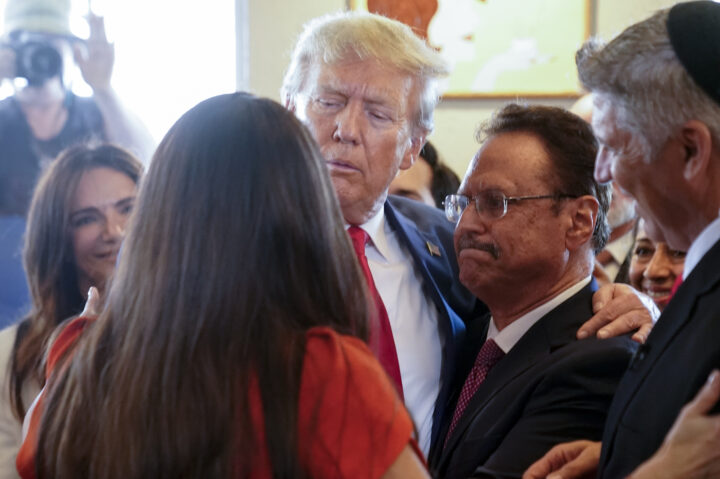
AP Photo/Alex Brandon
President Donald Trump talks with supporters while standing with pastor Mario Bramnick, second from right, at Versailles restaurant on Tuesday, June 13, 2023, in Miami.


 Add JewishInsider on Google
President Donald Trump came into office with a promise to make tackling antisemitism a priority of his second term. So far, the focus of that effort has been almost exclusively on addressing left-wing and Islamist antisemitism, primarily tied to anti-Israel extremism — while leaving out antisemitism emerging from the political right.
Now, a group of staunch Trump allies from within the evangelical Christian community is urging Republicans to also focus on countering what they describe as a growing threat of antisemitism from within their own camp. They see prominent MAGA-aligned figures such as podcast hosts Tucker Carlson and Candace Owens platforming overtly antisemitic views, and worry that those voices — with massive social media followings — could play a role in shaping the direction of the Republican Party.
Last month, an organization called the Conference of Christian Presidents for Israel hosted a meeting to discuss the topic at the Family Research Council, a powerful Christian advocacy group. Billed as a “private roundtable for key Christian leaders,” according to the event invitation, it identified right-wing antisemitism as a high-stakes challenge: “It is vital that Christian leaders counter the forces on the right who are demonizing the state of Israel, its leadership and the Jewish people,” stated the invitation, which was obtained by Jewish Insider.
“We’ve been very concerned about the progressive leftist [antisemitism],” Mario Bramnick, a pastor in South Florida who is the president of the Latino Coalition for Israel, told JI on Tuesday. He is also the founder of the Christian Conference, and he organized last month’s event with Luke Moon, the executive director of the Philos Project. “But some of the statements coming out on the right, to me, are possibly more brazen and more troubling and clearly, clearly, do not represent President Trump or his administration,” added Bramnick.
The meeting was attended by Rabbi Yehuda Kaploun, Trump’s nominee to serve as the special envoy to monitor and combat antisemitism, as well as Mark Walker, a former congressman from North Carolina who is Trump’s pick to serve as ambassador-at-large for international religious freedom. Yair Netanyahu, the eldest son of Israeli Prime Minister Benjamin Netanyahu, addressed the group virtually.
“Antisemitism is a bipartisan issue and needs to be condemned anytime, anyplace,” Kaploun told JI. “It is imperative that all parties educate their members about the dangers of antisemitism.”
The Christian group is concerned about a small but growing anti-Israel faction within the Republican Party. In a press release on Tuesday, Bramnick called out Carlson and Owens, as well as two figures who remain close to Trump: Steve Bannon and Rep. Marjorie Taylor Greene (R-GA). A Trump administration spokesperson did not respond to a request for comment on Tuesday.
“It’s almost like we have more of an onus to handle this, because it’s our own camp, our own family. Imagine something goes wrong with someone in your family, you feel more of an obligation,” Bramnick told JI. “Who better than us to be able to handle it?”
Bramnick met last week with Justice Department senior counsel Leo Terrell, the chair of the federal government’s antisemitism task force, to raise the issue of antisemitism on the right.
“They are clearly on this and following it, from my understanding, and wanting to work with us,” Bramnick said. A spokesperson for Terrell did not respond to a request for comment.
The Conference of Christian Presidents has ties to influential conservative groups in Washington. Hours after the meeting at the Family Research Council, the Conference co-hosted an event on the Trump administration’s policies in the Middle East with the Heritage Foundation. The event featured video remarks from U.S. Ambassador to Israel Mike Huckabee and a keynote speech by evangelical leader Rev. Johnnie Moore, executive chair of the Gaza Humanitarian Foundation.
Last year, the Heritage Foundation released a policy document focused on antisemitism, called Project Esther, which identified left-wing antisemitism as the main form of antisemitism in the U.S., without mentioning any issues on the right. An inquiry to the authors of the Project Esther report did not garner a response.
Christians United for Israel, the largest Christian pro-Israel group with more than 10 million members, is not part of the Conference of Christian Presidents for Israel. But Sandra Hagee Parker, chair of the CUFI Action Fund, told JI that the organization agrees with the need to combat antisemitism on the right.
“One cannot be a Christian and antisemitic. The two are mutually exclusive,” Parker said in a statement. “Just as liberals must condemn those who use human rights as cover for their Jew-hatred, conservatives must call out those who drape themselves in the flag or the banner of the cross while bastardizing the former and defiling the latter.”
Republican Jewish Coalition CEO Matt Brooks said antisemitism is “percolating out there at the extreme ends of the far right, well outside of the mainstream of the Republican Party.”
“I don’t know that it’s growing. It’s gotten a little louder,” he told JI. “Our challenge and our effort going forward is to ensure that it doesn’t take hold in the Republican Party as it did in the Democratic Party.”
The Democratic and Republican nominees for New Jersey governor spoke at New Jersey Jewish Business Alliance event
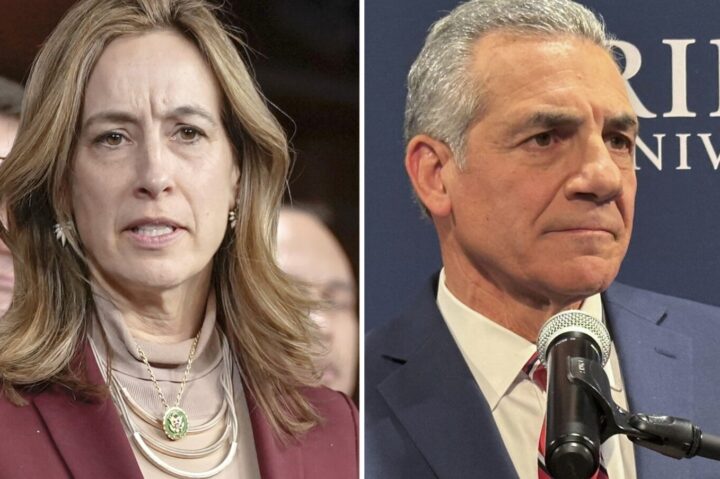
Mariam Zuhaib, Mike Catalini/Associated Press
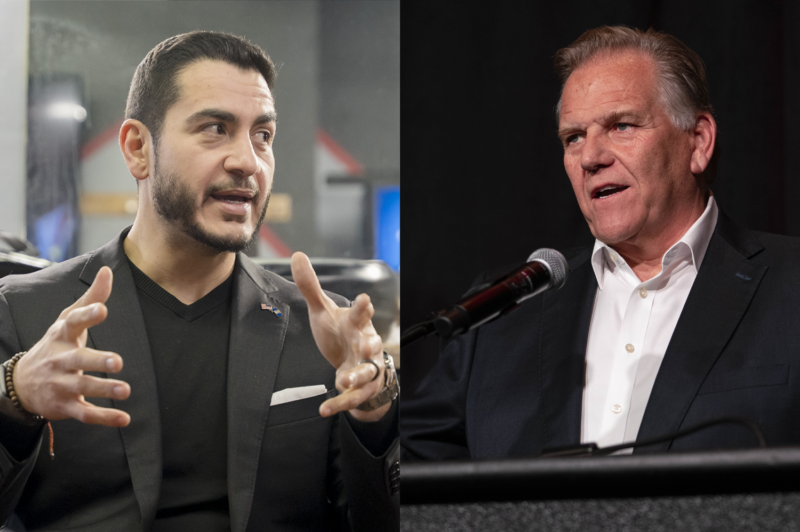
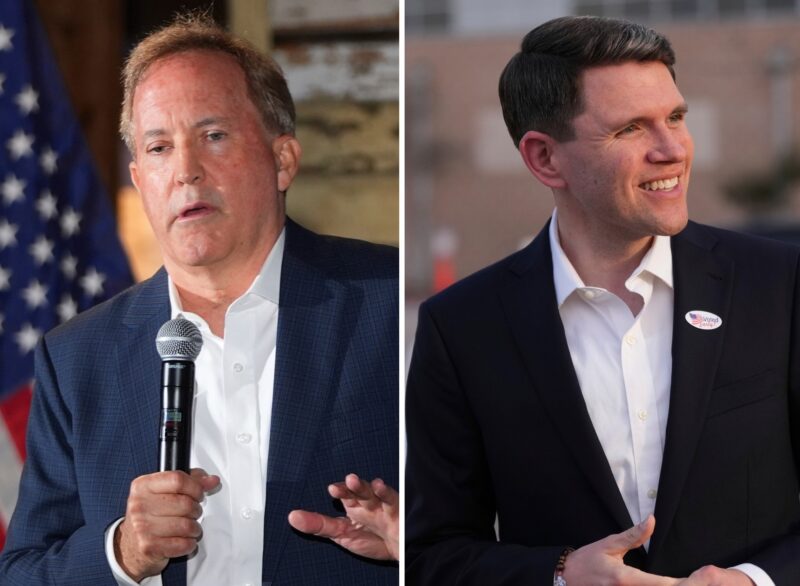
In this photo combo Rep. Mikie Sherrill, D-N.J., left, speaking during a news conference, Feb. 13, 2024, in Washington and former Assemblyman Jack Ciattarelli speaking, Feb. 4, 2025, at Rider University in Lawrenceville, N.J.
The Democratic and Republican nominees for governor of New Jersey spoke last week at an event organized by the New Jersey Jewish Business Alliance about their plans to combat antisemitism across the Garden State.
“I as governor will certainly address this appalling surge of antisemitic incidents head-on and work to ensure that every business owner in our state has a fair shot,” Rep. Mikie Sherrill (D-NJ) said. “I vow to be an ally in the governor’s office. I’ll put the full force of law behind combating antisemitism and making sure that everyone can thrive here in the Garden State.”
Sherrill said that it’s “been an incredibly difficult past several years for the Jewish community here in New Jersey,” highlighting a series of incidents including a fire-bombing at a synagogue in her district, as well as graffiti, harassment, intimidation and more facing Jewish institutions, individuals and businesses.
She noted that Jewish business owners in the state had faced violent crimes and losses of business “because of their religion.”
Republican Jack Ciattarelli said that antisemitism “will not be tolerated in the state of New Jersey under my governorship” and that his entire administration “will be sensitive to the needs and worries of the Jewish community across this state.”
He said he plans to launch an advisory council to maintain “constant contact” with the Jewish community statewide.
He condemned Gov. Phil Murphy for calling antisemitism issues on college campuses “complicated.”
“It’s not complicated. Anybody who’s violating university policy should be expelled. Anybody who’s broken the law should be arrested, and anybody here on academic visa that’s done either those two things should go back to where the hell they came from,” Ciattarelli said. “We’re not going to have anybody feeling unsafe on our college campuses.”
The Republican nominee voiced support for legislation to codify the International Holocaust Remembrance Alliance’s working definition of antisemitism, which he said he hopes will be signed before he takes office.
Ciattarelli said that, on his upcoming trip to Israel, he’d be meeting with business leaders to find ways that New Jersey can increase its bilateral trade with the Jewish state.
“Do you know that New York does $14 billion a year in bilateral trade with Israel? New Jersey? Less than 2 billion,” Ciattarelli said. “What does New York have that we don’t have? I’ll be meeting with business leaders to say we’re open for business.”
Both nominees also spoke at length about their plans to improve the business climate in the state.
It’s the GOP gubernatorial nominee’s second trip to the Jewish state
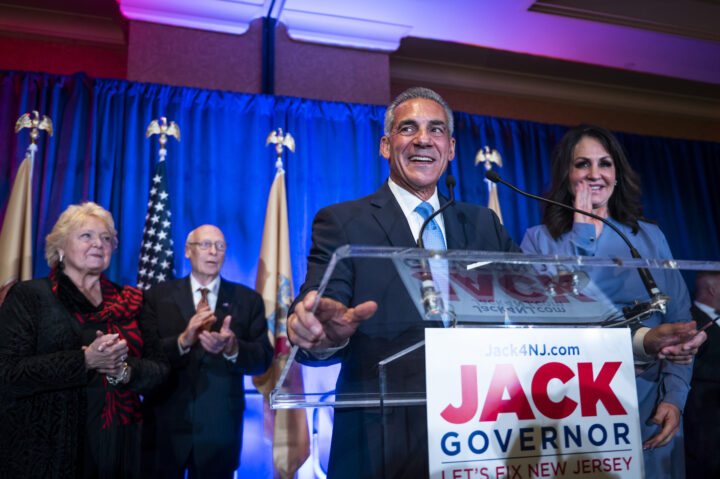
Mark Kauzlarich/Bloomberg via Getty Images
Jack Ciattarelli, Republican candidate for governor of New Jersey
Former New Jersey state Rep. Jack Ciattarelli, the Garden State’s Republican nominee for governor, will travel to Israel on Sunday for his first visit during the campaign, his campaign revealed to Jewish Insider.
Ciattarelli is running against Rep. Mikie Sherrill (D-NJ) in the race to succeed New Jersey Democratic Gov. Phil Murphy, who is term-limited. He was New Jersey’s GOP gubernatorial nominee in 2021 against Murphy, narrowly losing to the sitting governor.
Speaking to JI in an interview ahead of his trip, the New Jersey Republican said he expects to have “five very, very productive days in Israel.”
Ciattarelli said that the goal of the visit was to find opportunities for economic investment in New Jersey from leading Israeli companies in the technology and medical sectors and to show his solidarity with the Garden State’s Jewish community.
New Jersey has the second-largest Jewish population in the country.
“One of my objectives as governor is to grow our economy, and one of the ways that we achieve that objective is by forging a closer economic relationship with a number of nations, one of which is certainly Israel. They have technology companies, medical device companies, pharmaceutical companies, and a number of other industries that are looking to expand internationally. And when they do, we certainly want them to do that in New Jersey,” Ciattarelli said.
Ciattarelli added that the trip, his second time visiting the Jewish state, “also has great significance for New Jersey’s Jewish community,” because it signifies his commitment to a strong U.S.-Israel relationship.
“I’ve always been a big supporter of Israel. And as we know, antisemitism is at an all-time high in New Jersey, across the nation and the globe. As governor, antisemitism will not be tolerated. And so again, by going to Israel, we demonstrate a very close relationship between New Jersey and this very important ally in the Middle East and, of course, in the world,” he explained.
Ciattarelli previously traveled to the Jewish state during his 2021 gubernatorial run, one month before the general election. The trip, which Ciattarelli described to JI at the time as a “life-changing experience,” was his first visit to Israel.
“My goal was to let civic leaders, business leaders and religious leaders know that Israel will have a strong ally in New Jersey when I’m governor. From an economic development perspective, Israel does more than $14 billion a year in bilateral trade with New York. It does only $1 billion with New Jersey. That shouldn’t be the case,” Ciattarelli said after his 2021 visit.
“So I made clear during my trip and meeting with all leaders, that New Jersey is going to strengthen its cultural, religious and economic ties with the State of Israel. And we will stand with her in defending its people,” he continued.
He again mentioned the trade deficit while speaking to JI on Friday about his upcoming visit.
“Israel does $14 billion a year in bilateral trade with New York, less than $2 billion a year with New Jersey. There’s nothing New York has that New Jersey doesn’t. So we want to make sure that Israeli companies, when they invest in the United States, they do so right in New Jersey,” Ciattarelli said.
Dooley, the football coach-turned-candidate, has already begun Jewish outreach in the pivotal swing-state Senate race

Michael Allio/Icon Sportswire via Getty Images
New York Giants Tight Ends Coach Derek Dooley looks on before the NFL football game between the New York Giants and the Miami Dolphins on December 5, 2021, at Hard Rock Stadium in Miami Gardens, Florida.
With the entry this week of Derek Dooley, a friend of Gov. Brian Kemp who hails from college football royalty in Georgia, the Republican field in the Georgia Senate race is taking shape.
Dooley, whose father coached the Georgia Bulldogs and who spent several years leading the rival Tennessee Volunteers, announced Monday that he’d be running against Reps. Buddy Carter (R-GA) and Mike Collins (R-GA) in the Republican primary to take on Sen. Jon Ossoff (D-GA), Republicans’ top-targeted incumbent.
Kemp, a popular Republican governor, was seen as Republicans’ best chance of ousting Ossoff. Some prominent Jewish former Ossoff donors in the state reached out to Kemp late last year urging him to run against Ossoff, frustrated by the senator’s votes last year to block some weapons transfers to Israel. But Kemp ultimately passed on the race. Ossoff has worked to rebuild trust with disaffected Jewish voters, but those efforts were hampered by his vote last week to block a shipment of assault weapons to Israel.
Kemp has family ties to Dooley, who has brought on top Kemp advisors, is likely to receive the governor’s backing and pursue a center-right lane in the race, while portraying himself as a political outsider. All the candidates have been making the pivotal pitch for President Donald Trump’s backing in the race and tying themselves closely to him, hoping that key endorsement will help them clear the field.
With Kemp’s help, Dooley could potentially peel off support from moderate Jewish Democrats still frustrated by Ossoff, though Jewish leaders in the state told Jewish Insider last week that they’re not yet making any commitments in the race. They say they’re waiting to see who emerges from the Republican primary and how Ossoff’s record shapes up over the coming months before they decide whether to support the incumbent next November.
Dooley, for his part, is wasting little time in courting their votes.
“I stand with our ally Israel and firmly believe they should have the necessary resources to defend themselves against terrorists,” Dooley said in a statement to JI. “While Jon Ossoff continues to vote against Israel and American national security interests, I will be a leading voice for a strong America and a strong Israel in the Senate.”
Emanuel Fialkow, a prominent conservative member of Georgia’s Jewish community, said that Kemp’s team connected him to Dooley and the two spoke at length on a variety of issues, including antisemitism and Israel. Fialkow said he was previously part of a group of Jewish donors who urged Kemp to run against Ossoff.
Fialkow said that Dooley had asked him about a range of issues including Israel policy, the war in Gaza and antisemitism, and that he subsequently agreed to help Dooley develop an Israel position paper, which Fialkow described as very strongly pro-Israel. He said that Dooley “will have a backbone” in support of Israel.
He subsequently organized a lunch meeting at his home to introduce Dooley to a small group of others in the state, many of them Jewish, including both traditional Republicans and Democrats. Fialkow said that the group discussed a range of issues and came away seeing Dooley as honest, humble, inspiring, engaging and curious to learn more. He praised Dooley as a proven leader and a “really good guy” who can speak to people from a range of backgrounds, and is interested in listening to and learning from people.
He said other Jewish leaders in the Atlanta area are also in discussions with and about supporting Dooley. Others said they haven’t been in touch with Dooley or his surrogates yet.
Fialkow said that he and some other Jewish leaders in the state see Ossoff’s relationship with them as broken beyond repair, and said they can’t trust him going forward to be a reliable supporter of Israel. He argued that Dooley is the “only chance” for Zionist voters who put support for Israel first.
Ossoff, for his part, maintains some vocal supporters in the Jewish community.
Cary Levow, a supporter of pro-Israel causes and candidates, told JI last week, “I support Senator Ossoff and know of other Jewish Georgians who understand that Jon’s approach to the Gaza humanitarian issue is genuine.”
“Senator Ossoff has voted for over $20 billion in aid to Israel, has family living in Israel and has spent a significant amount of time in the country,” Levow continued. “I think Jon has represented the Jewish community well and I have zero concern about a senator who is critical of how [Israeli Prime Minister Benjamin Netanyahu] Bibi is waging this war.”
Fialkow argued that the only way for a Republican to win is for both Kemp and Trump to be aligned behind the same candidate, and that a hard-right Republican can’t win statewide in Georgia, meaning that Dooley gives Republicans their best chance to beat Ossoff.
Fialkow said he’s spoken to Collins and is confident that he would never vote against U.S. support for Israel, due to his own religious convictions. Collins has voiced the same view in confrontations with anti-Israel activists.
Speaking at an Oct. 7 memorial ceremony in 2024, Collins called the U.S. Israel’s “greatest friend” and said that the Oct. 7, 2023, Hamas attacks had only strengthened the relationship between the two partners. He said he would work to make sure Israel receives all the support it needs to defend itself.
“Hamas not only attacked the peaceful people of Israel that day, but they launched an assault against the idea of free and fair democracies in the Middle East,” Collins said.
But some elements of Collins’ record on antisemitism could raise red flags for others in the Jewish community. Last year, he refused to apologize for and doubled down on engaging with an antisemitic, racist Twitter account that was attacking a reporter for being Jewish. And he voted against the Antisemitism Awareness Act, and has a record of engaging in otherwise extremist rhetoric online.
“Mike Collins has condemned the hate speech seen on college campuses and around the globe, and has been an ardent supporter of Israel in Congress. While Jon Ossoff capitulated to woke activists and voted to cut aid to Israel, Mike Collins has stood strong and protected its right to exist,” a Collins campaign spokesperson told JI, when asked about his online history and vote on the antisemitism bill.
Carter, who is close with some Atlanta-area Jewish leaders, has been a vocal supporter of pro-Israel and Jewish causes in the House, including leading pushes for funding and support for Holocaust education programs, calling on colleagues to address antisemitism in health care, leading legislation to support U.S.-Israel cooperative programs, urging support for the snapback of U.N. sanctions on Iran and calling for Qatar and Turkey to expel Hamas leaders. He also supported the Antisemitism Awareness Act, unlike Collins.
Carter’s campaign did not respond to a request for comment.
Other than Collins’ vote against the Antisemitism Awareness Act, both Carter and Collins have records of supporting legislation backing Israel and combating antisemitism, including voting for supplemental aid to Israel and a resolution describing anti-Zionism as antisemitic.
Johnson will not be addressing the Knesset on this visit to Israel, as had been planned for a postponed June trip

Western Wall Heritage Foundation
House Speaker Mike Johnson (R-LA) visits the Western Wall on August 3, 2025.
House Speaker Mike Johnson (R-LA) and a group of House Republicans are visiting Israel this week, in Johnson’s first visit to Israel since becoming speaker.
Johnson was set to visit Israel in June to address the Knesset, but postponed his visit after the war between Israel and Iran began. He will not be addressing the Knesset on this visit, a source familiar with his plans told Jewish Insider.
Johnson and those in his delegation — Reps. Michael McCaul (R-TX), Nathaniel Moran (R-TX), Claudia Tenney (R-NY) and Michael Cloud (R-TX) — have prayed at the Western Wall and met with Israeli Defense Minister Israel Katz and Foreign Minister Gideon Sa’ar.
“We’re so grateful to be in Israel, particularly on this day, recognizing the destruction of the two Temples … it is such a moving time for us to be here at the Wailing Wall. We’ve offered our prayers, we’ve put our notes into the wall,” Johnson said in brief video remarks from the Kotel, which he visited on Tisha B’Av. “We’re so moved by the hospitality of the people and the great love of Israel.”
“Our prayer is that America will always stand with the people of Israel and we pray for the preservation and the peace of Jerusalem,” Johnson continued. “That’s what scripture tells us to do, it’s a matter of faith for us, and commitment that we have.”
Katz said in a statement that he thanked the lawmakers “for their unwavering support and moral clarity in standing with Israel against its enemies, and for their vital voices in the efforts to bring all the hostages home and defeat the murderous terrorist organization Hamas.”
Sa’ar said the group discussed global antisemitism, anti-Israel efforts by countries like Ireland and the attacks on the Druze in Syria, which Sa’ar said were “same kind of barbarism perpetrated by Hamas.”
The trip was organized by the U.S.-Israel Education Association.
In comments on CNN last week, Johnson raised concerns about the humanitarian crisis in Gaza, saying that “it is quite sad and quite alarming to see” and that he’d like to see the war in Gaza end soon.
Johnson’s office did not share any further details of his itinerary while he’s visiting the Jewish state.
Anti-Israel activists on the left are working to win over Democratic lawmakers to their side — and are finding some unlikely allies moving in their direction amid the sustained pressure
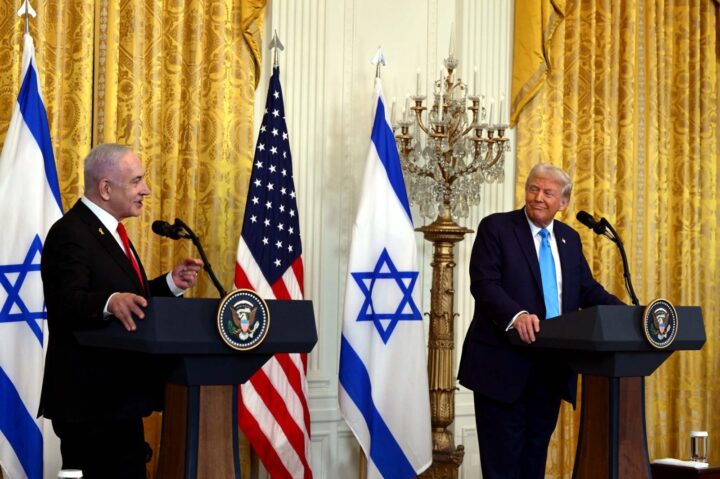
Avi Ohayon (GPO)
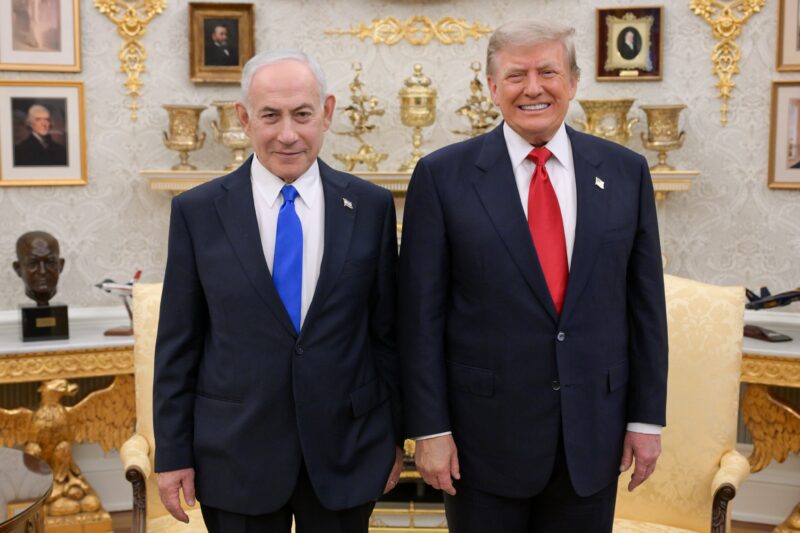
Israeli Prime Minister Benjamin Netanyahu and President Donald Trump hold a joint press conference at the White House on February 4, 2025
A new Gallup poll underscores the degree to which Israel’s security is now dependent on support from President Donald Trump and the Republican Party, the Jewish state having drained much of its political capital from both Democrats and independents amid the ongoing war against Hamas in Gaza and the resulting humanitarian crisis.
The numbers are clear: Support for Israel is now becoming a partisan issue after the Jewish state enjoyed decades of bipartisan support in the United States. Anti-Israel activists on the left, looking to exploit the moment, are working to win over Democratic lawmakers to their side — and are finding some unlikely allies moving in their direction amid the sustained pressure.
The data is sobering: Only about one-third of Americans now support Israel’s military action in Gaza, with 60% disapproving. At the beginning of the war, exactly half of Americans supported Israel’s war against Hamas. The drop-off has come entirely from Democrats (36% supported in November 2023, while 8% do now) and independents (47% supported in November 2023 while 25% support now).
Among Republicans, however, support for Israel’s military efforts has remained significant. The exact same share of Republicans who backed Israel’s war against Hamas in November 2023 (71%) continue to support Israel’s efforts today. Trump’s decision to strike Iran’s nuclear facilities has, if anything, bolstered GOP support for Israel and undermined the isolationist and small anti-Israel faction within the party.
Israeli Prime Minister Benjamin Netanyahu’s close relationship with Trump, a partnership that has led to major policy successes, like the successful, coordinated attacks against Iran’s nuclear program, has nonetheless also played a role in the growing partisanship. Netanyahu, for the first time, is viewed unfavorably by a majority of Americans — with Democrats now registering more overt disapproval of the Israeli leader since Trump reentered office.
The Gallup polling shows there was already soft support for Israel among Democrats before the war began, with majorities of Democrats opposed to the Jewish state’s efforts at self-defense just weeks after the Oct. 7 attacks. That said, a clear majority of Democratic lawmakers maintained their support for Israel’s war against Hamas, with only a relatively small faction calling for ceasefires before Hamas’ leadership and terror infrastructure could be degraded.
But there are signs that some of the more mainstream voices are succumbing to the anti-Israel shifts within the party’s base. Over half of Senate Democrats supported a Bernie Sanders-led resolution last night that would block U.S. arms sales to Israel — up from the 15 Democrats who voted for a similar measure back in April. Sen. Elissa Slotkin (D-MI), a pragmatic Democratic senator, who was absent for the vote, sounded open to cutting off “offensive” military aid to Israel. Sen. Angus King (I-ME), a pro-Israel independent who caucuses with Democrats, changed his tune and called for ending all military aid to Israel this week.
What’s alarming is how some of this consuming anti-Israel sentiment among Democrats is showing some signs of evolving into, at least, a tolerance of antisemitism. Pennsylvania Gov. Josh Shapiro received blowback from the left for simply calling out New York City Democratic mayoral nominee Zohran Mamdani over failing to condemn “globalize the intifada” rhetoric. Slotkin felt the need, while on an anti-Israel podcast, to pander that she’s a Jewish senator who wasn’t backed by Jewish groups. Progressive spaces are becoming increasingly inhospitable to Jews, at least those who don’t renounce their support for a Jewish state.
The many liberal-minded, pro-Israel Jewish Democrats have felt increasingly homeless politically as a result of the shifts within the party — and the accommodation of views that, until very recently, have been beyond the political pale. If the party’s reaction to its 2024 defeat is to tack even further leftward and alienate core parts of their coalition, it could well be lurching towards its own McGovern moment in the future.
The House speaker said he wants to see the war in Gaza come to an end soon

Kent Nishimura/Getty Images
House Speaker Mike Johnson (R-LA) does an interview with CNN at the U.S. Capitol on April 17, 2024 in Washington, D.C.
House Speaker Mike Johnson (R-LA) expressed strong concern about the humanitarian crisis in Gaza in an appearance on CNN’s “The Lead” on Wednesday.
Johnson’s comments, made days after President Donald Trump said that there is “real starvation” happening in Gaza, indicate growing concern even among pro-Israel Republicans about the humanitarian situation in Gaza, at the same time that such concerns on the Democratic side have reached new heights.
“I do hope it comes to an end soon,” Johnson said about the war in Gaza, “and we bring an end to this suffering and misery, because it is quite sad and quite alarming to see.”
He said that “we’ve got a humanitarian crisis in Gaza — I mean the pictures tell 1,000 words and it’s heartbreaking.” Israeli Prime Minister Benjamin Netanyahu has said that there is “no starvation” happening in the enclave.
The House speaker said that he wants to see an end to the conflict and peace, adding that “President Trump is using a strong hand to try to forge that, and we’re moving in the right direction.”
He also credited Israel with opening up new channels for aid and noted that the U.S. and its partners are going to work to provide additional aid as well.
Johnson did not mention Hamas, which some supporters of Israel argue should shoulder the blame for any aid shortages and the lack of a ceasefire in Gaza.
Johnson didn’t directly address a question from host Jake Tapper about whether he’s concerned that Israel is at risk of becoming a global pariah.
The top Democratic leaders in New York, over a month after the primary, aren’t supporting Mamdani — but aren’t willing to speak out against him, either
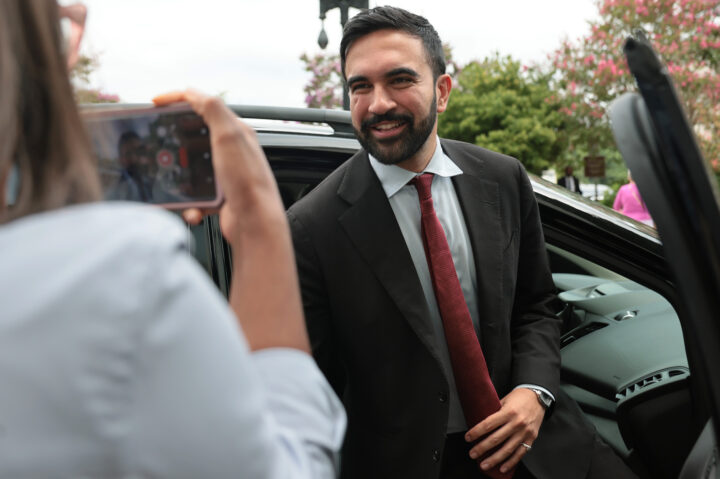
Michael M. Santiago/Getty Images
NYC Mayor Zohran Mamdani briefly speaks with reporters as he leaves the Dirksen Senate Office Building on July 16, 2025 in Washington, DC.
One of the defining features of our politics over the last decade has been the declining power of institutions, combined with the growing influence of individuals acting in their narrow self-interest, frequently at the expense of the public interest.
President Donald Trump’s ability in 2016 to bypass the Republican establishment benefitting from a crowded, self-interested opposition, was one of the seminal moments in our brave new world of individualism over institutionalism. Party institutions, outside-group spending and strident media criticism were no match for the grassroots army that rallied to Trump in that election.
Ten years later, the inability of moderate Democrats and other mainstream institutions to organize any coalition against the campaign of far-left New York City Democratic mayoral nominee Zohran Mamdani looks like the culmination of a dynamic where leaders feel powerless to lead, and are instead simply standing aside, ceding any influence to a cadre of ideological activists within the party.
What’s remarkable about this moment is that the top Democratic leaders in New York, over a month after the primary, aren’t supporting Mamdani — but aren’t willing to speak out against him, either. Senate Minority Leader Chuck Schumer (D-NY), House Minority Leader Hakeem Jeffries (D-NY), New York Gov. Kathy Hochul and Sen. Kirsten Gillibrand (D-NY) have all stayed on the sidelines, reflecting the state of political purgatory that many mainstream leaders are in right now.
There are a handful of Democratic leaders who are speaking out more directly in response to Mamdani’s rise. Pennsylvania Gov. Josh Shapiro, a potential 2028 presidential contender, offered moral clarity in his interview with JI’s Gabby Deutch last week. “When supporters of yours say things that are blatantly antisemitic, you can’t leave room for that to just sit there,” Shapiro said of Mamdani.
Rep. Laura Gillen (D-NY), representing a suburban Long Island district with a sizable Jewish constituency, called Mamdani “a threat to my constituents.” Jeffries, to his credit, has all but conditioned his support for Mamdani to the candidate’s condemnation of “globalize the intifada” rhetoric.
What’s missing is any organized effort to rally behind one of the other Democratic options on the general election ballot in order to consolidate the Mamdani opposition. It’s not for lack of options — with the sitting New York City mayor and the former New York governor on the ballot — even if the alternatives are deeply flawed. Only about half of Democratic voters are lining up behind Mamdani, and he’s polling under 40% in the post-primary polls — an unusually weak position for a Democratic nominee in a deep-blue city.
With Mamdani celebrating his recent marriage in his birthplace of Uganda this past week amid creeping criticism from prominent elected officials, it would have been an opportune time for anti-Mamdani forces to go on offense. But instead, the race is stuck in neutral, with Mayor Eric Adams and former Gov. Andrew Cuomo spending as much time sniping against each other instead of the front-runner.
What’s holding the Mamdani opposition back is a generalized fear of leadership’s ability to make a difference. Would Schumer or Jeffries taking a tougher line against Mamdani significantly move the political needle, or drive the left-wing grassroots against them? Just look at the blowback Gillibrand received for noting in a radio interview that Jewish New Yorkers were alarmed by Mamdani’s public statements on Israel and antisemitic rhetoric.
For Jewish groups, is it worth further antagonizing Mamdani when he remains the favorite to become the city’s next mayor? The fact that a candidate excusing “globalize the intifada” rhetoric was able to comfortably win a Democratic primary — in the place with the largest Jewish population of any city in the world — was a shock to the system.
Coloring all these deliberations is the sense that something has shifted in our body politic — that radicalism isn’t the political turnoff that it once was. But there’s something of a Catch-22 to these internal deliberations: The less willing leaders are to confront the extremes, the more the Overton window shifts to accommodate them.
Plus, a sit-down with Mike Huckabee ☕

MOHAMMED BADRA/POOL/AFP via Getty Images
France's President Emmanuel Macron exits a polling booth, adorned with curtains displaying the colors of the flag of France, to vote in the second round of France's legislative election at a polling station in Le Touquet, northern France on July 7, 2024.
Good Friday morning.
In today’s Daily Kickoff, we talk to Republicans on Capitol Hill about France’s plans to recognize a Palestinian state later this year and report on the daylight between Sen. Mark Kelly (D-AZ) and Arizona’s pro-Israel community as he throws his support behind candidates with histories of being critical of Israel. We interview U.S. Ambassador to Israel Mike Huckabee as he navigates his first months on the job, and report on Sen. Jeanne Shaheen’s (D-NH) support for Mike Waltz to be U.S. ambassador to the U.N., bypassing a delay imposed by Sen. Rand Paul. Also in today’s Daily Kickoff: Mandela Barnes, Tanya Simon and Elad Gil.
What We’re Watching
- We’re keeping an eye on the unfolding dispute regarding humanitarian aid in Gaza, as Israel and the U.N. accuse each other of holding up distribution efforts in the enclave amid broader concerns of worsening malnutrition among the Strip’s most vulnerable.
- In Istanbul, Turkey, today, France, Germany and the U.K. are holding nuclear talks.
- And in Washington, the Israel on Campus Coalition’s National Leadership Summit kicks off on Sunday afternoon in Washington.
What You Should Know
A QUICK WORD WITH JI’S GABBY DEUTCH
With a unanimous vote last week rejecting a measure that would’ve cut ties with the Anti-Defamation League, the board of directors of the National Education Association extended an olive branch to frustrated Jewish educators and parents who are concerned about creeping antisemitism within the union’s ranks.
ADL CEO Jonathan Greenblatt told Jewish Insider earlier this week that he was “pleased” to see the NEA reject the anti-ADL measure. But, he added, the union still has a “long way to go” toward making clear that it respects the Jewish community.
Greenblatt’s lingering concern is a sign that the NEA — the largest teachers’ union in the country, with more than 3 million members — has not entirely placated Jewish communal stakeholders. In fact, additional questions have continued to emerge in light of an NEA document that encourages teaching the “Nakba” and that erases antisemitism from the history of the Holocaust.
The Washington Free Beacon reported this week on the NEA’s 2025 handbook, a 434-page report outlining the organization’s “visionary goals” and “strategic objectives.” Among the items included in the dense document are dozens of measures that passed at last year’s “representative assembly,” a convening of the organization’s top leaders from around the country — the same group that, this year, voted to censure the ADL. Several of them have raised eyebrows in the Jewish community.
Q&A
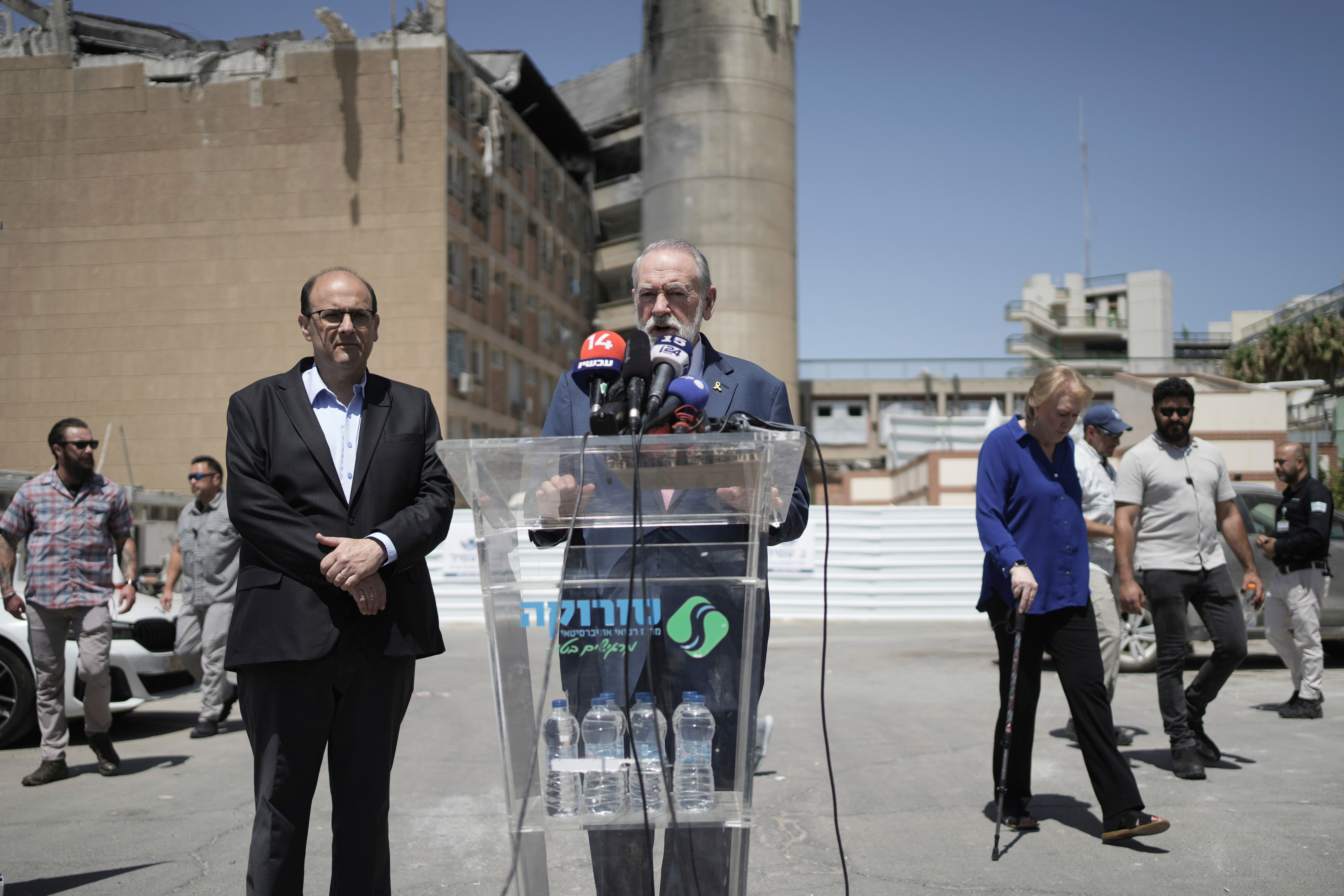
Since his arrival in Israel in April, former Arkansas Gov. Mike Huckabee has made his mark as the first evangelical U.S. ambassador to Israel — and possibly the most effusive in his remarks about the Jewish state. Following issues with work visas for Christian organizations and several incidents involving Palestinian Christians, Huckabee issued some strongly worded statements directed toward Israeli officials. But with the visa issue resolved and the world’s attention on the humanitarian situation in Gaza and the latest round of collapsed negotiations for a ceasefire and hostage-release deal, Huckabee was back to standing firmly behind Israel in an interview with Jewish Insider’s Lahav Harkov in his office at the U.S. Embassy in Jerusalem on Thursday.
On the issues surrounding aid distribution: “Well, we just want people to get the truth and to get the food, but we don’t want Hamas to steal it, which is what they have done through the U.N. model, which has been an absolute disaster. Maybe the U.N. is more interested in preserving the machinery of the U.N. than they are in feeding people,” Huckabee said. “And I know that sounds harsh, but I absolutely am on the record for that, because when I see just thousands of pallets, thousands of tons of food sitting that could be consumed by people, it’s sitting there because the U.N. doesn’t really have any incentive to go out and actually get it to the people.”
SUPPORTER SCRUTINY

Sen. Mark Kelly (D-AZ) is facing new scrutiny from some Jewish community leaders in Arizona who are frustrated by his endorsements boosting the activist left in a series of recent House primaries in which he has withheld support for pro-Israel candidates and has even worked to actively oppose their campaigns behind the scenes, according to people familiar with the matter, Jewish Insider’s Matthew Kassel reports.
Tensed-up ties: Kelly’s engagement has strained what had been seen as a positive relationship with the pro-Israel community in Arizona, according to multiple local Jewish leaders who have voiced disappointment with his approach. Meanwhile, his recent interventions have raised questions about the political motivations of the Democratic senator in a key battleground state who has long been associated with his party’s moderate, centrist wing. The most recent source of tension with Jewish and pro-Israel leaders stems from Kelly’s endorsement of Adelita Grijalva in a Tucson House primary this month to succeed her late father, former Rep. Raul Grijalva (D-AZ), a longtime critic of Israel who died in March.
PARIS POSITION

Republicans and senior Trump administration officials are blasting French President Emmanuel Macron for announcing on Thursday that France will recognize a Palestinian state at the United Nations General Assembly later this year, Jewish Insider’s Marc Rod reports.
Pushback: “The United States strongly rejects [Macron’s] plan to recognize a Palestinian state at the [UN] general assembly,” Secretary of State Marco Rubio said. “This reckless decision only serves Hamas propaganda and sets back peace. It is a slap in the face to the victims of October 7th.” Top Republican lawmakers largely argued that the decision constituted a reward for Hamas for its Oct. 7, 2023, attacks on Israel and its intransigence in recent hostage talks, the most recent round of which collapsed just hours before Macron’s announcement.
Read the full story here with additional comments from Sens. Tom Cotton (R-AR) and Lindsey Graham (R-SC) and Reps. Brian Mast (R-FL), Randy Fine (R-FL) Carlos Gimenez (R-FL) and former U.S. Ambassador to the United Nations Nikki Haley.
Bonus: In a tongue-in-cheek X post, U.S. Ambassador to Israel Mike Huckabee said, “Macron’s unilateral ‘declaration’ of a ‘Palestinian’ state didn’t say WHERE it would be. I can now exclusively disclose that France will offer the French Riviera & the new nation will be called ‘Franc-en-Stine.’”
LENT A LIFELINE

Sen. Jeanne Shaheen (D-NH), the top Democrat on the Senate Foreign Relations Committee, voted with nearly all committee Republicans to advance former National Security Advisor Mike Waltz’s nomination to be U.S. ambassador to the United Nations to move to the consideration of the full Senate, Jewish Insider’s Marc Rod reports.
Notable quotable: “I recognize that Mr. Waltz represents a moderating force with a distinguished record of military service and an extensive background in national security policymaking,” Shaheen said in a statement. “Further, Mike Waltz did not represent himself to me as someone who wants to retreat from the world—and this is a quality I value in nominees. Simply put, in a Situation Room filled with people like Vice President [J.D.] Vance and Under Secretary [of Defense Elbridge] Colby, who want to retreat from the world, and like Secretary [of Defense Pete] Hegseth, I think we’re better off having someone like Mike Waltz present.”
PUT ON PAUSE
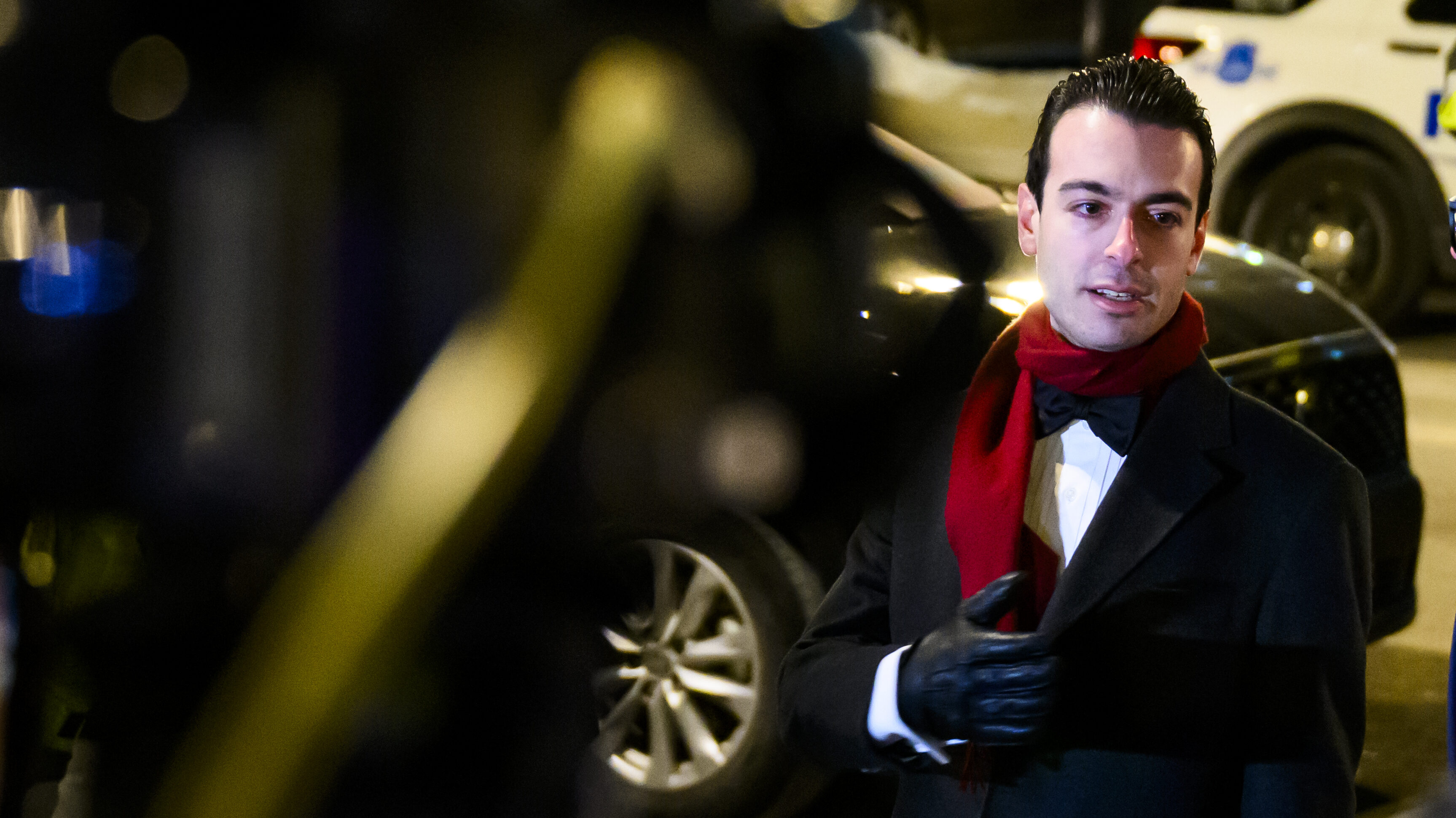
The Senate Homeland Security and Government Affairs Committee on Thursday delayed a confirmation hearing for Paul Ingrassia, the Trump administration’s nominee for a government ethics oversight role, amid questions about his record from some Senate Republicans, Jewish Insider’s Marc Rod reports. Ingrassia has a record of conspiratorial comments, including describing the Oct. 7, 2023, Hamas attacks on Israel and the ensuing war as a “psyop” and defending prominent antisemites, among other issues.
What they’re saying: Sen. James Lankford (R-OK) told JI he had more questions he wanted to ask Ingrassia and that the hearing had been delayed because “he had not met with a lot of members” and the lawmakers wanted the chance to do so. He said that the hearing will now likely happen in “September or later,” after the Senate’s August recess, to provide more time for these meetings.
Garden State race
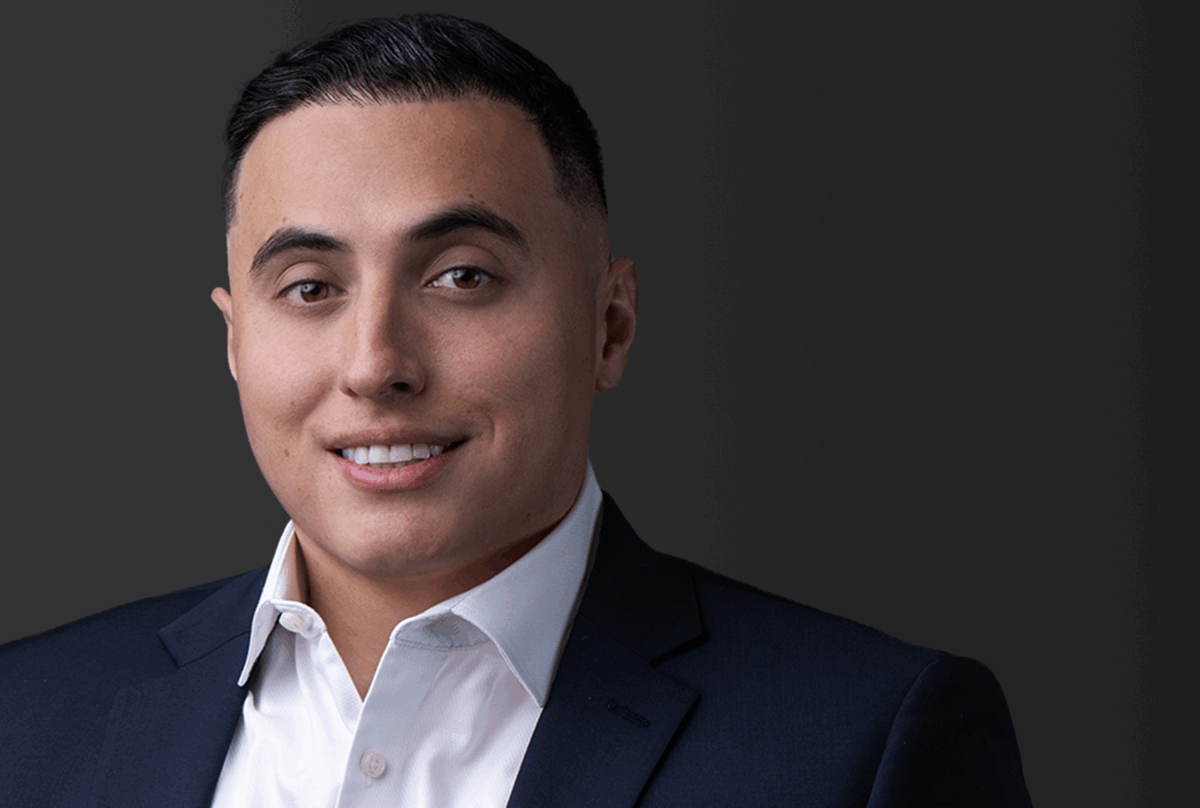
In a Democratic Party that has lost its grip on the working class — long its base of support and wellspring of its values — Brian Varela is offering a way back home. Varela, a small business owner and New Jersey political activist vying for the Democratic nomination for New Jersey’s 7th Congressional District, is leaning in to his working-class Colombian roots, suggesting that the Democrats need candidates, like him, who are better connected to the middle-class voters in his district. Varela, 36, has firmly established himself as a serious contender for the Democratic nomination for New Jersey’s 7th Congressional District with his recent announcement of a $700,000 fundraising haul in his first three months in the race, Jewish Insider’s Marc Rod reports.
Positioning: “I consider myself more of a moderate,” Varela told JI in an interview. “I do believe that we do need to be tight around budgets, and we can’t just go and haphazardly be cutting programs, but we do need to understand that we cannot allow the deficit to continue increasing.” He said that he thinks his perspective coming from a working-class background can help Democrats appeal to working-class voters they struggled to attract in 2024. And he said that Israel has been a “strong ally for us, and I think it’s important to make sure that we are there for Israel, that we help Israel with their ability to defend themselves.”
Worthy Reads
Where’s the Outrage?: In The Washington Post, Stephen Rapp, who served as U.S. ambassador-at-large for war crimes issues from 2009-2015, raises concerns about global silence around Iran’s human rights violations. “The regime’s response to its perceived vulnerability in the wake of that conflict has become increasingly aggressive. While its failures may be attributed to incompetence and the foreign penetration of its security services, its fury is being directed at domestic political opponents. Thousands of Iranians are in danger as parliament now seeks to expedite death sentences in cases involving imagined collaboration with foreign entities.” [WashPost]
A New Gaza: In The Wall Street Journal, Yasser Abu Shabab, the commander of the Popular Forces in Gaza, makes the claim that he has developed a model for post-Hamas governance in the Gaza Strip. “Through our efforts, we have shown a glimpse of what a new Gaza could look like. … Within months, more than 600,000 people — nearly a third of Gaza’s population — could be living outside the cycle of war. We need only three things to make this vision a reality: financial support to prevent Hamas’s return, humanitarian aid to meet the population’s immediate needs for food and shelter, and safe corridors so people can move around. In a short time, we could transform most of Gaza from a war zone into functioning communities. When the rebuilding has begun, Hamas can negotiate with Israel for the release of hostages in exchange for safe passage out of Gaza. Let them go to Qatar, Turkey or wherever their enablers will have them. We don’t want them among us.” [WSJ]
‘Needling the Jews’: In National Review, Jamie Kirchick breaks down far-right commentator Tucker Carlson’s evolution from Fox News host to conspiracy theorist trafficking in antisemitic tropes. “After years of ‘just asking questions,’ he has reached the nadir to which such questions inevitably lead. Carlson has chosen to exploit the world’s oldest prejudice while pretending that it’s somehow edgy. Ultimately, the reasons why Carlson decided to become America’s leading purveyor of antisemitic ideas matter less than what this development says about our society. Why has ‘needling the Jews,’ the very thing Carlson condemned Pat Buchanan for a quarter century ago, been a safe career move? For the persistent acting out of his anti-Jewish obsession in the national discourse hasn’t put a dent in his popularity; on the contrary, it may have even boosted it.” [NationalReview]
Word on the Street
U.S. Ambassador to Turkey Tom Barrack, the Trump administration’s Syria envoy, convened a four-hour meeting in Paris on Thursday for senior Israeli and Syrian officials, including Israeli Minister of Strategic Affairs Ron Dermer and Syrian Foreign Minister Assad al-Sheibani, to discuss security issues; the meeting was the first high-level sit-down between Israeli and Syrian officials in 25 years…
U.S. and Israeli negotiators departed Doha, Qatar, following Hamas’ most recent response to a ceasefire proposal, with White House Middle East envoy Steve Witkoff saying that the terror group’s response “shows a lack of desire to reach a ceasefire”…
The Pentagon informed staff on Thursday that it had indefinitely suspended the Department of Defense’s participation in think tank and research conferences and events; the announcement comes a week after the Pentagon pulled its affiliated speakers from the lineup at the Aspen Security Forum…
A new report from the Jewish Institute for National Security of America found that the U.S. launched nearly 14% of its THAAD interceptor stockpile during last month’s war between Israel and Iran; the report’s authors suggested it could take between three and eight years to replenish the stockpile…
Russia successfully launched an Iranian Soyuz communications satellite into orbit, months after signing a “strategic partnership” agreement with Tehran…
The Wall Street Journal reports on a 2003 birthday book given to Jeffrey Epstein that included messages from President Donald Trump and former President Bill Clinton…
Wisconsin Gov. Tony Evers, a Democrat, announced he does not plan to seek a third term; former Lt. Gov. Mandela Barnes, who came within a percentage point of unseating Sen. Ron Johnson (R-WI) in 2022, said he is considering entering the race to succeed Evers, while Sara Rodriguez, the state’s current lieutenant governor, hinted she was interested in the seat…
Members of a New Jersey state Assembly panel advanced a bill that would adopt the International Holocaust Remembrance Alliance’s working definition of antisemitism…
The FCC signed off on the $8 billion merger between Skydance Media and Paramount; The New York Times said that the merger “effectively ushers in the beginning of a new family dynasty for Paramount, which has been controlled by the Redstone family for decades. David Ellison, son of the tech billionaire Larry Ellison, plans to take control of the company when the deal closes”…
CBS News tapped network veteran Tanya Simon, who had overseen “60 Minutes” since the resignation last year of Bill Owens, as the weekly news program’s executive producer…
Israeli-American venture capitalist Elad Gil is raising a $1.5 billion fund for young startups; if closed, it would be one of the largest funds raised by a solo VC…
Two Jewish comics slated to perform at the upcoming Edinburgh Fringe next month had their shows canceled due to what organizers said were safety concerns…
Hungary issued a three-year ban on members of the Irish hip-hop group Kneecap from entering the country, citing the group’s “antisemitic hate speech and open praise for Hamas and Hezbollah as justification”; the ban comes ahead of the upcoming Sziget festival in Budapest, at which Kneecap was slated to perform…
Archeologists working at the Tinshemet Cave site in central Israel discovered what they believe to be, at 100,000 years old, one of the oldest burial sites in the world…
Eight Israeli soldiers were injured in a car-ramming attack on Thursday near the central Israeli city of Netanya; the assailant drove off and is believed to have abandoned his car near the West Bank town of Beit Lid…
Israeli Ambassador to the U.S. Yechiel Leiter distanced the Israeli government from recent comments by Israeli Heritage Minister Amichay Eliyahu, a far-right lawmaker who said that Jews would settle in the Gaza Strip and the government “is racing ahead for Gaza to be wiped out”…
Pic of the Day
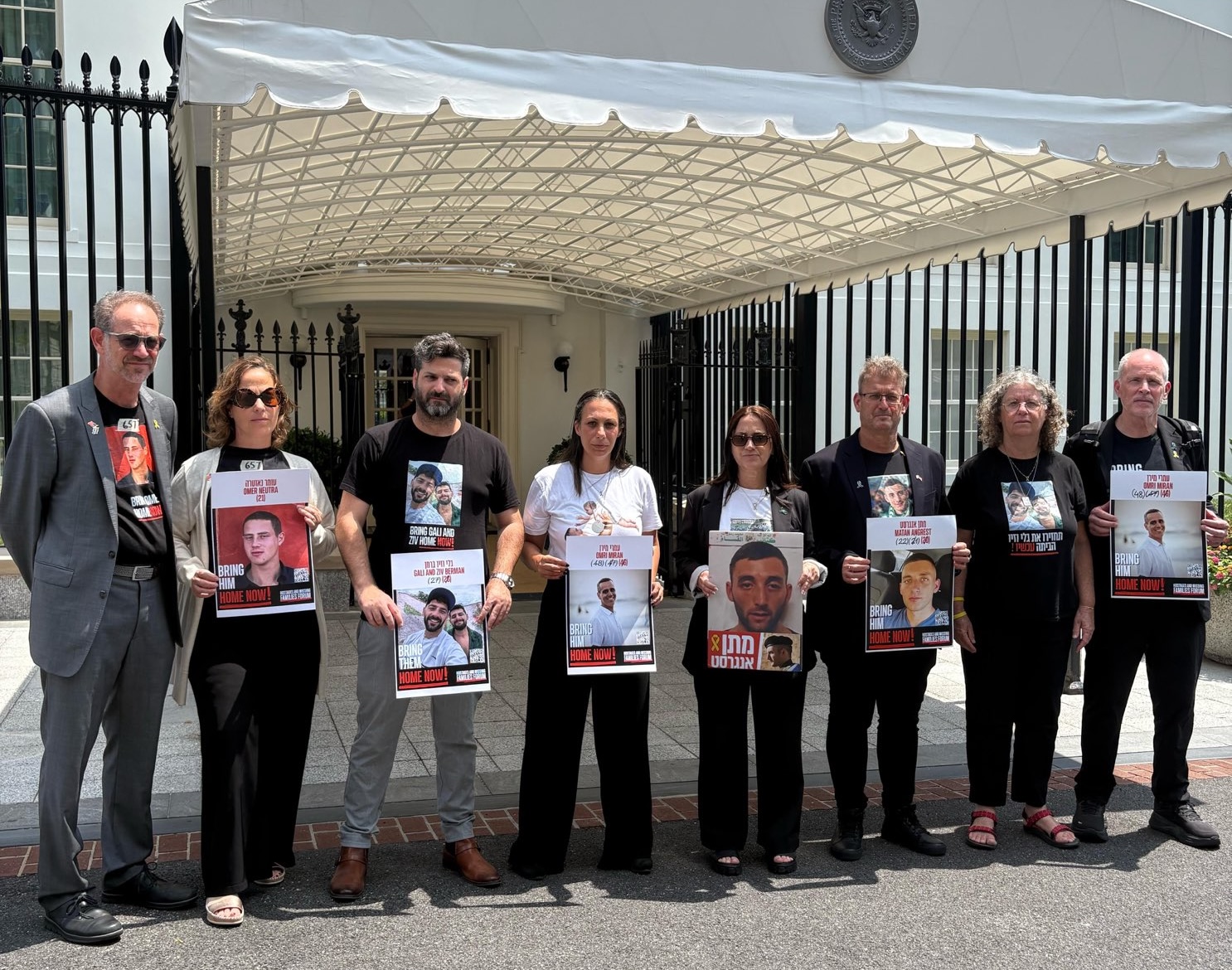
Former hostages and family members of some of the remaining 50 hostages still in captivity were in Washington this week for meetings with Trump administration officials, including Justice Department senior counsel Leo Terrell, the chair of the department’s antisemitism task force. At far right are Keith Siegel and his wife, Aviva, who were both taken hostage by Hamas on Oct. 7, 2023.
Birthdays
Actor, comedian and producer, Jeremy Samuel Piven turns 60 on Saturday…
FRIDAY: Warsaw Ghetto Uprising participant and Holocaust survivor, she is the subject of the 2021 documentary “I am Here,” Ella Blumenthal turns 104… Former publisher and editor-in-chief of Jewish Lights Publishing, he is an economist and religious scholar best known for his interfaith work, Stuart M. Matlins turns 85… Cinematographer, whose work includes “The Rocky Horror Picture Show” and “The Empire Strikes Back,” Peter Suschitzky turns 84… Member of the New York City Council from 2014 to 2021, Alan N. Maisel turns 79… Born in Casablanca, Morocco, nightclub owner, entrepreneur and film producer, he produced “The Woman in Red” and “Weekend at Bernie’s,” Victor Drai turns 78… Former IDF brigadier general (he was part of Operation Entebbe in 1976), then a member of Knesset, Efraim “Effi” Eitam turns 73… Voiceover artist, he is also the writer, producer, director and narrator of a documentary about the restoration of a NYC synagogue, Peter Grossman… Chairman of Vibrant Capital Partners and chair emeritus of the Weitzman National Museum of American Jewish History in Philadelphia, Philip Darivoff… Screenwriter, director and producer, best known for creating “Beverly Hills, 90210” and “Sex and the City,” Darren Star turns 64… Pulitzer Prize-winning author and journalist, she is a staff writer at The Atlantic, Anne Applebaum turns 61… Retired MLB pitcher from a small Jewish community in the Dominican Republic, he maintains a kosher home, José Bautista turns 61… Israeli journalist, television news anchor and author of a nonfiction book and a novel, Oshrat Kotler turns 60… CEO of Friends of the Israel Defense Forces until earlier this week, Rabbi Steven Weil… NYC-based criminal defense attorney, Arkady L. Bukh turns 53… Head coach of the men’s basketball team at Kent State University since 2011, Rob Senderoff turns 52… Radio personality on Baltimore’s WBAL and 98 Rock, Josh Spiegel turns 50… VP of communications and PR for the National Association of Healthcare Quality, Erin Seidler… Experimental electronic music producer, composer and singer, known professionally as Oneohtrix Point Never, Daniel Lopatin turns 43… Film and television actor, Michael Welch turns 38… Senior policy advisor at Nelson Mullins, Jake Kohn turns 36… Pitcher for Team Israel at the 2020 Olympics and at the 2023 World Baseball Classic, he is also a real estate broker at CBRE, Joseph “Joey” Samuel Wagman turns 34…
SATURDAY: Former mayor of Las Vegas for 12 years, where he was succeeded by his wife who served for 12 more years as mayor, Oscar Goodman turns 86… Former administrator at the University of Illinois and the University of Houston, chancellor of the California State University system and CEO of the J. Paul Getty Trust, Barry Munitz turns 84… Journalist and author or co-author of nearly two dozen books, both of her parents were killed in Auschwitz, Paulette Cooper turns 83… Author, podcaster, columnist and rabbi, Shammai Engelmayer turns 80… Member of the Florida House of Representatives from 2012 to 2020, Richard Stark turns 73… Chief medical officer at F|42, Alan H. Spiro, MD, MBA… Film and television director, she is best known for her work on the Showtime drama series “Homeland,” Lesli Linka Glatter turns 72… Sports columnist, author, television and radio personality, he works for ESPN’s Charlotte, N.C.-based SEC Network since 2014, Paul Finebaum turns 69… Venture capitalist, James W. Breyer turns 64… Former correspondent at ABC News for 23 years, now a founder at Ten Percent Media, Daniel B. “Dan” Harris turns 54… Physician and attorney, he is the founder and chairman of the DC-based consulting firm Stonington Global, Nicholas Muzin turns 50… U.S. senator (R-OK), Markwayne Mullin turns 48… Actress best known for her role in the “Spider-Man” trilogy, Mageina Tovah Begtrup turns 46… Managing partner of the D.C. office of ColdSpark, Nachama Soloveichik… Political correspondent at Israel’s Walla News, Tal Shalev… Israeli-born classical music composer, Gilad Hochman turns 43… Israeli born R&B singer and songwriter, Hila Bronstein turns 42… Manager of advisor communications at Cetera Financial Group, Lauren Garfield-Herrin… Actress and filmmaker, Hallie Meyers-Shyer turns 38… Member of the comedy group “The Try Guys,” with almost 2.9 billion YouTube views, Zachary Andrew “Zach” Kornfeld turns 35… Associate policy director for complex care at United Healthcare, Drew Gerber… NFL running back who retired in 2024, Tarik Cohen turns 30… Pitcher on the Israeli Women’s National Softball Team, now a curriculum designer at Great Hearts Academies, Tamara “T” Statman Schoen turns 28… President at B&B Digital Media, Tomer Barazani…
SUNDAY: Real estate developer who founded Aspen Square Management, he heads an eponymous foundation known for its flagship program PJ Library, Harold Grinspoon turns 96… Forensic pathologist known for his HBO show and his work investigating high-profile deaths, Michael M. Baden turns 91… Managing partner of Access Fund Management Company, he is a past president of the Jewish Community Federation of San Francisco, Harold Zlot… Former deputy secretary of defense and then CIA director in the Clinton administration, now a professor emeritus at MIT, John Mark Deutch turns 87… Steven M. Mizel turns 86… Former chairman of the Conference of Presidents of Major American Jewish Organizations, Stephen M. Greenberg turns 81… Artist and museum founder focused on Fusionism, Shalom Tomáš Neuman turns 78… Israeli author and television producer, he is best known for his documentaries of Israel’s intelligence agencies, Yarin Kimor turns 73… Israeli-born fitness personality, Gilad Janklowicz turns 71… Comedian, writer, producer and actress, Carol Leifer turns 69… Washington bureau chief and White House correspondent for the Christian Science Monitor, Linda Feldmann… Former VP of global communications, marketing and public policy at Facebook, he previously held a similar position at Google, Elliot Schrage turns 65… U.S. Army colonel (retired), Jeffrey Brian Carra… Israeli television and radio personality, Erez Moshe Tal turns 64… Heir to the Hyatt Hotels fortune, now a film producer, Jean “Gigi” Pritzker turns 63… Former CEO of the Rabbinical Assembly, she is now the founder of Insight Eldercare, Rabbi Julie Schonfeld… Member of the Hungarian Parliament for 20 years, then a member of the European Parliament since 2009, Tamás Deutsch turns 59… Rabbi at Kesher Israel: The Georgetown Synagogue, Rabbi Hyim Shafner… Former national platform director for the Democratic National Committee, now a political consultant and recruiter, Andrew Grossman… Former chief of staff of the House Republican Conference, he is now the managing partner at Capitol Venture, LLC, Jeremy Deutsch… Head of marketing at Jumplight and winner on “Jeopardy!” in 2019, Aaron Lichtig… D.C.-area political activist, Benjamin Rothenberg… SVP at Upland Workshop, Jeremy Adler…
Rep. Madeleine Dean described the Gaza Humanitarian Foundation as a ‘death trap for starving Palestinians’

DIRK WAEM/BELGA MAG/AFP via Getty Images
The UNRWA logo is seen on the vest of an employee during a visit to the Jabal El Hussein refugee camp of UNRWA, , part of a diplomatic mission to Israel and the Palestinian territories, in Amman, Jordan, Wednesday 15 May 2024.
Democratic members of the House Appropriations Committee criticized Republican-led efforts to dismantle the United Nations Relief and Works Agency in the House’s draft 2026 budget bill for the State Department and other foreign programs.
The exchanges underscore the continued support among some prominent Democrats for restoring the U.S. relationship with the scandal-plagued UNRWA, more than a year after U.S. aid to the group was first halted following allegations that UNRWA staff participated in the Oct. 7, 2023 attacks on Israel. The budget bill includes a continued ban on aid to the agency and calls on the State Department to put together a plan to replace it.
Rep. Rosa DeLauro (D-CT), the top Democrat on the committee, pushed for the restoration of support to UNRWA.
“The bill scapegoats our international partners, U.N. agencies and NGOs that deliver life saving aid to the most vulnerable people around the globe,” DeLauro said. “Organizations like UNRWA will be destroyed, leaving children and families in Gaza and other places around the world to starve and to die.”
DeLauro also pushed back on provisions in the bill that would withhold funding from the U.N. Secretariat until the U.N. and U.S. government take certain steps to pursue accountability for UNRWA members involved in the Oct. 7 attacks.
“I do not believe the language matches the intent,” she argued. “The provision is overly broad. It penalizes important U.N. entities until specific actions are taken by the United States government. This makes no sense.”
She argued that a provision demanding that the U.N. waive immunity for U.N. employees involved in the attack is unnecessary.
“U.N. immunity is already waived in cases where it would impede the course of justice or where someone has committed human rights violations or engaged in or supported acts of terrorism,” DeLauro said. “We all want justice for the horrific attacks on both Americans and our friends in Israel and indeed, the Justice Department has a task force already investigating this issue. We should work together to address this in a manner that achieves true justice.”
Reps. Madeleine Dean (D-PA) and Bonnie Watson Coleman (D-NJ) introduced an amendment that would halt future U.S. aid to the Gaza Humanitarian Foundation until the State Department transmits to Congress all evidence provided by Israel and all U.S. assessments about the diversion of United Nations humanitarian aid by Hamas in Gaza.
It would also require the State Department to report to Congress on deaths at or near GHF distribution sites and plans to minimize such deaths, as well as on fraud and antiterrorism safeguards, before any further aid is provided to the GHF.
Dean accused the GHF of “violating core humanitarian principles” and described the system as a “death trap for starving Palestinians,” urging the U.S. to return to previous U.N. and NGO-run distribution systems.
She said she’s been shown no proof that Hamas had diverted aid provided under previous distribution systems, though she said that it “could be” doing so.
Dean claimed that “not a single refugee was gunned down as they attempted desperately to retrieve aid for their family with UNRWA or [the] World Food [Program] or other U.N. programs” and alleged that “more than 1,000 Gazans have been killed — shot and killed — by the IDF by trying to simply get food” at GHF sites. Israel has denied claims that it is targeting aid recipients at GHF sites, and some reports of such activity have been disproven.
Dean withdrew her amendment without requesting a vote.
Dean and Watson Coleman introduced another amendment to encourage the State Department to continue to support the East Jerusalem Hospital Network, which the committee rejected by a party line 35-26 vote.
Rep. Mario Díaz-Balart (R-FL) argued against the amendment, saying that no provisions of law would otherwise prohibit aid to the hospital network and that the decision should be left to Secretary of State Marco Rubio to assess where and how humanitarian funding would be best spent.
As part of an amendment package, committee Republicans called for an additional $2 million to be provided in the coming year for the implementation, enforcement and renewal of sanctions on Iran.
The amendment package also included language expressing concern about the Muslim Brotherhood, and requesting a report to Congress on how the State Department is countering “the threats posed” by the group, including visa restrictions.
The amendment package was adopted by a 34-27 vote.
Democrats more broadly criticized Republicans for the significant cuts the bill would enact on the State Department and U.S. foreign aid programs formerly run through the U.S. Agency for International Development.
The report requires additional vetting for U.S. funding abroad, targeting the BDS movement and alleged U.S. support for political activity

Kevin Carter/Getty Images
The U.S. Capitol Building is seen at sunset on May 31, 2025 in Washington, DC.
Republicans on the House Appropriations Committee’s National Security, Department of State and Related Programs subcommittee are backing a significant increase in funding for the office of the State Department’s special envoy to monitor and combat antisemitism.
The explanatory report accompanying the subcommittee’s 2026 funding bill, which it advanced last week, proposes $2.5 million for the office, up from the $1.75 million provided in 2024 and 2025. The report also includes language calling for increased full-time staff in the office. The full Appropriations Committee will meet to discuss and vote on the bill on Wednesday.
The bill also expands vetting policies for U.S. funding abroad, requiring that no funding be provided to organizations that engage in the Boycott, Divestment and Sanctions movement targeting Israel, glorify violence or target the U.S. or Israel at the International Criminal Court or International Court of Justice.
Citing unspecified allegations that the U.S. provided assistance to organizations involved in political activity — a potential reference to GOP allegations that the U.S. funded protests against the Israeli government — the report directs the Department of State to expand its vetting procedures “to include an assessment of political neutrality and a review of statements by individuals or organizations that constitute engagement in political advocacy, incitement, or support for terrorism that would cause operational and reputational risks for the United States Government.”
The legislation, as approved by the subcommittee last week, would cut off U.S. funding to various United Nations initiatives, including the U.N.’s general budget.
The report explains that the cuts were motivated in part by the U.N.’s failure to address internal antisemitism and anti-Israel bias. It requests that the State Department report to Congress on the issue, including specific instances of antisemitism and their origins, statements by U.N. agencies or officials that may violate their responsibility to maintain neutrality toward Israel and an assessment of the U.N.’s plan to improve its response to antisemitism.
It also “strongly condemns” the U.N. General Assembly for passing a resolution granting the Palestinian Authority status nearly equivalent to that of a member state, describing the decision as having “undermin[ed] peace and security between the Israeli and Palestinian peoples.”
The report states that lawmakers are concerned about the continued relationship between Hamas and Turkey, which has hosted some of the group’s leaders. It makes no mention of the similar — and deeper — relationship between Hamas and Qatar.
The report calls for accountability for the United Nations Relief and Works Agency, including demanding that the U.N. address atrocities committed by UNRWA members on Oct. 7, 2023, and UNRWA’s alleged provision of support for and partnership with terrorist groups.
It demands that the U.N. provide unredacted files on these issues, which it has allegedly declined to do thus far, and asks the State Department to present a plan for aiding the Middle East without UNRWA and a report on whether U.S. aid to UNRWA was diverted to or paid the salaries of terrorist groups and their members.
The bill would block U.S. funding to South Africa unless it meets several conditions, including ceasing its cooperation with U.S. adversaries.
It would earmark $5 million for programs in Israel designed to support archeological and cultural heritage, like the City of David. It also urges the State Department to support programs and organizations that back the U.S.-Israel relationship and directs the department to make funding available for humanitarian needs in Israel, such as medical responses to Iranian missile attacks.
It would maintain funding, $50 million annually, for the Middle East Partnership for Peace Act and would provide $50 million for the Middle East Partnership Initiative, which aims to support leadership and public-private partnerships in the Middle East; $10 million for the Middle East Regional Cooperation program, which funds scientific collaboration between Israel and Arab States; and $4 million for cooperative development programs between Israel and the United States in third countries.
The report states that freeing the remaining hostages in Gaza “is a critical United States priority and urges regional partners and allies to intensify their efforts toward achieving this objective.”
The legislation creates new oversight requirements for U.S. aid to Syria, requiring the State Department to notify Congress about aid provided to Syria, to consult with Congress before initiating a new aid program or activity and to ensure that no U.S. aid will benefit members or affiliates of the former Assad regime.
The report expresses concern about antisemitic discrimination in Latin America, “particularly instances of elected leaders fueling prejudice against Jewish communities through social media and official government channels or otherwise neglecting their responsibility,” and encourages them to condemn and work to fight antisemitism.
The report also instructs the State Department to work with U.S. allies toward implementing snapback of United Nations sanctions on Iran.
It also asks the State Department to report to Congress on foreign governments and nonstate actors that are targeting the international Jewish community and using antisemitism and antisemitic symbols.
The report requests that the State Department update Congress on the status of negotiations with the PA to end its terror payments program and expresses support for continued efforts to dismantle Hamas in Gaza, stating that the group continues to pose a threat to the U.S., Israel and other partners.
It further mandates that the State Department update Congress on the situation in southern Lebanon, including the actions of Hezbollah, the Lebanese Armed Forces and the U.N. peacekeeping force and their actions to comply with and enforce U.N. Security Council Resolution 1701 and the Israel-Lebanon ceasefire agreement, which mandates the disarmament of Hezbollah.
And it directs the State Department to present a plan for the future of the U.S.-Egypt relationship, including to consider negotiating a memorandum of understanding between the two countries on security assistance, as the U.S. has in place with Israel.
The report additionally instructs the State Department to ensure sufficient resources are provided to support the Abraham Accords and their expansion, and to work to expand membership in the Comprehensive Security Integration and Prosperity Agreement with Bahrain.
Pou is one of the few House Democrats representing a district that President Trump carried in 2024
Nathan Posner/Anadolu via Getty Images
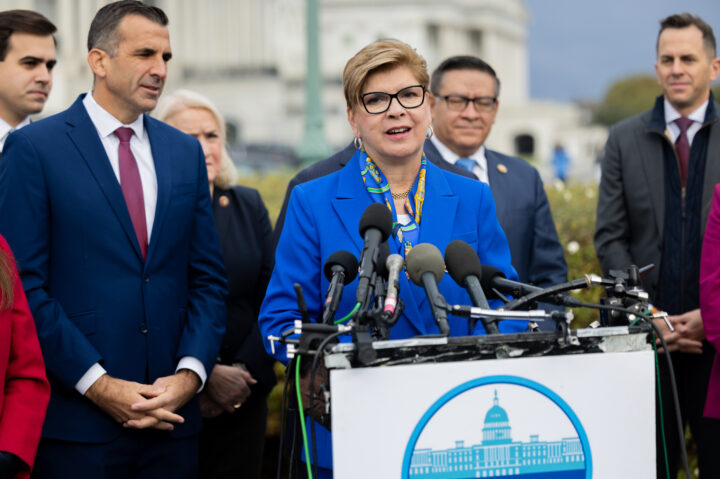
Rep.-elect Nellie Pou (D-NJ) speaks during a press conference introducing new members of the Congressional Hispanic Caucus in Washington, DC on November 15, 2024.
The leading Republican candidates in a New Jersey swing district that President Donald Trump narrowly carried in 2024 hold questionable track records on Israel and antisemitism as the GOP targets the district in the midterms next year.
Rosemary Pino, the Clifton, N.J., City Council member who recently entered the race against Rep. Nellie Pou (D-NJ), posted a video last month from a Palestinian flag-raising event in Clifton where speakers accused Israel of genocide.
“The Palestine Flag Raising event was more than a gathering. To everyone who showed up, spoke up, and raised their voices alongside the flag thank you. Your presence matters. Your solidarity matters,” Pino wrote in a Facebook post she shared alongside clips from the event.
The event, hosted by the Palestinian American Community Center in Clifton, included denunciations by several speakers of Israel, and featured a condemnation of the Trump administration’s deportation policies that it says are aimed at combating antisemitism.
Speakers accused Israel of “genocide” in Gaza and of deliberately manufacturing a famine in the territory, which a speaker described as a “war crime,” and called for “no money for wars.”
Another speaker at the event condemned the Trump administration’s detention of Columbia University anti-Israel activist Mahmoud Khalil, saying, “His story is a reminder that this system seeks to fracture us and oppress and repress our people. It’s part of a broader system designed to criminalize dissent, fracture our communities and punish those who resist it.”
Pino said in a statement to Jewish Insider, “The City of Clifton conducts more than a dozen flag raisings every year. As a Councilwoman, I attend as many of the flag raisings as I can. I attend the flag raisings to show that I care about the various communities in our city, not as a political nor ideological statement.”
“I support the State of Israel, its right to exist, and its right to defend itself,” she added. “I believe that what happened on October 7th was a horrific and evil terrorist act by Hamas. Israel is a strong ally of the United States, and I believe we must maintain that alliance, not cut it.”
Pino continued, “Like President Trump, I support a ceasefire and an end to the hostilities in Gaza. I support a two-state solution where Hamas’s rule of terror ends. I support ensuring humanitarian aid is made available to those who need it. I believe President Trump is working to bring lasting peace to the region, and I support those efforts.”
The PACC organization has a long record of anti-Israel activity. The group sent a bus of community members to protest Israeli Prime Minister Benjamin Netanyahu’s 2024 speech to Congress, which devolved into violence and vandalism of D.C.’s Union Station, and the group’s magazine published a poem in its March 2024 issue advocating for a free Palestine “from the river to the sea” — a call for the elimination of Israel.
The flag-raising event Pino attended did not, however, include some of the eliminationist anti-Israel and anti-American rhetoric and slogans that have proliferated at other pro-Palestinian events in the past two years, and speakers also called for peace, justice and security for all, and recited the Pledge of Allegiance.
In 2023, Pino, as a member of the city council, also expressed concerns about legislation that would have adopted the International Holocaust Remembrance Alliance’s working definition of antisemitism in Clifton, highlighting concerns from the Arab-American community, according to contemporaneous news reports.
The resolution was ultimately tabled and never passed the city council. Pino also argued against assigning the resolution to be discussed by the Civil Rights Committee, which she chaired, saying the committee was too new at the time and not “equipped to handle this,” adding that “it’s only right that we not pawn it off to the committee.”
Pino told JI, “I strongly condemn antisemitism in all shapes and forms.”
“At the time, there were concerns in the community regarding the [First] Amendment implications of that specific resolution. Although that particular resolution did not pass, the Civil Rights Committee did, in fact, take up the issue,” she continued. “The Committee, and subsequently the City Council, passed a resolution which explicitly condemned antisemitism and called for renewed efforts to combat it in the City of Clifton.”
The 9th Congressional District has significant Jewish and Palestinian populations, making Israel policy and antisemitism potentially critical flashpoints in the upcoming race. It is also an unexpectedly competitive battleground, swinging from backing President Joe Biden by 19 points in the 2020 presidential election to narrowly backing Trump four years later.
Pou is one of only 13 House Democrats representing a district that Trump carried in 2024.
The other Republican candidate in the race, Billy Prempeh, who was the 2024 GOP nominee, was endorsed by the New Jersey chapter of the Council on American-Islamic Relations last year, supported cutting off U.S. aid to Israel to stop the war in Gaza, opposed Israeli strikes on Gaza and opposed the Antisemitism Awareness Act.
Mayor Andre Sayegh, a potential primary challenger to Pou, also attended the flag-raising event, and delivered a speech.
Pou is a supporter of Israel, though she has a mixed voting record in the House on issues related to Israel and antisemitism.
According to a new poll, Republicans remain the strongest advocates of a muscular American role in world affairs, with 52% supporting America taking a leading role and 47% opposed
BRENDAN SMIALOWSKI/AFP via Getty Images
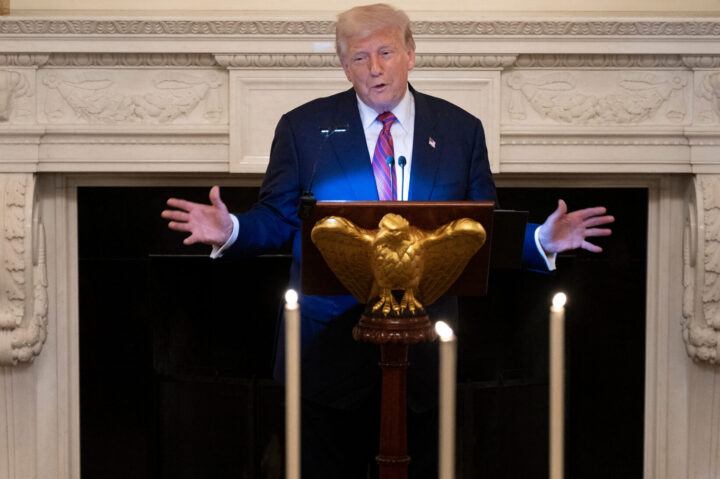
US Senator Markwayne Mullin (R-OK) (L) and US Senator John Thune (R-SD) (R) listen as US President Donald Trump speaks during a dinner for Republican US Senators in the State Dining Room of the White House July 18, 2025, in Washington, DC.
A newly released CNN poll, conducted this month, illustrates the resilience of a hawkish DNA within the Republican Party and among its voters even amid the rise of an isolationist strain that has sought to gain influence in the GOP during President Donald Trump’s second term.
The poll asked respondents: “Do you think the United States should or should not take the leading role among all other countries in the world in trying to solve international problems?” Overall, 43% took the more active approach, while 56% took a more isolationist view.
Republicans, however, remained the strongest advocates of a muscular American role in world affairs, with 52% supporting America taking a leading role and 47% opposed. By contrast, just 42% of Democrats and 39% of independents shared the more hawkish worldview.
Notably, the shift in more isolationist sentiment was almost entirely driven by Democrats and independents since the last CNN survey in March, which found majority support for significant American global engagement. In the March survey, a 57% majority of Democrats preferred more American involvement in the world, a number that dropped 15 points in the last four months. The Republican share of those preferring American engagement remained steady at 52%.
The results from the CNN polls suggest there’s a more committed core of Republican-voting hawks that is more resilient than the shifting political winds, whereas the Democratic foreign policy worldview appears more dependent on partisanship and what’s happening in the news at the time.
In March, at the time of the first CNN poll, Democrats showed a surge of support for foreign engagement — in large part, because they were responding to the hostile reception Trump delivered at the time to Ukrainian President Volodymyr Zelensky, who was seeking American military aid to his country. Back then, Trump wrongly blamed Zelensky for causing the war, and attacked him as a dictator in the run-up to the ugly confrontation at the White House. It was the high point of isolationism in Trump’s second term — and prompted an uptick of hawkishness among Democrats.
But since then, Trump has sharpened his rhetoric against Russian President Vladimir Putin and agreed to send Ukraine offensive weapons, in a reversal of his previous reluctance. He also decided to strike Iran’s nuclear facilities despite alarmism from an isolationist faction within his party, which turned out to be a major military (and political) success.
A recent Echelon Insights survey underscored that Trump’s hawkish turn has broadened and deepened support for strongly supporting American allies within the party. A clear 49-36% of Trump voters, asked if they supported continuing to give weapons to Ukraine, said yes. When informed that it was Trump’s decision to aid Ukraine further, nearly two-thirds of Trump supporters embraced the decision.
The actions on Capitol Hill are consistent with the polling. When Rep. Marjorie Taylor Greene (R-GA) proposed a series of amendments cutting off aid to foreign allies, the vast majority of Republicans voted against them. Even on her proposal to cut military aid for Ukraine, 141 of the 217 House Republicans took the pro-Ukraine side.
And when Greene proposed to block missile defense funding that the U.S. gives to Israel, only one other Republican, Rep. Thomas Massie (R-KY), joined her. Indeed, there were more Democrats who joined with MTG (four) than Republicans — in a sign of the “horseshoe theory” of the far left and far right uniting in their extremism.
Trump’s decision to strike Iran’s nuclear program appears to have created a momentum shift within the party, pushing back the faction of isolationists seeking to gain influence in the administration but also building support for a familiar brand of muscular engagement that has defined the party for generations.
Asked about any ideological differences between him and Massie, Reed offered a one-word answer: ‘Israel’

Kentucky State Legislature
Kentucky state Sen. Aaron Reed
Local and national Republicans are eyeing Kentucky state Sen. Aaron Reed as a potential primary challenger to Rep. Thomas Massie (R-KY), as President Donald Trump and his political allies mount an aggressive effort to unseat the incumbent lawmaker.
Reed, a first-term Kentucky lawmaker, identifies as a supporter of Israel and has offered support for the U.S. strikes on Iran that Massie has vocally opposed.
Massie has long been a thorn in the side of Republicans, opposing many high-profile bills, including Trump’s signature “big, beautiful” budget reconciliation bill, and is also a regular opponent of U.S. support for Israel and legislation to combat antisemitism. The president’s allies recently launched a $1 million ad blitz against Massie, the opening salvo of a Trump-backed effort to unseat the lawmaker, who has swatted down previous primary challenges.
Reed, in a brief interview with the Louisville Courier Journal this week, said that he has “no plans yet” to enter the House race, and will make a decision on running “when God tells me.” In the meantime, the White House plans to host Reed in Washington in the coming weeks to discuss a potential primary challenge, Politico reported.
Middle East policy is emerging as a key divide between the two Republicans: Asked by the Courier Journal about any ideological differences between him and Massie, Reed offered a one-word answer: “Israel.” Reed’s Kentucky state Senate biography page lists him as a member of the Kentucky-Israel Caucus.
While Massie was one of the most vocal Republican critics in Congress of the Trump administration’s decision to strike Iranian nuclear facilities, introducing a war powers resolution that aimed to stop U.S. military action against the Iranian regime, Reed has been openly supportive of the strikes.
“President Trump’s decisive strike on Iran’s nuclear sites was a masterclass in leadership. Using 6 bunker busters from our Air Force B-2 bombers and Tomahawk missiles from our U.S. Navy submarines, we took out Fordow, Natanz, and Esfahan with precision,” Reed said on X. “This bold move may have stopped WW3 before it started. No other military could’ve pulled this off. God bless our American warriors.”
The state lawmaker later described the U.S.-brokered ceasefire between Israel and Iran as “another masterclass in leadership.”
“This is what Peace Through Strength looks like,” Reed said. “America doesn’t run from a fight. We stand tall, we stand firm, and under decisive leadership, we win.”
Reed is a former Navy SEAL who now owns two gun stores and was elected to the statehouse in 2024.
The state senator, frequently seen wearing a cowboy hat, was elected in spite of opposition from the Senate Republican caucus, narrowly beating a party-backed candidate by approximately 100 votes in one of the most expensive Kentucky Senate primaries in state history and garnering the support of Massie himself.
At the time, Reed called Massie, “one of America’s greatest congressmen,” and described himself as aligned with Massie, a position that could complicate a primary challenge.
According to Louisville Public Media, Reed is aligned with the informal “liberty wing” of the Kentucky GOP, which takes a harder line on government spending and social conservative issues than the GOP majority.
Asked about Reed’s chances of unseating Massie if he enters the race, Al Cross, a longtime political commentator in Kentucky, referred Jewish Insider to comments he made to the Associated Press that Massie likely remains the favorite given his strong following in his district “made substantial by personal contact, not just social media.”
Elon Musk, the former Trump advisor-turned-rival said this week that he’d donate to support Massie against the Trump-backed challenge.
Reed did not respond to a request for comment from JI.
Democratic Senate contenders haven’t commented on their state party’s adoption of a resolution calling for an Israel arms embargo, among other anti-Israel resolutions

Melissa Sue Gerrits/Getty Images
Voters are lined up at voting booths at Biltmore Forest Town Hall on November 5, 2024 in Asheville, North Carolina. Americans cast their ballots today in the presidential race between Republican nominee former President Donald Trump and Democratic nominee Vice President Kamala Harris, as well as multiple state elections that will determine the balance of power in Congress.
The State Executive Committee of the North Carolina Democratic Party passed a resolution last weekend calling for an arms embargo on Israel, along with a series of other anti-Israel resolutions, moves that Republicans are already planning to use against statewide candidates as a sign of the party’s leftward drift.
The National Republican Senatorial Committee has already seized upon the resolutions as a political weapon against current and potential Democratic Senate candidates — including the race for the battleground seat of retiring Sen. Thom Tillis (R-NC) — with pro-Israel voters.
“North Carolina Democrats like Roy Cooper, Jeff Jackson [and] Wiley Nickel are responsible for their Party’s unapologetic appeasement of pro-Hamas radicals,” NRSC spokesperson Joanna Rodriguez said in a statement, targeting the state’s former governor and former lawmakers, all moderates, with the same broad brush for not speaking out against the state party’s anti-Israel activity.
“Anyone that supports Israel’s right to exist and defend itself must do whatever they can to make sure no North Carolina Democrat is elected to the U.S. Senate in 2026.”
The most prominent Democrats in the state have, thus far, been silent. Gov. Josh Stein; Cooper, the former governor and a likely Senate candidate; Nickel, a former congressman and current Senate candidate; and Jackson, the attorney general and a former congressman all did not respond to requests for comment.
The decision by the North Carolina Democratic Party’s leadership is another blow to the party’s Jewish Caucus — which faced internal opposition as it was forming — who argue that the resolutions are needlessly divisive and distract from what should be the core goal of the party: electing Democrats.
“The Jewish Caucus position is that we need to concentrate on getting a lot more Democrats elected, and we need to change the balance of things in the [North Carolina] House,” Perry Dror, North Carolina Democratic Party Jewish Caucus’ 2nd vice president, told Jewish Insider ahead of the weekend meeting. “It’s not going to do a thing to change the situation in the Middle East, it’s just going to divide the party and give all kinds of cannon fodder for the Republicans.”
The North Carolina Democratic Party also did not respond to a request for comment.
A source familiar with the proceedings at the State Executive Committee (SEC) meeting said that the final vote on the embargo resolution was close — a single-digit margin of victory out of hundreds of votes. Some members who had planned to vote against the resolutions were absent.
There was insufficient time for the committee to consider a series of other Israel-related resolutions, including a “Resolution for Democratic Unity,” which “condemns any and all acts of terrorism perpetrated Israel or Hamas” and “calls for the immediate release of Palestinian hostages taken by Israel,” in addition to the hostages being held by Hamas. Per meeting rules, since they were not considered, the resolutions were deemed to have been approved.
“A group of extremely vocal progressives were more interested in their issue, their singular issue, than they were with fighting for things that North Carolinians really are interested in, like what’s going to happen to Medicare and Medicaid, the price of housing, women’s reproductive rights,” Lisa Jewel, the president of the Jewish Caucus, told JI.
Jewel emphasized that the Jewish Caucus’ membership, totaling more than 500, is broad and is not in complete agreement on all issues pertaining to Israel, but the members largely agree that these resolutions will be harmful to the party. She said the Jewish Caucus has tried to work constructively with other groups pushing anti-Israel stances but has been rebuffed, and said party leadership needs to step up and take charge.
Jewel and other Jewish Caucus leaders emphasized that they want to see the party adopt a big-tent approach and focus on practical issues that affect North Carolina and local Democrats’ electoral prospects.
“I just need people to understand that antisemitism in North Carolina is double what it is nationwide. The antisemitic incidents are increasing, and they don’t get that. They don’t understand that their vote … is really affecting us,” Jewel said. “I really appreciate young peoples’ passions, but they don’t always think about what the repercussions are.”
Jewel attributed the issues in part to a lack of leadership from the party’s leaders, whom she said in an interview on Friday had seemed “flustered” by Israel and Middle East issues and took a back seat when they came up, rather than trying to bring party members together.
Caucus leaders said that the push for the anti-Israel resolutions had been growing for several years, and came to a head this year.
Resolutions like these are generated by local precincts and are passed up to the county, then congressional district, then state level, to the Resolutions Committee. The committee had a backlog of hundreds of resolutions to work through from both the current and previous year, which Amy DeLoach, the first vice president of the Jewish Caucus and a member of the Resolutions Committee, told JI before the weekend votes.
“It was literally an unachievable task,” DeLoach said. She said the Resolutions Committee chairs “did the best they could” but were facing “a group that were very persistent” in pressing to prioritize moving the Israel-related resolutions ahead to the full state party, rather than taking additional time to go through normal procedures and allow for further review.
DeLoach said she’s seen firsthand, as a state House candidate, the way that party resolutions can hurt Democratic candidates, blaming her own loss on Republicans tying her to a Progressive Caucus push to legalize drugs.
“These resolutions are nothing but a way to hamper the candidates, and the Jewish Caucus wants to do things that are going to push the Democratic Party forward,” DeLoach said.
Dror said that progressives, members of the Interfaith Caucus, as well as some members of the Muslim and Arab caucuses, “just nonstop harp on Israel.”
The chair of the party’s Interfaith Caucus, days after the Oct. 7, 2023, Hamas attacks on Israel, defended the attack as “retaliation” for a supposed growth in Jewish visitors to the Temple Mount.
The pragmatic North Carolina senator was the second moderate Hill Republican this weekend to announce retirement plans amid growing polarization

Kent Nishimura/Getty Images
Sen. Thom TIllis (R-NC) speaks with reporters as he arrives for a vote at the U.S. Capitol on July 31, 2024 in Washington, DC.
Sen. Thom Tillis’ (R-NC) sudden announcement on Sunday that he won’t seek reelection is kicking off one of the most competitive Senate contests of the 2026 cycle, and underscoring the precarious standing for moderate-minded lawmakers on Capitol Hill.
Tillis, 64, who was first elected to the Senate in 2014, was already expected to face electoral headwinds from both directions in his bid for a third term. His pragmatic instincts angered right-winger Republicans back home while his willingness to ultimately support Trump’s agenda didn’t win him any goodwill with Democrats.
Tillis is the second congressional Republican with a record of winning tough races to retire over the weekend, joining Rep. Don Bacon (R-NE), who decided to leave Washington amid growing partisanship and polarization. Sen. John Cornyn (R-TX), another accomplished legislator who occasionally has antagonized his right flank, is also facing a difficult primary campaign against a right-wing opponent, Texas Attorney General Ken Paxton.
North Carolina is one of the Democrats’ strongest opportunities to flip a GOP-held Senate seat next year, and party leaders are hoping former Gov. Roy Cooper decides to run for the open seat. The Cook Political Report said on Sunday it had moved the race from Lean Republican to the “Toss Up” category.
“Cooper — who would likely clear the Democratic field if he runs — faces the prospect of a much easier open seat contest, while Republicans could have to sort out a messy primary field to succeed Tillis that is sure to produce a nominee further to the right than the outgoing GOP senator,” the Cook Political Report’s Jessica Taylot wrote.
At least four Republicans have already confirmed they are considering entering the North Carolina Senate race, including Lara Trump, the president’s daughter-in-law and a North Carolina native; Rep. Pat Harrigan (R-NC), a freshman who was elected to succeed former GOP Rep. Patrick McHenry last year; Rep. Tim Moore (R-NC), who previously served as speaker of the North Carolina House of Representatives; and Rep. Greg Murphy (R-NC), a former urologist elected to the House in 2019.
A source close to Lara Trump, who is married to the president’s son Eric, told NBC News on Monday afternoon that she is “strongly considering jumping in the race.” Asked what the odds were that Trump would get in the race, the source replied: “I’d put it as high as one could be considering it. …The race will be over before it begins.”
Lara Trump, 42, has expressed interest in joining the Senate as far back as 2021, when former Sen. Richard Burr (R-NC) retired after becoming the subject of an insider trading probe, an investigation that ultimately ended without him facing criminal charges. She also discussed the possibility of filling the Senate vacancy in Florida left by Secretary of State Marco Rubio earlier this year, though that seat ultimately went to Sen. Ashley Moody (R-FL), the state’s attorney general.
Among the other GOP names being floated in the race to replace Tillis are Rep. Richard Hudson (R-NC), who chairs the National Republican Congressional Committee, and Republican National Committee Chairman Michael Whatley, who chaired the North Carolina GOP for five years prior to assuming his current role.
In a statement responding to the news of Tillis’ announcement, Sen. Tim Scott (R-SC), chairman of the National Republican Senatorial Committee, Senate Republicans’ campaign arm, made no mention of the outgoing senator, instead restating the party’s intention to keep the seat in GOP hands.
“President Trump has won North Carolina three times, and the state’s been represented by two Republican senators for over a decade. That streak will continue in 2026 when North Carolinians elect a conservative leader committed to advancing an agenda of opportunity, prosperity, and security,” Scott said in a statement.
On the Democratic side, former Rep. Wiley Nickel (D-NC) has already launched his campaign, though major donors and national Democrats alike are urging Cooper to enter the race. The former two-term governor has told allies he expects to make a decision this summer.
“Thom Tillis’ decision not to run for reelection is another blow to Republicans’ chances as they face a midterm backlash that puts their majority at risk. Even Tillis admits the GOP plan to slash Medicaid and spike costs for families is toxic – and in 2026, Democrats will flip North Carolina’s Senate seat,” Democratic Senatorial Campaign Committee spokesperson Maeve Coyle said.
Tillis’ decision to bow out of politics also has implications for the current Congress. The North Carolina senator suggested in his retirement announcement that he intends to vote his conscience when he has policy disagreements with the president, setting him up as a key swing vote during the remainder of his tenure.
“I look forward to solely focusing on producing meaningful results without the distraction of raising money or campaigning for another election. I look forward to having the pure freedom to call the balls and strikes as I see fit and representing the great people of North Carolina to the best of my ability,” Tillis said.
Republicans still maintain a 53-47 majority in the Senate, and are still strongly favored to maintain their majority in the upper chamber after next year’s midterms. Democrats need to flip four seats next year to win back the majority.
Sen. Susan Collins (R-ME) is expected to be another top Democratic target, but Democrats don’t have a lot of other obvious pickup opportunities aside from North Carolina and Maine. Party leaders may target Texas, especially if Cornyn loses his primary, and are expected to challenge Sen. Joni Ernst (R-IA) in the now-reliably Republican state. Ohio and Florida’s Senate seats, both held by appointed Republicans, may also become competitive if Democrats recruit strong challengers.
Sen. John Fetterman was the only Democrat who opposed the resolution and Sen. Rand Paul was the only Republican who supported it

Drew Angerer/Getty Images
Sen. Tim Kaine (D-VA) speaks to reporters on his way to a classified all-Senate briefing.
The Senate voted down Sen. Tim Kaine’s (D-VA) war powers resolution that would have blocked additional U.S. military action against Iran on Friday evening, with nearly all Democrats voting in favor of the resolution, and almost all Republicans voting against it.
The resolution failed, 53-47, with Sen. Rand Paul (R-KY) being the only Republican to vote in favor and Sen. John Fetterman (D-PA) being the only Democrat to vote against.
Kaine said in an address prior to the vote that while he acknowledged the need for U.S. military engagement in certain instances, any offensive actions required the approval of the legislative branch.
“The United States needs to defend itself and it needs to work with allies to help them defend themselves,” Kaine said. “But our troops, our sons and daughters, deserve to have wise civilian leadership that only make the decision to send them into war on the basis of careful consideration and a debate before the entire public.”
The Virginia senator, who has long been a champion of enforcing Congressional war powers, argued the president does not have the authority “to go on offense against another nation or an entity like a terrorist group.”
In response, Sen. Lindsey Graham (R-SC), one of the most vocal supporters of the strikes in the Senate, said that requiring congressional approval would be a “disaster for the country” and upend the military command structure.
“Since the founding of this country, it’s been understood that the commander in chief can act, as the commander in chief, to protect our nation from threats — that he is in charge of the military. He’s the civilian in charge of the military, and it’s his decision to use military force,” Graham said. He noted that Congress has only declared war five times but engaged in hundreds of military actions, and said Congress can cut off funding for military operations if it does not agree with the executive.
“Just think of the chaos that would ensue in this country if there were not one commander in chief, but 535,” Graham reiterated, adding that the reaction from Congress to the strikes and conflicting intelligence about their efficacy shows that Congress would not be able to act decisively if consulted.
He said it would not be practical for the administration to have to wait for Congress to act in response to a future nuclear facility or threat to U.S. forces, “and that’s not what the founders meant.”
Several Senate Republicans who backed a similar resolution in 2020 following the U.S. strike that killed Islamic Revolutionary Guard Corps Gen. Qassem Soleimani voted, this time, against the resolution. That list included Sen. Todd Young (R-IN), Bill Cassidy (R-LA), Susan Collins (R-ME), Mike Lee (R-UT) and Jerry Moran (R-KS).
Collins noted in her statement that Iran had “threatened to attack Americans on our own soil and around the world” after Israel launched its operation to take out its nuclear program. She also said she supported the strikes and the subsequent ceasefire, both of which made it “the wrong time to consider this resolution and to risk inadvertently sending a message to Iran that the President cannot swiftly defend Americans at home and abroad.”
“I continue to believe that Congress has an important responsibility to authorize the sustained use of military force. That is not the situation we are facing now,” Collins said. “The president has the authority to defend our nation and our troops around the world against the threat of attack.”
Lee said that determinations around war powers are “heavily fact-dependent.”
“We got a classified briefing yesterday. The totality of the circumstances that they outlined, including the finality of the action they’d taken — there’s no ongoing operations there,” Lee said.
Sen. Jacky Rosen (D-NV), one of the Senate’s most vocal pro-Israel Democrats, said in a statement that she hopes the strikes are successful in the long-term, that Iran must be prevented from obtaining nuclear weapons, that the U.S. must defend its personnel and that she would “continue to back Israel should it need to respond to a break in the agreement.”
“At the same time, the U.S. Constitution gives Congress the power to declare war and authorize any offensive attacks on other sovereign nations,” Rosen said. “The decision to go to war and put our troops in harm’s way is one that cannot be made lightly, and must be made by Congress, which is why I voted today to advance the War Powers Resolution.”
Sen. Josh Hawley (R-MO), who has advocated for a more restrained approach to U.S. foreign policy, dismissed arguments that the War Powers Act was applicable to the strikes ordered by Trump, which he called “an Article II matter.”
“I think, probably, the War Powers Act is unconstitutional. Some parts of the War Powers Act are kind of closer questions, but I think this is actually not very hard. I mean, if a president, any president of any party, cannot order one-off, limited military strikes without the approval of Congress, why do we have Article II?” Hawley asked.
“Go back and read the debates, and exactly what the framers did not want was foreign policy by committee, so I think this is not a close question. You can be opposed to the strikes and still be like, ‘Wow, this is not a good idea, this resolution,’” he told JI, adding that Trump was “100%” acting within his constitutional authority.
Republicans praised the strikes, while most Democrats remained skeptical

Satellite image (c) 2025 Maxar Technologies.
ISFAHAN NUCLEAR TECHNOLOGY CENTER, IRAN -- JUNE 22, 2025: 04 Maxar satellite image reveals multiple buildings damaged or destroyed at the Isfahan nuclear technology center after the airstrikes. Charring and roof collapses are visible across the compound.
House lawmakers, like their Senate counterparts, remain divided over the U.S.’ strikes on Iran following a classified briefing Friday morning, with Republicans praising the strikes and most Democrats remaining skeptical.
“This is a historic time that we live in, and this has been an incredible two weeks,” House Speaker Mike Johnson (R-LA) told reporters. “We delivered a major setback [to Iran’s nuclear weapons program[ that resulted in a feeble, face-saving response from Iran and immediately thereafter the ceasefire agreement.”
Johnson said that the U.S. expects that Iran will now join “direct, good-faith negotiations, not through third parties, not through other countries” and agree to a lasting peace deal.
“We’re on the verge of a real peace in the Middle East for the first time in a long time, and that’s because of the decisive leadership in the United States,” the House speaker said.
Rep. Darrell Issa (R-CA) suggested that the factors that prompted the strike would likely have spurred past Democratic presidents into action as well. He argued that the exact timeline of how long the strikes had delayed Iran’s nuclear program is not as relevant as whether the strikes, and the threat of further military action, will convince Iran to give up its nuclear program.
“Everyone agrees that it has set them back substantially. It has destroyed vast amounts of very valuable work, above and below ground,” Issa told Jewish Insider. “Now the question is has it done what it was asked to do, which is to give the Iranian leadership a decision to make — one in which they appear to be, and very well might, have abandoned their nuclear ambitions and be willing to come to the table in a different way than they were at the table for the 60 days that President Trump negotiated.”
He added that, given the widespread destruction of Iran’s nuclear facilities, including the “above-ground stuff that they did need,” the U.S. and Israel would be able to know if Iran attempted to restart its nuclear program, and could stop them.
“If the Israelis are willing to not let them start building again, or punish them when they do, then, in fact, that’s what the Iranian leadership has,” Issa said. “Let’s just say, hypothetically, they’re pushed back one year. Can they get one year of building without the Israelis pushing it back again? And the answer clearly is no. So that’s their calculation today.”
“The debate is not about how long, anymore,” he continued. “It’s about, really, abandonment, or at least a pause in which they take no action.”
Asked whether the briefing had provided any clarity as to the Iranian leadership’s thinking on that issue, Issa declined to say, explaining that that information would be highly classified, but said he’d met with anti-regime Iranian diaspora activists the night before who believe that the 12-day Israeli bombardment was a “wake-up call” for the Iranian regime which could also embolden the Iranian people.
Rep. Scott Perry (R-PA), a member of the House Foreign Affairs and Intelligence Committees, told reporters that the U.S. strikes had “destroyed” their targets — one that he emphasized was achieved without the need for a massive U.S. invasion force or a protracted war.
“This was a spectacular success, spectacular under any measure whatsoever, spectacular with no casualties,” Perry told JI.
He said the briefers had shared information about how much Iran’s nuclear program had been delayed, but said he was not able to share it publicly.
House Democrats remained more cautious about the situation.
Rep. Jim Himes (D-CT), the ranking member of the House Intelligence Committee who is a lead sponsor of a war powers resolution aiming to block further U.S. military action against Iran without congressional approval, said that it is “pretty clear there was no imminent threat to the United States,” beyond the ongoing Iranian threat to the world.
“I have not seen anything to suggest that the threat from the Iranians was radically different last Saturday than it was two Saturdays ago,” that would have justified a unilateral strike without the consent of Congress, Himes told JI.
“The objective here has been a little bit of a moving target,” Himes continued. “And I think we actually got a clear statement of objective today, which was, you know, the secretary of state said it. The objective was to set back or destroy Iranian, Iranian nuclear capability in the service of bringing them to the table. He was clear on that point.”
But he said that the briefing did not indicate that any diplomatic “overtures or discussions” are actually currently underway.
Himes said that the administration has been using “a lot of very sloppy adjectives, like ‘obliterated'” to describe the outcome of the strikes, and said it’s “still too early to tell exactly how much” damage the strikes had done.
He said that the briefing affirmed that the U.S.’ goal in the strikes was not to eliminate Iran’s stockpiles of highly enriched uranium, which “must be accounted for at some point.”
Himes has been publicly frustrated about the administration’s failure to notify him and other senior Democrats about the strike beforehand — he told reporters that he learned about it on X while sitting on his couch on Saturday night — but said that the briefing was “a good start.”
Rep. Greg Meeks (D-NY), the ranking member of the Foreign Affairs Committee, told JI that “90% of what I heard in there is public,” when asked if anything he learned in the briefing had impacted his views on the necessity or justification for the strike.
Meeks is another lead sponsor of the war powers resolution, with Himes.
Another House Democrat, speaking on condition of anonymity to discuss the sensitive briefing, similarly told JI he “didn’t learn anything that was helpful in drawing a judgement,” and that there was “nothing that you walk away thinking, ‘Well, I learned this, and therefore I might consider whether I can draw an independent judgement on whether this was necessary or not.’”
“I got nothing out of it that I didn’t already think I had walking in,” they continued.
The Democrat said that military leaders had “brilliantly” executed the plan they were told to carry out, but there are still questions about the decision-making and judgement of the administration’s civilian leadership.
“One of the problems that you have … is when you pick such highly partisan heads of departments, you don’t know if the person has got sufficient experience to make certain judgements,” the Democrat said.
Rep. Wesley Bell (D-MO), who sits on the House Armed Services Committee, told JI, “It’s going to take time to get a full assessment and understanding exactly, exactly the extent of any damages and timelines and things of that nature.”
Bell added, “In order to effectively ensure that Iran doesn’t have a nuclear weapon, it’s going to have to be a coordinated effort. Obviously, you have to have credible military deterrence, as we’ve seen. Then there also has to be a commitment to the diplomatic side.”
He added that lawmakers agree on a bipartisan basis that Iran cannot have nuclear weapons.
Adams, in launching his campaign Thursday, said the race is between ‘a candidate with a blue collar’ and one with a ‘silver spoon’
Michael M. Santiago/Getty Images
New York City Mayor Eric Adams speaks during a press conference at City Hall on June 26, 2025 in New York City.
Days after New York state Assemblyman Zohran Mamdani’s stunning upset in the Democratic primary for mayor of New York City, an emerging effort to block his path to Gracie Mansion is now beginning to materialize among a coalition of Jewish community leaders, business executives and Republican donors who have expressed alarm about his far-left policies and strident opposition to Israel.
While still in its nascent stage, the anti-Mamdani coalition is coalescing behind Eric Adams, the embattled mayor who skipped the primary to run as an independent and launched his reelection bid on Thursday. The mayor, who a day before in an appearance on “Fox & Friends” had called Mamdani a “snake-oil salesman,” is gearing up for a public brawl with the 33-year-old assemblyman and democratic socialist aiming to unseat him.
“This election is a choice between a candidate with a blue collar and one with a silver spoon,” Adams said in his campaign announcement on the steps of City Hall, depicting Mamdani, the son of a Columbia University professor and a filmmaker, as privileged.
Political strategists say Mamdani, who upset former New York Gov. Andrew Cuomo in the Democratic primary and would enter the general election as the presumptive front-runner, is a formidable nominee, particularly as the scandal-tarred mayor confronts dismal favorability numbers owing largely to the federal corruption charges he avoided while forging an unpopular alliance with the Trump administration.
But some opponents of Mamdani view Adams as the most effective vehicle to stop the presumptive Democratic nominee from winning in November, and are readying for a fight. Among other possible efforts now in the works is a “big push” to create an independent expenditure committee backed by real estate executives and other donors to boost Adams’ campaign, according to one consultant familiar with the matter.
“That’s definitely going to happen,” the consultant told Jewish Insider on Thursday, speaking on the condition of anonymity to discuss ongoing private deliberations. “People aren’t going to be taking this easy and just dealing with Mamdani,” he explained, noting the pro-Israel donor community could join the outside spending effort. “I’m sure some people are, but the people who have a lot to lose aren’t.”
Eric Levine, a top Republican fundraiser in New York City, endorsed Adams on Wednesday and said in an interview that he believes it is a “feasible” goal to reelect the mayor, provided that Cuomo stays out of the race and Curtis Sliwa, the GOP nominee, ends his campaign in order to avoid splintering the vote.
While Cuomo has yet to confirm if he will run on an independent ballot line, Sliwa has rejected growing calls for him to step aside. Jim Walden, a lawyer, is also running as an independent in what has become an unusually crowded race.
Levine, a board member of the Republican Jewish Coalition, said that he had received overwhelmingly positive responses since announcing his support for Adams in an email sent to 2,000 people — including from Democrats who backed Cuomo in the primary. “I’ve gotten feedback from a lot of people that this is a five-alarm fire and they’re going to line up behind Adams,” Levine told JI on Thursday, adding that he was “seriously considering” organizing a fundraiser for Adams and is hopeful Republican leaders would attend.
One strategist suggested that Adams could face backlash for campaigning with Republicans in the heavily Democratic city, especially as he has drawn scrutiny over his ties to the Trump administration. But the mayor will likely need to win support from a significant portion of GOP voters if he has any hope of building a viable coalition that has included Black and Orthodox Jewish residents whom Mamdani, with a long record of anti-Israel activism, has struggled to win over.
“Eric Adams has been a friend since his first days in office,” Leon Goldenberg, an executive board member of the Flatbush Jewish Community Coalition, said in a social media post. “Fighting antisemitism and standing with the Jewish community is in his DNA. The stakes are very high.”
The Jewish community, which overwhelmingly backed Cuomo in the primary, is expected to throw its support behind Adams, promising to deliver key voting blocs in November. Adams, who announced his reelection campaign alongside Orthodox leaders on Thursday, has long-standing ties to the community and during the primary engaged in a covert pressure campaign to try to influence the endorsement deliberations as Cuomo won backing from major Hasidic sects.
Leon Goldenberg, an executive board member of the Flatbush Jewish Community Coalition, said on Thursday he was supporting Adams’ campaign, the first endorsement from an Orthodox leader in what is anticipated to be many more heading into the fall.
“Eric Adams has been a friend since his first days in office,” Goldenberg, who has expressed concerns about Mamdani’s rise, said in a social media post. “Fighting antisemitism and standing with the Jewish community is in his DNA. The stakes are very high.”
Shabbos Kestenbaum, an Orthodox activist close to the Trump administration, has backed Adams and is also now seeking to rally support for his bid while urging Sliwa to drop out of the race. He said he was not yet at liberty to divulge specific names, but told JI he had been in communication with “Wall Street executives” as well as “young student activists” and a range of religious leaders about working to reelect Adams.
“There has really been a profound resurgence of a diverse coalition who truly, truly are terrified of Mamdani’s socialist dystopian future for New York City,” Kestenbaum said.
Still, no major financial commitments appear to have been made yet, even as Adams reportedly met with business leaders this week to discuss the race. “People haven’t made decisions,” said a person who has met with donors about the election. “Those types of decisions can’t be made in two or three hours.”
“A lot of people are talking about Eric. I just don’t see it in terms of being a contender,” George Arzt, a veteran political consultant, told JI. “Mamdani is very articulate. He is very likable. He’s got to prove himself to the real estate community and to the Jewish community.”
Jay Martin, executive vice president of the New York Apartment Association, said his organization “isn’t making any decisions for a little while,” but he added that his peers in the industry would likely be rallying behind the mayor. “I think they are going to see what they can do with Adams at the moment,” he told JI.
Mamdani, who has won some support from Democratic leaders since Tuesday’s primary, has dismissed the gestating efforts to corral support for Adams, saying that they will prove ineffective as his movement continues to gain traction. “What we have shown in this primary is our ability to overcome the same billionaires who may fund Eric Adams’s re-election campaign,” he told The New York Times, “and ultimately we’re able to do so because of the power of New Yorkers across the five boroughs.”
George Arzt, a veteran political consultant, said he was doubtful Adams would be able to win re-election as mayor, even as he acknowledged that there are “a lot of people” in the real estate industry and the Jewish community who are “very worried” about Mamdani, who has proposed rent freezes while defending calls to “globalize the intifada,” among other things.
“A lot of people are talking about Eric. I just don’t see it in terms of being a contender,” Arzt told JI. “Mamdani is very articulate. He is very likable. He’s got to prove himself to the real estate community and to the Jewish community.”
Jerry Skurnik, a senior consultant for Engage Voters U.S., a political consulting firm, said that “it will be very hard to defeat Mamdani in November,” noting that after the ranked-choice voting count is finalized, “he’ll have received over 500,000 votes.”
“That’s a pretty good start to a majority as he’ll have opportunity to then add votes from Democrats who didn’t vote in the primary and Democratic-leaning independents,” Skurnik added, before including a caveat. “On the other hand, I didn’t think Mamdani had a chance to win the primary until recently, so I don’t rule out anything.”
GOP operatives told JI they expect Mamdani to prominently feature in future ads and broader messaging targeting Democrats nationwide

Kevin Dietsch/Getty Images
U.S. Sen. Steve Daines (R-MT) questions U.S. President-elect Donald Trump’s nominee for Secretary of State, Sen. Marco Rubio (R-FL) during his Senate Foreign Relations confirmation hearing at Dirksen Senate Office Building on January 15, 2025 in Washington, DC.
Republican campaign operatives say they intend to tie vulnerable Democratic candidates to Zohran Mamdani, the presumed winner of New York City’s Democratic mayoral primary, over his far-left policies.
Mamdani’s victory on Tuesday evening was met with surprise and intrigue within GOP campaign circles, with operatives saying his win provides an opening to force Democratic candidates to say on-record if they align with the 33-year-old democratic socialist’s vision for the nation’s biggest city and long history of anti-Israel activism. GOP operatives told Jewish Insider they expect Mamdani to prominently feature in future ads and broader messaging targeting Democrats nationwide.
“Socialist Zohran Mamdani has demonstrated he’s proudly antisemitic and anti-Israel, supports criminals over law-abiding citizens, and wants to crush New Yorkers with even higher costs. Mamdani is dangerously wrong, and Republicans will make sure that every single voter remembers that House Democrats are still too cowardly to condemn him,” Maureen O’Toole, a spokeswoman for the National Republican Congressional Committee, the House Republicans’ campaign arm, told JI.
The NRCC has already seized on Mamdani’s candidacy to attack vulnerable swing district New York Democratic Reps. Laura Gillen and Tom Suozzi — both of whom distanced themselves from Mamdani on Wednesday.
“If Republicans, in such a public fashion, nominated someone so fringe and so extreme and so outside of the mainstream, there would be calls for condemnation. There would be calls for Republicans to denounce them,” a GOP campaign official, speaking on condition of anonymity, said of how the party will respond to Mamdani’s political ascent. “We’d like there to be calls to separate themselves from Democrats.”
Sen. Steve Daines (R-MT), who chaired the National Republican Senatorial Committee last cycle, said Republicans should amplify Mamdani as the new face of the Democratic Party.
“It’s a reflection of how crazy the Democrats have become that they would nominate, the left would nominate that kind of candidate. It’s a frightening development,” Daines told JI.
Daines’ view is shared by several senior GOP campaign operatives, all of whom believe Mamdani can be presented to voters as the new figurehead of the Democratic Party.
“From a political standpoint, this takes the party’s most polarizing progressive and puts them on a national stage. It’s a big opportunity for us. There’s gonna be massive ramifications on the national level. It’s a real gift for Republicans,” a longtime GOP campaign operative told JI.
Officials familiar with GOP strategy in House and Senate races predicted Suozzi, Gillen and Reps. Pat Ryan (D-NY), Josh Riley (D-NY) and Nellie Pou (D-NJ) would be targeted with ads tying them to Mamdani, given the proximity of each of their districts to the city.
Republicans are also likely to single out Minnesota Lt. Gov. Peggy Flanagan, who is running to replace retiring Sen. Tina Smith (D-MN), and Adbul El-Sayed, a candidate running for the Democratic nomination to replace outgoing Sen. Gary Peters (D-MI), as being aligned with Mamdani on policy.
“I think Democrats have a real issue on their hands. What will we be talking about for the remainder of this New York election and going into the next year? We’ll be asking if a socialist can lead the Democrat Party, if a socialist can be the next face of the party,” a Republican official involved in Senate races said.
“We’re going to be profiling these candidates like they’re AOC and Ilhan Omar, people that align more closely with Mamdani. We’re not going to be talking about the moderates in the Democrat Party anymore, we’re not even talking about Democrat leadership,” the official said. “We’re going to talk about the most radical and fringe members of the party. I think you’re going to see some lifeblood pumped into the campaigns of some Republicans as a result.”
News of the ceasefire united all factions in the Republican party behind Trump; even some Democrats welcomed the diplomatic development

Tom Williams/CQ-Roll Call, Inc via Getty Images
Speaker of the House Mike Johnson (R-LA)
Republicans are publicly lauding President Donald Trump’s ceasefire between Israel and Iran as an example of his “peace through strength” approach to foreign policy.
Trump announced that Israel and Iran had agreed to a “complete and total ceasefire” that will bring an end to the war. “This is a war that could have gone on for years, and destroyed the entire Middle East, but it didn’t, and never will,” the president wrote on his Truth Social platform, alluding to criticism that he was dragging the U.S. into another prolonged Middle East conflict.
House Speaker Mike Johnson (R-LA) told reporters on Monday evening that the news of a ceasefire was “incredible,” saying, “This is what peace through strength looks like.”
“This is what real leadership yields, and we’re certainly grateful for the decisive leadership of President Trump,” Johnson said, adding that he would expect “that Iran will bring an end to their nuclear enrichment program and that there will be a lasting peace in the Middle East.”
Sen. John Kennedy (R-LA) told Jewish Insider that he’s “very much pleased” by the news.
Pressed on whether he’s concerned that the deal could give Iran breathing room to rebuild its nuclear program, Kennedy said, “There’s this rule when you practice law, when you’ve won for the judge, you shut up. OK? You don’t keep talking. It’s a ceasefire. We won. We ought to take our victory.”
Sen. Josh Hawley (R-MO) said he viewed the ceasefire as a “very good development.”
“I think the question now is how do we get to a place where we can get to a deterrence posture, a containment posture for Iran for the long haul, that will keep them in their box, keep Iran in their box, but will also allow us, the United States, to draw down our troop and military presence in the region,” Hawley told reporters.
Asked about his initial concerns about the potential consequences of an offensive strike on Iran’s nuclear program, Hawley replied, “If he can get a ceasefire out of it, listen, I support the president and want him to succeed, so this is good progress.”
Sen. Eric Schmitt (R-MO) praised the president for having the discipline to execute the mission of degrading Iran’s nuclear program without pulling the U.S. into a broader war.
“There are a lot of voices out there, here in permanent Washington, that wanted more engagement [in the conflict]. And President Trump, I think he had that restraint and that instinct to do what needed to be done to bring about peace,” Schmitt said during a Fox News appearance.
Sen. Mike Rounds (R-SD) wrote on X that the president “accomplished peace through strength” with the announcement of a deal. “If this ceasefire is upheld by both Iran and Israel, it will bring a successful conclusion to this 12 Day War and a major victory for President Trump. This demonstrates how critical it is to have a state of the art and well-funded military, as well as a President who recognizes the art of the deal,” Rounds wrote.
Sen. Jim Banks (R-IN) wrote in a lengthy thread on X that, “President Trump has long understood that the American people never supported ‘forever wars’ with unclear goals and no clear metrics for success. But at the same time, President Trump understands that when it comes to setting a red line, he will actually follow through and enforce it, sending a clear message that our enemies in Beijing and elsewhere should heed.”
Sen. Bernie Moreno (R-OH) praised Trump for carrying out this weekend’s operation without embroiling the U.S. in a deeper conflict.
“President Trump has always been clear: the era of Forever Wars abroad is over. He was able to DECIMATE the Iranian nuclear program without boots on the ground, any dead Americans or a new regime change war. He’s 100% right that it’s time to push for peace,” Moreno posted on X.
Sen. Katie Britt (R-AL) described the deal as “historic” and hailed Trump as “The President of Peace!”
“President Trump’s restoring peace through strength. It’s good for America and for the world. Let’s continue to pray for the president, our service members and for a lasting peace,” Sen. James Lankford (R-OK) wrote on X.
“Our great nation and the world is a better and safer place because of President Trump’s bold leadership. … He took decisive action to eliminate Iran’s nuclear program to bring peace,” Rep. Elise Stefanik (R-NY), a member of House leadership, said in a statement. “President Trump told our allies and adversaries we would always put America First and achieve peace through strength.”
Rep. Steny Hoyer (D-MD), one of the few congressional Democrats who supported the strikes, suggested that the ceasefire puts to rest fears that many had expressed about a protracted war in the Middle East.
“Now there’s a ceasefire … so the fear of an un-ending war apparently is not there, in part I think because Iran thinks we’re serious,” Hoyer continued. “I’ve always hoped that we were prepared to follow up on our rhetoric that [a nuclear Iran] was an unacceptable alternative, which I think Trump has done.”
Rep. Brad Schneider (D-IL), a co-chair of the House Jewish Caucus, said on X that he hoped “this announced ceasefire truly brings an end to the war. A diplomatic path to reversing Iran’s nuclear ambitions, and permanently dismantling Iran’s nuclear development programs is preferable to war.”
Rep. Jerry Nadler (D-NY), the other Jewish Caucus co-chair, said he welcomed “the news of a ceasefire between Israel and Iran. The violence has cost too many innocent lives and inflicted too much destruction on innocent civilians” and that he hoped the deal would put the region on a path to a durable peace.
Other national security-focused House Democrats highlighted the risks of Trump’s actions if they did not successfully eliminate Iran’s nuclear program.
“If you take this shot, you have to land it, and it’s a very hard shot to land,” Rep. Pat Ryan (D-NY) told JI when news of the ceasefire emerged, arguing that the situation highlighted the need for Congress to assert a role in war-making authorities.
“Taking the shot and not landing it is incredibly dangerous and risky because now the risk to break out — there’s no reason for them to hold back, whereas before we at least had some sense that there was an effective deterrent,” Ryan continued. “They have every reason to race to break out now.”
Rep. Jim Himes (D-CT), the ranking member of the House Intelligence Committee, emphasized that the success of the strikes is very uncertain at this point, and that he would be “most worried about an Iran that goes silent right now.”
“If Iran goes silent right now, what are they doing? Are they actually developing something?
Dana Stroul, the research director for the Washington Institute for Near East Policy and a former deputy assistant secretary of defense for the Middle East, told JI that declaring a ceasefire before the full impact of U.S. strikes over the weekend had been determined could be risky.
“The major risk of declaring the ceasefire now without verifying the damage to Iranian capabilities is that it leaves intact enough of the program or the stockpile of enriched uranium — secure within Iran — providing the regime a path to rebuild at some point in the future,” Stroul said.
“After staking U.S. credibility on eliminating Iran’s nuclear program, hopefully President Trump can explain to the international community and Israel that a ceasefire at this time opens the door to urgent diplomacy that ends Iran’s threats and sets the region on a more stable trajectory,” Stroul continued. “What we don’t know right now is what kind of regime we face on the other side of Israeli and American military strikes. Is the regime ready to make the necessary concessions?”
Trump’s announcement of a deal came hours after Iran’s missile attack on U.S. bases in Qatar and Iraq. Despite their later praise for the ceasefire, the Iranian attack initially prompted some Republicans to call for an aggressive American response, while others in the party argued that they should be viewed as a sign of Tehran’s willingness to avoid escalating the conflict.
Sen. Roger Wicker (R-MS), the chairman of the Senate Armed Services Committee, said he was of the view that the attack was a sign of the regime’s understanding of its weaknesses.
“My view, based on totally open source news, is that this was a face-saving move on the part of the Iranian regime. They felt they had to retaliate as a matter of honor, but they wanted to make sure the response was not escalatory,” Wicker told JI.
Sen. John Fetterman (D-PA) said he saw Iran’s response as an admission from the regime that it lacks the military capacity to be able to escalate the conflict. The Pennsylvania senator noted that he has been saying since last year that “Iran can’t fight for s***” while dismissing claims that the regime had the capacity to create broader, long-term conflict against the West.
“If you can’t defend your own airspace, you don’t have anything left. … Israeli air supremacy is everything, but they [Iran] can’t defend their own airspace. They can’t defend anything, and so they definitely can’t project s***,” Fetterman told JI in an interview on Monday.
“Right now, it’s not an escalation. … I don’t see it like that. I think it was a different shade of a white flag. I’m not surprised by this. In fact, I honestly expected they would do something. You know, they have to do some things for their domestic audience,” he continued.
Sen. Ted Cruz (R-TX) argued that the attack served as evidence of the regime’s weakened state following the U.S. and Israel’s military operations.
“This weekend, President Trump took decisive action to fully disable the regime’s main nuclear facilities. The regime is weak, flailing, and lashing out dangerously. If harm comes to an American as a result of their continued violence, I have full confidence that President Trump will again respond decisively,” Cruz said in a statement.
‘I think I can play that role. I'm willing to do it. Certainly happy to share the spotlight with the other three [Jewish Republicans] if they wish to do it, but, but this is deeply personal to me,’ Fine told JI

Kayla Bartkowski/Getty Images
Rep. Randy Fine (R-FL) holds a seal of the House that he bought 30 years ago after he is sworn in by U.S. Speaker of the House Rep. Mike Johnson (R-LA) at the U.S. Capitol on April 02, 2025 in Washington, DC.
Rep. Randy Fine (R-FL) believes that he was sent to Congress, at least in part, to take a leading role in fighting for the Jewish community against antisemitism.
Fine, during a lengthy interview with Jewish Insider in his congressional office earlier this month, said he sees himself as having a mostly unique ability among House members to help tackle the rise of antisemitism nationwide, as one of only four Jewish Republicans in the lower chamber.
“I think I can play that role. I’m willing to do it. Certainly happy to share the spotlight with the other three [Jewish Republicans] if they wish to do it, but, but this is deeply personal to me,” the Republican firebrand said. “This affects my children and so I understand it better than others.”
He has recently taken to wearing a kippah on the Hill at the request of one of his sons, as a symbol for those in the Jewish community for those who do not feel safe doing the same.
“I believe that God puts us where he wants us to be,” Fine said, describing his quick rise from the Florida House to the state Senate — where he served for only a few months — and then to an unexpected vacancy in Congress. “This must be why. This is what He wants me to do. … I think this is one of the reasons that I am here, to solve this problem, much like we did in Florida.”
He said that he is in Congress to fight for his district, but that he believes can also be a fighter for the entire Jewish community and “everyone who believes in the idea of Judeo-Christian values.”
Fine sees the war in Gaza and the global rise of antisemitism as a civilizational battle against extremist groups — both Hamas and anti-Israel forces in the United States — that want to see a global Islamic caliphate and are “spiritual cousins” of the Nazi regime. His often-hardline rhetoric on these issues has frequently sparked controversy.
He argued that it “remains to be seen” if the House Republican caucus and leadership are serious about the issue, saying that there has been a “great willingness to pass strongly worded letters, but I didn’t come here to do strongly worded letters.”
Asked about Trump administration officials with a history of antisemitic rhetoric such as Pentagon press secretary Kingsley Wilson and Office of Special Counsel nominee Paul Ingrassia, Fine demurred, saying he wasn’t familiar with the officials or their backgrounds and would want to examine them further before speaking about them.
At another point in the interview, Fine said that President Donald Trump and members of his team know that he’s not “afraid to call [antisemitism and anti-Israel attitudes] out on our side.”
“I’ve been very critical publicly of Thomas Massie, who I think is an embarrassment to the Republican Party,” Fine volunteered, referring to the libertarian-minded House member from Kentucky. “The guy makes me sick that I have to be in the same room with him at times.”
Massie did not respond to a request for comment.
He also said that, while he hasn’t had a chance to meet many of the Jewish Democrats in Congress yet, he’s willing to “work with anyone who wants to solve this problem, but I think that it helps to have someone in the majority to take the lead.”
He named Rep. Jared Moskowitz (D-FL), a former colleague in the Statehouse and his neighbor in the House offices, as a likely Democratic partner on future efforts. He said he’d also spoken on occasion with Rep. Dan Goldman (D-NY), whose office is across the hall from Fine’s. Goldman also co-chairs the House antisemitism task force.
”The fight against antisemitism is a moral one that must cross party lines and transcend political divisions,” Goldman told JI. “I am eager to work with Congressman Fine and anyone else committed to the fight against bigotry and hate towards the Jewish community and anyone else.”
Fine argued that Florida, his home state, has developed a successful strategy for dealing with antisemitism and antisemitic violence, a trend for which he believes he holds significant responsibility, pointing to multiple pieces of legislation he passed while in the Statehouse.
Antisemitic incidents in Florida dropped 24% in 2024, but were still up 277% from 2020, according to Anti-Defamation League statistics.
“This can all be done. We largely solved this problem in Florida,” Fine said in a prior interview with JI. “If you are willing to fight, if you do not let Muslim terrorists scare you, you can win. … We do not have these same problems in Florida and it is because I fought for this for eight and a half years. This is fixable, but not if we continue to be afraid to face evil and not be afraid to call it evil.”
“All the antisemites discover free speech when it comes to the Jews. You can’t call a black student the N word and go, ‘Free speech,’” Fine said. “We said, ‘You’ve got to treat antisemitism the same way. You don’t get to discriminate in how you deal with discrimination.’ We’ve identified certain behaviors, not speech, but certain behaviors that antisemites used to target Jews. We made them illegal, and we put in huge penalties for doing them. They stopped.”
He offered as one example legislation allowing people to run over demonstrators blocking roads — ”blocking roads is a form of terrorism,” Fine said — which he said had stopped that issue in Florida.
As another example, he said that antisemitism is treated “the exact same way as racism” on college campuses in Florida. He argued that free speech has been used as a cover for antisemitic activity that would be unequivocally condemned if it targeted another minority group.
“All the antisemites discover free speech when it comes to the Jews. You can’t call a black student the N word and go, ‘Free speech,’” Fine said. “We said, ‘You’ve got to treat antisemitism the same way. You don’t get to discriminate in how you deal with discrimination.’ We’ve identified certain behaviors, not speech, but certain behaviors that antisemites used to target Jews. We made them illegal, and we put in huge penalties for doing them. They stopped.”
He added that rhetoric like “globalize the intifada” constitutes a call for violence and should be an imprisonable offense.
Fine also noted that he passed legislation to provide dedicated security funding for Jewish day schools in Florida, the first state to do so.
The newly-elected congressman told JI, in the sit-down in his congressional office, that he’s entering Congress in a different position than he did in the Florida House in 2016, when antisemitism was not an issue he expected to work on.
That changed six months into his term, when a spate of bomb threats targeted Jewish day schools in Florida. He said the Orthodox Union approached him at that time to ask him to lead the security legislation for Jewish day schools. He said he was initially reluctant to do so, given that his district contained no Jewish day schools, but was told that “you’re the only one who can.”
“It was incredibly hard to get the funding,” Fine said. “I learned from that, ‘If I don’t do this, no one else will.’ And the difference in coming to Congress is I knew walking in the door that this would be part of what I came here to do.”
His work in Florida earned him the nickname “the Hebrew Hammer,” from a friend in the Florida legislature, Sen. Joe Gruters. That nickname now adorns a plaque gifted to him by the Orthodox Union’s Teach Coalition that hangs on his congressional office’s wall — next to shofar — as well as a mezuzah on his office door.
Fine said he was initially reluctant to accept the nickname, but it caught on anyway.
Looking toward the Middle East, the Florida congressman has attracted controversy for his calls for an aggressive bombing campaign in Gaza to force Hamas into an unconditional surrender. (Contrary to some reports, Fine has denied that he wants to see the territory nuked.)
He has also argued that “Palestinians in Gaza are on a level of evil that we saw in Japan and we saw in Germany back in World War II.”
Fine’s comments about Palestinians and Muslims — he argues that support for peace and coexistence is more “radical” and unusual in the Muslim community than extremist ideologies — have elicited repeated accusations of Islamophobia.
Asked about the administration’s push for a negotiated cease-fire with Hamas, Fine described Trump as a dealmaker who believes that any deal is possible “and I hope that he’s right.” He said he believes Trump is also focused on returning the hostages.
Fine said some interim deals with Hamas may be possible along the way, but he does not anticipate that Hamas will agree to a final and full surrender “unless the pain is sufficiently great to do that.”
Beyond the war, he said that there must be a “deprogramming” effort in Gaza, similar to that undertaken in post-World War II Germany, to counter the antisemitic hate and violence inculcated in the Palestinian population. It’s a process that he said may take a long time.
“One of the biggest problems we have in the world is there is evil in this world and people refuse to acknowledge it,” Fine said, pointing to audio that circulated following the Oct. 7, 2023, Hamas-led terrorist attacks on Israel of a Palestinian mother and her son crying with joy as the son exclaimed that he had murdered Jews in the attack. “These are not like us. This is not someone that you can sit down and break bread with and just talk it out. This is someone who must be defeated,” Fine said.
Though Fine argues that extremist antisemitic sentiments are mainstream among Muslims, he said that there are countries like the United Arab Emirates that are safe for Jews, and he’d like to see a similar change among Palestinians.
He said he doesn’t have the answers at this point on which country our countries can organize and lead the deprogramming effort — in an “ideal world, it might be a UAE or a Saudi Arabia,” but they may not “want the headache.”
“It might be Israel. There are 2 million Muslims who live in Israel,” Fine said. “I don’t think Israel wants the job, but that may be the only solution. I don’t know, but what you can’t do is you can’t have terrorists run the show. That much I know.”
“What I think we need to be doing is taking out Iran’s nuclear capabilities and hope that in the process of that, the Iranian people, who are a great people, will rise up and make Persia great again,” Fine said on CNN.
Asked about the future of the West Bank — which Fine refers to as Judea and Samaria — Fine said that he would prefer that Israelis and Palestinians be able to live in peace, but he is not sure that is a possibility, suggesting that the Palestinians “may have to go to the Palestinian country and live there,” referring to Jordan, which has a large Palestinian population.
“Right now, they live in the Jewish country, so I think the best outcome is they say, ‘Hey, we want to be happy, collaborative, constructive members of Israeli society,’” Fine said. “That’s what I hope happens. I don’t think there’s any reason why everyone shouldn’t be able to get along … But I think you have something broken in that society.”
Fine, who spoke to JI prior to the start of Israel’s military campaign in Iran, has repeatedly praised Israel’s strikes, backing President Donald Trump’s approach to the conflict.
“What I think we need to be doing is taking out Iran’s nuclear capabilities and hope that in the process of that, the Iranian people, who are a great people, will rise up and make Persia great again,” Fine said on CNN.
“The overwhelming majority of Republicans stand with Israel and support what I’m supporting, which is supplying Israel with the material they need to beat this genocidal Iranian regime,” Fine added.
He has criticized individuals like Tucker Carlson who have called for the U.S. to abandon Israel, characterizing opposition to the operation as fueled by “Qatar-funded troll farms.”
“The bombings will continue until morale improves,” Fine has also said, repeatedly invoking one of his catch-phrases: “bombs away.”
Prior to the strikes, Fine said he was skeptical of Iran’s willingness to abandon its pursuit of a nuclear weapon through talks, but said he was going to trust Trump to try to reach a deal, describing a deal as preferable to a war. He emphasized that Iran cannot, under any circumstances, be allowed to have a nuclear weapon.
And he said he would not support a deal with Iran that does not address its support for terrorism — which Secretary of State Marco Rubio has said was not part of the talks — arguing that funding from sanctions relief is fungible and Iran can divert it toward malign activities.
But he also said that he did not want to “judge until I see the end product,” saying he has “a lot of confidence in the president. He has been Israel’s greatest champion, American Jews’ greatest champion. And I don’t think he’s going to sell us out.”
He noted as well that he is close to Trump and members of the administration and that Trump knew he would be coming to Congress as a Jewish member and a champion for Israel.
The freshman congressman expressed deep criticisms of Qatar, saying he was “convinced” that opposition to him in his congressional special election race, totaling around $10 million in support of his opponent’s campaign, was “largely funded by Qatar.” He suggested that out-of-state volunteers for his opponent he met on the campaign trail had been paid to come to the district.
Democrats, energized by opposition to Trump, mobilized for the race, bringing it closer than most anticipated it would be.
Asked how his views of Qatar color his opinion of the Gulf state’s offer of a Boeing 747 to the administration for use as Air Force One and Trump’s dealmaking with the Qatari government, Fine said, “I think the president, to try to resolve issues, believes sometimes in offering big carrots. He’s a big guy, big carrot, big stick. I think he’s trying to embrace them into our way of thinking. Maybe it will work.”
He said that giving the jet to the United States, purported to be worth around $400 million, will, at minimum, deprive the country of $400 million it could otherwise provide to Hamas, “but I do have real reservations about Qatar. I think there’s a lot of bad that comes out of there, and it’s a concern that I have.”
He said that the kingdom must stop its donations of millions of dollars to U.S. universities and the U.S. should dig into the Muslim Brotherhood and Qatar’s relationship with it. He suggested that Qatar’s army of lobbyists in Washington might attempt to block impending efforts to designate that organization as a Foreign Terrorist Organization.
“I don’t back down from a fight … I’m not here focused on what’s next or [an] election. I’m here to do the right thing,” Fine said. “I don’t engage in political calculations to do what I do. I think Qatar is a problem, and I think we’re gonna have to deal with it.”
The Jewish Republican had previously expressed concerns about his personal safety in the wake of the Oct. 7 Hamas attacks on Israel

Anna Moneymaker/Getty Images
Rep. Max Miller (R-OH) leaves for a break during a House Republican Steering Committee meeting at the U.S. Capitol Building.
Rep. Max Miller (R-OH), one of four Jewish Republicans in the House, said on Thursday that his car was run off the road by a pro-Palestinian activist who threatened his and his family’s lives, earlier in the day.
“If you have an issue with a legislator, your city councilman, your mayor, anyone like that, the appropriate thing to do is to reach out to them for a phone call to set up a meeting at one of our district offices,” Miller said in an angry video posted on Thursday afternoon on X. “What is not OK is to assault anyone, whether you’re a member of Congress or anybody else within our district while you are driving to work.”
Miller said in the video that on his way to work in his district on Thursday morning, an “unhinged, deranged man” leaned on his car horn and ran Miller off the road “when he couldn’t get my attention, to show me a Palestinian flag, not to mention ‘death to Israel, death to me’ — that he wanted to kill me — and my family.”
He explained in the X post that the man threw a Palestinian flag out of his car before driving off and threatened his life and his family’s lives. Miller did not specify what the individual said.
Miller said that he had reported the incident to local and U.S. Capitol Police, and that the individual had been identified and would face consequences. Local and Capitol Police did not respond to requests for comment and no announcements of any arrests have been made so far.
“We will not hide, and I will continue to fight against antisemitism, Islamophobia and all other forms of hate,” Miller said. “You have an issue? Take it to our office. You want to run me off the road? That’s a different story.”
The incident comes just days after a man shot two Minnesota state lawmakers and their spouses at their homes, killing Minnesota House Speaker Melissa Hortman and her husband Mark, impersonating a law enforcement officer; the man carried with him what authorities have characterized as a target list containing the names of lawmakers, including numerous House Democrats, from Minnesota and other nearby states.
It also comes amid a string of violent antisemitic attacks by anti-Israel extremists that have targeted Pennsylvania Gov. Josh Shapiro, an American Jewish Committee event at the Capital Jewish Museum in Washington and a hostage awareness event in Boulder, Colo.
Multiple Jewish House members, including Miller, have expressed concerns for their personal safety since the Oct. 7, 2023, attacks, and the Minnesota shootings have sparked broader concerns about lawmaker safety this week.
House leaders condemned the incident.
“What happened to Max this morning is yet another outrageous example of unhinged rhetoric inspiring unstable people to threaten and attack elected officials who are serving their communities,” House Speaker Mike Johnson (R-LA) said. “We must turn down the temperature in this country.”
“We condemn in the strongest possible terms the attack on Congressman Max Miller and his family and are thankful they are safe,” Democratic leaders Reps. Hakeem Jeffries (D-NY), Katherine Clark (D-MA) and Pete Aguilar (D-CA) in a joint statement. “The rise in political violence in this country is unacceptable. This is a moment of crisis that requires Congress to act decisively in order to ensure the safety of every single Member who serves in the People’s House.”
The Texas senator's appearance on Carlson's podcast went from civil to contentious as the two sparred over Israel, Iran, AIPAC

Screenshot
Sen. Ted Cruz on Tucker Carlson's podcast in an episode aired June 18, 2025.
Sen. Ted Cruz’s (R-TX) interview on Tucker Carlson’s podcast published on Wednesday devolved into a shouting match at times between the two GOP heavyweights, with insults and charges of ignorance and antisemitism dominating the two-hour conversation between one of the Republican Party’s biggest pro-Israel champions and one of the most vocal critics of the U.S.-Israel relationship.
The interview was relatively civil for the first hour, but began to devolve when Carlson and Cruz started debating the benefits of the U.S. relationship with Israel and the merits of Israel and the United States allegedly spying on one another.
Carlson pressed Cruz to say that allies spying on one another was wrong, which Cruz responded to by asking why Carlson and others had an “obsession with Israel” while ignoring similar behavior from other allies. Carlson rejected that he was “obsessed with Israel” before noting that he has never taken money from AIPAC, which he referred to as “the Israel lobby.”
The conversation started to become more animated as the two could not find common ground on the role and purpose of AIPAC, with Carlson insisting that the organization, which is made up of U.S. citizens advocating for the U.S.-Israel relationship, needed to be registered under the Foreign Agents Registration Act — an argument sometimes used as an antisemitic dog whistle accusing Jewish supporters of Israel of dual loyalty — and Cruz vehemently disagreeing.
The interview grew more tense after Cruz accused Carlson of having an “obsession with Israel” and asked why he was so focused on asking, “What about the Jews? What about the Jews?” without being critical of other foreign governments.
“Oh, I’m an antisemite now?” Carlson replied wryly.
“You’re asking, ‘Why are the Jews controlling our foreign policy?” Cruz told Carlson after the latter said he had accused him of antisemitism in a “sleazy feline way.”
Cruz told Carlson to give him “another reason why the obsession is Israel,” to which Carlson responded: “I am in no sense obsessed with Israel. We are on the brink of war with Iran, and so these are valid questions.”
“You asked me why I’m obsessed with Israel three minutes after telling me that when you first ran for Congress, you elucidated one of your main goals, which is to defend Israel. I’m the one who’s obsessed with Israel,” Carlson said, adding, “Shame on you for conflating” Jews and Israel.
“Israel and Jews have nothing to do with each other?” Cruz asked after Carlson claimed there was not a correlation.
Carlson said he was “totally opposed” to Iran’s desire to kill all Jews and Americans, which Cruz replied to by saying: “Except you don’t want to do anything about it.”
The two then sparred over Carlson’s focus on Israel’s influence on U.S. foreign policy, with Cruz claiming Carlson was placing too much emphasis on the Jewish state while ignoring the malign influence of other governments.
“I don’t even like talking about Israel. I never do because it’s not worth being called antisemites from AIPAC recipients,” Carlson said. “But now we are on the verge of joining a war and I just want to be clear about why we’re doing this.”
Carlson stated that anyone who criticized Israel’s actions were “instantly called an antisemite for asking questions” and said Israel was “the only government that no one will ever criticize.” Cruz said he rejected that assertion, pointing to statements from Rep. Rashida Tlaib (D-MI), a progressive House lawmaker and frequent critic of Israeli Prime Minister Benjamin Netanyahu. Carlson scoffed at Cruz’s Tlaib reference, explaining that he was referring to the consequences for “Republicans that I would vote for, including you.”
Regarding Iran, the two sparred over the regime’s apparent efforts to assassinate Trump, which Carlson denied had occurred.
“I voted for Donald Trump. I campaigned for Donald Trump. He’s our president, and we’re on the cusp of a war. So if there’s evidence that Iran paid a hitman to kill Donald Trump and is currently doing that, where is that? What are you even talking about? I’ve never heard that before. Where’s the evidence? Who are these people? Why haven’t they been arrested? Why are we not at war with Iran?” Carlson asked.
The Justice Department, in November 2024, did, in fact, indict multiple individuals in connection to the assassination plot, arresting two individuals involved in the scheme in the United States and issuing a warrant for a third, described as an Islamic Revolutionary Guard Corps asset.
The plot had been extensively reported upon, both at the time and in the months since. Cruz criticized Carlson for his suspicions about the plot.
The former Fox host asked Cruz shortly after to explain why he’d be proud to say that he came to Washington with the goal of being the most pro-Israel member of Congress, to which Cruz responded by citing his Christian faith, after which the two sparred about Christian scripture.
The senator subsequently argued that he does not solely cite his faith as his reason for supporting Israel in his professional capacity, telling Carlson that he had championed the Jewish state because of his belief that Israel is our best ally in the Middle East.
“I think the most acute national security threat facing America right now is the threat of a nuclear Iran. I think China is the biggest long-term threat, but acute in the near term is a nuclear Iran. And I think Israel is doing a massive favor to America right now by trying to take out Iran’s nuclear capacity,” he continued, later adding, “You want to ask: how does supporting Israel benefit us? Right now, this tiny little country the size of the state of New Jersey is fighting our enemies for us and taking out their top military leadership and trying to take out their nuclear capacity. That makes America much safer.”
Returning to the subject of Cruz’s faith, the Texas senator said that his support for Israel was also rooted in his Christian faith, citing the biblical phrase: “Those who bless Israel will be blessed and those who curse Israel will be cursed.”
Carlson mocked the fact that Cruz’s faith informed his pro-Israel views, and asked specifically the biblical citation. After Cruz acknowledged he didn’t know the exact verse, the podcast host then incorrectly answered his own question, mistakenly saying it was in Genesis. (The verse is from Numbers 24:9.)
The interview again devolved into chaos after Cruz acknowledged that upon sharp questioning that he did not know the exact population size of Iran, prompting both men to question what the other knew, if anything, about the country. Carlson accused Cruz of being dismissive of the consequences of the military actions he was calling for, while Cruz accused Carlson of adopting the foreign policy platform of progressive Democrats.
The first 60 minutes of the interview, which was released on Wednesday, was largely civil with Carlson asking Cruz to explain his support for Israel’s operation to destroy Iran’s nuclear program and regime change in Tehran.
The Texas senator argued that his recent comments in favor of toppling Iran’s supreme leader, Ayatollah Ali Khamenei, were not an endorsement of a U.S. military invasion of Iran but rather of the idea of a democratic Iran.
The two initially agreed that it would be better for the U.S. without an Iranian regime that aspires to destroy Western civilization and that they were frustrated by the interventionist versus isolationist binary that has increasingly characterized Republican foreign policy.
“For a long time, people have perceived two different poles of Republican foreign policy. There have been interventionists, and those have been people like John McCain and Lindsey Graham George W. Bush, and there have been isolationists, and the most prominent of those have been Ron Paul and Rand Paul and there are others. People perceive those are the two choices, you’ve got to be one of the other. I’ve always thought both were wrong. I don’t agree with either one,” Cruz said.
“For whatever it’s worth, I agree with you. I don’t know who set up that binary, but there are lots of choices, actually,” Carlson responded. Carlson is seen by many, however, as one of the leading figures of the isolationist wing.
The two men described themselves as non-interventionist hawks, with each saying they believed in the principle that the “central touchpoint for U.S. foreign policy and for any question of military intervention should be the vital national security interests of the United States” before disagreeing on whether the situation in Middle East qualified as such.
Jewish Insider’s senior congressional correspondent Marc Rod contributed to this report.
The president said he was looking for ‘total complete victory’ over Iran

BRENDAN SMIALOWSKI/AFP via Getty Images
President Donald Trump speaks to the press in the Oval Office on June 18, 2025.
President Donald Trump on Wednesday rebuked Republican isolationists who have argued it’s not necessary to prevent Iran from obtaining a nuclear weapon, dismissing them as not being his true supporters.
“My supporters are for me. My supporters are America First and Make America Great Again,” Trump said from the Oval Office, in response to a question about the foreign policy debates between hawks and isolationists in the GOP base. “My supporters don’t want to see Iran have a nuclear weapon. … Very simple: If they think it’s OK for Iran to have a nuclear weapon, then they should oppose me.”
The president said he believes Iran would use a nuclear weapon if it had one.
“I don’t want to get involved either, but I’ve been saying for 20 years, maybe longer, that Iran cannot have a nuclear weapon,” Trump said. “I’ve been saying it for a long time, and I think they were a few weeks away from having one.”
He highlighted apparent logical inconsistencies in isolationists’ position on the issue.
“The problem is they get themselves into a thing: They don’t want them to have nuclear, but then they say, ‘Well, we don’t want to fight,’” Trump said. “Well, you’re going to have to make a choice because it’s possible that you’re going to have to fight for them not to have nuclear.”
Trump softened some of his previous criticism of Tucker Carlson, a prominent voice in isolationist circles whom the president had rebuked earlier this week for railing against U.S. support for Israel. He said that Carlson had called him to apologize.
Trump said he’d pressed Carlson on whether he would accept a nuclear-armed Iran, and said that Carlson “sort of didn’t like that. I said, ‘Well, if it’s OK with you, then you and I do have a difference,’ but it’s really not OK with him.”
“Therefore, you may have to fight and maybe it’ll end, and maybe it’ll end very quickly, but there’s no way that you can allow — whether you have to fight or not — you can have Iran to have a nuclear weapon, because the entire world will blow up,” Trump continued.
Trump said he planned to hold a meeting in the Situation Room on Wednesday afternoon to discuss the situation in the Middle East, but said he would delay a decision on striking Iran as long as possible.
“I like to make the final decision one second before it’s due,” he said. “With war, things change. It can go from one extreme to the other. War is very bad. There was no reason for this to be a war.”
The president said that the United States is the only country with the capabilities to destroy the deeply buried Fordow nuclear facility, but reiterated that he had not yet made the decision to do so.
Trump said that the success of Israel’s operations on their first night of bombing raids last week had made him more willing to consider possible U.S. involvement and strikes.
He also sent somewhat mixed messages on whether he’s open to continued talks with Iran.
“I had a great deal for them. They should have made that deal. Sixty days we talked about it, and in the end they decided not to do it. And now they wish they did it, and they want to meet,” Trump said. “It’s a little late to meet, but they want to meet and they want to come to the White House … so we’ll see. I may do that. It’s a shame, it could have been done the easy way.”
He said that he’s seeking “total complete victory” over Iran, in which it cannot have nuclear weapons.
“Iran was very close to signing what would have been a very good agreement for them and maybe that could still happen, I guess,” he said, adding that Iranian negotiators’ interest in visiting the White House is “a big statement, but it’s very late.”
Trump also noted that it may be difficult for Iranian negotiators to actually leave the country to visit the White House for negotiations.
The latest comments appeared somewhat less aggressive than Trump’s warnings the previous day that the U.S. could assassinate Iran’s supreme leader, Ayatollah Ali Khamenei.
Trump today was largely noncommittal on the issue of regime change in Iran saying, “Sure, anything could happen. That? That could happen.”
Hawley himself has previously advocated for a more restrained approach to U.S. foreign engagement and aligns with the national conservative movement
Al Drago/Getty Images
Sen. Josh Hawley (R-MO) speaks to reporters prior to the Senate Republicans weekly policy luncheon, in the US Capitol on March 25, 2025 in Washington, DC.
Sen. Josh Hawley (R-MO) says he doesn’t share the concerns of some in the isolationist wing of the Republican Party that U.S. engagement in Israel’s military operation to destroy Iran’s nuclear program would lead to a global war or another prolonged conflict in the Middle East, citing his confidence in President Donald Trump’s ability to avoid either outcome.
The Missouri senator told Jewish Insider, following a conversation with Trump on Tuesday morning, that he trusted the president to navigate the situation without dragging the U.S. into a broader war, an issue that has caused growing consternation among commentator Tucker Carlson and other neo-isolationists in the GOP. Hawley has previously advocated for a more restrained approach to U.S. foreign engagement and aligns with the national conservative movement.
“I just don’t think that. I think Donald Trump is the least likely person to let that happen,” Hawley said when asked what he’d say to those who argue Trump’s actions will embroil the U.S. in a war. “I think he’s pretty careful, and I think he’s got a pretty good sense of our security interests, obviously our allies. So I feel pretty good with him in charge.”
Hawley made similar comments in a separate conversation with JI on Monday, saying at the time, “I think the president has a pretty clear assessment of what is good, what is in America’s interests. He’s been really clear on this, America’s interest and the world’s interest is to not have Iran have a nuclear weapon.”
“There’s all kinds of paths to that, and that’s what the president is saying about negotiating. Iran ought to come and do this peacefully and give up their nuclear program. You can get there that way, but at the end of the day, we’re going to get to the point where they don’t have a nuclear weapon and they don’t have a nuclear program,” Hawley explained.
“If they keep going down this path, good luck,” he added.
Hawley also praised Trump’s approach to addressing the conflict and the threat posed by a nuclear Iran while cautioning against engaging in conjecture about what the Israelis were asking of the Trump administration.
“I think the president has struck the right position, which is supportive of Israel’s right of self-defense, which is what this really is, and supporting them publicly while they defend themselves. I think that’s the right position to stick on. I know what the speculation is in the press about what Israel may want to do or not do next, but let’s see what they actually ask us for,” he told JI on Monday.
Following his Tuesday conversation with Trump, Hawley reiterated his support for the president’s response since Israel first struck Iran last week. “He’s handled this situation very deftly. I think his message has been pretty clear, which is that Iran is not going to get a nuke. So they can either surrender their nuclear program peaceably, and he’s willing to [have] the United States facilitate that, or the Israelis are going to blow their program to smithereens. Right now they’re choosing the smithereens route. Doesn’t seem very wise to me,” he said.
Speaking to reporters later Tuesday, Hawley said he wouldn’t support Sen. Tim Kaine’s (D-VA) war powers resolution blocking the U.S. from taking military action in support of Israel’s operation against the Iranian regime, citing his opposition to the legislation broadly.
“I tend to think the War Powers Act is unconstitutional, and I don’t think the president needs preclearance to do one-off military strikes. That doesn’t mean that they’re necessarily a good idea, but I don’t think he needs preclearance from Congress. I don’t know quite how that would function,” Hawley said.
But a number of skeptical lawmakers — mainly congressional Democrats — expressed concern the attack could spark a wider war

Office of Sen. Lindsey Graham (R-SC)
Sen. Lindsey Graham (R-SC) and Sen. Tom Cotton (R-AR) hold a joint press conference on Iranian nuclear negotiations at the U.S. Capitol on May 8, 2025.
Many of the highest-ranking Senate Republicans, along with leading pro-Israel Democrats, expressed support for Israel’s preemptive strikes on Iran, but a number of skeptical lawmakers — mostly Democrats — expressed concern that the strikes could set off a broader war in the region.
Sen. Tom Cotton (R-AR), the chairman of the Senate Intelligence Committee said, minutes after reports of the operation began, “Proud to stand with Israel.” Sen. Lindsey Graham (R-SC) soon followed, saying, “Game on. Pray for Israel.”
Cotton later added that “We back Israel to the hilt, all the way,” adding that if “the ayatollahs harm a single American, that will be the end of the ayatollahs.”
House Speaker Mike Johnson (R-LA), said “Israel IS right—and has a right—to defend itself!”
Sen. Jim Risch (R-ID), the chair of the Senate Foreign Relations Committee said, “We stand with Israel tonight and pray for the safety of its people and the success of this unilateral, defensive action.”
“I am also praying for the brave U.S. service members in the Middle East who keep America safe — Iran would be foolish to attack the United States,” Risch continued.
Senate Majority Leader John Thune (R-SD) emphasized that Iran has been trying for years to wipe out Israel, and that it had just been found in violation of its nonproliferation obligations. He called for efforts toward peace and warned Iran against attacking American troops.
“Today, Israel has determined that it must take decisive action to defend the Israeli people,” Thune said. “The United States Senate stands ready to work with President Trump and with our allies in Israel to restore peace in the region and, first and foremost, to defend the American people from Iranian aggression, especially our troops and civilians serving overseas. Iran should heavily consider the consequences before considering any action against Americans in the region.”
Sen. Rick Scott (R-FL) said, “I ask every American to join me in praying for the safety of U.S. personnel in the Middle East and the safety and success of Israel as it takes action against a leading state sponsor of terrorism and our shared enemy, Iran.”
Rep. Mike Lawler (R-NY), the chair of the House Foreign Affairs Committee’s Middle East subcommittee, also expressed support for Israel’s preemptive strike.
“Having just visited the region two weeks ago, I support Israel’s decision to preemptively strike Iran and dismantle its nuclear program,” Lawler said. “Iran cannot have nuclear weapons — a position the US and our allies have held for decades. Peace through strength.”
House Majority Leader Steve Scalise (R-LA) said that Iran’s refusal to dismantle its nuclear program is a danger to the U.S. and an existential threat to Israel. “Tonight Israel is taking action to defend itself, and we stand with Israel. Our prayers are with them and all American personnel in the region.”
Rep. Elise Stefanik (R-NY), the administration’s former nominee to be U.S. ambassador to the United Nations, said, “The U.S. stands strongly with our ally and partner Israel.”
“May God Bless Israel & the brave IAF [Israeli Air Force] soldiers as they protect their national security and the world’s safety,” Stefanik said. “I know President Trump’s top priority is protecting the American people, our brave U.S. service members, and our national security by ensuring the full dismantlement of Iran’s nuclear program to ensure they can never develop a nuclear weapon.”
Sen. John Cornyn (R-TX) said, “Israel has an unquestionable right to defend itself” and that he is “proud to stand with Israel.”
Sen. Ted Cruz (R-TX) said that Iran had “given President Trump the middle finger” on demands to dismantle its nuclear capacity. Israel is acting to defend themselves, and we should stand with them.”
Sen. John Fetterman (D-PA) said that he supports the attack and “Our commitment to Israel must be absolute.”
“Keep wiping out Iranian leadership and the nuclear personnel,” Fetterman said. “We must provide whatever is necessary — military, intelligence, weaponry — to fully back Israel in striking Iran.”
Rep. Debbie Wasserman Schultz (D-FL) said: “If Israel’s strikes set back Iran’s nuclear program, we’ll all be safer,” adding that the U.S. must protect U.S. citizens and personnel and “must support Israel’s defense.”
Rep. Ritchie Torres (D-NY) said that “Israel is not the aggressor. It is defending itself against an existential threat that long predates the present preemptive strike. The true aggressor is the Islamic Republic and its empire of terror — an empire stained with the blood of innocent Israelis.”
Rep. Greg Landsman (D-OH), also noting that the International Atomic Energy Agency had just declared Iran to be in violation of its nonproliferation obligations, said that “Israel is justifiably defending itself and its people.”
“Diplomacy has been given every opportunity, but the Iranian regime refuses to give up their nuclear ambitions,” Landsman said. “There will be peace when Iran no longer has a nuclear program, a civil one sure, and their terror armies dismantled.”
Rep. Josh Gottheimer (D-NJ) said, “I fully stand with the people of Israel and support her right to defend herself against Iran’s nuclear and terror programs.”
Rep. Rick Crawford (R-AR), the chair of the House Intelligence Committee, emphasized that the U.S. was not involved in the strikes. He pointed blame toward Iran but also called for steps to wind down the conflict quickly.
“I will say I regret that we have come to this breaking point. However, under no circumstance can Iran get its hands on a nuclear weapon,” Crawford said. “A nuclear Iran would only embolden our adversaries and not only pose an undeniable threat to Israel, but also the United States and our Arab allies.”
“Iran pushed the world to this point through its blatant, relentless destabilizing behavior. Israel and others in the region have every right to take the actions needed to defend themselves,” Crawford continued. “I commend the Trump Administration for its tireless efforts to bring peace and stability to the region. I am hopeful a remedy is reached sooner rather than later to stabilize this situation before the stakes get any higher.”
A number of congressional Democrats — and one notable isolationist House Republican — are expressing concern that the strikes will spark a broader war in the region and several described the strikes as designed to sabotage U.S. nuclear negotiations with Tehran.
Sen. Jack Reed (D-RI), the top Democrat on the Senate Armed Services Committee, condemned the strikes as a “reckless escalation that risks igniting regional violence.”
“These strikes threaten not only the lives of innocent civilians but the stability of the entire Middle East and the safety of American citizens and forces,” Reed said. “While tensions between Israel and Iran are real and complex, military aggression of this scale is never the answer.”
He called on both Israel and Iran to “show immediate restraint” and the Trump administration to push for “diplomatic de-escalation before this crisis spirals further out of control.”
Rep. Warren Davidson (R-OH), a Republican aligned with the isolationist wing of the party, also appeared to decry the strikes.
“I’m sad to say but some members of Congress and US Senators seem giddy about the prospects of a bigger war,” Davidson said, appending an emoji of a bandaged, frowning face.
House Minority Leader Hakeem Jeffries (D-NY) stopped short of praising or criticizing the Israeli attack, while blaming President Donald Trump for failing to bring peace to the Middle East and calling for de-escalation.
“I’m hopeful that cooler heads will prevail in the Middle East and the situation is de-escalated,” Jeffries said. “We certainly believe that Iran should never be allowed to become nuclear capable. They are an enemy not just to Israel, but to the United States and to the free world. But we also want to see a reduction in hostilities.”
Sen. Andy Kim (D-NJ) said the strikes appear aimed at undermining U.S. negotiations with Iran, which were scheduled to continue this weekend in Oman.
“Iran should know that any targeting of U.S. forces and personnel stationed across the Middle East in retaliation for Israel’s actions would be a grave mistake. I urge the Trump administration to ensure that the protection of our personnel is our top priority,” Kim said.
“Conflict should always be a last resort, especially when diplomacy is ongoing. This decision by [Israeli Prime Minister Benjamin] Netanyahu to go against American efforts and go alone in strikes puts American and Israeli lives on the line. We should do everything we can to stop this moment from spiraling into a wider conflict and bring parties back to the table to ensure that Iran does not obtain a nuclear weapon.”
Sen. Chris Murphy (D-CT) also described the attack as a sabotage of the nuclear talks and said it shows that world leaders do not respect President Donald Trump. He added in a statement, “we have no obligation to follow Israel into a war we did not ask for and will make us less safe.”
Sen. Elizabeth Warren (D-MA), a progressive Israel critic, said the strikes were “deeply disturbing.”
“I don’t agree often with the Trump administration, but I think here it’s important to say we need more negotiation, we need deescalation,” Warren said. “We need to get to a deal.”
Rep. Greg Casar (D-TX), who chairs the Congressional Progressive Caucus, emphasized that the Trump administration needs congressional approval to bring U.S. troops into “Netanyahu’s war.”
“Netanyahu’s reckless strike risks provoking a wider war and pulling in the United States,” Casar said. “Trump must oppose Netanyahu’s escalation and pursue a diplomatic path to deal with Iran’s nuclear program. “
GOP Sen. John Kennedy, responding to Gabbard: ‘She obviously needs to change her meds’

Yuri Gripas for The Washington Post via Getty Images
Director of National Intelligence Tulsi Gabbard speaks during a Cabinet meeting with President Donald Trump on Wednesday April 30, 2025 at the White House in Washington, DC.
With a cryptic video that Director of National Intelligence Tulsi Gabbard posted on X on Tuesday morning, the Democratic-congresswoman-turned-America-First-advocate reignited simmering concerns about the unorthodox intelligence chief among both her longtime detractors and some Republicans who voted to confirm her earlier this year.
“She obviously needs to change her meds,” Sen. John Kennedy (R-LA) told Jewish Insider of Gabbard. Kennedy, like all Republicans except Sen. Mitch McConnell (R-KY), voted to confirm Gabbard in February.
“I only saw a post that she did, which I thought was a very strange one since many people believe that, unfortunate though it was, the nuclear bomb that was dropped in World War II at Hiroshima actually saved a lot of lives, a lot of American lives,” Sen. Susan Collins (R-ME) told JI of Gabbard’s video.
In the social media video, Gabbard describes a recent visit to Hiroshima, Japan, where she learned about the toll of the atomic bomb dropped on the city by American troops in 1945, which spurred a Japanese surrender and the end of World War II. She warned that the world faces another “nuclear holocaust” unless people “reject this path to nuclear war.”
“This is the reality of what’s at stake, what we are facing now, because as we stand here today, closer to the brink of nuclear annihilation than ever before, political elite warmongers are carelessly fomenting fear and tensions between nuclear powers,” said Gabbard, not specifying who she was referring to by “political elite warmongers” or which countries she may have been calling out.
Gabbard’s video decrying “warmongers” prompted concern from Republicans seeking a more traditionally conservative foreign policy worldview.
“She seems to be doing her best audition to be head of the Quincy Institute,” a senior employee at a pro-Israel advocacy group said of Gabbard.
One Senate Republican, speaking on condition of anonymity, questioned Gabbard’s logic in raising the human toll of Hiroshima and her “warmongers” comment.
“I’m not sure I understand why the DNI would even need to make that point,” the senator said of the Hiroshima focus, later adding: “I don’t seek nuclear war. I don’t know anyone who wants nuclear war. There’s plenty of ideological diversity here, but pretty much universal opposition to that.”
Since taking office, Gabbard, who in 2020 was a surrogate for progressive Sen. Bernie Sanders’ (I-VT) presidential campaign, has generally been aligned with the isolationist wing of the Republican Party, which is increasingly ascendant in the Trump administration. William Ruger, the official she tapped for the high-level position that prepares the president’s daily intelligence briefing, came from Koch-affiliated institutions and has called for “American restraint” on the world stage.
During her nomination battle, Gabbard faced criticism, including from some Republicans — focused in particular on a congressional trip to Syria in 2017 when she met with Syrian dictator Bashar al-Assad, her parroting of Russian propaganda about the country’s war with Ukraine and her defense of Edward Snowden, the former intelligence official who leaked classified information before fleeing the country.
“It defies belief that someone would be criticizing [President Harry] Truman’s act of winning a war. We really need to get back to winning wars when we fight,” Eric Levine, a prominent Republican fundraiser in New York who urged senators to oppose Gabbard’s confirmation, told JI on Tuesday.
Levine raised concerns about Gabbard’s ability to influence President Donald Trump’s approach to Iran, as nuclear negotiations between the U.S. and Iran are set to continue this weekend. He said that if Trump does the “right thing” — meaning he ends the Iran negotiations and supports a strike on Iran’s nuclear infrastructure — then the U.S. will “save a lot of lives, just like Harry Truman did, and will not require the dropping of a nuclear bomb.”
“I’m very concerned about the isolationist wing of the Republican Party,” Levine continued. “I don’t know who’s winning out, because we don’t know what the end result is in Iran yet.”
Several Republican senators questioned why Gabbard would make the video in the first place.
“I thought it was not appropriate,” Sen. John Cornyn (R-TX) told JI.
Sen. Lindsey Graham (R-SC) described the impact of the bomb as “horrible” but said it was necessary to end the war, in which his father had fought.
“Dropping those bombs probably saved a million servicemen’s lives. If you don’t want to get nuked, don’t start barbaric wars,” Graham told JI. “I think it’s a horrible thing to happen to people, but it was brought on by Japan, and if I were Harry Truman, I would have done the same thing because the casualty estimates were a million dead Americans invading mainland Japan.”
Alexa Henning, Gabbard’s deputy chief of staff, declined to say whether Gabbard was referring in the video to a specific nation or to specific people.
“Acknowledging the past is critical to inform the future. President Trump has repeatedly stated in the past that he recognizes the immeasurable suffering, and annihilation can be caused by nuclear war, which is why he has been unequivocal that we all need to do everything possible to work towards peace,” Henning said in a statement. “DNI Gabbard supports President Trump’s clearly stated objectives of bringing about lasting peace and stability and preventing war.”
Despite the criticism coming even from some allies, Gabbard’s views do not appear to have gone outside the realm of what Trump hopes to see from her.
Sen. Markwayne Mullin (R-OK), a personal friend of Gabbard’s from their shared time in the House, defended Gabbard’s post and her service as DNI.
“I think she’s doing a great job … She’s doing exactly what the president wanted her to do,” Mullin told JI. “People have been critical of her, and this is D.C., right? You’re going to get criticized for walking down the stairs wrong, so criticism is part of the job.”
One resolution, which praised ICE and highlighted the need for vetting visa applicants, split House Democrats

Nathan Howard/Getty Images
The U.S. Capitol is seen on June 13, 2024 in Washington, DC.
The House voted on Monday to pass two resolutions condemning recent antisemitic attacks. One, led by Republicans, which focused on the Boulder, Colo., attack and immigration issues, and split the Democratic caucus. The other, which was bipartisan and highlighted a series of antisemitic attacks, passed nearly unanimously, with just two lawmakers voting present.
The first resolution attracted controversy among Democrats ahead of the vote, but it passed by a 280-133 vote. Seventy-five Democrats, mostly moderates and pro-Israel members, ultimately voted in favor of the resolution and 113 voted against it.
Another five Democrats, Reps. Herb Conaway (D-NJ), Shomari Figures (D-AL), Sarah McBride (D-DE), Johnny Olszewski (D-MD) and Dina Titus (D-NV), and one Republican, Rep. Marjorie Taylor Greene (R-GA), voted present.
The resolution stated that the Boulder attack, perpetrated by an Egyptian national who overstayed a visa and work permit who threw a Molotov cocktail at activists raising awareness for the hostages in Gaza, “highlights the need to aggressively vet aliens who apply for visas” and “demonstrates the dangers of not removing from the country aliens who fail to comply with the terms of their visas.”
It also praised law enforcement and Immigration and Customs Enforcement and emphasized the need for “free and open communication” between state and federal law enforcement — an apparent reference to Colorado sanctuary state policies that limit such cooperation.
Prior to the vote, Republicans softened the resolution amid strident criticism from Democrats, stripping out one section that described the slogan “Free Palestine” as antisemitic and another one that explicitly condemned Colorado’s sanctuary state policies.
The second resolution, which condemns “the rise in ideologically motivated attacks on Jewish individuals in the United States,” including the attack in Boulder, the Capital Jewish Museum murders and the arson targeting Pennsylvania Gov. Josh Shapiro, passed with 400 votes in favor. Reps. Rashida Tlaib (D-MI) and Greene voted present. No members voted against the latter resolution.
“We cannot ignore these attacks or dismiss them as isolated incidents,” Rep. Jeff Van Drew (R-NJ), who led the bipartisan resolution, said in a statement. “They are part of a serious and dangerous trend that must be condemned by all of us. Today, the House stood firmly in support of respect and dignity for everyone because we know that every American deserves to live without fear in their own community.”
Greene said in an X post that “antisemitic hate crimes are wrong, but so are all hate crimes. Yet Congress never votes on hate crimes committed against white people, Christians, men, the homeless, or countless others.”
She objected to the fact that Congress has voted on “endless resolutions” on antisemitism while “Americans from every background are being murdered — even in the womb.”
“Prioritizing one group of Americans and/or one foreign country above our own people is fueling resentment and actually driving more division, including antisemitism,” Greene continued.
Ahead of the vote, a group of Jewish House Democrats had urged congressional leaders to take substantive action beyond passing nonbinding resolutions to combat antisemitism, primarily by passing the Antisemitism Awareness Act and bolstering Nonprofit Security Grant Program funding.
Plus, China's charm offensive in Israel

Kevin Dietsch/Getty Images
Tesla CEO Elon Musk speaks alongside U.S. President Donald Trump to reporters in the Oval Office of the White House on May 30, 2025 in Washington, DC.
Good Friday morning.
In today’s Daily Kickoff, we look at the growing influence of the isolationist wing of the Republican Party in the Trump administration, and report on a bipartisan call from members of Congress for social media platforms to address antisemitic content. We also talk to Senate Minority Leader Chuck Schumer about his push for an increase in Nonprofit Security Grant Program funding, and look at China’s efforts to strengthen relations with Israel. Also in today’s Daily Kickoff: Sen. James Lankford, Shari Redstone and Julie Platt.
What We’re Watching
- We’re keeping an eye on the fallout following yesterday’s clashes between President Donald Trump and Elon Musk, which escalated over a period of several hours as both men took to their respective social media platforms to attack the other.
- The Boulder chapter of Run For Their Lives will hold its weekly walk on Sunday to raise awareness for the remaining 56 hostages in Gaza, a week after a terror attack in which an Egyptian national firebombed marchers, injuring 15. The Hostages and Missing Families Forum as well as nearby Run For Their Lives chapters will send representatives to Sunday’s march.
- Brilliant Minds is holding its annual confab in Stockholm.
What You Should Know
A QUICK WORD WITH JI’S GABBY DEUTCH AND JOSH KRAUSHAAR
Another week, another round of evidence showing that a growing faction of isolationist-minded foreign policy advisors — or, in the parlance of some on the MAGA right, the “restrainers” — are slowly but surely gaining influence in the Trump administration’s second term.
If personnel is policy, it suggests the second Trump term will feature a markedly different approach to the Middle East than his record from 2017-2021, which included the signing of the Abraham Accords between Israel and four Arab countries, the elimination of Iranian Revolutionary Guard leader Qassem Soleimani and the withdrawal from former President Obama’s nuclear deal with Iran.
We reported this week that the Senate will soon consider the nomination of Justin Overbaugh to be deputy undersecretary of defense for intelligence and security. Overbaugh is just the latest of several senior Pentagon nominees who come from Defense Priorities, a Koch-backed think tank that has generally argued the U.S. should scale back its involvement in global conflicts, including in the Middle East.
It’s not just at the Defense Department. A senior State Department official told Jewish Insider that at Foggy Bottom, too, the “restrainers” are ascendant. Morgan Ortagus, an Iran hawk who has been serving as deputy Middle East special envoy under Steve Witkoff, plans to depart the office. At the National Security Council, top officials focused on Israel and the Middle East were pushed out last month as President Donald Trump seeks to centralize foreign policy decision-making in the Oval Office.
This story is more than just a gossipy tale of White House palace intrigue. This factional foreign policy battle is set to have major global consequences. The impact is already clear: Trump is pursuing nuclear negotiations with Iran, led by Witkoff, that may result in a deal — one that reportedly could allow Iran to at least temporarily continue enriching uranium, a position that would have been unimaginable in Trump’s first term.
EXCLUSIVE
A bipartisan group of 41 lawmakers led by Reps. Wesley Bell (D-MO) and Don Bacon (R-NE) wrote to the CEOs of Meta, TikTok and X on Friday urging them to take action in response to the spike in violent antisemitic content posted on their platforms following recent antisemitic attacks in Washington and Boulder, Colo., Jewish Insider’s Marc Rod reports.
What they said: “We write to express grave concern regarding disturbing and inflammatory content circulating on your platforms in support of violence and terrorism,” the lawmakers — mostly Democrats — wrote in a letter sent on Friday, highlighting the rise of rhetoric praising and justifying the two antisemitic attacks. “This content is effectively glorifying, justifying, and inciting future violence, mirroring the surge in hateful rhetoric and open calls to violence and support of terrorism observed after the October 7, 2023 [attacks], and the ensuing Israel-Hamas conflict.”
Nominee notes: Kim Richey, the nominee to be the assistant secretary of education for civil rights, said during a confirmation hearing on Thursday before the Senate Health, Education, Labor and Pensions Committee that the Department of Education should look at amending Title VI regulations and issuing new guidance to address the surge of antisemitism on campuses nationwide since the Oct. 7, 2023, Hamas attacks on Israel, Jewish Insider’s Marc Rod reports.
scoop

Senate Minority Leader Chuck Schumer (D-NY) will announce on Monday that he is launching “an all-out push to shore up” $500 million in the fiscal year 2026 budget for the Nonprofit Security Grant Program in response to a spate of recent antisemitic terrorist attacks, he revealed to Jewish Insider in an interview on Thursday. He said that key Senate Republicans have appeared amenable to that request and called the administration’s proposal for flat funding for the program a nonstarter, JI’s Emily Jacobs and Marc Rod report.
What he said: “The attack in Colorado, the shooting in Washington, the arson in Pennsylvania [of Gov. Josh Shapiro’s home] have one thing in common: they have cited anti-Israel sentiment as a justification for their violence. In other words, they’ve used the actions of the Israeli government they don’t like to justify violence against Jewish Americans here at home,” Schumer said. “We’re witnessing — unfortunately, in real time — the resurgence of collective blame against the Jewish people. Collective blame is traditionally one of the most nasty, dangerous forms of antisemitism, and so if we don’t confront it clearly, unequivocally together, we risk opening the door to even darker days.”
Bonus: In a letter to the editor of The Wall Street Journal, Nathan Diament, the executive director for public policy at the Orthodox Union, calls for “concrete steps” to address antisemitic violence, including an increase in funding for the Nonprofit Security Grant Program to $500 million and support for local police patrols near Jewish sites and institutions.
NOT IN OUR NAME

The American Jewish Committee criticized President Donald Trump for his executive order barring travel into the United States for citizens of 12 countries as lacking “a clear connection to the underlying problem” of domestic antisemitism and potentially having “an adverse impact on other longstanding immigration and refugee policies,” Jewish Insider’s Marc Rod reports.
Zoom out: The administration framed the announcement as a response to the antisemitic terrorist attack in Boulder, Colo., carried out by an immigrant from Egypt who overstayed a work permit. The AJC’s response echoes the cautious, skeptical approach it and other major nonpartisan Jewish organizations have taken to other actions by the Trump administration to combat antisemitism, including revoking visas from international students and cutting funding from universities.
BEIJING BOOST

Chinese Ambassador to Israel Xiao Junzheng has been on a charm offensive since arriving to his new post in December. In contrast with his predecessors, who shied away from the Israeli media, Xiao has been blanketing the airwaves and acting in ways unprecedented for Beijing: condemning Hamas and calling to free the hostages. The ambassador’s personal outreach is a sharp departure from the declining relations between Beijing and Jerusalem since the Oct. 7, 2023, Hamas terror attacks. But now, China is seemingly trying to turn the clock back to a time when it was making major investments in Israel and inviting Israeli Prime Minister Benjamin Netanyahu to Beijing. Israel’s response has been inconsistent, and the Trump administration hasn’t yet raised any public objections to the outreach, Jewish Insider’s Lahav Harkov reports.
Change in perspective: A year after the attacks and after Israel killed much of Hezbollah and Hamas’ leadership, Beijing made a subtle shift and started to speak about Israel’s “legitimate security concerns.” According to Carice Witte, founder and executive director of SIGNAL Group, a think tank specializing in Israel-China relations, Beijing no longer viewed Israel as a regional superpower after the Oct. 7 attacks, but “after Israel’s incredible military and intelligence successes in the fall of 2024 that rewrote the narratives of Lebanon and Syria, Beijing began to change its tune — becoming less anti-Israel and less pro-Iran.” Soon after his arrival in Tel Aviv in December, Xiao sprang into action. He praised Israeli tech companies in an interview with Israeli financial paper Calcalist. On ILTV last month, he gave the first unambiguous condemnation from China of the Oct. 7 attacks and even wore a yellow ribbon calling to bring back the hostages.
TRIP TALK

Following a visit to the Middle East, Sen. James Lankford (R-OK) said he’s very “optimistic” about the future of Lebanon under its new government, describing the country’s leaders as serious about centralizing power and demilitarizing Hezbollah, Jewish Insider’s Marc Rod reports.
What he said: “The Lebanese Armed Forces and the president were very clear: ‘We will be the defender of Lebanon. There’s not two armies, there’s one army,’” Lankford said. “They are working to demilitarize Hezbollah and to be able to make sure that they are the one army … I think there’s real progress and real opportunity.” Lankford said that he also heard from Iraqi partners in contact with the Iranian regime that Tehran is not budging on its commitment to uranium enrichment.
stamp of approval

Recently released Israeli American hostage Edan Alexander and his family endorsed Rep. Josh Gottheimer (D-NJ) for governor of New Jersey and praised his advocacy for Alexander’s release in a letter to the congressman, Jewish Insider’s Marc Rod reports. Alexander grew up in Tenafly, N.J., in Gottheimer’s district.
What they said: The letter, read at a recent Gottheimer campaign event by a family friend, reads, “We can’t wait to thank you in person and we can’t wait to call you Governor Josh in November.” The letter is signed by Alexander himself, his mother and father Yael and Adi, his sister Mika and brother Roy. Alexander is a Gottheimer constituent who grew up in his district. “In those dark times” of Alexander’s captivity, “you were not only a shining ray of light, but you were what we call a mensch,” the family wrote.
Exclusive: A new coalition of pro-Israel LGBTQ activists is backing former New York Gov. Andrew Cuomo as its first choice in a ranked slate of candidate endorsements for New York City mayor, according to a statement shared exclusively with Jewish Insider’s Matthew Kassel on Thursday.
Worthy Reads
For Pete’s Sake: The Atlantic’s Missy Ryan and Ashley Parker report on relations between the White House and Defense Secretary Pete Hegseth, which began to fray after Hegseth offered former White House advisor Elon Musk a high-level briefing in March. “Many at the Pentagon question how long the president’s backing for their boss will last. During his first term, Trump cycled through four defense secretaries and four national security advisers. … Although the president appears to appreciate Hegseth’s pugnacious public style, he may require more from his defense secretary over time, as the administration faces pressure to deliver on a set of complex and interlocking goals, including fixing a byzantine military-procurement system, reviving a diminished defense industry, and strengthening America’s response to China’s military rise.” [TheAtlantic]
Dems Missing the Revolution:The New York Times’ David Brooks posits that Democrats are misgauging the political shift underway in American society. “Trump has taken the atmosphere of alienation, magnified it with his own apocalypticism, and, assaulting institutions across society, has created a revolutionary government. More this term than last, he is shifting the conditions in which we live. Many of my Democratic friends have not fully internalized the magnitude of this historical shift. They are still thinking within the confines of the Clinton-Obama-Biden-Pelosi worldview. But I have a feeling that over the next few years, the tumult of events will push Democrats onto some new trajectory.” [NYTimes]
Word on the Street
The State Department announced sanctions on four International Criminal Court judges, calling the body “politicized” and alleging that the sanctioned judges “actively engaged in the ICC’s illegitimate and baseless actions targeting America or our close ally, Israel”…
Director of National Intelligence Tulsi Gabbard appointed a close ally to sit in the office of the inspector general of the intelligence community…
The Senate Foreign Relations Committee delayed an anticipated vote on Thursday on Joel Rayburn’s nomination to be assistant secretary of state for Near Eastern affairs as he faces opposition from Sen. Rand Paul (R-KY), which could imperil his nomination, Jewish Insider’s Marc Rod reports…
Sen. Rick Scott (R-FL) accused the search firm that oversaw the failed nomination of former University of Michigan President Santa Ono to lead the University of Florida of not properly vetting and disclosing the candidate’s record, in comments to Jewish Insider’s Emily Jacobs…
Sen. Chris Murphy (D-CT) said he’ll force votes as soon as next week on resolutions to block U.S. arms sales to Qatar and the United Arab Emirates…
Air Force Secretary Troy Meink estimated on Thursday that the costs of retrofitting a Qatari plane that Doha intends to gift to the White House for use in the Air Force One fleet will be less than $400 million…
The Defense Department informed the Senate and House Armed Services committees that it will divert anti-drone technology allocated to Ukraine to positions in the Middle East…
Six members of Colorado’s House delegation introduced a resolution condemning the Boulder attack and the rise of antisemitism in the United States…
The NYPD is investigating as a hate crime an attack on a 72-year-old Jewish man who was putting up hostage posters on Manhattan’s Upper East Side; the assailants reportedly shouted “Free Palestine” at the man before the attack…
A federal judge in Massachusetts ordered a temporary halt to a Trump administration directive banning Harvard from enrolling international students…
Brownstein Hyatt Farber Schreck is opening a public affairs shop led by Campbell Spencer and Max Hamel…
Paramount Global Chair Shari Redstone confirmed that she is being treated for thyroid cancer; a spokesperson for Redstone said her prognosis is “excellent” as she receives radiation treatment for the cancer, which was discovered two months ago…
The Washington Post reviews poet Edward Hirsch’s memoir My Childhood in Pieces, calling it a “vibrant, moving portrait of mid-century Jewish communities in Chicago and Skokie, Illinois, and of a particular middle-class Middle America”…
eJewishPhilanthropy’s Judah Ari Gross interviews outgoing Jewish Federations of North America Chair Julie Platt about her tenure with the organization, which began just prior to Russia’s 2022 invasion of Ukraine and continued through the Oct. 7, 2023, Hamas terror attacks in Israel and ensuing war in Gaza…
Jonathan Hall, the U.K.’s senior-most advisor on terrorism issues, warned of the “extraordinary” terror and espionage threats posed by Iran and Russia on British soil…
A Pakistani man was convicted in a U.S. federal court of smuggling Iranian missile components to Tehran’s Houthi proxies in Yemen; two Navy SEALs died in the mission to apprehend Muhammad Pahlawan, whose boat was intercepted off the coast of Somalia in 2024…
The number of commercial ships passing through the Red Sea and Suez Canal has dropped by more than 50% since 2023; shipping companies are largely avoiding the maritime route, despite a recent ceasefire between the U.S. and the Houthis, out of concern that Houthi ballistic missiles targeting Israel could misfire and strike commercial vessels…
Israel reportedly assured the Trump administration it would not conduct military strikes targeting Iran’s nuclear facilities unless talks between Washington and Tehran fail…
Russian President Vladimir Putin offered Moscow’s assistance in ongoing U.S.-Iran nuclear talks, citing Russia’s close ties with Tehran…
Iran ordered thousands of tons of ammonium perchlorate, with the capability of fueling hundreds of ballistic missiles, from China…
The Israeli Air Force conducted strikes on the southern outskirts of Beirut targeting what the IDF said were Hezbollah drone production facilities…
Israel is providing weapons to an armed militia opposing Hamas, a defense source confirmed to Jewish Insider’s Lahav Harkov…
The Gaza Humanitarian Foundation announced it was shutting its aid distribution sites until further notice…
Lufthansa plans to resume flights to Israel later this month…
Shaul Magid was appointed Harvard Divinity School’s first professor of modern Jewish studies in residence, a five-year appointment; Rabbi David Wolpe, a former visiting scholar at the school, called Magid, who has argued in favor of “counter-Zionism” and a binational state, a “gracious human being & an estimable scholar of Jewish texts,” but added that he profoundly disagree[s] with [Magid’s] stance on Israel and wish[ed] HDS would appoint someone whose views reflect the mainstream of the Jewish community”…
Economist Marina von Neumann Whitman, the first woman appointed to the White House Council of Economic Advisors, died at 90…
Pic of the Day

German Foreign Minister Johann Wadephul (left) and Israeli Foreign Minister Gideon Sa’ar participated on Thursday in a wreath-laying ceremony at the memorial for the Murdered Jews of Europe in Berlin.
Birthdays

Chicago- and Aspen-based businessman, he owns large stakes in Maytag, Hilton Hotels, the New York Yankees and the Chicago Bulls, Lester Crown turns 100 on Saturday…
FRIDAY: U.S. District Court judge since 1994, on senior status since 2005, serving in the Eastern District of New York, Frederic Block turns 91… Real estate entrepreneur and executive chairman of the Hyatt Hotels Corporation, Thomas Pritzker turns 75… U.S. Sen. Marsha Blackburn (R-TN) turns 73… Diplomat who has served as Israel’s ambassador to South Sudan and then Egypt, Haim Koren turns 72… Four-time Tony Award winner, he is an actor, playwright and screenwriter, Harvey Fierstein turns 71… Comedian, political critic, musician and author, Sandra Bernhard turns 70… Radio news personality, known as “Lisa G,” Lisa Glasberg turns 69… Past chair of the board of Prizmah: Center for Jewish Day Schools and President at Micah Philanthropies, Ann Baidack Pava… CEO of the NBA’s Atlanta Hawks and the State Farm Arena in Atlanta, Steve Koonin turns 68… Israeli conductor and musician, Nir Brand turns 64… Former majority leader in the U.S. House of Representatives and now vice chairman of investment bank Moelis & Company, Eric Cantor turns 62… Partner in the strategic communications division of Finsbury Glover Hering (FGS Global), Jonathan Kopp turns 59… Israeli-American behavioral economics professor at UCSD, Uri Hezkia Gneezy turns 58… Best-selling author, journalist and television personality, Anna Benjamin David turns 55… Chairman of Israeli fintech entrio (formerly The Floor), he is the only child of Holocaust survivor Elie Wiesel, Elisha Wiesel turns 53… Hedge fund manager and founder of Saba Capital Management, he is also a skilled poker and blackjack player, Boaz Weinstein turns 52… Producer of 11 network television programs, Jennie Snyder Urman turns 50… 2019 Trump impeachment witness, he was director for European Affairs at the National Security Council, Lt. Col. (ret.) Alexander Semyon Vindman… and his twin brother, Col. (ret.) Yevgeny Vindman, a member of Congress from Virginia’s 7th District, both turn 50… Founder and chairman of the Washington Free Beacon, Michael L. Goldfarb turns 45… Senior reporter at ABC News, Katherine B. Faulders… Director at Finsbury Glover Hering (FGS Global), Anna Epstein… Member of the New York State Assembly until 2023 when he resigned to become VP of government relations at UJA-Federation of New York, Daniel Rosenthal turns 34… White House staffer during the Biden administration, Jordan G. Finkelstein… Communications manager at the American Association of State Highway and Transportation Officials, Allie Freedman…
SATURDAY: Rehoboth Beach, Del., resident, Dennis B. Berlin… Former five-term Democratic congressman from California, he now serves as counsel in the Century City office of Gibson, Dunn & Crutcher, Mel Levine turns 82… Professor of linguistics at Georgetown University, and author of 13 books, Deborah Tannen turns 80… Epidemiologist, toxicologist and author of three books about environmental hazards, Devra Davis turns 79… Deputy secretary of state of the U.S. during the first half of the Biden administration, Wendy Ruth Sherman turns 76… Retired staff director at the House Foreign Affairs Committee, Hillel Weinberg… President of Shenkar College of Engineering, Design and Art in Israel, he is a grandson of former Israeli PM Levi Eshkol, Sheizaf Rafaeli turns 70… Member of the U.S. House of Representatives (D-PA-7) until earlier this year, Susan Ellis Wild turns 68… Former vice president of the United States, Mike Pence turns 66… Jerusalem resident, Deborah Lee Renert… Founder chairman and CEO of the Naftali Group, Miki Naftali turns 63… U.S. district judge for the Southern District of New York, Jesse Matthew Furman turns 53… U.S. Sen. Ben Ray Luján (D-NM) turns 53… Brooklyn rapper better known by his stage name Necro, Ron Raphael Braunstein turns 49… One-half of the Arab-Jewish electronic music duo Chromeo, David “Dave 1” Macklovitch turns 47… Israeli actress, singer and pianist, she performs in Hebrew, Russian, French and English, Ania Bukstein turns 43… Senior director of place-based initiatives at the Nathan Cummings Foundation, Isaac Luria… Editor of The New York Review of Books, Emily S. Greenhouse… Actress and model, Emily Ratajkowski turns 34… Canadian ice hockey forward, he played for China in the 2022 Winter Olympics, now a businessman in Ontario, Ethan Werek turns 34… Andrea Gonzales…
SUNDAY: Hebrew University mathematics professor and 2005 Nobel Prize laureate in economics, Robert Aumann turns 95… Guru of alternative, holistic and integrative medicine, Dr. Andrew Weil turns 83… Hedge fund founder and manager, founder of the Paloma Funds, Selwyn Donald Sussman turns 79… Detective novelist, best known for creating the character of V.I. Warshawski, Sara Paretsky turns 78… Founder and CEO of Sitrick and Company, Michael Sitrick… Classical pianist, teacher and performer at the Juilliard School and winner of a Grammy Award, he is the child of Holocaust survivors, Emanuel Ax turns 76… Former member of Knesset from the Zionist Union party, now a professor at Ben-Gurion University, Yosef “Yossi” Yona turns 72… Barbara Jaffe Panken… Senior advisor at Bloomfield Hills, Michigan-based O2 Investment Partners, Robert Harris (Rob) Orley… Journalist, stand-up comedian, author, cartoonist and blogger, Aaron Freeman turns 69… CEO of the Greater Fort Lauderdale Convention & Visitors Bureau, Stacy Ritter turns 65… AVP for campaign at the Jewish United Fund of Metropolitan Chicago, Patti Frazin… Co-founder and CEO of the Genesis Prize Foundation, Stan Polovets turns 62… Winner of many Emmy and SAG awards, star of the long-running TV series “The Good Wife,” Julianna Margulies turns 59… Israel’s state comptroller and ombudsman, Matanyahu Englman turns 59… Actor, screenwriter and producer, Dan Futterman turns 58… Former congresswoman (D-AZ-8), she is a survivor of an assassination attempt near Tucson in 2011, Gabrielle Giffords turns 55… Actor who starred in USA Network’s “Royal Pains,” he also wrote and created the CBS series “9JKL,” Mark Feuerstein turns 54… Executive director at Consulate Health Care in New Port Richey, Fla., Daniel Frenden… Head of North America for the Jewish Agency and President and CEO of Jewish Agency International Development (JAID), Daniel Elbaum… Former deputy chief of staff for Charlie Baker when he was governor of Massachusetts, Michael Emanuel Vallarelli… Lead community organizer at LA Voice, Suzy Stone… Businesswoman, art collector and editor, founder of the Garage Museum of Contemporary Art, Dasha Zhukova turns 44… Fourth-generation supermarket executive at Klein’s ShopRite of Maryland, Marshall Klein… Corporate litigation partner in the Wilmington office of Young Conaway Stargatt & Taylor, Daniel Kirshenbaum… Three-time Tony Award-winning theatrical producer, he is the co-founder at Folk Media Group, Eric J. Kuhn turns 38… CEO of BZ Media and the Bnai Zion Foundation, Rabbi Dr. Ari Lamm… Offensive tackle in the NFL for nine seasons until he retired in 2022, he started in 121 straight games in which he played every offensive snap, his Hebrew name is “Mendel,” Mitchell Schwartz turns 36…
The top Republican lawmaker said that, if a deal cannot be reached, ‘Israel is going to do something about that’

Kevin Dietsch/Getty Images
Sen. James Risch (R-ID) walks to the Senate chambers on February 16, 2023, in Washington, D.C.
Sen. Jim Risch (R-ID), the top Republican on the Senate Foreign Relations Committee, said on Wednesday in remarks at the Hudson Institute that he’s skeptical that Iran would agree to a deal to dismantle its nuclear program.
Risch said that he is “not particularly optimistic” that a deal with Iran that stops it from enriching uranium can be reached, while adding that if Iran does not agree to a deal, “Israel is going to do something about that.”
“I’ve sat across the table from [Israeli Prime Minister Benjamin] Netanyahu, I don’t know how many times, and he has looked me in the eye and said, ‘Iran will not have a nuclear weapon,’” the top Senate Republican said. “And you know what? I believe him, and I think that’s a case for the United States to be in the exact same position.”
He called Iran a “failing country right now,” and said that the U.S. should be continuing to ratchet up sanctions on Iran and those purchasing Iranian oil. If Iran were eliminated as a threat, he continued, that would also effectively eliminate the other major bad actors in the region, Hamas, Hezbollah and the Houthis, as Iran’s proxies.
“They’re all Iran. They’re all proxies of Iran. If Iran was gone, the three Hs would be gone,” Risch said. “So we’re down to one bad actor, really, in the region.”
Addressing the push for a ceasefire between Israel and Hamas, Risch said that Israel needs to destroy Hamas completely, and that any deal that allows it to continue existing will only set up another war down the road. And he said that Arab states are privately hoping that Israel is successful in incapacitating Hamas and its Muslim Brotherhood affiliates.
Risch described Syria and Lebanon as “keystones in a peaceful and prosperous Middle East,” both of which, he said, are poised for change and progress.
He expressed support for the administration’s decision to waive sanctions on Syria but warned that “we need to proceed with caution,” given Syrian President Ahmad al-Sharaa’s jihadist past.
“There are conditions that I believe must be met” by Syria and the administration should consider reimposing sanctions if they are not, he continued, including full cooperation against ISIS, eliminating Syria’s chemical weapons stores, expelling Russian and Iranian influence from the country, dismantling the Assad regime’s drug empire and accounting for missing and detained Americans.
Risch said he was initially nervous about al-Sharaa when he took control of Syria, but said, in his defense, that al-Sharaa’s terrorist activity was “a long time ago,” that al-Sharaa had cut ties with terrorist groups “knowing full well what they were and what they stood for” and that the sorts of atrocities and violence that Western leaders have worried about occurring in post-Assad Syria largely have not.
He said he believes that al-Sharaa was not involved in the “one incident” — seemingly referring to a massacre targeting the Alawite religious minority — that has taken place since he took power.
“I think the guy needs to be given a chance, particularly when he is saying what he’s saying, doing what he’s doing,” Risch said. At the same time, the committee chair also acknowledged that Israel does not share his view of al-Sharaa.
Risch downplayed the recent U.S. military pullback from Syria, emphasizing that the U.S. remains committed to the fight against ISIS and is concentrating its remaining resources in the region where ISIS has the strongest presence.
Risch said he’s “skeptical of Turkey” as a “result of my dealings with [Turkish President Recep Tayyip] Erdogan directly.” He warned that the Turkish antagonism toward the Kurds “could be a really, really serious problem” in Syria, which has “enough problems as it is,” and said he is “very cautious” about Turkey maintaining influence inside Syria.
He framed the new Lebanese government as that country’s “best opportunity” but emphasized that it has a long way to go to implement reforms, solve financial issues, eliminate corruption and root out Hezbollah. He said both the Lebanese president and Parliament speaker have “shown great potential over the years.”
“Any hesitancy to meet the threats posed by Hezbollah would be deeply troubling and force the United States to reevaluate providing much needed support for the [Lebanese] military,” Risch continued.
Pushing back on some in the Republican Party who have argued that the U.S. must pull back from the Middle East and other foreign engagements to focus resources on the Indo-Pacific and the home front, Risch said that he’s concerned about the U.S. national debt, but emphasized that fiscal responsibility does not require abandoning U.S. allies.
“We have relationships around the world that are just as important to us for our national security as [are] our military operations. We need friends,” Risch said. “There are a lot of people around the world that share our values and share our view of what life should be for human beings, and we need to maintain that.”
He added that the U.S. should “prize” its global reputation, and warned that abandoning allies like Ukraine would show weakness to China and other adversaries, and ultimately kick off a global nuclear arms race.
Fine also called for deporting all undocumented immigrants and taking aggressive actions against college campuses with antisemitism problems

Joe Raedle/Getty Images
Rep. Randy Fine (R-FL)
Rep. Randy Fine (R-FL), the newest Jewish Republican member of Congress, argued on Monday, following an antisemitic attack on a group marching in support of the hostages in Gaza in Boulder, Colo., that the federal government should take aggressive action against groups such as the Council on American-Islamic Relations whose executive director said he was “happy to see” the Oct. 7 terror attack.
Fine added that the federal government also should be deporting all undocumented immigrants and take a strong hand toward college campuses in order to fight rising antisemitism..
“I’m angry that we’ve allowed this to get there, I’m angry that we’ve allowed Muslim terror to operate unfettered in this country,” Fine said in an interview with Jewish Insider on Monday. “Make no mistake, the Palestinian cause is fundamentally a broken, evil philosophy … It’s time to realize there is evil in this world and we have to fight it.”
He said that institutions tied to that ideology, including CAIR, the Muslim Brotherhood and Students for Justice in Palestine, should not be allowed to operate in the United States, and should be designated as terrorist organizations, “because that’s what they are.”
He noted that the executive director of CAIR had celebrated the Oct. 7 attack, and remains in his position. Nihad Awad had in November 2023 said he “was happy to see people breaking the siege and throwing down the shackles of their own land and walk free into their land that they were not allowed to walk in.”
Fine also said that the U.S. must deport “every illegal immigrant,” as well as closely examine individuals entering the country “from these places that hate us.” The Boulder attacker, Mohamed Sabry Soliman, was an Egyptian immigrant who overstayed a tourist visa and was subsequently granted a work permit, which expired in March, according to Fox News.
Fine said that, while security funding is important, it’s impossible to provide individual security to every Jewish American, making it critical to go on the offensive.
“What we need to do is hunt bad guys,” Fine said. “And we can start by throwing out every illegal immigrant. And we can start by taking a hard look at people who are here on visas from Egypt.”
He said the U.S. must also move to stop countries such as Qatar and China “who are not our friends,” from “buying our universities and buying off our media outlets,” and take action to protect Jewish students.
He noted that he has introduced legislation that would explicitly make antisemitism and other forms of religious discrimination illegal on college campuses. Currently, based on guidance in executive orders, antisemitism is banned as a form of discrimination based on shared ancestry. Fine argued that his legislation would “create real legal courses of action” for Jewish students to protect themselves.
Though Elias Gonzalez — who killed two Israeli Embassy staffers outside of the Capital Jewish Museum last month — was not a student or an undocumented immigrant, Fine argued that campuses and immigrants are epicenters of antisemitic incitement and that addressing those would address larger trends.
“When these people hear that the nation’s best universities are saying that Israel is engaged in a genocide or 14,000 babies are going to die, they are radicalizing people through false information with the stamp of approval of universities,” Fine said. “So this guy [Gonzalez] was involved with organizations that are tied back to universities.”
“Also, he may not be an illegal immigrant, he may not be on a visa from another country, but I guarantee he was hanging around people who were and they’re going to rub off,” Fine continued.
Fine said he expects that antisemitic rhetoric and attacks will only get worse after Sunday’s attack in Boulder. He said he hadn’t slept the night after the attack because he was afraid of what might come next.
“What the Muslim terrorists will do is they’ll do what they did before — they double down, they get more aggressive with the rhetoric afterwards,” Fine said. “That’s part of the strategy. Punch and then punch harder … Muslim terrorists have declared open season on Jews. And I think that is a frightening thing. And I think the people who need to be hunted are the Muslim terrorists.”
Pressed on the fact that Rodriguez was not Muslim, Fine responded, “there are white supremacists who aren’t white … it is terrorism that is rooted in the Muslim faith.”
“They call it Christian nationalism, I don’t think every Christian is a bad person, I think very few of them are,” Fine continued.
Fine argued that surveys show a substantial portion of American Muslims are sympathetic to Hamas, that leading Muslim organizations like CAIR have supported Hamas and antisemitism, that there are few in Gaza who have stood up against Hamas and that many of those who participated in the Oct. 7 attack were not Hamas fighters.
“We are told, ‘No, no, no, it’s this tiny, tiny fringe.’ It is not a tiny fringe,” Fine said. “I don’t know whether it’s 30 or 40 or 70 or 90%, I don’t know. But I know it’s not 1% that are bad, and it’s time for us to stop pretending that it is.”
In social media posts, Wilson promoted antisemitic conspiracy theories, including one about the Anti-Defamation League’s founding

Screenshot/X
Kingsley Wilson
Kingsley Wilson, a deputy press secretary at the Department of Defense who has come under fire from Democratic and Republican lawmakers and Jewish communal organizations for promoting antisemitic conspiracy theories, has been promoted to serve as the department’s press secretary, the Pentagon announced on Friday.
“Kingsley’s leadership has been integral to the DoD’s success & we look forward to her continued service to President [Donald] Trump,” Sean Parnell, the chief Pentagon spokesman and a senior advisor to Defense Secretary Pete Hegseth, posted on X on Friday.
When Wilson was named deputy press secretary in March, she faced widespread condemnation for dozens of tweets viewed as antisemitic and racist. On two different occasions, she attacked the Anti-Defamation League for sharing its origin story — the organization was founded after the lynching of Leo Frank, an Atlanta Jew widely believed to have been wrongly convicted of raping and murdering a white child over a century ago.
“Leo Frank raped and murdered a 13-year-old girl,” Wilson wrote in 2023 in response to a post from the ADL, and repeated the claim a year later. “He also tried to frame a black man for his crime. The ADL is despicable.” (The tweet has not been deleted.)
Wilson has also called Confederate General Robert E. Lee “one of the greatest Americans to ever live” and regularly promoted the antisemitic “Great Replacement Theory.”
Her appointment in March drew bipartisan criticism. “Obviously I don’t agree with her comments. I trust the Pentagon will address this,” Sen. Rick Scott (R-FL) told Jewish Insider at the time. Senate Minority Leader Chuck Schumer (D-NY) called for her firing.
Spokespeople for the Pentagon and the White House did not immediately respond to requests for comment on Friday.
"The Obama administration invented the category of 'nuclear sanctions’ as an excuse to give the Ayatollah whatever he wanted for a nuclear deal," Sen. Ted Cruz said

Tom Williams/CQ-Roll Call, Inc via Getty Images
Sen. Ted Cruz (R-TX) is seen outside a Senate Judiciary Committee markup on Thursday, November 14, 2024.
Sen. Ted Cruz (R-TX) argued on Wednesday that sanctions on Iran’s nuclear program can’t be separated from other sanctions on the regime as part of a nuclear deal, comparing the approach apparently being taken by the Trump administration to that of the Obama administration.
Secretary of State Marco Rubio has said in congressional testimony this week that talks with Tehran have revolved solely around Iran’s nuclear program and have not addressed its sponsorship of terrorism or its ballistic missile program, but said that sanctions related to terrorism and missiles would remain in place if those issues are not addressed in a potential deal.
“The Obama administration invented the category of ‘nuclear sanctions’ as an excuse to give the Ayatollah whatever he wanted for a nuclear deal,” Sen. Ted Cruz (R-TX) said to Jewish Insider.
“It has nothing to do with how Congress passed or past presidents implemented sanctions against the Iranian regime, which was to use our most powerful sanctions against the full range of Iran’s aggression. President Trump rightly refused to certify and then withdrew from the deal because he said that lifting these ‘nuclear sanctions’ gave Iran too much for too little benefit,” he continued.
Congressional Republicans argued in the past, when the original nuclear deal included a similar formula, that the distinctions between nuclear and non-nuclear sanctions were largely specious. Those same lawmakers have maintained that any new funding the regime received would ultimately fuel proxy terrorism and regional destabilization, regardless of the targets of those sanctions.
Sen. Thom Tillis (R-NC) expressed confidence that the Trump administration understood that any deal must be multi-faceted, though he noted that Congressional Republicans haven’t been briefed on the talks.
“I have to believe at the end of the day, they realize that it’s not just about enrichment, but it’s all the other enabling capabilities, because the reality is the world’s a dangerous place and if they had that underlying capability, maybe then they’ll build their own bomb,” Tillis told JI.
“We got to support Israel. Iran uses proxies to attack America and Israel, they chant ‘Death to America.’ So what they’ve got to do is they’ve got to stop enriching uranium, that’s number one. And number two, we’ve got to make sure they have no money to give their proxies,” Sen. Rick Scott (R-FL) said when asked his position on a deal.
Sen. James Lankford (R-OK) told JI he hadn’t kept up with Rubio’s testimony, but said that addressing Iran’s proxy terrorism is crucial.
“Iran’s the largest state sponsor of terrorism. Israel is fighting proxies all the way around them. The entire region’s destabilized. Egypt is struggling economically because of the Houthis and what they’re doing,” Lankford said. “The proxies are the problem in the area and you can’t disconnect Iran and the regime and what they’re doing in the entire region to destabilize the region.”
Another Senate Republican, speaking on condition of anonymity to speak candidly, said he has faith in Rubio, but that an arrangement as outlined by Rubio would require “an awful lot of trust built into it, and I don’t trust Iran.”
“Money is obviously fungible. And the whole point of proxies is you can do whatever you want without doing whatever you want [directly],” the senator said. “There’s just an awful lot of trust built into.”
The senator said, “There’s probably a time where I’d be willing to give them a little bit of room, but they’re an awfully long ways down the road, so I don’t know. I just hope they keep a very, very tight grip on a very, very short leash.”
Sen. Lindsey Graham (R-SC) told JI that, “I like the American position, the administration’s position of no enrichment, complete dismantlement … and [would] have to include their missile program.”
“Anything short of that would be inadequate,” he added.
Sen. Mike Rounds (R-SD) similarly argued that a deal around Iran’s nuclear weapons would likely include addressing Iran’s pursuit of intercontinental ballistic missiles. He added that Iran should not receive any sanctions relief without addressing its nuclear buildup.
Other senators seem to be focusing their attention more on ensuring that dismantling Iran’s enrichment remains a red line for the United States.
“At the end of the day, we’ve got to see what the final package is,” Sen. Pete Ricketts (R-NE), who recently led nearly all Senate Republicans on a letter insisting on full dismantlement, said. “The biggest issue is going to be the enrichment part. If we can crack the enrichment nut, that’s a big deal.”
Sen. John Kennedy (R-LA) similarly said, “The president’s been very clear. I think the Republican side of the aisle in the Senate has been very clear. No enrichment, zero, zilch, nada, no centrifuges. The Iranian leadership doesn’t need it. They can import uranium for civil nuclear energy, so they can either take it or leave it. We can do it the easy way, the hard way.”
Many of the leading Republican alternatives would be a tough sell for moderate-minded Jewish voters in the state

SAMUEL CORUM/AFP via Getty Images
Gov. Brian Kemp (R-GA) speaks during a meeting of the Republican Governors Association at the National Building Museum in Washington, DC, on February 20, 2025.
Georgia Gov. Brian Kemp, one of the most popular officials in the state, announced on Monday he will not challenge Sen. Jon Ossoff (D-GA) when he is up for reelection in 2026, dealing a blow to Senate Republicans, who were hoping his candidacy would have given Republicans an edge in a critical battleground.
Kemp said in a statement on Monday that he had “decided that being on the ballot next year is not the right decision for me and my family.”
“I spoke with President Trump and Senate leadership earlier today and expressed my commitment to work alongside them to ensure we have a strong Republican nominee who can win next November, and ultimately be a conservative voice in the US Senate who will put hardworking Georgians first. I am confident we will be united in that important effort, and I look forward to electing the next generation of leaders up and down the ballot here in the Peach State who will keep our state and nation headed in the right direction in 2026 and beyond,” Kemp said.
National Republicans and top Senate GOP leaders had been lobbying Kemp to consider challenging Ossoff for months, with a recent poll commissioned by the Atlanta Journal-Constitution showing Kemp with a narrow advantage over the Democratic senator.
Without Kemp in the race, the GOP nominee is more likely to appeal to the right-wing activists that play an outsized role in today’s Georgia Republican party. Rep. Marjorie Taylor Greene (R-GA) has been mentioned as a possible candidate in the race. Other potential candidates include: Reps. Mike Collins (R-GA), Rich McCormick (R-GA) and Buddy Carter (R-GA), all of whom are among the most conservative lawmakers in the House.
Secretary of State Brad Raffensperger, a more moderate alternative, has also been mentioned as a potential candidate.
Pro-Israel elements of the Democratic Party expressed an openness to backing Kemp over Ossoff, if the governor ran for the Senate. Ossoff’s vote last year to block military aid to Israel alienated many Jewish voters in the state, and the backlash played a role in his rejection of additional similar measures targeting the Jewish state when they came up for a vote last month.
But Kemp’s decision not to run could help push skeptical Jewish Democrats and independents back toward Ossoff’s column, especially if the Democratic senator works more closely with the Jewish community in the state, which is strongly supportive of Israel.
A spokesperson for the Democratic Senatorial Campaign Committee said in a statement: “Brian Kemp’s decision to not run for Senate in 2026 is yet another embarrassing Republican Senate recruitment failure as they face a building midterm backlash where every GOP candidate will be forced to answer for Trump’s harmful agenda.”
Jewish Insider’s senior congressional correspondent Marc Rod contributed to this report.
Rep. Elise Stefanik is floating a run for governor, joining Rep. Mike Lawler, who has also been seen as planning to run for the state’s top job

DOMINIC GWINN via Getty Images
New York Republican Rep. Elise Stefanik during the 2024 Conservative Political Action Conference the Gaylord National Convention Center in Fort Washington, Maryland, Friday, Feb. 23, 2024.
The New York Republican gubernatorial primary could pit two lawmakers popular in the Jewish community — Reps. Elise Stefanik (R-NY) and Mike Lawler (R-NY) — against each other.
Lawler has long been seen as a likely GOP candidate, but Stefanik’s potential entry comes as more of a surprise, weeks after President Donald Trump asked her to withdraw her nomination to be U.S. ambassador to the United Nations.
Both lawmakers have been stalwart advocates on issues of concern within the Jewish community. Stefanik has been an outspoken supporter of Israel and aggressively questioned college presidents about antisemitism during House Education and Workforce Committee hearings in 2023.
Lawler leads the House Foreign Affairs Committee’s Middle East subcommittee and has also been among the House’s most vocal supporters of Israel and opponents of antisemitism, passing multiple bipartisan bills on the issues. He represents one of the nation’s most Jewish districts in the New York City suburbs, which is also a swing seat.
Stefanik appeared to lean into the speculation — first raised in an NBC News article on Wednesday and confirmed by other outlets — with a campaign press release attacking New York Gov. Kathy Hochul and highlighting a poll showing a majority of New Yorkers do not want Hochul to seek reelection.
“This latest bombshell polling proves what every New Yorker already knows: that we must FIRE Kathy Hochul in 2026 to SAVE NEW YORK. Hochul is the Worst Governor in America and it’s not even close,” Stefanik said in the release. “This polling shows that we can WIN & SAVE NEW YORK.”
A campaign spokesperson did not respond to a request for comment about the possibility of a primary against Lawler. Lawler did not rule out the possibility of a primary against Stefanik, but also praised her.
“Elise Stefanik has been a powerful leader in the House, where she maintains a strong and important role in leading our conference. We both agree that Kathy Hochul is the worst Governor in America, bar none,” Lawler said in a statement to Jewish Insider. “In 2026, New Yorkers have a chance to elect a strong, competent leader to move the state in a better direction. In the coming months the process will play out to ensure that Republicans have the strongest candidate possible.”
Given her long record in Congress, fundraising prowess and close ties to President Donald Trump as a former cabinet nominee and vocal defender of him in GOP leadership, Stefanik would likely have the edge in the GOP primary.
Amid the speculation, Trump posted on Truth Social, “Congresswoman Elise Stefanik is GREAT!!!” suggesting she’d be well-positioned to receive his endorsement.
But Lawler’s more moderate profile and willingness to reach across the aisle and distance himself from Trump at times could prove an asset in the general election, with swing voters and persuadable Democrats wary of voting for an ardent Trump supporter.
He has twice proven his electoral mettle by winning a district that both former President Joe Biden and former Vice President Kamala Harris carried in their presidential campaigns.
Congressional Republicans would be happy to see Lawler remain in Congress; his departure would make winning his seat more difficult, while Stefanik’s upstate district is more favorable to Republicans. But Stefanik is also a member of House Republican leadership.
On the other side of the aisle, Rep. Ritchie Torres (D-NY), another favorite of the Jewish community, has openly mused about a gubernatorial run against Hochul in the Democratic primary.
The race between Cornyn and Paxton is expected to be one of the highest-profile – and costly – intra-party fights this cycle

Kevin Dietsch/Getty Images//Jahi Chikwendiu/The Washington Post via Getty Images
Sen. John Cornyn (R-TX)/Texas Attorney General Ken Paxton
The decision by Texas Attorney General Ken Paxton to challenge Sen. John Cornyn (R-TX) in the state’s GOP primary is not only setting up a blockbuster contest between two Texas heavyweights, but is testing what it means to be a conservative Republican at a time when the party’s principles and values are rapidly shifting.
The contest pits Cornyn, a fixture in Texas politics for nearly four decades who served at the top levels of Senate leadership, against Paxton, the state’s scandal-plagued attorney general and a vocal supporter of President Donald Trump, in what is expected to be one of the highest-profile – and costly – intra-party fights this cycle.
“It’s going to be really nasty and really expensive,” Matt Mackowiak, a Republican political consultant and the former chairman of the Travis County GOP, told Jewish Insider of the race. “Paxton is going to have to prosecute an intense, negative case that resonates with primary voters, but Cornyn is going to also prosecute a negative case with primary voters too.”
Cornyn has the support of many leading Republicans in Washington, including Senate Majority Leader John Thune (R-SD) and National Republican Senatorial Committee chairman Sen. Tim Scott (R-SC). The committee endorsed Cornyn’s reelection, and has lobbied Trump to back the incumbent.
Cornyn is also one of the top fundraisers in the party: He spent over $33 million for his 2020 Senate reelection bid, and banked over $4.1 million in his campaign account at the end of last year. A hotly contested primary could require nearly $100 million, especially if Democrats plan to contest the seat amid the GOP divide.
One of the Republicans staying on the sidelines is Sen. Ted Cruz (R-TX), Cornyn’s more-outspoken Senate counterpart. Cruz offered an early endorsement of Cornyn well before his last reelection campaign in 2020, while Cornyn raised money for Cruz during the senator’s competitive race last year against Democrat Colin Allred. (Cruz, who has close ties with both Republicans, didn’t weigh in for Paxton during his 2022 reelection when he faced a spirited primary challenge from George P. Bush.)
“Both John and Ken are friends of mine, I have worked closely with both of them. I respect them both and I trust the voters of Texas to make that decision,” Cruz told reporters at the Capitol last week.
In Paxton’s corner is Axiom Strategies, the Texas-based GOP consultancy founded by Jeff Roe, who is a close confidante of Cruz. While Roe is not personally involved with the Paxton campaign, his work as a top strategist for Ron DeSantis’ 2024 presidential super PAC could hurt Paxton’s ability to secure a Trump endorsement.
Paxton has also received two early endorsements from a pair of House Republicans, Reps. Lance Gooden (R-TX) and Troy Nehls (R-TX).
Surrogates for both Cornyn and Paxton have been lobbying Trump and top White House officials to endorse their respective candidates, according to several sources familiar with the political efforts. Republican operatives advocating for a Cornyn endorsement have “expressed concerns to the White House that Paxton’s run would threaten Trump’s Republican Senate majority” and have highlighted his campaign’s ties to Axiom, one source said.
“The specter of Trump’s involvement kind of hangs over this thing,” Mackowiak said, noting that whether he weighs in and whom he throws his weight behind would “fundamentally” impact the outcome.
Brendan Steinhauser, a Texas GOP operative and partner with Steinhauser Strategies, said that Trump’s decision to withhold his endorsement, which he described as “huge” and “potentially decisive in a race like this,” suggests there isn’t a clear favorite in the contest.
“[Trump] wants to back a winner,” Steinhauser told JI. “I just really think he’s going to stay out of it. There’s no reason for him to get involved in this. He has what he wants from both of these guys, and that is that they’re in lockstep politically. They’re loyal to the president. They’re going to be good foot soldiers for him. Why does he care who it is?”
Cornyn is expected to target Paxton over his many controversies in office, including accusations of bribery and other misuse of public resources, which led to his impeachment by the Texas House and a federal investigation. He was acquitted by the Texas Senate. Prior to serving in office, he was indicted on securities fraud charges, which were later dropped as part of a settlement agreement. Paxton has denied any wrongdoing on the corruption charges.
The Texas senator and his allies argue Paxton being the party’s nominee will put the state in play for Democrats, forcing national Republicans to allocate resources to an otherwise red state that could be used for races where Democrats are on defense. In last year’s Texas Senate race, Cruz spent over $103 million to fend off a serious challenge from Allred.
Paxton, meanwhile, is expected to focus his campaign messaging attacking Cornyn’s involvement in the successful 2022 bipartisan effort to enact gun control restrictions on individuals convicted of misdemeanor crimes of domestic violence, also known as the “boyfriend loophole,” and his support for arming Ukraine in its war with Russia, two issues that put the Texas senator at odds with the MAGA wing of the Republican Party.
In a video announcing his campaign to unseat him, Paxton cited Cornyn’s comments in 2023 describing the charges against Trump related to his handling of classified documents as “very serious” and his prediction that same year that he did not believe Trump “could win the presidency” after being found liable for sexual abuse in a civil case. Cornyn’s relationship with Trump has improved since 2023, the result of the Texas senator doing considerable outreach to the president while he was running to be Senate Republican leader last year.
A source familiar with the thinking of the leadership at Axiom cited Cornyn’s lack of “intensity” with the Republican base as a main reason for him being vulnerable to Paxton’s challenge.
An internal poll by Fabrizio, Lee & Associates, commissioned by political allies of Paxton, showed Paxton leading Cornyn by over 20 points, findings Axiom sources point to as another reason for confidence that the incumbent senator is beatable. (The polling firm is also used by the Trump campaign.)
A public poll conducted in February 2025 by the University of Houston found Paxton with a slightly higher favorability rating (63%) than Cornyn (54%) among Texas Republican voters.
“People like to underestimate Cornyn, but they do so at their peril,” Mackowiak said. “He’s never lost an election. He’s 19-0, and his last three primary challenges he won by 30 to 40, and 70 points. He’s one of the greatest fundraisers in the history of the state of Texas, and he does it at the federal level, where you have $3,500 per person limits. Cornyn is going to run a highly sophisticated, well-funded, professional, aggressive effort.”
Steinhauser told JI that Paxton’s strong early polling in the race is as much a function of his strengths — an imposing profile in Texas state politics and appeal with the right-wing grassroots — more than any significant Cornyn vulnerabilities.
“[Paxton] certainly has a lot of support among very active, very conservative activists in the base. So I think that that is giving him a great opportunity at the beginning of the campaign. But if it was a different candidate, I don’t think we’d be talking about the race,” Steinhauser said
Both Republicans have touted their records in support of Israel and fighting against domestic antisemitism.
Asked by JI in the Capitol this week what makes him a stronger candidate than Paxton when it comes to addressing the concerns of Jewish voters, Cornyn replied: “He’s a con man and I’ve got a demonstrated record of support. I think I’m probably at 100%. I keep asking AIPAC, ‘Can I do any better than that?’ And they’ve said, ‘No, that’s about as good as you can do.’”
Cornyn also argued that Republicans should “absolutely” be concerned that they could lose a Senate seat to Democrats if they were to nominate Paxton over him. “It would also be about a half-a-billion dollar race in money that would be more effectively spent in Michigan, in Georgia and in New Hampshire. So I think it’s a bad idea for him to run,” Cornyn said.
Jewish Insider’s senior congressional correspondent Marc Rod contributed to this report.
‘It’s outrageous, and Secretary Hegseth must fire her now,’ Senate Minority Leader Chuck Schumer said in a statement
Screenshot/X
Kingsley Wilson
Congressional Democrats lambasted the Trump administration for hiring Kingsley Wilson, who has a lengthy history of posting antisemitic conspiracy theories, as a deputy press secretary at the Pentagon. Republicans have largely remained silent on the issue.
“As antisemitism continues to surge around the world since October 7th: The Trump administration hired a top Pentagon official with a history of antisemitic conspiracy theories and extremism,” Senate Minority Leader Chuck Schumer (D-NY) said in a statement. “It’s outrageous, and Secretary [Pete] Hegseth must fire her now.”
Sen. Jacky Rosen (D-NV), the co-chair of the Senate antisemitism task force, told Jewish Insider that Wilson’s “appalling comments and conspiracy theories paint a disturbing pattern of behavior.”
“No one who engages in this antisemitic rhetoric should ever hold a position in the U.S. government, and it is alarming that the Trump administration hired her in the first place,” Rosen continued.
Sen. Elissa Slotkin (D-MI), who previously served in the Pentagon, told JI, “Whether it’s her antisemitic comments, delegitimizing Kosovo or promoting conspiracy theories, this woman is unfit to serve alongside our men and women in uniform.”
Rep. Debbie Wasserman Schultz (D-FL) also described Wilson’s hiring as characteristic of the Trump administration.
“Wilson has a long history of antisemitism and her comments are egregious and disqualifying,” Wasserman Schultz said. “But Trump has always surrounded himself with extremists, conspiracy theorists, and the far-right fringe, so I can’t say I’m surprised. She is not fit to serve in any role given her bigoted views.”
Rep. Jerry Nadler (D-NY), a co-chair of the House Jewish Caucus, described Wilson as the latest in a series of problematic hires.
“It is outrageous that someone with a history of promoting antisemitic conspiracy theories is now speaking for the Pentagon,” Nadler said in a statement. “Kingsley Wilson’s extremist views have no place in our government — yet under President Trump, they are not the exception, they are the rule. She is just the latest addition to a disgraceful roster of staffers who reflect this administration’s disturbing embrace of hate and bigotry. The American people deserve better.”
Rep. Dan Goldman (D-NY), the co-chair of the House antisemitism task force, said that Wilson “must be removed immediately.”
“To stomp out antisemitism, we must do it on the extreme left & right,” Goldman said. “No one who compares Hamas’ infanticide to abortion, promotes Great Replacement Theory, or celebrates the lynching of Jews should get an important DOD appointment.”
Rep. Ritchie Torres (D-NY) wrote to Hegseth, calling Wilson’s hiring “an insult to the integrity of the Department of Defense” and that she is “unfit for any position of public trust,” and demanding she be fired immediately.
“If Kingsley Wilson is the type of person you believe should represent the Department of Defense, it raises serious questions about your judgement — and your commitment to the values that define this nation,” Torres wrote, adding that a failure to fire her would be “reasonably understood by the public as an endorsement on behalf of yourself and the Pentagon of her repugnant views.”
Sen. Tim Kaine (D-VA), who serves on the Senate Foreign Relations Committee and the Senate Armed Services Committee, said that he had not been briefed beyond the basic details about the situation, but expressed sadness at the notion of a young person being so bigoted.
The Virginia senator said that the “first thing” he asked himself upon learning of Wilson’s comments was, “I wonder how old this person is, because you should never see this from a young person.”
“How could a young person have their mind so poisoned by this? I mean, I don’t get it. There’s no excuse for antisemitism or bigotry, but I, sort of I guess naively, think that young people would be more immune to it,” Kaine told JI. “What has been your life experience that has led you to that belief?”
No congressional Republicans commented on the situation to JI on Thursday, with several saying they weren’t familiar with the situation and saying they would look into the matter. Others did not respond to requests for comment.
On Wednesday, Sen. Deb Fischer (R-NE) told Politico the comments were “horrible” and “not appropriate.” She was not the only member of her conference to speak out.
“I’m not gonna tell them who to hire, but I do know that [President Donald] Trump doesn’t believe any of the things she’s talking about, and I’ll leave it up to them to determine if they think she’s the right spokesperson,” Sen. Lindsey Graham (R-SC) told the outlet. “If what you say about these posts are true, then she’s completely off-script with President Trump.”
Speaking at an Orthodox Union Advocacy Center conference, Sen. Lindsey Graham warned: ‘There is an element of our party that’s saying, We don’t want to get sucked into endless war because of Israel’

Photo by Kevin Dietsch/Getty Images
Sen. Lindsey Graham (R-SC) speaks during a news conference at the U.S. Capitol on July 30, 2021 in Washington, DC.
Sen. Lindsey Graham (R-SC) expressed concern on Monday about the isolationist arm of the Republican Party, making him one of the most high-profile administration allies to publicly criticize a key faction of President Donald Trump’s base.
“On the right, there’s a growing isolationist movement that I fight all the time,” Graham said at an Orthodox Union Advocacy Center attorneys conference in Fort Lauderdale, Fla.
What alarms him, Graham continued, is that Republican isolationists are now beginning to target Israel as they seek to limit America’s activity on the world stage. He noted that many right-wing isolationists view Israel as the driver of Washington’s global interventionist approach.
“It’s beginning to include Israel,” he said. “In the past it really hasn’t, but now it’s more open, and so there is an element of our party that’s saying, We don’t want to get sucked into endless war because of Israel.”
Graham’s comments come just a day after he told Fox News that the U.S. should back Israel if it attacks Iran’s nuclear capability, even as Trump has been floating the idea of negotiations with Iran. Graham said on Monday that he planned to urge Israel to take stronger action against Iran in a meeting with Israeli Prime Minister Benjamin Netanyahu in Washington this week.
Vice President J.D. Vance gave a speech at the isolationist Quincy Institute in May 2024 in which he argued that the America First worldview should differentiate between U.S. support for Israel and U.S. involvement in other foreign conflicts — particularly Ukraine, as many Republicans have grown skeptical of U.S. military assistance to Kyiv.
“It’s sort of weird that this town assumes that Israel and Ukraine are exactly the same. They’re not, of course, and I think it’s important to analyze them in separate buckets,” Vance said last year.
Graham’s remarks underscore concerns from some Republicans that the isolationist wing of the party is now targeting Israel, too, as it seeks to shape Trump’s foreign policy.
Isolationist foreign policy advocates have been elevated to key roles in the Department of Defense, but even hawkish congressional Republicans such as Graham have been reticent to publicly criticize them.
Michael DiMino, Trump’s pick for deputy assistant secretary of defense for the Middle East, and Dan Caldwell, a Pentagon advisor who is playing a behind-the-scenes role guiding personnel decisions, have both made statements indicating that are at odds with the Middle East policy of Trump’s first term.
Elbridge Colby, Trump’s nominee for the Senate-confirmed post of undersecretary of defense for policy, has argued in favor of accommodating Iran’s regional expansionist agenda and opposed military action against Iran’s nuclear program.
Some Republicans worry the terms of the agreement currently being negotiated could hurt Israel’s ability to defend itself and eliminate future terrorist threats

Amir Levy/Getty Images
Medical workers take out released hostages from an Helicopter at Sheba hospital on November 28, 2023 in Ramat Gan, Israel.
Despite President-elect Donald Trump’s push for a deal to secure the release of the remaining hostages in Gaza before his inauguration, some Republicans are raising concerns that the terms of the agreement currently being negotiated could hurt Israel’s ability to defend itself and eliminate future terrorist threats.
Details are still being finalized on the deal, which could be announced in the coming days, but it includes a 42-day cease-fire between Israel and Hamas that requires the IDF to evacuate from the heavily populated areas of Gaza to the edges of the Gaza Strip. It will also swap dozens of hostages for hundreds of Palestinian terrorists in Israeli prisons, with 30 prisoners released for each civilian hostage and 50 prisoners for each female soldier.
The agreement has been in the works under the outgoing Biden administration, with talks falling apart several times in the last year. Negotiations picked up again after the U.S. election in November, when President Joe Biden, Secretary of State Tony Blinken and National Security Advisor Jake Sullivan kicked their efforts to reach a deal before leaving office into overdrive. The team also began updating Trump and Steve Witkoff, the president-elect’s incoming Middle East envoy, on the talks.
Terms of the deal have not changed since Trump and Witkoff got involved, though the speed at which progress has been made has increased since the president-elect reiterated last week that “all hell will break loose” in the region if Hamas did not return the remaining hostages by the time he was sworn in. “I don’t want to hurt your negotiation,” Trump said to Witkoff before issuing the threat last Tuesday. “If they’re [the hostages] not back by the time I get into office, all hell will break out in the Middle East.”
Behind the scenes, congressional Republicans have begun fretting that Trump could force them to back a deal that involves terms they’ve opposed for over a year. Some lawmakers and senior staffers have privately discussed the issue among themselves, though none of them have taken additional steps beyond engaging with Trump’s transition team about their concerns.
None of the GOP lawmakers who spoke to Jewish Insider for this story praised or defended the terms of the deal as it is currently written. The few GOP lawmakers willing to voice their skepticism publicly pointed to specific details that worried them.
Sen. Thom Tillis (R-NC) said that he was “really in the skeptical column for anything related to Hamas.” Tillis expressed concern that the terror organization was included in negotiations at all.
“I feel like they’re the wrong people to be brokering the deal because, in some respects, that means you’re a part of the future of Gaza. That’s a bad thing,” Tillis told JI.
Sen. John Cornyn (R-TX) said that while he wasn’t read up on the specifics of the deal as it currently stands, he had reservations about some of the terms negotiated under the outgoing administration, pointing to the release of Palestinian terrorists being held in Israeli prisons.
“The Biden administration hasn’t shown itself to be a very effective negotiator, period,” Cornyn told JI. “I’d be concerned that he [Biden] negotiated a bad deal, which would be consistent with everything he’s done the last four years. While I would applaud the release of the hostages, I am concerned that Hamas is incentivized to take more hostages so they can trade them for more prisoners.”
Sen. Rick Scott (R-FL) said that he viewed the release of all remaining hostages and the complete surrender of Hamas as critical components for a deal. “I’d want all the hostages back and I’d want Hamas to drop their weapons,” Scott said of his conditions to support an agreement.
“My attitude is that the way to end this is for Hamas to surrender,” Sen. Pete Ricketts (R-NE) told JI when asked about the deal. “I think it’s up to Israel to decide how this should work. It’s about Israel’s security.”
Sen. Ted Cruz (R-TX) did not criticize the deal directly, but rather argued that the Biden administration’s inability to get the hostages released paired with Trump’s recent threats against Hamas proved that pressuring Israel had prolonged the conflict.
“Everyone knows that Hamas was emboldened to extend their war against Israel, and keep these hostages in unimaginable hell, because Hamas leaders were hoping that the Biden administration would force Israel to capitulate. Everyone also knows that the hostages would not be getting out without President Trump’s threat to unleash hell against Hamas and its patrons,” Cruz told JI in a statement. “The fundamental lesson from the first Trump administration remains just as true today as it was four years ago: The way to secure peace and stability in the Middle East is to stand shoulder-to-shoulder with our Israeli allies.”
Given the opportunity to speak anonymously, most Republicans said they thought the deal needed to be renegotiated or tossed altogether. Two sources told JI that the Trump team had responded to their concerns by arguing that this deal served as the best vehicle to deliver on the president-elect’s promise to get this done by his first day back in office.
“To me the fundamentals of this deal are flawed. My heart goes out to the victims’ families, but what we’re trying to do is to also make sure that we have something that has staying power and gives us certainty that there’s not going to be another tranche of victims,” one Republican senator said. “I’m not sure that we’re there yet. I don’t know that this deal works practically, so regardless of what may occur in the waning hours of the Biden administration, I believe that there are going to be additional requirements for the new administration to impose.”
“If we’re not getting basic concessions like every hostage returned or other guarantees, then what are we getting out of this Biden deal? I don’t see how it is sustainable if Hamas is still in the picture,” another GOP senator told JI.
Those who responded optimistically to the developments largely focused on Trump’s influence in moving the deal along after multiple failed efforts to bring the remaining hostages home. They did not, however, praise the deal itself.
Senate Majority Leader John Thune (R-SD) said that he hadn’t been tracking the most recent developments, “but obviously, any news that suggests we’re coming closer to a resolution in that part of the world would be welcome news.”
Asked if he was confident Trump and Witkoff wouldn’t endorse a deal that hurt Israel, Thune answered affirmatively. “I haven’t followed closely, but I’m aware of some of the conversations that have been engaged in around those issues. Yes, I am confident. I think President Trump and Mr. Witkoff will be very careful to ensure that Israel’s interests are protected and preserved.”
Another GOP senator, speaking on condition of anonymity, told JI, “I’m not worried about Trump accepting a deal that isn’t strong enough for Israel, because I can’t imagine [Israeli Prime Minister Benjamin] Netanyahu would feel that kind of pressure to take a weak deal.”
Sen. John Kennedy (R-LA) says he worried that Biden, Blinken and Sullivan would take any deal as they depart the White House because they were “trying to create their legacy.” Regardless, he said he would get behind an agreement if Trump and Sen. Marco Rubio (R-FL), Trump’s nominee to be secretary of state, gave it their blessing.
“Unless Trump and Rubio sign off on it, I wouldn’t support it. If they can look me in the eye and tell me that this does not hurt Israel’s effort to destroy Hamas and Hezbollah and the Houthi rebels, then I would consider it,” Kennedy told JI.
Kennedy added that any deal must “keep that Philadelphi corridor secure, because that’s how the weapons are getting in. They’re coming in from Egypt.”
A spokesperson for Trump did not respond to JI’s request for comment.
Rep. Mike Lawler, a New York Republican, blasted Carlson’s practice of ‘platforming known Holocaust revisionists’

Chip Somodevilla/Getty Images
Tucker Carlson speaks on stage on the fourth day of the Republican National Convention at the Fiserv Forum on July 18, 2024 in Milwaukee, Wisconsin.
As Tucker Carlson faces backlash for airing a friendly interview with a Holocaust revisionist on his online show this week, some prominent Republicans are publicly raising concerns about the far-right pundit’s influential position in former President Donald Trump’s inner circle — as he increasingly imports extreme views and fringe conspiracy theories into party discourse.
In recent months, Carlson has played a key role in assisting Trump’s campaign as an informal adviser. Behind the scenes, he lobbied aggressively for Trump to choose Sen. JD Vance (R-OH) as his running mate — anointing an ideological heir to the MAGA movement. The former Fox News host also helped broker Robert F. Kennedy Jr.’s endorsement of Trump, who last week rewarded the former Democrat with a leadership position on his presidential transition team — unnerving some party members.
In July, Carlson, 55, delivered a major primetime address on the last night of the Republican National Convention in Milwaukee, where he sat with Trump in the former president’s VIP box. Later this month, Carlson is also slated to appear with Vance for a live interview in Pennsylvania, part of a nationwide tour of battleground states in the leadup to the election.
Meanwhile, Carlson, who helms an independent streaming service, has continued to invite a range of controversial figures onto his show, including some guests who have promoted antisemitic conspiracy theories as well as anti-Israel sentiments that he has abstained from challenging. But his decision to host a self-proclaimed podcast historian, Darryl Cooper, who has praised Adolf Hitler and believes Winston Churchill was the “chief villain” of World War II, has drawn unusually fierce criticism from top party members.
In the interview, Cooper diminished the Holocaust by claiming that “millions of prisoners of war” had “ended up dead” in concentration camps, suggesting the Nazis did not have genocidal aims against Jews but were simply “unprepared” for the war, among other false assertions. Dani Dayan, the chairman of Yad Vashem, the World Holocaust Remembrance Center in Jerusalem, said on Wednesday that Carlson and Cooper “engaged in one of the most repugnant Holocaust denial displays of the last years,” calling their discussion “antisemitic, ahistorical” and “an affront to the victims.”
The interview has alarmed leading Jewish Republicans who are frustrated that Carlson would approvingly amplify such views and dismayed by his influence in Trump’s campaign, where he is a close ally of Donald Trump Jr., a key adviser to his father.
While many Republican lawmakers have been reluctant to publicly criticize Carlson, a handful of GOP House members took aim at the commentator on Wednesday, underscoring the shocking nature of his recent interview with Cooper.
“Platforming known Holocaust revisionists is deeply disturbing — during my time in the State Assembly, I worked with Democrats and Republicans to help pass legislation aimed at ensuring all students in New York received proper education on the Holocaust, something Mr. Cooper clearly never had,” Rep. Mike Lawler (R-NY), whose district in New York’s Lower Hudson Valley includes a sizable Jewish constituency, said in a statement to Jewish Insider.
Rep. Don Bacon (R-NE), a Republican facing a tough reelection, said that “Hitler conducted mass genocide against the Jewish people and triggered the most deadly war in human history,” arguing that there is “no whitewashing this evil man’s history.”
“I admired Winston Churchill for galvanizing Great Britain to fight alone after the fall of France and eventually defeating Nazi Germany with the U.S. and USSR,” Bacon added in a statement shared with JI. “Revisionist history on the Holocaust is a lie and does harm in the fight against antisemitism.”
Trump’s rapport with Carlson, who has long been rumored to harbor presidential ambitions of his own, also threatens to jeopardize his campaign’s efforts to make inroads with Jewish voters in key battleground states who have grown disillusioned with the Democratic Party in the wake of Hamas’ Oct. 7 attacks on Israel.
“He seems to have tremendous sway on the campaign and on Donald Trump — and that doesn’t make me happy at all,” Fred Zeidman, a top GOP donor and Republican Jewish Coalition board member who backed Nikki Haley for president, said in an interview with JI on Wednesday. “Tucker Carlson is not leading the Republican Party in the direction of a party that I have been proud to be a member of.”
Eric Levine, a prominent GOP fundraiser who is reluctantly supporting Trump — and has assailed his decision to invite Kennedy, a vaccine skeptic and conspiracy theorist, into the fold — called Carlson “a very troubling person” with “hateful” and “very odd views of the world.” The commentator has espoused “populist, isolationist” sentiments and “antisemitic tropes,” Levine told JI, voicing reservations with his proximity to Trump’s campaign. “I’d rather Tucker Carlson be further away than closer.”
Carlson’s team did not respond to a request for comment from JI, nor did the Trump campaign.
Shabbos Kestenbaum, a Jewish campus activist and erstwhile progressive Democrat who recently turned away from his party over its approach to Israel and antisemitism, delivered a speech at the RNC in July, where he voiced his support for Trump’s policies on anti-Jewish discrimination.
But Kestenbaum, who is scheduled to address the RJC’s annual leadership summit in Las Vegas on Thursday, suggested that he is still uncomfortable with some aspects of Trump’s coalition. “I loudly and publicly walked out of the RNC when Tucker Carlson spoke,” he said in a text message to JI on Wednesday, “and there should be no place for him or his politics of hate and falsity in our political system.”
He said he would continue to “call out far-left and far-right antisemitism” as he sees it.
As Trump draws some heightened scrutiny for his association with Carlson and other figures on the extreme right, there are no signs that the former president is distancing himself from the former Fox News host amid a tightening race with Vice President Kamala Harris.
“I continue to believe that Donald Trump is best served by appealing to the center of the party,” Levine, who is also an RJC board member, explained to JI on Wednesday. “We can hit the Ronald Reagan wing of the party to appeal to Reagan Republicans, moderates, independents, women. I just think that’s a more fertile area for votes, and I would encourage him to focus there and distinguish himself from Kamala Harris on policy.”
But as long as Carlson continues to have Trump’s ear, that hope seems unlikely to be fulfilled. “I wish Donald Trump wasn’t as close to him,” Zeidman said. “We’ve got to get our party back — and that’s not where Tucker Carlson is taking it.”
Former state Rep. Rick Becker opposes most U.S. foreign aid; he expressed skepticism of aid to Israel in a recent interview but told JI he wants to continue it for now

AP Photo/Jack Dura/Tom Stromme/The Bismarck Tribune via AP File
North Dakota Republican Public Service Commissioner Julie Fedorchak steps up to a lectern to announce her U.S. House candidacy at Republican Party headquarters in Bismarck, N.D., Thursday, Feb. 15, 2024/In this Nov. 9, 2015 photo, North Dakota state Rep. Rick Becker, R-Bismarck, speaks in Bismarck, N.D.
In North Dakota, the race for the state’s sole House seat is set to play out as another battle between the Republican Party’s traditional wing and the Freedom Caucus-aligned insurgent right wing.
North Dakota Public Service Commissioner Julie Fedorchak faces former state Rep. Rick Becker, a plastic surgeon, in the primary. Fedorchak is defending U.S. engagement around the world, while Becker is pushing for scaled back U.S. involvement globally and opposes most foreign aid.
Fedorchak has backing from GOP leaders including Gov. Doug Burgum, former Gov. Ed Schafer, Sen. John Hoeven (R-ND), Attorney General Drew Wrigley and a slew of state officials, as well as House Republican Conference Chair Elise Stefanik (R-NY).
Becker, meanwhile, is endorsed by various right-wing leaders at the federal level including Sen. Rand Paul (R-KY), Vivek Ramaswamy and Reps. Bob Good (R-VA), Chip Roy (R-TX), Lauren Boebert (R-CO), Matt Gaetz (R-FL), Paul Gosar (R-AZ), Scott Perry (R-PA), Thomas Massie (R-KY) and Warren Davidson (R-OH), as well as former Rep. Ron Paul (R-TX). Becker challenged Hoeven in the 2022 North Dakota Senate race, first as a Republican and subsequently as an independent.
He significantly led Fedorchak in fundraising as of the end of March, with $828,000 raised throughout the campaign to her $449,000 raised. The primary election will be held on June 11.
One of the sharpest divides between the two Republicans is over foreign policy. Fedorchak is leaning into traditional conservative views on foreign policy in her campaign — expressing staunch support for continued U.S. assistance to Israel and Ukraine — while Becker favors dramatically cutting foreign aid.
“I think Israel needs to have the resources necessary to properly secure its safety and stability and help reinforce the stability in the broader region as a whole and the Middle East,” Fedorchak told Jewish Insider, adding that she’s “committed to ensuring the continuation of foreign aid to Israel.”
Speaking more broadly about the recent foreign aid bill, Fedorchak said, “We have to support our allies around the world and help them defend their democracies and stave off the aggressors that are anti-democracy and anti-American.”
She declined to weigh in specifically on the humanitarian Palestinian aid in the bill, but said that there need to be mechanisms to “ensure that it’s going to the right places to help the women and children” impacted by the war and will not ultimately be used against Israel.
She called Iran “the trouble source in the Middle East,” emphasizing the need to work with U.S. allies to crack down on Iran, its nuclear program and its regional influence, using “the strongest diplomatic and economic sanctions.”
Fedorchak said U.S. energy independence and production is a critical method to ensure that U.S. allies globally aren’t dependent on countries like Iran and Russia for their energy supplies.
She said stronger U.S. energy production could also stave off price fluctuation driven by Saudi Arabia and other oil-producing gulf states. She described herself as “very excited to join forces with President Trump and support his America First energy policy.”
When he spoke to JI, Becker said that he is “very much in favor of pulling foreign aid,” particularly from U.S. adversaries, but that “Israel should be the last place that we pull foreign aid” and he is “completely in favor” of continuing that aid in the near term.
Ultimately, he continued, he wants to see Israel in “a position where Israel no longer even desires or needs aid from the United States.” He said Israel’s continued reliance on the U.S. may not be in Israel’s “best interest” because it “makes them susceptible to these changes that we have whenever we get a new administration.”
Becker’s support for continued near-term aid for Israel appears different from a view he has expressed in at least one other interview.
In a Feb. 17 interview with The Dakotan, Becker said that foreign aid “is a bunch of bullcrap for the most part.”
“I respect Israel and I respect Israel’s right to defend itself completely but sending billions and billions of dollars to Israel — they are less in debt than we are. I understand they may even have a surplus, I don’t know,” he said. “But the point is we’re in the hurt bay. There’s no place for us to be lending money, even to our friends, Israel.”
He said the U.S. should stop sending money ”to both Israel and Israel’s enemies” and “just maybe let the taxpayers keep it.”
Pressed on the apparent contradiction between those past comments and his position expressed to JI, Becker said he didn’t recall having made them and suggested they were taken out of context, insisting that he’s been consistent in his views.
“It’s crazy to me that we will go further into debt and then send money overseas… that is the starting point of the principle from where I’m coming,” Becker said. “But we have the conundrum that we have an ally which we have put into a precarious position because of funding her neighbors.”
When he spoke to JI, he said he supported the $14.3 billion in U.S. military aid for Israel passed by Congress, but said he would have preferred to see it voted on by itself and is not sure how he would have voted on the full Israel portion of the aid package.
Many of Becker’s congressional allies voted against the Israel aid bill.
He called humanitarian aid for the Palestinians, also included in the bill, potentially problematic, adding that he’s “very skeptical that the humanitarian aid money is going to where it’s supposed to go and isn’t just funding Hamas.” But he said he might be supportive of purely humanitarian support like food and medical supplies.
He also said cuts to the U.S.’ own defense budget must be in consideration, arguing that there’s “very likely inefficiency and waste,” and overall advocated for scaled-back U.S. military involvement globally.
Becker said he wants to avoid direct armed conflict with Iran, and that sanctions, whenever possible and effective, should be used. He said he’s more open to direct military action against the Houthis.
He said unequivocally that he opposes additional U.S. aid for Ukraine and that he’s “very reluctant” to support aid to Taiwan without receiving intelligence briefings on the nature of the threat and the planned “endgame.” He said he wants to see action to “calm the waters” and avoid a military conflict between China and Taiwan.
In the Dakotan interview, Becker further claimed the U.S. had “manipulated the Ukraine government since 2014,” when a pro-Western protest movement overthrew the Russian-backed government, and said that the U.S. may have “set up a situation that puts Russia in a position where they maybe feel like they have to do this.”
Addressing antisemitism at home, Fedorchak told JI that the current wave of antisemitism “just can’t be tolerated in our country.”
She said that colleges need to “get tougher” on protests that are “getting out of hand,” and said that federal aid for colleges that support anti-Israel and anti-American agendas should be reexamined.
Becker said he sees fighting antisemitism as “much more of a state issue and maybe even much more of a local issue.” He said he’s concerned that powers granted to the federal government to fight antisemitism “can be used elsewhere… perhaps one day against us.”
But he said that if he were running for a state office, like governor, he’d be pushing to “get some bulldozers and clear the encampment.” He said that leveraging education funding would be the limit of federal government action.
Told about the Nonprofit Security Grant Program, which provides funding to religious institutions and nonprofits, Becker said it sounded like it is “outside of the scope” of proper federal authority and spending, and that the federal government should instead reduce taxes to allow people to choose to spend their money on increasing their institutions’ security themselves.
The two GOP rivals also view their priorities in Washington very differently. In the interview with JI, Fedorchak highlighted her background in business and public service, and said she believes she has “a lot of good experience” and “the passion for conservative solutions” to solve issues like energy policy and border security. Her in-state work has focused heavily on energy policy.
She said she’d be a “very serious-minded problem-solving member of Congress who’s ready to get to work on day one.”
Becker told JI he’s running for Congress because “the entire country is in a very precarious position,” warning that federal spending is “effectively sending America over a cliff.”
He said he wants to work with lawmakers like those who’ve endorsed him to help rein in spending, describing himself as having been “very principled and very consistent” in his time in state government. In North Dakota, he founded an ultra-conservative legislative caucus, the Bastiat Caucus, named for 19th-century French economist Frederic Bastiat, famous for his free trade theories.
“I am happy to label myself America First,” Becker said. “For me it means refocusing on American sovereignty and moving away from some of these international treaties” and organizations, warning that the executive branch is implementing a “very globalist agenda.”
In a pitch to the Republican Jewish Coalition, the Georgia senators pledged to act as a buffer to the incoming Biden administration

AP
Georgia Sens. David Perdue and Kelly Loeffler.
Sens. David Perdue (R-GA) and Kelly Loeffler (R-GA), the two Republican incumbents running to defend their seats in the Georgia special election runoff in January, appeared to publicly acknowledge President Donald Trump’s defeat in an off-the-record Zoom call hosted by the Republican Jewish Coalition on Wednesday — as they emphasized the need for the GOP to maintain control of the Senate as a buffer to Biden’s domestic and foreign policy.
“We know what this change of command at the top will mean with our foreign relations, and it gives us great pause about [the] U.S.-Israeli relationship — the progress we’ve made in the last couple of years,” Perdue said in his opening remarks, in audio obtained by Jewish Insider, referencing the recent peace accord between Israel and the UAE and Bahrain and the withdrawal from the nuclear deal with Iran. “This is historic and we don’t want to give that up. And so one of the things that is so much in play here is, if we can keep the majority in the Senate, we can at least be a buffer on some of the things that the Biden camp has been talking about in terms of their foreign policy.”
“We really need to protect what we’ve done under President Trump these last four years, both in foreign policy, economic policy and so forth — and the only way to do that is to hold these two seats,” Perdue added. “And by the way, we can have a tempering impact on foreign policy. You’ve heard Biden talk about he wants to reinstate the JCPOA. Well, there are things that we can do in the Senate that can slow that down and actually have a tempering effect.”
The Republicans currently hold 52-48 majority in the Senate. If the two senators lose to their Democratic challengers, Jon Ossoff and Rev. Raphael Warnock, in the January 5 special Senate election, the Democrats will hold a working majority with Vice President-elect Kamala Harris as the tie-breaking vote.
During the call, first reported by The Washington Post, Loeffler echoed her colleague’s sentiment by stressing the importance of a split government. “David and I are the firewall to stopping socialism in America, to stopping their bad policies,” she stressed. “If we don’t hold the line right now, we will never get another chance to change the country back — because they will abolish the filibuster, they’ll add D.C. statehood, pack the court, and on and on.”
Trump is expected to hold a campaign rally in support of Perdue and Loeffler in Valdosta, Georgia, on Saturday. The president has refused to concede and continues to claim that the election was illegitimate.
Loeffler also suggested that Republicans will seek to stop some of Biden’s cabinet appointments during the confirmation hearings, and challenge them on their record during the Obama administration. “The work that has happened over the last four years, we have to preserve that — a strengthened Israel, a weakened Iran — we have to make sure that that continues,” she said. “And if they put up officials that have a track record of not standing with Israel, of doing the wrong thing with Iran, then we’re going to hold them accountable,” Loeffler continued. “We are going to see a lot of folks from the Obama administration come back, which is a great chance for us to review their records and hold them accountable for their track records which, in many cases, failed the U.S.-Israel relationship.”
The pair did not discuss the possibility of a second Trump term, which would invalidate their narrative about serving as a buffer to a Biden administration. “This is our last chance. We won’t give it a second chance,” Perdue stressed on the call.
Perdue also compared Trump to former British Prime Minister Winston Churchill, who was defeated in 1945 towards the end of World War II. “[Churchill] held the world together for a few years during World War II… [and] just before the end of the war, as the outcome was visible, his party was removed. And guess what he did for the next four years? He fought off communism in Great Britain,” Perdue explained. “And here we are in very similar circumstances. Kelly and I are up for this fight. We know this is a fight to the death about socialism. If we stop and hold the line right now, I believe we put a stop to this to radicalism that has somehow taken over for the Democratic Party.”
RJC Executive Director told the Post, “A lot of the focus was on the risks associated with a Senate majority led by Chuck Schumer. Any inference that either of these two are not supportive of the president just isn’t true, and in fact they’re all going to be campaigning together in Georgia. Both Senator Perdue and Senator Loeffler strongly supports President Trump and President Trump supports them.”
Republican challenger Nancy Mace leads the incumbent Joe Cunningham in fundraising in run-up to the election

AP Photo/Meg Kinnard
U.S. Rep. Joe Cunningham addresses the South Carolina Democratic Party's convention on Saturday, June 22, 2019, in Columbia, S.C. In 2018, Cunningham became the first Democrat to flip a South Carolina congressional seat in decades.
Republicans had high hopes that the party would be able to take back South Carolina’s first congressional district this election. They had a candidate with an impressive resume and solid financial support, a district that President Donald Trump won by 12 points and a first-term incumbent who had been elected by just 1.4 points.
But three weeks out from Election Day, Rep. Joe Cunningham (D-SC) appears to have secured a solid lead over Republican state Rep. Nancy Mace.
A new poll commissioned by the Democratic Congressional Campaign Committee found Cunningham leading Mace by 13 points, and race handicappers including the Cook Political Report and Sabato’s Crystal Ball have moved the race from “Tossup” to “Lean Democratic” in recent weeks.
Gibbs Knotts, a political science professor at the College of Charleston, credited Cunningham’s fundraising and “really effective commercials” for his success in widening the polling gap between himself and Mace.
“[He’s] somebody who’s really about not being super ideological,” Knotts told Jewish Insider. “That message has been able to get out, and he’s been able to tell that story a bit more.”

State Rep. Nancy Mace
Cunningham’s advertising has emphasized bipartisanship, Knotts continued, and highlighted votes in which he has bucked the party line. Several of Cunningham’s ads point to the freshman legislator’s fight against a congressional pay raise proposed by Democratic leaders. “There’s nothing I won’t do in D.C. to put the Lowcountry first,” Cunningham says in one ad.
Cunningham even received praise from Sen. Lindsey Graham (R-SC) for his position on coronavirus-related unemployment benefits in a recent senatorial debate.
Nevertheless, Knotts cautioned that the DCCC-commissioned poll may somewhat overstate Cunningham’s lead. “It’s going to be close even with a strong candidate like Joe Cunningham,” he said. “I expect it to remain in the single digits.”
Mace’s campaign disputed the results of the DCCC’s poll.
“Right on cue, after blockbuster Q3 fundraising that breaks national records for amount raised over D incumbents, the DCCC comes out with a polling memo that defies science,” Mace campaign manager Mara Mellstrom told JI. “This race is a toss-up and all interested parties are acting accordingly… Believe your eyes — not a selectively leaked hack poll designed to scare money away at the close.”
Mace raised $2.3 million in the third quarter of 2020, while Cunningham raised $1.8 million. This gives Mace a cash on hand advantage going into the final month of the election — Mace has $1.7 million on hand compared to Cunningham’s $1.2 million, The State reported.
Knotts characterized Mace as having failed to “articulate her clear vision,” according to Knotts.
“She did not have a breakout moment in the debates,” Knotts said. “She had some bright spots… [but] I think Cunningham certainly held his own.”
Knotts also noted that Cunningham has solidified his support among college-educated suburbanites in the district, who are proving to be a key constituency for Democrats nationwide this cycle.
This support also “bodes well” for Democratic Senate candidate Jaime Harrison and Vice President Joe Biden in this year’s surprisingly competitive statewide races, Knotts said.
Jewish Voices for Trump, co-chaired by Sheldon and Miriam Adelson, will promote the president’s record on Israel and antisemitism

White House
President Donald Trump’s reelection campaign will launch a Jewish outreach team on Wednesday aimed at promoting the Trump administration’s record on Israel and efforts to combat the rise in antisemitism ahead of the November presidential election.
The group, named Jewish Voices for Trump, will be co-chaired by Las Vegas casino mogul Sheldon Adelson and his wife, Dr. Miriam Adelson, along with Republican Jewish Coalition board member Wayne Berman, former Trump White House aide Boris Epshteyn and Julie Strauss Levin, wife of TV and radio personality Mark Levin.
Trump reportedly scolded Adelson in a phone call last month for not spending enough on his reelection. Adelson “chose not to come back at Trump,” Politico reported. Axios later reported that Adelson has signaled he is poised to spend big to support the president’s reelection.
“President Trump has fought against antisemitism in America and throughout the world while continuing to ensure the long-term success and security of the Jewish state,” Epshteyn, a senior advisor to the Trump campaign, told Jewish Insider. Citing the relocation of the U.S. Embassy from Tel Aviv to Jerusalem, the U.S. withdrawal from the 2015 nuclear deal with Iran and the recently signed peace accords between Israel and the United Arab Emirates and Bahrain, Epshteyn said, “Trump’s record on Israel and the Middle East can be summed up in four words: promises made, promises kept.”
A number of prominent Jewish Republicans sit on the group’s advisory board, including former Mideast peace envoy Jason Greenblatt, Houston-based GOP donor Fred Zeidman, Chairman of the Commission for the Preservation of America’s Heritage Abroad Paul Packer, CEO of Miller Strategies Jeff Miller, Fox Paine & Company CEO Saul Fox, Boca Raton-based investor Marc Goldman, CEO of Hudson Bay Capital Sander Gerber, MizMaa Ventures co-founder Yitz Applbaum, nursing home operator Louis Scheiner, Blackstone’s Eli Miller, Mark Levenson, Dr. Jeffrey Feingold, and Haim Chera, son of the late Stanley Chera, among others.
“Never before have we seen an American president more dedicated to uplifting and protecting the Jewish people at home and around the world,” a Trump campaign official noted about the group’s launch.
In addition to highlighting the administration’s Israel policy and the measures signed by the president to combat antisemitism, the group will also focus on Trump’s economic and trade policies.
Epshteyn stressed that Trump’s record stands in stark contrast to the Democratic Party, which he referred to as the “radical hateful Democrats.”
The New York legislator said ‘We shouldn't have double standards, we shouldn't have moral equivalencies’

Flickr
Rep. Lee Zeldin (R-NY) speaks at the U.S. Institute of Peace in May, 2019.
Rep. Lee Zeldin (R-NY) defended the Republican Party against allegations of antisemitism in its ranks during a web event Monday held in conjunction with the Republican National Convention, which kicked off today in Charlotte, N.C.
“I, personally, haven’t encountered any antisemitism within the Republican Party,” Zeldin, who is one of two Jewish Republican members of Congress, said. “From a personal perspective, I can tell you — from kindergarten through 12th grade, college, law school and four years of active duty, I never once experienced antisemitism at all.”
The New York congressman said during Monday’s call, which was hosted by the American Jewish Committee, that he’s only faced antisemitism in recent years, something he attributes to the current political atmosphere. He estimated “several thousand” instances of being called a Nazi or a Nazi sympathizer but added, “I’m not aware of any of it coming from within the Republican Party.”
Zeldin instead assigned blame to the Democratic Party, pointing in particular to comments made by Rep. Ilhan Omar (D-MN) in 2019. ”I spent four years in the New York State Senate, and through my first four years in the U.S. House of Representatives, I didn’t experience it inside the actual chamber until the beginning of 2019,” Zeldin said. “That became an issue within the House Democratic Caucus in the first half of 2019.” He recalled that the House of Representatives passed a watered-down resolution against hate following Omar’s comments regarding AIPAC and lawmakers’ support for Israel. Zeldin noted that a few months earlier, in January 2019, the House voted in near unanimous fashion on a resolution to condemn Rep. Steve King (R-IA) following comments from the congressman that appeared to defend white nationalists and white supremacists. Republicans “named names, there was a resolution that passed, that member lost his committee assignments,” said Zeldin. “We shouldn’t have double standards, we shouldn’t have moral equivalencies.”
Zeldin suggested that if Omar’s statements had been made by a Republican legislator, “I guarantee you that we would have passed a resolution that singularly, emphatically and forcefully condemned antisemitism. There would have been no moral equivalencies, that member would have been removed from her committee assignments, and it would have been basically a unanimous effort in doing so.”
A number of Republican candidates have faced criticism this cycle for promoting antisemitic stereotypes. Georgia Senator David Purdue, who is facing a tough reelection challenge from Jon Ossoff, came under fire last month for a campaign advertisement that appeared to enlarge Ossoff’s nose. In the state’s 14th congressional district, Marjorie Taylor Greene, who has made claims about George Soros and the Rothschilds, won her party’s runoff and is all but guaranteed a seat in the next Congress.
Zeldin also suggested that the reason there’s not a major shift in support for President Donald Trump among Jewish voters is because Israel is “not popping at the top of their list” of priorities. “I’ll talk to a Jewish voter, and it’s possible that if I ask them for their top 15 issues, they might just not mention Israel,” he explained.
In candidate questionnaires, the two Senate candidates offered their takes amid accusations of antisemitism against Perdue

Bill Clark/CQ Roll Call via AP Images
UNITED STATES - JUNE 18: Democratic candidate for Georgia's 6th Congressional district Jon Ossoff speaks to campaign workers and volunteers at his campaign office in Chamblee, Ga., on Sunday, June 18, 2017. Ossify is facing off against Republican Karen Handel in the special election to fill the seat vacated by current HHS Secretary Tom Price will be held on Tuesday.
Sen. David Perdue (R-GA) has strong words against antisemitism.
“Antisemitism has no place in society, period,” he told Jewish Insider in a candidate questionnaire. “It’s horrifying any time you see hate perpetrated against Jewish people in the United States or anywhere around the world.”
Despite his emphatic beliefs, Perdue’s opponent in Georgia’s upcoming Senate election, former journalist Jon Ossoff — who is Jewish — has argued that Perdue himself has recently perpetrated antisemitic hatred.
In late July, Perdue’s campaign tactics came under scrutiny when the first-term Republican senator published a Facebook ad that enlarged Ossoff’s nose — a classic antisemitic stereotype. A spokesman for Perdue told The Forward, which first reported on the image, that the edit was “accidental” and the ad would be removed from the site.
But Ossoff wasn’t buying it. “This is the oldest, most obvious, least original antisemitic trope in history,” the 33-year-old Democratic candidate wrote in a Twitter statement when the ad was publicized by national media outlets. “Senator, literally no one believes your excuses.”
(Read the complete Perdue and Ossoff questionnaires, along with many others on JI’s interactive election map.)
Perdue did not mention the ad in his responses to the JI questionnaire, which includes a question asking candidates whether they believe there is a concerning rise of antisemitism, including in their own party.
“I’ve been a friend of Israel and the Jewish community since I was very young,” the senator averred. “Since I got to the U.S. Senate, I’ve made fighting antisemitism and all forms of bigotry a top priority. Unfortunately, we saw this issue at the forefront in 2017 after a string of bomb threats at Jewish Community Centers across the country. That was unacceptable, and I worked with national security officials in the Trump administration to make sure there would be a long-term strategy to protect these JCCs and other places of worship.”
For his part, Ossoff also chose to not directly address Perdue’s controversial ad in responding to JI’s questionnaire, despite his previous caustic statement directed at the incumbent.
“Sectarianism and racism often increase at moments of great social, economic, and political stress — especially when dangerous political demagogues like Donald Trump deliberately inflame mistrust, resentment, and hatred to gain power,” Ossoff told JI. “Racism, anti-Semitism, and xenophobia have increased in America as President Trump has deliberately pitted Americans against Americans, stirring up conflict within our society rather than uniting us to move forward together as one people.”
But Ossoff’s answer could also have been regarded as an implicit critique of Perdue’s reelection tactics. “I learned about public and political leadership from my mentor, Congressman John Lewis, who taught me to focus on our shared humanity above our racial, religious and cultural differences,” Ossoff continued, referring to the Georgia representative and civil rights leader who endorsed Ossoff before his death on July 17.
“My state, our country and all humanity will only achieve our full potential and build the Beloved Community [a term coined by Lewis] by recognizing that we are all in this together, that our interests are aligned and that hatred, prejudice and discrimination only hold us back.”
Despite the tension between the two candidates, both emphasized their support for a two-state solution to the Israeli-Palestinian conflict.
“Any peace deal should protect the political freedom and human rights of all people in the region and ensure Israel’s security as a homeland for the Jewish people without threat of terrorism or invasion,” Ossoff declared. “The aim of the peace process should be secure and peaceful coexistence, political freedom and prosperity for people of all faiths and nationalities in the Middle East.”
“Obviously there is no simple fix but a two-state solution would be the best outcome for both sides,” Perdue told JI. “However, that won’t happen unless the Palestinians are willing to come to the table, negotiate in good faith and cut ties with terrorist groups like Hamas and Hezbollah. The Palestinian Authority has to end their practice of providing stipends for known terrorists. It’s ridiculous and the reason I support the Taylor Force Act. We’ve got to make sure the United States isn’t sending foreign aid until these payments end. Israel has made it clear that they are open to living in peace with the Palestinians. You’ve seen a willingness by Israel to begin negotiations. The Palestinians must do the same in order to solve this issue.”
Perdue and Ossoff also both expressed their commitment to ensuring that Israel maintains its security edge in the Middle East.
“The special relationship between the U.S. and Israel is deeply rooted and strategically important to both countries, but it cannot be taken for granted,” Ossoff told JI. “Security cooperation, trade and cultural ties enrich and strengthen both countries. The U.S. Congress, with strong bipartisan support, should play an essential role in maintaining and strengthening healthy and open relations between the U.S. and Israel.”
“The U.S.-Israel relationship is both special and strategic,” Perdue said, while noting that his first foreign trip as a senator was to Israel. “It is special because we share the common values of freedom and democracy, and it’s strategic because Israel is America’s strongest ally in the Middle East.”
“President Trump has shown that Israel is and will continue to be a priority,” Perdue added. “By moving our U.S. Embassy to Jerusalem, the president recognized the historic and modern reality that Jerusalem is the center for the Jewish people and all parts of Israeli government. Jerusalem is unquestionably Israel’s capital.”
Still, Perdue and Ossoff differ when it comes to the Iran nuclear deal, known as the Joint Comprehensive Plan of Action (JCPOA).
Perdue supports Trump’s decision to pull out of the agreement. “President Obama’s Iran deal was an unmitigated disaster,” he told JI. “It’s very clear that the Obama-Biden Administration’s weak foreign policy only emboldened Iran and made the world less safe. Trusting Iran to change was not only naive, but it also created a national security risk for our ally Israel.”
Ossoff disagrees, with qualifications. “Nuclear weapons proliferation is one of the gravest threats to U.S. and world security,” he said. “I support robust efforts to prevent the spread of nuclear weapons anywhere. An Iranian nuclear weapons capability would pose an existential threat to Israel and other U.S. allies and would pose a critical threat to U.S. national security.”
“I opposed the Trump administration’s unilateral U.S. withdrawal from the JCPOA,” he added. “In the Senate, I will support U.S. participation in an agreement that prevents Iran from developing nuclear weapons, whether based on the JCPOA, another multilateral agreement or a desperately needed new global nuclear arms reduction and nonproliferation treaty.”
Ossoff, who narrowly lost a 2017 congressional bid, is hoping he can best Perdue in November’s election as the Democrats are strategizing to flip the Senate. The Cook Political Report has rated the race a “toss-up.”
The two Republicans are competing in a bitter race ahead of Georgia’s special election for Senate

AP Photo/Alex Brandon
Sen. Kelly Loeffler, R-Ga., departs after the impeachment acquittal of President Donald Trump, on Capitol Hill, Wednesday, Feb. 5, 2020 in Washington. (AP Photo/Alex Brandon)
Sen. Kelly Loeffler (R-GA) and Rep. Doug Collins (R-GA) are locked in an acrimonious battle ahead of the U.S. Senate special election in Georgia on November 3. Collins, who represents a portion of northeastern Georgia, entered the race to compete against Loeffler shortly after she assumed office in early January, having been appointed by Gov. Brian Kemp against the objections of President Donald Trump, who favored Collins for the seat.
But when it comes to Israel, the two Republican candidates hold virtually indistinguishable views, according to questionnaires solicited by Jewish Insider and filled out by the candidates.
Loeffler and Collins both support a two-state solution to the Israeli-Palestinian conflict, endorse Trump’s Middle East peace plan, back continued foreign aid to the Jewish state and believe that the administration was right to pull out of the 2015 Iran nuclear deal brokered by former President Barack Obama.
“We knew from the beginning that any deal negotiated by the Obama Administration would not go far enough to keep Iran from acquiring a nuclear weapon or to protect Israel from a nuclear Iran,” Collins wrote in response to questions from JI, echoing Loeffler, who said that Iran had “only become more emboldened in its efforts to attack U.S. interests and U.S. allies like Israel” during the time that the deal was in place.
(Read the Collins and Loeffler questionnaires, and many others, on Jewish Insider’s interactive election map.)
On the Israeli-Palestinian conflict, Loeffler and Collins — both of whom have positioned themselves as Trump loyalists — hold harmonious views.
“I agree with President Trump that, especially given Israel’s agreement to terms for a potential Palestinian state, a two-state solution is a pragmatic approach that respects the validity of Israel and its people while giving Palestinians the opportunity to self-govern and remain in their communities,” Collins wrote. “Within a two-state solution, it is imperative that Israel remain the ultimate guardian of holy sites and Jerusalem to ensure all who want to worship in these sacred places will continue to have the opportunity to do so. It is also imperative that, in any agreement, Israel has defensible borders to continue to protect themselves from any future attacks.”
The senator’s response was similar. “It has become increasingly clear that a two-state solution is the best path to peace in the Middle East, and I support President Trump’s historic efforts to deliver Israel the security and autonomy it needs to prosper,” she said. “Like President Trump, I believe that any path to peace must recognize undivided Jerusalem as the capital and territory of Israel.”
Loeffler added that “any Palestinian nation must be strictly policed to ensure that the violence perpetuated by Palestinians (especially through Hamas) comes to an end so that both the Palestinians and the Israeli people can fully prosper.”
Both candidates cited their records on the Hill supporting aid to Israel. Collins, for his part, pointed to legislation he introduced in 2013 to bolster Israel’s defense interests, while Loeffler noted that she was a co-sponsor of the United States-Israel Security Assistance Authorization Act, “which will send additional funds to Israel in order to upgrade its military equipment, improve its ground force, strengthen its missile defense system, and expand the U.S. weapons stockpile in Israel.”
The candidates also agree that there is a concerning rise of antisemitism in the U.S., but reserve judgement only for the Democratic Party. “Sadly, we have witnessed this rising tide of antisemitism in Congress over the last several years,” Collins said, “with a growing number of members in the Democratic Caucus voicing their support for the BDS movement, which attacks Israel’s very right to exist.”
Loeffler went a step further in her questionnaire, calling out Rep. Ilhan Omar (D-MN) who, according to the senator, “has repeatedly called Israel evil and openly called for the dissolution of the nation state of Israel.” She was also critical of the Black Lives Matter movement, which, she wrote, “continually endorses the BDS movement and has called Israel an ‘apartheid state.’”
Loeffler and Collins are running in a competitive special election that includes two formidable Democratic opponents: Raphael Warnock, senior pastor of Ebenezer Baptist Church in Atlanta, and Matt Lieberman, son of former Sen. Joe Lieberman (I-CT).
Should no candidate clear 50% of the vote on November 3, then the top two candidates will advance to a runoff to be held in January.
Immigration hardliner Kris Kobach — criticized for his ties to white nationalists — battles for the nomination

Kris Kobach, the former Secretary of State of Kansas, has accepted donations from white nationalists, paid an individual who posted racist comments on a white nationalist website and allegedly employed three other white nationalists during his failed gubernatorial campaign in 2018.
He is also a leading contender in today’s crowded Senate primary in Kansas, featuring no fewer than 11 Republican candidates jockeying to succeed retiring Sen. Pat Roberts (R-KS). Kobach’s presence in the race has put extremism experts on alert.
“It’s just a very consistent record that he takes these far-right, nativist, anti-immigration views,” said David Neiwert, the author of Alt-America: The Rise of the Radical Right in the Age of Trump, who kept a close eye on Kobach’s trajectory when he worked as a correspondent for the nonprofit Southern Poverty Law Center. “This is Kris Kobach’s identity.”
The Anti-Defamation League is similarly wary of Kobach, a 54-year-old immigration hardliner with degrees from Harvard, Yale and Oxford who currently writes a column for Breitbart.
“Kris Kobach is an anti-immigrant bigot who spoke in 2015 at an event organized by a publisher that routinely elevates the writings of white supremacists,” an ADL spokesperson told Jewish Insider, referring to Kobach’s appearance at an event hosted by the Social Contract Press, founded by white nationalist John Tanton. “He has also championed the baseless conspiracy theory about rampant voter fraud in the 2016 election, and has been credibly accused of promoting legislation that engages in racial profiling, including Arizona’s controversial ‘Show Me Your Papers’ law.”
Kobach’s campaign did not respond to requests for an interview.
Heading into Tuesday’s primary, political scientists told JI that with little polling data available, it’s unclear who currently leads the Republican field, though Rep. Roger Marshall (R-KS) has emerged alongside Kobach as one of the stronger candidates in the race.
“The best guess is that it’s some kind of coin flip, probably between Kobach and Marshall,” said Patrick R. Miller, a professor in the department of political science at the University of Kansas.
Though Kobach has been gaining momentum, one of his weak spots is his “poor fundraising,” according to Miller. Kobach, who in 2004 unsuccessfully ran for Congress in Kansas’s 3rd congressional district, has raked in approximately $940,000, according to the Federal Election commission — far less than Marshall, who has raised $2.7 million.
Still, Kobach’s campaign has been buoyed by billionaire tech mogul Peter Thiel, who has pumped $850,000 into a super PAC supporting the insurgent candidate.
Kobach has also garnered unexpected support from a separate, Democratic-linked super PAC, which is spending millions of dollars to run ads that characterize Kobach as a more committed conservative than Marshall — the subtext being that Democrats view Kobach as the weaker Republican candidate in the general election.

Rep. Roger Marshall (Eric Connolly, U.S. House Office of Photography)
Some establishment Republicans seem to agree, experts say. “They’re definitely afraid Kobach will win the nomination,” Burdett Loomis, a political scientist at the University of Kansas, told JI. “If Kobach wins, the seat immediately turns into a tossup.”
Marshall, for his part, has also benefited from some outside spending, though the GOP was initially skeptical of his candidacy: Senate Majority Leader Mitch McConnell publicly advocated for former senator and current Secretary of State Mike Pompeo to run for the seat, despite repeated rejections from Pompeo. Now, a McConnell-aligned super PAC is spending $1.2 million to boost Marshall.
“He might be the rickety tank they’re reluctantly riding into battle, but it’s the only tank they have,” Miller said of Marshall, 59, who has represented Kansas’s 1st congressional district since 2017.
Gavriela Geller, director of JCRB/AJC Kansas City, an organization that merged the regional office of the American Jewish Committee and the local Jewish Community Relations Bureau, said that Marshall has been receptive to meeting members of the Jewish community in Kansas and hearing their concerns.
“We would hope that whoever wins the Senate seat will be similarly receptive to working with us and addressing the multiple sources of rising antisemitism in this country, including a troubling increase in white nationalist rhetoric and violence, which is of particular concern in our region,” Geller told JI, noting that she could not endorse any candidate in the race because her organization is nonpartisan.
Despite pressure from some party leaders to endorse Marshall, President Donald Trump also appears set on staying out of the primary. Kobach, a Trump ally, had previously been considered for positions as Trump’s “immigration czar” as well as secretary of homeland security.
Another Republican candidate, Bob Hamilton, a former plumbing company owner well-known in the state for ads that featured his name, has shifted the dynamics of the race in recent weeks by spending more than $2 million of his own money on advertising. Experts say that won’t put him in the lead, but Hamilton’s efforts to boost his profile could pull support away from the other candidates and give one of them an edge.
The competing ads have made for a confusing situation for Republican voters. “People aren’t talking much about policy,” said Loomis.

Kansas State Sen. Barbara Bollier (Courtesy)
On the other side of the aisle, State Senator Barbara Bollier is running essentially uncontested for the Democratic nomination. She became known in the state for switching her party affiliation from Republican to Democrat at the end of 2018, and has built a reputation as a centrist candidate.
“She’s proving to be a more credible candidate and a stronger candidate than people thought she would be,” said Miller, “and I think Republicans would be foolish to discount that.”
A June 2 poll found Bollier in a statistical dead heat with Marshall, Kobach and Hamilton in hypothetical general election matchups.
A May 28 poll, however, found Marshall 11 points ahead of Bollier, and Bollier and Kobach tied. Bollier has stunned observers in the state, Miller said, by far outraising each of her Republican opponents in the race: She’s already raised $7.8 million, with more than $4 million still on hand.
But more surprising, perhaps, is the fact that Kobach has emerged as an ostensible frontrunner in Kansas’s packed Republican primary field. “It’s a Republican state, but historically it has not been a far-right Republican state,” Loomis said.
When the votes are counted, Kansans will find out whether that formulation holds up.
Frontrunner Tony Gonzales is an expert in Middle East policy

Courtesy Gonzales for Congress
Tony Gonzales
Tony Gonzales recently spent two years in Washington, working as a Department of Defense legislative fellow for Sen. Marco Rubio (R-FL). Now, the former Navy master chief petty officer is looking to return to the nation’s capital — as the congressman representing Texas’s 23rd congressional district.
Gonzales, who comes armed with the endorsement of President Donald Trump, is likely to win Tuesday’s runoff against another veteran, Raul Reyes. Gonzales came out on top in the March 3 primary, taking 28% of the vote to Reyes’ 23%. The winner will go up against Gina Ortiz Jones, who handily beat her opponents in the Democratic primary.
Jones narrowly lost her 2018 bid against Rep. Will Hurd (R-TX), who announced last August that he would not be seeking a fourth term. This year, Jones is favored to win in the district that The Cook Political Report rates as “Lean Democratic.”
But Gonzales is up for the challenge, telling Jewish Insider that he can deliver a victory against Jones in November where Reyes cannot. “I have the experience of being on Capitol Hill, drafting legislation, staffing, hearings, doing constituent services,” he said.
Mark Jones, a political science fellow at Rice University’s Baker Institute for Public Policy, agreed that Reyes would be unlikely to win in November.
“Whoever wins [the runoff]… will have a real uphill struggle against Gina Ortiz Jones,” Jones continued. “It’s going to be really tough for Gonzales to win that seat.”
But Gonzales is optimistic that voters in the district, which has flipped between Democratic and Republican control in recent years but was held by Republican Rep. Henry Bonilla for 14 years, will turn out for him in November. He pointed out that he’s a Hispanic candidate running in a majority-Hispanic district, an advantage over Jones.
***
Should he win, Gonzales would bring to Congress a font of Middle East policy expertise. While in the military, he was deployed to Iraq and Afghanistan. And while working for Rubio, he focused on defense, national security and intelligence issues, with a particular focus on the Middle East.
“I spent my entire adult life basically at war,” he said. “A big part of my message is taking care of veterans, on one hand. The other aspect of it is for America to be firm. I believe in peace through strength.”
In 2018, as a national security fellow for the Foundation for Defense of Democracies, Gonzales visited Israel, which he said helped shape his view of the region and understanding of the geopolitical situation.
“I read about the Golan Heights and studied it and I understood its strategic importance,” he said, explaining that seeing the situation on the ground allowed him to realize that the area was more than a military interest. “But when you visit it, the part that is left out is there’s this amazing winery just miles from the Golan Heights. So in my eyes, yeah, of course Israel would never give up that area.”
Julia Schulman, senior director of special projects at FDD, told JI, “Gina and Tony are both members of FDD’s non-partisan national security alumni network. Both are dedicated public servants who were actively engaged in our programming. Both have exciting careers ahead and we look forward to seeing how they continue to serve our country.”
Gonzales said he does not believe the U.S. should dictate any specific peace plan for the region, nor should it dictate whether Israel should be allowed to unilaterally annex portions of the West Bank.
“The Israelis and the Palestinians, I think, should lead the way,” he said. “I think [America’s] role is to bring those [actors] together and open up a dialogue, not necessarily dictate what that peace process should be like.”
He added, however, “my experience in the military has taught me that you really can’t have peace unless you have partners that are willing to have that discussion. So I think it starts there.”
Although Gonzales believes that peace negotiations also are the best way to resolve the U.S. conflict with Iran, he did not support the Obama administration’s nuclear deal with the regime.
“I’d love nothing more than Iran to come to the negotiating table and have a dialogue and a discussion. That’s, I believe, how we solve a long-term solution,” he said. “In the meantime, though, that region of the world views strength through power.”
In this sense, Gonzales said, the Trump administration’s tougher posture toward Iran, including the strike which killed Gen. Qassem Solemaini, has been a net positive.
Gonzales — who was a Navy cryptologist — said Iran, as well as Russia and China, pose major cyber threats to the U.S., including U.S. elections.
“Our greatest [external] adversaries are China, Russia and Iran,” he said. “The number one thing is having the dialogue and saying, ‘Yes, China is trying to impact our elections. Yes, Russia is trying to impact our elections. Yes, Iran and others are trying to impact our elections.’ Why? Because they’re our adversaries. They’re trying to undermine us. And I think just being able to say that is already a win that we don’t have on Capitol Hill.”
***
What was anticipated to be a fairly quiet runoff in southwestern Texas between two military veterans has become the site of a high-stakes clash between major players in the national GOP.
Gonzales has the support of Trump, Hurd and other GOP leaders, while Sen. Ted Cruz (R-TX) broke with the party to support Reyes, boosting him with a massive ad campaign that raised eyebrows at 1600 Pennsylvania Avenue.
And on the eve of the primary, Trump’s campaign sent a strongly worded letter to Reyes’s campaign, admonishing him for using the president’s name and image on a mailer.
“President Trump and his campaign do not support your candidacy in TX-23’s July 14 runoff primary,” Trump campaign executive director Michael Glassner said in the letter, which was first reported by Politico. “Your campaign’s efforts to make voters believe otherwise are deceptive and unfair.”
Reyes’s campaign did not respond to a request for comment.
Jones said Trump’s endorsement helped shore up Gonzales’ campaign by shielding him from Reyes’s claims that he’s too much of an establishment Republican.
“I think Gonzales is going to [win that runoff] pretty easily,” Jones told JI.
But if he doesn’t, Jones predicts the race will drop off the radar of the GOP. “If Reyes wins, I would expect national Republicans to pull the plug on [TX]23,” Jones told JI. “If Reyes wins, [the district] will cease to be a real priority.”
'Texas Tribune' political correspondent Patrick Svitek provides his take on the contests of note

Clockwise from top left: Mike Siegel, Pritesh Gandhi, Kathaleen Wall and Troy Nehls.
There are a number of intriguing races to watch in Texas’s primary runoffs today. Patrick Svitek, a political correspondent for the Texas Tribune, ran through some of the most noteworthy matchups in a recent interview with Jewish Insider. Here’s what he’s keeping an eye on as votes are tallied today:
Senate runoff: At the top of the ticket is the Democratic primary runoff for the United States Senate. M.J. Hegar, a veteran of the U.S. Air Force, is going up against Royce West, a veteran state politician who has served in the Texas Senate for close to three decades. Though West has trailed Hegar in the polls, he has slightly closed the gap in recent weeks as mass protests against police brutality have swept the nation. But West, who is African American, isn’t exactly an upstart progressive along the lines of Charles Booker, who came close to defeating Amy McGrath in Kentucky’s recent Senate primary race.
“I don’t think it’s an explicit moderate-versus-progressive matchup,” Svitek said of the West-Hegar contest. “And I think it may be tempting for folks from outside the state to kind of put it through that lens.” Svitek believes that Hegar — who is backed by the Democratic Senatorial Campaign Committee and has outraised her opponent — is the ultimate favorite in the race. Whether she will be able to defeat Sen. John Cornyn (R-TX) in November, however, is another story. Hegar is still something of a long shot, according to Svitek, but Trump’s sagging poll numbers may bode well for her. “I think she’s increasingly coming on the radar because of how close the presidential race is looking in the state,” Svitek said.
TX-13: In Texas’s 13th congressional district, Ronny Jackson, Trump’s former doctor, is going up against Josh Winegarner, a cattle industry lobbyist, in the open-seat race to replace outgoing Rep. Mac Thornberry (R-TX). Svitek described the race as the “most contentious” in the state. Jackson, who has been endorsed by the president, has accused his opponent of being anti-Trump, while Winegarner has attacked Jackson for only recently moving to the district. As of a week ago, Svitek said, it looked as if Jackson had the edge, but more recently, the race has tightened. “That’s one to watch, for sure,” he told JI.
TX-10: In 2018, Mike Siegel, a progressive Democrat, came within just four percentage points of beating Rep. Mike McCaul (R-TX) in the state’s 10th congressional district, a historically conservative swath between Austin and Houston. He is trying again this cycle, but first, Siegel will have to defeat Pritesh Gandhi, a well-known doctor in the district. “Gandhi is not as progressive as Siegel,” Svitek said, “but has run a pretty strong race, been the top fundraiser, brings a really interesting story as a physician here in Austin for a community health clinic, and he’s obviously benefited from being in the spotlight on the frontlines of the coronavirus.”
Still, Svitek added, Siegel has built-in name recognition from his last attempt at the seat, which may give him an advantage in the runoff. Regardless of who wins, it will be a competitive race in the general election in a district that has been trending purple in recent years. “The challenge with McCaul is that he has been able to prepare for this race since January 2019,” said Siegel, adding, “He’s also incredibly independently wealthy, and while he has been fine fundraising on his own so far, he could write himself a $5 million check tomorrow and kind of take this race off the grid.”
TX-17: Former Rep. Pete Sessions, who lost to a Democrat in 2018 in the state’s 32nd district, is trying to make his way back to the House in the open-seat contest to replace retiring Rep. Bill Flores in Texas’s 17th congressional district, which includes the city of Waco. But Sessions may have some trouble regaining entry given that Flores has endorsed the other candidate in the race local businesswoman Renee Swan.
“It’s been a unique race in that the outgoing incumbent, I think, has really played an outsized role in trying to shape the field and the battle lines,” said Svitek. “He wanted someone with stronger roots in the district than some guy who just represented Dallas for a long time.” Svitek told JI that Sessions may be the slight favorite in the district given his name recognition. “But I think it’s going to be a close race, regardless.”
TX-24: Two Democrats are running in a competitive district for the chance to succeed Rep. Kenny Marchant (R-TX), who is retiring at the end of his term. Kim Olson, a former military pilot, is something of a “mini-celebrity” in the state thanks to her run for Texas agricultural commissioner two years ago, said Svitek. “It looked like she was going to be the candidate to beat in this current race,” he said. Candace Valenzuela, a young progressive candidate of color, got into the race a little later than Olson and had a pretty slow fundraising start.
But then Valenzuela picked up the endorsement of the Congressional Hispanic Caucus and Emily’s List, as well as Sens. Kamala Harris (D-CA) and Cory Booker (D-NJ) and Rep. John Lewis (D-GA). Although Olson has been the top fundraiser in the race, Svitek said, Valenzuela has caught up with her and surpassed her in the most recent period. “Valenzuela has really built considerable momentum in this runoff,” he told JI.
TX-22: Two far-right candidates — Kathaleen Wall and Troy Nehls — are vying to succeed Republican Rep. Pete Olson, who isn’t seeking re-election, in this district in the Houston suburbs. Wall, a wealthy Repulican donor, is almost exclusively self-funding her campaign, Svitek pointed out. Nehls, a sheriff in Fort Bend County — which Svitek said contributes to about 70% of the vote in the district — has struggled to raise money, but has a solid base of support. “He just seems to cultivate loyalty among his followers,” Svitek told JI.
Wall, for her part, lost her bid for Congress last cycle in a separate district in Texas. “It was kind of an embarrassing loss for her,” Svitek said. And Nehls has some “vulnerabilities in his law enforcement background” that may put him at risk in the general election. Whoever emerges victorious will face stiff competition from Sri Kulkarni, the Democratic opponent who won his primary outright and lost to Olson by less than 5 percentage points last cycle. “If you look at the competitive districts in Texas, on paper, that one is maybe middle of the pack, but I think because of the current dynamic there, where you have a really strong candidate who’s already won his primary in Kulkarni, and you have this very messy runoff between these two candidates with unique flaws, I think that that district has kind of moved up the ranking.”
Running his own routes in Jerusalem and D.C., NFL-player-turned Congressman Anthony Gonzalez says parties must work together

Courtesy
Rep. Anthony Gonzalez (center) visits Israel in August 2019 with a congressional delegation.
Thirty-four members of the 116th Congress previously served as mayors, 161 hold law degrees and 78 have served in the military. Only two are former NFL players. And one of those is Rep. Anthony Gonzalez, a 34-year-old freshman Republican lawmaker from Ohio.
Gonzalez, who visited Israel last week on a trip coordinated by the AIPAC-affiliated American Israel Education Foundation, sat down in Jerusalem with Jewish Insider to discuss his time in the Jewish state, his unorthodox path to Congress, his efforts to reach across the political aisle and his thoughts on the political future of his former teammate, Peyton Manning.
“When I left the NFL I was never sure exactly what would translate to the rest of my life,” Gonzalez told JI last week in the lobby of the King David Hotel. “When you leave something like the NFL, the concern is always that you didn’t develop any skills that translate into the traditional business world, or the non-NFL world.” But in fact, he said, “there are unbelievable parallels, both from a campaign standpoint, but more importantly from [the standpoint of] how to work with people who you may not agree with.”
Gonzalez, the son of a Cuban immigrant father, grew up in Cleveland, Ohio. He played college football at The Ohio State University, and was drafted by the Indianapolis Colts in 2007. In 2012 he signed with the New England Patriots, but was released several months later and opted to retire from the sport, going on to earn an MBA degree from Stanford. In 2018, when a congressional seat opened up in Ohio’s 16th district, Gonzalez beat out two Republicans in the primary and trounced Democrat Susan Moran Palmer in November. Since taking office in January, the congressman has regularly pursued bipartisan initiatives and worked closely with several Democrat lawmakers.
“One flaw of American politics is that we simply do not sit together and talk through issues in a bipartisan way,” he said. “We do that in our silos, and then we come to the House floor and we argue like cats and dogs — it doesn’t make a bit of sense to me, but that’s what we do.” Gonzalez said that more conversations and discussions that reach across the aisle “will ultimately lead to better legislation and better lawmaking.”

Reps. Anthony Gonzalez (R-OH) and Steve Cohen, (D-TN) are seen in Rayburn Building in January 2019.
One issue in particular that Gonzalez has been working on with a Democratic colleague is foreign election interference. He and fellow freshman Rep. Elissa Slotkin (D-MI) have spearheaded a task force to address the role of foreign agents in spreading propaganda in the United States.
“What we wanted to do was come together as a bipartisan group and push legislation that will hopefully protect our infrastructure and also force disclosure on certain entities who are broadcasting propaganda into our country,” he said, pointing in particular to Russian networks including Sputnik and Russia Today. “These are two entities that are sponsored and controlled by the Russian government,” he said. “And if they’re going to be broadcasting into the country on stories that are pure propaganda, I think they need to disclose who they are.”
Gonzalez said he is confident if and when legislation from the task force comes to the House floor, it will receive widespread support.
“My belief is that this is one of those things that — when you read it and you understand the situation — you ask yourself, how is this not already a law?” he said. “I’m hopeful.”
The freshman Republican spoke to JI just a week after the mass shootings in El Paso, Texas and Dayton, Ohio — a few hours from where he grew up. Gonzalez said he hopes that when Congress reconvenes in September, real action can be taken on the issue.
“We need to have these debates,” he said. “Let’s put everything on the table and let’s work on things that are actually going to solve the problem. There are a lot of bills that we can talk about that will make us feel good, but probably won’t do much.”
Gonzalez added that “the one thing that I can guarantee is: If we do nothing, if we don’t work on our mental health issues, if we don’t have the debate about what sensible laws look like, nothing will change… If we don’t enact solutions, we’re going to be talking about this again in the not-too-distant future, and that’s horrifying.”
The Ohio Republican would like to see progress made on red flag laws, where guns can be removed from people deemed by a judge to be a danger to themselves and others.
“To me it just makes sense that if there is an individual who is threatening, has deep mental illness, is showing all kinds of signs that they are going to commit one of these mass murders, then I think we need to have the system where you are able to take the weapons away from that person and potentially commit them to an asylum of some sort,” he said. “We need a mechanism to step in and make sure that nothing horrible happens.”
And Gonzalez is aware that the issue of gun safety is a critical one to many American Jews, particularly in the wake of two fatal synagogue shootings in the past year. He said he has asked Jewish friends in his district: “‘Do you feel safe going to synagogue? Do you feel secure in the community?’ And the reality is a lot of them don’t right now, and security costs and insurance costs are going through the roof for a lot of our synagogues because of these attacks.”
Gonzalez said it is “shocking that we’re dealing with this in our country in 2019, but at the same time, I believe that we have a cultural sickness that is manifesting itself in a whole host of places. And unfortunately, antisemitism is one of those places.” He posited that there is no “quick fix” to the issue, but “there are things we can do from a funding standpoint to help provide security to make sure that… our Jewish brothers and sisters can worship in peace.”
While Gonzalez has criticized President Donald Trump — calling his attack on “the Squad” last month “wildly inappropriate” — he mostly tries to steer clear of the constant partisan squabbling.
“This job is about making law. That’s fundamentally what my job is,” he said. “My job is to advocate for policies that are going to benefit my district. And so that is what I focus all of my time and energy on. I’m somebody who doesn’t find… the tweeting and the 24-hour cable news cycle to be one that is particularly productive for lawmaking. I actually think it’s a complete disaster.” Gonzalez said he deleted his personal Twitter account from his phone “about a month ago. And I am so much happier. Twitter is a complete cesspool.”

Wide receiver Anthony Gonzalez #11 of the Indianapolis Colts runs a pass pattern against the Cleveland Browns at Cleveland Browns Stadium on November 30, 2008.
Gonzalez’s visit to Israel this month was his first to the country, and an opportunity he immediately jumped to take.
“The Middle East is a complicated place, and I think it’s incumbent on all members of Congress to understand the issues in the Middle East, understand who our friends are, who our allies are, what the state of play is and how we can partner forward,” he said. “Not to mention that I’ve always wanted to come here for its historical significance, religious significance and geopolitical significance.”
The freshman congressman pointed to the group’s meeting with Prime Minister Benjamin Netanyahu, discussing ways Israel can partner with the U.S. on tech innovation and cyber security, as a highlight of the trip.
“We had a great discussion about where the future of the U.S.-Israel relationship can go,” Gonzalez said of the meeting. “He spoke eloquently about our ability to partner on cyber security, on big data and machine-learning initiatives specific to the intelligence community, but also the armed forces. And that makes perfect sense because Israel is so unbelievably innovative as a country and is so far ahead of the curve… when it comes to innovating on our technological future.”
One area that wasn’t much discussed in the sit down with Netanyahu? Peace or Palestinians.
“We didn’t get into that as much,” Gonzalez said. “We focused primarily on the U.S.-Israel relationship.”
The Ohio lawmaker chose to skip the delegation’s visit to Ramallah after learning that Palestinian Authority President Mahmoud Abbas opted not to meet with the Republicans, despite meeting a similar Democratic delegation a week earlier.
But Gonzalez said he and his wife, Elizabeth, took time to explore the city of Jerusalem and meet average citizens.
“I’ve done that a handful of times throughout this trip,” he told JI. “I went for dinner one night with my wife and then we walked into the shopping areas and just talked to people. And I felt like I got a pretty well-rounded perspective on Israel.”
Gonzalez and Rep. Colin Allred (D-TX) — who was also on the recent AIPAC trip — are the only former NFL players currently in Congress, but could more be joining the ranks soon? Peyton Manning, Gonzalez’s former Colts teammate, contributed to the Republican’s congressional campaign in 2018. And rumors that the legendary quarterback could enter politics himself continue to abound.
“He’s too smart for that,” Gonzalez said with a laugh. “He won’t. He’s not gonna run… he would win unquestionably, without a doubt… he’s an incredible competitor and he’s very smart. So I think he would do very well if he wanted to. But I would put the odds of him jumping into politics at zero.”
Please log in if you already have a subscription, or subscribe to access the latest updates.
 Continue with Google
 Continue with Apple