









































Jewish groups urge Treasury, State to clarify response to European settlement sanctions
The Brandeis Center, StandWithUs and others ask Bessent and Rubio to affirm publicly that existing U.S. antiboycott law applies to the measures
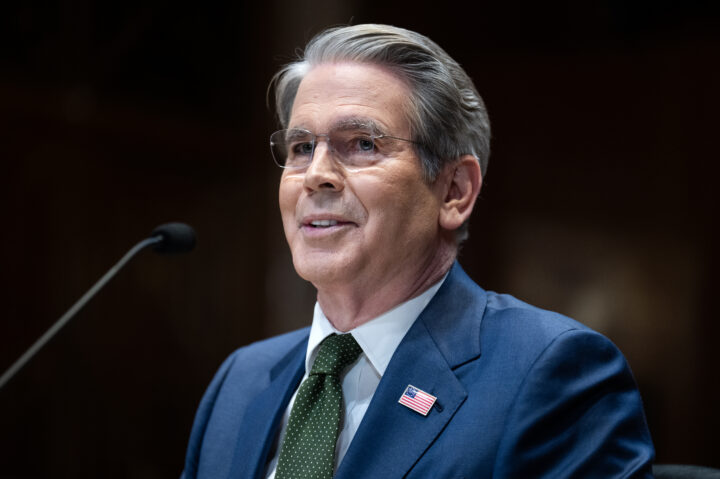
Tom Williams/CQ-Roll Call, Inc via Getty Images
Treasury Secretary Scott Bessent testifies at the Senate Appropriations Financial Services and General Government Subcommittee on April 22, 2026.


 Add JewishInsider on Google
A coalition of Jewish groups including the Louis D. Brandeis Center for Human Rights Under Law, StandWithUs and the National Jewish Advocacy Center wrote letters to Treasury Secretary Scott Bessent and Secretary of State Marco Rubio urging them to clarify their response to European governments’ new sanctions on businesses in territories they deem occupied by Israel.
“American companies should not be left to assume that silence from the United States means they may comply with foreign-government demands to participate in boycotts of Israel without potential consequences under U.S. law. We seek the application and enforcement of existing U.S. law, not new sanctions or retaliatory trade measures against foreign governments,” the organizations told Bessent. “The need for a clear public statement is immediate.”
The U.S. has anti-boycott laws that prohibit U.S. companies from complying or cooperating with foreign countries’ boycotts of U.S. allies. The U.S. government response to the European measures has been relatively muted thus far, and a Republican congressional source said that the State Department was refusing to grant clearance to add the European countries to the antiboycott list.
“The United States has a longstanding interest in protecting its businesses from foreign-government demands that conflict with American law and policy. The measures now being imposed or considered in Europe threaten to undermine that principle while creating new obstacles to legitimate commercial relationships with Israel,” the groups said in their letter to Rubio. “Absent a clear U.S. response, foreign governments and commercial counterparties may interpret American silence as acceptance of these restrictions, encouraging additional countries to adopt similar measures.”
The groups told Rubio that the policies may have direct consequences for American companies, undermine U.S. sovereignty, “effectively dictate which Israeli businesses American companies may engage with” and risk forcing American businesses to navigate conflicting foreign and domestic laws.
Writing to Bessent, the groups said that the new foreign rules could pressure American businesses to forgo trade with Israeli companies and individuals and avoid transactions with Israel altogether.
They said that the new European policies may run afoul of U.S. antiboycott law, and urged the Treasury to clarify whether that is the case and provide guidance for U.S. businesses.
“We ask the [Treasury] to affirm publicly that existing U.S. antiboycott laws remain in force, that applicable reporting obligations and tax consequences must be taken seriously, and that violations will be addressed under existing law,” the groups said in the Treasury letter. “Such a statement would also send an important message to foreign governments and commercial counterparties that the United States has not acquiesced in efforts to enlist American companies in boycotts of Israel.”
The groups asked Rubio to support Treasury’s recommendations, affirm U.S. opposition to measures targeting Israeli businesses, engage with European allies to seek the repeal or modification of the measures, highlight objections to the European measures and work with other agencies to ensure American businesses are aware of the potential consequences of complying with foreign boycotts.
More Stories

Daily Overtime
Vance takes on friendly fire
CRUZ CONTROL
Cruz rebukes Vance after GOP midterm losses: ‘No mandate to abandon Israel’

in the courts
ICJ’s Myanmar genocide ruling draws scrutiny for implications for Israel case
Daily Overtime
Van Hollen’s Iran playbook for leader
PRETORIA PROBLEMS
After political defeat and loss of U.S. trade perks, South Africa’s ANC shows no sign of shifting on Israel
pushed back
Senate Judiciary Committee postpones hearing on buffer zone bill for religious institutions
Please log in if you already have a subscription, or subscribe to access the latest updates.
 Continue with Google

 Continue with Apple