

































Plus, the MS NOW anchor who got her start in Israel
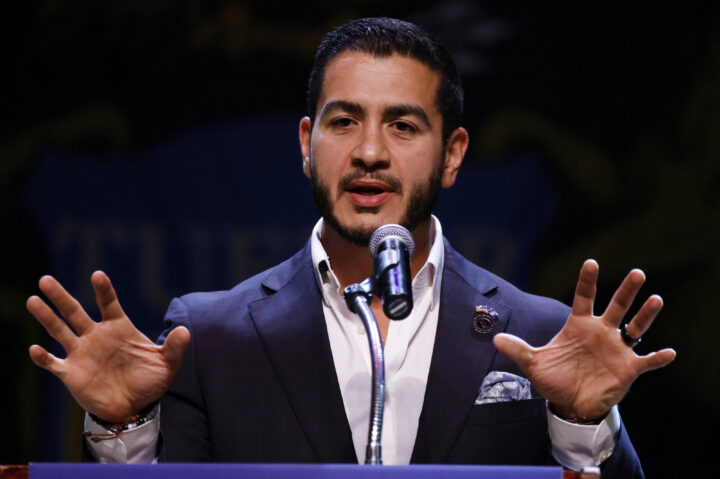
(JEFF KOWALSKY / AFP via Getty Images)
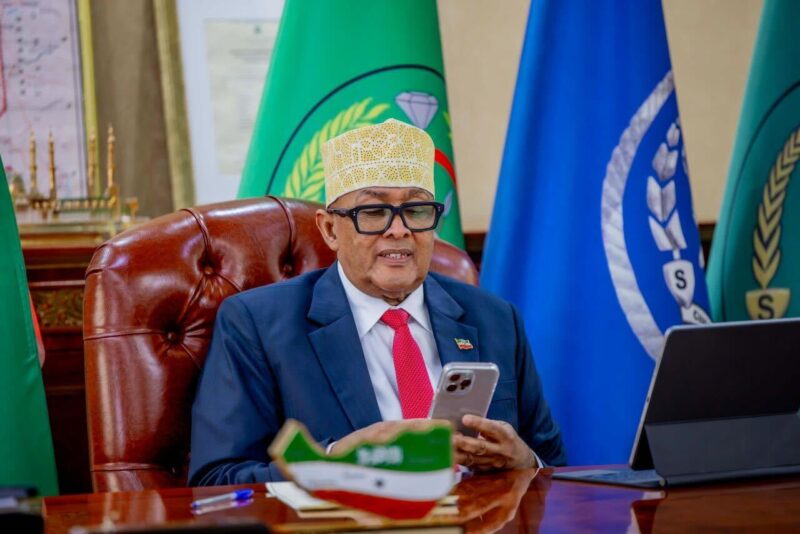
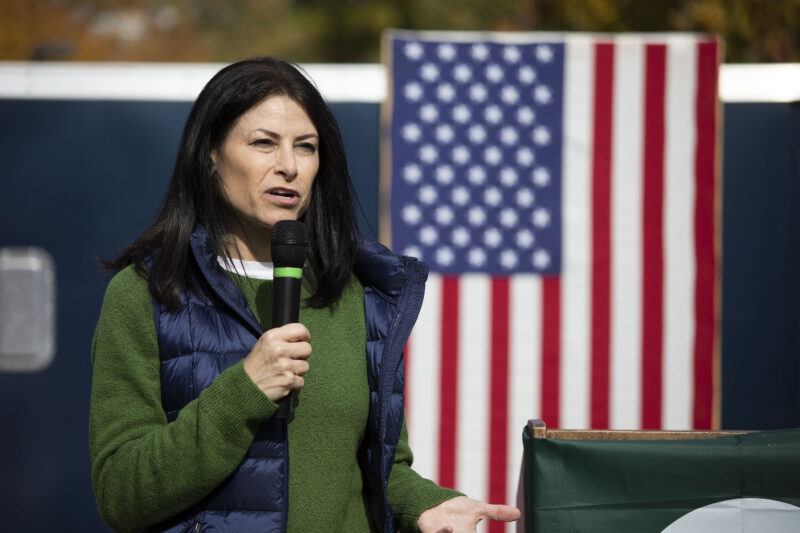
Abdul El-Sayed addresses supporters at his election night event at The Majestic Theatre in Detroit, Michigan, on August 4, 2026


 Add JewishInsider on Google
Good Thursday morning.
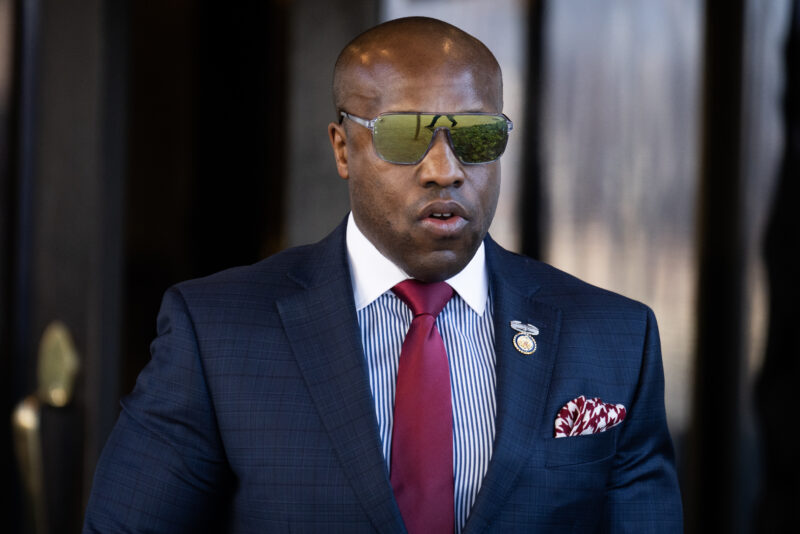
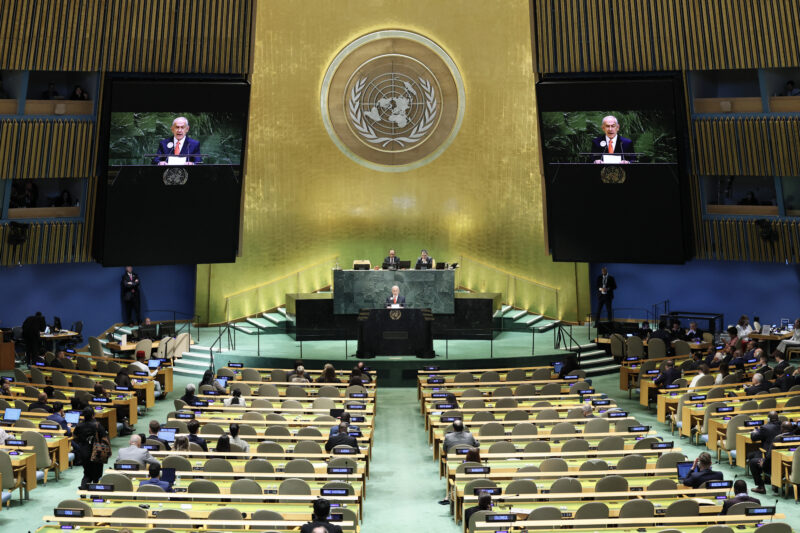
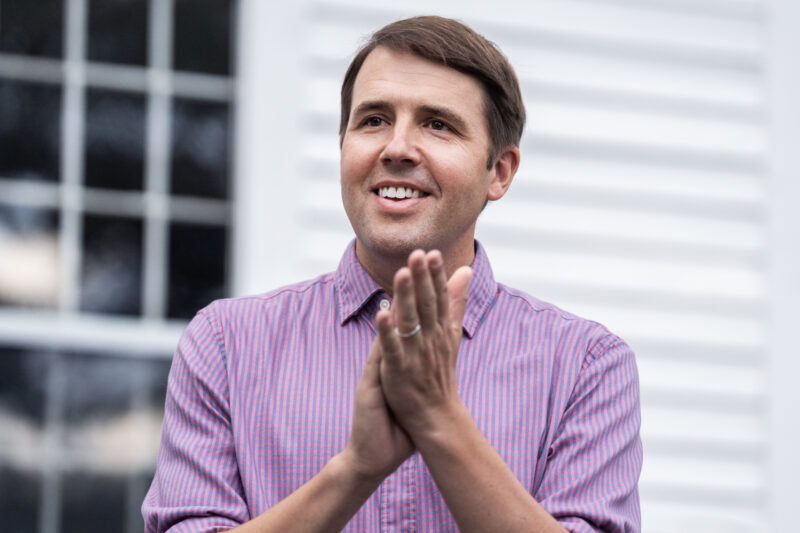
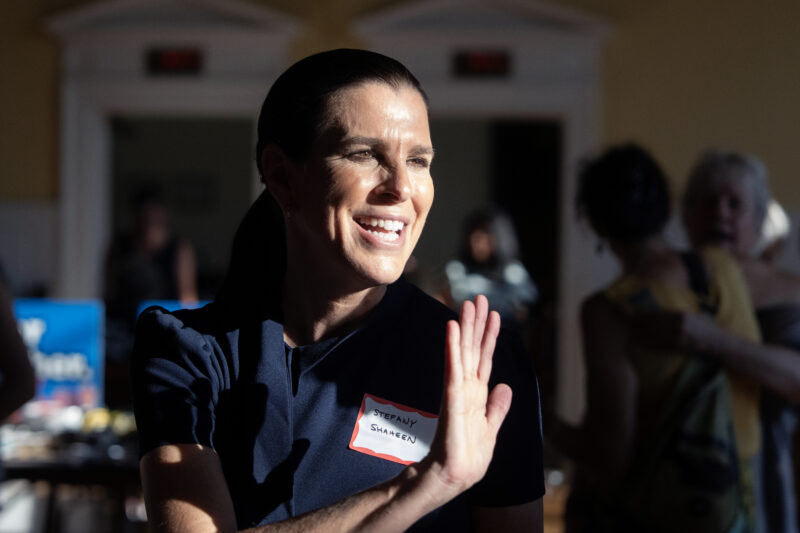
In today’s Daily Kickoff, we have the scoop on a recent meeting between Michigan Democratic Senate nominee Abdul El-Sayed and rabbis from Michigan’s Temple Israel, which earlier this year was attacked by a pro-Hezbollah terrorist, and cover yesterday’s Capitol Hill rally supporting the passage of the Right to Worship Act. We report on New York City Mayor Zohran Mamdani’s remarks that he will not participate in protests against Israeli Prime Minister Benjamin Netanyahu during next week’s U.N. General Assembly, and profile MS NOW anchor Erielle Reshef, who got her start on Israeli television. Also in today’s Daily Kickoff: Michael Dell, Lacey Schwartz Delgado and Jonathan Powell.
Today’s Daily Kickoff was curated by JI Executive Editor Melissa Weiss and Israel Editor Tamara Zieve, with an assist from Danielle Cohen-Kanik.
Today’s Agenda
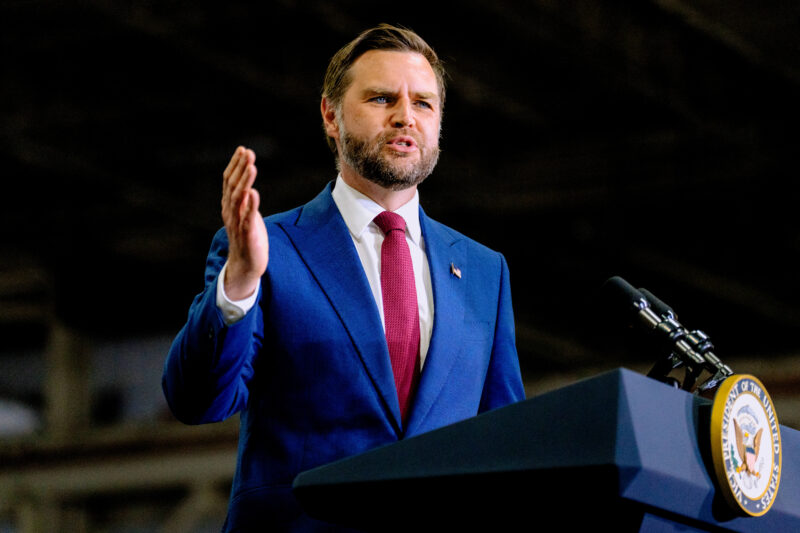
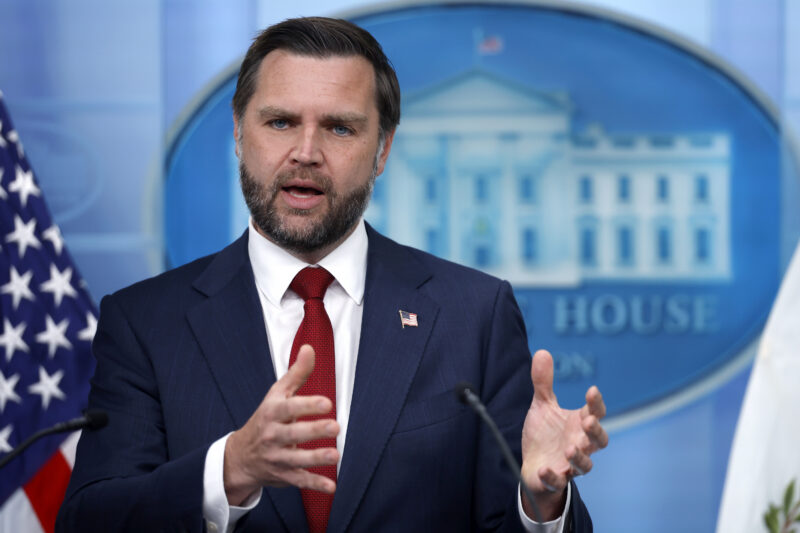
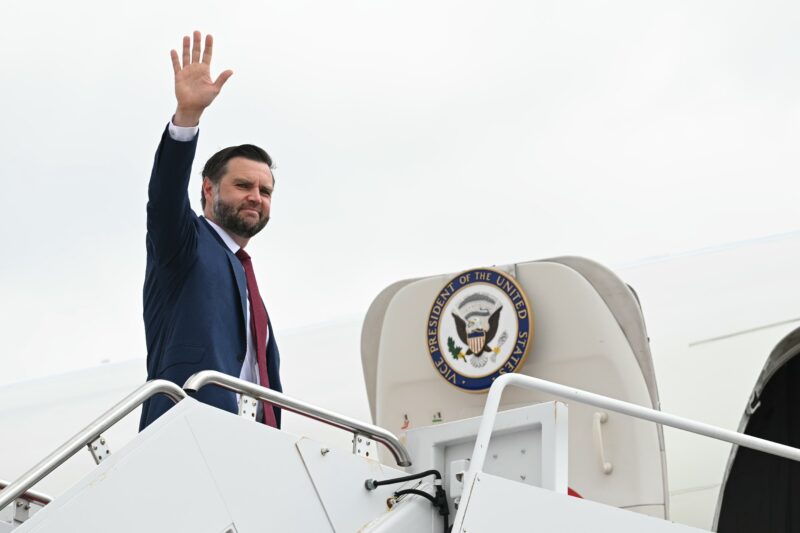
Vice President JD Vance is sitting down for an interview with Sid Rosenberg today, during which the conservative radio host said he intends to press Vance on his relationship with Tucker Carlson and his stance on the U.S.-Israel relationship.
The Hudson Institute is holding a fireside chat this morning focused on Iran-China relations and the U.S.’ Operation Economic Outcast effort to financially isolate Tehran that had initially featured Rep. Zach Nunn (R-IA). Nunn, who is locked in a tight reelection bid and earlier this week voted in favor of a war powers resolution to force an end to the Iran war, no longer appears on Hudson’s promotional page for the event, which now features Rep. Michael Baumgartner (R-WA).
Axios is releasing portions of its recent interview with far-left commentator Hasan Piker over the course of the day, ahead of the release of the full interview tomorrow. In the first released clip, Piker told the outlet’s Alex Thompson that he believed that the U.S. had committed more acts of terror than al-Qaida, saying, “Pound for pound as far as the number of deaths, yes,” adding, “We have caused tremendous terror all around the world.”
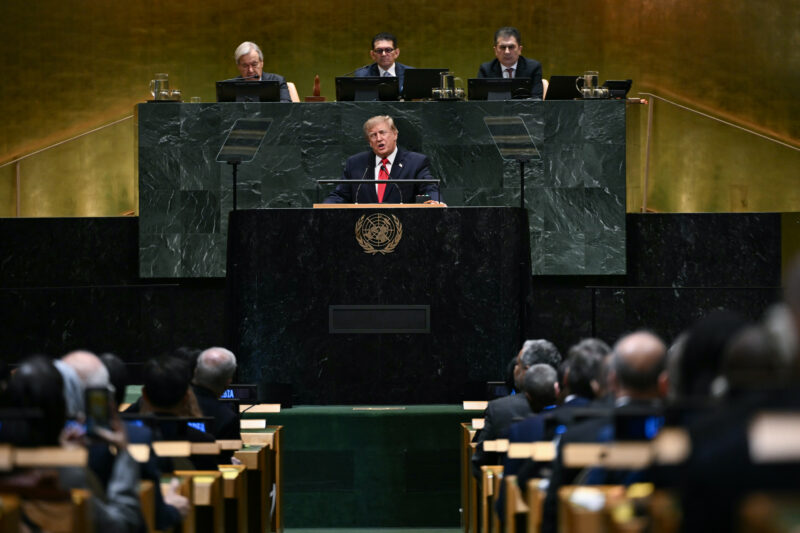
New York City Mayor Zohran Mamdani is holding a briefing today alongside NYPD Commissioner Jessica Tisch about security around the U.N. General Assembly, which begins next week. More below.
The Atlantic Festival kicks off today in New York. The three-day convening begins this morning with a sit-down with former Transportation Secretary Pete Buttigieg (who was in New York’s Hudson Valley yesterday campaigning with NY-17 Democratic candidate Cait Conley). This afternoon, former U.S. Ambassador to Japan Rahm Emanuel, who is mulling a 2028 bid, will take the stage for a fireside chat about the future of the Democratic Party.
We’re continuing to follow the fallout from Macklemore’s performance earlier this month at two Ed Sheeran concerts over the rapper’s anti-Israel remarks at previous concerts and past antisemitic incidents. Robert Kraft, who along with several other stadium owners banned the rapper from performing at their venues over his past antisemitic rhetoric and imagery — prompting several other opening acts to drop out of the shows in solidarity — pledged $2 million for aid to the Middle East on Wednesday, matching a donation of the same amount by Sheeran. Read more about the donation here.
One Thing To Know
SCOOP
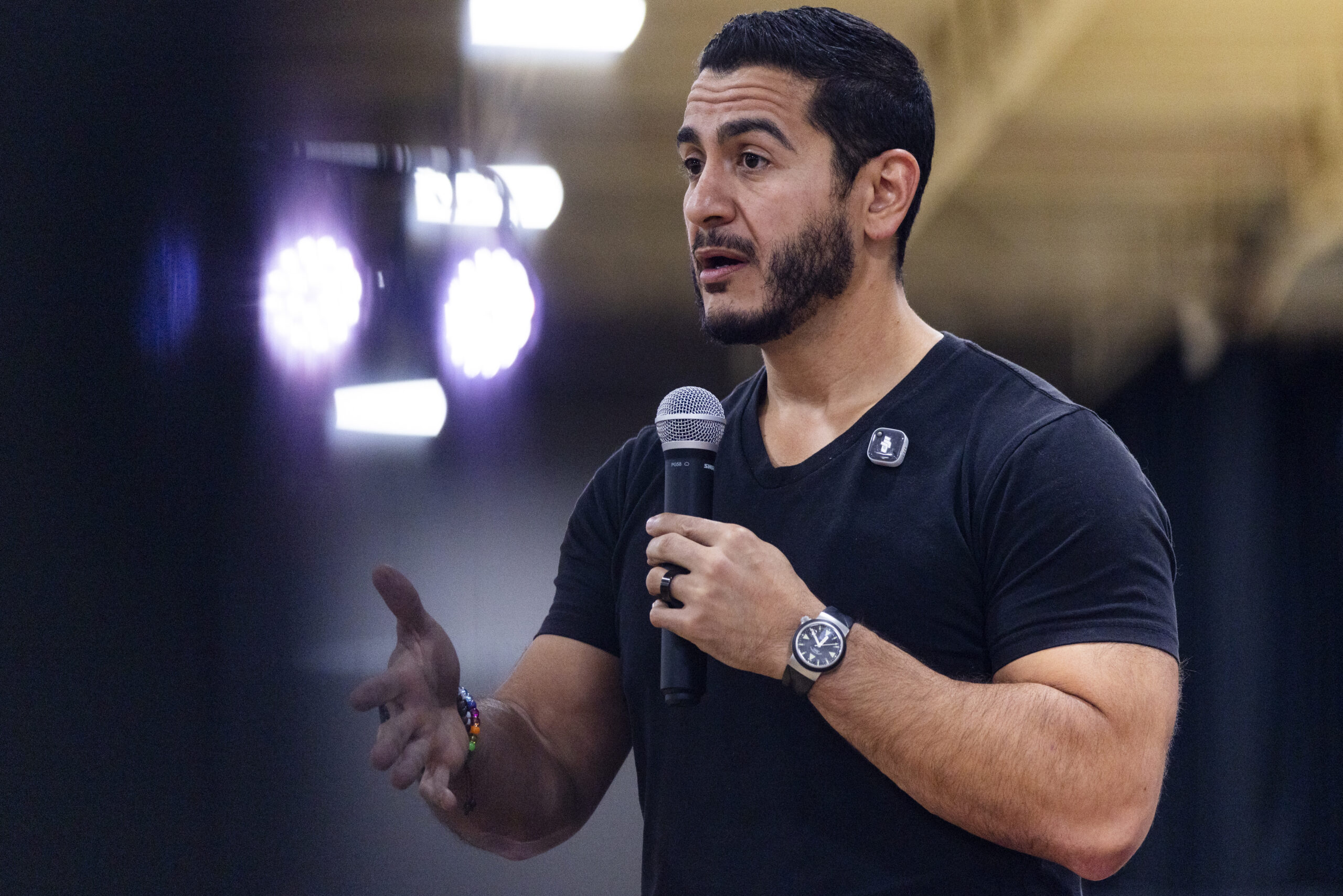
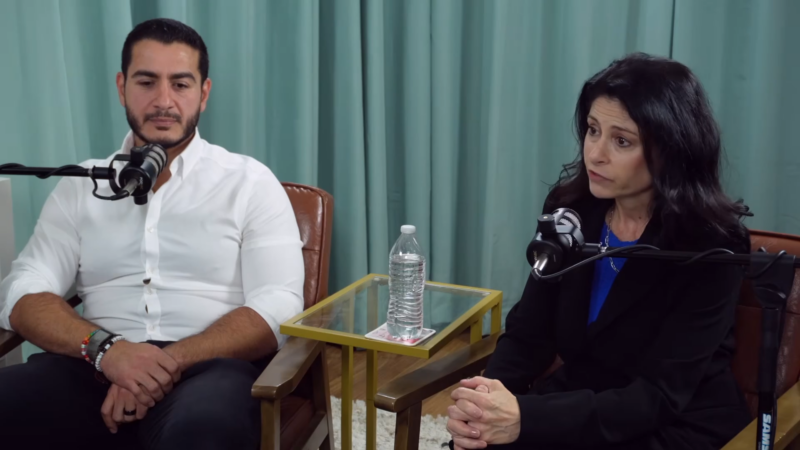
In the most significant sign of his efforts to make inroads with skeptical Jewish voters in Michigan’s Senate race, Abdul El-Sayed, the Democratic nominee, recently met with rabbis at Temple Israel for a closely guarded conversation, according to two people familiar with the meeting.
Two rabbis who were said to have participated in the conversation, details of which were unclear, declined to comment when reached on Wednesday. El-Sayed’s campaign did not respond to a request for comment.
The covert nature of the meeting, which neither party has publicized, underscores the sensitivities felt among some Jewish leaders who have remained wary of publicly associating with El-Sayed because of their continued discomfort with his positions on Israel and remarks about antisemitism.
The Big Reads
show of support
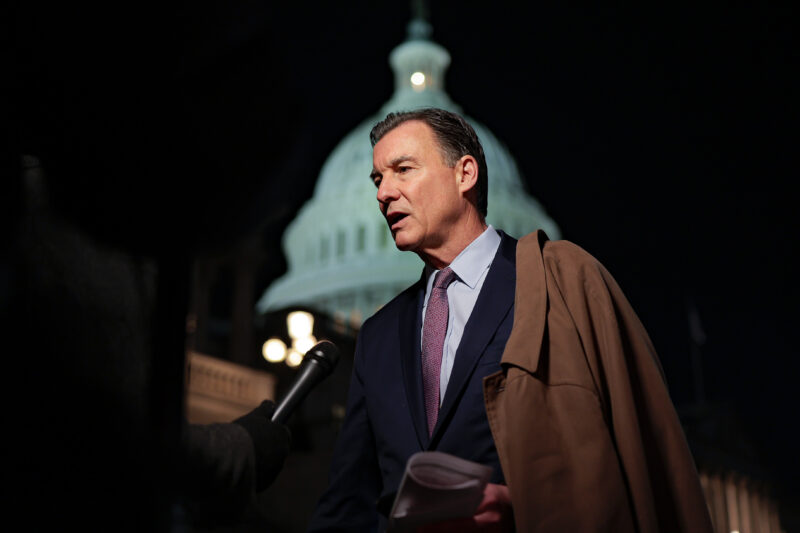
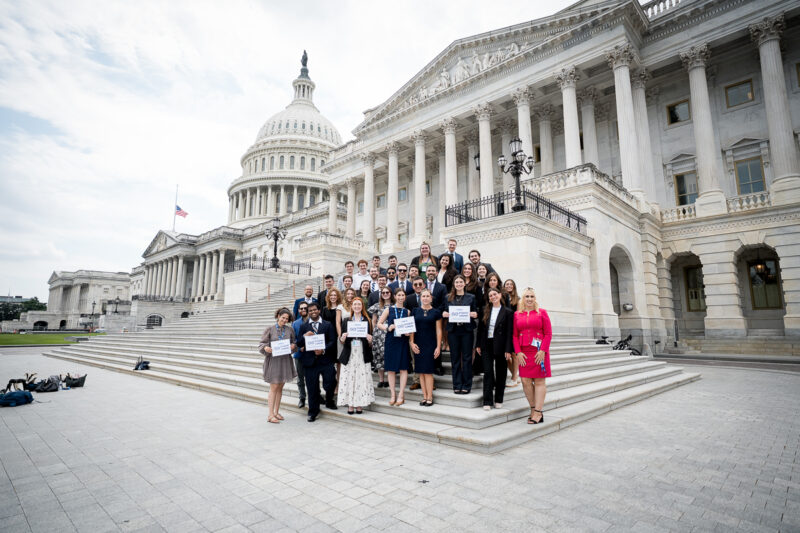
Reps. Brad Knott (R-NC) and Tom Suozzi (D-NY) rallied outside the Capitol on Wednesday alongside more than two dozen representatives of religious community organizations in support of the Right to Worship Act, their federal bill establishing buffer zones outside of religious institutions to protect them from disruptions. House Speaker Mike Johnson (R-LA), who has been involved in supporting the bill behind the scenes, also expressed his support for it in a statement to Jewish Insider’s Marc Rod. “Religious liberty is regarded as our ‘First Freedom.’ Our Founders listed it first in the Bill of Rights because they understood how essential it was to the foundation of our Republic. But that right rings hollow if worshippers must brave harassment or worry for their safety as they exercise their religion,” Johnson said.
First in JI: Over a year after the deadly firebombing attack targeting an Israeli hostage awareness march in Boulder, Colo., Rep. Joe Neguse (D-CO), who represents the city, and Rep. Don Bacon (R-NE) introduced legislation to modify Nonprofit Security Grant Program conditions to allow grantees to use funding for staffing costs.
PROTEST POLITICS
New York City Mayor Zohran Mamdani told reporters on Wednesday that he does not intend to participate in any demonstrations against Israeli Prime Minister Benjamin Netanyahu’s appearance at the U.N. General Assembly next week — and maintained he did not endorse public agitation against the Jewish state’s premier, an apparent ratcheting-down of his remarks from earlier this summer, Jewish Insider’s Will Bredderman reports. Following an unrelated press conference, Mamdani confirmed information leaked to Politico that he would not take part in anticipated protests against Netanyahu’s scheduled arrival in New York on Sept. 23 or speech at the international summit the next day. He also stressed that he did not call for his anti-Israel allies on the left to take to the streets either. “I do not have any plans to attend any protest at the U.N. General Assembly,” Mamdani said. “To New Yorkers, I have never encouraged them to protest.”
anchor point
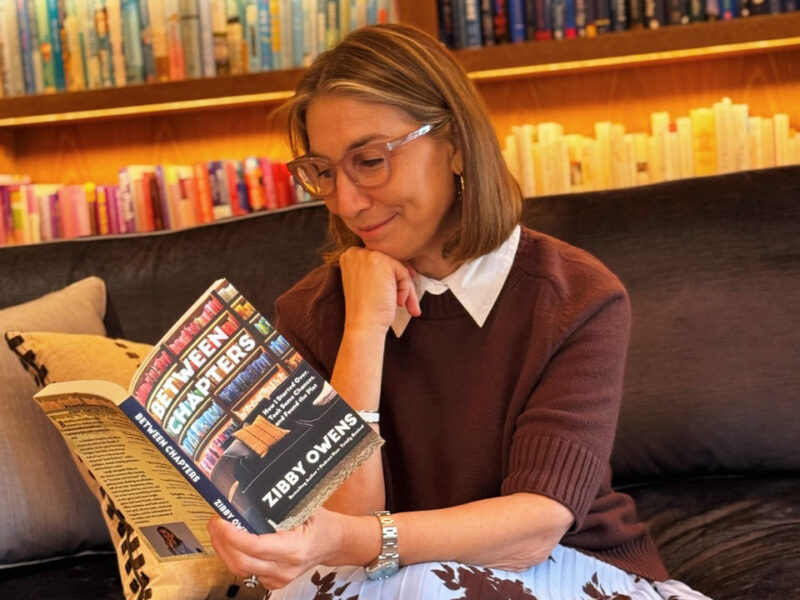
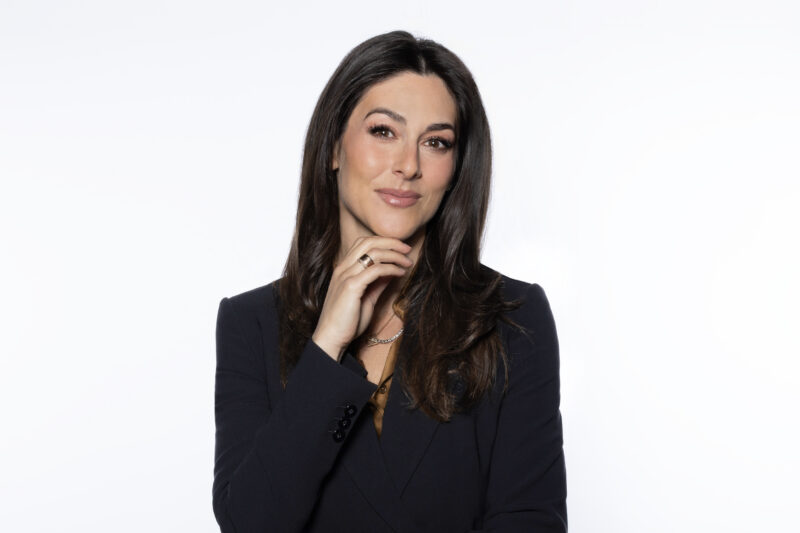
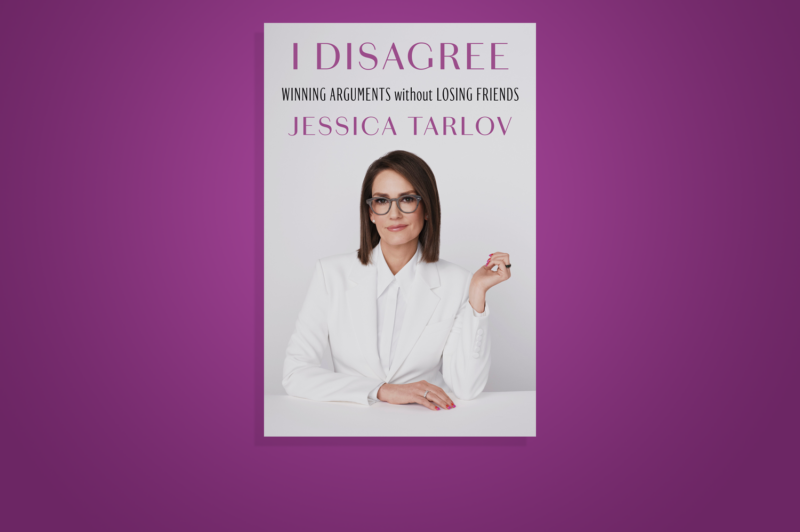
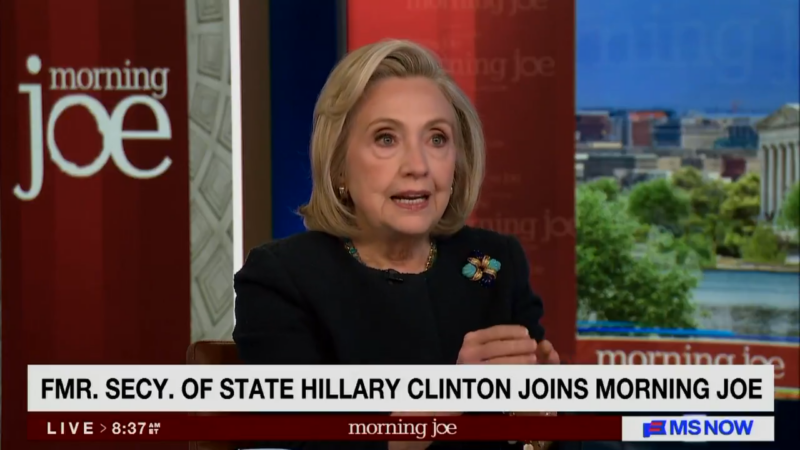
MS NOW anchor Erielle Reshef never planned to become a television journalist. After completing a master’s degree in diplomacy and conflict studies in Israel in 2010, she happened to be watching an English-language news program whose anchors were about to go on maternity leave. Her husband wrote down the email address on the screen and pushed her to apply. That opportunity launched a career that has taken Reshef from her hometown of Oklahoma City to local television, international news and eventually ABC News, where she spent eight and a half years, including as a national correspondent. In June 2025, Reshef left the relative comfort of a network news reporting job to join MSNBC, which was rebranded later in the year as MS NOW, where she is now a fill-in anchor for daytime cable news shows for the first time. In an interview with Jewish Insider’s Haley Cohen, Reshef said her Jewish values — particularly curiosity, rigorous debate and a commitment to understanding people on the margins — are the “scaffolding” of her journalism.
The Rundown
ON THE HILL
not so fast
behind the veil
On Our Radar
● The Live Briefing. Word on the street, clips, podcasts and quick updates — the items we’re tracking all day in our Live Briefing on the app (on Apple and Android) and website.
President Donald Trump is planning to meet with Gulf leaders next week on the sidelines of the U.N. General Assembly in New York to discuss a postwar strategy for Iran; the president held a similar meeting on the sidelines of last year’s UNGA to discuss Gaza, a week before publicly releasing his postwar plan for the enclave…
The State Department extended its visa ban on Palestinian Authority President Mahmoud Abbas and other senior Palestinian officials, preventing members of the delegation from attending UNGA next week for the second year in a row; State Department officials attributed the ban to Palestinian leaders’ efforts to “internationalize the Israeli-Palestinian conflict”…
New photos obtained by CBS News indicate widespread damage at U.S. facilities around the Gulf resulting from Iranian attacks, including destroyed planes, buildings and vehicles in Kuwait and Saudi Arabia.
CNN reports that more than a dozen Russian spy satellites had operated over a U.S. base in Saudi Arabia two days before the facility was struck in an Iranian drone and missile attack in which 15 U.S. troops were injured…
The House passed, in a 262-159 vote, a major Russia and Iran sanctions package named for the late Sen. Lindsey Graham (R-SC), which targets Russia’s energy sector as well as Iran’s weapons and energy industries…
Sens. Tim Kaine (D-VA) and Adam Schiff (D-CA) filed a war powers resolution to block military action against Oman, in response to Trump‘s threats to bomb the U.S. ally if it does not cooperate with U.S. efforts to counter Iran in the Strait of Hormuz…
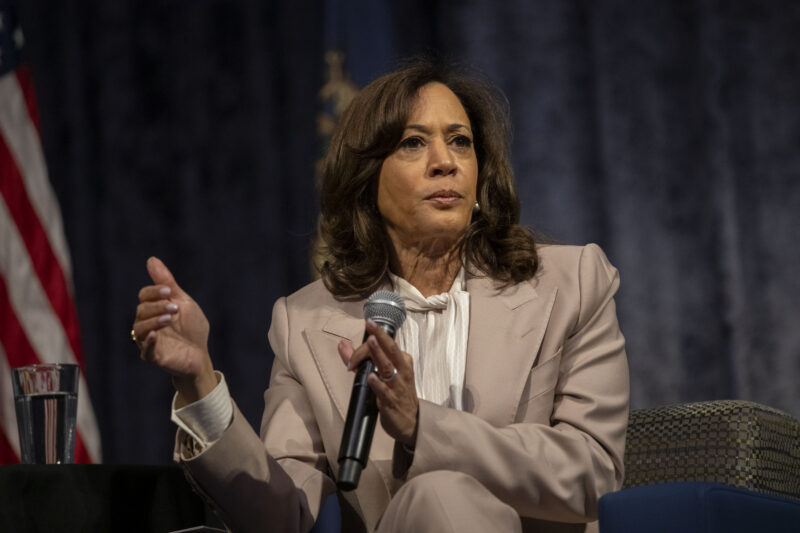
Former Vice President Kamala Harris is slated to campaign with Michigan Democratic Senate nominee Abdul El-Sayed next week in the Wolverine State.
Meanwhile, the Detroit News endorsed El-Sayed’s opponent, former Rep. Mike Rogers (R-MI), citing in part El-Sayed’s history of deleting past social media content and noting that a “candidate who feels the need to hide his past from voters is not someone who can be trusted to be the same person after Election Day as he was on the campaign trail”…
A New York man who pleaded guilty to assaulting a Jewish man days after the Oct. 7, 2023, Hamas terror attacks was sentenced to 90 days in jail; during sentencing, Yehia Amin was photographed smiling and flashing the peace sign with his hands, telling the judge through an interpreter that he wanted to look good in photographs from the courtroom…
Michael Dell listed his Boston penthouse in the city’s Millennium Tower for less than he purchased it a decade ago for $10.9 million…
The Hollywood Reporter reviews documentarian Lacey Schwartz Delgado’s “Re/Pair,” which premiered at the Toronto International Film Festival and pairs Black and Jewish figures, including David Schwimmer, Van Jones, Black Lives Matter co-founder Patrisse Cullors and Rabbi Sharon Brous, for conversations about Black-Jewish relations…
The Spectator reports that both U.K. National Security Advisor Jonathan Powell and London’s ambassador in Israel, Simon Walters, advised Foreign Secretary Ed Miliband against banning imports from Israeli settlements, warning that such a move would bolster support for Israeli Prime Minister Benjamin Netanyahu and his government ahead of next month’s elections…
Air Canada removed an in-flight service director following a report that the employee had shared antisemitic content on social media; the Canadian carrier will also resume direct flights between Toronto and Israel at the end of November, earlier than its planned January resumption of flights…
A Kurdish-Jewish man with Canadian and Israeli citizenship who had traveled to the region to fight ISIS more than a decade ago was freed from an Iraqi Kurdish prison after he was convicted of killing a taxi driver in 2015; Aish announced that Ben Chasin will arrive at the organization’s yeshiva this week, where he will study…
Israeli Foreign Minister Gideon Sa’ar met with Moroccan Foreign Minister Nasser Bourita in New York in a meeting convened by U.S. Ambassador to the U.N. Mike Waltz, during which Jerusalem and Rabat agreed to a series of measures to boost bilateral ties, including appointing full ambassadors to each other’s countries, turning their diplomatic missions into embassies, increasing direct flights and holding high-level visits in the near future.
The night prior, Waltz hosted Sa’ar, Bourita, United Arab Emirates Ambassador to the U.S. Yousef Al Otaiba and diplomats from Bahrain and Kazakhstan for a diplomatic reception marking the sixth anniversary of the Abraham Accords.
While in New York, Sa’ar also met with senior leaders of the Conference of Presidents of Major American Jewish Organizations for a wide-ranging discussion on Israel’s security, regional developments and U.S.-Israel relations…
Dalia Ziada is joining the Institute for the Study of Global Antisemitism and Policy as the director of the organization’s Washington office…
Artist and graphic designer Peter Max died on Monday at 88…
Worthy Reads
Find more Worthy Reads in our Live Briefing via our app (on Apple and Android) and website.
Meta-morphosis: Bloomberg’s Riley Griffin and Alexandra Levine look at the role that Dina Powell McCormick plays at Meta, where she now serves as president, vice chairman and co-leader of Meta Compute after eight months on the company’s board. “While [Mark] Zuckerberg, 42, is the cerebral engineering leader obsessed with improving Meta’s products for the AI race, Powell McCormick, 53, has her pulse on the world outside of Silicon Valley, and can be Meta’s bridge to opportunities and fixer of challenges. ‘She is a close, trusted advisor of the whole senior leadership team, but especially of Mark,’ said CJ Mahoney, Meta’s chief legal officer. ‘She’s generally the last person who’s consulted on really important decisions.’” [Bloomberg]
Riyadh Ruminations: In War on the Rocks, Richard Nephew posits that the burgeoning nuclear agreement between the U.S. and Saudi Arabia is better than had initially been expected. “If it performs as promised, its provisions of exclusivity will provide benefits to the U.S. nuclear industry and lock Russia and China out of a potentially lucrative market that could have attendant political and security implications long term, especially in a Middle East where nuclear proliferation remains a serious threat. The U.S.-Saudi agreement is also innovative and imaginative, a credit to creative negotiations to unlock an issue that has been difficult for multiple administrations.” [WarontheRocks]
AI and the Archives: In The Washington Post, Daniella Greenbaum Davis explains how she used Anthropic’s Claude to recover and translate a 1946 Yiddish-language article that had been authored by her grandmother and detailed the day she was liberated from Bergen-Belsen. “Much of the debate concerning AI today is about scale and mortal threat, about destroying jobs and flooding social media with slop. It’s easy to forget that large language models, like all tools, are a thing human ingenuity has built to finish what human hands cannot. … I had spent years blindly feeling my way through archives; in a matter of days, AI had stitched together pieces of information that I couldn’t see, let alone put together.” [WashPost]
Picture of the Day
Birthdays
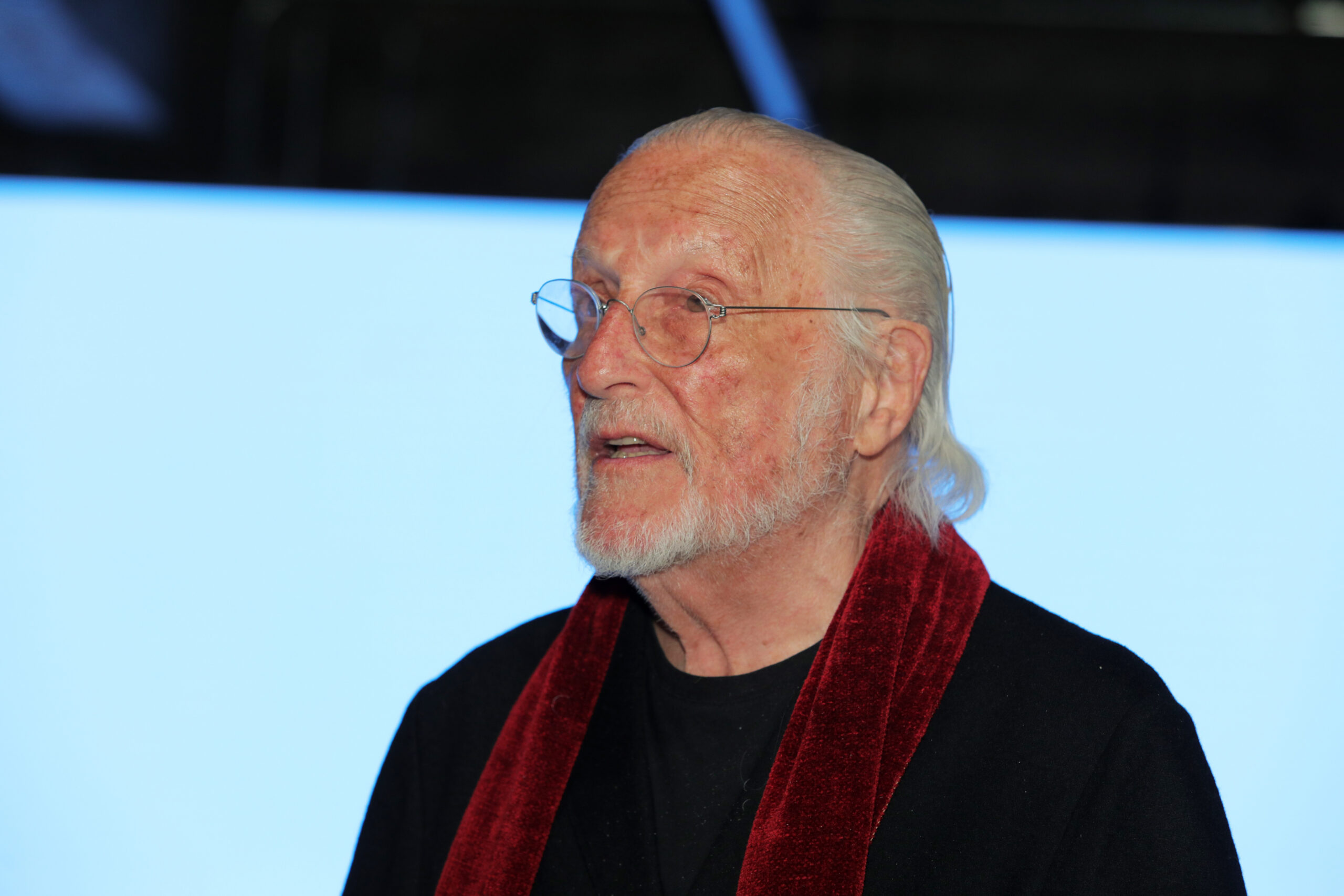
Stan M. Herman, fashion designer known worldwide for his leading-edge corporate uniforms, turns 98
Chuck Grassley, U.S. senator (R-IA) since 1981 and president pro tempore of the Senate, turns 93
Peter J. Solomon, investment banker who once served as a NYC deputy mayor, turns 88
Gail Carson Levine, Newbery Honor-winning author of many young adult books, some with Jewish themes, turns 79
Joshua Muravchik, author of 11 books and hundreds of articles on foreign policy and the Middle East, turns 79
T. Alan Hurwitz, former president of the National Technical Institute for the Deaf and then president of Gallaudet University, turns 79
Frank Hagelberg, Rochester, N.Y., attorney, he has held positions at the UJA-Federation of New York and the Rochester Jewish Federation
Jeremy Don Fogel, retired judge on the U.S. District Court for the Northern District of California, turns 77
Harold Solomon, former professional tennis player who achieved a world ranking of No. 5 in 1980, turns 74
Rita Rudner, comedian, writer and actor, she was a frequent guest of Johnny Carson on the “Tonight Show,” turns 73
Daniel Fingeroth, author, comic book writer and editor, best known as group editor of the Spider-Man books at Marvel Comics, turns 73
Mody Kidon, Israeli businessman with real estate holdings in Israel and NYC, turns 72
Ellen Kahan Zager, author and graphic designer
Rina Frenkel, former member of the Knesset for the Yesh Atid party, turns 70
Rabbi Jonathan Wittenberg, rabbi emeritus of the New North London Synagogue and senior rabbi of Masorti Judaism UK, turns 69
Elliott S. Feigenbaum, former consultant at Quick Hits News
Richard Wolffe, journalist, best-selling author including two books on the Obama presidency and Emmy Award-winning executive producer, turns 58
Mandy Krauthamer Cohen, director of the Centers for Disease Control and Prevention (CDC) for the last 18 months of the Biden administration, turns 48
Adam Abrams, former regional communications director and spokesperson for former President Barack Obama, now a partner at Seven Letter
Nick Melvoin, member of the Los Angeles Unified School District’s Board of Education, turns 41
David Litt, former Obama White House speechwriter who has since written a best-selling comedic memoir, turns 40
Adina Shatz, principal product manager for CathWorks
Rachel Roubein, national healthcare reporter The Washington Post covering the FDA
Natalie Edelstein Jarvis, editorial producer at Google
Max August, founder of the Israel Summit at Harvard, now a member of the partnerships team at OpenAI
Matt Maasdam is gaining late momentum running on his national security credentials, but Bernie Sanders-backed William Lawrence is winning over the base
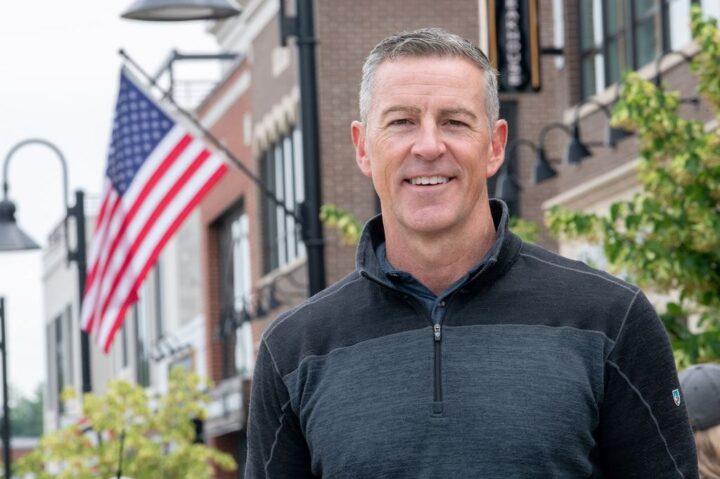
Campaign website
Matt Maasdam
The Democratic primary in Michigan’s 7th Congressional District — a Lansing-area swing seat key to Democrats’ hopes for taking back the House — has turned into a three-way battle between two moderate Democrats with national security backgrounds and a far-left activist who has emerged as a contender for the nomination despite repeated controversies over extremist comments.
On the campaign trail, Matt Maasdam, a former Navy SEAL, has leaned into his background as a veteran and a military aide to former President Barack Obama who carried the nuclear football. Bridget Brink, a career foreign service officer, is highlighting her service as U.S. ambassador to Ukraine from 2022 to 2025.
William Lawrence, the progressive backed by Sen. Bernie Sanders (I-VT), is a former organizer with the Sunrise Movement, which bills itself as leading “the climate revolution” but also embraces other left-wing causes.
Adrian Hemond, a Michigan political strategist, said he expects the race to be close, predicting that the three candidates could all finish within several points of each other.
He previously told JI that Lawrence holds the progressive lane to himself, which could be an asset if Maasdam and Brink split the moderate vote — but he could lose out on young, progressive-leaning Michigan State University students who won’t return to campus until after the Aug. 4 primary. Lawrence has also struggled with Black and older voters.
The race initially appeared to be a contest between Maasdam and Brink. Lawrence gained momentum and attention by scoring a series of prominent endorsements from Sanders and other progressive leaders.
But Lawrence’s rise hit a stumbling block with the re-emergence of past comments disparaging Black political leadership, which prompted condemnations from Michigan leaders and the Congressional Black Caucus. After those initial revelations, Lawrence subsequently came under fire for past comments disparaging Obama and his administration.
In past comments on the “Hegemonicon” podcast he hosted, first uncovered by Jewish Insider, Lawrence repeatedly argued, for the sake of climate and economic goals, Americans would have to abandon the idea of the American dream and their way of life.
Discussing whether and how ideas of “abundance” or “degrowth” could or should be part of an agenda to fight climate change, Lawrence said on an episode of the podcast release in January 2024, “we’ve experienced the last several years of how that got filtered through the lens of American global competitiveness and geoeconomic dominance and, some of these questions about the role of the American consumer on a global stage and and whether or not we are proposing the continuation of the American consumer way of life and its translation into China and presumably the rest of the globe, is really viable in a climate-changing world.”
“We made that move, and now we need to reckon with the contradictions inherent even in that move,” Lawrence said. “I’m wondering how we can inspire a sense of abundance for people in the United States while, frankly, destroying the American way of life and the negative connotations, and material realities that has come to mean.”
In a statement, Lawrence defended the comments.
“We’ve been told that we would achieve happiness by buying more TVs and taking on a bigger mortgage,” Lawrence said. “Instead, the cost of housing, healthcare, and education is skyrocketing, while Michigan’s land and water is under threat. We need a new version of the American dream in which we can all have economic security while leaving a healthy environment for our kids and grandkids.”
In another episode, released in December 2023, Lawrence said that “there are certain aspects of the American dream that need to die — but maybe that’s another episode,” arguing that most people would not be able to have “the McMansion in the suburbs.”
A senior political advisor close to the Maasdam team said that the endorsements from Sanders and other top progressives catapulted Lawrence toward the front of the field, but the recent revelations of his past comments have stunted that growth.
The advisor said the endorsements from Sanders and others likely earned Lawrence the votes of around a third of the Democratic electorate who will likely vote for the most-left candidate in the race, leaving around two-thirds up for grabs.
Last week, Maasdam picked up an endorsement from Sen. Elissa Slotkin (D-MI), who subsequently filmed an advertisement supporting him. The freshman senator represented the Lansing-area district before being elected to the Senate.
The advisor close to the Maasdam campaign said that they see the race now largely as a contest between Maasdam and Lawrence, but said they believe Maasdam is well-positioned going into the final weeks of the race and peaking at the right time.
He has been the beneficiary of more than $1.6 million in outside spending by VoteVets, with another outside group, Crush MAGA PAC, spending nearly $1 million to attack Lawrence, and a third group, Michigan Values PAC, spending around $1 million to attack Brink. A nursing union group has spent $400,000 boosting Lawrence.
At the same time, they also acknowledged a real concern that Maasdam and Brink could split the moderate vote, allowing Lawrence to win with a plurality.
Brink has faced criticism from primary rivals for her service under and praise of President Donald Trump — though she ultimately resigned in protest of the administration’s efforts to pressure Ukraine.
The advisor argued that, compared to Brink, Maasdam has a better resume and background as a fighter, and said Maasdam plans to highlight his links to Obama in the wake of the revelation of Lawrence’s comments disparaging the former president.
Maasdam posted an X video on Monday highlighting his support for and ties to Obama, while calling out Lawrence’s criticism of him.
In spite of their moderate and national security focused backgrounds, neither Maasdam nor Brink appears to have spoken much about Israel policy during the campaign, and neither campaign provided comment to JI on their stances.
Lawrence has attacked the two for declining to describe the war in Gaza as a genocide, and has made cutting off arms sales to Israel a major plank of his campaign.
All three have been critical of the war with Iran.
‘Without oil, they're nothing,’ the former national security adviser said at the Aspen Security Forum, adding that by cutting it off, the U.S. could ‘turn them into a ‘stan, turn them into a nonentity’
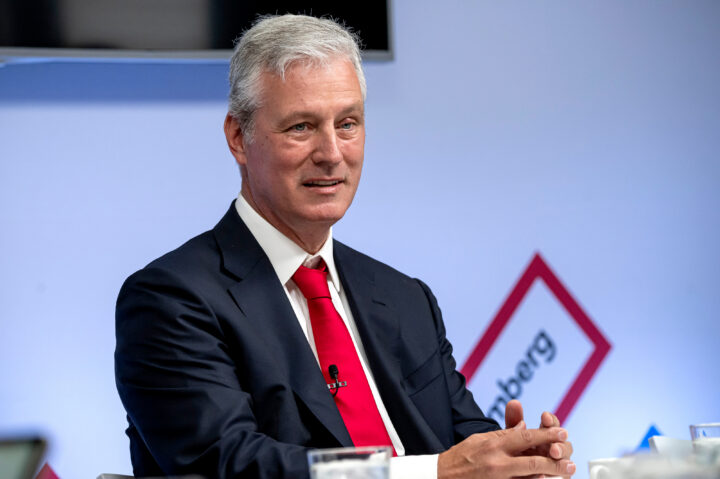
(David Paul Morris/Bloomberg via Getty Images)
Robert O'Brien, former national security adviser, at an interview during the Republican National Convention (RNC) near the Fiserv Forum in Milwaukee, Wisconsin, US, on Wednesday, July 17, 2024.
ASPEN, Colo. — Robert O’Brien, who served as national security advisor during President Donald Trump’s first term, said on Wednesday that the U.S. should target Iran’s oil infrastructure with the goal of choking off its economy — and predicted that the president is moving in that direction.
The former national security advisor said on a panel at the Aspen Security Forum that Trump had been “very, very generous” with Iran but he believes that Trump’s “patience” with Iran is running thin. The next steps, he predicted, would be for the U.S. to “hit them hard” and “finish the job” by targeting sites connected with Iran’s oil infrastructure, including the facilities at Kharg Island, in order to deprive Iran of its ability to produce and export oil.
“Without oil, they’re nothing. With oil, the regime thinks if they can survive, they can just buy more kit,” O’Brien said. “I think President Trump will finish the job. The Iranians are using the old playbook of extend, pretend and snowball. … They’re dealing with a whole new administration with Donald Trump. They don’t understand it, and I think that they’ll pay a heavy penalty for their lack of understanding.”
The first Trump administration’s strategy of maximum pressure through economic sanctions is “not enough” without strikes on Iran’s oil production, he continued.
O’Brien said that cutting short Iran’s oil exports would be the skeleton key to deafening the regime — cutting off its ability to build missiles, support terrorism or rebuild its nuclear program, and said that the U.S. could “turn them into a ‘stan, turn them into a nonentity” and prevent it from ever rebuilding.
The former national security advisor acknowledged that targeting Iranian oil production would hurt the world economy, but made the case that there are other oil producers that would be able to fill the gap with the right support, including Venezuela, Guyana and Mozambique, along with increased production in the U.S.
Asked after the panel by Jewish Insider about how he views the future of Israel policy among conservatives — and about comments by Vice President JD Vance accusing Israel of running a cover influence campaign to undermine the Iran deal and of having ties to sex offender Jeffrey Epstein — O’Brien insisted that support for Israel among conservatives, including Vance, remains strong.
O’Brien said he hadn’t heard Vance’s comments but called him a “supporter” and “friend of Israel.” He added that Trump is “a very good friend of Israel. President Trump has Jewish grandkids, I mean, so he cares deeply about it. He got the Abraham Accords for us and sent me to Jerusalem many times. And I can tell you, after Oct. 7, he was very concerned about Israel and has remained so ever since. No better friend to Israel than President Trump.”
He argued that recent polling indicates that support for Israel remains strong among Republicans in general, even among young people, and predicted that issues among “some conservatives — or people who claim to be conservatives” will not “hold.”
“Those of us who value the partnership, love our Jewish friends, our Israeli colleagues, just need to be forthright and stand up for Israel,” O’Brien said. “Israel, I’ve always said throughout my career, is a canary in the coal mine. If people are attacking Israel, the next country they’re going to attack is America, and so we need to stand strong with our allies in Israel, stand strong with Jerusalem, and I think it’s going to be a relationship that lasts long into the future.“
Stephen Hadley, who served as national security advisor in the Bush administration, said on the panel that the U.S. “can do better in terms of an outcome” with Iran, urging the administration to “stop chasing after the Iranians for an agreement on the nuclear issue,” adding that the U.S.’ operations have done significant damage to Iran’s nuclear program and can hit Iran again if it attempts to reconstitute the program.
It’s a similar strategy to that outlined by former Secretary of State Condoleezza Rice, also a Bush administration alumnus, a day prior at the Aspen conference.
Hadley said the U.S. should be open to nuclear talks if Iran seeks them out — but with the preconditions of no enrichment and no financial paydays for Iran.
He said that with continued sanctions, facilitation of trade along the Omani side of the Strait of Hormuz, strikes on Iranian capabilities threatening trade in the strait and assistance to countries in the region to diversify their export channels in the longer term, the U.S. could erode Iran’s ability to hold the global economy hostage and reach a stable situation.
“Hopefully, someday an Iranian regime will come forward and decide that their pursuit of nuclear weapons and support for Hezbollah and the like has been a dead end, and they will join the countries in the region to try to build a more prosperous and secure Iran for their people,” Hadley said. “If that happens, great. If it does not happen, the kind of arrangement I think I’ve described will protect our interests, protect the interests of our allies. “
At the same time, he emphasized that regime change through air power alone is likely off the table.
“[Trump] has to be clear that his objectives are consistent with the tools and means he has at his disposal,” Hadley said. “I think that’s a mistake he made in Iran initially when he was talking about regime change.”
Former Undersecretary of Defense Michèle Flournoy, who served under President Barack Obama, praised the U.S.’ Operation Midnight Hammer last June as “very targeted, very specific and very effective” — something few Democrats said at the time.
She contrasted her praise of that operation to the war this year, which she said started with unclear objectives, priorities and strategy, a lack of appreciation of the risks and a failure to appreciate the Iranian regime’s durability.
“I don’t know how this is going to conclude,” Flournoy said. “But the most likely outcome is we’re going to have a new normal. Even if the Strait opens, Iran is still going to have a few drones, a few mines to jerk the chain of the international economy when it’s unhappy.”
She said that, even if one agrees with the objectives of the war, “the way it’s been done has not paid enough attention to managing the risks, having a clear strategy, and ensuring you want to translate the military campaign into political outcomes.”
Plus, Albania blames Iran for stoking Kushner-unrest
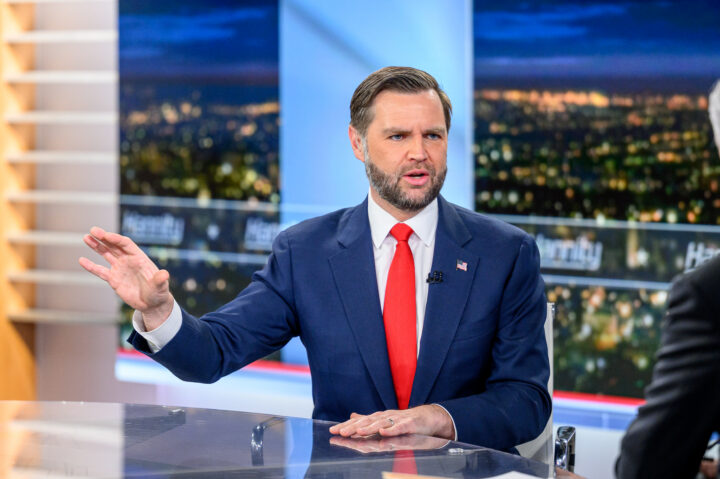
Roy Rochlin/Getty Images
Vice President JD Vance
Good Thursday afternoon.
This P.M. briefing is reserved for our premium subscribers like you — offering a forward-focused read on what we’re tracking now and what’s coming next.
Today’s Daily Overtime was curated by Senior National Correspondent Gabby Deutch.
📡On Our Radar
Notable developments and interesting tidbits we’re tracking
As the White House continues to promote the memorandum of understanding that will end the war with Iran and start negotiations between Washington and Tehran, Vice President JD Vance is out with a message that sounds strikingly familiar — at least to anyone who followed former President Barack Obama’s pitch on the 2015 nuclear deal with Iran, Jewish Insider’s Gabby Deutch reports.
“If you think this is a bad deal, what is your alternative?” Vance said in an interview this week with New York Times columnist Ross Douthat.
Obama used nearly identical phrasing at a 2015 White House press conference: “I’m hearing a lot of talking points being repeated about ‘this is a bad deal,’” he said. “What I haven’t heard is, what is your preferred alternative?”
Watch a side-by-side look at Vance and Obama here…
Vance also delivered a tough message to Israeli officials who have criticized the MOU, telling reporters on Thursday that Israel’s government should be careful not to alienate the only friend it has left: President Donald Trump, JI’s Emily Jacobs reports.
“Donald J. Trump is the only head of state in the entire world who is sympathetic to the nation of Israel at this moment in time and he happens to be the head of state of the world’s superpower. If I was in the Cabinet of the Israeli government, I might not be attacking the only powerful ally that I have anywhere left in the entire world,” said Vance…
Trump also had a word of caution for Israeli Prime Minister Benjamin Netanyahu, two days after he said Netanyahu was too “vicious” in his approach to fighting Hezbollah in Lebanon. Asked by a reporter for Israel’s Kan News if he will support Netanyahu in this year’s Israeli elections, Trump said he most likely would, but did not commit.
“I’ll have to look at who’s running, but I like Bibi very much. I would be most likely to endorse him,” said Trump. “He’s doing a very good job, he’s got to be a little bit more rational”…
United Against Nuclear Iran, an advocacy group that rallied opposition to the 2015 Joint Comprehensive Plan of Action, said on Thursday that it “cannot endorse the MoU in its current form”…
AIPAC released a policy memo on Thursday that said the MOU “raises significant questions,” and called on Congress to “play a critical role in ensuring a final deal meets President Trump’s stated objectives for the war”…
In a Thursday speech at the FII Priority summit in Rome, Albanian Prime Minister Edi Rama blamed Iran for “ruthless” cyberattacks against the country, claiming that Tehran has sought to sow unrest about a preliminarily approved luxury development project in the country from Ivanka Trump and Jared Kushner, Trump’s daughter and son-in-law, JI’s Matthew Shea reports…
Janeese Lewis George defeated Kenyan McDuffie in the Democratic primary for mayor of Washington, D.C., with the Associated Press calling the race on Thursday afternoon. Democratic socialist Lewis George leads McDuffie 53% to 36%…
American Priorities, a super PAC created as a progressive counterweight to AIPAC, has received $250,000 from a tech executive whose firm is developing AI data centers in New York State — while boosting two democratic socialist House candidates who oppose efforts to expand data centers, JI’s Matthew Kassel reports…
Rep. Tom Kean Jr. (R-NJ), who has been absent from Congress since March due to an unexplained personal health issue, plans to return to Washington on June 30…
Israel and Syria are expected to resume direct talks soon due to pressure from the U.S., the Israeli network Kan reports…
The FBI announced that it charged San Diego resident Reda Mazen Rida Sabassi with conspiring to provide material support to Hamas after he allegedly raised approximately $600,000 through fraudulent charitable campaigns and funneled a portion to the terrorist organization…
Former Presidents Joe Biden, George W. Bush and Bill Clinton attended the grand opening of the Obama Presidential Center in Chicago on Thursday afternoon.
Guests included a litany of ex-Obama administration staffers, including former White House liaison to the Jewish community Matt Nosanchuk and former U.S. Ambassador to Israel Dan Shapiro, who was spotted chatting with Obama…
⏩ Tomorrow’s Agenda, Today
An early look at tomorrow’s storylines and schedule to keep you a step ahead
Keep an eye on Jewish Insider for a look at how Jewish Republicans are feeling about the U.S.-Iran memorandum of understanding that was signed this week.
Vice President JD Vance plans to travel to Switzerland this weekend for talks with Iran, though the plans are not yet finalized, he told reporters on Thursday.
Bill Pulte, the director of the Federal Housing Finance Agency, will become the acting director of national intelligence on Friday after the confirmation of DNI nominee Jay Clayton was delayed this week at President Donald Trump’s request.
We’ll be monitoring the final days of the heated congressional primary campaigns in New York, where Israel and Gaza remain hot topics for progressive candidates.
We’ll be back in your inbox with the Daily Overtime on Monday. Shabbat Shalom!
Stories You May Have Missed
Transferring responsibilities
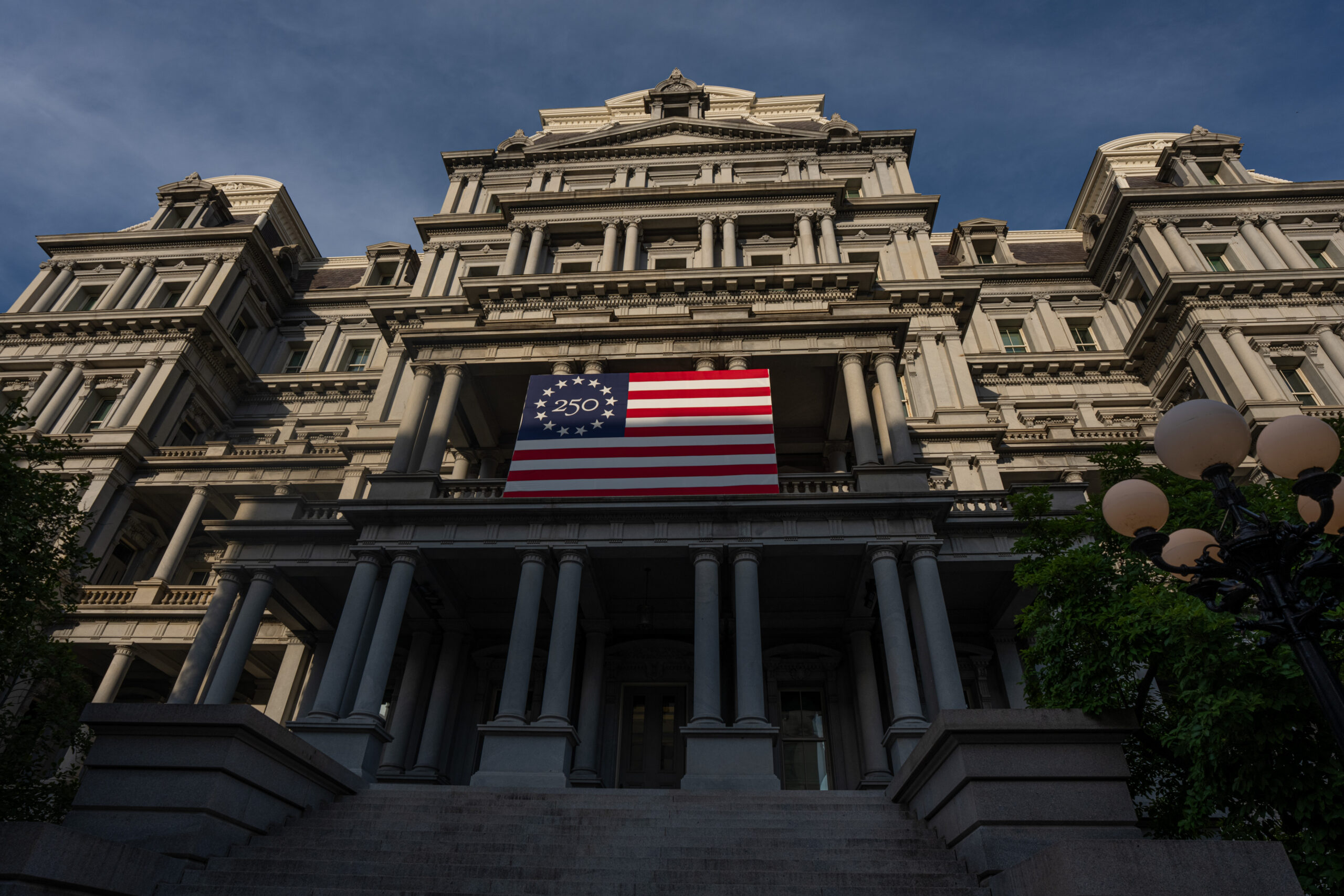
The letter urges American Jews to ‘double down’ on civic values as the country marks its 250th
BEHIND THE CURTAIN

Multiple sources identified Scott Stringer as a driving force behind two PACs spending to beat Mayor Zohran Mamdani’s House candidates
Vance borrows from the Obama playbook to argue there is no viable alternative to agreement with Iran
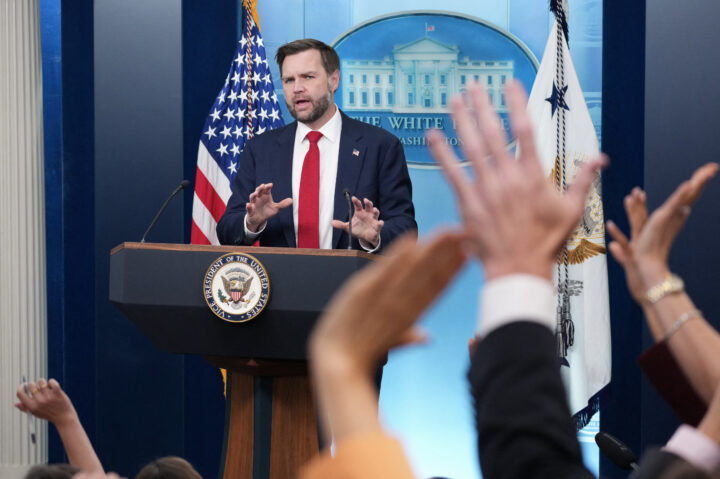
Photo by Ken Cedeno / AFP via Getty Images
Vice President JD Vance takes questions from reporters during a press briefing in the Brady Briefing Room of the White House in Washington, DC, on June 18, 2026.
As Vice President JD Vance takes on the role of chief defender of the U.S.-Iran memorandum of understanding and forthcoming talks, he has begun to sound a lot like someone whom the Trump administration has lately spent a lot of time attacking: former President Barack Obama.
Vance and President Donald Trump have both, in recent days, made clear that they view the MOU — which is set to deliver sanctions relief to Iran as nuclear negotiations get underway — as fundamentally different from, and better than, the 2015 Joint Comprehensive Plan of Action, the nuclear deal signed by Obama. But as the White House faces criticism from hawkish members of the Republican Party, the language Vance is using to defend the burgeoning deal closely resembles the arguments made by Obama 11 years ago.
“If you think this is a bad deal, what is your alternative?” Vance said in an interview this week with New York Times columnist Ross Douthat.
Flashback to a 2015 press conference at the White House soon after the JCPOA was announced.
“I’m hearing a lot of talking points being repeated about ‘this is a bad deal,’” Obama said. “What I haven’t heard is, what is your preferred alternative?”
Both Vance in 2026 and Obama in 2015 argued that the deals negotiated by their respective administrations were better than using military force — or in the case of the Trump deal, continuing to use military force — and that they would lead to a safer world.
“We could drop more bombs. We could destroy more of their country. We could kill the current iteration of their leadership. We know where all of them are. All of those things could happen,” Vance said. “But does that make the American people safer or more prosperous? The president of the United States and I think: No.”
Obama frequently argued similarly.
“If the alternative is that we should bring Iran to heel through military force, then those critics should say so,” he said at the 2015 press conference. “We’ve got a historic chance to pursue a safer and more secure world, an opportunity that may not come again in our lifetimes.”
“None of them have presented to me, or the American people, a better alternative.” -Obama, 2015
— Jewish Insider (@jewishinsider) June 18, 2026
“It’s not just whether this is good or bad, it’s what is the alternative.” -Vance, 2026
As Vice President JD Vance takes on the role of chief defender of the U.S.-Iran MOU and the… pic.twitter.com/TB5bvxINM5
There are substantive differences between the agreements notched by the Obama and Trump administrations, though both share the core assertion that they will not allow Iran to obtain a nuclear weapon.
“The Obama-Iran deal allowed them to generate a stockpile of enriched uranium,” Vance claimed, although the JCPOA required Iran to limit the level to which it enriched uranium, cut its stockpile by 98% and ship the rest of its enriched uranium out of the country. “Our deal ensures that stockpile is destroyed and eliminated, so that’s a very, very big difference, a very important difference for the American people,” Vance said this week. (The text of the 14-point MOU says only that the uranium will be discussed during the forthcoming negotiations.)
But both Vance and Obama, in their roles as salesmen of their administrations’ respective deals, argued that critics simply misunderstand the agreements.
“I just don’t think that people who are criticizing this, one, they’re not actually dealing with the reality of what’s in it, and No. 2, they don’t have an alternative,” Vance said in a podcast interview with Megyn Kelly this week.
Obama told NPR’s Steve Inskeep in 2015 that critics of his deal get the facts wrong.
“I’ve listened to the critics, some of them who announced their opposition before they had even read the bill, or read the agreement. And that is that they will put forward arguments that after a few minutes can be shown as illogical or based on the wrong facts,” said Obama.
Vance challenged critics to come up with a better alternative beyond more fighting.
“What is it that they wanted us to do besides put 300,000 ground troops in Iranian soil, which we were never going to do?” he said to Kelly. “If your alternative is just to drop bombs without any clear goal or any clear American interest implicated, then you’re not making wise decisions on behalf of the American people.”
Former Secretary of State John Kerry argued something similar before Congress in 2015.
“So what’s your plan?” he asked. “Totally go to war?”
Plus, Track AIPAC retracts

U.S. House of Representatives
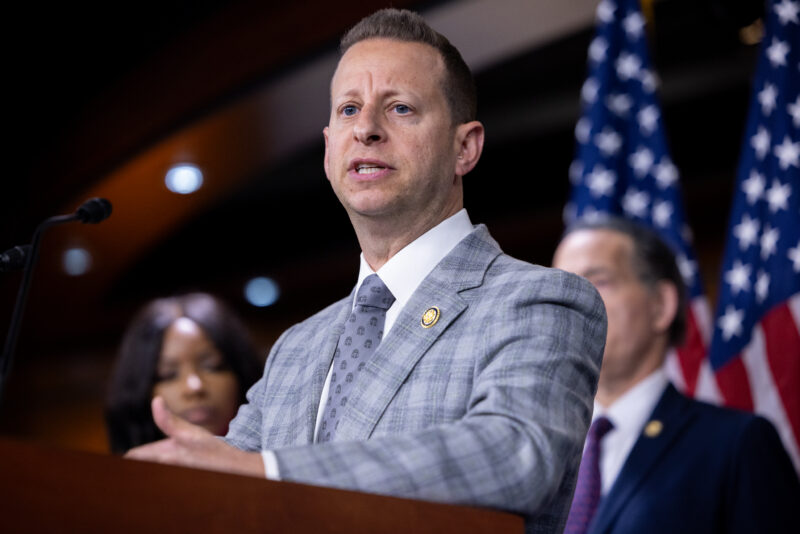
Reps. Josh Gottheimer (D-NJ) and Jared Moskowitz (D-FL)
Good Thursday morning.
In today’s Daily Kickoff, we look at the diverging opinions in Jerusalem and Washington on restarting the war with Iran, and report on how the Obama Presidential Library is framing the 2015 Iran nuclear deal. We report on the criticism faced by Track AIPAC over its since-revoked endorsement of a Democratic congressional candidate in Texas who suggested imprisoning “American Zionists” in ICE facilities, and cover yesterday’s Capitol Hill hearing on antisemitism in the healthcare field. Also in today’s Daily Kickoff: Sarah Rogers, Michael Bay and Shay Shwartz.
Ed note: In observance of Shavuot and Memorial Day, the next Daily Kickoff will arrive on Tuesday, May 26. Check out JewishInsider.com for breaking news over the long weekend. Chag sameach!
Today’s Daily Kickoff was curated by JI Executive Editor Melissa Weiss and Israel Editor Tamara Zieve, with assists from Danielle Cohen-Kanik and Marc Rod. Have a tip? Email us here.
What We’re Watching
- Today is the one-year anniversary of the terror attack at the Capital Jewish Museum in which two Israeli Embassy staffers were killed outside of an American Jewish Committee event taking place inside the venue. In marking the day, the museum announced that it will be open to the public today “as a space of reflection and remembrance.”
- The House of Representatives is expected to hold a vote on an Iran war powers resolution today, after House GOP leadership postponed the vote, which was to take place yesterday, over Republican attendance issues.
- The Jewish Community Relations Council of Greater Washington is holding candidate forums today with D.C. mayoral candidates Kenyan McDuffie and Janeese Lewis George.
What You Should Know
A QUICK WORD WITH JI’S MELISSA WEISS
In Tel Aviv and Jerusalem, Netanya and Beersheva, the conversations are the same: When will the war with Iran resume? What contingency plans are in place? Do we need to temporarily rent an apartment with a shelter?
All over Israel, there is a looming feeling that the next round of fighting is just around the corner. The Israel Democracy Institute’s latest polling, conducted earlier this month, found that 62% of Israelis think that the war’s renewal is likely.
But in the U.S., a resumption of war appears increasingly unlikely. With gas prices rising and the midterms approaching, the White House has little appetite for prolonged conflict. A New York Times/Siena poll released earlier this week found that nearly two-thirds of Americans think that going to war against Iran in the first place was a bad idea. Though fresh off a series of primary and state-level wins, President Donald Trump appears cognizant of the uphill battle that comes with resuming an unpopular war, even as he told reporters earlier this week he didn’t factor “Americans’ financial situation” in his approach to the war.
There is also a question of funding. Rep. Tom Cole (R-OK), the chair of the House Appropriations Committee, said this week that the Pentagon would “probably” be out of money to fund the Iran war by August.
Those are key factors that have not penetrated the discourse in Israel. Across the U.S., gas prices are sky high. The midterms are less than six months away. And on Capitol Hill, even some of the president’s staunchest backers are signaling opposition to a resumption of the war.
“Generally speaking, Israelis are not really attuned to internal politics in the U.S. that could be affecting President Trump’s decisions,” Tamar Hermann, director of IDI’s Viterbi Center for Public Opinion, told Jewish Insider this morning. “Recent coverage in the Israeli media has tended to obscure the domestic political constraints Trump faces, creating the impression that he is operating without meaningful checks and is effectively able to do as he pleases.”
LIBRARY LOOK

The Barack Obama Presidential Center, slated to open in Chicago in mid-June, will feature an exhibit highlighting the former president’s “patient and principled diplomacy” and “strategic engagement with adversaries” in the lead-up to the 2015 Iran nuclear deal, asserting that he prevented Iran from developing a nuclear weapon, Jewish Insider’s Haley Cohen reports.
What it says: “Through diplomacy, the US forged a new treaty with Russia to reduce both countries’ nuclear stockpiles,” the exhibit reads, according to images obtained during the museum’s soft launch reviewed by JI. “The Obama administration prevented Iran from developing a nuclear weapon.” A dedication ceremony for the Obama Presidential Center is scheduled for June 18 followed by its opening to the public the next day.
Bonus: The Wall Street Journal does a deep dive into “how Iran got to the nuclear threshold on the watch of three U.S. presidents,” noting that the Obama administration’s 2015 Joint Comprehensive Plan of Action “delayed but didn’t shut the door on Iran’s potential pathway to a bomb.”
FACING THE HEAT
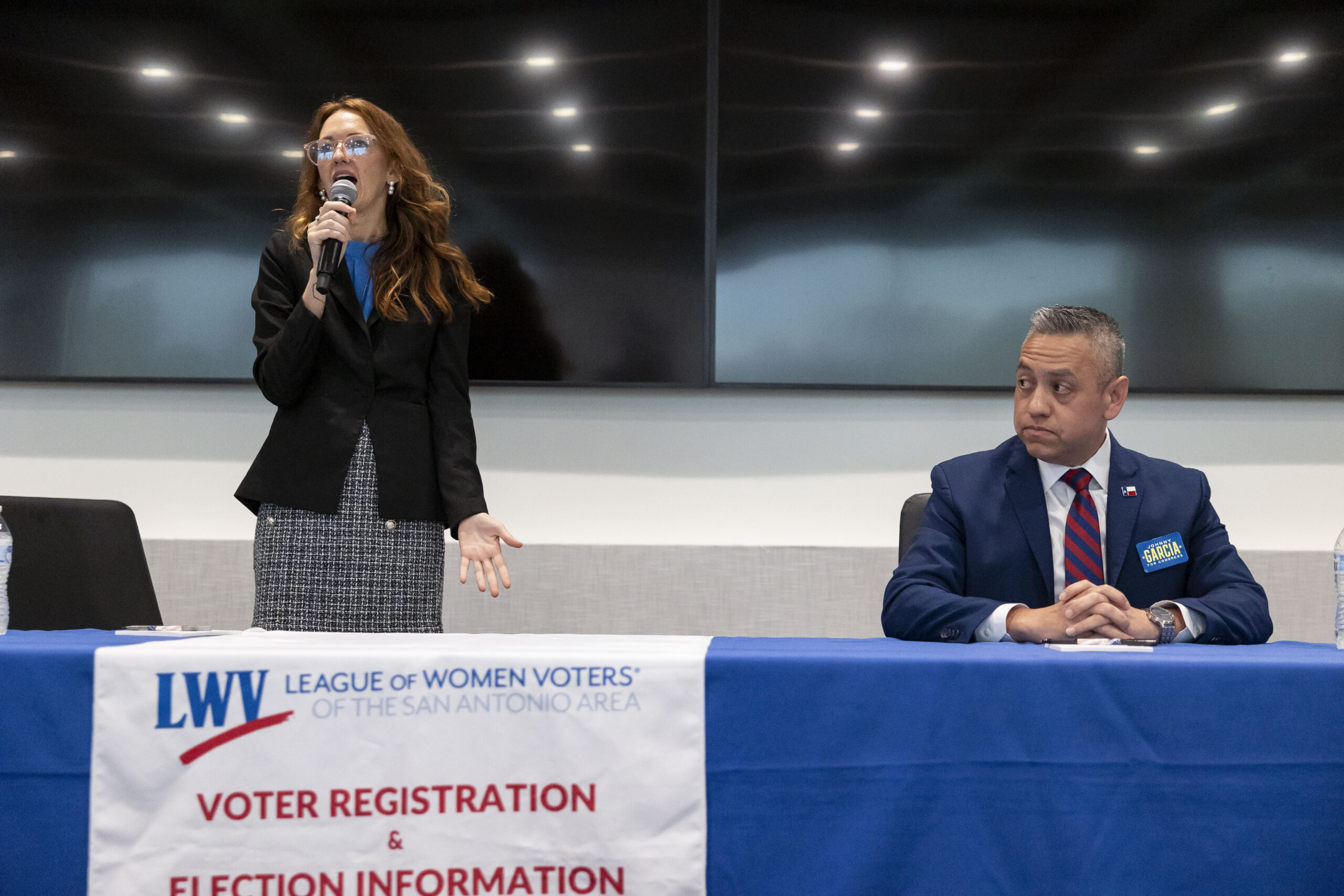
Track AIPAC, the social media account that has gained a growing audience among anti-Israel activists in recent years, found itself in an embarrassing position this week when a candidate it had championed for Congress faced bipartisan backlash over extreme antisemitic comments calling to imprison and castrate “American Zionists,” whom she accused of pedophilia, Jewish Insider’s Matthew Kassel reports. The account said on Tuesday it was “immediately revoking” its endorsement of Maureen Galindo, a San Antonio activist competing for an open swing seat in Texas next week.
Yes, but: The point at which Track AIPAC finally chose to draw a line over Galindo’s rhetoric underscored how the account’s ostensibly narrow focus on opposition to what it calls the “Israel lobby” has often obscured an indulgence of extreme views and positions. Brian Romick, the president of DMFI PAC, which is backing Galindo’s runoff opponent, Johnny Garcia, argued that “Track AIPAC embodies the very-online activist fringe: large social-media following, minimal real-world influence, and a political strategy based on vibes.”
Read the full story here.Dems denounce: Reps. Josh Gottheimer (D-NJ) and Jared Moskowitz (D-FL) said on Wednesday that they would seek to expel Galindo if she is elected — forcing daily votes if necessary. Their comments mark an escalation among Democrats condemning Galindo since her comment gained widespread attention, JI’s Marc Rod reports.
SPLITSCREEN
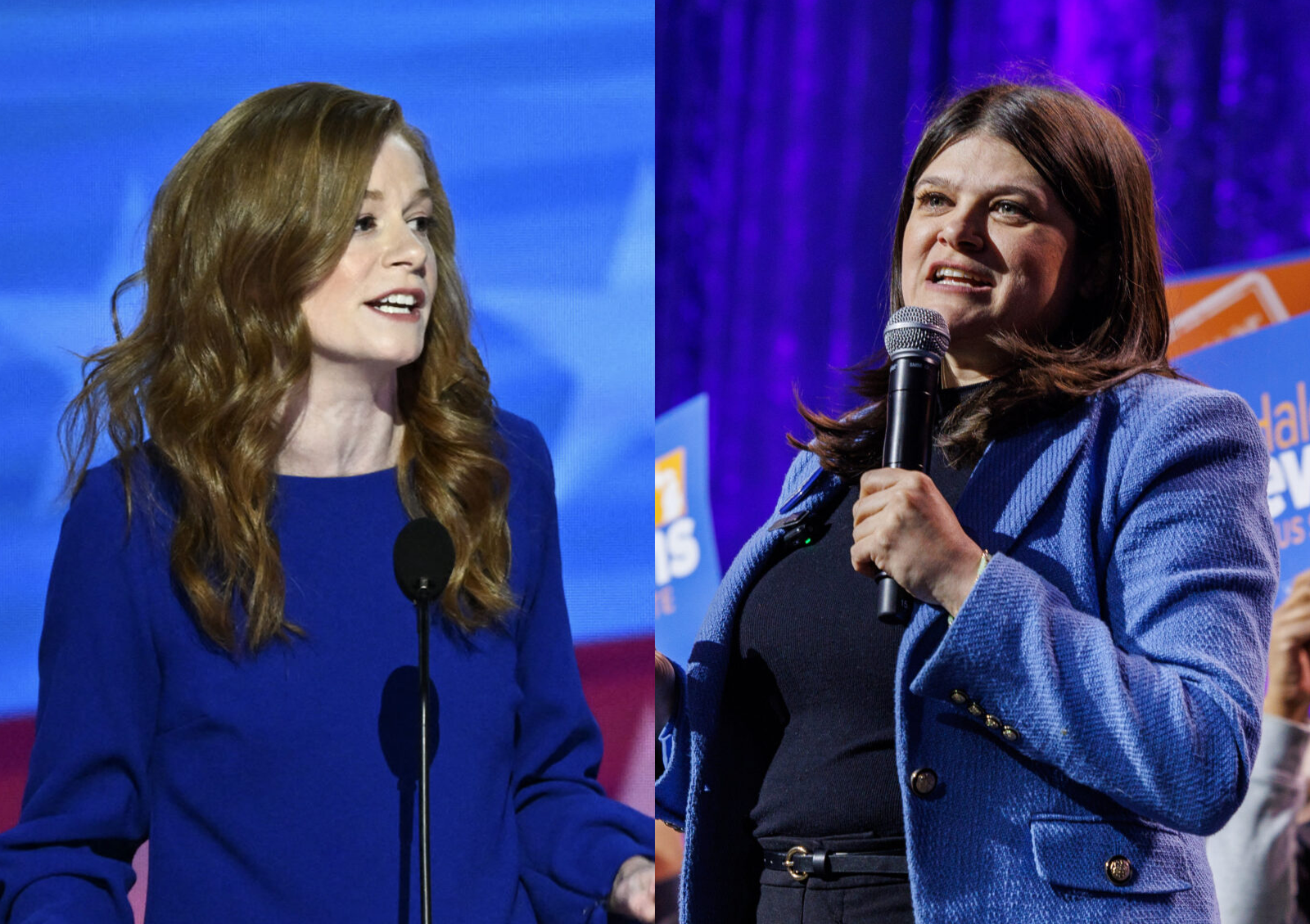
The Jewish Democratic Council of America announced a dual endorsement on Wednesday of Rep. Haley Stevens (D-MI) and state Sen. Mallory McMorrow in Michigan’s three-way Senate Democratic primary, saying “there are two candidates who stand with our community on issues of importance to Jewish voters, and there is one who does not,” Jewish Insider’s Matthew Kassel reports.
Reasoning: “It is because of this stark contrast of the views and values of Haley Stevens and Mallory McMorrow, compared to those of Abdul El-Sayed,” a vocal critic of Israel who has captured the enthusiasm of the far left, “that we are taking the distinct opportunity to endorse two candidates,” Halie Soifer, JDCA’s CEO, said in a statement.
Michigan matchup: In Michigan’s statewide election for two seats on the University of Michigan Board of Regents, Republican nominees Lena Epstein and Michael Schostak, who both identify as Jewish, told JI’s Gabby Deutch they’re campaigning on fighting antisemitism at the school.
ON THE HILL
Speaking at a House Education & Workforce subcommittee hearing on Wednesday, a doctor accused his union of engaging in systemic discrimination against Jewish and Israeli health providers, supporting terrorist sympathizers and making “its obsession with a single geopolitical conflict a defining future of its identity” — all while he’ll be forced by federal law to fund it, Jewish Insider’s Marc Rod reports.
Healthcare havoc: Jacob Agronin, a cardiology fellow at a major medical institution in Philadelphia, testified alongside several other experts on antisemitism at a hearing focused on anti-Jewish hate in the medical field — which both Jewish medical providers and patients report as a growing problem since Hamas’ Oct. 7, 2023, attacks on Israel. The hearing focused in particular on the role of healthcare worker unions, like the Committee of Interns and Residents, of which Agronin is set to be a member, in spreading antisemitism and their failures to stand up for Jewish union members.
Parents’ night: A group of Jewish parents from across Pennsylvania arrived at a virtual meeting with Sen. Dave McCormick (R-PA) with a plea: take note of antisemitism happening not just on college campuses but also in K-12 schools, and do something about it, JI’s Gabby Deutch reports.
BUFFER BATTLE
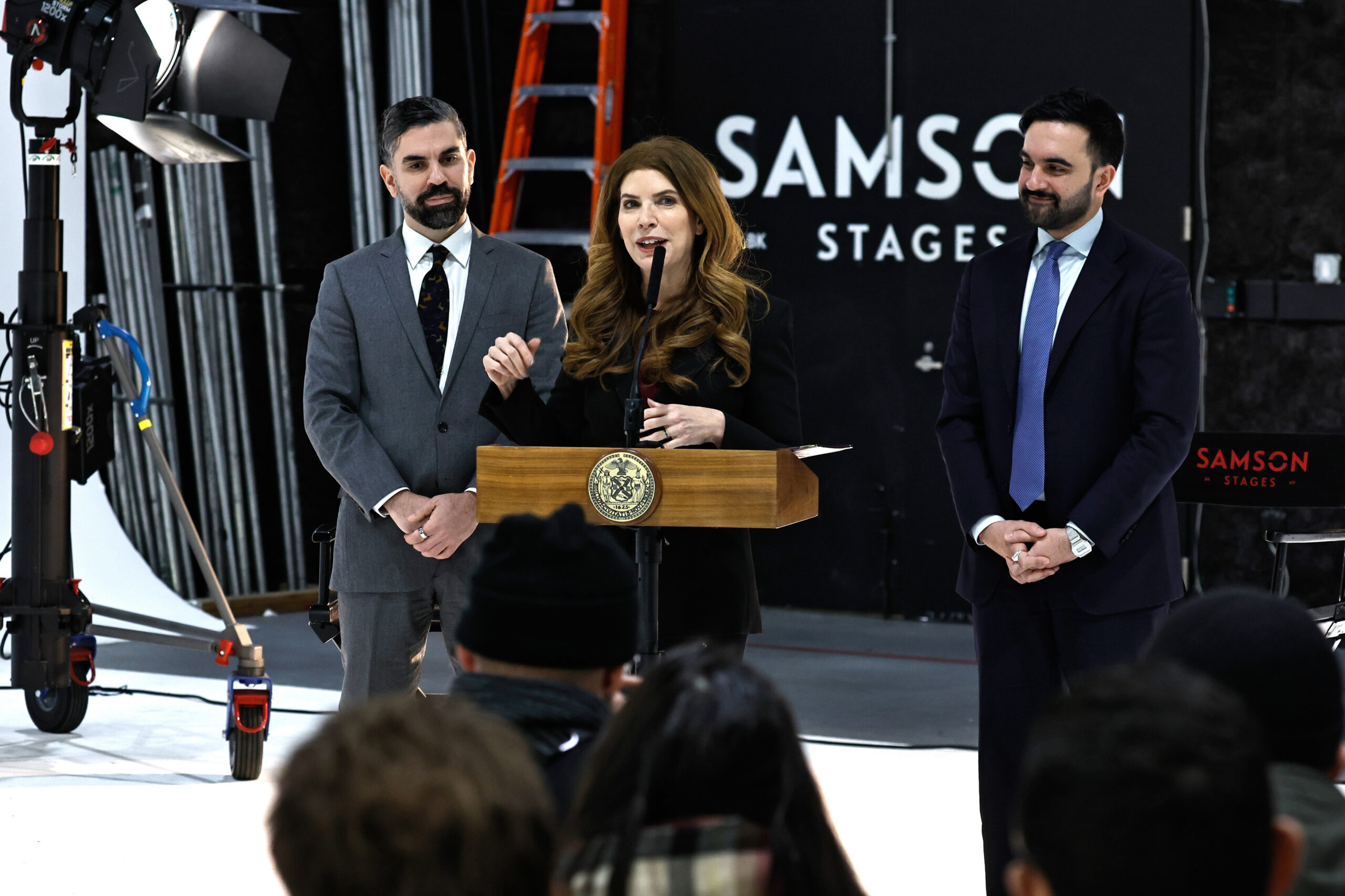
New York City Council Speaker Julie Menin will back fresh legislation to compel the NYPD to establish formal protocols for deploying buffer zones around schools during protests — a push Menin said will sail through the council with more than enough votes to beat any effort from Mayor Zohran Mamdani to block it, Jewish Insider’s Will Bredderman reports.
Bridging the gap: The move comes a month after Mamdani exercised his veto power in order to stop a similar bill from becoming law, citing concerns from unions that the blocked measure could interfere with their demonstrations around college facilities, even though the proposal contained an explicit labor carveout. In a press conference on Wednesday, Menin characterized this as a misunderstanding — one the new legislation will rectify by applying exclusively to early childhood education facilities and “most K-12 schools.”
Moreno moves: Sen. Bernie Moreno (R-OH) said Wednesday that he plans to call on the Senate to pass the SACRED Act, legislation imposing restrictions on protests around synagogues and other religious institutions, by unanimous consent, JI’s Marc Rod reports.
IN MEMORIAM
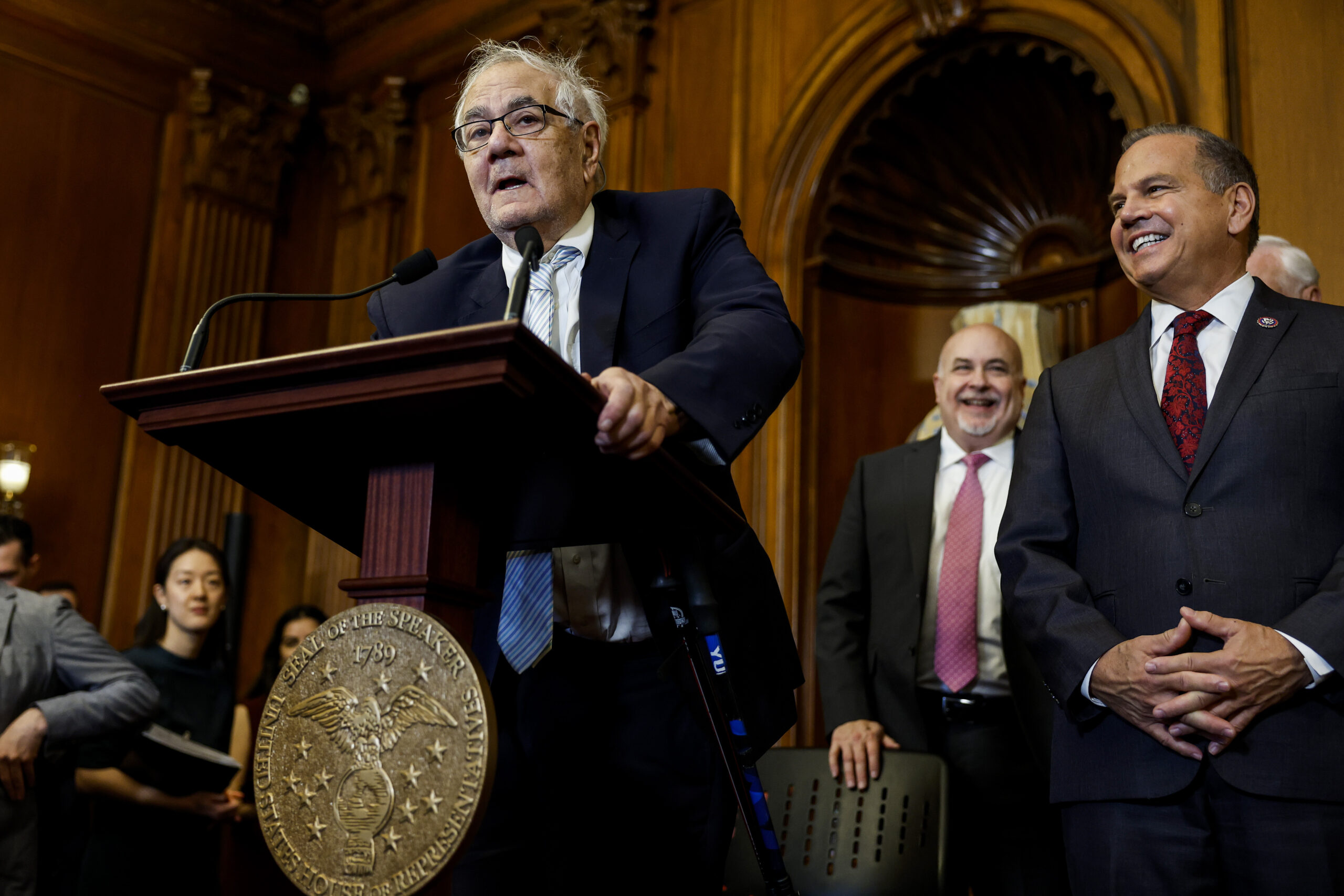
Known as a liberal firebrand, Frank’s most high-profile act in politics was drafting the legislation that tightened financial regulations in response to the 2008 financial crisis, a bill known as the Dodd-Frank Wall Street Reform and Consumer Protection Act, Jewish Insider’s Gabby Deutch reports.
Paving the way: Frank was widely considered a pioneer for the LGBTQ community after coming out publicly as gay in 1987. Frank grew up in a working-class Jewish family in Bayonne, N.J. His sister, Ann Lewis, also worked in politics, holding senior roles in the Clinton administration and later on Hillary Clinton’s presidential campaign. Frank said he was drawn to public service early, feeling in some way that he was an outsider who could challenge how things were done. “I’m a left-handed gay Jew,” Frank said. “I’ve never felt, automatically, a member of any majority.”
Worthy Reads
American Jews Under Siege: In The Atlantic, Israel Policy Forum co-founder Michael Sonnenfeldt considers the “untenable position” that many American Jews find themselves in amid rising domestic antisemitism alongside decreasing support among Americans for Israel. “Anti-Semitism is rising sharply in the United States at the same time that traditional alliances with progressive organizations are weakening, political identities are being reshuffled, and emotional ties to Israel are strained by policies that clash with deeply held democratic and ethical commitments. The simultaneity of these pressures — political, moral, and psychological — is what makes the present moment feel so destabilizing.” [TheAtlantic]
Middle Man: In The Wall Street Journal, Sadanand Dhume questions Pakistan’s ability to operate as a fair intermediary as it seeks to play a central role in U.S.-Iran talks. “Pakistan has attributes that make it a useful intermediary, but America shouldn’t forget that when it comes to Iran, Pakistan’s interests aren’t the same as those of the U.S. On the face of it, Pakistan might seem like an odd choice for mediator. During the war in Afghanistan, Pakistan was widely castigated for playing a ‘double game,’ accepting U.S. aid to fight terrorism while at the same time secretly aiding and abetting the Afghan Taliban.” [WSJ]
A Convert’s Burden: In Moment Magazine, JoJo Kalin, a convert to Judaism who organized the event at the Capital Jewish Museum in which two Israeli Embassy staffers were killed, reflects on her faith as she considers her interaction with the suspected assailant, to whom she offered water after the attack. “There is a version of the future in which my future children would not have to carry this particular kind of fear. I am aware of that. And I am choosing this one anyway. I choose it because what they would inherit is not only fear. It is also peoplehood, memory and a stubborn, enduring joy. … I still think about that glass of water, about the instinct to give it, about the fact that I did not hesitate. I don’t know what it means, fully. I’m not sure it resolves into something clean or instructive. But I know this: That moment belongs to my humanity, not to his violence.” [Moment]
Word on the Street
Jewish Insider’s Emily Jacobs talks to Leo Terrell, the senior counsel to the assistant attorney general for civil rights and chair of the Department of Justice’s antisemitism task force, about the creation of the DOJ’s Antisemitism Advisory Committee, which Terrell will oversee…
The Justice Department announced its indictment against a New Jersey man charged with making interstate threats to a Jewish institution in New York…
Sarah Rogers, the under secretary of state for public diplomacy, refuted accusations that the Trump administration has been ineffective in combating the spread of misinformation and hateful content on social media, arguing that free speech protections and efforts to combat disinformation are not mutually exclusive, in comments at the Hudson Institute on Tuesday, JI’s Emily Jacobs reports…
Reps. Frank Pallone (D-NJ), Debbie Wasserman Schultz (D-FL) and Steve Cohen (D-TN) introduced a resolution honoring the 130th anniversary of the Jewish War Veterans organization…
During a House hearing on Wednesday, Rep. Jared Moskowitz (D-FL) engaged in a heated back-and-forth with a witness, Carol Swain, an author and commentator, as Swain repeatedly dodged his question about whether neo-Nazis are a supremacist group. Two other witnesses answered the question with a simple “yes”…
Director Michael Bay is working with Universal Pictures to develop a feature-length film about the rescue of two American pilots who were shot down in Iran last month; the film will be based off an upcoming book on the event by Mitchell Zuckoff…
TechCrunch profiles Ocean founder Shay Shwartz, whose email security platform protects against AI-powered attacks and recently exited stealth mode with $28 million in a funding round led by Lightspeed Venture Partners that included an investment from Wiz’s Assaf Rappaport…
eJewishPhilanthropy’s Jay Deitcher looks at how Jewish groups are approaching the use of AI for Torah study…
Israeli Prime Minister Benjamin Netanyahu, along with other Israeli officials, issued a sharp condemnation of far-right National Security Minister Itamar Ben-Gvir after he released a video showing himself taunting detained flotilla activists, JI’s Matthew Shea reports…
Israeli prosecutors filed charges against a Jewish man accused of taking part in at least three attacks on Palestinians in the West Bank since February, including an April attack in which a poultry farm employee was hospitalized and remains in a coma…
The Wall Street Journal looks at Israeli efforts to track down all terrorists who took part in the Oct. 7, 2023, Hamas terror attacks…
The U.S. is pressuring Palestinian officials to drop an effort by the Palestinian Authority’s representative at the U.N. to seek the vice presidency of the U.N. General Assembly, warning that the State Department could revoke the visas of the Palestinian delegation should the bid proceed…
The Associated Press profiles Iranian Brig. Gen. Ahmad Vahidi, the head of the Islamic Revolutionary Guard Corps, describing the senior military official as a “longtime veteran of the ruling system” involved with the 1994 bombing of a Jewish community center in Argentina, who is believed to be one of few Iranian officials in contact with Iranian Supreme Leader Ayatollah Mojtaba Khamenei…
The New York Times spotlights the “intelligence fraternity” of former and current IRGC officials, including many with links to the country’s new supreme leader, positing that the group’s “shared backgrounds, careers and ideological outlook” are “one reason the war has neither collapsed the government nor paralyzed it”…
Wine of the Week

JI wine columnist Yitz Applbaum reviews the Warneke Valley Cabernet Sauvignon and the Gen VIII 2019 Cabernet:
After a 250th National Shabbat celebration at the White House, where candles were lit in the Indian Treaty Room, we walked over to nearby Decatur House, the historic 1818 mansion on Lafayette Square, for a meaningful and memorable Shabbat dinner. Kiddush was made over a cup recovered from one of the communities destroyed on Oct. 7, and each guest was given a challah cover embroidered with the presidential seal. For such a special and historic moment, my dear friend Pauly treated me to two of the finest and most important kosher wines from the Herzog family: The Warneke Valley Cabernet Sauvignon and the Gen VIII 2019 Cabernet. These wines perfectly matched the severity and grandeur of the dinner.
The 2023 Warneke Valley is a cab of remarkable poise, carrying a subtle maturity that belies its youth. The opening is pure silk, the mid-palate carries the traditional Herzog vanilla and the finish lingers with notes of parve dark chocolate. The Gen VIII, by contrast, is bold and brash, fruit-forward, with rough-and-tumble tannins that would not let me sleep at night. It has long been one of my favorites, but this vintage will surely overtake its predecessors as one of the greatest ever made. To drink them side by side was a true privilege. Not an inexpensive luxury, but one I would gladly forgo most other pleasures to repeat. Enjoy both alongside a juicy steak, and lay a few bottles down for a future milestone worth celebrating.
Pic of the Day

Birthdays
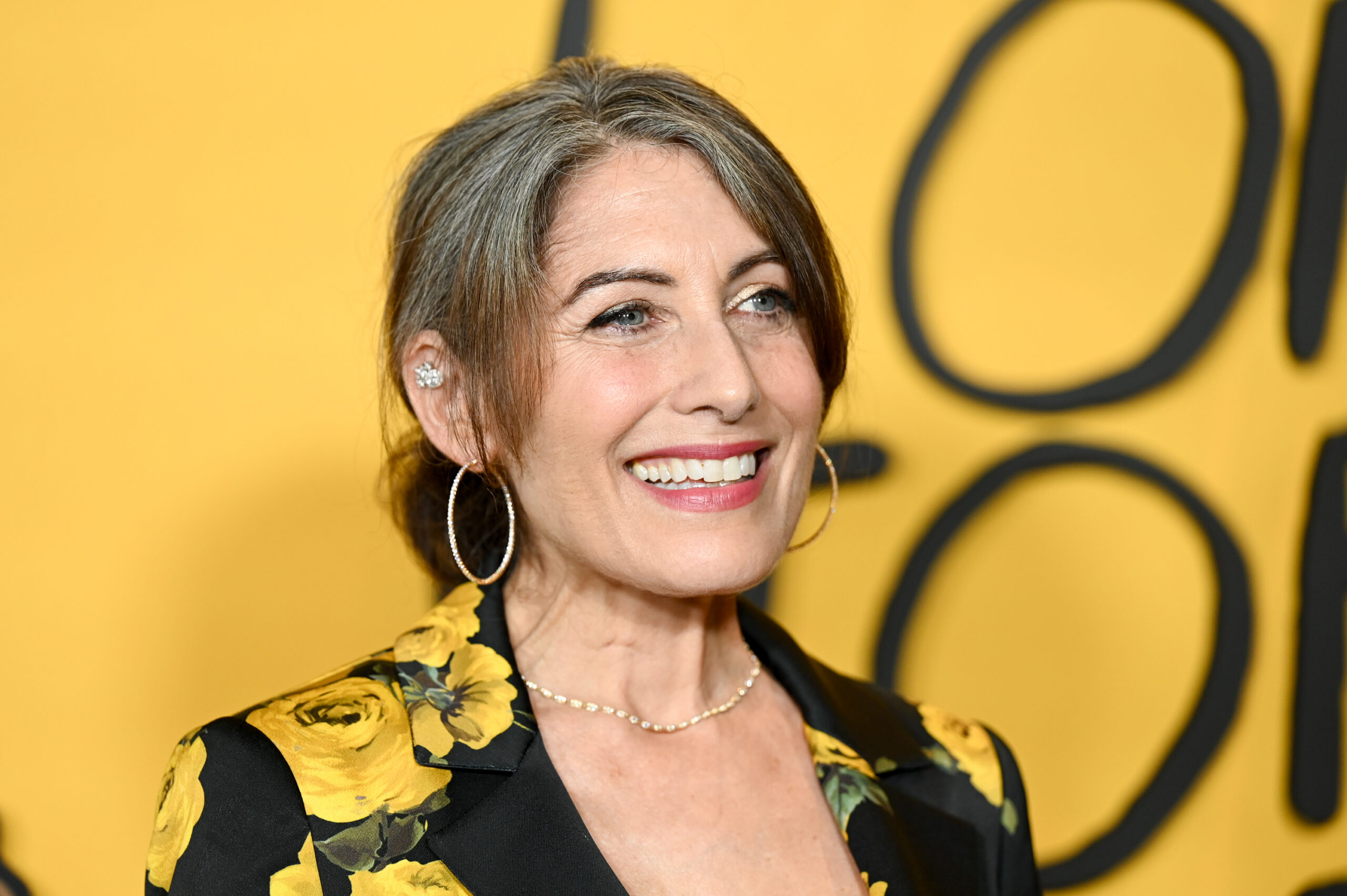
Actor, artist and playwright, Lisa Edelstein turns 60…
Former U.S. senator from Minnesota, he was previously a comedian, actor and writer, Al Franken turns 75… VP of the Swiss Federation of Jewish Communities, Ralph Lewin turns 73… Guitarist and composer, Marc Ribot turns 72… EVP of American Friends of Bar-Ilan University, Ron Solomon… Chief rabbi of Mitzpe Yericho (a yishuv located in the Judean desert) and dean of Hara’ayon Hayehudi yeshiva in Jerusalem, Rabbi Yehuda Kroizer turns 71… CEO of the Boston-based hedge fund Baupost Group, he is co-founder of Times of Israel, Seth Klarman turns 69… Northern California-based comedian, he celebrated his bar mitzvah at 52 in Israel, Josh Kornbluth turns 67… New York Times contributing Opinion writer, Jeffrey Toobin turns 66… Founder and publisher of City & State NY, Thomas Allon turns 64… Director of antisemitism education and associate director of the Israel Action Program, both at Hillel International, Tina Malka… Former head of Dewey Square’s sports business practice, now a freelance writer, Frederic J. Frommer… Author and journalist, she was a reporter with The New York Times for eight years, Amy Waldman turns 57… U.S. cyclist at the 2000 Summer Olympics in Sydney, she is now the executive director of the New England Mountain Bike Association, Nicole Freedman turns 54… President and CEO of the Michigan-based William Davidson Foundation, Darin McKeever… University chaplain for NYU and executive director of NYU’s Bronfman Center for Jewish Life, Rabbi Yehuda Sarna turns 48… Founder of Agora Global Advisory, Brandon Pollak… EVP and chief legal officer at Sinclair Inc., David Gibber… Professor of computer science at the University of Texas at Austin, Scott Joel Aaronson turns 45… President of Mo Digital, Mosheh Oinounou… Los Angeles-born, raised in Israel, international fashion model for Versace, Sharon Ganish turns 43… CEO of CreoStrat, Steve Miller… Windsurfer who represented Israel in the Olympics, she is now an energy management program manager at SolarEdge, Maayan Davidovich turns 38… Player on the USC team that won the 2016 NCAA National Soccer Championship, she is now an associate in the L.A. office of Foley & Lardner, Savannah Levin turns 31… Comedian, actor and writer, known for starring in the HBO Max series “Hacks,” Hannah Marie Einbinder turns 31… COO at the Yael Foundation, Naomi Kovitz…
The new presidential center, scheduled to open June 19 in Chicago, highlights Obama’s ‘strategic engagement with adversaries’
Scott Olson/Getty Images
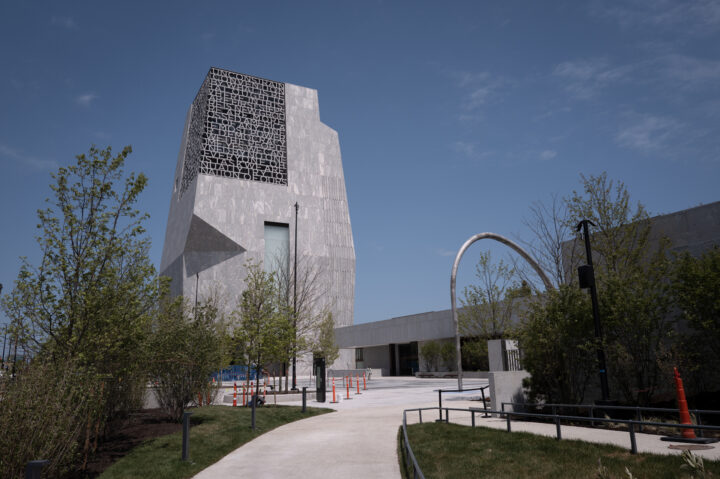
The Obama Presidential Center towers over Jackson Park on May 15, 2026 in Chicago, Illinois.
The Barack Obama Presidential Center, slated to open in Chicago in mid-June, will feature an exhibit highlighting the former president’s “patient and principled diplomacy” and “strategic engagement with adversaries” in the lead-up to the 2015 Iran nuclear deal, asserting that he prevented Iran from developing a nuclear weapon.
The claims emerge amid a tenuous ceasefire between the U.S. and Iran as the parties have repeatedly rejected the other’s proposals to end the war. Iran and its proxies in the region have attacked Israel and its neighbors with thousands of ballistic missiles and drones since the Oct. 7, 2023, Hamas terrorist attacks.
“Through diplomacy, the US forged a new treaty with Russia to reduce both countries’ nuclear stockpiles,” the exhibit reads, according to images obtained during the museum’s soft launch reviewed by Jewish Insider. “The Obama administration prevented Iran from developing a nuclear weapon.”
It goes on to say, “Iran’s nuclear program threatened the security of its neighboring countries and global stability. Rather than risk another Middle East war, Obama chose patient and principled diplomacy. Over six years, he negotiated, built a global coalition, and enforced strong sanctions on Iran. In a historic deal, Iran rolled back its nuclear program and was prevented from building a nuclear weapon. The result supported his view that strategic engagement with adversaries can reduce threats while avoiding war.”
The statements refer to the 2015 agreement known as the Joint Comprehensive Plan of Action. At the time of its implementation, the deal garnered widespread criticism, including from mainstream Jewish organizations, over concerns that the limits placed on Iran lifted too quickly and would allow the Islamic Republic to achieve a nuclear weapon, all while jeopardizing Israel’s security. Critics further say the agreement indirectly provided Tehran with additional resources to fund its regional proxies.
President Donald Trump abandoned the agreement in 2018, arguing it was inadequate and failed to address Iran’s ballistic missiles and regional malign activities.
A dedication ceremony for the Obama Presidential Center is scheduled for June 18 followed by its opening to the public the next day.
The center did not respond to a request for comment from Jewish Insider about the exhibit.
On an appearance on ‘Pod Save America,’ Piker said Hamas is ‘entirely comprised’ of ‘orphan children that have had their parents killed by an apartheid state’
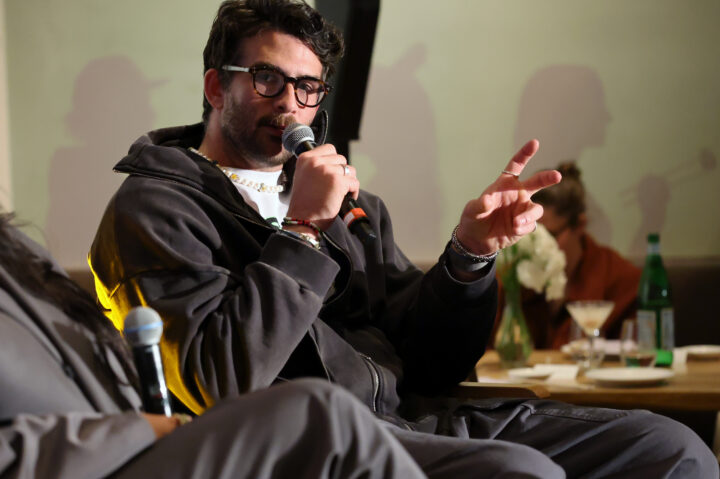
Amy Sussman/The Hollywood Reporter via Getty Images
Hasan Piker speaks during The Hollywood Reporter Creators A-List Dinner presented by Facebook at Matsuhisa on October 15, 2025 in Beverly Hills, California.
Given the chance to walk back some of his most incendiary commentary on an episode of the “Pod Save America” podcast released Sunday, antisemitic streamer Hasan Piker instead doubled down on his support of Hamas and other inflammatory rhetoric.
“This [quote] is from January,” host Jon Favreau, a former speechwriter to President Barack Obama, told Piker in a segment looking back on some of Piker’s comments that have been picked up by national media. “‘Hamas is a thousand times better than a fascist settler colonial apartheid state,’” Favreau quoted.
Piker responded quickly, “I stand by that.”
Favreau then said, “[T]his is the one that bothered me most when I first heard it …. Even if you believe what happened in Gaza is genocide and what’s happening in the West Bank is apartheid, those are different claims from ‘Hamas is a thousand times better,’ because Hamas is an organization that has massacred, raped, kidnapped civilians on Oct. 7. They’ve also been catastrophic for Palestinians by almost every measure. … Do you actually mean that or is that a rhetorical move or like a solidarity signal?”
“I mean, it’s all of the above. I do mean it,” Piker responded. “I’m a lesser-evil voter and therefore I would vote for Hamas over Israel every single time.” He described Hamas as a “paramilitary organization that has like a political party as well, a politburo as well, that is entirely comprised, not as an alien force, but of orphan children that have had their parents killed by an apartheid state that has been dominating the lives of Palestinians for 80 years at this point.”
“So my perspective on this has always been that I think that Hamas’ tactics, which I oppose at times, or its like internal governance issues, are secondary to the conversation,” he continued. “And it makes me feel silly to consistently talk about what Hamas has done, especially when there has been an Oct. 7 times a thousand, if not more than a thousand at this point, in the hands of Israel against the Palestinian population in its entirety. I mean, they’re doing an Oct. 7 to Lebanon right now as we speak.”
Piker also reiterated his denunciations of Zionism, calling it “an ethno-religious supremacist ideology that is exterminationist” and comparing it to Nazism.
The streamer invoked the often-misused claim that Albert Einstein had made the same comparison, which is based on a letter to the editor of The New York Times published on Dec. 4, 1948, signed by nearly 30 liberal intellectuals of their time, including Einstein, who called the rise of Menachem Begin’s new right-wing political party Herut, which later became part of Likud, “closely akin … to the Nazi and Fascist parties,” but did not condemn Zionism as a whole.
About his comment that the U.S. “deserved” 9/11, Piker affirmed he believes that “we have been messing around in the Middle East for upwards of 60 years, and that’s precisely the reason why 9/11 happened, and that’s precisely the reason why these guys say ‘death to America’ in Iran, for example.”
But, he said, “it was a heated response … and people will consistently use that against me over and over again.”
Plus, Hasan Piker calls Hamas 'orphan children'

Jacquelyn Martin - Pool/Getty Images
Vice President JD Vance arrives for talks with Iranian officials on April 11, 2026 in Islamabad, Pakistan.
This P.M. edition is reserved for our premium subscribers — offering a forward-focused read on what we’re tracking now and what’s coming next. Please don’t hesitate to share your thoughts and feedback by replying to this email.
📡On Our Radar
Notable developments and interesting tidbits we’re tracking
The U.S. blockade of the Strait of Hormuz began this morning, with more than 15 American warships involved in the operation intended to pressure Iran into concessions after this weekend’s failed negotiations.
President Donald Trump said hours later that the U.S. was “called this morning by the right people, the appropriate people, and they want to work a deal.” Mediators including Pakistan, Egypt and Turkey are also reportedly attempting to revive talks between the parties…
One reported sticking point in the negotiations is a U.S. request that Iran agree not to enrich uranium for 20 years. The 2015 Iran nuclear deal was highly criticized for its sunset clauses, which lifted limits on activity including uranium enrichment after 15 years.
Israeli Prime Minister Benjamin Netanyahu invoked a similar timeframe at a Cabinet meeting today, saying he spoke with Vice President JD Vance yesterday who told him that the U.S. aims to ensure “there is no more enrichment in the coming years, and that could be in decades, no enrichment within Iran.”
Sen. Lindsey Graham (R-SC) took issue with the timeline: “If this reporting is accurate, the idea that we would agree to a moratorium on enrichment rather than a ban on enrichment would be a mistake in my view. Would we agree to a moratorium for al Qaeda to enrich? No,” he wrote on X. “No enrichment means no enrichment”.…
Six additional Senate Democrats plan to file new war powers resolutions this week to halt the war in Iran, a move that would allow Democrats to continue forcing votes on the war for the foreseeable future, Jewish Insider’s Marc Rod reports.
Previously, a different group of six Democrats introduced similar resolutions, and Democrats have called up two of them thus far, with plans to call up a third this week. The latest group of lawmakers spans from staunch progressives and critics of Israel to generally more pro-Israel members, including Sens. Jeff Merkley (D-OR), Kirsten Gillibrand (D-NY), Chris Van Hollen (D-MD), Mark Kelly (D-AZ), Raphael Warnock (D-GA) and Andy Kim (D-NJ)…
Citing an “increasingly sour national environment for Republicans,” the Cook Political Report shifted its ratings for four key Senate races in Democrats’ favor: The North Carolina and Georgia races now lean Democratic, the Ohio race is a toss-up and the Nebraska race is likely Republican, rather than solidly. Democrats would need to flip four seats to take back the chamber…
In another heated Senate race where Democrats hope to pick up a seat, former Rep. Mary Peltola (D-AK) raised nearly $9 million in the first quarter of 2026, four times the amount her opponent, Sen. Dan Sullivan (R-AK), pulled in. The GOP super PAC Senate Leadership Fund has pledged to spend $15 million in the race, as polls show Peltola with a slight lead…
In an appearance on the “Pod Save America” podcast released yesterday, antisemitic streamer Hasan Piker said he “stands by” his statement made in January that “Hamas is a thousand times better than a fascist settler-colonial apartheid state,” referring to Israel.
“I would vote for Hamas over Israel every single time,” he said on the podcast, claiming Hamas is “entirely comprised … of orphan children that have had their parents killed by an apartheid state that has been dominating the lives of Palestinians for 80 years at this point. … Hamas’ tactics, which I oppose at times, or its like internal governance issues are secondary to this conversation”…
Sen. Rick Scott (R-FL) called for the federal government to “immediately” pull funding from Yale University over Yale Political Union’s decision to host Piker, who previously suggested that the senator should be killed. Piker is scheduled to speak on campus tomorrow for a debate titled “Resolved: End the American Empire.”
For Scott, Piker’s incendiary language is personal: the streamer was briefly suspended from Twitch last year after urging his followers to “kill Rick Scott.” “An elite private university that hosts an antisemite who says a Senator should be killed, capitalists should be killed, and the U.S. deserved 9/11, shouldn’t get ONE CENT from taxpayers,” Scott wrote on X on Friday…
J Street is seeking to “set the record straight” after the group backed the growing calls among far-left lawmakers to end U.S. support for Israel’s missile-defense systems, including Iron Dome, despite its own criteria for its endorsees stating otherwise.
In a new FAQ, the group called Iron Dome “a critically important defense system” which it “supports and consistently lobbies for.” After the end of the Memorandum of Understanding between the U.S. and Israel, which runs through Fiscal Year 2028, however, “financial subsidies to Israel should be rapidly and responsibly phased out. … Israel should pay for these systems”…
More Jews were killed in antisemitic incidents outside of Israel in 2025 than any year in the past three decades, according to a report from Tel Aviv University. Twenty Jews were killed last year in attacks in countries including Australia, the U.S. and the U.K., while the previous record was set in 1994 with the AMIA bombing, which killed 85 people in Buenos Aires, Argentina…
⏩ Tomorrow’s Agenda, Today
An early look at tomorrow’s storylines and schedule to keep you a step ahead
Keep an eye out in Jewish Insider for a look at a new poll assessing the partisan divide emerging among American Jews over pro-Israel political engagement.
The U.S. Holocaust Memorial Museum will host a Yom HaShoah remembrance event at the Capitol, with a keynote address delivered by Commerce Secretary Howard Lutnick. Other speakers include several Holocaust survivors as well as House Speaker Mike Johnson (R-LA), House Minority Leader Hakeem Jeffries (D-NY), Sen. Kirsten Gillibrand (D-NY) and Reps. Joe Wilson (R-SC) and Lois Frankel (D-FL).
Amid the International Monetary Fund and World Bank Group’s spring meetings being held in Washington this week, Jacob Helberg, under secretary of state for economic affairs, will speak at an event with the Atlantic Council about U.S. economic leadership in the Middle East, including utilization of the India-Middle East-Europe Corridor, which has been floated as an alternative trade route to the volatile Strait of Hormuz.
Stories You May Have Missed
THE VIEW FROM ISRAEL
Israelis uncertain if Iran war made them safer after ceasefire brings combat to an inconclusive halt

After the ceasefire went into effect, there was a pervading feeling in Israel that the war with Iran was not complete, and the return to routine life may be short-lived
COMFORT FOOD

A traveling program called ‘Soul and Roll’ by singer Hananel Edri and Foodish CEO Merav Oren tells the Jewish story through an immersive culinary and musical experience
Plus, Joe Kent amplifies Iranian propaganda

Tom Williams/CQ-Roll Call, Inc via Getty Images
President Donald Trump conducts a news conference in the White House briefing room about the war in Iran on Monday, April 6, 2026.
This P.M. edition is reserved for our premium subscribers — offering a forward-focused read on what we’re tracking now and what’s coming next. Please don’t hesitate to share your thoughts and feedback by replying to this email.
📡On Our Radar
Notable developments and interesting tidbits we’re tracking
Amid reports that Iran has rejected the U.S.’ ceasefire framework, President Donald Trump told reporters Tehran has made its own “significant” proposal, though it is “not good enough.”
Asked if he may push the deadline again for Iran to reopen the Strait of Hormuz or face increased U.S. military action — as he has already done three times — Trump said, “Highly unlikely. They’ve had plenty of time.”
Trump also claimed the U.S. had “sent guns, lot of guns” into Iran. “They were supposed to go to the people so they could fight back against these thugs. You know what happened? The people that they sent them to kept them, because they said, ‘What a beautiful gun. I think I’ll keep it,’” he said…
At a press conference this afternoon, Defense Secretary Pete Hegseth said today would mark “the largest volume of strikes since Day 1” of the Iran war, with more to come tomorrow.
Trump doubled down on his threats, warning that all of Iran “can be taken out in one night, and that night might be tomorrow night.” If Tehran does not acquiesce by his 8 p.m. ET deadline tomorrow, Trump said, “they’re going to have no bridges. They’re going to have no power plants. Stone ages.”
The president also floated the possibility of charging U.S. tolls to ships transiting the Strait of Hormuz once it is reopened and potentially seizing Iran’s oil. Trump and defense officials further detailed the harrowing rescue of a fighter jet pilot, who reportedly treated his own wounds while scaling mountainous terrain to evade capture after being downed over Iran…
Israeli Prime Minister Benjamin Netanyahu said he spoke yesterday with Trump, who thanked him for Israel’s assistance in rescuing the pilot…
Joe Kent, the former director of the National Counterterrorism Center who resigned over his opposition to the Iran war, shared a post on social media on Saturday spreading false claims from Iranian state-linked media and Drop Site News that the U.S. was attempting to kill the servicemember whose fighter jet was shot down over Iran prior to him being rescued, Jewish Insider’s Matthew Shea reports.
The initial statement from Drop Site, a far-left news outlet sympathetic to Hamas and totalitarian regimes, cited a report by Tasnim News, which is linked to the Islamic Revolutionary Guard Corps, claiming that the U.S. had “lost hope” of recovering the airman and was instead “attempting to kill him”…
Rep. Pat Fallon (R-TX), who previously served in the Air Force, predicted that the U.S. will deploy ground troops into Iran: “I just don’t see any other way,” he said on Fox News. “I personally think it’s going to be boots — at least special ops, American special operators — on the ground, with allies in the region and air cover,” he said…
The U.S.-led Board of Peace is pressing Hamas to finalize a Gaza demilitarization agreement by the end of the week, The New York Times reports, which would require the terror group to give up its weapons and maps of its tunnel network in the enclave. Negotiators from both sides are expected to meet in Cairo, Egypt, tomorrow…
Democratic Michigan state Sen. Mallory McMorrow announced she raised more than $3 million in the first quarter of 2026 in her bid for U.S. Senate. “There was not a dime of corporate PAC donations, not a dime of AIPAC donations,” she said in a video. The pro-Israel group was the only organization she named.
While McMorrow’s opponents have not yet publicized their latest fundraising figures, her haul surpassed those of last quarter, when Rep. Haley Stevens (D-MI) led the pack with $2.1 million raised in the final quarter of 2025…
The Senate Leadership Fund, the Senate GOP’s top super PAC, revealed its $350 million plan to retain control of the upper chamber, focusing on defending incumbents in Ohio, North Carolina, Maine, Iowa and Alaska and seeking to flip seats in Michigan, Georgia and New Hampshire.
The funds will largely be used for ad campaigns, with the most money being spent to defend Sen. Jon Husted (R-OH), who must win his first Senate election for the remainder of his term against the likely Democratic nominee, former Sen. Sherrod Brown (D-OH)…
Ukrainian President Volodymyr Zelensky received a grand welcome upon touching down in Damascus yesterday for his first meeting with Syrian President Ahmad al-Sharaa. The two leaders “explored avenues for strengthening economic cooperation and the exchange of expertise,” al-Sharaa said…
Sovereign wealth funds from Saudi Arabia, Qatar and the UAE have signed equity commitments to the tune of $24 billion to back Paramount’s acquisition of Warner Bros. Discovery, The Wall Street Journal reports…
⏩ Tomorrow’s Agenda, Today
An early look at tomorrow’s storylines and schedule to keep you a step ahead
Keep an eye out in Jewish Insider for a preview of tomorrow’s special election runoff in Georgia’s 14th Congressional District, where Republican military veteran and Israel supporter Clay Fuller is expected to win the ruby-red seat of former Rep. Marjorie Taylor Greene (R-GA).
Defense Secretary Pete Hegseth and Gen. Dan Caine, chairman of the Joint Chiefs of Staff, will hold another press briefing on the Iran war tomorrow morning.
Michigan Senate candidate Abdul El-Sayed will host rallies tomorrow at Michigan State University and the University of Michigan with guests including Rep. Summer Lee (D-PA) and antisemitic streamer Hasan Piker, a move which has drawn condemnation from some Democrats and sparked a broader debate about the mainstreaming of Piker within the party.
The Democratic National Committee will begin its five-day meeting in New Orleans tomorrow, where its resolutions committee will consider several resolutions condemning AIPAC and Israel, including calls for conditions on or a suspension of U.S. military aid to the Jewish state.
NATO Secretary-General Mark Rutte will meet with Trump and administration officials in Washington on Wednesday, as the president continues to slam the organization for its refusal to engage in the Iran war.
In observance of Passover, we’ll be back in your inbox with the Daily Overtime on Monday, April 13. Chag Pesach Sameach!
Stories You May Have Missed
ALTERED LIVES

The foiled attack at the Michigan synagogue is being called a miracle — but those who were inside now face the lasting impact of trauma and a search for safety
O CANADA

After a series of targeted attacks in Toronto and beyond, Jewish leaders are raising the alarms on Canada’s failure to properly protect its Jews amid ‘systemic’ antisemitism
Plus, judge rules against UPenn in antisemitism investigation
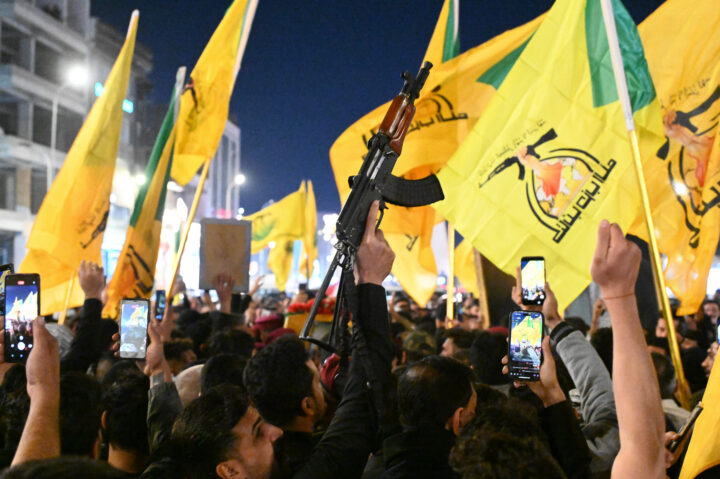
Haidar Mohammed Ali/Anadolu via Getty Images
Mourners carry the coffin of Kata'ib Hezbollah member on March 2, 2026 amid Kata'ib Hezbollah flags.
This P.M. edition is reserved for our premium subscribers — offering a forward-focused read on what we’re tracking now and what’s coming next. Please don’t hesitate to share your thoughts and feedback by replying to this email.
📡On Our Radar
Notable developments and interesting tidbits we’re tracking
President Donald Trump lashed out at European countries this morning for their posture during the war in Iran: He wrote on Truth Social that France is prohibiting planes with military supplies destined for Israel from flying over its territory, calling Paris “VERY UNHELPFUL … The U.S.A. will REMEMBER!”
Trump also named the U.K. among the countries “which refused to get involved in the decapitation of Iran” and are now struggling to acquire fuel due to the effective closure of the Strait of Hormuz. “[G]o to the Strait, and just TAKE IT. You’ll have to start learning how to fight for yourself, the U.S.A. won’t be there to help you anymore, just like you weren’t there for us,” the president warned…
Trump told the New York Post about reports that he’s willing to end the war without reopening the Strait of Hormuz: “I don’t think about it, to be honest. My sole function was to make sure that they don’t have a nuclear weapon. They’re not going to have a nuclear weapon. When we leave the strait will automatically open.”
He similarly said to CBS News about removing Iran’s enriched uranium, “I don’t even think about it. I just know that, you know, that’s so deeply buried it’s gonna be very hard for anybody. … It’s pretty safe. But, you know, we’ll make a determination”…
During a press briefing this morning, Defense Secretary Pete Hegseth revealed that he took a secret trip to the Middle East in recent days to meet with U.S. servicemembers, including Air Force intelligence analysts, Army troops and pilots.
CENTCOM also confirmed that Adm. Brad Cooper visited Israel earlier this week where he met with Defense Minister Israel Katz and Lt. Gen. Eyal Zamir, the IDF’s chief of staff…
Israel is ending all arms purchases from France and “replacing it with domestic Israeli procurement or purchases from allied countries,” the Israeli Ministry of Defense said today, adding that there will be “no new professional engagement with the French military” in the latest rift in the deteriorating relationship between Jerusalem and Paris…
A week after Lebanon declared Iran’s ambassador to Beirut persona non grata and expelled him from the country, the ambassador has still refused to leave the embassy compound, and Iran has stated that the embassy remains open…
China and Pakistan, which has been the intermediary for indirect negotiations between the U.S. and Iran, put forward a ceasefire proposal that would see the immediate cessation of hostilities, the safeguarding of nonmilitary targets and the restoration of transit through global shipping lanes…
American journalist Shelly Kittleson was kidnapped in Baghdad, Iraq, today, according to the Iraqi interior ministry, reportedly by Kataib Hezbollah, the same group that held researcher Elizabeth Tsurkov for over 900 days. Kittleson is a freelance journalist primarily based in Europe who has written for outlets including Al-Monitor and Foreign Policy.
Dylan Johnson, assistant secretary of state for global public affairs, said in a statement that the State Department “is aware of the reported kidnapping” and had “previously fulfilled our duty to warn this individual of threats against them.” Johnson said an “individual with ties” to Kataib Hezbollah “has been taken into custody” in connection with the kidnapping and that the department will coordinate with the FBI to secure Kittleson’s release…
New York City Mayor Zohran Mamdani attended a dinner for Eid last week where he spoke with antisemitic streamer Hasan Piker, a conversation that Piker called “very productive” on a recent Twitch stream.
“No, he did not disavow me,” Piker said in response to a listener’s question. “‘Did you tell him to tune out the bad faith haters?’ I did,” Piker continued. Mamdani appeared on Piker’s Twitch for an interview during the mayoral campaign but has not met with him publicly since…
“Nope,” Rep. Josh Gottheimer (D-NJ) said in response to a video of Sen. Bernie Sanders (I-VT) claiming that, “in many respects,” Piker “is doing a very good job.” “Hasan Piker is a proud antisemite … His voice should have no place in our political discourse and all elected officials should condemn his rhetoric,” Gottheimer wrote…
Michigan Attorney General Dana Nessel, a Jewish Democrat, shared an image of a sign which read, “A Jewish data center has no home here,” displayed outside a town hall she held yesterday urging caution around the approval of data centers. “If you think antisemitism isn’t a problem in Michigan, think again,” Nessel wrote…
A new poll commissioned by former Maine state Sen. Troy Jackson, now a Democratic candidate for governor, found oyster farmer Graham Platner — whom Jackson is backing — nearly 40 points ahead of Gov. Janet Mills in the state’s Senate race (66-28%) among likely Democratic primary voters. The survey was conducted after Mills had started running ads against Platner based on his past controversial statements, a sign that her line of attack may not be persuading voters…
And another poll commissioned by the Senate Majority PAC, a Democratic group, found Texas Attorney General Ken Paxton leading in the heated Republican primary runoff for Senate against incumbent Sen. John Cornyn (R-TX), 47-42%…
A federal judge ruled that the University of Pennsylvania must comply with a subpoena from the Trump administration that seeks information about Jewish university affiliates, which the university had said resembled nefarious efforts by governments over history to gather lists of Jews…
⏩ Tomorrow’s Agenda, Today
An early look at tomorrow’s storylines and schedule to keep you a step ahead
Keep an eye out in Jewish Insider for a report from West Bloomfield, Mich., where JI’s Gabby Deutch sat down with community members still reeling from the attack on Temple Israel earlier this month.
Democrat Analilia Mejia and Republican Joe Hathaway will participate in a debate tomorrow evening ahead of the April 16 special election in New Jersey’s 11th Congressional District, after Mejia eked out a surprise victory in last month’s primary. While this race will decide who serves out the rest of Gov. Mikie Sherrill’s House term, the progressive Mejia is also running essentially unopposed by other Democrats for the full term.
In observance of Passover, we’ll be back in your inbox with the Daily Overtime on Monday, April 6. Chag Pesach Sameach!
Stories You May Have Missed
COMMUNITY TIGHTROPE
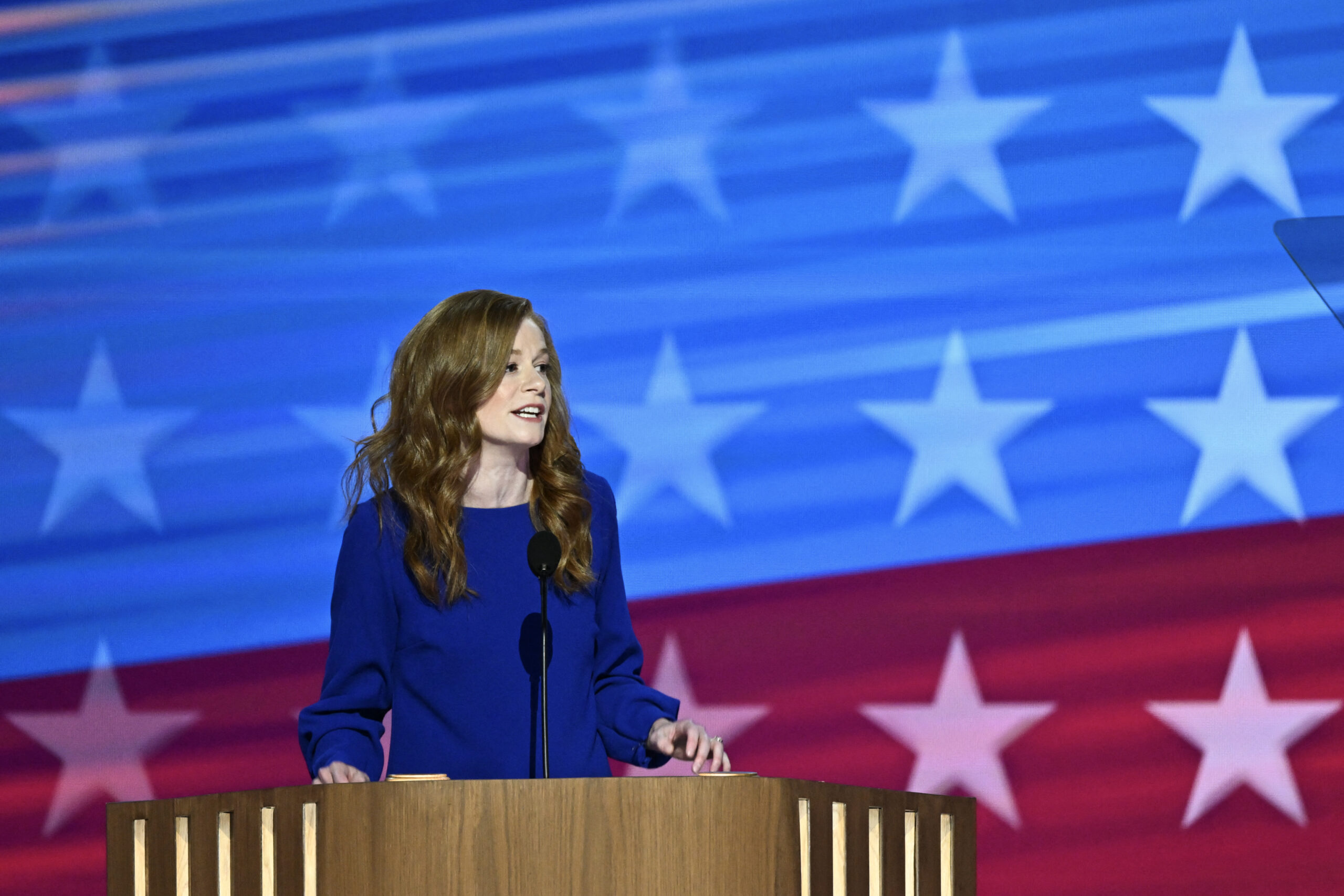
In an interview with JI, the state senator described herself as someone who supports the U.S.-Israel relationship, but not unconditionally
DECISION TIME

As the president touts progress in talks with Tehran while escalating military pressure, analysts say the administration is keeping its options open — but will need to make a move soon
Plus, one AI rabbi down but more pop up
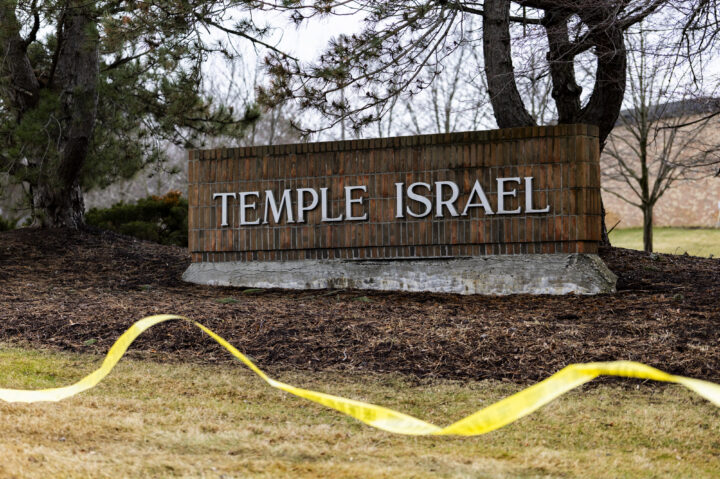
Emily Elconin/Getty Images
Caution tape near the front entrance of Temple Israel a day after an active shooter incident on March 13, 2026 in West Bloomfield, Michigan.
This P.M. edition is reserved for our premium subscribers — offering a forward-focused read on what we’re tracking now and what’s coming next. Please don’t hesitate to share your thoughts and feedback by replying to this email.
📡On Our Radar
Notable developments and interesting tidbits we’re tracking
President Donald Trump doubled down on threats to escalate the war in Iran while simultaneously heralding the success of ongoing negotiations: He claimed on Truth Social this morning that the U.S. is in “serious discussions” with a “new” and “more reasonable” Iranian regime and that “great progress has been made.”
“But,” he added, “if for any reason a deal is not shortly reached, which it probably will be, and if the Hormuz Strait is not immediately ‘Open for Business,’ we will conclude our lovely ‘stay’ in Iran by blowing up and completely obliterating all of their Electric Generating Plants, Oil Wells and Kharg Island (and possibly all desalinization plants!)”…
Trump confirmed to the New York Post that the U.S. is engaging with Iranian parliament speaker Mohammad Bagher Ghalibaf and assessing whether he’s a reliable partner: “We’re gonna find out. I’ll let you know that in about a week.” He also said the U.S. believes new Supreme Leader Mojtaba Khamenei is “probably” alive “but in extraordinarily bad shape” after he was injured in an airstrike…
Treasury Secretary Scott Bessent claimed in a Fox News interview that the U.S. is “going to retake control of the straits and there will be freedom of navigation, whether it is through U.S. escorts or a multinational escort”…
A series of surveys released today reveal how Jews and Israelis are perceiving the war in Iran: A poll conducted by the Mellman Group found 55% of American Jews oppose the war while 32% are in favor. Another poll of American Jews, solicited by J Street, found 60% of respondents opposed and 40% in support.
In Israel, meanwhile, a poll released by the Israel Democracy Institute found that the war is losing some support among Israelis, Jewish Insider’s Lahav Harkov reports. In the first week of the war, 93% of Jewish Israelis supported continuing it, while in the latest poll — conducted nearly a month into the war — 78% support it. Nearly three times as many Israeli Jews (12%) now oppose the war as did at the beginning of March (4%)…
The FBI announced findings that the attack on Temple Israel in suburban Detroit earlier this month was “a Hezbollah-inspired act of terrorism purposely targeting the Jewish community and the largest Jewish temple in Michigan.” The brother of the assailant was a Hezbollah commander who had been killed in Lebanon by the IDF the week before the attack…
Michigan Democratic Senate candidate Abdul El-Sayed told campaign staff that he did not want to take any public position on the killing of former Iranian Supreme Leader Ayatollah Ali Khamenei at the beginning of the war because “there are a lot of people in Dearborn who are sad,” according to meeting audio obtained by The Washington Free Beacon.
If asked by reporters, El-Sayed said his strategy would be to “go straight to pedophilia, frankly. I’ll just be like, ‘Pedophile president decides that he doesn’t like the front page news, so he decides to take us into another war’”…
Allies of New York City Mayor Zohran Mamdani told Politico that the mayor’s dismissal of criticisms of his wife, Rama Duwaji, for her past extreme rhetoric and social media posts — calling her “a private person” — doesn’t comport with Duwaji’s very public profile.
“‘She is the first lady of New York City. She has a police detail and a government staff,’ said one of the elected officials, who believes Duwaji should explain herself publicly. ‘She would need to do an interview, better explain herself, and have her do some visits and meetings with key constituencies, like Jewish museums’”…
An AI-generated Instagram account, which featured a fake Orthodox rabbi spreading antisemitic conspiracies to its more than 1.4 million followers, was taken offline over the weekend following major backlash from Jewish groups and one Democratic lawmaker — yet several similar, hate-peddling accounts have emerged with little to no public action from Meta, JI’s Haley Cohen reports.
Several new Rabbi Goldman accounts started posting similar videos within the past two weeks — two of which already have followings of 18,500 and 10,000. Both remain active on Instagram and their bios state, “only Backup account for @rabbigoldman” and “old account got banned”…
The Knesset passed a controversial law today allowing courts to impose the death penalty on convicted terrorists found guilty of murder, JI’s Lahav Harkov reports.
The law, championed by National Security Minister Itamar Ben-Gvir, applies in military courts to non-Israeli residents of the West Bank — meaning, in the vast majority of cases, Palestinians. In civilian courts, the law permits applying the death penalty to those who “intentionally cause the death of a person with the aim of denying the existence of the State of Israel” — language which would also likely exclude Jewish assailants. Critics say it will likely be struck down by the High Court…
The Times of Israel breaks down the legislative maneuver used in Knesset by the coalition that caused opposition members to accidentally vote in favor of allocating 800 million shekels (~$250 million USD) to Haredi schools as they passed the state budget this morning…
In an interview on Israel’s Channel 12, Ukrainian President Volodymyr Zelensky said he has barely spoken to Israeli Prime Minister Benjamin Netanyahu since their last meeting at the United Nations General Assembly in September 2023…
⏩ Tomorrow’s Agenda, Today
An early look at tomorrow’s storylines and schedule to keep you a step ahead
Keep an eye out in Jewish Insider for a look at the resolution coming under consideration by the Democratic National Committee that explicitly criticizes AIPAC’s political spending.
The House and Senate left for recess until mid-April, after failing to come to an agreement to fund the Department of Homeland Security, which has now reached its longest-ever shutdown. Calls have already begun from at least one Republican senator to bring Congress back into session sooner, but prospects for an early return are currently unclear.
Sen. Cory Booker (D-NJ) will speak at Temple Emanu-El in New York City tomorrow about his new book, Stand, on the one-year anniversary of his delivery of the longest-ever speech on the Senate floor.
Stories You May Have Missed
SEAT SHAKE-UP
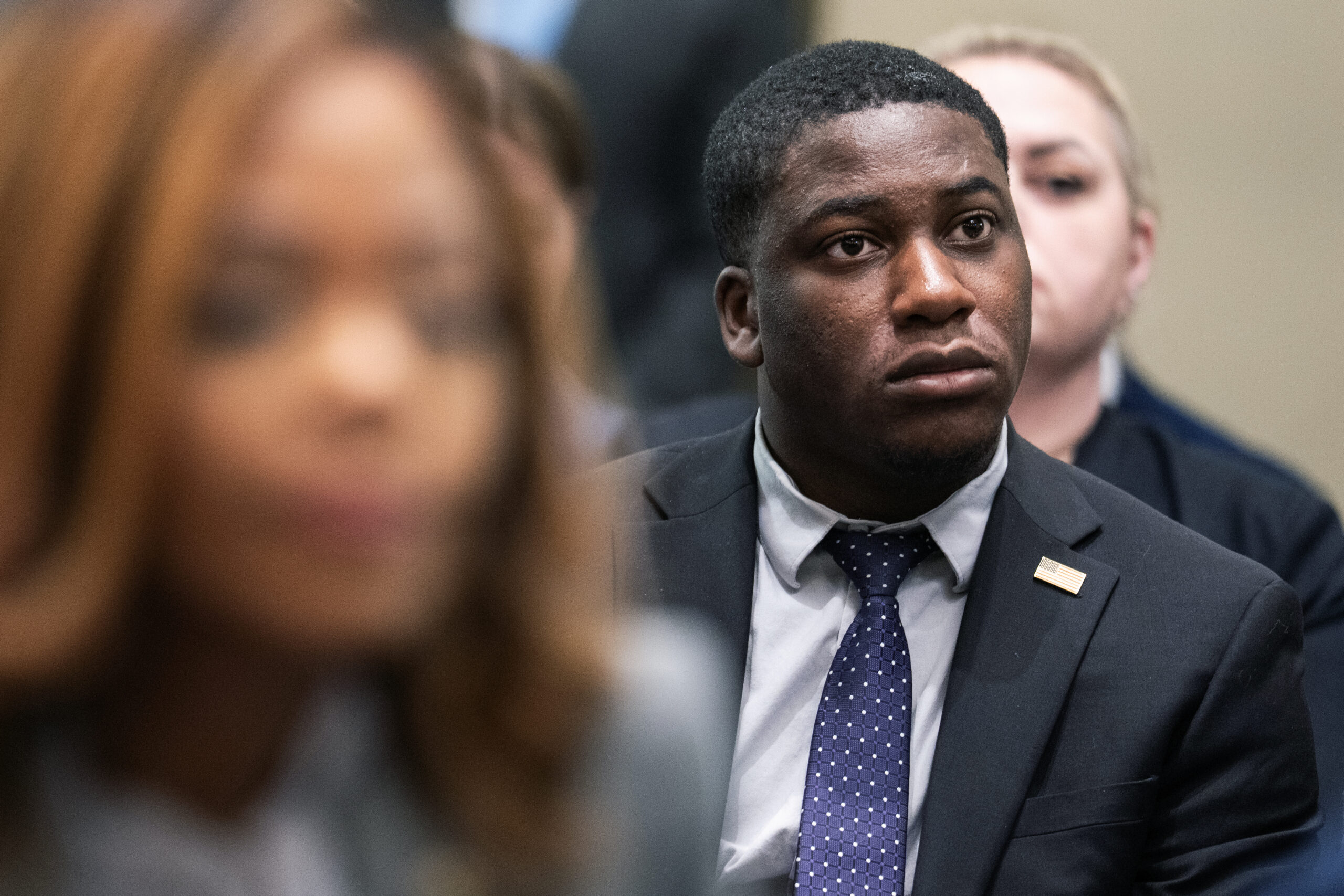
The lawmaker, who may soon be expelled from the chamber, is already in a heated primary race with Elijah Manley, a young far-left candidate endorsed by TrackAIPAC
PHONE A FRIEND
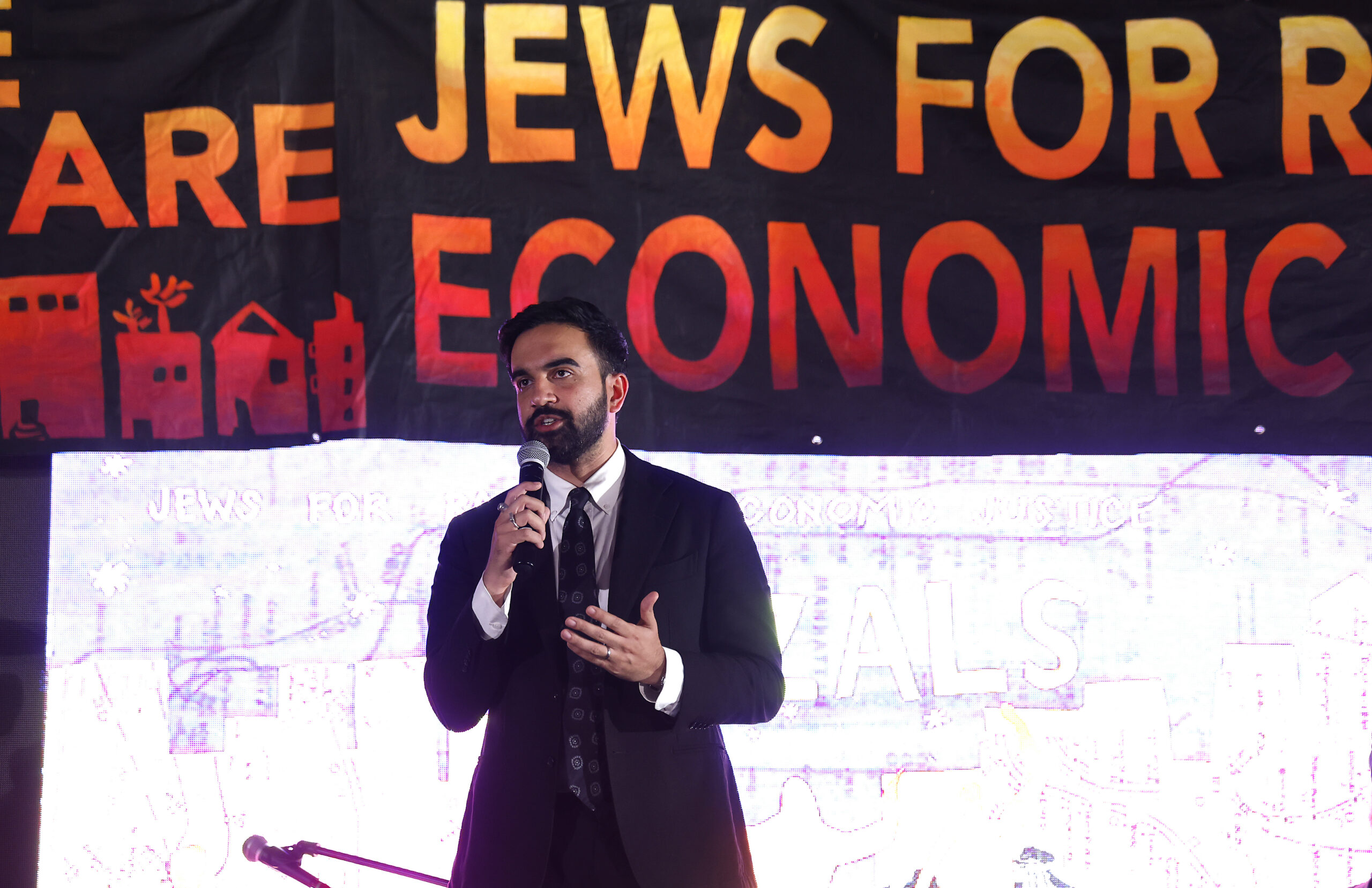
The sister, niece and brother-in-law of Maoist magnate Neville ‘Roy’ Singham have gained influence in New York’s ascendant socialist movement
Plus, fake AI rabbis peddle antisemitism
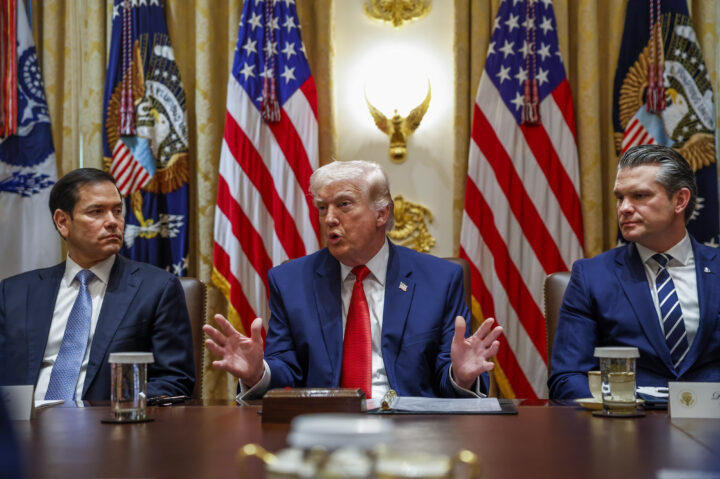
Will Oliver/EPA/Bloomberg via Getty Images
Secretary of State Marco Rubio, President Donald Trump and Defense Secretary Pete Hegseth during a Cabinet meeting at the White House in Washington, DC, US, on Thursday, March 26, 2026.
This P.M. edition is reserved for our premium subscribers — offering a forward-focused read on what we’re tracking now and what’s coming next. Please don’t hesitate to share your thoughts and feedback by replying to this email.
📡On Our Radar
Notable developments and interesting tidbits we’re tracking
President Donald Trump announced this afternoon that he’s extending his original five-day delay on strikes on Iran’s energy sector, which was set to expire tomorrow, by another 10 days. “As per Iranian Government request … I am pausing the period of Energy Plant destruction by 10 Days to Monday, April 6, 2026, at 8 P.M., Eastern Time,” he wrote on Truth Social, adding that negotiations continue and are “going very well”…
At a Cabinet meeting earlier today, Trump revealed that the “present” Iran had provided the U.S. earlier this week was allowing eight Pakistani-flagged oil tankers to pass safely through the Strait of Hormuz, which he said proved the U.S. was speaking with the “right people” in Iran with the authority to make such decisions.
Special Envoy Steve Witkoff, meanwhile, confirmed reports that the U.S. had presented Iran with a “15-point action list” as a starting offer in peace talks between the two countries, and that Pakistan is acting as mediator…
Speaking at the FII Priority summit in Miami, Jared Kushner said that, during his negotiations with Iran prior to the war, “We basically saw that there was no seriousness, and that they were trying to play different games to just get beyond President Trump in order to preserve their capabilities and pathway to get to a nuclear weapon in a way that would have been very, very hard to be stopped in the future”…
CENTCOM applauded an Israeli strike that killed Alireza Tangsiri, the commander of the IRGC Navy, and warned all IRGC Navy members to “immediately abandon their post and return home.” Tangsiri had been named a Specially Designated Global Terrorist by the U.S. in 2019 and was leading Iran’s efforts to shutter the Strait of Hormuz…
Even as U.S.-Iran negotiations continue, the U.S. is considering diverting weapons for Ukraine to the Middle East, The Washington Post reports, including air-defense interceptor missiles.
Ukraine has proved a stalwart ally to the Gulf as it comes under attack from Iran — around 200 Ukrainian military personnel have been deployed around the Middle East to help defend against Iranian drones and President Volodymyr Zelensky arrived in Saudi Arabia today for a surprise visit…
Resources are also being redirected to Gaza — the Trump administration has reportedly pulled $1.25 billion from international peacekeeping and disaster assistance programs for the Board of Peace’s operations, for which Trump had pledged $10 billion in U.S. funding…
An AI-generated Instagram account portraying an Orthodox-looking rabbi is pushing antisemitic conspiracy theories to its more than 1.4 million followers, and it’s not the only one, according to a study published Wednesday by Combat Antisemitism Movement.
Jewish Insider’s Haley Cohen reports: Researchers identified 12 AI-generated “rabbis” with a combined following of 2.1 million Instagram users, all of which promote classic antisemitic stereotypes. The “Rabbi Goldman” account features many of these, including one video in which the “rabbi,” wearing a tuxedo and seemingly seated in a luxury airplane, claims that Jews utilize empty private jets to evade taxes…
A new Emerson College poll of the Maine Senate race found oyster farmer Graham Platner with a nearly 30 point lead over Gov. Janet Mills (55-28%) in the Democratic primary. Both Platner and Mills lead Sen. Susan Collins (R-ME) in the general election matchup, 48-41% and 46-43%, respectively…
California Gov. Gavin Newsom again reaffirmed his support for Israel in an interview with The Bulwark, likening his love for the country but strong disapproval of its current government with how he feels about the U.S…
Democrat Analilia Mejia and Republican Joe Hathaway will participate on April 1 in what is likely to be the only debate of the New Jersey 11th Congressional District’s special election, after the far-left Mejia won the Democratic nomination in a hotly contested primary last month. The New Jersey Globe, which is hosting the debate, acknowledged it had chosen to do so on the first night of Passover, in a district with a sizable Jewish population…
The College Republicans chapter at the University of Florida is suing the school, after a photo of one of its members doing what appeared to be a Nazi salute led to the chapter’s ban from campus.
The chapter argues that the ban violated its First Amendment rights as the member “expressed a viewpoint off-campus that was alleged by some to be anti-Semitic,” and claims it was deactivated in part because it recently hosted James Fishback, a candidate for Florida governor who has expressed antisemitic and anti-Israel views…
⏩ Tomorrow’s Agenda, Today
An early look at tomorrow’s storylines and schedule to keep you a step ahead
Keep an eye out in Jewish Insider for comments from Michigan state Sen. Mallory McMorrow on Israel and antisemitism as she seeks the Democratic nomination for U.S. Senate against Rep. Haley Stevens (D-MI) and Abdul El-Sayed.
President Donald Trump will provide closing remarks at the FII Priority summit in Miami tomorrow afternoon.
Texas Attorney General Ken Paxton will headline CPAC’s Ronald Reagan Dinner. His primary opponent, Sen. John Cornyn (R-TX), will not be making an appearance, despite the confab taking place in his home state and calls from its leadership for him to attend.
Secretary of State Marco Rubio is traveling to France to attend a meeting of G7 foreign ministers where he is expected to press allies on the Iran war — he told reporters as he departed today, echoing a line from Trump, that the countries involved “get far more of their fuel from” the Strait of Hormuz “than we do.”
Stories You May Have Missed
TROUBLE IN THE NEIGHBORHOOD

Frustrated UAE leaders are questioning the ‘impotence’ of countries like Egypt — and warn that silence on Iranian aggression will push the Gulf closer to U.S., Israel
MICHIGAN MOMENT
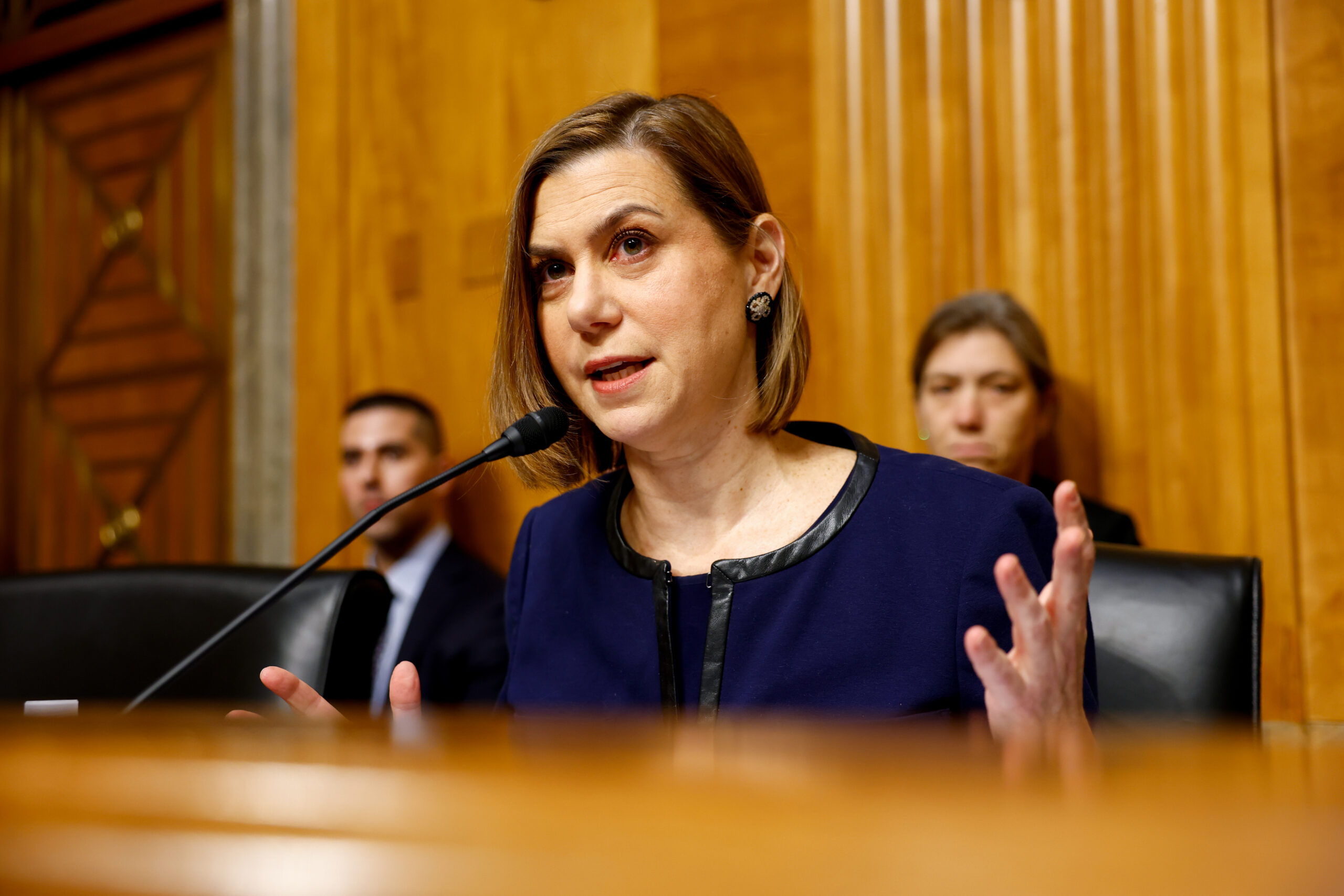
Stevens said that by associating with Piker, El-Sayed is ‘choosing to campaign with someone who has a history of antisemitic rhetoric’
Plus, is Stevens losing steam in Michigan Senate race?
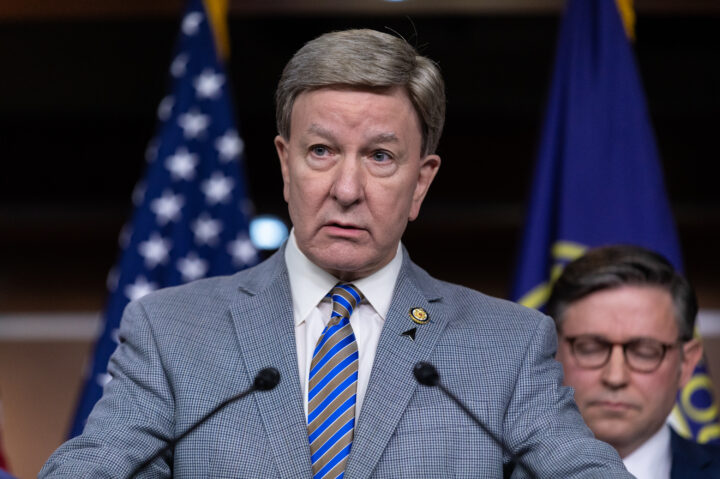
Anna Rose Layden/Getty Images
House Armed Services Committee Chairman Mike Rogers (R-AL) speaks to the press at the U.S. Capitol on October 17, 2025 in Washington, DC.
This P.M. edition is reserved for our premium subscribers — offering a forward-focused read on what we’re tracking now and what’s coming next. Please don’t hesitate to share your thoughts and feedback by replying to this email.
📡On Our Radar
Notable developments and interesting tidbits we’re tracking
White House Press Secretary Karoline Leavitt downplayed reports that Iran has rejected President Donald Trump’s ceasefire proposal, saying in a press briefing today that “talks continue” and “are productive.” She further confirmed, while cautioning against speculation, that there are “elements of truth” to the 15-point plan that has been reported.
About potential face-to-face negotiations, which International Atomic Energy Agency head Rafael Grossi said could take place in Pakistan as soon as this weekend, Leavitt said she “would not get ahead of our skis on reporting about any talks this weekend until you hear directly from us”…
Emerging from a classified House Armed Services Committee briefing on Iran, Chairman Mike Rogers (R-AL) expressed frustration that the administration isn’t forthcoming enough about its war plans. “We want to know more about what’s going on, what the options are and why they’re being considered, and we’re just not getting enough answers on those questions,” Rogers told reporters.
And Senate Armed Services Committee Chairman Roger Wicker (R-MS), asked about his House colleague’s comments, said, “Let me put it this way: I can see why he might have said that.” It’s the latest sign of cracks in the GOP nearly a month into the war effort…
For the first time since the start of the war, the UAE — which has faced the brunt of Iran’s attacks — reported zero Iranian ballistic missile attacks today, raising questions about the Islamic Republic’s potentially dwindling supplies.
Yousef Al Otaiba, the Emirati ambassador to the U.S., called for a “conclusive outcome” to the war, as opposed to a “simple cease-fire.” Writing in The Wall Street Journal, he argued that “building a fence around the problem and wishing it goes away isn’t the answer. It would simply defer the next crisis”…
European authorities are investigating whether a new group that has claimed responsibility for several recent terror attacks on Jewish institutions across Europe, the Islamic Movement of the Righteous Companions, is a front for Iran, which has likely recruited people online to carry out the attacks on its behalf…
The Journal profiles Iranian parliament speaker Mohammad-Bagher Ghalibaf as he emerges as a potential leader and negotiating partner for the U.S., with one expert calling him a “wannabe strongman” who simultaneously has “the necessary credentials to deliver a potential deal with the Trump administration”…
An internal poll from the campaign of Michigan state Sen. Mallory McMorrow shows her leading the pack in the Democratic primary for U.S. Senate, followed by the far-left Abdul El-Sayed with Rep. Haley Stevens (D-MI) trailing in third place, a sign her campaign is struggling to build momentum. A fifth of potential primary voters still identified themselves as undecided.
Stevens’ campaign then released its own internal poll that showed her in first place, followed closely by El-Sayed with McMorrow in third, though the survey was conducted in mid-February…
As the Trump administration sues Harvard — again — over alleged civil rights violations and failure to address campus antisemitism, Rabbi Hirschy Zarchi, president of Harvard Chabad, told The Harvard Crimson that the school is in fact “taking the issue” of antisemitism “very seriously.”
“While there is much more to be done, the only plausible characterization of Harvard’s current leadership is as principled and effective in confronting and removing the intolerance which had taken root on campus over more than a decade,” added Jason Rubenstein, executive director of Harvard Hillel…
Asked at a recent event at Harvard’s Kennedy School whether the Biden administration could have done more to save lives in the war in Gaza, former Secretary of State Tony Blinken said, “Could we, should we have done things differently such that the suffering that people endured, the loss of the children you just listed and so many others could have been averted? The short answer is: Maybe yes.”
Blinken also called on people not to be “binary” in their thinking about the Middle East, Jewish Insider’s Gabby Deutch reports. With the Gaza war, he said, “Where did we start? We started with Oct. 7. We started with the most horrific massacre of Jews since the Holocaust. It’s very easy to say, ‘Oh, yeah, that’s a given.’ Except it wasn’t a given for Israelis and Israeli society”…
⏩ Tomorrow’s Agenda, Today
An early look at tomorrow’s storylines and schedule to keep you a step ahead
Keep an eye out in Jewish Insider for a look at the growing divide in the Democratic Party over engagement with antisemitic streamer Hasan Piker — and the questions it raises about the meaning of progressivism in the current political landscape.
The Atlantic Council and U.S.-Syria Business Council will host a symposium on Syria’s energy sector with keynote remarks from U.S. Special Envoy to Syria Tom Barrack. Also speaking are several oil executives and Jacob McGee, the State Department’s deputy assistant secretary for Israeli-Palestinian affairs.
The FII Priority Summit continues in Miami; among other sessions tomorrow, Jared Kushner will speak on U.S.-Gulf investment and Zach Witkoff, co-founder of World Liberty Financial and son of Special Envoy Steve Witkoff, will discuss crypto.
CPAC, which President Donald Trump is seemingly not attending for the first time in a decade, continues in Dallas. GOP candidates who are in attendance include Brandon Herrera, the far-right influencer running in Texas’ 23rd District; Michael Whatley, the front-runner in North Carolina’s open Senate race; Rep. Mike Collins (R-GA), running in a competitive primary to challenge Sen. Jon Ossoff (D-GA); Rep. Kevin Hern (R-OK), seeking the Senate seat vacated by new Homeland Security Secretary Markwayne Mullin; and Nate Morris, running to succeed retiring Sen. Mitch McConnell (R-KY).
The House Ethics Committee will hold a rare public hearing on Rep. Sheila Cherfilus-McCormick’s (D-FL) alleged ethics violations, including her laundering of funds from a FEMA-backed contract for her family business into her congressional campaign.
Stories You May Have Missed
STRAIT TALK
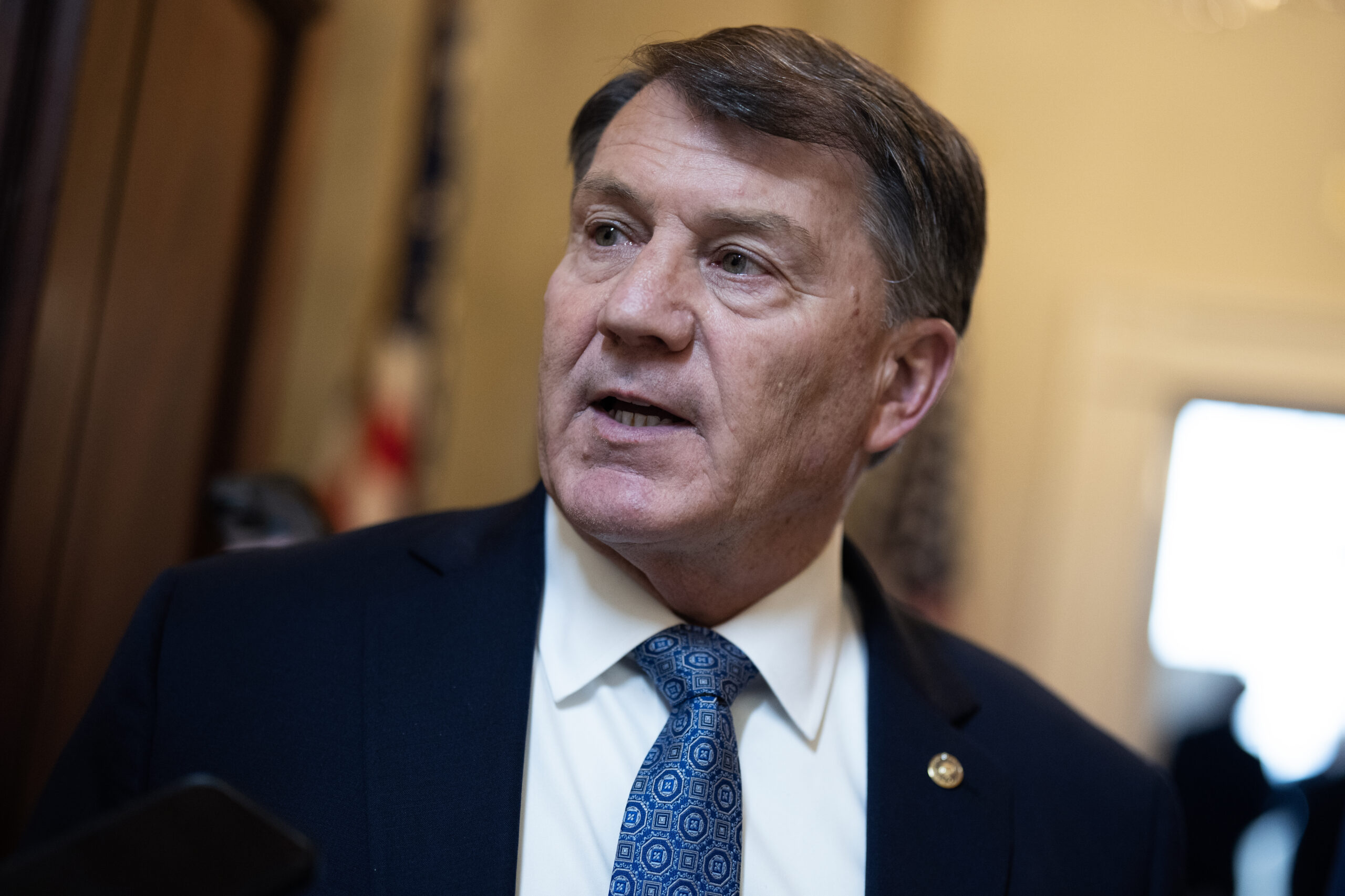
Some disagree on who should claim ultimate responsibility for the strait — the U.S. or other countries in the region
GUARDING THE GATES
Schneider called Piker ‘an unapologetic antisemite’ and warned ‘Democrats risk losing our credibility to condemn those on the right who traffic in bigotry’ if they continue to embrace him
The major Democratic donor said the outsized scrutiny of AIPAC’s political involvement is an effort to ‘chase Jews and their allies out of our big tent coalition’
Vernon Yuen/NurPhoto via Getty Images
Michael J. Sacks at the Global Hong Kong Global Financial Leaders Investment Summit on October 8, 2023 in Hong Kong, China.
A prominent Jewish Democratic donor in Chicago is raising alarms that growing efforts to demonize AIPAC and its engagement in political campaigns are part of a more sinister effort to make pro-Israel Jews feel unwelcome in a party they have long called home.
In an opinion article published in The Chicago Tribune on Tuesday headlined “Why I support AIPAC and a big tent Democratic Party,” Michael Sacks, an asset manager and longtime ally of former Chicago Mayor Rahm Emanuel, pointed to what he called a “double standard” for AIPAC’s political involvement, and warned of “a coordinated effort to make support for Israel a litmus test for Democratic primary candidates in 2026 and beyond.”
“Let’s be clear: The campaign against AIPAC is not a policy discussion,” he wrote. “It’s a thinly disguised effort to make support for Israel politically toxic in the Democratic Party, to chase Jews and their allies out of our big tent coalition.”
His public comments on a hot-button issue come in the wake of a contentious primary cycle in Illinois earlier this month, where AIPAC’s spending in a range of contested House races was a subject of particularly heated criticism that is expected to play a role in the midterms and 2028 presidential election.
His op-ed also lands as some Democratic leaders have distanced themselves from AIPAC, including Illinois Gov. JB Pritzker, a rumored 2028 presidential contender and a former AIPAC donor who in recent interviews has said he abandoned the pro-Israel group because it leaned too heavily to the right and lost its commitment to bipartisanship. He has also accused AIPAC of “interference” in Illinois’ recent House races, where its affiliated groups spent more than $20 million across four major primaries.
Despite their differences over AIPAC, Pritzker defended Sacks on Tuesday during an unrelated press conference. “Do I think that people who supported AIPAC can be good Democrats? I can tell you Michael Sacks is a very good, decent, honorable human being who cares deeply about the Democratic values I expressed to you,” Pritzker said.
He added that it was “very unfair for people to have targeted” Sacks “when what he believes is the same thing,” referring to “the security of the state of Israel and the security of the Palestinian people at the very same time.”
During the primaries, Sacks himself faced personal blowback after a progressive House candidate said he was rejecting his campaign contribution because of Sacks’ ties to AIPAC — a move Sacks lamented at the time as a sign of growing “anti-Israel sentiment and outright Jew hate.”
Sacks contributed a combined $1.2 million to two super PACS linked to AIPAC that faced scrutiny for obscuring their donors until after the primaries on March 17. He also donated to pro-Israel candidates who were backed by AIPAC, including former Rep. Melissa Bean (D-IL), who clinched the nomination in Illinois’ 8th Congressional District, and state Sen. Laura Fine, who lost to an outspoken Israel critic in Illinois’ 9th.
In the Tribune, Sacks clarified that he has not always aligned with AIPAC, saying he had “stepped away” from the group in 2017 over its fierce opposition to President Barack Obama’s Iran nuclear agreement, after decades of involvement.
But following the Hamas attacks of Oct. 7, 2023, Sacks wrote, “as I watched anti-Israel sentiment accelerate within my party, including in Illinois,” he reconnected with AIPAC, asking how he could help to “ensure we didn’t send more people to Congress from Chicago who would deny Israel access to even essential defensive weapons.”
His experience observing the Illinois primaries, where other special-interest groups linked to the crypto and artificial intelligence industries had also invested heavily, ultimately exposed what he called a “stark and deliberate” attempt to single out AIPAC and broader pro-Israel activism as a unique source of backlash, he said, arguing that such criticism had not been evenly allocated throughout the campaign.
“I don’t agree with everything Israel and AIPAC do. Like many Israeli leaders as well as elected officials who receive AIPAC support, I believe in a two-state solution,” Sacks wrote. “If you’re not for two states, you’re for endless war. I also believe in a big tent Democratic Party. Democratic leaders claim to be for those things as well. Yet we demonize AIPAC and pro-Israel Jewish Democrats, while accepting those who cannot even say they support a two-state solution that includes Israel.”
Sacks, who chaired the 2024 Democratic National Convention host committee in Chicago, concluded the op-ed with a call to “Democratic leadership to brave this issue,” saying “we need more thermostats and fewer thermometers.”
“Real leadership recognizes that we can hold complicated views about the Israeli government and still refuse to make Jewish identity and pro-Israel sentiment a political disqualifier in our party,” he said in his article on Tuesday. “We can defend the big tent when it is inconvenient, not just when it is easy.”
Plus, media misdirection over AIPAC money

Shauna Clinton/Sportsfile for Web Summit Qatar via Getty Images
Hasan Piker during day two of Web Summit Qatar 2026 at the Doha Exhibition and Convention Center in Doha, Qatar.
This P.M. edition is reserved for our premium subscribers — offering a forward-focused read on what we’re tracking now and what’s coming next. Please don’t hesitate to share your thoughts and feedback by replying to this email.
📡On Our Radar
Notable developments and interesting tidbits we’re tracking
Rumblings of a potential peace summit between Washington and Tehran have begun — sources told Axios that the U.S. and several mediating countries are waiting for Iran to respond to a proposal for peace talks this Thursday, while President Donald Trump reposted a message from Pakistan offering to “be the host to facilitate meaningful and conclusive talks”…
Trump told reporters in the Oval Office this afternoon that “we’re dealing with the right people” in Iran because they “gave us a present, and the present arrived today. It was a very big present worth a tremendous amount of money,” but would only tease that it was “oil and gas related.” Asked if he is negotiating over who will control the Strait of Hormuz, Trump said, “No … we’ll have control of anything we want”…
Saudi Crown Prince Mohammed bin Salman has encouraged Trump to continue the campaign against Iran and push towards toppling the regime, The New York Times reports, believing that Iran’s threat to the Gulf will only be removed through the transition of its government and not if the war results in a failed state. MBS has reportedly argued in favor of striking Iran’s energy infrastructure and putting U.S. troops on the ground…
The Pentagon is expected to announce the deployment of about 3,000 soldiers from the military’s 82nd Airborne Division to participate in the campaign against Iran, The Wall Street Journal reports, a move that opens the possibilities for boots on the ground, as the division is trained to parachute into hostile territory…
Israeli Defense Minister Israel Katz said today that the IDF will now maintain control over a security zone south of the Litani River in Lebanon and prevent the return of Lebanese residents who have been evacuated from the area “until the security of northern [Israeli] residents is assured”…
Lebanese Minister of Foreign Affairs Youssef Raggi declared Iran’s ambassador to Beirut persona non grata and expelled him from the country, as Iranian proxy Hezbollah continues to fire on Israel against the Lebanese government’s orders.
Shortly after, an Iranian ballistic missile was launched towards Beirut for the first time — it was reportedly intercepted by a “foreign naval vessel,” presumably the U.S., though fragments struck Lebanese towns…
Secretary of State Marco Rubio is being dispatched to France later this week to discuss the Iran war, among other issues, with the U.S.’ G7 allies, including Britain, Canada, France, Germany, Italy and Japan, countries that have all declined to participate in the war effort…
Majed al-Ansari, spokesperson for the Qatari foreign ministry, said today that Qatar is not involved in mediating any U.S.-Iran negotiations, a shift for the country that has traditionally played the part of go-between. Al-Ansari said there has been no communication between Doha and Tehran since a phone call early in the conflict when Qatar made clear its anger with Iranian strikes on its territory…
Politico reports that several 2028 Democratic presidential hopefuls said they wouldn’t or haven’t taken money from AIPAC, including Sen. Cory Booker (D-NJ), California Gov. Gavin Newsom, Sen. Ruben Gallego (D-AZ), Kentucky Gov. Andy Beshear, Illinois Gov. JB Pritzker, Pennsylvania Gov. Josh Shapiro, Sen. Elissa Slotkin (D-MI) and former Chicago Mayor Rahm Emanuel.
But while framing the statements as rejections of AIPAC and Israel, the outlet buried or declined to mention Booker’s rebuke of the Democratic Party’s singling out of the pro-Israel group, several respondents’ inability to accept funds from AIPAC since it only participates in congressional elections and Newsom’s own about-face on Israel, where in the same publication he walked back critical comments he’s made and said he’s “proud to support the state.”
AIPAC said in response that it has “never given to a presidential campaign” and that “singling out and excluding millions of pro-Israel Democrats” who are AIPAC members “is wrong and undemocratic”…
Michael Sacks — a prominent Democratic donor and supporter of former President Barack Obama who chaired the 2024 Democratic National Convention host committee — denounced Democratic criticism of AIPAC as a “thinly disguised effort to make support for Israel politically toxic in the Democratic Party, to chase Jews and their allies out of our big tent coalition.”
Sacks wrote in the Chicago Tribune, “Real leadership recognizes that we can hold complicated views about the Israeli government and still refuse to make Jewish identity and pro-Israel sentiment a political disqualifier in our party. We can defend the big tent when it is inconvenient, not just when it is easy”…
Jonathan Cowan, president of the moderate Democratic think tank Third Way, condemned far-left Michigan Senate candidate Abdul El-Sayed for his upcoming rallies with antisemitic streamer Hasan Piker, Jewish Insider’s Danielle Cohen-Kanik reports.
“It is morally repugnant and strategically self-defeating for Democrats like Abdul El-Sayed and Members of Congress like Summer Lee to cozy up to antisemitic extremists like Hasan Piker,” Cowan said in a statement. “Anyone eager to campaign with Hasan Piker is, at best, comfortable overlooking his antisemitic and anti-American extremism and, at worst, endorsing it”…
El-Sayed stood by his controversial statement about the shooting attack at Temple Israel in suburban Detroit earlier this month, in which he condemned the attack but blamed Israel’s military campaign in Lebanon for the perpetrator’s actions (the attacker’s brother was a Hezbollah commander).
The statement “was a risk,” El-Sayed said on an internal campaign call, per Punchbowl News, “but leadership is being willing to say the thing if you believe it to be true that nobody else is going to say”…
⏩ Tomorrow’s Agenda, Today
An early look at tomorrow’s storylines and schedule to keep you a step ahead
Keep an eye out in Jewish Insider for coverage of another war powers resolution expected to receive a vote this evening in the Senate.
President Donald Trump will give the keynote speech at the National Republican Congressional Committee’s annual President’s Dinner in Washington.
The House Homeland Security Committee will hold a hearing assessing the impact of the Department of Homeland Security shutdown, as lawmakers make progress on negotiations to fund the agency.
D.C. councilmember and mayoral candidate Janeese Lewis George will rally alongside other members of the Democratic Socialists of America including Squad-member Rep. Rashida Tlaib (D-MI), days after Lewis George held a private meeting with Jewish leaders to apologize for saying in a DSA questionnaire she would boycott events “promoting Zionism” and avoid the “Zionist lobby.”
Scholar of Jewish literature Ruth Wisse will deliver the annual Jefferson Lecture in the Humanities, the highest honor the federal government gives for intellectual achievement in the humanities, at the Kennedy Center in Washington.
The FII PRIORITY Summit, a high-profile investment and policy conference, will kick off in Miami, with speakers over the rest of the week including Trump; Donald Trump Jr.; Jared Kushner; White House Special Envoy Steve Witkoff; Dina Powell McCormick, president of Meta; Saudi Ambassador to the U.S. Princess Reema Bandar Al Saud; former Treasury Secretary Steve Mnuchin; Massad Boulos, senior White House advisor on the Middle East; and many more.
The Conservative Political Action Conference, known as CPAC, also begins tomorrow in Dallas.
The Jewish Book Council will hold the 75th National Jewish Book Awards Gala, hosted by entertainer Jonah Platt, at Temple Emanu-El in New York City.
Stories You May Have Missed
SECOND ACT

PAIN TO POWER
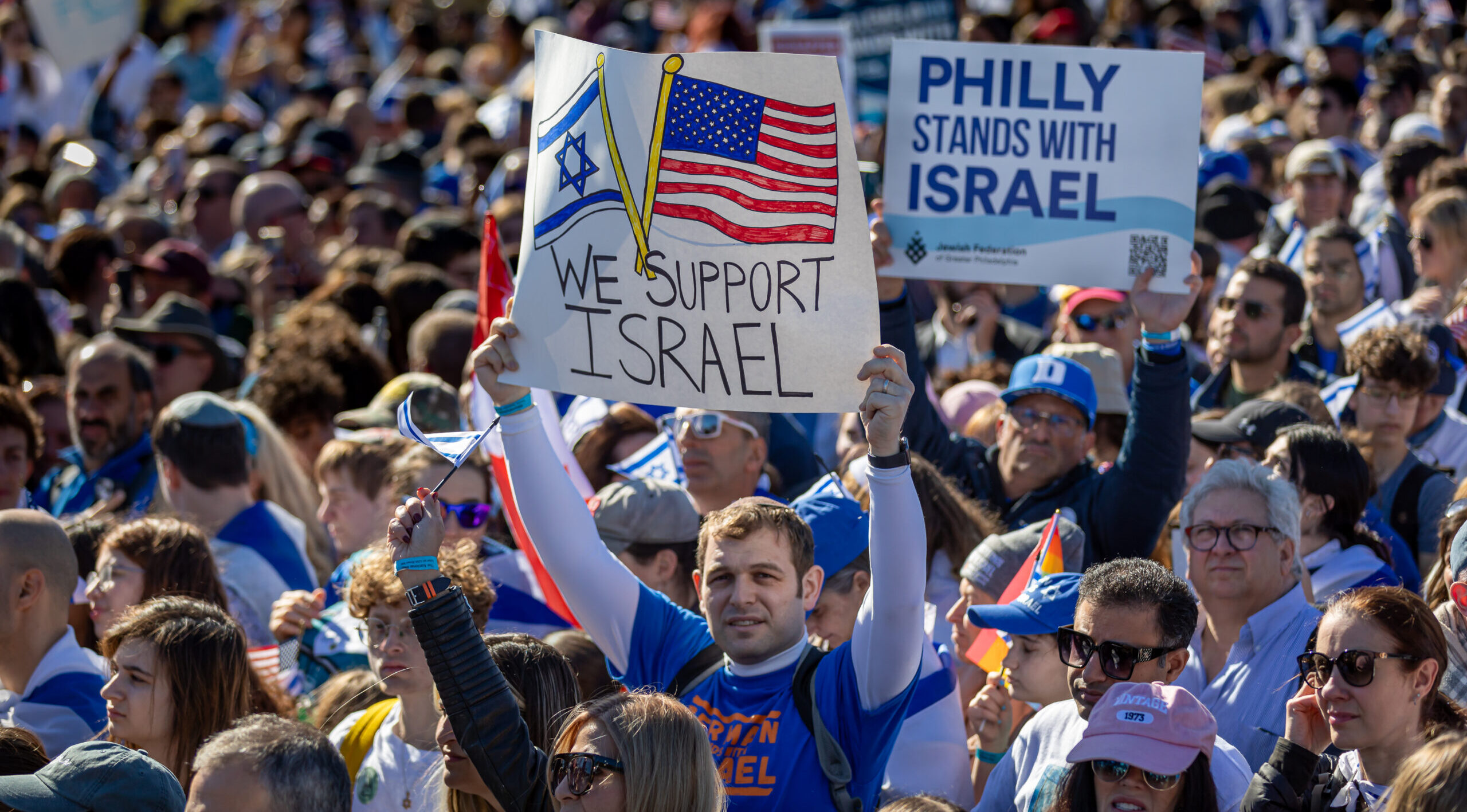
In the wake of Oct. 7, some in the Jewish community turned to faith, philanthropy or federal advocacy. Others set their sights closer to home, organizing to shape school boards and influence city councils
Plus, Israel strikes back after 200-missile Hezbollah barrage

Zach D Roberts/NurPhoto via Getty Images
Nick Fuentes, the leader of a Christian based extremist white nationalist group speaks to his followers in Washington D.C. on November 14, 2020
👋 Good Thursday morning!
In today’s Daily Kickoff, we look at the ties between neo-Nazi influencer Nick Fuentes and Kai Schwemmer, the newly named political director of College Republicans of America, and spotlight the pro-Israel positions taken by Clay Fuller, who is expected to succeed Rep. Marjorie Taylor Greene following next month’s runoff in Georgia. We report on the escalation between Israel and Hezbollah following the terror group’s launching last night of 200 missiles at Israel, and look at the degree to which the United Arab Emirates is absorbing much of Tehran’s missile and drone attacks. Also in today’s Daily Kickoff: Howard Schultz, Adm. Brad Cooper and Dorothy McAuliffe.
Today’s Daily Kickoff was curated by JI Executive Editor Melissa Weiss and Israel Editor Tamara Zieve, with assists from Danielle Cohen-Kanik and Marc Rod. Have a tip? Email us here.
What We’re Watching
- The Senate Health, Education, Labor and Pensions Committee is holding a hearing this morning on the influence of foreign funding in higher education. National Association of Scholars President Peter Wood, Foundation for Defense of Democracies Senior Fellow Craig Singleton and The Asia Society’s Robert Daly are slated to testify.
- The annual weeklong SXSW festival kicks off today in Austin, Texas. Mahmoud Khalil, the controversial former leader of Columbia’s anti-Israel protest movement who is facing possible deportation over his activities, will, according to the festival schedule, participate in a conversation this weekend “on the cost of dissent,” alongside his lawyer and The Guardian’s Betsy Reed. More below.
- First in JI: The Republican Jewish Coalition is set to announce endorsements of 16 House Republicans running for reelection, mostly in swing districts: Reps. Tom Barrett (R-MI), Rob Bresnahan (R-PA), Juan Ciscomani (R-AZ), Gabe Evans (R-CO), Brian Fitzpatrick (R-PA), Tom Kean Jr. (R-NJ), Mike Lawler (R-NY), Ryan Mackenzie (R-PA), Mariannette Miller-Meeks (R-IA), Zach Nunn (R-IA), David Valadao (R-CA) and Derrick Van Orden (R-WI).
- RJC also endorsed the four incumbent Jewish House Republicans: Reps. David Kustoff (R-TN), Max Miller (R-OH), Randy Fine (R-FL) and Craig Goldman (R-TX) — the largest group of Jewish Republicans in the House since the 1980s, Jewish Insider’s Marc Rod reports.
What You Should Know
A QUICK WORD WITH JI’S MATTHEW KASSEL
In a low-profile electoral upset that defied the difficult national political environment facing the GOP, a Republican candidate declared victory this week in a down-ballot race for a seat on the Prince William Board of County Supervisors in Virginia — for the first time in nearly 40 years.
But while Republicans are now rejoicing over their narrow win, it otherwise largely demonstrated how Democratic leaders effectively sacrificed the seat to the GOP rather than elevate an extremist member of their own party who had claimed the nomination.
The result underscored the extent to which local Democrats had swiftly mobilized to oppose their own nominee, Muhammed Casim, who faced backlash over a series of recently uncovered past social media comments in which he used racist, misogynistic and antisemitic language. The posts, written more than a decade ago, used the n-word as well as demeaning rhetoric targeting women. He also accused Israel of genocide and promoted a conspiratorial post about U.S. financial assistance to the Jewish state, among other extreme comments.
More broadly, the outcome is an atypical example of how the Democratic Party worked to meaningfully confront extremism within its own ranks, even if its efforts came at the expense of an easily winnable local seat that instead flipped to Republicans for the first time in decades.
Casim apologized for his comments but refused bipartisan calls to drop out of the race, which had motivated a Democratic challenger to launch a write-in campaign that ultimately helped siphon votes away from his embattled bid. He lost to Republican Jeannie LaCroix by a margin of 258 votes. Write-in candidates pulled in 744 votes — a relatively sizable total that appeared to have made a difference in the closely contested race.
“Opposing antisemitism, racism or misogyny isn’t a partisan position,” Marc Broklawski, a Jewish vice chair of the Virginia Democratic Party, told Jewish Insider on Wednesday. “It’s a floor, not a ceiling, and the least we should expect from any party, official candidate or voter. When Democrats hold that floor even when it’s costly, that’s something to be proud of. When we don’t, voters notice that too.”
NORTHERN FRONT

Israel continued extensive strikes on Lebanon on Thursday morning, after Hezbollah shot about 200 projectiles at northern Israel the night before. About 120 of the rockets and missiles crossed from Lebanon into Israel during the Wednesday night barrage, with those not intercepted mostly striking Israel’s north, Jewish Insider’s Lahav Harkov reports.
State of play: The Magen David Adom emergency service treated two individuals with mild injuries following the missile fire from Lebanon. A home, with the exception of its safe room, was destroyed, and two others were damaged in Moshav Haniel in Emek Hefer, a region of Israel 70 miles from the Lebanon border. Soon after, Iran launched missiles at Israel, a move officials said likely indicated that the two Wednesday night barrages were coordinated between Tehran and Beirut. A senior Israeli official briefed the media on Thursday morning that a significant expansion of operations in Lebanon would soon take place, but did not say whether that would include a broad ground invasion.
Bonus: In Al Arabiya, former White House Middle East envoy Jason Greenblatt calls on Beirut to decisively crack down on and disarm Hezbollah, arguing that the Iranian proxy is at a particularly weak moment: “The aura of invincibility that Hezbollah cultivated for decades has faded. The pillars that sustained Hezbollah for years, money from Tehran, military dominance and political intimidation, have dramatically weakened.”
CAMPUS CONTROVERSY

Some pro-Israel conservative students are voicing concern over the College Republicans of America’s new political director, citing his ties to neo-Nazi influencer Nick Fuentes as evidence of the party’s increasingly “alarming” shift towards extremism, Jewish Insider’s Haley Cohen reports. Kai Schwemmer was tapped last week as political director of the campus group, which has grown to more than 200 active chapters across U.S. universities since it was established in 2023 as an offshoot from the College Republican National Committee.
Friend of Fuentes: Schwemmer, known on social media as Kai Klips, has a channel on Fuentes’ invitation-only streaming platform Cozy, which he launched with far-right conspiracy theorist Alex Jones. Schwemmer appeared in a 2021 video promoting Fuentes’ “White Boy Summer” tour and was featured as a “special guest” at Fuentes’ 2022 APFAC III conference, the progressive advocacy organization People for the American Way reported. Schwemmer has also been outspoken about his affiliation with Fuentes’ political movement, “America First.” “It’s alarming but not surprising,” College Republicans of America would select a Fuentes ally as its leader, Felipe Avila, a senior studying nursing at Catholic University of America, who identifies as conservative, told JI.
FRESH PERSPECTIVE
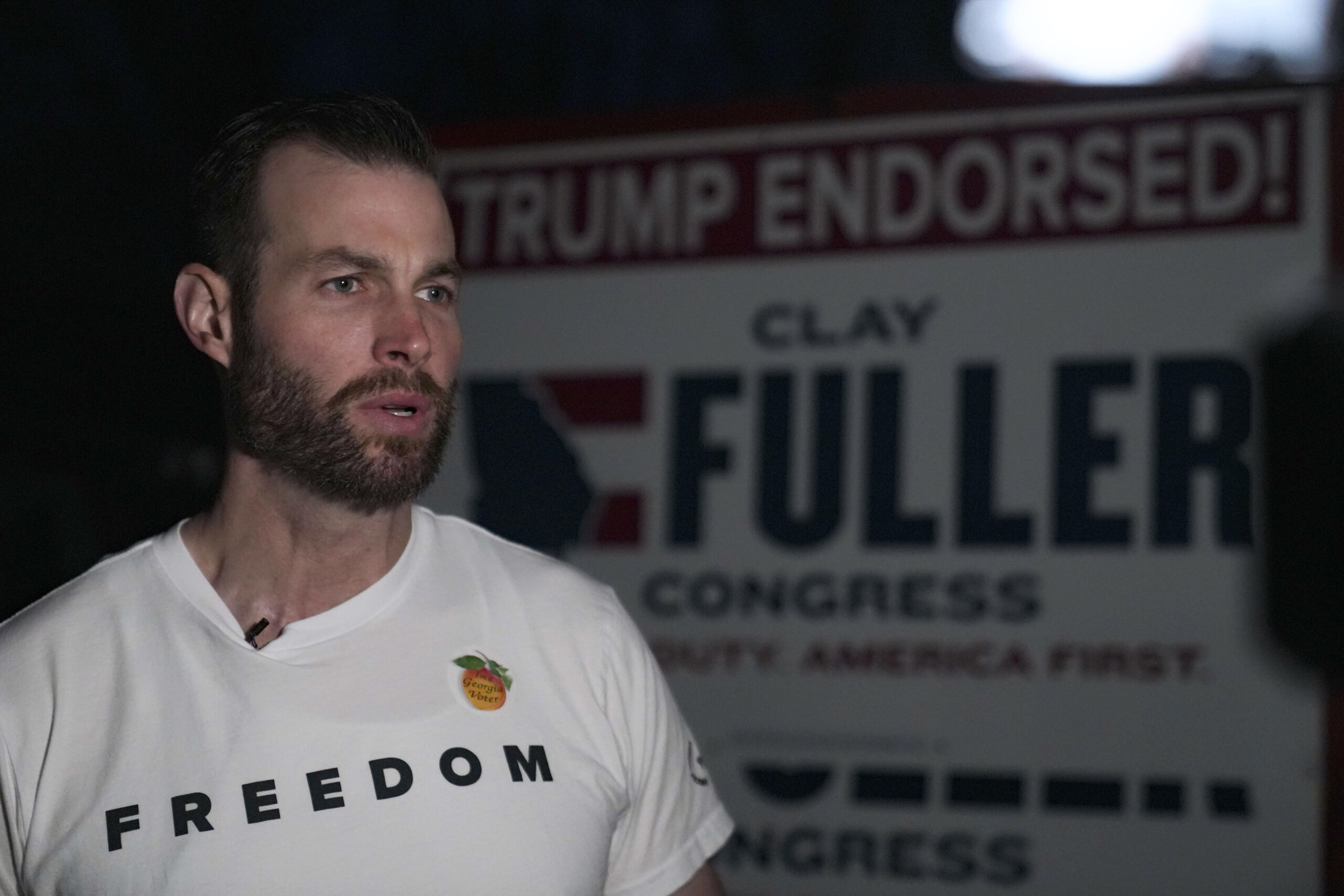
Clay Fuller, a veteran and district attorney, is expected to succeed former Rep. Marjorie Taylor Greene (R-GA) in the House, bringing a pro-Israel voice to replace one of the House’s most anti-Israel Republicans, Jewish Insider’s Marc Rod reports. Fuller led all Republicans on the all-party primary ballot in Georgia’s 14th Congressional District, winning 35% of the vote. Even though he finished narrowly behind Democrat and military veteran Shawn Harris, the Republican vote is likely to consolidate behind Fuller in next month’s runoff election.
Fuller’s positions: Fuller has expressed support for Israel and for the U.S. strikes on Iran. “President Trump tried the peace route with Iran not once, not twice, but THREE separate times — and they refused. He’s the peace President, but you can’t negotiate with a death cult,” Fuller said in a post on X last month, emphasizing he had supported operations against Iran during his time in the military and that the regime and its proxies had killed many Americans. The day after Hamas’ Oct. 7, 2023, attacks on Israel, Fuller blasted the Biden administration for unfreezing $6 billion in Iranian funds as part of an earlier hostage deal, highlighting Iran’s support to Hamas.
President’s pitch: President Donald Trump ripped into Rep. Thomas Massie (R-KY) during a campaign rally in Hebron, Ky., on Wednesday to support Ed Gallrein, his endorsed candidate to take on the incumbent, describing Massie as “disloyal,” a “loser,” the “worst person” and a “disaster as a congressman,” JI’s Emily Jacobs reports.
ON THE TRAIL
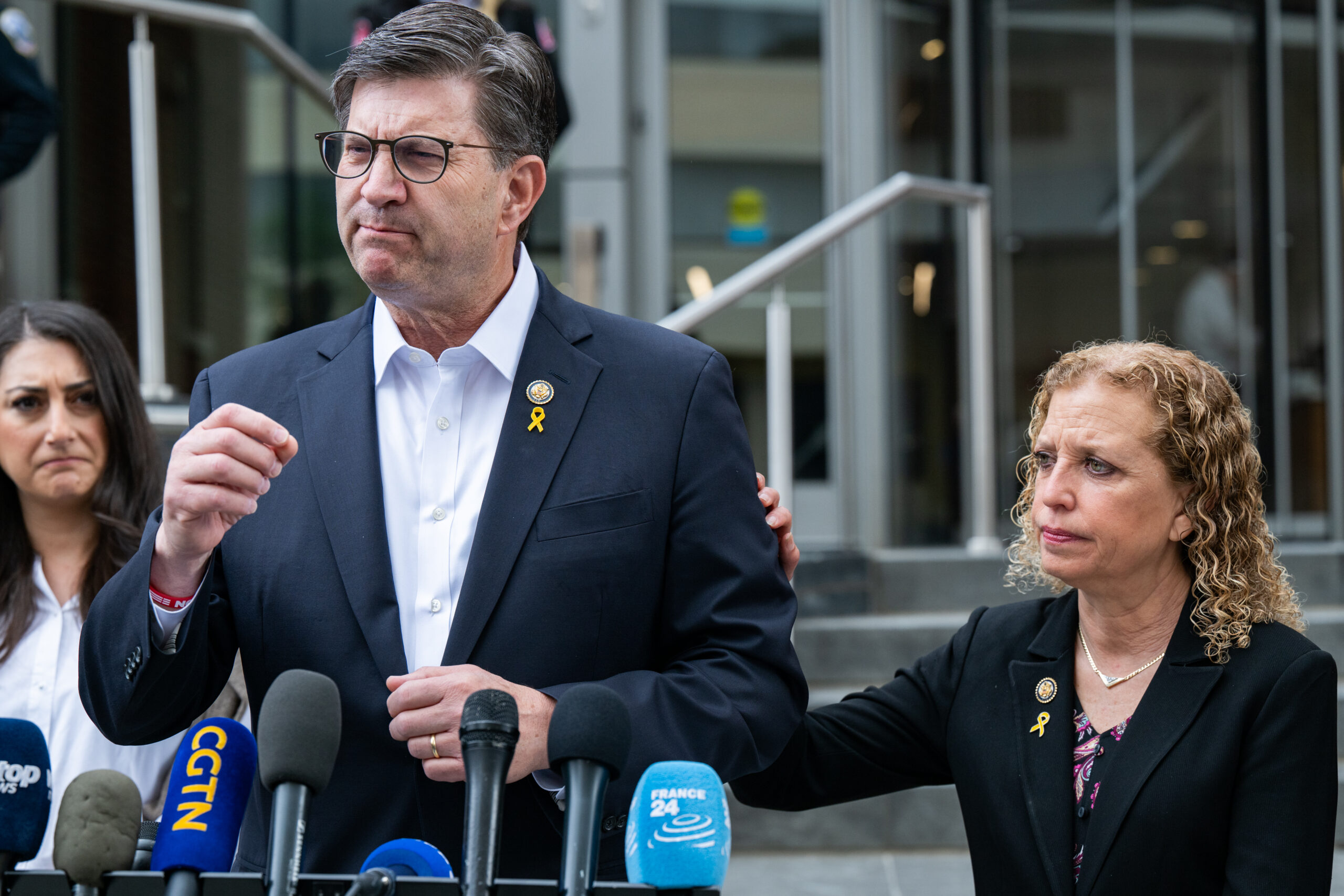
Remarks by pro-Israel stalwarts Reps. Debbie Wasserman Schultz (D-FL) and Brad Schneider (D-IL) on a Jewish Democratic Council of America webinar on Wednesday highlighted the delicate line that some pro-Israel Democratic lawmakers are walking on the war in Iran, Jewish Insider’s Marc Rod reports.
Notable quotable: “I can tell you assuredly: had I been presented with an Authorization for Use of Military Force, that made sense, and that we were properly briefed, and there was a demonstrative, imminent threat — which we have really yet to be shown — I am someone on our side of the aisle that likely would have voted for an AUMF if all of those things were in place,” Wasserman Schultz said. “Instead, [President Donald Trump] has blown an opportunity to go in in the most prepared way. … I have been careful about just blanket-ly condemning everything [Trump is] doing here, but most certainly, the way that we got into this was really unacceptable, and my constituents are very concerned.”
Friendly fire: A former top Obama administration foreign policy official said on Wednesday that any Democratic lawmakers who vote to support U.S. strikes on Iran should be primaried. “If you vote for the funding of this war, you should be primaried. I don’t want you in the Democratic Party,” said Ben Rhodes, co-host of the “Pod Save the World” podcast and former deputy national security advisor under President Barack Obama, JI’s Gabby Deutch reports.
CENTER STAGE
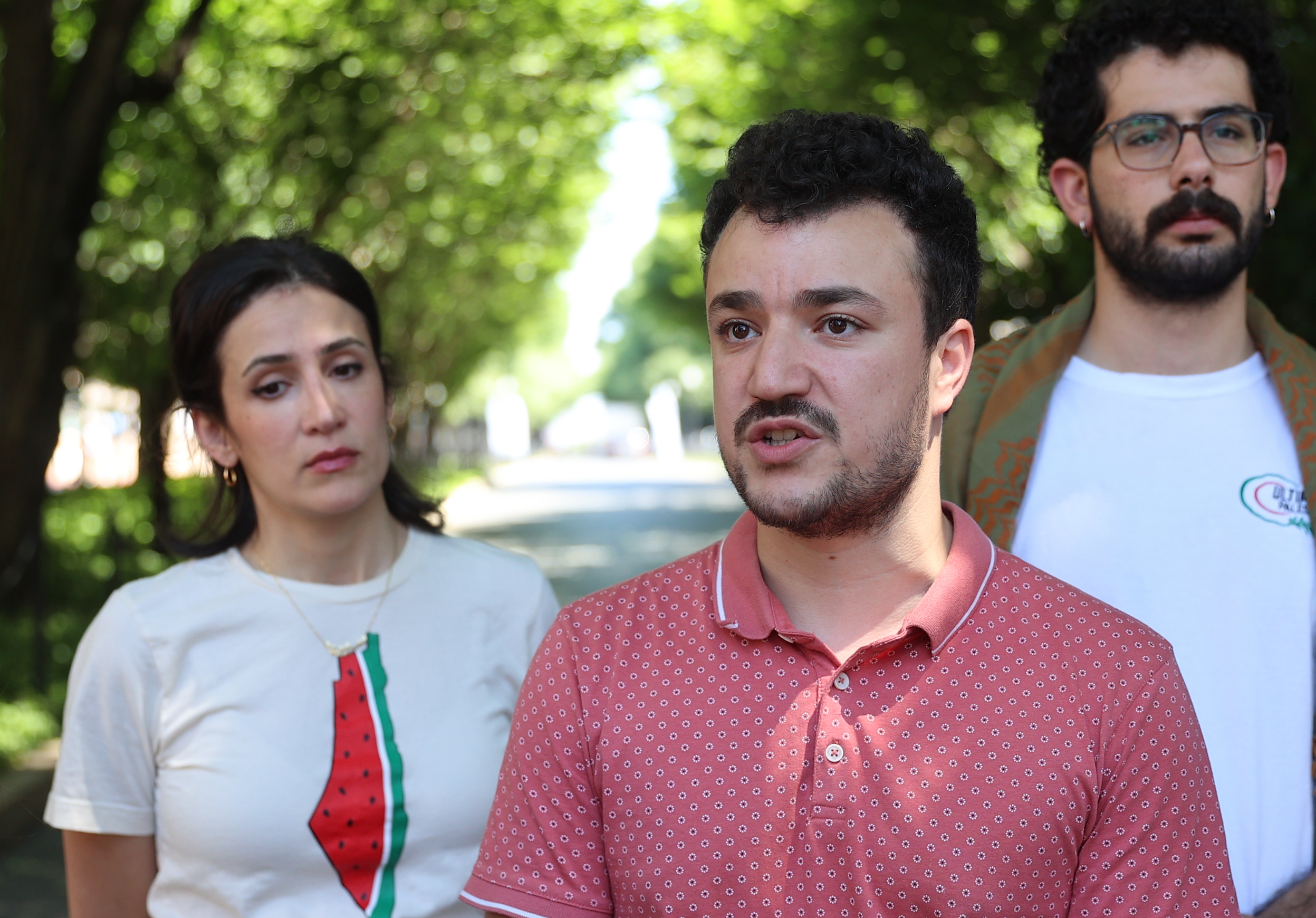
Columbia University anti-Israel protest leader Mahmoud Khalil is scheduled to speak at this week’s annual South by Southwest (SXSW) festival in Austin, Texas, Jewish Insider’s Haley Cohen reports. Khalil will participate on Sunday in a conversation “on the cost of dissent,” with The Guardian Editor Betsy Reed and Baher Azmy, legal director of the Center For Constitutional Rights who was a lawyer for Khalil in his deportation proceedings, according to the SXSW schedule.
Details: The weeklong festival each March convenes around 300,000 guests, including film and media professionals, executives and politicians to discuss culture, technology and innovation. “Khalil joins The Guardian for an unflinching conversation on his ordeal, the system that tried to silence him, and the personal and political stakes of resistance,” SXSW’s website states. At Columbia, Khalil was a key organizer of the anti-Israel encampment in April 2024, a two-week demonstration in the center of campus during Israel’s war in Gaza.
FEELING THE HEAT

As Iran retaliates against the U.S. and Israel’s joint military campaign, findings have revealed that the United Arab Emirates — not Israel — has thus far faced the majority of Tehran’s missile and drone attacks, Jewish Insider’s Matthew Shea and Marc Rod report. As of March 11, the UAE’s Ministry of Defense reported that its air defenses had “engaged” 268 ballistic missiles, 15 cruise missiles and 1,514 UAVs.
Bearing the brunt: Iranian strikes have targeted American assets in the country, such as the U.S. consulate in Dubai, but also a range of civilian targets, including Dubai International Airport, where a drone attack wounded four people. Reports have indicated that Abu Dhabi has faced more than three times the number of Iranian drones and missiles launched toward Israel. The attacks come as Gulf allies are running short on missile interceptors. Sens. Mike Rounds (R-SD) and Rick Scott (R-FL) argued to JI on Wednesday that, ultimately, the U.S. campaign against Iran will be to the benefit of the UAE and other Gulf allies, even if they’re feeling pain in the short term.
Winds of change: Despite Qatar’s anger with Iran over the regime’s continued attacks on its territory and civilian infrastructure, experts are divided over whether the conflict will ultimately force Doha to reconsider its long-standing policy of hosting Iranian-backed Hamas officials, JI’s Matthew Shea reports.
Worthy Reads
The War on Antisemitism: In Time, State Department antisemitism envoy Rabbi Yehuda Kaploun explains the Trump administration’s approach to fighting antisemitism. “Antisemitism proliferates from an ever-multiplying list of sources: voices from all sides of the political spectrum spew antisemitic rhetoric; foreign terrorist organizations espouse violent antisemitic ideologies; and online radicalization increasingly incites real-world antisemitic attacks against Jewish individuals and institutions globally.” [Time]
This War Has Roots: In The Washington Post, Geoffrey Corn and Orde Kittrie argue that the U.S.-Israeli war against Iran is a continuation of hostilities that have been ongoing for years. “International law does not require a distinct self-defense justification for every attack conducted once the right of self-defense is triggered. Once that right is initiated, military action is justified to achieve the overall self-defense objective, in this case terminating Iran’s capacity to strike the United States and its allies. … These facts justify the conclusion that the U.S. and Iran were already engaged in an armed conflict when the current round began. As a result, international law does not require the U.S. to refrain from further military action against Iran until just before the IRGC launches another assault.” [WashPost]
Risk Assessment: The Wall Street Journal‘s Yaroslav Trofimov looks at the risks Washington and American allies face if the war ends with the Iranian regime intact. “But leaving in place Iran’s theocratic regime — angry, defiant and in possession of its nuclear stockpile and what remains of its arsenal of missiles and drones — would essentially grant Tehran control over the world’s energy markets. It would also sacrifice the security of America’s partners and allies, and possibly make another, more devastating, regional war likely.” [WSJ]
Get Out of Jail Free: The Atlantic’s Graeme Wood considers the utility of former Iranian President Mahmoud Ahmadinejad, who has evolved from being the face of the Islamic Republic to an opponent of the regime and was rumored to have been killed by Israel early in the war. “ Contrary to early reports, Ahmadinejad is alive, his associates say. … The circumstances of his survival may prove significant as the war drags on. Whatever the intent, Ahmadinejad’s associates say the strike was in effect a jailbreak operation that freed the former president from regime control. Their description of the chaotic sequence of events that began before the war suggests that Ahmadinejad has friends on the outside.” [TheAtlantic]
Word on the Street
President Donald Trump announced his endorsement of Brandon Herrera, the far-right social media influencer who is the presumptive Republican nominee in Texas’ 23rd Congressional District, following Rep. Tony Gonzales’ (R-TX) announcement that he was dropping his reelection bid, Jewish Insider’s Marc Rod reports…
The Cook Political Report moved the Pennsylvania governor’s race from “Likely Democrat” to “Solid Democrat,” citing Pennsylvania Gov. Josh Shapiro’s 60% approval rating, cash on hand and significant polling lead over his Republican challenger, state Treasurer Stacy Garrity…
Dorothy McAuliffe, the wife of former Virginia Gov. Terry McAuliffe, announced her bid for Congress in a potential new district that is expected to favor Democrats, the status of which will be determined in a statewide vote next month…
Nearly all Senate Democrats wrote to Secretary of Defense Pete Hegseth on Wednesday to raise “grave concern” about a strike on a girl’s school that killed at least 168 people in the opening phase of the U.S.-Israeli war on Iran, Jewish Insider’s Marc Rod reports…
The letter came amid findings from a preliminary U.S. military investigation indicating that the U.S. was at fault for the bombing, which took place on the same block as a number of buildings used by the Islamic Revolutionary Guard Corps…
Federal and state officials in California sought to assuage concerns after the FBI’s Los Angeles division sent out a bulletin that Iran could conduct retaliatory drone attacks on the West Coast, with a law-enforcement official telling CBS News that there was no credible intelligence that prompted the bulletin, which had predated the Iran war…
The Department of Justice is probing Iran’s use of Binance to evade U.S. and international sanctions after an internal investigation at the cryptocurrency company found that the platform had been used to funnel more than $1 billion to terror proxies…
The New York Times reports on Iran’s use of cluster bombs to strike Israel in violation of international law…
The Swiss Embassy in Tehran, which has historically served as an interlocutor for U.S. interests in the Islamic Republic, announced it is temporarily closing, citing “the war in the Middle East and the increasing security risk,” but “will continue to maintain an open line of communication” between Washington and Tehran…
The Wall Street Journal spotlights CENTCOM head Adm. Brad Cooper, whom associates described as “thoughtful, decisive and cool under pressure” as he leads U.S. operations in the Middle East…
Yeshiva University is establishing the first new dental school in Manhattan in more than a century, with plans to enroll 150 students in an accelerated three-year program on its Midtown Manhattan campus…
Starbucks owner Howard Schultz became the latest executive to relocate to South Florida, purchasing a $44 million penthouse in Surfside, Fla….
The California Department of Education filed a lawsuit against the Oakland Unified School District, alleging that administrators failed to address “pervasive antisemitism” in schools in the Bay Area district following a directive in January to do so…
A judge in the U.K. tossed out the government’s appeal of a court ruling dismissing its case against Irish band Kneecap over a group member’s support for Hezbollah; the lower court had dismissed the case over a governmental procedural error…
Google completed its $32 billion purchase of Israeli cybersecurity startup Wiz, started in 2020 by Unit 8200 veterans Assaf Rappaport, Yinon Costica, Ami Luttwak and Roy Reznik; the deal marks the largest purchase of an Israeli-founded company in nearly a decade…
Iran’s sports minister said that the Islamic Republic’s national soccer team could not play in this summer’s World Cup, a number of games of which are being played in the U.S….
Spain is permanently withdrawing its ambassador from Israel, months after Ambassador Ana Maria Salomon Perez was recalled to Madrid; the country’s embassy in Israel going forward will be led by a charge d’affaires…
Bloomberg looks at Israeli efforts to establish an intelligence base on the coast of Somaliland months after Israel became the first country to formally recognize the African nation, which is separated from the Yemen-based Houthis by the Gulf of Aden…
Axios reports on the role that hackers are increasingly playing in the war between the U.S., Israel and Iran, following a cyberattack on Wednesday targeting the U.S.-based medical device company Stryker that disabled employees’ phones and laptops…
The Qatari-backed Irth Capital Management submitted a bid to take over Papa Johns, in a deal that would give the pizza chain a $1.5 billion valuation…
Bernard Haykel is joining the Foundation for Defense of Democracies as a senior fellow…
Angelika Saleh, the namesake of the Angelika Film Center, which she opened in 1989 with her then-husband, Joseph Saleh, died at 90…
Pic of the Day

UJA-Federation of New York announced last night it was committing $1.3 million to build the Shalva Sharabi Family Center in Ashkelon, Israel, a new center dedicated in memory of the wife and daughters of former hostage Eli Sharabi, who were killed during Hamas’ Oct. 7, 2023, attacks. The pledge for the center, which will support individuals with disabilities and trauma victims, was made at Shalva’s 36th anniversary gala, held at Gotham Hall in Manhattan, Jewish Insider’s Haley Cohen reports for eJewishPhilanthropy.
Birthdays
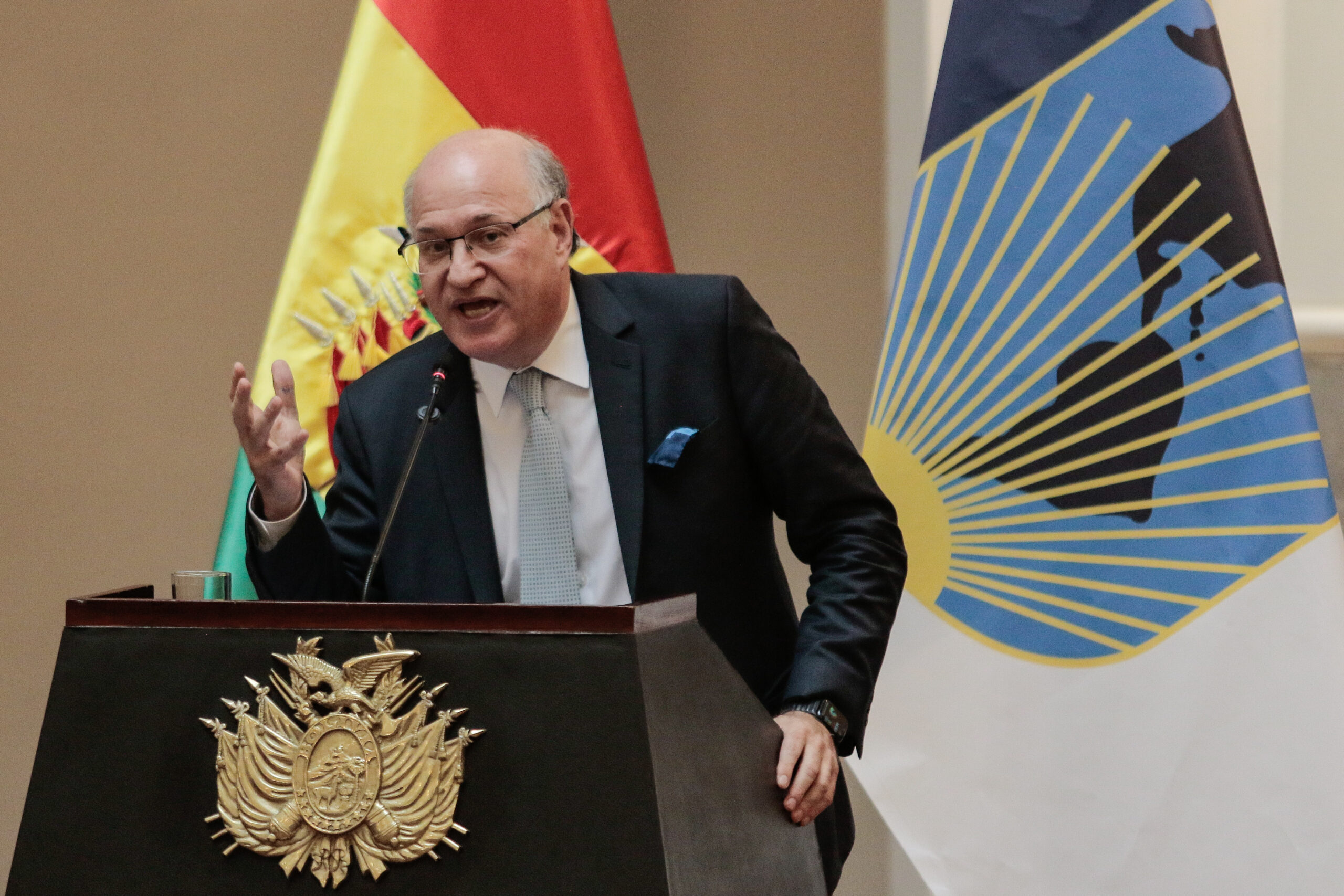
Born in Haifa, he served as president of the Central Bank of Brazil and is now president of the Inter-American Development Bank, Ilan Goldfajn turns 60…
Photographer, musician and author of 15 children’s books, Arlene Weiss Alda turns 93… Carol Margolis… Retired U.S. Sen. Mitt Romney (R-UT) turns 79… Director, producer and screenwriter of movies and television including directing the first of “The Fast and the Furious” film franchise, Rob Cohen turns 77… British sculptor, he won the 2017 $1 million Genesis Prize for “commitment to Jewish values, the Jewish community and the State of Israel,” Sir Anish Kapoor turns 72… Pitching coach who has worked for the Yankees, Reds, Braves, Marlins, Cubs and Padres, Larry Rothschild turns 72… Past president of AIPAC, he is the founder and CEO of R.A. Cohen & Associates, Robert A. Cohen… Former member of the Knesset for the Likud party, he is from the Israeli Druze community, Ayoob Kara turns 71… Founder of hedge fund Lone Pine Capital, Stephen Mandel turns 70… Sales representative at Paychex, Lynne Blumenthal… Director of constituency engagement at the United States Holocaust Memorial Museum, Diane Saltzman… Senior attorney in the D.C. office of Squire Patton Boggs, Stacey Grundman… Sportscaster for ESPN and a host of “SportsCenter,” Steve Levy turns 61… U.S. Sen. Tammy Duckworth (D-IL) turns 58… Chief Washington correspondent for CNN and co-host of the Sunday morning program “State of the Union,” Jacob Paul “Jake” Tapper turns 57… Founder and CEO at Miller Strategies, Jeff Miller… Israeli film and television actor, Tzachi Halevy turns 51… SVP of communications at the Alliance for Automotive Innovation, Brian T. Weiss… Founder and publisher of Fleishigs, a kosher food magazine, Shlomo Klein… Actor and comedian, Samm Levine turns 44… Writer, artist and social media personality, she is best known for her Daf Reactions series of videos explaining passages from the Talmud posted to TikTok, Miriam P. Anzovin… Senior public affairs specialist at the Association of American Medical Colleges, Talia Schmidt… Member of Congress (D-NY-15) since 2021, Ritchie Torres turns 38… Senior Middle East intelligence specialist at Vcheck, Aaron Magid… Founder and CEO of Serotonin and co-founder and president of Mojito, Amanda Gutterman Cassatt turns 35… CEO and co-founder of Wonder Media Network, Jennifer Manning Kaplan… Figure skater who won the 2016 World Junior championship, he competed for Israel at the 2018 Winter Olympics, Daniel Samohin turns 28… Israeli internet personality, model and singer, Anna Zak turns 25…
‘If you can't stand against that, you don't stand for a f***ing thing,’ the former Obama admin official said
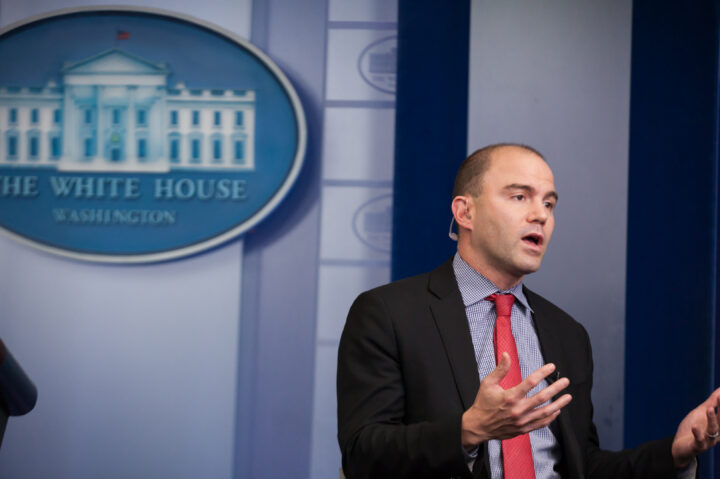
Cheriss May/NurPhoto via Getty Images
Ben Rhodes, then-deputy national security advisor to President Barack Obama, participates in an interview with press at the White House in on Wednesday, December 14, 2016.
A former top Obama administration foreign policy official said on Wednesday that any Democratic lawmakers who vote to support U.S. strikes on Iran should be primaried.
“If you vote for the funding of this war, you should be primaried. I don’t want you in the Democratic Party,” said Ben Rhodes, co-host of the “Pod Save the World” podcast and former deputy national security advisor under President Barack Obama.
He was referring to Reps. Greg Landsman (D-OH), Henry Cuellar (D-TX), Jared Golden (D-ME) and Juan Vargas (D-CA), the only four Democrats to vote against a war powers resolution last week that sought an immediate end to the U.S. military campaign in Iran.
Rhodes, who was one of the biggest boosters of the 2015 Iran nuclear deal and a leading Israel critic on the left, said the Democratic Party should have a big tent — but that support for President Donald Trump’s actions in Iran falls outside of that tent.
“I would like to have a big tent in this party. I think there should be people with different ideas of how to get health care, different ideas of taxation,” Rhodes said to co-host Tommy Vietor. “To me, this is not a left-center issue. This is a right and wrong issue. Morally, what do we stand for as Democrats?”
Rhodes suggested that Democrats who cast a vote in support of the war are doing so because of donor pressure.
“How is anybody going to trust you to fight for their health care if you’re too afraid to cast a vote, that someone might call you weak or some donor might call you and complain?” Rhodes asked. “If you as a Democrat can’t say that I am against a war and I’m not going to fund a war that is being launched by an authoritarian president, illegally, with no rational basis that is explained to the American people, that has already unleashed these consequences, if you can’t stand against that, you don’t stand for a f***ing thing.”
Candidate Anthony Driver Jr. said he would return donations by philanthropist Michael Sacks over his ties to AIPAC; Sacks called it ‘truly sad’
Vernon Yuen/NurPhoto via Getty Images
Michael J. Sacks at the Global Hong Kong Global Financial Leaders Investment Summit on October 8, 2023 in Hong Kong, China.
A prominent Jewish Chicago-area Democratic donor and philanthropist lamented rising anti-Israel sentiment and antisemitism after a progressive Illinois congressional candidate issued a public statement saying he would reject the donor’s contribution to his campaign due to his ties to AIPAC.
Union organizer Anthony Driver Jr. is running in Illinois’s 7th Congressional District, on a platform critical of Israel and in opposition to AIPAC. He said in a statement that he would return a contribution by Michael Sacks, a local Jewish, pro-Israel philanthropist and Democratic donor who had been a prominent supporter of former President Barack Obama and close ally to Chicago Mayor Rahm Emanuel. Sacks also chaired the 2024 Democratic National Convention host committee and raised nearly $100 million to put on the convention.
“Michael Sacks has supported community violence intervention work in Chicago for years. I served nearly four years as President of the Chicago Community Commission for Public Safety and Accountability, helping advance real public safety reform,” Driver said. “The first time I heard about any link between Michael Sacks and AIPAC was on the debate stage. As I said on that same stage, I will return the contribution.”
Sacks, in response, pointed to public anti-Israel and antisemitic currents as pushing Driver, who has been endorsed by the Congressional Progressive Caucus PAC, to take such a position.
“It is truly sad there is so much anti-Israel sentiment and outright Jew hate that Anthony found himself in this position,” Sacks said in a statement to the Chicago Tribune. “I can only hope that the electorate rejects hate in all forms.”
Sacks said he asked Driver to contribute the donations to a community violence prevention group of his choosing, calling Driver a “pragmatic [progressive]” and praising his work on violence reduction.
On the campaign trail, Driver has railed against AIPAC and spending by its super PAC, supporting one of his rivals, Chicago Treasurer Melissa Conyears-Ervin. Conyears-Ervin faced attacks by several of her opponents about her support from AIPAC’s super PAC during a candidate forum last week.
Driver also states on his campaign website that he supports efforts to restrict offensive weapons transfers to Israel, including the Block the Bombs Act, and the recognition of Palestinian right of return.
Driver’s unwillingness to even accept support from a pro-Israel donor underscores the deepening hostility to Israel and its supporters in certain Democratic circles. As part of their anti-Israel campaign, progressives are working to make campaign contributions from individuals who have supported pro-Israel causes unacceptable — even if they haven’t been directly connected with AIPAC.
Plus, major Dem donor calls out 'Jew hate' in party
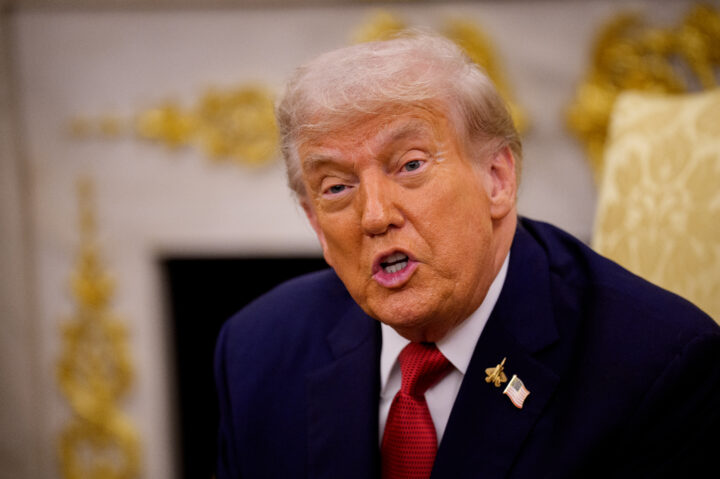
Andrew Harnik/Getty Images
President Donald Trump in the Oval Office at the White House on September 25, 2025 in Washington, DC.
Good Monday afternoon!
This P.M. edition is reserved for our premium subscribers — offering a forward-focused read on what we’re tracking now and what’s coming next.
It’s me again — Danielle Cohen-Kanik, U.S. editor at Jewish Insider and curator, along with assists from my colleagues, of the Daily Overtime. Please don’t hesitate to share your thoughts and feedback by replying to this email.
📡On Our Radar
Notable developments and interesting tidbits we’re tracking
As rumors abound about the possibility and timing of U.S. strikes on Iran, the State Department ordered the evacuation of non-essential personnel and their families from the U.S. Embassy in Beirut. “Based on our latest review, we determined it prudent to reduce our footprint,” a State official told Fox News…
Nearby, amid the buildup of U.S. military assets in the region, American refueling and cargo planes were spotted at Ben Gurion Airport…
President Donald Trump denied reports that Pentagon officials, namely Joint Chiefs of Staff Chairman Gen. Dan Caine, are raising concerns about striking Iran, writing on Truth Social this afternoon, “General Caine, like all of us, would like not to see War but, if a decision is made on going against Iran at a Military level, it is his opinion that it will be something easily won.”
“He has not spoken of not doing Iran, or even the fake limited strikes that I have been reading about, he only knows one thing, how to WIN and, if he is told to do so, he will be leading the pack,” Trump said of Caine, while alluding to the potential breadth of military action against Iran…
Secretary of State Marco Rubio pushed back his visit to Israel, originally scheduled for this weekend, to March 2, The Jerusalem Post reports, days after the next round of U.S.-Iran negotiations in Geneva on Thursday…
Sen. Chris Coons (D-DE), a leader on foreign policy among Democrats in Congress, told Jewish Insider’s Emily Jacobs that he heard “pretty stark early warning signs of some challenges where core allies do not share our priorities” on a potential Iran strike during his recent trip t0 Europe, which included stops at the Munich Security Conference, along with meetings in Ukraine and Moldova with top European diplomats.
Coons laid out what he hopes to see from the president: “A) Consult Congress. B) Make a case to the American people about why this is in our national security interest. C) Clarify what on earth he’s planning with this Board of Peace … And D) If he’s going to work with close allies to ramp up pressure to try and achieve something at the negotiating table, he should work with close allies”…
Anthony Driver Jr., a union organizer and candidate in Illinois’ 7th Congressional District, doubled down on his recent repudiation of AIPAC, despite previously having little public record on Israel policy issues. Following a press conference last week where Driver, who is running against AIPAC-backed Chicago Treasurer Melissa Conyears-Ervin, denounced the pro-Israel group, he returned donations from major Democratic Party donor Michael Sacks over the finance executive’s ties to AIPAC.
Sacks, who was a major backer of former President Barack Obama and former Chicago Mayor Rahm Emanuel, said in his reply, “It is truly sad there is so much anti Israel sentiment and outright Jew hate that Anthony found himself in this position. I can only hope that the electorate rejects hate in all forms”…
As more details emerge about Rep. Tony Gonzales’ (R-TX) alleged affair with a staffer who later committed suicide, a poll commissioned by the campaign of Brandon Herrera, Gonzales’ opponent, shows the congressman trailing Herrera by a whopping 24 points among likely GOP primary voters. The story, which entered the news cycle right as early voting kicked off, could catapult Herrera, a social media influencer with a history of antisemitism, to the Republican nomination and on to Congress…
Investigators at the cryptocurrency giant Binance found last year that about $1.7 billion had been sent from two accounts to Iranian entities with links to terror groups, The New York Times reports, even after Binance pleaded guilty to violating anti-money laundering laws in 2023 and vowed to prevent sanctioned actors from accessing its platform. Trump pardoned Binance founder Changpeng Zhao, who was jailed for his role in the saga, in October 2025…
The Atlanta Jewish Film Festival backtracked in its defense of a juror selected for a judging panel who had posted antisemitic and anti-Israel content online, whom it had stood behind even after the Israeli Consulate in Atlanta announced it was withdrawing its funding and support of the event over the pick.
The festival changed its tune yesterday, saying it is “first and foremost, a Jewish institution” and has “a responsibility, particularly at this fraught time, to stand firmly against antisemitism and to affirm the Jewish people’s right to self-determination.” It said it would review its “organizational processes and policies, including those related to antisemitism, BDS, and cultural boycotts”…
The French Foreign Ministry has moved to block U.S. Ambassador to France Charles Kushner’s access to government officials after he declined to appear for a summons by Foreign Minister Jean-Noël Barrot today, which was issued after the U.S. Embassy reposted comments by Trump about a far-right French activist who was killed in a clash with far-left protesters. It was Kushner’s second summons, after his first last year when he accused the French government of not adequately combating antisemitism…
⏩ Tomorrow’s Agenda, Today
An early look at tomorrow’s storylines and schedule to keep you a step ahead
Keep an eye out in Jewish Insider for a look at Sue Altman’s shifting views on Israel as the formerly pro-Israel congressional candidate is now running in New Jersey’s more heavily Democratic 12th Congressional District.
We’ll be watching for mention of President Donald Trump’s thinking on Iran as he delivers the annual State of the Union address tomorrow night. Virginia Gov. Abigail Spanberger will deliver the Democratic response.
The House Foreign Affairs Committee will hold a hearing on “advancing national security through commercial diplomacy” with Jacob Helberg, under secretary of state for economic affairs, who recently told JI that he hopes the Pax Silica initiative, which he leads, “will pave the way for peace and economic integration” in the Middle East.
Australia’s royal commission on antisemitism, formed after the Hanukkah terror attack at Sydney’s Bondi Beach, will hold its first public hearing, though no testimony or evidence will be heard.
Stories You May Have Missed
OVERTON WINDOW
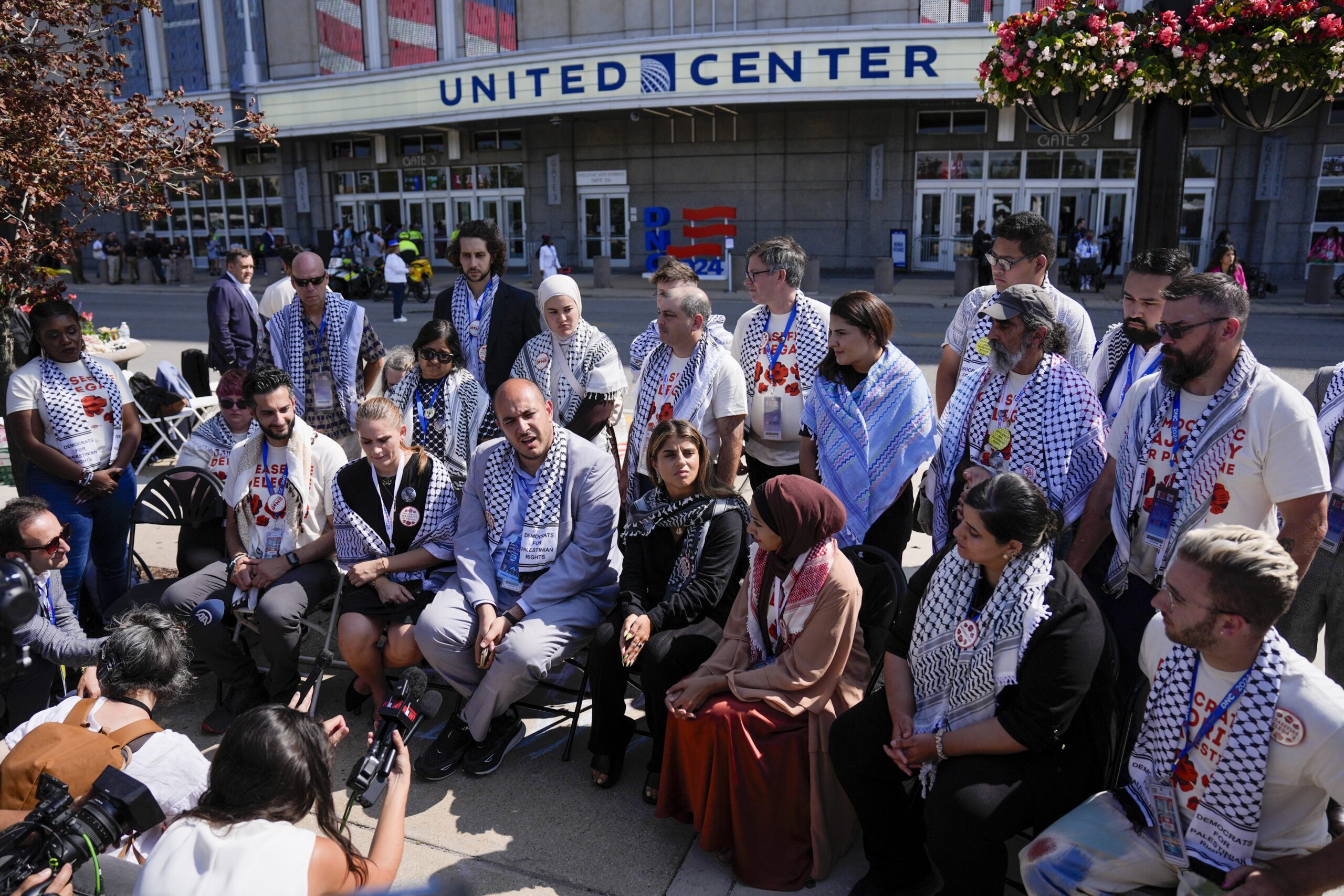
Former Democratic Rep. Kathy Manning: ‘There is no doubt that we are living through very difficult times for American Jews’
BIG TENT SHABBAT
The dinner was hosted by Rabbi Yehuda Kaploun, the U.S. antisemitism special envoy
Plus, Tucker Carlson and associates dominate Doha Forum

Brandon Bell/Getty Images
A law enforcement vehicle sits near the Congregation Beth Israel synagogue on January 16, 2022 in Colleyville, Texas.
👋 Good Friday morning!
In today’s Daily Kickoff, we preview this weekend’s Doha Forum and its lineup of speakers who are sharply critical of Israel, and report on the backlash from the Jewish community to recent comments by Sen. Chris Van Hollen attacking the head of the Washington JCRC as an “apologist” for the Israeli government. We cover the legislative push for “buffer zones” outside of places of worship following recent incidents in New York and Los Angeles, and spotlight Benjamin Landa, the Trump administration’s nominee to be U.S. ambassador to Hungary. Also in today’s Daily Kickoff: Mitchell Silk, Rabbi Yehuda Kaploun and Cornelia Foss.
Today’s Daily Kickoff was curated by Jewish Insider Executive Editor Melissa Weiss and Israel Editor Tamara Zieve with an assist from Danielle Cohen-Kanik. Have a tip? Email us here.
What We’re Watching
- President Donald Trump will attend the World Cup draw this morning in Washington. Also attending is the head of Iran’s national team, which previously said it would boycott the draw over the U.S.’ refusal to grant visas to some members of the team.
- The two-day Reagan National Defense Forum kicks off today at the Ronald Reagan Presidential Library in Simi Valley, Calif. This year’s speakers include Defense Secretary Pete Hegseth, Chairman of the Joint Chiefs of Staff Gen. Dan Caine, Sens. Jim Banks (R-IN), Chris Coons (D-DE), Joni Ernst (R-IA), Deb Fischer (R-NE), Tim Kaine (D-VA), Mike Rounds (R-SD) and Rick Scott (R-FL); Reps. Ken Calvert (R-CA), Jimmy Panetta (D-CA), Adam Smith (D-WA) and Rob Wittman (R-VA); JPMorgan Chase’s Jamie Dimon, 8VC’s Joe Lonsdale, Palantir’s Mike Gallagher (formerly a Republican congressman from Wisconsin), former National Security Advisor H. R. McMaster; former Defense Secretary Leon Panetta and former Deputy National Security Advisor Alex Wong.
- The Doha Forum begins tomorrow morning in Qatar. More below on the two-day confab’s speakers, including the recent addition of Tucker Carlson.
- Israeli President Isaac Herzog is traveling to the U.S. this weekend for a series of events taking place over the next week. On Sunday, he’ll be honored at Yeshiva University’s 101st Annual Hanukkah Dinner in New York. He’s also slated to attend the American Zionist Movement’s Biennial National Assembly, which is taking place this weekend in New York City.
- German Chancellor Friedrich Merz will arrive in Israel this weekend for meetings with senior officials, including Prime Minister Benjamin Netanyahu. Merz’s trip, his first official visit since becoming chancellor in May, will also include a visit to Jerusalem’s Yad Vashem and a meeting with Herzog before the president heads to the U.S.
What You Should Know
A QUICK WORD WITH JI’S GABBY DEUTCH
As the holiday season gets underway, Jewish Washington is abuzz with a bipartisan tradition: gossiping about who got invited to the White House Hanukkah party — and how those who did not make the list can still score an invitation.
This year, there’s another conversation as well, in group chats of people who were invited to a Hanukkah party at the Naval Observatory, hosted by Vice President JD Vance: What’s with the Christmas branding on the invitation?
The top of the green-and-gold virtual invitation reads, “The Golden Noel: Celebrating 50 years of Christmas at the Vice President’s residence.” The invitation to President Donald Trump’s White House Hanukkah party, in contrast, looks, well, like a Hanukkah invitation — royal blue background, with white text.
“Would I have preferred something to be a little more Hanukkah-like? Perhaps, but I don’t see it as a very big deal,” said Rabbi Levi Shemtov, executive vice president of American Friends of Lubavitch (Chabad). Shemtov oversees kashrut at the White House Hanukkah celebration, whether it is hosted by a Democrat or a Republican.
Several people who received the invitation told Jewish Insider they found the decoration puzzling. Ultimately, though, they aren’t concerned. Many Jewish Republicans are pleased that Vance is hosting a Hanukkah celebration at all.
“Noticed that as well, but haven’t heard any complaints,” said one Republican who was invited to the party. “I’m happy he’s having one.”
Marquee Moment

Among the most high-profile speakers at this weekend’s Doha Forum in the Qatari capital are Tucker Carlson, his business partner Neil Patel and investor Omeed Malik — a lineup raising eyebrows given Carlson’s recent track record of credulously hosting antisemitic and Holocaust-denying guests on his right-wing podcast. The conference, which is co-sponsored by a panoply of elite institutions from CNN to the Atlantic Council, will bring together Trump administration officials, ambassadors, politicians and philanthropists alongside figures who hold fringe or hostile views of Israel and U.S. Middle East policy, Jewish Insider’s Matthew Shea reports.
What this means: The forum’s layout elevates voices aligned with Doha’s regional agenda while pairing them with Western political, philanthropic and corporate leaders — a mix that lends legitimacy to speakers with out-of-the-mainstream views. Carlson’s interview on the Doha Forum stage on Sunday will take place in conversation with the Qatari prime minister, Sheikh Mohammed bin Abdulrahman Al Thani, an indication of his prominence at the confab.
COMMUNITY CONCERN

As anti-Israel demonstrators increasingly target synagogues in protests that have turned violent and used antisemitic rhetoric, some Jewish leaders and state lawmakers are now calling for more expansive legislative safeguards to help bolster protections for houses of worship. The new efforts have come in the wake of threatening behavior outside synagogues in New York City and Los Angeles that drew forceful condemnation from elected officials and raised concerns among Jewish leaders who fear that such incidents will normalize antisemitic harassment disguised as anti-Zionism, Jewish Insider’s Matthew Kassel reports.
Legislative steps: In New York, state lawmakers this week introduced a new bill to ban protests directly outside houses of worship. The legislation seeks to amend the existing state penal law by establishing a 25-foot buffer zone around religious sanctuaries to insulate congregants from facing intimidation and potential clashes with demonstrators that have occurred more regularly in recent years.
Standing together: More than 1,000 New Yorkers braved the frigid temperatures on Thursday night, stretching across Lexington Avenue on the Upper East Side outside of the historic Park East Synagogue, surrounded by heavy police presence and voicing a unifying message: “We are proud New Yorkers, proud Jews and proud Zionists,” JI’s Haley Cohen reports.
SPEAKING AS ONE

Several major Jewish organizations rallied around Ron Halber, the CEO of the Jewish Community Relations Council of Greater Washington, after a spokesperson for Sen. Chris Van Hollen (D-MD) attacked Halber as an “apologist for the Netanyahu government” and unrepresentative of his community. The Van Hollen spokesperson’s comments came in response to remarks by Halber to reporters in which Halber said that many in the Maryland Jewish community feel “betrayed” by the senator and that he has failed to show empathy for Israel and the Jewish people, Jewish Insider’s Marc Rod reports.
Board backing: The JCRC’s Board of Directors, in a statement late Thursday, offered Halber, who has led the group for nearly three decades, its full support, and applauded his work. “We are deeply disappointed that Sen. Van Hollen chose instead to malign Ron and our organization, but we are heartened by the outpouring of support from so many partners and friends. They know what we know: Ron and the JCRC support not only Jewish families, but the millions of people who live in the DMV.”
BY THE NUMBERS

Antisemitism in America has plateaued after a sharp rise in anti-Jewish hate incidents in the immediate aftermath of the Oct. 7, 2023, terrorist attacks in Israel — yet fewer Americans are pushing back against it, according to a survey released Thursday by the Blue Square Alliance Against Hate, Jewish Insider’s Haley Cohen reports.
Findings: About 25% of the population has consistently held antisemitic attitudes since June 2024, the 2025 Antisemitism Landscape Survey reported. That’s a notable rise from the recent past, but the survey found that the growth of antisemitic views has slowed significantly. The survey, which has been conducted twice a year since June 2023, polled 7,028 American adults from Aug. 1-Sept. 30. It found that 58% of respondents think antisemitism is a minor problem or not a problem at all, a sizable majority, though one that has remained fairly steady for the past two years.
The road less traveled
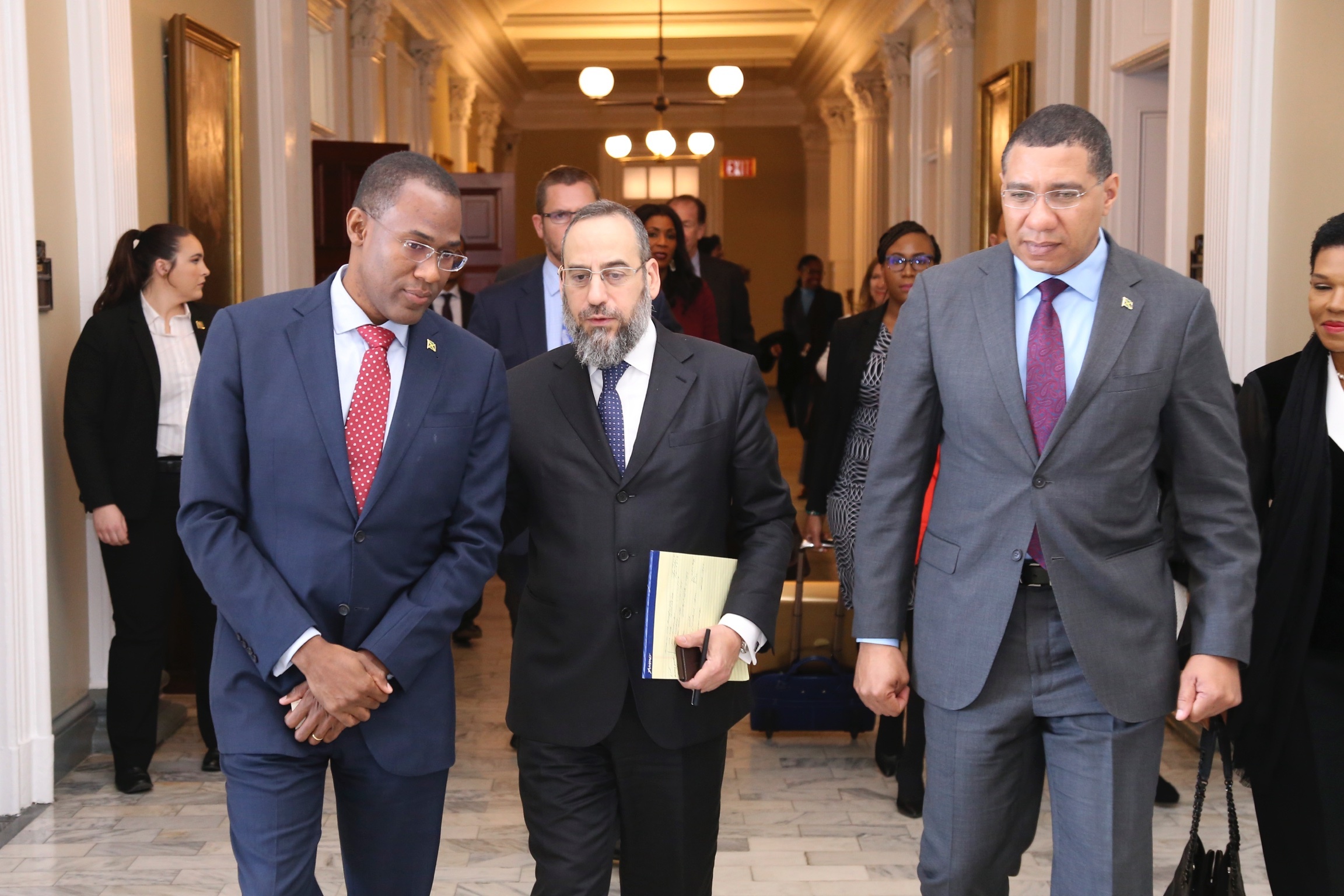
To the business community in Asia and to his former colleagues at the Department of Treasury, Mitchell Silk was usually called Mitch. To his friends and family in the Jewish community he is, always, Moyshe. However those who know him refer to him, Silk in 2020 became the first Hasidic Jew to serve in a government role that required Senate confirmation. In a conversation with Jewish Insider’s Gabby Deutch last month, Silk reflected on an unlikely career path that began with a high school job at a Chinese restaurant, and later took him from studying abroad in Taiwan to conducting business deals in Hong Kong and then advising former Treasury Secretary Steven Mnuchin on trade with Asia.
Divine providence: “If I were to do a backward run for you of where I ended up and am at now, to each stage and link in the progression and the trajectory, I could do it only in a manner that highlights exactly how much hashgacha pratis, how much divine providence, factored into where I am today,” Silk told JI, using a Hebrew term. “I cannot explain it in any other way than how much I had a divine hand guiding me.”
BUDAPEST BEAT

Benjamin Landa, a New York businessman and the son of a Holocaust survivor, was nominated in October to be the U.S. ambassador to Hungary — a delicate assignment given tensions over the U.S.’ relationship with the country. Landa, 69, is a yeshiva graduate and well-known philanthropist supporting Jewish, Israeli and other causes, including as founder of the Chabad of Port Washington. He’s also been a prominent donor to Republican political causes, and met in the Oval Office with President Donald Trump and advisor Roger Stone earlier this year, Jewish Insider’s Marc Rod reports.
Background: His father, Yehoshua Boruch Landa, served as a rabbi in prewar Czechoslovakia and survived the Nazi regime, but most of his family, who resided in Hungary, were killed in the Holocaust, according to Newsday. “My father, despite all the horrors he went through, he never lost his humanity, he never lost his sense of humor,” Landa told the New York Post. “It taught me the idea of resilience and starting from scratch – starting all over from the depths of hell to rise like a phoenix and that was my father – he never gave up.”
Worthy Reads
Conserving Conservatism: In The Washington Post, Princeton University professor Robert George cautions against the embrace of far-right figures, including Nick Fuentes, by some elements of the conservative movement. “A plea to my fellow conservatives to draw a bright line against bigotry is not a call to ‘cancellation.’ Individuals who hold extremist or bigoted views possess the same right to express their opinions as everyone else has. I would fight — indeed, I have fought — to protect their free speech rights despite my profound rejection of their beliefs. What I am doing is reminding conservatives that we stand for certain things. Therefore, not everything is up for grabs or negotiable. Nor is everyone, irrespective of their beliefs, welcome in the conservative movement. Unless you share conservatism’s core values, then you are not with us in standing for what our movement exists to conserve.” [WashPost]
Sanctuary City: Commentary’s Seth Mandel reflects on recently introduced legislation that would create a “buffer zone” protecting places of worship from protesters, following a demonstration outside Manhattan’s Park East Synagogue last month. “Indeed, the mere introduction of such legislation is an admission that incoming mayor Zohran Mamdani has already inaugurated bleaker times for the city and, perhaps, for the nation. … It should be noted that it is a violation of civil-rights law to prevent people from entering a house of worship. That is because such behavior is a direct assault on the First Amendment. Though Mamdani has exacerbated the problem, he did not create it. Even before his lies about ‘international law,’ the protest itself shattered civic norms. The result is a proposed law on top of a law. And that law might pass and it might make going to shul safer. But what kind of society needs such a law?” [Commentary]
Word on the Street
In an interview with NBC News, Vice President JD Vance complimented Sen. Bernie Sanders (I-VT), Rep. Ro Khanna (D-CA) and New York City Mayor-elect Zohran Mamdani, while downplaying the degree of rising antisemitism in the Republican Party…
Rabbi Yehuda Kaploun, the Trump administration’s nominee to be the State Department’s special envoy to monitor and combat antisemitism, is expected to come before the full Senate for a confirmation vote before the end of the year, two sources familiar with the situation confirmed to Jewish Insider’s Marc Rod…
Brooklyn Borough President Antonio Reynoso announced his bid for the House seat being vacated by Rep. Nydia Velázquez (D-NY), covering portions of Brooklyn and Queens…
Netflix entered into exclusive negotiations with Warner Bros. Discovery amid concerns from David Ellison’s Paramount Skydance that Warner Bros. “appears to have abandoned the semblance and reality of a fair transaction process” and that the selection of Netflix was predetermined by Warner Bros. management…
UCLA’s library finalized the processing and digitization of extensive archives — including interviews, membership directories and yearbooks — from the Pasadena Jewish Temple and Center; the century-old synagogue’s campus and much of its paper records were destroyed in the Altadena wildfires earlier this year…
The Equal Employment Opportunity Commission began the claims process for Jewish students and faculty at Columbia University who reported having experienced antisemitism on the campus between Oct. 7, 2023, and July 2025; the payments will come from a $21 million class claims fund established by the university as part of its $221 million settlement with the Trump administration reached earlier this year…
A federal judge dismissed a lawsuit by a Jewish Harvard Business School graduate who claimed the school violated his civil rights in its decision not to discipline two student-employees involved in an incident at an anti-Israel protest on campus in October 2023…
The New York Times spotlights artist Cornelia Foss, whose new exhibit, “Little Red,” was inspired by her childhood escape from Nazi Germany in 1939…
Ireland, the Netherlands, Spain and Slovenia pulled out of the 2026 Eurovision Song Contest after the European Broadcasting Union determined on Thursday that Israel will be allowed to compete…
A Lithuanian court fined the leader of the country’s populist Dawn of Nemunas party €5,000 after finding him guilty of inciting antisemitism and downplaying the Holocaust; among the comments made by Remigijus Žemaitaitis, whose party is in a coalition with the ruling Social Democrats, was a social media post blaming Jews for the “destruction of our nation”…
A new report from the office of Israel’s public defender found that treatment of Palestinians in Israeli prisons rapidly deteriorated following the Oct. 7, 2023, Hamas terror attacks…
Israeli media reported the death of Gazan clan leader Yasser Abu Shabab, who led one of the main groups opposing Hamas rule in the enclave and had been targeted for assassination by the terror group…
The Israeli cabinet approved the defense budget for 2026 at 112 billion shekels ($34.63 billion), a 22 billion shekel increase from a previously presented draft budget…
The Wall Street Journal reports on European interest in Israeli military technology amid concerns about Russian aggression across the Continent…
Israeli series “Tehran” will return for its third season on Jan. 9 after delays related to the Oct. 7, 2023, Hamas terror attack and ensuing war; filming for the fourth season is already underway…
Iranian Foreign Minister Abbas Araghchi extended an invitation to his Lebanese counterpart to visit Iran to discuss bilateral ties between Tehran and Beirut…
Pic of the Day

An Instagram post from the account of Sheikh Mansour bin Jabor bin Jassim Al Thani, the head of Qatar’s Government Communications Office, featured an image of a drone show marking the end of The Wall Street Journal’s Tech Live conference in Doha. Read more about the Journal‘s expanded ties with Qatar here.
Birthdays
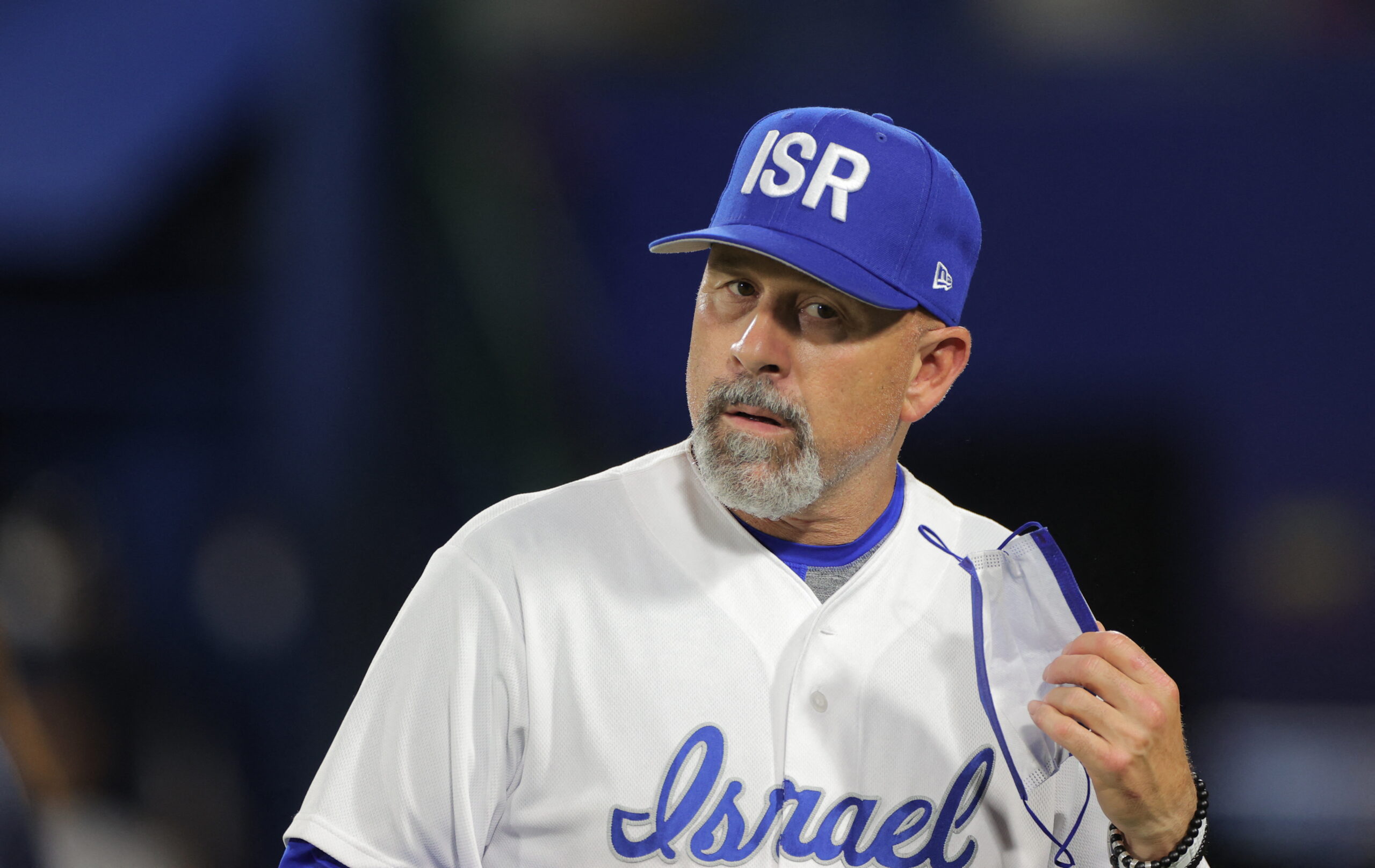
Former manager of the Israel national baseball team including at the 2020 Olympics, Eric Holtz turns 60…
FRIDAY: Nobel Prize-winning theoretical physicist, emeritus professor at Harvard and professor at Boston University, Sheldon Lee Glashow turns 93… St. Louis-based luxury senior living developer, Charles J. Deutsch turns 76… Professor in the school of journalism at the University of Tennessee Knoxville, Stuart Neil Brotman turns 73… Former U.S. ambassador to France and Monaco, she was a co-owner and CEO of the Los Angeles Dodgers, Jamie Luskin McCourt turns 72… Mediator and arbitrator for JAMSand J Street board member, Michael D. Young… Golfer on the PGA Tour and later a golf teaching professional, Anthony Irvin (Tony) Sills turns 70… Professor of Jewish history at Ben-Gurion University, she is focused on Sephardic heritage, Haviva Pedaya turns 68… Venture capitalist, speaker and investment advisor, Pascal Norman Levensohn turns 65… NYC-based author and clinical psychologist with specialties in aging and cancer, Mindy Greenstein, Ph.D…. Film, television and theater actress, Ilana Levine turns 62… Professor at the University of Chicago Law School, Eric A. Posner turns 60… Professor and dean emeritus of Columbia Law School, he served as CEO of the American Jewish Joint Distribution Committee and was once a law clerk for Justice Ruth Bader Ginsburg, David M. Schizer turns 57… Urologist in Westchester County, N.Y., Judd Boczko, M.D…. Ontario-born supermodel and actress, Shalom Harlow turns 52… President of The LS Group and political fundraiser, Lisa Spies… Co-founder and CEO of Axios, Roy Schwartz… Emmy Award-winning author and reporter, he is the chief national correspondent for ABC News, Matthew A. Gutman turns 48… Israeli-born, acclaimed video game developer, Neil Druckmann turns 47… Musical songwriting and producing duo, identical twins Ryan and Dan Kowarsky turn 46… Communications and marketing consultant, Adam S. Rosenberg… Senior managing director at Liberty Strategic Capital, Eli H. Miller… Emmy Award-winning senior personal technology columnist for The Wall Street Journal, Joanna Stern turns 41… Media correspondent for The New York Times, Michael Mendel Grynbaum… Israeli film and television music composer based in Los Angeles, Naama “Nami” Melumad turns 37… Reporter on the obituary desk of The New York Times, Alexander E. Traub… Chess master and commentator, his YouTube page has 5.7 million subscribers and over 3 billion views, Levy Rozman turns 30… Principal at Envision Strategy, Jonathan Shabshaikhes… Israeli model, Adar Gandelsman turns 28…
SATURDAY: Moshe Hochenberg… Member of the National Assembly of Quebec for 20 years until 2014 and active in a range of Jewish organizations, Lawrence S. Bergman turns 85… Renowned artist whose sculpture, photography, neon and video works appear in museums worldwide, Bruce Nauman turns 84… Israeli-born art collector and producer of over 130 full-length films, Arnon Milchan turns 81… Founder of Susan G. Komen for the Cure (named after her late sister), she also served as U.S. ambassador to Hungary and chief of protocol of the U.S., Nancy Goodman Brinker turns 79… Professor emeritus of Talmudic culture at the University of California, Berkeley, Daniel Boyarin turns 79… Senior U.S. district judge for the Northern District of Ohio, he has served as a trustee of the Jewish Federation of Cleveland, Judge Dan Aaron Polster turns 74… Cell and molecular biologist, he is a professor at Cold Spring Harbor Laboratory, David L. Spector turns 73… Founder of Craigslist, Craig Newmark turns 73… Film, stage and television actress, Gina Hecht turns 72… Faculty member at Harvard Law School since 1981, she served as dean from 2009-2017, Martha Minow turns 71… Author of a bestselling novel, Memoirs of a Geisha, with over 4 million copies sold, Arthur Sulzberger Golden turns 69… SVP and general counsel at United Airlines, Robert S. Rivkin turns 65… Former EVP and COO of the Inter-American Development Bank, Julie T. Katzman turns 64… Emmy Award-winning producer, writer, director, actor and comedian, Judd Apatow turns 58… Israel’s minister of education, he was a fighter pilot for the IDF and then a civilian pilot for El Al before entering politics, Yoav Kisch turns 57… Professor of economics at the University of Chicago, he previously served as the chief economist for President Barack Obama’s Council of Economic Advisors, Michael Greenstone turns 57… Professor of history and public affairs at Princeton University, he is a son and grandson of rabbis, Julian E. Zelizer turns 56… Editor-in-chief of J. The Jewish News of Northern California, Chanan Tigay turns 50… Communications advisor at nexos.ai and host of the “The Dejargonizer” podcast, Amir Mizroch turns 50… Managing director in the NYC office of PR firm BerlinRosen, Dan Levitan… Editor-in-chief at The Air Current, Jon Ostrower… Venture capitalist in Israel, Ilan Regenbaum… Licensed community association manager in South Florida, now a regional associate at Bozzuto, Beth Argaman… Assistant professor in international relations and global politics at the American University of Rome, Andrea Dessì… Joe Blumenthal…
SUNDAY: Linguist, philosopher, cognitive scientist, historian, social critic, political activist and professor emeritus at MIT, Noam Chomsky turns 97… Author or editor of 40 books including The New York Times best-selling Chicken Soup for the Jewish Soul, Rabbi Dov Peretz Elkins turns 88… Actor, director and producer, Larry Hankin turns 88… Hedge fund manager, he is the co-founder of Taglit-Birthright Israel and the founder of Hebrew language charter schools in NYC, Michael Steinhardt turns 85… Professor of mathematics at Princeton University, Nicholas Michael Katz turns 82… Novelist, essayist and screenwriter, Susan Isaacs turns 82… Former Israeli Foreign Ministry legal advisor and then Israeli ambassador to Canada, now at the Jerusalem Center for Public Affairs, Ambassador Alan Baker turns 78… Chair emeritus of the Longmeadow, Mass., Democratic Town Committee, Candy Glazer… Director and vice chairman of Simon Property Group, Richard S. Sokolov turns 76… Past board chair and president of AIPAC, Lillian Pinkus turns 74… U.S. senator (R-ME), Susan Collins turns 73… Chairman of Loews Hotels and co-owner of the NFL’s New York Giants, Jonathan M. Tisch turns 72… Haifa-born composer and professor of music at Harvard, Chaya Czernowin turns 68… Director of the U.S. Centers for Disease Control and Prevention throughout most of the Obama administration, Dr. Thomas R. Frieden turns 65… Teacher in the Elko County School District in northeast Nevada and leader of the local Jewish community there, Shawn Welton-Lowe… Provost and interim dean of the William Davidson Graduate School of Jewish Education at The Jewish Theological Seminary, Dr. Jeffrey Kress turns 57… Co-founder of Laurel Strategies, a CEO advisory firm based in Washington, Dafna Tapiero… Director, producer, writer, actor and comedian, best known as the director of “Modern Family,” Jason Winer turns 53… President of baseball operations for the Chicago Cubs, Jed Hoyer turns 52… Leading actress in multiple television series including “Roswell” and “Unreal,” Shiri Appleby turns 47… Managing partner of NYC-based Capitol Consulting, he was previously at the UJA-Federation of New York and at the Orthodox Union, Jeffrey Leb… Food critic for The New Yorker, she received a 2024 James Beard Award, Hannah Goldfield… Co-author of Union: A Republican, a Democrat, and a Search for Common Ground, he is the managing partner at America’s Frontier Fund, Jordan Blashek… Executive director at NYC’s Mission Staffing, Jaime Leiman… Founder and CEO of Go Dash Dot, an active wear accessories brand, Hannah Fastov… Physician practicing in the U.K., Carine Moezinia… Freelance content creator and social media manager, Hannah Vilinsky… VP and head of the startup division at the Israel Innovation Authority, Hanan Brand… Jeff Blum… Toby Lerner…
Despite announcing sweeping security, investment and defense agreements, the fate of a Saudi-Israel normalization deal remains uncertain
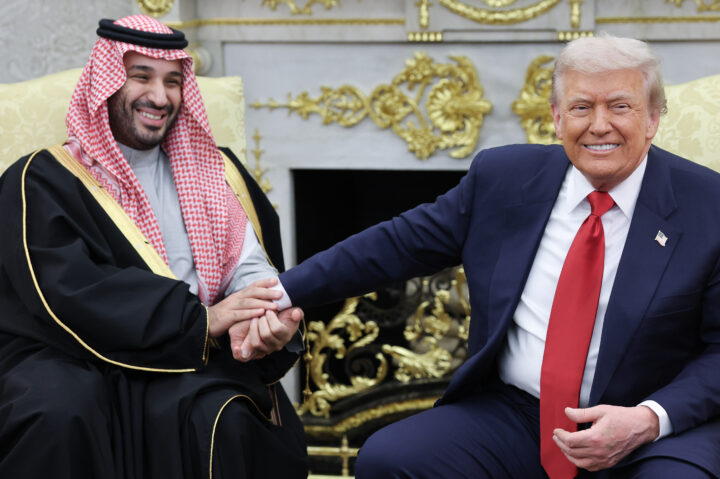
Win McNamee/Getty Images
President Donald Trump (R) meets with Crown Prince and Prime Minister Mohammed bin Salman of Saudi Arabia during a bilateral meeting in the Oval Office of the White House on November 18, 2025.
During Tuesday’s meeting between President Donald Trump and Saudi Crown Prince Mohammed bin Salman, the leaders strengthened their relationship and confirmed the completion of several deals. Any plan to utilize such transactions as part of normalization with Israel, however, was notably absent.
While taking questions from reporters in the Oval Office, Trump confirmed that the U.S. would sell Saudi Arabia F-35 fighter jets of similar caliber to Israel’s. At a dinner that evening, the president added that a strategic security agreement had crossed the finish line, while also formally naming Saudi Arabia a major non-NATO ally. On Wednesday, the two countries announced a strategic artificial intelligence partnership.
“The main takeaway of the visit was the normalization of the U.S.-Saudi relationship,” said Aaron David Miller, a senior fellow at the Carnegie Endowment for International Peace and former State Department negotiator. “[There was] very little, it seemed to me, not surprisingly, on the side of normalization to Israel. It’s almost as if Israel was sort of an afterthought this visit.”
When asked by reporters why normalization with Israel was not prioritized, Trump did not provide much of a response, instead asserting that Israel is “going to be happy.”
Observers had anticipated that Trump would roll out the red carpet for MBS on his visit to Washington. What remained unknown was whether the deepening ties between Washington and Riyadh would come with progress between Saudi Arabia and Israel, the United States’ closest ally in the region.
But the deals announced this week were made without any apparent requirement of progress toward normalization, leading some experts and leaders of pro-Israel groups to raise questions about the Trump administration’s strategy.
“By the way this was done, President Trump seems to have elevated the partnerships with Saudi Arabia and maybe, to some degree, with other Gulf states, above pretty much all other U.S. partnerships, including Israel,” said Dan Shapiro, a former U.S. ambassador to Israel under former President Barack Obama.
“So that means that other considerations, like ensuring the right incentives are still in place for Saudi Arabia to normalize relations with Israel or ensuring that military sales are done in a way that protects U.S. interests and Israel’s security interests, may be less important than they have been under previous administrations.”
Shapiro said that while it is reasonable for the U.S. to strengthen its partnerships with Gulf countries, the deals gave away major incentives for normalization “without knowing whether it can be achieved later.” He also added that it came without guarantees from the Saudi government on limiting military cooperation with China and Russia.
Anne Dreazen, the vice president for the American Jewish Committee’s Center for a New Middle East, told JI that Saudi-Israeli normalization could not have been achieved on this visit, adding that it was “not in the cards right now.”
“Now the paradigm is shifting where it’s about peace between Israel and Saudi Arabia being logical and good based on its own merits, when they can get the politics right and when they can reach agreement on the Palestinian issue,” said Anne Dreazen, the vice president for the American Jewish Committee’s Center for a New Middle East.
“Right now we’re not there. The politics in Israel and Saudi Arabia are not right for this,” said Dreazen. “I think President Trump realized that it wasn’t going to happen in this visit and wanted to move ahead with these deals because there’s a strong perception that making some deals with Saudi Arabia is in America’s interest.”
Dreazen, however, still believes normalization is “going to happen,” adding that she has confidence from conversations with Saudi officials that political differences will be resolved in the future.
Trump’s decision to make significant deals with Saudi Arabia while not pressing for normalization suggests the White House is taking a different approach than in the past, Dreazen argued.
“Now the paradigm is shifting where it’s about peace between Israel and Saudi Arabia being logical and good based on its own merits, when they can get the politics right and when they can reach agreement on the Palestinian issue,” said Dreazen, a shift from how former President Joe Biden approached negotiations.
But with MBS leaving Washington with so many deliverables, it’s unclear whether he will still prioritize normalization.
The Israelis are “going to be right to worry that the Saudis may feel like they’ve gotten everything they want and don’t have any need left for normalization,” Shapiro said.
Following his Oval Office meeting with Trump, the Saudi crown prince told reporters, “We want to be part of the Abraham Accords, but we want also to be sure that [we] secure a clear path [toward a] two-state solution.”
Leaders of pro-Israel groups said normalization between Israel and Saudi Arabia should remain a top policy priority for the U.S.
“The United States would be stronger and more secure if our major non-NATO allies worked together to promote regional peace, stability and prosperity,” said AIPAC spokesman Marshall Wittmann. “This objective would be advanced if Saudi Arabia joined the Abraham Accords, and U.S. leaders should urge it to do so.”
In a statement released on Wednesday, Democratic Majority for Israel’s president and CEO, Brian Romick, said that expanding the Abraham Accords must be “central to U.S. policy,” and urged Congress to play an active role in reviewing U.S. defense agreements with Saudi Arabia.
“Any substantial upgrade in the U.S.–Saudi relationship — including access to advanced U.S. defense systems — must be tied to meaningful, measurable progress toward Saudi-Israeli normalization,” Romick said in a statement. “It is now incumbent on the Trump Administration to use our leverage with Saudi Arabia to make real progress toward normalization.”
“There’s clearly a political dynamic going on here,” said Israel Policy Forum chief policy officer Michael Koplow. “Trump went out of his way to almost poke at the Israelis. He implied that [the U.S. is] OK with the Saudis getting F-35s but [the Israelis] want the Saudis to get a less advanced version, and he almost seemed to boast about the fact that he’s going to give the Saudis whatever he wants no matter what Israel says.”
Trump’s promise of F-35 sales to Saudi Arabia has raised questions about which model and allowances Riyadh will receive and whether Israel will maintain its qualitative military edge, which the U.S. is bound by law to uphold. To date, Israel is the only country in the Middle East to have obtained the fighter jet.
U.S. officials and experts told Reuters that the F-35 jets the U.S. plans to sell to Saudi Arabia will lack superior features that Israel’s fleet has.
Israel Policy Forum chief policy officer Michael Koplow voiced concerns about the security aspect of the deals.
“It doesn’t surprise me that all of these things are going ahead,” said Koplow. “What surprises me more is that some of the things that have been discussed over the past couple of days seem to put Israel in a more difficult security position, particularly this question of sales of F-35s.”
Israel’s government, meanwhile, has stayed largely quiet about the F-35 sales, though the Israeli Air Force has objected to the deal, warning that it could damage Israel’s air superiority in the region
“There’s clearly a political dynamic going on here,” said Koplow. “Trump went out of his way to almost poke at the Israelis. He implied that [the U.S. is] OK with the Saudis getting F-35s but [the Israelis] want the Saudis to get a less advanced version, and he almost seemed to boast about the fact that he’s going to give the Saudis whatever he wants no matter what Israel says.”
Plus, Plus, Rahm's wake-up call for American Jews

Chesnot/Getty Images
PARIS, FRANCE - JUNE 16: Saudi Arabia's Crown Prince Mohammed bin Salman (MBS) poses prior to a working lunch with French President Emmanuel Macron at the Elysee Presidential Palace on June 16, 2023 in Paris, France.
Good Monday morning.
In today’s Daily Kickoff, we look at Israel’s reported push for a new 20-year memorandum of understanding with the U.S., and report on President Donald Trump’s pledge to back a primary challenger to Rep. Marjorie Taylor Greene amid an escalating feud between the two. We cover a new bill from 21 House Democrats accusing Israel of genocide that has the backing of Code Pink, and report on the firing of the New Jersey teachers’ union magazine editor over her antisemitic and pro-Hamas posts on social media. Also in today’s Daily Kickoff: Rahm Emanuel, Tua Tagovailoa and New York City Mayor Eric Adams.
Today’s Daily Kickoff was curated by Jewish Insider Executive Editor Melissa Weiss and Israel Editor Tamara Zieve with an assist from Marc Rod. Have a tip? Email us here.
What We’re Watching
- The U.N. Security Council is expected to vote today on a U.S.-proposed resolution backing the White House’s plan for Gaza and showing support for the creation of an International Stabilization Force in the enclave. More below.
- Outgoing New York City Mayor Eric Adams continues his trip to Israel today. Earlier today, Adams held separate meetings with Israeli President Isaac Herzog, Foreign Minister Gideon Sa’ar and New York Consul General Ofir Akunis. He’s slated to meet with Prime Minister Benjamin Netanyahu at 3 p.m. local time, followed by meetings with Knesset Speaker Amir Ohana and Jerusalem Mayor Moshe Lion. Tonight, he’ll attend a dinner hosted by the Israel Export Institute honoring the New York City-Israel Economic Council.
- The Jewish Federations of North America’s General Assembly kicked off yesterday in Washington. Sen. John Fetterman (D-PA), Rabbi Angela Buchdahl and Commentary’s John Podhoretz are among the speakers slated to take the main stage in today’s plenaries. Are you at the GA? Say hello to JI’s Gabby Deutch!
- The House is set to vote today on a resolution introduced by Rep. Marie Gluesenkamp Perez (D-WA) “disapproving the behavior” of Rep. Chuy Garcia (D-IL), who announced plans to retire on the last day for candidates to file, hours after his chief of staff had filed her own paperwork to run for the seat. House Democratic leaders have said they plan to kill the resolution.
What You Should Know
A QUICK WORD WITH JI’S LAHAV HARKOV
The members of Israeli Prime Minister Benjamin Netanyahu’s governing coalition spent much of the weekend arguing over something on which they all ostensibly agree — opposition to a Palestinian state.
They may have been expressing their long and openly held opinions, but the timing could be damaging, coming days before Saudi Crown Prince Mohammed bin Salman is set to visit the White House. In the meeting, slated for Tuesday, President Donald Trump is expected to push for normalization between Riyadh and Jerusalem — something the Saudis have long conditioned on tangible steps towards a Palestinian state.
The latest debate started with far-right Israeli Finance Minister Bezalel Smotrich, who recently apologized for saying the Saudis can “keep riding camels” rather than normalize ties with Israel in exchange for a Palestinian state. On Saturday night, Smotrich said that Netanyahu was responsible for a “dangerous” increase in pressure on Israel, criticizing the prime minister for not speaking up more forcefully after nearly a dozen countries recognized a Palestinian state earlier this year. “Immediately come up with an appropriate and decisive response that will make clear to the entire world that a Palestinian state will not be established in our homeland,” Smotrich wrote on X.
Next came Likud ministers. “Israel will not agree to the establishment of a terror state in the heart of the Land of Israel,” Israeli Foreign Minister Gideon Sa’ar asserted. “Israel’s policy is clear: A Palestinian state will not be established,” chimed in Defense Minister Israel Katz.
The impetus for reiterating their position was the U.S.-proposed resolution at the United Nations Security Council backing Trump’s plan for Gaza and the formation of an International Stabilization Force, leading to a scenario in which “the conditions may finally be in place for a credible pathway to Palestinian self-determination and statehood.”
It’s unclear where these Cabinet ministers were in late September, when Netanyahu signed onto Trump’s 20-step plan, which uses the exact same language.
The Saudis saw Netanyahu’s agreement to a horizon for Palestinian statehood as satisfying their demand for a step in that direction, an Israeli diplomatic source who frequently advises Netanyahu said earlier this month.
MILITARY MATTERS
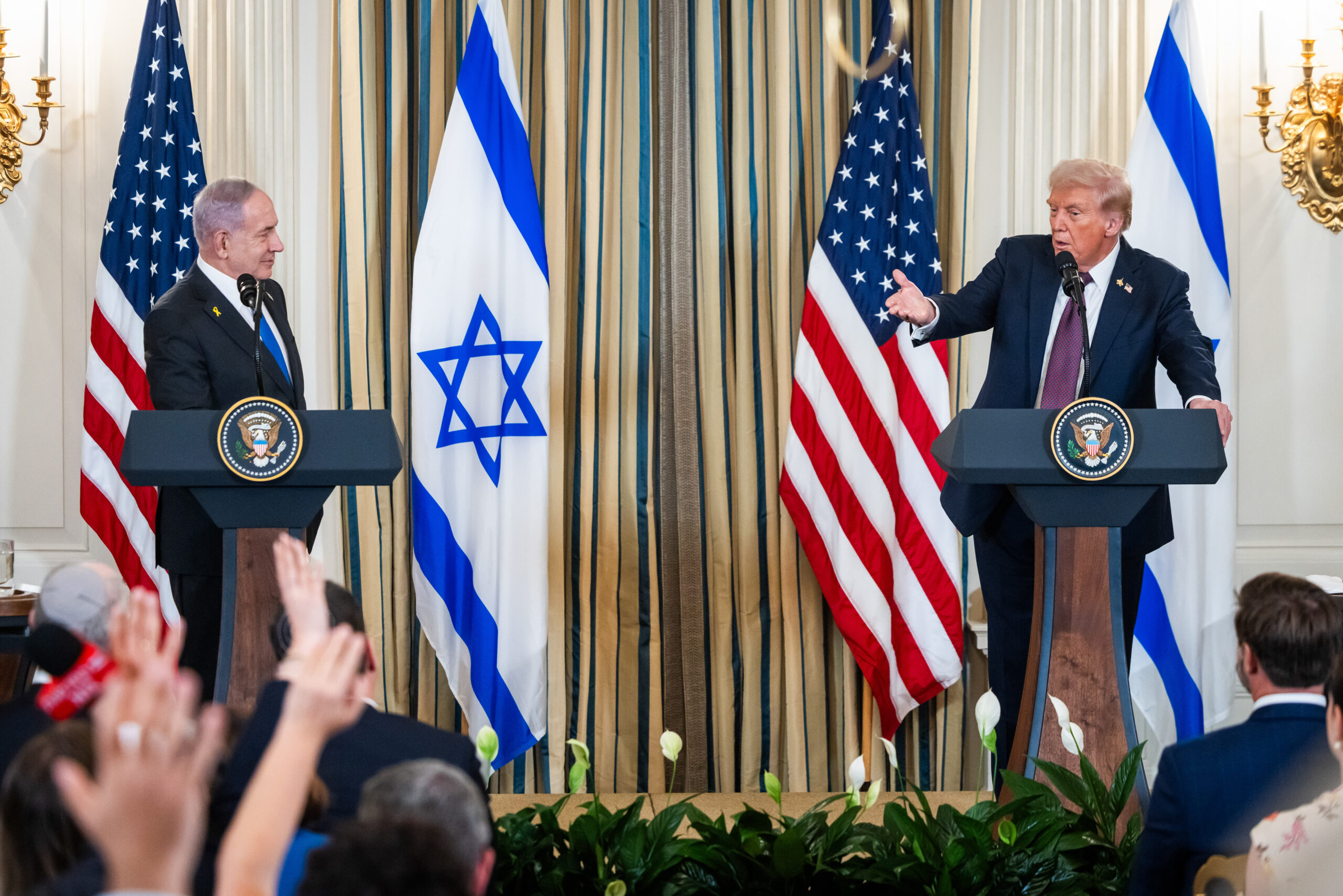
With Israel’s current 10-year memorandum of understanding (MOU) with the U.S. set to expire in 2028, Jerusalem is reportedly seeking a renewed and expanded agreement that would run through 2048 — though questions remain over the deal’s final framework and the future of U.S.-Israel assistance, Jewish Insider’s Matthew Shea reports. Israel is looking to finalize a new 20-year agreement that entails more in annual assistance, with hopes of securing the deal within the next year. Negotiations were previously delayed due to the war in Gaza; however, Israeli and U.S. officials confirmed to Axios that initial discussion began in recent weeks. Israeli Prime Minister Benjamin Netanyahu, however, denied the report.
Time is of the essence: “MOU negotiations typically take a long time, and waiting for both countries to get through their respective 2026 elections puts the start of these talks well into fiscal year 2027,” said Dana Stroul, a senior fellow at The Washington Institute for Near East Policy. “If there are going to be changes in the funding levels, Israeli and American budgeteers will want this information as early as possible.” Experts argued that it would be in Israel’s best interest to secure a deal now amid the uncertainty over future support from U.S. officials. Stroul said Israel “may be calculating that it is better to get out ahead of this trend and lock in U.S. commitments before the midterm elections.”
TROUBLING TIMES
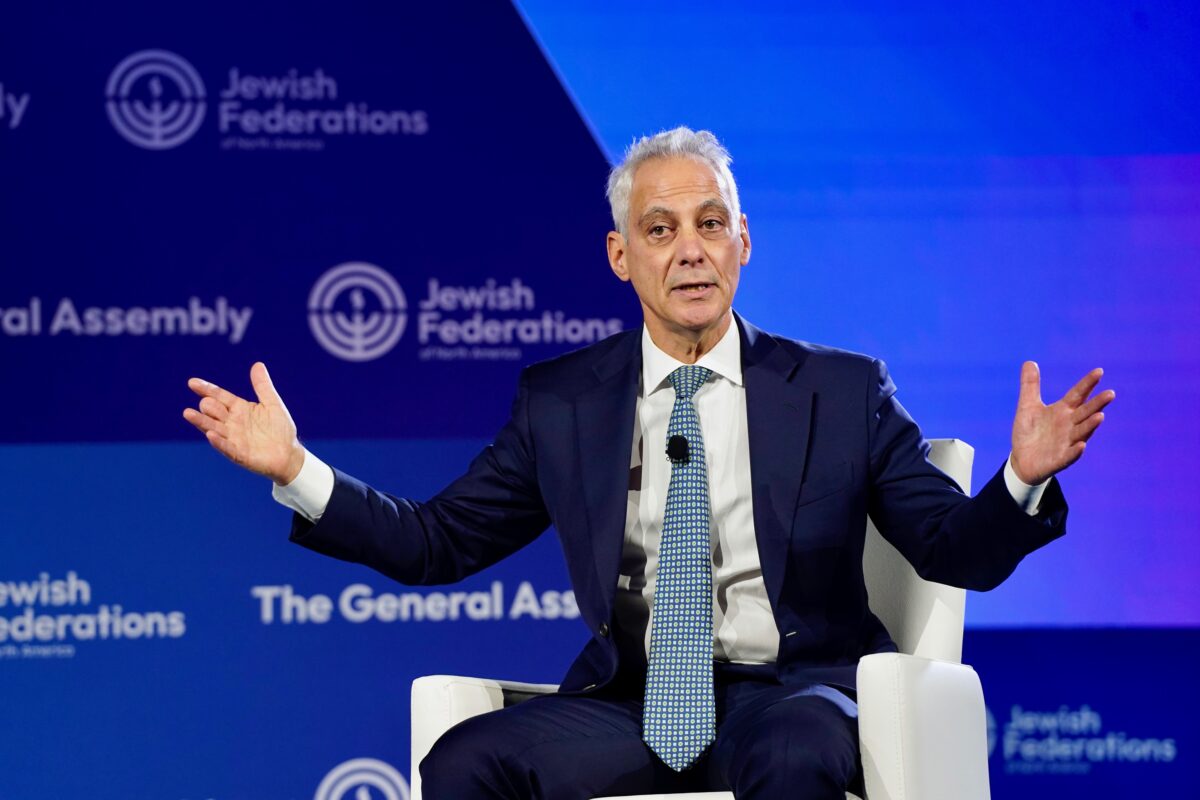
Longtime Democratic official Rahm Emanuel offered a word of warning on Sunday night to the thousands of Jewish communal leaders gathered in Washington to kick off the Jewish Federations of North America’s General Assembly: Don’t expect 2028 presidential candidates to visit Israel like his old boss, Barack Obama, did on the campaign trail in 2008, Jewish Insider’s Gabby Deutch reports.
Out of flavor: He used an ice cream metaphor to make his point. “If in 2024 the Democrats didn’t have a choice, in 2028 it’s going to be like Baskin-Robbins. There’s gonna be, like, 31 flavors. Some of us are gonna be chocolate mint. Nobody is going to Jerusalem,” Emanuel said at the opening plenary. “Nobody is leaving America to go travel to Jerusalem. That’s the politics. And it’s not just in the Democratic primary.” Emanuel, Obama’s former chief of staff and the former U.S. ambassador to Japan, beseeched the attendees to reckon with the shifting political winds on Israel and work to make a stronger case for the U.S.-Israel relationship.
On the main stage: Four former Israeli hostages — Noa Argamani, Avinatan Or, Evyatar David and Guy Gilboa-Dalal — shared accounts of their time in Hamas captivity, some of which had never before been revealed, at the JFNA’s opening plenary, eJewishPhilanthropy’s Nira Dayanim reports.
CHANGES IN ATTITUDE
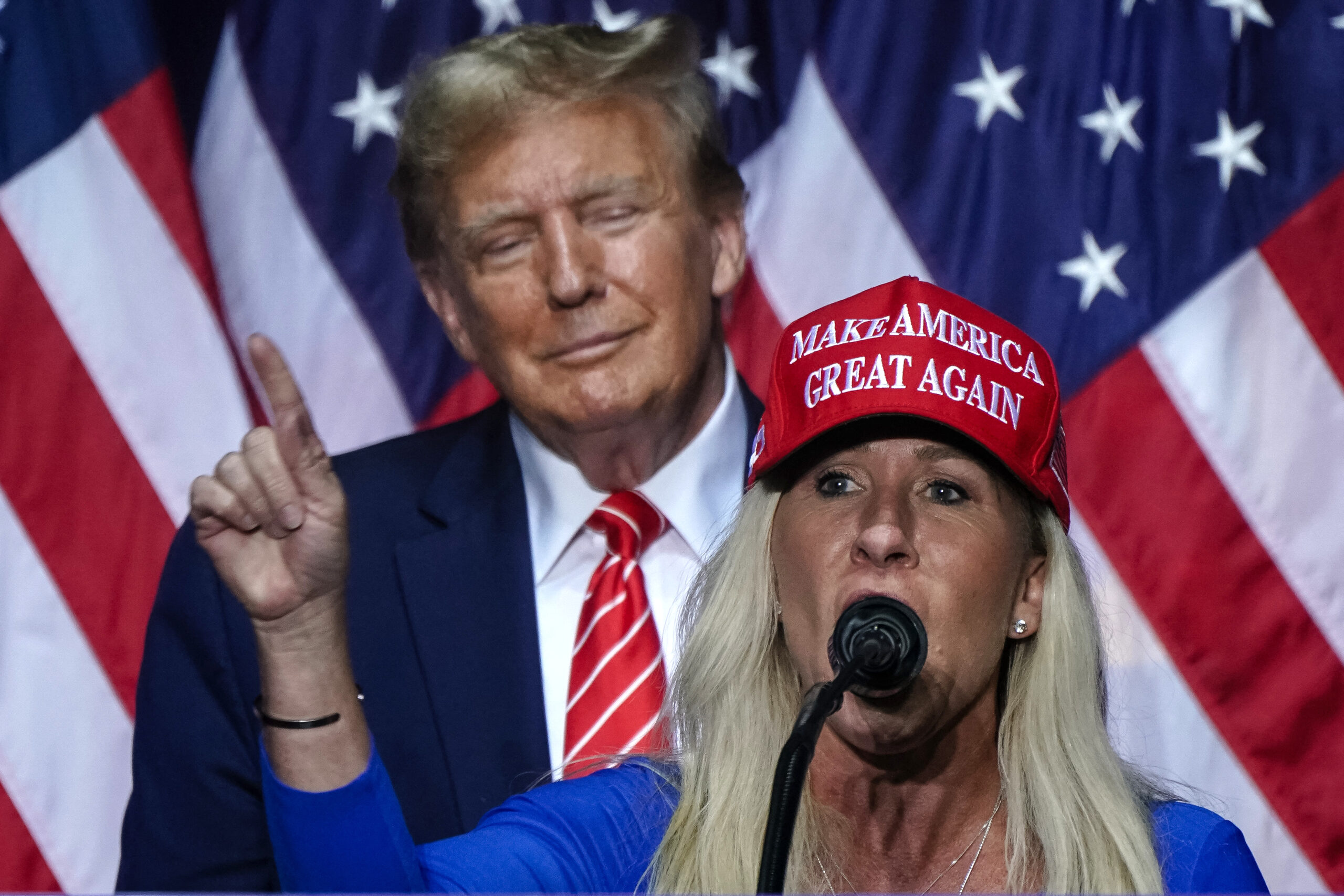
President Donald Trump on Friday night publicly disavowed Rep. Marjorie Taylor Greene (R-GA), once one of the president’s closest and most committed allies on Capitol Hill, saying he was withdrawing his endorsement of Greene and is prepared to support a primary challenger to the far-right Georgia congresswoman, Jewish Insider’s Marc Rod reports.
The latest: Trump said on his Truth Social platform that he has heard that “wonderful, Conservative people are thinking about primarying Marjorie” and that “if the right person runs, they will have my Complete and Unyielding Support,” accusing her of having “gone Far Left.” In one of her posts in response, Greene highlighted the fact that she has not received support from pro-Israel groups and suggested that a foreign country is pressuring Trump to distance himself from her.
ON THE HILL
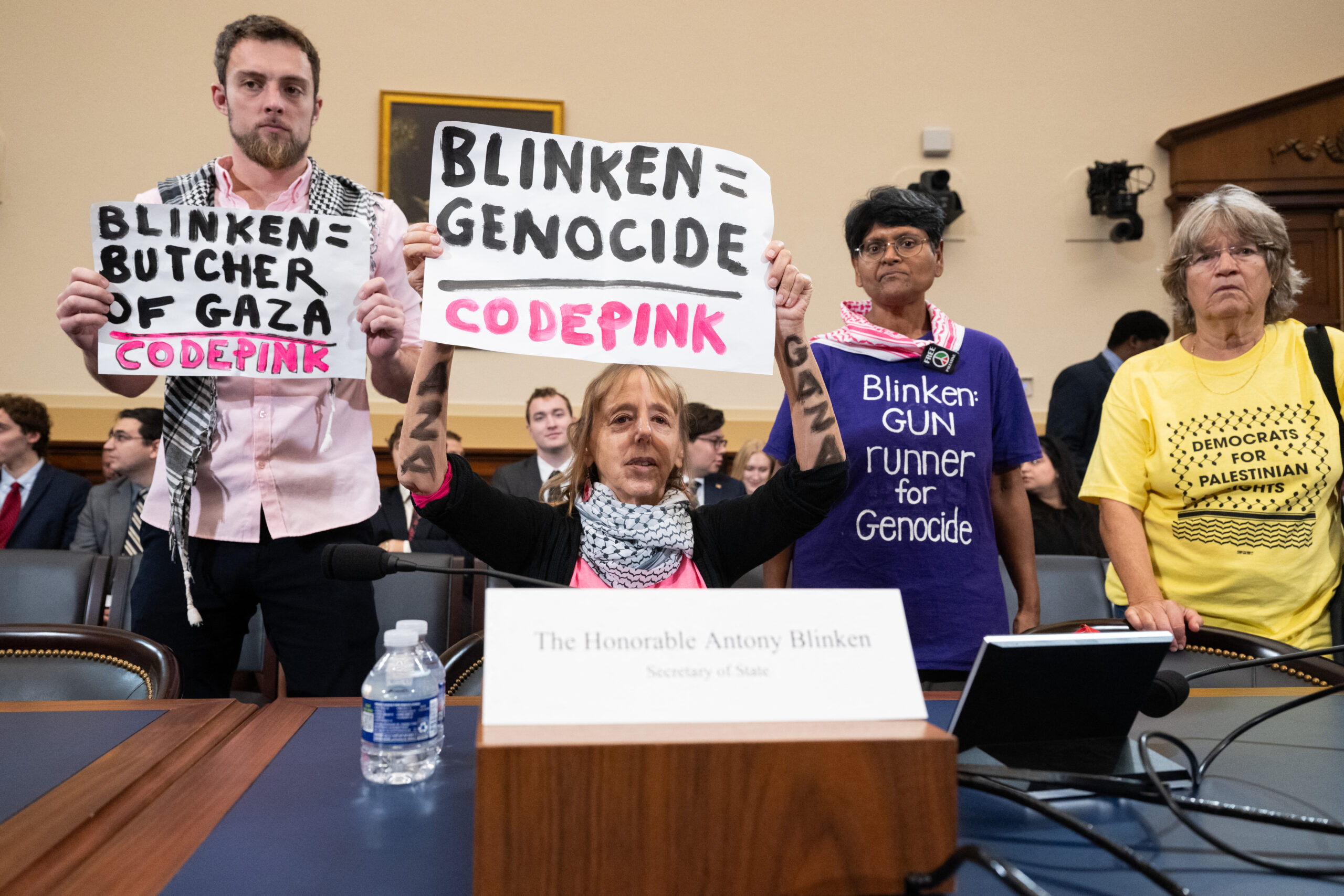
A group of 21 House progressives, led by Rep. Rashida Tlaib (D-MI), introduced a resolution accusing Israel of committing genocide in Gaza, Jewish Insider’s Marc Rod reports. The resolution is backed by a slew of anti-Israel groups, including the Democratic Socialists of America, Jewish Voice for Peace, IfNotNow, the Quincy Institute, Sunrise Movement, Amnesty International, Code Pink, CAIR, American Muslims for Palestine, American-Arab Anti-Discrimination Committee and DAWN.
Sponsor list: The legislation is co-sponsored by Reps. Becca Balint (D-VT), Andre Carson (D-IN), Greg Casar (D-TX), Maxine Dexter (D-OR), Maxwell Frost (D-FL), Chuy Garcia (D-IL), Al Green (D-TX), Pramila Jayapal (D-WA), Hank Johnson (D-GA), Ro Khanna (D-CA), Summer Lee (D-PA), Jim McGovern (D-MA), Alexandria Ocasio-Cortez (D-NY), Ilhan Omar (D-MN), Mark Pocan (D-WI), Ayanna Pressley (D-MA), Delia Ramirez (D-IL), Lateefah Simon (D-CA), Nydia Velazquez (D-NY) and Bonnie Watson Coleman (D-NJ).
MINORITY ALERT

Representatives of Syria’s Druze, Christian and Alawite communities warned members of the U.S. Commission on International Religious Freedom on Thursday about the systematic targeting, persecution and atrocities their communities have endured under the new Syrian government led by President Ahmad al-Sharaa, Jewish Insider’s Marc Rod reports.
Pump the brakes: They urged the U.S. to condition the removal of remaining sanctions on Syria and its evolving partnership with the Syrian government on the government’s efforts to protect religious minorities and prevent further atrocities. Members of the commission, an independent body created by Congress, likewise expressed alarm about the pattern of violations against Syria’s minorities.
Bonus: A spokesperson for Rep. Mike Lawler (R-NY), who is leading a bill in the House to condition the lifting of human rights sanctions on Syria under the Caesar Act, told JI he continues to oppose the unconditional repeal of sanctions. “Congressman Lawler continues to believe that any changes to the Caesar sanctions must be tied to meaningful benchmarks and strict accountability to ensure the al-Sharaa regime cannot exploit relief. He is actively working with the administration to advance a responsible, conditional approach with snapback measures rather than a blanket repeal,” spokesperson Ciro Riccardi told JI.
EDITED OUT

New Jersey’s largest teachers’ union, the New Jersey Education Association, cut ties with an editor of its magazine on Friday, following criticism from top state officials over her antisemitic and pro-Hamas posts on social media. Ayat Oraby’s since-deleted posts on X, screenshots of which were viewed by JI, claimed Israel “killed many of its citizens” during the Oct. 7, 2023, terror attacks and voiced her support of Hamas, praising its actions on social media as “resistance,” among other views, Jewish Insider’s Haley Cohen reports.
Chain of events: Oraby, who started at the NJEA Review magazine in August, told the New Jersey Globe, the first outlet to report her termination, that her “intent has always been humanitarian: to stand against the killing of civilians and to advocate for peace. When compassion is politicized, even empathy can be misread.” Local Jewish elected officials voiced worry about Oraby’s appointment in October, sending a letter to NJEA with 24 signees, expressing “deep concern.” The letter followed one sent by Rep. Josh Gottheimer (D-NJ) to the NJEA, which also voiced concern. Oraby told the New Jersey Globe that Gottheimer was unfair to condemn her for a post she deleted that compared Israel to Nazi Germany, a claim she said “reflects public opinion and legitimate criticism, not hatred.”
Worthy Reads
What MBS Wants: In The New York Times, former U.S. Ambassador to Saudi Arabia Michael Ratney previews tomorrow’s meeting between President Donald Trump and Saudi Crown Prince Mohammed bin Salman in Washington. “After two years as U.S. ambassador to the kingdom, and after conversations with many Saudis, it is clear to me where the crown prince’s priorities now lie: He would rather focus on attracting international business and investment to the kingdom than become enmeshed in the region’s interminable conflicts. He would rather accept an imperfect Syrian leadership than fuel a civil war that will exacerbate the region’s ills. He would rather reach an uneasy détente with Iran than antagonize it and draw its ire and missiles. And he would rather end the Gaza war on less than ideal terms than have it continue as a source of inspiration for extremists.” [NYTimes]
Tucker Takes on the Bible:The Washington Post’s Jason Willick posits that conservative commentator Tucker Carlson is, in his own rhetoric and platforming of extremist voices, explicitly targeting the Judeo-Christian consensus. “That Jewish-Christian pairing, though not uncontroversial, has proved remarkably resilient over the decades. Carlson sees an opening to undo it. A recent theme of the podcaster is that the Old Testament (the part of the Bible subscribed to by both Jews and Christians) is dark and tribal, while the New Testament (the part subscribed to only by Christians) is the fount of enlightened Western values. … His Fuentes provocation successfully prompted massive recriminations on the institutional right. His gamble is that in the turmoil, he can pry more conservatives away from the Judeo-Christian settlement that arose in the past century and toward his own narrower sect on the right.” [WashPost]
Water Woes: In The Wall Street Journal, Seth Siegel, author of Let There Be Water: Israel’s Solution for a Water-Starved World and Troubled Water: What’s Wrong with What We Drink, looks back at the role that Israel played in building water infrastructure in Iran prior to the 1979 revolution. “The first few water engineers to arrive in Iran were followed by dozens, and ultimately hundreds. So many Israeli water experts worked on Iran’s water restructuring and rethinking of agricultural practices that by the late 1960s Hebrew-language schools for their children were established in several locations in Iran. Shops in some areas had signs in Hebrew. I interviewed several Israeli water engineers who worked in Iran before the 1979 revolution. They described a warm environment in which Israelis and Iranians worked together. Other than at a soccer match involving a visiting Israeli team, none of the interviewees had any memory of anti-Israel or antisemitic conduct or speech.” [WSJ]
Word on the Street
Axios reports that Sen. Ted Cruz’s (R-TX) vocal opposition to Tucker Carlson is part of the Texas Republican’s plans to mount a 2028 presidential bid in which he’ll speak out against the party’s isolationism, setting him up on a collision course with Vice President JD Vance…
In a Washington Post op-ed, U.S. Ambassador to the U.N. Mike Waltz calls on the U.N. Security Council to pass an upcoming resolution backing President Donald Trump’s peace plan for Gaza, saying that doing so will create an opportunity “for the United States and our international partners to take concrete action and renew our commitment to the project of peace and build a future in which Gaza is governed by the Palestinian people — not Hamas”…
Politico spotlights Michael Needham, who is serving as a top strategist to Secretary of State Marco Rubio, describing Needham as “Rubio’s chief policy filter, surfacing America First proposals that blend ideology with implementation”…
Puck looks at tensions between Secretary of Defense Pete Hegseth and Secretary of the Army Dan Driscoll, the latter of whom Puck describes as “a rare Trump appointee who commands bipartisan respect and affection”…
The New Yorker profiles Kash Patel, noting that in his high school yearbook, the FBI director quoted Rabbi Abraham Joshua Heschel, saying “Racism is man’s gravest threat to man—the maximum of hatred for a minimum reason”…
In comments made at a Combat Antisemitism Movement reception in Tel Aviv on Sunday night, outgoing New York City Mayor Eric Adams suggested that the city’s Jewish community “must prepare itself” for New York City Mayor-elect Zohran Mamdani, saying, “If I were a Jewish New Yorker, I’d be concerned about my children”…
A staffer on Mamdani’s campaign who served as director of Muslim engagement and now claims to have a senior role on Mamdani’s transition team is facing criticism for a series of antisemitic and homophobic social media posts…
Columbia University’s Advisory Committee on Socially Responsible Investing, which advises the school’s board of trustees on issues related to investments, rejected three proposals calling on Columbia to divest from Israel; the committee found that the proposals failed to secure a broad consensus…
A federal judge blocked the Trump administration from collecting $1.2 billion in fines from UCLA that were imposed over the school’s handling of antisemitism on campus, its admissions process and its recognition of transgender students…
A new study from the Institute of International Education found that international student enrollment in American universities dropped by 17% this year…
The Wall Street Journal looks at how WhatsApp is surpassing Apple’s iMessage as the messaging app of choice for large groups…
Miami Dolphins quarterback Tua Tagovailoa, speaking at a press conference in Madrid following the NFL’s final international game for the season, said, “it would be pretty cool to go play in Jerusalem” after being asked where the league should play its next international game…
“Succession” actress Dasha Nekrasova was dropped by the Gersh agency following an episode of her podcast in which she interviewed antisemitic conspiracy theorist Nick Fuentes…
The Washington Post reviews the Arlington, Va., Signature Theatre’s production of “Fiddler on the Roof”…
University College London suspended researcher Samar Maqusi following the distribution of video taken during a lecture in which Maqusi shared antisemitic blood libel; the school also announced it will reopen its investigation into a student who is alleged to have told a Jewish student that the Oct. 7, 2023, attacks were “justified and reasonable” and that Hamas was not a terrorist entity…
Germany confirmed plans to lift its restrictions on military exports to Israel that went into effect in August, citing last month’s ceasefire between Israel and Hamas and the increasingly stabilized situation in the Gaza Strip…
The Wall Street Journal reports on how increasing support for Hamas in Gaza since the implementation of a ceasefire last month has complicated efforts to disarm the terror group…
Israel’s GDP rose 12.4% in the third quarter of 2025, rebounding from the second-quarter drop attributed in part to the Israel-Iran war in June…
Iran began cloud-seeding operations to spur rainfall in an effort to address the country’s severe drought…
Iranian Deputy Foreign Minister Saeed Khatibzadeh said on Sunday that the country’s nuclear program was “still intact,” the same day that Foreign Minister Abbas Araghchi denied that the country was still enriching uranium, citing the damage sustained during the 12-day war with Israel in June…
The Islamic Revolutionary Guard Corps seized a Marshall Islands-flagged oil tanker carrying petrochemicals near the coast of the United Arab Emirates en route to Singapore from Sharjah, UAE…
Lebanon is preparing a complaint against Israel to the U.N. Security Council over the construction of a concrete barrier that Beirut said crosses the “Blue Line” between the countries; Israeli officials denied that the barrier crossed the line of demarcation…
The New York Times’ Vows section spotlights the recent wedding of Sausalito, Calif., City Councilmember Melissa Blaustein and real estate investor David Saxe, who were set up by a matchmaker Blaustein connected with at a Yom Kippur break fast…
New York City attorney Sid Davidoff, a founding partner of Davidoff Hutcher & Citron LLP who was included on President Richard Nixon’s “enemies list,” died at 86…
Elizabeth Franz, who won the 1999 Tony Award for Best Featured Actress in a Play for her portrayal of Linda Loman in “Death of a Salesman,” died at 84…
Poet and performance artist Hal Sirowitz, honored in the early 2000s as the poet laureate of Queens, died at 76…
Psychologist Arline Bronzaft, whose work focused on the effects of urban noise, died at 89…
Pic of the Day

Birthdays
Film and television director, writer and producer, Jon Avnet turns 76…
Rabbi of Agudath Israel of Baltimore and rabbinic administrator of the Star K Kosher supervision service, Rabbi Moshe Heinemann turns 88… Original creator and producer of “Saturday Night Live,” Lorne Michaels (born Lorne Lipowitz) turns 81… Philanthropist and director of the William Davidson Foundation, Karen Davidson… Editor-at-large for Washingtonian Magazine and author of a biography of Sen. Bernie Sanders (I-VT), Harry Jaffe… Founder and principal of ourCovenant, Diana Aviv… Operations manager at NPC Global, Daniel Gastaldi… Author and journalist, he lectures in the graduate journalism program at Stanford University, Gary M. Pomerantz turns 65… Attorney and business executive who once played on the South African national teams in both cricket and field hockey, Mandy Yachad turns 65… U.S. senator (R-PA) until 2023, Pat Toomey turns 64… Former director of the Domestic Policy Council in the Biden administration and former national security advisor in the Obama administration, Susan Rice turns 61… Attorney General of the United States, Pam Bondi turns 60… “The Travelling Rabbi” of the South African Jewish Board of Deputies who serves 11 sub-Saharan countries, Moshe Silberhaft turns 58… U.S. ambassador to Switzerland during the Obama administration, Suzan Gail Davidson (Suzi) LeVine turns 56… Editor at large of Talking Points Memo, David Kurtz turns 56… Segment producer at HBO’s “Real Time with Bill Maher,” Michele Tasoff… Chief communications officer at American Hotel & Lodging Association, Ralph Posner… Human resilience coach, Michael Ostrolenk… President of Stanford University, Jonathan David Levin turns 53… Former president of NBC News, Noah Oppenheim turns 47… President of Thematic Campaigns, Isaac Baker… CEO of the Jewish Democratic Council of America, Halie Soifer… MLB player for 14 seasons, NL Rookie of the Year, five-time NL All-Star and NL MVP in 2011, Ryan Braun turns 42… NFL fullback for six seasons with the Bucs and Saints, he has since earned an MBA from Wharton, Erik Lorig turns 39… Diplomatic correspondent at Politico, Felicia Schwartz… Mortgage lender at River Holdings, Zack Teichman… Chief of staff at America250, Aidan Golub…
Five reflections on how Oct. 7 reshaped politics, diplomacy, advocacy, higher ed, and Jewish life

RE’EIM, ISRAEL — Visitors pay tribute at the site of the Nova music festival massacre.
Plus, the minutia of a new U.S.-Israel MOU

Kevin Dietsch/Getty Images
Rep. Jerry Nadler (D-NY) leaves a House Democratic caucus meeting on February 14, 2024, in Washington, D.C.
Good Tuesday morning.
In today’s Daily Kickoff, we look at questions around a potential new Memorandum of Understanding between Jerusalem and Washington ahead of the 2028 expiration of the Obama-era MOU, and report on a push by major Jewish groups to encourage applications to the Nonprofit Security Grant Program despite the Trump administration’s imposition of additional conditions on the funds. We cover the release of a new Humash with writings from Rabbi Lord Jonathan Sacks that were edited and organized posthumously, and look at how Sergio Gor’s departure from the White House to become ambassador to India could affect the administration’s hiring decisions. Also in today’s Daily Kickoff: Rep. Jerry Nadler, Joseph Kahn and Zach Witkoff.
What We’re Watching
- We’re keeping an eye today on a number of weekend developments across the U.S. and Middle East:
- Congress is back in session today in Washington after the August recess. Driving today’s news is Rep. Jerry Nadler’s (D-NY) announcement last night that he will not seek reelection next year. More below.
- The Senate is slated to hold a procedural vote on the National Defense Authorization Act this evening. On the other side of the Capitol, the House Foreign Affairs Committee is holding a virtual briefing with U.S. Ambassador to Israel Mike Huckabee focused on the West Bank.
- In the Middle East, tensions remain high following Israeli strikes late last week that killed a dozen senior Houthi officials, including Prime Minister Ahmed al-Rahawi. The Iran-backed group retaliated several times over the weekend with ballistic missile attacks, all of which fell short or were intercepted.
- In Gaza, an Israeli strike killed Abu Obeida, Hamas’ spokesman, over the weekend. President Donald Trump, who is slated to speak from the White House at 2 p.m. today, addressed Israel’s predicament in Gaza, telling the Daily Caller on Sunday that Israel “may be winning the war, but they’re not winning the world of public relations, you know, and it is hurting them.”
- Belgium became the latest European nation to announce plans to recognize a Palestinian state at the U.N. General Assembly in New York later this month. In response to the Palestinian statehood push, Israel is reportedly considering annexing parts of the West Bank.
- Missing from the UNGA this year will likely be the Palestinian delegation, after Secretary of State Marco Rubio revoked the visa of Palestinian Authority President Mahmoud Abbas and dozens of other officials, who had planned to attend the General Assembly as well as an international gathering focused on Palestinian statehood.
What You Should Know
A QUICK WORD WITH JI’S JOSH KRAUSHAAr
Rep. Jerry Nadler (D-NY), a progressive stalwart and a longtime Democratic pillar on the House Judiciary Committee, announced his retirement Sunday evening, opening up a recently redrawn Manhattan district that the congressman has held for over three decades.
Nadler, whose district has one of the largest Jewish constituencies in the country, has long positioned himself as a progressive pro-Israel advocate, even as he broke with the organized Jewish community on some issues — most notably his support for former President Barack Obama’s Iran nuclear agreement in 2015.
But in recent months, he has emerged as being at odds with the New York Jewish community on some high-profile issues. Even as most of the leading New York state Democratic voices have held back any endorsement of far-left New York City Democratic mayoral nominee Zohran Mamdani, Nadler was one of the first House Democrats to offer the anti-Israel candidate his support — and has worked to secure support from a deeply skeptical Jewish community towards Mamdani.
Nadler has also lately become a sharp critic of the Jewish state, in contrast to his pro-Israel Jewish Democratic colleagues from his home state. In a New York Times interview announcing his departure, he accused Israel of committing mass murder and war crimes in Gaza “without question.” He told the paper that when he returns to Congress, he will support legislation withholding offensive military aid to Israel, joining a growing roster of progressive Democrats in doing so — a move that could give cover for other colleagues to follow suit.
mou minefield

In September 2016, when President Barack Obama announced that the U.S. and Israel had signed a 10-year deal pledging a total of $38 billion in military assistance to Israel, the news was generally uncontroversial and greeted with bipartisan plaudits. That deal, known as the U.S.-Israel Memorandum of Understanding, is now close to expiring, and the next one — if there is a next one — will be negotiated in an entirely different political environment. Israel remains deeply enmeshed in a nearly two-year war in Gaza, with little indication of an end in sight, making forward-looking negotiations more difficult. A new MOU is not a given. U.S. support for Israel has dramatically declined on the left, and it is fracturing in isolationist corners of the right as well. Even some staunchly pro-Israel Republicans have grown wary of foreign aid in general, a shift that could affect U.S. policy toward Israel, Jewish Insider’s Gabby Deutch reports.
Message and meaning: “Ten-year MOUs have communicated an ongoing, consistent and bipartisan commitment to support Israel’s security by crossing administrations and demonstrating that it’s an ongoing relationship,” said former U.S. Ambassador to Israel Dan Shapiro. “It allows planning for big-ticket acquisitions.” The long-standing commitment allows Israel to plan to make large purchases that could take several years to acquire, such as fighter jets. The MOU is not actually a binding agreement, it’s a framework. Congress must still approve the $3.3 billion in military financing and $500 million in missile defense laid out in the MOU each year during the annual appropriations process, and could do so even in the absence of an MOU.
HAWKEYE STATE POLITICS

The newly open Senate race in Iowa could pit a House Republican seen as a conventional conservative against challengers likely to attack her from the right. The race could also be an early bellwether of the GOP’s direction as it moves toward the post-Trump era, Jewish Insider’s Marc Rod reports.
In contention: Rep. Ashley Hinson (R-IA), a former local news anchor and state representative elected to Congress in 2020, is widely seen as likely to make a run for Ernst’s seat. In the House, Hinson has a consistent record of support for the U.S.-Israel relationship and legislation to combat antisemitism, and has signed onto congressional letters criticizing international legal cases against Israel and supporting the Abraham Accords. She supported the U.S. strikes on Iran earlier this summer. Should she enter the race, she’ll face the prospect of running against lesser-known, right-wing Republicans like Jim Carlin, a former state senator who entered the race to challenge Ernst from the right. Joshua Smith, a former libertarian and podcast host, also declared his candidacy against Ernst. He has a record of anti-Israel and antisemitic commentary.
Seeing opportunity: Democrats are expected to make an aggressive bid for the seat in the general election, and several have already entered the primary race, including state Rep. Josh Turek, state Sen. Zach Wahls and Des Moines School Board Chair Jackie Norris. David Yepsen, a longtime former political writer, editor and columnist at the Des Moines Register, predicted a “really good race” in the general election, given that Democrats have already fielded several contenders, have put up strong showings in recent state special elections, have been energized by opposition to the Trump administration and have an advantage in the midterms.
NEW BLOOD
Sergio Gor’s expected departure from a key role in the White House, where he has vetted thousands of candidates for political jobs as the influential leader of the Presidential Personnel Office, is raising some questions about how his litmus tests and isolationist views will compare to his newly announced replacement, particularly with regard to national security hires. Gor, 38, was nominated by President Donald Trump last week to be U.S. ambassador to India. If confirmed by the Senate, Gor, who was also tapped as special envoy for South and Central Asian affairs, will leave behind a powerful post at which he built a reputation as an ideological gatekeeper, Jewish Insider’s Matthew Kassel reports.
Stepping into his shoes: Throughout his time in the White House, Gor has drawn attention for his unyielding focus on loyalty to Trump and — more singularly — a fierce commitment to elevating national security and foreign policy hires who share his skepticism of American engagement abroad. His successor, Dan Scavino, as the White House confirmed this week, is likewise a longtime Trump confidante who now serves as White House deputy chief of staff. But unlike Gor — whose background suggests an interest in imposing ideological litmus tests on job applicants — Scavino, 49, “has no ideology other than Trump,” according to a former top administration official.
FUNDING FRICTION
Jewish orgs urge institutions to apply for NSGP grants, regardless of questions about new conditions

A series of Jewish community groups, in a joint statement released on Tuesday, urged Jewish organizations to apply for Nonprofit Security Grant Program funding, in spite of ongoing concerns from some in the community about potential new immigration and DEI-related conditions on the funding, Jewish Insider’s Marc Rod reports.
What they’re saying: “While we are aware that questions have arisen on the part of certain religious institutions regarding the current year’s program criteria, our organizations strongly urge all eligible institutions to apply for this critical resource,” the Jewish Federations of North America, Conference of Presidents of Major American Jewish Organizations, Anti-Defamation League, Secure Community Network, Community Security Initiative and Community Security Service said in a joint statement. The groups said they have been “in regular contact with government officials who have affirmed their continued commitment to protecting the safety of all faith-based institutions and the values they hold.”
NORWEGIAN WOULDN’T
Sen. Lindsey Graham (R-SC) on Thursday floated the possibility of punitive tariffs and visa restrictions in response to the decision by Norges Bank Investment Management — the Norwegian sovereign wealth fund — to sell its stake in the American machinery company Caterpillar in response to the Israeli military’s use of its products in the West Bank and Gaza, Jewish Insider’s Marc Rod reports.
Retaliation threat: “To those who run Norway’s sovereign wealth fund: if you cannot do business with Caterpillar because Israel uses their products, maybe it’s time you’re made aware that doing business or visiting America is a privilege, not a right,” Graham said on X. “Maybe it’s time to put tariffs on countries who refuse to do business with great American companies. Or maybe we shouldn’t give visas to individuals who run organizations that attempt to punish American companies for geopolitical differences.”
State Department responds: “We are very troubled by the Norwegian sovereign wealth fund’s decision, which appears to be based on illegitimate claims against Caterpillar and the Israeli government,” a State Department spokesperson told JI. “We are engaging directly with the Norwegian government on this matter.”
WISDOM CARRIED FORWARD
Former British Chief Rabbi Lord Jonathan Sacks was a towering figure in Jewish life whose unique blend of Torah and Western wisdom attracted adherents around the world for many years before his death in 2020. Now, with Rosh Hashanah, the Jewish New Year, approaching later this month, and the restarting of the cycle of reading the weekly Torah portion a few weeks later, Rabbi Sacks’ longtime Jerusalem-based publisher, Koren, is releasing a posthumously completed Koren Shalem Humash, with a new translation and insights to encourage deeper understanding of the Five Books of Moses, Jewish Insider’s Lahav Harkov reports.
How it started: The story of the Koren Shalem Humash begins in 2006, Joanna Benarroch, president of The Rabbi Sacks Legacy, told JI last week. At that time, Sacks began working on his popular series of books about the weekly Torah portion, Covenant and Conversation. “He started writing it online every week,” Benarroch recalled. “He was the chief rabbi of the United Kingdom and the Commonwealth, based in London, but he started to build a global audience.” Sacks’ goals for Covenant and Conversation were “to make Torah relevant to us today, so it’s not just wisdom from 2,000-3,000 years ago today, but wisdom we can also take with us. It was very important to him for us to be proud, knowledgeable Jews and to share that with the next generation … to create new leaders who were proud, knowledgeable Jews. These were the things permeating his mind when he was writing,” Benarroch said.
Worthy Reads
Rahm Com(munism): In The Wall Street Journal, former U.S. Ambassador to Japan Rahm Emanuel, who is mulling a 2028 presidential bid, warns that domestic political division is providing an opening to malign actors, such as China, that seek to capitalize on the moment. “By 2011, the country was beset by two movements defined almost exclusively by anger and resentment. Occupy Wall Street’s antipathy to capitalism fixed the sentiment now driving Zohran Mamdani’s campaign for New York mayor. The tea party simultaneously metastasized into the MAGA movement and the riots of Jan. 6, 2021. With real violence in the offing, politics are worse than they have been in decades. … In some Shakespearean sense, China’s long shadow has appeared at exactly the right moment. But Xi Jinping is much more than a foil poised to unite Americans who would otherwise remain defined by their blue and red affinities. The China threat is both real and potent. The U.S. has never before been asked to face down a country that has three times our population, is fueled by an advanced economy, and is capable, as its leaders intend, of replacing us atop the global hierarchy.” [WSJ]
What the Australia Attacks Signal: The Atlantic’s Arash Azizi considers the motives behind Iran’s attacks on Jewish and Israeli targets around the world, following Australia’s expulsion of Iranian diplomats over Tehran’s involvement in recent antisemitic attacks in the country. “The elements organizing the attacks are ideological. They seek to burnish Iran’s image as an aggressive, revisionist actor, determined to destabilize the West and unconstrained by practical concerns. Inside the regime, this faction competes with a more pragmatic group that prioritizes trade and seeks to improve relations with the West. Those behind the hits on Australian targets may even see their activities as having a dual use: By striking synagogues and restaurants in Western countries, they intimidate their global enemies and help stymie the diplomatic agenda of pragmatists at home.” [TheAtlantic]
Hanging With Hezbollah: In The Free Press, Winston Marshall reflects on a recent trip to Lebanon and meeting with a Hezbollah member in Baalbeck. “Believe it or not, I feel sadness for the jihadi at the Baalbek mosque. His was a worldview almost completely inverted from mine. For him the good guys are Nasrallah, Assad, Khamenei, and Hitler. The bad guys are Donald Trump, Jews, and Jolani. Only on Jolani might we have found some common ground. His eyes glazed with the delirium of his cult. Rarely in my life have I come face-to-face with a man possessed with such evil. How exactly does one offer a golden bridge of reconciliation to a cult hell-bent on fighting and martyrdom? That is the impossible question Lebanon has to answer.” [FreePress]
Word on the Street
The Trump administration is planning to cut $4.9 billion in foreign aid from the State Department, USAID and other international aid groups without congressional approval, under the auspices of the Impoundment Control Act…
The Trump family’s World Liberty Financial cryptocurrency garnered $5 billion following its launch earlier this week; Zach Witkoff, a son of Middle East envoy Steve Witkoff who serves as WLF’s CEO, distanced the private company from the Trump administration but added, “clearly President Trump is the greatest president of all time”…
The U.N. Security Council voted unanimously to end the mandate of the United Nations Interim Forces in Lebanon (UNIFIL), which has been operating along the border between Israel and Lebanon for five decades, at the end of 2026…
The Washington Post reports on a postwar plan for Gaza, days after President Donald Trump convened a White House meeting on the issue, that would see the enclave enter into a 10-year trusteeship with the U.S. that would involve the temporary relocation of its residents both within and outside the Strip during the rebuilding effort…
Director of National Intelligence Tulsi Gabbard is reportedly clashing with senior CIA officials after she disclosed the name of a currently serving undercover CIA officer in a list of current and former officials whose clearances were being revoked by the ODNI…
Sens. Mark Kelly (D-AZ), Ruben Gallego (D-AZ), Peter Welch (D-VT), Tim Kaine (D-VA) and Elizabeth Warren (D-MA) urged the Trump administration to “use its full power and authority to immediately facilitate a massive surge in all humanitarian aid, and in particular infant formula, into Gaza to address this crisis”…
A Florida man was sentenced to 25 years in prison for planning attacks on Jewish and Black community sites as well as on Rep. Jared Moskowitz (D-FL)…
The Boulder chapter of “Run for Their Lives,” an organization that arranges weekly marches to advocate for the hostages held in Gaza, will no longer publicly advertise its walking route, the group announced last week, saying the decision was made “following weeks of escalating harassment and threats,” less than three months after a Molotov cocktail attack on the group left a participant dead and injured 15 others,Jewish Insider’s Haley Cohen reports…
Unknown vandals graffitied the Greenwich Village apartment building where New York Times Executive Editor Joseph Kahn lives, writing in red paint, “Joe Kahn lies Gaza dies”…
The superintendent of the Beverly Hills Unified School District struck down a school board vote to display the Israeli flag in schools and administrative buildings in the district for one month every year; Superintendent Alex Cherniss said that only the U.S. and California flags would be flown on school properties, citing “heightened safety concerns”…
The New York Post reports on financial ties between the Qatari royal family and filmmaker Mira Nair, the mother of New York City mayoral candidate Zohran Mamdani; Sheikha Al-Mayassa bint Hamad Al-Thani, the sister of the Qatari emir, has repeatedly posted on social media in support of Mamdani’s candidacy…
Police in Ontario, Canada, are investigating the stabbing of a Jewish woman at a kosher supermarket as a hate crime; days later, 32 officials from Canada’s Liberal Party, led by MP Anthony Housefather, issued a statement condemning the “deplorable rise of antisemitism in Canada”…
U.K. Prime Minister Keir Starmer tapped former Columbia University President Minouche Shafik to serve as his chief economic advisor; Shafik, an economist, departed Columbia last summer amid widespread criticism of her administration’s handling of campus antisemitism…
A Holocaust memorial in Lyon, France, was vandalized with graffiti reading “Free Gaza”…
The Wall Street Journal looks at how the IDF is struggling to get reservists, many of whom have served months of reserve duty, to continue reporting as the war grinds on toward a third year…
A flotilla of nearly two dozen boats attempting to reach Gaza departed on Monday after a failed start on Sunday due to adverse weather conditions; climate activist Greta Thunberg, who was detained and deported from Israel in May, is participating in the new flotilla effort…
The New York Times reports on concerns from Israeli tourists of harassment abroad as a result of escalated tensions resulting from the Israel-Hamas war…
GOP fundraiser Elliott Broidy, who settled a lawsuit with Qatar after being hacked, is reportedly a partner in the Israeli company KOIOS, which ran a public relations campaign on behalf of Doha…
A second former International Criminal Court staffer accused the court’s chief prosecutor, Karim Khan, of sexual misconduct; Khan, who had requested arrest warrants for Israeli Prime Minister Benjamin Netanyahu and former Defense Minister Yoav Gallant, was placed on administrative leave in May following earlier allegations that he’d acted inappropriately toward a staffer…
Gallant said in an interview with Israel’s Channel 12 that Israel should kill Iranian Supreme Leader Ayatollah Ali Khamenei in the next round of conflict between Israel and Iran…
The New York Times reports on how Israel tracked the movements of senior Iranian officials through the phone activity of their bodyguards…
Iran’s Islamic Revolutionary Guard Corps said it arrested eight people accused of sending sensitive information regarding Tehran’s military and its nuclear program to Mossad agents…
Turkish President Recep Tayyip Erdogan encouraged Iranian President Masoud Pezeshkian to continue nuclear talks with the West and reiterated Ankara’s support for Tehran…
The International Atomic Energy Agency said that a building in Syria that was destroyed by Israel in 2007 was found to have trace amounts of uranium, deepening speculation at the U.N. nuclear watchdog that the site had been used as a nuclear reactor…
Houthi terrorists stormed the Sanaa, Yemen, offices of UNICEF and the World Food Program, detaining staffers from both organizations…
Ruth Marks Eglash is now the editor of The Jerusalem Report…
Pic of the Day

At the funeral of her son Idan Shtivi on Monday, Dalit Oron mourned over the body of Shtivi, who was killed on Oct. 7, 2023. IDF forces operating in Gaza last week recovered Shtivi’s body as well as the body of hostage Ilan Weiss, who was killed on Oct. 7 while defending his community in Kibbutz Be’eri.
Birthdays

Television producer, attorney, legal analyst and celebrity reporter, he is the founder of TMZ, Harvey Levin turns 75…
Trustee of a foundation started by her husband, Harold Grinspoon, she is on the PJ Library Book Selection Committee, Diane Leshefsky Troderman turns 84… Attorney who was part of the “Dream Team” that successfully defended O.J. Simpson in 1995, he is a co-founder of three businesses, LegalZoom, Shoedazzle and RightCounsel, Robert Shapiro turns 83… One of Israel’s earliest high-tech entrepreneurs, Yossi Vardi turns 83… Rabbi of Baltimore’s Shearith Israel Congregation since 1987 and president of the Baltimore Vaad HaRabonim, Rabbi Yaakov Hopfer turns 81… Lincolnwood, Ill., resident, Tobi Rebecca Kelmer… Tech entrepreneur and consultant at Xynetics Group, Richard Mandelbaum turns 79… Member of the Knesset for the United Torah Judaism party from 1999 until 2022, Yaakov Litzman turns 77… SVP at Southern Bank & Trust, he is an honorary director of Ohef Sholom Temple in Norfolk, Va., Steven Kocen… CEO of Lionsgate Entertainment, the leading Canadian independent film studio, Jon Feltheimer turns 74… Retired president and CEO of the Jewish Federation of Greater Houston from 1987 to 2017, Lee Wunsch turns 73… Author, entrepreneur and venture capitalist, Nick Hanauer turns 66… Investigative producer for CBS News, Daniel Klaidman… Chief Washington correspondent for Newsmax, James Rosen turns 57… Founder of Israeli media organization TheMarker and a deputy publisher of the Haaretz daily newspaper, he is also a clinical professor at the University of Chicago’s Booth School of Business, Guy Rolnik turns 57… Serial entrepreneur, co-founder and chairman of Groupon, he is also the founder and CEO of Tempus AI, Eric Lefkofsky turns 56… Executive producer at PBS’s “Frontline,” Raney Aronson-Rath turns 55… Chair of Sight Diagnostics, he was previously director general of the Israeli prime minister’s office, Eliyahu David (Eli) Groner turns 55… Contemporary Jewish religious music vocalist, known by the mononym “Ohad,” Ohad Moskowitz turns 51… Chief of staff for Sen. Kirsten Gillibrand (D-NY), Jess Fassler… D.C.-based U.S. tax policy reporter for The Wall Street Journal, Richard Rubin… Actor, comedian and impressionist, Jonathan Kite turns 46… Executive editor of news for Bloomberg, the co-anchor of “What’d You Miss” on Bloomberg Television and co-host of the “Odd Lots” podcast on Bloomberg Podcasts, Joseph Weisenthal turns 45… Partner at Axiom Strategies, Ethan Zorfas turns 40… Co-lead of the U.S. tech practice at Edelman, Margot Edelman… Chief of staff at the University of Pennsylvania Carey Law School, Seth Zweifler… Former MLB baseball pitcher, he was a first-round pick in the 2013 MLB draft, now playing for the Staten Island FerryHawks, Rob Kaminsky turns 31…
Former Rep. Jim Moran and his team have held dozens of meetings with members of Congress since the Oct. 7 Hamas terror attacks in 2023, mainly to talk about the Qatari role in the Middle East peace process
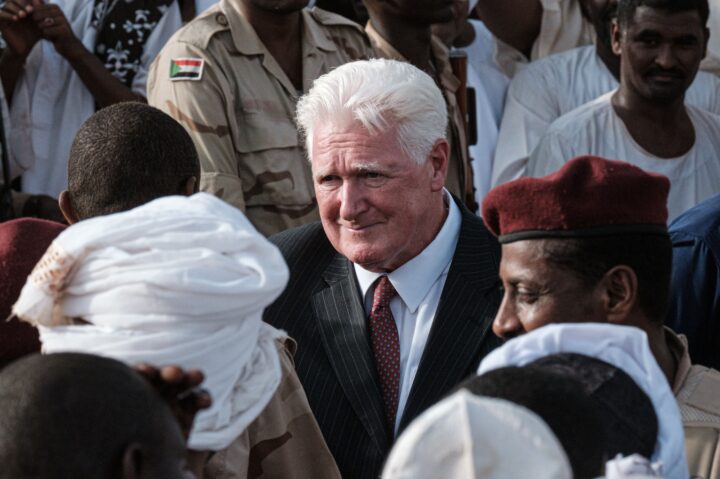
YASUYOSHI CHIBA/AFP via Getty Images
Former Rep. Jim Moran (D-VA) arrives to address a rally attended by supporters of Sudan's ruling Transitional Military Council (TMC) in the village of Abraq, about 60 kilometers northwest of Khartoum, on June 23, 2019.
During Jim Moran’s 24 years in Congress, the Virginia Democrat had a habit of putting his foot in his mouth, particularly when it came to his Jewish constituents.
In 2003, he blamed the Jewish community for President George W. Bush’s decision to invade Iraq, prompting several local rabbis to call for his resignation. Four years later he blamed AIPAC for the war. The blowback was so strong that when then-Sen. Barack Obama accepted Moran’s endorsement of his presidential campaign in 2008, he stated plainly that he disagreed with Moran’s views of the Jewish community.
Moran retired from Congress in 2015, but the 80-year-old still walks the halls of Capitol Hill. Now, he’s there as a lobbyist — primarily as a registered foreign agent lobbying on behalf of the government of Qatar.
He is a regular in the offices of high-ranking members of Congress and senators. And last month, during a House Education Committee hearing about antisemitism in higher education, Moran was conspicuously seated directly behind Robert M. Groves, the president of Georgetown University, which has a campus in Doha and has received more than $1 billion from the Gulf monarchy.
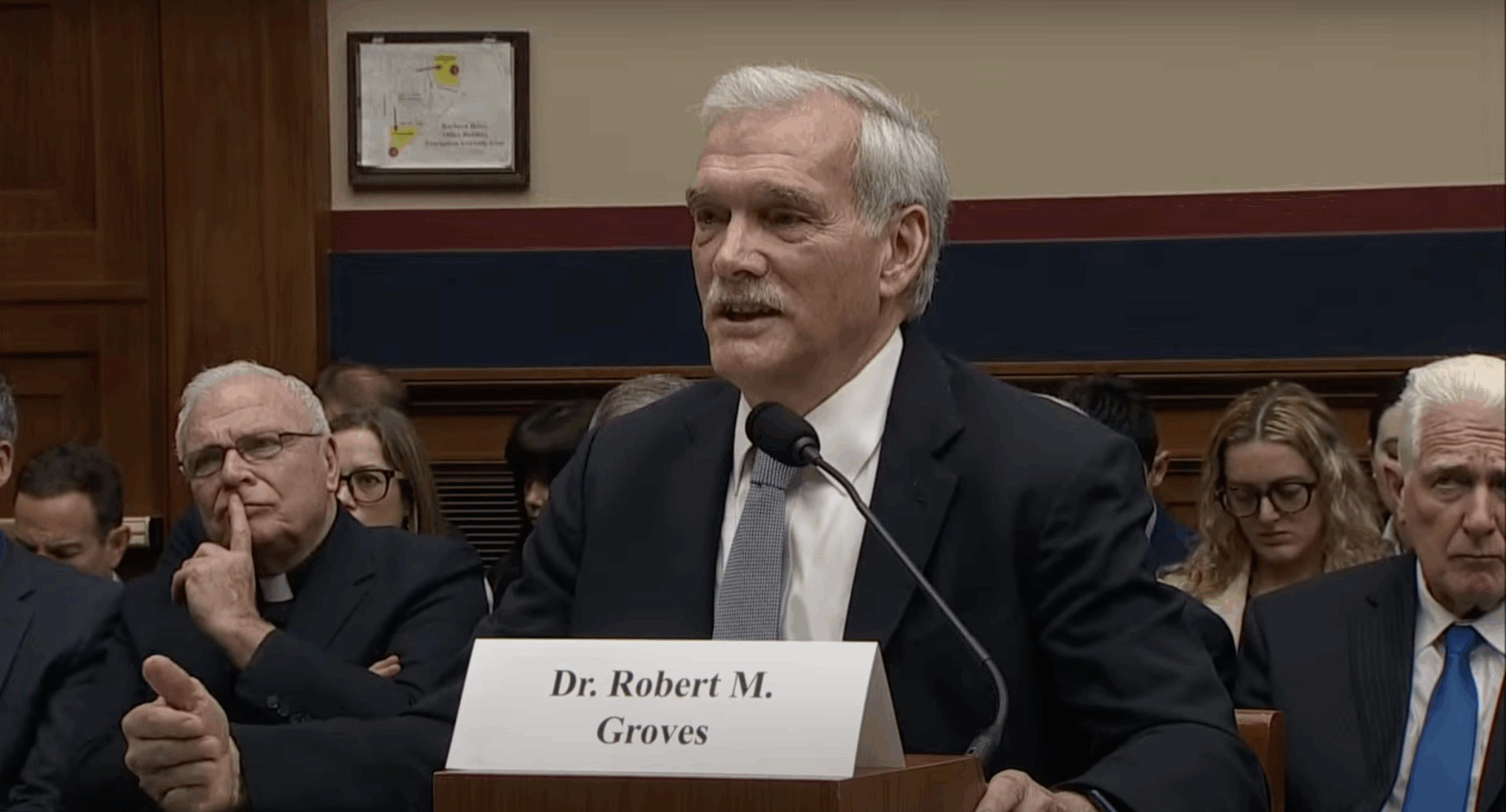
“Jim is one of these guys that people seem to like on both sides of the aisle. He’s been able to keep in contact with a lot of members when needed,” Tom Davis, a former Republican congressman from Virginia who Moran hired to help represent Qatar, told Jewish Insider.
A Georgetown source said Moran was not working with the university or sitting in one of Georgetown’s three allotted seats at the hearing. Still, there’s no doubt he is a highly influential foreign policy voice in Washington on behalf of a country with which America has a complicated relationship.
Qatar is a major non-NATO ally of the U.S., an official designation conferred by President Joe Biden, and is home to the largest U.S. military base in the Middle East. But it also has financial and diplomatic ties with Hamas and other terror groups. Qatar’s leaders say that is necessary so the country can maintain its role as a trusted mediator, while its critics say Qatar’s close relationship with Hamas makes it unlikely to put real pressure on the terror group to make a deal with Israel or to release the hostages. Some on Capitol Hill and in the pro-Israel community have expressed concerns that Qatar’s massive investment in American universities has fueled anti-Israel activism and antisemitism on campuses.
With a Boston accent leftover from his childhood, Moran has a penchant for talking tough — and acting tough, too. In the 1990s, at the start of his time in Congress, he occasionally threatened to brawl with fellow lawmakers, and once shoved another member of Congress off the House floor.
Moran was an early and consistent critic of Israel, long before the wave of anti-Israel sentiment that has exploded on the far left over the past two years. He has kept up ties with Jewish leaders in Northern Virginia, but those relationships grew strained as Moran repeatedly criticized pro-Israel advocates and Jewish activists.
“Jim is an extraordinarily compassionate man. He has trouble with suffering. His judgment about what constitutes suffering and who’s causing it is not always accurate, and so that has gotten him in a considerable amount of trouble over the course of his long political career,” said Rabbi Jack Moline, who served for 27 years as the rabbi at Agudas Achim Congregation in Alexandria. Moline met regularly with Moran until the rabbi called for Moran’s resignation in 2003, after Moran blamed Jews for the Iraq war, a comment the former congressman later said he “deeply regret[s].”
“His relationship with the Jewish community fell apart,” Moline told JI. “It didn’t surprise anybody when, after he finally did retire from Congress, he was offered and accepted work lobbying for Qatar.” He first registered as a lobbyist for Qatar in 2017. His firm, Moran Global Strategies, has been paid more than $2 million by Qatar in the last two years, according to data compiled by OpenSecrets. A spokesperson for the Qatari Embassy did not respond to a request for comment, nor did Moran Global Strategies.
Though Moran expressed contrition for his antisemitic remarks during the lead-up to the Iraq war, his rhetoric toward the Jewish community has only grown more inflammatory in the decade since he left Congress. In recent years, he has appeared on several virtual panel discussions held by the Arab Organization for Human Rights in the U.K., a London-based NGO led by Mohammad Jamil Hersh, a former Hamas activist who has been sanctioned by Israel and was deported by the country more than three decades ago. In those conversations, he regularly blasted the influence of American Jews and the “pro-Israel lobby.”
During a February 2023 AOHR event, Moran tried to explain Washington’s support for “apartheid” in Gaza by pointing the finger at American Jews and suggesting that they are unduly involved in the American political system.
“It’s about domestic politics and it always has been. The majority of people who contribute to the Democratic Party in America have Jewish surnames. Now think about that,” said Moran. He described them as people “whose principal reason for contributing to the political system in America has been the sine qua non of support for Israel, and unqualified support for Israel.”
In this and several other interviews, Moran recognized that his language was rather impolitic.
“I don’t want to sound antisemitic, and Palestinians are a Semitic people,” Moran said. “I’m just saying that let’s deal with the political reality in the United States that’s driving and reinforcing the injustice that’s occurring within Palestine.”
Moran and his team have held dozens of meetings with members of Congress since the Oct. 7 Hamas terror attacks in 2023 that spurred the ongoing war in Gaza, mainly to talk about “Qatar’s role in the Middle East peace process,” according to documents he filed with the Justice Department as required by the Foreign Agents Registration Act. At the same time, he has continued to question Jewish involvement in the American political system — including just days after Oct. 7, in a call hosted by the Muslim Public Affairs Council.
“The reality is that campaign contributions have corrupted the United States Congress. One of the motivating factors is, ‘How do I please my political supporters, particularly my financial supporters?’ The reality is that the Jewish community, and frankly to their credit, is deeply engaged in the American political process,” Moran said in the MPAC call. “That’s one of the motivating factors that causes the Congress to look the other way where the Middle East is concerned.”
Although he expressed skepticism about the supposed influence of American Jews in electoral politics, he encouraged Muslim, Palestinian and Arab Americans to increase their own influence. But his prognosis for their potential efficacy was grim. “I’m not sure they’re ever going to be able to successfully catch up,” Moran said.
Even as Moran took aim at Jews’ participation in the political process, he routinely downplayed accusations of antisemitism that have been lobbed at him directly and at the broader anti-Israel movement.
In September 2024, in another AOHR virtual briefing, Moran acknowledged that he would likely be called antisemitic for his comments accusing Israel of committing war crimes “daily” and for describing the situation in Gaza as “comparable to the Holocaust.”
“Foreign aid going into committing war crimes on a daily basis because of the politics, because of the campaign financing, because of the control of the media — it’s inexcusable. It’s an indictment of what has become of this democracy,” said Moran, without saying who, exactly, he thinks controls the media. “It’s an indictment of the fact that our foreign policy has been Israeli-centric, and let me say one other thing so that people don’t particularly accuse me of being antisemitic, although I’m sure many will: Many of those protests across the country were led by Jewish students.”
This spring, after President Donald Trump returned to office and began targeting universities, Moran was dispatched to Capitol Hill to talk to Democrats on the Senate Health, Education, Labor and Pensions Committee about Qatar’s funding of American higher education, which has come under the microscope.
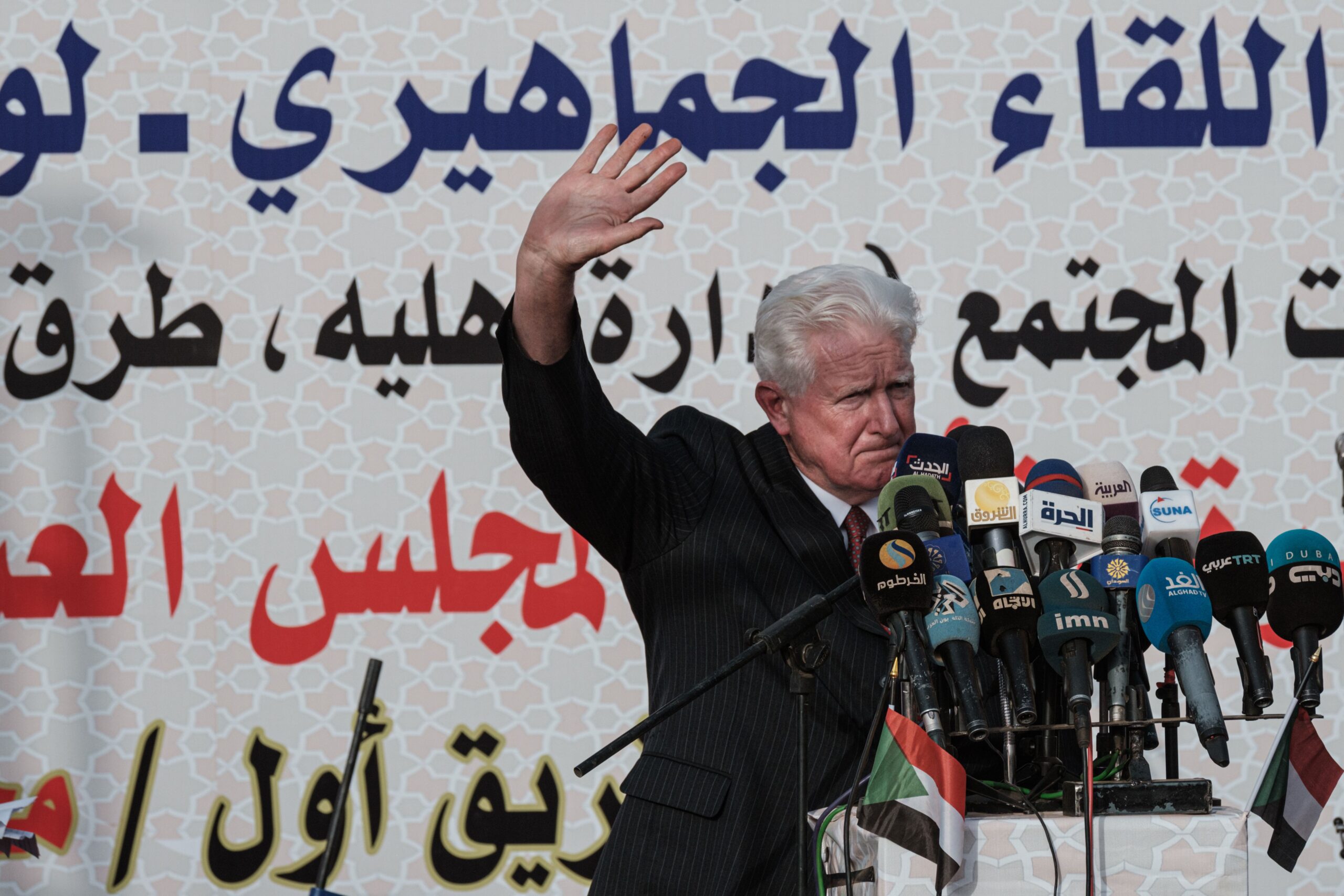
It is notable that one of the people tasked with advocating for a country that is close to both America and Hamas seems to have a deeply rooted hostility to Israel and even to American Jews, particularly at a moment when Qatar’s dealings in the U.S. are facing greater scrutiny — such as when Trump said earlier this year that the U.S. would accept a Qatari gift of a luxury jet to use as Air Force One.
But Qatar has a suite of lobbyists who span the political spectrum. Moran primarily deals with Democrats. Qatar has in the past also targeted hundreds of conservative “influencers” to reach Trump’s inner circle, and employs several Republicans as lobbyists. Partisan politics is at play, too; Democratic lawmakers blasted the Air Force One move, while Republicans fell in line behind Trump.
Several prominent Trump administration officials have ties to Qatar, including Attorney General Pam Bondi, who said in her January Senate confirmation hearing that she remains “very proud” of the lobbying work she did for Qatar ahead of the 2022 World Cup. Steve Witkoff, Trump’s Middle East envoy and chief negotiator, has a history of business dealings with the country.
“If you take a look at the folks they’ve got representing them, they’ve been all over the lot on that issue. It’s certainly not a pro-Arab versus Israel issue,” said Davis, the Virginia Republican who works with Moran on the Qatar file. “There’s nothing there to indicate that their lobbyists have any kind of ideological bent on that issue.”
Correction: This story has been corrected to reflect that Moran began lobbying for Qatar in 2017, not 2023.
The vocal pro-Israel Democrat said he has ‘no real relationship’ with the Israeli government

Al Drago-Pool/Getty Images
Rep. Ritchie Torres, a Democrat from New York, speaks at a House Financial Services Committee hearing on oversight of the Treasury Department and Federal Reserve coronavirus pandemic response on Capitol Hillon September 30, 2021 in Washington, DC.
Rep. Ritchie Torres (D-NY), a vocal Democratic supporter of Israel in Congress, said in an interview with journalist Chuck Todd on Sunday that Israeli Prime Minister Benjamin Netanyahu had done “irreparable damage” to Israel’s relationship with and support among Democrats, tracing the origin of the breach to Netanyahu’s public clashes with President Barack Obama.
“If you’re a Democrat, and if you’re a Democrat of color and if you’re a Black Democrat, you take immense pride in Barack Obama. He represents one of the greatest achievements in politics. We take great pride in his presidency,” Torres said. “To see a foreign leader visibly disrespect him in the manner that Bibi Netanyahu did, I feel did irreparable damage to the relationship with the Democratic Party.”
Asked by Todd how he would advise the Israeli government to repair its relationship with the party, Torres offered no suggestions, repeating that “it feels like the damage may be irreparable.” He added that support for the U.S.-Israel relationship is “eroding, and anyone who denies it is ignoring the numbers.”
(Torres subsequently told Jewish Insider that the “irreparable damage” was referring to “the relationship between Netanyahu and the Democratic Party, not the relationship between Israel and the Democratic Party.”)
Torres also said that he has “no real relationship” with the Israeli government, despite his support for the Jewish state, and said that his conversations are usually general and high-level, and do not yield “useful information.”
“I do not consider myself having a good relationship with the Israeli government,” Torres said.
He said Netanyahu should have been able to disagree with Obama, “but when you inject yourself into partisan politics and put your thumb on the scale in favor of one political party, that sets a dangerous precedent, and I believe that the consequences of geopolitical calculation continue to reverberate to this day.”
Netanyahu and Obama split publicly over the U.S.’s nuclear deal with Iran, and Netanyahu accepted an invitation from then-Speaker of the House John Boehner, a Republican, to address Congress to condemn the deal.
He said that the U.S.-Israel relationship requires bipartisanship and that “if you politicize it, you’re not a friend of the relationship, you’re an enemy.”
Torres said Netanyahu had “made a terrible mistake” and that there is a “legitimate perception that the present Israeli government is just aligned with the Republican Party.”
The Democratic congressman also called for an end to the war in Gaza, the release of hostages, increased humanitarian aid to Palestinians, new Palestinian governance in Gaza and efforts to build on the Abraham Accords, arguing that warnings from Israeli reporters about the deteriorating humanitarian situation in Gaza must be heeded.
He’s one of several pro-Israel Democrats who have grown more critical of the Israeli government’s handling of the humanitarian situation in Gaza in recent days. Additionally, some congressional Republicans have warned that Israel’s conduct is risking American support.
Torres argued that the impact of the war for Israel has been mixed — even as it has severely degraded Iran and its proxies and “emerged from Oct. 7 stronger and … reestablished deterrence,” it has lost significant support in the United States.
The New York congressman has also recently raised eyebrows with his defenses of Democratic New York City mayoral candidate Zohran Mamdani — though Torres has not endorsed Mamdani and said that Mamdani must address “real concerns” in the Jewish community.
Plus, Biden and Obama officials resist Iran rethink

Andrew Harnik/Getty Images
Rep. Thomas Massie (R-KY) speaks to reporters as he arrives for a House Republican caucus meeting at the U.S. Capitol on February 25, 2025 in Washington, DC.
Good Thursday morning.
In today’s Daily Kickoff, we spotlight Kentucky state Sen. Aaron Reed, who is considering a primary challenge to Rep. Thomas Massie, and report on interim Columbia President Claire Shipman’s apology to Jewish communal leaders over past comments calling for the removal of a Jewish trustee over her pro-Israel advocacy. We look at the race taking shape in Arizona’s 7th Congressional District, where Adelita Grijalva is polling above Daniel Hernandez ahead of the July 15 special election primary, and report on bipartisan legislation led by Reps. Josh Gottheimer and Mike Lawler that call for the U.S. to provide Israel with bunker-buster bombs and the planes to use them. Also in today’s Daily Kickoff: Rep. Ritchie Torres, Phil Rosenthal, Bar Winkler and Roey Lalazar.
Ed. note: The next Daily Kickoff will arrive on Monday, July 7. Enjoy the long holiday weekend!
What We’re Watching
- Israeli Prime Minister Benjamin Netanyahu heads to Washington on Sunday, ahead of his planned Monday meeting with President Donald Trump.
- We’ll be reporting on the details around the meeting and what’s at stake as the two leaders discuss Gaza, Iran, Syria and normalization efforts — sign up for Jewish Insider’s email and WhatsApp alerts to stay up to date with the latest developments over the long weekend.
- Former Israeli American hostage Edan Alexander is slated to meet Trump at the White House at 12:45 p.m. ET.
- The Nova Music Festival exhibition and the U.S. Holocaust Memorial Museum are hosting an event this afternoon with DJ and Nova festival survivor Noa Beer and Holocaust survivor Nat Shaffir.
What You Should Know
A QUICK WORD WITH JI’S GABBY DEUTCH
After Israel’s 12-day war with Iran, the U.S. is now demanding that Tehran return to the negotiating table.
“Told you so,” many prominent Democrats — including architects of Iran policy in both the Obama and Biden administrations — are saying in response, arguing they were right all along about the power of negotiations. But in doing so, they are also overlooking the impact of President Donald Trump’s military strikes against Iran’s nuclear facilities on the regime’s negotiating calculus.
The Pentagon is now saying the strikes set back the Iran nuclear program by two years. Lt.-Gen. Eyal Zamir, the IDF’s chief of staff, said that Iran is no longer a nuclear threshold state as a result of the U.S. and Israeli attacks.
But those assessments, among other similar analyses, have done little to change the minds of some of the leading Democratic foreign policy hands who have long argued for diplomacy above all else.
KENTUCKY CONTEST

Local and national Republicans are eyeing Kentucky state Sen. Aaron Reed as a potential primary challenger to Rep. Thomas Massie (R-KY), as President Donald Trump and his political allies mount an aggressive effort to unseat the incumbent lawmaker, Jewish Insider’s Marc Rod reports.
Dividing line: Middle East policy is emerging as a key divide between the first-term Reed and Massie: asked by the Louisville Courier Journal about any ideological differences between him and Massie, Reed offered a one-word answer: “Israel.” Reed’s Kentucky state Senate biography page lists him as a member of the Kentucky-Israel Caucus. While Massie was the most vocal Republican critic in Congress of the Trump administration’s decision to strike Iranian nuclear facilities, introducing a war powers resolution that aimed to stop U.S. military action against the Iranian regime, Reed has been openly supportive of the strikes.
TUCSON TUSSLE

The latest Democratic primary battle between the left and center where Israel has emerged as a point of division is playing out in a special House election in Tucson, Ariz., later this month, as five candidates vie to replace former longtime Rep. Raul Grijalva (D-AZ), who died in March. The July 15 primary in Arizona’s dependably blue 7th Congressional District has kept a relatively low profile, even as it features ideological tensions over Middle East policy that could hold implications for the party’s increasingly fractious approach to Israel in the lead-up to next year’s midterm elections. Adelita Grijalva, 54, a former Pima County supervisor, is viewed as the favorite to win the seat in what is expected to be a low-turnout race, owing in part to her significant name recognition in the area represented by her late father for over two decades, Jewish Insider’s Matthew Kassel reports.
She has also consolidated endorsements from top establishment Democrats, including Sens. Mark Kelly (D-AZ) and Ruben Gallego (D-AZ), while securing the backing of progressive leaders such as Reps. Alexandria Ocasio-Cortez (D-NY) and Sen. Bernie Sanders (I-VT), among other high-profile critics of Israel in Congress. But her limited record of commentary on Israel has raised questions among pro-Israel activists rallying behind one of Grijalva’s chief primary rivals, Daniel Hernandez, a former state lawmaker who identifies as a pro-Israel progressive and claims support from Rep. Ritchie Torres (D-NY) and the political arm of Democratic Majority for Israel.
BOWING OUT
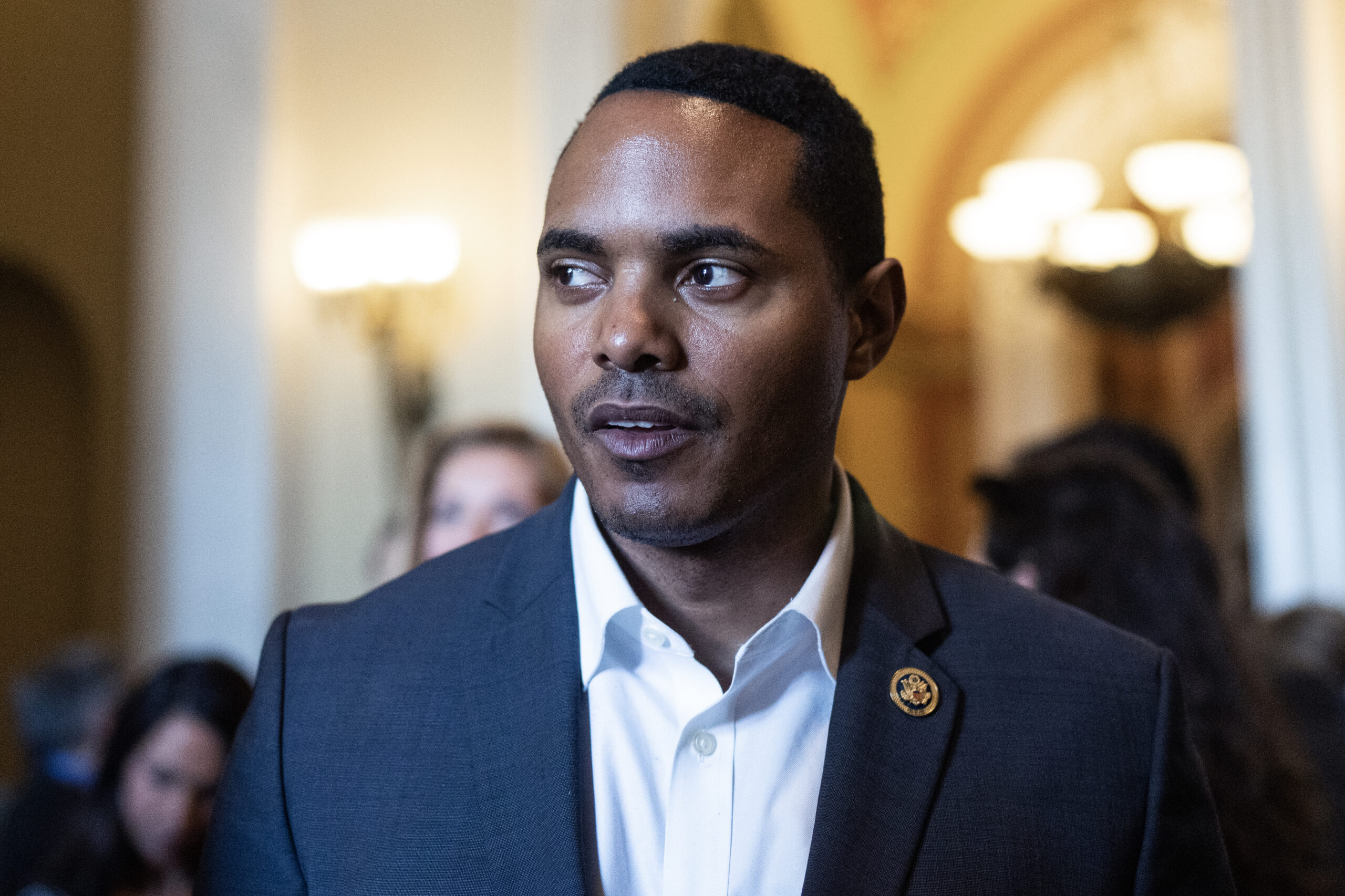
Rep. Ritchie Torres (D-NY), in a surprise reversal, said Wednesday that he’s unlikely to mount a primary challenge against New York Gov. Kathy Hochul, after months of circling a potential run for that office, Jewish Insider’s Marc Rod reports.
What he said: “I’m unlikely to run for governor. The assault that we’ve seen on the social safety in the Bronx is so unprecedented, so overwhelming that I’m going to keep my focus on Washington, D.C.,” Torres, a favorite of the Jewish community, said on MSNBC’s “Morning Joe.” “So, my heart lies in Washington, D.C. I feel like now, more than ever, we have to fight the catastrophe that is the Trump presidency.”
SCOOP

Claire Shipman, acting president of Columbia University, issued an apology to several members of the campus community for leaked text messages where she suggested that a Jewish trustee should be removed from the university’s board over her pro-Israel advocacy. “The things I said in a moment of frustration and stress were wrong. They do not reflect how I feel,” Shipman wrote on Wednesday in a private email obtained by Jewish Insider’s Haley Cohen, noting that she was addressing “some trusted groups of friends and colleagues, with whom I’ve talked regularly over the last few months.”
Individual and group apologies: “I have apologized directly to the person named in my texts, and I am apologizing now to you,” Shipman wrote in Wednesday’s email. “I have tremendous respect and appreciation for that board member, whose voice on behalf of Columbia’s Jewish community is critically important. I should not have written those things, and I am sorry. It was a moment of immense pressure, over a year and a half ago, as we navigated some deeply turbulent times. But that doesn’t change the fact that I made a mistake. I promise to do better.”
Hill weighs in: Rep. Elise Stefanik (R-NY) called on Shipman to resign, following JI’s report on Shipman’s apology.
HELPING HAND

A bipartisan group of House members reintroduced a bill on Wednesday to allow the president to provide Israel with bunker-buster bombs — the heavy ordnance used by the U.S. against Iran’s Fordow and Natanz nuclear facilities — and the planes needed to drop them, Jewish Insider’s Marc Rod reports.
Independent action: The bill is part of a long-standing effort led by Rep. Josh Gottheimer (D-NJ), one of its lead sponsors, to give the administration the option to provide Israel the capabilities to act independently against Iran’s most highly fortified nuclear facilities. The legislation’s sponsors argue that it remains relevant even in the aftermath of the U.S. strikes in the event Iran attempts to reconstitute its nuclear program. Transferring the systems — which are unique to the U.S. — to Israel has been seen by some experts as a way to ensure Israel has the ability to destroy underground nuclear sites in Iran while avoiding direct U.S. involvement in the conflict.
Damage assessment: The Pentagon’s chief spokesman said on Wednesday that the U.S. strikes against the Iranian nuclear program had set the program back by two years. His estimate appears to be the most specific information the Trump administration has shared on the extent of the damage caused by the strikes, Jewish Insider’s Jake Schlanger reports.
FIRST AID

“Resilience” has long been the goal of Israeli mental health practitioners, an emotional ruggedness allowing Israeli society to bounce back quickly after tragedy. This has been particularly true since the Oct. 7 terror attacks and the resulting wars that continue to claim the lives of soldiers and civilians, including the recent 12-day conflict with Iran, which killed 28 Israeli civilians and displaced thousands. The night after a ceasefire was declared, Israelis were seen back at the beach, and the following morning, schools reopened. However, mental health professionals warn that beneath this celebrated toughness lie deeper, troubling emotions — fear, guilt, shame, vulnerability, anger and anxiety — affecting all layers of society, eJewishPhilanthropy’s Judith Sudilovsky reports.
Busy lines: Mental health hotlines and clinics run by three of Israel’s top providers — ERAN, NATAL and ELEM, the latter of which supports at-risk youth — have reported sharp increases in demand since Oct. 7, 2023. Calls to ELEM’s digital programs have tripled; NATAL now treats over 3,000 people weekly, up from 350 before the war; and ERAN volunteers have handled over 500,000 calls since the outbreak of the war, averaging 1,200 to 1,500 a day. This surge reflects the complex emotional and psychological issues people are facing now, professor Rivka Tuval-Mashiach, steering committee chair of NATAL, told eJP, with call volumes related to anxiety issues significantly increasing to both of NATAL’s two dedicated hotlines — one for the general public and one for soldiers and veterans.
Read the full story here and sign up for eJewishPhilanthropy’s Your Daily Phil newsletter here.
Worthy Reads
Just the Beginning on Iran: In The New York Times, former National Security Advisor John Bolton suggests that the U.S.’ strikes on Iran last month are not the end of Washington’s efforts to degrade the threats posed by Iran. “Satisfying America’s legitimate demands requires Iran to do a full Libya, meaning real performance in denuclearizing, not just acquiescing to treaty verbiage. It requires that Iran surrender all of its weapons-related assets, meaning any enriched uranium and all remaining physical assets, including dual-use capabilities. However, absent a change of government in Tehran, which Washington should support, a full Libya is impossible. Unlike Muammar el-Qaddafi, the mullahs, already badly humiliated, realize that further humiliation would fatally weaken their rule. They will never voluntarily accept that fate. Instead, they will resume their earlier tactic of using negotiations to string the West along until memories dim and, as the old saying goes, ‘zeal for a deal’ takes over, as it did for Barack Obama, producing the fatally flawed 2015 Iran agreement.” [NYTimes]
Mideast Magical Thinking: In The Wall Street Journal, presidential historian and former White House aide Tevi Troy examines the history of Middle East regimes falsely claiming victory over Israel, following claims by Iranian Supreme Leader Ayatollah Ali Khamenei that Israel had been “practically knocked out and crushed” by Iran’s military. “These false statements by Middle Eastern autocracies show the weaknesses of systems that can’t acknowledge reality. An inability to turn a critical eye on oneself and admit a mistake represents a fundamental flaw in authoritarian regimes. … As long as autocratic nations like Iran continue to act like Monty Python’s Black Knight, they’ll never develop the capacity to fight effectively against nations that can critique themselves. But that isn’t all that truth telling can bring. If Iran ever does develop the capacity for honesty, then its leaders would realize — like the Egyptians did — that peace with Israel is a much more effective strategy than fighting with it.” [WSJ]
Word on the Street
Secretary of State Marco Rubio spoke on Wednesday with Saudi Foreign Minister Prince Faisal bin Farhan Al Saud…
In The Wall Street Journal, Rep. Tom Suozzi (D-NY), who last week withheld his support from New York City Democratic mayoral nominee Zohran Mamdani, suggests that the Queens assemblyman’s victory should be a “wake-up call” to Democrats and posits that Mamdani won the primary “because too many voters think the rest of the Democratic Party no longer stands for them”…
In the New York Daily News, political strategist Bradley Tusk posits that Mamdani is likely to win the general election in November, owing to the “ceiling” facing any Republican candidate and Mayor Eric Adams’ own unfavorability ratings in the city as he mounts an independent bid…
Pershing Square CEO Bill Ackman called on former New York Gov. Andrew Cuomo to withdraw from the mayoral race following his primary loss to Mamdani, assessing that Cuomo’s “body language, his subdued energy and his proposals to beat Mamdani” indicated he was “not up for the fight” and suggested Cuomo’s departure from the race would be necessary “to maximize Adams’ probability of success”…
The Department of Education’s Office for Civil Rights launched an investigation into George Mason University’s handling of antisemitism issues, Jewish Insider’s Haley Cohen reports; the Virginia university had faced scrutiny over its response to a series of incidents involving students, including the discovery of pro-terrorism materials in the home of two of GMU students and federal charges brought against a third student accused of plotting a mass causality attack…
eJewishPhilanthropy‘s Judah Ari Gross interviews Mike and Shelly Pitman, respectively the president and executive director of the Brooklyn-based La’Aretz Foundation, which has raised $1 million to provide $2,500 directly to 500 Bat Yam families affected by Iran’s ballistic missile strike on the city…
Bar Winkler and Roey Lalazar’s Israel-based AI startup Wonderful raised $34 million in its latest round of funding…
The New York Times spotlights “Everybody Loves Raymond” creator Phil Rosenthal, following the release of the eighth season of his travel food show “Somebody Feed Phil”…
Smithsonian Magazine looks at the resurgence in popularity of Jewish food in Poland…
Iran charged two French nationals who have been imprisoned in the country for three years with spying for Israel and conspiring to overthrow the Iranian government…
Australia confirmed it canceled the visa of artist Ye, formerly known as Kanye West, following the May release of a song titled “Heil Hitler”…
Punk-rap duo Bob Vylan was removed from the lineups of upcoming music festivals in France and the U.K. following an uproar over an incident at the Glastonbury music festival last month in which the group led attendees in a chant calling for “death to the IDF”…
U.K. Parliament members voted overwhelmingly in favor of banning the activist group Palestine Action, after two members of the group broke into a British air base and vandalized military aircraft…
Iranian President Masoud Pezeshkian approved a law passed days ago by the country’s parliament to suspend coordination with the International Atomic Energy Agency and ordered Iran’s Atomic Energy Organization, Supreme National Security Council and Ministry of Foreign Affairs to begin implementation of the new law…
The New York Times looks at Iran’s history of recruiting common criminals and cartel members to carry out attacks on American soil…
Hamas called on the leader of a Bedouin clan that has challenged Hamas’ leadership in the enclave to surrender, as Israel bolsters its support for groups operating on the Palestinian Authority’s payroll against Hamas…
Adam Szubin is joining Covington as of counsel in the firm’s national security practice (h/t Playbook)…
Pic of the Day

Birthdays

Movie, television and stage actress, director and writer, Shoshannah Stern turns 45…
Civil rights attorney known for many high-profile cases, born Gloria Rachel Bloom, Gloria Allred turns 84… Winner of the Israel Prize in 1998, professor emeritus of mathematics at both Hebrew U and Rutgers, Saharon Shelah turns 80… Founder of an eponymous charitable foundation and a political office, Barbara Fish Lee turns 80… Retired director of the March of the Living in Miami-Dade and in Boca Raton, Leon Weissberg… Psychologist and board member of many non-profit organizations, Dr. Gail (Giti) Bendheim… Israeli celebrity chef, author of 32 cookbooks and culinary columnist for Yedioth Ahronoth, Yisrael Aharoni turns 75… Head of pediatric oncology and associate professor of pediatrics at the Cohen Children’s Medical Center in New York, Dr. Carolyn Fein Levy turns 57… Musician, best known as a harmonicist, Annie Raines turns 56… Actor who has appeared in film and television in the U.S., U.K. and Israel, Yair “Jonah” Lotan turns 52… Development professional Suzanne Greene… Pini Herman…
Peter Orszag, now the CEO of Lazard, urged party leadership to do more to confront growing extremism from within

SAUL LOEB/AFP via Getty Images
Peter Orszag (L), director of the Office of Management and Budget (OMB), attends a meeting with President Barack Obama (R) at the White House on June 29, 2010.
Former Obama administration OMB Director Peter Orszag, the CEO of Lazard, sounded an alarm Thursday morning over the leftward direction of the Democratic Party, especially when it comes to its handling of antisemitism.
He spoke out on CNBC after far-left state Assemblyman Zohran Mamdani won the Democratic nomination for New York City mayor.
“I’m saddened to say the Democratic Party is becoming increasingly antisemitic and anti-capitalism… Turning away from your principles and towards antisemitism never works,” Orszag said on CNBC’s “Money Movers” this afternoon.
He went on: “The Democratic candidate for mayor has embraced the global intifada idea. The DCCC has distributed fundraising emails from a senior Democratic operative [James Carville] saying Jewish donors [are] only interested in tax cuts. The senior leadership in the party seems to have cognitive dissonance on Israel. It’s problematic.”
Orszag has been a major figure in the Democratic Party for years, most prominently serving in the Obama administration as director of the Office of Management and Budget.
As antisemitism increases, he said that he had expressed these concerns to Democratic leadership, including House Minority Leader Hakeem Jeffries (D-NY) and Senate Minority Leader Chuck Schumer (D-NY), who has faced his own challenges navigating the ideologically divisive New York City mayoral race.
“I think the New York mayoral race is only part of the broader question. I think the Democratic Party needs to decide what it stands for,” Orszag said. “It needs to decide what its moral principles are and that includes [regarding] antisemitism.”
When asked about how Lazard would respond to a Mamdani mayorship, he said the bar for the company leaving was “very high” and would depend on what policies are implemented.
Harris national security adviser Phil Gordon: ‘I would have found it too risky to initiate military force with all that that could unleash’

JIM WATSON/AFP via Getty Images
Vice President Kamala Harris speaks with Phil Gordon during a meeting with Caribbean leaders in Los Angeles, California, June 9, 2022.
Among the more surprising cheerleaders for President Donald Trump’s diplomacy with Iran were several progressive foreign policy analysts who had advised former President Barack Obama and former Vice President Kamala Harris.
Now, many of those same voices — including Phil Gordon, Harris’ national security advisor who would likely have stayed in the role if she had been elected president last year — are expressing skepticism about Israel’s preemptive strikes on Iranian military and nuclear sites, and urging Trump to pressure Israeli Prime Minister Benjamin Netanyahu to cool it.
“I would have found it too risky to initiate military force with all that that could unleash,” Gordon told Jewish Insider on Friday. His approach would have been “to try to get an enduring, diplomatically-negotiated nuclear arrangement that prevented Iran from being able to get a nuclear weapon.”
If he were advising Harris, or another Democratic president, Gordon would’ve wanted “to try to get that accomplished without having used this military action,” he said.
Gordon also argued that Trump was manipulated into supporting Israel’s strikes by Netanyahu, even as Trump celebrated Israel’s killing of Iranian hardliners, noting that several of Trump’s senior advisors have urged restraint rather than intervention.
“His supporters did not put him in place to get involved in the conflict in the Middle East,” Gordon said. “A lot of his advisors … served in Iraq or are against U.S. military interventions in the Middle East. We know where Vance is in terms of intervention. The Tucker Carlson view, Don Jr. I think Trump really wanted to avoid military conflict and negotiate a deal and be the guy who got a better deal than Obama.”
Ilan Goldenberg, who served as an Iran advisor at the Pentagon in the Obama administration and who advised Harris on Middle East issues during her 2024 campaign, told JI that Trump should try to encourage parties in the region to tone it down.
“I think the appropriate position for the United States to be in now is the role of de-escalator,” said Goldenberg, now the senior vice president and chief policy officer at J Street. “The better option, the less risky option that had more good outcomes, was the diplomatic option. Unfortunately, it’s not the way it went. So now we have to see.”
J Street released a statement on Friday calling for an end to the “cycle of retaliation and escalation,” and for a return to diplomacy between the U.S. and Iran.
Both Gordon and Goldenberg questioned Israel’s end game in the strikes, which killed several senior Iranian military leaders and destroyed an above-ground uranium enrichment site at Natanz.
“It definitely has set back the timetable for Iran’s nuclear capacity, but it hasn’t eliminated it, and we also don’t know what happens in terms of retaliation. We’d like to think and hope that Iran has been deterred and won’t respond in a way that we can’t handle,” Gordon said. “So far, so good, but we’re only on the first day, so there were real risks of doing it this way. And that’s why I would have sought, if at all possible, to do it a different way.”
Goldenberg, who said the most important next step in stopping the violence is for the U.S. to help Israel defend against Iran’s retaliation, said he is unsure whether the Israeli success will turn into a long-term victory.
“The Israelis are incredibly good operationally, but they have challenges sometimes translating that into a strategic kind of sustainable victory, as opposed to just continuing to fight,” said Goldenberg. “What’s the end state here? What are you trying to do? Or is the objective to just be in constant conflict?”
Still, even as they said a return to diplomacy is the best way to move forward, both Gordon and Goldenberg acknowledged that Israel’s Friday attack on Iran had so far gone well for Israel.
“It is a remarkable display of Israeli military and intelligence capabilities,” said Gordon.
“I think in the immediate [term], it had a lot of success. Very impressive operationally,” Goldenberg noted.
Trump said in Truth Social posts on Friday that Iran could have a “second chance” at a deal, and that they should return to the negotiating table “before there is nothing left.”
Goldenberg agrees — and he thinks Israel needs to hear from Trump that they can’t attack Iran forever.
“Make clear to the Iranians that there’s still a deal on the table. We’re willing to negotiate,” Goldenberg said. “And at the same time, make clear to the Israelis, there are limits to this. We can’t see this get out of control.”
Plus, Risch's pessimism on Iran deal

John Lamparski/Getty Images for Concordia Summit
Morgan Ortagus speaks onstage during 2024 Concordia Annual Summit at Sheraton New York Times Square on September 25, 2024 in New York City.
Good Thursday morning.
In today’s Daily Kickoff, we report on the departure of deputy Middle East envoy Morgan Ortagus from her role reporting to Middle East envoy Steve Witkoff, and cover Sen. Jim Risch’s pessimism toward a potential new nuclear deal with Iran. We also report on the Trump administration’s tapping of Defense Priorities alum Justin Overbaugh for a senior Pentagon role, and scoop a major Jewish communal endorsement for former New York Gov. Andrew Cuomo ahead of New York City’s upcoming Democratic mayoral primary. Also in today’s Daily Kickoff: Jason Isaacman, Rep. Elise Stefanik and Judith Weinstein-Haggai and Gad Haggai.
What We’re Watching
- German Chancellor Friedrich Merz is meeting with President Donald Trump today at the White House.
- Reps. Debbie Wasserman Schultz (D-FL) and Randy Fine (R-FL) are speaking at a Sephardic Heritage International DC event this evening on Capitol Hill commemorating the anniversary of the Farhud pogrom that took place in Iraq in 1941.
What You Should Know
A QUICK WORD WITH ji’s MATThEW KASSEL
With just under three weeks until New York City’s mayoral primary on June 24, former Gov. Andrew Cuomo is slowly but surely securing commitments from a range of key leaders in the Orthodox Jewish community, a large and politically influential voting base whose widespread support is seen as crucial to his pathway to the Democratic nomination.
In the coming days, Cuomo is expected to garner endorsements from several prominent Orthodox leaders in Brooklyn and Queens, including major Hasidic sects in Borough Park and Williamsburg that can traditionally turn out thousands of votes, according to people familiar with the situation who spoke on condition of anonymity to address private plans.
But as most top Orthodox leaders have not historically taken sides until relatively late in the primary season, some Jewish community activists are voicing anxiety about their continued delay in publicly backing Cuomo — as he increasingly faces competition to his far left from Zohran Mamdani, a Queens state assemblyman whose fierce opposition to Israel has drawn mounting accusations of fueling antisemitism.
“Now that the race has been essentially a two-man race for the past few months, what are they waiting for?” one Jewish leader, granted anonymity to speak candidly, told Jewish Insider. “Are they considering Mamdani?”
ORTAGUS OUT

Morgan Ortagus, a key member of Middle East envoy Steve Witkoff’s team, is departing his office, Jewish Insider’s Gabby Deutch and Emily Jacobs have learned. Ortagus, the deputy special envoy, has been removed from her portfolio in the special envoy’s office, two sources familiar with the matter confirmed to JI. Ortagus had been overseeing the Trump administration’s Lebanon policy and had wanted to take over the Syria file, but was unsuccessful in doing so.
Context: Ortagus’ departure comes less than two weeks after Witkoff and Secretary of State Marco Rubio oversaw a widespread purge of officials at the NSC, including those overseeing the Middle East and Israel and Iran portfolios. This followed Trump’s decision to pull former National Security Advisor Mike Waltz, another Iran hawk in the administration, from his role and instead nominate him to be his ambassador to the United Nations.
DEFENSE DYNAMICS

Justin Overbaugh is on track to be the latest affiliate of the Koch-backed Defense Priorities think tank to be placed in a top post at the Defense Department, approaching confirmation as the deputy under secretary of defense for intelligence and security, Jewish Insider’s Marc Rod reports.
About the nominee: Overbaugh lacks the extensive public record of other Defense Priorities alumni in the administration — who have called for the U.S. to curtail its role in the Middle East — and his nomination has attracted little public attention or controversy. “I believe that we do not have the resources to cover all threats simultaneously, therefore we must be deliberate and discerning about the capabilities we pursue to defend our Nation and deter, or if necessary, defeat, our adversaries,” Overbaugh said in written testimony to the Senate Armed Services Committee.
Nomination reservations: Multiple Senate Republicans on the Senate Judiciary Committee said Wednesday that they plan to scrutinize President Donald Trump’s nomination of Paul Ingrassia, a far-right figure picked last week to lead the Office of Special Counsel, charged with fighting corruption and fighting federal whistleblowers, Jewish Insider’s Marc Rod and Emily Jacobs report.
Risch’s reservations
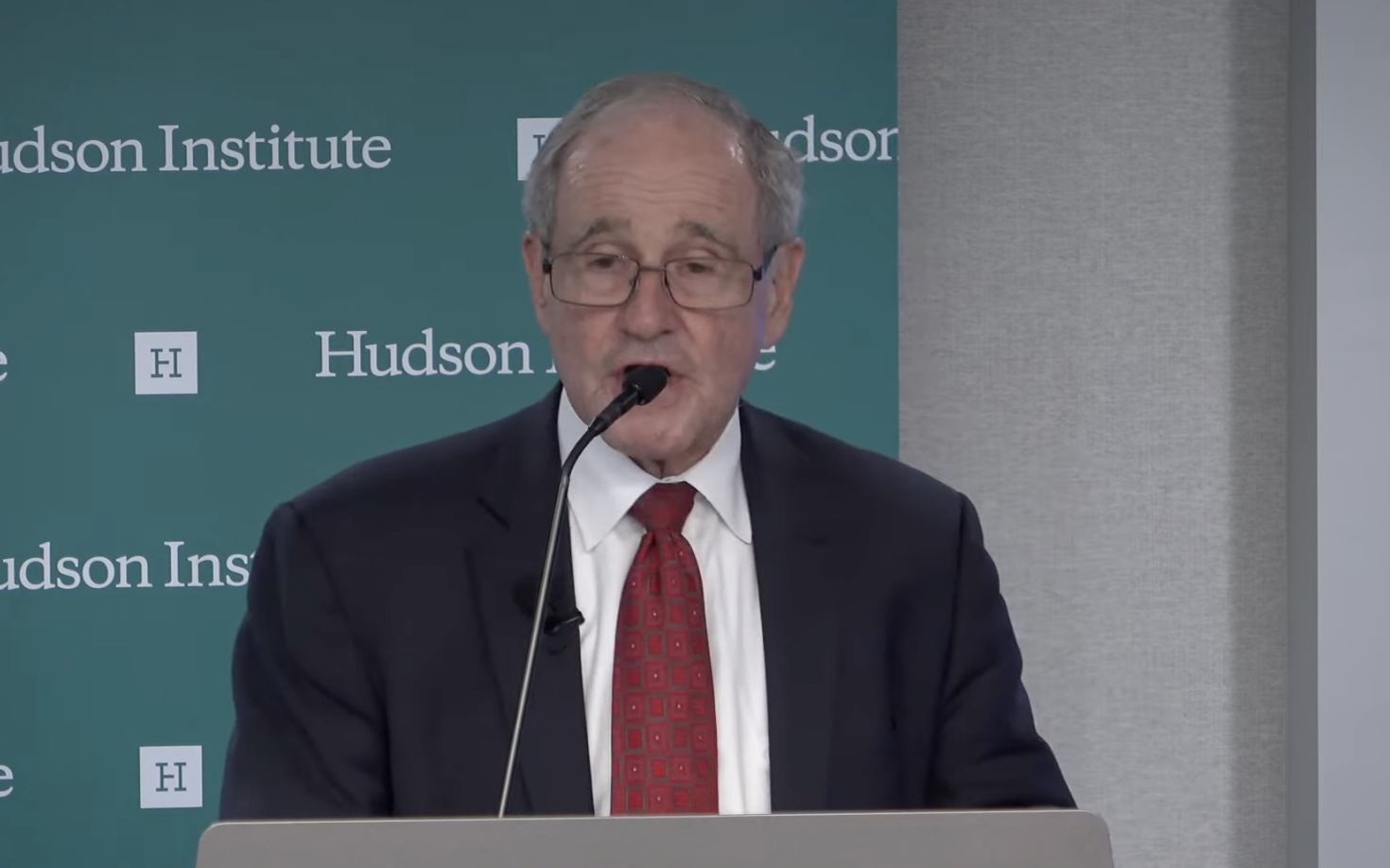
Sen. Jim Risch (R-ID), the top Republican on the Senate Foreign Relations Committee, said on Wednesday in remarks at the Hudson Institute that he is “not particularly optimistic” that a deal with Iran that stops it from enriching uranium can be reached, Jewish Insider’s Marc Rod reports.
Israeli threat: Risch added that if Iran does not agree to a deal, “Israel is going to do something about that.” “I’ve sat across the table from [Israeli Prime Minister Benjamin] Netanyahu, I don’t know how many times, and he has looked me in the eye and said, ‘Iran will not have a nuclear weapon,’” the top Senate Republican said. “And you know what? I believe him, and I think that’s a case for the United States to be in the exact same position.”
ACCREDIATION ESCALATION

The Trump administration’s battle with higher education escalated on Wednesday with the announcement that Columbia University is at risk of losing accreditation for violation of the Title VI of the Civil Rights Act of 1964, Jewish Insider’s Haley Cohen reports.
What is said: The U.S. Department of Education’s Office for Civil Rights and the Department of Health and Human Services’ Office for Civil Rights “determined that Columbia University acted with deliberate indifference towards the harassment of Jewish students, thereby violating Title VI,” the Education Department said in a statement, noting that the Ivy League institution “no longer appears to meet the Commission’s [sic] accreditation standards.”
SCOOP

An influential coalition of Orthodox Jewish leaders in Far Rockaway, Queens, is endorsing former Gov. Andrew Cuomo for mayor of New York City, Jewish Insider’s Matthew Kassel has learned, the first official demonstration of support from a major Orthodox group in the race. In a lengthy statement first shared with JI on Wednesday night, leaders of the Far Rockaway Jewish Alliance wrote that the “Jewish community in New York — particularly the frum community — faces a political crisis of historic proportions,” and urged voters to move past their lingering resentment over Cuomo’s COVID policies, which community members recall as discriminatory.
Now and then: “We still feel the pain of the unfair red zones imposed by Cuomo in 2020, which targeted our communities and restricted our way of life with heavy-handed measures,” the leaders acknowledged. “That wound lingers, a reminder of how quickly our freedoms can be curtailed. Yet, despite this pain, we must look forward and consider our future as Jews in New York City, where new threats loom larger than past grievances.”
Elsewhere in Gotham: Rep. Alexandria Ocasio-Cortez (D-NY) endorsed New York Assemblyman Zohran Mamdani in the city’s Democratic mayoral primary.
COALITION CHAOS
Haredi leaders threaten to bring down Israeli government as effort to revive draft exemptions stalls

Israeli Prime Minister Benjamin Netanyahu’s governing coalition was thrown into disarray on Wednesday night after the spiritual leaders of Haredi factions threatened to bring about an early election if penalties for yeshiva students avoiding military service are not canceled, Jewish Insider’s Lahav Harkov reports.
From bad to worse: The leading rabbis of Agudat Yisrael, the Hasidic party of United Torah Judaism, told party leader Yitzchak Goldknopf on Tuesday to move forward with a vote next week on a bill to dissolve the Knesset, prompting an election, because Netanyahu did not keep a promise to pass a bill exempting young Haredi men from military service by Shavuot, a holiday that was observed on Monday in Israel. On Wednesday morning, the other part of United Torah Judaism, Degel Hatorah, received a similar directive from the senior rabbis of the “Litvak” non-Hasidic Haredi community, Dov Lando and New York native Moshe Hillel Hirsch. Still, Netanyahu’s 68-seat coalition would retain a narrow majority in the Knesset even if he lost those Haredi parties’ seven seats. The political threat became more acute on Wednesday evening, when Sephardic Haredi party Shas, which has 11 seats in the Knesset, supported UTJ’s move to call an election. Israeli media reported that Shas’ spiritual leader Rabbi Yitzhak Yosef told the party’s lead negotiator, former minister Ariel Atias, to tell Netanyahu that he will not have a government if agreements are not reached with the Haredi parties.
Worthy Reads
Full-Court Press: In the Baltimore Sun, former Maryland Gov. Larry Hogan calls for “moral clarity” in the face of rising antisemitism in the U.S. “When innocent people are attacked for their faith or identity, neutrality is not courage. It is cowardice. People are hungry for real leadership. Not performative outrage. Not partisan talking points. Real leadership, rooted in principle and courage. That is what communities expect from their elected officials, civic organizations, media institutions and universities. They want to know that when a synagogue is firebombed or a Jewish student is harassed, someone will speak up. When extremists target a faith community, there should not be silence or spin. There must be action.” [BaltSun]
Choppy Waters: The Wall Street Journal’s Stephen Kalin and Shelby Holliday look at how the maritime warfare perpetuated by the Iran-backed Houthis in Yemen has reshaped the U.S. response to threats in the region. “Officials are now dissecting how a scrappy adversary was able to test the world’s most capable surface fleet. The Houthis proved to be a surprisingly difficult foe, engaging the Navy in its fiercest battles since World War II despite fighting from primitive quarters and caves in one of the world’s poorest countries. The Houthis benefited from the proliferation of cheap missile and drone technology from Iran. They fired antiship ballistic missiles, the first-ever combat use of the Cold War-era weapon, and they innovated how they deployed their weaponry. The latest technologies have transformed maritime warfare, much the way they have rewritten the script for land wars in Ukraine — forcing militaries to adapt in real time.” [WSJ]
The Show Must Go On: The Washington Post’s Marc Fisher reflects on his recent visit to a new LGBTQ exhibition at the Capital Jewish Museum, which opened on the same day the museum reopened following an attack the week prior in which two Israeli Embassy officials were killed. “Jewish museums chronicle the centuries-long tension among Jews between insisting on belonging to the culture where they live and accepting the outsider status foisted upon them by dominant forces in their society. … The exhibit confronts contradictions, which are at the heart of Judaism. People like the shooter cannot bear such nuance; to them, it somehow makes sense to take out one’s wrath toward Israel against a Jewish American institution — one that barely mentions Israel. The museum, like all good encounters with history, cherishes clashes between past and present, but the shooter can only see the binary: us and them.” [WashPost]
Word on the Street
President Donald Trump announced last night that citizens of 12 countries will be barred entry to the United States, while citizens of seven other countries will face restrictions. The planned executive order was scooped yesterday by Jewish Insider’s Gabby Deutch…
Jason Isaacman, an ally of Elon Musk who had been the Trump administration’s pick to head NASA until his nomination was pulled last month, reportedly told associates that he believes that Musk’s departure from the White House gave the administration an opportunity to rescind the nomination; White House officials said the nod was pulled over Isaacman’s past donations to Democrats, which Isaacman disputed, saying the White House was aware of the donations…
Former White House Press Secretary Karine Jean-Pierre will release a book later this year about her time in the Biden administration and departure from the Democratic Party…
Rep. Elise Stefanik (R-NY) launched the Save New York PAC to boost GOP candidates running in local races across the state…
Reps. Pramila Jayapal (D-WA), Jamie Raskin (D-MD), Bill Keating (D-MA), Valerie Foushee (D-NC) and Becca Balint (D-VT) are leading more than 90 Democrats on a resolution calling on the administration to “urgently use all diplomatic tools” to increase humanitarian aid into Gaza, as well as release the hostages and end the war in Gaza; Sen. Peter Welch (D-VT) is leading similar legislation in the Senate with the support of nearly all Democrats…
A group of lawmakers from more than 30 countries came together on Wednesday to discuss ways that the Abraham Accords can be leveraged to address energy security issues in the Middle East, the Caspian Sea Basin and the Eastern Mediterranean, Jewish Insider’s Marc Rod has learned…
Reps. August Pfluger (R-TX) and Randy Fine (R-FL) introduced a resolution condemning the antisemitic attack on a hostage awareness march in Boulder, Colo., and calling for congressional action “to secure the border and deport migrants who overstay their visas”…
The U.S. vetoed a U.N. Security Council resolution that called for a ceasefire in the Israel-Hamas war without conditioning a ceasefire on the release of the remaining hostages; the other 14 members of the council voted in favor…
The IDF found and returned the bodies of U.S.-Israeli citizens Judith Weinstein-Haggai and Gad Haggai, who were killed in the Oct. 7, 2023, Hamas-led attacks, Jewish Insider’s Lahav Harkov reports…
The Wall Street Journal interviews victims and witnesses of the terror attack on marchers at a Boulder, Colo., walk on Sunday to call attention to the plight of the hostages in Gaza…
A federal judge issued an order barring the deportation of the wife and children of the Egyptian national accused of attacking the Boulder hostage march…
Germany’s Federal Research and Information Point for Antisemitism said that antisemitic incidents in the country had nearly doubled between 2023 and 2024, finding 8,627 incidents of violence, vandalism and threats targeting Jews last year…
The Gaza Humanitarian Foundation suspended operations for a second day, as both the foundation and Israeli officials address safety concerns tied to a series of deadly incidents near distribution sites in recent days…
Israeli officials said the country exported a record $14.8 billion in weapons in 2024, an increase of $1.8 billion from the year prior…
Stu Sandler is joining the office of Sen. Rick Scott (R-FL) as chief of staff; Sandler was previously the deputy director of the Republican Jewish Coalition…
Aaron Bandler is joining the Jewish News Syndicate as U.S. national reporter, based out of Los Angeles…
Pic of the Day
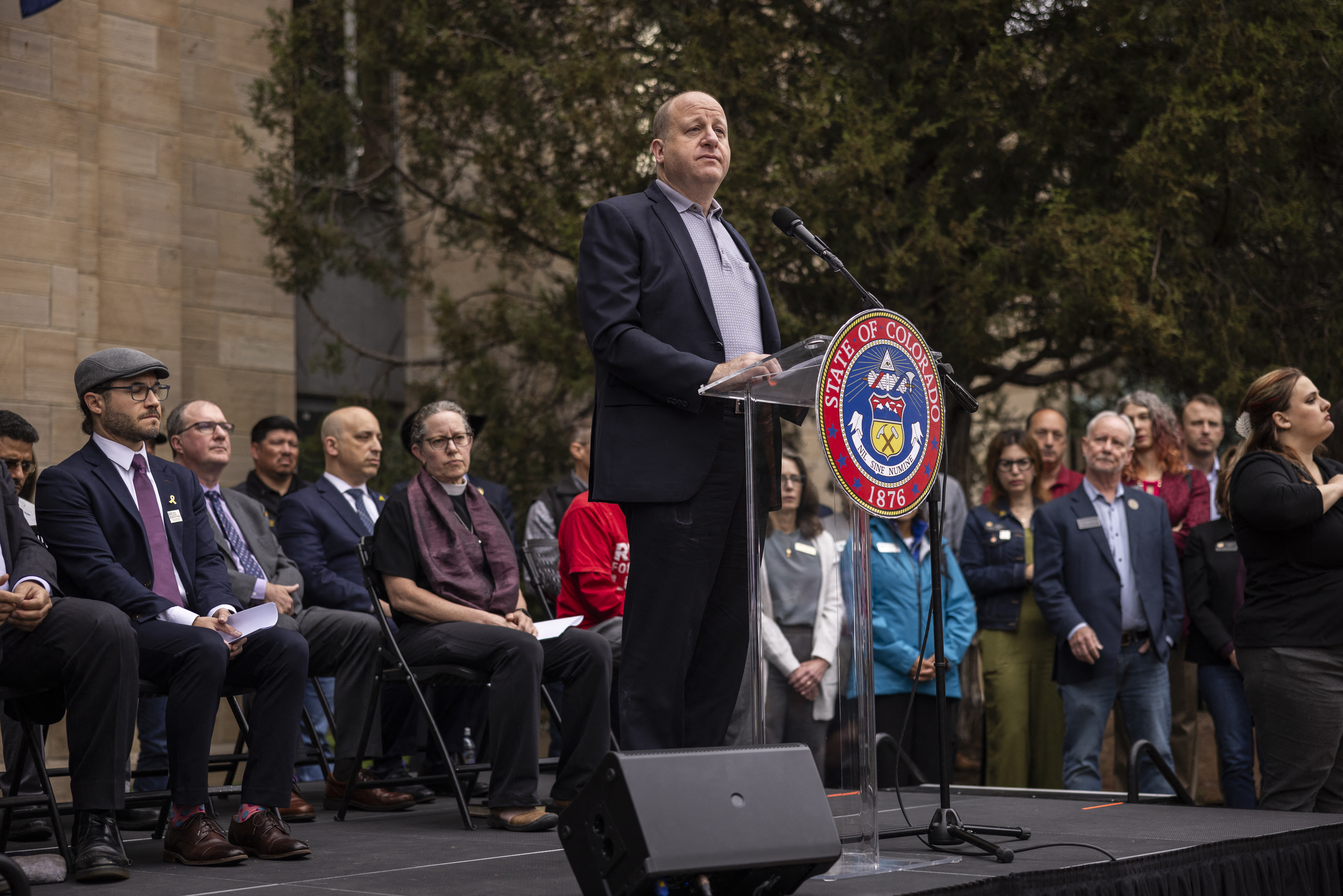
Birthdays

Actor, voice actor, comedian, writer and producer, Nicholas Kroll turns 47…
Lithuanian-born Holocaust survivor, co-founder of the Virginia Holocaust Museum in Richmond, Va., known for his ever-present cowboy hat, Jay M. Ipson turns 90… Training director and broker associate of the Santa Monica, Berkshire Hathaway Home Services branch, Saul Bubis… Owner of the NFL’s New England Patriots, Robert Kraft turns 84… The first woman to serve as international president of the United Synagogue of Conservative Judaism, Judy Yudof turns 81… Senior project manager in the AI field, Dan Yurman… Israeli politician, diplomat and businessperson, he served as consul general of Israel in Philadelphia from 1988 to 1992, Israel Peleg turns 76… VP of new business development at Maresco & Partners, Linda Greenfield… Author of 11 personal finance books, financial advisor, motivational speaker and television host, Susan Lynn “Suze” Orman turns 74… Staff member at Burbank Temple Emanu El, Audrey Freedman-Habush… Portrait photographer and visual anthropologist, she is the author of The Jews of Wyoming: Fringe of the Diaspora, Penny Diane Wolin turns 72… Former commissioner on the U.S. International Trade Commission, now a consultant, Dean A. Pinkert turns 69… Best-selling instrumental musician, the saxophonist “Kenny G,” Kenneth Bruce Gorelick turns 69… Columnist for the New York Post, Andrea Peyser turns 66… Senior associate general counsel at Compass real estate, Sam Kraemer… EVP and managing director at DC’s Burson Cohn & Wolfe (BCW), Michael Heimowitz… Member of the Ontario Provincial Parliament for eight years until 2022, Gila Deborah Martow turns 64… VP of government affairs at Invenergy, Mark S. Weprin turns 64… First-ever Jewish speaker of the Virginia House of Delegates, she served from 2020 until 2022, Eileen R. Filler-Corn turns 61… Manager of the Jeff Astor Legacy Fund, Beth Astor Freeman… Member of Congress (D-PA-6), her father is a Jewish Holocaust survivor from Poland, Christina Jampoler Houlahan turns 58… Member of the British House of Commons for 15 years, now a member of the House of Lords, Baron Ed Vaizey turns 57… Entrepreneur, venture capitalist and author, he holds more than 100 granted and pending patents, Nova Spivack turns 56… Professor of Israel studies at UCLA, Dov Morris Waxman turns 51… Film and television actress, she has a recurring role in the Fox series “The Cleaning Lady,” Liza Rebecca Weil turns 48… Co-founder of BlueLabs and director of analytics for the campaigns of both Hillary Clinton in 2016 and Barack Obama in 2012, his father and grandfather were both rabbis, Elan Alter Kriegel… Research fellow at the Heritage Foundation, he was previously a member of the New Hampshire state Legislature, Jason Bedrick turns 42… Humorist, novelist and screenwriter, Simon Rich turns 41… Partner relationship manager at Voyant, Arielle Levy Marschark… Account director on the corporate PR team at M Booth, Maya Bronstein… Clara Moskowitz… Susan Stein…
White House spokesman John Kirby: ‘It doesn’t surprise me that he would go into a bookstore and get a book of history, particularly about the Middle East, to try to keep learning’

MANDEL NGAN/AFP via Getty Images
US President Joe Biden (L) walks out of Nantucket Bookworks with son Hunter Biden, grandson Beau and daughter-in-law Melissa Cohen Biden in Nantucket, Massachusetts, on November 29, 2024. Biden holds the book "The Hundred Years' War on Palestine" by Rashid Khalidi.
Last Friday, a photographer captured President Joe Biden leaving a Nantucket, Mass., bookstore holding a copy of The Hundred Years’ War on Palestine, a controversial book by the Palestinian-American historian Rashid Khalidi, an anti-Israel academic who recently retired from Columbia University.
The Black Friday purchase drew immediate ire from pro-Israel advocates certain that Biden was either trying to telegraph a political shift or to reflect his true beliefs — something akin to Khalidi’s perspective that Israel is a racist, apartheid state committing genocide in Gaza.
But the image of Biden holding the book sparked fury among anti-Israel activists as well. In a post on the social media site X, Khalidi’s son, Ismail, weighed in: “Hey @JoeBiden, get my father’s book out of your blood soaked hands, you genocidal maniac.”
Khalidi did not seem pleased, either. “My reaction is that this is four years too late,” he told The New York Post.
What’s not clear is how the book found its way into the hands of Biden, who has often described himself as a Zionist. Nadia Bilbassy-Charters, Washington bureau chief of the Saudi-owned network Al Arabiya, described the book as “the most famous book narrating the Palestinian Nakkba,” referring to the Arabic word for “catastrophe,” which many Arabs use to describe the founding of the State of Israel in 1948 during which hundreds of thousands of Palestinians fled or were displaced.
A Nantucket Bookworks employee who answered the phone on Monday declined to say if Biden picked up the book himself or if someone — a family member, an employee or someone else — suggested it to him. “We don’t comment on anything, we just respect his privacy and his coming into the store,” the employee said before hanging up. The book is now out of stock at the bookstore, according to another employee reached by phone.
With Biden in the store were First Lady Jill Biden; their daughter Ashley; and their son Hunter, his wife Melissa Cohen Biden and their son, Beau.
John Kirby, the White House national security spokesperson, said Biden’s purchase of the book reflects only an interest in reading and learning about history.
“It doesn’t surprise me that he would go into a bookstore and get a book of history, particularly about the Middle East, to try to keep learning. He really does believe in speaking, learning and thinking broadly, and that’s what that tells me,” Kirby told reporters on Monday, noting that he had not spoken to Biden about the purchase.
A White House spokesperson did not respond to multiple requests for comment about why Biden picked up the book.
Displays of books about Palestinian history have become commonplace at bookstores, particularly those in liberal communities, after the Oct. 7 Hamas attacks sparked the ongoing Israel-Hamas war. Described as a “history of settler colonialism and resistance from 1917 to 2017,” Khalidi’s book spent 39 weeks on the bestseller list after last Oct. 7, despite being first released in 2020.
The incident marks something of a coda to the Obama-Biden era before it formally draws to a close on Jan. 20. The final days of the 2008 presidential campaign saw Barack Obama face scrutiny for his ties to Khalidi, with whom he had once been close when they both lived in Chicago’s Hyde Park neighborhood.
A Los Angeles Times story that year spotlighted Obama’s friendship with Khalidi, reporting that at Khalidi’s 2003 goodbye party as he prepared to move to New York, Obama offered a toast: His dinners with the scholar had provided “consistent reminders to me of my own blind spots and my own biases,” Obama said, and he pledged to “continue that conversation, a conversation that is necessary not just around Mona and Rashid’s dinner table … [but around] this entire world.”
The housing expert and all-around policy wonk is hoping his 'campaign of ideas' will set him apart in a crowded field

Courtesy
Shaun Donovan
On paper, Shaun Donovan seems to stand out as an eminently qualified candidate for New York City mayor. The 55-year-old housing and urban development expert with two master’s degrees is a policy wonk who held top jobs in the Obama White House and Bloomberg mayoral administration, and in conversation, he projects an air of academic forbearance reminiscent of his former bosses.
In his 200-page campaign policy book, released last month, Donovan lays out his painstakingly detailed and rather creatively rendered plan for New York City as it emerges from the ravages of the pandemic, calling for equity bonds of $1,000 for every child and envisioning a plan to engineer a series of “15-minute neighborhoods” in which “a great public school, fresh food, rapid transportation, a beautiful park and a chance to get ahead” are all within walking distance.
On Tuesday, Donovan announced a new initiative, “70 Plans in 70 Days,” in which he will lay out one new policy proposal every day until the Democratic primary on June 22 — a meticulous approach he is hoping will set his candidacy apart from the crowded field as a “campaign of ideas.”
“The plan for New York City is the best expression of that, and I really do have the boldest, most comprehensive ideas about the future of this city,” Donovan boasted in a recent interview with Jewish Insider. “But I also have the deepest experience in government to be able to ensure that those ideas can make a real difference in people’s lives.”
Donovan’s proposals have, appropriately enough, earned plaudits from serious policy experts in New York.
“I’ve been impressed with Shaun Donovan’s focus on getting New Yorkers back to work,” said Eli Dvorkin, editorial and policy director for the Center for an Urban Future. “He has identified a number of strong models that New York City can build on — from apprenticeship programs to nonprofit tech training — and made it clear that he would invest heavily in skills-building infrastructure. That’s what the city will need to rebound from the current crisis and build a more equitable economy in the future.”
But it remains to be seen if Donovan has the wherewithal to pull off an upset. Several analysts who spoke with JI described the mayoral hopeful as a “talented” individual, while also observing that, despite his policy chops, voters don’t seem to be rallying behind him.
“Shaun Donovan is a tremendously talented public servant,” said David Greenfield, the CEO of the Met Council and a former city council member. “The challenge that he faces is that he’s always sort of been in the background and therefore doesn’t have the same political profile as some of the more active and better-known political candidates, many of whom have either held office or run for higher-profile office before.”
Polling suggests as much. Donovan seems to be lagging significantly behind the apparent frontrunners in the race, including Andrew Yang, the charismatic former presidential candidate; Eric Adams, the brash Brooklyn borough president; and Scott Stringer, the seasoned city comptroller.
But Donovan remains uncowed, citing another set of statistics that he claims supports his case. “I wouldn’t trade my place in this race with anyone,” he said. “I think it’s reflected in polling that New Yorkers want change and they want experience at this moment, and I really believe I’m the only candidate that represents both of those in the sense that nearly every other candidate is, in some way, part of the status quo.”
Donovan, of course, isn’t exactly a fresh face in New York City government, though it has been some time since he was on the scene enacting what experts characterized as meaningful change.
From 2004 to 2009, he served as former Mayor Michael Bloomberg’s housing commissioner, creating the city’s first inclusionary housing program offering “density bonuses to developers who agree to set aside units as affordable,” according to Ingrid Ellen, a professor at New York University who specializes in housing.
“He left a legacy of improving the lives of so many people who don’t have the means to get habitable housing,” said Rabbi David Niederman, president and executive director of the United Jewish Organizations of Williamsburg, who worked with Donovan on issues of affordable housing back in the aughts.
“I worked extremely closely with mayors across the country and saw, again and again, that particularly at a time when our national politics could be divisive and dysfunctional, mayors really touch people’s lives.”
Following his tenure in city government, Donovan accepted an appointment from former President Barack Obama to helm the Department of Housing and Urban Development, during which time he helped lead a revitalization task force in the wake of Hurricane Sandy, among other things.
“I worked extremely closely with mayors across the country and saw, again and again, that particularly at a time when our national politics could be divisive and dysfunctional, mayors really touch people’s lives,” said Donovan, who went on to lead the Office of Management and Budget under Obama. “They are close to the ground. They are the leaders that can make the most difference in the day-to-day lives of New Yorkers and people in their communities.”
In conversation with JI, Donovan, who was raised on the Upper East Side, emphasized his family’s own personal connection to New York as an explanation for why he is now mounting a mayoral bid.
His father, Michael Donovan, an advertising executive, had Jewish, Catholic and Protestant grandparents, and was “beaten up as a child because of that,” Donovan said. Michael, who was born in Panama and grew up in Costa Rica, “had a deep connection to his Irish roots, but also a sense of being an outsider,” Donovan added. “He came to the U.S. to go to school like so many immigrants, and then came to New York to find opportunity, and found it.”
“I would say my entire family owes everything to New York in a fundamental way,” Donovan elaborated. “But at the same time, I also grew up in New York in the 1970s and ’80s. I saw homelessness exploding on the streets. I saw the South Bronx and so many other communities around the city struggling, even burning to the ground, and that really lit a fire in me to go to work on behalf of this city that I love.”

“My platform is really about repairing and rebuilding the city but also about reimagining it as a city that works for everyone,” said Donovan, who advocates for investments in bus rapid transit as well as keeping libraries open 24 hours a day, seven days a week, so New Yorkers will have increased access to broadband.
But getting elected and implementing such policies is in many ways a more challenging task than earning an appointment to public office, particularly in New York, where many prominent figures have tried and failed to do so, including Joe Lhota, Richard Ravitch and Daniel Patrick Moynihan.
“This is a longstanding challenge,” said Mitchell Moss, a professor of urban policy and planning who directs the Rudin Center for Transportation Policy and Management at New York University. “It’s not unusual that people who succeed in appointed life can’t make it in New York City politics.”
Donovan seems intent on proving that he will be an exception to the rule. In the first TV ad of the race, released in February, he painted himself as a veteran of the Obama administration with ties to the current president, Joe Biden — though such appeals appear largely to have gone unnoticed as other candidates gain traction.
“I would say my entire family owes everything to New York in a fundamental way.”
“Donovan’s going to have to do something creative over the next couple of months to be able to catch people’s attention and be, if not their number one choice, their second or third,” said Jake Dilemani, a managing director in Mercury’s New York office.
Donovan is now mounting an aggressive TV ad blitz as he seeks to earn name recognition in the new ranked-choice voting system, buoyed by $2 million in independent expenditures from his father. “I am following the law,” Donovan said of his father’s super PAC contributions in an interview with WNYC host Brian Lehrer on Tuesday. “There are dozens of these groups supporting many different candidates who are running, and I don’t coordinate with any of them.”
In the end, Donovan, who has staked out a position, for better or worse, as one of the brainiest candidates in the race, wants to focus on the ideas. “I think, especially in this moment of crisis, New Yorkers are really hungry for a mayor who has the boldest ideas about how we rebuild our health and our economy, how we make this a more equitable city.”
“Shaun Donovan is very smart, very capable and very knowledgeable about New York City,” Moss acknowledged. But in the highly competitive mayoral race, he said, “It’s not enough to be smart.”
As chief of staff for freshman Rep. Michelle Steel, Arie Dana makes history on Capitol Hill

Hilary Eldridge/Jewish Insider
Arie Dana
When Arie Dana walked up to a Capitol Hill coffee shop on a recent spring morning, I called him over to my table. “How’d you know it was me?” he asked. “Because I look like the Jewish guy?”
In a fitted blue suit, a navy sweater and light brown oxfords, Dana looked the part of a young, ambitious congressional staffer. He wore round tortoiseshell glasses; his combed-back graying hair appeared perfectly in place.
What gave Dana away as “the Jewish guy” — even more than the yarmulke on the back of his head — was his beard. In some places it extended more than a foot, the dark brown hair interspersed with gray. Dana has an identical twin brother, but “I’m the only bearded one of the family,” he told me, smiling. During our conversation, a young man with unkempt curly hair walked by and shouted “Nice beard, dude!” Dana thanked him.
Nine days after his December 2020 wedding to a woman he met at the University of Southern California Chabad house on Rosh Hashanah, Dana moved to Washington D.C. to serve as the chief of staff for newly elected freshman Rep. Michelle Steel (R-CA), for whom he has worked since graduating college more than a decade ago.
***
Dana’s journey to this moment began during his freshman year at USC. “I was a College Republican, and one of my fellow College Republican friends was Michelle [Steel]’s daughter,” Dana said.
After graduating, he took an internship with a California state assemblyman, until he received a call from his College Republicans friend. “Michelle’s daughter said to me, ‘Hey, I think my mom is looking for a communications director, are you interested in applying?’” Dana had previously volunteered on her 2006 campaign for the State Board of Equalization, the only elected tax commission in the country. He took the job.
Last November, Steel, then a member of the Orange County Board of Supervisors, beat incumbent first-term Democrat Harley Rouda (D-CA) to become one of the first three Korean-born members of Congress. (Young Kim (R-CA) also represents parts of Orange County, while Marilyn Strickland (D-WA) represents the area around Tacoma, Wash.)
“I was actually in Crown Heights” — the Brooklyn neighborhood home to the global headquarters of the Chabad-Lubavitch movement — “doing some pre-wedding shopping with my fiancée, and I got an email: ‘Arie, book your flight to D.C. for orientation,’” he recounted. He got on a plane to Washington, and “by the end of the orientation, she asked me to be her chief of staff,” Dana recalled.
“Arie has been a dedicated member of my team for more than 10 years in three different elected positions,” Steel told JI. “Arie is the one who introduced me to Orange County’s Jewish community, and I’m grateful for his leadership, which is needed here in Washington.”

Dana is far from the first Orthodox Jew to work on the Hill. There was Peter Deutsch, a former member of Congress who now lives in Israel, and of course Sen. Joe Lieberman (I-CT), who went on to serve as Al Gore’s running mate on the 2000 Democratic ticket. Before Jack Lew served as Treasury secretary under Barack Obama, he was a staffer for House Speaker Tip O’Neill.
But according to Rabbi Levi Shemtov, executive vice president of American Friends of Lubavitch (Chabad) and Washington’s most prominent Chabad rabbi, “there has never before been a chief of staff to a member — which is the most senior position you get — who was Hasidic in appearance and in observance.” Put more bluntly: “You’ve had many people who were shomer Shabbas, but they were not as outwardly recognizable as observant as Arie Dana,” Shemtov explained. “This speaks volumes about what it is possible to achieve in America without compromising religious principles.”
***
When Dana was a freshman at USC, he met Rabbi Dov Wagner, the school’s Chabad rabbi. “We always do, on Sukkot, a sukkah in the middle of campus, and offer students the opportunity to make a blessing over the lulav and etrog,” Wagner told JI. “He stopped by the sukkah at that time and made a little connection.” Dana would not reconnect with Wagner in a serious way until after he graduated.
Raised by Mexican parents in the Brentwood neighborhood of Los Angeles, Dana did not grow up Orthodox. “In Mexico, some of the different Jewish denominations that you see in [the U.S.] don’t really exist,” he explained. “There’s less religious and there’s more religious, but it’s a very traditional environment.”
Dana had his bar mitzvah at a Reform congregation. “We were the first people, I think, who put on tefillin, ever, in this temple for our bar mitzvah, and it was something that I kept up doing,” Dana said. In college, “I was looking for ways to be more religiously involved. But I also had my parents at home, and we had Shabbat dinner every Friday night,” which did not leave much time for him to get involved with Jewish groups on campus.
Both Dana and his twin brother started at USC as architecture majors, though Arie later changed his major to religion. (His brother and his sister-in-law, who is also an architect, are now working on an expansion for the USC Chabad house.)
Dana’s family was not politically active when he was growing up. He was a teenager on Sept. 11, 2001, “which was a very transformative thing to happen your freshman year of high school,” Dana noted. He started reading up on the Middle East, terrorism and foreign affairs, before expanding into other topics.
“I started reading a lot of libertarian thinkers and philosophers and got into the idea of the free market [as] a great way to help individuals from all backgrounds earn their own success,” Dana explained. “Freedom — in that sense of letting people on their own choose how they want to create their own communities without external force — made me really interested in the political world.”
Apparently, it’s a value espoused by Steel as well: Years later, when she was elected to Congress, she joined the “Freedom Force,” a group of Republican members formed to counter Alexandria Ocasio-Cortez’s progressive “Squad.”
But first, at the State Board of Equalization, Dana received an education in big government. There’s “this big state agency,” Dana explained, that, in his view, could get in the way of “allow[ing] people to have the most freedom possible to live their lives the way they want to.”
At the same time, he was also receiving a new religious education. “I had this great idea that I was going to be an Orthodox Sephardic Jew,” Dana said. But there was no Sephardic community near where he was living, so he began learning again with Rabbi Wagner from USC. They had reconnected when Dana came to Chabad alumni events with a woman he was dating at the time.
“He had this incredible journey of really engaging in his Judaism very seriously and making it an important part of his life,” said Wagner, the USC rabbi. Dana and Wagner would study the teachings of the Lubavitcher Rebbe, Menachem Mendel Schneerson, together. “Learning those things drew me into starting to study chassidus more. And then over time, I was just like, ‘Oh, I think I think this is where I’m supposed to be,” he noted.
He began to observe Shabbat and keep kosher, which is when people close to him noticed his new observance. “With friends, it was a little bit harder than it was at work,” Dana recounted. “The standard thing is to go out to dinner, or [hang out on] Friday nights, and you can’t do any of those things anymore.”
At work, “it started out with me just turning off my phone on Friday evenings. I didn’t really say so much about it,” he recalled. “Then [Steel] asked me, ‘Hey, why do you wait and not answer your phone until Saturday night?’” [I responded] ‘Oh, because I’m starting to keep the Sabbath.’”
Last winter, Dana and Steel “already had a general understanding of many years,” he said. So when Orange County officials had to have an emergency press conference about the coronavirus, Steel knew not to call Dana. “It ended up being a Saturday morning press conference in Orange County, where they ended up announcing that there was going to be a state of emergency,” Dana explained. “I found out about it Saturday night. I was like, okay, it’s gonna be a busy week,” he said.
It ended up being not just a busy week but a busy year, as the virus spread and Steel’s campaign for Congress heated up. “It was a lot of work in those days. I was leaving barely enough time to get home, and I would just rush home and change quickly and go to synagogue — or not go to synagogue; I stayed at home because everything closed, which in a way makes it easier,” he said.
“Arie has been a dedicated member of my team for more than 10 years in three different elected positions,” Steel told JI. “Arie is the one who introduced me to Orange County’s Jewish community, and I’m grateful for his leadership, which is needed here in Washington.”
One silver lining of the pandemic was the Rosh Hashanah dinner where Dana met his soon-to-be wife. “Even during COVID,” said Wagner, “the right people come together.” Dana had been spending a lot of time with Wagner, with most other Jewish organizations not holding events. On Rosh Hashanah, his future wife Chana “just showed up at our door, looking for a place” to celebrate the holiday, Wagner recalled. “Of the very few guests there, two of them met and, thankfully, hit it off.”
They got married in December, and nine days later moved across the country to the first place Dana had ever lived outside of Los Angeles. About a week later, rioters stormed the Capitol.
Dana and his team were in Steel’s office, trying to get the congresswoman out of the Capitol complex — she had tested positive for the coronavirus that morning and did not want to infect her staffers. “We had doctor’s orders, of course, to get her out of the Capitol as fast as we could so that she could go isolate,” Dana said. But when he called the sergeant-at-arms’ office to ask for the best way out, the response was: “There is no safe way out at this time.” So Dana and the other staffers stayed in one wing of the office while Steel isolated in her personal office, keeping the door closed for the next 10 hours that they were trapped together. Her case ended up being mild, and no one else in the office got sick.
Insurrection aside, Dana has also missed the celebrations and events that typically mark the beginning of a new congressional session. He had to a hire an entirely new team, looking for people who “have experience on what the Hill is like” and understand things like ”what the schedule for a day is like, what do the votes mean, the procedural rules.” Back in Orange County, “there aren’t 2 a.m. votes on Friday night,” Dana explained. “Official business was a lot more regimented and scheduled.” Amid all the new things to learn, he at least knew that his boss understood why he could not be present during those rare Friday night votes.
The new job brings new policy areas for Dana to learn about, but “we’re trying to be focused on local issues anway,” he said. “The foreign policy side is probably the biggest single change,” he added, but “with the congresswoman being very involved in the Asian-American community,” she already had some experience in foreign affairs. Since coming to Washington, Steel has joined with other Asian American members of Congress to call out violence against the Asian American Pacific Islander community, including after the mass shooting at a series of Asian-owned massage parlors in Atlanta this week. “What happened in Atlanta last night was senseless and tragic, and unfortunately only adds to a long list of recent violent crimes against our Asian American and Pacific Islander community,” Steel said in a statement, before testifying yesterday at a congressional hearing on anti-Asian American discrimination.
According to Dana, Steel also sees collaboration with Israel as a priority. “Water issues are something that’s a huge deal in California, and we have hi-tech and biomedical innovation,” said Dana. “She’s talked a lot about trying to find priorities of places to work together with Israel and the United States to advance that type of innovative spirit and find solutions to those types of issues.”
Dana is excited to explore Washington’s Jewish community more as the weather improves and the pandemic subsides. “I’m really eager to see what the Jewish community is like,” Dana said. Capitol Hill is not known for having a large Orthodox community, but “we’ve had a very warm welcome from the community that there is.” On a typical Saturday, Dana normally walks across town to Chabad in Dupont Circle.
The lack of kosher restaurants in the District is also an adjustment, with the presence of just a single kosher meat restaurant, CharBar. But in some ways, that reminds Dana of home: “Orange County also had only one kosher restaurant.”
In his new memoir, former President Barack Obama shines a light on tensions with the Israeli premier and AIPAC

In a new book looking back at his eight years in the White House, former President Barack Obama details his sometimes turbulent relationship with Israeli Prime Minister Benjamin Netanyahu going back to 2009, when both world leaders took office. A Promised Land, the first of two memoirs the former president is writing about his time in office, is set to be released on Tuesday.
Obama describes Netanyahu as “smart, canny, tough and a gifted communicator” who could be “charming, or at least solicitous” when it benefited him, Obama writes in the book, a copy of which was reviewed in advance by Jewish Insider.
Obama points to a conversation the pair had in a Chicago airport lounge in 2005, shortly after Obama was elected to the Senate, in which Netanyahu was “lavishing praise” on him for “an inconsequential pro-Israel bill” the newly elected senator had supported when he served in the Illinois state legislature. But when it came to policy disagreements, Obama observed, Netanyahu was able to use his familiarity with U.S. politics and media to push back against efforts by his administration.
Netanyahu’s “vision of himself as the chief defender of the Jewish people against calamity allowed him to justify almost anything that would keep him in power,” Obama wrote.
The former president writes that his chief of staff at the time, former Chicago Mayor Rahm Emanuel, warned him when he took office, “You don’t get progress on peace when the American president and the Israeli prime minister come from different political backgrounds.” Obama said he began to understand that perspective as he spent time with Netanyahu and Palestinian Authority President Mahmoud Abbas.
Looking back, Obama wrote, he sometimes wondered whether “things might have played out differently” if there was a different president in the Oval Office, if someone other than Netanyahu represented Israel and if Abbas had been younger.
In the book, the former president also grumbles about the treatment he received from leaders of the American Israel Public Affairs Committee (AIPAC), who questioned his policies on Israel. Obama wrote that as Israeli politics moved to the right, AIPAC’s broad policy positions shifted accordingly, “even when Israel took actions that were contrary to U.S. policy” and that lawmakers and candidates who “criticized Israel policy too loudly risked being tagged as ‘anti-Israel’ (and possibly anti-Semitic) and [were] confronted with a well-funded opponent in the next election.”
Obama writes that he was “on the receiving end” of a “whisper campaign” that portrayed him as being “insufficiently supportive — or even hostile toward — Israel” during his 2008 presidential run. “On Election Day, I’d end up getting more than 70 percent of the Jewish vote, but as far as many AIPAC board members were concerned, I remained suspect, a man of divided loyalties; someone whose support for Israel, as one of [David Axelrod’s] friends colorfully put it, wasn’t ‘felt in his kishkes’ — ‘guts,’ in Yiddish.”
Obama wrote that former deputy national security advisor Ben Rhodes, who worked as a speechwriter for the 2008 campaign, told him that the attacks against him were a result of him being “a Black man with a Muslim name who lived in the same neighborhood as Louis Farrakhan and went to Jeremia Wright’s church” and not based on his policy views that were aligned with the positions of other political candidates.
The former president writes that while in college, he was intrigued by the influence of Jewish philosophers on the civil rights movement. He noted that some of his “most stalwart friends and supporters” came from the Chicago’s Jewish community and that he had admired how Jewish voters “tended to be more progressive” on issues than any other“ethnic group. Obama writes that a feeling of being bound to the Jewish community by “a common story of exile and suffering” made him “fiercely protective” of the rights of the Jewish people to have a state of their own, though these values also made it “impossible to ignore the conditions under which Palestinians in the occupied territories were forced to live.”
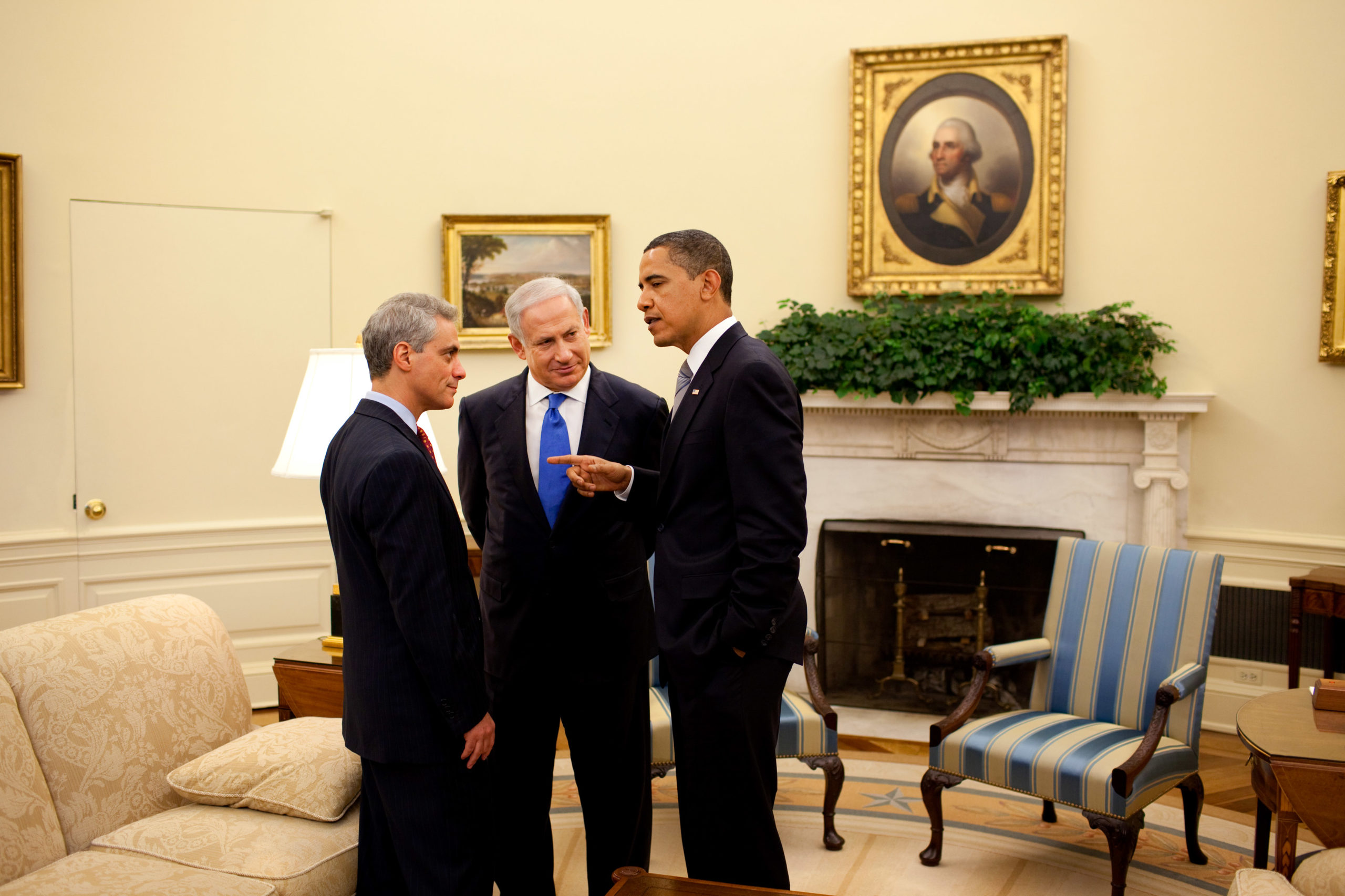
According to Obama, while Republican lawmakers cared less about the right of Palestinians to have a state of their own, Democratic members of Congress — who represented districts with sizable Jewish populations — were reluctant to speak out about the matter because they were “worried” about losing support from AIPAC’s key supporters and donors and imperiling their reelection chances.
In the memoir, Obama recalled his visit to the Western Wall as a presidential candidate in the summer of 2008 and the publication of the prayer note he stuffed into the cracks of the wall by an Israeli newspaper. The episode was a reminder of the price that came with stepping onto the world stage, he wrote. “Get used to it, I told myself. It’s part of the deal.”
The book provides an inside look into the political jockeying between the Israeli government and the administration over the Israeli-Palestinian conflict. Obama maintains that he thought it was “reasonable” to ask for Israel, which he viewed as the “stronger party,” to take a “bigger first step” and freeze settlements in the West Bank. But “as expected,” Netanyahu’s response was “sharply negative.” That was followed by an aggressive pressure campaign by the prime minister’s allies in Washington.
“The White House phones started ringing off the hook,” Obama recounts, as his national security team fielded calls from lawmakers, Jewish leaders and reporters “wondering why we were picking on Israel.” He wrote that Rhodes once arrived late for a staff meeting “looking particularly harried” after a lengthy phone call with a “highly agitated” liberal Democratic congressman who pushed back against the administration’s attempt to stop settlement activity.
Obama accused Netanyahu of an “orchestrated” effort to put his administration on the defensive, “reminding me that normal policy differences with an Israeli prime minister exacted a domestic political cost” that didn’t exist in relations with other world leaders.
In 2010, when Netanyahu visited Washington to attend the annual AIPAC policy conference, media reports claimed that Obama deliberately “snubbed” Netanyahu by walking out from a tense meeting and leaving the Israeli leader and his aides in the Roosevelt Room until they came up with a solution to the impasse in peace talks.
But in the book, Obama insists he suggested to Netanyahu to “pause” their meeting and reconvene after he returned from a previously scheduled commitment. The discussion, the former president said, ran well over the allotted time, and “Netanyahu still had a few items he wanted to cover.” Netanyahu said “he was happy to wait,” Obama writes, and the second meeting ended on “cordial terms.” However, the next morning, Emanuel “stormed into” the Oval Office citing the media reports that he humiliated Netanyahu, “leading to accusations” that the president had allowed his personal feelings to damage the U.S.-Israel relationship. “That was a rare instance when I outcursed Rahm,” Obama writes, referencing Emanuel’s well-known use of profanity.
The former national security advisor reflects on his time in the military and working on Middle East policy across several presidential administrations

Sgt. Mike Pryor/U.S. Army
Former National Security Advisor H.R. McMaster
In a new book looking back at his time in the military and in several presidential administrations, former national security advisor H.R. McMaster expounds on what he thought were “fundamental flaws” in the 2015 nuclear deal with Iran and why he tried to persuade President Donald Trump not to withdraw from the deal.
In Battlegrounds: The Fight to Defend the Free World, released on Tuesday, McMaster called the original JCPOA negotiated by former President Barack Obama “an extreme case of strategic narcissism based on wishful thinking” that led to “self-delusion and, ultimately the deception of the American people.”
Yet, when Trump wanted to make good on his campaign promise to leave the deal, McMaster made clear his opposition to withdrawing from the accord. In the book, McMaster explains that he wanted the U.S. to maintain leverage to punish Iran for its behavior on matters unrelated to the Iranian nuclear program and to get the parties in the agreement to fix the deal’s flaws. McMaster said he also wanted to avoid giving Tehran the opportunity to portray itself as a victim. But as he attempted to work on a comprehensive Iran strategy, McMaster wrote, Trump grew “impatient.”
McMaster details how he intervened in former Secretary of State Rex Tillerson’s efforts to certify the deal in April 2017, and how he successfully lobbied the president to recertify the agreement over the next two 90-day deadlines as required under the 2015 Iran Nuclear Agreement Review Act. “We had created a window of opportunity for our allies to demonstrate the viability of staying in the deal while imposing costs on Iran,” McMaster writes. “That window closed soon after I departed the White House.” A month after McMaster left the administration, Trump announced the U.S. withdrawal from the deal.
The former national security official accuses the Obama administration of ignoring Iran’s behavior in the region and avoiding confrontation in an effort to preserve the accord. According to McMaster, Obama officials “focused on selling the deal rather than subjecting it to scrutiny” by using a “red herring” talking point — the Iraq War — to pose “the false dilemma” of either supporting the deal or going to war with Iran.
McMaster also offers his view on the Israeli-Palestinian conflict and the Trump peace plan announced in early 2020. Trump’s moves on Israel, he writes, “communicated support for Israel, but also removed incentives that might have been crucial in a future agreement.” While he described the rollout of the peace plan as “dead on arrival” due to lack of participation from Palestinian leaders, McMaster posits that the plan itself may at some point “help resurrect the possibility of a two-state solution.”
The book itself is not a tell-all on the Trump administration. McMaster does not write about being excluded from Trump’s meeting with Israeli Prime Minister Benjamin Netanyahu during the president’s trip to Israel, or his disputes with Trump and Jared Kushner. “This is not the book that most people wanted me to write… a tell-all about my experience in the White House to confirm their opinions of Donald Trump,” McMaster writes in his preface. “Although writing such a book might be lucrative, I did not believe that it would be useful or satisfactory for most readers.”
McMaster accuses the Russians and the alt-right movement of leading a campaign against him, under the hashtag #FireMcMaster, because they viewed him as a threat to their agenda of undermining America’s national security. McMaster writes that the attacks against him were “often inconsistent” in nature. “For example, one caricature on social media portrayed me as a puppet of billionaire George Soros and the Rothschild family (both of whom were frequent targets of anti-Semitic conspiracy theories), while articles in the pseudo-media charged me and others on the NSC staff as being ‘anti-Israel’ and soft on Iran,” McMaster recalls.
Former Under Secretary of Defense for Policy Michele Flournoy told the Israel Policy Forum webcast she is worried about the potential reaction

United States Institute of Peace
Michele Flournoy
Former Under Secretary of Defense for Policy Michele Flournoy warned Israeli leaders not to ignore the objections to West Bank annexation plans raised by nearly 150 Democratic senators and members of Congress.
Flournoy, speaking during a panel discussion on the topic hosted by Israel Policy Forum, suggested that Israeli Prime Minister Benjamin Netanyahu is “playing with fire, not only in terms of fracturing the region and their relationships with Israel, but also fracturing American political support, which would be terrible and disastrous.”
Flournoy — who served in the Obama administration from 2009-2012 —said she worries that if Israel moves ahead with annexation in the coming weeks, some Democratic lawmakers may try to hold up the implementation of the 2016 Memorandum of Understanding between the U.S. and Israel and “decide to hold hostage our security assistance to Israel as a way of protesting Israel’s policies” in the West Bank.
“That may not be the most likely outcome, but it’s not unlikely either,” she suggested. Such attempts, Flournoy cautioned, would undermine long-standing bipartisan support “for critical pillars” of the security relationship with Israel. “That’s what really worries me,” she added.
Former U.S. Ambassador to Israel Dan Shapiro said on the webcast that “while there are voices in both parties that are sounding different notes, I still think there’s a large number of Republicans, as well as Democrats, who adhere to [the] principles that can help reestablish broad bipartisan consensus” on Israel and peace in the Middle East. “I am hopeful that is the case,” Shapiro added, “which gives us a lot to work with if there’s a new administration.”
Watch Netanyahu’s Speech Here
I am pleased to be joining you today, even if I’m doing it by remote
satellite.
I remember the Willard Hotel when I came to Washington the first time in 1982, so this is – 30 years or more have passed and we know how the world has changed, but throughout that I think there’s been this strong U.S.–Israel relationship that taken on these complex issues that we face, and Haim, I want to express to you my personal appreciation for the fact that you are sponsoring the forum to address this complexity.
And it is legion, because the Middle East is undergoing great turmoil, great violence, great instability. But in this turbulence, the special bond between Israel and the United States is the crucial anchor of stability. I didn’t say just a crucial anchor; I think it is the crucial anchor, and I want to thank President Obama for his commitment to our strong alliance. He has repeatedly said that Israel must have the right to defend itself, by itself against all threats. I think that’s a very important statement. It will follow us 360 degrees. And on President Obama’s watch, defense, security and intelligence cooperation between the United States and Israel – this cooperation has reached new heights.
I want you to know that we can have different perspectives. I understand that the United States is a global power with global responsibilities. And President Obama understands that the Jewish state is a beleaguered democracy in a hostile region, threatened like no other country on earth. And though we have the different perspectives of a superpower and a regional power, most of the time and on most things, if not the major things, we see eye-to-eye because we share common values, because we’re anchored in deeply democratic societies, because there is a special bond between the people of Israel and the people of the United States of America. Sometimes we differ because we have these different perspectives. But we always share our views honestly, sincerely and respectfully. That’s what good friends do, and that’s what we’ll continue to do.
Since President Obama’s historic visit to Israel, we have often spoken at length about the pressing issues of our times. I don’t know if there are any other two leaders in the world today who speak more frequently and more openly on such crucial matters. This communication serves both our countries well.
I also want to take this opportunity to praise Secretary John Kerry for his tireless efforts for peace. Tireless. I mean, this man doesn’t sleep. I spend so much time speaking or meeting with John Kerry that some of my cabinet colleagues are starting to get jealous. They complain that I only have time for him. Well John, you have my thanks and the thanks of the people of Israel for your dedication and your commitment to peace.
A moment ago I mentioned that the Middle East is going through unprecedented volatility, violence and instability. Out of all this uncertainty, one thing has become absolutely clear: The Israeli-Palestinian conflict is not the source of the region’s problems. Today, for all but a few diehards, that reality has finally debunked that myth. The tragedy in Syria, the terrorism in Iraq, the nuclear weapons program in Iran, the instability in North Africa, the Shi’ite-Sunni conflict, the scourge of violent Islamic radicalism – none of these is rooted in our dispute with the Palestinians.
This is not to say that peace with the Palestinians is not important. It’s vital – first and foremost for Israel and the Palestinians. Achieving a genuine and enduring peace between us is a strategic goal of the State of Israel and of my government. I’ve made hard decisions to further peace negotiations. I’m willing to make even harder decisions to achieve peace.
I hope President Abbas also is willing to do so because peace can only be and must be a two-way street. I am ready for a historic compromise that ends the conflict between us once and for all. My willingness to make peace flies in the face of a second persistent myth – that peace has eluded us because Israel is not willing to demonstrate the necessary flexibility. That is not true. Under successive governments, Israel has demonstrated the flexibility and the willingness to make painful concessions. These will require discussing the issues of territory and settlements.
But the core of this conflict has never been borders and settlements. It is about one thing: The persistent refusal to accept the Jewish State in any border. The real key to peace is Palestinian recognition of the right of the Jewish people to national self-determination in this part of the world. This conflict didn’t begin because we denied the right of the Palestinian people to a state of their own. We agreed to that in 1937 in the Zionist Movement’s response to the Peel Commission’s partition proposal. The Palestinians refused. We agreed to that again when we accepted the UN partition proposal in 1947 for a Jewish state next to a Palestinian state. The Palestinians again refused.
And in the 20 years since the Oslo accords, every time we’ve offered a historic peace with a Palestinian state next to a Jewish state, the Palestinians still refused. Six successive Israeli Prime Ministers, myself included, have been ready for a historic compromise with the Palestinians. But it was never enough. Because all the Israeli proposals, all the Israeli concessions, were based on one premise: That the conflict would be over, that it would end and that there would be no further Palestinian national claims on the Jewish state. No right of return. No irredentist claims. No residual claims of any kind. And that the Palestinians have so far been unwilling to give.
So the question shouldn’t be, why does Israel make this demand? The question should be: why do the Palestinians consistently refuse to accept it? After all, we recognize that in peace there will be a nation-state for the Palestinian people. And surely we are entitled to expect them to do the same: to recognize the nation-state of the Jewish people.
And my friends, we’ve only been around here for 4,000 years – well, a little less, 3,700 years. We have to have the Palestinians come to grips with the fact that there is going to be a Jewish state, a Jewish nation-state here next to their state. It’s not too much to ask. It’s the minimal requirement for peace.
But it’s not the only requirement, because I don’t delude myself. I think that any kind of peace we’ll have is likely, initially at least, to be a cold peace. And it must withstand the forces of terrorism and the ravaging forces of radicalism and all the forces backed by Iran and others that will try to unravel the peace. And therefore any agreement that we make must enable us to protect the peace or conversely to protect Israel in case the peace unravels. That often happens in our region. So there must be iron-clad security arrangements to protect the peace, arrangements that allow Israel to defend itself by itself against any possible threats. And those security arrangements must be based on Israel’s own forces. There is no substitute for that.
Ladies and gentlemen,
Our best efforts to reach Palestinian-Israeli peace will come to nothing if Iran succeeds in building atomic bombs. A nuclear-armed Iran would give even greater backing to the radical and terrorist elements in the region. It would undermine the chances of arriving at a negotiated peace. I would say it would undermine those peace agreements that we have already reached with two of our neighbors.
Just three days ago Iran’s representative to the U.N. reiterated the regime’s refusal to even recognize Israel. This came a fortnight after the ruler of Iran referred to Israel as a “rabid dog” and to us as not worthy of being called human. He said we were doomed to “failure and annihilation”. And earlier in November, Khamenei called Israel “an illegitimate and bastard regime”. So the Iranian regime’s pursuit of nuclear weapons makes these remarks more than a simple matter of “sticks and stones”. People tend to discount rhetoric from rogue regimes, from radical regimes. They said, well, it’s just talk, but talk has consequences. We’ve learned that in history, especially when the regime that makes these statements is actually building the capability to carry it out.
This same regime supplies its terrorist proxies, Hezbollah, Hamas and Islamic Jihad, with thousands of rockets, rockets that are aimed at Israeli civilians, rockets that are precision-guided munitions that are increasingly lethal and deadly. This is a regime committed to our destruction. And I believe there must be an unequivocal demand alongside the negotiations in Geneva for a change in Iranian policy. This must be part and parcel of the negotiations. In other words, I’m saying that what is required is not merely a shift and a diminution of Iran’s capability and elimination of its capability to produce nuclear weapons, but also a demand to change its genocidal policy. That is the minimal thing that the international community must do when it’s negotiating with Iran.
And as you all know, it’s not just about Israel. Iran continues to trample the rights of its own people, to participate in the mass slaughter in Syria, to engage in terrorism across five continents and to destabilize regimes throughout the Middle East.
I don’t think I can overstate, I don’t think any of us can overstate the Iranian danger. So for the peace and security of the world, Iran must not be allowed to maintain the capability to produce nuclear weapons – not today and not tomorrow. The world must not allow Iran to be a threshold nuclear weapons state with the option to cross that threshold at a time of its choosing. Therefore, unlike the recent interim deal, any final deal must bring about the termination of Iran’s military nuclear capability.
I have expressed my concern since before Geneva that the sanctions would begin to unravel. I heard today that Iran’s president said that in fact the situation in Iran economically is already markedly improved since the accords were announced. They haven’t even been put in place yet. So steps must be taken to prevent further erosion of the sanctions. Because ultimately, the sanctions remain an essential element of the international effort to compel Iran to dismantle its nuclear military infrastructure: to take apart the centrifuges; to tear down the heavy water reactor; to eliminate the current stockpiles of enriched uranium; to cease the development of ballistic missiles and the work on weaponization, which by the way the Geneva agreement does not address. None of these things that Iran insists it must have – none of them is necessary for a peaceful nuclear program.
So while Israel is prepared to do what is necessary to defend itself, we share President Obama’s preference to see Iran’s nuclear weapons program end through diplomacy. But for diplomacy to succeed, it must be coupled with powerful sanctions and a credible military threat. Now let me repeat that: A diplomatic solution is better than a military option. But a military option is necessary for diplomacy to succeed, as are powerful sanctions.
We all agree that after a couple of years of tough sanctions, Iran finally began to negotiate seriously. Because of the pressure, what seemed impossible yesterday became possible today. We should not assume that more and tougher sanctions won’t lead to a better deal. What seems impossible today could become possible tomorrow.
My friends,
Preventing Iran from achieving a nuclear weapons capability is the paramount challenge of our generation because a nuclear-armed Iran would literally change the course of history. It would threaten the peace and security of us all by arming the world’s most dangerous regime with the world’s most dangerous weapons.
I think we’ve learned from history that regimes with unlimited appetites act out their fantasies and their made ideologies when they think they have the weapons of mass death or at least incalculable power. That’s what usually happens. Such power in the hands of such regimes unleashes the worst ambitions. It’s not that they don’t have diplomats – they do. They have diplomats, some of them even wear ties. They might speak English and they might make PowerPoint presentations where in the past they just spoke English and they spoke reasonably well. But when the powers behind the throne, the power on the throne is committed to a radical ideology and pursues it and talks about it again and again and again, then I say: Beware. We’ve learned in our experience, the experience of the Jewish people, to take seriously those who speak about our annihilation, and we will do and I will do what is necessary to protect the Jewish state and the future of the Jewish people.
Our best efforts, mine and those of President Obama, have yet to achieve the desired results. The jury is still out. Iran is perilously close to crossing the nuclear threshold. History will judge all of us on whether we succeed or not in rising to meet this greatest of all challenges.
President Obama and others have called the United States the “indispensable nation”. I agree. I believe though that in meeting this supreme challenge, Israel and the United States form the indispensable alliance. We will continue to work together to strengthen that indispensable alliance for the sake of peace, security and our common future.
Thank you all and good luck.
Transcript of remarks by President Obama at the 10th Annual Saban Forum where Obama was interviewed by Haim Saban.
1:13 P.M. Willard Hotel Washington, D.C.
THE PRESIDENT: Hello! (Applause.)
MR. SABAN: How are you doing?
THE PRESIDENT: I’m good. Hello, everybody.
MR. SABAN: One of your staffers said you are in a great mood this afternoon, so —
THE PRESIDENT: I am.
MR. SABAN: — we’re doubly blessed here. So that’s terrific. I’d like to thank you very much for being here today, Mr. President. The Forum, and I personally, are honored to have you join us in this conversation. And I am personally honored that you insisted that I have this conversation with you, even though I never set foot for any conversation for 10 years. (Laughter.) So thank you. I’m very honored. Shall we start with Iran?
THE PRESIDENT: We should.
MR. SABAN: Okay, good. (Laughter.) Mr. President, polls indicate that 77 percent of Israelis don’t believe this first nuclear deal will preclude Iran from having nuclear weapons, and they perceive this fact as an existential matter for them. What can you say to the Israeli people to address their concern?
THE PRESIDENT: Well, first, before I answer the question, let me say to you, Haim, thank you so much for the great work that you’ve done. I think the Saban Forum and the Saban Center has done outstanding work, and it provides us a mechanism where we don’t just scratch the surface of these issues. Obviously the challenges in the Middle East are enormous, and the work that’s being done here is terrific. So I want to also thank Strobe for hosting us here today, and all of you who are here, including some outstanding members of the Israeli government and some friends that I haven’t seen in a while. So thanks for having me. Let me start with the basic premise that I’ve said repeatedly. It is in America’s national security interests, not just Israel’s national interests or the region’s national security interests, to prevent Iran from getting a nuclear weapon. And let’s remember where we were when I first came into office. Iran had gone from having less than 200 centrifuges to having thousands of centrifuges, in some cases more advanced centrifuges. There was a program that had advanced to the point where their breakout capacity had accelerated in ways that we had been concerned about for quite some time and, as a consequence, what I said to my team and what I said to our international partners was that we are going to have to be much more serious about how we change the cost-benefit analysis for Iran. We put in place an unprecedented regime of sanctions that has crippled Iran’s economy, cut their oil revenues by more than half, have put enormous pressure on their currency — their economy contracted by more than 5 percent last year. And it is precisely because of the international sanctions and the coalition that we were able to build internationally that the Iranian people responded by saying, we need a new direction in how we interact with the international community and how we deal with this sanctions regime. And that’s what brought President Rouhani to power. He was not necessarily the first choice of the hardliners inside of Iran.
Now, that doesn’t mean that we should trust him or anybody else inside of Iran. This is a regime that came to power swearing opposition to the United States, to Israel, and to many of the values that we hold dear. But what I’ve consistently said is even as I don’t take any options off the table, what we do have to test is the possibility that we can resolve this issue diplomatically. And that is the deal that, at the first stages, we have been able to get done in Geneva, thanks to some extraordinary work by John Kerry and his counterparts in the P5- plus-1. So let’s look at exactly what we’ve done. For the first time in over a decade, we have halted advances in the Iranian nuclear program. We have not only made sure that in Fordor and Natanz that they have to stop adding additional centrifuges, we’ve also said that they’ve got to roll back their 20 percent advanced enrichment. So we’re —
MR. SABAN: To how much?
THE PRESIDENT: Down to zero. So you remember when Prime Minister Netanyahu made his presentation before the United Nations last year —
MR. SABAN: The cartoon with the red line?
THE PRESIDENT: The picture of a bomb — he was referring to 20 percent enrichment, which the concern was if you get too much of that, you now have sufficient capacity to go ahead and create a nuclear weapon. We’re taking that down to zero. We are stopping the advancement of the Arak facility, which would provide an additional pathway, a plutonium pathway for the development of nuclear weapons. We are going to have daily inspectors in Fordor and Natanz. We’re going to have additional inspections in Arak. And as a consequence, during this six-month period, Iran cannot and will not advance its program or add additional stockpiles of advanced uranium — enriched uranium. Now, what we’ve done in exchange is kept all these sanctions in place — the architecture remains with respect to oil, with respect to finance, with respect to banking. What we’ve done is we’ve turned the spigot slightly and we’ve said, here’s maximum $7 billion out of the over $100 billion of revenue of theirs that is frozen as a consequence of our sanctions, to give us the time and the space to test whether they can move in a direction, a comprehensive, permanent agreement that would give us all assurances that they’re not producing nuclear weapons.
MR. SABAN: I understand. A quick question as it relates to the $7 billion, if I may.
THE PRESIDENT: Please.
MR. SABAN: How do we prevent those who work with us in Geneva, who have already descended on Tehran looking for deals, to cause the seven to become 70? Because we can control what we do, but what is the extent that we can control the others?
THE PRESIDENT: Well, Haim, this is precisely why the timing of this was right. One of the things we were always concerned about was that if we did not show good faith in trying to resolve this issue diplomatically, then the sanctions regime would begin to fray. Keep in mind that this was two years of extraordinary diplomatic work on behalf of our team to actually get the sanctions in place. They’re not just the unilateral sanctions that are created by the United States. These are sanctions that are also participated in by Russia, by China, and some allies of ours like South Korea and Japan that find these sanctions very costly. But that’s precisely why they’ve become so effective. And so what we’ve said is that we do not loosen any of the core sanctions; we provide a small window through which they can access some revenue, but we can control it and it is reversible. And during the course of these six months, if and when Iran shows itself not to be abiding by this agreement, not to be negotiating in good faith, we can reverse them and tighten them even further. But here is the bottom line. Ultimately, my goal as President of the United States — something that I’ve said publicly and privately and shared everywhere I’ve gone — is to prevent Iran from getting a nuclear weapon. But what I’ve also said is the best way for us to prevent Iran from getting a nuclear weapons is for a comprehensive, verifiable, diplomatic resolution, without taking any other options off the table if we fail to achieve that.
It is important for us to test that proposition during the next six months, understanding that while we’re talking, they’re not secretly improving their position or changing circumstances on the ground inside of Iran. And if at the end of six months it turns out that we can’t make a deal, we’re no worse off, and in fact we have greater leverage with the international community to continue to apply sanctions and even strengthen them. If, on the other hand, we’re able to get this deal done, then what we can achieve through a diplomatic resolution of this situation is, frankly, greater than what we could achieve with the other options that are available to us.
MR. SABAN: Let’s all hope we get there.
THE PRESIDENT: Absolutely.
MR. SABAN: You have hosted Passover dinners at the White House.
THE PRESIDENT: I have.
MR. SABAN: And you know this famous saying, “Why is this night different than any other night?” In that context, I would like to ask you a question.
THE PRESIDENT: Please.
MR. SABAN: With the best intentions and all efforts, President Reagan vowed that Pakistan would not go nuclear. Didn’t happen. With the best intentions and all efforts, President Clinton vowed that North Korea won’t go nuclear. Why is this nuclear deal different than any other nuclear deal? (Laughter.)
THE PRESIDENT: Well, we don’t know yet. No, we don’t know yet. I think it’s important for everybody to understand this is hard. Because the technology of the nuclear cycle, you can get off the Internet; the knowledge of creating a nuclear weapons is already out there. And Iran is a large country and it is a relatively wealthy country, and so we have to take seriously the possibility that they are going to try to get a nuclear weapon. That’s what this whole exercise is about. Having said that, if you look at the history, by the time we got an agreement with North Korea, they essentially already had a nuclear weapon. With respect to Pakistan, there was never the kinds of inspection regimes and international sanctions and U.N. resolutions that were in place. We have been able to craft an international effort and verification mechanism around the Iran nuclear program that is unprecedented and unique. That doesn’t mean it’s easy. And that’s why we have to take it seriously. But I think one of the things that I’ve repeatedly said when people ask, why should we try to negotiate with them, we can’t trust them, we’re being naïve, what I try to describe to them is not the choice between this deal and the ideal, but the choice between this deal and other alternatives. If I had an option, if we could create an option in which Iran eliminated every single nut and bolt of their nuclear program, and foreswore the possibility of ever having a nuclear program, and, for that matter, got rid of all its military capabilities, I would take it. But —
MR. SABAN: Next question —
THE PRESIDENT: Sorry, Haim, I want to make sure everybody understands it — that particular option is not available. And so as a consequence, what we have to do is to make a decision as to, given the options available, what is the best way for us to assure that Iran does not get a nuclear weapon. And the best way for us to assure it is to test this diplomatic path, understanding that it’s not based on trust; it’s based on what we can verify. And it also, by the way, does not negate the fact that Iran is engaging in a whole bunch of other behavior in the Middle East and around the world that is detrimental to the United States and detrimental to Israel. And we will continue to contest their efforts where they’re engaging in terrorism, where they’re being disruptive to our friends and our allies. We will not abide by any threats to our friends and allies in the region, and we’ve made that perfectly clear. And our commitment to Israel’s security is sacrosanct, and they understand that. They don’t have any doubt about that. But if we can negotiate on the nuclear program in the same way that Ronald Reagan was able to negotiate with the Soviet Union even as we were still contesting them around the world, that removes one more threat — and a critical, existential threat — takes it out of their arsenal. And it allows us then to ultimately I think win them — defeat some of their agenda throughout the region without worrying that somehow it’s going to escalate or trigger a nuclear arms race in the most volatile part of the world.
MR. SABAN: Unfortunately, you’re right — it would. Tom Friedman had an interesting perspective in one of his columns. He said, “Never negotiate with Iran without some leverage and some crazy on your side. We have to out-crazy the crazies.” Do you think he has a point? (Laughter.)
THE PRESIDENT: Well, Tom is a very smart observer. And I know that my friend, Bibi, is going to be speaking later, and if Tom wants to characterize Bibi the way you just described, that’s his —
MR. SABAN: I didn’t say that.
THE PRESIDENT: — that’s his prerogative, that’s not my view. (Laughter.) Prime Minister Netanyahu and I have had constant consultations on these issues throughout the last five years. And something that I think bears repeating: The United States military cooperation with Israel has never been stronger. Our intelligence cooperation with Israel has never been stronger. Our support of Israel’s security has never been stronger. Whether you’re talking about Iron Dome, whether you’re talking about trying to manage the situation in Gaza a little over a year ago, across the board, our coordination on the concrete issues facing Israel’s security has never been stronger. And that’s not just my opinion; I think that’s something that can be verified. There are times where I, as President of the United States, am going to have different tactical perspectives than the Prime Minister of Israel — and that is understandable, because Israel cannot contract out its security. In light of the history that the people of Israel understand all too well, they have to make sure that they are making their own assessments about what they need to do to protect themselves. And we respect that. And I have said that consistently to the Prime Minister. But ultimately, it is my view, from a tactical perspective, that we have to test out this proposition. It will make us stronger internationally, and it may possibly lead to a deal that we’ll have to show to the world, in fact, assures us that Iran is not getting a nuclear weapon. It’s not as if there’s going to be a lot of capacity to hide the ball here. We’re going to be able to make an assessment, because this will be subject to the P5-plus-1 and the international community looking at the details of every aspect of a potential final deal, and we’re consulting with all our friends, including Israel, in terms of what would that end state look like. And if we can’t get there, then no deal is better than a bad deal. But presuming that it’s going to be a bad deal and, as a consequence, not even trying for a deal I think would be a dire mistake.
MR. SABAN: Well, personally, I find a lot of comfort in the fact that even though the United States and Israel may have red lines in different places, we are on the same place as far as the bottom line goes —
THE PRESIDENT: Absolutely.
MR. SABAN: — and Iran will not have nuclear weapons. Fair to say?
THE PRESIDENT: Absolutely. That is more than fair.
MR. SABAN: Good. Thank you. Should we move to these Israeli-Palestinians —
THE PRESIDENT: We should.
MR. SABAN: Okay. (Laughter.) Very obedient President I have here today. (Laughter.)
THE PRESIDENT: This is the Saban Forum, so you’re in charge. (Laughter.)
MR. SABAN: I wish. (Laughter.)
THE PRESIDENT: Or Cheryl is in charge.
MR. SABAN: You’re more on now, Mr. President. It is Cheryl who is in charge.
THE PRESIDENT: That’s exactly right.
MR. SABAN: Anyway. (Laughter.) First of all, before I ask the first question, I would be remiss if I didn’t, from the bottom of my heart, thank you for your continuous effort to achieve peace in the Middle East. Thank you so very much. (Applause.)
THE PRESIDENT: I appreciate it. Thank you.
MR. SABAN: So people talk about an imposed American solution. We’ve heard these rumors rumbling around for a while. The U.S. has always said it doesn’t want to impose. What would you propose?
THE PRESIDENT: Well, first of all, this is a challenge that we’ve been wrestling with for 60 years. And what I’ve consistently said is that the only way this is going to be resolved is if the people of Israel and the Palestinian people make a determination that their futures and the futures of their children and grandchildren will be better off with peace than with conflict. The United States can be an effective facilitator of that negotiation and dialogue; we can help to bridge differences and bridge gaps. But both sides have to want to get there. And I have to commend Prime Minister Netanyahu and President Abbas for the courageous efforts that have led to very serious conversations over the last several months. They are not easy. But they come down to what we all know are going to be the core issues: territory; security; refugees; Jerusalem. And there are not a lot of secrets or surprises at this point. We know what the outlines of a potential agreement might look like. And the question then becomes are both sides willing to take the very tough political risks involved if their bottom lines are met. For the Palestinians, the bottom line is that they have a state of their own that is real and meaningful. For the Israelis, the bottom line is, to a large extent, is the state of Israel as a Jewish state secure. And those issues have been spoken about over the last several months in these negotiations in a very serious way. And I know Tzipi Livni is here and been participating in that, and we’re very grateful for her efforts there. And I think it is possible over the next several months to arrive at a framework that does not address every single detail but gets us to a point where everybody recognizes better to move forward than move backwards. Sometimes when you’re climbing up a mountain, even when it’s scary, it’s actually easier to go up than it is to go down. And I think that we’re now at a place where we can achieve a two-state solution in which Israelis and Palestinians are living side-by-side in peace and security. But it’s going to require some very tough decisions. One thing I have to say, though, is we have spent a lot of time working with Prime Minister Netanyahu and his entire team to understand from an Israeli perspective what is required for the security of Israel in such a scenario. And we — going back to what I said earlier — we understand that we can’t dictate to Israel what it needs for its security. But what we have done is to try to understand it and then see through a consultative process, are there ways that, through technology, through additional ideas, we can potentially provide for that. And I assigned one of our top former generals, John Allen, who most recently headed up the entire coalition effort in Afghanistan — he’s retired now, but he was willing to take on this mission — and he’s been working to examine the entire set of challenges around security —
MR. SABAN: Has he concluded anything?
THE PRESIDENT: Well, he’s come up to — he has arrived at the conclusion that it is possible to create a two-state solution that preserves Israel’s core security needs. Now, that’s his conclusion, but ultimately he’s not the decision-maker here. Prime Minister Netanyahu and the Israeli military and intelligence folks have to make that determination. And ultimately, the Palestinians have to also recognize that there is going to be a transition period where the Israeli people cannot expect a replica of Gaza in the West Bank. That is unacceptable. And I think we believe that we can arrive at that point where Israel was confident about that, but we’re going to have to see whether the Israelis agree and whether President Abbas, then, is willing to understand that this transition period requires some restraint on the part of the Palestinians as well. They don’t get everything that they want on day one. And that creates some political problems for President Abbas, as well.
MR. SABAN: Yes. Well, I’d say my next question of what was the reaction of the Prime Minister to General Allen for John Kerry.
THE PRESIDENT: Yes, ask John Kerry, or ask the Prime Minister.
MR. SABAN: Okay.
THE PRESIDENT: I don’t want to speak for him. (Laughter.)
MR. SABAN: They won’t tell me, but, okay. (Laughter.)
THE PRESIDENT: That’s probably true.
MR. SABAN: My last question: The Palestinians are two people — one in the West Bank, led by President Abbas that is negotiating the deal; and one in Gaza, led by Hamas that wants to eradicate Israel from the face of the Earth. President Abbas, as far as I know, says he won’t make a deal that doesn’t include Gaza, which he doesn’t control. How do we get out from this labyrinth?
THE PRESIDENT: Well, I think this is going to have to happen in stages. But here’s what I know from my visits to Israel, my visits to the West Bank: There are people of goodwill on both sides that recognize the status quo is not sustainable over the long term, and as a consequence, it is in the interests of both the Israelis and Palestinians to resolve this issue. There are young people, teenagers that I met both in Israel and in the Palestinian Territories that want to get out from under this history and seek a future that is fundamentally different for them. And so if, in fact, we can create a pathway to peace, even if initially it’s restricted to the West Bank, if there is a model where young Palestinians in Gaza are looking and seeing that in the West Bank Palestinians are able to live in dignity, with self-determination, and suddenly their economy is booming and trade is taking place because they have created an environment in which Israel is confident about its security and a lot of the old barriers to commerce and educational exchange and all that has begun to break down, that’s something that the young people of Gaza are going to want. And the pressure that will be placed for the residents of Gaza to experience that same future is something that is going to be I think overwhelmingly appealing.
But that is probably going to take place during the course of some sort of transition period. And the security requirements that Israel requires will have to be met. And I think that is able — that we can accomplish that, but ultimately it’s going to be something that requires everybody to stretch out of their comfort zones. And the one thing I will say to the people of Israel is that you can be assured whoever is in the office I currently occupy, Democrat or Republican, that your security will be uppermost on our minds. That will not change. And that should not mean you let up on your vigilance in terms of wanting to look out for your own country. It does — it should give you some comfort, though, that you have the most powerful nation on Earth as your closest friend and ally. And that commitment is going to be undiminished.
Mr. Saban: That was my last question.
THE PRESIDENT: I promised — we worked something backstage where as long as Haim’s questions weren’t too long, I’d take a couple of questions from the audience. And he was very disciplined — (laughter) — so let me take one or two. This gentleman right here. Why don’t you get a microphone so everybody can hear you?
Q Mr. President, I used to be a general in the Israeli Air Force, in intelligence, and now running a think tank in Tel Aviv. Looking into the future agreement with Iran — I put behind me the initial agreement, and what is really important is the final agreement. Two questions. What is the parameters that you see as a red line to ensure that Iran will be moving forward — moving backward, rolling back from the bomb as much as possible? And what is your plan B if an agreement cannot be reached?
THE PRESIDENT: Well, with respect to the end state, I want to be very clear there’s nothing in this agreement or document that grants Iran a right to enrich. We’ve been very clear that given its past behavior, and given existing U.N. resolutions and previous violations by Iran of its international obligations, that we don’t recognize such a right, and if, by the way, negotiations break down, there will be no additional international recognition that’s been obtained. So this deal goes away and we’re back to where we were before the Geneva agreement, subject — and Iran will continue to be subject to all the sanctions that we put in place in the past and we may seek additional ones. But I think what we have said is we can envision a comprehensive agreement that involves extraordinary constraints and verification mechanisms and intrusive inspections, but that permits Iran to have a peaceful nuclear program. Now, in terms of specifics, we know that they don’t need to have an underground, fortified facility like Fordor in order to have a peaceful nuclear program. They certainly don’t need a heavy-water reactor at Arak in order to have a peaceful nuclear program. They don’t need some of the advanced centrifuges that they currently possess in order to have a limited, peaceful nuclear program. And so the question ultimately is going to be, are they prepared to roll back some of the advancements that they’ve made that would not justify — or could not be justified by simply wanting some modest, peaceful nuclear power, but, frankly, hint at a desire to have breakout capacity and go right to the edge of breakout capacity. And if we can move that significantly back, then that is, I think, a net win. Now, you’ll hear arguments, including potentially from the Prime Minister, that say we can’t accept any enrichment on Iranian soil. Period. Full stop. End of conversation. And this takes me back to the point I made earlier. One can envision an ideal world in which Iran said, we’ll destroy every element and facility and you name it, it’s all gone. I can envision a world in which Congress passed every one of my bills that I put forward. (Laughter.) I mean, there are a lot of things that I can envision that would be wonderful. (Laughter.) But precisely because we don’t trust the nature of the Iranian regime, I think that we have to be more realistic and ask ourselves, what puts us in a strong position to assure ourselves that Iran is not having a nuclear weapon and that we are protected? What is required to accomplish that, and how does that compare to other options that we might take? And it is my strong belief that we can envision a end state that gives us an assurance that even if they have some modest enrichment capability, it is so constrained and the inspections are so intrusive that they, as a practical matter, do not have breakout capacity.
Theoretically, they might still have some. But, frankly, theoretically, they will always have some, because, as I said, the technology here is available to any good physics student at pretty much any university around the world. And they have already gone through the cycle to the point where the knowledge, we’re not going to be able to eliminate. But what we can do is eliminate the incentive for them to want to do this. And with respect to what happens if this breaks down, I won’t go into details. I will say that if we cannot get the kind of comprehensive end state that satisfies us and the world community and the P5-plus-1, then the pressure that we’ve been applying on them and the options that I’ve made clear I can avail myself of, including a military option, is one that we would consider and prepare for. And we’ve always said that. So that does not change. But the last point I’ll make on this. When I hear people who criticize the Geneva deal say it’s got to be all or nothing, I would just remind them if it’s nothing, if we did not even try for this next six months to do this, all the breakout capacity we’re concerned about would accelerate during that six months. Arak would be further along. The advanced centrifuges would have been put in place. They’d be that much closer to breakout capacity six months from now. And that’s why I think it’s important for us to try to test this proposition. I’ll take a couple more. Yes, sir. Right over here.
Q Mr. President, Israeli journalist from Isreal Hayom daily newspaper. Mr. President, I covered the negotiations with Iran, nuclear negotiations — Geneva 2009, Istanbul 2010. And I came back now from Geneva again, where you could see the big change was not only on Iran’s side, but also on the P5-plus-1 side, meaning they were very eager to reach an agreement. Coming back from Geneva, we learned, and some of us had known before, the secret talks America had with Iran. And we know the concern you have on the Israeli security — e’re very grateful. But how does it coincide with your secret negotiations Washington had with Tehran? Thank you.
THE PRESIDENT: The truth is, is that, without going into the details, there weren’t a lot of secret negotiations. Essentially what happened — and we were very clear and transparent about this — is that from the time I took office, I said we would reach out to Iran and we would let them know we’re prepared to open up a diplomatic channel. After Rouhani was elected, there was some acceleration leading up to the U.N. General Assembly. You’ll recall that Rouhani was engaging in what was termed a charm offensive, right, and he was going around talking to folks. And at that point, it made sense for us to see, all right, how serious are you potentially about having these conversations. They did not get highly substantive in the first several meetings but were much more exploring how much room, in fact, did they have to get something done. And then as soon as they began to get more technical, at that point, they converged with the P5-plus-1 discussions. I will say this: The fact of Rhouhani’s election — it’s been said that there’s no difference between him and Ahmadinejad except that he’s more charming. I think that understates the shift in politics that took place in this election. Obviously, Rouhani is part of the Iranian establishment and I think we have to assume that his ideology is one that is hostile to the United States and to Israel. But what he also represents is the desire on the part of the Iranian people for a change of direction. And we should not underestimate or entirely dismiss a shift in how the Iranian people want to interact with the world. There’s a lot of change that’s going to be taking place in the Middle East over the next decade. And wherever we see the impulses of a people to move away from conflict, violence, and towards diplomatic resolution of conflicts, we should be ready and prepared to engage them — understanding, though, that, ultimately it’s not what you say, it’s what you do. And we have to be vigilant about maintaining our security postures, not be naïve about the dangers that an Iranian regime pose, fight them wherever they’re engaging in terrorism or actions that are hostile to us or our allies. But we have to not constantly assume that it’s not possible for Iran, like any country, to change over time. It may not be likely. If you asked me what is the likelihood that we’re able to arrive at the end state that I was just describing earlier, I wouldn’t say that it’s more than 50/50. But we have to try. Last question. And I think it’s — the young lady right there.
Q Mr. President, I’m a reporter for Israeli Channel Two. I have been listening to your analysis of the Iranian deal, and I can only imagine a different — a slightly different analysis given by our Prime Minister Netanyahu.
THE PRESIDENT: I think that’s probably a good bet. That’s more than 50/50. (Laughter.)
Q Israelis are known for their understatement. (Laughter.) And I try to imagine a conversation between you two. And he would ask you, Mr. President, I see this deal as a historic mistake — which he has already stated — and I think it’s the worst deal the West could have gotten. And you would have told him, Bibi, that’s where you go wrong. What would you have told him? That’s one thing. And then, perhaps to understand the essence of your conversation, he would ask you, Mr. President, is there one set of circumstances under which you will order your B-52s to strike in Iran? What would you tell him? (Laughter.) Is there any set of circumstances in which you will order your fighter pilots to strike in Iran? What would you tell the Prime Minister?
THE PRESIDENT: Let me make a couple of points. Number one, obviously, the conversations between me and the Prime Minister are for me and the Prime Minister, not for an audience like this. And I will say that Bibi and I have very candid conversations, and there are occasionally significant tactical disagreements, but there is a constancy in trying to reach the same goal. And in this case, that goal is to make sure that Iran does not have a nuclear weapon. As President of the United States, I don’t go around advertising the circumstances in which I order pilots to launch attacks. That I think would be bad practice. (Laughter.) I also would say, though, that when the President of the United States says that he doesn’t take any options off the table, that should be taken seriously. And I think I have a track record over the last five years that indicates that that should be taken seriously. It’s interesting — in the region, there was this interesting interpretation of what happened with respect to Syria. I said it’s a problem for Syria to have chemical weapons that it uses on its own citizens. And when we had definitive proof that it had, I indicated my willingness potentially to take military action. The fact that we ultimately did not take military action in some quarters was interpreted as, ah, you see, the President is not willing to take military action — despite the fact that I think Mr. Qaddafi would have a different view of that, or Mr. bin Laden. Be that as it may, that was yesterday, what have you done for me lately? (Laughter.) But the point is that my preference was always to resolve the issue diplomatically. And it turns out, lo and behold, that Syria now is actually removing its chemical weapons that a few months ago it denied it even possessed, and has provided a comprehensive list, and they have already begun taking these weapons out of Syria. And although that does not solve the tragic situation inside of Syria, it turns out that removing those chemical weapons will make us safer and it will make Israel safer, and it will make the Syrian people safer, and it will make the region safer. And so I do not see military action as an end unto itself. Military action is one tool that we have in a tool kit that includes diplomacy in achieving our goals, which is ultimately our security. And I think if you want to summarize the difference, in some ways, between myself and the Prime Minister on the Geneva issue, I think what this comes down to is the perception, potentially, that if we just kept on turning up the pressure — new sanctions, more sanctions, more military threats, et cetera — that eventually Iran would cave. And what I’ve tried to explain is two points: One is that the reason the sanctions have been so effective — because we set them up in a painstaking fashion — the reason they’ve been effective is because other countries had confidence that we were not imposing sanctions just for the sake of sanctions, but we were imposing sanctions for the sake of trying to actually get Iran to the table and resolve the issue. And if the perception internationally was that we were not in good faith trying to resolve the issue diplomatically, that, more than anything, would actually begin to fray the edges of the sanctions regime. Point number one. And point number two — I’ve already said this before — you have to compare the approach that we’re taking now with the alternatives. The idea that Iran, given everything we know about their history, would just continue to get more and more nervous about more sanctions and military threats, and ultimately just say, okay, we give in — I think does not reflect an honest understanding of the Iranian people or the Iranian regime. And I say that — by the way, I’m not just talking about the hardliners inside of Iran. I think even the so-called moderates or reformers inside of Iran would not be able to simply say, we will cave and do exactly what the U.S. and the Israelis say. They are going to have to have a path in which they feel that there is a dignified resolution to this issue. That’s a political requirement of theirs, and that, I suspect, runs across the political spectrum. And so for us to present a door that serves our goals and our purposes but also gives them the opportunity to, in a dignified fashion, reenter the international community and change the approach that they’ve taken — at least on this narrow issue, but one that is of extraordinary importance to all of us — is an opportunity that we should grant them. All right? Well, thank you very much. I enjoyed this. (Applause.)
MR. SABAN: Thank you so much. Thank you, Mr. President. You’ve been very generous. (Applause.) END 2:00 P.M. EST
Please log in if you already have a subscription, or subscribe to access the latest updates.
 Continue with Google
 Continue with Apple