















































































Condoleezza Rice warns against any Iran deal, urges to keep the pressure on
Former Secretary of Defense Mark Esper, joining Rice at the Aspen Security Forum, said the U.S. was right to launch the war but may have overestimated or overstated its own capabilities
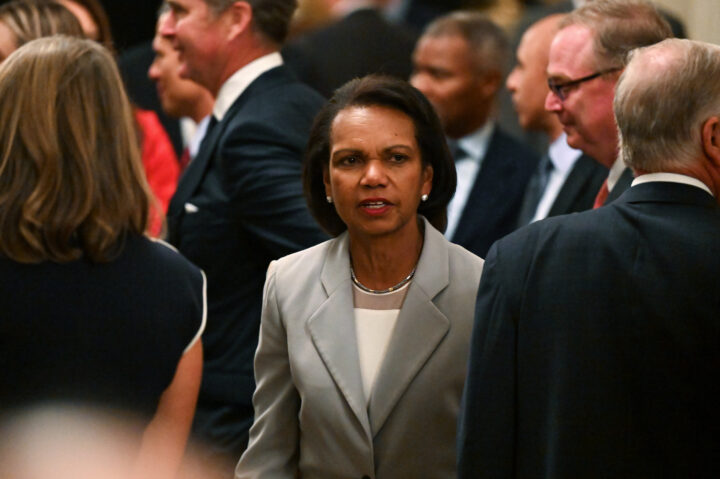
(Roberto Schmidt/Getty Images)
Former U.S. Secretary of State Condoleezza Rice attends the swearing-in ceremony for Chairman of the Federal Reserve Kevin Warsh in the East Room of the White House on May 22, 2026 in Washington, DC.


 Add JewishInsider on Google
ASPEN, Colo. — Former Secretary of State Condoleezza Rice on Tuesday opposed any nuclear deal with Iran, arguing at the Aspen Security Forum that the U.S. should continue pressure on Iran’s economy and “see what happens.”
Meanwhile, former Secretary of Defense Mark Esper speaking alongside Rice on a panel, suggested that the U.S. had potentially overestimated its capabilities in the war, agreeing that continued economic pressure and a renewed blockade would be the best strategies going forward.
The two, speaking at the Aspen Security Forum, also offered strong criticisms of U.S. allies for not joining with and at times attempting to obstruct the U.S. campaign against Iran.
“I would not buy a nuclear agreement [with Iran] under any circumstances. I’d let them sit there and stew in their lousy economy, where most of their A-level nuclear scientists have been killed, where I believe there are deep splits in the Iranian government … and let’s just see what happens,” Rice said. “I wouldn’t give them a penny back, and let’s just see what happens to that economy over time.”
Rice said that she believes the U.S. did do significant damage to Iran’s nuclear program and that she’s “quite confident” that the country is not in a position to produce a nuclear weapon in the near future.
Mark Esper, who served during President Donald Trump’s first term, said that the U.S. war on Iran was a “a good thing to do to show the seriousness of of how we felt about this and our willingness to commit force to do that” but added, “we can discuss whether our reach exceeded our grasp, and some of the language used about unconditional surrender, et cetera, pushed them into a corner”
He said that a success in the war would require a return to the status quo in the Strait of Hormuz and a deal on Iran’s nuclear program superior to the 2015 Joint Comprehensive Plan of Action.
Esper argued that there would be no way to bring such a result solely through airstrikes, and that the primary path forward should be renewed economic pressure on Iran, including a renewed blockade targeting Iran’s ports and land and air routes. He said the U.S. should continue to respond to Iranian attacks with strikes on its missile and drone capabilities.
Esper said that strategy will take time, patience, discipline and the support of allies and come at the cost of higher gas prices. He said the end goal should not be to collapse the Iranian regime but to bring Iran back to the negotiating table.
“That approach, barring — I’m open to any better one — gives you the highest return with the lowest risk to where we don’t want to go,” Esper said.
Former Secretary of Commerce Penny Pritzker, who also spoke on the panel, emphasized that economic pressure is a useful tool, which can be effective but takes time, will and coordination, without which there are ways to evade sanctions.
“I’m hopeful that with all this pressure, that something rational can come of this, because we’re not in a good place right now, obviously,” Pritzker said.
Rice and Esper both expressed frustration with U.S. allies’ refusal to cooperate with the U.S. operations and, particularly, European allies’ decisions to block the U.S. from using their bases in their countries in the course of those operations — a move Esper called “really stupid.”
Rice said it was “really not a very smart thing” for allies to dismiss the conflict as not “our war.”
She said would have “preferred” if the U.S. had worked more closely with its allies before the operation, but acknowledged that actually getting them onboard would have been questionable, pointing to her own experience trying to bring allies onboard with the Iraq invasion during the Bush administration.
Sometimes, she said, “the United States has to do something really hard, like really deal with a bad guy who’s been a bad guy for a long time,” she said, emphasizing that the sophistication and range of Iran’s missile program was increasing and it was preparing to make a major agreement with Russia on missiles. “When the time comes, if it’s your ally and your friend, even if you’re not going to join, you don’t try to harm the effort,” she said.
“When I hear, ‘Well, it wasn’t imminent,’ I think, ‘Do you really want to wait until it’s imminent, or do you want to try to degrade it earlier?’” she continued.
Both Esper and Rice warned that, through their actions around the Iran war and comments denigrating the U.S.’ reliability as an ally, or declaring that they will handle their own defense without American assistance, allies are only playing into the hands of those who want to see those alliances collapse.
“You may speak into existence exactly what you need to avoid, because there are some people inside the American political system, on both sides of the aisle, who would be perfectly happy to withdraw from the world, and you don’t want to help empower those people,” Rice warned.
More Stories

Presidential Prelude
Josh Shapiro launches federal PAC in potential signal of 2028 plans

Daily Overtime
Jewish leaders press Miliband on U.K. antisemitism
VEEP'S VIEW
Harris says Biden should have done more to stop Israel’s ‘horrific conduct’ in Gaza

PLATFORM CHECK
Where Israel’s parties stand on the Diaspora — in their own words
SPENDING SCRAPPED
GOP leadership super PAC cancels spending plans against Rep. Landsman

EMPIRE STATE EDUCATION
Hochul will opt New York into education tax credit that will help fund Jewish education
Please log in if you already have a subscription, or subscribe to access the latest updates.
 Continue with Google
 Continue with Apple