




























The Trump advisors said the president felt the Israelis were ‘out of control' and it was 'time to be very strong' with them
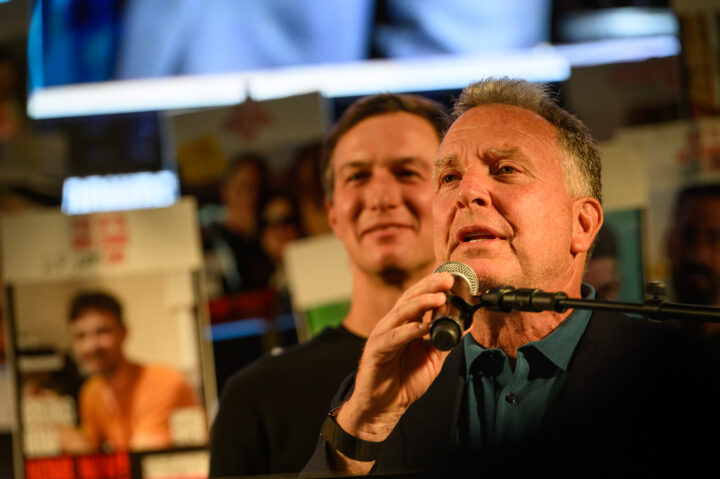
Alexi Rosenfeld/Getty Images
U.S. Middle East envoy Steve Witkoff (C), flanked by Jared Kushner (L), speaks at the weekly 'Bring Them Home' rally in Hostage Square Hostages Square on October 11, 2025 in Tel Aviv, Israel.


 Add JewishInsider on Google
Two clashing narratives have emerged about Israel’s strike on a meeting of senior Hamas terrorists in Doha, Qatar, in September, following the release of a preview of an interview with U.S. Middle East envoy Steve Witkoff and Jared Kushner on CBS’ “60 Minutes” program that aired on Sunday evening.
Both narratives posit that the strike hastened the arrival of President Donald Trump’s 20-point plan to free the hostages and end the war. Figures close to Israeli Prime Minister Benjamin Netanyahu said that the attack pushed an anxious Qatar, Hamas’ patron and host of its senior officials, to do more to get the terrorist organization across the finish line.
Trump’s negotiators, however, presented a scenario in which the president, unhappy about the strike, pressured Israel to end the war.
Of the Israeli strike on Doha, Witkoff said that he and Kushner, who in recent months has also played a key role in the administration’s Middle East efforts, “felt a little bit betrayed.”
Kushner added, “I think [Trump] felt like the Israelis were getting a little bit out of control in what they were doing, and it was time to be very strong and stop them from doing things he thought were not in their long-term interest.”
Witkoff said that Qatar, which served as a key mediator between Hamas and Israel for much of the negotiations, said that, following the strike, “we had lost the confidence of the Qataris, so Hamas went underground. It was very difficult to get to them … and it became very, very evident as to how important, how critical [Qatar’s] role was.”
Jerusalem, however, had a different version of the events, as told by Israeli Strategic Affairs Minister Ron Dermer, Netanyahu’s closest confidante, in an Israel Hayom column by journalist Amit Segal.
Israelis involved in the negotiations viewed Qatar as a “spoiler,” such as when they talked Hamas out of accepting a deal proposed by Egypt earlier in the year, according to Segal.
Dermer, Segal wrote, “links the strike to the agreement … The Qataris, it turns out, were convinced that by agreeing to host the negotiations, they had obtained immunity from Israeli strikes on their soil. From their perspective, the strike was a blatant, offensive breach of the commitment. … The Americans’ genius was to convert that negative energy into fuel to propel negotiations to their goal. ‘You want Israel to stop? Then let’s end the war.'”
Netanyahu’s office and the White House closely coordinated throughout subsequent talks to end the war, Segal reported. Then came an agreement backed by several Arab states calling for Hamas to disarm and without the immediate involvement of the Palestinian Authority.
Reactions in Israel to the “60 minutes” preview fell on predictable lines. Netanyahu’s critics said that the U.S. officials’ comments demonstrated that the prime minister did not want to enter the agreement, but instead was pushed into it by Trump.
Israeli Opposition Leader Yair Lapid argued that Witkoff and Kushner’s comments made clear that “after the failed attack on Doha, Trump thought that Netanyahu lost control and forced an agreement on Netanyahu that he didn’t want. … An American administration has never described an Israeli government like this.”
Ha’aretz journalist Amir Tibon, who lived in one of the kibbutzim attacked by Hamas on Oct. 7, 2023, posted on X: “Witkoff and Kushner say in their own voices: Trump understood that Netanyahu was not on the right track and acted aggressively against him to reach a ceasefire and free the hostages.”
Nava Rozolyo, a prominent figure in the protests against Netanyahu years before the Gaza war began, wrote: “Thank you … for forcing Hamas and Netanyahu to reach an agreement on the return of all hostages and ending the war. Thank you for saving us from our own government and for saving lives.”
On the Israeli right, many took issue with Witkoff and Kushner’s retelling of events.
Jerusalem Center for Security and Foreign Affairs President Dan Diker posted on X that “the Israelis ‘getting out of control’ is what helped bring the hostage deal to the table, scaring the Qataris out of their minds.”
Some highlighted Kushner and Witkoff’s business dealings in Qatar. Kushner’s investment company, Affinity Partners, manages billions of dollars in investments from Qatar’s sovereign wealth fund. Witkoff’s son sought Qatari investments in commercial real estate projects earlier this year, and in 2023, Qatar bought the Park Lane Hotel in Manhattan from Witkoff and his partners.
Yishai Fleisher, spokesman for the Jewish community in Hebron and an informal advisor to Israeli National Security Minister Itamar Ben-Gvir, who opposes the ceasefire deal, posted on X in response to the video: “Two American Jews, with no blood on the line in Israel (their wife and kids don’t drive on the roads with Jihadis), but lots of money on the line and business with Qatar, wag their finger at the Jewish State as they cut an awful deal that is certain to bring war.”
Other moments in the interview courted further controversy in Israel, such as when Witkoff described an Israeli cabinet meeting that he attended, in which Ben-Gvir talked about “all the death and all the carnage” from the Oct. 7, 2023, Hamas attacks and was “emotional.” In response, Witkoff described his son Andrew’s death from an overdose and told the Israeli cabinet minister to “let it go, you just can’t play the victim all the time.”
Witkoff also brought up his son’s death in the interview in relation to his meeting with Hamas lead negotiator Khalil al-Haya, whose son was killed in the Doha strike.
“We expressed our condolences to him for the loss of his son, and I told him that I had lost my son and we are both members of a really bad club, parents who had buried children,” he said.
Kushner said of Witkoff and the senior Hamas terrorist: “When Steve and him talked about their sons, it turned from a negotiation with a terrorist group to seeing two human beings kind of showing a vulnerability with each other.”
Kushner also said that he sought to relay a message to Israel’s leadership that “now that the war is over, if you want to integrate Israel with the broader Middle East, you have to find a way to help the Palestinian people thrive and do better.”
“How are you doing with that message?” Leslie Stahl asked.
Kushner smiled and replied: “We’re just getting started.”
This report was updated on Oct. 20, 2025, after the CBS “60 Minutes” interview aired in full.
The deal has elicited criticism from voices as wide-ranging as far-right influencer Laura Loomer and DNC Chairman Ken Martin
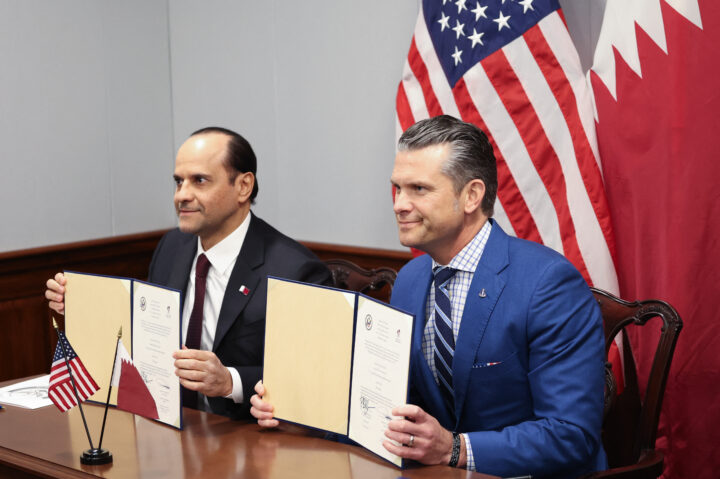
ALEX WROBLEWSKI/AFP via Getty Images
Defense Secretary Pete Hegseth (R) and Qatari Defense Minister Sheikh Saoud bin Abdulrahman Al Thani at the Pentagon in Arlington, Va., on October 10, 2025.
Secretary of Defense Pete Hegseth, in a Pentagon meeting with Qatari Defense Minister Saoud bin Abdulrahman Al Thani on Friday, signed a deal to open a Qatari Air Force facility at the U.S. Mountain Home Air Force Base in Idaho.
The deal is eliciting widespread shock and outrage from a broad ideological spectrum of political figures.
The latest deal follows the announcement of sweeping U.S. defensive guarantees to Qatar, similar to those the U.S. has made to its NATO allies, both signs of an increasingly close military alignment between the U.S. and Qatar — a key sponsor of Hamas and the Muslim Brotherhood.
The base is set to host Qatari F-15 jets and pilots for joint training operations, in order to “enhance our combined training, increase lethality, interoperability,” Hegseth said. He also praised Qatar for helping to mediate the ceasefire agreement in Gaza.
The deal has elicited criticism from voices as wide-ranging as Trump ally and far-right influencer Laura Loomer and Democratic National Committee Chairman Ken Martin.
Loomer wrote a spree of X posts lambasting the deal, framing it as the vanguard of a Muslim Brotherhood invasion of Idaho and the United States, a threat to national security, a precursor to a potential terrorist attack and the harbinger of the downfall of Western civilization.
“Now that the GOP has decided to literally harbor Islamic terrorists on US soil, I don’t really care about fighting for Republicans as much as I did yesterday. I have lost hope for 2026 and 2028 to be totally honest,” Loomer said. “While we’re at it, why don’t we just give the CCP an air base and some gain of function labs on US soil? lol Might as well!”
“An economic bailout for Argentina. An air force base for Qatar. This guy is doing everything but putting America first,” Martin said, a sentiment echoed by the DNC’s vice chair, Malcolm Kenyatta.
Other progressive activists have suggested a connection between the deal and Qatar’s gift of a luxury jumbo jet to serve as Air Force One.
“This is a dangerous precedent. The Qataris are state sponsors of terrorism masquerading as American allies,” Jonathan Schanzer, the executive director of the Foundation for Defense of Democracies, told Jewish Insider. “One can only hope that the Qataris are forced to mend their ways before such a deal comes into effect. Otherwise, this will be viewed across the Middle East as rewarding bad behavior.”
Amid the backlash, Hegseth shared an “important clarification” on X.
“The U.S. military has a long-standing partnership w/ Qatar, including today’s announced cooperation w/ F-15QA aircraft,” Hegseth said. “However, to be clear, Qatar will not have their own base in the United States — nor anything like a base. We control the existing base, like we do with all partners.”
Some are defending the deal, including Rep. Mike Simpson (R-ID), who called the agreement “fantastic news” that is “beneficial for training, enhances our partnership with America’s allies, and strengthens national security.” The Air Force facility will be located in Simpson’s Idaho district.
Former Pentagon advisor Dan Caldwell, an isolationist foreign policy voice who briefly served under Hegseth, called the “freak out around this … totally unwarranted,” adding, “this is actually a pretty common practice with countries that buy and operate a lot of U.S. military aircraft. Singapore has a similar facility and detachment for its F-15 training unit at this very same airbase.”
The president said hostages will be released Monday or Tuesday, confirmed his team working on a weekend trip to Egypt and Israel
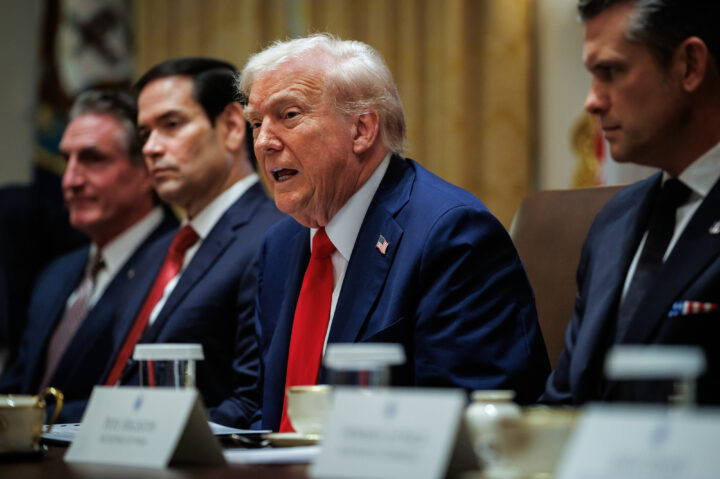
Samuel Corum/Sipa/Bloomberg via Getty Images
President Donald Trump during a Cabinet meeting at the White House in Washington on Oct. 9, 2025.
President Donald Trump heaped praise on the leaders of Qatar, Egypt, Saudi Arabia, Turkey and Indonesia on Thursday, lauding them and members of his administration as key parties responsible for getting Israel and Hamas to agree to the first phase of his peace plan for the region.
“I want to express my tremendous gratitude to the leaders of Qatar, Egypt and Turkey for helping us reach this incredible day and for being there. They were there with us all the way. And of course, as you know, Saudi Arabia and Jordan and so many,” Trump said during a Cabinet meeting at the White House. “I will tell you, [Turkish] President [Recep Tayyip] Erdoğan was personally involved in dealing with Hamas and some of the others. He’s been great. They’ve all been really amazing. Indonesia has been amazing. Indonesia has been fantastic.”
“The whole world has come together for this, people that didn’t get along, people that didn’t like each other, neighboring countries that, frankly, didn’t like each other,” he continued.
The president confirmed in his remarks on Thursday that his team was working on organizing a Mideast trip for him to commemorate the deal, which would include stops in Egypt and Israel, where he has been invited to address the Knesset.
He said he plans to depart from Washington on Sunday and is considering the timing of the release of the hostages in his plans. “They should be released on Monday or Tuesday. … That’ll be a day of joy. I’m gonna try and make a trip over,” Trump said. “We’re planning on leaving sometime Sunday,” he added later.
Regarding the U.S. officials involved in the deal, Trump credited Vice President JD Vance; White House Chief of Staff Susie Wiles; Secretary of State Marco Rubio; Secretary of Defense Pete Hegseth; Middle East envoy Steve Witkoff; Jared Kushner, the president’s son-in-law and former advisor who spearheaded the Abraham Accords in the first Trump administration; and CIA Director John Ratcliffe with helping bring the agreement across the finish line.
“All Americans should be proud of the role that our country has played in bringing this terrible conflict to an end,” Trump said.
Israeli and Hamas negotiators signed off on the first phase of the deal in Egypt earlier in the day, which would see the release of all the remaining hostages in exchange for the release of Palestinian security prisoners.
In brief remarks to reporters during the meeting, Rubio similarly attributed the administration’s success to its engagement with Arab and Muslim-majority nations.
“What really took a turn about a month ago, less than a couple weeks ago, is when we were at the United Nations, and [Trump] convened an historic meeting, not simply of Arab countries, but Muslim-majority countries from around the world … Indonesia was there, Pakistan was there, and created this coalition behind this plan. Then on that following Monday, you met with the prime minister of Israel here, and that plan was presented. And then, of course, our great negotiating team followed up on it in the interim,” Rubio said.
Asked about the potential for political turmoil in Israeli Prime Minister Benjamin Netanyahu’s governing coalition by far-right parties who said today they would oppose the deal in a Cabinet vote, Trump replied that the issue was not a concern and predicted that such an agreement could help Netanyahu.
“Bibi may go a little bit out of whack. Look, that’s politics. … I think he’s very popular right now. He’s much more popular today than he was five days ago, I can tell you that. Right now, maybe people shouldn’t run against him, five days ago it might not have been a bad idea,” Trump said. “This has been a very good thing. I don’t think he did it [agreed to a deal] for that reason [of political survival]. But I think just looking as an analyst would look at this … I think Bibi should be very popular right now.”
Trump said that, beyond bringing an end to the war in Gaza, the new agreement was “really [about achieving] peace in the Middle East.” He then described the war as a “big retribution” in response to Hamas’ Oct. 7, 2023, attacks on the Jewish state.
“Remember, Oct. 7 was terrible, but also, from the Hamas standpoint, they probably lost 70,000 people. That’s big retribution. That’s big retribution. But at some point that whole thing has to stop, and we’re going to see to it,” he said.
Looking forward, Trump was noncommittal about how future phases of his 20-point peace plan would be implemented or upheld, instead noting that Gaza would be rebuilt, the Abraham Accords would expand to include more countries and the hostages would be returned. He also declined to take a stance on supporting or opposing a two-state solution.
“Gaza is going to be slowly redone. You have tremendous wealth in that part of the world by certain countries, and just a small part of that, what they make will do wonders for Gaza,” the president explained. “I think you’re going to see some tremendous countries stepping up and putting up a lot of money and taking care of things. There’s this tremendous spirit like I haven’t seen.”
“The first thing we’re doing is getting our hostages back. That’s what people wanted more than anything else. They wanted these hostages back that have lived in hell like nobody has ever even dreamt possible. And after that, we’ll see,” he later added when asked about ensuring all sides adhere to the deal. “But they’ve agreed to things, and I think it’s going to move along pretty well.”
To mark the second anniversary of the Oct. 7 attacks in Israel, the Jewish Insider team asked leading thinkers and practitioners to reflect on how that day has changed the world. Here, we look at how Oct. 7 changed the U.S.-Israel relationship

Adobe Stock
two flags: American and Israeli waving in the blue sky
‘You can’t confer Article 5 protections by executive order, and I don’t think there’d be any appetite at all [in Congress] to do that through a treaty,’ Sen. Lindsey Graham (R-SC) said

Win McNamee/Getty Images
U.S. President Donald J. Trump and Emir of Qatar Tamim bin Hamad al Thani attend a signing ceremony at the Amiri Diwan, the official workplace of the emir, on May 14, 2025, in Doha, Qatar.
Several senators said on Friday that the administration’s unilateral offer of defense guarantees to Qatar — similar to those the U.S. has made to protect its NATO allies — deserves scrutiny from Congress.
The administration on Monday quietly issued an executive order stating that the U.S. would offer defensive guarantees to Qatar, “shall regard any armed attack on the territory, sovereignty, or critical infrastructure of the State of Qatar as a threat to the peace and security of the United States” and “shall take all lawful and appropriate measures — including diplomatic, economic, and, if necessary, military — to defend the interests of the United States and of the State of Qatar and to restore peace and stability.”
Sen. Todd Young (R-IN), a top Republican voice in favor of reclaiming congressional war powers, said that the deal “certainly strikes me as unconventional and the sort of thing that the Foreign Relations Committee might want to hold a hearing on.”
“In the end, it’s the chairman’s prerogative, but it does strike me as worthy of attention and explication in a public setting,” Young said.
Sen. Tim Kaine (D-VA), another leading advocate on war powers issues and in opposition to the administration’s acceptance of a Qatari luxury jet for use as Air Force One, said that the move will carry the perception of corruption.
“I’m very troubled by it,” Kaine said. “It just looks like it was a trade for the jet. Maybe it’s not that, but that’s the way it looks. And why would you pollute something that maybe has a good rationale — but now it’s polluted with the way everybody looks at it.”
Sen. Rick Scott (R-FL), a leading Republican critic of U.S. support for Qatar, said that he planned to speak to the president about the order. “I haven’t talked to him [the president] about it. I don’t understand why. He hasn’t explained it to me, but I’ll ask him about it,” Scott told Jewish Insider.
Sen. Richard Blumenthal (D-CT) said that the deal “will have to be reviewed carefully, depending on whether it serves our security interests and Israel’s.”
Multiple Republican senators emphasized that the deal does not carry the force of congressional ratification as a treaty.
“I don’t think you can do that by executive order,” Sen. Lindsey Graham (R-SC) said.
Asked about Congress granting Qatar those protections, Graham replied: “I don’t like its chances [of getting through Congress]. I appreciate trying to stand up for Qatar because they’re helpful, but they also have another side of the story. You can’t confer Article 5 protections by executive order, and I don’t think there’d be any appetite at all to do that through a treaty.”
Sen. Pete Ricketts (R-NE) framed the deal as part of Trump’s pressure campaign on Hamas to agree to his framework for peace in Gaza.
“The president is always thinking about negotiations, and certainly the president can have his policy,” Ricketts said. “However, it is not something that is a treaty, so it’s really, I think, meant as a negotiating thing to help get Qatar to get Hamas to surrender.”
Sen. James Lankford (R-OK) said he hadn’t reviewed the details of the agreement yet, but noted that any long-term foreign agreement would require congressional ratification to remain in effect.
“If we’re going to a national security agreement long term, that’s going to be lasting,” Congress should be consulted, Lankford said. “Things only last if they have the imprimatur of Congress actually put on it — whether it’s a trade agreement or a defense agreement. It’s got to be statute.”
Sen. Mike Rounds (R-SD) told JI he had “not heard anything about” the deal before noting, “It’s always up to the president to decide what he would like to suggest that he would like to do. Article 5 is part of a treaty right now, and if it is a treaty-type of an agreement, it would have to come before the Senate.”
Sen. Markwayne Mullin (R-OK) defended the president’s support for Qatar, telling JI, “Qatar is an important piece of the pie, a piece of the puzzle in the Middle East. We have to recognize that. We don’t always agree with everything they do, but we don’t agree with everything Israel does and we don’t agree with everything Jordan does, but they’re still close friends of ours. We know they want to be close to us and we want to, we can still use them as a strategic ally.”
The guarantee, which regards attacks on Qatar as direct threats to the U.S., is unprecedented between the U.S. and an Arab country
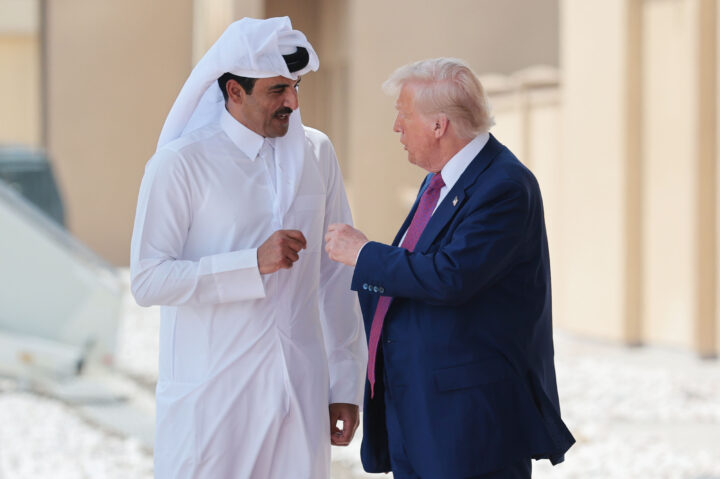
Win McNamee/Getty Images
President Donald Trump speaks with Emir of Qatar Tamim bin Hamad al Thani as he departs the Al Udeid Air Base for Abu Dhabi on May 15, 2025, in Doha, Qatar.
President Donald Trump signed an executive order on Monday pledging to guarantee Qatar’s “security and territorial integrity” against “external attack.” The security guarantee, similar to NATO’s Article 5 mutual defense clause, is unprecedented for the U.S. with an Arab country.
Signed just weeks after Israel’s attempted strike on Hamas leaders in Doha, the EO says the move comes “in light of the continuing threats to the State of Qatar posed by foreign aggression” and promises that the U.S. “shall regard any armed attack” on Qatari territory, sovereignty or critical infrastructure as a “threat to the peace and security of the United States.”
Qatar also recently faced an attack from Iran, when Tehran launched missiles at the U.S.’ Al Udeied Air Base during the Israel-Iran war in June.
The order was signed on Sept. 29, the day that Israeli Prime Minister Benjamin Netanyahu met with Trump in the White House and called Qatari Prime Minister Sheikh Sheikh Mohammed bin Abdulrahman al-Thani to apologize for the strike, though it was only publicized after Netanyahu’s departure.
The order pledges that, should Qatar face any of the described threats, “the United States shall take all lawful and appropriate measures — including diplomatic, economic, and, if necessary, military — to defend the interests of the United States and of the State of Qatar.”
The U.S. does not have a similar security guarantee with Israel. Saudi Arabia has sought one from Washington as well, primarily through normalizing relations with Israel.
Whether Hamas would agree to release the hostages first, before Israel makes any concessions other than stopping the fighting, remains to be seen
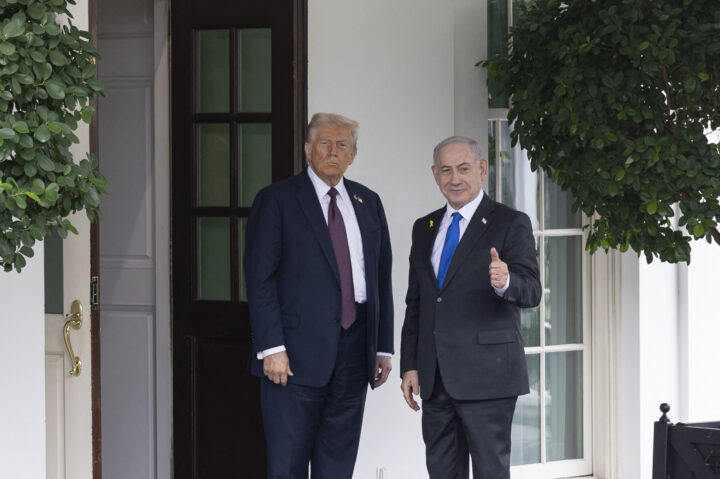
MEHMET ESER/Middle East Images/AFP via Getty Images
President Donald Trump welcomes Israeli Prime Minister Benjamin Netanyahu upon his arrival at the White House West Wing in Washington, DC, on September 29, 2025.
With Israeli Prime Minister Benjamin Netanyahu accepting President Donald Trump’s 20-point plan to end the war in Gaza at the White House on Monday, the ball is now in Hamas’ court.
Whether Hamas would agree to release the hostages first, before Israel makes any concessions other than stopping the fighting, remains to be seen. There is also newfound pressure on Qatar, a chief patron of Hamas, to convince the terror group to accept the deal.
The late Israeli elder statesman Abba Eban famously said, “The Arabs never miss an opportunity to miss an opportunity.” In readily accepting Trump’s plan, Netanyahu is counting on Hamas to do just that.
That’s not to say that Netanyahu opposes the plan. His calculus may be that he will be able to execute the parts he supports, while the aspects he finds less favorable are unlikely to materialize anyway — largely, he believes, due to the Palestinians’ own intransigence.
As Netanyahu noted in the press conference, the plan meets all of Israel’s war aims: Bringing back the hostages, dismantling Hamas — most of which Israel already did in the war — and making sure it no longer poses a threat to Israel, through demilitarization and deradicalization. Other elements of the plan that Israel has long said would be part of the “day after” for Gaza are a technocratic government with help from international partners, and the IDF retaining a buffer zone inside Gaza’s perimeter. Netanyahu also reportedly secured 11th-hour edits to the plan regarding the IDF’s withdrawal and Hamas’ disarmament prior to the press conference.
But the details are tricky.
For example, point 17 of the plan: “In the event Hamas delays or rejects this proposal, the above, including the scaled-up aid operation, will proceed in the terror-free areas handed over from the IDF to the [International Stabilization Force].”
In other words, if Hamas rejects the plan, humanitarian aid “without interference” — likely including dual use items that could be exploited by terrorist organizations — would still be immediately and significantly scaled up and managed by the United Nations and Red Crescent, among others. Once an international force is put together, the IDF would still be expected to retreat from areas in which it has defeated Hamas. And a transitional, technocratic government overseen by Trump and former British Prime Minister Tony Blair’s “Board of Peace” would be put into place.
All of that is meant to happen even if the hostages are not freed and Hamas refuses to lay down its arms.
Yet, Trump said that if Hamas rejects the plan: “You know, Bibi, you have the full backing to do what you have to do.” And Netanyahu made clear what that means to him — continuing the war: “Israel will finish the job by itself. This can be done the easy way or it can be done the hard way, but it will be done. We didn’t fight this horrible fight, sacrifice the finest of our young men, to have Hamas stay in Gaza.”
Arab countries that would potentially take part in the “Board of Peace” and the International Stabilization Fund have said repeatedly that they would not participate in administering Gaza until the war ended, which makes it unclear if, as the plan says, all of that will really happen if Hamas rejects the deal and the war continues.
Then there’s the part of the plan that is most controversial in Netanyahu’s political base: the potential involvement of the Palestinian Authority in governing Gaza, and the creation of a pathway to Palestinian statehood.
“Gaza will have a peaceful administration that is run neither by Hamas nor the Palestinian Authority,” Netanyahu said in the press conference.
Yet the text of the plan says that the Gaza transitional government will only stay in place “until such time as the Palestinian Authority has completed its reform program, as outlined in various proposals, including President Trump’s peace plan in 2020 and the Saudi-French proposal, and can securely and effectively take back control of Gaza.”
The 2020 proposal includes things such as “a constitution … that provides for freedom of press, free and fair elections, respect for human rights for its citizens” and more, as well as “transparent, independent, and credit-worthy financial institutions” and ending incitement.
Netanyahu said on Fox News’ “Sunday Briefing” that “if all of that is turned on its head, there’s a tremendous transformation … Good luck. Some people believe it happens. I don’t think it’s going to happen.”
The plan also says that the “credible pathway to Palestinian self-determination and statehood” would only happen “when the PA reform program is faithfully carried out.” Netanyahu appears to be calculating that Ramallah is unlikely to meet those conditions.
That being said, Netanyahu did sign a document that says unequivocally “we recognize [statehood] as the aspiration of the Palestinian people,” which is disturbing to some on the Israeli right, who argue that even acquiescence in principle is a problem.
While there is significant opposition to the plan from the right flank of Netanyahu’s governing coalition, it has been neutralized for now, in that most of the plan will not go to any kind of vote in the Cabinet. Any attempts to bring the government down over it would have to wait three weeks for the Knesset to come back from its recess, and even then they are likely to fail, with some of the opposition offering Netanyahu a “safety net.”
But as Netanyahu heads back to Israel having said “yes,” plenty of doubts remain as to whether this plan will actually be enacted. First, whether Hamas agrees, and then, new questions and challenges every step of the way.
White House readout: ‘Prime Minister Netanyahu expressed his deep regret that Israel’s missile strike against Hamas targets in Qatar unintentionally killed a Qatari serviceman’
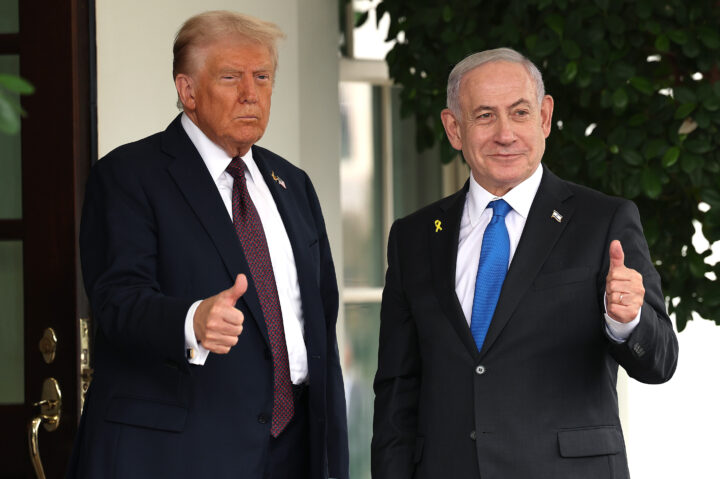
Win McNamee/Getty Images
President Donald Trump (L) greets Israeli Prime Minister Benjamin Netanyahu as he arrives at the White House on September 29, 2025 in Washington, DC.
During a meeting between Israeli Prime Minister Benjamin Netanyahu and President Donald Trump at the White House on Monday, Netanyahu apologized to Qatar’s prime minister, Sheikh Mohammed bin Abdulrahman al-Thani, for killing a Qatari serviceman in an attempted strike on Hamas leadership in Doha and promised not to violate Qatari sovereignty again.
The strike, which reportedly failed to eliminate any members of Hamas’ top political leadership, caused a public rift between the U.S. and Israel. The Trump administration attempted to warn Qatar about the strike before it happened and Trump said he promised Qatar that such attacks would not be repeated in the future.
According to a readout from the White House, “Prime Minister Netanyahu expressed his deep regret that Israel’s missile strike against Hamas targets in Qatar unintentionally killed a Qatari serviceman” and that “in targeting Hamas leadership during hostage negotiations, Israel violated Qatari sovereignty and affirmed that Israel will not conduct such an attack again in the future.”
According to remarks released by the Israeli government, Netanyahu told Al Thani, “I want you to know that Israel regrets that one of your citizens was killed in our strike. I want to assure you that Israel was targeting Hamas, not Qataris. I also want to assure you that Israel has no plan to violate your sovereignty again in the future, and I have made that commitment to the president.”
Netanyahu also acknowledged Qatar’s “grievances against Israel” as well as Israel’s own issues with Qatar “from support for the Muslim Brotherhood to how Israel is portrayed on Al Jazeera to support for anti-Israel sentiment on college campuses.”
Trump, during the call, “expressed his desire to put Israeli-Qatar relations on a positive track after years of mutual grievances and miscommunications,” and the three leaders agreed to establish a trilateral mechanism “to enhance coordination, improve communication, resolve mutual grievances, and strengthen collective efforts to prevent threats,” per the White House release.
According to his remarks, Netanyahu said that the mechanism is intended to “address both our countries outstanding grievances.”
Netanyahu and Al Thani “underscored their shared commitment to working together constructively and clearing away misperceptions, while building on the longstanding ties both have with the United States,” according to the White House readout.
The three leaders discussed efforts to end the war in Gaza as well as “the need for greater understanding between their countries.”
Al Thani “emphasiz[ed] Qatar’s readiness to continue contributing meaningfully to regional security and stability.”
Israel and Qatar do not have formal relations and public high-level diplomatic engagements between their leaders are rare.
From the Israeli side, news of the apology has been met with frustration and scorn from Netanyahu’s political allies and opponents.
Finance Minister Bezalel Smotrich compared the apology to U.K. Prime Minister Neville Chamberlain’s appeasement of Adolf Hitler during WWII. Netanyahu’s “groveling apology to a state that supports and funds terror is a disgrace,” Smotrich said on X.
National Security Minister Itamar Ben-Gvir expressed continued support for the Qatar strike, calling it “important, just, and supremely moral.”
Orit Strock, a member of the Israeli Cabinet, asked, “Did the Emir of Qatar apologize to PM Netanyahu for Oct. 7?”
Yair Golan, chairman of opposition party The Democrats, called the apology “a humiliation” and said that, “In order to beat Hamas, we need to replace Bibi and Qatar.”
Israeli political analyst and author Amit Segal said, “The Qatari scum have not condemned the October 7 massacre to this day. Even if there is a diplomatic need for this, it is repulsive and disgusting.”
Haaretz reporter Amir Tibon and others expressed anger that Netanyahu had apologized to the Qataris before he apologized to Israeli victims of Oct. 7.
Nadav Pollack, a lecturer at Israel’s Reichman University, said that the apology and promise show that Qatar holds stronger influence in the White House than Israel.
Foundation for Defense of Democracies CEO Mark Dubowitz downplayed the significance of the apology.
“Apology or not, Qatar is on notice that Israel will eliminate Hamas terrorists where and when it chooses,” Dubowitz told Jewish Insider. “The overarching message is more important: Get your Muslim Brotherhood cousins to agree to a deal, and release the hostages, or next time we won’t miss.”
Rich Goldberg, a senior advisor at FDD and a former Trump administration official, responded similarly.
“If that’s the worst thing Israel has to do to save face while Qatar acquiesces to U.S. pressure to secure the release of all hostages, let it be the last insult endured,” Goldberg told JI. “There is a cold dark place in hell awaiting all Hamas sponsors, and I expect the Mossad will help them find that place at the right time in the future.”
Both Dubowitz and Goldberg have publicly maintained that the U.S. was likely aware of and approved of the Israeli strikes in Qatar, in spite of Trump’s own public condemnations and denials.
Former U.S. Ambassador to Israel Dan Shapiro, a senior fellow at the Atlantic Council and former top Pentagon official in the Biden administration, told JI that the apology “was a useful diplomatic maneuver, likely pre-scripted, to ensure Qatar would do its part to deliver a yes from Hamas on release of all hostages and disarmament. Trump pressuring Netanyahu was necessary, but no less needed was his pressure on Qatar. The apology gave him that leverage.”
Michael Makovsky, the CEO of the Jewish Institute for National Security of America said that “Based on what we know, it’s understandable that Netanyahu felt compelled to apologize to the Qatari PM. Pres Trump asked him to do it, and Trump has collaborated with Israel in the 12-Day War, and backed Israel on Gaza.”
“But it’s unfortunate, because Israel doesn’t owe Qatar an apology—Qatar owes Israel an apology for supporting Hamas for so many years, by hosting its leaders, funding its operations, offering verbal support, etc.,” Makovsky continued. “Qatar should also apologize for spreading anti-Israel (and anti-American) hate on its al-Jazeera news organization. The bigger question is why Pres. Trump is so favorable to Qatar.”
Dana Stroul, the research director for the Washington Institute for Near East Policy and Shapiro’s predecessor at the Defense Department in the Biden administration, said that the statement echoes past engagements.
“It’s almost reverting to traditional US diplomacy of facilitating rapprochement between long-standing US partners,” Stroul said. “Recall then-President Obama brokering a phone call and an Israeli apology to Turkey in 2013 for its role in a 2010 Gaza flotilla incident. It also is a critical step in coalescing Arab support for providing meaningful support and resources to post war Gaza.”
She added that the administration “definitely believes it needs Qatar on its side.”
“When you read all of the various statements from the Trump administration about the peace and de-escalation agreements they are brokering, Qatar is very frequently thanked in these statements for its mediation role,” she explained.
What Trump said on and off the UNGA stage
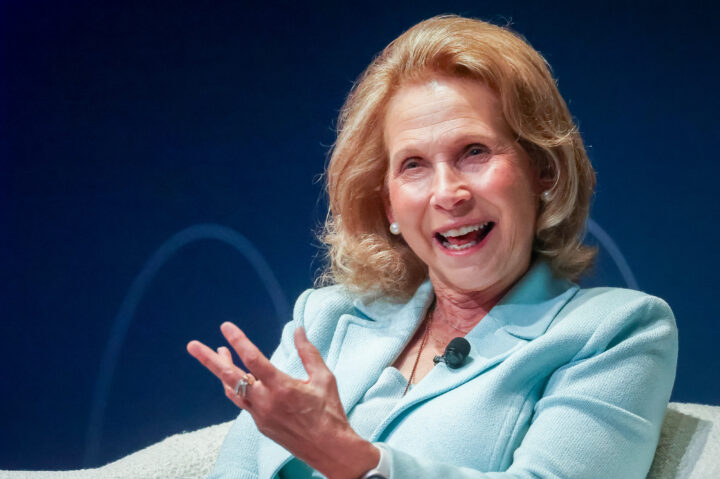
Michael Nagle/Bloomberg via Getty Images
Shari Redstone, chief executive officer of the Redstone Family Foundation, during the Axios Media Trends Live event in New York, US, on Thursday, Sept. 18, 2025.
Good Thursday morning.
In today’s Daily Kickoff, we interview Shari Redstone about her mission to fight antisemitism after selling Paramount, and talk to diplomatic sources in Jerusalem about the Qatari and Egyptian officials poised to take over key roles at UNESCO. We highlight a letter by House Democrats warning Israel against unilaterally annexing territory in the West Bank or Gaza, and talk to a Syrian Jewish community leader about his opposition to leaving sanctions against Damascus on the table. We also report on a call by a bipartisan group of House lawmakers for President Donald Trump to “be very careful” in negotiations with Turkey today. Also in today’s Daily Kickoff: Reps. Jared Moskowitz, Maria Elvira Salazar and former Secretary of State Mike Pompeo.
Today’s Daily Kickoff was curated by Jewish Insider Executive Editor Melissa Weiss, Israel Editor Tamara Zieve and U.S. Editor Danielle Cohen-Kanik, with an assist from Marc Rod. Have a tip? Email us here.
What We’re Watching
- President Donald Trump is hosting Turkish President Recep Tayyip Erdoğan today at the White House. More below.
- On the sidelines of the U.N. General Assembly in New York, MILE and Pillsbury’s Climate Week is holding a daylong event focused on energy tech and development in the Middle East. Speakers include Rich Goldberg, Mark Donig and former Israeli chief scientist Dr. Gideon Friedmann.
- The American Jewish Committee is holding its annual Global Jewish Diplomacy Reception this evening on the sidelines of the U.N. General Assembly. Attendees include: former Ambassador Daniel Shapiro, former White House Middle East envoy Jason Greenblatt, and Ambassador Serge Berdugo, president of the Council of Jewish Communities of Morocco.
- Elsewhere in New York, the Marlene Meyerson JCC Manhattan is holding a screening tonight of the first episode of the second season of “House of David.”
What You Should Know
A QUICK WORD WITH JI’s gabby deutch
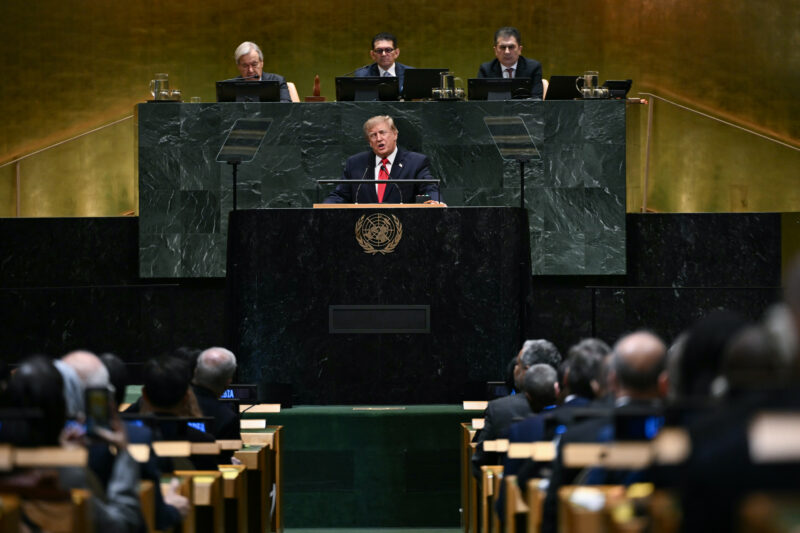
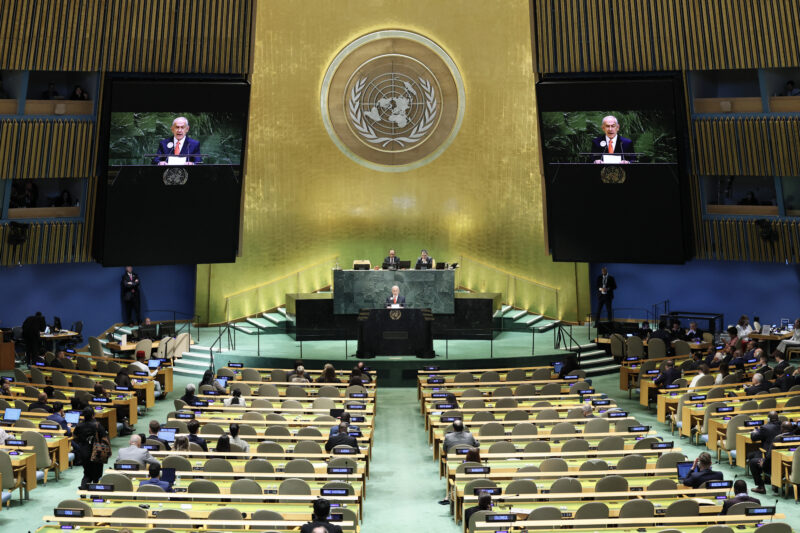
By calling the United Nations “useless” and saying many countries were “going to hell” by pursuing liberal governance, President Donald Trump was his usual provocative, impolitic self in his Tuesday speech at the United Nations General Assembly. Where other nations and the U.N. itself have promoted a vision of greater global cooperation in an interconnected world, Trump doubled down on a call for national sovereignty and closed borders. Where nearly all U.N. member states have pledged to make tackling climate change a priority, Trump took issue with the very concept of sustainable energy.
“Immigration and the high cost of so-called green renewable energy is destroying a large part of the free world and a large part of our planet,” Trump said at the close of his address. “Countries that cherish freedom are fading fast because of their policies on these two subjects.”
But it was Trump’s continued support of Israel, even in the face of growing hostility from European countries and other Western allies to the Jewish state, that stood out the most. Trump, in his General Assembly speech, blasted the European nations that this week formally recognized a Palestinian state.
“Now, as if to encourage continued conflict, some of this body is seeking to unilaterally recognize a Palestinian state,” he said. “This would be a reward for these horrible atrocities, including October 7th, even while they [Hamas] refuse to release the hostages or accept a ceasefire.”
The U.S. also joined Israel in boycotting the two-state solution conference on Monday, which was hosted by France and Saudi Arabia, and was joined by several major nations, including the United Kingdom, Australia and Canada.
But even while Trump used his nearly hourlong address to place himself firmly on Israel’s side in its nearly two-year-long war with Hamas, reports indicate that he is privately advocating for restraint. During a meeting Tuesday with Arab and Muslim leaders where U.S. special envoy Steve Witkoff proposed a 21-point plan to end the war in Gaza, Trump promised the world leaders in attendance that he would not allow Israeli Prime Minister Benjamin Netanyahu to annex the West Bank, Politico and The Times of Israel reported.
Q&A
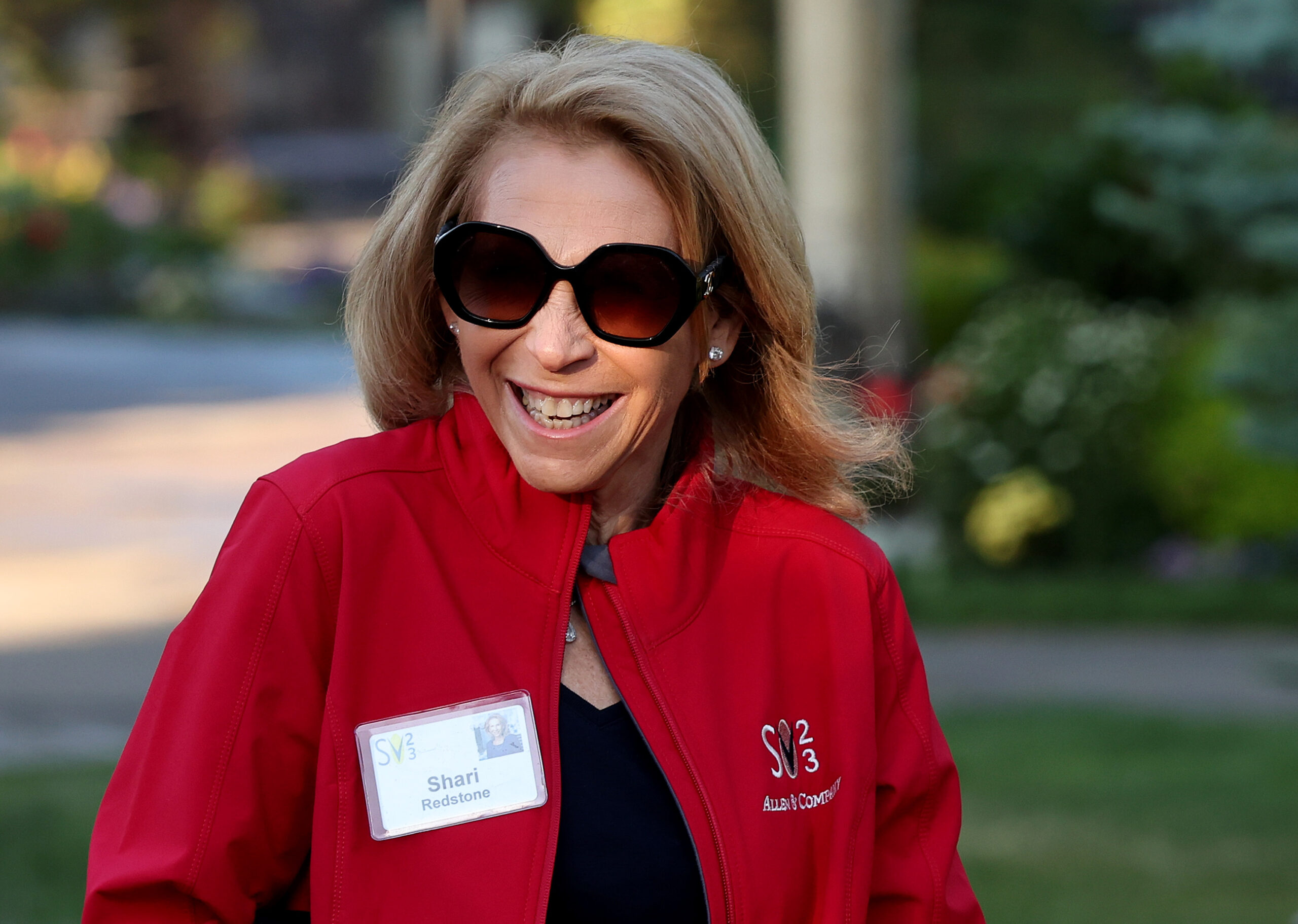
Shari Redstone, 71, has been busier than she had expected after selling Paramount, where she served as chair, to Skydance Media in a widely scrutinized merger this summer. The Jewish media mogul recently joined the Israeli entertainment studio Sipur as chair, and in leading the Redstone Family Foundation, she is involved in a range of projects fostering cultural ties between the Black and Jewish communities and combating the rise in antisemitism, among other initiatives. In an interview with Jewish Insider’s Matthew Kassel on Friday, Redstone explained how her current efforts underscore a renewed commitment to fighting antisemitism and supporting Israel in the wake of Hamas’ Oct. 7, 2023, attacks, an event she cites as accelerating her decision to finally agree to offload Paramount in an $8 billion deal with Skydance, the Hollywood studio led by David Ellison.
Oct. 7 impact: “I was in Israel years and years ago. My kids studied there, and Israel was always important. But after Oct. 7, it was the first time I thought about what my life would be without Israel, and how in so many ways, we’ve taken for granted the existence of Israel and everything that they do, frankly, for peace in the Middle East. You know, to give Jews a place that they know they will always have a home, which has become even more important in the past several months. It took on a new energy for me, and a new desire to really be supportive of Israel in every way I can,” Redstone told JI.
EYE ON UNESCO
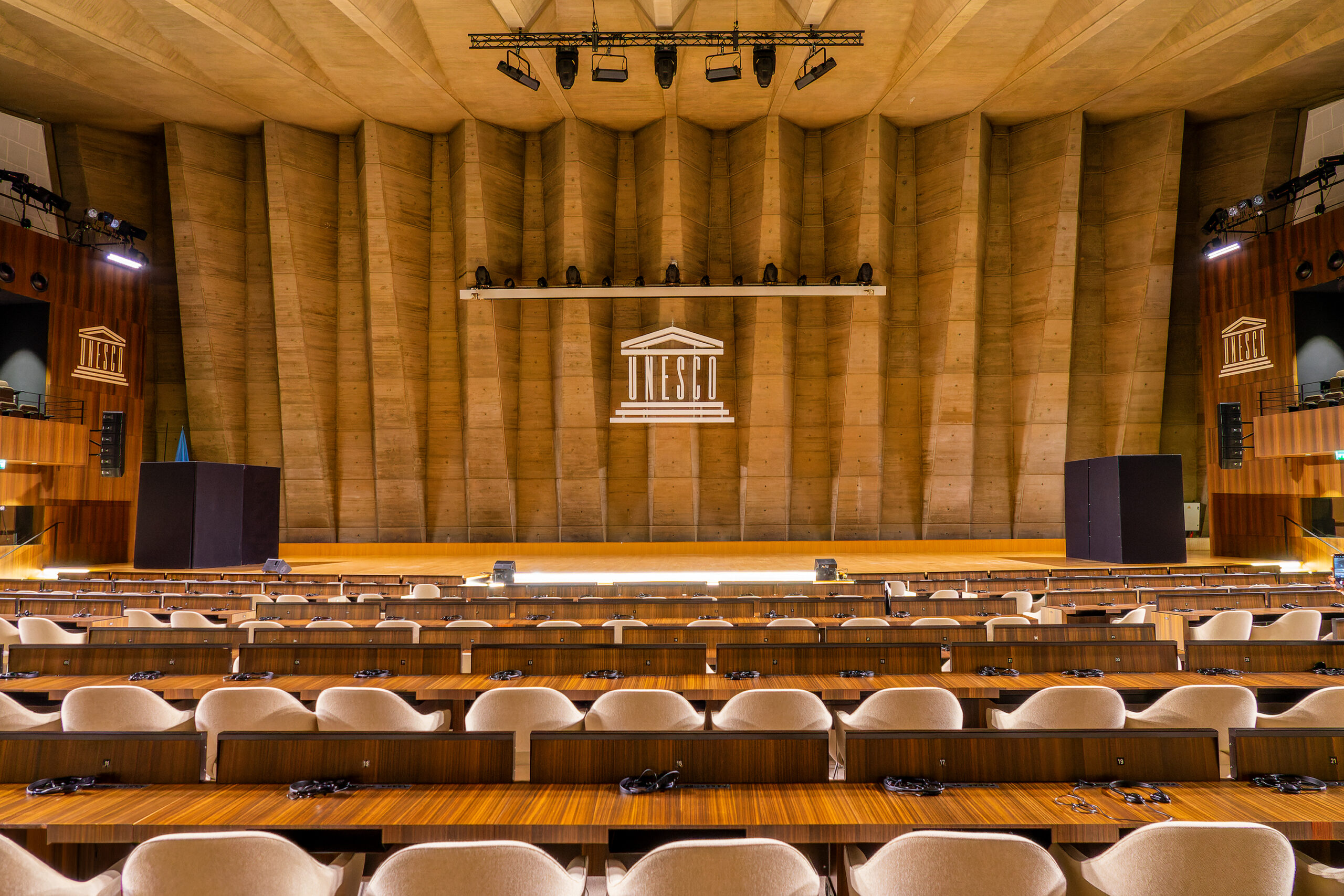
Israel is eyeing the upcoming United Nations Educational, Scientific and Cultural Organization executive board meeting with concern, with Egypt and Qatar poised to take influential roles in the body. Qatar is set to take the body’s chairmanship, and former Egyptian Tourism and Antiquities Minister Khaled el-Enani is considered a leading candidate for the organization’s director general. The UNESCO Executive Board Meeting will begin on Wednesday in Paris and continue for two weeks, during which the new board chairperson and director general will be selected. The director general must receive a majority vote on Oct. 6, while the executive board chairmanship rotates between geographic blocs and the Middle East bloc agreed to put Qatar in the role, Jewish Insider’s Lahav Harkov reports.
Israel angle: With two Arab countries expected to assume UNESCO’s leading positions, some observers have expressed concern that Israel may again face disproportionate scrutiny and criticism — a pattern seen in other U.N. bodies where geopolitical tensions often surface. The potential new leadership of UNESCO is “bad for Israel and bad for America,” an Israeli diplomat told JI this week. Another Israeli diplomatic source said that it is an “unusual combination to have a director general and chairman of the executive board from Arab countries. It puts Israel at a disadvantage. … Israel is not a member of the executive board and has no influence on who will be chairman.”
WORDS OF WARNING
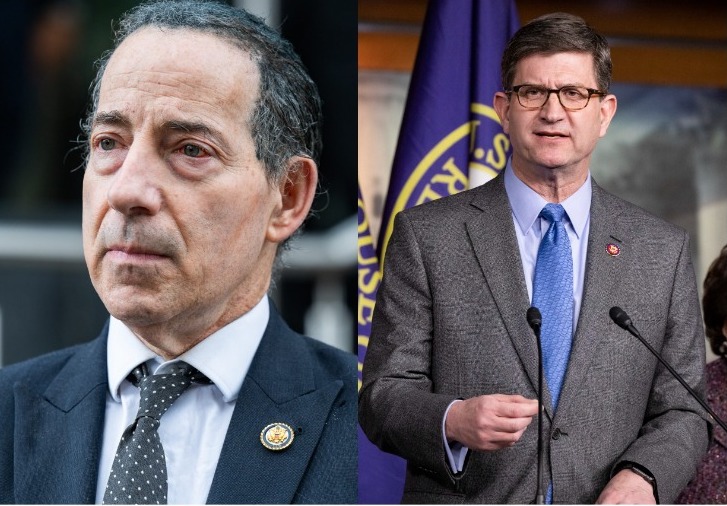
Most House Democrats, including all of the current and former top Democratic leaders, signed onto a letter on Thursday to Israeli leaders warning them against unilaterally annexing territory in the West Bank or Gaza, Jewish Insider’s Marc Rod reports. At a time when Democrats are increasingly divided over the U.S.-Israel relationship and its direction, the letter highlights a strong degree of unanimity within the party against annexation, among both Democrats who largely remain supportive of Israel and those who have become more critical over the war in Gaza.
What they said: “As long-standing supporters of the U.S.-Israel relationship, Israel’s security, and Israel’s future, we are deeply opposed to proposals for unilateral annexation of territory in the West Bank,” the 178 lawmakers, led by Reps. Brad Schneider (D-IL) and Jamie Raskin (D-MD), said. “Such a move would not only violate international law but undermine decades of bipartisan U.S. policy and threaten the progress of the Abraham Accords, which offer Israel and its neighbors the opportunity to build a more secure, cooperative, and prosperous regional future. Unilateral annexation of the West Bank would plunge the region, already reeling from tens of thousands of deaths in the horrific Gaza war, into further chaos and violence.”
DAMASCUS DEALINGS
A debate is quietly simmering in Washington over the prospect of repealing congressionally mandated sanctions on Syria, an effort that has bipartisan support — but is not without its opponents, Jewish Insider’s Marc Rod reports. As part of the Senate’s consideration of the 2026 National Defense Authorization Act, a provision is moving forward to fully repeal the Caesar Act, which placed strong sanctions on the Assad government in response to human rights violations. But other lawmakers are attempting to place conditions on the repeal of those authorities.
Community concerns: Some, like Rabbi Yosef Hamra, the nephew of the last chief rabbi of Syria, have argued that leaving the sanctions on the books in any capacity would cripple rebuilding efforts. But others say that the U.S. must maintain that tool as leverage to prevent future sectarian and human rights issues. Hamra, in a letter to congressional offices on behalf of the Jewish Heritage in Syria Foundation that was shared with JI, said, “Lifting the Caesar sanctions is essential to restore synagogues and cemeteries, safeguard irreplaceable Jewish heritage and re-establish a mutli-faith community in Syria after more than 30 years in exile. Simply put, this amendment would be devastating to the Jewish community in Syria.”
TALKING TURKEY
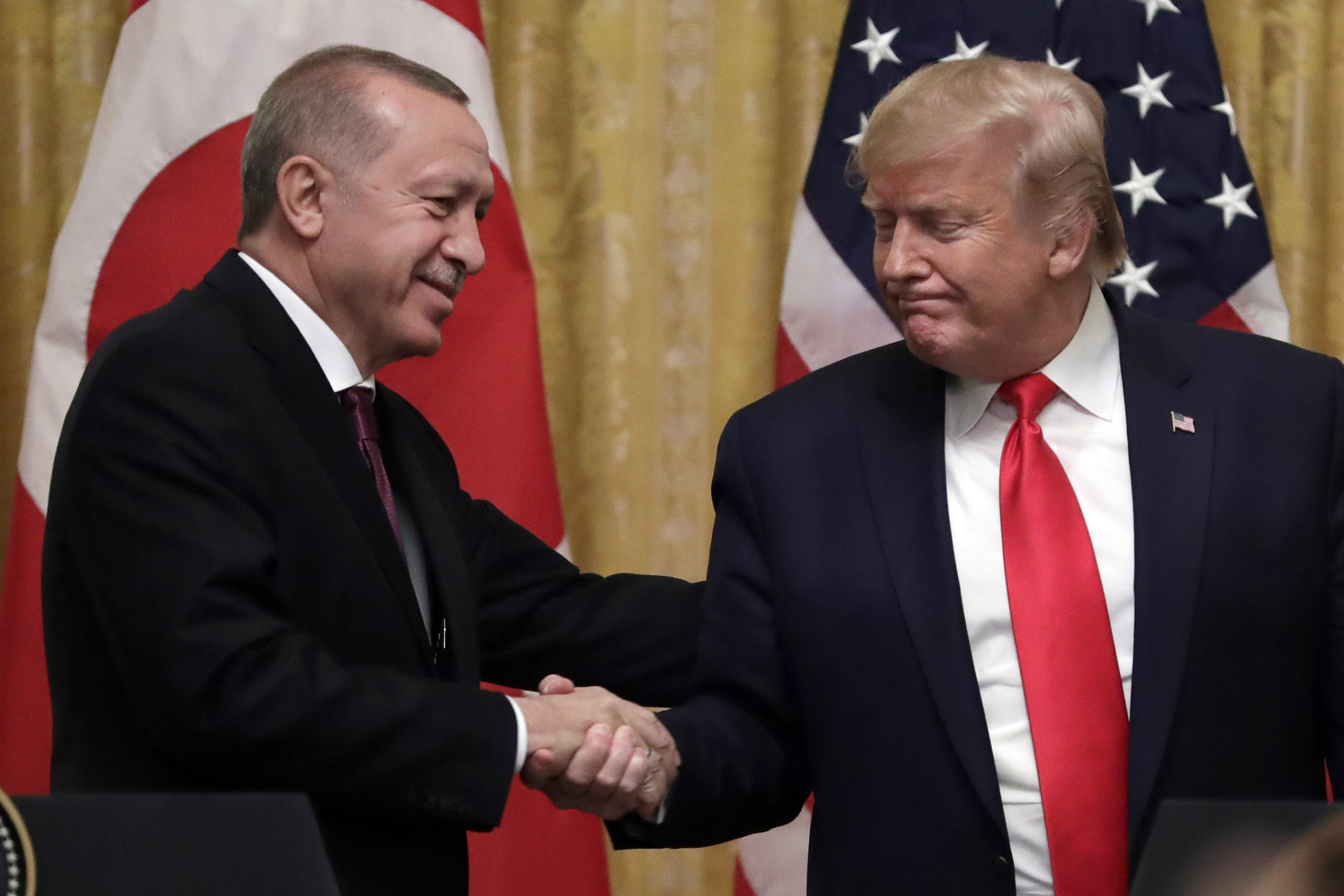
A bipartisan group of House members urged the administration to “be very careful” in negotiations with Turkey about its potential reentry into a program allowing it to acquire and potentially co-produce F-35 fighter jets, ahead of a White House meeting today between President Donald Trump and Turkish President Recep Tayyip Erdogan, Jewish Insider’s Marc Rod reports.
Background: Trump said Friday that he would host Erdogan at the White House for trade and military talks, “including the large-scale purchase of Boeing aircraft, a major F-16 Deal, and a continuation of the F-35 talks, which we expect to conclude positively.” Lawmakers have been pressing for months for the administration to be cautious in allowing Turkey to acquire the advanced fighter jets, something it has been banned by law from doing since it purchased a Russian S-400 missile defense system. By law, Turkey must dispense with that system before it can be readmitted into the F-35 program, but some lawmakers have pushed for additional conditions, given various conflicts with Turkey, including its hostile posture toward Israel.
COLOMBIA CONCERNS
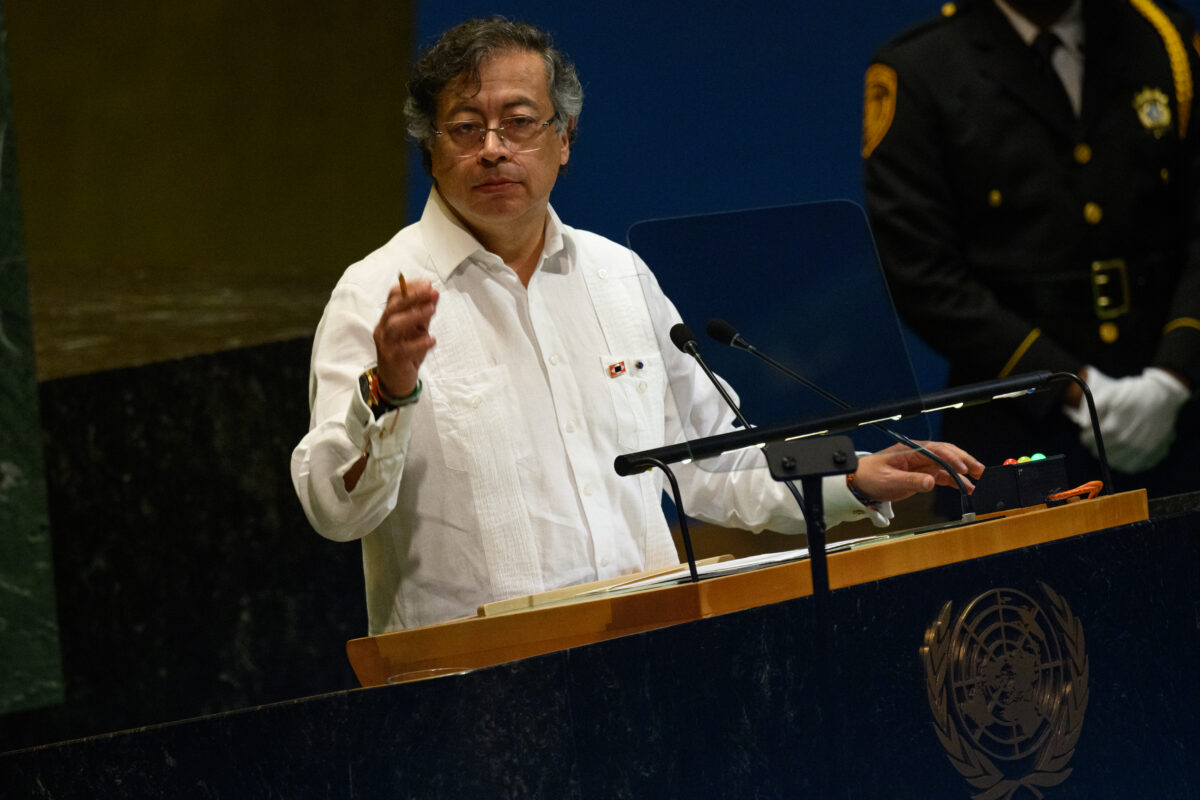
A bipartisan group of 18 House members is urging the State Department to pressure Colombia’s government to change course on what the lawmakers describe as a dangerous pattern of antisemitic rhetoric and policies by government officials, including the country’s president, Jewish Insider’s Marc Rod reports.
Call to action: “As U.S.-Colombia relations continue to be strained by numerous issues, including the increasingly troubling antisemitic rhetoric and discriminatory policies from Colombian President Gustavo Petro, which are directly threatening the safety and well-being of Colombia’s Jewish community, we write to urge the administration to consider even stronger actions, including leveraging U.S. assistance to push for meaningful change in President Petro and his government,” the lawmakers, led by Reps. Jared Moskowitz (D-FL) and Maria Elvira Salazar (R-FL), said in a letter sent on Monday to Secretary of State Marco Rubio.
Worthy Reads
Pompeo’s Point: In The Free Press, former Secretary of State Mike Pompeo criticizes recent moves by European nations, as well as the U.K., Australia and Canada, to unilaterally recognize a Palestinian state. “The move to recognize a Palestinian state where none exists did not just reward terror groups. It was also a boon to a faltering regime in Tehran desperate to repair its standing among Iranians after its decisive defeat in June’s 12-Day War. Any leader who genuinely desires peace should instead seize the historic opportunity to continue to diminish the Iranian regime and empower the forces across the region that seek a constructive relationship with Israel. History shows that peace has never been secured through appeasement—a lesson one would have thought our European and Anglosphere allies would keenly appreciate. Israel does not have the luxury of forgetting that lesson, and so they will continue to hold the line against barbarism, even if their supposed friends in the West will not.” [FreePress]
Awkward Alliance: The Atlantic’s Helen Lewis details how the rapid demise of the far-left Your Party — born from tensions between its “Gaza left” and “gender left” wings — illustrates the deeper challenges facing the left in Britain and beyond. “… the alliance of ‘rainbow and crescent’—as the historian James Orr, a friend of J. D. Vance, has described it—is extremely fragile. Gay marriage, abortion, and transgender rights are obvious flash points, but other issues can be equally divisive. For instance, many British Muslims support fee-paying schools, which can offer students a more religious curriculum than government-run institutions. The traditional left-wing position, however, is that private schools are engines of privilege and should be abolished. Can these groups happily coexist in a left-wing movement in the long term? The experience of Your Party suggests not.” [TheAtlantic]
Word on the Street
In her new book, former Vice President Kamala Harris writes that concerns about Gaza war protests factored into her decision not to select Pennsylvania Gov. Josh Shapiro as her running mate last year…
At her first book event in New York on Wednesday, Harris was interrupted by anti-Israel protesters, and said later, “I was the first person at the highest level of our United States government or administration to talk about the fact that the people in Gaza were starving. … I was not the president, I couldn’t make the decision, but I made my position clear”…
Rep. Seth Moulton (D-MA) is reportedly preparing to mount a primary bid against Sen. Ed Markey (D-MA), hiring campaign staff with a potential campaign kickoff slated for October…
Several countries including the U.S. are looking to develop copycats of Iran’s Shaheed drones, after seeing Russia’s success in using the low-cost, long-range model in its war in Ukraine…
Right-wing commentator Tucker Carlson is among the public figures set to tour U.S. college campuses with Turning Point USA, following the assassination of TPUSA founder Charlie Kirk earlier this month during the first stop of his campus tour. Carlson will speak at the University of Indiana on Oct. 21…
Federal prosecutors agreed to move faster in providing discovery evidence in the case of the alleged Capital Jewish Museum shooter, as the Department of Justice considers whether it will seek the death penalty in the shooting of two Israeli Embassy staffers outside the museum in May…
Two Syracuse University students are facing hate crimes charges and disciplinary actions for throwing a package of pork products into a Jewish fraternity house during Rosh Hashanah…
The U.S. is mulling sanctions against the entire International Criminal Court, with a State Department spokesperson saying that the body poses “a threat to our national interests”; previously the Trump administration had imposed sanctions on individuals tied to the court, including its chief prosecutor, Karim Khan…
Queen Rania of Jordan and First Lady Melania Trump met at an event launching the first lady’s Fostering the Future Together initiative on the sidelines of the U.N. General Assembly on Tuesday, the fourth time the women have met…
More than 20 people were injured, including two seriously, in a Houthi drone attack on the Israeli port city of Eilat…
Archeologists in northern Israel discovered a trove of coins dating back to the fourth century…
New satellite images indicate that Iran is beginning to rebuild the missile-production sites that were degraded by Israel during the 12-day war between the countries in June…
The Iranian rial fell to an all-time low of 1.1 million rials to the dollar hours before Iranian President Masoud Pezeshkian’s address to the United Nations General Assembly, during which he pledged that Tehran “has never sought and will never seek to build a nuclear bomb”…
Iranian diplomats traveling to the U.S. for the UNGA were banned by the Trump administration from shopping at Costco and other big-box stores…
Jailed Egyptian-British pro-democracy activist Alaa Abd el-Fattah was pardoned and released after serving 12 years in an Egyptian prison for his role in anti-government protests…
The debut of Apple TV+’s “The Savant,” which stars Jessica Chastain as a woman who attempts to foil domestic terror attacks, was postponed; Chastain said in a social media post that she disagreed with Apple TV+’s decision, citing “an unfortunate amount of violence” since the show began filming that “illustrate[s] a broader mindset that crosses the political spectrum and must be confronted.” The series is based on an Anti-Defamation League staffer profiled in a 2019 Cosmopolitan article…
Abdulaziz Al Asheikh, the grand mufti of Saudi Arabia, died on Tuesday…
Pic of the Day

Oyster Bay (Long Island) Town Supervisor Joseph Saladino and members of the Town Board were joined on Sunday by Nassau County Executive Bruce Blakeman, District Attorney Anne Donnelly, community leaders, clergy, students and residents to dedicate a parklet in Plainview in memory of Omer Neutra, who grew up in the community and was killed in the Oct. 7, 2023, Hamas attacks on Israel while serving in the IDF.
Birthdays
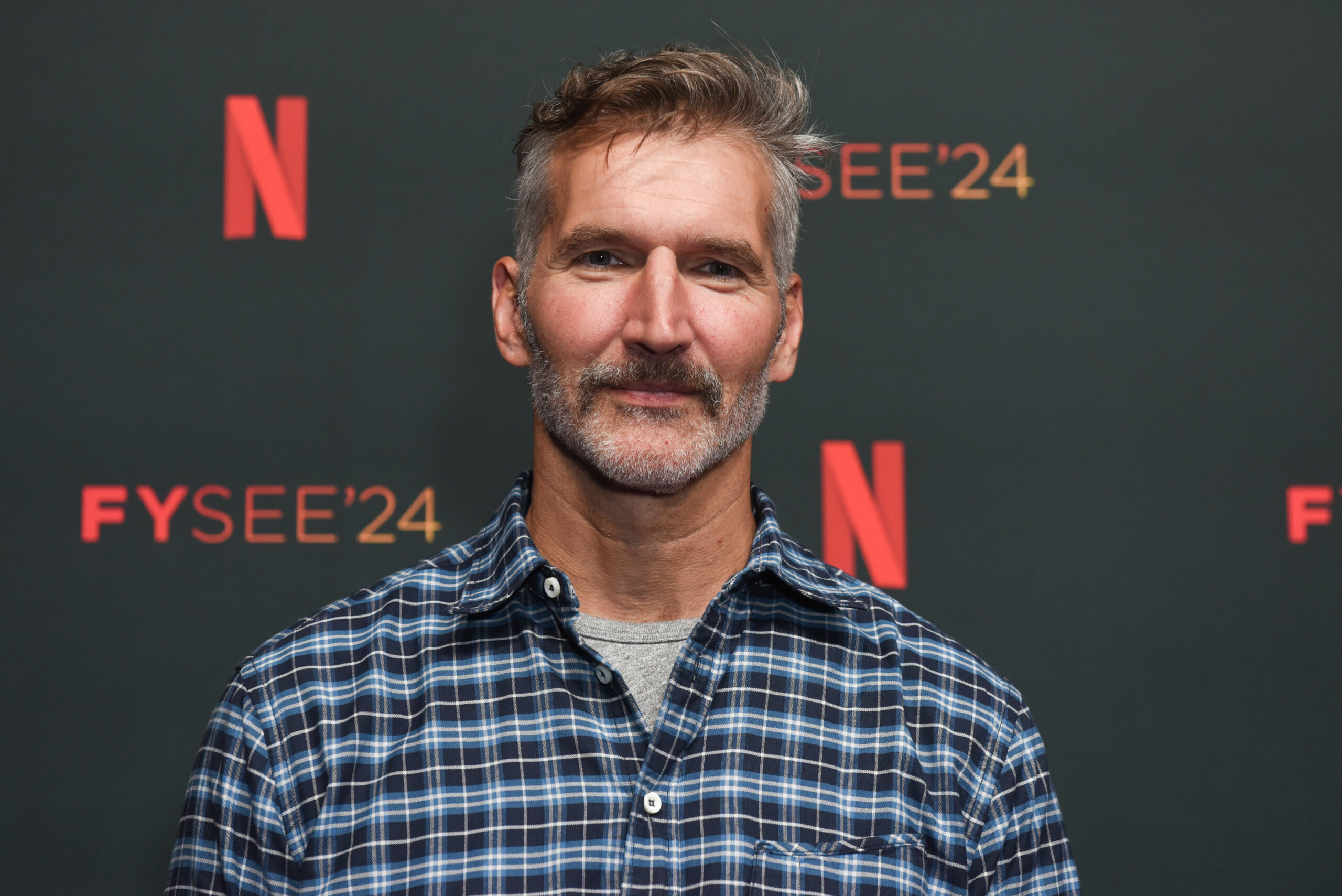
Director and co-creator of the award-winning HBO series “Game of Thrones,” known professionally as David Benioff, David Friedman turns 55…
Member of the U.K.’s House of Lords, Baroness Vivien Helen Stern turns 84… Former member of Knesset, he also served as Israel’s ambassador to France and then the United Nations, Yehuda Lancry turns 78… Lakewood Ranch, Fla., resident, Dvora Millstone turns 77… Israeli television anchor and popular singer, Yardena Arazi turns 74… Founder of ALMA, she served as a member of Knesset for Yesh Atid from 2013-2015, Ruth Calderon turns 64… President and CEO of Israel Aerospace Industries, Boaz Levy turns 64… Founder, chairman and CEO of Salesforce, Marc Russell Benioff turns 61… Best-selling author and serial entrepreneur, Marissa Levin… Son and grandson of leading British rabbis, he is the senior rabbi at the Beverly Hills Synagogue, Pinchas Eliezer “Pini” Dunner turns 55… Former member of the Knesset for Likud, she has appeared on multiple Israeli reality television shows, Inbal Gavrieli turns 50… White House correspondent for NPR, Tamara Keith turns 46… Member of the California State Assembly where he serves as co-chair of the Legislative Jewish Caucus, Jesse Gabriel turns 44… VP of government relations at the ADL, Carmiel Arbit… Features writer at New York magazine and its culture magazine Vulture, Lila Shapiro… Actor and comedian, best known for his role as Gabe Lewis on the NBC sitcom “The Office,” Zach Woods turns 41… Videographer and virtual program producer for the U.S. State Department, Mitchell Israel Malasky… Assistant appellate federal defender at Federal Defenders of San Diego, Daniel Yadron… Former center and power forward for Maccabi Tel Aviv of the Israeli Basketball Premier League and the EuroLeague, Jacob Greer (Jake) Cohen turns 35… Asset manager for Capital Realty Group, Yanky Rodman… Senior director of Next Gen at Christians United for Israel, Destiny Albritton… Strategic director at Laurel Strategies, Adam Basciano…
‘It’s bad for Israel and bad for America,’ an Israeli diplomat told JI this week
GETTY IMAGES
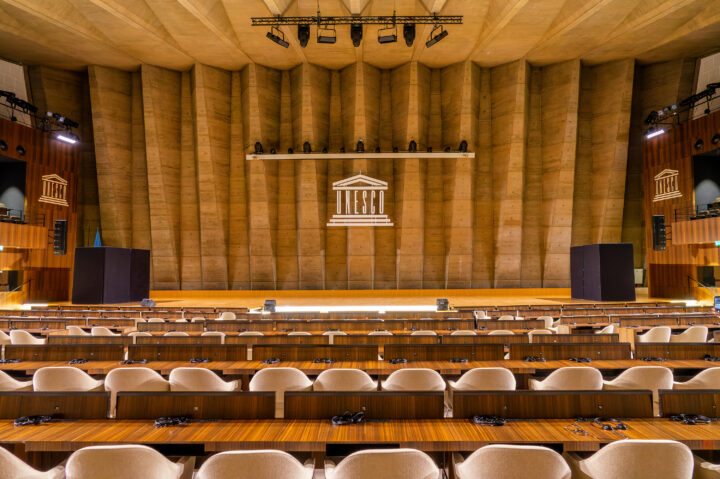
Inside of the grand auditorium of UNESCO headquarters building in Paris, France
Israel is eyeing the upcoming United Nations Educational, Scientific and Cultural Organization executive board meeting with concern, with Egypt and Qatar poised to take influential roles in the body.
Qatar is set to take the body’s chairmanship, and former Egyptian Tourism and Antiquities Minister Khaled el-Enani is considered a leading candidate for the organization’s director-general.
UNESCO is focused on international cooperation in education, culture and science and communication. Its most prominent project is its list of World Heritage Sites that members pledge to safeguard and adhere to global norms for preservation. Its annual budget in recent years has been about $1.5 billion.
The Jewish state has historically faced challenges in UNESCO, which ratified multiple resolutions in the past decade declaring the Temple Mount, Western Wall and the Old City of Jerusalem to be endangered Muslim and Christian sites, while excluding the millenia-old Jewish connection. The “State of Palestine” has been a full member of UNESCO since 2011, and the organization recognizes five Palestinian heritage sites, including the Cave of the Patriarchs in Hebron, a Jewish and Muslim holy site; UNESCO resolutions relating to Hebron have also left out its Jewish history. In 2009-2014, UNESCO approved 46 resolutions widely viewed as critical of Israel.
Yet, in recent years, with former French Culture Minister Audrey Azoulay at the helm of UNESCO — the first Jewish person to hold the position — the organization managed to lower the temperature over contentious issues in the Middle East, and she pushed for the advancement of Holocaust education and the fight against antisemitism. Azoulay will complete her second term in November; the departing chairperson of the UNESCO Executive Board is Vera Lacoeuilhe of Saint Lucia.
The UNESCO Executive Board Meeting will begin on Wednesday in Paris and continue for two weeks, during which the new board chairperson and director general will be selected. The director general must receive a majority vote on Oct. 6, while the executive board chairmanship rotates between geographic blocs and the Middle East bloc agreed to put Qatar in the role.
With two Arab countries expected to assume UNESCO’s leading positions, some observers have expressed concern that Israel may again face disproportionate scrutiny and criticism — a pattern seen in other U.N. bodies where geopolitical tensions often rise to the surface.
The Trump administration left UNESCO earlier this year. The first Trump administration departed the organization in 2017, after which the Biden administration returned. Washington is left with little influence to help Israel or push back against decisions it may view as against its own interests.
“It’s an odd situation where we have announced we are leaving, so it matters far less to us,” former Trump administration official and Foundation for Defense of Democracies Senior Advisor Rich Goldberg told Jewish Insider. “In fact, it reinforces how broken the agency is and why we should be in opposition to it, not in the middle of it.”
The potential new leadership of UNESCO is “bad for Israel and bad for America,” an Israeli diplomat told JI this week.
An Israeli diplomatic source said that it is an “unusual combination to have a director general and chairman of the executive board from Arab countries. It puts Israel at a disadvantage. … Israel is not a member of the executive board and has no influence on who will be chairman.”
Still, Israel tried to advocate for friendlier candidates in the past year, though the diplomatic source called the effort “somewhat pointless, because they have an almost automatic majority. There’s a bloc of Muslim countries, and those who support Qatar.”
Qatari Ambassador to UNESCO Nasser bin Hamad Al Hanzab is a leading candidate to chair UNESCO’s Executive Board for the next two years, according to diplomatic sources.
Qatar is one of the largest donors to UNESCO, contributing millions of dollars in the last decade and hosting a regional office in Doha, whose expenses are covered by the Qatar Fund for Development. The Gulf state’s Sheikha Moza Bint Nasser is a UNESCO Special Envoy for Basic and Higher Education.
Qatar is also one of the top donors to the U.N., broadly, increasing its contributions since 2020, including pledging over $1 billion to humanitarian agencies in 2018 and 2020.
“Qatar has the money and the influence,” the Israeli diplomatic source said. “It’s a game where the result is known in advance. There isn’t a lot that can be done.”
Goldberg said that “the Qataris have learned from the Chinese how to leverage international organizations for global legitimacy and national interests. We now must come to terms with a U.N. where both the [Chinese Communist Party] and the [Qatar-backed] Muslim Brotherhood seek control of U.N. bodies to advance their interests and undermine America’s.”
“They’ve poured billions into cultural and educational influence across the world,” he added. “This is a logical U.N. body for Qatar to co-opt.”
El-Enani is an archeologist by profession and a professor of Egyptology. During his tenure as Egypt’s minister of tourism and antiquities, Cairo put substantial effort and resources into refurbishing its ancient sites, such as Luxor.
A diplomatic source said that Qatar is actively backing el-Enani, who played a role in strengthening the Gulf state’s ties with Egypt, after years of tensions between the countries due to Doha’s sponsorship of the Muslim Brotherhood and Al Jazeera, which supported the overthrow of the Egyptian government in 2011. Qatar is one of the largest sponsors of the Giza Pyramids UNESCO World Heritage Site project led by el-Enani when he was in government. El-Enani has been featured at events hosted by Qatari embassies around the world in recent years.
Journalists across the Middle East have also accused el-Enani and his campaign of corruption. Doha-based journalist Mohammed Al-Qadusi published a recording that he said was a conversation between Egyptian Foreign Minister Badr Abd-Ela’ati with Egyptian Ambassador to the Netherlands Emad Hana in which the latter suggested offering a gift to UNESCO executive board members to improve his chances of winning. Egyptian TV anchor Mohammed Naser said in an on-camera monologue that el-Enani represents a “corrupt regime” and had misused public funds, allowed for the destruction of archeological sites and lacked transparency when spending on large events.
Coptic Christians have spoken out against el-Enani’s candidacy, saying that Egypt violated UNESCO’s rules for World Heritage Sites by declaring a historic monastery property of the state and noted Cairo’s systemic discrimination against the minority population, which makes up 12-15% of Egyptians.
El-Enani is running against Firmin Edouard Matoko, a former senior UNESCO official from Congo, and Gabriela Ilian Ramos Patino of Mexico, a former senior official at UNESCO and the OECD.
The Israeli diplomatic source said that “who the director-general appoints to key roles, such as his deputies and the head of departments will be significant.”
He also said it is unclear where el-Enani will stand on Israel-related matters — the options likely being either sympathetic to the Palestinians or seeking to avoid controversy as UNESCO has done in recent years, by watering down Palestinian resolutions’ texts so that they do not attack or delegitimize Israel.
But if the Palestinians propose resolutions that are hostile to Israel, “the automatic majority brings them success in almost everything. [Israel is] fighting defensively. … We aren’t abandoning this arena to the Palestinians. We make sure to emphasize with historic documents and archeological findings the Israeli connection to Jerusalem and Hebron,” he said.
In addition to advancing education, science and culture, UNESCO protects independent media and press freedom. Despite owning the Al Jazeera media empire, Qatar ranks 79th out of 180 in the World Press Freedom Index, and Egypt ranks 170th and is one of the world’s biggest jailers of journalists.
In the coming months, Israel plans to submit proposals to double its current number of UNESCO World Heritage Sites, 17. The list of 18 new sites includes ancient synagogues in the Upper Galilee and the Carmel Nature Reserve.
Israel also submitted a report to UNESCO earlier this year about damage caused by Iranian missile attacks to Tel Aviv’s White City, a World Heritage Site due to its Bauhaus architecture.
Looking at where the three architects of President Joe Biden’s Middle East policy team have positioned themselves publicly, without the constraints of government service, is a sign of the options available to Democrats right now
Tom Williams/CQ-Roll Call, Inc via Getty Images/JACQUELYN MARTIN/POOL/AFP via Getty Images/Andrew Harnik/Getty Images
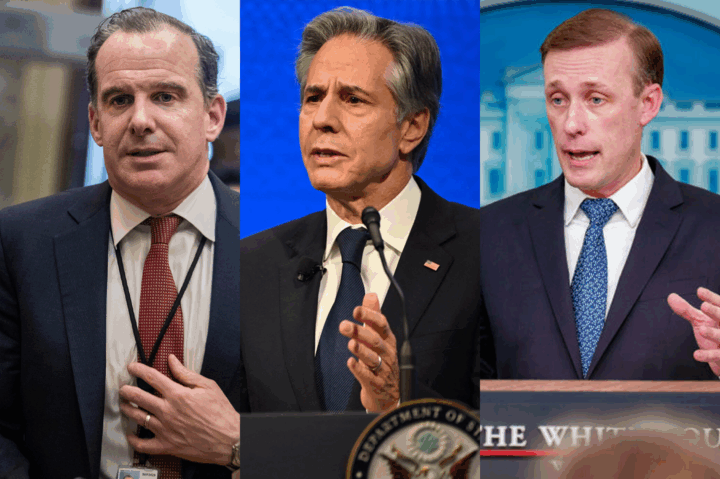
Former Secretary of State Tony Blinken, former National Security Advisor Jake Sullivan and Brett McGurk, Biden’s coordinator for the Middle East at the White House.
In Washington, whether a public official or their spokesperson is speaking honestly is usually not fully known until much later. Take Israel’s attack on Qatar last week: the Trump administration claimed not to have known about it ahead of time, but Israeli officials told Axios that Israeli Prime Minister Benjamin Netanyahu had given President Donald Trump a heads-up.
When a president leaves office, his former staffers tend to get rather loose-lipped — an opportunity for them to rehabilitate their reputation and, perhaps, tell the truth about their views (or at least the narrative they’d like to put forward on their own terms, not those of their boss).
The past few months have provided such an opportunity to the three architects of President Joe Biden’s Middle East policy team: Secretary of State Tony Blinken, National Security Advisor Jake Sullivan and Brett McGurk, Biden’s coordinator for the Middle East at the White House. All of them played a crucial role in shaping American policy toward Israel and Gaza after Oct. 7. Each has in recent months written op-eds and made lengthy appearances on podcasts and cable news to comment on developments in the Middle East.
Looking at where Blinken, Sullivan and McGurk have positioned themselves publicly, without the constraints of government service, is a sign of the options available to Democrats right now, at a moment when the party’s future is up for grabs — with an ascendant anti-Israel wing that is exerting stronger influence than ever, though it remains in the minority.
Sullivan, a measured foreign policy hand with a keen eye for politics, has in recent weeks begun saying that the U.S. should consider withholding weapons to Israel, a position he said he did not support one year ago. Whether Sullivan’s shift to the left represents a genuine change of heart or a response to shifting political winds within the Democratic Party, it’s a sharp departure from the way Biden governed.
McGurk, meanwhile, has been more willing to give the Israelis leeway in their prosecution of the war in Gaza and actions elsewhere in the Middle East. McGurk, used to being the behind-the-scenes negotiator who traveled regularly to Doha, Jerusalem and Cairo after Oct. 7, is now a commentator on CNN. That’s where he said in June that he gives “extremely high marks” to Trump for the way he handled Israel’s 12-day war with Iran and Washington’s brief entry into that conflict — while Sullivan has said the U.S. strikes weren’t necessary.
Helming the State Department, Blinken was Biden’s chief diplomat. And now, he finds himself in the middle of McGurk and Sullivan: navigating the party’s leftward pull while also sticking by his pro-Israel bona fides. He wrote in The New York Times in June that Trump shouldn’t have struck Iran — but now that Trump did so, “I very much hope it succeeded.” When many Democrats last month came out in support of European efforts to recognize a Palestinian state, a unilateral move that Israel opposes, Blinken wrote in The Wall Street Journal that he thinks it’s the right thing to do — but that France, Canada and the U.K. are “doing it too hastily,” and without needed conditions.
None of these men are aligned with the party’s far-left wing that seeks to sanction and isolate Israel on the world stage. Even Sullivan, in his commentary saying the U.S. should withhold weapons to Israel, is quick to point out the horrible toll of the Oct. 7 attacks two years ago and to praise Israel for weakening other threats in the Middle East, like Iran and Hezbollah, its proxy in Lebanon.
But keep an eye on the subtle yet shifting ways each of them approaches Israel and the Middle East to better understand the paths open to Democrats, as the party considers how to move forward and rebuild its battered brand in the era of Trump.
Even after the Israeli strike, Qatar is trying to keep up its Islamist and American ties
AMER HILABI/AFP via Getty Images
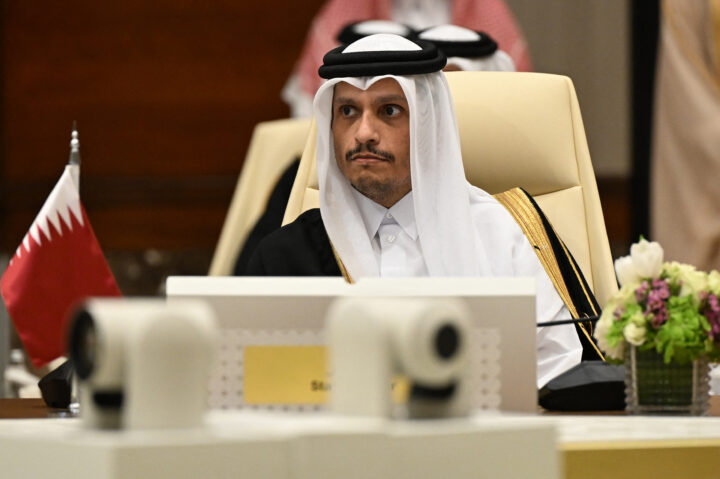
Qatar's Prime Minister and Foreign Minister Sheikh Mohammed bin Abdulrahman bin Jassim Al-Thani attends the 163rd GCC Ministerial Council meeting with Egypt in Mecca on March 6, 2025.
In the aftermath of Israel’s strike aimed at Hamas leaders in Qatar, questions have emerged about how much the U.S. knew, the extent of President Donald Trump’s frustration with Israel’s actions, and what it means for the U.S.-Israel relationship.
But another important question is whether the strike marks a turning point for Qatar — and whether the Gulf nation may now be considering a shift in its own role and behavior.
The fact that the Trump administration has not dwelled on the attack — even sending Secretary of State Marco Rubio to Israel for a warm visit days after the strike — may give Doha pause. While Press Secretary Karoline Leavitt said the strike “did not advance Israel or America’s goals,” in the next breath, she said that “eliminating Hamas, who have profited off the misery of those living in Gaza, is a worthy goal.” That goes against the Qataris’ preferred narrative, that the U.S. wants it to host terrorists because they’re the only conduit to Hamas, the Taliban and others.
With that in mind, Qatar could reconsider the business of harboring terrorists, because it has become too risky. Though the UAE was not in the terror-supporting business and has long opposed the Muslim Brotherhood, it didn’t prevent people like Hamas terrorist Mahmoud al-Mabhouh from visiting the UAE until the Mossad killed him in Dubai in 2010. The Emiratis publicly railed against Israel and the then-quiet relations between the countries were set back, but the UAE cracked down and banned such individuals associated with terror groups from entering their country.
However, Qatar does not seem to be taking recent events as a signal to change. Doha roundly condemned Israel, threatened to stop mediating hostage talks and convened an Arab summit to condemn Israel further. Senior Hamas official Ghazi Hamad appeared on Al Jazeera yesterday, with the chyron stating that he was in Doha, and the wife of senior Hamas official Khalil al-Haya was spotted visiting the grave of her son, killed in the strike, with Qatari security. On Tuesday, the Qatari Defense Minister hosted his Taliban counterpart.
And while Qatar could respond to the strike by turning away from America, it does not seem to have done that, either. Doha publicly denied reports that they were reconsidering its relationship with Washington. After its initial statement, Qatar said it would continue mediating Gaza hostage and ceasefire talks, and shifted to blaming Israeli Prime Minister Benjamin Netanyahu, rather than Israel, broadly. Doha softened its language in Arabic to describe the hostages, moving from “prisoners” to “captives,” according to Ariel Admoni, a Qatar expert at the Jerusalem Institute for Strategy and Security (JISS).
Admoni said that Doha’s “two-faced strategy has survived. … They are trying to keep up their Islamist and American ties. They can do both, and it pays for them.”
While the U.S. did not stop the Israeli strike, “no one is suggesting that Qatar expel Hamas,” Admoni noted. “Qatar is getting the legitimacy to continue hosting Hamas. It doesn’t look like Qatari public gestures to Hamas anger America.”
Rubio publicly praised Doha and asked it to continue playing a role in mediating between Hamas and Israel, and other administration figures have continued calling Qatar a great ally.
For the Doha strike to truly represent a crossroads for Qatar, at which it will have to choose between continuing to harbor terrorists or deepening its economic ties with the West, real pressure must be applied. Barring that, and with the Trump administration seemingly eager to stay in Doha’s good graces, Qatar has little incentive to change.
Asked on the Misgav Institute for National Security and Zionist Strategy’s “Mideast Horizons” podcast this week why the U.S. doesn’t put more pressure on Qatar, Richard Goldberg, the Foundation for Defense of Democracies’ senior advisor and a former Trump administration official, said that “despite bad actions, [Qatar] host[s] a major artery of the U.S. military in Al-Udeid Air Base … You could say, why do we have one of the most important bases right across the Persian Gulf from Iran and within missile range? Maybe we shouldn’t have critical assets right there … But the Pentagon doesn’t think that way. This is just how they do business and it would be too hard to think about something else — and [they say Qatar] are great partners for hosting us.”
Calling Qatar “a gas station with a television station,” Goldberg, who was the Trump administration’s National Energy Dominance Council’s senior counselor, noted that Qatari dominance in the natural gas market is also a factor in which there is “interdependence, but also a competition.” The fact that the U.S. is “a competitor with the Qataris [is] a dynamic that has not been explored enough by the Trump administration. The president wants to make America energy dominant,” he added.
Goldberg also noted that some members of the administration — who he did not name but include Attorney General Pam Bondi, FBI Director Kash Patel and Middle East envoy Steve Witkoff — worked with Qatar before working for the Trump administration: “I don’t even think that they agree with the Qataris hosting Hamas or sponsoring Hamas, and I think they would probably, at some point, indict the Hamas people … but when you’re in the private sector and this isn’t your No. 1 thing,” you’re willing to take their money. South Carolina, home of hawkish Sen. Lindsey Graham (R-SC), is “hugely economically reliant on Qatar. … There’s a reason they picked South Carolina” for investments.
These are all part of Qatar’s “very sophisticated” moves, he said, to build an “influence network … and how they become insulated,” even as they continue to host Hamas.
At a press conference with Israeli PM Netanyahu, Rubio said an agreement with Hamas to end war ‘probably won’t happen’ because ‘savage terrorists don’t often agree to disarm’
NATHAN HOWARD/POOL/AFP via Getty Images
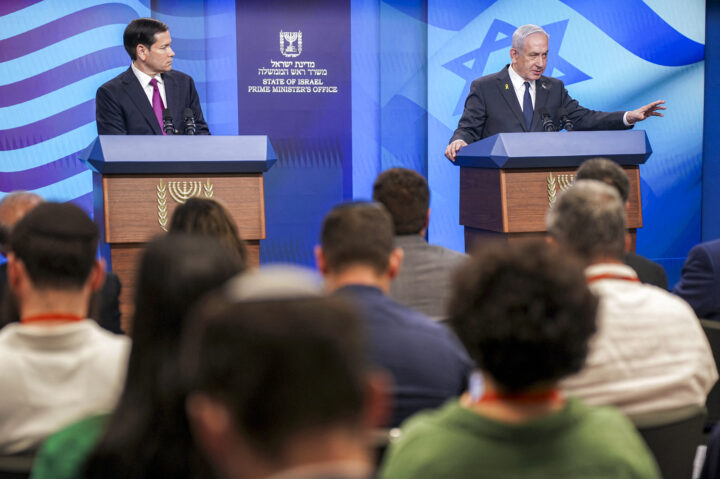
Secretary of State Marco Rubio and Israeli Prime Minister Benjamin Netanyahu give a joint press conference at the Prime Minister's Office in Jerusalem on September 15, 2025.
Secretary of State Marco Rubio said the U.S. is focused on moving forward from Israel’s strike on Qatar last week, refraining from doubling down on criticism during a joint press conference with Israeli Prime Minister Benjamin Netanyahu in Jerusalem on Monday.
“We are just focused on what happens next,” Rubio said, when asked about Tuesday’s strike aiming at Hamas’ leadership in Doha, Qatar’s capital. On Saturday, Rubio had echoed comments by President Donald Trump that the U.S. “is not happy” about the strike.
“Some fundamentals still remain that have to be addressed, regardless of what has occurred,” Rubio said at the press conference on Monday. “We still have 48 hostages. Hamas is holding not only 48 hostages but all of Gaza hostage … As long as they still exist, are still around, there will be no peace in this region.”
Rubio said the end of the war in Gaza, disarmament of Hamas and freeing the hostages are “pillars of what we hope will happen in the region.”
The secretary of state said that the U.S. not only wants Qatar to continue to play a role in those matters “but also in a better future for the people of Gaza, which cannot happen with Hamas intact. We are going to continue to encourage Qatar to play a constructive role in that regard.” Rubio is scheduled to visit Qatar on Tuesday after concluding his trip in Israel.
As to the chance of a negotiated deal to end the war, Rubio said that “the problem is Hamas is a terrorist group, a barbaric group, committed to destroying the Jewish state, so it probably won’t happen.”
“I don’t think there’s anyone who wouldn’t prefer a negotiated settlement,” he added. “That would be the ideal outcome we can see, one we worked on, but we need to be prepared for the reality that savage terrorists don’t often agree to disarm.”
Netanyahu reiterated that “Israel’s decision to act against Hamas’ terrorist leadership was a wholly independent decision by Israel … It was conducted by us and we assume full responsibility for it, because we believe terrorists should not be given a haven.”
As to those saying Israel violated Qatari sovereignty, Netanyahu said that the U.S. took similar action against the Taliban in Afghanistan and Osama bin Laden in Pakistan.
“You don’t have such sovereignty when you are effectively giving a base to terrorists, a place where they can ply their gruesome trade,” he said.
Netanyahu also took issue with a claim made by a reporter during the press conference that the Doha strike was a failure, because it remains unclear if any of Hamas’ leaders were killed. The prime minister said Israel is waiting for further reports on the matter.
“I’ll tell you the results,” he added. “We sent a message to the terrorists. You can run, you can hide, but we’ll get you. … I don’t accept the premise that the raid failed, because it had one central message. … If the terrorists think they enjoy immunity they’ll do it again and again, and if you deny that immunity, they’ll think twice.”
Netanyahu opened the press conference by paying tribute to the “powerful bond” between Israel and the U.S. and thanking Trump for helping target Iran’s nuclear facilities in June, as well as his efforts to free the hostages remaining in Gaza, 20 of whom are believed to still be alive.
Rubio said that Iran is a threat not only because of its pursuit of nuclear weapons, but because of its development of short and midrange missiles that can reach across the Middle East and into Europe.
“This is an unacceptable risk not just for Israel but for the U.S. and the world, which is why the president has continued with his campaign of maximum pressure on Iran until they change course,” Rubio said. “We are encouraged by our partners in Europe beginning the process of snapping back [sanctions] on Iran, who are clearly out of compliance [with the 2015 nuclear deal]. We 100% support that; that’s what needs to happen.”
The secretary of state criticized countries that recently announced they would recognize a Palestinian state.
“The things these nations are doing in the U.N. are largely because of domestic politics. They’re largely symbolic. The only impact they have is to make Hamas feel emboldened … You know, there’s a negotiation going on and maybe you think you made some progress on getting hostages released and ending the war, and then these things come out and Hamas walks away … They see international support, they believe they’re getting what they want, and they walk away,” Rubio said.
Rubio also spoke about his plan to attend the inauguration of the Pilgrims Road on Monday evening. The site features the path on which Jewish pilgrims walked to the Second Temple in Jerusalem, which Rubio described as “perhaps one of the most important archeological sites on the planet, important to many in the U.S.”
The secretary of state arrived in Israel on Sunday, beginning his visit with prayers at the Western Wall with Netanyahu. He also met with Israeli Foreign Minister Gideon Sa’ar and Strategic Affairs Minister Ron Dermer on Monday.
Amir Hayek: ‘We all need to be very, very wise in order to protect, I think, one of the most important things that we have in our region’
Screenshot
Former Israeli Ambassador to the UAE Amir Hayek speaks at a Washington Institute for Near East Policy event on the Abraham Accords on Sept. 11, 2025.
Israel’s first ambassador to the United Arab Emirates said on Thursday that he is “very, very worried” about the future of the Abraham Accords, as Israel’s ties in the Gulf are coming under strain following an Israeli attack on Hamas leaders in Qatar earlier this week.
“For the last week, I am almost not sleeping. I’m very, very worried,” Amir Hayek said at a webinar hosted by the Washington Institute for Near East Policy marking the five-year anniversary of the signing of the Accords, when Israel normalized ties with the UAE.
UAE President Mohamed bin Zayed flew to Doha this week in a show of support for Qatar after the Israeli attack. Reports have indicated that Israel did not successfully hit the terror leaders it targeted, instead killing several lower-level Hamas officials. Other Gulf leaders, including Jordan’s Crown Prince Hussein and Saudi Arabia’s Crown Prince Mohammed bin Salman, also planned visits to Doha, and Qatar will host an emergency summit with Arab leaders on Sunday.
A barrage of criticism directed at Israel — including from President Donald Trump — has sparked fears that its goal of regional integration could now be even farther away.
“I believe that Israel should look at our partners as partners, and talk to them, and not let this situation and the Abraham Accords collapse,” said Hayek, who was ambassador to the UAE from 2021 to 2024. “I think that it will be very hard to rebuild the Abraham Accords if we will pass a point of breaking them, even if we think that we can do it for a few months. No. No. We need to do everything to protect the Abraham Accords.”
Hayek did not specifically reference Israel’s actions in Qatar, nor did he mention Israeli Prime Minister Benjamin Netanyahu’s decision on Thursday to move forward with a controversial new settlement expansion plan, known as the E1 corridor, in the West Bank. But he suggested “internal Israeli politics” may be at play.
“We [Israel] didn’t start the war, but we need to know when to finish the war,” said Hayek. “Maybe it’s related to the internal Israeli politics. But we all need to be very, very wise in order to protect, I think, one of the most important things that we have in our region.”
Hayek, a businessman who is now a fellow at the Atlantic Council, said he is still doing everything in his power to promote Israel’s ties with the UAE and with Bahrain.
“To be an ambassador, it’s not a lifetime job, but it’s a lifetime mission,” said Hayek. “I’m talking not only to the Emiratis, Bahrainis and other countries. I’m talking to my government as well, saying we need to do everything needed in order to keep those relations.”
Hayek maintains hope in the future of the Accords. But if their promise was already being tested by the war in Gaza, it has grown even more fraught this week.
“Hope is my middle name, and I think that I will need a lot of hope these days when we see some difficulties with the Abraham Accords,” said Hayek. “I hope that the Abraham Accords will stand … and we’ll go forward with our partners and friends in the Middle East.”
The Democratic pro-Israel group is supporting the strike, a split from most congressional Democrats, including other pro-Israel voices

Tasos Katopodis/Getty Images
President Donald Trump
Democratic Majority for Israel suggested in a new searing statement that the Trump administration’s warning to Qatar about the impending Israeli attack in Doha earlier this week may have foiled the effort.
The Democratic pro-Israel group is taking a different approach to the strike than most Democratic lawmakers, who have been highly critical of the operation, with few exceptions.
“After years of criticizing Democrats — despite our party’s 75-year history of supporting Israel — President Donald Trump yesterday broke with our vital ally in an unprecedented manner,” DMFI CEO Brian Romick said in a statement.
“He even went as far as to direct his special envoy to alert Qatar, and in so doing risked alerting Hamas, about the attack,” Romick said. “The White House must answer whether their pre-warning of the attack in any way compromised Israel’s ability to eliminate Hamas’ terrorist leadership.”
Trump said in a statement on Truth Social that he “immediately directed Special Envoy Steve Witkoff to inform the Qataris of the impending attack, which he did, however, unfortunately, too late to stop the attack.” Qatari officials have said that the U.S. warning came while the strike was underway and explosions had already begun; another U.S. official told Axios the same.
Romick also criticized Trump for breaking publicly with Israel over the strike, which the president has condemned.
“Trump used his platform to undermine Israel at a time when we must demonstrate a unified front to get the hostages home and bring a negotiated end to the conflict,” Romick said.
Although most at the conference were decidedly pro-Israel, Netanyahu’s risky mission faced significant skepticism, particularly as reports emerged that the attack may not have killed the high-level Hamas leaders that Israel hoped to target

(Photo by JACQUELINE PENNEY/AFPTV/AFP via Getty Images)
This frame grab taken from an AFPTV footage shows smoke billowing after explosions in Qatar's capital Doha on September 9, 2025.
When 200 top policymakers, analysts and government officials from the U.S. and the Middle East gathered on Wednesday for the second day of the high-profile MEAD conference, one topic was top of mind for everyone at the ritzy Washington confab: Israel’s strike on Doha a day earlier that targeted senior Hamas officials who were gathered in the Qatari capital.
Although many at the conference were decidedly pro-Israel, Israeli Prime Minister Benjamin Netanyahu’s risky mission — Israel’s first-ever airstrikes on Qatar, a major non-NATO ally of the United States — faced significant skepticism, particularly as reports emerged that the attack may not have killed the high-level Hamas leaders that Israel hoped to target.
In a rare on-the-record session, former Israeli Prime Minister Yair Lapid, Israel’s opposition leader, questioned whether the strike fit within Israel’s broader war aims.
“If you take the operation itself, per se, and you single it out from anything else, of course these are a bunch of bad people that we should have killed a long time ago, and whenever you have a chance to kill them, you should kill them,” Lapid said. “Having said that, as the hours go by, we understand two things. A is that it might not be as successful as we thought in the beginning, and B [is] that this has nothing to do with strategy. It’s just an operation.”
That language marked a shift from Lapid’s initial reaction to the Qatar strike, which he described on Tuesday afternoon in a Hebrew-language tweet as “an exceptional operation to thwart our enemies.”
A lot changed in the interim: President Donald Trump said he was “very unhappy” with the attack, and that it “does not advance Israel or America’s goals.” Arab nations rallied around Qatar, with the leaders of the United Arab Emirates, Jordan and Saudi Arabia all visiting Doha this week. That led some MEAD attendees to argue that Israel’s strike could jeopardize regional integration efforts led by Washington.
There was little sympathy among MEAD attendees for the Hamas leaders who live in Qatar, which has faced criticism for providing them a safe harbor. But Israel’s apparent failure to reach its targets prompted frustration even from many who were sympathetic to the operation, because it’s unlikely the U.S. will permit Israel to try again.
The biggest problem, according to Lapid, was this divergence with the U.S., which Trump administration officials stood by on Wednesday.
“Part of Israel’s strength in the region and elsewhere is the fact that everybody seemed to think that we are stepping in lockstep with the administration,” said Lapid. “When the region sees us as somebody who is not that coordinated with the administration, with the United States, it has a bad effect on our ability to influence the region.”
Leiter compared Israel’s campaign against Hamas to the U.S. pursuing the perpetrators of 9/11
Martin H. Simon/AJC
Israeli Ambassador to the U.S. Yechiel Leiter speaks at AJC's Abraham Accords 5th Anniversary Commemoration on Capitol Hill in Washington on Sept. 10, 2025.
Israeli Ambassador to the U.S. Yechiel Leiter offered a strong defense of Israel’s strike on Hamas leaders in Doha, Qatar, as the Israeli government doubled down on the strategy in the face of strong pushback from the Trump administration.
Speaking at an American Jewish Committee event on Capitol Hill, Leiter argued that, in carrying out the strike, Israel was only doing what it and other countries have always done in the past: hunting down terrorists who perpetrate attacks on them wherever they may be.
He made repeated reference to Jordan’s King Hussein’s Black September campaign against Palestinian terrorists in Jordan, Israeli Prime Minister Golda Meir pursuing those responsible for the 1972 Munich Olympics attack and the U.S. launching wars to hunt down those responsible for the 9/11 attacks.
“Israel acted in the context of what any normal country does, it pursues terrorists and eliminates them, like King Hussein, like Golda Meir, like the United States of America,” Leiter said.
Leiter also highlighted U.N. Security Council Resolution 1373, presented by the U.S. and passed weeks after the 9/11 attacks, which “obligates states to prevent and suppress the financing and support of terrorism, including the harboring of terrorists.”
“Now what is Qatar doing if not financing and supporting terrorism by playing host to Hamas, the very people who sent the terrorists who murdered six people sitting at a bus stop in Jerusalem, waiting to go about their business?” Leiter said, referencing a Hamas-linked attack days before the Israeli strike in Doha.
“Who sent them? The terrorists we targeted in Doha. They celebrated the murder of these six innocents the same way they celebrated, on camera, the slaughter of 1,200 innocents on Oct. 7,” Leiter added.
Leiter said that, in striking Hamas leaders in Doha, “We are acting in the context of the U.N. charter, of international law, in the cause of sanity and morality.”
He noted that the campaigns by both Jordan against Palestinian terrorists and the United States against terrorist groups in Iraq could also have been considered “disproportionate,” a criticism that some in the international community have leveled over Israel’s operations in Gaza.
Leiter also argued that Israel’s ongoing military operations in the Middle East increase, rather than hurt, the prospects for expanded normalization, “because we are empowering the moderate elements within Islam.” The AJC event was a celebration of the fifth anniversary of the Abraham Accords.
Addressing criticisms that Israel has failed to properly plan for the day after the war in Gaza, Leiter insisted that those plans are in place — but can’t be safely discussed in public.
“We’re preparing for the day after. The day after is going to be brilliant and for it to succeed, we can’t talk too much about it, and it certainly can’t be an Israel-sponsored day after to enjoy success,” Leiter said.
As conflicting accounts emerge about the strike’s outcome, Trump voices frustration while Netanyahu says the operation could bring the war in Gaza closer to an end
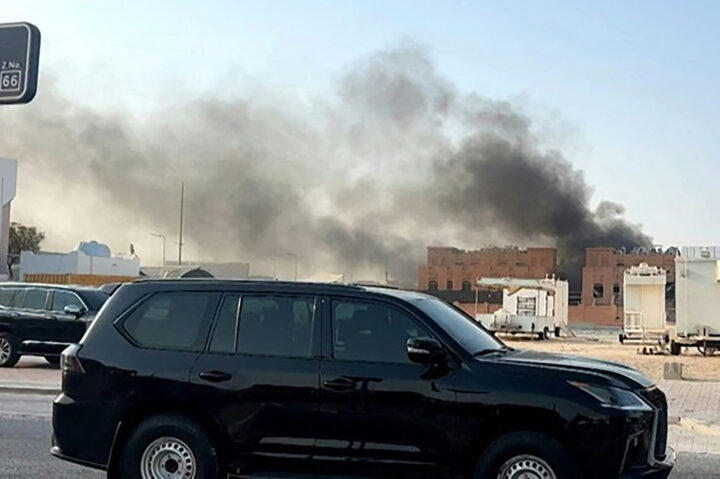
JACQUELINE PENNEY/AFPTV/AFP via Getty Images
This frame grab taken from an AFPTV footage shows smoke billowing after explosions in Qatar's capital Doha on September 9, 2025.
Nearly a day after an Israeli airstrike targeted a meeting of high-level Hamas officials in Doha, Qatar, there are more questions than answers, both in Jerusalem and Washington. Israel has not confirmed which officials were killed in the strike, while Hamas has said that five officials from the group, including the son of Hamas’ chief negotiator, Khalil al-Hayya, were killed in addition to a member of the Qatari security forces.
Israeli reports earlier today indicate that the strike did not kill the most senior echelon of the terror group, which for years has been based in Qatar, a U.S. ally.
Amid ongoing uncertainty over the success of the strike, the operation was met with rare condemnation from the White House, first from Press Secretary Karoline Leavitt and then from President Donald Trump himself, who said he “was very unhappy about it, very unhappy about every aspect” — perhaps, in part, because the operation is not believed to have taken out the most senior Hamas officials.
But it was Trump himself who said over the weekend on his Truth Social site that he had “warned Hamas about the consequences of not accepting” the ceasefire and hostage-release deal that had been put forward by the U.S.
At the same time that Trump officials, including the president, were criticizing the operation, U.S. Ambassador to Israel Mike Huckabee was embracing Israeli Prime Minister Benjamin Netanyahu at the U.S. Embassy’s belated Independence Day celebration in Jerusalem, where the prime minister addressed a smaller group of VIPs attending the party.
“Israel acted wholly independently and we take full responsibility for this action,” Netanyahu said of the Doha strikes. “This action can open to an end of the war in Gaza.”
Israeli officials and defense sources said on Wednesday that they are waiting for better intelligence before commenting on who was killed, but they viewed the operation as a success.
Israeli Defense Minister Israel Katz warned that there could be additional strikes of this kind: “The long hand of Israel will act against its enemies anywhere in the world. There is no place where they can hide. Whoever was a partner in the Oct. 7 massacre will be fully brought to justice.”
Everyone from Israeli Opposition Leader Yair Lapid to Finance Minister Bezalel Smotrich put out statements praising the IDF and Shin Bet and saying the terrorists got what they deserved.
At the same time, the Hostages and Missing Families Forum said the affiliated families felt “deep concern and heavy anxiety” that their loved ones would pay the price. “We know from survivors who have returned that the revenge directed at the hostages is brutal. The chance of bringing them back now faces greater uncertainty than ever before.”
However, Shimon Or, uncle of hostage Avinatan Or, said on Kan radio that “this action brings us closer to bringing Avinatan and the rest of the hostages. …We will not bring back the hostages anymore with military operations and ‘the gates of hell,’ but with control over Gaza.”
Meanwhile, Israeli officials have pushed back on criticism that the strikes would affect ceasefire talks, briefing press in Hebrew and English that the operation will help talks, because there are other channels for negotiations.
President Donald Trump doubled down Tuesday evening on his criticism of the Israeli strike while Senate Republicans remain strongly supportive of the attack
Kevin Dietsch/Getty Images
President Donald Trump in the Oval Office of the White House on Sept. 5, 2025 in Washington, DC.
The Israeli strike targeting Hamas leaders in Qatar is dividing the White House, which strongly criticized Israel for attacking Qatari territory, and Senate Republicans, who have been overwhelmingly supportive of the Israeli action.
President Donald Trump told reporters on Tuesday evening he was “not thrilled about the way that went down” and “very unhappy with every aspect,” his first direct public comments on the Israeli strike, after White House Press Secretary Karoline Leavitt made comments to the same effect earlier in the day.
Sen. Lindsey Graham (R-SC), asked about the White House statement on the attack, told Jewish Insider, “I understand we have troops there, but my focus is Israel. Hamas has had every chance. … Lay down your weapons, release the hostages — you live. If you don’t — it keeps going.”
Sen. Markwayne Mullin (R-OK) told JI, “Israel has made this very clear, and the same as we’ve made it very clear, we’re going to go after terrorist organizations, no matter where you’re at. We have a good relationship with the Qataris. They didn’t target the Qataris. They were targeting Hamas, and they had the right to do that.”
Asked about the administration’s comments, he said, “I understand where they’re at. My opinion is the Qataris knew good and well that they were there and they were doing nothing about it.”
He said that he does not know the full context of the strike at this point, but that if Israel had asked Qatar to take action against the Hamas leaders sheltering inside the country and Qatar had refused, “then I don’t blame Israel for doing that. Now if they didn’t have a conversation beforehand, maybe it is a different story.”
When asked about the White House’s statement, which described the Israeli strike as “unfortunate,” Sen. Rick Scott (R-FL) responded, “I think it’s unfortunate that Qatar kept the Hamas leaders in their country, that was the unfortunate part.”
He said that he was surprised that the strike didn’t come sooner.
“Why did it take them so long? As soon as Oct. 7 happened, I met with the Qatari ambassador and I said, ‘Why are you hosting these people?’ He said, ‘Well, Obama asked.’ I said, ‘He gave you a bad job. Stop doing it,’” Scott continued. “I’m glad [Israel] did it. I’m impressed with what [Israeli Prime Minister Benjamin] Netanyahu’s done, the political leaders, the military leaders, the IDF, whether destroying Hamas, or Hezbollah or Iran — you have to really admire what they’re doing.”
Sen. Roger Marshall (R-KS), the most outspoken supporter of Qatar among Senate Republicans, stood alone in offering a full-throated criticism of the Israeli strike and fully backing Trump’s position.
“I fully agree with President [Trump]. At the request of the U.S. and Israel, Qatar is mediating a peace agreement. The Israeli attack on allied soil, where approximately 10,000 American troops are stationed, is highly ill-advised,” Marshall said on X. “Grateful that [Secretary of State Marco Rubio] is finalizing a Defense Coordination Agreement with Qatar to prevent Israel from repeating this action.”
Many prominent Senate Democrats have criticized the strike

Jemal Countess/Getty Images for Fair Share America
Sen. Richard Blumenthal speaks at a rally at the Capitol on April 10, 2025 in Washington, DC.
Breaking with many of his Senate Democratic colleagues, Sen. Richard Blumenthal (D-CT) sounded a supportive note on the Israeli strike on Hamas leaders in Qatar on Tuesday.
“I strongly support Israel’s right to defend itself against Hamas,” Blumenthal told Jewish Insider. “I want to know more about the details of this particular strike — I’m learning about it in real time and anything done to destroy Hamas’ leadership or its terrorist capability or military capacity is a step in the right direction.”
Many prominent Senate Democrats have criticized the strike, saying it undermines negotiations for a ceasefire and that it should not have been carried out in Qatari territory. The White House expressed a similar view, breaking with top Senate Republicans who have been supportive of the Israeli attack.
Sen. John Fetterman (D-PA) was the only other Senate Democrat who has publicly been supportive of the Israeli action.
White House Press Secretary Karoline Leavitt: ‘Unilaterally bombing inside Qatar … does not advance Israel or America’s goals’
SAUL LOEB/AFP via Getty Images
White House Press Secretary Karoline Leavitt speaks during a press briefing in the Brady Briefing Room of the White House in Washington, DC, on September 9, 2025.
In a prepared statement on behalf of President Donald Trump, White House Press Secretary Karoline Leavitt on Tuesday criticized the Israeli strike on Hamas leaders in Qatar and expressed regret that it had taken place in Doha, adding that the U.S. had warned Qatar about the strike when the U.S. itself became aware.
She said Trump had also vowed to Qatari leaders that such an attack would not be repeated in Qatari territory.
“This morning, the Trump administration was notified by the United States military … as Israel was attacking Hamas, which very unfortunately was located in a section of Doha, the capital of Qatar,” Leavitt said. “Unilaterally bombing inside Qatar, a sovereign nation and close ally of the United States that is working very hard and bravely taking risks with us to broker peace, does not advance Israel or America’s goals.”
Pressed repeatedly on whether Israel had notified the U.S. about the attack, as some reports indicated, or whether the U.S. military had detected it independently, Leavitt did not specify, repeating only that the U.S. military had notified the White House.
She said that Trump “immediately directed” Middle East envoy Steve Witkoff to notify Qatar about the upcoming attack when the administration learned about it.
“The president views Qatar as a strong ally and friend of the United States and feels very badly about the location of this attack,” Leavitt continued.
She did add, however, that the administration views eliminating Hamas as “a worthy goal.”
Asked whether Trump would impose “consequences” on Israeli Prime Minister Benjamin Netanyahu for the strike or provide a “directive … to Netanyahu in terms of what’s allowed in the future,” Leavitt said that “that’s a decision only the president can make.”
Leavitt said that Trump had spoken to Qatari Emir Tamim bin Hamad Al Thani, Prime Minister Mohammed bin Abdulrahman Al Thani and Netanyahu after the attack.
She said the president “assured [the Qatari leaders] that such a thing will not happen again on their soil” and thanked Qatar for “their support and friendship to our country.”
She said that both Trump and Netanyahu agreed that they want to make peace quickly and said Trump “believes this unfortunate incident could serve as an opportunity for peace,” and that Trump had conveyed his displeasure about the location of the strike to Netanyahu.
“He expects all of our friends and allies in the region — that includes both Qatar and Israel — to seek peace as well, and he wants to see that happen, and he’s working with all of our allies in the region to get that done,” Leavitt said.
Leavitt denied that Trump’s post on social media over the weekend offering a “last warning” to Hamas to accept a ceasefire deal was a reference to the impending Israeli attack.
The White House’s expressed concern about the location of the attack puts the administration at odds with many senior members of Trump’s own party in the Senate, who were quick to express support for the Israeli attack, and aligns more closely with top Senate Democrats who have been more critical of the attack and where it took place.
Asked about the White House’s opposition to the strike, multiple Senate Republicans who had earlier in the day expressed support for the Israeli attack declined to comment.
Meanwhile, Sen. Chris Coons (D-DE) said, “I will actually agree with President Trump that it doesn’t advance our interests in terms of advancing negotiations for the release of hostages or the ceasefire that is urgently needed in Gaza.”
“I have not gotten any briefing on the details of how it was approved, whether or not the Trump administration was aware and supported it, but in the middle of a hostage negotiation that is urgently needed to free the hostages, to end the fighting, to deliver humanitarian relief and to address Hamas — to take a strike in Doha against Hamas leaders, I think puts at risk any peace process,” Coons said. He added that he wants to be briefed on further details.
Top Senate Republicans are supporting the Israeli attack in Doha while senior Democrats are criticizing it

Kevin Carter/Getty Images
U.S. Capitol Building on January 18, 2025 in Washington, DC.
A partisan divide quickly emerged Tuesday over the Israeli strike on Hamas leadership in Qatar, with senior Republican lawmakers expressing support for the attack, while top Democrats criticized it.
Republican lawmakers largely characterized the strike as justified and unsurprising given the Hamas leaders’ responsibility for the Oct. 7, 2023, attacks on Israel, while Democrats argued that the strike compromised the ability to negotiate with Hamas officials for a ceasefire and should not have been carried out in the territory of a U.S. ally.
Sen. Roger Wicker (R-MS), the chair of the Senate Armed Services Committee, told Jewish Insider, “I support it.”
“I think Hamas has got to be destroyed, and there’s no sense in doing half measures,” Wicker continued.
Sen. James Risch (R-ID), the chair of the Senate Foreign Relations Committee, told JI that the strike was “not surprising.”
“Any member of Hamas who had anything to do with the invasion of Israel is in jeopardy, it’s a given,” Risch said. “Is now, always has been.”
He said he does not see the strike as having any broader implications for the U.S. relationship with Qatar.
Sen. Mike Rounds (R-SD) suggested that similar attacks on Hamas leaders may continue.
“Hamas is a terrorist organization. Israel has been focused on taking out that terrorist organization. These are the folks that Israel firmly believes were directly responsible for the Oct. 7 attacks,” Rounds said. “I think we’re going to see Israel continue to go after those individuals that are accountable for that terrorist activity.”
Sen. Pete Ricketts (R-NE) said that “Qatar has been told they probably ought not to harbor terrorist organizations, so Israel is going to defend itself and take out terrorist organizations.”
Sen. Ted Cruz (R-TX) said the strike shows that “Israel is serious about defending itself and taking out the terrorists.”
Sen. Lindsey Graham (R-SC) posted on X, “To those who planned and cheered on the October 7 attack against Israel, the United States’ greatest ally in the region: This is your fate.”
Senate Democrats took a starkly different perspective.
Sen. Jack Reed (D-RI), the ranking member of the Senate Armed Services Committee, called the strike “extremely disruptive, provocative and dangerous” and a “great strategic mistake.”
“Qatar has been a strong ally of the United States, one of our biggest bases in the region is there. … They, in fact, took a rocket attack after Iran tried to hit our troops at Al Udeid. They’ve provided significant financial support to our efforts in the Middle East,” Reed told JI, referring to retaliatory strikes by Iran on the U.S. airbase in Doha after the U.S. attacked its nuclear facilities in June.
He also argued that the strike, which targeted Hamas leaders who were part of negotiations with the U.S. and Israel, showed that Israel is not serious about reaching a ceasefire deal. A Hamas official on Monday publicly rejected the latest ceasefire proposal sponsored by the U.S., along with others.
“The Hamas representatives are there for at least some type of discussion about a ceasefire, and the signal I think that [Israeli Prime Minister Benjamin] Netanyahu [sends] is ‘I don’t want a ceasefire under any terms.’ So those hostages continue to languish,” Reed said.
Sen. Jeanne Shaheen (D-NH), the ranking member of the Senate Foreign Relations Committee, said at a Council on Foreign Relations event on Tuesday that “it’s unfortunate that Israel bombed in Doha, one of our allies.”
“I understand that they were going after one of the Hamas leaders — and we all agree that Hamas should be eliminated — but we have to be thoughtful about escalating things in a way that [isn’t] helpful, especially when we’ve got this opportunity in the region.”
Sen. Mark Kelly (D-AZ) called the Israeli strike “rather aggressive.”
“Hamas is a terrorist organization but Qatar often hosts the political side of the organizations so there is some avenue for communication,” Kelly told JI. “And they’re an ally of ours. It’s an aggressive thing to do, but I haven’t seen the details yet.”
Sen. Tim Kaine (D-VA) offered a somewhat more nuanced view, acknowledging to JI that it’s “been enormously frustrating for the Israelis and the U.S. that Qatar has sheltered Hamas.”
“But every once in a while, they have been an effective intermediary on things like hostages. So exactly what was the decision-making about why this was the right move now, I’m interested to know it,” Kaine said. “Until I get an answer to that, I’m probably not going to opine about it. But I understand the serious frustration with what Qatar has done with Hamas. I just need to know more.”
Several other Democrats including Sens. Elissa Slotkin (D-MI), Ruben Gallego (D-AZ) and Adam Schiff (D-CA) declined to comment, saying they needed more information before discussing the attack, as did Sen. John Barrasso (R-WY), the No. 2 Senate Republican.
Sen. John Fetterman (D-PA) was the only Senate Democrat who full-throatedly supported the strike, posting a gif on X of a smiling, dancing Winnie the Pooh.
The image, Fetterman told JI, “sums it up. Just like the beepers” — a reference to the Israeli attack on Hezbollah officials in Lebanon a year ago. “I love it. Hold them [Hamas] accountable.”
The IDF said it targeted Hamas’ senior leadership amid explosions in Doha

Screenshot/X
Israel strikes Hamas leadership in Doha, Qatar on Sept. 9, 2025.
Israel conducted a strike against senior Hamas leaders, the IDF said on Tuesday, following reports of explosions in Doha, Qatar.
The operation, whose Hebrew name translates to “Judgment Day,” reportedly targeted Khalil al-Hayya, Hamas’ chief negotiator in hostage and ceasefire talks, and longtime senior Hamas official Khalid Mashaal, as well as Hamas officials Zaher Jabarin and Nizar Awadallah, though reports conflict as to the success of the strike.
Israeli Prime Minister Benjamin Netanyahu and Defense Minister Israel Katz said in a joint statement that the Israeli defense establishment unanimously supported the strike.
“The action is totally justified in light of the fact that Hamas leadership initiated and organized the Oct. 7 massacre and did not stop launching murderous actions against Israel and its citizens since then, including taking responsibility for the murder of our civilians in the terrorist attack in Jerusalem yesterday,” they stated.
President Donald Trump was informed of the strike in advance and supported it, Israel’s Channel 12 reported. Netanyahu’s office said that “today’s action against the top terrorist chieftains of Hamas was a wholly independent Israeli operation. Israel initiated it, Israel conducted it, and Israel takes full responsibility.”
“The IDF and [Israel Security Agency (Shin Bet)] conducted a precise strike targeting the senior leadership of the Hamas terrorist organization,” the IDF Spokesperson’s Office stated. “For years, these members of the Hamas leadership have led the terrorist organization’s operations, are directly responsible for the brutal October 7th massacre, and have been orchestrating and managing the war against the State of Israel.”
The IDF said that it used precision munitions and intelligence to reduce harm to civilians.
Hamas leadership is based in the Al-Qatar neighborhood of Doha, where the explosions took place, according to videos posted on social media.
Qatar said it “strongly condemns” the strike in a statement posted to X by Majed Al-Ansari, spokesman for the Qatari Ministry of Foreign Affairs, which described the operation as “a cowardly Israeli attack that targeted residential buildings housing several members of the Political Bureau of Hamas in the Qatari capital, Doha.”
“This criminal assault constitutes a blatant violation of all international laws and norms, and poses a serious threat to the security and safety of Qataris and residents in Qatar,” he added, and said that Qatar “will not tolerate this reckless Israeli behavior and the ongoing disruption of regional security, nor any act that targets its security and sovereignty.”
The strike took place days after the Trump administration sent a Gaza ceasefire and hostage deal proposal via intermediaries, which Israel accepted and a senior Hamas official based in Istanbul rejected.
Earlier Tuesday, Netanyahu left a hearing in his ongoing corruption trial early due to “an exceptional security matter,” Israeli public broadcaster Kan reported.
In 1997, Israel attempted to assassinate Mashaal, the head of Hamas’ political bureau at the time, in Jordan, but gave Amman the antidote for the poison after then-King Hussein threatened to cancel the peace treaty between the countries.
Plus, pro-Israel lawmakers criticize Israel on Syria strikes

Anna Moneymaker/Getty Images
Sen. Lindsey Graham (R-SC) in the Senate Judiciary Committee on January 30, 2025 in Washington, D.C.
Good Thursday afternoon.
This P.M. briefing is reserved for our premium subscribers like you — offering a forward-focused read on what we’re tracking now and what’s coming next.
I’m Danielle Cohen-Kanik, U.S. editor at Jewish Insider and curator, along with assists from my colleagues, of the Daily Overtime briefing. Please don’t hesitate to share your thoughts and feedback by replying to this email.
📡On Our Radar
Notable developments and interesting tidbits we’re tracking
A bipartisan group of pro-Israel lawmakers — Sens. Jeanne Shaheen (D-NH) and Joni Ernst (R-IA) and Rep. Joe Wilson (R-SC) — released a statement today criticizing Israeli strikes in Syria overnight.
The lawmakers, who recently returned from Syria, said that the message they heard during their visit “was clear: Syria needs a chance to succeed and move past the violence and strife that consumed the country for over 14 years. Last night’s destabilizing strikes on Syria by Israel make that goal more difficult to achieve.”
“The Syrians are prepared to move forward with Israel to advance peace. It is unclear how long the door to this opportunity will remain open. We call on Israel to seize the moment and immediately cease hostilities,” the group said.
The statement is one of the most public signs yet of friction between even staunch supporters of Israel in Congress and the Israeli government over its approach to the new Syrian government, which has included repeated rounds of strikes on Syrian targets even amid diplomatic engagements. Many U.S. lawmakers, meanwhile, are urging a more optimistic approach.
Syrian state media reported that the strikes also included a ground raid by the IDF near Damascus, which would be the first reported instance of an Israeli ground incursion so far into the country’s territory since the fall of the Assad regime. Syrian forces had reportedly recently uncovered surveillance equipment at a military base in the area…
The IDF also carried out strikes today on Houthi military targets in Sanaa, Yemen, after several Houthi missile and drone attacks on Israel in recent days. Israeli media reported that the strikes, one of which targeted a gathering of top Houthi leaders, may have eliminated the terror group’s minister of defense and chief of staff…
Back in Washington, Israeli Minister of Strategic Affairs Ron Dermer reportedly participated in President Donald Trump’s roundtable on Gaza at the White House yesterday, according to Axios, as he made a last-minute visit to the capital.
A source told the outlet that former British Prime Minister Tony Blair and former Trump Mideast advisor Jared Kushner got the green light from the president to develop a post-war plan for Gaza, though few details were hashed out at the meeting.
Dermer reportedly stressed that Israel doesn’t want to occupy Gaza in the long term and wants to see alternative options for parties that could govern Gaza that are not Hamas. “Dermer’s message was: As long as our conditions are met, we will be flexible about everything else,” the source told Axios…
France, Germany and the U.K. sent a letter to members of the U.N. Security Council this morning announcing they are triggering snapback sanctions on Iran, as anticipated after recent diplomatic talks to roll back the Iranian nuclear program yielded little progress.
The move triggers a 30-day timeline before the sanctions go into effect, during which the European countries said they are open to continuing negotiations with Iran.
Secretary of State Marco Rubio said the U.S. will work with the UNSC to “successfully complete” the reinstatement of sanctions. “At the same time,” he said, “the United States remains available for direct engagement with Iran … Snapback does not contradict our earnest readiness for diplomacy, it only enhances it.”
Iran has threatened previously to withdraw from the Nuclear Non-Proliferation Treaty if snapback sanctions were imposed, which could have wide-ranging consequences, including a potential regional nuclear arms race…
The UNSC was also busy today with a vote to extend the mandate of UNIFIL, the U.N.’s forces in southern Lebanon, whose mission was due to expire on Sunday. The body voted unanimously to extend the mandate one final time until Dec. 31, 2026, when UNIFIL will have one year to withdraw from Lebanon completely.
Dorothy Shea, acting U.S. representative to the U.N., said in a statement supporting the vote, “The United States notes that the first ‘I’ in UNIFIL stands for ‘Interim.’ The time has come for UNIFIL’s mission to end. This is the last time we will support an extension of UNIFIL”…
Sen. Lindsey Graham (R-SC) threatened Norway and its officials with retaliatory tariffs and visa restrictions in response to the decision by Norges Bank Investment Management — the Norwegian sovereign wealth fund — to sell its stake in the American machinery company Caterpillar in response to the Israeli military’s use of its products against Palestinians.
“To those who run Norway’s sovereign wealth fund: if you cannot do business with Caterpillar because Israel uses their products, maybe it’s time you’re made aware that doing business or visiting America is a privilege, not a right,” Graham said on X…
Back in Israel, Prime Minister Benjamin Netanyahu and World Food Program Executive Director Cindy McCain shared a joint statement after meeting in Jerusalem today, where they agreed that “every effort must be made to ensure that humanitarian aid reaches the most vulnerable people where they are, and that humanitarian aid is provided exclusively to civilians”…
Meanwhile, the Boulder chapter of the group “Run for Their Lives,” which hosts weekly marches to advocate for the release of the hostages held in Gaza, announced it will no longer publicly advertise its walking route, after participants faced continued threats and harassment in the wake of a firebombing attack on one gathering several months ago.
In recent weeks, protesters have stalked and shouted slurs at participants, such as “genocidal c**t,” “racist” and “Nazi,” and have threatened organizers’ children, according to the Colorado Jewish Community Relations Council…
No industry is safe: The Wall Street Journal reports on the tech worker “revolt” over Gaza and how companies are responding, including moderating internal message boards by deleting content and closing discussion threads.
Anti-Israel activists have recently escalated their protests against Microsoft, setting up an encampment at the company’s Redmond, Wash., headquarters, occupying President Brad Smith’s office and rowing kayaks up to the waterfront homes of top executives (Microsoft has asked the FBI for help in tracking and combating these activities)…
⏩ Tomorrow’s Agenda, Today
An early look at tomorrow’s storylines and schedule to keep you a step ahead
Keep an eye on Jewish Insider for reporting on the obstacles Israel and the U.S. may face in negotiating a new memorandum of understanding as the current MOU nears its expiration in 2028.
On Monday, Sen. Bernie Sanders (I-VT) will host a campaign event with Graham Platner, the anti-Israel Democrat challenging Sen. Susan Collins (R-ME), as Collins has been facing increasing antagonism from crowds at home.
We’ll be back in your inbox with the Daily Kickoff and the Daily Overtime on Tuesday. Shabbat shalom and happy Labor Day weekend!
Stories You May Have Missed
SULLIVAN SAYS
In an interview with ‘The Bulwark,’ the former national security advisor argued that the argument in favor of restricting military aid is ‘much stronger’ than it was a year ago
BELL CURVE
Former Rep. Cori Bush or a political ally could attempt to unseat the first-term congressman
Plus, Minneapolis shooting echoes Tree of Life

Nicholas Kamm/Getty Images
Ron Dermer speaks at the American Israel Public Affairs Committee (AIPAC) policy conference in Washington, DC.
Good Wednesday afternoon.
This P.M. briefing is reserved for our premium subscribers like you — offering a forward-focused read on what we’re tracking now and what’s coming next.
I’m Danielle Cohen-Kanik, U.S. editor at Jewish Insider and curator, along with assists from my colleagues, of the Daily Overtime briefing. Please don’t hesitate to share your thoughts and feedback by replying to this email.
📡On Our Radar
Notable developments and interesting tidbits we’re tracking
Israeli Minister of Strategic Affairs Ron Dermer made a last-minute visit to Washington today, according to Israeli media, while President Donald Trump convened a meeting on a “comprehensive plan” for postwar Gaza, as Middle East envoy Steve Witkoff told Fox News last night. It’s unclear if Dermer participated in the meeting himself.
Also in attendance at the White House were former British Prime Minister Tony Blair and Trump’s son-in-law and former Mideast advisor Jared Kushner, according to Axios, who have been working with Witkoff on the issue for several months…
Dermer canceled a meeting with World Food Program head Cindy McCain, who is in Israel for the first time since Oct. 7, as he headed to Washington. McCain did meet with IDF Chief of Staff Eyal Zamir and the head of COGAT, the IDF unit that facilitates humanitarian aid in Gaza. Recall that a whistleblower recently alleged that the WFP had rejected security coordination with the IDF, hampering aid distribution efforts in Gaza…
The alleged gunman who opened fire today on a Catholic school in Minneapolis, killing two children and injuring at least 17 people, most of them students at the school, used a gun that had antisemitic and anti-Israel writings across it, according to the Anti-Defamation League.
Unverified images of the alleged shooter’s gun, taken from a video posted to a YouTube account believed to be associated with the shooter, show scrawlings on the gun and related paraphernalia that say “6 million wasn’t enough,” “Burn Israel,” “Israel must fall” and “Destroy HIAS,” a reference to the Jewish refugee organization.
HIAS, which was also invoked by the Tree of Life synagogue shooter in Pittsburgh in 2018, told Jewish Insider that because of the organization’s focus, it is “sadly often the subject of hateful antisemitic conspiracy theories”…
Israeli Foreign Minister Gideon Sa’ar is in Washington today as well, meeting this afternoon with Secretary of State Marco Rubio in Foggy Bottom. Sa’ar said the two had “a productive meeting on mutual challenges and interests for both our nations” and discussed the Iranian nuclear threat in the aftermath of the U.S. and Israeli strikes in June, among other issues…
Rubio held a call with the foreign ministers of France, Germany and the U.K. today, during which all of the officials “reiterated their commitment to ensuring that Iran never develops or obtains a nuclear weapon,” as the European nations gear up to trigger snapback sanctions at the U.N. Security Council in the coming days…
a16z Speedrun, a startup accelerator program backed by the Andreessen Horowitz venture capital firm, is in Israel this week. Last night, the program convened a dinner of 20 budding startup founders from elite IDF units…
Hollywood heavyweights including Brad Pitt and Joaquin Phoenix are joining the production team of “The Voice of Hind Rajab,” a film about the killing of a six-year-old Palestinian girl in Gaza in January 2024. Jonathan Glazer, who made headlines for using his Oscar acceptance speech last year to equate Israel’s actions in Gaza with the Holocaust, is a director of the project…
Variety spotlights a new film in production starring Jon Voight and directed by the controversial Bryan Singer, which a source described as set in the Middle East during the First Lebanon War. “It makes Israel look really bad and could be polarizing,” the source said…
⏩ Tomorrow’s Agenda, Today
An early look at tomorrow’s storylines and schedule to keep you a step ahead
Keep an eye on Jewish Insider tomorrow morning for reporting on how security experts are viewing the threat of Iranian influence and attacks in the U.S. in the aftermath of disturbing revelations of Iranian attacks in Australia, and on how the replacement of Sergio Gor with Dan Scavino as head of the Presidential Personnel Office may impact national security personnel decisions in the administration.
Also tomorrow, the Atlantic Council will host an event in Washington on the “past, present, and future” of the India-Middle East-Europe Economic Corridor, an initiative launched at the G20 Summit in 2023.
Stories You May Have Missed
MINNEAPOLIS MOMENT
Democratic insiders told JI that DNC chair Ken Martin withdrew his Israel resolution largely to avoid a disruptive floor debate over Israel on Wednesday
THE CENTER SHIFTS
Rep. Adam Smith, ranking member of the House Armed Services Committee, said he recognizes restricting offensive weapons to Israel could ‘embolden Hamas’ but it is ‘time to try something else’
Plus, the clock keeps ticking on snapback sanctions
Audrey Richardson/Bloomberg via Getty Images
Ken Martin, chairman of the Democratic National Committee (DNC), speaks to members of the media during a news conference in Aurora, Illinois, US, on Tuesday, Aug. 5, 2025.
Good Tuesday afternoon.
This P.M. briefing is reserved for our premium subscribers like you — offering a forward-focused read on what we’re tracking now and what’s coming next.
I’m Danielle Cohen-Kanik, U.S. editor at Jewish Insider and curator, along with assists from my colleagues, of the Daily Overtime briefing. Please don’t hesitate to share your thoughts and feedback by replying to this email.
📡On Our Radar
Notable developments and interesting tidbits we’re tracking
Shortly after members of the Democratic National Committee passed a resolution today introduced by DNC Chair Ken Martin that voiced support for humanitarian aid to Gaza and a two-state solution, called for the release of hostages and condemned Hamas, Martin announced he was withdrawing the measure and instead forming a task force to continue discussing the issue.
The surprise reversal came after a competing resolution that called for an arms embargo and suspension of U.S. aid to Israel was voted down. Upon huddling with the co-sponsors of the failed measure, Martin said at the meeting of the Resolutions Committee where the votes took place, “There is a divide in our party on this issue. This is a moment that calls for shared dialogue and calls for shared advocacy.”
“And that’s why I’ve decided today, at this moment, listening to the testimony and listening to people in our party, to withdraw my amendment resolution to allow us to move forward in a conversation on this as a party,” Martin continued. He said that he would “appoint a committee or a task force comprised of stakeholders on all sides of this to continue to have the conversation, to work through this, and bring solutions back to our party”…
Overseas, Sen. Jeanne Shaheen (D-NH), Rep. Joe Wilson (R-SC) and U.S. Syria envoy Tom Barrack, ending their visit to Damascus, traveled to Beirut today where they joined Sen. Lindsey Graham (R-SC).
Along with diplomat Morgan Ortagus and U.S. Ambassador to Lebanon Lisa Johnson, the delegation met with Lebanese President Joseph Aoun, Prime Minister Nawaf Salam, Parliament Speaker Nabih Berri and head of the Lebanese Armed Forces Gen. Rodolph Haykal, with whom they discussed U.S. support of the LAF.
Barrack and Ortagus have been shuttling between Lebanon, Syria and Israel over the past several months in an effort to improve security relations in the region.
During a press conference the lawmakers held in Beirut, Graham announced his support for the United States signing a defense agreement with Lebanon, where the U.S. would commit to defending Lebanon militarily.
“How many nations have a defense agreement with the United States? … The number of nations that America is willing to go to war for is very few. Why do I mention Lebanon being in that group? You have one thing going for you that is very valuable to me. Religious diversity,” Graham said.
The South Carolina senator continued, “Christianity is under siege in the Mideast. Christians are being slaughtered and run out of all over the region, except here. So what I am going to tell my colleagues is, ‘Why don’t we invest in defending religious diversity in the Mideast? Why don’t we have a relationship with Lebanon where we would actually defend what you’re doing?’ I think it’s in America’s interest to defend religious diversity.”
Though it’s been discussed in Israeli and American administrations for decades, the U.S. does not have a mutual defense agreement with Israel, another Middle East country with a large Christian population and religious diversity…
Meanwhile, a meeting of the E3 — France, Germany and the U.K. — and Iran in Geneva today ended with reportedly little progress on scaling back the Iranian nuclear program, leaving the European countries to decide if they’ll follow through on a recent threat to reinstate snapback sanctions at the end of the month…
The Norwegian Sovereign Wealth Fund, the world’s largest sovereign wealth fund, announced it’s selling its shares of the U.S. machinery company Caterpillar over Israel’s use of its bulldozers, which the fund said had contributed to Palestinian suffering, as well as its shares in four Israeli banks, including the country’s two largest.
The fund has already liquidated its holdings in over a dozen Israeli companies and cut ties with Israeli hedge fund managers over concerns with the country’s war in Gaza and treatment of Palestinians…
On the Hill, leading Jewish organizations are set to send a letter to Senate leadership today urging the body to confirm the Trump administration’s nominees for special envoy to monitor and combat antisemitism, Rabbi Yehuda Kaploun, and international religious freedom ambassador, former Rep. Mark Walker (R-NC), Jewish Insider has learned. Schumer currently has a hold on dozens of President Donald Trump’s nominees…
⏩ Tomorrow’s Agenda, Today
An early look at tomorrow’s storylines and schedule to keep you a step ahead
Keep an eye on Jewish Insider tomorrow morning for reactions from Jewish Democrats on Martin’s decision to withdraw his resolution at the DNC and an interview with Democrat Maura Sullivan, the Marine veteran and former Defense Department official running to succeed Rep. Chris Pappas (D-NH).
Stories You May Have Missed
PHONE A FRIEND
Vermont’s democratic socialist senator is on a campaign swing as part of his ‘Fighting Oligarchy’ tour
DOWN UNDER DICTATE
PM Anthony Albanese blasted the ‘extraordinary and dangerous acts of aggression orchestrated by a foreign nation on Australian soil’
Journalist Jabar Al-Harmi deleted his threatening tweet after drawing controversy
KARIM JAAFAR/AFP via Getty Images
A man arranges newspapers on a stand outside a shop in Doha on Jan 6, 2021.
The editor-in-chief of Qatar’s pro-government newspaper Al Sharq called on Hamas “heroes” to kidnap more IDF soldiers in a since-deleted tweet.
“If success is not achieved this time in capturing Zionist soldiers at the hands of the heroes of #AlQassamBrigades, then the second, third, and fourth attempts will succeed, God willing, by adding new rats to the tally held by the heroes of the Brigades,” Qatari journalist Jabar Al-Harmi wrote in Arabic last week, adding that the “heroes” of Al-Qasam “sent a number of Zionist soldiers to hell” by storming an IDF military site in southern Gaza. Those that weren’t killed were “sent to worldly torment with permanent disabilities and impairments, and others to mental and psychological institutions.”
Al-Harmi continued, “Blessed be the hands of the heroes. And may the hands of the vile criminal outcasts be paralyzed.”
Al Sharq, which is published in Doha by a privately held media company founded and owned by Sheikh Khalid bin Thani Al Thani, a member of the Qatari ruling family, is one of the four leading private daily Arabic newspapers in Qatar, all of which have a pro-government bent.
Ghaith Al-Omari, a senior fellow in The Washington Institute for Near East Policy’s Irwin Levy Family Program in the U.S.-Israel Strategic Relationship, told Jewish Insider that the tweet is “not surprising” and comes amid widespread praise for Hamas in Qatari media.
“The Qatari media landscape is rife with statements, selective reporting and editorials that support Hamas,” said Al-Omari, former executive director of the American Task Force on Palestine. “Under the guise of supporting the Palestinian people, many Qatari media outlets have been a key vehicle for amplifying Hamas propaganda.”
Plus, University of Florida's new (interim) leader
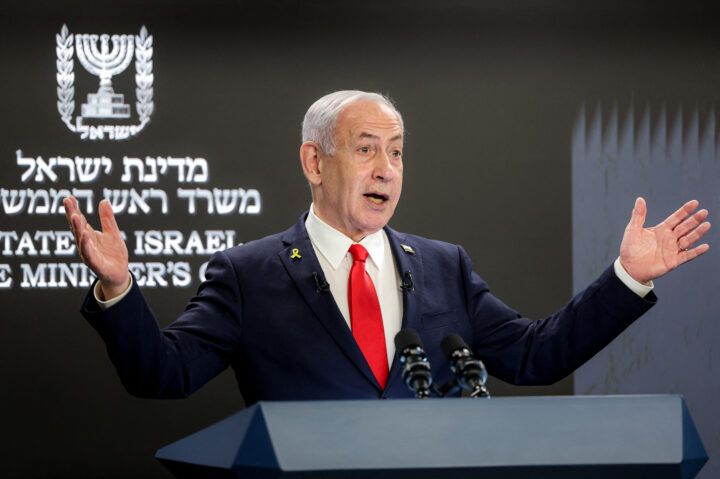
ABIR SULTAN/POOL/AFP via Getty Images
Israel's Prime Minister Benjamin Netanyahu gives a press conference at the Prime minister's office in Jerusalem on August 10, 2025.
Good Monday afternoon.
This P.M. briefing is reserved for our premium subscribers like you — offering a forward-focused read on what we’re tracking now and what’s coming next.
I’m Danielle Cohen-Kanik, U.S. editor at Jewish Insider and curator, along with assists from my colleagues, of the Daily Overtime briefing. Please don’t hesitate to share your thoughts and feedback by replying to this email.
📡On Our Radar
Notable developments and interesting tidbits we’re tracking
Israeli Prime Minister Benjamin Netanyahu called an IDF strike today on a Gaza hospital that reportedly killed 20 people, including at least four journalists, a “tragic mishap” that Israel “deeply regrets.”
“Israel values the work of journalists, medical staff, and all civilians,” Netanyahu said in his statement. “The military authorities are conducting a thorough investigation. Our war is with Hamas terrorists.”
President Donald Trump, asked by reporters in the Oval Office this morning about the strike, said he was “not happy about it. I don’t want to see it.” Trump said at a press conference later he believes that in two to three weeks “you’re going to have … a pretty conclusive ending” to the war in Gaza…
Also turning up the pressure on Netanyahu, IDF Chief of Staff Eyal Zamir said Sunday that the IDF has met its objectives in its war in Gaza, “including deeply damaging Hamas,” and “as a result of the military pressure, we created the conditions for the release of the hostages.”
Zamir reportedly advocated for Netanyahu to accept the deal that Hamas said it agreed to last week and reiterated his concern that the IDF’s impending takeover of Gaza City will imperil the lives of the remaining living hostages…
Lawmakers are making the most of their August recess with several in the Middle East this week.
Sen. Joni Ernst (R-IA) met with Netanyahu in Jerusalem today, after several meetings with Qatari officials in Doha last week.
Sen. Lindsey Graham (R-SC) is in Lebanon today, where he visited a memorial at the U.S. Embassy in Beirut for fallen service members, including the 241 Americans killed in the bombing of U.S. Marine barracks by Hezbollah, under the direction of Iran, in 1983.
Meanwhile, Rep. Joe Wilson (R-SC) and Sen. Jeanne Shaheen (D-NH) joined U.S. Syria envoy Tom Barrack in Damascus, where they met with Syrian President Ahmad al-Sharaa to “discuss a bright, unified, and stable future for Syria.”
Wilson and Shaheen also met with Syria’s minister of social affairs and labor, religious clerics and a leader of the Syrian Democratic Forces. Both lawmakers have led efforts in Congress to repeal congressional sanctions on Syria in order to aid reconstruction and stabilization…
Barrack also visited Israel on Sunday and met with Netanyahu, Minister of Strategic Affairs Ron Dermer, Defense Minister Israel Katz and Foreign Minister Gideon Sa’ar to discuss security arrangements between Israel and Syria as well as Israel and Lebanon, according to Axios…
France requested to delay a U.N. Security Council vote on a French proposal to extend the mandate of the United Nations Interim Force in Lebanon until Friday, due to disagreements with the U.S. — which holds veto power — over a sunset date for the extension.
The current French proposal would allow the force to remain in place indefinitely, while the Trump administration wants an extension of only one year before UNIFIL disbands and withdraws from Lebanon, sources confirmed to Jewish Insider. If no consensus is reached, France could request another delay until Aug. 31, when the current mandate expires…
On the domestic front, the University of Florida’s Board of Trustees voted unanimously to appoint Dr. Donald Landry as interim president of the school, after Florida’s Board of Governors rejected Santa Ono, the former president of the University of Michigan, for the job.
Landry, a renowned physician and chair emeritus of Columbia University’s Department of Medicine, will replace current UF interim President Kent Fuchs, who said the process of choosing a new president had become “more challenging” after Ono’s rejection…
⏩ Tomorrow’s Agenda, Today
An early look at tomorrow’s storylines and schedule to keep you a step ahead
Keep an eye on Jewish Insider tomorrow morning for reporting on how the University of Michigan is becoming an epicenter of anti-Israel activism to start the new school year, and Jewish groups’ response to European officials targeting Katharina von Schnurbein, the EU antisemitism coordinator, for her defense of Israel.
Tomorrow morning, the Democratic National Committee’s Resolution Committee is expected to take up two Israel-related resolutions, including an anti-Israel measure that calls for an arms embargo and a suspension of U.S. military aid to Israel. The resolutions will then be brought to the general session on Wednesday. We’ll be paying close attention to how much support that anti-Israel resolution receives.
Also tomorrow, the Treasury Department will officially remove Syria from its sanctions list for the first time since 2005.
Added to our calendar for next week, Sen. Bernie Sanders (I-VT) is slated to appear at a rally with Graham Platner, a Democrat running against Sen. Susan Collins (R-ME), who has emerged as a harsh critic of Israel during his nascent campaign.
Stories You May Have Missed
MAGA MEETS THE HOLY LAND

One influencer on the delegation organized by Israel365 said he previously believed IDF soldiers were anti-Christian, but ‘they were just kind of like homies’
THE HOT CORNER

A new web series launched by ADL and Maccabi USA explores ‘how sports can inspire dialogue and challenge antisemitism’
Plus, Texans do the electoral shuffle
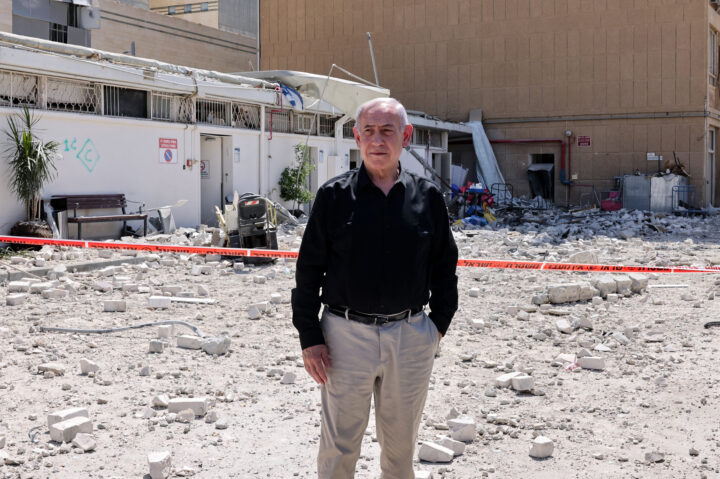
MARC ISRAEL SELLEM/POOL/AFP via Getty Images
Israeli Prime Minister Benjamin Netanyahu stands amid debris outside the Soroka Hospital in the southern city of Beersheba, after it was hit by a missile fired from Iran on June 19, 2025.
Good Thursday afternoon.
This P.M. briefing is reserved for our premium subscribers like you — offering a forward-focused read on what we’re tracking now and what’s coming next.
I’m Danielle Cohen-Kanik, U.S. editor at Jewish Insider and curator, along with assists from my colleagues, of the Daily Overtime briefing. Please don’t hesitate to share your thoughts and feedback by replying to this email.
📡On Our Radar
Notable developments and interesting tidbits we’re tracking
Israeli Prime Minister Benjamin Netanyahu appeared on “Triggernometry,” a conservative podcast based in the U.K., in an episode released yesterday, where he was pressed by co-hosts Konstantin Kisin and Francis Foster about inflammatory comments made by Israeli Finance Minister Bezalel Smotrich about settling Gaza and “things that sound like ethnic cleansing.”
Netanyahu dismissed the comments as democratic disagreements, saying, “In a parliamentary system, people are free to say, sometimes they say things they don’t quite mean. … To the extent that we have these conversations around the Security Cabinet, that is actually not being discussed by these people.”
Netanyahu distanced himself from his ministers who have advocated for reestablishing an Israeli civilian presence in Gaza, clarifying, “It’s not my policy. I don’t intend to build settlements or communities in Gaza, not Israeli ones.”
The prime minister disagreed that the comments from Smotrich may be exacerbating Israel’s “PR problem”: “They ask me, you know, ‘Your minister of finance says this, and what do you say?’ Well, I say I disagree with him, and I say that, you know, he’s entitled to say these things. That’s not ethnic cleansing. It’s a view, a legitimate view, which I happen to disagree with”…
And today, Netanyahu announced that he is working “to approve the plans that the IDF presented” to him and Defense Minister Israel Katz for the impending IDF takeover of Gaza City. “In parallel,” he said, “I have instructed to begin immediate negotiations for the release of all our hostages and the end of the war, on conditions that are acceptable for Israel.”
Netanyahu made no mention of the latest deal reportedly agreed to by Hamas, which only includes the release of some of the 50 remaining hostages…
Israel is also facing increased diplomatic ire over its actions in the West Bank, after Smotrich announced last week his approval of plans to build the E1 settlement, which were previously frozen for decades due in part to U.S. disapproval of its controversial location, which would make a contiguous Palestinian state nearly impossible.
Twenty-two countries, including the U.K., Australia, France and Japan, issued a statement today condemning the move as “unacceptable and a violation of international law,” and the U.K. Foreign Office summoned Israeli Ambassador to the U.K. Tzipi Hotovely in further protest.
Asked about the settlement approval, U.S. Ambassador to Israel Mike Huckabee told the Associated Press that a two-state solution is not a “high priority” for the Trump administration and that there are too many unanswered questions about a potential Palestinian state…
On the campus beat, a New York Times report published yesterday on the hurdles international students are facing entering the U.S. this academic year opened with the line, “Many Iranians are not going to American universities this fall.”
The article, largely sympathetic to the plight of students attempting to enter the U.S., highlighted the revocation of more than 6,000 student visas by the State Department, the majority of which were due to breaking U.S. law and support for terrorism; Secretary of State Marco Rubio’s announcement that the department would review visas of students who participated in disruptive campus anti-Israel protests; and new social media vetting of visa applicants, particularly “for expression of pro-Palestinian sentiment,” as barriers to international student enrollment…
Sen. Joni Ernst (R-IA), on a visit to Doha, met today with Qatari Emir Tamim bin Hamad Al Thani and Prime Minister Mohammed bin Abdulrahman Al Thani. Ernst has previously led efforts to pressure Qatar into forcing Hamas to release the hostages held in Gaza…
In the Lone Star State, Rep. Chip Roy (R-TX), a prominent member of the Freedom Caucus and a thorn in the side of President Donald Trump and House Speaker Mike Johnson (R-LA), announced a bid for Texas attorney general today, seeking to replace Trump ally AG Ken Paxton, who himself is running for U.S. Senate against Sen. John Cornyn (R-TX) in a highly competitive primary.
The Texas game of electoral musical chairs comes as the state is in the midst of a contentious mid-decade redistricting process, which will likely see its Legislature turn even deeper red.
One high-profile Democrat in the Texas Statehouse, James Talarico, was backed by Miriam Adelson’s Texas Sands PAC, Politico revealed today, despite Talarico’s public stance against GOP billionaires‘ influence in politics. The group was his largest donor last year and one of his largest ever…
New York City Mayor Eric Adams, no stranger to scandal, is facing more electoral trouble of his own as he runs for reelection as an independent, facing off against former New York Gov. Andrew Cuomo and Democratic nominee Zohran Mamdani.
Yesterday, reports alleged that Adams’ former advisor and current campaign volunteer, Winnie Greco, surreptitiously gave a reporter an envelope of cash, stashed inside a bag of potato chips. Today, the Manhattan district attorney unsealed four indictments against Adams’ former chief advisor, Ingrid Lewis-Martin, accusing her of receiving more than $75,000 in bribes, and six other individuals, most of whom are associates or supporters of Adams…
⏩ Tomorrow’s Agenda, Today
An early look at tomorrow’s storylines and schedule to keep you a step ahead
Keep an eye on Jewish Insider for reporting on a trip of young MAGA influencers to Israel that changed hearts and minds and an interview with Rep. John McGuire (R-VA) on his reflections from his own recent trip to the Jewish state.
The foreign ministers of Britain, France and Germany will speak with Iranian Foreign Minister Abbas Araghchi by phone tomorrow, sources tell the Substack Diplomatic, to discuss their recent threat to reinstate snapback sanctions on Tehran if it does not sufficiently roll back its nuclear program by the end of this month.
An Iranian delegation will also travel to Vienna tomorrow to meet with the International Atomic Energy Agency, a week after IAEA Deputy Director General Massimo Aparo visited Iran in a bid to restart the agency’s cooperation with Tehran.
On Sunday, the Michigan Democratic Jewish Caucus will host its annual “Summer Simcha” event. Among the attendees will be state Sen. Mallory McMorrow, Abdul El-Sayed and, appearing by video, Rep. Haley Stevens (D-MI) — all of whom are vying for Michigan’s open Senate seat. State Sen. Jeremy Moss, who’s looking to claim Stevens’ seat in the House, and University of Michigan Regent Jordan Acker, who had his home and office vandalized by anti-Israel attackers, will be in attendance. Sen. Elissa Slotkin (D-MI) will also appear by video.
We’ll be back in your inbox with the Daily Kickoff and the Daily Overtime on Monday. Shabbat shalom!
Stories You May Have Missed
MORAN’S MORASS
Former Rep. Jim Moran and his team have held dozens of meetings with members of Congress since the Oct. 7 Hamas terror attacks in 2023, mainly to talk about the Qatari role in the Middle East peace process
WEIRDING OUT

Democrat Graham Platner entered the race accusing Israel of genocide in Gaza
YASUYOSHI CHIBA/AFP via Getty Images
Former Rep. Jim Moran (D-VA) arrives to address a rally attended by supporters of Sudan's ruling Transitional Military Council (TMC) in the village of Abraq, about 60 kilometers northwest of Khartoum, on June 23, 2019.
Good Thursday morning.
In today’s Daily Kickoff, we look at Jim Moran’s lobbying work on behalf of Qatar amid a long record of controversy in his relationships with the Jewish community, and report on Sen. Susan Collins’ criticism of 2026 challenger Graham Platner, who called AIPAC “weird” and has accused Israel of committing genocide. We report on Sen. Amy Klobuchar’s condemnation of the antisemitic rhetoric espoused by staffers for Minneapolis mayoral candidate Omar Fateh, and cover a new Anti-Defamation League report highlighting a white supremacist online forum that has inspired school shooters. Also in today’s Daily Kickoff: Rep. Greg Landsman, Yael Nativ and Daniel Loeb.Ed. note: The next Daily Kickoff will arrive on Monday, Aug. 25.
What We’re Watching
- The American Jewish Committee is holding a web event this afternoon with the founders of The Dinah Project focused on justice for the victims of the sexual violence that took place on Oct. 7, 2023.
- The Milken Institute’s Hamptons Dialogues kick off this morning on the East End of Long Island. What we’re looking out for: On Friday, Pershing Square’s Bill Ackman will speak about K-12 education and the Alpha School, a project he has promoted in recent months that eschews DEI programming and focuses on AI-driven education.
- Later on Friday, former Commerce Secretary Gina Raimondo and Virginia Gov. Glenn Youngkin are speaking on a panel about the U.S.’ economic advantages.
- On Saturday morning, Middle East envoy Steve Witkoff and his son Alex are hosting a breakfast during which Witkoff and Michael Milken will speak in conversation about global challenges and opportunities.
- Sen. Lindsey Graham (R-SC) is slated to speak on a Sunday morning panel focused on U.S. economic security, followed by back-t0-back sessions about the future of American cities, featuring NYPD Commissioner Jessica Tisch, Carlyle Group co-founder David Rubenstein and Related Companies’ Stephen Ross.
- Rubenstein will again take the stage Sunday afternoon for a conversation about sports investments, which will also feature Len Blavatnik.
What You Should Know
A QUICK WORD WITH JI’S JOSH KRAUSHAAR
It’s notable that Democrats are still relying on experienced, brand-name candidates a bit past their political prime as top recruits for key Senate races.
Former Sen. Sherrod Brown, now 72, is seeking a political comeback after losing his reelection bid last year in Ohio. Former North Carolina Gov. Roy Cooper is pursuing a career change to the Senate at 68 years old. Maine Gov. Janet Mills is being recruited into the Senate race against Sen. Susan Collins (R-ME) even though she’s 77.
To be sure, these are the strongest challengers Democrats could muster in these three must-win battleground states. All are popular statewide officials with a history of winning support from outside the party base. It’s hard to name any other Democratic candidate more capable of flipping these GOP-held seats than the aforementioned recruits.
But there’s another more uncomfortable reality that is drawing the Democrats towards their stars of yesteryear. In today’s fractured media environment, it’s incredibly hard for a new face to emerge and get the type of publicity rising stars would generate from “earned media” on television and in the press, as was common in the recent past.
And given the declining influence of such mainstream platforms, the best way to get attention is by playing to the party’s activist base on social media. It’s how Zohran Mamdani broke through a comparatively dull field of challengers in the New York City Democratic mayoral primary. Going viral is becoming a prerequisite in today’s politics, and the best way to go viral is to play to the extremes — or to, like California Gov. Gavin Newsom, emulate President Donald Trump’s online bullying and trolling.
If you don’t have name identification built up from a career in politics, it’s hard to register any other way these days. And it’s exceptionally hard to break through the noise if you’re a thoughtful moderate.
It’s why we’re seeing a slew of Democratic candidates popping up who are looking to capture the anti-establishment mood within the party amid the desire for a younger generation of leadership. At the same time, most of these change-focused candidates also hold political views that are well out of the mainstream.
MORAN’S MORASS
During Jim Moran’s 24 years in Congress, the Virginia Democrat had a habit of putting his foot in his mouth, particularly when it came to his Jewish constituents. In 2003, he blamed the Jewish community for President George W. Bush’s decision to invade Iraq, prompting several local rabbis to call for his resignation. Four years later, he blamed AIPAC for the war. The blowback was so strong that when then-Sen. Barack Obama accepted Moran’s endorsement of his presidential campaign in 2008, he stated plainly that he disagreed with Moran’s views of the Jewish community. Moran retired from Congress in 2015, but the 80-year-old still walks the halls of Capitol Hill. Now, he’s there as a lobbyist — primarily as a registered foreign agent lobbying on behalf of the government of Qatar, Jewish Insider’s Gabby Deutch reports.
Influence wars: It is notable that one of the people tasked with advocating for a country that is close to both America and Hamas seems to have a deeply rooted hostility to Israel and even to American Jews, particularly at a moment when Qatar’s dealings in the U.S. are facing greater scrutiny — like when Trump said earlier this year that the U.S. would accept a Qatari gift of a luxury jet to use as Air Force One. Moran and his team have held dozens of meetings with members of Congress since the Oct. 7 Hamas terror attacks in 2023 that spurred the ongoing war in Gaza, mainly to talk about “Qatar’s role in the Middle East peace process.” At the same time, he has questioned Jewish involvement in the American political system, including just days after Oct. 7.
WEIRDING OUT
Sen. Susan Collins (R-ME) is criticizing Graham Platner, a Democrat running against her in next year’s election, for singling out AIPAC as a “weird” interest group in remarks to a local newspaper in which he also pledged to reject support from the organization. “Sen. Collins is a strong supporter of AIPAC, a bipartisan organization that promotes stronger ties between the United States and Israel,” a spokesperson for Collins told Jewish Insider’s Matthew Kassel. “Nothing about their work is ‘weird’ — in fact, it has never been more important given the aggressive antisemitism that we have seen around the world since the appalling Oct. 7, 2023, terrorist attack.”
‘Very simple’: In his comment, Platner, a 40-year-old oyster farmer, Marine veteran and political newcomer who launched his bid to challenge Collins on Tuesday, said he would reject backing from corporate super PACs and donations from interest groups such as AIPAC that he called “weird.” “My view here is very simple,” Platner told JI on Wednesday when asked to elaborate on his remark. “What is happening in Gaza is a genocide; I refuse to take money from AIPAC or any group that supports the genocide in Gaza.” In other interviews this week, Platner has similarly accused Israel of genocide in Gaza and endorsed efforts to block U.S. arms sales to Israel.
DELAYED DENUNCIATION

Sen. Amy Klobuchar (D-MN) is rebuking a top mayoral candidate in Minneapolis, far-left state Sen. Omar Fateh, who has recently faced criticism for employing campaign staffers who have glorified Hamas’ Oct. 7, 2023, attacks and called for Israel’s destruction, among other extreme comments. In a statement to Jewish Insider’s Matthew Kassel on Wednesday, a spokesperson for Klobuchar, who is backing Fateh’s chief rival, Mayor Jacob Frey, said the senator “strongly and immediately condemned the Hamas terrorist attack, and condemns any statements to the contrary.”
Breaking the silence: “These comments are outrageous and have no place in our politics,” the spokesperson, Jane Meyer, said of the staffers’remarks, which were unearthed by JI last week. “She has spoken out against antisemitism for years. She has endorsed the mayor and did so months ago.” Klobuchar, who along with Minnesota Gov. Tim Walz is the most high-profile Democratic official supporting Frey’s campaign, had until now remained silent with regard to Fateh, a 35-year-old democratic socialist whose insurgent bid has drawn comparisons to Zohran Mamdani, the Democratic nominee for New York City mayor.
TRIP TALK

Following his recent trip to Israel, Rep. Greg Landsman (D-OH) says he believes that the Jewish state is “as close as I’ve understood it to be to ending” the war in Gaza. “The language around aid has changed. [Israel talks] about surging aid and they talk about ending this war quickly,” Landsman, who discussed his trip on Wednesday with Jewish Insider’s Emily Jacobs, said. The Ohio Democrat told JI that he believes “everyone should be putting pressure on all parties to end the war. I think it is entirely appropriate to put pressure on the Israeli government to end this war. I also think it is necessary for people to put pressure on Qatar and Egypt to end this war, to use all of the leverage they have, particularly with the senior Hamas leaders that are in Qatar.”
Support system: Landsman, one of 14 House Democrats who took part in a delegation to the Jewish state last week, told JI that the Israeli officials and citizens he spoke with urged him and others on the trip to continue supporting a strong U.S.-Israel relationship during moments when they took issue with some of the actions of Israeli Prime Minister Benjamin Netanyahu. “They remind you that they would never want anyone to abandon them, as we would never want anyone to abandon us. It’s an important reminder that being critical of the government when you disagree is part of democracy, it’s why democracy and freedom are so important,” he said. “There’s a line. In terms of having the strength and courage to both stand up to and criticize your partners, while also having the strength and courage to not abandon them, especially a partnership like this one and in an existential moment such as this.”
ONLINE RADICALIZATION

A new report from the Anti-Defamation League’s Center on Extremism suggests that an online community of white supremacists is increasingly recruiting and inspiring school shooters, Jewish Insider’s Haley Cohen reports.
Violent videos: The research, published Thursday as an interactive timeline, analyzes two school shootings that occurred weeks apart. Despite happening in different states, the report found overlapping online activity between the young perpetrators. In the months leading up to the shootings, both perpetrators were active on the website WatchPeopleDie, a forum where users can post and view real images and videos of violence. ADL researchers found that extremist material — such as white supremacist and antisemitic manifestos and videos of white supremacist and antisemitic mass murders — was widely accessible on WPD.
PRESIDENT’S POV

President Donald Trump said in an interview with Fox News host Mark Levin on Tuesday that at the time of the U.S. strikes on Iran’s nuclear facilities in June, he believed Tehran “would have had nuclear weapons in a period of four weeks,” Jewish Insider’s Danielle Cohen-Kanik reports. Calling in to Levin’s radio show, Trump said that, “if we didn’t [strike Iran], they would probably by this time, just about this time, have a nuclear weapon and they would have used it.”
Taking on Tehran: “The Atomic Energy Commission said, this place is gone. [Iran] can maybe start up, but they’re not starting up there,” Trump said of the Iranian nuclear facilities targeted in the operation. The Israel Atomic Energy Commission found that the U.S. strike on the Fordow nuclear facility “destroyed the site’s critical infrastructure” and rendered it “inoperable,” though reports differ on the extent of the damage. The president also boasted about his peacemaking abilities, saying, “I’ve settled six wars and we did the Iran night, wiped out their whole nuclear capability, which they would have used against Israel in two seconds if they had the chance.”
Bonus:The New York Times does a deep dive into the U.S. strikes on Iran’s Fordow nuclear facility in June.
Worthy Reads
Trump Card: The Times of Israel’s founding Editor David Horovitz considers how President Donald Trump could hasten the end of the Israel-Hamas war. “Trump’s opening here is to broker a deal — not between Israel and Hamas, which will never sign off on its own path to oblivion, but between Israel and the regional actors who have indicated willingness in principle to step in and rehabilitate the Strip. Netanyahu doesn’t want the PA there. Regional players and Israel’s (now unreliable) international allies have demanded a role for the PA, while stressing the imperative that it be reformed and closely overseen. Washington should strive to produce a viable accommodation, paving the way for non-Hamas governance, negotiating a security mechanism that enables Israel to intervene when necessary, and conditioning the rehabilitation and reconstruction of Gaza on its demilitarization.” [TOI]
Foreign Green on the Green: In Mosaic, Danielle Pletka, a senior fellow at the American Enterprise Institute, proposes a crackdown in foreign funding of American universities to address antisemitism on college campuses. “Is Qatar the only driver of campus anti-Semitism? Absolutely not. The resurgence of Marxist thought, critical race theory, and the ‘intersectionality’ that demands that Jews must be reviled along with racism, fossil fuels, ‘settler colonialists,’ and social conservatives deserves a significant chunk of the blame. But there should be little doubt that, in a campus environment hostile to Israel, Zionists, and Jews, the contributions of a country well known for its support for the Muslim Brotherhood and its Hamas progeny is a significant factor. And Qatar isn’t going away any time soon. If American universities are to become more welcoming places for Jews — indeed, if they are to become better institutions altogether — federal and state governments will have to crack down thoroughly on foreign funding, and administrators will have to exercise some restraint and just say no to money that fosters Jew hatred.” [Mosaic]
The Case for Diversity: In recent remarks to Yale’s incoming law school class that were published in The Free Press, Danielle Sassoon, a former U.S. attorney for the Southern District of New York, reflects on the diversity of opinions among her classmates at the law school 15 years prior that bolstered opportunities for conversation and dialogue. “Ideological familiarity might provide comfort, but don’t take the lazy way out. Recognize that conditioning social acceptance on ideological conformity is the weapon of the intellectually weak. Don’t insulate yourself in an artificial circle of only like-minded peers, or permit others to dehumanize your classmates, whatever their race, religion, or creed. And don’t fall prey to the arrogance of turning analytical questions into moral judgments unworthy of debate. Otherwise, you don’t stand a chance — whether against a hostile judge, a room full of aggressive lawyers 20 years your senior, or as a leader of an institution with people of diverse views and talents.” [FreePress]
Word on the Street
The Trump administration announced sanctions on four International Criminal Court officials over the issuance of arrest warrants for Israeli Prime Minister Benjamin Netanyahu and former Defense Minister Yoav Gallant…
The State Department fired a contractor and onetime National Iranian American Council intern who clashed with officials over the department’s language around relocating Gazans outside of the enclave, expressing condolences over the death of a Palestinian journalist Israel has claimed was a member of Hamas…
The Department of Education’s Office for Civil Rights opened an investigation into Haverford College, three months after the President Wendy Raymond dodged questions regarding antisemitism on the Pennsylvania university’s campus at a congressional hearing…
The New York Times looks at the logistical and bureaucratic challenges facing international students — approximately 1 million of whom study in the U.S. every year — amid the Trump administration’s crackdown on student visa holders…
An advisor to New York City Mayor Eric Adams who was also a volunteer on his reelection campaign was suspended after giving more than $100 in cash to a journalist who reported the exchange to her superiors…
eJewishPhilanthropy’s Nira Dayanim interviews outgoing Revson President Julie Sandorf about her foundation’s approach to funding projects and initiatives in New York City, as well as her own questions about how Democratic mayoral candidate Zohran Mamdani intends to address antisemitism and anti-Israel activity in the city…
Eighteen people were arrested at a two-day worker-led protest at Microsoft’s Redmond, Wash., headquarters as the software giant pledged to review the IDF’s use of its technologies…
An Israeli academic is suing the University of California, Berkeley, alleging that the school, where she had taught a class in 2022, had invited her to apply for another teaching position and rejected her application because she is Israeli; in the lawsuit, Yael Nativ said that the chair of the school’s theater department told her that she would not be offered a position because “[t]hings are very hot right now and many of our grad students are angry” over the political situation in Israel and Gaza…
Third Point founder Daniel Loeb was named chair of the Museum of Jewish Heritage’s board of trustees, eJewishPhilanthropy’s Nira Dayanim reports…
A group of 80 Modern Orthodox rabbis signed on to a letter calling for Israel and its supporters to act with “moral clarity” in regards to the humanitarian situation in Gaza…
The New York Yankees drafted a shortstop who in 2021 had scrawled a swastika on the dorm room door of a Jewish student; Core Jackson, whose acquisition despite the incident was approved by Yankees owner Hal Steinbrenner, has expressed remorse for his actions, telling The Athletic he was “blackout drunk” at the time and had no memory of the incident…
Brandon Korff, the son of Shari Redstone, recently applied for Israeli residency…
The Executive Council of Australian Jewry criticized what it called Israeli Prime Minister Benjamin Netanyahu’s “clumsy intervention” and “inflammatory and provocative” comments made in the wake of Canberra’s cancelation of a visa for hard-right Israeli MK Simcha Rothman; in response, Netanyahu lambasted Australian Prime Minister Anthony Albanese as a “a weak politician who betrayed Israel and abandoned Australia’s Jews”…
B’nai Brith Canada issued an open letter calling on Prime Minister Mark Carney to reverse his plans to recognize a Palestinian state at the United Nations General Assembly next month…
Netanyahu is reportedly mulling the creation of a satellite party to woo right-wing voters disillusioned with his Likud party and its far-right coalition members; the new party would attempt to block former Likud voters from backing former Prime Minister Naftali Bennett or Avigdor Liberman…
Iranian Defense Minister Aziz Nassirzadeh said that Tehran had built missiles “with far greater capabilities than previous missiles” and would use them in the event of an Israeli attack on Iran…
Iranian Foreign Minister Foreign Minister Abbas Aragchi said that current circumstances are preventing “effective negotiations” between Tehran and Washington over Iran’s nuclear program…
The Iranian Navy launched its first drills in the Gulf of Oman and the Indian Ocean since its 12-day war with Israel in June…
Seventy-nine Afghans who had been forcibly returned from Iran were killed in a bus crash in Afghanistan; Tehran has sought to deport more than 1 million Afghans in the country as part of its crackdown on illegal immigration…
A senior Catholic cleric in Lebanon said that Pope Leo XIV was considering a trip to the country as his first overseas trip since becoming pontiff…
British tech pioneer Stephanie Shirley, who fought for women’s inclusion in the field as an adult after fleeing Nazi Europe on the Kindertransport as a child, died at 91…
Psychiatrist Warren Brodey, who coupled his field with the advent of modern technology, died at 101…
Pic of the Day

Former Israeli hostage Andrei Kozlov met with several dozen Holocaust survivors on Tuesday at the Adolph and Lotte Rosenberg Summer Retreat for Holocaust survivors in Kerhonkson, N.Y., hosted by The Blue Card. Read more from eJewishPhilanthropy’s Jay Deitcher here.
Birthdays
Mexican writer, playwright and journalist whose work is related to diversity and its obstacles, Sabina Berman Goldberg turns 70… Retired owner of Effective Strategy Consultants, South Florida resident, Irwin Wecker… Senior judge on the U.S. Court of Appeals for the 7th Circuit (with chambers in Chicago), the first woman appointed to this court, Judge Ilana Kara Diamond Rovner turns 87… President of the Massachusetts Institute of Technology until the end of 2022, L. Rafael Reif turns 75… Former chief justice of the Ohio Supreme Court, he was the first Jewish chief justice in Ohio history, Eric S. Brown turns 72… Israeli-born pawnbroker and star of the reality television series “Beverly Hills Pawn,” Yossi Dina turns 71… Businessman and collector of modern and contemporary art, he is a partner in the NFL’s Washington Commanders, Mitchell Rales turns 69… U.S. senator (D-MT) for 18 years, ending earlier this year, Jon Tester turns 69… Israeli physician who was a member of the Knesset, he now serves as mayor of Ashdod, Dr. Yehiel Lasri turns 68… Photographer best known for his fashion and celebrity images, Jerry Avenaim turns 64… Israeli career diplomat who served for six years as consul general in New York, Ido Aharoni turns 63… United States secretary of the Treasury, Scott Bessent turns 63… President at Maimonides Fund, Mark S. Charendoff… Co-founder of BlueLine Grid, he was previously an assistant U.S. attorney in Los Angeles and a member of the Los Angeles City Council, Jack Weiss turns 61… Member of the philanthropic leadership group for the UJA-Federation of New York, Chavie N. Kahn… Partner at Kohlberg Kravis Roberts-KKR where he is the global head of public affairs and a co-head of global impact, Ken Mehlman turns 59… President of Berger Hirschberg Strategies, Rachel Hirschberg Light… Co-founder of Google, Sergey Brin turns 52… MLB pitcher for nine teams in a 16-season career, he was the starting pitcher in three of Team Israel’s first four games in the 2017 World Baseball Classic, all of which the team won, Jason Marquis turns 47… District attorney of San Francisco, elected in 2019 and recalled in 2022, Chesa Boudin turns 45… Head coach of the Temple University Owls men’s basketball team, Adam Fisher turns 41… President at Bold Decision, Adam Rosenblatt turns 40… Missions manager for domestic and overseas travel at the Jewish Federation of Greater Philadelphia, Erica N. Miller… Communications director at Breakthrough Energy, David Abadian Heifetz… Pop singer and songwriter, Madeline Fuhrman turns 32… Associate editor at Simon & Schuster, Tzipora (Tzippy) Baitch… An Argov fellow at Reichman University and a Lauder fellow at the World Jewish Congress, Noa Rakel Perugia… Lynn Sharon… James Barton…
The Ohio Democrat, who visited Israel last week, also called for pressure on Qatar to push Hamas officials in Doha to end the war and release the remaining 50 hostages
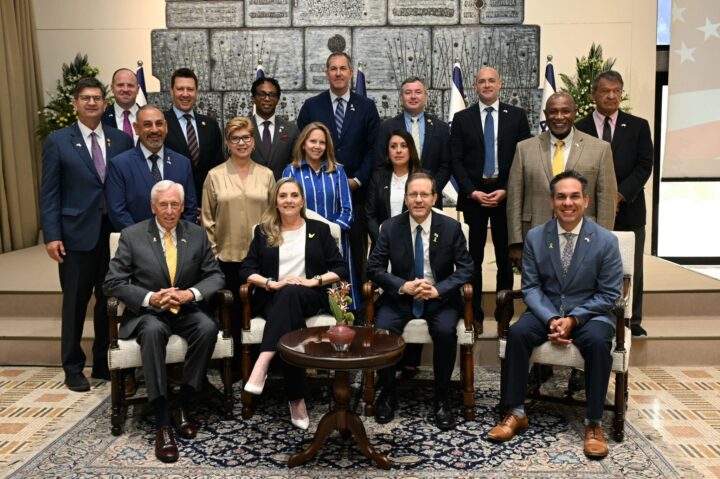
President Isaac Herzog on X
Israeli President Isaac Herzog meets a delegation of House Democrats in Jerusalem on August 11, 2025.
Following his recent trip to Israel, Rep. Greg Landsman (D-OH) says he believes that the Jewish state is “as close as I’ve understood it to be to ending” the war in Gaza.
“The language around aid has changed. [Israel talks] about surging aid and they talk about ending this war quickly,” Landsman, who discussed his trip on Wednesday with Jewish Insider, said. “They talk about getting the hostages back no matter what, and whether there’s a deal or not, they’re getting them home. So, they obviously can’t speak to what that looks like or what that means, but I got the sense that this should and hopefully will be the end.”
He made a similar comment in a statement on his trip shared with JI, which stated: “The end of the war appears close, and G-d willing it ends very soon. With it, rebuilding of Gaza can begin. The first glimpses of this ‘day after’ plan can be seen, and the Arab nations that have declared the end of Hamas must play a huge role in what happens next.” His comments came as Israel weighs the most recent ceasefire proposal, and as the IDF prepares to call up tens of thousands of reservists ahead of plans to take over Gaza City in the coming months.
Regarding next steps, Landsman wrote in the statement, “This is a moment of truth for Qatar, to be sure. With senior Hamas leaders in their midst, detaining them – if negotiations continue to falter – may be necessary. This could hasten the end of the war and the release of the hostages. They must do everything in their power – now.”
Landsman told JI that he believes “everyone should be putting pressure on all parties to end the war. I think it is entirely appropriate to put pressure on the Israeli government to end this war. I also think it is necessary for people to put pressure on Qatar and Egypt to end this war, to use all of the leverage they have, particularly with the senior Hamas leaders that are in Qatar.”
“I believe that’s true to some extent, to a lesser extent, for folks in Egypt to say we’re done, you have to accept a return, a deal that ends this war and returns hostages. The pressure also needs to be placed on these 22 Arab countries, and I believe Egypt and Qatar are on that list, but the other 20 who have said, in an unprecedented move, that Hamas needs to disarm and disband. Now they’ve got to turn that into action and establish a coalition with the United States and Israel and Europe to end this war,” he continued.
The Ohio congressman was one of 14 House Democrats who took part in a delegation to the Jewish state last week. The trip was organized by the AIPAC-affiliated American Israel Education Foundation, which organized a similar visit to Israel for House Republicans the week prior that overlapped for several days with the Democrats’ trip.
Landsman told JI that he viewed the trip as an opportunity to accomplish three main objectives: to be available as a resource to answer questions from Israeli leaders and build relationships with newer members of Congress like himself; to get fully briefed on the work being done to ensure the delivery of humanitarian aid into Gaza; and to engage with stakeholders in the broader peace process in the region. “Going sort of allows me to do all three of those things,” he said.
Landsman said that this trip highlighted the similarities between the American and Israeli people and as citizens of liberal democracies where citizens are free to air frustrations about their respective governments.
“The frustration with the government is something that many Israelis feel. They are frustrated with this government, especially as it relates to Gaza,” Landsman said. “And I appreciate that because it’s a liberal democracy. Israelis are just as critical of this government, if not more, than folks around the world or here in the United States.”
Landsman told JI that the Israeli officials and citizens he spoke with urged him and others on the trip to continue supporting a strong U.S.-Israel relationship during moments when they took issue with some of the actions of Israeli Prime Minister Benjamin Netanyahu.
“They remind you that they would never want anyone to abandon them, as we would never want anyone to abandon us. It’s an important reminder that being critical of the government when you disagree is part of democracy, it’s why democracy and freedom are so important,” he said. “There’s a line. In terms of having the strength and courage to both stand up to and criticize your partners, while also having the strength and courage to not abandon them, especially a partnership like this one and in an existential moment such as this.”
The Ohio Democrat offered a similar thought in his official statement, in which he wrote: “Instead of abandonment, many of us have chosen to visit the region, to show up, and to support the Israeli government when we agree and to push back when we don’t. We know that abandonment may be politically expedient, but it is strategically wrong. It will render our country unreliable to those who we need to ensure global security and global prosperity.”
“We must always remain a reliable partner for democracy and peace. The United States of America does not abandon its allies, nor will we do so here,” the statement continued.
Landsman told JI, “We should not abandon Ukraine and our European allies. We should not abandon, and I don’t believe we will, one of our strongest partners in peace and democracy and freedom, and that’s the state of Israel.”
“We want people to stick with us. That’s why I used the word ‘reliable’ in my statement. We need people to stick with us for our economic prosperity, for national security. If we’re not sticking with others, people will stop sticking with us, and that is very bad for the United States,” the Democratic lawmaker said.
“This is why we worry about [President Donald] Trump or any president that starts to undermine our relationships with folks across the world. It becomes very, very costly and very dangerous to the United States. We wouldn’t want anyone to look at this government [in the U.S.] and say, ‘Well, we’re gonna back away from our commitment, our investments in America.’ That would be terrible,” he continued.
Landsman said he believed his worldview was shared by the majority of the American people.
“When I come home and have these conversations, I get a very common-sense position. It’s where I believe most people are when I talk to them. They worry about the humanitarian situation. How can you not? They want this war to end. How can you not? They get frustrated with a government that has people like [Israeli National Security Minister Itamar] Ben-Gvir and [Finance Minister Bezalel] Smotrich. Of course, they should,” Landsman explained.
“But they also know that Hamas can’t stay, and Israel has to figure out a way to win this war or end it so that folks can rebuild without a terrorist organization in their way. They know that Iran is the barrier to everything good in the region. They know if you start to undermine the partnership with Israel, the only people who win are folks associated with the regime and the terror networks they fund,” he added.
Former Rep. Jim Moran and his team have held dozens of meetings with members of Congress since the Oct. 7 Hamas terror attacks in 2023, mainly to talk about the Qatari role in the Middle East peace process
YASUYOSHI CHIBA/AFP via Getty Images
Former Rep. Jim Moran (D-VA) arrives to address a rally attended by supporters of Sudan's ruling Transitional Military Council (TMC) in the village of Abraq, about 60 kilometers northwest of Khartoum, on June 23, 2019.
During Jim Moran’s 24 years in Congress, the Virginia Democrat had a habit of putting his foot in his mouth, particularly when it came to his Jewish constituents.
In 2003, he blamed the Jewish community for President George W. Bush’s decision to invade Iraq, prompting several local rabbis to call for his resignation. Four years later he blamed AIPAC for the war. The blowback was so strong that when then-Sen. Barack Obama accepted Moran’s endorsement of his presidential campaign in 2008, he stated plainly that he disagreed with Moran’s views of the Jewish community.
Moran retired from Congress in 2015, but the 80-year-old still walks the halls of Capitol Hill. Now, he’s there as a lobbyist — primarily as a registered foreign agent lobbying on behalf of the government of Qatar.
He is a regular in the offices of high-ranking members of Congress and senators. And last month, during a House Education Committee hearing about antisemitism in higher education, Moran was conspicuously seated directly behind Robert M. Groves, the president of Georgetown University, which has a campus in Doha and has received more than $1 billion from the Gulf monarchy.
“Jim is one of these guys that people seem to like on both sides of the aisle. He’s been able to keep in contact with a lot of members when needed,” Tom Davis, a former Republican congressman from Virginia who Moran hired to help represent Qatar, told Jewish Insider.
A Georgetown source said Moran was not working with the university or sitting in one of Georgetown’s three allotted seats at the hearing. Still, there’s no doubt he is a highly influential foreign policy voice in Washington on behalf of a country with which America has a complicated relationship.
Qatar is a major non-NATO ally of the U.S., an official designation conferred by President Joe Biden, and is home to the largest U.S. military base in the Middle East. But it also has financial and diplomatic ties with Hamas and other terror groups. Qatar’s leaders say that is necessary so the country can maintain its role as a trusted mediator, while its critics say Qatar’s close relationship with Hamas makes it unlikely to put real pressure on the terror group to make a deal with Israel or to release the hostages. Some on Capitol Hill and in the pro-Israel community have expressed concerns that Qatar’s massive investment in American universities has fueled anti-Israel activism and antisemitism on campuses.
With a Boston accent leftover from his childhood, Moran has a penchant for talking tough — and acting tough, too. In the 1990s, at the start of his time in Congress, he occasionally threatened to brawl with fellow lawmakers, and once shoved another member of Congress off the House floor.
Moran was an early and consistent critic of Israel, long before the wave of anti-Israel sentiment that has exploded on the far left over the past two years. He has kept up ties with Jewish leaders in Northern Virginia, but those relationships grew strained as Moran repeatedly criticized pro-Israel advocates and Jewish activists.
“Jim is an extraordinarily compassionate man. He has trouble with suffering. His judgment about what constitutes suffering and who’s causing it is not always accurate, and so that has gotten him in a considerable amount of trouble over the course of his long political career,” said Rabbi Jack Moline, who served for 27 years as the rabbi at Agudas Achim Congregation in Alexandria. Moline met regularly with Moran until the rabbi called for Moran’s resignation in 2003, after Moran blamed Jews for the Iraq war, a comment the former congressman later said he “deeply regret[s].”
“His relationship with the Jewish community fell apart,” Moline told JI. “It didn’t surprise anybody when, after he finally did retire from Congress, he was offered and accepted work lobbying for Qatar.” He first registered as a lobbyist for Qatar in 2017. His firm, Moran Global Strategies, has been paid more than $2 million by Qatar in the last two years, according to data compiled by OpenSecrets. A spokesperson for the Qatari Embassy did not respond to a request for comment, nor did Moran Global Strategies.
Though Moran expressed contrition for his antisemitic remarks during the lead-up to the Iraq war, his rhetoric toward the Jewish community has only grown more inflammatory in the decade since he left Congress. In recent years, he has appeared on several virtual panel discussions held by the Arab Organization for Human Rights in the U.K., a London-based NGO led by Mohammad Jamil Hersh, a former Hamas activist who has been sanctioned by Israel and was deported by the country more than three decades ago. In those conversations, he regularly blasted the influence of American Jews and the “pro-Israel lobby.”
During a February 2023 AOHR event, Moran tried to explain Washington’s support for “apartheid” in Gaza by pointing the finger at American Jews and suggesting that they are unduly involved in the American political system.
“It’s about domestic politics and it always has been. The majority of people who contribute to the Democratic Party in America have Jewish surnames. Now think about that,” said Moran. He described them as people “whose principal reason for contributing to the political system in America has been the sine qua non of support for Israel, and unqualified support for Israel.”
In this and several other interviews, Moran recognized that his language was rather impolitic.
“I don’t want to sound antisemitic, and Palestinians are a Semitic people,” Moran said. “I’m just saying that let’s deal with the political reality in the United States that’s driving and reinforcing the injustice that’s occurring within Palestine.”
Moran and his team have held dozens of meetings with members of Congress since the Oct. 7 Hamas terror attacks in 2023 that spurred the ongoing war in Gaza, mainly to talk about “Qatar’s role in the Middle East peace process,” according to documents he filed with the Justice Department as required by the Foreign Agents Registration Act. At the same time, he has continued to question Jewish involvement in the American political system — including just days after Oct. 7, in a call hosted by the Muslim Public Affairs Council.
“The reality is that campaign contributions have corrupted the United States Congress. One of the motivating factors is, ‘How do I please my political supporters, particularly my financial supporters?’ The reality is that the Jewish community, and frankly to their credit, is deeply engaged in the American political process,” Moran said in the MPAC call. “That’s one of the motivating factors that causes the Congress to look the other way where the Middle East is concerned.”
Although he expressed skepticism about the supposed influence of American Jews in electoral politics, he encouraged Muslim, Palestinian and Arab Americans to increase their own influence. But his prognosis for their potential efficacy was grim. “I’m not sure they’re ever going to be able to successfully catch up,” Moran said.
Even as Moran took aim at Jews’ participation in the political process, he routinely downplayed accusations of antisemitism that have been lobbed at him directly and at the broader anti-Israel movement.
In September 2024, in another AOHR virtual briefing, Moran acknowledged that he would likely be called antisemitic for his comments accusing Israel of committing war crimes “daily” and for describing the situation in Gaza as “comparable to the Holocaust.”
“Foreign aid going into committing war crimes on a daily basis because of the politics, because of the campaign financing, because of the control of the media — it’s inexcusable. It’s an indictment of what has become of this democracy,” said Moran, without saying who, exactly, he thinks controls the media. “It’s an indictment of the fact that our foreign policy has been Israeli-centric, and let me say one other thing so that people don’t particularly accuse me of being antisemitic, although I’m sure many will: Many of those protests across the country were led by Jewish students.”
This spring, after President Donald Trump returned to office and began targeting universities, Moran was dispatched to Capitol Hill to talk to Democrats on the Senate Health, Education, Labor and Pensions Committee about Qatar’s funding of American higher education, which has come under the microscope.
It is notable that one of the people tasked with advocating for a country that is close to both America and Hamas seems to have a deeply rooted hostility to Israel and even to American Jews, particularly at a moment when Qatar’s dealings in the U.S. are facing greater scrutiny — such as when Trump said earlier this year that the U.S. would accept a Qatari gift of a luxury jet to use as Air Force One.
But Qatar has a suite of lobbyists who span the political spectrum. Moran primarily deals with Democrats. Qatar has in the past also targeted hundreds of conservative “influencers” to reach Trump’s inner circle, and employs several Republicans as lobbyists. Partisan politics is at play, too; Democratic lawmakers blasted the Air Force One move, while Republicans fell in line behind Trump.
Several prominent Trump administration officials have ties to Qatar, including Attorney General Pam Bondi, who said in her January Senate confirmation hearing that she remains “very proud” of the lobbying work she did for Qatar ahead of the 2022 World Cup. Steve Witkoff, Trump’s Middle East envoy and chief negotiator, has a history of business dealings with the country.
“If you take a look at the folks they’ve got representing them, they’ve been all over the lot on that issue. It’s certainly not a pro-Arab versus Israel issue,” said Davis, the Virginia Republican who works with Moran on the Qatar file. “There’s nothing there to indicate that their lobbyists have any kind of ideological bent on that issue.”
Correction: This story has been corrected to reflect that Moran began lobbying for Qatar in 2017, not 2023.
Plus, Bibi faces coalition chaos

Gage Skidmore
Sen. Amy Klobuchar (D-MN) speaking with attendees at the Moving America Forward Forum hosted by United for Infrastructure at the Student Union at the University of Nevada, Las Vegas in Las Vegas, Nevada.
Good Wednesday afternoon.
This P.M. briefing is reserved for our premium subscribers like you — offering a forward-focused read on what we’re tracking now and what’s coming next.
I’m Danielle Cohen-Kanik, U.S. editor at Jewish Insider and curator, along with assists from my colleagues, of the Daily Overtime briefing. Please don’t hesitate to share your thoughts and feedback by replying to this email.
📡On Our Radar
Notable developments and interesting tidbits we’re tracking
Sen. Amy Klobuchar (D-MN) rebuked antisemitic comments made by Minneapolis mayoral candidate Omar Fateh’s campaign staff in a statement to Jewish Insider today, after initially declining to comment when JI unearthed the statements last week.
Klobuchar’s spokesperson said the senator “strongly and immediately condemned the Hamas terrorist attack, and condemns any statements to the contrary.” She called Fateh’s staffers’ comments “outrageous” and said they “have no place in our politics.”
Klobuchar reiterated her endorsement of Mayor Jacob Frey in the race; Frey’s other supporters, including Minnesota Gov. Tim Walz, and other state Democratic officials have thus far refrained from commenting on the situation…
Staying in the Midwest, protesters interrupted Rep. Wesley Bell’s (D-MO) first in-person town hall last night in St. Louis over Bell’s support for Israel, shouting over the congressman and getting into altercations with police.
In response to a question about “the ongoing genocide in Palestine,” Bell said, “Let’s talk about the word genocide, because we see that differently.” He repeatedly asked protesters to stop shouting and listen.
“There’s a lot of folks who don’t want to have the conversation,” Bell said. “They just want to spew what they think is important, but they don’t want to have an actual debate because these are tough issues. So, now we’re going to have the conversation — whether you like it or not”…
Meanwhile on the campaign trail, Politico reported this morning on Rep. Chris Pappas’ (D-NH) new competitor in the Democratic primary for New Hampshire’s open Senate seat, political activist Karishma Manzur.
Manzur said she would have supported recent resolutions from Sen. Bernie Sanders (I-VT) — which the moderate Pappas said he would have opposed — seeking to block some arms sales to Israel, saying she “will be against any money to any country to kill people” and that the U.S. should take “concrete actions against the harrowing acts of torture of Palestinians” by the IDF …
President Donald Trump called in to Fox News host Mark Levin’s radio show yesterday and said that, at the time of the U.S. strikes on Iran’s nuclear facilities in June, he believed Iran “would have had nuclear weapons in a period of four weeks.”
“If we didn’t [strike Iran], they would probably by this time, just about this time, have a nuclear weapon and they would have used it,” the president said.
Trump also told Levin that the U.S. Air Force pilots who conducted the strikes told him that they and their predecessors had been practicing the flight to Iranian airspace for 22 years…
The New York Times published an analysis on the damage inflicted by U.S. strikes on the Iranian nuclear site Fordow based on the site’s structure and the munitions used…
The State Department responded today to a bipartisan congressional letter led by Pappas last month expressing lawmakers’ concerns that the administration was considering selling F-35 fighter jets to Turkey in a reversal of U.S. policy, which currently bans the sale of the jets in light of Turkey’s purchase of an S-400 missile defense system from Russia.
Paul Guaglianone, senior bureau official in the department’s Bureau of Legislative Affairs, wrote in a letter to Pappas that the “U.S. position on Turkey’s acquisition and continued possession of the Russian S-400 system has not changed, and the requirements for Turkey to acquire U.S. F-35 aircraft are well-known”…
Secretary of State Marco Rubio also announced this morning that the U.S. is sanctioning four additional officials from the International Criminal Court, two judges and two prosecutors, in addition to the four judges sanctioned by the U.S. in June, over the ICC’s continued “efforts to investigate, arrest, detain, and prosecute American and Israeli nationals”…
In Israel, coalition politics are heating up over a potential ceasefire and hostage-release agreement with Hamas, which reports indicate the terror group recently accepted but Israel has not yet responded to.
Israeli media reported that Finance Minister Bezalel Smotrich told hostage families he would resign if Prime Minister Benjamin Netanyahu agreed to a ceasefire, and Minister of National Security Itamar Ben-Gvir is likely to do the same, as he did in January when Israel agreed to a previous ceasefire deal.
Meanwhile, opposition MK Benny Gantz, whose Blue and White-National Unity party is currently hemorrhaging in the polls, is reportedly considering rejoining Netanyahu’s coalition to help bolster support for a deal…
Back stateside, Israeli scholar and dance instructor Yael Nativ is suing the University of California, Berkeley, alleging that the university denied her a teaching position because she is Israeli. Nativ had previously taught at Berkeley and was encouraged to apply to teach another course.
When Nativ’s application was rejected shortly after the Oct. 7, 2023, terror attacks, according to the suit, the dance department chair wrote to her, “My dept cannot host you for a class next fall. Things are very hot right now and many of our grad students are angry. I would be putting the dept and you in a terrible position if you taught here”…
⏩ Tomorrow’s Agenda, Today
An early look at tomorrow’s storylines and schedule to keep you a step ahead
Keep an eye on Jewish Insider tomorrow morning for reporting on Graham Platner, the oyster farmer turned Democratic challenger to Sen. Susan Collins (R-ME), who called AIPAC “weird” in a recent interview.
Tomorrow afternoon, the American Jewish Committee will host a briefing on “Justice for Victims of Hamas’ Sexual Violence: The U.N. Blacklist and What Comes Next,” referring to the U.N.’s recent decision to “blacklist” Hamas as a group that uses sexual violence as a weapon of war.
Stories You May Have Missed
FOREIGN POLICY FEID
Trump’s senior director for counterterrorism: ‘I was worried by this neo-Buchanan isolationism, but I look at President Trump’s actions, they have no hold on him’
TRIP TALK
The New York Democrat told JI ‘the majority of people see the value and the special nature of our relationship with our ally Israel’
Plus, Loomer lashes out
Annabelle Gordon/Bloomberg via Getty Images
Rep. Jamie Raskin (D-MD) during a news conference in Washington, D.C., on Thursday, May 22, 2025.
Good Tuesday afternoon.
This P.M. briefing is reserved for our premium subscribers like you — offering a forward-focused read on what we’re tracking now and what’s coming next.
I’m Danielle Cohen-Kanik, U.S. editor at Jewish Insider and curator, along with assists from my colleagues, of the Daily Overtime briefing. Please don’t hesitate to share your thoughts and feedback by replying to this email.
📡On Our Radar
Notable developments and interesting tidbits we’re tracking
Ron Halber, CEO of the Jewish Community Relations Council of Greater Washington, called Rep. Jamie Raskin’s (D-MD) decision to co-sponsor legislation severely restricting U.S. aid to Israel “extremely disappointing,” telling Jewish Insider today that he had a “very honest and frank conversation” with the congressman, whom he considers a friend.
Halber framed his concerns with Raskin, a prominent progressive Jewish lawmaker, within the broader trend of the Democratic Party moving away from its long-standing support for Israel. “It’s difficult when two-thirds of our community is voting for a political party whose base is hostile to Israel,” he remarked.
“Once the war comes to an end, the whole Jewish community is going to have to re-strategize,” Halber said.
The JCRC of Greater Washington CEO said he had asked Raskin to remove himself as a co-sponsor of the bill and instead issue a statement conveying his concerns with Israel’s war in Gaza. “If he doesn’t, we will be disappointed, but that’s his decision to make and he has to live with the ramifications of his decision”…
Speaking this morning at a briefing co-hosted by the American Jewish Congress and World Zionist Organization, U.S. Ambassador to Israel Mike Huckabee sounded a cautious note on the current ceasefire negotiations with Hamas, as reports indicate the terror group has accepted a Qatari- and Egyptian-backed proposal.
“Whether or not [Hamas is] serious about bringing this to a close, all I can tell you is I hope so. But what’s happened before, even when they say they are thinking seriously about bringing this to a conclusion, making a deal, they always add one or more things that are completely unacceptable, bring those to the table, then it all starts over again,” Huckabee said.
Israel has yet to respond to the proposal and White House Press Secretary Karoline Leavitt said at a press briefing today that the U.S. “continues to discuss” it…
Huckabee and his wife, Janet, hosted U.S. Ambassador to France Charles Kushner and his wife, Seryl, in Jerusalem tonight…
Israeli Defense Minister Israel Katz met with Lt. Gen. Eyal Zamir, the IDF’s chief of staff, today to approve the IDF’s plans to take over Gaza City. Israeli officials said Gazans will have until Oct. 7 to evacuate the city, to coincide with the second anniversary of Hamas’ attacks, at which point the IDF offensive will begin. It remains to be seen if a ceasefire and hostage-release deal will be reached before then…
The Israeli government also voted today to approve a $9 billion increase to the country’s budget for the year, including $473 million for humanitarian aid for Gaza…
In other negotiation news, Israeli Minister for Strategic Affairs Ron Dermer is scheduled to meet this evening in Paris with Syrian Foreign Minister Asaad al-Shibani and U.S. Ambassador to Turkey and Syria envoy Tom Barrack to discuss security arrangements on the Israel-Syria border.
The meeting comes a day after Barrack, while visiting Beirut, said Israel needs to “comply with [an] equal handshake” to the Lebanese government’s commitment to disarm Hezbollah by fully withdrawing its troops from Lebanon…
Back stateside, the president of the American Association of University Professors said in a recent interview, “We believe strongly that no weapons should be sent to Israel, at all. Not defensive or offensive, nothing,” escalating the association’s adversarial stance against the Jewish state…
The New York Times chronicles the Trump administration’s attempts to wrest financial settlements from elite universities, including ongoing negotiations with Harvard and the University of California, Los Angeles, the latter of which may pay the administration upwards of $1 billion, according to a draft agreement…
Media mogul Shari Redstone told the Times that she decided to sell Paramount to Skydance in a recent $8 billion merger in part due to her frustrations over anti-Israel bias at CBS, particularly after the Oct. 7 attacks. “Once that happened, I wanted out,” Redstone said. “I wanted to support Israel, and address issues around antisemitism and racism”…
Rep. Ritchie Torres (D-NY) endorsed New York Gov. Kathy Hochul in her reelection bid today, after initially exploring a run against her and criticizing her tenure…
The Free Press reports on growing frustration with Laura Loomer, a right-wing provocateur and informal advisor to President Donald Trump, inside the White House, with some officials speculating she may be paid or influenced by lobbying firms and business interests.
Loomer lashed out on X, telling Free Press reporter Gabe Kaminsky he should “contact your anonymous White House sources who are so horrified by ‘lobbyists’ and their intentions and ask them how they feel about their friendship with” Jeff Miller, a Republican strategist, board member of the Republican Jewish Coalition and Trump-appointed member of the U.S. Holocaust Memorial Council…
⏩ Tomorrow’s Agenda, Today
An early look at tomorrow’s storylines and schedule to keep you a step ahead
Keep an eye on Jewish Insider tomorrow morning for an interview with top New York Democrat Rep. Laura Gillen (D-NY) on her takeaways from a recent visit to Israel.
This evening, Maryland Gov. Wes Moore, a potential 2028 presidential contender, will speak at D.C.’s Politics & Prose on “the role of states in preserving and advancing U.S. democracy.”
Tomorrow, the historic Sinai Temple in Los Angeles will host a conversation with Ahmed Fouad Alkhatib, the director of the Realign for Palestine program at the Atlantic Council who was born and raised in Gaza. It’s the second event in a series the prominent Conservative synagogue has held about the war in Gaza for its congregants, the first of which was held last month with Gaza Humanitarian Foundation head Johnnie Moore. Read JI’s coverage of Moore’s conversation here.
Stories You May Have Missed
CALIFORNIA COMPETITION

Sherman, a stalwart pro-Israel Democrat, is facing several politically connected Democratic challengers in next year’s primary
CLARK’S CLARIFICATION
AIPAC said its endorsement is ‘unchanged’ and based on the House minority whip’s ‘long-standing support for the U.S.-Israel relationship’
Plus, Santa Ono lands on his feet

Tom Williams/CQ-Roll Call, Inc via Getty Images
Then-Rep. Ruben Gallego (D-AZ) in Rayburn Building on Capitol Hill on June 9, 2022.
Good Monday afternoon.
This P.M. briefing is reserved for our premium subscribers like you — offering a forward-focused read on what we’re tracking now and what’s coming next.
I’m Danielle Cohen-Kanik, U.S. editor at Jewish Insider and curator, along with assists from my colleagues, of the Daily Overtime briefing. Please don’t hesitate to share your thoughts and feedback by replying to this email.
📡On Our Radar
Notable developments and interesting tidbits we’re tracking
President Donald Trump posted on Truth Social this morning, “We will only see the return of the remaining hostages when Hamas is confronted and destroyed!!! The sooner this takes place, the better the chances of success will be. … Play to WIN, or don’t play at all!”
Hours later, reports indicated that Hamas had accepted a new ceasefire and hostage-release proposal from Qatari Prime Minister Mohammed Al Thani and Egyptian officials in Cairo, after a meeting in Doha last week between Al Thani and Mossad Director David Barnea.
A source told Axios that the deal is “98% similar” to the latest U.S.-backed proposal initiated by Middle East envoy Steve Witkoff.
Though neither American nor Israeli officials have confirmed the news, Prime Minister Benjamin Netanyahu said in a statement this afternoon, “Like you, I hear the reports in the media, and from them you can be impressed by one thing — Hamas is under immense pressure“…
Meanwhile at home, the embrace of anti-Israel actors by the Democratic mainstream continues.
Over the weekend, Sen. Ruben Gallego (D-AZ), a potential 2028 Democratic presidential contender from a swing state, told a local political outlet about New York City Democratic mayoral nominee Zohran Mamdani, “It’s OK to say ‘I disagree with this, this, and this, but I agree with that.’ But the idea that we’re just gonna throw out people that are really bringing in new ideas to the fold, exciting people, just because they’re slightly to the right or to the left of us is dumb.”
It’s a notable marker, a pragmatic lawmaker with national aspirations calling Mamdani — a democratic socialist who has refused to condemn the phrase “globalize the intifada” — “slightly to the left” of the Democratic center.
And this morning, opinion writer Jerusalem Demsas, formerly of The Atlantic, announced the launch of her new liberal media company, The Argument. The publication will feature writings from center-left heavyweights including Derek Thompson and Matthew Yglesias and received funding from similarly aligned investors including Arnold Ventures and Open Philanthropy.
In her announcement video, Demsas said conservatives are “persecuting Americans for exercising their basic freedoms” over news clips covering anti-Israel protest leader Mahmoud Khalil’s detention by the federal government.
The continued embrace of Khalil by Democratic thought leaders and influencers is significant as Khalil has continued to escalate his anti-Israel rhetoric, including in a recent appearance on “The Ezra Klein Show” podcast where he said about the Oct. 7 attacks that “we couldn’t avoid such a moment” and about Hamas’ killing of civilians that “we cannot go and ask Palestinians to be perfect victims”…
Former University of Michigan President Santa Ono announced today that he’s been appointed as the inaugural director of the Ellison Institute of Technology. Ono had been named president of the University of Florida but was rejected in an unprecedented move by the Florida Board of Governors, partially over concerns of his handling of antisemitism and an anti-Israel encampment at the Ann Arbor campus.
Now, Ono will report directly to Larry Ellison, the second wealthiest man in the world, who is the founder of the software company Oracle and a major donor to Jewish and Israeli causes…
The Association of American Geographers is set to consider a resolution on Oct. 3 to boycott Israeli academic institutions, the latest professional association to face calls from its members to do so…
⏩ Tomorrow’s Agenda, Today
An early look at tomorrow’s storylines and schedule to keep you a step ahead
Keep an eye on Jewish Insider tomorrow morning for an interview with Rev. Johnnie Moore, the head of the Gaza Humanitarian Foundation, about the repeated death threats and vandalism he’s faced at his home, and a look at Rep. Brad Sherman’s (D-CA) primary challenge.
Tomorrow afternoon, the Hudson Institute will host a conversation with Sebastian Gorka, deputy assistant to the president and senior director for counterterrorism at the National Security Council, on U.S. strategy on counterterrorism and its impacts on U.S. policy in the Middle East.
Stories You May Have Missed
BACKING THE BLOCK
One of the most visible and well-known progressive Jewish lawmakers in Congress became a cosponsor of the ‘Block the Bombs Act’
CLARK’S BARK
Rep. Katherine Clark is the highest-ranking Democrat to have used the term, even as only a small number of other lawmakers have done so
Plus, NY Dems continue to withhold Mamdani backing

GETTY IMAGES
Three people with backpacks on sidewalk in front of the campus administrative building on sunny day moving away.
Good Thursday afternoon.
This P.M. briefing is reserved for our premium subscribers like you — offering a forward-focused read on what we’re tracking now and what’s coming next.
I’m Danielle Cohen-Kanik, U.S. editor at Jewish Insider and curator, along with assists from my colleagues, of the Daily Overtime briefing. Please don’t hesitate to share your thoughts and feedback by replying to this email.
📡On Our Radar
Notable developments and interesting tidbits we’re tracking
Mossad Director David Barnea was in Doha today meeting with Qatari Prime Minister Mohammed bin Abdul Rahman al-Thani, which Israeli officials downplayed as being unrelated to a ceasefire and hostage-release deal.
However, with Israel’s expanded operations in Gaza not expected to begin for several weeks and a flurry of diplomatic meetings underway (the Qatari PM also met with Middle East envoy Steve Witkoff in Ibiza last weekend), the negotiating parties likely view this time as a last-ditch opportunity to secure a deal…
Axios spotlights a trip of 15 young MAGA influencers to Israel, organized by the advocacy group Israel365, which describes itself as an “Orthodox Jewish institution that believes that Jews and Christians must respect one another,” and partially bankrolled by the Israeli Foreign Ministry.
Even as Israel’s falling public approval in the U.S. is driven by Democrats and to a lesser extent independents, the story notes that the Israeli government “sees shifting attitudes among young Republicans as the more immediate threat”…
In the world of academia: Professors Jon Shields and Yuval Avnur share their findings from a new study on the diversity of thought in college syllabi in the Wall Street Journal.
Drawing on the Open Syllabus Project, which has a database of over 27 million syllabi, they find that Edward Said’s Orientalism — one of the preeminent anti-West and anti-Israel academic texts — is the 16th most assigned text in the database, featured in nearly 16,000 courses in universities around the world.
However, Shields and Avnur find that Orientalism is rarely assigned with any of its critiquing texts, including Sam Huntington’s Clash of Civilizations and Bernard Lewis’ Islam and the West. At just 5% of syllabi, Huntington is assigned alongside Said the most commonly, and similar critics almost never.
The professors conclude with a warning to academics who are shaping the next generation of scholars and thinkers: “More of us should follow the minority of professors who teach the real controversy — not only the dominant texts but also work that is critical of them. … If we shut out the views of half or more of the population, we shouldn’t be surprised when the democratic process leads to the diminution of our subsidies and other privileges”…
Rep. Dan Goldman (D-NY) told Politico this morning that he won’t endorse New York City Democratic mayoral nominee Zohran Mamdani until he takes “concrete steps” to address concerns from Jewish New Yorkers around hate crimes.
Goldman said, “We’ve had a good conversation, and I am pleased in some respects with many of the things he said, and I’m interested to see how he moves forward, and what actions and concrete steps he takes to address the significant concerns of the 1.3 million Jews in New York City who are justifiably and understandably very afraid given the most recent hate crime statistics that came out”…
House Minority Leader Hakeem Jeffries (D-NY) is also still withholding his endorsement from Mamdani, declining to give CNBC a direct answer this morning on if he intends to support the Democratic nominee. He did say that in a “constructive and candid” conversation last month, Mamdani had asked him to help organize meetings with other members of the New York congressional delegation as well as working class communities that Jeffries represents, and that he had assisted Mamdani in doing so…
On the far left side of the American political spectrum, the Democratic Socialists of America adopted a resolution at their National Convention last weekend called “For a Fighting Anti-Zionist DSA,” which makes certain actions in support of Israel — including “making statements that ‘Israel has a right to defend itself’ and making or endorsing statements or legislation equating anti-Zionism with antisemitism” — “expellable” offenses for DSA members.
The DSA did not ultimately debate a resolution censuring Rep. Alexandria Ocasio-Cortez (D-NY) — one of the most vocal anti-Israel members of Congress — over her “tacit support for Zionism” at the convention…
⏩ Tomorrow’s Agenda, Today
An early look at tomorrow’s storylines and schedule to keep you a step ahead
Keep an eye on Jewish Insider tomorrow morning for more reporting on the reaction to former Transportation Secretary Pete Buttigieg’s newly hostile posture towards Israel, which is alarming many mainstream Democrats about the direction their party is headed.
Tomorrow, we’ll be watching the summit between President Donald Trump and Russian President Vladimir Putin taking place in Alaska, which aims to end the war in Ukraine. The conflict, along with the war in Gaza, has plagued Trump since he took office as he’s been unable to fulfill his campaign promise of ending wars abroad.
We’ll be back in your inbox with the Daily Overtime on Monday. Shabbat shalom!
Stories You May Have Missed
ONLINE ARCHIVE

The Minneapolis mayoral candidate’s communications manager wrote on social media that Israel ‘must be dismantled’
FAMILY FEUD
Jewish Democrats are pushing for defeat of a resolution calling for an arms embargo and advocating for a competing, pro-Israel resolution backed by the DNC chair
The Democratic congressman, in a letter rejecting an offer for a staffer to travel to Qatar, said that the kingdom needs to do more to pressure Hamas
Tom Williams/CQ-Roll Call, Inc via Getty Images
Rep. Greg Landsman (D-OH) is interviewed by CQ-Roll Call, Inc via Getty Images in his Longworth Building office on Friday, November 3, 2023.
Rep. Greg Landsman (D-OH) called on Qatar last week to step up more forcefully to pressure Hamas and bring about a hostage-release and ceasefire deal in Gaza, including taking into custody the Hamas leaders who have long enjoyed safe haven in Doha.
Landsman, in a lengthy X thread about the conflict in Gaza, took aim at various parties, including Qatar, which he called a “huge barrier” to peace given its continued support for Hamas. He revealed that he had rejected an invitation from the Qatari government for one of his staff members to travel to the country.
“It’s time to call the question on everybody, including the Qataris. There are legitimate questions about whether or not they should be doing more, they could be doing more,” Landsman said in an interview with Jewish Insider. “[Hamas] just refuses to engage anymore.”
In light of that situation, Landsman argued that every potential lever to change Hamas’ calculus must be explored and pursued.
He said that Qatar, as “the entity that has the most influence” over Hamas at this point, “has to feel way more pressure from the international community to do everything in their power” to get to a deal. The status quo of Hamas leaders living lavish lives in Qatar “should absolutely be questioned,” Landsman said.
He said he’s heard from Israeli officials and others involved in the hostage talks that the Qataris are “not seen as a trusted partner in this effort to end the war.”
In a letter to the Qatari ambassador rejecting the invitation for his staffer to travel to the kingdom, Landsman offered bracing criticism of Qatar’s role in hostage talks.
“Qatar’s gross mishandling of the hostage crisis in Gaza and failure to sufficiently pressure Hamas into ending the war prevents me from allowing staff to visit your country,” Landsman said. “That you continue to tolerate this obstructionist behavior from your terrorist beneficiary is incomprehensible.”
Calling the Hamas political leaders in Qatar who are representing the terrorist group in hostage talks “useless,” Landsman called on Qatar to detain the Hamas leaders until the hostages are released and other reforms are implemented in Gaza.
He called on Doha to end “future financial support for Hamas and Gaza” until the hostages are released and other reforms are implemented and to take steps to address antisemitic and pro-Hamas content on Al-Jazeera, the Qatari state-run media outlet.
He said he would be glad to send his staff on a trip to Qatar and to work with the country after it had taken the steps he outlined.
Landsman told JI that his conversations with Israeli leaders, on issues such as the need for additional humanitarian aid, produce change — albeit sometimes not as fast as or as comprehensively as he would hope.
With Qatar, he said, “I have had so many conversations and nothing changes.” He indicated that his engagements with Qatar earlier in the war had been more productive, noting that he’d arranged to bring a delegation of hostage families to meet with the Qatari ambassador shortly after the Oct. 7, 2023, Hamas-led attacks during which their family members were kidnapped.
Beyond squeezing Hamas’ leadership in Qatar, Landsman said he wants to see the country step up as not just a meditator and facilitator of dialogue, but as a more active partner in pursuing a two-state solution and regional peace.
He said that Qatar’s lobbying efforts in the United States, its outreach to lawmakers and their staff, its funding of U.S. colleges and universities and other efforts to assert its influence domestically show that the country “care[s] deeply about what we think.”
“That is why I sent the letter and why I’m pushing and doing it publicly,” Landsman said. “I’m sitting here as one member of Congress trying to do everything in my power to end this crisis. … They want the West to like them. They want us to see them as a partner, as an ally.”
In spite of his current criticisms, Landsman did not at this point embrace the idea of moving the U.S. airbase in Qatar elsewhere in the region, arguing that the U.S. should not give up on its relationship with Doha.
“What I am saying is there are expectations of partners, and our partnership will be so much stronger if [Qatar’s] relationship with this terrorist entity ends,” he explained. “That relationship has potential, but it should go in the direction that makes the most sense for our national security and peace and stability in the region, and that means resolving their Hamas issue.”
Landsman also called for shifts in Israel’s strategy in Gaza, saying that the humanitarian crisis is real and that he has spoken directly to Prime Minister Benjamin Netanyahu about the need to increase humanitarian aid.
He said Israel should be doing more to create humanitarian safe zones for civilians and to separate Hamas from the rest of the population of Gaza. And he argued that by sending in an “avalanche” of aid, Israel would diminish the impact of Hamas’ diversion of aid shipments.
He said Israel should also pull back on its large-scale campaign in Gaza and focus on targeted operations to find and liberate the hostages.
Asked about the impact of fellow Democratic lawmakers and the international community blaming Israel for the continuation of the war, Landsman said that there is a place for pressure on Israel to adjust its strategy, “but don’t abandon our ally. This is one of the most important allies we have.”
He also emphasized that Hamas has shown no interest in or willingness to agree to a new hostage deal and that international attacks on Israel will embolden it further.
“If they continue to see people just hammering away at Israel — which they believe is critical for them to achieve their goal, which of course is to destroy the State of Israel — they will continue to [fight],” Landsman said.
Landsman characterized the recent Arab League statement condemning the Oct. 7 attack and calling for Hamas to release the hostages as an important public step in pressuring Hamas.
He said the statement’s public rejection of Hamas mirrors what he has heard privately from Arab leaders for months. “I think this is going to put more pressure on Qatar to figure out a much better path forward with their unique issues with Hamas,” Landsman said.
The former U.S. secretary of education wrote a column last year dismissive of the connection between Qatari money and antisemitism
Tom Williams/CQ Roll Call
Bill Bennett, former education secretary, addresses the Values Voter Summit at the Omni Shoreham Hotel in Woodley Park on Sept. 14, 2012.
William Bennett, a former U.S. secretary of education under former President Ronald Reagan, registered in early July as an agent for Qatar, to advocate for the country on education-related issues.
The registration comes as Qatar works to fight back against growing concerns among the pro-Israel community and lawmakers on Capitol Hill that the country’s massive funding of elite U.S. colleges and universities is fueling anti-Israel and antisemitic ideology and activism on campuses.
Bennett, according to a Foreign Agents Registration Act filing first highlighted by analyst Eitan Fischberger, will receive a total of $210,000 over seven months to serve as a “senior education advisor” to the Qatari Embassy to “make efforts to publicize the fact that Qatari higher education efforts to do not support radical Islamicist movements or positions, and his engaging in publicized efforts — potentially including communications to U.S. political office holders — would help dispel contrary notions.”
“The purpose of this engagement is to provide [Bennett] with information relating to American universities offering curriculum in Qatar, to allow him to review and understand funding decisions made by the Qatari government relating to these schools, to promote Western understanding of the nature of these expenditures and the nature of the curriculum, and, most broadly, to promote economic and cultural understanding between Qatar and the United States,” the filing reads.
Bennett, after his time as education secretary, served as drug czar in the George H.W. Bush administration. Currently, he hosts a podcast, “The Bill Bennett Show,” and serves as the chairman of Conservative Leaders for Education, a group that describes itself as “a campaign comprised of leading state lawmakers and education chairs focused on ensuring conservative principles gain traction in state policy decisions as states begin to develop accountability plans under the new Every Student Succeeds Act.”
Bennett did not respond to a request for comment submitted through Conservative Leaders for Education.
The Qatari government pays millions to a vast army of lobbyists to advocate for its interests in Washington.
Bennett wrote in a Fox News op-ed last year, also first highlighted by Fischberger, that claims that Qatari or other foreign funding are connected to antisemitic activity on college campuses are “unfounded, conspiratorial speculation,” and downplayed the scope of Qatar’s involvement in U.S. higher education.
He praised Qatari Sheikah Moza Bint Nasser, the mother of Qatar’s emir who is an outspoken opponent of Israel and has praised the mastermind of the Oct. 7, 2023 Hamas attacks on Israel, as “an impressive Qatari woman.”
“The irony of the false accusations about Qatar’s supposed influence at American universities is that the real foreign influence runs in the opposite direction,” Bennett wrote. “At the Qatari branches of these six American universities there have been no reports of anti-American or antisemitic protests. Some of the main campuses of American universities could learn from their Qatari branches. That would be a better course and a wiser one than denigrating Qatar as it seeks to strengthen its relationship with the United States.”
Recent reporting from the Free Press’ Jay Solomon and Frannie Block concluded that free speech and academic freedom of any kind are suppressed at Qatari campuses of U.S. universities under Qatari law, and that their students have promoted terrorism.
The Free Press also reported that Bennett received two calls from a top Qatari lobbyist days before that op-ed was published.
Bennett has spoken out in the past against antisemitic activity on college campuses, calling it “shameful” that college administrations have failed to adequately respond to antisemitic activity, saying the anti-Israel agitators should be arrested and identified and that colleges should not appease them.
He said that federal funding should be withheld from colleges in response to anti-Israel activity.

BRENDAN SMIALOWSKI/AFP via Getty Images
Qatar's Emir Sheikh Tamim bin Hamad al-Thani (L) and Prime Minister and Minister of Foreign Affairs Sheikh Mohammed bin Abdulrahman Al-Thani talk to US President Donald Trump as he prepares to leave at the end of the Qatari leg of his regional tour, at the Al-Udeid air base southwest of Doha on May 15, 2025.
Good Wednesday morning.
In today’s Daily Kickoff, we cover yesterday’s antisemitism hearing on Capitol Hill with the leaders of Georgetown University, the City University of New York and the University of California, Berkeley, as well as the suspension of Georgetown professor Jonathan Brown following his call for Iran to strike the U.S. We also report on steps taken by Columbia University to try to reach a deal with the Trump administration on its handling of antisemitism and report from the Pennsylvania Energy and Innovation Summit in Pittsburgh. Also in today’s Daily Kickoff: Ambassador Mike Huckabee, Albert Bourla and Richard Attias.
What We’re Watching
- President Donald Trump is slated to host Qatari Prime Minister Mohammed bin Abdulrahman Al Thani tonight at the White House. More below.
- At the Aspen Security Forum this afternoon, Amos Yadlin, the former head of the IDF’s Intelligence Directorate; former Israeli Ambassador to the U.S. Mike Herzog; Brett McGurk, the former National Security Council coordinator for the Middle East and North Africa; and author and “Call Me Back” podcast host Dan Senor are set to take the stage for a conversation about Israel’s future.
- This morning in Washington, the Senate Foreign Relations Committee is slated to hold a business meeting followed by a full committee hearing on State Department reform.
- This afternoon, the House Foreign Affairs Committee’s Middle East and North Africa subcommittee is holding its own hearing on State Department management.
- Also today, Rep. Mark Harris (R-NC) is holding a press conference with other members of Congress calling for the National Education Association’s congressional charter to be revoked following the organization’s adoption of a measure effectively banning cooperation with the Anti-Defamation League.
What You Should Know
A QUICK WORD WITH jI’S MELISSA WEISS
Ceasefire and hostage-release talks have been ongoing in Doha, Qatar, for the last week. But one of the most consequential meetings in the negotiations could be happening tonight in Washington, when President Donald Trump hosts Qatari Prime Minister Mohammed bin Abdulrahman Al Thani for dinner at the White House.
This continues a new tradition for Trump of hosting prominent Gulf royals who aren’t the heads of state of their respective countries for dinner at the White House. In March, Trump hosted a dinner in the White House’s State Dining Room for Sheikh Tahnoon bin Zayed Al Nahyan, the United Arab Emirates’ national security advisor and chairman of several sovereign wealth funds.
Qatari officials have been in the U.S. all week. Qatari Emir Sheikh Tamim bin Hamad Al Thani was rumored to have met with Trump on the sidelines of the FIFA finals in New Jersey on Sunday, after being spotted in New York over the weekend.
White House Middle East envoy Steve Witkoff, whose trip to Doha last week was postponed over stalled talks, told reporters over the weekend that he planned to meet with Qatari negotiators on the sidelines of the match. And Trump shared a suite with senior Qatari sports officials at the match, including Nasser bin Ghanim Al-Khelaifi, the president of the Paris Saint-Germain team who played in New Jersey on Sunday and chairman of beIN Sports, previously known as Al Jazeera Sport. (In a weekend interview at the FIFA match, Trump even noted Qatar’s “big presence.”)
Qatar also loomed large in Washington this week, where legislators on the House Education and the Workforce Committee pressed university leaders from Georgetown, CUNY and the University of California, Berkeley about their foreign funding sources during a hearing about antisemitism in higher education. (More below on the hearing.) Former Rep. Jim Moran (D-VA), one of Qatar’s top lobbyists in Washington, was seen sitting right behind Georgetown University interim President Robert Groves as Groves testified on Tuesday. The school has received over $1 billion from Qatar, and has a campus in Doha.
Qatar’s be-everywhere, invest-in-everything strategy has allowed Doha to gain footholds across the global economy and in diplomatic circles. And since the start of the war, it has sought to highlight its role as a facilitator of ceasefire talks between Israel and Hamas, the latter of which Doha supports financially and diplomatically.
Doha has the power to push Hamas to accept a ceasefire. Whether tonight’s dinner will exact a change in Qatar’s approach to Hamas remains to be seen. The sit-down between Trump and the Qatari prime minister could change the tide in the 21-month war, or it could serve as yet another missed opportunity in a war full of stalemates and diplomatic posturing — with fresh casualties mounting on both sides and 50 hostages still languishing in captivity.
TESTIMONY TALK

When the leaders of Georgetown University, the City University of New York and the University of California, Berkeley sat down on Tuesday morning to testify at a congressional hearing about antisemitism, they clearly came prepared, having learned the lessons of the now-infamous December 2023 hearing with the presidents of Harvard, the University of Pennsylvania and MIT, each of whom refused to outright say that calls for genocide violated their schools’ codes of conduct. Georgetown interim President Robert Groves, CUNY Chancellor Felix Matos Rodriguez and UC Berkeley Chancellor Rich Lyons were all quick to denounce antisemitism and even anti-Zionism at Tuesday’s House Education and Workforce Committee hearing examining the role of faculty, funding and ideology in campus antisemitism. But while the university administrators readily criticized antisemitism broadly, they struggled to apply that commitment directly to their field of academia, Jewish Insider’s Gabby Deutch reports.
Mind the gap: Lyons in particular offered a revealing look at the gulf between a university’s stated values and its difficulty in carrying them out. He was asked to account for the promotion of Ussama Makdisi, a Berkeley history professor who described the Oct. 7, 2023, Hamas terror attacks as “resistance” and later wrote on X that he “could have been one of those who broke the siege on October 7.” Why, Lyons was asked by Reps. Randy Fine (R-FL) and Lisa McClain (R-MI), did Berkeley announce last September that Makdisi had been named the university’s inaugural chair of Palestinian and Arab studies? Lyons first defended Makdisi: “Ussama Makdisi, Professor Makdisi, is a fine scholar. He was awarded that position from his colleagues based on academic standards,” Lyons said. Later, when McClain followed Fine’s line of questioning, Lyons went to great lengths to avoid criticizing Makdisi.
Given the boot: Jonathan Brown, a tenured Georgetown University professor who came under fire last month for a social media post in which he called for Iran to conduct a “symbolic strike” on a U.S. military base, has been placed on leave and removed as chair of the school’s Department of Arabic and Islamic Studies, Georgetown’s Groves said Tuesday at the congressional hearing.
CAMPUS BEAT

Columbia University announced on Tuesday it would implement several measures to confront antisemitism in an effort to reach a deal with the Trump administration to restore the $400 million in federal funding that was cut by the government in March due to the university’s record dealing with the issue, Jewish Insider’s Haley Cohen reports.
The measures: The steps include the university further incorporating the International Holocaust Remembrance Alliance’s working definition of antisemitism by requiring its Office of Institutional Equity to embrace the definition; appointing a Title VI coordinator to review alleged violations of the Civil Rights Act; requiring antisemitism training for all students, faculty and staff; and refusing to recognize or meet with “Columbia University Apartheid Divest,” a coalition of over 80 university student groups that Instagram banned for promoting violence.
MIKE’S MOMENT

Former White House National Security Advisor Mike Waltz laid out an aggressive approach to countering anti-Israel sentiment at the United Nations during his Senate confirmation hearing on Tuesday to be U.S. ambassador to the global body, accusing the organization in his opening statement of “pervasive antisemitism,” Jewish Insider’s Matthew Kassel reports.
Setting goals: Waltz, a staunch supporter of Israel and an outspoken critic of Iran who was nominated for the U.N. post in May after being removed from his position as national security advisor, said he would seek to block “anti-Israel resolutions” in the General Assembly and would push for the dismantlement of the United Nations Relief and Works Agency over some of its employees’ involvement in the Oct. 7, 2023, Hamas attacks.
SMART STATE

Pennsylvania’s top lawmakers put up a united front on Tuesday to emphasize to the hundreds of tech and energy investors at Sen. Dave McCormick’s (R-PA) inaugural innovation summit the benefits of working with states that embrace bipartisanship and the national security imperatives of investing domestically, Jewish Insider’s Emily Jacobs reports from Pittsburgh. The Pennsylvania Energy and Innovation Summit brought top tech and energy executives to Carnegie Mellon University’s campus, home to one of the world’s most advanced AI programs. Tuesday’s gathering also included the state’s two leading Democrats, Gov. Josh Shapiro and Sen. John Fetterman (D-PA), and President Donald Trump, all of whom praised the conference as a strategic way to promote U.S. investment to the scores of foreign and American leaders in attendance.
Better together: Amazon Web Services’ $20 billion investment last month in three computing and AI campuses in the Keystone State was “an indicator of all that we can be when we harness the new things that we have going for us, and when we have government and the private sector working together, not at odds, and when we pull in our educational institutions … in a way that really helps move Pennsylvania forward,” Shapiro said during a panel discussion with McCormick and AWS CEO Matt Garman.
STRAIGHT TALK

U.S. Ambassador to Israel Mike Huckabee on Tuesday called on Israel to “aggressively investigate” the death of Saif Musallet, a Palestinian-American man from Florida who was killed by Israeli settlers in the West Bank last Friday. In a statement posted to X, Huckabee called the incident a “criminal and terrorist act” and said “there must be accountability.” Musallet, 20, was attacked by Israeli settlers while visiting his family in Sinjil, a village north of Ramallah. The Palestinian Authority Ministry of Health reported a second man was also shot and killed during the incident, Jewish Insider’s Danielle Cohen-Kanik reports.
Weighing in: Democratic lawmakers in Washington also weighed in on the attack. Rep. Brad Schneider (D-IL), a pro-Israel stalwart, said on Tuesday that he was “appalled and heartbroken” by the news, adding he had “repeatedly called on the Israeli government to address the growing number of violent attacks by Israeli settlers in the West Bank.” House Minority Leader Hakeem Jeffries (D-NY) called the “brutal killing” of Musallet “shocking and appalling” and said the Israeli government “must thoroughly investigate this killing and hold any and all settlers responsible.”
EXCLUSIVE
A new bipartisan House bill set to be introduced on Wednesday aims to expand U.S.-Israeli research and development cooperative programs in the medical field. The BIRD Health Act, led by Reps. Randy Weber (R-TX) and Chris Pappas (D-NH), builds on the long-running Binational Industrial Research and Development Foundation program, Jewish Insider’s Marc Rod reports.
Moving forward: Around a third of BIRD projects in the past decade have been related to the health-care sector, and the U.S. and Israel have pursued growing cooperation in the field in recent years. The bill would further formalize those efforts by establishing a new $10 million annual funding stream and joint management structure between the Department of Health and Human Services and the Israeli Ministry of Health specifically focused on supporting such projects. It would support research and development between institutions and companies in both countries, including startups, as well as health systems, telemedicine, disease prevention efforts and biological product manufacturing.
Worthy Reads
NEA’s Lesson Plan: In The Wall Street Journal, Anti-Defamation League CEO Jonathan Greenblatt responds to the National Education Association’s recent adoption of a measure targeting the ADL. “This wasn’t about the ADL. It was a clear and unambiguous statement to Jewish educators, parents and children: You don’t count. And it perversely takes this stance at a time when anti-Jewish hate is skyrocketing. … Unfortunately, the NEA vote is symptomatic of a larger problem of intensifying antisemitism in our K-12 schools. Specifically, antisemitism cloaked in the rhetoric of anti-Zionism. A generation of teachers has been educated on college campuses where this poison has festered and spread. It has been normalized. Now its purveyors want to bring this bigotry into your children’s classrooms.” [WSJ]
Pressing Putin: The Washington Post’s David Ignatius looks at President Donald Trump’s new approach to Russia, following Trump’s support for sending offensive weapons to Ukraine. “Trump decided to escalate for three reasons, according to a source familiar with administration discussions. First, he believed that Putin was disrespecting him, feigning a readiness to make peace but ignoring the U.S. president’s call for a ceasefire. Second, he saw the efficacy of U.S. military power in the use of B-2 bombers and Tomahawk missiles against Iran. And third, he thought Putin would only negotiate if threatened with greater force. As the Russians like to say, Trump decided to ‘escalate to de-escalate.’ Trump has made a sound choice in recognizing that Putin won’t make concessions without more pressure. But the president has also embarked on an escalatory course whose risks are unknowable.” [WashPost]
Mamdani’s Gift … to the GOP: The New York Times’ Bret Stephens posits that a victory in November by New York City Democratic mayoral candidate Zohran Mamdani would be a positive outcome for Republicans nationwide who are likely — and in some cases, have already begun — to push Mamdani as the future of the Democratic Party. “Among the reasons the Democratic Party’s brand has become toxic in recent years is progressive misgovernance in places like Los Angeles; San Francisco; Oakland, Calif.; Portland, Ore.; Seattle; and Chicago. If Mamdani governs on the promises on which he’s campaigned, he’ll bring the same toxicity to America’s biggest city. … A Mamdani mayoralty would be the political gift that keeps on giving. The state of the city would become a reflection of the Democratic Party writ large. Every Mamdani utterance would become a test for every Democratic politician, starting with Senator Chuck Schumer on Israel.” [NYTimes]
Word on the Street
The FBI released new images of three Iranian intelligence agents believed to be involved in the kidnapping and disappearance of retired special agent Bob Levinson, who was last seen on Iran’s Kish Island in 2007; Levinson is believed to have died in Iranian custody sometime prior to the onset of the COVID-19 pandemic…
Adelita Grijalva was declared the winner of the Democratic primary special election in Arizona’s 7th Congressional District to succeed her father, Rep. Raúl Grijalva, who died earlier this year; the special election in the deep-blue district will take place in September…
Former Washington, D.C., Councilmember Trayon White, who was expelled last year over an ongoing bribery case, was reelected to his seat in a special election on Tuesday; White had previously promoted antisemitic conspiracy theories while in office…
New York City Democratic mayoral candidate Zohran Mamdani told business leaders on Tuesday that he would “discourage” the use of the “globalize the intifada” slogan and not use the phrase himself, but said the term was used by many to show support for Palestinians; among the attendees in the 90-minute meeting was Pfizer CEO Albert Bourla, who, according to The New York Times, “pushed Mr. Mamdani about the meaning of genocide and defended Israel’s war in Gaza”…
Former Future Investment Initiative Institute CEO Richard Attias is rejoining the Saudi Arabian conference network as interim CEO, replacing Penny Richards, who is departing after six months in the position…
The United Synagogue of Conservative Judaism ended its contract last month with an interfaith advisor who had been working with the group for several years, in a potential indication that it is moving away from previous plans to allow rabbis within the movement to officiate interfaith weddings, eJewishPhilanthropy’s Jay Deitcher reports…
The Washington Post reports on the recent reunion between a 97-year-old Holocaust survivor and one of the American soldiers involved in the liberation of the Buchenwald concentration camp; the reunion was facilitated by the USC Shoah Foundation…
British police cautioned that Russia, China and Iran were behind an increasing number of sabotage, espionage and kidnapping plots in the U.K….
France, Germany and the U.K. will bring back sanctions on Iran via the U.N. Security Council if a nuclear deal is not reached by the end of August, French Foreign Minister Jean-Noel Barrot warned on Tuesday, Jewish Insider’s Lahav Harkov reports…
The Wall Street Journal looks at how Iran struck Israeli targets with increasing success during the 12-day war between the countries, as Tehran used trial and error to adapt its military strategy by using more advanced weaponry and firing from more locations toward the end of the war…
The Financial Times reports on tensions between Iranian hard-liners and the country’s reformists following the country’s war last month with Israel, with the country’s hard-line faction opposing engagement with the Trump administration that President Masoud Pezeshkian has supported…
The U.N.’s special representative for Afghanistan warned that the country’s support systems were under strain amid an influx of Afghans returning to the country following the implementation of new immigration laws in Iran; more than 1 million Afghans illegally living in Iran have been repatriated this year amid the crackdown…
The three members of the U.N.’s Commission of Inquiry on the Occupied Palestinian Territory reportedly resigned from their positions in rapid succession earlier this month; the resignations come amid an effort by the Trump administration to sanction officials who have targeted Israel in international institutions…
Twenty Palestinians were killed in a crowd rush at a Gaza Humanitarian Foundation distribution site in Khan Younis, Gaza; the organization said the “chaotic and dangerous surge” was “driven by agitators in the crowd”…
Pic of the Day

The Argentine Embassy in Washington held a commemoration event at the Capitol last night ahead of the 31st anniversary of the bombing of the AMIA Jewish community center in Buenos Aires, in which 85 people were killed.
Birthdays

World-renowned violinist, violist and conductor, Pinchas Zukerman turns 77…
One of the three co-founders of Comcast Corporation, he served as its chief financial officer and vice chairman, Julian A. Brodsky turns 92… Senior U.S. district court judge for the Southern District of New York, Judge Sidney H. Stein turns 80… President of an eponymous communications firm, public speaker and coach, Betsy R. Sheerr… Co-creator of the first-ever spreadsheet program (VisiCalc), he currently serves as the chief technology officer of Alpha Software, Daniel Singer “Dan” Bricklin turns 74… Former high ranking civilian official in the Pentagon during the Bush 43 administration, now a senior fellow at the Hudson Institute, Douglas J. Feith turns 72… Senior rabbi since 1997 at Temple Beth Avodah in Newton Centre, Mass., Rabbi Keith Stern… Los Angeles-based attorney, she is the president emerita of the LA chapter of the Jewish National Fund, Alyse Golden Berkley… Past vice chair of the Board of Trustees of The Jewish Federations of North America, Cynthia D. Shapira… British solicitor, he represented Princess Diana in her divorce and Ambassador Deborah Lipstadt in a libel case, Anthony Julius turns 69… Pulitzer Prize-winning and Tony Award-winning playwright and screenwriter, Tony Kushner turns 69… U.S. ambassador to the EU in the Trump 45 administration, Gordon David Sondland turns 68… Former airline executive at Northwest and Delta, now on the board of Spirit Airlines, Andrea Fischer Newman… Former president of Viacom Music and Entertainment Group, Douglas Alan Herzog turns 66… Businessman and philanthropist, owner of interests in many Israeli firms including IKEA Israel, Matthew Bronfman turns 66… Canadian journalist, he worked for CNN International for 30 years, Jonathan Mann turns 65… Former Israeli minister of science and technology, now a venture capitalist, Yizhar Nitzan Shai turns 62… Chief of staff of the Jewish United Fund of Metropolitan Chicago, Jim Rosenberg… Chicago-based entrepreneur and philanthropist, Victoria Rivka Zell… Former NFL offensive lineman, he is now the president of Collective Mortgage in Colorado, Ariel Mace Solomon turns 57… Senior scholar at the Fuchsberg Jerusalem Center, a home for Conservative Judaism in Israel, Rabbi Joshua Kulp turns 55… Israeli former professional tennis player, in 2003 she was ranked 15th in the world, Anna Smashnova turns 49… Founder of Pinkitzel, a cupcake cafe, candy boutique and gift store located in three Oklahoma cities, Jonathan Jantz… U.S. senator (R-IN) since the beginning of this year, Jim Banks turns 46… National political correspondent for The New York Times, Shane Goldmacher… Co-founder of Los Angeles-based Meteorite Social Impact and Health Action Alliance Advisors, Steven Max Levine… White House liaison to the Jewish community in the Bush 43 administration, now managing partner at Arogeti Endeavors, Scott Raymond Arogeti… Features reporter for Jewish Insider, Matthew Kassel… Founder and managing partner at Vine Ventures, Eric M. Reiner… Registered nurse and an internationally board-certified lactation consultant, Chantal Low Katz…
Qatar’s be-everywhere, invest-in-everything strategy has allowed Doha to gain footholds across the global economy and in diplomatic circles

Jacquelyn Martin/AP
Qatari Prime Minister and Minister of Foreign Affairs Sheikh Mohammed bin Abdulrahman bin Jassim Al-Thani, attends a news conference about the Israel-Hamas war, and pressure to reduce civilian casualties, Friday, Dec. 8, 2023, in Washington.
Ceasefire and hostage-release talks have been ongoing in Doha, Qatar, for the last week. But one of the most consequential meetings in the negotiations could be happening tonight in Washington, when President Donald Trump hosts Qatari Prime Minister Mohammed bin Abdulrahman Al Thani for dinner at the White House.
This continues a new tradition for Trump of hosting prominent Gulf royals who aren’t the heads of state of their respective countries for dinner at the White House. In March, Trump hosted a dinner in the White House’s State Dining Room for Sheikh Tahnoon bin Zayed Al Nahyan, the United Arab Emirates’ national security advisor and chairman of several sovereign wealth funds.
Qatari officials have been in the U.S. all week. Qatari Emir Sheikh Tamim bin Hamad Al Thani was rumored to have met with Trump on the sidelines of the FIFA finals in New Jersey on Sunday, after being spotted in New York over the weekend.
White House Middle East envoy Steve Witkoff, whose trip to Doha last week was postponed over stalled talks, told reporters over the weekend that he planned to meet with Qatari negotiators on the sidelines of the match. And Trump shared a suite with senior Qatari sports officials at the match, including Nasser bin Ghanim Al-Khelaifi, the president of the Paris Saint-Germain team who played in New Jersey on Sunday and chairman of beIN Sports, previously known as Al Jazeera Sport. (In a weekend interview at the FIFA match, Trump even noted Qatar’s “big presence.”)
Qatar also loomed large in Washington this week, where legislators on the House Education and the Workforce Committee pressed university leaders from Georgetown, CUNY and the University of California, Berkeley about their foreign funding sources during a hearing about antisemitism in higher education. Former Rep. Jim Moran (D-VA), one of Qatar’s top lobbyists in Washington, was seen sitting right behind Georgetown University interim President Robert Groves as Groves testified on Tuesday. The school has received over $1 billion from Qatar, and has a campus in Doha.
Qatar’s be-everywhere, invest-in-everything strategy has allowed Doha to gain footholds across the global economy and in diplomatic circles. And since the start of the war, it has sought to highlight its role as a facilitator of ceasefire talks between Israel and Hamas, the latter of which Doha supports financially and diplomatically.
With Iran weakened following last month’s war, Qatar remains the Hamas sponsor with the most leverage on the terror group. Despite pledges last year to expel senior Hamas officials to Turkey, many of those officials remain in Qatar.
Earlier this week, Trump threatened steep tariffs on Russia if Moscow doesn’t reach a peace agreement with Ukraine before the end of August. But the Qatari royal family, with endless wealth and more favored global standing, does not face the same fiscal and geopolitical challenges and limitations as Russian President Vladimir Putin. It’s unclear what leverage Trump could use to push Qatar to exert pressure on Hamas as he seeks a resolution to the war.
Doha has the power to push Hamas to accept a ceasefire. Whether tonight’s dinner will exact a change in Qatar’s approach to Hamas remains to be seen. The sit-down between Trump and the Qatari prime minister could change the tide in the 21-month war, or it could serve as yet another missed opportunity in a war full of stalemates and diplomatic posturing — with fresh casualties mounting on both sides and 50 hostages still languishing in captivity.
Plus, antisemitism inside the American Psychological Association
AP Photo/Mark Schiefelbein
Pentagon spokesman Sean Parnell speaks during a press briefing at the Pentagon, Wednesday, July 2, 2025, in Washington.
Good Tuesday morning.
In today’s Daily Kickoff, we preview the Aspen Security Forum, which begins today, and report on concerns from Jewish members of the American Psychological Association over the group’s approach to antisemitism and Israel. We report on the backlash facing Rep. Jerry Nadler over his support for New York City Democratic mayoral candidate Zohran Mamdani, and do a deep dive into Georgetown administrators’ handling of antisemitism issues on campus and the school’s financial support from Qatar ahead of today’s congressional hearing on the topics. Also in today’s Daily Kickoff: Sen. Dave McCormick, Alex Edelman and Ron Dermer.
What We’re Watching
- The Aspen Security Forum kicks off tonight. More below.
- President Donald Trump is in Pittsburgh this afternoon for Sen. Dave McCormick’s (R-PA) inaugural Pennsylvania Energy and Innovation Summit. More below.
- In Washington, the House Education and Workforce Committee is holding a hearing this morning on campus antisemitism — with a specific focus on the drivers of antisemitism in higher education. Representatives from Georgetown University, the University of California, Berkeley and the City University of New York are slated to testify. More below.
- Elsewhere on the Hill, the Senate Foreign Relations Committee will hold its confirmation hearing this morning for former National Security Advisor Mike Waltz to be U.S. ambassador to the U.N. Waltz’s hearing comes two months after he was removed over a series of clashes with the Trump administration on policy as well as his role in “Signalgate.”
- Tonight, the Argentine Embassy in Washington is hosting an event commemorating the upcoming anniversary of the 1994 bombing of the AMIA Jewish community center in Buenos Aires. Rep. Brian Mast (R-FL), AMIA President Osvaldo Armoza and State Department officials are slated to speak.
- Today is the special election in Arizona’s 7th Congressional District, where Adelita Grijalva is the front-runner to succeed her father, Rep. Raúl Grijalva (D-AZ), who died earlier this year. Grijalva is facing off against former state Rep. Daniel Hernandez and Deja Foxx.
- In Israel, we’re keeping an eye on Prime Minister Benjamin Netanyahu’s coalition, following United Torah Judaism’s decision last night to both quit the government and leave the ruling coalition over the Haredi draft law. Netanyahu will have until tomorrow evening to convince the party to reverse course before the 48-hour long resignation process takes effect.
- In Tianjin, China, Iranian Foreign Minister Abbas Araghchi is holding talks with his counterparts from Moscow and Beijing on the sidelines of the Shanghai Cooperation Organisation summit.
What You Should Know
A QUICK WORD WITH JI’S Marc rod
The 2025 Aspen Security Forum kicks off today and finds itself unexpectedly thrust into the ideological fights gripping the administration.
The Defense Department announced Monday that it would be withdrawing numerous senior military and civilian officials who had been set to speak at the conference.
Pentagon spokesperson Sean Parnell told Jewish Insider: “Senior Department of Defense officials will no longer be participating at the Aspen Security Forum because their values do not align with the values of the DoD. The Department will remain strong in its focus to increase the lethality of our warfighters, revitalize the warrior ethos, and project ‘Peace Through Strength’ on the world stage. It is clear the ASF is not in alignment with these goals.” Spokesperson Kinglsey Wilson offered even more pointed criticism to right-leaning outlet Just the News, saying the conference “promotes the evil of globalism, disdain for our great country, and hatred for the President of the United States.”
It’s tough criticism of a forum that prides itself on bipartisanship and aims to foster cross-partisan dialogue and solution-making, even as those attributes are in short supply in today’s Washington. The forum said in a statement, “we will miss the participation of the Pentagon, but our invitations remain open. … The Aspen Security Forum remains committed to providing a platform for informed, non-partisan debate about the most important security challenges facing the world,” noting that voices across the political spectrum will be speaking this week.
Many had been hoping to hear Defense Intelligence Agency Director Lt. Gen. Jeffrey Kruse, who was originally scheduled for a panel discussing the evolution of warfare, speak about his agency’s leaked report suggesting the strikes on Iran’s nuclear facilities had minimal effects, but Kruse was among the speakers withdrawn by the Pentagon.
Among the administration speakers still scheduled to appear are hostage envoy Adam Boehler, speaking on Thursday, and Tom Barrack, the U.S. ambassador to Turkey and special envoy to Syria. Barrack will be speaking on a Friday panel about the Middle East alongside former CIA Director David Petraeus and former Deputy National Security Advisor Dina Powell McCormick.
Read the rest of ‘What You Should Know’ here, and please get in touch if you’ll be attending the Aspen Security Forum. JI’s senior congressional correspondent Marc Rod will be reporting from the gathering all week.
COGNITIVE DISSONANCE
Concerns about antisemitism in the field of psychology have followed the American Psychological Association since soon after the Oct. 7, 2023, Hamas terror attacks. With 172,000 members, it is the largest body dedicated to the study of psychology in the world. The issue has become a flashpoint again in the run-up to the APA’s flagship annual conference, which will be held next month in Denver and is set to feature several lectures — including some offering continuing education credit — that offer sharply anti-Israel narratives, Jewish Insider’s Gabby Deutch reports in a new investigation.
Exclusive psychology: Several leading Jewish psychologists told JI that the APA has repeatedly failed to respond to the concerns of its Jewish members, despite a stated commitment to promoting an “accessible, equitable and inclusive psychology that promotes human rights, fairness and dignity for all,” according to the organization’s diversity mission. They say the APA has avoided taking a stand against double standards and litmus tests applied to Jewish psychologists who are vilified for their support for Israel. Instead, the organization has been almost paralyzed in the aftermath of Oct. 7, seemingly afraid to take sides between the Jewish psychologists seeking support and an increasingly vocal contingent of anti-Israel voices in the field, some of whom have described Zionism as a pathology to root out.
JI is committed to covering antisemitism. Catch up by reading our investigations on what Jewish professionals face in the mental health field and in pediatric medicine. Got a tip? Email us.
NADLER’S NOD
Rep. Jerry Nadler (D-NY) is facing backlash from some Jewish community leaders over his efforts to boost Zohran Mamdani, the Democratic nominee for mayor of New York City whose fierce criticism of Israel and refusal to condemn calls to “globalize the intifada” have stoked accusations of antisemitism, Jewish Insider’s Matthew Kassel reports.
Details: Nadler, the dean of New York City’s congressional delegation and co-chair of the House Jewish Caucus, endorsed Mamdani shortly after his stunning upset over former New York Gov. Andrew Cuomo in last month’s primary, and he has been working behind the scenes to build support for the nominee within the Jewish community, sources told JI. The 78-year-old congressman organized a meeting on Monday between Mamdani and local Jewish elected officials, some of whom chose not to join because of Mamdani’s hostility toward Israel, according to one person familiar with the matter.
Dem divisions: The pro-Israel Democratic party group Democratic Majority for Israel issued a scathing statement on Monday criticizing the party’s progressive wing amid Mamdani’s refusal to condemn the “globalize the intifada” slogan and the North Carolina state party’s recent passage of several anti-Israel resolutions, including one endorsing an arms embargo against the Jewish state, Jewish Insider’s Emily Jacobs reports.
On the calendar: House Minority Leader Hakeem Jeffries (D-NY) is slated to meet with Mamdani this week to discuss an array of issues, including Mamdani’s defense of the “globalize the intifada” slogan.
EXCLUSIVE
Around 400 Jewish organizations and synagogues signed onto an Anti-Defamation League backed letter Monday expressing concern over the “growing level of antisemitic activity” within teachers’ unions, which recently escalated with the National Education Association’s adoption of a measure targeting the leading Jewish civil rights organization, Jewish Insider’s Haley Cohen has learned. Signatories include the American Jewish Committee, Jewish Federations of North America, Conference of Presidents of Major American Jewish Organizations, National Council of Jewish Women, Orthodox Union, Rabbinical Assembly and Union for Reform Judaism.
What they said: The letter, addressed to Rebecca Pringle, president of the NEA — the largest teachers’ union in the U.S. — comes on the heels of a measure passed last week by the association that bars the union from using any teaching materials from the ADL. “The ADL has been a national leader in anti-hate education in K-12 schools for decades and is widely recognized as one of the country’s foremost experts on antisemitism,” the letter states, raising concern that, “although the measure does not explicitly say so, we understand that much of the underlying concern prompting this resolution is directed at ADL’s Holocaust education materials.”
Hoyas in the hot seat: As Georgetown University’s interim president, Robert Groves, is set to be questioned about campus antisemitism on Tuesday morning by the House Education and Workforce Committee, the university is contending with several thorny issues centered around the Jesuit school’s Prince Alwaleed Bin Talal Center for Muslim-Christian Understanding, one of the country’s leading centers for Islamic and Middle Eastern studies, JI’s Haley Cohen reports.
KEYSTONE CONFAB

A who’s who of U.S. and Gulf officials and some of the world’s leading tech and energy investors are en route to Pittsburgh ahead of Sen. Dave McCormick’s (R-PA) first-ever innovation summit on Tuesday, where he and President Donald Trump will announce $70 billion in investments aimed at turning Pennsylvania into a hub for artificial intelligence and new energy technologies, Jewish Insider’s Emily Jacobs reports from Pittsburgh.
On the guest list: More than 60 CEOs and scores of top energy and AI investors are slated to be at the freshman senator’s inaugural Pennsylvania Energy and Innovation Summit at Carnegie Mellon University, home to one of the world’s most advanced AI programs. Among the CEOs expected to appear are BlackRock’s Larry Fink, Palantir’s Alex Karp, Bridgewater’s Nir Bar Dea, Anthropic’s Dario Amodei, Amazon Web Services’ Matt Garman, Bechtel’s Brendan Bechtel, Chevron’s Mike Wirth, GIC’s Lim Chow Kiat, Brookfield’s Bruce Flatt, CPP Investments’ John Graham, EQT’s Toby Rice and ExxonMobil’s Darren Woods. (McCormick’s wife, Dina Powell McCormick, is on the ExxonMobil board of directors.) Others on the guest list include Ruth Porat, Alphabet’s president and chief investment officer; Raj Agrawal, global head of real assets at KKR; and Khaldoon Khalifa Al Mubarak, managing director and group CEO of Mubadala Investment Company.
PODCAST PLAYBACK
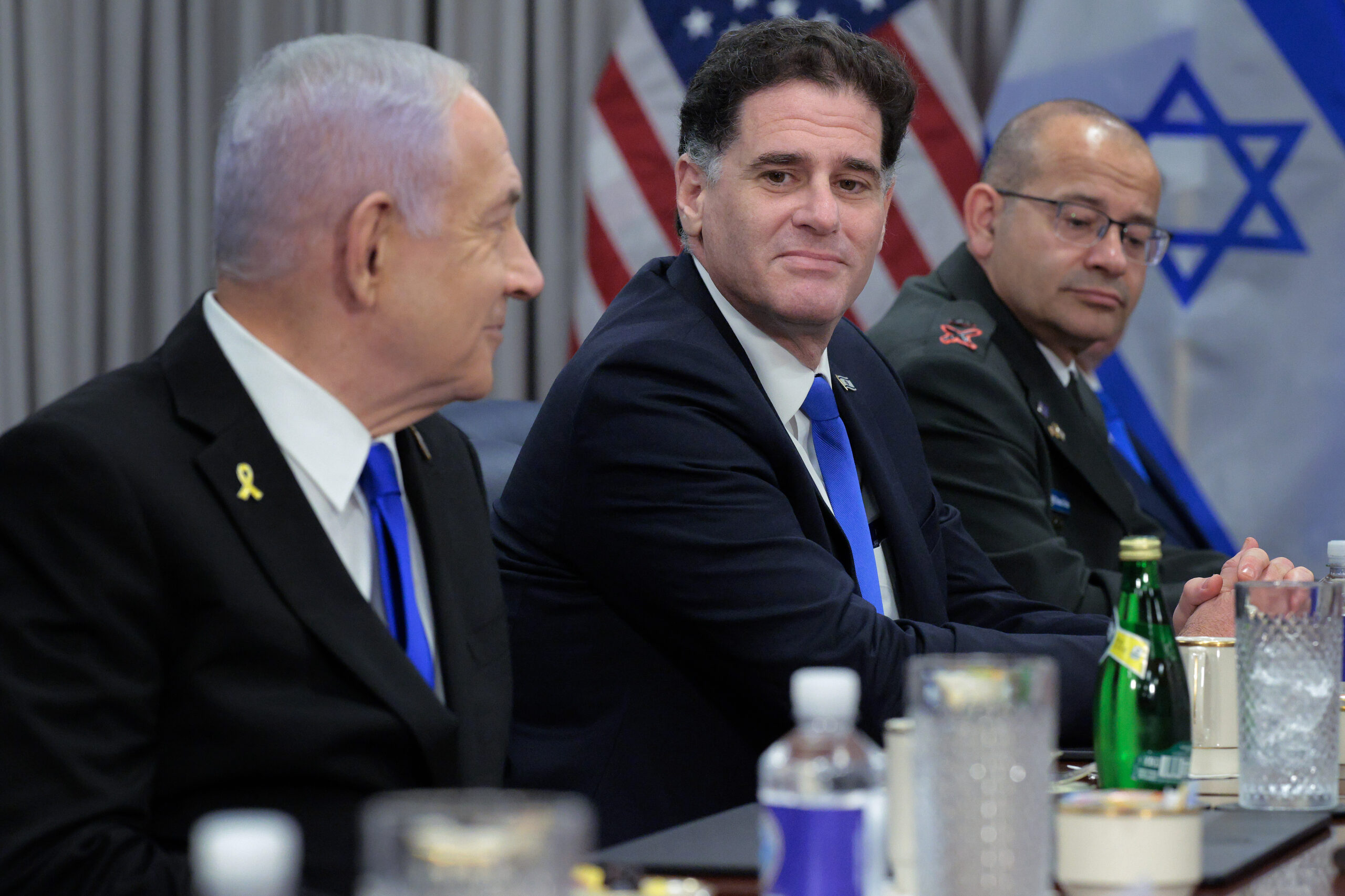
In a wide-ranging interview, Israeli Minister of Strategic Affairs Ron Dermer connected Israel’s strikes against Iran’s nuclear facilities with Israeli Prime Minister Benjamin Netanyahu’s opposition to the U.S.’ 2015 nuclear deal with Tehran, saying that President Donald Trump wouldn’t have pulled out of the deal during his first administration without that precedent, Jewish Insider’s Danielle Cohen-Kanik reports. “I believe that what Iran’s strategy was [before Oct. 7] is to surround Israel with this ring of fire,” including Hamas in Gaza, Hezbollah in Lebanon and militias in Syria and Iraq. “And this is another reason why I was so opposed to the nuclear deal that was done in 2015,” Dermer said in the first installment of his interview on Dan Senor’s “Call Me Back” podcast, which dropped on Monday.
Tracing it back: “And by the way, the attack [on Iran’s nuclear facilities] that happens now does not happen if Prime Minister Netanyahu doesn’t show up and confront that deal then. People don’t make the connection. I do, because I’ve lived it every day since then,” Dermer continued. “I don’t see Trump withdrawing if Netanyahu doesn’t take a stand, because no one’s going to be more Catholic than the pope, and no one’s going to be more pro-Israel than the prime minister of Israel.”
BUDEGET BLOCKS

The House Appropriations Committee’s draft 2026 National Security, Department of State and Related Programs Appropriations bill, released on Monday, aims to leverage U.S. funding for the United Nations to secure accountability for United Nations Relief and Works Agency employees’ involvement in the Oct. 7, 2023, Hamas attacks on Israel, Jewish Insider’s Marc Rod reports. It also more broadly aims to enact cuts for the U.N. system, cutting all U.S. funding for the U.N.’s regular budget and barring funding for the U.N. Human Rights Council, including its commission of inquiry investigating Israel, the International Court of Justice and the International Criminal Court.
Concrete steps: The bill would ban any funding for the U.N. Secretariat, the arm of the U.N. led by the secretary-general responsible for daily management and operations matters, until several conditions relating to UNRWA accountability are met. The bill would hold the funds until the U.N. provides the State Department with a full and unredacted copy of the U.N.’s internal investigation into UNRWA affiliates’ involvement in the Oct. 7 attacks and until the findings of U.S. investigations into the situation are referred to the Department of Justice for appropriate criminal or civil action.
Exclusive: A bipartisan House bill set to be introduced on Tuesday aims to designate the Muslim Brotherhood as a terrorist organization, a step forward for an effort that gained steam following the terrorist attack in Boulder, Colo., targeting Jews advocating for the release of hostages in Gaza by a man who appeared to have expressed support for the group years earlier, Jewish Insider’s Marc Rod reports.
Worthy Reads
Digital Battleground: The New York Times’ Steven Lee Myers, Natan Odenheimer and Erika Solomon look at how Israel and Iran’s use of AI and deceptive social media posting during last month’s war between the countries has “ushered in” a new era of information warfare. “Over 12 days of attacks, Israel and Iran turned social media into a digital battlefield, using deception and falsehoods to try to sway the outcome even as they traded kinetic missile strikes that killed hundreds and roiled an already turbulent Middle East. … Iran, for example, sent alerts in Hebrew to thousands of Israeli mobile phones warning recipients to avoid bomb shelters because militants planned to infiltrate them and attack those inside, according to researchers and official statements. A network of accounts on X attributed to Israel spread messages in Persian trying to erode confidence in Iran’s government, including ones narrated by an A.I.-generated woman.” [NYTimes]
The MAGA Rebellion: NBC News’ Allan Smith looks at policy disagreements between President Donald Trump and the MAGA wing of the party, including commentator Tucker Carlson, who openly clashed with Trump over the White House’s approach to the Israel-Iran war. “Carlson was center stage among MAGA influencers arguing for the United States to stay out of Iran, a position that has gained popularity on the right as some right-wing influencers have increasingly viewed the U.S.-Israel alliance with skepticism. That stance is also informed by Trump’s having promoted similar anti-war and anti-interventionist views for years, even as he has used military force as president. Ultimately, Carlson said, the most important voice arguing the case to Trump for the U.S. bombing of Iran’s nuclear facilities was Israeli Prime Minister Benjamin Netanyahu. ‘Turns out a head of state of an important ally has a more compelling message than I do,’ he said. ‘That seems reasonable to me. I still disagree, but I don’t think it’s like Trump has changed his views entirely.’” [NBCNews]
No Direction Home: In The Atlantic, Guy Ben-Aharon considers the challenges of his identity as an Israeli pacifist both at home and abroad. “In Israel, I’m hated for opposing a war that many say they don’t support but still fight in, defend, or explain away as necessary. Abroad, I’m no longer welcome among those who say that all Israelis are colonizers. I’m too Israeli to be a victim and too resistant to be a patriot. I’m in exile, even when I’m at home. … My own relatives question whether I belong in Israel, because I criticize the troops in Gaza for the killing and starvation of Palestinians. Abroad, a theater colleague once told me to ‘go back to where you came from’ — that I don’t belong in the land where I was born but in the lands where my ancestors faced pogroms and the Holocaust. Nuance has no currency in a world addicted to absolutes.” [TheAtlantic]
Word on the Street
The Supreme Court ordered that the Trump administration be allowed to proceed with its efforts to enact mass layoffs at the Department of Education as part of its efforts to significantly downsize the department…
The Pentagon reached an agreement with ElonMusk’s xAI to use the company’s chatbot, Grok, as part of xAI’s new “Grok for Government”; the announcement by xAI of the deal, part of $200 million agreement, came days after the Grok chatbot sent a series of antisemitic and sexually explicit replies to X users…
The Hill reports on tensions between Secretary of State Marco Rubio and Ric Grenell, who is serving as a special presidential envoy, as the two attempted to negotiate separate agreements to free Americans being held in Venezuela…
Politico’s “West Wing Playbook” looks at Steve Davis’ departure from the Department of Governmental Efficiency, where he reportedly dispatched Josh Gruenbaum and two other aides to assess department staffers’ loyalty…
Rep. Mike Lawler (R-NY) is reportedly backing away from plans to mount a gubernatorial challenge to New York Gov. Kathy Hochul…
Former New York Gov. Andrew Cuomo announced he would continue his bid to become mayor of New York City, following his 12-point loss last month to Zohran Mamdani; Cuomo pledged to drop out of the race by mid-September if polls indicated that he was not the highest-ranked challenger to the Queens assemblymember, and called on other candidates to do the same…
Inside Higher Ed looks at how universities are increasingly hiring staff to oversee compliance with Title VI of the Civil Rights Act following a crackdown by the Trump administration on dozens of campuses over alleged violations…
Alex Edelman will perform his new show, “What Are You Going to Do,” at the New York Comedy Festival at Carnegie Hall in November; the show is a follow-up to his award-winning “Just For Us” one-man play about attending a white supremacist gathering…
Hungarian low-cost carrier Wizz Air will end its operations at Abu Dhabi’s Zayed International Airport, effective Sept. 1; the airline’s CEO, József Váradi, cited “supply chain constraints, geopolitical instability, and limited market access” as factors that contributed to the decision, which was announced weeks after the Israel-Iran war caused travel disruptions across the region…
The Shin Bet confirmed that the Hamas terrorist who held British Israeli hostage Emily Damari captive was killed last month in an airstrike…
The IDF struck Syrian military vehicles operating in southern Syria, amid clashes between Syrian government forces and local Druze communities…
Attorney Danielle Sassoon, who previously served as U.S. attorney for the Southern District of New York, is joining the Manhattan Institute as a senior fellow; Sassoon resigned from her position weeks after being appointed to avoid carrying out a directive from the Justice Department to drop corruption charges against New York City Mayor Eric Adams…
Israeli-American writer Sol Stern died at 89…
Song of the Day

Edan Golan recently released the music video for her single “You & I.”
Birthdays
Israeli actor, he played Boaz in Season 1 of “Fauda,” Tomer Kapon turns 40…
President and chairman of the board of the Annenberg Foundation, Wallis Annenberg turns 86… Member of the British House of Lords, he is a professor, medical doctor, scientist, television anchor and Labour Party politician, Baron Robert Maurice Lipson Winston turns 85… Israeli composer and conductor, he composed and conducted the winning entry at the 1979 Eurovision Song Contest, Kobi Oshrat turns 81… Professional sports bettor and poker player, he is a four-time winner of World Series of Poker bracelets, Mickey Appleman turns 80… Physician and life fellow of the American Psychiatric Association, Dr. David Harris Lippman… Rosh Yeshiva of Beth Medrash Govoha in Lakewood, N.J., one of the largest yeshivas in the world with more than 10,000 students, Rabbi Dovid Schustal turns 78… Longtime congresswoman from Florida for 30 years until 2019, Ileana Ros-Lehtinen turns 73… EVP at the Aspen Institute responsible for policy programs and its international partners, Elliot Gerson… Israel’s ambassador to the U.S. from 2021 until this past January, Michael (Mike) Herzog turns 73… Retired California-based appellate attorney, Feris M. Greenberger… Executive director of Friends of OU Israel, Miriam Baron (Mimi) Jankovits… Immediate past board chair of The Jewish Federations of North America, Julie Beren Platt… Professor at the UCLA School of Law, Richard Harold Steinberg turns 65… Former political news director at Bloomberg, Jodi Schneider… Member of Congress (D-RI) until 2023, his mother is Sabra née Peskin, David Nicola Cicilline turns 64… Anchorage-based attorney, a member of the Alaska House of Representatives since 2012, Andrew Lewis “Andy” Josephson turns 61… Former U.K. Labour Party MP including three years as foreign secretary, now CEO of NYC-based International Rescue Committee, David Miliband turns 60… Co-founder and chief investment officer of Toronto-based EdgeStone Capital Partners, Gilbert S. Palter… Israeli actress and singer, she is the 1991 and 1998 winner of the Ophir Award for best actress, Dafna Rechter turns 60… Senior advisor at investment bank Greif & Co., he was the CFO of Jewish Family Service of Los Angeles, David S. Felman… Senior business development representative at Atera, Sam Kalmowicz… Senior correspondent at New York magazine, she is a co-author of Notorious RBG: The Life and Times of Ruth Bader Ginsburg, Irin Carmon turns 42… Filmmaker and co-founder of the Square Peg film production company, Ari Aster turns 39… Managing editor of the U.S. deals team at Bloomberg, Liana Balinsky-Baker… Former deputy assistant secretary for travel and tourism at the U.S. Department of Commerce, now CEO of the FIFA World Cup 26 NYNJ host committee, Alexander Lasry turns 38… VP of Israel Action and Addressing Antisemitism Program at Hillel International, Jonathan Steven (“Jon”) Falk… Director of news experimentation at Southern California Public Radio until last year, Ariel Zirulnick… Senior NFL reporter at Yahoo Sports, she is also the author of a biography of a Holocaust survivor, Jori Epstein…
The Foreign Affairs chair reportedly said ‘they would have to figure out which side they were on: American or China/Iran’

Samuel Corum/Getty Images
Rep. Brian Mast (R-FL) speaks during a House Committee on Foreign Affairs hearing on Capitol Hill on January 11, 2024 in Washington, DC.
Rep. Brian Mast (R-FL), the chairman of the House Foreign Affairs Committee, confronted the ambassadors of Rwanda, Jordan and Qatar, among other countries, over their relationships with U.S. adversaries in China and Iran, at a dinner last night, per a source familiar with the congressman’s remarks.
According to Politico, the Rwandan and Jordanian ambassadors to the United States hosted a dinner honoring Mast, the House Foreign Affairs Committee chair, also attended by the ambassadors of Qatar, Kuwait, France, Luxembourg, Singapore, Switzerland and Costa Rica.
Mast told the leaders “they would have to figure out which side they were on: American or China/Iran,” a source familiar with the situation told Jewish Insider. “Described as like chess. Sometimes you don’t get to choose who is a pawn and a queen, but you get to decide what side you are on.”
Mast is a longtime, and outspoken, pro-Israel lawmaker who volunteered with a group supporting the Israeli Defense Forces following his own military service.
Sheikha Al-Mayassa bint Hamad Al Thani has amplified the far-left New York City mayoral candidate on her social media

PATRICK BAZ/Qatar Pavillon/AFP via Getty Images
Qatar's Al-Mayassa bint Hamad bin Khalifa Al-Thani attends a ceremony marking Qatar's first official participation in the Venice Architecture Biennale on May 8, 2025.
A prominent member of Qatar’s royal family is boosting Zohran Mamdani, a far-left Queens state assemblyman, in his campaign for mayor of New York City.
In recent posts to Instagram, Sheikha Al-Mayassa bint Hamad Al Thani, the sister of Qatar’s emir, has promoted Mamdani’s bid as he competes in a tight race against former New York Gov. Andrew Cuomo, his top rival in today’s Democratic primary election.
The Qatari royal has touted favorable polling for Mamdani while amplifying a recent campaign video in which the democratic socialist is seen embracing his mother, the renowned Indian-American director Mira Nair, on a city-length walk through Manhattan on Friday.
In a comment below the video, Sheikha Al Mayassa posted a string of flame emojis voicing her approval of Mamdani’s feat.
Sheikha Al Mayassa, who chairs a number of the Gulf state’s leading cultural organizations including the Doha Film Institute and Qatar Museums, has a personal connection to Mamdani’s family, having hosted his mother in Doha in 2022 for the world premiere of the musical adaptation of Nair’s hit film “Monsoon Wedding,” according to media reports.
In an interview with a Qatari lifestyle magazine at the time, Nair said that Sheikha Mayassa “has loved the movie but also supported the inception of this musical over several years from New York to India to here.”
In recent years, the Gulf state has faced criticism from U.S. lawmakers for hosting Hamas’ leadership and human rights abuses including mistreatment of migrant workers during the World Cup, when Nair’s musical was presented as part of a cultural program that coincided with the tournament held in Doha.
Meanwhile, in 2013, Nair rejected an invitation to attend the Haifa Film Festival in Israel as a guest of honor — saying that she would “go to Israel when apartheid is over.”
Mamdani, for his part, does not appear to have publicly commented on the support from Sheikha Al Mayassa or on Qatar more broadly. While he has stressed a message of affordability during the race, he has drawn backlash over his harsh criticisms of Israel.
Mamdani, who has also endorsed boycotts targeting Israel, has indicated that he will not visit the Jewish state if elected, arguing that he does not believe that such a trip is necessary “to stand up for Jewish New Yorkers.”
Carlson also argued Al Udeid ‘exists to protect Israel’

Photo by BRENDAN SMIALOWSKI/AFP via Getty Images
US and Qatari troops and staff await US President Donald Trump at the Al-Udeid air base southwest of Doha on May 15, 2025.
As Iran targeted Al Udeid Air Base in Qatar in retaliation for the U.S. airstrikes against the Iranian nuclear program, Tucker Carlson claimed on his podcast that the air base exists to protect Israel.
“That base exists to protect Israel, by the way. I know we’re constantly, Bari Weiss is constantly attacking Qatar,” the conservative commentator said, referring to the founder and editor of The Free Press. “Qatar has done more to protect Israel. But anyway, hosting this base that they don’t need at all, it’s the richest country in the world. They’re doing it to be nice.”
According to a joint statement issued by the U.S. and Qatar in 2020, Al Udeid base supports joint operations aimed at maritime security and other regional security concerns.
As U.S. Central Command’s forward headquarters, Al Udeid has also played a critical role in nearly every U.S. operation within the Middle East and North Africa since 2009. These operations include the 2021 Afghanistan pullout, combat missions countering the Islamic State, and air missions within Iraq.
President Donald Trump recently visited the base during his tour through the Middle East and spoke to American personnel stationed there. During the speech he mentioned several new arms sales to Qatar and praised the base. “Qatar will also be investing $10 billion to support this massive base in the coming years,” Trump said. “There is no place like it, they say.”
Qatar grounded all air traffic, the U.S. Embassy in Doha issued a shelter-in-place alert for Americans in the country

Win McNamee/Getty Images
President Donald Trump speaks on stage during a tour of the Al Udeid Air Base on May 15, 2025, in Doha, Qatar.
Iran launched several missiles at a U.S. base in Qatar, the Qatari Ministry of Foreign Affairs announced Monday. Majed Al Ansari, spokesperson for the ministry, affirmed that “Qatar’s air defenses successfully thwarted the attack and intercepted the Iranian missiles.”
Qatar “consider[s] this a flagrant violation of the sovereignty of the State of Qatar, its airspace, international law, and the United Nations Charter. We affirm that Qatar reserves the right to respond directly in a manner equivalent with the nature and scale of this brazen aggression, in line with international law,” Al Ansari said.
The Ain al-Assad base housing U.S. troops in Iraq was also targeted, an Iraqi security official told the Associated Press.
Three Iranian officials familiar with the plans told The New York Times that Iran gave advance notice to Qatar that attacks were coming.
Qatari authorities had previously grounded all air traffic and the U.S. Embassy in Doha had issued a warning to Americans in the country to shelter in place in anticipation of an Iranian retaliation to U.S. strikes on its nuclear program.
“As part of the State of Qatar’s commitment to the safety of its citizens, residents, and visitors, the competent authorities announce the temporary suspension of air traffic in the country’s airspace,” Qatar’s Ministry of Foreign Affairs said in a written statement. “This is part of a set of precautionary measures taken based on developments in the region.”
Al Udeid Air Base, one of the targets of Iran’s strike, serves as U.S. Central Command’s forward headquarters and hosts over 10,000 American personnel. The U.S. evacuated its aircraft from the base in the week prior to the strikes on Iran.
A Reuters report on Sunday quoted a senior U.S. official saying that Iran would likely attempt to strike U.S. assets in the region within one or two days.
According to a White House official, Chairman of the Joint Chiefs Gen. Dan Caine and Secretary of Defense Pete Hegseth were monitoring developments from the Situation Room. President Donald Trump was scheduled to receive a briefing at 1:00 p.m. ET.
Author Dan Senor offers a new frame of thinking in light of Gulf state investment deals

BRYAN BEDDER/GETTY IMAGES FOR ANTI-DEFAMATION LEAGUE
Call Me Back podcast host Dan Senor moderates a session with WashU Chancellor Andrew D. Martin and University of Michigan President Santa Ono at the ADL Never is Now event at Javits Center on March 03, 2025 in New York City.
Midway through June, the Middle East looks very different than it did when President Donald Trump traveled to the region just last month.
Trump was feted by Gulf monarchs, as Saudi Arabia, Qatar and the United Arab Emirates sought to make their mark on a business-savvy president by touting hundreds of billions of dollars in investments and trade deals.
Israel was an afterthought on the trip; Trump didn’t even visit. Iran nuclear talks were happening, but nonproliferation and geopolitics were secondary discussion topics to Trump’s checkbook diplomacy.
Israeli tech leaders at the time acknowledged that Israel cannot compete with the oil-rich Gulf states when it comes to investment dollars, and instead urged Israel to consider unique ways for the two countries to collaborate.
Now, with Israeli strikes on Iran entering their sixth day, the best way to get Trump’s attention in the region — at least for the moment — is no longer financial prowess. It’s firepower.
“I think what you saw over the last few days is Israel’s alternative model to checkbook diplomacy,” author and podcast host Dan Senor said in a Saturday episode of “The Prof G Pod,” hosted by NYU professor Scott Galloway.
“Israel has its own way of competing, because what Israel is demonstrating is, ‘Yeah, we’re not going to be the country that personally has sheikhs and emirs who can write checks for billions and trillions of dollars into the American economy,’” Senor said. “‘But we are the most capable ally in the world, and you, the United States, are going to get more out of this relationship than you give.’”
Trump amped up his rhetoric against Iran on Tuesday, a clear escalation after his more restrained posture in the early days of Israel’s strikes on the Islamic Republic.
“We now have complete and total control of the skies over Iran,” he wrote in a post on TruthSocial, blurring the lines between Israel and the U.S. “Our patience is wearing thin,” he wrote in another. “We know exactly where the so-called “Supreme Leader” is hiding. He is an easy target, but is safe there – We are not going to take him out (kill!), at least not for now.” Trump rounded out his posting spree with a straightforward message: “UNCONDITIONAL SURRENDER!”
Democrats Chris Coons, Catherine Cortez Masto, Andy Kim, Jacky Rosen and Elissa Slotkin voted with Republicans against the resolutions

Kevin Carter/Getty Images
The U.S. Capitol Building is seen at sunset on May 31, 2025 in Washington, DC.
The Senate on Wednesday defeated two resolutions aimed at blocking certain weapons sales to Qatar and the United Arab Emirates, with five Democrats voting with nearly all Republicans against both resolutions.
The 56-39 votes came as a pressure tactic from some progressive Democrats on the two U.S. partners and the Trump administration over dealings between President Donald Trump and the two Gulf states — Qatar’s provision of a luxury jumbo jet to serve as Air Force One and the UAE’s investment of $2 billion in a Trump-linked cryptocurrency.
Democratic Sens. Chris Coons (D-DE), Catherine Cortez Masto (D-NV), Andy Kim (D-NJ), Jacky Rosen (D-NV) and Elissa Slotkin (D-MI) voted against the two resolutions. Sen. Rand Paul (R-KY) voted present.
Coons said in a statement that “these resolutions don’t hold President Trump accountable” and will not punish Trump at all, but will rather “target other countries for the actions of our president, countries that host more than 10,000 U.S. troops on strategically important bases and are our partners.”
He said that blocking the sales would weaken two pillars of stability in the region and create space from those partners at a critical time, as well as make other nations doubt Congress’ reliability.
He said the sales were negotiated years ago.
Sen. Chris Murphy (D-CT), who led the effort with Sens. Chris Van Hollen (D-MD), Tim Kaine (D-VA), Brian Schatz (D-HI) and Bernie Sanders (I-VT), has framed the arms sales as a direct response to “cash payments” from the two nations.
“Normally those might be deals that Congress would approve, but we cannot approve any security relationship today with countries in the Middle East that are engaged in the fundamental corruption of American foreign policy,” Murphy said earlier this week. “The Trump administration is moving these sales forward as part of a broader scheme which enriches Donald Trump to the tune of billions of dollars.”
He said the Qataris are looking to be “not left out” of the second Trump administration and that the Emiratis are seeking “our secrets,” specifically sensitive semiconductor technology that could be compromised by China.
Republicans’ essentially united front against the resolutions came even though multiple Senate Republicans have expressed deep skepticism of Qatar and called for its status as a major non-NATO ally to be reconsidered.
Murphy, meanwhile, in a Senate floor speech earlier this week expressed gratitude for Qatar in spite of the resolutions.
“What makes this moment so dangerous is that both UAE and Qatar, but especially Qatar, are key partners of the United States,” Murphy said. “They’re imperfect allies, but they are our allies. In fact, I’ve been down on this floor in the past arguing on behalf of Qatar and the U.S.-Qatar relationship, when other senators have tried to denigrate the Qataris’ contributions to regional peace. The Qataris have been a critical partner of ours on so many important issues.”
He suggested that Qatar had felt bullied by the Trump administration into offering the jet and “feels like it had little choice but to say yes when asked for this $400 million gift” because the U.S. had punished and isolated Qatar during the first Trump administration when Saudi Arabia and the UAE “effectively ganged up to blockade Qatar and Trump gave that move implicit consent.”
He claimed that the UAE had first set the precedent for Qatar by investing in Trump’s cryptocurrency, leaving Qatar to play catch-up.
But he also noted that the U.S. has never allowed any other Middle East country to buy MQ-9 Reaper drones, the weapons sale to Qatar in question, because the U.S. has felt that such transfers are too risky.
The defense secretary told lawmakers that the deal ‘remains to be signed’ and said he could not divulge information about the timeline or cost

Win McNamee/Getty Images
Air Force One sits on the tarmac on May 12, 2025, at Joint Base Andrews, Maryland.
Defense Secretary Pete Hegseth confirmed on Wednesday that the memorandum of understanding between the Trump administration and Qatar for the gift of a luxury jet worth $400 million to join the Air Force One fleet has not been completed and signed.
Hegseth and Joint Chiefs of Staff Chairman Gen. Dan Caine were pressed repeatedly on the terms of the contract allowing for the U.S. to formally accept the Boeing 747 jumbo jet from Qatar while testifying before the Senate Appropriations defense subcommittee on the Pentagon’s proposed fiscal year 2026 budget. The two largely declined to answer questions on the subject given the public setting, though the defense secretary acknowledged that the MOU was still being worked on.
“Any specifics about future aircraft that could be Air Force One can’t be discussed here, but there is a conversation about a memorandum of understanding. A memorandum of understanding remains to be signed,” Hegseth said in response to Sen. Jack Reed (D-RI) asking if the U.S. was currently in possession of the jet.
Hegseth declined to answer Reed’s subsequent questions about the price of the contract to reconfigure the aircraft, saying he would provide it to the senator’s office but could not divulge that information in public. He offered the same response when Reed asked about the delivery time for the reconfiguration contract.
Reed pointed out that the terms of the contract originally signed with Boeing to deliver the next Air Force One jets were public while criticizing the secrecy around this deal.
“The Boeing information was public knowledge — the delivery date, the cost, the course overruns — but this is not, because this is not only a bad deal for the American public, it is just gratifying the presidency, that’s all it is,” Reed said.
Later in the hearing, Hegseth again confirmed to Sen. Chris Murphy (D-CT) that the MOU was still not signed. The Connecticut senator then pressed the defense secretary on the need for the Qatari jet, noting that the extensive modifications and security enhancements may keep it from being usable before Boeing’s new fleet of Air Force Ones are ready in 2028.
“It doesn’t stand to reason that you will be able to retrofit the plane from Qatar much sooner than 2028 so I’m trying to understand what the gap is that we’re trying to fill. If this contract ends up being a half a billion dollars and the gap only ends up being six months, that doesn’t sound like a wise investment for this committee to make,” Murphy said.
Hegseth replied by pointing to the repeated delays from Boeing in delivering on their new fleet. “I don’t know that’s a firm fixed date yet, unfortunately, that can be counted on,” Hegseth said.
A senior Air Force official testified at a House Armed Services subcommittee hearing last month that Boeing had told the service that it could potentially deliver the fleet by 2027 if certain requirements were lifted.
After Hegseth told Murphy it was his understanding that the plane would be transferred to Trump’s presidential library at the conclusion of his term, the Connecticut senator replied: “Why would we ask the American taxpayer to spend upwards of $1 billion on a plane that would then only be used for a handful of months and then transferred directly to the president?”
Hegseth emphasized the importance of the modifications to “ensure the safety and security of the president of the United States,” but did not address Murphy’s question directly.
Sen. Brian Schatz (D-HI) pressed Hegseth on whether the Department of Defense or the Qataris initiated conversations about the jet and how the transaction came to be. Hegseth said he would need to “go back and review” the details and did not go into specifics, to which Schatz asked, “I think it kind of matters who’s asking, doesn’t it?”
“I think this is illegal and unconstitutional and I won’t rant about that, but I actually think from the standpoint of our collective responsibilities it very much matters what the paper flow was. Who started these conversations? Did it come out of the White House, did it come out of the secretary of state or the president or the SEC Def [secretary of defense] or at a lower level or ambassadors?” Schatz asked.
“We’re entitled to know, because we can agree or disagree about the propriety of this, but my basic request of you is that if we’re going to disagree, let’s disagree with the same set of facts. Let’s have the documentation on the Qatari aircraft,” he continued.
Some Israeli business leaders and innovators are urging the country to seriously consider adopting a strategy of ‘economic diplomacy’ to place the country more firmly on Trump’s radar
Win McNamee/Getty Images
U.S. President Donald J. Trump and Emir of Qatar Tamim bin Hamad al Thani attend a signing ceremony at the Amiri Diwan, the official workplace of the emir, on May 14, 2025, in Doha, Qatar.
During President Donald Trump’s trip to the Middle East earlier this month, he shuttled between Gulf capitals to announce major economic deals. In Qatar, it was an eye-popping $1.2 trillion economic commitment in trade agreements and direct investment. Saudi Arabia pledged to invest $600 billion in the United States in defense, energy and infrastructure. And in the United Arab Emirates, Trump announced a series of agreements — including one to build Stargate UAE, the largest artificial intelligence campus outside the United States, in partnership with OpenAI and Nvidia — worth more than $200 billion, on top of $1.4 trillion previously committed in U.S. investments.
Missing from the list of deals announced on Trump’s Middle East junket was any kind of similar agreement with Israel, which Trump did not visit on his first major trip abroad since returning to office. Economic ties between the U.S. and Israel are strong; Israel is a larger trading partner to the U.S. than either Saudi Arabia, the UAE or Qatar, and American investors are among the biggest investors in Israeli startups. But the country lacks the liquid financial firepower that is available to the oil-rich Gulf monarchies, which risks placing Israel at a disadvantage in the eyes of an American president who sees the world as a series of business deals.
“You try not to compete in areas where you have a disadvantage. We have a capital disadvantage. So we should compete where we have an advantage, which is on innovation and technology,” said Michael Eisenberg, who co-founded Aleph, an Israeli VC firm.
Some Israeli business leaders and innovators are now urging the country to seriously consider adopting a strategy of “economic diplomacy” to place the country more firmly on Trump’s radar. They think that startup founders and venture capitalists stand to serve as Israel’s best ambassadors, better suited to make the economic case for deepening U.S.-Israel ties than the buttoned-up bureaucrats who populate global capitals advancing Israel’s interests.
“Founders are Israel’s best ambassadors. They travel more than diplomats, pitch to the world’s biggest investors and solve real-world problems that transcend borders,” said Jon Medved, the Israel-based CEO of OurCrowd, a global venture investing platform. “Do they have a responsibility to engage in economic diplomacy? I think they already do, whether they realize it or not.”
Where the Gulf countries have the ability to spend seemingly endless sums of money on American investments and projects to woo Trump, Israel offers “deep tech expertise” and a venue for early stage collaboration that cannot easily be replicated.
“We’re the lab. The Gulf can be the scale-up market,” Medved continued. “There’s a powerful opportunity for synergy, not just competition.”
It’s not news to the American government that Israel excels in technology. In 2022, the two countries launched a strategic high-level dialogue on technology as a way to advance cooperation on artificial intelligence, climate change and pandemic preparedness. (The dialogue slowed down after the Oct. 7, 2023, Hamas attacks.)
Avner Golov, who until 2023 served as the senior director for foreign policy in Israel’s Prime Minister’s Office, thinks the collaboration between the two countries should be formalized with a photo op, like the signing ceremonies Trump participated in during his visit to the Gulf. The U.S.-Israel security memorandum of understanding, which promises Israel $3.3 billion in U.S. security assistance annually, expires in 2028, and Golov thinks the renegotiation of that agreement is an opportunity to strengthen the tech and economic ties between the countries — to put Israel’s tech diplomacy to the test.
“I envision going to the White House Rose Garden, signing, for the first time, a formal strategic partnership between Israel and America, approved in both Congress and the Israeli Knesset,” Golov told Jewish Insider. Such a deal, as Golov sees it, might also include ways to make it easier for American businesses to operate in Israel.
Eisenberg, who has invested in major Israeli startup successes such as WeWork and Lemonade, thinks changes to Israel’s “regulatory environment” can help make the sell to American companies and, by extension, Trump.
“We’re not going to do zero taxes like Dubai, but we need to be attracting more capital here by making our regulatory environment much simpler and lowering our capital gains taxes to be competitive with the United States so that we can bring capital formation vehicles like hedge funds to Israel,” Eisenberg said.
Of course, many leading tech companies already have large operations in Israel. The chip giant Nvidia announced a $500 million investment in an Israeli AI research data lab in January. In March, Google acquired the Israeli cybersecurity company Wiz for $32 billion, Google’s largest-ever acquisition. Nvidia CEO Jensen Huang and Google President Ruth Porat were with Trump in Saudi Arabia, along with other top CEOs.
“Many of them have employees in Israel because of our innovation, but we need to build a strategy around attracting them, getting deeper engagement and using them in our attempt to build us into a regional superpower,” added Eisenberg.
Israeli Prime Minister Benjamin Netanyahu has long touted Israel’s startup ecosystem, but some worry he has not sufficiently tapped into that world to meet the moment, when Trump — whom Netanyahu has always sought to present as a close friend — seeks flashy financial success on the world stage.
“[Netanyahu] should have realized that in a competition for the affections of a strongman like Trump, Israel had little to offer,” The Atlantic’s Yair Rosenberg wrote this month.
But the basis of the U.S.-Israel relationship has never been purely about dollars and cents.
“If we’re going to make sure, ‘Hey, don’t forget about us,’ it’s not about money. It’s about morality and humanity and the purpose of Israel on the world stage,” former U.S. Ambassador to Israel Tom Nides told JI. “Obviously there’s this whole notion that there are a lot of deals to be done. But that’s not how we compete.”
The jet will require significant upgrades before it can be used by the president
Win McNamee/Getty Images
Air Force One sits on the tarmac on May 12, 2025, at Joint Base Andrews, Maryland.
The Department of Defense formally accepted a luxury Boeing 747 jumbo jet from Qatar for President Donald Trump’s use as Air Force One, Pentagon spokesman Sean Parnell said in a statement on Wednesday.
Parnell said Secretary of Defense Pete Hegseth accepted the jet “in accordance with all federal rules and regulations” and that the Defense Department would “work to ensure proper security measures and functional-mission requirements are considered for an aircraft used to transport the President of the United States.”
The jet will require extensive modifications and security enhancements to be used as Air Force One, which must operate as a mobile command center for the president. Aviation experts estimate the upgrades could cost over $1 billion.
Air Force Secretary Troy Meink said in a Senate Armed Services Committee meeting on Tuesday that the Air Force has already begun exploring the extent of the upgrades required and that he would warn Trump and Hegseth should any concerns arise about the Air Force’s ability to ensure the plane is secure enough.
The Air Force said in a statement to Defense News that it currently has no information about its timeline for modifying the plane.
At a value of $400 million, the jet is one of the most expensive gifts given to a U.S. president. Experts and lawmakers have raised concerns of the transfer potentially violating the Constitution’s anti-bribery emoluments clause.
The Jewish philanthropist has met with Qatari leadership several times since Oct. 7

Lev Radin via Getty Images
Ronald Lauder, President of World Jewish Congress speaks during annual Jerusalem Post conference at Gotham Hall. It was the first in-person JP conference in New York following postponements because of the pandemic. (Photo by )
Ronald Lauder, president of the World Jewish Congress and a prolific Jewish philanthropist and GOP donor, appeared among other guests at the Lusail Palace in Doha, Qatar, on Wednesday to greet President Donald Trump and Qatari emir Tamim bin Hamad Al Thani.
Lauder has met with Qatari leadership several times since the Oct. 7, 2023, Hamas attacks on Israel, largely to advocate for the release of hostages held in Gaza.
He led a WJC delegation to Doha shortly after the attack, from Oct. 30 to Nov. 1, 2023, where he “engaged in pivotal discussions with leaders in Qatar” and said he “trust[ed] that the esteemed Arab leaders will dedicate their efforts to saving lives,” according to a WJC statement.
Weeks later during the first ceasefire and hostage-release in the Israel-Gaza war, Lauder expressed his “profound gratitude to the government of Qatar and its leadership, along with the leaders of the United States and Egypt, for their significant role in facilitating” the agreement.
Lauder also met with Qatari Prime Minister Mohammed Al Thani in Paris in September 2024 to advocate for the hostages, a meeting that was attended by Israeli opposition leader Benny Gantz.
Incoming national security advisor says on Dan Senor’s ‘Call Me Back’ podcast that Hamas ‘cannot have a role’ in governing Gaza

MANDEL NGAN/AFP via Getty Images
U.S. Representative Mike Waltz (R-FL).
Incoming White House National Security Advisor Mike Waltz addressed the emerging hostage deal being negotiated between Israel and Hamas in Qatar on Dan Senor’s “Call Me Back” podcast Tuesday night.
“Those have been brutally tough negotiations. I hate the fact that we even have to enter them, into them, with a terrorist group like Hamas, but we need to get our people out and then prosecute our objectives in this conflict,” Waltz said.
“This is about imposing consequences for those who would do this type of horrendous act like we saw on Oct. 7, who would take Americans or other allies hostage. He [Trump] made it clear there’ll be nothing but downside. And I’m convinced that’s why you’re seeing this movement,” Waltz added.
The imminent hostage deal, Waltz continued, comes in part due to Hamas’ isolation, “with [Hamas political bureau leader Ismail] Haniyeh gone, with [Yahya] Sinwar gone,” and in part due to “the Trump effect.”
Waltz said that the Trump administration will “make every effort to get everyone out, living or deceased, so that they can have a proper burial.”
On a number of occasions throughout the interview, Waltz referred to getting “our people” out in the first phase of the deal, ostensibly a reference to the seven Israeli-Americans still being held in Gaza. According to information given to the Israeli press on Monday, the first stage of the deal would see the release of 33 hostages, including women, the elderly and the sick.
As Senor noted that the negotiations are “basically a done deal,” Waltz acknowledged that Israel has not yet accomplished all of its stated goals — emphasizing that “Hamas cannot have a role” in governing Gaza moving forward.
“We’ve been clear that Gaza has to be fully demilitarized, Hamas has to be destroyed to the point that it cannot reconstitute, and that Israel has every right to fully protect itself,” Waltz said. “So all of those pieces, all of those objectives are still very much in place. Look, I mean, Oct. 7 was a terrible day. They put everybody in a terrible position, including the Palestinian people of Gaza, whom they regularly hide behind and are willing to sacrifice, and have sacrificed, for their own sick ends and objectives. And so we need to get our people out and then we need to achieve those objectives in this war.”

This week’s “Inside the Newsroom” conversation features former Trump State Department spokesperson Morgan Ortagus talking about her trip to Qatar and its role in the region, and her thoughts on how a second Trump term would approach foreign policy.
Here is a clip from today’s conversation:
Please log in if you already have a subscription, or subscribe to access the latest updates.
 Continue with Google
 Continue with Apple