












































































Trump’s demand for $350 billion in additional defense funds meets GOP skepticism
GOP Sen. Josh Hawley said that in the midterms his Missouri constituents ‘made pretty clear they want [the Iran] war to be over’
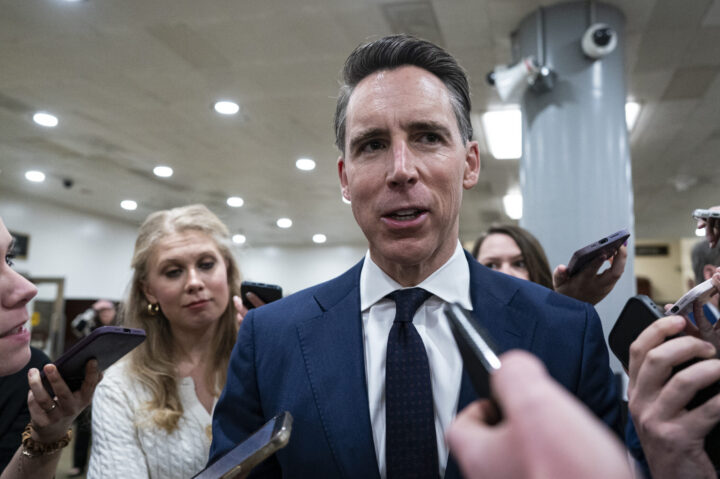
Al Drago/Getty Images
Sen. Josh Hawley (R-MO) speaks to reporters prior to the Senate Republicans weekly policy luncheon, in the US Capitol on March 25, 2025 in Washington, DC.


 Add JewishInsider on Google
Several Senate Republicans on Thursday sounded skeptical of President Donald Trump’s renewed demand for Congress to pass a $350 billion supplemental bill to support the Defense Department and the Iran war in the lame-duck session before the end of the year.
Trump said on Thursday that Congress should “IMMEDIATELY” begin working on a $350 billion party-line funding bill, which many on Capitol Hill have seen for months as infeasible. The House instead advanced legislation earlier this year that would have provided $60 billion in Pentagon funding, primarily to replenish munitions used in the Iran war, but that legislation has not advanced in the Senate.
Republicans have just weeks to finalize any reconciliation bill, which will require significant negotiation and floor time in the Senate. Near-unanimous GOP support would be needed in the Senate to pass the bill.
Sen. Susan Collins (R-ME), the chair of the Senate Appropriations Committee, told reporters that her support for a $350 billion reconciliation bill “depends what is in this, whether it’s narrowly focused or whether it’s broad.”
Sen. Josh Hawley (R-MO), who was among the first Senate Republicans who called for the war to be brought to an end, said that his constituents “made pretty clear they want [the Iran] war to be over” in the midterms.
“I need to look and see what they’re proposing. I do have concerns,” he said, when asked about the $350 billion topline, adding that he’s worried about how voters would respond to Republicans unilaterally moving to pass increased defense spending in the wake of the election results.
Sen. Thom Tillis (R-NC) said that he thinks that the Senate will need to “narrow the scope if you’re going to have a path to success.”
Sen. Todd Young (R-IN) said that he “can’t wait to see” how the administration expects to pay for the reconciliation package.
Sen. James Lankford (R-OK) said, “We’ve got to see the number and what the details are.”
Sen. Steve Daines (R-MT) said that he thinks a reconciliation package is not likely to happen, but that increased defense spending is important. He and others argued that the administration needs to brief Democrats more fully on the scope of the threats the U.S. is currently facing in order to garner bipartisan support for increased military spending.
The administration has taken the unusual step of providing some sensitive briefings related to the budget request only to Republicans.
“I think it’s important that we expand some of these briefings that Democrats have not been allowed to be part of, that they get access to the same information that many Republicans are seeing that shows the real threat we see, particularly up in the sky as well as under the sea,” Daines said. “Hopefully that will unite Congress behind increasing the military spending”
Sen. Mike Rounds (R-SD) said that the method for approving defense funding is still under discussion but that it’s critical for Congress to “find a way to properly fund defense because the threats out there are much greater than a lot of people realize, the technologies have changed rapidly and on our part we want to do everything we can to make sure that our Department of Defense is properly funded for the threats that are facing us today and in the very near future.”
He said that he believes that Democrats, “once they are properly briefed, will understand just how serious this threat is to our country, and I believe we can still work with them. But one way or another we have to address the shortfalls in the Department of Defense.”
Rounds said he does think the $350 billion request is realistic “based on the information that’s been provided to us” but said that “our Democrat colleagues need to have access to that same information, I’m not sure that enough of them have had that yet.”
He said that Republicans urged the administration to share more information with Democrats and that he expects the administration will, but that Republicans will begin exploring reconciliation “if for some reason our Democrat colleagues are uncomfortable with doing anything at this stage of the game.”
Sen. John Kennedy (R-LA) said that he can’t say whether Republican leaders will ultimately decide to pursue reconciliation but that he feels strongly that Congress needs to move forward.
“I would shoot for [$350 billion]. They’re running out of bullets, and that’s just a fact,” Kennedy said. “And whether you support the war or not, nobody wants an Afghanistan, and we really need to pass that recon[ciliation] bill.”
Sen. Rick Scott (R-FL) said that he supports the $350 billion request and thinks it’s achievable.
Meanwhile, Democrats are continuing to weigh whether they want to demand that any funding stopgap to keep the government open beyond a Dec. 11 deadline blocks or places limits on funding for the Iran war.
“We are very anxious to keep the government open and get our work done, make sure that there’s a [funding patch],” Sen. Tammy Baldwin (D-WI) said. “We’re going to work really hard to bring the war to an end and keep the government funded.”
Others have taken a harder line, arguing that any shutdown that might occur will be Trump’s responsibility.
Sen. Brian Schatz, (D-HI), the incoming Senate majority whip, said that Democrats have not yet decided what mechanism they plan to use to place limits on the Iran war.
Kennedy told reporters that a shutdown is avoidable “if the Democrats are reasonable.”
But, he continued, “if they make the budget or [stopgap funding] contingent” on the U.S. immediately abandoning all operations against Iran, then “that’s a very irresponsible position for them to take” and there will be a shutdown.
More Stories

THREAT THWARTED
Armed man arrested after trying to enter D.C. synagogue before Shabbat services
FUNDING FIGHT
Top Senate Dem says ‘looking at all options’ to end Iran war ahead of December funding deadline

BORROWED TIME
House scuttles Hegseth impeachment push — for now

MAR-A-LAGO MESSAGE
Marco Rubio defends Iran war days after JD Vance blamed it for midterm losses

DIFFERENCE OF OPINION
GOP senators skeptical of Vance’s post-election analysis blaming Israel, Iran war

SCHOOL DAZE
Higher education leaders call for overhaul of ‘broken’ university system
Please log in if you already have a subscription, or subscribe to access the latest updates.
 Continue with Google

 Continue with Apple