











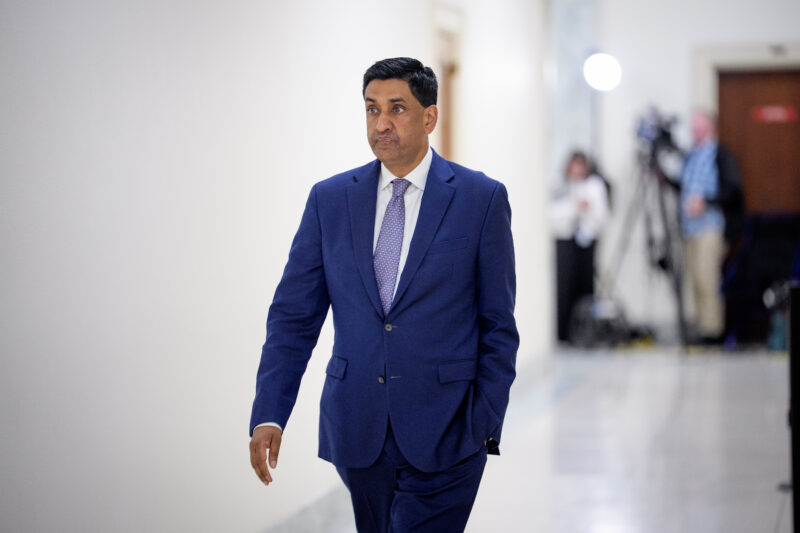


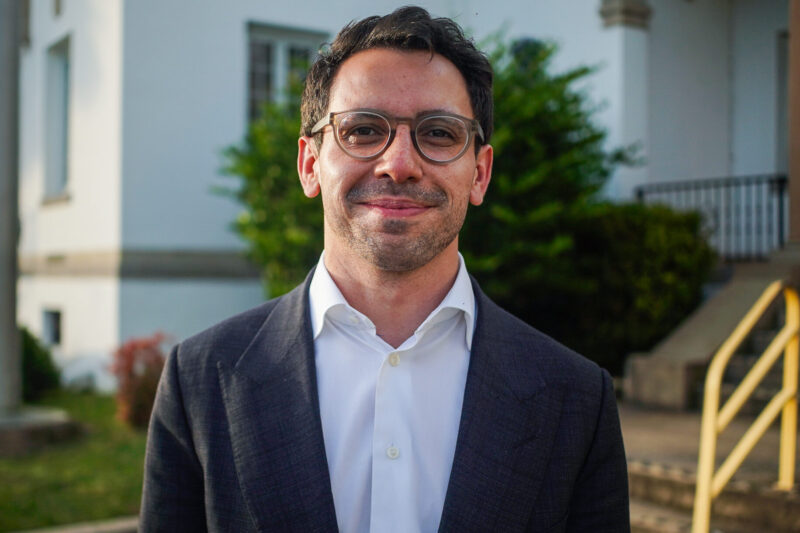
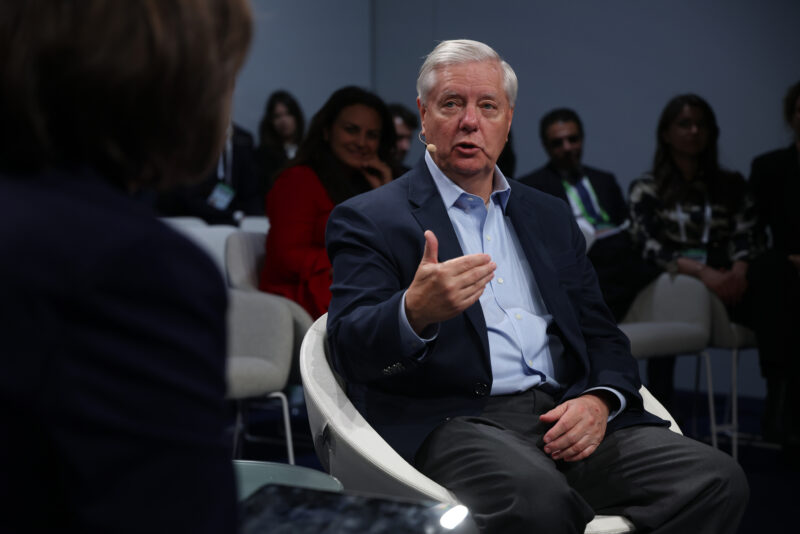
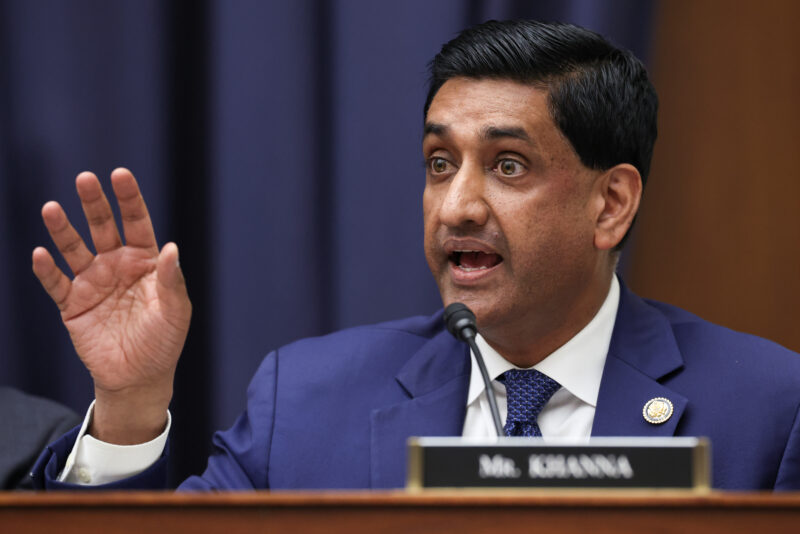
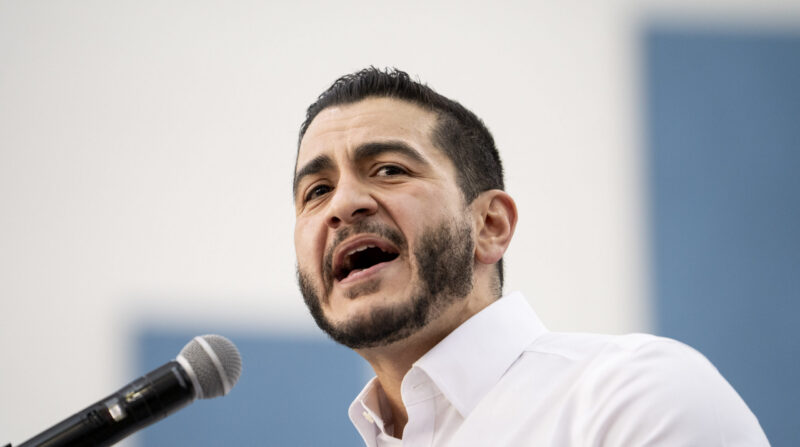
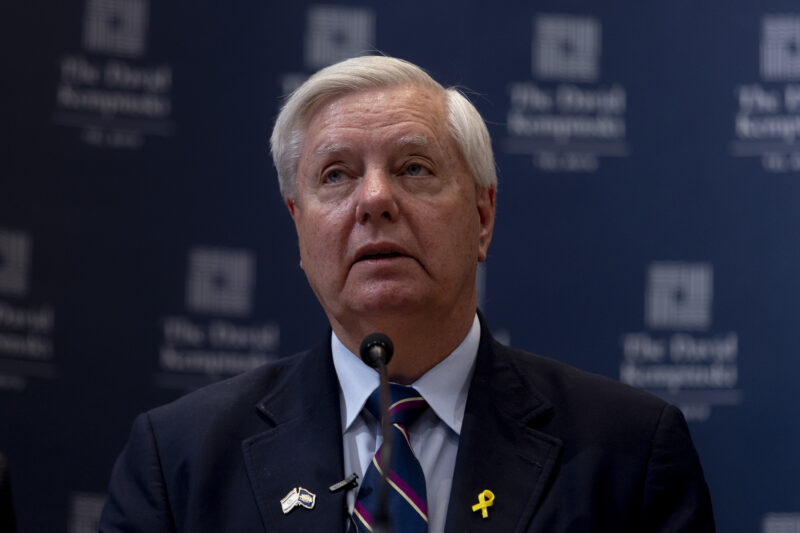
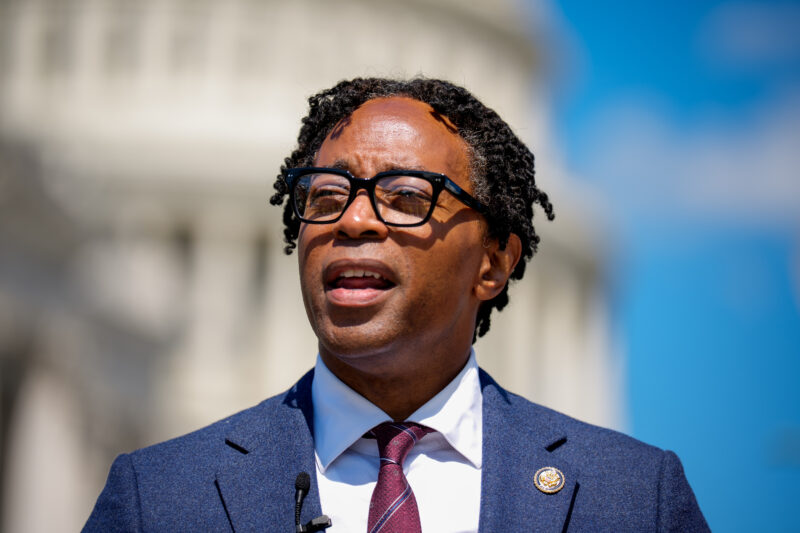
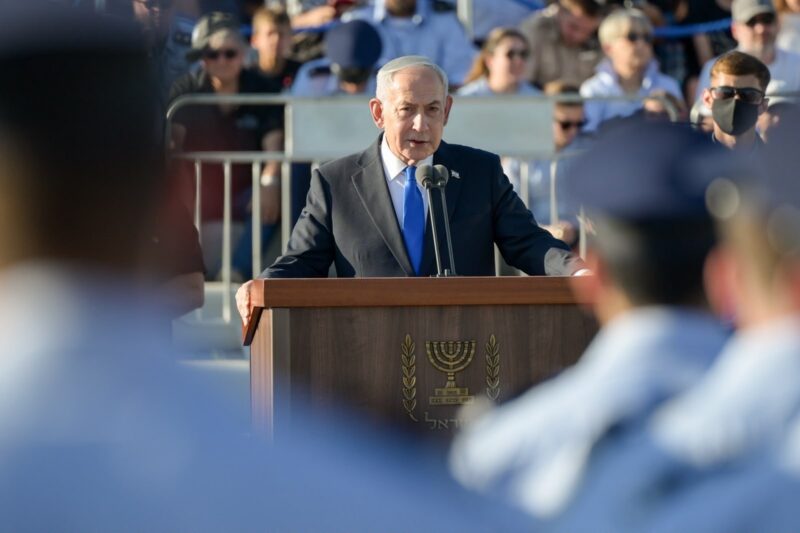









Reps. Laura Gillen, Tom Suozzi and George Latimer all declined to support Mamdani in the New York City mayor’s race

Michael M. Santiago/Getty Images
New York state Assemblymember Zohran Mamdani and NYC Comptroller Brad Lander speak with members of the press as they greet voters on Broadway on June 24, 2025, in New York City.


 Add JewishInsider on Google
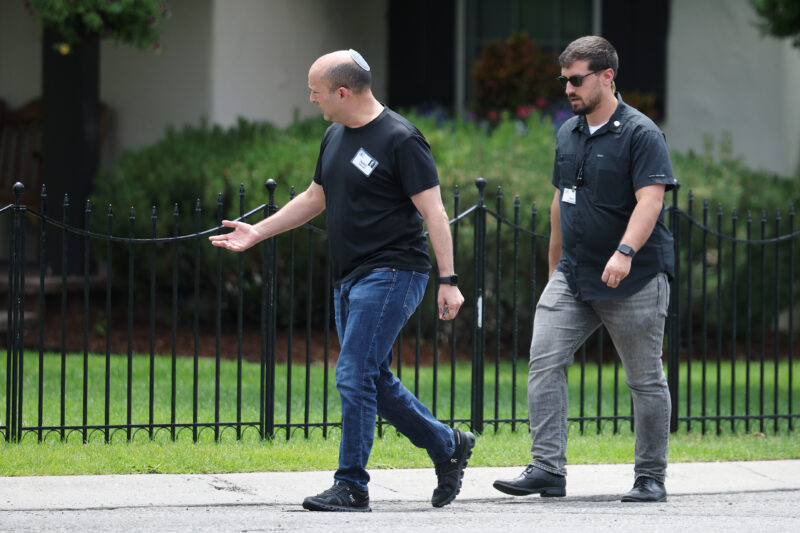
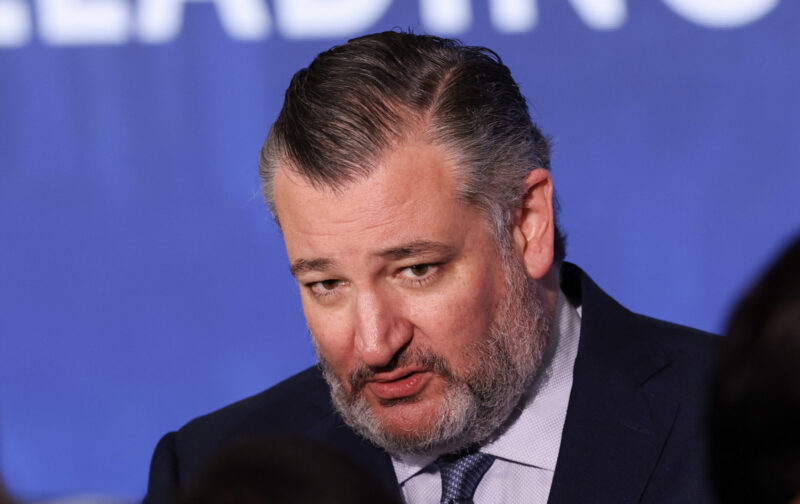
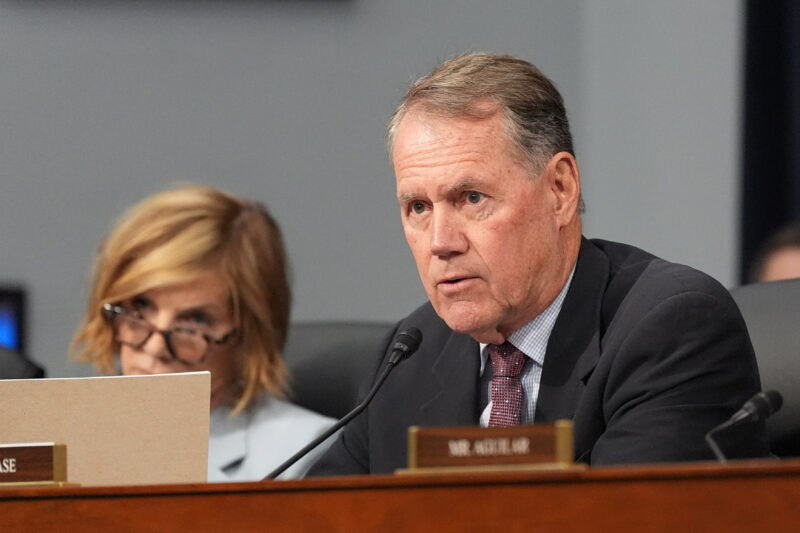
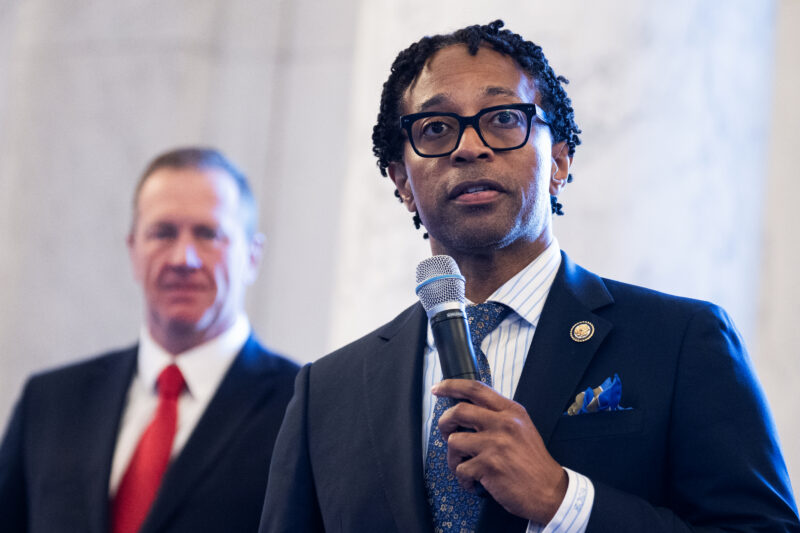
Reps. Laura Gillen (D-NY), Tom Suozzi (D-NY) and George Latimer (D-NY) declined to support State Assemblyman Zohran Mamdani, the presumptive Democratic nominee for mayor of New York City, citing ongoing concerns about his ideological record, as many other prominent politicians in the state fell in line.
“Socialist Zohran Mamdani is too extreme to lead New York City,” Gillen said, highlighting his calls for higher taxes and what she described as unrealistic campaign promises. “Beyond that, Mr. Mamdani has called to defund the police and has demonstrated a deeply disturbing pattern of unacceptable antisemitic comments which stoke hate at a time when antisemitism is skyrocketing. He is the absolute wrong choice for New York.”
“I had serious concerns about Assemblyman Mamdani before yesterday, and that is one of the reasons I endorsed his opponent. Those concerns remain,” Suozzi said. Suozzi, once a close ally of New York Mayor Eric Adams, endorsed former Gov. Andrew Cuomo in the final weeks of the race, explaining “I don’t want the socialists to win.”
Latimer, who also endorsed Cuomo, said he was surprised by Mamdani’s performance, credited him with a “very energetic campaign” and called him “clearly a very charismatic figure.” But he was also clear that he was not endorsing Mamdani and left open the possibility of endorsing a third-party challenger.
“I haven’t thought about it at all yet, check back with me once things shake out. I don’t want to be presumptive if I don’t know what’s going to happen,” Latimer told reporters, referring to potential uncertainties around whether Adams, Cuomo and Republican Curtis Sliwa stay in the race. “I’m not endorsing anybody at this point.”
He said that he was concerned that “running New York City is an extremely complicated situation … it takes a certain mindset not to just advocate for policies — as popular as they are — but to actually accomplish them.” Latimer said Mamdani would likely have to appeal to the state Legislature and would face difficult cash crunches as he seeks to implement his signature, and costly, campaign promises.
“I know how popular it would be for me to say things and promise things. I try to be careful about what I promise because whether I can deliver it or not becomes the first test of whether I’m effective in that office,” he continued.
Asked by Jewish Insider about Mamdani’s record on antisemitism, Latimer highlighted his own opposition to and work on combating hate.
“You shouldn’t have to feel afraid to walk in the streets with yarmulke on. … You should be treated for who you are as a person,” Latimer said. “So to the extent that you know there’s, there’s a sense that there’s an antisemitic moment, then we can’t add code words and make it worse, we have to fight to try to have people be treated equally all across the board, including those who are Jewish.”
Both Gillen and Suozzi represent Long Island-based swing districts in the outskirts of New York City. Suozzi’s district includes a slice of Queens. Latimer’s district is primarily in Westchester County, but includes a small piece of the Bronx.
Rep. Jerry Nadler (D-NY), meanwhile, endorsed Mamdani on Wednesday, after backing one of his primary challengers, saying Mamdani was committed to fighting antisemitism.
Nadler, a co-chair of the House Jewish Caucus, said he had “spoken to [Mamdani] today about his commitment to fighting antisemitism, and we’ll work with all New Yorkers to fight against all bigotry and hate.”
“Voters in New York City demanded change and, with Zohran’s triumph, we have a direct repudiation of Donald Trump’s politics of tax cuts and authoritarianism,” Nadler added, describing Mamdani as a future “partner to me in Washington to take on Donald Trump.”
Other prominent New York Democrats including Sens. Chuck Schumer and Kirsten Gillibrand and House Minority Leader Hakeem Jeffries have offered praise for Mamdani in the hours since his victory, declining to address his antisemitic history. They held back explicit endorsements.
Reps. Alexandria Ocasio-Cortez (D-NY) and Nydia Velazquez (D-NY) supported Mamdani in the primary. No other New York Democratic lawmakers responded to requests for comment.
In the region’s northern suburbs, Mamdani’s candidacy is likely to emerge quickly as a hot-button issue in the swing district race in New York’s 17th Congressional District, which is home to a substantial Jewish population.
Rep. Mike Lawler (R-NY), the 17th District incumbent, has repeatedly attacked Democratic leaders across the state over Mamdani’s victory, particularly highlighting his record on antisemitism.
“Democrats need to make very clear to voters where they stand on this,” Lawler told reporters. “You’ve already had Laura Gillen speak out against it, and yet, Hakeem Jeffries, Chuck Schumer and Kathy Hochul put together the most gobbly-gook bull***t statements I’ve ever seen in my life, saying nothing about anything except that they’re going to continue to speak with him, whatever the hell that means.”
Three of the seven Democratic 17th District candidates who responded to questions from Jewish Insider about Mamdani took divergent approaches.
Cait Conley, a former national security official, told JI that she does “not agree with the direction Zohran wants to take NYC. We need to address affordability but not by raising already exorbitant taxes on New Yorkers that will just drive more people out of the state. We need to stand up for the NY Jewish community and stand against anti-semitism in all forms.”
Conley argued that the election results show that voters are looking for alternatives, like herself, to career politicians, adding, “I will never stop standing up to hate. Anti-semitism is on the rise across this country which is both unacceptable and un-American.”
Jessica Reinmann, a nonprofit executive, told JI, “The results of last night’s NYC mayoral race underscore the need for the kind of boots-on-the-ground, community-focused effort that Team Reinmann is building — one focused on kitchen-table issues, meeting people where they are, and addressing their concerns.”
“That said, there should be no tolerance in the Democratic Party for candidates who espouse antisemitic and hateful views,” Reinmann continued. “Team Reinmann is building a coalition that is built on respect for all people, no matter who they pray to, where they come from, who they love, or the color of their skin.”
Peter Chatzky, a tech company founder and deputy mayor of Briarcliff Manor, N.Y., praised Mamdani for “an effective campaign that consistently focused on affordability, fairness, and opportunity in New York City.”
“The Democratic Party needs candidates who are hearing constituent concerns and will take on the Trump administration and fight for the people of their districts,” Chatzky said. “I am excited to bring that message to the voters of the Hudson Valley.”
Pressed on Mamdani’s record on antisemitism, Chatzky added, “To be clear, antisemitism is serious and a real threat to Jewish New Yorkers and needs to be taken with utmost seriousness. It is something I will be on the forefront of for the people of the 17th District every day.”
Neither Gillen nor Suozzi indicated whether they plan to support an alternative candidate like Adams, the incumbent who is running as an independent in the general election.
Suozzi said, when he endorsed Cuomo, that he still likes Adams, but argued he’s too mired in scandal to continue to lead. Adams’ team praised Suozzi’s record even after his endorsement of Cuomo.
Gillen, meanwhile, publicly clashed with Adams at a House Oversight Committee hearing earlier this year, saying she had “no confidence” in his leadership and calling on him to resign. She said previously that he had “failed and betrayed New York City repeatedly” and engaged in “blatant, textbook corruption. She has said that New York Gov. Kathy Hochul should remove him from office.
Given that Mamdani appears headed for a fairly sizable margin of victory in the primary and the city’s largely Democratic electorate, any third-party challenge will be a tough lift.
Cuomo hasn’t confirmed yet whether he will seek to run in the general election as an independent, a prospect that could further complicate efforts for Mamdani opponents to coalesce.
New York City Democrats knew Zohran Mamdani refused to condemn ‘globalize the intifada’ rhetoric. They voted for him anyway.

Michael M. Santiago/Getty Images
State Assemblyman Zohran Mamdani, with his mother, Mira Nair, left, his wife, Rama Duwaji, and his father, Mahmood Mamdani celebrate on stage during an election night gathering at The Greats of Craft LIC on June 24, 2025 in the Long Island City, Queens.
When Joe Biden announced his presidential campaign in 2019, he stated explicitly, in a slickly edited campaign video, that one of the issues motivating him to reenter politics was fighting antisemitism and hate. He specifically mentioned the violent Unite the Right rally in Charlottesville, Va., in 2017 and the white nationalist protesters who were “chanting the same antisemitic bile heard across Europe in the ‘30s.”
One of Biden’s former high-level aides pointed out to Jewish Insider how different that rhetoric was from the position staked out by Zohran Mamdani, the upstart New York assemblyman who won a surprise victory in the New York City mayoral Democratic primary on Tuesday.
In the closing days of the campaign, Mamdani, who began his activism journey as a Students for Justice in Palestine leader at Bowdoin College, defended the term “globalize the intifada” as an expression of Palestinian rights. Mamdani’s defense of the phrase was strongly criticized by Jewish groups across the ideological spectrum, who view the phrase as a call to violence. While Mamdani has pledged to keep Jewish New Yorkers safe, he has not acknowledged their concerns about his invocation of a phrase tied to a violent, yearslong Palestinian uprising.
“Biden was elected running a campaign in 2020 premised on combating antisemitism. That was the animating feature that got him into the race. So the politics of this have really moved,” said the former White House official. “This is all about language and people using their microphones, and the fact that someone could feel empowered to double down on these ideas and win a mayoral race in New York City, that doesn’t happen by accident. It takes years of moving the goalposts on this language, on what it means to be antisemitic in America in 2025.”
This Biden administration staffer, who requested anonymity for fear of professional backlash, is one of many Jewish Democrats questioning where their party is heading after a dynamic young socialist with radical anti-Israel politics is on track to become mayor of the largest city in America, which has the largest Jewish population outside of Israel. Coupled with Democrats’ reluctance to offer support for President Donald Trump’s targeted strikes on Iranian nuclear sites, which drew support from major Jewish groups, Mamdani’s ascension has some pro-Israel Democrats concerned about the future of their party.
Put more bluntly by another senior Biden administration official: “I feel like a person without a party,” they told JI.
Those two voices, who served at high levels of the Biden White House, are part of a small cadre of disillusioned former Biden staffers who want to see a more vocally pro-Israel tack from the Democratic Party’s current leaders, although they aren’t yet willing to say so publicly with their names attached. But their frustration represents a simmering undercurrent of concern among Jewish Democrats that has started to spill into the open after Mamdani’s victory.
Lawrence Summers, an economist who served as treasury secretary under President Bill Clinton and director of the National Economic Council under President Barack Obama, said in a post on X that he is “profoundly alarmed” about the future of the Democratic Party and the country “by yesterday’s NYC anointment of a candidate who failed to disavow a ‘globalize the intifada’ slogan and advocated Trotskyite economic policies.”
Some prominent Jewish Democrats acknowledged Mamdani’s shortcomings but tempered that concern by noting that voters were likely drawn in by his economic messaging, not his anti-Israel stance, and by the presence of a scandal-plagued rival in Andrew Cuomo, who ran a lackluster campaign.
“I think it is very disheartening that he was not able to say the phrase ‘globalize the intifada’ feels very threatening to Jews. I find that very distressing, but I don’t think that that’s the issue that the majority of New Yorkers were voting on,” said former Rep. Kathy Manning (D-NC), the board chair of Democratic Majority for Israel. “I don’t see it as a referendum on, people don’t care about antisemitism.”
Halie Soifer, CEO of the Jewish Democratic Council of America, expressed concern that New York Democrats elected a candidate “whose views on Israel deeply concern many American Jews.” But, she argued, “Democratic leadership and the vast majority of our elected officials stand with Jewish Americans on the range of issues of importance to Jewish voters.”
Mamdani’s election came days after a watershed foreign policy moment, in which Trump ordered American strikes on several Iranian nuclear sites. Democrats, even many moderates, responded by criticizing Trump for his unilateral action without consulting Congress, with many — including House Minority Leader Hakeem Jeffries (D-NY) — failing to even acknowledge the threat Iran posed to Israel and the U.S.
“I think overwhelmingly, Democrats have not done a good job, and the proof is in the pudding, that even staunch Democrats who would never consider supporting Donald Trump or ever vote for a Republican are just really pained by what feels like a refusal to even acknowledge the seriousness of the threat of the Iranian nuclear program,” said Amanda Berman, CEO of Zioness, a progressive pro-Israel organization. Manning said she “would have loved to see not just my [former] colleagues but newscasters acknowledge that Iran is a bad actor.”
Wary Jewish Democrats are keeping a watchful eye on how party leaders handle Israel- and antisemitism-related issues.
“While I believe the majority of Democrats are pro-Israel economic moderates, we will see if our party leadership capitulates to the party’s most radical anti-Israel wing in the city with the most Jews in the world,” Esther Panitch, a Democratic state representative in Georgia and the only Jewish politician in the Georgia Statehouse, told JI on Wednesday. “I’m not optimistic at this moment, given that they have welcomed non-Democrats DSA [Democratic Socialists of America] and WFP [Working Families Party] into the tent.”
Senate Minority Leader Chuck Schumer and Jeffries, both of whom live in New York City, each congratulated Mamdani with social media posts on Wednesday, although they did not outright endorse him.
Sara Forman, the executive director of New York Solidarity Network, which promotes pro-Israel candidates in local races in New York, called Mamdani’s election “a seismic change” for Democratic politics in New York. Far-left activists, she said, are now firmly inside of the party apparatus in the city, and she pledged to stick around and work to make sure the party is not represented by those activists.
“I am not advocating Jews leaving the Democratic Party,” Forman told JI. “One of the things that I’m going to work on, and I’ve been working on, is getting people to join me in the chorus and to not sit back and watch the car accident happening in front of their eyes, but instead, speak up. Speak out. Don’t surrender.”
According to Bradley Tusk, a venture capitalist and longtime political operative who served as former New York City Mayor Michael Bloomberg’s 2009 campaign director, the challenge for Democrats is how to overcome the most ideological voters who turn out to vote in primaries.
“It wasn’t that he was this candidate who had all these interesting, exciting affordability ideas, but also happened to be anti-Israel. The anti-Israel was a big part of what allowed him to succeed,” Tusk told JI. “I think structurally, we have put ourselves in a bind where, when the Democratic Party is only decided by small ideological actors who vote in primaries, and that group tends to lean much more into anti-Israel, antisemitism, the Democratic Party is pretty stuck.”
But the Senate minority leader didn’t say if he will be supporting the democratic socialist in the general election

Anna Moneymaker/Getty Images
Senate Minority Leader Chuck Schumer (D-NY) departs from the Senate Chambers in the U.S. Capitol Building on March 14, 2024 in Washington, D.C.
Senate Minority Leader Chuck Schumer (D-NY) congratulated Zohran Mamdani on Wednesday for his presumed victory in New York City’s Democratic mayoral primary but stopped short of endorsing the far-left state assemblyman’s candidacy in the general election.
Schumer wrote on X that he spoke with Mamdani on Wednesday morning and was “looking forward to getting together soon,” but did not offer an endorsement while praising the 33-year-old democratic socialist assemblyman’s campaign.
“I have known @ZohranKMamdani since we worked together to provide debt relief for thousands of beleaguered taxi drivers & fought to stop a fracked gas plant in Astoria. He ran an impressive campaign that connected with New Yorkers about affordability, fairness, & opportunity,” Schumer said.
A spokesperson for the Senate minority leader declined to comment when asked by Jewish Insider for Schumer’s thoughts on Mamdani’s long history of anti-Israel activism.
House Minority Leader Hakeem Jeffries (D-NY), also praised Mamdani’s campaign operation, telling MSNBC’s “Morning Joe” that he “clearly outworked, outorganized, and outcommunicated the opposition. And when someone is successful in being able to do all three things at the same time, it’s usually going to work out for them.”
Speaking to The Independent on Wednesday, Sen. Kirsten Gillibrand (D-NY) said she had a “lovely call” with Mamdani after his win, but similarly declined to offer her immediate endorsement.
“We talked about how he inspired voters to support him because of his laser-like focus on affordability, and I asked for a meeting to … talk about some issues that I have that I want to talk through,” Gillibrand said.
The stunning rise of the 33-year-old democratic socialist with a long history of anti-Israel activism sent shockwaves through New York City’s political establishment
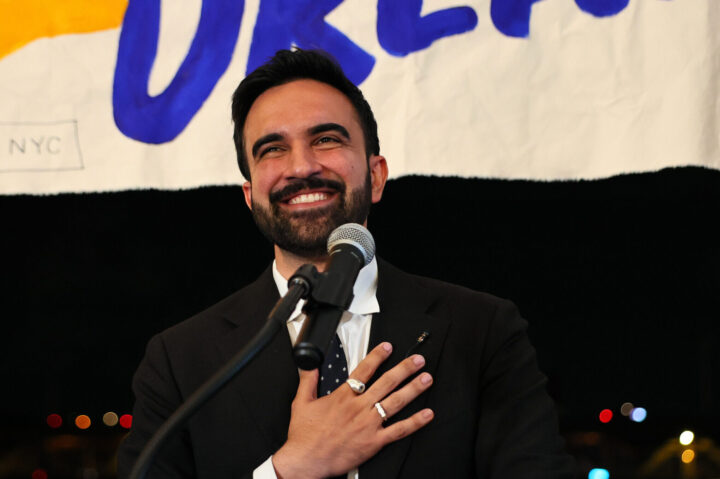
Michael M. Santiago/Getty Images
New York mayoral candidate, State Rep. Zohran Mamdani (D-NY) speaks to supporters during an election night gathering at The Greats of Craft LIC on June 24, 2025 in the Long Island City neighborhood of the Queens borough in New York City.
Zohran Mamdani’s presumed victory over Andrew Cuomo in New York City’s Democratic primary for mayor on Tuesday evening marks an extraordinary upset that until recently seemed all but unthinkable for the far-left state assemblyman from Queens who entered the race last October with virtually no name recognition.
The stunning rise of the 33-year-old democratic socialist with a long history of anti-Israel activism sent shockwaves through New York City’s political establishment and is already reverberating beyond the Big Apple, raising questions over the ideological direction of the Democratic Party as it has struggled to land on a cohesive messaging strategy to counter President Donald Trump.
With the midterms looming, Trump’s allies are already reportedly preparing to link Mamdani’s radical politics to the broader Democratic brand.
Meanwhile, in a place home to the largest Jewish population of any city in the world, Mamdani’s path to the nomination is also contributing to a growing sense of political homelessness among Jewish Democrats who voiced discomfort with his strident criticism of Israel and refusal to condemn extreme rhetoric such as “globalize the intifada,” a slogan that critics interpret as fueling antisemitism.
Cuomo, the scandal-scarred former governor of New York, leaned into his support for Israel and raised alarms about the rise of antisemitism as he courted Jewish voters. But his message ultimately failed to resonate over Mamdani’s sustained focus on affordability, including calls to “freeze the rent” that galvanized younger voters who turned out en masse.
While the final primary results are unlikely to be fully counted until next week because of the city’s ranked-choice system, Mamdani, with nearly 44% of first-place votes, held a commanding seven-point lead over Cuomo on Tuesday night — forcing the former governor to deliver a concession speech earlier than most had expected.
“Tonight was not our night,” Cuomo said at his election night watch party in Manhattan. “Tonight was Assemblyman Mamdani’s night.” He said he had called Mamdani to congratulate him for “a great campaign” that “touched young people and inspired them and moved them and got them to come out and vote.”
“He deserved it,” Cuomo concluded. “He won.”
Mamdani, for his part, said in his own speech that he would “be a mayor for every New Yorker,” and sought to assuage voter concerns about his views on Israel and the Middle East. “There are millions of New Yorkers who have strong feelings about what happens overseas. Yes, I am one of them,” he said, adding, “You have my word to reach further, to understand the perspectives of those with whom I disagree.”
Mamdani’s insurgent victory five months into President Donald Trump’s second term was reminiscent of then-upstart Rep. Alexandria Ocasio-Cortez’s upset primary victory over then-Rep. Joe Crowley in the spring of 2018, one of the seminal moments that year of the political backlash to Trump. It was an early signal that the party, even as it elected a number of moderate lawmakers in that year’s Democratic wave, was moving inexorably leftward in reaction to a Trump White House.
Even as Mamdani is poised to win the Democratic nomination, the two-term state legislator is facing a potentially messy general election that Cuomo could enter on a separate ballot line. The former governor indicated on Tuesday that he would “take a look” at the race and would “make some decisions” but gave no clear confirmation of his plans.
As Cuomo mulls his decision, it remains unclear who will emerge as a moderate standard-bearer in the November election, though the primary results were sure to be an encouraging turn for Eric Adams, the embattled mayor running as an independent — and whose team was hoping for a Mamdani victory.
The crowded general election also includes Jim Walden, a centrist independent, and Curtis Sliwa, the Republican nominee, raising the specter of a fractured vote that could help propel Mamdani to Gracie Mansion.
Given that possibility, one Jewish leader in New York City recently speculated to Jewish Insider that Republicans would choose to unite behind Adams over Sliwa, “because then you have a real chance of winning.”
Sheikha Al-Mayassa bint Hamad Al Thani has amplified the far-left New York City mayoral candidate on her social media

PATRICK BAZ/Qatar Pavillon/AFP via Getty Images
Qatar's Al-Mayassa bint Hamad bin Khalifa Al-Thani attends a ceremony marking Qatar's first official participation in the Venice Architecture Biennale on May 8, 2025.
A prominent member of Qatar’s royal family is boosting Zohran Mamdani, a far-left Queens state assemblyman, in his campaign for mayor of New York City.
In recent posts to Instagram, Sheikha Al-Mayassa bint Hamad Al Thani, the sister of Qatar’s emir, has promoted Mamdani’s bid as he competes in a tight race against former New York Gov. Andrew Cuomo, his top rival in today’s Democratic primary election.
The Qatari royal has touted favorable polling for Mamdani while amplifying a recent campaign video in which the democratic socialist is seen embracing his mother, the renowned Indian-American director Mira Nair, on a city-length walk through Manhattan on Friday.
In a comment below the video, Sheikha Al Mayassa posted a string of flame emojis voicing her approval of Mamdani’s feat.
Sheikha Al Mayassa, who chairs a number of the Gulf state’s leading cultural organizations including the Doha Film Institute and Qatar Museums, has a personal connection to Mamdani’s family, having hosted his mother in Doha in 2022 for the world premiere of the musical adaptation of Nair’s hit film “Monsoon Wedding,” according to media reports.
In an interview with a Qatari lifestyle magazine at the time, Nair said that Sheikha Mayassa “has loved the movie but also supported the inception of this musical over several years from New York to India to here.”
In recent years, the Gulf state has faced criticism from U.S. lawmakers for hosting Hamas’ leadership and human rights abuses including mistreatment of migrant workers during the World Cup, when Nair’s musical was presented as part of a cultural program that coincided with the tournament held in Doha.
Meanwhile, in 2013, Nair rejected an invitation to attend the Haifa Film Festival in Israel as a guest of honor — saying that she would “go to Israel when apartheid is over.”
Mamdani, for his part, does not appear to have publicly commented on the support from Sheikha Al Mayassa or on Qatar more broadly. While he has stressed a message of affordability during the race, he has drawn backlash over his harsh criticisms of Israel.
Mamdani, who has also endorsed boycotts targeting Israel, has indicated that he will not visit the Jewish state if elected, arguing that he does not believe that such a trip is necessary “to stand up for Jewish New Yorkers.”
Most polls show Cuomo ahead, but a new Emerson College poll released Monday showed Mamdani in the lead for the first time, sending shockwaves to many in the New York City Jewish community — and beyond

Screenshot
New York mayoral candidate and state Assemblyman Zohran Mamdani speaks at a candidate forum hosted by UJA AND JCRC-NY on May 22, 2025.
It’s not an overstatement to suggest that the future direction of the Democratic Party could well be decided tonight in New York City, where a far-left, anti-Israel assemblyman from Queens, Zohran Mamdani, has a shot to win the Democratic nomination against presumed favorite, former New York Gov. Andrew Cuomo.
Most public and internal campaign polls show Cuomo ahead, but a new Emerson College poll released Monday showed Mamdani in the lead for the first time, sending shockwaves through the New York City Jewish community — and beyond.
The notion that a candidate who pointedly declined to condemn “globalize the intifada” rhetoric in the city with the largest Jewish population in the world could be running competitively would have been unthinkable not long ago.
For a party desperately seeking to moderate in the aftermath of brutal defeats in 2024, the prospect of having a socialist mayor for the next four years in the largest city in the country would be an undeniable setback, threatening to reverberate beyond Gotham’s borders.
Mamdani’s rise has particularly fueled anxiety among Jewish leaders — as his hostile views toward Israel have hardly dented his standing in the race. Even if he doesn’t win the nomination, Jewish Democrats uncomfortable with his anti-Israel rhetoric and alleged insensitivity to rising antisemitism fear his surging campaign could end up causing them to rethink their long-standing affiliation with the Democratic Party
One prominent New York-based Democratic strategist told JI he expected some Jews to relocate to Florida or Texas if Mamdani becomes mayor.
But don’t expect a clear answer this evening: The primary result is unlikely to be confirmed for at least a week thanks to the city’s relatively new ranked-choice voting system. And regardless of the outcome, both Mamdani and Cuomo could also run in the general election on separate ballot lines, a possibility neither candidate has ruled out and one that portends a high-stakes race to November.
In addition to the mayoral contest, we’ll also be keeping an eye on a few down-ballot primaries for City Council, including former Rep. Anthony Weiner’s comeback campaign for an open-seat in Manhattan and a pair of Brooklyn races where anti-Israel incumbents are facing challengers.
One Democratic strategist predicted that if Mamdani wins, some Jewish residents will move out of the state

Yuki Iwamura-Pool/Getty Images
Democratic mayoral candidate Zohran Mamdani
As the closely watched Democratic primary for mayor of New York City wraps up today, many Jewish and pro-Israel activists are now confronting a mounting sense of alarm that Zohran Mamdani, a far-left assemblyman from Queens, could win the nomination, propelling a fierce critic of Israel to the general election — and, potentially, Gracie Mansion.
In a city home to the largest Jewish community outside of Israel, Mamdani’s rise has fueled anxiety among Jewish leaders — particularly as his hostile positions toward Israel have hardly dented his standing in a competitive race that has narrowed to a two-person matchup.
Even if Mamdani does not win, Jewish Democrats uncomfortable with his strident criticism of Israel and alleged insensitivity to rising antisemitism fear that his surging campaign could end up alienating Jewish voters who have long called the party home.
“The Jewish community is going to face a real shock if Mamdani gets the nomination,” Mitchell Moss, an urban policy professor at New York University who is backing Cuomo, said in an interview with Jewish Insider on Monday. “A lot of people have come to realize that anti-Israel sentiment has metastasized into antisemitism.”
The Tik Tok-savvy Mamdani, a 33-year-old democratic socialist, has largely polled in second place behind his chief rival, former New York Gov. Andrew Cuomo, though a poll released by Emerson College on Monday showed Mamdani narrowly prevailing.
Cuomo’s campaign, for its part, has dismissed the survey as an outlier and cited other polls showing him with a more robust lead in the crowded race to unseat Mayor Eric Adams, who is seeking reelection as an independent. Fix the City, a pro-Cuomo super PAC that has slammed Mamdani’s approach to Israel in several attack ads, also released a new poll Monday that found Cuomo with a comfortable, 24-point lead over Mamdani in the final round of voting.
While support for Israel had once been viewed as a prerequisite for any winning campaign in New York City, Mamdani’s bid has tested that proposition. He has suggested he is uninterested in visiting Israel if elected, breaking with long-standing precedent, and has declined to acknowledge Israel’s right to exist as a Jewish state.
The two-term state lawmaker, who has endorsed boycotts targeting Israel, has said he would divest from Israel as mayor and promised to arrest Israeli Prime Minister Benjamin Netanyahu for alleged war crimes if he were to enter the city. Perhaps most controversially, Mamdani has drawn scrutiny for defending calls to “globalize the intifada” — a slogan that critics interpret as stoking violence against Jews.
Despite backlash, Mamdani doubled down on that defense during a radio interview on Monday, saying the phrase “has a variety of meanings to a variety of people.”
Many Jewish and pro-Israel activists in New York City have found his response alarming. “No matter what the outcome tomorrow, the fact that Zohran has been able to capture the attention of so many people who are really blind to his antisemitic tendencies really says something about the state of our electorate right now,” Sara Forman, who leads a pro-Israel super PAC that has urged voters to rank Cuomo first and to exclude Mamdani entirely, told JI.
Mamdani’s “foreign policy stances are isolating Jews and freezing us out from our political home base in the Democratic Party,” Forman said in an interview on Monday. “If the Democratic Party doesn’t wake up and start speaking to its core constituencies of Blacks, Jews and Latinos, we’re going to find our party rebuilt in someone else’s image.”
Hank Sheinkopf, a veteran Democratic strategist, predicted a Mamdani victory could end up pushing “more Jews nationally into the Republican column” and said Orthodox Jews might choose to relocate to South Florida and New Jersey. “Whether he wins or loses,” Sheinkopf said, the contours of the race have sent a concerning message that he characterized as “Jews don’t matter.”
Mamdani has rejected accusations of antisemitism, saying his opponents have weaponized such charges to score “political points.” He has said he is sensitive to rising antisemitism across New York City and has vowed to increase funding to counter hate crimes by 800%.
Early voting tallies have suggested that Mamdani has galvanized his base of younger supporters who are enlivened by his calls to “freeze the rent” and to deliver free buses as he has emphasized a message of affordability.
Cuomo, meanwhile, is depending on strong turnout from Black, Latino and Orthodox Jewish voters who have long been part of his core coalition. The former governor has locked up major endorsements from a range of key Orthodox leaders in Williamsburg and Borough Park, a Hasidic enclave in Brooklyn where he spent time on Sunday rallying a community that could deliver thousands of votes in a close election.
One Satmar leader in Williamsburg told JI that he is expecting solid turnout from New York City’s largest Hasidic voting bloc, predicting up to 8,000 votes for Cuomo, who has worked to mend relationships with Orthodox leaders that soured over his crackdown on religious gatherings during the COVID-19 pandemic.
The Cuomo campaign believes polls are missing the Orthodox vote, which could make the difference in a close election, according to an advisor who said that turnout from the community has been encouraging. “But what else are they missing is the question,” the advisor told JI on Monday, speaking anonymously to address the race.
Still, some Orthodox leaders remain on edge as Mamdani has continued to defy the odds over the course of the campaign. “He has really excited his base,” said one Orthodox leader in Brooklyn. “I am very fearful that he could actually make it, especially on ranked choice.”
Cuomo, who has won endorsements from Rep. Jim Clyburn (D-SC) and former President Bill Clinton in recent days, has also struggled to overcome his own vulnerabilities in the race, including accusations of sexual misconduct that forced his resignation from office in 2021. He denies the allegations and said he regrets stepping down.
In the final days of the election, the former governor — who has called antisemitism “the most important issue” and touted his staunch support for Israel — has insisted that his decades of government experience make him better suited to handle threats from Iran after the U.S. bombing of its nuclear sites over the weekend.
“Who do you want in charge in that situation?” he said of possible Iranian retaliation for the attacks. “Who’s handled situations like Hurricane Sandy and COVID and terrorist threats? This is not a job for on-the-job training.”
As for the bombing itself, Cuomo backed the effort to eliminate Iran’s nuclear capabilities, but he took issue with President Donald Trump’s decision to do so unilaterally without first consulting Congress — underscoring another key difference with Mamdani on Middle East policy.
Mamdani criticized the attack on Iran as “the result of a political establishment that would rather spend trillions of dollars on weapons than lift millions out of poverty, launch endless wars while silencing calls for peace, and fearmonger about outsiders while billionaires hollow out our democracy from within.”
The other candidates in the crowded primary, including Brad Lander, the city comptroller, and Adrienne Adams, the City Council speaker, have struggled to gain traction, polling has indicated.
Regardless of the primary result, which is unlikely to be confirmed for several days because of the ranked-choice system, both Mamdani and Cuomo could run in the general election on separate ballot lines, a possibility neither candidate has ruled out.
“This is a prelude to November,” said Moss, the urban policy professor, envisioning a high-stakes general election. “If Mamdani wins in New York,” he warned, “you can say goodbye to the Democratic Party for a long time.”
More than a dozen vendors set up tents around a grassy lawn overlooking lower Manhattan

Courtesy
The Great Nosh picnic
The biggest Jewish food event of the summer began like so many other great Jewish moments: with a story. In this case, that was the story of Noah’s Ark. Or at least that’s what it felt like on Sunday, as an unexpected rainstorm pelted New York City just moments before thousands of foodies were supposed to arrive at Governor’s Island for an afternoon of eating.
But like in that ancient biblical tale, the rain stopped and the sun poked through, paving the way for humanity to survive — or, at least, to nosh. And to nosh really well.
The Great Nosh Picnic was the most significant undertaking yet for Naama Shefi and the Jewish Food Society, the nonprofit she founded in 2017 to promote Jewish cuisine. Since then, Shefi has become something of a tastemaker when it comes to identifying the next generation of Jewish culinary talent and nurturing the traditions from which they emerged. (Part of JFS’ mission has been to preserve Jewish culinary history, including with an archive of recipes from Jewish immigrants from around the world.)
Her mission with the Great Nosh Picnic was even bigger. She wanted to create a large-scale celebration of Jewish food and Jewish culture that would rival other major citywide cultural events like the Pride Parade, St. Patrick’s Day and Cinco de Mayo.
“I live in New York City, a city whose culture and Jewish culture are so deeply connected,” Shefi told Jewish Insider. “I live on East Broadway Street on the Lower East Side, and you feel this connection on the street. But still, we don’t have any whole city celebration to emphasize that and to include everyone, and that was really the motivation.”
“We’re trying to create a movement,” Shefi continued, “and this is honestly just the beginning.”
Her plan is off to a good start. The event sold out all 2,500 tickets the first 48 hours after tickets went on sale last month. A buzzy Instagram post from New York magazine helped, and before the event started, 5,000 people were on a waitlist for tickets.
More than a dozen vendors set up tents around a grassy lawn overlooking lower Manhattan. Each attendee received a branded Great Nosh Picnic tote bag, which included a picnic blanket (waterproof, conveniently), sharing plates and a deck of cards. People were spread out lazily on a sea of checkered blankets, enjoying specially crafted dishes from some of New York’s hottest chefs. Toddlers ran around under an overcast sky, which for much of the afternoon shielded people from the worst of the punishing heat wave promised by forecasters.

The picnic idea was loosely inspired by Shefi’s upbringing on a kibbutz in Israel. The seasonal dishes, paired with fresh fruit, cheese and bread available for purchase in a “provisions” tent, were meant to provide a “much more fresh, stylistic, beautiful and lush” representation of Jewish cuisine than she is used to seeing reflected in the American Jewish community.
“I grew up on a kibbutz celebrating Shavuot and having this celebration in the form of a picnic, a community gathering on the grass every year,” said Shefi, referring to the Jewish holiday that falls in late spring and marks the giving of the Torah at Mount Sinai. “It’s so poetic and beautiful, the connection to the land and farming and seasonality.”
The food was roughly kosher-style: no pork or shellfish, although some chefs mixed meat and milk. One stand, a collaboration between Israeli chef Eyal Shani and American food writer Jake Cohen, featured a certified kosher dish, a deconstructed sabich, or fried eggplant, sandwich. Each tent served a dish devised by a pairing of chefs, matches that Shefi helped set up, yenta-style.
There was a marbled rye roti reuben (corned beef, grueyere, bamboo kraut, mango slaw) created by Katz’s Deli and Thai Diner. (The staff working that booth wore matching shirts: “Because it’s iconic and we love to do iconic sh**.”) Across the way, a mash-up between Gertrude’s, a newish Brooklyn hotspot, and Dhamaka, from the Michelin-starred Indian chef Chintan Pandya, featured lamb pastrami on a chapati, with green chutney and dill sour cream. Elbow Bread and the Korean restaurant Sunn’s — which are on the same block on the Lower East Side — offered banchan bialys, available with smoky eggplant, kimchi or garlic cucumber.
Schnitzel was repurposed as “schnitz and chips” by the Brooklyn cafe K’far with Dame, a British seafood restaurant, and served with tahini and schug. La Boite, an Israeli-owned spice company, partnered with the mobile pizza oven Slow Fires for a corn and labneh pizza, cooked with saffron and topped with La Boite’s spice blends.

It was a languorous afternoon, where appropriate dining times and orders did not matter; a chicken appetizer could be followed by an ice cream main course and a bagel dessert.
But there were plenty of real desserts, too. A lemon poppyseed “bagel” (read: cookie) ice cream sandwich from Russ & Daughters and Morgensterns. Another sandwich, with mini black and white cookies straddling a piece of cheesecake, from the baker Caroline Schiff and the restaurant Juniors. A malted cinnamon babka from Breads Bakery and East Village bakery Hani’s.
Elsewhere, the modern Judaica artist Susan Alexandra, known for her whimsical designs, oversaw a beading station where patrons young and old made friendship bracelets, choosing from brightly colored beads that featured Hebrew letters and Jewish stars. At the “Grandmas Tent,” older chefs led cooking demonstrations with younger family members, with generous samples passed around afterward.
Not everyone at the picnic was Jewish. Some may simply have wanted a taste of cuisine made by award-winning chefs without having to manipulate Resy or OpenTable for a reservation.
“We are inviting the entire city to join the Great Nosh,” Shefi said. “The excitement went way, way beyond the Jewish world.”
Still, the grounds had the feel of a catwalk where New York’s Jews could strut their stuff, whether that meant a “Shalom Y’all” t-shirt or curly hair puffing up in the humidity or a giant chai necklace coupled with the now-ubiquitous hostage dog tag. One bulky man in a sleeveless sweatshirt rocked a huge Magen David tattoo on his upper arm. A couple strolled around in matching hats, his reading “Brooklyn Reb” and hers reading “Brooklyn Rebbetzin.” When DJ Mark Ronson played a set to close out the afternoon, one woman held a raw cauliflower in the air as she danced.
Governor’s Island became a place where, for a few hours, Jews could be themselves, unselfconsciously, with no politics and no religious ritual beyond being together. (Well, there was a rabbi asking men to wrap tefillin. But would it be a Jewish event if there weren’t?)
Everyone heading to the picnic, reachable only by ferry, floated past the Statue of Liberty — the same beacon that greeted the iconic Jewish immigrant chefs and business owners of the Lower East Side who laid the groundwork for Sunday’s modern feast a century or more ago when they first arrived in America, seeking a better life. The anti-Jewish hatred the unofficial founders of American Jewish cuisine sought to escape is now firmly ensconced in this country and on the streets of New York.
But once inside the festival, any hint of that antisemitism, and the challenges that American Jews have lived with since the Oct. 7 terror attacks, vanished.
“While we can struggle with the state of affairs, we can and also need to find joy, find ways to connect with what it means to be Jewish, and that’s very personal and different for different people,” said Niki Russ Federman, the fourth-generation co-owner of Russ & Daughters. “But I do think that food is one of the great unifiers of the Jewish community. … We need something like this more than ever.”
Ye, who most recently was a staffer for Rep. Dan Goldman, is backed by a pro-Israel super PAC as well as a group with ties to the real estate industry

Michael M. Santiago/Getty Images
Council Member Alexa Aviles speaks during a press conference outside of City Hall on April 10, 2025 in New York City.
In recent years, Jewish and pro-Israel activists in New York City have been successful in defending favored incumbents while boosting candidates in open-seat local races. But they have struggled to go on the offensive against far-left Israel critics on the City Council aligned with the Democratic Socialists of America, which has gained prominence in some districts.
Now, however, some Jewish community activists and pro-Israel strategists are expressing optimism that a competitive City Council election in southern Brooklyn could be their best pick-up opportunity in next week’s citywide primaries, delivering a possible upset that has so far proved elusive at the local level.
In one of the city’s most hotly contested local races, Alexa Avilés, a two-term councilmember backed by the DSA, is facing a formidable challenge from Ling Ye, a moderate former congressional staffer making her first bid for elective office with a focus largely on public safety.
The race is playing out in a redrawn district that now includes more moderate constituents in Dyker Heights who are likely less receptive to reelecting a socialist, strategists say, fueling hopes among allies of Ye eager to pick off an incumbent whose hostility to Israel while in office has rankled Jewish leaders.
Ye, who immigrated to the United States from China in her early teens, is also depending on the sizable population of Chinese American voters who live in the ethnically diverse district — which covers such progressive pockets as Red Hook, winds down through a heavily Latino section of Sunset Park and terminates around Bensonhurst and Dyker Heights in southwestern Brooklyn.
“She is hyper focused on the issues impacting the community she grew up in and served through her many roles in government,” Haley Scott, a spokesperson for Ye, told JI. “She’s fighting to make south Brooklyn safer and more affordable, and to make sure every community in this district is being heard and represented in City Hall.”
One political consultant supportive of Ye said that he had seen recent polling showing Avilés with an eight-point lead over her opponent, but cautioned the district is difficult to accurately survey because the electorate is so diverse and voters speak several different languages.
“There are a bunch of voting pockets, between the Asian population and working-class moderate white voters, that could break toward Ye,” the consultant, who spoke on condition of anonymity to address the race, told Jewish Insider this week.
Haley Scott, a spokesperson for Ye, also projected confidence ahead of Tuesday’s primary, saying the first-time candidate “is running a campaign to win” and built “overwhelming grassroots support and an aggressive turnout operation to make sure everyone who can vote exercises that right.”
“She is hyper focused on the issues impacting the community she grew up in and served through her many roles in government,” Scott told JI. “She’s fighting to make south Brooklyn safer and more affordable, and to make sure every community in this district is being heard and represented in City Hall.”
Ye, who most recently was a staffer for Rep. Dan Goldman (D-NY), is backed by a pro-Israel super PAC as well as a group with ties to the real estate industry that has invested in attack ads targeting Avilés over past calls to defund the police, among other issues.
Like some other candidates who have previously endorsed such efforts — which have more recently become a political liability — Avilés has softened her rhetoric on public safety issues as she faces scrutiny over her positions while seeking reelection to a third term in the changed district.
As recently as last August, for instance, Avilés had explicitly advocated for “defunding the NYPD” in a platform section on her campaign site, according to archived screenshots on the Wayback Machine. But her current platform features no such language, and even acknowledges that a “police presence” coupled with public services like “better street lighting” have helped constituents “feel safe” in their communities.
Rather than calling for a wholesale divestment from law enforcement, Avilés’ platform now pushes for increased police accountability while arguing that officers are unfit to respond to mental health calls, among other things.
Her campaign did not return a request for comment from JI on Thursday.
The Puerto Rican-born councilwoman, who chairs the Committee on Immigration, has otherwise been emphasizing constituent services, citing her efforts to protect residents from federal agents conducting what she has called “unlawful” raids and arrests as President Donald Trump’s immigration crackdown targets New York City.
For her part, Ye has countered that Avilés’ tenure has been more defined by what she characterizes as performative gestures such as voting against the city budget, while suggesting that her vociferous support for defunding the police has damaged relations with law enforcement at the expense of the community’s immediate needs. Ye has called for “strengthening relationships between local police precincts and the neighborhoods they serve” amid local concerns over violent crime, among other policies that she casts as practical solutions better aligned with the district.
Ye, who has drawn donations from Jewish and pro-Israel donors, is supportive of Israel but has stressed that the City Council is not an appropriate venue for litigating foreign policy and has sought to focus on local issues throughout the race, according to her campaign. The district is home to just a small number of Jewish voters, according to experts, even as it includes some parts of Borough Park, a Hasidic enclave.
“New York’s AIPAC is spending big against me,” Avilés said during her speech on Saturday before a packed audience at Terminal 5, referring to Solidarity PAC, a local pro-Israel advocacy group supporting Ye that has no formal ties to the Washington-based federal lobbying organization. “Because I’ve stood up over and over to demand a ceasefire in Gaza,” she added defiantly to cheers from the crowd. “We want to end the genocide and we want a free Palestine!”
Still, Israel’s ongoing wars have fueled tension in the district. Pro-Palestinian activists have heckled Ye on the campaign trail, according to video seen by JI, accusing her of supporting “genocide” and taking “blood money” from Israel, a false claim that echoes antisemitic tropes about Jewish control of American politics. Ye has also faced xenophobic rhetoric amid the race, as one of her public campaign posters was defaced with graffiti labeling her a “Zionist” as well an affiliate of the “CCP,” or the Chinese Communist Party, a photo recently shared with JI shows.
Even as Avilés has somewhat tempered her rhetoric on law enforcement, she has continued to speak out stridently in opposition to Israel, most recently at a campaign rally in Manhattan for Zohran Mamdani, a far-left state assemblyman from Queens polling in second place in the Democratic mayoral primary on Tuesday.
“New York’s AIPAC is spending big against me,” Avilés said during her speech on Saturday before a packed audience at Terminal 5, referring to Solidarity PAC, a local pro-Israel advocacy group supporting Ye that has no formal ties to the Washington-based federal lobbying organization. “Because I’ve stood up over and over to demand a ceasefire in Gaza,” she added defiantly to cheers from the crowd. “We want to end the genocide and we want a free Palestine!”
In keeping with the DSA, which drew widespread backlash for promoting a Manhattan rally at which attendees were seen celebrating Hamas shortly after the Oct. 7, 2023, attacks, Avilés backs the Boycott, Divestment and Sanctions moment targeting Israel and has faced scrutiny for being among a handful of City Council members who abstained from voting in favor of a City Council resolution to establish an annual “End Jewish Hatred Day.”
Sara Forman, who leads Solidarity PAC, criticized Avilés in a statement to JI as “a DSA ideologue” who during her time in office has “sidelined” key issues such as affordable housing “in favor of empty promises, an obsession with foreign policy and political posturing.”
Solidarity PAC, Forman said, “proudly supports Ling Ye, who has called Brooklyn’s 38th District home since immigrating to the United States at 14, as someone who understands the real and pressing needs of the community.”
As she seeks to fend off her primary challenger, Aviles’ allies have raised some concerns about the race, even as she has won a range of high-profile endorsements from such progressive leaders as Rep. Alexandria Ocasio-Cortez (D-NY) and the Working Families Party. In a recent Zoom discussion about the “Israel lobby,” Yuh-Line Niou, a former far-left state assemblywoman who lost a tight congressional contest in 2022, warned that Avilés is running in “a very tough race” and urged viewers to support her campaign.
“There are people who are Asian voters who will literally see an Asian name on the ballot and be willing to vote for them,” suggested Niou, who is Taiwanese American.
Despite some unease among supporters of Avilés, the race has largely flown under the radar and has been overshadowed by a separate City Council race in Brooklyn where Shahana Hanif, the DSA-aligned incumbent, has drawn backlash from Jewish voters over her strident criticism of Israel.
“It’s going to be the closest of the DSA races,” said one Jewish leader, speaking anonymously to discuss the primary. “But Alexa still wins,” he predicted, while speculating that Mamdani’s “coattails” in the district “will help.”
In her primary, Hanif is defending her seat against Maya Kornberg, a pro-Israel Jewish Democrat also backed by Solidarity PAC who, like Ye, has accused her opponent of failing to provide solid constituent services while advocating for policies like defunding the police that have not helped the district.
But while the race has drawn national attention as well as spending from outside groups backing both candidates, some strategists and Jewish leaders who are eager to see Kornberg win expressed skepticism she will ultimately unseat Hanif — owing largely to the ideological makeup of the district that includes deeply progressive Park Slope.
Some Jewish community activists are also cautious about Ye’s race further south. “It’s going to be the closest of the DSA races,” said one Jewish leader, speaking anonymously to discuss the primary. “But Alexa still wins,” he predicted, while speculating that Mamdani’s “coattails” in the district “will help.”
Still, others following the race are holding out hope that Avilés’ new district lines will favor a moderate Democrat like Ye, who has argued the community “doesn’t need another professional protester” in City Hall.
“There’s a really good chance for a pick-up here,” said another Jewish community activist who has tracked the race.
The former New York governor said about his rival’s comments, ‘We know all too well that words matter. They fuel hate. They fuel murder’

Jose Perez/Bauer-Griffin/GC Images
New York mayoral candidate, Andrew Cuomo attends a labor union rally in Union Square on June 17, 2025 in New York City.
Former New York Gov. Andrew Cuomo spoke out against Zohran Mamdani, his top rival in New York City’s Democratic mayoral primary on Tuesday, for defending calls to “globalize the intifada” in a widely criticized podcast appearance this week.
“Yesterday when Zohran Mamdani was asked a direct question about what he thought of the phrase ‘globalize the intifada,’ he dismissed it as ‘language that is subject to interpretation,’” Cuomo said in a social media post on Wednesday. “That is not only wrong — it is dangerous. At a time when we are seeing antisemitism on the rise and in fact witnessing once again violence against Jews resulting in their deaths in Washington, D.C., or their burning in Denver — we know all too well that words matter. They fuel hate. They fuel murder.”
Mamdani, a far-left state assemblyman from Queens who is polling in second place behind Cuomo, has faced backlash over his comments in an interview with The Bulwark, where he characterized the slogan heard frequently at anti-Israel protests as an expression of Palestinian rights and invoked a prominent act of Jewish resistance to Nazi Germany to justify its usage, even as the phrase has been criticized as a call to violence against Jews.
“I think what’s difficult also is that the very word has been used by the Holocaust Museum when translating the Warsaw Ghetto Uprising into Arabic, because it’s a word that means struggle,” Mamdani said on the podcast, in an apparent reference to the U.S. Holocaust Memorial Museum in Washington.
For its part, the museum, which rarely weighs in on domestic politics, dismissed Mamdani’s comments in a sharply worded social media post on Wednesday that did not mention him by name.
“Exploiting the Museum and the Warsaw Ghetto Uprising to sanitize ‘globalize the intifada’ is outrageous and especially offensive to survivors,” the museum said. “Since 1987 Jews have been attacked and murdered under its banner. All leaders must condemn its use and the abuse of history.”
Pressed to respond to the outage over his comments, Mamdani said in an emotional press conference on Wednesday that he is frequently targeted for his Muslim faith. “I try not to talk about it,” he said, choking up. “My focus has always been on making this a city that’s affordable, on making this a city that every New Yorker sees themself in,” he added, “and it takes a toll.”
“The thing that’s made me proudest in this campaign is that the strength of our movement is built on our ability to have built something across Jewish and Muslim New Yorkers,” he said, adding that “antisemitism is such a real issue in this city, and it has been hard to see it weaponized by candidates who do not seem to have any sincere interest in tackling it but rather in using it as a pretext to make political points.”
Ted Deutch, the CEO of the American Jewish Committee, also took offense at Mamdani’s framing, saying his invocation of the Holocaust Museum “is as offensive as it is outrageous” in comments posted to social media on Wednesday.
“I don’t know this candidate, but I know a lot of fine elected officials in the city he wants to run,” Deutch added. “ALL OF THEM should condemn the use of ‘globalize the intifada’ as the call to violence that it is. And they should tell Mr. Mamdani that if he really wants to keep Jews safe, he must do the same.”
Cuomo, who along with his allies has accused Mamdani of espousing anti-Israel rhetoric amid a recent surge of antisemitic incidents, likewise called on his opponents in the primary “to join together to denounce Mr. Mamdani’s comments because hate has no place in New York.”
“There are no two sides here,” Cuomo wrote. “There is nothing complicated about what this means.”
Whitney Tilson, a former hedge fund executive seeking the Democratic nomination who has been highly critical of Mamdani’s anti-Israel views, also took aim at the state assemblyman in a statement on Wednesday.
“Mamdani’s refusal to disavow terrorism against Jews is utterly disqualifying,” Tilson argued. “His assurances that he will protect Jewish New Yorkers ring hollow.”
A spokesperson for Mamdani did not immediately respond to a request for comment.
Brad Lander, the Jewish city comptroller who is polling in third place and recently cross-endorsed with Mamdani, said at a town hall hosted by the UJA-Federation of New York earlier this month that he does not immediately view calls to “globalize the intifada” as antisemitic, arguing the phrase is “really complicated” and that such judgements depend on context.
“The First Intifada was relatively nonviolent, and the Second Intifada was quite violent,” Lander said of the Palestinian uprisings that began in 1987 and ended in the early 2000s, killing more than 1,000 Israelis in a series of attacks targeting civilians and soldiers alike. “So if you say ‘globalize the intifada,’ you are at very least, at the very least, playing with vague language.”
The phrase has also stirred controversy further down the ballot. Shahana Hanif, a far-left city councilwoman in Brooklyn who has clinched endorsements from Lander and Mamdani as she faces a primary challenge, has also drawn scrutiny for amplifying a call to “globalize the intifada” on social media before she took office.
While she had initially dismissed complaints from Jewish leaders who took issue with her decision to endorse the phrase, Hanif, an outspoken critic of Israel, ultimately relented — deleting the post and expressing regret for boosting a message that many voters had found concerning.
“I unequivocally apologize for this,” Hanif wrote in a letter to Jewish community members last fall. “I understand now that the phrase can invoke feelings of hostility, discrimination and fear for Jewish people. It was never my intention to promote such messaging, and I removed the post as soon as I recognized its harmful implications.”
The Queens assemblyman and New York City mayoral candidate refused to condemn the phrase as example of antisemitism on the left
Yuki Iwamura-Pool/Getty Images
Democratic mayoral candidate Zohran Mamdani
Zohran Mamdani, a leading candidate in next Tuesday’s New York City mayoral primary, refused to condemn calls to “globalize the intifada” during a new podcast interview with The Bulwark released on Tuesday, arguing the phrase is an expression of Palestinian rights.
In an exchange about antisemitic rhetoric on the left, Mamdani was asked by podcast host Tim Miller to share his thoughts on the phrase, which has been invoked at anti-Israel demonstrations and criticized as an anti-Jewish call to violence.
“To me, ultimately, what I hear in so many is a desperate desire for equality and equal rights in standing up for Palestinian human rights,” said Mamdani, a far-left assemblyman from Queens who has long been an outspoken critic of Israel. “And I think what’s difficult also is that the very word has been used by the Holocaust Museum when translating the Warsaw Ghetto Uprising into Arabic, because it’s a word that means struggle,” he said, apparently referring to the U.S. Holocaust Memorial Museum in Washington.
He added that, “as a Muslim man who grew up post-9/11, I’m all too familiar in the way in which Arabic words can be twisted, can be distorted, can be used to justify any kind of meaning.”
“I think that’s where it leaves me with a sense that what we need to do is focus on keeping Jewish New Yorkers safe,” Mamdani continued, after noting that antisemitism is a “real issue” he plans to address if elected mayor. “The question of the permissibility of language is something that I haven’t ventured into.”
Mamdani, who is polling in second place behind former Gov. Andrew Cuomo, has faced criticism over his approach to Israel during the campaign. He has declined to acknowledge Israel’s right to exist as a Jewish state and said he would divest from Israel if elected, among other comments and actions that have raised alarms among many Jewish voters.
Cuomo, who has deemed rising antisemitism “the most important issue” in the race, has for his part denounced calls to “globalize the intifada,” saying that such phrases are “giving license to come after Jews.”
Earlier this month, the UJA-Federation of New York and other local Jewish groups called on all candidates running for mayor “to unequivocally condemn dangerous rhetoric — such as ‘globalize the intifada’ — that has inspired deadly acts against Jews, most recently in Colorado, Washington, D.C., and Pennsylvania.”
An ad released by Sensible City highlights Mamdani’s positions on defunding the police amid increased antisemitic activity
Yuki Iwamura-Pool/Getty Images
Democratic mayoral candidate Zohran Mamdani
A new super PAC funded by donors involved in Jewish and pro-Israel causes is targeting Zohran Mamdani as he continues to surge in the final days of New York City’s mayoral primary, tying the far-left Queens state assemblyman to a range of recent antisemitic incidents.
In a 30-second digital ad released by Sensible City, the super PAC takes aim at Mamdani, a democratic socialist polling in second place behind former New York Gov. Andrew Cuomo, for supporting efforts to defund the police amid a rise in anti-Israel demonstrations and antisemitic violence fueled by Israel’s war in Gaza.
“It doesn’t stop,” the ad’s narrator intones over images of anti-Israel protests as well as antisemitic attacks, notably highlighting the alleged shooter of two Israeli Embassy staffers in Washington last month. “Day after day, streets blocked, demonstrations, some calling for killing, destruction — it’s not safe. Institution walls defaced with symbols to remind us of what can happen only because of who we are. The haters mean every word they utter. What can we do?”
“Zohran Mamdani wants to defund the police,” the narrator adds. “We need a mayor who puts more cops on the street. What’s your June 24 Democratic primary choice?”
The ad does not mention any other candidates in the Democratic primary, though at least one of the super PAC’s board members and one of the super PAC’s donors have contributed to Cuomo, who has called antisemitism “the most important issue” in the race while touting his staunch support for Israel. He has also criticized Mamdani over his past calls to defund the police.
Mamdani’s hostility toward Israel, whose existence as a Jewish state he has refused to recognize during the campaign, has long raised alarms among Jewish leaders, particularly as polling has suggested that he is gaining on Cuomo with under two weeks until the primary.
But the new ad from Sensible City, which began airing late last week, is one of only a small handful of paid efforts to draw scrutiny to Mamdani’s record of anti-Israel activism, one of several vulnerabilities in his insurgent bid for mayor.
Whitney Tilson, a former hedge fund executive seeking the Democratic nomination, has also run ads hitting Mamdani ‘s rhetoric on Israel. “The socialists are at the gate and Zohran Mamdani is leading the pack,” a Tilson ad stated earlier this month. “If they take over New York City, this is what they said they’ll do: Defund the police, consequences for genocidal Zionist imperialism.”
Mamdani’s campaign has dismissed both efforts as “desperate,” while calling the new ad from Sensible City “disgusting” and “slanderous.”
It remains to be seen if the new super PAC will further engage in the primary, after spending just over $100,000 on its digital ad — a relatively small sum in a race that has drawn millions from outside groups.
The super PAC has raised only $212,000 from seven donors, the latest filings show, including Rob Stavis, a partner at the venture capital firm Bessemer and a vice chair of the Anti-Defamation League’s board of directors, and Modi Wiczyk, a film producer and a board member at the Israel Policy Forum.
Stavis, who contributed $100,000, the single largest amount, declined to comment on the race, but a person familiar with his thinking said he has been personally troubled by Mamdani’s campaign.
The super PAC’s “mission,” it states on its website, “is to advocate for issues and policies focused on supporting and advancing public safety, combating antisemitism and promoting fiscal responsibility.”
“Our mission is more than a statement — it’s a standard,” the website adds. “Everything we do reflects our belief that New Yorkers deserve safe communities, responsible governance, and leaders who stand up to hate. Sensible City exists to hold that line.”
Representatives for the group listed on its website as well as in filings did not respond to requests for comment on Tuesday.
The group’s chairman, Daniel Horwitz, a partner at Tannenbaum Helpern in New York City, gave $500 to Cuomo’s campaign in March, according to filings.
A super PAC launched by allies of Cuomo, Fix the City, has raised more than $12 million, and recently began running attack ads against Mamdani.
The endorsement from the Zaloynim faction as well as one from the smaller Aroynim faction could turn out more than 6,000 votes for Cuomo

Michael M. Santiago/Getty Images
NYC Mayoral candidate, former Gov. Andrew Cuomo arrives for the NYREC Emerging Leaders and Markets (ELM) Conference at the Victoria Renaissance Hotel on June 06, 2025 in New York City.
The majority Satmar faction in Brooklyn, which represents the largest Hasidic voting bloc in New York City, is backing former Gov. Andrew Cuomo for mayor, lending what is likely to be a major boost to his campaign in the final days of the increasingly competitive Democratic primary.
The Zaloynim Satmar faction based in Williamsburg, led by Rabbi Zalman Teitelbaum, announced on Tuesday that it is ranking Cuomo as its top pick in the June 24 primary, as recent polls have shown a tightening race between the former governor and Zohran Mamdani, a far-left state assemblyman from Queens.
The endorsement is slated to run on Wednesday in Der Yid, a Yiddish paper aligned with the faction — which ranked Adrienne Adams, the speaker of the City Council, as its second pick for mayor, followed by Zellnor Myrie, a state senator from Brooklyn.
Cuomo also notched a key endorsement on Monday from the rival Aroynim Satmar faction led by Rabbi Aaron Teitelbaum, which is a smaller but politically influential community. The group likewise ranked Adrienne Adams as its second pick in the primary to replace embattled Mayor Eric Adams, who is running as an independent.
Because Hasidic communities typically vote in blocs based on rabbinic support, the endorsements could collectively turn out more than 6,000 votes, experts estimate, which could make the difference in a close race.
The dual Satmar backing, highly coveted in New York City races, caps off a string of endorsements Cuomo has accumulated from Orthodox leaders in recent days. Last Friday, he claimed a major endorsement from the Bobov sect, the largest Hasidic bloc in the Borough Park neighborhood of Brooklyn that could deliver more than 4,000 votes, according to experts.
The former governor has also recently won support from the Far Rockaway Jewish Alliance; the Crown Jewish United and the Crown Heights PAC; and the Flatbush Jewish Community Coalition.
Still, there have been a few holdouts who remain bitter over Cuomo’s COVID-era restrictions, which many voters recall as discriminatory, according to one Jewish activist familiar with the situation who spoke on the condition of anonymity to address a sensitive subject.
On Monday, a large coalition of Hasidic sects and institutions in Borough Park broke from the Bobov leadership and announced it was ranking Adrienne Adams as its first choice, followed by Myrie, whose district includes the Hasidic enclave of Crown Heights.
The coalition did not publicly provide a reason for its decision to exclude Cuomo from its ranking. But the Jewish activist, who was privately briefed on its thinking, said that some Hasidic leaders continue to harbor lingering resentment toward Cuomo over his COVID policies, which the former governor has sought to address in a recent series of meetings to mend relationships with a community his campaign regards as crucial to securing the nomination.
“People didn’t find his apology sincere,” the Jewish activist said of Cuomo’s outreach.
The group was also organized by allies of Eric Adams, whose team has privately urged Orthodox leaders not to rank Cuomo first or to exclude him entirely from their endorsement slates, believing that Adams will be best poised to win the general election with Mamdani as the nominee, according to multiple people familiar with the behind-the-scenes push to influence the primary.
One source familiar with the effort said Adams has personally intervened, asking Moishe Indig, a leader of the Aroynim Satmar faction, to include Mamdani in an endorsement slate.
Indig did not respond to a request for comment on the effort, which was reported earlier by The New York Times.
Most Orthodox leaders have chosen to ignore the lobbying effort led by Adams’ deputy chief of staff, Menashe Shapiro, according to sources, even as the mayor has built close ties to the Jewish community and has recently been highlighting his new efforts to oppose antisemitism, which Cuomo has called “the most important issue” in the race.
A spokesperson for Adams, Kayla Mamelek, said in a statement on Tuesday that the mayor “has always stood with New York City’s Jewish communities — not only working to uplift and empower them, but confronting the disturbing rise in antisemitism in recent years.”
Even as Cuomo has rolled out a range of Orthodox endorsements, Adams’ team is hopeful that Jewish leaders will ultimately reverse course and back the mayor in the general election, according to sources.
But Cuomo’s advisors as well as Jewish leaders have dismissed that expectation as wishful thinking given the mayor’s precarious standing with voters after he convinced the Trump administration to dismiss his federal corruption charges as part of an alleged quid pro quo.
A recent poll showed that Adams would lose the general election by double digits in hypothetical matchups against both Mamdani and Cuomo, whose comfortable lead in the primary has been dwindling in recent weeks.
Mamdani’s insurgent bid has raised alarms among Jewish leaders who have been troubled by his fierce opposition to Israel amid rising antisemitism fueled by the ongoing war in Gaza.
“Mr. Cuomo’s leading opponent is a self-identified socialist who has expressed views and taken actions deeply offensive and worrisome to our community,” the Flatbush Jewish Community Coalition said in its endorsement on Monday, citing Mamdani’s support for anti-Israel boycott campaigns and his refusal to acknowledge Israel’s right to exist as a Jewish state. “These positions are not only controversial, they are outright dangerous.”
Mamdani has condemned antisemitism and said he strives to show his disagreements on Israel are “still based on a shared sense of humanity,” as he put it at a recent town hall hosted by the UJA-Federation of New York.
The democratic socialist has engaged in some direct outreach to the Orthodox community, meeting for an interview with Satmar leaders that was recently published in a popular Yiddish women’s magazine, among other efforts.
Indig, the Aroynim Satmar leader, has met with Mamdani and told the Times he was still weighing if he would add the assemblyman to his endorsement slate, suggesting that Adams’ recent outreach could pay off in the primary.
Indig, who backed Adams last cycle and is a part of his Jewish advisory council, prefers the mayor over Cuomo, said a person familiar with his thinking. He has indicated he will support Adams in the general election.
Unlike other Hasidic sects, the Satmar community is theologically anti-Zionist, opposing Israel on the grounds that the messiah has yet to arrive to usher in the creation of a Jewish state, and does not view Israel as a top issue.
Polling has found that Mamdani holds virtually no support in the Orthodox community, while Cuomo is favored by a sizable number of voters whom he is counting on to propel him to victory in the primary.
NYC mayoral candidate Zohran Mamdani said a trip to Israel is not necessary to support Jews but said in 2020 he would ‘coordinate a trip with other legislators to Palestine’
Yuki Iwamura-Pool/Getty Images
Democratic mayoral candidate Zohran Mamdani
In his campaign for New York City mayor, Zohran Mamdani, a far-left Queens state assemblyman polling in second place behind former New York Gov. Andrew Cuomo, has indicated he would not visit Israel if he is elected, saying he does not believe that such a trip is necessary “to stand up for Jewish New Yorkers.”
“I believe that to stand up for Jewish New Yorkers means that you actually meet Jewish New Yorkers wherever they may be, be it at their synagogues and temples or their homes or on the subway platform or at a park, wherever it may be,” Mamdani, a fierce critic of Israel, reiterated in comments at a mayoral forum hosted by several progressive Jewish groups on Sunday night.
By contrast, in a 2020 Zoom discussion with the Adalah Justice Project, a pro-Palestinian advocacy group, Mamdani said he was planning to organize a trip to the Palestinian territories, suggesting that he would make an exception for an issue he has upheld as one of his top causes during his tenure in Albany.
“Once COVID is over, I am planning on finding a way to coordinate a trip with other legislators to Palestine,” Mamdani said at the time. “We’ll figure that one out. I’ll probably get to the border and get turned away, but at the very least I’m going to organize it and go myself.”
It is unclear if Mamdani organized such a trip. His campaign did not immediately respond to a request for comment on Monday.
The comments, however, broadly underscore how Mamdani’s past remarks on the Israel-Palestinian conflict have become a source of growing tension as he confronts basic questions on the issue during his mayoral campaign.
Several of Mamdani’s Democratic opponents in the June 24 primary have said they would visit Israel if elected — in keeping with a long-standing tradition for New York City mayors who represent the largest Jewish community outside of Israel. Cuomo, who is leading the primary, has vowed it would be his first trip abroad, as have other candidates.
Mamdani, for his part, has suggested he would not visit any foreign country as mayor, saying he would instead “stay in New York City,” as he confirmed at the first mayoral debate last week. “My plans are to address New Yorkers across the five boroughs and focus on that,” he said.
During the mayoral forum on Sunday evening, he also raised doubts about whether he would be able to enter Israel at all, citing Israeli legislation barring non-citizen backers of the Boycott, Divestment and Sanctions movement from visiting the Jewish state.
Despite his long-standing support for BDS, Mamdani, who has faced scrutiny for declining to acknowledge Israel’s right to exist as a Jewish state, did not provide a direct answer about whether he would continue to endorse the movement as mayor when asked at the forum, saying only that he would seek to “bring New York City back into” compliance with international law.
“I think ultimately, the focus of our mayor should be on the issues of New York City at hand,” he insisted, even as he had argued in the Zoom conversation five years ago that BDS is a salient “local” issue and said that mayoral candidates should be pressured to join the movement to boycott Israel.
Elsewhere in that discussion, Mamdani voiced hostility to resolutions in the state Legislature to “disavow BDS” or “stand in solidarity with Israel,” which he dismissed as promoting Israeli interests.
“They use all of these hasbara propaganda talking points in the resolutions,” Mamdani said, using the Hebrew word for Israeli public diplomacy. “That is one place to fight is to stop such resolutions from being passed, to pass different kinds of resolutions.”
Mamdani has faced scrutiny for not signing on to several resolutions commemorating the Holocaust and honoring Israel during his tenure in office. He has defended his decision as consistent with what he now describes as a general policy against joining any such measures.
“In January, I told my Assembly staff not to co-sponsor any resolutions that were emailed to our office,” Mamdani said in a video last month. “It had nothing to do with the content of the resolution. But I understand this has caused pain and confusion for many.”
He said he had “voted every year for the Holocaust Remembrance Day Resolution, including this year, to honor the more than 6 million Jewish people murdered by the Nazis.”
Leaders of the major voting bloc in Brooklyn said Cuomo ‘is the strongest advocate for the community’s values and the needs of New York City’

CHARLY TRIBALLEAU/AFP via Getty Images
New York City mayoral candidate Andrew Cuomo in the Harlem neighborhood of New York City on April 13, 2025.
The Bobov sect, a major Hasidic voting bloc in the Borough Park section of Brooklyn, is endorsing former New York Gov. Andrew Cuomo for mayor of New York City, a representative for the community confirmed to Jewish Insider on Friday.
“Leaders of the Bobov community announced their endorsement of former Governor Andrew Cuomo as the Democratic candidate for mayor of New York City in the upcoming primary election,” Joel Rosenfeld, a Bobov representative, said in a statement shared with JI. “After thorough discussions and meetings with numerous candidates, community leaders have concluded that Cuomo is the strongest advocate for the community’s values and the needs of New York City.”
Cuomo has been consolidating support from the Orthodox community ahead of the June 24 Democratic primary, where he is facing competition from a top rival, far-left Queens state Assemblyman Zohran Mamdani, whose sharp criticism of Israel has fueled concerns among Jewish voters.
“The primary election features several candidates, including some from the far-left socialist spectrum who have expressed hostility toward the Jewish community and are performing competitively in recent polls,” Rosenfeld said. “This election is critical, and we cannot afford to let those who oppose our values lead our city. We urge every eligible voter to take a few minutes to vote and support a candidate who will champion our community’s interests.”
Earlier this week, Cuomo also picked up an endorsement from an influential Orthodox coalition in Far Rockaway, Queens, and he is expected to win support from the majority Satmar faction in Williamsburg, Brooklyn, early next week, according to a person familiar with the plans.
The Orthodox community represents a key voting bloc and could help tip the scales of what has become an increasingly competitive primary. The Bobov endorsement alone could turn out more than 4,000 votes, according to a Jewish community activist who said that “as goes Bobov so goes Borough Park.”
In a statement shared with JI, Cuomo said he was “so grateful to have the support of Bobov, which is a powerful statement of my continued commitment to the Orthodox community.”
“Bobov cares deeply about keeping their community and families safe, making sure that there are police and appropriate resources in Borough Park and beyond,” Cuomo continued. “I’m honored to have their support and want to thank Joel Rosenfeld for being an ally and a friend. Standing up to hate could not be more important in this election and I’m proud to partner with Bobov to do just that in this election and at City Hall.”
Cuomo has been courting Orthodox leaders in recent weeks as he has sought to mend relationships in the community that deteriorated over restrictions he implemented during the COVID pandemic, which many voters still recall as discriminatory.
“During meetings with Cuomo, community leaders candidly addressed challenges faced during the COVID-19 period, when the community felt unfairly targeted,” Rosenfeld said in his statement on Friday. “Cuomo expressed deep regret for the distress caused, acknowledging past mistakes and committing to prevent such issues in the future. He pledged to maintain an open line of communication with community leaders and to appoint Orthodox Jewish advisors to his administration to ensure culturally sensitive decision-making.”
The Bobov community also ranked Zellnor Myrie, a state senator from Brooklyn, as its second choice for mayor, followed by Adrienne Adams, the speaker of the City Council, in third.
In its announcement shared with JI, the group said ‘it is essential to elect champions of both the gay community and of Zionists’

Alexi Rosenfeld/Getty Images
Former governor and Mayoral candidate, Andrew Cuomo, (C) marches in the Celebrate Israel Parade up Fifth Avenue on May 18, 2025 in New York City.
A new coalition of pro-Israel LGBTQ activists is backing former New York Gov. Andrew Cuomo as its first choice in a ranked slate of candidate endorsements for New York City mayor, according to a statement shared exclusively with Jewish Insider on Thursday.
“Amidst the unprecedented rise in antisemitism and anti-Israel sentiment and activity within our city, we, LGBTQ Zionists of New York, feel a deep responsibility to share our endorsements for the Democratic primaries,” the group said in its announcement. “We believe it is essential to elect champions of both the gay community and of Zionists — those who support the Jewish people’s right to self-determination and the existence of the State of Israel.”
The group cited Cuomo’s “longstanding support for LGBTQ rights and plan to address antisemitism in the city,” which includes, among other things, a vow to adopt the International Holocaust Remembrance Alliance’s working definition of antisemitism into city law.
Cuomo, the Democratic front-runner who often touts his support for Israel and has called rising antisemitism “the most important issue” in the race, has been consolidating support from Jewish leaders in recent weeks, amid concerns over the increasing favorability of his top rival, Zohran Mamdani, a state assemblyman from Queens who has repeatedly refused to acknowledge Israel’s right to exist as a Jewish state and described himself as an anti-Zionist.
In the wake of Hamas’ Oct. 7, 2023, attacks, many Jewish and pro-Israel activists have increasingly felt unwelcome expressing their Zionism in LGBTQ spaces — where the ongoing war in Gaza has fueled rising anti-Israel sentiment that has also shaped the June 24 mayoral primary in New York.
“New York City is home to the largest LGBTQ community in America and the largest Jewish population outside of Israel,” the group said. “The stakes of this election are beyond historic — they’re personal. As we enter Pride Month, we are grateful for our selected candidates’ work thus far. We stand with immense pride as New Yorkers, as LGBTQ Jews, and as Zionists, and we will advocate for a future where we are seen, heard and celebrated for all that we are — and nothing less.”
In addition to Cuomo, the coalition ranked Whitney Tilson, a former hedge fund executive who has been outspoken in his support for Israel and his criticism of rising antisemitism, as its second pick for mayor. Brad Lander, the Jewish city comptroller who has long identified as a “progressive Zionist,” is its third choice, followed by Zellnor Myrie, a state senator from Brooklyn, and Scott Stringer, a former comptroller who is also Jewish.
The coalition represents hundreds of LGBTQ activists in New York City from a broad range of organizations, a spokesperson told JI. The group, which says it plans to engage in get-out-the-vote efforts in the final leg of the race, is led by Roniel Tessler and Alex Kaufman, who were motivated to pursue grassroots LGBTQ Zionist organizing following the Oct. 7 attacks.
The group also endorsed several downballot candidates, including Mark Levine, the Jewish Manhattan borough president now running for comptroller; Jenifer Rajkumar, a Queens state assemblywoman hoping to unseat Jumaane Williams in the race for public advocate; and Patrick Timmins, who is mounting a campaign against the Manhattan district attorney, Alvin Bragg.
In a heated City Council race in Park Slope, the group threw its support behind Maya Kornberg, a Jewish political scientist now challenging Shahana Hanif, the incumbent, who has faced backlash from Jewish voters over her harsh criticism of Israel and alleged insensitivity to antisemitic incidents in her district.
“We are endorsing candidates who will confront, condemn and work to resolve the dangerous rise of antisemitism in our city, and ensure Jewish, LGBTQ and Zionist voices are protected and respected,” the group said in its statement on Thursday.
Plus, Risch's pessimism on Iran deal

John Lamparski/Getty Images for Concordia Summit
Morgan Ortagus speaks onstage during 2024 Concordia Annual Summit at Sheraton New York Times Square on September 25, 2024 in New York City.
Good Thursday morning.
In today’s Daily Kickoff, we report on the departure of deputy Middle East envoy Morgan Ortagus from her role reporting to Middle East envoy Steve Witkoff, and cover Sen. Jim Risch’s pessimism toward a potential new nuclear deal with Iran. We also report on the Trump administration’s tapping of Defense Priorities alum Justin Overbaugh for a senior Pentagon role, and scoop a major Jewish communal endorsement for former New York Gov. Andrew Cuomo ahead of New York City’s upcoming Democratic mayoral primary. Also in today’s Daily Kickoff: Jason Isaacman, Rep. Elise Stefanik and Judith Weinstein-Haggai and Gad Haggai.
What We’re Watching
- German Chancellor Friedrich Merz is meeting with President Donald Trump today at the White House.
- Reps. Debbie Wasserman Schultz (D-FL) and Randy Fine (R-FL) are speaking at a Sephardic Heritage International DC event this evening on Capitol Hill commemorating the anniversary of the Farhud pogrom that took place in Iraq in 1941.
What You Should Know
A QUICK WORD WITH ji’s MATThEW KASSEL
With just under three weeks until New York City’s mayoral primary on June 24, former Gov. Andrew Cuomo is slowly but surely securing commitments from a range of key leaders in the Orthodox Jewish community, a large and politically influential voting base whose widespread support is seen as crucial to his pathway to the Democratic nomination.
In the coming days, Cuomo is expected to garner endorsements from several prominent Orthodox leaders in Brooklyn and Queens, including major Hasidic sects in Borough Park and Williamsburg that can traditionally turn out thousands of votes, according to people familiar with the situation who spoke on condition of anonymity to address private plans.
But as most top Orthodox leaders have not historically taken sides until relatively late in the primary season, some Jewish community activists are voicing anxiety about their continued delay in publicly backing Cuomo — as he increasingly faces competition to his far left from Zohran Mamdani, a Queens state assemblyman whose fierce opposition to Israel has drawn mounting accusations of fueling antisemitism.
“Now that the race has been essentially a two-man race for the past few months, what are they waiting for?” one Jewish leader, granted anonymity to speak candidly, told Jewish Insider. “Are they considering Mamdani?”
ORTAGUS OUT
Deputy Special Envoy Morgan Ortagus to leave post under Witkoff

Morgan Ortagus, a key member of Middle East envoy Steve Witkoff’s team, is departing his office, Jewish Insider’s Gabby Deutch and Emily Jacobs have learned. Ortagus, the deputy special envoy, has been removed from her portfolio in the special envoy’s office, two sources familiar with the matter confirmed to JI. Ortagus had been overseeing the Trump administration’s Lebanon policy and had wanted to take over the Syria file, but was unsuccessful in doing so.
Context: Ortagus’ departure comes less than two weeks after Witkoff and Secretary of State Marco Rubio oversaw a widespread purge of officials at the NSC, including those overseeing the Middle East and Israel and Iran portfolios. This followed Trump’s decision to pull former National Security Advisor Mike Waltz, another Iran hawk in the administration, from his role and instead nominate him to be his ambassador to the United Nations.
DEFENSE DYNAMICS
Another Koch-funded think tank affiliate on track for top Defense job

Justin Overbaugh is on track to be the latest affiliate of the Koch-backed Defense Priorities think tank to be placed in a top post at the Defense Department, approaching confirmation as the deputy under secretary of defense for intelligence and security, Jewish Insider’s Marc Rod reports.
About the nominee: Overbaugh lacks the extensive public record of other Defense Priorities alumni in the administration — who have called for the U.S. to curtail its role in the Middle East — and his nomination has attracted little public attention or controversy. “I believe that we do not have the resources to cover all threats simultaneously, therefore we must be deliberate and discerning about the capabilities we pursue to defend our Nation and deter, or if necessary, defeat, our adversaries,” Overbaugh said in written testimony to the Senate Armed Services Committee.
Nomination reservations: Multiple Senate Republicans on the Senate Judiciary Committee said Wednesday that they plan to scrutinize President Donald Trump’s nomination of Paul Ingrassia, a far-right figure picked last week to lead the Office of Special Counsel, charged with fighting corruption and fighting federal whistleblowers, Jewish Insider’s Marc Rod and Emily Jacobs report.
Risch’s reservations
Sen. Risch: ‘I’m not particularly optimistic’ about a deal with Iran

Sen. Jim Risch (R-ID), the top Republican on the Senate Foreign Relations Committee, said on Wednesday in remarks at the Hudson Institute that he is “not particularly optimistic” that a deal with Iran that stops it from enriching uranium can be reached, Jewish Insider’s Marc Rod reports.
Israeli threat: Risch added that if Iran does not agree to a deal, “Israel is going to do something about that.” “I’ve sat across the table from [Israeli Prime Minister Benjamin] Netanyahu, I don’t know how many times, and he has looked me in the eye and said, ‘Iran will not have a nuclear weapon,’” the top Senate Republican said. “And you know what? I believe him, and I think that’s a case for the United States to be in the exact same position.”
ACCREDIATION ESCALATION
Trump admin warns Columbia University at risk of losing accreditation
The Trump administration’s battle with higher education escalated on Wednesday with the announcement that Columbia University is at risk of losing accreditation for violation of the Title VI of the Civil Rights Act of 1964, Jewish Insider’s Haley Cohen reports.
What is said: The U.S. Department of Education’s Office for Civil Rights and the Department of Health and Human Services’ Office for Civil Rights “determined that Columbia University acted with deliberate indifference towards the harassment of Jewish students, thereby violating Title VI,” the Education Department said in a statement, noting that the Ivy League institution “no longer appears to meet the Commission’s [sic] accreditation standards.”
SCOOP
Influential Queens Orthodox coalition backs Cuomo for mayor

An influential coalition of Orthodox Jewish leaders in Far Rockaway, Queens, is endorsing former Gov. Andrew Cuomo for mayor of New York City, Jewish Insider’s Matthew Kassel has learned, the first official demonstration of support from a major Orthodox group in the race. In a lengthy statement first shared with JI on Wednesday night, leaders of the Far Rockaway Jewish Alliance wrote that the “Jewish community in New York — particularly the frum community — faces a political crisis of historic proportions,” and urged voters to move past their lingering resentment over Cuomo’s COVID policies, which community members recall as discriminatory.
Now and then: “We still feel the pain of the unfair red zones imposed by Cuomo in 2020, which targeted our communities and restricted our way of life with heavy-handed measures,” the leaders acknowledged. “That wound lingers, a reminder of how quickly our freedoms can be curtailed. Yet, despite this pain, we must look forward and consider our future as Jews in New York City, where new threats loom larger than past grievances.”
Elsewhere in Gotham: Rep. Alexandria Ocasio-Cortez (D-NY) endorsed New York Assemblyman Zohran Mamdani in the city’s Democratic mayoral primary.
COALITION CHAOS
Haredi leaders threaten to bring down Israeli government as effort to revive draft exemptions stalls

Israeli Prime Minister Benjamin Netanyahu’s governing coalition was thrown into disarray on Wednesday night after the spiritual leaders of Haredi factions threatened to bring about an early election if penalties for yeshiva students avoiding military service are not canceled, Jewish Insider’s Lahav Harkov reports.
From bad to worse: The leading rabbis of Agudat Yisrael, the Hasidic party of United Torah Judaism, told party leader Yitzchak Goldknopf on Tuesday to move forward with a vote next week on a bill to dissolve the Knesset, prompting an election, because Netanyahu did not keep a promise to pass a bill exempting young Haredi men from military service by Shavuot, a holiday that was observed on Monday in Israel. On Wednesday morning, the other part of United Torah Judaism, Degel Hatorah, received a similar directive from the senior rabbis of the “Litvak” non-Hasidic Haredi community, Dov Lando and New York native Moshe Hillel Hirsch. Still, Netanyahu’s 68-seat coalition would retain a narrow majority in the Knesset even if he lost those Haredi parties’ seven seats. The political threat became more acute on Wednesday evening, when Sephardic Haredi party Shas, which has 11 seats in the Knesset, supported UTJ’s move to call an election. Israeli media reported that Shas’ spiritual leader Rabbi Yitzhak Yosef told the party’s lead negotiator, former minister Ariel Atias, to tell Netanyahu that he will not have a government if agreements are not reached with the Haredi parties.
Worthy Reads
Full-Court Press: In the Baltimore Sun, former Maryland Gov. Larry Hogan calls for “moral clarity” in the face of rising antisemitism in the U.S. “When innocent people are attacked for their faith or identity, neutrality is not courage. It is cowardice. People are hungry for real leadership. Not performative outrage. Not partisan talking points. Real leadership, rooted in principle and courage. That is what communities expect from their elected officials, civic organizations, media institutions and universities. They want to know that when a synagogue is firebombed or a Jewish student is harassed, someone will speak up. When extremists target a faith community, there should not be silence or spin. There must be action.” [BaltSun]
Choppy Waters: The Wall Street Journal’s Stephen Kalin and Shelby Holliday look at how the maritime warfare perpetuated by the Iran-backed Houthis in Yemen has reshaped the U.S. response to threats in the region. “Officials are now dissecting how a scrappy adversary was able to test the world’s most capable surface fleet. The Houthis proved to be a surprisingly difficult foe, engaging the Navy in its fiercest battles since World War II despite fighting from primitive quarters and caves in one of the world’s poorest countries. The Houthis benefited from the proliferation of cheap missile and drone technology from Iran. They fired antiship ballistic missiles, the first-ever combat use of the Cold War-era weapon, and they innovated how they deployed their weaponry. The latest technologies have transformed maritime warfare, much the way they have rewritten the script for land wars in Ukraine — forcing militaries to adapt in real time.” [WSJ]
The Show Must Go On: The Washington Post’s Marc Fisher reflects on his recent visit to a new LGBTQ exhibition at the Capital Jewish Museum, which opened on the same day the museum reopened following an attack the week prior in which two Israeli Embassy officials were killed. “Jewish museums chronicle the centuries-long tension among Jews between insisting on belonging to the culture where they live and accepting the outsider status foisted upon them by dominant forces in their society. … The exhibit confronts contradictions, which are at the heart of Judaism. People like the shooter cannot bear such nuance; to them, it somehow makes sense to take out one’s wrath toward Israel against a Jewish American institution — one that barely mentions Israel. The museum, like all good encounters with history, cherishes clashes between past and present, but the shooter can only see the binary: us and them.” [WashPost]
Word on the Street
President Donald Trump announced last night that citizens of 12 countries will be barred entry to the United States, while citizens of seven other countries will face restrictions. The planned executive order was scooped yesterday by Jewish Insider’s Gabby Deutch…
Jason Isaacman, an ally of Elon Musk who had been the Trump administration’s pick to head NASA until his nomination was pulled last month, reportedly told associates that he believes that Musk’s departure from the White House gave the administration an opportunity to rescind the nomination; White House officials said the nod was pulled over Isaacman’s past donations to Democrats, which Isaacman disputed, saying the White House was aware of the donations…
Former White House Press Secretary Karine Jean-Pierre will release a book later this year about her time in the Biden administration and departure from the Democratic Party…
Rep. Elise Stefanik (R-NY) launched the Save New York PAC to boost GOP candidates running in local races across the state…
Reps. Pramila Jayapal (D-WA), Jamie Raskin (D-MD), Bill Keating (D-MA), Valerie Foushee (D-NC) and Becca Balint (D-VT) are leading more than 90 Democrats on a resolution calling on the administration to “urgently use all diplomatic tools” to increase humanitarian aid into Gaza, as well as release the hostages and end the war in Gaza; Sen. Peter Welch (D-VT) is leading similar legislation in the Senate with the support of nearly all Democrats…
A group of lawmakers from more than 30 countries came together on Wednesday to discuss ways that the Abraham Accords can be leveraged to address energy security issues in the Middle East, the Caspian Sea Basin and the Eastern Mediterranean, Jewish Insider’s Marc Rod has learned…
Reps. August Pfluger (R-TX) and Randy Fine (R-FL) introduced a resolution condemning the antisemitic attack on a hostage awareness march in Boulder, Colo., and calling for congressional action “to secure the border and deport migrants who overstay their visas”…
The U.S. vetoed a U.N. Security Council resolution that called for a ceasefire in the Israel-Hamas war without conditioning a ceasefire on the release of the remaining hostages; the other 14 members of the council voted in favor…
The IDF found and returned the bodies of U.S.-Israeli citizens Judith Weinstein-Haggai and Gad Haggai, who were killed in the Oct. 7, 2023, Hamas-led attacks, Jewish Insider’s Lahav Harkov reports…
The Wall Street Journal interviews victims and witnesses of the terror attack on marchers at a Boulder, Colo., walk on Sunday to call attention to the plight of the hostages in Gaza…
A federal judge issued an order barring the deportation of the wife and children of the Egyptian national accused of attacking the Boulder hostage march…
Germany’s Federal Research and Information Point for Antisemitism said that antisemitic incidents in the country had nearly doubled between 2023 and 2024, finding 8,627 incidents of violence, vandalism and threats targeting Jews last year…
The Gaza Humanitarian Foundation suspended operations for a second day, as both the foundation and Israeli officials address safety concerns tied to a series of deadly incidents near distribution sites in recent days…
Israeli officials said the country exported a record $14.8 billion in weapons in 2024, an increase of $1.8 billion from the year prior…
Stu Sandler is joining the office of Sen. Rick Scott (R-FL) as chief of staff; Sandler was previously the deputy director of the Republican Jewish Coalition…
Aaron Bandler is joining the Jewish News Syndicate as U.S. national reporter, based out of Los Angeles…
Pic of the Day
Colorado Gov. Jared Polis spoke on Wednesday at a vigil held at the site of the weekend terror attack targeting a hostage-awareness march in Boulder, Colo., in which 15 people, including a Holocaust survivor, were injured.
Birthdays

Actor, voice actor, comedian, writer and producer, Nicholas Kroll turns 47…
Lithuanian-born Holocaust survivor, co-founder of the Virginia Holocaust Museum in Richmond, Va., known for his ever-present cowboy hat, Jay M. Ipson turns 90… Training director and broker associate of the Santa Monica, Berkshire Hathaway Home Services branch, Saul Bubis… Owner of the NFL’s New England Patriots, Robert Kraft turns 84… The first woman to serve as international president of the United Synagogue of Conservative Judaism, Judy Yudof turns 81… Senior project manager in the AI field, Dan Yurman… Israeli politician, diplomat and businessperson, he served as consul general of Israel in Philadelphia from 1988 to 1992, Israel Peleg turns 76… VP of new business development at Maresco & Partners, Linda Greenfield… Author of 11 personal finance books, financial advisor, motivational speaker and television host, Susan Lynn “Suze” Orman turns 74… Staff member at Burbank Temple Emanu El, Audrey Freedman-Habush… Portrait photographer and visual anthropologist, she is the author of The Jews of Wyoming: Fringe of the Diaspora, Penny Diane Wolin turns 72… Former commissioner on the U.S. International Trade Commission, now a consultant, Dean A. Pinkert turns 69… Best-selling instrumental musician, the saxophonist “Kenny G,” Kenneth Bruce Gorelick turns 69… Columnist for the New York Post, Andrea Peyser turns 66… Senior associate general counsel at Compass real estate, Sam Kraemer… EVP and managing director at DC’s Burson Cohn & Wolfe (BCW), Michael Heimowitz… Member of the Ontario Provincial Parliament for eight years until 2022, Gila Deborah Martow turns 64… VP of government affairs at Invenergy, Mark S. Weprin turns 64… First-ever Jewish speaker of the Virginia House of Delegates, she served from 2020 until 2022, Eileen R. Filler-Corn turns 61… Manager of the Jeff Astor Legacy Fund, Beth Astor Freeman… Member of Congress (D-PA-6), her father is a Jewish Holocaust survivor from Poland, Christina Jampoler Houlahan turns 58… Member of the British House of Commons for 15 years, now a member of the House of Lords, Baron Ed Vaizey turns 57… Entrepreneur, venture capitalist and author, he holds more than 100 granted and pending patents, Nova Spivack turns 56… Professor of Israel studies at UCLA, Dov Morris Waxman turns 51… Film and television actress, she has a recurring role in the Fox series “The Cleaning Lady,” Liza Rebecca Weil turns 48… Co-founder of BlueLabs and director of analytics for the campaigns of both Hillary Clinton in 2016 and Barack Obama in 2012, his father and grandfather were both rabbis, Elan Alter Kriegel… Research fellow at the Heritage Foundation, he was previously a member of the New Hampshire state Legislature, Jason Bedrick turns 42… Humorist, novelist and screenwriter, Simon Rich turns 41… Partner relationship manager at Voyant, Arielle Levy Marschark… Account director on the corporate PR team at M Booth, Maya Bronstein… Clara Moskowitz… Susan Stein…
In the coming days, Cuomo is expected to garner endorsements from several prominent Orthodox leaders in Brooklyn and Queens

Yuki Iwamura-Pool/Getty Images
Democratic mayoral candidate Andrew Cuomo speaks during in the New York City Democratic Mayoral Primary Debate at NBC Studios on June 4, 2025 in New York City.
With just under three weeks until New York City’s mayoral primary on June 24, former Gov. Andrew Cuomo is slowly but surely securing commitments from a range of key leaders in the Orthodox Jewish community, a large and politically influential voting base whose widespread support is seen as crucial to his pathway to the Democratic nomination.
In the coming days, Cuomo is expected to garner endorsements from several prominent Orthodox leaders in Brooklyn and Queens, including major Hasidic sects in Borough Park and Williamsburg that can traditionally turn out thousands of votes, according to people familiar with the situation who spoke on condition of anonymity to address private plans.
But as most top Orthodox leaders have not historically taken sides until relatively late in the primary season, some Jewish community activists are voicing anxiety about their continued delay in publicly backing Cuomo — as he increasingly faces competition to his far left from Zohran Mamdani, a Queens state assemblyman whose fierce opposition to Israel has drawn mounting accusations of fueling antisemitism.
“Now that the race has been essentially a two-man race for the past few months, what are they waiting for?” one Jewish leader, granted anonymity to speak candidly, told Jewish Insider. “Are they considering Mamdani?”
Mamdani, a longtime supporter of boycott and divestment campaigns against Israel, has stirred growing controversy over his extreme positions in recent months. Perhaps most notably, he has refused to recognize Israel’s right to exist as a Jewish state, an issue he skirted again during the first mayoral debate last night. “I believe Israel has the right to exist,” he said carefully, “as a state with equal rights.”
Though he has otherwise denounced antisemitism and made some overtures to the Jewish community, mainstream Jewish leaders remain alarmed by Mamdani’s rhetoric and concerned by a poll that showed him uncomfortably close to Cuomo in the final round of ranked-choice voting.
Some Jewish leaders believe that the Orthodox community, whose support could help tip the scales in a close election, is not recognizing the urgency of the moment as Mamdani continues to surge.
“The Orthodox Jewish community is not afraid enough,” Sam Berger, an Orthodox Queens state assemblyman who endorsed Cuomo in March, said in a statement to JI. “While the public generally takes its time to pay attention, we do not have that luxury this year. After two antisemitic attacks in under two weeks echoing the same rhetoric we have persistently warned against from the No. 2 mayoral candidate, we need to vote like our lives depend on it.”
Last week, Leon Goldenberg, an Orthodox leader in Brooklyn who serves as an executive board member of the Flatbush Jewish Community Coalition, announced his support for Cuomo, preempting an endorsement from his own group that is likely to come in the next week or so. His personal endorsement, he told JI in an interview, was intended to raise awareness about the stakes of the primary.
Cuomo, who has frequently touted his support for Israel and called antisemitism “the most important issue” in the race, has activity courted the Orthodox community, in an effort to repair relationships that had deteriorated over policies he implemented amid the COVID pandemic, which many voters still recall as discriminatory.
“The meetings all went well, and I do believe that before this race is over that most of the Orthodox Jewish groups will support the former governor for his mayoral bid because we’re very concerned about the prospect of Zohran Mamdani becoming the next mayor,” said one Orthodox rabbi in Far Rockaway, Queens, who is part of a group of Jewish leaders endorsing Cuomo, speaking on the condition of anonymity to address the race. “I don’t remember a more important election for the Orthodox community in my lifetime.”
“If it hasn’t woken people up, hopefully it will in the next few weeks,” he told JI.
Leon Goldenberg’s early endorsement is among the first formal signs of Orthodox support for the former governor, who has actively courted the community

Spencer Platt/Getty Images
Former New York Gov. Andrew Cuomo speaks at the West Side Institutional Synagogue on April 1, 2025, in New York City.
Leon Goldenberg, a prominent Orthodox Jewish leader in Brooklyn, is endorsing former New York Gov. Andrew Cuomo for New York City mayor, he confirmed exclusively to Jewish Insider on Friday.
“I am fully endorsing Gov. Cuomo,” Goldenberg said. “I think he’s the best candidate by far. He’s accomplished for the city and the state. We need somebody who’s going to get things accomplished and who’s going to fight antisemitism as a major issue.”
Goldenberg, who is an executive board member of the Flatbush Jewish Community Coalition, said that he was backing Cuomo in his personal capacity, but he anticipated his group would also endorse the former governor after the Jewish holiday of Shavuot, which concludes on Tuesday evening.
His early endorsement is among the first major signs of formal Orthodox support for Cuomo with just over three weeks until the June 24 Democratic primary. The former governor has in recent weeks engaged in proactive outreach to Orthodox leaders who represent sizable voting blocs that could prove crucial in the increasingly competitive race.
While polling has shown Cuomo leading the crowded primary field, his comfortable margin has narrowed as Zohran Mamdani, a far-left state assemblyman in Queens, has recently come within eight points of the former governor in the final round of ranked-choice voting, according to an independent survey released earlier this week.
Mamdani, an outspoken critic of Israel who is the only candidate in the primary to publicly back the Boycott, Divestment and Sanctions movement, has voiced rhetoric that has raised alarms among many Jewish leaders as his campaign continues to surge.
Recently, Mamdani faced scrutiny for declining to recognize Israel as a Jewish state while speaking at a town hall last week hosted by the UJA-Federation of New York. He also stirred controversy this week over his comments to a mosque in Queens in which he denounced Israel’s pager attack last year against Hezbollah in Lebanon without mentioning it had been aimed at the terror group’s operatives rather than civilians.
Goldenberg said his lone endorsement of Cuomo was in many ways meant to raise awareness about the stakes of what appears to have become a two-person race.
“We’re trying to get the message out about how important it is to support Cuomo,” Goldenberg said. “Mamdani, who will do very well in ranked-choice voting where Cuomo will not do as well, is really gaining a lot of ground.”
Cuomo has also notched support from Sam Berger, an Orthodox state assemblyman from Queens who has accused Mamdani of stoking antisemitism. But leading Orthodox groups, whose endorsements can traditionally yield thousands of votes that have helped tipped the scales in close elections, have yet to weigh in on the primary.
In recent weeks, Cuomo has met privately with a range of Orthodox leaders to mend relationships that deteriorated over restrictions he implemented at the height of the COVID pandemic, which many community members still recall as discriminatory.
The former governor has voiced regret for creating “the impression that the community was targeted,” which he said was not his intention, and recognized that he “could have done more” to address concerns at the time.
Though Orthodox leaders have been receptive to his outreach, constituents are still bitter about Cuomo’s COVID record, even as he has expressed contrition, according to people familiar with the conversations.
For his part, Goldenberg, whose group in Flatbush met with Cuomo this month, said that he had been satisfied with Cuomo’s response to criticism during their discussion, but emphasized he is now engaging in outreach to younger voters who may not be closely following the primary.
Mamdani “is not going to be a friend of the Jews,” Goldenberg told JI. “That’s the message that just has to get out more and more forcefully, especially in the Orthodox community, which is still incensed about COVID.”
Even as Mamdani has also sought to engage with the community, a recent poll showed his support at 0% among Orthodox voters, while faring better with other Jewish denominations. Cuomo, meanwhile, performs strongest in the Orthodox community, claiming 41% of the vote, according to the poll.
In the broader Jewish community, Cuomo, who has frequently touted his support for Israel while calling antisemitism “the most important issue” in the race, is leading the field with a relatively small plurality of the vote, recent polls suggest.
Despite leading all publicly available polls, Cuomo also holds high unfavorability ratings stemming in large part from his resignation as governor amid allegations of sexual misconduct, which he denies.
In a tight race, the Orthodox community could help close the margins for Cuomo, as previous primaries have shown. Mayor Eric Adams, now running as an independent, narrowly won the nomination in 2021 with critical support from Orthodox leaders, whose communities tend to vote as a bloc.
“The Orthodox community can make a difference,” said Goldenberg, whose group endorsed Adams last cycle. “If we come out forcefully.”
He estimated there are at least 100,000 Orthodox voters in Flatbush alone, but was unable to share a party breakdown. “We have been pushing people to register as Democrats, and have had some success,” he told JI. “We’ll keep pushing it.”
In the meantime, Goldbenberg said he expects other Orthodox leaders will also soon fall behind Cuomo. “I think it really has to happen across the board,” he told JI. “So many others are holding back, but I think we have to get the momentum.”
“Sometimes there’s a choice and you’re wavering until you get near the end,” he said, but dismissed the other candidates as unviable. “There’s no other choice today.”
One Orthodox leader, who spoke anonymously to address private discussions, suggested that “by the end of next week” endorsements would likely begin to roll in.
A major Satmar faction in Williamsburg, home to the largest Hasidic community in New York City, is currently planning to endorse Cuomo the week after next, according to a community leader familiar with the matter.
“Nothing is final until final,” the community leader clarified on Friday, “but that’s the expectation.”
Plus, the NYC candidate who won't say 'Jewish state’

Andrew Harnik/Getty Images
A police officer stands at the site of a fatal shooting at the Capital Jewish Museum on May 22, 2025 in Washington, DC.
Good Friday morning.
In today’s Daily Kickoff, we cover comments by Zohran Mamdani at last night’s UJA-Federation of New York town hall with the leading Democratic candidates in New York City’s mayoral primary and report on the Trump administration’s move to strip Harvard University of its ability to enroll foreign students. In the aftermath of Wednesday’s deadly shooting outside the Capital Jewish Museum in Washington, we talk to friends of the victims, Yaron Lischinsky and Sarah Milgrim, and report on comments by pro-Israel leaders connecting the murder to anti-Israel advocacy on the political extremes and highlight a statement by 42 Jewish organizations urging additional action from the federal government to address antisemitism. Also in today’s Daily Kickoff: Sen. John Cornyn, Rep. Josh Gottheimer and Ambassador Yechiel Leiter.
Ed. note: In honor of Memorial Day on Monday, the next edition of the Daily Kickoff will arrive on Tuesday, May 27.
What We’re Watching
- The fifth round of nuclear negotiations between the U.S. and Iran will take place today in Rome. Israeli Strategic Affairs Minister Ron Dermer and Mossad Director David Barnea are also set to meet with Middle East envoy Steve Witkoff in Rome to coordinate Israel’s views with the U.S.
- Rep. Ritchie Torres (D-NY) will deliver the keynote address at the 51st commencement ceremony of Touro’s Lander Colleges on Sunday at Lincoln Center.
What You Should Know
A QUICK WORD WITH JOSH KRAUSHAAR
In a series of upcoming Democratic primaries, Jewish and pro-Israel groups are deciding whether to press their political case and go on offense behind stalwart allies — or take a more cautious approach, focused on preventing candidates that are downright hostile to Jewish concerns from emerging as nominees, Jewish Insider Editor-in-Chief Josh Kraushaar writes.
It’s an unusual place to be in. Until recently, most Democratic candidates were reliably attuned to Jewish communal interests, and there wasn’t much of a need for groups to play in primaries, except in rare situations. That changed with the emergence of the anti-Israel Squad of far-left Democrats, which led pro-Israel Democratic groups like DMFI to step up and support mainstream candidates, and pushed AIPAC to launch a super PAC to become much more involved in direct political engagement.
Now, even the issue of fighting or speaking out against antisemitism — far from the more heated debate over Israel policy — is no longer a consensus issue for Democrats. Senate Democrats (when in charge of the upper chamber) hesitated to hold hearings on campus antisemitism, a leading candidate for mayor of New York City declined to sign onto a legislative resolution commemorating the Holocaust and an increasingly credible New Jersey gubernatorial candidate has declined to distance himself from Louis Farrakhan.
What was once the extreme has now come uncomfortably close to the Democratic mainstream. The urgency of ensuring most candidates condemn antisemitism and anti-Israel radicalism wherever it rears its ugly head was made clear after the horrific murder on Wednesday night of two Israeli Embassy employees by a terrorist with a radical, anti-Israel background. Far too often, the growing number of threats to Jews along with the rise of anti-Israel sloganeering featuring antisemitic hate or adoption of terrorist symbols has been met with a benign acceptance.
That’s made the tactical decisions from outside Jewish and pro-Israel groups involved in politics a lot more significant. There are a number of Democratic primaries coming up featuring a stalwart ally of the Jewish community, an anti-Israel candidate with checkered history on antisemitism and a middle-of-the-road candidate whose record on these issues is respectable, but not always reliable.
Take next month’s New Jersey governor’s primary. Rep. Mikie Sherrill (D-NJ), seen as the front-runner, has compiled a generally pro-Israel record in Congress but hasn’t stuck her neck out as much as her Democratic colleague, Rep. Josh Gottheimer (D-NJ). Gottheimer has yet to catch momentum in the crowded primary, and one of the other credible challengers is Newark Mayor Ras Baraka, whose condemnation of Israel’s war in Gaza and praise for Farrakhan is viewed as beyond the pale.
At a certain point, do Jewish groups rally behind the center-left front-runner to block the more problematic candidate, or stick with the most supportive candidate?
The New York City mayoral primary next month provides another key test. State Assemblyman Zohran Mamdani is the favorite of the DSA base, and thanks to strong support from that far-left faction, is polling in second place. But due to his high profile and moderate pro-Israel message, former Gov. Andrew Cuomo looks like the clear front-runner — even as Jewish voters haven’t yet consolidated behind him in the crowded field.
To Cuomo’s benefit, New York City mayoral primaries have a ranked-choice system that prevents a candidate with a small but passionate base from winning a small plurality in a crowded field. In theory, that should help Cuomo. But as the leading moderate candidate in the race, he could also benefit from consolidating the centrist vote, which is still up for grabs.
Within the sizable Jewish constituency in New York City, Cuomo faces pushback from some Orthodox voters still angry about the then-governor’s lockdowns and expansive COVID-19 restrictions during the pandemic, making his pitch in support of Israel and against antisemitism far from a slam dunk in certain circles. His resignation from the governorship amid allegations of sexual misconduct is also a factor for some Jewish voters, as well.
But if pro-Israel, Jewish voters divide their support among other candidates, it could help Mamdani, whose record is the least palatable to these same constituents.
The fact that many Democrats in New Jersey and New York City, two places with among the largest concentrations of Jewish voters in the Diaspora, are not automatically stalwart allies of mainstream Jewish interests, is itself a sign of the changing political times and the evolving nature of the Democratic Party. It may also explain why there appears to be more of an effort to play defense — a focus on blocking the most objectionable candidates from winning high office — rather than hoping for the best, and seeing where the chips fall.
TYING IT TOGETHER
Pro-Israel leaders link anti-Israel advocacy to fatal shooting

Pro-Israel leaders and lawmakers in the United States on Thursday connected the killing of two Israeli Embassy employees outside the Capital Jewish Museum in Washington to the anti-Israel advocacy seen on the political extremes throughout the country since the Oct. 7, 2023, attacks, characterizing it as a culmination of such rhetoric and, in some cases, the failure of some politicians to denounce it, Jewish Insider’s Marc Rod and Emily Jacobs report.
What they’re saying: Sen. John Fetterman (D-PA) told Jewish Insider that the attack should be a signal to the left that it needs to rethink its rhetoric on Israel and Zionism. He compared the anti-Israel movement in the United States to a “cult” that has been stoked online and is using inherently violent slogans while its members “try to hide behind this idea that it’s free speech to intimidate and terrorize members of the Jewish community.” A coalition of 42 Jewish organizations, in a statement, described the murders as “the direct consequence of rising antisemitic incitement in places such as college campuses, city council meetings, and social media that has normalized hate and emboldened those who wish to do harm.”
Hill talk: Sen. John Cornyn (R-TX) called on the Justice Department and the FBI to investigate the political organizations that Elias Rodriguez, the suspect in the shooting outside the Capital Jewish Museum, claims to be an active member of, Jewish Insider’s Emily Jacobs reports.
fondly remembered
Israeli Embassy victims remembered as ‘the perfect diplomat’ and ‘committed to peace’
“The perfect diplomat.” That’s how a former colleague and friend of Yaron Lischinsky remembered him on Thursday, the day after the Israeli Embassy staff member was shot dead alongside his girlfriend, Sarah Milgrim, outside of the Capital Jewish Museum in Washington as the couple was leaving an event for young diplomats and Jewish professionals hosted by the American Jewish Committee. “He was diligent and went to D.C. to pursue his dream,” Klil, who interned with Lischinsky, 29, at the Abba Eban Institute for Diplomacy and Foreign Relations at Reichman University in Herzliya, Israel, in 2020 and requested to be identified only by her first name, told Jewish Insider’s Haley Cohen.
Cherry blossoms: The pair mostly lost touch after the internship, when Lischinsky moved to Washington to work at the Israeli Embassy after pursuing a masters’ degree at Reichman. But their interest in Japan kept the two connected via social media, where they would share cherry blossom photos — Lischinsky’s came each spring when the Japanese trees bloomed on the Tidal Basin in Washington. Klil shared her cherry blossom photos from London, where she was living after the internship. “We had a shared experience around that,” she said. Recently, Lischinsky’s Instagram posts featured more than cherry blossoms. Klil took note of the photos he had been posting, posing together with Milgrim. The couple met while both working at the embassy.
Remembering Milgrim: Milgrim, 26, was remembered by a former colleague and friend as “bright, helpful, smart and passionate.” “Sarah was committed to working towards peace,” said Jake Shapiro, who worked with Milgrim in 2022-23 at Teach2Peace, an organization dedicated to building peace between Palestinians and Israelis. “One small bright spot in all of this is seeing both Israelis and Palestinians that knew Sarah sending their condolences and remembering her together,” Shapiro told JI. That gives him hope that a “more peaceful reality is possible.”
COMMUNITY CALL
Jewish community urges additional action from federal government following D.C. shootings

A coalition of 42 Jewish organizations issued a joint statement on Thursday urging additional action from the federal government to address antisemitism in the United States following the killing of two Israeli Embassy staffers outside the Capital Jewish Museum in Washington, and particularly expanded funding for a variety of programs to protect the Jewish community, Jewish Insider’s Marc Rod reports.
What they’re asking for: The demands include a call to massively expand funding for the Nonprofit Security Grant Program to $1 billion, from its current level of $274.5 million. The groups also called for additional funding for security at Jewish institutions, for the FBI to expand its intelligence operations and counter-domestic terrorism operations and for local law enforcement to be empowered to protect Jewish establishments. And they called for the federal government to “aggressively prosecute hate crimes and extremist violence” and hold websites accountable for amplification of antisemitic hate, glorification of terrorism, extremism, disinformation, and incitement.”
UNSAID BUT UNDERSTOOD
Mamdani declines to support Israel’s right to exist as a Jewish state

Zohran Mamdani, a leading Democratic candidate in New York City’s June mayoral primary, declined to say whether he believes Israel has a right to exist as a Jewish state, when pressed to confirm his view during a town hall on Thursday night hosted by the UJA-Federation of New York in Manhattan, Jewish Insider’s Matthew Kassel reports.
Between the lines: “I believe Israel has a right to exist and it has a right to exist also with equal rights for all,” Mamdani said in his carefully worded response to a question posed by JI’s editor-in-chief, Josh Kraushaar, who co-moderated the event. Despite some initial resistance to addressing such questions earlier in his campaign, Mamdani, a Queens state assemblyman and a fierce critic of Israel, has in recent weeks acknowledged Israel has a right to exist. But his remarks on the matter have never recognized a Jewish state, an ambiguity he was forced to confront at the forum — where he avoided providing a direct answer.
DEFINITION DYNAMICS
Following shooting, Gottheimer urges New Jersey governor candidates to support IHRA bill

Rep. Josh Gottheimer (D-NJ), a candidate for governor of New Jersey, challenged his fellow candidates to pledge to sign bipartisan state legislation to codify the International Holocaust Remembrance Alliance’s working definition of antisemitism in response to the murder of two Israeli Embassy officials outside the Jewish museum in Washington, Jewish Insider’s Marc Rod reports.
Background: That legislation has become a major dividing line in the gubernatorial race — Gottheimer and Rep. Mikie Sherrill (D-NJ) support it, while Jersey City Mayor Steven Fulop opposes it, but said recently he would not veto it. Other candidates did not respond to requests for comment on the issue earlier this year. Critics of the legislation say that the IHRA definition — which identifies some criticism of Israel as antisemitic — violates free speech protections. “As Governor, I’ll immediately sign New Jersey’s IHRA bill into law, and I’ll push to dismantle antisemitism and hate in any form whenever it rears its ugly head,” Gottheimer said.
EDUCATION ESCALATION
Trump escalates war on Harvard by barring all foreign students

The Trump administration on Thursday stripped Harvard University of its ability to enroll foreign students, citing Harvard’s collaboration with the Chinese Communist Party, in what the Department of Homeland Security described as an act of accountability for the university “fostering violence, antisemitism and pro-terrorist conduct from students on its campus.” The move is an escalation in President Donald Trump’s battle with Harvard, just one front in his war with elite higher education institutions. But this is the first instance of the White House completely cutting off a university’s ability to admit international students, Jewish Insider’s Gabby Deutch reports.
Israelis on campus: Harvard currently hosts more than 10,000 international students, according to university data, 160 of whom are from Israel. Current students must transfer schools or lose their visa. Harvard Hillel’s executive director, Rabbi Jason Rubenstein, expressed concern about the impact on Israeli students at Harvard. “The current, escalating federal assault against Harvard — shuttering apolitical, life-saving research; threatening the university’s tax-exempt status; and revoking all student visas, including those of Israeli students who are proud veterans of the Israel Defense Forces and forceful advocates for Israel on campus — is neither focused nor measured, and stands to substantially harm the very Jewish students and scholars it purports to protect,” Rubenstein told JI.
Worthy Reads
Today’s Blood Libel: Bari Weiss draws a line in The Free Press between anti-Israel vitriol that has pervaded protests, universities and social media in the aftermath of the Oct. 7 attacks and the murder of two Israeli Embassy staffers on Wednesday. “Venomous, untrue statements about Israel, its supporters, and the war against Hamas in Gaza chipped away at the old taboo against open antisemitism in America. Constant demonization of American Jews and Zionists is how a democratic state and its supporters have been made into targets. It is how the ‘permission structure’ for violence against Jews in America has been erected. Growing up, learning about Simon of Trent or other medieval blood libels, I wondered how something so unnatural, so deranged, could ever happen. How lies could spread so far, transmogrify into a movement, infect culture so comprehensively, and engender deadly action. … How can anyone honest with themselves not draw a connection between a culture that says Zionists are antihumans — even Nazis themselves — and the terrorists now attacking Jews across the globe?” [TheFreePress]
Israeli Resilience: Tablet’s Armin Rosen writes about the resilience of the Israeli diplomatic corps: “In my experience the diplomats of the Jewish state are among the least Israeli of Israelis. They are restrained and secular and quiet and usually know how to dress themselves; they speak with every possible accent, and it’s hard to imagine them whacking at a matkot ball, fighting their way onto a bus, or davening during halftime of a basketball game. They are the normal and cosmopolitan faces of a rambunctious and inherently tribal country. But it is the tension between the rigors of diplomacy and the character of their homeland that also makes them deeply Israeli: whatever their religious practice and whatever their politics, Israeli diplomats are inevitably Jews among the nations, a tiny sub-tribe that serves as the official foreign representation of the world’s only Jewish state, the first in 2,000 years and one of the most hated and lied-about countries in the entire history of humankind. To carry out this mission for fairly low pay on behalf of an often-dysfunctional foreign ministry, in places far from home where spies and activists and journalists and local Jews are circling you or even actively targeting you at any given moment, requires a typically Israeli mix of creativity, resourcefulness, and optimism” [Tablet]
Yaron the Healer: Mariam Wahba, a research analyst at the Foundation for Defense of Democracies, eulogizes her friend Yaron Lischinsky, one of the victims of Wednesday night’s shooting outside the Capital Jewish Museum, in The Free Press. “He told me how his family lived in Israel before they moved to Germany, about moving back when he was 16, and knowing, early and without hesitation, that he wanted to be a diplomat and peacemaker. Language came easily to him: Hebrew, Japanese, English, and of course, his native German. He moved through the world with care and thoughtfulness, as if everyone and everything he touched might break. … Yaron was the kind of person who knew the exact year of the First Council of Nicaea and never made you feel small for getting it wrong. His murder leaves a wound in many hearts, one that may never fully heal, for he was the healer. Yaron was sharp, but more importantly, he was kind. He didn’t just want to understand the world. He wanted to mend it. Quietly and gently. Thoughtfully. Steadily.” [TheFreePress]
Bibi, the Bit Player: The Atlantic’s Yair Rosenberg argues that Israeli Prime Minister Benjamin Netanyahu put too much faith in a second Trump term and has found himself sidelined from the president’s agenda. “By revealing Netanyahu to be a bit player, rather than an elite operator, Trump has not just put the Israeli leader in his place. He has exploded Netanyahu’s carefully cultivated political persona — an act as damaging to Netanyahu’s standing as the Hamas attack on October 7. Worse than making Netanyahu look foolish, Trump has made him look irrelevant. He is not Trump’s partner, but rather his mark. In Israeli parlance, the prime minister is a freier — a sucker. The third-rate pro-government propagandists on Channel 14 might not have seen this coming, but Netanyahu should have. His dark worldview is premised on the pessimistic presumption that the world will turn on the Jews if given the chance, which is why the Israeli leader has long prized hard power over diplomatic understandings. Even if Trump wasn’t such an unreliable figure, trusting him should have gone against all of Netanyahu’s instincts.” [TheAtlantic]
Word on the Street
Elias Rodriguez, the suspected gunman in the deadly shooting of two Israeli Embassy employees in Washington on Wednesday, was charged with two counts of murder and other federal crimes. Interim U.S. Attorney in Washington Jeanine Pirro said investigators are continuing to investigate the attack as a hate crime and terrorism and additional charges may be brought…
The New York Times drew parallels between Wednesday night’s killing of two Israeli Embassy employees in Washington and another murder of an Israeli diplomat in the Washington area in 1973, a case which was never solved…
Scripps News published archive footage from 2018 from an interview it conducted with Elias Rodriguez, the suspected gunman in the Wednesday night shooting of Israeli Embassy employees, during a protest in Chicago where he identified himself as a member of ANSWER Chicago. ANSWER has held protests against the Israeli war in Gaza, which the organization calls a genocide…
The shooting has stoked safety fears among Israelis and Jews amid a spike in global antisemitism, The Wall Street Journal reports…
White House Press Secretary Karoline Leavitt said in a briefing that President Donald Trump and Israeli Prime Minister Benjamin Netanyahu “have a good relationship, one that’s built on transparency and trust.” Leavitt said the president “has made it very clear to not just Prime Minister Netanyahu, but also the world, that he wants to see a deal with Iran struck if one can be struck.”…
The Supreme Court, in a 4-4 decision, rejected an Oklahoma Catholic school‘s bid to receive public funds as a religious charter school; the deadlocked ruling lets stand an Oklahoma Supreme Court decision barring the creation of such a charter school. The Orthodox Union had filed a brief in support of the school and said that a favorable ruling would make Jewish education more accessible…
A federal judge in Massachusetts issued a preliminary injunction blocking the Trump administration and Education Secretary Linda McMahon from dismantling the Department of Education and ordering them to reinstate department employees who had been fired. The administration said it will challenge the judge’s ruling “on an emergency basis”…
The Department of Health and Human Services’ Office for Civil Rights announced on Thursday that Columbia University violated Title VI of the Civil Rights Act by “acting with deliberate indifference towards student-on-student harassment of Jewish students from October 7, 2023, through the present.” Anthony Archeval, acting director of the Office for Civil Rights at HHS, said in a statement, “We encourage Columbia University to work with us to come to an agreement that reflects meaningful changes that will truly protect Jewish students.”…
The Wall Street Journal highlights what it called the “extraordinary blurring of government negotiations and private business dealings” as Zach Witkoff, son of Middle East envoy Steve Witkoff, continues to invoke his father’s work and White House connections as he travels the world pursuing deals for his cryptocurrency venture World Liberty Financial…
Netanyahu on Thursday appointed Maj. Gen. David Zini as the next Shin Bet chief, despite a court ruling that his firing of the previous chief, Ronen Bar, and the determination of the attorney general that the move represented a conflict of interest in light of the agency’s ongoing investigation into Netanyahu’s aides’s ties to Qatar…
The Israeli airstrike that targeted Mohammed Sinwar, Hamas’ leader in Gaza, earlier this month, also reportedly killed several other high-ranking Hamas operatives as they gathered for a meeting…
Iran threatened to “implement special measures” to protect its nuclear facilities and materials if Israeli threats of a strike persist…
A failed Houthi attempt to launch a missile from the vicinity of Sana’a airport caused an explosion this morning, Muammar al-Iryani, Yemen’s information minister, said…
Globes reports that in closed meetings with Israeli officials, U.S. Ambassador to Israel Mike Huckabee conveyed concerns from Washington on several economic issues including initiatives that would affect U.S. energy giant Chevron and streaming services such as Netflix, Amazon Prime and Disney+…
Pic of the Day

Yechiel Leiter, Israel’s ambassador to the U.S. (right), on Thursday stands outside the Capital Jewish Museum in Washington, where two staff members of the Israeli Embassy were killed in a terror attack the night before. With him are (from left) Reps. Brad Schneider (D-IL), Jamie Raskin (D-MD) and Debbie Wasserman Schultz (D-FL).
Birthdays

Actor, voice actor and stand-up comedian sometimes referred to as “Yid Vicious,” Bobby Slayton turns 70 on Sunday…
FRIDAY: Emeritus professor of physics and the history of science at Harvard, Gerald James Holton turns 103… Businessman and attorney, he acquired and rebuilt The Forge restaurant in Miami Beach, Alvin Malnik turns 92… Businessman, optometrist, inventor and philanthropist, Dr. Herbert A. Wertheim turns 86… Former dean of the Yale School of Architecture and founder of an eponymous architecture firm, Robert A. M. Stern turns 86… Founder and chairman of law firm Brownstein Hyatt Farber Schreck, leading DC super-lobbyist but based in Denver and long-time proponent of the U.S.-Israel relationship, Norman Brownstein turns 82… British fashion retailer and promoter of tennis in Israel, he is the founder, chairman and CEO of three international clothing lines including the French Connection, Great Plains and Toast brands, Stephen Marks turns 79… Senior counsel at Cozen O’Connor, focused on election law, he was in the inaugural class of Yeshiva University’s Benjamin Cardozo School of Law, Jerry H. Goldfeder turns 78… Award-winning television writer and playwright, Stephanie Liss turns 75… Israeli diplomat, he served as Israel’s ambassador to Nigeria and as consul general of Israel to Philadelphia, Uriel Palti turns 71… Editor-in-chief of a book on end-of-life stories, she is a special events advisor to The Israel Project, Catherine Zacks Gildenhorn… Israeli businessman with holdings in real estate, construction, energy, hotels and media, Ofer Nimrodi turns 68… President of Newton, Mass.-based Liberty Companies, Andrew M. Cable turns 68… Best-selling author and journalist, whose works include “Tuesdays with Morrie,” he has sold over 42 million books, Mitch Albom turns 67… Resident scholar at the Foundation for Defense of Democracies, Reuel Marc Gerecht… Chairman of the board of the Irvine, Calif.-based Ayn Rand Institute, Yaron Brook turns 64… Actor, comedian, writer, producer and musician, H. Jon Benjamin turns 59… Former ski instructor, ordained by HUC-JIR in 1998, now rabbi of the Community Synagogue of Rye (N.Y.), Daniel B. Gropper… Film and television director, Nanette Burstein turns 55… Australian cosmetics entrepreneur, now living in NYC, she is known as the “Lipstick Queen,” Poppy Cybele King turns 53… Prominent NYC matrimonial law attorney, she is the daughter of TV journalist Jeff Greenfield, Casey Greenfield turns 52… Member of the Knesset for the New Hope party, she previously served as Israel’s minister of education, Yifat Shasha-Biton turns 52… Retired attorney, now a YouTuber, David Freiheit turns 46… Executive director of the Singer Family Charitable Foundation, Dylan Tatz… Tech, cyber and disinformation reporter for Haaretz, Omer Benjakob… Professional golfer on the LPGA Tour, Morgan Pressel turns 37… Senior manager of brand and product strategy at GLG, Andrea M. Hiller Tenenboym…
SATURDAY: Co-founder of the law firm Wachtell, Lipton, Rosen & Katz, he is featured in Malcolm Gladwell’s book “Outliers,” Herbert Wachtell turns 93… Professor emeritus of statistics and biomedical data science at Stanford, Bradley Efron turns 87… Biographer of religious, business and political figures, Deborah Hart Strober turns 85… Born Robert Allen Zimmerman, his Hebrew name is Shabsi Zissel, he is one of the most influential singer-songwriters of his generation, Bob Dylan turns 84… Social media and Internet marketing consultant, Israel Sushman turns 77… Member of Congress since 2007 (D-TN-9), he is Tennessee’s first Jewish congressman, Steve Cohen turns 76… Former director of planned giving at American Society for Yad Vashem, Robert Christopher Morton turns 74… Former Mexican secretary of foreign affairs, he is the author of more than a dozen books, Jorge Castañeda Gutman turns 72… President of the Israel ParaSport Center in Ramat Gan and vice chair of Birthright Israel Foundation, Lori Ann Komisar… First-ever Jewish member of the parliament in Finland, he was elected in 1979 and continues to serve, Ben Zyskowicz turns 71… Pulitzer Prize-winning novelist and short story writer, Michael Chabon turns 62… U.S. ambassador to Singapore during the Obama administration, he is now the managing director and general counsel of KraneShares, David Adelman turns 61… Senior advisor at the MIT Center for Constructive Communication, Debby Goldberg… Ukrainian businessman, patron of the Jewish community in Ukraine, collector of modern and contemporary art, Gennadii Korban turns 55… Film director, in 2019 he became the second-ever Israeli to win an Academy Award, Guy Nattiv turns 52… Swedish criminal defense lawyer, author and fashion model, Jens Jacob Lapidus turns 51… Actor, who starred in the HBO original series “How to Make It in America,” Bryan Greenberg turns 47… Emmy Award-winning host of “Serving Up Science” at PBS Digital Studios, Sheril Kirshenbaum turns 45… EVP and chief of staff at The National September 11 Memorial and Museum, Benjamin E. Milakofsky… Synchronized swimmer who represented Israel at the 2004, 2008, 2012 and 2016 Summer Olympics, Anastasia Gloushkov Leventhal turns 40… Travel blogger who has visited 197 countries, Drew “Binsky” Goldberg turns 34… Member of the Iowa House of Representatives since 2023, Adam Zabner turns 26… Social media influencer and activist, Emily Austin turns 24…
SUNDAY: Academy Award-winning film producer and director, responsible for 58 major motion pictures, Irwin Winkler turns 94… Holocaust survivor as a young child, he is a professor emeritus of physics and chemistry at Brooklyn College, Micha Tomkiewicz turns 86… Co-founder of the clothing manufacturer, Calvin Klein Inc., which he formed with his childhood friend Calvin Klein, he is also a former horse racing industry executive, Barry K. Schwartz turns 83… Judge on the U.S. Court of Appeals for the District of Columbia Circuit since 1986, he is now on senior status, Douglas H. Ginsburg turns 79… British journalist, editor and author, he is a past VP of the Board of Deputies of British Jews, Alex Brummer turns 76… Of counsel in the Chicago office of Saul Ewing, Joel M. Hurwitz turns 74… Screenwriter, producer and film director, best known for his work on the “Back to the Future” franchise, Bob Gale turns 74… Los Angeles area resident, Robin Myrne Kramer… Retired CEO of Denver’s Rose Medical Center after 21 years, he is now the CEO of Velocity Healthcare Consultants, Kenneth Feiler… Israeli actress, Rachel “Chelli” Goldenberg turns 71… Professor of history at Fordham University, Doron Ben-Atar turns 68… President of the Swiss Federation of Jewish Communities, Ralph Friedländer turns 66… U.S. senator (D-MN), Amy Klobuchar turns 65… Senior government relations counsel in the D.C. office of Kelley Drye & Warren, Laurie Rubiner… Israel’s ambassador to Lithuania from 2020 until 2022, Yossi Avni-Levy turns 63… Actor, producer, director and writer, Joseph D. Reitman turns 57… Cape Town, South Africa, native, tech entrepreneur and investor, he was the original COO of PayPal and founder/CEO of Yammer, David Oliver Sacks turns 53… Member of the Australian Parliament since 2016, Julian Leeser turns 49… Former Minister of Diaspora Affairs, she is the first Haredi woman to serve as an Israeli cabinet minister, Omer Yankelevich turns 47… Senior political reporter for the Atlanta Journal-Constitution, Greg Bluestein… COO at Maryland-based HealthSource Distributors, Marc D. Loeb… Comedian, actor and writer, Barry Rothbart turns 42… One of the U.S.’ first radiology extenders at the Hospital of the University of Pennsylvania, Orli Novick… Senior communications manager at Kaplan, Inc., Alison Kurtzman… Former MLB pitcher, he had two effective appearances for Team Israel at the 2017 World Baseball Classic qualifiers, Ryan Sherriff turns 35… Olympic Gold medalist in gymnastics at the 2012 and 2016 Summer Olympics, Alexandra Rose “Aly” Raisman turns 31… Laura Goldman…
New York mayoral candidate Zohran Mamdani said, ‘I believe Israel has a right to exist and it has a right to exist also with equal rights for all’
Screenshot
New York mayoral candidate and state Assemblyman Zohran Mamdani speaks at a candidate forum hosted by UJA AND JCRC-NY on May 22, 2025.
Zohran Mamdani, a leading Democratic candidate in New York City’s June mayoral primary, declined to say whether he believes Israel has a right to exist as a Jewish state, when pressed to confirm his view during a town hall on Thursday night hosted by the UJA-Federation of New York in Manhattan.
“I believe Israel has a right to exist and it has a right to exist also with equal rights for all,” Mamdani said in his carefully worded response to a question posed by Jewish Insider’s editor-in-chief, Josh Kraushaar, who co-moderated the event.
Despite some initial resistance to addressing such questions earlier in his campaign, Mamdani, a state assemblyman in Queens and a fierce critic of Israel, has in recent weeks acknowledged Israel has a right to exist. But his remarks on the matter have never recognized a Jewish state, an ambiguity he was forced to confront explicitly at the forum — where he notably avoided providing a direct answer to the question.
Many Jewish community members have expressed concerns about Mamdani, who is currently polling in second behind former Gov. Andrew Cuomo, and his outspoken opposition to Israel, including support for the Boycott, Divestment and Sanctions campaign targeting the Jewish state.
While some critics have dismissed BDS as antisemitic, he defended the movement as an effective tool to push Israel into “compliance with international law” that he has accused the country of violating before and after Hamas’ Oct. 7, 2023, terror attacks.
Mamdani, who has frequently alleged that Israel is committing genocide amid its ongoing war in Gaza — an argument he did not raise on Thursday night — also defended his decision last month to join the show of an antisemitic influencer, Hasan Piker, who has fueled controversy for justifying Hamas’ attacks, even as he has forcefully denied some of the group’s atrocities.
Asked if he regretted his appearance on the show in light of the shooting of two Israeli Embassy staffers in Washington on Wednesday, which he denounced at the beginning of his remarks, Mamdani refused to criticize Piker’s past comments, insisting his own “words speak for themselves.”
“I made very clear where I stood,” Mamdani said of his interview with Piker. “I think this is something that I have sought to embody throughout my career as a consistency — and I think that my actions, my words, even in that interview, spoke for themselves. But it is always helpful to hear feedback as to what I have said and how I’ve engaged.”
During the forum, which also featured Cuomo and other candidates vying for the Democratic nomination, Mamdani told the crowd he recognized “that there is no doubt disagreement at the heart of many of these questions.”
“What I strive to show is that it’s a disagreement still based on a shared sense of humanity,” he said, “not a disagreement that is based on the bigotry that is often characterized of these positions.”
Speaking on Rabbi Ammiel Hirsch’s podcast, Cuomo said he understands why Jewish voters may be dissatisfied with the Democratic Party’s response to antisemitism
Spencer Platt/Getty Images
Former New York Gov. Andrew Cuomo speaks at the West Side Institutional Synagogue on April 1, 2025, in New York City.
Former New York Gov. Andrew Cuomo, the leading Democratic candidate in New York City’s upcoming mayoral primary, predicted that Jewish voters could ultimately swing the outcome of the June election in a new podcast interview released on Thursday.
“You have 600,000 registered Jewish Democrats. The whole turnout in the primary is 800,000,” he said in a conversation with Ammiel Hirsch, senior rabbi of Stephen Wise Free Synagogue in New York. “They could decide the election. Use your voice, use your vote, get aggressive. Passivity does not work.”
A recent Marist poll showed Cuomo garnering just 26% of Jewish primary voters, though he still led the rest of the field by a wide margin.
In his campaign, Cuomo has engaged in aggressive outreach to the city’s sizable Orthodox community, called the rise of antisemitism “the most important issue” in the race and accused his rivals of failing to stand with Israel by aligning with the far left, a topic he addressed more broadly during his conversation on Hirsch’s podcast, “In These Times.”
“I understand why a lot of Jewish people don’t have the trust in the Democratic Party that they did,” the former governor said. “They watched the Squad in Washington and what they said about Israel, which was vile in many ways — and the Democrats stood by, silent, and they felt isolated and abandoned.”
He also reiterated his belief that anti-Zionism is equal to antisemitism, an argument he has made previously. “In theory, you could say, ‘I oppose the government’s policies, but I understand that is not a reflection on the people of the country,’” he stated in the interview. “So theoretically you could do it, but I don’t think that’s what’s happening here.”
“Anti-Zionism is antisemitism,” he added. “That’s where I believe we are.”
The former governor said that he continues to be “shocked” by the extremism on display at anti-Israel demonstrations, which he described as “more and more egregious.”
“You wear the masks of Hamas during protests,” he said. “What are you trying to say? You’re not saying, ‘I want peace.’ You’re not saying ‘Israel should stop bombing.’ You are wearing the mask of Hamas.”
Hirsch, a prominent Reform rabbi, clarified that he was not endorsing Cuomo’s campaign — in keeping with a tradition among congregational leaders. “We do, however, endorse policies,” he said, praising the former governor as a dependable ally of the Jewish community.
“Gov. Cuomo and his father, Mario Cuomo, before him, have been uniquely supportive of the Jewish community and the Jewish state for decades,” he said during the podcast. “We should not take this support for granted.”
Plus, DMFI names new president & board chair

JACK GUEZ/AFP via Getty Images
This picture taken from a position in southern Israel on the border with the Gaza Strip shows Israeli tanks and bulldozers deployed as smoke billows over destroyed buildings in Gaza during Israeli bombardment on May 17, 2025.
Good Monday morning.
In today’s Daily Kickoff, we spotlight Andrew Cuomo’s efforts to make amends with the Orthodox Jewish community for his COVID policies as governor in the final weeks of the New York City mayoral primary race and report on Democratic Majority for Israel’s new president and board chair. We interview New Jersey congressional candidate Michael Roth, cover a debate at the Center for Jewish History about the future of Jewish students at elite schools and report on criticism of Chicago Mayor Brandon Johnson over the appointment to a prominent city commission of a local activist who tore down hostage posters. Also in today’s Daily Kickoff: Keith and Aviva Siegel, Pope Leo XIV and Yuval Raphael.
What We’re Watching
- South African President Cyril Ramaphosa is traveling to D.C. today and will meet with President Donald Trump at the White House tomorrow amid tensions between the two countries…
- U.S. Special Envoy to the Middle East Steve Witkoff, hostage envoy Adam Boehler and Yehuda Kaploun, President Donald Trump’s nominee for antisemitism envoy, are among the speakers today at The Jerusalem Post’sconference in New York.
- The National Council of Jewish Women will honor Sen. Cory Booker (D-NJ) and Jennifer Klein, former director of the White House Gender Policy Council and now professor of professional practice at Columbia University, at a Washington Institute event this evening.
- The annual ICSC real estate confab is underway at the Las Vegas Convention Center.
- The second and final day of ELNET’s International Policy Conference in Paris will be held today.
- The three-day Middle East Forum 2025 Policy Conference begins today in Washington. Keynote speakers include Daniel Pipes, Masih Alinejad and Rep. Randy Fine (R-FL).
- The World Jewish Congress is holding its 17th Plenary Assembly in Jerusalem today. Israeli President Isaac Herzog presented WJC President Ronald Lauder, who is up for reelection at the plenary, with a Presidential Medal of Honor. Read eJewishPhilanthropy’s report from the WJC gala here.
What You Should Know
A QUICK WORD WITH JI’S LAHAV HARKOV
What does “total victory” in Gaza mean for Israel? It’s a question that’s been asked since the launch of the war against Hamas in response to the Oct. 7, 2023, mass terror attacks.
The answer has generally been two-pronged: Bringing home the hostages and defeating Hamas, in that order for most of the public, but in the reverse for Israeli Prime Minister Benjamin Netanyahu and much of his government. The first goal is unambiguous, even quantitative, but the second has often seemed amorphous: Destroying its military capabilities? Wiping out its leadership? Killing everyone affiliated with Hamas, including those involved in its civil administration of Gaza?
The Israeli government may be getting closer to what it can call “defeating Hamas.” As Israeli analysts have repeatedly noted in the days since a recent IDF operation targeted Hamas’ leader in Gaza, Muhammad Sinwar, and spokesman Hudayfa Samir Abdallah al-Kahlout, known as Abu Obeida, there aren’t any Hamas leaders left in Gaza that most Israelis can name.
Netanyahu’s office indicated an openness to ending the war in a statement about the ongoing talks in Doha, Qatar, to which the prime minister sent his negotiating team minus its leader, Strategic Affairs Minister Ron Dermer, who is sitting shiva in Jerusalem for his mother, but has been involved remotely.
The negotiators are “acting to exhaust every chance for a deal,” the Prime Minister’s Office said yesterday, “whether it is according to the Witkoff outline” — referring to the release of 10 living hostages in exchange for a temporary ceasefire and hundreds of Palestinian prisoners, including terrorists, as offered by Mideast envoy Steve Witkoff — “or in the framework of ending the war, which would include releasing all the hostages, exiling Hamas terrorists and demilitarizing the Gaza Strip.”
Those have been Israel’s conditions for much of the war, which is why, when asked by Jewish Insider, Netanyahu’s spokesman, Omer Dostri, said that sentence was “nothing new.” Yet the Prime Minister’s Office was more reticent in the past to highlight the option of negotiating an end to the war. Mentioning the conditions at this time may indicate that the Israeli team in Doha sees that as a viable option, now that all that is left of Hamas’ leadership in Gaza is effectively anonymous middle management.
Until there’s a deal, Israel is continuing its policy of “negotiations under fire” to pressure Hamas, with the IDF announcing “extensive ground operations” in Gaza on Sunday, as planned for after President Donald Trump’s Middle East trip, which ended on Friday. The Israeli military’s latest maneuvers involve five divisions, amounting to tens of thousands of soldiers. The IDF killed what it said was a senior terrorist on Monday, apprehending his family; the military denied reports that the special ops mission was meant to rescue hostages.
At the same time, Israel announced it would let “a basic amount of food [into Gaza], to ensure that there will not be a starvation crisis,” 11 weeks after cutting off all humanitarian aid because Hamas was hoarding some of it and using it as a means to pocket money and survive. The policy change came “at the recommendation of the IDF,” the Prime Minister’s Office said, “and out of an operational need to allow for the expansion of intensive fighting to defeat Hamas … Such a crisis would endanger the continuation of [Operation] Gideon’s Chariots to defeat Hamas.”
The shift also comes days after Trump talked about “a lot of people … starving” in Gaza, and, as Netanyahu said in a video posted to social media today, “senators I know as supporters of Israel … say ‘we’ll give you all the help you need to win the war … but there is one thing we cannot stand: We can’t get pictures of famine’” in Gaza.
The U.S. and Israel have been working on a mechanism to allow in aid without Hamas getting access to it. That system has yet to be put into place, though American security contractors who will reportedly be involved in distributing the aid arrived at Ben Gurion Airport yesterday. The Israeli Cabinet did not vote on allowing in food without a new distribution mechanism, and the response from ministers has been somewhat mixed, with Public Security Minister Itamar Ben-Gvir railing against it, while Finance Minister Bezalel Smotrich tried to reassure the public that aid would not end up in Hamas hands.
APOLOGY TOUR
Cuomo faces hurdles to winning over Orthodox Jewish voters in mayoral race

In recent weeks, as Andrew Cuomo has stepped up his outreach to Orthodox Jewish leaders across New York City who represent sizable voting blocs crucial to his mayoral bid, he has found himself involved in an effort that is no doubt unfamiliar to the famously hard-nosed former New York governor: an apology tour, Jewish Insider’s Matthew Kassel reports.
Mending ties: Even as Cuomo has been outspoken in his support for Israel and opposition to rising antisemitism that he has called “the most important issue” in the race, he has continued to face lingering resentment from Orthodox voters who remain bitter over restrictions he implemented during the COVID pandemic. In ongoing listening sessions with Orthodox leaders, Cuomo has sought to mend relationships that deteriorated over his crackdown on religious gatherings.
NEW BOSS
DMFI announces new president and board chair following leadership shake-up

Democratic Majority for Israel, a top pro-Israel advocacy group, is announcing a new president and board chair, after a recent leadership shake-up that resulted in the sudden departure of its founder last month. The organization said in a statement to Jewish Insider’s Matthew Kassel on Friday that Brian Romick, a longtime senior aide to Rep. Steny Hoyer (D-MD), will serve as president and CEO, succeeding Mark Mellman, a veteran Democratic pollster who founded the group in 2019 to counter growing anti-Israel sentiment on the left. Former Rep. Kathy Manning (D-NC), a pro-Israel stalwart and Jewish Democrat who has previously chaired the Jewish Federations of North America, will lead DMFI’s board of directors, the group said.
Romick’s statement: Romick, who has helped guide Hoyer’s efforts to advance pro-Israel legislation and fight antisemitism, said in a statement shared with JI that DMFI is “an essential voice in Washington and in the pro-Israel community across the country,” particularly during what he characterized as a “critical moment in the U.S.-Israel relationship.”
ROTH’S RACE
NJ congressional candidate Michael Roth says he wants to be a strong pro-Israel voice for a new generation

Michael Roth, the former Small Business Administration head running as a Democrat against Rep. Tom Kean Jr. (R-NJ) in a northern New Jersey swing district, says he wants to be a leader of a new generation of voices in support of Israel, pushing back on what he sees as concerning trends and rhetoric infiltrating his generation and American politics, Jewish Insider’s Marc Rod reports.
About the candidate: Roth is the grandson of Holocaust survivors who moved to Israel before settling in New Jersey. “When I go to Israel, it feels like I’m going home again,” Roth said. “My guiding light around Israel is I want my grandkids to feel the same way about Israel as I do, and we’ve got a lot of work to do in order to make that happen. We have to think in long terms.” He added, “I don’t care if you’re a Democrat or Republican, if you’re representing the best interest of America, you must support the elimination of Hamas, and you must have extreme resistance to the growing threats in Iran.” With Israel policy becoming increasingly partisan, “I think it’s really important that we elect Democrats in the primary who are staunchly pro-Israel.”
CAMPUS CLIMATE
At Center for Jewish History event, scholars debate the future of Jewish students at elite schools

Will the recent surge of antisemitism on college campuses mark the end of an era for Jews at elite universities? Jewish scholars and funders analyzed the current crisis — and debated whether Jewish students still belong at elite bastions of higher education — at a symposium on Sunday hosted by the Center for Jewish History in Manhattan, Jewish Insider’s Haley Cohen reports.
Wolpe’s words: Rabbi David Wolpe, a former visiting scholar at Harvard University’s Divinity School, delivered the event’s opening address. “I certainly don’t think that we should abandon great citadels of learning or be chased out of them, although to be there takes fortitude that I don’t think should be asked of every student,” Wolpe said. “So I’m going to give a selective answer: it depends who … It was a dream of our ancestors that Jews be able to go to places like Harvard, Stanford, Yale and Princeton, and on and on, certainly Columbia,” Wolpe continued. “It was their dream and they invested their souls in enabling their children and grandchildren to realize that dream. With all my caveats, I’m not ready to give up on the entire investment of all of those souls because others have been so cruel, so thoughtless, so blunt and even evil in the treatment of their descendants. How many souls have we invested? The answer is a lot.”
FISCAL IRRESPONSIBILITY
Chicago mayor appoints local activist who tore down hostage posters to fiscal board

Chicago Mayor Brandon Johnson is facing sharp criticism from the city’s only Jewish alderman over his decision to appoint a local activist who was caught on video tearing down posters of Israeli hostages to a prominent city commission, Jewish Insider’s Gabby Deutch reports. Ishan Daya, the co-director of a think tank called the Institute for Public Good, was named to Johnson’s new Chicago Fiscal Sustainability Working Group, which will make recommendations to the mayor for a long-term financial plan for the city. The group’s other members include prominent Chicagoans working at institutions including Google, United Way, Microsoft and Chicago Urban League.
Rewind: Daya lost his job as CEO of the food and beverage company Crafty in November 2023, just weeks after the Oct. 7 Hamas attacks, when a video filmed in New York showed him ripping down posters of Israelis who had been kidnapped by the Palestinian terror group. “F*** you and burn in hell,” a woman accompanying him said to the people filming the act. “I am appalled by Mayor Brandon Johnson’s decision to appoint Ishan Daya to the city’s newly formed budget working group,” Alderman Debra Silverstein said in a statement on Friday. “Appointing him to a leadership position in Chicago is a deliberate slap in the face to the Jewish community and to all those praying for the release of the [58] hostages still held in Gaza.”
BITTERSWEET BREAKFAST
Siegel family’s pancake tradition raises awareness for Israeli hostages

The sweet scent of maple syrup wafting through the air and the sound of pancakes sizzling on a griddle: For decades, that was the quintessential Shabbat morning in Keith and Aviva Siegel’s home on Kibbutz Kfar Aza in southern Israel. In that home, the couple’s four children — and eventually five grandchildren — would gather for family meals centered around pancakes — a recipe that originally belonged to Keith’s mother, a recipe that “brings back memories of special and happy family times,” he told Jewish Insider’s Haley Cohen. Those meals were put on hold for 484 days. Keith and Aviva were both kidnapped from their home by Hamas during the Oct. 7, 2023, terrorist attacks.
Pop-up pancakes: On Friday, New Yorkers got a chance to taste the pancakes — cooked by Keith and Aviva — at a one-day pop-up pancake house hosted by 12 Chairs Cafe, an Israeli restaurant in downtown Manhattan. The event, which drew lines around the block and raised nearly $15,000, was a fundraiser hosted by the Hostages Forum to advocate for the 58 hostages that remain in Gaza (about a third of them are believed to be alive).
Worthy Reads
The Donald in the Desert: The New York Times’ Luke Broadwater and Jonathan Swan review President Donald Trump’s five-day trip to the Middle East last week: “If a Democratic president did what Mr. Trump has done — praising a former jihadist, welcoming Qatar’s friendship with Iran and accepting a “gift” of a $400 million airplane — Republicans would have been howling in protest and ordering up congressional investigations. What transpired, instead, was mostly an uncomfortable silence. A few Trump allies, like Senator Josh Hawley of Missouri and the far-right activist Laura Loomer, made clear they did not like the plane gift, but contorted themselves to express their discomfort in ways that would be least likely to offend Mr. Trump.” [NYTimes]
Trump’s Gilded Age: The New Yorker’s Susan Glasser reviews Trump’s Middle East trip as a sign of his transactional approach to foreign policy. “Trump, as far as I’m concerned, is never more fully himself than when he’s in the gilded safe spaces of the Middle East — admiring the ‘perfecto’ marble in a royal palace, basking in the judgment-free approval of fellow-billionaires, commingling his family’s and the nation’s business to a remarkable degree. His foreign-policy doctrine is not Kissingerian or Charles Lindberghian; it is not a doctrine at all, in fact, but a way of life, defined by extreme transactionalism and self-interest above all else. The cursed airplane from Qatar is not just a symbol of Trumpism but also its substance.” [NewYorker]
The New Europe: In The National, Paul Salem, vice president for International Engagement at the Middle East Institute, considers how Trump’s Gulf tour could reshape geopolitics. “For Mr Trump to make the Gulf his first official foreign visit again in his second term also indicates that he sees the Gulf countries and economies as main geopolitical and geoeconomic players in many ways surpassing the states and economies of Western Europe. The leaders of Saudi Arabia, Qatar and the UAE now appear to hold more influence with the US President than do some of the leaders of America’s traditional Nato allies.” [The National]
Biden, in Decline: The Atlantic’s Tyler Austin Harper previews Original Sin, the new book by Jake Tapper and Alex Thompson about former President Joe Biden’s mental decline in office. “Some incidents cataloged in Original Sin suggest that Biden may have been struggling to do the job even early in his term. Cabinet meetings were ‘terrible and at times uncomfortable,’ one Cabinet secretary told the authors. ‘And they were from the beginning.’ Biden relied on note cards and canned responses … As some high-ranking Democrats quoted anonymously in the book put it to Tapper and Thompson after Biden’s disastrous debate with Trump last June: ‘Just who the hell is running the country?’ At least one unnamed source close to the Biden administration was willing to provide the authors with an answer. ‘Five people were running the country,’ this insider said, seemingly referring to the president’s closest advisers. ‘And Joe Biden was at best a senior member of the board.’” [TheAtlantic]
Word on the Street
Former President Joe Biden was diagnosed with an aggressive form of prostate cancer that has spread to his bones, his office said in a statement yesterday…
Vice President JD Vance decided against a visit to Israel Tuesday after the IDF expanded its military operations in Gaza, according to Axios. A Trump administration official said that the White House didn’t want to suggest it was endorsing the ground operation at a time when the U.S. is advocating for a ceasefire deal…
The Trump administration is discussing a plan that would permanently relocate Palestinians living in the Gaza Strip to Libya, according to NBC News. The administration has discussed the proposal with Libya’s leadership…
Hamas’ main goal with its Oct. 7 attacks was to derail peace negotiations between Israel and Saudi Arabia, according to documents Israel’s military found in a Gaza Strip tunnel. Hamas’ Gaza chief, Yahya Sinwar, reportedly believed that an “extraordinary act” was required to derail the talks, the Wall Street Journal reports…
The body of Muhammad Sinwar, his brother’s successor in leading Hamas’ military operations, was reportedly found in a Khan Younis tunnel along with 10 aides…
While President Donald Trump touted pledges from the three Gulf state countries he visited as totaling as high as $4 trillion, The New York Times reports “much of that total comes in the form of long-term pledges that may or may not materialize and counts some deals that were already underway.”…
In an interview with NBC News, former Vice President Mike Pence said, “To have the president in Saudi Arabia questioning America’s global war on terror and describing it as nation building and interventionist, I thought was a disservice to generations of Americans who wore the uniform … particularly giving that speech in Saudi Arabia where 15 of the 19 9/11 hijackers hailed from” …
U.S. Special Envoy to the Middle East Steve Witkoff told ABC News that Iranian nuclear enrichment is the Trump administration’s “one very, very clear red line.” He said, “We cannot have that. Because enrichment enables weaponization.” …
At the WJC gala on Sunday night, American Ambassador to Israel Mike Huckabee sought to assuage concerns of a growing disconnect between the United States and Israel, affirming the bond between the two countries and referring to Jerusalem as Washington’s only “true partner.” Meanwhile, newly appointed WJC Israel Region Chair Sylvan Adams spoke out against Qatar, which WJC President Ronald Lauder recently visited during Trump’s Middle East trip….
Catholic-Jewish dialogue is “very precious” and must continue, Pope Leo XIV said at an audience with leaders of other religions on Monday, according to Italian news wire ANSA, Jewish Insider’s Lahav Harkov reports…
The CIA has appointed a popular and experienced Middle East station chief as its new deputy director for operations, overseeing global covert missions, the Financial Times reports…
The Mossad, in cooperation with a foreign intelligence service, recovered some 2,500 documents, photographs and personal items that had been kept in the Syrian archive of materials connected to legendary Israeli spy Eli Cohen, the Israeli Prime Minster’s Office said yesterday…
The New York Times spotlights Project Esther, the Heritage Foundation’s aggressive playbook to deter antisemitism on college campuses, many elements of which have been embraced by the Trump White House…
The Wall Street Journal interviews businessman and private equity investor Brad Jacobs, the chairman and CEO of QXO…
Bloomberg profiles attorney Marty Edelman, known as Abu Dhabi’s ‘Man in Manhattan,’ and his role in helping advance recent deals between the UAE and the U.S…
New York City mayoral candidate Zohran Mamdani declined to support a resolution in the state Legislature recognizing Israel on the 77th anniversary of its founding. Several months earlier, he also declined to sign onto a separate resolution condemning the Holocaust. Both resolutions were overwhelmingly supported by Democrats in the state Assembly…
Israel’s Yuval Raphael, a survivor of the Oct. 7 Hamas attack at the Nova festival, finished in second place at the Eurovision Song Contest in Basel, Switzerland, winning the public vote for the competition for her song “New Day Will Rise”…
The 2025 AI Status Report, released last week by the Israel Innovation Authority, found that while Israel is a global leader in AI innovation, its public institutions are lagging behind but there is a plan in the works to bridge the gap…
The Wall Street Journal reports that Kanye West’s antisemitic song with the hook “Heil Hitler” is “going viral on social media” after being removed from streaming services like Spotify and Apple Music. Popular podcast host Joe Rogan defended the song’s message…
The man convicted of stabbing Salman Rushdie at the Chautauqua Institution in 2022, leaving the acclaimed author blind in one eye, was sentenced Friday to 25 years in prison…
Iran has summoned the British charge d’affaires in Tehran after the arrest of seven Iranian nationals in the U.K. earlier this month as part of a counterterrorism operation; three of the suspects were charged last week with spying offences in connection with a plot to target journalists critical of the Islamic Republic…
Rebecca Rose is starting a new position as director of grants and regional events at the Foundation for Defense of Democracies…
Pic of the Day

Senate Minority Leader Chuck Schumer (D-NY), New York Gov. Kathy Hochul, Israeli Ambassador to the U.N. Danny Danon and Eric Goldstein, CEO of UJA-Federation, attended the Celebrate Israel parade yesterday on Fifth Avenue in New York.
Birthdays

Retired chief judge of the New York Court of Appeals, now of counsel in the NYC office of Latham & Watkins, Jonathan Lippman turns 80…
Retired senior counsel in the DC office of Blank Rome, Harvey Sherzer turns 81… Clinical psychologist, author, teacher, public speaker and ordained rabbi, Dennis G. Shulman turns 75… Former member of the California state Senate, she was also a member of the California Legislative Jewish Caucus, Hannah-Beth Jackson turns 75… Israeli novelist and journalist, Edna Shemesh turns 72… Nurse and former member of the Wisconsin state Assembly, Sandra (Sandy) Pasch turns 71… Retired chief of the general staff of the IDF, now a member of the Knesset for the National Unity party, Gadi Eizenkot turns 65… Chabad-Lubavitch rabbi, born in Milan, now chief rabbi of Russia, Rabbi Berel Lazar turns 61… Journalist, teacher and playwright, now an editor of Streetsblog NYC, Gersh Kuntzman turns 60… Born in Kyiv, he is a professor of mathematics at the University of Chicago, Alex Eskin turns 60… Author of 28 novels that have sold over 40 million copies in 34 languages, four of which have been adapted into Lifetime Original Movies, Jodi Picoult turns 59… Business manager and spokesperson for NBA Hall of Famer Michael Jordan, Estee Portnoy… Former CEO of Bend the Arc, Stosh Cotler turns 57… Israeli-born chef, owner of multiple NYC restaurants, she is a cookbook author and comedian, Einat Admony turns 54… Israeli actress and fashion designer, Dorit Bar Or turns 50… Canadian food writer and cookbook author, she is a judge on Bravo’s “Top Chef,” Gail Simmons turns 49… Member of the Knesset for the Likud party since 2019, Ofir Katz turns 45… Nonprofit manager and consultant, he is the program director of MyZuzah which aspires to place a kosher mezuzah on every Jewish home worldwide, Alex Shapero… Pitcher for Team Israel at the 2017 World Baseball Classic and is now pitching coach for the UC Davis Aggies, Zachary “Zack” James Thornton turns 37… Activist, advocacy educator, engagement strategist and TED speaker, Natalie Warne… Ice hockey forward currently playing for Sibir Novosibirsk (Russia) of the Kontinental Hockey League, Brendan Leipsic turns 31…
But the former governor’s recent outreach to skeptics could win him some late-breaking endorsements in the race’s final weeks
Spencer Platt/Getty Images
Former New York Gov. Andrew Cuomo speaks at the West Side Institutional Synagogue on April 1, 2025, in New York City.
In recent weeks, as Andrew Cuomo has stepped up his outreach to Orthodox Jewish leaders across New York City who represent sizable voting blocs crucial to his mayoral bid, he has found himself involved in an effort that is no doubt unfamiliar to the famously hard-nosed former New York governor: an apology tour.
Even as Cuomo has been outspoken in his support for Israel and opposition to rising antisemitism that he has called “the most important issue” in the race, he has continued to face lingering resentment from Orthodox voters who remain bitter over restrictions he implemented amid the COVID pandemic, which many community members recall as discriminatory.
The Cuomo campaign appears to have recognized that it could no longer avoid such tensions with just over a month until the June 24 Democratic primary, despite holding a sizable lead in the crowded race to unseat embattled Mayor Eric Adams, who is now running as an independent.
In ongoing listening sessions with a wide range of Orthodox leaders to whom he holds long-standing ties, Cuomo has sought to mend relationships that deteriorated over his crackdown on religious gatherings at the height of the pandemic, for which he first publicly voiced regret in recent comments to a local Jewish publication that in some ways laid the groundwork for his subsequent private meetings.
“I’m sure, in retrospect, I could have done some things differently and not every move is ever perfect in hindsight,” Cuomo acknowledged in an interview late last month with VIN News, which caters largely to Orthodox community members in New York City. “When some Orthodox communities had very high rates [of COVID-19], we were compelled to take action,” he added, “which created the impression that the community was targeted, although it was driven by the data that we had.”
In reflecting on what he called “the dark days of COVID,” he said his administration “absolutely could have done more to meet with and talk to community leaders and rabbis about what we were doing to ensure there was a two-way dialogue and that their concerns were addressed,” emphasizing he “would never want anyone to feel mistreated in any way.”
The former governor has reiterated some version of that explanation in recent sit-downs with Orthodox leaders whose coveted endorsements can hold sway in communities across the five boroughs, according to people familiar with the discussions. The outreach has been largely coordinated by Chris Coffey, a veteran Democratic strategist who is informally advising the Cuomo campaign and previously led Andrew Yang’s mayoral bid.
Recent interviews with Orthodox leaders, most of whom asked to remain anonymous to speak freely about a sensitive issue, suggest that they have been receptive to his efforts to make amends and express some contrition about his handling of the pandemic, even as they stressed feeling that he could have gone further in his comments.
“The leaders are listening to him,” said an Orthodox activist who is tracking Cuomo’s outreach but is not involved in the primary. “The problem is the people on the ground.”
Even one Hasidic activist who said he had helped to polish Cuomo’s statement before it was shared with VIN News admitted that the former governor “could have done more to show remorse” in his response to the community.
Still, the activist, who recently met with Cuomo and is part of a sizable and politically influential Hasidic community in the Williamsburg section of Brooklyn whose leaders can traditionally help deliver thousands of votes, said the former governor is now likely to win its endorsement. The eventual nod, he added, will still require some persuasion among the younger rank and file resentful of the so-called “red zones” Cuomo set in place during COVID — pointing to a generational divide that community leaders will almost certainly need to address.
“The leaders are listening to him,” said an Orthodox activist who is tracking Cuomo’s outreach but is not involved in the primary. “The problem is the people on the ground.”
Despite the bitter feelings, most Orthodox leaders believe constituents will back Cuomo once they are made aware of the current state of the race, which has consistently shown Zohran Mamdani, a Queens state assemblyman and fierce critic of Israel, firmly in second place, far outpacing other candidates who hold more established ties to the Jewish community — including the city comptroller, Brad Lander, and Adrienne Adams, the speaker of the City Council.
For his part, Mamdani, an outspoken member of the Democratic Socialists of America who has endorsed boycotts of Israel, has engaged in some outreach to the Orthodox community — though his efforts have been met with derision by most leaders who regard his campaign as a threat to their interests. The state lawmaker, for instance, has recently faced backlash for declining to sign on to a resolution last week that had recognized the 77th anniversary of Israel’s founding — not long after he had kept his name off of a separate resolution in Albany that condemned the Holocaust.
“He sort of apologized,” Leon Goldenberg, an Orthodox businessman who serves as an executive board chair of the Flatbush Jewish Community Coalition, said with a chuckle. “But we’ll make it acceptable, what can I tell you? We don’t have any choices. That’s really the bottom line,” he told JI, referring to Mamdani, whose positions on Israel and other issues he called “antisemitic.”
“I think the leadership sees the writing on the wall in the race and the alternatives,” said an Orthodox community activist supportive of Cuomo, summing up the stakes of the race. “I don’t want to undersell how bad the last few months were despite the solid relationship going back several decades,” he said of Cuomo’s time in office, which ended in 2021 when he was forced to resign amid accusations of sexual misconduct that the former governor continues to deny.
“He’s privately spent the last few months building confidence in those damaged relationships,” the activist explained. “I think the leadership is there, but they want to convey to constituents the dynamics of the primary and get them on board.”
Leon Goldenberg, an Orthodox businessman who serves as an executive board chair of the Flatbush Jewish Community Coalition, told JI his group met with Cuomo last Monday for what he described as a productive conversation in which he had pushed the former governor to speak about his COVID policies.
“He sort of apologized,” Goldenberg said with a chuckle. “But we’ll make it acceptable, what can I tell you? We don’t have any choices. That’s really the bottom line,” he told JI, referring to Mamdani, whose positions on Israel and other issues he called “antisemitic.”
By contrast, Goldenberg added, Cuomo “has been terrific on Israel and terrific on antisemitism,” which the former governor has highlighted among his top priorities in the race. “At the end of the day, he has done a lot of good things for the state and has been a competent manager,” he reasoned. “Has he made mistakes? Yes. That’s really what it is. He will make mistakes. But hopefully it won’t be on the Orthodox community’s back.”
Echoing others who spoke with JI, Goldenberg said he expected that Orthodox leaders would eventually fall in line behind Cuomo as the primary draws to a close in the coming weeks. “Everybody is accepting and everybody is going to be on board with him,” he said, noting that he and his board chairs would soon be engaging in outreach to constituents as part of an effort to clarify their choices in the looming election.
While a recent poll showed Cuomo with just 26% among Jewish voters in the primary, he still led the field by a wide margin — underscoring his favorable position in the race as he seeks to regain trust from the Orthodox community.
The Cuomo campaign, for its part, is hoping that Orthodox voters will ultimately view the race as a “binary choice” between the former governor and Mamdani, a source familiar with the matter told JI.
His recent outreach will likely help crystallize that decision, say Orthodox leaders who have met with him. In one meeting, for instance, Cuomo vowed to hire a senior Orthodox Jewish liaison if he is elected mayor, to maintain lines of communication with his office and avoid potential future conflicts, according to a person familiar with the pledge.
“On COVID, the red zones were driven by the data we had, but as the governor previously said, on reflection we absolutely could have done more to communicate with community leaders and rabbis about what we were doing to ensure that concerns were addressed,” Rich Azzopardi, a Cuomo campaign spokesperson told JI.
Last Monday, meanwhile, Cuomo even “used the phrase ‘I apologize” while meeting with a coalition of Orthodox leaders organized by Agudath Israel of America, which had sued Cuomo in federal court for his COVID restrictions, said an attendee. “He didn’t say what for,” the attendee told JI. “But those words came out.”
“People felt, policy-wise, he’s much more in tune with them than the other candidates, but they felt singled out and stigmatized” over his approach to COVID, the attendee told JI, noting that the meeting had gone smoothly. “People wanted to hear some sort of contrition, some acknowledgment of what happened.”
In a statement to JI on Sunday, Rich Azzopardi, a Cuomo campaign spokesperson, said the former governor “has deep and decades-long relationships with the Jewish community and appreciates the frank dialog.”
“On COVID, the red zones were driven by the data we had, but as the governor previously said, on reflection we absolutely could have done more to communicate with community leaders and rabbis about what we were doing to ensure that concerns were addressed,” Azzopardi continued.
He said Cuomo would fight rising antisemitism by “strengthening our laws, ensuring that violations of the human rights law are prosecuted to the fullest extent possible and making sure our schools adopt a curriculum that takes antisemitism and other forms of bias seriously.”
The former governor is expected to hold additional meetings with Orthodox leaders this week in heavily Jewish neighborhoods of Brooklyn such as Borough Park and Crown Heights, according to sources with knowledge of his outreach.
Hank Sheinkopf, a veteran Democratic strategist in New York City, said Orthodox community members who are still skeptical of Cuomo are misreading the moment as Mamdani gains traction in the final leg of the race.
“The polling data shows that Mamdani is on the move,” he told JI. “The Jewish community really doesn’t have much choice here.”
The New York congressman sparred with Mayor Eric Adams, who said he had no authority to cancel the performance

Gilbert Flores/Variety via Getty Images
Kehlani at the Fashion Trust U.S Awards 2025 held at The Lot at Formosa on April 08, 2025 in Los Angeles, California.
Rep. Ritchie Torres (D-NY) is calling on New York City officials to cancel a Central Park performance at a city-sponsored event by Kehlani, a performer who has called for the destruction of Israel and Zionism.
Kehlani is set to perform in June at a Pride event sponsored by the City Parks Foundation, an independent nonprofit that receives city funding to promote arts, sports, education and other programming in city parks. But Mayor Eric Adams has disputed whether the mayor’s office has any ability to cancel the performance or withhold funds.
Kehlani has posted repeatedly on her Instagram stories calling to “DISMANTLE ISRAEL. ERADICATE ZIONISM,” and calling Zionists “the scum of the Earth.” The performer has also reposted content expressing support for “resistance in all of its forms,” describing Zionists as “evil,” saying that “no one should feel comfortable or safe until Zionism is extinguished” and characterizing all Israelis as settlers.
Other reposts have featured the slogans, “There is only one solution Intifada revolution” and “Long live Palestine, from the river to the sea.”
Torres highlighted Kehlani’s anti-Israel rhetoric in a letter to Mayor Eric Adams, City Parks Foundation Executive Director Heather Lubov and Live Nation Entertainment CEO Michael Rapino, saying, “Our public institutions have a duty to ensure that taxpayer dollars are never misspent on subsidizing or sanitizing antisemitism — especially under the banner of a Pride Event.”
He called on them to cancel the event, adding “her rhetoric flatly contradicts the spirit of Pride Month, which is and must remain a celebration of love and inclusion — not hate and exclusion.”
Torres has also traded messages with Adams about the event on X.
Adams said that the Parks Department “does not select, contract, or pay the artists, and does not fund the City Parks Foundation at all” and that the only city funding it receives is allocated by city council members, not by the mayor or divisions under his supervision.
“Your letter should be addressed to Speaker Adams and her councilmembers who have control over their own discretionary funding,” Adams wrote. “Our administration will not fund organizations that promote antisemitism or any other form of hate.”
He noted that, as a councilmember, Torres himself allocated funding for the City Parks Foundation.
Torres shot back, “The City Charter grants the Mayor the authority to impound city funds. You unquestionably have the power to withhold city funding from any organization or event that provides a platform for antisemitism,” adding, “I find it hard to believe that the most powerful elected official in New York City is powerless to act on a city matter involving city funds.”
The Parks Department, which falls under the mayor’s supervision, also has a contract with the City Parks Foundation to permit festival operations in Central Park.
Torres said he also planned to reach out to Capitol One, a corporate sponsor for the event.
New York City councilmember is vying to become the next Brooklyn borough president

Matthew Kassel
Robert Cornegy
With his towering 6-foot-10 frame topped by a bundle of impressive dreadlocks, Robert Cornegy, Jr., a New York City councilmember who until recently claimed the title of tallest politician in the world, was hard to miss as he sauntered into Basquiat’s Bottle, a trendy bar and restaurant on a commercial drag in the Brooklyn neighborhood of Bedford-Stuyvesant.
“This is one of the restaurants that’s kind of central to the community,” Cornegy, 55, told Jewish Insider on a recent Sunday afternoon, settling in at a table in the back while contemplating an order of shrimp and grits.
Cornegy, whose district includes Bedford-Stuyvesant as well as Crown Heights, is now competing for the more high-profile role of Brooklyn borough president — and he has been savoring the opportunity to step away from Zoom, hit the pavement and make a more personal impression on potential voters with just weeks remaining until the June 22 Democratic primary.
“Because I’m such an attraction, I’m used to meeting people and engaging people,” said Cornegy, who wasn’t boasting so much as accurately characterizing his striking height. “I’m on the doors, I’m in the streets, I’m in bars, I’m in restaurants talking to people. When people generally get a chance to speak to me and know me, whether they’re with me or not, they walk away with a solid impression.”
But Cornegy is relying on more than just his memorable presence as he jockeys to succeed Eric Adams, the outgoing borough president and mayoral hopeful. In recent months, Cornegy has established himself as a leading contender in the crowded field of more than a dozen candidates, tying for first place in one poll alongside fellow city councilmember Antonio Reynoso, with Assemblymember Jo Anne Simon, who leads in fundraising, not far behind.

Robert Cornegy in Coney Island (Courtesy)
While Reynoso has pulled in support from a number of leading progressives, Cornegy is carving out a center-left lane, having earned endorsements from several prominent Jewish community leaders as well as influential celebrities including Tracy Morgan and Spike Lee.
Facing term limits in the City Council, where he has served since 2014, Cornegy believes that he is best qualified to usher his home borough into a post-pandemic era, citing his current role leading the housing and buildings committee as well as his prior experience chairing the small business committee.
“During the pandemic, it became incredibly evident to me that whoever was going to lead this borough had to have a solid understanding for the recovery process of small business and job creation and responsible development,” said Cornegy, who is also chairman of the council’s Democratic Conference. “While we try to fight for affordability in an ever-increasing, unaffordable borough, the person couldn’t be just a ‘no, no, no’ person. It had to be somebody who was willing to fight the hard fight around affordability and who had some acumen within that.”
The borough presidency is largely ceremonial, holding some substantive duties like community board appointments and zoning and land use recommendations. But Cornegy says he is excited by the role because it nevertheless represents a powerful platform.
“We have the largest bully pulpit probably in the state outside of the mayor of New York and the governor,” he argued, indicating that the primary pillars of his campaign are job growth, affordable housing and public safety — perhaps the issue on which he is most passionate.
The city councilman was an active presence last summer at social justice demonstrations in his district, where a Black Lives Matter mural was painted in bright yellow letters onto a block-length stretch of Fulton Street he helped turn into a pedestrian plaza. But while Cornegy advocates for increased policy accountability, he has distanced himself from efforts to defund or abolish the police.
“I don’t think it’s mutually exclusive to demand reform and accountability in the criminal justice system — I’m a Black man in America — while still supporting a platform for solid public safety,” said Cornegy. “I don’t think you have to abandon one for the other.”
He says his constituents are largely in agreement with his views. “My community, the community of Bedford-Stuyvesant and northern Crown Heights, has never demanded abolishing or defunding the police,” said Cornegy, who believes that police officers should live in the neighborhoods they work in and advocates for the establishment of a mental health emergency response unit. “They’ve demanded policing in their communities that didn’t violate their civil and human rights, and I think most people would agree with that as a narrative.”

Henry Butler and City Councilman Robert Cornegy speak during “The Last O.G. Season 2” Garden Party For Good at the Hattie Carthan Community Garden in Brooklyn on March 28, 2019 in New York City. 547100 (Credit: Mike Coppola/Getty Images for TBS)
Still, Cornegy has found himself at odds with progressives who support more sweeping reforms. “He’s trying to signal that he understands policing is a problem, but almost every elected official is saying that,” said Alex Vitale, a professor of sociology at Brooklyn College and the author of The End of Policing. “He does support some small investments in non-police public safety strategies, but those proposals are very small in scale and don’t reduce the burden of policing.”
Cornegy took issue with such criticism, noting that he is deeply engaged in reform efforts, pointing to his sponsorship of a chokehold criminalization bill as well as his support for ending qualified immunity, which has long protected police officers from wrongdoing.
“I can go all the way back where we’ve been witnessing this regularly in our communities and trying to find a substantive way for long-term, substantial change, and have been working towards that,” he told JI. “I think that there was a little bit of a disregard for that hard work that some of us have put in.”
Others have appreciated his approach. “Security is a major issue, especially considering all the anitsmeitic incidents,” said Leon Goldenberg, a prominent Orthodox Jewish real estate executive and talk radio host in Midwood who, as a member of the Flatbush Jewish Community Coalition, recently endorsed Cornegy.
If elected, Cornegy said he will use the borough president’s office as a “sanctuary” for victims of hate crimes while working to assemble a task force for attacks within Brooklyn. “In order to get a hate crime designation, it takes almost an act of god,” said Cornegy, who adds that he will encourage Brooklyn’s district attorney to act more forcefully on such designations. “This kind of hatred, unchecked, only escalates.”
Cornegy has longstanding ties with Brooklyn’s Orthodox Jewish community thanks in part, he said, to his support for causes like security funding of yeshivas. “My agenda for public safety certainly encompasses the Orthodox community and my narrative around public safety,” he said.
Such relationships, he says, have only accrued over time. “I celebrate the fact that, yes, while I’ve gotten Orthodox support,” Cornegy said, “it has come out of hard work together.”

Robert Cornegy in Cobble Hill, Brooklyn (Courtesy)
“I’ve worked on behalf of an issue that was germane to a particular demographic, and so that demographic now feels confident that, as a Black man, I could still have Jewish issues or Hispanic issues or Polish issues. I have a Polish contingency,” Cornegy told JI. “But those are all forged out of doing work that positively impacted those communities. So there’s this kind of feeling that, ‘OK, he’s Black, but he has a larger view of what the needs of public communities outside of his own are, and potentially can advocate on our behalf as well.’”
“I would say his claim to fame is he’s really a consensus builder,” said David Greenfield, the CEO of the Met Council and a former city councilman who served alongside Cornegy. “In Brooklyn, which is a big, complicated, complex borough, he’s done a good job bringing people together.”
The son of a Southern Baptist minister who grew up in Bedford-Stuyvesant, Cornegy — now a father of six — played basketball at St. John’s University, went to the Final Four and then played professionally overseas for 15 years. He spent some of that time playing in Israel in the early ’90s — while also living briefly on a kibbutz because he wanted to immerse himself in the culture — an experience he describes as formative. “I played on teams where they were professional athletes and still served in the military,” he recalled. “When I would ask why, there was a level of patriotism that existed that I didn’t even think existed in the United States.”
“I’m a patriot,” Cornegy said. “I love the United States of America. But I hadn’t seen that before.”
Cornegy described the recent violence between Israel and Hamas as “incredibly disturbing,” adding: “I was there, and I understand protecting your homeland from people who really have to do that on a consistent basis.”
“Because we’re such a diverse borough, it is always on my mind how to bring peace here, at least, because you’ll see that there are conflicts that are happening on our homeland because of what’s happening there,” Cornegy told JI. “That disturbs me a lot, because for the most part, here in the borough, we kind of live cohesively together, and I’m always thinking about what can I do as the Brooklyn borough president to alleviate some of that pressure that people are experiencing.”

Robert Cornegy at a rally
That impulse was on display, on a smaller scale, at Basquiat’s Bottle in Bedford-Stuyvesant the other day, when a kitchen worker approached Cornegy to thank him for providing a free suit for his graduation not long ago. And although the city councilman only had a glass of water, he still bought a round of drinks for the wait staff — he abstained — rather than leaving the restaurant without having ordered anything.
It was clear that Cornegy was enjoying his status as a kind of community fixture as he campaigns for the opportunity to expand his web of connections.
Cornegy gained some prominence outside of Brooklyn when, having undergone a rigorous vetting process, Guinness World Records deemed him the world’s tallest politician a couple of years ago. But he lost his crown after an insurance commissioner in North Dakota beat him by a centimeter. “A centimeter,” Cornegy emphasized, sounding a note of amused annoyance, “and some obscure elective role that I’ve never even heard of before.”
He didn’t seem too bothered by it, though. “I’m still the people’s champ here in New York,” he said. “I’ll take that.”
As she runs to the left of the field, Morales admits to ‘really complicated feelings’ about Israel

Courtesy
Dianne Morales
Donning their foreign policy hats, candidates in New York City’s hotly contested mayoral race were quick to weigh in as violence erupted between Israel and Hamas this week. “I stand proudly with Israel,” former Citigroup executive Ray McGuire pronounced Monday evening in a statement later echoed by Eric Adams, the Brooklyn borough president. Andrew Yang, the apparent frontrunner who has earned key endorsements from several Orthodox Jewish leaders, also made sure to signal his unwavering support for the Jewish state. “I’m standing with the people of Israel,” he said, condemning “the Hamas terrorists.”
The lone dissenting voice was Dianne Morales, the outspoken former nonprofit executive who, by varying degrees, has positioned herself to the left of every leading candidate in the crowded Democratic primary field. “Our world needs leaders who recognize humanity and the dignity of all lives,” Morales wrote on Twitter early Tuesday morning. “Whether in NYC, Colombia, Brazil or Israel-Palestine, state violence is wrong. Targeting civilians is wrong. Killing children is wrong. Full stop.”
With her statement, rhetorically limp by pro-Israel standards, Morales demonstrated that she is willing to stray from the pack on an issue where most mainstream Democratic candidates in New York, home to the largest Jewish population in the United States, are usually aligned. While the majority of her opponents identify as solidly pro-Israel, Morales has veered in the opposite direction.
During a private virtual event with Jewish high school students last December, for instance, Morales accused Israel of “apartheid” while describing a 2015 mission sponsored by the Jewish Community Relations Council of New York as “propaganda,” according to leaked audio obtained by The Forward.
“I’ve been to Israel, and I participated in what would be considered a propaganda trip,” Morales said bluntly in the recording. “The country is beautiful, so I understand why everybody wants a piece of it. That being said, I believe that Israel is an apartheid state. I think that is highly problematic. I cannot advocate for equity and justice in New York City and turn a blind eye to the challenges around those issues in Israel and with the folks living in Gaza and in Palestine.”

Dianne Morales at a march for transgender rights. (Courtesy)
In a recent interview with Jewish Insider, however, Morales seemed hesitant to invoke the same feisty rhetoric. “The first thing that’s really important to say is that I really appreciate the opportunity to have taken that trip,” Morales said of her week-long excursion with the JCRC, which has been leading missions to Israel for more than two decades. “JCRC does really incredibly important work for the community of New Yorkers around leadership development and advocacy for the Jewish community, and I certainly look forward to continuing to support that work as mayor.”
But Morales admitted to harboring “really complicated feelings” about her visit. “I see myself as a champion for equal rights and protections under the law,” she said, without making mention of “apartheid.” “I don’t think any child should be denied the right to a home or to their full potential and that everyone deserves to be free of state violence.”
Even having softened her views somewhat, Morales’s public and private comments would almost certainly have come at a cost in previous mayoral races. Instead, it is Yang who has drawn intense feedback for his pro-Israel views. After his Monday night tweet, Yang found himself uninvited from a Ramadan event as pro-Palestinian activists disrupted a campaign stop in Queens. “Utterly shameful,” Rep. Alexandria Ocasio-Cortez (D-NY) said of Yang’s comments.
By Wednesday morning, Yang had clarified his initial statement, sending out a white flag of contrition to his 1.9 million Twitter followers. “I mourn for every Palestinian life taken before its time as I do for every Israeli,” he said in a lengthy statement.
“I’ve been to Israel, and I participated in what would be considered a propaganda trip,” Morales was recorded saying. “The country is beautiful, so I understand why everybody wants a piece of it. That being said, I believe that Israel is an apartheid state. I think that is highly problematic. I cannot advocate for equity and justice in New York City and turn a blind eye to the challenges around those issues in Israel and with the folks living in Gaza and in Palestine.”
Adams, too, has faced some criticism for defending Israel in the conflict with Gaza. Earlier this week, the Muslim Action Network announced that it was pulling its endorsement of Adams, claiming he had “failed to take a principled stance.”
For her part, Morales appears to be gaining a modicum of momentum as she slipstreams behind New York’s ascendant far-left, which has carved out prominent footholds at the state and federal levels in recent years. “We’ve been defying all kinds of expectations and also bucking the traditions as to what criteria you need to have in order to be considered viable or a contender,” she told JI. “This campaign is, in fact, resonating with New Yorkers.”
That boast comes with some supporting evidence. Having lagged behind her opponents in most polls, Morales suddenly found herself in third place with 12% of the vote, just four points behind Adams, who topped the list, according to a survey commissioned by the Hotel Trade Council’s political arm and released earlier this week. Those numbers suggest that the June 22 Democratic primary remains in flux as underdog candidates like Morales and Kathryn Garcia, the city’s former sanitation chief who received a surprise endorsement from the The New York Times on Monday, show signs of life.
Further scrambling the dynamics, Scott Stringer, the city comptroller and until recently the leading progressive candidate in the race, was rocked by allegations of sexual assault that have hobbled his once formidable campaign. Morales, who has called for Stringer to withdraw his name from the ballot, believes his embattled position has likely pushed some voters to her side as she notches new endorsements that would otherwise have gone his way.
“I think it’s freed people up who might have felt indebted to him to feel like they can back me or support me or be louder about supporting me,” Morales said, while making sure to add that her grassroots campaign would be cresting with or without the scandal. “We’re just starting to surge,” she said. “The groundwork for that has been laid over the course of the last year.”
***
Morales, a resident of Bedford-Stuyvesant, announced her campaign last November with the hope of becoming New York’s first Afro-Latina mayor. A former employee in the city’s Department of Education, she served for a decade as the executive director and CEO of Phipps Neighborhoods, an affordable housing nonprofit in the Bronx, before seeking office as a first-time candidate. “I spent my entire career actually working on the ground,” said Morales, casting herself as a candidate of the people, “helping communities that have just been historically disenfranchised, underserved, marginalized.”
“She was the most believable, transparent candidate that I met,” said Harvey Epstein, a state assemblyman in Manhattan who endorsed Morales in March. “She had a plan that was achievable and she had a track record that proved she could get things done.”
The platform Morales puts forth is unapologetically progressive, including a municipal Green New Deal, a public bank for underserved New Yorkers and a plan to provide free college education through the city’s public university system.
“She is predictably consistent on the left side of the spectrum,” said David Bloomfield, a professor of education at Brooklyn College and the CUNY Graduate Center, “opposing screens in school admissions, looking toward a highly collaborative form of school governance that gives greater weight to community education councils and parents than most other candidates have indicated.”
Perhaps most notably, Morales is the only candidate in the race who wholeheartedly supports defunding the police. “I understand that the language of defunding is scary to some,” she acknowledged. “But what it really means is that we need to be investing in alternative services and supports for our community members.”
After a shooting in Times Square last weekend, most candidates struck a balance in their messaging on public safety, calling for robust policing while emphasizing a need for reform. But Morales rejects such rhetoric, notwithstanding a violent crime surge that has put many New Yorkers on edge as the city emerges from a destabilizing pandemic. “We’ve seen the escalation in violence despite the fact that there actually has been no real decrease in policing, despite the fact that Times Square is one of the most heavily surveilled communities in the city,” she argued. “I think that we have to debunk the idea that the police are actually creating safer communities.”
Morales advocates for a “multi-pronged” response amid an uptick in hate crimes against Jews and Asian-Americans. “I think antisemitism, anti-Asian violence, anti-Black violence, all of these things are rooted in white supremacy,” she said, while advocating for a humanistic approach to public education that embraces differences. “From a social perspective, I think we need to meet the needs of communities,” Morales continued. “I think the systems right now pit communities against each other and fosters this sort of us-them dynamic, and we need to actually counter that and really sort of lift up this perspective of solidarity and combating these things together.”

Dianne Morales at a rally for Breonna Taylor. (Courtesy)
“I truly believe that all communities that have been historically marginalized or oppressed or harmed deserve to be centered and prioritized moving forward, and to me, that includes the Jewish community,” Morales said, adding: “I understand the history of oppression and discrimination and exclusion and the fear that so often can instill in people. I’m committed to actually creating a safe city for all of us to coexist peacefully and with dignity.”
Morales’s message appears to be falling on receptive ears. Her coalition, she says, represents a diverse patchwork of New York City’s voting populace, including teachers, LGBTQ voters and Hispanic women. Unemployed workers, according to Morales, make up 30% of her donor base. Morales has also been buoyed by a passionate young fan base of volunteers as well as digitally savvy supporters who are enthusiastically promoting her campaign on social media.
Last month, Morales notched an endorsement from the Jewish Vote, the political arm of Jews for Racial and Economic Justice, whose 6,000 members live mostly in New York. “We want to make sure that the next New York City mayor is fighting to really transform New York City and fighting for people who are working-class and fighting for racial justice,” Sasha Kesler, who sits on the Jewish Vote’s steering committee, told JI in an interview. “Dianne fit the bill.”
“We want a mayor who takes a firm, principled stance against forms of state violence, militarism and abuse,” Kesler added, expressing her appreciation for Morales’s recent comment on the conflict between Israel and Gaza. “That’s what she said in her message.”
JFREJ says it remains neutral on the Boycott, Divestment and Sanctions movement, only opposing efforts to criminalize BDS on free speech grounds — and Morales echoed that view in conversation with JI. “We should not create an environment that penalizes people’s right to organize and protest,” she said, adding: “That being said, that doesn’t mean I support hate or fear mongering or antisemitism. I don’t think that those two things are one and the same.”
“I truly believe that all communities that have been historically marginalized or oppressed or harmed deserve to be centered and prioritized moving forward, and to me, that includes the Jewish community.”
Asked for her personal stance on the BDS movement — which is rejected by almost every mayoral candidate in the race as well as by a number of the most progressive candidates now running for public office across the country — Morales was noncommittal. “As a candidate and the mayor of New York City, it’s less important what I believe than what I’m going to uphold for New Yorkers,” she said. “I am going to uphold that it not be criminalized.”
Morales was equally hesitant to weigh in on a controversial questionnaire, distributed last summer by the New York City chapter of the Democratic Socialists of America, asking that City Council candidates pledge not to visit Israel. “I never actually saw the questionnaire,” she said. “But what I understood was that it was just poorly worded.”
Morales said she was open to visiting Israel again if she is elected — something of a rite of passage for New York City mayors. Bill de Blasio, the outgoing two-term mayor, toured the Jewish state on a 48-hour trip in his second year in office. But Morales made clear that any future visit would likely be on her own terms. “I’m not opposed to visiting Israel,” she said. “I would want to do that independently rather than through any kind of sponsored trip because I think it’s important to being able to maintain my own sort of independence, judgment and decision-making.”
Ultimately, Morales was reluctant to discuss such issues in much depth, despite her apparent readiness to speak out on social media and in at least one private forum. “I don’t want to distract from the race that I am in,” she said. “If I had wanted to get mired in the international stuff, I’d probably run for a different thing.”
But while New York City mayors wield no direct influence over foreign policy, Morales may discover that the scope of the job is broader than she expects.
“There was a time in New York City politics, years back, that if you ran for mayor you had to go immediately and visit the three ‘I’s: Italy, Ireland and Israel,” said Hank Sheinkopf, a veteran Democratic consultant in New York. “Now the ethnic population has shifted, so what’s left? Just one ‘I,’ and that’s Israel.”
The housing expert and all-around policy wonk is hoping his 'campaign of ideas' will set him apart in a crowded field

Courtesy
Shaun Donovan
On paper, Shaun Donovan seems to stand out as an eminently qualified candidate for New York City mayor. The 55-year-old housing and urban development expert with two master’s degrees is a policy wonk who held top jobs in the Obama White House and Bloomberg mayoral administration, and in conversation, he projects an air of academic forbearance reminiscent of his former bosses.
In his 200-page campaign policy book, released last month, Donovan lays out his painstakingly detailed and rather creatively rendered plan for New York City as it emerges from the ravages of the pandemic, calling for equity bonds of $1,000 for every child and envisioning a plan to engineer a series of “15-minute neighborhoods” in which “a great public school, fresh food, rapid transportation, a beautiful park and a chance to get ahead” are all within walking distance.
On Tuesday, Donovan announced a new initiative, “70 Plans in 70 Days,” in which he will lay out one new policy proposal every day until the Democratic primary on June 22 — a meticulous approach he is hoping will set his candidacy apart from the crowded field as a “campaign of ideas.”
“The plan for New York City is the best expression of that, and I really do have the boldest, most comprehensive ideas about the future of this city,” Donovan boasted in a recent interview with Jewish Insider. “But I also have the deepest experience in government to be able to ensure that those ideas can make a real difference in people’s lives.”
Donovan’s proposals have, appropriately enough, earned plaudits from serious policy experts in New York.
“I’ve been impressed with Shaun Donovan’s focus on getting New Yorkers back to work,” said Eli Dvorkin, editorial and policy director for the Center for an Urban Future. “He has identified a number of strong models that New York City can build on — from apprenticeship programs to nonprofit tech training — and made it clear that he would invest heavily in skills-building infrastructure. That’s what the city will need to rebound from the current crisis and build a more equitable economy in the future.”
But it remains to be seen if Donovan has the wherewithal to pull off an upset. Several analysts who spoke with JI described the mayoral hopeful as a “talented” individual, while also observing that, despite his policy chops, voters don’t seem to be rallying behind him.

Shaun Donovan, secretary of the Department of Housing and Urban Development, testifies at a Senate Homeland Security and Governmental Affairs subcommittee hearing on Nov. 6, 2013. (J. Scott Applewhite/AP)
“Shaun Donovan is a tremendously talented public servant,” said David Greenfield, the CEO of the Met Council and a former city council member. “The challenge that he faces is that he’s always sort of been in the background and therefore doesn’t have the same political profile as some of the more active and better-known political candidates, many of whom have either held office or run for higher-profile office before.”
Polling suggests as much. Donovan seems to be lagging significantly behind the apparent frontrunners in the race, including Andrew Yang, the charismatic former presidential candidate; Eric Adams, the brash Brooklyn borough president; and Scott Stringer, the seasoned city comptroller.
But Donovan remains uncowed, citing another set of statistics that he claims supports his case. “I wouldn’t trade my place in this race with anyone,” he said. “I think it’s reflected in polling that New Yorkers want change and they want experience at this moment, and I really believe I’m the only candidate that represents both of those in the sense that nearly every other candidate is, in some way, part of the status quo.”
Donovan, of course, isn’t exactly a fresh face in New York City government, though it has been some time since he was on the scene enacting what experts characterized as meaningful change.
From 2004 to 2009, he served as former Mayor Michael Bloomberg’s housing commissioner, creating the city’s first inclusionary housing program offering “density bonuses to developers who agree to set aside units as affordable,” according to Ingrid Ellen, a professor at New York University who specializes in housing.
“He left a legacy of improving the lives of so many people who don’t have the means to get habitable housing,” said Rabbi David Niederman, president and executive director of the United Jewish Organizations of Williamsburg, who worked with Donovan on issues of affordable housing back in the aughts.
“I worked extremely closely with mayors across the country and saw, again and again, that particularly at a time when our national politics could be divisive and dysfunctional, mayors really touch people’s lives.”
Following his tenure in city government, Donovan accepted an appointment from former President Barack Obama to helm the Department of Housing and Urban Development, during which time he helped lead a revitalization task force in the wake of Hurricane Sandy, among other things.
“I worked extremely closely with mayors across the country and saw, again and again, that particularly at a time when our national politics could be divisive and dysfunctional, mayors really touch people’s lives,” said Donovan, who went on to lead the Office of Management and Budget under Obama. “They are close to the ground. They are the leaders that can make the most difference in the day-to-day lives of New Yorkers and people in their communities.”
In conversation with JI, Donovan, who was raised on the Upper East Side, emphasized his family’s own personal connection to New York as an explanation for why he is now mounting a mayoral bid.
His father, Michael Donovan, an advertising executive, had Jewish, Catholic and Protestant grandparents, and was “beaten up as a child because of that,” Donovan said. Michael, who was born in Panama and grew up in Costa Rica, “had a deep connection to his Irish roots, but also a sense of being an outsider,” Donovan added. “He came to the U.S. to go to school like so many immigrants, and then came to New York to find opportunity, and found it.”
“I would say my entire family owes everything to New York in a fundamental way,” Donovan elaborated. “But at the same time, I also grew up in New York in the 1970s and ’80s. I saw homelessness exploding on the streets. I saw the South Bronx and so many other communities around the city struggling, even burning to the ground, and that really lit a fire in me to go to work on behalf of this city that I love.”

Shaun Donovan
“My platform is really about repairing and rebuilding the city but also about reimagining it as a city that works for everyone,” said Donovan, who advocates for investments in bus rapid transit as well as keeping libraries open 24 hours a day, seven days a week, so New Yorkers will have increased access to broadband.
But getting elected and implementing such policies is in many ways a more challenging task than earning an appointment to public office, particularly in New York, where many prominent figures have tried and failed to do so, including Joe Lhota, Richard Ravitch and Daniel Patrick Moynihan.
“This is a longstanding challenge,” said Mitchell Moss, a professor of urban policy and planning who directs the Rudin Center for Transportation Policy and Management at New York University. “It’s not unusual that people who succeed in appointed life can’t make it in New York City politics.”
Donovan seems intent on proving that he will be an exception to the rule. In the first TV ad of the race, released in February, he painted himself as a veteran of the Obama administration with ties to the current president, Joe Biden — though such appeals appear largely to have gone unnoticed as other candidates gain traction.
“I would say my entire family owes everything to New York in a fundamental way.”
“Donovan’s going to have to do something creative over the next couple of months to be able to catch people’s attention and be, if not their number one choice, their second or third,” said Jake Dilemani, a managing director in Mercury’s New York office.
Donovan is now mounting an aggressive TV ad blitz as he seeks to earn name recognition in the new ranked-choice voting system, buoyed by $2 million in independent expenditures from his father. “I am following the law,” Donovan said of his father’s super PAC contributions in an interview with WNYC host Brian Lehrer on Tuesday. “There are dozens of these groups supporting many different candidates who are running, and I don’t coordinate with any of them.”
In the end, Donovan, who has staked out a position, for better or worse, as one of the brainiest candidates in the race, wants to focus on the ideas. “I think, especially in this moment of crisis, New Yorkers are really hungry for a mayor who has the boldest ideas about how we rebuild our health and our economy, how we make this a more equitable city.”
“Shaun Donovan is very smart, very capable and very knowledgeable about New York City,” Moss acknowledged. But in the highly competitive mayoral race, he said, “It’s not enough to be smart.”
The city councilmember has emerged as an unlikely yet high-profile COVID-19 public health resource as he pursues higher office

Courtesy
Mark Levine
Before the pandemic, Mark Levine, a Democratic New York City councilmember who represents Upper Manhattan, was widely viewed as an ambitious lawmaker with a strong progressive bent. Beginning in 2014, his first year in office, Levine helped revitalize the council’s Jewish caucus into an activist vessel focused on matters impacting the Jewish community and beyond, while sponsoring historic legislation guaranteeing free legal representation for low-income tenants facing eviction.
But over the past year, Levine’s profile has risen dramatically as he has become one of New York’s most trusted public health resources on all matters COVID-19 — an unlikely role for the councilmember, who chairs the city’s health committee but has no experience in medicine. When the pandemic tore through New York last March, however, Levine emerged as an early, outspoken and sobering voice of reason, urging caution, championing science and, when appropriate, dispensing nuggets of restrained optimism from his widely followed Twitter feed — earning praise from one colleague as “the Anthony Fauci of the New York City Council.”
As the vaccine rollout continues apace, Levine’s social media presence has transformed into a veritable catalogue of available appointments as he seeks to ensure that residents across communities — particularly those that are underserved — schedule a time to get the shot.
“His platform has become one of the most important to follow for up-to-date information around vaccine access,” said Dara Kass, an associate clinical professor of emergency medicine at Columbia University Medical Center, lauding the councilmember’s steadfast effort to publicize city resources while advocating for real-time change when certain approaches proved ineffective. “I have seen him absolutely shine as a leader through this pandemic.”
David Greenfield, the Met Council CEO who worked closely with Levine during his time as a city councilmember from 2010 to 2017, said his former colleague “has attracted a citywide following” thanks to his work during the pandemic. “That has made him tremendously popular even outside of Manhattan.”
That reputation will no doubt serve Levine well as he now competes in the Democratic primary for Manhattan borough president, which will be held on June 22. While there is no public polling on the race, Levine is one of the most recognizable candidates in a crowded field that includes fellow Councilmember Ben Kallos, New York State Senator Brad Hoylman and former congressional candidate Lindsey Boylan.
“I’m going to be a public health warrior for the rest of my life,” Levine said in a recent interview with Jewish Insider. “As borough president, I will fight really hard for a full and just recovery from this pandemic.”
The 51-year-old councilmember announced his candidacy in January of 2020, just before the first confirmed coronavirus case was documented in New York, and has since raked in endorsements from a number of prominent city figures, including City Comptroller Scott Stringer, who is now running for mayor, Rep. Adriano Espaillat (D-NY), former Rep. Charles Rangel (D-NY) and former City Council speaker Melissa Mark-Viverito.

Mark Levine
Though Levine was initially somewhat cavalier about the emerging pandemic, denouncing COVID-19 “fear mongering” in an early-February Twitter message featuring photos of an appearance at the crowded Lunar New Year Parade in Chinatown, his rhetoric shifted significantly when he and his wife, Ivelisse Suarez, contracted the virus. “It undoubtedly makes it more real and gives me authority to say that this is anything but just like the flu,” he said. “I see my role, as standing up for science, for equity, for compassion.”
As he takes stock of the pandemic, which has claimed tens of thousands of lives and shuttered untold numbers of small businesses in New York, Levine sees an opportunity in the wake of such devastation to advance sweeping change. Recovery, he argues, will need to address the glaring inequalities laid bare by the virus. He calls for “unprecedented investment” in universal healthcare as well as an expansion of the city’s parks system and renewed investment in mom-and-pop stores and the arts. “I’m running for borough president to take on the fight for our comeback,” he said.
Whether he will be in a position to enact such priorities as Manhattan borough president, a role that is largely viewed as ceremonial, depends on how effectively he can wield the limited number of responsibilities that fall under his purview. Levine, for his part, believes he’s up to the task. “I think the office is incredibly important, now more than ever, to lay out a bold agenda for this borough, and to use the many levers of the office to enact it,” he said, citing his ability to introduce legislation, appoint community board members and make recommendations around zoning, land use and preservation.
“I’m going to be a public health warrior for the rest of my life. As borough president, I will fight really hard for a full and just recovery from this pandemic.”
“What it really all adds up to is a very powerful platform for organizing, and this is how I’ve led in the council,” Levine asserted. “As one member in a body of 51, I don’t have absolute power, but we enacted right to counsel for tenants, really historic legislation, because I led a three-year organizing campaign. I think that my record as chair of the Jewish caucus proves that I can take on a role that has been seen as ceremonial and use it to organize for impact.”
Greenfield backed up that view. “I would say that he has tremendously impressive organizing skills,” the Met Council CEO said of Levine. “He really has a unique ability to bring people together, and his reign as the chair of the Jewish caucus was a very inclusive one where everybody, regardless of their background, felt welcome.”
Throughout his four years leading the caucus, Levine worked to address Jewish poverty, foster intergroup relations with other minority communities and raise awareness around antisemitism, which he personally experienced during his campaigns for City Council in 2013 and 2017. He also visited Israel on a delegation of council members. “We came under attack for that,” Levine recalled. “There’s a real double standard. There’s been delegation trips to Russia and Turkey and China that led to not a peep of protest. But our trip to Israel certainly, unfortunately, did.”
Over the summer, Levine spoke out against a questionnaire distributed by the New York City chapter of the Democratic Socialists of America asking that local candidates pledge not to visit Israel if elected. “I think it would be absurd to say that I couldn’t travel to visit my cousins,” said Levine, who has family in Israel and is fluent in Hebrew. He began learning the language in his 20s after visiting the Jewish state a number of times, and views it as “a central part” of his Jewish identity.

Mark Levine
Yiddish is on his to-do-list. “I wish I knew more,” he told JI. “The pandemic disrupted it.” Still, Levine said he has been working with a group of activist parents to create a dual-language Yiddish public school program as part of what he describes as his passion for dual-language education. “I fight hard for government communication to be more available in Yiddish,” Levine said, charging that the city’s failure to develop strong ties with Orthodox communities in New York “really hampered the public health effort” during the pandemic.
The Orthodox community has been “scapegoated in often ugly, vicious terms” throughout the course of the virus, Levine said. “I remember last March being asked by a reporter whether I thought there was something unique about Jewish ritual that makes us more vulnerable to the coronavirus,” he added. “So I’ve been outspoken about both the need for the city to be better about building ties to the community and pushing back against the kind of vicious scapegoating that has been an unfortunate feature of the last year.”
The Chicago-born politician, who grew up in Maryland, lives in Washington Heights with his wife and two sons, and attends Hebrew Tabernacle Congregation, a Reform synagogue. He first ran for City Council in 2001 and was long active in local Democratic politics before he assumed office seven years ago. “A phrase which motivates me every day when I get out of bed to do this work is tzedek tzedek tirdof,” Levine said, referring to a line from Deuteronomy that translates to “Justice, justice you shall pursue.”
“It’s the pursuit of justice,” he said, “which our sages have taught us is such an essential value.”
“He’s not afraid to stand up for the Jewish community and for Israel,” said Greenfield. “I think that positions him well not just for Manhattan borough president but for future citywide office.”
“A phrase which motivates me every day when I get out of bed to do this work is tzedek tzedek tirdof.”
But as Levine prepares for the June election, he swats away any speculation of that kind, even as his newfound status as a de facto public health ambassador has likely introduced him to a number of voters who were unaware of him before the pandemic. “I’ve got my hands full with this race, and being borough president would be a dream job,” he said. “So no plans beyond that.”
He is also, of course, still busy raising awareness about the virus — a job he envisions folding into the borough presidency in one form or another if he is elected. “These are going to still be urgent matters come January 2022,” said Levine, who is hopeful that the city will soon emerge from dormancy as New Yorkers get vaccinated. Still, “it will be, undoubtedly, a main focus for me as borough president for years.”
“It’s been a year-long fight, and I have seen clear communication as just a pillar of the public health response,” he told JI. “This fight is not over.”

MSNBC PR
Six 2020 Democratic presidential candidates took the stage for the Nevada debate Wednesday night.
At a feisty and contentious debate Wednesday night, the 2020 Democratic presidential candidates aimed their fire at newcomer Mike Bloomberg, attacking him over not releasing his tax returns, his Stop and Frisk policies as mayor of New York City, his past comments about women and the NDA agreements signed by some of his former employees.
First timer: Bloomberg had a rough time early on during his debut debate performance in Nevada Wednesday night, stumbling over some answers, drawing fire from everyone on stage — as well as the moderators — and staying largely silent during repeated attacks. The former New York City mayor said he will release his tax returns in a few weeks, as they are too complicated to publish immediately: “Fortunately I make a lot of money,” he said, and “the biggest item is all the money I give away,” information he said is already publicly available.
Answering for the past: Sen. Elizabeth Warren (D-MA) slammed Bloomberg — “an arrogant billionaire” — repeatedly over his alleged past treatment of women, citing his comments calling members of the royal family “horsey-faced lesbian” and “fat broad.” She also called on Bloomberg to publicly release former female employees from non-disclosure agreements they signed after settling complaints, which he declined to do. In his defense, Bloomberg said he has “no tolerance for the kind of behavior that the #metoo movement has exposed,” and said it was possible that at times maybe some female employees “didn’t like a joke I told.”
Health matters: Bloomberg and Sen. Bernie Sanders (I-VT), the two oldest candidates in the race, who are both 78, also briefly sparred about their health. Asked by moderators about releasing his full health records, Sanders demurred, and then pointed out that he and Bloomberg have at least one thing in common: “You have two stents as well.” Bloomberg shot back: “Twenty-five years ago.”
Comeback: Bloomberg enjoyed a stronger moment when he contrasted his business background with the rest of the field during a discussion over economic empowerment. “I’m the only one this stage who started a business. Is that fair?” he asked, looking at his fellow candidates, who stood silently. He also highlighted that Sanders failed to fix the tax code as a member of Congress. “You have been writing the tax code, why are you complaining? You wrote the code,” Bloomberg told the Vermont senator. He also hit back at Sanders, saying: “The best-known socialist in the country is a millionaire with three houses. What did I miss?”
Spin room: Steve Grossman, the former chairman of the Democratic National Committee and currently a co-chair of former South Bend Mayor Pete Buttigieg’s campaign in Massachusetts, tells JI’s Jacob Kornbluh that Bloomberg had a “disastrous night” because he came into the debate “with high expectations” and “demonstrated pretty clearly that he was not ready for prime time.” Grossman maintained that his candidate stands to benefit most from Bloomberg’s poor performance because it “opened the lane for the centrist candidates in the race to regain momentum.” He added that Buttigieg — going after Bloomberg and Sen. Amy Klobuchar (D-MN) — demonstrated that “he can be tough and strong and go after another candidate who is rising” while still being “thoughtful and inspirational.”
Bloomberg’s campaign manager, Kevin Sheekey, noted that, “it took him just 45 minutes in his first debate in 10 years to get his legs on the stage. He was just warming up tonight.”
Mike the mensch: Former Miami Beach Mayor Philip Levine, a surrogate for the Bloomberg campaign, explained that the former NYC mayor was “acting as a gentleman” in his first-ever presidential debate. “When you have a gang of five going after you, it’s a challenging situation,” Levine told JI following the debate, comparing it to a boxing tournament pitting five boxers against one rival. “They tried everything in their power to get under his skin and I think Mike handled it well. It was very clear that they are incredibly threatened by Mike Bloomberg,” Levine added. “I think the person that most enjoyed the evening was Donald Trump, because what he wants more than anything in the world is to be able to go up against Bernie Sanders.”
Friendly advice: Levine acknowledged that going into the next debate in South Carolina, Bloomberg will need to up his game: “He needs to speak more from his heart. He needs to swing, he needs to punch and need to counterpunch.”
Israel angle: There was little-to-no discussion of foreign policy during the two-hour debate. But in defending her knowledge of international affairs after not being able to name the Mexican president, Sen. Amy Klobuchar (D-MN) boasted that she’s well aware of many facts about foreign governments, including that the Israeli Knesset has 120 members. Former South Bend Mayor Pete Buttigieg conceded that he “actually didn’t know how many members are in the Knesset, so you got me there.”
Case to Jewish voters: Buttigieg surrogate Grossman — who served as the president of AIPAC from 1992-1996 — said Buttigieg was at least being honest in his answer. “In all of the conversations that Pete and I have had — we’ve had many — I think Pete’s unshakable commitment to the strength and importance of the U.S.-Israel relationship is something that means a great deal to me. Pete, to me, is a candidate who will be there in good times and in bad times… As you and I both know, Israel’s enemies will be looking for a lack of commitment, a lack of strength and lack of resolve when it comes to the U.S.-Israel relationship.”
Archie Gottesman combined her Jewish background and knack for creativity to create JewBelong

If you’ve spent any time in New York City over the past 20 years, you’ve probably enjoyed Archie Gottesman’s handiwork. For decades, Gottesman was the genius behind the viral billboards for Manhattan Mini Storage, including memorable gems like “Why leave a city that has six professional sports teams, and also the Mets?” and “NYC: Tolerant of your beliefs, judgmental of your shoes.”
Today, Gottesman has turned her knack for witty one-liners toward marketing something else entirely: Judaism. Together with Stacy Stuart, her longtime advertising partner, Gottesman launched JewBelong, an organization working to reach out to Jews who are disconnected, disengaged and sometimes intimidated by participating in Jewish events or rituals.
“I think everyone wants meaning, and if Judaism doesn’t give it to them then they’re going to find it somewhere else,” Gottesman told Jewish Insider in a recent interview. “Judaism is so chock-full of meaning… there seemed to be a yearning for the kind of content that JewBelong provides.”

A 2011 ad from Manhattan Mini Storage.
The advertising veteran, activist and philanthropist thinks that Judaism often gets a bad rep, and that a little marketing and outreach can do a world of good. “I don’t necessarily need to be like the Mormons, going and knocking on people’s doors,” she said, “but I also feel like — showing real love and compassion and welcome to people who think, ‘I love your values, I love what Judaism is about’ — I just feel like, why wouldn’t I want to say, ‘Absolutely, come on in.’”
Gottesman has been active for years in the nonprofit and philanthropic worlds, serving on the boards of the Israel on Campus Coalition, the Foundation for Jewish Camp and several other organizations. Today she is a board member of Democratic Majority for Israel, as well as vice president of the board at Zioness — two liberal political groups which embrace Zionism and support for Israel.
“I’m Jewish and I’m a Democrat… and when I saw anti-Israel sentiment within the Democratic party, and this high criticism of Israel, I was just like, what?” Gottesman recalled. “I’m so supportive of the Democratic party, I’ve supported Democratic candidates and Israel is becoming weaponized by people within the Democratic Party.”
Gottesman has been a longtime supporter of liberal values and of the Democratic party — which also sometimes featured in her work at Manhattan Mini Storage. Some of the company’s more memorable ads included “If you don’t like gay marriage, don’t get gay married” and “Michelle Bachmann says God told her to run for president. How come God never talks to smart people anymore?”
In today’s climate, she said, “I feel very strongly that people need to speak up for Israel. They need to be talking to everybody who is running for president, everybody who’s running for elected office and say, ‘by the way, I’m pro-Israel.’”
And that strong pro-Israel sentiment also comes across in JewBelong’s content and message. In the site’s “New Ten Commandments,” the third commandment is “Belief in God is not required,” while the fourth is: “Get to Israel” — and preferably on a family trip, not Birthright.
“Israel is the Jewish homeland, with all of her bruises and mistakes,” Gottesman said. “Israel is necessary for the Jewish people.” While she doesn’t reject healthy criticism of the Jewish state, “if you criticize the country enough, and you lose support, there’s not going to be an Israel. Why do you think that you can just criticize it and criticize it and criticize it and she’s still going to be there?”

When JewBelong first launched, Gottesman said, it didn’t even have an Israel section on its website. But “what’s happening in America right now,” she noted, is that the small minority of Jews who don’t support the state of Israel — Gallup put the percentage of anti-Zionist American Jews at 5% — “have a really outsized voice” on the national stage. And that tiny minority “is doing way more damage” relative to its size.
Gottesman and Stuart launched JewBelong several years ago, with a dynamic and interactive website that seeks to demystify many Jewish practices with guides, cheat sheets and activity suggestions for Jewish holidays and lifecycle events.
In October, JewBelong splashed onto the scene in a big way, with its first ad buy in New York City. The organization poured between $15,000 and $20,000 into advertising on kiosks around New York and New Jersey, with two eye-catching and unforgettable taglines: “Even if you think kugel is an exercise you do for your vagina… JewBelong” and “So you eat bacon. God has other things to worry about.”
Until very recently, “the lion’s share” of JewBelong’s spending has come from Gottesman herself, she said, “because I just really believe in it.” More recently, she added, the organization has received funding from the Charles and Lynn Schusterman Family Foundation and the Crown Family Philanthropies, and it hopes to launch a bigger advertising campaign — this time both within and outside the New York area — before Passover.

While many of her ads — for both JewBelong and Manhattan Mini Storage — have been edgy and controversial, only one garnered a call from the Anti-Defamation League. That was a 2004 billboard featuring a statue of a Buddha in storage with the tagline: “My owner’s a Jew… again.” While they ended up pulling the 2004 ad, Gottesman said she wouldn’t have made the same decision today, and now prefers to let criticism roll off her back.
“The world would be perfect if no one was negative about it, but I don’t think that’s the world we live in,” she said. “People were all over the board [in response to the JewBelong ads], but there was a lot more positive than negative.”
While JewBelong has only been around for a few years, the idea for the organization has been germinating in Gottesman’s mind for more than 25. For decades, she collected and filed away ideas, texts and activities that held meaning for her family — and she hoped would bring meaning to others.
Gottesman, 56, grew up in New Jersey in a Conservative Jewish family, where she kept kosher and Shabbat and attended Hebrew school three times a week. When she met and began dating her now-husband, Gary DeBode, Gottesman made it clear that he would have to convert to Judaism. He was completely on board, but Gottesman still had a few more concerns.
“I said, ‘What happens if we have children, and there’s some tragic accident and I die?’” Gottesman said, recalling a conversation the couple had while driving from Boston to Maine while they were still dating. “And I said: ‘That means you’re going to have to meet someone else who’s Jewish if you remarry. Or if you meet someone who’s not Jewish, she’s going to have to convert, because it’s really not about you and me. It’s really about the kids.’”

DeBode promised that he was committed to raising a Jewish family and living a Jewish life, and the rest, as they say, is history. The couple have been married for almost 27 years and have three adult daughters. And their journey is one that inspired Gottesman to try to break down Judaism for those who may feel intimidated.
“I think that, in a way, Gary converting to be Jewish made me really own my Judaism in a way that I don’t think I felt like I had to before,” Gottesman said. “I think maybe if it wasn’t for Gary, I may never have started JewBelong. Because all of a sudden I started to look at being Jewish the way he might.”
And while converts to Judaism can gain a lot from JewBelong, Gottesman is casting a wide net, aiming to reach disengaged Jews, those with only one Jewish parent, people married to Jews and any Jew-curious information seekers.
“If we can touch people’s hearts with Judaism, they are more willing than one might think to be like, ‘Okay, fine, I’m in,’” Gottesman said. “I want to be the gateway drug for Judaism.”

Jennifer Liseo/ADL
ADL CEO Jonathan Greenblatt
Anti-Defamation League CEO Jonathan Greenblatt on Tuesday bemoaned what he described as a lack of national media attention to a dramatic rise in antisemitic attacks across New York City, saying that the current polarized political environment has made it difficult to meaningfully address the uptick in violence against Jews in the major metropolis.
“The idea that you have 200 incidents [of antisemitism] here in New York City — [that] should be a national news story. It doesn’t belong in the metro section of The New York Times. It belongs on the front page,” Greenblatt told Jewish Insider during a press conference in Brooklyn, N.Y. “But here’s the thing: In a world which is so polarized, so charged, and so political, everything needs to fit to a narrative. You know what? I don’t care how you vote!”
The fight against antisemitism, Greenblatt stated, has to be, in the name of “decency, diversity and dignity,” a national focus. “When you don’t value these things, when you allow hostility to happen, when you sit and ignore intolerance, that is unacceptable.”
The ADL also announced an initiative in partnership with the Brooklyn Borough President’s office that will double the number of schools participating in its “No Place for Hate” program, with a goal of reaching as many as 40 schools in neighborhoods with significant Jewish populations. The move comes in response to a dramatic increase in violent antisemitic incidents across Brooklyn.
The announcement comes the same day as the FBI released its annual report on hate crime statistics. The report noted that anti-Jewish bias was the source of 57 percent of religion-based hate crimes reported in 2018.
“No one should fear for their safety or be victimized because of their religious beliefs,” said Brooklyn Borough President Eric Adams. “Since extremist, hate-filled rhetoric has become awakened and stoked across this country — particularly in Crown Heights right here in Brooklyn — this unacceptable behavior is increasingly becoming the norm for some.”
Greenblatt stressed that a national response, irrespective of political affiliation, is required regardless of who is the target. “Whether you are a borough president, whether you are a school board president, or the president of the United States, all of us have a responsibility to step up and speak out when hate happens on our watch, whether or not it affects us,” he said.

Richard Drew/AP
New York Mayor Bill de Blasio speaks at City Hall, Monday, Aug. 19, 2019.
NEW YORK — New York City Mayor Bill de Blasio is meeting on Wednesday with Palestinian-American leaders.
The meeting — announced in a media advisory as part of de Blasio’s daily schedule — is closed to press, and City Hall declined to release a list of attendees.
Jose Bayona, the mayor’s director of community and ethnic media, told Jewish Insider that the meeting is part of a practice to regularly meet with community leaders from all faith and ethnic backgrounds.
“We cannot predict what this group will raise in the meeting,” Bayona added, “but we anticipate conversation about an array of local issues, including the upcoming 2020 Census and efforts to get everyone counted, public schools and civic engagement.”
Deborah Lauter: Fear in the city’s Jewish community ‘is probably at its peak that I've ever seen in the United States’
Photo credit: Jimmy Baikovicius
Deborah Lauter, executive director of the newly created New York City Office for the Prevention of Hate Crimes, told Jewish Insider that the city’s Jewish community is living in fear, and she is working on a “multipronged approach” to tackle the problem.
Lauter, who previously served as the national civil rights director at the Anti-Defamation League, was appointed by Mayor Bill de Blasio earlier this month following a renewed push by New York City Councilmembers Chaim Deutsch (D-Brooklyn), Mark Levine (D-Manhattan) and Donovan Richards (D-Queens) to take immediate action after a rash of antisemitic attacks across New York City.
“I’ve been overwhelmed by the outpouring of positive comments that the announcement has generated,” Lauter told JI. “I am very excited about this opportunity.”
While the mayor didn’t meet with Lauter before or in the days after he announced her appointment, Lauter told JI that she has since met with de Blasio and the two had “a very good discussion” about her responsibilities. “He was very thoughtful about it and he reiterated that this is a priority for him.”
While the Office does not yet have a physical workspace, Lauter is expected to supervise a team of at least six employees and oversee a budget of $1.7 million for the 2020 fiscal year. In the meantime, she is meeting with various city agencies to establish an interagency committee that would coordinate efforts and introduce initiatives to combat hate crimes.
Lauter is also hoping to work with organizations representing the Jewish, Muslim, immigrant and other minority communities to help promote their programs and do outreach. “My philosophy is that there’s not one way to fight hate and hate crimes. You have to do it through a multipronged approach. So having these kinds of community relations, education programs and working with law enforcement are going to be key,” she explained.

NYPD officers keep watch as rabbis gather for a group photo at the Chabad-Lubavitch World Headquarters in November 2018.
The most recent NYPD statistics show a 63 percent increase in antisemitic incidents — from 93 to 152 — compared to the same period last year. And while most of the reported acts are vandalism, members of the Orthodox Jewish community in Brooklyn are worried about their safety amid a surge in violent antisemitic attacks.
“I’m very concerned about the level of fear that is in those communities,” said Lauter, “and I want them to feel reassured that the city is there for them to make sure they feel safe. I hope the message has been conveyed to them that by establishing this office, the mayor is making it clear that all New Yorkers need to feel safe within their communities and that he’s particularly concerned about the antisemitic numbers on the upswing.”
De Blasio and NYPD Commissioner James O’Neill met with leaders of the Jewish community on Wednesday for an annual pre-High Holidays briefing at One Police Plaza. At the meeting, the mayor and police chief stressed that the city is ready with additional measures for the protection of the community during this period.
According to Lauter, “This wave of antisemitism and level of fear within the community is probably at its peak that I’ve ever seen in the United States.”
Asked how she would measure success in her new role, Lauter said that in the short term it will be hard to assess how effective the new measures are.
“If we do a really good job at educating all these different groups, the numbers of hate crimes, actually, might go up because the number of reported hate crimes will go up,” she said. “I would love to see the numbers overall come down. I’d like the communities that are feeling the most vulnerable right now to feel assured that we’re working on it. I would love there to be no hate. I mean, I’d love for this office not to have to exist, but we know that’s not reality. But we do believe there are things you can do to mitigate it.”
Lauter does not have a limit to the time she is committed to her new task. “I’ve been doing this for almost 30 years,” she said. “I’m honored to have been appointed to this job. I’m an optimist, and I’ve seen along the way that you can make a difference.”
Chairman of city council’s Jewish Caucus says he’s ‘cautiously optimistic’ about the hire of Deborah Lauter
Richard Drew/AP
New York Mayor Bill de Blasio speaks at City Hall, Monday, Aug. 19, 2019.
On Tuesday, New York City Mayor Bill de Blasio announced the appointment of Deborah Lauter as executive director of the newly created Office for the Prevention of Hate Crimes.
Lauter previously served as the national civil rights director at the Anti-Defamation League. In her new position, she will supervise a team of six employees and oversee a budget of $1.7 million in the 2020 fiscal year, according to Colby Hamilton, a spokesman for the Mayor’s Office of Criminal Justice.
The opening of the new office follows a renewed push by New York City Councilmembers Chaim Deutsch (D-Brooklyn), Mark Levine (D-Manhattan) and Donovan Richards (D-Queens), who urged the mayor to take immediate action on antisemitism after a rash of recent incidents across New York City.
Earlier this year, a bill requiring educational outreach on the municipal level was passed by the City Council, and was slated to be implemented towards the end of the year. But in June, de Blasio declared the immediate opening of the office to combat the dramatic rise in antisemitic violence.
On Tuesday, three months after his initial announcement, the mayor made good on that promise.
“I’m cautiously optimistic about the mayor’s decision to hire Deborah Lauter as executive director,” Deutsch, chairman of the city council’s Jewish Caucus, told Jewish Insider. “She comes highly recommended, and I look forward to working together with her.”
Levine, who held the chairmanship until last year, lauded the pick as “an excellent choice,” saying Lauter “brings the right experience to this job.”
According to City Hall, Lauter has been on the job for a week now, but has yet to meet with de Blasio, who was reportedly in City Hall at the time of the announcement. “I don’t know the mayor’s schedule but I can assure you that everything that’s been communicated to me [indicates] the mayor is taking this extremely seriously,” Lauter told reporters.
Deutsch told ABC7 that it was “kind of disturbing” that the mayor had not yet met with his new appointee: “Does that kind of beg the question — is the mayor serious about this office or not?” The councilman said de Blasio has been “a little pre-occupied.” The mayor has spent much of the summer outside New York City following his May entrance into the 2020 Democratic presidential primary.
In an interview with Jewish Insider, Levine said: “Now that we have a strong director, we need this office fully staffed, adequately resourced and with the broadest possible mandate as soon as possible.”
Seth Pinksy, the president of New York City’s Economic Development Corporation is leaving his post at the agency to join Scott Rechler’s real estate investment firm, RXR Realty, according to Crain’s New York. Pinsky will stay at the agency until August when Kyle Kimball, an executive director at the agency, will take over. During his tenure heading the Economic Development Corp., Pinsky helped arrange several major development projects for the city, including a nearly $300 million deal in recent months to convert the Kingsbridge Armory in the Bronx into the country’s largest ice rink facility. Pinsky also helped arrange the city’s $100 million acquisition of land in Coney Island in 2011 and draft plans to restore the area back to its carnival-era roots. Pinsky also spearheaded the $2 billion deal to create a joint NYC Tech campus for the Israeli Technion and Cornell universities on Roosevelt Island.
Pinsky is involved in the New York Jewish community and was honored by the Bnai Zion Foundation last September. In addition, both of Pinsky’s parents are heavily involved in their Wellington, Florida, Jewish community. According to Pinsky’s New York Times wedding profile, his mother is the assistant principal of the Arthur I. Meyer Jewish Academy in West Palm Beach, Florida, and his father is the leader of Temple Beth Torah in Wellington.
Please log in if you already have a subscription, or subscribe to access the latest updates.
 Continue with Google
 Continue with Apple