






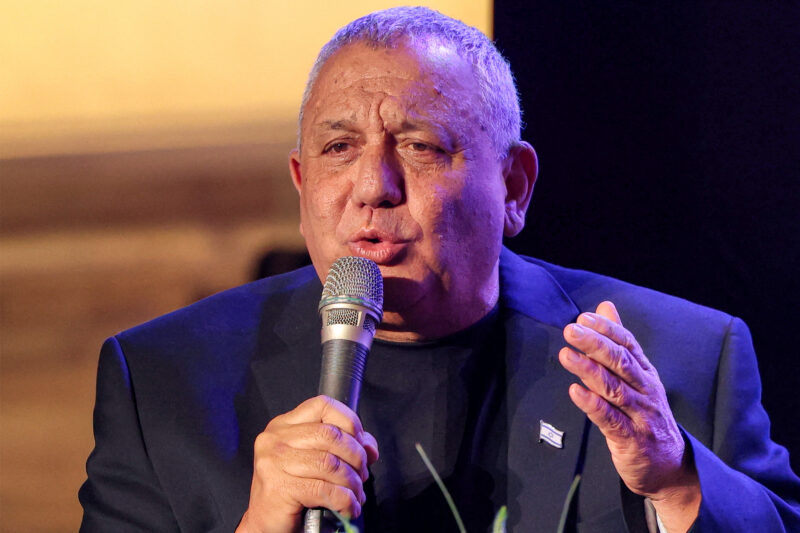

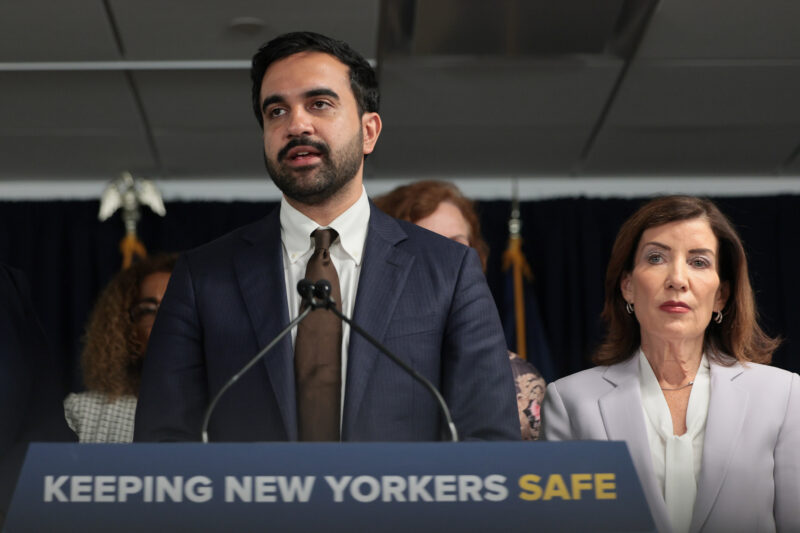







































The congressman once again declined to endorse Zohran Mamdani in the NYC mayoral race but said he is ‘likely to win’

Tom Williams/CQ-Roll Call, Inc via Getty Images
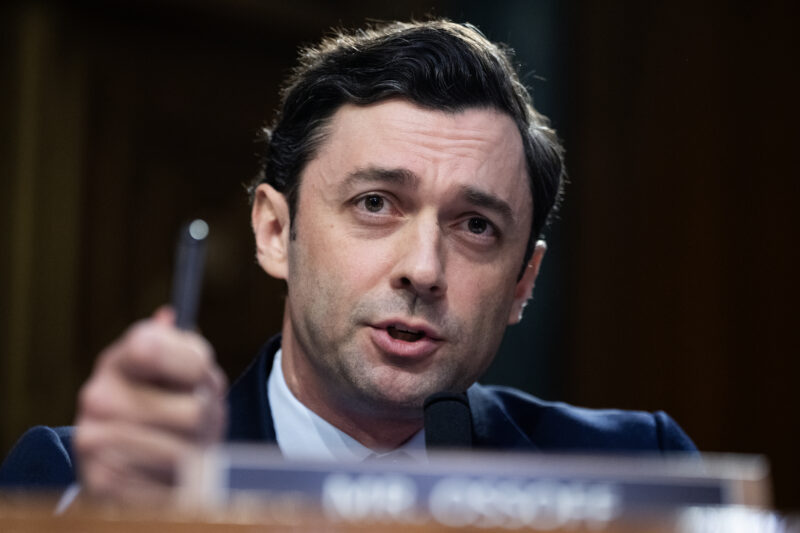
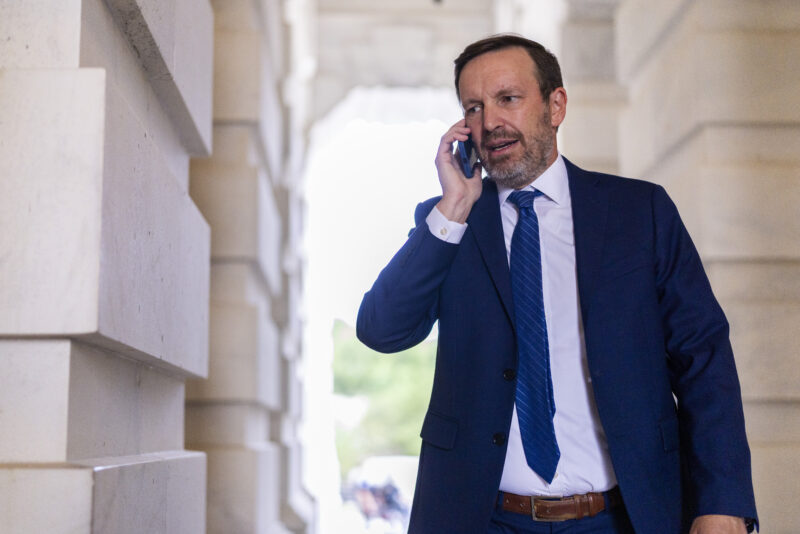
Rep. Ritchie Torres (D-NY) is seen in the U.S. Capitol on Friday, June 28, 2024.


 Add JewishInsider on Google
Rep. Ritchie Torres (D-NY) said Wednesday that he’s unlikely to mount a primary challenge against New York Gov. Kathy Hochul, after months of circling a potential run for that office.
“I’m unlikely to run for governor. The assault that we’ve seen on the social safety in the Bronx is so unprecedented, so overwhelming that I’m going to keep my focus on Washington, D.C.,” Torres, a favorite of the Jewish community, said on MSNBC’s “Morning Joe.” “So, my heart lies in Washington, D.C. I feel like now, more than ever, we have to fight the catastrophe that is the Trump presidency.”
Hochul’s lieutenant governor, Antonio Delgado, already declared his candidacy against the governor.
Torres also once again declined to endorse Zohran Mamdani, the Democratic nominee for New York City mayor, but said Mamdani is “likely to win.”
“There’s a difference between praising the man in his policies and praising the manner in which he ran his campaign. I mean, when it comes to how he ran his campaign, he’s genuinely a singular figure,” Torres said. “We do have an obligation to learn from his race. And I suspect he won not because he ran on divisive issues like ‘globalize the intifada’ or ‘defund the police.’ He ran on affordability.”
Torres said he spoke to Mamdani on Sunday and that they have “profound differences of opinion, and I’m not going to downplay those differences, but I’m committed to a working relationship with him. I’m committed to continuing dialogue.” He said that the mayor and the city’s congressional delegation have a “mutually necessary relationship, so we will coexist.”
Two Dallas therapists filed suit against their former employer for discrimination and retaliation, alleging they were terminated for speaking out against a policy barring discussion of religious opinions

BSIP/UIG Via Getty Images
Models
One November afternoon last year, Jackie Junger and Jacqueline Katz, both therapists at a private practice in Dallas, sat down with their colleagues for their weekly team meeting. This one-hour gathering was a lifeline for the therapists, where they could discuss challenges their clients were facing and receive advice from their fellow practitioners.
When a non-Jewish therapist asked for help better understanding a Jewish client who was “experiencing trauma with everything going on,” Junger and Katz — both Jewish — were eager to offer insight about the surge in antisemitism in the United States, in the hopes of helping their colleague better serve her client. But before Junger, 29, and Katz, 61, could speak, their supervisor, Dr. Dina Hijazi, shut down the conversation.
“I don’t think that’s a good idea, because you’ll get a one-sided response,” Hijazi told the therapists, according to legal filings.
The next day, Hijazi emailed the team and asked them to avoid discussing the “Palestine Israel topic” because she has “great pain” around the issue. But no one had mentioned the events in the Middle East at that meeting. Junger and Katz each responded to Hijazi’s note: Why, they wondered, would it be considered “one-sided” for Jewish therapists to speak about their understanding of antisemitism and Jewish trauma?
Over the next five days, Junger and Katz would see their lives upended after they chose to raise concerns about antisemitism and double standards against Jewish practitioners and clients.
That’s the key allegation at the heart of a federal lawsuit that Junger and Katz filed last month against D2 Counseling and its co-owners, Hijazi and Rev. Daniel Gowan. The two Jewish therapists claim they were discriminated against for objecting to their supervisors’ handling of antisemitism — and that, ultimately, they faced unlawful retaliation when they were fired days later. On the Monday before Thanksgiving, both received identical voicemails letting them know they had been terminated, saying they were no longer a “good fit” for D2. (An attorney representing Hijazi and Gowan declined to respond to detailed questions, citing the ongoing legal proceedings. The account in this article is based on an interview with Katz and Junger, allegations in their lawsuit and information shared by their lawyer.)
The incident was jarring for both Katz and Junger, they told Jewish Insider this week. But the biggest travesty, they said, is not that they lost their jobs: It’s that Jewish clients at their old practice should no longer expect to receive the highest level of care — because of their religion.
“This Jewish client — I don’t know who it is, obviously, I just know that it’s a Jewish client who is genuinely seeking support for something that they’re having trouble with in their life. It’s real trauma. I think most Jews can appreciate that it’s really traumatic, what’s happening,” Junger told JI. “And they’re not allowed to get competent health care. They have no clue.”
*****
This case is only a single incident experienced by just two of the nation’s more than 100,000 licensed therapists. But it comes amid what Jewish mental health professionals in the United States have described as an increasingly hostile professional environment, where denunciations of Israel are expected and outright antisemitism is no longer a taboo, particularly after the Oct. 7, 2023, terror attacks in Israel.
Earlier this year, the state of Illinois formally reprimanded a social worker who had created a blacklist publicly naming “Zionist” therapists. (The clinicians included on the list said it was just a pretext for targeting Jews.)
In May, Rep. Ritchie Torres (D-NY) warned of a “persistent and pernicious pattern of antisemitism” at the American Psychological Association, the preeminent professional organization for psychologists in the U.S.
Empathy is supposed to be the central tenet of the mental health field, but compassion and understanding are not always extended to Jewish therapists — or worse, their clients.
“Our role is really to facilitate the discussion, to honor their feelings, and to create a safe space — to create a space that [clients] can communicate what they’re experiencing internally, without any sort of feeling that, ‘I’m going to be shut down or marginalized or not taken seriously,’” Katz explained.
It was clear to Junger and Katz soon after the Oct. 7 attacks that team conversations about what was happening in the Middle East would be different from other issues they’d been discussing for years.
“We talk about current events a lot because these things affect our clients,” said Katz. The D2 team had talked about the war in Ukraine soon after it started; abortion access following the Supreme Court’s overturning of Roe v. Wade in 2022; and gun control after a mass shooting at a Texas mall in 2023.
A therapist helping a client work through issues with their sexuality might seek advice from a gay co-worker. Past meetings also included discussions of Mormonism and Islam, according to the complaint filed by Katz and Junger. Hijazi led a conversation about how to help clients who were having an emotional reaction to President Donald Trump’s reelection shortly after it occurred, according to the lawsuit.
“It’s very common to seek peer consultation, supervision from someone who has expertise, whether it’s lived experience or clinical experience,” Junger told JI. “If someone, let’s say, had cancer, and I had a client who’s going through cancer, I might reach out and say, ‘Hey, what would be helpful for me to know?’”
Three days after the Oct. 7 attacks, when the D2 team gathered as they do each Tuesday, Hijazi and Gowan did not address the recent terror attacks.
“We were all very shocked that we weren’t going to address the elephant in the room, as it were, and it quickly fell apart because one of my coworkers brought it up. ‘Aren’t we going to talk about what happened? We’re all very upset and suffering here,’” said Katz. “And it was shut down.”
Lesson learned, according to Katz and Junger: Don’t bring up Israel or Gaza again. It wasn’t an overt order, but the palpable discomfort from Hijazi and Gowan kept a lid on future conversations.
Still, Hijazi’s strong reaction to the conversation about antisemitism a year later, in November 2024, surprised Junger and Katz. No one had mentioned Israel or Gaza. But Hijazi followed up with an email requesting that the “Palestine Israel topic” not be discussed.
“I have great pain around this as I know some of you do as well,” Hijazi wrote in the email, which was shared with JI. “In order for me to work and be present with my clients I have asked that this be kept out of the noon meeting.” (What Hijazi did not share is that her family is Palestinian — a fact her daughter discussed in an online blog post viewed by JI, but one Hijazi didn’t mention to colleagues.)
Katz and Junger did not see how a question about the trauma of a Jewish patient in Texas could be extrapolated to extend to the Israeli-Palestinian conflict, nor did they understand why Hijazi chose to shut down future discussions of Jewish trauma. Separately, they each responded with lengthy emails, screenshots of which were included in the lawsuit.
“I believe every single one of us has Jewish clients, and the more we understand, the better we can service our clients,” Junger wrote in her email.
Katz took issue with Hijazi letting her own emotions guide the discussion, a therapist no-no.
“As a managing partner in this practice I think it was essential for you to be able to manage the inquiry without adopting the victim role and personalizing it to your pain,” Katz wrote in another email. “I understand that you were protecting yourself by leaving the room, however the impact was that some of us felt shut down and unheard.”
The matter only escalated from there, playing out like most modern office dramas: over email, leaving a lengthy digital record.
Hijazi banned the expression of “political or religious opinions” in the group meetings, under the rationale of “safety in the workplace.” “Emotional safety for the group,” she wrote, “will always come before personal agendas.”
But Katz and Junger were still unsure what was political about their earlier meeting and decided to press the point about their concern for Jewish clients. “I think your failure to see that this was not a political conversation is a huge blind spot for you,” wrote Katz. Gowan responded by telling her she was “way over the line,” a sentiment Hijazi echoed.
Over that weekend, on Sunday night, Junger chimed in, too. “I would love some clarification, as I am feeling lots of confusion,” she wrote. “Would wanting more clarity on a Black client experiencing racism violate that policy as well? How about talking about a client who is part of the LGBTQ community and experiencing trauma and discrimination? Are we allowed to talk about their lived experience? Or does this rule only apply to Jewish clients?”
That was Junger’s final message to her bosses about the matter. Katz chimed in after, saying she had the same questions.
A day later, they were both fired.
“It was just outrageous behavior on their part, I think, and so punishing, really. You open your mouth here, and this is what happens to you,” said Katz. “If we weren’t Jewish, [the other therapist] wouldn’t have asked us for supervision. If we weren’t Jewish, we wouldn’t have spoken up. If we weren’t Jewish, we wouldn’t have been let go.”
Their contract required D2 to give them 30 days to finish seeing clients. But they were forced to move to a different office, and asked to pay tens of thousands of dollars stemming from a part of the contract with buyout options and a non-compete clause. (They have refused to pay.)
“I knew antisemitism was on the rise, but to have it so blatant in my face in this way was really shocking. It was honestly a little scary,” said Junger.
*****
Winning an employment discrimination suit is not an easy task. But the lawyers at the Lawfare Project and Winston & Strawn representing Katz and Junger are confident that they have a strong case.
“It’s very rare to see a case like this, a discrimination retaliation case like this, where the employer’s actions are so brazen,” said Jaclyn Clark, the Lawfare Project attorney who brought the case. “I strongly suspect that the employer in this instance just thought that they could get away with it … So from my standpoint, beyond just shining a light on the issue of antisemitism in the mental health field, the politicization of Jewish trauma and all of those things, is also to put these smaller employers on warning.”
Orly Lobel, an employment law expert at the University of San Diego who looked over the complaint, described it as “a strong case, since it is all documented with email exchanges and there is no pretextual reason for the termination,” she told JI.
Junger and Katz’s attorneys allege that they faced discrimination as members of a racial minority, leaning on a 1987 Supreme Court ruling as precedent. L. Camille Hébert, a professor at The Ohio State University’s law school, said the race-based argument could be a tougher bar to clear than if the therapists made an argument about religious discrimination. But she noted that the facts laid out in the complaint paint a picture of discrimination.
“If the facts are as alleged, that all subjects were allowed to be addressed in the meetings other than antisemitism, then there might be a cognizable claim of discrimination based on religion. The defense of ‘workplace safety’ seems not to be a particularly strong one,” Hébert said after reviewing the complaint.
*****
Jewish therapists aren’t the only ones worried about antisemitism in the field. People seeking mental health care are, too, and Junger and Katz say they are right to be concerned.
After she was fired by D2, Junger created a list of Jewish therapists in the Dallas area to share with the people in the Jewish community who come to her asking for a referral. Since Oct. 7, she has seen more people seeking out a therapist who understands Jewish issues — and she understands why.
“Maybe a while ago I would have been like, ‘No, it’s a therapist job to [listen]. They’re not political. It’s OK,’” said Junger. “Now I’m like, ‘I get that.’ It makes sense to want to have safety and know that you have a real safe space to be able to process things that are directly impacting us.”
GHF head Johnnie Moore said the world is turning a blind eye to Hamas violence against aid workers
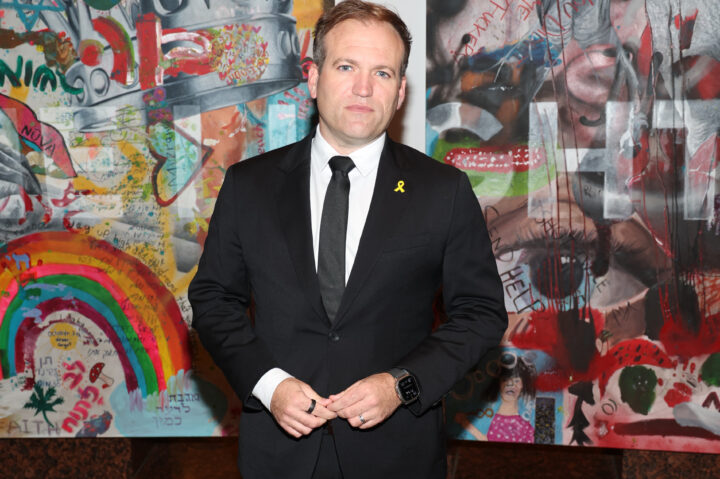
Jerritt Clark/Getty Images for Museum of Tolerance
Reverend Dr. Johnnie Moore, President of the Congress of Christian Leaders attends the Museum Of Tolerance Commemoration of the one-year anniversary of the October 7 attacks at Museum Of Tolerance on October 06, 2024 in Los Angeles, California.
Rev. Johnnie Moore, a member of President Donald Trump’s evangelical advisory committee, has years of experience with complex situations in the Middle East. He helped evacuate Christian refugees under threat from ISIS and has advocated for religious freedom and tolerance for minorities in the region.
But the challenges Moore faces as executive chairman of the Gaza Humanitarian Foundation, the U.S. group, supported by Israel, that began distributing food and humanitarian aid in Gaza in May, have been unique.
Since its inception, GHF has faced a pervasive negative narrative in the international media and among aid organizations. More recent statements from U.N. and other aid groups in effect accuse the GHF of being an IDF front luring Gaza residents to one place so they can be attacked, while largely ignoring Hamas violence against Palestinians working with the GHF.
In a wide-ranging interview this week with the Misgav Institute for National Security’s “Mideast Horizons” podcast, co-hosted by Jewish Insider’s Lahav Harkov, Moore pushed back against what he says are false narratives about the group’s work and accused aid organizations of “sabotage” and spreading disinformation, while acknowledging the challenges of aid distribution in an active war zone.
*****
GHF is addressing “a problem that everyone knew and admitted existed … and now everyone has amnesia,” Moore said. “The vast majority of humanitarian assistance that has gone into the Gaza Strip over many, many, many years, was almost immediately diverted into the hands of Hamas, and then used for various nefarious purposes. And I’m not talking about some of the aid — I’m talking about almost all of the aid.”
As such, the mission of GHF is to equally and directly distribute aid to Gazans without having it be “used to prolong a conflict or hoarded,” he said.
Since the beginning of GHF’s operations on May 26, the organization has opened four distribution sites in southern Gaza, from which it said it has provided Gazans with over 958,000 boxes of food. Moore said the GHF calculates meals with a greater caloric value than what the U.N. aid organizations distribute, and by the GHF’s count, it has distributed over 54.8 million meals.
“In an objective world, this would be viewed as an incredible success,” Moore said. “To my great surprise, we poked a number of bears that I wasn’t anticipating, and not all of them are Hamas threatening our local aid workers and the Americans helping these people. A lot of [the antagonists] wear suits and are in places like Geneva and New York City.”
Moore quipped that he has faced “lots of trouble” in his career advocating for religious freedom for Christian minorities around the world, including death threats and sanctions from the Chinese Communist Party, but that the negative response to GHF is unique.
“Respectable — I don’t even call them respectable anymore — elite organizations that we would assume [have] good intent have just attacked us again and again. The whole time, we’re like ‘cooperate with us … teach us, let’s find ways of solving problems together,’” to no avail, he said.
Moore said he would have liked to collaborate with major humanitarian organizations, such as the World Food Program, but that the U.N. has “been trying to sabotage us from the very beginning.”
“We’d really like the people whose job it has been to do this for many years to decide to help us,” he added. “Instead, they spread lies that originate in Hamas and try to shut us down, and I can’t think of anything more immoral than trying to shut down an operation that’s … feeding millions and millions of meals every day.”
Moore said details his staff on the ground in Gaza have heard from residents have been “a shock to us,” and revealing about other humanitarian aid groups’ conduct.
“Early on, we had a number of people who wanted to confirm that the aid was free, because in every other circumstance, their experience was that the aid that was coming in from the United Nations and other organizations was being taken and sold to them. It was unbelievable to them that we were giving this stuff away for free,” Moore said.
Moore pushed back against news stories associating death and killing in Gaza with the GHF and its distribution sites, slamming them as “lies.”
“We didn’t wait for a ceasefire to start our aid distribution. We’re distributing aid in the middle of a hot war,” he said. “There have been incidents in the Gaza Strip of civilians being killed. But what’s clear is that there is this very intentional disinformation campaign that is trying to say that … the GHF is a death trap, that we exist not to feed people 50 million meals, but to lure people. This is the lie that they keep telling.”
Hamas has dedicated extensive efforts to delegitimizing GHF in the eyes of the world and trying to threaten and scare Gaza residents seeking food from GHF, Moore said.
“They release these statistics every single day and they say that all these people are being killed at our aid sites or in close proximity to our aid sites,” Moore said. “This is their primary way of both trying to scare Gazans [from] getting our aid, trying to force us to shut down, trying to force European governments not to fund us, for the United Nations to continue opposing us.”
Moore has been actively pushing back on social media against false claims about GHF, and called on the media and international organizations to scrutinize claims from the terrorist organization in Gaza, “but no one is asking hard questions,” he lamented.
“What about the prolific evidence that we do have of Hamas intentionally killing people and then attributing their murder to the GHF or others?” he added.
Moore said that “sometimes you read all these crazy headlines and you’re like, ‘Am I deceiving myself here?’ but we’re actually talking to the people [of Gaza] every day, and it seems [reality] really is in many cases the exact opposite.”
On the ground in Gaza, Moore says people are adapting to GHF’s mode of distribution, with families often getting together to trade if one needs more of one product than another. GHF also tries to be flexible under the circumstances, having morning and evening distribution times when needed to keep the process more orderly.
Some Israeli politicians have maintained that providing aid for Gaza hinders the achievement of Israel’s war aims. Some on the right, who oppose letting any aid into Gaza, argue that if Hamas can pocket humanitarian aid and make money selling it, they will continue to control the enclave. And Hamas does still retain a significant measure of control over the area, despite more than 20 months of IDF operations.
Moore agreed with the argument that Hamas’ ability to take control of aid was “prolonging the conflict,” but said that GHF’s “mission is not related to the war.”
Still, he said that he thinks Hamas feels very threatened by GHF: “The fact is that Hamas continues to threaten Gazans and killed 12 of our local workers two weeks ago and nearly killed others and tortured others … Hamas took them to the Al Nasr Hospital and piled the dead and the injured outside … and wouldn’t let them get medical treatment, in order to send a message.”
“So I think it’s a hard argument to make that Hamas doesn’t oppose what we’re doing or isn’t somehow feeling threatened by what we’re doing,” Moore added. “Think of the fact that they issued bounties on the heads of Americans … They’re doing everything they can to shut [the GHF] down, which means that every time our aid workers, local or American, step into [Gaza], they are risking their lives in order to feed people.”
Moore noted that GHF does not operate in northern Gaza, where U.N. trucks continue to enter and are often taken by Hamas: “There was one day where 55 U.N. trucks went in and literally 52 were hijacked at gunpoint by Hamas or Hamas-linked militants,” he said. Another example he recalled was a time when “there was a [U.N.] truck that went in … Hamas wasn’t able to hijack the truck. So what does Hamas do? Hamas kills civilians around the truck to try to keep the civilians from getting what they can.”
“Amidst all of this, the U.N. literally told the BBC that none of their aid had been diverted. Zero. That was the official statement,” Moore said. “The U.N. is just lying through their teeth.”
Moore declined to share who funds GHF, but said that “the seed funding … principally came from a couple of countries, not Israel, that wanted to remain totally secret for political reasons.” Moore said he supports the decision of those countries not to reveal themselves, because of the negative narrative about the GHF, and expressed appreciation for the Trump administration for contributing to the foundation and encouraging others to do the same.
*****
Last month, Moore visited Syria with Rabbi Abraham Cooper of the Simon Wiesenthal Foundation and a Syrian Muslim refugee who had fled the country. In Damascus, Moore met with al-Sharaa for nearly three hours.
Moore’s approach to al-Sharaa’s new government in Syria, he said, “comes down to two things. Number one … You’re saying nice things, but can we trust you? And number two, if we can trust you, are you actually capable of doing these things?”
Following the meeting, Moore said, “I absolutely believe there will be peace between Syria and Israel.”
“I think the first priority in Syria has to be the stabilization of Syria. But I definitely left that conversation with a very clear idea of what needed to be done, of how it could be done, and of the probability in the right time of it being done in order to see peace all across the region.”
There have been contradictory reports in recent days as to whether al-Sharaa is willing to acknowledge Israeli sovereignty in the Golan Heights. Moore suggested that peace between the countries may involve things that make both sides “uncomfortable.”
“I do think many of us, including many people in Israel, misread certain aspects of this new government, all for good reasons,” Moore added, referring to those who highlight al-Sharaa’s history as a leader of an Al Qaeda affiliate in Syria. “Those of us who focus on the Middle East … have a tendency to be, we can be cynical, we can be conspiratorial, we can be a bit paranoid sometimes … But I always say the most valuable commodity in the Middle East is not oil or gas, it’s trust. If there’s no trust, nothing exists. And our visit was a trust-building exercise, and it was far more beneficial than I expected.”
Moore called al-Sharaa “a type of unicorn.”
“He comes from an Islamist orientation, no question whatsoever. But I’m not sure you can take this person and easily profile him,” Moore said. “This is the last gasp of a lot of extremists and when I met with Shahra, I viewed him as being more like [Saudi Crown Prince Mohammed bin Salman] as almost any other of the leaders that I’ve that I’ve met with, in terms of his generation, and the way he talks about solving problems and all of these things. This is a younger generation of leaders in a region with a lot of older leaders who think only about the past. I think al-Sharaa, like MBS, and a few other leaders, are future-oriented.”
Moore called for the U.S. to help Syria rebuild, because the country’s economy and infrastructure are in shambles.
*****
Moore has also been a longstanding advocate for a strong U.S.-Israel relationship and evangelical support for Israel.
Asked about polls showing decreasing support for Israel among young evangelicals, and the rise of figures such as Candace Owens and Tucker Carlson who have used Christianity as an argument against such support, Moore said he thinks the decline is exaggerated as is the influence of the podcasters.
“For a long time, there was exaggerated concern about a rise of antisemitism on the right while we were watching this incredible surging of antisemitism on the left. Well, now, I’m sorry to say, but we’re seeing it on both sides,” Moore said. “Yet, it actually isn’t the right. OK, it’s a type of pseudo-libertarianism. You know that isn’t a part of the institutional right, but because of the internet, it’s much more influential.”
Still, he added, “I’m not seeing some of these actors becoming more influential among evangelicals. I’m seeing evangelicals reject these influencers as they start talking about things that evangelicals actually know quite well … like skepticism about, you know, the evangelical relationship with Israel.”
Moore said he summarizes the relationship between evangelicals worldwide with the Jewish community, and Israel in one sentence: “Your book is our book; your heroes are our heroes; and your values, while we interpret them differently, are our values.”
“You have this massively dispersed religious movement around the world, 700 million people, and they all generally feel the same, 80-90% of them, about the Jewish community and Israel, because they get it from the Bible,” he said. “I’m not focused very much on politics these days, as we try to feed Gaza, but I think the evangelical community all around the world is a positive force and I don’t think the macro trends are changing at all.”
The Israeli prime minister’s visit is scheduled as Ron Dermer is in Washington for White House meetings

SAUL LOEB/AFP via Getty Images
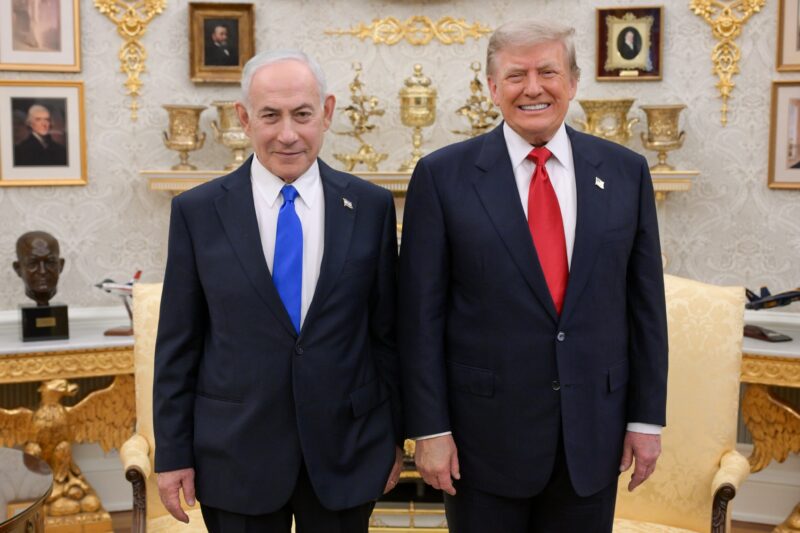
President Donald Trump shakes hands with Israeli Prime Minister Benjamin Netanyahu during a meeting in the Oval Office of the White House in Washington, DC, on April 7, 2025.
Israeli Prime Minister Benjamin Netanyahu will meet with President Donald Trump at the White House next Monday, a Trump administration official confirmed to Jewish Insider.
The visit, which will come just two weeks after Trump announced a cease-fire between Israel and Iran, will be Netanyahu’s third Oval Office meeting this year.
Ron Dermer, Israel’s strategic affairs minister, is in Washington this week for White House meetings about efforts to end the war in Gaza. “MAKE THE DEAL IN GAZA. GET THE HOSTAGES BACK!” Trump posted on Truth Social over the weekend.
The Trump-Netanyahu meeting also comes after a lengthy post from the president slamming Israeli prosecutors’ corruption case against Netanyahu.
“It is terrible what they are doing in Israel to Bibi Netanyahu. He is a War Hero, and a Prime Minister who did a fabulous job working with the United States to bring Great Success in getting rid of the dangerous Nuclear threat in Iran,” Trump wrote on Truth Social on Saturday.
An Israeli court canceled hearings scheduled for this week in the case after Netanyahu requested a delay for classified security and diplomatic reasons.
Obama’s former national security advisor disagreed with David Petraeus, John Bolton over the effectiveness of the strikes

Win McNamee/Getty Images
Former National Security Advisor Susan Rice speaks at the J Street 2018 National Conference April 16, 2018 in Washington, D.C.
Susan Rice, who served as national security advisor during the Obama administration’s nuclear deal with Iran, sharply criticized President Donald Trump’s decision to strike Tehran’s nuclear program while defending the 2015 agreement during a panel discussion on Monday at the Aspen Institute’s Ideas Festival.
Rice, who was on stage with former Trump administration National Security Advisor John Bolton and former CIA director David Petraeus, disagreed with her two colleagues that Trump’s Iran strikes were largely a success.
“I think the resort to military action when diplomacy had not been exhausted was a strategic mistake,” Rice said. “And the reality is, and we’re back to this point today, only diplomacy and a negotiated settlement can ensure the sustainable and verifiable dismantling of Iran’s nuclear program. You need inspectors on the ground. You need verifiable constraints that are very significant, and you don’t achieve that by ripping up the 2015 nuclear agreement and replacing it with nothing.”
Rice joins a chorus of former Obama and Biden administration officials who have criticized Trump’s decision to strike Iran’s nuclear facilities, despite many experts concluding the damage to the program was significant. IDF Chief of Staff Eyal Zamir, for instance, said that “based on the assessments of senior officers in IDF Intelligence, the damage to [Iran’s] nuclear program is … systemic … severe, broad and deep, and pushed back by years.”
Last week, former Secretary of State Tony Blinken wrote an op-ed in The New York Times: “The strike on three of Iran’s nuclear facilities by the United States was unwise and unnecessary. Now that it’s done, I very much hope it succeeded.”
At the Aspen Ideas Festival last week, former Biden administration National Security Advisor Jake Sullivan told moderator Fareed Zakaria: “We still need a deal because Iran still has, it appears, stockpiles of enriched uranium, still has centrifuge capacity, even if the installed centrifuge capacity has been destroyed or damaged or who knows what, and still has know-how and therefore still has the possibility of reconstituting its program.”
Bolton, on the same panel as Rice, argued that the time was ripe for military action against Iran.
“I think the regime is weaker than at any point since the 1979 revolution,” Bolton said. “But I think we will never have an opportunity this good to remove not just the nuclear program but the Iranian support for terrorism, which dates back to 1979 when they seized our embassy employees and it went downhill from there.”
Bolton outlined several ways in which Iranians are dissatisfied with the regime, including economic stagnation and state of women’s rights in the country.
“The answer is regime change. But in the meantime, we want to make sure that there aren’t any even possible successful efforts by Iran to do something with what they have,” Bolton said.
Turning to Israel’s war in Gaza, all members of the panel argued that Israel needed to shift its strategy to successfully eliminate Hamas. Bolton said that, despite successfully degrading the terror group’s organizational structure, Israel had not successfully fulfilled all of its war goals, which include eliminating Hamas and securing the release of all the hostages.
Bolton argued that an additional objective of the war should be to “provide a better future for the Palestinians without Hamas in their lives. The only way you can achieve all four of these is … by going in and conducting a comprehensive civil military counterinsurgency campaign. You clear every building floor room and block all the tunnel entrances, let the people that belong there back in with biometric ID cards, and then you have an entry control point to the rest of Gaza. With security, anything is possible.”
The president also said that he would require Iran to allow entry for international inspectors to ensure the regime doesn’t rebuild its nuclear program

U.S. President Donald Trump speaks to reporters before boarding the Marine One presidential helicopter (Photo by Chip Somodevilla/Getty Images)
President Donald Trump announced Friday afternoon that he was suspending the possibility of sanctions relief efforts with Iran after Supreme Leader Ayatollah Khamenei defiantly proclaimed victory over the U.S. and Israel in a videotaped message.
“During the last few days, I was working on the possible removal of sanctions, and other things, which would have given a much better chance to Iran at a full, fast, and complete recovery – The sanctions are BITING! But no, instead I get [sic] hit with a statement of anger, hatred, and disgust, and immediately dropped all work on sanction relief, and more,” Trump said in the Truth Social post.
Previously, Trump had announced the potential for sanctions relief towards Iran during a press conference at the NATO Summit on Wednesday as part of a desire to help them recover from the war in exchange for other concessions. Later that day, Witkoff confirmed the administration had begun rolling back sanctions, although an administration official denied there was a change in policy.
In addition to ending any sanctions relief efforts, Trump said in a White House press conference that he would require Iran to allow entry for international inspectors to ensure the regime doesn’t rebuild its nuclear program.
The pivot comes as Israel Defense Minister Israel Katz announced that Israel will adopt the “Lebanon model” against Iran. The plan calls for continuing strikes against military targets to further degrade Iran’s military capabilities and cement the progress made during this month’s war.
Massie is one of the most outspoken Republican critics of the U.S.-Israel relationship in the House

Andrew Harnik/Getty Images
Rep. Thomas Massie (R-KY) speaks to reporters as he arrives for a House Republican caucus meeting at the U.S. Capitol on February 25, 2025 in Washington, DC.
A new super PAC launched by aides to President Donald Trump aimed at unseating Rep. Thomas Massie (R-KY) placed its first ads in a $1 million blitz in Kentucky targeting the isolationist lawmaker for his refusal to support key parts of the president’s agenda, Jewish Insider has learned.
The Kentucky MAGA PAC was launched earlier this month by Chris LaCivita, who co-managed Trump’s 2024 campaign, and Tony Fabrizio, the president’s pollster, with the goal of defeating Massie in the GOP primary for his House seat next May. LaCivita told Axios at the time that the PAC would spend “whatever it takes” to defeat the Kentucky lawmaker.
Trump and those in his orbit have been discussing the idea of primarying Massie for months, as the congressman criticized the president’s reconciliation package and his approach to foreign policy. Most recently, Massie decried Trump’s decision to strike Iran’s nuclear facilities as part of Israel’s military operation to destroy the regime’s nuclear program as unconstitutional.
The ad, which opens with the question, “What happened to Thomas Massie?” criticizes Massie for voting against Trump-backed legislation on sex reassignment surgery for minors, tax cuts, border security funding and his opposition to the Iran strikes.
“After Trump obliterated Iran’s nuclear weapons program, Massie sided with Democrats and the Ayatollah,” the ad’s narrator intones. “Let’s fire Thomas Massie.”
The ad superimposes Massie’s face and his tweet calling the strikes unconstitutional next to pictures of Ayatollah Ali Khamenei, the Iranian supreme leader, Sen. Bernie Sanders (I-VT) and Rep. Alexandria Ocasio-Cortez (D-NY).
Massie is among the most outspoken Republican critics of the U.S.-Israel relationship in the House, and consistently opposes U.S. aid to Israel and nearly all measures to combat antisemitism.
He’s also been repeatedly condemned by colleagues on both sides of the aisle and Jewish leaders in his home state for antisemitism, often over comments about AIPAC and other pro-Israel advocates.
Thus far, Massie does not appear to have any serious primary challengers.
“Massie sided with Democrats and the Ayatollah.”
— Yashar Ali 🐘 (@yashar) June 26, 2025
President Trump’s anti-Thomas Massie SuperPAC is out with its first ad against the Kentucky Congressman. pic.twitter.com/OwpfP3P6ql
The Republican Jewish Coalition said earlier this year it would join Trump in backing a primary challenger to Massie. “The RJC is proud to join with President Trump to defeat Massie,” the group’s spokesperson, Sam Markstein, said Thursday, when asked about the new PAC.
Past primary attempts against Massie — a Trump antagonist dating back to his first term — have fallen short.
Though it did not make a direct attempt to challenge him in his primary race last year, where he faced no serious competition, the AIPAC-affiliated United Democracy Project super PAC spent several hundred thousand dollars on ads criticizing Massie.
Massie was seen as a potential Senate candidate to run for Sen. Mitch McConnell’s (R-KY) seat, but hasn’t yet announced any plans to run. He’s also been floated as a Kentucky gubernatorial candidate.
The RJC pledged it would spend an “unlimited” budget to oppose a potential Massie Senate run.
A new report by Israel Hayom says the two leaders also agreed that the U.S. would recognize Israeli sovereignty in parts of the West Bank and Israel would voice support for a two-state solution

SAUL LOEB/AFP via Getty Images
President Donald Trump with Israeli Prime Minister Benjamin Netanyahu during the signing of the Abraham Accords.
President Donald Trump and Israeli Prime Minister Benjamin Netanyahu agreed to terms to end the war in Gaza and advance other shared interests in a telephone call held shortly after the U.S. struck nuclear sites in Iran earlier this week, according to a new report by Israel Hayom.
A source familiar with the conversation told the right-leaning Israeli daily that Trump and Netanyahu were joined on the call by Secretary of State Marco Rubio and Israeli Minister of Strategic Affairs Ron Dermer, where the four determined that Israel would end the war in Gaza within two weeks.
This process would include the exiling of what remains of Hamas’ leadership from Gaza, voluntary emigration for Gazans who elect to leave the territory — though which countries would host them was not specified in the report — and the release of the 50 hostages remaining in Gaza, less than half of whom are thought to be alive.
Under the terms of the agreement, the UAE and Egypt, along with two other Arab countries, would jointly govern the Gaza Strip after Hamas’ removal.
In addition, the Abraham Accords would be expanded to include Syria and Saudi Arabia, as well as additional Arab and Muslim states.
The plan would also see U.S. recognition of “limited” Israeli sovereignty in the West Bank, while Israel would express support for a future two-state solution premised on reforms within the Palestinian Authority.
Shortly after the publication of the Israel Hayom report, Netanyahu released a statement saying, “We fought valiantly against Iran — and achieved a great victory. This victory opens up an opportunity for a dramatic expansion of the peace agreements. We are working hard on this.”
“Along with the release of our hostages and the defeat of Hamas, there is a window of opportunity here that must not be missed,” Netanyahu added. “Not even a single day must be wasted.”
The following morning, however, Netanyahu’s office released a new statement saying, “The conversation described in the ‘Israel Today’ report did not happen. The diplomatic proposal described in the article was not presented to Israel and Israel obviously did not agree to it.”
The feasibility of this plan remains in question. The Israeli government has been firm in its opposition to a two-state solution and public opposition to a Palestinian state grew after the Oct. 7, 2023, Hamas terror attacks. In April, as French President Emmanuel Macron moved to recognize a Palestinian state, Netanyahu “expressed fierce opposition” to the move in a phone call with Macron and conveyed to him that “a Palestinian state established a few minutes away from Israeli cities would become an Iranian stronghold of terrorism; that the vast majority of the Israeli public opposes that categorically — and that this has been the PM’s consistent and longstanding policy,” according to a readout from the Prime Minister’s Office.
Even the potential acceptance of a future Palestinian state could put Netanyahu’s governing coalition at risk, with not only the parties led by Finance Minister Bezalel Smotrich, National Security Minister Itamar Ben-Gvir and Foreign Minister Gideon Sa’ar adamantly opposing one, but most Likud lawmakers, as well.
U.S. lawmakers told Jewish Insider last week after a trip to the region that the normalization process between Saudi Arabia and Israel had been dealt setbacks by and since Oct. 7 and that the Saudis were demanding concrete progress toward a two-state solution before moving forward with normalization.
Egypt and Saudi Arabia in March condemned moves by the Israeli government to encourage migration from Gaza. The Arab League, meeting earlier that month, also adopted a plan for Gaza’s reconstruction put forward by Egypt where a committee of Gazan professionals would manage the Strip for a period of time until the Palestinian Authority would take over its governance.
JI’s Tamara Zieve contributed to this report.
Speaking at the World Affairs Council of New Hampshire, the former secretary of state said Trump’s decision to act militarily ‘delivered more security for our friends in Israel and made the world safer’

Siavosh Hosseini/SOPA Images/LightRocket via Getty Images
Former Secretary of State Mike Pompeo speaking at a conference titled "Iran: Organized Resistance, Key to Overthrow" held at the National Council of Resistance of Iran (NCRI) headquarters in January 2025.
Former Secretary of State Mike Pompeo praised President Donald Trump on Wednesday for his decision to strike Iran’s nuclear facilities over the weekend, pushing back on criticism from the isolationist right that the attack would embroil the U.S. in another prolonged conflict in the Middle East.
Pompeo appeared at the World Affairs Council of New Hampshire, a part of the New Hampshire Institute of Politics, for “Building Back American Deterrence and Strength in a Dangerous World.” The former secretary of state said during a moderated conversation with Tim Horgan, WACNH’s executive director, that the U.S. strikes served to prevent war rather than cause it.
“Make no mistake, President Trump’s decision to act … delivered more security for our friends in Israel and made the world safer. America reasserted its global leadership. We didn’t send the 82nd [bomb squadron] — we sent America,” Pompeo said.
Pompeo said that he believed the strikes by Israel and the U.S. on Iran’s nuclear facilities had restored deterrence in regard to both Iran and North Korea. “I do know this: [North Korean] Chairman Kim [Jong Un] is sitting a little less comfortably on his throne today,” he said.
Pompeo, who also served as CIA director from 2017-2018, said he rejected accusations from the progressive left and isolationist right that U.S. military engagement in recent decades had largely led to extended wars that failed to achieve any serious national security objectives.
“I’ve been called a neocon warmonger or worse. But for four years [when I was CIA director and secretary of state] we had no wars. It wasn’t because we were peaceniks and isolationists, it was because of our understanding of the things that matter to America,” Pompeo explained.
Pompeo also reaffirmed his belief in continued U.S. support for Ukraine in its war with Russia, arguing that the success of the Ukrainians would ensure the safety of Western nations.
“We have to win,” Pompeo said. “The West needs to win, Ukraine needs to win, Europe needs to win.”
At the NATO summit, Trump said he doesn’t see Iran ‘getting back in the nuclear business’
NICOLAS TUCAT/AFP via Getty Images
Defense Secretary Pete Hegseth (L) and Secretary of State Marco Rubio (R) listen as US President Donald Trump addresses a press conference during a North Atlantic Treaty Organization (NATO) Heads of State and Government summit in The Hague on June 25, 2025. =
President Donald Trump announced on Wednesday that the U.S. and Iran will hold a meeting next week, but said that he doesn’t think reaching a nuclear agreement with the country is necessary in the aftermath of U.S. strikes on the Islamic Republic’s nuclear facilities.
Speaking at a press conference before leaving the NATO summit in the Netherlands, Trump said, in response to a question asking if he was interested in restarting nuclear negotiations with Iran, “I’m not.”
“The way I look at it, they fought, the war is done,” Trump continued. “And you know, I could get a statement that they’re not going to go nuclear. We’re probably going to ask for that, but they’re not going to be doing it anyway.” He said he had asked Secretary of State Marco Rubio to draw up a “little agreement for them to sign, because I think we can get them to sign it. I don’t think it’s necessary.”
Trump announced that the U.S. is “going to talk to them next week, with Iran. We may sign an agreement, I don’t know. To me, I don’t think it’s that necessary. I mean, they had a war they fought. Now they’re going back to their world. I don’t care if I have an agreement or not. The only thing we’d be asking for is what we were asking for before, about ‘we want no nuclear,’ but we destroyed the nuclear. … I said ‘Iran will not have nuclear.’ Well, we blew it up. It’s blown up to kingdom come. And so I don’t feel very strongly about it.”
The president said that he “doesn’t see [Iran] getting back involved in the nuclear business anymore” but “if it does, we’re always there. It won’t be me, it’ll be somebody else, but we’re there. We’ll have to do something about it.”
Asked if he is “giving up” on his maximum-pressure campaign against Iran after he announced that China can again buy oil from Iran, contravening congressionally approved sanctions legislation, Trump said that he wanted Tehran to use the funds to rebuild.
“No, look, they just had a war. They fought it bravely. I’m not giving up. They’re in the oil business. I mean, I could stop it if I wanted. I could sell China the oil myself. I don’t want to do that. [Iran is] going to need money to put that country back into shape. We want to see that happen.”
Speaking a day after an initial Pentagon assessment was leaked stating that the U.S. and Israel did not completely destroy Iran’s nuclear program and amid concerns that some nuclear material may have been smuggled elsewhere before the strikes, Trump said, “I think all of the nuclear stuff is down there, because it’s very hard to remove. And we did it very quickly. When they heard we were coming, it was, you know, you can’t move. It’s very hard, very dangerous, actually, to move. And they also knew we were coming. So I don’t think too many people want to be down there knowing we’re coming with the bunker-busters, as we call them. … We think it’s covered with granite, concrete and steel.”
Secretary of Defense Pete Hegseth said the report was a “low assessment,” meaning “low confidence in the data in that report. Why is there low confidence? Because all of the evidence of what was just bombed by 12 30,000-pound bombs is buried under a mountain — devastated and obliterated. So if you want to make an assessment of what happened at Fordow, you better get a big shovel and go really deep, because Iran’s nuclear program is obliterated.”
Trump read out an assessment by the Israel Atomic Energy Agency, released today, that said, “The devastating U.S. strike on Fordow destroyed the site’s critical infrastructure and rendered the enrichment facility totally inoperable. We assess that the American strikes on Iran’s nuclear facilities has set back Iran’s ability to develop nuclear weapons for many years to come. This achievement can continue indefinitely if Iran does not get access to nuclear material.”
“Which it won’t,” Trump added.
Plus, Schumer’s 'shomer' struggles
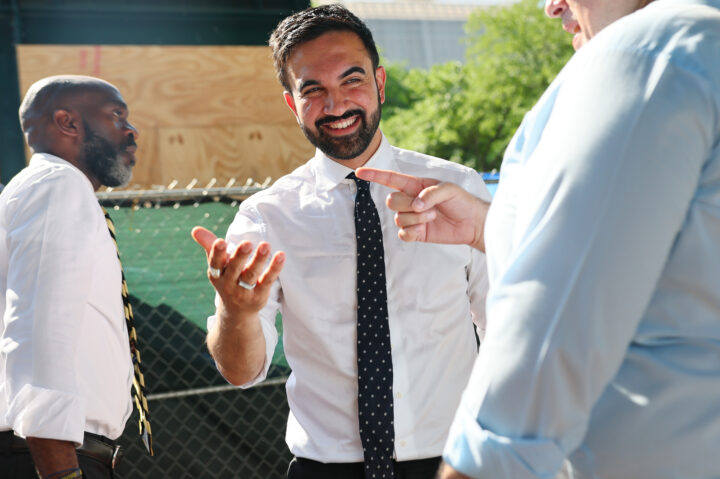
Michael M. Santiago/Getty Images
New York mayoral candidate, State Rep. Zohran Mamdani (D-NY) greets voters with Democratic mayoral candidate Michael Blake on 161st Street on June 24, 2025 in the South Bronx in New York City. Mamdani held several campaign events throughout the day including greeting voters with mayoral candidates Blake and NYC Comptroller and Mayoral Candidate Brad Lander as voters in NYC vote for the democratic nominee for mayor to replace Mayor Eric Adams.
Good Wednesday morning.
In today’s Daily Kickoff, we report on President Donald Trump’s comments at the NATO summit today comparing the U.S. strike on Iranian nuclear facilities to the bombings of Nagasaki and Hiroshima, and look at what Zohran Mamdani’s victory in Tuesday’s New York City Democratic mayoral primary means for the direction of the party going forward. We look at the challenges facing Senate Minority Leader Chuck Schumer as the New York Democrat faces increasing pressure from within his party to oppose the Trump administration on foreign policy matters, and report on the House Appropriations Committee’s vote to boost Nonprofit Security Grant Funding by $30 million. Also in today’s Daily Kickoff: Jordan Schultz, Natan Sharansky, David Ellison and Bari Weiss.
What We’re Watching
- President Donald Trump is in The Hague, Netherlands, today for the NATO Summit. He’ll return to the U.S. tonight, following a press conference at 3 p.m. local time, 9 a.m. ET. More below on Trump’s comments at the gathering earlier today.
- This morning, Attorney General Pam Bondi is testifying before the Senate Appropriations Committee on the Justice Department’s FY2026 budget, while U.S. Agency for Global Media Senior Advisor Kari Lake is slated to testify before the House Foreign Affairs Committee.
- Elsewhere on Capitol Hill, the Conference of Presidents of Major American Jewish Organizations and the Jewish Federations of North America are holding a two-day leadership mission to Washington, with conversations with lawmakers expected to focus on domestic antisemitism and the Israel-Iran war.
- Former Secretary of State Mike Pompeo will deliver a speech at the Institute of Politics in New Hampshire today on the U.S. and Israel’s strikes on Iran’s nuclear program and “rebuilding American strength and deterrence in a dangerous world.”
- The Jewish Democratic Council of America is hosting an event this afternoon looking at the U.S. role during wartime in Israel. Dana Stroul, who served as deputy assistant secretary of defense for the Middle East during the Biden administration, and former U.S. Ambassador to Israel Dan Shapiro are slated to speak.
- The Aspen Ideas Festival kicks off this evening in Colorado. Walter Isaacson and Fareed Zakaria are set to take the stage in tonight’s opening session for a conversation about global current events.
What You Should Know
A QUICK WORD WITH JI’S MATTHEW KASSEL
Zohran Mamdani’s presumed victory over Andrew Cuomo in New York City’s Democratic primary for mayor on Tuesday evening marks an extraordinary upset that until recently seemed all but unthinkable for the far-left state assemblyman from Queens who entered the race last October with virtually no name recognition.
The stunning rise of the 33-year-old democratic socialist with a long history of anti-Israel activism sent shockwaves through New York City’s political establishment and is already reverberating beyond the Big Apple, raising questions over the ideological direction of the Democratic Party as it has struggled to land on a cohesive messaging strategy to counter President Donald Trump.
With the midterms looming, Trump’s allies are already reportedly preparing to link Mamdani’s radical politics to the broader Democratic brand.
Meanwhile, in a place home to the largest Jewish population of any city in the world, Mamdani’s path to the nomination is also contributing to a growing sense of political homelessness among Jewish Democrats who voiced discomfort with his strident criticism of Israel and refusal to condemn extreme rhetoric such as “globalize the intifada,” a slogan that critics interpret as fueling antisemitism.
Mamdani’s insurgent victory five months into Trump’s second term was reminiscent of then-upstart Rep. Alexandria Ocasio-Cortez’s (D-NY) upset primary victory over then-Rep. Joe Crowley (D-NY) in the spring of 2018, one of the seminal moments that year of the political backlash to Trump. It was an early signal that the party, even as it elected a number of moderate lawmakers in that year’s Democratic wave, was moving inexorably leftward in reaction to a Trump White House.
WEAPON QUESTION
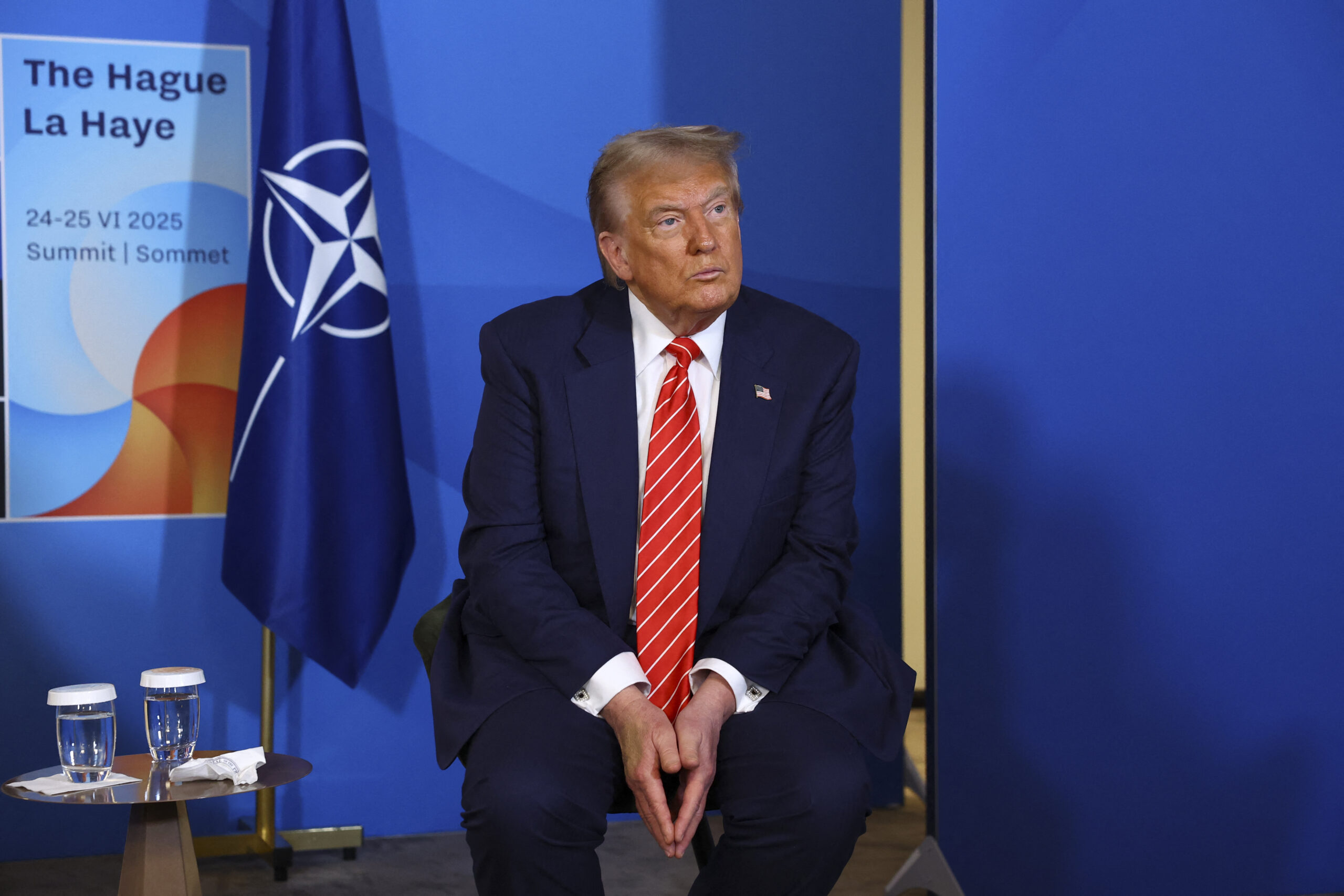
President Donald Trump and other administration officials denied a report that U.S. strikes on Iranian nuclear facilities had only set Iran’s nuclear program back by several months, continuing to insist the nuclear sites were “completely destroyed” and “obliterated,” Jewish Insider’s Danielle Cohen reports. CNN reported on Tuesday night that an early intelligence assessment by the Pentagon found that the core components of Iran’s nuclear program were still intact and the regime could continue seeking a nuclear bomb, according to seven people briefed on the matter.
From the Hague: Speaking from the NATO Summit in the Netherlands on Wednesday, Trump told reporters, “That was a perfect operation. … And also, and nobody’s talking about this, we shot 30 Tomahawks from submarines … and every one of those Tomahawks hit within a foot of where they were supposed to hit. Took out a lot of buildings that Israel wasn’t able to get. … This was a devastating attack and it knocked them for a loop. And, you know, if it didn’t, they wouldn’t have settled. … If that thing wasn’t devastated, they never would have settled.”
Diplomatic dispatch: In an interview with independent Iranian media outlet Iran International, Israeli Ambassador to the U.S. Yechiel Leiter said Israel is “not in the position to make a long-term strategy for another country. Our long-term strategy is to stay alive,” Jewish Insider’s Gabby Deutch reports.
TWO HATS

Senate Minority Leader Chuck Schumer (D-NY) finds himself in an awkward bind: The self-dubbed “Shomer Yisrael” — “guardian of the people of Israel” — is now the “Shomer of the Democratic Party” — guardian of a caucus that has drifted increasingly leftward, especially when it comes to its support for Israel and aggressive action to deter Iran’s nuclear ambitions. When he had the opportunity earlier this month to take a clean shot at President Donald Trump for not being tough enough against Iran, he played to his history of hawkishness on Iran, taunting Trump for “folding” and “let[ting] Iran get away with everything,” facing backlash from some on the left in the process. But when Trump made the decision to bomb Iran’s nuclear sites last weekend, Schumer joined the majority of congressional Democrats, who blasted the administration for not seeking congressional authorization, Jewish Insider’s Marc Rod reports.
Raising eyebrows: “No president should be allowed to unilaterally march this nation into something as consequential as war with erratic threats and no strategy,” Schumer said Saturday. “Confronting Iran’s ruthless campaign of terror, nuclear ambitions, and regional aggression demands strength, resolve, and strategic clarity. The danger of wider, longer, and more devastating war has now dramatically increased.” Schumer’s turnaround is raising eyebrows among Jewish and pro-Israel leaders, and his focus on congressional procedure is frustrating some in the pro-Israel community who wanted to see him support Trump’s efforts to eliminate Iran’s nuclear program.
DEM DRIVE

A Senate war powers resolution aiming to block further U.S. military action against Iran appears to be building and solidifying support among Democrats ahead of an anticipated vote later this week, Jewish Insider’s Marc Rod reports.
Making tweaks: Sens. Adam Schiff (D-CA), Andy Kim (D-NJ) and Tim Kaine (D-VA) announced Tuesday they’d be introducing an amendment to Kaine’s resolution to specifically ensure that the U.S. can continue to share intelligence with Israel and to assist Israel’s defense and provide it with defensive equipment to counter attacks by Iran and its proxies. A House resolution on the issue had prompted private divisions among Democrats earlier this week over a similar issue, with many lawmakers concerned that the resolution would prevent the U.S. from continuing to support Israeli missile defense, a Democratic staffer not authorized to speak publicly told JI.
Ted’s take: Sen. Ted Cruz (R-TX) on Tuesday proposed another amendment to Kaine’s resolution, commending President Donald Trump for a “successful mission” in damaging the regime’s nuclear program.
STRAIT TALK

Vice Admiral Brad Cooper, the deputy commander of U.S. Central Command who is nominated to be the next CENTCOM head, said at his Senate confirmation hearing on Tuesday that the United States is prepared for the possibility that Iran will attempt to place mines in the Strait of Hormuz to close off the strategic waterway, Jewish Insider’s Marc Rod reports.
Tricky situation: The incoming CENTCOM leader, who previously led naval forces in CENTCOM and the Fifth Fleet based out of Bahrain, told the Senate Armed Services Committee that the U.S. “has sufficient capacity and capability to handle the threat” of mining the Strait of Hormuz, and that it is keeping a close eye on Iranian movements that would signal such an operation is occurring. Cooper acknowledged that the potential shutdown of the Strait of Hormuz would have “significant” impacts on U.S. operations in the Middle East. He said it would be a “complex problem,” given that Iran has stockpiles of thousands of mines, and noted that “historically in mine warfare, nothing happens quickly.”
Petroleum pivot?: President Donald Trump announced Tuesday that he would allow China to continue to purchase oil from Iran, though a senior White House official denied there had been any change in policy or that sanctions would be lifted, Jewish Insider’s Marc Rod reports.
Q&A

For decades, former Israeli politician and Soviet refusenik Natan Sharansky has championed the cause of freedom from oppressive regimes. Dissidents across the world have found inspiration in his books and sought his advice and support. Iranians seeking to topple the totalitarian mullahs’ regime are no different. Soon after Israel began its strikes on the Islamic Republic’s nuclear, weapons production and military sites, Sharansky, who has been in contact with Iranian dissidents, expressed hope that the war would increase pressure on the regime from within Iran, leading to its downfall. Sharansky spoke with Jewish Insider’s Lahav Harkov on Tuesday about the prospects of the Iranian people rising up against Supreme Leader Ayatollah Ali Khamenei.
Talkin’ bout a revolution: “Iran was unique among the dictatorial countries in the Middle East [in] that it had a very developed civil society. There were women’s organizations, students, trade unions organized against the regime,” Sharansky said. “I can tell you that in the estimation of many dissidents when we had a meeting 15 years ago in Prague, we chose Iran as the most likely candidate for a revolution. In 2009, you had the beginning of a revolution, but [former President Barack] Obama decided engagement with the regime was more important than changing the regime, so the regime was strong enough to destroy [the opposition]. Now, not only is the regime weaker in the eyes of the people, but it was exposed as a paper tiger so quickly and it lost all symbols of power.”
ON THE HILL

The House Appropriations Committee voted on Tuesday to boost its proposal for 2026 Nonprofit Security Grant Program funding by $30 million, up to $335 million, an increase that Jewish groups say is a positive, but insufficient step, amid rising threats to the community, Jewish Insider’s Marc Rod reports.
Right direction: The change was approved by a voice vote of the committee as part of a bipartisan package of amendments. Eric Fingerhut, the CEO of the Jewish Federations of North America, told JI that JFNA is “grateful” for the funding boost, which is “a meaningful step forward, but it’s still not enough.”
Worthy Reads
Remember Beirut: In The Free Press, Albert Eisenberg, whose grandfather was killed in the 1983 bombing of the U.S. Embassy in Beirut, reflects on the recent assassinations of senior Iranian officials, including the July 2024 targeted strike against mastermind of the embassy bombing. “My grandfather was not an invading conqueror. He was a civilian employee of the U.S. government whose desire was to help build up other countries. He was murdered in 1983 by a regime that considers anyone they don’t like an enemy to be enslaved, tortured, or killed. This is not a regime that should ever be trusted with nuclear weapons, and our country’s involvement this weekend in preventing that from happening is justified. In any conflict, if there is one side deliberately targeting civilians — as Iran has done to its own people and to countless Americans since the ayatollahs came to power in 1979 — we should know that this is the side to oppose.” [FreePress]
Military Die is Cast: In The New York Times, former Secretary of State Tony Blinken suggests that, despite his opposition to the Trump administration’s strikes on Iranian nuclear facilities, he hopes they were successful. The Biden administration’s “deployments, deterrence and active defense of Israel when Iran directly attacked it for the first time allowed Israel to degrade Iran’s proxies and its air defenses without a wider war. In so doing, we set the table for Mr. Trump to negotiate the new nuclear deal he pledged years ago to work toward — or to strike. I wish that he had played out the diplomatic hand we left him. Now that the military die has been cast, I can only hope that we inflicted maximum damage — damage that gives the president the leverage he needs to finally deliver the deal he has so far failed to achieve.” [NYTimes]
What’s in a Slogan?: The Atlantic’s Jonathan Chait acknowledges concerns over New York City Democratic mayoral nominee Zohran Mamdani’s defense of the “globalize the intifada” slogan, understood by many, including Jewish voters, to be a call for violence against Jews around the world. “The ambiguity of the slogan is not a point in its defense but a point against it. The dual meanings allow the movement to contain both peaceful and militant wings, without the former having to take responsibility for the latter. If activists refused to employ slogans that double as a form of violent incitement, it would insulate them from any association with the harassment and violence that has tainted their protests. Their failure to do so reveals an unwillingness to draw lines, as does Mamdani’s reluctance to allow any daylight between him and their rhetoric.” [TheAtlantic]
Word on the Street
The White House is restaffing its National Security Council, weeks after mass purges following the removal of Mike Waltz as national security advisor that significantly downsized the office; Bloomberg reports that some of the ousted staffers have been asked to return to the NSC…
The FBI is returning counterterrorism staffers who had been reassigned to immigration cases amid concerns about potential domestic terror threats from Iran…
Reps. Brad Schneider (D-IL) and Gus Bilirakis (R-FL) sent a letter to European Union officials raising concerns about proposals to downgrade or suspend the EU’s Association Agreement with Israel…
Congressional Democrats reacted with outrage to the postponement of scheduled classified briefings on the U.S. strikes on Iran, accusing the administration of attempting to hide the truth from lawmakers…
A majority of House Democrats — 128 — voted with Republicans to kill an effort led by Rep. Al Green (D-TX) to impeach President Donald Trump for striking Iran without congressional authorization; 79 members voted to move the effort forward…
Rep. Marjorie Taylor Greene (R-GA) suggested in an X post that President John F. Kennedy was assassinated over his opposition to Israel’s nuclear program…
Manhattan Borough President Mark Levine defeated NYC Councilmember Justin Brannan in the city’s comptroller race; in Brooklyn, Maya Kornberg failed to oust Councilmember Shahana Hanif in the Park Slope district; former Rep. Anthony Weiner (D-NY) fell short in his city council bid, coming in fourth in a five-person race to represent parts of lower Manhattan…
A prominent member of Qatar’s royal family boosted Zohran Mamdani, a far-left Queens state assemblyman, in his campaign for mayor of New York City, Jewish Insider’s Matthew Kassel reports…
Illinois Gov. JB Pritzker is expected to announce his bid for a third term on Thursday…
The Louis D. Brandeis Center for Human Rights Under Law filed suit in federal court in Massachusetts on Wednesday on behalf of two Jewish students, alleging that the university and a tenured professor violated Title VI of the Civil Rights Act of 1964, including harassment on social media and in mass emails, Jewish Insider’s Haley Cohen reports…
Oliver Darcy reports in his Substack that Skydance Media CEO David Ellison met with Bari Weiss last year in an effort to recruit the Free Press founder to CBS’ news division…
The Washington Post profiles NFL reporter Jordan Schultz, the son of former Starbucks CEO Howard Schultz and self-described “new breed of sports journalist,” who has leveraged personal ties and relationships to break news…
U.S. immigration authorities arrested 11 Iranian nationals, including one believed to be a former Islamic Revolutionary Guard Corps member with ties to Hezbollah…
The Board of Deputies of British Jews suspended five of the 36 members who signed on to an open letter earlier this year criticizing the Israeli government for its actions in Gaza…
Seven IDF soldiers were killed when a bomb planted on their armored vehicle exploded in the southern Gaza Strip…
Chinese officials are reportedly reconsidering a plan to build an oil pipeline between China and Russia as Beijing looks to alternatives to Middle East oil and gas in the wake of the Israel-Iran war…
Iran executed three prisoners in its Urmia Prison who were accused of spying for Israel and bringing “assassination equipment” into the country…
Photographer Marcia Resnick died at 74…
Pic of the Day
Birthdays

Founder and CEO of The Agency, Mauricio Umansky turns 55…
Music publicist in the 1970s and 1980s for Prince, Billy Joel and Styx, later an author on human behavior, Howard Bloom turns 82… Founder and CEO of Bel Air Partners, a financial advisory firm for automotive retailers, Sheldon J. Sandler turns 81… Real estate developer in Brooklyn, Manhattan, Las Vegas and Miami and founder of The Continuum Company, Ian Bruce Eichner turns 80… Florida resident, Joseph C. Goldberg… Southern California-based mentor, coach and consultant for business executives through Vistage International, Gary Brennglass… Associate justice of the Supreme Court of the United States, Justice Sonia Sotomayor turns 71… Former member of the Knesset for the Meretz party, Michal Rozin turns 56… Managing director of A-Street, an investment fund focused on seeding and scaling innovative K-12 student learning, Mora Segal… Senior media and PR specialist at Hadassah, Helen Chernikoff… Israeli philosopher, writer and publicist, he teaches at Yeshivat Har Etzion and Midreshet Lindenbaum, Rabbi Chaim Navon turns 52… Founder and director of The Biblical Museum of Natural History in Beit Shemesh, known as the “Zoo Rabbi,” Natan Slifkin turns 50… Former fashion model and television presenter, Michele Merkin turns 50… Deputy director of government relations at Bread for the World, Zachary Silberman… President of Gratz College in Melrose Park, Pa., Zev Eleff turns 40… One-half of the husband-and-wife duo known for their YouTube channel h3h3Productions with more than 1.3 billion views, Ethan Edward Klein… Manager of strategic content at Leidos until a few months ago, Isaac Snyder… VP of strategy at Saint Paul Commodities and co-founder of Veriflux, Daniel “Dani” Charles turns 38… Medical resident at Temple University School of Medicine, Avital Mintz-Morgenthau, MD… Senior producer covering the White House for CNN, Betsy Klein… Center fielder in the San Francisco Giants organization, he was the 10th overall pick in the 2019 MLB draft, Hunter David Bishop turns 27…
CNN reported that an early intelligence assessment by the Pentagon found that the core components of Iran’s nuclear program were still intact

PIROSCHKA VAN DE WOUW/POOL/AFP via Getty Images
President Donald Trump talks to the media during a meeting with NATO Secretary General at the NATO summit of heads of state and government in The Hague on June 25, 2025.
President Donald Trump and other administration officials denied a report that U.S. strikes on Iranian nuclear facilities had only set Iran’s nuclear program back by several months, continuing to insist the nuclear sites were “completely destroyed” and “obliterated.”
CNN reported on Tuesday night that an early intelligence assessment by the Pentagon found that the core components of Iran’s nuclear program were still intact and the regime could continue seeking a nuclear bomb, according to seven people briefed on the matter.
Speaking from the NATO Summit in the Netherlands on Wednesday, Trump told reporters, “That was a perfect operation. … And also, and nobody’s talking about this, we shot 30 Tomahawks from submarines … and every one of those Tomahawks hit within a foot of where they were supposed to hit. Took out a lot of buildings that Israel wasn’t able to get. … This was a devastating attack and it knocked them for a loop. And, you know, if it didn’t, they wouldn’t have settled. … If that thing wasn’t devastated, they never would have settled.”
“I don’t want to use an example of Hiroshima. I don’t want to use an example of Nagasaki, but that was essentially the same thing that ended that war,” he said later. “This ended that with the war. If we didn’t take that out, they’d be fighting right now.”
“It was obliteration,” he said of the U.S. strikes in Iran. “And you’ll see that, and it’s going to come out. Israel is doing a report on it, I understand. … You know, they have guys that go in there after the hit, and they said it was total obliteration.”
“I don’t think they’ll ever do it again,” Trump continued, referring to Iran’s enrichment of uranium. “They just went through hell. I think they’ve had it. The last thing they want to do is enrich.”
The president also posted on Truth Social earlier, saying, “FAKE NEWS CNN, TOGETHER WITH THE FAILING NEW YORK TIMES, HAVE TEAMED UP IN AN ATTEMPT TO DEMEAN ONE OF THE MOST SUCCESSFUL MILITARY STRIKES IN HISTORY. THE NUCLEAR SITES IN IRAN ARE COMPLETELY DESTROYED! BOTH THE TIMES AND CNN ARE GETTING SLAMMED BY THE PUBLIC!”
Middle East envoy Steve Witkoff, speaking to Fox News shortly after the CNN report was released, called the leak “treasonous” and said, “There is no doubt that it [Iran’s nuclear program] was obliterated. So the reporting out there that in some ways suggests that we didn’t achieve the objective is just completely preposterous.” He said it was “not even conceivable” that Iran could still achieve a nuclear weapon within months.
Secretary of State Marco Rubio similarly denied the report but offered a more measured assessment of Iranian nuclear capabilities, telling Politico on the sidelines of the NATO Summit on Wednesday that, “The bottom line is, they are much further away from a nuclear weapon today than they were before the president took this bold action. That’s the most important thing to understand — significant, very significant, substantial damage was done to a variety of different components, and we’re just learning more about it.”
White House Spokesperson Karoline Leavitt said, “This alleged ‘assessment’ is flat-out wrong and was classified as ‘top secret’ but was still leaked to CNN by an anonymous, low-level loser in the intelligence community. … Everyone knows what happens when you drop fourteen 30,000 pound bombs perfectly on their targets: total obliteration.”
A CNN spokesperson said in a statement to Jewish Insider, “CNN stands by our thorough reporting on an early intelligence assessment of the recent strikes on Iran’s nuclear facilities, which has since been confirmed by other news organizations. The White House has acknowledged the existence of the assessment, and their statement is included in our story.”
David Albright, president and founder of the Institute for Science and International Security and an expert on the Iranian nuclear program, called the report “hard to believe” and “misleading.” Among other analyses, he said Iran has “likely lost close to 20,000 centrifuges at Natanz and Fordow, creating a major bottleneck in any reconstitution effort. Moreover, there has been considerable damage to Iran’s ability to build the nuclear weapon itself.”
The Texas Republican introduced the amendment in anticipation of a vote later this week on the resolution, which would curtail the president’s ability to take any additional action targeting Iran without congressional approval

Tom Williams/CQ-Roll Call, Inc via Getty Images
Sen. Ted Cruz (R-TX) is seen outside a Senate Judiciary Committee markup on Thursday, November 14, 2024.
Sen. Ted Cruz (R-TX) on Tuesday proposed an amendment to Sen. Tim Kaine’s (D-VA) war powers resolution, which would block the U.S. from taking further military action against Iran, commending President Donald Trump for a “successful mission” in damaging the regime’s nuclear program.
Cruz introduced the amendment in anticipation of a vote later this week on the resolution, which would curtail the president’s ability to take any additional action targeting Iran without congressional approval. The amendment, if adopted, would attach language to the resolution celebrating the very actions it seeks to block.
“Members of the United States Armed Forces and intelligence community, and all those involved in the planning and successful execution of Operation Midnight Hammer on June 21, 2025, including President Donald J. Trump, should be commended for their efforts in a successful mission,” the amendment reads.
The Texas senator offered an identical amendment praising the president’s actions when Kaine introduced a war powers act in 2020 in response to Trump’s decision to assassinate Quds Force head Gen. Qassem Soleimani. That amendment, which said that those involved in the operation “should be commended for their efforts in a successful mission,” passed 64-34.
“The Senate routinely passes this language to applaud presidents for operations like these, which make all Americans immeasurably safer. We came together to congratulate President Obama for liquidating Osama bin Laden, and the Senate voted to applaud President Trump for doing the same to Soleimani. I intend to ensure we do the same for this weekend’s crucial operation, which eliminated the existential threat to America of a nuclear-armed Iran,” Cruz told Jewish Insider in a statement.
Kaine told reporters on Monday that his resolution was likely to come up for a vote on Thursday or Friday.
The White House denied Trump’s comments signaled any policy change or the lifting of U.S. sanctions

ATTA KENARE/AFP/Getty Images
Oil tanker SC Hong Kong is seen off the port of Bandar Abbas, southern Iran, on July 2, 2012.
President Donald Trump announced Tuesday that he would allow China to continue to purchase oil from Iran, though a senior White House official denied there had been any change in policy or that sanctions would be lifted.
Trump’s comments appeared to many observers to be a reversal of his own administration’s actions just months ago and in contravention of congressionally approved sanctions designed to cut off the Iran-China oil trade, one of Iran’s most critical sources of funding.
Trump’s comments drove concern among supporters of the sanctions and Iran analysts, who believe that loosening sanctions on Iran now will help it gather funding to rebuild its nuclear program.
“China can now continue to purchase Oil from Iran,” Trump posted on Truth Social on Tuesday morning, following the implementation of a ceasefire between Iran and Israel. “Hopefully they will be purchasing plenty from the U.S., also. It was my Great Honor to make this happen!”
Congress last year passed two separate bills with broad bipartisan support, the SHIP (Stop Harboring Iranian Petroleum) Act and the Iran China Energy Sanctions Act, which were specifically designed to choke off the oil trade between Iran and China. A third bill, the Enhanced Iran Sanctions Act, to place additional sanctions on the trade, has been advancing in the House with strong bipartisan support.
Trump’s announcement appears to mark a striking turnaround from his commitment to “maximum pressure” on Iran. Just months ago, the administration imposed sanctions on Chinese “teapot” refineries for importing Iranian oil for the first time, with the goal of pressuring Iran.
“The President is committed to drive Iran’s illicit oil exports, including to China, to zero,” State Department spokesperson Tammy Bruce said in April. “All sanctions will be fully enforced under the Trump Administration’s maximum pressure campaign on Iran.”
A senior White House official told JI on Tuesday that “The President was simply calling attention to the fact that, because of his decisive actions to obliterate Iran’s nuclear facilities and broker a ceasefire between Israel and Iran, the Strait of Hormuz will not be impacted, which would have been devastating for China.”
The official continued, “The President continues to call on China and all countries to import our state-of-the-art oil rather than import Iranian oil in violation of U.S. sanctions.”
“China is the main consumer of Iranian oil. Enabling China to continue purchasing Iranian oil violates existing sanctions and will allow Iran to rebuild its capabilities, including its nuclear program,” Rep. Josh Gottheimer (D-NJ), the lead Democratic sponsor of the Iran China Energy Sanctions Act, told Jewish Insider.
“With the regime now significantly weakened, we must continue applying maximum pressure and cut off its sources of funding. Doing so will help protect America, our military and diplomatic assets, and our allies around the world.”
Rep. Mike Lawler (R-NY), the lead sponsor of both bills, did not respond to a request for comment.
Trump’s announcement is also driving concern from Iran analysts.
“China purchasing oil from Iran allows it to rearm, refinance and rebuild making future conflict with Israel more likely. It also gives Tehran resources to rebuild its nuclear program,” Jason Brodsky, the policy director for United Against Nuclear Iran, warned. “Also if your goal is zero enrichment in Iran, allowing China to flood Iran with resources makes that goal harder to achieve.”
Brodsky added: “The calculus behind getting China to curtail its purchases of Iranian oil is to achieve zero enrichment in Iran, which has been the president’s longstanding and rightful position.”
“If ever there was a time for more maximum pressure, it would be in a post-strike scenario to contain or roll back the Islamic Republic and prevent China and Russia from helping it ‘build back better,’” Behnam Ben Taleblu, the senior director of the Iran program at the Foundation for Defense of Democracies, said.
Ben Taleblu also noted the sanctions “[undermine] the spirit and letter” of the administration’s executive order and national security memorandum on oil sanctions, while FDD’s CEO Mark Dubowitz highlighted that the trade “violate[s] U.S. sanctions — passed by Congress on a bipartisan basis.”
AIPAC, which urged lawmakers to support the SHIP Act, said in a statement, “We must continue to apply maximum pressure on Iran to ensure that it cannot rebuild its nuclear and ballistic missile capabilities.”
This story was updated at 5:50 p.m. on Tuesday to include comments from a White House spokesperson.
Trump: ‘I'm not happy with Iran, but I'm really not happy with Israel … [Israel and Iran] don’t know what the f*** they’re doing’

Tasos Katopodis/Getty Images
President Donald Trump
President Donald Trump blasted Israel on Tuesday morning after it said it would respond to Iranian violations of the ceasefire, telling reporters, “I’m not happy with Iran, but I’m really not happy with Israel.”
“We have two countries that have been fighting for so long and so hard that they don’t know what the f*** they’re doing,” he continued, speaking to reporters at Joint Base Andrews before taking off to attend the NATO summit at The Hague, Netherlands.
The IDF intercepted two missiles from Iran at about 10:30 a.m. Israel time, just hours after the ceasefire announced by Trump on Monday night came into effect. Israeli Defense Minister Israel Katz said he “instructed the IDF to respond forcefully to the violation of the ceasefire by Iran with powerful strikes against regime targets in the heart of Tehran.”
Asked about Iran’s violation of the ceasefire, Trump said, “They violated it but Israel violated it, too. Israel, as soon as we made the deal, came out and they dropped a load of bombs the likes of which I’ve never seen before. … I’m not happy with Iran, either, but I’m really not happy if Israel is going out this morning because of one rocket that didn’t land, that was shot perhaps by mistake, that didn’t land. I’m not happy about that.”
“These guys gotta calm down, it’s ridiculous,” he added later.
The Prime Minister’s Office said in a statement on Tuesday, “The ceasefire was set for 7 a.m. At 3 a.m., Israel forcefully struck at the heart of Tehran, damaging regime targets and eliminating hundreds of Basij militants and Iranian security forces. Shortly before the ceasefire went into effect, Iran sent a barrage of missiles, one of which took the lives of four of our civilians in Beersheba. At 7:00 the ceasefire went into effect. At 7:06 Iran sent one missile to Israeli territory and at 10:25, two additional missiles. The missiles were intercepted or fell in open areas with none injured and no damage.”
Shortly after he made his comments, Trump posted to Truth Social, “ISRAEL. DO NOT DROP THOSE BOMBS. IF YOU DO IT IS A MAJOR VIOLATION. BRING YOUR PILOTS HOME, NOW!”
Jerusalem sought clarifications from the Trump administration after his Truth Social post, an Israeli official told Jewish Insider, as the president had previously reassured Israel it could respond to Iranian violations of the ceasefire.
A senior Israeli official told Axios’ Barak Ravid that Trump called Israeli Prime Minister Benjamin Netanyahu on Tuesday and told him not to respond to Iran. Netanyahu reportedly told the president he could not cancel the strike and needed to give some kind of response to Iran’s violation of the ceasefire, and it was ultimately decided Israel would significantly scale back its attack and strike only one target.
The PMO confirmed the Israeli Air Force destroyed a radar system near Tehran as its response.
“Following a conversation between President Trump and Prime Minister Netanyahu,” the PMO continued, “Israel avoided conducting further strikes. In their conversation, President Trump expressed his great appreciation for Israel, which reached all of its goals in the war. The president also expressed his confidence in the stability of the ceasefire.”
After the conversation, Trump wrote on Truth Social, “ISRAEL is not going to attack Iran. All planes will turn around and head home, while doing a friendly ‘Plane Wave’ to Iran. Nobody will be hurt, the Ceasefire is in effect!” and then wrote, “IRAN WILL NEVER REBUILD THEIR NUCLEAR FACILITIES!”
Jewish Insider’s senior political correspondent Lahav Harkov contributed to this report.
Experts agree that Iran’s nuclear program was significantly derailed, but uncertainty remains about the status of the country’s enriched uranium

DigitalGlobe via Getty Images
This is a satellite image of the Fordow facility in Iran.
According to President Donald Trump, Iran’s nuclear program is finito.
“Obliteration is an accurate term!” Trump wrote in a Truth Social post on Sunday. “Monumental damage was done to all nuclear sites in Iran.” He said on Monday that the three sites hit by U.S. strikes on Sunday morning “were totally destroyed, and everyone knows it.” White House Press Secretary Karoline Leavitt told reporters on Monday that the U.S. “took out” Iran’s nuclear program over the weekend.
Nuclear experts aren’t as confident. What, exactly, remains of Iran’s nuclear program — which, just weeks ago, Israeli officials said was on the precipice of being able to produce a nuclear weapon — remains an open question. (A White House spokesperson did not respond to a request for comment.)
Experts agree that the combination of Israel’s strikes that began a week and a half ago, aided by the U.S. military’s intervention on Sunday, has done significant damage to Iran’s nuclear capabilities. But uncertainty lingers about the status of the enriched uranium that had been housed at Fordow, the major Iranian nuclear facility hidden under a mountain that the U.S. struck with bunker-buster bombs this weekend.
Reports suggest Tehran may have removed the nuclear materials from Fordow and hidden them elsewhere in Iran.
“I think that we can assume that damage was done, but it’s going to take a long time, and we may never know entirely the extent of the damage,” said Tressa Guenov, a senior fellow at the Atlantic Council who dealt with international security affairs at the Pentagon in the Biden administration. Iran’s claim that it moved the uranium “could be real, or it could be a strategy to keep things ambiguous,” she added.
David Albright, a former United Nations weapons inspector, told The Free Press that “any highly enriched uranium at Fordow was likely gone before the attack.”
Even with the possibility that the enriched uranium was moved from Fordow, experts agreed that Iran’s nuclear program has been left reeling by the Israeli and American military actions.
“Israelis believe that they dealt together with the U.S. … a really serious blow to the Iranian nuclear program, took it back by, some say, two years,” Michael Herzog, who until January was Israel’s ambassador to the U.S., said on Monday. But, he cautioned, it’s “premature to make that assessment.” Elliott Abrams, a longtime Republican foreign policy advisor who served as Trump’s special representative for Iran in Trump’s first term, said Iran is “now years away” from being able to make a nuclear weapon.
And the extent of the damage goes beyond just the nuclear program.
“Iran is losing its nuclear weapons option, and we have applied military force to ensure that,” said Dennis Ross, a former State Department official who worked in both Republican and Democratic administrations. “You have a military that has been decapitated. You have a Revolutionary Guard that has been decapitated. You have people in both those leaderships that have been basically together for the last 30 years. They’re not so easy to replace. You have a leadership that doesn’t know who it can trust. You have a leadership that is completely in hiding.”
Even if Iran’s nuclear weapons program was set back several years, that is not the same thing as obliterating its ability to create a nuclear weapon, as Trump claimed. Vice President JD Vance repeated that statement several times in a Monday night interview on Fox News, where he discussed the newly announced ceasefire deal between Israel and Iran and asserted that Iran’s nuclear program was “obliterated.”
But fully dismantling Iran’s nuclear weapons program might not even be a realistic goal.
“We know that no military operation on its own will completely eliminate the Iranian nuclear program,” Dana Stroul, a fellow at the Washington Institute for Near East Policy who oversaw Middle East policy at the Pentagon in the Biden administration, said earlier Monday.
During the war, Israeli officials hinted that they want to see regime change in Iran. Yet by announcing the ceasefire on Monday night, the Trump administration underscored that the goal of its military operation was to set back Iran’s nuclear program, and not target Iran’s leadership.
“Absent a revolution in Iran that brings in a friendlier regime, where you could verify the moth-balling of [nuclear] sites and this dismantlement of the program, I don’t think you could ever say for certain that the program is over,” Steven Cook, a senior fellow at the Council on Foreign Relations, told Jewish Insider on Monday.
Trump said in a Truth Social post on Monday evening that, once the fighting ceases, “the War will be considered, ENDED,” and that both sides “will remain PEACEFUL and RESPECTFUL.” He did not share whether either side had to abide by any particular demands, or whether the agreement would mark a return to the negotiating table.
Reps. Massie and Khanna are standing down on their war powers resolution, but Democrats in the House and Senate will continue to push ahead with other legislation

Aaron Schwartz/Sipa USA via AP Images
Rep, Jim Himes (D-CT) gives remarks on camera outside the House Chamber of the Capitol Building on Thursday April 10, 2025.
House and Senate Democrats are pushing ahead with efforts to bring forward votes this week in both chambers on resolutions that aim to constrain the administration from taking any further military action against Iran in spite of President Donald Trump’s surprise announcement of a ceasefire between Israel and Iran.
Trump’s diplomatic breakthrough is creating some political awkwardness for Democrats who had insisted the president would escalate the war, but many are still likely to support the resolutions, which reflect their dissatisfaction with the president’s decision to strike Iran’s nuclear facilities without congressional authorization.
Rep. Thomas Massie (R-KY), the lead sponsor of one war powers resolution in the House, said he no longer plans to force a vote on it, explaining, “if we’re not engaged in hostilities, I think it’s a moot point.” He said he had told House Speaker Mike Johnson (R-LA) that he would not attempt to bring the resolution to the floor.
Rep. Ro Khanna (D-CA), Massie’s lead co-sponsor, said, “The anti-war advocacy of the left and right broke through. I am glad cooler heads prevailed and Trump seems committed to stopping this war. I spoke with Rep. Massie this evening and we are taking a wait and see approach about whether a vote will be needed now on our War Powers Resolution.”
But a group of senior House Democrats introduced a separate resolution on Monday evening, which they are expected to continue to advance.
The U.S. strike, Massie’s resolution and broader questions about the situation in Iran have been causing heartburn for many House Democrats, particularly supporters of Israel, Democratic staff sources told Jewish Insider earlier Tuesday.
Democratic staffers not authorized to speak publicly explained that, behind the scenes, the largely unified public Democratic opposition to the strikes has been driven by several factors, including the perceived lack of political support for the strikes, concerns about an escalating war and frustration with the Trump administration.
“I think a lot of members support the strike privately but see this as a politically vulnerable issue for [Trump],” one Democratic staffer said.
Another staffer said that Democrats are afraid of echoes of the Iraq war: If the U.S. ends up in a full-scale, protracted, politically unpopular war with Iran, they don’t want to be on record as having supported it.
And, the staffer said, there’s a deep level of distrust for the Trump administration, which acted largely unilaterally in the strikes, did not make efforts to keep congressional leaders informed about the strikes and hasn’t yet presented any evidence to Congress of the need for the strikes or their success.
Rep. Jim Himes (D-CT), the ranking member of the House Intelligence Committee, who worked with other top Democrats on an alternative war powers resolution, said the resolution effort should continue “if United States forces remain engaged.”
Himes, along with Reps. Greg Meeks (D-NY) and Adam Smith (D-WA), the top Democrats on the Foreign Affairs and Armed Services committees, introduced their own war powers resolution Monday evening, after the ceasefire was announced.
Whether that resolution will come to the floor remains an open question. The House speaker was reportedly working on a procedural plan that would strip the Massie resolution of its privileged status, sidestepping a vote on the House floor, and could potentially use the same tactic to defuse the new Democratic resolution.
On the Senate side, Sen. Tim Kaine (D-VA) said he also plans to push forward with his efforts, and said that Senate Majority Leader John Thune (R-SD) is working with Minority Leader Chuck Schumer (D-NY) to facilitate a vote.
“Whether or not a ceasefire between Israel and Iran comes to fruition — and I hope it does — I will move forward to force a vote on my resolution to require Congress to debate and vote on whether or not the United States should engage in a war with Iran,” Kaine said in a statement to JI. “Americans don’t want matters of war and peace, bombing and ceasefire, to rest upon the daily whims of any one person.”
“That’s why the Framers of our Constitution decided that war should only be declared following a public debate and congressional vote,” Kaine continued. “Congress must affirm its commitment to that principle and send a clear message: no more endless wars.”
Other Democrats agreed that a war powers resolution should still receive a vote in spite of the ceasefire.
Rep. Greg Casar (D-TX), the chairman of the Congressional Progressive Caucus, told JI, “At the end of the day, I think that a war powers resolution makes good sense to vote on and for Congress to finally reassert what is in black-and-white letters in the Constitution, which is that only Congress and the consent of the American people can start a war.”
Rep. Pat Ryan (D-NY), a former Army intelligence officer, argued that the uncertainty of the situation necessitated that Congress step in.
“It’s a very volatile situation, which, to me, makes it even more urgent that we make clear and reassert what the Constitution of the United States says, which is that it is the Congress that has the authority to declare war or authorize the use of [force],” Ryan told JI.
He added that it “should be concerning to every American that multiple days after doing — not even a preemptive strike — a preventive strike, there’s still no legal justification, there’s still no clarity about the effectiveness.”
A memo sent by Trump to the Senate cited presidential foreign relations authorities enshrined in the U.S. constitution as the legal backing for the strike.
Rep. Jared Moskowitz (D-FL), among the few House Democrats who supported the strikes, told JI that he wants to see Congress reclaim its power but that the administration also has the ability to take defensive action without consulting Congress. He said that the war powers resolution push is likely no longer relevant if the ceasefire continues.
“Based on the ceasefire that was announced, it if holds, it appears that the issue in this current climate is moot, but overall, still important,” Moskowitz said. “[The war powers resolution] is no longer relevant to this particular purpose. It would be more of a general ‘us reasserting our authority as Congress.’”
Kaine told reporters earlier in the day that his resolution in the Senate would come up for a vote on Thursday or Friday.
Kaine said that the vote was “fluid” but he expected to see Republican support, and that he expected nearly all Democrats, with the exception of Sen. John Fetterman (D-PA), to support it.
“I think the fluidity and change is something that I think warrants — this is why you get a congressional discussion, because these things can escalate,” Kaine said. “They can move in ways that are hard to predict, and that’s why a discussion and a vote is a good idea.”
He said that, “my colleagues on the Democratic side, regardless of whatever they feel about Iran, [believe] wars without Congress, wars that bypass us, are a bad idea.”
Sen. Rand Paul (R-KY) confirmed he planned to support the resolution as well, arguing that the Constitution is clear that war powers are vested in Congress and that his position on the issue has been consistent across administrations.
“There have always been people who argue the president can do whatever he wants,” Paul said. “The problem is, that’s a recipe for chronic intervention. It’s a recipe for endless war.”
Sen. Adam Schiff (D-CA), a pro-Israel Democrat, also said he supported the resolution.
Ahead of the ceasefire, some specific concerns with the wording of the Massie resolution had split Democrats, one Democratic staffer said. That prompted the separate resolution from Meeks, Himes and Smith. House Minority Leader Hakeem Jeffries (D-NY) claimed at a press conference on Monday that he hadn’t reviewed the Massie resolution yet, indicating that he would not be supporting it.
A Democratic staffer explained that there were fairly widespread concerns that Massie’s resolution could block the U.S. from continuing to support Israel’s defense.
The Democrat-led resolution includes a specific exception allowing the U.S. to defend itself or any ally or partner from “imminent attack,” whereas Massie’s resolution only allowed for continued defense of the United States and intelligence sharing with allies. The Democrats leading the resolution emphasized in a statement that it would allow U.S. forces defending Israel to continue their activities.
“What we’re trying to get clarity on is to ensure that there’s no ambiguity or doubt about our ability to fully support the defense of Israel and the Israeli people, that we can continue … intelligence sharing and information sharing, cyber,” Ryan said earlier, of the Massie resolution. “There are key dimensions where we have to continue to be very closely aligned.”
“My concern is less about the language of the resolution and more about who introduced it, frankly,” Ryan continued. Massie has a history of comments that colleagues on both sides of the aisle have condemned as antisemitic.
Jeffries, at his press conference, largely focused on the fact that the Trump administration had failed to inform Congress about the strikes in the normal manner and had still not provided a proper justification for the strikes or accounted for Iran’s nuclear material.
He also argued that the administration’s claims to have destroyed Iran’s nuclear program completely couldn’t be trusted.
Rep. Steny Hoyer (D-MD), a former House majority leader and perhaps the most prominent Democratic supporter of the strikes, told JI that his support for the strikes was consistent with unilateral action taken by administrations dating back to President Bill Clinton.
He added that it would be “hypocritical” not to support the strikes now, when administrations have said for decades that they will not permit a nuclear Iran, and said that the recent International Atomic Energy Agency report showed that Iran was “too close” to a nuclear weapon and “stopping them was the right thing to do.”
Hoyer also noted that Congress moves more slowly than the executive branch and that a slow public debate over a potential strike in Congress over strikes would have “incentivized [Iran] to move ahead as quickly as possible.”
He said that as a general matter, however, he believes that it is important for Congress to be able to put a check on the administration’s ability to go to war, though he said that the decision to strike Iran was a long time coming.
Fetterman, the only Senate Democrat who has announced he plans to oppose the war powers resolution, blasted some colleagues who have called the strikes unconstitutional. He said he would have opposed the Kaine resolution before the strikes.
He noted that previous Democratic administrations had conducted similar “one-off” strikes and argued that congressional approval would only be needed if the U.S. was going to start a broader, protracted war.
Fetterman also blasted Democrats for joining Massie’s effort calling him, “that weirdo from Kentucky.”
Among Republicans, Massie’s resolution may have seen some additional support from a handful of isolationist Republicans, but likely not many. Rep. Marjorie Taylor Greene (R-GA), the Republican who, alongside Massie, has been most outspoken against the U.S. strike, told Punchbowl News she would not support the effort.
But she also said she wanted to push to cut off U.S. aid to Israel, and has previously condemned Israel’s military action against Iran.
News of the ceasefire united all factions in the Republican party behind Trump; even some Democrats welcomed the diplomatic development

Tom Williams/CQ-Roll Call, Inc via Getty Images
Speaker of the House Mike Johnson (R-LA)
Republicans are publicly lauding President Donald Trump’s ceasefire between Israel and Iran as an example of his “peace through strength” approach to foreign policy.
Trump announced that Israel and Iran had agreed to a “complete and total ceasefire” that will bring an end to the war. “This is a war that could have gone on for years, and destroyed the entire Middle East, but it didn’t, and never will,” the president wrote on his Truth Social platform, alluding to criticism that he was dragging the U.S. into another prolonged Middle East conflict.
House Speaker Mike Johnson (R-LA) told reporters on Monday evening that the news of a ceasefire was “incredible,” saying, “This is what peace through strength looks like.”
“This is what real leadership yields, and we’re certainly grateful for the decisive leadership of President Trump,” Johnson said, adding that he would expect “that Iran will bring an end to their nuclear enrichment program and that there will be a lasting peace in the Middle East.”
Sen. John Kennedy (R-LA) told Jewish Insider that he’s “very much pleased” by the news.
Pressed on whether he’s concerned that the deal could give Iran breathing room to rebuild its nuclear program, Kennedy said, “There’s this rule when you practice law, when you’ve won for the judge, you shut up. OK? You don’t keep talking. It’s a ceasefire. We won. We ought to take our victory.”
Sen. Josh Hawley (R-MO) said he viewed the ceasefire as a “very good development.”
“I think the question now is how do we get to a place where we can get to a deterrence posture, a containment posture for Iran for the long haul, that will keep them in their box, keep Iran in their box, but will also allow us, the United States, to draw down our troop and military presence in the region,” Hawley told reporters.
Asked about his initial concerns about the potential consequences of an offensive strike on Iran’s nuclear program, Hawley replied, “If he can get a ceasefire out of it, listen, I support the president and want him to succeed, so this is good progress.”
Sen. Eric Schmitt (R-MO) praised the president for having the discipline to execute the mission of degrading Iran’s nuclear program without pulling the U.S. into a broader war.
“There are a lot of voices out there, here in permanent Washington, that wanted more engagement [in the conflict]. And President Trump, I think he had that restraint and that instinct to do what needed to be done to bring about peace,” Schmitt said during a Fox News appearance.
Sen. Mike Rounds (R-SD) wrote on X that the president “accomplished peace through strength” with the announcement of a deal. “If this ceasefire is upheld by both Iran and Israel, it will bring a successful conclusion to this 12 Day War and a major victory for President Trump. This demonstrates how critical it is to have a state of the art and well-funded military, as well as a President who recognizes the art of the deal,” Rounds wrote.
Sen. Jim Banks (R-IN) wrote in a lengthy thread on X that, “President Trump has long understood that the American people never supported ‘forever wars’ with unclear goals and no clear metrics for success. But at the same time, President Trump understands that when it comes to setting a red line, he will actually follow through and enforce it, sending a clear message that our enemies in Beijing and elsewhere should heed.”
Sen. Bernie Moreno (R-OH) praised Trump for carrying out this weekend’s operation without embroiling the U.S. in a deeper conflict.
“President Trump has always been clear: the era of Forever Wars abroad is over. He was able to DECIMATE the Iranian nuclear program without boots on the ground, any dead Americans or a new regime change war. He’s 100% right that it’s time to push for peace,” Moreno posted on X.
Sen. Katie Britt (R-AL) described the deal as “historic” and hailed Trump as “The President of Peace!”
“President Trump’s restoring peace through strength. It’s good for America and for the world. Let’s continue to pray for the president, our service members and for a lasting peace,” Sen. James Lankford (R-OK) wrote on X.
“Our great nation and the world is a better and safer place because of President Trump’s bold leadership. … He took decisive action to eliminate Iran’s nuclear program to bring peace,” Rep. Elise Stefanik (R-NY), a member of House leadership, said in a statement. “President Trump told our allies and adversaries we would always put America First and achieve peace through strength.”
Rep. Steny Hoyer (D-MD), one of the few congressional Democrats who supported the strikes, suggested that the ceasefire puts to rest fears that many had expressed about a protracted war in the Middle East.
“Now there’s a ceasefire … so the fear of an un-ending war apparently is not there, in part I think because Iran thinks we’re serious,” Hoyer continued. “I’ve always hoped that we were prepared to follow up on our rhetoric that [a nuclear Iran] was an unacceptable alternative, which I think Trump has done.”
Rep. Brad Schneider (D-IL), a co-chair of the House Jewish Caucus, said on X that he hoped “this announced ceasefire truly brings an end to the war. A diplomatic path to reversing Iran’s nuclear ambitions, and permanently dismantling Iran’s nuclear development programs is preferable to war.”
Rep. Jerry Nadler (D-NY), the other Jewish Caucus co-chair, said he welcomed “the news of a ceasefire between Israel and Iran. The violence has cost too many innocent lives and inflicted too much destruction on innocent civilians” and that he hoped the deal would put the region on a path to a durable peace.
Other national security-focused House Democrats highlighted the risks of Trump’s actions if they did not successfully eliminate Iran’s nuclear program.
“If you take this shot, you have to land it, and it’s a very hard shot to land,” Rep. Pat Ryan (D-NY) told JI when news of the ceasefire emerged, arguing that the situation highlighted the need for Congress to assert a role in war-making authorities.
“Taking the shot and not landing it is incredibly dangerous and risky because now the risk to break out — there’s no reason for them to hold back, whereas before we at least had some sense that there was an effective deterrent,” Ryan continued. “They have every reason to race to break out now.”
Rep. Jim Himes (D-CT), the ranking member of the House Intelligence Committee, emphasized that the success of the strikes is very uncertain at this point, and that he would be “most worried about an Iran that goes silent right now.”
“If Iran goes silent right now, what are they doing? Are they actually developing something?
Dana Stroul, the research director for the Washington Institute for Near East Policy and a former deputy assistant secretary of defense for the Middle East, told JI that declaring a ceasefire before the full impact of U.S. strikes over the weekend had been determined could be risky.
“The major risk of declaring the ceasefire now without verifying the damage to Iranian capabilities is that it leaves intact enough of the program or the stockpile of enriched uranium — secure within Iran — providing the regime a path to rebuild at some point in the future,” Stroul said.
“After staking U.S. credibility on eliminating Iran’s nuclear program, hopefully President Trump can explain to the international community and Israel that a ceasefire at this time opens the door to urgent diplomacy that ends Iran’s threats and sets the region on a more stable trajectory,” Stroul continued. “What we don’t know right now is what kind of regime we face on the other side of Israeli and American military strikes. Is the regime ready to make the necessary concessions?”
Trump’s announcement of a deal came hours after Iran’s missile attack on U.S. bases in Qatar and Iraq. Despite their later praise for the ceasefire, the Iranian attack initially prompted some Republicans to call for an aggressive American response, while others in the party argued that they should be viewed as a sign of Tehran’s willingness to avoid escalating the conflict.
Sen. Roger Wicker (R-MS), the chairman of the Senate Armed Services Committee, said he was of the view that the attack was a sign of the regime’s understanding of its weaknesses.
“My view, based on totally open source news, is that this was a face-saving move on the part of the Iranian regime. They felt they had to retaliate as a matter of honor, but they wanted to make sure the response was not escalatory,” Wicker told JI.
Sen. John Fetterman (D-PA) said he saw Iran’s response as an admission from the regime that it lacks the military capacity to be able to escalate the conflict. The Pennsylvania senator noted that he has been saying since last year that “Iran can’t fight for s***” while dismissing claims that the regime had the capacity to create broader, long-term conflict against the West.
“If you can’t defend your own airspace, you don’t have anything left. … Israeli air supremacy is everything, but they [Iran] can’t defend their own airspace. They can’t defend anything, and so they definitely can’t project s***,” Fetterman told JI in an interview on Monday.
“Right now, it’s not an escalation. … I don’t see it like that. I think it was a different shade of a white flag. I’m not surprised by this. In fact, I honestly expected they would do something. You know, they have to do some things for their domestic audience,” he continued.
Sen. Ted Cruz (R-TX) argued that the attack served as evidence of the regime’s weakened state following the U.S. and Israel’s military operations.
“This weekend, President Trump took decisive action to fully disable the regime’s main nuclear facilities. The regime is weak, flailing, and lashing out dangerously. If harm comes to an American as a result of their continued violence, I have full confidence that President Trump will again respond decisively,” Cruz said in a statement.
The vice president said the U.S. would welcome direct dialogue with Iran ‘about how we move this thing forward’

(Photo by Andrew Spear/Getty Images)
Vice President JD Vance, shown here at a Fox News town hall with Bret Baier and Martha MacCallum in November 2022, appeared with Baier on Monday night.
When Fox News anchor Bret Baier scored a primetime interview with Vice President J.D. Vance for Monday evening, he likely hoped that Vance would have news to share with him. Instead, Baier was the one to break the news to Vance that President Donald Trump had brokered a ceasefire deal between Israel and Iran, which Trump announced in a post on Truth Social moments before Vance went on air.
“That’s good news that the president was able to get that across the finish line,” Vance told Baier, noting that he was aware those conversations were happening as he left the White House to head to the Fox News studio.
“I knew that he was working the phones as I was on the way over here, so I knew exactly what we were going to do,” Vance said on “Special Report,” after acknowledging that the statement Trump posted on Truth Social was different from a draft that Vance had viewed hours earlier.
“And look, I love that about this presidency and this administration, because he’s always working. He doesn’t say, you know, ‘The vice president’s going to do an interview, so I’m going to stop doing anything.’ He says, you know, ‘We’re going to do the American people’s business.’”
Trump said on Monday night that Israel and Iran had agreed to bring what he called the “12 day war” to an end, with the promise that both sides “will remain PEACEFUL and RESPECTFUL.” He did not say if there would be any binding promises on either side.
Before Iran fired missiles at an American military base in Qatar on Monday, Iran telegraphed to the U.S. that it planned to attack in a symbolic measure. That message was delivered through an intermediary, but Vance said the U.S. would welcome direct dialogue with Iran “about how we move this thing forward.”
Vance has advocated for a more restrained approach to U.S. intervention abroad, including with respect to Iran. But on Fox News, he telegraphed his support for Trump’s actions, which he said “obliterated the Iranian nuclear program.”
“The president has been very clear, and I’ve always agreed with the president, that Iran can’t have a nuclear weapon,” said Vance. “You try to run the diplomatic process as much as you possibly can. When the president decided that wasn’t going to work, he took the action that he had to take. Now we’re in a new phase. That action was successful.”
Vance deflected when asked if he knew where all of Iran’s highly enriched uranium was located, amid reports that the Iranians had removed a large quantity of uranium enriched to 60% from the underground Fordow site ahead of the U.S. strikes on the compound this weekend.
“I think that’s actually not the question before us. The question before us is, Can Iran enrich the uranium to a weapons-grade level, and can they convert that fuel to a nuclear weapon?” Vance responded. “We know that they cannot build a nuclear weapon.”
He reiterated that the U.S. “destroyed” their “ability to enrich uranium,” calling it a “mission success” in Trump’s goal to stop Iran from building a nuclear weapon. Vance warned that the U.S. military stands in the way of Iran following through on its goal of building a nuclear weapon.
“If Iran is desperate to build a nuclear weapon in the future, then they’re going to have to deal with a very, very powerful American military,” said Vance.
Vance said that the U.S. military’s mission is not regime change, and that Trump’s Sunday post expressing support for regime change was a message to the Iranian people to make a choice about it, which is “between the Iranian people and the regime.”
“What the president is saying very clearly, Bret, is, if the Iranian people want to do something about their own leadership, that’s up to the Iranian people. What the American national security interest is here is very simple: It’s to destroy the nuclear program. That’s what we’ve done, and now that the 12-day war appears to be effectively over, we have an opportunity, I think, to restart a real peace process,” said Vance.
Following Trump's suggestion that he was supportive of regime change in Iran, Press Secretary Karoline Leavitt said he was 'just raising a question'

Anna Moneymaker/Getty Images
White House press secretary Karoline Leavitt speaks to reporters outside of the West Wing of the White House on June 02, 2025 in Washington, DC.
Despite President Donald Trump posting on Truth Social on Sunday suggesting that he sought regime change in Iran, White House Press Secretary Karoline Leavitt downplayed his remarks when speaking to reporters on Monday morning.
“The president was just raising a question that I think many around the world are asking,” Leavitt said. “If the Iranian regime refuses to give up their nuclear program or engage in talks, we just took out their nuclear program on Saturday night, as you all know. But if they refuse to engage in diplomacy moving forward, why shouldn’t the Iranian people rise up against this brutal terrorist regime? That’s the question the President raised last night.”
Trump posted earlier, “It’s not politically correct to use the term, ‘Regime Change,’ but if the current Iranian Regime is unable to MAKE IRAN GREAT AGAIN, why wouldn’t there be a Regime change?”
His comments were at odds with other senior administration officials who have insisted that the U.S. strikes were solely intended to disable the Iranian nuclear program and that Trump still remained focused on securing a diplomatic solution.
“We do not want regime change,” Vice President JD Vance said on NBC News’ “Meet the Press” on Sunday. “We do not want to protract this or build this out anymore than it’s already been built out. We want to end their nuclear program and then we want to talk to the Iranians about a long-term settlement here.”
Leavitt insisted to reporters that the U.S. was successful in completely destroying the Iranian nuclear program, despite signs that the fortified nuclear site of Fordow was severely damaged, but not completely destroyed. In the days prior to the strike, satellite imagery also showed trucks stationed at Fordow, leading some analysts to speculate that Iran evacuated some of its uranium stockpile.
In the aftermath of Trump’s decision to order strikes against Iran’s nuclear sites over the weekend, the views of the institutional Jewish community and many rank-and-file Democrats couldn’t have been more divergent

Andrew Harnik/Getty Images
Chairman of the Joint Chiefs of Staff Air Force Gen. Dan Caine discusses the mission details of a strike on Iran during a news conference at the Pentagon on June 22, 2025 in Arlington, Virginia.
In my years of covering politics, it’s pretty rare for mainstream Jewish organizations to be wildly out of step with the predominant views of the Democratic Party. But in the aftermath of President Donald Trump’s decision to order bunker-busting strikes against Iran’s nuclear sites over the weekend, the views of the institutional Jewish community and many rank-and-file Democrats couldn’t have been more divergent.
Consider: The American Jewish Committee’s CEO Ted Deutch, a former Democratic congressman, praised Trump’s decision and called it “an historic moment for the United States, Israel and the world.” Anti-Defamation League CEO Jonathan Greenblatt thanked Trump for “holding true to the commitment that the United States will not stand by and watch the world’s leading state sponsor of terrorism and antisemitism develop nuclear weapons.”
Even the more-partisan Democratic pro-Israel group DMFI, which normally can be counted on to criticize the president, rejected its own party’s predominant view that further congressional approval should have been received before the strikes. “Iran was unwilling to give up its nuclear program through diplomatic negotiations across three different administrations, so the United States was left with no choice but to take decisive military action,” DMFI CEO Brian Romick said.
By contrast, it was tough to find many Democratic lawmakers — even among the many who are typical allies of Israel — to offer praise of the strikes severely degrading Iran’s nuclear program.
Senate Minority Leader Chuck Schumer (D-NY), who earlier this month recorded a video taunting Trump for “folding” against Iran, criticized the president for carrying out the strikes without congressional authority. Sen. Jacky Rosen (D-NV), one of the strongest pro-Israel stalwarts in the Democratic Party, likewise withheld support for striking Iran’s nuclear facilities while also reiterating her view that Iran should never be able to obtain a nuclear weapon. Like Schumer, she called on more congressional involvement.
Rep. Haley Stevens (D-MI), another strong pro-Israel ally running as the moderate Democrat in a Michigan Senate primary, sounded wary about the U.S. decision to take out Iran’s nuclear facilities. “The last thing our country needs is to be involved in another foreign war,” she said, echoing rhetoric from more progressive voices in the party.
To be sure, there have been a handful of Democrats sounding like the pro-Israel lawmakers that once dominated the party. Just look at the comments from Rep. Josh Gottheimer (D-NJ), Ritchie Torres (D-NY), Sen. John Fetterman (D-PA), Rep. Jared Moskowitz (D-FL), Rep. Greg Landsman (D-OH), Rep. Debbie Wasserman Schultz (D-FL), Rep. Tom Suozzi (D-NY) and former House Majority Leader Steny Hoyer (D-MD), all of whom described the all-too-urgent threat that a nuclear Iran posed to Israel and the world.
As one pro-Israel Democrat put it to JI: There were notably more Democrats putting out statements cheering anti-Israel activist Mahmoud Khalil being released from immigration detention than those expressing solidarity with Israel in its time of great need.
The debate over dealing with Iran’s nuclear ambitions has been a fraught one within the Democratic Party, ever since former President Barack Obama cut a nuclear deal with Iran in 2015 that many pro-Israel leaders found too accommodating towards the Islamic Republic. There were very messy internal divisions in the party back then as well.
But with public support for Israel among Democratic voters waning, according to recent polling, it looks like it’s getting harder for even sympathetic Democrats to vocally support the position, as Landsman did, that preventing Iran from getting a nuclear weapon is a step towards peace. It’s possible to quibble with the administration’s lack of legislative outreach while also acknowledging the positive end result.
On national security, this is becoming a moment of truth for the Democratic Party at large, which is trying to moderate its record to win back power in Washington, but still is beholden to its activist base. The fact that Zohran Mamdani, a radical anti-Israel candidate defending the slogan “globalize the intifada” is running as competitively as he is in tomorrow’s New York City Democratic mayoral primary, is a sign of where the party could be headed without more mainstream leaders speaking out.
Critics and Iranian dissidents accuse NIAC of being tied to the Iranian regime

Spencer Platt/Getty Images
Palestinian activist Mahmoud Khalil, who was released from ICE detention, speaks during a rally on the steps of the Cathedral of St. John the Divine in Manhattan on June 22, 2025 in New York City.
One day after former Columbia University graduate student Mahmoud Khalil was released from the immigration detention center where he had been held for three months, the anti-Israel activist appeared at a rally in New York City organized by a group accused of ties to the Iranian regime protesting the U.S.’ weekend airstrikes on Iran’s nuclear facilities.
“Mahmoud Khalil is a freedom fighter … who refuses to remain silent while watching a genocide in Palestine,” Khalil told a cheering crowd on Sunday, where he led anti-Israel chants including, “From the River to the Sea, Palestine Will be Free,” at the People’s Forum protest, a demonstration organized by the National Iranian-American Council to protest the U.S. military strikes on three Iranian nuclear sites.
Iranian dissidents and critics of NIAC, a U.S.-based Iranian-American advocacy group that calls for diplomacy with the Iranian regime and was critical of the Biden administration’s approach to Israel and the Middle East, accuse the group of being tied to the regime.
Khalil, who grew up in Syria but is of Palestinian descent and living in the U.S. on a green card, led last year’s anti-Israel campus protests at Columbia against the war in Gaza and subsequent negotiations with university administrators. He was detained in March and released on Saturday after U.S. District Judge Michael Farbiarz said it would be “highly, highly unusual” for the government to continue detaining a legal U.S. resident who was unlikely to flee and hadn’t been accused of any violence.
Khalil’s release was met with support from some left-wing lawmakers.
Rep. Alexandria Ocasio-Cortez (D-NY), who met Khalil at New Jersey’s Newark-Liberty International Airport a day after he was freed from a federal immigration facility in Louisiana, said that his detention by the Trump administration violated the First Amendment and was “an affront to every American.”
“He has been accused, baselessly, of horrific allegations simply because the Trump administration and our overall establishment disagrees with his political speech,” Ocasio-Cortez added.
Rep. Jerry Nadler (D-NY) wrote on X that he welcomed the decision to release Khalil. “As I have said before, his prolonged detention — without charges — is a chilling, McCarthyesque action in response to the exercise of First Amendment rights to free speech and raises serious constitutional concerns,” Nadler said.
‘Israel's not going to live this way anymore. They're not going to be subject to missile attacks every day and every night, living in bunkers,’ the South Carolina senator said

Photo by Kevin Dietsch/Getty Images
Sen. Lindsey Graham (R-SC) speaks during a news conference at the U.S. Capitol on July 30, 2021 in Washington, DC.
Sen. Lindsey Graham (R-SC) on Sunday dismissed claims that President Donald Trump’s decision to help Israel take out Iran’s nuclear program would lead to a wider war requiring U.S. troops.
Graham made the comments after being asked about the military implications of the strikes during an appearance on NBC’s “Meet the Press.” The South Carolina senator told anchor Kristen Welker that while he does not see U.S. servicemembers being sent to Iran, he believed Israel would target the regime itself.
“I don’t think I’ll see boots on the ground in our future, but I do see Israel not stopping. Israel’s not going to live this way anymore. They’re not going to be subject to missile attacks every day and every night, living in bunkers. They’re going to go after the heart of this regime. They’re going to take it down, one of two ways, make it change or replace it,” Graham said.
Asked to respond to critics who have argued that engaging militarily against Iran would lead to another conflict similar to the war in Iraq, Graham praised Trump’s decision to authorize the Iranian operation.
“It was necessary. It was bold. It was brilliant. Hats off to the president. In May of 2022, Iran had 95 pounds of highly enriched uranium to make a handful of bombs. By May of 2025, they had 900 pounds. Sixty percent enriched uranium has no commercial purpose. They have one peaceful reactor, actually, in Iran. They haven’t used one gram of their enrichment program to run that reactor. They get their fuel from Russia for civilian purposes. They had 900 pounds of highly enriched uranium to make more than a dozen bombs,” Graham said.
“This was the right call at the right time. It stopped their program from advancing even further. Iran with a nuclear weapon is an existential threat to the Sstate of Israel. The country is in the hands of religious Nazis. They want to kill all the Jews. And they’re coming after us. And they were set back. And to Steve Bannon and all those people, Iran is different. Nuclear weapons in the hands of the Ayatollah is a nightmare for the world,” he added.
Graham revealed that Israeli Prime Minister Benjamin Netanyahu said in a phone call with him earlier Sunday morning that the Iranian attack on Soroka Hospital in Beersheba last week marked a turning point in the conflict.
“If I were Israel, I would have done it a long time ago. They’ve been held back, in many ways. What would be the right response, if America had a ballistic missile fired into our country and killed our citizens? We would wipe the offender off the map,” Graham said.
“After the hospital attack – and they were so lucky not to lose a lot of people – Israel made a decision. This regime is going to change in one of two ways: they’re going to change their behavior, which I doubt, the regime itself, or the people are going to replace the regime. They have less capability today than they did yesterday, but they’re still religious Nazis,” he added.
The Israeli prime minister, in video address: ‘History will record that President Trump acted to deny the world's most dangerous regime, the world's most dangerous weapons’

JACQUELYN MARTIN/POOL/AFP via Getty Images
Israeli Prime Minister Benjamin Netanyahu gives statements to the media inside The Kirya, which houses the Israeli Defence Ministry, after their meeting in Tel Aviv on October 12, 2023.
Israeli Prime Minister Benjamin Netanyahu praised President Donald Trump for his “bold decision” to strike three Iranian nuclear facilities located deep underground on Saturday.
Netanyahu made the comments in a video address posted shortly after Trump announced the completion of the operation targeting Fordow, Natanz and Esfahan, three nuclear sites that are deeply entrenched underground.
“Your bold decision to target Iran’s nuclear facilities with the awesome and righteous might of the United States will change history. In Operation Rising Lion, Israel has done truly amazing things, but in tonight’s action against Iran’s nuclear facilities, America has been truly unsurpassed. It has done what no other country on Earth could do. History will record that President Trump acted to deny the world’s most dangerous regime, the world’s most dangerous weapons,” Netanyahu said.
The Israeli prime minister argued that Trump’s “leadership today has created a pivot of history that can help lead the Middle East and beyond to a future of prosperity and peace.”
“President Trump and I often say ‘peace through strength.’ First comes strength, then comes peace. And tonight, President Trump and the United States acted with a lot of strength. President Trump, I thank you, the people of Israel thank you, the forces of civilization thank you,” Netanyahu added.
Trump’s decision to carry out the strikes came just over a week after Israel began its military operation to destroy Iran’s nuclear program and before the end of the two-week period that the Trump administration had provided for a decision on potential strikes. The decision also came as analysts and lawmakers on Capitol Hill warned that Israel lacked the capacity to destroy deeply entrenched nuclear facilities and would need the U.S. to get involved.
The president said on Saturday that the U.S. dropped six bunker-busting bombs on Fordow and launched a total of 30 Tomahawk cruise missiles from U.S. submarines at Natanz and Esfahan. He said that all three facilities were destroyed completely.
The top House Democrat warned that the attacks could ‘risk American entanglement in a potentially disastrous war in the Middle East’

(Photo by Drew Angerer/Getty Images)
House Minority Leader Hakeem Jeffries (D-NY) speaks during the March for Israel on the National Mall November 14, 2023 in Washington, DC.
House Minority Leader Hakeem Jeffries (D-NY) and Senate Minority Leader Chuck Schumer (D-NY) criticized President Donald Trump for carrying out strikes on Iranian nuclear facilities without congressional authorization, a voice of opposition that was echoed by many leading Democrats on Capitol Hill.
Jeffries said in a statement less than two hours after Trump announced the strikes that Trump “misled the country about his intentions, failed to seek congressional authorization for the use of military force and risks American entanglement in a potentially disastrous war in the Middle East.”
He said that the Trump administration must explain to the country why it carried out the strikes and brief Congress.
“Donald Trump shoulders complete and total responsibility for any adverse consequences that flow from his unilateral military action,” Jeffries continued.
Schumer, in a similarly critical statement, said that “no president should be allowed to unilaterally march this nation into something as consequential as war with erratic threats and no strategy” and said he would be urging all lawmakers to support war powers legislation to block further military action against Iran, and called for an immediate vote.
He said Trump must explain his actions to the American people.
“Confronting Iran’s ruthless campaign of terror, nuclear ambitions, and regional aggression demands strength, resolve, and strategic clarity,” Schumer said. “The danger of wider, longer, and more devastating war has now dramatically increased.”
Senior congressional Democrats were largely left out of the loop about the strikes before they occurred, while Republican leaders have said they were briefed.
Administration officials traditionally brief “Gang of Eight” officials — the top Republican and Democrat in each chamber and the chairs and ranking members of the Intelligence Committees — before carrying out major sensitive operations.
Sources familiar with the situation told Jewish Insider that Jeffries received a notification after the operation was likely already underway, but had not been fully briefed, and Sen. Mark Warner (D-VA), the ranking member of the Senate Intelligence Committee, was not briefed prior to the strikes.
Sources familiar with the situation told JI that House Speaker Mike Johnson (R-LA), Senate Majority Leader John Thune (R-SD) and Senate Intelligence Committee Chair Tom Cotton (R-AR) were briefed before the strikes.
Johnson pushed back on claims that the administration had illegally sidestepped Congress, saying, “Leaders in Congress were aware of the urgency of this situation and the Commander-in-Chief evaluated that the imminent danger outweighed the time it would take for Congress to act.”
“The President fully respects the Article I power of Congress, and tonight’s necessary, limited, and targeted strike follows the history and tradition of similar military actions under presidents of both parties,” Johnson continued.
Rep. Mike Lawler (R-NY) called Jeffries’ statement “an embarrassment,” saying Trump had prevented Iran from obtaining a nuclear weapon.
Many Democrats in both chambers have gone further than Jeffries in their responses, explicitly describing the strikes as unconstitutional.
“The power to declare war resides solely with Congress. Donald Trump’s unilateral decision to attack Iran is unauthorized and unconstitutional,” Rep. Katherine Clark (D-MA), the House minority whip, said. “In doing so, the President has exposed our military and diplomatic personnel in the region to the risk of further escalation. The American people, our men and women in uniform, and their families deserve answers.”
Some Democrats have also raised the prospect of impeaching Trump over the action.
“The President’s disastrous decision to bomb Iran without authorization is a grave violation of the Constitution and Congressional War Powers,” Rep. Alexandria Ocasio-Cortez (D-NY) said. “He has impulsively risked launching a war that may ensnare us for generations. It is absolutely and clearly grounds for impeachment.”
Several pro-Israel Democrats, like Sen. John Fetterman (D-PA) and Rep. Ritchie Torres (D-NY) have fully backed the strike.
“We don’t yet know what this means for the regime’s nuclear work or ambitions, but it absolutely means that the regime has been further weakened — which is good for those who want peace,” Rep. Greg Landsman (D-OH) said.
“It’s time for the Iranian regime to agree to the removal of all enriched uranium, comprehensive, around-the-clock inspections, and the full dismantling of their terror armies from Hamas to Hezbollah and the Houthis. That will end this conflict, and put the entire region on the path to a real and sustainable peace.”
“Iran is a terrorist nation, and we must do everything we can to stop it from acquiring a nuclear weapon,” Rep. Tom Suozzi (D-NY) said. “Debates will now ensue about presidential authority and the President working with Congress. The President should work with Congress, especially those of us who recognize how important it is to finally stop Iran.
Rep. Jake Auchincloss (D-MA) said that Iran should immediately end its nuclear program and stop funding terrorism, but also called for Congress to repeal the 2001 and 2002 authorizations for use of military force “so that the American public can get an open & thorough debate on war-making.”
Jewish Insider Congressional correspondent Emily Jacobs contributed to this report
President Trump said that the strikes were a ‘spectacular military success’ and that the sites had been 'completely and totally obliterated’

Graphic by CLEA PECULIER,SABRINA BLANCHARD,FRED GARET,FREDERIC BOURGEAIS/AFP via Getty Images
Infographic with satellite image from Planet Labs PBC from March 19, 2025, showing the Fordow nuclear site, in Iran.
President Donald Trump announced Saturday evening that the U.S. had carried out military strikes on three Iranian nuclear sites earlier Saturday.
“We have completed our very successful attack on three Nuclear sites in Iran, including Fordow, Natanz, and Esfahan,” Trump announced on Truth Social. “All planes are now outside of Iran air space. A full payload of BOMBS was dropped on the primary site, Fordow. All planes are safely on their way home.”
The three sites, particularly Fordow, are deeply entrenched underground, and analysts believe that Israel lacked the capacity to destroy the Fordow site on its own. Fox News host Sean Hannity said that Trump told him that the U.S. had dropped six bunker-busting bombs on Fordow and launched a total of 30 Tomahawk cruise missiles from U.S. submarines at Natanz and Esfahan. He said that all three facilities were destroyed completely.
The strikes come before the end of the two-week period that the Trump administration had provided for a decision on potential strikes.
In brief remarks from the White House, Trump said that the strikes were a “spectacular military success” and that the sites had been “completely and totally obliterated.”
Trump threatened further military action if Iran does not agree to make peace, warning Tehran that there are many other targets the U.S. can still hit “in a matter of minutes.”
“If they do not, future attacks will be far greater and a lot easier,” Trump said. “This cannot continue. There will be either peace or there will be tragedy for Iran, far greater than we have witnessed over the last eight days.”
He also highlighted Iran’s four-decade history of attacks against U.S. personnel.
“I want to thank and congratulate Prime Minister Bibi Netanyahu,” Trump continued. “We worked as a team like perhaps no team has ever worked before, and we’ve gone a long way to erasing this horrible threat to Israel.”
Dana Stroul, the research director at the Washington Institute for Near East Policy and a deputy assistant secretary of defense for the Middle East under the Biden administration, told Jewish Insider that the “failed talks in Europe on Friday likely convinced [Trump] that diplomacy, at least in the short term, was futile.”
“The threat of a conventional war with the United States is what Iran’s leaders presumably fear most,” Stroul said. “For the past week of Israel’s operations, the Iranians have only responded with ballistic missiles and drones aimed at Israel. The real risk now is that Iranian leadership expands the scope of their retaliation, including aiming missiles at the U.S. and its partners, militia attacks on US forces, and potentially the targeting of energy infrastructure throughout the Middle East.”
She said that the “most pressing strategic question is whether US strikes make negotiations with the Iranian regime more or less likely, and whether Iran’s leaders are now more convinced of their need for a nuclear weapon or are finally willing to make concessions.”
Andrea Stricker, the deputy director of the nonproliferation and biodefense program at the Foundation for Defense of Democracies, told JI that further operations of some kind will likely be necessary to eliminate stockpiles of highly enriched uranium in tunnels at Esfahan.
She said that could entail more strikes, or a U.S. or Israeli commando operation to recover the nuclear material.
So far, the strikes are being supported by most congressional Republicans, while most Democrats are opposed, with many saying that the action was unconstitutional given that Congress did not authorize it.
“The regime in Iran, which has committed itself to bringing ‘death to America’ and wiping Israel off the map, has rejected all diplomatic pathways to peace. The mullahs’ misguided pursuit of nuclear weapons must be stopped,” Senate Majority Leader John Thune (R-SD) said. “As we take action tonight to ensure a nuclear weapon remains out of reach for Iran, I stand with President Trump and pray for the American troops and personnel in harm’s way.”
House Speaker Mike Johnson (R-LA) said the strikes “should serve as a clear reminder to our adversaries and allies that President Trump means what he says.”
“The President gave Iran’s leader every opportunity to make a deal, but Iran refused to commit to a nuclear disarmament agreement,” Johnson continued. “The President’s decisive action prevents the world’s largest state sponsor of terrorism, which chants “Death to America,” from obtaining the most lethal weapon on the planet. This is America First policy in action.”
Sen. Jim Risch (R-ID), the chair of the Senate Foreign Relations Committee, said: ”This war is Israel’s war not our war, but Israel is one of our strongest allies and is disarming Iran for the good of the world,” adding that the strike would “put an end to [Iran’s] ambitions” of destroying Israel and killing all Jews and could only have been carried out by the United States.
“This is not the start of a forever war. There will not be American boots on the ground in Iran,” Risch added, pushing back on concerns that anti-interventionists on both sides of the aisle have raised about a potential strike. “This was a precise, limited strike, which was necessary and by all accounts was very successful. As President Trump has stated, now is the time for peace.”
Sen. Roger Wicker (R-MS), chairman of the Senate Armed Services Committee, also praised Trump’s decision and said, “We now have very serious choices ahead to provide security for our citizens and our allies and stability for the middle-east.”
Sen. John Fetterman (D-PA), one of the most pro-Israel congressional Democrats, said “this was the correct move” by Trump and said he’s “grateful for and salute the finest military in the world.”
Rep. Ritchie Torres (D-NY), another outspoken Israel supporter, said, “The world can achieve peace in the Middle East, or it can accept a rogue nuclear weapons program—but it cannot have both.”
“The decisive destruction of the Fordow Fuel Enrichment Plant prevents the dangerous spread of nuclear weapons in the world’s most combustible region,” Torres continued. “No one truly committed to nuclear nonproliferation should mourn the fall of Fordow.”
Meanwhile, Rep. Thomas Massie (R-KY), who was championing legislation in the House aiming to block U.S. military action against Iran, condemned the strike as unconstitutional in a X post which was re-shared by Rep. Rashida Tlaib (D-MI). Rep. Warren Davidson (R-OH), another isolationist House Republican, similarly questioned the strike’s constitutionality.
Sen. Tim Kaine (D-VA), who is leading the Senate version of Massie’s resolution, asserted that the American people are “overwhelmingly opposed” to the prospect of war with Iran and suggested that the strikes were not necessary to set back Iran’s nuclear program.
“What made Trump recklessly decide to rush and bomb today?” Kaine continued. “Horrible judgment. I will push for all Senators to vote on whether they are for this third idiotic Middle East war.”
House Minority Leader Hakeem Jeffries (D-NY) said Trump had “dramatically increased” the risk of war in the Middle East and endangered U.S. troops.
“President Trump misled the country about his intentions, failed to seek congressional authorization … and risks American entanglement in a potentially disastrous war in the Middle East,” Jeffries said, adding that the administration must explain its decision to the country and brief Congress.
“Donald Trump shoulders complete and total responsibility for any adverse consequences that flow from his unilateral military action,” Jeffries continued.
Several House Democrats called for Congress to immediately return to Washington to vote on Massie’s resolution.
Rep. Jim Himes (D-CT), the ranking member of the House Intelligence Committee, said the strikes were a “clear violation of the Constitution” and that it is “impossible to know at this stage whether this operation accomplished its objectives.”
“We also don’t know if this will lead to further escalation in the region and attacks against our forces, events that could easily pull us even deeper into a war in the Middle East,” Himes said.
Rep. Sean Casten (D-IL) called the strikes “an unambiguous impeachable offense.”
IDF spokesman says Israel thwarted an Iranian plan for a larger missile attack on the largest city in southern Israel

IDF
The site of an Iranian ballistic missile strike in Beersheba, Israel, June 20th, 2025.
An Iranian missile struck Beersheba, the largest city in southern Israel, for the second consecutive day on Friday, hours after President Donald Trump said he would decide in the next two weeks whether to join Israel in striking the Islamic Republic.
The IDF unsuccessfully attempted to intercept the surface-to-surface missile from Iran, which injured seven and left a crater at the blast site and damage to buildings in the area of Beersheba’s HiTech Park.
One of the sites reportedly damaged was Microsoft’s office in Beersheba, which the Islamic Revolutionary Guard Corps claimed worked in “close collaboration with the Israeli military” and was “part of the system supporting aggression, not merely a civilian entity.”
Beersheba Mayor Rubik Danilovich said, “There is extensive damage, but people acted according to Home Front Command instructions” — to enter safe rooms and shelters — “and saved themselves. Our challenge is to collect the residents and find them solutions. We prepared for this.”
Some of the residents wounded by the blast were evacuated to Soroka Medical Center, the hospital in the city where an entire wing was destroyed by a missile a day prior. That wing was older and, unlike other areas of the hospital complex, not reinforced to protect from attacks.
Hours before the strike on Beersheba, the IDF shot down an Iranian drone near the Dead Sea.
But in most parts of the country, Israelis had their first quiet night in a week, with no sirens interrupting the sleep of residents of central or northern Israel.
White House Press Secretary Karoline Leavitt said on Thursday that President Trump would take up to two weeks to decide if the U.S. will join Israel’s operation against Iran. Key components of Iran’s nuclear program are in a facility in Fordow built under a mountain, and experts said Israel does not have the capability to destroy it from the air, while the U.S. has Massive Ordinance Penetrators and B-2 heavy stealth bombers, which are thought to be have the capacity to destroy it.
“I have a message directly from the president, and I quote, ‘Based on the fact that there’s a substantial chance of negotiations that may or may not take place with Iran in the near future, I will make my decision whether or not to go within the next two weeks,'” she said at a White House briefing.
“He’s been very clear,” Leavitt stated. “Iran went for 60 days when he gave them that 60-day warning without coming to the table. On day 61, Israel took action against Iran. And as I just told you from the president directly, he will make a decision within two weeks.”
Israel struck the Lavizan area of Tehran late Thursday night. Earlier this week, opposition news outlet Iran International reported that Iranian Supreme Leader Ali Khamenei was underground with his family in Lavizan.
In the early hours of Friday morning, the IDF struck Rasht, a town near the Caspian Sea in northern Iran, and the location of a technological park. The IDF sent residents an evacuation notice before the strike, saying that it plans to “attack military infrastructure” in the area.
Over 60 IAF aircraft attacked dozens of targets in Iran overnight, including “an essential component for nuclear weapons,” IDF Spokesperson Effie Defrin said in his daily briefing on Friday.
Defrin said that Iran had planned a larger attack on Beersheba on Friday morning but Israel thwarted that plan, destroying three primed launchers. “Prior to launch, we detected the deployment of three launchers that were ready to fire, as seen on the screen, and we neutralized them,” Defrin said.
Israeli aircraft struck production sites for missiles and missile components, as well as radar installations and a weapons research and development center in Tehran, the IDF Spokesperson’s office said.
Asked about reports that the IDF is running low on interceptors, Defrin explained that the more missile launchers Israel strikes in Iran, the fewer interceptors it will need in Israel.
The International Atomic Energy Agency reported on Thursday that Israel caused severe damage to Iran’s heavy water reactor in Khondab, used for research. IAEA Director Rafael Grossi said he did not expect any radiological consequences.
In Kushner’s confirmation testimony, he spoke about his parents having lost most of their family in the Holocaust

Ivanka Trump/Instagram
Charles Kushner is sworn in as U.S. ambassador to France on June 18, 2025.
President Donald Trump and Secretary of State Marco Rubio on Wednesday swore in Charles Kushner as the U.S. ambassador to France.
Kushner, a real estate executive, longtime Jewish philanthropist and father of Trump’s son-in-law Jared, was confirmed in May on a mostly party-line vote, with Sen. Cory Booker (D-NJ) the only Democrat to support the confirmation.
In Kushner’s testimony to the Senate Foreign Relations Committee, he told senators about his parents having immigrated to the U.S. from Belarus, where most of their family died in the Holocaust.
“My parents loved and appreciated our great country, the land of opportunity, just as I do,” Kushner said.
In 2020, Trump pardoned Kushner, after the latter served two years in a federal prison for tax evasion and for retaliating against a federal witness. In November, Trump described Kushner as “a tremendous business leader, philanthropist and dealmaker.”
During Kushner’s Oval Office swearing-in, he was joined by his children and grandchildren, including Jared Kushner and Ivanka Trump — a rare White House appearance for the couple, who opted not to take on any official roles in Trump’s second term. Jared Kushner was a top Middle East advisor to Trump in his first term, and his swearing-in came as Trump is considering whether the U.S. should attack Iran’s nuclear program.
The Senate Foreign Relations Committee declined to bring his nomination to a vote and there are no apparent plans to call a vote on the Senate floor

KHALIL MAZRAAWI/AFP via Getty Images
Joel Rayburn, then-deputy assistant secretary for Levant affairs and special envoy for Syria, speaks during a session on reconciliation and reconstruction at the 2019 World Economic Forum on the Middle East and North Africa in Jordan on April 6, 2019.
This week brought more signs that progress on Joel Rayburn’s nomination to be assistant secretary of state for Near Eastern affairs has ground to a halt, more than a month after his confirmation hearing in mid-May, with the Senate Foreign Relations Committee declining to call up Rayburn’s nomination for a vote on Thursday and no apparent plans to move the process to the Senate floor.
Rayburn served in President Donald Trump’s first administration and is seen as less aligned with the isolationist figures who have taken other senior roles in the second Trump administration.
The nominee was set for a vote in the Senate Foreign Relations Committee in early June, but postponed after an unidentified senator requested that the vote be “held over” until the committee’s next business meeting.
It also emerged at that time, and in the ensuing weeks, that Sen. Rand Paul (R-KY) opposes Rayburn’s confirmation, as do all of the Democrats in the Senate Foreign Relations Committee, leaving the vote tied — a failure in committee.
The committee held another business meeting on Wednesday to vote on 10 Trump nominees and could have called up the Rayburn nomination again — but Rayburn, this time, was left off of the schedule, a further indication that he lacks the support to advance.
Senate Republicans could still call a vote on the Senate floor to discharge Rayburn’s nomination from the committee and move him to a full floor vote — which would likely be successful — but Sen. John Barrasso (R-WY), the No. 2 Senate Republican, told Jewish Insider earlier this week that he’s not aware of any discussions about doing so.
Barrasso referred questions to Sen Jim Risch (R-ID), the chairman of the Senate Foreign Relations Committee, who did not respond to a request for comment.
With just one more week in session remaining until the July Fourth recess and all eyes on the budget reconciliation bill that Republicans hope to pass before the holiday, it appears unlikely that such a vote will occur in the immediate term.
Rayburn’s nomination was first submitted to Congress in early February.
The State Department did not respond to a request for comment on whether the administration is considering withdrawing Rayburn’s nomination.
‘We are deeply concerned about a lack of preparation, strategy, and clearly defined objectives, and the enormous risk to Americans and civilians in the region’

Aaron Schwartz/NurPhoto via Getty Images
Senate Democratic Leader Chuck Schumer speaks to the media during a weekly press conference in the Capitol Building in Washington DC, on Tuesday, March 12, 2024.
Asserting that President Donald Trump “owes Congress and the American people a strategy for U.S. engagement” in the Middle East, top Senate Democrats on Wednesday cautioned against potential U.S. strikes on Iran and argued that the president would need congressional authorization to conduct such an operation.
The signatories to the statement include Senate Minority Leader Chuck Schumer (D-NY) and Sens. Chris Coons (D-DE), Patty Murray (D-WA), Jack Reed (D-RI) and Mark Warner (D-VA), the top Democrats on several key Senate committees and subcommittees. The statement suggests that a direct U.S. military intervention in Iran would see little support among Senate Democrats.
Trump has indicated that he is considering carrying out strikes inside Iran but has yet to make a final decision.
“Intensifying military actions between Israel and Iran represent a dangerous escalation that risks igniting a broader regional war,” the statement reads. “As President Trump reportedly considers expanding U.S. engagement in the war, we are deeply concerned about a lack of preparation, strategy, and clearly defined objectives, and the enormous risk to Americans and civilians in the region.”
The lawmakers said they are “alarmed by the Trump administration’s failure to provide answers to fundamental questions” and demanded that the president seek authorization from Congress “if he is considering taking the country to war.”
“Congress has not provided authorization for military action against Iran – we will not rubberstamp military intervention that puts the United States at risk,” the Democrats said. “Our foremost duty is to safeguard American citizens wherever they reside and to protect our troops serving on the front lines. The United States cannot sleepwalk into a third war in as many decades. Congress has a critical role to play in this moment.”
Legislation has been introduced in the Senate to bar military action against Iran, which could come up for a vote as soon as next week.
“[Trump] owes Congress and the American people a strategy for U.S. engagement in the region. We need a clear, detailed plan outlining the goals, risks, cost, and timeline for any proposed mission, as well as how he will ensure the safe evacuation of Americans in harm’s way all across the region,” they continued. “We demand immediate, detailed answers on these and other urgent matters to determine the way forward.
At the same time, the statement describes Iran as a threat to the U.S. and its allies that “must not be allowed to attain a nuclear weapon.”
“The United States stands firm in our support for the continued defense of Israel, our partner and ally,” they said. “Our commitment to Israel remains ironclad and we urge the administration to defend Israel against the barrage of Iranian airstrikes, including through the provision of additional air defense capabilities.”
The president said he was looking for ‘total complete victory’ over Iran
BRENDAN SMIALOWSKI/AFP via Getty Images
President Donald Trump speaks to the press in the Oval Office on June 18, 2025.
President Donald Trump on Wednesday rebuked Republican isolationists who have argued it’s not necessary to prevent Iran from obtaining a nuclear weapon, dismissing them as not being his true supporters.
“My supporters are for me. My supporters are America First and Make America Great Again,” Trump said from the Oval Office, in response to a question about the foreign policy debates between hawks and isolationists in the GOP base. “My supporters don’t want to see Iran have a nuclear weapon. … Very simple: If they think it’s OK for Iran to have a nuclear weapon, then they should oppose me.”
The president said he believes Iran would use a nuclear weapon if it had one.
“I don’t want to get involved either, but I’ve been saying for 20 years, maybe longer, that Iran cannot have a nuclear weapon,” Trump said. “I’ve been saying it for a long time, and I think they were a few weeks away from having one.”
He highlighted apparent logical inconsistencies in isolationists’ position on the issue.
“The problem is they get themselves into a thing: They don’t want them to have nuclear, but then they say, ‘Well, we don’t want to fight,’” Trump said. “Well, you’re going to have to make a choice because it’s possible that you’re going to have to fight for them not to have nuclear.”
Trump softened some of his previous criticism of Tucker Carlson, a prominent voice in isolationist circles whom the president had rebuked earlier this week for railing against U.S. support for Israel. He said that Carlson had called him to apologize.
Trump said he’d pressed Carlson on whether he would accept a nuclear-armed Iran, and said that Carlson “sort of didn’t like that. I said, ‘Well, if it’s OK with you, then you and I do have a difference,’ but it’s really not OK with him.”
“Therefore, you may have to fight and maybe it’ll end, and maybe it’ll end very quickly, but there’s no way that you can allow — whether you have to fight or not — you can have Iran to have a nuclear weapon, because the entire world will blow up,” Trump continued.
Trump said he planned to hold a meeting in the Situation Room on Wednesday afternoon to discuss the situation in the Middle East, but said he would delay a decision on striking Iran as long as possible.
“I like to make the final decision one second before it’s due,” he said. “With war, things change. It can go from one extreme to the other. War is very bad. There was no reason for this to be a war.”
The president said that the United States is the only country with the capabilities to destroy the deeply buried Fordow nuclear facility, but reiterated that he had not yet made the decision to do so.
Trump said that the success of Israel’s operations on their first night of bombing raids last week had made him more willing to consider possible U.S. involvement and strikes.
He also sent somewhat mixed messages on whether he’s open to continued talks with Iran.
“I had a great deal for them. They should have made that deal. Sixty days we talked about it, and in the end they decided not to do it. And now they wish they did it, and they want to meet,” Trump said. “It’s a little late to meet, but they want to meet and they want to come to the White House … so we’ll see. I may do that. It’s a shame, it could have been done the easy way.”
He said that he’s seeking “total complete victory” over Iran, in which it cannot have nuclear weapons.
“Iran was very close to signing what would have been a very good agreement for them and maybe that could still happen, I guess,” he said, adding that Iranian negotiators’ interest in visiting the White House is “a big statement, but it’s very late.”
Trump also noted that it may be difficult for Iranian negotiators to actually leave the country to visit the White House for negotiations.
The latest comments appeared somewhat less aggressive than Trump’s warnings the previous day that the U.S. could assassinate Iran’s supreme leader, Ayatollah Ali Khamenei.
Trump today was largely noncommittal on the issue of regime change in Iran saying, “Sure, anything could happen. That? That could happen.”
The president said Iran has reached out to resume negotiations: ‘Why didn't you negotiate with me two weeks ago? You could have done fine. You would have had a country’
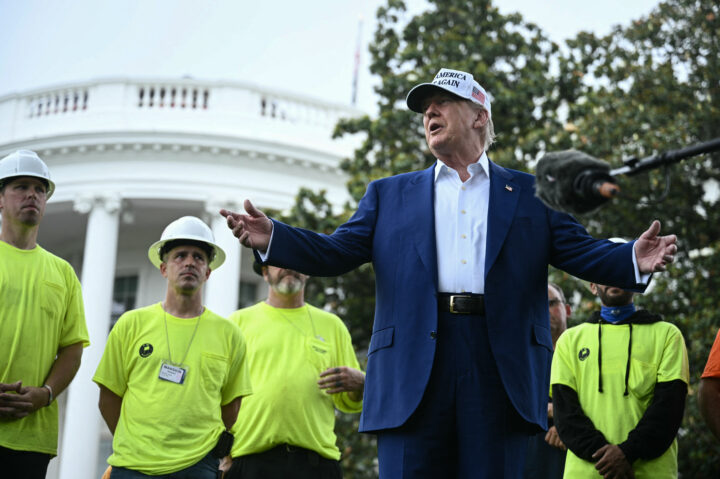
BRENDAN SMIALOWSKI/AFP via Getty Images
President Donald Trump speaks to the press on the South Lawn of the White House in Washington, DC on June 18, 2025.
There is a chance the U.S. will join Israel in striking Iran’s nuclear facilities, President Donald Trump told reporters on Wednesday, adding that “nobody knows” yet what he will decide.
“I may do it. I may not do it. I mean, nobody knows what I’m going to do,” Trump said in his first public comments about Iran after an hour-long Situation Room briefing on Tuesday.
He said he told Israeli Prime Minister Benjamin Netanyahu to “keep going.”
“So far he’s doing a good job,” Trump added.
He acknowledged that some of his supporters “are a little bit unhappy” about his posture toward Iran, but added that there are “some people that are very happy.” Trump further threw his support behind Israel’s actions: “All I’m doing is saying you can’t have a nuclear weapon. I’m trying to do it nicely, and then on day 61, I said, let’s go,” he said.
The president said that Iran has contacted the White House to talk about resuming negotiations. But Trump suggested the time for negotiations may have passed.
“Iran’s got a lot of trouble, and they want to negotiate. And I said, ‘Why didn’t you negotiate with me before all this death and destruction?’” Trump said. “Why didn’t you negotiate with me two weeks ago? You could have done fine. You would have had a country.”
Trump used the word “we” to describe the destruction of Iran’s air defense systems, without elaborating on the role the U.S. has played in assisting Israel. “We’ve totally captured the air,” Trump said Wednesday, following a post on Truth Social on Tuesday with similar language.
In another Tuesday Truth Social post, Trump called for “UNCONDITIONAL SURRENDER.” He explained to the reporters, “That means I’ve had it. OK? I’ve had it. I give up. No more. Then we go blow up all the nuclear stuff that’s all over the place there,” said Trump.
He offered stridently critical comments about the Islamic Republic.
“For 40 years they’ve been saying, ‘Death to America, death to Israel,’ death to anybody else that they didn’t like. They were bullies,” Trump said of the Iranian regime. “They were schoolyard bullies, and now they’re not bullies anymore, but we’ll see what happens. Look, nothing’s finished until it’s finished.”
Trump warned again that Tehran cannot be permitted to obtain a nuclear weapon — and intimated that Iran poses a direct threat to the United States.
“Is there anybody here that said it would be OK to have to have a hostile — very zealous, really — but to have a hostile country have a nuclear weapon that could destroy 25 miles, but much more than that, could destroy other nations, just by the breeze blowing the dust?” Trump asked. “That dust blows to other nations and they get decimated. This is just not a threat you can have. And we’ve been threatened by Iran for many years.”
At the end of the press conference, a reporter asked Trump for a message for Iranian Supreme Leader Ayatollah Ali Khamenei.
“Good luck,” Trump said. When asked when his patience will run out, Trump responded simply: “It’s already run out.”
Plus, a way for Israel to compete with checkbook diplomacy

Tasos Katopodis/Getty Images
U.S. President Donald Trump stops and talks to the media before he boards Marine One on the South Lawn at the White House on June 15, 2025 in Washington, DC.
Good Wednesday morning.
In today’s Daily Kickoff, we continue to report on the latest developments in the war between Israel and Iran, including President Donald Trump’s call for “UNCONDITIONAL SURRENDER” and the potential for U.S. involvement in strikes targeting the Fordow nuclear facility. We also highlight stories of stranded Israelis attempting to enter the country and stranded tourists attempting to exit it, and report on NYC mayor candidate Zohran Mamdani’s defense of the phrase “globalize the intifada.” Also in today’s Daily Kickoff, Sen. Josh Hawley, German Chancellor Friedrich Merz and David Zaslav.
What We’re Watching
- Defense Secretary Pete Hegseth and Chairman of the Joint Chiefs of Staff Gen. Dan Caine are testifying before the Senate Armed Services Committee this morning on the Pentagon’s 2026 fiscal year budget.
- Sen. Ted Cruz (R-TX) will appear in a new interview with Tucker Carlson, slated to be released later today. Clips released ahead of the full interview show clashes between the Texas Republican and conservative commentator, whose policy positions on Iran and Israel are increasingly at odds with the Trump administration.
- The Museum of Jewish Heritage in New York is holding a memorial event tonight for Dr. Ruth Westheimer.
What You Should Know
A QUICK WORD WITH JI’S MELISSA WEISS
While the last two months have been an exercise in diplomacy for Trump administration officials, who have crisscrossed the Middle East and Europe in an attempt to negotiate with Iran over its nuclear program, the last 24 hours have seen a sharp pivot from President Donald Trump to a more hard-line approach to Tehran.
“UNCONDITIONAL SURRENDER,” the president posted on his Truth Social site on Tuesday afternoon, understood to be a message to Iran after more than five days of Israeli attacks meant to degrade Tehran’s military and nuclear infrastructure. Iranian reprisals that have paralyzed Israel, but resulted in damage that has fallen far short of Supreme Leader Ayatollah Ali Khamenei’s threats. (Khamenei responded on Wednesday that “the Iranian nation will not surrender.”)
Trump’s latest comments underscore his shift away from the isolationist elements of the GOP that have dominated his administration since a purge of more traditional foreign policy-minded Republicans, including former National Security Advisor Mike Waltz. As The New York Times’ Ross Douthat wrote on Tuesday, Trump’s isolationist supporters “imagined that personnel was policy, that the realists and would-be restrainers in Trump’s orbit would have a decisive influence. That was clearly a mistake, and the lesson here is that Trump decides and no one else.”
On Capitol Hill, while Republicans appear publicly split on the level of involvement that the U.S. should have in the conflict — from working with Israel to destroy the Fordow nuclear facility to forcing Iran’s hand in diplomatic talks — JI’s conversations with legislators indicate a different approach behind the scenes. One senior Republican senator who requested anonymity to discuss internal conference dynamics estimated that nearly the entire GOP conference is privately united on the issue of the U.S. supporting Israel in bombing the Fordow facility if Israel needs such support. Read more from JI’s Emily Jacobs and Marc Rod here.
“I think the president has struck the right position,” Sen. Josh Hawley (R-MO) told JI, “which is supportive of Israel’s right of self-defense, which is what this really is, and supporting them publicly while they defend themselves. I think that’s the right position to stick on.” Read more of Hawley’s comments here.
ISRAEL-IRAN WAR, DAY 6

Israel struck a centrifuge production site in Tehran early Wednesday, after successfully intercepting more than two dozen missiles launched by Iran toward Israel in the preceding hours. Over 50 Israeli Air Force jets flew to Iran, where they struck a facility in which centrifuges were manufactured to expand and accelerate uranium enrichment for Iran’s nuclear weapons program, the IDF Spokesperson’s Office said, Jewish Insider’s Lahav Harkov reports. “The Iranian regime is enriching uranium for the purpose of developing nuclear weapons. Nuclear power for civilian use does not require enrichment at these levels,” the IDF said.
Military update: The IDF also said it struck several weapons manufacturing facilities, including one used “to produce raw materials and components for the assembly of surface-to-surface missiles, which the Iranian regime has fired and continues to fire toward the State of Israel.” Another facility that the IDF struck manufactured components for anti-aircraft missiles. Effie Defrin, the chief military spokesman, said on Wednesday that the IDF “attacked five Iranian combat helicopters that tried to harm our aircraft.” Defrin added, “There is Iranian resistance, but we control the air [over Iran] and will continue to control it. We are deepening our damage to surface missiles and acting in every place from which the Iranians shoot missiles at Israel.”
FORDOW FACTOR

Iran’s underground Fordow nuclear site is a key target in the current operation against the Islamic Republic, Israel’s national security advisor, Tzachi Hanegbi, said on Tuesday. “This operation will not conclude without a strike on the Fordow nuclear facility,” Hanegbi told Israel’s Channel 12 News. The Fordow facility is home to thousands of centrifuges, crucial to Iran’s weapons-grade uranium enrichment program, and is located 295 feet underground beneath a mountain. Israel is thought to have neither the munitions nor the aircraft to destroy it from the air, while the U.S. does, Jewish Insider’s Lahav Harkov reports.
American angle: Washington, however, has yet to make clear if it will take part in the offensive on Iran, though it has shot down Iranian missiles headed for Israel in the last few days. Hanegbi said that he does not believe the Trump administration has made a decision on the matter yet. Hanegbi denied that Israeli Prime Minister Benjamin Netanyahu had asked the U.S. to join Israel in bombing Iranian nuclear sites: “We didn’t ask and we won’t ask. We will leave it to the Americans to make such dramatic decisions about their own security. We think only they can decide.”
Decisive decision: A decision by Trump on whether or not to join Israel’s strikes against Iran could make the difference between the full destruction of the Islamic Republic’s nuclear program and a more drawn-out war with a less conclusive end, Danny Citrinowicz, a senior researcher in the Iran and the Shi’ite Axis Program at the Institute for National Security Studies at Tel Aviv University, told JI’s Lahav Harkov on Tuesday.
Word of warning: Sen. James Lankford (R-OK) cautioned on Tuesday that bombing Iran’s underground Fordow nuclear facility would leave significant enriched uranium buried underground. “I’m a little confused on all the conversation about dropping a bunker buster on a mountain that’s filled with enriched uranium, and how that solves the problem. If you’re going to try to get enriched uranium out of the country, dropping a big bunker buster on it may disable the centrifuges in [Fordow], but you still have 900 pounds of enriched uranium sitting there,” Lankford told JI’s Marc Rod.
UNIQUE OFFERING

Midway through June, the Middle East looks very different than it did when President Donald Trump traveled to the region just last month. Trump was feted by Gulf monarchs, as Saudi Arabia, Qatar and the United Arab Emirates sought to make their mark on a business-savvy president by touting hundreds of billions of dollars in investments and trade deals. Now, with Israeli strikes on Iran entering their sixth day, the best way to get Trump’s attention in the region — at least for the moment — is no longer financial prowess. It is firepower, according to at least one observer, Jewish Insider’s Gabby Deutch reports.
Expert view: “I think what you saw over the last few days is Israel’s alternative model to checkbook diplomacy,” author and podcast host Dan Senor said in a Saturday episode of “The Prof G Pod,” hosted by NYU professor Scott Galloway. “Israel has its own way of competing, because what Israel is demonstrating is, ‘Yeah, we’re not going to be the country that personally has sheikhs and emirs who can write checks for billions and trillions of dollars into the American economy,’” Senor said. “‘But we are the most capable ally in the world, and you, the United States, are going to get more out of this relationship than you give.’”
REVERSE EXODUS

Until flights out of Israel begin, Americans stuck there are passing along any information they can find — in WhatsApp threads, Facebook groups and private messages — to get themselves and their loved ones home. The details are hard to verify. The costs range from expensive to astronomical, Jewish Insider’s Gabby Deutch reports.
Moment of truth: When Home Front Command alerts woke Sam Heller at 3 a.m. on Friday, informing the nation that Israel had launched a preemptive attack on Iran’s nuclear facilities, he quickly booked the first flight out to Paris from Ben Gurion Airport. “I went straight to the airport, and they locked the doors to Ben Gurion, and they stopped letting people in,” Heller told JI on Tuesday, safely back home in Cleveland. “They’re like, ‘We’re closing our airspace indefinitely. Your flight’s been canceled. All flights are canceled. You can’t get out.’”
At all costs: One graphic shared widely on WhatsApp advertises an emergency evacuation flight from Israel to New York, promising a Wednesday afternoon departure to Eilat and a bus transfer to Sharm el-Sheikh, Egypt, followed by a charter flight to Milan, Italy, and then a connection to JFK Airport in New York — “lavish meals included” and “security escorted” — for $2,200 a person. According to the travel company’s website, though, it was already sold out by the time the graphic circulated. Another message advertised a chartered flight from Aqaba, Jordan — near Eilat — to Paris, for $3,000 a person. Abraham Tours, a travel company best known for its hostels in Tel Aviv and Jerusalem, advertised a cross-border transfer to Amman, Jordan, for $438.
Pressure push: A bipartisan group of 45 House members led by Reps. Josh Gottheimer (D-NJ) and Wesley Bell (D-MO) wrote to President Donald Trump and Secretary of State Marco Rubio on Tuesday urging officials to act promptly to facilitate evacuations of American citizens from Israel, or at least provide them with additional information on efforts to allow for such evacuations, Jewish Insider’s Marc Rod reports.
GILDED CAGE

An American couple who were en route to Israel to celebrate their wedding but had their flight diverted. Two Israeli single mothers on holiday looking for a quick refresh, now stranded. A group of injured Israel Defense Forces soldiers on a healing retreat. These are some of the nearly 2,500 Jewish people that Rabbi Arie Zeev Raskin, the chief rabbi of Cyprus, and his wife, Shaindel, unexpectedly found themselves hosting for Shabbat last Friday after at least 32 flights from the United States and Europe were diverted to the island in the Mediterranean amid Israel’s preemptive military campaign against Iran, which was launched early Friday morning, Jewish Insider’s Haley Cohen reports.
Old Faithful: Shabbat at Chabad “was amazing, a crazy experience,” said Tzvi Berg, a Jerusalem resident who was flying home from a wedding in New York on Thursday night when — just moments away from landing in Tel Aviv — his flight was rerouted to Larnaca, a port city in Cyprus. But as Shabbat ended — with Israeli airspace still shuttered as Iranian missiles continued to strike in Tel Aviv and elsewhere — “the challenge began again,” Raskin said. And those in need are knocking on Chabad’s door looking for food and accommodations, as many Jews do in moments of crisis around the world.
CHANT CONTROVERSY

Zohran Mamdani, a leading candidate in next Tuesday’s New York City mayoral primary, refused to condemn calls to “globalize the intifada” during a new podcast interview with The Bulwark released on Tuesday, arguing the phrase is an expression of Palestinian rights. In an exchange about antisemitic rhetoric on the left, Mamdani was asked by podcast host Tim Miller to share his thoughts on the phrase, which has been invoked at anti-Israel demonstrations and criticized as an anti-Jewish call to violence, Jewish Insider’s Matthew Kassel reports.
What he said: “To me, ultimately, what I hear in so many is a desperate desire for equality and equal rights in standing up for Palestinian human rights,” said Mamdani, a far-left assemblyman from Queens who has long been an outspoken critic of Israel. “And I think what’s difficult also is that the very word has been used by the Holocaust Museum when translating the Warsaw Ghetto Uprising into Arabic, because it’s a word that means struggle,” he said, apparently referring to the U.S. Holocaust Memorial Museum in Washington. He added that, “as a Muslim man who grew up post-9/11, I’m all too familiar in the way in which Arabic words can be twisted, can be distorted, can be used to justify any kind of meaning.”
Surveys say: Two new polls — from the Marist Institute for Public Opinion and the Manhattan Institute — show former New York Gov. Andrew Cuomo leading New York state Assemblymember Zohran Mamdani in next week’s Democratic mayoral primary in New York City. The Marist poll has Cuomo ultimately prevailing over Mamdani in the seventh round of ranked-choice voting, 55-45, while the Manhattan Institute poll has Cuomo beating Mamdani 56-44 in 10 rounds.
Worthy Reads
From Hands-Off to Hands-On: The New York Times looks at how President Donald Trump’s approach to the Israel-Iran war shifted as the war has unfolded. “When he woke on Friday morning, his favorite TV channel, Fox News, was broadcasting wall-to-wall imagery of what it was portraying as Israel’s military genius. And Mr. Trump could not resist claiming some credit for himself. In phone calls with reporters, Mr. Trump began hinting that he had played a bigger behind-the-scenes role in the war than people realized. Privately, he told some confidants that he was now leaning toward a more serious escalation: going along with Israel’s earlier request that the United States deliver powerful bunker-busting bombs to destroy Iran’s nuclear facility at Fordo[w].” [NYTimes]
Axis of Illiberality: In The Washington Post, Michal Cotler-Wunsh, Israel’s special envoy for combating antisemitism and a former member of Knesset, considers the role of China, Russia and North Korea alongside Iran in advancing antisemitism around the world. “While ‘intersectionality’ once was intended to advance the foundational principles of life and liberty, it can now be applied to a contemporary target: authoritarian and illiberal regimes’ efforts to tear apart those very foundations. The declared intention is destroying liberal democracies. … There are many ties that bind Russia, China, North Korea and Iran. Oil, arms and food bring them together; stoking global antisemitism is a useful tool in a divide-and-conquer strategy. These regimes pursue their agendas in ways that may outwardly vary, but they share a common goal: the West’s downfall. They all recognize that the liberal principles of democracies and the international rules-based order can be exploited to sow fear, despair and distrust.” [WashPost]
Word on the Street
President Donald Trump, traveling back to Washington from the G7 in Canada, dismissed a public assessment by Director of National Intelligence Tulsi Gabbard made earlier this year that Iran was not actively pursuing a nuclear weapon, Jewish Insider’s Marc Rod reports; Politico looks at the “widening gap” between Trump and Gabbard as the two clash on Middle East policy issues…
A new bipartisan resolution introduced by Reps. Claudia Tenney (R-NY) and Brad Sherman (D-CA) and 14 co-sponsors on Tuesday praises Israel’s strikes on Iranian nuclear and military facilities and condemns Iran’s retaliatory missile attacks on Israeli civilian targets, Jewish Insider’s Marc Rod reports…
An Army general who served as the Levant and Egypt branch chief at the Joint Chiefs of Staff’s J5 planning directorate was removed from the joint staff amid an investigation into his social media posts, which included a reference to Israeli Prime Minister Benjamin “Netanyahu and his Judeo-supremacist cronies” and allegations that American pro-Israel activists are prioritizing “support for Israel over our actual foreign interests”…
Tablet interviews the Institute for Science and International Security’s David Albright, a former International Atomic Energy Agency inspector, about the state of the Iranian nuclear program and Israeli capabilities to target the Fordow facility without U.S. assistance…
Former Rep. Tom Malinowski (D-NJ) said he would consider a bid for the House seat held by Rep. Mikie Sherrill (D-NJ) if Sherrill prevails in the November gubernatorial election…
Colorado’s two Democratic senators, Michael Bennet and John Hickenlooper, wrote to Senate leaders on Tuesday calling for funding for the Nonprofit Security Grant Program to be increased to as much as $500 million following the antisemitic attack on a hostage awareness march in Boulder, Colo., Jewish Insider’s Marc Rod reports; they also urged lawmakers to ensure that the funding can be used to “pay permanent security guards and other critical personnel”…
Oracle announced a new program, Oracle Defense Ecosystem, to help smaller vendors sell technology to the Pentagon, including artificial intelligence; participating vendors will be able to utilize Oracle’s office space and expertise with the Defense Department’s procurement system, as well as receive a discount for Palantir’s cloud and AI services…
Warner Bros. Discovery is cutting CEO David Zaslav’s pay when the company divides in two next year, though it will provide him with extra stock options that will pay out if the company hits share-price targets, in order to better tie pay to performance…
A Bay Area man is facing federal hate crimes charges for his participation in what the San Francisco District Attorney’s Office called an “antisemitic group beating” of two people, one of whom was Jewish; a physical confrontation escalated after members of the group reportedly shouted “free Palestine” and “f–k the Jews”…
A Maryland man was charged with allegedly sending numerous threats to Jewish organizations in Pennsylvania over a period of more than a year, from April 2024 to May 2025…
The Birmingham City Council became the first in the U.K. to recognize the Jewish identity of residents when collecting demographic data…
German Chancellor Friedrich Merz said that Israel was doing the “dirty work” of striking Iran “for all of us”…
A new poll from the Council for a Secure America found overwhelming support (79%) among the Israeli public for Israel’s strikes on Iran’s nuclear facilities…
The Wall Street Journal speaks with Israeli entrepreneurs about how the war between Israel and Iran is impacting Israeli startups — destroying homes and offices, calling up reservists, canceling conferences, halting business travel and affecting productivity…
The U.S. withdrew troops from two bases in northeastern Syria, amid concerns from U.S.-backed Syrian Kurdish forces in the region that the vacuum could provide an opening for extremist groups…
Turkey is ramping up its production of medium- and long-range missiles amid the escalation between Israel and Iran…
Pic of the Day

Birthdays

Music mogul, Scott Samuel “Scooter” Braun turns 44…
Chicago-based attorney, he is the only ordained rabbi to have served as an alderman on the Chicago City Council, Solomon Gutstein turns 91… Former Washington Post editor and reporter, Fred Barbash turns 80… Retired IT management advisor at Next Stage, Steven Shlomo Nezer… Croatian entrepreneur, he was previously the minister of economy, labour and entrepreneurship in the Croatian government, Davor Stern turns 78… Rabbi at Or Hamidbar in Palm Springs, Calif., he previously led congregations in Israel and Stockholm, Rabbi David James Lazar turns 68… Rebecca Diamond… Best-selling author and journalist, she was editor-in-chief of USA Today, Joanne Lipman turns 64… Retired professor of English at Southwestern University in Georgetown, Texas, Helene Meyers… Executive of the William Pears Group, a large UK real estate firm founded by his father and grandfather, Sir Trevor Steven Pears (family name was Schleicher) turns 61… Vice chairman and president of global client services at BDT & MSD Partners, she recently joined the board of Meta/Facebook, Dina Powell McCormick… White House senior aide during the Trump 45 administration, he is a principal of Cordish Companies, Reed Saunders Cordish turns 51… Film director and screenwriter, Jonathan A. Levine turns 49… Actor, comedian, satirist and writer, known professionally as Ben Gleib, Ben Nathan Gleiberman turns 47… Television producer and writer, Jeremy Bronson turns 45… Baseball pitcher for Team Israel at the 2020 Summer Olympics, he is now the director of pitching development for the Pittsburgh Pirates, Jeremy Bleich turns 38… Of counsel at Gibson, Dunn & Crutcher, Esther Lifshitz… Israeli musician, producer, singer, songwriter and multi-instrumentalist, known by his stage name Dennis Lloyd, Nir Tibor turns 32… Investor at Silver Point Capital, Jacob E. Best… Rachel Hazan…
The last 24 hours have seen a sharp pivot from Trump to a more hard-line approach to Tehran
Tasos Katopodis/Getty Images
U.S. President Donald Trump stops and talks to the media before he boards Marine One on the South Lawn at the White House on June 15, 2025 in Washington, DC.
While the last two months have been an exercise in diplomacy for Trump administration officials, who have crisscrossed the Middle East and Europe in an attempt to negotiate with Iran over its nuclear program, the last 24 hours have seen a sharp pivot from President Donald Trump to a more hard-line approach to Tehran.
“UNCONDITIONAL SURRENDER,” the president posted on his Truth Social site on Tuesday afternoon, understood to be a message to Iran after more than five days of Israeli attacks meant to degrade Tehran’s military and nuclear infrastructure. Iranian reprisals have paralyzed Israel, but resulted in damage that has fallen far short of Supreme Leader Ayatollah Ali Khamenei’s threats. Khamenei responded on Wednesday that “the Iranian nation will not surrender.”
The president’s post, made following his early departure from the G7 summit in Alberta, Canada, but before his Situation Room sit-down with senior advisors, signaled Trump’s new approach to the regional conflict.
Trump’s latest comments underscore his shift away from the isolationist elements of the GOP that have dominated his administration since a purge of more traditional foreign policy-minded Republicans, including former National Security Advisor Mike Waltz. As The New York Times’ Ross Douthat wrote on Tuesday, Trump’s isolationist supporters “imagined that personnel was policy, that the realists and would-be restrainers in Trump’s orbit would have a decisive influence. That was clearly a mistake, and the lesson here is that Trump decides and no one else.”
As the president’s position further crystalized — also Tuesday, he called Iranian Supreme Leader Ayatollah Ali Khamenei an “easy target,” but said the U.S. would not assassinate him, “at least not for now” — his post-G7 rhetoric trickled down to his inner circle.
Trump “may decide he needs to take further action to end Iranian enrichment,” Vice President JD Vance posted on X yesterday. “That decision ultimately belongs to the president. And of course, people are right to be worried about foreign entanglement after the last 25 years of idiotic foreign policy. But I believe the president has earned some trust on this issue. … Whatever he does, that is his focus.”
It’s a notable shift from Vance, too, who has been one of the most prominent opponents of preemptive military action in the Middle East. (Vance opposed U.S. strikes on Houthi targets in Yemen earlier this year.)
Journalist Eli Lake noted on Tuesday that Trump’s “inner circle deliberating on Iran policy is very small and has been fairly tight-lipped,” adding that those advising him on Iran include Vance, Chief of Staff Susie Wiles, Secretary of State Marco Rubio, Middle East envoy Steve Witkoff, Secretary of Defense Pete Hegseth and CIA Director John Ratcliffe. Director of National Intelligence Tulsi Gabbard, Lake said, is “occasionally” part of the group, but was absent from recent Camp David conversations about Israel and Iran.
On Capitol Hill, while Republicans appear publicly split on the level of involvement that the U.S. should have in the conflict — from working with Israel to destroy the Fordow nuclear facility to forcing Iran’s hand in diplomatic talks — JI’s conversations with legislators indicate a different approach behind the scenes. One senior Republican senator who requested anonymity to discuss internal conference dynamics estimated that nearly the entire GOP conference is privately united on the issue of the U.S. supporting Israel in bombing the Fordow facility if Israel needs such support. Read more from JI’s Emily Jacobs and Marc Rod here.
“I think the president has struck the right position,” Sen. Josh Hawley (R-MO) told JI earlier this week, “which is supportive of Israel’s right of self-defense, which is what this really is, and supporting them publicly while they defend themselves. I think that’s the right position to stick on.” Read more of Hawley’s comments here.
Trump has “handled this situation very deftly,” Hawley added. “I think his message has been pretty clear, which is that Iran is not going to get a nuke. So they can either surrender their nuclear program peaceably, and he’s willing to [have] the United States facilitate that, or the Israelis are going to blow their program to smithereens. Right now they’re choosing the smithereens route.”
Author Dan Senor offers a new frame of thinking in light of Gulf state investment deals

BRYAN BEDDER/GETTY IMAGES FOR ANTI-DEFAMATION LEAGUE
Call Me Back podcast host Dan Senor moderates a session with WashU Chancellor Andrew D. Martin and University of Michigan President Santa Ono at the ADL Never is Now event at Javits Center on March 03, 2025 in New York City.
Midway through June, the Middle East looks very different than it did when President Donald Trump traveled to the region just last month.
Trump was feted by Gulf monarchs, as Saudi Arabia, Qatar and the United Arab Emirates sought to make their mark on a business-savvy president by touting hundreds of billions of dollars in investments and trade deals.
Israel was an afterthought on the trip; Trump didn’t even visit. Iran nuclear talks were happening, but nonproliferation and geopolitics were secondary discussion topics to Trump’s checkbook diplomacy.
Israeli tech leaders at the time acknowledged that Israel cannot compete with the oil-rich Gulf states when it comes to investment dollars, and instead urged Israel to consider unique ways for the two countries to collaborate.
Now, with Israeli strikes on Iran entering their sixth day, the best way to get Trump’s attention in the region — at least for the moment — is no longer financial prowess. It’s firepower.
“I think what you saw over the last few days is Israel’s alternative model to checkbook diplomacy,” author and podcast host Dan Senor said in a Saturday episode of “The Prof G Pod,” hosted by NYU professor Scott Galloway.
“Israel has its own way of competing, because what Israel is demonstrating is, ‘Yeah, we’re not going to be the country that personally has sheikhs and emirs who can write checks for billions and trillions of dollars into the American economy,’” Senor said. “‘But we are the most capable ally in the world, and you, the United States, are going to get more out of this relationship than you give.’”
Trump amped up his rhetoric against Iran on Tuesday, a clear escalation after his more restrained posture in the early days of Israel’s strikes on the Islamic Republic.
“We now have complete and total control of the skies over Iran,” he wrote in a post on TruthSocial, blurring the lines between Israel and the U.S. “Our patience is wearing thin,” he wrote in another. “We know exactly where the so-called “Supreme Leader” is hiding. He is an easy target, but is safe there – We are not going to take him out (kill!), at least not for now.” Trump rounded out his posting spree with a straightforward message: “UNCONDITIONAL SURRENDER!”
A bipartisan group of House members described the State Department’s response to Americans stuck in Israel as inadequate thus far

GETTY IMAGES
Rep. Josh Gottheimer, D-N.J., leaves the U.S. Capitol after the House passed the One Big Beautiful Bill Act on Thursday, May 22, 2025.
A bipartisan group of 45 House members wrote to President Donald Trump and Secretary of State Marco Rubio on Tuesday urging officials to act promptly to facilitate evacuations of American citizens from Israel, or at least provide them with additional information on efforts to allow for such evacuations.
They argued that communication from the administration to this point has been inadequate, leaving Americans without clear information or a path to leave Israel. They asked the administration to provide information to them by Wednesday that they can convey to their constituents.
“Americans in Israel are depending on our government for guidance and a pathway to safety,” the letter, obtained by Jewish Insider, reads. “All available options including evacuations by land routes and sea must be explored. At a minimum, American citizens in Israel deserve updates on the efforts underway to ensure their safe departure.”
The lawmakers criticized the State Department for failing to provide any additional information beyond directing them to enroll in the State Department’s travel registration and information program.
“We trust that you will honor our responsibility to protect the American people, no matter where they are in the world,” the lawmakers wrote.
The letter was led by Reps. Josh Gottheimer (D-NJ) and Wesley Bell (D-MO). The majority of the signatories were Democrats but two Republicans — Reps. Don Bacon (R-NE) and Nicole Malliotakis (R-NY) — also signed on.
The U.S. embassy’s offices in both Jerusalem and Tel Aviv are set to be closed through at least Friday, the State Department announced.
Danny Citrinowicz of INSS at Tel Aviv University told JI, ‘Either the Americans help Israel, or we need to pull a rabbit out of our hats’
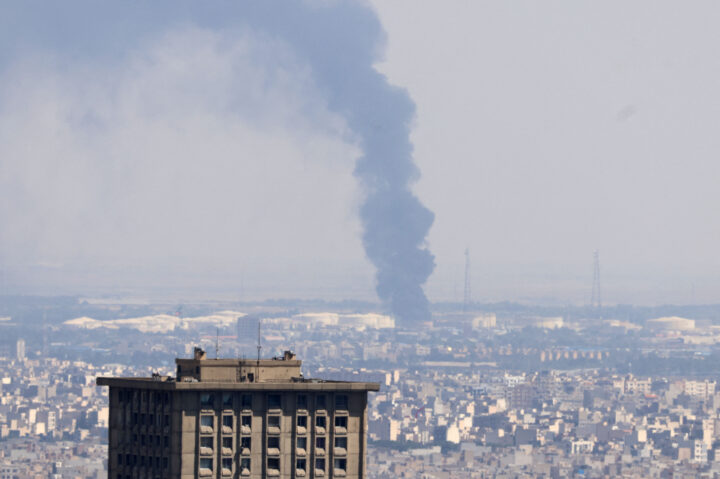
ATTA KENARE/AFP via Getty Images
Smoke billows in the distance from an oil refinery following an Israeli strike on the Iranian capital Tehran on June 17, 2025.
A decision by President Donald Trump whether or not to join Israel’s strikes against Iran could make the difference between the full destruction of the Islamic Republic’s nuclear program and a more drawn-out war with a less conclusive end, Danny Citrinowicz, a senior researcher in the Iran and the Shi’ite Axis Program at the Institute for National Security Studies at Tel Aviv University, told Jewish Insider on Tuesday.
Citrinowicz, the former head of the Iran branch in the Research and Analysis Division (RAD) in Israeli defense intelligence, spoke with JI from Australia, where he is one of more than 100,000 Israelis stranded abroad as the country’s airspace remains closed.
He argued that Israel’s strikes on Iran have gone beyond the war aims authorized by its Security Cabinet — to weaken Iran’s nuclear and ballistic missile programs — and indicate a push toward destroying Iran’s nuclear weapons program and forcing regime change. However, he warned, Israel would be unlikely to achieve either without help from the U.S.
The interview has been edited for length and clarity.
Jewish Insider: How would you describe where things stand on Day Five of the war between Israel and Iran?
Danny Citrinowicz: Trump is the variable. He is signaling that the Americans are in one minute, and then the White House says they don’t want to get involved the next. It’s clear that [Israel is] not only aiming at weakening the nuclear and missile programs. I think [Israeli Prime Minister Benjamin] Netanyahu’s plans, as he said on Iran International yesterday [that Israel will help “free” Iran], are much wider … There is a genuine attempt by Netanyahu to convince Trump to bring down the regime and change the entire Middle East.
JI: What progress has Israel made toward reaching its stated war aims?
DC: We maximized our achievements when it comes to the nuclear program. We struck the [nuclear] scientists. [The nuclear enrichment site] Natanz is an extraordinary achievement; it collapsed.
We had significant achievements against the missile program. It’s not clear if there have been fewer missile launches [from Iran] because of our strikes or because they are trying to be economical with their missiles. It’s significant that we took out a third of their missile launchers.
The strike on the [Iranian state] TV station is very strange because it is not connected to either war aim.
My view is that Netanyahu wants to keep going and for there to be a historic event, but he needs the Americans. The Americans are the variable. If they enter, things will be totally different. If not, Israel will continue doing what it has been doing.
JI: How is the Iranian regime responding to the latest developments?
DC: The Iranians have a very difficult dilemma. Decision-making is difficult because they lost so many senior officers. The assassination [of Iran’s Chief of War Gen. Staff Ali Shadmani] last night was very serious for them.
For Iran’s leaders, giving up on the nuclear program is giving up on the revolution. But if they continue fighting, they may also lose the revolution. They have a different view of the situation than we do, which ensures that they will continue fighting for the foreseeable future.
That’s why the important variable is whether Trump will decide to attack [the underground nuclear facility] in Fordow. If he says no, then the war will continue as it has been, with varying momentum as the Iranians try to challenge Israel.
I don’t see this ending soon if the Americans don’t enter [the war]. If they don’t, we will be in this for several weeks, at least…
There is an obstacle for Israel in Fordow [that it does not have the requisite bombs or bomber planes to destroy the facility under a mountain]. We could be planning something, but for now, I’m not optimistic.
JI: If the U.S. does not attack Fordow, what targets remain for Israel to attain its stated war goals?
DC: I don’t think we can achieve more than we already did … We are destroying missiles and launchers. We killed senior officials. There isn’t something left to achieve [in] the war aims that stands out. It’s just deepening the achievement.
My concern is that we’re going beyond that.
JI: Do you mean regime change as well?
DC: I think we’re aiming for it, but Israelis cannot do it alone. With the Americans, maybe. Replacing a regime through military means is hard, and you don’t always end up with something better. There’s a better chance with the Americans. I’ll be very surprised if it happens with Israel alone.
JI: Do you think Israel could send ground troops to demolish Fordow?
DC: Some have written about it, because they understand that attacking it from the air will be very hard. Either the Americans will help from the air, or something will happen that we don’t know about.
JI: What if Fordow isn’t destroyed?
DC: If this ends with Fordow intact, it’s a loss, because they can still enrich to 90%. We knew this from the beginning, and it’s still true. Either the Americans help Israel, or we need to pull a rabbit out of our hats.
It’s not clear to me that we went into this campaign with Trump and Netanyahu fooling everyone, or if things are as they appear. If nothing is being hidden, then Israel struck Iran’s nuclear program knowing it cannot destroy it … They took a bet.
This is either part of a grand plan, or it’s an unfolding event.
JI: Are negotiations for Iran to stop uranium enrichment still an option?
DC: The Iranians really want to stop the war with talks, but they will have to give up on a part of the revolution. They will come out very weak … If Iran accepts, it will not be the same Iran. If they don’t, the war will continue.
Still, [U.S. Middle East envoy Steve] Witkoff planned to talk to [Iranian Foreign Minister Abbas] Araghchi, so it’s possible. It depends on Iran. If Iran says “we give up, take Fordow, we no longer intend to develop a nuclear weapon,” Trump can say he’s a peacetime president and “no more bloodshed.” But I don’t see it happening.
JI: If Israel has to continue going at it alone, how long do you think this can continue?
DC: I think it’s a contest of patience between Israel and Iran … I think that we can hold on for a few weeks. Israel’s goal in these weeks is to bring the U.S. into the campaign, and Iran’s goal is for the U.S. not to enter.
It’s not a simple situation for Israelis, economically, militarily or societally … Israelis are also worn out. It takes hours to fly to Natanz — it’s not like Gaza, it costs a lot of money. The airport is closed. People aren’t going to work. And of course there’s the loss of life.
JI: And how is the Iranian regime faring in the contest of patience?
DC: For them, it depends on one thing. The reach of their military is measured only in their ability to launch missiles at Israel. They have relied on this for their entire existence. That’s the whole story.
There is concern in the regime about pressures from Iranian society, but I don’t see a serious challenge to the regime right now. There have not been any demonstrations. That could change.
JI: How do you view the fact that Iran’s proxies like Hezbollah haven’t joined in the fight and the Houthis haven’t escalated?
DC: One of the reasons that Israel went to war now is because it knew that Hezbollah would not join or its capabilities would be very limited. It was not just because of the nuclear and missile programs. It was the collapse of the axis that created a strategic opportunity Netanyahu didn’t want to give up.
JI: The timing was not, as Trump and Netanyahu have said, because Iran was very close to getting a bomb? Israeli officials have said Iran began the weaponization process.
DC: U.S. intelligence says otherwise. I don’t know why Trump is saying it…
There were significant developments [in the nuclear program], but there was an unprecedented strategic opportunity.
‘I think they were very close to having it,’ Trump said amid growing speculation of U.S. involvement in Israel’s operations against Iran

Andrew Harnik/Getty Images
Director of National Intelligence Tulsi Gabbard shakes hands with U.S. President Donald Trump in the Oval Office at the White House on February 12, 2025 in Washington, DC.
Amid growing speculation that the U.S. will become directly involved in Israel’s military campaign against Iran, President Donald Trump dismissed a public assessment by his Director of National Intelligence Tulsi Gabbard earlier this year that Iran was not actively pursuing a nuclear weapon.
“I don’t care what she said, I think they were very close to having it,” Trump told reporters on Air Force One en route home from the G7 Summit in Canada, which he left early to address the situation in the Middle East.
U.S. and Israeli leaders have emphasized in recent days that Iran was quickly increasing its stockpiles of highly enriched uranium in recent months, which would have allowed it to move quickly to a bomb. Some have also disputed Gabbard’s assessment, which was consistent with past assessments by Republican and Democratic administrations in recent years.
Israeli Prime Minister Benjamin Netanyahu said over the weekend, “The intel[ligence] we got and we shared with the United States was absolutely clear, that they were working on a secret plan to weaponize the uranium. They were marching very quickly. They would achieve a test device and possibly an initial device within months, and certainly less than a year.”
Sen. Tom Cotton (R-AR), the chair of the Senate Intelligence Committee said Iran was “very close to having enough pure weapons-grade uranium for several weapons” and that there were “signs” it was “once again exploring” weaponization.
Gabbard denied any dispute between herself and Trump and appeared to stick by her previous assessment, telling reporters, “What President Trump is saying is the same thing I said in my annual threat assessment in March to Congress.”
Trump also said he is “not looking for a ceasefire” between Israel and Iran, adding “we’re looking for better than a ceasefire.” He said he’s instead looking for “a real end … a complete give-up.”
Asked if he’s still interested in negotiating with Iran, Trump responded, “I don’t know. I’ve been negotiating. I told them to do the deal, they should have done the deal. Their cities have been blown to pieces and they’ve lost a lot of people. They should have done the deal. … I’m not too much in a mood to negotiate now.”
Trump said he “may” attempt to send Vice President JD Vance and Middle East envoy Steve Witkoff to negotiate with Iran, but that will depend on “what happens when I get back” to Washington. Trump arrived in Washington early Tuesday morning.
But he also said he hopes that Iran’s nuclear program is “going to be wiped out long before” the U.S. would have to get involved in the campaign.
Asked about his call Monday night for the population of Tehran to evacuate, Trump denied any imminent threat adding, “I want people to be safe. That’s always possible. A thing like that could happen.”
He added later, “there’s a lot of bad things happening there. I think it’s safer for them to evacuate.”
The president said that U.S. troops in the region are well-protected, and that the U.S. would retaliate forcefully if Iran attacked U.S. troops.
Plus, the political extremes horseshoe against Israel ͏ ͏ ͏ ͏ ͏ ͏

Chip Somodevilla/Getty Images
President Donald Trump waves as he boards Air Force One after leaving the G7 Leaders' Summit early on June 16, 2025 in Calgary, Alberta.
Good Tuesday morning.
In today’s Daily Kickoff, we report on the latest developments in the war between Israel and Iran, and cover President Donald Trump’s early departure from the G7 in Canada and comments about potential talks with Tehran. We also report on Trump’s rebuke of “kooky” Tucker Carlson over the commentator’s opposition to U.S. support of Israeli strikes, and look at how Jewish LGBTQ community leaders are approaching Pride celebrations that ostracize Jewish and pro-Israel individuals. Also in today’s Daily Kickoff: Scott Jennings, Jason Isaacs and Jeff Rubin.
What We’re Watching
- We’re continuing to monitor the ongoing situation in Israel and Iran, following another barrage of ballistic missiles fired at Israel by Iran this morning. More below.
- President Donald Trump is back in Washington today, after his early departure from the G7 in Alberta, Canada, where he will meet with senior advisors this morning in the Situation Room to weigh the level of U.S. involvement in the Israel-Iran conflict. Secretary of State Marco Rubio, Vice President JD Vance and Chairman of the Joint Chiefs of Staff Gen. Dan Caine are among those who will be meeting with the president.
- Reps. Thomas Massie (R-KY) and Ro Khanna (D-CA) are expected to put forward a war powers resolution today in the House that would force the administration to seek congressional approval ahead of any U.S. attack on Iran. Yesterday, Sen. Tim Kaine (D-VA) introduced a war powers resolution in the Senate. More below.
- Director of National Intelligence Tulsi Gabbard and CIA Director John Ratcliffe are slated to testify this morning before a Senate Appropriations subcommittee on the administration’s FY2026 budget request for the intelligence community.
- House Speaker Mike Johnson’s (R-LA) trip to Israel this week, in which Johnson was slated to address the Knesset, has been postponed due to the conflict between Israel and Iran. Read more here.
What You Should Know
A QUICK WORD WITH JI’S MARC ROD
We’ve written a lot about the so-called horseshoe theory of U.S. politics and foreign policy — the point at which the far left and the far right coalesce into agreement — but the Israeli campaign against Iranian military and nuclear targets is providing a particularly stark example of that convergence. The two factions find themselves openly and publicly aligned in opposition to any form of U.S. intervention in Israel’s campaign and against Israel’s operations in general.
An X post by Rep. Marjorie Taylor Greene (R-GA) on Sunday provided a distillation of that dynamic. Greene claimed that a regional war or global war, which would likely overwhelm the Middle East, BRICS and NATO, is inevitable and that countries would be “required to take a side.” She continued, “I don’t want to see Israel bombed or Iran bombed or Gaza bombed. … And we do NOT want to be involved or required to pay for ANY OF IT!!!”
Among those who supported Greene’s post were CodePink activist Medea Benjamin, who praised Greene’s “incredibly strong anti-war position!” and Drop Site News co-founder Ryan Grim, who called the Georgia Republican “presently the most sensible member of Congress.” Doug Stafford, the chief strategist for Sen. Rand Paul (R-KY), shared Benjamin’s post — and has repeatedly shared and praised both her and Code Pink in the wake of the Israeli operation. Read more here.
It’s not just Greene and Stafford. A host of prominent figures on the right, such as Rep. Thomas Massie (R-KY), Tucker Carlson, Steve Bannon, former Rep. Matt Gaetz (R-FL) and former Pentagon senior advisor Dan Caldwell are touting narratives about the conflict that would not be out of place at a far-left anti-Israel rally.
ISRAEL-IRAN WAR DAY 5

Israel killed Iran’s new top military commander and confidante of Iranian Supreme Leader Ayatollah Ali Khamenei days after eliminating his predecessor, the IDF Spokesperson’s Office announced on Tuesday, after a night in which missile launches from Iran towards Israel slowed down significantly. The Israeli Air Force struck a command center in Tehran, killing Ali Shadmani, Iran’s chief of war general staff, who had authority over the Islamic Revolutionary Guard Corps and the Iranian military. Shadmani, whom the IDF Spokesperson’s Office called “one of the closest figures to Supreme Leader Ali Khamenei,” was on the job for four days after Israel killed his predecessor, Alam Ali Rashid, early Friday, Jewish Insider’s Lahav Harkov reports.
Lower volume: Monday night and the early hours of Tuesday morning were the quietest since the beginning of the war with Iran on Friday. The IAF intercepted 30 projectiles launched from Iran toward Israel, with sirens mostly in northern and central Israel and no reports of injuries or damage to property. On Tuesday morning, Iran launched additional missiles at Israel, triggering sirens in the center of the country, including Jerusalem and the West Bank. The IDF said it intercepted most of the projectiles. Magen David Adom reported 14 injuries at eight impact sites, including a bus depot in Herzliya where the blast created a 13-foot-wide hole in the ground.
Top target: Israeli Prime Minister Benjamin Netanyahu did not rule out the possibility of targeting Iran’s supreme leader, Ayatollah Ali Khamenei, in an interview with ABC News on Monday, amid widespread speculation in Israel and beyond that the strikes on the Islamic Republic could pose an existential challenge to the regime.
DIPLOMACY DIARIES

President Donald Trump denied on Tuesday that he was attempting to facilitate “peace talks” with Iran as he returned to Washington after prematurely leaving a meeting of G7 leaders in Canada to monitor the ongoing war between Israel and Iran, Jewish Insider’s Danielle Cohen reports.
Word of warning: While still aboard Air Force One, the president told reporters that he wanted “a real end” to Iran’s nuclear program and he would be monitoring developments between Israel and Iran from the White House Situation Room. He suggested that Israel was unlikely to slow its strikes on Iranian targets in the coming days, saying that, “You’re going to find out over the next two days. You’re going to find out. Nobody’s slowed up so far.” But the president stopped short of addressing whether the U.S. would join Israel’s strikes, saying he hopes the Iranian nuclear weapons program “is wiped out long before that.”
French folly: French President Emmanuel Macron suggested to reporters on Monday that Trump had departed the G7 earlier to negotiate a ceasefire between Israel and Iran, saying that “the U.S. assured they will find a ceasefire and, since they can pressure Israel, things may change.” Trump slammed Macron and denied his claims, posting on Truth Social, “Publicity seeking President Emmanuel Macron, of France, mistakenly said that I left the G7 Summit, in Canada, to go back to D.C. to work on a ‘cease fire’ between Israel and Iran. Wrong! He has no idea why I am now on my way to Washington, but it certainly has nothing to do with a Cease Fire.” Trump said he had departed for something “much bigger than that.”
United front: The leaders of the G7 issued a joint statement on Sunday affirming “that Israel has a right to defend itself,” their “support for the security of Israel” and that “Iran is the principal source of regional instability and terror.” They further “urge[d] that the resolution of the Iranian crisis leads to a broader de-escalation of hostilities in the Middle East, including a ceasefire in Gaza.”
TRUMP CHECKS TUCKER

President Donald Trump rebuked Tucker Carlson at several points on Monday over Carlson’s comments opposing Trump’s support for Israeli strikes on Iran, Jewish Insider’s Marc Rod reports.
New nickname: Asked Monday at the G7 Summit in Canada about Carlson’s comments accusing Trump of being “complicit” in the war, Trump quipped, “I don’t know what Tucker Carlson is saying. Let him go get a television network and say it so that people listen.” Trump later posted on his Truth Social platform, “Somebody please explain to kooky Tucker Carlson that, ‘Iran CAN NOT HAVE A NUCLEAR WEAPON!’”
ALLIES AND ARMS

Some Senate Republicans argued Monday that the U.S. should join Israel’s strikes on Iran to help it destroy deeply entrenched nuclear sites such as the Fordow facility, contending that Israel lacks the capacity to do so on its own. Others, though, argued that Israel may have alternative plans to attack Fordow, while still others suggested that the U.S. should hold back and focus on diplomacy unless U.S. personnel are attacked directly, Jewish Insider’s Marc Rod and Emily Jacobs report.
Unique needs: Assessments have long held that bunker-busting bombs and larger bombers, neither of which Israel has, are needed to eliminate Fordow, though some analysts have speculated in recent days that Israel has been developing alternative strategies to strike that site. “We have to. I think we have to help. I am going to be encouraging the president [to support Israel] because the greatest tragedy in the world would be if we left the Iranian regime in place with a nuclear easy startup. I’d hate to see Israel spending all those resources of people and dollars on getting the job 90% done,” Sen. Kevin Cramer (R-ND) told JI.
Read the full story here with additional comments from Sens. Lindsey Graham (R-SC), Mike Rounds (R-SD) and Pete Ricketts (R-NE).
War powers activated: Sen. Tim Kaine (D-VA) introduced a war powers resolution on Monday that aims to block the U.S. from taking military action against Iran in support of Israel’s ongoing operation against the regime, JI’s Marc Rod reports.
STRANDED BUT NOT ALONE

CNN contributor Scott Jennings traveled to Israel last week to bear witness to the atrocities Hamas committed during the Oct. 7, 2023, terrorist attacks. But in the wake of Israel launching its military operation to take out Iran’s nuclear facilities and prevent the regime from acquiring a nuclear weapon, Jennings is witnessing more than he expected to on his first trip to the Jewish state, Jewish Insider’s Haley Cohen reports.
And then some: “Not only did I get to fulfill my mission of understanding deeply the horrors of Oct. 7, but being here watching the war unfold against Iran, I feel like I am here at the beginning of the war to defend Western civilization,” Jennings, who is traveling with the AIPAC-affiliated American Israel Education Foundation, told JI from his hotel in Tiberias on Friday. “I think this has to end with a complete annihilation of Iran’s ability to make a nuclear weapon,” he said, calling on the U.S. to do “whatever we have to do to achieve that in concert with our special partner, Israel.”
PRIDE AND PREJUDICE

In early June, Rabbi Eleanor Steinman wrote to members of Temple Beth Shalom, the Reform congregation she leads in Austin, Texas, sharing the synagogue’s plans to celebrate Pride Month with several events in June. Steinman also revealed that, for the first time in more than two decades, her congregation would not be marching in the Austin Pride parade, which event organizers say draws 200,000 people each August, because of concerns about antisemitism. “The Austin Pride organization took an antisemitic stance in the midst of the Pride Parade and Festival last year,” wrote Steinman, who is gay. Ahead of last year’s Pride parade, slides were leaked from a presentation in which Austin Pride organizers said hate speech against Jews wasn’t welcome, including “symbols, images or flags used by terrorist and hate groups.” It was part of an education campaign for queer activists as anti-Israel sentiment exploded in the queer community after the Oct. 7, 2023, Hamas attacks and the ensuing war in Gaza, as it did in many other progressive spaces, Jewish Insider’s Gabby Deutch reports.
Backfiring and backtracking: But the effort to educate about antisemitism backfired. Anti-Israel activists pressured Austin Pride to disavow that message. Austin Pride not only backtracked on barring those slogans; it issued a statement pledging to support the Boycott, Divestment and Sanctions movement and stating that the organization does not work with the Anti-Defamation League. In the months that followed, Jewish leaders and LGBTQ activists pushed Austin Pride’s leadership to consider changing this stance, to no avail. “Despite attempts to meet with Austin Pride since then, a coalition of Jewish leaders were unable to create an environment where we felt we would be both safe and respected as Jewish LGBTQ+ and allies,” Steinman wrote in the email. It was a remarkable statement, tinged with bitter irony: The synagogue first started marching in Pride so that LGBTQ congregants would feel that they could bring their full selves to the Jewish community. Now some of those same congregants feel that they need to suppress their Jewishness in order to fully belong in the queer community.
Worthy Reads
Bibi Turns the Tables: The Wall Street Journal’s Walter Russell Mead considers how Israeli Prime Minister Benjamin Netanyahu has pivoted from a series of domestic and diplomatic crises to mounting one of the most significant military operations in Israeli history. “A coalition in revolt, prosecutors on his heels, powerful rivals looking to unseat him, chilly relations with Mr. Trump, growing opposition from Europe, skeptical military and intelligence chiefs and a hostile press — few leaders anywhere have faced this kind of pressure. By week’s end, Bibi had flipped the script. A series of military blows exposed the weakness of Iran’s sulphurously belligerent regime and demonstrated Israel’s military and intelligence supremacy in the Middle East. The government crisis subsided. Mr. Trump praised Israel’s audacious attack. As in the months after Oct. 7, 2023, a determined prime minister harnessed the Israeli military machine to orchestrate a dazzling series of victories that stunned the world even if they did not win it over.” [WSJ]
More Than Bombs: The Washington Post’s David Ignatius looks at potential avenues to regime change in Iran. “You’ll get no argument from me that it’s long past time for political change in Tehran. The clerical regime has been shedding the blood of Israelis, Americans, Saudis and anyone else who opposed its dictates since the 1979 Islamic revolution. The question is how change will come. What’s the road toward a dynamic country that’s worthy of Iran’s creative, cultured people? Here’s one obvious fact: Israel can’t bomb its way to this new Iran. A campaign of bombing of the kind Tehran is experiencing makes people hunker down, turn inward and often fight harder. Strategic bombing didn’t break the will of the British, German or Japanese people during World War II. It hasn’t yet destroyed Hamas in Gaza, either, for that matter.” [WashPost]
Hate’s Not on the Menu: In the San Francisco Chronicle, Manny Yekutiel condemned the recent vandalism of his eponymous Mission District cafe, which was graffitied with anti-Israel graffiti during recent anti-ICE protests. “A disturbing pattern is emerging — one that even here in San Francisco is endangering the core values this city is meant to uphold: tolerance, inclusion, civic engagement and common humanity. The act of hate at Manny’s is part of a larger danger facing the progressive movement and the country. We are living in a moment where real and painful disagreements are being used as an excuse to turn people against one another. Instead of standing together to fight injustice, some are choosing to let hate and bigotry divide us. We cannot allow that. If we lose the ability to sit across from people we disagree with and have hard conversations, we lose the very foundation of this movement.” [SFChronicle]
Word on the Street
Amos Hochstein, a former special envoy in the Biden administration, told CNBC that only the U.S. could dismantle the Fordow nuclear facility in Iran…
The Senate modified provisions of the Educational Choice for Children Act, a tax credit program for scholarships that could help families afford religious schools, in its version of the budget reconciliation bill; the Senate version of the bill decreases the total annual tax credit from $5 billion to $4 billion, but eliminated a sunset provision that had been in the House version of the bill, making the program permanent. The Senate version also modifies portions of religious liberty protections included in the House bill…
Senate Majority Whip John Barrasso (R-WY) told Jewish Insider he hasn’t had any discussions about calling a floor vote to discharge Joel Rayburn‘s nomination from the Senate Foreign Relations Committee, in which it appears Rayburn lacks the votes to advance…
The Florida Legislature earmarked $10 million in funds allotted for Jewish school security, $1 million above the amount recommended by Gov. Ron DeSantis earlier this year…
Chalkbeat interviews historian Natalia Mehlman Petrzela, who was tapped by the New York City Department of Education to develop a Jewish American history curriculum…
In an interview with Vulture, “White Lotus” actor Jason Isaacs, who is Jewish, reflected on his relationship with Mel Gibson, saying his “The Patriot” co-star, whose antisemitic rant following a 2006 DUI arrest went viral, has “done some things that are unconscionable and unforgivable”…
The New York Times looks at the legacy of Leonard Lauder, who died last week, on the beauty industry; Lauder was known for coining the concept of the “lipstick index”…
The Wing co-founder Audrey Gelman, who opened a home goods and tchotchkes store in Brooklyn in 2022, is pivoting to hospitality, opening a hotel in New York’s Hudson Valley…
The displays of several Israeli defense firms at the Paris Air Show were covered up during the annual gathering; French officials said the companies, including Elbit and Rafael, had disregarded an agreement not to display offensive weapons, while Israel’s Defense Ministry accused France of trying to tamp down competition…
The Wall Street Journal reports that Saudi Arabia, Qatar and Oman have appealed to the U.S. to pressure Israel to halt its strikes on Iran…
The Associated Press looks at how the escalation between Israel and Iran has affected flights and travelers across the region, stranding many far from home…
The Maccabiah Games, which had been slated to take place next month in Israel, are being postponed to 2026 due to the war between Israel and Iran, eJewishPhilanthropy’s Jay Deitcher reports…
Jeff Rubin announced his upcoming retirement from The Washington Institute for Near East Policy, where he served as communications director since 2011…
Pic of the Day

Ambassador Jim Jeffrey (center) poses with Antoun Sehnaoui (left) and Daniel Glaser, the co-founders of the U.S.-Israel Opera Initiative, at the organization’s launch on Sunday at the Kennedy Center in Washington. The program featured the premiere screening of the opera “Theodor,” about the life of Theodor Herzl. The performance was dedicated to Yaron Lischinsky and Sarah Milgrim, two Israeli Embassy staffers who were killed in a terror attack at the Capital Jewish Museum last month.
Birthdays

Comedian, actor, director, writer and producer, Michael Showalter turns 55…
Diplomat and attorney, undersecretary of state for International Security Affairs in the Carter administration, longtime U.N. special representative, Matthew Nimetz turns 86… Winner of the 2001 Nobel Prize in economics, professor at Georgetown and UC Berkeley, he is married to former Treasury Secretary Janet Yellin, George Akerlof turns 85… One of the world’s best-selling singer-songwriters over the course of seven decades, born Barry Alan Pincus, Barry Manilow turns 82… Former member of the Knesset for the Zionist Union party, Eitan Broshi turns 75… Chairman of the Federal Trade Commission during the Obama administration, Jonathan David (“Jon”) Leibowitz turns 67… Deputy administrator of the Federal Highway Administration during the first two years of the Biden administration, Stephanie Pollack turns 65… President of the San Francisco Board of Supervisors until earlier this year, Aaron Dan Peskin turns 61… Singer and composer, a pioneer of the Turkish and Arab music genres in Israel, Ofer Yoel Levy turns 61… Fashion designer, daughter of Reva Schapira, Tory Burch turns 59… Active in interfaith peace initiatives between Judaism and Islam and in encounters for Jews with Eastern religions, Rabbi Yakov Meir Nagen (born Genack) turns 58… Founder and chairman of Shavei Israel, Michael Freund turns 57… British historian, columnist and musician, Dominic Green, Ph.D. turns 55… International human rights attorney who serves as managing director of the law firm Perseus Strategies, Jared Matthew Genser turns 53… Screenwriter, television producer, director and voice actor, Matthew Ian Senreich turns 51… Advocacy, philanthropic and political counsel at Chicago-based Beyond Advisers, David Elliot Horwich… SVP for the economic program at Third Way think tank, Gabe Horwitz… Chief philanthropy officer of the Jewish Community Foundation and Jewish Federation of Broward County, Keith Mark Goldmann… VP of government affairs for the Conservation Lands Foundation, David Eric Feinman… Former rabbi of the Elmora Hills Minyan in Union County, N.J., now an LCSW therapist in private practice, Rabbi Michael Bleicher… NYC-based senior editor for The Hollywood Reporter, Alexander Weprin… Professional surfer and musician, his family owns Banzai Bagels on the Hawaiian island of Oahu, Makua Rothman turns 41… Founder and executive director of the Zioness Movement, Amanda Berman… Director of national outreach for the East at the New Israel Fund, Alexander Willick… Award-winning college football and basketball analyst for NBC Sports and SiriusXM, Nicole Auerbach… Member of the U.S. Ski Team’s alpine program, he competed for the USA in both the 2014 (Sochi) and 2018 (PyeongChang) Winter Olympics, Jared Goldberg turns 34… Senior art director at Business Insider, Rebecca Zisser… Shortstop for Team Israel at the 2020 Olympics, Scott Burcham turns 32… Actress best known for her roles in the CBS series “Fam” and the Netflix series “Grand Army,” Odessa Zion Segall Adlon turns 25… D.C.-based freelance foreign media consultant, she is also a real estate agent, Mounira Al Hmoud…
Though Trump said he did not leave in order to pursue a ceasefire between Israel and Iran, the U.S. is reportedly still seeking a meeting with the Iranians to reach a nuclear deal
Chip Somodevilla/Getty Images
President Donald Trump waves as he boards Air Force One after leaving the G7 Leaders' Summit early on June 16, 2025 in Calgary, Alberta.
President Donald Trump denied on Tuesday that he was attempting to facilitate “peace talks” with Iran as he returned to Washington to monitor the ongoing war between Israel and Iran.
Upon landing in the U.S. early Tuesday morning after prematurely leaving a meeting of G7 leaders in Canada — a move that White House Press Secretary Karoline Leavitt attributed to “what’s going on in the Middle East,” — Trump posted on Truth Social that he had “not reached out to Iran for ‘Peace Talks’ in any way, shape, or form. This is just more HIGHLY FABRICATED, FAKE NEWS! If they want to talk, they know how to reach me. They should have taken the deal that was on the table – Would have saved a lot of lives!!!”
On Sunday, however, Trump had written on Truth Social that “Iran and Israel should make a deal, and will make a deal” and “we will have PEACE, soon, between Israel and Iran! Many calls and meetings now taking place.”
While still aboard Air Force One, the president told reporters that he wanted “a real end” to Iran’s nuclear program and he would be monitoring developments between Israel and Iran from the White House Situation Room.
He suggested that Israel was unlikely to slow its strikes on Iranian targets in the coming days, saying that, “You’re going to find out over the next two days. You’re going to find out. Nobody’s slowed up so far.”
But the president stopped short of addressing whether the U.S. would join Israel’s strikes, saying he hopes the Iranian nuclear weapons program “is wiped out long before that.”
French President Emmanuel Macron suggested to reporters on Monday that Trump had departed the G7 earlier to negotiate a ceasefire between Israel and Iran, saying that “the U.S. assured they will find a ceasefire and, since they can pressure Israel, things may change.”
Trump slammed Macron and denied his claims, posting on Truth Social, “Publicity seeking President Emmanuel Macron, of France, mistakenly said that I left the G7 Summit, in Canada, to go back to D.C. to work on a ‘cease fire’ between Israel and Iran. Wrong! He has no idea why I am now on my way to Washington, but it certainly has nothing to do with a Cease Fire.” Trump said he had departed for something “much bigger than that.”
While at the G7, Trump took an aggravated tone with Iran’s failure to come to an agreement, writing on Truth Social that “Iran should have signed the ‘deal’ I told them to sign. What a shame, and waste of human life. Simply stated, IRAN CAN NOT HAVE A NUCLEAR WEAPON. I said it over and over again! Everyone should immediately evacuate Tehran!”
Israel had issued a warning earlier that day to residents of Tehran to evacuate ahead of impending strikes on military infrastructure in the capital city. Israeli media reported that the U.S. had joined Israel in attacking Iran, which was denied by White House spokesperson Alex Pfeiffer. “American forces are maintaining their defensive posture, and that has not changed. We will defend American interests,” he said. Trump later told reporters that his call to evacuate was because he wants “people to be safe.”
On Monday night, Axios reported that Middle East envoy Steve Witkoff is seeking a meeting with Iranian Foreign Minister Abbas Araghchi to reach a nuclear deal and end the military action between Israel and Iran. Trump reportedly said at the G7 that the U.S. and Iran “are talking on the phone, but it is better to talk in person.”
A senior U.S. official told Axios that Trump sees Israel’s assumed reliance on the U.S.’ bunker-buster bombs to effectively target Iran’s nuclear facilities as a point of leverage to force Iran into a deal, lest the U.S. supply Israel the assistance it is seeking.
Meanwhile, the Iranian Foreign Ministry said in a statement that the country’s parliament is preparing a bill to potentially pull Iran out of the nuclear Non-Proliferation Treaty. The U.N.’s nuclear agency had recently ruled that Iran was violating its obligations under the treaty — which allows a country to utilize civilian nuclear power in exchange for a guarantee it will not pursue nuclear weaponization — for the first time in almost 20 years.
‘Let him go get a television network and say it so that people listen,’ the president said Monday

Chip Somodevilla/Getty Images
(L-R) Tucker Carlson, Rep. Byron Donalds (R-FL), former President Donald Trump, and Sen. JD Vance (R-OH) appear on the first day of the Republican National Convention at the Fiserv Forum on July 15, 2024 in Milwaukee, Wisconsin.
President Donald Trump dismissed Tucker Carlson at several points on Monday over Carlson’s comments opposing Trump’s support for Israeli strikes on Iran.
Trump, in recent days, has distanced himself from isolationist figures in the party who have condemned the strikes on Iran. Asked Monday at the G7 Summit in Canada about Carlson’s comments accusing Trump of being “complicit” in the war, Trump quipped, “I don’t know what Tucker Carlson is saying. Let him go get a television network and say it so that people listen.”
Trump later posted on his Truth Social platform, “Somebody please explain to kooky Tucker Carlson that, ‘Iran CAN NOT HAVE A NUCLEAR WEAPON!’”
Over the weekend, Trump had also criticized isolationists in his party,, declaring in an interview, “I think I’m the one that decides” what constitutes America First, adding, “For those people who say they want peace—you can’t have peace if Iran has a nuclear weapon.”
Carlson, who recently called for the U.S. to abandon Israel and to not provide any further funding or weapons, again criticized U.S. support for Israel in an appearance on former Trump advisor Steve Bannon’s show on Monday, and claimed that the administration was following direction from “foreign governments” aiming to enact “regime change” in Iran and who were dictating to the U.S. who its enemies should be.
While arguing that involvement in the conflict was not in the U.S.’ interests, neither Carlson nor Bannon mentioned or acknowledged Iran and its proxy forces’ role in the deaths of Americans across the Middle East in recent decades.
The Islamic Republic’s leadership is significantly weakened domestically by Israeli strikes, but experts differ on whether regime change is likely

Avi Ohayon/GPO
Israeli Prime Minister Benjamin Netanyahu manages Operation Rising Lion.
Israeli Prime Minister Benjamin Netanyahu did not rule out the possibility of targeting Iran’s supreme leader, Ayatollah Ali Khamenei, in an interview with ABC News on Monday, amid widespread speculation in Israel and beyond that the strikes on the Islamic Republic could pose an existential challenge to the regime.
Netanyahu said Israel was “doing what we need to do,” when asked if Khamenei would be targeted in the strikes.
Regarding reports that President Donald Trump vetoed plans for Israel to kill the ayatollah because it may lead to an escalation, Netanyahu said, “It’s not going to escalate the conflict, it’s going to end the conflict. We’ve had half a century of conflict spread by this regime that terrorizes everyone in the Middle East.”
Netanyahu said that the fall of the Iranian regime “could be a result, because this regime is weak, and suddenly understands how weak it is… We could see tremendous changes in Iran.”
Israel did not name overthrowing the ayatollah’s regime as one of the goals of its operation against Iran as authorized by Israel’s security cabinet, but Israeli airwaves have been full of enthusiasm for the prospect. An Israeli defense source told Jewish Insider earlier this week that regime change was not included in the war aims because it would not have “international legitimacy” to do so, but that Jerusalem would favor such an occurrence.
The nightly airstrikes on Iran since last Friday have degraded the regime by taking out some of its leading figures, including Islamic Revolutionary Guard Corps Commander Hossein Salami and the IRGC’s intelligence chief and his deputy.
“Every day [Israel is] bringing down the regime a little more,” Ben Sabti, an Iran expert at the Institute for National Security Studies at Tel Aviv University, told JI on Monday. “It’s like we are pushing them closer to the edge every day. It’s a big country, so it takes time.”
Sabti argued that “even if Israel isn’t aiming to bring down the regime, it is on the way to doing so, because it is hurting the basis on which it stands — the Islamic Revolutionary Guard Corps.”
He said that Israel’s targeting of key military and intelligence figures is “like killing nuclear scientists; the facilities are still there but there isn’t anyone to run it. The same is true with the government as more and more senior people fall.”
Khamenei handpicked the leading figures in the IRGC, and they also control Iran’s “resistance economy,” its circumvention of sanctions, as well as its oppression of the Iranian people, including enforced modesty, Sabti said.
”When you strike the IRGC, everything is shaken up,” he added. “It’s not like in a democratic state where, if a general is killed, they can still function.”
Israel struck the complex hosting Iranian state news channel IRINN on Monday, and the explosion could be heard live on the air. The IDF said that the building was “a communication center that was being used for military purposes by the Iranian Armed Forces … under the guise of civilian activity, covering up the military use of the center’s infrastructure and assets” and that the IDF sent advance warnings to the civilian population in the area. Israeli Defense Minister Israel Katz said that “the propaganda and incitement broadcast authority of the Iranian regime was attacked by the IDF after the broad evacuation of the residents of the area. We will strike the Iranian dictator everywhere.”
Sabti said that he saw many Iranians post on social media that they hoped that Israel would target the broadcast authority, and accused the regime of staging videos to make it seem like there are more civilian casualties in Iran.
“The public isn’t buying the propaganda,” he said.
In addition, Sabti noted, many senior Iranian officials, including Khamenei, have not been seen in public since the war began, which is being viewed as a sign of weakness.
Meir Javedanfar, a lecturer on Iranian politics at Reichman University, said that Israeli strikes have put “unprecedented pressure on the regime … People are fleeing Tehran; they are pulling their money out of the banks as much as they can. They are doing what Iranians do in crises, which is filling cars with petrol, and there’s not enough petrol. It’s difficult to see how the government can continue governing this way, because the pressures are tremendous.”
Sabti and Javedanfar both cited people fleeing Tehran in the largest numbers since the 1980-1988 Iran-Iraq War as an indication that the people of Iran do not support the regime.
”In the 1980s,” Sabti recounted, “I saw with my own eyes when we were attacked by missiles and planes, people made human chains around government buildings, to defend them. The Iraqis came and attacked anyway; we [Israelis] are more humane.”
Now, Sabti said, people are not showing that kind of support and “there is a disconnect between the people and the regime … The minorities are against the regime, women are against the regime, the general public is against the regime.”
That being said, Sabti estimated that the number of people hanging signs against the regime or shouting “death to Khamenei” is very small, and “there is not enough energy yet in the public for the regime to fall.”
Iranians, Javedanfar said, “don’t see this as a war they’re involved in. It’s not their responsibility. It’s between Khamenei and Israel. They are not going to do regime change for Israel. What they’re considering is that this is a regime invested more in Hamas and Hezbollah than in the domestic electricity production capability. Even before this crisis, there were electricity cuts.”
One thing that could encourage the fall of the Iranian regime, Sabti suggested, would be for Trump to say he wants that outcome.
“If Trump would talk about regime change, it would really happen. It would bring down the government,” Sabti, who grew up in Iran, predicted. “America is America, there is no one else like them.”
Javedanfar, however, said that the threat of regime change “is meant to get Khamenei to compromise on a nuclear agreement with Trump.”
The most important strategic goal, Javedanfar said, is for Iran to enter an agreement to end its uranium enrichment, which would mostly eliminate its nuclear program, and to make Iran reconsider and change its policies of aggression against Israel, directly and through proxies.
“There’s a proverb in Persian,” Javedanfar said: “‘You threaten someone with death so they will settle for a fever.’ You threaten the other side with something far worse to get them to agree to what you want. I think this is the strategy. Israel cannot overthrow the regime but it is using the threat to create conditions which could potentially make the regime believe that it could be overthrown, and that’s good enough for Israel.”
Javedanfar was skeptical about the possibility of regime change in the short term, because “to overthrow a regime, you need an alternative. Who’s going to take over?”
Sabti and Javedanfar both said that Prince Reza Pahlavi, the son of the deposed shah of Iran, who lives in the U.S. and has been giving interviews to the international media in recent days, does not appear to be leading an effort on the ground in Iran.
“It’s difficult to know how popular he is,” Javedanfar said. “There are enough reasons to say he’s a suitable alternative and reasons to say he isn’t, because he doesn’t have the capacity or the people.”
Pahlavi is “trying,” Sabti said, but would need outside help to take a leadership position, such as through outreach to the U.S. or Israel to back him, which Sabti thought would be very effective.
“The son of the king needs more energy. He is very beloved in Iran, I see a lot of posts about him, but that’s good for the Internet. How will he organize people? How will he organize demonstrations? How will he come back? The public is saying ‘come back,’ but he needs an organization. He would need to take things up a level,” Sabti said.
Another alternative to the current regime may be a dissident in an Iranian prison, Sabti said, noting that there have been many social media posts calling for Israel to target prisons so that people can escape.
Sabti pointed to a group of 14 political activists in prison since 2019 for writing a letter calling on Khamenei to resign and for the Islamic Republic to be replaced by a democratic, secular state.
”If they get out, there could be a massive change,” he said.
Sabti also speculated that an IRGC general may lead a coup “to save Iran, but more to save himself … Someone who is within the system, just like in the Soviet Union.”
‘If we’re paying a maximal price, we should get maximal achievements,’ an Israeli security source told JI

GPO
Israeli Prime Minister Benjamin Netanyahu and Defense Minister Israel Katz direct Operation Rising Lion.
Israel’s leadership is concerned that international pressure may force the IDF to stop striking Iran before its mission is complete, an Israeli security source told Jewish Insider on Sunday.
The source spoke a day after President Donald Trump wrote in a Truth Social post that “this war in Israel-Iran should end,” and continued to express hope that a deal could be reached between Washington and Tehran, even as the next round of negotiations between the U.S. and Iran over Tehran’s nuclear program was postponed.
The president’s remarks came two days after Israel began targeting Iranian nuclear and military sites and Tehran retaliated by striking sites across Israel, including residential areas.
“We want the U.S. to understand our point of view,” the source said. “The goal is for Iran not to have capabilities that endanger the State of Israel and its existence.”
“If we’re paying a maximal price” — 13 fatalities, 380 injured in 22 missile impact sites as of Sunday morning — “we should get maximal achievements. That is the approach,” the source added, saying that Iran’s nuclear program should be destroyed and not “wounded.”
The official aim of Operation Rising Lions, authorized by Israel’s Security Cabinet on Thursday night, is to damage Iran’s nuclear and ballistic missile programs.
The goal did not include toppling the Iranian mullahs’ regime, in part because Israel would be unlikely to have “international legitimacy” to do so, the Israeli source said. In addition, the cabinet did not say its goal was the total elimination of Iran’s nuclear program, because it wanted to set attainable goals.
Harris national security adviser Phil Gordon: ‘I would have found it too risky to initiate military force with all that that could unleash’

JIM WATSON/AFP via Getty Images
Vice President Kamala Harris speaks with Phil Gordon during a meeting with Caribbean leaders in Los Angeles, California, June 9, 2022.
Among the more surprising cheerleaders for President Donald Trump’s diplomacy with Iran were several progressive foreign policy analysts who had advised former President Barack Obama and former Vice President Kamala Harris.
Now, many of those same voices — including Phil Gordon, Harris’ national security advisor who would likely have stayed in the role if she had been elected president last year — are expressing skepticism about Israel’s preemptive strikes on Iranian military and nuclear sites, and urging Trump to pressure Israeli Prime Minister Benjamin Netanyahu to cool it.
“I would have found it too risky to initiate military force with all that that could unleash,” Gordon told Jewish Insider on Friday. His approach would have been “to try to get an enduring, diplomatically-negotiated nuclear arrangement that prevented Iran from being able to get a nuclear weapon.”
If he were advising Harris, or another Democratic president, Gordon would’ve wanted “to try to get that accomplished without having used this military action,” he said.
Gordon also argued that Trump was manipulated into supporting Israel’s strikes by Netanyahu, even as Trump celebrated Israel’s killing of Iranian hardliners, noting that several of Trump’s senior advisors have urged restraint rather than intervention.
“His supporters did not put him in place to get involved in the conflict in the Middle East,” Gordon said. “A lot of his advisors … served in Iraq or are against U.S. military interventions in the Middle East. We know where Vance is in terms of intervention. The Tucker Carlson view, Don Jr. I think Trump really wanted to avoid military conflict and negotiate a deal and be the guy who got a better deal than Obama.”
Ilan Goldenberg, who served as an Iran advisor at the Pentagon in the Obama administration and who advised Harris on Middle East issues during her 2024 campaign, told JI that Trump should try to encourage parties in the region to tone it down.
“I think the appropriate position for the United States to be in now is the role of de-escalator,” said Goldenberg, now the senior vice president and chief policy officer at J Street. “The better option, the less risky option that had more good outcomes, was the diplomatic option. Unfortunately, it’s not the way it went. So now we have to see.”
J Street released a statement on Friday calling for an end to the “cycle of retaliation and escalation,” and for a return to diplomacy between the U.S. and Iran.
Both Gordon and Goldenberg questioned Israel’s end game in the strikes, which killed several senior Iranian military leaders and destroyed an above-ground uranium enrichment site at Natanz.
“It definitely has set back the timetable for Iran’s nuclear capacity, but it hasn’t eliminated it, and we also don’t know what happens in terms of retaliation. We’d like to think and hope that Iran has been deterred and won’t respond in a way that we can’t handle,” Gordon said. “So far, so good, but we’re only on the first day, so there were real risks of doing it this way. And that’s why I would have sought, if at all possible, to do it a different way.”
Goldenberg, who said the most important next step in stopping the violence is for the U.S. to help Israel defend against Iran’s retaliation, said he is unsure whether the Israeli success will turn into a long-term victory.
“The Israelis are incredibly good operationally, but they have challenges sometimes translating that into a strategic kind of sustainable victory, as opposed to just continuing to fight,” said Goldenberg. “What’s the end state here? What are you trying to do? Or is the objective to just be in constant conflict?”
Still, even as they said a return to diplomacy is the best way to move forward, both Gordon and Goldenberg acknowledged that Israel’s Friday attack on Iran had so far gone well for Israel.
“It is a remarkable display of Israeli military and intelligence capabilities,” said Gordon.
“I think in the immediate [term], it had a lot of success. Very impressive operationally,” Goldenberg noted.
Trump said in Truth Social posts on Friday that Iran could have a “second chance” at a deal, and that they should return to the negotiating table “before there is nothing left.”
Goldenberg agrees — and he thinks Israel needs to hear from Trump that they can’t attack Iran forever.
“Make clear to the Iranians that there’s still a deal on the table. We’re willing to negotiate,” Goldenberg said. “And at the same time, make clear to the Israelis, there are limits to this. We can’t see this get out of control.”
The talk show host accused the president of ‘being complicit in the act of war’ in his newsletter

(Photo by Chip Somodevilla/Getty Images)
Tucker Carlson speaks at his Live Tour at the Desert Diamond Arena on October 31, 2024 in Phoenix, Arizona.
Talk show host Tucker Carlson broke with President Donald Trump on Iran on Friday, writing in a scathing commentary in his daily newsletter that the United States should “drop Israel” and “let them fight their own wars.”
“If Israel wants to wage this war, it has every right to do so. It is a sovereign country, and it can do as it pleases,” Carlson wrote of Israel’s preemptive strike on Iran’s nuclear facilities. “But not with America’s backing.”
Trump, for his part, has endorsed Israel’s attacks, which he called “very successful,” and underscored in an interview with Fox News on Thursday night that the U.S. would defend Israel if Iran retaliates. He also warned that the situation “will only get worse” if Iran does not agree to a nuclear deal “before there is nothing left.”
In recent days, Carlson has argued that fears of Iran obtaining a nuclear weapon in the near future are unfounded and said that a war with the Islamic Republic would not only result in “thousands” of American casualties in the Middle East but “amount to a profound betrayal of” Trump’s base and effectively “end his presidency.”
Carlson reiterated that claim in his newsletter, accusing Trump of “being complicit in the act of war” through “years of funding and sending weapons to Israel.”
Direct U.S. involvement in a war with Iran, he said, “would be a middle finger in the faces of the millions of voters who cast their ballots in hopes of creating a government that would finally put the United States first.”
“What happens next will define Donald Trump’s presidency,” he concluded.
‘Iran cannot have a nuclear bomb and we are hoping to get back to the negotiating table. We will see,’ Trump said
SAUL LOEB/AFP via Getty Images
President Donald Trump with Israeli Prime Minister Benjamin Netanyahu during the signing of the Abraham Accords.
President Donald Trump told Fox News anchor Bret Baier on Thursday evening that the United States will defend Israel if Iran retaliates following Israel’s strikes on Iranian nuclear and military targets, and that he still intends to resume nuclear negotiations with Tehran.
“Iran cannot have a nuclear bomb and we are hoping to get back to the negotiating table. We will see. There are several people in leadership that will not be coming back,” Trump said, according to Fox News. U.S. officials are still aiming to continue with nuclear talks in Oman on Sunday, Reuters reported.
Trump was aware of the strikes beforehand, and the administration informed “at least one key Middle Eastern ally” that the strikes were happening, Fox News reported, but did not participate, as previously stated by Secretary of State Marco Rubio.
The president told Fox that U.S. Central Command is on high alert for Iranian retaliatory attacks, and will take action to defend both itself and Israel if Iran retaliates. Rubio, in his initial statement on the attack, had not made explicit whether the U.S. would step in to protect Israel as it had in response to previous ballistic missile barrages targeting Israel in April and October of 2024.
He said the U.S. has also replenished Israel’s stocks of Iron Dome interceptors in recent weeks.
A Jordanian government spokesperson said in a statement that it “has not and will not allow any violation of our airspace or serve as a battleground for conflict,” a potential signal that it will also participate in efforts to intercept potential Iranian attacks, as it did last April.
Ron Dermer and David Barnea will meet Steve Witkoff on Friday ahead of the sixth round of talks with Iran in Oman on Sunday 'in an additional attempt to clarify Israel's stance.'

ATTA KENARE/AFP via Getty Images
A picture taken on November 10, 2019, shows an Iranian flag in Iran's Bushehr nuclear power plant, during an official ceremony to kick-start works on a second reactor at the facility.
Since the Israeli strike on Iran’s air defenses in October, Jerusalem has sought a green light, or something close to it, from Washington to strike the Islamic Republic’s nuclear sites. President Donald Trump, however, repeatedly told Israel to hold off as he pursued a diplomatic agreement with Tehran to stop its enrichment program.
Now, after the Iranian nuclear program has continued apace and Trump has voiced frustration over Tehran’s intransigence, it seems that Jerusalem’s patience for diplomacy is running out.
Israeli Strategic Affairs Minister Ron Dermer and Mossad chief David Barnea will be meeting Trump’s top negotiator Steve Witkoff on Friday ahead of the sixth round of talks with Iran in Oman on Sunday “in an additional attempt to clarify Israel’s stance,” an official in Jerusalem said, amid persistent reports and strong indications that Israel is prepared to strike Iran.
After a call with Israeli Prime Minister Netanyahu last week, Trump said that if Tehran does not agree to give up uranium enrichment, the situation will get “very, very dire.” On Wednesday, Secretary of Defense Pete Hegseth said that “there have been plenty of indications” that Iran is moving towards weaponization of its nuclear program, and Gen. Michael “Erik” Kurilla, the chief of CENTCOM, said that he presented Trump and Hegseth with numerous options to attack Iran if nuclear talks break down.
Hours later, the State Department began to move some personnel out of Iraq and the military suggested that servicemembers’ families depart the Middle East, while the U.K. warned about a potential “escalation of military activity” in the region. Such evacuations are often the first step to reduce risk ahead of a large-scale military operation.
Trump told reporters that the evacuations are happening because the Middle East “could be a dangerous place, and we’ll see what happens.” More on this from Jewish Insider’s Marc Rod here.
Kurilla postponed his testimony before the Senate planned for Thursday. Staff at U.S. embassies and consulates throughout the Middle East were told to take safety precautions, and those stationed in Israel were told not to leave the Tel Aviv metropolitan area, Jerusalem or Beersheva.
Multiple news outlets published reports citing anonymous American officials that Israel is ready to strike Iran without help from the U.S. One possible reason for the timing — moving forward even as Washington and Tehran are set to enter a sixth round of talks on Sunday — is that Iran has reportedly begun to rebuild the air defenses that Israel destroyed last year. Iranian Armed Forces Chief of Staff Mohammad Bagheri reportedly said last month: “We are witnessing a remarkable improvement in the capability and readiness of the country’s air defense.”
Ynet’s well-sourced military analyst Yoav Zitun reported early Wednesday that Israel’s threat to attack Iran’s nuclear program is serious, and the most likely scenario is that Israel would strike Iran on its own but coordinate with the U.S. to receive air defense support. That scenario appears consistent with both Trump’s stated reticence to launch an attack, and the events that took place later that day.
In light of the negotiations set to continue on Sunday, some American analysts told JI that Washington could be acting as though it’s preparing for a possible attack to pressure Iran into concessions.
If the latest moves successfully pressure Iran, Shira Efron, Israel Policy Forum’s director of policy research, told JI that she hoped it would be “an opportunity to get to a bigger, better deal.”
However, in Israel, it looks like the moves towards a strike on Iran are serious.
The fact that Netanyahu is expected to go on a two-day vacation in northern Israel this weekend and his son is getting married next week have been counterintuitively pointed to as indications that a strike is imminent — after all, the Hezbollah pager operation happened when the prime minister was in New York, and the strike on Syria’s nuclear facilities in 2007 took place when then-Prime Minister Ehud Olmert was set to go on vacation in Europe.
“Yesterday, I thought there was no way something is going to happen,” Efron said, but now, “I think we’re at the money time. It’s more serious than we had thought.”
“Israel clearly no longer thinks an agreement can work, so it all depends on whether Trump told Israel it can do something before” negotiations between Iran and the U.S. break down, Efron said.
Gen. Erik Kurilla, the top U.S. commander in the Middle East, said he’d presented a ‘wide range of options’ for strikes on Iran’s nuclear program if talks fail to achieve dismantlement

Department of Defense/EJ Hersom via AP
U.S. Army Gen. Michael E. Kurilla, commander of U.S. Central Command, testifies before the House Armed Services Committee, March 21, 2024, on Capitol Hill in Washington.
Gen. Michael “Erik” Kurilla, the top U.S. military commander in the Middle East, said on Tuesday that he had provided “a wide range of options” to Secretary of Defense Pete Hegseth and President Donald Trump for carrying out U.S. military strikes on Iran’s nuclear program if negotiations with Tehran fail to achieve the dismantlement of its nuclear program.
Kurilla affirmed, under questioning from the House Armed Services Committee, that the military is prepared for a strong show of force against Iran if it refuses to give up its nuclear program. He said that Iran is continuing to increase its stockpiles of uranium enriched to 60% purity, for which he said there are no legitimate civilian uses.
Kurilla added that Iran is in a “weaker strategic position” than it was pre-Oct. 7, but still maintains “a lot of operational capabilities, in terms of their long-range weapons.”
He also emphasized that China, in purchasing the majority of Iran’s exported oil, is “effectively supporting and financing Iran’s malign behavior.” He said that the administration’s moves to sanction “teapot refineries” in China were a major step.
Kurilla said that a stand-alone Israeli strike on Iran’s nuclear program would increase the risk of attacks on U.S. forces in the region, but added that “every day, we’re making assessments of our posture and our risk to force, and we made adjustments based on those. We’re fielding new systems and new equipment and making adjustments every single day.”
Pressed by Rep. Pat Ryan (D-NY) about Michael DiMino, the deputy assistant secretary of defense for the Middle East, who had previously downplayed U.S. interests in the region and opposed action against Iran and its proxies, Katherine Thompson, the acting assistant secretary of defense for international security affairs, largely demurred, saying that she was not involved in DiMino’s hiring and could not speak to his positions.
She said that her superior, Elbridge Colby, the undersecretary of defense for policy who himself made comments opposing strikes on Iran, which he walked back during his confirmation process, is in line with the administration’s policy.
“We support the president’s objective to not only, first and foremost, defend the State of Israel but second, of course, deny Iran the ability to obtain a nuclear weapon. That is something that we are 100% committed to,” Thompson said. “I will also note that we support the president’s objectives and stand ready to provide military options should his strategy of pursuing peace with Iran through a negotiated solution [fail].”
Ryan said that he was concerned that “dissonance” and “lack of clarity” in the administration’s public statements on its willingness to allow Iran to enrich uranium as part of an agreement was signaling “division and weakness to our adversaries.”
Asked about the U.S. ceasefire with the Houthis, Kurilla and Thompson said that the U.S. bombing campaign had achieved the goal Trump had set out of restoring freedom of navigation for U.S. ships through the Red Sea. Kurilla pointed to a recent transit of U.S. and allied naval vessels through the Red Sea as evidence.
While the ceasefire made no provisions to halt Houthi attacks on Israel, which have continued, Kurilla insisted that the U.S. is continuing to defend Israel through the operation of an American THAAD missile defense system in Israel and other efforts to intercept Houthi missiles and drones fired at the Jewish state.
He acknowledged that normal commercial traffic through the region has not yet resumed, but said that it would be a “lagging indicator” that would increase over time as insurance rates for commercial ships transiting the region drop.
Thompson said that the U.S. is not fully withdrawing from the Houthi issue, noting that the group is still designated as a Foreign Terrorist Organization by the U.S., and said the administration continues to pursue a “whole of government approach” to the Iran-backed group.
She said the U.S. is working to have Gulf partners take a greater role in countering the Houthis and “develop a regional solution that empowers our Gulf partners … to tackle the long-term elements of the problem set.”
Kurilla said that permanently ending the Houthi threat will require stopping covert shipments of weapons and weapon components from Iran to Yemen.
“They would die on the vine without Iranian support,” Kurilla said, adding that Islamic Revolutionary Guard Corps personnel remain on the ground in Yemen assisting with assembling and operating those weapons.
Pressed at one point by Rep. Derek Van Orden (R-WI) on why the U.S. is not sinking ships bringing weapons to the Houthis, Kurilla responded that the key challenge has been identifying the ships and the weapons among the many ships transiting the vast area of the Red Sea. But he said that when such ships are identified, the U.S. can and has intercepted and captured them.
Thompson said that European allies have taken positive steps toward collaborating on this mission and Kurilla said that the United Nations’ inspection mechanism for Yemen had also recently taken steps to increase inspections of containers, though he said that it should require the full unloading of all containers to verify their contents.
He also noted that the Houthis have been spreading across the region their knowledge and expertise gained from upgrading Iranian drones to attack Israel. He said the group and its personnel have a presence in Iraq and are sharing technical expertise with Iranian personnel as well as members of Iranian proxy groups in Iraq and Lebanese Hezbollah.
He said that the Houthis also maintain cells in Syria and Lebanon and have conducted diplomatic outreach to Russia and China.
But, Kurilla continued, Iran’s vision of a “Shia crescent” through the Middle East has collapsed with the fall of the Syrian government — ”probably the single biggest event that has happened in the Middle East” — and the degrading of Hezbollah and other Iranian proxies.
He praised Israel’s success against Iran’s proxies, at one point describing its “disintegration” of Hezbollah as “brilliant” and saying that it should be studied by every military in the world.
He said that Iran is attempting to make inroads into Iraq, but that the Iraqi government has largely rejected them.
“I would offer there has rarely been a time with greater opportunity to protect [our] national interests [in the Middle East], but only if we have the courage to step through that window,” said Kurilla, who will soon be retiring after 37 years in military service.
According to public reporting, Kurilla has largely been seen as a hawkish voice in the Trump and Biden administrations and a close ally of Israel.
Kurilla said the U.S. is “transitioning from security guarantor to security integrator” in the Middle East, which requires the U.S. to maintain a “sufficient and a sustainable posture” in the region, as well as to improve foreign military sales to partners in the region.
Asked at multiple points about Qatar’s reliability as a U.S. ally, Kurilla defended Doha as a reliable and eager partner. He said that the U.S. is working to bring Qatar into the military supply chain to repair and manufacture shared weapons systems, noting that it had been enlisted to repair a component of a Patriot missile defense system the previous week.
“We have a phenomenal relationship with them, military-to-military,” Kurilla said. “They have been incredibly supportive of everything we do. Generally, the answer is, ‘Yes, what is the question,’ when I talk to them.”
Kurilla said that U.S. partners are also critical to anti-terrorist missions in places such as Syria and Iraq, and allow the U.S. to keep its operating force in the Middle East relatively small, even as those troops in the Middle East have repeatedly been on the front lines in the past year.
In Syria, he said that the U.S. is working with Kurdish partners, the Syrian Democratic Forces, to integrate them into the new Syrian government, and said that Turkey is playing a positive role in those efforts.
But he also warned that the current Syrian government is being run by a small group of individuals and that he is deeply concerned about its stability, saying President Ahmed al-Sharaa may also bring foreign terrorist fighters, who helped bring his government to power, into the fold.
He said that U.S. troops remain in-country for counterterrorism missions, including one carried out against ISIS forces the morning of the hearing. But he said the U.S. is currently undertaking a process to review and consolidate its forces inside Syria into a smaller number of bases.
Kurilla further said that a key obstacle for U.S. relationships and goals in the region has been delays in U.S. foreign military sales to allies, frustrating those partners and imperiling efforts to integrate U.S. and allied systems across the region. He cited obstacles in the Defense Department, Congress and the defense production industry.
For the U.S.’ own purposes, he also noted that U.S.-produced air-defense systems are significantly more expensive than systems such as the Arrow, which is co-produced with Israel.
He added that the U.S. had learned much, particularly in improving technical and software capacities for air defense systems, from its ongoing operations in the Middle East.
Multiple Democrats pressed Kurilla on what role the U.S. military could play in delivering aid to civilians in Gaza. Kurilla said that the U.S. government is currently not involved in aid delivery, but highlighted the efforts of the Gaza Humanitarian Foundation as a positive step.
“Hamas hates that because Hamas no longer has control over that distribution,” Kurilla said.
He said the military would be prepared to assist if asked to do so.
Black will serve as chief executive officer of the DFC, which acts as the federal government’s primary lender and investor in development projects abroad, if confirmed

Screenshot: Truth Social
President Donald Trump nominates Ben Black to lead U.S. IDFC
Ben Black, President Donald Trump’s nominee to lead the U.S. International Development Finance Corporation, had his confirmation hearing before the Senate Foreign Relations Committee on Tuesday.
Black will serve as chief executive officer of the DFC, which acts as the federal government’s primary lender and investor in development projects abroad, if confirmed. The DFC was created during the first Trump administration, the result of merging the Overseas Private Investment Corporation and the Development Credit Authority of the United States Agency for International Development (USAID).
Black was introduced at the start of the hearing by Sen. Tom Cotton (R-AR), who described Black in opening remarks as a “true America First patriot” who “will bring a wide range of experience and expertise to this job.”
“I’m here today to offer my full support for Mr. Black’s nomination to serve in this position. Created during the first Trump administration, the International Development Finance Corporation facilitates overseas investment projects that better position us to compete with Communist China’s global infrastructure pursuits,” Cotton said.
“This position requires a person with expertise in strategic investment opportunities, an understanding of America’s foreign policy priorities, and tested leadership capabilities. For these reasons, I am confident that President Trump made the right choice in selecting Mr. Black for the job,” he continued.
Black said during his opening statement that if confirmed, “I look forward to working with Congress to shape and to continue to grow DFC’s capabilities and capacity, so that it can properly fulfill the responsibilities it has been given. The challenges facing our nation and the world today can seem overwhelming, but the opportunity for DFC to be part of meaningful solutions is enormous.”
Black is a managing director of Fortinbras Enterprises, a credit investment fund, and CEO and director of Osiris Acquisition Corp, another investment firm. He was a term member at the Council on Foreign Relations from 2015 to 2020. Black previously worked at Apollo Global Management, the firm founded by his father, Leon Black, and was a senior portfolio manager at Knowledge Universe Holdings.
Black is an alumni of Harvard’s John F. Kennedy School of Government, Harvard Business School and Harvard Law School. He also studied taxation at the New York University School of Law and received his BA in history from the University of Pennsylvania, where he graduated with honors.
Plus, Congress votes to condemn antisemitism, amid controversy

Steve Hockstein/NJ Advance Media via AP, Pool
From left, New Jersey Rep. Josh Gottheimer; Newark Mayor Ras Baraka; Jersey City Mayor Steve Fulop; moderator NJ Spotlight News anchor Briana Vannozzi; moderator WNYC Morning Edition host Michael Hill; New Jersey Rep. Mikie Sherrill; and former state Senate President Steve Sweeney attend the New Jersey Democratic gubernatorial primary debate Monday, May 12, 2025, in Newark, N.J.
Good Tuesday morning.
In today’s Daily Kickoff, we report on the House’s passage of two resolutions condemning antisemitic attacks, and cover President Donald Trump’s comments criticizing Iran’s slow-walking and continued demand for nuclear enrichment capabilities. We also profile former FBI intelligence official John Sullivan, who is mounting a bid to challenge Rep. Mike Lawler in New York’s 17th Congressional District, and report on Jewish communal concerns over legislators’ proposed funding level for the Nonprofit Security Grant Program. Also in today’s Daily Kickoff: Ken Moelis, Gary Torgow and Argentine President Javier Milei.
What We’re Watching
- It’s primary day in New Jersey. More below on the state’s gubernatorial primaries.
- Defense Secretary Pete Hegseth is testifying before the House Appropriations Committee this morning, alongside Chairman of the Joint Chiefs of Staff Gen. Dan Caine. It’s the first of three hearings Hegseth is slated to sit for this week, and the first since the “Signalgate” incident in which Hegseth and others, including Vice President JD Vance, discussed plans for a strike on Houthi targets in Yemen in a group chat that included journalist Jeffrey Goldberg.
- Also this morning, the House Armed Services Committee is holding a hearing on “U.S. Military Posture and National Security Challenges in the Greater Middle East and Africa” with CENTCOM Commander Gen. Erik Kurilla, while CIA Director John Ratcliffe testifies before the House Intelligence Committee.
- This afternoon, former NBA player Enes Kanter Freedom and the American Enterprise Institute’s Michael Rubin will discuss human rights in Turkey at a hearing being convened by the bipartisan Tom Lantos Human Rights Commission.
- We’re also keeping an eye on the Knesset, where Israel’s opposition is expected to put forward a vote tomorrow to dissolve the government, which would trigger new elections. The motion is likely to pass only if the Haredi parties that are part of Israeli Prime Minister Benjamin Netanyahu’s coalition break with the prime minister over Haredi military conscription.
What You Should Know
A QUICK WORD WITH MATTHEW KASSEL
As New Jersey’s competitive gubernatorial primary takes place today, Rep. Mikie Sherrill (D-NJ) looks like the front-runner in the crowded Democratic field but without much public polling and a late flurry of advertising, there’s still a considerable amount of uncertainty as to who will emerge as the nominee in the six-way race.
Sherrill, a military veteran who has represented a suburban north New Jersey seat since 2018, is the favorite of many Democratic Party officials and has been leading in the limited public polling of the race. The congresswoman has also been one of the top fundraisers in the field, along with Rep. Josh Gottheimer (D-NJ), who has been courting support from the state’s sizable Jewish community.
“Josh has been betting on the Jewish community coming out strong, and there is a realistic possibility that if new voters emerge in places like Lakewood, which is the fifth-largest city in New Jersey now, it could play a decisive role,” one Jewish community activist, who asked to remain anonymous to discuss the primary, told Jewish Insider on Monday.
DOUBLE TALK
In his campaign for New York City mayor, Zohran Mamdani, a far-left Queens state assemblyman polling in second place behind former New York Gov. Andrew Cuomo, has indicated he would not visit Israel if he is elected, saying he does not believe that such a trip is necessary “to stand up for Jewish New Yorkers,” Jewish Insider’s Matthew Kassel reports.
Making an exception: By contrast, in a 2020 Zoom discussion with the Adalah Justice Project, a pro-Palestinian advocacy group, Mamdani said he was planning to organize a trip to the Palestinian territories, suggesting that he would make an exception for an issue he has upheld as one of his top causes in Albany. The comments underscore how Mamdani’s past remarks on the Israeli-Palestinian conflict have become a source of growing tension as he confronts basic questions on the issue in his mayoral campaign.
ANTISEMITISM ON THE FLOOR

The House voted on Monday to pass two resolutions condemning recent antisemitic attacks. One, led by Republicans, which focused on the Boulder, Colo., attack and immigration issues, split the Democratic caucus. The other, which was bipartisan and highlighted a series of antisemitic attacks, passed nearly unanimously, with just two lawmakers voting present, Jewish Insider’s Marc Rod reports.
Vote breakdowns: The first resolution drew criticism from Democrats ahead of the vote, but it passed, 280-133. Seventy-five Democrats, mostly moderates and pro-Israel members, ultimately voted in favor of the resolution and 113 voted against it. Another five Democrats — Reps. Herb Conaway (D-NJ), Shomari Figures (D-AL), Sarah McBride (D-DE), Johnny Olszewski (D-MD) and Dina Titus (D-NV) — and one Republican, Rep. Marjorie Taylor Greene (R-GA), voted present. Republicans removed some controversial language from the resolutions ahead of the vote. The second resolution, which condemns “the rise in ideologically motivated attacks on Jewish individuals in the United States,” passed with 400 votes in favor. Reps. Rashida Tlaib (D-MI) and Greene voted present.
Time to act: A group of eight Jewish House Democrats called on House and Senate leaders to pass the Antisemitism Awareness Act and increase Nonprofit Security Grant Program funding to $500 million, in advance of the resolution votes. “The Jewish community needs real action, not just resolutions,” the lawmakers said.
DIPLOMATIC DIALOGUE

President Donald Trump on Monday criticized Iran’s continued demands on uranium enrichment as part of the terms of a nuclear deal with the United States. Trump made the comments while speaking to reporters from the State Dining Room about his phone call with Israeli Prime Minister Benjamin Netanyahu earlier in the day, Jewish Insider’s Emily Jacobs reports.
What he said: Trump said the call went “very well” but declined to offer specifics beyond acknowledging that Iran was “the main topic.” He also added that the conflicts in Gaza and Lebanon were also discussed. Israel’s Channel 12 reported that the call lasted around 40 minutes. “They [Iran] are good negotiators, but they’re tough. Sometimes they can be too tough, that’s the problem. So we’re trying to make a deal so that there’s no destruction and death. We told them that. I have told them that. I hope that is the way it works out. It might not work out,” Trump said.
HE’S RUNNING

John Sullivan, who recently joined the increasingly crowded Democratic primary race to face Rep. Mike Lawler (R-NY) in November, brings unique pro-Israel bona fides to the race, even among a field of candidates vowing support for the Jewish state: From 2017-2020, Sullivan was the top FBI intelligence official living and working in Israel, liaising with the Israeli government on counterterrorism operations, Jewish Insider’s Marc Rod reports.
On the scene: Those three years, Sullivan told JI in an interview in May, gave him on-the-ground experience combating Hamas and Hezbollah and protecting both Israeli and American citizens. He said he’s seen and experienced firsthand the threats posed by both terror groups. “Working really closely with the Israelis to do everything possible to keep Israel safe was a key part of my life and my work for three years while I was overseas,” Sullivan said. “Israel has a very special place in my family’s heart.”
ON THE STAND

The House Education and Workforce Committee announced that its next hearing on campus antisemitism will feature testimony from the leaders of Georgetown University, the University of California, Berkeley and the City University of New York, Jewish Insider’s Marc Rod reports.
Looking ahead: The hearing, set for July 9, will include testimony from Georgetown’s interim president, Robert Groves, UC Berkeley Chancellor Rich Lyons and CUNY Chancellor Félix Matos Rodríguez. Rep. Tim Walberg (R-MI), the committee’s chair, indicated in a statement that the committee plans to focus the hearing on the issues driving campus antisemitism including foreign funding and antisemitic student groups.
SECURITY FUNDING
Jewish groups said on Monday that the House Appropriations Committee’s 2026 appropriations bill, which includes $305 million in funding for the Federal Emergency Management Agency’s Nonprofit Security Grant Program, fails to meet the need for the program. The House Appropriations subcommittee on Homeland Security voted on Monday evening to advance the bill funding the Department of Homeland Security, which oversees FEMA, with an increase from 2025 of just over $30 million for NSGP funding. The full committee will debate and vote on the bill on Thursday morning, Jewish Insider’s Emily Jacobs and Marc Rod report.
Jewish groups react: Nathan Diament, the executive director of the Orthodox Union Advocacy Center, said in a statement the House proposal is “a far cry from what is needed in the face of exploding antisemitism. The pro-Hamas calls to ‘globalize the Intifada’ have arrived in America. Jewish communities are facing a real crisis with a real set of threats, and Congress must respond with real action.” The Anti-Defamation League expressed a similar view. “In the wake of the horrific antisemitic violence we’ve seen in Washington, D.C., and Boulder, our communities are living in fear. We appreciate the proposed increase to $305 million for the Nonprofit Security Grant Program, but it is not enough,” Lauren Wolman, director of federal policy and strategy at the ADL, said in a separate statement. “Not when Jewish schools are forced to hire armed guards. Not when synagogues are receiving bomb threats during services.”
Worthy Reads
Tunnel Visions: The New York Times’ Isabel Kershner interviews former Israeli hostage Omer Shem Tov about the religious journey he experienced while in Hamas captivity in Gaza. “A few days into his captivity, he said, he began to speak to God. He made vows. He began to bless whatever food he was given. And he had requests — some of which he believes were answered. ‘You are looking for something to lean on, to hold onto,’ Mr. Shem Tov said in a recent interview at his family home in Herzliya, north of Tel Aviv. ‘The first place I went to was God. I would feel a power enter me,’ he said. … Mr. Shem Tov, who turned 22 in captivity, said he had always had faith, but had never been religiously observant. Many other released hostages have spoken of similar experiences, finding solace and the strength to survive by connecting or reconnecting with God and recalling oft-forgotten Jewish rituals.” [NYTimes]
Tug-of-War on Tehran: Politico’s Rachael Bade and Felicia Schwartz look at the behind-the-scenes efforts by both the isolationist wing of the GOP and Iran hawks to impact President Donald Trump’s final decision on how to address Iran. “The private lobbying and public sniping highlight a vast breach in the GOP over U.S. foreign policy just months into Trump’s first term. While many hawkish members of the old guard have viewed [Mideast envoy Steve] Witkoff’s diplomatic effort with skepticism, the more restrained wing of the party has been adamant about defusing tensions with Tehran. In the middle of the tug-of-war is Trump, who ran on a promise of ending what his followers see as endless U.S. foreign adventurism and war.” [Politico]
Doctor Without Borders: In The New Yorker, Eyal Press spotlights Israeli-Arab Dr. Lina Qasem Hassan, who in the immediate aftermath of the Oct. 7, 2023, terror attacks traveled to treat survivors of the massacre at Kibbutz Be’eri, about her experiences as a medical provider of Palestinian descent treating Israelis in a post-Oct. 7 environment. “But Qasem Hassan wasn’t going anywhere, even as she acknowledged feeling increasingly isolated, not only from her Jewish peers but also from some of her fellow Palestinians, including family members. Her older brother, a successful economist, and her sister, a government lawyer, have repeatedly warned her that her outspokenness could damage not only her career but theirs. … [S]he had sometimes asked herself if going to the Dead Sea after October 7th had been the right decision. She ultimately decided that she was proud of it. She told me, ‘I did it for myself, because it put to the test the idea I was raised on — that all people are equal and that human pain is universal.’” [NewYorker]
Word on the Street
The Justice Department is suing an Oakland, Calif., coffeehouse and its Palestinian owner over a 2024 incident in which a man wearing a yarmulke was denied service and asked to leave the premises…
NBC News reports on the White House’s struggle to hire Pentagon staff to work under Defense Secretary Pete Hegseth, amid broader tensions between the administration and Hegseth, who was reportedly instructed to cancel a trip to the Middle East because the itinerary included a stop in Israel…
A new poll by the Pew Research Center found that the global Jewish population increased by 1 million between 2010-2020, to 15 million; Pew noted that the total number of Jews in the world is still less than the pre-World War II number of 16.5 million…
Solidarity PAC, a pro-Israel super PAC in New York City, is backing former Gov. Andrew Cuomo as its top choice for mayor and urging supporters not to rank Assemblyman Zohran Mamdani in the primary, according to a new voter guide shared first with JI…
The Flatbush Jewish Community Coalition announced it is supporting Cuomo, saying in a statement that the election “presents a stark and urgent choice for Jewish voters”…
Ken Moelis will step down from his eponymous investment bank later this year; Moelis, who launched the firm in 2007, will be succeeded by co-founder Navid Mahmoodzadegan, the bank’s co-president…
The New Yorker spotlights television writer Gertrude Berg, whose 1950s show “The Goldbergs,” about a midcentury Jewish family in the Bronx, was among the first family sitcoms…
Police in Ottawa, Canada, are investigating the vandalism of the city’s National Holocaust Monument that took place earlier this week…
The family of Israeli hostage Matan Angrest released video taken from his capture on Oct. 7, 2023; in the video, Angrest’s limp body is seen being tossed off a tank into the arms of terrorists…
The New York Times interviews former hostage Liat Beinin Atzili, who was released from captivity in November 2023 and whose husband, Aviv, was killed in the Oct. 7 attack…
Argentine President Javier Milei arrived in Israel last night, traveling to the Western Wall in Jerusalem shortly after landing…
Climate activist Greta Thunberg departed Israel on an El Al flight to France on Tuesday morning, a day after the boat she and other activists had attempted to sail to Gaza was intercepted by Israeli forces…
International Atomic Energy Agency head Rafael Grossi said that Iran’s announcement that it had obtained information about an Israeli nuclear program appeared to refer to Israel’s Soreq Nuclear Research Center, which operates under the IAEA’s supervision…
Israel’s navy conducted strikes against Houthi targets in the Yemeni port of Hodeida, the first time Israel has attacked the Iran-backed group from the sea…
Iran expanded its ban on dog-walking — first instituted in Tehran in 2019 — to several major cities around the country; Supreme Leader Ayatollah Ali Khamenei had previously called dog ownership “reprehensible”…
The Jewish Federation of Tulsa, Okla., announced a new initiative, the Elson Israel Fellowship, aimed at making the city a center for Israel-related thought. The four inaugural fellows are: World Zionist Organization advisor Avi Gamulka, eJewishPhilanthropy’s Judah Ari Gross, author and educator Sarah Sassoon and community organizer and researcher Barak Sella…
The board of trustees of the Jewish Federations of North America elected Gary Torgow, a Detroit-based philanthropist and board president of the Jewish Federation of Detroit, as the group’s chair…
Pic of the Day

Rep. Lois Frankel (D-FL) spoke at a ceremony on Monday to rename the Delray Beach post office after Ben Ferencz, who led post-World War II Nuremberg prosecutions of Nazis. Read more about Frankel’s yearslong effort to honor Ferencz here.
Birthdays

Author of award-winning books about her experiences before, during and after the Holocaust, Aranka Davidowitz Siegal turns 95…
Journalist and author, Jeff Greenfield turns 82… Musician, producer, composer and conductor for film and television, Randy Edelman turns 78… Physical therapist at the University of Pennsylvania Health System, Andrea Sachs… Cathy Farbstein Miller… Senior director of communications for CoGenerate, Stefanie Weiss… Former attorney general and later governor of New York, Eliot Spitzer turns 66… Director of business development at Evergreen Benefits Group, Avi H. Goldfeder… Blogger and columnist for the Chicago Sun-Times, Neil Steinberg turns 65… Film, television and stage actress, Gina Gershon turns 63… President and CEO of JINSA, Michael Makovsky… Actress and the older sister of comedian Sarah Silverman, Laura Silverman turns 59… Israeli film and TV actress, Avital Abergel turns 48… Veteran of nine NFL seasons as an offensive tackle, he is now the athletic director of Mira Costa High School in Manhattan Beach, Calif., Mike Rosenthal turns 48… VP of strategic partnerships at the Birthright Israel Foundation and director of community education at NYC’s Congregation Kehilath Jeshurun, Rabbi Daniel Kraus… Professor at the Johns Hopkins University’s School of Advanced International Studies in Washington, Yascha Mounk turns 43… Economic commentator on Israeli television, Matan Hodorov turns 40… Publisher of The New York Sun and CEO of The Algemeiner, Dovid Efune… Actor, producer, writer and director, Joseph Paul “Joey” Zimmerman turns 39… CEO of the Jewish Community Relations Council of San Francisco, Tyler Gregory… Singer, composer and entertainer, Simcha Leiner turns 36… CEO of Encounter Programs, Yona Shem-Tov… Belgian singer and songwriter, known as “Blanche,” Ellie Blanche Delvaux turns 26…
The president didn’t disclose much about his phone call with the Israeli prime minister, but said they talked about Iran, Gaza and Lebanon

ANDREW CABALLERO-REYNOLDS/AFP via Getty Images
President Donald Trump (R) meets with Israel's Prime Minister Benjamin Netanyahu in the Oval Office of the White House in Washington, DC, on February 4, 2025.
President Donald Trump on Monday criticized Iran’s continued demands on uranium enrichment as part of the terms of a nuclear deal with the United States.
Trump made the comments while speaking to reporters from the State Dining Room about his phone call with Israeli Prime Minister Benjamin Netanyahu earlier in the day. Trump said the call went “very well” but declined to offer specifics beyond acknowledging that Iran was “the main topic.” He also added that the conflicts in Gaza and Lebanon were also discussed. Israel’s Channel 12 reported that the call lasted around 40 minutes.
“They [Iran] are good negotiators, but they’re tough. Sometimes they can be too tough, that’s the problem. So we’re trying to make a deal so that there’s no destruction and death. We told them that. I have told them that. I hope that is the way it works out. It might not work out,” Trump said.
Asked what the main impediment to getting a deal with Iran is, Trump replied: “They’re just asking for things that you can’t do. They don’t want to give up what they have to give up, you know what that is. They seek enrichment, we can’t have enrichment. We want just the opposite. And so far, they’re not there. I hate to say that because the alternative is a very, very dire one, but they’re not there. They have given us their thoughts on the deal and I’ve said it’s just not acceptable.”
Netanyahu convened a meeting of his security cabinet immediately following the Monday morning call, for which neither the White House nor the Prime Minister’s Office offered readouts.
Nuclear talks between the U.S. and Iran have been ongoing since March. Trump said that negotiators will meet next on Thursday. An Iranian Foreign Ministry spokesperson said on Monday that Tehran plans to send the U.S. a counteroffer to the proposal the Trump administration presented in the “coming days.”
The AJC’s response echoes the cautious, skeptical but critical approach it and other major nonpartisan Jewish organizations have taken towards Trump’s antisemitism policies

Win McNamee/Getty Images
President Donald Trump holds up a signed executive order in the Oval Office of the White House May 23, 2025 in Washington, DC.
The American Jewish Committee criticized President Donald Trump for his executive order barring travel into the United States for citizens of 12 countries as lacking “a clear connection to the underlying problem” of domestic antisemitism and potentially having “an adverse impact on other longstanding immigration and refugee policies.”
The administration framed the announcement as a response to the antisemitic terrorist attack in Boulder, Colo., carried out by an immigrant from Egypt who overstayed a work permit. The AJC’s response echoes the cautious, skeptical approach it and other major nonpartisan Jewish organizations have taken to other actions by the Trump administration to combat antisemitism, including revoking visas from international students and cutting funding from universities.
Trump signed the directive on Wednesday restricting travel from seven countries and outright banned travel from 12 others, arguing the move was necessary to prevent “foreign terrorists” and other national security threats from entering the U.S. The countries whose citizens are now banned from entering the U.S. are Afghanistan, Myanmar, Chad, Republic of Congo, Equatorial Guinea, Eritrea, Haiti, Iran, Libya, Somalia, Sudan and Yemen.
Some citizens of Burundi, Cuba, Laos, Sierra Leone, Togo, Turkmenistan and Venezuela will be restricted from traveling to the U.S. Egypt is not covered under the order.
In a statement released on Thursday, the AJC expressed gratitude that the administration “is trying to mobilize as many levers as it can to counter” the surge in antisemitic attacks while noting its concern that the “broad” order will “prevent those in need of real refuge from entering the U.S. in line with the longstanding American tradition of welcoming those forced to leave their countries to escape war, persecution, or natural disaster.”
“We fully agree with the administration that entry of foreign nationals who are not properly vetted and those who overstay visas can pose national security threats. Being able to enter and stay in the United States is a privilege, and thorough protocols to ensure entry of foreign nationals to the U.S. in a way that protects national security are vital,” the statement reads, calling for proper funding for the State Department to vet visa applicants.
The Trump administration is pushing for sweeping State Department funding cuts.
“Throughout AJC’s nearly 120-year history, we have supported fair and just immigration policies for people of all races, religions, and national origins, and advocated for an inclusive America that provides safe haven for those fleeing persecution and seeking to contribute to the United States. It remains our strong belief that it is possible to allow for just immigration and refugee policies while upholding the national security of the United States,” the statement continued.
The organization went on to urge the Trump administration to lift its suspension of the U.S. Refugee Assistance Program (USRAP), arguing that the pause had left “many already vetted and cleared applicants for asylum with little hope.” It also called for a refugee admissions cap no lower than 75,000.
Several major Jewish groups, including the Anti-Defamation League, pushed in the first Trump administration to overturn its travel ban policy, which targeted seven majority-Muslim countries. ADL did not provide comment on the new announcement.
Many progressive-minded Jewish groups have condemned the new travel ban.
Ingrassia’s comments and associations ‘are obviously concerning and we’ll have our staff doing a full background check,’ Sen. Thom Tillis said
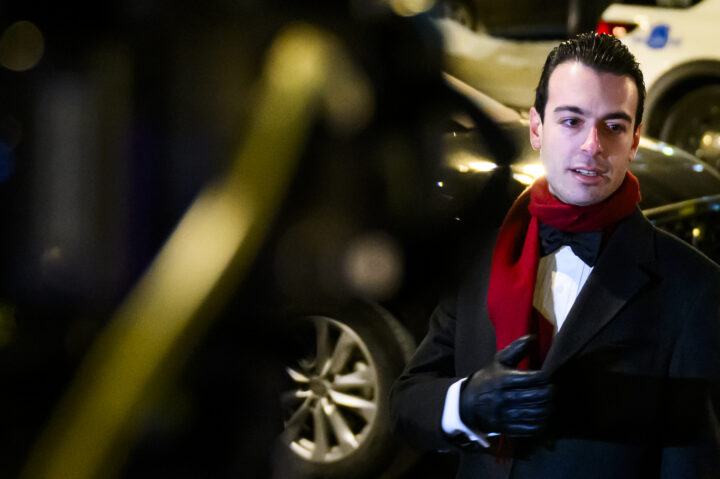
Pete Kiehart for The Washington Post via Getty Images
Paul Ingrassia, forer White House liaison to the Justice Department, left, announces the release of brothers Andrew and Matthew Valentin outside of the DC Central Detention Facility on January 20, 2025 in Washington, DC.
Multiple Senate Republicans said Wednesday that they plan to scrutinize President Donald Trump’s nomination of Paul Ingrassia, a far-right figure picked last week to lead the Office of Special Counsel, charged with fighting corruption and fighting federal whistleblowers.
Ingrassia has trafficked in conspiracy theories, including, as early as Oct. 8, 2023, describing the Hamas attack and ensuing war as a “psyop,” as well as defending prominent antisemites including Kanye West, Andrew Tate and Nick Fuentes.
Several Republican members said they were not deeply familiar with Ingrassia’s record but planned to dig into it further before his nomination hearing.
“We just got news of the nom[ination] coming forward. Those [comments] are obviously concerning and we’ll have our staff doing a full background check, but those are, on their face, concerning,” Sen. Thom Tillis (R-NC) told Jewish Insider.
Tillis was a vocal opponent of Ed Martin, previously Trump’s nominee to be U.S. attorney for Washington, D.C., over his defense of those involved in the Jan. 6, 2021, attack on the U.S. Capitol, including a known Nazi sympathizer. Amid that opposition, Trump withdrew the nomination.
Sen. Josh Hawley (R-MO) said he wasn’t familiar with Ingrassia but that he planned to take a deeper look at him. “I’m not familiar with his record, but I don’t like the guys you just named or their views,” Hawley said, referring to Tate and Fuentes.
Sen. John Cornyn (R-TX) expressed surprise about Ingrassia’s history and affiliations, and said he would “certainly monitor the situation.”
President Trump could sign an executive order implementing the ban as soon as Wednesday, an administration official told a meeting of Jewish leaders

JIM WATSON/AFP via Getty Images
President Donald Trump signs an executive order in the Roosevelt Room of the White House on May 12, 2025, in Washington, DC.
The White House is considering issuing a new executive order banning travel to the United States from certain countries, resurrecting a controversial policy from President Donald Trump’s first term, according to three people who attended a Wednesday White House meeting where the plan was discussed.
The planned executive order was mentioned in a meeting at the White House with Jewish leaders. The meeting, which had several dozen attendees, was organized in response to the deadly antisemitic attack in Washington last month that left two Israeli Embassy staffers dead outside the Capital Jewish Museum. The briefing took place three days after an antisemitic attack in Boulder, Colo., injured 15 people at a march to raise awareness about Israeli hostages in Gaza.
White House Staff Secretary Will Scharf told the group about the order but did not mention which countries would be included in the ban. Scharf said Trump could sign the order as soon as Wednesday.
“They were just saying that an executive order regarding a travel ban is in the works,” one of the sources told Jewish Insider after the meeting. “Everyone was very careful about what they said and didn’t say.”
Another source said the planned order was “not directly because of the events in Boulder,” but that the attack in Boulder was mentioned “as a rationale, as proof of why this executive order was so important.”
The alleged perpetrator in the Boulder attack is an Egyptian national who is in the U.S. illegally, having overstayed his visa, according to the Department of Homeland Security. The suspect’s wife and five children were taken into Immigration and Customs Enforcement custody on Tuesday and were set to be deported to Egypt, but a federal judge on Wednesday halted deportation proceedings against the family members.
In 2017, days after taking office in his first term, Trump signed an executive order barring travel to the United States from seven Muslim-majority nations. Egypt was not one of them.
Speakers at the meeting included Susie Wiles, White House chief of staff; Harmeet Dhillon, assistant attorney general for civil rights at the Department of Justice; evangelical pastor Paula White and Jenny Korn from the White House Faith Office; Noah Pollak, senior advisor at the Education Department; Sebastian Gorka, senior director for counterterrorism at the National Security Council; Adam Boehler, U.S. special envoy for hostage response; Martin Marks, White House Jewish liaison; and Leo Terrell, chair of the federal antisemitism task force. Yehuda Kaploun, Trump’s nominee to serve as U.S. special envoy to monitor and combat antisemitism, was in the room.
Attendees at the meeting included a wide range of Jewish communal leaders, with representatives from Chabad, Jewish Federations of North America, the Anti-Defamation League, the Orthodox Union, American Jewish Committee, the Conference of Presidents of Major American Jewish Organizations, AIPAC, Agudath Israel and several Brooklyn-based Orthodox institutions.
A White House spokesperson did not immediately respond to a request for comment.
‘A nuclear industry without enrichment capabilities is useless because we would then be dependent on others to obtain fuel for our power plants,’ Iranian supreme leader says

Iranian Leader Press Office / Handout/Anadolu via Getty Images
Iranian Supreme Leader Ayatollah Ali Khamenei makes remarks in Tehran, Iran, on May 20, 2025.
Iranian Supreme Leader Ayatollah Ali Khamenei on Wednesday rejected a nuclear deal with the “rude, insolent” U.S. that would require the Islamic Republic to stop enriching uranium, one of President Donald Trump’s core requirements for any nuclear agreement.
In a speech at the mausoleum of former Supreme Leader Ruhollah Khomeini, which was translated and posted on Khamenei’s official X account, the Iranian leader said that Iran’s “enemies have focused all their attention on this very process of uranium enrichment.”
“A nuclear industry without enrichment capabilities is useless because we would then be dependent on others to obtain fuel for our power plants,” he said.
Iran’s supreme leader railed against the American demand, saying that it would make his country “reliant on them for radiopharmaceuticals, energy, desalination equipment and in tens of other critical sectors.”
“The rude, insolent U.S. leaders want this. They’re opposed to progress and self-sufficiency for the Iranian people … Those in power today — the Zionists and the Americans — should know they can’t do a damn thing in this area,” Khamenei stated.
“What the U.S. is demanding is that [Iran] should have no nuclear industry at all and be dependent on them. To the American side and others we say: Why are you interfering and trying to say whether Iran should have uranium enrichment or not? That’s none of your business,” Khamenei argued.
Khamenei’s remarks came a day after Trump posted on Truth Social that “under our potential Agreement — WE WILL NOT ALLOW ANY ENRICHMENT OF URANIUM!”
The Trump administration has reportedly been negotiating an interim deal that would allow Iran to enrich uranium to 3% until a final agreement is reached in which the Islamic Republic can no longer enrich its own uranium. Under the terms of the proposal, the U.S. would facilitate the construction of dedicated enrichment plants in the Middle East to provide Iran with uranium for civilian use.
The International Atomic Energy Agency reportedly sent a confidential report to member states last week that said Iran had increased its stockpile of highly enriched uranium by about 50%. Iran is believed to have material that can be converted into about 10 nuclear weapons in less than two weeks, according to U.S. estimates. American intelligence has assessed that it would take Tehran a few months to assemble a nuclear bomb using the weapons-grade fissile material.
Despite calls from lawmakers and Jewish groups for significant investment, the administration recommended holding funding for the program flat at $274.5 million

MARCO BELLO/AFP via Getty Images
A Miami Beach police patrol drives past Temple Emanu-El synagogue in Miami Beach, Florida, on October 9, 2023, after Hamas launched an attack on Israel.
President Donald Trump’s full budget request to Congress on Friday recommended Congress hold the Nonprofit Security Grant Program at its current level of $274.5 million, in spite of chronic funding shortages and pressure from both lawmakers and the Jewish community for substantially increased funding at a time of rising antisemitism.
In 2024, at that funding level, and with an additional $180 million available from the national security supplemental bill last year, just 43% of funding requests were fulfilled. Supporters of the program in the House and Senate have urged Appropriations Committee leaders and the administration to allocate $500 million for the program, while Jewish groups asked for $1 billion in the wake of the murder of two Israeli Embassy employees at the Capital Jewish Museum.
The budget requests no funding for two hate crimes prevention grant programs, the Khalid Jabara and Heather Heyer NO HATE Act Program and the Matthew Shepard and James Byrd, Jr. Hate Crimes Prevention Grants Program.
The administration indicated in the budget top lines it submitted earlier in May that it aimed to eliminate unspecified Department of Justice hate crimes grant programs, which it said had violated free speech rights.
As previewed in the top lines, Trump recommended a cut in funding to the Office for Civil Rights at the Department of Education, responsible for investigating antisemitism claims, from $140 million to $91 million.
The request also proposes cuts to Federal Bureau of Investigation intelligence and counterterrorism and counterintelligence programs.
The proposal would also significantly cut U.S. military aid to Jordan, cut funding to the State Department by nearly half and ban funding for the United Nations Human Rights Council or United Nations Relief and Works Agency.
Biden’s former national security advisor said, ‘on this, unlike on many other issues, on foreign policy, I seem to be on the same page as Donald Trump’

White House National Security Advisor Jake Sullivan
Former National Security Advisor Jake Sullivan praised President Donald Trump for his strategy of engagement with Iran on their nuclear weapons program and predicted that the Trump administration would reach a deal that “is going to look and feel pretty similar to the” 2015 nuclear deal reached by former President Barack Obama.
Sullivan made the comments on the Unholy Podcast, hosted by Channel 12 anchor Yonit Levi and The Guardian columnist Jonathan Freedland, when asked how he views Trump’s embrace of diplomacy with Iran after withdrawing from the Obama-era deal in his first term. Sullivan, who helped negotiate the 2015 agreement before serving as former President Joe Biden’s national security advisor, noted that Trump referred to the Joint Comprehensive Plan of Action as “the worst deal in human history.”
“The irony is not lost on me that now they are negotiating something that, in its broad elements, is going to look and feel pretty similar to the JCPOA. I’m not talking to anyone in the Trump administration about this. I don’t know of them engaging with other of the architects or negotiators from the Obama era, in part because, while they’re following some of the blueprint of the JCPOA, I think from a marketing perspective, they want to distance themselves and say [that] whatever the Trump deal is is going to be so much better than the Obama deal. I will find it very interesting to watch them make that case,” Sullivan said.
The former national security adviser said he was monitoring public developments with regard to how the uranium enrichment issue was addressed in the ongoing negotiations. Sullivan noted that the issue “has both hung up the negotiations and created this big fight, frankly, within the Republican party.”
Citing the risk of the “potential for retaliation by Iran against both Israel and the United States in the region,” Sullivan said that, “I’ve always thought that a diplomatic resolution that puts Iran’s nuclear program in a box is the right way to proceed. And on this, unlike on many other issues, on foreign policy, I seem to be on the same page as Donald Trump.”
Asked about Trump’s decision to not stop in Israel during his recent Middle East visit and if his overall approach to extracting concessions from Israeli Prime Minister Benjamin Netanyahu served as evidence that the Biden administration should have taken a firmer stance with the Israelis, Sullivan argued there were commonalities between Trump and Biden’s approach to the Gulf states.
“Donald Trump likes peace and he likes deals. That’s his basic approach to the region. And he looks at Bibi and he says, ‘Is Bibi going to give me peace or deals? No. Is MBS [Saudi Crown Prince Mohammed bin Salman]? Yes. Is MBZ [UAE President Mohamed bin Zayed Al Nahyan]? Yes. Even, are the Iranians? Maybe. So are the Houthis, maybe they’ll give me a deal.’ So really I think what he’s doing is saying, ‘Can Bibi be a partner in the things I’m trying to accomplish here, deescalation and deals?’ And since he’s kind of concluded the answer is no, he’s just going to go off and largely do that himself,” Sullivan explained.
“That means cutting a deal with the Houthis that essentially still leaves the Houthis in a position where they’re attacking Israel and saying they’re going to hold Israeli link shipping at risk. It has him potentially doing a deal with Iran, despite misgivings from Israel. And of course, it has him pursuing these massive economic deals with Saudi and the UAE,” he continued.
Sullivan argued that the Biden administration “worked to pave the way for a lot of the strengthened relations with countries in the Gulf,” pointing to partnerships they made with the Saudis and Emiratis.
“We had a different approach on some of this AI and tech stuff, particularly limitations around numbers of chips that would go there. But in substance, the idea that there would be a technology partnership between the UAE and the United States, between the U.S. and Saudi Arabia, that was a hallmark of the Biden approach as well. And so I don’t see a huge divergence there,” he said.
Asked about the ramifications of Israel potentially striking Iran’s nuclear program without Trump’s approval, Sullivan dismissed the notion that Netanyahu would defy the current president.
“I’m pretty skeptical that Prime Minister Netanyahu would act contrary to Trump’s wishes on this front. I think it is highly unlikely that you would see an Israeli prime minister order an attack against the express urging of an American president, particularly this American president in this time, particularly given that the U.S. is engaged in diplomacy with Iran to try to get to some kind of deal,” Sullivan said.
The requests, in some cases, constitute calls for Trump to walk back funding cuts he proposed earlier this month

Getty Images
U.S. Capitol Building
In response to the shooting that killed two Israeli Embassy staffers outside the Capital Jewish Museum last week, a bipartisan group of 46 House members wrote to President Donald Trump on Friday urging him to support expanded funding for key security programs in his full budget request to Congress, expected as soon as Friday afternoon.
While presidential budget requests are non-binding and are frequently modified by Congress, Trump’s requests are likely to be influential in the GOP-controlled Congress. And the appeals made by the lawmakers, in some cases, constitute calls for Trump to walk back funding cuts he proposed in the high-level budget toplines — known as a “skinny budget” — he submitted to Congress earlier this month.
Highlighting the “sharp rise in threats to the Jewish community,” the lawmakers — most of them Democrats — said that it is “imperative that the federal government take the necessary steps to increase funding for enhanced security measures” and “ensure that the Jewish community is equipped with the necessary tools to prevent loss of life in the case of an attack.”
The legislation calls on Trump to support $500 million in funding for the Nonprofit Security Grant Program, the same funding level that bipartisan groups of House and Senate members have urged Appropriations Committee leaders to support, calling the program “one of the most effective and critical programs for protecting the Jewish community and all faith-based communities from attack.” Jewish groups have called for funding to be increased to $1 billion.
Trump, in his “skinny budget,” had called for a reduction in funding for non-emergency grants at the Federal Emergency Management Agency, a category that includes NSGP, but did not put forward a specific request for the program itself. In the past, presidents have not always made any specific funding requests for the NSGP, even in their more detailed budget outlines.
The letter outlines a series of examples that “demonstrate the direct return on investment for communities under threat” from the NSGP, highlighting incidents in which security upgrades paid for by the program likely saved lives by stopping shooting attacks.
The lawmakers also called for Trump to “explore opportunities,” in collaboration with lawmakers, to provide an additional dedicated fund to allow faith-based organizations to hire security officers.
“Although Jewish institutions can use the NSGP to hire additional security personnel, the majority of Jewish institutions have either not been recipients of these grants or cannot afford the additional costs incurred,” the letter reads. “In light of recent events, it is more clear than ever that Jewish institutions are in desperate need of additional personnel support.”
The letter calls on Trump to support increased funding for the Federal Bureau of Investigation. Trump called for a $545 million cut to the FBI’s budget in his “skinny budget”, pledging that the FBI would focus on counterintelligence and counterterrorism and that it would eliminate “duplicative intelligence activities.”
The letter emphasizes the FBI’s role in domestic terrorism investigations, which have been on the rise, and intelligence gathering and the FBI’s responsibility to report to Congress on domestic terrorism threats.
It calls for increased Department of Justice grants for local law enforcement to ensure that hate crimes are properly reported to local and federal law enforcement agencies, and specifically for grant programs to counter hate crimes “to ensure that antisemitic hate crimes are addressed and prosecuted in a timely manner” and their extent is fully understood.
The “skinny budget” called for cutting $1 billion in DOJ grant programs, including “programs that focus on so-called hate crimes in clear violation of the First Amendment.”
The letter was led by Reps. Josh Gottheimer (D-NJ) and Jared Moskowitz (D-FL) and co-signed by Reps. Max Miller (R-OH), Haley Stevens (D-MI), Brittany Pettersen (D-CO), Laura Gillen (D-NY), John Larson (D-CT), Dan Goldman (D-NY), Jamie Raskin (D-MD), Nikema Williams (D-GA), David Scott (D-GA), Wesley Bell (D-MO), Shri Thanedar (D-MI), Dina Titus (D-NV), Donald Norcross (D-NJ), Susie Lee (D-NV), Andre Carson (D-IN), Shontel Brown (D-OH), Sheila Cherfilus-McCormick (D-FL), Lloyd Doggett (D-TX), Lizzie Fletcher (D-TX), Greg Landsman (D-OH), Frederica Wilson (D-FL), Debbie Wasserman Schultz (D-FL), Janelle Bynum (D-OR), Madeleine Dean (D-PA), Frank Pallone (D-NJ), Jerry Nadler (D-NY), LaMonica McIver (D-NJ), Ted Lieu (D-CA), George Latimer (D-NY), Juan Vargas (D-CA), Julie Johnson (D-TX), Julia Brownley (D-CA), Marilyn Strickland (D-WA), Darren Soto (D-FL), Chris Pappas (D-NH), Brendan Boyle (D-PA), Bill Keating (D-MA), Tom Suozzi (D-NY), Steve Cohen (D-TN), Benny Thompson (D-MI), Jan Schakowsky (D-IL), Brad Sherman (D-CA), David Kustoff (R-TN) and Del. Eleanor Holmes Norton (D-DC).
Miller and Kustoff, who are both Jewish, are the only Republican signatories.
Paul Ingrassia was tapped to serve as the head of the Office of Special Counsel, which enforces ethics laws
Pete Kiehart for The Washington Post via Getty Images
Paul Ingrassia, forer White House liaison to the Justice Department, left, announces the release of brothers Andrew and Matthew Valentin outside of the DC Central Detention Facility on January 20, 2025 in Washington, DC.
President Donald Trump announced his intention to nominate far-right commentator Paul Ingrassia to head the agency tasked with rooting out corruption and protecting whistleblowers in the federal government.
Ingrassia, 29, currently serves as the White House liaison for the Department of Homeland Security. He briefly served as the White House liaison to the Department of Justice early in Trump’s second term, but was reassigned after clashing with the DOJ’s chief of staff after urging the president to hire only individuals who exhibited what Ingrassia called “exceptional loyalty,” according to ABC News.
In Trump’s post on Truth Social announcing Ingrassia’s nomination to head the Office of Special Counsel, an independent federal agency tasked with investigating and prosecuting office government and political corruption, the president called him a “highly respected attorney, writer, and Constitutional scholar.”
Ingrassia has trafficked in a number of conspiracy theories, as have several other controversial administration appointees, including Department of Defense Press Secretary Kingsley Wilson and acting Under Secretary for Public Diplomacy Darren Beattie.
On Oct. 7, 2023, as the Hamas attacks were still underway, Ingrassia posted on X calling illegal immigration to the U.S. “comparable to the attack on Israel,” writing, “The amount of energy everyone has put into condemning Hamas (and prior to that, the Ukraine conflict) over the past 24 hours should be the same amount of energy we put into condemning our wide open border, which is a war comparable to the attack on Israel in terms of bloodshed — but made worse by the fact that it’s occurring in our very own backyard. We shouldn’t be beating the war drum, however tragic the events may be overseas, until we resolve our domestic problems first.”
He wrote three days later that the U.S. “should not be committing any foreign aid (as well as military presence) whatsoever to any country – Israel, Ukraine, Taiwan, NATO, etc. – until we secure our borders and get a sensible handle over our border crisis. Practically speaking, this will take several years (at least) to get under control. In the meantime: no immigration, no foreign aid, troops, equipment, or anything, period.”
On Oct. 12, 2023, responding to a post alleging to uncover DNA sequences of “Canaanites, Israelites [and] Judahites,” Ingrassia wrote, “This is further evidence that Israel/Palestine is a deeply complex region of the world with a complicated history, that most Americans don’t adequately understand, nor could be expected to understand.”
In that post, he bashed former National Security Advisor John Bolton, Sen. Lindsey Graham (R-SC), former Vice President Mike Pence and former U.S. Ambassador to the U.N. Nikki Haley, calling them “Warmongering Troglodytes” and saying the alleged DNA evidence was “further reason to dismiss the dangerous and reckless calls” made by these officials to strike Gaza.
On Oct. 15, just days after the attacks, Ingrassia wrote, “I think we could all admit at this stage that Israel/Palestine, much like Ukraine before it, and BLM before that, and covid/vaccine before that, was yet another psyop.”
A year later, on Oct. 3, 2024, he posted that there were no funds for hurricane relief because “we’re too busy stuffing the pockets of Zelenskyy and Netanyahu. What a disgrace our government is! Truly the enemy of the people.”
Ingrassia has further associated himself with white nationalists and antisemites, including Nick Fuentes and Kanye West, now known as Ye, posting a Substack in April 2023 titled “Free Nick Fuentes.”
In the post, he applauded the social media platform X for restoring certain accounts including that of far-right provocateur Laura Loomer and alleged sex trafficker Andrew Tate, but argued that it should go further to restore Fuentes’ and Ye’s then-banned accounts: “Notably, the accounts of once banned high-profile users such as Donald Trump, Andrew Tate, Roger Stone, and Laura Loomer have been reinstated with apparent impunity to use the platform as they please. But for every Trump and Tate, there remains the still banned Fuentes and Ye.”
The attorney has defended Tate and his brother — whom British authorities charged on Wednesday with rape, human trafficking and assault — saying in 2023 that the two “have become public enemies number one and two in the eyes of the Matrix, the deep state, and the satanic elite that attempt to systematically program and oppress all men from womb-to-tomb.”
Prior to joining the administration, Ingrassia was a regular contributor to the Gateway Pundit, a website known for publishing falsehoods and conspiracy theories. He wrote articles on the site falsely alleging Haley was ineligible to run for president in 2024 because she did not qualify as a U.S. citizen, arguing civil rights laws were never intended to protect LGBTQ persons and calling former President Joe Biden’s victory in 2020 “beyond all doubt fraudulent,” among others.
Ingrassia has repeatedly used the term “globalists” to describe Jewish public figures, including Sen. Jacky Rosen (D-NV), Michigan Senate candidate Sandy Pensler and hedge fund manager Paul Singer.
Last year, following an appearance on Steve Bannon’s War Room show, Ingrassia wrote on X, “Discussed a very important topic this morning on War Room about how some RINO members — like @RepGallagher — of the House, many with dark money ties to notorious anti Trump billionaire globalist, Paul Singer, are actively working behind the scenes to turnover House control to Democratic hands with early retirements and thus pass legislation to remove President Trump from the ballot on bogus 14th Amendment grounds.”
Middle East envoy Steve Witkoff said Wednesday the administration is working on new terms for a deal with Hamas

Maja Hitij/Getty Images
Ruby Chen, father of 19-year-old hostage Itay Chen speaks at the press conference at hostage square on December 16, 2023 in Tel Aviv, Israel.
In a letter to President Donald Trump, a bipartisan group of House members renewed calls for a deal to release all of the remaining hostages held in Gaza, including the bodies of four Americans believed to be deceased, urging him to capitalize on potential momentum from the release of Israeli American hostage Edan Alexander earlier this month.
Middle East envoy Steve Witkoff said on Wednesday that the administration would soon put forward a “new term sheet” for a potential ceasefire, expressing confidence about reaching a long-elusive deal.
“Building on the momentum of Edan’s release, we strongly urge your Administration to press forward with all available diplomatic efforts to secure the return of all hostages—including the four remaining Americans: Omer Neutra, Itay Chen, Gadi Haggai, and Judi Weinstein Haggai,” the House letter reads.
“While Edan’s return marks a critical breakthrough, the suffering he endured underscores the urgency of this mission,” the letter continues. “Those still in captivity continue to face unimaginable hardship, and we owe it to them and their families to do everything in our power to secure their release. This moment — coming in the wake of Edan’s homecoming — offers a window of opportunity.”
Witkoff said earlier this week that there is a deal on the table to release half of the living and half of the deceased hostages in exchange for a temporary ceasefire of unspecified length before negotiations to free the remaining hostages. Witkoff said Hamas has offered a “completely unacceptable” response.
“We urge you to continue using every diplomatic tool available, in close coordination with our regional allies and partners, to press for the release of all hostages,” the House letter continues. “Edan’s return has brought renewed hope to the nation — and to the close-knit community of Tenafly, New Jersey. Now, we must act swiftly to ensure that hope is realized for every hostage and every waiting community.”
The lawmakers highlighted the physical and mental torture that Alexander endured in Gaza, which many of the hostages still in captivity continue to endure. They thanked the Trump and Biden administrations and others involved in ongoing hostage negotiations and in freeing Alexander.
The letter was led by Rep. Josh Gottheimer (D-NJ) and co-signed by Reps. Young Kim (R-CA), Tom Suozzi (D-NY), Laura Gillen (D-NY), Ro Khanna (D-CA), Maria Salazar (R-FL), Frederica Wilson (D-FL), Val Hoyle (D-OR), Greg Stanton (D-AZ), Frank Pallone (D-NJ), Tom Kean (R-NJ), Don Bacon (R-NE), Chris Pappas (D-NH), Laura Friedman (D-CA), Greg Landsman (D-OH), Jake Auchincloss (D-MA), Seth Moulton (D-MA), Juan Vargas (D-CA), Brad Schneider (D-IL), Ritchie Torres (D-NY), Kim Schrier (D-WA), Gabe Amo (D-RI), Jeff Van Drew (R-NJ), French Hill (R-AR) and Herb Conaway (D-NJ).
The president said he did not issue a ‘warning’ to Netanyahu but said a strike 'is not appropriate’ during ongoing nuclear negotiations
JIM WATSON/AFP via Getty Images
President Donald Trump speaks during a swearing in ceremony for interim US Attorney for the District of Columbia Jeanine Pirro in the Oval Office of the White House in Washington, DC, on May 28, 2025.
President Donald Trump confirmed reports that he warned Israeli Prime Minister Benjamin Netanyahu in a phone call last week not to proceed with plans to attack Iran’s nuclear facilities while the U.S. and Iran continue negotiations, saying that he told the Israeli leader a strike “is not appropriate right now.”
Speaking to reporters in the Oval Office on Wednesday, the president responded to a question about the validity of the report by saying, “I’d like to be honest. Yes, I did.”
Pressed about the nature of the conversation, the president clarified, “It’s not a warning, I said I don’t think it’s appropriate. We’re having very good discussions with them [Iran] and I don’t think it’s appropriate right now.”
Trump suggested the U.S. may strike a “very strong document” with Iran “where we can go in with inspectors, we can take whatever we want, we can blow up whatever we want but nobody’s getting killed. We can blow up a lab but nobody’s going to be in the lab, as opposed to everybody being in the lab and blowing it up, right? Two ways of doing it.”
He affirmed he told Netanyahu to hold off “because we’re very close to a solution. Now, that could change at any moment. It could change with a phone call. But right now I think they want to make a deal and if we can make a deal, save a lot of lives.”
He said a deal with Iran could be reached “over the next couple of weeks.”
Netanyahu, for his part, denied a New York Times report that he had been pressing for military action against Iran, which could upend the talks, calling it “fake news.”
On the new U.S.-Israel aid distribution mechanism in Gaza that went into effect this week, Trump said, “We’re dealing with the whole situation in Gaza. We’re getting food to the people.”
Middle East envoy Steve Witkoff, speaking beside Trump, added, “I think that we are on the precipice of sending out a new terms sheet that hopefully will be delivered later on today. The president is going to review it. And I have some very good feelings about getting to a long-term resolution — temporary ceasefire and a long-term resolution, a peaceful resolution of that conflict.” Witkoff did not expand on the details of the “terms sheet” nor to whom it will be delivered.
Some Israeli business leaders and innovators are urging the country to seriously consider adopting a strategy of ‘economic diplomacy’ to place the country more firmly on Trump’s radar

Win McNamee/Getty Images
U.S. President Donald J. Trump and Emir of Qatar Tamim bin Hamad al Thani attend a signing ceremony at the Amiri Diwan, the official workplace of the emir, on May 14, 2025, in Doha, Qatar.
During President Donald Trump’s trip to the Middle East earlier this month, he shuttled between Gulf capitals to announce major economic deals. In Qatar, it was an eye-popping $1.2 trillion economic commitment in trade agreements and direct investment. Saudi Arabia pledged to invest $600 billion in the United States in defense, energy and infrastructure. And in the United Arab Emirates, Trump announced a series of agreements — including one to build Stargate UAE, the largest artificial intelligence campus outside the United States, in partnership with OpenAI and Nvidia — worth more than $200 billion, on top of $1.4 trillion previously committed in U.S. investments.
Missing from the list of deals announced on Trump’s Middle East junket was any kind of similar agreement with Israel, which Trump did not visit on his first major trip abroad since returning to office. Economic ties between the U.S. and Israel are strong; Israel is a larger trading partner to the U.S. than either Saudi Arabia, the UAE or Qatar, and American investors are among the biggest investors in Israeli startups. But the country lacks the liquid financial firepower that is available to the oil-rich Gulf monarchies, which risks placing Israel at a disadvantage in the eyes of an American president who sees the world as a series of business deals.
“You try not to compete in areas where you have a disadvantage. We have a capital disadvantage. So we should compete where we have an advantage, which is on innovation and technology,” said Michael Eisenberg, who co-founded Aleph, an Israeli VC firm.
Some Israeli business leaders and innovators are now urging the country to seriously consider adopting a strategy of “economic diplomacy” to place the country more firmly on Trump’s radar. They think that startup founders and venture capitalists stand to serve as Israel’s best ambassadors, better suited to make the economic case for deepening U.S.-Israel ties than the buttoned-up bureaucrats who populate global capitals advancing Israel’s interests.
“Founders are Israel’s best ambassadors. They travel more than diplomats, pitch to the world’s biggest investors and solve real-world problems that transcend borders,” said Jon Medved, the Israel-based CEO of OurCrowd, a global venture investing platform. “Do they have a responsibility to engage in economic diplomacy? I think they already do, whether they realize it or not.”
Where the Gulf countries have the ability to spend seemingly endless sums of money on American investments and projects to woo Trump, Israel offers “deep tech expertise” and a venue for early stage collaboration that cannot easily be replicated.
“We’re the lab. The Gulf can be the scale-up market,” Medved continued. “There’s a powerful opportunity for synergy, not just competition.”
It’s not news to the American government that Israel excels in technology. In 2022, the two countries launched a strategic high-level dialogue on technology as a way to advance cooperation on artificial intelligence, climate change and pandemic preparedness. (The dialogue slowed down after the Oct. 7, 2023, Hamas attacks.)
Avner Golov, who until 2023 served as the senior director for foreign policy in Israel’s Prime Minister’s Office, thinks the collaboration between the two countries should be formalized with a photo op, like the signing ceremonies Trump participated in during his visit to the Gulf. The U.S.-Israel security memorandum of understanding, which promises Israel $3.3 billion in U.S. security assistance annually, expires in 2028, and Golov thinks the renegotiation of that agreement is an opportunity to strengthen the tech and economic ties between the countries — to put Israel’s tech diplomacy to the test.
“I envision going to the White House Rose Garden, signing, for the first time, a formal strategic partnership between Israel and America, approved in both Congress and the Israeli Knesset,” Golov told Jewish Insider. Such a deal, as Golov sees it, might also include ways to make it easier for American businesses to operate in Israel.
Eisenberg, who has invested in major Israeli startup successes such as WeWork and Lemonade, thinks changes to Israel’s “regulatory environment” can help make the sell to American companies and, by extension, Trump.
“We’re not going to do zero taxes like Dubai, but we need to be attracting more capital here by making our regulatory environment much simpler and lowering our capital gains taxes to be competitive with the United States so that we can bring capital formation vehicles like hedge funds to Israel,” Eisenberg said.
Of course, many leading tech companies already have large operations in Israel. The chip giant Nvidia announced a $500 million investment in an Israeli AI research data lab in January. In March, Google acquired the Israeli cybersecurity company Wiz for $32 billion, Google’s largest-ever acquisition. Nvidia CEO Jensen Huang and Google President Ruth Porat were with Trump in Saudi Arabia, along with other top CEOs.
“Many of them have employees in Israel because of our innovation, but we need to build a strategy around attracting them, getting deeper engagement and using them in our attempt to build us into a regional superpower,” added Eisenberg.
Israeli Prime Minister Benjamin Netanyahu has long touted Israel’s startup ecosystem, but some worry he has not sufficiently tapped into that world to meet the moment, when Trump — whom Netanyahu has always sought to present as a close friend — seeks flashy financial success on the world stage.
“[Netanyahu] should have realized that in a competition for the affections of a strongman like Trump, Israel had little to offer,” The Atlantic’s Yair Rosenberg wrote this month.
But the basis of the U.S.-Israel relationship has never been purely about dollars and cents.
“If we’re going to make sure, ‘Hey, don’t forget about us,’ it’s not about money. It’s about morality and humanity and the purpose of Israel on the world stage,” former U.S. Ambassador to Israel Tom Nides told JI. “Obviously there’s this whole notion that there are a lot of deals to be done. But that’s not how we compete.”
Israel’s controversial national security minister, Itamar Ben-Gvir, also met with Noem and says she invited him to visit the U.S.
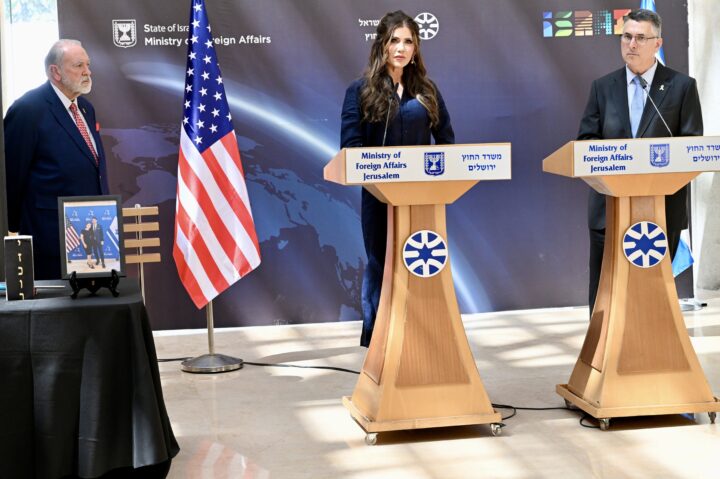
David Azagury, U.S. Embassy Jerusalem
U.S. Secretary of Homeland Security Kristi Noem pays her condolences at a memory ceremony for slain Israeli Embassy staffers, Yaron Lischinsky and Sarah Milgrm who were killed in a terror attack in Washington D.C., on May 21, 2025. The Ceremony took place at the Israeli Ministry of Foreign Affairs headquarters on May 26, 2025.
The murder of Yaron Lischinsky and Sarah Lynn Milgrim is a reminder “of the dreams that terrorism seeks to destroy every single day,” Homeland Security Secretary Kristi Noem said on Monday, standing alongside Israeli Foreign Minister Gideon Sa’ar at a memorial event held in Jerusalem for the young Israeli Embassy staffers who were killed last week in a terror attack outside the Capital Jewish Museum in Washington.
“Today, we stand together with profound grief, and our hearts are heavy with the loss of these two radiant souls that we will no longer have with us,” Noem said. “In this moment of sorrow, we also ask that you would gather with us to honor their light and the unbreakable spirit of the Israeli and the American people,” Noem continued.
Lischinsky, Noem said, “was known for his infectious smile and his unwavering commitment to peace and the vision of the Abraham Accords.”
“Friends and family shared of Sarah that she glowed with warmth and compassion, dedicating her life to fostering peace and understanding,” Noem said, mentioning Milgrim’s work for the Israeli peace-building nonprofit Tech2Peace and her career in public diplomacy. “Their love for each other, a bond that was so strong that Yaron had already chosen a ring to propose to Sarah here in Jerusalem reminds us of the dreams that terrorism seeks to destroy every single day — but we will not let hatred have the final word.”
“Sarah and Yaron’s lives are a testament to the power of love and service,” Noem said. “They stood for something that was much larger than themselves, and their memory calls us to do the same. They have lived a life of significance that has forever changed us. Together they embody the very best of Israel: courageous, hopeful and dedicated to peace.”
Sa’ar thanked Noem for her visit to Israel, which he said, “shows solidarity and demonstrates the close relations between our people.” He also thanked the U.S. government for the investigation into the murder of Lischinsky and Milgrim.
U.S. Ambassador to Israel Mike Huckabee also spoke at the event, held at the Israeli Ministry of Foreign Affairs headquarters, and said that the memories of Lischinsky and Milgrim “will not be taken from any of us, and we should always be mindful that there are people who pay an incredible price to simply be Israelis and Jews.”
“And it’s why the United States must always stand, and it’s why it’s so very important that we welcome the secretary here to the State of Israel as she comes to offer in person an extraordinary sense — not just of condolences — but also a sense of confidence that the relationship between our nations will never waver, or will it ever falter.”
The remarks by both the American and Israeli officials emphasizing the importance of the strong bonds between the U.S. and Israel come amid recent reports about faltering ties, especially during President Donald Trump’s recent visit to the Middle East, which excluded Israel, and amid the Trump administration’s ongoing nuclear negotiations with Iran.
Noem arrived in Israel on Sunday evening when Jerusalem Day began, marking the city’s reunification in the 1967 Six-Day War, which made her the first U.S. cabinet secretary to mark that day, according to Huckabee. She prayed at the Western Wall and put a note between its cracks.
Noem later met with Israeli Prime Minister Benjamin Netanyahu, in which she “expressed unqualified support for the prime minister and the State of Israel,” a Prime Minister’s Office readout stated.
She also praised the border fence between Israel and Egypt, the PMO stated. The fence, which was completed in 2013, was built, in part, to block African migrants from crossing into Israel from the Sinai peninsula.
Noem also met last night with her counterpart, Itamar Ben-Gvir, in a meeting which was also attended by Netanyahu. According to a statement from Ben-Gvir’s office, the minister thanked Noem for American support for Israel and for Trump’s relocation plan for Gaza. The statement also noted that Noem invited Ben-Gvir for another visit to the U.S. During his last visit, in April, the far-right minister did not meet with Noem, who was in Texas at the time, nor anyone else in the Trump administration.
JI’s Lahav Harkov contributed to this report.
The secretary of state also assured lawmakers that all Trump administration officials are unified in their opposition to Iran maintaining domestic nuclear enrichment capabilities
BRENDAN SMIALOWSKI/AFP via Getty Images
Secretary of State Marco Rubio testifies before a House Subcommittee on National Security, Department of State, and Related Programs hearing on the budget for the Department of State, on Capitol Hill in Washington, DC on May 21, 2025.
In his second consecutive day of hearings on Capitol Hill, Secretary of State Marco Rubio said that he expects that additional Arab countries will join the Abraham Accords by the end of the year, if not earlier.
“We do have an Abraham Accords office that is actively working to identify a number of countries who have lined up and already I think we may have good news, certainly before the end of this year, of a number of more countries that are willing to join that alliance,” Rubio said a House Foreign Affairs Committee hearing on Wednesday.
The comments are consistent with other recent remarks by President Donald Trump and Middle East envoy Steve Witkoff.
Rubio added that the administration is currently working on selecting an ambassador for the Abraham Accords, as required under law, to submit for congressional confirmation.
He said that there is “still a willingness” in Saudi Arabia to normalize relations with Israel, but “certain conditions are impediments,” including the Oct. 7, 2023, Hamas attacks on Israel and the ensuing war.
Rubio’s testimony largely reinforced and added on his comments the day before, on issues including Iran and Syria.
He again insisted that all elements of the Trump administration, including Vice President JD Vance and Witkoff, are unified behind the position that Iran cannot be allowed to maintain its capacity to enrich uranium.
And he affirmed that U.S. law requires that any deal with Iran be submitted to Congress for review and approval, noting that he had been in Congress when that law was passed.
At an afternoon hearing with the House Appropriations Committee, Rubio again said that sanctions relating to Iranian proxy terrorism or other malign activities will not be impacted by a nuclear deal that does not address those subjects. Republicans in the past have questioned the distinction between nuclear and non-nuclear sanctions, particularly as part of the original 2015 nuclear deal, which took a similar approach. And they’ve argued that any sanctions relief would allow Iran to expand its support for regional terrorism.
Rubio said the administration is continuing to ramp up sanctions on Iran, and said that European parties to the deal are “on the verge” of implementing snapback sanctions on Iran. He said that the administration would support legislation to implement additional sanctions on Iran’s oil sector.
He denied knowledge of a Tuesday leak by administration officials that Israel was making plans to strike Iran’s nuclear program, adding, “I also don’t think it’s a mystery, though … that Israel has made clear that they retain the option of action to limit Iran from ever gaining a nuclear capability.”
Expanding on comments he made the day before, Rubio said that he favors moving the mission of U.S. security coordinator for Israel and the Palestinian territories under the authority of the U.S. ambassador to Israel so that it can be a better-integrated part of the U.S.’ Israel policy. But he vowed that the core function of the office will continue.
Rubio denied reports of talks between the United States and Saudi Arabia about potential nuclear cooperation outside of a “gold standard” deal, which would include banning domestic enrichment.
The secretary of state reiterated comments about the critical necessity of providing sanctions relief to Syria to help contribute to stability, but he said that continued sanctions relief “does have to be conditioned on them continuing to live by the commitments” that the Syrian government has made verbally, including to combat extremism, prevent Syria from becoming a launchpad for attacks on Israel and form a government that represents, includes and protects ethnic and religious diversity.
He indicated that the U.S. is not actively working to shut down the United Nations Relief and Works Agency, but pledged that the United States will not be providing any further aid to or through that organization and will use its power and funding to look for alternatives.
He said it will be up to other countries whether they continue working with UNRWA, though he noted that the U.S. has been the agency’s largest donor.
Rubio said that he would be supportive, in concept, of legislation to expand current U.S. anti-boycott laws to include compulsory boycotts imposed by international organizations. That legislation was pulled from a House floor vote after right-wing lawmakers falsely claimed it would ban U.S. citizens from boycotting Israel.
Pushing back on calls for the U.S. to withhold weapons sales to the United Arab Emirates over its support for one of the parties involved in the Sudanese Civil War that the U.S. has found is committing genocide, Rubio said that the U.S. is not fully in alignment with the UAE but argued that it’s critical for the U.S. to continue engaging with and maintain a strong relationship with the UAE for its broader foreign policy goals in the Middle East.
He said that maintaining such a relationship and expanding the U.S.’ diplomatic and economic relationship with Abraham Accords countries is also important to ensuring that the Accords continue to be successful.
Rubio said that the State Department had approved restarting aid programs for Jordan that remained frozen — though he noted most were initially exempted from the administration’s blanket freeze. He acknowledged that the frozen programs had been “a source of frustration for [Jordan], and frankly for me.” He continued, “Ultimately, we’re going to get all those programs online, if they’re not online already.”
In a heated back-and-forth with Rep. Pramila Jayapal (D-WA), who was brandishing a pocket Constitution, Rubio again defended the administration’s policy of revoking student visas from individuals accused of involvement in anti-Israel activity on college campuses, saying that they are coming to the United States to “tear this country [apart]” and “stir up problems on our campuses.”
Addressing the case of Rümeysa Öztürk, a Tufts University graduate student that supporters have said was detained solely for writing an op-ed in a student newspaper criticizing Israel, Rubio claimed the situation is not as has been represented. “Those are her lawyers’ claims and your claims, those are not the facts,” Rubio said.
Asked by Jayapal about a comment — “Jews are untrustworthy and a dangerous group” — made by an Afrikaner refugee recently admitted to the United States from South Africa, Rubio said that he would “look forward to revoking the visas of any lunatics you can identify.”
But when presented with the fact that the individual in question was admitted as a refugee, not on a visa, Rubio said that refugee admissions are “a totally different process,” adding “student visas are a privilege.”
Speaking to the media in Israel for the first time in five months, the Israeli prime minister denied reports of friction with the U.S.

MAYA ALLERUZZO/POOL/AFP via Getty Images
Israeli Prime Minister Benjamin Netanyahu speaks during a press conference in Jerusalem on December 9, 2024.

