



































































Senate moves toward repeal of Caesar Act Syria sanctions in defense bill
The House version of the bill does not contain such a repeal, leaving its passage up to negotiation

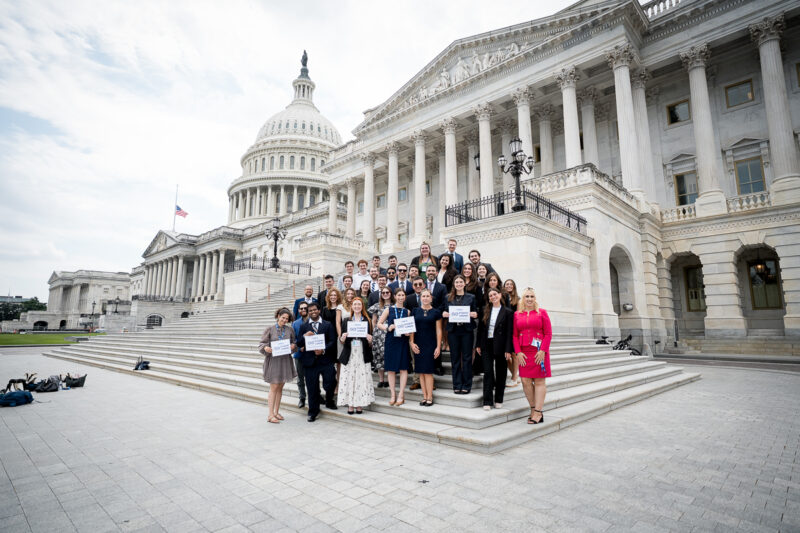
GETTY IMAGES
A general view of the U.S. Capitol Building from the National Mall, in Washington, D.C., on Thursday, May 29, 2025.


 Add JewishInsider on Google
The Senate approved the repeal of strict sanctions legislation targeting the now-deposed Assad regime in Syria, as part of its version of the 2026 National Defense Authorization Act.
Lawmakers on both sides of the aisle have been working to repeal or roll back the sanctions, known as the Caesar Act, for several months, though the effort is not without some opponents.
The chamber also passed, as part of a bipartisan package of amendments, an amendment led by Sens. Lindsey Graham (R-SC) and Chris Van Hollen (D-MD) — opposed by some Syrian-American activists — that requires regular reports to Congress certifying Syria’s compliance with a variety of U.S. priorities and urges the administration to reimpose sanctions if such verification cannot be completed.
The House version of the NDAA does not include a similar provision, so whether the sanctions repeal is included in the final bill, and in what form, will be subject to negotiations between the two chambers. Legislation placing a variety of conditions on the suspension of the Caesar Act, rather than repealing the sanctions, has gained momentum in the House.
The Senate also approved, by voice vote, an amendment that would repeal the Authorizations for Use of Military Force that allowed for the Iraq and Gulf wars. With similar provisions included in the House version of the bill, the repeal of those war authorizations, a long-term goal of lawmakers on both sides of the aisle, looks increasingly likely this year.
Opponents have argued that the process has moved too quickly and with too little deliberation and consultation with the administration, and that repealing the authorities could jeopardize counterterrorism operations.
The upper chamber rejected an amendment that would have barred the modification of a Qatari-donated jumbo jet to serve as Air Force One, by a party-line vote of 50 to 46.
Other provisions added to the legislation in bipartisan amendment packages include programs aimed at countering foreign information manipulation and interference by adversaries like Iran; a study of the potential security conditions for reopening the U.S. embassy in Damascus, Syria; and legislation aimed at countering the wrongful detentions of U.S. citizens by adversaries like Iran by creating a new designation and penalties for countries engaging in such activity.
The legislation also expands and modifies various U.S.-Israel cooperative military programs.
More Stories

PROTEST POLITICS
Incoming anti-Israel members of Congress protest against Netanyahu outside U.N.

WAR POWERS WOES
Senate narrowly rejects Iran war powers resolution, as Tillis joins Democrats to oppose war

medical moves
Jewish groups praise new HHS guidelines aimed at combating antisemitism in healthcare
MONEY MATTERS
Treasury moves to terminate tax-exempt status for some universities, private schools

REGIME RECKONING
El-Sayed avoids acknowledging Iranian protester deaths, condemns Iran war instead
ALTERNATE REALITY
Pezeshkian denies Iran seeks nuclear weapons at UNGA
Please log in if you already have a subscription, or subscribe to access the latest updates.
 Continue with Google
 Continue with Apple