




































‘Now, life:’ Former hostage Eli Sharabi shares his post-captivity resilience and optimism
Sharabi’s new book, Hostage, tells the story of his kidnapping and 491 days in Gaza
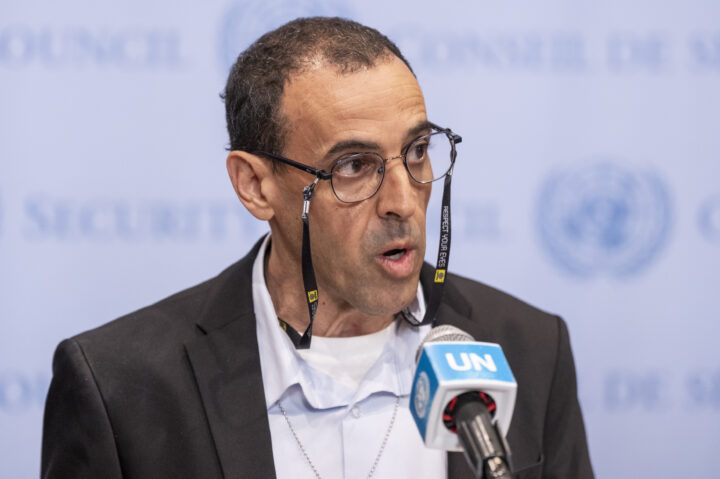
Lev Radin/Pacific Press/LightRocket via Getty Images
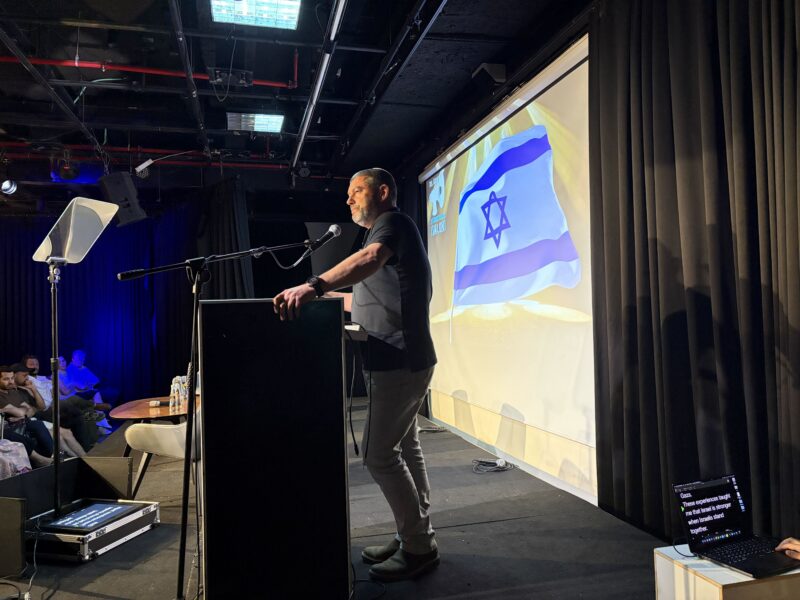
Eli Sharabi speaks to the press ahead of Security Council meeting at U.N. Headquarters.


 Add JewishInsider on Google
Freed hostage Eli Sharabi’s new book, Hostage, ends with him visiting the graves of his wife, Lianne, and his daughters, Noiya and Yahel, for the first time after being released from nearly a year and a half of captivity in Gaza, during which he had hoped they were still alive following the Hamas attack on their home in Kibbutz Be’eri on Oct. 7, 2023.
“This here is rock bottom. I’ve seen it. I’ve touched it,” Sharabi writes. “Now, life.”
The memoir tells a horrific story of 491 days of violence, deprivation and starvation.
That final sentence of Sharabi’s memoir — “Now, life” — could sum up his post-captivity self. In an interview with Jewish Insider last month, Sharabi said he was determined to reassert his agency, take action on hostage advocacy and move forward in his life.
Sharabi seemed cheerful speaking about his recovery. He was still slimmer than his pre-captivity self, but no longer as gaunt as he was emerging from the tunnels in Gaza in which Hamas starved him, giving him only a stale pita to eat each day, at most.
“I’m getting stronger every day,” Sharabi said. “I make sure to exercise and have weekly therapy sessions and make sure to take care of myself. I am strong and positive and facing forward.”
Sharabi’s days are filled with meetings around Israel and the world advocating for the remaining hostages to be freed.
“From the moment I got out of Sheba [Medical Center], 10 days after being freed, it has been non-stop action,” he said. “I have a lot of trips abroad, meeting with government officials — presidents, prime ministers, members of parliament, foreign ministers — and a lot of lectures in Israel and around the world, to a lot of Jewish communities. … It’s non-stop, morning to night.”
In his book, he recounts reassuring hostages Alon Ohel, who is still in Gaza, and Eliya Cohen and Or Levy, who have since been released, that he was sure their families were protesting and advocating for their release.
“It was important for Eliya and me to tell Or and Alon, who were more pessimistic about our chances, to get out and thought ‘maybe they forgot us,’” Sharabi recalled. “Eliya and I were very positive and said we had no doubt our families and good friends are not resting for a moment and doing all they could to free us.”
Sharabi said that when his captors would tell him about protests in the streets of Israel, they would say the demonstrations were against Israeli Prime Minister Benjamin Netanyahu, but he and his fellow hostages saw it as “the nation going out to fight for us. It gave us hope.”
When Sharabi was released, he saw that the scale of the hostage advocacy movement was beyond what he had imagined.
“When I got out and understood that it was masses of people in Israel, it excited me,” he said. “I met members of Jewish communities in New York, Chicago, Miami, London, Mexico. I meet Israelis and Jews all around the world and understand what they did all this time. It is very touching. I didn’t expect it at all. I expected my friends and family. I didn’t think that people would have posters of me at their holiday table. It’s heartwarming.”
At home in Israel, however, there have been sharp political divisions about the looming deal to release the hostages in exchange for ending the war in Gaza. Some far-right ministers in Netanyahu’s government oppose President Donald Trump’s plan, which calls to free all 48 remaining hostages — 20 of whom are thought to be alive — within three days, because they call to prioritize defeating Hamas.
“In Israel, everything is political,” Sharabi lamented. “It’s terrible. All of our elected officials, with no exception, are partners in this terrible thing. I think all the people of Israel are sick of everything being political. I think most people in Israel hate this.”
The hostages, Sharabi said, “are not about right and not about left.” His brother, Yossi, was also taken captive and was killed while in Hamas captivity, which the IDF found may have been caused by an IDF airstrike.
Sharabi had an almost paternal relationship with Ohel when Hamas held them captive together in the tunnels under Gaza, and he expressed relief to have seen Ohel in a new hostage video released by the terror group last month.
“He’s amazing,” Sharabi said. “If you told me a week after I met him that he would survive six or seven months alone, after I left him, I would have doubted it. I left him after a very positive process during which he strengthened himself and learned how to survive, that you can’t be nice all the time and can’t be naive. He developed resilience and isn’t shaken by every change and every fear.”
Sharabi emphasized that, while in captivity, it is crucial to “understand that not everything is in our control, but we have the ability to choose how we respond.”
“I’m optimistic that soon we will see [Ohel] united with his family, and soon after, I will reunite with him. I am looking forward to it,” he said.
Sharabi describes his captors in detail in the book. Some were always cruel, while others snuck the hostages extra scraps of food. Some were true extremists, while others appeared to be in Hamas for the money.
“There are no innocent people in Gaza,” he said, “not civilians and certainly not the people in Hamas. In the 52 days that I was aboveground, not in tunnels but with a family in a house, they made sure people outside would not hear or see me, because they thought people would come in and kill me.”
“I recognize that even within Hamas, after spending 24/7 with them for many months and having different conversations with them, I understand who is ideological and who stumbled into it because Hamas controls the financial faucets in Gaza,” Sharabi added. “Does that make them innocent? Of course not. The moment they got the order, I was shackled around my legs. If they were told to shoot me, they would have shot me. … Some did it for money, not ideology, but they starved me, humiliated me and beat me. It doesn’t make them innocent.”
Sharabi also called on the Western world to recognize that Hamas is part of a broader ideology that threatens them, as well.
“I recently got back from 10 days in Australia,” he recalled. “We flew to Canberra to meet the deputy prime minister and foreign minister, both of whom are, at the very least, not pro-Israel. It was important for me to tell them two things.”
“First, disagreements with Israeli policy are fine. I, too, as a citizen, don’t always agree with Israeli policy. That’s what’s good about a democracy… We can say our opinions and disagree. But at the same time, even if they don’t think like Israelis and don’t have to care about me as an Israeli, they are part of the Commonwealth, and my wife and daughters were British and murdered in their homes with their British passports in their hands — the Hamas terrorists knew.”
Sharabi said his captors said to him time after time that “after Israelis and Jews, they will get to France, Britain, America and Spain. The whole world will be Islam.”
Second, Sharabi said he speaks out against antisemitism in his meetings with leaders.
“It cannot be that in 2025, Australian Jews are afraid to go out into the streets. It’s 2025, not 1940. That is [the leaders’] responsibility. They are not speaking out clearly enough against antisemitism. I’m not a politician or a diplomat, so I can say that each one of them is responsible. … Every Jew today is affected by the hate crimes in the world, and that is the responsibility of the government and elected officials,” he said.
Sharabi said his constant activity, including writing his memoir, “has a therapeutic side to it, to deal with [the experience] and not leave it all inside.”
“I don’t like to compare it to the Holocaust, but a lot of survivors didn’t talk, not even to their children,” he noted. “My psychologists, from the beginning, said … they never saw such a huge trauma. It’s not just the captivity, but also the huge loss of my wife, daughters and brother. It’s important to talk. It helps me a lot.”
As to why he doesn’t like to make comparisons between Oct. 7 and the Holocaust, when some Israelis have done so, Sharabi said that during the Holocaust, Jews were “a stateless people, a homeless people, with no government to take care of them.”
“There is a lot of anger in Israel in part because there is a country, there is an address that was supposed to take care of us and our security, and it failed,” he added. “It’s not like the Holocaust, so I don’t like the comparison. There were horrors there that we didn’t see here, like the gas chambers; instead there is a murderous terrorist organization.”
At the same time, Sharabi noted that in the months since his release in February, he has not been exposed to a lot of the details and footage of the Oct. 7 attacks, in which his wife and daughters were among the 132 Israelis murdered in his hometown, Kibbutz Be’eri: “I am being protected like a safe. I haven’t turned on the TV; I don’t watch my own interviews.”
“I have trouble grasping it,” he added.
Even without exposure to the horrors of Oct. 7, speaking and writing about his captivity means going back to the darkest moments of his life, repeatedly.
“I am connected to the pain. I recognize it; I have words for it. Not a day goes by that I don’t cry over it. I hear music on the radio in the car that reminds me of the girls,” he said. “But I also remember them with a lot of smiles, and when I cry, it’s about longing for them, not sadness. I am emotional about the good, when I remember my wife and my girls and their smiles.”
“It’s good for me to talk all the time. It’s important to me. I’m freeing it from my system, instead of leaving it inside,” he added.
More Stories
ON DEFENSE
El-Sayed dismisses half-sister’s comments about family’s Muslim Brotherhood ties as ‘hearsay’

Daily Kickoff
Barack to 1948
analysis
Is Israel’s anti-Netanyahu bloc fracturing?

Daily Overtime
Hillel disputes fired rabbi’s claim

EMPIRE STATE EXCHANGE
Debating Hochul, Blakeman reiterates graphic warnings about anti-Israel protesters
EMPIRE STATE FEUD
Mamdani rips Blakeman’s claims he wouldn’t protect Jews as ‘directly racist’
Please log in if you already have a subscription, or subscribe to access the latest updates.
 Continue with Google
 Continue with Apple