










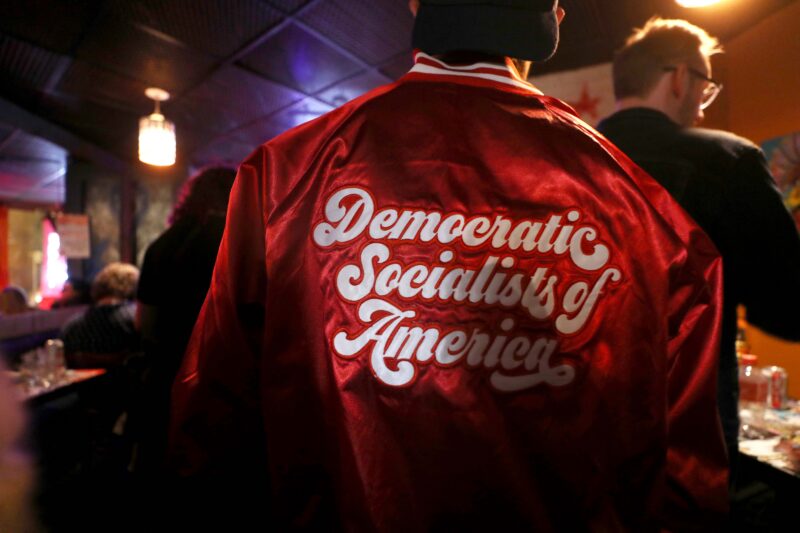















The study shows how unions are turning away from advocating for higher wages and using their institutions to foment attacks against Israel
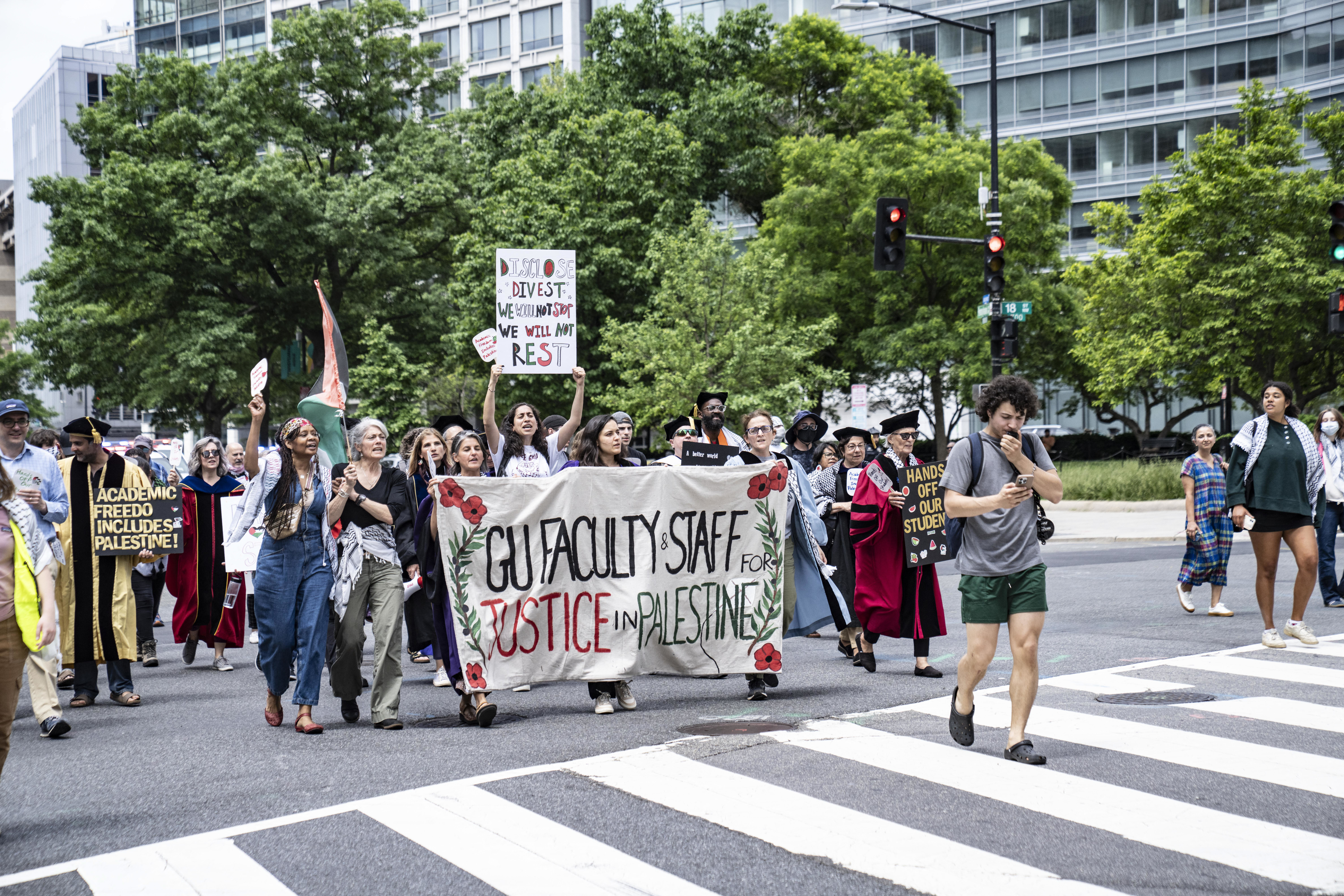
ANDREW THOMAS/Middle East Images/AFP via Getty Images
A group of faculty, staff, and students of the George Washington University who had met in the yard where there was a pro-Palestinian encampment last year, in May 8, 2025 in Washington D.C., march to the White House to show that they stand together.


 Add JewishInsider on Google
Dysfunctional union governance is leaving some Jewish faculty and graduate students marginalized and unrepresented by the labor organizations meant to advocate for them, a report released Wednesday by the Academic Engagement Network and the Anti-Defamation League documents.
The report, “A Crisis of Representation: Antisemitism and Inclusion in Higher Education Unions,” highlights how activist factions have used low-turnout union elections to push anti-Israel positions without broad member buy-in — often at the expense of Jewish members who say they have faced targeted attacks.
One union member interviewed for the report said, “I no longer feel that the national organization can represent me equally … Union leadership has not addressed antisemitism with any seriousness or clarity.”
Another said they resigned after “the climate in my union local was quickly becoming toxic for Jewish members. … I, myself, was labelled a ‘Zionist’ and ousted from a leadership position.”
The report comes following efforts by several major academic groups to change their bylaws to back academic boycotts of Israel in the aftermath of the Oct. 7, 2023, terrorist attacks and ensuing Gaza war. The American Association of University Professors led this shift in 2024; Since then, the organization hosted a webinar on “scholasticide in Palestine,” while requests from Jewish organizations to include differing perspectives in its programming allegedly went unanswered.
Several graduate student unions have similarly adopted positions hostile to Israel. The report highlights Cornell Graduate Students United, which adopted a statement in 2025 endorsing a boycott of Israeli academic and cultural institutions and affirming Palestinians’ “unequivocal human right to resist oppression by any means necessary,” a statement that many Jewish people see as a call to violence.
The report warns that this trend pulls unions away from their historical orienting goals such as wages and member trust. It recommends steps for union members, leadership and university administrators to improve governance, transparency and member diversity.
“Unions are strongest when all of their members believe they are represented fairly and can participate meaningfully,” said Miriam Elman, executive director of AEN, a network of faculty and staff countering antisemitism on campus. “When Jewish faculty and graduate students feel they must remain silent, disengage, or conceal aspects of their identity in order to participate, unions risk undermining the solidarity and equal representation at the heart of their mission.”
The invitation comes amid a sharp rise in antisemitic and anti-Israel rhetoric from the Kingdom

Anna Moneymaker/Getty Images
Saudi Arabia Defense Minister Prince Khalid bin Salman ahead of a meeting with Secretary of State Marco Rubio in the State Department Building on February 25, 2025 in Washington, DC.
Jewish and pro-Israel organizations were invited to a meeting with the Saudi defense minister in Washington on Friday afternoon, four sources familiar with the invitation confirmed to Jewish Insider.
Invited groups included the American Jewish Committee, Anti-Defamation League, Conference of Presidents of Major American Jewish Organizations and Republican Jewish Coalition, though as of Thursday morning it was not clear which invitees would be accepting the invitation.
Foundation for Defense of Democracies is meeting with the defense minister in a separate sit-down Friday morning, FDD CEO Mark Dubowitz confirmed to JI.
Saudi Defense Minister Khalid bin Salman, the brother of Crown Prince Mohammed bin Salman, is in Washington holding meetings with U.S. officials including Secretary of State Marco Rubio and White House Special Envoy Steve Witkoff on Thursday and Friday.
The invitation comes as some Jewish organizations have expressed concerns about the recent rise in antisemitic and Islamist rhetoric out of Saudi Arabia, but they’ve been relatively cautious in their language as they seek to maintain their support for the long-sought but elusive goal of bringing Riyadh into the Abraham Accords.
“This meeting will be complete window dressing,” one Middle East analyst familiar with the invitation and with the larger Saudi pivot in the region told JI. “The Saudis may try and rationalize their way out of their new alignment with Pakistan, Qatar and Turkey and say everything is fine with the UAE when evidence says otherwise.”
“They may also want to send a message to Jewish organizations with absolute clarity that they will not be joining the Abraham Accords until there’s a Palestinian state, especially ahead of a rumored visit by [Israeli Prime Minister Benjamin] Netanyahu to Washington in the next 30 days,” the analyst added.
“If these Jewish organizations do attend the meeting, they should give a stern message to Saudi leadership that their new strategic alliances and promoting antisemitism and being destructive in the region regarding Israel are not helpful.”
The ADL ranked the leading large language models based on their ability to identify and counter ‘anti-Jewish’ and ‘anti-Zionist’ theories

Philip Dulian/picture alliance via Getty Images
Several AI applications can be seen on a smartphone screen, including ChatGPT, Claude, Gemini, Perplexity, Microsoft Copilot, Meta AI, Grok and DeepSeek.
Anthropic’s artificial intelligence system is strongest at detecting bias against Jews and Israel compared to its competitors, according to an evaluation of the leading large language models published by the Anti-Defamation League on Wednesday.
In its first-ever AI index, the ADL evaluated how six models responded to antisemitic and extremist content, based on more than 25,000 LLM chats, 37 topical sub-categories and assessments conducted by both human and AI evaluators.
The index broke antisemitism into subcategories: “anti-Jewish,” which includes classic antisemitic tropes, as well as “anti-Zionist,” which analyzes antisemitism that targets Zionists or Zionism. Another category, “extremist,” looked at how LLMs engage with biases, narratives and conspiracy theories, which sometimes overlap with antisemitism. Models were generally better at identifying and discrediting tropes such as “Jews control the media” than anti-Zionist content or extremist theories.
The index assessed OpenAI’s ChatGPT, Anthropic’s Claude, the Chinese model DeepSeek, Google’s Gemini, xAI’s Grok and Meta’s Llama.
Claude received the highest overall score (80 out of 100) in detecting and responding to anti-Jewish and anti-Zionist theories. Across a range of testing methods, Claude responded that statements it was asked to analyze “contain antisemitic conspiracy theories and historically inaccurate claims.”
ChatGPT ranked second with a score of 57. Grok came in last among the models tested, with a score of 21.
Still, every AI model tested demonstrated at least some gaps in addressing bias against Jews and Zionists and all struggled with extremist content.
“When these systems fail to challenge or reproduce harmful narratives, they don’t just reflect bias — they can amplify and may even help accelerate their spread,” ADL CEO Jonathan Greenblatt said in a statement. He called on AI companies “to improve their detection capabilities.”
“While one model performed better than others, no AI system we tested was fully equipped to handle the full scope of antisemitic and extremist narratives users may encounter. This Index provides concrete, measurable benchmarks that companies, buyers, and policymakers can use to drive meaningful improvement,” said Oren Segal, ADL’s senior vice president of counter-extremism and intelligence.
The research follows several recent studies from the ADL scrutinizing extremist content generated by AI models. In December, it published a study that found that several leading AI LLMs generated dangerous responses when asked for addresses of synagogues and nearby gun stores.
ADL conducted research for the index between August and October 2025. The antisemitism watchdog said it selected models from leading LLM companies that were most widely available at the time of testing. Testing was designed to reflect how average users — not bad actors — interact with AI systems in realistic scenarios. Models were tested across five interaction types: survey questions, open-ended prompts, multi-step conversations, document summaries and image interpretation.
American University Professor Pamela Nadell: ‘The closing off of spaces to Jews today is happening once again’
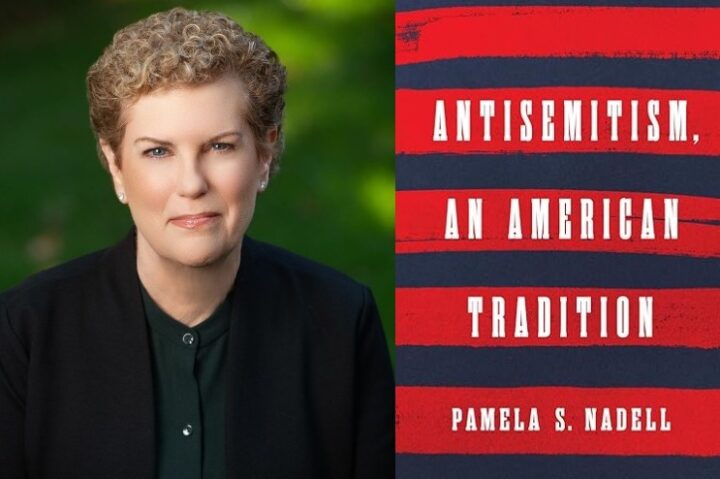
Pamela Nadell
Historian Pamela Nadell is very familiar with the rituals of publishing a book, as she has written nine of them: Secure a release date, present at academic conferences, maybe headline a handful of general-public events. Although she is at the forefront of her field at American University — chair in Women’s and Gender History, director of the Jewish studies program and past president of the Association of Jewish Studies — Nadell knows that success in academia does not often translate to strong book sales.
Things appear to be different for her latest book, Antisemitism: An American Tradition.
Nadell began to understand how much interest a book on antisemitism would generate when her publisher assigned a full-time publicist to promote the book, which will be published on Oct. 14. Nadell is booked at speaking engagements across the country into 2027, starting with an event at the Washington bookstore Politics and Prose this week.
The book that she began researching six years ago will now appear on bookshelves at a time when antisemitism has reached record levels since the Anti-Defamation League began tracking data in 1979.
“I had hoped, frankly, that the subject would be seen as a historic subject by the time [the book] came out into the world,” Nadell told Jewish Insider in a recent interview. “And that’s absolutely not the case.”
Nadell argues in her book that antisemitism is not an aberration in the United States. Instead, she writes, it is intricately woven into the American experience — as American as, say, apple pie.
Jews came from Europe seeking freedom from religious persecution, and while they escaped the pogroms that had haunted them overseas, they did not arrive in a world magically free from antisemitism. She traced the history of anti-Jewish sentiment in America from colonial days to the present, identifying the aftermath of the Civil War as the moment it really gained a foothold in American society.
“America is different [from Europe] in that we never had state sponsored violence against American Jews,” Nadell said. “But the roots of anti-Judaism in America start immediately … the roots of anti-Judaism in America rest on traditional Christian ideas about who the Jews are and what they did to Jesus.”
While antisemitism has always been present in America, the tenor and intensity of it has ebbed and flowed. “We’re in a moment,” she said, “where it’s really bad.”
The reason she is most concerned about the state of antisemitism in America is not just the frequency of antisemitic incidents or the toll of violent attacks on Jews. According to a study published this week by the Anti-Defamation League and Jewish Federations of North America, more than half of American Jews now say antisemitism is a normal part of the Jewish experience.
It’s that doors are once again closing to Jews in a way that reminds her of the quotas, housing covenants and employment restrictions that were baked into American life until the 1950s and 1960s.
“The perception that [antisemitism] was over was because of how much American Jews ascended into American life as those structural barriers fell,” Nadell said. “The doors to corporations opened up, the doors to the colleges opened up. But antisemitism — it’s like it was a nagging factor.”
America is now experiencing another period “where Jewish life once again seems to be constricting,” Nadell argued. “Not in exactly the same ways that it did in those years between World War I and World War II, when there were so many structural limitations. But the closing off of spaces to Jews today is happening once again.”
She pointed to boycotts of Jewish and Zionist writers in the publishing industry, and antisemitic litmus tests appearing in unexpected places like the mental health profession.
“Being told that you have to denounce Israel in order to join a student club? Those students are going to carry those memories forward into their future,” said Nadell.
In recent years, and particularly following the wave of antisemitism that was unleashed after the Oct. 7 attacks two years ago, several Jewish thinkers have posited that the American Jewish community’s best days are behind it. Franklin Foer wrote an Atlantic cover story under the alarming headline, “The Golden Age of American Jews is ending.”
Nadell argues that the notion that there ever was a “golden age” is a myth. “The idea that there was a golden age of Jews in Spain actually emerges during the Dreyfus Affair [in 1894], when things are so terrible in Europe,” she noted. Similarly, Nadell argues that the supposedly now-over golden age for American Jews after the end of quotas and de jure discrimination is not really so straightforward.
“By the time we get to the late ‘60s and on in the 20th century, American Jews feel really secure. The places that used to be closed to us have now opened, and that’s what leads to the perception of the golden age,” said Nadell. “The problem … is the assumption that antisemitism disappeared, but it didn’t.”
Still, Nadell considers herself an optimist. Antisemitism is part of the American fabric. And while that might be a demoralizing conclusion, she views it the other way: Jews have thrived in this country despite antisemitism, and they will continue to do so.
“The reality is that it is part of the normative Jewish experience to experience antisemitism,” said Nadell. “But I think ultimately, American Jews will be okay in the United States.”
To mark the second anniversary of the Oct. 7 attacks in Israel, the Jewish Insider team asked leading thinkers and practitioners to reflect on how that day has changed the world. Here, we look at how Oct. 7 changed American Politics
Worawat/Adobe Stock
The United States Capitol with reflection at night Washington DC USA
To mark the second anniversary of the Oct. 7 attacks in Israel, the Jewish Insider team asked leading thinkers and practitioners to reflect on how that day has changed the world. Here, we look at how Oct. 7 changed Jewish advocacy
Courtesy Orthodox Union
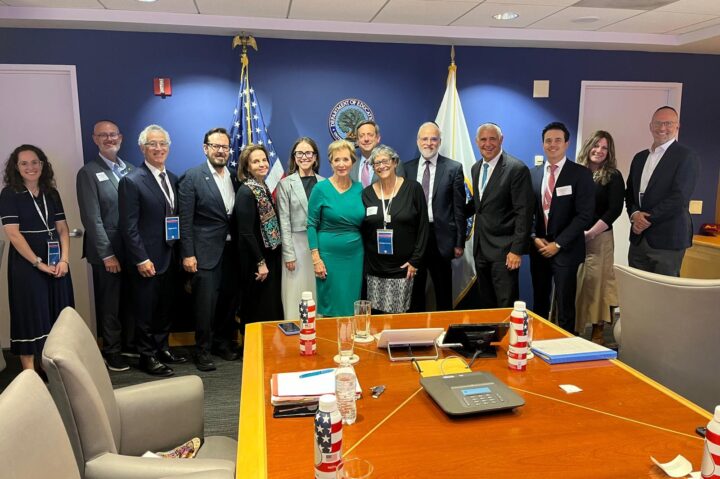
Members of the Orthodox Union Advocacy Center met with Education Secretary Linda McMahon on Wednesday to discuss federal efforts to counter antisemitism and new legislation promoting school choice, Sept. 17th, 2025
The self-proclaimed socialist union leader has accused Israel of committing genocide and said she would look to divest city funds from Israel
Campaign website
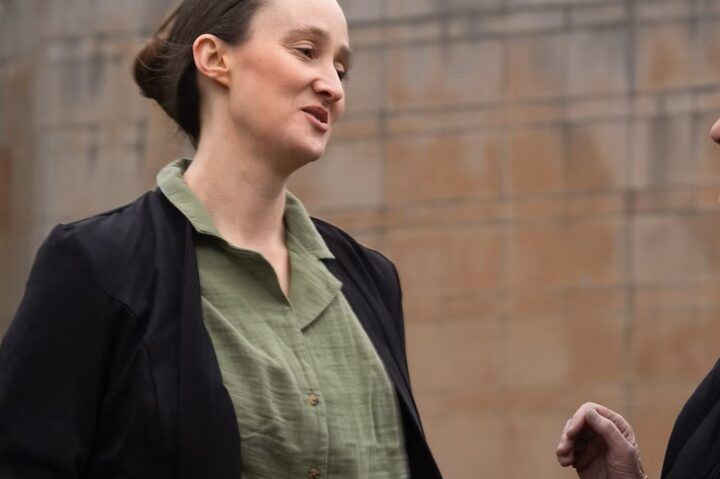
Katie Wilson
As progressives have gained traction in local races across the country, Katie Wilson, a self-described socialist now mounting a formidable bid for mayor of Seattle, has increasingly drawn comparisons to Zohran Mamdani, the far-left Democratic nominee for mayor of New York City whose primary upset in June stunned the national political establishment.
Like Mamdani, a 33-year-old democratic socialist and state assemblyman, Wilson, the co-founder and executive director of Seattle’s Transit Riders Union, took political observers by surprise when she handily led the August “jungle” primary with just over 50% of the vote — defeating the moderate incumbent mayor, Bruce Harrell, by a nearly 10-point margin.
Wilson, in her early 40s, is preparing to face Harrell once again in the Nov. 4 election, where analysts say she is now well-positioned to oust the first-term mayor. Harrell has struggled not only to land on a vision that resonates with voters but to effectively articulate an argument against his upstart challenger, who has focused on a populist message of affordability that Mamdani has also championed throughout his own campaign.
But while her record of commentary on Israel and the war in Gaza is far more limited than Mamdani, who has long been an outspoken critic of the Jewish state, many Jewish leaders in Seattle are expressing concern over Wilson’s statements about the conflict amid what they describe as a lack of outreach from her campaign with just five weeks until the election.
In a handful of recent remarks, Wilson has accused Israel of genocide in Gaza — a characterization that Jewish leaders and community activists have found troubling as voter sympathy for the Jewish state, especially in the progressive Seattle area, has sharply declined.
“I am strongly opposed to the genocide in Gaza,” Wilson said in a comment posted to social media in August. “As mayor of Seattle, my ability to end the violence is limited, but I will do everything I can to end the suffering of Palestinians and guarantee the safety of Muslims, Jews, and people of all faiths and backgrounds in Seattle.”
Meanwhile, Wilson has suggested that she is “open to divestment” if Seattle “has investments that are indirectly supporting Israel’s actions,” according to an email response to a person who asked about her stances on Israel that was posted to social media in July.
Elsewhere in the note, Wilson said that she was “familiar with the ‘end the deadly exchange’ efforts of a few years ago and think that’s something that could be done through executive action,” referring to a movement seeking to prohibit American police officers from training with Israeli law enforcement officials. The American Jewish Committee has accused the campaign of helping to fuel an antisemitic trope suggesting Israel is responsible for American police brutality.
Regina Sassoon Friedland, regional director of the American Jewish Committee’s Seattle office, echoed a range of Jewish community leaders in taking issue with Wilson’s rhetoric on Israel.
“While AJC does not endorse or oppose candidates, it should be noted that claims of genocide against Israel lack factual or legal foundation,” Friedland told Jewish Insider on Tuesday. “Not only are such accusations baseless, but they distort realities on the ground when no mention is made of Hamas, whose announced purpose is annihilating Israel.”
In addition to her comments, some Jewish community leaders say they are discouraged by Wilson’s relationships with anti-Israel activists including Kshama Sawant, a former far-left Seattle city councilmember who has faced accusations of stoking antisemitism. Wilson also claimed an endorsement from CAIR Action, a political advocacy group affiliated with the Council on American-Islamic Relations, whose executive director has drawn condemnation for praising Hamas.
A recently established political action committee called The Kids Table, which seeks to promote “pro-Jewish candidates for state and local office” in Washington state and is led by a group of Jewish millennial activists, claimed that Wilson has “allied herself with vitriolic anti-Jewish candidates” and “talked about focusing city resources on foreign affairs issues, rather than on local ones, including the urgent problem of Jewish safety and security in Seattle.”
“Time and time again we hear deep concern about Katie Wilson’s candidacy,” the group told JI of its conversations with the Jewish community, adding she did not respond to a “candidate questionnaire about antisemitism and extremism” that had been sent to her campaign and was filled out by Harrell.
Even as Wilson has only glancingly weighed in on Israel throughout the race, where strategists say it has not been a prominent issue for many voters, the broader organized Jewish community has otherwise observed a distinct absence of engagement from her campaign.
The Jewish Federation of Greater Seattle, for one, has not heard from her, several members told JI.
Scott Prange, an at-large member of the Jewish Community Relations Council of Greater Seattle, said he was “not personally aware that Wilson has made any outreach to the Jewish community in Seattle.”
“And at a time when, especially in Seattle, antisemitism runs rampant amongst the left in the wake of post-Oct. 7 rhetoric and propaganda,” he told JI on Tuesday, “she has only fanned the flames by echoing hollow narratives about Israeli genocide in Gaza and calling for divestment of any city funds invested in Israel.”
Jack Gottesman, president of Sephardic Bikur Holim Congregation, an Orthodox synagogue in Seattle that includes around 300 families, said he “would welcome the opportunity to meet with Katie Wilson, but to date I have not seen meaningful outreach from her or her campaign to the Jewish community.”
“Jews have been part of Seattle’s fabric for well over 100 years, and it is important that candidates engage respectfully with all communities,” he told JI this week. “Her description of the situation in Gaza as a genocide was a mischaracterization. These are complex issues that demand depth, not slogans. I hope she recognizes the weight of her words.”
Wilson’s campaign did not respond to numerous interview requests from JI over several weeks.
In contrast with Wilson, Harrell, who was elected in 2021, has maintained what Jewish leaders largely called a strong voice in support of Israel and against rising antisemitic violence. Nevet Basker, a co-chair of Washingtonians for a Brighter Future, a separate pro-Israel PAC that has endorsed Harrell, said that the local Jewish community “appreciates” his “clear opposition to antisemitism.”
“We recognize the immense challenges the mayor has faced” and “applaud his commitment to ensure that all Seattle residents and visitors are safe and welcome,” Basker told JI in a statement.
Rob Spitzer, the president of B’nai B’rith International and a vice chair of the Jewish Federation of Greater Seattle, said Harrell “has reached out” and “is generally supported by the community,” while recalling “meetings with him and his police and security team about protecting the Jewish community and our institutions.”
The Kids Table, for its part, countered that Harrell “has failed to meet this moment of crisis for the Jewish community,” noting that “pro-Palestinian protestors blocked the interstate for six hours and weren’t cleared or charged, and ‘kill your local colonizer’ was spraypainted on statues at the mayor’s alma mater, with zero comment from his office.”
Still, the group told JI in a statement, “Wilson’s candidacy, alliances with anti-Jewish figures and organizations, and lack of engagement have many Seattle Jews very worried about the next four years.”
Harrell’s campaign also did not respond to requests from JI for an interview.
While he has sought to connect Wilson to the movement to defund the police, which she says is not her goal, Harrell has avoided commenting on her approach to Israel, underscoring the shifting political dynamics around views that until recently would likely have been seen as too extreme for the Democratic Party but have now become acceptable to many voters.
Despite concerns from Jewish community leaders, Israel “hasn’t been front and center” in the race as a “topic of discussion or debate,” Sandeep Kaushik, a political consultant in Seattle who is not involved in either campaign, told JI.
Kaushik attributed Wilson’s unexpected rise in part to what he called the “Mamdani effect” and said she is the “front-runner,” even as he expects “the general election war is about to start” as pro-Harrell outside spending flows into the race and attacks ramp up in the final weeks.
“I think the mayor is now fighting for his political life,” Kaushik said.
Cohen told JI that he’s considering getting into politics but it’s ‘definitely not the time’ with Netanyahu still dominating the scene
Rami Zarnegar
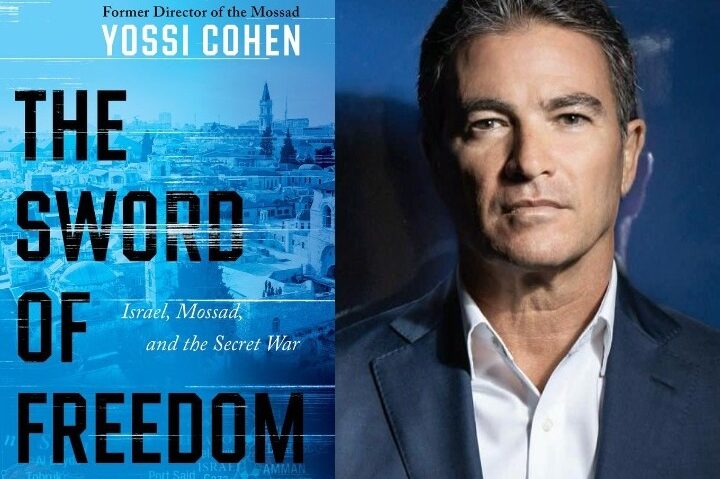
Book cover/Yossi Cohen
Like any former Mossad chief, Yossi Cohen has long been a relatively elusive figure in Israeli public life. So his recent embrace of the spotlight has left Israeli politicos wondering whether he will run for prime minister in the next election.
While the name “Yossi Cohen” is so generic in Israel that one may think it’s an alias akin to “John Smith,” it is, in fact, the real name of the intelligence officer who was nicknamed “Callan” for his favorite British spy show, and “the model” for his dapper style and perfectly-gelled coif. He first received public attention as deputy Mossad chief known only as “Y,” and emerged from the shadows with his real name and face in 2013 when Israeli Prime Minister Benjamin Netanyahu appointed him national security advisor. Cohen was appointed head of the Mossad two years later, a job he retained for six years.
Cohen received attention for commanding ambitious Mossad operations, such as smuggling Iran’s nuclear archive to Israel, and for Netanyahu reportedly naming him as one of his possible heirs, but he rarely gave interviews — until now.
Cohen has been on a Hebrew media blitz ahead of Tuesday’s release of his new book, The Sword of Freedom: Israel, Mossad and the Secret War, in Hebrew and English.
The book is a mix of memoir, in which he discusses becoming the first kippah-wearing graduate of the Mossad cadets’ course and his undercover missions, recruiting spies within Hezbollah and the Iranian nuclear program, as well as his rise to head the organization and lead major operations. It also includes commentary on recent events, including the failures of the defense establishment — and less so of politicians, in his description — on Oct. 7, 2023, the ongoing war and hostage negotiations. Cohen laments that things would have gone better if his advice in past years had been heeded.
It reads, in many ways, like the kind of book a politician would publish before a big run, to let potential voters get to know him — albeit with the much more exciting elements of spycraft.
Yet, in an interview with Jewish Insider last week at his office in a Tel Aviv high-rise, where Cohen’s day job is representing the Japanese investment holding company SoftBank in Israel, he dismissed the idea that his book was the first step in a political campaign.
“That was not the reason for me to write the book,” he said. “I started writing the book something like three years ago, much earlier. I decided to [publish the book] now, because I believe that now is the time … Since I started the book we had the judicial reform, the seventh of October, a war against Hezbollah and the Iranian events. Each of those chapters had to be updated.”
Still, Cohen added, “I can’t say that one day it will not serve my political goals if I will decide to go into politics.”
Thus far, Cohen has kept politics as an “if.” In the past, it was a “no,” he said, but now, he’s thinking about it.
“I am not entering any politics right now,” he clarified. “I stay uninvolved in this kind of politics because nothing is happening. The entire Israeli political system is a little bit stuck. I’m not assessing that any kind of election will happen before the end of next year, November 2026 as planned,” when the next Israeli elections are scheduled to occur.
Cohen said he does not have a team ready for a political campaign, and that all he is doing currently is promoting his book.
The former Mossad chief said that “I was always a Likudnik,” identifying with ideas of the party’s ideological forebear Ze’ev Jabotinsky, but “all options are open” as to whether he would join an existing party or start his own.
He would not join Likud in its current iteration unless it is “reshaped,” he said, in an apparent reference to the vocal populism from within the party’s ranks in the Knesset.
“I don’t want to criticize people personally … but it’s a different party today. It’s not the party that I grew up on. It’s so totally different.”
As to whether he would wait for Netanyahu to leave the political scene, Cohen said, “Definitely this is not the time. …Currently, I am staying in business, 100%.”
Cohen and Netanyahu have not spoken in over a year and a half, when several months into the war the former intelligence chief warned the prime minister that senior defense figures may try to manipulate investigations into the failure of Oct. 7 to exonerate themselves.
Despite the long disconnect, Cohen said that there is no rupture between them, because they had an excellent working relationship, but they were not personal friends. He noted that before the war they had not spoken for a long time; Netanyahu offered him the role of defense minister in late 2022, but Cohen could not legally take it because of a required cooling-off period between serving as a senior defense officer and entering politics.
Cohen has somewhat shielded Netanyahu from blame for the failures surrounding the Oct. 7 attacks, referring in his book to the security establishment’s failure and asserting that “there is no one else to blame.”
He clarified in his interview with JI that “the political leadership always has responsibility” for events such as Oct. 7 and called for a state commission of inquiry to be established, something that Netanyahu has sought to avoid.
“We must make sure to investigate what has to be investigated,” Cohen said. “The intelligence level was poor. It was either not gathered properly or not interpreted properly, but the result was super poor. We didn’t give the State of Israel any alerts about a major attack. … We didn’t have any workable defense lines operating correctly at our borders.”
“There’s the Shin Bet and IDF intelligence who have to know these things, and since they didn’t, and they didn’t push back the enemy when it entered the State of Israel or counter the enemy before it entered Israel, that’s a failure. You don’t need an investigation to know that. Then, of course, I think that the government was responsible for everything that happened under its auspices,” he said.
Soon after Oct. 7, Netanyahu tasked Cohen with trying to find a way to get Palestinian civilians out of Gaza so Israel would be able to fight Hamas with fewer civilian casualties.
“The Mossad and I were trying to convince [Egypt] to let the Palestinians leave, even for a short time, only the civilians … without anything, no cellular, no electronics, no armaments, no physical threats, to the Egyptian side,” he recalled. “Take them into the Sinai Peninsula for six months, one year at a time, a million or a million and a half people. …That was the plan. It didn’t work because [Egyptian President Abdelfatah] Sisi and his consultants said it will cause a kind of revolution in Egypt because of the hatred of Hamas…and their [affiliation] with the Muslim Brotherhood.”
Nearly two years later, Cohen says “it’s hard to explain why … the world does not really embrace any Gazan immigrants. Indonesia, Malaysia, Qatar even, or Egypt and Libya — a long list of Muslim countries — could say ‘I would take 50,000,’ ‘I would take 100,000,’ ‘Come live with us.’ No one said that, not even Muslim countries. Even if … they would all be sent back home.”
Cohen said the story demonstrates the lengths to which Israel went to protect Gazan civilians from the war.
“Israel does not mean to harm civilians,” he said. “We do not starve them, we do not fight a war against any of the civilians. We keep the international war laws very tightly. But now they’re in [Gaza] and we can’t do much. We try to help them, but it’s a war zone. What I was trying to do is send them away from a war zone.”
As to how the war in Gaza should end, “the best case scenario should be connected to a hostage deal. If there is a hostage deal today, Israel should take it,” he said, days before Israel attempted to strike Hamas leaders in Qatar, which has mediated the hostage and ceasefire talks.
While Cohen said he is not privy to the details of the talks, he said “if there is a deal that gets some of our hostages home and for this we have to pay a price of pausing our military action as we did in the past, I will be very much in favor.”
At the same time, he said “the State of Israel cannot afford to not complete the defeat of Hamas.”
Cohen said he did not have an answer as to who should administer Gaza after the war. He dismissed the control some Gazan families have of small areas, saying “it’s two and a half people … Someone has to take care of them, to supply them with … social services, health services.
He was, however, certain that the Palestinian Authority should not be involved, because it is not capable of managing Gaza. “We tried that,” he said, referring to Hamas deposing the PA in Gaza in 2006. He also noted that Israel has been protecting PA President Mahmoud Abbas: “We’re fighting for him and with him against Hamas in his territories.”
Cohen wrote in the book about his involvement in another element of the war in the past two years: the pager attack in which Israel detonated hundreds of beepers belonging to Hezbollah terrorist operatives in Lebanon.
“It started 25 or so years ago, when I was the head of a division in the Mossad,” he recounted. “We understood … there is something new that we can do, and that is selling to our enemies tampered, manipulated equipment. That is the family of the pagers and walkie-talkies.”
One of the early operations in that vein was the sale of a special calibrated table sold to Iran for use in its nuclear program, which later exploded, but the pager operation was the largest in magnitude. Other tampered equipment was used for surveillance or for tracking locations.
“These are things we learned to do 20 years ago,” he said. “Building up this kind of relationship with the buyers is something very hard to do because they check you … they go into everything, so you have to be real. The concept was invented, and now you see the results.”
Cohen said that the IDF and Mossad “did a beautiful job” in the 12-day war against Iran in June: “We prepared a lot of capabilities inside Iran to allow for that and it was operated correctly during the war.”
Israel must always be prepared for the next round against Iran, he added.
“We’re not sure that Iran will not go back and try to enrich uranium again,” he said. “They claim that they can rebuild their sites …They [the West] said the destruction was huge, and I believe the Western side on that. Nevertheless, if they [rebuild] and there is a threat coming from that direction, the only thing that I can suggest my government and the administration [do] is to attack it.”
Cohen frequently lamented in his book that the Israeli defense establishment is insufficiently aggressive and overly cautious.
The former Mossad chief said he felt that his “responsibility was to counter our enemies brutally. If I see terrorism, I have to counter it. If I see Iranian nuclear sites, I have to counter them. If I see someone anywhere, anyhow trying to plan something against the State of Israel, I have to counter it. And I did not always feel that this was the methodology being practiced in other bodies.”
By not nipping growing threats in the bud, Cohen argued, Israel allowed them to grow to a magnitude that it became too hesitant to act against.
The war in Iran, however, was an example of a positive change, Cohen said.
“I think that [Eyal] Zamir as [IDF] chief of staff is doing an amazing job,” he said. “He’s much more aggressive. He’s telling the government … ‘Yeah, there will be some missiles coming back to our side, but we can deal with it.’”
“Now, on the Iranian side, they know we can do it and we may do it again,” Cohen added.
Cohen has been deeply involved in Israel’s unofficial relations with Arab states, and said he is still optimistic that Saudi Crown Prince Mohammed bin Salman will seek normalization with Israel, but only after the war ends.
“They cannot make a peace treaty with a country at war. It doesn’t work in the Muslim world. … He would be very cautious entering these kinds of negotiations right now, because people are saying about Israelis, ‘Look what they do to our brothers in Palestine.’ But the minute the whole war will be over, I expect that he will sign an agreement with us,” Cohen said.
As to the Saudi demand for concrete steps towards Palestinian statehood in exchange for establishing diplomatic relations with Israel, Cohen said “a Palestinian state is something that is not realistic anymore,” again citing the PA’s inability to govern Gaza.
At the same time, Cohen opposed Israeli annexation of parts or all of the West Bank and said he finds it unlikely that the government will do it.
“Countries that have an agreement with us don’t want that to happen because it kills the idea of any future Palestinian negotiations and they can’t live with that,” he said.
Cohen posited that Israel will not annex parts of the West Bank because it “closes the door” on an eventual arrangement with the Palestinians.
“The reality is that since 1967, we haven’t annexed anything in the West Bank, right?” he said. “And why is that? … Because we want to leave a door open for negotiations with the Palestinians. That is why any government, even the right of [Menachem] Begin and Netanyahu, have not annexed anything in the West Bank.”
Cohen predicted that will continue to be the case for decades.
“I’m not sure how long it will take to create something better with the Palestinians that we see today, that will transform them into a friendly country and territory. They’re a deadly enemy, this is what we have, even in the West Bank. And on the other hand, this is territory that we cannot confiscate.”
“I think the status quo should be kept,” he added.
Early in the book, Cohen expressed his appreciation for Russian President Vladimir Putin, calling him “a deeply strategic thinker and natural leader,” and in the interview last week, he stuck with that position, despite the ongoing war in Ukraine and Russia’s turn away from Israel and alliance with its enemies in recent years.
Cohen said that “many things that the State of Israel has done with Putin are unknown to the public. When I stated that, I based it on things that we have done with the Russian administration for many years, and Syria is an example,” referring to the deconfliction mechanism between Jerusalem and Moscow when the Russian Army was in Syria to prop up then-President Bashar al-Assad.
“The only mediators [between Israel and Syria] were the Russians, and what we saw happening was that the Iranian Revolutionary Guards and Hezbollah terrorists were coming down to our borders,” Cohen recalled. “We didn’t want that, and we couldn’t speak to Hezbollah or to the IRGC. So the only one that was taking part in these negotiations was Putin, who eventually pushed [Iran-backed troops] back 40 kilometers. … We needed him to be on our side, and he was.”
Cohen also spoke of Russia finding and returning the body of IDF soldier Zachary Baumel, which had been missing in Syria since 1982.
“The operation that [Putin] conducted inside Syria … was amazing. I was there in the Russian Ministry of Defense in a ceremony where we got the body of an Israeli soldier to be brought back to a Jewish grave… I was in Moscow and Jerusalem on the same day. We had a ceremony late in the afternoon to bury him. I was involved in looking for his body my whole life, and here Russia did it for us. … That’s a big thing,” Cohen said.
Cohen also mentioned the criticism of Israel soon after Russia’s invasion of Ukraine. “Israel cannot fight all wars. [The Biden administration] said we have to support Ukraine with more weapons. Come on. If you want to support Ukraine with more weapons, you’re welcome to do that. I mean, Israel has other interests in the region, like with Russia. [Israel is] a small country at the end of the day … and very vulnerable.”
When confronted with the idea that American audiences may not appreciate his praise of Putin, Cohen said “you don’t have to agree with everything Russia does, and they will conduct their own policies if you agree to it or not.”
Israel needs to “negotiate, engage with leaders on the other side, to make sure that good things happen,” Cohen said. “This is what I cherish, the way President [Donald] Trump conducts things with Russia, because disengagement with them will not make the war [in Ukraine] end just because you wish for it to end. … You have to know how to conduct your international relationships, and somehow you have to conduct them with your enemies … that are not in line with your values.”
Asked why he first wrote his book, together with a team, in English and then had it translated into Hebrew, Cohen said that the American audience is important to him because “America is the only friend we have” in Israel.
The book, he said, “is not only about me, it’s about the world and international relationships, and I thought America is the right place to [publish] that first.”
In addition, Cohen said he wanted to communicate to the Jewish communities in the U.S. and other countries “to tell them what the State of Israel is and how important the relationship with Jewish communities is to me. They are very dear to me. … I know there is a lot of work that’s missing recently with the Jewish communities in the U.S. and I want to be a positive player.”
Michigan's flagship university is emerging as epicenter of anti-Israel activism in new school year

Katie McTiernan/Anadolu via Getty Images
Rep. Rashida Tlaib (D-MI) attends a protest at the University of Michigan as students set up an encampment to protest against Israeli attacks on Gaza in Ann Arbor, Michigan, on April 24, 2024.
Days after the University of Michigan kicks off the new school year this week, the campus is slated to host two anti-Israel speakers — former Columbia University protest leader Mahmoud Khalil and Rep. Rashida Tlaib (D-MI), one of the most outspoken critics of Israel in Congress.
On Wednesday afternoon, Tlaib is scheduled to speak at an on-campus press conference titled “United Against Genocide, United Against Repression” hosted by The People’s Coalition Michigan.
“The [UMich] Regents continue to shield their indefensible investments in the genocidal state of israel by attacking anyone who stands in solidarity with Palestine,” the group wrote on social media. “[Tlaib] will join students, workers, and community members to bring attention to the Regents’ long and continuing campaign to suppress free speech.”
Later that evening, the campus chapter of Students Organize for Syria is scheduled to host Khalil, who was released in June from the immigration detention center where he had been held for three months as the Trump administration sought to have him deported.
One day after his release, the anti-Israel activist appeared at a rally in New York City organized by the National Iranian American Council, a group accused of having ties to the Iranian regime, where he protested U.S. airstrikes on Iran’s nuclear facilities. Khalil, who has repeatedly declined to condemn Hamas, will speak “on liberation and freedom,” according to the campus group.
The events come days before thousands of pro-Palestinian activists are set to gather in Detroit, beginning Aug. 29, for the second annual People’s Conference for Palestine, under the slogan “Gaza is the Compass.”
The three-day conference features several radical anti-Israel speakers including Khalil and Hussam Shaheen, a convicted Palestinian terrorist released from Israeli prison on Feb. 1 as part of a ceasefire and hostage-release deal with Hamas.
A State Department spokesperson said Friday that all international speakers for the conference will be placed on a visa “look out” status due to concerns surrounding speakers’ ties to terrorism, according to The Jerusalem Post.
Analyzing similar digital footprints of two teen shooters, the organization plans to warn schools of risk

Getty Images
Man using smartphone in sofa.
In December 2024, Natalie “Samantha” Rupnow opened fire at Abundant Life Christian School in Madison, Wisc., killing two and injuring six before taking her own life. A month later, Solomon Henderson shot and killed one person and wounded another at Antioch High School in Nashville, Tenn., before also killing himself.
What ties the two heinous acts together, a new report from the Anti-Defamation League’s Center on Extremism suggests, is an online community of white supremacists increasingly recruiting and inspiring school shooters like Rupnow and Henderson.
The research, published Thursday as an interactive timeline, analyzes the two school shootings that occurred weeks apart. Despite happening in different states, the report found overlapping online activity between the young perpetrators.
In the months leading up to the shootings, both perpetrators were active on the website WatchPeopleDie, a forum where users can post and view real images and videos of violence — including murders, torture, rape, executions, beheadings, suicides, dismemberments, accidents and animal killings.
Rupnow and Henderson carried out their attacks 18 and 19 months after creating WPD accounts, respectively. Both shooters posted, reposted, endorsed, replied to or otherwise engaged with extremist content on the site.
ADL researchers found that extremist material — such as white supremacist and antisemitic manifestos and videos of white supremacist and antisemitic mass murders — was widely accessible on WPD, which originated as a forum on Reddit but is now independent after being banned from the site in 2019 after a user livestreamed the white supremacist Christchurch shooting in New Zealand.
Many videos of extremist mass killings, including those that were livestreamed as they occurred, remain accessible on the site, including the 2022 Buffalo Tops supermarket attack and the 2019 Halle synagogue shooting in Germany.
Clips from attacks and images of shooters using stylized filters and text, set to music that glorifies the killers, are also popular on the site. Henderson posted one such graphic depicting Payton Gendron, the gunman who killed 10 Black people in the Buffalo supermarket shooting, as a saint holding his manifesto in place of a Bible.
The ADL said it plans to share the timeline with 16,000 school superintendents, urging them to “consider how their students may be able to access the type of dangerous content highlighted in the timeline while on their campuses and in their classrooms.”
“Kids and teens today have lived their entire lives with easy internet access, putting them even more at risk of encountering violent extremism online,” Jonathan Greenblatt, the group’s CEO, said in a statement. “Extremist ideas combined with gore websites can inspire users to seek out more extremist content, while violence on extremist platforms can inspire others to look for even more violent content. It’s a vicious cycle, especially for young people. We hope this research guides all stakeholders in taking action to prevent future attacks.”
In recent months, public sentiment in Israel has shifted noticeably. With most of Hamas’ senior military leadership eliminated, growing numbers of Israelis have begun to question the feasibility of Netanyahu’s goal of 'total victory' over Hamas

Amir Levy/Getty Images
Israeli soldiers organize military equipment while standing on armored personnel carriers near the border with the Gaza Strip on August 6, 2025 in Southern Israel, Israel.
Israeli Prime Minister Benjamin Netanyahu’s announcement on Thursday that Israel plans to take control of additional parts of the Gaza Strip before handing it over to an unspecified Arab governing authority is being met with hesitation from even some of Israel’s most stalwart defenders. The Security Cabinet voted early this morning to take control of Gaza City, stopping short of the full occupation previously discussed.
Throughout much of Israel’s war against Hamas in Gaza, the Israeli public broadly supported the military effort, even as progressive lawmakers such as Sens. Bernie Sanders (I-VT) and Elizabeth Warren (D-MA) painted the war as “Netanyahu’s war,” and the Israeli prime minister as the bogeyman-in-chief.
But in recent months, public sentiment in Israel has shifted noticeably. With most of Hamas’ senior military leadership eliminated, growing numbers of Israelis have begun to question the feasibility of Netanyahu’s goal of “total victory” over Hamas, given the terror group’s hold on the Gazan population and a lack of clarity on what’s left to accomplish militarily. Instead, polling shows that a large majority of Israelis prefer prioritizing a diplomatic resolution that secures the release of the remaining hostages, rather than expanding the military occupation of Gaza in hopes of complete surrender.
Netanyahu’s plan this week to occupy more of Gaza has begun to sap Israel’s political capital even among some of its closest allies on Capitol Hill, not to mention the isolation the Jewish state is facing from less-friendly European capitals. Even within the American Jewish community, as the war drags on into its 23rd month and with mounting IDF fatalities and no living hostages having been released since May, splits have emerged over the wisdom of Netanyahu’s double-down strategy.
Indeed, while the official Israeli position on its war against Hamas in Gaza has hardened, the approach in the Diaspora, both from Jewish groups and leaders and elected officials, has also shifted — in the opposite direction.
Meanwhile, the families of hostages, whose desperation has been deepened by recent videos and images of emaciated captives, have escalated their efforts, taking to the sea in a flotilla that sailed toward Gaza on Thursday in an effort to raise awareness about the plight of their loved ones.
Netanyahu, still mired in legal issues, finds himself in a bind of his own making amid mounting global pressure to end the war and let aid flow freely into Gaza — which contrasts sharply with right-wing members of his coalition who loudly call for the opposite, even as top IDF brass opposes a full Gaza takeover. Speaking from the Temple Mount/Al Aqsa Mosque in Jerusalem earlier this week, National Security Minister Itamar Ben-Gvir called on Israel to “conquer all of Gaza, declare sovereignty over the entire Strip, eliminate every Hamas member, and encourage voluntary emigration.”
On Capitol Hill, Israel’s traditional allies in the Democratic caucus — including some who have given Netanyahu leeway to press forward in Gaza in the past, even when it meant butting heads with the Biden administration — are beginning to shift.
Rep. Ritchie Torres (D-NY) told Jewish Insider’s Marc Rod that Israel is ultimately responsible for making its own decisions, but said he’d advise the Israeli government to seek an end to the war once the remaining 50 hostages are freed.
“The war fatigue and post-traumatic stress in Israeli civil society and in the Israeli military — as well as the humanitarian crisis in Gaza — have become unbearable,” Torres said. “Israel has degraded Hamas. And so once Israel has secured the release of the hostages, it should declare victory, end the war and focus on expanding the Abraham Accords to include relations with the likes of Saudi Arabia and Indonesia.” More reactions from Torres and other Democratic lawmakers here.
Rep. Dan Goldman (D-NY) said in a statement on Thursday that “Netanyahu’s personal and political interests are guiding Israel’s actions” and slammed the prime minister’s “ineffective military operation in Gaza,” which, he added, “has only led to more unnecessary deaths.”
Earlier this week, Rep. Valerie Foushee (D-NC) – who in 2022 was one of the first major recipients of support from AIPAC’s super PAC— announced she was signing onto legislation to ban offensive arms sales to Israel.
The New York Times’ Bret Stephens warned this week, “If Netanyahu makes the colossal mistake of trying to reoccupy Gaza for the long term, then no thoughtful person can be pro-Israel without also being against him.”
The new shift in tone — exacerbated by mounting concerns about humanitarian aid in Gaza and bolstered by Netanyahu’s recent efforts to prolong the war in Gaza — extends beyond Washington and the media elite to some of the leading Jewish communal organizations, figures and philanthropists, dozens of whom signed onto a letter to Netanyahu this week, condemning his government’s policies and rhetoric for causing “lasting damage” to Israel and Diaspora Jewry and calling for an end to the Israel-Hamas war. Read more in eJewishPhilanthropy here.
Mainstream groups and officials, such as the American Jewish Committee and U.K. Chief Rabbi Ephraim Mirvis, have in recent days expressed deep concern about the humanitarian crisis in Gaza and the prosecution of the war.
Israel finds itself, 22 months after Hamas’ attacks, at war at home and abroad. Hamas’ attack didn’t resolve the issues that had caused divisions in Israeli society in the months leading up to Oct. 7, 2023. The national cohesion following the horrific attacks has dissipated, and now segments of Israeli society are again at odds with each other, as Israel finds itself needing to win back invaluable political capital even as its leadership is taking it for granted.
‘Don’t Feed the Lion,’ written by Bianna Golodryga and Yonit Levi, opens a dialogue for kids and their communities on how to stand up to hate

The rise of antisemitism has dominated breaking news headlines, films and books in recent years. But two leading journalists noticed a void — a lack of resources in how to address the subject matter with young readers.
Concerned about what they observed, CNN anchor Bianna Golodryga and Yonit Levi, an anchor on Israel’s Channel 12, joined forces to write Don’t Feed the Lion, a new novel geared towards middle schoolers.
The book tells the story of three children in Chicago who experience antisemitism firsthand at school when a soccer star makes an antisemitic remark and a swastika appears on a locker. Theo, his sister Annie and their new friend Gabe each struggle with how to speak up and confront hate.
The book comes as antisemitism and anti-Israel sentiment has increasingly impacted K-12 classrooms nationwide in the aftermath of the Oct. 7, 2023, Hamas terror attacks on Israel and ensuing war in Gaza.
“We approached this project wearing three hats: as journalists who seek clarity, as Jews who feel the weight of history, and as mothers who want our children to live in a world that is kinder and more just,” Golodryga and Levi, both first time authors, told Jewish Insider in a joint statement.
“Empathy doesn’t happen in silence. We wrote this to help open dialogue between kids, parents, teachers, and communities, especially in times like these,” the veteran reporters said.
Don’t Feed the Lion, published by Arcadia Children’s Books, goes on sale Nov. 11.
‘We need everyone who sees the difficult pictures of Evyatar to understand that we don’t have another minute. We don’t have another day. We can lose him in the coming days,’ Matan Eshet tells JI

Ezzedine al-Qassam Brigades/AFP via Getty Images
This screengrab from a video released on August 1, 2025 by Hamas, shows Israeli hostage Evyatar David looking weak and malnourished.
Days after Hamas released a video showing hostage Evyatar David emaciated and being forced to dig his own grave in a tunnel under Gaza, David’s family called on the Trump administration to do anything it can to ensure that the hostages are released.
“Evyatar is fighting for his life with what little strength he has left,” Matan Eshet, David’s cousin, told Jewish Insider on Monday. “You can see it in his eyes. You don’t need a medical degree to understand that Evyatar only has a few days to live.”
David, 24, was kidnapped by Hamas terrorists from the Nova Festival on Oct. 7, 2023.
In a video released over the weekend, an extremely gaunt David was shown in a tunnel under Gaza digging, with his bones protruding. He wrote on a calendar documenting the small amounts of food — either lentils or beans — his captors have given him on some days, and on other days he wrote “no food.”
At one point in the video, a Hamas terrorist reaches out from behind the camera to hand him a can of food, and the terrorist’s arm is visibly much thicker than David’s.
“This can is for two days, just to keep me alive,” David said of the food.
“I don’t know what I’m going to eat,” David said. “I haven’t eaten in days … I’m getting thinner and weaker by the day … What I’m doing now is digging my own grave … This is the grave where I think I’m going to be buried. Time is running out.”
Prof. Ronit Endevelt, the former head of the Nutrition Division at the Israeli Health Ministry now on the Hostage Families Forum medical team, estimated that David’s weight dropped about 41% to 40-45 kg.
Hamas released a video of David in February of this year, with hostage Guy Gilboa Dalal in a car, visibly distressed while being forced to watch other hostages being released. David’s health has visibly deteriorated since the previous video; he appears much thinner and paler in the new one.
Eshet said his family is “feeling broken” after seeing the new footage.
“It’s not Evyatar. He doesn’t look like that or sound like that. That’s not how he moves. We see the distress in so many ways. He looks like a shadow of himself,” Eshet said. “He has to get medical care and food already.”
The video of David describing his starvation at the hands of Hamas came as some of the world’s largest media outlets published photos of children in Gaza who they reported were starving, but failed to mention that they suffered from genetic diseases. More broadly, much of the media coverage of Gaza in recent weeks has been about the humanitarian situation and difficulties distributing food to the residents.
“It’s maddening,” Eshet said. “Hamas are the ones taking the aid instead of the civilians. And then they claim that [Israel is] starving them, not Hamas who is preventing people from getting the food, while Hamas is choosing not to let Evyatar receive food.”
Eshet noted that the arm of the Hamas terrorist who handed Evyatar the can of food was “much bigger and more muscular compared to Evyatar.”
“On the news, you can see people walking in the food markets in Gaza. People do not look the way Evyatar looks,” Eshet added. “No one was close to looking the way Evyatar does.”
Eshet called on “Israel and the world to demand that Evyatar come home already.”
“We need everyone who sees the difficult pictures of Evyatar to understand that we don’t have another minute. We don’t have another day. We can lose him in the coming days,” he added.
“The U.S. government succeeded in getting a deal on Day minus-One, before [President Donald] Trump’s inauguration,” Eshet said. “America needs to do the same thing again and stand up and insist that the hostages are freed now, regardless of whatever else is happening.
“They did it once. They made a deal happen. They need to use that power again to make sure Evyatar comes home,” Eshet added.
Asked about the reports that Israel plans to expand its military operations in Gaza, including in areas where the hostages are believed to be held, Eshet said he hopes “these are tactical tools to bring about a change, stand up to Hamas and reach a [hostage] deal from a position of strength.”
Eshet and David are first cousins. Eshet recalled that they “grew up together.”
“Evyatar is a charming and loving person, a good listener with a contagious smile,” Eshet said. “He was a middle child, and was friends with his big brother and little sister. He always paid attention to whoever needed help in the house.”
Eshet said that David loved to play guitar and that his music could always be heard in his parents’ house. Before Oct. 7, David planned to travel the world and try to make a living playing music.
“He had a smile and shining eyes, and we’re all waiting for him,” Eshet said. “He was a boy who became a skeleton in the Hamas tunnels. He needs to come home and be a regular person and live the life that is waiting for him.”
There are 50 hostages remaining in Gaza, 20 of whom are believed to be alive. Hamas rejected the latest attempt by the U.S. and Israel to reach a temporary ceasefire and hostage-release deal late last month.
Palestinian Islamic Jihad also released a video of hostage Rom Braslavski last week, who was also emaciated.
The Hostages Families Forum released a report by its medical team on Monday “warning that the hostages still held alive in Gaza are suffering from deliberate, prolonged, and systematic starvation … causing multisystem damage and posing an immediate risk of death.”
Prof. Hagai Levine, head of the medical team, said that “the outcome of this cruel experiment is foreseeable — body and mind will gradually deteriorate until they collapse. Any further delay in rescuing the hostages may cost human lives. We must not stand idly by while our brothers vanish. We must act now to bring them all home.”
In an interview with JI, Huckabee pinned the humanitarian issues in Gaza on Hamas and the U.N.
Maya Alleruzzo/AP Photo
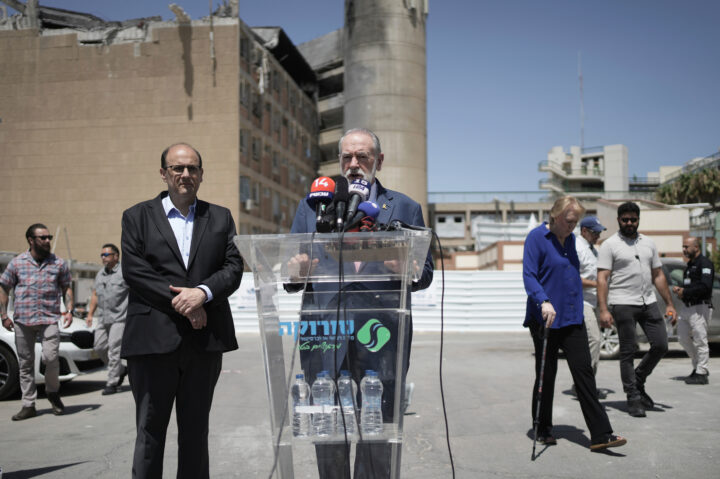
U.S. Ambassador to Israel Mike Huckabee speaks to journalists with Director General of Soroka Medical Center Dr. Shlomi Codish, left, outside a hospital building that was struck by an Iranian missile, Thursday, June 26, 2025 in Beersheba, Israel.
Since his arrival in Israel in April, former Arkansas Gov. Mike Huckabee has made his mark as the first evangelical U.S. ambassador to Israel — and possibly the most effusive in his remarks about the Jewish state.
That may be why a leaked letter he wrote to Israeli Interior Minister Moshe Arbel last week, expressing “profound disappointment” that an issue delaying work visas for Christian organizations had gone unresolved and suggesting that Israelis may be treated in kind by the U.S., drew so much attention.
A day after the letter leaked, the ambassador visited Taybeh, a Palestinian village in the West Bank where there had been a fire in a field near a church, writing on X that “desecrating a church, mosque or synagogue is a crime against humanity and God,” and “I will demand those responsible be held accountable.” With Taybeh church leaders blaming settlers, Huckabee’s comments were interpreted in many media accounts as doing the same, though he later clarified that he was not attributing the fire to anyone.
But with the visa issue resolved and the world’s attention on the humanitarian situation in Gaza and the latest round of collapsed negotiations for a ceasefire and hostage-release deal, Huckabee was back to standing firmly behind Israel in an interview with Jewish Insider in his office at the U.S. Embassy in Jerusalem on Thursday. With an a guitar hanging on the wall behind him emblazoned with an American flag and President Donald Trump’s slogan “make America great again,” Huckabee pinned the humanitarian issues in Gaza on Hamas and the U.N and the failure of negotiations on Hamas, and was critical of other Western countries that have come out against Israel, accusing them of emboldening the Gazan terrorist group.
The interview has been condensed and edited for clarity.
Jewish Insider: There’s a lot of pressure on Israel over humanitarian aid in Gaza and claims that residents of Gaza are starving. Israel says that they are letting more food in but no one is distributing it, while much of the world doesn’t believe that. I want to ask you: Do you think there is really starvation in Gaza? What is really happening?
Ambassador Mike Huckabee: This very morning, I had a visit from someone who returned yesterday from three days in Gaza. He firsthand went and saw the [Gaza Humanitarian Foundation] feeding sites, talked to people, not only from the staffing and the distribution, but he talked to people in Gaza … He came to the conclusion, first of all, that absolute lies that are being told, not only about GHF and what they’re doing, but are also being told about the deprivation.
There are clearly people who need food and medicine. That’s not a doubt. But the biggest reason that people are not getting the food and medicine they need is that Hamas is doing its best to cause the people to suffer. They want to get the photos of the most disastrous consequences possible.
The photos that I also saw, which were very disturbing but also revealing, [were of] hundreds and hundreds of pallets of food that are sitting out in the sun ready to be distributed, but the U.N. won’t move them. Hundreds of trucks filled with food and medicine, and the U.N. claims that they’re trying to help. No, they’re not. They are as much a part of the problem, if not the biggest part of the problem there is. And this food could be distributed right now, but the U.N. isn’t doing it. The NGOs aren’t doing it, and the World Food Program isn’t doing it, because they just drop it off. Then, basically, they’re waiting on Hamas to come and steal it so [the group] can turn around and sell it to the people that ought to be getting it for free. It is a scam.
It is a disgrace and an outrage that the story that is being told is that GHF is killing people, and they’re not. They haven’t fired one round at anybody … It’s simply not true. It is sadly being reported sometimes because Hamas will release a news story and the Associated Press, CNN, The Washington Post, will gobble it up. They’ll print it without any verification … That’s what Israel is up against. It’s what the U.S. is up against every single day, with really, really horrible misinformation about what’s happening.
JI: Why do you think countries that purport to be friends of Israel and the U.S. — 26 countries signed a letter to Israel about the aid including the U.K., Canada, France — are believing Hamas?
MH: It’s hard for me to understand why they would do that without doing a little better job of verifying the information. If they would, they would have a totally different picture…
The other day there was the story of the 26 countries that came out and did this condemnation of Israel. If you read the news release, it’s all about Israel, all about what they haven’t done right, and a lot of the things in the story are just untrue. The biggest just shocker of it all, was that there was one brief mention of the fact that the war was started by Hamas on Oct. 7, as a passing reference, without really giving the qualifier that this war should have ended on Oct. the 8th, but Hamas doesn’t want it to, and they’re doing everything they can to make sure it doesn’t…
I’ve been shocked that very few other nations and even nonprofit organizations have been willing to stand up and help in the distribution of the food through the GHF, because the whole model was based on … No. 1, get food to people who are hungry, and No. 2, do it in a way that it doesn’t get stolen by Hamas. That’s been accomplished; over 85 million meals now have been served and continues to operate at almost 2 million meals a day.
It hasn’t been perfect. There have been hiccups, but [that happens] when you have that many people coming to a site and trying to get that much food out to people. Heck, you can go to Walmart on Christmas Eve … and it’s bedlam. Sometimes you stand in the long line and sometimes they ran out of what you wanted, but that’s true in the most efficient retailer on the planet. This is being done out in the middle of a desert for heaven’s sakes, and has really worked pretty doggone good.
Well, we just want people to get the truth and to get the food, but we don’t want Hamas to steal it, which is what they have done through the U.N. model, which has been an absolute disaster.
Maybe the U.N. is more interested in preserving the machinery of the U.N. than they are in feeding people. And I know that sounds harsh, but I absolutely am on the record for that, because when I see just thousands of pallets, thousands of tons of food sitting that could be consumed by people, it’s sitting there because the U.N. doesn’t really have any incentive to go out and actually get it to the people. They can just present that ‘We carried X number of trucks in.’ How many people got fed from that? Bigger question is, how many of those trucks or pallets are going to be looted by Hamas, who will then sell it to the people that are hungry?
JI: Do you think that there’s something that Israel needs to be doing differently at this point with regards to humanitarian aid?
MH: Get their message out more strongly. You know, they have a good message about what they’re trying to do. They’re trying to protect the people who are delivering the food. Food isn’t being delivered by the IDF. That was one of the key points; they didn’t want the military giving the food, because there’s a distrust, and we understand that, so we brought our own contractors in. But you can’t give food away in a war zone without having the military who’s prosecuting the war involved, at least on the perimeter, so that they can make sure that there’s a secure route in and a secure route out … Israel has a much better story to tell than the world is hearing, and it’s very frustrating, especially when so-called allies are attacking Israel and not even really mentioning Hamas.
JI: Hamas is degraded, but it’s still a force in Gaza and it’s still holding hostages. We’re talking a day after Hamas essentially rejected the temporary ceasefire and hostage deal being offered. But there was talk before that of turning the proposed 60-day ceasefire into a permanent one, even though Hamas has not been eliminated. How does the Trump administration see things going forward?
MH: The president has said repeatedly, without any equivocation, that Hamas can’t stay, and they can’t govern. … And frankly, it’s the right message. They can’t stay, they can’t govern. It would be like saying the Nazis can stay in Germany after World War II and have a hand in governing the future; nobody would have thought that was a good idea … Hamas built tunnels bigger than the London Underground so they could kill Jews. It’s a horrible, horrible story, and people need to put the blame where it falls, and that’s on Hamas and not on Israel.
JI: The negotiations seem to have reached a dead end. What more do you think that could be done to get the hostages home?
MH: If everyone in the world puts enough pressure on Hamas and says it won’t be just Israel and the U.S. coming to get you, it’ll be the whole world coming to get you. It’s like in the movie “Tombstone” and Wyatt Earp says, “I’m coming for you, and hell is coming with me.” That’s the kind of message that we need to say. The problem is Israel has made concession after concession. They have made offer after offer. The U.S. has intervened time and time and time again and gone to, I don’t know how many different talks, meetings and negotiations, but every time you will hear “we’re close,” we think we’re about there, and then Hamas changes all the conditions at the last minute, or just outright rejects them…
[On Wednesday, Hamas] went back to a position that [it] had abandoned in the past. So when there’s not a good faith negotiation going on, and then you have to ask: Whoever thought there was going to be? These are the people that murdered pregnant women in front of their families, and that raped women in front of their children. When people do things like that, these aren’t people you sit down and work out a negotiation to buy a home from or sell a car to. So, while everybody has hopes that this is going to end and soon, all the hostages returned and Hamas is gone, it’s up to Hamas whether or not that’s going to happen.
JI: Do you think the letter from the 26 countries emboldened Hamas to harden its position?
MH: That’s the real tragedy. It’s not just that they’re condemning Israel, but by condemning Israel and barely mentioning Hamas, they’re empowering Hamas to just keep hanging on.
There needs to be a collective across-the-whole-globe condemnation of Hamas with this clarity of message that what they’ve done is evil and holding hostages for nearly 700 days can’t be justified under any conditions … The families who have been put through a living hell over this deserve to be relieved.
JI: What about the Qataris? Do you think that the U.S. is doing enough to put pressure on them? It seems that they are doing everything they can to try to stay on President Trump’s good side.
MH: One thing they could do — if that’s their goal, to be in the president’s good graces — would be to be key in bringing this to a resolve. And I hope they do. I hope they use every influence they have, and they truly have some. I mean, they’ve been housing some of the Hamas leaders since all of this started. And Al Jazeera, which is one of the most despicable propaganda machines in the world, is financed by them…
I’ll leave [the details] to the headquarters in Washington, but nobody would be disappointed if [Qatar] did more.
JI: There’s also President Trump’s plan to to turn Gaza into a ‘riviera.’ There has not been a lot of progress. Where do things stand? Is the U.S. asking any countries to accept Gazan refugees?
MH: I think it’s more of an Israeli mission to make that decision. What the president has said is U.S. policy is that people who are there who want to leave should be free to leave. They shouldn’t be forced to leave and face expulsion, but neither should people be forced to stay. It ought to be an individual, personal decision on the part of the people who are right now living in what is anything less than an ideal circumstance.
JI: So you’re saying the U.S. is not involved in trying to find countries that will accept them?
MH: It’s not something that has been shared with me as to being an immediate issue. I know that there is definitely talk that this would be a great opportunity for people to have a fresh start that has been discussed at both the U.S. and Israeli levels. And I think everybody thinks that would be a wonderful thing if people had that option, and if countries were willing to say, “Hey, we’d love to have people come and be part of our labor force and immigrate to our country.” But I don’t know that there’s any specific plans that the U.S. has made on that…
The U.S. took a position several months ago when the president said … ’We’ll just take [Gaza] over. Immediately, within 24 hours, you had four or five Gulf countries saying, “Oh no, no, we want a piece of it. We’ll help govern.” People who don’t understand the president and how he works probably didn’t get it that the whole point was to force people to pony up and get in the game, and that’s exactly what happened…
What he does want to do is to see that these people have a chance for a better life, economically, and just from a security standpoint, they’re never going to have it under Hamas … Who runs [Gaza in the future]? Good question. Maybe it comes to the place where there’s a number of Middle Eastern countries that come and really make a partnership and a coalition and invest the money to rebuild it and give people an opportunity to have a decent and deserved life.
JI: There have been terrible clashes and massacres of the Druze minority in Syria in recent weeks. It seems from U.S. Ambassador to Turkey Tom Barrack, who’s also envoy to Syria, that the Trump administration still wants to give new Syrian President Ahmed al-Sharaa a chance. Is that causing friction with Israel, which tried to stop the violence against the Druze with airstrikes?
MH: Right now, the ceasefire has held for two days, which doesn’t seem like a lot of time, but in Syrian time, that’s a lot of time. There were some horrific things that have happened, especially to the Druze. The Israelis were very bold in standing up for the Druze and showing their support … literally going in and trying to help them with supplies and standing up assistance in every way they could. I thought it was an admirable thing, because the Druze have stood with Israel.
The head sheikh of the Druze community [Muwaffaq Tarif] was sitting right where you are on Tuesday afternoon. We had a very candid meeting about the situation they faced. They’re deeply grateful for Israel’s support. It did mean a lot to them that they weren’t just left hanging…
I’ve had several conversations with Ambassador Barrack over the course of the last week and before. It’s a fragile situation. Nobody’s going to deny that al-Sharaa is not exactly the person the U.S. would have picked … but he’s who we got.
What the president [Trump] did was, I think, bold, but also brilliant, at a time when al-Sharaa realized he doesn’t have the military or economic capacity to make Syria viable. He’s got to find a partner. He’s like the kid that goes to the prom and doesn’t have a date. Somebody’s going to go over there and say, “Would you dance with me?” Do we want it to be Iran, Russia, China? Absolutely not. President Trump comes in and says, “You can dance with me, but if you do, terrorism has to go away.” We can’t have these relationships with bad guys and remilitarize Syria and turn it into another nightmare like Assad. [Al-Sharaa] wisely decided that that was a better partnership than any offer he had. That’s where we are now.
Everybody has anxieties about where this could go, but we also are in a place where it could turn the corner, go very well, and we could see normalization between Syria and Israel, and that would have looked really unthinkable two years ago.
JI: You don’t think that the last couple weeks have taken a Syria-Israel agreement off the table?
MH: No, I don’t at all. I think it showed some of the challenges that we face. A lot of things happened because of misunderstanding and lack of communication. When [the Syrian military] went south of Damascus with artillery and tanks, it looked like they were getting ready for a military operation. They should have better communicated to the Israelis [and said,] “This is not a threat to you. We’re not moving this equipment in there because we’re going to come across the border.” You know, everybody should have talked to each other better.
JI: But Israel wants that part of Syria, the south, entirely demilitarized. Do you think that’s something that Syria would agree to?
MH: Yes, I do. You want Syria to have some security forces, you’ve got to have that, but they don’t need a full-scale military with an air force and all the others. I think there are regional interests that would help provide a level of security for them that does not require the standing up of a navy and army … The ideal is to help them to become stable economically.
JI: There was reporting after the Israeli strikes in Syria that some people in the Trump administration called Netanyahu a madman and asked, “What country are they going to bomb next?” Does that ring true to you?
MH: I think that people who know don’t talk, and people who talk don’t know … I hate this kind of stuff where a person pretends that he knows something and blabs it out. The president has been very clear, again, without equivocation, that he and [Netanyahu] are very close friends. I saw with my own eyes and was in the room when there was an extraordinary level of camaraderie and cooperation … For all this talk about how there’s this terrible clash and all I would say, look at what is on the record, what is sourced with firsthand source, and dismiss the nonsense that people say … I discount it as somebody who’s trying to be important when they’re not that important.
JI: Still, it seems like there’s a kernel of truth to there being some sort of push and pull within the Trump administration, and even more so within the broader Republican Party, about foreign policy and how to relate to Israel. Do you think this is going to be a problem for Israel?
MH: I really don’t see that. I mean, are there moments where Israel and the U.S. will disagree? Of course, [it] happens in partnerships, whether you’re in business or in marriage. I’ve been married 51 years. I guarantee you, my wife and I have had disagreements, sometimes, some pretty strong ones. She would tell you that she’s right and I’m always wrong. That’s part of the way we’ve stayed together 51 years. But it doesn’t mean that you don’t love each other and that you don’t stay together.
It’s part of the process of being adults that you hash out your differences. So I don’t have any doubts that there are times they may have a conversation that they’re not on the same page … I haven’t been privy to those, but that would be normal.
JI: We’re coming out of a complicated week for Israel and Christians. There was an issue with work visas for people working in Christian organizations. How is that going to work going forward?
MH: It really wasn’t a big issue, except within that one area. And fortunately, we have it all resolved, and everybody’s happy … Really the new arrangement is the old arrangement, and that was that the process through which people would be granted visas coming to teach or to be a part of a Christian organization. It’s been handled the same exact way for decades, and we were very clear. We didn’t want anything new … Just do what you’ve been doing. It’s been working very well. There have been no problems with it. And then all of a sudden, in January, before I came, apparently there was a change in the way it was processed, and it was creating an enormous level of bureaucratic problems for the organizations, and they were frustrated, and it involved deep investigations and a lot of paperwork and cost…
So we had a meeting with a minister. Thought it went well and thought everything was resolved. The problem continued to happen. So if we would call with one specific case, it would get resolved, but then another one would come up, and then another … So I sent a letter. It was terse, but I felt it was an honest assessment of, look, we thought this was fixed. It isn’t. Here’s the problems it’s causing. We did not leak the letter, but it got leaked. I don’t know who sent it out, but that’s beyond the point. It resulted in immediate attention…
The point that I was making was that at a time when Israel needs all the friends it can get, and some of the best friends you have, the evangelical Christians in America, you really don’t want to tell them they’re not welcome, and that’s the message that’s being sent … We have to get it fixed. So we did, so everybody’s happy.
JI: By unfortunate coincidence, this was the same week where an IDF shell hit the church in Gaza, and then there was a fire near a church in Taybeh that Palestinians blamed on Israel.
MH: I think that it was unfortunate they were all happening at the same time, but they’re totally separate and not tied together in any way. The State of Israel didn’t do anything in Taybeh. And you know, [the shelling of] the Church of the Holy Family was a horrible thing, but to their credit, [the IDF] admitted that it was a terrible mistake and they apologized for it. It’s not something you would ever want to see happen. But Israel doesn’t get enough credit for owning up to a mistake when they make one and trying to make it right, and I appreciate that about them.
JI: You hear these voices of people saying Israel is going to lose Christian support. And there are polls that show young evangelical support for Israel in decline. Do you think that Israel needs to be doing something differently or reaching out more?
MH: I think there is some lessening of the support … There are several things at play. One is the advent of a lot of Middle Eastern studies on college and university campuses, highly funded by Gulf states that are pouring billions of dollars into these programs, and they’re somewhat indoctrinating influences … That’s part of it, and a lot of it is that maybe there’s just not a good historical context for some of the younger people that they don’t know.
I’m convinced that one of the most important things people can do is to come to Israel and see for themselves. Don’t even take my word for it. You just come. That’s what I’ve been doing for 52 years. When I tell people my views of Israel, I tell them, look, it’s not something I read in a book or watched on a documentary or listened to some people give lectures. I’ve been coming here for 52 consecutive years. I’ve watched this country develop and grow and change … which I think had more credibility than just “I was at a march somewhere in Palo Alto [Calif.] and carried a sign for a few blocks. That’s something I hope happens more and more. The Jewish community has Birthright that brings a lot of young Jewish people here. There’s now an organization called Passages, and it’s bringing a lot of Christian kids here. I think that’s the most wonderful thing that can happen.
JI: Is the Trump administration still trying to negotiate with Iran? The Europeans said they will snap back sanctions if there isn’t an agreement by the end of August, and an Israeli official recently said the U.S. was hoping they would do it sooner. Is that true?
MH: I don’t know whether there’s any U.S. policy on hoping it would come sooner. Frankly, I’m just glad to hear the Europeans stand up for something that is right for a change. You know, they’ve been beating up Israel instead of Hamas for a while, and it’s kind of refreshing for them to realize that Iran’s playing games, and they’re still beating their chest and making threats that make no sense in light of what they’ve just been through.
In “Monty Python and the Holy Grail,” King Arthur cuts off [the Black Knight’s] arm, then his other arm, and then his legs. And the guy says, “‘tis but a scratch.” I mean, that’s Iran. They got their arms and legs cut off, and they’re hollering, “Just a scratch, you didn’t get me’” … And you just want to say to them, “Did you not get the message? You just got your brains kicked out, and this would be a good time for you to experience a little humility and recognize you’re never going to have a nuclear weapon. Everybody’s telling you this, even Europe is telling you this. They’re about to put sanctions on you because of it, and this might be a good time to reassess your aspirations to be a nuclear-weapon country.” So I’m grateful that Europe is talking this way, and if they do it in August, wonderful. That’s better than not doing it at all. And maybe — probably not, but maybe — Iran comes to [its] senses.
JI: You recently made an appearance in the courtroom for [Israeli Prime Minister Benjamin] Netanyahu’s trial with a Bugs Bunny doll. Was that something that the president wanted you to do, or was that your idea? Some Israelis are concerned that the country or the judiciary could be penalized over Netanyahu’s trial the way President Trump threatened to raise tariffs on Brazil over the corruption trials against former President Jair Bolsonaro. Is that a possibility?
MH: I have not heard anything like that … [Trump] had two very significant, substantial statements about the trials here because he himself has been put through an extraordinary level of lawfare. It’s just been shocking as an American citizen, to watch this, where they try to file charges, both civil and criminal, anywhere they can find a court that’ll take him, New York, the District of Columbia, Georgia, Florida…
I think what he’s trying to say is that if you’re going to want to change the government, do it at the ballot box. You don’t do it in the courtroom. What he saw happening to the prime minister here, he saw as a mirror reflection of what was going on there [in the U.S.]. And it’s not so much that it’s an accusation about the courts or their integrity here, but the act of prosecuting and the tenacity of prosecution while a prime minister is going through the middle of two wars and trying to get hostages released.
As far as my being there, I hadn’t seen a circus in a long time, so I decided to go.
The union’s board of directors said the proposal ‘would not further NEA’s commitment to academic freedom’
Kristoffer Tripplaar/Sipa via AP Images
A logo sign outside of the headquarters of the National Education Association (NEA) labor union in Washington, D.C. on July 11, 2015.
The National Education Association, the largest teachers’ union in the country, announced on Friday that it would not cut ties with the Anti-Defamation League, declining to implement a contentious resolution approved by its governing body earlier this month that sought to target the Jewish civil rights organization.
“After consideration, it was determined that this proposal would not further NEA’s commitment to academic freedom, our membership or our goals,” the union’s board of directors said in a statement.
The decision came nearly two weeks after the measure was adopted by the NEA’s representative assembly, its annual leadership gathering that drew more than 6,000 union delegates.
“There is no doubt that antisemitism is on the rise. Without equivocation, NEA stands strongly against antisemitism. We always have and we always will,” the NEA’s board wrote. “In this time of division, fighting antisemitism, anti-Arab racism, and other forms of discrimination will take more resources, not fewer. We are ready.”
ADL CEO Jonathan Greenblatt cheered the union’s decision to distance itself from the “misguided” measure.
“We are committed to working with the NEA and all teachers’ unions to join the Jewish community in making clear these hateful campaigns cannot succeed. They must redouble efforts to ensure that Jewish educators are not isolated and subjected to antisemitism in their unions and that students are not subjected to it in the classroom,” Greenblatt said in a statement.
The measure faced fierce backlash from the Jewish world. A letter authored by the ADL expressing opposition to the proposal — which would have discouraged educators from using teaching materials from the ADL — garnered the support of roughly 400 Jewish organizations across the country, including the leadership of the Reform, Conservative and Orthodox movements.
Other outside Jewish groups, including the Conference of Presidents of Major American Jewish Organizations, the American Jewish Committee and Jewish Federations of North America, released a statement welcoming the NEA’s rejection of the anti-ADL resolution.
The groups signed a letter to NEA President Rebecca Pringle calling out the hostile climate for Jews at the nation’s largest teachers’ union

Dominick Sokotoff/SOPA Images/LightRocket via Getty Images
National Education Association President Rebecca Pringle speaks during the Get Out the Vote Rally in Detroit ahead of the 2022 midterm elections.
Around 400 Jewish organizations and synagogues signed onto an Anti-Defamation League backed letter Monday expressing concern over the “growing level of antisemitic activity” within teachers’ unions, which recently escalated with the National Education Association’s adoption of a measure targeting the leading Jewish civil rights organization, Jewish Insider has learned.
Signatories include the American Jewish Committee, Jewish Federations of North America, Conference of Presidents of Major American Jewish Organizations, National Council of Jewish Women, Orthodox Union, Rabbinical Assembly and Union for Reform Judaism.
The letter, addressed to Rebecca Pringle, president of the NEA — the largest teachers’ union in the U.S. — comes on the heels of a measure passed last week by the association that bars the union from using any teaching materials from the ADL.
The letter urges Pringle to reject the measure, referred to as New Business Item 39, as well as to issue a condemnation of and plan of action to address antisemitism and anti-Israel rhetoric in the NEA.
“The ADL has been a national leader in anti-hate education in K-12 schools for decades and is widely recognized as one of the country’s foremost experts on antisemitism,” the letter states, raising concern that, “although NBI 39 does not explicitly say so, we understand that much of the underlying concern prompting this resolution is directed at ADL’s Holocaust education materials.”
“That reality makes this proposal especially disturbing,” the letter continues. “This is precisely the kind of education that is vital not only to combat antisemitism, but also to fighting hatred and intolerance of all kinds. The effort to exclude ADL’s voice from educational spaces at a time of skyrocketing antisemitism — including in K-12 classrooms — speaks volumes about the climate within NEA that allowed this measure to pass, and the lack of understanding, if not outright hostility, behind it.”
The letter also references several Jewish teachers who spoke out against the resolution at the Representative Assembly, claiming that they were “harassed and shouted down during the proceedings.”
“It is our belief that the goal of those who introduced NBI 39 is to marginalize mainstream Jewish voices within this country’s public school systems and to limit the ability of educators to address the growing threat of antisemitism with their students,” the letter states.
The ADL has criticized the vote, calling it “profoundly disturbing that a group of NEA activists would brazenly attempt to further isolate their Jewish colleagues and push a radical, antisemitic agenda on students.”
“Excluding ADL’s gold-standard educational resources is not just an attack on our organization – it’s a dangerous attack on the entire Jewish community,” Jonathan Greenblatt, the group’s CEO, said in a statement. “We urge the NEA Executive Committee to reverse this biased, fringe effort, and reaffirm its commitment to supporting all Jewish students and educators.”
Even outside of the recent measure, antisemitism and anti-Israel activism in teachers’ unions has been increasing since the Oct. 7, 2023, Hamas terror attacks in Israel. At their conventions last year, both the NEA and the American Federation of Teachers, the second largest teachers’ union in the U.S. — which together represent 4.7 million members — made anti-Israel resolutions a notable part of both gatherings. In July 2024, the NEA signed a joint letter calling on President Joe Biden to halt all military aid to Israel amid its war against Hamas.
Also in July of last year, at the AFT convention, members voted on a total of seven resolutions regarding Israel, including one against the “weaponization of antisemitism” to defend Israel. One of the seven proposed resolutions critical of Israel at the AFT convention passed.
The ADL accused the nation’s largest teachers union of pushing a ‘radical, antisemitic agenda on students’
Kristoffer Tripplaar/Sipa via AP Images
A logo sign outside of the headquarters of the National Education Association (NEA) labor union in Washington, D.C. on July 11, 2015.
A grassroots campaign urging educators to stop using teaching materials from the Anti-Defamation League reached the highest levels of K-12 education over the weekend.
Inside a packed conference hall in Portland, Ore., the thousands of delegates who make up the governing body of the National Education Association — the largest teachers union in the country — passed a measure that bars the union from using, endorsing or publicizing any materials from the ADL.
In the moments before the vote, several Jewish delegates spoke passionately in opposition of the measure.
“I stand here and ask you to oppose [the measure] to show that all are truly welcome here,” a teacher from New Jersey said, according to audio of the closed-door meeting obtained by Jewish Insider.
Another Jewish teacher quoted NEA Executive Director Kim Anderson from her keynote address earlier in the weekend. “This union has your back,” Anderson told the more than 6,000 assembled delegates.
“Does that include stopping Jewish hate, antisemitism? Some of our members don’t feel they are safe,” the Jewish teacher said during Sunday’s debate.
The vote occurred by voice. The margin was so close that delegates had to vote three times as the chair considered whether the loudest cheers were in support of the measure or in opposition, but, ultimately, it still received the backing of more than half the delegates. It now heads to the NEA’s nine-member executive committee, which gets the final word on whether the measure will be put into effect. (The passage of the anti-ADL measure was first reported by the North American Values Institute.)
The episode garnered criticism from Jewish teachers and allies. NEA’s national leadership has not yet weighed in on the measure.
“At a time when incidents of hate and bias are on the rise across the country, this action sends a troubling message of exclusion and undermines our shared goal of ensuring every student feels safe and supported,” a spokesperson for the NEA’s Jewish affairs caucus said in a statement to JI. The caucus said its members plan to continue using ADL materials in their classrooms.
The ADL slammed the vote, calling it “profoundly disturbing that a group of NEA activists would brazenly attempt to further isolate their Jewish colleagues and push a radical, antisemitic agenda on students,” according to an ADL spokesperson.
Staci Maiers, an NEA spokesperson, declined to comment on the specific measure. “NEA members will continue to educate and organize against antisemitism, anti-Muslim bigotry and all forms of hate and discrimination,” Maiers told JI in a statement. “We will not shy away from difficult or controversial issues that affect our members, our students or our schools.” (The NEA assembly also adopted a measure pledging to highlight Jewish American Heritage Month each May.)
The NEA’s adoption of a measure targeting the leading Jewish civil rights organization may be an escalation, but it is only the most recent example of antisemitism — and divisive politics surrounding the war in Gaza — spilling into K-12 education, and teachers unions in particular.
Since the 2023 Hamas attacks, Jewish parents have raised concerns about discrimination against Jewish students and about the increasingly frequent use of anti-Israel materials in classrooms. Last week, for instance, the parents of an 11-year-old sued their child’s Virginia private school, alleging school administrators ignored antisemitic harassment directed against her for months.
The NEA’s vote on the anti-ADL measure grew out of a campaign called #DropTheADLFromSchools, which began with an online open letter and gradually garnered the support of some of the country’s most powerful local unions, including United Teachers Los Angeles, which represents 35,000 LA teachers.
In March, UTLA president Cecily Myart-Cruz wrote a letter asking the superintendent of the LA Unified School District and the LAUSD school board to stop using ADL materials and “refuse to contract or partner” with the ADL, because of its “focus on indoctrination rather than education.” (An LAUSD spokesperson said no action had been taken in reference to the letter.)
Last year, the NEA joined a campaign to pressure then-President Joe Biden to halt all U.S. military aid to Israel. The Massachusetts Teachers Association, an NEA affiliate, has encouraged members to introduce anti-Israel materials into classrooms.
Last week, the largest teachers union in California published a letter urging state senators to vote against a bill focused on fighting and preventing antisemitism.
“While we share the same overarching goal of the AB 715 author and sponsors of combating antisemitism, we have serious reservations about the proposed methods for achieving it,” wrote Seth Bramble, legislative relations manager of the California Teachers Association, a 300,000-member affiliate of the NEA. “We are also concerned with academic freedom and the ability of educators to ensure that instruction include perspectives and materials that reflect the cultural and ethnic diversity of all of California’s students.”
In May, the state assembly voted unanimously to approve the bill, which was co-sponsored by the Jewish, Black, Latino, Native American and Asian American and Pacific Islander legislative caucuses. The legislation would create a statewide antisemitism coordinator in the state’s Education Department and strengthen anti-discrimination protections, while providing additional guidelines to keep antisemitism out of teaching materials.
But the bill’s fate is now in jeopardy as senators face pressure from one of the state’s most powerful unions to reject it. The California Senate’s education committee is set to vote on the bill on Wednesday. State Sen. Sasha Renée Pérez, the Los Angeles-area Democrat who chairs the committee, did not respond to a request for comment about whether she plans to vote for the bill.
State Sen. Scott Wiener, a Democrat from San Francisco and the co-chair of the legislative Jewish caucus, said it is “frustrating” seeing the CTA oppose the bill instead of collaborating with its authors.
“We need, as a matter of state policy, to be very, very clear that antisemitism will not be tolerated in California public schools,” Wiener told JI. “I was really disappointed to see CTA’s letter which basically says, ‘Oh, we hate antisemitism, but we can’t possibly do anything meaningful about it.’” (A CTA spokesperson did not respond to a request for comment.)
More than two dozen California Jewish groups released a statement on Monday slamming the CTA, saying that advocates for the bill have already put its passage on hold for more than a year to try to negotiate with the union. The sponsors pivoted from an earlier version of the bill — which was intended to root out antisemitism in the state’s ethnic studies curriculum — at the urging of the CTA.
“We call on the legislature to stand firmly in support of California’s Jewish students and move the bill forward,” wrote the Jewish organizations, including the ADL, StandWithUs, American Jewish Committee and the Jewish federations in Los Angeles, San Diego, San Francisco and several other communities.
Jewish community activists plan to spend the next two days lobbying for passage of the bill. Jay Goldfischer, a teacher in Los Angeles County, is traveling to Sacramento to urge lawmakers to vote for it.
“Jewish students across California are being silenced. Many are afraid to walk into their schools, unsure if they’ll be targeted for who they are,” Goldfischer told JI. “As a CTA member, I am personally disappointed that CTA doesn’t feel Jewish students are worth protecting.”
GHF head Johnnie Moore said the world is turning a blind eye to Hamas violence against aid workers
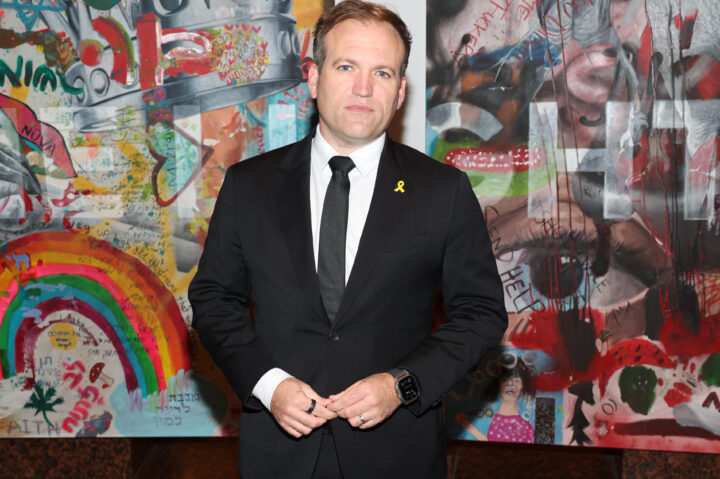
Jerritt Clark/Getty Images for Museum of Tolerance
Reverend Dr. Johnnie Moore, President of the Congress of Christian Leaders attends the Museum Of Tolerance Commemoration of the one-year anniversary of the October 7 attacks at Museum Of Tolerance on October 06, 2024 in Los Angeles, California.
Rev. Johnnie Moore, a member of President Donald Trump’s evangelical advisory committee, has years of experience with complex situations in the Middle East. He helped evacuate Christian refugees under threat from ISIS and has advocated for religious freedom and tolerance for minorities in the region.
But the challenges Moore faces as executive chairman of the Gaza Humanitarian Foundation, the U.S. group, supported by Israel, that began distributing food and humanitarian aid in Gaza in May, have been unique.
Since its inception, GHF has faced a pervasive negative narrative in the international media and among aid organizations. More recent statements from U.N. and other aid groups in effect accuse the GHF of being an IDF front luring Gaza residents to one place so they can be attacked, while largely ignoring Hamas violence against Palestinians working with the GHF.
In a wide-ranging interview this week with the Misgav Institute for National Security’s “Mideast Horizons” podcast, co-hosted by Jewish Insider’s Lahav Harkov, Moore pushed back against what he says are false narratives about the group’s work and accused aid organizations of “sabotage” and spreading disinformation, while acknowledging the challenges of aid distribution in an active war zone.
*****
GHF is addressing “a problem that everyone knew and admitted existed … and now everyone has amnesia,” Moore said. “The vast majority of humanitarian assistance that has gone into the Gaza Strip over many, many, many years, was almost immediately diverted into the hands of Hamas, and then used for various nefarious purposes. And I’m not talking about some of the aid — I’m talking about almost all of the aid.”
As such, the mission of GHF is to equally and directly distribute aid to Gazans without having it be “used to prolong a conflict or hoarded,” he said.
Since the beginning of GHF’s operations on May 26, the organization has opened four distribution sites in southern Gaza, from which it said it has provided Gazans with over 958,000 boxes of food. Moore said the GHF calculates meals with a greater caloric value than what the U.N. aid organizations distribute, and by the GHF’s count, it has distributed over 54.8 million meals.
“In an objective world, this would be viewed as an incredible success,” Moore said. “To my great surprise, we poked a number of bears that I wasn’t anticipating, and not all of them are Hamas threatening our local aid workers and the Americans helping these people. A lot of [the antagonists] wear suits and are in places like Geneva and New York City.”
Moore quipped that he has faced “lots of trouble” in his career advocating for religious freedom for Christian minorities around the world, including death threats and sanctions from the Chinese Communist Party, but that the negative response to GHF is unique.
“Respectable — I don’t even call them respectable anymore — elite organizations that we would assume [have] good intent have just attacked us again and again. The whole time, we’re like ‘cooperate with us … teach us, let’s find ways of solving problems together,’” to no avail, he said.
Moore said he would have liked to collaborate with major humanitarian organizations, such as the World Food Program, but that the U.N. has “been trying to sabotage us from the very beginning.”
“We’d really like the people whose job it has been to do this for many years to decide to help us,” he added. “Instead, they spread lies that originate in Hamas and try to shut us down, and I can’t think of anything more immoral than trying to shut down an operation that’s … feeding millions and millions of meals every day.”
Moore said details his staff on the ground in Gaza have heard from residents have been “a shock to us,” and revealing about other humanitarian aid groups’ conduct.
“Early on, we had a number of people who wanted to confirm that the aid was free, because in every other circumstance, their experience was that the aid that was coming in from the United Nations and other organizations was being taken and sold to them. It was unbelievable to them that we were giving this stuff away for free,” Moore said.
Moore pushed back against news stories associating death and killing in Gaza with the GHF and its distribution sites, slamming them as “lies.”
“We didn’t wait for a ceasefire to start our aid distribution. We’re distributing aid in the middle of a hot war,” he said. “There have been incidents in the Gaza Strip of civilians being killed. But what’s clear is that there is this very intentional disinformation campaign that is trying to say that … the GHF is a death trap, that we exist not to feed people 50 million meals, but to lure people. This is the lie that they keep telling.”
Hamas has dedicated extensive efforts to delegitimizing GHF in the eyes of the world and trying to threaten and scare Gaza residents seeking food from GHF, Moore said.
“They release these statistics every single day and they say that all these people are being killed at our aid sites or in close proximity to our aid sites,” Moore said. “This is their primary way of both trying to scare Gazans [from] getting our aid, trying to force us to shut down, trying to force European governments not to fund us, for the United Nations to continue opposing us.”
Moore has been actively pushing back on social media against false claims about GHF, and called on the media and international organizations to scrutinize claims from the terrorist organization in Gaza, “but no one is asking hard questions,” he lamented.
“What about the prolific evidence that we do have of Hamas intentionally killing people and then attributing their murder to the GHF or others?” he added.
Moore said that “sometimes you read all these crazy headlines and you’re like, ‘Am I deceiving myself here?’ but we’re actually talking to the people [of Gaza] every day, and it seems [reality] really is in many cases the exact opposite.”
On the ground in Gaza, Moore says people are adapting to GHF’s mode of distribution, with families often getting together to trade if one needs more of one product than another. GHF also tries to be flexible under the circumstances, having morning and evening distribution times when needed to keep the process more orderly.
Some Israeli politicians have maintained that providing aid for Gaza hinders the achievement of Israel’s war aims. Some on the right, who oppose letting any aid into Gaza, argue that if Hamas can pocket humanitarian aid and make money selling it, they will continue to control the enclave. And Hamas does still retain a significant measure of control over the area, despite more than 20 months of IDF operations.
Moore agreed with the argument that Hamas’ ability to take control of aid was “prolonging the conflict,” but said that GHF’s “mission is not related to the war.”
Still, he said that he thinks Hamas feels very threatened by GHF: “The fact is that Hamas continues to threaten Gazans and killed 12 of our local workers two weeks ago and nearly killed others and tortured others … Hamas took them to the Al Nasr Hospital and piled the dead and the injured outside … and wouldn’t let them get medical treatment, in order to send a message.”
“So I think it’s a hard argument to make that Hamas doesn’t oppose what we’re doing or isn’t somehow feeling threatened by what we’re doing,” Moore added. “Think of the fact that they issued bounties on the heads of Americans … They’re doing everything they can to shut [the GHF] down, which means that every time our aid workers, local or American, step into [Gaza], they are risking their lives in order to feed people.”
Moore noted that GHF does not operate in northern Gaza, where U.N. trucks continue to enter and are often taken by Hamas: “There was one day where 55 U.N. trucks went in and literally 52 were hijacked at gunpoint by Hamas or Hamas-linked militants,” he said. Another example he recalled was a time when “there was a [U.N.] truck that went in … Hamas wasn’t able to hijack the truck. So what does Hamas do? Hamas kills civilians around the truck to try to keep the civilians from getting what they can.”
“Amidst all of this, the U.N. literally told the BBC that none of their aid had been diverted. Zero. That was the official statement,” Moore said. “The U.N. is just lying through their teeth.”
Moore declined to share who funds GHF, but said that “the seed funding … principally came from a couple of countries, not Israel, that wanted to remain totally secret for political reasons.” Moore said he supports the decision of those countries not to reveal themselves, because of the negative narrative about the GHF, and expressed appreciation for the Trump administration for contributing to the foundation and encouraging others to do the same.
*****
Last month, Moore visited Syria with Rabbi Abraham Cooper of the Simon Wiesenthal Foundation and a Syrian Muslim refugee who had fled the country. In Damascus, Moore met with al-Sharaa for nearly three hours.
Moore’s approach to al-Sharaa’s new government in Syria, he said, “comes down to two things. Number one … You’re saying nice things, but can we trust you? And number two, if we can trust you, are you actually capable of doing these things?”
Following the meeting, Moore said, “I absolutely believe there will be peace between Syria and Israel.”
“I think the first priority in Syria has to be the stabilization of Syria. But I definitely left that conversation with a very clear idea of what needed to be done, of how it could be done, and of the probability in the right time of it being done in order to see peace all across the region.”
There have been contradictory reports in recent days as to whether al-Sharaa is willing to acknowledge Israeli sovereignty in the Golan Heights. Moore suggested that peace between the countries may involve things that make both sides “uncomfortable.”
“I do think many of us, including many people in Israel, misread certain aspects of this new government, all for good reasons,” Moore added, referring to those who highlight al-Sharaa’s history as a leader of an Al Qaeda affiliate in Syria. “Those of us who focus on the Middle East … have a tendency to be, we can be cynical, we can be conspiratorial, we can be a bit paranoid sometimes … But I always say the most valuable commodity in the Middle East is not oil or gas, it’s trust. If there’s no trust, nothing exists. And our visit was a trust-building exercise, and it was far more beneficial than I expected.”
Moore called al-Sharaa “a type of unicorn.”
“He comes from an Islamist orientation, no question whatsoever. But I’m not sure you can take this person and easily profile him,” Moore said. “This is the last gasp of a lot of extremists and when I met with Shahra, I viewed him as being more like [Saudi Crown Prince Mohammed bin Salman] as almost any other of the leaders that I’ve that I’ve met with, in terms of his generation, and the way he talks about solving problems and all of these things. This is a younger generation of leaders in a region with a lot of older leaders who think only about the past. I think al-Sharaa, like MBS, and a few other leaders, are future-oriented.”
Moore called for the U.S. to help Syria rebuild, because the country’s economy and infrastructure are in shambles.
*****
Moore has also been a longstanding advocate for a strong U.S.-Israel relationship and evangelical support for Israel.
Asked about polls showing decreasing support for Israel among young evangelicals, and the rise of figures such as Candace Owens and Tucker Carlson who have used Christianity as an argument against such support, Moore said he thinks the decline is exaggerated as is the influence of the podcasters.
“For a long time, there was exaggerated concern about a rise of antisemitism on the right while we were watching this incredible surging of antisemitism on the left. Well, now, I’m sorry to say, but we’re seeing it on both sides,” Moore said. “Yet, it actually isn’t the right. OK, it’s a type of pseudo-libertarianism. You know that isn’t a part of the institutional right, but because of the internet, it’s much more influential.”
Still, he added, “I’m not seeing some of these actors becoming more influential among evangelicals. I’m seeing evangelicals reject these influencers as they start talking about things that evangelicals actually know quite well … like skepticism about, you know, the evangelical relationship with Israel.”
Moore said he summarizes the relationship between evangelicals worldwide with the Jewish community, and Israel in one sentence: “Your book is our book; your heroes are our heroes; and your values, while we interpret them differently, are our values.”
“You have this massively dispersed religious movement around the world, 700 million people, and they all generally feel the same, 80-90% of them, about the Jewish community and Israel, because they get it from the Bible,” he said. “I’m not focused very much on politics these days, as we try to feed Gaza, but I think the evangelical community all around the world is a positive force and I don’t think the macro trends are changing at all.”
Critics and Iranian dissidents accuse NIAC of being tied to the Iranian regime

Spencer Platt/Getty Images
Palestinian activist Mahmoud Khalil, who was released from ICE detention, speaks during a rally on the steps of the Cathedral of St. John the Divine in Manhattan on June 22, 2025 in New York City.
One day after former Columbia University graduate student Mahmoud Khalil was released from the immigration detention center where he had been held for three months, the anti-Israel activist appeared at a rally in New York City organized by a group accused of ties to the Iranian regime protesting the U.S.’ weekend airstrikes on Iran’s nuclear facilities.
“Mahmoud Khalil is a freedom fighter … who refuses to remain silent while watching a genocide in Palestine,” Khalil told a cheering crowd on Sunday, where he led anti-Israel chants including, “From the River to the Sea, Palestine Will be Free,” at the People’s Forum protest, a demonstration organized by the National Iranian-American Council to protest the U.S. military strikes on three Iranian nuclear sites.
Iranian dissidents and critics of NIAC, a U.S.-based Iranian-American advocacy group that calls for diplomacy with the Iranian regime and was critical of the Biden administration’s approach to Israel and the Middle East, accuse the group of being tied to the regime.
Khalil, who grew up in Syria but is of Palestinian descent and living in the U.S. on a green card, led last year’s anti-Israel campus protests at Columbia against the war in Gaza and subsequent negotiations with university administrators. He was detained in March and released on Saturday after U.S. District Judge Michael Farbiarz said it would be “highly, highly unusual” for the government to continue detaining a legal U.S. resident who was unlikely to flee and hadn’t been accused of any violence.
Khalil’s release was met with support from some left-wing lawmakers.
Rep. Alexandria Ocasio-Cortez (D-NY), who met Khalil at New Jersey’s Newark-Liberty International Airport a day after he was freed from a federal immigration facility in Louisiana, said that his detention by the Trump administration violated the First Amendment and was “an affront to every American.”
“He has been accused, baselessly, of horrific allegations simply because the Trump administration and our overall establishment disagrees with his political speech,” Ocasio-Cortez added.
Rep. Jerry Nadler (D-NY) wrote on X that he welcomed the decision to release Khalil. “As I have said before, his prolonged detention — without charges — is a chilling, McCarthyesque action in response to the exercise of First Amendment rights to free speech and raises serious constitutional concerns,” Nadler said.
Blumenthal: ‘Our bipartisan effort seeks to strengthen measures to bring long overdue justice to families whose cherished art was brazenly stolen by the Nazis’

J. Scott Applewhite/AP Photo
Sen. John Cornyn, R-Texas, center, is flanked by Senate Judiciary Committee Chairman Dick Durbin, D-Ill., left, and Sen. Richard Blumenthal, D-Conn., at the Capitol in Washington, Thursday, Nov. 14, 2024.
Sens. John Cornyn (R-TX) and Richard Blumenthal (D-CT) introduced bipartisan legislation last week aimed at eliminating loopholes used by museums and other stakeholders to continue possessing Nazi-looted artwork that Jewish families have been trying to recover.
Introduced on Thursday, the Holocaust Expropriated Art Recovery (HEAR) Act would expand on Cornyn’s 2016 legislation of the same name, which was passed at the time by unanimous consent, by ending the Dec. 31, 2026, sunset date on the original bill and strengthen the existing procedural protections to ensure that victims’ claims are not dismissed due to non-merit-based factors such as time constraints.
“The artwork wrongfully ripped from Jewish hands during the Holocaust bears witness to a chapter in history when evil persisted and the worst of humanity was on full display. I’m proud to introduce this legislation to support the Jewish people and Holocaust survivors by helping them recover art confiscated by the Nazis that they are rightfully owed and give them the justice and restitution they deserve,” Cornyn said in a statement.
“The theft of art by the Nazi regime was more than a pilfering of property — it was an act of inhumanity. Our bipartisan effort seeks to strengthen measures to bring long overdue justice to families whose cherished art was brazenly stolen by the Nazis,” Blumenthal said.
Many families of Holocaust victims in the U.S. who have located artwork from deceased relatives and sued to recover those items face the deadline at the end of next year before the statute of limitations sets in. Thousands of stolen works of art remain unreturned to their rightful owners from the Nazi plunder, and there are scores of ongoing cases to resolve disputes over ownership of those items.
“Unfortunately, many museums, governments, and institutions have contradicted Congress’ intent and obstructed justice by stonewalling legitimate claims, obscuring provenance, and employing aggressive legal tactics designed to exhaust and outlast Survivors and their families. Rather than embracing transparency and reconciliation, too many have chosen to entrench and litigate, effectively preserving possession of stolen works rather than returning them to their rightful owners,” a press release for the bill states.
Sens. Thom Tillis (R-NC), Cory Booker (D-NJ), Marsha Blackburn (R-TN), John Fetterman (D-PA), Eric Schmitt (R-MO) and Katie Britt (R-AL) co-sponsored the bill, which was endorsed by a number of Jewish organizations including Agudath Israel of America, the American Jewish Committee, Anti-Defamation League, Jewish Federations of North America, StandWithUs and World Jewish Congress, among others.
“This legislation helps to right a historic wrong committed during one of the darkest chapters in history. By eliminating unnecessary legal obstacles, the HEAR Act establishes a clear path to restitution for Holocaust survivors and their families, ensuring that art and cultural property stolen by the Nazis can finally be returned to their rightful owners,” Tillis said.
Fetterman said in a statement, “Eighty years after the Holocaust, we have a moral responsibility to do right by the victims of these atrocities and their families. I’m grateful to join my colleagues from both sides of the aisle in introducing the HEAR Act to help return artwork stolen by the Nazis to its rightful owners.”
Plus, Rubio, Cruz talk Trump Iran policy

REBECCA DROKE/AFP via Getty Images
Pittsburgh Mayor Ed Gainey speaks ahead of Vice President Kamala Harris at a campaign rally outside Pittsburgh, Pennsylvania on November 4, 2024.
Good Wednesday morning.
In today’s Daily Kickoff, we break down a new Anti-Defamation League report on antisemitism at independent K-12 schools, and report on Corey O’Connor’s victory yesterday in Pittsburgh’s mayoral primary. We report on the increasing pressure on Israel over its conduct in Gaza, cover Secretary of State Marco Rubio’s first appearance on Capitol Hill since being confirmed, and highlight remarks made by Sens. Ted Cruz and John Fetterman to NORPAC members. Also in today’s Daily Kickoff: Lishay Lavi Miran, Sen. Andy Kim, and Reps. Debbie Wasserman Schultz and Dan Goldman.
What We’re Watching
- South African President Cyril Ramaphosa and President Donald Trump will meet at the White House today, with new trade agreements on the agenda amid strained ties between the two countries.
- The Combat Antisemitism Movement and the Jewish Federations of North America will host the Annual Jewish American Heritage Month Congressional Breakfast on Capitol Hill today, with a keynote address from Bruce Pearl, head coach of the Auburn men’s basketball team.
- The House Appropriations Committee will hold separate budget hearings with testimony from Education Secretary Linda McMahon and Secretary of State Marco Rubio.
- The House Foreign Affairs Committee will also hold a hearing with Rubio on “Fiscal Year 2026 State Department Posture: Protecting American Interests.”
- The Senate Committee on Health, Education, Labor and Pensions will hold a hearing on “The State of Higher Education” with witnesses including Dr. Andrew Gillen, a research fellow at the Cato Institute; Dr. Michael Lindsay, president of Taylor University; Dr. Mark Brown, president of Tuskegee University; Mike Pierce, executive director of the Student Borrower Protection Center; and Dr. Russell Lowery-Hart, chancellor of the Austin Community College District.
- The Qatar Economic Forum continues today in Doha, with speakers including Donald Trump Jr.; Steve Mnuchin, former U.S. treasury secretary; Mark Attanasio, principal owner of the Milwaukee Brewers; John Micklethwait, editor-in-chief of Bloomberg; and Hassan Al-Thawadi, former secretary general at Supreme Committee for Delivery and Legacy for the 2022 FIFA World Cup.
What You Should Know
A QUICK WORD WITH JI’S hALEY COHEN
A new Anti-Defamation League report puts a spotlight on episodes of antisemitism in K-12 non-Jewish independent schools, a trend that doesn’t get as much attention as the higher-profile incidents on college campuses but is affecting Jewish students in critical ways.
The study found antisemitic incidents in independent schools down 26% in 2024, compared to 2023, but still up significantly since the Oct. 7 Hamas attacks. There were only 494 documented incidents of antisemitism in independent schools in 2022; that number has nearly doubled to 860 in 2024.
A quarter of surveyed parents said their children experienced/witnessed antisemitic symbols (such as swastikas) in school.
The research was conducted through four focus groups and a survey of 369 parents of Jewish children in independent K-12 schools across 21 states. The ADL told Jewish Insider‘s Haley Cohen it selected independent schools to evaluate since they operate outside of the oversight of public education and therefore have greater autonomy in shaping their curricula, policies and disciplinary procedures.
In addition to expressing concern over antisemitic symbols, nearly one-third of parents reported anti-Jewish and anti-Israel curricula featuring more prominently in their children’s classrooms since the Oct. 7, 2023, terrorist attacks. They’re also deeply dissatisfied with administrators’ responses to antisemitism: Of the parents surveyed who were aware of antisemitism in their child’s school, 34% said the school’s response was either “somewhat” or “very” inadequate.
One bit of encouraging news: A sizable majority of students at these schools (64%) said they felt “very comfortable” showing their Jewish identity at schools, with only 8% feeling somewhat or very uncomfortable with doing so. But there were isolated episodes of student discomfort, including one parent saying their son avoided wearing a Star of David necklace.
Another notable trend: Many independent school parents voiced concern that diversity, equity and inclusion frameworks do not include Jewish identity and antisemitism. They view the exclusion as a fundamental flaw of the programming rather than an oversight and described a pattern in which Jewish identity was omitted altogether from DEI conversations or misrepresented to perpetuate bias.
And parents are voting with their feet: There’s been an increase in Jewish day school enrollment in recent years.
But for those Jewish students who remain in independent schools, the ADL said it’s launching a new initiative to hold schools accountable and support families. “These independent schools are failing to support Jewish families,” Jonathan Greenblatt, the group’s CEO, said. “By tolerating — or in some cases, propagating — antisemitism in their classrooms, too many independent schools in cities across the country are sending a message that Jewish students are not welcome. It’s wrong. It’s hateful. And it must stop.”
GAINEY’S GOODBYE
O’Connor ousts Gainey in heated Pittsburgh mayoral primary

Corey O’Connor prevailed in his bid to oust Mayor Ed Gainey of Pittsburgh in the Democratic primary on Tuesday, dealing a major blow to the activist left in a city where progressives had until recently been ascendant. O’Connor, the Allegheny County controller and a centrist challenger, defeated Gainey, the first-term incumbent aligned with the far left, by a significant six-point margin, 53-47%, on Tuesday evening with most of the vote counted, Jewish Insider’s Matthew Kassel reports.
Victory post: “We built this campaign with and for the people of this city, neighborhood by neighborhood,” O’Connor said in a social media post on Tuesday night. “I’m proud to be your Democratic nominee for Mayor. I’m ready to get to work, and I’m grateful to have you with me as we take the next steps forward, together.”
WAITING FOR OMRI
An Israeli mom’s NYC mission to free husband from Hamas captivity

Every morning, Lishay Lavi Miran’s toddler daughters ask her the same two questions: Why is daddy still in Gaza and when is daddy coming home? In a desperate attempt to provide answers, Miran spent the past week in New York City — her first time in the U.S. — advocating for the release of her husband, Omri Miran, who was kidnapped from their home in Kibbutz Nahal Oz during the Oct. 7, 2023, terrorist attacks and has remained in Hamas captivity for nearly 600 days. In an interview with Jewish Insider’s Haley Cohen during her visit to the states, which concluded on Tuesday, Miran said that her message to the American Jewish community is that its advocacy efforts have provided a “warming sense of hope.”
Now and then: The family received the first sign of life from Omri in April when Hamas terrorists published a video in which he is seen walking through a tunnel in Gaza. The video was released right around his 48th birthday. “It was difficult to see him in those conditions,” Miran told JI during her visit to the states, which concluded on Tuesday. The “exhausted” man in the video was a contrast to the guy known for having “the biggest smile in the world and spark in his eyes,” as Miran describes her husband.
foreign policy in focus
Rubio: Iranian proxy terrorism hasn’t been part of negotiations with Iran

Secretary of State Marco Rubio said in his first appearance on Capitol Hill since being confirmed as secretary of state that Iran’s support for regional terrorist proxies has not been part of the ongoing talks between the Iranian government and Middle East envoy Steve Witkoff, which Rubio said have been focused wholly on Iran’s nuclear program and enrichment capabilities. At the same time, Rubio insisted that any sanctions related to terrorist activity and weapons proliferation would remain in place if such issues are not part of the nuclear deal, Jewish Insider’s Marc Rod reports.
What this means: Rubio’s comments indicate the deal might still be subject to what some critics in the United States and the region described as a key flaw of the original nuclear deal — that it failed to address other malign activity by the regime. One U.S. lawmaker who traveled to the Middle East recently said that U.S. partners in Israel and the Arab world had argued that any deal must include non-nuclear provocations. Rubio added that sanctions will remain in place until a deal is reached, and that European partners are working separately on re-implementing snapback sanctions, potentially by October of this year, when such sanctions expire. He also said that Iran cannot have any level of nuclear enrichment under a nuclear deal, as it would inevitably provide a pathway for Iran to enrich to weapons-grade levels.
Read the full story here with Rubio’s additional remarks on Iran, Gaza and Syria.
TED TALK
Ted Cruz expresses concern about influence of some Trump officials on Iran policy

Sen. Ted Cruz (R-TX) said on Tuesday that he is concerned about the views of some of the officials in the White House shaping President Donald Trump’s Iran policy, marking the most critical comments yet from the hawkish senator about Trump’s approach to Iran. He urged members of NORPAC, a pro-Israel advocacy organization, to raise the issue in their meetings with anyone in the Trump administration, Jewish Insider’s Gabby Deutch reports.
What he said: “We need clarity with the Trump administration, and as NORPAC talks to the administration, I would say, I worry there are voices in the administration that are not eager to hold up the president’s red line of dismantlement,” Cruz said at NORPAC’s annual Washington lobbying mission, referring to mixed messaging from some U.S. officials on the acceptable contours of a potential new nuclear agreement with Iran.
Also during NORPAC’s mission: Sen. John Fetterman (D-PA), who is facing attacks from the media and fellow lawmakers in the Democratic Party, hit back at members of his own party. Speaking to members of NORPAC, Fetterman offered some of his sharpest criticism yet of the Democratic Party’s approach to Israel after the Oct. 7 Hamas attacks. “Israel and your community deserves much better from my party,” Fetterman said, earning loud applause.
RELATIONSHIP RUPTURE
Foreign Minister David Lammy announces suspension of U.K.-Israel free trade agreement

U.K. Foreign Secretary David Lammy announced that Britain has suspended negotiations with Israel on a new free trade agreement and will be “reviewing cooperation,” a day after the U.K., France and Canada threatened to take “concrete actions” and impose sanctions on Israel over its policies on humanitarian aid in Gaza and settlement activity in the West Bank, Jewish Insider’s Danielle Cohen and Lahav Harkov report.
Upping the pressure: Lammy, speaking to British lawmakers in the House of Commons on Tuesday, said the “Netanyahu government’s actions have made this necessary,” describing the lack of humanitarian aid entering Gaza as “intolerable” and “abominable.” He said that Tzipi Hotovely, the Israeli ambassador to the U.K., has been summoned to the U.K. Foreign Office, where Middle East Minister Hamish Falconer will tell her that “the 11-week block on aid to Gaza has been cruel and indefensible” and that “dismissing concerns of friends and partners … must stop.” Lammy also announced that the British government will impose sanctions on three individuals and four entities with ties to settlements in the West Bank, which the U.K., France and Canada called “illegal” in their joint statement.
Meanwhile in Brussels: The EU’s foreign policy chief, Kaja Kallas, said that Brussels will review whether Israel is violating the human rights clause of the EU-Israel Association Agreement, which governs the high-level political and economic ties between the sides. Dutch Foreign Minister Caspar Veldkamp proposed the review with the backing of 17 of 27 EU members; however, a policy change would require unanimity within the bloc.
And from the Vatican: Pope Leo XIV appealed this morning “to allow the entry of dignified humanitarian aid and to put an end to the hostilities, whose heartbreaking price is paid by the children, elderly, and the sick.
kim’s call
Sen. Andy Kim urges Homeland Security Secretary Noem to protect Nonprofit Security Grant Program funding

Sen. Andy Kim (D-NJ) pressed Homeland Security Secretary Kristi Noem for clarification of her department’s plans regarding the Nonprofit Security Grant Program as the Trump administration considers cuts to the Federal Emergency Management Agency, Jewish Insider’s Emily Jacobs reports. Kim and Noem engaged on the issue while the latter was testifying before the Senate Homeland Security and Governmental Affairs Committee on Tuesday. Kim, the top Democrat on the HSGAC subcommittee that oversees FEMA, urged Noem to ensure NSGP funding is not reduced or eliminated outright as part of President Donald Trump’s push to abolish FEMA, citing the program’s success rate with New Jersey synagogues amid rising antisemitism.
Making the case: “I think that there’s very strong bipartisanship here in Congress, especially the Senate, to protect the Nonprofit Security Grant Program. It is literally the best tool that people in New Jersey are telling me is needed to be able to counter antisemitism. I can’t tell you the number of synagogues and temples that are lined up to try to get this type of funding. In fact, you know, given the rise of antisemitism that we have in our country right now, we should be surging resources, not cutting,” Kim said.
Worthy Reads
A Tale of Two New York City’s: New York magazine’s E. Alex Jung writes about the stark contrast between Andrew Cuomo and Zohran Mamdani in the New York City mayoral primary. “Their respective campaigns are striking foils: Cuomo, who at 67 would become the oldest incoming mayor of New York City ever, has stayed out of the public eye while racking up endorsements from major labor unions. When he does appear, he’s working the Black church circuit. He knows that the path to the Democratic nomination has historically gone through Black and Latino voters, mostly in Southeast Queens and Central Brooklyn. In one simulation, Cuomo is winning those communities by 91 percent and 72 percent by the final round, respectively. To the ire of white liberals, he has a broad multi-racial coalition. While Mamdani is seemingly everywhere in the city, running from protests to rallies to galas, his base is largely white college-educated Brooklynites, with much of his early efforts going toward activating South Asian and Muslim voters, who have traditionally been ignored. ‘Zohran is Cuomo’s wet-dream opponent,’ says one anti-Cuomo Democratic strategist. ‘Supported by online kids, on the record for “defund,” on the record about Palestine, and little support in Black or Latino communities.’” [NYMag]
Sam (A)I Am: In a New Yorker review of two new books on Sam Altman and the future of AI, Benjamin Wallace-Wells considers the OpenAI founder’s Midwestern Jewish roots. “Within the world of tech founders, Altman might have seemed a pretty trustworthy candidate. He emerged from his twenties not just very influential and very rich (which isn’t unusual in Silicon Valley) but with his moral reputation basically intact (which is). Reared in a St. Louis suburb in a Reform Jewish household, the eldest of four children of a real-estate developer and a dermatologist, he had been identified early on as a kind of polymathic whiz kid at John Burroughs, a local prep school. “His personality kind of reminded me of Malcolm Gladwell,” the school’s head, Andy Abbott, tells [Keach] Hagey [author of The Optimist: Sam Altman, Open AI, and the Race to Invent the Future]. ‘He can talk about anything and it’s really interesting’ — computers, politics, Faulkner, human rights.” [NewYorker]
Under African Skies: The Foundation for Defense of Democracies senior director Elaine Dezenski and senior research analyst Max Meizlish offer a warning about South Africa’s anti-American activity in the run-up to South African President Cyril Ramaphosa’s meeting with Trump today. “South Africa isn’t an innocent, neutral party. It is playing both sides — courting the West while deepening its ties to China, Russia and Iran. Its leaders speak the language of nonalignment, but their actions tell a different story: They’ve welcomed Hamas and Hezbollah officials, hosted sanctioned Russian warships and worked with entities tied to Iran’s Islamic Revolutionary Guard Corps … South Africa’s conduct is not just inconsistent with American values — it’s increasingly incompatible with US national security. Under Ramaphosa, the ANC has intensified its lawfare campaign against Israel at the International Court of Justice, ramped up efforts to diplomatically isolate Taiwan, and embraced Beijing’s narrative on global governance by joining the China-led BRICS group. The ANC’s historical alignment with authoritarian powers is no secret — but today, it’s backed by real material support. That should concern every serious policymaker in Washington.” [NYPost]
The Illiberal Left, and Right: The Liberal Patriot’s executive editor, John Halpin, considers the future of American liberalism. “Instead of pragmatic, universal solutions to the problems of working- and middle-class Americans, Democrats after Obama went off on extreme ideological tangents and illiberal fads from structural racism and transgender ideology to decriminalization and open borders to the socialist ‘Green New Deal’ and other radical climate policies. Notably, all of these illiberal ‘ideas’ produced significant public backlash from a wide array of American voters and are now in the process of being dismantled or disregarded. On the Republican side, the traditional party of Reagan has basically discarded all its past social and economic liberal commitments in favor of Trump’s peculiar blend of command-and-control tariff and trade policies, unrestrained executive authority, withdrawal from global allies and international security arrangements, and the use of governmental legal and bureaucratic authority to attack and prosecute perceived enemies. ‘Postliberal’ ideas that explicitly reject individualism as the foundation of American life are now dominant in a party that feels the need ‘to be really ruthless when it comes to the exercise of power,’ according to Vice President JD Vance.” [LiberalPatriot]
Word on the Street
President Donald Trump is reportedly frustrated by the continuing war in Gaza and has instructed his aides to tell Israeli Prime Minister Benjamin Netanyahu to “wrap it up,” White House officials told Axios…
Netanyahu’s office announced yesterday that the senior members of the ceasefire and hostage-release negotiating team had been recalled from Doha, Qatar, while the working echelon would continue the talks. The PMO statement stressed that Israel had agreed to the U.S. proposal but that Hamas “is continuing to cling to its refusal”…
In an interview published today in The National, Jake Sullivan, the Biden administration’s national security advisor, says of Trump’s relationship with Netanyahu, “It’s not that the balance of power has changed, just the weight and emphasis on who can deliver” …
CNN, citing intelligence from “multiple US officials,” reported that Israel has been making preparations to strike Iranian nuclear facilities, though they stressed it remains unclear if Israeli leaders have made a final decision to do so. In reaction to the story, former Washington Institute for Near East Policy fellow Nadav Pollak wrote on X: “The only surprising part in [the story] is that US officials leaked the fact they monitor Israeli communications.”…
Iranian Supreme Leader Ali Khamenei said on Tuesday that, “I do not think nuclear talks with the U.S. will be successful” and warned, “They should not try to talk nonsense. It is a big mistake to say that we will not allow Iran to enrich. No one is waiting for permission from this or that.”…
Trump announced Tuesday that the United States will move forward on construction of a Golden Dome missile defense system. Trump began calling for a U.S. missile defense shield similar to Israel’s Iron Dome after watching Israel deflect missiles and drones amid Iran’s attacks in 2024…
Democrat Sam Sutton won a special election for a New York state Senate seat, which the GOP had hoped to flip after Trump received 77% of the vote in the district in November. The district encompasses several heavily Orthodox Jewish neighborhoods, and Sutton is a leader of its Sephardic community…
The New York Times confirmed reporting that Trump, through the Pentagon, White House military office and Middle East envoy Steve Witkoff, had initially approached the Qataris about purchasing the luxury Boeing 747 jet for use as Air Force One, rather than it being offered as a gift…
Newly released emails reveal that Joe Kent, chief of staff to Director of National Intelligence Tulsi Gabbard, pressured analysts to revise an intelligence assessment to align with Trump’s claim that Venezuela’s government controls a criminal gang…
Elon Musk told attendees at the Qatar Economic Forum that he doesn’t plan to spend money on elections in the future. “I think I’ve done enough,” he said…
Secretary of State Marco Rubio and Sen. Chris Van Hollen (D-MD) clashed in a heated exchange during a Senate hearing Tuesday. “I regret voting for you for secretary of state,” Van Hollen said. “Your regret for voting for me confirms I’m doing a good job,” Rubio responded…
Sen. Peter Welch (D-VT) sought unanimous consent to call up a resolution pushing the administration to work to resume U.S. aid to Gaza, which is sponsored by nearly all Senate Democrats. Sen. Jim Risch (R-ID) blocked the effort…
The United Arab Emirates said yesterday that it will send urgent humanitarian aid to Gaza, after UAE Foreign Minister Sheikh Abdullah bin Zayed and his Israeli Foreign Minister Gideon Sa’ar spoke on the phone…
The U.S. and Turkey released a joint statement on the U.S.-Turkey Syria Working Group’s most recent meeting held in Washington, which included discussions on “shared priorities in Syria, including sanctions relief according to President Trump’s directive and combatting terrorism in all its forms and manifestations”…
Sens. Elizabeth Warren (D-MA), Ron Wyden (D-OR) and Bernie Sanders (I-VT) sent a letter to Paramount Global Chair Shari Redstone expressing their concern that CBS News may be engaging in “improper conduct” and violating anti-bribery law in its effort to settle a lawsuit with Trump that will potentially block Paramount’s intended merger with Skydance…
Trump called Rep. Thomas Massie (R-KY) a “grandstander” who “should be voted out of office” over Massie’s opposition to his budget bill. Massie, a longtime opponent of aid to Israel and legislation to combat antisemitism, is mulling a statewide run for Senate or governor in Kentucky…
Speaking at a congressional hearing of the Tom Lantos Human Rights Commission on Tuesday, AJC CEO Ted Deutch urged the U.S. to remain engaged in international bodies including the U.N., UNESCO and OSCE and called for Congress to confirm Rabbi Yehuda Kaploun to the role of special envoy to monitor and combat antisemitism and provide $3 million in funding for the office…
New York Times reporter Joseph Bernstein chronicled the life of his father, a “Nazi hunter” with the U.S. Department of Justice in the ‘80s, who was killed in the Pan Am 103 bombing in 1988, and his struggle to find meaning in the resulting decades-long investigation that ultimately led to the currently delayed trial of a Libyan man accused of planting the bomb on behalf of dictator Muammar Gaddafi…
Israeli Strategic Affairs Minister Ron Dermer eulogized his mother, Yaffa Dermer, who died last Sunday at the age of 89. Ron said, “We don’t choose our parents. They are chosen for us. So I thank Hashem for blessing me to have been raised by such an extraordinary mother and teacher. … Over the years, I have had the privilege to serve in prominent positions and hold prestigious titles. But the greatest honor of my life has been to be Yaffa’s son.”…
Eva Wyner, previously deputy director of Jewish affairs for New York Gov. Kathy Hochul, is now serving as the governor’s director of Jewish affairs…
Arthur Maserjian, previously chief of staff at the Combat Antisemitism Movement, is now the senior director of the Combined Jewish Philanthropies’ Center for Combating Antisemitism…
Eric B. Stillman was hired to serve as the next president and CEO of the Florida Holocaust Museum, which will reopen on Sept. 9 following an extensive renovation; Stillman succeeds Mike Igel, who has led the organization as its interim CEO for the past year…
Pic of the Day

Reps. Debbie Wasserman Schultz (D-FL) and Dan Goldman (D-NY) addressed an Anti-Defamation League reception celebrating Jewish American Heritage Month yesterday in Washington.
Birthdays

Northern California-based comedian, he celebrated his bar mitzvah at 52 years old in Israel, Josh Kornbluth turns 66…
Former U.S. senator from Minnesota, he was previously a comedian, actor and writer, Al Franken turns 74… VP of the Swiss Federation of Jewish Communities, Ralph Lewin turns 72… Guitarist and composer, Marc Ribot turns 71… EVP of American Friends of Bar-Ilan University, Ron Solomon… Chief rabbi of Mitzpe Jericho and dean of Hara’ayon Hayehudi yeshiva in Jerusalem, Rabbi Yehuda Kroizer turns 70… CEO of the Boston-based hedge fund Baupost Group, Seth Klarman turns 68… Legal analyst at CNN, Jeffrey Toobin turns 65… Founder and former co-owner of City & State NY, Thomas Allon turns 63… Director of antisemitism education and associate director of the Israel Action Program, both at Hillel International, Tina Malka… Actress, artist and playwright, Lisa Edelstein turns 59… Former head of Dewey Square’s sports business practice, now a freelance writer, Frederic J. Frommer… Author and journalist, she was a reporter with The New York Times for eight years, Amy Waldman turns 56… U.S. cyclist at the 2000 Summer Olympics in Sydney, Australia, she is now the executive director of the New England Mountain Bike Association, Nicole Freedman turns 53… President and CEO of the Michigan-based William Davidson Foundation, Darin McKeever… University chaplain for NYU, Rabbi Yehuda Sarna turns 47… Founder of Agora Global Advisory, Brandon Pollak… EVP and chief legal officer at Sinclair Broadcast Group, David Gibber… Professor of computer science at the University of Texas at Austin, Scott Joel Aaronson turns 44… President of Mo Digital, Mosheh Oinounou… International fashion model for Versace, Sharon Ganish turns 42… Partner at CreoStrat, Steve Miller… Windsurfer who represented Israel in the Olympics (Beijing 2008 and Rio 2016), she is now a SW delivery lead at SolarEdge, Maayan Davidovich turns 37… Player on the USC team that won the 2016 NCAA National Soccer Championship, she is now an associate in the LA office of Foley & Lardner, Savannah Levin turns 30… Comedian, actress and writer, known for starring in the HBO Max series “Hacks,” Hannah Marie Einbinder turns 30… Deputy director at the Yael Foundation, Naomi Kovitz…
BIRTHWEEK: (was Monday): Alex Shapero…
The shift has been attributed to a mix of factors: stricter consequences from university leaders, fear of running afoul of Trump’s pledge to deport pro-Hamas foreign students and the issue generally losing steam among easily distracted students

Grace Yoon/Anadolu via Getty Images
Pro-Palestinian students at UCLA campus set up encampment in support of Gaza and protest the Israeli attacks in Los Angeles, California, United States on May 01, 2024.
For a brief moment, it looked like 2024 all over again: Tents were erected at Yale University’s central plaza on Tuesday night, with anti-Israel activists hoping to loudly protest the visit of far-right Israeli National Security Minister Itamar Ben-Gvir to campus. Videos of students in keffiyehs, shouting protest slogans, started to spread online on Tuesday night.
But then something unexpected happened. University administrators showed up, threatening disciplinary action, and the protesters were told to leave — or face consequences. So they left. The new encampment didn’t last a couple hours, let alone overnight. The next day, Yale announced that it had revoked its recognition of Yalies4Palestine, the student group that organized the protest. (On Wednesday night, a large protest occurred outside the off-campus building where Ben-Gvir was speaking.)
Meanwhile, at Cornell University, President Michael Kotlikoff announced on Wednesday that he had canceled an upcoming campus performance by R&B singer Kehlani because of her history of anti-Israel social media posts. He wrote in an email to Cornell affiliates that he had heard from many people who were “angry, hurt and confused” that the school’s annual spring music festival “would feature a performer who has espoused antisemitic, anti-Israel sentiments in performances, videos and on social media.”
The quick decisions from administrators at Yale and Cornell to shut down anti-Israel activity reflect something of a vibe shift on American campuses. One year ago, anti-Israel encampments were, for a few weeks, de rigueur on campus quads across the nation. University leaders seemed paralyzed, unsure of how to handle protests that in many cases explicitly excluded Jewish or Zionist students and at times became violent. That’s a markedly different environment from what’s happening at those same schools so far this spring.
“In general, protest activity is way down this year as compared to last year,” Hillel International CEO Adam Lehman told Jewish Insider.
There is no single reason that protests have subsided. Jewish students, campus Jewish leaders and professionals at Jewish advocacy organizations attribute the change to a mix of factors: stricter consequences from university leaders, fear of running afoul of President Donald Trump’s pledge to deport pro-Hamas foreign students and the issue generally losing steam and cachet among easily distracted students.
Last spring, an encampment at The George Washington University was only dismantled after the university faced threats from Congress. Now, no such protest is taking place — which Daniel Schwartz, a Jewish history professor, said was likely due in part to the “sense that the university was going to be responding much more fiercely to anything resembling what happened last year.”
“For the most part, the enforcement of rules, the understanding of what the rules are, what you can do, what you can’t do, requiring people to get permits for protests, has really calmed things down [from] the sort of violence that we saw last year,” said Jordan Acker, a member of the Board of Regents of the University of Michigan, who has faced antisemitic vandalism and targeted, personal protests from Michigan students.
Michael Simon, the executive director at Northwestern Hillel, came into the school year with a “big question mark” of how the school’s new policies, which provide strict guidance for student protests and the type of behavior allowed at them, would be applied. “I’m going to say it with a real hedging: at least up until now, I would say we’ve seen the lower end of what I would have expected,” he said of campus anti-Israel protests.
Many major universities like Northwestern spent last summer honing their campus codes of conduct and their regulations for student protests, making clear at the start of the school year that similar actions would not be tolerated again. In February, for instance, Barnard College expelled two students who loudly disrupted an Israeli history class at Columbia,.
“For the most part, the enforcement of rules, the understanding of what the rules are, what you can do, what you can’t do, requiring people to get permits for protests, has really calmed things down [from] the sort of violence that we saw last year,” said Jordan Acker, a member of the Board of Regents of the University of Michigan, who has faced antisemitic vandalism and targeted, personal protests from Michigan students.
In recent weeks, the Trump administration has pressured top universities to crack down on antisemitic activity. The president’s threats to revoke federal funding if universities don’t get antisemitism under control has drawn pushback — Harvard is suing the Trump administration over its decision to withhold $2.2 billion in federal funds from the school — but it has also led universities to take action to address the problem.
Sharon Nazarian, an adjunct professor at UCLA and the vice chair of the Anti-Defamation League’s board of directors, said there is “no question” that “the national atmosphere of fear among university administrators for castigation and targeting by the [Trump] administration is also present” at UCLA and other University of California campuses.
“My sense is that being anti-Israel is not as much of the popular thing anymore,” Evan Cohen, a senior at the University of Michigan, said at a Wednesday webinar hosted by Hillel International for Jewish high school seniors. “On my campus, there are other hot topic issues. There might be more focus on what’s happening with U.S. domestic politics.”
Rule-breaking student activists also face a heightened risk of law enforcement action. A dozen anti-Israel student protesters were charged with felonies this month for vandalizing the Stanford University president’s office last June. On Wednesday, local, state and federal law enforcement officials in Michigan raided the homes of three people connected to anti-Israel protests at the University of Michigan. Protesters’ extreme tactics have scared off some would-be allies.
“I think some of the most activist students went too far at the end of last year with the takeover of the president’s office and a lot of pretty intense graffiti in important places on campus,” said Rabbi Jessica Kirschner, the executive director of Hillel at Stanford. “I think a lot of other students looked at that and said, ‘Oh, this is perhaps not where we want to be.’”
Students’ priorities shift each year, and other issues beyond Israel are also vying for their attention. Trump’s policies targeting foreign students are drawing ire from students at liberal universities, many of which have large populations of international students.
“My sense is that being anti-Israel is not as much of the popular thing anymore,” Evan Cohen, a senior at the University of Michigan, said at a Wednesday webinar hosted by Hillel International for Jewish high school seniors. “On my campus, there are other hot topic issues. There might be more focus on what’s happening with U.S. domestic politics.”
But the lack of protests does not mean that campus life has returned to normal for Jewish students, many of whom still fear — and face — opprobrium for their pro-Israel views.
“It’s easy to avoid the protests but if you are an Israeli student or a Jewish student perceived to be a Zionist, you should expect to be discriminated against in social spaces at the university,” Rabbi Jason Rubenstein, executive director of Harvard Hillel, told JI. “That is the most powerful way students are impacted by all of this.”
Ken Marcus, founder and chairman of the Louis D. Brandeis Center for Human Rights Under Law, which since Oct. 7 has represented dozens of Jewish students in Title VI civil rights cases against their universities, said that campus-related lawsuits are only faintly slowing down this semester.
“A lot of the staff and the administration think that, ‘OK, since there’s no protest outside, all the Jewish students must feel OK, and let’s put all this stuff that happened in the spring behind us.’ It’s really not the case,” said Or Yahalom, a senior at Northwestern University who was born in Israel. “That doesn’t mean that it’s all better for students. Jewish students are increasingly afraid to speak openly about their identity or connection to Israel, except in private, safe Jewish spaces.”
“Some campuses have been less intense than during last year’s historically awful period, but others have been bad enough,” Marcus told JI. “I believe that the federal crackdown, coupled with the impact of lawsuits and Title VI cases, has had a favorable impact at many campuses, but the problems have hardly gone away.”
Or Yahalom, a senior at Northwestern University who was born in Israel, recently attended a dinner with Northwestern President Michael Schill, who has faced criticism from Jewish Northwestern affiliates — including several members of its antisemitism advisory committee — for what they saw as the administration’s failure to adequately address antisemitism.
“A lot of the staff and the administration think that, ‘OK, since there’s no protest outside, all the Jewish students must feel OK, and let’s put all this stuff that happened in the spring behind us.’ It’s really not the case,” said Yahalom. “That doesn’t mean that it’s all better for students. Jewish students are increasingly afraid to speak openly about their identity or connection to Israel, except in private, safe Jewish spaces.”
Even without massive encampments, disruptive anti-Israel protests and campus actions have not gone away entirely, though they have been more infrequent this academic year. A Northwestern academic building housing the school’s Holocaust center was vandalized with “DEATH TO ISRAEL” graffiti last week. The office of Joseph Pelzman, an economist at The George Washington University who authored a plan calling for the U.S. to relocate Palestinians in the Gaza Strip and redevelop the enclave, was vandalized in February. The Georgetown University Student Government Association is slated to hold a campus-wide referendum on university divestment from companies and academic institutions with ties to Israel at the end of the month. Smaller-scale protests continue at Columbia, with students chaining themselves to the Manhattan university’s main gate this week to protest the ICE detention of Mohsen Mahdawi and Mahmoud Khalil, two foreign students who had led protests last year.
Leaders of the University of Michigan’s anti-Israel coalition held a sham trial for the university president and Board of Regents members in the middle of the Diag, the main campus quad, this week. The event took place without issue, and the activists left when it ended.
“I wouldn’t want to say that it’s perfect,” said Acker, the Board of Regents member. “But it’s certainly much better than a year ago.”
The school year isn’t over. Some students at Columbia are planning to erect another encampment this month, NBC News reported on Wednesday.
But they’ll be doing so at an institution with new leadership, weeks after Columbia reached an agreement with the Trump administration, where the Ivy League university pledged to take stronger action against antisemitism to avoid a massive funding cut. The pressure on Columbia to crack down on any encampment will be massive.
2024 also marked the first year that Israel- or Zionism-related incidents made up a majority of all occurrences

Jemal Countess/Getty Images for Anti-Defamation League
Jonathan Greenblatt speaks onstage during the 2024 ADL “In Concert Against Hate” at the Kennedy Center Concert Hall on November 18, 2024 in Washington, DC.
Jews in America faced more than 25 anti-Jewish incidents per day last year — more than one per hour. All told, as the war in Gaza raged on and campus protests exploded across the country, 2024 saw the largest number of reported antisemitic incidents on record, with over 9,000 incidents of antisemitic assault, harassment and vandalism across the U.S., according to the Anti-Defamation League’s annual Audit of Antisemitic Incidents, which was released on Tuesday.
It is the highest level recorded since the ADL first began collecting data in 1979.
2024 also marked the first year that Israel- and Zionism-related incidents made up a majority of all occurrences (58% of the total).
“In 2024, hatred toward Israel was a driving force behind antisemitism across the U.S., with more than half of all antisemitic incidents referencing Israel or Zionism,” Oren Segal, the ADL’s vice president of the ADL Center on Extremism, said in a statement.
The immediate aftermath of the Oct. 7, 2023, Hamas terrorist attacks in Israel and the start of the war in Gaza fueled a then-record breaking wave of antisemitic incidents, with 8,873 recorded by the ADL in 2023.
Such incidents increased by 5% in 2024, according to the antisemitism watchdog’s tally. The results mark an 893% increase over the past decade.
College campuses were the locations hardest hit by the rise in antisemitism, with 1,694 incidents recorded — an 84% increase compared to 2023. Campus antisemitism comprised 18% of all recorded incidents — a larger portion than in any of the group’s previous audits.
A spokesperson for the ADL told Jewish Insider that the group does not categorize anti-Israel rallies as antisemitic, per se. “Rather, we identify antisemitic activity that occurs at anti-Israel rallies,” the spokesperson said. “ADL only counts anti-Israel activity as an antisemitic incident when that activity meets our other criteria for antisemitic incidents and includes antisemitic expressions.”
“In fact, of the more than 5,000 anti-Israel rallies reported to us, we couldn’t find evidence for nearly half of them that they contained antisemitic elements or incidents and as a result, these were not included in our tally,” the ADL told JI, adding that “at each protest that ADL examined, all expressions of antisemitism were tallied as a single incident regardless of how often they were expressed.”
There was a 21% increase (196 incidents) in the number of assaults from 2023. Assault was defined as cases where Jewish people (or people perceived to be Jewish) were targeted with physical violence accompanied by evidence of antisemitic animus. Orthodox Jews were targeted in 30% of assaults. The 196 incidents targeted at least 250 victims; none resulted in fatalities. General antisemitic activity, including vandalism and harassment, also increased by 19% in public areas (3,452 incidents) and by 11% at business establishments, including Jewish-owned businesses.
The states with the highest levels of incidents were New York (1,437) and California (1,344). Their largest cities, New York City (976) and Los Angeles (297), also reported the most incidents in their respective states.
“This horrifying level of antisemitism should never be accepted and yet, as our data shows, it has become a persistent and grim reality for American Jewish communities,” ADL CEO Jonathan Greenblatt said in a statement. “Jewish Americans continue to be harassed, assaulted and targeted for who they are on a daily basis and everywhere they go. But let’s be clear: we will remain proud of our Jewish culture, religion and identities, and we will not be intimidated by bigots.”
A few categories saw declines in antisemitism in 2024 compared to the previous year. These include antisemitism by white supremacist groups, which decreased by 17%; and a 26% reported decrease in public K-12 schools. (The ADL noted that due to fear of being bullied, it is likely that many school children do not report antisemitic incidents.)
The ADL’s audit has been criticized in recent years for changing its methodology of what constitutes an antisemitic incident while still comparing data year-to-year. After Oct. 7, it began including “expressions of opposition to Zionism, as well as support for resistance against Israel or Zionists” — for instance, spray painting “Free Gaza” — which resulted in a significant increase in the number of incidents in the 2023 audit, although figures would still be more than double compared to 2022 regardless of the change. The 2024 methodology is the same as the 2023 methodology.
“Following the explosion of anti-Israel activism which included radical attacks on Zionism and people who support Israel, ADL has begun counting some of those expressions in the audit when they cross the line into antisemitism,” an ADL spokesperson told JI, adding that the group makes an effort not to “conflate general criticism of Israel or anti-Israel activism with antisemitism.”
“Legitimate political protest, support for Palestinian rights or expressions of opposition to Israeli policies is not included in the audit,” the spokesperson said. “Although the context of certain language may evolve over time, this does not prevent us from comparing audit data to previous years. It is a reflection of the time and our data is still comparable year over year.”
After initially declining to condemn the speakers, the ADL now says its future sponsorship of the annual conference will be ‘contingent’ on ability to exclude ‘such extraordinarily inappropriate speakers’

Getty Images
Royce Hall building on University of California (UCLA) campus in Los Angeles, California, USA - May 28, 2023.
After an annual conference on combating antisemitism in law featured speakers affiliated with anti-Zionist organizations last week, the Anti-Defamation League, one of the event’s sponsors, announced a policy shift on Wednesday.
The antisemitism watchdog’s future participation and sponsorship in the conference “will be contingent on our ability to exclude such extraordinarily inappropriate speakers,” the group told Jewish Insider.
The fourth annual Law vs. Antisemitism conference, which was held this year at UCLA for two days beginning on March 23, included University of Toronto law professor Mohammed Fadel; Thomas Harvey, a civil rights lawyer representing Faculty for Justice in Palestine; and Ben Lorber, a former campus coordinator for Jewish Voice for Peace. Attendees told JI that several of the speakers used the event to promote anti-Israel and antisemitic rhetoric — including a panel where Fadel “defined Zionism as an ideology of Jewish ethnic supremacy.”
When JI originally reported on the event on Tuesday, a spokesperson for the ADL declined to weigh in on any of the controversial speakers, instead noting that the group was “pleased to co-sponsor the conference and to support bringing legal academics and representatives of Jewish organizations together to discuss these issues.”
“The organizers deserve credit for productively calling attention to ways in which the legal system can help address antisemitism,” the ADL said.
But the following day the ADL — which did not have a role in selecting speakers — suggested there will be a change of course going forward in its sponsorship of the event, which it has helped fund since the inaugural conference in 2021.
“It’s deeply troubling that the organizers of this conference invited a former JVP coordinator and other problematic speakers without consulting us,” the ADL said. “JVP is despicable and too far outside the mainstream to be a credible participant. Our future sponsorship and participation in an otherwise important conference will be contingent on our ability to exclude such extraordinarily inappropriate speakers.”
Miriam Elman, executive director of the Academic Engagement Network, which works to combat antisemitism within universities and also sponsored the conference, told JI earlier this week that had she been aware of the lineup, “I would have pulled our funding.”
“I’m all in favor of dialogue and debate,” Elman said. But she believes that the selection of speakers “crossed a red line.”
Other Jewish sponsors of the event — UCLA Hillel, UCLA Alan D. Leve Center for Jewish Studies and Yeshiva University’s Cardozo School of Law (which is slated to host next year’s conference) — did not respond to requests for comment from JI about the speaker selection.
A group of 30 editors collaborated to insert anti-Israel and antisemitic narratives and falsehoods into articles, working together in a way that may have violated Wikipedia’s policies, according to the ADL

Nikolas Kokovlis/NurPhoto via Getty Images
The Wikipedia logo is being displayed on a smartphone screen in Athens, Greece, on December 24, 2023.
In 2025, all it takes to answer any factual question, no matter how trivial — Who won the 1974 World Series? Where was Taylor Swift born? — is a quick Google search and, usually, a click to Wikipedia, which has 62 million pages in English alone. But a new report from the Anti-Defamation League urges people to think twice before using the popular free encyclopedia, arguing its administrators have failed to prevent biased editors from manipulating entries related to Israel and Judaism.
Wikipedia is maintained by an army of volunteer editors, many of whom have spent years amassing knowledge of the site’s wonky rules in order to keep its pages up-to-date and accurate. But that honor system is vulnerable to bias. The ADL found that a group of 30 editors collaborated to insert anti-Israel and antisemitic narratives and falsehoods into articles, working together in a way that may have violated Wikipedia’s policies.
“Despite Wikipedia’s efforts to ensure neutrality and impartiality, malicious editors frequently introduce biased or misleading information, which persists across hundreds if not more entries,” the report stated.
For instance, the main Wikipedia entry on Hamas was edited to downplay the Palestinian group’s terrorist activity. A subhead that was formerly ‘violence and terrorism’ is now just ‘violence’ — a change that was made on Oct. 19, 2023. ADL researchers found that the first reference of Hamas as a terrorist organization was pushed further down in the lead section, and the description of the Oct. 7 attack no longer mentions the total number of people who were killed during the massacres. Numerous other details about the attacks were also removed.
In the section titled, ‘The 2018-2019 Gaza border protests,’ an editor removed a reference to a 2018 NPR interview with a Palestinian in Gaza who was preparing to launch an incendiary balloon with a swastika on it.
A series of edit wars on Wikipedia’s main Zionism page has, since 2022, sought “to reframe Israel’s founding,” according to the report. After one editor changed the language used to describe the goal of Zionism and the Zionist movement, the editor put a 12-month discussion moratorium in place, which keeps other editors from making edits to the language.
The report issued recommendations toward policymakers, toward private companies that rely on Wikipedia’s information and toward Wikipedia itself, with the gist of its suggestions amounting to a plea to those actors to take antisemitism seriously.
An ADL spokesperson declined to say whether the leadership of Wikipedia has been willing to engage with the group. A spokesperson for the Wikimedia Foundation, the nonprofit that operates Wikipedia, said on Monday that the organization was “not asked to provide context that might have helped allay some of the concerns raised.”
“Though our preliminary review of this report finds troubling and flawed conclusions that are not supported by the Anti-Defamation League’s data, we are currently undertaking a more thorough and detailed analysis,” the spokesperson said.
After the Oct. 7, 2023, Hamas terror attacks, Wikipedia — like social media and other platforms where Internet users go to access information — became a proxy fight for the Israeli-Palestinian conflict, and digital battles emerged over how its story is told to news consumers.
A group of Wikipedia editors voted last summer to rate the ADL as an unreliable source on matters related to the Israeli-Palestinian conflict and antisemitism, which brought concerns about reliability and editorial integrity at the world’s largest encyclopedia to the public eye.
In the aftermath, the ADL tried to raise the issue with leaders at the Wikimedia Foundation. Wikimedia, which has for years taken a hands-off approach to content moderation, was not responsive to concerns from Jewish advocates. More than 40 Jewish organizations wrote to Wikimedia last June urging reform.
The problem has not receded, according to the new ADL report. If anything, it has become more entrenched. The biased anti-Israel editors — described by the ADL as “bad faith editors” — are much more active than the average editor on Wikipedia, even more so than those who edit other controversial topics.
These “bad faith editors” attacked other editors deemed hostile to their cause in Wikipedia discussion forums, and they often used “Zionist” as a slur to tar their opponents. They would make edits on other pages, on unrelated content, to avoid detection.
On pages dedicated to major historical events, like several Israel-Arab wars or peace negotiations, editors would make “extensive edits” in “tone, content and perspective” to advance an anti-Israel narrative, the report found.
“The larger pattern of changes demonstrates a systematic effort to skew numerous Wikipedia entries to promote a set of narratives critical of Israel, often delegitimizing Israel’s existence and actions,” the report stated. Wikipedia has a policy against advocacy, and the ADL argued that this pattern of edits violates that policy. The advocacy group’s key recommendation for Wikipedia is for the encyclopedia to enforce higher content standards and stronger moderation guardrails, although such a request is likely an impossible bar to clear, given Wikimedia’s leniency toward its editors.
“The values of Wikipedia and the Wikimedia Foundation reflect our commitment to integrity and accuracy, and we categorically condemn antisemitism and all forms of hate,” the Wikimedia Foundation spokesperson said. “Content added to the site must be presented, as far as possible, without editorial bias.”
“As we have shared previously, Wikipedia is a constantly evolving, living encyclopedia based on principles of neutrality, which means content added to the site must be presented, as far as possible, without editorial bias,” they added. “Wikipedia includes more than 65 million articles and is edited by nearly 260,000 volunteers from across the world.”
The ADL seemed to identify only limited opportunities for government officials to impact the state of affairs at Wikipedia. Policymakers “should prioritize raising additional awareness of antisemitism, and structural issues, within Wikipedia,” the ADL argued, writing that they should use their convening power to bring together academics, computer scientists, civic leaders and Wikipedians to study the issue further.
Search engines and the large language models being used to train artificial intelligence programs should limit their use of Wikipedia, the ADL argued — and in particular, they should try to avoid citing Wikipedia as a source, instead directing users to more reputable sources. Users should be warned that Wikipedia is an unreliable source.
A spokesperson for the ADL maintained that the report is not meant to be a repudiation of how Wikipedia currently operates. Rather, it is intended to be a very public reminder to Wikipedia “to apply its policies at scale, to prevent malicious manipulation.”
“We are not advocating for the abandonment of Wikipedia,” said Daniel Kelley, the interim head of the ADL’s Center for Technology and Security. “We want Wikipedia to address these issues, but we would urge people to use caution with contentious articles.”
Jewish Insider’s Tamara Zieve contributed to this report.
Second annual ADL report card shows modest improvement in campus antisemitism climate

Andrew Harnik/Getty Images
A woman wears a hat that reads "Curb Your Antisemitism" during a rally against campus antisemitism at George Washington University on May 2, 2024 in Washington, D.C.
The atmosphere for Jewish students on college campuses nationwide has somewhat improved in the last year, according to the Anti-Defamation League’s second annual Campus Antisemitism Report Card, released on Monday.
Several universities saw significant improvement in their scores compared to last year’s report card — which was released as antisemitism roiled campuses in the aftermath of the Oct. 7 attacks in Israel and ensuing war between Israel and Hamas.
Forty-six percent of previously graded schools improved, while only 9% declined. The ADL gave 36% of schools an “A” or “B” in this year’s report card, up from 23.5% in 2024. It assessed 135 schools — 50 more than last year — using 30 evaluation criteria to assign letter grades from A to F.
“While many campuses have improved in ways that are encouraging and commendable, Jewish students still do not feel safe or included on too many campuses,” Jonathan Greenblatt, ADL’s CEO, said in a statement. “The progress we’ve seen is evidence that change is possible — all university leaders should focus on addressing these very real challenges with real action.”
Despite modest improvement, Greenblatt cautioned, “Every single campus should get an ‘A’, this isn’t a high bar — this should be the standard.” He called on “all university leaders [to] focus on addressing these very real challenges with real action.”
The schools that received “A” grades were Brandeis University, CUNY Queens College, CUNY Brooklyn College, Elon University, Florida International University, University of Alabama, University of Miami and Vanderbilt University.
Failing schools — those that received “F” Grades — were California Polytechnic State University, DePaul University, Evergreen State College, Haverford College, Loyola University New Orleans, Pitzer College, Pomona College, Portland State University, Scripps College, The New School, University of California Santa Barbara, University of Illinois Chicago and University of Minnesota.
Twenty percent of schools received a “D,” including Barnard College, where a staff member was assaulted and sent to the hospital last Wednesday by anti-Israel demonstrators who stormed the college’s main administrative building.
The ADL released its first campus report card in April 2024 — and a revised version two months later.
The schools selected for the report card were among the country’s top liberal arts colleges, in addition to schools with the highest enrollment of Jewish students, according to the antisemitism watchdog group.
At the time, Shira Goodman, senior director of advocacy for the ADL, told Jewish Insider that the idea to rank universities’ handling of antisemitism came about prior to Oct. 7. But the attacks sped up the process, Goodman said, noting that “when there are problems in the Middle East, it tends to increase antisemitism at home.”
Some Jewish leaders and organizations, including Hillel, the most prominent group serving Jewish students on college campuses, which typically has a good relationship with the ADL, criticized the inaugural report card. “We do not believe it is constructive or accurate to try to assign grades to schools,” Adam Lehman, Hillel’s CEO, told JI at the time. “Efforts to do so, however well-intended, produce misleading impressions regarding the actual Jewish student experience at those schools.”
In a joint interview with Daniel Lubetzky — winner of ADL’s Courage Against Hate Award — the two spoke with JI about the importance of peacebuilding and CEOs standing up to antisemitism
Jemal Countess/Getty Images for Anti-Defamation League
Jonathan Greenblatt speaks onstage during the 2024 ADL “In Concert Against Hate” at the Kennedy Center Concert Hall on November 18, 2024 in Washington, DC.
Nearly 4,000 attendees are expected to pack the Jacob Javits Convention Center in Manhattan on March 3-4 for the Anti-Defamation League’s annual Never Is Now summit at a contentious moment, as the global Jewish community contends with historic levels of antisemitism and political fault lines exacerbated by a second Trump administration.
“Indeed, you’ve seen us speak up when we think elected officials or political figures have gotten it wrong and you’ve seen us praise them when we think they get it right. So we’re watching the Trump administration very closely,” the group’s CEO, Jonathan Greenblatt, told Jewish Insider in a joint interview — together with KIND Snacks founder and former CEO Daniel Lubetzky — one week ahead of the ADL’s signature event.
Lubetzky, who sold KIND for $5 billion in 2020 — but emphasized that it’s not unusual to still find him handing out the fruit and nut bars — now leads several ventures, including the creation of a platform called “Builders,” a “movement to build a future where flexible thinkers and problem-solvers — ‘Builders’ — counteract the destructive effects of extreme views.” He also is on the board of OneVoice Movement, whose objective is to build ties between Jews and Arabs in Israel and between Israelis and Palestinians, and is a “Shark” on ABC’s “Shark Tank.” He is slated to receive the ADL’s Courage Against Hate Award at the summit.
Greenblatt praised President Donald Trump for several actions that he has taken in the month since returning to the White House. “The executive order on antisemitism was incredibly important. The new task force by the DOJ is important. It shows the full force of the Justice Department is on this issue. And the announcement of investigating universities is also incredibly important. They are demonstrating a proactive posture and one that is appropriately aggressive,” he said.
“There may be things related to the fight against antisemitism that we disagree with, and as appropriate we’ll call that out. Right now we’re pleased by some of the early signs that relate to fighting antisemitism.”
But Greenblatt didn’t shy away from calling out other recent displays of antisemitism around the globe.
He was quick to condemn former Trump adviser Steve Bannon, who last week sparked controversy at the CPAC conference with a gesture resembling a Nazi salute. “He’s been open in celebrating a whole spectrum of right-wing extremists we find incredibly problematic,” Greenblatt told JI.
“Mocking the concern of people who are concerned by the rise of extremism is a real problem. Diminishing the legitimate considerations of people in Europe or America who are alarmed by this intensification of extremism is really alarming. I’m not surprised to see him doing those things and I hope he’ll do better.”
When Elon Musk made a similar gesture at Trump’s inauguration last month, the ADL defended him, but later condemned his series of Nazi jokes on social media.
The ADL chief executive also expressed concern over the far-right party Alternative for Germany — which has been plagued by antisemitism, with some of its members embracing Holocaust denial or minimization — surging to second place in Germany’s elections over the weekend. Greenblatt said on that issue, he looks “to the leadership of the German Jewish community,” adding, “their concerns are shared by us.”

On the decision to honor Lubetzky — who previously served on the ADL’s board of directors — Greenblatt described the entrepreneur as “a person who has had extraordinary success in the business community, has a significant public profile and he’s choosing to focus his attention on how we use entrepreneurship and investment to spearhead outcomes in the Middle East.”
“It’s very important for all CEOs to have zero tolerance towards any act of antisemitism,” Lubetzky told JI. “We need to be much more focused as a Jewish community on bringing out our universalistic goals to make this a better world within the context of also understanding our goals to fight hate against Jews.”
Lubetzky intends to translate his success in entrepreneurship into combating antisemitism and peacebuilding in the Middle East through multiple avenues; beginning with, he said, investing in Israeli start-ups through the investment platform he launched in 2023, Camino Partners. He also pointed to a project he developed several years ago called the Builder’s Blueprint. “The methodology is to address how to find a way to rebuild Gaza in a way that the keys are handed to the builders and not the destroyers,” Lubetzky said.
“What I do know is following Oct. 7, it’s time to say what needs to be said — speak upfront about the issues, don’t be diluted,” Lubetzky told JI. “Support builders and make sure you stand up against destroyers. A lot of people are committing their lives to building, but the problem I noticed is a lot of people think you either need to fight the bad guys or build bridges. We need to do both.”
The shift comes as the Trump administration issued executive orders designed to combat antisemitism

Hans Gutknecht/MediaNews Group/Los Angeles Daily News via Getty Images
A Gaza Solidarity Encampment by the Occidental College Students for Justice in Palestine on the campus of Occidental College in Eagle Rock on Monday, April 29, 2024.
Members of Bowdoin University Students for Justice in Palestine who set up an anti-Israel encampment last week inside the college’s student union building are now facing disciplinary action from the school — including prohibition from attending classes pending permission from the dean’s office.
At Columbia University last month, administrators launched an investigation — together with law enforcement — just hours after anti-Israel demonstrators used cement to clog the sewage system in the School of International and Public Affairs building and sprayed the business school with red paint.
Days before that, Columbia suspended a student who participated in a masked demonstration in which four people barged into a History of Modern Israel class, banged on drums, chanted “free Palestine” and distributed posters to students that read “CRUSH ZIONISM” with a boot over the Star of David.
The University of Michigan announced last week that Students Allied for Freedom and Equality, the campus’ SJP chapter, would be suspended for up to two years. Weeks earlier, George Mason University barred the leaders of its SJP chapter from campus for four years after they were caught vandalizing a university building.
The recent crackdowns on SJP and its affiliated groups — along with other episodes of anti-Israel extremism on campus — are the latest indication that university administrators are approaching antisemitic incidents with a new seriousness since the Trump administration issued executive orders aimed at deterring campus antisemitism.
Several campus leaders welcomed the shift. For too long “there were no consequences,” said Mark Yudof, chair of the Academic Engagement Network and the former president of the University of California system. “The new Trump administration is very serious and I’ve told [certain universities] they are in jeopardy.”
“Many of these campuses are at risk,” Yudof told Jewish Insider. In response, “they are saying SJP can have chapters, but they’re violating rules by preventing people from crossing campus or doing overnight encampments or occupying the library.”
Yudof called the Title VI settlements that came in the final days of the Biden administration “relatively weak” and noted that university requirements could “become much stricter in terms of what they need to do by way of enforcement” if the remaining complaints are settled.
Even with the recent investigation and suspension at Columbia, the university’s Hillel director, Brian Cohen, noted that other university investigations remain open, such as ones against students involved with the encampments and the takeover of Hamilton Hall last April. “These cases should have been resolved months ago, and many of the students involved in those cases remain on campus and continue to break university rules,” Cohen said. “Complicating this all is that despite the best efforts of Columbia’s Public Safety Department to identify students who violate university rules and policies, they are hamstrung by university policies that allow students to conceal their identities.”
Trump claimed during his 2024 campaign that, if reelected, U.S. universities that failed to address antisemitism would lose accreditation and federal support. In the weeks leading up to Trump’s return to the White House, a number of universities rushed to settle antisemitism complaints with the Biden administration’s DOE in its final days.
Weeks after Inauguration Day, Trump issued an executive order calling on every federal agency and department to review and report on civil and criminal actions available within their jurisdiction to fight antisemitism.
Under the executive order, the Department of Justice is directed to review existing antisemitism cases and prepare to more actively bring legal action against those who commit acts of antisemitism in violation of federal civil rights laws. The Department of Education is directed to conduct a thorough review of pending Title VI complaints and investigations. The order also “demands the removal of resident aliens who violate our laws,” according to a White House fact sheet.
Days later, the DOJ announced a new multi-agency task force whose “first priority” will be to “root out anti-Semitic harassment in schools and on college campuses,” according to an announcement by the department. The DOE also took its first major action under the new administration to combat antisemitism by launching investigations into alleged antisemitic discrimination at five universities — Columbia University; the University of California, Berkeley; Portland State University; Northwestern University and University of Minnesota, Twin Cities.
“Any student group that openly and continually violates campus rules and/or the law must be held accountable,” Sara Coodin, American Jewish Committee’s director of academic affairs, told JI. “We are glad to see administrators taking steps to enforce their rules and regulations that are meant to foster campus environments welcoming to all students.”
A spokesperson for the Anti-Defamation League echoed that the group is “pleased that many universities are now holding student organizations accountable for violations.”
“We have been calling for the last 16 months for universities to enforce their policies and codes that govern conduct of students, faculty and student organizations,” the ADL said in a statement to JI, noting that because these types of disciplinary cases often take some time to move through the processes, “it is difficult to attribute recent action to the new administration.”
“But as we have said, fighting antisemitism requires a whole-of-society approach and we welcome the focus and actions from the Trump administration to combat antisemitism on campus,” the statement said.
Cary Nelson, former president of the American Association of University Professors, emphasized that cracking down on SJP activity does not suppress political speech. “An SJP chapter that has its campus recognition withdrawn can still post messages on Instagram or X, so its group speech rights remain intact,” Nelson told JI. “Students and faculty remain free to endorse SJP messages.”
“Moreover, some banned SJP chapters continue to organize campus events,” Nelson said. “But the bans cancel campus funding and send the message that violating laws or campus regulations have consequences, including public condemnation.” Nelson also pointed out that even with the new rules, on many campuses, SJP’s faculty partners, Faculty for Justice in Palestine, retain recognition and can function as SJP surrogates.
The groups emphasized that deportations carried out under the executive order must be consistent with the First Amendment and existing laws

Selcuk Acar/Anadolu via Getty Images
Students at Columbia University have a demonstration near Gaza Solidarity Encampment on April 25, 2024 in New York City.
Several major Jewish organizations welcomed President Donald Trump’s executive order on Wednesday calling on every federal agency and department to review and report on civil and criminal actions available within their jurisdiction to fight antisemitism.
Some groups also expressed caution that deportations carried out under the executive order could conflict with the First Amendment.
Under the executive order, the Department of Justice is directed to review existing antisemitism cases and prepare to more actively bring legal action against those who commit acts of antisemitism in violation of federal civil rights laws. The Department of Education is directed to conduct a thorough review of pending Title VI complaints and investigations.
The order also “demands the removal of resident aliens who violate our laws,” according to a White House fact sheet.
The executive order expands on a 2019 executive order combating antisemitism issued during the first Trump administration, which said that federal agencies must utilize the International Holocaust Remembrance Alliance’s working definition of antisemitism when investigating Title VI civil rights violations.
Amid soaring antisemitism in the U.S. since the Oct. 7, 2023, Hamas attacks on Israel, Michael Masters, CEO of the Secure Community Network, called for “every lawful tool [to] be at the disposal of our federal law enforcement and public safety partners to be able to mitigate threats and stop violence against Jews before it happens.”
“Violent criminals who attack Jews or provide material support to designated terrorist organizations like Hamas, ISIS, or Iran and its proxies should not find safe harbor on American soil,” Masters told Jewish Insider. “Those criminals should be prosecuted in full accordance with the law; people must understand that America does not and will not stand for religious hate crimes against Jews or any religious group, nor will it —– or the people who foment it —– be tolerated.”
Nathan Diament, executive director of the Orthodox Union Advocacy Center, told JI that the group “applauds President Trump’s EO on additional steps to combat antisemitism.”
“The American Jewish community, sadly, has endured an unprecedented assault upon our religious freedoms, and it requires an unprecedented response by those charged with protecting us as citizens,” Diament said.
Jonathan Greenblatt, CEO of the Anti-Defamation League, said in a statement that “combating antisemitism requires a whole-of-government approach, and we are eager to see every federal agency and department take concrete measures to address this scourge.”
“We welcome this effort by President Trump to put the full force of the federal government against rising antisemitism in our country,” Greenblatt said, adding that since Trump returned to the White House last week, “the increased enforcement of university policies already has started to make a significant difference in the campus environment — and more should be done.”
“We hope that holding perpetrators accountable to the fullest extent of the law — including, where applicable, violations of one’s visa conditions — will have a similar effect,” Greenblatt said.
Greenblatt noted that while the ADL applauds “strong action and severe consequences for those who commit violent crimes or otherwise break the law,” he called for “any immigration-related ramifications” to be “consistent with due process and existing federal statutes and regulations.”
“They also should not be used to target individuals for their constitutionally protected speech,” Greenblatt said.
The American Jewish Committee welcomed the order. “We endorse without hesitation the instruction to identify statutes to prevent discrimination against Jews, and the call to apply existing laws to address civil rights violations relating to antisemitism in the aftermath of the October 7, 2023, Hamas terror attack against Israel,” a statement from AJC read. “With that said, it is vital that other provisions in the Executive Order which have the potential to be broadly interpreted to threaten certain ethnic and religious groups be implemented with strict adherence to existing law.”
The Nexus Task Force, which pushes for a definition of antisemitism favored by progressives as an alternative to the widely embraced IHRA definition, condemned the new executive order, arguing that it does violate free speech. “The order cynically weaponizes legitimate concerns about Jewish safety to suppress constitutionally protected speech and threatens vulnerable student populations,” Jonathan Jacoby, the group’s national director, said in a statement.
Amy Spitalnick, CEO of the Jewish Council for Public Affairs, said in a statement that the executive order left “many unanswered questions.”
These include, according to Spitalnick, “how it will actually be applied; how it intersects with and could undermine civil liberties; how the federal government will actually enforce hate crimes laws, given the freeze on civil rights cases and other disturbing steps taken over the past week; and more. Everyone in the United States has basic due process rights, and when we start applying them selectively we don’t only threaten our values – we ultimately threaten our safety too.”
Another leading Jewish group, the Jewish Federations of North America, told JI it would need time to review the executive order before commenting.
The group’s research found that applicants with Jewish-sounding names were markedly less likely to receive a positive first response from employers

ADL
ADL CEO Jonathan Greenblatt
Jewish Americans and Israeli Americans have a significantly harder time getting a first response from an employer when applying to jobs, according to new research published on Wednesday by the Anti-Defamation League.
The report highlighted that since the Oct. 7 terror attacks in Israel Jews in America may be missing out on job opportunities “just because of their identity.”
The study involved a field experiment independently conducted by Bryan Tomlin, a leading labor economist, who applied via Craigslist.org for 3,000 administrative assistant job postings between May 2024 and October 2024 using resumés that were identical except for certain characteristics specific to Jewish identity — including a “female sounding” name that signals if the applicants were Jewish American (Rebecca Cohen), Israeli Americans (Lia Avraham) or American with Western European backgrounds (Kriste Miller).
Tomlin found substantial discrimination, with Jewish American job candidates needing to send 24% more applications to receive the same number of positive first responses from prospective employers as Americans with Western European backgrounds when applying to the same role; Israeli Americans — who were clearly marked as American citizens in the study — needed to send 39% more applications.
“This study shows that Jewish and Israeli Americans may be missing out on job opportunities just because of their identity, not their qualifications, and it provides a start toward quantifying some of these more subtle but still harmful symptoms of antisemitism,” Tomlin said in a statement. “Without the benefit of a study of this kind, it is difficult, if not impossible, to prove adverse treatment in the labor market based on one’s religion or cultural identity.”
The results of the labor study appear to track with anecdotal evidence from other areas of American life, such as the publishing world and the mental health field, suggesting that Jews are facing widespread antisemitism.
While the study overall depicted negative treatment across the U.S., results varied by U.S. city, with Israeli Americans faring worse across all markets other than New York City and Philadelphia.
Matt Williams, vice president of the Center for Antisemitism Research at the ADL, told Jewish Insider that the research was based on an increase of anecdotal labor discrimination that has been reported to the ADL. “We had heard that there were people who had been in limbo, unable to make it past the first round of interviewers,” he said. “It’s a brutal job market right now, and part of our hypothesis [looked at that]… but what we’ve just found is evidence of system-wide discrimination.”
The results were a sharp contrast from a study conducted in 2014, on the heels of a decade-long downward slide in antisemitism in America. Research a decade ago from the University of Connecticut that looked at the American South found that “Jewish applicants received significantly higher employer preference rates” than applicants of all other religions.
“In many ways, my job is to try to figure out how to get us back to 2014,” Williams told JI. “It’s been a long evolution and a lot of Americans have a negative perception of Jews and their proximity to power… as we see younger Americans start to take managerial positions and have more power over employment, that’s the sort of thing we are starting to see color the labor market.”
“This is groundbreaking evidence of serious antisemitic discrimination in the labor market,”
ADL CEO Jonathan Greenblatt said in a statement on the new study. Greenblatt urged employers “to take anti-Jewish and anti-Israeli prejudice more seriously to have a workplace that works for everyone.”
The good news, Williams said, is that labor discrimination is solvable to some extent. “Employment discrimination is both a signal of a larger set of problems, and also something we have the remedies, legally, to address. We have a set of tools that we don’t have to develop to deploy, which is huge because when you’re talking about changing public opinion or conspiracy theory belief, those tools are much harder to develop. Employment discrimination, we’ve got tons of state and federal rules and regulations,” Williams said.
The research did not dig into specific industries where antisemitism may be more or less prevalent. “That’s absolutely a future study,” Williams said, adding that a more extensive look into the impact of geography, as well as beginning to explore antisemitism in the housing market, will follow.
White House spokesman John Kirby: ‘It doesn’t surprise me that he would go into a bookstore and get a book of history, particularly about the Middle East, to try to keep learning’

MANDEL NGAN/AFP via Getty Images
US President Joe Biden (L) walks out of Nantucket Bookworks with son Hunter Biden, grandson Beau and daughter-in-law Melissa Cohen Biden in Nantucket, Massachusetts, on November 29, 2024. Biden holds the book "The Hundred Years' War on Palestine" by Rashid Khalidi.
Last Friday, a photographer captured President Joe Biden leaving a Nantucket, Mass., bookstore holding a copy of The Hundred Years’ War on Palestine, a controversial book by the Palestinian-American historian Rashid Khalidi, an anti-Israel academic who recently retired from Columbia University.
The Black Friday purchase drew immediate ire from pro-Israel advocates certain that Biden was either trying to telegraph a political shift or to reflect his true beliefs — something akin to Khalidi’s perspective that Israel is a racist, apartheid state committing genocide in Gaza.
But the image of Biden holding the book sparked fury among anti-Israel activists as well. In a post on the social media site X, Khalidi’s son, Ismail, weighed in: “Hey @JoeBiden, get my father’s book out of your blood soaked hands, you genocidal maniac.”
Khalidi did not seem pleased, either. “My reaction is that this is four years too late,” he told The New York Post.
What’s not clear is how the book found its way into the hands of Biden, who has often described himself as a Zionist. Nadia Bilbassy-Charters, Washington bureau chief of the Saudi-owned network Al Arabiya, described the book as “the most famous book narrating the Palestinian Nakkba,” referring to the Arabic word for “catastrophe,” which many Arabs use to describe the founding of the State of Israel in 1948 during which hundreds of thousands of Palestinians fled or were displaced.
A Nantucket Bookworks employee who answered the phone on Monday declined to say if Biden picked up the book himself or if someone — a family member, an employee or someone else — suggested it to him. “We don’t comment on anything, we just respect his privacy and his coming into the store,” the employee said before hanging up. The book is now out of stock at the bookstore, according to another employee reached by phone.
With Biden in the store were First Lady Jill Biden; their daughter Ashley; and their son Hunter, his wife Melissa Cohen Biden and their son, Beau.
John Kirby, the White House national security spokesperson, said Biden’s purchase of the book reflects only an interest in reading and learning about history.
“It doesn’t surprise me that he would go into a bookstore and get a book of history, particularly about the Middle East, to try to keep learning. He really does believe in speaking, learning and thinking broadly, and that’s what that tells me,” Kirby told reporters on Monday, noting that he had not spoken to Biden about the purchase.
A White House spokesperson did not respond to multiple requests for comment about why Biden picked up the book.
Displays of books about Palestinian history have become commonplace at bookstores, particularly those in liberal communities, after the Oct. 7 Hamas attacks sparked the ongoing Israel-Hamas war. Described as a “history of settler colonialism and resistance from 1917 to 2017,” Khalidi’s book spent 39 weeks on the bestseller list after last Oct. 7, despite being first released in 2020.
The incident marks something of a coda to the Obama-Biden era before it formally draws to a close on Jan. 20. The final days of the 2008 presidential campaign saw Barack Obama face scrutiny for his ties to Khalidi, with whom he had once been close when they both lived in Chicago’s Hyde Park neighborhood.
A Los Angeles Times story that year spotlighted Obama’s friendship with Khalidi, reporting that at Khalidi’s 2003 goodbye party as he prepared to move to New York, Obama offered a toast: His dinners with the scholar had provided “consistent reminders to me of my own blind spots and my own biases,” Obama said, and he pledged to “continue that conversation, a conversation that is necessary not just around Mona and Rashid’s dinner table … [but around] this entire world.”
Rabbi Asher Lopatin, the director of community relations at the Ann Arbor Jewish Federation, slams political leaders’ ‘weak’ responses

Bill Pugliano/Getty Images
Students walk across the University of Michigan campus in Ann Arbor, Michigan.
On the one-year anniversary of Hamas’ Oct. 7 attack, the home of University of Michigan President Santa Ono and several locations — with ties to either Jewish individuals or organizations with connections to Israel — became the latest targets in a spate of antisemitic vandalism that have plagued the state throughout the year.
Even as the attacks have been aimed against high-profile victims or leading Jewish institutions, one prominent Jewish leader in the state is calling out the state’s political leadership for muted reactions in their condemnation of the vandalism and other recent incidents, noting that few have used the power of their office to speak out against a spasm of antisemitism affecting the state.
Following the spate of antisemitic incidents in Michigan, which is a key battleground state in next month’s election, local Jewish community leaders remain divided about how the response is being handled.
“I’d definitely like to see more of a crackdown” from elected officials, Rabbi Asher Lopatin, director of community relations at the Jewish Federation of Greater Ann Arbor, told Jewish Insider.
On the morning of Oct. 7, Ono’s home, the home of University of Michigan chief investment officer, Erik Lundberg, and the offices of the Michigan Israel Business Accelerator and the Jewish Federation of Detroit were spray-painted with words including “intifada” and “coward.” The group that took responsibility for the four acts of vandalism, Unity of Fields, formerly known as Palestine Action U.S., wrote that it targeted “businesses to universities.”
“We reject all financial support for the Israeli regime,” the group said in a statement on Telegram.
“There are a lot of incidents and it’s hard for [politicians] to even understand where they are all coming from,” Carolyn Normandin, regional director of Anti-Defamation League Michigan, told JI. Normandin emphasized that law enforcement, on the other hand, has responded promptly and worked closely with the ADL to investigate incidents.
In a statement to JI, Michigan Gov. Gretchen Whitmer said that “the antisemitic graffiti on the headquarters of the Jewish Federation of Detroit, homes of university leaders, and places of business around the state is cruel and abhorrent.”
Whitmer, a Democrat, continued, “On the one year anniversary of the October 7th attack, we must continue rising above actions that aim to divide us and instill fear in our communities.” Whitmer’s office did not immediately issue a press release about the incident.
Last month, ADL CEO Jonathan Greenblatt criticized Whitmer for not speaking up more aggressively against antisemitism — after Rep. Rashida Tlaib (D-MI) insinuated in an interview that the state’s Democratic Attorney General Dana Nessel was only prosecuting anti-Israel protesters who broke the law because she was Jewish.
“Governor Whitmer, when your attorney general prosecutes people for violating the law, harassing Jews, and attacking police officers, it’s in the interest of public safety. When a congresswoman accuses the attorney general of prosecuting protestors simply because she’s Jewish, it’s bias,” Greenblatt said on X.
Lopatin added that it was “very disappointing that when Nessel courageously said the state would prosecute people who violate the law, she did not [initially] get support from Whitmer and some elected officials.”
“She did get support from most of the congressional delegation and that was helpful,” Lopatin continued.
(A Whitmer spokesperson later issued a follow-up statement offering a clearer defense of Nessel, without specifically defending the Michigan attorney general’s prosecution of the anti-Israel protesters. The statement did not mention Tlaib.)
“Whichever side you’re on, everyone respects decisiveness and being forthright in saying what is right and wrong,” Lopatin said. “This kind of weak response to people violating the law and intimidating others— I don’t think that this weak response gains anybody’s respect on any side of the political spectrum.”
“Politicians would do themselves a favor if they took a strong stand against illegal actions, whether against Jews or anyone else,” Lopatin said. “I think everyone – including in the Arab American community – are picking up on the weakness. If society condemns something, that means all of the politicians and leaders, then it diminishes.”
Michigan has been an epicenter of antisemitic activity in recent months. Earlier this month, more than 100 households across close to a dozen Detroit suburbs received antisemitic flyers. The flier drops are “done by a cowardly group who operates – most of the time – just within the law,” Normadin said. “These are deceitful bad actors whose only goal is to sow hatred toward the Jews… I hope police find some of the people responsible and that they are prosecuted to the fullest extent of the law.”
Last month, a Jewish student at the University of Michigan was attacked — resulting in minor injuries — in what the Ann Arbor Police Department described as “a bias-motivated assault.”
Meanwhile, in June, the exterior of University of Michigan Board of Regents member Jordan Acker’s law office was vandalized overnight with the phrases “FREE PALESTINE,” “DIVEST NOW,” “F***YOU ACKER” and “UM KILLS” scrawled on the walls, walkway and front window. Acker, who is Jewish, was also targeted by masked anti-Israel demonstrators one month earlier outside of his home as Acker, his wife and three daughters were asleep.
In the spring, the University of Michigan campus was host to an anti-Israel protest encampment that lasted for nearly four weeks and was ultimately broken up by police. Ono said that this year, the university will have “zero tolerance” for any efforts to reestablish encampments.
While “more needs to be done to set boundaries” to prevent these types of incidents around the state, Lopatin said, at the University of Michigan, “there’s been an improvement,” compared to last year when the school was a hotbed of anti-Israel activity. Lopatin is the father of two University of Michigan students who were recognized in March at an Honors Convocation that was disrupted by anti-Zionist demonstrators.
“I’m happy to see President Ono speaking out much faster and more forcefully,” Lopatin said. “I think he has done a good job with not allowing protesters to intimidate Jewish people.”
The Anti-Defamation League is offering a $5,000 reward for information leading to the arrest of the suspects
Bill Pugliano/Getty Images
Students walk across the University of Michigan campus in Ann Arbor, Michigan.
A Jewish student at the University of Michigan was attacked early Sunday morning in what the Ann Arbor Police Department described as “a bias-motivated assault.”
The 19-year-old student, who has requested that his identity not be disclosed, was walking near campus and in proximity to the Jewish Resource Center on Hill Street, at approximately 12:45 a.m. when a group of unknown males approached from behind and asked if he was Jewish, according to a police report. When the victim replied yes, the suspects reportedly proceeded to assault him. The suspects then fled the area on foot. The victim suffered minor injuries and did not require hospitalization.
The Anti-Defamation League announced it will offer a $5,000 reward for information leading to the arrest and conviction of the suspects. “ADL is horrified to learn of an alleged antisemitic assault on a Jewish UMich student,” the group’s CEO, Jonathan Greenblatt, tweeted.
Rabbi Davey Rosen, CEO of the University of Michigan Hillel, told Jewish Insider that Hillel staff met on Monday morning with detectives from the Ann Arbor Police Department (AAPD) and is convening a joint meeting Monday afternoon with AAPD, the University of Michigan Police Department and additional Jewish organizations on campus and in Ann Arbor.
“These meetings follow recent antisemitic incidents that have targeted Jewish students and the Hillel community,” Rosen said.
Based on the rise of antisemitic incidents last year around Michigan’s campus, Michigan Hillel increased its security presence at its facility before the new academic year began. The added security measures, Rosen said, include “organizing walking groups and ride shares for students who do not feel safe traveling alone” and “encouraging students to reach out to the Hillel team for support and to report any concerns or incidents to the University Dean of Students office.”
“We take bias-motivated crimes very seriously and have assigned this incident to our hate crimes detective,” the AAPD said in a statement, adding that the department is asking for tips as there is currently “limited information on the suspects.”
AAPD Chief Andre Anderson said in a statement that the department has talked to the University of Michigan police staff, “and our goal is to discuss safety over the next few weeks.”
“There is absolutely no place for hate or ethnic intimidation in the City of Ann Arbor,” Anderson said. “We are committed to vigorously investigating this and other hate-motivated incidents and will work with the County Prosecutor’s office to aggressively prosecute those who are responsible.”
In a campus-wide letter on Monday, the university’s president, Santa Ono, condemned the incident. “Antisemitism is in direct conflict with the university’s deeply held values of safety, respect and inclusion and has no place within our community,” Ono said.
Antisemitism and anti-Israel activity has roiled the University of Michigan campus repeatedly since the start of the Israel-Hamas war. In June, the exterior of the university’s Board of Regents member Jordan Acker’s law office was vandalized overnight with the phrases “FREE PALESTINE,” “DIVEST NOW,” “FUCK YOU ACKER” and “UM KILLS” scrawled on the walls, walkway and front window. The incident was the second time since Oct. 7 that Acker, who is Jewish, has been targeted by anti-Israel demonstrators.
Last week, nine anti-Israel demonstrators and two counter protesters were charged for their involvement in incidents relating to anti-Israel protest encampments that sprung up on the university in the spring.
Shafik is the fourth Ivy League president to step down in the last year amid growing antisemitism and anti-Israel activism at elite universities

Indy Scholtens/Getty Images
Columbia University President Minouche Shafik visits Hamilton Hall on the campus of Columbia University on May 1, 2024 in New York City.
Columbia University President Minouche Shafik announced her resignation on Wednesday, days before the start of the school year — and months after the end of a chaotic school year that saw her testify before Congress about antisemitism and navigate the unruly fallout of the first anti-Israel encampment in the nation.
Dr. Katrina Armstrong, CEO of Columbia’s Irving Medical Center, will serve as interim president, a university spokesperson confirmed to Jewish Insider. A source familiar said Armstrong has already been in touch with Hillel leadership at Columbia.
News of Shafik’s resignation was first reported by the Washington Free Beacon’s Eliana Johnson. Shafik is the fourth Ivy League president to step down in the last year amid rising anti-Israel activism on campuses, following the University of Pennsylvania’s Elizabeth Magill, Harvard’s Claudine Gay and Cornell University’s Martha Pollack.
“I have had the honor and privilege to lead this incredible institution, and I believe that — working together — we have made progress in a number of important areas,” Shafik, who only started in the role in July 2023, wrote in an email to the Columbia community.
“However, it has also been a period of turmoil where it has been difficult to overcome divergent views across our community. This period has taken a considerable toll on my family, as it has for others in our community. Over the summer, I have been able to reflect and have decided that my moving on at this point would best enable Columbia to traverse the challenges ahead,” she wrote.
Following the Oct. 7 Hamas attacks, Columbia, like other American universities, saw an uptick in antisemitism and targeting of Zionist students. But in an April hearing before the House Education and the Workforce Committee, Shafik avoided the kind of viral moment that dogged her colleagues at the University of Pennsylvania, Harvard and the Massachusetts Institute of Technology.
But when she went back to Manhattan, she faced the first anti-Israel encampment at an American university. Her decision to call in the police to break up the demonstration set off a wave of anger among many students and faculty members on campus and sparked dozens of other solidarity encampments at other universities.
From there, her leadership was under a microscope. Following a number of antisemitic incidents related to the encampment, several members of Congress from both parties went to Columbia to speak to Jewish students and show solidarity.
In a statement, the Anti-Defamation League said it is “saddened that the leadership of another flagship university has crumbled under the weight of antisemitism on its campus,” calling on the school to move quickly to fill the leadership vacancy before the fall semester.
House Speaker Mike Johnson (R-LA), in a statement first shared with JI, cheered Shafik’s decision to step aside: “As a result of President Shafik’s refusal to protect Jewish students and maintain order on campus, Columbia University became the epicenter for virulent antisemitism that has plagued many American university campuses since Hamas’ barbaric attack on Israel last fall.”
“I stood in President Shafik’s office in April and told her to resign, and while it is long overdue, we welcome today’s news. Jewish students at Columbia beginning this school year should breathe a sigh of relief…We hope that President Shafik’s resignation serves as an example to university administrators across the country that tolerating or protecting antisemites is unacceptable and will have consequences,” Johnson added.
Rep. Virginia Foxx (R-NC), the chair of the House Committee on Education and the Workforce, said that, under Shafik’s leadership “a disturbing wave of antisemitic harassment, discrimination, and disorder engulfed Columbia university’s campus” and students were allowed to break the law with impunity.
“Columbia’s next leader must take bold action to address the pervasive antisemitism, support for terrorism, and contempt for the university’s rules that have been allowed to flourish on its campus,” Foxx continued,
Rep. Elise Stefanik (R-NY), a prominent member of the House Committee on Education and the Workforce, crowed, “THREE DOWN, so many to go,” adding that her “failed presidency was untenable and that it was only a matter of time before her forced resignation.”
She added, “We will continue to demand moral clarity, condemnation of antisemitism, protection of Jewish students and faculty, and stronger leadership from American higher education institutions.”
Rep. Mike Lawler (R-NY) told JI that the resignation was “long overdue.”
“I have been calling for President Shafik to be ousted or resign ever since her abysmal failure to condemn Columbia’s antisemitic outbursts or ensure the safety of Jewish students on her campus,” Lawler said. “Let this be a lesson to all who waver in the face of evil.”
Rep. Jared Moskowitz (D-FL) said that “when President Shafik failed to enforce the code of conduct and protect Jewish students just trying to walk to class safely, she failed at her job and allowed a hostile, antisemitic environment to escalate.”
He asserted that similar treatment of any other minority group would have been quickly stopped by school administrators and that signs reading “go back to Poland” displayed just outside Columbia’s gates when he visited the campus have stuck with him.
Rep. Ritchie Torres (D-NY) called Columbia “ground zero for campus antisemitism in NYC,” urging the new leadership to “summon the moral clarity and the moral courage to confront the deep rot of antisemitism at Columbia’s core.”
But Columbia’s problems didn’t stop with the encampment. In late April, student protesters occupied a campus administrative building, leading to hundreds of arrests by police. (The charges have since been dropped against most student protesters.)
Two days later, President Joe Biden condemned unlawful protests at U.S. universities. “Destroying property is not a peaceful protest. It’s against the law. Vandalism, trespassing, breaking windows, shutting down campuses, forcing the cancellation of classes and graduation — none of this is a peaceful protest,” he said in a White House address in May. “It’s against the law.”
In May, the faculty of arts and sciences — which was mostly supportive of the anti-Israel encampment — approved a vote of no confidence in Shafik.
Columbia made news earlier this month when three deans who had been placed on leave over exchanging antisemitic text messages resigned.
And as recently as this week, lawmakers demanded that the school reimburse the New York Police Department for costs incurred in clearing the encampment on the Columbia campus.
Brian Cohen, executive director of Columbia/Barnard Hillel, declined to comment on Shafik’s departure but praised Armstrong’s appointment as interim president.
“I think very highly of Dr. Armstrong and I know many colleagues feel the same way,” Cohen told JI. “She is a strong leader — when there were issues that needed to be addressed at the Medical Center, Dr. Armstrong was quick to respond and to address the issues.”
Jewish Insider Congressional correspondent Emily Jacobs contributed to this report.
WESPAC has been accused of funding anti-Israel encampments on campuses

Roy Rochlin/Getty Images
Attorney General of New York Letitia James speaks during the Celebrate Israel Parade on Fifth on June 02, 2024 in New York City.
The Anti-Defamation League is urging the attorney generals of New York and Arizona to investigate WESPAC (Westchester Peace Action Committee) and the Alliance for Global Justice, accusing the anti-Israel nonprofit groups of potentially running afoul of federal law. WESPAC has been accused of funding anti-Israel encampments on campuses.
In letters to New York Attorney General Letitia James and Arizona Attorney General Kris Mayes, Steven Sheinberg, the ADL’s chief legal officer, highlighted that the AFGJ sponsors the Samidoun Palestinian Prisoner Solidarity Network, which Israel considers a subsidiary of the Popular Front for the Liberation of Palestine (PFLP) terrorist group and which has supported Hamas.
“Samidoun’s status as a terrorist organization abroad, or at the very least its connection to known terrorist organizations, calls into question whether AFGJ and its board are exercising the appropriate level of oversight and control over its projects to ensure AFGJ’s charitable assets are being used consistent with its tax exemption,” Sheinberg wrote in his letter to James.
According to U.S. law, AFGJ is responsible for the activities Samidoun engages in, and can be held responsible for their activities, according to the letter.
“AFGJ’s administrative support and use of its own tax-exempt status permits Samidoun to operate in the United States and further potentially non-charitable aims under the guise of a public charity,” Sheinberg added.
The ADL further highlighted ambiguities around Samidoun’s activities, as well as AFGJ’s structure and legal status, as well as its financial activities.
In the letter to James, the ADL accused WESPAC of far surpassing its stated mandate of “current affairs education” by funding college campus protest groups that have distributed Hamas propaganda and supporting groups that have engaged in antisemitic harassment and expressed support for terrorism and the Nazis.
Sheinberg argued that these activities may exceed WESPAC’s authorized functions and bring into question whether it “truly has control and discretion over its funds.” He urged James to examine whether the state should block the group from engaging in such activities.
The letter also raises questions about whether WESPAC is a properly registered nonprofit; highlighting that there are discrepancies between its various IRS filings, the group does not appear to have properly filed required forms and has been vague in reporting its expenses.
According to the ADL letter, WESPAC has reported spending nearly $1.5 million on office expenses, has reported offering grants in excess of its total expenditures and has not reported its spending on fundraising efforts.
The letters appear to be the latest example in a trend of a growing legal strategy by the Anti-Defamation League in the wake of the Oct. 7 Hamas terror attacks. It recently filed a Federal Election Commission complaint against Jewish Voice for Peace and a lawsuit against Iran, Syria and North Korea over their support for Hamas.
Amid political divisions over funding for the office, Jewish groups called on Congress to ‘provide the highest possible funding’ in 2025

Jemal Countess/Getty Images for JDRF
Committee chair Sen. Patty Murray (D-WA) and Senator Susan Collins (R-ME) greet witnesses and delegates from the 2023 JDRF Children's Congress prior to the Senate Appropriations Committee hearing on July 11, 2023, in Washington, D.C.
In a letter sent to key members of the Senate and House Appropriations Committees on Friday, a coalition of 23 Jewish groups, spanning a range of political and denominational positions, urged Congress to “provide the highest possible funding” in 2025 for the Department of Education’s Office of Civil Rights.
The widespread support for funding for the office, known as OCR, is notable given political divisions over the issue on Capitol Hill. Democrats critical of Republicans’ approach to combating antisemitism on campuses have emphasized calls for increased funding for the office. Some Republicans, meanwhile, have downplayed the need for additional funding for the office, often arguing that it has the resources it needs but must better prioritize antisemitism cases.
But calls for increased funding span the political spectrum. In the 2024 funding process, a bipartisan group of 51 lawmakers urged Congress to provide funding in excess of the administration’s budget request for OCR.
House Republicans sought to cut funding to OCR, the office responsible for investigating complaints of antisemitism on campuses, for 2024. Education Secretary Miguel Cardona has said the office’s staff are severely overstretched, with each staffer working 50 cases in light of a post-Oct. 7 surge in complaints.
OCR received $140 million for 2024, the same funding it received in 2023, falling $37.6 million below the administration’s request. The administration requested $162 million for OCR for 2025.
“It is Congress’s responsibility to ensure that OCR has the resources it needs to conduct immediate and robust investigations into these complaints. OCR cannot protect the rights, safety and wellbeing of students if it does not have adequate resources to appropriately investigate and respond to its increased caseload,” the letter reads.
The signatories include the Anti-Defamation League, Alpha Epsilon Phi Sorority, Alpha Epsilon Pi, American Jewish Committee, B’nai B’rith International, Combat Antisemitism Movement, Conference of Presidents of Major American Jewish Organizations, Hadassah, Hillel International, Jewish Council for Public Affairs, Jewish Federations of North America, Jewish Grad Organization, Jewish on Campus, Olami, National Council of Jewish Women, Rabbinical Assembly, Sigma Alpha Mu Fraternity, Sigma Delta Tau, StandWithUs, Union for Reform Judaism, Orthodox Union, Zeta Beta Tau Fraternity and Zionist Organization of America.
They include liberal, nonpartisan and conservative-leaning Jewish groups, as well as groups representing the Reform, Conservative and Orthodox denominations.
The groups, the letter states, “reflect the depth and breadth of American Jewish life [and] are united in asking your urgent support to combat growing antisemitism on university campuses.”
The letter highlights data showing that cases of antisemitism on college campuses have “skyrocketed” since Oct. 7, and that OCR is facing “a surge in reported cases” alongside a reported 10% reduction in full-time staff.
Jewish Emerson students said they’ve been harassed on campus, and faced chants calling for an intifada

JOSEPH PREZIOSO/AFP via Getty Images
Police move in to arrest pro-Palestinian supporters who were blocking the road after the Emerson College Palestinian protest camp was cleared by police in Boston, Massachusetts, on April 25, 2024.
The president of Emerson College became the latest university leader to face sharp criticism for his handling of the anti-Israel encampment protests after he offered to pay bail for protesters arrested at the Boston liberal arts school and requested that they not be prosecuted.
Following the arrest last week of 118 “Gaza solidarity encampment” protesters, who camped out in tents for weeks in the middle of campus, Emerson President Jay Bernhardt sent a campus-wide email last week saying that the school “has continued to be supportive in multiple ways – sending staff to all the precincts and posting bail for arrested students, canceling and modifying classes so our community could process what had occurred, and providing additional care and support for our community to heal.”
“The College will not bring any campus disciplinary charges against the protestors and will encourage the district attorney not to pursue charges related to encampment violations,” Bernhardt, who is Jewish, wrote.
Roni Moser, an Israeli freshman at Emerson, said in a speech at a pro-Israel rally in Boston on April 28 that the encampments have been the “climax” of the anti-Israel rhetoric that has engulfed the Boston campus since Oct. 7. While Emerson’s undergraduate enrollment is only about 4,000 students, its Students for Justice in Palestine account has more than 6,000 followers.
Moser said that the protesters have “written hateful speech on walls and screamed violent chants repeatedly.”
“People have the right to protest. People shouldn’t have the right to use such violent and antisemitic speech,” she said, pointing to slogans that have been thrown around campus including “Long live the intifada” and “Israel is antisemitic.”
“Jewish students were personally harassed, to the point where many had to be removed from campus, and temporarily placed in hotels,” Moser said, adding that “friends of mine were called terrorists.”
Jonathan Greenblatt, CEO of the Anti-Defamation League, called on Bernhardt to “reverse this decision” and for “the Suffolk district attorney to enforce the law.”
“The president of Emerson is going out of his way to make sure students who broke the law and violated Emerson’s own policies face no consequences,” Greenblatt said in a statement.
Several universities around the country have recently struck deals with anti-Israel protesters to quell the turmoil on college campuses — including giving protesters a seat at the table regarding investment decisions, which Jewish leaders warn could further poison the atmosphere for Jewish students. But at most schools, the concessions have been largely symbolic.
Greenblatt said that in Emerson’s case, “This capitulates to the most extreme voices and rewards their disruptive conduct. The Emerson community deserves better.”
In a follow-up letter to students on Monday, Bernhardt announced that the university “will establish a campus bias rapid response team.”
“I deeply regret that despite our best efforts, our students’ activism resulted in police action over their encampment, especially in the heartbreaking way it occurred,” Bernhardt wrote.
He went on to say that, “Regarding financial divestment, the Board of Trustees has considered this request and may continue to do so further in the future.”
Hillel vice president: ‘No university can exist if rules violators are rewarded with financial incentives, while students who do abide by the rules are not similarly rewarded’

Photo by Scott Olson/Getty Images
EVANSTON, ILLINOIS - APRIL 25: Protest signs hang on a fence at Northwestern University as people gather on the campus to show support for residents of Gaza on April 25, 2024 in Evanston, Ill. The university's president struck a deal with protesters acceding to several of their demands, a deal that is being slammed by Jewish leaders.
As universities around the country strike various deals with anti-Israel protesters to quell the turmoil on college campuses — including giving protesters a seat at the table regarding investment decisions — Jewish leaders fear that even these largely symbolic concessions could further poison the atmosphere for Jewish students.
Negotiating with protesters sets up a climate in which “Jewish students — who are not violating rules —- are being ignored, bullied and intimidated,” Mark Rotenberg, vice president and general counsel of Hillel International, told Jewish Insider. “People who violate university rules should not be rewarded with financial benefits and rewards for the violation of university rules,” he continued.
Shira Goodman, senior director of advocacy at the Anti-Defamation League, echoed that the series of deals struck all “ignore the needs of Jewish students increasingly at risk of harassment and intimidation, or worse, on campus.”
“It is critical to acknowledge the facts on the ground,” Goodman said. “For days and in some cases weeks, anti-Zionist protesters have openly violated school policies and codes of conduct by erecting encampments that have provided cover for students to fan the flames of antisemitism and wreak havoc on the entire campus community… The protesters’ aim and impact on many campuses has been to intimidate and alienate Jewish students for whom Zionism and a connection to Israel is a component of their Jewish identity. They must be held to account, not rewarded for their conduct.”
The nationwide “Gaza solidarity encampments” began on April 17 at Columbia University. On April 29, Northwestern University set the precedent for conceding to some of the protesters’ demands when its president, Michael Schill, reached an agreement with the activists to end their anti-Israel encampment, in which protesters camped out and engulfed campuses for weeks.
The protesters — most, but not all, of whom were students — took over buildings, blocked access to throughways, vandalized school property and chanted intimidating, antisemitic slogans while calling for an end to Israel’s war with Hamas and demanding that institutions cut ties with the Jewish state.
The deal at Northwestern complied with several of the students’ demands. These include allowing students to protest until the end of classes on June 1 so long as tents are removed, and to encourage employers not to rescind job offers for student protesters. The school will also allow students to weigh in on university investments — a major concession for students who have been demanding the university to divest from Israeli corporations.
The Anti-Defamation League, StandWithUs and the Louis D. Brandeis Center for Human Rights Under Law joined together to slam the strategy and call for Schill’s resignation after the agreement was announced. But a handful of schools, including University of Minnesota, Brown University, Rutgers University and University of California, Riverside followed suit — giving into the demands of encampment protesters in an effort to shut them down.
While all of the agreements center around divesting from Israel, resolutions at each school look different. At Rutgers, a proposed deal reached last Thursday includes divesting from corporations participating in or benefiting from Israel; terminating Rutgers’ partnership with Tel Aviv University; accepting at least 10 displaced students from Gaza; and displaying Palestinian flags alongside other existing international flags on campus. Eight out of the 10 demands were met, while Rutgers students, faculty and alumni continue to push for the two not yet agreed to — an official call for divestment as well as cutting ties with Tel Aviv University.
At Minnesota, meanwhile, protesters packed their tents after a 90-minute meeting with Jeff Ettinger, the school’s interim president. A tentative deal was reached, which could include divestment from companies such as Honeywell and General Dynamics, academic divestment from Israeli universities, transparency about university investments, a statement in support of Palestinian students, a statement in support of Palestinians’ right to self-determination and amnesty for students arrested while protesting (nine people were arrested on campus on April 22).
In a statement to students and faculty, Ettinger wrote that coalition representatives will be given the opportunity to address the board of regents at its May 10 meeting to discuss divestment from certain companies. Public disclosure of university investments would be made available by May 7. Ettinger also said that the administration has asked university police not to arrest or charge anyone for participating in encampment activities in the past few days, and will not pursue disciplinary action against students or employees for protesting.
Rotenberg, who was general counsel of University of Minnesota for 20 years before coming to Hillel, told JI that he is working on a statement objecting to the settlements, which will be addressed to the school’s board of regents.
“I am hopeful that this is not a trend,” Rotenberg said. “No university can exist if rules violators are rewarded with financial incentives, while students who do abide by the rules are not similarly rewarded,” he continued. “That’s an upside-down world and it cannot be acceptable for individuals who violate university regulations to be given the benefits while our students’ voices are not heard.”
Rotenberg expressed ire over universities’ lack of consulting with Jewish faculty or students ahead of making the agreements. At Northwestern, seven Jewish members of the university’s antisemitism advisory committee stepped down from the body last Wednesday, citing Schill’s failure to combat antisemitism while quickly accepting the demands of anti-Israel protesters on campus.
“Any meeting with the board of regents at University of Minnesota that relates to these issues, must include Jewish voices — voices of the overwhelming majority of the Jewish community who identify with and support Israel,” Rotenberg said.
“There are many ways to enforce university time, place and manner regulation that do not involve rewarding violators,” he continued, applauding the University of Connecticut, University of Florida and Columbia University for shutting down encampments while “eliminating the dangers of disruption and violence, without rewarding the violators.” At Columbia, for example, officers in riot gear removed demonstrators who had seized Hamilton Hall and suspended students who refused to dismantle their encampment.
Not all efforts to strike deals have been successful. At University of Chicago, for instance, negotiations to remove encampment tents from the campus central quad were suspended on Sunday, after protesters reached a stalemate with the university president, Paul Alivisatos.
“The Jewish community is right to be outraged,” Miriam Elman, executive director of the Academic Engagement Network, told JI. “You don’t capitulate to groups that are in violation of reasonable restrictions by giving into demands. That is not moral leadership… the right statements are not negotiations with rule violators, but rather say that free expression is a core value but you have to abide by university policy in doing that,” she continued, noting that she has observed a “trend with private universities being more able to weather the storm, as well as just doing better than some of the public universities.”
Like Rotenberg, Elman singled out Minnesota for its “disheartening” snub of Jews.
“Their statement [on encampments] had nothing to say to the Jewish community,” Elman said. “Nothing condemning the rank antisemitism on display, in rhetoric and calls for violence against Israeli citizens. How can you not even in one paragraph of your statement condemn how antisemitism has infused these protests?”
In a statement to JI, Jacob Baime, CEO of the Israel on Campus Coalition, called on university administrators to “clear the encampments, equally enforce existing policies, and protect Jewish students and their friends and allies,” without capitulating to “supporters of Hamas.”
Experts said that it’s too early to know whether or not the concessions offered are merely symbolic — Brown, for example, plans to wait until October for its corporate board to vote on a proposal to divest from Israeli interests, as per its negotiation with protesters. But already, according to the ADL’s Goodman, administrations that have made deals “[incentivized] further rules violations and disruption and normalized antisemitism on campus.”
Goodman cautioned that as universities try to restore order during finals and graduations, more may strike similar deals. “Administrators may see this as an acceptable solution to resolve the current situation on their own campus… It will also be interesting to see how they determine whether protestors who committed no further code of conduct violations comply and what happens if they do not comply.”
Rotenberg warned, “The Jewish community has ample reason to fear when people take the law into their own hands and who, after being warned, decide to violate the norms of their community and then get rewarded for doing so.” Going down that path, he said, is “marching down the road to authoritarianism.”
ADL, Brandeis Center file Title VI complaint against Berkeley school system for rampant antisemitism
The complaint alleges widespread bullying and taunting against Jewish students, with minimal recourse from school officials

Getty Images
Students in a classroom
Students chanting “kill the Jews.”
Students asking their Jewish classmates what “their number is,” referring to numbers tattooed on Jews during the Holocaust.
Teacher-promoted walk-outs in support of Hamas.
A second-grade teacher leading a classroom activity where children wrote: “Stop Bombing Babies” on sticky notes to display in the building.
Those are some of the incidents endured by K-12 Jewish students in the Berkeley Unified School District (BUSD) that have sparked a Title VI complaint filed on Wednesday with the U.S. Department of Education’s Office for Civil Rights, Jewish Insider has learned.
The complaint alleges that the district has failed to take action against “severe and persistent” bullying and harassment of Jewish students by peers and teachers since Oct. 7.
JI has obtained a copy of the complaint, which was filed jointly by the Brandeis Center for Human Rights Under Law and the Anti-Defamation League. It states that Berkeley administrators have ignored parent reports, including a letter signed by 1,370 Berkeley community members to the Berkeley superintendent and Board of Education, while knowingly allowing its public schools to become hostile environments for Jewish and Israeli students.
Chiara Juster, a parent in the district for years, recently made what she called the “uncomfortable” decision to pull her eighth-grade daughter out of the school district and homeschool instead because of “scary” antisemitism in the school district.
“She was called a ‘midget Jew,’” Juster told JI. “That just shook me in a different way than [other bullying she had faced]. It was scary.”
Juster recalled that her daughter was able to transfer to a different class, away from the student who name-called, but the situation grew worse. “That first day in the new class, she was told by a teacher that she should go to the watermelon club” — a reference to a symbol associated with Palestinian rights — “to learn the truth about Gaza.”
“The answer shouldn’t have to be moving classes,” Juster said, adding that homeschooling has been a challenge but that she doesn’t “trust the district to keep my child safe at all.”
“I think [the administration is full of] empty words,” she continued. “I hear things like ‘this is a safe and inclusive environment,’ when it’s anything but. I think the school district is trying to sweep a problem under the rug, and I don’t have a lot of hope. What I would like to see is no kid ever feel uncomfortable because of the way they were born and for the schools to protect our kids. I can’t believe I even need to say this in this day and age.”
Trish McDermott, a spokesperson for BUSD, told JI that “the district is not aware of any families that have left the district for this reason [antisemitism].”
Since Hamas’ Oct. 7 terror attacks on Israel, antisemitism has skyrocketed on U.S. college campuses. The Department of Education is currently investigating complaints filed against Wellesley College, SUNY New Paltz, the University of Southern California, Brooklyn College and the University of Illinois. The Brandeis Center recently filed federal complaints against American University and the University of California, Berkeley over concerns about the administration’s handling of antisemitism.
But the ideology behind anti-Israel sentiments infiltrating campuses is beginning earlier than college — and has been creeping in some public K-12 schools. The complaint against BUSD comes on the heels of a Title VI investigation that was opened in Oakland and San Franscico’s K-12 school districts. At least 30 parents between the two school districts have withdrawn their children and transferred them to other districts following an educator-organized unauthorized teach-in for Gaza last month.
“California has numerous anti-discrimination laws that apply to schools but are not being enforced by the district or by anyone else,” Rachel Lerman, the Brandeis Center’s vice chair and general counsel who is overseeing the complaint, told JI. “We are hoping this investigation will reveal some of the rot that is there and will prompt [action] on the part of the district.”
Since Oct. 7, the ADL has recorded a total of 256 antisemitic incidents, ranging from swastika graffiti to physical assault, in elementary, middle and high schools alone. The data represents a 140% increase compared to the same three-month period a year prior.
James Pasch, ADL’s senior director for national litigation, told JI that “there has certainly been a pattern of significant [antisemitism] in K-12 schools, particularly in California, but what we’re seeing is not isolated to California. We’ve seen it from coast to coast.”
“[The BUSD] district has certainly been [particularly] pervasive… and there’s a lack of a comprehensive response from the administration to protect its Jewish students… [which is] a legal obligation,” Pasch continued. “It needs to stop now.”
Professor Derek Penslar, the co-lead of the task force, was dismissive of the focus on campus antisemitism in op-ed published after Oct. 7

Andrew Lichtenstein/Corbis via Getty Images
Harvard Yard during finals week, December 13, 2023 in Cambridge, Mass.
Following the resignation of former Harvard President Claudine Gay earlier this month, Jewish students and allies called for the university’s new leadership to get more serious about cracking down on the antisemitism they say has dramatically increased on the Ivy League campus since the Oct. 7 Hamas terror attacks in Israel.
An email sent by interim President Alan Garber on Friday announcing the creation of two new “presidential task forces,” one focused on combating antisemitism and another focused on Islamophobia, fueled their concerns about the credibility of the school’s efforts.
The antisemitism-focused group came under immediate scrutiny for naming Derek Penslar, a historian and the director of Harvard’s Center for Jewish Studies, as co-chair. Penslar’s appointment drew the ire of Jewish communal leaders and prominent figures at Harvard over comments he made in recent weeks minimizing concerns over antisemitism at Harvard, and for past statements he has made about Israel.
“Yes, we have a problem with antisemitism at Harvard, just like we have a problem with Islamophobia and how students converse with each other,” task force co-chair Derek Penslar, a historian and the director of Harvard’s Center for Jewish Studies, told JTA earlier this month. “The problems are real. But outsiders took a very real problem and proceeded to exaggerate its scope.”
Harvard did not respond to the Oct. 7 Hamas attacks until two days later, but by then, a letter signed by more than three dozen student groups holding Israel alone responsible for the massacre had gone viral. Since then, antisemitic incidents at the Massachusetts campus have rapidly increased. Six Jewish students sued the school this month, calling it a “bastion of rampant anti-Jewish hatred and harassment.”
In an op-ed in the Harvard Crimson last month, Penslar also said that the intense focus on rising antisemitism at the Ivy League university has “obscured the vulnerability of pro-Palestinian students, who have faced harassment by actors outside of the university and verbal abuse on and near campus.”
Penslar also faced pushback for signing a letter in August that accused Israel of ethnic cleansing and of implementing “a regime of apartheid” against Palestinians. He has also sharply criticized the International Holocaust Remembrance Alliance’s (IHRA) working definition of antisemitism, a tool that has been widely adopted by dozens of countries, including the United States, and the mainstream Jewish community.
Former Harvard President Larry Summers called for Penslar to step down, noting that his appointment threatened the task force’s credibility.
“I also hope Harvard’s leadership will recognize that they have exacerbated Harvard’s credibility problems on anti-Semitism with the Penslar appointment and take steps to restore their credibility,” Summers said in a post on X on Sunday. “As things currently stand, I am unable to reassure Harvard community members, those we are recruiting or prospective students that Harvard is making progress in countering anti-Semitism.”
Anti-Defamation League CEO Jonathan Greenblatt called Penslar’s appointment “absolutely inexcusable,” citing his past writings on Israel.
“This is why Harvard is failing, full stop,” Greenblatt wrote on X on Sunday.
Penslar “is widely respected across the Harvard community as someone who approaches his research and teaching with open-mindedness and respect for conflicting points of view and approaching difficult issues with care and reason,” a Harvard spokesperson told Jewish Insider on Monday. “He is deeply committed to tackling antisemitism and improving the experience of Jewish students at Harvard.”
The task force comes on the heels of an antisemitism advisory group created by Gay in November. That group featured prominent outside members, including writer Dara Horn and Rabbi David Wolpe, who stepped down after Gay’s widely criticized Capitol Hill testimony in December. (The left-wing writer Peter Beinart theorized in December that Penslar may have been excluded from the initial advisory group because “he doesn’t want to suppress pro-Palestinian speech.”)
“So Harvard’s antisemitism advisory group came up with recommendations for the task force, and now the task force is going to come up with actual recommendations?!” former Harvard Hillel student president Jacob Miller, a junior, wrote on X on Friday. “Enough with the Kafkaesque committees — take action against the antisemites and implement curriculum reform now!” (Miller was an editorial fellow at JI from 2021-2022.)
It is not clear who will sit on the task force besides Penslar and co-chair Raffaella Sadun, a Harvard Business School professor. Sadun signed onto a 2022 Harvard faculty letter that criticized the Crimson’s editorial board for endorsing the boycott, divestment and sanctions movement against Israel. Penslar did not sign that statement.
In his email announcing the formation of the task forces, Garber did not give a deadline by which they would complete their work. “I have asked that the work of the task forces be completed as soon as is feasible,” he wrote, “and I will share reports and recommendations in due course.”
Penslar issued a statement on Monday pledging to remain as the task force’s co-chair and expressing his dedication “to the education and well-being of our students.”
The task force is “an important opportunity to determine the nature and extent of antisemitism and more subtle forms of social exclusion that affect Jewish students at Harvard,” said Penslar. “Only with this information in hand can Harvard implement effective policies that will improve Jewish student life on campus.”
This story was updated on Monday afternoon to include statements from Derek Penslar and a Harvard spokesperson.
Some Jewish Twitter users displaying the Star of David reported having their accounts locked on the social media platform

Following complaints that Twitter locked the accounts of some Jewish users in the U.K. who displayed images of the Star of David, the social media company sought to explain its procedures for determining hateful conduct.
In a statement released Wednesday morning, Twitter clarified, “We categorically do not consider the Star of David as a hateful symbol or hateful image. We have for some time seen the ‘yellow star’ or ‘yellow badge’ symbol being used by those seeking to target Jewish people. This is a violation of the Twitter Rules, and our Hateful Conduct Policy prohibits the promotion of violence against — or threats of attack towards — people on the basis of categories such as religious affiliation, race and ethnic origin.”
“While the majority of cases were correctly actioned, some accounts highlighted recently were mistakes and have now been restored.”
In the statement, Twitter thanked the U.K.-based organizations Campaign Against Antisemitism and Community Security Trust, as well as the Anti-Defamation League, for “bringing this to our attention and for their partnership in tackling antisemitism.”
In a statement to Jewish Insider, Stephen Silverman, Campaign Against Antisemitism’s director of investigations and enforcement, said, “Only one of the accounts locked featured a yellow star, and it very clearly did so as a means of reclaiming the yellow stars used by the Nazis. This is precisely the kind of inept response to antisemitism that we have come to expect from Twitter, which just last week tried to convince us that the viral antisemitic #JewishPrivilege hashtag was legitimate.”

Users reported their accounts were locked by Twitter for depicting the Star of David.
Silverman continued, “We would happily help Twitter, but they largely ignore us when we approach them, which we take as a reflection of their inconsistency in addressing this,” Silverman continued. “It seems that Twitter prefers to go after Jewish users who proudly display their identity but not after antisemitic users who unabashedly promote anti-Jewish vitriol.”
ADL CEO Jonathan Greenblatt welcomed Twitter’s response, praising the social media platform in a tweet. “Good to see Twitter clarifying the difference between images used to harass and when used to express identity and empathy. The Star of David is an ancient symbol that represents all Jews and our solidarity,” he tweeted.
“Upon learning of the situation, ADL reached out to Twitter and worked with the company to help them get it right. Notable that they moved swiftly to correct this problem,” Greenblatt wrote, adding, “Kudos to Twitter for doing this here and elsewhere recently.”
Retired basketball star latest celebrity to associate with the Nation of Islam leader widely denounced as antisemitic

Twitter/Allen Iverson
Allen Iverson and Louis Farrakhan in a 2017 photo posted by Iverson.
Basketball Hall of Famer and former Philadelphia 76ers point guard Allen Iverson became the latest celebrity to enter controversy after posting a picture with Minister Louis Farrakhan on Instagram on Tuesday.
Farrakhan, the leader of the Nation of Islam, has long been decried for decades of public antisemitic remarks.
Iverson, who has more than 8 million Instagram followers, posted the photo showing him meeting with Farrakhan on an unknown date, accompanied by the comment “I didn’t choose to be black. I just got lucky!!! #BucketListMoment #LoveConquersHate #GoodDefeatsEvil”
In a post on Wednesday, the Anti-Defamation League (ADL) called Farrakhan the “most popular antisemite in America,” citing a speech on July 4 in which he urged his followers to “fight Satan the arch deceiver [and] the imposter Jews who are worthy of the chastisement of God.” The video of his remarks has more than 1.2 million views on YouTube.
Iverson joins a sizable list of celebrities to recently show support for Farrakhan, including rapper Ice Cube, comedian Chelsea Handler — who later recanted — Philadelphia Eagles wide receiver DeSean Jackson, and actor Nick Cannon.
Iverson played for four teams in his 14-year NBA career, including the 76ers, Denver Nuggets, Detroit Pistons, and Memphis Grizzlies. An 11-time all-star and recipient of the 2001 Most Valuable Player award, Iverson is considered one of the greatest players of his era, and was inducted into the NBA Hall of Fame in 2016.
An hour after posting, embattled fellow former NBA player Stephen Jackson, under his Instagram handle “@_stak5_,” commented on the post “Love u bro.” DeSean Jackson also initially liked the photo under his handle “@0ne0fone,” according to a screenshot, but later removed his like without explanation.
In the blog post, the ADL wrote that despite “messages that espouse hate and division,” Farrakhan “has been given a pass in mainstream society.”
Greg Ehrie lived in Jerusalem for a year while learning Arabic

The Anti-Defamation League has tapped longtime FBI official Gregory Ehrie to oversee the group’s relationship with law enforcement.
Ehrie, who joined the ADL as its vice president for law enforcement and analysis on May 18, worked in a number of prominent roles in the FBI during his 22-year service, including as section chief of the Domestic Terrorism Operations Section, special agent in charge of the New York Office Intelligence Division and most recently, special agent in charge of the Newark, New Jersey, office.
Ehrie’s FBI career frequently brought him in contact with the ADL — he attended several ADL seminars and worked with the organization on law enforcement issues.
“Moving on from the Bureau, I can’t think of a better organization I’d want to join,” he said in an interview with Jewish Insider. “I think my background in law enforcement and my interactions with them really puts me in a unique position to enhance and forward the ADL mission.”
Ehrie’s role places him in charge of the organization’s efforts to build partnerships between law enforcement and both the ADL and the public at large. “I want to get to know both sides,” he said, “and hopefully [I] can translate the languages so we can better not only protect our communities but have a more respectful relationship.”
Though he hails from Irish ancestors, Ehrie said he has “a great affinity” for the Jewish community, fostered by his work in and with the community over several decades. In 2005 and 2006, he spent a year living on the Ramat Rachel kibbutz in Jerusalem learning Arabic for the FBI. Last year, he led the FBI’s Newark office during the investigation into the December attack on a kosher supermarket in Jersey City, N.J.
Ehrie described his time in Jerusalem as “one of the highlights of my life.” “Beautiful country, wonderful, strong people with a proud history and heritage, facing a lot of challenges throughout their history, even today,” he said. “But I found them to be, you know, some of the most caring people and… so welcoming, so open.”
Ehrie arrives at the ADL at a time when the relationship between the public and law enforcement is under severe stress. More than a week of protests against police brutality around the country have, in many cities, elevated tensions between community members and authorities.
The relationship between the public and law enforcement “is a marriage without divorce, as we like to call it,” Ehrie said. “So I hope… that I can in some way assist the ADL whose mission is to help these communities… to assist them in making this better and repairing this damage.”
Please log in if you already have a subscription, or subscribe to access the latest updates.
 Continue with Google
 Continue with Apple