

































After 104 members of the House voted last week in favor of an amendment to eliminate military aid to Israel, pro-Israel activists who have spent years building ties with lawmakers are now wondering how to approach those relationships
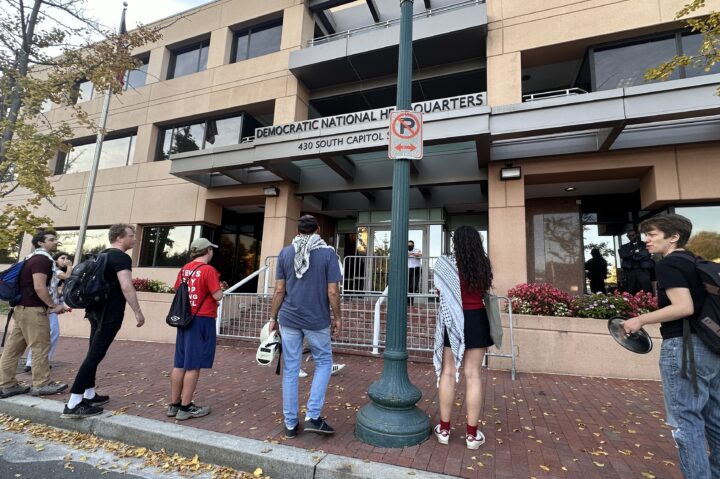
(Yasin Ozturk/Anadolu via Getty Images)
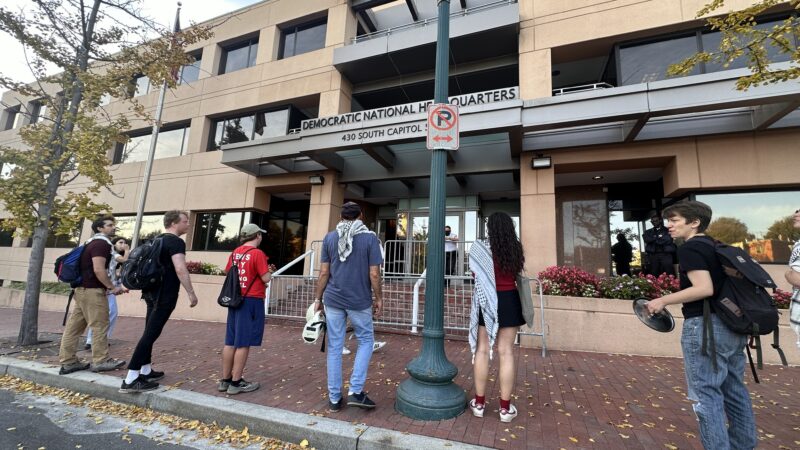
A group of demonstrators hold a noise protest outside the Democratic National Committee Headquarters in Washington D.C., United States on October 31, 2024.


 Add JewishInsider on Google
Before AIPAC began spending tens of millions of dollars per election cycle on campaigns, back when it was purely an advocacy organization that touted its relationships with many of the 535 members of Congress, the pro-Israel group used to describe its approach to Capitol Hill with a cheeky, upbeat motto: “You have friends, and you have potential friends.”
But when former Bay Area AIPAC leader Naomi Lauter used to invoke the slogan, she added a third category: “Friends who have a little less potential than others.” Lauter died in 2017, but the saying still resonates with her son, Sam, who is a major Democratic donor and pro-Israel activist in his own right — and who is now wondering whether that third category might be growing even larger.
After 104 members of the House voted last week in favor of an amendment to eliminate all $3.3 billion in annual military aid to Israel, pro-Israel activists across the country who have spent years building ties with lawmakers are now wondering how to approach those relationships following a vote that some see as a betrayal. Even many longtime Israel supporters — including Reps. Jack Auchincloss (D-MA), Glenn Ivey (D-MD), Laura Friedman (D-CA), Nancy Pelosi (D-CA) and Pat Ryan (D-NY) — voted for the amendment, which did not pass. Pro-Israel activists who spent years building trust and gaining access to these lawmakers are now grappling with whether whether those relationships are still worth their continued investment.
To borrow from AIPAC’s old slogan: Are the lawmakers who voted for the amendment still considered friends — or potential friends — of the U.S.-Israel relationship? Or was their vote against the annual aid package to Israel, and against a bill that was opposed by a wide swath of nonpartisan and Democratic Jewish groups, a crossing-the-Rubicon moment that cannot be undone?
Friends and backers of the members of Congress who voted for the amendment are struggling to answer those questions. Several who spoke to Jewish Insider said that a single vote on a measure that was sure to fail should not spell the end of years of friendship. But even as they acknowledged the seismic reverberations of the vote, many also spoke of the need to tread carefully at a politically uncertain moment.
“Our issues are too important to not hold onto the ability to have a conversation with the person, because the votes are not going to end. It’s not going to all of a sudden stop,” Sam Lauter said. He talked to several members of Congress in the days before the vote, including Pelosi, urging them to vote no.
“It’s not a good trend line, but also this idea that we’ve lost the Democrats — let’s not create self-fulfilling prophecies here. There’s an opportunity for us to turn some of this around,” Tyler Gregory, CEO of the Bay Area Jewish Community Relations Council, said. “I am optimistic that several of them could be flipped if the vote had actual consequences, and I think that’s the job ahead of us.”
“Now, if someone said to me, ‘You know what, I voted yes, and my reasoning was because actually I don’t think we should be allies with Israel anymore, and I have no interest in the friendship with the community or the country, I’m done.’ Well, OK, that friendship’s done,” said Lauter.
This vote was destined to fail, but Tyler Gregory, CEO of the Bay Area Jewish Community Relations Council, called it “a dress rehearsal.” It will not be the last time U.S. aid to Israel comes up for a vote, and Gregory said he will need to lean on those lawmaker relationships in the future when the vote is more consequential.
“It’s not a good trend line, but also this idea that we’ve lost the Democrats — let’s not create self-fulfilling prophecies here. There’s an opportunity for us to turn some of this around,” Gregory said. “I am optimistic that several of them could be flipped if the vote had actual consequences, and I think that’s the job ahead of us.”
Halie Soifer, who served as an advisor to then-Sen. Kamala Harris (D-CA), now leads the Jewish Democratic Council of America, which urged members to vote against the amendment — as did Democratic Majority for Israel and the more liberal J Street. She called the vote “an inflection point,” but said the group is not considering removing its endorsements of lawmakers who supported the amendment.
“We’ve maintained a very consistent, principled position with regard to aid for Israel, and it’s not us that shifted,” Soifer said. “There is clearly a fast-moving shift within the Democratic Party itself, and we’re considering what that means.”
When asked whether she had ever seen so many candidates shift their positions on an issue within a single two-year election cycle, Soifer answered directly: “Absolutely not.”
AIPAC responded to the vote by no longer allowing donations, through its political action committee, to the 18 lawmakers it endorsed who voted for the measure.
“AIPAC members across the country watched this vote closely and are making sure their representatives in Congress who stood on principle hear that they’re appreciated,” AIPAC spokesperson Deryn Sousa told JI.
“The reality is these are our representatives. There is a relationship that we have with most of them, and they continue to be our representatives today, tomorrow, next week,” said Jeremy Burton, the CEO of the Greater Boston Jewish Community Relations Council. “The ones who say, ‘No, I’m still committed to Israel’s security and the Jewish community,’ things like that — and I’m not going to quote any one of them — but the ones who are saying that in these private conversations, it’s incumbent upon them now to show what that means.”
Many activists who have relationships with lawmakers are taking the long view, arguing that cutting ties now will not help in future battles. For a lot of them, Israel is not the only issue about which they are concerned.
Jeremy Burton, the CEO of the Greater Boston Jewish Community Relations Council, said he knows that some Jewish Bostonians have told Massachusetts’ congressional representatives, all of whom voted for the amendment, that this moment represents a “break point.” But as the leader of a nonpartisan organization, he cannot end relationships over a disagreement on one vote. He has other issues — such as nonprofit security funding and cooperation on fighting antisemitism — to consider.
“The reality is these are our representatives. There is a relationship that we have with most of them, and they continue to be our representatives today, tomorrow, next week,” said Burton. “The ones who say, ‘No, I’m still committed to Israel’s security and the Jewish community,’ things like that — and I’m not going to quote any one of them — but the ones who are saying that in these private conversations, it’s incumbent upon them now to show what that means.”
For one Jewish former Biden administration staffer, voting to cut off security aid to Israel must be the red line.
“They’re like, ‘Don’t worry about it. It’s just symbolic.’ Well, no, you’re telling us not to care about it, but clearly other people care about it, and that’s why you’re voting in that way,” said the staffer, who requested anonymity to speak about communal organizations they support. “I don’t think the Jewish community should be giving these people a pass right now, and I believe that’s actually creating an incentive for them to actually take these votes against us and against our interests, because there’s no political consequence or repercussions for them.”
House Minority Leader Hakeem Jeffries (D-NY) said on Thursday that Democrats will adopt a new approach to Israel if the party regains control of the House in November. “The current status quo is unsustainable,” said Jeffries, who voted no on the amendment.
“On one hand, I am really disappointed to see some true friends of mine and Israel vote for the [amendment] or vote ‘present,’” said Jennifer Laszlo Mizrahi, a Jewish philanthropist and disability rights advocate in Maryland. “On the other hand, as an American and as a Jew, I am horrified by how Netanyahu and his administration treat Palestinians in the West Bank, give Haredim the ability to be draft-dodgers and don’t show empathy when legitimate security operations accidentally kill an innocent child.”
Many of the 103 Democrats who voted “yes” released statements saying that they still support America’s relationship with Israel, but that they viewed the amendment as a symbolic way to tell Israeli Prime Minister Benjamin Netanyahu that they disagreed with his handling of the wars in Gaza and Iran.
In doing so, they tapped into a difficult reality for many of the Jewish activists who wanted to see the measure defeated. Many of those activists also wish Netanyahu would do more to take the concerns of Democrats and liberal Jews into account, even as they think Washington should continue supporting Jerusalem’s security needs.
“On one hand, I am really disappointed to see some true friends of mine and Israel vote for the [amendment] or vote ‘present,’” said Jennifer Laszlo Mizrahi, a Jewish philanthropist and disability rights advocate in Maryland. “On the other hand, as an American and as a Jew, I am horrified by how Netanyahu and his administration treat Palestinians in the West Bank, give Haredim the ability to be draft-dodgers and don’t show empathy when legitimate security operations accidentally kill an innocent child.”
In Los Angeles, Democratic donor and pro-Israel activist Howard Welinsky said many of the “yes” votes were a result of political “noise” — namely, concerns about current or future primary challengers from the left. “It’s the volume of the noise, and some members of Congress have more intellectual capacity to withstand it, and others have less,” said Welinsky.
So he is holding out hope that a change in Israel’s political leadership might help rectify Israel’s plummeting support among Democrats. “I just pray that Oct. 27” — the day Israel goes to elections — “gives Israel a new prime minister, and we can turn a page,” said Welinsky.
Leiter: ‘The tent, as we call it, should be wide and as inclusive as possible, but it cannot be inclusive to those who are contributing to the efforts of those seeking to collapse the tent’
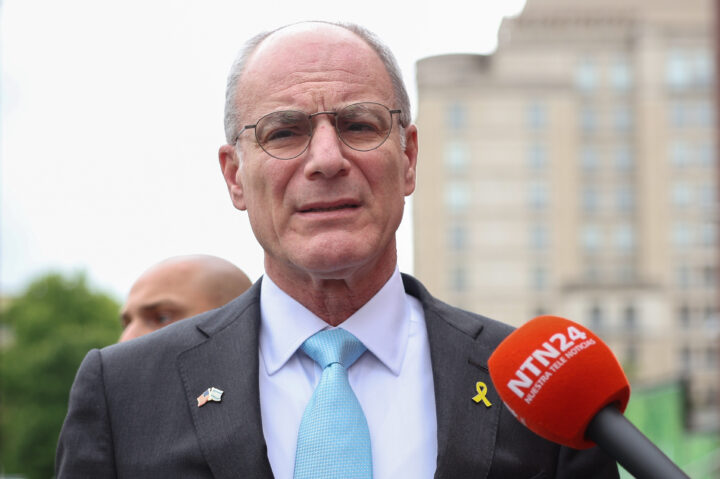
Tasos Katopodis/Getty Images
Israeli Ambassador to the United States Yechiel Leiter
A week after describing J Street as “a cancer within the Jewish community” for calling for the United States to restrict aid to Israel, Yechiel Leiter, Israel’s envoy to Washington, doubled down on his critique of the organization, stating that the liberal advocacy group’s recent actions are “decidedly not pro-Israel.”
The remarks came during Leiter’s broader address on Thursday at the Re-Charging Reform Judaism conference on Manhattan’s Upper West Side, during which he argued to the audience of over 300 Reform rabbis, lay leaders and teachers that American Jews need to respond to rising anti-Zionism and post-Oct. 7 hostility toward Israel with a stronger, more unapologetic form of Zionism and Jewish solidarity.
“J Street does incalculable amount of damage to the interests of Israel,” Israeli Amb. Yechiel Leiter said at the Re-Charging Reform Judaism conference, expanding on his previous critique of the liberal advocacy group.”
— Jewish Insider (@jewishinsider) May 27, 2026
Watch more of what he said below or read our full story: https://ji.news/55×33
While Leiter expanded on his critique of J Street, receiving applause and a standing ovation at the end of his speech, his remarks were more measured than in previous appearances, focusing on what he described as the group’s role in supporting arms embargoes and amplifying accusations against Israel, rather than attacking the organization wholesale. His past comments — including describing J Street as “duplicitous” and “two-faced” — drew ire from many progressive Jews.
“I believe the tent, as we call it, should be wide and as inclusive as possible, but it cannot be inclusive to those who are contributing to the efforts of those seeking to collapse the tent. J Street does incalculable amount of damage to the interests of Israel,” he said.
He continued, arguing that support for arms embargoes against Israel “endanger Israel” and that “supporting such embargoes is not pro-Israel,” He also denounced the organization’s call for Leiter to investigate the allegations of sexual abuse of Palestinians outlined in a controversial opinion piece by New York Times columnist Nicholas Kristof earlier this month.
“It is certainly not pro-Israel to push the canards peddled by Nick Kristof in The New York Times. Jewish dogs don’t commit rape. That was the last straw for me….It’s perfectly fine to have a different vision than the majority of Israelis as to what that peace should look like… but it’s unethical to undermine Israel’s democratically elected government. Friends, please understand, I did not call out J Street because I disagree with their vision of Israel. I call them out because their actions are endangering Israel,” he said.
Leiter also said that senators he meets with on Capitol Hill have accused Israel of “genocide and starvation” and said lawmakers cite J Street as a source for those claims.
“Ask anyone in the know in Washington who is lobbying alongside [Sen.] Bernie Sanders [I-VT], who is responsible for 40 of 47 Democratic senators voting in favor of the arms embargo in Israel,” Leiter said. “They will tell you J Street.”
Professor Derek Peterson ‘deviated from the remarks he had shared,’ the university said after Peterson denounced the ‘injustice and inhumanity of Israel’s war in Gaza’

GETTY IMAGES
Aerial view of the University of Michigan campus with detailed stone buildings and green spaces, contrasting with the urban backdrop of Ann Arbor
The University of Michigan apologized after the outgoing chair of the faculty senate, who has a history of anti-Israel advocacy, delivered an unapproved jab at Israel at a commencement ceremony on Saturday.
Derek Peterson, a tenured professor of history and African studies, praised “the pro-Palestinian student activists who have over these past two years opened our hearts to the injustice and inhumanity of Israel’s war in Gaza,” during his campus-wide commencement address to loud cheering from students.
The university’s president, Domenico Grasso, said in a statement later on Saturday that the remarks were “hurtful and insensitive to many members of our community.”
“We regret the pain this has caused on a day devoted to celebration and accomplishment. For this, the university apologizes,” Grasso continued. “The Faculty Senate Chair deviated from the remarks he had shared before the ceremony. The Chair’s comments were inappropriate and do not represent our institutional position. Nor do they represent the diversity of views across our entire faculty … The Chair’s remarks were expected to be congratulatory, not a platform for personal or political expression. Introducing such commentary in this setting was inappropriate and did not align with the purpose of the occasion.”
Grasso said he will “work with university leadership to review and refine future commencement programming” but did not announce any disciplinary action against Peterson.
In January 2024, Peterson authored and presented a faculty senate resolution urging the university to divest from companies with ties to Israel amid its war in Gaza. The resolution passed with a 38-17 vote.
The University of Michigan experienced virulent campus antisemitism and anti-Israel activity since the Oct. 7, 2023, terrorist attacks in Israel, including an assault of a Jewish student and the repeated harassment of a Jewish Board of Regents member.
Sarah Hubbard, a UMich regent, called on her board colleagues to “make lasting changes that will change the course of this conduct.”
Hubbard called Peterson’s comments “incredibly troubling and disappointing,” in a post on X. “It is very difficult to execute meaningful consequences on tenured faculty but as a leader I can help set the tone and expectations for their conduct. His conduct was unbecoming for a leader of the greatest university in the world,” she said.
In a joint statement, Michael Schostak and Lena Epstein, the Republican candidates in the upcoming UMich regent election, also said they were “deeply troubled” by the university’s decision to select Peterson as a commencement speaker “given his divisive track record.”
In the wake of Oct. 7, some in the Jewish community turned to faith, philanthropy or federal advocacy. Others set their sights closer to home, organizing to shape school boards and influence city councils

Michael Nigro/Pacific Press/LightRocket via Getty Images
A pro-Israel supporter holds a sign during the "March for Israel" held on the National Mall.
After the Sandy Hook Elementary School shooting in 2012, Norri Leder dedicated herself to fighting gun violence as a founding member of Moms Demand Action, the gun control group created after the shooting.
And last year, there was another single defining moment that pushed her to create something new, just like she did after Sandy Hook: A candidate running in a Houston school board special election in 2025 sent out a mailer showing herself in a photo with a virulently anti-Israel politician. When Leder ran into the candidate at the polls, she told the candidate that she was “unknowingly alienating yourself, potentially, from members of the Jewish community.” The candidate had no idea.
“She asked me if there was a Jewish group that meets with candidates as they’re running,” Leder recalled. “I said, there are Jewish groups, but it occurred to me that many of them don’t have the bandwidth to meet on these races that are at much more of a local, state and county level as [candidates are] running for office.”
So Leder created one. Where she was once a single-issue activist fighting for gun control measures, now she is putting everything else aside to focus on Jewish communal concerns with her new organization, Houston Jewish Women Vote. Less than four months into its existence, the group has met with candidates running in local attorney, city council and judicial races in 2026.
“We are narrowly focusing on physical security for the Jewish community, antisemitism, targeting of Jews in academic and professional settings, prayer in school and staying in your lane for state, local and county offices — just please don’t engage in foreign policy issues that undermine bridge building in the community and accomplish nothing in the world of foreign policy,” said Leder. “There’s a feeling of, we’re Jewish women, and a lot of us feel politically homeless right now. People feel good knowing that they’re participants and that they can exercise their voice.”
Houston Jewish Women Vote joins dozens of other Jewish advocacy efforts that grew out of the desperation people felt in the days after the Oct. 7, 2023, attacks to fill a void in local politics.
In Pittsburgh, the Beacon Coalition was created when community activist Jeremy Kazzaz saw that local politicians were too afraid to criticize a colleague who posted pro-Hamas messages. The group is now urging Jewish Democrats in the Pittsburgh area to run for seats on the Allegheny County Democratic Committee to be able to help shape the party’s endorsements.
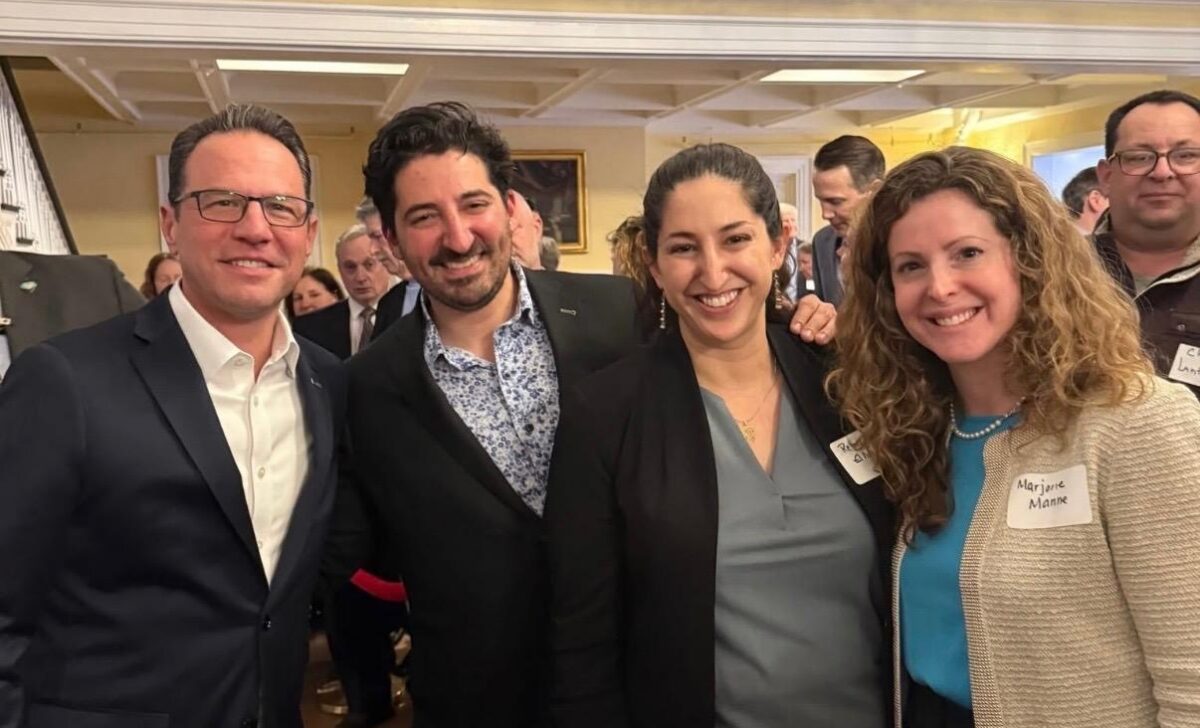
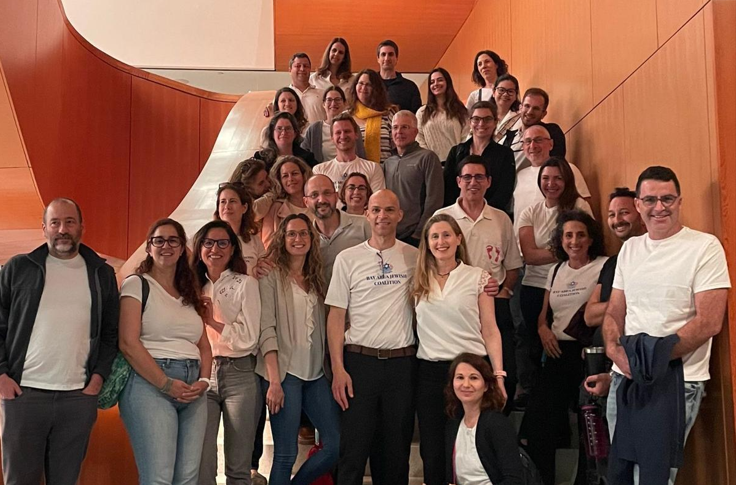
In California, Israeli immigrants helped launch the Bay Area Jewish Coalition (BAJC), in part to help locals make sense of the many local races for positions most people have never heard of.
“Even when we have special elections for things that seem totally unrelated, like the county assessor, which is in charge of property taxes and things like that, at this point, people are reaching out to us and saying, ‘Who do we vote for?’” said BAJC co-founder Keren-Or Reiss, who was born in Israel and now lives in San Mateo, Calif., where she works as a product manager at a tech company. “Is there someone here who’s going to somehow use this platform to spread hate or to normalize antisemitism against us?”
Some in the Jewish community turned to religious practice after Oct. 7, or to supporting charities helping victims of the attacks in Israel, or to pro-Israel political advocacy through establishment groups like AIPAC, or some combination. Leder, Kazzaz and Reiss represent a new class of Jewish American activists: people who were disappointed by the apathy or even outright hostility that some co-workers, teachers, neighbors and local elected officials demonstrated towards Jews and Israelis suffering in the aftermath of Oct. 7, and who felt no one was doing what needed to be done to reach those leaders.
“Local community members can’t just wait for institutions to have enough bandwidth to do everything. People can take responsibility to step up and engage. And that’s what people were doing,” said Jeremy Burton, CEO of the Boston Jewish Community Relations Council. “Part of this revitalization of American Jewish life that we’ve seen has been this emergence of these activists.”
They saw a new kind of opportunity in an American political landscape reshaped by Oct. 7 and the ensuing war in Gaza. Advocating for Congress to vote a certain way on weapons sales to Israel would not do much to affect the swell of antisemitism growing in their communities. Although the war was happening thousands of miles away, they understood that its impact would be local.
“Almost every other community and interest group is doing this on the local level, and not the Jewish community. So we’re really trying to close that gap,” said Tyler Gregory, CEO of the Bay Area Jewish Community Relations Council, which in 2024 became the first JCRC in the country to launch an affiliated advocacy arm to fundraise for candidates and engage in elections. “I think it’s a combination of Congress being sexier and there being fewer issues at the local level.”
After Oct. 7, it became clear that there were not, in fact, fewer issues locally. City council members who were elected to work on municipal governance were now tasked with voting on contentious ceasefire resolutions and calls to divest from Israel. School superintendents and principals had to decide how to respond to teachers who were bringing biased, anti-Israel instruction into the classroom. These were battlefields where existing Jewish communal infrastructure did not have the capacity to fight — either because their nonprofit status kept them from engaging in political races, or because they simply did not have the manpower to reach the hyper-local spaces where debates about Israel, Zionism and antisemitism were now front and center.
“Local community members can’t just wait for institutions to have enough bandwidth to do everything. People can take responsibility to step up and engage. And that’s what people were doing,” said Jeremy Burton, CEO of the Boston Jewish Community Relations Council. “Part of this revitalization of American Jewish life that we’ve seen has been this emergence of these activists.”
The new Jewish activism did not begin in Jewish federation board rooms or congressional office buildings in Washington. It was grassroots campaigns that started in WhatsApp groups and recruited dozens of volunteers through word-of-mouth conversations. These were people who showed up to city hall hearings or met with candidates running for local offices that prior to Oct. 7 may have seemed irrelevant to Jewish concerns.
For Sam Gechter, who works in tech in Boston, a call from a friend in early 2024 alerted him that the city council of Somerville, Mass., where he lives, was trying to pass a resolution calling for a ceasefire in Gaza. The language, Gechter recalled, was “atrocious,” pinning the blame for the war on Israel and hardly mentioning Hamas.
“I got off the phone. I turned to my wife, who was standing next to me, and said, ‘We gotta start a WhatsApp right now of everybody we know in Somerville and get people to come and speak against this,’” Gechter told JI. “That was my moment of being politically activated.”
Soon, that WhatsApp group became Shalom Somerville, a group of Jewish people in the small Boston suburb — an uber-progressive city that neighbors the better-known Cambridge — committed to advancing “a Somerville that is safe for Jews and Israelis.” Despite nominally being an advocacy organization, Shalom Somerville has also become a lifeline for people who otherwise weren’t connected to Jewish institutions.
“For a number of people who haven’t found their place Jewishly in the community, this has become their main Jewish community,” said Gechter. “We had, like, 150 people at our Hanukkah party. It’s gotten to be a pretty big group.”
New organizations that formed to focus on important but unglamorous posts like the county commission and municipal human relations councils are heading into a major election year with ambitious plans to activate Jewish community members to flex their political muscle. They want to show local officials that they ignore Jewish voters at their own peril — and that, conversely, Jewish voters will miss a chance to improve their community if they sit out these races that have a real impact on their day-to-day lives.
“Around the country, there was this awakening, and an understanding that the cavalry wasn’t coming for anybody,” Chicago Jewish Alliance founder Daniel Schwartz told JI.
Each local outfit has a different strategy. Mindy Miller, a former top aide to the Colorado Senate president, co-founded the Colorado Jewish Action Alliance to educate her former colleagues about topics that they never expected to address but that are now everywhere, even in state politics.
“We ask them what they think Zionism means because it’s been so weaponized, and I would say virtually all of them have been appreciative of being able to have those conversations without being fear of being canceled or called out or vilified, because they have to walk a tight rope,” Miller told Jewish Insider.
Chicago Jewish Alliance founder Daniel Schwartz has taken a more confrontational approach. During the city council’s vote on a contentious ceasefire resolution in January 2024, he showed up at City Hall draped in an Israeli flag. He created a WhatsApp group — called the “Zionist Information Group” — to get Chicagoans out to protest.
“Around the country, there was this awakening, and an understanding that the cavalry wasn’t coming for anybody,” Schwartz told JI.
In Lexington, Mass., a suburb of Boston, a group called Lexington United Against Antisemitism, is focused on interfaith work, and connecting members of the town’s Jewish community with Christians.
“Quickly we understood that people, actually, even in Lexington, know very little about Jews altogether. Jews — what do they think? What do they believe?” said Francine Jacobs, a retired Tufts professor who created LUAA.
The group was founded several months before Oct. 7, but its founders have doubled down on their mission, particularly as some liberal Christians who are critical of Israel have taken stances that crossed into antisemitism.
“It took some of the steam out of our effort. There were some folks who just said, ‘Oh, Israel, I’m so angry about it, I just can’t hear the word Jew,’” said Stephen Van Evera, a retired MIT international relations professor, who is Christian and leading LUAA with Jacobs. “I mean, why are you connecting these dots that way? Do you really think that the Jewish community in Lexington is deciding how to fight the Gaza war?”
What drove many people to get involved was their kids. Viviane Safrin became an education activist in San Francisco after the pandemic, when she felt frustrated that public schools were not doing more to reopen. After Oct. 7, parents started calling her to report that their children had experienced antisemitism. So she created SF Jews in School, with the tagline “advancing Jewish inclusion in San Francisco schools.”
“We respond to incidents. We guide families through working with their school. We also engage directly with principals and administrators to support them in ensuring that our schools are welcoming spaces, but we also celebrate our heritage. We build Jewish pride and belonging across the city,” Safrin told JI. “We bring apples and honey for Rosh Hashanah and sufganiyot for Hanukkah.”
Two thousand five hundred miles away, in the Philadelphia suburb of Lower Merion, Dani Shaw created a WhatsApp group for 75 moms soon after Oct. 7. They wrote to the diversity, equity and inclusion director in their school district to ask to talk about ensuring Jewish perspectives were included in the office’s programming. They wound up meeting with the superintendent instead and having a productive conversation. But, shortly after, an op-ed in a high school newspaper that Shaw said spread “blood libels” against Israel caused the moms to step up their activism.
“We created an organization called the Jewish Families Association with a board that consisted at the time of about 15 parents who were all representing different schools in the district,” Shaw told JI. There are now several other Jewish Families Associations in small school districts across Pennsylvania. “It’s really representation — a bridge between the parents and the administration, the school district, to make sure that these incidents, whether they be bullying or problematic curriculum, are dealt with appropriately.”
The group in Lower Merion, a heavily Jewish suburb, supported three Republican candidates for school board last year. They all lost in the liberal town. Keeping activists engaged in the work is hard — “they have to get on with their lives and their livelihoods,” Shaw acknowledged — particularly because the group plans to remain volunteer-led and grassroots, with no fundraising arm.
Fatigue is real. The work of building ties with dozens or even hundreds of local elected officials requires dedicated volunteers and resources. BAJC, the Bay Area group, created a voter guide in 2024 tracking dozens of races — work they want to replicate in 2026, even as they see some people in the community losing interest.
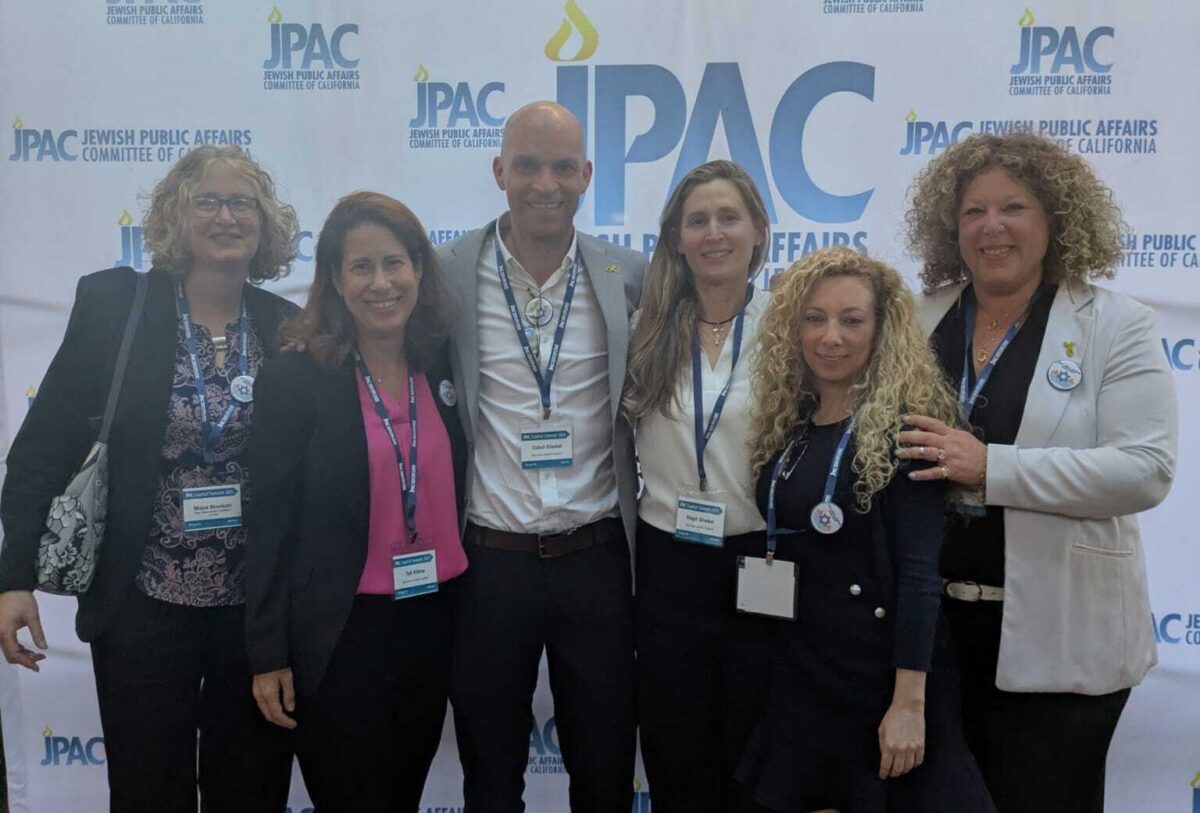
“It’s a constant fight to activate the community. I wouldn’t take that for granted. People prefer to go and watch a football game than to go to a demonstration,” said Oded Shekel, a BAJC leader and an Israeli immigrant who is the CEO of a financial technology startup. “You need to find ways to keep people motivated, activated, connected. I think local fights are easier to connect to than, ‘Would you like to come and support, like, a D.C. bill that we are going to promote?’ Yeah, whatever, I don’t care. ‘Would you like to meet the school boards who actually create policies for the teachers or the kids in your class?’ That’s more likely.”
Not everyone who got involved in this work after Oct. 7 remains involved. But many still are. There is now an entire class of American Jews, many of whom were not engaged politically at all before, who now wholeheartedly believe that the way to make their communities safer and more welcoming is to get involved in local politics. And as both the Democratic and Republican parties face internal fissures over Israel at the national level, an awareness is starting to solidify that reaching politicians at the beginning of their careers, when they are unpolished and open-minded, is a winning strategy.
“We’re not seeking to educate candidates about our issues once they announce for Congress. We want to have multi-year relationships and be able to explain the many nuances of Judaism and Zionism long before they’d like to run for higher office,” said Sam Jefferies, co-chair of The Kids Table, a political action committee in Washington state that is supporting “pro-Jewish” candidates. “You can’t solve antisemitism, but you can prevent antisemites from being in positions of power.”
The International Federation of Social Workers is set to hold a vote on Feb. 18 to expel Israel over its members’ service in the IDF

Leon Neal/Getty Images
A university student studying social work helps provide emotional support to families who have been forced to evacuate from their homes in the south of Israel on October 16, 2023 in Beit Shemesh, Israel.
The largest global membership organization for social workers from around the world will vote next week on whether to expel Israel’s leading social work body, sparking a feverish advocacy campaign by Jewish and Israeli practitioners to urge members to vote against the measure.
The vote by the International Federation of Social Workers is scheduled for Feb. 18, and it comes after several members in the IFSW complained that some Israeli social workers served in combat roles in the Israel Defense Forces during Israel’s war against Hamas in Gaza. The IFSW alleges that military service violates social workers’ professional and ethical commitments to nonviolence.
The Israeli Union of Social Workers — and its allies in the United States and Canada — argue that such a request ignores Israel’s mandatory draft policy, holds Israel to a different standard from other member nations and singles out the only Jewish state. The leader of the Israeli body said it would be “entirely unimaginable” for Israeli social workers to ask not to serve in combat, noting that it would come across as “elitist” and “mark our union as illegitimate in the eyes of both the government and the public.”
“If we believed that removing the [IUSW] from the IFSW would promote peace, guarantee the rights and security of both nations — we ourselves would vote in favor,” IUSW’s chair, Inbal Hermoni, wrote in a letter urging countries to vote against the measure. “This is a noble goal. However, this is not the case.”
The IFSW comprises 141 country members — including Russia, Iran and China — representing more than 3 million people. The only other country to ever face a similar punishment from the IFSW was South Africa, which was suspended during the era of apartheid rule.
Last year, the IFSW voted to formally censure Israel — the second time the body had done so.
“This position was grounded in our ethical mandate: social workers are called to uphold human dignity, promote peace, and work for social justice. Active participation in combat contradicts these principles,” IFSW President Joachim Mumba, who is from Zambia, said last year.
Social workers, psychologists, doctors and other practitioners in the so-called “helping professions” have complained about antisemitism that they say has become normalized since the Oct. 7, 2023, terror attacks in Israel — with double standards, anti-Zionist litmus tests and outright antisemitism now viewed as widespread and even acceptable among others working in those fields.
“This vote shouldn’t be seen in isolation. It’s a reflection of the systemic hostility towards Israel and towards Jews that have come to permeate these professional spaces,” said Guila Franklin Siegel, chief operating officer of the Jewish Community Relations Council of Greater Washington. “In fighting against this, we are fighting against a much bigger problem.”
Andrea Yudell, a therapist in Washington, told Jewish Insider on Thursday that voting to expel Israeli social workers “would effectively legitimize the hostility that we’ve been seeing in the field.”
A petition organized by several groups for Jewish therapists in the U.S. and Canada is urging the National Association of Social Workers and the Canadian Association of Social Workers — the two membership organizations in each country — to publicly oppose next week’s vote.
“It imposes a nationality-based collective sanction, treating professionals as ethically suspect solely because of their national affiliation. No other national association is held to this standard,” the petition states. It has been signed by more than 11,000 people. Spokespeople for NASW and CASW did not respond to requests for comment.
Several U.S. Jewish organizations are helping to circulate the petition and generate attention about the vote, which the Anti-Defamation League called “collective punishment.”
The issue, according to Jewish social workers, goes deeper than just professional drama among the practitioners. The spread of antisemitism in a field predicated on compassion could threaten to alienate or harm Jewish clients who turn to social workers to help meet their emotional and material needs.
“It’s not just the social workers themselves. It’s the people we are trying to serve. Those people. It’s unethical to them,” said Jennifer Kogan, a licensed clinical social worker in Washington, D.C. “Jewish clients are affected by this. They don’t feel safe.”
Major Jewish advocacy organizations told JI that they will continue to push for issues including Nonprofit Security Grant Program funding and combating antisemitism online
Worawat/Adobe Stock
U.S. Capitol Building
Going into 2026, Jewish community groups say their advocacy priorities for Congress and the federal government remain largely consistent, with a focus across many of the major advocacy organizations on bolstering community security through the Nonprofit Security Grant Program and tackling antisemitism online.
While Congress has increased its attention to Jewish communal issues in the years since the Oct. 7, 2023 Hamas attacks on Israel, including a string of high-profile hearings on antisemitism and several bills passed to support Israel and combat Iran, many key legislative priorities for the Jewish community — including bills on antisemitism and substantial increases to annual security funding for nonprofits — have remained stubbornly intractable.
Highlighting the expansion of congressional scrutiny of unions, academic associations and tech platforms for their fostering of antisemitism, top Anti-Defamation League officials said that advocating for such oversight work will remain a priority in the coming year, particularly in an environment in which it is difficult to pass any legislation, regardless of the subject.
“We’ll continue focusing on tough oversight, on bipartisan legislation and targeted appropriations,” Lauren Wolman, the ADL’s senior director of government relations and strategy, told Jewish Insider. “The big buckets are that we’ll be pushing Congress to confront antisemitism wherever it appears, including within one’s own party; protecting houses of worship with increased security funding; demanding real transparency and accountability from tech platforms; advancing comprehensive federal legislation to counter antisemitism and taking action to ensure that Jewish students are safe on campus.”
Asked about how the organization plans to ensure progress on legislation that has been difficult to achieve in past years, Wolman emphasized that there had been “historic momentum” this year for increased security funding, and said that ADL would “focus on levers that move policy, so oversight, legislation, appropriations” and leverage “the value of transparency, bipartisanship and coalitions.”
Max Sevillia, the ADL’s senior vice president of national affairs, said that the organization will focus on must-pass legislation such as appropriations and the National Defense Authorization Act, and emphasized that “legislating on any issue, including fighting antisemitism, oftentimes, is not a one-session effort. So we don’t give up on our priorities.”
He said that, even if major legislation did not pass this session, the group is “better positioned” to advance key priorities with the additional attention they’ve received since Oct. 7.
Sevillia said that the HEAL Act, examining Holocaust education; the Protecting Students on Campus Act, which aims to facilitate Title VI discrimination complaints; and the Pray Safe Act, which would create a central database of security resources for institutions, will remain priority bills in the new year.
ADL is also supporting the Platform Accountability and Transparency Act (PATA), a bipartisan Senate bill that would require social media companies to share additional data with the public and with researchers, including regarding hate incidents and policies, and how platforms are responding to them.
“Congress really needs to require platforms to provide meaningful transparency into content moderation practices, algorithmic amplification and enforcement of their hate speech policies,” Wolman said.
Wolman said the ADL also continues to pursue a “comprehensive … whole-of-government” package of legislation on antisemitism, a prospect that has remained elusive. The Countering Antisemitism Act, a package along those lines, received bipartisan support in the previous Congress, but ultimately proved unwieldy — facing opposition on both sides of the aisle in both chambers.
Wolman said that ADL will be pressing Congress to focus on college campuses, K-12 education, academic professional associations, health care and technology platforms, including Wikipedia and artificial intelligence, in its oversight capacity and for potential hearings next year.
Sitting down with JI on Capitol Hill earlier this month, American Jewish Committee CEO Ted Deutch said that his organization’s priorities for the remainder of 2025 included urging lawmakers to stand with the Jewish community and attend menorah lightings in the wake of the Sydney, Australia, shooting targeting a Hanukkah celebration on Bondi Beach.
Going into 2026, the group is also focused on pressing lawmakers to tackle antisemitism online, particularly ensuring social media companies are addressing the foreign actors driving much of that content, as well as the antisemitism that has proliferated in AI-generated posts.
The new X policy disclosing users’ locations “confirm[ed] what we all know, which is there is this ongoing effort by malign actors around the world to influence what happens here, to stoke antisemitism, to polarize our community,” Deutch said.
Deutch said that AJC also looks forward to working with Ambassador Yehuda Kaploun, who was confirmed this month as the Trump administration’s special envoy to monitor and combat antisemitism. Additionally, the group is pressing the Department of Justice to take action to address protests that block access to religious institutions. He said AJC is open to supporting new legislation on the subject, if necessary.
In his interview with JI, Deutch also urged Jewish communal organizations to come together around a common agenda, arguing that the current security environment demands a unified message and a coordinated push.
The Jewish Federations of North America will be focused on the six-point security plan laid out by many major Jewish groups following the Capital Jewish Museum shooting earlier this year, which includes massive increases to security grant funding and efforts to address antisemitism online, as well as antisemitism in K-12 and higher education and mental and physical health care spaces; the Holocaust Survivor Assistance Program and social safety net programs such as SNAP and Medicaid.
“I think security and combating antisemitism are top of mind across our community, and that’s clearly reflected in our aggressive work to increase nonprofit security funds, tackle hate on social media, and advance our six-point security plan,” JFNA CEO Eric Fingerhut told JI.
“But we aren’t forgetting other critical issues that we care about, including legislation supporting Holocaust survivors and protect[ing] the most vulnerable in our communities,” Fingerhut continued. “With our new flagship public affairs office up and running, we are also expanding our investment to ensure local Federations come to Washington regularly to strengthen our relationships on the Hill.”
Nathan Diament, the executive director of public policy for the Orthodox Union, said that OU’s priorities will include additional NSGP funding, allocating resources from the Department of Justice for Jewish community security, implementing the Educational Choice for Children Act — legislation passed in this year’s reconciliation bill creating tax credits for educational scholarships — and, like AJC, urging the Department of Justice to “aggressively prosecut[e] those who mount ‘protests’ at Shuls.”
In the pro-Israel space, a source familiar with AIPAC’s plans told JI that the group’s general priorities next year will include expanding U.S.-Israel collaboration in security, technology and economic spaces; supporting U.S. aid to Israel; highlighting the ongoing security threats to Israel, including Iran’s efforts to rebuild its missile arsenal and nuclear program and its support for proxies; and working to achieve Hamas and Hezbollah’s disarmament.
The source said AIPAC will release a more comprehensive agenda early next year.
Sharabi’s new book, Hostage, tells the story of his kidnapping and 491 days in Gaza
Lev Radin/Pacific Press/LightRocket via Getty Images
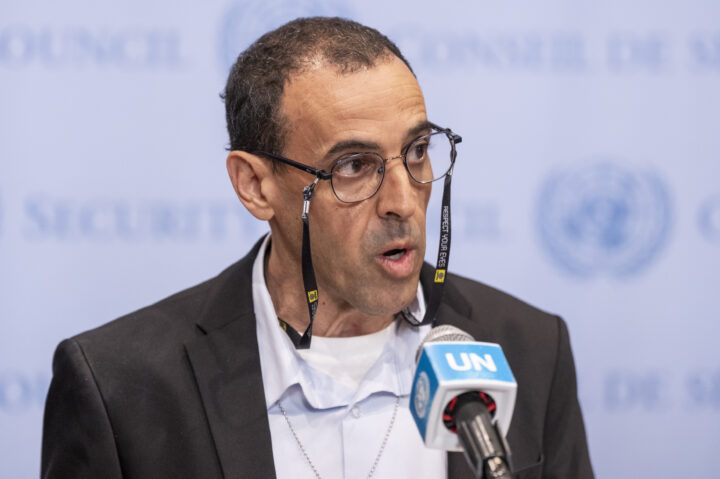
Eli Sharabi speaks to the press ahead of Security Council meeting at U.N. Headquarters.
Freed hostage Eli Sharabi’s new book, Hostage, ends with him visiting the graves of his wife, Lianne, and his daughters, Noiya and Yahel, for the first time after being released from nearly a year and a half of captivity in Gaza, during which he had hoped they were still alive following the Hamas attack on their home in Kibbutz Be’eri on Oct. 7, 2023.
“This here is rock bottom. I’ve seen it. I’ve touched it,” Sharabi writes. “Now, life.”
The memoir tells a horrific story of 491 days of violence, deprivation and starvation.
That final sentence of Sharabi’s memoir — “Now, life” — could sum up his post-captivity self. In an interview with Jewish Insider last month, Sharabi said he was determined to reassert his agency, take action on hostage advocacy and move forward in his life.
Sharabi seemed cheerful speaking about his recovery. He was still slimmer than his pre-captivity self, but no longer as gaunt as he was emerging from the tunnels in Gaza in which Hamas starved him, giving him only a stale pita to eat each day, at most.
“I’m getting stronger every day,” Sharabi said. “I make sure to exercise and have weekly therapy sessions and make sure to take care of myself. I am strong and positive and facing forward.”
Sharabi’s days are filled with meetings around Israel and the world advocating for the remaining hostages to be freed.
“From the moment I got out of Sheba [Medical Center], 10 days after being freed, it has been non-stop action,” he said. “I have a lot of trips abroad, meeting with government officials — presidents, prime ministers, members of parliament, foreign ministers — and a lot of lectures in Israel and around the world, to a lot of Jewish communities. … It’s non-stop, morning to night.”
In his book, he recounts reassuring hostages Alon Ohel, who is still in Gaza, and Eliya Cohen and Or Levy, who have since been released, that he was sure their families were protesting and advocating for their release.
“It was important for Eliya and me to tell Or and Alon, who were more pessimistic about our chances, to get out and thought ‘maybe they forgot us,’” Sharabi recalled. “Eliya and I were very positive and said we had no doubt our families and good friends are not resting for a moment and doing all they could to free us.”
Sharabi said that when his captors would tell him about protests in the streets of Israel, they would say the demonstrations were against Israeli Prime Minister Benjamin Netanyahu, but he and his fellow hostages saw it as “the nation going out to fight for us. It gave us hope.”
When Sharabi was released, he saw that the scale of the hostage advocacy movement was beyond what he had imagined.
“When I got out and understood that it was masses of people in Israel, it excited me,” he said. “I met members of Jewish communities in New York, Chicago, Miami, London, Mexico. I meet Israelis and Jews all around the world and understand what they did all this time. It is very touching. I didn’t expect it at all. I expected my friends and family. I didn’t think that people would have posters of me at their holiday table. It’s heartwarming.”
At home in Israel, however, there have been sharp political divisions about the looming deal to release the hostages in exchange for ending the war in Gaza. Some far-right ministers in Netanyahu’s government oppose President Donald Trump’s plan, which calls to free all 48 remaining hostages — 20 of whom are thought to be alive — within three days, because they call to prioritize defeating Hamas.
“In Israel, everything is political,” Sharabi lamented. “It’s terrible. All of our elected officials, with no exception, are partners in this terrible thing. I think all the people of Israel are sick of everything being political. I think most people in Israel hate this.”
The hostages, Sharabi said, “are not about right and not about left.” His brother, Yossi, was also taken captive and was killed while in Hamas captivity, which the IDF found may have been caused by an IDF airstrike.
Sharabi had an almost paternal relationship with Ohel when Hamas held them captive together in the tunnels under Gaza, and he expressed relief to have seen Ohel in a new hostage video released by the terror group last month.
“He’s amazing,” Sharabi said. “If you told me a week after I met him that he would survive six or seven months alone, after I left him, I would have doubted it. I left him after a very positive process during which he strengthened himself and learned how to survive, that you can’t be nice all the time and can’t be naive. He developed resilience and isn’t shaken by every change and every fear.”
Sharabi emphasized that, while in captivity, it is crucial to “understand that not everything is in our control, but we have the ability to choose how we respond.”
“I’m optimistic that soon we will see [Ohel] united with his family, and soon after, I will reunite with him. I am looking forward to it,” he said.
Sharabi describes his captors in detail in the book. Some were always cruel, while others snuck the hostages extra scraps of food. Some were true extremists, while others appeared to be in Hamas for the money.
“There are no innocent people in Gaza,” he said, “not civilians and certainly not the people in Hamas. In the 52 days that I was aboveground, not in tunnels but with a family in a house, they made sure people outside would not hear or see me, because they thought people would come in and kill me.”
“I recognize that even within Hamas, after spending 24/7 with them for many months and having different conversations with them, I understand who is ideological and who stumbled into it because Hamas controls the financial faucets in Gaza,” Sharabi added. “Does that make them innocent? Of course not. The moment they got the order, I was shackled around my legs. If they were told to shoot me, they would have shot me. … Some did it for money, not ideology, but they starved me, humiliated me and beat me. It doesn’t make them innocent.”
Sharabi also called on the Western world to recognize that Hamas is part of a broader ideology that threatens them, as well.
“I recently got back from 10 days in Australia,” he recalled. “We flew to Canberra to meet the deputy prime minister and foreign minister, both of whom are, at the very least, not pro-Israel. It was important for me to tell them two things.”
“First, disagreements with Israeli policy are fine. I, too, as a citizen, don’t always agree with Israeli policy. That’s what’s good about a democracy… We can say our opinions and disagree. But at the same time, even if they don’t think like Israelis and don’t have to care about me as an Israeli, they are part of the Commonwealth, and my wife and daughters were British and murdered in their homes with their British passports in their hands — the Hamas terrorists knew.”
Sharabi said his captors said to him time after time that “after Israelis and Jews, they will get to France, Britain, America and Spain. The whole world will be Islam.”
Second, Sharabi said he speaks out against antisemitism in his meetings with leaders.
“It cannot be that in 2025, Australian Jews are afraid to go out into the streets. It’s 2025, not 1940. That is [the leaders’] responsibility. They are not speaking out clearly enough against antisemitism. I’m not a politician or a diplomat, so I can say that each one of them is responsible. … Every Jew today is affected by the hate crimes in the world, and that is the responsibility of the government and elected officials,” he said.
Sharabi said his constant activity, including writing his memoir, “has a therapeutic side to it, to deal with [the experience] and not leave it all inside.”
“I don’t like to compare it to the Holocaust, but a lot of survivors didn’t talk, not even to their children,” he noted. “My psychologists, from the beginning, said … they never saw such a huge trauma. It’s not just the captivity, but also the huge loss of my wife, daughters and brother. It’s important to talk. It helps me a lot.”
As to why he doesn’t like to make comparisons between Oct. 7 and the Holocaust, when some Israelis have done so, Sharabi said that during the Holocaust, Jews were “a stateless people, a homeless people, with no government to take care of them.”
“There is a lot of anger in Israel in part because there is a country, there is an address that was supposed to take care of us and our security, and it failed,” he added. “It’s not like the Holocaust, so I don’t like the comparison. There were horrors there that we didn’t see here, like the gas chambers; instead there is a murderous terrorist organization.”
At the same time, Sharabi noted that in the months since his release in February, he has not been exposed to a lot of the details and footage of the Oct. 7 attacks, in which his wife and daughters were among the 132 Israelis murdered in his hometown, Kibbutz Be’eri: “I am being protected like a safe. I haven’t turned on the TV; I don’t watch my own interviews.”
“I have trouble grasping it,” he added.
Even without exposure to the horrors of Oct. 7, speaking and writing about his captivity means going back to the darkest moments of his life, repeatedly.
“I am connected to the pain. I recognize it; I have words for it. Not a day goes by that I don’t cry over it. I hear music on the radio in the car that reminds me of the girls,” he said. “But I also remember them with a lot of smiles, and when I cry, it’s about longing for them, not sadness. I am emotional about the good, when I remember my wife and my girls and their smiles.”
“It’s good for me to talk all the time. It’s important to me. I’m freeing it from my system, instead of leaving it inside,” he added.
Five reflections on how Oct. 7 reshaped politics, diplomacy, advocacy, higher ed, and Jewish life

RE’EIM, ISRAEL — Visitors pay tribute at the site of the Nova music festival massacre.
To mark the second anniversary of the Oct. 7 attacks in Israel, the Jewish Insider team asked leading thinkers and practitioners to reflect on how that day has changed the world. Here, we look at how Oct. 7 changed Jewish advocacy
Courtesy Orthodox Union
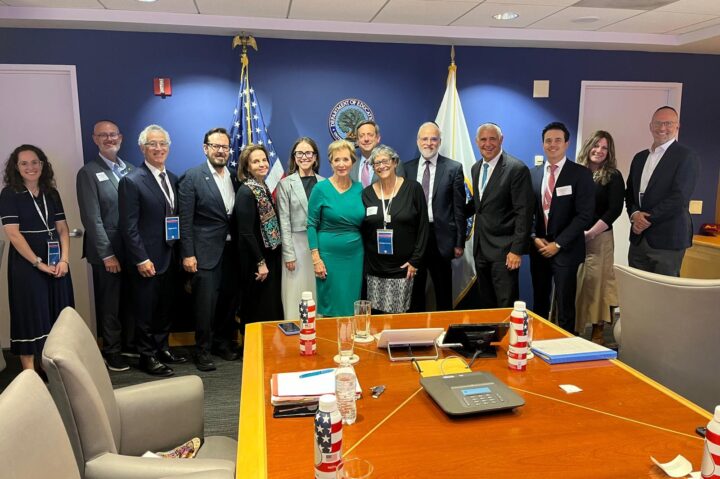
Members of the Orthodox Union Advocacy Center met with Education Secretary Linda McMahon on Wednesday to discuss federal efforts to counter antisemitism and new legislation promoting school choice, Sept. 17th, 2025
The group discussed efforts to fight campus antisemitism and new school choice legislation
Courtesy Orthodox Union
Members of the Orthodox Union Advocacy Center met with Education Secretary Linda McMahon on Wednesday to discuss federal efforts to counter antisemitism and new legislation promoting school choice, Sept. 17th, 2025
Members of the Orthodox Union Advocacy Center met with Education Secretary Linda McMahon on Wednesday to discuss federal efforts to counter antisemitism and new legislation promoting school choice.
The meeting came amid a backdrop of concern from inside and outside the administration that negotiations with colleges and universities will prioritize hefty financial settlements rather than lasting reforms on antisemitism.
“We … spent time talking about combating antisemitism at universities, and — while expressing appreciation for the aggressive approach the department has taken — urging them to keep doing things that are going to make for lasting changes, and not things that could get rolled back when another administration comes into office,” Nathan Diament, executive director of public policy for the OU, said.
Diament said that OU is pushing for concrete policy changes at universities including “enforcement of policies protecting the rights of students, more careful scrutiny of faculty hiring and curriculum content.” He said that the issues on some campuses have “abated, but that could easily be reversed.”
Diament said that McMahon was “very much in agreement” with the OU group and conveyed that “that’s [the department’s] goal.”
The group also discussed the implementation of the Educational Choice for Children Act, which creates a national tax credit for donations to scholarship programs that can be used for a range of purposes including religious schooling.
Though the program is being primarily implemented through the Treasury Department, Diament said that the Department of Education has an important role to play and that the administration will need to make some key policy decisions on how it will carry out the program.
He said the OU wants to ensure that state governments, which need to approve scholarship programs on a state-by-state basis under the law, will not seek to limit or condition the eligibility of certain types of scholarship programs for funding.
Diament said that the OU leaders also met with lawmakers including Appropriations Committee Chair Susan Collins (R-ME) and Sens. Shelley Moore Capito (R-WV), Kirsten Gillibrand (D-NY) and Elissa Slotkin (D-MI) about Nonprofit Security Grant Program funding.
“The good news, so to speak, is that they all agree with the need to increase the funding of NSGP significantly above where it’s currently funded,” Diament said. “They recognize the need of the Jewish community. … On the other hand, it’s a very challenging appropriations environment, but these were very important discussions with key people to try to keep the ball rolling in the direction of funding this program.”
He added that a significant increase in the number of Catholic organizations applying for the grants is expected next year, in light of the Annunciation Church shooting in Minneapolis in August.
The Democratic House minority leader is also endorsed by AIPAC

(Photo by Drew Angerer/Getty Images)
House Minority Leader Hakeem Jeffries (D-NY) speaks during the March for Israel on the National Mall November 14, 2023 in Washington, DC.
The progressive Israel advocacy group J Street endorsed House Minority Leader Hakeem Jeffries (D-NY) on Friday, marking the first time the top Democratic congressional leader accepted an endorsement from the group.
With Jeffries endorsed by J Street, the group has now thrown its support behind the entire House Democratic leadership team: Jeffries, Democratic Whip Katherine Clark (D-MA) and Democratic Caucus Chair Pete Aguilar (D-CA).
Jeffries, Clark and Aguilar have all also been endorsed by AIPAC, and they have each traveled to Israel on AIPAC-affiliated trips.
“J Street is proud to endorse the House Democratic leadership team at such a critical moment in the US-Israel relationship,” J Street President Jeremy Ben-Ami said in a statement Friday. “After 23 months of war, it is important to endorse Democratic leaders who understand the time has come for a just and lasting peace that brings the remaining hostages home and immediately and permanently surges aid to the people of Gaza.”
In recent months, J Street has taken an increasingly critical line toward Israel’s handling of the war in Gaza. The organization has supported measures to withhold or condition American military aid to Israel, a position AIPAC vehemently opposes. Ben-Ami said last month that he has been convinced Israel’s actions in Gaza amount to a genocide.
“Hakeem Jeffries is a pro-Israel leader and a champion for strengthening and expanding America’s partnership with our democratic ally, none of which J Street supports,” AIPAC spokesperson Marshall Wittmann told Jewish Insider on Friday.
A spokesperson for Jeffries did not respond to a request for comment.
Progressive groups are hoping New York City comptroller Brad Lander enters the race

Anna Moneymaker/Getty Images
Rep. Dan Goldman (D-NY) returns to a hearing with the House Committee on Homeland Security on Capitol Hill on January 30, 2024 in Washington, DC.
A new poll commissioned by a left-wing advocacy group is raising hopes among progressive activists eager to enlist a challenger to take on Rep. Dan Goldman (D-NY), a pro-Israel Democrat whose House district leans heavily to the left, in next year’s June primary election.
The poll, released this week by Demand Progress Action, shows Brad Lander, the New York City comptroller, leading by 19 points in a hypothetical head-to-head matchup with Goldman, who wins just 33% of the vote. Lander, who served as a longtime city councilman in the district, claims 52% among likely Democratic primary voters, while also boasting a higher favorability rating, according to the poll.
While the survey was meant to coax Lander into entering the primary, it remains unclear if he has the appetite to compete in what would likely be a bitter race for the seat covering Lower Manhattan and a swath of Brooklyn, including such progressive enclaves as Park Slope.
Lander, a well-known progressive who has not explicitly ruled out a congressional bid after losing in the New York City mayoral primary, is more widely expected to accept a senior role in a potential administration of Zohran Mamdani, the far-left Democratic nominee for mayor whose upset in June lent renewed energy to progressive activists who have eyed challenges to several mainstream House Democrats in New York City.
Still, Lander had been looking at Goldman’s seat since before the primary concluded, according to a political consultant familiar with the situation, who suggested the city comptroller could be “serious” about a campaign.
Lander’s team, several members of which have joined Mamdani’s campaign, has also reportedly clashed with the nominee’s aides, fueling speculation about his prospects for securing a position in a potential future administration. A person familiar with some of the internal tensions said broadly that they stem in part from a lingering Brooklyn political dispute involving Lander and grudgingly recalled by some close aides to Mamdani.
“I think that Lander can beat Goldman, but I thought that even before the poll came out,” said a political consultant who worked to elect Goldman during his first primary in 2022, when the former Trump impeachment prosecutor beat a crowded field of progressives to clinch the nomination with a plurality of the vote.
A spokesperson for Lander did not respond to a request for comment from Jewish Insider on his plans for a challenge. His team has otherwise said that “there is no drama between Brad and Zohran or their ‘camps.’”
If Lander chooses to run for the seat held by Goldman, a two-term Jewish Democrat whose strong support for Israel and refusal to endorse Mamdani have sparked backlash among left-wing voters, he would be a formidable candidate, experts say, citing his widespread popularity in a district he has long called home.
“I think that Lander can beat Goldman, but I thought that even before the poll came out,” said a political consultant who worked to elect Goldman during his first primary in 2022, when the former Trump impeachment prosecutor beat a crowded field of progressives to clinch the nomination with a plurality of the vote.
The potential matchup would also set up a unique primary between two Jewish Democrats who both identify as Zionists but have differing approaches to what that label means, particularly in the aftermath of Hamas Oct. 7, 2023, attacks and the ensuing war in Gaza.
Goldman, for his part, has continued to back U.S. military aid to Israel, even as he recently said the “crisis in Gaza shocks the conscience” and Israeli Prime Minister Benjamin Netanyahu’s “personal and political interests are guiding Israel’s actions, rather than what is best for” the Jewish state.
The 49-year-old lawmaker has also withheld an endorsement of Mamdani until he takes “concrete steps” to address concerns raised by Jewish voters over his anti-Israel rhetoric, including his refusal to explicitly condemn calls to “globalize the intifada,” a phrase many Jews view as antisemitic. Mamdani has said he does not use the slogan and that he will discourage its usage.
Goldman’s largely left-leaning House seat “is probably one of the biggest changes in terms of pro-Israel to not pro-Israel districts in the city,” said Chris Coffey, a veteran Democratic strategist who lives in the district and helped advise former Gov. Andrew Cuomo’s mayoral bid during the primary.
Lander, who has long identified as a progressive Zionist, is a vocal critic of Israel’s war in Gaza and has called for pulling aid to Israel. The 56-year-old comptroller has faced criticism from the organized Jewish community for divesting from Israel bonds while in office, though he has said the decision was not political. Lander was a key Jewish validator for Mamdani in the primary, cross-endorsing with the 33-year-old democratic socialist and assemblyman from Queens. Mamdani won Goldman’s district in June.
Speaking at a Jews for Racial and Economic Justice event earlier this week, Lander said he had not done enough “to speak out against Israel’s war crimes, against ethnic cleansing, against forced starvation of Palestinians.”
Chris Coffey, a veteran Democratic strategist who lives in the district and helped advise former Gov. Andrew Cuomo’s mayoral bid during the primary, said that Goldman is not likely to find himself in a vulnerable position unless Lander chooses to run, an outcome he does not anticipate with Mamdani well poised to win the general election.
Still, Goldman is now in a “precarious place,” Coffey told JI, “where he’s a pro-Israel Democrat in a time when it’s been harder to be a pro-Israel Democrat.”
Goldman’s largely left-leaning House seat “is probably one of the biggest changes in terms of pro-Israel to not pro-Israel districts in the city,” he added, noting the shift had occurred in recent years amid growing Democratic divisions over Israel and Gaza.
Some observers recently speculated that Goldman could switch districts and run for retiring Rep. Jerry Nadler’s (D-NY) seat further north in Manhattan, where he would likely face a more friendly electorate. But his team has dismissed that idea as unfounded and said Goldman had no plans to run for another seat.
“Dan Goldman isn’t a moderate, he’s definitely left of center,” said the political consultant close to Goldman, who is now working on a super PAC to oppose Mamdani. “Brad may win because of his name ID and reputation but any other opponent would likely lose.”
The poll released on Wednesday underscored that view, showing that Goldman would win with 41% of the vote against an unnamed Democratic candidate. His lead evaporated after the poll had, among other things, linked him to the pro-Israel lobbying group AIPAC, which had quietly funded a local super PAC three years ago to help boost his first primary bid.
AIPAC, whose political arm endorsed Goldman in February, did not return a request for comment on a potential primary.
“Dan is laser-focused on rooting out government corruption, defending our democracy from Donald Trump and leveling the playing field for all New Yorkers.” Simone Kanter, a senior advisor to Goldman, told JI. “Anyone who would like to throw their hat in the ring is more than welcome to.”
David Greenfield, a former city councilman who leads the Jewish anti-poverty group Met Council, said the results of the poll were unsurprising, even as he dismissed the survey for posing a “misleading” question. “Everyone knows Brad is not running for Congress,” he told JI, “because he’s slated to join a Zohran Mamdani administration.”
It was unclear if the poll had surveyed respondents about other potential candidates. Demand Progress Action did not return requests for comment, nor did Data for Progress, a progressive firm that conducted the poll.
Simone Kanter, a senior advisor to Goldman, told JI the congressman’s team is “not paying any attention to agenda-driven push polls.”
“Dan is laser-focused on rooting out government corruption, defending our democracy from Donald Trump and leveling the playing field for all New Yorkers.” Kanter said on Thursday. “Anyone who would like to throw their hat in the ring is more than welcome to.”
While a competitive primary would likely attract spending from outside groups, Goldman, an heir to the Levi Strauss fortune whose estimated net worth is up to $250 million, could also self-fund his bid as he did in 2022 — when he prevailed with 26% of the vote in a crowded field of well-known politicians.
Yuh-Line Niou, a former state assemblywoman who came in second in 2022 with 24%, has said privately she plans to run again and has been making calls to feel out support, according to a person familiar with the matter.
Niou, an outspoken progressive who faced backlash in the last race for backing the Boycott, Divestment and Sanctions movement against Israel, declined to comment on the record when reached this week by JI.
Goldman is also likely to face a repeat challenger from his 2024 primary, Evan Hutchison, who won 24% of the vote last cycle and has recently sent out fundraising texts saying that the incumbent “won’t condemn Israel’s genocide in Gaza.” But strategists said they do not see his campaign as a serious threat to Goldman, who claimed 66% in his last primary.
The Boulder chapter of ‘Run for Their Lives’ will no longer publicly disclose the location of its activities after participants have faced escalating harassment

ELI IMADALI/AFP via Getty Images
An Israeli flag is fixed to a street sign as police stand by off Pearl Street on the scene of an attack on demonstrators calling for the release of Israeli hostages held in Gaza, in Boulder, Colorado, on June 1, 2025.
The Boulder chapter of “Run for Their Lives,” an organization that arranges weekly marches to advocate for the hostages held in Gaza, will no longer publicly advertise its walking route, the group announced on Wednesday.
The decision comes “following weeks of escalating harassment and threats,” including from a candidate for city council, the group said, less than three months after a Molotov cocktail attack on the group left a participant dead and injured 15 others.
The weekly walks will take place “under heavy security at undisclosed locations,” going forward, the organization said.
In recent weeks, community members have stalked and shouted slurs at participants, such as “genocidal c**t,” “racist” and “Nazi,” and have threatened organizers’ children, according to the Colorado Jewish Community Relations Council.
Among the demonstrators is a candidate for Boulder City Council, Aaron Stone, who called Rachel Amaru, founder of the Boulder chapter of Run for Their Lives, a “Nazi” during one of the walks.
Boulder City Council member Tara Winer, who is Jewish and sometimes joins the walks, told Denver’s 9News that she has been targeted by the anti-Israel demonstrators while on the walks. “I have to deal with the agitators every two weeks [at open comment City Council meetings], if not more, and my weekend is my weekend, so I did not want to have to stand there and listen to that again,” she said. “I think that I have been targeted. Yes, absolutely.”
“This walk has already been the target of deadly violence. Now participants are facing a level of harassment that makes it impossible to continue safely in public view,” Brandon Rattiner, senior director of the Colorado JCRC, said in a statement.
The torment comes as anti-Israel rhetoric has increased at Boulder City Council meetings and among council members since the Oct. 7, 2023 terrorist attacks. Last month, Councilmember Taishya Adams accused the City Council of “continuing to fund this genocide,” in reference to the Israel’s war with Hamas. She also wrote on social media that the killing of Native Americans was the “biggest genocide,” bigger than the Holocaust, and said their communities haven’t received reparations, “unlike Jewish people.”
Adams also refused to condemn the June 1 firebombing, in which Mohamed Sabry Soliman, an Egyptian national, threw a Molotov cocktail at participants of the solidarity walk for hostages being held by Hamas. Karen Diamond, 81, died weeks later after succumbing to her wounds.
The change in how young voters get information is driving the shift in public opinion on a wide range of issues
Alex Wong/Getty Images
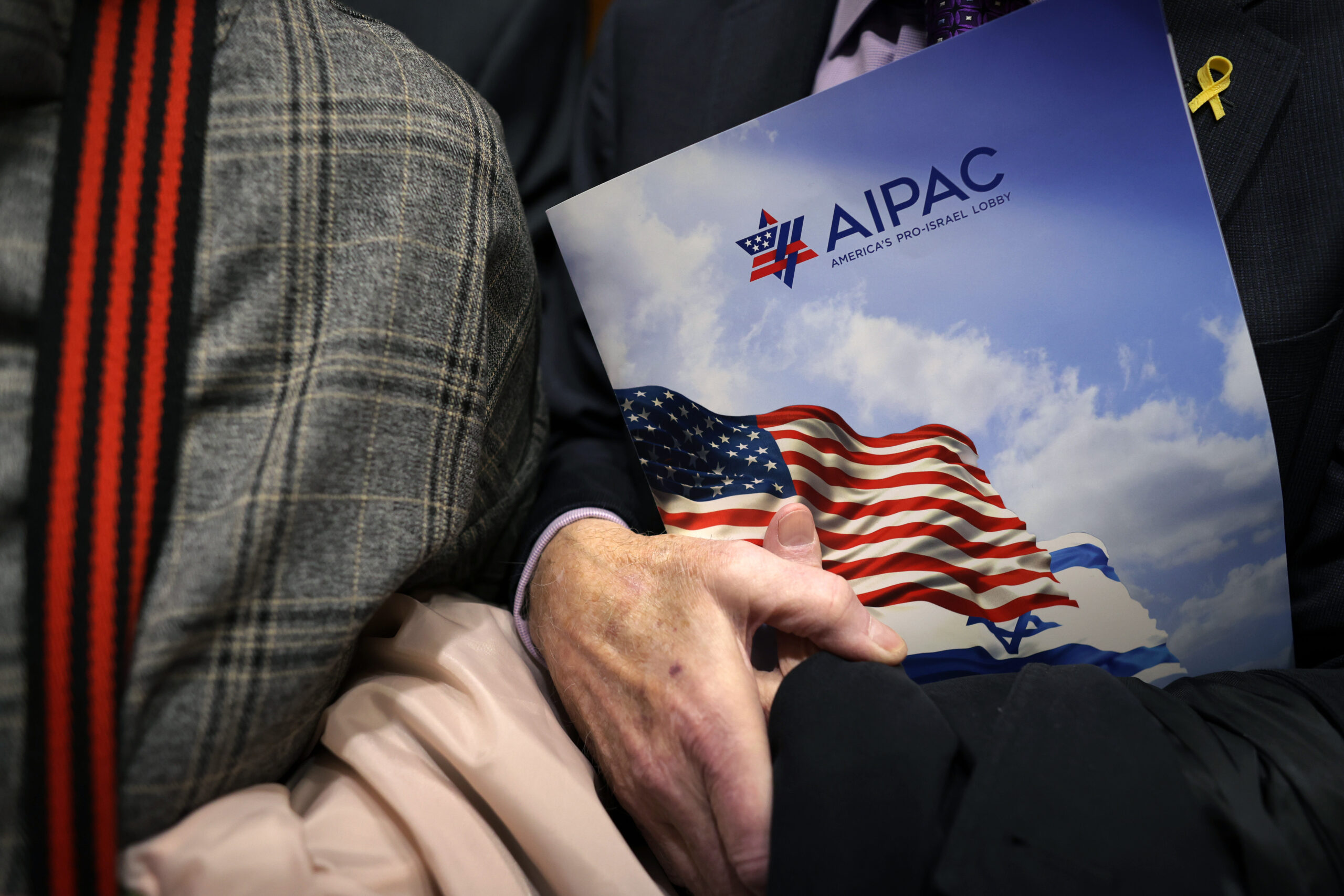
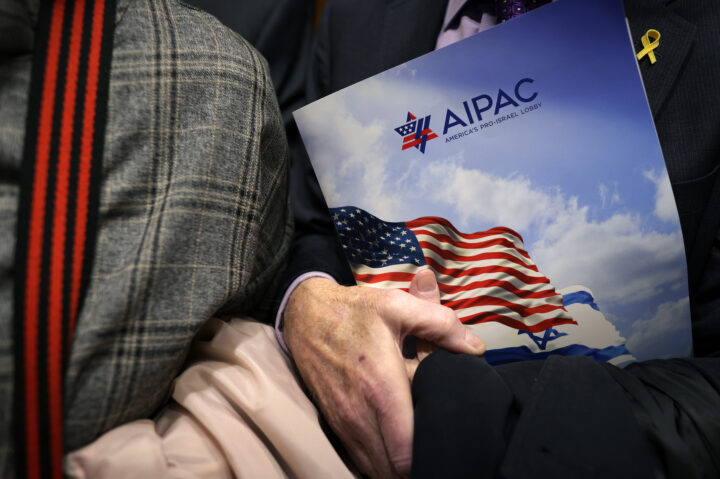
A visitor holds an AIPAC folder in an elevator in Rayburn House Office Building on March 12, 2024 on Capitol Hill in Washington, DC.
One of the biggest slurs coming from anti-Israel influencers and other crankish extremists is that outside pro-Israel advocacy groups, such as AIPAC, somehow play an inordinate role in the reason so many lawmakers support a close U.S.-Israel alliance.
Their misguided belief is that the donations from pro-Israel donors drive lawmakers’ behavior. The reality is that such financial support has reflected the strong public support Israel has long enjoyed — within both parties.
But as that public support drops within the Democratic Party (and to a lesser extent, among independents), all the resources in the world won’t be able to prevent progressive-minded elected officials from putting their finger in the wind and reneging on their past backing for the Jewish state.
We’re already seeing the consequences of Israeli Prime Minister Benjamin Netanyahu’s decision to expand the war in Gaza by taking control of Gaza City — a decision that has limited support in Israel, and has been drawing criticism even from some of Israel’s stalwart Democratic party supporters at home.
But what should be doubly concerning to the Jewish state and its supporters is that several of the Democrats championed by AIPAC’s super PAC in the last two congressional elections — Reps. Valerie Foushee (D-NC), Maxine Dexter (D-OR), and Robert Garcia (D-CA) — have lately become more hostile to Israel, with the former two calling for a cutoff in military aid.
And as we documented last Friday, Rep. Maxwell Frost (D-FL), whose initial candidacy was boosted by commitments he made to Jewish leaders amid skepticism about his record on Israel, is now reneging on many of those promises, joining a handful of progressives in calling for a Palestinian state.
Some important context: All these Democrats represent some of the most progressive turf in the country, with deep-blue constituencies in Portland, Ore.; Durham, N.C.; and Long Beach, Calif. AIPAC’s engagement in these primaries, electing more mainstream Democratic candidates, was a key marker of the group’s success, given the sizable anti-Israel constituency in all these districts.
But ultimately, the overall progressive turn against Israel proved more consequential than these lawmakers’ relationships with AIPAC or the amount of financial support they received in their primaries. It’s hard enough for mainstream Democrats to run against the left-wing tide that’s been gaining ground in their party. In these activist-minded districts, it’s become nearly impossible.
It’s been the rise of social media platforms amplifying extreme views that have played an outsized role in shaping public opinion — far more than the money from outside advocacy groups. The change in how young voters get information is driving the shift in public opinion on a wide range of issues, and is fueling the left-wing, anti-establishment constituency within the Democratic party.
We’re seeing the consequence of that change within the Democratic party and its voters’ views towards Israel in real time. Even the best and well-resourced outside advocacy can only do so much when the rules of the game are skewed against the political mainstream.
AJC statement: ‘The profound risks posed by a full military takeover of Gaza City cannot be overlooked’

Haley Cohen
Ambassador Deborah Lipstadt, U.S. special envoy to monitor and combat antisemitism, and Rabbi Andrew Baker, AJC’s director of international Jewish affairs, in conversation with AJC CEO Ted Deutch.
The American Jewish Committee, one of the leading global Jewish and pro-Israel advocacy organizations, expressed its “deep apprehension” over the Israeli Security Cabinet’s vote to move forward with a military takeover of Gaza City, in a statement released by the organization on Friday.
AJC acknowledged the “extraordinary challenges” Israel faces due to Hamas’ “intransigence” in negotiations and the “failure of the international community to impose sufficient pressure on the terrorist organization.”
“Still,” the statement read, “the profound risks posed by a full military takeover of Gaza City cannot be overlooked.” It highlighted concerns over “endanger[ing] the lives of the remaining hostages” and the possibility of “substantial casualties among both Israeli soldiers and Palestinian civilians,” in particular.
AJC called on the signatories of the New York Declaration — signed last month by dozens of countries including member states of the Arab League and European Union — to “apply maximum pressure on Hamas to agree to a hostage release and ceasefire agreement.”
Most of DMFI’s fundraising haul this year comes from one wealthy Democratic donor in Indiana
Alex Wong/Getty Images
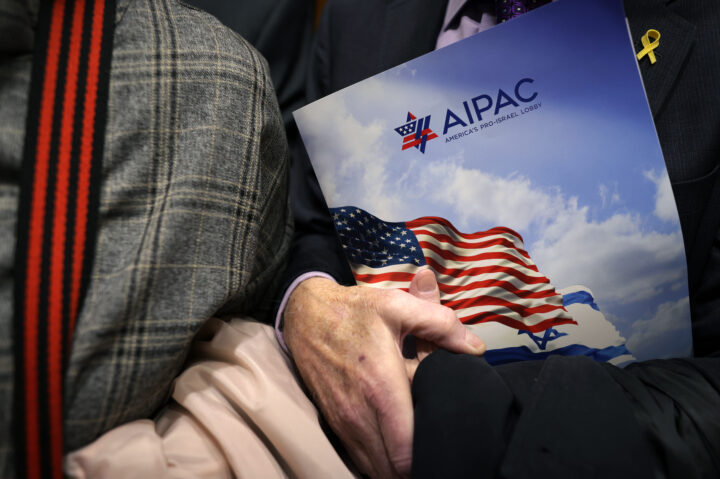
A visitor holds an AIPAC folder in an elevator in Rayburn House Office Building on March 12, 2024 on Capitol Hill in Washington, DC.
The latest round of fundraising reports filed by leading pro-Israel advocacy groups suggests that they are in strong financial shape as the midterms come into view, even as some of the top pro-Israel candidates have underperformed with their fundraising in key races.
United Democracy Project, a super PAC affiliated with the pro-Israel lobbying group AIPAC, raised $13.5 million in the first half of 2025, according to its mid-year fundraising report filed late last week, with nearly $39 million on hand at the end of June.
Those figures were far higher than the $8.8 million in contributions the group had pulled in during the same six-month period in 2023, at the beginning of the last election cycle. The group, which ultimately raised much more in the months following Hamas’ Oct. 7, 2023, attacks, had $9 million on hand at the time, federal filings show.
Among the top donors to UDP this cycle are Blair Frank, a portfolio manager at Capital Group, who gave $1.5 million — marking the only seven-figure contribution. The Kraft Group, a holding company led by Robert Kraft, the owner of the New England Patriots, gave $500,000 — as did four other donors including Sanford Grossman, Michael Leffell, David Messer and Andrew Schwartzberg, according to the new filings.
Meanwhile, AIPAC’s bipartisan political action committee, which has yet to issue endorsements in a range of key House and Senate races, raised $2.6 million last month — and was sitting on nearly $14 million at the end of June, its latest monthly filing shows. By contrast, the group had raked in around $1.5 million in June 2023, with nearly $1.4 million on hand.
The fundraising indicates that pro-Israel donors are being driven to contribute amid a new shift in which a growing number of Democratic lawmakers, as well as some Republicans, have endorsed blocking aid to Israel over its handling of the humanitarian crisis in Gaza. That trend has coincided with the Democratic nomination of Zohran Mamdani, an avowed critic of Israel, in New York City’s mayoral race, opening up an ongoing debate over the party’s future direction.
Marshall Wittmann, an AIPAC spokesperson, said in a statement that “grassroots pro-Israel activists are deeply engaged in the political process given the critical importance of the U.S.-Israel relationship as the Jewish state battles aggression from Iran and its terrorist proxies.”
“As the 2026 midterm elections approach, that increased involvement will ensure that the voice of the pro-Israel community will be heard,” Wittmann told Jewish Insider on Monday.
On the Democratic, rather than bipartisan, side of the equation, DMIF PAC, Democratic Majority for Israel’s political arm, reported raising $2.1 million so far this year, with $2.6 million on hand heading into July.
While the group’s latest cash haul was buoyed largely by a single $2 million contribution from Deborah Simon, a pro-Israel donor in Indiana, its new filing indicates a healthier financial situation than its last mid-year report in 2023, when DMFI PAC pulled in just over $700,000 during the first six months of that year, with only a small amount more in reserve funds.
DMFI PAC, which worked alongside UDP to unseat two Squad-aligned Israel critics in House races last cycle, has not yet announced endorsements in next year’s primaries.
Despite relatively robust fundraising for the two groups, such donor enthusiasm has yet to translate to some key races in which pro-Israel candidates are lagging behind their opponents. Rep. Haley Stevens (D-MI), a longtime ally of AIPAC who is running for Senate, was recently outraised by state Sen. Mallory McMorrow and Abdul el-Sayed, an outspoken critic of Israel. And in an open-seat House primary in the Chicago suburbs, Laura Fine, a state senator who is touting her pro-Israel positions, fell well behind her two left-leaning rivals.
One prominent pro-Israel activist who is close to AIPAC, speaking on the condition of anonymity to address what he called an “undeniable shift” in the Democratic Party on Israel, said he was unfazed by such fundraising at this stage of the primary cycle — noting that Stevens in particular has a “reservoir of support that is out there waiting” within the Jewish and pro-Israel communities.
“We are committed to the cause which we think is deeply in America’s interest, and we’re not going to give up,” he told JI. “People like us are just going to get more animated by this, not scared off.”
The agreement comes as the school is preparing to reach a settlement with the federal government over its handling of antisemitism

Zhu Ziyu/VCG via Getty Images
A glimpse into the Harvard University campus on May 24, 2025 in Cambridge, Massachusetts.
Harvard University, in a move long sought-after by advocates for Jewish college students, agreed on Thursday to cover all security costs for the university’s Hillel ahead of the upcoming academic year, Jewish Insider has learned.
“By taking on responsibility for security at Hillel, Harvard University is making a powerful statement: Harvard is committed to the safety of Jewish students,” Rabbi Jason Rubenstein, executive director of Harvard Hillel, told JI.
Security costs “represent a significant part of our annual budget,” Rubenstein said, declining to provide figures. The agreement is slated to run through the rest of Harvard President Alan Garber’s tenure, which is set to conclude at the end of the 2026-27 academic year.
“We should take this moment to appreciate the efficacy of Hillel’s advocacy and President Garber’s principled leadership. While more work remains to be done, tangible results like these are encouraging signs of the will and capacity for real and significant institutional change at Harvard,” Rubenstein continued, noting that advocacy efforts for Harvard to take on Hillel’s security have been in the works for several years, predating the Oct. 7, 2023, terrorist attacks.
Harvard has faced billions of dollars in federal funding cuts for research from the Trump administration over its alleged failure to address antisemitism on campus. The university’s decision to fund Hillel security comes as it has signaled a willingness to settle with the government to restore its funds, The New York Times reported this week — a deal which could see the school agree to the Trump administration’s demand for as much as $500 million to end its clash.
The Ivy League school has made several recent attempts to appeal to the Jewish community as it gears up for a settlement. On Monday, the university expanded its ties to Israel, announcing a new undergraduate study abroad program with Ben-Gurion University of the Negev and a postdoctoral fellowship for Israeli scientists at Harvard Medical School.
“Harvard University’s commitment to the safety and well-being of members of our Jewish community is paramount,” a Harvard spokesperson told JI. “Recent tragic events in communities across the country are evidence of the growth in antisemitism and further Harvard’s resolve in our efforts to combat antisemitism on our campus.”
The university did not respond to a follow-up inquiry from JI asking why Chabad is not receiving security funding as well. Harvard Hillel’s dining facility and other spaces are generally more easily accessible, with Harvard students, faculty and staff being able to enter by swiping their university ID.
The decision for universities to take on Hillel security costs has been in flux in recent years. Yale University, for example, announced in December 2023 — as a response to Oct. 7 and subsequent rise of antisemitism on campus — that it would expand a pilot program launched the year prior and fully fund the cost of day-to-day security service for the Slifka Center, the university’s Hillel, for at least three years.
Adam Lehman, president and CEO of Hillel International, called for “other universities to follow Harvard’s example in this decision.”
“Harvard’s decision to fund these essential security measures reflects the understanding that Jewish students, like all students, deserve to be safe and welcome on campus,” Lehman told JI.
The party’s youth advocacy arm amended its platform last weekend, incorporating growing anti-Israel sentiment in its ranks
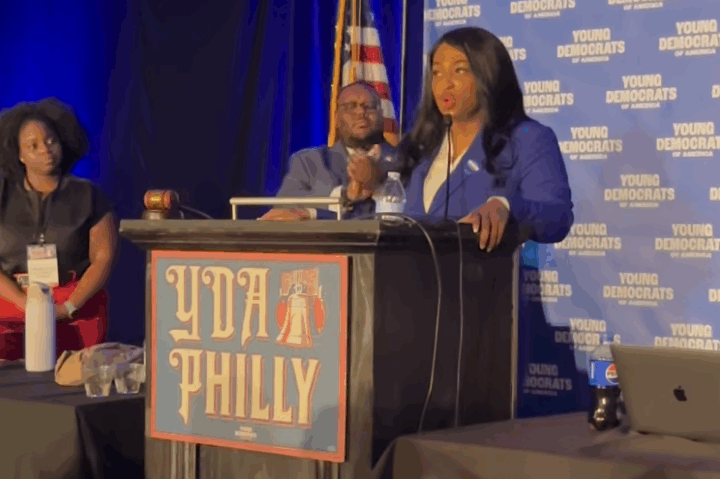
Screenshot
Fatima Heyward was elected as the new president of Young Democrats of America president on July 19th, 2025
The Young Democrats of America, a leading youth advocacy group representing party members under the age of 36, approved a new platform at its recent national convention accusing Israel of “genocide” in Gaza, raising long-simmering internal tensions over Middle East policy.
The organization, whose biennial convention concluded in Philadelphia on Saturday, narrowly passed a new amendment expressing opposition to the “Israeli government’s ongoing genocide in Gaza, its occupation of the West Bank, and its denial of civil and political rights on an equal basis in the territories it militarily occupies,” according to an updated foreign policy plank reviewed by Jewish Insider.
The change, which added the “genocide” reference to an existing amendment, was proposed “to reflect current events and align with present-day actions,” according to a platform committee document from the convention.
Other efforts to amend YDA’s Middle East policy plank, which ultimately failed to be adopted, included striking a line endorsing Israel’s “right to exist as a Jewish democratic state,” screenshots shared with JI show. Meanwhile, some delegates also proposed removing language condemning “the oppression of the Iranian government” and backing “anti-regime protests,” among other suggested changes that were met with alarm by Jewish members who are now weighing a collective response.
Even as those proposals were rejected, that such changes were suggested at all “presents a scary reality,” one member of YDA’s Jewish caucus told JI after the convention.
The Jewish caucus declined to comment on the new platform as it decides “how to move forward,” it told JI on Monday.
YDA’s decision to formally describe Israel’s conduct in Gaza as a genocide more broadly underscores how the party is moving away from support for Israel as Democrats show declining sympathy for the Jewish state, according to polls.
The group also approved a resolution at its convention that voiced support for student protests “against U.S. complicity” in what it called the “Israeli government’s genocidal actions in Gaza,” according to a document shared with JI.
YDA, which claims more than 24,000 members, has grappled with internal divisions over its approach to Israel and antisemitism in the aftermath of Hamas’ Oct. 7, 2023, terror attacks. It faced pushback from Jewish caucus members, for instance, who criticized the group’s denunciation of President Joe Biden for condemning violence at campus anti-Israel protests.
YDA did not respond to a request for comment on Monday.
After legal and structural changes, the anti-Israel group has switched its focus from protests and advocacy to organizing for and against candidates

Tierney L. Cross/Getty Images
Demonstrators from Jewish Voice For Peace protest the war in Gaza at the Canon House Building on July 23, 2024 in Washington, DC.
Jewish Voice for Peace, a far-left anti-Israel advocacy group that has built a growing profile in the wake of Hamas’ Oct. 7, 2023, terror attacks, is pivoting to a new organizational structure that will soon allow it to engage more forcefully in electoral politics.
The group recently began the process of consolidating its membership and organizing in an affiliated but lesser-known political nonprofit called Jewish Voice for Peace Action, devoting the bulk of its resources to lobbying and political activities, such as supporting and opposing candidates that had not traditionally been a part of its core focus.
As a nonpartisan tax-exempt group, JVP, which has been at the forefront of campus anti-Israel protests and promotes efforts to divest from Israel, has been legally prohibited from taking sides in campaigns — a limitation the new structural change is designed to address.
The shift comes as the activist left has felt newly emboldened by Zohran Mamdani’s shocking victory in New York City’s Democratic mayoral primary in June, fueling debates over the ideological direction of the party as it gears up for next year’s midterms.
JVP Action, which recently changed its public name to Jewish Voice for Peace to match its sister organization, was an early supporter of Mamdani and has cited his outspoken opposition to Israel as a sign of evolving voter attitudes about the Israeli-Palestinian conflict.
“There is unprecedented, mass support for Palestinians. Our movement has already grown larger, and more quickly, than many of us thought possible. But it’s clear we have not begun to tap our full potential,” JVP writes in a detailed new page on its website about the decision-making behind its shift. “The U.S. government has not budged from its commitment to sponsor Israel’s genocide. Public polling and public displays of opposition alone will not shift U.S. policy. Our movement must contend for real power.”
JVP, which until now had been the primary home for the group’s organizing work, will become a “supporter-based” rather than a “membership-based” organization renamed JVP Leadership & Culture Lab — with a focus on educational training and arts and culture programming to help promote “anti-Zionist Jewish” advocacy, according to its tentative mission statement.
The change was approved in a recent membership vote and will be implemented by Oct. 15, according to a lengthy agenda from a virtual meeting last week shared with Jewish Insider.
JVP Action’s board, for its part, had already voted to change its name and structure independently of the recent all-members meeting, in anticipation of the organizational inversion.
During the meeting, a recording of which was reviewed by JI, one member raised a concern that the change could “lead to a deemphasis” on JVP’s involvement in “mobilizing of protests and direct action” in favor of “electoralism and support for progressive Democrats.” The member was reassured by leadership that such approaches are complementary and that electoral work is a “key tactic inside a set of tools” including “civil disobedience” and divestment campaigns.
In moving to now operate primarily as a political nonprofit, “the barriers between the work of JVP and JVP Action organizations will be removed,” JVP further explains on its website.
“This has long been a challenge, creating silos and firewalls in our respective work that keep us from drawing clear connections between the political, electoral, cultural and financial forces that uphold the U.S.-Israeli relationship,” the group adds.
JVP, which is closely aligned with American Muslims for Palestine, a leading pro-Palestinian advocacy group that has faced legal scrutiny for alleged ties to terror organizations such as Hamas, has significantly bolstered its fundraising in recent years.
The organization raised a record $11 million in revenue from July 2023 to June 2024, according to its latest tax filing, far outpacing previous figures. It is not required to share the names of its donors as a 501(c)(3) to which contributions are tax-deductible.
As a so-called “dark money” group, JVP Action, a 501(c)(4) that is not tax-exempt, can also shield its contributors from the public, even as it engages in elections — unlike political action committees that must disclose their donors.
JVP Action pulled in $800,000 in revenue from July 2022 to June 2023, its most recent tax filing shows, marking its strongest showing since it was established in 2020.
A smaller PAC affiliated with JVP raised only $133,000 last election cycle and does not seem to be part of the new restructuring. The Anti-Defamation League filed a complaint last year accusing the PAC of engaging in a pattern of misrepresentations that violate federal campaign finance law.
In its efforts to stake out a more prominent role in elections, JVP Action is borrowing a page from one of its primary adversaries, the pro-Israel lobbying group AIPAC, which launched a super PAC as well as a political action committee in 2021 to wield its more considerable resources in congressional races where divisions over Israel have drawn significant outside spending.
“For a century, our opposition — the American Zionist establishment — has employed a long-term multipronged strategy to build U.S. support for Zionism and genocide and they have used all the tactics in the book,” JVP says in its recent meeting agenda. “They have a cultural strategy, an electoral strategy, a lobbying arm, youth organizations, mass movement organizations and funding vehicles.”
But the group argues that its opponents are “now experiencing a crack in their power.”
JVP Action, which has previously endorsed a range of Squad members in the House, has not indicated how it plans to approach the upcoming midterms in its more streamlined role.
The group did not return a request for comment on Wednesday, nor did JVP.
A poll released in February by The Jewish Majority, a pro-Israel research group in Washington, showed most Jewish Americans oppose the confrontational protest tactics used by JVP and regard anti-Zionist movements as antisemitic, among other findings.
Jonathan Schulman, the executive director of The Jewish Majority, said that JVP’s “decision to more vigorously engage in electoral politics signals their growing ambition to influence policy in ways that undermine Israel’s very existence as a Jewish state.”
“As they pursue this goal,” Schulman said in a statement to JI on Wednesday, “the pro-Israel community must make it clear to both the public and policymakers that the rhetoric and tactics of anti-Zionism undermine any prospects for a peaceful resolution to the conflict and contribute to the rise in violent attacks against Jews in America. JVP seeks to disprove any connection between anti-Zionism and antisemitism. We must expose that anti-Zionism is fundamentally opposed to peace.”
But with Mamdani’s resounding win over former New York Gov. Andrew Cuomo, who had touted his staunch support for Israel and opposition to rising antisemitism in the primary, JVP now claims to see evidence its “movement work” is gaining traction.
“It is no longer popular for the U.S. to be sending endless weapons and funding to Israel,” the group said in its meeting agenda. “People are questioning the U.S.’ support for genocide and violence against the Palestinian people. Our movement is growing! And we still have a long way to go to break open this crack and end U.S. support for Israel.”
The group aims to mobilize 50,000 Orthodox Jews to write to their senators to support the Educational Choice for Children Act

Courtesy orthodox union
Rabbi Shay Schachter, Rabbi Yisrael Motzen, and Nathan Diament (left to right) carry boxes of letters to the White House
The Orthodox Union on Thursday announced a national advocacy effort calling on the Senate to pass the Educational Choice for Children Act, which is part of the budget reconciliation bill recently passed by the House and under consideration in the Senate and could open up a new funding stream for Jewish families aiming to send their children to Jewish day schools.
The campaign, run jointly by the Orthodox Union Advocacy Center and the Teach Coalition, OU’s state-level advocacy arm, will include digital, print and grassroots advertising, urging Orthodox Jews to contact their senators to support the ECCA and double the funding recommended in the House bill.
The OU is aiming to mobilize 50,000 people to contact their senators on the issue.
The legislation would create a federal tax credit program to fund private scholarship programs, which could be applied for a range of purposes including Jewish day schools. Agudath Israel of America and the Republican Jewish Coalition also support the bill. As it currently stands, the bill would allow $5 billion in total tax credits. OU is aiming to double that to $10 billion.
“This is not just a policy moment, it’s a historic moment,” Nathan Diament, the OU Advocacy Center’s executive director, said in a statement. “As antisemitism surges and Jewish communities face growing threats, families are desperate for schools where their children feel safe, supported, and proud of their identity. But too many are being priced out of a Jewish education. That’s not sustainable nor acceptable. This legislation is a once-in-a-lifetime opportunity to turn the tide, and we are going all in to make sure it happens.”
Sydney Altfield, the national director of Teach Coalition, highlighted state-level victories, which she said they now aim to translate into federal action.
“We’re mobilizing Jewish communities across the country like never before. From Miami to Monsey, Phoenix to Philadelphia, parents, educators, and advocates are stepping up to ensure passage of ECCA,” Altfield said.
The proposal matches the program’s 2023 funding level, which lawmakers and Jewish advocacy groups called insufficient at the time

Brandon Bell/Getty Images
A law enforcement vehicle sits near the Congregation Beth Israel synagogue on January 16, 2022 in Colleyville, Texas.
The House Appropriations Committee’s draft 2026 Homeland Security funding bill includes $305 million for the Nonprofit Security Grant Program, a marginal increase that would restore the program to its 2023 funding levels.
But lawmakers and Jewish advocacy groups at the time — well before antisemitism skyrocketed following the Oct. 7, 2023, Hamas attacks on Israel, the ensuing war in Gaza and the recent series of antisemitic terrorist attacks in the United States — called that funding level insufficient. At the time, the funding fell well short of meeting demand, which has increased significantly since then.
In 2024 and 2025, the program received $274.5 million, supplemented by $400 million split across the two years from the national security supplemental bill passed in 2024.
In 2023, the program received a total of 5,257 applications, requesting a total of $679 million in funding. Just 42% were approved. Demand increased significantly in 2024 — 7,584 applications were submitted, totaling nearly $1 billion in funding requested. Forty-three percent of applications were approved, with $454.5 million available between annual appropriations and the supplemental.
Bipartisan groups of supporters in the House and Senate have been pushing for $500 million for the program for 2026, while many Jewish groups called for funding to be increased to $1 billion following the shooting of two Israeli Embassy staffers outside a Jewish communal event in Washington in May.
The House’s proposal does, however, deviate from the administration’s request for flat funding — $274.5 million — for the program, indicating some interest from House Republicans in providing additional support for the program.
The House Appropriations Committee’s Homeland Security Subcommittee will meet to debate and vote on the bill Monday evening, and the full committee will debate and vote on it Thursday morning.
Senate Minority Leader Chuck Schumer (D-NY) told Jewish Insider last week that he plans to launch an “all-out push” on Monday for $500 million for the program. He said that Republicans on the Senate Appropriations Committee, who will release their own draft bill, “seemed open to it.”
With both chambers of Congress and the White House controlled by Republicans, Schumer’s voice may have limited impact in the process.
The conservative senator told a group of pro-Israel advocates that they should address the issue of Iranian nuclear dismantlement in meetings with Trump administration officials

Gabby Deutch
Sen. Ted Cruz (R-TX) speaks at a NORPAC advocacy event in Washington on May 20, 2025.
Sen. Ted Cruz (R-TX) said on Tuesday that he is concerned about the views of some of the officials in the White House shaping President Donald Trump’s Iran policy, marking the most critical comments yet from the hawkish senator about Trump’s approach to Iran.
He urged members of NORPAC, a pro-Israel advocacy organization, to raise the issue in their meetings with anyone in the Trump administration.
“We need clarity with the Trump administration, and as NORPAC talks to the administration, I would say, I worry there are voices in the administration that are not eager to hold up the president’s red line of dismantlement,” Cruz said at NORPAC’s annual Washington lobbying mission, referring to mixed messaging from some U.S. officials on the acceptable contours of a potential new nuclear agreement with Iran.
Cruz, a staunch opponent of the 2015 Iran nuclear deal negotiated by the Obama administration, has not formally come out against Trump’s negotiations with Iran, although he said in his remarks that he has “more than a little skepticism” that “this threat can be dealt with diplomatically.”
But in recent weeks, Cruz has challenged one talking point on the negotiations made by officials including Vice President JD Vance, Middle East envoy Steve Witkoff and Secretary of State Marco Rubio — that Iran should be allowed to maintain a civil nuclear program.
“There are some in the Senate who say, Well, Iran can have civilian peaceful nuclear power. Baloney. I see no reason for Iran to have anything nuclear whatsoever,” Cruz said Tuesday, echoing comments he has made in the past. “The only way to stop Iran from getting a nuclear weapon is to eliminate the centrifuges.”
Trump himself has offered mixed messages on how his administration is approaching the issue of nuclear enrichment. He said in early May that the goal of the Iran talks is “total dismantlement.” Days later, Trump said he had not yet decided whether Iran should be allowed to continue enriching uranium.
Witkoff has also walked back his earlier comments, saying last Sunday that “any deal between the United States and Iran must include an agreement not to enrich uranium.”
Brian Romick, a longtime senior aide to Rep. Steny Hoyer, will succeed Mark Mellman as the group’s president and CEO

Courtesy DMFI
Brian Romick
Democratic Majority for Israel, a top pro-Israel advocacy group, is announcing a new president and board chair, after a recent leadership shake-up that resulted in the sudden departure of its founder last month.
The organization said in a statement to Jewish Insider on Friday that Brian Romick, a longtime senior aide to Rep. Steny Hoyer (D-MD), will serve as president and CEO, succeeding Mark Mellman, a veteran Democratic pollster who founded the group in 2019 to counter growing anti-Israel sentiment on the left.
Former Rep. Kathy Manning (D-NC), a pro-Israel stalwart and Jewish Democrat who has previously chaired the Jewish Federations of North America, will lead DMFI’s board of directors, the group said.
In a statement shared with JI, Romick, who has helped guide Hoyer’s efforts to advance pro-Israel legislation and fight antisemitism, called DMFI “an essential voice in Washington and in the pro-Israel community across the country,” particularly during what he characterized as a “critical moment in the U.S.-Israel relationship.”
“I want to thank DMFI’s leadership and staff for their efforts over the last six years to build a robust presence in the Democratic Party that reflects our shared values with Israel,” Romick continued. “With the House and Senate in play during the upcoming midterm elections, I am committed to working with Kathy, the board and the staff to expand DMFI’s impact and ensure we are supporting pro-Israel Democrats next year.”
Manning, for her part, said that she was “thrilled to chair DMFI’s board at this very important time for the U.S.-Israel relationship and for the Democratic Party,” while also thanking “the past leadership for establishing DMFI and turning it into a vibrant and formidable organization with an outsized impact.
“I look forward to building on the strong foundation they have created,” Manning said in the statement.
DMFI has not shared a reason for Mellman’s abrupt departure in mid-April, which came as something of a surprise to political observers. He has not publicly addressed the matter.
Mellman had also served as the chairman of DMFI’s super PAC, which has become a prominent player in key Democratic primary battles where conflicts over Israel have featured prominently. The group has yet to select a new chair of its political arm, DMFI PAC, which will be a pivotal role as it begins to strategize in advance of next year’s primaries.
DMFI, for its part, has in recent weeks staked out an increasingly adversarial approach to the new Trump administration, expressing concern that it is leaving Israel exposed amid a U.S. ceasefire agreement with the Houthis in Yemen and criticizing the president’s plans to accept a $400 million luxury jet from Qatar as a threat to national security.
In a statement shared with JI on Friday, Rep. Brad Schneider (D-IL), a pro-Israel champion backed by DMFI PAC, voiced confidence Romick and Manning would guide DMFI “through an ever-more complex and challenging era for the set of issues at the core of its focus.”
“Kathy and Brian are the right leaders for this moment when Democratic Majority for Israel’s mission is more important than ever,” added Todd Richman, a current co-chair of DMFI’s board. “Their deep experience and accomplishments on Capitol Hill, in Democratic politics, and as leading pro-Israel advocates will build on DMFI’s record of achievement.”
DMFI also announced two new additions to its board: Lisa Eisen, the co-president of Charles and Lynn Schusterman Family Philanthropies and the founding board chair of Israel on Campus Coalition; and Stuart Kurlander, a retired partner at Latham & Watkins who has served as a president of the Jewish Federation of Greater Washington
In January, the group named Brian Abrahams, a longtime pro-Israel activist who previously worked for the bipartisan lobbying group AIPAC, as its new vice president and chief advancement officer.
The ruling is the latest decision in a case probing AMP’s alleged fundraising links to terrorist groups

Anna Moneymaker/Getty Images
Virginia Attorney General Jason Miyares joins President Donald Trump onstage during a rally at Greenbrier Farms on June 28, 2024 in Chesapeake, Virginia.
A Richmond, Va., judge has issued a new court order ruling that a pro-Palestinian advocacy group with alleged ties to Hamas must finally turn over closely guarded financial documents sought in an ongoing investigation brought by Virginia’s attorney general.
The decision, issued on Friday, is a major blow for American Muslims for Palestine, a Virginia-based nonprofit group that has drawn a growing number of legal challenges in the aftermath of Hamas’ Oct. 7, 2023, terror attacks and Israel’s ensuing war in Gaza.
Jason Miyares, the Republican attorney general of Virginia probing AMP’s fundraising operations over alleged links to terror groups, had filed a petition in January to enforce a previous order compelling the organization to produce sensitive records that could shed light on its widely scrutinized but closely held donor network.
His office noted at the time that AMP had “refused to comply” with a court-approved civil investigative demand for documents the group long shielded from public view.
The judge’s decision on Friday upheld the court order issued last summer, rejecting AMP’s request to set the petition aside as it seeks an appeal of the July ruling.
The group is now required to comply with the demand for records, notwithstanding its pending appeal before the court, the new ruling states. “To rule otherwise would render the statute practically inoperable and gut the attorney general’s authority to engage in pre-enforcement civil investigations and promote the public interest,” Judge Devika E. Davis of the Richmond Circuit Court explained in the decision.
More broadly, the new ruling indicates that AMP has now exhausted all of the available legal delay tactics it has used to resist the attorney general’s efforts to procure documents as part of a winding investigation launched weeks after the Oct. 7 attacks.
“My office has a legal obligation to ensure that charitable organizations operating in Virginia are following the law,” Miyares said in a statement to Jewish Insider on Monday. “I will continue to enforce state law without exception or delay to protect Virginians.”
Christina Jump, an attorney for AMP, vowed that the group “will continue to pursue all legal options available within Virginia law, which include pursuing our existing appeal on the merits and filing an additional appeal, if necessary, in the duplicative matter.”
“AMP is now and has been for some time in full compliance with the laws of the Commonwealth of Virginia that Attorney General Miyares claims prompted this inquiry in the first place,” Jump said in a statement to JI on Monday. “And the vague accusations that AMP has anything to do with Hamas or Oct. 7 just got thrown out completely by a federal court judge,” she added, referring to a lawsuit filed in Nevada, “because no facts support that defamatory smear.”
Despite that recent victory, AMP continues to face an array of civil lawsuits as well as state and federal probes threatening to dismantle one of the nation’s top pro-Palestinian advocacy organizations as it has taken a leading role in anti-Israel protests on college campuses across the country.
In March, the Senate Health, Education, Labor and Pensions Committee launched an investigation into AMP over its engagement on college campuses and its sponsorship of Students for Justice in Palestine, a loosely organized student advocacy group that has voiced support for Hamas.
Meanwhile, in Illinois, a long-gestating lawsuit nearing a possible trial is working to establish that AMP is an “alter ego” of a now-defunct group, the Islamic Association for Palestine, found liable for aiding Hamas. The suit is seeking to collect a $156 million judgment that IAP never paid to the family members of David Boim, an American murdered by Hamas in a 1996 terrorist attack in the West Bank.
Top officials at AMP, many of whom have ties to Hamas, were affiliated with IAP, which shuttered in 2004. Legal documents recently obtained by JI also suggest that AMP has obscured its links to IAP, and further highlight how some of its leaders have been closely tied to Hamas.
Daniel Schlessinger, the lead attorney in the Illinois case, has said that his team has already successfully obtained some of AMP’s donor records, even as they remain confidential.
He is planning to challenge that designation in an effort to bring them to the public.
Please log in if you already have a subscription, or subscribe to access the latest updates.
 Continue with Google
 Continue with Apple