







































Plus, Senate Dems dominate 2026 fundraising

Kevin Dietsch/Getty Images
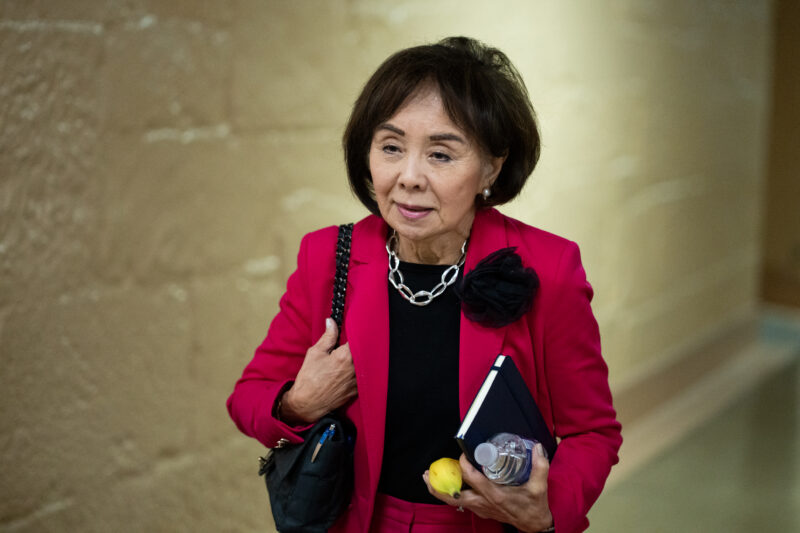
Rep. Ilhan Omar (D-MN) speaks at a press conference on committee assignments for the 118th U.S. Congress, at the U.S. Capitol Building on January 25, 2023, in Washington, D.C.


 Add JewishInsider on Google
This P.M. edition is reserved for our premium subscribers — offering a forward-focused read on what we’re tracking now and what’s coming next. Please don’t hesitate to share your thoughts and feedback by replying to this email.
📡On Our Radar
Notable developments and interesting tidbits we’re tracking
A war powers resolution brought by Senate Democrats to force an end to the war in Iran was blocked by Republicans yet again this afternoon, the fourth failed attempt mounted by Senate Democrats since the war began in late February, Jewish Insider’s Marc Rod reports.
Nevertheless, top Senate Democrats have said they intend to continue forcing such votes weekly (they have nine more resolutions already filed) in the hopes that more Republicans will change their votes as the war drags on…
Texas state Sen. James Talarico announced he raised $27 million in the first quarter of 2026 in his run for U.S. Senate, a massive haul that his campaign claimed is the largest amount ever raised by a Senate candidate in the first quarter of an election year. Democrats hope the funds will put Texas in play as Talarico seeks to challenge either Sen. John Cornyn (R-TX) or Texas Attorney General Ken Paxton, who are still locked in their own hotly contested primary.
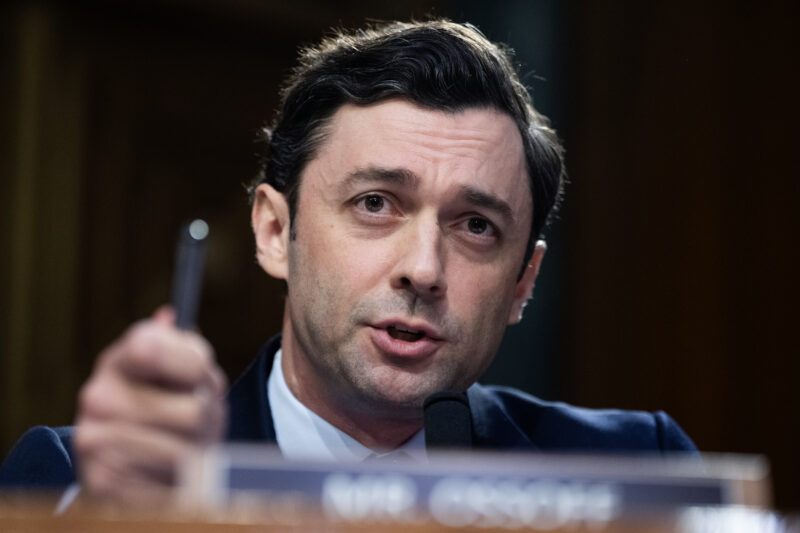
The top Senate fundraisers behind Talarico this quarter were also Democrats: Sen. Jon Ossoff (D-GA) brought in $14 million — breaking the record for first-quarter fundraising in Georgia — former North Carolina Gov. Roy Cooper raised $13.8 million and former Sen. Sherrod Brown (D-OH) raised $12.5 million…
Rep. Tom Kean Jr. (R-NJ) said he raised $1.1 million in this year’s first quarter, bringing his total to $4.4 million raised — more than any other House incumbent or candidate in New Jersey this cycle, according to the New Jersey Globe — as he defends his swing seat from several well-funded Democratic challengers.
But even as he’s pulled in plenty of support, Kean has missed a month’s worth of votes on Capitol Hill due to an unspecified medical issue, with his staff declining to say when he will return…
Rep. Ilhan Omar (D-MN) in an interview on the “Pod Save America” podcast praised former Rep. Marjorie Taylor Greene (R-GA) — once a vocal Omar foe who called for the congresswoman’s deportation while they were both in the House — and far-right influencer Candace Owens over the pair’s break with President Donald Trump, JI’s Marc Rod reports.
“I believe the thing that has been very fascinating, especially about Marjorie and Candace, is that … they’re saying, ‘This action is wrong,’ right? They’re saying, ‘I am done with you.’ We should give them credit for that, the fact that they’ve had this wake-up call to finally seeing this con man, this corrupt, chaotic man for what he is,” Omar said…
Sebastian Gorka, the White House senior director for counterterrorism and a deputy assistant to the president, is reportedly angling for the position of director of the National Counterterrorism Center, which was recently vacated by Joe Kent amid Kent’s opposition to the Iran war. Gorka has been a staunch defender of Trump and backed his war with Iran, as well as repeatedly praised Israel amid its war in Gaza…
Israeli Prime Minister Benjamin Netanyahu spoke with Péter Magyar, the presumptive next prime minister of Hungary, for the first time today, calling the conversation “warm” and saying that Magyar indicated he will continue the close relationship the countries enjoyed under his predecessor, outgoing Prime Minister Viktor Orbán…
New York Gov. Kathy Hochul defended her proposal to bar demonstrations of more than two people from occurring within 25 feet of a house of worship today, JI’s Will Bredderman reports, legislation that has drawn legal scrutiny over its creation of a new felony offense for violators.
“I believe I have the right to protect people’s constitutional right to free exercise of religion,” Hochul told reporters when asked if she had concerns that the legislation might provoke challenges on First Amendment grounds. “So if that means we test it in court, bring it on”…
After holding its final public hearing earlier this week, the White House Religious Liberty Commission is now preparing a set of recommendations to be presented to the president next month. Ambiguity and confusion about the commission’s mandate has left commissioners unsure if they’ll continue to meet — their first year on the panel was marred by the firing of one commissioner over her disruption of a hearing on antisemitism…
Progressive media organization More Perfect Union is launching More Perfect University, an effort aimed at college students to act as an alternative to the conservative Turning Point USA, with a focus on urging young people to share left-wing political and economic messaging through social media. Faiz Shakir, the head of More Perfect Union who is also chief political advisor to Sen. Bernie Sanders’ (I-VT) campaign, said he hopes to jump-start “an economic populist movement for the next generation”…
Duke University’s Students for Justice in Palestine chapter has been suspended as a student group and had its funding frozen after it posted virulently antisemitic imagery depicting Israel and the U.S. as pigs frothing at the mouth on its Instagram page, prompting student complaints to campus administration…
University of Michigan President-elect Kent Syverud announced today he has been diagnosed with brain cancer and will no longer assume the presidency, leaving the future of the school’s leadership in question. Jewish leaders had praised Syverud’s appointment as a positive development for UM, which had seen rampant anti-Israel activity in the aftermath of the Oct. 7, 2023, Hamas attacks…
⏩ Tomorrow’s Agenda, Today
An early look at tomorrow’s storylines and schedule to keep you a step ahead
Keep an eye out in Jewish Insider for a preview of a first-of-its-kind antisemitism conference taking place tomorrow at Harvard, created as an outcome of last year’s settlement of a Title VI lawsuit against the school.
New Jersey’s 11th Congressional District will hold its special election for the remainder of Gov. Mikie Sherrill’s congressional term, where progressive Analilia Mejia is expected to prevail against Republican Joe Hathaway.
The Senate Foreign Relations Committee will hold nomination hearings for John Breslow to be U.S. ambassador to Cyprus, Todd Steggerda to be U.S. representative to the U.N. in Geneva and Preston Wells to be U.S. representative to the International Atomic Energy Agency, among others.
The Shalom Hartman Institute will host a discussion at the Capitol Jewish Museum in Washington with Jeffrey Goldberg, editor-in-chief of The Atlantic, on American Jewry ahead of the 250th anniversary of the founding of the United States.
The House Appropriations Committee will hold a budget hearing on the Department of Homeland Security, including the Federal Emergency Management Agency, which oversees the Nonprofit Security Grant Program.
Stories You May Have Missed
SCOOP

The Oct. 7 mastermind died in ‘heroic’ style, according to Donald Borenstein, director of video for the Mamdani campaign and City Hall
DEM DIVIDES
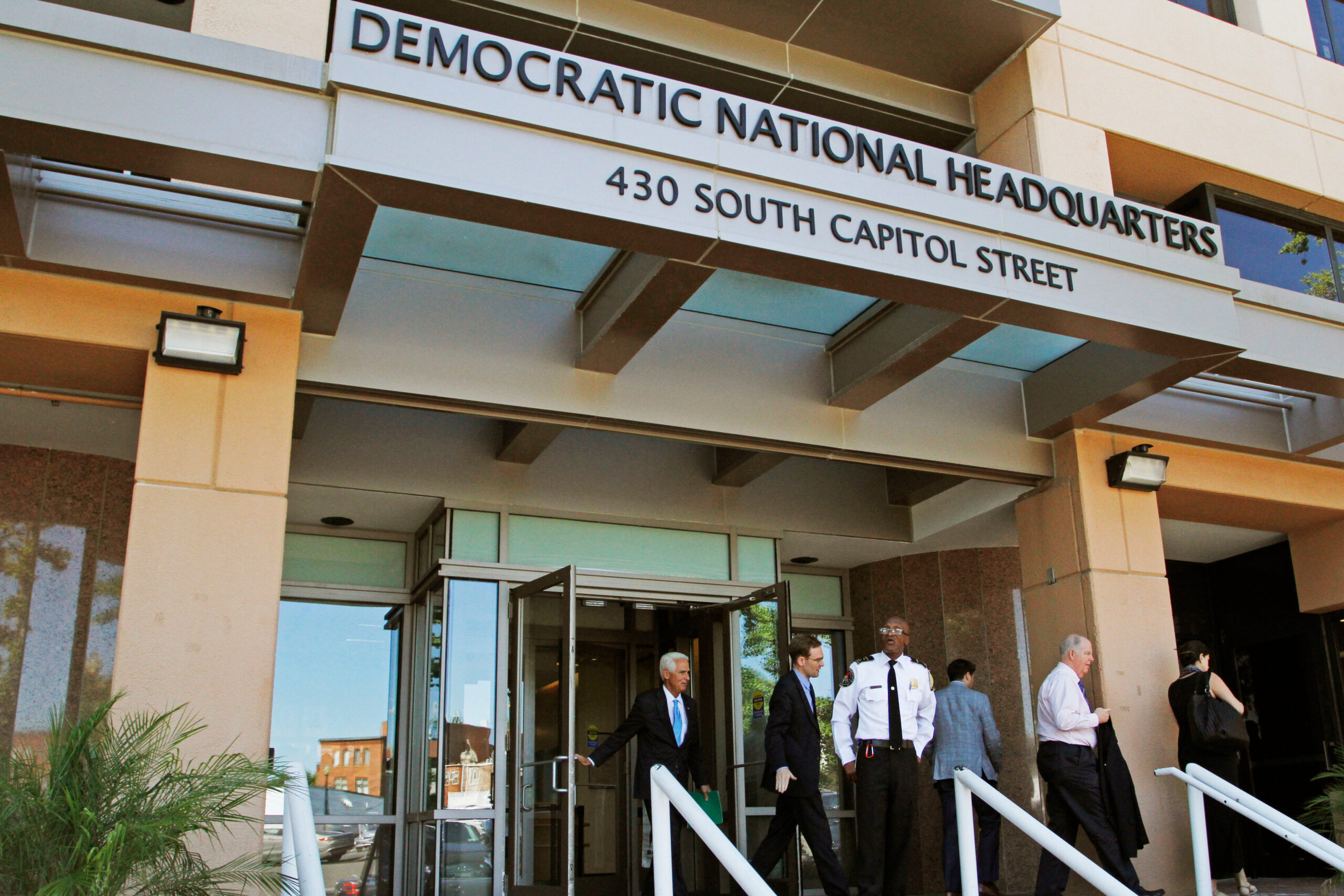
The question facing the Middle East working group’s members is whether they will actually be able to agree on anything — or if the group is simply a way to push the issue off until 2028
Even after their fourth failed attempt, Democrats say they intend to continue forcing such votes weekly

Kevin Carter/Getty Images
The U.S. Capitol Building is seen at sunset on May 31, 2025 in Washington, DC.
An effort by Senate Democrats to force an end to the war in Iran was again blocked by Republicans on Wednesday, the fourth such failed attempt mounted by Senate Democrats since the war began in late February.
The measure failed by a vote of 52-47, with all Democrats except Sen. John Fetterman (D-PA) voting for a procedural motion on the war powers resolution, and all Republicans except Sen. Rand Paul (R-KY) voting against it. Sen. Jim Justice (R-WV) was not present for the vote.
Nevertheless, Democrats intend to continue their efforts. They have nine such resolutions that have been filed, and top Senate Democrats said this week they intend to continue forcing such votes weekly, in the hopes that more Republicans will change their votes as the war drags on.
Some Republicans have begun to express hesitation about the war, and top members of the caucus have said they hope it comes to an end soon. But thus far most have not been willing to openly break with President Donald Trump on the effort.
Separately, Sen. Bernie Sanders (I-VT) plans to call up a vote later on Wednesday on a pair of measures to block sales of bombs and bulldozers to Israel, which Sanders has also framed as referenda on the war in Iran. Twenty-seven Democrats have previously voted for such resolutions, and supporters of the effort expect that number to increase this time.
But at least one lawmaker, Sen. Kirsten Gillibrand (D-NY), who introduced a war powers resolution on Iran this week, for future consideration, said that she views the two issues differently.
“I think of them very differently,” Gillibrand told Jewish Insider during a virtual press conference on Wednesday. “I oppose the war in Iran, but I do not believe we should leave an ally who is being attacked without support,” she said, referring to Israel.
The Houthis have spoken openly about their plans to initiate an invasion akin to Oct. 7 through Jordan and Syria
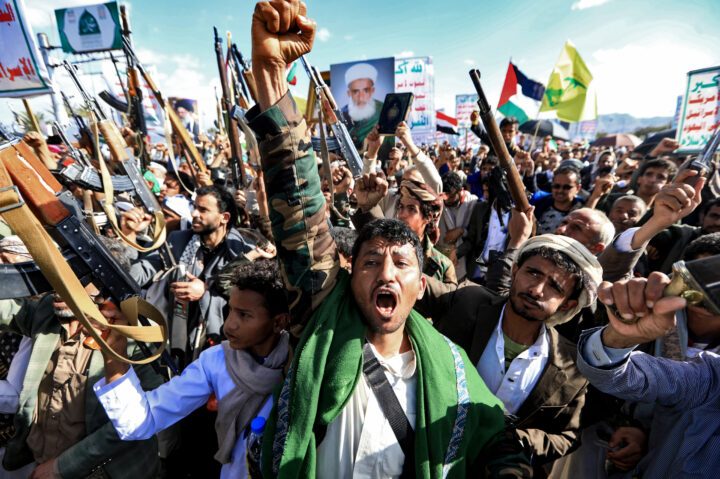
Mohammed HUWAIS / AFP via Getty Images
Supporters of the Iran-backed Houthi movement brandish their weapons as they rally in solidarity with Iran and Lebanon in the Yemeni capital Sanaa on April 10, 2026.
Like a desperate poker player holding an ace in the hole, Iran has a “strategic reserve” if the ceasefire in the war with Israel and the U.S. collapses and fighting resumes: the Houthis, the Tehran-backed Yemeni terrorist group.
How Iran plays the Houthi card has been the subject of concern in Israel, with analysts telling Jewish Insider that everything from a ground invasion from the east — with echoes of Hamas’ Oct. 7, 2023, rampage in southern Israel — to making good on the threat to block the Bab el-Mandeb Strait to further choke off international shipping remains in play.
Yoni Ben-Menachem, a senior Middle East analyst at the Jerusalem Center for Security and Foreign Affairs, told JI that the Houthis planned “to take revenge and bring back their honor” since Israel killed much of their leadership in August 2025.
“They see that Israel’s air defenses are strong, and it’s hard for them to reach military achievements with missiles and drones. They want to surprise Israel, so they are looking at ways to do it on the ground,” he said.
One scenario that Israel has actively prepared for, even before this year’s war with Iran, is a Houthi ground invasion via Syria and Jordan.
The IDF said in September that it has intelligence indicating that the Houthis initiated a training course named “Al Aqsa Flood,” as Hamas called the Oct. 7 attacks. The group planned to take advantage of the instability in Syria and political weaknesses in Jordan to invade Israel from the east, deploying tens of thousands of terrorists on a killing spree, heading toward Jerusalem. In January, the IDF’s Central Command led a training exercise, together with Israeli Border Patrol and police, on how to counter such a scenario.
In addition, the IDF has continued the construction of a security fence along the border with Jordan.
Yossi Mansharof, a lecturer at Haifa University, told JI that the Houthis speak openly about a possible land invasion in their media channels: “They say they intend to invade and … reach Dimona [in southern Israel], conquer [Israeli] towns.”
Mansharof said that while an invasion via the Red Sea and Eilat, at Israel’s southern tip, would be closer to the Houthis’ home base, such a move is “unrealistic; they would have to go undetected by the IDF.”
However, he said, the 186-mile border between Israel and Jordan is particularly porous, and if Hamas could break through the Gaza fence, as it did on Oct. 7, the Houthis may be able to do the same in Jordan. In addition, Iran has long worked to gain a foothold in Jordan.
“Iran is a shared enemy” of Israel and Jordan, Mansharof said. “Iran violates Jordanian sovereignty, and some of the missiles shot at Israel land in their territory. … Iran wants to establish terrorist infrastructure [in Jordan], and King Abdullah has said in Davos and in media interviews that he is concerned about Iran.”
In addition, Mansharof said, the Shi’a militias in Iraq, which shares a border with Jordan, have close ties with the Houthis.
A Houthi attack could also be part of an Iran-led multi-front assault on Israel, which Iranian officials — including a top advisor to Mohammad-Bagher Ghalibaf, Iran’s parliamentary speaker and leader of negotiations with the U.S. — have spoken about for years, Mansharof said.
“They want to advance a mutli-front attack on Israel from all of the axis of resistance arenas,” Mansharof said. “They want to end the story, not just have more rounds of fighting [with Israel]. … A Houthi invasion can be part of that.”
Ben-Menachem argued that a more realistic scenario in the near term is that the Houthis would help the Iranians by blockading Bab el-Mandab, a strait passing from the Gulf of Aden to the Red Sea, to cut off global shipping at a second point while the Strait of Hormuz, which is under Iranian control, remains closed. Saudi Arabia is reportedly especially concerned about this possibility, as the Gulf state uses the waterway to move much of its oil.
The Iranians have been saving the Houthis as their “strategic reserve” in case of renewed fighting with the U.S., Ben-Menachem said, and should the Yemeni terrorists join the war, “their target will be first the U.S. and then Israel.”
“The Iranians see that the most effective move is to pressure the U.S. and harm the world economy,” he said.
Still, Mansharof said, Israel “should not wait for the Houthis to take initiative. Israel needs to choose the timing [for military action], because at some point, the war with the Houthis will resume. … Israel needs to build advanced intelligence capabilities and cooperate with the Americans to create a jumping-off point. … It’s a just war of defense for Israel.”
Jerusalem’s recognition of Somaliland in December could provide Israel with a physical base for such an attack and would “break the supply chain of Iranian aid to the Houthis” from Somalia, which is just across the Gulf of Aden from Yemen, Mansharof noted.
Ben-Menachem said Israel’s announcement last year that it had discovered the Houthis’ plan served to undermine it.
“Israel must repeatedly warn them and say they know what they’re planning. We shouldn’t take it off the agenda, talking about it is part of the deterrence … [The Houthis’] success depends on the element of surprise. If we show that they can’t surprise us, it will lower their motivation,” he said.
The New York governor defended her plan to establish a felony penalty for protesters who come within 25 feet of a religious institution
Will Waldron/Albany Times Union via Getty Images
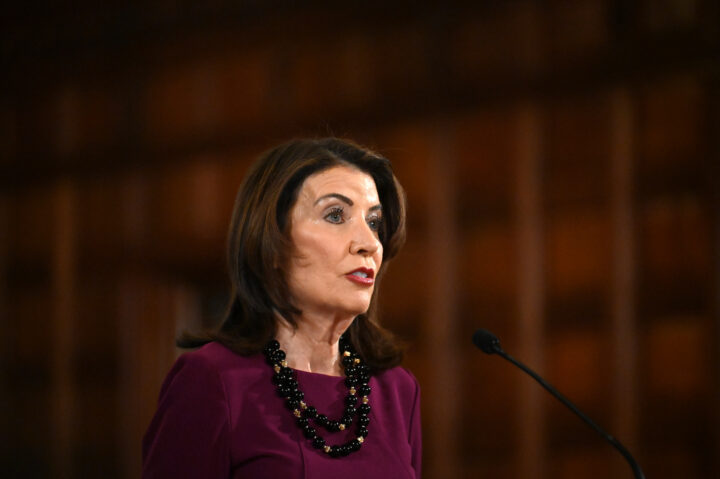
Gov. Kathy Hold takes questions following a roundtable with local government leaders on housing development on Monday, March 23, 2026, at the Capitol in Albany, N.Y.
New York Gov. Kathy Hochul issued a challenge Wednesday to those seeking to challenge her plan to penalize protesters who get too close to religious institutions — “Bring it on.”
Announcing new state programs to provide support and security for organizations deemed “vulnerable to hate crimes,” the governor, a Democrat, took questions regarding her proposal to bar demonstrations of more than two people from occurring within 25 feet of a house of worship. Violators would potentially face felony charges.
“I believe I have the right to protect people’s constitutional right to free exercise of religion,” Hochul told reporters when asked if she had concerns whether the legislation might provoke challenges on First Amendment grounds. “So if that means we test it in court, bring it on.”
Hochul’s bill, currently under consideration in the state Legislature, differs significantly from “buffer zone” legislation recently passed in the New York City Council: The municipal measure does not include new criminal penalties, but simply compels the NYPD to establish a written policy for securing access and egress for worshippers during protests. It originally suggested that police might keep rallies up to 100 feet from doorways and driveways at religious facilities, but Council Speaker Julie Menin’s team removed such language following consultations with attorneys and local law enforcement.
Observers consider the draft statute in Albany much stronger, and passing it has become a priority for leading Jewish organizations, after pro-Hamas demonstrators massed outside synagogues in Queens and Manhattan in recent months. Civil liberties groups have complained the law would restrict free speech. One reporter asked why the bill did not establish an even larger protest-free zone.
“I think 25 feet is reasonable,” Hochul said at the event.
The Supreme Court has in the past approved of limited restrictions on rallies so long as the rules are narrowly tailored and do not discriminate based on the content of demonstrators’ speech. But it also has struck down buffer-zone laws applying to abortion clinics for failing to meet those standards.
Omar is finding common cause with Greene over their anti-Israel views, even though the Republican wanted her deported from the country
Kevin Dietsch/Getty Images
Rep. Ilhan Omar (D-MN) speaks at a press conference on committee assignments for the 118th U.S. Congress, at the U.S. Capitol Building on January 25, 2023, in Washington, D.C.
Rep. Ilhan Omar (D-MN) in an interview on the “Pod Save America” podcast praised former Rep. Marjorie Taylor Greene (R-GA) — once a vocal Omar foe who called for the congresswoman’s deportation while they were both in the House — and far-right influencer Candace Owens over the pair’s break with President Donald Trump.
All three have faced repeated accusations of antisemitism. Owens, in particular, has become a propagator of rampant and often bizarre conspiracy theories, including becoming one of the most prominent antisemitic voices on the right. Greene and Owens have broken with Trump over his continued support for Israel and the war in Iran, among other issues.
“I think as Americans, it is really important for us to work together for the preservation of everything that is good in our country, and to support leaders that we can trust to safeguard what is good of our country,” Omar said, in response to a clip of Greene disavowing Trump on conspiracy theorist Alex Jones’ podcast. “And I believe the thing that has been very fascinating, especially about Marjorie and Candace, is that they are not just coming out — like the other ones that you’d mentioned — where they’re saying, ‘This action is wrong,’ right? They’re saying, ‘I am done with you.’”
“We should give them credit for that, the fact that they’ve had this wake up call to finally seeing this con man, this corrupt, chaotic man for what he is,” Omar continued. “I think is an important thing for us to put our arms around and say, ‘Yes, and now let’s figure out, how do we save our country from the disaster that this man is creating?’”
While Omar is not the first Democrat to praise Greene or to suggest that Democrats should be partnering with her, her comments are particularly notable in light of the enmity between the two women while they served in the House together.
Greene, in 2024, sought to censure Omar for allegedly working as a foreign agent on behalf of Somalia, in what Greene described as “treasonous tendencies” in violation of Omar’s oath of office.
“I would love to have her expelled. I’d love to have her deported,” Greene said at the time. “Unfortunately, I don’t think we have the votes to do that.”
Asked about the past opposition that she faced from Greene and others, Omar brushed it off as a product of their “brainwashed” cult-like devotion to Trump and his movement.
“I’m glad, as my fellow Americans, that they understand that, that they want us to chart a new chapter in America,” Omar continued.
Omar said she had approached Greene on the House floor before Greene resigned from Congress to thank her for her advocacy against Israel and opposition to U.S. support for Israel.
Plus, Mamdani's video editor heaped praise on Sinwar
Jim Watson - Pool/Getty Images
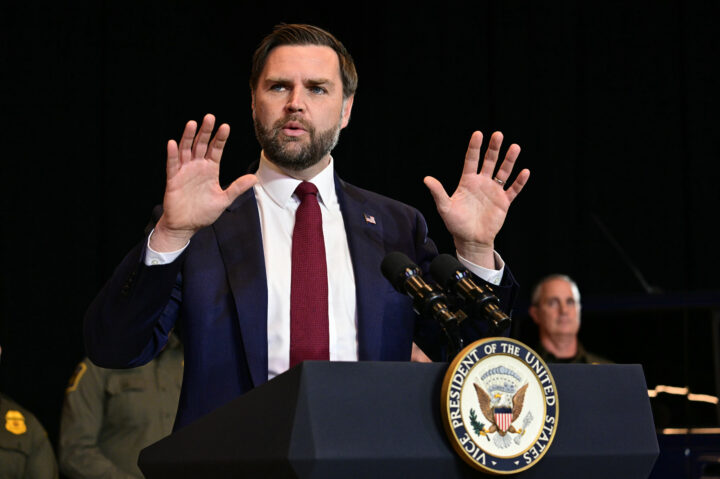
U.S. Vice President JD Vance gives remarks following a roundtable discussion with local leaders and community members amid a surge of federal immigration authorities in the area, at Royalston Square on January 22, 2026 in Minneapolis, Minnesota.
👋 Good Wednesday morning!
In today’s Daily Kickoff, we report on Vice President JD Vance telling an anti-Israel protester to blame former President Joe Biden for the situation in Gaza, which Vance called an “absolute catastrophe,” and have the scoop on social media posts from a staffer in New York City Mayor Zohran Mamdani’s office that praised slain Hamas head Yahya Sinwar. We do a deep dive into the Democratic National Committee’s Middle East working group following a failed effort to push through anti-Israel and anti-AIPAC resolutions at the DNC’s latest meeting, and report on a Yale Youth Poll that found younger voters hold decidedly more antisemitic beliefs than older generations. Also in today’s Daily Kickoff: Stephen Schwarzman, Joshua Feltman and Zach and Max Bruch.
Today’s Daily Kickoff was curated by JI Executive Editor Melissa Weiss and Israel Editor Tamara Zieve, with assists from Danielle Cohen-Kanik and Marc Rod. Have a tip? Email us here.
What We’re Watching
- Talks between the U.S. and Iran could resume in the coming days, President Donald Trump said yesterday. The president’s comments come as the Pentagon prepares to deploy some 10,000 additional troops to the region by the end of the month amid the U.S.’ maritime blockade of the Strait of Hormuz.
- The Senate is slated to vote this afternoon on a war powers resolution, as well as on legislation banning arms sales to Israel put forward by Sen. Bernie Sanders (I-VT).
- Elsewhere in Washington, U.S. Ambassador to the U.N. Mike Waltz and Jeff Bartos, the U.S. ambassador to the U.N. for management and reform, are slated to testify today before the Senate Foreign Relations Committee on U.S. priorities at the United Nations.
- Anti-Defamation League CEO Jonathan Greenblatt and Rabbi Ammiel Hirsch will hold a town hall tonight at Stephen Wise Free Synagogue to discuss antisemitism in New York City.
- In Massachusetts, Gov. Maura Healey will join representatives from Israel’s Sheba Medical Center to launch the new ARC Health Tech Accelerator in Downtown Boston.
What You Should Know
A QUICK WORD WITH JI’S MELISSA WEISS
A popular “domino effect” meme circulates online every few months, linking slain Hamas leader Yahya Sinwar’s decision to launch the Oct. 7, 2023, attacks — the smallest domino — to a series of major geopolitical shifts across the Middle East. While both simplified and exaggerated, the meme underscores the dramatic reshaping of Middle Eastern power dynamics.
The next domino may be the decades-long fraught relationship between Israel and Lebanon, as Iran’s ironclad grip over the region loosens and its most powerful proxy, Hezbollah, finds itself increasingly weakened and marginalized in Lebanon, where it has for decades played a key role in the country’s politics and military.
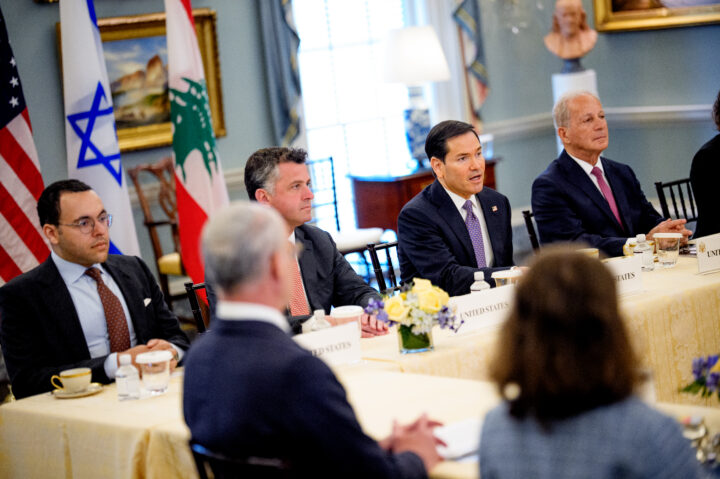
Those current geopolitical conditions — Iran at its weakest point in decades, successive levels of Hezbollah leadership removed from power through Israeli military actions, the degradation of Hamas and a new government in Syria that has separated itself from Tehran — laid the groundwork for yesterday’s State Department summit, convened by Secretary of State Marco Rubio, between Israel and Lebanon.
The State Department meeting between the ambassadors from Lebanon and Israel took place as the U.S. navigates stalled talks and a tenuous ceasefire with Iran — which was initially on unstable ground as Iran demanded that Israel cease its targeting of Hezbollah as part of the ceasefire.
A senior Israeli official told Jewish Insider on Wednesday that Iran’s effort to link the two conflicts was “a strategic trap with long-term ramifications.”
“There was real pressure to link the Lebanon front to the Iran ceasefire,” the official said. If President Donald Trump had acquiesced to the Iranian demand to link the two conflicts, the official continued, “We would not be on the path to peace that we’re on now. Keeping the arenas separate ultimately means that the fate of Lebanon is no longer dictated by Iran.”
DIRECTING FIRE

Heckled over Gaza at a Turning Point USA event on Tuesday evening, Vice President JD Vance claimed that “the humanitarian situation in Gaza was an absolute catastrophe” when President Donald Trump returned to office last January and criticized the Biden administration’s handling of the conflict, though he did not defend Israel against the attack, Jewish Insider’s Emily Jacobs reports.
What he said: An attendee at the event at the University of Georgia repeatedly shouted that the Trump administration was supporting “genocide” in Gaza by backing Israel’s war against Hamas. “You know who’s the person who got a peace agreement in Gaza? Donald J. Trump,” Vance told the heckler. “So if you want to complain about what happened in Gaza, why don’t you complain about Joe Biden and the last administration? We’re the administration that solved that problem.”
SCOOP
The architect of New York City Mayor Zohran Mamdani’s viral video campaign paid homage to the mastermind of the Oct. 7, 2023, Hamas terror attacks in a series of tweets uncovered by Jewish Insider’s Will Bredderman — posts in which the operative asserted that late Hamas military leader Yahya Sinwar “gave his entire life until the end fighting for his people’s liberation.”
Career development: Records show Donald Borenstein got paid more than $90,000 last year by the Mamdani campaign for his services as director of video — a role in which, according to his LinkedIn, he served as “primary cinematographer” for the social media imagery that propelled the democratic socialist lawmaker into Gracie Mansion. Borenstein’s Instagram indicates he has since assumed the title of “creative director” at City Hall, and he has been credited for official videos promoting the mayor and his agenda. Borenstein was also featured in a recent comedy sketch starring Mamdani and his top staffers that was shared on the official NYC Mayor’s Office YouTube channel.
DEM DIVIDES
At last week’s Democratic National Committee meeting in New Orleans, two resolutions concerning Israel were tabled, and punted to a working group tasked with building consensus among Democrats on Middle East-related issues. At a time when Democrats appear deeply divided about how to address the U.S.-Israel relationship and Middle East policy more broadly, that’s a tall order. Never mind that the members of the working group include both strongly pro-Israel and staunchly anti-Israel voices, all tasked with working to further a message that will resonate with as many party members as possible, Jewish Insider’s Gabby Deutch reports.
Working group worries: The question facing the group’s members is whether they will actually be able to agree on anything — or if the group is simply a way to push the issue off until 2028, when the party platform is again up for debate. It would not be the first bureaucratic Band-Aid applied to paper over an increasingly fraught political debate. “We are working within the framework of the Democratic platform as it is now, so anything which attempts to radically rewrite where the party has been is not something that I personally feel is appropriate,” said Andrew Lachman, a member of the working group who was previously the president of California Jewish Democrats.
MODERATION MESS

A new report reveals that Instagram failed to remove 93% of reported extremist and hateful content, tying the trend directly to Meta’s efforts to roll back content moderation last year. The changes lifted some speech restrictions, allowing incendiary content to remain on the platform, fueling what the Anti-Defamation League report calls a surge of antisemitism, Jewish Insider’s Haley Cohen reports.
Fuentes fallout: The ADL report, released on Wednesday, identified 105 accounts affiliated with white supremacist Nick Fuentes’ “groyper” network, with more than 1.4 million combined followers. Those accounts frequently posted antisemitic conspiracy theories, Holocaust denial and pro-Hitler content. The report highlights that in May 2025, shortly after the rollback, Fuentes noted that his content continues to spread on Instagram despite him personally having been banned since 2021, writing on Telegram that Instagram “relaxed its content moderation” and had “stopped taking my clips down.”
KIDS ARE NOT ALRIGHT

Younger voters are significantly more likely to hold antisemitic beliefs and critical views of Israel compared to older generations, according to a new survey. The Yale Youth Poll, an undergraduate-led research group based at Yale University, polled over 3,400 American voters, more than half of whom were under 35, between March 9-23, Jewish Insider’s Haley Cohen reports.
Generation gap: Respondents were presented with paraphrased statements on Israel from several prominent figures across the political spectrum. Among all voters, 35% agreed with the statement “America should end the slavish surrender to Israel, its wars, and its demands for foreign aid,” which is paraphrased from comments neo-Nazi podcaster Nick Fuentes made in a video. But among the youngest respondents, agreement rose to 55% of voters ages 18-22 and to 52% among those 23-29.
Campus climate: A new study on campus discrimination highlights that at least a third of Jewish, Muslim, Black and Asian students have encountered hate and hostility at their universities.
WAR WEARY
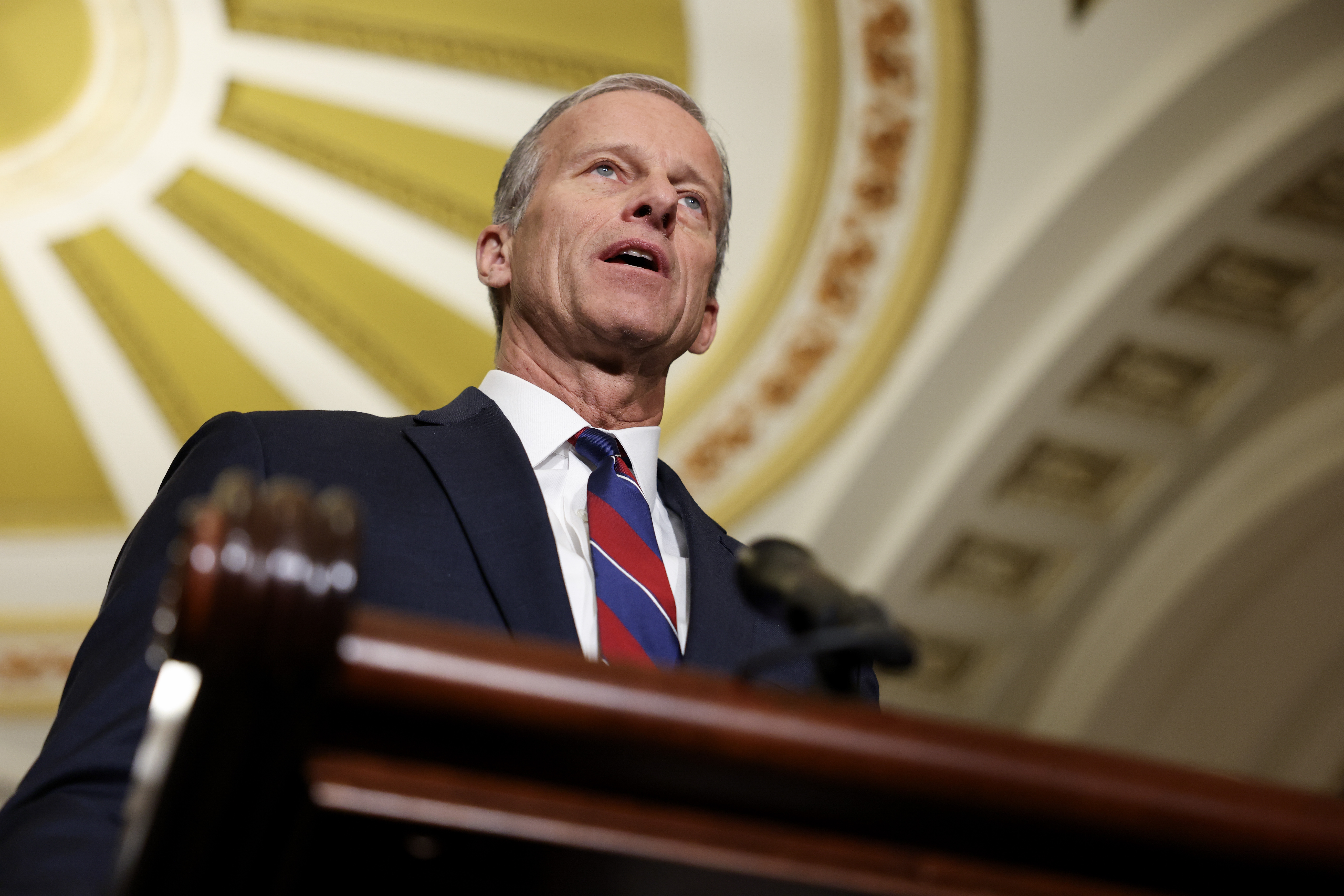
Senate Majority Leader John Thune (R-SD) said Tuesday that he’s hopeful that the war in Iran is close to winding down, in advance of a deadline that could require congressional action for the war to continue, Jewish Insider’s Marc Rod reports. Under the War Powers Act, unilateral military action undertaken by the president without congressional authority is limited to 60 days — with a 30-day extension for draw-down purposes.
What he said: Pressed on whether Republicans would be open to voting to continue the war if it extends beyond 90 days, Thune suggested that wouldn’t be necessary. “At this point, most of us, I believe, feel pretty good about what the American military has achieved there in terms of its objectives,” Thune said. “It’s a hypothetical down the road. … I think the administration has a clear objective, a clear plan, and if they can execute on it, hopefully that question won’t be a necessary one that we’ll have to answer.”
Meeks’ move: Rep. Greg Meeks (D-NY) said he’s aiming to call up a war powers resolution this week to force an end to the war in Iran, but that he’s still working to lock down the support of a few wavering Democratic and Republican lawmakers whose support will be necessary to pass the legislation.
Worthy Reads
Same as the Old Boss: The Wall Street Journal’s Margherita Stancati, Benoit Faucon and Henna Moussavi look at the maximalist, hard-line positions of the new upper echelon of Iranian leadership, overseen by Iranian Supreme Leader Mojtaba Khamenei. “[The supreme leader] relies on a network of trusted allies that analysts call the Habib Circle. Its members include many veterans of the war with Iraq who served in the Revolutionary Guard’s Habib Battalion, renowned for attracting radicals and named after a seventh-century figure in Shia Islam revered for sacrificing his life in battle. Its recruits included Khamenei himself, who was a teenager when he enlisted toward the end of the war. … The new leadership has proved resilient and adaptable, emerging from the first five weeks of the war with its command and control intact. Their hard-line approach is evident in their appointments.” [WSJ]
Best Chance for Beirut: The Washington Post’s Carine Hajjar posits that the Lebanese government is in a position to take decisive action against both Iran and its Hezbollah proxy. “With the leadership of Hezbollah’s Iranian sponsors in disarray, Lebanon may never get a better chance to reclaim its sovereignty. … Even if the Lebanese are frustrated with Israel striking their country, ‘there’s a reason why these Israeli rockets are falling on us,’ Makram Rabah, an assistant history professor at the American University of Beirut, told me. The Israelis have been clear with the Lebanese: They won’t accept an armed Hezbollah, and if Beirut won’t act, they will.” [WashPost]
The Piker Problem: In his Substack “Identity Crisis,” Shalom Hartman Institute President Yehuda Kurtzer weighs in on the recent decision by The New York Times’ Ezra Klein to platform far-left streamer Hasan Piker. “Liberals must not decide that they need the ugliest forms of illiberalism in order to try to restore our fragile and collapsing liberal order. This was true when it involved defending a US senator hoping to impose martial law on American cities, and it is true now when it involves the demagogue-ing of our public square and the soft-pedaling of antisemitism. On both sides, violence is the tool of authoritarianism, and the enemy of the liberal project. Piker’s very project involves the delegitimating of the very liberal order by whose rules Klein is playing.” [IdentityCrisis]
Word on the Street
France and the U.K. are drafting a postwar plan that would free up shipping through the Strait of Hormuz and would include mine-clearing technology and military escorts through the waterway; the plan, which European officials will meet to discuss later this week, would require the approval of Iran and likely exclude the U.S….
Blackstone’s Stephen Schwarzman met this week in New York with Qatari Finance Minister Ali bin Ahmed Al Kuwari…
The Financial Times reports that Iran clandestinely acquired China’s TEE-01B spy satellite, which it used to target U.S. bases during the recent war…
Rep. Jamie Raskin (D-MD) and 50 House Democrats introduced a bill to create a commission to assess President Donald Trump’s potential removal from office under the 25th Amendment, a move prompted in part by the Iran war. Efforts to remove Trump under the provision are almost certainly doomed to fail…
Sen. Jerry Moran (R-KS) urged the administration not to renew oil sanctions waivers on Russia and Iran; “Iran continues to reap significant revenue due to its current waiver, providing financial relief to an adversary we are actively fighting. Any additional waivers for Russia or Iran would be against our national interests,” Moran said…
Citing an “unprecedented and escalating threat environment facing religious communities and institutions” across the country, a coalition of Jewish groups, joined by organizations representing a range of other faiths, is urging Senate and House leaders to significantly expand funding for the Nonprofit Security Grant Program to “up to $1 billion,” Jewish Insider’s Marc Rod reports…
The Wall Street Journal looks at recent clashes between President Donald Trump and Pope Leo XIV, suggesting that the pontiff “has been building broad support within the global church for his course, which combines advocacy for peace and dialogue with a stronger emphasis on traditional Catholic doctrines”…
The Michigan arm of the powerful SEIU labor union announced on Tuesday that it had rescinded its endorsement of Amir Makled, an attorney running for the University of Michigan board of regents, in light of Makled’s deleted social media posts praising the terrorist group Hezbollah, JI’s Gabby Deutch reports…
Law firm Kirkland & Ellis has reportedly offered a three-year, $80 million package to Joshua Feltman, the chair of Wachtell Lipton’s corporate restructuring and finance department…
Portland Trail Blazers guard Deni Avdija hit the game-winning three-point shot to lead Portland over the Phoenix Suns in the NBA’s play-in game and into the NBA playoffs; the Israeli NBA star scored 41 points, and tallied 12 assists and 7 rebounds…
The Harvard Crimson reports that Harvard has yet to release a report on antisemitism that was mandated by its January 2025 settlement with the Louis D. Brandeis Center for Human Rights Under Law…
The University of Pennsylvania requested a stay of a judge’s order requiring the school to turn over names of Jewish employees of the school to the Trump administration’s Equal Employment Opportunity Commission…
The New York Times spotlights the growing interest from private equity firms in local bagel shops that can be developed and scaled…
MyPrize co-founders and brothers Zach and Max Bruch made a $360,000 donation to establish an endowment for Olami Manhattan to support the group’s efforts to bring young Jewish adults to visit Auschwitz and Birkenau, eJewishPhilanthropy’s Jay Deitcher reports…
Axel Springer received approval from U.K. Culture Secretary Lisa Nandy to purchase The Telegraph, clearing a major hurdle in the German company’s £575m effort to acquire the British publication…
Days after U.K. authorities revoked Kanye West’s permission to enter the country for a now-canceled music festival over his past antisemitic remarks, French authorities are weighing a similar ban on the artist, who is set to perform in Marseille in June…
Dublin Mayor Ray McAdam apologized to the city’s Jewish community for a series of administrative and procedural errors around a failed effort to rename the city’s Herzog Park, which was named after former Israeli President Chaim Herzog, the father of President Isaac Herzog, who was born in Belfast and raised in Dublin…
Italian Prime Minister Giorgia Meloni announced that the country would suspend the automatic renewal of its defense cooperation agreement with Israel, prompting President Donald Trump to rail against Meloni, who has thus far been an ally of his, telling an Italian outlet he’s “shocked by her. I thought she was brave, but I was wrong. … It’s her who’s unacceptable, because she doesn’t care if Iran has a nuclear weapon and would blow up Italy in two minutes if it had the chance”…
Italian entrepreneur Adriano Goldschmied, who developed dozens of brands of denim jeans, died at 82…
Pic of the Day

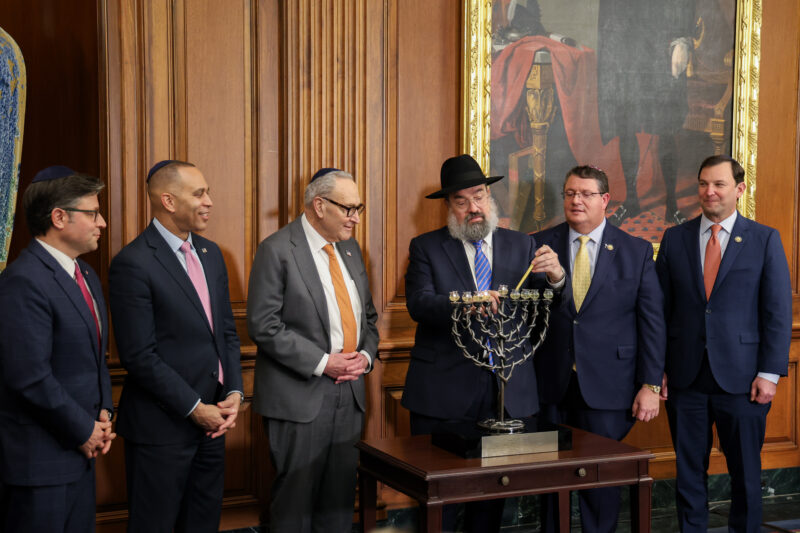
Congressional leaders, newly appointed U.S. Holocaust Memorial Museum Board Chair Jeff Miller, Commerce Secretary Howard Lutnick and others spoke alongside Holocaust survivors on Capitol Hill on Tuesday at the U.S.’ annual commemoration of Yom HaShoah, JI’s Marc Rod reports.
Birthdays

Retired U.S. astronaut and a veteran of five space shuttle missions, Marsha Sue Ivins turns 75…
Psychiatrist, entrepreneur, movie producer and philanthropist, Dr. Henry George Jarecki turns 93… Former 15-term member of the U.S. House of Representatives from California, Howard Lawrence Berman turns 85… Duke University professor, physician, biochemist and Nobel Prize laureate in 2012, Robert Lefkowitz turns 83… Retired U.S. Army chaplain who attained the rank of lieutenant colonel, Rabbi Alan Sherman… Professor of German and comparative literature at New York University, Avital Ronell turns 74… Israeli Breslov rabbi and founder of Chut Shel Chessed Institutions, Shalom Arush turns 74… Former city controller of Philadelphia for 12 years, following 16 years as a member of the Pennsylvania House of Representatives, Alan Butkovitz turns 74… CEO of DMB Strategic, David Brand… Founder and director of the graduate school in the decorative arts at Bard College in Dutchess County, N.Y., Susan Weber turns 71… Deputy counsel at the NYS Department of Taxation and Finance, Deborah R. Liebman… Former executive director at American Press Institute, he is the author of 10 books, including three novels, Tom Rosenstiel turns 70… Born in NYC, now living in Jerusalem, he is the rebbe of the Boyan Hasidic dynasty (a position he assumed in 1984 when he was 25), Rabbi Nachum Dov Brayer turns 67… Former deputy secretary of the Treasury during the Obama administration following four years as a member of the Federal Reserve Board of Governors, Sarah Bloom Raskin turns 65… Winner of 12 Olympic medals at five different Olympic Games, Dara Grace Torres turns 59… Managing partner, CEO and chief investment officer of Hudson Bay Capital Management, Sander R. Gerber… CEO of the New Israel Fund since 2009 on sabbatical this year, prior to that he was the executive director of the Jewish Community Federation of San Francisco, Daniel Sokatch turns 58… Cheryl Myra Cohn… Senior fellow at the Carnegie Endowment for International Peace and founder of the Truman National Security Project, Rachel Kleinfeld, Ph.D…. Head coach of the UC Santa Barbara Gauchos basketball program, Joe Pasternack turns 49… Senior political correspondent at The Hill, Amie Parnes turns 49… CEO of the American Fintech Council, Y. Phillip Goldfeder turns 45… Actor, comedian, writer, producer and director, Seth Rogen turns 44… CEO of the Jewish Community Relations Council of New York, Mark Treyger turns 44… Co-founder and co-CEO of theSkimm, Carly Zakin… Research manager at the Foundation for Defense of Democracies, David May… Director of grants and operations at the Foundation for Middle East Peace, Kristin McCarthy… Founder and CEO of Neue Urban, Zach Ehrlich… Social entrepreneur, environmental activist and human rights activist, Erin Schrode… Israeli singer, songwriter, rapper and record producer, Jasmin Moallem turns 31… Moshe Lehrer…
The Oct. 7 mastermind died in ‘heroic’ style, according to Donald Borenstein, director of video for the Mamdani campaign and City Hall

Michael M. Santiago/Getty Images
New York City Democratic mayoral candidate Zohran Mamdani is seen in a supporters mobile phone at his election night watch party on November 4, 2025 in New York City.
The architect of New York City Mayor Zohran Mamdani’s viral video campaign paid homage to the mastermind of the Oct. 7, 2023, Hamas terror attacks in a series of tweets uncovered by Jewish Insider — posts in which the operative asserted that late Hamas military leader Yahya Sinwar “gave his entire life until the end fighting for his people’s liberation.”
Records show Donald Borenstein got paid more than $90,000 last year by the Mamdani campaign for his services as director of video — a role in which, according to his LinkedIn, he served as “primary cinematographer” for the social media imagery that propelled the democratic socialist legislator into Gracie Mansion.

Borenstein’s Instagram indicates he has since assumed the title of “creative director” at City Hall, and he has been credited for official videos promoting the mayor and his agenda. Borenstein was also featured in a recent comedy sketch starring Mamdani and his top staffers that was shared on the official NYC Mayor’s Office YouTube channel.
Yet despite receiving attention from The New York Times and New York Post as a member of Mamdani’s inner circle, Borenstein’s profile online has largely escaped notice so far.

Archives of his X account show that in 2024, a day after Sinwar was killed by the IDF, Borenstein described imagery of his death, captured in Israeli drone footage, as “absolutely overflowing with symbolism.”
“[I]nsanely funny that israelis are so genocidally up their own ass that they have basically hand-delivered one of the most heroic possible images they could here lmao,” Borenstein wrote from his X handle @boringstein on Oct. 17, 2024, and just a few months before Borenstein began working for Mamdani’s campaign.
Borenstein appears to have deleted this tweet, and all others referenced in this story, at some later point, though archived images remain accessible.
Federal Election Commission filings show that a few months before the posts, Borenstein wrapped up work for another politician highly critical of Israel: then-Rep. Jamaal Bowman (D-NY), who was serving out the last few months of his term after he lost his reelection to a primary challenge from Rep. George Latimer (D-NY).
The cinematographer further mocked the Israeli decision to release the video of Sinwar sitting on a couch and tossing a stick at the drone moments before he was killed.
“‘[S]urely this man who gave his entire life until the end fighting for his people’s liberation with no proxy will look bad when we show footage of his last stand,’” Borenstein wrote sarcastically, concluding a third post with the phrase “From the river to the sea,” often understood as calling for the annihilation of the entirety of Israel between the Jordan and the Mediterranean, and three Palestinian flag emojis.

When one reply compared the terrorist with Tom Hanks’ character in the movie “Saving Private Ryan,” the cinematographer responded with enthusiasm.
“[I]n earnest!!! you could not direct this better lol,” Borenstein replied. “[I] am honestly so deeply moved.”
In another since-deleted tweet, Borenstein wrote that “the fascist state of Israel will fall in our lifetimes.”
Neither the video producer nor the Mamdani team responded to questions about the tweets.
Borenstein is one of several figures instrumental in Mamdani’s rise whose social media accounts feature explicit support for Sinwar and the terrorist organization he led, even though the mayor has condemned terrorism personally.
In February, JI reported that the co-founder of the independent “Hot Girls for Zohran” social media and canvassing campaign had also shared multiple pro-Hamas posts. In March, JI reported that Mamdani’s wife Rama Duwaji — whom The Cut described as a “de facto adviser” to the mayor’s campaign — had liked posts on Instagram celebrating the Oct. 7 attacks.
Of 150 reported accounts and 103 reported posts linked to white supremacist networks, designated Foreign Terrorist Organizations and vendors selling Nazi merchandise, Instagram removed only 11 accounts and 8 posts

Ismail Kaplan/Anadolu via Getty Images
Instagram logo displayed on a mobile phone screen in front of a computer screen displaying Meta logo in Ankara, Turkiye, on April 10, 2026.
A new report reveals that Instagram failed to remove 93% of reported extremist and hateful content, tying the trend directly to Meta’s efforts to roll back content moderation last year. The changes lifted some speech restrictions, allowing incendiary content to remain on the platform, fueling what the Anti-Defamation League report calls a surge of antisemitism.
The ADL report, “How Meta’s Content Moderation Changes Risk Turning Instagram into a Hub for Hate,” released on Wednesday, identified 105 accounts affiliated with white supremacist Nick Fuentes’ “groyper” network, with more than 1.4 million combined followers. Those accounts frequently posted antisemitic conspiracy theories, Holocaust denial and pro-Hitler content.
The report highlights that in May 2025, shortly after the rollback, Fuentes noted that his content continues to spread on Instagram despite him personally having been banned since 2021, writing on Telegram that Instagram “relaxed its content moderation” and had “stopped taking my clips down.”
Oren Segal, ADL’s senior vice president for counter-extremism and intelligence, said that the proliferation of antisemitism on Instagram is a direct outcome of the changes in policy at Meta, its parent company.The rollback included ending the platform’s third-party fact-checking program and replacing it with a system modeled after the community notes feature on Elon Musk’s X.
At the time, some Jewish leaders expressed concern that the move would “open the floodgates to content” that could target Jewish communities and individuals, and called the decision a “step back” in the fight against rising antisemitism.
Meta had said the relaxed guidelines aim to “allow more speech by lifting restrictions on some topics that are part of mainstream discourse.” Meta, also the owner of Facebook and WhatsApp, simultaneously said that it planned to crack down on “high severity violations,” such as pro-terrorism content. Meta CEO Mark Zuckerberg cited the results of the 2024 U.S. presidential election as the underlying decision to move to a “community note” model, calling it a “cultural tipping point towards, once again, prioritizing speech.” Zuckerberg said that third-party moderators were “too politically biased” and it was “time to get back to our roots around free expression.”
“When a platform used by 80 percent of American adults under 30 allows pro-Hitler content to rack up millions of views, Holocaust denial to spread unchecked and terrorist organizations to fundraise openly, we’re not talking about a policy disagreement,” said Segal. “We’re talking about a public safety crisis. Mark Zuckerberg acknowledged Meta would ‘catch less bad stuff’ after the rollback. Our research proves he was right, and the consequences are deeply concerning.”
Furthermore, the study found more than 340,000 followers across accounts directly or indirectly linked to U.S.-designated Foreign Terrorist Organizations, including the Popular Front for the Liberation of Palestine. It also identified more than 3.2 million views on content from a single extremist merchandise vendor selling apparel with Nazi symbols including Sonnenrads, Totenkopfs and SS bolts.
The ADL Center on Extremism researchers conducted testing between January and February 2026, by reporting 253 pieces of violative content through Instagram’s standard user reporting system. Of 150 reported accounts and 103 reported posts linked to white supremacist networks, designated Foreign Terrorist Organizations and vendors selling Nazi merchandise, Instagram removed 11 accounts and 8 posts. In 20 cases, Instagram explicitly stated it lacked the bandwidth to review the reports, according to the ADL.
According to Meta’s Community Standards, the company does not allow “organizations or individuals that proclaim a violent mission or are engaged in violence to have a presence on our platforms.” The company asserts that it removes any glorification or support of designated Foreign Terrorist Organizations, Specially Designated Global Terrorists, and any groups that organize or advocate for violence against civilians, including Taliban, ISIS and Al-Qaida.
Despite this official policy, ADL researchers found many active accounts that praise these groups, identifying at least 23 accounts that spread Islamic State and Al-Qaida propaganda. The accounts often post an image or video that glorifies organizations that meet Meta’s terrorism definition with caption text that is unrelated to the subject matter — like a synopsis of the movie “Home Alone” or gardening advice — potentially in an effort to evade detection.
A spokesperson for Meta told Jewish Insider after the report was released that “over two-thirds of the accounts and posts flagged by the ADL were removed prior to the publication of this report, while some did not violate our policies.” ADL told JI its figures were based on a two-week window from submitting a report to getting a response from the platform.
The 14-page report was released shortly before an upcoming Meta shareholder vote, scheduled for the end of May.
Last month, an AI-generated Instagram account called “Rabbi Goldman,” which featured a fake Orthodox rabbi spreading antisemitic conspiracies to its more than 1.4 million followers, was taken offline following major backlash from Jewish groups and one Democratic lawmaker — yet several similar, hate-peddling accounts have emerged with little to no public action from Meta.
This report was updated on April 15 to include a statement from Meta.
The current geopolitical conditions laid the groundwork for yesterday’s State Department summit
Andrew Harnik/Getty Images
U.S. Secretary of State Marco Rubio (2nd-R), accompanied by U.S. State Department Counselor Michael Needham (C), and U.S. Ambassador to Lebanon Michel Issa (R), speaks as they begin working-level peace talks with Lebanese Ambassador to the U.S. Nada Hamadeh Moawad and Israeli Ambassador to the U.S. Yechiel Leiter at the U.S. State Department on April 14, 2026 in Washington, DC.
A popular “domino effect” meme circulates online every few months, linking slain Hamas leader Yahya Sinwar’s decision to launch the Oct. 7, 2023, attacks — the smallest domino — to a series of major geopolitical shifts across the Middle East. While both simplified and exaggerated, the meme underscores the dramatic reshaping of Middle Eastern power dynamics.
The next domino may be the decades-long fraught relationship between Israel and Lebanon, as Iran’s ironclad grip over the region loosens and its most powerful proxy, Hezbollah, finds itself increasingly weakened and marginalized in Lebanon, where it has for decades played a key role in the country’s politics and military.
Those current geopolitical conditions — Iran at its weakest point in decades, successive levels of Hezbollah leadership removed from power through Israeli military actions, the degradation of Hamas and a new government in Syria that has separated itself from Tehran — laid the groundwork for yesterday’s State Department summit, convened by Secretary of State Marco Rubio, between Israel and Lebanon.
The State Department meeting between the ambassadors from Lebanon and Israel took place as the U.S. navigates stalled talks and a tenuous ceasefire with Iran — which was initially on unstable ground as Iran demanded that Israel cease its targeting of Hezbollah as part of the ceasefire.
A senior Israeli official told Jewish Insider on Wednesday that Iran’s effort to link the two conflicts was “a strategic trap with long-term ramifications.”
“There was real pressure to link the Lebanon front to the Iran ceasefire,” the official said. If President Donald Trump had acquiesced to the Iranian demand to link the two conflicts, the official continued, “We would not be on the path to peace that we’re on now. Keeping the arenas separate ultimately means that the fate of Lebanon is no longer dictated by Iran.”
Former Israeli Prime Minister Naftali Bennett — now mounting a comeback bid ahead of elections later this year — has often used the “Octopus Doctrine” to describe a security approach to tackling Iran’s decades-long control over the region. Cut off the head of the octopus — Tehran — and the tentacles will be easier to tackle, the logic goes.
Israel, having severed the metaphorical octopus’ head on the opening day of the recent war with Iran, is now continuing its work to degrade and dismantle Iranian proxies — a process that began two and a half years ago, triggered by the Oct. 7 attacks.
“One of the most significant developments in the Middle East since Oct. 7 has been the steady dismantling of that axis — separating arenas that sought to bind their fates together,” the senior Israeli official said.
The talks are not without risk. Lebanese Prime Minister Nawaf Salam called off a planned trip to the U.S. over the weekend out of concerns of potential domestic unrest — amid the still very real risk that Hezbollah, albeit weakened, could attempt a power grab in his absence. Recall that in 2005, former Lebanese Prime Minister Rafic Hariri was killed in a car bombing, with a Hezbollah operative convicted by a U.N. tribunal in absentia for the assassination.
The talks were hailed by Israeli Ambassador to the U.S. Yechiel Leiter, who said that the parties “discovered today that we’re on the same side of the equation” and “are both united in liberating Lebanon from an occupation power dominated by Iran called Hezbollah.”
Rubio delivered a measured assessment of the goals of yesterday’s talks: “This is about bringing a permanent end to 20 or 30 years of Hezbollah’s influence in this part of the world,” he said at a roundtable ahead of the meeting. “This will take time, but we believe it is worth this endeavor.”
Beirut has in recent years — and with varying degrees of seriousness and success — worked to disentangle itself from Iran and Hezbollah. Now, the U.S.-Israeli military pressure on Iran, combined with the Trump administration’s zest for dealmaking and the degradation of Hezbollah, could create the right environment to bring peace to the Mediterranean Riviera.
The organizations cited the ‘unprecedented and escalating threat environment’ facing religious communities

Emily Elconin/Getty Images
Members of Hatzalah of Michigan, a Jewish volunteer emergency medical service survey the area near Temple Israel following reports of an active shooter on March 12, 2026 in West Bloomfield, Michigan.
Citing an “unprecedented and escalating threat environment facing religious communities and institutions” across the country, a coalition of Jewish groups, joined by organizations representing a range of other faiths, is urging Senate and House leaders to significantly expand funding for the Nonprofit Security Grant Program.
“We write as a broad coalition of faith-based and cultural organizations to express our deep concern about the unprecedented and escalating threat environment facing religious communities and institutions across the United States. This threat is not abstract; it is very real and felt by the communities we represent on a daily basis,” the groups wrote in a letter, led by the American Jewish Committee, to the top leaders of each chamber.
They said that faith-based institutions “should be able to solely focus on serving and strengthening their communities, but in this heightened threat environment, they instead must also worry about the next attack and whether they have the resources to stay safe,” and that members of targeted religious communities are forced to “weigh the risk of violence against the act of worship.”
The letter urges Congress to provide “up to $1 billion” for the NSGP — a significant expansion of funding from its 2025 funding level of $274.5 million, and the proposed 2026 funding level of $300 million.
“Previous funding has not kept pace with demand,” the groups wrote. “More must be done to bolster this program; therefore, we encourage you to engage with communities in your district and to encourage the same of your respective caucuses. We have no doubt you’ll hear about the fear and threats our communities are facing at this moment, and therefore, we urge you to allocate appropriate resources to address this threat.”
The religious organizations also urged swift passage of the long-gestating Pray Safe Act, which would create a centralized federal clearinghouse to provide security guidance to religious institutions, including training resources and information about available grant opportunities.
Additional Jewish organizational signatories included the Anti-Defamation League, the Conference of Presidents of Major American Jewish Organizations, Hillel International, the JCC Association of North America, the Jewish Federations of North America, the Rabbinical Assembly, the Union for Reform Judaism, the Orthodox Union and the United Synagogue of Conservative Judaism.
They were joined by groups representing the Muslim, Lutheran, Greek Orthodox, Hindu, Evangelical, Seventh-day Adventist, Sikh and Catholic communities.
Majority Leader Thune said about a congressional vote to extend the war, ‘hopefully that question won't be a necessary one that we’ll have to answer’

Kayla Bartkowski/Getty Images
Sen. Majority Leader John Thune (R-SD) calls on reporters at the U.S. Capitol on January 14, 2025 in Washington, DC.
Senate Majority Leader John Thune (R-SD) said Tuesday that he’s hopeful that the war in Iran is close to winding down, in advance of a deadline that could require congressional action for the war to continue.
Under the War Powers Act, unilateral military action undertaken by the president without congressional authority is limited to 60 days — with a 30-day extension for draw-down purposes.
Thune emphasized that the administration’s current goal is to reopen the Strait of Hormuz, and that Senate Republicans support efforts to isolate the Iranian regime and their economy.
“We get the strait open again — and that’s sort of their last resort. The military effort here has been extraordinarily successful. This is sort of the last dying gasp of this regime, is to try and shut down the strait,” Thune said in a press conference after a GOP conference meeting. “The administration is making an effort to ensure that it’s open, that there’ll be traffic in and out there. And hopefully that will be successful and we can begin to see this thing wind down.”
Pressed on whether Republicans would be open to voting to continue the war if it extends beyond 90 days, Thune suggested that wouldn’t be necessary.
“At this point, most of us, I believe, feel pretty good about what the American military has achieved there in terms of its objectives,” Thune said. “It’s a hypothetical down the road. … I think the administration has a clear objective, a clear plan, and if they can execute on it, hopefully that question won’t be a necessary one that we’ll have to answer.”
Sen. Mike Rounds (R-SD) said that it’s “not quite time” yet for a full Senate discussion on the war, but said that he does want to see the administration more fully lay out its strategy and plan as the war continues and approaches the 60-day deadline at the end of April.
“We do expect that the administration will be laying out their plan for after the end of seven, eight, nine weeks,” Rounds said. “We have to know what the next steps are, and that’s part of our due diligence that we have to do.”
Sen. Steve Daines (R-MT) said that Republicans did not discuss the possibility of an authorization for the war during their meeting.
Other Republicans have argued that the provision of the War Powers Act that sets out the 60-day deadline, is not enforceable and that Republicans on Capitol Hill are not paying attention to it.
Sen. Lindsey Graham (R-SC) said that the U.S. should “finish the job” rather than extending a ceasefire agreement with Iran if the regime is not willing to agree to U.S. demands, including a permanent end to nuclear enrichment, surrendering all of its already enriched uranium, fully reopening the strait and abandoning its ballistic missile program and support for terrorism.
Senate Minority Leader Chuck Schumer (D-NY) said that Senate Democrats plan to bring forward another war powers resolution to stop the war on Wednesday, and will continue to force votes on similar resolutions weekly until the war ends. For now, most Republicans seem likely to continue to vote against the legislation.
Senate Republicans also indicated that they’re not likely to attempt to include supplemental funding for the Iran war in an upcoming partisan budget reconciliation package, which is focused on border security and immigration funding currently being blocked by Democrats.
Thune, who has said he wants an “anorexic-like” reconciliation package, again indicated on Tuesday at a press conference after a Senate Republican lunch meeting that the package will be tightly “focused” to fund immigration enforcement.
“I think we’re going to do a very skinny reconciliation,” Sen. Roger Wicker (R-MS), the chair of the Senate Armed Services Committee, said when asked about Republicans’ discussions on Iran during the conference meeting.
Sen. John Kennedy (R-LA) said that he has not heard anything about either the timing or the size of the supplemental request the administration plans to submit. Initial reports indicated that the Pentagon wanted to ask for $200 billion, but more recent reports have indicated that the final request will be lower.
Republicans have discussed advancing another reconciliation package before the end of the year, though some members of the conference, like Kennedy, have openly expressed skepticism that such an effort would be possible.
At this point, given the strong and widespread opposition among Democrats to the war in Iran, it’s unclear whether a funding package for the war would be able to clear the 60-vote filibuster threshold necessary for passage in the Senate.
Howard Lutnick: ‘We are here because the victims of the Holocaust can continue to remind us that apathy must be overcome by meaning, neglect supplanted by remembrance and indifference surmounted by love’

Courtesy Lois Frankel
Commerce Secretary Howard Lutnick, congressional leaders, newly appointed U.S. Holocaust Memorial Museum Board Chair Jeff Miller and others spoke alongside Holocaust survivors on Capitol Hill on Tuesday at the U.S.’ annual commemoration of Yom HaShoah.
At the event, House Speaker Mike Johnson (R-LA) and other lawmakers presented a congressional gold medal — Congress’ highest honor — to the family of Benjamin Ferencz, the youngest of the U.S. prosecutors at the Nuremberg trials. Ferencz’s daughter, accepting the award, echoed her father’s motto — ”law, not war” — also imprinted on the medal itself.
In his remarks, Lutnick said that “President [Donald] Trump has shown through action, not just words but bold action, that he is the greatest friend of the Jewish people,” pointing the president’s work to free the hostages who were still in captivity in Gaza on Yom HaShoah last year.
Lutnick also recounted his visit last year to Poland, where he commemorated the liberation of Auschwitz and Birkenau, an experience that “left an indelible impression on my wife and me.” He drew a line from those atrocities to the 9/11 attacks, in which Lutnick, the former CEO of Cantor Fitzgerald, lost friends, family and many of his colleagues.
“Both groups of the fallen are made up of common heroes whose memory on earth will be lost if not for the determined effort by organizations like the Holocaust Memorial Museum to keep their legacy alive and ensure that the refrain ‘Never Again’ echoes for generations to come,” Lutnick continued. “We are here because the victims of the Holocaust can continue to remind us that apathy must be overcome by meaning, neglect supplanted by remembrance and indifference surmounted by love.”
Miller, a lobbyist who was recently appointed to replace former Ambassador Stuart Eizenstat as the Museum’s board chair, described Holocaust remembrance and the mission of the museum as a critical duty.
“The fight against antisemitism and Holocaust denial is one of the defining moral challenges of our time,” Miller said. “For as long as the museum stands, as long as the truth of the Holocaust is taught, and as long as the people of conscience refuse to surrender to hatred, the [forces] of antisemitism, will find that they have not awakened our fear, but our unbreakable will and our determination to never, ever surrender in the fight against evil.”
Miller also acknowledged the rampant and growing modern problem of antisemitism. He warned that Holocaust denialism has been spreading, particularly online, that antisemitism has returned “not quietly, but openly,” with Hamas’s Oct. 7, 2023, attacks serving as a “brutal reminder of what happens when hatred of Jews is allowed to go unchecked,” and Jews facing attacks and feeling afraid globally.
He said that he’s seen his own daughters face antisemitism on their college campuses, a challenge that “demands leadership, moral clarity and action.”
Then-Gen. Dwight D. Eisenhower’s warning at the end of World War II that some would eventually try to deny the Holocaust, “has become reality,” Miller said.
“The Holocaust demonstrates that hate began with the Jews but did not end with the Jews. That lesson cannot be more urgent today, and that is why the work of the United States Holocaust Memorial Museum matters so deeply,” Miller said. “Antisemitism has once again shown its face in our time with shocking boldness. Let the world hear this clearly: We will confront it. We will expose it, and we will defeat it, because the promise of Never Again is not negotiable.”
Miller offered particular thanks to Trump, calling him the greatest friend of the Jewish people and Israel, saying that the Jewish people “owe President Trump a lifetime of gratitude” for his efforts to free the hostages in Gaza and push back against antisemitism on college campuses and elsewhere.
But he also said that the challenge of antisemitism goes beyond any institution, individual or administration, and is instead a question of “the responsibilities of free people in every generation,” emphasizing that the Holocaust began with “lies, with propaganda, with conspiracy theories.”
Johnson highlighted modern manifestations of antisemitism particularly on college campuses and in support for the Oct. 7, 2023, Hamas terrorist attacks on Israel.
“Today, the work is even more important than ever, not only because those who personally witnessed this tragedy grow fewer in number each year, but because denying and distorting the truth of the Holocaust has become something, once again, that is tolerated and in some cases, even defended,” Johnson said. “On college campuses, leaders of once respectable institutions have excused hateful ideas as ‘context.’ The flags of radical Islamic terrorist groups have become commonplace on campus quadrangles, and safe spaces are reserved not for the Jewish students threatened by physical violence on those campuses, but for those who chant ‘From the river to the sea’ and ‘Long live Hamas.’”
He said that these “dangerous ideologies” have “dangerous consequences.”
House Minority Leader Hakeem Jeffries (D-NY) emphasized that neutrality and silence are not options in the face of antisemitism.
“It’s important that we continue to take a side,” Jeffries said. “We have no other moral choice, because we know the violent and deadly history and reality of antisemitism. Jewish life has included, for thousands of years, pain, pogroms, persecution, prejudice, expulsions, the terrorist attack on Oct. 7 and the Holocaust. Never again must always mean never again.”
Senate Minority Leader Chuck Schumer (D-NY) highlighted the need to call out antisemitism wherever it arises.
“We must continue to keep our eyes open today, at a time when antisemitism sadly runs rampant around the world once again,” Schumer said. “The responsibility falls on all of us. We must remember how the Holocaust happened, how too many stood silent in the face of evil, and how the death of democracy in Europe enabled the death of 6 million Jews. The poisons of fascism and antisemitism come from the same vial.”
Other lawmakers who spoke included Reps. Lois Frankel (D-FL) and Joe Wilson (R-SC) and Sen. Kirsten Gillibrand (D-NY), who led the legislation awarding Ferencz with the gold medal. Sarah Bloomfield, the director of the USHMM, delivered remarks on behalf of Ferencz’s son, and several Holocaust survivors shared their stories as well.
Speaking at a Turning Point USA event, Vance said ‘the humanitarian situation in Gaza was an absolute catastrophe’ when Trump entered office last January

Chip Somodevilla/Getty Images
Vice President JD Vance (R) speaks with Turning Point USA spokesperson Andrew Kolvet during a Turning Point USA event at Akins Ford Arena at the Classic Center on April 14, 2026 in Athens, Georgia.
Heckled over Gaza at a Turning Point USA event on Tuesday evening, Vice President JD Vance claimed that “the humanitarian situation in Gaza was an absolute catastrophe” when Trump returned to office last January and criticized the Biden administration’s handling of the conflict, though he did not defend Israel against the attack.
An attendee at the event at the University of Georgia repeatedly shouted that the Trump administration was supporting “genocide” in Gaza by backing Israel’s war against Hamas.
“You know who’s the person who got a peace agreement in Gaza? Donald J. Trump,” Vance told the heckler. “So if you want to complain about what happened in Gaza, why don’t you complain about Joe Biden and the last administration? We’re the administration that solved that problem.”
“Right now, you see more humanitarian aid coming into Gaza than … any time in the past five years because we have taken that situation seriously,” he continued. “That’s one of the things I’m proud of about our administration, whether it’s there or Thailand and Cambodia, we have consistently tried as much as we can to solve these problems.”
Vance also revealed at the event that Theo Von was one of his favorite podcasters and recommended young people listen to his show — despite the influencer’s record of anti-Israel and antisemitic comments.
Vance made the comments after being asked by a child in the audience during a question and answer period who he looked up to in the conservative movement when he was growing up and which current “influencers” he’d recommend young people listen to.
The vice president responded by pointing to James Dobson, the founder of Focus on the Family, an Evangelical organization aimed at promoting traditional conservative family policies, as an early influence in his life, and encouraged young people to listen to Von, himself and the current hosts of the Charlie Kirk Podcast.
Von has made a series of antisemitic and anti-Israel statements in recent years on his and other podcasts. He claimed to Joe Rogan in a November 2024 appearance on his podcast that Jews control liberal media and “hate White guys.” He referred to neo-Nazi Nick Fuentes as “f***ing brave” during a January episode of his podcast alongside anti-Israel comedian Dave Smith, and warned Israel not to kill him while saying he was “not suicidal” last October amid reports about concerns for his mental health.
Vance has appeared on Von’s podcast before, sitting down for an interview last June where he defended Israel’s handling of the war in Gaza after Von described it as a “genocide.” Trump also appeared on Von’s podcast in August 2024, during his presidential campaign. In May last year, the White House took Von to speak to U.S. troops at a military base in Qatar, ahead of Trump’s address.
The vice president emphasized his support at another point during the event for continuing to engage with Iranian leadership to reach a negotiated settlement to end the fighting and reshape the two countries’ relationship, and said he was going to keep working toward that outcome. Vance said while detailing the status of negotiations between Washington and Tehran that the U.S. has not agreed to a diplomatic settlement to end the conflict because President Donald Trump “really wants a deal where Iran doesn’t have a nuclear weapon.”
“Fundamentally, the president set a policy: Iran cannot have a nuclear weapon, and right now we are negotiating to make sure that very thing happens,” Vance said.
Trump, Vance argued, “doesn’t want to make … a small deal. He wants to make the grand bargain. And what he’s basically offering to Iran is very simple, and frankly, it’s something that no president, I think, has had the ability to offer. He said that, ‘if you’re willing to act like a normal country, we are willing to treat you economically like a normal country.’”
The comments came following reports that U.S. negotiators asked Iran to agree to not enrich uranium for 20 years as part of a peace deal, which Trump told the New York Post on Tuesday he was displeased about.
“I’ve been saying they can’t have nuclear weapons, so I don’t like the 20 years,” Trump told the outlet.
Vance described the president’s offer to improve the U.S.-Iran relationship in exchange for the regime committing to abandoning its efforts to obtain nuclear weapons as a “Trumpian grand bargain” that he was “going to keep on negotiating” toward.
“What’s interesting about this is that we have this ceasefire that’s in place, I think it’s six or seven days old right now. The ceasefire is holding,” Vance said. “And that’s one of the reasons why I’d say, in Pakistan, we made a ton of progress,” he added, referring to his direct talks with Iranian leadership over the weekend.
“The United States had never had meetings at that level with the Iranian government in 49 years, like it’s a meeting that had never before happened, not Democrat, not Republican,” he continued.
Tuesday’s event was originally supposed to feature a conversation between the vice president and Erika Kirk, the widow of Turning Point founder Charlie Kirk and his successor as TPUSA’s CEO. Kirk pulled out of appearing at the event late Tuesday after her security team advised her against appearing due to “very serious threats.” Since her husband’s assassination last September, Kirk has been targeted by far-right conspiracy theorists, led by Candace Owens, claiming that she was involved in the assassination of her husband.
Vance condemned those criticizing Kirk but did not call out Owens or others by name, telling the crowd, “Everybody is attacking her over everything, and they’re lying about her, and it’s one of the most disgraceful things that I’ve ever seen in public life, and I’ve seen a lot of crazy stuff in my life.”
Meeks said he will likely bring up a war powers resolution for a vote this week, and is waiting to see if several of his colleagues will flip their votes in favor

Tom Williams/CQ-Roll Call, Inc via Getty Images
Rep. Gregory Meeks (D-NY)
Rep. Greg Meeks (D-NY) said he’s aiming to call up a war powers resolution this week to force an end to the war in Iran, but that he’s still working to lock down the support of a few wavering Democratic and Republican lawmakers whose support will be necessary to pass the legislation.
Meeks had considered calling up the legislation before Congress’ two-week recess, but ultimately declined to do so, saying he was waiting until the legislation could pass and he didn’t yet have the votes.
“I’m probably going to do war powers this week. I’m still working [on] it. I’m very close,” Meeks told Jewish Insider. “I’ve got just about all of the Democrats — just about — and [some] Republicans. And I have some that are contemplating, but I don’t know what they’re going to do.”
He said that there are a few lawmakers who voted against a previous war powers effort in the House who are talking to him and considering now voting in favor, but haven’t disclosed their final plans to him yet.
Meeks said that he thinks he will get “just about every Democrat … maybe the exception of one.”
Of the four Democrats who voted against a previous war powers effort, two — Reps. Greg Landsman (D-OH) and Henry Cuellar (D-TX) — said that they would vote for the next war powers resolution, and Cuellar affirmed those plans to JI on Tuesday. Reps. Juan Vargas (D-CA) and Jared Golden (D-ME) haven’t announced their plans yet.
Vargas told JI on Tuesday that he has made up his mind, but declined to preview how he plans to vote. Golden, who is not running for reelection, could be the hardest of the four to flip.
On the Republican side, Rep. Lauren Boebert (R-CO), who said she would oppose a supplemental funding request for the war, declined to comment on how she would vote, saying she isn’t currently focused on a potential war powers resolution.
Meeks said that the current ceasefire makes it an important time for Congress to weigh in, and that he may ultimately bring the resolution forward for a vote even if he’s not sure if there are sufficient votes to pass it.
“We don’t know what the president may do or may not do afterwards,” Meeks explained. “I’ve been waiting to get commitments … it may be time for them to get on one side of the fence or the other, as opposed to staying on the fence. I may just do it. I haven’t decided yet, but I may just do it.”
Even if the resolution passes the House, it currently would not pass the Senate and would almost certainly be vetoed by the president. But Meeks argued that passing the resolution in the House would send an important message to the administration anyway.
“I think this is giving a message to the president — and it becomes really important, because the 60 days will be up soon, and they have to come to Congress for the money,” Meeks said, referring to a 60-day deadline for the operation cease or to come to Congress for authorization under the War Powers Act. “And it lets the president know that unless he comes to Congress and lets us know what the plan is, he’s not going to get the money.”
Rep. Don Bacon (R-NE), who has said the administration hasn’t properly articulated its plans and goals for the war to Congress, told reporters he will “support continued operations until we get this job done, or it’s clear to me it’s fruitless.”
“I support the military campaign. I think some of the commentary has not been helpful from the White House, but yes, I think the military has done a great job,” Bacon said, pointing to the destruction of Iran’s leadership and military capabilities.
He said that an Authorization for Use of Military Force would be legally required to continue the war beyond the 60-day deadline — a point that other Republicans have disputed — but said that he would be “inclined to support” such an authorization.
“Maybe not a blanket one, but yes, I think we should finish the job,” Bacon said. “These guys have been our enemy. These guys have been our enemy, they’ve killed young [U.S. troops].”
Jewish Insider’s Washington reporter Matthew Shea contributed reporting.
The question facing the Middle East working group’s members is whether they will actually be able to agree on anything — or if the group is simply a way to push the issue off until 2028
Paul Holston/AP
People stand outside the Democratic National Committee headquarters in Washington, June 14, 2016.
At last week’s Democratic National Committee meeting in New Orleans, two resolutions concerning Israel — including one that referred to Israel’s actions as a genocide — were tabled, and punted to a working group tasked with building consensus among Democrats on Middle East-related issues.
At a time when Democrats appear deeply divided about how to address the U.S.-Israel relationship and Middle East policy more broadly, that’s a tall order. Never mind that the members of the working group include both strongly pro-Israel and staunchly anti-Israel voices, all tasked with working to further a message that will resonate with as many party members as possible.
“As much as this issue is potentially divisive, I think it’s actually really the purview of a smaller group of activists who want something really radical. I think most Democrats are within what the Democratic platform of 2024 is, and that’s two peoples living in two states, side-by-side in peace,” Adam Goldwyn, a working group member who serves as chair of the North Dakota Democratic Party, told Jewish Insider.
The Democratic Party’s 2024 platform, authored in the midst of Israel’s war in Gaza and the simultaneous hostage crisis, reflected former President Joe Biden’s support for Israel. But rank-and-file Democrats have shifted away from Israel since then. A recent Pew Research Center poll showed that 80% of Democrats and Democratic-leaning independents have an unfavorable view of Israel, an increase from 69% one year ago, and a growing cadre of Democratic candidates and activists have targeted the pro-Israel group AIPAC as a toxic brand that is not welcome in Democratic politics.
Even though the DNC is not tasked with rewriting the party platform until 2028, the party’s biannual meetings present opportunities for activists to submit resolutions on any number of topics. Following Democrats’ 2024 defeat, anti-Israel activists — including two who sit on the working group — have put forward resolutions that would attempt to dramatically move the party’s public positioning to the left.
One, which called for an arms embargo on Israel, was voted down at the party’s summer meeting in August 2025. Another, which criticized AIPAC’s involvement in Democratic primaries, failed to advance at the meeting in New Orleans last week. Allison Minnerly, a DNC member from Florida who authored both of those resolutions, sits on the working group. Another resolution considered last week, which referred to Israel’s actions as a genocide and was written by working group member Joseph Salas, was sent back to the working group for consideration.
The question facing the group’s members is whether they will actually be able to agree on anything — or if the group is simply a way to push the issue off until 2028, when the party platform is again up for debate. It would not be the first bureaucratic Band-Aid applied to paper over an increasingly fraught political debate.
“Both young voters who consider themselves vigorously pro-Palestinian, and Jewish voters, who are one of the most loyal groups in the Democratic Party, are not going anywhere,” said Andrew Lachman, a member of the working group who was previously the president of California Jewish Democrats. “Anyone who wants to take an approach of trying to shout one or the other out of the room, I think it’s bad politics. It’s bad for the party, and it’s an unrealistic expectation.”
“We are working within the framework of the Democratic platform as it is now, so anything which attempts to radically rewrite where the party has been is not something that I personally feel is appropriate,” said Andrew Lachman, a member of the working group who was previously the president of California Jewish Democrats.
Lachman said he recognized “that the conversation has shifted a little bit in the last couple of years.” But, he added, the party must still be able to find common ground among party members who hold different views on the issue.
“Both young voters who consider themselves vigorously pro-Palestinian, and Jewish voters, who are one of the most loyal groups in the Democratic Party, are not going anywhere,” said Lachman. “Anyone who wants to take an approach of trying to shout one or the other out of the room, I think it’s bad politics. It’s bad for the party, and it’s an unrealistic expectation.”
DNC Chair Ken Martin created the working group last August, amid controversy surrounding the failed arms embargo resolution. He had put forth his own resolution, which was more balanced, but withdrew it and opted instead to task a group of party activists with litigating the issue.
“I feel like we’ve been a little rudderless,” Steph Newton, an Oregon Democrat who was appointed co-chair of the group, told JI on Friday after the group met in New Orleans. “I’m taking it seriously. I want my kids to be Democrats. I want this party to be safe for my kids in the future.”
“There is a divide in our party on this issue. This is a moment that calls for shared dialogue and calls for shared advocacy,” Martin said in August. He called on the task force “of stakeholders on all sides of this to continue to have the conversation, to work through this, and bring solutions back to our party.”
Steph Newton, an Oregon Democrat who was appointed co-chair of the group, drafted a charter for the working group that the body is now editing ahead of its next planned meeting later this month. The group was “convened to support the Democratic Party in advancing a just, secure, and lasting peace in the Middle East, while strengthening internal cohesion across perspectives within the Democratic coalition,” the draft charter states, according to a copy shared with JI.
“I feel like we’ve been a little rudderless,” Newton told JI on Friday after the group met in New Orleans. “I’m taking it seriously. I want my kids to be Democrats. I want this party to be safe for my kids in the future.”
She expressed frustration at working group members who had submitted their own resolutions ahead of last week’s meeting. Newton’s goal is for the group to be able to come up with some kind of compromise language that they can all get behind.
“We got agreement from folks. We said, ‘Hey, it wasn’t cool that you guys went off and did something like this and just submitted something. You should have come to the group,’” said Newton, who also leads the Oregon Democratic Party’s Jewish caucus. “The next thing that’s going to be coming out of this is going to be coming from the working group.”
Her co-chair on the working group is Shad Murib, the chair of the Colorado Democratic Party. Other members include longtime pro-Palestinian activist James Zogby and Deborah Cunningham-Skurnik, a regional director in the California Democratic Party.
What the working group members can agree on is the shared goal of electing Democrats. A DNC spokesperson told JI that this is the lens through which the working group views its mandate: winning elections.
“I think certainly there are some people for whom the message is more important than the election,” said Goldwyn, the North Dakota Democrat. “But I think that’s not where most Americans and most DNC members and most voters are.”
Antisemitic views were highest among those who rely on social media for their news

Zach D Roberts/NurPhoto via Getty Images
Nick Fuentes, the leader of a Christian based extremist white nationalist group speaks to his followers in Washington D.C. on November 14, 2020
Younger voters are significantly more likely to hold antisemitic beliefs and critical views of Israel compared to older generations, according to a new survey.
The Yale Youth Poll, an undergraduate-led research group based at Yale University, polled over 3,400 American voters, more than half of whom were under 35, between March 9-23.
Respondents were presented with paraphrased statements on Israel from several prominent figures across the political spectrum: neo-Nazi podcaster Nick Fuentes, anti-Israel Rep. Rashida Tlaib (D-MI), Sen. Ted Cruz (R-TX), former U.S. Ambassador to the U.N. Ambassador Nikki Haley, Rep. Ritchie Torres (D-NY) and Senate Minority Leader Chuck Schumer (D-NY).
Among all voters, 35% agreed with the statement “America should end the slavish surrender to Israel, its wars, and its demands for foreign aid,” which is paraphrased from comments Fuentes made in a video. But among the youngest respondents, agreement rose to 55% of voters ages 18-22 and to 52% among those 23-29 years old.
Similarly, 34% of voters agree with Tlaib’s characterization of Israel as an “apartheid state” engaged in “racist oppression” of Palestinians. This agreement spikes sharply among younger voters, rising to 55% for those 18-22 and 54% for those 23-29.
With 59% support, Schumer’s statement — that “Israel is a democracy and the safe haven of the Jewish people, but they have a moral obligation to ensure humanitarian treatment of Palestinian civilians,” — was the only one to garner majority approval. It was the most popular position across the political spectrum, agreed upon by 66% of Democrats and, notably, 55% of Republicans.
Most respondents said they disagreed with several antisemitic conspiracies and statements of Holocaust distortion. However, 25% of voters agreed that “Jews have an extremely organized international community that puts their own interests before those of their home countries.” Furthermore, roughly 3 in 10 voters said they support Christian nationalism (27%), believing the U.S. should be declared a Christian nation, and 31% said that being Christian is key to being “truly American.”
Two-thirds of voters rejected all three antisemitic statements presented to them in the survey, which were “Jews in the United States are more loyal to Israel than to America”; “It’s appropriate to boycott Jewish American-owned businesses to protest the war in Gaza”; and “Jews in the United States have too much power.”
Agreement was higher, however, among young, non-white and male voters, as well as those who rely on social media for news. Ten percent of voters ages 18-34 agreed with all three statements, compared to just 2% of voters 65 and above. Black voters were most likely to agree with at least one statement (46%), followed by Asian (39%), Hispanic (37%) and white (29%) voters.
Plus, positive readouts from Israel-Lebanon talks in D.C.

Stefano Costantino/SOPA Images/LightRocket via Getty Images
Italian Prime Minister Giorgia Meloni addresses the Italian Chamber of Deputies in Rome.
This P.M. edition is reserved for our premium subscribers — offering a forward-focused read on what we’re tracking now and what’s coming next. Please don’t hesitate to share your thoughts and feedback by replying to this email.
📡On Our Radar
Notable developments and interesting tidbits we’re tracking
U.S.-Iran talks could restart in the next two days, President Donald Trump told the New York Post. “[S]omething could be happening over the next two days, and we’re more inclined to go [back to Islamabad, Pakistan]” rather than a different mediating country, he said in an interview today.
Trump also indicated he wasn’t happy with reports that his own negotiating team had offered Iran a 20-year pause on its ability to enrich uranium. “I’ve been saying they can’t have nuclear weapons, so I don’t like the 20 years,” he said…
CENTCOM announced that no ships made it past the U.S. blockade of the Strait of Hormuz in its first 24 hours, and six merchant ships “complied with direction from U.S. forces to turn around”…
Saudi Arabia is reportedly pressuring the U.S. to end the blockade, fearing retaliation and disruption to other trade routes. Iran has threatened to mobilize the Houthis in Yemen to close off the Bab al-Mandeb Strait, which Riyadh utilizes to move its oil exports out of the Red Sea…
European countries are drafting a plan to restore freedom of navigation in the Strait of Hormuz after the war ends, possibly without the participation of the U.S. As part of this effort, French President Emmanuel Macron announced that France and the U.K. will co-host a conference on Friday of “non-belligerent countries ready to contribute” to the “multilateral and purely defensive mission”…
The Treasury Department said it will not renew a waiver set to expire later this week that temporarily lifted sanctions on Iranian oil — the waiver had drawn condemnation from some lawmakers who had worked to institute those sanctions…
Secretary of State Marco Rubio emphasized at the outset of negotiations between Israel and Lebanon in Washington this morning that the talks are a “process” that will “take time,” and that the objective of today’s meeting was to “outline a framework upon which a permanent and lasting peace can be developed” and bring a “permanent end to Hezbollah’s influence” in the region.
The State Department said after the meeting, the highest-level talks between Jerusalem and Beirut in over 30 years, that the sides “agreed to launch direct negotiations at a mutually agreed time and venue,” though it did not indicate when or where further talks may take place. Israeli Ambassador to the U.S. Yechiel Leiter told reporters that the parties “discovered today that we’re on the same side of the equation. That’s the most positive thing we could have come away with”…
Italy is suspending its defense agreement with Israel, Italian Prime Minister Giorgia Meloni said today, declining to renew the agreement “in consideration of the current situation.” Italy had grown critical of Israel’s war in Gaza and has been noncooperative in the war with Iran, reportedly not allowing U.S. aircraft to land at its bases.
Trump railed against Meloni, who has thus far been an ally of his, in an interview with an Italian outlet today, saying he’s “shocked by her. I thought she was brave, but I was wrong,” and claiming she’s “no longer the same person” after she called the president’s attack on Pope Leo XIV yesterday “unacceptable.” “It’s her who’s unacceptable, because she doesn’t care if Iran has a nuclear weapon and would blow up Italy in two minutes if it had the chance,” Trump said…
Hamas has rejected the U.S.-led Board of Peace’s disarmament proposal, according to the BBC. The parties seem to once again be at an impasse, as Hamas tells mediators it will not continue onto the second phase of the ceasefire until it feels Israel has complied completely with the first phase, while Israel says it will not move forward until there is progress on disarming Hamas…
The New York Times details a tense event held by Rep. Mike Lawler (R-NY) in his Hudson Valley-based swing district where the lawmaker was pressed by constituents demanding answers and accountability on the Iran war; it’s seen as a harbinger of the growing discontent some Republicans will have to contend with around the largely unpopular war in the lead-up to the midterms…
The Union for Reform Judaism released a statement yesterday voicing concern about “efforts to single out AIPAC as a particularly malign influence in campaign finance. … [T]he harsh language being used by some to denigrate and vilify AIPAC borders on — and in some cases crosses over into — antisemitism.”
“Until such time as [C]ongress reforms the nation’s broken campaign finance system overall — an effort we would enthusiastically welcome — to single out AIPAC’s activity will continue to raise questions of antisemitic motivation,” the organization wrote, in a sign of how the demonization of pro-Israel donors and groups is raising alarms across the Jewish political and religious spectrum…
California state Sen. Scott Wiener, a progressive Jewish legislator running to fill Rep. Nancy Pelosi’s (D-CA) seat, was accused at a campaign event earlier this week of taking $50,000 from AIPAC by a constituent citing the far-left group TrackAIPAC. “I just want to be clear, I’m not accepting any support from AIPAC,” Wiener responded. “There are people who are gonna list out all my Jewish donors and say that. I’m not taking any support from AIPAC and I support the Block the Bombs Act”…
The Michigan arm of the powerful SEIU labor union announced today that it had rescinded its endorsement of Amir Makled, a candidate for the University of Michigan board of regents, in light of Makled’s deleted social media posts praising the terrorist group Hezbollah, Jewish Insider’s Gabby Deutch reports.
Makled is a Dearborn attorney who represented an anti-Israel protester who was arrested during the 2024 anti-Israel encampments at UM’s flagship Ann Arbor campus. A Detroit News report found that Makled had deleted posts praising Hezbollah’s leaders and retweets of antisemitic messages from the far-right influencer Candace Owens, as he now seeks to unseat Jewish regent Jordan Acker…
The relationship between New York City Mayor Zohran Mamdani and City Council Speaker Julie Menin appears to be growing increasingly acrimonious as Menin publicly distances herself from some of the mayor’s policies, Politico reports, including apparently helping to plan a protest outside Mamdani’s speech marking his first 100 days in office…
France is exploring legal options to bar rapper Kanye West from entering the country to perform at a concert in Marseille in June, after he was similarly banned and prevented from performing in the U.K. earlier this month. “I refuse to let Marseille be a showcase for those who promote hatred and unapologetic Nazism,” the city’s mayor, Benoit Payan, wrote on social media…
⏩ Tomorrow’s Agenda, Today
An early look at tomorrow’s storylines and schedule to keep you a step ahead
Keep an eye out in Jewish Insider for a look into the work of the Democratic National Committee’s Middle East working group, established last summer, including how it’s approaching intraparty divides over Israel policy.
Two of Sen. Bernie Sanders’ (I-VT) three joint resolutions of disapproval seeking to halt $658.8 million in sales of munitions to Israel are expected to receive a vote in the Senate tomorrow. Sanders and other progressive Democrats have forced votes on similar efforts to block arms sales to Israel on three previous occasions since the war in Gaza began, with a majority of the Democratic caucus — 27 lawmakers — voting to block at least one arms sale in July of last year, a significant jump in support from similar efforts in November 2024 and April 2025.
Sen. Tim Kaine (D-VA) told reporters Democrats will likely force a vote tomorrow on another Iran war powers resolution, the third such vote after the previous two failed largely along party lines.
The Senate Foreign Relations Committee will hold a hearing on reforming the U.N. with U.S. Ambassador to the U.N. Mike Waltz and U.S. Representative for U.N. Management and Reform Jeff Bartos.
The Stephen Wise Free Synagogue in Manhattan will host an antisemitism town hall with Senior Rabbi Ammiel Hirsch and Anti-Defamation League CEO Jonathan Greenblatt.
Israel’s Sheba Medical Center will unveil ARC Landing Boston, its first health care accelerator based in the U.S., at an event featuring Democratic Massachusetts Gov. Maura Healey.
Stories You May Have Missed
MINNESOTA MATTERS
Angie Craig calls on Minnesota Democrats to investigate antisemitism ahead of state party convention
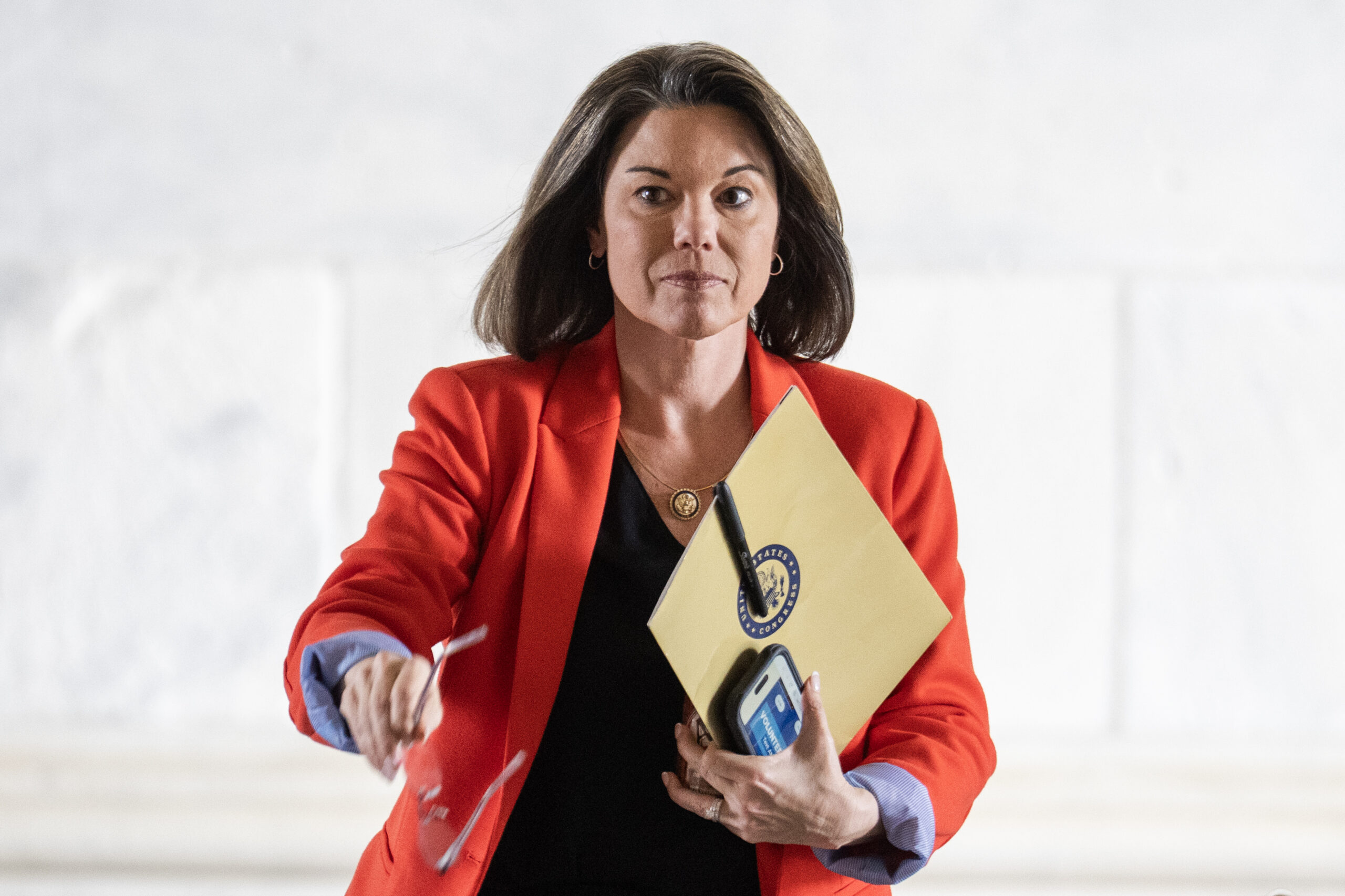
Delegates are expected to take up divisive anti-Israel resolutions at the convention being held next month
HUNGARY FOR MORE

Economic ties and broader European alliances are likely to preserve the bilateral relationship, even as the expected prime minister-elect moves to rejoin the ICC and potentially pivot back towards the EU
Amir Makled, who is hoping to unseat Jewish regent Jordan Acker, was found to have praised Hezbollah in deleted social media posts

Bill Pugliano/Getty Images
Students walk across the University of Michigan campus in Ann Arbor, Michigan.
The Michigan arm of the powerful SEIU labor union announced on Tuesday that it had rescinded its endorsement of Amir Makled, an attorney running for the University of Michigan board of regents, in light of Makled’s deleted social media posts praising the terrorist group Hezbollah.
“This decision follows new information that was not available at the time our endorsement was made,” the statement read. “As an organization, we hold our endorsed candidates to a high standard and expect alignment with our values and the interests of our members.”
Makled is a Dearborn trial lawyer who represented an anti-Israel protester who was arrested during the 2024 anti-Israel encampments at UM’s flagship Ann Arbor campus. A Detroit News report found that Makled had deleted posts praising Hezbollah’s leaders and retweets of antisemitic messages from the far-right influencer Candace Owens. Makled did not comment on the matter in the Detroit News report, and he did not immediately respond to a request for comment from Jewish Insider on Tuesday.
Makled is running an insurgent campaign to be one of two Democratic nominees for UM regent. Two seats are up for election in 2026, and both of them are held by Democrats — Jordan Acker and Paul Brown — who were first elected in 2018. Makled is singling out Acker, who is Jewish and has faced antisemitic attacks from anti-Israel activists at the university. The regents play a key governing role for the university, including on matters including student protests and divestment.
The two Democratic nominees for the statewide position will be decided at a Michigan Democratic Party convention in Detroit on April 19.
The secretary of state emphasized that all ‘the complexities are not going to be resolved in the next six hours’ but that he was hopeful talks could create a ‘framework’ to progress from
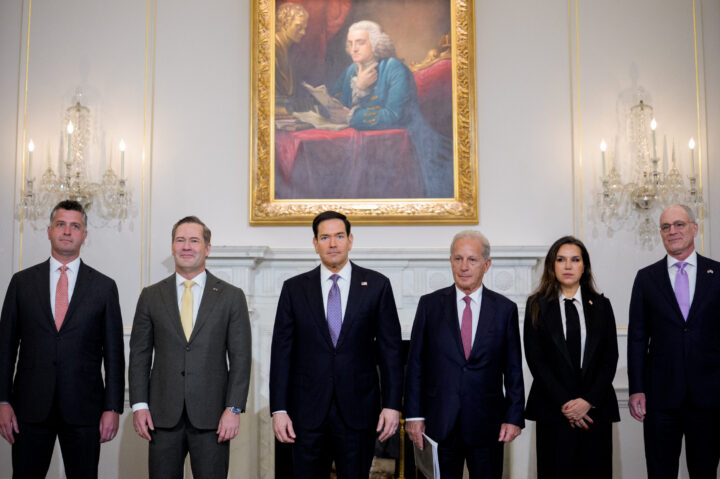
Andrew Harnik/Getty Images
(L-R) Counselor of U.S. State Department Michael Needham, U.S. Ambassador to the United Nations Michael Waltz, U.S. Secretary of State Marco Rubio, U.S. Ambassador to Lebanon Michel Issa, Lebanese Ambassador to the U.S. Nada Hamadeh Moawad and Israeli Ambassador to the U.S. Yechiel Leiter pose for photos before beginning working-level peace talks at the U.S. State Department on April 14, 2026 in Washington, DC.
Sitting at a roundtable of Israeli, Lebanese and American officials, Secretary of State Marco Rubio emphasized at the outset of negotiations between Jerusalem and Beirut that the talks are a “process” that will “take time,” stating that the objective of Tuesday’s meeting, the highest-level direct talks between the countries in over 30 years, is to “outline a framework upon which a permanent and lasting peace can be developed” and bring a “permanent end to Hezbollah’s influence” in the region.
“This is a process, not an event. This is more than just one day,” Rubio said. “All of the complexities are not going to be resolved in the next six hours … This will take time, but we believe it’s worth this endeavor and it’s a historic gathering that we hope to build on.”
“We understand we’re working against decades of history that have led us to this unique moment and opportunity here,” Rubio added. “We have to remember, the Lebanese people are victims of Hezbollah. The Lebanese people are victims of Iranian aggression, and this needs to stop.”
Rubio said the parties want to provide the people of Lebanon “the kind of future they deserve, and so that the people of Israel can live without fear of being struck by rocket attacks from a terrorist proxy of Iran.”
Taking part in the high-level talks between Israel and Lebanon on Tuesday in Washington were Israeli Ambassador to the U.S. Yechiel Leiter, Lebanese Ambassador to the U.S. Nada Hamadeh, U.S. Ambassador to Lebanon Michel Issa and State Department Counselor Michael Needham.
In a statement released by the State Department following the meeting, Washington indicated that any agreement “must be reached between the two governments, brokered by the United States, and not through any separate track.” The U.S. also expressed “support for further talks,” however it is not yet clear when the next round of discussions are expected to take place.
“All sides agreed to launch direct negotiations at a mutually agreed time and venue,” the statement read. It also indicated that Israel “expressed its commitment to working with the Government of Lebanon to achieve … security for the people of both countries” as well as a “commitment to engage in direct negotiations to resolve all outstanding issues and achieve a durable peace that will strengthen security, stability and prosperity in the region.”
In his opening statement ahead of the talks, Leiter commended Lebanese President Joseph Aoun and his government “for not allowing itself to be held hostage to the threats of Hezbollah’s leader,” adding that the group belongs “to the past.”
“I believe that we can, in good faith, accomplish the following interrelated goals: the complete dismantlement of Hezbollah, the freeing of Lebanon from Iran’s terror proxy and the achievement of a real, lasting and mutually celebrated peace for the benefit of our people,” Leiter said. “We also have the courage to pursue peace through strength, and to work tirelessly for tranquility and prosperity for all. Today, we pursue those values for ourselves and especially for our Lebanese neighbors of all ethnic denominations.”
After negotiations wrapped, Leiter struck a positive tone and said he was “honored” to sit at the negotiating table with Lebanese officials.
“We discovered today that we’re on the same side of the equation,” Leiter told reporters. “That’s the most positive thing we could have come away with. We are both united in liberating Lebanon from an occupation power dominated by Iran called Hezbollah.”
Similarly, Hamadeh also called the preliminary meeting “positive” and indicated that another round of talks is likely to take place. She stated that “the date and location of the next meeting will be announced at a later time.”
Tuesday’s negotiations were expected to focus on how Israel and Lebanon can work together to disarm Hezbollah and make peace between the countries. Israeli Prime Minister Benjamin Netanyahu announced the talks last week, saying he had shifted his position once the scope of the negotiations were expanded beyond just a ceasefire to also include disarming Hezbollah and working toward peaceful relations. Lebanese Foreign Minister Youssef Raggi indicated that the direct talks are meant to show that the “Lebanese state alone holds the authority to negotiate on behalf of Lebanon,” rather than Hezbollah.
The two nations currently share no formal diplomatic relations.
Hezbollah, however, has signaled it will not abide by any agreements and called on the Lebanese government to cancel the talks. Wafiq Safa, a high-ranking member of the group’s political council, stated prior to the meeting that the terrorist organization is “not interested or concerned with” the negotiations, saying the group is “not bound by what they [Israel, Lebanon and the U.S.] agree to.”
The negotiations took place against the backdrop of a massive Israeli strike in Beirut last week targeting Hezbollah. The recent round of hostilities was triggered on March 2 when Hezbollah launched rockets at northern Israel days after Israel and the U.S. launched strikes on Iran.
The talks have also received significant support from European and Western nations, with foreign ministers from 17 countries, including the U.K. and France, calling on the two countries to “seize the opportunity presented by the U.S.-Iran ceasefire,” per a joint statement.
Even if a deal is reached, major hurdles lie ahead as it remains unclear whether Lebanon possesses sufficient influence to hold Hezbollah to any potential agreements. While the group is a major political party with seats in the Lebanese parliament, its militia operates largely independently of the government, receiving funding and direction from Iran. Although a growing number of Lebanese officials and civilians view Hezbollah as an intrusive arm of Iranian interference, the group remains a powerful, independent force within the country.
The report finds that anti-Israel sentiment was ‘very common’ among students who identified as extreme liberals, but was virtually non-existent among moderates and conservatives

John Tlumacki/The Boston Globe via Getty Images
Israeli flags hung by Jewish students and their supporters that were hung on a railing were "bloodied" by Palestinian supporters who have a tent encampment on the MIT campus.
A new study on campus discrimination highlights that at least a third of Jewish, Muslim, Black and Asian students have encountered hate and hostility at their universities.
The report, “Antisemitism and Prejudice on Campus,” released Tuesday from the Maurice and Marilyn Cohen Center for Modern Jewish Studies at Brandeis University, draws on data from an October 2025–January 2026 survey of nearly 4,000 undergraduates at 303 four-year schools across the country — including an oversample of Jewish respondents.
The study found that a significant minority of students, regardless of their background, held views that minority groups viewed as prejudicial.
Furthermore, Jewish students on campus expressed concerns about antisemitism from both the political right and the political left, about antisemitism related to Israel and about antisemitism expressed as traditional anti-Jewish stereotypes.
Nearly half of Jewish students (47%) reported experiencing some form of prejudice on campus because of their Jewish identity. According to the report’s authors, much of this figure came from Jewish students’ higher reported rate of exposure to graffiti and posters with offensive images and language.
Jewish and Muslim students were also asked if, in the past academic year, they had ever been blamed for the actions of either Islamic extremists (for Muslim students) or the Israeli government (for Jewish students). The report noted that although these two questions are not exactly comparable, similar proportions of both groups (just under 20%) responded in the affirmative.
37% of Jewish students and 47% of Muslim students reported a hostile campus environment, while 34% of Black students reported similar hostility.
Notably, those concerns were not shared by the majority of students outside of those minority groups.
The report found that 17% of students were likely to hold views expressing anti-Black resentment, 9% held hostile views about Jews, 15% held views about Israel that most Jews find antisemitic and 4% held hostile views toward multiple religious and racial minority groups (including Jews). These views were evident among students from across the racial, religious and political spectrum.
Antisemitic expressions among students varied based on political ideology and demographics. While anti-Israel sentiment, seen as antsemitic, was “very common” among those who identified as extreme liberals, it was virtually non-existent among moderates and conservatives. Hostility towards Jews was not linked students’ to race, ethnicity, or religion. It was, however, somewhat more common among Muslim and non-white students. Holding hostile views towards multiple minority groups (Jews, Black, Muslims, and Asians) was more common, although still more rare, among those on the political right.
Unlike a study conducted by the Cohen Center in the immediate aftermath of the Oct. 7, 2023 terrorist attacks, which showed antisemitism varied greatly, campus to campus, this study did not explore variation in experiences between campuses. To protect anonymity, responses to the survey were not linked to individual schools.
Leonard Saxe, one of the study’s authors and a Brandeis professor of contemporary Jewish studies and social policy who heads the Steinhardt Social Research Institute and the Cohen Center, told Jewish Insider that the findings “enable us to understand what has happened on campuses in the last year. Many Jewish students experience hostility that, by and large, is not recognized by non-Jews. Notably, the pattern is similar for members of other ethno-religious and racial groups.”
“Antisemitism is a unique hatred, but members of other groups also experience hostility not recognized by their peers. To address antisemitism on campuses, we need to understand these forces and design policy and programs that address the current situation on campuses,” said Saxe.
The report’s authors called on universities to implement several new approaches in response to the findings. These include targeting antisemitism interventions for different groups — noting that a single intervention would be ineffective for all students given the distinct forms of antisemitism that were expressed — and investing in research that goes beyond studying forms of prejudice independently but explores how they relate to one another and to antisemitism.
Plus, Senate Rs hold the line on Iran enrichment
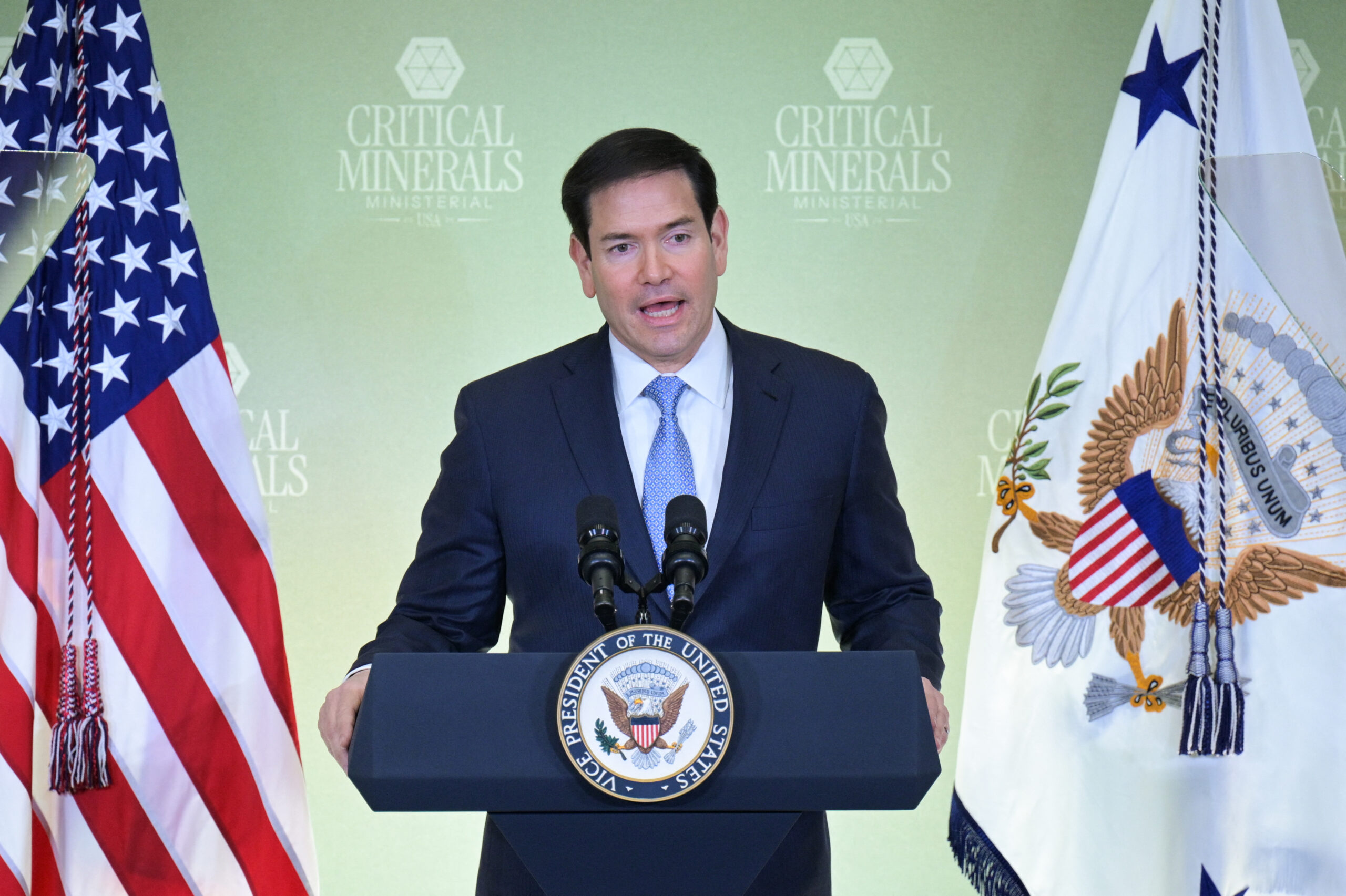
Oliver Contreras / AFP via Getty Images
Secretary of State Marco Rubio speaks during the inaugural Critical Minerals Ministerial meeting at the Sate Department in Washington, DC, on February 4, 2026.
👋 Good Tuesday morning!
In today’s Daily Kickoff, we preview today’s high-level talks in Washington between Israel and Lebanon, and talk to Senate Republicans about reports of a U.S. request for Iran to pause its enrichment of uranium for 20 years. We report on a call from Rep. Angie Craig, who is mounting a Senate bid, for Minnesota Democrats to investigate antisemitic activity ahead of the state party’s convention, and look at what the election in Hungary of Péter Magyar could portend for Budapest-Jerusalem relations. Also in today’s Daily Kickoff: Gov. Wes Moore, Noah Wyle and Elkana and Rebecca Bohbot.
Today’s Daily Kickoff was curated by JI Executive Editor Melissa Weiss and Israel Editor Tamara Zieve, with assists from Danielle Cohen-Kanik and Marc Rod. Have a tip? Email us here.
What We’re Watching
- Secretary of State Marco Rubio will oversee talks in Washington this morning with Israeli Ambassador to the U.S. Yechiel Leiter and Lebanese Ambassador to the U.S. Nada Hamadeh. U.S. Ambassador to Lebanon Michel Issa and State Department Counselor Michael Needham will also join the talks, slated to start at 11 a.m. Read more here.
- Ahead of the talks, a senior Hezbollah official said the Iran-backed group would not abide by any agreement reached between Beirut and Jerusalem. Fighting between Israel and Hezbollah has continued since the implementation of the Iran ceasefire, but has largely occurred in southern Lebanon and northern Israel following pressure from the White House for Israel to scale back its attacks in Beirut.
- A second round of in-person negotiations between the U.S. and Iran could take place as soon as this week — days before the April 21 expiration of the current ceasefire — following President Donald Trump’s comments yesterday that “we’ve been called by the other side,” who would “like to make a deal very badly, very badly.”
- The U.S. Holocaust Memorial Museum is hosting its annual Yom HaShoah commemoration on Capitol Hill this morning, with more than 30 Holocaust survivors slated to attend. House Speaker Mike Johnson (R-LA), House Minority Leader Hakeem Jeffries (D-NY), Sen. Kirsten Gillibrand (D-NY), Reps. Joe Wilson (R-SC) and Lois Frankel (D-FL) and Commerce Secretary Howard Lutnick will participate in the ceremony, during which Ben Ferencz, who served as the U.S.’ chief prosecutor in Nuremberg, will be posthumously honored.
- The Atlantic Council is hosting Jacob Helberg, the State Department’s under secretary of state for economic growth, energy and the environment, this evening for a discussion on U.S. economic leadership in the Middle East.
- Semafor’s World Economy Summit continues today in Washington. Speakers include Helberg, Sens. Tim Sheehy (R-MT) and Gary Peters (D-MI), former Commerce Secretary Penny Pritzker, Michael Dell, Reid Hoffman, Meta’s Dina Powell McCormick, Forum AI’s Campbell Brown and Citadel’s Ken Griffin.
What You Should Know
A QUICK WORD WITH JI’S JOSH KRAUSHAAR
Tomorrow (April 15) isn’t just Tax Day, but it’s also the deadline for candidates vying in the pivotal midterms to report their latest fundraising figures — an important marker on the political calendar in determining which candidates are raising enough money to run credible campaigns and which will be left financially behind.
Historically, having a critical mass of prominent, well-heeled supporters was a prerequisite for a congressional candidate being able to get their message out to the public.
Not long ago, candidates with extreme or exotic views — such as those affiliated with the Democratic Socialists of America on the left or those embracing conspiracy theories on the far right — would have a hard time being taken seriously by rank-and-file donors, who typically want a back a winner and would shy away from those with far-out-of-the-mainstream views.
Similarly, the pro-Israel community historically benefited from the presence of strong organizations like AIPAC that helped pool supporters’ money to favored candidates, giving them outsized impact within both parties. More recently, AIPAC’s super PAC has led the way in engaging directly in political campaigns, directly spending money on behalf of favored candidates and attacking some of the most radical candidates on the ballot.
But in our brave new decentralized world of politics and media, where a critical mass of small-dollar donations from passionate individuals can easily be amassed online (especially through an incendiary video clip or well-timed fundraising appeal), the comparative advantage of having a defined group of reliable donors can be neutralized by an online feeding frenzy that galvanizes enough individuals to give to a radical cause or candidate.
At the same time, the social media-driven public conversation — without any guardrails and few standards — has totally transformed what is viewed as normal. One recent example: 27-year-old Kat Abughazaleh, a far-left social media influencer without any roots in the Chicago-area district she was running in, raised well over $3 million for her (unsuccessful) primary campaign, fueled by high-volume, low-dollar, largely out-of-state contributions.
If former House Speaker Tip O’Neill once said all politics is local, the opposite is true today. All politics is now nationalized, with the most outlandish hot takes and incendiary commentary most likely to go viral.
TEHRAN TALKS

Senate Republicans maintained the position on Monday that Iran should never be allowed to possess nuclear enrichment capacity, following reports that the administration had proposed a 20-year pause in enrichment — rather than a permanent end to Iran’s enrichment capacity — as part of peace talks in Islamabad over the weekend, Jewish Insider’s Marc Rod reports.
What they’re saying: Sen. Pete Ricketts (R-NE) told JI that he hadn’t seen the reports about the administration’s negotiating position and declined to comment on it specifically, but said more broadly that he does not believe that Iran has any legitimate need for enrichment. “There’s no civilian reason for Iran to have an enrichment program,” Ricketts said. “They’re getting their uranium right now for their civilian program from Russia, and the fact that they have admitted they’ve enriched uranium to near bomb-grade potential demonstrates that this is for nuclear weapon production, not civilian use.”
Read the full story here with additional comments from Sens. Lindsey Graham (R-SC), John Cornyn (R-TX), Ted Budd (R-NC), Rick Scott (R-FL), Roger Wicker (R-MS), Tommy Tuberville (R-AL), John Kennedy (R-LA), James Lankford (R-OK) and John Curtis (R-UT).
MARKING THE DAY
Maryland Gov. Wes Moore pledged that his administration “will always support Maryland’s Jewish community” in recorded remarks for an event Monday evening marking Yom HaShoah, Israel’s Holocaust memorial day, at Beth Tfiloh Congregation in Pikesville, Md., a heavily Jewish suburb of Baltimore, Jewish Insider’s Marc Rod reports.
What he said: The Maryland governor, a potential Democratic presidential contender, said that it is his and his state’s “governing philosophy” to “unapologetically confront and condemn antisemitism and persecution wherever it arises,” to provide no refuge to hate, denial and conspiracy theories, to ensure that everyone feels safe to worship and to “realize the full promise of tikkun olam.” He called Holocaust remembrance a “responsibility” for those living today.
MINNESOTA MATTERS
The Senate campaign of Rep. Angie Craig (D-MN) is calling on Minnesota’s Democratic Party to launch a formal investigation into a series of alleged instances of antisemitic activity among delegates in the lead-up to its state convention being held at the end of next month, Jewish Insider’s Matthew Kassel reports.
Allegations: In a letter sent last week to Richard Carlbom, chair of Minnesota’s Democratic-Farmer-Labor Party, Craig’s campaign wrote that one of its staffers had received a threatening anonymous phone call last month from a person “believed to be a delegate” who used an ethnic slur for Jews and said that the congresswoman “takes dirty Jewish money.” The letter, shared exclusively with JI, also cited a local DFL organizing convention in late March at which an unnamed delegate allegedly said that “we should nuke” Israel, among other examples of extremist violent rhetoric.
PIKER’S POV

Given the chance to walk back some of his most incendiary commentary on an episode of the “Pod Save America” podcast released Sunday, antisemitic streamer Hasan Piker instead doubled down on his support of Hamas and other inflammatory rhetoric, Jewish Insider’s Danielle Cohen-Kanik reports.
What he said: “This [quote] is from January,” host Jon Favreau, a former speechwriter to President Barack Obama, told Piker in a segment looking back on some of Piker’s comments that have been picked up by national media. “‘Hamas is a thousand times better than a fascist settler colonial apartheid state,’” Favreau quoted. “I stand by that,” Piker responded quickly, later adding, “I’m a lesser-evil voter and therefore I would vote for Hamas over Israel every single time.”
Called to account: Sen. Rick Scott (R-FL) called for the federal government to “immediately” pull funding from Yale University over Yale Political Union’s decision to host Piker, who previously suggested that the senator should be killed. Piker is scheduled to speak on campus Tuesday for a debate titled “Resolved: End the American Empire,” JI’s Haley Cohen reports.
HUNGARY FOR MORE
The end of Hungarian Prime Minister Viktor Orbán’s 16-year tenure following his electoral defeat on Sunday to center-right rival Péter Magyar has sparked immediate questions regarding the future of one of Jerusalem’s most reliable, yet complicated, alliances in Europe. While Orbán’s departure removes a reliable ally of Israeli Prime Minister Benjamin Netanyahu within the European Union, experts suggest Jerusalem’s standing in Europe and bilateral relationship with Budapest will not be significantly set back, Jewish Insider’s Matthew Shea reports.
Solid standing: Jonathan Ruhe, a fellow at the Jewish Institute for National Security of America, suggested that significant change in posturing is unlikely. “Israel’s standing in Europe won’t be dimmed by Orbán’s departure,” Ruhe said. “Israel has reliable partners like Germany, Czechia, Greece and Cyprus. Germany in particular has been a firewall against a lot of European anti-Israeli actions, and Magyar has suggested he’ll follow Germany’s lead here.”
POLL POLITICS
A recently conducted survey assessing how Jewish voters view leading Israel advocacy groups finds that public opinion is divided over the effectiveness of outside engagement in American elections, Jewish Insider’s Josh Kraushaar reports. The Mellman Group poll, commissioned by the Jewish Electorate Institute (JEI) and released last week, surveyed 800 registered Jewish voters between March 13-23.
Survey says: It found a narrow 39% plurality agreed that it “was more important than ever” for pro-Israel groups to play a leading role in speaking out against candidates who oppose a close U.S.-Israel alliance, while 37% of respondents feared that such advocacy risks making things worse. The split largely was along partisan lines: While two-thirds of Jewish Republicans and 59% of Jewish independents backed strong pro-Israel political advocacy, just 28% of Democrats shared the same view. A near-majority (46%) of Democrats feared that pro-Israel electioneering could turn voters against Israel.
Worthy Reads
West Bank Extremes: In The Free Press, Haviv Rettig Gur warns that settler violence in the West Bank has the potential to radicalize Palestinian elements in the enclave and drive further strife. “Underneath all of this is a structural failure: the absence of a coherent rule of law in the West Bank. In a system without clear law and order, naked power wins. Always. For Palestinians, legal uncertainty is constant — over land, over protection. For extremist settlers, that vacuum is an opportunity. Meanwhile, most Israelis are looking elsewhere, at rockets, at war, at existential threats. The settler violence issue feels secondary. Or unsolvable. And that’s a mistake. Because there will be a price to pay for this lawlessness.” [FreePress]
Dire Straits: In Foreign Policy, Bobby Ghosh looks at the challenges facing Tehran as the Islamic Republic focuses on its control of the Strait of Hormuz after six weeks of war that has degraded much of the country’s military capabilities. “The element of strategic surprise [on Hormuz] is now spent, and the world will find ways to mitigate the costs Iran can impose. Mojtaba Khamenei may match Trump for braggadocio, but the country he has inherited from his father has been devastated, and the prospects for recovery are grim. All the problems that existed before Feb. 28 exist still, compounded by everything the war has wrought. A survivor he may be. Stronger, he isn’t.” [ForeignPolicy]
IHRA Ire: In the Milwaukee Journal Sentinel, Combat Antisemitism Movement’s Alyza Lewin praises the decision by Wisconsin Gov. Tony Evers to sign into law legislation adopting the International Holocaust Remembrance Alliance’s working definition of antisemitism. “Why are detractors aggressively seeking to torpedo IHRA legislation? The answer: Because the IHRA definition exposes bad-faith actors who deliberately seek to conceal their hatred of Jews under the guise of political criticism of Israel. It unmasks those who claim to support Jews but work overtime to turn society against anyone who recognizes essential components of Jewishness, namely Jewish peoplehood and a shared ancestry originating in the Land of Israel.” [MilwaukeeJournalSentinel]
Word on the Street
President Donald Trump signed a bill extending the Holocaust Expropriated Art Recovery Act, which will make it easier for the descendants of Holocaust survivors and victims whose art was looted by the Nazis to recover the works; the legislation passed the House of Representatives last month and the Senate in December…
A group of six additional Senate Democrats plan to file new war powers resolutions this week to halt the war in Iran, a move that would allow Democrats to continue forcing votes on the war for the foreseeable future, Jewish Insider’s Marc Rod reports…
The Atlantic looks at the commercial impact of the U.S.’ blockade of the Strait of Hormuz as Washington attempts to force Iranian concessions vis-a-vis economic pressure…
The Wall Street Journal spotlights Sen. Bernie Sanders’ (I-VT) efforts to shift the Democratic Party to the left as he backs far-left candidates across the country during the midterms…
Reps. Eric Swalwell (D-CA) and Tony Gonzales (R-TX) announced their resignations from Congress amid efforts to expel both men, in addition to Reps. Sheila Cherfilus-McCormick (D-FL) and Cory Mills (R-FL), from the House…
Pennsylvania Gov. Josh Shapiro hosted King Willem-Alexander and Queen Máxima of the Netherlands at an event at Philadelphia’s Independence Hall on Monday…
The Washington Post reports on a recent dinner in which Heritage Foundation chief Kevin Roberts praised Chronicles editor Paul Gottfried, whose monthly magazine has platformed far-right fringe and white supremacist writers…
The New York Times looks at efforts by National Ground Game, a nascent Democratic group, and antisemitic conspiracy theorist Nick Fuentes to make gains on college campuses following last year’s killing of Charlie Kirk, whose Turning Point USA had developed a large campus following under Kirk’s leadership…
More than 1,000 Hollywood figures signed onto a letter from Jane Fonda’s Committee for the First Amendment, Norm Eisen’s Democracy Defenders Fund and the Future Film Coalition opposing Paramount’s efforts to acquire Warner Bros. Discovery, citing the loss of jobs and higher costs they believe would result from the deal…
“The Pitt” actor Noah Wyle, whose father was Jewish, talked to the U.K.’s Jewish Chronicle about his time on the show and his first experience playing a Jewish character…
Dublin’s National Concert Hall canceled an upcoming fundraiser for Magen David Adom Ireland for a second time after the event, scheduled for May, was canceled and reinstated…
A report from Tel Aviv University released ahead of Yom HaShoah, Israel’s Holocaust Remembrance Day, found that 2025 saw the highest level of deadly antisemitic violence in more than 30 years…
Former Israeli hostage Elkana Bohbot and his wife, Rebecca, announced on the six-month anniversary of Bohbot’s release from Gaza that they are expecting their second child…
Former U.S. Ambassador to the Bahamas Arthur Schechter, who previously served as president of the Jewish Federation of Houston and a member of the United States Holocaust Memorial Council, died at 84…
Pic of the Day

Israeli Ambassador to Germany Ron Prosor lit a candle this morning at a commemorative event for Yom HaShoah, Israel’s Holocaust Remembrance Day, at the Sachsenhausen Memorial in Oranienburg, Germany.
Birthdays
Basketball player selected 26th overall by the Brooklyn Nets in the first round of the 2025 NBA draft, Ben Saraf turns 20…
Anne Monk… Former chair of the U.S. Securities and Exchange Commission, Elisse B. Walter turns 76… Israeli news editor and analyst who retired in 2020 from the Israeli daily Haaretz, Chemi Shalev turns 73… Media executive who sold her family’s controlling interest in Paramount Global to Skydance Media in August 2025, Shari Redstone turns 72… Co-founder, co-chairman and co-CEO at Canyon Partners, LLC, Mitchell Julis turns 71… Film, television and theater producer, his credits include the widely acclaimed 2016 film “La La Land,” Marc Platt turns 69… Birmingham, Ala.-based post-denominational rabbi, known on social media as “Deep South Rabbi,” Barry Altmark… Founder of Bobbi Brown Cosmetics and author of 10 books about makeup and beauty, Bobbi Brown turns 69… Border czar for the first few months of the Biden administration, she is the former U.S. ambassador to Mexico, Roberta S. Jacobson turns 66… Bench coach for the New York Yankees, he was also bench coach for Team Israel at the World Baseball Classic in 2023, Brad Ausmus turns 57… Los Angeles-based freelance editor and writer, Robin Heinz Bratslavsky… SVP of Washington and investigative news at CNN, Adam Levine… Emmy Award-winning actress best known for the title role on the WB series “Buffy the Vampire Slayer,” Sarah Michelle Gellar Prinze turns 49… Journalist, professor and author of five books, Sasha Issenberg turns 46… Co-founder and CEO of Statt, a venture-backed AI/ML enterprise software platform, Steve Glickman… Teacher, formerly principal, at Bnei Akiva Schools of Toronto, Hillel David Rapp… French entrepreneur, he is the president of CRIF, the Representative Council of French Jewish Institutions since 2022, Yonathan Arfi turns 46… Founder and CEO of Charity Bids, Israel “Yummy” Schachter… Award-winning science fiction and fantasy writer, Rachel Swirsky turns 44… President of Sightful, he is the co-author of The New York Times bestseller The Black Banners, Daniel Freedman… Classical cellist, she was awarded a MacArthur Foundation genius grant in 2022, Alisa Weilerstein turns 44… Former baseball first baseman who played in the MLB, Japanese and Mexican leagues, Joshua S. Whitesell turns 44… Documentary filmmaker, Nicholas Ma… Washington-based senior technology policy reporter at Axios, Ashley Gold… Isaac Hasson… Graphic designer and daughter of Carolina Panthers owner, David Tepper, Casey Tepper… Yitzchak Tendler… Jon Fine… Moriah Elbaz…
The advantage of having a defined group of reliable donors can be neutralized by an online feeding frenzy that galvanizes enough individuals to give to a radical cause or candidate

Nam Y. Huh/AP
Democratic candidate for Congress, Kat Abughazaleh, right, and her boyfriend Ben Collins, leave the Chicago Park District Loyola field house after voting in the primary election for the upcoming midterms, in Chicago, Tuesday, March 17, 2026.
Tomorrow (April 15) isn’t just Tax Day, but it’s also the deadline for candidates vying in the pivotal midterms to report their latest fundraising figures — an important marker on the political calendar in determining which candidates are raising enough money to run credible campaigns and which will be left financially behind.
Historically, having a critical mass of prominent, well-heeled supporters was a prerequisite for a congressional candidate being able to get their message out to the public.
Not long ago, candidates with extreme or exotic views — such as those affiliated with the Democratic Socialists of America on the left or those embracing conspiracy theories on the far right — would have a hard time being taken seriously by rank-and-file donors, who typically want a back a winner and would shy away from those with far-out-of-the-mainstream views.
Similarly, the pro-Israel community historically benefited from the presence of strong organizations like AIPAC that helped pool supporters’ money to favored candidates, giving them outsized impact within both parties. More recently, AIPAC’s super PAC has led the way in engaging directly in political campaigns, directly spending money on behalf of favored candidates and attacking some of the most radical candidates on the ballot.
But in our brave new decentralized world of politics and media, where a critical mass of small-dollar donations from passionate individuals can easily be amassed online (especially through an incendiary video clip or well-timed fundraising appeal), the comparative advantage of having a defined group of reliable donors can be neutralized by an online feeding frenzy that galvanizes enough individuals to give to a radical cause or candidate.
At the same time, the social media-driven public conversation — without any guardrails and few standards — has totally transformed what is viewed as normal. One recent example: 27-year-old Kat Abughazaleh, a far-left social media influencer without any roots in the Chicago-area district she was running in, raised well over $3 million for her (unsuccessful) primary campaign, fueled by high-volume, low-dollar, largely out-of-state contributions.
If Tip O’Neill once said all politics is local, the opposite is true today. All politics is now nationalized, with the most outlandish hot takes and incendiary commentary most likely to go viral.
The same viral clips that lead unsuspecting audiences to extreme voices like Hasan Piker and Candace Owens live in the same ecosystem that makes it easy for a candidate like Abughazaleh to bring in big money. It’s not a coincidence that former Rep. Marjorie Taylor Greene (R-GA) and Rep. Alexandria Ocasio-Cortez (D-NY) were among the top fundraisers within their respective parties this cycle.
There are two different ways for Jewish and pro-Israel voices to adapt to this still-evolving revolution in both media and politics — one on the supply side and one on the demand side.
On the demand side, it’s clear that the algorithmic preferences for leading social media platforms prioritize constant unthinking engagement (at best) and rage and radicalism (at worst).
It doesn’t seem like a coincidence that Twitter/X’s decision to unblock neo-Nazi influencer Nick Fuentes from the platform in May 2024 quickly led to an upsurge in antisemitic content being embraced by a wide range of far-right podcasters. There are thoughtful policy proposals that have been floated to do a better job regulating what has increasingly become an anarchic space.
Most of the focus, however, has been on how politicians and outside groups can adapt on the supply side. As Obama campaign manager David Plouffe wrote in The New York Times last week, “A successful campaign in 2026 must operate like a full-time production studio… It means creating output tailored specifically for TikTok or Instagram or YouTube.”
Plouffe also noted that campaigns need to focus on what he called “answer engine optimization” for artificial intelligence, essentially working to ensure friendlier responses from AI bots.
If the old media and fundraising model was to rely on scale (of donations) and volume (of ads) to persuade voters, the new media ecosystem requires nimbleness and adaptability. Raising the most money and saturating the airwaves with advertisements was once a time-tested tool of success.
Now, campaigns and advocacy groups alike are facing a multifront challenge, figuring out whether to accommodate what appears to be a new political and media reality where the loudest and most polarizing voices prevail — or fight for a more fair-and-balanced ecosystem while also engaging with the fractured landscape as best as possible.
The negotiations will mark the highest-level direct talks between the countries in over 30 years

Jalaa MAREY/AFP via Getty Images
Smoke rises following Israeli strikes in southern Lebanon near the border as seen from the Upper Galilee, in northern Israel on April 10, 2026
Secretary of State Marco Rubio will convene the ambassadors from Israel and Lebanon in Washington on Tuesday for the highest-level direct talks between the countries in over 30 years.
Israeli Ambassador to the U.S. Yechiel Leiter and Lebanese Ambassador to the U.S. Nada Hamadeh will represent their countries, with U.S. Ambassador to Lebanon Michel Issa and State Department Counselor Michael Needham also taking part in the meeting.
The negotiations are meant to focus on how Israel and Lebanon can work together to disarm Hezbollah and make peace between the countries.
A State Department official said the talks are “a direct result of Hezbollah’s reckless actions,” and “will scope the ongoing dialog about how to ensure the long-term security of Israel’s northern border and to support the Government of Lebanon’s determination to reclaim full sovereignty over its territory and political life.”
“Israel is at war with Hezbollah, not Lebanon, so there is no reason the two neighbors should not be talking,” the State Department official said.
Lebanese Prime Minister Nawaf Salam canceled a planned visit to the U.S. this week to monitor the situation from Beirut and “safeguard the security of the Lebanese people and preserve national unit,” he wrote on X.
Israeli Prime Minister Benjamin Netanyahu announced the talks last week, marking a shift in his position from earlier in the Lebanon campaign that began after Hezbollah joined Iran in attacking Israel in late February. Netanyahu said over the weekend that he had agreed to the talks because they would not only be about a ceasefire, but about disarming Hezbollah and working toward peace with Lebanon. President Donald Trump said at the time that he asked Israel to “low-key a bit” the strikes in Lebanon.
Lebanese Foreign Minister Youssef Raggi posted on X that the direct talks “in practice reinforced the separation between the Lebanese file and the Iranian track. … The Lebanese state alone holds the authority to negotiate on behalf of Lebanon.”
The talks are set to take place as Hezbollah continues to launch rockets and drone attacks at northern Israel on a daily basis and the IDF continues to target Hezbollah in southern Lebanon. The IDF said it struck about 150 Hezbollah targets on Monday, and it continues its ground operations in the Iran-backed terrorist organization’s stronghold of Bint Jbeil.
The IDF cleared for publication on Tuesday the name of Sgt.-Maj. Ayal Uriel Bianco, who was killed in battle in Lebanon.
Netanyahu visited IDF troops in Lebanon over the weekend, and praised them on Monday for “pushing the enemy away from the border” and creating “a solid, deeper security zone that both prevents the danger of invasion and distances the anti-tank missile threat.”
Angie Craig calls on Minnesota Democrats to investigate antisemitism ahead of state party convention
Delegates are expected to take up divisive anti-Israel resolutions at the convention being held next month
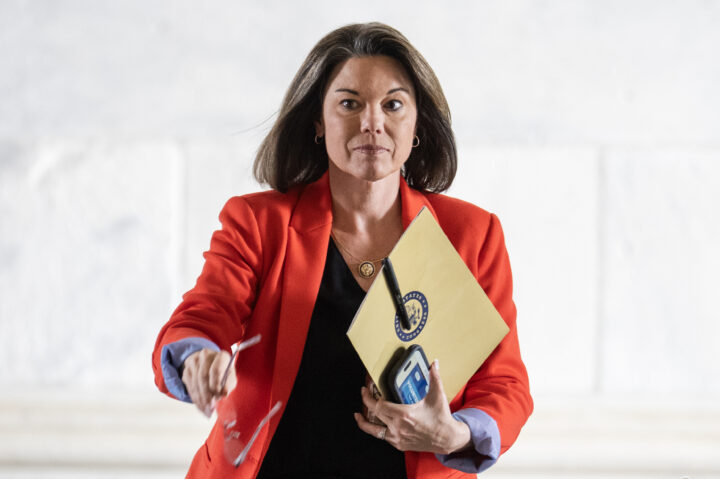
Tom Williams/CQ-Roll Call, Inc via Getty Images
Rep. Angie Craig (D-MN) arrives for a vote in the U.S. Capitol on Thursday, March 26, 2026.
The Senate campaign of Rep. Angie Craig (D-MN) is calling on Minnesota’s Democratic Party to launch a formal investigation into a series of alleged instances of antisemitic activity among delegates in the lead-up to its state convention being held at the end of next month.
In a letter sent last week to Richard Carlbom, chair of Minnesota’s Democratic-Farmer-Labor Party, Craig’s campaign wrote that one of its staffers had received a threatening anonymous phone call last month from a person “believed to be a delegate” who used an ethnic slur for Jews and said that the congresswoman “takes dirty Jewish money.”

The letter, shared exclusively with Jewish Insider, also cited a local DFL organizing convention in late March at which an unnamed delegate allegedly said that “we should nuke” Israel, among other examples of extremist violent rhetoric.
Mara Kunin, Craig’s campaign manager, said in the letter to state party leadership that such “incidents should be investigated promptly and that the DFL should take appropriate action and make clear that antisemitism in addition to other forms of hate will not be tolerated in our party.”
“Hate in all forms must be called out, whether it comes from the right or the left,” Kunin wrote. “We hope this serves as a necessary wake-up call for the DFL. We urge prompt and decisive action — action that allows the DFL to live up to our shared goal of building a big-tent party rooted in the principles of respect, dignity and integrity.”
In a statement shared with JI, Carlbom said that the DFL “condemns antisemitism and harassment in all forms without reservation,” and called the incidents raised by Craig’s team “disgusting and wrong, full stop.”
“We have responded directly to the Craig campaign, connected them to our Code of Conduct Committee, and encouraged those affected to file a police report,” he continued. “We will enforce our Code of Conduct and hold every leader and member to the standard our party demands. That work is happening and it won’t stop.”
The letter comes as Jewish and pro-Israel Democrats have voiced concerns about growing hostility toward Israel that has overlapped with a creeping extremism among some high-profile party influencers who have gained prominence espousing antisemitic rhetoric.
In Michigan’s Senate race, for example, Hasan Piker, an antisemitic streamer who has praised Hamas, has recently emerged as a flash point in a broader debate about whether Democratic candidates should appear with him publicly or join his show.
The issues raised by Craig’s campaign also dovetail with an uptick in anti-Israel sentiment during state and national party conventions around the country. Last week, at the Democratic National Committee’s meeting in New Orleans, party activists voted down one controversial resolution that criticized AIPAC’s “undue influence” in primary elections, while kicking two other measures to a Middle East working group.
Similar efforts are now poised for consideration at several state conventions in the coming months, including a series of new resolutions introduced by Democratic activists in Texas seeking to formally condemn Israel for alleged genocide while labeling pro-Israel political activity as “foreign interference in U.S. elections.”
In Minnesota, where Craig is facing off against Lt. Gov. Peggy Flanagan for the DFL endorsement, the party’s convention in late May is expected to feature some divisive resolutions related to Israel as in past years, according to local Jewish community activists familiar with the ongoing preparations.
During a recent local convention among several that take place before the statewide meeting, for instance, one new resolution advocated for removing language from the DFL’s official platform recognizing “Israel’s right to exist within secure borders, Palestinian rights to self-determination, and continued peace efforts in the Middle East.”
“Israel with the full support & shielding of the U.S. Government has conducted an intensification of genocide & ethnic cleansing in the past 2+ years, murdering more than 75,000 Palestinians since October 2023,” the resolution states. “The DFL party cannot claim any sort of morality while providing support to a state that’s founded on and committed to ongoing occupation, apartheid, and genocide. The two-state solution has long been an illusion, and so-called ‘peace’ without justice is not worth supporting.”
The DFL did not return a request for confirmation about the status of the resolution and if it would be taken up at the state convention in its current form.
Manny Houle, a Democratic pro-Israel strategist based in Minnesota, said it was “highly unlikely this divisive verbiage makes it as is to the state ballot at the end of May,” noting “there is an entire other round of editing when it comes to resolutions and most of the greatly divisive platforms are not getting the statewide support needed to make the ballot.”
“However, some sort of floor petition resolution is likely,” he told JI. “In addition there likely will be a resolution, if not multiple, about Middle East peace.”
One local Jewish activist now involved in efforts to oppose such resolutions, speaking on condition of anonymity to address a sensitive matter, predicted “other problematic” measures will also arise at the state convention. “We have been strategizing about how to handle any anticipated nastiness at the state convention this year, likely to arise through ‘debate’ over these resolutions,” the activist told JI, pointing to a DFL Jewish community outreach organization that is seeking to become an official party caucus.
In the August Senate primary to be held three months after the convention, Craig, a moderate favored by the pro-Israel community, has claimed backing from the party’s establishment wing, while Flanagan is largely coralling progressive support in what is regarded as a proxy fight between opposing Democratic factions.
While AIPAC has not made an endorsement in the race, Craig’s past support from the advocacy group have drawn criticism from activists working to force the party leftward on Israel.
Antoine Givens, a Craig spokesperson, said her team “will continue to make clear that antisemitism and all forms of hate cannot be tolerated in our party,” while referring to the recent alleged incidents of antisemitic behavior among party members.
“Violence and the threat of violence have no place in our politics and no place in the DFL,” he told JI in a statement. “These actions are unacceptable, and it’s on all of us to demand better.”
Economic ties and broader European alliances are likely to preserve the bilateral relationship, even as the expected prime minister-elect moves to rejoin the ICC and potentially pivot back towards the EU

Ferenc ISZA / AFP via Getty Images
Peter Magyar, leader of the pro-European conservative TISZA party, waves the national flag during celebrations at the election night party in Budapest after the general election in Hungary, on April 12, 2026.
The end of Hungarian Prime Minister Viktor Orbán’s 16-year tenure following his electoral defeat on Sunday to center-right rival Péter Magyar has sparked immediate questions regarding the future of one of Jerusalem’s most reliable, yet complicated, alliances in Europe.
While Orbán’s departure removes a reliable ally of Israeli Prime Minister Benjamin Netanyahu within the European Union, experts suggest Jerusalem’s standing in Europe and bilateral relationship with Budapest will not be significantly set back.
Under Orbán, Hungary frequently broke ranks to block anti-Israel statements and actions from the EU. The former leader maintained a warm posture toward Israel and voiced opposition to terror organizations. He also initiated the process to withdraw Budapest from the International Criminal Court after it issued an arrest warrant for Netanyahu. Orbán called the court “political” and defied the ruling by welcoming the Israeli prime minister for a visit.
“Israel is losing a close friend with the electoral defeat of Viktor Orbán,” David May, a senior research analyst at the Foundation for Defense of Democracies, told Jewish Insider. “His willingness to defy EU consensus shielded Israel from many hostile actions. The Central and Eastern European states are far friendlier to Israel than their Western counterparts, and that will likely continue under Peter Magyar — though to what extent remains unclear.”
Magyar has vowed to maintain Hungary’s “special relationship” with Israel, calling the Jewish state an “important economic partner.” However, he has also called for “pragmatic relations,” including returning Hungary to the ICC and suggesting that Budapest will likely move away from the reflexive veto that characterized the Orbán era, replacing it with a case-by-case approach to EU measures concerning Israel.
“We do not know much about Péter Magyar’s policy views on Israel,” said Ferenc Németh, an international relations expert and Fulbright visiting researcher at Georgetown University. “Politically speaking, I do not expect relations to worsen or for Magyar to have a cold or hostile position toward Netanyahu; rather, Hungary will align with the views of its partners on key issues concerning Israel.”
Németh added that Israel will remain “an important partner for Hungary, especially given the economic ties and the shared Jewish heritage.” He noted that Magyar’s desire to rejoin the ICC is likely aimed at strengthening “Hungary’s position among its most valuable Western partners and to achieve full alignment with their views.”
Jonathan Ruhe, a fellow at the Jewish Institute for National Security of America, also suggested that significant change in posturing is unlikely. He noted that Orbán’s defeat is “easily overstated in terms of likely impact on Israel.”
“Israel’s standing in Europe won’t be dimmed by Orbán’s departure,” Ruhe said. “Israel has reliable partners like Germany, Czechia, Greece and Cyprus. Germany in particular has been a firewall against a lot of European anti-Israeli actions, and Magyar has suggested he’ll follow Germany’s lead here.”
Experts also noted that Orbán’s actions did not carry as much weight as they appeared and expressed concern over the former Hungarian leader’s preference for Moscow in the Russia-Ukraine conflict and complex relationship with Tehran.
“Orbán blocked primarily statements critical of Israel, not concrete measures — with the exception of a sanctions package targeting violent settlers and organizations targeting Palestinians in the West Bank,” Matthew Levitt, a senior fellow at the Washington Institute for Near East Policy, said. “And Hungary did not always act in Israel’s interest under Orbán, such as when Hungary offered Iran intelligence support after the pager attack against Hezbollah in September 2024.”
May similarly noted that Orbán was “not without controversy.”
“His close ties with Russia — and sometimes strong bonds with Iran — at times placed the Hungarian leader at odds with Israeli and U.S. interests,” May said. “Orbán’s proximity to antisemites and his antidemocratic tendencies also made him a less than desirable ally.”
Ruhe said that Orbán’s actions in support of Israel should be “weighed against everything he did to whitewash Hungary’s role in the Holocaust, engage in antisemitic dog-whistling, roll back democracy and essentially serve as an agent of Moscow — Iran’s partner in crime — inside the EU.”
“Magyar has pledged to maintain his country’s ‘special relationship’ with Israel, but without Orbán’s significant baggage that far outweighed the few concrete steps he took in support of Israel,” Ruhe added.
Németh said that Hungary will remain “a country with a strong zero-tolerance policy against all forms of antisemitism,” noting that Orbán, despite his often vocal support for Israel, engaged in actions that could be perceived as triggering “antisemitic views.”
“Orbán has used coded messages to trigger antisemitic views, [such as] making George Soros, an American-Hungarian businessman of Jewish heritage, a central figure in propaganda,” Németh said. “Magyar has pledged not to do that.”
The poll found AIPAC viewed more favorably by Jewish Republicans and independents, while Democrats gravitated more to DMFI
Alex Wong/Getty Images
A visitor holds an AIPAC folder in an elevator in Rayburn House Office Building on March 12, 2024 on Capitol Hill in Washington, DC.
A recently conducted survey assessing how Jewish voters view leading Israel advocacy groups finds that public opinion is divided over the effectiveness of outside engagement in American elections.
The Mellman Group poll, commissioned by the Jewish Electorate Institute (JEI) and released last week, surveyed 800 registered Jewish voters between March 13-23. It found a narrow 39% plurality agreed that it “was more important than ever” for pro-Israel groups to play a leading role in speaking out against candidates who oppose a close U.S.-Israel alliance, while 37% of respondents feared that such advocacy risks making things worse.
The split largely was along partisan lines: While two-thirds of Jewish Republicans and 59% of Jewish independents backed strong pro-Israel political advocacy, just 28% of Democrats shared the same view. A near-majority (46%) of Democrats feared that pro-Israel electioneering could turn voters against Israel.
AIPAC’s super PAC, the United Democracy Project, has been playing a leading role in influencing contested primaries, predominantly on the Democratic side.
But while the group’s aggressive spending in last month’s Illinois Democratic primaries drew outsized attention in the national press, only 11% of Jewish respondents said they were paying a “great deal” of attention to pro-Israel groups’ activity in primaries. Over half of Jewish respondents (51%) said they were paying no attention at all or “not much” attention to pro-Israel engagement in politics.
The poll also tested the public perception of the three leading Israel advocacy groups in Washington: AIPAC, Democratic Majority For Israel and J Street. AIPAC held the highest favorability rating (39%), with 29% viewing the longtime pro-Israel group unfavorably, while 32% said they were unsure.
While Republicans and independent Jews overwhelmingly view AIPAC favorably, opinion was split among Jewish Democrats, with 29% viewing the group favorably, 37% viewing AIPAC unfavorably and 33% saying they were unsure.
DMFI boasted the highest net favorable rating among Jewish respondents, with 32% viewing the Democratic Party’s pro-Israel group favorably while just 16% viewed it unfavorably. Its numbers were strongest with Jewish Democrats and weakest with Jewish Republicans.
J Street, which came out last week against funding Israel’s Iron Dome missile-defense system, held a net unfavorable rating, according to the poll. Just 18% viewed the group favorably, while 19% viewed it unfavorably, with a 46% plurality having never heard of the progressive group.
Economic ties and broader European alliances are likely to preserve the bilateral relationship, even as the expected prime minister-elect moves to rejoin the ICC and potentially pivot back towards the EU

Min. of Foreign Affairs of Pakistan / Handout /Anadolu via Getty Images
Vice President JD Vance (C) is welcomed by Ishak Dar (R), Pakistan Foreign Minister, and Asim Munir (L), Chief of Army Staff of Pakistan, as the US delegation arrive in Islamabad, capital of Pakistan, for high-stakes talks with Iran to end the Middle East conflict amid the ongoing two-week ceasefire on April 11, 2026.
Senate Republicans maintained the position on Monday that Iran should never be allowed to possess nuclear enrichment capacity, following reports that the administration had proposed a 20-year pause in enrichment — rather than a permanent end to Iran’s enrichment capacity — as part of peace talks in Islamabad over the weekend.
Last year, during diplomatic talks with the regime prior to the U.S. strikes on the Iranian nuclear program, all but one Senate Republican signed a letter arguing that Iran should never have enrichment capacity, a position echoed by a vast majority of House Republicans. The New York Times reported Monday that Iran agreed to halt enrichment for just five years.
Sen. Lindsey Graham (R-SC), who has been a vocal proponent of the war in Iran but has also defended the Trump administration’s diplomatic efforts, said on X that a 20-year pause to Iranian enrichment would not be sufficient.
“If this reporting is accurate, the idea that we would agree to a moratorium on enrichment rather than a ban on enrichment would be a mistake in my view,” Graham said on X. “Would we agree to a moratorium for al Qaeda to enrich? No. The only difference between al Qaeda and the Iranian regime is that one is a Sunni terrorist organization and the other is a Shia terrorist state.”
He said that Iran cannot be trusted and that the U.S. must hold firm to a standard of zero enrichment.
Sen. Pete Ricketts (R-NE), a co-lead of the letter last year, told Jewish Insider that he hadn’t seen the reports about the administration’s negotiating position and declined to comment on it specifically, but said more broadly that he does not believe that Iran has any legitimate need for enrichment.
“There’s no civilian reason for Iran to have an enrichment program,” Ricketts said. “They’re getting their uranium right now for their civilian program from Russia, and the fact that they have admitted they’ve enriched uranium to near bomb-grade potential demonstrates that this is for nuclear weapon production, not civilian use.”
Sen. John Cornyn (R-TX) said that Iran can’t be trusted to “stick with anything they agree to, so you have to understand that going into it.”
“But I agree with the president: no enrichment, no nuclear weapons and open up the Strait of Hormuz.”
Sen. Ted Budd (R-NC) said that “the preference is no enrichment.”
“Iran can never be allowed to have a nuclear weapon. Bottom line, end of story,” Budd said. “The 20-year pause — is that a strategic component to a greater negotiation? I can understand that. … Do they have civilian nuclear power as part of that? Can they be trusted with this current regime? I don’t think so. But again, I’m going to give a lot of leeway to the administration who wants to end nuclear capability for Iran.”
Sen. Rick Scott (R-FL) also said he has not seen the reports, but that “it should be a forever” prohibition on Iranian nuclear enrichment.
Sen. Roger Wicker (R-MS), the chairman of the Senate Armed Services Committee, said that Republicans are set to discuss on Tuesday the best way to approve a supplemental funding request for the war and the proper size of the supplemental package.
Sen. Tommy Tuberville (R-AL) told reporters that he thinks the Iran war funding should be folded into the upcoming reconciliation package — focused on immigration and border security matters — while others maintain it should be a stand-alone bill. Including the Iran funding could make passing the reconciliation package in the House more difficult.
Wicker said, “it’s a matter of vote-counting, largely.”
There are also some apparent disagreements between Republicans about what should happen if the war extends past the 60-day timeline for unilateral executive military action laid out in the War Powers Act.
Sen. John Kennedy (R-LA) said that the War Powers Act deadline may be unconstitutional or unenforceable, but said “there’s nobody walking around here in the Senate going, ‘How many days do we have left?’ Nobody’s paying attention.”
But Sen. James Lankford (R-OK) told reporters, “I’m sure we’ll have some sort of a vote or a statement at that [60-day] point.”
Other Republican senators are taking a firmer stance, rejecting any war operations beyond 60 days without congressional approval.
“Here in America, constitutional limits are in place to temper the president from unilateral authority. I support the president’s actions taken in defense of American lives and interests,” Sen. John Curtis (R-UT) said in a recent op-ed. “However, I will not support ongoing military action beyond a 60-day window without congressional approval.”
And Curtis said he would not support any supplemental funding for the war without congressional authorization.
On an appearance on ‘Pod Save America,’ Piker said Hamas is ‘entirely comprised’ of ‘orphan children that have had their parents killed by an apartheid state’
Amy Sussman/The Hollywood Reporter via Getty Images
Hasan Piker speaks during The Hollywood Reporter Creators A-List Dinner presented by Facebook at Matsuhisa on October 15, 2025 in Beverly Hills, California.
Given the chance to walk back some of his most incendiary commentary on an episode of the “Pod Save America” podcast released Sunday, antisemitic streamer Hasan Piker instead doubled down on his support of Hamas and other inflammatory rhetoric.
“This [quote] is from January,” host Jon Favreau, a former speechwriter to President Barack Obama, told Piker in a segment looking back on some of Piker’s comments that have been picked up by national media. “‘Hamas is a thousand times better than a fascist settler colonial apartheid state,’” Favreau quoted.
Piker responded quickly, “I stand by that.”
Favreau then said, “[T]his is the one that bothered me most when I first heard it …. Even if you believe what happened in Gaza is genocide and what’s happening in the West Bank is apartheid, those are different claims from ‘Hamas is a thousand times better,’ because Hamas is an organization that has massacred, raped, kidnapped civilians on Oct. 7. They’ve also been catastrophic for Palestinians by almost every measure. … Do you actually mean that or is that a rhetorical move or like a solidarity signal?”
“I mean, it’s all of the above. I do mean it,” Piker responded. “I’m a lesser-evil voter and therefore I would vote for Hamas over Israel every single time.” He described Hamas as a “paramilitary organization that has like a political party as well, a politburo as well, that is entirely comprised, not as an alien force, but of orphan children that have had their parents killed by an apartheid state that has been dominating the lives of Palestinians for 80 years at this point.”
“So my perspective on this has always been that I think that Hamas’ tactics, which I oppose at times, or its like internal governance issues, are secondary to the conversation,” he continued. “And it makes me feel silly to consistently talk about what Hamas has done, especially when there has been an Oct. 7 times a thousand, if not more than a thousand at this point, in the hands of Israel against the Palestinian population in its entirety. I mean, they’re doing an Oct. 7 to Lebanon right now as we speak.”
Piker also reiterated his denunciations of Zionism, calling it “an ethno-religious supremacist ideology that is exterminationist” and comparing it to Nazism.
The streamer invoked the often-misused claim that Albert Einstein had made the same comparison, which is based on a letter to the editor of The New York Times published on Dec. 4, 1948, signed by nearly 30 liberal intellectuals of their time, including Einstein, who called the rise of Menachem Begin’s new right-wing political party Herut, which later became part of Likud, “closely akin … to the Nazi and Fascist parties,” but did not condemn Zionism as a whole.
About his comment that the U.S. “deserved” 9/11, Piker affirmed he believes that “we have been messing around in the Middle East for upwards of 60 years, and that’s precisely the reason why 9/11 happened, and that’s precisely the reason why these guys say ‘death to America’ in Iran, for example.”
But, he said, “it was a heated response … and people will consistently use that against me over and over again.”
Moore said it’s his ‘governing philosophy’ to ‘unapologetically confront and condemn antisemitism’ at a Yom HaShoah remembrance event
Jewish Community Relations Council of Greater Washington
Maryland Gov. Wes Moore speaks at the Jewish Community Relations Council of Greater Washington's annual Maryland "Lox & Legislators" breakfast on Dec. 3, 2025.
Maryland Gov. Wes Moore pledged that his administration “will always support Maryland’s Jewish community” in recorded remarks for an event Monday evening marking Yom HaShoah, Israel’s Holocaust memorial day, at Beth Tfiloh Congregation in Pikesville, Md., a heavily Jewish suburb of Baltimore.
The Maryland governor, a potential Democratic presidential contender, said that it is his and his state’s “governing philosophy” to “unapologetically confront and condemn antisemitism and persecution wherever it arises,” to provide no refuge to hate, denial and conspiracy theories, to ensure that everyone feels safe to worship and to “realize the full promise of tikkun olam.”
“These are difficult times, but we’ll get through them together,” Moore said.
Moore emphasized the “responsibility” of those living today to commemorate the 6 million Jews who died in the Holocaust “because time does not carry memory forward on its own — people do.”
“We must work together to protect our history and condemn those who would try to deny it, and we can work together to be part of a change that we hope to see in the world, especially right here in Maryland, in this moment,” Moore continued.
He said that it’s important to continue to elevate the voices of Holocaust survivors while they are still living, and that it will be the “moral responsibility of our generation and our children’s generation to never forget.”
Plus, Hasan Piker calls Hamas 'orphan children'

Jacquelyn Martin - Pool/Getty Images
Vice President JD Vance arrives for talks with Iranian officials on April 11, 2026 in Islamabad, Pakistan.
This P.M. edition is reserved for our premium subscribers — offering a forward-focused read on what we’re tracking now and what’s coming next. Please don’t hesitate to share your thoughts and feedback by replying to this email.
📡On Our Radar
Notable developments and interesting tidbits we’re tracking
The U.S. blockade of the Strait of Hormuz began this morning, with more than 15 American warships involved in the operation intended to pressure Iran into concessions after this weekend’s failed negotiations.
President Donald Trump said hours later that the U.S. was “called this morning by the right people, the appropriate people, and they want to work a deal.” Mediators including Pakistan, Egypt and Turkey are also reportedly attempting to revive talks between the parties…
One reported sticking point in the negotiations is a U.S. request that Iran agree not to enrich uranium for 20 years. The 2015 Iran nuclear deal was highly criticized for its sunset clauses, which lifted limits on activity including uranium enrichment after 15 years.
Israeli Prime Minister Benjamin Netanyahu invoked a similar timeframe at a Cabinet meeting today, saying he spoke with Vice President JD Vance yesterday who told him that the U.S. aims to ensure “there is no more enrichment in the coming years, and that could be in decades, no enrichment within Iran.”
Sen. Lindsey Graham (R-SC) took issue with the timeline: “If this reporting is accurate, the idea that we would agree to a moratorium on enrichment rather than a ban on enrichment would be a mistake in my view. Would we agree to a moratorium for al Qaeda to enrich? No,” he wrote on X. “No enrichment means no enrichment”.…
Six additional Senate Democrats plan to file new war powers resolutions this week to halt the war in Iran, a move that would allow Democrats to continue forcing votes on the war for the foreseeable future, Jewish Insider’s Marc Rod reports.
Previously, a different group of six Democrats introduced similar resolutions, and Democrats have called up two of them thus far, with plans to call up a third this week. The latest group of lawmakers spans from staunch progressives and critics of Israel to generally more pro-Israel members, including Sens. Jeff Merkley (D-OR), Kirsten Gillibrand (D-NY), Chris Van Hollen (D-MD), Mark Kelly (D-AZ), Raphael Warnock (D-GA) and Andy Kim (D-NJ)…
Citing an “increasingly sour national environment for Republicans,” the Cook Political Report shifted its ratings for four key Senate races in Democrats’ favor: The North Carolina and Georgia races now lean Democratic, the Ohio race is a toss-up and the Nebraska race is likely Republican, rather than solidly. Democrats would need to flip four seats to take back the chamber…
In another heated Senate race where Democrats hope to pick up a seat, former Rep. Mary Peltola (D-AK) raised nearly $9 million in the first quarter of 2026, four times the amount her opponent, Sen. Dan Sullivan (R-AK), pulled in. The GOP super PAC Senate Leadership Fund has pledged to spend $15 million in the race, as polls show Peltola with a slight lead…
In an appearance on the “Pod Save America” podcast released yesterday, antisemitic streamer Hasan Piker said he “stands by” his statement made in January that “Hamas is a thousand times better than a fascist settler-colonial apartheid state,” referring to Israel.
“I would vote for Hamas over Israel every single time,” he said on the podcast, claiming Hamas is “entirely comprised … of orphan children that have had their parents killed by an apartheid state that has been dominating the lives of Palestinians for 80 years at this point. … Hamas’ tactics, which I oppose at times, or its like internal governance issues are secondary to this conversation”…
Sen. Rick Scott (R-FL) called for the federal government to “immediately” pull funding from Yale University over Yale Political Union’s decision to host Piker, who previously suggested that the senator should be killed. Piker is scheduled to speak on campus tomorrow for a debate titled “Resolved: End the American Empire.”
For Scott, Piker’s incendiary language is personal: the streamer was briefly suspended from Twitch last year after urging his followers to “kill Rick Scott.” “An elite private university that hosts an antisemite who says a Senator should be killed, capitalists should be killed, and the U.S. deserved 9/11, shouldn’t get ONE CENT from taxpayers,” Scott wrote on X on Friday…
J Street is seeking to “set the record straight” after the group backed the growing calls among far-left lawmakers to end U.S. support for Israel’s missile-defense systems, including Iron Dome, despite its own criteria for its endorsees stating otherwise.
In a new FAQ, the group called Iron Dome “a critically important defense system” which it “supports and consistently lobbies for.” After the end of the Memorandum of Understanding between the U.S. and Israel, which runs through Fiscal Year 2028, however, “financial subsidies to Israel should be rapidly and responsibly phased out. … Israel should pay for these systems”…
More Jews were killed in antisemitic incidents outside of Israel in 2025 than any year in the past three decades, according to a report from Tel Aviv University. Twenty Jews were killed last year in attacks in countries including Australia, the U.S. and the U.K., while the previous record was set in 1994 with the AMIA bombing, which killed 85 people in Buenos Aires, Argentina…
⏩ Tomorrow’s Agenda, Today
An early look at tomorrow’s storylines and schedule to keep you a step ahead
Keep an eye out in Jewish Insider for a look at a new poll assessing the partisan divide emerging among American Jews over pro-Israel political engagement.
The U.S. Holocaust Memorial Museum will host a Yom HaShoah remembrance event at the Capitol, with a keynote address delivered by Commerce Secretary Howard Lutnick. Other speakers include several Holocaust survivors as well as House Speaker Mike Johnson (R-LA), House Minority Leader Hakeem Jeffries (D-NY), Sen. Kirsten Gillibrand (D-NY) and Reps. Joe Wilson (R-SC) and Lois Frankel (D-FL).
Amid the International Monetary Fund and World Bank Group’s spring meetings being held in Washington this week, Jacob Helberg, under secretary of state for economic affairs, will speak at an event with the Atlantic Council about U.S. economic leadership in the Middle East, including utilization of the India-Middle East-Europe Corridor, which has been floated as an alternative trade route to the volatile Strait of Hormuz.
Stories You May Have Missed
THE VIEW FROM ISRAEL
Israelis uncertain if Iran war made them safer after ceasefire brings combat to an inconclusive halt

After the ceasefire went into effect, there was a pervading feeling in Israel that the war with Iran was not complete, and the return to routine life may be short-lived
COMFORT FOOD

A traveling program called ‘Soul and Roll’ by singer Hananel Edri and Foodish CEO Merav Oren tells the Jewish story through an immersive culinary and musical experience
The group ranges from pro-Israel Democrats like Sen. Kirsten Gillibrand to anti-Israel members like Sen. Chris Van Hollen
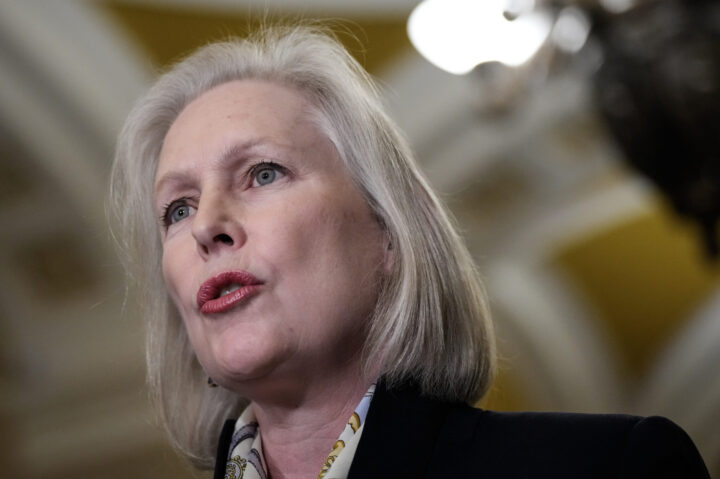
Drew Angerer/Getty Images
Sen. Kirsten Gillibrand (D-NY) speaks at a news conference following a closed-door lunch meeting with Senate Democrats at the U.S. Capitol on October 31, 2023, in Washington, D.C.
A group of six additional Senate Democrats plan to file new war powers resolutions this week to halt the war in Iran, a move that would allow Democrats to continue forcing votes on the war for the foreseeable future.
Previously, a different group of six Democrats introduced similar resolutions, and Democrats have called up two of them thus far, with plans to call up a third this week. So far, the resolutions have all failed along mostly party lines, with all senators remaining consistent in their votes.
The latest group of lawmakers includes Sens. Jeff Merkley (D-OR), Kirsten Gillibrand (D-NY), Chris Van Hollen (D-MD), Mark Kelly (D-AZ), Raphael Warnock (D-GA) and Andy Kim (D-NJ).
The array of lawmakers involved in the latest effort spans from staunch progressives and critics of Israel to generally more pro-Israel members.
“President Trump chose to start a war knowing it was going to raise gas prices on Americans already struggling to get by,” Gillibrand said in a statement. “The president, and his party, just don’t care about anyone other than themselves. They lie, cheat and steal to enrich themselves and leave regular folks with the bill. It is long past time for Republicans in Congress to stand up and do their job.”
House Democrats also plan to call up a war powers resolution this week, which may pass given that some Democrats who previously opposed a war powers effort and a handful of Republicans have indicated they plan to change their votes.
The latest set of six resolutions will not be eligible for floor votes immediately, but Democrats can call up the other four resolutions introduced previously at will. Senate Democrats are also likely to force votes on matters related to the Iran war during the upcoming reconciliation process, which Republicans aim to use to fund immigration enforcement and other priorities.
Piker has previously urged his followers to kill the Florida senator, who spoke at Yale Political Union last year

Kevin Dietsch/Getty Images
Sen. Rick Scott (R-FL) speaks on government funding during a press conference at the U.S. Capitol on March 06, 2024 in Washington, DC.
Sen. Rick Scott (R-FL) called for the federal government to “immediately” pull funding from Yale University over Yale Political Union’s decision to host Hasan Piker, an antisemitic streamer who previously suggested that the senator should be killed. Piker is scheduled to speak on campus Tuesday for a debate titled “Resolved: End the American Empire.”
Scott, who spoke last year at YPU, a storied debate society at the Ivy League university, wrote on X on Friday that “Yale receives billions from the federal government — President Trump and Congress need to IMMEDIATELY revoke it.”
Piker, a far-left Twitch streamer, has recently been invited to speak at several high-profile events, despite a laundry list of antisemitic, anti-American and terror-supporting rhetoric, which includes justifying Hamas’ Oct. 7, 2023, terror attacks in Israel. He has also called Orthodox Jews “inbred” and claimed America deserved 9/11.
For Scott, Piker’s incendiary language is personal; the streamer was briefly suspended from Twitch last year after urging followers to “kill Rick Scott.”
“An elite private university that hosts an antisemite who says a Senator should be killed, capitalists should be killed, and the U.S. deserved 9/11, shouldn’t get ONE CENT from taxpayers,” Scott wrote.
Asked about YPU hosting Piker, a spokesperson for Yale told Jewish Insider last week that “student organizations are responsible for issuing their own invitations to speakers.”
“At the same time, Yale is committed to maintaining a diverse, vibrant, and respectful community in which free expression is a fundamental value and a shared responsibility. The university is dedicated to providing a space where differing views can be expressed and heard respectfully,” the spokesperson said.
Unlike several Ivy League counterparts, including Harvard and Columbia, the Trump administration has not slashed Yale’s federal funding over antisemitism concerns.
Plus, Tucker’s GOP favorability tanks

(Sean Gallup/Getty Images)
Hungarian Prime Minister Viktor Orban speaks to the media after he cast his ballot in Hungarian parliamentary elections on April 12, 2026 in Budapest, Hungary.
👋 Good Monday morning!
In today’s Daily Kickoff, we look at how Israeli sentiment about the war in Iran could affect the country’s elections slated for later this year, and report on J Street’s decision to back calls for the end of U.S. missile-defense funding assistance to Israel. We talk to friends and former colleagues of former Rep. Eliot Engel, who died on Friday, and look at Tucker Carlson’s plummeting personal ratings amid rebukes from President Donald Trump. Also in today’s Daily Kickoff: Mike Bloomberg, Roman Gofman and Rachel Stortch.
Today’s Daily Kickoff was curated by JI Executive Editor Melissa Weiss and Israel Editor Tamara Zieve, with assists from Danielle Cohen-Kanik and Marc Rod. Have a tip? Email us here.
What We’re Watching
- Following the failed U.S.-Iran talks over the weekend, CENTCOM’s blockade on maritime traffic in the Strait of Hormuz will begin at 10 a.m. ET. Read more here.
- The announcement prompted a warning from Iran that ports in the Persian Gulf and the Sea of Oman could potentially be targeted by the Islamic Revolutionary Guard Corps. The White House is reportedly considering resuming limited military strikes on Iran in tandem with the blockade in an effort to further pressure Tehran. More below.
- The Helsinki Commission is holding a briefing on Capitol Hill this afternoon focused on diplomacy with the Vatican. The briefing comes amid tensions between the White House and the Holy See following Pope Leo XIV’s comments on Saturday that the “delusion of omnipotence” was driving the war with Iran. In response, President Donald Trump posted on his Truth Social site on Sunday that the pontiff “is WEAK on Crime, and terrible for Foreign Policy,” adding, “I don’t want a Pope who thinks it’s OK for Iran to have a Nuclear Weapon.”
- Semafor’s World Economy Summit kicks off today in Washington. Speakers today include Energy Secretary Chris Wright, Sens. Sheldon Whitehouse (D-RI) and Rick Scott (R-FL), Peter Orszag and Anne Wojcicki.
- The family of former Rep. Eliot Engel (D-NY), who died on Friday, will be sitting shiva this week in Riverdale, N.Y. Read our obituary for the longtime New York congressman below.
- Yom HaShoah, Israel’s Holocaust Remembrance Day, begins at sunset. Communities in Israel and around the world will hold remembrance events. In Jerusalem, Yad Vashem – The World Holocaust Remembrance Center will air a prerecorded state ceremony that will include speeches from Israeli Prime Minister Benjamin Netanyahu and President Isaac Herzog.
- The House will potentially hold several expulsion votes this week, following a San Francisco Chronicle report that Rep. Eric Swalwell (D-CA) had sexually assaulted female staffers. The report prompted calls for the House to take action against Swalwell, who suspended his gubernatorial bid on Sunday following the report, and three other House members — Reps. Sheila Cherfilus-McCormick (D-FL), Cory Mills (R-FL) and Tony Gonzales (R-TX) — over allegations of misconduct.
- In Hungary, Péter Magyar’s center-right opposition Tisza party appears poised to secure a supermajority following Sunday’s elections. Hungarian Prime Minister Viktor Orbán, who has led the central European nation since 2010 — and who had the tacit backing of Netanyahu — conceded to Magyar on Sunday evening. Israeli Opposition Leader Yair Lapid congratulated Magyar on his victory, saying that he hoped relations between Jerusalem and Budapest “will continue to deepen and strengthen” under Magyar’s leadership.
What You Should Know
A QUICK WORD WITH JI’S MARC ROD
As U.S. discourse about Israel has become increasingly polarized and the left has grown increasingly hostile to the Jewish state, support for Israel’s missile-defense systems that protect the lives of millions of civilians remained a popular bipartisan priority.
Even among many progressives who were otherwise critical of Israel, U.S. aid for systems such as Iron Dome remained a rare exception, with most praising the system as an important protection measure for Israelis and Palestinians alike.
Emblematic of that fact: Just four House Democrats and two Republicans voted last year in favor of cutting $500 million in cooperative missile-defense funding that the U.S. provides to Israel annually.
But in the wake of the wars in Gaza, Iran and Lebanon, that consensus appears to be shifting quickly on the left. A growing number of progressive candidates — along with J Street, the left-wing Israel advocacy group — are now racing to disavow all military support for Israel, including for defensive systems such as the Iron Dome.
Rep. Alexandria Ocasio-Cortez (D-NY), one of the most prominent progressive standard-bearers, has been a trendsetter on the issue. She said earlier this month that she would not support any funding for Israeli missile defense going forward, after previously vociferously defending her vote against last year’s amendment cutting missile defense as a clear and easy choice.
Her reversal on the issue came amid criticism and pressure from Democratic Socialistsof America members over that vote, as the far-left group debated whether to endorse her once more in her upcoming reelection bid.
POLITICAL BACKLASH
Amid the ceasefire with Iran, new Israeli polls were split on the outcome for Israeli Prime Minister Benjamin Netanyahu’s Likud party and coalition ahead of the country’s election slated for later this year. Three television polls showed Netanyahu losing significant support as a result of the unpopularity of the ceasefire, while polls from two right-leaning networks projected he would still have a majority in the Knesset to form a coalition, Jewish Insider’s Lahav Harkov reports.
Pushing back: During a televised statement on Saturday night, Netanyahu argued that the results of the war against Iran had been positive, and the ceasefire may not be final: “There are people who say ‘we have no achievements.’ There are giant achievements.” Netanyahu said, “The campaign is not yet over, but even now it can be clearly stated: We have achieved historic accomplishments. Iran tried to squeeze us in a stranglehold; Hamas in Gaza, Hezbollah in Lebanon, the Assad regime in Syria, the militias in Iraq, the Houthis in Yemen, Iran itself. They wanted to choke us, and we are choking them. … Those who threatened to destroy us are now fighting for their own survival.”
WINDS OF CHANGE

J Street, the progressive Israel advocacy organization which describes itself as a “pro-Israel, pro-peace” group, offered backing for the growing calls among far-left lawmakers to end U.S. support for Israel’s missile-defense systems, such as Iron Dome, which until recently had been largely spared even by strident critics of the Jewish state, Jewish Insider’s Marc Rod reports.
What they said: “What progressives are saying is not radical, and in fact, [Israeli Prime Minister] Benjamin Netanyahu and [Sen.] Lindsey Graham (R-SC) are arguing the same thing. Israel is capable of paying for its own military equipment, including supplies for its missile defense systems,” a J Street spokesperson told JI.
U-turn: Former New York City Comptroller Brad Lander, who is challenging Rep. Dan Goldman (D-NY) in a bitterly contested June primary, called for ending all U.S. aid to Israel during an interview published Friday, reversing his prior support for funding to bolster Israel’s Iron Dome missile-defense system, JI’s Matthew Kassel reports.
CHOICE OF WORDS
Sen. Elissa Slotkin (D-MI) has lately been saying that she does not take money from AIPAC or any corporate political action committees. So when a college student asked her at a town hall in Cincinnati on Thursday about $4.5 million she has received from “pro-Israel lobbies,” Slotkin pushed back — arguing the student was unfairly lumping together all Jewish donors, Jewish Insider’s Gabby Detuch reports.
What she said: “I’m not sure what you’re referring to on ‘not AIPAC but the Israel lobby.’ If you’re equating ‘Israel lobby’ to Jews, I got a problem with that,” Slotkin said. Slotkin said that just as Iranian Americans, for instance, may not agree with everything the Iranian government does, “I think it’s really important, especially now, to make a distinction between the Israeli government and the choices that they’re making and the average Jew, OK, and Jewish people who donate to campaigns,” Slotkin said, earning applause from the audience.
Ramped up rhetoric: Pennsylvania Gov. Josh Shapiro accused President Donald Trump of being “bullied” into starting a war with Iran, suggesting in an interview with the “All-In Podcast” that Israel had pressured the U.S. into joining a military campaign against the Islamic Republic.
TUCKER TROUBLES

Tucker Carlson, the anti-Israel and antisemitic podcaster whose outspoken opposition to the Iran war has strained his relationship with President Donald Trump, has seen his personal ratings nosedive including among Republicans, according to a new YouGov poll. The survey, commissioned by UMass-Lowell between March 26-30, finds Carlson’s overall favorability rating at a dismal 17%, with 38% viewing him unfavorably. Nearly one-third of respondents said they had no opinion of him, and 15% had never heard of him, Jewish Insider’s Josh Kraushaar reports.
Survey says: Among Republicans, Carlson’s favorability rating is now just at 31%, with 24% viewing him unfavorably, and 35% offering no opinion. (For context, a Manhattan Institute poll of Republicans conducted in December 2025 found 63% of Republicans viewed Carlson favorably, with 21% viewing him unfavorably.)
Booking it: Skyhorse Publishing is launching a new imprint with Tucker Carlson in partnership with the Tucker Carlson Network; the imprint is set to publish books from Los Angeles Times owner Dr. Patrick Soon-Shiong, Russell Brand and far-right influencer Milo Yiannopoulos.
IN MEMORIAM

Former Rep. Eliot Engel (D-NY), who represented the Bronx and Westchester County in the House from 1988 to 2020 and served for years as the top Democrat on the House Foreign Affairs Committee, died Friday at age 79, Jewish Insider’s Marc Rod reports.
Retrospective: Engel, who was Jewish, rose to become the chair of the House Foreign Affairs Committee when Democrats retook the House in 2018, after serving as the ranking member from 2013 to 2018. He was a strong and vocal advocate for the U.S.-Israel relationship and the Jewish community, also acting as a co-chair of the House antisemitism task force. But he was defeated in the 2020 election by far-left former Rep. Jamaal Bowman (D-NY), with Engel’s support for Israel becoming a primary issue in the race — an early harbinger of subsequent trends in the Democratic Party.
COMFORT FOOD
Israeli singer Hananel Edri discovered his love for food and his family’s Moroccan traditions in his grandmother’s kitchen, where he found solace after the trauma of a rocket strike on his family home in Kiryat Shmona, near Israel’s northern border with Lebanon, at age 10. Meanwhile, Merav Oren — founder and CEO of Foodish, the culinary department of Tel Aviv’s Anu Museum of the Jewish People — grew up between Atlanta and Israel, rooted in a different culinary tradition: Ashkenazi Jewish cuisine. This year, the two brought their worlds together to form “Soul and Roll,” a new immersive culinary and musical experience, Jewish Insider’s Haley Cohen reports.
Cooking up connection: “We talk, Hananel sings and at the end people do a hands-on experience making ma’amoul,” a traditional Middle Eastern pastry often served at Mimouna, the Moroccan-Jewish celebration to mark the end of Passover, Oren told JI on Sunday at an event to launch Foodish’s international expansion. Held at the Washington home of documentary filmmaker Aviva Kempner, some two dozen attendees got a taste of a Soul and Roll show, including Edri’s rendition of “Jerusalem of Gold” and a Moroccan song dedicated to his grandmother, followed by a lesson in making date-filled ma’amoul pastries to bring home.
Worthy Reads
Strait Talk: The Wall Street Journal’s Benoit Faucon does a deep dive into how the Islamic Revolutionary Guard Corps maintains control over the Strait of Hormuz through underground pens, waterborne drones and other technology. “[Iran’s] regular navy operated Iran’s big battleships largely for prestige and occasional long-range deployments. The paramilitary Islamic Revolutionary Guard Corps, on the other hand, has its own extensive fleet of more nimble boats designed to control the crucial waterway with missiles, mines and harassment of commercial ships — and they are much harder to reach.” [WSJ]
Pressure Point: The Washington Post’s David Ignatius considers the implications of the failed U.S.-Iran talks in Islamabad, Pakistan, over the weekend and President Donald Trump’s threatened blockade of the Strait of Hormuz. “The blockade is a pressure tactic, to be sure, but not primarily a military one. Trump has no appetite for further armed conflict. He knows that the upsides are limited and the ‘tail risk,’ as financial traders like to say, is large. His aim instead is to put a severely battered Iran into an economic vise to see if its leaders will set a different course in a big, comprehensive deal.” [WashPost]
Hungary for Change: The Times of Israel’s Nava Frieberg looks at how Peter Magyar’s victory in Sunday’s elections in Hungary could affect Budapest’s support for Israel in the European Union. “But while Orban’s support has been politically significant, Hungary’s practical impact on EU policy has been more limited than often assumed, and a change in Hungarian leadership is unlikely to radically shift bilateral relations, experts say. … While Orban’s government has taken significant measures to support Israel in international forums, its ability to block EU moves against Israel has affected rhetoric more than policy, a European diplomat familiar with the matter told The Times of Israel.” [TOI]
Word on the Street
Lebanese Prime Minister Nawaf Salam postponed his trip to the U.S., which was slated to begin yesterday, citing the security situation in Lebanon; the postponement comes ahead of a planned meeting this week in Washington between Israeli Ambassador to the U.S. Yechiel Leiter, Lebanese Ambassador to the U.S. Nada Hamadeh Moawad and U.S. Ambassador to Lebanon Michel Issa…
The State Department revoked the green cards of three relatives of an Iranian regime official who served as a spokesperson for the militants who held American citizens captive during the 1979-1980 Iran hostage crisis…
Two federal immigration judges who presided over the government’s failed efforts to deport college students Rümeysa Öztürk and Mohsen Mahdawi over their anti-Israel activism were fired by the Trump administration; Roopal Patel and Nina Froes, who were both appointed by the Biden administration and were nearing the end of their probationary periods, were fired as part of a broader dismissal of dozens of immigration judges…
The Justice Department’s Board of Immigration Appeals rejected Columbia University anti-Israel protest leader Mahmoud Khalil’s attempt to dismiss his deportation case on Thursday, his lawyers said, JI’s Haley Cohen reports…
Reps. Chip Roy (R-TX), Andy Ogles (R-TN), Clay Higgins (R-LA) and Ralph Norman (R-SC) introduced a bill to designate the Council on American-Islamic Relations as a terrorist group…
Rep. George Latimer (D-NY) introduced a bill to nullify the Trump administration’s oil sanctions relief for Iranian vessels…
Antisemitic conspiracy theorist Dan Bilzerian filed paperwork to challenge Rep. Randy Fine (R-FL) in the Republican primary in Florida’s 6th Congressional District…
Politico explores the challenges facing the Democratic National Committee’s Middle East working group, days after the DNC’s rules committee rejected anti-Israel and anti-AIPAC resolutions at the group’s New Orleans gathering…
The Yale Political Union is slated to host antisemitic streamer Hasan Piker on campus on Tuesday for a debate titled “Resolved: End the American Empire,” according to the organization’s social media, JI’s Haley Cohen reports…
Town & Country spotlights the book events being hosted at former New York City Mayor Michael Bloomberg’s Bloomberg Philanthropies headquarters, which has “become the place in New York to have a book party, one that regularly attracts power players simply by nature of the host”…
The Wall Street Journal spotlights Dr. Bronner’s Magic Soaps’ business successes as the company and its leadership lean into social justice causes; the Journal notes that David Bronner, who serves as the company’s cosmic engagement officer, traveled to Israel and the West Bank last year and blasted the “military apartheid rule” in the enclave…
Police in San Francisco arrested a 20-year-old man accused of throwing a Molotov cocktail at the home of OpenAI CEO Sam Altman…
The Wall Street Journal looks at how upheaval among staff at the streaming startup Mubi over the company’s deal with Sequoia Capital — owing in part to Sequoia’s investments with startups that work with the IDF and the social media posts of Sequoia Capital partner Shaun Maguire — resulted in a decline in subscriptions and an exodus of employees…
New York state Sen. Jack Martins, a pro-Israel Republican, announced he will not seek reelection to his Long Island seat…
Cisco is in advanced talks to acquire Israeli cybersecurity startup Astrix Security in a deal potentially worth $350 million…
Israel barred Spain from accessing the Civil-Military Coordination Center in Kiryat Gat that is being used to oversee the ceasefire in Gaza, with Israeli Foreign Minister Gideon Sa’ar saying that Madrid has “such a blatant anti-Israeli bias that it has lost any ability to serve as a useful actor in implementing” the ceasefire plan…
Days later, Israel’s Foreign Ministry summoned Francisca María Pedrós Carretero, Spain’s chargé d’affaires, after the Spanish town of El Burgo blew up an effigy of Israeli Prime Minister Benjamin Netanyahu as part of its annual Easter event…
Nine foreign carriers, including Etihad and Ethiopian Airlines, are set to resume service to Israel’s Ben Gurion Airport this week…
The IDF announced it killed one of the Hamas terrorists who took hostages Hersh Goldberg-Polin, Alon Ohel, Eliya Cohen and Or Levy from a roadside bomb shelter during the Oct. 7, 2023, terror attacks…
Maj. Gen. Roman Gofman was approved to be the next head of the Mossad; Gofman, the military secretary to Netanyahu, will assume the role on June 2…
New York Solidarity Network named Rachel Stortch, the COO of Fifth Avenue Synagogue and a former Missouri lawmaker, as its first CEO; NYSN Board Chair Gary Ginsberg called Stortch “a rare combination of electoral strategist and community builder”…
Fred Drasner, the former co-publisher of the New York Daily News, died at 83…
Pic of the Day

Singer Noga Erez on Saturday became the first Israeli artist to perform at the annual Coachella Valley Music and Arts Festival in Indio, Calif. Addressing the crowd during her set, Erez said, “I come from a very, very, very complex part of this planet, and to get us all here doing this was kind of like forces that I didn’t know that I had.”
Birthdays

Longtime drummer for Bruce Springsteen’s E Street Band and the bandleader for “The Tonight Show with Conan O’Brien,” Max Weinberg turns 75…
Curator and then director of the Louvre until 2001, he is the son-in-law of the late Alain de Rothschild, Pierre Rosenberg turns 90… Geneticist and 1985 Nobel Prize laureate in medicine, Michael Stuart Brown turns 85… Author and feminist leader, she is the former CEO of Planned Parenthood Federation of America, Gloria Feldt turns 84… Managing director at Tiedemann Advisors, he was previously a vice chair at Goldman Sachs and a high-ranking State Department official, Robert D. “Bob” Hormats turns 83… Retired member of the U.S. House of Representatives (D-CA) after 10 terms, Susan Carol Alpert Davis turns 82… VP of the New Israel Fund, Paul Egerman… Actor who won a Golden Globe for his portrayal of Vincent in the television series “Beauty and the Beast,” Ron Perlman turns 76… Partner in Uplands Real Estate Partners, Deborah Ratner Salzberg… Former member of the U.K. Parliament until 2005, she served as the U.K.’s first ever minister of state for asylum and immigration under then-Prime Minister Tony Blair, Barbara Margolis Roche turns 72… Co-founder of Highbridge Capital Management, a hedge fund based in NYC, and a founding board member of the Robin Hood Foundation, Glenn Dubin turns 69… Author of six books and co-host of “Democracy Now!,” a daily global independent news hour, Amy Goodman turns 69… Art historian, philanthropist and author of the KosherLikeMe website, Liz Rueven… U.S. senator (D-PA) until last year, Bob Casey, Jr. turns 66… Former orthopedic surgeon, he was the Democratic nominee for the 2020 U.S. Senate election in Alaska, Alan Stuart Gross turns 64… President Donald Trump’s nominee for chair of the Federal Reserve, he was the youngest-ever Federal Reserve governor until 2011, Kevin Warsh turns 56… Lead vocalist and founding member of the rock group “Staind,” he has also enjoyed a successful solo career in country music, Aaron Lewis turns 54… CEO and executive director of D.C.-based Sixth & I, a center for arts, entertainment and ideas, Heather Moran… Staff writer at Tablet Magazine, Armin Rosen… Senior director of government relations at FDD Action, Alexandria Paolozzi… General partner at Overmatch Ventures, Morgan Hitzig… Senior consultant at Gray Ink, Lauren Epstein Schwartz… Sales executive at Sign Source NJ, Aharon Lipnitsky… Helene Cash…
A growing number of progressive candidates are now racing to disavow all military support for Israel, including for defensive systems such as the Iron Dome

JALAA MAREY/AFP via Getty Images
A picture taken on August 5, 2021, shows an Iron Dome defense system battery, designed to intercept and destroy incoming short-range rockets and artillery shells, in the Hula Valley in northern Israel near the border with Lebanon.
As U.S. discourse about Israel has become increasingly polarized and the left has grown increasingly hostile to the Jewish state, support for Israel’s missile-defense systems that protect the lives of millions of civilians remained a popular bipartisan priority.
Even among many progressives who were otherwise critical of Israel, U.S. aid for systems such as Iron Dome remained a rare exception, with most praising the system as an important protection measure for Israelis and Palestinians alike.
Emblematic of that fact: Just four House Democrats and two Republicans voted last year in favor of cutting $500 million in cooperative missile-defense funding that the U.S. provides to Israel annually.
But in the wake of the wars in Gaza, Iran and Lebanon, that consensus appears to be shifting quickly on the left. A growing number of progressive candidates — along with J Street, the left-wing Israel advocacy group — are now racing to disavow all military support for Israel, including for defensive systems such as the Iron Dome.
Rep. Alexandria Ocasio-Cortez (D-NY), one of the most prominent progressive standard-bearers, has been a trendsetter on the issue. She said earlier this month that she would not support any funding for Israeli missile defense going forward, after previously vociferously defending her vote against last year’s amendment cutting missile defense as a clear and easy choice.
Her reversal on the issue came amid criticism and pressure from Democratic Socialists of America members over that vote, as the far-left group debated whether to endorse her once more in her upcoming reelection bid.
Ocasio-Cortez argued that Israel is fully financially capable of funding Iron Dome and other defensive systems itself — pointing in part to Israeli Prime Minister Benjamin Netanyahu’s comments earlier this year that he wants to wind down U.S. aid to Israel, which have proven to be a thorn in the side of some pro-Israel advocates.
She was quickly followed by another prominent progressive Democrat, Rep. Ro Khanna (D-CA), who also harbors presidential ambitions, and other left-wing candidates. Another abrupt about-face on the issue came from former New York City Comptroller Brad Lander, who came out in support of Iron Dome funding during his 2025 mayoral campaign, but is now opposing it as he runs to the left of Rep. Dan Goldman (D-NY) in a congressional primary.
Michael Blake, the far-left challenger to Rep. Ritchie Torres (D-NY), also said he would continue to support Iron Dome funding just months ago, but has now flip-flopped to oppose it. Meanwhile, Torres doubled down on his support for Iron Dome funding in a post on social media over the weekend, saying, “I will never join that bandwagon—no matter how politically expedient it may become. Even the world’s most committed pacifist should have no objection to Iron Dome. It is purely defensive. It does not attack anyone. It simply intercepts projectiles that would otherwise strike homes, hospitals, schools, and synagogues. Its sole purpose is to prevent mass murder.”
Strikingly, J Street, which frames itself as a pro-Israel group, is echoing the same rhetoric used by far-left lawmakers like Ocasio-Cortez. “What progressives are saying is not radical, and in fact, Benjamin Netanyahu and Lindsey Graham are arguing the same thing. Israel is capable of paying for its own military equipment, including supplies for its missile defense systems,” a J Street spokesperson told JI.
That stance is at odds with J Street PAC’s own endorsement criteria for candidates, as displayed on its website as of Friday afternoon. J Street President Jeremy Ben Ami said in a Sunday Substack post that he wants to see U.S. direct aid and subsidies to Israel ended “responsibl[y] yet rapid[ly]” upon the conclusion of the current U.S.-Israel Memorandum of Understanding, but that the U.S. should continue to sell and co-develop defensive systems to Israel, subject to Israeli compliance with U.S. arms sales law.
Systems like Iron Dome are also co-produced by the U.S. and Israel, and similar arrangements would likely continue even if direct U.S. financial aid to Israel was ended in the short term.
And as the consensus among the left shifts, some anti-Israel Democratic candidates are pushing the envelope even further. Saikat Chakrabarti, a far-left candidate running for retiring Rep. Nancy Pelosi’s (D-CA) San Francisco House seat, said Thursday that “ending funding isn’t enough — we need sanctions.” Chakrabarti previously served as Ocasio-Cortez’s chief of staff.
There are signs that some more moderate lawmakers are also feeling the pressure from the left amid the declining support for Israel within the Democratic party: Sen. Ruben Gallego (D-AZ), who last year rejected efforts to block U.S. arms sales to Israel, said last week he’ll now oppose offensive aid while saying he views missile-defense support differently — a similar position to the one that progressives like Ocasio-Cortez and Lander held just months ago.
A traveling program called ‘Soul and Roll’ by singer Hananel Edri and Foodish CEO Merav Oren tells the Jewish story through an immersive culinary and musical experience

Haley Cohen
Israeli singer Hananel Edri presents “Soul and Roll” at an event held at the Washington home of documentary filmmaker Aviva Kempner.
Israeli singer Hananel Edri discovered his love for food and his family’s Moroccan traditions in his grandmother’s kitchen, where he found solace after the trauma of a rocket strike on his family home in Kiryat Shmona, near Israel’s northern border with Lebanon, at age 10.
Meanwhile, Merav Oren — founder and CEO of Foodish, the culinary department of Tel Aviv’s Anu Museum of the Jewish People — grew up between Atlanta and Israel, rooted in a different culinary tradition: Ashkenazi Jewish cuisine.
This year, the two brought their worlds together to form “Soul and Roll,” a new immersive culinary and musical experience designed by Oren and Edri — a self-proclaimed “foodie” and singer who has performed on some of Israel’s most prestigious stages including Habima National Theatre. “We talk, Hananel sings and at the end people do a hands-on experience making ma’amoul,” a traditional Middle Eastern pastry often served at Mimouna, the Moroccan-Jewish celebration to mark the end of Passover, Oren told Jewish Insider on Sunday at an event to launch Foodish’s international expansion.
Held at the Washington home of documentary filmmaker Aviva Kempner, some two dozen attendees got a taste of a Soul and Roll show, including Edri’s rendition of “Jerusalem of Gold” and a Moroccan song dedicated to his grandmother, followed by a lesson in making date-filled ma’amoul pastries to bring home. The invitation-only event also featured remarks from Israeli chef and food writer Vered Guttman and Jewish cookbook author Joan Nathan.
“Anu strengthens the Jewish belonging through history and art. We at Foodish do that through food — we tell the story of the Jewish people through food, through events and festivals,” said Oren.

Merav Oren, founder and CEO of Foodish, the culinary department of Tel Aviv’s ANU Museum of the Jewish People, presents “Soul and Roll” at an event held at the Washington home of documentary filmmaker Aviva Kempner. (Haley Cohen)
Edri and Oren, both of whom reside in Tel Aviv, met during a visit to Warsaw, Poland, working with Jewish communities through food and music, just days before the Oct. 7, 2023, terrorist attacks. After Hamas’ massacre, the pair reunited to lead food therapy workshops.
“Just after Oct. 7 we went down to the south where evacuees were staying and started doing culinary workshops with them,” Oren recalled on Sunday. One moment that still stands out to her, she said, was when she began doing dishes after the workshop and an evacuee insisted on helping because what she missed most about home was “the basic stuff like washing dishes, baking or cooking.”
Also in the immediate aftermath of Oct. 7, Foodish ran a pop-up exhibition with 14 of the leading chefs in Israel, including Eyal Shani, pairing each with a famous Israeli artist. Each illustrator designed artwork for a chef coat based on the chef’s personal story, which was then sold in an exhibition. Funds raised went towards expanding the food therapy workshops.
Foodish has since launched several other programs, including one that invites high school students to taste cultural, and sometimes unpopular foods like chopped liver, “that are kind of disgusting, but through that we tell the story of specific communities,” said Oren.
Another program designed to alleviate loneliness among the elderly sends volunteers to their homes and to document their history as they cook together. “Then we have an event where they invite their families, go onstage and tell their stories. The food helps them tell their stories, which otherwise probably no one would have asked them about,” said Oren.
The newest projects, which Oren said are “going global,” include Soul and Roll, as well as one designed for schools that focuses on teenagers and young adults to assist them in documenting their family’s food stories, both online and in print.
“All of these are examples that explain to us food is not just food, it’s so much more engaging. We deal with Jewish identity through food,” said Oren. “We want to take what we do to Jewish communities all over the world.”
Noting Israel’s war with Iran and the countless hours they have spent in Tel Aviv bomb shelters over the past month, both Oren and Edri said that the launch of Foodish’s latest programs comes amid a challenging period.
“This is a difficult time for us. Growing up, the rocket situation was my reality,” said Edri. “Today, I live in Tel Aviv and we are facing the same reality. Doing what we do, and to be able to come here and share our stories with you, is even more important [than ever] for me because we are strong only if we stay together. Our existence really depends on each other,” he told the American Jewish audience.
Although the war forced the cancellation of two of their three scheduled shows in Israel, Edri told JI that Soul and Roll is persevering, adding, “It’s difficult, but we’re getting it out there.” The pair’s trip to the U.S. also included a Mimouna show in New York.
“My background is mainly onstage and I’m a big foodie,” continued Edri, adding that what draws him to the program is the combination of “kitchen, memories, Jewish identity brought all together with music and what Anu does, and people leaving with cookies, music they can sing to and memories.”
Edri, who runs his own culinary-musical web series called “Cooking with Hananel,” shared the reason each Soul and Roll show begins with the same song, “Jerusalem of Gold,” the iconic Israeli tune written by Naomi Shemer in 1967: “Merav’s family came from Poland, my family came from Morocco,” he said. “Our grandmothers were in very different situations and settings, but they all prayed and longed for the same place, which is Jerusalem.”
With polls showing most Israelis opposing Iran ceasefire, Likud drops in three weekend polls, while two others show the current coalition maintaining power
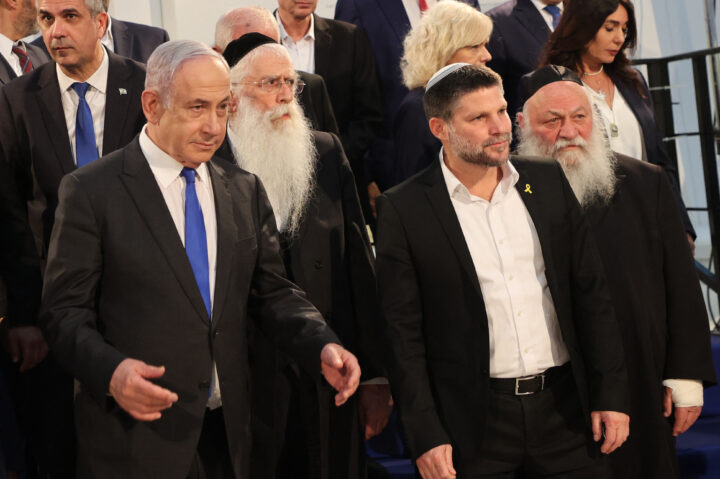
GIL COHEN-MAGEN/POOL/AFP via Getty Images
Israeli Prime Minister Benjamin Netanyahu (L) and Finance Minister Bezalel Smotrich (2nd R) arrive for a cabinet meeting at the Bible Lands Museum in Jerusalem on June 5, 2024.
Amid the ceasefire with Iran, new Israeli polls were split on the outcome for Israeli Prime Minister Benjamin Netanyahu’s Likud party and coalition. Three television polls showed Netanyahu losing significant support as a result of the unpopularity of the ceasefire, while polls from two right-leaning networks projected he would still have a majority in the Knesset to form a coalition.
The election is currently slated for the end of October. Israeli Channels 12, 13 and Kan 11 projected Netanyahu’s coalition would not receive enough votes to stay in power, but they also found that center-left parties — excluding Arab parties, which most Zionist parties have said would not be invited to join their coalition — would not get the 61-seat majority to form a winning coalition.
Channels 14 and i24NEWS news projected that the coalition would be able to remain in power, but with a smaller majority than it received in 2022, as it has consistently received in polling since then.
Netanyahu appeared defensive in a televised statement on Saturday night, during which he argued that the results of the nearly six-week war against Iran had been positive, and the ceasefire may not be final: “There are people who say ‘we have no achievements.’ There are giant achievements.”
“The campaign is not yet over, but even now it can be clearly stated: We have achieved historic accomplishments,” Netanyahu continued. “Iran tried to squeeze us in a stranglehold; Hamas in Gaza, Hezbollah in Lebanon, the Assad regime in Syria, the militias in Iraq, the Houthis in Yemen, Iran itself. They wanted to choke us, and we are choking them. … Those who threatened to destroy us are now fighting for their own survival.”
Netanyahu went on to list the war’s achievements: “We succeeded in crushing the nuclear program, crushing the missile program,” and brought Iran’s regime “to its lowest, weakest level since the establishment of the regime 47 years ago.” He also listed dozens of senior officials and military commanders who had been killed by Israel and weapons sites that had been destroyed.
Still, the prime minister acknowledged that the enriched uranium in Iran must be removed “either … by agreement, or it will come out in other ways.”
Netanyahu also spoke at length about negotiations with Lebanon as the IDF continued operations against Hezbollah. He said the talks would be about the disarmament of the Iran-backed terrorist group and “a real peace agreement” with Beirut.
In polls released the night before, Israeli channels 12 and 13 and public broadcaster Kan found that a narrow majority of Israelis (from 51% to 56%) said they oppose the two-week ceasefire with Iran. In addition, in a poll published Sunday by the Institute for National Security Studies at Tel Aviv University, 61% of Israelis opposed the ceasefire, and less than a third (31%) said they believed that the Iranian regime was significantly harmed in the war.
Elie Pieprz, an international political consultant who has worked on Likud campaigns, argued that Netanyahu doesn’t need the war to come to a conclusively positive end for Israel for him to use it to his political advantage.
“The prime minister has always thrived when something tantalizing is very close, and [he can say] ‘if you just give me another term, I can bring this home,” Pieprz said. “I think regime change [in Iran] is exactly one of those things.”
Conversely, Nilly Richman, a strategist who has worked with President Isaac Herzog and launched Yair Lapid’s Yesh Atid party, told Jewish Insider that “there is no doubt that Netanyahu is stressed, and he is broadcasting it.”
According to Richman, the stress comes from the fact that “the polls aren’t bringing [Netanyahu] to the point he hoped to be in after this war” and that he will have to testify again in the corruption trials against him this week, now that Israel is no longer in a state of emergency.
According to Kan’s poll, the current coalition parties were projected to receive 51 seats, while Zionist opposition parties got 59. Likud received 25 seats, down from 28 in the previous week’s polls, while former Prime Minister Naftali Bennett’s yet-unnamed party was steady at 19.
On Channel 12, Israel’s most-watched news broadcast, Likud was projected to drop to 25 from 27 last week, and Bennett to rise from 20 to 22 seats. The coalition would get 50 seats, and the Zionist opposition 60, according to the poll.
In Channel 13’s poll, the coalition got 54 seats and the Zionist opposition received 55. Likud received 22 seats, up from 25 last week, and Bennett went from 18 to 21.
Newer, more right-leaning channels 14 and i24 News, however, showed Netanyahu would be able to form a majority coalition with his current partners. They did not ask about support for the ceasefire.
In i24’s poll, Likud received 32 seats and former IDF Chief of Staff Gadi Eisenkot’s Yashar Party led the opposition with 14 seats. The coalition would win 64 seats and the Zionist opposition received 45.
Pro-Netanyahu Channel 14, whose pollster, former Netanyahu aide Shlomo Filber, most accurately predicted the results of the last election, found that the right-wing bloc received 66 seats while the Zionist opposition received 42. The poll also gave Likud 36 seats and Bennett’s party 10, with Yashar leading the Zionist opposition with 11 seats.
Filber’s poll was also the only one asking about the Joint List — a bloc of all four Arab parties, which they have said they plan to form — rather than polling them as the two separate blocs they have in the current Knesset – and found that the singular bloc received 12 seats, more than any Zionist opposition party.
Former Defense Minister Benny Gantz’s party did not pass the electoral threshold in any of the polls, while Finance Minister Bezalel Smotrich’s party passed it in the polls from Channels 13 and 14 and i24.
Pieprz said that “polls taken six months out [to the election] are not super-relevant, [though] there is value to tracking polls.”
Richman argued that “polls taken a moment after something happened are meaningless. It takes a moment for everything to sink in.” She also noted that “people want to see what will happen in two weeks,” when the current ceasefire with Iran is due to expire.
However, she pointed to a poll Channel 12 took of residents of Israel’s north as especially significant. Residents of the north are worth about 35 Knesset seats, and continue to be attacked by Hezbollah multiple times a day. The poll found that 70% of them — including a third of those who voted for the coalition in the last election — give the government a bad grade in dealing with their issues. While in 2022, the number of coalition and Zionist opposition voters in the north were about even, the Zionist opposition is now leading in the north by eight points.
Richman estimated that “three to four seats could move between the blocs.”
Much of that movement is from Likud to former Defense Minister Avigdor Liberman’s Israel Beytenu party, which is “on the right, but against Bibi,” Reichman said. She said that Liberman has kept his distance from the center-left and right-wing blocs, saying that he can be part of a coalition without Haredim or Arabs or the left-wing Democrats Party, a claim that appeals to moderate right-wing voters.
Pieprz said that, in line with Liberman’s more independent messaging, he may be signaling that he would be willing to join a coalition with Netanyahu but without Haredi parties, and that Netanyahu may be willing to do that rather than enter another cycle of multiple consecutive elections. “I don’t think Bibi will feel indebted to the Haredim,” he said.
Richman said moderate right-wing voters who don’t want to vote for Netanyahu are not moving toward Bennett, who is hawkish and holds right-wing positions on settlements, the economy and more. “Bennett will have to betray the left so that the right will forgive him” for forming a coalition with left-wing parties and an Arab party in 2021, she argued.
Pieprz said that Bennett is “moving in a downward trend” in the polls, and that “people in the opposition express frustration that he’s not going after voters on the right, and instead trying to concretize a base on the left, creating a problematic dynamic. I don’t think he can maintain it for six months.”
Pieprz noted that there has been a lot of infighting within the Zionist opposition, especially between Eisenkot and Bennett for dominance in the bloc.While calling the infighting “a bad look, they will never win that way,” he said they “have enough time to reconfigure and get on the same page and act in a way that shows the Israeli public that there is a legitimate alternative to Netanyahu.”
He posited that Netanyahu “is in relatively good shape, primarily because there is not a robust and developed opposition. … People supporting the prime minister are pretty solid. It would take a lot to dislodge [their votes]. In the opposition, there is fluidity.”
Pieprz, however, said that Netanyahu “squeezed out a lot of the political benefit of the war itself” — such as passing a budget that will allow his coalition to survive months longer than it may have — “and now he has to frame [the war] properly over the next six months. … He can make that case ‘allow me and the team that got us to this point to push it over the top.’”
Richman noted that the successful attacks on Iran’s nuclear program during last year’s 12-day war did not impact Netanyahu’s political standing much, but projected that after this war, the prime minister is likely to decline further in the polls.
“Bibi built [a monster] that ate him,” she said. “If Iran is so scary … Well, [Israel] attacked Iran and not much happened to us, Israel wasn’t destroyed, so we don’t need [Netanyahu] anymore. It’s like [former UK Prime Minister] Winston Churchill” — who lost an election right after World War II and Netanyahu is known to admire — “Be careful what you wish for, Bibi.”
Trump said the sticking point in talks that ended early Sunday morning was Iran’s refusal to give up its nuclear program

Win McNamee/Getty Images
President Donald Trump walks toward reporters before answering questions prior to boarding Air Force One on April 10, 2026 at Joint Base Andrews, Maryland.
The U.S. will begin blockading the Strait of Hormuz, President Donald Trump announced on Sunday, hours after negotiations in Islamabad, Pakistan, ended without reaching an agreement.
“Effective immediately, the United States Navy, the Finest in the World, will begin the process of BLOCKADING any and all Ships trying to enter, or leave, the Strait of Hormuz,” Trump wrote on Truth Social, adding that “other countries will be involved with this blockade.”
Trump called Iran’s claim that it had lost track of the mines it dropped in the strait “world extortion.”
In addition, the president said that any vessel that pays Iran a toll to enter the strait will be interdicted and that “Iran will not be allowed to profit off this Illegal Act of EXTORTION.”
As to the negotiations, Trump wrote, “There is only one thing that matters, IRAN IS UNWILLING TO GIVE UP ITS NUCLEAR AMBITIONS! … They were very unyielding as to the single most important issue.”
Nuclear power cannot “be in the hands of such volatile, difficult, unpredictable people… IRAN WILL NEVER HAVE A NUCLEAR WEAPON!” Trump added.
He also indicated military action will resume: “At an appropriate moment, we are fully ‘LOCKED AND LOADED,’ and our Military will finish up the little that is left of Iran,” he wrote.
Soon after, Trump told Fox News that the Iranians “haven’t left the bargaining table. I predict they come back and give us everything we want, and I told my people, ‘I want everything. I don’t want 90%, I don’t 95%.’ I told them, ‘I want everything.’ They have no cards. Their navy is gone, their air force is gone, totally gone.”
Earlier Sunday, Vice President JD Vance departed Islamabad after 20 hours of talks with Iranian negotiators.
“The bad news is that we have not reached an agreement, and I think that’s bad news for Iran much more than it’s bad news for the United States of America,” Vance said at a press conference shortly before his departure. “So we go back to the United States having not come to an agreement. We’ve made very clear what our red lines are.”
Vance said he made “a very simple proposal” that was “our final and best offer.” Under the terms of Vance’s proposal, Iran would have been required to make an “affirmative commitment” not to seek a nuclear weapon or the tools to do so. The vice president said the U.S. was leaving its last proposal on the table as he left for Washington: “We’ll see if the Iranians accept it.”
At the same time, he said the U.S. had been flexible and negotiated in good faith.
The vice president did not mention in his press conference Iran’s promise to reopen the Strait of Hormuz during the ceasefire, nor any demands relating to Iran’s ballistic missiles or funding of proxies, and declined to respond to a question as to the status of the ceasefire.
Mohammad Ghalibaf, Iran’s parliament speaker and negotiator with the U.S., wrote on X that his team had “no trust in the opposing side. My colleagues on the Iranian delegation raised forward-looking initiatives, but the opposing side ultimately failed to gain the trust of the Iranian delegation.”
Pakistani Foreign Minister Ishaq Dar, whose country hosted the talks, said it was “imperative” to continue the ceasefire despite the failure of the first round of negotiations to reach a resolution.
Ahead of the talks, Iran released its own ceasefire proposal that included continued control over the Strait of Hormuz, a ceasefire that would include Lebanon and the cancellation of primary and secondary sanctions. Iran also demanded their “acceptance of enrichment” of uranium.
Engel was remembered by colleagues and community leaders as a ‘mensch,’ a ‘true public servant’ and ‘an American in every way’
AP Photo/J. Scott Applewhite
House Foreign Affairs Committee Chair Eliot Engel, D-N.Y., walks through the Hall of Columns at the Capitol as House Democratic chairs gather for a meeting with Majority Leader Steny Hoyer, D-Md., in Washington, Wednesday, March 27, 2019.
Former Rep. Eliot Engel (D-NY), who represented the Bronx and Westchester County in the House from 1988 to 2020 and served for years as the top Democrat on the House Foreign Affairs Committee, died Friday at age 79.
Engel, who was Jewish, rose to become the chair of the House Foreign Affairs Committee when Democrats retook the House in 2018, after serving as the ranking member from 2013 to 2018. He was a strong and vocal advocate for the U.S.-Israel relationship and the Jewish community, also acting as a co-chair of the House antisemitism task force.
But he was defeated in the 2020 election by far-left former Rep. Jamaal Bowman (D-NY), with Engel’s support for Israel becoming a primary issue in the race — an early harbinger of subsequent trends in the Democratic Party.
In an exit interview with Jewish Insider in 2020, Engel said that he had committed himself throughout his career to being “the best friend that Israel ever had in Congress, and I think that I have kept up that bargain,” arguing that the U.S.-Israel relationship was stronger than ever. Engel’s stalwart support of Israel is now increasingly uncommon in a Democratic Party that’s becoming more critical of the Jewish state.
In 2020, he called conditioning aid to Israel “just about the stupidest thing I’ve ever heard.”
Engel broke at times with his party on issues related to the Middle East and the Jewish community, including being one of the few House Democrats to vote in 2015 against the Obama administration’s nuclear deal with Iran.
He also helped lead the first impeachment inquiry into President Donald Trump.
Rep. Jerry Nadler (D-NY), who served for years alongside Engel, told JI that Engel was “one of my greatest colleagues and dearest friends in Congress — a true progressive, a lifelong Democrat, and a tireless champion for the people of the Bronx, Rockland, and Westchester.”
“As Chair of the House Foreign Affairs Committee, he brought integrity and experience to America’s role in the world, and he was an unwavering friend to Israel throughout his decades of service,” Nadler continued. “His legacy of service to the Bronx, Rockland, Westchester, and the nation will not be forgotten.”
“Serving alongside Eliot Engel was one of the great privileges of my time in Congress. Eliot combined deep moral clarity with an unwavering commitment to America’s alliances, especially the U.S.–Israel relationship,” former Rep. Ted Deutch (D-FL), who now leads the American Jewish Committee, told JI. “He led the Foreign Affairs Committee with principle, steadiness, and a genuine respect for colleagues on both sides of the aisle. I was proud to call him not only a colleague, but a friend.”
House Minority Leader Hakeem Jeffries (D-NY) said that Engel was “a champion for the people he was privileged to represent in the Bronx and Westchester County.”
“The grandson of Jews fleeing czarist Russia and a proud son of New York City, Eliot’s career in public service was inspired by his deep roots,” Jeffries said. “Eliot was an astute and prolific legislator who fought for human rights, civil rights and against antisemitism here at home and abroad.”
Senate Minority Leader Chuck Schumer (D-NY) said Engel was a “true public servant who delivered for the people of his beloved Bronx and Westchester for 30 years — and a dear friend going back to when I first met him as a district leader in the Bronx.”
He praised Engel’s leadership of the Foreign Affairs Committee “with a rare blend of conviction, effectiveness, and kindness that has cemented him as one of the great diplomatic leaders of the 21st century.”
Rep. Brad Schneider (D-IL) said in a statement that Engel was “a mensch and a truly patriotic American.”
“He was one of the first Members of Congress to take me under his wing when I was just a candidate in 2012. After my election, it was a privilege and honor to serve on the House Foreign Affairs Committee with Eliot as Ranking Member, working with our colleagues on both sides of the aisle to promote our country’s interests and advance our national security,” Schneider continued. “Throughout our service together, I got to know a real leader who never gave up on the United States and knew in his heart that Americans have so much more in common than what might set us apart.”
Rep. Joe Wilson (R-SC), another longtime member of the House Foreign Affairs Committee, praised Engel as a “fighter for democracy and human rights around the world,” highlighting their work together on the Caesar Civilian Protection Act sanctions on the Assad regime in Syria and their support for the Syrian people.
New York City Council Speaker Julie Menin said, “Eliot Engel proudly served New Yorkers in Congress. As a proud member of the Jewish community and the son of immigrants, he represented the best of … America’s promise.”
Rep. George Latimer (D-NY), who ousted Bowman in 2024, said that Engel, “devoted his lifetime to public service — as a teacher and as an elected official in Albany and Washington DC. His legacy consists of hard work on issues and kindness to all.”
AIPAC, in a statement, called Engel “a steadfast friend of the pro‑Israel community and an unabashed champion of the U.S.-Israel relationship.”
“Throughout his distinguished 32‑year career in Congress, including as chairman of the House Foreign Affairs Committee, Congressman Engel worked tirelessly to strengthen and deepen the strategic alliance between the United States and Israel,” the group said, praising him as a “leading force against efforts to delegitimize our ally Israel.”
“He led critical efforts to support security assistance to Israel, worked to impose sanctions on the Iranian regime, opposed efforts to impose political cuts or conditions on aid, rejected the BDS campaign, and courageously opposed the 2015 Iran nuclear deal,” the group continued.
Local leaders who spoke to JI remembered Engel as an ever-present and deeply caring lawmaker who was always accessible both to the Jewish community and all of the communities he represented in Congress.
New York state Rep. Jeffrey Dinowitz said that Engel had been not only a professional colleague but a close personal friend for most of his life, with their families and children growing up together.
“We were the closest of friends for decades, literally decades. So it’s a horrible loss for the family and for the other people close to him,” Dinowitz said. “He does leave behind a great legacy — just the people that they helped. There’s no question that his office and sometimes he personally, they helped tens of thousands of people … he attended thousands of community events. He showed up everywhere.”
Dinowitz described Engel as a model of the Bronx, growing up from humble beginnings in public housing, going to college in the district and ultimately becoming the longest-serving member of Congress from the Bronx. “This is what the Bronx is all about. Somebody from modest beginnings can rise to one of the most powerful positions in the country,” Dinowitz said.
“He was the strongest supporter of Israel in the Congress, bar none,” Dinowitz added. “He was an effective advocate for Israel, and not only Israel, but Jewish causes in general. … He stood strong and he never wavered in his support for Israel.”
State Rep. Amy Paulin said that one of her earliest memories of Engel, when her district was redistricted into his in the 2010s, is one that stands out the most strongly. At the time, she said, the two did not know each other well, but he personally took her call on a Saturday evening to help a dying constituent obtain visas for family members to come to the United States to see him on his death bed.
“Not only did he take the call personally, he acted on it personally,” Paulin said. “What stood out for me, as I even recall the story, was just, you know, there wasn’t a hesitation on his part. … He was just such a terrific asset for us. He went to every event that he knew about, when he was in town, and he was such a kind, warm, smart, capable person, and his loss is going to mean something. … He cared. That’s just who he was.”
She said she later worked with Engel during the first Trump administration to obtain visas for young Palestinians to join a program with young Israelis to discuss peacebuilding, and he later helped facilitate a visit by Paulin to the Jewish state during a time of conflict.
“He cared deeply about Israel. He represented an area that also cares deeply about Israel,” Paulin added. “Being in Israel, you could see his love of the country. … He wanted to be there to see everything he could, to bring those messages back to the rest of the Jewish community so that everybody had a real clear picture of what Israel was up against and he did that because of his love of Israel and his wanting Israel to exist.”
Justin Brasch, the mayor of White Plains, N.Y., told JI that Engel was “so accessible and so down to earth,” a “tremendous public servant” and “so warm” to everyone in the community.
“What probably is [most] sad about him leaving the stage is that there aren’t enough people who are just kind and nice to everyone,” Brasch said. “There’s so much anger and betrayal in politics today, and he absolutely rejected that. He was kind and helpful and accessible to everyone. And I know for me that has always been something that has inspired me.”
He said that Engel was always willing and eager to take calls and to help constituents with any problem, in addition to being a strong supporter of Israel and fighter against antisemitism.
“He would always show up at events of concern to the Jewish community,” Brasch said. “And then we were quite proud that he was a congressman in our area.”
William Schrag, the former president of the Westchester Jewish Council, said that Engel was a “fierce [advocate]” for his constituents and “never lost sight of the people here.” Schrag said that the local Jewish community “loved him.”
Hank Sheinkopf, a longtime New York Democratic strategist who once worked for Engel, emphasized that the former congressman took on the traditional Democratic establishment in the Bronx on behalf of “the people who felt powerless” and won, remaining his own man throughout his public career.
He said Engel also clearly enjoyed being a public official — “he enjoyed the byplay, he enjoyed the drama, he enjoyed the behind the scenes stuff” and he was known for arriving early to State of the Union addresses to secure a coveted center-aisle seat and photo with the president.
Ultimately, however, Engel was “a victim of the first wave of the hostile takeover of the Democratic Party [by the far-left] which has become much more pronounced since then,” Sheinkopf continued. “Eliot Engel was an American in every way. He believed in democracy, he believed in diversity. He was racially blind. He thought power ought to be shared, and he never, never walked away from those convictions, nor his Jewishness, for which he paid the price of being evicted from office.”
“He was the precursor of what we are now experiencing. … He was the first guy to see it way up close,” Sheinkopf continued.
‘Israel is capable of paying for its own military equipment, including supplies for its missile defense systems,’ a spokesperson said, a position which is at odds with J Street PAC’s own stated endorsement criteria
Michael Brochstein/Sipa via AP Images
J Street President Jeremy Ben-Ami speak at the 2022 J Street National Conference held at the Omni Shoreham Hotel in Washington, D.C.
J Street, the progressive Israel advocacy organization which describes itself as a “pro-Israel, pro-peace” group, offered backing for the growing calls among far-left lawmakers to end U.S. support for Israel’s missile-defense systems, such as Iron Dome, which until recently had been largely spared even by strident critics of the Jewish state.
“What progressives are saying is not radical, and in fact, [Israeli Prime Minister] Benjamin Netanyahu and [Sen.] Lindsey Graham (R-SC) are arguing the same thing. Israel is capable of paying for its own military equipment, including supplies for its missile defense systems,” a J Street spokesperson told Jewish Insider.
Notably, that stance is at odds with J Street PAC’s own top endorsement criteria on its website as of Friday afternoon. The site states that J Street PAC requires endorsees to support “US security assistance to Israel that adheres to US law,” specifically citing support for Iron Dome.
“The United States plays an indispensable role in ensuring Israel’s future as a secure, democratic homeland for the Jewish people. J Street PAC only supports candidates who affirm this responsibility and who commit to supporting US security assistance to Israel as outlined in the 10-year Memorandum of Understanding (MOU) negotiated by President Obama — including sustained support for vital systems like Iron Dome,” the J Street website says.
The group, however, is currently supporting candidates who back policies like the Block the Bombs Act that run counter to the MOU.
In its statement, the group was referring to comments by the Israeli prime minister in which he did not call for an immediate end for U.S. aid to Israel, but said that he believed Israel would no longer need to rely on U.S. aid in a decade.
Though Graham initially responded to Netanyahu’s calls by suggesting he would immediately work to wind down U.S. aid, the South Carolina senator softened that position after a meeting with Netanyahu.
Calls to cut off missile defense aid to Israel have been growing in recent weeks from prominent far-left lawmakers like Reps. Alexandria Ocasio-Cortez (D-NY) and Ro Khanna (D-CA), joined recently by Brad Lander, a Jewish challenger to Rep. Dan Goldman (D-NY).
J Street’s backing of that stance could give cover to a host of rank-and-file Democrats to take a similar position.
Systems like Iron Dome are also co-produced by the U.S. and Israel, and similar arrangements would likely continue even if direct U.S. financial aid to Israel were ended in the short term.
In a Substack post on Sunday, J Street President Jeremy Ben Ami said that the U.S. should continue to cooperatively develop defensive technologies and to sell such systems to Israel, subject to Israel’s compliance with U.S. arms sales law, but that it should no longer provide any financial aid or subsidies to Israel for military systems.
“The United States should continue to supply what Israel needs for the defense of its people from Iranian, Hezbollah, Hamas and Houthi missiles – but the time is coming for Israel to pay for what it needs, as other prosperous countries do,” Ben Ami wrote.
He also reiterated J Street’s support for new legislation conditioning U.S. arms sales to Israel and for upcoming legislation to block specific arms sales.
“The exact timetable for phasing out taxpayer subsidies should be worked out carefully. The United States should honor existing commitments, including those in the 2016 memorandum of understanding, through their conclusion in the next two years,” Ben Ami said. “But after that, a responsible yet rapid phase-out is needed – a step that would move the U.S. and Israel toward a more mature, balanced, and ultimately more resilient partnership – one grounded not only in shared interests, but in shared standards and accountability.”
Brad Lander calls for ending all U.S. aid to Israel, flip-flopping on previous support for Iron Dome
Lander joins a small number of progressive House lawmakers, including Rep. Alexandria Ocasio-Cortez, in calling to cut off defensive aid
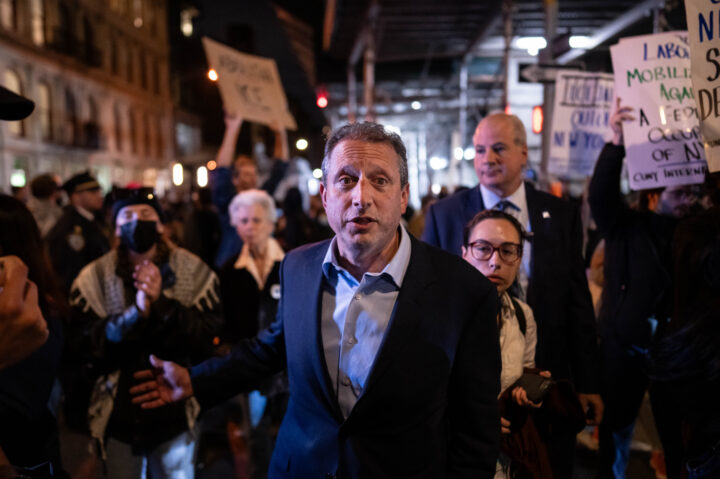
Adam Gray/Getty Images
Former New York City Comptroller Brad Lander outside of 26 Federal Plaza on October 21, 2025 in New York City.
Former New York City Comptroller Brad Lander, who is challenging Rep. Dan Goldman (D-NY) in a bitterly contested June primary, called for ending all U.S. aid to Israel during an interview published Friday, reversing his prior support for funding to bolster Israel’s Iron Dome missile-defense system.
Lander, a Jewish Democrat who identifies as a progressive Zionist, told The New York Editorial Board, a Substack of New York City journalists focused on local campaigns, that he “would not vote for any more aid [to Israel] at this moment,” when asked about his position on Iron Dome, saying he believed Israel was not following international law in the wake of its war in Gaza that he has called a genocide.
“I think we need to follow the Leahy Law and condition all of our foreign policy aid on human rights and international law compliance,” Lander said in the April 9 interview, referring to U.S. laws banning security assistance to foreign military units that engage in “gross” human rights violations. “At the moment, Israel is very far from complying with human rights and international law.”
Lander joins a handful of leading progressive lawmakers who have also recently vowed to reject further funding for Iron Dome and other defensive systems used by Israel, including Reps. Alexandria Ocasio-Cortez (D-NY) and Ro Khanna (D-CA). New York City Mayor Zohran Mamdani, one of Lander’s top allies in his race to unseat Goldman, confirmed last week that he holds the same position regarding aid to Israel.
Lander had declined to comment when asked by Jewish Insider this week to share his position on defensive funding to Israel, raising questions about where he would land on an issue that is emerging as a sort of electoral litmus test among the far-left activists he is courting in his campaign to represent a heavily Jewish district covering Lower Manhattan and parts of Brooklyn.
Goldman, a pro-Israel Jewish Democrat, affirmed his support for continued Iron Dome funding in a statement to JI earlier this week, saying the system “provides critical protection to millions of civilians and saves hundreds of innocent lives every day.”
Lander had endorsed Iron Dome funding during his unsuccessful mayoral campaign last year, even as he had otherwise backed broad conditions on offensive aid. In February, he came out in support of a House bill seeking to impose sweeping new restrictions on offensive arms sales to Israel.
In a statement to The Forward on Friday, Lander called Iron Dome “critical to ensuring the safety of civilians in Israel” and said that “Israel should have access to purchase it with their own funds.”
But he added that the United States “should not provide taxpayer-funded financial aid for it at this time.”
“I genuinely hope that changes in the future, speedily and in our day, as part of a deal that protects the human rights and safety of all civilians in the region,” he told The Forward.
The storied debate society at Yale University has previously hosted former presidents and intellectuals as featured guests

Noushad Variyattiyakkal/SOPA Images/LightRocket via Getty Images
Hasan Piker attends Web Summit Qatar 2026
The Yale Political Union, a storied debate society at the Ivy League university, is slated to host antisemitic streamer Hasan Piker on campus on Tuesday for a debate titled “Resolved: End the American Empire,” according to the organization’s social media.
YPU — a registered student-run group, which is the oldest and largest collegiate debate society in America, according to its website — has hosted a range of elite figures such as former Presidents Ronald Reagan, Joe Biden and Jimmy Carter; media figures like Walter Cronkite and George Stephanopoulos; and leading intellectuals including economist Milton Friedman and Margaret Mead.
Several alumni of the institution have held prestigious roles in politics, media and law, including former U.S. National Security Advisor McGeorge Bundy and former Secretary of State John Kerry.
A spokesperson for Yale University told Jewish Insider that “student organizations are responsible for issuing their own invitations to speakers.”
“At the same time, Yale is committed to maintaining a diverse, vibrant, and respectful community in which free expression is a fundamental value and a shared responsibility. The university is dedicated to providing a space where differing views can be expressed and heard respectfully,” the spokesperson said.
Piker, a far-left Twitch streamer, has recently been invited to speak at several high-profile events, despite a laundry list of antisemitic, anti-American and terror-supporting rhetoric, which includes justifying Hamas’ Oct. 7, 2023, terror attacks in Israel. He has also called Orthodox Jews “inbred” and claimed America deserved 9/11.
Michigan Senate candidate Abdul El-Sayed is facing criticism from fellow Democrats and Jewish leaders for hosting rallies with Piker at two Michigan universities last week.
Uri Cohen, executive director of the Slifka Center, Yale’s Hillel, told JI that “as an organization that holds foundational commitments to the free exchange of ideas — even those with which we deeply disagree — Slifka maintains that there must be a clear line between engaging with difference and platforming hate speech. We expect that Yale will continue to enforce applicable university policies to make sure that line gets reinforced for the good of Yale’s Jewish community and the larger campus as a whole.”
YPU did not respond to a request for comment from JI about its decision to host Piker.
‘Saying Jewish donors are somehow the same as "pro-Israel lobby," I got a problem with that, and not just as an elected official, as a Jew,’ Slotkin said in response to a question at a town hall
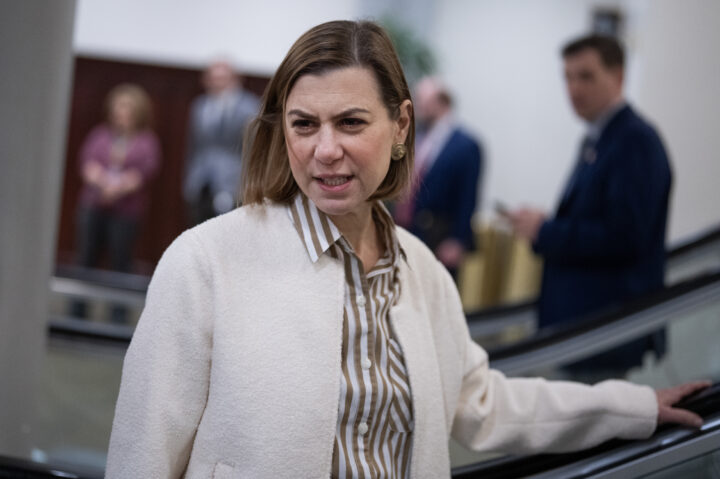
Tom Williams/CQ-Roll Call, Inc via Getty Images
Sen. Elissa Slotkin (D-MI) is seen in the U.S. Capitol on Thursday, March 26, 2026.
Sen. Elissa Slotkin (D-MI) has lately been saying that she does not take money from AIPAC or any corporate political action committees. So when a college student asked her at a town hall in Cincinnati on Thursday about $4.5 million she has received from “pro-Israel lobbies,” Slotkin pushed back — arguing the student was unfairly lumping together all Jewish donors.
“I’m not sure what you’re referring to on ‘not AIPAC but the Israel lobby.’ If you’re equating ‘Israel lobby’ to Jews, I got a problem with that,” Slotkin said.
The figure that the Xavier University student quoted comes from a far-left organization called Track AIPAC, which targets elected officials who it alleges have received funding from the “Israel lobby.” But increasingly, the group is tallying up donations from “lobby donors,” a broad category that critics believe includes any Jewish donors who have also supported AIPAC, J Street or other Jewish or Israel-related advocacy groups.
Slotkin said that just as Iranian Americans, for instance, may not agree with everything the Iranian government does, “I think it’s really important, especially now, to make a distinction between the Israeli government and the choices that they’re making and the average Jew, okay, and Jewish people who donate to campaigns,” Slotkin said, earning applause from the audience.
At the end of the event, she stood by her response to the question when asked about it by another attendee.
“What I take issue with is someone saying that I took $4.5 million from the pro-Israel lobby. That’s not AIPAC. I don’t know what that is,” she said. “But if that’s counting Jewish donors and saying Jewish donors are somehow the same as ‘pro-Israel lobby,’ I got a problem with that, and not just as an elected official, as a Jew.”
Asked her position about taking money from AIPAC, Slotkin said she doesn’t accept AIPAC funding in the same way she eschews other “corporate PAC money.” But she said their work in Washington, of advocating for an issue by building relationships with members of Congress, is the same thing that scores of other groups do.
“I think Americans have the right to support those groups and do whatever they want. Doesn’t mean I have to agree with them. I don’t personally take money from AIPAC. I haven’t in many, many years,” Slotkin said to cheers. “But they and every other organization have an ecosystem in Washington, that they are doing things that every — there’s plenty of groups like them that do the very same thing, a Pakistani American group, or whatever group.”
After the town hall, Slotkin told Politico that she would not do an interview with Hasan Piker, the antisemitic Twitch streamer who appeared at two campaign rallies earlier this week with progressive Michigan Senate candidate Abdul El-Sayed.
“I gotta call balls and strikes, whether it’s antisemitism, Islamophobia, coming from the state that I come from, so that’s what I’ve tried to do as he’s come into Michigan,” Slotkin said.
The comments Piker has made with which she takes issue, Slotkin continued, are “some derogatory things he’s said about Orthodox Jews, saying that we deserve 9/11, there’s some things in there. Not to mention he calls me stupid like every other week.”
‘We should never, ever be bullied, as maybe President Trump was, by any other world leader,’ the Pennsylvania governor said on the ‘All-In Podcast’
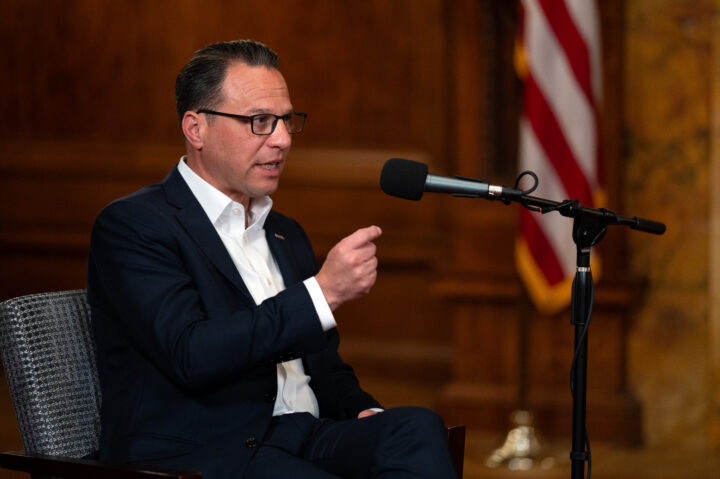
Peter W. Stevenson/The Washington Post via Getty Images
Pennsylvania Gov. Josh Shapiro sits for an interview at the Pennsylvania State Capitol on June 11, 2025.
Pennsylvania Gov. Josh Shapiro accused President Donald Trump of being “bullied” into starting a war with Iran, suggesting in an interview with the “All-In Podcast” that Israel had pressured the U.S. into joining a military campaign against the Islamic Republic.
“America should never be led around by any other nation. It should always be about America’s interests, our national security interests, the interests of expanding freedom and opportunity for the American people,” said Shapiro, who was responding to a question from tech investor Jason Calacanis about whether the U.S. followed Israel into an unnecessary war. “We should never, ever be bullied, as maybe President Trump was, by any other world leader.”
In the interview, Shapiro continued a line of criticism that he has used regularly against Trump’s handling of the war in Iran: that the president doesn’t know what he’s doing and has failed to offer a sufficient explanation to the American public.
“This was a war of choice. The president never defined the objectives. It is clear he doesn’t know how the hell to get out of this,” Shapiro said.
Shapiro’s allegation that Israeli Prime Minister Benjamin Netanyahu had led the U.S. into war with Iran was a rhetorical escalation for the pro-Israel Democrat. While he reasserted the same pro-Israel, anti-Netanyahu argument that he has been making for years now, Shapiro also made clear that it is America’s goals — and not Israel’s — that he cares about.
“I don’t view this issue as a Jewish American,” Shapiro said. “I view this issue as an American, and I view this issue in a way of trying to understand what is the best thing for America, which to me is having peace and stability in the Middle East.”
Even as Shapiro went after Trump for his handling of the war, he offered a word of praise about a different Republican, Sen. Ted Cruz (R-TX), and his approach to antisemitism within his own party.
“I think on the issue of antisemitism, we have got to be in a place where we universally condemn it. And I think what you’re seeing from some folks on the right and some folks on the left is they’ll only call it out if it’s said by a political opponent or someone they disagree with,” said Shapiro. “I frankly respect people on the right like Ted Cruz, who have pulled it out within the Republican Party. I’ve tried to call it out when it rears its ugly head in my party.”
The “All-In Podcast” is hosted by four Silicon Valley investors, including David Sacks, co-chair of Trump’s Council of Advisors on Science and Technology.
The DOJ’s Board of Immigration Appeals rejected the Columbia University anti-Israel protest leader’s attempt to dismiss his deportation case

Andrew Lichtenstein/Corbis via Getty Images
Demonstrators hold a rally and march to the national ICE headquarters to protest the arrest of Mahmoud Khalil, April 5, 2025 in Washington, D.C.
The Justice Department’s Board of Immigration Appeals rejected Columbia University anti-Israel protest leader Mahmoud Khalil’s attempt to dismiss his deportation case on Thursday, his lawyers said.
Khalil called the ruling, which was widely expected and brings him closer to re-arrest and possible deportation, “biased and politically motivated.”
“The only thing I am guilty of is speaking out against the genocide in Palestine — and this administration has weaponized the immigration system to punish me for it,” Khalil said in a statement. The ruling has not yet been publicized by the DOJ.
Khalil was a key organizer of Columbia University’s anti-Israel encampment in April 2024, a two-week demonstration in the center of campus during Israel’s war in Gaza. The demonstration included several incidents of assault on Jewish students. Protesters used threatening and antisemitic slogans, including, “Go back to Poland”; signs with the Hamas symbol and the words “I’m with them”; and chants calling for Hamas attacks on Tel Aviv.
Khalil later described the Oct. 7 attacks as “a desperate attempt to tell the world that Palestinians are here. That was my interpretation of why Hamas did the Oct. 7 attacks on Israel,” he said in a New York Times interview.
Last month, while speaking at the annual South by Southwest festival in Austin, Texas, Khalil argued that “claims of antisemitism are being weaponized to silence any critique of the U.S. support to Israel.”
A former Columbia graduate student who grew up in Syria but is of Palestinian descent, Khalil was released in June from the Immigration and Customs Enforcement detention center in Louisiana, where he had been held for three months pending deportation proceedings. Judge Michael Farbiarz ruled that his prolonged detention likely violated his constitutional rights.
A federal appeals court then ruled in January that Khalil could be rearrested. In a 2-1 ruling, a panel from the U.S. Court of Appeals for the Third Circuit decided that the federal district court in New Jersey that issued Khalil’s release did not have jurisdiction over the matter and that it should have been handled in immigration court, which is part of the executive branch overseen by the Justice Department, meaning Khalil is now liable to be rearrested.
A new YouGov poll finds the far-right podcaster with worsening favorability rating among Republicans, and widespread unpopularity with the American public

Chip Somodevilla/Getty Images
President Donald Trump shakes hands with Tucker Carlson at the conclusion of a conversation during Carlson's Live Tour at the Desert Diamond Arena on October 31, 2024 in Phoenix, Arizona.
Tucker Carlson, the anti-Israel and antisemitic podcaster whose outspoken opposition to the Iran war has strained his relationship with President Donald Trump, has seen his personal ratings nosedive including among Republicans, according to a new YouGov poll.
The survey, commissioned by UMass-Lowell between March 26-30, finds Carlson’s overall favorability rating at a dismal 17%, with 38% viewing him unfavorably. Nearly one-third of respondents said they had no opinion of him, and 15% had never heard of him.
Among Republicans, Carlson’s favorability rating is now just at 31%, with 24% viewing him unfavorably, and 35% offering no opinion. (For context, a Manhattan Institute poll of Republicans conducted in December 2025 found 63% of Republicans viewed Carlson favorably, with 21% viewing him unfavorably.)
On Thursday night, Trump launched a scathing social media attack against Carlson and other like-minded podcasters, referring to Carlson as a “broken man” who never recovered from being fired by Fox News in 2023. Trump’s post also included biting attacks against conspiracy-theorizing podcasters Candace Owens, Megyn Kelly and Alex Jones, calling them all “nutjobs,” “troublemakers” and “low IQ” individuals.
The poll was conducted two weeks before Trump’s harsh salvos against Carlson and the far-right podcasters. That would suggest that their standing with conservatives has more room to fall in future polling.
Plus, Cornyn hits Paxton on Tucker ties ͏ ͏ ͏ ͏

Aamir QURESHI / AFP via Getty Images
Security personnel inspect vehicles entering the Foreign Ministry office in Islamabad on April 9, 2026.
👋 Good Friday morning!
In today’s Daily Kickoff, we preview this weekend’s U.S.-Iran talks in Islamabad and next week’s Israel-Lebanon talks in Washington amid a fragile Middle East ceasefire, and look at how Israel is viewing the agreement to cease hostilities for two weeks and effort to reach a negotiated agreement with Tehran. We have the exclusive on a new ad from Sen. John Cornyn hitting primary challenger Ken Paxton over the Texas attorney general’s ties to Tucker Carlson, and report on the rejection of an anti-AIPAC resolution by the Democratic National Committee’s rules committee. Also in today’s Daily Kickoff: Ukrainian President Volodymyr Zelensky, Erin Foster and Freida McFadden.
Today’s Daily Kickoff was curated by JI Executive Editor Melissa Weiss and Israel Editor Tamara Zieve, with assists from Danielle Cohen-Kanik and Marc Rod. Have a tip? Email us here.
What We’re Watching
- Vice President JD Vance, White House Special Envoy Steve Witkoff and Jared Kushner are slated to take part in Pakistani-brokered talks with Iran this weekend in Islamabad, days after President Donald Trump announced a two-week ceasefire with Tehran. More below.
- We’ll be keeping an eye over the weekend on the expected Israel-Lebanon peace talks being brokered by Washington early next week between Israeli Ambassador to the U.S. Yechiel Leiter, Lebanese Ambassador to the U.S. Nada Hamadeh Moawad and U.S. Ambassador to Lebanon Michel Issa. Over the weekend, Lebanese Prime Minister Nawaf Salam is set to travel to the U.S. to meet with Secretary of State Marco Rubio ahead of the talks.
- Hamas has just hours to respond to the Board of Peace’s proposal that would force the group to disarm. Despite ongoing negotiations in Cairo, it is unlikely that Hamas will agree to fully disarm, potentially prompting renewed fighting in the Gaza Strip.
- The National Action Network Convention kicked off on Wednesday in New York City and runs through Saturday, with a number of public officials and potential 2028 contenders slated to speak at Rev. Al Sharpton’s annual conference. Pennsylvania Gov. Josh Shapiro invoked his faith on Wednesday while making a pitch to the Black voters in the audience. “What, you don’t think a Jew can go to a Baptist church?” he quipped. Meanwhile, Maryland Gov. Wes Moore brought cheering attendees to their feet on Thursday before criticizing the war in Iran as a costly and protracted misadventure. Former Vice President Kamala Harris, former Transportation Secretary Pete Buttigieg, Kentucky Gov. Andy Beshear and Sen. Mark Kelly (D-AZ) are slated to speak today and tomorrow.
- On Sunday, the Anti-Defamation League and Museum of Jewish Heritage will hold their Annual Gathering of Remembrance at Temple Emanu-El in New York City ahead of Yom Hashoah — Holocaust Remembrance Day — which begins Monday evening.
What You Should Know
A QUICK WORD WITH JI’S melissa weiss
American and Iranian officials are meeting tomorrow in Islamabad, Pakistan, to begin conversations aimed at ending the conflict that has consumed the Middle East since late February. Though much change has occurred in the last six weeks, the decisions made in the next two could determine the future of the region for decades to come.
The “fog of diplomacy,” as The Washington Post’s David Ignatius put it, has shrouded much of what is known about the talks and their contours. The first 24 hours after the ceasefire was announced saw dueling — and often conflicting — statements, denials and claims about various points, including the inclusion of Lebanon in the agreement, Iran’s “right” to enrich uranium and the status of the Strait of Hormuz, that were proposed and supposedly agreed to by the parties.
Those sticking points deepened in the days between the ceasefire announcement and tomorrow’s meeting in Pakistan. On Wednesday, Israel conducted widespread strikes in Lebanon targeting Hezbollah infrastructure and operatives whom the IDF said had embedded in civilian areas, while Hezbollah has launched dozens of missiles into Israel — including one fired at the southern city of Ashdod that also triggered sirens across Tel Aviv and surrounding towns early Friday morning. Meanwhile, Trump on Thursday accused Iran of “doing a very poor job, dishonorable some would say, of allowing Oil to go through the Strait of Hormuz.”
It is against that backdrop that Vice President JD Vance, joined by White House Special Envoy Steve Witkoff and Jared Kushner, will enter into negotiations tomorrow in Islamabad.
In tandem, a separate set of negotiations is slated to take place in Washington early next week, when the U.S. will convene the envoys from Israel and Lebanon for rare direct, public talks aimed at reaching a peace agreement between Beirut and Jerusalem. If reached — and if Lebanon takes meaningful action to demilitarize Hezbollah — Iran could lose its most powerful proxy in the region. Under pressure from Washington, Israel has limited its attacks on Lebanon.
While the inability to agree on the parameters for a ceasefire does not portend well for the ability to secure a more lasting agreement, both sides have a vested interest in reaching an accord that allows both to declare victory. Watching from the sidelines are Israel and the Gulf states, which will not be represented in Islamabad, and will instead have to hope from their respective capitals that the U.S. does not acquiesce to an agreement that emboldens Iran — and leaves American allies vulnerable.
THE VIEW FROM ISRAEL
Israelis uncertain if Iran war made them safer after ceasefire brings combat to an inconclusive halt
For many Israelis who were awoken by rocket sirens just before 3 a.m. Wednesday, only to see the headline on their phones that a two-week ceasefire between the U.S. and Iran had been reached, the news was met with mixed feelings of relief and concern. After the ceasefire went into effect, there was a pervading feeling in Israel that the war with Iran was not complete, and the return to routine life may be short-lived, Jewish Insider’s Lahav Harkov reports.
Survey says: Israelis’ support for the war effort despite the challenges on the home front was strong because its aims — eliminating the Iranian nuclear threat and severely degrading the ballistic missile threat — were meant to ultimately make them safer, along with the hope, bolstered by statements from Israeli Prime Minister Benjamin Netanyahu and President Donald Trump, that the mullahs’ regime would be toppled. Yet, according to a Channel 13 poll, Israelis ranked their sense of security after the war at 5.36 out of 10, and gave Netanyahu a grade of 5.56. The mixed feelings from the public were backed up by experts who spoke to JI on Thursday. Brig.-Gen. (res.) Assaf Orion, a senior researcher at the Institute for National Security Studies at Tel Aviv University, said that it is “too early to say” whether Israel is safer now than it was six weeks ago.
TRUST BUT VERIFY
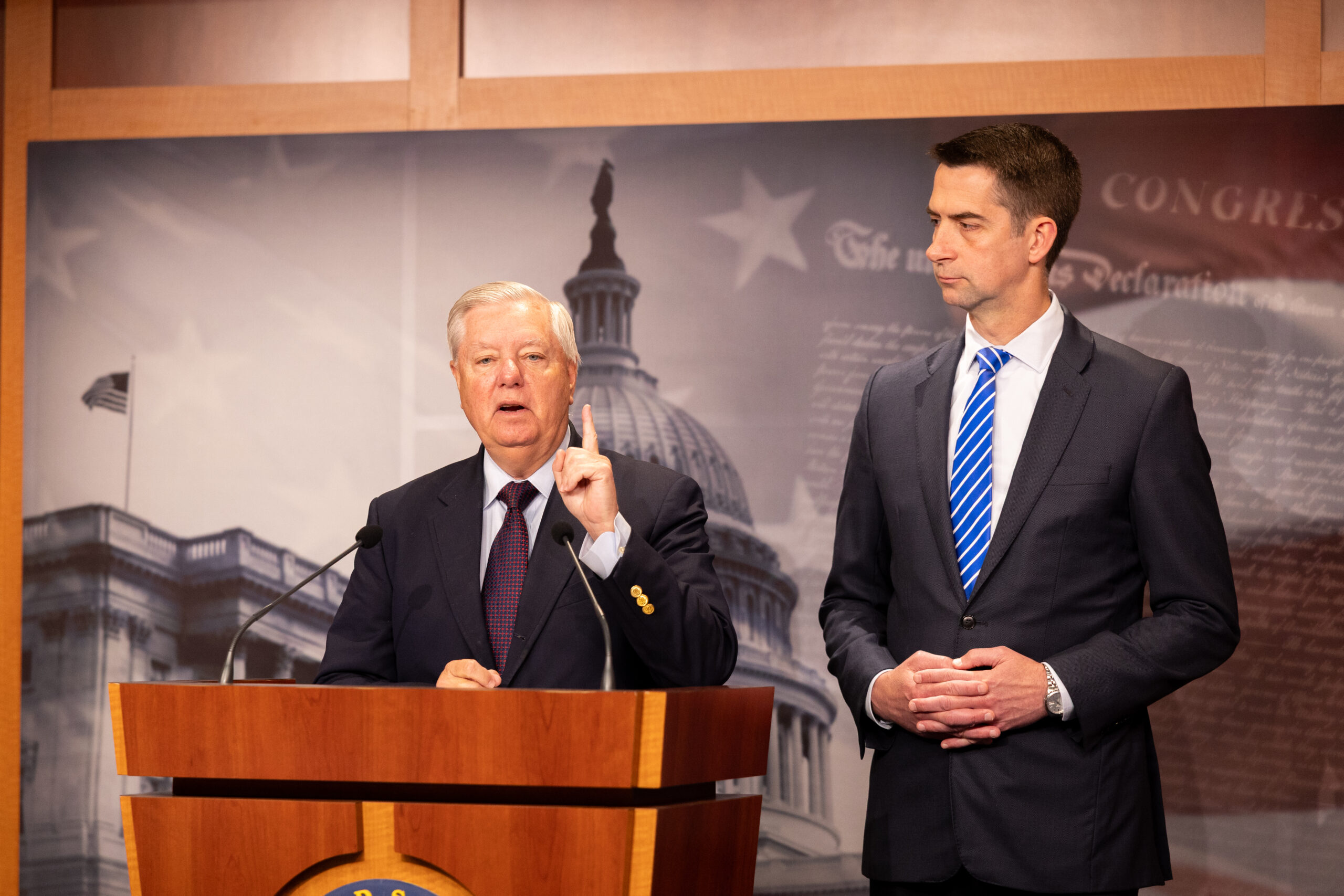
Despite skepticism over the terms and reports of ongoing Iranian strikes, several prominent hawkish Republicans are voicing support for President Donald Trump’s fragile two-week ceasefire agreement with Iran, Jewish Insider’s Marc Rod reports. Democrats, meanwhile, are pushing ahead with efforts to pass war powers resolutions on the conflict and calls for Trump’s removal from office.
Notable quotable: Sen. Lindsey Graham (R-SC), among the most prominent backers of the war in the Senate, said in a post on X that a “diplomatic solution to end the reign of terror in Iran is the preferred outcome” but said he has concerns about the supposed 10-point plan presented by Iran, which would require the lifting of all U.S. sanctions on Iran, among other steps. “I look forward to the architects of this proposal, the Vice President and others, coming forward to Congress and explaining how a negotiated deal meets our national security objectives in Iran,” Graham said.
Read the full story here with additional comments from Sens. Tom Cotton (R-AR), Ted Cruz (R-TX) and Kevin Cramer (R-ND).
EXCLUSIVE
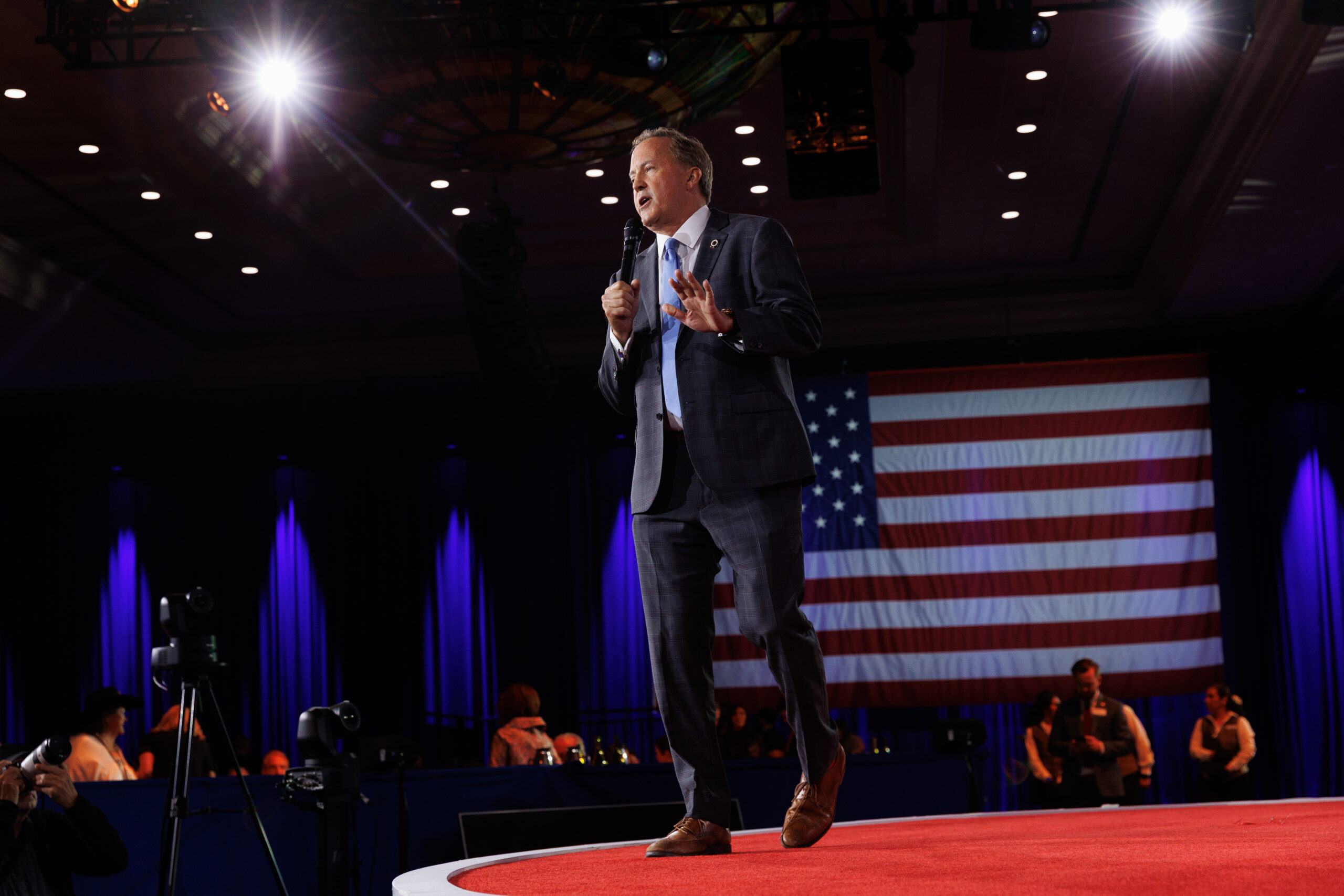
A new ad by Sen. John Cornyn’s (R-TX) reelection campaign will hit his runoff primary opponent, Texas Attorney General Ken Paxton, over his ties to far-right commentator Tucker Carlson, pointing to Carlson’s criticisms of President Donald Trump, while also honing in on his attacks against Trump’s support for Israel and the war in Iran, Jewish Insider’s Marc Rod reports.
About the ad: The minute-long ad — a five-figure buy set to begin airing on digital platforms on Friday, JI has learned — appears to be one of the first mentions of Carlson as a target in GOP primary campaigns. It highlights that Carlson has clashed with Trump over the war in Iran and Trump’s support for Israel, and that he backed Paxton’s campaign — though Paxton does not share Carlson’s views on Middle East policy. “Ken Paxton still accepts Tucker Carlson’s endorsement,” the ad intones.
Breaking up: President Donald Trump hit back at Tucker Carlson on Tuesday after the far-right podcaster used his most recent show to accuse the president of steering the U.S. toward nuclear war with Iran and to suggest, in apocalyptic terms, that Trump might be waging a stealth attack on Christianity, JI’s Emily Jacobs reports. In a phone interview with the New York Post, Trump described Carlson as a “low IQ” individual, adding that he has stopped responding to his calls.
THE CENTER HOLDS
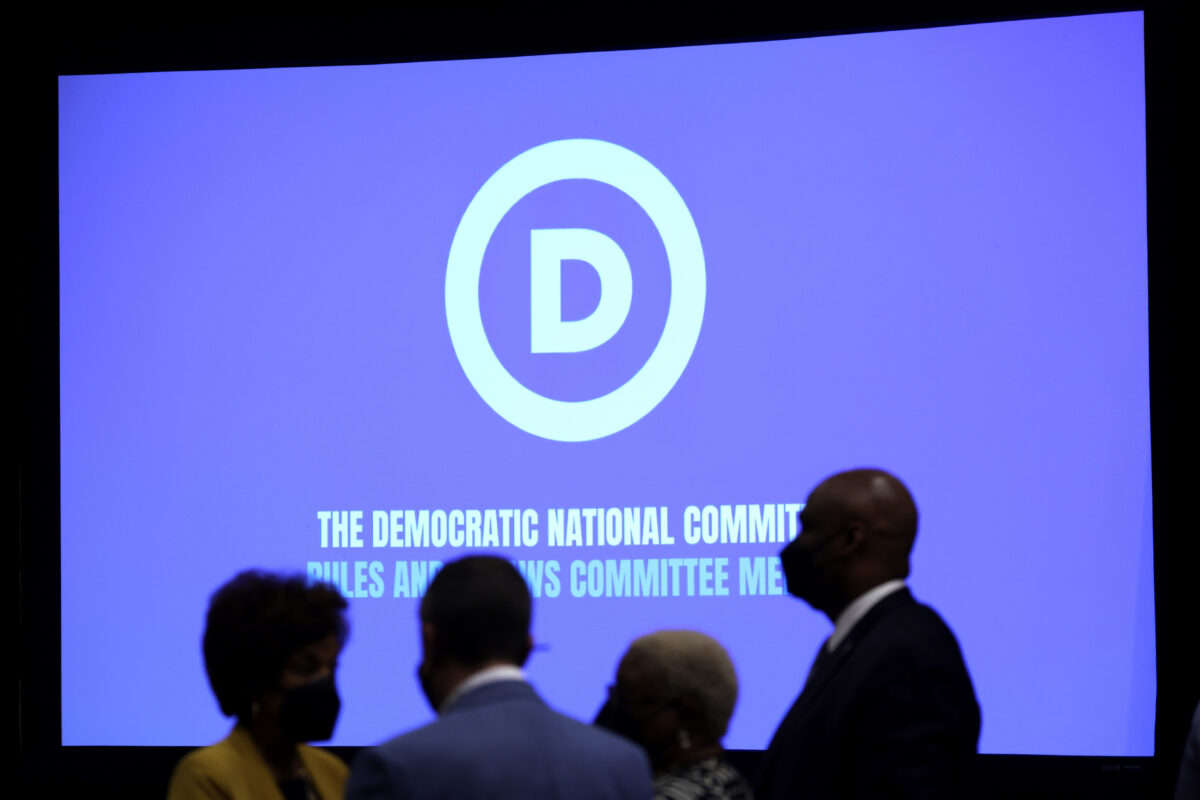
Democratic Party activists on Thursday voted to reject a measure that criticized the involvement of AIPAC in Democratic primaries and the American political system. The resolution was debated during a meeting of the Democratic National Committee’s Rules Committee at the DNC’s New Orleans meeting, Jewish Insider’s Gabby Deutch reports.
AIPAC angle: Committee members were considering new policy resolutions, including one introduced by a Florida activist that took aim at AIPAC and the group’s “undue influence over democratic debate and policymaking.” It was voted down in a voice vote. “The DNC made clear today that all Democrats, including millions who are AIPAC members, have the right to participate fully in the democratic process,” AIPAC spokesperson Deryn Sousa told JI. Committee members were considering new policy resolutions, including one introduced by a Florida activist that took aim at AIPAC and the group’s “undue influence over democratic debate and policymaking.”
On offense: The pro-Israel group Democratic Majority for Israel’s super PAC launched its first ad of the 2026 presidential cycle, targeting frequent California Democratic candidate Ammar Campa-Najjar, accusing him of hypocrisy and of flip-flopping on his positions, JI’s Marc Rod reports. The group is spending $750,000 on the ad.
LIPS ARE SEALED
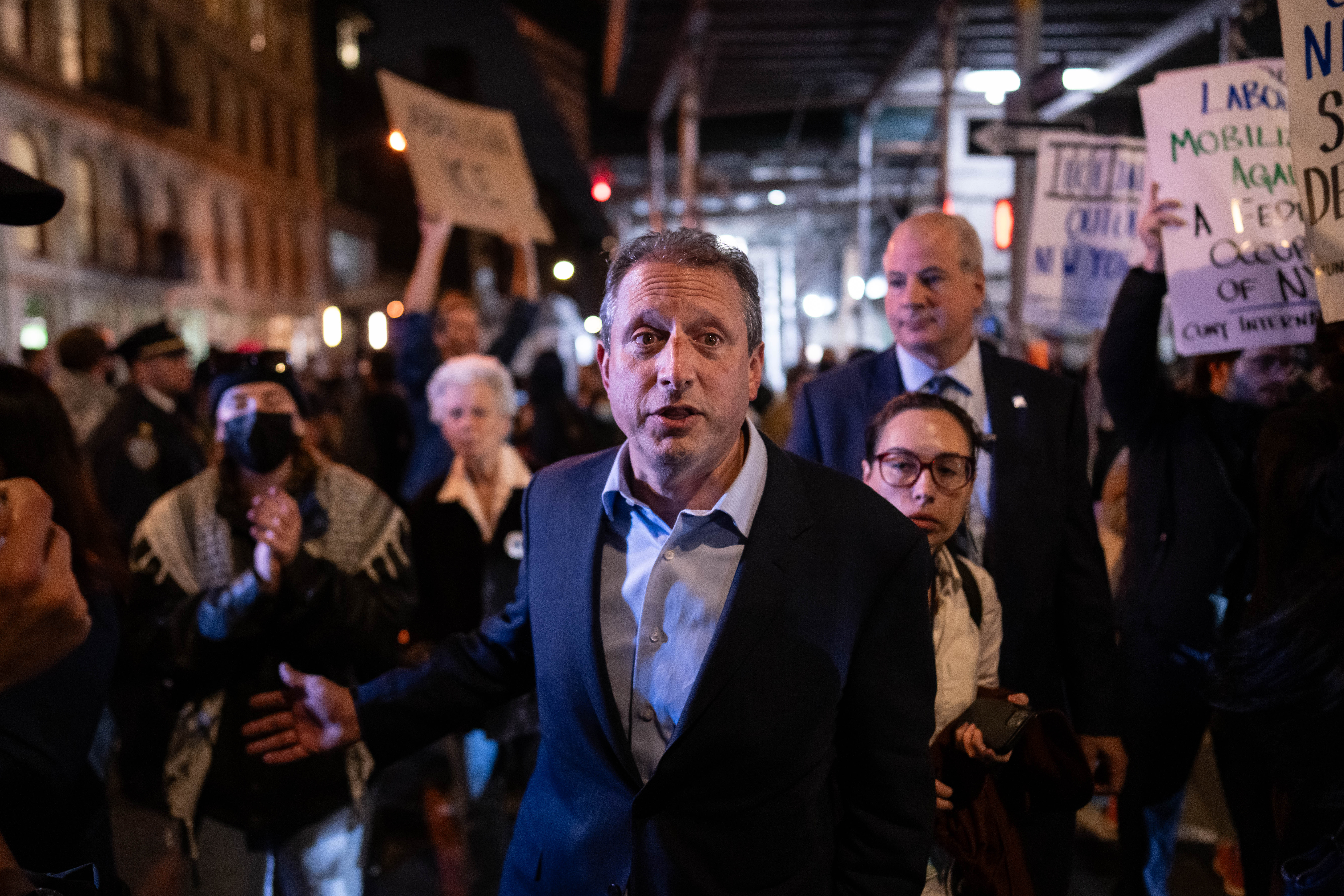
Former New York City Comptroller Brad Lander, who is challenging Rep. Dan Goldman (D-NY) in one of the marquee Democratic primary contests of the midterms, is declining to clarify his position on U.S. funding for Israel’s Iron Dome missile-defense system, even as he expressed his support for the aid last year during an unsuccessful mayoral campaign, Jewish Insider’s Matthew Kassel reports.
Zoom out: Lander’s reticence comes as some leading progressive lawmakers have said they will oppose further funding for Iron Dome and other defensive systems used to intercept incoming attacks against Israel. New York City Mayor Zohran Mamdani, who is Lander’s top ally in the June House race to unseat Goldman, a pro-Israel stalwart, confirmed last week that he agreed with Rep. Alexandria Ocasio-Cortez’s (D-NY) commitment to oppose defensive aid to Israel. Asked to clarify his position on Iron Dome funding, Lauren Hitt, a spokesperson for Lander, told JI on Wednesday he would not be commenting and did not return follow-up emails. Lander did not respond to a text message from JI seeking comment on Thursday.
Flip-flop: Michael Blake, a far-left challenger to Rep. Ritchie Torres (D-NY), said at a debate on Tuesday hosted by One NYC Action that he would oppose missile-defense aid for the Jewish state — the latest flip-flop on Israel policy issues by a candidate who has reversed numerous of his past stances on the subject over the course of his campaign, JI’s Marc Rod reports. He said he supported funding for Iron Dome in January during a different campaign event.
HAMAWY HEADWAY
A constellation of anti-Israel groups is coalescing behind Adam Hamawy, a doctor who served as a trauma surgeon in Gaza during Israel’s war against Hamas and has been an outspoken critic of Israel, in the competitive Democratic primary for New Jersey’s 12th Congressional District, Jewish Insider’s Marc Rod reports. He also recently reported raising $550,000 in the first quarter of 2026, a sizable sum.
Endorsements: Justice Democrats and PAL PAC, a new group affiliated with the Institute for Middle East Understanding that aims to counter AIPAC, both offered their endorsements of Hamawy last month, moves that could bring more national attention and backing to the candidate. Micah Rasmussen, the director of the Rebovich Institute for New Jersey Politics at Rider University, said that Hamawy’s $550,000 first quarter fundraising haul and the recent endorsements show momentum for his campaign, but “what remains to be seen is whether this translates into forcing [Sue] Altman to split the outside lane with him.”
Worthy Reads
Goodwill Ambassadors: In the Financial Times, Daniel Benaim, a former deputy assistant secretary of state for Arabian Peninsula affairs in the Near East Bureau at the State Department, calls on the U.S. to nominate and confirm ambassadors to key postings around the Middle East, including Saudi Arabia, the United Arab Emirates, Qatar, Kuwait and Iraq. “Going forward, there will be Gulf partners who badly need reassuring, reconstruction efforts to support, business ties to revitalise and expat Americans to help. At a time when many question US leadership, there’s an underrated value in simply showing up — and a cost for not doing so. … At moments like these, an American ambassador in post sends a powerful message of solidarity to partners who are watching missiles rain down on their cities.” [FT]
Putin’s Stake: In The New York Times, Nicole Grajewski considers the extent to which the Iranian regime’s survival is critical to Russian President Vladimir Putin’s global strength. “[The Russia-Iran relationship] is dense, diversified and in important respects self-reinforcing — each layer of cooperation makes the next layer easier to build and harder to dismantle. … Mr. Putin has spent years building a coalition of the discontented around the premise that authoritarian states can outlast Western pressure; that regimes built for endurance — which absorb decades of sanctions, surveil their publics and suppress dissent — cannot be undone. Iran, which has absorbed the most pressure and held the longest, is his proof of concept.” [NYTimes]
Real Regime Change: In The Washington Post, The Washington Institute for Near East Policy’s Dennis Ross posits that the Iranian regime, which survived six weeks of war with the U.S. and Israel, could still fall due to its own domestic malfeasance. “Before the war, the Iranian regime had no answers to any of its fundamental governance failings that produced the public uprisings in December and January. When the war fully ends, it will be even less able to deal with water and electricity cutoffs, a currency that has no value, endemic corruption and the increasing difficulty of daily life. … [T]he inner contradictions of the Islamic Republic will in time either produce an Iranian Gorbachev to try to avert regime collapse, or it will collapse outright.” [WashPost]
The Lion and Lebanon: In his Substack “It’s Noon in Israel,” Amit Segal suggests that Iran’s response to Israeli attacks against Hezbollah in Lebanon could signal the end of the regime in Tehran. “If Iran breaks and leaves its proxy at the mercy of Israel, then the Axis of Resistance has officially broken. The Iranian guarantee becomes as worthless as their currency, and its proxies will have to chart their own courses, if not disintegrate altogether. Conversely, if Israel concedes, then it has surrendered its post-October 7 security doctrine: Never allow threats to build up on the borders.” [ItsNooninIsrael]
Word on the Street
House Republicans blocked a Democratic effort to use unanimous consent to pass a measure calling for an end to U.S. operations targeting Iran…
Nawaf al-Thani, the former Qatari defense attaché in Washington, warned that the war with Iran has “forever” altered relations between Doha and Tehran, saying that after Iran’s strikes on the Gulf state’s liquefied natural gas exports, Qatar “has to see a seriousness from Iran when it comes to Qatari security”…
The Wall Street Journal looks at concerns among Gulf states that the two-week ceasefire announced earlier this week is emboldening Iran and positioning the Islamic Republic as a regional hegemon…
Ukrainian President Volodymyr Zelensky said that Ukraine had shot down Iranian-designed Shahed drones that had been launched from the Islamic Republic at nearby Gulf states using domestically produced interceptors that had been utilized to shoot down Shahed drones fired by Russia at Ukraine…
The Free Press reports on a January meeting between the Pentagon’s Elbridge Colby and the Holy See’s envoy in Washington to find common ground and encourage the Vatican to align with the U.S. on defense and foreign policy; the meeting went awry after another U.S. official noted the 14th century period in which France created its own papacy over disagreements with Rome..
The Missouri Statehouse passed legislation codifying the International Holocaust Remembrance Alliance’s working definition of antisemitism on Thursday, sending it to the governor’s desk; “After 16 months of intense work in a growing climate of anti-Jew hate, Jewish students in our state are finally protected against intimidation and harassment,” Stacey Newman, the executive director of the Missouri Alliance Network, told JI, adding specific praise for the “numerous Jewish students who courageously testified in the Capitol of their hateful experiences on campus, which they continue to face”…
Amid controversy, Peter Chatzky, a progressive who had provided $5 million in funding for his campaign for New York’s 17th Congressional District, announced his withdrawal from the race; the decision leaves Effie Phillips-Staley as the main competitor in the left lane in the Democratic primary…
Sen. Lindsey Graham (R-SC) convened Christian and Jewish leaders for a call with reporters to criticize Paul Dans and Mark Lynch, who are challenging Graham in the Republican primary for his Senate seat, over Dans’ refusal to fire his campaign communications director and Lynch declining to part ways with his political director despite the staffers’ respective records of making antisemitic statements, JI’s Emily Jacobs reports…
Far-left Michigan Senate candidate Abdul El-Sayed, Reps. Rashida Tlaib (D-MI) and Summer Lee (D-PA) and leftist streamer Hasan Piker dismissed criticism of Piker and his past antisemitic and anti-American comments at a rally at the University of Michigan on Tuesday, JI’s Marc Rod reports…
Speaking at the Tuesday night event, El-Sayed doubled down on claims that the man who attacked Temple Israel in West Bloomfield last month did so as a result of the pain he felt from the war in the Middle East, saying, “hurt people do hurt people,” JI’s Gabby Deutch reports…
A candidate for the University of Michigan Board of Regents shared a series of social media posts praising Hezbollah leaders and Iran, including one last June, during the 12-day war with Israel, calling on Tehran to “show no laxity in sacred war against the enemy”…
A Pakistani man living in Canada pleaded guilty in a New York federal court to a terrorism charge over a failed plot to attack a Jewish center in Brooklyn…
The war in Iran has cost Israel political support in the United States, according to a new Pew Research Center poll, which shows 60% of Americans now view Israel unfavorably, with 37% viewing the Jewish state favorably, JI’s Josh Kraushaar reports…
Jewish groups criticized the American Association of Geographers after its members pushed for an academic boycott of Israel at the organization’s annual meeting, which featured overwhelmingly one-sided presentations against the Jewish state, JI’s Haley Cohen reports…
Paramount President Jeff Shell departed the company following an investigation into allegations he shared confidential company information with an outside consultant…
The Associated Press spotlights Colby College’s Center for Small Town Jewish Life, which aims to support and strengthen small Jewish communities around the country…
“Nobody Wants This” creator Erin Foster is joining the show as a guest star in its upcoming third season…
The Housemaid author Freida McFadden revealed that McFadden was a pen name and her real name and identity was Sara Cohen, a physician who specializes in traumatic brain injuries…
Authorities in Canada charged a man with four gun counts after he fired a gun at a Jewish-owned restaurant in the Toronto suburb of North York last week…
Organizers of the annual Wireless festival in the U.K. canceled the three-day festival after British authorities revoked the visa of Kanye West, who had been scheduled to headline the event despite numerous incidents in which the artist invoked antisemitism language; the U.K.’s Home Office said the visa revocation was “made on the grounds that his presence would not be conducive to the public good”…
Costa Rica’s Foreign Ministry announced that the country had declared Hezbollah, Hamas, Iran’s Islamic Revolutionary Guard Corps and the Houthis as terrorist groups…
Diplomat David Cornstein, who served as U.S. ambassador to Hungary from 2018-2020 and played a key role in deepening ties between the Orbán government and President Donald Trump, died at 87…
Photographer Nathan Farb, who was known for images of Russians in Siberia, hippies in New York City and the landscapes of the Adirondacks, died at 85…
Journalist Peter Schrag, the author of 1998’s Paradise Lost: California’s Experience, America’s Future, died at 94…
Pic of the Day

Israelis enjoyed the last day of Passover and the first day of the ceasefire with Iran on Wednesday in Tel Aviv, Israel.
Birthdays

Israeli singer-songwriter, actress and model, she represented Israel in the Eurovision Song Contest 2023, Noa Kirel turns 25 today…
FRIDAY: Past president of the U.S. Soccer Federation, he was previously an executive of both the L.A. Lakers and the L.A. Clippers, Alan Rothenberg turns 87… Author of four novels and two political history books, he is a former senior editor at The New Yorker and a deputy editor of the “Outlook Section” in The Washington Post, Jeffrey Frank turns 82… Author of 265 books including 56 books in the Cam Jansen series, 68 biographies and books for youth on the Holocaust, David Abraham Adler turns 79… Naomi Eisenberger Atlani… Former member of the Knesset for 26 years, he once served as vice prime minister, Haim Ramon turns 76… Founder of Gantman Communications, he was the VP of global strategic communications at the Motion Picture Association of America, Howard Gantman… Scarsdale, N.Y., resident, Robin Stalbow Samot… Soviet-born Israeli-American pianist, Yefim “Fima” Bronfman turns 68… Member of the Knesset for the Likud party for 23 years, now chairman of Rafael Advanced Defense Systems, Yuval Steinitz turns 68… Author of four books (including one made into an award-winning miniseries), she was the chief national correspondent at Yahoo News, following 30 years at The New York Times, Lisa Belkin turns 66… Former CEO of NTCA–The Rural Broadband Association, she stepped down last month, Shirley Ann Bloomfield… Tom Kohn… Author of five best-selling memoirs and six novels, she has also written for magazines such as The New Yorker, The Oprah Magazine, Vogue and Elle, Dani Shapiro… Host of Radio Atlantic and a senior editor at The Atlantic, she was born in Israel and moved to Queens when she was 5, Hanna Rosin turns 57… Governor of Missouri from January 2017-June 2018, Eric Greitens turns 52… Co-CEO of NJI Media and co-founder of FamousDC blog, Josh Shultz… Movie producer best known for the 2016 musical romantic-drama film “La La Land,” Jordan Horowitz turns 46… Israeli journalist, television personality and a political columnist for the Yedioth Ahronoth newspaper, Amit Yitzhak Segal turns 44… SVP of entertainment and news media at Disability Belongs, Lauren Appelbaum… Attorney who has clerked for two federal judges, he also served as a fellow in the Office of the Solicitor General, Yishai Schwartz… White House liaison to the American Jewish community during the Biden administration, Shelley Greenspan… Associate at Simpson Thacher & Bartlett, Daniel E. Wolman… Basketball player for Klosterneuburg Dukes in the Austrian Basketball Superliga, Sylven Landesberg turns 36… Phil Hayes… Susie Diamond…
SATURDAY: Actress who played the title character on the 325-episode soap opera satire “Mary Hartman, Mary Hartman,” Louise Lasser turns 87… Pulitzer Prize-winning journalist and syndicated columnist, she is the co-founder of “The Conversation Project,” focused on end-of-life care, Ellen Goodman turns 85… Founder and CEO of the USA Network in 1977, she is the co-founder and chairman of Springboard Enterprises, Kay Koplovitz turns 81… West Bloomfield, Mich.-based inventor on more than 40 patents, Barry Schwab… Actor, director and screenwriter, he played the role of a crooked politician in “The Sopranos,” Peter Riegert turns 79… Sarita Dery… Former deputy director of WomenStrong International, Sydney Rubin turns 74… Managing partner and a founder of L.A.-based law firm Glass & Goldberg, Marshall F. Goldberg… Member of the Pennsylvania House of Representatives since 1999 from the Pittsburgh area, Dan B. Frankel turns 70… Pulitzer Prize-winning journalist and author, Michael Vitez turns 69… Australian industrialist, executive chairman of Visy Industries and Pratt Industries US, the world’s largest privately owned packaging company, Anthony Pratt turns 66… Chair of the board of The Estée Lauder Companies, he serves on many charitable boards including the University of Pennsylvania and the 92nd Street Y, William P. Lauder turns 66… Provost of Harvard University, formerly dean of Harvard Law School, John Francis Manning turns 65… General counsel of the Department of Homeland Security during the Biden administration, Jonathan E. Meyer turns 61… Scholar of Eastern European Jewry, with a focus on the social history of Hasidism, Glenn Dynner turns 57… Retired Olympic breaststroke swimmer, he competed for the Soviet Union and then Israel, Vadim Alekseyev turns 56… Co-founder of Caracal Global Strategies and founder and CEO of Brigadoon, Marc A. Ross turns 55… Fashion designer, entrepreneur and author, founder of Body by Julia shapewear, Julia Haart turns 55… Professor of Talmud at Yeshiva University, he has held a variety of administrative and educational roles at Yeshiva, Rabbi Ezra Y. Schwartz turns 52… Head of fixed income sales at Citadel LLC, he was previously a Major League Soccer midfielder, Jordan Cila turns 44… Professor of Talmud at Yeshiva University and a dayan/judge at the Beth Din of America, Rabbi Itamar Rosensweig turns 37… Youngest woman ever elected to the Arizona House of Representatives, she is a convert to Judaism and worked for Tucson’s JCRC, Alma Hernandez turns 33…
SUNDAY: Founder and chairman of Christians United for Israel, Pastor John Charles Hagee turns 86… Former national correspondent for “CBS News Sunday Morning,” where she worked for more than 50 years before retiring in March 2025, Rita Braver turns 78… Attorney and bestselling novelist of 13 legal thrillers and author of three nonfiction books, combined he has sold more than 30 million copies, Scott Turow turns 77… Television producer, he serves as chairman of the Liverpool Football Club and the Boston Red Sox, Thomas Charles Werner turns 76… SVP at UJA Federation of New York, Stuart Tauber… Fashion designer, he is a co-founder of the Guess clothing and accessory brand, Paul Marciano turns 74… West Bloomfield, Mich., resident, Ron Mitnick… Washington, D.C., attorney, Norman B. “Norm” Antin… Member of the House of Lords and Parliamentary under-secretary of state for patient safety, women’s health and mental health, she previously served as chief executive of the Board of Deputies of British Jews from 2014-2021, Baroness Joanna Merron turns 67… U.S. District Court judge for the Southern District of New York, Judge Paul A. Engelmayer turns 65… Twin brothers, both real estate agents starring in the Netflix original series “Selling Sunset,” Jason and Brett Oppenheim both turn 49… Actress, director and writer, Jordana Spiro turns 49… Realtor focused on the Boston area, Ilya Jacob Rasner… President at National Student Legal Defense Network, Aaron Ament… California state senator (D-27), Henry I. Stern turns 44… Attorney, general counsel of an international technology firm, chair of the GI Research Foundation, board member of multiple biotech companies, and controlling owner of OnlyFans following the death of her husband Leonid Radvinsky in March 2026, Yekaterina “Katie” Chudnovsky… Member of the Seattle City Council, Daniel Aaron Strauss turns 40… Comedian, writer and actress, best known for co-creating and co-starring in the Comedy Central series “Broad City,” Ilana Glazer turns 39… Israeli actress best known for her lead role in the 2012 film “Fill the Void,” Hadas Yaron turns 36… Actor, he starred as Big Red in the Disney series “High School Musical,” Larry Saperstein turns 28…
The digital spot is one of the first GOP ads to target the far-right commentator
Shelby Tauber/Bloomberg via Getty Images
Ken Paxton, Texas attorney general and Republican US Senate candidate, speaks at the Conservative Political Action Conference (CPAC) in Grapevine, Texas, on Friday, March 27, 2026.
A new ad by Sen. John Cornyn’s (R-TX) reelection campaign will hit his runoff primary opponent, Texas Attorney General Ken Paxton, over his ties to far-right commentator Tucker Carlson, pointing to Carlson’s criticisms of President Donald Trump, while also honing in on his attacks against Trump’s support for Israel and the war in Iran.
The minute-long ad — a five-figure buy set to begin airing on digital platforms on Friday, Jewish Insider has learned — appears to be one of the first mentions of Carlson as a target in GOP primary campaigns.
The ad opens by highlighting Trump’s support for Israel and efforts to counter Iran, contrasting that with Carlson, whom the ad states is “attacking our president for keeping America and Israel safe,” including a clip of Carlson describing the Iran war as “vile, on every level.”
It highlights that Trump had attacked Carlson as a “low IQ person” and a “fool” before playing a clip of Paxton appearing on Carlson’s show, in which Carlson expresses his support for the attorney general. “Ken Paxton still accepts Tucker Carlson’s endorsement,” the ad intones.
“Ken Paxton is taking Carlson’s side over President Trump,” the ad claims. “President Trump and MAGA stand with Israel. Ken Paxton and Tucker Carlson stand for nothing.”
Paxton has, in fact, been strongly supportive of the war in Iran and of Israel and has not expressed similar views to Carlson on the subject.
The ad closes with what appears to be an AI-generated selfie depicting Carlson and Paxton, next to a running money counting machine — a reference to corruption scandals involving Paxton, which Cornyn has highlighted on the campaign trail.
“It’s time for the crook to renounce the fool,” the ad’s narrator states.
Recent public polling has found Paxton with a narrow lead over Cornyn in the runoff, even though he trailed Cornyn in the three-person GOP primary last month. While Trump was, at one point, expected to endorse a candidate for the runoff race to clear the field, he has not yet done so.
Though much change has occurred in the last six weeks, the decisions made in the next two could determine the future of the region for decades to come
JONATHAN ERNST/ POOL/ AFP via Getty Images
Vice President JD Vance speaks to the media before boarding Air Force Two in Budapest, Hungary, on April 8, 2026.
American and Iranian officials are meeting on Saturday in Islamabad, Pakistan, to begin conversations aimed at ending the conflict that has consumed the Middle East since late February. Though much change has occurred in the last six weeks, the decisions made in the next two could determine the future of the region for decades to come.
The “fog of diplomacy,” as The Washington Post’s David Ignatius put it, has shrouded much of what is known about the talks and their contours. The first 24 hours after the ceasefire was announced saw dueling — and often conflicting — statements, denials and claims about various points, including the inclusion of Lebanon in the agreement, Iran’s “right” to enrich uranium and the status of the Strait of Hormuz, that were proposed and supposedly agreed to by the parties.
Those sticking points deepened in the days between the ceasefire announcement and Saturday’s meeting in Pakistan. On Wednesday, Israel conducted widespread strikes in Lebanon targeting Hezbollah infrastructure and operatives whom the IDF said had embedded in civilian areas, while Hezbollah has launched dozens of missiles into Israel — including one fired at the southern city of Ashdod that also triggered sirens across Tel Aviv and surrounding towns early Friday morning. Meanwhile, Trump on Thursday accused Iran of “doing a very poor job, dishonorable some would say, of allowing Oil to go through the Strait of Hormuz.”
It is against that backdrop that Vice President JD Vance, joined by White House Special Envoy Steve Witkoff and Jared Kushner, will enter into negotiations tomorrow in Islamabad.
In tandem, a separate set of negotiations is slated to take place in Washington early next week, when the U.S. will convene the envoys from Israel and Lebanon for rare direct, public talks aimed at reaching a peace agreement between Beirut and Jerusalem. If reached — and if Lebanon takes meaningful action to demilitarize Hezbollah — Iran could lose its most powerful proxy in the region. Under pressure from Washington, Israel has limited its attacks on Lebanon.
While the inability to agree on the parameters for a ceasefire does not portend well for the ability to secure a more lasting agreement,both sides have a vested interest in reaching an accord that allows both to declare victory. Watching from the sidelines are Israel and the Gulf states, which will not be represented in Islamabad, and will instead have to hope from their respective capitals that the U.S. does not acquiesce to an agreement that emboldens Iran — and leaves the American allies vulnerable.
With the regime still intact — and still pledging destruction — Israel has reason to worry. Iran’s new supreme leader, Ayatollah Mojtaba Khamenei, warned on Thursday night that “we definitely won’t allow the criminal aggressors who attacked our country to go unpunished.”
And even as Pakistan positions itself as a convener, its senior officials make clear it is not hosting talks as an impartial actor. On Thursday morning, Pakistani Defense Minister Khawaja Asif posted on X — and later deleted — that “Israel is evil and a curse for humanity,” adding, “I hope and pray people who created this cancerous state on Palestinian land to get rid of European jews burn in hell.”
With elections in both the U.S. and Israel later this year, both Washington and Jerusalem have a vested interest in U.S. negotiators securing the best possible deal with Tehran. With rising fuel prices, the White House will want to project strength in reopening the Strait of Hormuz, while Israeli Prime Minister Benjamin Netanyahu will need to convince voters that they are safer now than they were a year ago — and that Israel won’t find itself in an ongoing cycle of wars that bring the country to a halt for weeks on end every year.
But the longer-term questions remain. Will Iran, whose nuclear and ballistic missile programs were dealt significant blows, further conceal aspects of both? What degree of threat can Israel live with on its borders? How has the Iranian regime’s survival emboldened its allies in Beijing and Moscow? And what of the Iran-backed Houthis in Yemen, who have largely held their fire over the last six weeks?
Those are questions unlikely to be resolved in Islamabad in the coming days, but they are the ones that Israel and the West will have to grapple with once the dust from this war has settled.
Lander supported Iron Dome funding when running for mayor, but as he vies for far-left support in primary against Rep. Dan Goldman, he’s now declining comment
Ryan Murphy/Getty Images
Former New York City Comptroller Brad Lander speaks to members of the media, alongside supporters, before appearing in court on February 12, 2026 in New York City.
Former New York City Comptroller Brad Lander, who is challenging Rep. Dan Goldman (D-NY) in one of the marquee Democratic primary contests of the midterms, is declining to clarify his position on U.S. funding for Israel’s Iron Dome missile defense system, even as he expressed his support for the aid last year during an unsuccessful mayoral campaign.
His reticence comes as some leading progressive lawmakers, including Reps. Alexandria Ocasio-Cortez (D-NY) and Ro Khanna (D-CA), have said they will oppose further funding for Iron Dome and other defensive systems used to intercept incoming attacks against Israel. New York City Mayor Zohran Mamdani, who is Lander’s top ally in the June House race to unseat Goldman, a pro-Israel stalwart, confirmed last week that he agreed with Ocasio-Cortez’s commitment to oppose defensive aid to Israel.
Asked to clarify his position on Iron Dome funding, Lauren Hitt, a spokesperson for Lander, told Jewish Insider on Wednesday he would not be commenting and did not return follow-up emails. Lander did not respond to a text message from JI seeking comment on Thursday.
Lander, an outspoken Jewish Democrat who has long identified as a progressive Zionist critical of Israeli policies, confirmed to the New York Post last spring while mounting his mayoral campaign that he believed the United States should continue to provide funding for Iron Dome and other related defensive systems to help repel missiles launched by Iran and its regional proxy groups including Hamas and Hezbollah.
He and his campaign would not disclose whether he still holds that position.
Despite a lack of clarity on defensive aid, Lander has otherwise made clear that he favors conditions on broader military assistance to Israel, vowing in February to support the Block the Bombs Act — legislation that seeks to impose sweeping new restrictions on offensive weapons transfers to Israel.
Lander’s apparent reluctance to specifically weigh in on Iron Dome, support for which has long drawn widespread bipartisan support, underscores how he is now cautiously navigating a sensitive issue that is emerging as a sort of electoral litmus test within the far-left activist base he is courting while building his congressional campaign. On Thursday, Lander won backing from a new MoveOn.org campaign called “Stop the War Hawks,” described as a counter to spending from AI, defense contractors and AIPAC, which has endorsed Goldman.
In his bid to represent a heavily Jewish House district covering Lower Manhattan and parts of Brooklyn, Lander has sought to cast himself as an anti-AIPAC foe, accusing Goldman, a fellow Jewish Democrat, of being beholden to pro-Israel interests.
But in contrast to Mamdani and his allies in the Democratic Socialists of America, Lander, a former DSA member, has been less willing to fully endorse a maximalist approach to opposing Israel — even as he has forcefully escalated his rhetoric in the wake of its war in Gaza, which he has called a genocide.
Still, he has rejected the Boycott, Divestment and Sanctions movement targeting Israel and insists he believes in Israel as a Jewish state, illustrating some possible points of tension with the activist left as the competitive June 23 primary approaches.
For his part, Goldman voiced his strong support for Iron Dome funding in a statement to JI this week — raising further questions over where Lander will fall on the issue.
“Our number one goal must always be to keep innocent people safe. The Iron Dome provides critical protection to millions of civilians and saves hundreds of innocent lives every day. I will always support defensive systems that keep civilians out of harm’s way,” Goldman said.
The two-term congressman, who significantly outraised Lander in the most recent quarter, argued in a recent interview that “Israel’s security is a much more complicated question than so-called offensive or defensive weapons.”
“I do not believe that Israel should be left to defend itself based on the Iron Dome itself,” he explained, “without the opportunity to have a deterrent effect of being able to either preemptively or reactively respond to attacks.”
Jewish Insider’s Washington reporter Matthew Shea contributed to this report.
Adam Hamawy has been endorsed by CAIR, Justice Democrats and a new group affiliated with the Institute of Middle East Understanding
DREW ANGERER/AFP via Getty Images
Dr. Adam Hamawy speaks during an AFP interview after meetings on Capitol Hill, in Washington DC, on June 14, 2024.
A constellation of anti-Israel groups is coalescing behind Adam Hamawy, a doctor who served as a trauma surgeon in Gaza during Israel’s war against Hamas and has been an outspoken critic of Israel, in the competitive Democratic primary for New Jersey’s 12th Congressional District. He also recently reported raising $550,000 in the first quarter of 2026, a sizable sum.
Justice Democrats and PAL PAC, a new group affiliated with the Institute for Middle East Understanding that aims to counter AIPAC, both offered their endorsements of Hamawy last month, moves that could bring more national attention and backing to the candidate.
“From war zones to the operating room, Dr. Hamawy has seen firsthand how our government’s misplaced priorities mean life and death for millions of people in America and across the world,” Justice Democrats executive director Alexandra Rojas said in a statement.
“As a physician, he has witnessed the destruction wrought by our tax dollars abroad, while seeing his own patients struggle to afford the healthcare they need at home,” PAL PAC executive director Margaret DeReus said in a statement. “He is a witness with a mandate to ensure our resources fund healthcare at home, not Israel’s war crimes abroad.”
Hamawy had previously been endorsed by the Council on American-Islamic Relations and TrackAIPAC, as well as by former Rep. Jamaal Bowman (D-NY), who was also an outspoken critic of Israel. Hamawy was also endorsed by the more moderate Sen. Tammy Duckworth (D-IL), who credits Hamawy for saving her life after her helicopter was shot down in Iraq.
Sue Altman, a progressive organizer and former senior staffer for Sen. Andy Kim (D-NJ), is viewed as a highly competitive challenger, alongside a handful of local officials who are likely to have support in their own communities, including East Brunswick Mayor Brad Cohen, Plainfield Mayor Adrian Mapp and state Rep. Verlina Reynolds-Jackson.
Altman advanced to the June ballot despite a slew of challenges to petition signatures she collected.
Micah Rasmussen, the director of the Rebovich Institute for New Jersey Politics at Rider University, said that Hamawy’s $550,000 first quarter fundraising haul and the recent endorsements show momentum for his campaign, but “what remains to be seen is whether this translates into forcing Altman to split the outside lane with him. In order for that to happen, he will need to invest his money effectively — presumably in sharing his personal story, which is how he differentiates himself.”
Dan Cassino, the executive director of the Fairleigh Dickinson University poll, said he sees Altman as the frontrunner, “but Hamawy’s fundraising numbers certainly put him in the top tier along with [former Department of Energy official Jay] Vaingankar and a host of local candidates who could win on the strength of name recognition and strong ties to the district. “
Cassino said that, if voters focus on national issues in the election, as they did in the special election in New Jersey’s 11th Congressional District, that would be a poor sign for Reynolds-Jackson, Cohen and Mapp.
“The endorsements matter, because they serve as a signal to voters in a race where partisanship can’t be used as a heuristic, but anyone who’s closely following the endorsements probably already has a favorite candidate,” Cassino added. “The more important signal is about who is, and is not, a serious candidate: voters are very concerned about tossing their ballots away on a candidate who doesn’t have much of a chance, and endorsements can be used as a signal that a candidate should be taken seriously.”
Rasmussen said that Cohen, who is Jewish, remains one of the stronger candidates in the “establishment lane,” having picked up the endorsement of the Middlesex County Democrats, which have a strong vote-by-mail turnout operation. Middlesex has also made up the largest turnout bloc in the district.
“But … he’s still sharing that crowded establishment lane with candidates from every other county,” Rasmussen said.
Hamawy’s campaign did not respond to a request for comment.
Blake, challenging Rep. Ritchie Torres in the Democratic primary, had said just months ago that he would support Iron Dome funding

AP Photo/Andrew Harnik
Michael Blake speaks at a "Souls to the Polls" drive-in rally at Sharon Baptist Church, Sunday, Nov. 1, 2020 in Philadelphia.
Michael Blake, a far-left challenger to Rep. Ritchie Torres (D-NY), said at a debate on Tuesday hosted by One NYC Action that he would oppose missile defense aid for the Jewish state — the latest flip-flop on Israel policy issues by a candidate who has reversed numerous of his past stances on the subject over the course of his campaign.
Blake was once a close ally of AIPAC and a champion of the U.S.-Israel relationship, but has repositioned himself as a harsh critic of the Jewish state — and has continued to move left during the course of his campaign.
Blake said this week that he would oppose all aid, including defensive aid, to Israel.
“We need a permanent ceasefire, full stop. We need to absolutely stop the aid that is happening. We need to stop sending money,” Blake said.
Blake expressed the opposite view just months ago in a January event with the Ben Franklin Club, saying that he viewed protecting and supporting Israel’s Iron Dome missile defense system as a separate issue than blocking other military aid, and indicated that he would continue to support Iron Dome.
In that same event, Blake asserted his continued support for anti-Boycott, Divestment and Sanctions legislation he helped pass in the state assembly — before going on to reverse that stance in late March.
Blake reiterated his new opposition to the anti-BDS legislation in the debate this week, saying he lacked the proper information about the bill at the time of his previous support.
On Thursday, Blake picked up an endorsement from TrackAIPAC, the virulently anti-Israel group that has attracted accusations of antisemitism from other Democrats, and which requires endorsees to adopt a host of anti-Israel stances, including a full arms embargo on Israel.
He also argued that the war in Iran, and efforts to stop Trump from launching an all-out assault on the country, were proof of why Torres needed to be defeated, without fully explaining that argument. Torres has also opposed the war, condemned Trump’s comments threatening the destruction of Iranian civilization and said the president needs to be removed from office.
“It was reported today that Trump went into [the war] because Netanyahu and the Israeli government lied to him consistently in a February meeting and prior to that,” Blake continued, again asserting that as an “indication on why Ritchie Torres has to go,” without explaining further.
Israelis uncertain if Iran war made them safer after ceasefire brings combat to an inconclusive halt
After the ceasefire went into effect, there was a pervading feeling in Israel that the war with Iran was not complete, and the return to routine life may be short-lived

Alexi Rosenfeld/Getty Images
People run to take shelter as sirens sound during incoming missile fire, without an early warning, from Hezbollah, just after midnight on the third day of the U.S. Israel Iran Ceasefire on April 10, 2026 in Tel Aviv, Israel.
For many Israelis who were awoken by rocket sirens just before 3 a.m. Wednesday, only to see the headline on their phones that a two-week ceasefire between the U.S. and Iran had been reached, the news was met with mixed feelings of relief and concern.
For most Israelis, the ceasefire has brought tangible relief: an end to regular missile alerts, the prospect of uninterrupted sleep (though Hezbollah swiftly shattered that hope for many on Thursday night), and children back in school. Yet for residents of Israel’s north who continue to live under frequent Hezbollah rocket fire, even this fragile respite remains out of reach.
After the ceasefire went into effect, there was a pervading feeling in Israel that the war with Iran was not complete, and the return to routine life may be short-lived. An overwhelming majority of Israelis supported the war a month after its late-February start, and just over half supported its continuation, according to the Israel Democracy Institute. Those views remained relatively steady after Iran stopped shooting missiles: A poll broadcast on Israel’s Channel 13 news on Thursday found that 51% of Israelis opposed President Donald Trump’s agreement to a ceasefire.
Israelis’ support for the war effort despite the challenges on the home front was strong because its aims — eliminating the Iranian nuclear threat and severely degrading the ballistic missile threat — were meant to ultimately make them safer, along with the hope, bolstered by statements from Israeli Prime Minister Benjamin Netanyahu and President Donald Trump, that the mullahs’ regime would be toppled.
Yet, according to the Channel 13 poll, Israelis ranked their sense of security after the war at 5.36 out of 10, and gave Israeli Prime Minister Benjamin Netanyahu a grade of 5.56. Only slightly more Israelis (33%) thought that Israel and the U.S. won the war, as opposed to Iran (28%); a plurality (39%) were not sure.
“Israel did not meet its war aims, and the cost is expected to be high,” Yoav Limor, the main military analyst of Adelson-owned Israel Hayom wrote on Thursday. The Times of Israel’s Lazar Berman lamented that “another war ends without a decisive win.” Even the pro-Netanyahu Channel 14 featured the headline “This is how wars are lost: Stopping a moment before victory” on its homepage, and another, more positive, article about the war’s achievements, still admitted “‘total victory’ was not reached.”
Israeli opposition leader Yair Lapid went as far on Wednesday as to call the ceasefire “a diplomatic disaster at a level that I cannot remember. … Of all possible results, Netanyahu reached the worst.”
Shas leader Aryeh Deri, a Security Cabinet observer and one of Netanyahu’s closest political allies, accused Lapid and others who made similar comments of “acting against the country for narrow, short-term political gain.”
On Wednesday evening, Netanyahu made a live statement to reassure the public.
“Iran is weaker than ever, and Israel is stronger than ever,” the prime minister said. “This is the bottom line … We have set the terrorist regime in Iran back many years. We have shaken its foundations. We have crushed it.”
However, Netanyahu added, “We still have goals to complete, and we will achieve them either by agreement or by the resumption of fighting. We are ready to return to combat at any necessary moment. … This is not the end of the campaign; this is a way station on the way to achieving all of our goals.”
The mixed feelings from the public and the mixed messages from Netanyahu were backed up by experts who spoke to Jewish Insider on Thursday.
Brig.-Gen. (res.) Amir Avivi, chairman of the Israel Defense and Security Forum, told JI that “it’s too early to sum up, because we need to see the results of the negotiations over the next two weeks, and what happens in Iran when the dust settles.”
Brig.-Gen. (res.) Assaf Orion, a senior researcher at the Institute for National Security Studies at Tel Aviv University, said that it is “too early to say” whether Israel is safer now than it was six weeks ago.
“We are at halftime,” Orion said. “The first part was military … but wars are not just a military competition, they are diplomatic and military. …The reality after exhausting the negotiations is how we will judge the war.”
Brig.-Gen. (res.) Amir Avivi, chairman of the Israel Defense and Security Forum, told JI that “it’s too early to sum up, because we need to see the results of the negotiations over the next two weeks, and what happens in Iran when the dust settles.”
That being said, Avivi was confident that Israel is safer than before the war began.
“The last six weeks were a huge drama, a total military defeat of a regional power,” he said. “Iran’s military industry, steel plants, petrochemical plants, navy, were almost entirely eliminated. … Essentially, Israel and the U.S. did whatever they wanted for the past month and a half. They attacked wherever they wanted. If they wanted to turn off the country’s electricity, they could have. … [Iran is] crushed militarily and economically.”
Avivi did not view Israel as having been stopped by the U.S. mid-fight, citing the IDF as saying that they hit all the targets they had defined as important and reached a stage where the remaining targets were energy and economic sites. “That’s why the Iranians broke and wanted a ceasefire,” Avivi said.
“The nuclear project was harmed, but the enriched uranium is still in Iran, and it is unclear if they are closer to giving it up than before,” Brig.-Gen. (res.) Assaf Orion, a senior researcher at the Institute for National Security Studies at Tel Aviv University, said. “That needs either a military solution or a deal, or the situation will get worse. … [Iran] may change its nuclear strategy for the worse, because with fewer capabilities, they are more motivated [to break out to nuclear weapons], and the knowledge and materials remain.”
This was the right time for a ceasefire, Avivi posited, because the fighting had gotten to a point where the remaining targets were Iran’s economic abilities, and the Islamic Republic “basically surrendered,” and decided to agree to the U.S. demand to reopen the Strait of Hormuz without concessions from the U.S.
Orion, however, said that “Israel did very serious damage to Iran [which will last] for many years,” but still viewed the results of that damage as inconclusive.
“The nuclear project was harmed, but the enriched uranium is still in Iran, and it is unclear if they are closer to giving it up than before,” he said. “That needs either a military solution or a deal, or the situation will get worse. … [Iran] may change its nuclear strategy for the worse, because with fewer capabilities, they are more motivated [to break out to nuclear weapons], and the knowledge and materials remain.”
As for Iran’s ballistic missile capabilities, Orion said, “their industry is damaged and unable to produce large quantities … [but] they still retain about half of their capabilities, something like 1,200 missiles and over 200 launchers. It’s clear they can still create the terror effect and harass Israel and neighboring countries. … They can buy [drones] from Russia to threaten the Gulf states.”
A central question pertaining to Iran’s ballistic missiles and other conventional capabilities, Orion said, is what it will rebuild, how quickly and whether China will help Tehran.
Avivi said he views Iran’s ballistic missile strategy as “totally ineffective, influencing nothing … sporadic and not targeted,” and noted that it did not damage Israeli military capabilities, while “every Israeli strike is a death blow to the regime, its industries or senior officials.”
As for regime change, which was not an official war aim, Orion argued that it’s too early to know whether it will happen. “Trump said it already happened, but it’s really just a shift change. The [remaining] people are no less extreme,” he said.
Avivi said that reaching a ceasefire with the regime does not undermine the effort to change it: “The people can still take to the streets, and Israeli and American drones can back them up. This regime will crumble in the end, but it’s a process. It won’t happen in a day.”
One major downside of the war for Israel may be a deterioration in U.S. public opinion towards the Jewish state.
“On the one hand,” Orion said, “Israel proved itself as a military partner with capabilities and prowess to significantly help the U.S. with what it wanted to achieve. Israel was there from day one and took on most of the mission of clearing out Iran’s air defenses … It did a lot of the work when NATO didn’t want to.”
However, Orion pointed to a recent New York Times article that portrayed Israel as “dragging the U.S. into the war, even though it was a presidential decision in the end, contrary to the stances of senior [American] figures and public opinion on the left and right. It will take time to see the aftershocks.”
As to whether the ceasefire will last, Orion said that, while nothing is certain, a ceasefire is generally called when both sides “estimate that conditions would be improved by talking,” and noted that at the outset of the war, the Trump administration said it would likely take four to six weeks.
Avivi said that “Israel and the U.S. now have two weeks to regroup and rearm, which Iran isn’t able to do because it doesn’t have a military industry anymore.”
Iran can spend the ceasefire “taking stock of the disaster that happened to them,” Avivi added.
Prime Minister Benjamin Netanyahu’s about-face came after President Donald Trump told him to scale back the attacks

AFP via Getty Images
Smoke plumes rise following Israeli bombardment on the village of Khiam in southern Lebanon near the border with Israel, as seen from nearby Marjayoun, on March 16, 2026.
Israel is working to launch direct negotiations with Lebanon, Israeli Prime Minister Benjamin Netanyahu announced on Thursday.
“In light of the repeated requests from Lebanon to open direct negotiations with Israel, I instructed the Security Cabinet yesterday to start direct negotiations with Lebanon as soon as possible,” Netanyahu said in a statement from his office.
Netanyahu’s announcement came as President Donald Trump said in a call with Israel’s Channel 13 that he told the prime minister to scale back its strikes on Lebanon.
A source familiar with the matter told Jewish Insider that talks would begin next week in Washington, with the U.S. facilitating. Israeli Ambassador to the U.S. Yechiel Leiter and his Lebanese counterpart, Nada Hamadeh Moawad, will represent their countries in the talks.
The negotiations, Netanyahu said, will focus on disarming Hezbollah and making peace between Israel and Lebanon.
“Israel appreciates the call today by Lebanon’s prime minister to demilitarize Beirut,” Netanyahu stated.
Minutes after Netanyahu’s announcement, Hezbollah shot rockets at northern Israel.
Earlier Thursday, the Lebanese cabinet told the armed forces to ensure its monopoly on force in Beirut, meaning that Hezbollah would not be able to operate in the city.
“The army and security forces are requested to immediately begin reinforcing the full imposition of state authority over Beirut Governorate and to monopolize weapons in the hands of legitimate authorities alone,” Lebanese Prime Minister Nawaf Salam said.
Meeting a day after Israel struck 100 targets in Beirut, the cabinet also decided to lodge a complaint against Israel with the United Nations Security Council. It called for Lebanon to be included in the current ceasefire in the Iran war.
Jerusalem and Washington have said that Israel’s war against Iranian proxy Hezbollah in Lebanon is not part of the ceasefire.
Israel and Lebanon reached a ceasefire deal at the end of 2024, which was brokered by the Biden administration and supported by the incoming Trump administration. As part of the agreement, the Lebanese Armed Forces were meant to ensure Hezbollah was disarmed south of the Litani River, however, proved incapable of doing so, and the Shi’ite terrorist group amassed arms and fighters near the Lebanon-Israel border.
The current round of fighting began soon after the war with Iran in late February, when Hezbollah began launching rockets, missiles and drones at Israel. Israel’s Foreign Ministry said on Thursday that the Iranian proxy had shot 6,500 projectiles at Israel in 40 days.
Lebanese President Joseph Aoun has called to hold direct negotiations with Israel repeatedly over the past five weeks, including on Thursday.
The vote was the latest defeat by anti-Israel activists within the Democratic National Committee
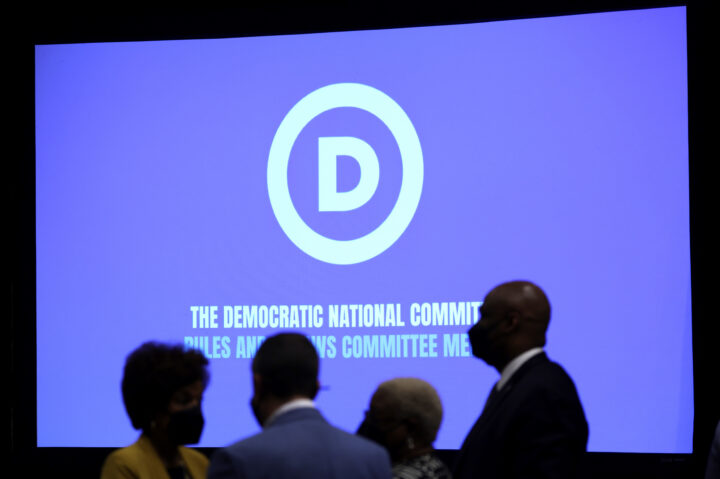
Alex Wong/Getty Images
Committee members wait for the beginning of a meeting of the Democratic National Committee’s Rules and Bylaw Committee in Washington, DC
Democratic Party activists on Thursday voted to reject a measure that criticized the involvement of AIPAC in Democratic primaries and the American political system.
The resolution was debated during a meeting of the Democratic National Committee’s Rules Committee at the DNC’s New Orleans meeting. Committee members were considering new policy resolutions, including one introduced by a Florida activist that took aim at AIPAC and the group’s “undue influence over democratic debate and policymaking.” It was voted down in a voice vote.
“The DNC made clear today that all Democrats, including millions who are AIPAC members, have the right to participate fully in the democratic process,” AIPAC spokesperson Deryn Sousa told Jewish Insider.
Jewish Democratic advocates who were in the meeting room praised the decision.
“We’re pleased that the resolution that wrongly singled out AIPAC was defeated, and that the other anti-Israel resolutions failed to move forward. These measures would be a gift to Republicans, would further fracture our party and do nothing to bring Israelis and Palestinians closer to peace,” Democratic Majority for Israel CEO Brian Romick, who attended the meeting, told JI after the vote.
Halie Soifer, the CEO of the Jewish Democratic Council of America, said the group agrees with the goal of getting dark money out of politics but that AIPAC should not be targeted explicitly.
“We agree with the rejection of dark money in politics — a topic covered in another more expansive resolution adopted by the committee — but also believe that singling out any individual organization is both unproductive and unnecessarily divisive,” Soifer, who also attended the meeting, told JI.
Earlier in the meeting, the committee voted to support a measure “condemning the influence of dark money in the 2026 Democratic primary elections” that called out the artificial intelligence and cryptocurrency industries.
The vote by the DNC’s resolutions committee comes as the Democratic Party faces growing internal strife about its long-standing support for the U.S.-Israel relationship, as some party activists seek to push the group to the left. A new Pew Research Center poll released this week revealed that 80% of Democrats and Democratic-leaning independents have an unfavorable view of Israel — an increase from 69% who said the same last year.
Two other resolutions that touched on Israel-related issues were referred to a working group on the Middle East that DNC Chair Ken Martin created last summer to help smooth over some of the party’s fissures on the Israeli-Palestinian conflict.
One of these referred to Israel’s actions in Gaza as a genocide and called for conditioning U.S. military aid to Israel, and the other called for de-escalation in Iran and Gaza. A third resolution on the Middle East, condemning the U.S. missile strike that hit a girls’ school in Iran and killed at least 165 people, passed.
Sen. Lindsey Graham: ‘I look forward to the architects of this proposal, the Vice President and others, coming forward to Congress and explaining how a negotiated deal meets our national security objectives’

Office of Sen. Lindsey Graham (R-SC)
Sen. Lindsey Graham (R-SC) and Sen. Tom Cotton (R-AR) hold a joint press conference on Iranian nuclear negotiations at the U.S. Capitol on May 8, 2025.
Despite skepticism over the terms and reports of ongoing Iranian strikes, several prominent hawkish Republicans are voicing support for President Donald Trump’s fragile two-week ceasefire agreement with Iran.
Sen. Lindsey Graham (R-SC), among the most prominent backers of the war in the Senate, said in a post on X that a “diplomatic solution to end the reign of terror in Iran is the preferred outcome” but said he has concerns about the supposed 10-point plan presented by Iran, which would require the lifting of all U.S. sanctions on Iran, among other steps.
U.S. officials, including Vice President J.D. Vance, said the U.S. did not agree to that version of the deal, but that at least three versions of the Iranian proposal have circulated. White House press secretary Karoline Leavitt said Wednesday that the original 10-point plan proposed by Iran was “fundamentally unserious” and was “literally thrown into the garbage by President Trump and his team.”
“I look forward to the architects of this proposal, the Vice President and others, coming forward to Congress and explaining how a negotiated deal meets our national security objectives in Iran,” Graham said.
He added that all of Iran’s enriched uranium must be turned over to the United States and that Iran cannot have any enrichment capacity.
“To those who say, Iran needs to save face by having a small enrichment program, I’m not remotely interested in providing face-saving cover to a regime that murders its own people, beats a 16-year-old girl to death for not wearing a headscarf appropriately, and is dripping in American blood,” Graham said.
Sen. Ted Cruz (R-TX) said on his podcast that he believes Trump was prepared to follow through on his threats against Iran, but agreed to hold off in response to Pakistan’s mediation efforts and Iran’s agreement to reopen the Strait of Hormuz as he had demanded.
“Many of the military objectives have been accomplished. The military has been degraded almost out of existence,” Cruz said, though he acknowledged that it doesn’t take much for Iran to disrupt trade in the Strait of Hormuz. “There’s virtually no military left. It’s like four guys with a slingshot sitting on the back of a camel.”
But Cruz said he would be skeptical that the ceasefire would hold if Iran’s attacks on its neighbors continued.
He said his definition of success in Iran would be taking away Iran’s ability to kill Americans and innocent people in the region and its ability to become a nuclear power. He said that full regime change is the responsibility of the Iranian people, not the United States.
Responding to a post by Trump about the agreement and the damage to Iran’s nuclear program, Senate Intelligence Committee Chairman Tom Cotton (R-AR) said, “President Trump has always been crystal clear: there must be no uranium enrichment for Iran. And he’s absolutely right. That was a central flaw in Obama’s disastrous deal. Because the only reason Iran would demand to enrich uranium is to build a nuclear weapon.”
He didn’t address the substance of the ceasefire deal itself.
Sen. Kevin Cramer (R-ND) praised Trump’s execution of the war and the ceasefire, saying that the war had shown that the U.S. is the strongest nation and has the strongest military on the planet.
“He has made it clear – Iran will not get a nuclear weapon. And so, it’s really through his efforts that the U.S. not only secured a temporary ceasefire but more importantly, they obtained a commitment from Iran to reopen the Strait of Hormuz,” Cramer said in a statement. “That has been his short-term goal in recent days, and it’s an important goal that affects a lot of people, not just the United States but our Middle East friends and certainly Europe.”
He called on other allies to step up — and predicted they would following the ceasefire agreement. But he also urged continued caution.
“Now we have to keep our eyes wide open obviously, it’s not like the Iranian regime is good for keeping its word, but in my mind, this is a pretty good breakthrough,” Cramer continued. “I’m grateful for President Trump’s unwavering dedication to defending our country and holding our adversaries accountable, and frankly, holding some allies accountable as well. I certainly hope they learned from this lesson.”
Other senior Republicans haven’t commented on the ceasefire agreement yet.
Off Capitol Hill, some prominent right-wing voices who have had the president’s ear are taking a different view of the deal.
Conservative commentator Mark Levin emphasized that Iran violated the ceasefire deal shortly after it was signed. He accused Iran of trying to use the negotiations to “blackmail us and Israel” to allow Hezbollah to continue its attacks on Israel and divide the U.S. and its allies.
“The 2-week ceasefire is being violated right now by the Iranian-Nazi regime. Missiles are being fired into Israel and perhaps other countries in the region. Are they able to defend themselves?” he said on X. We have the right man as president, and I bet he’s furious about this.”
“But this will be the question throughout — that is, do we expect the Iranian regime to honor a deal, how will we monitor it, and how will we enforce it. These will all be very difficult issues to resolve,” he continued.
Responding to the 10-point Iranian proposal, Levin said simply, “Uh oh.”
Far-right influencer Laura Loomer said on X the deal is “a negative for our country” and “we didn’t really get anything out of it.”
Under the Iran Nuclear Agreement Review Act, passed in response to the Obama administration’s negotiations with Iran in 2015, any agreement pertaining to Iran’s nuclear capabilities must be submitted to Congress for its review, and Congress has the ability to vote to block any such agreement.
In spite of the ceasefire, Democrats are continuing to agitate for Trump’s removal from office and plan to pursue war powers resolutions to force an end to the war.
In a Dear Colleague letter on Wednesday, House Minority Leader Hakeem Jeffries (D-NY) said that Democrats plan to attempt to pass a war powers resolution during a pro-forma session on Thursday by unanimous consent — an effort that is likely to fail.
Jeffries also said that Rep. Jamie Raskin (D-MD), the ranking member of the House Judiciary Committee, and committee Democrats plan to hold a briefing on Friday on “Trump administration accountability and the 25th Amendment” — indicating that the doomed push to remove Trump from office has backing from the top echelons of the Democratic Party.
Senate Minority Leader Chuck Schumer (D-NY) said that Democrats are planning to force a vote on a war powers resolution next week, the fourth since the war began on Feb. 28, when the Senate returns from its own recess.
The new survey, conducted during the Iran war, also found a majority of Republicans under 50 view Israel unfavorably

Jim Lo Scalzo/EPA/Bloomberg via Getty Images
President Donald Trump, right, and Benjamin Netanyahu, Israel's prime minister, during a news conference in the State Dining Room of the White House in Washington, DC, US, on Monday, Sept. 29, 2025.
The war in Iran has cost Israel political support in the United States, according to a new Pew Research Center poll, which shows 60% of Americans now view Israel unfavorably, with 37% viewing the Jewish state favorably.
The results not only reflect an overall decline in public support in recent years, but a significant seven-point drop since the pollster’s last survey in 2025, when it found 42% of respondents viewed Israel favorably and 55% unfavorably. The latest poll surveyed 3,507 U.S. adults between March 23-29, during the height of the joint U.S.-Israel military operations.
Perhaps most concerning for the pro-Israel community, the poll found that 57% of Republican respondents under 50 hold negative views towards Israel. That’s in stark contrast to the strong support it receives from older Republicans, with nearly 3 in 4 viewing the Jewish state favorably.
The survey found that positive views of Israel were concentrated among Jewish Americans (64% said they view Israel favorably) and evangelical Protestants (65% said they hold favorable views).
The least supportive religious groups towards Israel were: American Muslims (4% favorability), the religiously unaffiliated (22% favorability), Black Protestants (33%) and Catholics (35%).
The poll also found that Israeli Prime Minister Benjamin Netanyahu continues to get low marks from the American public, with only 27% saying they trusted him to “do the right thing regarding world affairs.” Nearly the same share of voters who viewed Israel unfavorably also held the Israeli prime minister in a negative light.
Pew also asked how important the conflict between Israel and Hamas was to respondents, and 53% rated it as a “very” or “somewhat” important issue. Nearly all Jewish respondents (91%) and 70% of Muslim respondents said what’s happening in the Middle East is of significant importance.
The South Carolina Republican brought Christian and Jewish leaders together to speak out against ‘stopping’ antisemitism in the GOP ‘before it gets stronger’
Lindsey Graham for Senate Campaign
Sen. Lindsey Graham (R-SC) at news conference last Thursday during which he criticized the actions of his primary opponents' staffers.
Sen. Lindsey Graham (R-SC) doubled down on his calls for two of his primary challengers in his reelection campaign to fire senior officials over their record of antisemitic statements after both candidates refused to do so — vowing on Tuesday to fight the growing tolerance for Jew-hatred in the GOP and call out aspiring lawmakers in South Carolina who excuse or embrace it.
The South Carolina senator convened Christian and Jewish leaders for a call with reporters to criticize Paul Dans and Mark Lynch, who are challenging Graham in the Republican primary for his Senate seat, over Dans’ refusal to fire Vish Burra as his campaign communications director and Lynch declining to part ways with Evan Mulch as his political director despite their respective records of making antisemitic statements.
Graham told reporters that while he would not typically make an issue of the behavior of staffers from an opposing campaign, he felt compelled to speak out because of the outgrowth of antisemitism in the Republican Party.
“I’m speaking more today as just an American, a senator representing South Carolina, rather than just a candidate. I’ve never had to make a phone call like this, and it, quite frankly, is disturbing,” Graham said. “There are two opponents of mine that have staff members that are very out of touch with where I think South Carolina is, and spewing hate in the form of antisemitism.”
“I’ve never done this before, but this is a problem in America, a small problem in the Republican Party, that I don’t want to grow,” he continued. “I seldom do this, go after other people’s campaigns, because I feel confident that what I’ve got to offer wins the day politically, but this is not about politics. This is not about my primary. This is about stopping something before it gets stronger, calling it out and making it unacceptable.”
Graham highlighted both staffers’ records at a news conference last Thursday and on Tuesday’s call, condemning Burra for depicting Jews as cockroaches in a video he created on the right-wing One America News Network, which ultimately resulted in his firing as a producer.
Mulch, meanwhile, posted a photo on X last June of a boot stepping on the Talmud and calling it a “hate filled book.”
“I call this out because I think it’s a vile antisemitic action. It has no place in politics or, quite frankly, decent society, and he hasn’t been fired,” Graham said on Tuesday. “As a matter of fact, Mr. Dans, in responding to the call to deal with the staffers, said that my campaign was controlled by Israel and that I’m being blackmailed by Israel and other affiliated groups, which I think is one of the oldest stereotypes, that the Jews control politicians.”
“When you step on the Talmud with a boot, I don’t think that’s American,” he added of Mulch. “I don’t think it’s Christian, and I don’t think there’s any place in running for higher office for people who engage in that behavior, and I’ve called for him to be fired with no response.”
While Graham said he does not believe it is inherently antisemitic to voice objections to the policies of the Israeli government, he argued that tolerance of such criticisms did equate to tolerance of blatant antisemitism.
“I’m a strong supporter of Israel, and you can oppose Israeli policies and not be an antisemite,” Graham said. “But when you’re an antisemite, not only do you oppose Israel, I think you oppose human decency and what America stands for.”
Graham told Jewish Insider on the call that he was confident “that when the people of South Carolina — Republicans, Democrats and independents — hear what’s going on, and that’s why I’m doing it today, it will be soundly rejected.”
Matt Brooks, CEO of the Republican Jewish Coalition; Tony Perkins, president of the Family Research Council; Ralph Reed, founder of the Faith & Freedom Coalition; Sandra Hagee Parker, who chairs the board of CUFI Action Fund, the political arm of Christians United for Israel; and Rabbi Yossi Refson of Chabad of Charleston spoke on the call in support of Graham’s efforts.
“We have witnessed, I believe, sadly, the institutionalization of antisemitism in the Democratic Party,” Brooks told attendees. “For us at the Republican Jewish Coalition, let me be very clear and unambiguous that this is a fight that we will take everywhere. We will ensure that antisemitism does not take hold in our party like it has taken hold in the Democratic Party. The fabric of America was woven together based on Judeo-Christian values, the values that we all cherish are built in partnership with our Christian allies and friends. Anybody who traffics in antisemitic rhetoric or antisemitic actions has no place in our party.”
Graham vowed at the end of the call to continue his push to ensure elected Republicans in and out of the state are individuals who repudiate antisemitism.
“The breadth of condemnation here and the quality of the thoughts expressed not only give me hope and prove that I’m doing the right thing. It inspires me. I am not going to let this go after what I heard today. I am never going to let this go until my last breath. I will make sure that any group, but particularly the long suffering Jewish people, have my unequivocal support.”
Dans and Lynch were unapologetic about their campaign staffers, instead releasing statements late last week and Tuesday directing their ire at Graham in deeply personal terms.
“He’s given a member of my campaign staff more attention than he’s given South Carolinians for decades,” Dans said in a statement last Thursday. “The real headline that you should be covering is how many opioid deaths happened in South Carolina last year on Lindsey Graham’s watch. Israel picks Lindsey Graham’s staff, but they do not pick mine. I am not firing Vish Burra and I am calling on the people of South Carolina to fire Lindsey Graham.”
Lynch, meanwhile, told JI in a statement on Tuesday evening that Graham was “an existential threat to both the nation of Israel and the United States.”
“Lindsey Graham is responsible for the deaths of countless Jews in Israel by the fact that he has sent 10s of millions of dollars to Al-Qaeda, Hamas, and Al-Nusra Front — funding the enemies of Israel,” Lynch said.
The Michigan Senate candidate made the comments alongside antisemitic streamer Hasan Piker, when asked about the synagogue attack last month
Monica Morgan/Getty Images
Abdul El- Sayed at the Bridge Center on December 16, 2025, in Detroit, Michigan.
At a Tuesday night event with antisemitic streamer Hasan Piker at the University of Michigan, Michigan Senate candidate Abdul El-Sayed doubled down on claims that the man who attacked Temple Israel in West Bloomfield last month did so as a result of the pain he felt from the war in the Middle East.
“Nothing justifies the heinous attack that we saw on Temple Israel,” El-Sayed, a Democrat, said at a press conference alongside Piker, with whom he appeared at two campaign rallies in Michigan on Tuesday. “I also think it’s just critical for us to understand that hurt people do hurt people, and the circumstances happening 6,000 miles away can affect the lives that we live here, and if we stand against violence, we’ve got to stand against violence, all violence.”
El-Sayed’s comments reiterated a sentiment he expressed the day after a Lebanese American man drove a car packed with explosives into the synagogue. No one lost their lives in the incident. The assailant, who died of a self-inflicted gunshot wound after shooting at a security guard, had family members killed in Israeli strikes in Lebanon — including his brother, a commander in Hezbollah, the Iranian-backed militia.
Since El-Sayed’s initial statement, more details surrounding the attack have surfaced. The FBI said the attack was “a Hezbollah-inspired act of terrorism purposely targeting the Jewish community.”
When a reporter from The Free Press pressed El-Sayed on his claim, asking whether a similar argument would have allowed sympathy for a Jewish person attacking a mosque after the Oct. 7, 2023, Hamas attacks in Israel, he suggested the circumstances were not the same.
“After Oct. 7, there was a whole genocide against Palestinians,” El-Sayed said.
The Michigan Senate candidate held two rallies on college campuses with Piker Tuesday evening, despite growing Democratic concerns over the social media influencer
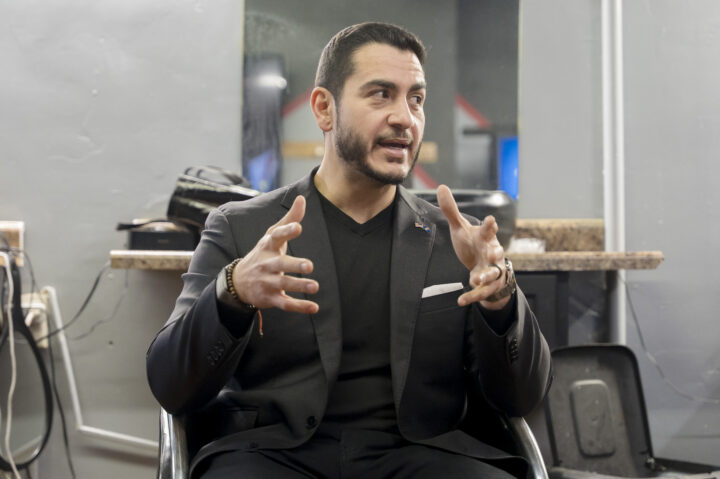
Evan Cobb for The Washington Post via Getty Images
Michigan Senate candidate Abdul El-Sayed speaks with customers and barbers at Blazin Wade Cuts in Grand Rapids, Michigan, on Saturday, Feb. 21, 2026.
Far-left Michigan Senate candidate Abdul El-Sayed, leftist streamer Hasan Piker and Reps. Rashida Tlaib (D-MI) and Summer Lee (D-PA) dismissed criticism of Piker and his past antisemitic and anti-American comments at a rally at the University of Michigan on Tuesday — El-Sayed’s second event of the day with the controversial social media influencer.
The El-Sayed endorsers all brushed off the criticism of Piker’s record of antisemitic comments, support for terrorism and other controversial activity as a distraction from their message and other issues of the day, including the war in Iran.
“A lot of the people that are on the Republican side, the reactionary side, they, instead of talking about [the war in Gaza], decided to talk about me stumping for Abdul El-Sayed instead,” Piker said, dismissing criticism of him — which has come from Democrats as well — as a distraction.
Piker referred to the war in Iran as “Operation Epstein’s Fury” and the Trump administration as “a bunch of fascist monsters that got tuned up by Israel,” and closed out his remarks with “Free Palestine.”
“Every single dollar that is spent on a bomb is stolen from each and every one of you. That’s $1 that they spend blowing up a school overseas instead of building schools in your neighborhoods,” he continued, going on to blame support for Israel for the lack of universal healthcare in the United States, and to claim that U.S. taxpayers are paying for Israel’s healthcare system.
El Sayed said that he had heard that a pro-Israel group on campus planned to protest the rally — to boos from the crowd — but El-Sayed said that the group would be welcome in the room “because at the end of the day, we believe in the courage of our convictions and our ideals.”
During his remarks, El-Sayed took numerous swipes at AIPAC, accusing the pro-Israel advocacy group of “corrupting our entire politics.” He said he expects the pro-Israel organization will be the largest spender in the Senate primary — though it has not yet announced any plans to engage in the race and has never before spent money in a Senate campaign.
He called the war in Iran “genocidal, illegal, unjustifiable” and accused fellow Democrats of hypocrisy for saying that they view the war as illegal but declining to rule out voting for supplemental funding to support the war effort.
He also insisted — in spite of his promotion of Piker — that he would be a strong voice against antisemitism, pointing to his own background as a Muslim and his “love and reverence” for all people.
Tlaib said she’d told Piker backstage that he would always be welcome in Michigan.
“The fact that, literally, they’re all like, ‘Defend our democracy. Oh, shut up, cancel him’ — make up your damn mind,” Tlaib said, addressing critics of Piker. “Make up your godd*** mind. We’re for everybody in the room or not. Give me a break.”
Tlaib praised El-Sayed as someone closely aligned with her anti-Israel views, including support for blocking aid to the Jewish state.
“I’ve been there seven years, and I’m tired of having to beg my colleagues to do the right thing, to not take money from the people that hurt us, not to literally spend resources and funding like this for war and destruction and death,” Tlaib said. “If any member of Congress or Senate can support a genocide like that, what else are they supporting right here in our backyard at home.”
Lee, like Piker and El-Sayed, dismissed the controversy over the rally as an attempt by people “who don’t want us talking to people who might rock the boat” to silence and stop the rally.
Other speakers at the rally included UM regent candidate Amir Makled, an attorney who provided pro bono representation to anti-Israel protesters at the university who faced criminal charges for their role in the demonstration, Summit Louth, the newly elected president of UM’s student government and Yousef Rabhi, a county commissioner.
“It was right here on this campus that students were punished for speaking out at the Diag, and it was right here on this campus where that outrage, the irreprehensible conduct of our Board of Regents punished students for speaking out against the genocide that students were charged with felonies just for the words of ‘free Palestine,’” Makled claimed.
Among other issues, Louth praised El-Sayed for calling the war in Gaza a genocide and for condemning the war in Iran and the Israeli operations in Lebanon.
“As we all saw this morning, the deranged president of this country issued a genocidal ultimatum on an entire country. F*** him. F*** that. We need to take our country back,” Rabhi said. “Instead of putting forward money to pay for your tuition, they are bombing people halfway across the world. Instead of paying money to make sure that we have single payer universal health care in this country, they are murdering innocent people. “
In an interview with the New York Post, the president called the far-right podcaster ‘a low IQ person that has absolutely no idea what’s going on’

Chip Somodevilla/Getty Images
Tucker Carlson speaks on stage on the fourth day of the Republican National Convention at the Fiserv Forum on July 18, 2024 in Milwaukee, Wisconsin.
President Donald Trump hit back at Tucker Carlson on Tuesday after the far-right podcaster used his most recent show to accuse the president of steering the U.S. toward nuclear war with Iran and to suggest, in apocalyptic terms, that Trump might be waging a stealth attack on Christianity.
In a phone interview with the New York Post, Trump described Carlson as a “low IQ” individual who frequently tries to speak with him by phone, adding that he has stopped responding to his calls.
“Tucker’s a low IQ person that has absolutely no idea what’s going on,” Trump told the outlet of Carlson. “He calls me all the time. I don’t respond to his calls. I don’t deal with him. I like dealing with smart people, not fools.”
The remarks came in response to a lengthy monologue Carlson delivered on his Monday podcast. There, Carlson excoriated Trump for issuing an expletive-filled Truth Social post on Easter, in which the president warned that the U.S. was prepared to bomb Iranian power plants and bridges if Tehran did not open the Strait of Hormuz.
Carlson called the post “vile on every level,” particularly for its language on a major Christian holiday, and framed it as the opening move toward nuclear conflict. He speculated that Trump might be pursuing something far larger than conventional military escalation — an effort to provoke Armageddon and undermine Christian faith.
“Is it possible that what you’re watching is a very stealthy yet incredibly effective attack on what, from a Christian perspective, is the true-faith belief in Jesus?” Carlson asked. “Is it possible the president sees this in bigger terms? Sees this as the fulfillment of something? An elevation to some higher office beyond president of the United States?”
“Is it just a conventional escalation ladder in a badly thought out war?” he continued. “Could it be something bigger? Is it possible what you’re watching is a very stealthy yet incredibly effective attack on what, from a Christian perspective, is the true faith: belief in Jesus?”
The former Fox News host then claimed that the reason the president did not put his hand directly on the Bible when being sworn in for his second term last January was because he “rejects” the “limits on human behavior” in the Bible.
Carlson went on to urge Trump administration officials to resign or refuse to obey orders if the president were to order them to strike Iran with a nuclear weapon.
“Those people who are in direct contact with the president need to say, ‘No, I’ll resign. I’ll do whatever I can do legally to stop this because this is insane, and if you give the order, I’m not carrying it out. Figure out the codes on the football yourself,’ because everything hangs in the balance right now,” he explained.
The ad portrays the repeat Congressional candidate, running to succeed Rep. Darrell Issa (R-CA), as a perennial flip-flopper
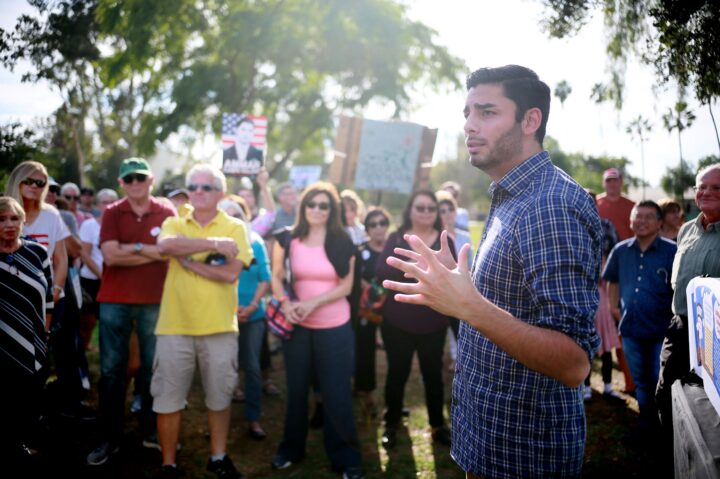
Sandy Huffaker/Getty Images
Ammar Campa-Najjar (D-CA) speaks during a 2018 campaign rally at Grape Day Park in Escondido, Calif.
The pro-Israel group Democratic Majority for Israel’s super PAC launched its first ad of the 2026 campaign, targeting frequent Democratic candidate Ammar Campa-Najjar, accusing him of hypocrisy and of flip-flopping on his positions.
The ad, set to air on television, contrasts past comments by Campa-Najjar about whether he would work with President Donald Trump or support his impeachment with his current hostile stance toward the president — running now in a bluer district.
It also highlights past inconsistencies in his stance on abortion — he once opposed it in all cases, but later described himself as pro-choice.
“Ammar Campa-Najjar has been a DSA-backed candidate whose record of flip-flops on Trump, impeachment, and abortion makes clear he will say whatever it takes to get elected, and voters in CA-48 see right through it,” DMFI president Brian Romick said in a statement.
DMFI is backing San Diego City Council member Marnie von Wilpert for the open seat, which was redrawn to favor Democrats. Rep. Darrell Issa (R-CA), who currently represents the district, is retiring from Congress.
Campa-Najjar, who was born in California and raised in Gaza, is the son of a Palestinian Authority official. He has run unsuccessfully for Congress two times before, losing to Issa by eight points in 2020 and losing to former Rep. Duncan Hunter (R-CA) in 2018.
He is the boyfriend of Rep. Sara Jacobs (D-CA), who represents a nearby southern California district.
Romick and DMFI argued that nominating Campa-Najjar would endanger Democrats’ chances of winning the seat. It’s making a similar case in two other GOP-held swing districts the group is hoping to help flip.
“A candidate who can’t hold a consistent position on the most basic issues isn’t just untrustworthy, he’s unelectable,” Romick continued. “DMFI PAC’s Majority Project is fighting to take back the House, and that means making sure seats like CA-48 are won by candidates with the credibility to actually deliver. Campa-Najjar is not that candidate.”
At least 50 House Democrats are calling for Trump’s immediate removal from office
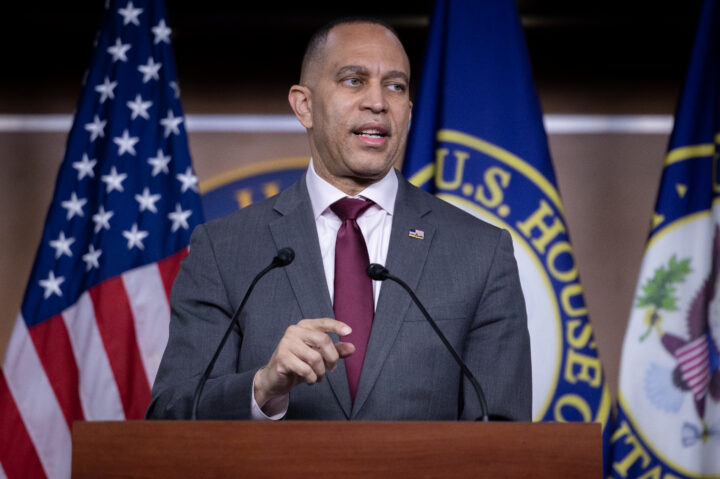
Nathan Posner/Anadolu via Getty Images
House Minority Leader Hakeem Jeffries (D-NY) speaks during his weekly press conference at the U.S. Capitol in Washington, DC on March 19, 2026.
Top Democrats across both chambers condemned President Donald Trump for threatening that “a whole civilization will die tonight” in Iran, with some pushing for Trump’s immediate removal from office over the threat and his conduct of the war.
House Minority Leader Hakeem Jeffries (D-NY) and other members of Democratic leadership including Reps. Katherine Clark (D-MA), Pete Aguilar (D-CA), Ted Lieu (D-CA), Joe Neguse (D-CO) and Suzan DelBene (D-WA), issued a statement calling Trump “unhinged” and saying that he risks bringing the country “into World War III” unless Congress reconvenes to vote to bring the war to an end.
“For years, Republicans have enabled and excused Donald Trump’s deeply dangerous and extreme behavior. Enough is enough,” the leaders said. “Our brave men and women in uniform have been put into harm’s way in the Middle East. Over a dozen have already been killed and hundreds injured. Gas prices are skyrocketing, the cost of living in America is out of control and billions of taxpayer dollars are being wasted on a reckless war of choice.”
In another joint statement, Senate Minority Leader Chuck Schumer (D-NY) and Sens. Chris Coons (D-DE), Jeanne Shaheen (D-NH), Jack Reed (D-RI) and Brian Schatz (D-HI), who are the top Democrats on several relevant committees and subcommittees, similarly condemned Trump’s comments, saying they indicate an intent to commit war crimes.
“This is not strength. Intentionally destroying the power, water, or basic infrastructure upon which tens of millions of civilians depend to punish the very civilians who suffer at the hands of the Iranian regime would constitute a war crime, a betrayal of the values this nation was founded on, and a moral failure,” the lawmakers said. “It’s unconscionable to threaten the lives of so many people — grandparents, children, families — simply because they were born in Iran.”
They said that Trump’s comment “makes Americans less safe, further destabilizes our nation and economy, and puts at greater risk U.S. service members,” as well as makes a diplomatic solution — ”the only viable solution to this war” — harder to achieve.
In a separate statement, Rep. Greg Meeks (D-NY), the ranking member of the House Foreign Affairs Committee, also said that Trump’s threat constitutes a war crime and an illegal action under international law which risks tens of millions of Iranian civilians, and potentially catastrophic after-effects.
“At this critical moment, the United States must pursue immediate de-escalation and a coordinated diplomatic strategy with our allies. We cannot allow Iran to simply reset to a dangerous status quo — but the answer is not to threaten war crimes and isolate us from every partner we need to end this conflict,” Meeks said. Trump’s threat is “recklessness that America and the region will pay for long after this president is gone,” he added.
Rep. Jared Moskowitz (D-FL), who prior to the war was one of the few Democrats who said he would oppose a war powers resolution — though he ultimately voted for it after the war began — demanded that the House immediately reconvene for a war powers vote. Moskowitz’s comments are a sign that Trump’s latest comments have crossed a line even for some of the most hawkish Democrats in the House.
“Speaker Johnson must immediately reconvene the House to vote on a war powers resolution. It’s beyond clear we are at war,” Moskowitz said. “The Speaker’s legacy will be that he made Congress so irrelevant that a president can threaten to wipe out a civilization while Congress is on vacation.”
Jeffries said Democrats plan to bring up another war powers resolution to halt the conflict in Iran, which stands a stronger chance of passing than a previous one, when the House returns from its recess. At least some of the Democrats who voted against the previous resolution are expected to support this one, and a small number of additional Republicans may join them.
Rep. Henry Cuellar (D-TX), one of four House Democrats who voted against the previous war powers resolution on the war in Iran last month, announced he will now support such an effort because the administration has failed to provide adequate answers about its goals and its exit strategy.
“[W]e must be careful with the language we use. Strength and destruction are not the same,” Cuellar added. “When the United States echoes the rhetoric of its adversaries, we risk weakening the values that have long defined our leadership.”
Several Democrats have described Trump’s comments as a threat to commit genocide.
Trump’s threat has also prompted growing calls from at least 70 House Democrats for his removal from office, either through impeachment or the invocation of the 25th Amendment, which allows the involuntary removal of a president from power if he is mentally or physically unfit to govern.
Sens. Ed Markey (D-MA) and Ron Wyden (D-OR) joined those calls.
“Donald Trump is deranged,” Wyden said. “He must be impeached and removed from office. Republicans who don’t stop him will have blood on their hands, and anyone who carries out an order to bomb civilian targets will be complicit in war crimes and will be held accountable.”
Markey called the president “unstable and a clear and present danger, not just to the American people but to the world” and said he “must be removed from office before he causes incalculable and unfathomable harm.” He said that a war powers resolution to stop the war is now insufficient to address the situation.
A small number of Republicans are also airing concerns with Trump’s threat.
Sen. Lisa Murkowski (R-AK), one of the few Republicans who has been openly skeptical of the war effort in Iran, said that Trump’s threat “cannot be excused away as an attempt to gain leverage in negotiations with Iran.”
“This type of rhetoric is an affront to the ideals our nation has sought to uphold and promote around the world for nearly 250 years. It undermines our long-standing role as a global beacon of freedom and directly endangers Americans both abroad and at home,” Murkowski said, calling for deescalation by both Trump and Iran, and insisting that the U.S. must draw a distinction between the Iranian regime and the Iranian people.
Rep. Nathaniel Moran (R-TX) said that, while he has supported the war thus far, “I do not support the destruction of a ‘whole civilization.’ That is not who we are, and it is not consistent with the principles that have long guided America.”
“[W]hat sets America apart is not only our strength, but how we use it. Our nation has always conducted military operations for just causes and through just and moral means. This must continue in the future; otherwise we forfeit our legitimacy to lead the world,” Moran said. “[H]ow we protect the lives of the innocent is just as important as how we engage the enemy.”
Rep. Kevin Kiley (I-CA), who recently left the Republican Party but remains part of the GOP caucus and has generally been hawkish on Iran, said that the U.S. “does not destroy civilizations. Nor do we threaten to do so as some sort of negotiating tactic.”
“Congress has a responsibility to conduct oversight with respect to ongoing military operations and our obligations under both U.S. law and international agreements to which we are a signatory,” Kiley said.
The Anti-Defamation League and Academic Engagement Network flagged sessions at the AAG's conference that promoted BDS and labeled Israel as genocidal and an apartheid state
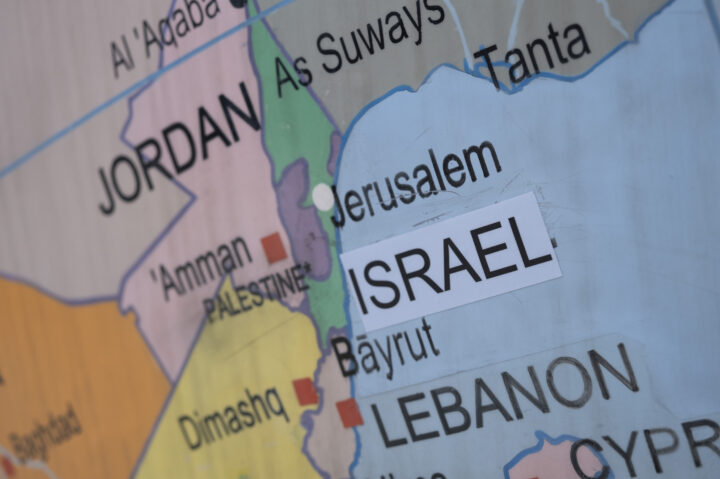
Mike Kemp/In Pictures via Getty Images
Israel on the public art sculpture The World Turned Upside Down by artist Mark Wallinger on June 10, 2024 in London, U.K.
Jewish groups criticized the American Association of Geographers after its members pushed for an academic boycott of Israel at the organization’s annual meeting, which featured overwhelmingly one-sided presentations against the Jewish state.
The Anti-Defamation League and Academic Engagement Network highlighted biased programming including sessions called “BDS and the AAG,” “Mapping and Counter-Mapping Genocide” and “No Geographic Technology for Apartheid” at the AAG’s March 17-21 conference in San Francisco.
The sessions, which were organized by an unofficial group of AAG members called Geographers for Justice in Palestine, “did not appear to encourage balanced discussion or meaningful debate, and in some cases exhibited a marked erosion of scholarly standards,” the Jewish organizations said in a joint statement on Tuesday.
Some Jewish members began to feel alienated from the association during last year’s annual meeting in Detroit, which also featured programming that was hostile to Israel.
“I was deeply disturbed by the inclusion and promotion of sessions that allowed for inflammatory, biased and harmful rhetoric, far removed from academic rigor or geographic inquiry,” Liora Sahar, an Israeli-American member of AAG, told Jewish Insider last year.
Shira Goodman, vice president of advocacy at the ADL, and Miriam Elman, executive director of AEN, said they raised concerns with the organization last March following its meeting and expressed worry that anti-Israel programming has become a pattern within the association.
“At that time, we urged AAG leadership to review its session selection and vetting processes. The apparent lack of progress on these matters raises serious questions about the association’s commitment to maintaining academic integrity and ensuring that its convenings reflect the highest standards of scholarship and discourse,” said Goodman and Elman.
“Academic conferences should be spaces that foster rigorous inquiry, respectful debate, and the exchange of diverse perspectives. While critical discourse — including criticism of government policies — is a legitimate and essential component of academic life, we are concerned that these standards were not upheld at the recent AAG Annual Meeting, where some sessions lacked factual accuracy, intellectual openness, and a commitment to civil engagement,” continued Goodman and Elman.
They warned that the “continued pattern of programming that lacks civility, disregards factual complexity, and promotes exclusionary academic practices risks causing reputational harm to the association and to the broader academic community it represents.”
The groups called on “AAG leadership to take these concerns seriously and implement meaningful reforms.”
Over the summer, AAG joined a growing list of professional associations facing pressure to adopt a boycott of Israel after a member petition urged the association “to endorse the campaign for an academic boycott of Israeli academic institutions.”
Last month, AAG said there has not yet been a vote on the petitioners’ demands.
AAG did not respond to a request for comment from JI asking about this year’s conference.
Plus, Sine die dayenu
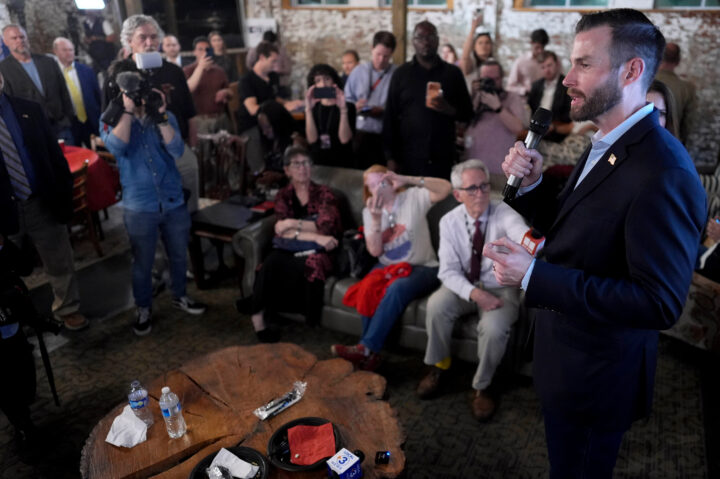
Mike Stewart/AP
Republican Clay Fuller speaks to supporters after learning he would advance to a runoff election during an election night watch party, Tuesday, March 10, 2026, in Rome, Ga.
👋 Good Tuesday morning!
In today’s Daily Kickoff, we report on President Donald Trump’s doubling down on his threat to strike Iranian power plants if Tehran does not reopen of the Strait of Hormuz by tonight’s 8 p.m. deadline, and look at how Iran’s closure of the key waterway is forcing countries to consider alternatives, such as the proposed India-Middle East-Europe Corridor. We preview today’s special election runoff in Georgia to fill the rest of former Rep. Marjorie Taylor Greene’s term, and report on plans by Texas Democrats to vote on a series of anti-Israel and anti-AIPAC resolutions at their upcoming party convention. Also in today’s Daily Kickoff: Esther Panitch, John Kirby and Bill Ackman.
Ed. note: In observance of Passover, the next Daily Kickoff will arrive on Friday, April 10.
Today’s Daily Kickoff was curated by JI Executive Editor Melissa Weiss and Israel Editor Tamara Zieve, with assists from Danielle Cohen-Kanik and Marc Rod. Have a tip? Email us here.
What We’re Watching
- President Donald Trump’s deadline for Iran to reopen the Strait of Hormuz — or face attacks on its power grids and bridges — expires at 8 p.m. ET. Earlier today, the IDF reportedly warned civilians to stay away from trains, an indication that the Islamic Republic’s infrastructure could be targeted. More below.
- Members of the Democratic National Committee are kicking off a five-day meeting today in New Orleans, where the DNC’s resolutions committee is set to consider resolutions condemning AIPAC and Israel. The resolutions were proposed by a Florida delegate who last year attempted to push through a resolution calling for an arms embargo on Israel. Read more here.
- Voters in Georgia’s 14th Congressional District head to the polls today for the special election runoff to choose a successor to fill out the remainder of Rep. Marjorie Taylor Greene’s (R-GA) term. District Attorney Clay Fuller, a Republican, is the favorite against Democrat Shawn Harris — but will likely need a decisive win today to stave off potential primary challengers in the GOP primary for the regular election later this spring. More below.
- In Michigan, Democratic Senate candidate Abdul El-Sayed and Rep. Summer Lee (D-PA) will hold rallies on the University of Michigan and Michigan State University campuses with far-left streamer Hasan Piker, who is coming under increasing criticism for his antisemitic and anti-American rhetoric.
What You Should Know
A QUICK WORD WITH JI’S JOSH KRAUSHAAR
Today’s special election runoff in Georgia between Republican Clay Fuller and Democrat Shawn Harris to determine the successor to former Rep. Marjorie Taylor Greene (R-GA) isn’t much in doubt. The northwestern Georgia district that Greene represented backed President Donald Trump by 37 points in 2024, one of the largest GOP margins in the country.
What makes the otherwise sleepy contest significant is the potential for the results to indicate if there are any fissures within the MAGA coalition, ones that may represent Republican discontent with Trump’s hawkish turn amid the Iran war. In this race, the margins will be as notable as the winner.
Greene, since leaving Congress, has emerged a loud Republican voice against the Iran war and against Trump’s strong alliance with Israel. Fuller, a military veteran with a background in counterterrorism operations and district attorney for the Lookout Mountain Judicial Circuit, has been a stalwart supporter of Trump’s military operations in the Middle East, and Trump has endorsed him in the race.
Harris, the Democrat, holds foreign policy views closer to the isolationist Greene, attacking the pro-Israel advocacy group AIPAC and describing Israel’s war against Hamas as a “genocide” — views which place him on the left flank of the Democratic Party. This despite Harris’ time serving as defense attache in Israel during his years in the National Guard, work history that he has not publicized during the campaign.
It’s worth noting that Greene, since she was first elected to the seat in 2020, has underperformed Trump’s standing in the district, only winning 64% of the vote against Harris in 2024 — four points below Trump’s 68% showing at the top of the ticket. And since breaking with Trump in his second term, her political standing has taken an even bigger hit.
Greene has not endorsed either candidate in the race.
WAY OF WATER

With Iran’s closure of the Strait of Hormuz roiling energy markets, other countries in the region may begin to pursue alternative routes to transport energy and other goods, but they are far from ready to be put into use, experts told Jewish Insider’s Lahav Harkov this week.
Back in focus: One of the highest-profile routes is the India-Middle East-Europe Corridor (IMEC), proposed by the Biden administration in September 2023 as a route for trade, energy and more; it would go from India, through Saudi Arabia, the UAE, Jordan and Israel, then across the Mediterranean to Europe through Greece. Now that the Iranian threat to block the strait has been realized, IMEC and other alternative routes to ship oil and gas from the Gulf are back in focus. Gabriel Mitchell, an expert on energy security and a visiting fellow at the German Marshall Fund, told JI that “the threat and challenge posed with the Strait of Hormuz has raised questions about East-West shipping, traffic and global energy trade to the maximum.”

