



































The Jewish former Labour leader has supported Israel’s security but has declined to identify as a Zionist
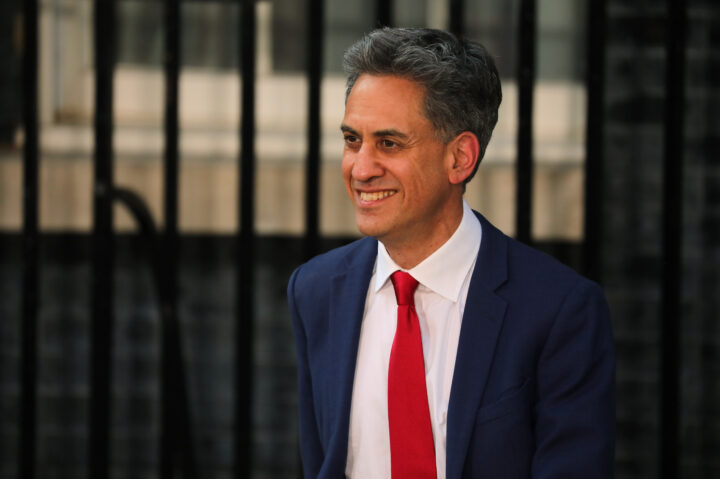
(Alishia Abodunde/Getty Images)
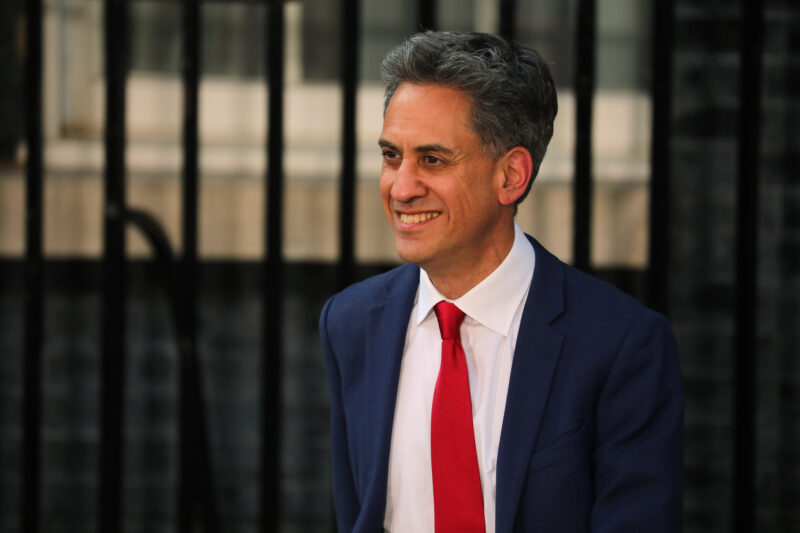
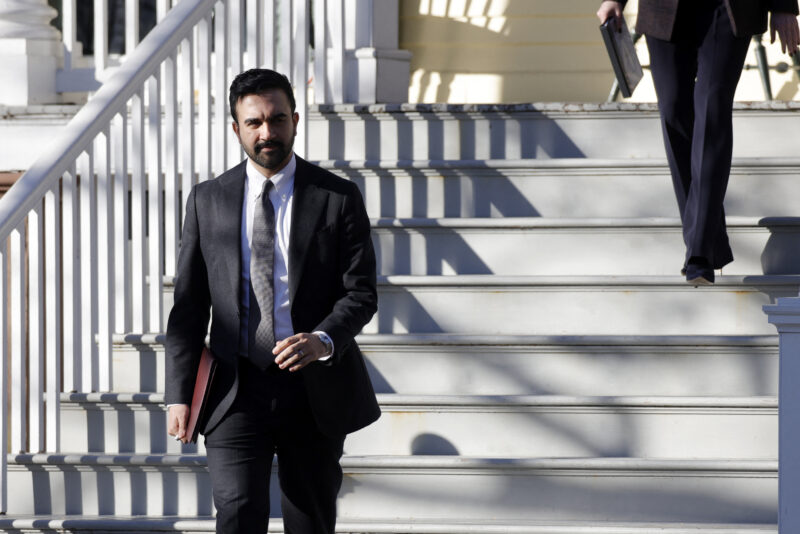
Newly appointed U.K. Foreign Secretary Ed Miliband departs Downing Street on July 20, 2026 in London, England.


 Add JewishInsider on Google
Ed Miliband’s appointment on Monday as U.K. foreign secretary is raising questions about how the former Labour chief will influence Israel and Middle East policy under Andy Burnham, the country’s new prime minister.
Miliband, 56, had served as energy secretary under former Prime Minister Keir Starmer, who announced his resignation last month and officially departed 10 Downing St. on Monday. As the first Jewish leader of the Labour party, which he helmed from 2010-2015, Miliband has long balanced his commitment to Israel’s security with vocal criticism of the Jewish state that has fueled some tensions with British Jewish leaders.
The naming of Miliband to lead the Foreign Office has been seen as a sign that Burnham plans to adopt a tougher stance toward Israel as prime minister than his predecessor — who had already sought to cut off some arms sales to Israel while imposing sanctions on far-right Israeli ministers and recognizing a Palestinian state in a series of moves that soured ties between the U.K. and Israel.
In the days before his recent election as Labour leader, Burnham, the former mayor of Manchester, apologized for his party’s initial response to Israel’s military campaign in Gaza after the Hamas attacks of Oct. 7, 2023, saying that it had been “too slow to call for a ceasefire,” and suggested he would implement further sanctions on Israel and its government along with a possible trade ban on settlements in the West Bank.
For his part, Miliband, in a statement on Monday, spoke more broadly about his approach to the Middle East, vowing the new government would “seek to end the conflict in Iran,” while “working tirelessly to seek a sustainable peace in Palestine and Israel, including an end to the terrible suffering of the people of Gaza and security for the people of Israel.”
During his past tenure as Labour leader, Miliband “certainly wasn’t an instinctive supporter of Israel, but he also wasn’t as hostile as some expected given his background,” Arieh Kovler, a political analyst in Jerusalem who previously served as the director of policy and research for Britain’s Jewish Leadership Council, told Jewish Insider. “But that was a decade ago. Attitudes to Israel have hardened across British politics and the Labour Party with it.”
Kovler added that he would expect “the Burnham government to be tougher on Israel, and for Ed Miliband as foreign secretary to be quite comfortable moving forward an agenda of, for example, sanctions on settlements and broader arms embargoes while still publicly affirming that Israel’s an ally with a right to defend itself.”
In 2014, Miliband joined most of his party’s lawmakers in what was viewed as a largely symbolic vote calling to unilaterally recognize a Palestinian state — a position formally adopted by the U.K. last September.
Prior to that vote, Miliband had publicly rebuked then-Prime Minister David Cameron, a Conservative, during Israel’s Operation Protective Edge in Gaza, for his “silence on the killing of innocent Palestinian civilians caused by Israel’s military action,” which he called “wrong and unjustifiable.”
Despite his critical stances, Miliband — who drew some praise from the British far left on Monday — has defended Israel’s right to self-defense and said that “there is no place in politics for those who question” the country’s existence, underscoring his personal ties to Israel, where his grandmother took refuge after surviving the Holocaust.
“My relationship with my Jewishness is complex,” he wrote in a 2014 essay. “But whose isn’t?”
While Miliband has called Israel “a homeland for the Jewish people,” he has expressed ambivalence about referring to himself as a Zionist, declining to identify explicitly as such.
“I want you to know that if I become prime minister in less than a year’s time, I will be proud to do so as a friend of Israel, a Jew and, most of all, someone who feels so proud to be part of the community gathered here,” he said in a 2014 speech to Labour Friends of Israel, after he had returned from a trip to Israel.
In his statement posted to social media on Monday, Miliband invoked his family history, noting that his parents “came to Britain as Jewish refugees from the Nazis.” His father, Ralph Miliband, was a renowned Marxist theorist, and his mother, Marion Kozak, who died in May, was a Holocaust survivor who became a staunch supporter of Palestinian rights. His brother, David, was foreign secretary from 2007-2010 under former Prime Minister Gordon Brown.
Miliband’s new role as foreign secretary provoked barbed reactions from some British Jewish leaders before he was even officially named to the position, replacing Yvette Cooper in part of a broader Cabinet shakeup led by Burnham, who on Monday rose to the prime ministership.
Stephen Pollard, the former longtime editor of The Jewish Chronicle, said in a lengthy post that Miliband’s appointment was the “most nauseating political appointment of my lifetime.” He harshly criticized Miliband for leading the Labour party in a 2013 vote against U.K. military action to oppose former Syrian dictator Bashar Al-Assad after he had used chemical weapons on his own people, calling it a “disgraceful” effort that emboldened Russian President Vladimir Putin to invade and annex Crimea the following year.
Edmund Fitton-Brown, a former British diplomat who is now a senior fellow with the Foundation for Defense of Democracies think tank in Washington, said that Miliband’s “record on Syria suggests that he will be a skeptic on any new military engagements in the region, and that he and Burnham will therefore be even less inclined than” Starmer and Cooper “to join the U.S. in its current campaign against Iran.”
In gauging Miliband’s “leanings regarding Israel, Gaza, Palestine and the Middle East relative to his colleagues and former colleagues,” Fitton-Brown told JI that “he is much less rabid than Jeremy Corbyn,” the former Labour leader who had faced accusations of antisemitism, “but more anti-Israel than either of his predecessors,” including Cooper and David Lammy.
“This may suggest that Andy Burnham, who may be described as left of Keir Starmer on this issue, will shift the U.K. government into a slightly more anti-Israel position than Starmer allowed, although he will want to avoid accusations of being soft on antisemitism,” Fitton-Brown explained.
Jonathan Freedland, a Guardian columnist in London who co-hosts the “Unholy” podcast, which covers Israel and Jewish life, told JI that Miliband “has deep personal and family ties to Israel, and when he was Labour leader more than a decade ago he said those ties informed his view of the region.”
“Clearly,” Freedland said on Monday, “the context now is very different — opinions have hardened against the current Israeli government and I would expect Ed Miliband to reflect that change and to do so trenchantly.”
The Pennsylvania senator heavily criticized the normalization of anti-Israel platforms and the validation of extreme views among Democratic voters
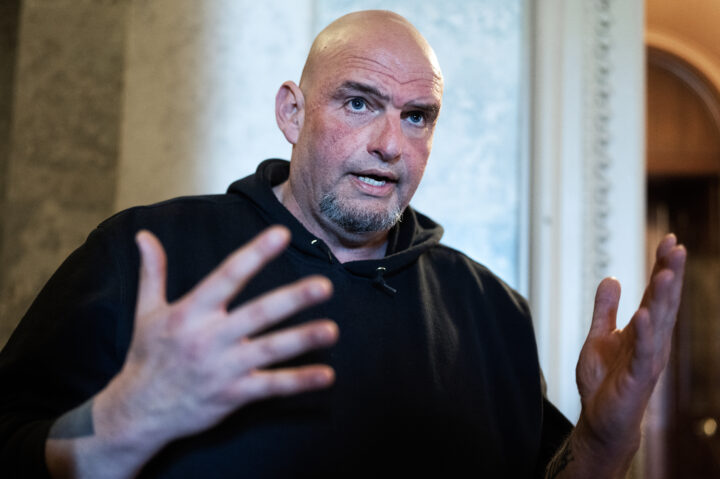
Tom Williams/CQ-Roll Call, Inc via Getty Images
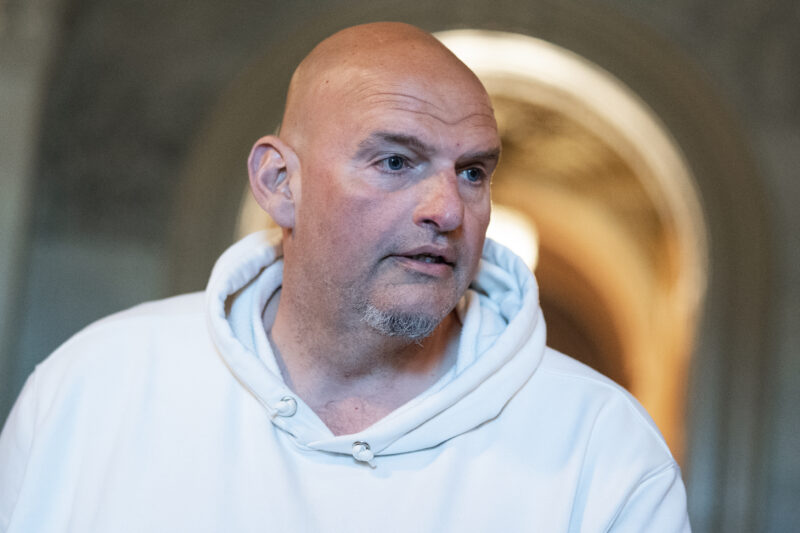
Sen. John Fetterman (D-PA) talks with reporters after the Senate luncheons in the U.S. Capitol on Tuesday, March 11, 2025.
Sen. John Fetterman (D-PA), a stalwart ally of Israel and the Jewish community who has become increasingly isolated within a Democratic Party facing internal friction over its Middle East policy, warned on Wednesday that the outlook for Jewish voters within his party has become “bleak.”
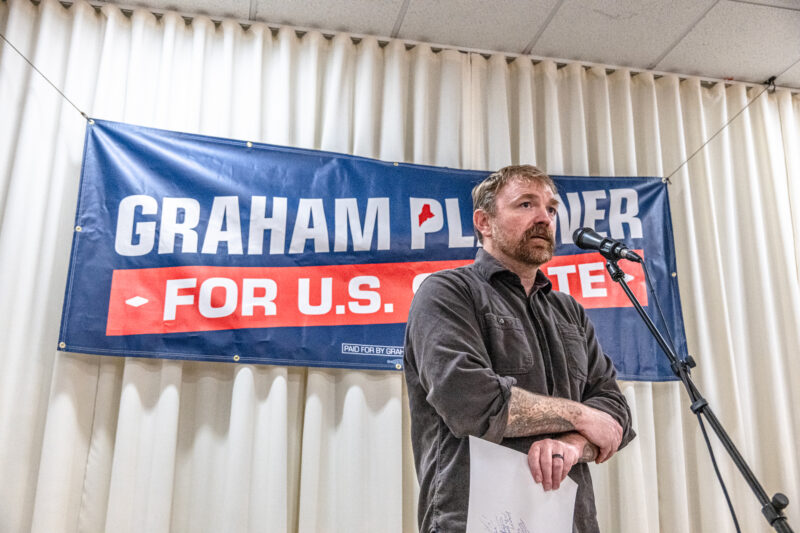
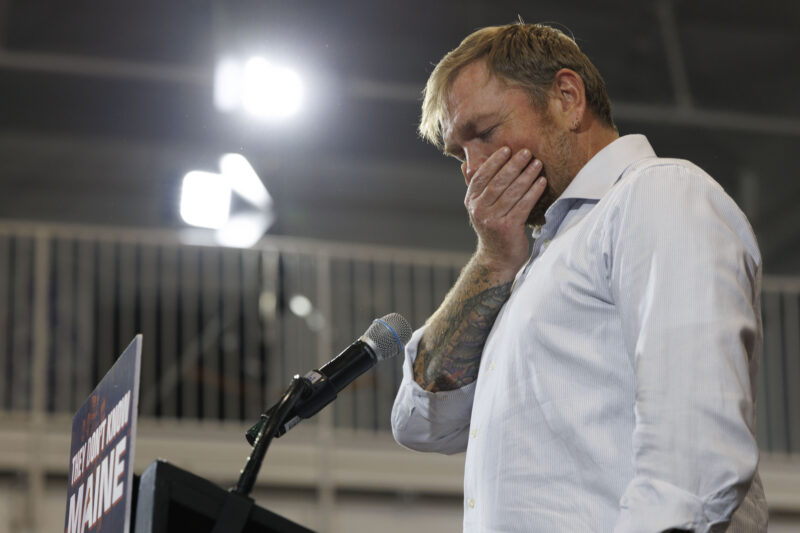
“I’m not a member of the Jewish community, but if I was one, it would be bleak as a Jewish voter in the Democratic Party,” Fetterman said, speaking at a conference hosted by the Culture for Peace Institute, a nonprofit organization focused on advancing “sustainable peace” by bringing together political leaders and researchers, in Washington. “If [Democratic voters are] willing to support these kinds of candidates across the map — look in Michigan [Abdul El-Sayed], look at the one in Maine [Graham Platner], look at New York City [Mayor Zohran Mamdani], look across the map — these are defined by how much anti-Israel rhetoric you can cram into your platform.”
Fetterman expressed concern that the trajectory of the party will continue to “deteriorate,” noting that he “refuses to be part” of what he claims to have predicted would occur within the Democratic ranks. He added that he is “constantly disappointed but not surprised by the way things have drifted within the party.”
“I expect that it’s going to continue to deteriorate,” Fetterman said. “A lot of these extreme views were validated during the midterms. It’s stunning, astonishing to me, the kind of people with these views who [Democratic voters] will now choose to be their representatives. It’s heartbreaking to me, but unsurprising, and that’s what history would have predicted will happen.”
The Pennsylvania senator pointed specifically to Platner’s victory in the Maine Democratic Senate primary on Tuesday, calling it a “capstone” example of deterioration within the party, taking concern with the amount of people “defending” the scandal-plagued candidate.
“I think the capstone of that recently was where you have the kind of garbage candidate like Platner — like full-on Nazi ink on his body — and now you have people defending it,” Fetterman said. “I read an interview with a Maine voter where [a woman said] she would not vote or support someone if they have an Israeli flag tattoo, but it’s OK that [Platner has a Nazi tattoo] on his body. That’s how insidious it’s become within the party, and the calculus where it’s OK to have these views.”
Fetterman stated that the problem is most acute among the “young generation,” arguing that the environment on college campuses and behavior of certain Democratic candidates have contributed to the alarming shift.
“The young generation’s been lost, and that’s 100% on social media,” Fetterman said. “If the Democratic Party is convinced that Hamas or Hezbollah or Iran were the wronged party, that’s absurdity.”
“If you are angry, blame Iran — don’t blame America, or don’t blame Israel for demanding that they turn over their nuclear dust,” he continued. “Don’t keep hostages, don’t attack Israel, don’t fire thousands of rockets into northern Israel. This response was entirely appropriate.”
On the war in Iran, Fetterman discussed his decision to be the sole Senate Democrat to vote against multiple war powers resolutions, clarifying that it was a “pro-no-nuclear-weapons-for-Iran” vote rather than a pro-war stance. Despite his isolation in the caucus on that specific measure, Fetterman insisted he stood on the “right side” of history.
“Can’t we just agree that every single Democrat in the caucus would agree that we can never let Iran build a nuclear bomb?” Fetterman said. “When someone [the Trump administration] actually tries to make sure that doesn’t happen, why can’t you support that?”
Fetterman recalled that Democrats once stood firmly and unanimously against Iran acquiring a nuclear weapon. However, he argued that a policy position that used to be mainstream for Democrats has now “become a controversial one.”
Fetterman further asserted that support for Israeli military objectives has also become “controversial” within the Democratic Party. Nonetheless, he emphasized that he will continue to back Jerusalem’s operational goals regardless of the shifting political tides.
“This might be controversial for Democrats now, but I’ll say it again. I think it’s magnificent the way Israel continues to this day to eliminate people in Hamas and everyone that is tied to [the Oct. 7, 2023, terrorist attacks],” Fetterman said. “Everyone should be held accountable and pick off the new leaders before the new business cards even come in.”
Ultimately, he warned that an Iranian nuclear breakout would carry severe consequences for the Middle East and economic fallout globally.
“I can’t imagine the circumstances in the Middle East if that happened,” Fetterman said. “If you think gas is too expensive today, let Iran become a nuclear power because they could do anything and charge any kind of toll once they’re nuclear. They would be truly untouchable, and this is why as a Democrat I’m willing to embrace perhaps the most toxic thing a Democrat can do right now.”
Democratic insiders expressed skepticism that the resolutions would pass as written, but called anti-AIPAC targeting within the party concerning

Al Drago/Bloomberg via Getty Images
Democratic National Convention (DNC) at the United Center in Chicago, Illinois, US, on Thursday, Aug. 22, 2024.
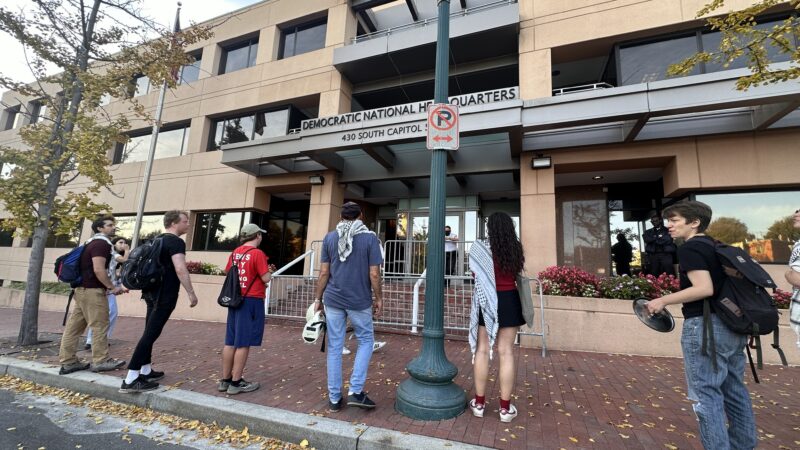
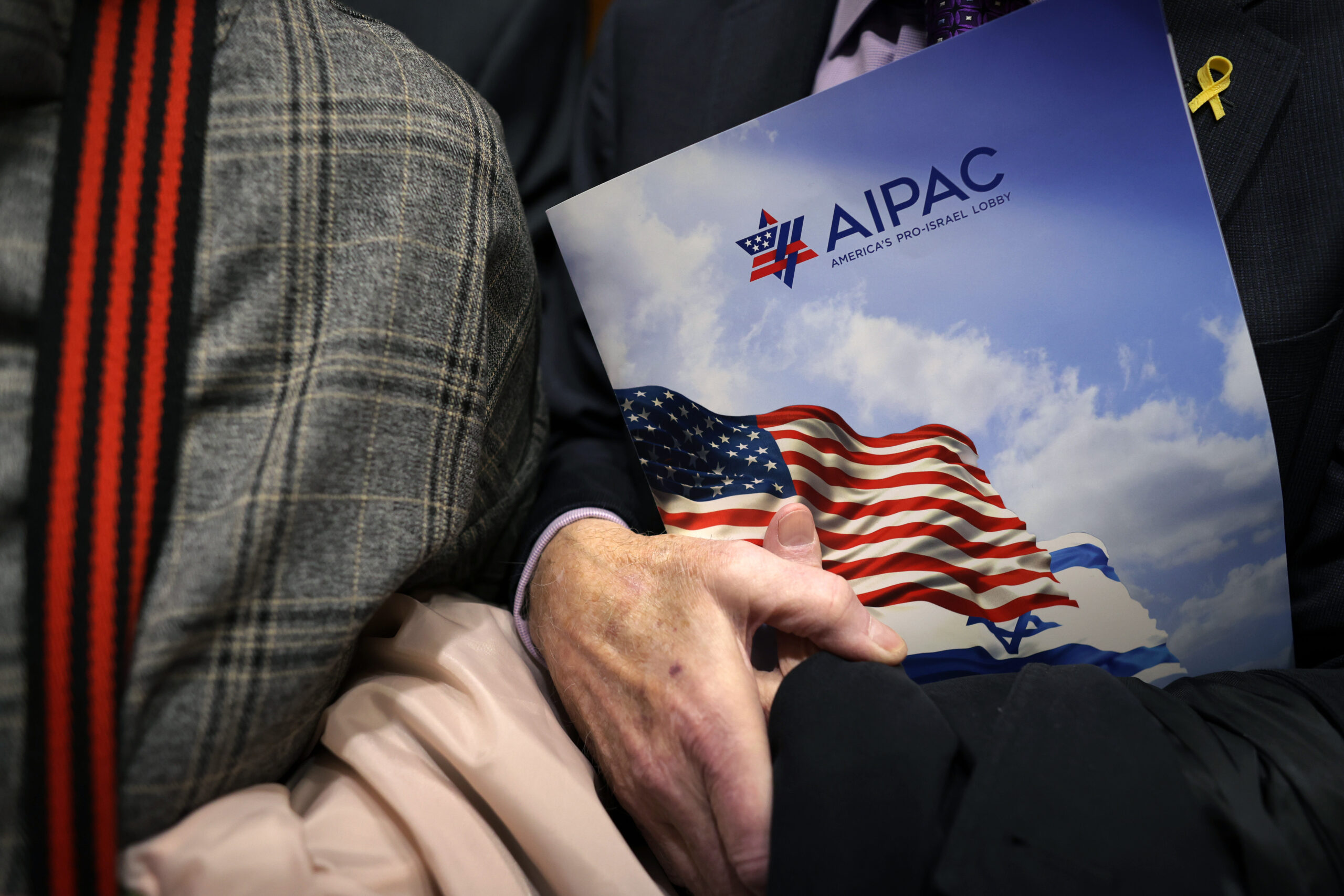
The Democratic National Committee’s resolutions committee is set to consider resolutions condemning AIPAC and Israel at its upcoming meeting next week in New Orleans — a sign of the continued and growing discord in the party over Middle East policy.
It’s unclear at this point how great of a chance the resolutions stand of passing in their current form, but they are emerging as the AIPAC brand has been tarnished inside the Democratic Party.
The resolution targeting AIPAC, described in a resolution packet obtained by Jewish Insider as a “Resolution On Electoral Integrity, Transparency, And Limiting The Influence Of Corporate Money In Democratic Elections,” specifically calls out the pro-Israel group for its spending.
“The use of massive outside spending to support or oppose candidates based on their positions regarding international conflicts or foreign governments raises concerns about undue influence over democratic debate and policymaking, potentially constraining elected officials’ ability to represent the views of their constituents including the American Israel Public Affairs Committee (AIPAC) spending approximately $14 million in a single Illinois Democratic primary,” the resolution reads.
It goes on to accuse “corporate money PACs” of also weighing in against “candidates who have advocated for Palestinian human rights, ceasefire efforts, or changes to U.S. foreign policy.” It states that opposition to such spending should be part of the party’s 2028 platform. Though the rest of the resolution is generally aimed at condemning dark money and independent spending in primaries, AIPAC is the only group singled out by name.
AIPAC and the DNC declined to comment on the resolution.
The resolution was submitted by a DNC delegate from Florida who pushed a resolution last year calling for an arms embargo and a suspension of U.S. aid to Israel, which was ultimately rejected by the same panel. At DNC Chair Ken Martin’s direction, the DNC set up a working group to discuss Israel-related issues.
In addition to the AIPAC resolution, another resolution highlights accusations of genocide against Israel and suggests that Israeli military units are in violation of U.S. arms sales laws, requiring a suspension or conditioning of arms transfers. A third condemns U.S. and Israeli military operations against Iran and its partners, and calls for conditions on U.S. aid to Israel.
Democratic insiders took differing views on whether the resolutions — particularly the one relating to AIPAC — are likely to pass in their current form.
Halie Soifer, the CEO of the Jewish Democratic Council of America, emphasized that any of the 44 members of the resolutions committee can introduce resolutions. She said that the fact of a resolution being introduced doesn’t mean that it will be considered by or adopted by the full DNC. Resolutions are debated and can be amended by the resolutions committee before they are voted on.
“What you’re seeing here doesn’t reflect a position that’s been adopted by the DNC. It reflects one person[’s] — who filed these resolutions — views,” Soifer said. “I don’t expect that these resolutions will be adopted as they’re drafted.”
Soifer argued that, though there’s “broad concern” about dark money across the U.S. political system, targeting AIPAC in particular doesn’t serve the goal of combating the issue as a whole.
“There are many ways to express such concern, I don’t think solely identifying one organization — especially not in this incredibly difficult moment when such a singling out can be viewed as potentially antisemitic — I don’t think that that is effective,” Soifer said.
A DNC official told JI that the resolutions committee is required by DNC bylaws to consider all resolutions as long as they are compliant with DNC rules, that the committee considers dozens of resolutions at each meeting — totaling more than a hundred in the last year — and that the resolutions are not legally binding. If the resolutions committee votes to advance a resolution, it is then voted on by the entire DNC.
Manny Houle, a Democratic pro-Israel strategist in Minnesota, said that he also doesn’t see the AIPAC resolution going forward because it lacks “teeth” — the DNC “can’t tell candidates where they can and cannot raise money … that’s not our purview.” He also emphasized the diversity of DNC delegates, many of whom do not have an intensive focus on AIPAC or the Middle East.
He also lamented that some Democratic activists seem “hyper-focused on something that doesn’t impact [the day-to-day lives of Americans] and [something] they have very little knowledge on, but they have big emotions for,” referring to the situation in the Middle East. But he also predicted the party will ultimately come together around a nuanced position of supporting allies and opposing Iranian aggression while also opposing “needless war.”
But another senior Jewish Democrat, speaking to JI on condition of anonymity, predicted that an anti-AIPAC resolution of some form could move forward, pointing to discontent and frustration among Democratic insiders over AIPAC’s spending to block former Rep. Tom Malinowski’s (D-NJ) special election primary bid earlier this year, as well as its involvement in Democratic primaries in Illinois.
“I think anyone who is surprised by this sort of potential action by the DNC hasn’t been paying close attention to how AIPAC has been seen within the Democratic Party, especially after their relatively recent decision to get actively involved in Democratic primaries,” the Jewish Democrat said. “The Democratic Party is going to respond when outside groups try to manipulate primaries.”
The Jewish leader said that AIPAC has alienated even some Democrats who were previously aligned with or had donated to AIPAC through its recent political maneuvering, potentially putting more fuel on the fire.
At the same time, the leader urged the party to “go out of their way to ensure that they were not singling out AIPAC for any other reason than it was actively involved in Democratic primaries, which of course other outside forces were too. It’s totally legitimate to criticize a pack in a way that you would criticize any other PAC or outside organization trying to influence Democratic primaries.”
Joel Rubin, a Democratic strategist, former senior J Street official and former Jewish liaison for Sen. Bernie Sanders’ (I-VT) presidential campaign, emphasized that he’s worked at odds with AIPAC at many points in his career, but said he is nonetheless concerned about the singling out and targeting of the group.
“Anytime you single out a specific organization where … at least half of the members are Democrats, and you say they’re banned, you’re opening up a litmus test Pandora’s box that is not going to be easily shut. It’s just bad politics,” Rubin said. “There are ways to criticize — as there should be — an organization’s views and even their electoral efforts without putting forward a resolution of policy of the party that is creating a dynamic that will only further alienate Jewish Democratic voters, period.”
Jewish Americans, he emphasized, have been a core constituency to the Democratic Party for decades, as voters, organizers and fundraisers, and the specific targeting of AIPAC “is a great way to kick out perhaps the most loyal voting bloc from the party.” He said that the effort “plays right into the Republicans’ hands.”
And, Rubin noted, the DNC has no ability to control which candidates run in Democratic primaries, from whom they accept contributions or how AIPAC and its supporters spend their money.
He also predicted that some Democratic activists would treat the resolution, and rejection of AIPAC, as an organizing tool and litmus test for Democratic candidates going forward, regardless of whether this particular resolution is approved.
“It’s going to take leadership amongst people to say, ‘This is not how we treat people in our party. This is not what we do. And if we have a problem with AIPAC and the way they use dark money and the way they have Republican donors go through in a sort of stalking horse, we should call that out and point that out every single time,’” Rubin said. “But that does not mean every single dollar that AIPAC uses … is solely Republican.”
Gabbard, who has previously opposed war with Iran, said she has been required in her current role to ‘check’ her personal views ‘at the door’

Yuri Gripas for The Washington Post via Getty Images
Director of National Intelligence Tulsi Gabbard speaks during a Cabinet meeting with President Donald Trump on Wednesday April 30, 2025 at the White House in Washington, DC.
Director of National Intelligence Tulsi Gabbard distanced herself — to a degree — on Thursday from two aides who have taken hostile stances toward the U.S.’ Middle East policy: the recently departed director of the National Counterterrorism Center, Joe Kent, and the recently hired Dan Caldwell.
Kent resigned from the administration this week with a conspiratorial letter condemned by many as antisemitic, claiming that there was no imminent threat from Iran and that Israel and pro-Israel advocates in the U.S. had tricked the administration into joining it.
“He said a lot of things in that letter,” Gabbard said, when first asked at a House Intelligence Committee hearing if she agreed with Kent’s letter. “Ultimately, we have provided the president with the intelligence assessments, and the president is elected by the American people and makes his own decisions based on the information that’s available to him.”
Pressed again on whether Kent’s comments blaming Israel concern her, Gabbard affirmed that they do.
Regarding Caldwell — a prominent GOP isolationist who was reportedly hired to serve in the ODNI, Gabbard’s agency, after being fired amid a leak investigation from the Pentagon last year — Gabbard denied personal knowledge of him and claimed he would have no influence over intelligence products.
“My understanding is one of my elements sought to hire Dan Caldwell months ago for a purely administrative role that would not have any position over the intelligence analysis or assessments on any topic,” Gabbard said.
Pressed on her own personal views on the war in and threat from Iran, Gabbard declined to specify. The intelligence chief was previously outspoken as a member of Congress and then as a political commentator against a conflict with the Islamic Republic, which she had said would be unconstitutional and devastating on a scale not seen this century.
Gabbard said Thursday that her job requires her to set aside her own personal beliefs to prevent politicization of the U.S. intelligence products.
“The cost of war weighs very heavily upon me and my colleagues here, especially for those of us who have experienced and seen the cost firsthand,” Gabbard said. “My own personal and political views, as I mentioned earlier, I was asked and required by Congress and by the president in this role as the director of national intelligence to check those views at the door, to ensure that the intelligence assessments are not colored by my personal views.”
Pressed on the reasoning for the war in Iran, CIA Director John Ratcliffe affirmed that Israel did not force the U.S.’ hand in starting the war, an assessment with which Gabbard agreed.
Ratcliffe emphasized throughout the hearing that, regardless of whether the Iranian government theoretically maintained an edict prohibiting the development of nuclear weapons, it was stockpiling uranium enriched to 60% purity, for which there is no civilian purpose and which no other country has done without subsequently trying to obtain nuclear weapons.
“Much has been made by some about a fatwa against the development of nuclear weapons. Notwithstanding the fatwa, what we know — the intelligence community is in agreement on this — is that Iran possesses at least 440 kilograms of uranium enriched to weapons grade 60%,” Ratcliffe said. “The only use for that would be the development of nuclear weapons.”
“Our intelligence is also clear that they have not lost their ambition and that the activities to rebuild or reconstitute their nuclear facilities and centrifuges [continued],” he added.
Gabbard said that the intelligence community has “high confidence” that it knows where Iran’s enriched uranium stockpile is located.
Prior to last summer’s U.S. strikes on Iran’s nuclear program, Gabbard had said that Iran was not actively building a nuclear weapon, an assessment that President Donald Trump later dismissed as incorrect. She also said that lawmakers had mischaracterized her past remarks and assessment.
During the hearing, Gabbard said that, given the elimination of many in Iran’s top echelons, current U.S. intelligence and understanding of the Iranian leadership and its intentions is less clear than before the war, but described the new supreme leader, Mojataba Khamenei, as more extreme than his father.
“To be clear on Mojtaba, the son who has been named to replace [former Supreme Leader Ayatollah Ali Khamenei], it is unclear of his status or his involvement,” Gabbard said. “He was injured very severely through Israeli strikes, and so the decision-making is unclear about what’s happening in the Iranian leadership.”
Gabbard emphasized that the Israeli government’s own goals for its operations are not necessarily the same as those of the Trump administration — noting that the Israeli military has focused on eliminating Iranian leaders, while the U.S. is focused on Iranian military capabilities.
She said she does not know Israel’s own position on a potential deal with Iran, or have any information on Israel’s decisions to strike Iranian energy infrastructure. “I’m not privy to any of their deliberations or into their calculus and launching this or other attacks. I’m not, we are not involved with the operational element of this,” Gabbard said.
Rep. Josh Gottheimer (D-NJ) said that he supported the action by the U.S. and Israel to eliminate Iranian leaders and missile capabilities, but said that the administration needs to explain its actions and goals more fully to the American public.
Under questioning from Gottheimer, the intelligence officials affirmed that Trump had been briefed on the possibility of disruptions to global energy markets and a potential hard-line shift in Iranian leadership as a result of the war.
Gabbard said that, while the FBI has been having success in disrupting attempted terrorist attacks at home, those efforts have been stymied by the fact that some homegrown extremists may not have direct contact with foreign terrorist organizations.
FBI Director Kash Patel pushed back on accusations from Democrats that he had undermined and crippled U.S. counterterrorism efforts against Iran. Democrats repeatedly highlighted the firing of agents assigned to counter-Iran efforts, reportedly due to their past involvement in investigations of Trump.
Patel initially declined to comment on the firings pending litigation, but later said that any firings would be the result of internal misconduct investigations by career officials, regardless of other circumstances. Despite ongoing efforts to push officials connected with investigations of Trump out of the government, Patel largely downplayed his personal knowledge of the agents in question.
He also insisted that the FBI’s Iran team is strong, noting that it has tracked a 43% increase in Iranian espionage and attempted attacks, and that it has more than 300 ongoing terrorism-related investigations on Iran.
And Rep. Dan Crenshaw (R-TX) took a swipe at conservative commentator Tucker Carlson, who has claimed he’s under investigation by the federal government. Crenshaw, questioning witnesses about federal foreign surveillance authorities, surmised that Carlson’s communications with Iranian officials had likely been captured through existing targeting of those Iranians — not by efforts targeted at Carlson himself.
“When somebody, and let’s say their name rhymes with, I don’t know, ‘Tucker Carlson’ is claiming that the CIA is spying on him — I’m going to guess here, because I don’t know — I’m going to guess that the most likely scenario is that, in the process of him speaking with Iranian intelligence officials, it is incidentally collected,” Crenshaw said. “Nobody is spying on Tucker Carlson, or his inbox — to my knowledge, at least.”
The pro-Israel Democratic group warns that nominating far-left candidates will cost the party winnable seats against GOP incumbents

Daniel Knighton/Getty Images
City of San Diego Councilmember Marni von Wilpert rides in the Port of San Diego Holiday Bowl Parade on December 28, 2022 in San Diego, California.
As Democratic Majority for Israel prepares for the midterms amid growing divisions in the party over Middle East policy, the pro-Israel group is now focusing much of its energy on three under-the-radar House races for swing seats in California and Colorado that could be key to the party’s chances of reclaiming the majority in Congress.
In those primaries, DMFI’s political arm recently endorsed a trio of relatively moderate, pro-Israel Democrats facing opponents whom, the group feels, have demonstrated anti-Israel records or questionable positions on Middle East policy — qualities that could hamper their odds of winning Republican-held districts in the November election.
“These definitely rank high on our list of priorities,” Brian Romick, DMFI’s president and the chair of its super PAC, said in an interview with Jewish Insider on Tuesday. “These are all strong places where this matters.”
DMFI’s political arm is backing Marni von Wilpert, a San Diego councilwoman seeking the nomination in California’s 48th Congressional District; Jasmeet Bains, a California assemblywoman and a physician competing in the state’s 22nd District; and Shannon Bird, a former Colorado legislator running to unseat a vulnerable freshman Republican in the state’s 8th District. The nonpartisan Cook Political Report has ranked each of the races as “toss-ups” in its election forecast.
“We think all three of these candidates are strongly pro-Israel and have great relationships and records with the community,” Romick noted, calling them “the kind of candidates we need who can win both primaries and generals” and “hold these seats over the long term.”
DMFI’s efforts underscore how the organization is choosing to highlight consequential races in which the interests of Democratic Party leaders converge with its own, a notable alignment during a moment when Israel — and outside spending from pro-Israel groups — has emerged as one of the most polarizing sources of internal conflict in reliably blue districts.
One of DMFI’s “major goals” this cycle, Romick explained, is to “both elect pro-Israel candidates and help Democrats take back the House,” citing Republicans’ narrow three-seat majority as partly motivating its calculus. “If we win these three seats, then Democrats are in the majority with pro-Israel candidates.”
“I don’t think that anyone else is in that lane, and I think that’s an important distinction for us,” he told JI.
Romick declined to share if DMFI PAC plans to invest in the three primaries, following election cycles in which the group has spent heavily to help unseat vocally anti-Israel Democrats in deep blue House districts. “Possibly,” he hinted. “But I don’t want to show my hand.”
Here’s a rundown on the state of play in those races:
San Diego showdown
In California’s 48th District, redrawn last year to give Democrats an edge, von Wilpert is running in a crowded open primary to replace Rep. Darrell Issa (R-CA), who has long been a fixture in state and national politics. Her top opponent in the June race, Ammar Campa-Najjar, twice unsuccessfully competed for the seat in 2018 and 2020 — and is familiar to voters as a perennial candidate in a district covering the San Diego area.
Campa-Najjar outraised the field in the last quarter of 2025 and has claimed endorsements from a range of House members — including his girlfriend, Rep. Sara Jacobs (D-CA).
During his race against Issa in 2020, Campa-Najjar, who is of mixed Palestinian and Mexican-American descent, stressed support for Israel as an important strategic partner, broadly aligning with mainstream Democratic sentiment regarding Middle East policy. He said in a candidate questionnaire solicited by JI at the time, for instance, he believed the U.S. should maintain foreign aid to Israel.
In a statement to JI on Tuesday, Campa-Najjar said his “Middle East foreign policy remains consistent,” arguing that the “United States must help broker a lasting peace to end the bloodshed between Israelis and Palestinians.”
“As a new member of Congress, I’ll put forward a meaningful agenda for the day after that promotes a stable, secure, and prosperous future for both Israel and Palestine,” he continued. “That future is only possible with new leadership, with Palestinians no longer under Hamas rule and the Israelis no longer burdened by Netanyahu’s failures,” he added, in a reference to the right-wing Israeli prime minister.
Still, Romick echoed other critics of Campa-Najjar in noting that the candidate had previously changed his positions on key issues as part of a conservative makeover in his last election, raising questions over his commitment to upholding support for Israel as a lawmaker.
“He’s on record as anti-Trump. He’s on record as pro-Trump,” Romick said. “You never know what you’re going to get and that’s obviously dangerous when people shift a lot on Israel.”
Andrew Lachman, the political committee chair of California Jewish Democrats, said his organization reviewed questionnaires from both candidates and concluded that von Wilpert’s record in backing Jewish community causes was more substantive. The group gave von Wilpert a rating of “strong support” and is “neutral” on Campa-Najjar.
“Campa-Najjar seems interested in building a relationship with the Jewish community, but with respect to a record of resolutions and legislation to support the Jewish community, von Wilpert had a voting record and a record of supporting the Jewish community that was much more clearly defined,” he told JI.
For her part, von Wilpert said in a statement to JI that she “strongly” supports “Israel’s right to exist as a secure, Jewish democratic state and defend itself from the real threats it faces.”
“To me, ensuring Israel’s security and building peace for all in the region, including getting the two-state solution back on track, are inseparable, and U.S. leadership is indispensable to achieving both outcomes,” she added. “Only when a nation feels safe and secure, can it take the necessary steps to make peace.”
Both von Wilpert and Campa-Najjar are endorsed by J Street, the progressive Israel advocacy group.
Last week, Jim Desmond, a Republican member of the San Diego County Board of Supervisors, also filed to run for the seat that is now being vacated by Issa.
Under the newly drawn district lines, former Vice President Kamala Harris would have narrowly defeated President Donald Trump by three points.
Bakersfield battle
In a GOP-held district hours north of San Diego that includes part of Bakersfield, Bains is facing off against a progressive rival, school board trustee Randy Villegas, to challenge Rep. David Valadao (R-CA), who took office in 2021 but is now confronting a difficult national environment for Republicans. .
Villegas has gained endorsements from some of the most prominent Israel critics in Congress, including Sen. Bernie Sanders (I-VT) as well as Reps. Pramila Jayapal (D-WA) and Ro Khanna (D-CA), along with the virulently anti-Israel AIPAC Tracker, which said in a social media post that Villegas had signed on to a January 2024 letter pressing for “an immediate ceasefire in Gaza and to end the weaponization of antisemitism claims against Israel’s critics.”
“In Congress, Randy will fight to end the flow of unconditional military aid to Israel that fuels the ongoing genocide in Gaza and ethnic cleansing in the West Bank,” AIPAC Tracker said in its January endorsement. “He is ready to champion a foreign policy that centers human rights over militarism.”
Villegas’ campaign did not respond to a request for comment about his foreign policy views concerning Israel.
Speaking with JI, Romick characterized Villegas as “the most obvious” source of concern for pro-Israel Democrats among the three primaries that DMFI is now eyeing, referring in part to his early demand for a ceasefire just a few months after the Oct. 7 Hamas attacks. “He consistently has an anti-Israel record,” Romick said.
Lachman, meanwhile, said his group had not yet weighed in on the primary. “I do know that Bains has a reputation as a fighter for progressive values, but one who can build coalitions in order to sustain them,” he told JI. “Whereas, I don’t think Villegas is known for that.”
In a statement shared with JI on Tuesday, Bains said she believes “in Israel’s right to exist, defend itself and live in peace as a secure nation.”
“As a doctor,” she pledged, “my priority will always be protecting all human life and for that we must ensure advancing lasting peace. That’s why I believe a two-state solution is a necessary path forward to ensure long-term security and the dignity of people across the region.”
Valadao, for his part, is backed by AIPAC, which calls the congressman “a steadfast supporter of the U.S.-Israel alliance throughout his six terms representing the Golden State’s Central Valley.”
Colorado clash
Meanwhile, in a Colorado House race to take on Rep. Gabe Evans (R-CO), two Democrats are vying for their party’s nomination with differing records of public commentary on Israel as well as the rise of antisemitism.
Bird, who resigned from the Colorado legislature in January to focus on her congressional bid, has long been vocal in her support for Israel and opposition to antisemitism, which she recently called a “global cancer” after the terror attack targeting the Jewish community in Bondi Beach, Australia late last year.
During the war in Gaza, she frequently highlighted the plight of hostages on social media while issuing statements standing with Israel. “Lessons learned from history make clear that the world must stand with and protect Israel,” she wrote in one X post in 2024. Bird’s campaign did not return a request for comment from JI.
By contrast, her chief rival in the June primary, Manny Rutinel, a progressive state representative, has condemned recent instances of antisemitism — but does not appear to have clarified his stances on key issues regarding Israel.
While he has garnered endorsements from some pro-Israel House members such as Reps. Adriano Espaillat (D-NY) and Rob Menendez (D-NJ), his past record of activism has raised some concerns among pro-Israel Democrats who privately worry he will assume a hostile approach to Israel if he is elected. Republicans have indicated that they are eager to run against him in the general election.
As an undergraduate at the University of Florida, for example, Rutinel attended a demonstration in 2014 that was co-organized by Students for Justice in Palestine, the extreme anti-Israel group that has recently expressed alignment with Hamas, according to a local news story covering the event at the time.
The campus demonstration was “aimed to raise awareness for police brutality in Ferguson, Mo., and military oppression in Palestine,” the article noted.
In a statement to JI, however, a spokesperson for Rutinel said he “has never affiliated with Students for Justice in Palestine.”
“While in college at the time of the Ferguson protests, he attended a demonstration to protest police brutality in the United States,” the campaign spokesperson explained. “Manny supports Israel’s right to exist and supports a two-state solution with secure borders to bring peace.”
Rutinel also “supports U.S. security assistance to Israel in line with the Obama administration’s 2016 memorandum of understanding,” the spokesperson added, when asked about his views on conditioning aid to Israel, which has become a litmus test of sorts for left-wing candidates.
Evans, an Army veteran endorsed by AIPAC, has cited his service in the Middle East as motivating his staunch support for Israel and opposition to a nuclear Iran. The first-term congressman is viewed as one of the most vulnerable House Republicans seeking reelection in a district north of Denver.
The military engagement could energize the party’s activist base in a number of primaries, with races in North Carolina and Illinois serving as early tests
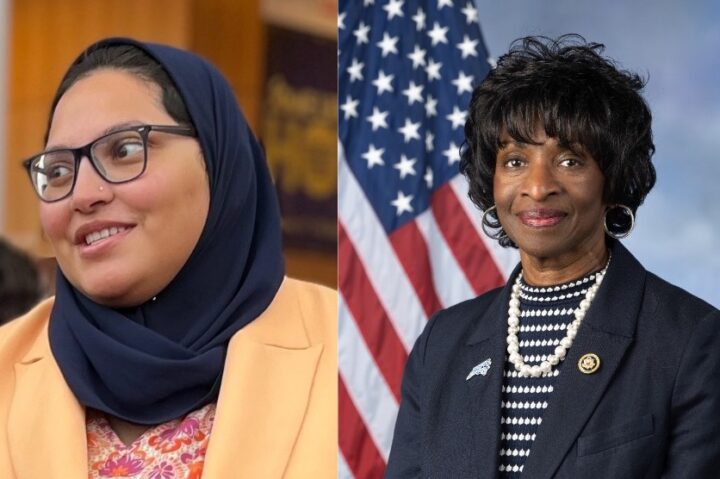
Wikimedia Commons
Nida Allam and Rep. Valerie Foushee (D-NC)
The joint U.S.-Israeli military operation targeting Iran is already changing the dynamics of Democratic congressional primaries in which Middle East policy and the role of pro-Israel spending have featured prominently — as some progressive candidates seek to capitalize on the conflict to bolster their anti-Israel messaging.
In hotly contested House races in North Carolina and Illinois, for instance, the widening war is now emerging as a closing topic of conversation, providing some early signs of how it could reshape the leading issues in the run-up to this year’s midterm elections.
Nida Allam, a far-left Democrat and antagonist of Israel, who is challenging Rep. Valerie Foushee (D-NC), released a closing message focused on her opposition to the Iran war, linking her rival to defense contractors and pro-Israel backers.
In a direct-to-camera message, Allam denounced the strikes for “killing over 100 elementary school children,” a claim yet to be confirmed by the United States or Israel, and accused Foushee’s campaign of accepting contributions from defense contractors and a super PAC linked to the artificial intelligence firm Anthropic, whose technology was reportedly used to aid the attacks.
“I have opposed these ‘forever wars’ my entire career,” Allam said in the ad. “If you believe we need to do things differently, and you, like me, are praying for peace and demanding accountability, please consider voting for me.”
Foushee, who was elected to Congress in 2022 with support from the pro-Israel advocacy group AIPAC — backing she has since walked away from — disputed Allam’s criticism, and echoed other congressional colleagues in casting the strikes as an “illegal” overreach by President Donald Trump.
“I do not support Trump’s illegal war with Iran and will do everything I can in Congress to support War Powers Resolutions to stop it,” she said in an X post Saturday. “The American people are tired of endless wars and we cannot put our servicemembers at risk — period.”
But political observers said the Iran war could give a final jolt of momentum to Allam, who is seeking the nomination in a left-leaning district where her rhetoric might appeal to activist-minded voters who are increasingly wary of new foreign entanglements in the Middle East and beyond.
“Given the leftward lean of the 4th Congressional District and Allam’s positioning to the left of Foushee — particularly on Middle East policy — it could very well make a difference,” Chris Cooper, a political scientist at Western Carolina University, told Jewish Insider on Monday. “Thousands of votes have already been cast, but for late deciders, this is exactly the kind of issue that could help tilt a voter to one side or the other. It’s hard to get more salient than war.”
Meanwhile, in a crowded open-seat primary for a progressive House seat in the Chicago suburbs, one candidate, Kat Abughazaleh, is likewise indicating that she intends to highlight her opposition to the ongoing Iran strikes as the March 17 race enters its final stretch, saying she “will be talking about it very vocally and often because this is very much a topic on people’s minds.”
One of Abughazaleh’s top primary opponents in Illinois’ 9th Congressional District, Laura Fine, a pro-Israel Democrat who voiced support for Israel’s June 2025 bombing of Iran, also came out strongly against the new strikes, but framed her criticism as a response to Trump’s executive overreach and called for his impeachment.
“Donald Trump is leading us into another military conflict to distract from his own failures that puts American lives at risk and threatens to send the Middle East into further chaos,” Fine, a moderate state senator supported by pro-Israel voters, wrote on social media over the weekend. “He simply cannot be trusted and must be impeached. Congress needs to do its job and rein in Trump’s corruption and abuses of power.”
Frank Calabrese, a political strategist in Chicago, questioned the sincerity of Fine’s new rhetoric on Iran. “The reason why she’s doing that is because that’s what the polls are saying,” he told JI Monday.
The conflict “raises Middle East issues much more so than previously” in the race, he said, speculating that it would likely benefit Abughazaleh’s campaign “because she’s staked out a position that makes her different” than Daniel Biss, the mayor of Evanston and another leading primary rival who is sharply critical of Israel.
The Iran war “generally benefits progressives or liberals,” Calabrese said, “because people on the left end of the spectrum don’t like Donald Trump acting aggressively.”
For pro-Israel Democrats who have long criticized Iran, the war poses some unique complications, as the party tries to take advantage of widespread discomfort with Trump’s unilateral decision to pursue the strike without first having sought authorization from Congress. Other top pro-Israel candidates in congressional races in New York and Michigan, where Middle East policy has been a prominent source of debate, have made sure to distance themselves from the conflict, even if they are likely relieved the ayatollah is no longer in power.
For example, Rep. Dan Goldman (D-NY), facing a primary challenge from a progressive Israel critic, former New York City Comptroller Brad Lander, wrote in a statement that Trump “is defying our Constitution to spend billions of dollars overseas while working families struggle to make ends meet at home.”
While he called Iran “a treacherous regime that represents a direct threat to the democratic world order and our own national security,” he said that “recent history has taught us that toppling Middle East dictators in the name of regime change is the beginning — not the end — of a process that too often results in expensive and deadly forever wars.”
Lander, for his part, was more forceful in his own comments, calling the strikes “an illegal war being waged by a sociopathic president whose goal is to distract people from his failing administration.”
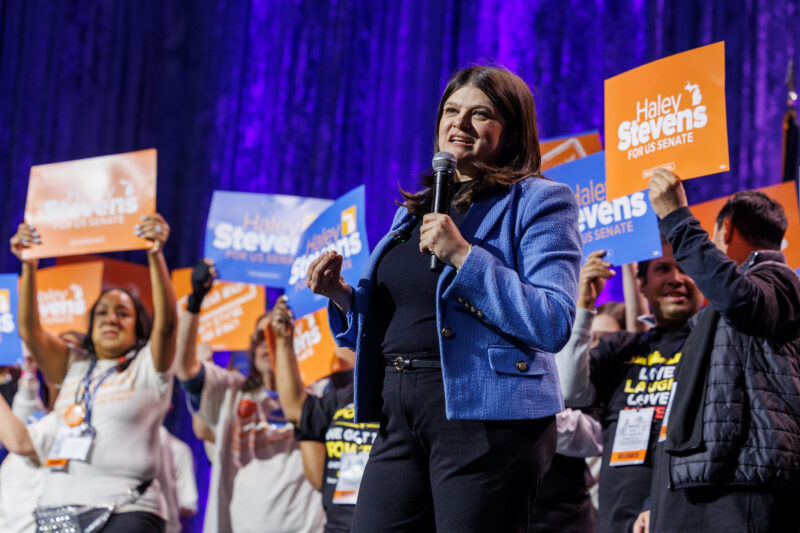
Rep. Haley Stevens (D-MI), the pro-Israel moderate in Michigan’s Democratic Senate primary, said that Trump had “once again put Americans in harm’s way without consulting Congress — the latest in a series of grave violations of our Constitution by this administration.”
She acknowledged, however, that “Iran’s state sponsorship of terror across the globe has led to chaos and unchecked violence.”
“We cannot ignore that an armed and nuclear Iran would bring even more violence and chaos to the Middle East and the entire world,” Stevens said in her statement. “We also cannot ignore the imperative to achieve freedom for the people of Iran, who have bravely spoken out through protest in recent weeks.”
Political strategists who spoke with JI said that the war, which early polling has shown is unpopular with voters, could help to broadly elevate progressives in key races — if the conflict remains a salient topic of conversation in the coming weeks and months.
Adrian Hemond, a political consultant in Michigan, said much depends on whether the war ends quickly or grows into a “protracted military effort” involving more American casualties. As of Monday afternoon, the U.S. had lost six servicemembers.
“That’s a horse of a different color,” he told JI. “If we’re still talking about this months from now, then it will have a huge impact on the primary and will probably benefit” Abdul El-Sayed, a far-left Senate candidate in Michigan campaigning on a stridently anti-Israel platform.
In a statement on the strikes, El-Sayed called Trump “a failed president” who is now “committing us to spending billions of our taxpayer dollars in yet another war with no aim.”
Chris Coffey, a Democratic strategist in New York City, cautioned it was too early to predict how the war could shape the primaries or general election.
Still, he suggested that the conflict, which has also faced blowback from influential right-wing figures, “could have negative consequences” for Republicans in the midterms, particularly if it “drags on” and more American servicemembers are killed or oil prices continue to spike before November.
“It’s too soon to tell,” Coffey told JI on Monday. “If you open up a Pandora’s box, you don’t know what’s going to come out of it.”
Barrack, the U.S. ambassador to Turkey, plays an outsized role in setting foreign policy in the region, lawmakers and experts say
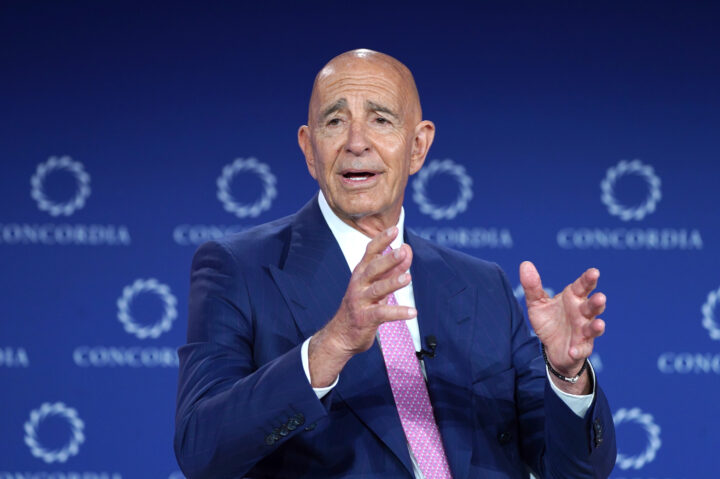
Leigh Vogel/Getty Images for Concordia Annual Summit
U.S. Ambassador to Turkey Tom Barrack speaks during the 2025 Concordia Annual Summit on September 24, 2025 in New York City.
Simmering frustrations among lawmakers with U.S. Ambassador to Turkey Tom Barrack — who also serves as special envoy to Syria and manages a wide remit in America’s Middle East policy — have recently emerged with force, as multiple lawmakers tell Jewish Insider they have concerns about the U.S. envoy’s expansive role.
Barrack’s critics see the envoy pushing U.S. policy in concerning directions, toward an overly close relationship with Turkey despite the country’s overt anti-Israel posture and regional ambitions and, most recently, as a key enabler of the Turkish-backed Syrian government’s offensive against U.S.’ longtime Kurdish allies in the Syrian Democratic Forces.
Over the course of months, the envoy has also made comments that have concerned lawmakers, including questioning Israel’s status as a democracy, downplaying the threat from Hezbollah and supporting a Turkish role in the International Stabilization Force in Gaza, despite Turkey’s long record of hostility to Israel.
A Republican senator, granted anonymity to speak candidly, told JI last week that Barrack’s role in U.S. policy in the region makes them “nervous.”
“He’s running a Turkish line, and there are very legit[imate] concerns” about his role and influence, the senator said.
A senior Senate Democrat involved in foreign policy issues also said he had concerns about Barrack, suggesting the envoy was pursuing personal business interests through his post.
“Barrack is clearly knowledgeable about the region, he’s clearly energetic and engaged. But that’s the only good I can say. I have real concerns about his motives and the consequences of his actions,” the Democratic senator said.
“That’s something I really worry about. When the president himself is among the most corrupt in American history, we can’t be surprised when the people he puts in positions of power conduct themselves in the same way, but it’s really dangerous,” the lawmaker added. “We’re losing our reputation as a good partner, a reliable ally and a country committed to supporting anti-corruption efforts.”
Asked about Barrack’s role in the administration, Sen. Richard Blumenthal (D-CT) told JI, “I’m hopeful that the interests of the Kurds will be protected. America needs to stand up to the Turks where necessary and insist that those rights be adequately represented.”
Lawmakers’ concerns have become public at a series of hearings on the Hill in recent weeks.
At a House Foreign Affairs Committee hearing on Syria last week, Rep. Josh Brecheen (R-OK), a leading skeptic among House Republicans of repealing U.S. sanctions on Syria, said he feels that Barrack’s dual role as ambassador to Turkey and Syria special envoy is hampering the U.S.’ ability to take a tougher stance with Syria.
“[Barrack] has to maintain a good relationship with Turkey. Would we not be well-served for someone to be specific to Syria, whether it be an envoy specific to Syria or an ambassador — how would that not help us to make sure that Tom Barrack can maintain a good relationship with Turkey but we’d have somebody to play hardball with Syria?” Brecheen said.
Brecheen said he’s worried that Turkish President Recep Tayyip Erdoğan seeks to reestablish the Ottoman Empire and that Syrian President Ahmed al-Sharaa is deceiving the U.S. and still maintains a jihadist ideology. He said current U.S. policy appears to be facilitating Turkish and Russian interests.
Nadine Maenza, the former chair of the U.S. Commission on International Religious Freedom, who testified before the committee, responded that she shares Brecheen’s concerns.
“It’s been very difficult to have him have both hats on, and I think we’ve seen that with the State Department not having a role to play in Syria policy and waiting for Barrack to make decisions,” Maenza said. “I don’t think that serves the president well, if his goal is peace and stability in the Middle East.”
At another House Foreign Affairs Committee hearing earlier this month, Rep. Brad Sherman (D-CA) highlighted Barrack’s past comments on Hezbollah, which he said “have often sent the wrong signals.” David Schenker, a senior fellow at The Washington Institute for Near East Policy who served in the first Trump administration, also repudiated Barrack’s comments.
Barrack has faced criticism off the Hill in conservative circles as well: a Wall Street Journal editorial last month blasted his “not-so-excellent Syrian adventure,” characterizing the ambassador as overly close with Turkey and pushing an anti-SDF policy in the administration.
Responding to the editorial, former Sen. Rick Santorum (R-PA) blasted Barrack for having “betrayed [the Kurds], Christians in Syria and our country for Turkey.” “His behavior is a disgrace. He should be recalled,” Santorum added.
Former National Security Advisor John Bolton — who has since come under fire by President Donald Trump — said last year that Barrack has been “publicly making excuses for al-Sharaa’s reluctance to open full diplomatic relations with Israel. It is not generally a U.S. ambassador’s job to justify another country’s actions. He should be warned about the symptoms he is displaying.”
Conservative commentator Mark Levin similarly criticized Barrack last summer for rebuking Israel’s attacks on Syrian government-aligned forces carrying out massacres of Druze and other minority groups.
His concerns were echoed by right-wing influencer Laura Loomer, who said that Barrack’s “delusions that he can play nice with [al-Sharaa], who is literally ISIS, is going to continue to destabilize the Middle East and get more innocent non-Muslims killed,” describing Barrack’s approach to Syria as completely wrong-headed.
“I have heard from different sources that [the Turks] perceive Tom Barrack to be their man, and this is the first time in a long time they feel that they have a U.S. envoy that’s essentially on their side, if you want to use that terminology, and is basically positioning Ankara to really realize a lot of their policy goals, their geostrategic goals,” Sinan Ciddi, the director of the Turkey program at the Foundation for Defense of Democracies, told JI.
Barrack, while being “a problematic actor,” is also “deeply influential,” Ciddi said, characterizing him as one of the two most influential figures in the U.S.’ regional policy alongside White House Special Envoy Steve Witkoff. Like Witkoff, Barrack is a longtime friend and business associate of Trump.
“He is making moves, he’s implementing policies as special envoy and as ambassador that I think present deep risks and and could have potentially detrimental consequences, because it’s going to alienate the United States at the least, but at worst, they could really inflame a considerable number of situations that we’re active looking at,” Ciddi said.
He raised concerns about three particular policies that Barrack has appeared to promote: providing Turkey with advanced F-35 fighter jets despite U.S. sanctions, bringing Turkey into the International Stabilization Force in Gaza and pushing for an influential role for Turkey in Syria and a favorable stance toward the new Syrian government.
He said that Barrack and the Trump administration more broadly appear to view Turkey as a partner that they can cooperate with on goals including stabilizing Syria and Gaza.
Israeli officials, however, view the situation in a very different light, and “feel that through Barrack’s adventurism, what we are seeing are dangerous moves to position Turkey in the Levant and the Middle East as an aggressive actor,” Ciddi said. “They feel that Turkey is, through Barrack, finding a means and opportunity to weaken Israel.”
Ciddi warned that Turkey having any role in the stabilization force in Gaza would be “fundamentally very, very dangerous” given Turkey’s friendliness with Hamas and hostility toward Israel. And he said that providing Turkey with the advanced F-35 jets would be “deeply problematic” given its close relationship with Russia, along with various other issues, a dynamic that has troubled lawmakers and European allies.
Ciddi also said that Barrack’s public comments, or lack thereof, about Turkey’s closeness with Hamas and Iran, about Hezbollah and about Israel’s status as a democracy should be concerning for “all the countries that have signed up to the Abraham Accords, or any country in the region that’s taking a position against jihadist movements and Salafist movements.”
Michael Makovsky, the CEO of the Jewish Institute for National Security of America, told JI that, “half the things the guy says I can’t understand, and the other half I don’t agree with.” Makovsky said he’s been particularly troubled by Barrack’s influence on Syria policy, seemingly pushing the U.S. toward support for al-Sharaa.
“I think that’s been a big mistake,” Makovsky said, criticizing the “betrayal of the Syrian Kurds, which I found rather obscene” and emphasizing that the Kurds had been a critical ally of the U.S. in the fight against ISIS. He noted that al-Sharaa remains aligned with jihadists who have carried out massacres of Syrian minority groups.
“We’re all in on [al-]Sharaa, and I think that’s partly because Trump met him and likes him, but even before that, it’s because this is what Barrack wants,” Makovsky continued. “He seems to often reflect exactly the Turkish view, and I don’t think the Turkish view on Syria aligns with our own interests at all.”
He said that he was also troubled by Barrack’s claim that Israel is not a democracy, saying that it was a poor message from a U.S. official and suggested that he does not properly understand the region.
Congressional correspondent Emily Jacobs contributed reporting.
On Tuesday, the UN elected Abbas Tajik of the Islamic Republic of Iran as vice chair of its Commission for Social Development
ANGELA WEISS/AFP via Getty Images
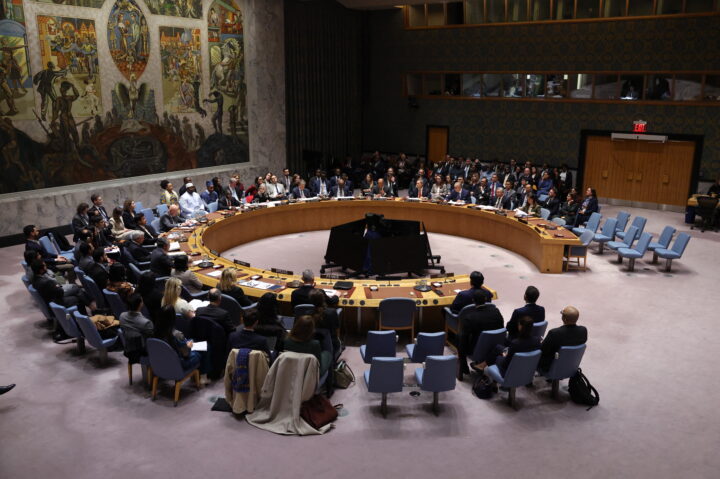
Ambassadors and representatives to the United Nations meet at the U.N. Security Council to vote on a U.S. resolution on the Gaza peace plan at the U.N. Headquarters in New York City, Nov. 17, 2025.
The United Nations this week elevated an Iranian official to a senior leadership role and publicly congratulated Tehran on the anniversary of the Islamic Revolution — moves that former Trump administration officials and Middle East policy analysts say reflect a troublingly conciliatory posture by the international body toward a regime accused of violently repressing its own people.
On Tuesday, the UN elected Abbas Tajik of the Islamic Republic of Iran as vice chair of its Commission for Social Development, a body tasked with advancing policies on poverty eradication, employment and social inclusion. The commission recently adopted resolutions focused on social justice, gender equality and combating gender-based violence — issues critics note remain acute inside Iran, where legal, social and cultural restrictions continue to limit women’s rights and political freedoms.
The following day, UN Secretary-General António Guterres congratulated Iran on the anniversary of the 1979 Islamic Revolution — the founding moment of the regime now facing widespread domestic unrest — weeks after authorities violently suppressed nationwide protests, imposed internet blackouts and oversaw a crackdown that, according to human rights groups, has resulted in thousands of deaths.
Guterres’ message was condemned by Israel’s Foreign Ministry, which posted on X that the gesture represented a “moral failure.”
“History will not remember your speeches. It will remember the regimes you chose to honor,” the statement read. “Sending congratulations to the Islamic Revolution regime — a state built on repression and terror — is not neutrality.”
Critics argue that the juxtaposition of congratulatory gestures and leadership appointments raises broader questions about institutional coherence and moral clarity — particularly as Iran continues to face internal unrest and international scrutiny.
Jason Greenblatt, a former White House Middle East envoy under President Donald Trump, told Jewish Insider that Iran’s latest promotion “tells you all you need to know about what the UN stands for.”
“It’s a bloated, broken, perhaps irredeemable system, and a colossal waste of money,” said Greenblatt.
Elliott Abrams, the former U.S. special representative for Iran during the first Trump administration, agreed, calling the UN a “morally bankrupt institution.”
“The secretary general congratulating the Iranian regime just days after it murdered thousands of its citizens is another example,” said Abrams.
However, Abrams also described the situation as more nuanced, noting that other parts of the UN have taken a firmer stance.
He pointed to a Jan. 26 resolution adopted by the UN Human Rights Council condemning the Iranian regime’s crackdown. During that session, Sara Hossain, chair of the U.N.’s fact-finding mission on Iran, described unfolding events in Tehran as “the deadliest crackdown against the Iranian people since the 1979 revolution.”
“The violent repression of the Iranian people doesn’t solve the country’s problems,” UN High Commissioner for Human Rights Volker Türk said at the time. “On the contrary, it creates conditions for further human rights violations, instability, and bloodshed.”
Still, several foreign policy analysts argued that the UN’s repeated elevation of Iran is misguided and at odds with the intended goals of the organization. David May, a senior research analyst at the Foundation for Defense of Democracies, suggested the UN’s actions are a pattern of hypocrisy, noting that the organization has previously elected Tehran to committees despite its poor track record on human rights.
In 2023, Tehran was elected to the UN Committee on Disarmament and International Security. However it was during the same time that Iran was significantly accelerating its nuclear weapons program.
Tehran was also elected by the UN Economic and Social Council (ECOSOC) in 2021 to the Commission on the Status of Women (CSW), a group responsible for empowering women and promoting gender equality. Former Vice President Kamala Harris supported a U.S-led effort in 2022 to oust Iran from the committee, calling out its “denial of women’s rights and brutal crackdown on its own people.”
Experts said the UN’s latest elevation of Tehran was not unexpected. Still, they argued that the continuation of this pattern is deeply troubling and reflects a broader institutional posture toward the Iranian regime.
“All of this would be laughably absurd if it wasn’t so actively counterproductive, both in terms of isolating Iran’s regime and, more fundamentally, what the UN supposedly stands for in founding documents like the UN Charter and Universal Declaration of Human Rights,” said Jonathan Ruhe, a fellow at the Jewish Institute for National Security of America.
Ruhe argued that the UN treats Iran as a “normal” member in “good standing,” creating what he described as a “dangerous equivalence between Tehran and Washington.”
“Promoting Iran to vice chair, and inviting its foreign minister to address the UN Human Rights Council, bestows a veneer of legitimacy on a regime that just brutally violated its citizens’ right to peaceful protest — a core right recognized in the Universal Declaration of Human Rights,” Ruhe said. “The UN is extending olive branches that rehabilitate Tehran at the exact moment it should be a pariah on par with North Korea.”
David May, a senior research analyst at the Foundation for Defense of Democracies, similarly argued that the UN has become a venue for Iran and other authoritarian governments to “launder their human rights records.”
“People are noticing the absurdity of the UN secretary-general congratulating the Islamic Republic on the anniversary of seizing power because it comes one month after the Tehran regime killed as many as tens of thousands of protesters,” May said.
He added that “when the spotlight is not on Tehran’s tyranny, the United Nations treats Iran like any other country.”
“If the United Nations wants to escape its reputation as a den of dictators, it should disinvite Iran’s foreign minister from addressing the opening of the Human Rights Council on February 23,” May said. “Otherwise, this will provide another opportunity for a human rights abuser to mask its violations by launching attacks against the United States and its allies.”
The Caesar sanctions repeal comes in spite of hesitation from some lawmakers on Capitol Hill, who argued that the sanctions should remain on the books

Kevin Carter/Getty Images
U.S. Capitol Building on January 18, 2025 in Washington, DC.
The final version of the 2026 National Defense Authorization Act negotiated by Senate and House leaders includes a full and unconditional repeal of U.S. sanctions on Syria under the Caesar Civilian Protection Act, as well as a repeal of the war authorizations that allowed for the Iraq war and the first Gulf War.
The Caesar sanctions repeal comes in spite of hesitation from some lawmakers on Capitol Hill, who argued that the sanctions should remain on the books, with relief contingent on the Syrian government meeting various benchmarks. Supporters of full sanctions relief have argued that it’s necessary in order to put Syria on a more predictable and stable financial footing and provide confidence to foreign investors to support reconstruction projects.
Rep. Brian Mast (R-FL), the chairman of the House Foreign Affairs Committee, who had been skeptical of the prospect of unconditional repeal, ultimately decided to provide his approval to include it in the bill.
The legislation requires the administration to report to Congress twice per year to certify whether the Syrian government is complying with a range of U.S. priorities, including cooperating with counter-ISIS efforts, removing foreign fighters from the Syrian government, protecting minority rights, non-aggression toward Israel, integrating the Kurdish-led Syrian Democratic forces, complying with U.S. sanctions, prosecuting human rights abusers and combating narcotics production.
It includes a nonbinding provision that “the president may consider whether to impose targeted sanctions on individuals under existing authorities” if these conditions are not met for two reporting periods, but includes no binding snapback provisions mandating the reimposition of sanctions.
The repeal of the Iraq war authorization has been a longtime priority for lawmakers on both sides of the aisle, but others have argued that a more deliberative approach is needed to ensure that the U.S. maintains its ability to target Iranian proxies or terrorist groups in Iraq.
Largely outside of Middle East policy, the legislation contains a number of provisions seemingly aimed at countering isolationist pushes from within the administration, including provisions to ensure that U.S. aid to Ukraine continues and that the U.S. does not significantly draw down its troop presence in Europe or South Korea.
It also includes a provision seemingly aimed at responding to senators’ public concerns about a lack of transparency and communication by Under Secretary of Defense for Policy Elbridge Colby, mandating that he personally brief Congress twice next year about the national defense strategy.
Overall, the bill proposes a defense budget $8 billion above the Trump administration’s 2026 request — though any actual funding allocations will have to be approved separately through the still-pending appropriations process.
Within the Middle East domain, the NDAA authorizes annual funding for joint missile-defense programs with Israel, including Iron Dome, David’s Sling and Arrow, guaranteed under the memorandum of understanding with Israel that lasts through 2028.
The explanatory report accompanying the bill requires the administration to brief Congress on Israel’s current Arrow stockpiles — systems that saw heavy use during Iran’s ballistic missile attacks on Israel earlier this year — including potential obstacles to increasing Arrow production capacity and inventory and the possibility of creating “fully redundant Arrow production capacity in the United States.”
Addressing existing regional air- and missile-defense cooperation programs, the report directs the administration to brief Congress on progress toward an integrated air and missile architecture, as well as lessons learned during the past two years of war in the Middle East and the impacts of existing cooperation efforts during that time.
It also requires the Pentagon to brief Congress on any delays in providing aircraft or air-launched munitions to Israel and the “feasibility and advisability” of providing Israel with American systems to fill those gaps in the interim.
The NDAA proposes increasing funding for joint U.S.-Israel anti-tunnelling programs to $80 million, a $30 million increase. The report requires the administration to study potential steps to secure the border between Egypt and Gaza to cut down on smuggling into the enclave via tunnels, drones and the Mediterranean Sea.
The legislation also expands existing U.S.-Israel cooperative programs countering airborne drone threats to include other unmanned systems, including sea- and land-based drones, and proposes funding of $70 million, a $15 million increase.
It extends both the counter-tunnel and counter-drone programs through 2028.
The bill also proposes providing $35 million for a new program to pursue military applications of emerging technologies such as AI, quantum computing and cybersecurity in cooperation with allies like Israel.
The legislation also directs the administration to create a U.S.-Israel Defense Industrial Base Working Group to expand defense production cooperation with Israel, and study the possibility of integrating Israel into the National Technology and Industrial Base, alongside other key U.S. allies.
The explanatory report directs the Defense Department to consider creating a “regional outreach center” of the Defense Innovation Unit in Israel; the House draft of the NDAA had included a requirement that the Pentagon establish such an office.The DIU is a relatively new Pentagon unit with offices around the U.S. that works to allow the military to more quickly adopt emerging commercial technologies.
In an effort to address international boycotts and other punitive measures against Israel, the NDAA requires the administration to continually assess the impact of arms embargoes, sanctions and other restrictions imposed on Israel and the ways the U.S. might be able to mitigate those impacts.
The explanatory report instructs the Pentagon to avoid participating in international arms exhibitions that exclude Israeli companies.
But the final NDAA does not include a provision from the House draft of the bill instructing the administration to engage with top allies to ensure they do not enforce International Criminal Court arrest warrants against the U.S. or Israel.
The report states that the U.S. should engage in “regular military exercises of increasing complexity” with Israel, to include “other regional partners as well when feasible,” and requires the administration to report to Congress on such exercises.
In an effort to address growing cooperation among Iran, China, Russia and North Korea, the legislation instructs the administration to establish a whole-of-government effort to respond to such alliances, including establishing working groups in several Cabinet agencies, charged with providing recommendations to the administration and Congress.
The NDAA expands existing required reports on Iran’s nuclear capabilities, mandating the administration provide additional information to Congress about Iran’s support to its terrorist proxies, its nuclear advancements and its production of new weapons systems like single-use drones.
It further requires prompt notification to Congress if the intelligence community finds that Iran has made the decision to produce a nuclear weapon from its stockpiles of highly enriched uranium.
The bill also includes a new authority permitting the U.S. to quickly send weapons seized in transit from Iran to the Houthis to U.S. allies, potentially including Israel and Ukraine.
The NDAA instructs the administration to create a strategy for expanding U.S. security partnerships with Jordan and Lebanon, including working to ensure the disarmament of Hezbollah. It requires the Defense Department to set out benchmarks for cutting off support to the Lebanese Armed Forces if they fail to make progress in or are unwilling to disarm Hezbollah.
The legislation also includes a provision to withhold 25% of U.S. security assistance to Iraq until the administration certifies that the Iraqi government is taking steps to weaken Iran-aligned militia groups in Iraq and remove members of Iran-aligned groups operating as part of the Iraqi security forces, though the secretary of defense can waive those conditions.
And it requires the administration to declassify all documents related to the Iranian proxy attack on the U.S.’ Tower 22 Facility in Jordan in January 2024, which killed three U.S. service members.
Matching an executive order from the Trump administration, the legislation codifies a new designation and sanctions regime for countries engaging in wrongful detention of U.S. citizens, with a requirement that the State Department report to Congress on whether Iran should be so designated.
In addition to the Caesar Act repeal, other Syria-related provisions in the bill require the administration to report to Congress on the possibility and security concerns involved in reopening the U.S. embassy in Damascus, the U.S.’ force posture in Syria and any planned changes to U.S. forces in the country.
It does not include a more stringent provision from the Senate version of the bill requiring the Pentagon to certify that drawing down U.S. forces in Syria would not compromise U.S. priorities.
The NDAA also provides continued authorization for the U.S. to assist vetted Syrian groups in combating terrorism in the country.
The bill additionally mandates that the Defense Department report to Congress on the possibility of expanding the Comprehensive Security Integration and Prosperity Agreement — an economic and security pact with Bahrain — to include other countries.
And it requires the administration to develop a plan to counter foreign efforts to “continue or expand” the civil war in Sudan.
The legislation does not include a House-proposed provision extending through 2029 the authorization — currently set to lapse on Jan. 1, 2027 — for the U.S. weapons stockpile in Israel, which Israel can tap into in emergencies.
It also excludes House provisions that aimed to tackle Hezbollah’s operations in South America and to encourage defections by senior Iranian officials. A House provision awarding medals to those servicemembers involved in the U.S. strikes on Iranian nuclear facilities in June was not included either.
Other provisions from the House draft of the bill relating to antisemitism, including prohibiting Department of Defense funding for schools that failed to take action against antisemitic demonstrations, and requiring reports on antisemitism in the Pentagon and transnational antisemitic extremism, were also excluded.
The Florida Democrat has shifted away from commitments he made to Jewish leaders during his first run for Congress, fueling frustration among former supporters

Courtesy
Maxwell Frost
When Rep. Maxwell Frost (D-FL) won his first election to the House in 2022, Jewish leaders in his Orlando, Fla., district who had been encouraged by his personal outreach were optimistic he would follow through on a range of commitments he had made vowing to uphold support for Israel.
Despite some initial concerns about his history of involvement in pro-Palestinian demonstrations as well as relationships with anti-Israel activists, Frost had circulated a lengthy Middle East position paper in consultation, in part, with a top pro-Israel group that largely assuaged lingering reservations among Jewish community leaders over the sincerity of his views.
In the paper as well as a candidate questionnaire solicited by Jewish Insider during his first primary, the young progressive organizer, describing himself as both “pro-Israel” and “pro-Palestinian,” voiced opposition to conditioning aid to Israel — arguing that the security threats facing the Jewish state are “far too grave” to enact such measures. In backing a two-state solution, he clarified that any agreement should require “the basic recognition that Israel has a right to exist” as well as “an end to the antisemitic rhetoric and positions of Hamas.” And if elected, he pledged to visit Israel — which he called “one of the United States’ most important allies and strategic partners.”
Now, almost midway into his second term, Jewish and pro-Israel leaders are expressing some buyer’s remorse as Frost, 28, has embraced positions that put him at odds with his past commitments, fueling frustration among those who had believed he would be a more dependable ally on key issues concerning Israel.
Frost, for his part, insists that the humanitarian conditions in Israel’s war with Hamas in Gaza have deteriorated so drastically during his tenure that he had no choice but to change his views, though that has not quelled discontent among his former allies.
“He has broken a lot of promises,” said one Jewish leader, echoing others who expressed dismay with Frost’s turn in Congress.
The most recent move to draw scrutiny from Jewish and pro-Israel leaders is a letter Frost signed urging the Trump administration to recognize a Palestinian state over growing concerns with the humanitarian crisis in Gaza.
The letter, signed by several prominent House progressives and led by Rep. Ro Khanna (D-CA) — who plans to introduce a similar resolution — said such a state “will need to fully recognize Israel” and guarantee “the disarmament of and relinquishing of power by Hamas.” But pro-Israel activists broadly see the renewed effort as a misguided concession to Hamas amid the ongoing war — as the terror group seeks to leverage international outrage over Israel’s military conduct.
Democratic Majority for Israel, whose political arm had provided input on Frost’s position paper during his primary, took issue with his decision to join the letter. While the group felt sufficiently comfortable with Frost’s Middle East policy views when he first ran for Congress, opting not to intervene on behalf of a top primary rival who had won an endorsement from its super PAC, it has become dissatisfied with his approach as he has continued to stake out more adversarial stances toward Israel during his time in the House.
“We strongly support a two-state solution that ensures Israel’s future as a Jewish and democratic state with recognized borders and upholds the right of Palestinians to live in freedom and security in a viable state of their own,” Brian Romick, DMFI’s president, said in a statement to JI on Tuesday. “But unilateral recognition of a Palestinian state at this time — as the terrorist group Hamas still governs parts of Gaza and continues to hold Israeli hostages — would not advance peace. It will instead prolong the war by incentivizing Hamas to reject any ceasefire deal, and reward the terrorism we saw on Oct. 7 while making future acts of terror more likely.”
In addition to the letter — which followed a similar resolution he co-sponsored in 2023 during his first term — Frost in May joined legislation to place unprecedented new conditions on aid to Israel by withholding offensive weapons over its alleged violations of international law.
Last year, he also voted against a widely approved bill to provide supplemental aid to Israel six months after Hamas’ attacks. In a statement explaining his thinking at the time, Frost wrote that he was “only able to justify aid for defense, not offense, and this legislation did not allow me to separate the two,” as the war “has claimed the lives of countless innocent Palestinian civilians and brought us no closer to the return of innocent Israeli hostages held by Hamas.”
“For me, the North Star here is having a two-state solution, and everything, all the decisions we make, have to point to that,” Frost said, arguing that he has remained consistent in upholding his core beliefs on the conflict even as his positions on specific policies have changed since he launched his initial campaign for Congress. “The thing I have in mind is the safety and security of everybody, of Israel, of Palestinians — of everybody.”
Meanwhile, Frost has yet to fulfill his campaign vow to travel to Israel, and has declined invitations to do so while in Congress, according to a person familiar with the matter.
In an interview on Wednesday, Frost acknowledged that his approach has changed since he entered the House, attributing his new positions to his revulsion at Israel’s behavior in Gaza — which he described as “completely unacceptable” and “abhorrent” in light of the civilian death toll. “In terms of specific policy points, things have changed,” Frost told JI. “Things have changed a lot — and unfortunately, not for the better.”
“For me, the North Star here is having a two-state solution, and everything, all the decisions we make, have to point to that,” he added, arguing that he has remained consistent in upholding his core beliefs on the conflict even as his positions on specific policies have changed since he launched his initial campaign for Congress. “The thing I have in mind is the safety and security of everybody, of Israel, of Palestinians — of everybody.”
Even as he condemned Hamas and said the terror group should have no role in rebuilding postwar Gaza, Frost said the conflict has evolved into what he regards as a “war on innocent people,” resulting in “massive loss of innocent life” that has fueled his decision to speak up against the Israeli government and its ongoing military campaign.
In the Middle East position paper he wrote in his first primary, Frost had rejected placing additional conditions on aid to Israel because, he wrote at the time, it would “undermine Israel’s ability to defend itself against the very serious threats it faces.” But he explained on Wednesday he had also felt such measures were “already written into the law” and “we didn’t really need to go further” in enforcing it at the time.
Now, however, “I do believe that the law is being violated,” he told JI, clarifying his recent support for legislation that seeks to withhold transfers of offensive weapons to Israel. “Because of that, we have to look at the way that we are both complicit but also encouraging the current behavior of the Netanyahu government,” he said.
Unlike a handful of his far-left House colleagues who have accused Israel of carrying out a genocide in Gaza, Frost hesitated to use the term himself, calling it a “difficult” word because of its historical connection to the Holocaust. Still, he said he would not seek to discourage others from such charges. “I’m not going to sit here and defend what is going on right now in any way, shape or form,” he said. “I understand why people use that word. But when we see what’s going on, it’s hard to find the words for it.”
“There’s a lot of things to hold, but the main thing is, yes, there are many things that have changed,” he reiterated. “But for me, what has not changed is the main goal, which is making sure that everyone’s safe and everyone’s secure.”
Frost is hardly alone among Democratic lawmakers who in recent months have become more critical of Israel’s behavior, with even some of the staunchest supporters of the Jewish state struggling to defend the Israeli government as the humanitarian situation in Gaza has continued to worsen nearly two years into the war.
“It’s a radical shift,” one community activist told JI, voicing frustration with Frost’s positions, even as he described their ongoing conversations as “very open and honest.”
His vacillating stances also illustrate some of the cross-pressures facing progressive Democrats who are not completely aligned with the party’s far left on its hostility toward Israel. Pro-Israel Democrats have recently voiced their concerns that anti-Israel policies could become a litmus test for the left in the midterms, particularly amid Israeli Prime Minister Benjamin Netanyahu‘s moves to occupy the enclave.
But Jewish community leaders in Frost’s district, who spoke on condition of anonymity to address what they characterize as an increasingly delicate relationship with the congressman, explained they are particularly disappointed with his evolution on Middle East policy, given their initial hopes that he would be among a dwindling number of progressive allies committed to defending Israel in the House.
“It’s a radical shift,” one community activist told JI, voicing frustration with Frost’s positions, even as he described their ongoing conversations as “very open and honest.”
The activist noted that Frost, who had been a prominent gun control advocate before he was elected to Congress, has “a good heart and doesn’t want to see people dying.” But “as a result,” he said, Frost has “a lot of blind spots” in his assessment of the conflict. The activist argued that Frost’s critique of Israel’s conduct in Gaza has ignored Hamas’ role in perpetuating the crisis as it refuses to surrender.
“At the end of the day, he very much comes from the ‘oppressor-oppressed’ worldview and sees Israel as the oppressor,” the activist said.
Frost, for his part, said his statements have been misconstrued by a wide range of critics across the spectrum, including pro-Palestinian activists who allege that he made separate commitments during his first primary bid that he has failed to uphold in Congress.
He stressed that he does not “do tit-for-tat stuff” while addressing the war. “Whenever I post about the hostages, I’ll have people sending me messages. ‘What about this?’ No,” he said. “Whenever I post about Palestinians, I’ll have people saying, ‘What about this?’ No, I will post about it all. I will talk about it all. I will say how I feel about everything.”
“I’m very firm in that, just coming from a place of, since I was 15 years old, being involved in the fight to end gun violence, and have grown up through a movement of death,” he told JI. “I just don’t think that’s the way to live as a human, quite frankly.”
“We’ve been disappointed that he has not met the commitments he gave to us,” one DMFI source told JI. “At the same time, we’re grateful that he has come to realize he made a mistake in at least one case, but members of Congress should think through their votes fully and discuss them with knowledgeable people before casting them.”
Even as Jewish and pro-Israel leaders say their relationships with Frost have worsened in recent months, frustration over his approach to Israel has been mounting since his first term, when he called for an “immediate ceasefire” in Gaza just days after Hamas’ terror attacks. As a freshman, he also voted against a resolution condemning rising antisemitic activity on college campuses, but he later said that vote had been a mistake after meeting with Jewish students in his district.
While Frost had shown contrition for his vote on the resolution in November 2023, DMFI still expressed dissatisfaction with his initial decision at the time — alleging he had not performed proper due diligence beforehand. “We’ve been disappointed that he has not met the commitments he gave to us,” one DMFI source told JI not long after the vote.
“At the same time, we’re grateful that he has come to realize he made a mistake in at least one case, but members of Congress should think through their votes fully and discuss them with knowledgeable people before casting them,” the source stated.
A spokesperson for Frost told JI at the time that the congressman “is trying to hold multiple truths all at once” as he receives input from constituents pushing opposing interests.
“I’m very comfortable with the decisions I’ve made,” Frost said of his approach to Israel. “As I walk the streets of my district, as I speak with the people in my district, this is where I find most people are at. They’re not really at the extremes that I’ve heard from.”
Speaking with JI on Wednesday, Frost said he has appreciated his ongoing discussions with pro-Israel leaders in his district — even if they have not been aligned on major policy questions in recent months. “Hearing their perspective is really important,” he confirmed. “What I always tell people is I might not always come to the conclusion that you agree with,” he said, “but I hope you’ll always feel I’ve engaged in good faith.”
He suggested that Jewish community activists who have been irked by his approach to the Middle East have not fully reckoned with his belief that Israel’s military actions have damaged its reputation in the United States. “It’s palpable across the country, and I think a lot of this has to do with the decisions that are being made by Netanyahu,” he argued.
“I’m very comfortable with the decisions I’ve made,” Frost said of his approach to Israel. “As I walk the streets of my district, as I speak with the people in my district, this is where I find most people are at. They’re not really at the extremes that I’ve heard from.”
When he assumed office in 2023, Frost had sought guidance from pro-Israel Democrats including Rep. Ritchie Torres (D-NY), who enthusiastically backed his campaign, and House Minority Leader Hakeem Jeffries (D-NY), one person familiar with the matter told JI. But the congressman has since drifted away from the two lawmakers on Israel while staking out positions that have put him more in line with the far left.
More recently, Frost has built closer relationships with such leading Israel critics as Rep. Alexandria Ocasio-Cortez (D-NY), the source told JI, even if he has resisted identifying as an official member of the so-called Squad of progressive House Democrats.
Owing in part to his network in Congress, Jewish community leaders are doubtful Frost will change his views on Israel. “It may be the best that we can hope is that he doesn’t become an actual member of the Squad,” said one activist, while noting that Frost is “totally safe” in his deeply blue district as he seeks a third term next year.
Still, the activist said, “his refusal to actually go and see” Israel “first-hand is a problem,” particularly in light of his primary vow to visit the Jewish state as a congressman.
Frost, who acknowledged the commitment that he had made, said he hopes to see the region “at some point,” but added that it has “been difficult to figure out the timing.”
After the interview, Frost asked his spokesperson to clarify that he would “like to travel to the region at a point where he’d be able to visit both Israel and the Gaza Strip,” indicating a potential visit is unlikely to occur in the foreseeable future.
The former Pima County supervisor has struggled to articulate her approach to Israel as she faces Daniel Hernandez, who identities a pro-Israel progressive

Adelita Grijalva campaign page
Adelita Grijalva
The latest Democratic primary battle between the left and center where Israel has emerged as a point of division is playing out in a special House election in Tucson, Ariz., later this month, as five candidates vie to replace former longtime Rep. Raul Grijalva (D-AZ), who died in March.
The July 15 primary in Arizona’s dependably blue 7th Congressional District has kept a relatively low profile, even as it features ideological tensions over Middle East policy that could hold implications for the party’s increasingly fractious approach to Israel in the lead-up to next year’s midterm elections.
Adelita Grijalva, 54, a former Pima County supervisor, is viewed as the heavy favorite to win the seat in what is expected to be a low-turnout race, owing in part to her significant name recognition in the area represented by her late father for over two decades.
She has also consolidated endorsements from top establishment Democrats, including Sens. Mark Kelly (D-AZ) and Ruben Gallego (D-AZ), while securing the backing of progressive leaders such as Reps. Alexandria Ocasio-Cortez (D-NY) and Sen. Bernie Sanders (I-VT), among other high-profile critics of Israel in Congress.
But her limited record of commentary on Israel has raised questions among pro-Israel activists rallying behind one of Grijalva’s chief primary rivals, Daniel Hernandez, a former state lawmaker who identifies as a pro-Israel progressive and claims support from Rep. Ritchie Torres (D-NY) and the political arm of Democratic Majority for Israel.
The 35-year-old Hernandez, recently named the board chair of the Zionist LGTBQ organization A Wider Bridge, has pitched himself as a “consistent champion” of pro-Israel causes, in contrast with the late Grijalva, who during his long tenure embraced hostile positions toward Israel — most prominently when he joined a small handful of House Democrats to oppose additional funding for Israel’s Iron Dome missile-defense system in 2021.
Like her father, the younger Grijalva appears more skeptical of Israel amid its war in Gaza, even as she has yet to publicly clarify her own views on a range of key issues, such as continued U.S. security aid to Israel, which has faced vocal resistance from some of her supporters on the left.
Grijalva called for a ceasefire between Israel and Hamas 10 days after the Oct. 7, 2023, attacks. In her role as a county supervisor, she also reluctantly voted for a resolution that condemned Hamas, while voicing frustration that she “couldn’t talk about peace and humanitarian aid” for Gaza.
More recently, Grijalva has struggled to clearly articulate her approach to Israel and the broader Middle East, suggesting in a recent discussion with a progressive organization that speaking candidly about her views could draw outside spending from pro-Israel advocacy groups such as AIPAC, which has targeted Israel critics in Democratic primaries, into the race.
“The frustration for me, and it will always be, I think, is that there were some things that my dad could get away with that a lot of these organizations that come in and try to influence races and stuff, he predated them,” Grijalva explained during a Zoom call in May with Progressive Democrats of America, an anti-Israel group that is backing her campaign.
Her father, who died at 77, “was like this mountain in the middle, like no one’s moving him one way or the other,” she continued on the call, some portions of which were recently reviewed by Jewish Insider. “But I do think that in this environment, when we are not in normal times and you can’t negotiate with terrorists, there is a difference here, where walking in, I know it’s going to be a different experience for me than it was for my dad.”
A spokesperson for AIPAC said on Wednesday that the group is “not involved” in the race. DMFI PAC, which has also engaged in several House primaries in recent cycles, has so far refrained from investing in the race, despite backing Hernandez. The group did not respond to a request for comment about its plans for the final days of the election, now less than two weeks away.
Elsewhere in the Zoom discussion, Grijalva dodged a question about her position on sending U.S. arms to Israel amid its war against Hamas in Gaza, which she called an “atrocity,” while echoing a section on her campaign site calling for “an immediate release of the remaining hostages in Hamas captivity” and “rapid and complete restoration of humanitarian aid into the Gaza Strip” to set “the foundation for a two-state solution.”
“The surest way to bring them home, defeat Hamas and begin the process of rebuilding Gaza for the Palestinian people,” Grijalva said on the call, “is through a long-term, just and peaceful resolution, which the United States has a responsibility to work towards.”
Still, she suggested that U.S. involvement in the ongoing conflict “has not been helpful at all,” and vaguely argued that “the United States has been a part of interfering with this process and trying to aid in different ways.”
Pro-Israel activists in Arizona, none of whom would agree to speak on the record over concerns of antagonizing a likely future member of Congress, have voiced apprehension about Grijalva’s comments on Middle East policy, pointing to a lack of general clarity on major issues.
During a Zoom conversation this week with the Arizona Democratic Party Jewish Caucus, for example, Grijalva was asked about her “understanding of the term ‘intifada,’” a recent subject of heated debate as Zohran Mamdani, the far-left Democratic nominee for mayor of New York City, has faced backlash for doubling down on defending calls to “globalize” the Palestinian uprisings against Israel — which critics have interpreted as stoking violence against Jews.
Grijalva, who has condemned recent antisemitic attacks, indicated that she was unfamiliar with the term, according to a brief recording of the Zoom discussion shared with JI on Wednesday. “I don’t really know in this case what that means,” she said in response.
Grijalva’s campaign did not respond to a request for comment.
Limited public polling on the primary has shown Grijalva leading the field, which includes Deja Foxx, a 25-year-old political influencer who says she has raised $500,000 as her campaign has continued to gain some traction. On Wednesday, Foxx notched an endorsement from David Hogg’s political action group, which said “she has translated her story to represent a new vision of generational change that speaks truth to” President Donald Trump’s “cruel policies.”
An internal poll commissioned by Foxx’s campaign and publicized earlier this week reportedly showed her in second place behind Grijalva with 35%, marking a major improvement over her standing in a previous survey, released in April, where she claimed 5% of the vote.
Foxx has rarely addressed developments in the Middle East, but she has indicated that she would be among the more outspoken critics of Israel if elected. In a video she shared on social media late last month, Foxx is seen addressing voters about the war in Gaza, arguing that “this is the issue that has politicized my entire generation.”
“We have watched devastation unfold on our screens as we have come of age,” she said in her remarks, while adding, “I want to be really clear that in one of the richest countries in the world, it is unconscionable that we send money abroad for weapons that disproportionately hurt women and children and families when families right here do not have food or insurance or housing.”
Jose Malvido Jr., a longshot candidate who has appeared in debates, has for his part repeatedly called Israel’s military actions in Gaza a “genocide,” an accusation his opponents have at least publicly avoided.
In perhaps a rare moment of unity on Middle East policy, both Grijalva and Hernandez have suggested that they would support an impeachment inquiry on Trump’s unilateral decision to strike Iran’s nuclear facilities last month. Foxx forcefully condemned the attacks, saying that the U.S. “should not be dragged into another endless war by a reality TV president.”
Mike Noble, a pollster and political analyst in Arizona, said Grijalva is “in the driver’s seat” as the primary enters its final stretch, noting it is “her race to lose.” Foxx, he speculated, could potentially peel support from Grijalva’s progressive base, but said it is unlikely that even a split vote would amount to a meaningful change in the outcome. “I’m less bullish on Hernandez,” he told JI, even as he acknowledged that the former state lawmaker could “pull off some votes.”
Grijalva’s ambiguous comments addressing Israel, meanwhile, do not appear to have tangibly stunted her path to the nomination — particularly as recent political developments have shown that embracing firm pro-Israel positions may no longer be as strong a prerequisite for a winning Democratic campaign amid declining voter sympathy for the Jewish state.
Pro-Israel activists are also preparing for a Grijalva victory, while continuing to voice reservations over the direction she will take on key Middle East policy issues if she is elected to succeed her father in the House.
No such questions surround Hernandez, said Alma Hernandez, his sister and a top campaign surrogate, who is an outspoken defender of Israel in the state Legislature.
“His record speaks for itself,” she told JI, saying that he “will always fight for what’s right and bring principled leadership to Congress.”
Please log in if you already have a subscription, or subscribe to access the latest updates.
 Continue with Google
 Continue with Apple