



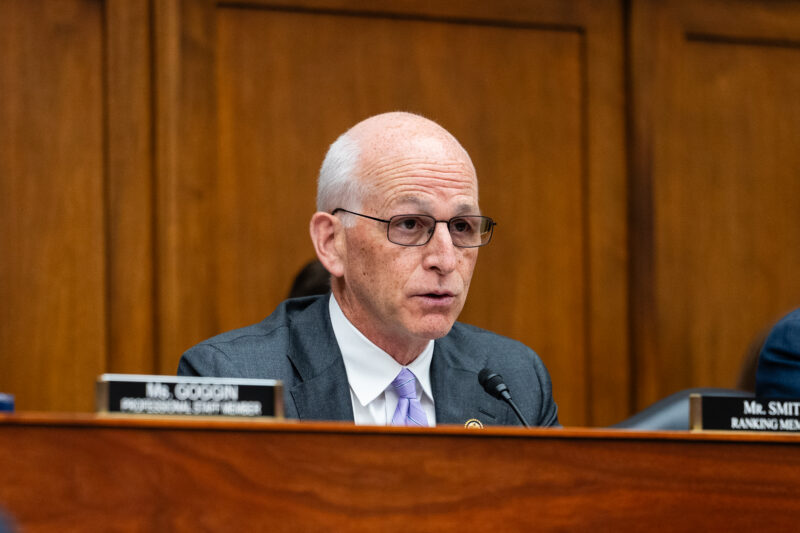



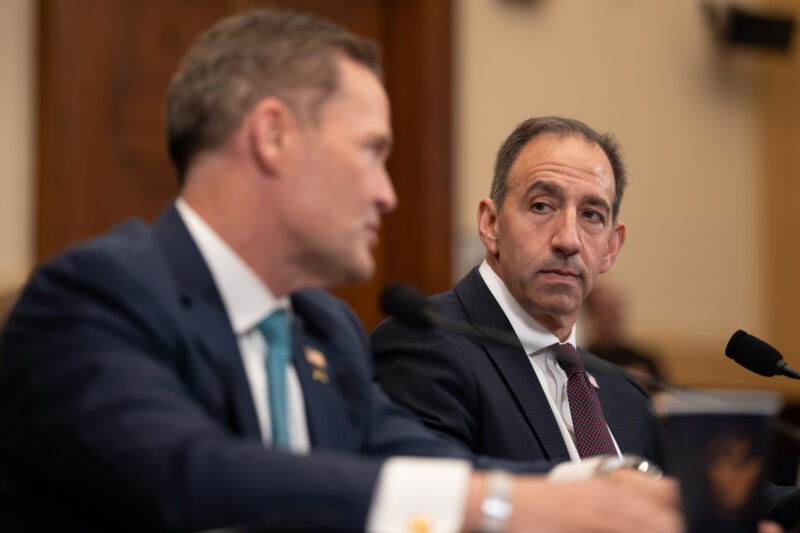
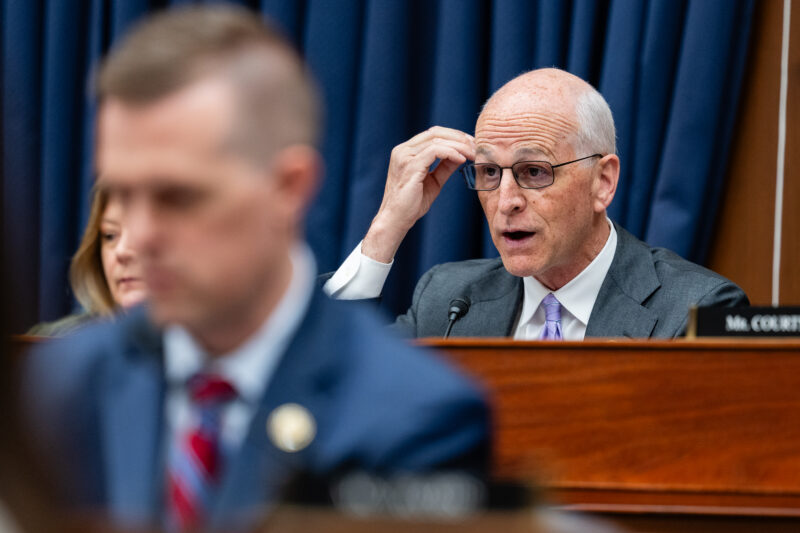

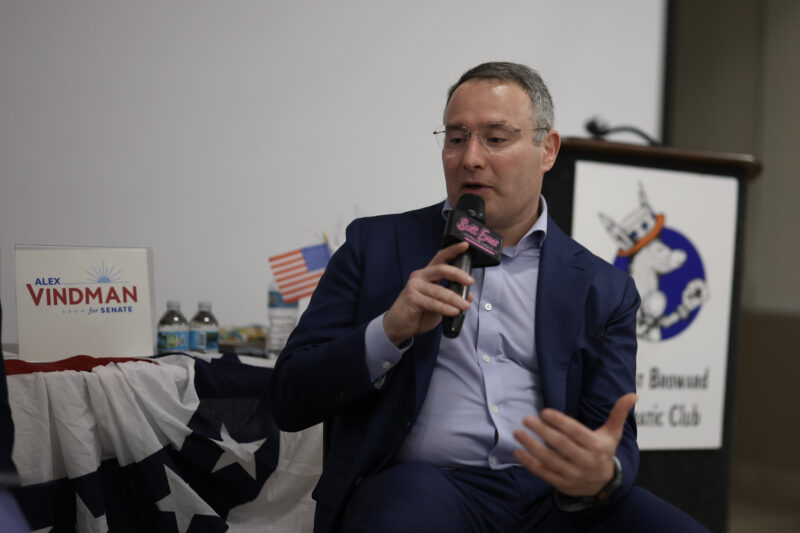




























The members say the compressed timeline give states and institutions too little time to complete applications for the 2026 Nonprofit Security Grant Program
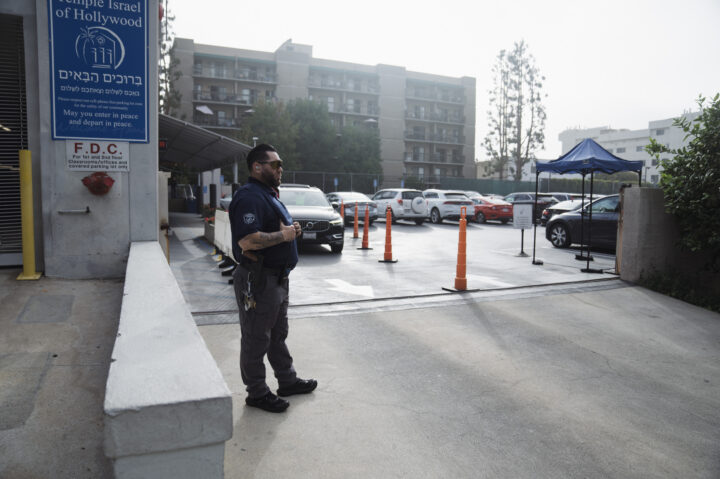
Photo by Eric Thayer/Getty Images)
A security guard stands watch in front of a synagogue on October 9, 2023 in Los Angeles, California.


 Add JewishInsider on Google
A bipartisan group of 58 House members urged the Federal Emergency Management Agency on Thursday to extend the deadline for 2026 Nonprofit Security Grant Program applications, arguing that the current timeline gives states and institutions “insufficient time to complete the application process” and fulfill the program’s goals.
Applications for the program were announced on June 24 and are due to the federal government from state emergency management agencies by July 24. Those state agencies must set their own earlier deadlines for individual institutions to submit applications.
“It is essential that eligible applicants have a fair shot to apply for these funds and fully realize the program’s intended purpose,” the lawmakers, led by Reps. Grace Meng (D-NY) and David Joyce (R-OH), wrote in a letter to acting FEMA Administrator Robert Fenton. “The current timeline imposes significant administrative constraints on both applicants and [state administrative agencies], potentially limiting full and fair participation in this year’s grant cycle.”
The lawmakers argued that organizations would have a short amount of time — potentially just days — to review the program, obtain necessary assessments, develop proposals, gather documents and submit applications. The signatories noted that FEMA has historically provided as many as 80 days from the application announcement to the deadline.
The letter notes that the application period also overlaps state hate crimes grant program application periods in some states, “overburdening” institutions, particularly smaller ones that don’t have large teams to handle grant-writing.
FEMA’s continued delays in releasing 2025 NSGP awards create further issues, the lawmakers explained: “organizations will be applying without knowing their eligibility, creating additional complications since eligibility for this year’s grant is affected by the recipient’s status for last year’s grant.”
The letter urges FEMA to extend the 2026 application deadline, to give state agencies more time to review applications, nonprofits more time to prepare their applications and to guarantee “FEMA receives the strongest possible pool of eligible projects for consideration.”
The Jewish Federations of North America said it organized the letter and was the first to publicize it.
“At a time of rising threats against faith-based communal institutions, Congress has made clear that protecting vulnerable communities is a bipartisan priority,” JFNA CEO Eric Fingerhut said. “Giving state administrative agencies and nonprofit organizations adequate time to complete FEMA’s application process will help ensure these critical security resources reach those NSGP is designed to protect.”
Lauren Wolman, the senior director of government relations and strategy at the Anti-Defamation League, said that “a one-month application window presents significant challenges for the nonprofits that need this funding the most, particularly smaller organizations without dedicated grant writing staff.”
Wolman added, “Extending the deadline would help ensure every eligible organization has a meaningful opportunity to secure the resources they need to protect their communities.”
Rabbi AD Motzen, the national director of government affairs at Agudath Israel of America, said, “Agudath Israel strongly supports the bipartisan Meng Joyce letter and the request for a longer application period. We have heard from nonprofits that are not sure if they were awarded the grant from the previous year and have to make a rushed decision whether or not to apply for this year.”
Nathan Diament, the executive director of the Orthodox Union Advocacy Center, said that the OU also agrees that an extension of the deadline would be “very helpful.”
Separately, 15 Democrats on the House Homeland Security Committee wrote to Homeland Security Secretary Markwayne Mullin and Fenton, raising concerns about the administration’s handling of various FEMA grant programs including NSGP, accusing them of including language in the application materials “that is confusing, impractical, incomplete, and potentially unlawful.”
The Democrats specifically accuse the administration of “deliberately slow processing” of 2025 NSGP applications, noting the continued delay in announcements of 2025 funding and calling for the outstanding grants to be issued “immediately.”
“At-risk nonprofits are forced to navigate overlapping application cycles without knowing if they even need to apply for the FY 2026 NSGP,” the letter reads. “With the FY 2026 application window already open and set to close in less than a month, FEMA’s internal delays and contradictory directives are creating unnecessary burdens for subrecipients.”
It also criticizes the administration for “conflicting instructions on required documentation” and requirements related to immigration and elections imposed on grant recipients. “Imposing these complex mandates on small, volunteer-run, nonprofit organizations, threatens to penalize the very institutions the program is designed to protect,” the Democrats wrote.
The $355 million proposal is the highest funding level to pass out of committee for the program

Brandon Bell/Getty Images
A law enforcement vehicle sits near the Congregation Beth Israel synagogue on January 16, 2022 in Colleyville, Texas.
The House Appropriations Committee approved a $40 million increase in its funding proposal for the Nonprofit Security Grant Program for 2027, boosting its recommendation to $355 million, in a Tuesday night session that stretched into Wednesday morning.
The funding increase was approved as part of a negotiated bipartisan package of amendments during an Appropriations Committee markup, which passed by a voice vote.
A source familiar with the situation credited Reps. Juan Ciscomani (R-AZ), Celeste Maloy (R-UT), Debbie Wasserman Schultz (D-FL) and Lois Frankel (D-FL) with securing the increase.
“Nonprofit security grants are absolutely critical to combat surging antisemitism and hate crimes,” Wasserman Schultz told Jewish Insider. “I proudly fought for an increase in NSGP funding and I’m grateful it was included, but we must do more on the floor and in conference to make sure everybody in America can worship safely.”
In remarks during the committee markup, Wasserman Schultz thanked colleagues for supporting the request, saying that it is not “anywhere near the funding that is necessary … it is certainly a small step in the right direction,” citing recent attacks on Jewish and other communities.
Frankel said that her synagogue is guarded by several armed men, a “really sort of scary” situation.
“As antisemitism continues to rise and threats against religious communities become more frequent, Congress must do more to help houses of worship protect their congregants. No one should have to fear for their safety while practicing their faith,” Frankel said in a statement. “I’m glad we were able to secure an increase this year, but the job isn’t finished. I’ll keep working with Republicans and Democrats alike to make sure protecting synagogues and other faith-based institutions remains a priority and that our funding keeps pace with the threats they face.”
The $355 million proposal is the highest funding level to pass out of committee for the program, but still falls well below the $1 billion that lawmakers and advocates for the program on Capitol Hill say is necessary to fully meet the needs of the Jewish community and other populations under threat.
The proposal could be further increased — or face further cuts — as the appropriations process continues. The process looks to be especially chaotic this year as Senate lawmakers say they are still far apart in negotiating top-line funding levels.
The Orthodox Union, Jewish Federations of North America and Anti-Defamation League worked behind the scenes in support of the amendment, sources said.
“We appreciate this substantial increase in NSGP funding by the committee and we’re particularly thankful to Reps. Ciscomani, Maloy, Wasserman Schultz and Frankel, as well as Chair Amodei,” Nathan Diament, the executive director of the Orthodox Union Advocacy Center told Jewish Insider. “It’s well known that the security needs of the Jewish community and other faith communities are huge and we will continue to work with allies in Congress to fully meet those needs.”
Rachel Dembo, director of policy and government affairs for the Jewish Federations of North America, said JFNA “was proud to play a leading role in securing this additional bipartisan funding.”
“This increase is a meaningful investment in the safety and security of Jewish communities and other vulnerable nonprofits, though the need for the program continues to exceed available funding,” Dembo continued. “We are grateful to the Committee and bipartisan congressional champions for strengthening this critical investment and recognizing the urgent need for nonprofit security. We look forward to continuing to work with Congress to help close the gap between available funding and demonstrated need.”
Lauren Wolman, the senior director of government relations and strategy at the Anti-Defamation League, said that the funding will be helpful, but remains insufficient.
“ADL welcomes the inclusion of an additional $40 million for NSGP in the House Homeland Security managers amendment. This increase will help more houses of worship, schools, and community centers access the security resources they need,” Wolman said. “But the truth is, the gap between what’s available and what’s needed remains vast. To truly protect vulnerable communities across the country, Congress must go further and fund the program at $1 billion to ensure every at-risk community gets the protection it deserves.”
Jewish groups called the proposal, which is a slight increase from 2026 funding levels, appreciated but vastly inadequate

Brandon Bell/Getty Images
A police vehicle and crime scene tape.
Republicans on the House Appropriations Committee proposed providing $315 million for the Nonprofit Security Grant Program in 2027, a slight increase from 2026 funding levels but far below the $1 billion that supporters of the program in the House and Jewish and other faith communities have called for.
The 2026 funding bill contains $300 million for the program, a marginal increase from 2025 levels. But the program has been subject to significant procedural delays — funding from the 2025 tranche has still not yet been disbursed, and the timeline for 2026 applications remains uncertain.
In 2024 — the most recent year for which data is publicly available — applicants requested $978 million in federal funding, and less than half of applications were funded with a pool of $454.5 million available.
“Any increase in Nonprofit Security Grant Program funding is welcome, but this proposed appropriation is not enough,” Rep. Gabe Amo (D-RI), who led a letter to appropriators calling for $1 billion in funding, told JI. “I’ll keep pushing to fund the NSGP at $1 billion so Americans can worship, gather, and serve their communities in safety.”
Rep. Josh Gottheimer (D-NJ) said that the “math doesn’t add up” for the committee’s proposal. “When houses of worship are under threat, this is not the time to lowball our safety.”
Jewish groups also called the proposal appreciated, but vastly inadequate.
“This is a modest increase from last year, but we need more to keep our community safe in the face of the explosion in antisemitic threats,” Nathan Diament, the executive director of the Orthodox Union Advocacy Center, said. “We will be working with our allies on the Appropriations Committee to increase this funding level.”
“We appreciate the House proposal to provide $315 million for NSGP, but the reality is that demand continues to far outpace available funding,” Dan Granot, senior director of government relations and community engagement for the Anti-Defamation League, said. “At a time of record antisemitism and heightened security concerns, Congress should fund NSGP at no less than $1 billion, reflecting the urgent needs of vulnerable communities across the country.”
Eric Fingerhut, the CEO of the Jewish Federations of North America, said, “We are grateful for the support of the committee thus far but we will not be able to adequately address these threats until the Nonprofit Security Grant Program, which is unable to cover even half of requests at current levels, reaches $1 billion.”
He said that JFNA will work with DHS and Congress to “fully fund” the program.
In recent appropriations cycles, the House has approved modest funding increases for the program as the funding bills have worked their way through committee and the House floor.
The Appropriations Committee released a separate bill on Thursday proposing a $1.5 million increase to the Holocaust Survivor Assistance Program, to $10 million.
“We commend the House for proposing $10 million for the Holocaust Survivor Assistance Program,” Fingerhut said. “This increased investment will help ensure that survivors, many of whom continue to face significant physical, emotional, and financial challenges, receive the specialized care and support they deserve.”
The 2025 grants were delayed as a result of the 76-day partial shutdown of the Department of Homeland Security this year
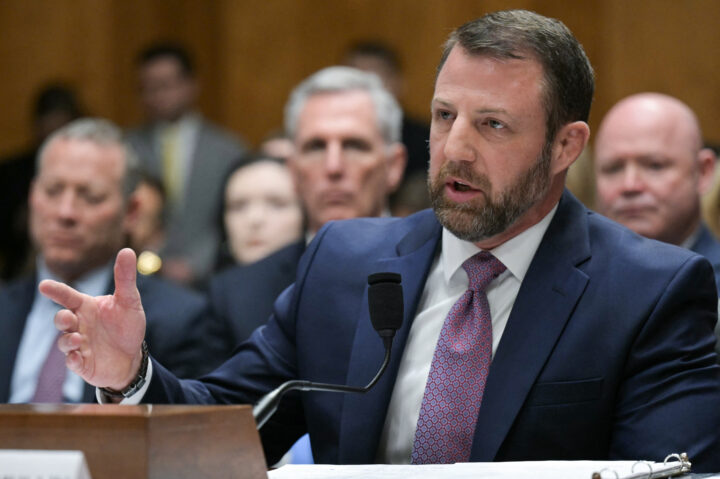
Oliver Contreras/AFP via Getty Images
DHS Secretary Markwayne Mullin testifies during a Senate Committee on Homeland Security and Governmental Affairs confirmation hearing on Capitol Hill in Washington, DC
Sens. Elissa Slotkin (D-MI) and James Lankford (R-OK) wrote to Secretary of Homeland Security Markwayne Mullin on Thursday urging him to take action to move forward stalled Nonprofit Security Grant Program funding, an issue both lawmakers raised with Mullin during his confirmation hearing.
“Over the past decade, the NSGP program has enabled institutions to strengthen their security and harden the exteriors of their buildings. But the program is also plagued with restrictions and delays that have limited its effectiveness. We would like to take you up on your offer [to] discuss potential improvements to the NSGP program over the long term,” the two senators wrote. “Before we meet, there are several steps that you can take immediately to assist the nonprofits that rely on this program.”
They urged Mullin to “move quickly” to finalize 2025 grants — for which the application process was delayed for months and which have still not been finalized or released — as well as to “promptly” open applications for the 2026 grant cycle, with 2026 DHS funding now finalized by Congress.
Slotkin and Lankford also encouraged Mullin to retract new conditions imposed in the 2025 cycle related to immigration enforcement and diversity, equity and inclusion programs, which they said have “have caused confusion and concern among potential applicants.” They said the grant should be focused “on security and risk rather than on these unrelated issues.”
The two senators also asked Mullin to “immediately review staffing levels” in the NSGP program office at DHS, explaining that nonprofit groups have been concerned that insufficient staffing contributed to the delays in the 2025 grant process.
Going forward, the senators said they plan to urge Mullin to improve communication with the state agencies that administer the grant program and address delays in providing reimbursements to grant recipients for security expenses.
“We appreciate your willingness to engage with us on this important program that has enabled nonprofit organizations across the country to harden themselves against terror attacks,” Slotkin and Lankford wrote. “The need for the program remains high, and we are eager to work with you to strengthen it moving forward.”
Citing the estimated $29 billion cost of the Iran war, the House minority leader asked, ‘How is it possible that we can't spend at least 500 million’ on NSGP?
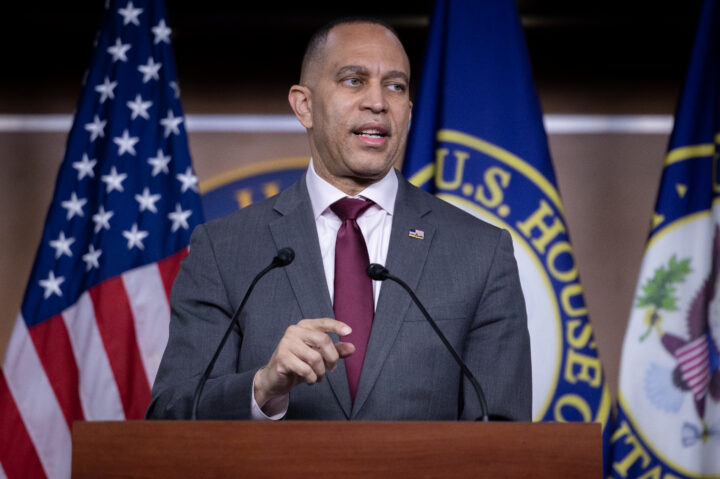
Nathan Posner/Anadolu via Getty Images
House Minority Leader Hakeem Jeffries (D-NY) speaks during his weekly press conference at the U.S. Capitol in Washington, DC on March 19, 2026.
House Minority Leader Hakeem Jeffries (D-NY) called for a dramatic increase in funding of the federal Nonprofit Security Grant Program, telling a group of Jewish activists on Wednesday that it should receive $1 billion — up from the $300 million that Congress allocated in last month’s homeland security funding bill.
“The not-for-profit security grant funding program is woefully underfunded. It’s woefully underfunded. $300 million is not acceptable,” Jeffries said at the Jewish Democratic Council of America’s leadership summit in Washington.
He pointed out that the Pentagon now estimates the cost of the war with Iran so far is $29 billion, and Democrats believe it is possibly much more.
“We think it’s probably double that. But even if you just take the $29 billion number, how is it possible that we can’t spend at least 500 million? I think the number should be even higher,” said Jeffries. “Why wouldn’t we spend a billion dollars to make sure that the communities that we care about across this country are safe?”
The $300 million approved by Congress last month is a small increase from the $274.5 million allocated to the program in 2024 and 2025.
Jewish organizations have for years been lobbying for Congress to significantly increase the federal budget for the program, which provides security grants to vulnerable nonprofits, including synagogues and Jewish day schools, arguing that its current level does not come close to meeting the security needs of Jewish institutions. In 2024, more than half of all applications for NSGP funding were declined.
Jewish communities and institutions are “now spending an outsized amount of budget funding to provide security in America,” Jeffries said. “That should not happen.”
A group of 41 senators last month called for $750 million in funding for the program next year. Last month, a coalition of interfaith groups called for Congress to increase NSGP funding to $1 billion. A bipartisan group of 150 members of the House asked the House Appropriations Committee in March to increase funding to $1 billion, although no members of House leadership in the Democratic or Republican Party signed onto it.
The funding marks an increase over 2025 levels but is far short of the $1 billion advocates have sought

David Dee Delgado/Getty Images
A Department of Homeland Security officer stands guard at 26 Federal plaza as protestors gather to demand the release of Mahmoud Khalil at Foley Square on March 10, 2025 in New York City.
House Democrats and Jewish groups welcomed the passage of $300 million for the Nonprofit Security Grant Program (NSGP) on Thursday, while warning that funding for the program remains insufficient to fully protect the Jewish community and places of worship amid a surge in antisemitism.
The appropriation was passed through a bill funding most of the Department of Homeland Security, approved in the House on Thursday after receiving approval in the Senate. The move ends the monthslong shutdown of agencies including the Coast Guard, Transportation Security Administration and the Federal Emergency Management Agency, which operates NSGP.
While lawmakers welcomed the fact that funding marks an increase from the $274.5 million provided in fiscal year 2025, they cautioned that the $300 million still falls short of the need within the Jewish community, given the threat level. The grants are used to harden institutions, including synagogues and day schools, against physical attacks.
Rep. Debbie Wasserman Schultz (D-FL) told Jewish Insider that $300 million is “nowhere near enough.”
“It is just unacceptable that we are going in the wrong direction,” Wasserman Schultz said. “$300 million is backwards. We need a billion dollars with the explosive growth in antisemitism and antisemitic attacks.”
Jewish communal groups as well as a bipartisan group of 150 House members called for an increase in funding for the program of up to $1 billion following several attacks including the car-ramming and shooting attack on Temple Israel in West Bloomfield, Mich., in March.
“We need to make sure that every person who attends not just a Jewish institution, but any religious or community organization — that no one should have to fear being attacked in a public space like that,” Wasserman Schultz added. “We need to make sure that the funding is adequate to keep people safe.”
The Florida lawmaker noted that she hopes Congress can unlock more funding for the program, saying that there is an “appropriations process that is ongoing, so hopefully we’ll be able to.”
Rep. Josh Gottheimer (D-NJ) told JI that the development is “good news,” adding that “hopefully we [Congress] will get these resources out the door as quickly as possible to protect our religious institutions.”
“It’s better than nothing, right?” Gottheimer said. “It’s good news to get these resources out the door, and we certainly need to get them out the door, and so this is an important step.”
Still, Gottheimer said the amount is not enough. He stated that he plans to “push for a lot more for next year” and that he has “already taken action, written letters and laid down clear markers that we need a lot more.”
“I think we need more because right now we’re running less than 50% fulfilled in terms of [grant] requests,” Gottheimer said. “So, obviously it’s not enough, especially with the threats out there. When you look at antisemitism and the surge in the rates, we obviously need to get a lot more help for our religious institutions so we can ensure religious freedom and protect our synagogues.”
Gottheimer also expressed frustration with what he described as former DHS Secretary Kristi Noem “holding up the resources.” However, he said he hoped that the department’s newly installed secretary, former Oklahoma Sen. Markwayne Mullin, would mark an improvement.
“She [Noem] had put a review on all of the resources, so a lot of the money didn’t get out the door because they were looking at all the procedures and so the money was being held up,” Gottheimer said. “I’m optimistic that our new secretary, and I spoke to him, will get these resources out the door.”
Rep. George Latimer (D-NY) said he was unsure whether the newly allocated amount was the “right number,” but stated that he believed it could have a “positive effect.”
“The synagogues and the Jewish day schools in my district and around me are really concerned about the rise of antisemitism,” Latimer said. “I’m not Jewish myself, but I can see that there’s a pointed effort to try and make people feel afraid in doing things that we believe everybody should be able to do.”
“I suppose you could always use more [funding],” Latimer added. “But if it’s going to go to the right purpose and it’s done without extra strings attached, as you never know how this administration will operate — but I would certainly say that Jewish communities should have this extra support and protection.”
Jewish communal organizations similarly applauded the funding, but urged for more down the line.
“This increase over last year’s funding level is an important and very welcome step,” Nathan Diament, executive director of the Orthodox Union Advocacy Center, said in a statement. “While sadly even more funding is needed for Jewish community security, this increased level of funding will surely help. We will continue working with members of Congress and our allies to fund NSGP at even higher levels in 2027 to meet demand.”
Lauren Wolman, senior director of government relations and strategy at the Anti-Defamation League, called the funding “an important step in protecting vulnerable communities amid evolving threats.”
“NSGP is a proven, lifesaving program, but demand continues to far outpace resources. As antisemitic threats reach record highs, funding must keep pace. Turning our attention to FY27, we urge Congress to fund NSGP at $1 billion,” Wolman continued. “Now that DHS has reopened, we urge the Administration to ensure FY25 funds are disbursed promptly and [open applications for 2026 grants] in a timely manner.”
The Jewish Federations of North America also welcomed the move, saying in a statement that the funding will “restore critical operations at a moment when threats facing Jewish communities and other vulnerable populations remain alarmingly high.” It also encouraged the administration to release funds allocated for 2025 and open applications for 2026, and indicated that the organization would “fight for $1 billion for FY2027.”
The group, organized by the ADL, urged lawmakers to increase NSGP funding and pass the Pray Safe Act and a new bill establishing buffer zones around houses of worship
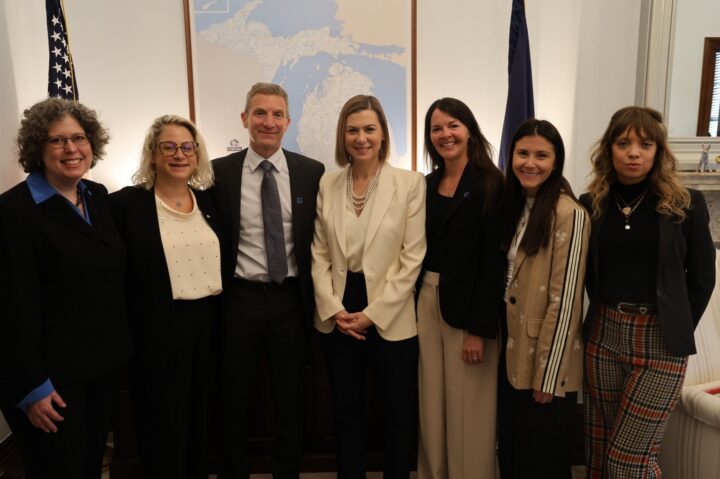
Sen. Elissa Slotkin/X
Sen. Elissa Slotkin (D-MI) meets with Jewish communal activists on April 22, 2026.
Jewish leaders from communities impacted by antisemitic violence in the past year met with House and Senate leaders on Capitol Hill on Wednesday to advocate for additional federal security assistance. The advocates represented Temple Israel in West Bloomfield, Mich., Beth Israel Congregation in Jackson, Miss., a hostage awareness march in Boulder, Colo. and, the Capital Jewish Museum in Washington.
“I will never forget the phone call. Or the images on the news of smoke rising from the place where I had just left my child,” Taylor Weintraub, a parent of a child who attended Temple Israel, told reporters on Wednesday morning. “Thank God, none of the children were physically hurt. But that wasn’t luck, that was preparation — reinforced doors, trained security, investments made because we knew this could happen. But here’s what keeps me up at night: we are the lucky ones.”
Among other priorities, the group, organized by the Anti-Defamation League, lobbied lawmakers for an increase to $1 billion in Nonprofit Security Grant Program funding in 2027, with Weintraub making the case that the program is “literally saving lives” — at Temple Israel, NSGP funding helped upgrade the synagogue’s cameras.
“Without these resources, more parents will get that phone call saying a terrorist is inside their child’s school,” Weintraub continued. “And no one should have to live through that.”
Cassi Cohen, the director of development at Temple Israel, said that, as a survivor of the attack, she is “living proof that these pieces of legislation work. … If I can be a voice to help ensure that other houses of worship have the ability to get the resources and the funding to prevent something as catastrophic as what we went through, then I’ll do this every day, because I don’t think there’s anything more important right now.”
Elyssa Schmier, a member of Temple Israel and the ADL’s regional director in Michigan, said that Jewish institutions across the state are undertaking reviews of their security and making upgrades — in some cases without the funding to pay for it.
Schmier’s son’s Jewish preschool is expanding its armed guard’s hours to full time — he previously worked part time because the school did not have enough money to pay for more — “and they’re not really sure how they’re paying for it. They’re just doing it.”
Smaller communities farther outside urban areas are especially vulnerable, she added.
Susan Rona, ADL’s Mountain States regional director, said that security has been critical to ensuring that the community feels able to continue gathering and participating in Jewish life.
“When we built the [Jewish Community Center] building, we benefited from the Nonprofit Security Grant Program as well, and it still is present,” Rona said. “We’re almost a year out, and there’s been real impacts to Boulder and our security needs are just getting higher to make sure that we can still create a space for the community to say, ‘Yes, I want to gather in this Jewish space.’”
The group met with the offices of House Speaker Mike Johnson (R-LA), House Majority Leader Steve Scalise (R-LA), House Majority Whip Tom Emmer (R-MN), Senate Minority Leader Chuck Schumer (D-NY), House Minority Leader Hakeem Jeffries (D-NY), House Democratic Whip Katherine Clark (D-MA), Sens. James Lankford (R-OK), Jacky Rosen (D-NV), Elissa Slotkin (D-MI), Michael Bennet (D-CO), Cindy Hyde-Smith (R-MS) and Gary Peters (D-MI) and Reps. Haley Stevens (D-MI), Hilary Scholten (D-MI), Joe Neguse (D-CO) and John James (R-MI).
In addition to NSGP funding, the group advocated for the Pray Safe Act and the SACRED Act, a new bill being led by Rep. Tom Suozzi (D-NY) to create a protected 100-foot buffer zone around houses of worship, similar to legislation being pursued in New York and California.
The 41 signatories to the letter — including three Republicans and 38 Democrats — mark the highest number of lawmakers to make such a request

Emily Elconin/Getty Images
Law enforcement respond near Temple Israel following reports of an active shooter on March 12, 2026 in West Bloomfield, Mich.
Saying that funding to protect synagogues and other religious-based nonprofits “has not kept pace to meet the moment,” 41 senators — almost entirely Democrats — wrote to leaders of the Senate Appropriations Committee urging members to provide $750 million in funding for the Nonprofit Security Grant Program in 2027.
That figure amounts to a substantial increase in funding over current levels, as well as over Senate lawmakers’ request from last year.
The program was funded in 2025 at $274.5 million, which has not yet been disbursed, and the still-stalled 2026 Homeland Security funding bill includes $300 million for the program. Yet, in 2024, the program fulfilled just 43% of requests, even with additional funding provided through a national security supplemental bill that year. Jewish and interfaith groups, as well as House lawmakers, have been pushing for up to $1 billion for the program.
Last year, 33 senators requested $500 million for the program, a record-high request at the time. This year’s request represents a new high-water mark, both in terms of the funding requested and the number of lawmakers who signed the bipartisan letter in support.
“The threat of violence is unfortunately increasing at places of worship across our country at alarming rates. In the past few years, there has been an increase in hoax bomb threats and attacks against houses of worship that are intended to interrupt services and intimidate worshippers. In particular, there has been an increase in antisemitic incidents across the country following the October 7th attack on Israel,” the senators wrote. “Nationwide, there have been countless acts of violence against religious communities.”
The lawmakers also urged the Appropriations Committee to “maintain separate line-items for this program,” amid reports that the administration has been pushing to convert Federal Emergency Management Agency grant programs, under which NSGP falls, into a broad state-by-state block grant.
The administration also called for cuts to non-emergency FEMA grants, a category that includes NSGP, without making any specific line-item request for the NSGP.
“[F]unding has not kept pace to meet the moment,” the lawmakers added, highlighting a litany of attacks on religious institutions and the funding shortages in 2024.
The letter was led by Sens. Kirsten Gillibrand (D-NY), James Lankford (R-OK), Gary Peters (D-MI) and Jacky Rosen (D-NV). Only two Republicans other than Lankford joined the effort: Sens. Kevin Cramer (R-ND) and Josh Hawley (R-MO).
“As we continue to work with Congress to secure Jewish communities, the bipartisan consensus in the Senate around $750 million for the Nonprofit Security Grant Program is a monumental step toward our community’s $1 billion goal,” Eric Fingerhut, the CEO of the Jewish Federations of North America, said. “At a time of rising antisemitism and an escalating security crisis facing vulnerable communities across the country, demand continues to far outpace available funding.”
Fingerhut said that JFNA plans to bring Jewish activists from across the country to lobby Congress on the issue next month “and urge them to act with urgency and resolve to ensure at-risk institutions have the resources they need before the next incident, not after.”
Lauren Wolman, the Anti-Defamation League’s senior director of government relations and strategy, said, “At a time of sustained and evolving threats, this program remains a critical lifeline for houses of worship and nonprofit institutions working to protect their communities. Demand continues to far outpace available resources, and we urge Congress to ensure funding levels reflect the reality on the ground.”
Nathan Diament, the executive director of the Orthodox Union Advocacy Center, said, “The need for increased NSGP funding remains critical. We are thankful to the large bipartisan group of Senators who signed onto this letter.”
“OU Advocacy will keep pressing on all fronts to deliver the funding our Shuls and schools need to stay safe,” Diament continued.
The organizations cited the ‘unprecedented and escalating threat environment’ facing religious communities
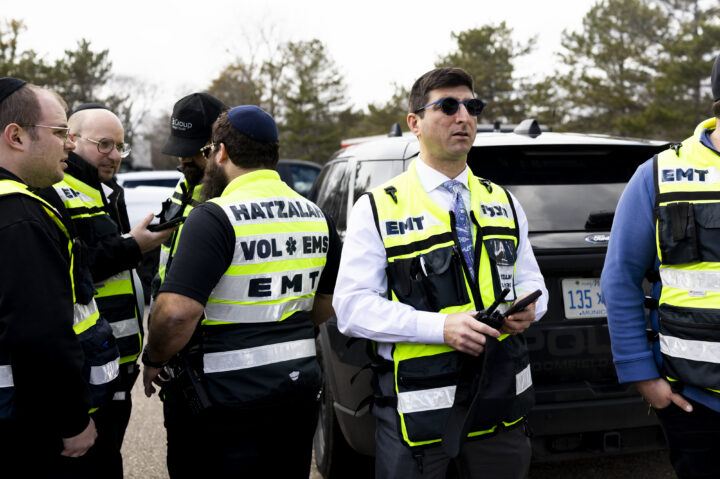
Emily Elconin/Getty Images
Members of Hatzalah of Michigan, a Jewish volunteer emergency medical service survey the area near Temple Israel following reports of an active shooter on March 12, 2026 in West Bloomfield, Michigan.
Citing an “unprecedented and escalating threat environment facing religious communities and institutions” across the country, a coalition of Jewish groups, joined by organizations representing a range of other faiths, is urging Senate and House leaders to significantly expand funding for the Nonprofit Security Grant Program.
“We write as a broad coalition of faith-based and cultural organizations to express our deep concern about the unprecedented and escalating threat environment facing religious communities and institutions across the United States. This threat is not abstract; it is very real and felt by the communities we represent on a daily basis,” the groups wrote in a letter, led by the American Jewish Committee, to the top leaders of each chamber.
They said that faith-based institutions “should be able to solely focus on serving and strengthening their communities, but in this heightened threat environment, they instead must also worry about the next attack and whether they have the resources to stay safe,” and that members of targeted religious communities are forced to “weigh the risk of violence against the act of worship.”
The letter urges Congress to provide “up to $1 billion” for the NSGP — a significant expansion of funding from its 2025 funding level of $274.5 million, and the proposed 2026 funding level of $300 million.
“Previous funding has not kept pace with demand,” the groups wrote. “More must be done to bolster this program; therefore, we encourage you to engage with communities in your district and to encourage the same of your respective caucuses. We have no doubt you’ll hear about the fear and threats our communities are facing at this moment, and therefore, we urge you to allocate appropriate resources to address this threat.”
The religious organizations also urged swift passage of the long-gestating Pray Safe Act, which would create a centralized federal clearinghouse to provide security guidance to religious institutions, including training resources and information about available grant opportunities.
Additional Jewish organizational signatories included the Anti-Defamation League, the Conference of Presidents of Major American Jewish Organizations, Hillel International, the JCC Association of North America, the Jewish Federations of North America, the Rabbinical Assembly, the Union for Reform Judaism, the Orthodox Union and the United Synagogue of Conservative Judaism.
They were joined by groups representing the Muslim, Lutheran, Greek Orthodox, Hindu, Evangelical, Seventh-day Adventist, Sikh and Catholic communities.
For the first time, the lawmakers’ request aligns with the $1 billion that some Jewish groups have been advocating for amid a surge in antisemitism
Emily Elconin/Getty Images
Members of Hatzalah of Michigan, a Jewish volunteer emergency medical service survey the area near Temple Israel following reports of an active shooter on March 12, 2026 in West Bloomfield, Michigan.
In a letter to the leaders of the House Appropriations Committee, a bipartisan group of 150 House members asked the committee to provide $1 billion in funding for the Department of Homeland Security’s Nonprofit Security Grant Program in 2027, a massive expansion of the program and an unprecedented increase in their request level.
The request letter, which has been sent annually for the last several years at the start of the House’ appropriations process, comes this year in the immediate aftermath of an attack at Temple Israel in West Bloomfield, Mich., and its early childhood center.
For the first time, the lawmakers’ request aligns with the $1 billion that some Jewish groups have been advocating for for the program, amid a surge in antisemitism in recent years.
“The fact of the matter is, around this country, we’ve all experienced a rise in antisemitism, xenophobia, Islamophobia, hatred of all types,” Rep. Gabe Amo (D-RI), who again co-led the request with Rep. Michael McCaul (R-TX), told Jewish Insider on Thursday. “This is a response that’s proportional to the demand, and right now, we need to act swiftly.”
Last year, a group of 130 lawmakers asked for $500 million, but ultimately were not able to secure a substantial increase in funding; the current DHS funding bill for 2026 contains $300 million for the program, a marginal increase from 2025 levels but below the high-water mark in 2023 of $305 million. The bill has not yet passed, waylaid by ongoing disputes over immigration policy and funding. Immigration issues have made the DHS bill difficult to finalize in recent years, and have strained resources for other DHS programs.
“The threat of violence is unfortunately increasing at places of worship across our country at alarming rates,” the House letter reads. “There has been an increase in hoax bomb and active shooter threats against houses of worship to interrupt services and intimidate the worshippers. There has also been an increase in antisemitic incidents across the country following the October 7th attack in Israel. … Unfortunately, it is easy to see that the need for the NSGP is quickly outpacing the funding.”
The significantly increased request also has more signatories this year than in other recent years, underscoring the degree to which bipartisan support for the program has grown.
“There is strong, robust and meaningful support for this program, because people have seen the realities, and it’s a priority to ensure that all of our communities can worship, celebrate and exist with the safety that they deserve,” Amo told JI on Thursday.
The letter outlines a series of attacks on Jewish institutions, including the Capital Jewish Museum shooting in Washington, the firebombing of a hostage awareness march in Boulder, Colo., an attempted attack on a Florida Jewish nonprofit, the arson attack at Beth Israel Congregation in Jackson, Miss. and the car ramming attack at Chabad-Lubavitch World Headquarters in Brooklyn, as well as attacks on Christian, Mormon and Muslim institutions.
The lawmakers highlighted that need has significantly outpaced the available funding, noting that in 2024 — the most recent year for which data is publicly available — applicants requested $978 million in federal funding, and less than half of applications were funded, even with a pool of $454.5 million available.
The program received $274.5 million in funding in 2025, but that funding has still not been distributed, according to the letter, due to delays at FEMA, and lawmakers have not been provided with customary data about supplemental funding rounds awarded last year.
The $1 billion request, Amo said, is “actually where the demand is.” Though funding allocations haven’t kept pace with demand or with the requests that lawmakers have made, “you can’t get what you don’t ask for. We requested $500 million last year … this year we’re going higher because the need as measured by applications [is there]. We want to get as many as possible.”
He acknowledged that the final allocation may be lower than the $1 billion requested, “but if you look across the board, you want to ask relative to the need, and the need is there.”
Amo said it’s not likely, at this point, that advocates will seek to revise the funding allocation in the stalled 2026 DHS funding bill, despite recent incidents.
He also said that a series of inquiries by lawmakers to the administration about a range of administrative issues and slowdowns for the program in 2025 have gone largely unanswered and unaddressed by administration officials, but vowed to continue to engage with DHS officials to ensure the program remains a priority.
Sen. Markwayne Mullin (R-OK), the Trump administration’s nominee to head the DHS, said at his confirmation hearing on Wednesday that he’d work with lawmakers on both sides of the aisle to try to reduce the bureaucracy around the program and ensure that funding is moving where it is needed quickly.
Lauren Wolman, the Anti-Defamation League’s senior director of government relations and strategy, told JI, “ADL is grateful to Reps. Amo and McCaul for their leadership in spearheading a bipartisan congressional effort calling for a historic $1 billion in funding for the Nonprofit Security Grant Program. At a time of rising antisemitism and continued threats to houses of worship, this program provides critical resources that help communities protect themselves. The need is clear, demand continues to far outpace available funding, and we urge Congress to act to ensure NSGP is funded at a level that reflects the reality on the ground.”
Eric Fingerhut, the CEO of the Jewish Federations of North America, highlighted that the Jewish community spends more than $765 million a year on security efforts and that security costs are the largest expenditure for every Jewish institution.
“We are in the middle of the most serious, violent antisemitic threat environment against the Jewish community in the history of the United States,” Fingerhut said in a statement. “It is the government’s responsibility to protect its citizens in their places of worship, in their places of communal gathering, and the government of the United States must step up to this responsibility now, before we have another tragedy of a kind that we almost had in Detroit last week.”
Nathan Diament, the executive director of the Orthodox Union Advocacy Center, said OU is also “supportive of [Amo’s] leadership and his letter.”
Mullin said he would work to streamline the paperwork process and reimbursement timelines
Oliver Contreras/AFP via Getty Images
DHS Secretary Markwayne Mullin testifies during a Senate Committee on Homeland Security and Governmental Affairs confirmation hearing on Capitol Hill in Washington, DC
In his nomination hearing to be secretary of homeland security, Sen. Markwayne Mullin (R-OK) said he will aim to “streamline the process” for grants, including the Nonprofit Security Grant Program (NSGP) aimed at helping harden religious institutions, amid heightened antisemitism and increased threats during the ongoing war in Iran.
The NSGP has faced persistent challenges, including severe underfunding, controversial new conditions and, most recently, delays tied to the ongoing partial shutdown of the Department of Homeland Security.
When pressed by senators on the need to unlock NSGP funding in the wake of the violent attack at Temple Israel in suburban Detroit last week, Mullin agreed that the process should be streamlined and said he would aim to “cut out the redundancies” and “amount of paperwork.”
“The Jewish community is spending about a billion dollars a year privately securing their own institutions,” said Sen. Elissa Slotkin (D-MI). “No religious group should have to spend that amount of money on their own security in the United States of America. So I would just ask for your help in reforming the Nonprofit Security Grant Program so it’s agile, so you don’t have to win the grant and then still do 100 pieces of paper.”
Sen. James Lankford (R-OK) echoed those sentiments, noting that the “length of time it takes to get a response” is concerning, especially for “locations that are higher risk than others.”
“Synagogues and temples have been one of those very high risk locations that are out there,” Lankford said, referencing the attack at Temple Israel. “That location happened to be one of the locations where there’s also been this nonprofit security grant to help harden that facility.”
“We have multiple challenges here,” Lankford added. “One of them is, when the decision is made, they make a request, go through the paperwork, get approval to be one of those locations that we say we need to harden this location. Once the approval is done, it may take months to over a year just for the dollars to actually come on it because there’s more bureaucratic hoops to go through.”
In response, Mullin agreed, “there’s a better way to do this.” He added that while he may have political differences with some of the lawmakers on the committee, this issue “isn’t one” of them and that he would be “laser focused and get this resolved.”
“The amount of paperwork once you’re approved to get the funding flowing, and then the paperwork that’s followed up on is way too encompassing,” Mullin said. “Taking years to get reimbursed is not acceptable. Taking months to get reimbursed is not acceptable.”
Mullin was also pressed on the threat of terrorist attacks domestically amid the DHS funding lapse and ongoing conflict in Iran.
Sen. Josh Hawley (R-MO), cited several recent incidents that had “potential terrorist ties,” including the antisemitic attack at Temple Israel in Michigan whose perpetrator had family ties to Hezbollah; a school shooting at Old Dominion University earlier this month, which is being investigated as an act of terrorism; a mass shooting in Austin, Texas, which is being investigated as having ties to the Iran conflict; and the detonation of bombs in New York City.
“Is this a good time for the Department of Homeland Security to be shut down and unfunded?” Hawley said.
“It’s a horrible time,” Mullin replied. “It’s devastating to the morale of the men and women we have tasked to keep care, take care of all of us, all the homeland, regardless it’s a blue state or red state.”
Sen. Richard Bumenthal (D-CT) pressed Mullin over whether he would approve the deportation of Iranian dissidents who could face death or punishment upon being returned to Tehran. The Trump administration has deported Iranians back to Iran from the U.S. on several deportation flights after a deal between the two governments was reached.
“Before the war in Iran began, the Trump administration negotiated a back-channel agreement, a deal with the Islamic Republic to deport Iranian nationals, including asylum seekers and dissidents,” Blumenthal said. “I have no doubt you share my outrage about the treatment of Iranian nationals who were deported, possibly to torture and death in Iran. We should not be sending Iranian dissidents and asylum seekers back to Iran, wouldn’t you agree?”
Mullin was noncommittal, arguing that he didn’t know “the specifics” behind the incident.
“Before I can talk about hypotheticals, I would need to know the reasons behind it,” Mullin said. “But I don’t want to deport anybody that’s here legally and most definitely not individuals that have done everything possible to be a contributor to society.”
“We know that our enemies want to infiltrate us and use our rules and generosity against us, so I don’t know the specifics of their background,” Mullin added. “But I will be happy to look into it.”
Rep. Josh Gottheimer (D-NJ), a leader in the House on antisemitism and NGSP funding who attended Mullin’s hearing, told Jewish Insider that DHS needed “new leadership,” and signaled an openness to working with Mullin on the issue.
“We don’t agree on everything, that’s for sure. But, after a decade of working out together most mornings, and finding bipartisan solutions to some of the toughest issues, Markwayne and his family have become very good friends,” Gottheimer said.
During the hearing, Mullin also noted that Gottheimer is “a friend” and that he would “run through fire for the guy.”
“When Josh asked me to join a bipartisan group called No Labels, that’s when we really started seeing that there’s a lot of common ground that we can work together on,” Mullin said. “We can set the differences aside, and we can work together. In fact, our daughters are writing a book together about bipartisanship.”
Mullin’s prospects for confirmation remain somewhat in question, given apparent opposition from Sen. Rand Paul (R-KY), who leads the committee where Mullin’s nomination vote will take place. Paul’s opposition traces to personal animosity between the two colleagues, as well as what Paul described as Mullin’s “anger issues.”
Mullin recently called Paul a “freaking snake” and said that he “understood” why Paul’s neighbor had attacked him, an assault that resulted in serious injuries and a prison sentence for Paul’s neighbor. Mullin refused to apologize at the hearing, to Paul’s outrage.
“I was shocked that you would justify and celebrate this violent assault that caused me so much pain and my family so much pain. The record will show a lack of contrition, no apology and no regrets for your support. You completely understand the violence that was perpetrated on me. You’re unrepentant,” Paul said. “I just wonder if someone who applauds violence against their political opponents is the right person to lead an agency that has struggled to accept limits to the proper use of force.”
“We can have our differences,” Mullin replied. “It’s not going to keep me from doing my job as secretary of homeland security.”
Paul threatened during the hearing to cancel the vote, scheduled for Thursday, on Mullin’s nomination. If Paul refuses to allow a vote, that would effectively block Mullin’s nomination, even if he otherwise has the necessary support to advance.
The Kentucky senator and committee Democrats also raised questions about a classified trip Mullin claims to have taken to a combat zone while he was a member of the House, the details of which Mullin refused to discuss in public during the hearing, alleging that the trip was classified. Committee members retired to a secure room to discuss the trip after the hearing.
If a vote is held, Mullin will need the support of at least one Democrat on the committee in order to advance without Paul’s support. Sen. John Fetterman (D-PA) has previously expressed his intention to support Mullin, and urged Paul and Mullin to move past their feud during the hearing.
Fingerhut called on states to opt in to a tax credit that would provide funds for Jewish day school and yeshiva education
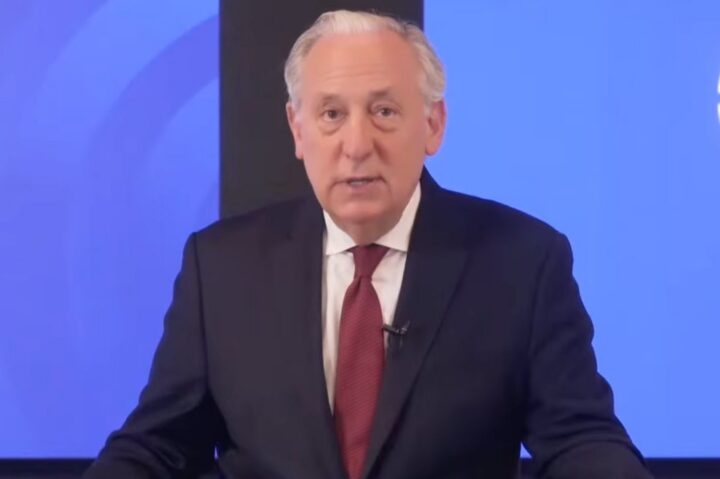
JFNA
JFNA CEO Eric Fingerhut delivers the inaugural State of the Jewish Union address in Washington, Feb. 19, 2026.
As antisemitic incidents continue to roil Jewish communities nationwide, Jewish Federations of North America CEO Eric Fingerhut called on Congress to increase funding for the Nonprofit Security Grant Program to $1 billion annually and to “make the program more flexible and simpler to use.”
Fingerhut also called on governors to support an educational tax credit on Thursday during JFNA’s inaugural “State of the Jewish Union” address at the organization’s Washington headquarters.
Fingerhut urged lawmakers to provide federal support for security personnel so that schools and synagogues don’t need to cover the costs; expand the FBI’s capabilities to detect and disrupt domestic terrorism; increase support for state and local law enforcement protecting Jewish institutions; hold social media companies accountable for antisemitic hate and incitement to violence through their platforms; and prosecute hate crimes “aggressively.”
The call for increased security comes as American Jews have faced several high-profile hate crimes in the past year, including the recent arson attack at Mississippi’s largest synagogue. Less than two weeks after the attack on Congregation Beth Israel in Jackson, Congress put forward a budget of $300 million for NSGP for 2026. While that figure is a small increase from the funding provided in 2024 and 2025, it is lower than the allocations initially proposed by both the House and Senate and the amount requested by Jewish leaders.
American Jews have responded to the increase of hate and the Oct. 7 Hamas attacks in what JFNA coined as “the surge,” describing a rise in Jews engaging or seeking to engage more in communal life.
According to the organization, enrollment in Jewish schools and camps remains high. “This is why we strongly support the new federal education scholarship tax credit and urge all 50 states to opt in so the funds can reach the families and schools in every community,” Fingerhut said on Thursday.
JFNA confirmed to Jewish Insider that the group plans to hold sideline meetings with state leaders on Friday during the National Governors Association summit in Washington to encourage Democratic governors to participate in the education tax credit, which would create supplemental funding for scholarships for Jewish day school and yeshiva education.
Though the anti-Israel encampments and disruptive protests that plagued college campuses in the immediate aftermath of Oct. 7 and the ensuing Israel-Hamas war have largely died down, a larger percentage of Jewish college students report having experienced antisemitism than ever before. Fingerhut encouraged passage of the bipartisan Protecting Students on Campus Act, which would require federally funded colleges and universities to inform students of their civil rights under Title VI and provide accessible information on how to file discrimination complaints.
“The state of the Jewish union in America is strong, but it is being tested,” said Fingerhut. “We are united in our commitment to America and to Jewish life, even as we worry about the real threats of violence and the growing acceptance of antisemitic rhetoric.”
Following Fingerhut’s address, three heads of local federations shared challenges in addressing security and social needs in their communities. Rabbi Noah Farkas, president and CEO of the Jewish Federation of Greater Los Angeles; Scott Kaufman, president and CEO of the Greater Miami Jewish Federation; and Miryam Rosenzweig, president and CEO of the Milwaukee Jewish Federation echoed that — despite varying degrees of antisemitism in their communities — there is a significant “antisemitism tax,” an increased financial burden to protect Jewish institutions.
“Every dollar we’re spending [on security] we can’t spend on the ‘joy’ part of being Jewish,” said Kaufman.
The lawmakers said NSGP funds should not be used ‘to reinforce other policy priorities’ as new conditions may require organizations to cooperate with immigration enforcement and curb DEI programs

Kevin Carter/Getty Images
U.S. Capitol Building on January 18, 2025 in Washington, DC.
A bipartisan group of 82 House lawmakers wrote to Homeland Security Secretary Kristi Noem on Thursday urging her to roll back new conditions placed on applications for the Nonprofit Security Grant Program amid rising antisemitic attacks.
The bipartisan support for the letter is particularly notable given that, while Democrats have been raising concerns about the conditions for months, Republicans have, publicly, been comparatively quiet.
“We are writing to you today to express our desire to ensure that the NSGP is adequately funded and unimpeded by new requirements that are unrelated to the security of grant recipients and their communities,” the letter, led by Reps. Max Miller (R-OH), Brad Schneider (D-IL), Josh Gottheimer (D-NJ) and Michael McCaul (R-TX), reads. “Insufficient funding or unnecessary obstacles to obtaining grants could undermine the right of every religious community to freely and peacefully worship and congregate without fear.”
The letter states that new conditions issued by DHS in April 2025 “create new compliance requirements for recipients that will divert limited funds and restrict the religious conscience of synagogues, schools, and other institutions pivotal to our communities.”
The new conditions may compel religious institutions to cooperate with immigration enforcement activities and eliminate diversity, equity and inclusion programs.
“We encourage DHS to work to make compliance with NSGP requirements as simple and streamlined as possible. We also request that DHS ensures NSGP remains a program designed to protect the security of houses of worship, not to reinforce other policy priorities,” the lawmakers wrote. “In this time of rising antisemitic terror attacks and violence against diverse faith-based institutions, we believe it is crucial that NSGP remains a critical resource for all who seek to worship in safety and free from partisan politicization.”
They called on Noem to issue new guidance that “waives any terms and conditions that do not directly relate to the grant’s purpose, which is to help qualified institutions improve their security against increasing threats.”
The lawmakers emphasized the clear need for and lifesaving impact of NSGP funds in a time of increased hate-motivated violence. They also thanked Noem for her “ongoing support” for the program.
DHS has not yet awarded grants from the 2025 grant cycle, and lawmakers have accused the administration of withholding critical information about which institutions have received funding under separate grant rounds. Democrats have alleged the department is mismanaging the program.
Funding for the grants in 2026 — thought to be finalized just weeks ago — was again thrown into question last week when lawmakers agreed to reopen negotiations over the Department of Homeland Security funding package for the year following the deadly shootings by immigration agents of two U.S. citizens in Minneapolis.
“The Nonprofit Security Grant Program is one of the most vital programs protecting the Jewish community. We continue to encourage every Jewish institution with heightened security needs to apply for these funds,” Jewish Federations of North America CEO Eric Fingerhut said. “We have also heard from our community that the current terms and conditions have had the unintended effect of deterring some organizations from applying, which is why we believe they should be updated appropriately.”
“At a time of rising violence and hatred targeting houses of worship, NSGP is an essential lifeline for synagogues and other faith-based institutions seeking to protect their congregants,” said Lauren Wolman, ADL’s senior director of government relations and strategy. “We are grateful for the bipartisan effort to ensure DHS requirements remain clear, consistent, and focused on what matters most — helping at-risk nonprofits protect themselves from threats. Organizations must be able to access these resources quickly, with confidence, and without unnecessary delays.”
“Jewish and other communities facing violent threats deserve to know that the government is prioritizing their safety, not politicizing it,” Amy Spitalnick, the CEO of the Jewish Council for Public Affairs, said. “Yet the chaos created by these new terms and conditions has only created more vulnerability for communities, who are worried that they’ll be forced to choose between their core religious beliefs and their basic security — a concern we’ve been raising for months.”
“We appreciate Reps. Miller and Gottheimer for helping lead this important bipartisan call to clarify that NSGP should not be used for anything other than the security of our communities,” Spitalnick continued.
The total falls short of what Jewish leaders were advocating for, amid a rise in antisemitic attacks
Brandon Bell/Getty Images
A law enforcement vehicle sits near the Congregation Beth Israel synagogue on January 16, 2022 in Colleyville, Texas.
With worshippers at Beth Israel Congregation in Jackson, Miss., still reeling from a Jan. 10 arson attack that severely damaged the historic synagogue, Congress appears poised to provide $300 million for the Nonprofit Security Grant Program for 2026, a small boost from the funding provided in 2024 and 2025.
But that figure is lower than the allocations initially proposed by both the House and Senate, even as antisemitic events, such as the arson in Jackson, continue to rock the Jewish community. And it is significantly less than the target level of $500 million to $1 billion for the program requested by congressional advocates and Jewish groups.
Lauren Wolman, senior director of government relations and strategy at the Anti-Defamation League, said the allocation “acknowledges the very real threats facing houses of worship and other at-risk nonprofits.”
“But [the $300 million] falls far short of what is needed and represents a step back from the bipartisan funding levels previously secured in both chambers,” Wolman continued. “Demand for NSGP continues to dramatically outpace available resources, and underfunding this program leaves vulnerable communities exposed. We will continue working with Congress to secure increased funding in the next funding cycle to ensure at-risk communities have the protection they need.”
The funding, part of the Homeland Security budget, may also suffer from additional friction amid Democratic opposition to the package, linked to concerns about Immigration and Customs Enforcement operations throughout the country. It is not yet guaranteed that the package will actually pass, with key Democrats, including Sen. Chris Murphy (D-CT), the ranking member of the Senate Appropriations Committee’s Homeland Security Subcommittee, announcing their opposition to the bill.
The program was funded at $274.5 million in both 2024 and 2025, with an extra infusion of $400 million as part of the 2024 National Security Supplemental bill. In 2024, the $274.5 million allocation funded just 43% of applications, which totaled nearly $1 billion in funding requested. The 2025 funding still has not been distributed amid ongoing delays at the Federal Emergency Management Agency, which administers the program.
The House voted last year to approve a 2026 funding bill with $335 million for the program, while Senate Republicans proposed $330 million. The final level of $300 million is just shy of the $305 million provided in 2023, the highest annual funding level ever provided for the program. That $305 million covered 42% of applications — before the post Oct. 7, 2023, global surge in antisemitism.
Jewish groups that advocate for the NSGP praised the allocation while also saying that they would continue to fight in future years for additional funding to meet the community’s full needs. Some noted that the funding boost was particularly significant at a time when DHS is overshooting budget targets and funding for many DHS grant programs is being significantly constrained.
Nathan Diament, the executive director of the Orthodox Union Advocacy Center, said that the $300 million “is not the overall number we were pushing for, but in the context of the DHS bill being more than $1 billion over their topline number, and lots of other things getting cut … we got an increase for NSGP. It’s a result we can work with.”
Diament also noted that the OU hopes that the funding for the NSGP can “go further” this year with $5 million in Justice Department grant funding earmarked to support local law enforcement in protecting religious facilities, funds he said will relieve expenses that communities have traditionally paid out of pocket to off-duty police to protect their institutions.
He also noted that if the bill fails to pass, there could be opportunities for further negotiations on the NSGP funding.
Eric Fingerhut, the CEO of the Jewish Federations of North America, said that the funding boost over 2024 and 2025 “is an important step in the right direction.”
“Still, threats to the Jewish community are more frequent, visible, and normalized than ever before, and while Federations invest heavily in our communal safety, the cost for securing our community alone stands at an estimated $775 million a year. We look forward to working with Congress to use any vehicle possible to further increase funding for this life-saving program,” Fingerhut continued.
Sens. James Lankford (R-OK) and Jacky Rosen (D-NV), co-chairs of the Senate task force on combatting antisemitism, proposed that the Senate advance a package of legislation to protect religious communities, including supplemental funding for the NSGP.
Michael Masters, CEO of the Secure Community Network, said SCN is “pleased to see renewed funding for this program, alongside critical funding for law enforcement and public safety through the State Homeland Security and Urban Areas Security Initiative programs. With recent attacks on Jewish museums, events, and synagogues, these programs are vital to allowing people of faith to gather in peace.”
“Continued investment in the Nonprofit Security Grant Program — which has allowed for life-saving physical security solutions to be installed in houses of worship, schools, and community centers — is critical to the safety of the Jewish community, faith communities, and nonprofits throughout the country,” Masters continued.
Rabbi Avi Schnall, director of federal education affairs for Agudath Israel of America, said that Agudath Israel is “happy that the [NSGP continues] to be funded. We look to the future and feel as if a much greater amount needs to be allocated.”
He continued: “$300 million is an improvement from last year’s $274.5 million, but it falls very short of the $500 million ask that’s been brought up by [Senate] Minority Leader [Chuck] Schumer (D-NY) and others over the last couple of years. And we’re hopeful, as Congress resumes the negotiations for the next budget, that hopefully a significant increase will be included in that one. As hate incidents in general … increase, and particularly in the Jewish community that’s seeing an unprecedented increase in attacks, now’s the time to increase protection and prevention more than ever.”
Schnall said Agudath Israel “look[s] forward to working with Congress to ensure that future budgets [reflect] the needs of the broader community.”
The explanatory report accompanying the Homeland Security funding bill also instructs the administration to release a report within 90 days on how DHS is implementing the Trump administration’s executive order on antisemitism and the U.S. national strategy on antisemitism, formulated under the Biden administration.
The Homeland Security funding package was also paired with the 2026 defense funding package, which includes $500 million for cooperative missile defense programs with Israel, as expected under the U.S.-Israel memorandum of understanding, as well as increased funding for other cooperative programs such as $80 million for the counter-tunneling program, $75 million for counter drone and directed energy programs and $47.5 million for developing military applications of emerging technologies like AI and quantum computing.
The lawmakers urged the DHS secretary to wave any terms ‘that do not directly relate to the grant’s purpose,’ potentially referencing immigration and anti-DEI conditions imposed on the program

Anna Moneymaker/Getty Images
Department of Homeland Security Secretary Kristi Noem speaks during a TV interview with Fox News outside of the White House on March 10, 2025 in Washington, DC.
The members of the Congressional Jewish Caucus — every Jewish House Democrat — wrote to Secretary of Homeland Security Kristi Noem on Wednesday urging her to rescind new conditions — presumably related to immigration enforcement and diversity programs — instituted earlier this year on recipients of Nonprofit Security Grant Program funding.
“We are writing to you today to express our strong desire to ensure that the NSGP is adequately funded and unimpeded by new requirements that are unrelated to the security of grant recipients and their communities,” the letter reads. “Insufficient funding or unnecessary obstacles to obtaining grants could undermine the right of every religious community to freely and peacefully worship and congregate without fear.”
The lawmakers charge that new conditions for the grant program promulgated in April “create onerous new compliance requirements for recipients that will divert limited funds and restrict the religious conscience of synagogues, schools, and other institutions pivotal to our community,” and call on Noem to issue new guidance waiving any terms “that do not directly relate to the grant’s purpose, which is to help qualified institutions improve their security against increasing threats.”
The letter does not directly spell out which conditions the lawmakers are addressing, but congressional Democrats and some in the Jewish community have previously raised concerns about new language in some grant materials indicating that grants may be contingent on cooperation with federal immigration enforcement and eliminating Diversity, Equity and Inclusion programs.
“[W]e reject any efforts to force Jewish and other houses of worship and institutions to choose between vital security funding and expression of their core religious freedoms, as well as their faith teachings and values,” the lawmakers wrote. “In this time of increased hate crimes against minorities, and in particular rising antisemitism, we believe it is crucial that NSGP remains a critical resource accessible to all communities in need and free from partisan politicization.”
The lawmakers also emphasized that members of Congress on both sides of the aisle have supported a “streamlined, effective program with minimal red tape and compliance requirements.”
The letter was signed by Reps. Jerry Nadler (D-NY) and Brad Schneider (D-IL), the co-chairs of the Jewish caucus, and Reps. Debbie Wasserman Schultz (D-FL), Becca Balint (D-VT), Dan Goldman (D-NY), Seth Magaziner (D-RI), Josh Gottheimer (D-NJ), Jamie Raskin (D-MD), Steve Cohen (D-TN), Suzanne Bonamici (D-OR), Lois Frankel (D-FL), Jake Auchincloss (D-MA), Mike Levin (D-CA), Kim Schrier (D-WA), Laura Friedman (D-CA), Sara Jacobs (D-CA), Jan Schakowsky (D-IL), Greg Landsman (D-OH) and Jared Moskowitz (D-FL).
“The Nonprofit Security Grant Program has been a lifeline as we face rising antisemitism, hate, and extremism — but these politically-motivated grant requirements threaten to force our communities to choose between their safety and their core religious values,” Jewish Council for Public Affairs CEO Amy Spitalnick said in a statement about the letter, which specifically referenced the immigration and DEI language. “The fact is that the NSGP is simply too important to be politicized to advance the administration’s agenda..”
JCPA has previously urged the administration directly to repeal the conditions.
A coalition of major Jewish communal and security organizations, including the Jewish Federations of North America, Conference of Presidents of Major American Jewish Organizations, Anti-Defamation League, Secure Community Network, Community Security Initiative and Community Security Service issued a joint statement in September urging institutions to apply for the grants in spite of any concerns that they may have about the new criteria.
Major Jewish advocacy organizations told JI that they will continue to push for issues including Nonprofit Security Grant Program funding and combating antisemitism online
Worawat/Adobe Stock
U.S. Capitol Building
Going into 2026, Jewish community groups say their advocacy priorities for Congress and the federal government remain largely consistent, with a focus across many of the major advocacy organizations on bolstering community security through the Nonprofit Security Grant Program and tackling antisemitism online.
While Congress has increased its attention to Jewish communal issues in the years since the Oct. 7, 2023 Hamas attacks on Israel, including a string of high-profile hearings on antisemitism and several bills passed to support Israel and combat Iran, many key legislative priorities for the Jewish community — including bills on antisemitism and substantial increases to annual security funding for nonprofits — have remained stubbornly intractable.
Highlighting the expansion of congressional scrutiny of unions, academic associations and tech platforms for their fostering of antisemitism, top Anti-Defamation League officials said that advocating for such oversight work will remain a priority in the coming year, particularly in an environment in which it is difficult to pass any legislation, regardless of the subject.
“We’ll continue focusing on tough oversight, on bipartisan legislation and targeted appropriations,” Lauren Wolman, the ADL’s senior director of government relations and strategy, told Jewish Insider. “The big buckets are that we’ll be pushing Congress to confront antisemitism wherever it appears, including within one’s own party; protecting houses of worship with increased security funding; demanding real transparency and accountability from tech platforms; advancing comprehensive federal legislation to counter antisemitism and taking action to ensure that Jewish students are safe on campus.”
Asked about how the organization plans to ensure progress on legislation that has been difficult to achieve in past years, Wolman emphasized that there had been “historic momentum” this year for increased security funding, and said that ADL would “focus on levers that move policy, so oversight, legislation, appropriations” and leverage “the value of transparency, bipartisanship and coalitions.”
Max Sevillia, the ADL’s senior vice president of national affairs, said that the organization will focus on must-pass legislation such as appropriations and the National Defense Authorization Act, and emphasized that “legislating on any issue, including fighting antisemitism, oftentimes, is not a one-session effort. So we don’t give up on our priorities.”
He said that, even if major legislation did not pass this session, the group is “better positioned” to advance key priorities with the additional attention they’ve received since Oct. 7.
Sevillia said that the HEAL Act, examining Holocaust education; the Protecting Students on Campus Act, which aims to facilitate Title VI discrimination complaints; and the Pray Safe Act, which would create a central database of security resources for institutions, will remain priority bills in the new year.
ADL is also supporting the Platform Accountability and Transparency Act (PATA), a bipartisan Senate bill that would require social media companies to share additional data with the public and with researchers, including regarding hate incidents and policies, and how platforms are responding to them.
“Congress really needs to require platforms to provide meaningful transparency into content moderation practices, algorithmic amplification and enforcement of their hate speech policies,” Wolman said.
Wolman said the ADL also continues to pursue a “comprehensive … whole-of-government” package of legislation on antisemitism, a prospect that has remained elusive. The Countering Antisemitism Act, a package along those lines, received bipartisan support in the previous Congress, but ultimately proved unwieldy — facing opposition on both sides of the aisle in both chambers.
Wolman said that ADL will be pressing Congress to focus on college campuses, K-12 education, academic professional associations, health care and technology platforms, including Wikipedia and artificial intelligence, in its oversight capacity and for potential hearings next year.
Sitting down with JI on Capitol Hill earlier this month, American Jewish Committee CEO Ted Deutch said that his organization’s priorities for the remainder of 2025 included urging lawmakers to stand with the Jewish community and attend menorah lightings in the wake of the Sydney, Australia, shooting targeting a Hanukkah celebration on Bondi Beach.
Going into 2026, the group is also focused on pressing lawmakers to tackle antisemitism online, particularly ensuring social media companies are addressing the foreign actors driving much of that content, as well as the antisemitism that has proliferated in AI-generated posts.
The new X policy disclosing users’ locations “confirm[ed] what we all know, which is there is this ongoing effort by malign actors around the world to influence what happens here, to stoke antisemitism, to polarize our community,” Deutch said.
Deutch said that AJC also looks forward to working with Ambassador Yehuda Kaploun, who was confirmed this month as the Trump administration’s special envoy to monitor and combat antisemitism. Additionally, the group is pressing the Department of Justice to take action to address protests that block access to religious institutions. He said AJC is open to supporting new legislation on the subject, if necessary.
In his interview with JI, Deutch also urged Jewish communal organizations to come together around a common agenda, arguing that the current security environment demands a unified message and a coordinated push.
The Jewish Federations of North America will be focused on the six-point security plan laid out by many major Jewish groups following the Capital Jewish Museum shooting earlier this year, which includes massive increases to security grant funding and efforts to address antisemitism online, as well as antisemitism in K-12 and higher education and mental and physical health care spaces; the Holocaust Survivor Assistance Program and social safety net programs such as SNAP and Medicaid.
“I think security and combating antisemitism are top of mind across our community, and that’s clearly reflected in our aggressive work to increase nonprofit security funds, tackle hate on social media, and advance our six-point security plan,” JFNA CEO Eric Fingerhut told JI.
“But we aren’t forgetting other critical issues that we care about, including legislation supporting Holocaust survivors and protect[ing] the most vulnerable in our communities,” Fingerhut continued. “With our new flagship public affairs office up and running, we are also expanding our investment to ensure local Federations come to Washington regularly to strengthen our relationships on the Hill.”
Nathan Diament, the executive director of public policy for the Orthodox Union, said that OU’s priorities will include additional NSGP funding, allocating resources from the Department of Justice for Jewish community security, implementing the Educational Choice for Children Act — legislation passed in this year’s reconciliation bill creating tax credits for educational scholarships — and, like AJC, urging the Department of Justice to “aggressively prosecut[e] those who mount ‘protests’ at Shuls.”
In the pro-Israel space, a source familiar with AIPAC’s plans told JI that the group’s general priorities next year will include expanding U.S.-Israel collaboration in security, technology and economic spaces; supporting U.S. aid to Israel; highlighting the ongoing security threats to Israel, including Iran’s efforts to rebuild its missile arsenal and nuclear program and its support for proxies; and working to achieve Hamas and Hezbollah’s disarmament.
The source said AIPAC will release a more comprehensive agenda early next year.
The Connecticut senator said he was ‘struck by the severely heightened anxiety’ among local leaders about threats to places of worship

Jemal Countess/Getty Images for Fair Share America
Sen. Richard Blumenthal speaks at a rally at the Capitol on April 10, 2025 in Washington, DC.
Sen. Richard Blumenthal (D-CT) wrote to Secretary of Homeland Security Kristi Noem on Tuesday pushing for additional information about Nonprofit Security Grant Program allocations, as well as criticizing the funding allocation proposed last week by Republicans on the Senate Appropriations Committee.
“As I travel around Connecticut and hear from community leaders here and around the country, I am struck by the severely heightened anxiety and apprehension about physical threats to places of worship and community centers involving hate-based violence,” Blumenthal said. “One of the most important tools at our disposal to combat such hate and protect religious institutions and minority communities is the Federal Emergency Management Agency’s (FEMA) Nonprofit Security Grant Program (NSGP).”
Blumenthal said it is “critical for Congress to have fulsome data” about the program as it works to finalize 2026 government funding, and requested data on grant applications and acceptances, the reasons why FEMA has provided less funding than requested to some institutions and the resources FEMA provided to unsuccessful applicants for each year from 2023 to 2025.
He asked Noem to submit the data by Jan. 6, 2026.
Blumenthal also said he’s “disappointed” by the proposed funding level of $330 million for the program in 2026 offered by Senate Republicans, which falls “far short of my request and the program’s clear need, with reports indicating recipients requested approximately $1 billion from FEMA in 2024 alone.”
A source familiar with the legislation noted to Jewish Insider the Senate bill includes a 20 percent increase over its 2025 funding level, a greater increase than provided for other grant programs in the bill that generally saw increases of 11 percent to 15 percent.
The explanatory report accompanying the Senate GOP bill also includes language requesting more specific data from FEMA about past grant applications and acceptances.
The figure falls short of the $500 million to $1 billion requested by lawmakers and Jewish community advocates
(Photo by Chip Somodevilla/Getty Images)
Sen. Susan Collins (R-ME) in the Dirksen Senate Office Building on Capitol Hill on December 9, 2025 in Washington, DC.
Senate Appropriations Committee Republicans, in a long-delayed Homeland Security funding bill released on Friday, proposed a modest increase in funding for the Nonprofit Security Grant Program to $330 million.
The program was funded at $274.5 million in 2025 — not counting supplemental funds included in the 2024 national security supplemental bill. The Senate’s proposed increase comes in far below the $500 million to $1 billion that Jewish community advocates and supporters of the program on Capitol Hill have called for.
The proposal is also slightly below the $335 million approved by the House in its version of the bill earlier this year. The Senate proposal sets off a sprint to finalize 2026 government funding when Congress returns in January, ahead of an end-of-month deadline.
With $305 million available in 2024, the program funded less than half of applications, with nearly $1 billion in total funding requested. The Department of Homeland Security has not yet closed or finalized grant applications for 2025, and has not released data on application or acceptance rates for supplemental funding rounds earlier this year.
The explanatory report accompanying the bill — likely reflecting congressional concerns around a lack of transparency about the program — directs the Federal Emergency Management Agency to provide within 180 days a report on 2023, 2024 and 2025 funding grants, the number of applications, and “any quantitative or qualitative results or other outcomes related to such.”
“FEMA is also encouraged to utilize NSGP grants to help nonprofits detect and respond to threats,” the report continues. “The Committee further notes that eligible uses of NSGP grant funding include the acquisition of technology providing immediate notification to emergency 911 services; real-time, actionable intelligence directly to law enforcement and first responders; and other DHS-certified technology designed to prevent and respond to terrorism and other threats.”
It had been unclear just days ago if the Senate Appropriations Committee would release a Homeland Security bill at all, with the top Democrat on the subcommittee, Sen. Chris Murphy (D-CT), saying he was unsure where the process stood and a Republican member telling Jewish Insider that a full-year continuing resolution — which would continue 2025 funding levels through 2026 — was a possibility.
A spokesperson for Murphy told JI the bill was a GOP product, not, as has been standard, a negotiated draft among both parties.
Lauren Wolman, the Anti-Defamation League’s senior director of government relations and strategy, said that the allocation “is a major step forward and reflects the gravity of the threats facing Jewish communities today.”
“Demand for this program continues to far outpace available funding, and we urge Congress to ensure every at-risk nonprofit can access the security resources it needs,” Wolman continued.
Nathan Diament, the executive director of public policy for the Orthodox Union, said that the Senate proposal is “a useful start to the process.”
“Obviously, in light of recent events, we will be working with our partners to increase that funding level in the final bill,” Diament said. “We appreciate that the Senate bill is on par with what the House reported out earlier this year.”
Michael Masters, the CEO of the Secure Community Network, emphasized that the NSGP funding is critical.
“SCN is deeply appreciative of the Committee’s continued commitment to protecting faith-based communities in today’s unprecedented threat environment. The Nonprofit Security Grant Program has proven time and again to save lives by helping institutions targeted by terror and hate to deter, prevent, and respond to attacks,” Masters said. “At a time when the faith-based community has continued to find itself under attack, this funding is essential to safeguarding communities and preserving our ability to gather and worship — a fundamental right we must fight to preserve, as Americans.”
Rachel Dembo, director of policy and government relations for the Jewish Federations of North America, thanked the committee for the proposal.
“This is a meaningful step forward as threats to faith communities remain high, particularly for the Jewish community,” Dembo said in a statement. “While more work remains to be done, we urge lawmakers to conference and pass this annual funding bill and keep building toward funding levels that reflect today’s threat environment.”
For the American Jewish community, the prospects for much-needed help from the federal government in the form of additional Nonprofit Security Grant Program funding remain unclear
Brandon Bell/Getty Images
A law enforcement vehicle sits near the Congregation Beth Israel synagogue on January 16, 2022 in Colleyville, Texas.
The massacre in which 15 people were killed at a Hanukkah celebration at Bondi Beach in Sydney, Australia, on Sunday has once again brought the Jewish community’s security vulnerabilities into stark focus.
But for the American Jewish community, the prospects for much-needed help from the federal government in the form of additional Nonprofit Security Grant Program funding remain unclear.
The Senate Appropriations Committee’s homeland security subcommittee still hasn’t released a draft bill for 2026, greatly increasing the chances of a full-year continuing resolution that would keep funding for the program flat, at $274.5 million, a level that advocates and proponents on the Hill and Jewish groups say is severely insufficient. The House has passed its own version of the bill with $335 million in funding for the program.
Eric Fingerhut, the CEO of the Jewish Federations of North America, told JI, “The events in Australia and California these past days are terrible reminders of the violent antisemitism Jewish communities face. We’ve worked to ensure that every Federation community has a professional security program and director, but at the end of the day it is the government’s responsibility to keep its citizens safe from terrorism, and that’s why it is critical to both ensure that the Nonprofit Security Grant Program is fully funded and not allowed to lapse.”
Multiple lawmakers on the committee and those who follow the NSGP funding process closely said they have little clarity on the state of play on the funding bill, including subcommittee ranking member Sen. Chris Murphy (D-CT) and Sen. James Lankford (R-OK), a co-chair of the Senate antisemitism task force.
Sen. John Kennedy (R-LA), who serves on the homeland security subcommittee, told JI that a full-year continuing resolution is “a real possibility” at present, noting that the legislation “is always tough to put together.”
But Kennedy said there are other ways to boost funding for the grant program. “There’s no reason we can’t do that [add more money for NSGP] if we end up with an omnibus for the remainder of the bills that don’t pass. But every day that goes by that we don’t do something on [Appropriations], an omnibus or CR looks more and more likely,” Kennedy told JI.
Government funding runs out again at the end of January, so lawmakers will need to put together a plan quickly on how they plan to proceed when they return from the holidays.
Grant funding allocations for this year also remain pending — the administration announced applications months ago, but lawmakers have repeatedly raised concerns about unclear timelines and a failure by the Department of Homeland Security to conduct statutorily required outreach programs.
Lankford told JI, “I’ve been calling all year” for the funding to be disbursed, but indicated he hasn’t heard any updates.
Looking into next year, the agenda for combating antisemitism on Capitol Hill also remains unclear. The momentum from Jewish communal institutions and lawmakers that in 2024 drove a push for the Antisemitism Awareness Act has largely died down. It’s been months since the last hearing on antisemitism — once a regular occurrence after Oct. 7, 2023. The volume of legislation introduced and congressional letters on the issue has also seemed to flag.
It’s still early, but there’s little sign that the events of this weekend are fundamentally altering the inertia that seems to have set in on antisemitism policy. Which raises the question: what can?
The legislation would implement new transparency measures and consistent standards for how DHS allocates grant funding
Nathan Posner/Anadolu via Getty Images
Rep. Bennie Thompson (D-MI) speaks at a press conference on the introduction of a House Resolution condemning January 6th pardons and the firing of DOJ prosecutors, in Washington, DC on February 5, 2025.
After repeatedly raising concerns about slow progress, a lack of transparency and a lack of accountability for Department of Homeland Security grant programs this year, including the Nonprofit Security Grant Program, Democrats on the House Homeland Security Committee introduced legislation on Tuesday that aims to put in place stricter guidelines for the management of such programs.
Reps. Tim Kennedy (D-NY) and Bennie Thompson (D-MS) are leading the DHS Grants Accountability Act, which — according to an information sheet from its sponsors — would implement new transparency measures and consistent standards for how DHS allocates grant funding, require FEMA to allow applicants at least 30 days to prepare and submit their applications and to open applications within 60 days of when funding is appropriated and mandate that FEMA award grants annually.
The legislation comes after lawmakers raised concerns about the Trump administration’s management of various DHS grant programs, including the NSGP. The application process for the 2026 NSGP allocations opened months late and on a significantly reduced timeline, and lawmakers have raised concerns about a lack of transparency from DHS and other issues with NSGP’s management this year.
“I am proud to lead legislation that makes commonsense, necessary reforms to restore fairness and predictability to FEMA’s suite of preparedness grant programs,” Kennedy said in a statement. “When local needs are placed at the forefront of these funding decisions, communities can focus on what matters most: keeping people safe.”
Thompson, the ranking member of the House Homeland Security Committee, said the bill would “clarify congressional intent and ensure that FEMA awards grants based on need and in a timely and reliable manner” and “keep our preparedness grants consistent and transparent, giving States and local partners the stability they need to keep our communities safe.”
Without Republican support, the legislation is unlikely to move forward in the current Congress.
More than 30 House Democrats criticized the management of the 2025 Nonprofit Security Grant Program, saying that a lack of information provided by DHS is severely hampering applications
JIM WATSON/AFP via Getty Images
Committee ranking member Representative Bennie Thompson, Democrat from Mississippi, speaks during a House Committee on Homeland Security hearing with testimony from US Secretary of Homeland Security Kristi Noem on fiscal year 2026 budget requests, on Capitol Hill in Washington, DC, May 14, 2025.
A group of more than 30 House Democrats wrote to leaders at the Department of Homeland Security on Tuesday criticizing their management of the 2025 Nonprofit Security Grant Program, saying that a lack of information provided by DHS is severely hampering applications to and implementation of the critical program.
The lawmakers criticized DHS and the Federal Emergency Management Agency for publishing the application for the grants months behind schedule, and, they allege, failing to provide “basic information necessary to move the application process forward and to fruition,” including specific timelines for the grants and applications, which the Democrats said still have not been provided.
“States have repeatedly asked FEMA for this information, and they have received no response,” the lawmakers continued. “This has also created a chilling effect on faith-based and nonprofit organizations that are hesitant to participate in an opaque application process.”
The lawmakers stated that the delays in allocating 2025 funding are concerning given the ongoing spate of attacks on religious institutions across the country, including a Catholic church in Minneapolis, a Latter-day Saints church in Michigan and the Capital Jewish Museum in Washington.
They also said that FEMA has failed to engage in educational and outreach programs to prospective applicants about the grants and the application process — programs that are required under law.
“Because of FEMA’s delays and lack of coordination and communication with States, many States have already opened and closed the application period for nonprofit organizations, meaning that any outreach from FEMA at this point would be too late,” the letter continues. “Other States have not opened the application process and have not communicated with faith-based and nonprofit stakeholders, leaving the process and the potential applicants in limbo.”
The Democrats criticized DHS for ignoring bipartisan requests from Congress to share the names of organizations awarded NSGP funding under a supplemental funding round earlier this year, which had been standard procedure in the past.
They also said DHS has added burdensome new requirements on state administrators for nonprofits that are seeking reimbursements for security costs from grants that have already been provided, slowing down reimbursements, increasing administrative costs and discouraging further applications.
The letter also raises concerns about language included in some NSGP materials suggesting that the grants could be conditioned on compliance with immigration enforcement efforts and alleges that DHS may be attempting to ban Muslim organizations from receiving security funding. The administration has already pulled funding from some Muslim groups with alleged ties to terrorism.
“FEMA must take immediate steps to get the FY 2025 NSGP back on track so that FY 2026 can proceed without the present delays, inconsistencies and uncertainties, and lack of uniformity and predictability that have previously been the hallmarks and guardrails for a program serving several thousand faith-based and nonprofit applicants each grant cycle,” the letter concludes.
The lawmakers urged DHS and FEMA to take immediate action to rectify the series of concerns they outlined and move the 2025 grant process ahead quickly.
The letter was led by Rep. Bennie Thompson (D-MS), the ranking member of the House Homeland Security Committee, and co-signed by Reps. Eric Swalwell (D-CA), Lou Correa (D-CA), Shri Thanedar (D-MI), Seth Magaziner (D-RI), Dan Goldman (D-NY), Delia Ramirez (D-IL), Tim Kennedy (D-NY), LaMonica McIver (D-NJ), Julie Johson (D-TX), Nellie Pou (D-NJ), Troy Carter (D-LA), Al Green (D-TX), James Walkinshaw (D-VA), Bobby Scott (D-VA), Nydia Velazquez (D-NY), Lloyd Doggett (D-TX), Ed Case (D-HI), Debbie Wasserman Schultz (D-FL), Yvette Clarke (D-NY), Andre Carson (D-IN), Dina Titus (D-NV), Tom Suozzi (D-NY), Lizzie Fletcher (D-TX), Sylvia Garcia (D-TX), Shontel Brown (D-OH), Gabe Amo (D-RI), Greg Landsman (D-OH), Jennifer McClellan (D-VA), Laura Friedman (D-CA) and Dave Min (D-CA), and Dels. Pablo Hernandez (D-PR) and Eleanor Holmes Norton (D-DC).
“It is absolutely unacceptable that the Trump administration is dragging its feet on the awarding of these vital security grants,” Pou said in a separate statement. “As domestic extremism and terrorist threats to synagogues and other religious and community centers explode, Congress appropriated these grant funds to help support readiness. Americans have an unshakeable right to worship in peace and security. Congress deserves answers and our nation deserves action from this administration.”
Plus, the minutia of a new U.S.-Israel MOU

Kevin Dietsch/Getty Images
Rep. Jerry Nadler (D-NY) leaves a House Democratic caucus meeting on February 14, 2024, in Washington, D.C.
Good Tuesday morning.
In today’s Daily Kickoff, we look at questions around a potential new Memorandum of Understanding between Jerusalem and Washington ahead of the 2028 expiration of the Obama-era MOU, and report on a push by major Jewish groups to encourage applications to the Nonprofit Security Grant Program despite the Trump administration’s imposition of additional conditions on the funds. We cover the release of a new Humash with writings from Rabbi Lord Jonathan Sacks that were edited and organized posthumously, and look at how Sergio Gor’s departure from the White House to become ambassador to India could affect the administration’s hiring decisions. Also in today’s Daily Kickoff: Rep. Jerry Nadler, Joseph Kahn and Zach Witkoff.
What We’re Watching
- We’re keeping an eye today on a number of weekend developments across the U.S. and Middle East:
- Congress is back in session today in Washington after the August recess. Driving today’s news is Rep. Jerry Nadler’s (D-NY) announcement last night that he will not seek reelection next year. More below.
- The Senate is slated to hold a procedural vote on the National Defense Authorization Act this evening. On the other side of the Capitol, the House Foreign Affairs Committee is holding a virtual briefing with U.S. Ambassador to Israel Mike Huckabee focused on the West Bank.
- In the Middle East, tensions remain high following Israeli strikes late last week that killed a dozen senior Houthi officials, including Prime Minister Ahmed al-Rahawi. The Iran-backed group retaliated several times over the weekend with ballistic missile attacks, all of which fell short or were intercepted.
- In Gaza, an Israeli strike killed Abu Obeida, Hamas’ spokesman, over the weekend. President Donald Trump, who is slated to speak from the White House at 2 p.m. today, addressed Israel’s predicament in Gaza, telling the Daily Caller on Sunday that Israel “may be winning the war, but they’re not winning the world of public relations, you know, and it is hurting them.”
- Belgium became the latest European nation to announce plans to recognize a Palestinian state at the U.N. General Assembly in New York later this month. In response to the Palestinian statehood push, Israel is reportedly considering annexing parts of the West Bank.
- Missing from the UNGA this year will likely be the Palestinian delegation, after Secretary of State Marco Rubio revoked the visa of Palestinian Authority President Mahmoud Abbas and dozens of other officials, who had planned to attend the General Assembly as well as an international gathering focused on Palestinian statehood.
What You Should Know
A QUICK WORD WITH JI’S JOSH KRAUSHAAr
Rep. Jerry Nadler (D-NY), a progressive stalwart and a longtime Democratic pillar on the House Judiciary Committee, announced his retirement Sunday evening, opening up a recently redrawn Manhattan district that the congressman has held for over three decades.
Nadler, whose district has one of the largest Jewish constituencies in the country, has long positioned himself as a progressive pro-Israel advocate, even as he broke with the organized Jewish community on some issues — most notably his support for former President Barack Obama’s Iran nuclear agreement in 2015.
But in recent months, he has emerged as being at odds with the New York Jewish community on some high-profile issues. Even as most of the leading New York state Democratic voices have held back any endorsement of far-left New York City Democratic mayoral nominee Zohran Mamdani, Nadler was one of the first House Democrats to offer the anti-Israel candidate his support — and has worked to secure support from a deeply skeptical Jewish community towards Mamdani.
Nadler has also lately become a sharp critic of the Jewish state, in contrast to his pro-Israel Jewish Democratic colleagues from his home state. In a New York Times interview announcing his departure, he accused Israel of committing mass murder and war crimes in Gaza “without question.” He told the paper that when he returns to Congress, he will support legislation withholding offensive military aid to Israel, joining a growing roster of progressive Democrats in doing so — a move that could give cover for other colleagues to follow suit.
mou minefield
Negotiations for next U.S.-Israel aid deal faces uphill battle with changing political tides

In September 2016, when President Barack Obama announced that the U.S. and Israel had signed a 10-year deal pledging a total of $38 billion in military assistance to Israel, the news was generally uncontroversial and greeted with bipartisan plaudits. That deal, known as the U.S.-Israel Memorandum of Understanding, is now close to expiring, and the next one — if there is a next one — will be negotiated in an entirely different political environment. Israel remains deeply enmeshed in a nearly two-year war in Gaza, with little indication of an end in sight, making forward-looking negotiations more difficult. A new MOU is not a given. U.S. support for Israel has dramatically declined on the left, and it is fracturing in isolationist corners of the right as well. Even some staunchly pro-Israel Republicans have grown wary of foreign aid in general, a shift that could affect U.S. policy toward Israel, Jewish Insider’s Gabby Deutch reports.
Message and meaning: “Ten-year MOUs have communicated an ongoing, consistent and bipartisan commitment to support Israel’s security by crossing administrations and demonstrating that it’s an ongoing relationship,” said former U.S. Ambassador to Israel Dan Shapiro. “It allows planning for big-ticket acquisitions.” The long-standing commitment allows Israel to plan to make large purchases that could take several years to acquire, such as fighter jets. The MOU is not actually a binding agreement, it’s a framework. Congress must still approve the $3.3 billion in military financing and $500 million in missile defense laid out in the MOU each year during the annual appropriations process, and could do so even in the absence of an MOU.
HAWKEYE STATE POLITICS
Iowa Senate primary could pit establishment, MAGA wings of GOP against each other

The newly open Senate race in Iowa could pit a House Republican seen as a conventional conservative against challengers likely to attack her from the right. The race could also be an early bellwether of the GOP’s direction as it moves toward the post-Trump era, Jewish Insider’s Marc Rod reports.
In contention: Rep. Ashley Hinson (R-IA), a former local news anchor and state representative elected to Congress in 2020, is widely seen as likely to make a run for Ernst’s seat. In the House, Hinson has a consistent record of support for the U.S.-Israel relationship and legislation to combat antisemitism, and has signed onto congressional letters criticizing international legal cases against Israel and supporting the Abraham Accords. She supported the U.S. strikes on Iran earlier this summer. Should she enter the race, she’ll face the prospect of running against lesser-known, right-wing Republicans like Jim Carlin, a former state senator who entered the race to challenge Ernst from the right. Joshua Smith, a former libertarian and podcast host, also declared his candidacy against Ernst. He has a record of anti-Israel and antisemitic commentary.
Seeing opportunity: Democrats are expected to make an aggressive bid for the seat in the general election, and several have already entered the primary race, including state Rep. Josh Turek, state Sen. Zach Wahls and Des Moines School Board Chair Jackie Norris. David Yepsen, a longtime former political writer, editor and columnist at the Des Moines Register, predicted a “really good race” in the general election, given that Democrats have already fielded several contenders, have put up strong showings in recent state special elections, have been energized by opposition to the Trump administration and have an advantage in the midterms.
NEW BLOOD
Sergio Gor’s White House departure could end ideological grip on hires
Sergio Gor’s expected departure from a key role in the White House, where he has vetted thousands of candidates for political jobs as the influential leader of the Presidential Personnel Office, is raising some questions about how his litmus tests and isolationist views will compare to his newly announced replacement, particularly with regard to national security hires. Gor, 38, was nominated by President Donald Trump last week to be U.S. ambassador to India. If confirmed by the Senate, Gor, who was also tapped as special envoy for South and Central Asian affairs, will leave behind a powerful post at which he built a reputation as an ideological gatekeeper, Jewish Insider’s Matthew Kassel reports.
Stepping into his shoes: Throughout his time in the White House, Gor has drawn attention for his unyielding focus on loyalty to Trump and — more singularly — a fierce commitment to elevating national security and foreign policy hires who share his skepticism of American engagement abroad. His successor, Dan Scavino, as the White House confirmed this week, is likewise a longtime Trump confidante who now serves as White House deputy chief of staff. But unlike Gor — whose background suggests an interest in imposing ideological litmus tests on job applicants — Scavino, 49, “has no ideology other than Trump,” according to a former top administration official.
FUNDING FRICTION
Jewish orgs urge institutions to apply for NSGP grants, regardless of questions about new conditions

A series of Jewish community groups, in a joint statement released on Tuesday, urged Jewish organizations to apply for Nonprofit Security Grant Program funding, in spite of ongoing concerns from some in the community about potential new immigration and DEI-related conditions on the funding, Jewish Insider’s Marc Rod reports.
What they’re saying: “While we are aware that questions have arisen on the part of certain religious institutions regarding the current year’s program criteria, our organizations strongly urge all eligible institutions to apply for this critical resource,” the Jewish Federations of North America, Conference of Presidents of Major American Jewish Organizations, Anti-Defamation League, Secure Community Network, Community Security Initiative and Community Security Service said in a joint statement. The groups said they have been “in regular contact with government officials who have affirmed their continued commitment to protecting the safety of all faith-based institutions and the values they hold.”
NORWEGIAN WOULDN’T
Graham floats retaliatory tariffs, visa restrictions over Norway BDS move
Sen. Lindsey Graham (R-SC) on Thursday floated the possibility of punitive tariffs and visa restrictions in response to the decision by Norges Bank Investment Management — the Norwegian sovereign wealth fund — to sell its stake in the American machinery company Caterpillar in response to the Israeli military’s use of its products in the West Bank and Gaza, Jewish Insider’s Marc Rod reports.
Retaliation threat: “To those who run Norway’s sovereign wealth fund: if you cannot do business with Caterpillar because Israel uses their products, maybe it’s time you’re made aware that doing business or visiting America is a privilege, not a right,” Graham said on X. “Maybe it’s time to put tariffs on countries who refuse to do business with great American companies. Or maybe we shouldn’t give visas to individuals who run organizations that attempt to punish American companies for geopolitical differences.”
State Department responds: “We are very troubled by the Norwegian sovereign wealth fund’s decision, which appears to be based on illegitimate claims against Caterpillar and the Israeli government,” a State Department spokesperson told JI. “We are engaging directly with the Norwegian government on this matter.”
WISDOM CARRIED FORWARD
New Humash features Rabbi Sacks’ posthumously published translations

Former British Chief Rabbi Lord Jonathan Sacks was a towering figure in Jewish life whose unique blend of Torah and Western wisdom attracted adherents around the world for many years before his death in 2020. Now, with Rosh Hashanah, the Jewish New Year, approaching later this month, and the restarting of the cycle of reading the weekly Torah portion a few weeks later, Rabbi Sacks’ longtime Jerusalem-based publisher, Koren, is releasing a posthumously completed Koren Shalem Humash, with a new translation and insights to encourage deeper understanding of the Five Books of Moses, Jewish Insider’s Lahav Harkov reports.
How it started: The story of the Koren Shalem Humash begins in 2006, Joanna Benarroch, president of The Rabbi Sacks Legacy, told JI last week. At that time, Sacks began working on his popular series of books about the weekly Torah portion, Covenant and Conversation. “He started writing it online every week,” Benarroch recalled. “He was the chief rabbi of the United Kingdom and the Commonwealth, based in London, but he started to build a global audience.” Sacks’ goals for Covenant and Conversation were “to make Torah relevant to us today, so it’s not just wisdom from 2,000-3,000 years ago today, but wisdom we can also take with us. It was very important to him for us to be proud, knowledgeable Jews and to share that with the next generation … to create new leaders who were proud, knowledgeable Jews. These were the things permeating his mind when he was writing,” Benarroch said.
Worthy Reads
Rahm Com(munism): In The Wall Street Journal, former U.S. Ambassador to Japan Rahm Emanuel, who is mulling a 2028 presidential bid, warns that domestic political division is providing an opening to malign actors, such as China, that seek to capitalize on the moment. “By 2011, the country was beset by two movements defined almost exclusively by anger and resentment. Occupy Wall Street’s antipathy to capitalism fixed the sentiment now driving Zohran Mamdani’s campaign for New York mayor. The tea party simultaneously metastasized into the MAGA movement and the riots of Jan. 6, 2021. With real violence in the offing, politics are worse than they have been in decades. … In some Shakespearean sense, China’s long shadow has appeared at exactly the right moment. But Xi Jinping is much more than a foil poised to unite Americans who would otherwise remain defined by their blue and red affinities. The China threat is both real and potent. The U.S. has never before been asked to face down a country that has three times our population, is fueled by an advanced economy, and is capable, as its leaders intend, of replacing us atop the global hierarchy.” [WSJ]
What the Australia Attacks Signal: The Atlantic’s Arash Azizi considers the motives behind Iran’s attacks on Jewish and Israeli targets around the world, following Australia’s expulsion of Iranian diplomats over Tehran’s involvement in recent antisemitic attacks in the country. “The elements organizing the attacks are ideological. They seek to burnish Iran’s image as an aggressive, revisionist actor, determined to destabilize the West and unconstrained by practical concerns. Inside the regime, this faction competes with a more pragmatic group that prioritizes trade and seeks to improve relations with the West. Those behind the hits on Australian targets may even see their activities as having a dual use: By striking synagogues and restaurants in Western countries, they intimidate their global enemies and help stymie the diplomatic agenda of pragmatists at home.” [TheAtlantic]
Hanging With Hezbollah: In The Free Press, Winston Marshall reflects on a recent trip to Lebanon and meeting with a Hezbollah member in Baalbeck. “Believe it or not, I feel sadness for the jihadi at the Baalbek mosque. His was a worldview almost completely inverted from mine. For him the good guys are Nasrallah, Assad, Khamenei, and Hitler. The bad guys are Donald Trump, Jews, and Jolani. Only on Jolani might we have found some common ground. His eyes glazed with the delirium of his cult. Rarely in my life have I come face-to-face with a man possessed with such evil. How exactly does one offer a golden bridge of reconciliation to a cult hell-bent on fighting and martyrdom? That is the impossible question Lebanon has to answer.” [FreePress]
Word on the Street
The Trump administration is planning to cut $4.9 billion in foreign aid from the State Department, USAID and other international aid groups without congressional approval, under the auspices of the Impoundment Control Act…
The Trump family’s World Liberty Financial cryptocurrency garnered $5 billion following its launch earlier this week; Zach Witkoff, a son of Middle East envoy Steve Witkoff who serves as WLF’s CEO, distanced the private company from the Trump administration but added, “clearly President Trump is the greatest president of all time”…
The U.N. Security Council voted unanimously to end the mandate of the United Nations Interim Forces in Lebanon (UNIFIL), which has been operating along the border between Israel and Lebanon for five decades, at the end of 2026…
The Washington Post reports on a postwar plan for Gaza, days after President Donald Trump convened a White House meeting on the issue, that would see the enclave enter into a 10-year trusteeship with the U.S. that would involve the temporary relocation of its residents both within and outside the Strip during the rebuilding effort…
Director of National Intelligence Tulsi Gabbard is reportedly clashing with senior CIA officials after she disclosed the name of a currently serving undercover CIA officer in a list of current and former officials whose clearances were being revoked by the ODNI…
Sens. Mark Kelly (D-AZ), Ruben Gallego (D-AZ), Peter Welch (D-VT), Tim Kaine (D-VA) and Elizabeth Warren (D-MA) urged the Trump administration to “use its full power and authority to immediately facilitate a massive surge in all humanitarian aid, and in particular infant formula, into Gaza to address this crisis”…
A Florida man was sentenced to 25 years in prison for planning attacks on Jewish and Black community sites as well as on Rep. Jared Moskowitz (D-FL)…
The Boulder chapter of “Run for Their Lives,” an organization that arranges weekly marches to advocate for the hostages held in Gaza, will no longer publicly advertise its walking route, the group announced last week, saying the decision was made “following weeks of escalating harassment and threats,” less than three months after a Molotov cocktail attack on the group left a participant dead and injured 15 others,Jewish Insider’s Haley Cohen reports…
Unknown vandals graffitied the Greenwich Village apartment building where New York Times Executive Editor Joseph Kahn lives, writing in red paint, “Joe Kahn lies Gaza dies”…
The superintendent of the Beverly Hills Unified School District struck down a school board vote to display the Israeli flag in schools and administrative buildings in the district for one month every year; Superintendent Alex Cherniss said that only the U.S. and California flags would be flown on school properties, citing “heightened safety concerns”…
The New York Post reports on financial ties between the Qatari royal family and filmmaker Mira Nair, the mother of New York City mayoral candidate Zohran Mamdani; Sheikha Al-Mayassa bint Hamad Al-Thani, the sister of the Qatari emir, has repeatedly posted on social media in support of Mamdani’s candidacy…
Police in Ontario, Canada, are investigating the stabbing of a Jewish woman at a kosher supermarket as a hate crime; days later, 32 officials from Canada’s Liberal Party, led by MP Anthony Housefather, issued a statement condemning the “deplorable rise of antisemitism in Canada”…
U.K. Prime Minister Keir Starmer tapped former Columbia University President Minouche Shafik to serve as his chief economic advisor; Shafik, an economist, departed Columbia last summer amid widespread criticism of her administration’s handling of campus antisemitism…
A Holocaust memorial in Lyon, France, was vandalized with graffiti reading “Free Gaza”…
The Wall Street Journal looks at how the IDF is struggling to get reservists, many of whom have served months of reserve duty, to continue reporting as the war grinds on toward a third year…
A flotilla of nearly two dozen boats attempting to reach Gaza departed on Monday after a failed start on Sunday due to adverse weather conditions; climate activist Greta Thunberg, who was detained and deported from Israel in May, is participating in the new flotilla effort…
The New York Times reports on concerns from Israeli tourists of harassment abroad as a result of escalated tensions resulting from the Israel-Hamas war…
GOP fundraiser Elliott Broidy, who settled a lawsuit with Qatar after being hacked, is reportedly a partner in the Israeli company KOIOS, which ran a public relations campaign on behalf of Doha…
A second former International Criminal Court staffer accused the court’s chief prosecutor, Karim Khan, of sexual misconduct; Khan, who had requested arrest warrants for Israeli Prime Minister Benjamin Netanyahu and former Defense Minister Yoav Gallant, was placed on administrative leave in May following earlier allegations that he’d acted inappropriately toward a staffer…
Gallant said in an interview with Israel’s Channel 12 that Israel should kill Iranian Supreme Leader Ayatollah Ali Khamenei in the next round of conflict between Israel and Iran…
The New York Times reports on how Israel tracked the movements of senior Iranian officials through the phone activity of their bodyguards…
Iran’s Islamic Revolutionary Guard Corps said it arrested eight people accused of sending sensitive information regarding Tehran’s military and its nuclear program to Mossad agents…
Turkish President Recep Tayyip Erdogan encouraged Iranian President Masoud Pezeshkian to continue nuclear talks with the West and reiterated Ankara’s support for Tehran…
The International Atomic Energy Agency said that a building in Syria that was destroyed by Israel in 2007 was found to have trace amounts of uranium, deepening speculation at the U.N. nuclear watchdog that the site had been used as a nuclear reactor…
Houthi terrorists stormed the Sanaa, Yemen, offices of UNICEF and the World Food Program, detaining staffers from both organizations…
Ruth Marks Eglash is now the editor of The Jerusalem Report…
Pic of the Day

At the funeral of her son Idan Shtivi on Monday, Dalit Oron mourned over the body of Shtivi, who was killed on Oct. 7, 2023. IDF forces operating in Gaza last week recovered Shtivi’s body as well as the body of hostage Ilan Weiss, who was killed on Oct. 7 while defending his community in Kibbutz Be’eri.
Birthdays
Television producer, attorney, legal analyst and celebrity reporter, he is the founder of TMZ, Harvey Levin turns 75…
Trustee of a foundation started by her husband, Harold Grinspoon, she is on the PJ Library Book Selection Committee, Diane Leshefsky Troderman turns 84… Attorney who was part of the “Dream Team” that successfully defended O.J. Simpson in 1995, he is a co-founder of three businesses, LegalZoom, Shoedazzle and RightCounsel, Robert Shapiro turns 83… One of Israel’s earliest high-tech entrepreneurs, Yossi Vardi turns 83… Rabbi of Baltimore’s Shearith Israel Congregation since 1987 and president of the Baltimore Vaad HaRabonim, Rabbi Yaakov Hopfer turns 81… Lincolnwood, Ill., resident, Tobi Rebecca Kelmer… Tech entrepreneur and consultant at Xynetics Group, Richard Mandelbaum turns 79… Member of the Knesset for the United Torah Judaism party from 1999 until 2022, Yaakov Litzman turns 77… SVP at Southern Bank & Trust, he is an honorary director of Ohef Sholom Temple in Norfolk, Va., Steven Kocen… CEO of Lionsgate Entertainment, the leading Canadian independent film studio, Jon Feltheimer turns 74… Retired president and CEO of the Jewish Federation of Greater Houston from 1987 to 2017, Lee Wunsch turns 73… Author, entrepreneur and venture capitalist, Nick Hanauer turns 66… Investigative producer for CBS News, Daniel Klaidman… Chief Washington correspondent for Newsmax, James Rosen turns 57… Founder of Israeli media organization TheMarker and a deputy publisher of the Haaretz daily newspaper, he is also a clinical professor at the University of Chicago’s Booth School of Business, Guy Rolnik turns 57… Serial entrepreneur, co-founder and chairman of Groupon, he is also the founder and CEO of Tempus AI, Eric Lefkofsky turns 56… Executive producer at PBS’s “Frontline,” Raney Aronson-Rath turns 55… Chair of Sight Diagnostics, he was previously director general of the Israeli prime minister’s office, Eliyahu David (Eli) Groner turns 55… Contemporary Jewish religious music vocalist, known by the mononym “Ohad,” Ohad Moskowitz turns 51… Chief of staff for Sen. Kirsten Gillibrand (D-NY), Jess Fassler… D.C.-based U.S. tax policy reporter for The Wall Street Journal, Richard Rubin… Actor, comedian and impressionist, Jonathan Kite turns 46… Executive editor of news for Bloomberg, the co-anchor of “What’d You Miss” on Bloomberg Television and co-host of the “Odd Lots” podcast on Bloomberg Podcasts, Joseph Weisenthal turns 45… Partner at Axiom Strategies, Ethan Zorfas turns 40… Co-lead of the U.S. tech practice at Edelman, Margot Edelman… Chief of staff at the University of Pennsylvania Carey Law School, Seth Zweifler… Former MLB baseball pitcher, he was a first-round pick in the 2013 MLB draft, now playing for the Staten Island FerryHawks, Rob Kaminsky turns 31…
Some in the Jewish community are raising concerns that grants may be contingent on cooperation with immigration authorities and eliminating diversity, equity and inclusion programs
Brandon Bell/Getty Images
A law enforcement vehicle sits near the Congregation Beth Israel synagogue on January 16, 2022 in Colleyville, Texas.
A series of Jewish community groups, in a joint statement released on Tuesday, urged Jewish organizations to apply for Nonprofit Security Grant Program funding, in spite of ongoing concerns from some in the community about potential new conditions on the funding.
Some in the Jewish community have raised concerns and expressed confusion about language present in some NSGP application materials indicating that grants may be contingent on cooperating with immigration enforcement efforts and eliminating diversity, equity and inclusion programming. The Federal Emergency Management Agency did not respond to a request for comment.
“While we are aware that questions have arisen on the part of certain religious institutions regarding the current year’s program criteria, our organizations strongly urge all eligible institutions to apply for this critical resource,” the Jewish Federations of North America, Conference of Presidents of Major American Jewish Organizations, Anti-Defamation League, Secure Community Network, Community Security Initiative and Community Security Service said in a joint statement.
The groups called the NSGP “an essential lifeline for all synagogues, schools, community centers, and other community institutions, regardless of their denomination” in light of “unprecedented threats to our communal security.”
The groups said they have been “in regular contact with government officials who have affirmed their continued commitment to protecting the safety of all faith-based institutions and the values they hold.”
They also urged organizations with further questions to contact the state-level agencies responsible for administering the NSGP grants.
Speaking to the Florida Democratic Party Jewish Caucus, the congresswoman said Israel is ‘only interested in living in peace with their neighbors’

Joe Raedle/Getty Images
Rep. Debbie Wasserman Schultz (D-FL)
Speaking to members of the Florida Democratic Party Jewish Caucus over Zoom on Wednesday, Rep. Debbie Wasserman Schultz (D-FL) accused the Trump administration of not working in good faith to combat antisemitism, discussed recent Democratic National Committee votes on Israel and offered a strong defense of Israel against a growing chorus of critics.
Wasserman Schultz argued that a series of moves by the Trump administration — attempting to place new conditions on Nonprofit Security Grant Program funding, gutting the Department of Education’s Office for Civil Rights and eliminating Justice Department programs focused on hate crimes — show that the administration’s focus on antisemitism isn’t genuine.
“None of that makes us safer, and all of it demonstrates that they don’t really care about taking care of our community. They aren’t concerned about antisemitism, they are concerned about maintaining power,” she said. “Let’s not let our community members believe the rhetoric and the BS.”
Highlighting the administration’s moves on NSGP funding, Wasserman Schultz noted the long freeze in reimbursements from the program, and said that the administration had also tried to demand that all NSGP recipients cooperate with immigration enforcement authorities and eliminate any diversity, equity and inclusion programs to make them eligible for funding.
She said that advocates had worked to ensure that the immigration demands were dropped, but said that “the DEI part is still being litigated.”
She said that universities largely “deserve the criticism and deserve to be investigated by an Office of Civil Rights that would be robustly funded. But if Trump cared about that, he wouldn’t have cut their budget in half and fired half their employees.”
The former Democratic National Committee chair also spoke about the recent DNC debate over a pair of Israel-related resolutions. One, which called for an arms embargo on Israel, was defeated, while one calling for a ceasefire, the release of hostages and humanitarian aid passed the Resolutions Committee but was then withdrawn.
“They moved past the issue, but there were many of us that had to work very hard to communicate our deep concern and opposition” to the resolution calling for an arms embargo, Wasserman Schultz said. “Thankfully, because our party does support the U.S.-Israel relationship, and because our party does believe that Israel should remain a Jewish and democratic state, that resolution was defeated.”
Addressing criticisms of Israel more broadly, Wasserman Schultz affirmed that she is a Zionist and emphasized that Hamas, by carrying out the Oct. 7, 2023, attacks on Israel, was responsible for starting the war and could end it by releasing the hostages.
“Israel … are not aggressors. They don’t engage in land acquisition. They are only interested in living in peace with their neighbors,” she said. “The wars that have occurred across the millennia have almost exclusively, and certainly in modern times exclusively, been initiated by outside terrorist groups or other countries invading Israel.”
Wasserman Schultz emphasized the need for a ceasefire, the release of hostages, the flow of humanitarian aid into Gaza and the end of Hamas as a security threat to Israel and a menace to the Palestinian people.
She blamed Hamas for the issues with humanitarian aid distribution, given the group’s theft of aid and the threat it poses to those who distribute it. “If they continue to be obstructionist and prevent humanitarian aid from getting to their own people, then they will continue to struggle.”
Wasserman Schultz said that “propaganda … is being used to make Israel look like they are the evil aggressors and oppressors,” calling it “outrageous.” She called out media photos featuring emaciated children, many of whom were revealed to have congenital diseases, as proof of mass starvation in Gaza as one example of such a phenomenon.
“We know as Jewish people that, at the end of the day, we’re very easy to blame. It is really like a reflexive, default position for far too many people. It’s embedded, it’s in societal norms,” Wasserman Schultz said. “This is happening regularly and we have to make sure that we are really fighting back.”
She said that criticism of Israel isn’t inherently antisemitic, but that the slogans “from the river to the sea” and “globalize the intifada” are clear calls for the destruction of Israel and the death of the Jewish people, and that “that is a very serious form of antisemitism. That shouldn’t be open for debate.”
The Brooklynites headed to the Blue Ridge Mountains
Carina Johansen/Bloomberg via Getty Images
Marthe Skaar, chief communications and external relations officer for Norges Bank Investment Management, left, and Nicolai Tangen, chief executive officer of Norges Bank Investment Management, during the presentation of the sovereign wealth fund's half-year earnings at the Arendalsuka conference in Arendal, Norway, on Tuesday, Aug. 12, 2025.
Good Tuesday morning.
In today’s Daily Kickoff, we cover concerns from a bipartisan group of legislators that the Trump administration is withholding information about Nonprofit Security Grant Program allocations, and report on the decision by Norway’s sovereign wealth fund to divest from nearly a dozen Israeli companies even as it continues to court top American pro-Israel executives. We cover the University of Washington’s pursuit of criminal charges against anti-Israel student vandals on the campus, and spotlight an initiative to create a new thriving Orthodox Jewish community in North Carolina’s Blue Ridge Mountains. Also in today’s Daily Kickoff: Eric Goldstein, Larry Ellison and Tzvika Mor.
What We’re Watching
- A delegation of freshman House Democrats are in Israel this week with the AIPAC-affiliated American Israel Education Foundation while the House is in August recess. Read more on the trip from Jewish Insider’s Marc Rod here.
- Iranian senior security official Ali Larijani is in Lebanon today as part of his first trip abroad since being named head of Iran’s Supreme National Security Council earlier this month. Larijani traveled to Beirut after a stop in Iraq. He’s spending three days in Lebanon as the government in Beirut pushes for the disarmament of Iranian proxy Hezbollah.
What You Should Know
A QUICK WORD WITH JI’S GABBY DEUTCH
Seven months into the second Trump term, it’s clear that many of the country’s top universities are scared of President Donald Trump.
The schools rely on federal funding to power much of the research that has made them into academic powerhouses, so if that funding dries up — a punishment, the Trump administration says, for universities’ failure to deal with antisemitism — their work will be imperiled.
As a result, some universities have taken proactive steps to address antisemitism in the hopes of fending off the ire of the Trump administration. But the White House does not view these actions as good-faith gestures. Instead, the administration is increasingly taking advantage of schools’ acknowledgments of past failings as an admission of guilt — and it is responding in a correspondingly punitive way.
The new chancellor of UCLA took office this year with the stated mission of fighting antisemitism and improving the campus climate following the disastrous 2023-2024 school year that saw violent clashes on the campus. Last month, the university agreed to pay $6 million to settle a lawsuit filed by Jewish students and faculty members who alleged that UCLA permitted antisemitic conduct during the spring 2024 anti-Israel encampment. The chair of the University of California Board of Regents said the settlement was an important step toward fostering “a safe, secure and inclusive environment.”
Yet on the same day UCLA announced the settlement, the Justice Department found UCLA to be in violation of federal civil rights law, stating the school “failed to adequately respond to complaints of severe, pervasive, and objectively offensive harassment and abuse” by Jewish and Israeli students after the Oct. 7, 2023, Hamas terror attacks. And last week, the Trump administration reportedly demanded that UCLA pay an eye-popping $1 billion to settle federal investigations into its handling of antisemitism, race-based admissions policies and transgender issues.
Dividends and Divisions
Norway’s sovereign wealth fund cuts Israeli holdings, while courting top American pro-Israel execs
Norway’s sovereign wealth fund said on Monday that it was divesting from 11 Israeli companies and had terminated its contracts with external fund managers in Israel over concerns regarding the humanitarian crisis in Gaza and the West Bank, Jewish Insider’s Matthew Kassel reports.
Background: The decision follows a review initiated last week by Norway’s finance minister amid media reports that the fund had in recent years increased its holdings in an Israeli jet engine company that provides services to the Israeli military. Nicolai Tangen, CEO of Norges Bank Investment Management, which manages the Norwegian Sovereign Wealth Fund, has worked to build relationships with American business leaders who are supportive of Israel whom he has hosted on his podcast in recent years, including Michael Dell of Dell Technologies and Jonathan Gray of Blackstone — who among others have prominently engaged in philanthropic efforts to support Israel following the Oct. 7 attacks.
Blue Ridge Bayit
Mountain minyan: An unorthodox experiment in North Carolina’s Blue Ridge Mountains

Yudi Gross is the CEO of Shefa Living, a company that is developing a 350-home gated community catering toward religious Jews. He knows his pitch is somewhat unorthodox: Move to the mountains. In North Carolina. To a tiny town with no synagogue and few other Jews for miles. But what he’s pitching is a radical vision of what observant Judaism could look like if not bound to the geographical constraints that have kept Orthodox communities from rural living. Jewish Insider’s Gabby Deutch reports on the effort to build a brand-new Orthodox community from the ground up, in a Bible Belt town 90 miles from the nearest airport.
No limits: Glossy marketing materials on Shefa Living’s website call it a “new Torah-centric community in the Blue Ridge Mountains.” Buyers have put down deposits on 60 homes, Gross said. Starting in September, they’ll choose their lots, and work with developers on selecting upgrades and finishes in the new homes. More than 150 people have visited North Carolina to tour the site. “This is not just 25-30 people who want to have a nice place in the summer. This is a dream for so many people,” Gross said. “I hope this transforms the way Orthodox families can choose to live geographically.”
campus beat
University of Washington pursues criminal charges for anti-Israel student vandals

More than 30 anti-Israel demonstrators who occupied a University of Washington engineering building at the end of the spring semester — causing more than $1 million worth of damage — are now being investigated by the university and local attorney’s office for potential criminal charges, Jewish Insider’s Haley Cohen has learned.
Terror ties: The investigation comes after a recent report put a spotlight on a link between the radical student group that led the takeover and the U.S. designated terrorist group Popular Front for the Liberation of Palestine. “We have taken this incident very seriously, including having issued emergency suspensions for all students who were arrested in the building and working with the King County Prosecuting Attorney’s Office on potential criminal charges,” a University of Washington spokesperson told JI on Wednesday, referring to the demonstration in May in which masked demonstrators blocked entrances and exits to the building and ignited fires in two dumpsters on a street outside.
Massachusetts move: Jewish leaders in Massachusetts praised a new report and set of recommendations by a state body that called for K-12 schools to implement the International Holocaust Remembrance Alliance’s working definition of antisemitism.
on the hilL
House lawmakers say administration is withholding information about security grant allocations

A bipartisan group of more than 70 House lawmakers pressed the Trump administration last week about the supplemental round of Nonprofit Security Grant Program funding awarded to more than 500 Jewish groups in June, saying that the administration is withholding information from Congress about which institutions are receiving funding, Jewish Insider’s Marc Rod reports. Some nonprofits that applied for grants have not, themselves, been told whether their applications have been accepted either, two sources familiar with the situation told JI, complicating their efforts to submit complete and accurate applications for 2025 funding.
State of play: The lawmakers said they have “sincere concern” that they have not been provided with the list of institutions receiving funding under the $94 million funding round, as has been standard practice — with the administration allegedly citing an unspecified “security concern.” They added that the absence of that information could impact institutions’ ability to apply for funding from the 2025 NSGP allocation. A Senate aide told JI that at least some lawmakers in the upper chamber have similarly been left in the dark about the grant awards, as have some of the applicant institutions themselves.
DIVERGENT VOICE
Hostage families protest Gaza offensive — but this father says it doesn’t go far enough
The day after Israel’s Security Cabinet voted to seize control of Gaza City, the Hostages Families Forum organized a major protest in Tel Aviv against the decision, warning it would put their loved ones’ lives in danger. But Tzvika Mor, father of hostage Eitan Mor, has been speaking out against the Cabinet decision for a different reason — he thinks the IDF should be pushing even more aggressively to take over the rest of Gaza. Since his son was kidnapped from the Nova festival on Oct. 7, 2023, Mor has not wavered from his position that defeating Hamas must be Israel’s top priority in the war in Gaza. As chairman of the Tikvah Forum, a hawkish minority group of hostage families, Mor and several other hostages’ relatives argue that only sustained military pressure will bring all of the hostages home. Mor spoke out against the Israeli Security Cabinet’s recent decision in an interview with Jewish Insider’s Lahav Harkov on Sunday.
Mor’s mindset: “The question isn’t what they’re going to do, but what is the goal. If the goal is to lead Hamas to negotiate, it will fail, just like in Gideon’s Chariots, which took five months and didn’t bring back the hostages and didn’t destroy Hamas,” Mor said, referring to the IDF operation that began earlier this year. “The goal cannot be to bring [Hamas] to talks; it must be to destroy them.” Hamas, he said, is not motivated to return the hostages, because they have the food, fuel and water that they need to survive, but if they feared for their survival, the situation would be different.
Worthy Reads
A Performer’s Plea: In The Atlantic, singer Bono makes a plea for a ceasefire between Israel and Hamas in which he criticizes the Oct. 7, 2023, Hamas attacks as well as the actions of Israeli Prime Minister Benjamin Netanyahu’s government. “Yahya Sinwar didn’t mind if he lost the battle or even the war if he could destroy Israel as both a moral and an economic force. Over the months that followed, as Israel’s revenge for the Hamas attack appeared more and more disproportionate and disinterested in the equally innocent civilian lives in Gaza, I felt as nauseous as anyone but reminded myself that Hamas had deliberately positioned itself under civilian targets, having tunneled its way from school to mosque to hospital. When did a just war to defend the country turn into an unjust land grab? I hoped Israel would return to reason. I was making excuses for a people seared and shaped by the experience of Holocaust, who understood the threat of extermination not simply as a fear but as a fact. I reread Hamas’s charter of 1988; it’s an evil read. (Article Seven!)” [TheAtlantic]
Addressing Aid: In The Wall Street Journal, Hebrew University law professor Netta Barak-Corren calls on the U.S. and other global aid donors to commit to condition future humanitarian assistance on recipient countries hitting established benchmarks meant to address aid diversion. “Against the immediate risk of human suffering, donors must consider that allowing aid diversion could extend that risk for years. A cross-country analysis of 621 leaders in 123 countries from 1960 to 1999 showed that large, unconditional aid inflows help autocrats survive. World Bank data show that unconditional aid correlates with higher corruption and weaker rule of law. Nothing obligates donors to bankroll the fighters causing the suffering. Setting conditions on aid to prevent diversion aligns humanitarian spending with humanitarian intent.” [WSJ]
School Strategist: The New York Times’ Michael Bender spotlights May Mailman, who as the Trump administration’s senior adviser for special projects is “the most important, least-known person behind the administration’s relentless pursuit” of the country’s top universities. “She is credited as an animating force behind a strategy that has intimidated independent institutions and undercut years of medical and scientific research. … ‘There are a lot of good ideas floating around this building, but somebody has to capture those ideas, make sure that the right people are involved and that there is a process to put them into action,’ Ms. Mailman said in a recent interview at the White House. ‘So I’m the catcher of floating ideas.’” [NYTimes]
Word on the Street
Sen. Chris Van Hollen (D-MD), one of the most strident critics of the Israeli government in the Senate, is set to deliver the keynote speech next month at an Iowa Democratic Party fundraiser that’s a frequent stop for high-profile Democrats and presidential hopefuls; should Van Hollen make a presidential bid in 2028, such a campaign would give him a larger platform for his views, Jewish Insider’s Marc Rod reports…
President Donald Trump told Axios that Hamas “can’t stay” in Gaza in the long term, but stopped short of backing Israel’s plans to take over portions of the enclave…
Sen. Ted Cruz (R-TX), responding to Tucker Carlson’s criticism of himself and U.S. Ambassador to Israel Mike Huckabee over their positions on Israel, said that the former Fox News host “now routinely attacks Trump, shills for Iran & doesn’t bother to hide his all-consuming hatred for Israel”…
xAI’s Grok chatbot posted that it was temporarily suspended after accusing Israel of genocide, weeks after the feature came under fire for a series of antisemitic and violent postings…
Virginia state Del. Sam Rasoul dismissed recent concerns over his social media posts that referred to Zionism as “evil” as being part of “silly season” politics…
City & State NY put out its annual Manhattan Power 100 list; Manhattan Borough President Mark Levine tops the list, which also includes NYPD Commissioner Jessica Tisch, Reps. Jerry Nadler (D-NY) and Dan Goldman (D-NY), ADL CEO Jonathan Greenblatt, Sid Davidoff, Steven Rubenstein, James Tisch and Merryl Tisch, Brad Tusk, Nancy Cantor, Seth Pinsky, Eva Moskowitz and Columbia University President Claire Shipman…
The Israeli-American Council said its Los Angeles headquarters were vandalized with swastikas and other Nazi symbols over the weekend…
eJewishPhilanthropy’s Judah Ari Gross interviews IsraAid CEO Yotam Polizer about the humanitarian group’s previously under-the-radar work to assist in Gaza aid distribution efforts…
UJA-Federation of New York pledged $1 million to IsraAid’s Gaza effort; UJA CEO Eric Goldstein said, “We must hold tight to what has always anchored the Jewish people: the belief that all human life is sacred”…
The New York Times looks at how Oracle cofounder Larry Ellison — the second richest person in the world — is working to create a self-funded, profitable research institute to focus on his philanthropist interest areas, including climate change and global health…
Authorities in Montreal arrested a man in connection with a weekend attack on an Orthodox Jewish man in the city’s Villeray–Saint-Michel–Parc-Extension neighborhood…
The New York Times reviews Giaime Alonge’s novel The Feeling of Iron, about two Holocaust survivors who track down their Nazi tormentor decades after the Holocaust…
Australian Prime Minister Anthony Albanese said that Israeli Prime Minister Benjamin Netanyahu was “in denial about the consequences that are occurring” as a result of the humanitarian situation in the enclave; the two spoke on Thursday, when the Australian leader informed Netanyahu of Canberra’s intention to unilaterally recognize a Palestinian state…
Israeli Strategic Affairs Minister Ron Dermer is reportedly considering resigning from the Israeli government in the coming months…
Bloomberg looks at the challenge facing Lebanon’s new government and its president, Joseph Aoun, as Beirut faces American and Gulf pressure to force Hezbollah to disarm, while the Iran-backed terror group refuses to acquiesce to the government’s effort…
Pic of the Day

Israeli Prime Minister Benjamin Netanyahu spoke on Monday at the opening ceremony of the Knesset Museum in Jerusalem.
Birthdays

Award-winning writer of fiction and non-fiction and the author of several novels and a novella, Rachel Kadish turns 56…
Hungarian-American investor, currency trader and political activist, born György Schwartz, George Soros turns 95… Retired Beverly Hills attorney, Sheldon Stanford Ellis… Emmy Award-winning television screenwriter, television producer and author, Gail Parent turns 85… Professor of psychology at the University of Pennsylvania and author of many self-help books, Martin Elias Peter Seligman turns 83… Attorney in Ontario, Canada, who served as president of the Canadian Jewish Congress, Lester Scheininger turns 78… Co-founder and chairman of the film and television company Beacon Pictures, Barry “Armyan” Bernstein turns 78… U.S. diplomat, Karyn Allison Posner-Mullen turns 74… Trustee at Houston’s Congregation Emanu El, she worked for more than 40 years at the University of Texas Health Science Center at Houston, Fredi Bleeker Franks… Sales manager of Illi Commercial Real Estate in Sherman Oaks, Calif., Stuart Steinberg… Israel’s former ambassador to Uzbekistan, Bulgaria, Kenya, Uganda, Tanzania and Albania, Noah Gal Gendler turns 68… Former member of Knesset from the Yesh Atid party, Haim Jelin turns 67… Founding editor of The Times of Israel, David Horovitz turns 63… Chairman of Goldman Sachs International, Sir Bradley Fried turns 60… Senior rabbi at Brookline’s Temple Beth Zion, Claudia Kreiman… Chief strategy officer at NYC’s Educational Alliance, Anya Hoerburger… Scottsdale-based real estate Investor, Jay Chernikoff… Co-founder at Understory, David Fine… CEO and co-founder of Forsight, a prop tech AI and machine learning company, Ariel Applbaum…
‘It is extremely concerning that FEMA’s reason for not providing Congress with this information is because of a perceived 'security concern,”’ a bipartisan group of lawmakers said

GETTY IMAGES
Rep. Josh Gottheimer, D-N.J., leaves the U.S. Capitol after the House passed the One Big Beautiful Bill Act on Thursday, May 22, 2025.
A bipartisan group of more than 70 House lawmakers pressed the Trump administration last week about the supplemental round of Nonprofit Security Grant Program funding awarded to more than 500 Jewish groups in June, saying that the administration is withholding information from Congress about which institutions are receiving funding.
Some nonprofits that applied for grants have not, themselves, been told whether their applications have been accepted either, two sources familiar with the situation told Jewish Insider, complicating their efforts to submit complete and accurate applications for 2025 funding.
The lawmakers said they have “sincere concern” that they have not been provided with the list of institutions receiving funding under the $94 million funding round, as has been standard practice. They added that the absence of that information could impact institutions’ ability to apply for funding from the 2025 NSGP allocation.
“As members of Congress working diligently to ensure there are resources available to faith-based institutions to secure themselves against attack, it is extremely concerning that FEMA’s reason for not providing Congress with this information is because of a perceived ‘security concern,’” the lawmakers said in a letter to Federal Emergency Management Agency Acting Administrator David Richardson sent Aug. 7. “FEMA has not informed Congress of the nature of this threat. This is not the normal course of business”
A Senate aide told Jewish Insider that at least some lawmakers in the upper chamber have similarly been left in the dark about the grant awards.
The lawmakers noted the NSGP has faced other delays this year, including a monthslong freeze on reimbursements for already awarded NSGP funds from previous years’ grants. NSGP applications for 2025 opened last month, months later than usual, with a condensed timeline for organizations to apply for the funding.
“As you are aware, the process to apply for the NSGP is long and arduous,” the letter continued, raising further concerns about the abbreviated timeline for organizations to apply for grants for 2025.
“With the announcement of the awards of the National Security Supplemental delayed until June and awardees unaware if they are recipients of this supplemental funding, non-profit organizations, especially faith-based organizations, face tremendous levels of anxiety and uncertainty,” the lawmakers said. “This is compounded by FEMA’s failure to notify congressional offices of the recipients in our respective districts.”
Nonprofits, the lawmakers said, “are in limbo as they have no way to plan to effectuate the security upgrades they need or know what to apply for before the application deadline, leaving their security posture exposed and vulnerable.”
They called on the administration to “immediately share” the list of funding recipients from the June funding round “as has been the normal course of business for FEMA, so that these non-profits at risk of attack can submit an accurate application before the deadline.”
They said that it is “imperative” for nonprofits, including Jewish organizations, to “have the information they need to submit the best and most accurate application before the deadline.”
The lawmakers provided an Aug. 8 deadline for FEMA to provide the requested information, but it’s not clear if that deadline was met.
The letter was led by Reps. Josh Gottheimer (D-NJ), Nicole Malliotakis (R-NY), Jared Moskowitz (D-FL) and Mike Lawler (R-NY).
“While the release of the FY2025 funding notice is a welcome development, the condensed application timeline presents real challenges. Timely and transparent communication is key to helping communities navigate the process effectively and maintain a proactive security posture,” Michael Masters, the CEO of the Secure Community Network, said in a statement.
“We thank Congressman Gottheimer for leading this bipartisan effort urging FEMA to share the list of awardees with Congress. Transparency and timely information are essential for nonprofits to plan the security upgrades they need to keep their communities safe,” Lauren Wolman, the senior director of government relations and strategy for the Anti-Defamation League, said in a statement.
Nonprofits have until Aug. 11 to apply for a grant from the $274.5 million allocated by Congress; FEMA has not announced when it will release additional funds already applied for
Getty Images
Photo of the FEMA building on a winter day.
The Federal Emergency Management Agency opened applications on Monday for 2025 Nonprofit Security Grant Program funding, months after the applications traditionally open and amid pressure from lawmakers and community stakeholders.
Applications for the funding round are due Aug. 11. This application round pertains to the $274.5 million in funding that Congress appropriated for the 2025 grant cycle.
An additional $126 million in funding for the NSGP remains outstanding from the national security supplemental bill Congress passed last year. Organizations have already applied for that funding tranche. FEMA did not respond to a request for comment on when that funding will be allocated.
Delays in opening the application had been a source of frustration among both Jewish groups and the program’s advocates on Capitol Hill. One Senate lawmaker told Jewish Insider last week that they had been pushing the administration to release the remaining security grant funding, calling the delays “dumb.”
A coalition of Jewish groups and other nonprofits also said earlier this month in a letter to Homeland Security Secretary Kristi Noem that the funding would become unavailable on Sept. 30, at the end of the fiscal year, even if applications have not yet been released or evaluated by FEMA.
“The Nonprofit Security Grant Program is a vital resource for faith-based and community institutions facing growing security threats,” Sen. James Lankford (R-OK), who has been pressing the administration to release the funding, told Jewish Insider on Monday. “As Jewish communities have endured a surge in antisemitic threats and violence and now prepare for the High Holidays, this funding could not come at a more critical time.”
“I’ve long been a strong advocate of this program and have worked closely with [the Department of Homeland Security] and [the Office of Management and Budget] to help ensure that this funding moves forward,” he said. “I’m glad to see the application window now open. These grants don’t just strengthen security, they protect lives and ensure that Americans can worship without fear.”
Lankford said last month that the funding had “already been held up too long.”
Lauren Wolman, the senior director of government relations and policy for the Anti-Defamation League, highlighted the need for the outstanding funds from the supplemental bill to be released.
“We appreciate the Administration’s release of $274.5 million in urgently needed Nonprofit Security Grant Program funds, which will help protect at-risk communities facing real threats. But the job isn’t done,” Wolman said in a statement. “FEMA must urgently release the NSGP supplemental funds Congress appropriated to meet overwhelming demand. Every day of delay puts lives at risk.”
Nathan Diament, executive director of public policy for the Orthodox Union, thanked the administration and congressional advocates for their advocacy.
“We [at Orthodox Union Advocacy] are very grateful to our allies in the Trump Administration — especially Amb.-Designate [Yehuda] Kaploun and the White House Faith Office — for working to get this critical funding released,” Diament said. “We also thank our allies in Congress — especially Senators [James] Lankford, [Katie] Britt and [Susan] Collins. At this time of heightened antisemitism the NSGP grants are essential to protect the American Jewish community.”
Eric Fingerhut, the CEO of the Jewish Federations of North America, linked the announcement to JFNA’s advocacy on the issue last month.
“This is an important step for our community’s safety, and it is the direct result of the collective advocacy work that we carried out in June during the United for Security mission and our presentation of the Six-Point Policy on Security Plan,” Fingerhut said. “We should all be proud to see that our work moved the Administration to act.”
Amy Spitalnick, the CEO of the Jewish Council for Public Affairs, who said she had raised the issue at a meeting with House Homeland Security Committee members last week, said that the delays have “cost Jewish and other communities precious time at a dire moment for our security.”
“The funding allocated by Congress through the NGSP has a critical role to play in that process, and we’re glad that after an intensive advocacy push, our communities will finally have the opportunity to apply for these funds,” Spitalnick continued. “We also cannot simply barricade or prosecute our way out of this crisis of violent hate — and measures like this must go hand-in-hand with the broader policies aimed at building resiliency to hate and extremism in the first place.”
He said he’s been working on the issue with top administration officials and acknowledged, ‘It’s already been held up too long’

Andrew Harnik/Getty Images
Sen. James Lankford (R-OK) speaks during a news conference on Capitol Hill on May 1, 2024 in Washington, DC.
Sen. James Lankford (R-OK), one of the leading Senate advocates for the Nonprofit Security Grant Program, told Jewish leaders on Wednesday that he is working with administration officials to ensure that NSGP funding moves forward quickly, but acknowledged that it had already taken too long.
Though the administration recently released freezes on reimbursements for past NSGP grants, it still has yet to announce awards for a supplemental grant round for which nonprofits applied in the fall of 2024, and has not yet opened the application for 2025 grants.
“That funding is not at risk. It is going to be let go, and it should be let go very, very quickly,” Lankford told an advocacy group organized by the Jewish Federations of North American and Conference of Presidents of Major American Jewish Organizations.
He continued, “We do have wide agreement to be able to say this needs to be done. It needs to be done faster, rather than slower. It’s already been held up too long. It’s June, almost July. The decision should have already been made to be able to move this.”
The Oklahoma senator, a co-chair of the Senate antisemitism task force, said he’s been in regular contact with Office of Management and Budget Director Russ Vought — seen as a key fiscal hawk inside the administration — about moving the funding ahead.
“He has assured me again that it is moving,” Lankford said, who spoke to Vought on Wednesday. “They are getting all the details worked out. They continue to be able to work with DHS to be able to make sure that funding is moving. That is not at risk. It is caught up in all the initial – we’re holding everything to be able to look at it. But that funding is not at risk.”
Lankford said he’s continuing to engage with the OMB and other parts of the administration, communicating “this is just common sense, that we need to be able to do this.” The senator urged advocates to keep calling their representatives to continue pushing the issue.
Rep. Virginia Foxx (R-NC), the chair of the House Rules Committee and former chair of the Education and Workforce Committee, also addressed the group, and said she plans to introduce legislation regarding Boycott, Divestment and Sanctions policies on college campuses, which is “going to hold the schools responsible for any BDS activity.”
Rep. Randy Fine (R-FL) warned that he plans to excoriate the president of Georgetown University at a congressional hearing next month if the school hasn’t fired a university professor who urged Iran to attack U.S. forces in retaliation for the U.S. strikes on Iran.
Rep. Haley Stevens (D-MI), who is mounting a bid for Senate, told the group that she’s a “proud Zionist” who “stand[s] with the Jewish community to call out rampant antisemitism, disgusting and egregious antisemitism.”
“My name is Haley Stevens, and you will always have a fierce ally in me,” she said.
She said she’s working to increase funding for the NSGP, noting that an attack like the one in Boulder, Colo., could happen at a synagogue in her district or anywhere in the country.
Other lawmakers who attended the meeting included Reps. Jim Jordan (R-OH), Greg Landsman (D-OH), Lisa McClain (R-MI), Josh Gottheimer (D-NJ), Celeste Maloy (R-UT), Gabe Amo (D-RI), Jake Auchincloss (D-MA), Darrell Issa (R-CA), Brad Sherman (D-CA), George Latimer (D-NY), Shri Thanedar (D-MI), Scott Franklin (R-FL), Joe Morelle (R-NY), Randy Weber (R-TX), Gary Palmer (R-AL) and Lois Frankel (D-FL).
The House’s 2026 Homeland Security Appropriations bill now includes $335 million for the Nonprofit Security Grant Program
Brandon Bell/Getty Images
A law enforcement vehicle sits near the Congregation Beth Israel synagogue on January 16, 2022 in Colleyville, Texas.
The House Appropriations Committee voted on Tuesday to boost its proposal for 2026 Nonprofit Security Grant Program funding by $30 million, up to $335 million, an increase that Jewish groups say is a positive, but insufficient step, amid rising threats to the community.
The change was approved by a voice vote as part of a bipartisan package of amendments.
The committee’s original proposal had set funding for the program at $305 million, the same funding level in place in 2023, which had fulfilled less than half of the grant applications received at the time, before the spike in domestic antisemitism and antisemitic violence in the aftermath of the Oct. 7, 2023, Hamas terror attacks and ensuing war in Gaza.
Supporters of the program on Capitol Hill have, on a bipartisan basis, called for $500 million to be provided for the program in 2026, while many Jewish community groups have said the program should receive $1 billion.
The debate also comes amid rising fears of Iranian-backed or Iran-inspired attacks on Jewish institutions in the U.S. prompted by Israeli and American strikes on Iran.
Eric Fingerhut, the CEO of the Jewish Federations of North America, told Jewish Insider that JFNA is “grateful” for the funding boost, which is “a meaningful step forward, but it’s still not enough.”
“Security isn’t a luxury — it’s a necessity. For many Jewish organizations, the cost of keeping their doors open and our community safe from growing antisemitic threats is the single largest cost,” Fingerhut said.
He noted that JFNA and other Jewish groups are bringing a delegation of more than 400 Jewish leaders to Congress on Wednesday to advocate for greater NSGP funding and other priorities.
Lauren Wolman, director of federal policy and strategy at the Anti-Defamation League, said, “In the wake of surging antisemitic violence and the heightened threat environment following the Iran-Israel conflict, Jewish communities across the country are living in fear.”
“ADL was proud to work with bipartisan members to increase funding for the Nonprofit Security Grant Program in the Homeland Security Appropriations Markup,” Wolman said. “In times of crises, expressions of solidarity are important, but they must be backed by meaningful action. As the appropriations process moves forward, ADL will continue working with members of Congress on both sides of the aisle to increase funding to ensure at-risk communities can worship, learn, and gather without fear.”
“This funding boost over the Subcommittee’s initial proposal is a very welcome and good start,” Nathan Diament, executive director of the Orthodox Union Advocacy Center, said in a statement. “We appreciate the Appropriations Committee’s bipartisan effort to increase funding for the NSGP at such a critical time. With threats against the Jewish community surging, every additional dollar makes a difference in protecting lives.”
But, Diament continued, “the need far exceeds current funding levels, and we will continue to work with allies in Congress toward the $500 million funding target. That level of funding is what our community needs, and it is supported by a strong bipartisan coalition.”
The OU’s Nathan Diament said, ‘Thoughts and prayers are not going to protect us. It’s time for Congress to step up with the resources needed to keep our communities safe’
Brandon Bell/Getty Images
A law enforcement vehicle sits near the Congregation Beth Israel synagogue on January 16, 2022 in Colleyville, Texas.
Jewish groups said on Monday that the House Appropriations Committee’s 2026 appropriations bill, which includes $305 million in funding for the Federal Emergency Management Agency’s Nonprofit Security Grant Program, fails to meet the need for the program.
The House Appropriations subcommittee on Homeland Security voted on Monday evening to advance the bill funding the Department of Homeland Security, which oversees FEMA, with an increase from 2025 of just over $30 million for NSGP funding. The full committee will debate and vote on the bill on Thursday morning.
Nathan Diament, the executive director of the Orthodox Union Advocacy Center, said in a statement the House proposal is “a far cry from what is needed in the face of exploding antisemitism.”
“The pro-Hamas calls to ‘globalize the Intifada’ have arrived in America. Jewish communities are facing a real crisis with a real set of threats, and Congress must respond with real action,” Diament said.
“Every synagogue, school, and community center denied funding is left vulnerable. Thoughts and prayers are not going to protect us. It’s time for Congress to step up with the resources needed to keep our communities safe,” he continued.
The Anti-Defamation League expressed a similar view.
“In the wake of the horrific antisemitic violence we’ve seen in Washington, D.C., and Boulder, our communities are living in fear. We appreciate the proposed increase to $305 million for the Nonprofit Security Grant Program, but it is not enough,” Lauren Wolman, director of federal policy and strategy at the ADL, said in a separate statement. “Not when Jewish schools are forced to hire armed guards. Not when synagogues are receiving bomb threats during services.”
Wolman continued, “This program is a lifeline, and the demand far exceeds what this funding level can provide. ADL is committed to working with bipartisan lawmakers to ensure more at-risk communities have the resources they need to feel safe. Words of support must be matched with action.”
The $305 million figure would restore the program to its 2023 funding levels, though it still falls short of what Jewish advocacy groups and lawmakers have called for. At the time, the $305 million funding level fell short of meeting demand.
OU Advocacy, the public policy arm of the Orthodox Union, is one of many Jewish organizations that has called for at least $500 million in NSGP funding for the next fiscal year.
Both the OU and the ADL signed onto a joint statement with other Jewish community groups following the Capital Jewish Museum shooting last month, urging federal officials to increase NSGP funding to $1 billion.
“OU Advocacy views the NSGP as severely underfunded, despite skyrocketing antisemitism. In 2023, the program received 5,257 applications for $679 million in funding, but only 42% were approved. In 2024, more than 7,500 organizations applied for nearly $1 billion in grants, but less than half, $454.5 million, was distributed,” the organization’s press release stated.
The Trump administration has requested $274.5 million for NSGP for FY 2026, keeping the program funded at FY 2025 levels.
Senate Minority Leader Chuck Schumer (D-NY) held a press conference with other New York Democratic lawmakers, including Sen. Kirsten Gillibrand (D-NY) and Reps. Jerry Nadler (D-NY) and Dan Goldman (D-NY), as well as communal Jewish leaders to push for $500 million for the program. He said that Republicans on the Senate Appropriations Committee, who will release their own draft bill, “seemed open to it.”
Their statement, calling for progress on the Antisemitism Awareness Act and increased security grant funding, comes ahead of two antisemitism votes in the House

Kevin Carter/Getty Images
The U.S. Capitol Building is seen at sunset on May 31, 2025 in Washington, DC.
A group of eight Jewish House Democrats called for action to advance the Antisemitism Awareness Act and increase Nonprofit Security Grant Program funding, in advance of votes on the House floor on a pair of resolutions condemning recent antisemitic attacks.
The statement highlights the recent string of antisemitic violence across the country and argues, “The Jewish community needs real action, not just resolutions.”
The lawmakers said that, “While the House will vote on two non-binding resolutions this week condemning the antisemitic attacks in Washington D.C., and Boulder, Colorado, the Jewish community is reeling, and we need Congressional leaders to come together and support real policy change.”
The statement was signed by Reps. Brad Sherman (D-CA), Josh Gottheimer (D-NJ), Jared Moskowitz (D-FL), Kim Schrier (D-WA), Debbie Wasserman Schultz (D-FL), Greg Landsman (D-OH), Brad Schneider (D-IL) and Lois Frankel (D-FL).
“In just the last two weeks, our country has witnessed two back-to-back antisemitic terror attacks that have left two dead and 15 seriously wounded,” the lawmakers said. “These events are an escalation of ongoing antisemitic violence that has become more and more common since Hamas’s October 7th massacre.”
The statement calls on Senate Majority Leader John Thune (R-SD) to bring a clean, unamended version of the Antisemitism Awareness Act to the Senate floor and for House Speaker Mike Johnson (R-LA) to bring the bill up for a vote in the House.
“Codifying the International Holocaust Remembrance Alliance (IHRA) definition of antisemitism is long overdue, and is more urgent now than ever as we see one violent anti-Zionist terror attack after another,” the statement reads. “You cannot fight antisemitism if you are unwilling to define it.”
It also calls for President Donald Trump and members of the Appropriations Committees to provide “long-requested levels of $500 million” for the NSGP, arguing, “it will help [Jewish institutions] put in place additional security measures like security cameras, locked doors, security guards, and more that could thwart terror attacks like the one that transpired at the Capital Jewish Museum.”
The statement outlines a series of violent antisemitic incidents in the past year and a half, including the Capital Jewish Museum murders and the Boulder, Colo., attack, as well as the attempted arson of Pennsylvania Gov. Josh Shapiro’s home during Passover; the death of Paul Kessler, who was killed in November 2023 in Los Angeles by an anti-Israel demonstrator who hit him on the head; and the stabbing of a Jewish barber in Yonkers, N.Y. in August 2024, which the lawmakers say “underlie the need for urgent, serious action.”
The statement’s neutral tone on the two antisemitism resolutions reflects the fact that many House Democrats are condemning one of the resolutions, led by Republicans, which focuses heavily on immigration issues. Controversial language describing “Free Palestine” as an antisemitic slogan was pulled from the resolution ahead of the vote.
House Minority Leader Hakeem Jeffries (D-NY) said Monday that the resolution is a “desperate attempt to distract,” an “embarassment” and a “joke.”
The statement was also endorsed by Democratic Majority for Israel.
Plus, the surprise hotspot in NYC's West Village

LUDOVIC MARIN/AFP via Getty Images
French President Emmanuel Macron (R) shakes hands with Palestinian President Mahmud Abbas during a meeting on the sidelines of the 79th Session of the United Nations General Assembly in New York on September 25, 2024.
Good Monday morning.
In today’s Daily Kickoff, we report on the House Appropriations Committee’s suggested 2026 funding for the Nonprofit Security Grant Program, amid a warning from federal agencies of an “elevated threat” facing the Jewish community. We look at the state of relations between Israel and France as Paris moves toward unilaterally recognizing a Palestinian state, and report on UCSF’s firing of a medical school professor accused of antisemitism. Also in today’s Daily Kickoff: Vice President JD Vance, Sen. John Hickenlooper and Rep. Brad Sherman.
What We’re Watching
- The House of Representatives is set to vote this evening on two resolutions condemning antisemitism and the terrorist attack on a hostage march in Boulder, Colo. One resolution from Republicans, focused on Boulder, highlights immigration issues and denounces the slogan “Free Palestine,” while the other, which is bipartisan, links Sunday’s Colorado attack to a series of other recent violent antisemitic attacks. The first of the two is already attracting criticism from Democrats.
- The House Appropriations Committee’s Homeland Security subcommittee will hold a vote on its 2026 funding bill today. More below.
- New York City Mayor Eric Adams is holding a roundtable for Jewish media this morning.
- The Jewish Federations of North America is leading an LGBTQ+ Pride mission to Israel this week.
What You Should Know
A QUICK WORD WITH MELISSA WEISS
The image of Greta Thunberg eyeing a turkey sandwich as she is taken into Israeli custody has been picked up across pro-Israel social media. And on the other side of the ideological spectrum, supporters of Thunberg, who is vegan, decried the “hostage-taking” of the Swedish climate activist and other participants on the boat that had been headed to Gaza before its interception overnight by Israel’s navy.
But the stunt — after all, the small vessel carrying Thunberg and the other activists could carry only a minimal amount of aid — has briefly taken global attention away from the legitimate efforts to distribute aid in Gaza, amid mounting distribution challenges following the launch of the Gaza Humanitarian Foundation last month.
Distribution through the GHF was briefly paused last week following a series of incidents in and around distribution sites, including the shooting of some Gazans as they neared sites as instructed, and the rush on other facilities by crowds of Gazans. Additionally, the GHF said it was forced to close its distribution sites on Saturday due to threats from Hamas.
ON ALERT
FBI, Jewish security experts warn of uptick in antisemitic threats

The American Jewish community is facing an “elevated threat” following a surge of violent antisemitic attacks across the country in recent weeks, the FBI and Department of Homeland Security warned last week. In a joint statement, the FBI and DHS called for increased vigilance among Jewish communities, noting the possibility of copycat attacks after a shooting in Washington in which two Israeli Embassy employees were killed and an attack in Boulder, Colo., in which 15 people were injured in a firebombing targeting advocates calling for the release of hostages in Gaza, Jewish Insider’s Haley Cohen reports.
Words of warning: “The ongoing Israel-HAMAS conflict may motivate other violent extremists and hate crime perpetrators with similar grievances to conduct violence against Jewish and Israeli communities and their supporters. Foreign terrorist organizations also may try to exploit narratives related to the conflict to inspire attacks in the United States,” the agencies warned. Jewish organizations that track threats to the community are similarly concerned about online rhetoric following the attacks. The Anti-Defamation League highlighted that, one day after the incident in Boulder, videos allegedly recorded by the assailant shortly before the assault began circulated on a Telegram channel called Taufan al-Ummah, which translates to “Flood of the Ummah,” a reference to the Al-Aqsa Flood, Hamas’ name for its October 7 terror attack on Israel. The circulated posts celebrated the actions of the terror suspect, Mohamed Sabry Soliman.
MONEY MATTERS
House Appropriations Committee proposes $305 million for nonprofit security grants

The House Appropriations Committee’s draft 2026 Homeland Security funding bill includes $305 million for the Nonprofit Security Grant Program, a marginal increase that would restore the program to its 2023 funding levels,Jewish Insider’s Marc Rod reports.
Yes, but: Lawmakers and Jewish advocacy groups called that funding level insufficient at the time, well before antisemitism skyrocketed following the Oct. 7, 2023, Hamas attacks on Israel and the recent series of terrorist attacks targeting Jews in the United States. At the time, the funding fell well short of meeting demand, which has increased significantly since then.
PARIS POSITION
Macron’s Palestinian state push comes as report recommends step to appease Muslims

Israel and France have been on a diplomatic collision course in recent weeks, with French President Emmanuel Macron set to lay out steps toward the recognition of a Palestinian state at a French- and Saudi- sponsored conference promoting a two-state solution being held at the United Nations headquarters in New York next week. The move comes as the French government released a report calling on Paris to recognize a Palestinian state and recalibrate its policies towards Israel to “appease” France’s growing Muslim population, Jewish Insider’s Lahav Harkov reports.
Gov’t report: Amid the sparring between Israel and France, the French Interior Ministry released a report titled “Muslim Brothers and Political Islam in France,” calling the Muslim Brotherhood an “imminent threat” to French national security. The Islamist group is funded by foreign powers, has over 100,000 members in France and runs or influences countless mosques, schools and other organizations. The report also describes the Muslim Brotherhood’s dissemination of antisemitic texts and propaganda. Among the report’s recommendations is “the recognition by France of a Palestinian State alongside Israel” to “appease the frustrations” of French Muslims who perceive Paris as “supporting Jewish Israelis against Muslim Palestinians.”
Condemnation: Rep. Brad Sherman (D-CA), in a blistering statement, accused the U.N.’s special rapporteur for the Palestinian territories, Francesca Albanese, of antisemitism and said that her activity has undermined the United Nations and eroded U.S. support for the U.N. and foreign aid in general and will contribute to deaths around the world. The statement came in response to a letter from Albanese to Israel Bonds, accusing it of involvement in crimes against humanity, war crimes and genocide, Jewish Insider’s Marc Rod reports.
PODCAST PLAYBACK
Vance parries anti-Israel attacks from podcaster Theo Von, rejects genocide charge

Vice President JD Vance defended Israel against an accusation of genocide from podcaster Theo Von on Saturday, but said “this whole debate” around the Israel-Hamas war “has caused us to lose our humanity,” Jewish Insider’s Danielle Cohen reports.
What he said: Speaking on the comedian’s podcast, Vance called the images coming out of Gaza “very heartbreaking” and said the administration is trying to “solve two problems here.” The first, he said, is that “you’ve got innocent people, innocent Palestinians and innocent Israeli hostages, by the way, who are like caught up in this terrible violence that’s happening as we speak. OK? And we’re trying to get as much aid and as much support into people as humanly possible.” The second, Vance said, is that “Israel’s attacked by this terrible terrorist organization … So I think what we’re trying to do in the Trump administration with that situation is to get to a peaceful resolution.”
Bipartisan push: A new bipartisan letter sent Friday by 16 House lawmakers to Secretary of State Marco Rubio and Middle East envoy Steve Witkoff argues that any nuclear deal with Iran must permanently dismantle its capacity to enrich uranium, Jewish Insider’s Marc Rod reports. The letter highlights that an insistence on full dismantlement of Iran’s enrichment capabilities is not only a Republican position, and that President Donald Trump will not be able to count on unified Democratic support for a deal that falls short of that benchmark.
DOCTOR DISMISSED
UCSF fires medical school professor accused of antisemitism

A University of California, San Francisco medical school professor whom Jewish colleagues allege has routinely posted antisemitic content on social media during the Gaza war has been fired by the university, more than a year after concerns about her behavior first surfaced, Jewish Insider’s Gabby Deutch reports.
Background: Dr. Rupa Marya worked at UCSF for 23 years, beginning as a resident before becoming a professor of internal medicine and a regular lecturer on social justice topics. With an active social media presence, Marya began posting about Israel’s war against Hamas soon after the Oct. 7, 2023, terror attacks. Her posts included attacks targeting Jewish and Israeli colleagues and students. In a federal lawsuit filed against UCSF this week, Marya alleged that the university violated her constitutional free speech protections by firing her in a retaliatory fashion over posts published on her personal account, which Marya claimed the university willfully misconstrued. She asserted that “neither her views nor her posts are antisemitic.”
URBAN SPIRITUALITY
Shabbat, style and soul at Chabad in the West Village

It’s Friday evening in Manhattan’s fashionable West Village. A couple dozen of New York’s elite — business executives, a television producer, a fashion designer, a journalist and a few politicos — pack a charming brownstone, a spot that’s been frequented by a range of influential people, from former U.S. Ambassador to Israel Tom Nides to reality TV personality Andy Cohen. This isn’t dinner in one of the neighborhood’s Michelin-starred restaurants — although some weeks the waitlist here can be just as long. It’s Shabbat at Chabad West Village. There are more than 3,000 Chabad Houses around the world aimed at Jewish outreach. But in the West Village — one of Manhattan’s most unlikely neighborhoods for the spread of Torah — synagogue-goers, a diverse group of mostly secular Jews, say something unique is happening at this Chabad in particular, Jewish Insider’s Haley Cohen reports.
Building a community: “When we moved here, we did not know one person,” Rabbi Berel Gurevitch, who launched Chabad West Village six years ago with his wife, Chana, told JI. “Now our list consists of around 5,000 Jewish people,” said Gurevitch, who is in his early 30s. The Gurevitches decamped from the comfort of Crown Heights, Brooklyn, where they both grew up, for the West Village. The synagogue initially ran out of a small apartment on Grove Street — with New Yorker staff writer Calvin Trillin, who still attends frequently — as its landlord. Now in a townhouse on Charles Street, where such real estate can run into the tens of millions of dollars, the center, which is also the personal home of the Gurevitches and their three children, has become synonymous with several innovative programs: letting attendees be “Rabbi for a Day”; a “TGIF” program where participants learn how to host Friday night dinners with their friends; explanatory “Shabbat Matinée” services for people who would otherwise be at brunch and are giving prayer a chance; and a speaker series called “Hineni: Here I Am,” which has featured Trillin, Nides, social psychologist Jonathan Haidt and comedian Alex Edelman.
Worthy Reads
The Case for Israel: The Atlantic’s Yair Rosenberg posits that recent antisemitic attacks targeting Jews over their support for Israel underscores the country’s founding purpose as a safe haven for Jews. “Although these assailants all attacked American Jews, they clearly perceived themselves as Zionism’s avengers. In reality, however, they have joined a long line of Zionism’s inadvertent advocates. As in Herzl’s time, the perpetrators of anti-Jewish acts do more than nearly anyone else to turn Jews who were once indifferent or even hostile to Israel’s fate into reluctant appreciators of its necessity. … Simply put, Israel exists as it does today because of the repeated choices made by societies to reject their Jews. Had these societies made different choices, Jews would still live in them, and Israel likely would not exist — certainly not in its present form.” [TheAtlantic]
Foreign Exchange Fee: In The New York Times, Princeton professor David Bell considers the benefits and pitfalls of maintaining current levels of foreign-student enrollment in American universities. “If we think of universities principally as generators of knowledge, expanding international enrollments clearly makes sense. By increasing the pool of applicants, it raises the quality of student bodies, thereby improving the level of intellectual exchange and facilitating better research and more significant discoveries. … A graduate of an elite private school in Greece or India may well have more in common with a graduate of Exeter or Horace Mann than with a working-class American from rural Alabama. Do we need to turn university economics departments into mini-Davoses in which future officials of the International Monetary Fund from different countries reinforce one another’s opinions about global trade?” [NYTimes]
Word on the Street
he State Department informed Congress that it no longer plans to eliminate the Office of the U.S. Security Coordinator, a Jerusalem-based office that works with both Israel and the Palestinian Authority; the office will now be consolidated into the U.S. Embassy in Jerusalem…
Sens. Michael Bennet (D-CO) and John Hickenlooper (D-CO) introduced a resolution condemning the antisemitic terrorist attack in Boulder, Colo., and calling for “continued vigilance and Federal resources to counter rising antisemitism, investigate hate crimes, and support targeted communities”…
Hickenlooper was among the hundreds of marchers who attended Sunday’s hostage walk in Boulder, the first to be held following the attack…
Sens. Roger Marshall (R-KS) and Jerry Moran (R-KS) introduced a resolution honoring Sarah Milgrim, an Israeli Embassy employee and Kansan killed in the Capital Jewish Museum shooting…
A bipartisan resolution calling for the release of the remaining hostages held in Gaza advanced through the Senate Foreign Relations Committee on Thursday…
In audio leaked from a Democratic National Committee officers meeting that took place in mid-May, DNC Chair Ken Martin said he was not sure he wanted to continue in his position, amid a push to oust DNC Vice Chairs David Hogg and Malcolm Kenyatta; the move by Hogg’s super PAC to back primary challengers to incumbents spurred internal concerns over Hogg’s continued leadership role at the DNC…
New York City Mayor Eric Adams signed an executive order adopting the International Holocaust Remembrance Alliance’s working definition of antisemitism…
The Bobov sect, a major Hasidic voting bloc in the Borough Park section of Brooklyn, is endorsing former New York Gov. Andrew Cuomo for mayor of New York City, a representative for the community confirmed to Jewish Insider’s Matthew Kassel on Friday…
The mayor of San Diego and a number of the city’s Jewish organizations pulled out of the upcoming San Diego Pride over the selection of Kehlani, who has faced backlash for recent comments about Israel, as the celebration’s headline act; one of the singer’s recent music videos opens with the text, “long live the intifada”…
A Pride music festival in San Francisco announced that Kehlani, who was slated to headline the event, had departed the lineup…
The New York Times spotlights the firing of a tenured Muhlenberg College professor over anti-Zionist social media posts, amid a broader crackdown on universities alleged to have mishandled campus antisemitism after the Oct. 7, 2023, Hamas terror attack…
Two U.S. Army veterans were found with a cache of stolen weapons and Nazi and white supremacist paraphernalia after they were arrested in connection with the assault of another soldier while attempting to steal additional combat equipment from a Washington state base…
Three Serbian nationals were charged with vandalizing Jewish sites in Paris, including the city’s Holocaust memorial, last weekend…
Iran claimed to have seized an “important treasury” of documents regarding an Israeli nuclear program, but did not provide evidence of the discovery…
Israel recovered the body of Thai hostage Nattapong Pinta in Gaza; Pinta was believed to have been killed in the early months of the war, after he was taken hostage from Kibbutz Nir Oz, where he was working…
The IDF found the body of Hamas leader Mohammed Sinwar, weeks after he was believed to have been killed in an airstrike while hiding in a tunnel under the European Hospital…
The Australian government canceled the visa of Israeli American activist Hillel Fuld, citing the Department of Home Affairs’ concerns over the risk officials suggest Fuld, who had been slated to speak at Magen David Adom fundraising events in Sydney and Melbourne, poses to “the health, safety or good order” of Australians…
Israeli journalist Barak Ravid is departing Walla News and will join Israel’s Channel 12 as the network’s Washington correspondent; Ravid will continue to report for Axios and appear on CNN as an analyst…
The Jewish Telegraph Agency’s Ben Sales is joining The Times of Israel as news editor…
Pic of the Day

United Arab Emirates President Sheikh Mohammed Bin Zayed hosted fellow UAE rulers and faith leaders last Friday on the occasion of Eid Al Adha, the Islamic festival that concludes its four-day celebration today. Among the faith leaders that greeted the UAE president was Rabbi Levi Duchman, the head of Chabad of the United Arab Emirates.
Birthdays

Former executive director of the Jewish Federation of Greater Dallas, Walter Julius Levy turns 103…
Journalist for 30 years at CBS who then became the founding director of Harvard’s Shorenstein Center, then a fellow at GWU, Marvin Kalb turns 95… Retired Israeli diplomat who served as ambassador to Italy and France and world chairman of Keren Hayesod – United Israel Appeal, Aviezer “Avi” Pazner turns 88… Author of 12 books, activist, and founding editor of Ms. Magazine, Letty Cottin Pogrebin turns 86… British businessman, co-founder with his brother Maurice of advertising agency Saatchi & Saatchi, Charles Saatchi turns 82… Diplomat and Shakespeare historian, Kenneth Adelman turns 79… Founder and chairman of Commonwealth Financial Network and chairman of Southworth Development, Joseph Deitch turns 75… Professional mediator and advice columnist, Wendy J. Belzberg… Israel’s former minister of defense and deputy prime minister, Benny Gantz turns 66… Canadian journalist, author, documentary film producer and television personality, Steven Hillel Paikin turns 65… Producer, director, playwright and screenwriter, Aaron Benjamin Sorkin turns 64… Former lead singer of the Israeli pop rock band Mashina, Yuval Banay turns 63… CEO of Jewish Women’s International, Meredith Jacobs… Managing director at Major, Lindsey & Africa, Craig Appelbaum… EVP of Jewish Funders Network, Rabbi Rebecca Sirbu… Screenwriter, director and producer, Hayden Schlossberg turns 47… Founder and CEO of Delve LLC, previously a Bush 43 White House Jewish liaison, Jeff Berkowitz… Co-founder of Swish Beverages, David Oliver Cohen turns 45… Jerusalem born Academy Award-winning actress, producer and director, Natalie Portman turns 44… Online producer, writer and director, Rafi Fine turns 42… Multimedia artist, Anna Marie Tendler turns 40… Composer and lyricist, in 2024 he became the 20th person to complete the EGOT, an acronym for the Emmy, Grammy, Oscar and Tony Awards, Benj Pasek turns 40… Israeli tech entrepreneur, he is the founder and chairman of Israel Tech Challenge, Raphael Ouzan turns 38… Director of the Yale Journalism Initiative, her book, A Flower Traveled In My Blood, is being published next month, Haley Cohen Gilliland… Deputy assistant secretary for strategic communications at the U.S. Department of Homeland Security during the Biden administration, Jeff Solnet… Ice hockey player for the NHL’s Edmonton Oilers and best-selling author of children’s books, Zachary Martin Hyman turns 33… Founder and CEO of The Fine Companies, Daniel Fine… Emilia Levy…
The proposal matches the program’s 2023 funding level, which lawmakers and Jewish advocacy groups called insufficient at the time
Brandon Bell/Getty Images
A law enforcement vehicle sits near the Congregation Beth Israel synagogue on January 16, 2022 in Colleyville, Texas.
The House Appropriations Committee’s draft 2026 Homeland Security funding bill includes $305 million for the Nonprofit Security Grant Program, a marginal increase that would restore the program to its 2023 funding levels.
But lawmakers and Jewish advocacy groups at the time — well before antisemitism skyrocketed following the Oct. 7, 2023, Hamas attacks on Israel, the ensuing war in Gaza and the recent series of antisemitic terrorist attacks in the United States — called that funding level insufficient. At the time, the funding fell well short of meeting demand, which has increased significantly since then.
In 2024 and 2025, the program received $274.5 million, supplemented by $400 million split across the two years from the national security supplemental bill passed in 2024.
In 2023, the program received a total of 5,257 applications, requesting a total of $679 million in funding. Just 42% were approved. Demand increased significantly in 2024 — 7,584 applications were submitted, totaling nearly $1 billion in funding requested. Forty-three percent of applications were approved, with $454.5 million available between annual appropriations and the supplemental.
Bipartisan groups of supporters in the House and Senate have been pushing for $500 million for the program for 2026, while many Jewish groups called for funding to be increased to $1 billion following the shooting of two Israeli Embassy staffers outside a Jewish communal event in Washington in May.
The House’s proposal does, however, deviate from the administration’s request for flat funding — $274.5 million — for the program, indicating some interest from House Republicans in providing additional support for the program.
The House Appropriations Committee’s Homeland Security Subcommittee will meet to debate and vote on the bill Monday evening, and the full committee will debate and vote on it Thursday morning.
Senate Minority Leader Chuck Schumer (D-NY) told Jewish Insider last week that he plans to launch an “all-out push” on Monday for $500 million for the program. He said that Republicans on the Senate Appropriations Committee, who will release their own draft bill, “seemed open to it.”
With both chambers of Congress and the White House controlled by Republicans, Schumer’s voice may have limited impact in the process.
Senate Minority Leader: ‘We're witnessing — unfortunately, in real time — the resurgence of collective blame against the Jewish people’

Aaron Schwartz/NurPhoto via Getty Images
Senate Democratic Leader Chuck Schumer speaks to the media during a weekly press conference in the Capitol Building in Washington DC, on Tuesday, March 12, 2024.
Senate Minority Leader Chuck Schumer (D-NY) will announce on Monday that he is launching “an all-out push to shore up” $500 million in the fiscal year 2026 budget for the Nonprofit Security Grant Program in response to a spate of recent antisemitic terrorist attacks, he revealed to Jewish Insider in an interview on Thursday.
He said that key Senate Republicans have appeared amenable to that request and called the administration’s proposal for flat funding for the program a nonstarter.
“The attack in Colorado, the shooting in Washington, the arson in Pennsylvania [of Gov. Josh Shapiro’s home] have one thing in common: they have cited anti-Israel sentiment as a justification for their violence. In other words, they’ve used the actions of the Israeli government they don’t like to justify violence against Jewish Americans here at home,” Schumer said.
“We’re witnessing — unfortunately, in real time — the resurgence of collective blame against the Jewish people,” he continued. “Collective blame is traditionally one of the most nasty, dangerous forms of antisemitism, and so if we don’t confront it clearly, unequivocally together, we risk opening the door to even darker days.”
Schumer emphasized that criticism and peaceful protest of the Israeli government is not antisemitic, “but there’s a profound and dangerous difference between criticizing a government and condemning an entire people,” he continued.
He told JI that he had spoken to key Republicans about the funding level, and they seemed amenable. He argued that enhanced security provided through the grants could “stop a lot of these attacks.”
“We’ve had discussions with the members of the Appropriations Committee,” Schumer said. “They seemed open to it. The NSGP has always had bipartisan support, and our leading Republican has been Sen. [James] Lankford of Oklahoma.”
Lankford was the lead Republican on a recent bipartisan Senate letter requesting $500 million in funding. Thirty-two other senators, including one other Republican, also signed that request.
A Schumer spokesperson told JI that the Democratic leader believes $500 million should be attainable under the current administration. Schumer had initially pushed for an additional $1 billion for the program in the immediate aftermath of the Oct. 7, 2023, Hamas attacks on Israel.
The administration’s flat funding request for $274.5 million, which Schumer called “unacceptable” in the interview, would amount to an effective funding cut, given that funding was supplemented in 2024 by $180 million provided through the national security supplemental bill, the senator argued. An additional $220 million in supplemental funds remain in limbo — institutions applied last year, but have not yet been notified if their applications were accepted, — on top of the $274.5 million that will be available through regular appropriations this year.
The top Senate Democrat said threats against synagogues and Jewish day schools have surged further following the attacks in Washington and Boulder, Colo. He said he had been in contact with the FBI about the potential for “copycat” attacks.
“This is not new. In Boulder and in so many other places there have been threats against synagogues, against Jews, etc., and if it is not confronted strongly and directly, it then leads to even death, to people being killed,” Schumer said.
He said the FBI was “very open” to his warning and had clearly received the message.
In 2024, when the program had a total of $454.5 million available, just 43% of funding requests were fulfilled. Supporters of the program in the House and Senate have urged Appropriations Committee leaders and the administration to allocate $500 million for the program, while Jewish groups asked for $1 billion in the wake of the D.C. murders.
In addition to the $500 million for FY 2026, Schumer will push for the 2026 funding bill to include funds for the Federal Emergency Management Agency, which manages NSGP, to provide technical assistance to smaller institutions to apply for grants, a process some lack the expertise or staff to navigate.
“They don’t have the consultants or the wherewithal on their own,” Schumer said.
Schumer told JI he also wants the administration to promptly open applications for the 2025 cycle, which usually open in May. “We passed this last year and the deadline was May 14, but now the money has to start flowing,” he said.
And he called on Americans broadly to “confront and disavow antisemitism … across the nation.”
Despite calls from lawmakers and Jewish groups for significant investment, the administration recommended holding funding for the program flat at $274.5 million

MARCO BELLO/AFP via Getty Images
A Miami Beach police patrol drives past Temple Emanu-El synagogue in Miami Beach, Florida, on October 9, 2023, after Hamas launched an attack on Israel.
President Donald Trump’s full budget request to Congress on Friday recommended Congress hold the Nonprofit Security Grant Program at its current level of $274.5 million, in spite of chronic funding shortages and pressure from both lawmakers and the Jewish community for substantially increased funding at a time of rising antisemitism.
In 2024, at that funding level, and with an additional $180 million available from the national security supplemental bill last year, just 43% of funding requests were fulfilled. Supporters of the program in the House and Senate have urged Appropriations Committee leaders and the administration to allocate $500 million for the program, while Jewish groups asked for $1 billion in the wake of the murder of two Israeli Embassy employees at the Capital Jewish Museum.
The budget requests no funding for two hate crimes prevention grant programs, the Khalid Jabara and Heather Heyer NO HATE Act Program and the Matthew Shepard and James Byrd, Jr. Hate Crimes Prevention Grants Program.
The administration indicated in the budget top lines it submitted earlier in May that it aimed to eliminate unspecified Department of Justice hate crimes grant programs, which it said had violated free speech rights.
As previewed in the top lines, Trump recommended a cut in funding to the Office for Civil Rights at the Department of Education, responsible for investigating antisemitism claims, from $140 million to $91 million.
The request also proposes cuts to Federal Bureau of Investigation intelligence and counterterrorism and counterintelligence programs.
The proposal would also significantly cut U.S. military aid to Jordan, cut funding to the State Department by nearly half and ban funding for the United Nations Human Rights Council or United Nations Relief and Works Agency.
The letter was sent the day following the murder of two Israeli Embassy employees, which prompted calls for more resources to protect Jewish institutions
Kevin Carter/Getty Images
U.S. Capitol Building on January 18, 2025 in Washington, DC.
A bipartisan group of 33 senators — mostly Democrats — sent a letter last week urging Senate Appropriations Committee leaders to provide $500 million for the Nonprofit Security Grant Program in 2026, matching the record-high request from a group of House members earlier this month.
The letter was sent the day following the murder of two Israeli Embassy employees outside the Capital Jewish Museum in Washington, an attack that led a coalition of Jewish groups to call for increasing funding for the program, which provides synagogues and nonprofits with grants to improve their security, to $1 billion. The funding request in the Senate letter likely would have been finalized prior to the attack.
It’s not clear, at this point, whether lawmakers might seek to revise their requests to come closer to the $1 billion level, or how feasible either request level might be. The Trump administration had proposed cuts to non-emergency grant programs at the Federal Emergency Management Agency and has not yet offered a specific proposal for the NSGP. The $500 million request is nearly double the NSGP’s current funding level of $274.5 million.
“The threat of violence is unfortunately increasing at places of worship across our country at alarming rates,” the Senate letter reads. “There has been an increase in hoax bomb and active shooter threats against houses of worship to interrupt services and intimidate the worshipers. There has also been an increase in antisemitic and anti-Muslim incidents across the country following the October 7 attack in Israel.”
The letter outlines a series of attacks on houses of worship across the country, including synagogues, which the signatories said “highlight the ever-increasing need for the NSGP.”
The letter also notes the significant shortfall in funding for the program last year, with just 43% of grant applications being approved, even with additional funding available through the national security supplemental bill. Applicants requested a total of nearly $1 billion in funding.
“Unfortunately, it is easy to see that the need for the NSGP is quickly outpacing the funding,” the letter reads, noting that the deficit “left most of the applicants without the funding they needed to provide security to their at-risk institution.”
“Today’s threat environment provides a compelling public interest in preventing attacks that would disrupt the vital health, human, social, cultural, religious, and other humanitarian services provided by at-risk faith-based and nonprofit institutions,” the letter continues. “Such threats terrorize the lives and well-being of millions of Americans who operate, utilize, live, and work in their communities.”
The letter was led by Sens. Kirsten Gillibrand (D-NY), James Lankford (R-OK), Gary Peters (D-MI) and Jacky Rosen (D-NV), joined by Sens. Kevin Cramer (R-ND), Tim Kaine (D-VA), Amy Klobuchar (D-MN), Tammy Baldwin (D-WI), Mark Warner (D-VA), Sheldon Whitehouse (D-RI), Mark Kelly (D-AZ), Adam Schiff (D-CA), John Hickenlooper (D-CO), Angus King (I-ME), Raphael Warnock (D-GA), Alex Padilla (D-CA), Andy Kim (D-NJ), Richard Blumenthal (D-CT), Jack Reed (D-RI), Tammy Duckworth (D-IL), Elissa Slotkin (D-MI), Chris Van Hollen (D-MD), Maria Cantwell (D-WA), Ron Wyden (D-OR), Cory Booker (D-NJ), Angela Alsobrooks (D-MD), Lisa Blunt Rochester (D-DE), Tina Smith (D-MN), Maggie Hassan (D-NH), Jon Ossoff (D-GA), Ben Ray Lujan (D-NM), Dick Durbin (D-IL) and Ed Markey (D-MA).
Though Lankford and Cramer are the only two Republicans who signed the letter, the bipartisan request marks a change in Senate advocacy on this issue — in the past, bipartisan Senate groups have not specified amounts in their lobbying for the program. Senate Democrats last year called for $400 million for the program.
The New Jersey gubernatorial candidate called on DHS Secretary Kristi Noem and AG Pam Bondi to provide more resources for security to Jewish institutions

Bill Clark/CQ-Roll Call, Inc via Getty Images
Rep. Mikie Sherrill (D-NJ)
Following the murder of two Israeli Embassy employees outside the Capital Jewish Museum in Washington, Rep. Mikie Sherrill (D-NJ), a New Jersey gubernatorial candidate, wrote to federal leaders to call for further action to protect the Jewish community and raised concerns about growing trends of antisemitic violence across the country.
Sherrill wrote to Homeland Security Secretary Kristi Noem and Attorney General Pam Bondi to call on the government to provide additional resources and funding to allow houses of worship and nonprofits to protect themselves — including through the Nonprofit Security Grant Program — and ensure that law enforcement can properly investigate and prevent antisemitic violence.
In the letter, Sherrill described the shooting as unequivocally motivated by antisemitism and as “an assault on the core values and ideals of our nation — particularly the right to religious expression and to practice one’s faith without fear of violence” and said “we must take every effort to prevent it from happening again.” She said the attack “highlight[s] the threat of violence against Jewish Americans and residents across the United States.”
“As antisemitic violence and threats have increased, I remain concerned that synagogues, Jewish faith-based organizations, and nonprofits are under-resourced for the heightened threats that they face,” Sherrill said. “I urge you to take whatever actions you can to ensure that the programs that support these organizations are properly resourced and staffed.”
In addition to NSGP funding, Sherrill expressed concerns that funding cuts will leave “initiatives within your departments meant to combat antisemitism and other hate crimes … unable to address the rising threat that we face today.” She pointed specifically to a range of programs to address and prevent hate crimes.
The administration has sought to cut funding from hate crime grant programs it claimed violate the First Amendment. Sherrill urged the administration to “maintain and expand funding for these programs.”
Sherrill linked the shooting to the April arson attack on the residence of Penn. Gov. Josh Shapiro, pointing to the arson as another example of the “ever-present risk of antisemitism and violence to all Jewish Americans,” given that the arsonist, who targeted the governor’s mansion on the first night of Passover, was allegedly motivated by Shapiro’s support for Israel. Sherrill also highlighted vandalism and firebombing incidents at synagogues in her district.
“Our country faces a crisis of antisemitic violence and threats that show no signs of abating,” Sherrill wrote. “It is vital that the federal government take urgent action to protect Jewish communities, prosecute perpetrators of antisemitic hate crimes, and support community programs to counter antisemitism. Jewish Americans face the severe threat of antisemitic violence every day, and it is long past time that the U.S. federal government prioritizes their safety.”
Another gubernatorial candidate, Rep. Josh Gottheimer (D-NJ), publicly urged other candidates in the race to support state legislation to codify the International Holocaust Remembrance Alliance’s working definition of antisemitism last week, in response to the shooting. Sherrill has said she supports that bill.
Some in the Jewish community have seen Sherrill’s record on Jewish issues as spotty at times compared to Gottheimer, but a pair of progressive candidates with more questionable records on such issues have become increasingly competitive against Sherrill, who leads in polling.
Among the requests issued by 42 Jewish organizations is a massive increase in security grant funding to $1 billion

Andrew Harnik/Getty Images
A police officer stands at the site of a fatal shooting at the Capital Jewish Museum on May 22, 2025 in Washington, DC.
A coalition of 46 Jewish organizations issued a joint statement on Thursday urging additional action from the federal government to address antisemitism in the United States following the killing of two Israeli Embassy staffers outside the Capital Jewish Museum in Washington, and particularly expanding funding for a variety of programs to protect the Jewish community.
“The rising level of anti-Jewish incitement, which inevitably leads to violent acts like the one in Washington, DC yesterday, requires governmental action commensurate with the level of danger,” the letter reads.
The demands include a call to massively expand funding for the Nonprofit Security Grant Program to $1 billion, from its current level of $274.5 million, in addition to $200 million in supplemental funding also expected to be released soon. The new request is double the $500 million request from Jewish groups in the immediate aftermath of the Oct. 7, 2023, Hamas attacks and the request recently submitted by a bipartisan coalition of House members.
The letter further said the NSGP process should be “made more flexible and accessible,” describing it currently as “cumbersome and lack[ing] transparency.”
The groups also called for additional funding for security at Jewish institutions, for the FBI to expand its intelligence operations and counter-domestic terrorism operations and for local law enforcement to be empowered to protect Jewish establishments.
“The demands on local and state law enforcement far outpace their capacity to meet the need, which disproportionately affects targeted communities like the American Jewish community,” the letter says, of the need for additional funding for state and local law enforcement.
The groups also urged the federal government to “aggressively prosecute antisemitic hate crimes and extremist violence in accordance with the law” and to hold online platforms including social media and gaming sites “accountable for amplification of antisemitic hate, glorification of terrorism, extremism, disinformation, and incitement.”
The letter describes the murders as “the direct consequence of rising antisemitic incitement in places such as college campuses, city council meetings, and social media that has normalized hate and emboldened those who wish to do harm.”
Signatories to the letter include major national Jewish organizations including the American Jewish Committee, Conference of Presidents of Major American Jewish Organizations, Jewish Federations of North America, Anti-Defamation League and AIPAC, as well as groups representing a wide political and religious cross section of the Jewish community.
Noem said her department has ‘seen the value in the program’ and is ‘willing to discuss’ its funding with senators

Chip Somodevilla/Getty Images
Rep. Andy Kim (D-NJ) speaks on stage during the third day of the Democratic National Convention at the United Center on August 21, 2024 in Chicago, Illinois.
Sen. Andy Kim (D-NJ) pressed Homeland Security Secretary Kristi Noem for clarification on her department’s plans regarding the Nonprofit Security Grant Program — the funding of which is a key priority for the Jewish community — as the Trump administration considers cuts to the Federal Emergency Management Agency, which manages the program.
Kim and Noem engaged on the issue while the latter was testifying before the Senate Homeland Security and Governmental Affairs Committee on Tuesday. Kim, the top Democrat on the HSGAC subcommittee that oversees FEMA, urged Noem to ensure NSGP funding is not reduced or eliminated outright as part of President Donald Trump’s push to abolish FEMA, citing the program’s success in securing New Jersey synagogues amid rising antisemitism.
“I think that there’s very strong bipartisanship here in Congress, especially the Senate, to protect the Nonprofit Security Grant Program. It is literally the best tool that people in New Jersey are telling me is needed to be able to counter antisemitism. I can’t tell you the number of synagogues and temples that are lined up to try to get this type of funding. In fact, you know, given the rise of antisemitism that we have in our country right now, we should be surging resources, not cutting,” Kim said.
Noem replied that, “We definitely have seen the value in the program and are willing to discuss this with” senators interested in protecting NSGP funds.
“I want to engage with you on this further because when we’re hearing this language about abolishing FEMA. One of the elements that people have raised the most concerns about is what does that mean for the Nonprofit Security Grant Program. I really do urge you to work with me and this committee to have a declarative stance on that so people, especially those concerned about antisemitism, can have clarity on what comes next,” Kim then said.
FEMA began reimbursing NSGP recipients earlier this month following a more than two-month funding freeze at the agency, which caused an extended pause on the review of applications and the reimbursement of nonprofits already approved. The Trump administration faced public and private pressure to resume that funding during that time from a bipartisan chorus of lawmakers and Jewish communal leaders.
Please log in if you already have a subscription, or subscribe to access the latest updates.
 Continue with Google
 Continue with Apple